AB 910: County officers: auditors: qualifications.
- Session Year: 2023-2024
- House: Assembly
- Latest Version Date: 2023-10-10
Current Status:
Passed
(2023-10-10: Chaptered by Secretary of State - Chapter 669, Statutes of 2023.)
Introduced
In Committee
First Chamber
In Committee
Second Chamber
Enacted
Existing law prohibits a person from being considered a legally qualified candidate for specified county offices and the office judge of the superior court unless the person has filed a declaration of candidacy, nomination paper, or statement of write-in candidacy, accompanied by documentation, which includes, among other things, declarations under penalty of perjury, sufficient to establish, in the determination of the official with whom the declaration or statement is filed, that the person meets each qualification established by specified provisions for service in that office.
This bill would recast these provisions to expand the documentation to include college transcripts that include training courses taken, degrees, and other supporting documents and to specify that the filed documentation establish that the person meets the above-described qualifications for service in that office. The bill would require the person to file a declaration, under penalty of perjury, that the information contained within the filed documents is true and correct. The bill would specify that the official receiving the documentation is not required to verify specified information, including, the authenticity or accuracy of the submitted documentation.
Existing law prohibits a candidates name from being printed on a ballot for a direct primary unless specified documents are filed with the county elections official.
This bill would require that the above-described documentation be filed with the county elections official, if applicable.
By imposing new duties on local election officials and by expanding the crime of perjury, this bill would create a state-mandated local program.
For a county that has elected to enact an ordinance that adopts certain provisions relative to the county auditor, existing law requires a person elected or appointed to the office of county auditor to meet at least one of specified criteria, including possession of a valid certificate showing a person to be a certified public accountant or a public accountant, as specified.
This bill would require that the certificate be an active certificate. The bill would remove public accountant from the above-described criteria.
Existing law also includes in the above-described criteria the possession of a baccalaureate degree with a major in accounting, or its equivalent, as specified, if a person has served within the last 5 years in a senior fiscal management position in specified organizations, including a private firm, with similar fiscal responsibilities, as specified.
This bill would instead require the person to possess a baccalaureate degree with a major in accounting or a business-related degree, as specified, if the person has served within the last 5 years in a senior fiscal management position in a county, city, or other public agency, or a nonprofit organization, dealing with similar fiscal responsibilities, as described.
Existing law also includes in the above-described criteria possession of a certificate issued by the Institute of Internal Auditors showing the person to be a designated professional auditor with 16 college semester units, or their equivalent, in accounting, auditing, or finance.This bill would delete the requirement for possession of a certificate relation to 16 college semester units.Existing law also includes in the above-described criteria service as a county auditor, chief deputy county auditor, or chief assistant county auditor for a continuous period of not less than 3 years.
This bill would revise this criteria to delete service as a chief assistant county auditor, and instead include service as an assistant county auditor or an equivalent position.
The California Constitution requires the state to reimburse local agencies and school districts for certain costs mandated by the state. Statutory provisions establish procedures for making that reimbursement.
This bill would provide that with regard to certain mandates no reimbursement is required by this act for a specified reason.
With regard to any other mandates, this bill would provide that, if the Commission on State Mandates determines that the bill contains costs so mandated by the state, reimbursement for those costs shall be made pursuant to the statutory provisions noted above.
Existing law prohibits a person from being considered a legally qualified candidate for specified county offices and the office judge of the superior court unless the person has filed a declaration of candidacy, nomination paper, or statement of write-in candidacy, accompanied by documentation, which includes, among other things, declarations under penalty of perjury, sufficient to establish, in the determination of the official with whom the declaration or statement is filed, that the person meets each qualification established by specified provisions for service in that office.
This bill would recast these provisions to expand the documentation to include college transcripts that include training courses taken, degrees, and other supporting documents. documents and to specify that the filed documentation establish that the person meets the above-described qualifications for service in that office. The bill would require the person to file a declaration, under penalty of perjury, that the information contained within the filed documents is true and correct. The bill would specify that the official receiving the documentation is not required to verify specified information, including, the authenticity or accuracy of the submitted documentation.
Existing law prohibits a candidates name from being printed on a ballot for a direct primary unless specified documents are filed with the county elections official.
This bill would require that the above-described documentation be filed with the county elections official, if applicable.
By imposing new duties on local election officials, officials and by expanding the crime of perjury, this bill would create a state-mandated local program.
For a county that has elected to enact an ordinance that adopts certain provisions relative to the county auditor, existing law requires a person elected or appointed to the office of county auditor to meet at least one of specified criteria, including possession of a valid certificate showing a person to be a certified public accountant or a public accountant, as specified.
This bill would require that the certificate be an active certificate. The bill would remove public accountant from the above-described criteria.
Existing law also includes in the above-described criteria the possession of a baccalaureate degree with a major in accounting, or its equivalent, as specified, if a person has served within the last 5 years in a senior fiscal management position in specified organizations, including a private firm, with similar fiscal responsibilities, as specified.
This bill would instead require the person to possess a baccalaureate degree with a major in accounting or a business-related degree, as specified, if the person has served within the last 5 years in a senior fiscal management position in a county, city, or other public agency, or a nonprofit organization, dealing with similar fiscal responsibilities, as described.
Existing law also includes in the above-described criteria possession of a certificate issued by the Institute of Internal Auditors showing the person to be a designated professional auditor with 16 college semester units, or their equivalent, in accounting, auditing, or finance.This bill would delete that criteria. the requirement for possession of a certificate relation to 16 college semester units.The California Constitution requires the state to reimburse local agencies and school districts for certain costs mandated by the state. Statutory provisions establish procedures for making that reimbursement.This bill would provide that, if the Commission on State Mandates determines that the bill contains costs mandated by the state, reimbursement for those costs shall be made pursuant to the statutory provisions noted above.Existing law also includes in the above-described criteria service as a county auditor, chief deputy county auditor, or chief assistant county auditor for a continuous period of not less than 3 years.
This bill would revise this criteria to delete service as a chief assistant county auditor, and instead include service as an assistant county auditor or an equivalent position.
The California Constitution requires the state to reimburse local agencies and school districts for certain costs mandated by the state. Statutory provisions establish procedures for making that reimbursement.
This bill would provide that with regard to certain mandates no reimbursement is required by this act for a specified reason.
With regard to any other mandates, this bill would provide that, if the Commission on State Mandates determines that the bill contains costs so mandated by the state, reimbursement for those costs shall be made pursuant to the statutory provisions noted above.
Existing law prohibits a person from being considered a legally qualified candidate for specified county offices and the office judge of the superior court unless the person has filed a declaration of candidacy, nomination paper, or statement of write-in candidacy, accompanied by documentation, which includes, among other things, declarations under penalty of perjury, sufficient to establish, in the determination of the official with whom the declaration or statement is filed, that the person meets each qualification established by specified provisions for service in that office.
This bill would expand the documentation to include college transcripts that include training courses taken, degrees, and other supporting documents.
Existing law prohibits a candidates name from being printed on a ballot for a direct primary unless specified documents are filed with the county elections official.
This bill would require that the above-described documentation be filed with the county elections official, if applicable.
By imposing new duties on local election officials, this bill would create a state-mandated local program.
For a county that has elected to enact an ordinance that adopts certain provisions relative to the county auditor, existing law requires a person elected or appointed to the office of county auditor to meet at least one of specified criteria, including possession of a valid certificate showing a person to be a certified public accountant or a public accountant, as specified.
This bill would remove public accountant from the above-described criteria.
Existing law also includes in the above-described criteria the possession of a baccalaureate degree with a major in accounting, or its equivalent, as specified, if a person has served within the last 5 years in a senior fiscal management position in specified organizations, including a private firm, with similar fiscal responsibilities, as specified.
This bill would include a major in business administration, instead require the person to possess a baccalaureate degree with a major in accounting or a business-related degree, as specified, to the above-described criteria. The bill would also change the above-described criteria to remove service in a private firm, and require dealing with similar public and auditing responsibilities and managing a comparable budget. if the person has served within the last 5 years in a senior fiscal management position in a county, city, or other public agency, or a nonprofit organization, dealing with similar fiscal responsibilities, as described.
Existing law also includes in the above-described criteria possession of a certificate issued by the Institute of Internal Auditors showing the person to be a designated professional auditor with 16 college semester units, or their equivalent, in accounting, auditing, or finance.
This bill would change the above-described criteria to 24 college semester units in accounting, financial reporting, auditing, or taxation. delete that criteria.
The California Constitution requires the state to reimburse local agencies and school districts for certain costs mandated by the state. Statutory provisions establish procedures for making that reimbursement.
This bill would provide that, if the Commission on State Mandates determines that the bill contains costs mandated by the state, reimbursement for those costs shall be made pursuant to the statutory provisions noted above.
For a county that has elected to enact an ordinance that adopts certain provisions relative to the county auditor, existing law requires a person elected or appointed to the office of county auditor to meet at least one of specified criteria, including possession of a valid certificate showing a person to be a certified public accountant or a public accountant, as specified.
This bill would remove public accountant from the above-described criteria.
Existing law also includes in the above-described criteria the possession of a baccalaureate degree with a major in accounting, or its equivalent, as specified, if a person has served within the last 5 years in a senior fiscal management position in specified organizations, including a private firm, with similar fiscal responsibilities, as specified.
This bill would include a major in business administration, as specified, to the above-described criteria. The bill would also change the above-described criteria to remove service in a private firm, and require dealing with similar public and auditing responsibilities and managing a comparable budget.
Existing law also includes in the above-described criteria possession of a certificate issued by the Institute of Internal Auditors showing the person to be a designated professional auditor with 16 college semester units, or their equivalent, in accounting, auditing, or finance.
This bill would change the above-described criteria to 24 college semester units in accounting, financial reporting, auditing, or taxation.
(a)(1)Notwithstanding subdivision (a) of Section 13, a person shall not be considered a legally qualified candidate for any of the offices set forth in subdivision (b) unless that person has filed all of the following with the proper official:
(A)A declaration of candidacy, nomination papers, or statement of write-in candidacy.
(B)Documentation that establishes that the person meets each qualification established for service in that office pursuant to subdivision (b). Documentation may include, but is not limited to, certificates, declarations, degrees, diplomas, official correspondences, college transcripts that include training courses taken, or other supporting documents.
(C)A declaration, under penalty of perjury, certifying that the information contained within the documentation the person filed pursuant to subparagraph (B) is true and correct.
(2)The provision of documentation, for purposes of compliance with the requirements of paragraph (1), may include the submission of either an original, as defined in Section 255 of the Evidence Code, or a duplicate, as defined in Section 260 of the Evidence Code.
(3)The official with whom the person filed the documentation pursuant to paragraph (1) is not required to verify either of the following:
(A)The authenticity or accuracy of the documentation.
(B)Whether the documentation is sufficient to establish that the candidate meets each qualification established for service in that office.
(b)This section shall be applicable to the following offices and qualifications therefor:
(1)For the office of county auditor, the qualifications set forth in Sections 26945 and 26946 of the Government Code.
(2)For the office of county district attorney, the qualifications set forth in Sections 24001 and 24002 of the Government Code.
(3)For the office of county sheriff, the qualifications set forth in Section 24004.3 of the Government Code.
(4)For the office of county superintendent of schools, the qualifications set forth in Sections 1205 to 1208, inclusive, of the Education Code.
(5)For the office of judge of the superior court, the qualifications set forth in Section 15 of Article VI of the California Constitution.
(6)For the office of county treasurer, county tax collector, or county treasurer-tax collector, the qualifications set forth in Section 27000.7 of the Government Code, provided that the board of supervisors has adopted the provisions of that section pursuant to Section 27000.6 of the Government Code.
SEC. 2.Section 8020 of the Elections Code is amended to read:8020.(a)A candidates name shall not be printed on the ballot to be used at the direct primary unless the following nomination documents are delivered for filing to the county elections official:
(1)Declaration of candidacy pursuant to Section 8040.
(2)Nomination papers signed by signers pursuant to Section 8041.
(3)Proper qualification documentation pursuant to subdivision (a) of Section 13.5, if applicable.
(b)The forms shall first be available on the 113th day prior to the direct primary election, or on the 158th day prior to the primary election for a candidate for membership on a county central committee, and shall be delivered to the county for which the nomination documents were circulated not later than 5 p.m. on the 88th day prior to the primary election. The forms may be delivered to the county elections official by a person other than the candidate.
(c)Upon the receipt of an executed nomination document, the county elections official shall give the person delivering the document a receipt, properly dated, indicating that the document was delivered to the county elections official.
(d)Notwithstanding Section 8028, upon request of a candidate, the county elections official shall provide the candidate with a declaration of candidacy. The county elections official shall not require a candidate to sign, file, or sign and file, a declaration of candidacy as a condition of receiving nomination papers.
SEC. 3.Section 26945 of the Government Code is amended to read:26945.A person shall not be elected or appointed to the office of county auditor of any county unless the person meets at least one of the following criteria:
(a)The person possesses a valid and active certificate issued by the California Board of Accountancy under Chapter 1 (commencing with Section 5000) of Division 3 of the Business and Professions Code showing the person to be, and a permit authorizing the person to practice as, a certified public accountant.
(b)The person possesses a baccalaureate degree from an accredited university, college, or other four-year institution, with a major in accounting, as described in subdivision (a) of Section 5081.1 of the Business and Professions Code, as that section read on December 31, 2009, or a business-related degree that includes at least 24 semester units, or equivalent quarter units, in accounting-related subjects, including, but not limited to, accounting, financial reporting, auditing, and taxation, and has served within the last five years in a senior fiscal management position in a county, city, or other public agency, or a nonprofit organization, dealing with similar fiscal responsibilities, including, but not limited to, public accounting or auditing responsibilities, for a continuous period of not less than three years.
(c)The person has served as county auditor, chief deputy county auditor, or assistant county auditor, or an equivalent position for a continuous period of not less than three years.SEC. 4.No reimbursement is required by this act pursuant to Section 6 of Article XIIIB of the California Constitution for certain costs that may be incurred by a local agency or school district because, in that regard, this act creates a new crime or infraction, eliminates a crime or infraction, or changes the penalty for a crime or infraction, within the meaning of Section 17556 of the Government Code, or changes the definition of a crime within the meaning of Section 6 of Article XIIIB of the California Constitution.
However, if the Commission on State Mandates determines that this act contains other costs mandated by the state, reimbursement to local agencies and school districts for those costs shall be made pursuant to Part 7 (commencing with Section 17500) of Division 4 of Title 2 of the Government Code.
(a)(1)Notwithstanding subdivision (a) of Section 13, a person shall not be considered a legally qualified candidate for any of the offices set forth in subdivision (b) unless that person has filed a all of the following with the proper official:
(A)A declaration of candidacy, nomination papers, or statement of write-in candidacy, accompanied by documentation, including, but not limited to, certificates, declarations under penalty of perjury, college transcripts that include training courses taken, degrees, diplomas, official correspondence, or other supporting documents, sufficient to establish, in the determination of the official with whom the declaration of candidacy or statement of write-in candidacy is filed, candidacy.
(B)Documentation that establishes that the person meets each qualification established for service in that office pursuant to subdivision (b). Documentation may include, but is not limited to, certificates, declarations, degrees, diplomas, official correspondences, college transcripts that include training courses taken, or other supporting documents.
(C)A declaration, under penalty of perjury, certifying that the information contained within the documentation the person filed pursuant to subparagraph (B) is true and correct.
(2)The provision of documentation, for purposes of compliance with the requirements of paragraph (1), may include the submission of either an original, as defined in Section 255 of the Evidence Code, or a duplicate, as defined in Section 260 of the Evidence Code.
(3)The official with whom the person filed the documentation pursuant to paragraph (1) is not required to verify either of the following:
(A)The authenticity or accuracy of the documentation.
(B)Whether the documentation is sufficient to establish that the candidate meets each qualification established for service in that office.
(b)This section shall be applicable to the following offices and qualifications therefor:
(1)For the office of county auditor, the qualifications set forth in Sections 26945 and 26946 of the Government Code.
(2)For the office of county district attorney, the qualifications set forth in Sections 24001 and 24002 of the Government Code.
(3)For the office of county sheriff, the qualifications set forth in Section 24004.3 of the Government Code.
(4)For the office of county superintendent of schools, the qualifications set forth in Sections 1205 to 1208, inclusive, of the Education Code.
(5)For the office of judge of the superior court, the qualifications set forth in Section 15 of Article VI of the California Constitution.
(6)For the office of county treasurer, county tax collector, or county treasurer-tax collector, the qualifications set forth in Section 27000.7 of the Government Code, provided that the board of supervisors has adopted the provisions of that section pursuant to Section 27000.6 of the Government Code.
SEC. 2.Section 8020 of the Elections Code is amended to read:8020.(a)A candidates name shall not be printed on the ballot to be used at the direct primary unless the following nomination documents are delivered for filing to the county elections official:
(1)Declaration of candidacy pursuant to Section 8040.
(2)Nomination papers signed by signers pursuant to Section 8041.
(3)Proper qualification documentation pursuant to subdivision (a) of Section 13.5, if applicable.
(b)The forms shall first be available on the 113th day prior to the direct primary election, or on the 158th day prior to the primary election for a candidate for membership on a county central committee, and shall be delivered to the county for which the nomination documents were circulated not later than 5 p.m. on the 88th day prior to the primary election. The forms may be delivered to the county elections official by a person other than the candidate.
(c)Upon the receipt of an executed nomination document, the county elections official shall give the person delivering the document a receipt, properly dated, indicating that the document was delivered to the county elections official.
(d)Notwithstanding Section 8028, upon request of a candidate, the county elections official shall provide the candidate with a declaration of candidacy. The county elections official shall not require a candidate to sign, file, or sign and file, a declaration of candidacy as a condition of receiving nomination papers.
SEC. 3.Section 26945 of the Government Code is amended to read:26945.A person shall not be elected or appointed to the office of county auditor of any county unless the person meets at least one of the following criteria:
(a)The person possesses a valid and active certificate issued by the California Board of Accountancy under Chapter 1 (commencing with Section 5000) of Division 3 of the Business and Professions Code showing the person to be, and a permit authorizing the person to practice as, a certified public accountant.
(b)The person possesses a baccalaureate degree from an accredited university, college, or other four-year institution, with a major in accounting, as described in subdivision (a) of Section 5081.1 of the Business and Professions Code, as that section read on December 31, 2009, or a business-related degree that includes at least 24 semester units, or equivalent quarter units, in accounting-related subjects, including, but not limited to, accounting, financial reporting, auditing, and taxation, and has served within the last five years in a senior fiscal management position in a county, city, or other public agency, or a nonprofit organization, dealing with similar fiscal responsibilities, including, but not limited to, public accounting or auditing responsibilities, for a continuous period of not less than three years.
(c)The person has served as county auditor, chief deputy county auditor, or chief assistant county auditor auditor, or an equivalent position for a continuous period of not less than three years.SEC. 4.If the Commission on State Mandates determines that this act contains costs mandated by the state, reimbursement to local agencies and school districts for those costs shall be made pursuant to Part 7 (commencing with Section 17500) of Division 4 of Title 2 of the Government Code.SEC. 4.No reimbursement is required by this act pursuant to Section 6 of Article XIIIB of the California Constitution for certain costs that may be incurred by a local agency or school district because, in that regard, this act creates a new crime or infraction, eliminates a crime or infraction, or changes the penalty for a crime or infraction, within the meaning of Section 17556 of the Government Code, or changes the definition of a crime within the meaning of Section 6 of Article XIIIB of the California Constitution.
However, if the Commission on State Mandates determines that this act contains other costs mandated by the state, reimbursement to local agencies and school districts for those costs shall be made pursuant to Part 7 (commencing with Section 17500) of Division 4 of Title 2 of the Government Code.
(a)(1)Notwithstanding subdivision (a) of Section 13, no a person shall not be considered a legally qualified candidate for any of the offices set forth in subdivision (b) unless that person has filed a declaration of candidacy, nomination papers, or statement of write-in candidacy, accompanied by documentation, including, but not necessarily limited to, certificates, declarations under penalty of perjury, college transcripts that include training courses taken, degrees, diplomas, or official correspondence, or other supporting documents, sufficient to establish, in the determination of the official with whom the declaration of candidacy or statement of write-in candidacy is filed, that the person meets each qualification established for service in that office by the provision referenced in pursuant to subdivision (b).
(2)The provision of documentation, for purposes of compliance with the requirements of paragraph (1), may include the submission of either an original, as defined in Section 255 of the Evidence Code, or a duplicate, as defined in Section 260 of the Evidence Code.
(b)This section shall be applicable to the following offices and qualifications therefor:
(1)For the office of county auditor, the qualifications set forth in Sections 26945 and 26946 of the Government Code.
(2)For the office of county district attorney, the qualifications set forth in Sections 24001 and 24002 of the Government Code.
(3)For the office of county sheriff, the qualifications set forth in Section 24004.3 of the Government Code.
(4)For the office of county superintendent of schools, the qualifications set forth in Sections 1205 to 1208, inclusive, of the Education Code.
(5)For the office of judge of the superior court, the qualifications set forth in Section 15 of Article VI of the California Constitution.
(6)For the office of county treasurer, county tax collector, or county treasurer-tax collector, the qualifications set forth in Section 27000.7 of the Government Code, provided that the board of supervisors has adopted the provisions of that section pursuant to Section 27000.6 of the Government Code.
SEC. 2.Section 8020 of the Elections Code is amended to read:8020.(a)No A candidates name shall not be printed on the ballot to be used at the direct primary unless the following nomination documents are delivered for filing to the county elections official:
(1)Declaration of candidacy pursuant to Section 8040.
(2)Nomination papers signed by signers pursuant to Section 8041.
(3)Proper qualification documentation pursuant to subdivision (a) of Section 13.5, if applicable.
(b)The forms shall first be available on the 113th day prior to the direct primary election, or on the 158th day prior to the primary election for a candidate for membership on a county central committee, and shall be delivered to the county for which the nomination documents were circulated not later than 5 p.m. on the 88th day prior to the primary election. The forms may be delivered to the county elections official by a person other than the candidate.
(c)Upon the receipt of an executed nomination document, the county elections official shall give the person delivering the document a receipt, properly dated, indicating that the document was delivered to the county elections official.
(d)Notwithstanding Section 8028, upon request of a candidate, the county elections official shall provide the candidate with a declaration of candidacy. The county elections official shall not require a candidate to sign, file, or sign and file, a declaration of candidacy as a condition of receiving nomination papers.
SECTION 1.SEC. 3.Section 26945 of the Government Code is amended to read:26945.No A person shall hereafter not be elected or appointed to the office of county auditor of any county unless the person meets at least one of the following criteria:
(a)The person possesses a valid certificate issued by the California Board of Accountancy under Chapter 1 (commencing with Section 5000) of Division 3 of the Business and Professions Code showing the person to be, and a permit authorizing the person to practice as, a certified public accountant.
(b)The person possesses a baccalaureate degree from an accredited university, college, or other four-year institution, with a major in accounting accounting, as described in subdivision (a) of Section 5081.1 of the Business and Professions Code, as that section read on December 31, 2009, or business administration, including a business-related degree that includes at least 24 college semester units semester units, or equivalent quarter units, in accounting-related subjects, including, but not limited to, accounting, financial reporting, auditing, and taxation, and has served within the last five years in a senior fiscal management position in a county, city, or other public agency, or a nonprofit organization, dealing with similar fiscal responsibilities, including, but not limited to, public accounting and or auditing responsibilities, and managing a comparable budget, for a continuous period of not less than three years.
(c)The person possesses a certificate issued by the Institute of Internal Auditors showing the person to be a designated professional internal auditor, with a minimum of 24 college semester units in accounting, financial reporting, auditing, or taxation.(d)(c)The person has served as county auditor, chief deputy county auditor, or chief assistant county auditor for a continuous period of not less than three years.
SEC. 4.If the Commission on State Mandates determines that this act contains costs mandated by the state, reimbursement to local agencies and school districts for those costs shall be made pursuant to Part 7 (commencing with Section 17500) of Division 4 of Title 2 of the Government Code.
No person shall hereafter be elected or appointed to the office of county auditor of any county unless the person meets at least one of the following criteria:
(a)The person possesses a valid certificate issued by the California Board of Accountancy under Chapter 1 (commencing with Section 5000) of Division 3 of the Business and Professions Code showing the person to be, and a permit authorizing the person to practice as, a certified public accountant or as a public accountant. accountant.
(b)The person possesses a baccalaureate degree from an accredited university, college, or other four-year institution, with a major in accounting or its equivalent, as described in subdivision (a) of Section 5081.1 of the Business and Professions Code, as that section read on December 31, 2009, or business administration, including at least 24 college semester units in accounting-related subjects, including, but not limited to, accounting, financial reporting, auditing, and taxation, and has served within the last five years in a senior fiscal management position in a county, city, or other public agency, a private firm, agency, or a nonprofit organization, dealing with similar fiscal responsibilities, public accounting and auditing responsibilities, and managing a comparable budget, for a continuous period of not less than three years.
(c)The person possesses a certificate issued by the Institute of Internal Auditors showing the person to be a designated professional internal auditor, with a minimum of 16 24 college semester units, or their equivalent, units in accounting, auditing, or finance. accounting, financial reporting, auditing, or taxation.
(d)The person has served as county auditor, chief deputy county auditor, or chief assistant county auditor for a continuous period of not less than three years.
|
Date
|
Status
|
|---|---|
| Oct 10, 2023 | Chaptered by Secretary of State - Chapter 669, Statutes of 2023. |
| Oct 10, 2023 | Approved by the Governor. |
| Sep 19, 2023 | Enrolled and presented to the Governor at 4 p.m. |
| Sep 12, 2023 | Senate amendments concurred in. To Engrossing and Enrolling. (Ayes 80. Noes 0. Page 3308.). |
| Sep 12, 2023 | Assembly Rule 77 suspended. (Page 3228.) |
| Sep 11, 2023 | In Assembly. Concurrence in Senate amendments pending. May be considered on or after September 13 pursuant to Assembly Rule 77. |
| Sep 11, 2023 | Read third time. Passed. Ordered to the Assembly. (Ayes 39. Noes 0. Page 2581.). |
| Sep 7, 2023 | Read second time. Ordered to third reading. |
| Sep 6, 2023 | Read third time and amended. Ordered to second reading. |
| Aug 15, 2023 | Read second time. Ordered to third reading. |
| Aug 14, 2023 | From committee: Be ordered to second reading pursuant to Senate Rule 28.8. |
| Jul 6, 2023 | From committee: Do pass and re-refer to Com. on APPR. (Ayes 7. Noes 0.) (July 5). Re-referred to Com. on APPR. |
| Jun 21, 2023 | From committee: Do pass and re-refer to Com. on E. & C.A. (Ayes 7. Noes 0.) (June 21). Re-referred to Com. on E. & C.A. |
| Jun 7, 2023 | In committee: Set, first hearing. Hearing canceled at the request of author. |
| May 24, 2023 | Referred to Coms. on GOV. & F. and E. & C.A. |
| May 11, 2023 | In Senate. Read first time. To Com. on RLS. for assignment. |
| May 11, 2023 | Read third time. Passed. Ordered to the Senate. (Ayes 66. Noes 0. Page 1523.) |
| May 4, 2023 | Read second time. Ordered to Consent Calendar. |
| May 3, 2023 | From committee: Do pass. To Consent Calendar. (Ayes 16. Noes 0.) (May 3). |
| Apr 20, 2023 | From committee: Do pass and re-refer to Com. on APPR. (Ayes 8. Noes 0.) (April 19). Re-referred to Com. on APPR. |
| Apr 11, 2023 | Re-referred to Com. on L. GOV. |
| Apr 10, 2023 | From committee chair, with author's amendments: Amend, and re-refer to Com. on L. GOV. Read second time and amended. |
| Mar 21, 2023 | In committee: Hearing postponed by committee. |
| Mar 2, 2023 | Referred to Com. on L. GOV. |
| Feb 15, 2023 | From printer. May be heard in committee March 17. |
| Feb 14, 2023 | Read first time. To print. |
|
Date
|
Description
|
Location
|
Votes
|
|
|---|---|---|---|---|
| Sep 12, 2023 | AB 910 Wilson Concurrence in Senate Amendments | Assembly Floor |
Passed |
|
| Sep 11, 2023 | Assembly 3rd Reading AB910 Wilson By Niello | Senate Floor |
Passed |
|
| Jul 5, 2023 | Do pass, but first be re-referred to the Committee on [Appropriations] | Senate Standing Committee on Elections and Constitutional Amendments |
Passed |
|
| Jun 21, 2023 | Do pass, but first be re-referred to the Committee on [Elections and Constitutional Amendments] | Senate Standing Committee on Governance and Finance |
Passed |
|
| May 11, 2023 | AB 910 Wilson Consent Calendar Second Day Regular Session | Assembly Floor |
Passed |
|
| May 3, 2023 | Do pass. To Consent Calendar. | Assembly Standing Committee on Appropriations |
Passed |
|
| Apr 19, 2023 | Do pass and be re-referred to the Committee on [Appropriations] | Assembly Standing Committee on Local Government |
Passed |
This list shows positions taken on this bill by organizations on the date displayed, which is linked to the original source.
Positions by individuals are not included.
|
Organization
|
Position
|
Date
|
|---|---|---|
| California Association of County Treasurers and Tax Collectors | ** Support | |
| Nevada County Democratic Central Committee | ** Support | |
| Solano County Board of Supervisors | ** Support | |
| State Association Of County Auditors | ** Support |
CONCURRENCE IN SENATE AMENDMENTS
CSA1 Bill Id:AB 910
Author:(Wilson)
As Amended Ver:September 6, 2023
Majority vote
SUMMARY
Revises the qualifications for the office of county auditor, and makes changes to elections law regarding the documents that are required for a person to become a legally qualified candidate for specified offices and to have their name printed on the ballot for a direct primary.
Senate Amendments
- Require a person filing for the specified offices to file a declaration, under penalty of perjury, that the information contained within the filed documents is true and correct.
- Provide that the official receiving the documentation is not required to verify either of the following:
- The authenticity or accuracy of the documentation.
- Whether the documentation is sufficient to establish that the candidate meets each qualification established for service in that office.
- Specify that a certificate authorizing a person to practice as a public accountant, which is one of the qualifying criteria for a person to be elected or appointed to the office of county auditor, be an active certificate.
- Specify that, in order to qualify to be elected or appointed to the office of county auditor, a person may have served in an equivalent position as a county auditor, chief deputy county auditor, or chief assistant county auditor for at least three years.
- Make technical, clarifying and conforming changes.
COMMENTS
State law creates and specifies the duties of more than 20 county officers, including a county auditor. The auditor is the chief county fiscal officer and, among other duties, prepares the county budget, examines the books of the county treasurer and various departments, and authorizes expenditures by warrants. County auditors can be elected or appointed, and may be consolidated with other offices. Existing law establishes the professional and educational qualifications for county auditors, which the Legislature last updated in 1995.
According to the Author
AB 910 will set clear requirements for individuals who want to run for County Auditor-Controller by providing more information to the experience and educational requirements in Government Code Section 26945. Elections Code 13.5 will also be amended to where registrars have more guidance on verifying the background and claims of the candidates prior to placing their name on the ballot. It is important that individuals who are interested in running are prepared to fulfil the duties of a County-Auditor Controller.
Arguments in Support
The State Association of County Auditors, sponsor of this measure, writes, "The vast majority of county auditor controllers are elected by their constituents to serve in this critical role. Currently, in order to run for the office, the candidate must meet at least one of the requirements detailed in Government Code Section 26945. However, there are some portions of the Section that are subjective and overly broad that have led to disagreements regarding the qualifications, or lack thereof, for individuals appearing on the ballot…
"Considering the immense responsibility that comes along with the office of auditor controller, it is critical that the individuals seeking the office are prepared and capable to fulfil the duties. Further, it is critical that the candidates who are considering a candidacy for the office of auditor controller can produce and verify their requirements in order to ensure that all choices available to voters are qualified and could serve in the role, if elected."
Arguments in Opposition
None on file
FISCAL COMMENTS
According to the Senate Appropriations Committee, pursuant to Senate Rule 28.8, negligible state costs.
VOTES:
ASM LOCAL GOVERNMENT: 7-0-0
YES: Aguiar-Curry, Dixon, Pacheco, Ramos, Robert Rivas, Waldron, Wilson
ASM APPROPRIATIONS: 16-0-0
YES: Holden, Megan Dahle, Bryan, Calderon, Wendy Carrillo, Dixon, Mike Fong, Hart, Lowenthal, Mathis, Papan, Pellerin, Robert Rivas, Sanchez, Weber, Wilson
ASSEMBLY FLOOR: 66-0-14
YES: Addis, Aguiar-Curry, Alanis, Bains, Bennett, Berman, Boerner, Bryan, Calderon, Wendy Carrillo, Chen, Connolly, Megan Dahle, Davies, Essayli, Flora, Mike Fong, Vince Fong, Friedman, Gabriel, Gallagher, Garcia, Gipson, Grayson, Haney, Holden, Hoover, Irwin, Jackson, Jones-Sawyer, Kalra, Lackey, Low, Lowenthal, Maienschein, Mathis, McKinnor, Muratsuchi, Stephanie Nguyen, Pacheco, Papan, Joe Patterson, Pellerin, Petrie-Norris, Quirk-Silva, Ramos, Reyes, Luz Rivas, Robert Rivas, Rodriguez, Blanca Rubio, Sanchez, Santiago, Schiavo, Soria, Ta, Ting, Valencia, Villapudua, Waldron, Wallis, Weber, Wicks, Wilson, Zbur, Rendon
ABS, ABST OR NV: Alvarez, Arambula, Bauer-Kahan, Bonta, Juan Carrillo, Cervantes, Dixon, Hart, Lee, McCarty, Ortega, Jim Patterson, Ward, Wood
SENATE FLOOR: 39-0-1
YES: Allen, Alvarado-Gil, Archuleta, Ashby, Atkins, Becker, Blakespear, Bradford, Cortese, Dahle, Dodd, Durazo, Eggman, Glazer, Gonzalez, Grove, Hurtado, Jones, Laird, Limón, McGuire, Menjivar, Min, Newman, Nguyen, Niello, Ochoa Bogh, Padilla, Portantino, Roth, Rubio, Seyarto, Skinner, Smallwood-Cuevas, Stern, Umberg, Wahab, Wiener, Wilk
ABS, ABST OR NV: Caballero
UPDATED
VERSION: September 6, 2023
CONSULTANT: Angela Mapp / L. GOV. / (916) 319-3958 FN: 0002212
SENATE RULES COMMITTEE Office of Senate Floor Analyses (916) 651-1520 Fax: (916) 327-4478 | AB 910 |
THIRD READING
Bill No: AB 910
Author: Wilson (D)
Amended: 9/6/23 in Senate
Vote: 21
SENATE GOVERNANCE & FIN. COMMITTEE: 7-0, 6/21/23
AYES: Caballero, Seyarto, Blakespear, Durazo, Glazer, Skinner, Wiener
NO VOTE RECORDED: Dahle
SENATE ELECTIONS & C.A. COMMITTEE: 7-0, 7/5/23
AYES: Glazer, Nguyen, Allen, McGuire, Menjivar, Newman, Umberg
SENATE APPROPRIATIONS COMMITTEE: Senate Rule 28.8
ASSEMBLY FLOOR: 66-0, 5/11/23 (Consent) - See last page for vote
SUBJECT: County officers: auditors: qualifications
SOURCE: State Association of County Auditors
DIGEST:
This bill revises the qualifications for the office of county auditor, and makes changes to elections law regarding documents required for a person to become a legally qualified candidate for specified offices and have their name printed on the ballot for a direct primary.
Senate Floor Amendments of 9/6/23 require candidates to submit documents to demonstrate their qualifications in addition to statement under penalty of perjury that they are qualified, but does not require the official receiving those documents to verify them, or document their authenticity or sufficiency. The amendments also make changes to county auditor qualifications, and make technical changes.
ANALYSIS:
Existing law:
- Provides that candidates’ names cannot be printed on the direct primary election ballot unless the candidate delivers the declaration of candidacy or nomination papers to the county elections official.
- Requires candidates to include documentation sufficient to establish, in the determination of the relevant elections official, that the person meets any specific qualifications for that office. This documentation can include certificates, declarations under penalty of perjury, diplomas, or official correspondence.
- Allows counties to have an elected or appointed auditor.
- Requires auditors to meet one of the following qualifications:
- Possesses a valid certificate from the California Board of Accountancy allowing the person to practice as a certified public accountant or public accountant;
- Possesses a bachelor’s degree from an accredited institution in accounting or its equivalent, and served within the last five years in a senior fiscal management position in a public agency, private firm, or nonprofit organization, dealing with similar fiscal responsibilities, for a continuous period not less than three years;
- Possesses a certificate from the Institute of Internal Auditors showing the person to be a designated professional internal auditor, with at least 16 college semester units in accounting, auditing, or finance; or
- Has served as county auditor, chief deputy county auditor, or chief assistant county auditor for a continuous period of not less than three years.
- Provides that these qualifications become effective in only those counties in which, prior to the first day of the period for filing declarations of candidacy for the office of county auditor, the board of supervisors by a unanimous vote, at a regular meeting with all members present, enacts an ordinance adopting the qualifications. The board of supervisors can repeal the ordinance at any time.
- Requires county auditors to complete a minimum 40 hours of qualifying continuing education every two years, at least half of which must be in governmental accounting, auditing, or related subject.
This bill:
- Changes the county office nomination process in the following ways:
- Requires, for a candidate to be considered legally qualified, to submit all of the following with the proper official:
- A declaration of candidacy, nomination papers, or statement of write-in candidacy;
- Documentation that establishes that the person meets each qualified established for service in that office, as specified; and
- A declaration under penalty of perjury, certifying that the information submitted is true and correct.
- Adds college transcripts that include training courses taken, degrees, and other supporting documents, to the types of proper qualification documentation the person seeking office may submit to the county elections official to determine whether they meet the qualifications for an office.
- Provides that the official with whom the candidate filed the documentation above is not required to verify:
- The authenticity or accuracy of the documentation; or
- Whether the documentation is sufficient to establish that the candidate meets each qualification for that office.
- Requires, for a candidate to be considered legally qualified, to submit all of the following with the proper official:
- Modifies county auditor qualifications in the following ways:
- Removes the ability for an individual to submit a certificate from the California Board of Accountancy allowing the person to practice as a public accountant, as opposed to a certified public accountant, to run for county auditor.
- Requires the certification from the California Board of Accountancy that the candidate is a certified public accountant be both valid and active.
- Allows individuals who have served assistant county auditor for at least three years to qualify for the office of auditor.
- Modifies the education and experience that qualify an individual for county auditor if they have also served within the last five years in a senior fiscal management position in a public agency or nonprofit organization dealing with similar fiscal responsibilities continuously for no less than three years:
- No longer allows for experience from private firms to count towards the five years of experience;
- Specifies that similar fiscal responsibilities include public auditing or accounting responsibilities; and
- Instead of accounting or its equivalent, an individual must have a degree in accounting, or a business-related degree that includes at least 24 semester units, or equivalent quarter units, in accounting-related subjects, including, accounting, financial reporting, auditing, and taxation.
- Removes the ability for an individual to submit a certificate from the Institute of Internal Auditors showing the person to be a designated professional internal auditor, with at least 16 college semester units in accounting, auditing, or finance.
Background
- County officers. All counties elect or appoint a variety of county officials. The California Constitution requires all counties to elect a sheriff, district attorney, assessor, and board of supervisors, and state law lists the officers general law counties must have. State law gives county boards of supervisors the authority to consolidate the duties of certain county offices by ordinance. Other county offices may be elected or appointed, like the county auditor.
The following offices have specific qualifications:
- County auditor;
- District attorney;
- Sheriff;
- County superintendent of schools;
- Superior Court Judge; and
- County treasurer, tax collector, or treasurer-tax collector.
- County auditors. County auditors serve as the chief accountant for county funds. Their responsibilities include keeping accounts current with the treasurer, examining and settling the accounts of individuals who owe money to the county, and reconciling the county’s cash and investment accounts with the treasurer. Despite the auditor qualification requirements already in place, over the last several years questions about auditors’ qualifications have generated controversy. In 2022, the runner-up in the June 2022 Nevada County auditor-controller election, who had served as the Assistant Auditor-Controller for two years, and served as Finance Director for the Town of Paradise for 12 years before that, challenged the qualifications of the individual who won the race. That individual was not a licensed public accountant, a certified internal auditor, and had not served in a senior auditor capacity in a public agency. The Nevada County Superior Court later found his private firm experience also did not meet state law’s qualifications for a county auditor. In December 2022, the Nevada County Board of Supervisors appointed the runner-up to serve as the county’s auditor-controller.
Comments
Purpose of the bill. According to the author, “AB 910 will set clear requirements for individuals who want to run for County Auditor-Controller by providing more information to the experience and educational requirements in Government Code Section 26945. Elections Code 13.5 will be amended to where registrars have more guidance on verifying the background and claims of the candidates prior to placing their name on the ballot. It is important that individuals who are interested in running are prepared to fulfil the duties of a County-Auditor Controller.”
FISCAL EFFECT: Appropriation: No Fiscal Com.: Yes Local: Yes
SUPPORT: (Verified 9/6/23)
State Association of County Auditors (source)
California Association of County Treasurers and Tax Collectors
Nevada County Democratic Central Committee
Solano County Board of Supervisors
OPPOSITION: (Verified 9/6/23)
None received
ASSEMBLY FLOOR: 66-0, 5/11/23
AYES: Addis, Aguiar-Curry, Alanis, Bains, Bennett, Berman, Boerner, Bryan, Calderon, Wendy Carrillo, Chen, Connolly, Megan Dahle, Davies, Essayli, Flora, Mike Fong, Vince Fong, Friedman, Gabriel, Gallagher, Garcia, Gipson, Grayson, Haney, Holden, Hoover, Irwin, Jackson, Jones-Sawyer, Kalra, Lackey, Low, Lowenthal, Maienschein, Mathis, McKinnor, Muratsuchi, Stephanie Nguyen, Pacheco, Papan, Joe Patterson, Pellerin, Petrie-Norris, Quirk-Silva, Ramos, Reyes, Luz Rivas, Robert Rivas, Rodriguez, Blanca Rubio, Sanchez, Santiago, Schiavo, Soria, Ta, Ting, Valencia, Villapudua, Waldron, Wallis, Weber, Wicks, Wilson, Zbur, Rendon
NO VOTE RECORDED: Alvarez, Arambula, Bauer-Kahan, Bonta, Juan Carrillo, Cervantes, Dixon, Hart, Lee, McCarty, Ortega, Jim Patterson, Ward, Wood
Prepared by: Jonathan Peterson / GOV. & F. / (916) 651-4119
9/7/23 10:26:41
**** END ****
SENATE COMMITTEE ON
ELECTIONS AND CONSTITUTIONAL AMENDMENTS
Senator Steven Glazer, Chair
2023 - 2024 Regular
Bill No: AB Hearing Date: 7/5/23
Author: | |||
Version: | 4/10/23 | ||
Urgency: | No | Fiscal: | Yes |
Consultant: | Scott Matsumoto | ||
Subject: County officers: auditors: qualifications
DIGEST
This bill revises the qualifications for the office of county auditor, and makes changes to elections law regarding documents required for a person to become a legally qualified candidate for specified offices and have their name printed on the ballot for a direct primary.
ANALYSIS
Existing law:
- Provides that no person shall be elected or appointed to the office of county auditor of any county unless the person meets at least one of the following criteria:
- The person possesses a valid certificate issued by the California Board of Accountancy showing the person to be, and a permit authorizing the person to practice as, a certified public accountant or as a public accountant, as specified.
- The person possesses a baccalaureate degree from an accredited university, college, or other four-year institution with a major in accounting or its equivalent and has served within the last five years in a senior fiscal management position in a county, city, or other public agency, a private firm, or a nonprofit organization dealing with similar fiscal responsibilities for a continuous period of not less than three years, as specified.
- The person possesses a certificate issued by the Institute of Internal Auditors showing the person to be a designated professional internal auditor with a minimum of 16 college semester units, or their equivalent, in accounting, auditing, or finance.
- The person has served as county auditor, chief deputy county auditor, or chief assistant county auditor for a continuous period of not less than three years.
- Specifies the documentation that must be submitted in order for a person to be considered a legally qualified candidate for the offices of county auditor, county district attorney, county sheriff, county superintendent of schools, judge of the superior court, county treasurer, county tax collector, or county treasurer-tax collector.
- Provides that a candidate’s name shall not be printed on the ballot to be used at the direct primary unless the following nomination documents are delivered for filing to the county elections official:
- Declaration of candidacy, as specified.
- Nomination papers, as specified.
This bill:
- Revises the following language in existing law that sets forth the criteria that must be met for a person to be elected or appointed to the office of county auditor:
- Deletes language allowing a person to be a public accountant.
- Deletes language allowing a person to possess a baccalaureate degree from an accredited university, college, or other four-year institution with a major that is equivalent to a major in accounting.
- Adds language allowing a person to possess a baccalaureate degree from an accredited university, college, or other four-year institution with a major in a business-related degree that includes at least 24 semester units, or equivalent quarter units, in accounting-related subjects, including, but not limited to, accounting, financial reporting, auditing, and taxation.
- Deletes language allowing a person to have served within the last five years in a senior fiscal management position in a private firm.
- Specifies that fiscal responsibilities include, but are not limited to, public accounting or auditing responsibilities.
- Deletes language allowing a person to possess a certificate issued by the Institute of Internal Auditors showing the person to be a designated professional internal auditor, with a minimum of 16 college semester units, or their equivalent, in accounting, auditing, or finance.
- Changes existing law that specifies the documentation that must be submitted in order for a person to be considered a legally qualified candidate for the offices of county auditor, county district attorney, county sheriff, county superintendent of schools, judge of the superior court, county treasurer, county tax collector, or county treasurer-tax collector by deleting “diplomas or official correspondence” and replacing it with “college transcripts that include training courses taken, degrees, diplomas, official correspondence or other supporting documents.”
- Adds to the list of documents that must be delivered for filing to the county elections official before a candidate’s name is printed on the ballot to be used at a direct primary, to include the proper qualification documentation that must be submitted in order for a person to be considered a legally qualified candidate for the offices of county auditor, county district attorney, county sheriff, county superintendent of schools, judge of the superior court, county treasurer, county tax collector, or county treasurer-tax collector.
- Makes additional technical and clarifying changes.
BACKGROUND
County Governance. Charter counties have greater leeway to determine their own governance structure, including to elect additional supervisors and to appoint or elect additional officers. A new charter, or the amendment of an existing charter, may be proposed by the board of supervisors, a charter commission, or an initiative petition. There are 14 charter counties: Alameda, Butte, El Dorado, Fresno, Los Angeles, Orange, Placer, Sacramento, San Bernardino, San Diego, San Francisco, San Mateo, Santa Clara, and Tehama. Most large counties are charter counties: eight of the ten largest counties by population have adopted charters.
All counties elect or appoint a variety of county officials. The California Constitution requires all counties to elect a sheriff, district attorney, assessor, and a board of supervisors. Existing law lists the officers general law counties must have. Additionally, existing law gives county boards of supervisors the authority to consolidate the duties of certain county offices by ordinance. Other county offices may be elected or appointed, such as the county auditor.
Candidate Requirements. Candidates’ names cannot be printed on the direct primary election ballot unless the candidate delivers the declaration of candidacy or nomination papers to the county elections official. The forms must be available on the 113th day prior to the primary election and delivered no later than 5:00 p.m. on the 88th day prior to the primary election. Upon the receipt of an executed nomination document, the county elections official must give the person that delivers the document a dated receipt confirming its delivery. In addition, the person must include documentation sufficient to establish, in the determination of the relevant elections official, that the person meets any specific qualifications for that office. This documentation can include certificates, declarations under penalty of perjury, diplomas, or official correspondence.
The following offices have specific qualifications:
- County auditor
- District attorney
- Sheriff
- County superintendent of schools
- Superior Court Judge
- County treasurer, tax collector, or treasurer-tax collector.
County Auditors. County auditors serve as the chief accountant for county funds. Their responsibilities include keeping accounts current with the treasurer, examining and settling the accounts of individuals who owe money to the county, and reconciling the county’s cash and investment accounts with the treasurer.
Counties can decide to have an elected or appointed auditor. To be elected or appointed to the office of county auditor, an individual must meet one of the following:
- Possess a valid certificate from the California Board of Accountancy allowing the person to practice as a certified public accountant or public accountant.
- Possess a bachelor’s degree from an accredited institution in accounting or its equivalent, and served within the last five years in a senior fiscal management position in a public agency, private firm, or nonprofit organization, dealing with similar fiscal responsibilities, for a continuous period not less than three years.
- Possess a certificate from the Institute of Internal Auditors showing the person to be a designated professional internal auditor, with at least 16 college semester units in accounting, auditing, or finance.
- Served as county auditor, chief deputy county auditor, or chief assistant county auditor for a continuous period of not less than three years.
These qualifications become effective in only those counties in which, prior to the first day of the period for filing declarations of candidacy for the office of county auditor, the board of supervisors, by a unanimous vote at a regular meeting with all members present, enacts an ordinance adopting the qualifications. The board of supervisors can repeal the ordinance at any time.
County auditors must also complete a minimum of 40 hours of qualifying continuing education every two years, at least half of which must be in governmental accounting, auditing, or related subject.
Recent Auditor Qualification Issues. Despite the auditor qualification requirements already in place, over the last several years, questions about auditors’ qualifications have generated controversy. In 2022, the runner-up in the June 2022 Nevada County auditor-controller election, who had served as the Assistant Auditor-Controller for two years and served as Finance Director for the Town of Paradise for 12 years before that, challenged the qualifications of the individual who won the race. That individual was not a licensed public accountant, a certified internal auditor, nor served in a senior auditor capacity in a public agency. The Nevada County Superior Court later found his private firm experience also did not meet state law’s qualifications for a county auditor. In December 2022, the Nevada County Board of Supervisors appointed the runner-up to serve as the county’s auditor-controller.
COMMENTS
- According to the author: The vast majority of county auditor controllers are elected by their constituents to serve in this critical role. Currently, in order to run for the office, the candidate must meet all of the requirements detailed in Government Code Section 26945. However, there are some portions of the Section that are subjective and overly broad that have led to disagreements regarding the qualifications, or lack thereof, for individuals appearing on the ballot.
AB 910 will set clear requirements for individuals who want to run for County Auditor-Controller by providing more information to the experience and educational requirements in Government Code Section 26945. Elections Code 13.5 will be amended to where registrars have more guidance on verifying the background and claims of the candidates prior to placing their name on the ballot. It is important that individuals who are interested in running are prepared to fulfil the duties of a County-Auditor Controller.
- Role of Election Officials. County auditors serve an important role as the county’s chief accountant. State law requires auditors to meet certain qualifications to ensure an individual has sufficient experience to monitor complicated county budgets and accounts. Recent elections, like the one in Nevada County, have raised questions about whether those qualifications are clear and whether the process for verifying those qualifications adequately ensures that elections officials can only place the names of qualified candidates on the ballot. AB 910 prohibits a candidate’s name from appearing on the ballot until elections officials verify they have the documents necessarily to verify a candidate’s qualifications.
AB 910 does not significantly change the process for elections officials to verify a candidate’s qualifications for office; instead, it adds the types of documents a candidate can turn in when they file. Under existing law, some counties rely on the candidate’s declaration of their qualifications, which they sign under penalty of perjury. Other counties ask auditors to submit additional information, like the certified public accountant certificate, to verify qualifications. In either case, someone can challenge a candidate’s claim in court. If an unqualified candidate signs a declaration that they are qualified, AB 910 would not require election officials to make a more thorough assessment of their qualifications, and does not prevent a situation like the one in Nevada County from repeating itself.
- Argument in Support. In a letter supporting AB 910, the Solano County Board of Supervisors stated, in part, the following:
Even though the existing law has guidelines, they are subjective and have been the topic of debate for many years. AB 910 would help clarify the prerequisites needed to run for the office of the County Auditor-Controller by removing public accountant from the criteria, requiring a major in Business Administration or Accounting, removing service in a private firm, and require dealing with similar public and auditing responsibilities and managing a comparable budget. AB 910 would also help clarify the prerequisites by changing the criteria from 16 to 24 college semester units in accounting, financial reporting, auditing, or taxation. All these amendments are needed because they help ensure that the qualifications match the needed skills for an important financial position within Counties.
Furthermore, legislation like AB 910 is needed because the office of the Auditor-Controller is the chief accounting officer in charge for budget control, disbursements and receipts, and financial reporting. This office is also responsible for audits of certain agencies within the county; all of which are essential to help counties, and the California government more generally, run efficiently, with transparency and accountability.
- Double-Referral. Prior to being heard in this committee, AB 910 was considered and passed by the Committee on Governance and Finance by a vote of 7-0.
RELATED/PRIOR LEGISLATION
SB 1489 (Governance and Finance), Chapter 427, Statutes of 2022, corrected an outdated cross reference to the qualifications for county auditors.
SB 210 (Ayala), Chapter 381, Statutes of 1997, required, among other provisions that updated county auditor qualifications, any person serving as a county auditor in a county that has adopted the above criteria to complete at least 40 hours of qualifying continuing education every two years, as specified.
AB 1087 (Boland), Chapter 107, Statutes of 1995, updated county auditor qualifications by providing that a person may be appointed or elected pursuant to these provisions if he or she possesses a baccalaureate degree from an accredited university, college, or other 4-year institution with a major in accounting or its equivalent, as specified.
PRIOR ACTION
Senate Governance and Finance Committee: | 7 - 0 |
Assembly Floor: | |
Assembly Appropriations Committee: | |
Assembly Local Government Committee: |
POSITIONS
Sponsor: State Association of County Auditors
Support: California Association of County Treasurers and Tax Collectors
Solano County Board of Supervisors
Oppose: None received
-- END --
SENATE COMMITTEE ON GOVERNANCE AND FINANCE
Senator Anna M. Caballero, Chair
2023 - 2024 Regular
Bill No: | AB 910 | Hearing Date: | 6/21/23 |
Author: | Wilson | Tax Levy: | No |
Version: | 4/10/23 | Fiscal: | Yes |
Consultant: | Peterson | ||
County officers: auditors: qualifications
Revises the qualifications for the office of county auditor, and makes changes to elections law regarding documents required for a person to become a legally qualified candidate for specified offices and have their name printed on the ballot for a direct primary.
Background
County governance. Counties fall into two types: “general law” and “charter.” General law counties are organized according to the generally applicable laws for county governance established by the Legislature that set the number, appointment, and election procedures for county officials, including the board of supervisors.
Charter counties have greater leeway to determine their own governance structure, including to elect additional supervisors and appoint or elect additional officers. A new charter, or the amendment of an existing charter, may be proposed by the board of supervisors, a charter commission, or an initiative petition. There are 14 charter counties: Alameda, Butte, El Dorado, Fresno, Los Angeles, Orange, Placer, Sacramento, San Bernardino, San Diego, San Francisco, San Mateo, Santa Clara, and Tehama. Most large counties are charter counties: eight of the ten largest counties by population have adopted charters.
All counties elect or appoint a variety of county officials. The California Constitution requires all counties to elect a sheriff, district attorney, assessor, and board of supervisors, and state law lists the officers general law counties must have. State law gives county boards of supervisors the authority to consolidate the duties of certain county offices by ordinance. Other county offices may be elected or appointed, like the county auditor.
Candidate requirements. Candidates’ names cannot be printed on the direct primary election ballot unless the candidate delivers the declaration of candidacy or nomination papers to the county elections official. The forms must be available on the 113th day prior to the primary election and delivered no later than 5:00 p.m. on the 88th day prior to the primary election. Upon the receipt of an executed nomination document, the county elections official must give the person that delivers the document a dated receipt confirming its delivery. In addition, the person must include documentation sufficient to establish, in the determination of the relevant elections official, that the person meets any specific qualifications for that office. This documentation can include certificates, declarations under penalty of perjury, diplomas, or official correspondence.
The following offices have specific qualifications:
- County auditor;
- District attorney;
- Sheriff;
- County superintendent of schools;
- Superior Court Judge; and
- County treasurer, tax collector, or treasurer-tax collector.
County auditors. County auditors serve as the chief accountant for county funds. Their responsibilities include keeping accounts current with the treasurer, examining and settling the accounts of individuals who owe money to the county, and reconciling the county’s cash and investment accounts with the treasurer.
Counties can decide to have an elected or appointed auditor. To be elected or appointed to the office of county auditor, an individual must meet one of the following:
- Possesses a valid certificate from the California Board of Accountancy allowing the person to practice as a certified public accountant or public accountant;
- Possesses a bachelor’s degree from an accredited institution in accounting or its equivalent, and served within the last five years in a senior fiscal management position in a public agency, private firm, or nonprofit organization, dealing with similar fiscal responsibilities, for a continuous period not less than three years;
- Possesses a certificate from the Institute of Internal Auditors showing the person to be a designated professional internal auditor, with at least 16 college semester units in accounting, auditing, or finance; or
- Has served as county auditor, chief deputy county auditor, or chief assistant county auditor for a continuous period of not less than three years.
These qualifications become effective in only those counties in which, prior to the first day of the period for filing declarations of candidacy for the office of county auditor, the board of supervisors by a unanimous vote, at a regular meeting with all members present, enacts an ordinance adopting the qualifications. The board of supervisors can repeal the ordinance at any time.
County auditors must also complete a minimum 40 hours of qualifying continuing education every two years, at least half of which must be in governmental accounting, auditing, or related subject.
Recent auditor qualification issues. Despite the auditor qualification requirements already in place, over the last several years questions about auditors’ qualifications have generated controversy. In 2022, the runner-up in the June 2022, Nevada County auditor-controller election, who had served as the Assistant Auditor-Controller for two years, and served as Finance Director for the Town of Paradise for 12 years before that, challenged the qualifications of the individual who won the race. That individual was not a licensed public accountant, a certified internal auditor, and had not served in a senior auditor capacity in a public agency. The Nevada County Superior Court later found his private firm experience also did not meet state law’s qualifications for a county auditor. In December 2022, the Nevada County Board of Supervisors appointed the runner-up to serve as the county’s auditor-controller.
The State Association of County Auditors wants to make changes to the prerequisites and experience needed to pursue the position of county auditor-controller.
Proposed Law
Assembly Bill 910 modifies county auditor qualifications in the following ways:
- Removes the ability for an individual to submit a valid certificate from the California Board of Accountancy allowing the person to practice as a public accountant to run for county auditor.
- Modifies the education and experience that qualify an individual for county auditor if they have also served within the last five years in a senior fiscal management position in a public agency or nonprofit organization dealing with similar fiscal responsibilities continuously for no less than three years:
- No longer allows for experience from private firms to count towards the five years of experience;
- Specifies that similar fiscal responsibilities include public auditing or accounting responsibilities; and
- Instead of accounting or its equivalent, an individual must have a degree in accounting, or a business-related degree that includes at least 24 semester units, or equivalent quarter units, in accounting-related subjects, including, accounting, financial reporting, auditing, and taxation.
- Removes the ability for an individual to submit a certificate from the Institute of Internal Auditors showing the person to be a designated professional internal auditor, with at least 16 college semester units in accounting, auditing, or finance.
AB 910 also makes changes to the county office nomination process. First, it adds college transcripts that include training courses taken, degrees, and other supporting documents, to the types of proper qualification documentation the person seeking office may submit to the county elections official to determine whether they meet the qualifications for an office. Second, it requires the individual to submit proper qualification documentation in addition to their declaration of candidacy or nomination papers to the county elections official before the individual’s name can be printed on the ballot.
State Revenue Impact
No estimate.
Comments
1. Purpose of the bill. According to the author, “AB 910 will set clear requirements for individuals who want to run for County Auditor-Controller by providing more information to the experience and educational requirements in Government Code Section 26945. Elections Code 13.5 will be amended to where registrars have more guidance on verifying the background and claims of the candidates prior to placing their name on the ballot. It is important that individuals who are interested in running are prepared to fulfil the duties of a County-Auditor Controller.”
2. Sure, but will it work? County auditors serve an important role as the county’s chief accountant. State law requires auditors to meet certain qualifications to ensure an individual has sufficient experience to monitor complicated county budgets and accounts. Recent elections, like the one in Nevada County, have raised questions about whether those qualifications are clear, and whether the process for verifying those qualifications adequately ensures that elections officials can only place the names of qualified candidates on the ballot. AB 910 prohibits a candidate’s name from appearing on the ballot until elections officials verify they have the documents necessarily to verify a candidate’s qualifications. AB 910 does not significantly change the process for elections officials to verify a candidate’s qualifications for office; instead, it adds the types of documents a candidate can turn in when they file. Under existing law, some counties rely on the candidate’s declaration of their qualifications, which they sign under penalty of perjury. Other counties ask auditors to submit additional information, like the certified public accountant certificate, to verify qualifications. In either case, someone can challenge a candidate’s claim in court. If an unqualified candidate signs a declaration that they are qualified, AB 910 would not require election officials to make a more thorough assessment of their qualifications, and does not prevent a situation like the one in Nevada County from repeating itself. Does AB 910 meaningfully improve the process to verify auditors’ qualifications?
3. Crossing I’s and dotting T’s. While AB 910 does not make significant changes to the process for verifying candidate qualifications, it does make changes to the qualifications themselves. For example, individuals qualifying through their combination of a bachelor’s degree and experience would no longer be able count their time in a private firm towards the required five years of experience in a senior management position. On the one hand, some individuals that would have previously qualified to serve as an auditor would no longer do so. On the other hand, these changes could ensure that only individuals with significant public sector experience can serve as county auditors.
4. Coming and going. The Senate Rules Committee ordered a double referral of AB 910: first, to the Governance and Finance Committee to consider its local government implications, and second to the Elections and Constitutional Amendments Committee.
5. Mandate. The California Constitution requires the state to reimburse local governments for the costs of new or expanded state mandated local programs. Because AB 910 adds to the duties of local officials, Legislative Counsel says that the bill imposes a new state mandate. The measure states that if the Commission on State Mandates determines that the bill imposes a reimbursable mandate, then reimbursement must be made pursuant to existing statutory provisions.
Assembly Actions
Assembly Local Government Committee: 7-0
Assembly Appropriations Committee: 16-0
Assembly Floor: 66-0
Support and Opposition
(6/16/23)
Support: State Association of County Auditors (Sponsor)
California Association of County Treasurers and Tax Collectors
Nevada County Democratic Central Committee
Solano County Board of Supervisors
Opposition: None received.
-- END --
Date of Hearing: May 3, 2023
ASSEMBLY COMMITTEE ON APPROPRIATIONS
Chris Holden, Chair
ABPCA Bill Id:AB 910
Author:(Wilson) – As Amended Ver:April 10, 2023
Policy Committee: | Local Government | Vote: | 8 - 0 |
|
| ||
|
|
Urgency: No State Mandated Local Program: Yes Reimbursable: Yes
SUMMARY:
This bill revises the qualifications for the office of county auditor and expands the documentation that may be considered by a county official in determining a person is a legally qualified candidate for specified county offices and for a candidate’s name to be printed on the ballot for a direct primary.
Specifically, this bill:
- Revises the criteria that must be met for a person to be elected or appointed to the office of county auditor as follows:
- Deletes language allowing a person to be a public accountant.
- Deletes language allowing a person to possess a baccalaureate degree with a major that is equivalent to a major in accounting and instead allows a person to possess a baccalaureate degree with a major in a business-related degree that includes at least 24 semester units, or equivalent quarter units, in accounting-related subjects, including, but not limited to, accounting, financial reporting, auditing, and taxation.
- Deletes language allowing a person to have served within the last five years in a senior fiscal management position in a private firm.
- Specifies that fiscal responsibilities include, but are not limited to, public accounting or auditing responsibilities.
- Deletes language allowing a person to possess a certificate issued by the Institute of Internal Auditors showing the person to be a designated professional internal auditor.
- Expands the documentation that may be considered by a county official in determining a person is a legally qualified candidate for the offices of county auditor, county district attorney, county sheriff, county superintendent of schools, judge of the superior court, county treasurer, county tax collector, or county treasurer-tax collector to also include college transcripts that include training courses taken, degrees, or other supporting documents.
- Adds to the list of documents that must be filed with the county elections official before a candidate’s name is printed on the ballot to be used at a direct primary, to include proper qualification documentation.
FISCAL EFFECT:
Minor and absorbable costs to county elections officials to verify proper qualification documentation has been filed by a candidate for county. These costs are potentially reimbursable by the state, subject to a determination by the Commission on State Mandates, but it is unlikely a county would submit a claim.
COMMENTS:
- Purpose. According to the State Association of County Auditors, sponsors of this bill:
Currently, in order to run for the office, the candidate must meet all of the requirements detailed in Government Code Section 26945. However, there are some portions of the Section that are subjective and overly broad that have led to disagreements regarding the qualifications, or lack thereof, for individuals appearing on the ballot. [This bill] would address the subjective nature of the Section by adding more specificity to the experience and educational requirements, as well as amending Elections Code 13.5 to provide more direction to registrars to verify the background and claims of the candidates prior to placing their name on the ballot. Considering the immense responsibility that comes along with the office of auditor controller, it is critical that the individuals seeking the office are prepared and capable to fulfil the duties.
- Background. State law creates and specifies the duties of more than 20 county officers, including a county auditor. The auditor is the chief county fiscal officer and, among other duties, prepares the county budget, examines the books of the county treasurer and various departments, and authorizes expenditures by warrants. County auditors can be elected or appointed, and may be consolidated with other offices. Existing law establishes the professional and educational qualifications for county auditors, which the Legislature last updated in 1997.
State elections law prohibits a person from being considered a legally qualified candidate for specified county offices and the office judge of the superior court unless the person has filed a declaration of candidacy, nomination paper, or statement of write-in candidacy, accompanied by documentation, which includes, among other things, declarations under penalty of perjury, sufficient to establish, in the determination of the official with whom the declaration or statement is filed, that the person meets each qualification established by specified provisions for service in that office. Existing elections law also prohibits a candidate’s name from being printed on a ballot for a direct primary unless certain documents, including a declaration of candidacy and signed nomination papers, are filed with the county elections official.
This bill expands the documents a person may submit to a county official to be used in determining the person is a qualified candidate for a specified county office and adds proper qualification documents to the list of items that must be delivered for filing to the county elections official prior to a candidate’s name being printed on a ballot.
Analysis Prepared by: Jennifer Swenson / APPR. / (916) 319-2081
Date of Hearing: April 19, 2023
ASSEMBLY COMMITTEE ON LOCAL GOVERNMENT
Cecilia Aguiar-Curry, Chair
ABPCA Bill Id:AB 910 (
Author:Wilson) – As Amended Ver:April 10, 2023
SUBJECT: County officers: auditors: qualifications.
SUMMARY: Revises the qualifications for the office of county auditor, and makes changes to elections law regarding documents required to be considered a legally qualified candidate for specified offices, and documents required for a candidate’s name to be printed on the ballot for a direct primary. Specifically, this bill:
- Revises the following language in existing law that sets forth the criteria that must be met for a person to be elected or appointed to the office of county auditor:
- Deletes language allowing a person to be a public accountant.
- Deletes language allowing a person to possess a baccalaureate degree from an accredited university, college, or other four-year institution with a major that is equivalent to a major in accounting.
- Adds language allowing a person to possess a baccalaureate degree from an accredited university, college, or other four-year institution with a major in a business-related degree that includes at least 24 semester units, or equivalent quarter units, in accounting-related subjects, including, but not limited to, accounting, financial reporting, auditing, and taxation.
- Deletes language allowing a person to have served within the last five years in a senior fiscal management position in a private firm.
- Specifies that fiscal responsibilities include, but are not limited to, public accounting or auditing responsibilities.
- Deletes language allowing a person to possess a certificate issued by the Institute of Internal Auditors showing the person to be a designated professional internal auditor, with a minimum of 16 college semester units, or their equivalent, in accounting, auditing, or finance.
- Changes existing law that specifies the documentation that must be submitted in order for a person to be considered a legally qualified candidate for the offices of county auditor, county district attorney, county sheriff, county superintendent of schools, judge of the superior court, county treasurer, county tax collector, or county treasurer-tax collector by deleting “diplomas or official correspondence” and replacing it with “college transcripts that include training courses taken, degrees, diplomas, official correspondence or other supporting documents.”
- Adds to the list of documents that must be delivered for filing to the county elections official before a candidate’s name is printed on the ballot to be used at a direct primary, to include the proper qualification documentation that must be submitted in order for a person to be considered a legally qualified candidate for the offices of county auditor, county district attorney, county sheriff, county superintendent of schools, judge of the superior court, county treasurer, county tax collector, or county treasurer-tax collector
- Makes additional technical and clarifying changes.
- Provides that, if the Commission on State Mandates determines that this bill contains costs mandated by the state, reimbursement to local agencies and school districts for those costs shall be made pursuant to current law governing state mandated local costs.
EXISTING LAW:
- Provides that no person shall be elected or appointed to the office of county auditor of any county unless the person meets at least one of the following criteria:
- The person possesses a valid certificate issued by the California Board of Accountancy under Chapter 1 (commencing with Section 5000) of Division 3 of the Business and Professions Code showing the person to be, and a permit authorizing the person to practice as, a certified public accountant or as a public accountant.
- The person possesses a baccalaureate degree from an accredited university, college, or other four-year institution, with a major in accounting or its equivalent, as described in subdivision (a) of Section 5081.1 of the Business and Professions Code, as that section read on December 31, 2009, and has served within the last five years in a senior fiscal management position in a county, city, or other public agency, a private firm, or a nonprofit organization, dealing with similar fiscal responsibilities, for a continuous period of not less than three years.
- The person possesses a certificate issued by the Institute of Internal Auditors showing the person to be a designated professional internal auditor, with a minimum of 16 college semester units, or their equivalent, in accounting, auditing, or finance.
- The person has served as county auditor, chief deputy county auditor, or chief assistant county auditor for a continuous period of not less than three years (Government Code § 26945).
- Specifies the documentation that must be submitted in order for a person to be considered a legally qualified candidate for the offices of county auditor, county district attorney, county sheriff, county superintendent of schools, judge of the superior court, county treasurer, county tax collector, or county treasurer-tax collector (Elections Code §13.5).
- Provides that a candidate’s name shall not be printed on the ballot to be used at the direct primary unless the following nomination documents are delivered for filing to the county elections official:
- Declaration of candidacy, as specified.
- Nomination papers, as specified (Elections Code § 8020).
FISCAL EFFECT: None.
COMMENTS:
- Bill Summary and Author’s Statement. This bill makes a number of changes to law setting forth the criteria that must be met for a person to be elected or appointed to the office of county auditor, and makes related changes to elections law regarding documents required to be considered a legally qualified candidate for specified offices, including the county auditor, and documents required for a candidate’s name to be printed on the ballot for a direct primary.
According to the author, “AB 910 will set clear requirements for individuals who want to run for County Auditor-Controller by providing more information to the experience and educational requirements in Government Code Section 26945. Elections Code 13.5 will also be amended to where registrars have more guidance on verifying the background and claims of the candidates prior to placing their name on the ballot. It is important that individuals who are interested in running are prepared to fulfil the duties of a County-Auditor Controller.”
This bill is sponsored by the State Association of County Auditors.
- Background. State law creates and specifies the duties of more than 20 county officers, including a county auditor. The auditor is the chief county fiscal officer and, among other duties, prepares the county budget, examines the books of the county treasurer and various departments, and authorizes expenditures by warrants. County auditors can be elected or appointed, and may be consolidated with other offices. Existing law establishes the professional and educational qualifications for county auditors, which the Legislature last updated in 1995.
- Previous Legislation. SB 1489 (Governance and Finance), Chapter 427, Statutes of 2022, corrected an outdated cross reference to the qualifications for county auditors.
SB 210 (Ayala), Chapter 381, Statutes of 1997, updated county auditor qualifications.
AB 1087 (Boland), Chapter 107, Statutes of 1995, updated county auditor qualifications.
- Arguments in Support. The State Association of County Auditors, sponsors of this bill, write, “The Auditor-Controller is an independent, nonpartisan elected office established to provide various accounting and property tax administration services to the county government, special districts, schools and cities. The Auditor-Controller is the chief accounting officer of the county responsible for budget control, disbursements and receipts, and financial reporting. In addition, this office is responsible for audits of certain agencies within the county. The Auditor-Controller establishes the accounting policies and procedures for county government. In addition, this position may serve as the chief accounting officer for some or all of the special districts located within the county. Specifically, this position is responsible for budget control, issuing warrants (checks) for payments, recording receipts of revenues, payroll, accounting for assets and liabilities such as fixed assets, accounts receivable/payable, long-term debt, and preparation of the county’s financial statements. Lastly, the Auditor-Controller is also responsible for property taxation administration. The specific duties include: controlling the tax roll, calculating the tax and general obligation bond rates, accounting for property tax receipts, allocating property tax revenues to all taxing agencies, and reconciling with the tax collector.
“The vast majority of county auditor controllers are elected by their constituents to serve in this critical role. Currently, in order to run for the office, the candidate must meet all of the requirements detailed in Government Code Section 26945. However, there are some portions of the Section that are subjective and overly broad that have led to disagreements regarding the qualifications, or lack thereof, for individuals appearing on the ballot.
“AB 910 would address the subjective nature of the Section by adding more specificity to the experience and educational requirements, as well as amending Elections Code 13.5 to provide more direction to registrars to verify the background and claims of the candidates prior to placing their name on the ballot. Considering the immense responsibility that comes along with the office of auditor controller, it is critical that the individuals seeking the office are prepared and capable to fulfil the duties. I respectfully request your support for this good-government measure.”
- Arguments in Opposition. None on file.
REGISTERED SUPPORT / OPPOSITION:
Support
State Association of County Auditors [SPONSOR]
Solano County Board of Supervisors
Opposition
None on file
Analysis Prepared by: Angela Mapp / L. GOV. / (916) 319-3958
Discussed in Hearing
 1MIN
Assembly Floor
 1MIN
Senate Floor
 5MIN
Senate Standing Committee on Elections and Constitutional Amendments
 5MIN
Senate Standing Committee on Governance and Finance
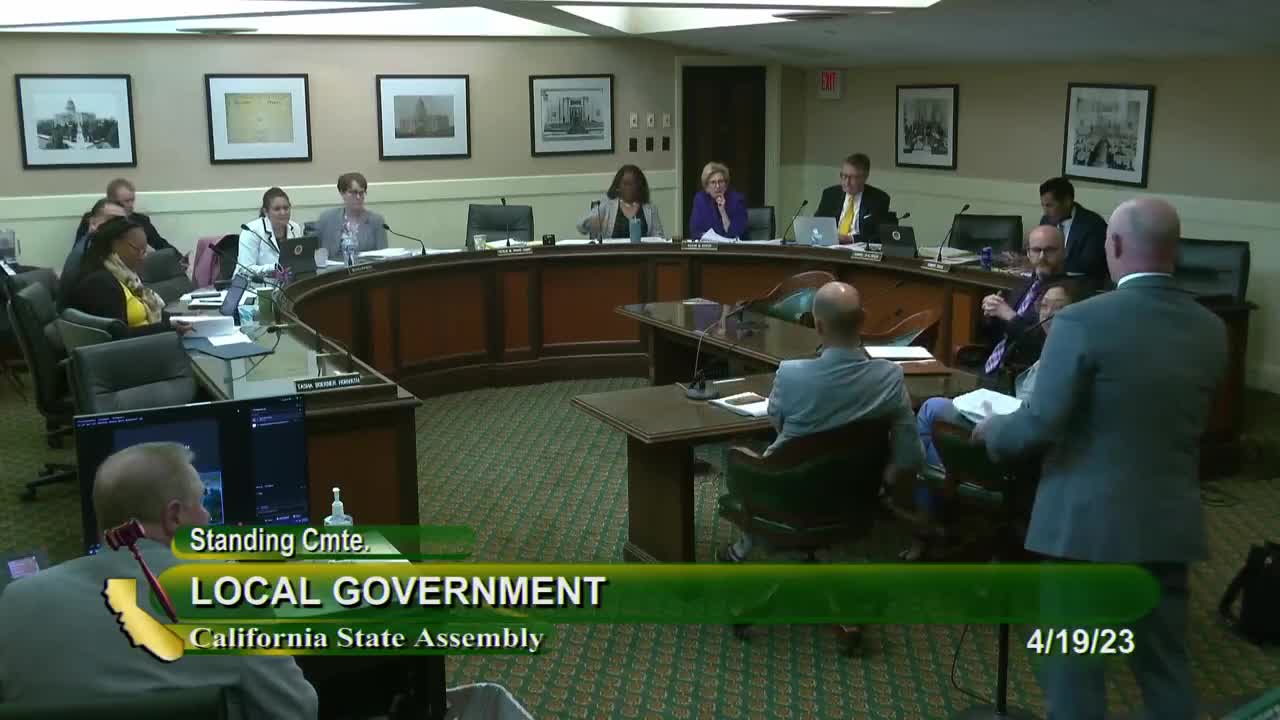 4MIN
Assembly Standing Committee on Local Government
Bill Author

Bill Co-Author(s):