AB 914: Electrical infrastructure: California Environmental Quality Act: review time period.
- Session Year: 2023-2024
- House: Assembly
- Latest Version Date: 2023-07-13
Current Status:
Failed
(2023-09-01: In committee: Held under submission.)
Introduced
In Committee
First Chamber
In Committee
Second Chamber
Enacted
The California Environmental Quality Act (CEQA) requires a lead agency, as defined, to prepare, or cause to be prepared, and certify the completion of an environmental impact report on a project that it proposes to carry out or approve that may have a significant effect on the environment or to adopt a negative declaration if it finds that the project will not have that effect. CEQA also requires a lead agency to prepare a mitigated negative declaration for a project that may have a significant effect on the environment if revisions in the project would avoid or mitigate that effect and there is no substantial evidence that the project, as revised, would have a significant effect on the environment.
CEQA requires each state agency to establish, by resolution or order, time limits for completing the environmental review of a project where the state agency is the lead agency for the project, as specified.
This bill bill, until January 1, 2031, would require a state agency, acting as the lead agency, to complete its environmental review for an electrical infrastructure project and to approve or deny the project within 2 years of the submission and acceptance of a complete application for the issuance of a lease, permit, license, certificate, or other entitlement for use for electrical infrastructure to the state agency. If the state agency fails to meet this time period, deadline, the bill would require the state agency to submit to the Legislature a report setting forth the reasons for why that the review could not be completed within the time period and identifying potential impacts to the electrical system that could result from the delay.
The California Environmental Quality Act (CEQA) requires a lead agency, as defined, to prepare, or cause to be prepared, and certify the completion of an environmental impact report on a project that it proposes to carry out or approve that may have a significant effect on the environment or to adopt a negative declaration if it finds that the project will not have that effect. CEQA also requires a lead agency to prepare a mitigated negative declaration for a project that may have a significant effect on the environment if revisions in the project would avoid or mitigate that effect and there is no substantial evidence that the project, as revised, would have a significant effect on the environment.
This bill would exempt from CEQA specified projects relating to electrical substations and electrical line facilities owned by, and constructed by or under contract with, electrical corporations serving not less than 10,000 customers or local publicly owned electric utilities.By requiring a lead agency to determine the applicability of the above-described exemptions to a project, this bill would impose a state-mandated local program.CEQA requires each state agency to establish, by resolution or order, time limits for completing the environmental review of a project where the state agency is the lead agency for the project, as specified.
This bill would require a state agency, acting as the lead agency, to complete its environmental review for an electrical infrastructure project and to approve or deny the project within 2 years of the submission and acceptance of an a complete application for the issuance of a lease, permit, license, certificate, or other entitlement for use for electrical infrastructure to the state agency. If the state agency fails to meet this time period, the bill would require the state agency to submit to the Legislature a report setting forth the reasons for why the review could not be completed within the time period and identifying potential impacts to the electrical system that could result from the delay.
The California Constitution requires the state to reimburse local agencies and school districts for certain costs mandated by the state. Statutory provisions establish procedures for making that reimbursement.This bill would provide that no reimbursement is required by this act for a specified reason.The California Environmental Quality Act (CEQA) requires a lead agency, as defined, to prepare, or cause to be prepared, and certify the completion of an environmental impact report on a project that it proposes to carry out or approve that may have a significant effect on the environment or to adopt a negative declaration if it finds that the project will not have that effect. CEQA also requires a lead agency to prepare a mitigated negative declaration for a project that may have a significant effect on the environment if revisions in the project would avoid or mitigate that effect and there is no substantial evidence that the project, as revised, would have a significant effect on the environment.
This bill would exempt from CEQA certain electrical infrastructure projects intended to provide capacity or enhance reliability to accommodate the increased electrical demand or forecasted electrical demand associated with transportation electrification, building electrification, distributed energy projects, including energy storage projects, or the interconnection of a renewable generation source. specified projects relating to electrical substations and electrical line facilities owned by, and constructed by or under contract with, electrical corporations serving not less than 10,000 customers or local publicly owned electric utilities.
This bill would exempt from CEQA the construction, upgrade, modification, or expansion of a facility to store, for later transmission or distribution, electricity previously generated by, and transmitted to, the facility and certain related facilities.By requiring a lead agency to determine the applicability of the above-described exemptions to a project, this bill would impose a state-mandated local program.
CEQA requires each state agency to establish, by resolution or order, time limits for completing the environmental review of a project where the state agency is the lead agency for the project, as specified.
This bill would require a state agency, acting as the lead agency, to complete its environmental review for an electrical infrastructure project and to approve or deny the project within 2 years of the submission of an application for the issuance of a lease, permit, license, certificate, or other entitlement for use for electrical infrastructure to the state agency. If the state agency fails to meet this time period, the bill would require the state agency to submit to the Legislature a report setting forth the reasons for why the review could not be completed within the time period and identifying potential impacts to the electrical system that could result from the delay.
The California Constitution requires the state to reimburse local agencies and school districts for certain costs mandated by the state. Statutory provisions establish procedures for making that reimbursement.
This bill would provide that no reimbursement is required by this act for a specified reason.
The California Environmental Quality Act (CEQA) requires a lead agency, as defined, to prepare, or cause to be prepared, and certify the completion of an environmental impact report on a project that it proposes to carry out or approve that may have a significant effect on the environment or to adopt a negative declaration if it finds that the project will not have that effect. CEQA also requires a lead agency to prepare a mitigated negative declaration for a project that may have a significant effect on the environment if revisions in the project would avoid or mitigate that effect and there is no substantial evidence that the project, as revised, would have a significant effect on the environment.
This bill would exempt from CEQA certain electrical infrastructure projects intended to provide capacity or enhance reliability to accommodate the increased electrical demand or forecasted electrical demand associated with transportation electrification, building electrification, distributed energy projects, including energy storage projects, or the interconnection of a renewable generation source.
This bill would exempt from CEQA the construction, upgrade, modification, or expansion of a facility to store, for later transmission or distribution, electricity previously generated by, and transmitted to, the facility and certain related facilities.
By requiring a lead agency to determine the applicability of the above-described exemptions to a project, this bill would impose a state-mandated local program.
CEQA requires each state agency to establish, by resolution or order, time limits for completing the environmental review of a project where the state agency is the lead agency for the project, as specified.
This bill would require a state agency, acting as the lead agency, to complete its environmental review for an electrical infrastructure project and to approve or deny the project within 2 years of the submission of an application for the issuance of a lease, permit, license, certificate, or other entitlement for use for electrical infrastructure to the state agency. If the state agency fails to meet this time period, the bill would require the state agency to submit to the Legislature a report setting forth the reasons for why the review could not be completed within the time period and identifying potential impacts to the electrical system that could result from the delay.
The California Constitution requires the state to reimburse local agencies and school districts for certain costs mandated by the state. Statutory provisions establish procedures for making that reimbursement.
This bill would provide that no reimbursement is required by this act for a specified reason.
Existing law vests the Public Utilities Commission with regulatory authority over public utilities, including electrical corporations. Under existing law, it is the policy of the state that each electrical corporation operate its electric distribution grid in its service territory, including owning, controlling, operating, managing, maintaining, planning, engineering, designing, and constructing its own electrical distribution grid, and do so in a safe, reliable, efficient, and cost-effective manner. Existing law requires each electrical corporation to continue to make reasonable investments in its electric distribution grid, and requires that each electrical corporation continue to have a reasonable opportunity to fully recover those costs from its customers in a manner determined by the commission.This bill would state the intent of the Legislature to enact subsequent legislation to optimize electric distribution grid planning in support of building and transportation electrification.Existing law vests the Public Utilities Commission with regulatory authority over public utilities, including electrical corporations. Under existing law, it is the policy of the state that each electrical corporation operate its electric distribution grid in its service territory, including owning, controlling, operating, managing, maintaining, planning, engineering, designing, and constructing its own electrical distribution grid, and do so in a safe, reliable, efficient, and cost-effective manner. Existing law requires each electrical corporation to continue to make reasonable investments in its electric distribution grid, and requires that each electrical corporation continue to have a reasonable opportunity to fully recover those costs from its customers in a manner determined by the commission.
This bill would state the intent of the Legislature to enact subsequent legislation to optimize electric distribution grid planning in support of building and transportation electrification.
The Legislature finds and declares all of the following:
(a)It is the policy of the state that Californias climate goals, greater environmental protection, and improvements in public health, particularly in communities overburdened with air pollution, can be achieved through increased use of electricity as a source of power rather than continued reliance on fossil fuels. Among other things, expanded electrification of the transportation sector and equipment and appliances within buildings, as well as the increased use of energy produced from renewable sources and stored energy, would assist in meeting the states environmental goals.
(b)As codified in Section 25328 of the Public Resources Code, the state has established a goal of reaching 100 percent zero-emission vehicles for new passenger vehicle sales by 2035 and for medium- and heavy-duty vehicles by 2045. In addition, the State Energy Resources Conservation and Development Commission and the State Air Resources Board anticipate as many as 8,000,000 electric vehicles in California by 2030. To meet the states climate and air quality goals, especially in areas where there is a concentration of medium- and heavy-duty vehicles and other goods movement equipment, electrical corporations and local publicly owned electric utilities must be able to proactively plan and build electrical grid upgrades to accommodate the level of electric vehicle charging associated with these goals and projections.
(c)Decarbonized energy use in buildings, mainly by converting space and water heating from natural gas to electricity, also supports the states climate, environmental, and public health policies. In addition, electrifying more building energy uses reduces the emissions of greenhouse gases and other pollutants more effectively if the electricity comes from zero-carbon sources.
(d)Improvements in zero-carbon generation technologies are enabling cleaner electricity to be used on a greater scale, but delivering that energy to meet the anticipated increases in demand will require constructing and installing additional electrical system infrastructure.
(e)For all of these climate, environmental, and public health reasons, there is a critical need to bring new electrical grid infrastructure online more quickly. This infrastructure includes (1) expanding utility infrastructure in existing utility rights-of-way and (2) developing new utility infrastructure within two miles of a source of increased or additional electrical demand related to electric vehicle charging facilities, building electrification projects, or vehicle fleets electrification projects, or a renewable generation source, which would provide reliable transmission or transformation infrastructure to interconnect to, or deliver power from, that source.
SEC. 2.Section 21100.2 of the Public Resources Code is amended to read:21100.2.(a)(1)For projects described in subdivision (c) of Section 21065, each state agency shall establish, by resolution or order, time limits that do not exceed the following:
(A)One year for completing and certifying environmental impact reports.
(B)One hundred eighty days for completing and adopting negative declarations.
(2)The time limits specified in paragraph (1) shall apply only to those circumstances in which the state agency is the lead agency for a project. These resolutions or orders may establish different time limits for different types or classes of projects, but all limits shall be measured from the date on which an application requesting approval of the project is received and accepted as complete by the state agency.
(3)No application for a project may be deemed incomplete for lack of a waiver of time periods prescribed in state regulations.
(4)The resolutions or orders required by this section may provide for a reasonable extension of the time period in the event that compelling circumstances justify additional time and the project applicant consents to the extension.
(b)(1)Notwithstanding any other provision of this division, within two years from the date on which an application for the issuance of a lease, permit, license, certificate, or other entitlement for use for electrical infrastructure is submitted to, and accepted as complete by, a state agency that is a lead agency for the project, the state agency shall complete the review of the environmental impacts of the proposed project pursuant to this division, including the completion and certification of an environmental impact report or the completion or adoption of a negative declaration or mitigated negative declaration, and shall approve or deny the application.
(2)If Meeting the deadline set forth in paragraph (1) is mandatory, and if the state agency fails to meet the time period set forth in paragraph (1), period, the state agency shall, in accordance with Section 9795 of the Government Code, submit to the Legislature a report setting forth the reasons why that the review could not be completed within the time period and identifying potential impacts to the electrical system that could result from the delay.
(3)The time period set forth in paragraph (1) is mandatory, not discretionary.(c)If a draft environmental impact report, environmental impact report, or focused environmental impact report is prepared under a contract to a state agency, the contract shall be executed within 45 days from the date on which the state agency sends a notice of preparation pursuant to Section 21080.4. The state agency may take longer to execute the contract if the project applicant and the state agency mutually agree to an extension of the time limit provided by this subdivision.
(d)This section shall remain in effect only until January 1, 2031, and as of that date is repealed.
SEC. 3.Section 21100.2 is added to the Public Resources Code, to read:21100.2.(a)(1)For projects described in subdivision (c) of Section 21065, each state agency shall establish, by resolution or order, time limits that do not exceed the following:
(A)One year for completing and certifying environmental impact reports.
(B)One hundred eighty days for completing and adopting negative declarations.
(2)The time limits specified in paragraph (1) shall apply only to those circumstances in which the state agency is the lead agency for a project. These resolutions or orders may establish different time limits for different types or classes of projects, but all limits shall be measured from the date on which an application requesting approval of the project is received and accepted as complete by the state agency.
(3)No application for a project may be deemed incomplete for lack of a waiver of time periods prescribed in state regulations.
(4)The resolutions or orders required by this section may provide for a reasonable extension of the time period in the event that compelling circumstances justify additional time and the project applicant consents to the extension.
(b)If a draft environmental impact report, environmental impact report, or focused environmental impact report is prepared under a contract to a state agency, the contract shall be executed within 45 days from the date on which the state agency sends a notice of preparation pursuant to Section 21080.4. The state agency may take longer to execute the contract if the project applicant and the state agency mutually agree to an extension of the time limit provided by this subdivision.
(c)This section shall become operative on January 1, 2031.
The Legislature finds and declares all of the following:
(a)It is the policy of the state that Californias climate goals, greater environmental protection, and improvements in public health, particularly in communities overburdened with air pollution, can be achieved through increased use of electricity as a source of power rather than continued reliance on fossil fuels. Among other things, expanded electrification of the transportation sector and equipment and appliances within buildings, as well as the increased use of energy produced from renewable sources and stored energy, would assist in meeting the states environmental goals.
(b)As codified in Section 25328 of the Public Resources Code, the state has established a goal of reaching 100 percent zero-emission vehicles for new passenger vehicle sales by 2035 and for medium- and heavy-duty vehicles by 2045. In addition, the State Energy Resources Conservation and Development Commission and the State Air Resources Board anticipate as many as 8,000,000 electric vehicles in California by 2030. To meet the states climate and air quality goals, especially in areas where there is a concentration of medium- and heavy-duty vehicles and other goods movement equipment, electrical corporations and local publicly owned electric utilities must be able to proactively plan and build electrical grid upgrades to accommodate the level of electric vehicle charging associated with these goals and projections.
(c)Decarbonized energy use in buildings, mainly by converting space and water heating from natural gas to electricity, also supports the states climate, environmental, and public health policies. In addition, electrifying more building energy uses reduces the emissions of greenhouse gases and other pollutants more effectively if the electricity comes from zero-carbon sources.
(d)Improvements in zero-carbon generation technologies are enabling cleaner electricity to be used on a greater scale, but delivering that energy to meet the anticipated increases in demand will require constructing and installing additional electrical system infrastructure.
(e)For all of these climate, environmental, and public health reasons, there is a critical need to bring new electrical grid infrastructure online more quickly. This infrastructure includes (1) expanding utility infrastructure in existing utility rights-of-way and (2) developing new utility infrastructure within two miles of a source of increased or additional electrical demand related to electric vehicle charging facilities, building electrification projects, or vehicle fleets electrification projects, or a renewable generation source, which would provide reliable transmission or transformation infrastructure to interconnect to, or deliver power from, that source.
SEC. 2.Section 21080.59 is added to the Public Resources Code, to read:21080.59.(a)This division does not apply to either of the following:(1)The expansion or upgrade of an existing electrical substation, or the expansion, upgrade, or modification of existing electrical line facilities within an existing right-of-way, if the substation or facilities are owned by, and will be constructed by or under contract with, an electrical corporation serving not less than 10,000 customers or a local publicly owned electric utility.(2)The construction of a new electrical substation or new electrical line facilities, or the expansion, upgrade, or modification of an electrical substation or electrical line facilities, if the substation or facilities are owned by, and will be constructed by or under contract with, an electrical corporation serving not less than 10,000 customers or a local publicly owned electric utility, and if the substation or facilities will be located within two miles of either of the following:(A)The location of an actual or forecasted electrical demand increase associated with transportation electrification or building electrification.(B)A distributed energy project, energy storage project, or renewable generation source, where the electrical line facilities or substation would support the interconnection of the project or source to the electrical grid.(b)For purposes of this section, the following terms have the following meanings:(1)Electrical corporation has the same meaning as defined in Section 218 of the Public Utilities Code.(2)Local publicly owned electric utility has the same meaning as defined in Section 224.3 of the Public Utilities Code.SEC. 3.SEC. 2.Section 21100.2 of the Public Resources Code is amended to read:21100.2.(a)(1)For projects described in subdivision (c) of Section 21065, each state agency shall establish, by resolution or order, time limits that do not exceed the following:
(A)One year for completing and certifying environmental impact reports.
(B)One hundred eighty days for completing and adopting negative declarations.
(2)The time limits specified in paragraph (1) shall apply only to those circumstances in which the state agency is the lead agency for a project. These resolutions or orders may establish different time limits for different types or classes of projects, but all limits shall be measured from the date on which an application requesting approval of the project is received and accepted as complete by the state agency.
(3)No application for a project may be deemed incomplete for lack of a waiver of time periods prescribed in state regulations.
(4)The resolutions or orders required by this section may provide for a reasonable extension of the time period in the event that compelling circumstances justify additional time and the project applicant consents to the extension.
(b)(1)Notwithstanding any other provision of this division, within two years from the date on which an application for the issuance of a lease, permit, license, certificate, or other entitlement for use for electrical infrastructure is submitted to to, and accepted as complete by, a state agency that is a lead agency for the project, the state agency shall complete the review of the environmental impacts of the proposed project pursuant to this division, including the completion and certification of an environmental impact report or the completion or adoption of a negative declaration or mitigated negative declaration, and shall approve or deny the application.
(2)If the state agency fails to meet the time period set forth in paragraph (1), the state agency shall, in accordance with Section 9795 of the Government Code, submit to the Legislature a report setting forth the reasons why the review could not be completed within the time period and identifying potential impacts to the electrical system that could result from the delay.
(3)The time period set forth in paragraph (1) is mandatory, not directory. discretionary.
(c)If a draft environmental impact report, environmental impact report, or focused environmental impact report is prepared under a contract to a state agency, the contract shall be executed within 45 days from the date on which the state agency sends a notice of preparation pursuant to Section 21080.4. The state agency may take longer to execute the contract if the project applicant and the state agency mutually agree to an extension of the time limit provided by this subdivision.
SEC. 4.No reimbursement is required by this act pursuant to Section 6 of Article XIIIB of the California Constitution because a local agency or school district has the authority to levy service charges, fees, or assessments sufficient to pay for the program or level of service mandated by this act, within the meaning of Section 17556 of the Government Code.The Legislature finds and declares all of the following:
(a)It is the policy of the state that Californias climate goals, greater environmental protection, and improvements in public health, particularly in communities overburdened with air pollution, can be achieved through increased use of electricity as a source of power rather than continued reliance on fossil fuels. Among other things, expanded electrification of the transportation sector and equipment and appliances within buildings, as well as the increased use of energy produced from renewable sources and stored energy, would assist in meeting the states environmental goals.
(b)As codified in Section 25328 of the Public Resources Code, the state has established a goal of reaching 100 percent zero-emission vehicles for new passenger vehicle sales by 2035 and for medium- and heavy-duty vehicles by 2045. In addition, the State Energy Resources Conservation and Development Commission and the State Air Resources Board anticipate as many as 8,000,000 electric vehicles in California by 2030. To meet the states climate and air quality goals, especially in areas where there is a concentration of medium- and heavy-duty vehicles and other goods movement equipment, electrical corporations and local publicly owned electric utilities must be able to proactively plan and build electrical grid upgrades to accommodate the level of electric vehicle charging associated with these goals and projections.
(c)Decarbonized energy use in buildings, mainly by converting space and water heating from natural gas to electricity, also supports the states climate, environmental, and public health policies. In addition, electrifying more building energy uses reduces the emissions of greenhouse gases and other pollutants more effectively if the electricity comes from zero-carbon sources.
(d)Improvements in zero-carbon generation technologies are enabling cleaner electricity to be used on a greater scale, but delivering that energy to meet the anticipated increases in demand will require constructing and installing additional electrical system infrastructure.
(e)For all of these climate, environmental, and public health reasons, there is a critical need to bring new electrical grid infrastructure online more quickly. This infrastructure includes (1) expanding utility infrastructure in existing utility rights-of-way and (2) developing new utility infrastructure within two miles of a source of increased or additional electrical demand related to electric vehicle charging facilities, building electrification projects, or vehicle fleets electrification projects, or a renewable generation source, which would provide reliable transmission or transformation infrastructure to interconnect to, or deliver power from, that source.
SECTION 1.SEC. 2.Section 21080.59 is added to the Public Resources Code, to read:21080.59.(a)This division does not apply to either of the following:
(a)(1)The expansion or upgrade of an existing electrical substation, or the expansion, upgrade, or modification of existing electrical line facilities designed for operation at a voltage of 200 kilovolts or greater, if the project is intended to provide capacity or enhance reliability to accommodate the increased electrical demand or forecasted electrical demand associated with transportation electrification, building electrification, distributed energy projects, including energy storage projects, or the interconnection of a renewable generation source. within an existing right-of-way, if the substation or facilities are owned by, and will be constructed by or under contract with, an electrical corporation serving not less than 10,000 customers or a local publicly owned electric utility.
(b)(2)The construction of a new electrical substation or new electrical line facilities, or the expansion, upgrade, or modification of an electrical substation or electrical line facilities designed for operation at a voltage less than 200 kilovolts, if the project is intended to provide capacity or enhance reliability to accommodate the increased electrical demand or forecasted electrical demand associated with transportation electrification, building electrification, distributed energy projects, including energy storage projects, or the interconnection of a renewable generation source. facilities, if the substation or facilities are owned by, and will be constructed by or under contract with, an electrical corporation serving not less than 10,000 customers or a local publicly owned electric utility, and if the substation or facilities will be located within two miles of either of the following:
(A)The location of an actual or forecasted electrical demand increase associated with transportation electrification or building electrification.
(B)A distributed energy project, energy storage project, or renewable generation source, where the electrical line facilities or substation would support the interconnection of the project or source to the electrical grid.
(b)For purposes of this section, the following terms have the following meanings:
(1)Electrical corporation has the same meaning as defined in Section 218 of the Public Utilities Code.
(2)Local publicly owned electric utility has the same meaning as defined in Section 224.3 of the Public Utilities Code.
SEC. 2.Section 21080.60 is added to the Public Resources Code, to read:21080.60.This division does not apply to either of the following:(a)The construction, upgrade, modification, or expansion of a facility to store, for later transmission or distribution, electricity previously generated by, and transmitted to, the facility.(b)The construction of a substation, transmission line, or tie-line, for purposes of transforming or transmitting electricity to, or from, a storage facility described in subdivision (a).SEC. 3.Section 21100.2 of the Public Resources Code is amended to read:21100.2.(a)(1)For projects described in subdivision (c) of Section 21065, each state agency shall establish, by resolution or order, time limits that do not exceed the following:
(A)One year for completing and certifying environmental impact reports.
(B)One hundred eighty days for completing and adopting negative declarations.
(2)The time limits specified in paragraph (1) shall apply only to those circumstances in which the state agency is the lead agency for a project. These resolutions or orders may establish different time limits for different types or classes of projects, but all limits shall be measured from the date on which an application requesting approval of the project is received and accepted as complete by the state agency.
(3)No application for a project may be deemed incomplete for lack of a waiver of time periods prescribed in state regulations.
(4)The resolutions or orders required by this section may provide for a reasonable extension of the time period in the event that compelling circumstances justify additional time and the project applicant consents to the extension.
(b)(1)Notwithstanding any other provision of this division, within two years from the date on which an application for the issuance of a lease, permit, license, certificate, or other entitlement for use for electrical infrastructure is submitted to a state agency that is a lead agency for the project, the state agency shall complete the review of the environmental impacts of the proposed project pursuant to this division, including the completion and certification of an environmental impact report or the completion or adoption of a negative declaration or mitigated negative declaration, and shall approve or deny the application.
(2)If the state agency fails to meet the time period set forth in paragraph (1), the state agency shall, in accordance with Section 9795 of the Government Code, submit to the Legislature a report setting forth the reasons why the review could not be completed within the time period and identifying potential impacts to the electrical system that could result from the delay.
(3)The time period set forth in paragraph (1) is mandatory mandatory, not directory.
(c)If a draft environmental impact report, environmental impact report, or focused environmental impact report is prepared under a contract to a state agency, the contract shall be executed within 45 days from the date on which the state agency sends a notice of preparation pursuant to Section 21080.4. The state agency may take longer to execute the contract if the project applicant and the state agency mutually agree to an extension of the time limit provided by this subdivision.
SEC. 4.No reimbursement is required by this act pursuant to Section 6 of Article XIIIB of the California Constitution because a local agency or school district has the authority to levy service charges, fees, or assessments sufficient to pay for the program or level of service mandated by this act, within the meaning of Section 17556 of the Government Code.
This division does not apply to either of the following:
(a)The expansion or upgrade of an existing electrical substation, or the expansion, upgrade, or modification of existing electrical line facilities designed for operation at a voltage of 200 kilovolts or greater, if the project is intended to provide capacity or enhance reliability to accommodate the increased electrical demand or forecasted electrical demand associated with transportation electrification, building electrification, distributed energy projects, including energy storage projects, or the interconnection of a renewable generation source.
(b)The construction of new electrical line facilities, or the expansion, upgrade, or modification of electrical line facilities designed for operation at a voltage less than 200 kilovolts, if the project is intended to provide capacity or enhance reliability to accommodate the increased electrical demand or forecasted electrical demand associated with transportation electrification, building electrification, distributed energy projects, including energy storage projects, or the interconnection of a renewable generation source.
SEC. 2.Section 21080.60 is added to the Public Resources Code, to read:21080.60.This division does not apply to either of the following:
(a)The construction, upgrade, modification, or expansion of a facility to store, for later transmission or distribution, electricity previously generated by, and transmitted to, the facility.
(b)The construction of a substation, transmission line, or tie-line, for purposes of transforming or transmitting electricity to, or from, a storage facility described in subdivision (a).
SEC. 3.Section 21100.2 of the Public Resources Code is amended to read:21100.2.(a)(1)For projects described in subdivision (c) of Section 21065, each state agency shall establish, by resolution or order, time limits that do not exceed the following:
(A)One year for completing and certifying environmental impact reports.
(B)One hundred eighty days for completing and adopting negative declarations.
(2)The time limits specified in paragraph (1) shall apply only to those circumstances in which the state agency is the lead agency for a project. These resolutions or orders may establish different time limits for different types or classes of projects, but all limits shall be measured from the date on which an application requesting approval of the project is received and accepted as complete by the state agency.
(3)No application for a project may be deemed incomplete for lack of a waiver of time periods prescribed in state regulations.
(4)The resolutions or orders required by this section may provide for a reasonable extension of the time period in the event that compelling circumstances justify additional time and the project applicant consents thereto. to the extension.
(b)(1)Notwithstanding any other provision of this division, within two years from the date on which an application for the issuance of a lease, permit, license, certificate, or other entitlement for use for electrical infrastructure is submitted to a state agency that is a lead agency for the project, the state agency shall complete the review of the environmental impacts of the proposed project pursuant to this division, including the completion and certification of an environmental impact report or the completion or adoption of a negative declaration or mitigated negative declaration, and shall approve or deny the application.
(2)If the state agency fails to meet the time period set forth in paragraph (1), the state agency shall, in accordance with Section 9795 of the Government Code, submit to the Legislature a report setting forth the reasons why the review could not be completed within the time period and identifying potential impacts to the electrical system that could result from the delay.
(3)The time period set forth in paragraph (1) is mandatory not directory.
(b)(c)If a draft environmental impact report, environmental impact report, or focused environmental impact report is prepared under a contract to a state agency, the contract shall be executed within 45 days from the date on which the state agency sends a notice of preparation pursuant to Section 21080.4. The state agency may take longer to execute the contract if the project applicant and the state agency mutually agree to an extension of the time limit provided by this subdivision.
(c)This section shall become operative January 1, 2018.SEC. 4.No reimbursement is required by this act pursuant to Section 6 of Article XIIIB of the California Constitution because a local agency or school district has the authority to levy service charges, fees, or assessments sufficient to pay for the program or level of service mandated by this act, within the meaning of Section 17556 of the Government Code.
SECTION 1.It is the intent of the Legislature to enact subsequent legislation to optimize electric distribution grid planning in support of building and transportation electrification.It is the intent of the Legislature to enact subsequent legislation to optimize electric distribution grid planning in support of building and transportation electrification.
|
Date
|
Status
|
|---|---|
| Sep 1, 2023 | In committee: Held under submission. |
| Aug 21, 2023 | In committee: Referred to APPR suspense file. |
| Jul 13, 2023 | Read second time and amended. Re-referred to Com. on APPR. |
| Jul 12, 2023 | From committee: Amend, and do pass as amended and re-refer to Com. on APPR. (Ayes 18. Noes 0.) (July 10). |
| Jul 5, 2023 | From committee: Do pass and re-refer to Com. on E., U. & C. with recommendation: To Consent Calendar. (Ayes 7. Noes 0.) (July 5). Re-referred to Com. on E., U. & C. |
| Jun 7, 2023 | Referred to Coms. on E.Q. and E., U. & C. |
| May 31, 2023 | In Senate. Read first time. To Com. on RLS. for assignment. |
| May 30, 2023 | Read third time. Passed. Ordered to the Senate. (Ayes 79. Noes 0. Page 1883.) |
| May 18, 2023 | Read second time. Ordered to third reading. |
| May 18, 2023 | From committee: Do pass. (Ayes 15. Noes 0.) (May 18). |
| May 18, 2023 | Joint Rule 62(a), file notice suspended. (Page 1580.) |
| May 17, 2023 | In committee: Set, first hearing. Referred to APPR. suspense file. |
| May 2, 2023 | Re-referred to Com. on APPR. |
| May 1, 2023 | Read second time and amended. |
| Apr 27, 2023 | From committee: Amend, and do pass as amended and re-refer to Com. on APPR. (Ayes 13. Noes 0.) (April 26). |
| Apr 25, 2023 | From committee: Do pass and re-refer to Com. on U. & E. (Ayes 10. Noes 0.) (April 24). Re-referred to Com. on U. & E. |
| Apr 24, 2023 | (pending re-refer to Com. on U. & E.) |
| Apr 24, 2023 | Assembly Rule 56 suspended. (Page 1291.) |
| Apr 24, 2023 | Joint Rule 62(a), file notice suspended. (Page 1291.) |
| Apr 11, 2023 | Re-referred to Com. on NAT. RES. |
| Apr 10, 2023 | From committee chair, with author's amendments: Amend, and re-refer to Com. on NAT. RES. Read second time and amended. |
| Mar 13, 2023 | Re-referred to Com. on NAT. RES. |
| Mar 9, 2023 | From committee chair, with author's amendments: Amend, and re-refer to Com. on NAT. RES. Read second time and amended. |
| Mar 9, 2023 | Referred to Coms. on NAT. RES. and U. & E. |
| Feb 15, 2023 | From printer. May be heard in committee March 17. |
| Feb 14, 2023 | Read first time. To print. |
|
Date
|
Description
|
Location
|
Votes
|
|
|---|---|---|---|---|
| Aug 21, 2023 | Placed on suspense file | Senate Standing Committee on Appropriations |
Passed |
|
| Jul 10, 2023 | Do pass as amended, but first amend, and re-refer to the Committee on [Appropriations] | Senate Standing Committee on Energy, Utilities and Communications |
Passed |
|
| Jul 5, 2023 | Do pass, but first be re-referred to the Committee on [Energy, Utilities and Communications] with the recommendation: To Consent Calendar | Senate Standing Committee on Environmental Quality |
Passed |
|
| May 30, 2023 | AB 914 Friedman Assembly Third Reading | Assembly Floor |
Passed |
|
| May 18, 2023 | Do pass. | Assembly Standing Committee on Appropriations |
Passed |
|
| Apr 26, 2023 | Do pass as amended and be re-referred to the Committee on [Appropriations] | Assembly Standing Committee on Utilities and Energy |
Passed |
|
| Apr 24, 2023 | Do pass and be re-referred to the Committee on [Utilities and Energy] | Assembly Standing Committee on Natural Resources |
Passed |
This list shows positions taken on this bill by organizations on the date displayed, which is linked to the original source.
Positions by individuals are not included.
|
Organization
|
Position
|
Date
|
|---|---|---|
| 350 Humboldt: Grass Roots Climate Action | ** Support | |
| American Clean Power Association | ** Support | |
| Association of California Cities - Orange County | ** Support | |
| Bay Area Council | ** Support | |
| California Association Of Councils Of Governments | ** Support | |
| California Builders Alliance | ** Support | |
| California Building Industry Association | ** Support | |
| California Chamber Of Commerce | ** Support | |
| California Contract Cities Association | ** Support | |
| California Manufacturers And Technology Association | ** Support | |
| California Wind Energy Association | ** Support | |
| CivicWell | ** Support | |
| Clean Air Task Force | ** Support | |
| Clean Power Campaign | ** Support | |
| Defenders Of Wildlife | ** Against | |
| Electric Vehicle Charging Association | ** Support | |
| FissionTransition | ** Against | |
| HNTB | ** Support | |
| Housing Action Coalition | ** Support | |
| Independent Energy Producers Association | ** Support | |
| Inland Empire Economic Partnership | ** Support | |
| Large Scale Solar Association | ** Support | |
| Los Angeles Business Council | ** Support | |
| Pacific Gas And Electric Company | ** Support | |
| Rural County Representatives of California | ** Support | |
| Sacramento Regional Builders Exchange | ** Support | |
| San Diego Gas & Electric | ** Support | |
| Sierra Club | ** Against | |
| Silicon Valley Leadership Group | ** Support | |
| Southern California Edison | ** Support |
SENATE COMMITTEE ON
Senator Anthony Portantino, Chair
2023 - 2024 Regular Session
AB 914 (Friedman) - Electrical infrastructure: California Environmental Quality Act: review time period
Version: | Policy Vote: |
Urgency: | Mandate: |
Hearing Date: | Consultant: |
Bill Summary:
This bill would require a two-year time period for a lead state agency to complete California Environmental Quality Act (CEQA) environmental review and approve or deny an application for an electrical infrastructure project.
Fiscal Impact:
- The California Public Utilities Commission (CPUC) estimates ongoing costs of $482,000 annually (ratepayer funds) to create a new permit application tracking process and develop reports for transmission permitting projects that exceed a two-year review within a CPUC proceeding.
Background:
Electric transmission projects. Electric transmission lines are generally high voltage lines that move electricity from generation resources (power plants) to distribution lines in neighborhoods that serve individual customers. Companies, usually electric IOUs, proposing the construction of new transmission, are required to obtain a permit from the CPUC for construction of certain specified infrastructure listed under Public Utilities Code §1001, including transmission projects. The CPUC reviews permit applications under two concurrent processes: (1) an environmental review pursuant to CEQA, and (2) the review of project need and costs pursuant to Public Utilities Code §1001 and GO 131-D (CPCN).
The A, B, C’s of CEQA. CEQA is designed to (a) make government agencies and the public aware of the environmental impacts of a proposed project, (b) ensure the public can take part in the review process, and (c) identify and implement measures to mitigate or eliminate any negative impact the project may have on the environment. CEQA is enforced by civil lawsuits that can challenge any project’s environmental review. Nonprofits, private individuals, public agencies, advocacy groups, and other organizations can all file lawsuits under CEQA.
CEQA process and timeline. A lead agency reviewing a project under CEQA takes three progressive steps of environmental review. First, a lead agency looks at the footprint of the project to determine if it can be exempted from CEQA. If it is not exempt, the lead agency then conducts an initial study to look at potential environmental impacts. If there are no significant environmental impacts, or if those impacts can be fully mitigated, the lead agency prepares an ND or MND. If there are environmental impacts that cannot be mitigated, the lead agency proceeds with the most extensive level of environmental review: a full EIR. The EIR is a comprehensive document that evaluates all the environmental impacts that a project might have, and proposes mitigation measures for impacts that have a significant effect on the environment.
Under CEQA, state and local agencies must complete and adopt a ND in 180 days, and certify an EIR within a year. If there is a compelling circumstance to extend this timeline, agencies may take longer, but only if the project applicant consents.
Multiple Players in Energy Infrastructure Planning. Planning and building transmission lines requires coordination across multiple state entities. The CEC, CPUC, and CAISO have a memorandum of understanding regarding transmission and resource planning and implementation.
- CAISO plans transmission. California Independent System Operator (CAISO) is a nonprofit, public benefit corporation established in statue to ensure efficient use and reliable operation of the transmission grid and to manage the transmission grid and related energy markets. CAISO annually conducts a Transmission Planning Process which evaluates the electricity system’s needs and identifies new transmission lines and upgrades to existing transmission lines. These projects are then taken on by incumbent transmission owners or by a utility following a competitive solicitation process.
- The CPUC reviews transmission projects. The CPUC conducts environmental review for transmission projects, including CEQA review as part of a CPCN or a PTC, depending on the size of the project. Only larger, high-voltage projects over 200 kV, which also require a CPCN, are consistently subject to complete CEQA review, including an EIR.
- CEC – power plants and last mile lines. The CEC certifies all thermal power plants 50 megawatts (MW) and larger and related short connecting transmission lines. In siting these plants and lines, the CEC uses an Application for Certification (AFC) process, a certified regulatory program that is the functional equivalent of CEQA.
CEQA and transmission timeline. The CPUC anticipates that major transmission projects will take five to six years to complete, with CEQA and CPCN review adding around three to four years for a project. If these environmental planning documents are legally challenged, then lawsuits can extend this process even further.
However, the majority of transmission projects are eligible for exemption from CEQA either through categorical exemptions or through GO 131-D. IOU electrical distribution line projects under 50 kV do not require a CPCN or PTC from the CPUC, nor discretionary approval from local governments, and therefore are not subject to CEQA. Only larger, high-voltage projects over 200 kV, which also require a CPCN, are consistently subject to CEQA review with a full EIR. According to CPUC data, between 2012 to 2023, 608 projects have been exempted from CEQA, 29 projects have been approved via negative declaration, and 27 have undergone an EIR. That means that 90 percent of electric IOU projects over the last decade were exempt from CEQA, on top of the thousands of projects under 50 kV that do not require any review from the CPUC. In the case of an exemption, the amount of time spent on CEQA review is negligible.
Proposed Law:
This bill would require a two-year time period for a lead state agency to complete CEQA environmental review and approve or deny an application for an electrical infrastructure project. Specifically, this bill would:
- Require a state agency, acting as the lead agency, to complete its environmental review for an electrical infrastructure project and to approve or deny the project within two years of the submission and acceptance of a complete application for the issuance of a lease, permit, license, certificate, or other entitlement for use for electrical infrastructure to the state agency.
- If the state agency fails to meet this deadline, require the state agency to submit to the Legislature a report explaining the reasons that the review could not be completed within the time period and identifying potential impacts to the electrical system that could result from the delay.
- Make related findings and declarations regarding the increased demands for electricity and clean energy, and as such, the need to expand and develop new utility infrastructure.
- Sunset these provisions on January 1, 2031.
Related Legislation:
SB 149 (Caballero, 2023) would make various changes to CEQA, including administrative and judicial streamlining afforded to projects, including energy-related projects.
SB 319 (McGuire, 2023) would require the CEC, CPUC, and CAISO to jointly develop and recommend an expedited permitting roadmap that describes timeframes and milestones for a coordinated, comprehensive, and efficient permitting process for electrical transmission infrastructure.
SB 420 (Becker, 2023) would allow specified transmission projects to become environmental leadership development projects eligible for CEQA streamlining and directs the CPUC to streamline its CPCN review if CAISO has already identified that project to be necessary.
SB 619 (Padilla, 2023) would expand the facilities eligible to be environmental leadership development projects, thereby subject to streamlined procedures under CEQA, to include electrical transmission projects.
SB 529 (Hertzberg, Chapter 357, Statutes of 2022) required the CPUC to update its rules to allow each electric IOU to use an accelerated process for approval to construct an extension, expansion, upgrade or other modification to its existing electric transmission facilities.
-- END --
SENATE COMMITTEE ON ENERGY, UTILITIES AND COMMUNICATIONS
Senator Steven Bradford, Chair
2023 - 2024 Regular
Bill No: Hearing Date: 7/10/2023
Author: | |||
Version: | Amended | ||
Urgency: | Fiscal: | ||
Consultant: | |||
SUBJECT:
DIGEST: This bill requires a two-year time period for a lead state agency to complete California Environmental Quality Act (CEQA) environmental review and approve or deny an application for an electrical infrastructure project.
ANALYSIS:
Existing law:
- Under CEQA, a lead agency on a proposed project determines whether a project is exempt from CEQA or if the lead agency must do an initial study to determine if a project will have significant effects on the environment. If a project has no effect on the environment or effects that can be mitigated, the lead agency prepares a negative declaration (ND) or mitigated ND (MND). If the project will have significant impacts, the lead agency prepares an environmental impact report (EIR) to evaluate and propose mitigation measures for any effects on the environment, including impacts or likely impacts. (Public Resources Code §§21000 et seq.)
- Provides CEQA exemptions for 33 types of projects and establishes criteria for exceptions to these exemptions. (California Code of Regulations (CCR.) Title 14 §§15300-15333). These include exemptions that apply to utilities and transmission lines:
- Repair and maintenance of existing public or private facilities, including both investor and publicly owned utilities used to provide electric power, natural gas, sewerage, or other public utility services. (Guidelines §15301)
- Replacement or reconstruction of existing facilities on the same site with the same purpose and capacity. (CCR. Title 14 §15302)
- New construction or conversion of small structures, including electrical, gas, and other utility extensions of reasonable length to serve such construction. (CCR. Title 14 §15303)
- Requires the California Public Utilities Commission (CPUC) to certify the “public convenience and necessity” of a transmission line over 200 kilovolts (kV) before an electric investor-owned utility (IOU) may begin construction. The Certificate of Public Convenience and Necessity (CPCN) includes CEQA review. A CPCN is not required for the extension, expansion, upgrade, or other modification of an existing electrical transmission facility, including transmission lines and substations. (Public Utilities Code §1001)
- Requires an IOU to obtain a discretionary permit to construct (PTC) from the CPUC for electrical power line projects between 50-200 kV. A PTC may be exempt from CEQA pursuant to CPUC orders and existing provisions of CEQA. (CPUC General Order (GO) 131-D)
- Requires the CPUC, by January 1, 2024, to update GO 131-D to authorize IOUs to use the PTC process or claim an exemption under GO 131-D Section III(B) to seek approval to construct an extension, expansion, upgrade, or other modification to its existing electrical transmission facilities, including electric transmission lines and substations within existing transmission easements, rights of way, or franchise agreements, irrespective of whether the electrical transmission facility is above 200 kV. (Public Utilities Code §564)
- Requires the California Energy Commission (CEC) to adopt a strategic plan for the state’s electric transmission grid. This plan makes recommendations on actions to implement investments to ensure reliability, relieve congestion and meet future growth in load and generation of the grid. (Public Resources Code §25324)
This bill:
- Requires a state agency, acting as the lead agency, to complete its environmental review for an electrical infrastructure project and to approve or deny the project within two years of the submission and acceptance of a complete application for the issuance of a lease, permit, license, certificate, or other entitlement for use for electrical infrastructure to the state agency.
- Requires, if the state agency fails to meet this time period the state agency to submit to the Legislature a report explaining the reasons for why the review could not be completed within the time period and identifying potential impacts to the electrical system that could result from the delay.
- Makes related findings and declarations regarding the increased demands for electricity and clean energy, and as such, the need to expand and develop new utility infrastructure.
Background
Electric transmission projects. Electric transmission lines are generally high voltage lines that move electricity from generation resources (power plants) to distribution lines in neighborhoods that serve individual customers. Companies, usually electric IOUs, proposing the construction of new transmission, are required to obtain a permit from the CPUC for construction of certain specified infrastructure listed under Public Utilities Code §1001, including transmission projects. The CPUC reviews permit applications under two concurrent processes: (1) an environmental review pursuant to CEQA, and (2) the review of project need and costs pursuant to Public Utilities Code §1001 and GO 131-D (CPCN).
According to the Senate Committee on Environmental Quality:
The A, B, C’s of CEQA. CEQA is designed to (a) make government agencies and the public aware of the environmental impacts of a proposed project, (b) ensure the public can take part in the review process, and (c) identify and implement measures to mitigate or eliminate any negative impact the project may have on the environment. CEQA is enforced by civil lawsuits that can challenge any project’s environmental review. Nonprofits, private individuals, public agencies, advocacy groups, and other organizations can all file lawsuits under CEQA.
CEQA Process and timeline. A lead agency reviewing a project under CEQA takes three progressive steps of environmental review. First, a lead agency looks at the footprint of the project to determine if it can be exempted from CEQA. If it is not exempt, the lead agency then conducts an initial study to look at potential environmental impacts. If there are no significant environmental impacts, or if those impacts can be fully mitigated, the lead agency prepares an ND or MND. If there are environmental impacts that cannot be mitigated, the lead agency proceeds with the most extensive level of environmental review: a full EIR. The EIR is a comprehensive document that evaluates all the environmental impacts that a project might have, and proposes mitigation measures for impacts that have a significant effect on the environment.
Under CEQA, state and local agencies must complete and adopt a ND in 180 days, and certify an EIR within a year. If there is a compelling circumstance to extend this timeline, agencies may take longer, but only if the project applicant consents.
Multiple Players in Energy Infrastructure Planning. Planning and building transmission lines requires coordination across multiple state entities. The CEC, CPUC, and CAISO have a memorandum of understanding regarding transmission and resource planning and implementation.
- CAISO plans transmission. California Independent System Operator (CAISO) is a nonprofit, public benefit corporation established in statue to ensure efficient use and reliable operation of the transmission grid and to manage the transmission grid and related energy markets. CAISO annually conducts a Transmission Planning Process which evaluates the electricity system’s needs and identifies new transmission lines and upgrades to existing transmission lines. These projects are then taken on by incumbent transmission owners or by a utility following a competitive solicitation process.
- The CPUC reviews transmission projects. The CPUC conducts environmental review for transmission projects, including CEQA review as part of a CPCN or a PTC, depending on the size of the project. Only larger, high-voltage projects over 200 kV, which also require a CPCN, are consistently subject to complete CEQA review, including an EIR.
- CEC – power plants and last mile lines. The CEC certifies all thermal power plants 50 megawatts (MW) and larger and related short connecting transmission lines. In siting these plants and lines, the CEC uses an Application for Certification (AFC) process, a certified regulatory program that is the functional equivalent of CEQA.
CEQA and transmission timeline. The CPUC anticipates that major transmission projects will take five to six years to complete, with CEQA and CPCN review adding around three to four years for a project. If these environmental planning documents are legally challenged, then lawsuits can extend this process even further.
However, the majority of transmission projects are eligible for exemption from CEQA either through categorical exemptions or through GO 131-D. IOU electrical distribution line projects under 50 kV do not require a CPCN or PTC from the CPUC, nor discretionary approval from local governments, and therefore are not subject to CEQA. Only larger, high-voltage projects over 200 kV, which also require a CPCN, are consistently subject to CEQA review with a full EIR. According to CPUC data, between 2012 to 2023, 608 projects have been exempted from CEQA, 29 projects have been approved via negative declaration, and 27 have undergone an EIR. That means that 90 percent of electric IOU projects over the last decade were exempt from CEQA, on top of the thousands of projects under 50 kV that do not require any review from the CPUC. In the case of an exemption, the amount of time spent on CEQA review is negligible.
Comments
Need for this bill. This bill attempts to address an area of potential delay in helping the state achieve its clean energy, greenhouse gas emissions, and reliability goals, namely the deployment of electric infrastructure projects, perhaps most notably electrical transmission projects. However, as noted above, very few electrical transmission projects undergo a CEQA environmental review, so the benefits of the proposed two-year time period in this bill may be applicable to only a limited number of transmission projects. Nonetheless, given the potential need for transmission the two year period may prove beneficial to supporting the state’s efforts to achieve its clean energy and climate goals. The CAISO’s first-ever 20 Year Outlook for transmission planning, written in partnership with the CPUC and CEC and released in 2022, estimates that more than $30 billion in new transmission capacity will be needed by 2040 to support the development of over 120 gigawatts of new generating resources to meet the state’s goals. As such, the potential benefit from this and other legislative efforts to help expedite permitting can support the state’s efforts to deploy this necessary transmission capacity.
Electrical infrastructure. The two-year time limit for CEQA review of electrical infrastructure projects proposed by this bill would apply whenever a state agency is the lead agency for an electrical infrastructure project. “Electrical infrastructure” is not defined, and therefore, would potentially include more than electric transmission projects, but could also include power plants, as the CEC serves as a lead agency for the licensing of thermal power plants over 50 MW via the AFC process, as well as, the small power plant exemption (SPPE) option for power plants between 50-100 MW. The AFC process is a certified regulatory program, the functional equivalent of CEQA. Regardless of whether it applies to the CPUC CPCN process or the CEC AFC process, two years to complete CEQA review and make a decision on the project seems reasonable and consistent with the agencies’ own procedures and timelines.
Need for amendments. Due to the limited time between when this bill was heard in the Senate Committee on Environmental Quality and this committee, the committees have agreed to adopt all the proposed amendments for the bill in this committee. The author and committee may wish to adopt the following amendments proposed in the Senate Committee on Environmental Quality:
- Strike the language specifying that the two-year time limit for public agencies’ CEQA review of transmission projects is mandatory.
- Add a seven-year sunset to the requirement that lead public agencies complete their CEQA review in two years.
Additional amendments needed. The author and committee may wish to amend the findings and declarations to clarify some of the statements and delete provisions that may be less relevant to this bill.
Double referral: This bill passed out of the Senate Committee on Environmental Quality by a vote of 7-0 on July 5, 2023.
Prior/Related Legislation
SB 149 (Caballero, 2023) makes various changes to CEQA, including administrative and judicial streamlining afforded to projects, including energy-related projects. The bill is in the enrollment process.
SB 319 (McGuire, 2023) would require the CEC, CPUC, and CAISO to jointly develop and recommend an expedited permitting roadmap that describes timeframes and milestones for a coordinated, comprehensive, and efficient permitting process for electrical transmission infrastructure. The bill is pending in the Assembly Committee on Utilities and Energy.
SB 420 (Becker, 2023) would allow specified transmission projects to become environmental leadership development projects eligible for CEQA streamlining and directs the CPUC to streamline its CPCN review if CAISO has already identified that project to be necessary. The bill is pending in the Assembly Committee on Natural Resources Committee.
SB 619 (Padilla, 2023) would expand the facilities eligible to be environmental leadership development projects, thereby subject to streamlined procedures under CEQA, to include electrical transmission projects. The bill is pending the Assembly Committee on Natural Resources.
SB 529 (Hertzberg, Chapter 357, Statutes of 2022) required the CPUC to update its rules to allow each electric IOU to use an accelerated process for approval to construct an extension, expansion, upgrade or other modification to its existing electric transmission facilities.
FISCAL EFFECT: Appropriation: Fiscal Com.: Local:
SUPPORT:
350 Humboldt: Grass Roots Climate Action
Association of California Cities - Orange County
California Association of Councils of Governments
California Builder’s Alliance
CivicWell
Clean Air Task Force
Clean Power Campaign
Housing Action Coalition
Pacific Gas and Electric Company
Sacramento Regional Builders Exchange
San Diego Gas & Electric
Southern California Edison
OPPOSITION:
None received
ARGUMENTS IN SUPPORT: According to the author:
The state has set ambitious goals for decarbonization and increased reliance on clean energy, largely predicated on electrification of the transportation industry, greener buildings, increased reliance on renewable generation and development of energy storage… Utilities must also be able to interconnect renewable energy sources to the broader grid as efficiently as possible. Despite these objectives, the regulatory process for reviewing, siting and permitting the electrical infrastructure necessary to interconnect, transmit and transform the energy needed to power California more cleanly can lead to unwanted delays, roadblocks and bottlenecks. In particular, environmental review under the California Environmental Quality Act [Division 13 (commencing with Section 21000) of the Public Resources Code] (“CEQA”), while important to the state’s overall environmental policies, is often the “long pole in the tent” that prevents worthy projects from being developed for many years, or sometimes being developed at all, given the expense and uncertainty associated with such review. This has been the case even in instances where infrastructure projects would have minimal environmental impacts and/or would provide far greater environmental benefits than impacts.
AB 914, would establish a timeline of two years for the lead agency to complete its environmental review and to issue a final decision on an application for an electrical infrastructure project – and if the lead agency fails to meet this time period, the bill would require the state agency to submit to the Legislature a report explaining why. This reporting requirement would give policymakers information on why state agencies are unable to complete environmental review in a timely manner.
-- END --
SENATE COMMITTEE ON ENVIRONMENTAL QUALITY
Senator Allen, Chair
2023 - 2024 Regular
Bill No. | AB 914 | Hearing Date: | 7/5/2023 |
Author: | Friedman | ||
Version: | 5/1/2023 | ||
Urgency: | No | Fiscal: | Yes |
Consultant: | Brynn Cook | ||
SUBJECT: Electrical infrastructure: California Environmental Quality Act: review time period
DIGEST: Establishes a new, two-year time limit for California Environmental Quality Act (CEQA) review of electrical infrastructure projects where a state agency is the lead agency.
ANALYSIS:
Existing law:
- Under CEQA, a lead agency on a proposed project determines whether a project is exempt from CEQA or if the lead agency must do an initial study to determine if a project will have significant effects on the environment. If a project has no effect on the environment or effects that can be mitigated, the lead agency prepares a negative declaration (ND) or mitigated ND (MND). If the project will have significant impacts, the lead agency prepares an environmental impact report (EIR) to evaluate and propose mitigation measures for any effects on the environment, including impacts or likely impacts. (Public Resources Code (PRC) §§21000 et seq.)
- Provides CEQA exemptions for 33 types of projects and establishes criteria for exceptions to these exemptions. (California Code of Regulations (C.C.R.) Title 14 §§ 15300-15333). These include exemptions that apply to utilities and transmission lines:
- Repair and maintenance of existing public or private facilities, including both investor and publicly owned utilities used to provide electric power, natural gas, sewerage, or other public utility services. (Guidelines §15301)
- Replacement or reconstruction of existing facilities on the same site with the same purpose and capacity. (C.C.R. Title 14 § 15302)
- New construction or conversion of small structures, including electrical, gas, and other utility extensions of reasonable length to serve such construction. (C.C.R. Title 14 § 15303)
- Requires the Public Utilities Commission (PUC) to certify the “public convenience and necessity” of a transmission line over 200 kilovolts (kV) before an investor-owned utility (IOU) may begin construction. The Certificate of Public Convenience and Necessity (CPCN) includes CEQA review. A CPCN is not required for the extension, expansion, upgrade, or other modification of an existing electrical transmission facility, including transmission lines and substations. (Public Utilities Code (PUC) § 1001)
- Requires an IOU to obtain a discretionary permit to construct (PTC) from the PUC for electrical power line projects between 50-200 kV. A PTC may be exempt from CEQA pursuant to PUC orders and existing provisions of CEQA. (PUC General Order (GO) 131-D)
- Requires the PUC, by January 1, 2024, to update GO 131-D to authorize IOUs to use the PTC process or claim an exemption under GO 131-D Section III(B) to seek approval to construct an extension, expansion, upgrade, or other modification to its existing electrical transmission facilities, including electric transmission lines and substations within existing transmission easements, rights of way, or franchise agreements, irrespective of whether the electrical transmission facility is above 200 kV. (PUC § 564)
- Requires the California Energy Commission (CEC) to adopt a strategic plan for the state’s electric transmission grid. This plan makes recommendations on actions to implement investments to ensure reliability, relieve congestion and meet future growth in load and generation of the grid. (PRC §25324)
This bill:
- Establishes a mandatory two-year time period for a lead state agency to complete CEQA review and approve or deny an application for an electrical infrastructure project.
- Requires a state agency that fails to meet the two-year time period to submit to the Legislature a report explaining that failure and identifying potential impacts to the electrical system that could result from the delay.
- Makes related findings and declarations.
Background
- The A, B, C’s of CEQA. CEQA is designed to (a) make government agencies and the public aware of the environmental impacts of a proposed project, (b) ensure the public can take part in the review process, and (c) identify and implement measures to mitigate or eliminate any negative impact the project may have on the environment. CEQA is enforced by civil lawsuits that can challenge any project’s environmental review. Nonprofits, private individuals, public agencies, advocacy groups, and other organizations can all file lawsuits under CEQA.
- CEQA Process and timeline. A lead agency reviewing a project under CEQA takes three progressive steps of environmental review. First, a lead agency looks at the footprint of the project to determine if it can be exempted from CEQA. If it is not exempt, the lead agency then conducts an initial study to look at potential environmental impacts. If there are no significant environmental impacts, or if those impacts can be fully mitigated, the lead agency prepares an ND or MND. If there are environmental impacts that cannot be mitigated, the lead agency proceeds with the most extensive level of environmental review: a full EIR. The EIR is a comprehensive document that evaluates all the environmental impacts that a project might have, and proposes mitigation measures for impacts that have a significant effect on the environment.
Under CEQA, state and local agencies must complete and adopt a ND in 180 days, and certify an EIR within a year. If there is a compelling circumstance to extend this timeline, agencies may take longer, but only if the project applicant consents.
- Multiple Players in Energy Infrastructure Planning. Planning and building transmission lines requires coordination across multiple state entities. The CEC, CPUC, and CAISO have an MOU regarding transmission and resource planning and implementation.
- CAISO plans transmission. California Independent System Operator (CAISO) is a nonprofit, public benefit corporation established in statue to ensure efficient use and reliable operation of the transmission grid and to manage the transmission grid and related energy markets. CAISO annually conducts a Transmission Planning Process which evaluates the electricity system’s needs and identifies new transmission lines and upgrades to existing transmission lines. These projects are then taken on by incumbent transmission owners or by a utility following a competitive solicitation process.
- The CPUC reviews transmission projects. The CPUC conducts environmental review for transmission projects, including CEQA review as part of a Certificate of Public Convenience and Necessity (CPCN) or a Permit to Construct (PTC), depending on the size of the project. Only larger, high-voltage projects over 200 kV, which also require a CPCN, are consistently subject to complete CEQA review, including an EIR.
- CEC – power plants and last mile lines. The CEC certifies all thermal power plants 50 megawatts (MW) and larger and related short connecting transmission lines. In siting these plants and lines, the CEC uses an Application for Certification (AFC) process, a certified regulatory program that is the functional equivalent of CEQA.
- CEQA and Transmission Timeline. The CPUC anticipates that major transmission projects will take five to six years to complete, with CEQA and CPCN review adding around three to four years for a project. If these environmental planning documents are legally challenged, then lawsuits can extend this process even further.
However, the majority of transmission projects are eligible for exemption from CEQA either through categorical exemptions or through GO 131-D. IOU electrical distribution line projects under 50 kV do not require a CPCN or PTC from the PUC, nor discretionary approval from local governments, and therefore are not subject to CEQA. Only larger, high-voltage projects over 200 kV, which also require a CPCN, are consistently subject to CEQA review with a full EIR. According to PUC data, between 2012 to 2023, 608 projects have been exempted from CEQA, 29 projects have been approved via negative declaration, and 27 have undergone an EIR. That means that 90% of IOU projects over the last decade were exempt from CEQA, on top of the thousands of projects under 50 kV that do not require any review from the CPUC. In the case of an exemption, the amount of time spent on CEQA review is negligible.
Comments
- Purpose of Bill. According to the author, “The state has set ambitious goals for decarbonization and increased reliance on clean energy, largely predicated on electrification of the transportation industry, greener buildings, increased reliance on renewable generation and development of energy storage…Despite these objectives, the regulatory process for reviewing, siting and permitting the electrical infrastructure necessary to interconnect, transmit and transform the energy needed to power California more cleanly can lead to unwanted delays, roadblocks and bottlenecks. In particular, environmental review under CEQA… prevents worthy projects from being developed for many years, or sometimes being developed at all…even in instances where infrastructure projects would have minimal environmental impacts and/or would provide far greater environmental benefits than impacts. This bill would exempt from the CEQA process certain electrical infrastructure projects that would help spread and more efficiently utilize clean energy.”
- Required…or What? AB 914 explicitly states that meeting the two-year CEQA review for a project is mandatory, not discretionary. However, other than a requirement that the public agency report on its failure to meet this timeline to the Legislature, it is unclear what the implications of the “mandatory” provision are. Would the CEQA review be closed after two years if the timeline is not met? Would a project have to be discarded and a new CEQA review process begun? Neither of these outcomes are desirable (or feasible), but the language in its current form invites such questions on interpretation.
Suggested Amendment. The committee and author may wish to strike the language specifying that the two-year time limit for public agencies’ CEQA review of transmission projects is mandatory.
- Two Years on What Timeline? AB 914 requires public lead agencies to complete their CEQA review and make a decision to approve or deny the application in two years. This is in line with the timelines developed by both CPUC CPCN process and the CEC AFC process. However, while this two-year timeline seems reasonable with current processes, these processes may change. If they do, then two years may be exorbitantly long or far too short to conduct the CEQA review. In either case, the two-year deadline is based on currently expected timelines that may not be static over time.
Suggested Amendment. The committee and author may wish to add a seven-year sunset to the requirement that lead public agencies complete their CEQA review in two years. Since lead public agencies that fail to meet this two-year timeline must report on this outcome to the Legislature, there will be adequate data after seven years to determine if this timeline should be adjusted.
- Committee amendments. Staff recommends the committee adopt the bolded amendments contained in comments 2 and 3 above.
DOUBLE REFERRAL:
If this measure is approved by the Senate Environmental Quality Committee, the do pass motion must include the action to re-refer the bill to the Senate Energy, Utilities, and Communications Committee.
Related/Prior Legislation
SB 319 (McGuire, 2023). Would require the CEC, CPUC, and CAISO to jointly develop and recommend an expedited permitting roadmap that describes timeframes and milestones for a coordinated, comprehensive, and efficient permitting process for electrical transmission infrastructure. Status: pending hearing in the Senate Committee on Energy, Utilities and Communications.
SB 420 (Becker, 2023). Would allow specified transmission projects to become environmental leadership development projects eligible for CEQA streamlining and directs the CPUC to streamline its CPCN review if CAISO has already identified that project to be necessary.
SB 529 (Hertzberg Chapter 357, Statutes of 2022.) Requires the CPUC to update its rules to allow each electric IOU to use an accelerated process for approval to construct an extension, expansion, upgrade or other modification to its existing electric transmission facilities.
SOURCE:
Author
SUPPORT:
350 Humboldt: Grass Roots Climate Action
Association of California Cities - Orange County (ACC-OC)
California Association of Councils of Governments
California Builders Alliance
California Contract Cities Association
Civicwell (formally the Local Government Commission)
Clean Air Task Force
Clean Power Campaign
Edison International and Affiliates, Including Southern California Edison
Electric Vehicle Charging Association
Housing Action Coalition
Pacific Gas and Electric Company
Sacramento Regional Builders Exchange
San Diego Gas & Electric
San Diego Gas and Electric Company
Silicon Valley Leadership Group
OPPOSITION:
None received
-- END --
ASSEMBLY THIRD READING
ATR Bill Id:AB 914
Author:(Friedman)
As Amended Ver:May 1, 2023
Majority vote
SUMMARY
Establishes a two-year time limit, from the date the application is submitted to, and accepted as complete by, a lead state agency to complete California Environmental Quality Act (CEQA) review and approve or deny an application for an electrical infrastructure project.
Major Provisions
- Establishes a two-year time period for a lead state agency to complete CEQA review and approve or deny an application for an electrical infrastructure project.
- Requires a state agency that fails to meet the two-year time period to submit to the Legislature a report setting forth the reasons why the review could not be completed within the time period and identifying potential impacts to the electrical system that could result from the delay.
- Specifies that the two-year time period is mandatory, not discretionary.
- Makes related findings.
COMMENTS
CEQA provides a process for evaluating the environmental effects of applicable projects undertaken or approved by public agencies. If a project is not exempt from CEQA, an initial study is prepared to determine whether the project may have a significant effect on the environment. If the initial study shows that there would not be a significant effect on the environment, the lead agency must prepare a negative declaration. If the initial study shows that the project may have a significant effect on the environment, the lead agency must prepare an environmental impact report (EIR).
Generally, an EIR must accurately describe the proposed project, identify and analyze each significant environmental impact expected to result from the proposed project, identify mitigation measures to reduce those impacts to the extent feasible, and evaluate a range of reasonable alternatives to the proposed project. Prior to approving any project that has received environmental review, an agency must make certain findings. If mitigation measures are required or incorporated into a project, the agency must adopt a reporting or monitoring program to ensure compliance with those measures.
CEQA requires state and local lead agencies to establish time limits of one year for completing and certifying EIRs and 180 days for completing and adopting negative declarations. These limits are measured from the date on which an application is received and accepted as complete by the lead agency. Agencies may provide for a reasonable extension in the event that compelling circumstances justify additional time and the project applicant consents.
Electrical transmission line projects are eligible for a number of CEQA exemptions pursuant to the CEQA Guidelines and the Public Utilities Commission's (PUC) General Order (GO) 131-D. Only larger, high-voltage projects over 200 kilovolts (kV), which also require a Certificate of Public Convenience and Necessity (CPCN), are consistently subject to complete CEQA review, including an EIR. According to PUC data, from 2012 to 2023, 608 projects have been exempted from CEQA, 29 projects have been approved via negative declaration, and 27 have required an EIR.
GO 131-D specifically addresses the procedures to be followed in applications for siting of electric transmission infrastructure. GO 131-D establishes the distinction in the levels of review based on the voltage level of the project (under 50 kV, 50 to 200 kV, and above 200 kV) as described above. The PUC reviews permit applications under two concurrent processes: (1) an environmental review pursuant to CEQA, and (2) the review of project need and costs pursuant to Public Utilities Code Section 1001 et seq. and GO 131-D.
According to the Author
The state has set ambitious goals for decarbonization and increased reliance on clean energy, largely predicated on electrification of the transportation industry, greener buildings, increased reliance on renewable generation and development of energy storage…Despite these objectives, the regulatory process for reviewing, siting and permitting the electrical infrastructure necessary to interconnect, transmit and transform the energy needed to power California more cleanly can lead to unwanted delays, roadblocks and bottlenecks. In particular, environmental review under CEQA… prevents worthy projects from being developed for many years, or sometimes being developed at all…even in instances where infrastructure projects would have minimal environmental impacts and/or would provide far greater environmental benefits than impacts. This bill would exempt from the CEQA process certain electrical infrastructure projects that would help spread and more efficiently utilize clean energy.
Arguments in Support
According to the Large-scale Solar Association, the California Wind Energy Association, the Independent Energy Producers Association, and the American Clean Power Association, AB 914 would take a small step forward in helping to expedite the electrical infrastructure needed to increase capacity and enhance reliability. This bill would also require a state lead agency under CEQA to report back to the legislature should a state agency fail to meet streamlining requirements, providing a new level of accountability to the CEQA process. The status quo will not allow California to achieve the infrastructure build necessary at the pace and scale required to meet California’s climate goals. While this bill is a small step towards a much larger goal, AB 914 will help us get closer to meeting our collective climate and energy targets.
Arguments in Opposition
None received for current version.
FISCAL COMMENTS
According to the Assembly Appropriations Committee, minor and absorbable costs to both the California Energy Commission (CEC) and the PUC.
VOTES
ASM NATURAL RESOURCES: 10-0-1
YES: Luz Rivas, Flora, Friedman, Hoover, Mathis, Muratsuchi, Pellerin, Ward, Wood, Zbur
ABS, ABST OR NV: Addis
ASM UTILITIES AND ENERGY: 13-0-2
YES: Garcia, Bauer-Kahan, Calderon, Wendy Carrillo, Chen, Connolly, Mathis, Muratsuchi, Reyes, Santiago, Schiavo, Ting, Wallis
ABS, ABST OR NV: Jim Patterson, Holden
ASM APPROPRIATIONS: 15-0-1
YES: Holden, Megan Dahle, Bryan, Calderon, Wendy Carrillo, Dixon, Mike Fong, Hart, Lowenthal, Mathis, Papan, Pellerin, Sanchez, Weber, Ortega
ABS, ABST OR NV: Robert Rivas
UPDATED
VERSION: May 1, 2023
CONSULTANT: Lawrence Lingbloom / NAT. RES. / (916) 319-2092 FN: 0000459
Date of Hearing: May 17, 2023
ASSEMBLY COMMITTEE ON APPROPRIATIONS
Chris Holden, Chair
ABPCA Bill Id:AB 914
Author:(Friedman) – As Amended Ver:May 1, 2023
Policy Committee: | Natural Resources | Vote: | 10 - 0 |
Utilities and Energy | 13 - 0 | ||
|
|
Urgency: No State Mandated Local Program: No Reimbursable: No
SUMMARY:
This bill establishes a two-year time limit, from the date an application is submitted, for a lead state agency to complete California Environmental Quality Act (CEQA) review and approve or deny an application for an electrical infrastructure project. The bill requires a state agency that fails to meet the two-year time limit to submit to the Legislature a report setting forth the reasons why the review could not be completed within the time period and identifying potential impacts to the electrical system that could result from the delay.
FISCAL EFFECT:
The reporting requirement in this bill will impose minor and absorbable costs to both the California Energy Commission (CEC) and the California Public Utilities Commission (CPUC).
Nonetheless, because this bill, in the committee’s estimation, has the primary purpose of creating a reporting requirement, it is a candidate for the committee’s suspense file, consistent with committee rules and practice.
COMMENTS:
- Purpose. The author intends this bill to accelerate the pace of development of energy infrastructure needed to enable the state to meet its clean energy goals. According to the author:
The state has set ambitious goals for decarbonization and increased reliance on clean energy, largely predicated on electrification of the transportation industry, greener buildings, increased reliance on renewable generation and development of energy storage…Despite these objectives, the regulatory process for reviewing, siting and permitting the electrical infrastructure necessary to interconnect, transmit and transform the energy needed to power California more cleanly can lead to unwanted delays, roadblocks and bottlenecks. In particular, environmental review under the California Environmental Quality Act… prevents worthy projects from being developed for many years, or sometimes being developed at all…even in instances where infrastructure projects would have minimal environmental impacts and/or would provide far greater environmental benefits than impacts. This bill would exempt from the CEQA process certain electrical infrastructure projects that would help spread and more efficiently utilize clean energy.
- Background. CEQA provides a process for evaluating the environmental effects of applicable projects undertaken or approved by public agencies. If a project is not exempt from CEQA, the lead agency prepares an initial study to determine whether the project may have a significant effect on the environment. If the initial study shows the project would not have a significant effect on the environment, the lead agency must prepare a negative declaration. If the initial study shows the project may have a significant effect, the lead agency must prepare an Environmental Impact Report (EIR).
Generally, an EIR must accurately describe the proposed project, identify, and analyze each significant environmental impact expected to result from the proposed project, identify mitigation measures to reduce those impacts to the extent feasible, and evaluate a range of reasonable alternatives to the proposed project. Prior to approving any project that has received environmental review, an agency must make certain findings. If mitigation measures are required or incorporated into a project, the agency must adopt a reporting or monitoring program to ensure compliance with those measures.
CEQA requires state and local lead agencies to establish time limits of one year for completing and certifying EIRs and 180 days for completing and adopting negative declarations. These limits are measured from the date on which an application is received and accepted as complete by the lead agency. Agencies may provide for a reasonable extension in the event that compelling circumstances justify additional time and the project applicant consents.
CEC and CPUC regularly serve as lead agencies for CEQA review of energy infrastructure projects: CEC in its permitting of larger thermal power plants, and CPUC in its permitting of larger electricity transmission lines generally proposed by the state’s investor-owned utilities. However, statute exempts from CEQA review several types of electricity infrastructure projects. As reported in the Assembly Utilities and Energy analysis of this bill, over 90% of electricity infrastructure projects proposed by the electrical utilities over the last decade were exempt from CEQA, and thousands of other electricity infrastructure projects were too small (under 50 kilovolts) to trigger CEQA review. Nonetheless, Pacific Gas and Electric, Southern California Edison and San Diego Gas and Electric write in support of this bill, describing CEQA as one major cause for the delay of distribution line replacement.
Analysis Prepared by: Jay Dickenson / APPR. / (916) 319-2081
Date of Hearing: April 26, 2023
ASSEMBLY COMMITTEE ON UTILITIES AND ENERGY
Eduardo Garcia, Chair
ABPCA Bill Id:AB 914 (
Author:Friedman) – As Amended Ver:April 10, 2023
SUBJECT: Electrical infrastructure: California Environmental Quality Act: exemptions: review time period
SUMMARY: As proposed to be amended, per amendments from the Committee on Natural Resources to strike the entirety of Section 2 from the bill: Establishes a two-year time limit, from the date the application is submitted, for a lead state agency to complete California Environmental Quality Act (CEQA) review and approve or deny an application for an electrical infrastructure project.
EXISTING LAW:
- Requires, pursuant to CEQA, lead agencies with the principal responsibility for carrying out or approving a proposed project to prepare a negative declaration, mitigated negative declaration, or environmental impact report (EIR) for this action, unless the project is exempt from CEQA. CEQA includes several statutory exemptions, as well as categorical exemptions in the CEQA guidelines. (Public Resources Code §§ 21000, et seq.)
- Defines “project” as an activity which may cause either a direct physical change in the environment, or a reasonably foreseeable indirect physical change in the environment, including an activity that involves the issuance of a lease, permit, license, certificate, or other entitlement for use by one or more public agencies. (Public Resources Code § 21065)
- For such projects subject to state agency review, requires the lead state agency to establish time limits that do not exceed one year for completing and certifying EIRs and 180 days for completing and adopting negative declarations. Requires these time limits to be measured from the date on which an application is received and accepted as complete by the state agency. (Public Resources Code § 21000.2)
- Requires the CEQA Guidelines to include a list of classes of projects that have been determined by the Secretary of the Natural Resources Agency to not have a significant effect on the environment and that shall be exempt from CEQA. (Public Resources Code § 21084)
The list of "categorical exemptions" includes:
- Repair and maintenance of existing public or private facilities, involving negligible or no expansion of use, including existing facilities of both investor and publicly owned utilities used to provide electric power, natural gas, sewerage, or other public utility services. (Guidelines 15301)
- Replacement or reconstruction of existing facilities on the same site with the same purpose and capacity, including existing utility systems and/or facilities involving negligible or no expansion of capacity. (Guidelines 15302)
- New construction or conversion of small structures, including electrical, gas, and other utility extensions of reasonable length to serve such construction. (Guidelines 15303)
- Establishes the Permit Streamlining Act (PSA), which establishes time limits within which state and local government agencies must either approve or disapprove permits. (Government Code §§ 65920, et seq.)
- Requires the California Public Utilities Commission (CPUC) to certify the public convenience and necessity require a transmission line over 200 kilovolts (kV) before an investor-owned utility (IOU) may begin construction (Certificate of Public Convenience and Necessity, or CPCN). The CPCN process includes CEQA review of the proposed project. The CPCN confers eminent domain authority for construction of the project. A CPCN is not required for the extension, expansion, upgrade, or other modification of an existing electrical transmission facility, including transmission lines and substations. (Public Utilities Code § 1001)
- IOU electrical power line projects between 50-200 kV require a discretionary permit to construct (PTC) from the CPUC, but may be exempt from CEQA pursuant to CPUC orders and existing provisions of CEQA. IOU electrical distribution line projects under 50 kV do not require a CPCN or PTC from the CPUC, nor discretionary approval from local governments, and therefore are not subject to CEQA. (General Order (GO) 131-D)
- Requires the CPUC, by January 1, 2024, to update GO 131-D to authorize IOUs to use the PTC process or claim an exemption under GO 131-D Section III(B) to seek approval to construct an extension, expansion, upgrade, or other modification to its existing electrical transmission facilities, including electric transmission lines and substations within existing transmission easements, rights of way, or franchise agreements, irrespective of whether the electrical transmission facility is above 200 kV. (Public Utilities Code § 564)
- Requires the California Energy Commission (CEC) to adopt a strategic plan for the state’s electric transmission grid, which recommends actions required to implement investments needed to ensure reliability, relieve congestion and meet future growth in load and generation. (Public Resources Code § 25324)
- Authorizes the CEC to designate electric transmission corridor zones (TCZ) in order to identify and reserve land that is suitable for high-voltage transmission lines. Specifies the CEC may designate a TCZ on its own motion or in response to an application from a person seeking a TCZ designation based on its future plans to construct a high-voltage electric transmission line. Makes the CEC the lead agency, for purposes of CEQA, for the designation of any TCZ. (Public Resources Code §§ 25330-25341)
FISCAL EFFECT: Unknown. This bill is keyed fiscal and will be referred to the Committee on Appropriations for its review.
BACKGROUND:
The CEQA Process – As detailed in the Assembly Committee on Natural Resources’ analysis of this measure, CEQA provides a process for evaluating the environmental effects of applicable projects undertaken or approved by public agencies. There are three general buckets of CEQA-eligible projects:
- Exempted from CEQA – projects that either have a categorical exemption (projects that belong to a category that have been found by the Secretary of Natural Resources to not have a significant effect on the environment are exempt from CEQA) or a statutory exemption (projects that belong to a class that have been granted exemptions by the Legislature).
- Subject to a Negative Declaration (ND) or Mitigated Negative Declaration (MND) – a process granted to certain projects that allow a statement describing the reasons a proposed, non-exempt project will not have a significant effect on the environment (ND) or a statement describing how a project’s plans have been modified to avoid potentially significant effects on the environment that were identified in an initial review (MND).
- Subject to an EIR – a detailed statement describing and analyzing the significant environmental effects of a project and discussing ways to mitigate or avoid the effects. Of the projects for which an EIR was prepared, many may also be subject to the National Environmental Policy Act (NEPA), the federal equivalent of CEQA. For projects that are subject to both CEQA and NEPA, the lead agency may file a joint document that covers both.
If a project is not exempt from CEQA, an initial study is prepared to determine whether the project may have a significant effect on the environment. If the initial study shows that there would not be a significant effect on the environment, the lead agency must prepare an ND or MND. If the initial study shows that the project may have a significant effect on the environment, the lead agency must prepare an EIR.
Generally, an EIR must accurately describe the proposed project, identify and analyze each significant environmental impact expected to result from the proposed project, identify mitigation measures to reduce those impacts to the extent feasible, and evaluate a range of reasonable alternatives to the proposed project. Prior to approving any project that has received environmental review, an agency must make certain findings. If mitigation measures are required or incorporated into a project, the agency must adopt a reporting or monitoring program to ensure compliance with those measures.
CEQA requires state and local lead agencies to establish time limits of one year for completing and certifying EIRs and 180 days for completing and adopting negative declarations. These limits are measured from the date on which an application is received and accepted as complete by the lead agency. Agencies may provide for a reasonable extension in the event that compelling circumstances justify additional time and the project applicant consents.
As noted above, electrical transmission line projects are eligible for a number of CEQA exemptions pursuant to the CEQA Guidelines and GO 131-D. GO 131-D specifically addresses the procedures to be followed in applications for siting of electric transmission infrastructure. GO 131-D establishes the distinction in the levels of review based on the voltage level of the project (under 50 kV, 50 to 200 kV, and above 200 kV) as described above. It also sets out public notice requirements for proposed transmission projects. The CPUC reviews permit applications under two concurrent processes: (1) an environmental review pursuant to CEQA, and (2) the review of project need and costs (the CPCN or PTC) pursuant to PUC § 1001 et seq. and GO 131-D.
Only larger, high-voltage projects over 200 kV, which also require a CPCN, are consistently subject to complete CEQA review, including an EIR. According to CPUC data shown in Table 1 below, from 2012 to 2023, of a total 664 projects that required CPUC review: 608 projects were exempt from CEQA, 29 projects were approved via ND/MND, and 27 required an EIR. This represents that over 90% of IOU projects over the last decade were exempt from CEQA, not even counting the thousands of projects < 50 kV that do not require any review from the CPUC. Of the projects that had to go through a full EIR, over half of them were subject to NEPA; meaning, even if a specific project received a statutory exemption from CEQA, a federal NEPA review would still be required.
Table 1: CPUC CEQA Report[1]
Years | Categorical Exemption[2] | Statutory Exemption | Negative Declaration/Mitigated Negative Declaration | EIR | Joint EIR/NEPA | Total |
2012-2023 | 602 | 6 | 29 | 27 | 14 | 664 |
COMMENTS:
- Author’s Statement. According to the author, “The state has set ambitious goals for decarbonization and increased reliance on clean energy, largely predicated on electrification of the transportation industry, greener buildings, increased reliance on renewable generation and development of energy storage. To meet the state’s climate and air quality goals, especially in areas where there is a concentration of medium- and heavy-duty vehicles and other goods movement equipment, electrical corporations and local publicly owned utilities must be able to proactively plan and build electrical grid upgrades to accommodate the level of electric vehicle charging associated with these goals and projections. Utilities must also be able to interconnect renewable energy sources to the broader grid as efficiently as possible. Despite these objectives, the regulatory process for reviewing, siting and permitting the electrical infrastructure necessary to interconnect, transmit and transform the energy needed to power California more cleanly can lead to unwanted delays, roadblocks and bottlenecks. In particular, environmental review under the California Environmental Quality Act [Division 13 (commencing with Section 21000) of the Public Resources Code] (“CEQA”), while important to the state’s overall environmental policies, is often the “long pole in the tent” that prevents worthy projects from being developed for many years, or sometimes being developed at all, given the expense and uncertainty associated with such review. This has been the case even in instances where infrastructure projects would have minimal environmental impacts and/or would provide far greater environmental benefits than impacts. This bill would exempt from the CEQA process certain electrical infrastructure projects that would help spread and more efficiently utilize clean energy, so as to enable such infrastructure to be constructed and operational in time to help California meet its clean energy goals.”
- Proposed Amendments. The bill before this committee includes proposed amendments from the Assembly Committee on Natural Resources to strike Section 2, which establishes a new CEQA exemption for electrical substations and transmission line facilities. Because of the tight legislative timeline, this committee agreed to adopt the amendments in our hearing so this bill could be heard.
- A Contradictory Position. The remaining substantive provision of this bill is in Section 3, which establishes a new, two-year time limit for CEQA review of electrical infrastructure projects. This provision applies whenever a state agency is the lead agency for an electrical infrastructure project, so its application is broader than IOU transmission lines subject to CPUC review. “Electrical infrastructure” is not defined, but it would seem to apply to the CEC’s Application for Certification (AFC) process for power plants. The AFC process is a certified regulatory program, the functional equivalent of CEQA.
Regardless of whether it applies to the CPUC CPCN process or the CEC AFC process, two years to complete CEQA review and make a decision on the project seems reasonable and consistent with the agencies’ own procedures and timelines. However, unlike other statutory permit review time limits, the bill’s clock starts when the application is filed, rather than when it is accepted as complete by the agency. Because the point is to hold the agency accountable, it seems unfair to start the clock if the application the agency receives is not sufficient to permit the agency to begin review.
Curiously, the supporters of this bill (the large IOUs) have raised this point of unfairness in discussions on bills currently before this committee regarding customer applications to the IOUs for interconnection or energization. They note in those circumstances that starting any clock for application processing prior to the IOU deeming an application complete would be unfair and impractical. It is unclear why a distinction should be made when the utility is the filer of the application, as is the case proposed in this bill, but not the reviewer of the application, as put forward in the interconnection and energization measures.
This provision also includes confusion around the use of “directory” when “discretionary” seems more appropriate. The author has noted that “directory” was the intent and cited case law to support its use in this measure; however the term is undefined and unclear. A seemingly larger issue is the requirement that the CEQA time limit imposed on state agencies by this bill is “mandatory,” without any guidance as to what occurs when that time limit is not met. Specifically, is the utility CEQA application held in limbo, or does this new requirement imply an alternative fate? The time constraints of hearing this measure did not afford clarity on these points to be attained in time. As a result, the author and committee may wish to consider an amendment to replace “directory” with “discretionary,” and to clarify that the time period for agency review of CEQA applications begins when the agency deems the application complete.
- Related Legislation.
SB 319 (McGuire) would require the CEC, CPUC, and CAISO to jointly develop and recommend an expedited permitting roadmap that describes timeframes and milestones for a coordinated, comprehensive, and efficient permitting process for electrical transmission infrastructure. Status: pending hearing in the Senate Committee on Energy, Utilities and Communications.
- Prior Legislation.
AB 2696 (Garcia, 2022) would have required the CEC, in consultation with other agencies, to conduct a study to review potential lower cost ownership and alternative financing mechanisms for new transmission facilities. Status: Died – Senate Committee on Appropriations.
SB 529 (Hertzberg) requires the CPUC to update its rules to allow each electric IOU to use an accelerated process for approval to construct an extension, expansion, upgrade or other modification to its existing electric transmission facilities. Status: Chapter 357, Statutes of 2022.
- Double Referral. This bill was previously heard in the Assembly Committee on Natural Resources on Monday, April 24, 2023.
REGISTERED SUPPORT / OPPOSITION:
Support
350 Humboldt: Grass Roots Climate Action
American Clean Power Association
Bay Area Council
California Building Industry Association
California Chamber of Commerce
California Manufacturers and Technology Association
California Wind Energy Association
Civicwell (formally the Local Government Commission)
Edison International and Affiliates, Including Southern California Edison
HNTB
Independent Energy Producers Association
Inland Empire Economic Partnership (IEEP)
Large Scale Solar Association
Los Angeles Business Council
Pacific Gas & Electric Company
Rural County Representatives of California (RCRC)
San Diego Gas & Electric
Oppose
Defenders of Wildlife
Fission Transition
Sierra Club
Analysis Prepared by: Laura Shybut / U. & E. / (916) 319-2083
From a data request to the CPUC by this committee on March 29, 2023 ↑
According to the CPUC, this column represents categories for projects where the applicant utility filed at the CPUC via Advice Letter to note they were taking an exemption to a CEQA document requirement process. There are a variety of exemptions claimed, including categorical exemptions. They CPUC does not track the type of exemptions claimed per Advice Letter. ↑
Date of Hearing: April 24, 2023
ASSEMBLY COMMITTEE ON NATURAL RESOURCES
Luz Rivas, Chair
ABPCA Bill Id:AB 914 (
Author:Friedman) – As Proposed to be Amended Ver:April 24, 2023
SUBJECT: Electrical infrastructure: California Environmental Quality Act: exemptions: review time period
SUMMARY: Establishes a two-year time limit, from the date the application is submitted, for a lead state agency to complete California Environmental Quality Act (CEQA) review and approve or deny an application for an electrical infrastructure project. (Proposed amendments strike out Section 2, which establishes a new CEQA exemption for electrical substations and transmission line facilities.)
EXISTING LAW:
- Requires, pursuant to CEQA, lead agencies with the principal responsibility for carrying out or approving a proposed project to prepare a negative declaration, mitigated negative declaration, or environmental impact report (EIR) for this action, unless the project is exempt from CEQA. CEQA includes several statutory exemptions, as well as categorical exemptions in the CEQA Guidelines. (Public Resources Code (PRC) 21000, et seq.)
- Defines “project” as an activity which may cause either a direct physical change in the environment, or a reasonably foreseeable indirect physical change in the environment, including an activity that involves the issuance of a lease, permit, license, certificate, or other entitlement for use by one or more public agencies. (PRC 21065)
- For such projects subject to state agency review, requires the lead state agency to establish time limits that do not exceed one year for completing and certifying EIRs and 180 days for completing and adopting negative declarations. Requires these time limits to be measured from the date on which an application is received and accepted as complete by the state agency. (PRC 21100.2)
- Requires the CEQA Guidelines to include a list of classes of projects that have been determined by the Secretary of the Natural Resources Agency to not to have a significant effect on the environment and that shall be exempt from CEQA. (PRC 21084)
The list of “categorical exemptions” includes:
- Repair and maintenance of existing public or private facilities, involving negligible or no expansion of use, including existing facilities of both investor and publicly owned utilities used to provide electric power, natural gas, sewerage, or other public utility services. (Guidelines 15301)
- Replacement or reconstruction of existing facilities on the same site with the same purpose and capacity, including existing utility systems and/or facilities involving negligible or no expansion of capacity. (Guidelines 15302)
- New construction or conversion of small structures, including electrical, gas, and other utility extensions of reasonable length to serve such construction. (Guidelines 15303)
- Establishes the Permit Streamlining Act (PSA), which establishes time limits within which state and local government agencies must either approve or disapprove permits. (Government Code 65920, et seq.)
- Requires the Public Utilities Commission (PUC) to certify the “public convenience and necessity” require a transmission line over 200 kilovolts (kV) before an investor-owned utility (IOU) may begin construction (Certificate of Public Convenience and Necessity, or CPCN). The CPCN process includes CEQA review of the proposed project. The CPCN confers eminent domain authority for construction of the project. A CPCN is not required for the extension, expansion, upgrade, or other modification of an existing electrical transmission facility, including transmission lines and substations. (Public Utilities Code 1001)
- Requires an IOU to obtain a discretionary permit to construct (PTC) from the PUC for electrical power line projects between 50-200 kV. A PTC may be exempt from CEQA pursuant to PUC orders and existing provisions of CEQA. IOU electrical distribution line projects under 50 kV do not require a CPCN or PTC from the PUC, nor discretionary approval from local governments, and therefore are not subject to CEQA. (PUC General Order (GO) 131-D)
- Requires the PUC, by January 1, 2024, to update GO 131-D to authorize IOUs to use the PTC process or claim an exemption under GO 131-D Section III(B) to seek approval to construct an extension, expansion, upgrade, or other modification to its existing electrical transmission facilities, including electric transmission lines and substations within existing transmission easements, rights of way, or franchise agreements, irrespective of whether the electrical transmission facility is above 200 kV. (PUC 564)
- Requires the California Energy Commission (CEC) to adopt a strategic plan for the state’s electric transmission grid, which recommends actions required to implement investments needed to ensure reliability, relieve congestion and meet future growth in load and generation. (PRC 25324)
- Authorizes the CEC to designate electric transmission corridor zones (TCZs) in order to identify and reserve land that is suitable for high-voltage transmission lines. Specifies the CEC may designate a TCZ on its own motion or in response to an application from a person seeking a TCZ designation based on its future plans to construct a high-voltage electric transmission line. Makes the CEC the lead agency, for purposes of CEQA, for the designation of any TCZ. (PRC 25330-25341)
THIS BILL:
- Establishes a two-year time limit for a lead state agency (e.g., PUC and CEC) for an “electrical infrastructure project” (undefined) to complete CEQA review, as specified, and approve or deny the application. Unlike existing permit review time limits, the time limit starts when the application is submitted, not when it is accepted as complete.
- Requires the agency, if it fails to meet this two-year time limit, to submit to the Legislature a report setting forth the reasons why the review could not be completed within the time limit and identifying potential impacts to the electrical system that could result from the delay.
- Provides the two-year time limit is mandatory, not “directory.”
- Makes related findings.
FISCAL EFFECT: Unknown
COMMENTS:
- Background. CEQA provides a process for evaluating the environmental effects of applicable projects undertaken or approved by public agencies. If a project is not exempt from CEQA, an initial study is prepared to determine whether the project may have a significant effect on the environment. If the initial study shows that there would not be a significant effect on the environment, the lead agency must prepare a negative declaration. If the initial study shows that the project may have a significant effect on the environment, the lead agency must prepare an EIR.
Generally, an EIR must accurately describe the proposed project, identify and analyze each significant environmental impact expected to result from the proposed project, identify mitigation measures to reduce those impacts to the extent feasible, and evaluate a range of reasonable alternatives to the proposed project. Prior to approving any project that has received environmental review, an agency must make certain findings. If mitigation measures are required or incorporated into a project, the agency must adopt a reporting or monitoring program to ensure compliance with those measures.
CEQA requires state and local lead agencies to establish time limits of one year for completing and certifying EIRs and 180 days for completing and adopting negative declarations. These limits are measured from the date on which an application is received and accepted as complete by the lead agency. Agencies may provide for a reasonable extension in the event that compelling circumstances justify additional time and the project applicant consents.
As noted above, electrical transmission line projects are eligible for a number of CEQA exemptions pursuant to the CEQA Guidelines and GO 131-D. Only larger, high-voltage projects over 200 kV, which also require a CPCN, are consistently subject to complete CEQA review, including an EIR. According to PUC data, from 2012 to 2023, 608 projects have been exempted from CEQA, 29 projects have been approved via negative declaration, and 27 have required an EIR.
GO 131-D specifically addresses the procedures to be followed in applications for siting of electric transmission infrastructure. GO 131-D establishes the distinction in the levels of review based on the voltage level of the project (under 50 kV, 50 to 200 kV, and above 200 kV) as described above. The PUC reviews permit applications under two concurrent processes: (1) an environmental review pursuant to CEQA, and (2) the review of project need and costs pursuant to PUC 1001 et seq. and GO 131-D.
- Author’s statement:
The state has set ambitious goals for decarbonization and increased reliance on clean energy, largely predicated on electrification of the transportation industry, greener buildings, increased reliance on renewable generation and development of energy storage. For example, the state has established a goal of reaching 100% zero-emission vehicles for new passenger vehicles sales by 2035 and for medium- and heavy-duty vehicles everywhere by 2045. In addition, state agencies project that California will have as many as 8,000,000 electric vehicles on the road by 2030. To meet the state’s climate and air quality goals, especially in areas where there is a concentration of medium- and heavy-duty vehicles and other goods movement equipment, electrical corporations and local publicly owned utilities must be able to plan and build electrical grid upgrades to accommodate the level of electric vehicle charging associated with these goals and projections. Utilities must also be able to interconnect renewable energy sources to the broader grid as efficiently as possible. Despite these objectives, the regulatory process for reviewing, siting and permitting the electrical infrastructure necessary to interconnect, transmit and transform the energy needed to power California more cleanly can lead to unwanted delays, roadblocks and bottlenecks. In particular, environmental review under the CEQA, while important to the state’s overall environmental policies, may prevent worthy projects from being developed for many years, or sometimes being developed at all, given the expense and uncertainty associated with such review. This has been the case even in instances where infrastructure projects would have minimal environmental impacts and/or would provide far greater environmental benefits than impacts. This bill would exempt from the CEQA process certain electrical infrastructure projects that would help spread and more efficiently utilize clean energy, so as to enable such infrastructure to be constructed and operational in time to help California meet its clean energy goals.
- Proposed amendments. The bill before the committee includes proposed amendments to strike out Section 2, which establishes a new CEQA exemption for electrical substations and transmission line facilities. Should the bill pass this committee, the amendments will be adopted in the Utilities and Energy Committee.
- A hard deadline with a soft starting point. The remaining substantive provision of this bill is in Section 3, which establishes a new, two-year time limit for CEQA review of electrical infrastructure projects. This provision applies whenever a state agency is the lead agency for an electrical infrastructure project, so its application is broader than IOU transmission lines and substations subject to PUC review. “Electrical infrastructure” is not defined, but it would seem to apply to the CEC’s Application for Certification (AFC) process for power plants. The AFC process is a certified regulatory program, the functional equivalent of CEQA.
Regardless whether it applies to the PUC CPCN process or the CEC AFC process, two years to complete CEQA review and make a decision on the project seems reasonable and consistent with the agencies’ own procedures and timelines. However, unlike other statutory permit review time limits, the bill’s clock starts when the application is filed, rather than when it is accepted as complete by the agency. Because the point is to hold the agency accountable, it seems unfair to start the clock if the application the agency receives is not sufficient to permit the agency to begin review.
This provision includes an apparent drafting error that may create conflict, or at least confusion. It says the two-year time limit is “mandatory, not directory.” It seems “directory” should be replaced with “discretionary.”
In addition, while the bill requires the agency to report to the Legislature if it fails to meet this mandatory time limit, the bill doesn’t address the fate of the application itself when the time limit is not met.
- Double referral. This bill has been double-referred to the Utilities and Energy Committee.
REGISTERED SUPPORT / OPPOSITION (based on April 10, 2023 version):
Support
350 Humboldt: Grass Roots Climate Action
American Clean Power Association
Bay Area Council
California Building Industry Association
California Chamber of Commerce
California Manufacturers and Technology Association
California Wind Energy Association
Civicwell
Independent Energy Producers Association
Large Scale Solar Association
Los Angeles Business Council
Pacific Gas & Electric
San Diego Gas & Electric
Southern California Edison
Opposition
Defenders of Wildlife
Fission Transition
Sierra Club
Analysis Prepared by: Lawrence Lingbloom / NAT. RES. /
Discussed in Hearing
 54SEC
Senate Standing Committee on Appropriations
 4MIN
Senate Standing Committee on Energy, Utilities and Communications
 1MIN
Assembly Floor
 6MIN
Assembly Standing Committee on Utilities and Energy
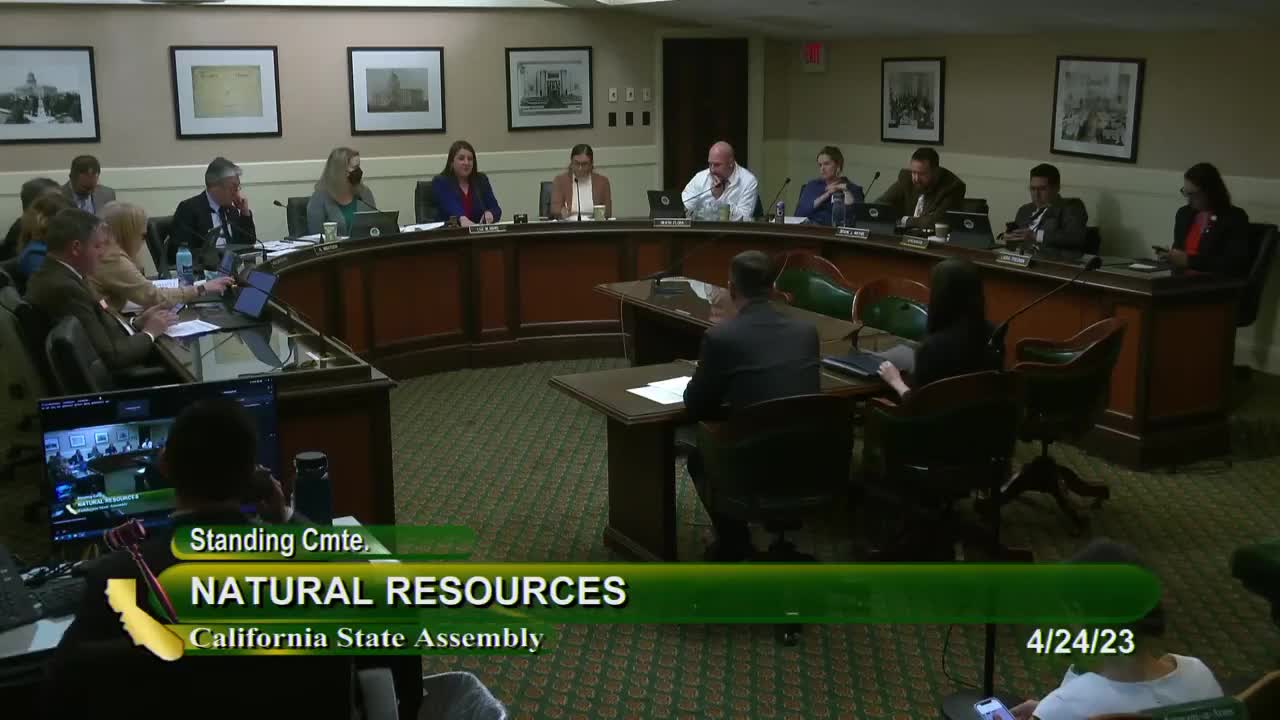 8MIN
Assembly Standing Committee on Natural Resources
Bill Author