ACA 5: Marriage equality.
- Session Year: 2023-2024
- House: Assembly
- Latest Version Date: 2023-07-20
Current Status:
Passed
(2023-07-20: Chaptered by Secretary of State - Res. Chapter 125, Statutes of 2023.)
Introduced
In Committee
First Chamber
In Committee
Second Chamber
Enacted
The California Constitution provides that only a marriage between a man and a woman is valid or recognized in California, and federal law permanently enjoins the state from enforcing this constitutional provision.
This measure would repeal this unenforceable constitutional provision and would instead provide that the right to marry is a fundamental right, as specified.
The California Constitution declares that defending life and liberty, acquiring, possessing, and protecting property, and pursuing and obtaining safety, happiness, and privacy are inalienable rights, and that a person may not be deprived of life, liberty, or property without due process of law or equal protection of the laws.This measure would express the intent of the Legislature to amend the Constitution of the State relating to marriage equality.The California Constitution declares that defending life and liberty, acquiring, possessing, and protecting property, and pursuing and obtaining safety, happiness, and privacy are inalienable rights, and that a person may not be deprived of life, liberty, or property without due process of law or equal protection of the laws.
This measure would express the intent of the Legislature to amend the Constitution of the State relating to marriage equality.
WHEREAS, Courts have recognized that same-sex couples and interracial couples have the right to marry; and
WHEREAS, This measure, if approved by the voters, would repeal language in the California Constitution stating marriage is only between a man and woman; and
WHEREAS, This measure, if approved by the voters, would amend the California Constitution to include the fundamental right to marry as furthering the rights to enjoy life, liberty, safety, happiness, and privacy, and the rights to equal protection and due process; now, therefore, be it
Resolved by the Assembly, the Senate concurring, That the Legislature of the State of California at its 202324 Regular Session commencing on the fifth day of December 2022, two-thirds of the membership of each house concurring, hereby proposes to the people of the State of California, that the Constitution of the State be amended as follows:
(a)The right to marry is a fundamental right.
(b)This section is in furtherance of both of the following:
(1)The inalienable rights to enjoy life and liberty and to pursue and obtain safety, happiness, and privacy guaranteed by Section 1.
(2)The rights to due process and equal protection guaranteed by Section 7.
WHEREAS, Courts have recognized that same-sex couples and interracial couples have the right to marry; and
WHEREAS, This measure, if approved by the voters, would repeal language in the California Constitution stating marriage is only between a man and woman; and
WHEREAS, This measure, if approved by the voters, would amend the California Constitution to include the fundamental right to marry as furthering the rights to enjoy life, liberty, safety, happiness, and privacy, and the rights to equal protection and due process; now, therefore, be it
Resolved by the Assembly, the Senate concurring, That the Legislature of the State of California at its 202324 Regular Session commencing on the fifth day of December 2022, two-thirds of the membership of each house concurring, hereby proposes to the people of the State of California, that the Constitution of the State be amended as follows:
It is the intent of the Legislature to amend the Constitution of the State relating to marriage equality.Only marriage between a man and a woman is valid or recognized in California.(a)The right to marry is a fundamental right.
(b)This section is in furtherance of both of the following:
(1)The inalienable rights to enjoy life and liberty and to pursue and obtain safety, happiness, and privacy guaranteed by Section 1.
(2)The rights to due process and equal protection guaranteed by Section 7.
Resolved by the Assembly, the Senate concurring, That the Legislature of the State of California at its 202324 Regular Session commencing on the fifth day of December 2022, two-thirds of the membership of each house concurring, hereby proposes to the people of the State of California, that the Constitution of the State be amended as follows:
It is the intent of the Legislature to amend the Constitution of the State relating to marriage equality.
|
Date
|
Status
|
|---|---|
| Jul 20, 2023 | Chaptered by Secretary of State - Res. Chapter 125, Statutes of 2023. |
| Jul 20, 2023 | Enrolled and filed with the Secretary of State at 2 p.m. |
| Jul 13, 2023 | In Assembly. Ordered to Engrossing and Enrolling. |
| Jul 13, 2023 | Ordered to the Assembly. |
| Jul 13, 2023 | Read third time. Adopted. (Ayes 31. Noes 0. Page 2025.) |
| Jul 11, 2023 | Read second time. Ordered to third reading. |
| Jul 10, 2023 | From committee: Be adopted. (Ayes 5. Noes 0.) (July 10). |
| Jul 6, 2023 | From committee: Be adopted, and re-refer to Com. on APPR. Re-referred. (Ayes 6. Noes 0.) (July 5). Re-referred to Com. on APPR. |
| Jun 28, 2023 | From committee: Be adopted, and re-refer to Com. on E. & C.A. Re-referred. (Ayes 11. Noes 0.) (June 27). Re-referred to Com. on E. & C.A. |
| Jun 27, 2023 | Referred to Coms. on JUD., E. & C.A. and APPR. |
| Jun 26, 2023 | In Senate. Read first time. To Com. on RLS. for assignment. |
| Jun 26, 2023 | Ordered to the Senate. |
| Jun 26, 2023 | Read third time. Adopted. (Ayes 67. Noes 0. Page 2375.) |
| Jun 22, 2023 | Read second time. Ordered to third reading. |
| Jun 21, 2023 | From committee: Be adopted. (Ayes 11. Noes 0.) (June 21). |
| Jun 13, 2023 | From committee: Be adopted, and re-refer to Com. on APPR. Re-referred. (Ayes 9. Noes 1.) (June 13). Re-referred to Com. on APPR. |
| Jun 13, 2023 | Coauthors revised. |
| Jun 6, 2023 | Re-referred to Com. on JUD. |
| Jun 5, 2023 | From committee chair, with author's amendments: Amend, and re-refer to Com. on JUD. Read second time and amended. |
| Jun 1, 2023 | Referred to Coms. on JUD. and APPR. |
| Feb 15, 2023 | From printer. May be heard in committee March 17. |
| Feb 14, 2023 | Read first time. To print. |
|
Date
|
Description
|
Location
|
Votes
|
|
|---|---|---|---|---|
| Jul 13, 2023 | Assembly 3rd Reading ACA5 Low et al. By Wiener | Senate Floor |
Passed |
|
| Jul 10, 2023 | Be adopted | Senate Standing Committee on Appropriations |
Passed |
|
| Jul 5, 2023 | Be adopted, but first be re-referred to the Committee on [Appropriations] | Senate Standing Committee on Elections and Constitutional Amendments |
Passed |
|
| Jun 27, 2023 | Be adopted, but first be re-referred to the Committee on [Elections and Constitutional Amendments] | Senate Standing Committee on Judiciary |
Passed |
|
| Jun 26, 2023 | ACA 5 Low Assembly Third Reading | Assembly Floor |
Passed |
|
| Jun 21, 2023 | Be adopted. | Assembly Standing Committee on Appropriations |
Passed |
|
| Jun 13, 2023 | Be adopted and re-referred to the Committee on [Appropriations] | Assembly Standing Committee on Judiciary |
Passed |
This list shows positions taken on this bill by organizations on the date displayed, which is linked to the original source.
Positions by individuals are not included.
|
Organization
|
Position
|
Date
|
|---|---|---|
| Aclu California Action | ** Support | |
| AFSCME | ** Support | |
| AJC San Francisco | ** Support | |
| American Jewish Committee – Los Angeles | ** Support | |
| American Jewish Committee – San Diego | ** Support | |
| Anti-Defamation League | ** Support | |
| Bay Area Municipal Elections Committee | ** Support | |
| Board of Supervisors for the City and County of San Francisco | ** Support | |
| California Capitol Connection | ** Against | |
| California Employment Lawyers Association | ** Support | |
| California Faculty Association | ** Support | |
| California Family Council | ** Against | |
| California Federation of Teachers, AFL-CIO | ** Support | |
| California Labor Federation, Afl-Cio | ** Support | |
| California LGBTQ Health and Human Services Network | ** Support | |
| California Medical Association | ** Support | |
| California School Employees Association, AFL-CIO | ** Support | |
| California Teachers Association | ** Support | |
| Chinese for Affirmative Action | ** Support | |
| City of Monterey Park | ** Support | |
| City Of San Diego | ** Support | |
| City of Sunnyvale | ** Support | |
| City of West Hollywood | ** Support | |
| Concerned Women for America Legislative Action Committee | ** Against | |
| County of Los Angeles Board of Supervisors | ** Support | |
| County of Santa Clara | ** Support | |
| Culver City Democratic Club | ** Support | |
| Disability Rights California | ** Support | |
| Equality California | ** Support | |
| Freedom in Action | ** Against | |
| Hadassah | ** Support | |
| Human Rights Campaign | ** Support | |
| JCRC Bay Area | ** Support | |
| Jewish Center for Justice | ** Support | |
| Jewish Community Federation and Endowment Fund | ** Support | |
| Jewish Community Relations Council of Bay Area | ** Support | |
| jewish community relations council of sacramento | ** Support | |
| Jewish Community Relations Council of Silicon Valley | ** Support | |
| Jewish Democratic Club of Silicon Valley | ** Support | |
| Jewish Democratic Club of Solano County | ** Support | |
| Jewish Family & Children's Service of Long Beach and Orange County | ** Support | |
| Jewish Family & Community Services East Bay | ** Support | |
| Jewish Family Service of Los Angeles | ** Support | |
| Jewish Family Service of the Desert | ** Support | |
| Jewish Family Services of Silicon Valley | ** Support | |
| Jewish Family Services San Diego | ** Support | |
| Jewish Federation of Greater Los Angeles | ** Support | |
| Jewish Federation of Greater Santa Barbara | ** Support | |
| Jewish Federation of The Greater San Gabriel and Pomona Valleys | ** Support | |
| Jewish Federation Of The Sacramento Region | ** Support | |
| Jewish Long Beach | ** Support | |
| Jewish Public Affairs Committee | ** Support | |
| JVS SoCal | ** Support | |
| League Of Women Voters Of California | ** Support | |
| Los Angeles County Democratic Party | ** Support | |
| Los Angeles LGBT Center | ** Support | |
| National Association Of Social Workers, California Chapter | ** Support | |
| National Center for Lesbian Rights | ** Support | |
| Office of Lieutenant Governor Eleni Kounalakis | ** Support | |
| Office of Superintendent of Instruction Tony Thurmond | ** Support | |
| Planned Parenthood Affiliates Of California | ** Support | |
| Progressive Zionists of California | ** Support | |
| Real Impact | ** Against | |
| Santa Monica Democratic Club | ** Support | |
| State Superintendent of Public Instruction Tony Thurmond | ** Support |
SENATE RULES COMMITTEE Office of Senate Floor Analyses (916) 651-1520 Fax: (916) 327-4478 | ACA 5 |
THIRD READING
Bill No: ACA 5
Author: Low (D), et al.
Amended: 6/5/23 in Assembly
Vote: 27
SENATE JUDICIARY COMMITTEE: 11-0, 6/27/23
AYES: Umberg, Wilk, Allen, Ashby, Caballero, Durazo, Laird, Min, Niello, Stern, Wiener
SENATE ELECTIONS & C.A. COMMITTEE: 6-0, 7/5/23
AYES: Glazer, Allen, McGuire, Menjivar, Newman, Umberg
NO VOTE RECORDED: Nguyen
SENATE APPROPRIATIONS COMMITTEE: 5-0, 7/10/23
AYES: Portantino, Ashby, Bradford, Wahab, Wiener
NO VOTE RECORDED: Jones, Seyarto
ASSEMBLY FLOOR: 67-0, 6/26/23 - See last page for vote
SUBJECT: Marriage equality
SOURCE: Office of Lieutenant Governor Eleni Kounalakis
Office of Superintendent of Instruction Tony Thurmond
ACLU California Action
Equality California
Human Rights Campaign
National Center for Lesbian Rights
DIGEST:
This constitutional amendment repeals the void and unconstitutional provision of the California Constitution that limits marriage to a “man and a woman,” and replaces it with a provision that expressly affirms that the right to marry is a fundamental right.
ANALYSIS:
Existing law:
- Defines marriage as a personal relation arising out of a civil contract between two persons, to which the consent of the parties capable of making that contract is necessary. Specifies that consent must be followed by the issuance of a license and solemnization, as authorized. (Fam. Code § 300.)
- Provides that all people are by nature free and independent and have inalienable rights. Among these are enjoying and defending life and liberty, acquiring, possessing, and protecting property, and pursuing and obtaining safety, happiness, and privacy. (Cal. Const. Art. I, Sec. 1.)
- Provides, in an unconstitutional, voided provision of the California Constitution, that only a marriage between a man and a woman is valid or recognized in the state of California. (Cal. Const., Art. I, Sec. 7.5.)
- Provides that a marriage contracted outside California is valid in California if it is valid by the laws of the jurisdiction in which it was contracted. (Fam. Code § 308.)
- Provides that no person may be deprived of life, liberty, or property without due process of law or denied equal protection of the laws. (Cal. Const. Art. I, Sec. 7; U.S. Const., Amend. XIV.)
- Provides that the California Constitution may be revised through any of the following means:
- The Legislature, by rollcall vote entered in the journal, two-thirds of the membership of each house concurring, proposes an amendment or revision of the Constitution;
- The Legislature, by rollcall vote entered in the journal, two-thirds of the membership of each house concurring, submits at a general election the question whether to call a convention to revise the Constitution. If the majority of the electorate vote yes on that question, the Legislature shall provide for the convention within six months. Delegates to a constitutional convention shall be voters elected from districts as nearly equal in population as may be practicable; or
- By an initiative before the voters. (Cal. Const. Art. XVIII.)
- Provides that a proposed amendment or revision of the Constitution shall be submitted to voters, and if approved by a majority of the vote, will take effect five days after the Secretary of State files the statement of the vote, unless the measure provides for a later effective date. (Cal. Const. Art. XVIII, Sec. 4.)
This bill:
- Repeals Section 7.5 of Article 1 of the California Constitution, which states that only marriage between a man and a woman is valid or recognized in California.
- Adds Section 7.5 of Article I to the California Constitution to declare that the right to marry in California is a fundamental right and specifies that this section is in furtherance of both of the following:
- The inalienable rights to enjoy life and liberty and to pursue and obtain safety, happiness, and privacy guaranteed by Section 1 of Article I of the California Constitution; and
- The rights to due process and equal protection guaranteed by Section 7 of Article I of the California Constitution.
Background
The fight for marriage equality in California
Proposition 8, approved by voters in 2008, added the provision to the California Constitution that this amendment seeks to remove: “Only a marriage between a man and a woman is valid or recognized in California.” (Cal. Const. Art. I Sec. 7.5.) After Proposition 8 passed, marriage equality advocates sued to challenge its constitutionality, on grounds that it violated the Due Process Clause and Equal Protection Clause of the United States Constitution. The Ninth Circuit on appeal agreed with the federal district court and the plaintiffs that Proposition 8 was unconstitutional, and the United States Supreme Court did not address the merits of the case in its decision to uphold the Ninth Circuit ruling. (Perry v. Brown, 671 F.3d 1052 (2012), Hollingsworth v. Perry, 570 U.S. 693 (2013).) Thus, after 2013, while the language added by Proposition 8 was still in the California Constitution, it was no longer enforceable.
While Perry v. Brown established marriage equality as a constitutional right in California, the United States Supreme Court had not yet decided if this right applied nationwide. That landmark moment came with the Court’s decision in Obergefell v. Hodges in 2015. In a five-to-four ruling, the Court found that the Due Process Clause and Equal Protection Clause of the Fourteenth Amendment provided LGBTQ individuals a fundamental right to marry, and that no state law banning same-sex marriage is Constitutional. (Obergefell v. Hodges, 576 U.S. 644, 675 (2015).) Accordingly, the Court reasoned, no state may refuse to recognize a lawful same-sex marriage performed in another State on the grounds that it is a same-sex marriage. (Id. at 681.)
ACA 5 is a proposed amendment to the California Constitution
After the Ninth Circuit decision invalidating Proposition 8, efforts were taken by the Legislature to remove provisions of the law that prohibited same-sex marriage. SB 1306 (Leno, Chapter 82, Statutes of 2014) removed the provisions of the Family Code stating that marriage is only between a man and a woman, and reset the marriage sections in gender-neutral terms. (Leno Ch. 82, Stats. 2014.) Thus, this Legislature previously made the state’s statutes conform with the legal precedent on marriage equality, but the Legislature has yet to conform the language in the California Constitution.
SB 1306, as an amendment to state law, simply required passage by the Legislature and a signature of the Governor. In contrast, because it is a proposed amendment to the California Constitution, ACA 5’s task is rather different: it must pass both houses of the Legislature by a two-thirds vote, and then be approved by a majority of the voters of the state as an item on the ballot. (Cal. Const. Art. XVII.) This process recognizes that amendments to the Constitution are not meant to be a regular or common occurrence, and that the Constitution serves as the principal, guiding document of the state.
ACA 5 removes discriminatory and unconstitutional language from California’s Constitution
It is true that marriage equality is still currently the law in the United States; however, it is not impossible that this will not always remain the case, not because the reasoning underlying Obergefell and marriage equality is dubious or unclear on the issue, but because Courts can change. And in fact, the United States Supreme Court already has. It no longer includes two of the Justices who were a part of the majority decision in Obergefell, and at least one current Justice has expressed his interest in revisiting the Court’s decision in that case. In Dobbs v. Jackson Women’s Health Organization, Justice Thomas opined in his separate concurrence that the court “should reconsider all of [the] Court’s substantive due process precedents, including Griswold, Lawrence, and Obergefell.” (Dobbs v. Jackson Women’s Health Organization, 597 U.S. ___ , J. Thomas concurrence 3 (2022).) Regardless of the probability that the Supreme Court actually revisits Obergefell, the state need not wait until the issue is imminent to align the state Constitution with the state’s ideals.
While the argument for marriage equality is part of the larger LGBTQ movement, it is also incredibly straight-forward. Marriage equality is about equal treatment under the law, and the ability for LGBTQ couples to enjoy recognition and dignity in the eyes of the state. For these reasons, both the California Supreme Court and the United States Supreme Court have found that bans on marriage equality are unconstitutional. Yet the United States Supreme Court’s decision on marriage equality does not by operation remove unconstitutional provisions from the law. Instead, those unlawful provisions remain unless specifically removed by an act of the Legislature, capable of revival if legal precedent changes. ACA 5 corrects this concern: removing the California Constitution’s provision denying marriage equality will not only remove the blight of an unconstitutional infringement on a fundamental right from the face of the state’s principal guiding document, but also will ensure that the provision will not spring back into effect should the legal precedents on marriage equality ever change.
FISCAL EFFECT: Appropriation: No Fiscal Com.: No Local: No
According to the Senate Appropriations Committee, one-time costs of approximately $863,513 to the Secretary of State for printing costs related to the Voter Information Guide and the Text of Proposed Laws for the ballot measure. (General Fund). It costs $123,359 per page and the Secretary of State anticipates that ACA 5 would require approximately seven pages.
SUPPORT: (Verified 7/12/23)
Office of Lieutenant Governor Eleni Kounalakis (co-source)
Office of Superintendent of Instruction Tony Thurmond (co-source)
ACLU California Action (sponsor)
Equality California (co-source)
Human Rights Campaign (co-source)
National Center for Lesbian Rights (co-source)
AFSCME
AJC San Francisco
American Jewish Committee - Los Angeles
American Jewish Committee - San Diego
Anti-Defamation League
Bay Area Municipal Elections Committee
Board of Supervisors for the City and County of San Francisco
California Employment Lawyers Association
California Faculty Association
California Federation of Teachers, AFL-CIO
California Labor Federation, AFL-CIO
California LGBTQ Health and Human Services Network
California Medical Association
California School Employees Association, AFL-CIO
California Teachers Association
Chinese for Affirmative Action
City of San Diego
City of Sunnyvale
City of West Hollywood
County of Los Angeles Board of Supervisors
County of Santa Clara
Culver City Democratic Club
Disability Rights California
Hadassah
Jewish Center for Justice
Jewish Community Federation and Endowment Fund
Jewish Community Relations Council of Bay Area
Jewish Community Relations Council of Sacramento
Jewish Community Relations Council of Silicon Valley
Jewish Democratic Club of Silicon Valley
Jewish Democratic Club of Solano County
Jewish Family & Children's Service of Long Beach and Orange County
Jewish Family & Community Services East Bay
Jewish Family Service of Los Angeles
Jewish Family Service of the Desert
Jewish Family Service San Diego
Jewish Family Services of Silicon Valley
Jewish Federation of Greater Los Angeles
Jewish Federation of Greater Santa Barbara
Jewish Federation of the Greater San Gabriel and Pomona Valleys
Jewish Federation of the Sacramento Region
Jewish Long Beach
Jewish Public Affairs Committee
JVS SoCal
League of Women Voters of California
Los Angeles County Democratic Party
Los Angeles LGBT Center
National Association of Social Workers, California Chapter
Planned Parenthood Affiliates of California
Progressive Zionists of California
Santa Monica Democratic Club
OPPOSITION: (Verified 7/12/23)
California Capitol Connection
California Family Council
Concerned Women for America Legislative Action Committee
Freedom in Action
Real Impact
ARGUMENTS IN SUPPORT: According to Equality California, a co-sponsor of ACA 5:
For more than twenty years, Equality California has led the Golden State’s fight for full LGBTQ+ equality. We bring the voices of LGBTQ+ people and allies to institutions of power in California and across the United States, striving to create a world that is healthy, just, and fully equal for all LGBTQ+ people. We advance civil rights and social justice by inspiring, advocating, and mobilizing through an inclusive movement that works tirelessly on behalf of those we serve.
Although marriage equality for same-sex couples has been the law of the land in California since the Supreme Court’s June 2013 ruling in Hollingsworth v. Perry, California’s constitution still contains outdated and discriminatory language from Proposition 8 stating that same-sex couples are not allowed to marry. And while the U.S. Supreme Court’s 2015 decision in Obergefell v. Hodges helped bring marriage equality nationwide, it has become increasingly clear that the far-right majority of the current Supreme Court cannot be trusted to uphold their own precedent or protect our civil rights. Just last year, in a ruling overturning 50 years of precedent affirming the constitutional right to an abortion, Justice Clarence Thomas argued that the Supreme Court should reconsider Obergefell and “all of this Court’s substantive due process precedents.”
The recent passage of the federal Respect for Marriage Act was an important step forward – it requires the federal government to recognize same-sex and interracial marriages and affirms that states must recognize valid marriage licenses from other states. However, it does not require states to issue marriage licenses to same-sex couples nor does it remove Proposition 8 from California’s constitution. ACA 5 is an important safeguard in case the Supreme Court were to overturn Obergefell and Perry. It will help ensure all couples have the freedom to marry in California and protect against any future attempts to restrict marriage rights for same-sex or interracial couples.
Marriage is about love and commitment. If two people love each other and want to make a lifetime commitment to one another, they should be able to do so – regardless of their gender, sexual orientation, or race. ACA 5 will reaffirm the freedom to marry as a fundamental right and protect loving couples and families across California who deserve to have their marriages respected under the law.
ARGUMENTS IN OPPOSITION: According to California Capitol Connection:
Marriage has been defined as a union between a man and a woman from the beginning. God instituted it. The Bible teaches us in Genesis 1 and 2, “So God created man in his own image, in the image of God created he him; male and female created he them…And God blessed them, and God said unto them, Be fruitful, and multiply, and replenish the earth, and subdue it.…Therefore shall a man leave his father and his mother, and shall cleave unto his wife: and they shall be one flesh.” Jesus Christ reaffirmed this truth in Matthew 19 when He said, “…Have ye not read, that he which made them at the beginning made them male and female, And said, For this cause shall a man leave father and mother, and shall cleave to his wife: and they twain shall be one flesh? Wherefore they are no more twain, but one flesh. What therefore God hath joined together, let not man put asunder.”
The debate about marriage is not about love or hate. It is about truth. Man cannot redefine what God has already defined.
ASSEMBLY FLOOR: 67-0, 6/26/23
AYES: Addis, Aguiar-Curry, Alanis, Alvarez, Arambula, Bains, Bauer-Kahan, Bennett, Berman, Boerner, Bonta, Bryan, Calderon, Juan Carrillo, Wendy Carrillo, Cervantes, Chen, Connolly, Davies, Dixon, Essayli, Mike Fong, Friedman, Gabriel, Gipson, Haney, Hart, Holden, Hoover, Irwin, Jackson, Kalra, Lee, Low, Lowenthal, Maienschein, Mathis, McCarty, McKinnor, Muratsuchi, Stephanie Nguyen, Ortega, Pacheco, Papan, Pellerin, Petrie-Norris, Quirk-Silva, Ramos, Reyes, Luz Rivas, Robert Rivas, Rodriguez, Blanca Rubio, Santiago, Schiavo, Soria, Ting, Valencia, Villapudua, Waldron, Wallis, Ward, Weber, Wicks, Wood, Zbur, Rendon
NO VOTE RECORDED: Megan Dahle, Flora, Vince Fong, Gallagher, Garcia, Grayson, Jones-Sawyer, Lackey, Jim Patterson, Joe Patterson, Sanchez, Ta, Wilson
Prepared by: Ian Dougherty / JUD. / (916) 651-4113
7/12/23 14:03:25
**** END ****
SENATE COMMITTEE ON APPROPRIATIONS
Senator Anthony Portantino, Chair
2023 - 2024 Regular Session
ACA 5 (Low) - Marriage equality
Version: June 5, 2023 | Policy Vote: JUD. 11 - 0, E. & C.A. 6 - 0 |
Urgency: | Mandate: No |
Hearing Date: July 10, 2023 | Consultant: Matthew Fleming |
Bill Summary:
ACA 5, subject to approval by the voters, would repeal the provision of the California Constitution that provides that “only marriage between a man and woman is valid or recognized in California” and instead provide that marriage is fundamental right, as specified.
Fiscal Impact:
One-time costs of approximately $863,513 to the Secretary of State for printing costs related to the Voter Information Guide and the Text of Proposed Laws for the ballot measure. (General Fund). It costs $123,359 per page and the Secretary of State anticipates that ACA 5 would require approximately 7 pages.
Background:
In 2008, California voters passed Proposition 8, a ballot initiative that added to the California Constitution a section that states, “Only marriage between a man and a woman is valid or recognized in California.” In subsequent litigation, a federal district court held that Proposition 8 was unconstitutional because it violated the federal due process clause and the equal protection clause. California began issuing and recognizing same-sex marriages. In 2015, the U.S. Supreme Court issued a landmark decision in Obergefell v. Hodges, holding that the right to marry is a fundamental right guaranteed by the federal due process and equal protection clauses. As a result, under current law, each state must perform and recognize same-sex marriages in the same way that it performs and recognizes the marriages of heterosexual couples.
Proposed Law:
- Repeals current Section 7.5 of Article 1 of the California Constitution, which states that only marriage between a man and a woman is valid or recognized in California.
- Adds new Section 7.5 of Article I to the California Constitution to declare that the right to marry in California is a fundamental right and specifies that this section is in furtherance of both of the following:
- The inalienable rights to enjoy life and liberty and to pursue and obtain safety, happiness, and privacy guaranteed by Section 1 of Article I of the California Constitution; and
- The rights to due process and equal protection guaranteed by Section 7 of Article I of the California Constitution.
Related Legislation:
- SB 1306 (Leno, Ch. 82, Stats. 2014) removed the provisions from the Family Code that stated that marriage is only between a man and a woman, and amended the remaining provisions relating to marriage to be in gender-neutral terms. It also removed the provision denying the recognition of valid same-sex marriages from other jurisdictions.
- SB 54 (Leno, Ch. 625, Stats. 2009) would have clarified that a marriage contracted outside of California that was valid by the laws of the jurisdiction in which it took place is valid in California. Stated that valid same-sex marriages of other states that took place prior to November 5, 2008 are valid in California, and that valid same-sex marriages of other states entered into after November 5, 2008 shall be accorded the same rights, protections, and benefits that opposite-sex marriage are accorded.
- AB 43 (Leon, 2007) would have provided that marriage is a personal relation arising out of a civil contract between two persons, and replaced references to spouses’ genders with gender-neutral language, similar to AB’s 849 and 19. AB 43 passed the Legislature but was vetoed by the Governor.
- AB 849 (Leno, 2005) would have provided that marriage is a personal relation arising out of a civil contract between two persons, and replaced references to spouses’ genders with gender-neutral language. AB 849 passed the Legislature, but was vetoed by the Governor.
- AB 19 (Leno, 2005) would have provided that marriage is a personal relation arising out of a civil contract between two persons, and replaced references to spouses’ genders with gender-neutral language. AB 19 failed to pass the Assembly.
- AB 607 (Nestande, Ch. 339, Stats. 1977) added a provision to the Family Code expressly defining marriage as between a man and a woman.
Staff Comments: This bill proposes a constitutional amendment that, if approved by voters, removes Proposition 8’s definition of marriage, which is now unconstitutional and unenforceable, from the California Constitution. This measure would also add a section to the Constitution stating the right to marry is a fundamental right that furthers the state constitutional rights to due process and equal protection. This measure eliminates Proposition 8’s unenforceable, unconstitutional language from the Constitution, ensuring that Proposition 8 would not again become the ruling law in California if there are changes to federal law in the future.
-- END --
SENATE COMMITTEE ON
ELECTIONS AND CONSTITUTIONAL AMENDMENTS
Senator Steven Glazer, Chair
2023 - 2024 Regular
Bill No: ACA 5 Hearing Date: 7/5/23
Author: | Low | ||
Version: | 6/5/23 | ||
Urgency: |
| Fiscal: | No |
Consultant: | Scott Matsumoto | ||
Subject: Marriage equality.
DIGEST
This measure, subject to voter approval, repeals a provision in the California Constitution that limits marriage to a “man and a woman,” and replaces it with provisions that makes the right to marry a fundamental right.
ANALYSIS
Existing law:
- Defines marriage as a personal relation arising out of a civil contract between two persons, to which the consent of the parties capable of making that contract is necessary. Specifies that consent must be followed by the issuance of a license and solemnization, as authorized.
- Provides that all people are by nature free and independent and have inalienable rights. Among these are enjoying and defending life and liberty, acquiring, possessing, and protecting property, and pursuing and obtaining safety, happiness, and privacy.
- Provides, in an unconstitutional, voided provision of the California Constitution, that only a marriage between a man and a woman is valid or recognized in the state of California.
- Provides that a marriage contracted outside California is valid in California if it is valid by the laws of the jurisdiction in which it was contracted.
- Provides that no person may be deprived of life, liberty, or property without due process of law or denied equal protection of the laws.
- Provides that the California Constitution may be revised through any of the following means:
- The Legislature, by rollcall vote entered in the journal, two-thirds of the membership of each house concurring, proposes an amendment or revision of the Constitution.
- The Legislature, by rollcall vote entered in the journal, two-thirds of the membership of each house concurring, submits at a general election the question whether to call a convention to revise the Constitution. If the majority of the electorate vote yes on that question, the Legislature shall provide for the convention within 6 months. Delegates to a constitutional convention shall be voters elected from districts as nearly equal in population as may be practicable.
- By an initiative before the voters.
- Provides that every constitutional amendment, bond measure, or other legislative measure submitted to the people by the Legislature shall appear on the ballot of the first statewide election occurring at least 131 days after the adoption of the proposal by the Legislature.
- Provides, if approved by a majority of the vote, the amendments will take effect five days after the Secretary of State files the statement of the vote, unless the measure provides for a later effective date.
This measure:
- Repeals a provision of the California Constitution stating that only marriage between a man and a woman is valid or recognized in California.
- Adds provisions to the California Constitution declaring that the right to marry in California is a fundamental right and specifies that this section is in furtherance of both of the following:
- The inalienable rights to enjoy life and liberty and to pursue and obtain safety, happiness, and privacy guaranteed by the California Constitution.
- The rights to due process and equal protection guaranteed by the California Constitution.
BACKGROUND
Brief History. In the late 1960s and early 1970s, the prospect of same-sex marriage became imaginable and realistic with the rise of the gay and lesbian rights movement. In 1977, the Legislature passed and the Governor signed AB 607 (Nestande), Chapter 339, Statutes of 1977. AB 607 was the first California statute expressly limiting marriage to “a man and a woman.” The absence of express language assumed that marriage could only occur between a man and woman. The California Legislature preemptively amended Family Code Section 300 to expressly define marriage as between a man and a woman. It should also be noted that this statute did not mean that the state recognized same-sex marriage prior to that date.
Beginning in the mid-1980s, local jurisdictions began to recognize same-sex couples by establishing a legal status called “domestic partnership,” which gave same-sex couples not only limited protections for themselves and their children, but also, for the first time, afforded government recognition of same-sex relationships. By 2000, 18 California local governments had established domestic partnership registries. In 1999, the Legislature enacted AB 26 (Migden), Chapter 588, Statutes of 1999, which enacted Family Code Section 297.5, the state’s first domestic partnership statute.
Proposition 22. The half-measure of domestic partnership not only failed to give domestic partners all of the rights and benefits enjoyed by married couples, it highlighted the law’s unequal treatment of same-sex and opposite-sex couples and thereby raised the question of whether such classifications violated the equal protection clauses in the United States and several state constitutions. In the 1990s, the movement for marriage equality began to bear fruit as a handful of state courts began to recognize same-sex marriage. For example, in 1993, the Hawaii Supreme Court held that its state law limiting marriage to opposite-sex couples violated both the state and federal equal protection clauses. However, in a pattern that would be repeated elsewhere, the decision in favor of same-sex marriage generated counter movements seeking to entrench the idea that only marriages between a man and a woman were legally valid. In 1998, Hawaii voters adopted a constitutional amendment that only recognized marriage between a man and a woman. California followed a similar trajectory. In response to fears that California courts could reverse California statutes – or that same-sex couples married in other states might come to California – California voters approved Proposition 22 in 2000. Proposition 22 (unlike the later Proposition 8) did not amend the state constitution. Instead, it amended the Family Code to prevent California from recognizing same-sex marriages, whether created in California or in any other state. The measure passed with 61 percent of the vote and was codified as Section 308.5 of the Family Code.
In 2004, the City and County of San Francisco ignored Proposition 22 and began issuing marriage licenses to same-sex couples. However, after 4,037 same-sex couples were married, the California Supreme Court ordered San Francisco to stop issuing marriage licenses to same-sex couples and invalidated the marriages that had already occurred. (Lockyer v. City and County of San Francisco (2004) 33 Cal.4th 1055.) In response to this ruling, then-Assemblymember Mark Leno introduced legislation to permit same-sex couples to marry in California. AB 19 (Leno) of 2005 failed passage on the Assembly Floor. Assemblymember Leno revived the bill later that year as AB 849 (Leno) of 2005, which passed both houses of the state legislature. However, Governor Schwarzenegger vetoed the bill. The proposal was reintroduced in 2007 as AB 43 (Leno) of 2007, but the Governor vetoed the bill as well, stating it was up to the Supreme Court to decide if the state's ban on same-sex marriage was constitutional.
On May 15, 2008, the California Supreme Court, in a 4-3 decision, struck down the California statutes (Family Code Sections 300 and 308) limiting marriage to a man and a woman. The majority opinion concluded that, “the California Constitution properly must be interpreted to guarantee this basic civil right to all Californians, whether gay or heterosexual, and to same-sex couples as well as to opposite-sex couples.” (In re Marriage Cases (2008) 43 Cal.4th 757, 782.) The Court found that although “our state Constitution does not contain any explicit reference to a ‘right to marry,’ past California cases establish beyond question that the right to marry is a fundamental right whose protection is guaranteed to all persons by the California Constitution.” (Id. at 809.) The core substantive rights embodied in the right to marry “include, most fundamentally, the opportunity of an individual to establish — with the person with whom the individual has chosen to share his or her life — an officially recognized and protected family possessing mutual rights and responsibilities and entitled to the same respect and dignity accorded a union traditionally designated as marriage.” (Id. at 781.) Accordingly, the Court concluded that “in light of the fundamental nature of the substantive rights embodied in the right to marry — and their central importance to an individual’s opportunity to live a happy, meaningful, and satisfying life as a full member of society — the California Constitution properly must be interpreted to guarantee this basic civil right to all individuals and couples, without regard to their sexual orientation.” (Id. at 820.) Approximately 18,000 same-sex couples married in California after the effective date of the In re Marriage Cases decision.
Proposition 8. Success in the quest for marriage equality once again prompted reaction. Since the California Supreme Court had based its decision on the due process and equal protection clauses of the state constitution, opponents of same-sex marriage sought to amend the constitution to make it clear that it permitted prohibitions on same-sex marriage. On November 4, 2008, by a margin of 52 percent to 48 percent, California voters adopted Proposition 8, which added Section 7.5 to Article I of the California Constitution. Specifically, Proposition 8 added the following words into the California Constitution: “Only marriage between a man and a woman is valid or recognized in California.” However, Proposition 8 did not stem the momentum for same-sex marriage or bring the litigation to an end. Immediately after the passage of Proposition 8, marriage equality advocates filed a petition directly with the California Supreme Court seeking to invalidate the measure on the grounds that it was not permissibly enacted. The Supreme Court, in Strauss v. Horton (2009) 46 Cal.4th 364, upheld Proposition 8 in a 6-1 decision, but held, unanimously, that the same-sex marriages performed in California before the passage of Proposition 8 remained valid. While upholding Proposition 8, the Court reiterated its key holding in In re Marriage Cases, namely that in all respects, other than the word marriage, "same-sex couples retain the same substantive protections embodied in the state constitutional rights of privacy and due process as those accorded to opposite-sex couples and the same broad protections under the state equal protection clause, including the principle that sexual orientation constitutes a suspect classification and that statutes according differential treatment on the basis of sexual orientation are constitutionally permissible only if they satisfy the strict scrutiny standard of review." (Id. at 412.)
In 2009, opponents of Proposition 8 filed another action in federal court challenged Proposition 8 on the grounds that it violated both the due process clause and equal protection clause of the 14th Amendment to the federal constitution. The federal district court concluded that Proposition 8 was unconstitutional, violating both the federal due process and the equal protection clauses. (Perry v. Schwarzenegger (2010) 704 F. Supp. 2d 921, 1003 (N.D. Cal.).) The Ninth Circuit agreed, though on somewhat different grounds. Specifically, the Ninth Circuit focused on the fact that Proposition 8 violated the equal protection clause by targeting a minority group and withdrawing a right that the group already possessed (the right to marriage under In re Marriage Cases), without any rational basis for doing so. (Perry v. Brown (9th Cir. 2012) 671 F.3d 1052.) The United States Supreme Court, on a 5-4 decision, dismissed an effort to appeal the Ninth Circuit ruling on the ground that petitioner lacked standing. (Hollingsworth v. Perry (2013) 570 U.S. 693.) As a result, the district court decision became the law of California, but the United States Supreme Court had still not addressed the underlying question of whether state laws banning same sex marriage – whether they took the form of a statute or a constitutional amendment – violated the due process and equal protection clauses of the 14th Amendment.
On June 28, 2013, California began allowing same-sex couples to marry, and began recognizing marriages between same sex couples from other states. One year later, the Legislature brought existing statutes (but not the state constitution) into conformity with state and federal case law. SB 1306 (Leno), Chapter 82, Statutes of 2014, removed the language from the Family Code stating that marriage is only between a man and a woman, and recast the Family Code section in gender-neutral terms. SB 1306 also defined marriage as a personal relation arising out of a civil contract between two persons, and removed limitations on the validity of same-sex marriages performed outside of California. In other words, SB 1306 removed a statute rendered void and unenforceable by state and federal case law. This measure removes a similarly void and unenforceable constitutional provision.
Obergefell. In 2015, the United States Supreme Court held, in the landmark case of Obergefell v. Hodges, that preventing same-sex couples from exercising their fundamental right to marry violated the due process and equal protection clauses of the 14th Amendment. Writing for the majority, Justice Anthony Kennedy began with the Court’s long held view that the right to marry is a fundamental right “inherent in the liberty of the person” and is therefore protected by the due process clause, which prohibits the states from depriving any person of “life, liberty, or property without due process of law.” (Citing, among other cases, Meyer v Nebraska (1923) 262 U.S. 390.) Kennedy held that “the marriage right is also guaranteed by the equal protection clause, which forbids the states from denying to any person…the equal protection of the laws.” Kennedy reasoned that the right to marry the person of one’s choice is so closely connected to the requirements of individual liberty that it must “apply with equal force to same-sex couples.”
In short, the Court held unequivocally that states cannot, consistent with the due process and equal protection clauses of the 14th Amendment, limit marriage only to unions between a man and a woman. The majority opinion also concluded with the following statement about marriage being a right:
No union is more profound than marriage, for it embodies the highest ideals of love, fidelity, devotion, sacrifice, and family. In forming a marital union, two people become something greater than once they were. As some of the petitioners in these cases demonstrate, marriage embodies a love that may endure even past death. It would misunderstand these men and women to say they disrespect the idea of marriage. Their plea is that they do respect it, respect it so deeply that they seek to find its fulfillment for themselves. Their hope is not to be condemned to live in loneliness, excluded from one of civilization’s oldest institutions. They ask for equal dignity in the eyes of the law. The Constitution grants them that right. (Obergefell v. Hodges (2015) 576 U.S. 644.)
COMMENTS
- According to the author: California leads the way in LGBTQ+ protections and cutting-edge pro-equality legislation and our constitution should reflect those values. ACA 5 is an important opportunity to reaffirm the freedom to marry and protect loving couples and families across California who deserve to have their marriages protected and respected under the law.
- Argument in Support. In a letter supporting ACA 5, Equality California stated, in part, the following:
The recent passage of the federal Respect for Marriage Act was an important step forward – it requires the federal government to recognize same-sex and interracial marriages and affirms that states must recognize valid marriage licenses from other states. However, it does not require states to issue marriage licenses to same-sex couples nor does it remove Proposition 8 from California’s constitution. ACA 5 is an important safeguard in case the Supreme Court were to overturn Obergefell and Perry. It will help ensure all couples have the freedom to marry in California and protect against any future attempts to restrict marriage rights for same-sex or interracial couples.
Marriage is about love and commitment. If two people love each other and want to make a lifetime commitment to one another, they should be able to do so – regardless of their gender, sexual orientation, or race. ACA 5 will reaffirm the freedom to marry as a fundamental right and protect loving couples and families across California who deserve to have their marriages respected under the law.
- Argument in Opposition. In a letter opposing ACA 5, the California Family Council stated, in part, the following:
The United States since its founding has recognized the definition of marriage as the union of one man and one woman as the best foundation for raising children. Children are our future and the government has the right to encourage those relationships that lead to the furnishing of the next generation.
It is our opinion that children flourish best when they are intimately connected with and raised by their mother and father. That is why our public policy should encourage the forming of these relationships. Many religious traditions agree with this fact and have resisted efforts to expand marriage to include other groupings of individuals.
If the state cares about the health and well-being of future generations, it will continue to define marriage the way it has been defined for centuries.
RELATED/PRIOR LEGISLATION
SB 1306 (Leno), Chapter 82, Statutes of 2014, removed the language from the Family Code stating that marriage is only between a man and a woman, and recast the Family Code section in gender-neutral terms.
AB 607 (Nestande), Chapter 339, Statutes of 1977, was the first California statute expressly limiting marriage to “a man and a woman.”
PRIOR ACTION
Senate Judiciary Committee: Assembly Floor: | 11 - 0 67 - 0 |
Assembly Appropriations Committee: | 11 - 0 |
Assembly Judiciary Committee: | 9 - 1 |
POSITIONS
Sponsor: ACLU CA Action
Equality California
Human Rights Campaign
Lieutenant Governor Eleni Kounalakis
National Center for Lesbian Rights
Superintendent of Public Instruction Tony Thurmond
Support: American Federation of State, County and Municipal Employees, AFL-CIO
California Labor Federation
California School Employees Association
California Teachers Association
Chinese for Affirmative Action
County of Los Angeles Board of Supervisors
Culver City Democratic Club
Disability Rights California
League of Women Voters of California
Oppose: California Family Council
Real Impact
One individual
-- END --
Senator Thomas Umberg, Chair
2023-2024 Regular Session
Bill No: ACA 5 (Author:Low)
Version: June 5, 2023
Hearing Date: June 27, 2023
Fiscal: No
Urgency: No
Consultant: ID
SUBJECT
Marriage equality
DIGEST
ACA 5 proposes to repeal the void and unconstitutional provision of the California Constitution that limits marriage to a “man and a woman,” and replace it with a provision that expressly affirms that the right to marry is a fundamental right.
EXECUTIVE SUMMARY
The right to marry is a right that has long been considered to be a fundamental right under the principles of liberty, equality, and due process. As anti-marriage equality groups attempted to add statutes and provisions to the California Constitution limiting the right to marry to opposite-sex couples, state and federal courts found that such laws were not constitutional. In the case In re Marriages Cases, the California Supreme Court struck down Proposition 22, a proposition that added sections forbidding California from recognizing same-sex marriages to the Family Code, finding that the provisions violated the Equal Protections Clause of the California Constitution. Only a few years later, the Ninth Circuit likewise found that the constitutional provision limiting marriage to opposite-sex marriages that was added to the California Constitution through Proposition 8 was also unconstitutional. Finally, in the case Obergefell v. Hodges in 2015, the United States Supreme Court affirmed marriage equality nationwide, finding that any state laws that prohibited same-sex marriage were an unconstitutional violation of the Equal Protection Clause of the United States Constitution. However, the unconstitutional provisions of the California Constitution stating that marriage is between a man and a woman remains on the face of California’s Constitution, capable of revival if the legal precedents on marriage equality were to change. ACA 5 proposes to amend the California Constitution to remove these discriminatory and unconstitutional provisions from the California Constitution.
ACA 5 is co-sponsored by the ACLU, Equality California, the National Center for Lesbian Rights, the Human Rights Campaign, as well as the Offices of Lt. Governor Eleni Kounalakis and Superintendent of Public Instruction, Tony Thurmond. It is supported by several California cities and numerous labor, social justice, and religious organizations. It is opposed by the California Capitol Connection and California Family Council. Should ACA 5 pass this Committee, it then will be heard in the Senate Elections Committee.
PROPOSED CHANGES TO THE LAW
Existing law:
- Defines marriage as a personal relation arising out of a civil contract between two persons, to which the consent of the parties capable of making that contract is necessary. Specifies that consent must be followed by the issuance of a license and solemnization, as authorized. (Fam. Code § 300.)
- Provides that all people are by nature free and independent and have inalienable rights. Among these are enjoying and defending life and liberty, acquiring, possessing, and protecting property, and pursuing and obtaining safety, happiness, and privacy. (Cal. Const. Art. I, Sec. 1.)
- Provides, in an unconstitutional, voided provision of the California Constitution, that only a marriage between a man and a woman is valid or recognized in the state of California. (Cal. Const., Art. I, Sec. 7.5.)
- Provides that a marriage contracted outside California is valid in California if it is valid by the laws of the jurisdiction in which it was contracted. (Fam. Code § 308.)
- Provides that no person may be deprived of life, liberty, or property without due process of law or denied equal protection of the laws. (Cal. Const. Art. I, Sec. 7; U.S. Const., Amend. XIV.)
- Provides that the California Constitution may be revised through any of the following means:
- the Legislature, by rollcall vote entered in the journal, two-thirds of the membership of each house concurring, proposes an amendment or revision of the Constitution;
- the Legislature, by rollcall vote entered in the journal, two-thirds of the membership of each house concurring, submits at a general election the question whether to call a convention to revise the Constitution. If the majority of the electorate vote yes on that question, the Legislature shall provide for the convention within 6 months. Delegates to a constitutional convention shall be voters elected from districts as nearly equal in population as may be practicable; or
- by an initiative before the voters. (Cal. Const. Art. XVIII.)
- Provides that a proposed amendment or revision of the Constitution shall be submitted to voters, and if approved by a majority of the vote, will take effect five days after the Secretary of State files the statement of the vote, unless the measure provides for a later effective date. (Cal. Const. Art. XVIII, Sec. 4.)
This bill:
- Repeals Section 7.5 of Article 1 of the California Constitution, which states that only marriage between a man and a woman is valid or recognized in California.
- Adds Section 7.5 of Article I to the California Constitution to declare that the right to marry in California is a fundamental right and specifies that this section is in furtherance of both of the following:
- the inalienable rights to enjoy life and liberty and to pursue and obtain safety, happiness, and privacy guaranteed by Section 1 of Article I of the California Constitution; and
- the rights to due process and equal protection guaranteed by Section 7 of Article I of the California Constitution.
COMMENTS
- Author’s statement
According to the author:
California leads the way in LGBTQ+ protections and cutting-edge pro-equality legislation and our constitution should reflect those values. ACA 5 is an important opportunity to reaffirm the freedom to marry and protect loving couples and families across California who deserve to have their marriages protected and respected under the law.
- A brief history of LGBTQ rights and discrimination
Lesbian, gay, bisexual, transgender, and queer (LGBTQ) individuals have always been a part of California’s communities. However, because of prejudice and misunderstanding, LGBTQ people in California and throughout the nation have long experienced discrimination, threats of harm, familial rejection, and denials of their basic rights. They have been denied employment opportunities or experienced harassment in the workplace. And they have been denied the rights to enjoy and access the same benefits that non-LGBTQ individuals enjoy, including the right to love and have their relationship and commitment recognized by the state.
In light of these injustices, LGBTQ people began a movement to organize and demand their rights, dignity, and safety. The modern LGBTQ movement is generally understood to have begun with the Stonewall riots, which occurred in 1969 after police raided an LGBTQ bar called the Stonewall Inn in New York. It had not been the first raid of the Stonewall Inn; the bar had frequently been raided by the police on claims of trying to clean up the neighborhood of “sexual deviants.”
Led by figures like Marsha P. Johnson, the movement began demanding safety and recognition for LGBTQ people. The first gay pride parade was a march the year after the Stonewall riots, in which thousands of LGBTQ people marched through the streets of New York. In San Francisco in 1977, Harvey Milk, the first openly gay member of San Francisco’s Board of Supervisors, led an effort to introduce a gay rights ordinance protecting gays and lesbians from being fired from their jobs. In 1979, an estimated 75,000 people marched in Washington, D.C., demanding LGBTQ rights and civil rights legislation. Through this movement and organizing, LGBTQ people gained better recognition and acceptance nationwide, as well as a number of monumental wins like protections against discrimination in employment, inclusion in anti-hate crime laws, and eventual recognition of same-sex marriages.
Yet there have also been many setbacks. In the 1980’s, Auto Immune Deficiency Syndrome (AIDS) exploded in the LGBTQ community, killing thousands while the Federal government failed to act despite repeated pleas from the LGBTQ community. In 1993, the Federal government established the “Don’t Ask, Don’t Tell” policy, barring openly LGBTQ individuals from serving in the United States armed forces. Many states during this time also passed their own laws discriminating against LGBTQ people, such as the state of Texas’s law criminalizing private consensual sexual acts that was later overturned by the United States Supreme Court in Lawrence v. Texas, 539 U.S. 538 (2003). In 1996, the Federal Defense of Marriage Act was signed into law, defining marriage as between one man and one woman.
- The fight for marriage equality in California
In California, the fight for marriage equality has been a turbulent one. As the LGBTQ movement was growing and gaining momentum in the 1970’s, the Legislature placed the first prohibition on same-sex marriage into state law. Prior to that law, the provisions relating to marriage were gender neutral, such that there was a question whether same-sex marriages were allowed under their terms, and several same-sex couples attempted to obtain marriage licenses. In response, the Legislature amended the Family Code to expressly define marriage as between a man and a woman. (AB 607, Ch. 339, Stats. 1977.) However, throughout the state, opinions were already shifting, and local jurisdictions were awarding some of the legal benefits of marriage to many LGBTQ couples through domestic partnerships. These domestic partnerships provided some recognition of and benefits to LGBTQ couples, but were still far from equal in benefit and importance to marriage.
As general acceptance grew, groups against marriage equality continued to fight to keep marriage equality out of California. In 2000, State Senator William “Pete” Knight placed a measure on the ballot that defined marriage in the Family Code as between a man and a woman, and forbade the state from recognizing same-sex marriages from other states. Although no state had yet recognized same-sex marriage, Proposition 22 was placed on the ballot to change long-standing state law that the state would not need to recognize a valid marriage from another state if that marriage did not fit California’s definition of marriage. The proposition passed. However, the passage of Proposition 22 did not deter the proponents of marriage equality. Numerous efforts were made in the state Legislature to pass a law that made same-sex marriage legal.
In 2004, the city of San Francisco started issuing marriage licenses to same-sex couples, in open defiance of Proposition 22 and the 1977 law. The city’s reasoning was that Proposition 22 was unconstitutional under the Equal Protection Clause of the California Constitution, which states that “a person may not be deprived of life, liberty, or property without due process of law or denied equal protection of the laws.” (Cal. Const. Art. I, Sec. 7; see also Lockyer v. City and County of San Francisco, 33 Cal.4th 1055, 1069 (2004).) In response, opponents of marriage equality sued the city to stop the issuance of same-sex marriage licenses and the registration of the marriages already performed. In a narrow ruling, the California Supreme Court ordered the city of San Francisco to stop issuing marriage licenses to same-sex couples, but the Court did not invalidate already-issued marriage licenses or rule on the constitutionality of Proposition 22. (Lockyer v. City and County of San Francisco, 33 Cal.4th 1055 (2004).)
Following that decision, the City of San Francisco, along with others, brought separate suits directly challenging the Proposition 22 and the Family Code provisions defining marriage as between a man and a woman as unconstitutional under the California Constitution’s Equal Protection Clause. (In re Marriages Cases, 43 Cal.4th 757 (2008).) The Court found that the right to marry is one of the fundamental constitutional rights embodied in the California Constitution, that sexual orientation is a suspect class that requires strict scrutiny of any law that discriminates on the basis of sexual orientation, and that the state’s interest in limiting marriage to opposite-sex couples is not a compelling state interest sufficient to justify the infringement on same-sex couples’ right to marry. (Id.) The Court reasoned that one of the core elements of the right to marry “is a couple's right to have their family relationship accorded dignity and respect equal to that accorded other officially recognized families” such that denying same-sex marriage “poses at least a serious risk of denying the family relationship of same-sex couples such equal dignity and respect.” (Id. at 783.) Thus, the Court said that “in light of the fundamental nature of the substantive rights embodied in the right to marry — and their central importance to an individual’s opportunity to live a happy, meaningful, and satisfying life as a full member of society — the California Constitution properly must be interpreted to guarantee this basic civil right to all individuals and couples, without regard to their sexual orientation.” (Id. at 820.)
While the California Supreme Court’s decision in In re Marriages Cases should have been the end of the debate, anti-marriage equality groups resolved to add language into the California Constitution prohibiting same-sex marriage. They managed to place Proposition 8 on the California ballot in November 2008, and the proposition passed narrowly, amid reports of possible confusion among voters regarding whether a vote for the proposition was for or against marriage equality. Proposition 8 added the provision to the California Constitution that this amendment seeks to remove: “Only a marriage between a man and a woman is valid or recognized in California.” (Cal. Const. Art. I Sec. 7.5.) After Proposition 8 passed, marriage equality advocates sued to challenge its constitutionality, on grounds that it violated the Due Process Clause and Equal Protection Clause of the United States Constitution. The Ninth Circuit on appeal agreed with the federal district court and the plaintiffs that Proposition 8 was unconstitutional, and the United States Supreme Court did not address the merits of the case in its decision to uphold the Ninth Circuit ruling. (Perry v. Brown, 671 F.3d 1052 (2012), Hollingsworth v. Perry, 570 U.S. 693 (2013).) Thus, after 2013, while the language added by Proposition 8 was still in the California Constitution, it was no longer enforceable.
- Marriage Equality was declared the law nationwide by the Supreme Court in Obergefell
While Perry v. Brown established marriage equality as a constitutional right in California, the United States Supreme Court had not yet decided if this right applied nationwide. That landmark moment came with the Court’s decision in Obergefell v. Hodges in 2015. In a five-to-four ruling, the Court found that the Due Process Clause and Equal Protection Clause of the Fourteenth Amendment provided LGBTQ individuals a fundamental right to marry, and that no state law banning same-sex marriage is Constitutional. (Obergefell v. Hodges, 576 U.S. 644, 675 (2015).) Accordingly, the Court reasoned, no state may refuse to recognize a lawful same-sex marriage performed in another State on the grounds that it is a same-sex marriage. (Id. at 681.) The Court concluded its opinion:
No union is more profound than marriage, for it embodies the highest ideals of love, fidelity, devotion, sacrifice, and family. In forming a marital union, two people become something greater than once they were. As some of the petitioners in these cases demonstrate, marriage embodies a love that may endure even past death. It would misunderstand these men and women to say they disrespect the idea of marriage. Their plea is that they do respect it, respect it so deeply that they seek to find its fulfillment for themselves. Their hope is not to be condemned to live in loneliness, excluded from one of civilization’s oldest institutions. They ask for equal dignity in the eyes of the law. The Constitution grants them that right. (Id.)
- ACA 5 is a proposed amendment to the California Constitution
After the Ninth Circuit decision invalidating Proposition 8, efforts were taken by the Legislature to remove provisions of the law that prohibited same-sex marriage. SB 1306 removed the provisions of the Family Code stating that marriage is only between a man and a woman, and reset the marriage sections in gender-neutral terms. (Leno Ch. 82, Stats. 2014.) Thus, this Legislature previously made the state’s statutes conform with the legal precedent on marriage equality, but the Legislature has yet to conform the language in the California Constitution.
SB 1306, as an amendment to state law, simply required passage by the Legislature and a signature of the Governor. In contrast, because it is a proposed amendment to the California Constitution, ACA 5’s task is rather different: it must pass both houses of the Legislature by a two-thirds vote, and then be approved by a majority of the voters of the state as an item on the ballot. (Cal. Const. Art. XVII.) This process recognizes that amendments to the Constitution are not meant to be a regular or common occurrence, and that the Constitution serves as the principal, guiding document of the state.
- ACA 5 removes discriminatory and unconstitutional language from California’s Constitution
It is true that marriage equality is still currently the law in the United States; however, it is not impossible that this will not always remain the case, not because the reasoning underlying Obergefell and marriage equality is dubious or unclear on the issue, but because Courts can change. And in fact, the United States Supreme Court already has. It no longer includes two of the Justices who were a part of the majority decision in Obergefell, and at least one current Justice has expressed his interest in revisiting the Court’s decision in that case. In Dobbs v. Jackson Women’s Health Organization, Justice Thomas opined in his separate concurrence that the court “should reconsider all of [the] Court’s substantive due process precedents, including Griswold, Lawrence, and Obergefell.” (Dobbs v. Jackson Women’s Health Organization, 597 U.S. ___ , J. Thomas concurrence 3 (2022).) Regardless of the probability that the Supreme Court actually revisits Obergefell, the state need not wait until the issue is imminent to align the state Constitution with the state’s ideals.
While the argument for marriage equality is part of the larger LGBTQ movement, it is also incredibly straight-forward. Marriage equality is about equal treatment under the law, and the ability for LGBTQ couples to enjoy recognition and dignity in the eyes of the state. For these reasons, both the California Supreme Court and the United States Supreme Court have found that bans on marriage equality are unconstitutional. Yet the United States Supreme Court’s decision on marriage equality does not by operation remove unconstitutional provisions from the law. Instead, those unlawful provisions remain unless specifically removed by an act of the Legislature, capable of revival if legal precedent changes. ACA 5 corrects this concern: removing the California Constitution’s provision denying marriage equality will not only remove the blight of an unconstitutional infringement on a fundamental right from the face of the state’s principal guiding document, but also will ensure that the provision will not spring back into effect should the legal precedents on marriage equality ever change.
- Arguments in support
According to Equality California, a co-sponsor of ACA 5:
For more than twenty years, Equality California has led the Golden State’s fight for
full LGBTQ+ equality. We bring the voices of LGBTQ+ people and allies to institutions of power in California and across the United States, striving to create a world that is healthy, just, and fully equal for all LGBTQ+ people. We advance civil rights and social justice by inspiring, advocating, and mobilizing through an inclusive movement that works tirelessly on behalf of those we serve.
Although marriage equality for same-sex couples has been the law of the land in
California since the Supreme Court’s June 2013 ruling in Hollingsworth v. Perry,
California’s constitution still contains outdated and discriminatory language from
Proposition 8 stating that same-sex couples are not allowed to marry. And while the
U.S. Supreme Court’s 2015 decision in Obergefell v. Hodges helped bring
marriage equality nationwide, it has become increasingly clear that the far-right
majority of the current Supreme Court cannot be trusted to uphold their own precedent or protect our civil rights. Just last year, in a ruling overturning 50 years of precedent affirming the constitutional right to an abortion, Justice Clarence Thomas argued that the Supreme Court should reconsider Obergefell and “all of this Court’s substantive due process precedents.”
The recent passage of the federal Respect for Marriage Act was an important step
forward – it requires the federal government to recognize same-sex and interracial
marriages and affirms that states must recognize valid marriage licenses from other
states. However, it does not require states to issue marriage licenses to same-sex
couples nor does it remove Proposition 8 from California’s constitution. ACA 5 is an important safeguard in case the Supreme Court were to overturn Obergefell and
Perry. It will help ensure all couples have the freedom to marry in California and
protect against any future attempts to restrict marriage rights for same-sex or
interracial couples.
Marriage is about love and commitment. If two people love each other and want to
make a lifetime commitment to one another, they should be able to do so – regardless of their gender, sexual orientation, or race. ACA 5 will reaffirm the freedom to marry as a fundamental right and protect loving couples and families across California who deserve to have their marriages respected under the law.
- Arguments in opposition
According to California Capitol Connection:
Marriage has been defined as a union between a man and a woman from the beginning. God instituted it. The Bible teaches us in Genesis 1 and 2, “So God created man in his own image, in the image of God created he him; male and female created he them…And God blessed them, and God said unto them, Be fruitful, and multiply, and replenish the earth, and subdue it.…Therefore shall a man leave his father and his mother, and shall cleave unto his wife: and they shall be one flesh.” Jesus Christ reaffirmed this truth in Matthew 19 when He said, “…Have ye not read, that he which made them at the beginning made them male and female, And said, For this cause shall a man leave father and mother, and shall cleave to his wife: and they twain shall be one flesh? Wherefore they are no more twain, but one flesh. What therefore God hath joined together, let not man put asunder.”
The debate about marriage is not about love or hate. It is about truth. Man cannot redefine what God has already defined.
SUPPORT
ACLU California Action (sponsor)
Equality California (co-sponsor)
National Center for Lesbian Rights (co-sponsor)
Human Rights Campaign (co-sponsor)
Office of Lieutenant Governor Eleni Kounalakis (co-sponsor)
Office of Superintendent of Instruction Tony Thurmond (co-sponsor)
AFSCME
Ajc San Francisco
American Jewish Committee (AJC) San Diego
American Jewish Committee - Los Angeles
Anti-defamation League
California Federation of Teachers Afl-cio
California Labor Federation, Afl-cio
California Lgbtq Health and Human Services Network
City of San Diego
City of West Hollywood
City of Sunnyvale
Culver City Democratic Club
Disability Rights California
Hadassah
Jcrc Bay Area
Jewish Center for Justice
Jewish Community Federation and Endowment Fund
Jewish Community Relations Council of Sacramento
Jewish Community Relations Council of Silicon Valley
Jewish Democratic Club of Silicon Valley
Jewish Democratic Club of Solano County
Jewish Family & Children's Service of Long Beach and Orange County
Jewish Family & Community Services East Bay
Jewish Family Service of Los Angeles
Jewish Family Service of The Desert
Jewish Family Service San Diego
Jewish Family Services of Silicon Valley
Jewish Federation of Greater Los Angeles, the
Jewish Federation of Greater Santa Barbara
Jewish Federation of The Greater San Gabriel and Pomona Valleys
Jewish Federation of The Sacramento Region
Jewish Long Beach
Jewish Public Affairs Committee
Jvs Socal
League of Women Voters of California
National Association of Social Workers, California Chapter
Planned Parenthood Affiliates of California
Progressive Zionists of California
Santa Monica Democratic Club
OPPOSITION
California Family Council
California Capitol Connection
RELATED LEGISLATION
Pending Legislation: None known.
Prior Legislation:
SB 1306 (Leno, Ch. 82, Stats. 2014) removed the provisions from the Family Code that stated that marriage is only between a man and a woman, and amended the remaining provisions relating to marriage to be in gender-neutral terms. It also removed the provision denying the recognition of valid same-sex marriages from other jurisdictions.
SB 54 (Leno, Ch. 625, Stats. 2009) would have clarified that a marriage contracted outside of California that was valid by the laws of the jurisdiction in which it took place is valid in California. Stated that valid same-sex marriages of other states that took place prior to November 5, 2008 are valid in California, and that valid same-sex marriages of other states entered into after November 5, 2008 shall be accorded the same rights, protections, and benefits that opposite-sex marriage are accorded.
AB 43 (Leon, 2007) would have provided that marriage is a personal relation arising out of a civil contract between two persons, and replaced references to spouses’ genders with gender-neutral language, similar to AB’s 849 and 19. AB 43 passed the Legislature but was vetoed by the Governor.
AB 849 (Leno, 2005) would have provided that marriage is a personal relation arising out of a civil contract between two persons, and replaced references to spouses’ genders with gender-neutral language. AB 849 passed the Legislature, but was vetoed by the Governor.
AB 19 (Leno, 2005) would have provided that marriage is a personal relation arising out of a civil contract between two persons, and replaced references to spouses’ genders with gender-neutral language. AB 19 failed to pass the Assembly.
AB 607 (Nestande, Ch. 339, Stats. 1977) added a provision to the Family Code expressly defining marriage as between a man and a woman.
PRIOR VOTES:
The Assembly Floor vote was not available at the time this analysis was published.
Assembly Appropriations Committee (Ayes 11, Noes 0)
Assembly Judiciary Committee (Ayes 9, Noes 1)
**************
ASSEMBLY THIRD READING
ATR Bill Id:ACA 5
Author:(Low)
As Amended Ver:June 5, 2023
2/3 vote
SUMMARY
Repeals the provision of the California Constitution that limits marriage to a "man and a woman" and replaces it with a provision that expressly affirms that the right to marry is a fundamental right.
Major Provisions
- Repeals the California Constitution Article 1, Section 7.5, which states that only marriage between a man and a woman is valid or recognized in California.
- Adds California Constitution Article 1, Section 7.5, to declare that the right to marry in California is a fundamental right and specifies that this section is in furtherance of both of the following:
- The inalienable rights to enjoy life and liberty and to pursue and obtain safety, happiness, and privacy guaranteed by California Constitution Article I, Section 1.
- The rights to due process and equal protection guaranteed by California Constitution Article I, Section 7.
COMMENTS
Fits and starts to marriage equality in California. Although same-sex couples only earned the right to marry in California (and throughout the nation) relatively recently, the first California statute expressly limiting marriage to "a man and a woman" did not appear until 1977. This did not mean that, prior to that date, the state recognized same-sex marriage. Rather, the absence of express language simply meant that the presumption that marriage could only occur between a man and woman was a given. But even "givens" change. With the rise of the gay and lesbian rights movement in the late 1960s and early 1970s, the prospect of same-sex marriage became imaginable. Accordingly, in 1977 the California Legislature preemptively amended Family Code Section 300 to expressly define marriage as between a man and a woman. Beginning in the mid-1980s, however, local jurisdictions began to recognize same-sex couples by establishing a legal status called "domestic partnership," which gave same-sex couples not only limited protections for themselves and their children, but also, for the first time, afforded government recognition of same-sex relationships. By 2000, 18 California local governments had established domestic partnership registries. In 1999, the Legislature enacted AB 26 (Migden), Chapter 588, Statutes of 1999, which enacted Family Code Section 297.5, the state's first domestic partnership statute.
Movements for, and reaction against, Marriage Equality: Proposition 22. The half-measure of domestic partnership not only failed to give domestic partners all of the rights and benefits enjoyed by married couples, it highlighted the law's unequal treatment of same-sex and opposite-sex couples and thereby raised the question of whether such classifications violated the equal protection clauses in the United States (U.S.) and several state constitutions. In the 1990s, the movement for marriage equality began to bear fruit as a handful of state courts began to recognize same-sex marriage. In response to fears that California courts could reverse California statutes – or that same-sex couples married in other states might come to California – California voters approved Proposition 22 in 2000, which amended the Family Code to prevent California from recognizing same-sex marriages, whether created in California or in any other state.
In 2004 – the same year that Massachusetts legalized same sex marriage – the City and County of San Francisco ignored Proposition 22 and began issuing marriage licenses to same-sex couples. However, after 4,037 same-sex couples were married, the California Supreme Court ordered San Francisco to stop issuing marriage licenses to same-sex couples and invalidated the marriages that had already occurred. (Lockyer v. City and County of San Francisco (2004) 33 Cal.4th 1055.) In response to this ruling, then-Assemblymember Mark Leno introduced legislation to permit same-sex couples to marry in California. AB 19 (Leno, 2005) passed out of the Judiciary Committee but failed passage on the Assembly Floor. Not to be denied, Mr. Leno revived the bill later in that year as AB 849 (Leno) of 2005, which passed both houses of the state legislature. However, then-Governor Schwarzenegger vetoed the bill. The proposal was reintroduced in 2007 as AB 43 (Leno) of 2007, but the Governor once again vetoed the bill, stating it was up to the Supreme Court to decide if the state's ban on same-sex marriage was constitutional.
That court case was not long in coming. On May 15, 2008, the California Supreme Court, in a 4-3 decision, struck down the California statutes (Family Code Sections 300 and 308) limiting marriage to a man and a woman. The majority opinion concluded that, "the California Constitution properly must be interpreted to guarantee this basic civil right to all Californians, whether gay or heterosexual, and to same-sex couples as well as to opposite-sex couples." (In re Marriage Cases (2008) 43 Cal.4th 757, 782.) The Court found that although "our state Constitution does not contain any explicit reference to a 'right to marry,' past California cases establish beyond question that the right to marry is a fundamental right whose protection is guaranteed to all persons by the California Constitution." (Id. at 809.) The core substantive rights embodied in the right to marry "include, most fundamentally, the opportunity of an individual to establish — with the person with whom the individual has chosen to share his or her life — an officially recognized and protected family possessing mutual rights and responsibilities and entitled to the same respect and dignity accorded a union traditionally designated as marriage." (Id. at 781.) Accordingly, the Court concluded that "in light of the fundamental nature of the substantive rights embodied in the right to marry — and their central importance to an individual's opportunity to live a happy, meaningful, and satisfying life as a full member of society — the California Constitution properly must be interpreted to guarantee this basic civil right to all individuals and couples, without regard to their sexual orientation." (Id. at 820.)
Proposition 8. Success in the quest for marriage equality once again prompted reaction. On November 4, 2008, by a margin of 52% to 48%, California voters adopted Proposition 8, which added California Constitution Article 1, Section 7.5, which read: "Only marriage between a man and a woman is valid or recognized in California." Immediately after the passage of Proposition 8, marriage equality advocates filed a petition directly with the California Supreme Court seeking to invalidate the measure on the grounds that it was not permissibly enacted. The Supreme Court, in Strauss v. Horton (2009) 46 Cal.4th 364, upheld Proposition 8 in a 6-1 decision, but held, unanimously, that the same-sex marriages performed in California before the passage of Proposition 8 remained valid.
In 2009, opponents of Proposition 8 filed another action in federal court, this time challenging Proposition 8 on the grounds that it violated both the due process clause and equal protection clause of the 14th Amendment to the federal constitution. The federal district court concluded that Proposition 8 was unconstitutional, violating both the federal due process and the equal protection clauses. (Perry v. Schwarzenegger (2010) 704 F. Supp. 2d 921, 1003 (N.D. Cal.).) The Ninth Circuit agreed, though on somewhat different grounds. Specifically, the Ninth Circuit focused on the fact that Proposition 8 violated the equal protection clause by targeting a minority group and withdrawing a right that the group already possessed (the right to marriage under In re Marriage Cases), without any rational basis for doing so. (Perry v. Brown (9th Cir. 2012) 671 F.3d 1052.) The United States Supreme Court, on a 5-4 decision, dismissed an effort to appeal the Ninth Circuit ruling on the ground that the petitioner lacked standing. (Hollingsworth v. Perry (2013) 570 U.S. 693.) As a result, the district court decision became the law of California, but the U.S. Supreme Court had still not addressed the underlying question of whether state laws banning same sex marriage – whether they took the form of a statute or a constitutional amendment – violated the due process and equal protection clauses of the 14th Amendment.
On June 28, 2013, California began allowing same-sex couples to marry, and began recognizing marriages between same sex couples from other states. One year later, the Legislature brought existing statutes (but not the state constitution) into conformity with state and federal case law. SB 1306 (Leno), Chapter 82, Statutes of 2014, removed the language from the Family Code stating that marriage is only between a man and a woman, and recast the Family Code section in gender-neutral terms. SB 1306 also defined marriage as a personal relation arising out of a civil contract between two persons, and removed limitations on the validity of same-sex marriages performed outside of California. In sum, SB 1306 removed a statute rendered void and unenforceable by state and federal case law, just as the measure now before the Committee removes a similarly void and unenforceable constitutional provision.
Obergefell. Finally, in 2015, the U.S. Supreme Court held, in the landmark case of Obergefell v. Hodges, that preventing same-sex couples from exercising their fundamental right to marry violated the due process and equal protection clauses of the 14th Amendment. Writing for the majority, Justice Anthony Kennedy began with the Court's long held view that the right to marry is a fundamental right "inherent in the liberty of the person" and is therefore protected by the due process clause, which prohibits the states from depriving any person of "life, liberty, or property without due process of law." (Citing, among other cases, Meyer v Nebraska (1923) 262 U.S. 390.) Kennedy held that "the marriage right is also guaranteed by the equal protection clause, which forbids the states from denying to any person…the equal protection of the laws." Kennedy reasoned that the right to marry the person of one's choice is so closely connected to the requirements of individual liberty that it must "apply with equal force to same-sex couples." In short, the Court held unequivocally that states cannot, consistent with the due process and equal protection clauses of the 14th Amendment, limit marriage only to unions between a man and a woman. (Obergefell v. Hodges (2015) 576 U.S. 644.)
According to the Author
According to the author, "California leads the way in LGBTQ+ protections and cutting-edge pro-equality legislation and our constitution should reflect those values." This proposed constitutional amendment, the author avers, is "an important opportunity to reaffirm the freedom to marry and protect loving couples and families across California who deserve to have their marriages protected and respected under the law."
Arguments in Support
Equality California, which advocates for LGBTQ rights, supports this measure for the following reasons:
Although marriage equality for same-sex couples has been the law of the land in California since the Supreme Court's June 2013 ruling in Hollingsworth v. Perry, California's constitution still contains outdated and discriminatory language from Proposition 8 stating that same-sex couples are not allowed to marry. And while the U.S. Supreme Court's 2015 decision in in Obergefell v. Hodges helped bring marriage equality nationwide, it has become increasingly clear that the far-right majority of the current Supreme Court cannot be trusted to uphold their own precedent or protect our civil rights. Just last year, in a ruling overturning 50 years of precedent affirming the constitutional right to an abortion, Justice Clarence Thomas argued that the Supreme Court should reconsider Obergefell and "all of this Court's substantive due process precedents." ACA 5 is an important safeguard in case the Supreme Court were to overturn Obergefell and Perry. It will help ensure all couples have the freedom to marry in California and protect against any future attempts to restrict marriage rights for same-sex or interracial couples.
Arguments in Opposition
California Capitol Connection, an alliance of independent Baptist ministers and churches, opposes this measure. In their own words:
Marriage has been defined as a union between a man and a woman from the beginning. God instituted it. The Bible teaches us in Genesis 1 and 2, "So God created man in his own image, in the image of God created he him; male and female created he them…And God blessed them, and God said unto them, Be fruitful, and multiply, and replenish the earth, and subdue it.…Therefore shall a man leave his father and his mother, and shall cleave unto his wife: and they shall be one flesh." Jesus Christ reaffirmed this truth in Matthew 19 when He said, "…Have ye not read, that he which made them at the beginning made them male and female, And said, For this cause shall a man leave father and mother, and shall cleave to his wife: and they twain shall be one flesh? Wherefore they are no more twain, but one flesh. What therefore God hath joined together, let not man put asunder."
The debate about marriage is not about love or hate. It is about truth. Man cannot redefine what God has already defined.
FISCAL COMMENTS
According to the Assembly Appropriations Committee, one-time costs (General Fund) of approximately $1.6 million to the Secretary of State for printing and mailing expenses associated with placing this measure on the ballot at the next statewide election. It costs approximately $123,000 per page for printing costs related to the Voter Information Guide and the text of proposed laws for each new ballot measure.
VOTES
ASM JUDICIARY: 9-1-1
YES: Maienschein, Connolly, Dixon, Haney, Kalra, Pacheco, Papan, Reyes, Robert Rivas
NO: Sanchez
ABS, ABST OR NV: Essayli
ASM APPROPRIATIONS: 11-0-5
YES: Holden, Calderon, Wendy Carrillo, Dixon, Mike Fong, Hart, Mathis, Pellerin, Robert Rivas, Weber, Wilson
ABS, ABST OR NV: Megan Dahle, Bryan, Lowenthal, Papan, Sanchez
UPDATED
VERSION: June 5, 2023
CONSULTANT: Tom Clark / JUD. / (916) 319-2334 FN: 0001089
Date of Hearing: June 21, 2023
ASSEMBLY COMMITTEE ON APPROPRIATIONS
Chris Holden, Chair
ABPCA Bill Id:ACA 5
Author:(Low) – As Amended Ver:June 5, 2023
Policy Committee: | Judiciary | Vote: | 9 - 1 |
|
| ||
|
|
Urgency: State Mandated Local Program: No Reimbursable: No
SUMMARY:
This measure, if approved by voters, repeals the constitutional provision that recognizes only heterosexual marriage and adds a constitutional provision recognizing the right to marry as a fundamental right.
FISCAL EFFECT:
One-time costs (General Fund) of approximately $1.6 million to the Secretary of State for printing and mailing expenses associated with placing this measure on the ballot at the next statewide election. It costs approximately $123,000 per page for printing costs related to the Voter Information Guide and the text of proposed laws for each new ballot measure.
COMMENTS:
- Author’s Statement. According to the author:
California leads the way in LGBTQ+ protections and cutting-edge pro-equality legislation and our constitution should reflect those values. ACA 5 is an important opportunity to reaffirm the freedom to marry and protect loving couples and families across California who deserve to have their marriages protected and respected under the law.
- Background. In 2008, California voters passed Proposition 8, a ballot initiative that added to the California Constitution a section that states, “Only marriage between a man and a woman is valid or recognized in California.” In subsequent litigation, a federal district court held that Proposition 8 was unconstitutional because it violated the federal due process clause and the equal protection clause. California began issuing and recognizing same-sex marriages. In 2015, the U.S. Supreme Court issued a landmark decision in Obergefell v. Hodges, holding that the right to marry is a fundamental right guaranteed by the federal due process and equal protection clauses. As a result, under current law, each state must perform and recognize same-sex marriages in the same way that it performs and recognizes the marriages of heterosexual couples.
This bill proposes a constitutional amendment that, if approved by voters, removes Proposition 8’s definition of marriage, which is now unconstitutional and unenforceable, from the California Constitution. This measure would also add a section to the Constitution stating the right to marry is a fundamental right that furthers the state constitutional rights to due process and equal protection. Although marriage equality is now more broadly supported by the public and is currently protected by federal law, there is concern that the conservative U.S. Supreme Court may erode legal protections for LGBTQ+ people in the coming years. This measure eliminates Proposition 8’s unenforceable, unconstitutional language from the Constitution, ensuring that Proposition 8 would not again become the ruling law in California if there are changes to federal law in the future.
Analysis Prepared by: Annika Carlson / APPR. / (916) 319-2081
Date of Hearing: June 13, 2023
ASSEMBLY COMMITTEE ON JUDICIARY
Brian Maienschein, Chair
ABPCA Bill Id:ACA 5
Author:(Low) – As Amended Ver:June 5, 2023
SUBJECT: Marriage equality
KEY ISSUE: should the now void and unenforceable provision in the California Constitution limiting marriage to a “man and woman” be repealed, and replaced with a provision expressly recognizing that the right to marry is a fundamental right?
SYNOPSIS
This proposed constitutional amendment should be non-controversial, for all it does is remove an unenforceable and unconstitutional provision from the California Constitution and replace it with the constitutionally sound declaration that marriage is a fundamental right protected by long-standing principles of liberty, equality, and due process. This position has been accepted by the United States Supreme Court since at least 1923. (See Meyer v Nebraska 262 U.S. 390 (holding that that the “liberty” protected by the due process clause of the 14th Amendment includes, among other things, the right “to marry.”) While the right to marry is deeply-rooted in our history and traditions, the provision of the state constitution that this amendment seeks to remove has much shallower roots. The state constitutional provision recognizing only marriages “between a man and a woman” had a short life; it did not appear until 2008, with the passage of Proposition 8, and it was declared unconstitutional by a federal district court in 2010 Three years later the U.S. Supreme Court effectively let the decision stand by finding that the petitioner lacked standing. (Hollingsworth v. Perry (2013) 68 U.S. 1066.) In 2015, the U.S. Supreme Court seemingly put the question to rest by ruling that all state bans on same-sex marriage were unconstitutional. (Obergefell v Hodges (2015) 576 U.S. 644.)
This proposed constitutional amendment would delete the state constitutional provision enacted by Proposition 8 and replace it with a declaration that the right to marry is a fundamental right that furthers state constitutional rights to due process and equal protection of the law. The measure is co-sponsored by the ACLU, Equality California, and the National Center for Lesbian Rights, as well as Lt. Governor Eleni Kounalakis and Superintendent of Public Instruction, Tony Thurmond. It is supported by several California cities and various labor, social justice, and religious organizations. It is opposed by the California Capitol Connection, an association of independent Baptist ministers and churches. Should this measure pass, it would be referred to the Appropriations Committee.
SUMMARY: Repeals the provision of the California Constitution that limits marriage to a “man and a woman” and replaces it with a provision that expressly affirms that the right to marry is a fundamental right. Specifically, this bill:
- Repeals Section 7.5 of Article 1 of the California Constitution, which states that only marriage between a man and a woman is valid or recognized in California.
- Adds Section 7.5 of Article I to the California Constitution to declare that the right to marry in California is a fundamental right and specifies that this section is in furtherance of both of the following:
- The inalienable rights to enjoy life and liberty and to pursue and obtain safety, happiness, and privacy guaranteed by Section 1 of Article I of the California Constitution.
- The rights to due process and equal protection guaranteed by Section 7 of Article I of the California Constitution.
EXISTING LAW:
- Defines marriage as a personal relation arising out of a civil contract between two persons, to which the consent of the parties capable of making that contract is necessary. Specifies that consent must be followed by the issuance of a license and solemnization, as authorized. (Family Code Section 300.)
- Provides, in a voided provision of the state constitution, that only a marriage between a man and a woman is valid or recognized in California. (California Constitution, Article I, Section 7.5.)
- Provides that all people are by nature free and independent and have inalienable rights. Among these are enjoying and defending life and liberty, acquiring, possessing, and protecting property, and pursuing and obtaining safety, happiness, and privacy. (California Constitution Article I, Section 1.)
- Provides that no person may be deprived of life, liberty, or property without due process of law or denied equal protection of the laws. (California Constitution Article I, Section 7 and Amendment XIV of the United States Constitution.)
FISCAL EFFECT: As currently in print this measure is keyed non-fiscal.
COMMENTS: According to the author, “California leads the way in LGBTQ+ protections and cutting-edge pro-equality legislation and our constitution should reflect those values.” This proposed constitutional amendment, the author avers, is “an important opportunity to reaffirm the freedom to marry and protect loving couples and families across California who deserve to have their marriages protected and respected under the law.”
Fits and starts to marriage equality in California. Although same-sex couples only earned the right to marry in California (and throughout the nation) relatively recently, the first California statute expressly limiting marriage to “a man and a woman” did not appear until 1977. This did not mean that, prior to that date, the state recognized same-sex marriage. Rather, the absence of express language simply meant that the presumption that marriage could only occur between a man and woman was a given. But even “givens” change. With the rise of the gay and lesbian rights movement in the late 1960s and early 1970s, the prospect of same-sex marriage became imaginable. Accordingly, in 1977 the California Legislature preemptively amended Family Code Section 300 to expressly define marriage as between a man and a woman. Beginning in the mid-1980s, however, local jurisdictions began to recognize same-sex couples by establishing a legal status called “domestic partnership,” which gave same-sex couples not only limited protections for themselves and their children, but also, for the first time, afforded government recognition of same-sex relationships. By 2000, 18 California local governments had established domestic partnership registries. In 1999, the Legislature enacted AB 26 (Chap. 588, Stats. 1999), which enacted Family Code Section 297.5, the state’s first domestic partnership statute.
Movements for, and reaction against, Marriage Equality: Proposition 22. The half-measure of domestic partnership not only failed to give domestic partners all of the rights and benefits enjoyed by married couples, it highlighted the law’s unequal treatment of same-sex and opposite-sex couples and thereby raised the question of whether such classifications violated the equal protection clauses in the U.S. and several state constitutions. In the 1990s, the movement for marriage equality began to bear fruit as a handful of state courts began to recognize same-sex marriage. For example, in 1993 the Hawaii Supreme Court held that its state law limiting marriage to opposite-sex couples violated both the state and federal equal protection clauses. However, in a pattern that would be repeated elsewhere, the decision in favor of same-sex marriage generated counter movements seeking to entrench the idea that only marriages between a man and a woman were legally valid. Thus in 1998, Hawaii voters adopted a constitutional amendment that only recognized marriage between a man and a woman. California followed a similar trajectory. In response to fears that California courts could reverse California statutes – or that same-sex couples married in other states might come to California – California voters approved Proposition 22 in 2000. Proposition 22 (unlike the later Proposition 8) did not amend the state constitution. Instead, it amended the Family Code to prevent California from recognizing same-sex marriages, whether created in California or in any other state. The measure passed with 61 percent of the vote and was codified as Section 308.5 of the Family Code.
In 2004 – the same year that Massachusetts legalized same sex marriage – the City and County of San Francisco ignored Proposition 22 and began issuing marriage licenses to same-sex couples. However, after 4,037 same-sex couples were married, the California Supreme Court ordered San Francisco to stop issuing marriage licenses to same-sex couples and invalidated the marriages that had already occurred. (Lockyer v. City and County of San Francisco (2004) 33 Cal.4th 1055.) In response to this ruling, then-Assemblymember Mark Leno introduced legislation to permit same-sex couples to marry in California. AB 19 (Leno, 2005) passed out of this Committee but failed passage on the Assembly Floor. Not to be denied, Mr. Leno revived the bill later in that year as AB 849 (Leno, 2005), which passed both houses of the state legislature. However, then-Governor Schwarzenegger vetoed the bill. The proposal was reintroduced in 2007 as AB 43 (Leno, 2007), but the Governor once again vetoed the bill, stating it was up to the Supreme Court to decide if the state's ban on same-sex marriage was constitutional.
That court case was not long in coming. On May 15, 2008, the California Supreme Court, in a 4-3 decision, struck down the California statutes (Family Code Sections 300 and 308) limiting marriage to a man and a woman. The majority opinion concluded that, “the California Constitution properly must be interpreted to guarantee this basic civil right to all Californians, whether gay or heterosexual, and to same-sex couples as well as to opposite-sex couples.” (In re Marriage Cases (2008) 43 Cal.4th 757, 782.) The Court found that although “our state Constitution does not contain any explicit reference to a ‘right to marry,’ past California cases establish beyond question that the right to marry is a fundamental right whose protection is guaranteed to all persons by the California Constitution.” (Id. at 809.) The core substantive rights embodied in the right to marry “include, most fundamentally, the opportunity of an individual to establish — with the person with whom the individual has chosen to share his or her life — an officially recognized and protected family possessing mutual rights and responsibilities and entitled to the same respect and dignity accorded a union traditionally designated as marriage.” (Id. at 781.) Accordingly, the Court concluded that “in light of the fundamental nature of the substantive rights embodied in the right to marry — and their central importance to an individual’s opportunity to live a happy, meaningful, and satisfying life as a full member of society — the California Constitution properly must be interpreted to guarantee this basic civil right to all individuals and couples, without regard to their sexual orientation.” (Id. at 820.) Approximately 18,000 same-sex couples married in California after the effective date of the In re Marriage Cases decision.
Proposition 8. Success in the quest for marriage equality once again prompted reaction. Because the California Supreme Court had based its decision on the due process and equal protection clauses of the state constitution, opponents of same-sex marriage sought to amend the constitution to make it clear that it permitted prohibitions on same-sex marriage. On November 4, 2008, by a margin of 52 percent to 48 percent, California voters adopted Proposition 8, which added Section 7.5 to Article I of the California Constitution. Specifically, Proposition 8 added the words that the measure now before the Committee seeks to delete: “Only marriage between a man and a woman is valid or recognized in California.” Proposition 8 did not, however, stem the momentum for same-sex marriage or bring the litigation to an end. Immediately after the passage of Proposition 8, marriage equality advocates filed a petition directly with the California Supreme Court seeking to invalidate the measure on the grounds that it was not permissibly enacted. The Supreme Court, in Strauss v. Horton (2009) 46 Cal.4th 364, upheld Proposition 8 in a 6-1 decision, but held, unanimously, that the same-sex marriages performed in California before the passage of Proposition 8 remained valid. While upholding Proposition 8, the Court reiterated its key holding in In re Marriage Cases, namely that in all respects, other than the word marriage, "same-sex couples retain the same substantive protections embodied in the state constitutional rights of privacy and due process as those accorded to opposite-sex couples and the same broad protections under the state equal protection clause, including the principle that sexual orientation constitutes a suspect classification and that statutes according differential treatment on the basis of sexual orientation are constitutionally permissible only if they satisfy the strict scrutiny standard of review." (Id. at 412.)
In 2009, opponents of Proposition 8 filed another action in federal court, this time challenging Proposition 8 on the grounds that it violated both the due process clause and equal protection clause of the 14th Amendment to the federal constitution. The federal district court concluded that Proposition 8 was unconstitutional, violating both the federal due process and the equal protection clauses. (Perry v. Schwarzenegger (2010) 704 F. Supp. 2d 921, 1003 (N.D. Cal.).) The Ninth Circuit agreed, though on somewhat different grounds. Specifically, the Ninth Circuit focused on the fact that Proposition 8 violated the equal protection clause by targeting a minority group and withdrawing a right that the group already possessed (the right to marriage under In re Marriage Cases), without any rational basis for doing so. (Perry v. Brown (9th Cir. 2012) 671 F.3d 1052.) The United States Supreme Court, on a 5-4 decision, dismissed an effort to appeal the Ninth Circuit ruling on the ground that petitioner lacked standing. (Hollingsworth v. Perry (2013) 570 U.S. 693.) As a result, the district court decision became the law of California, but the U.S. Supreme Court had still not addressed the underlying question of whether state laws banning same sex marriage – whether they took the form of a statute or a constitutional amendment – violated the due process and equal protection clauses of the 14th Amendment.
On June 28, 2013, California began allowing same-sex couples to marry, and began recognizing marriages between same sex couples from other states. One year later, the Legislature brought existing statutes (but not the state constitution) into conformity with state and federal case law. SB 1306 (Leno) Chap. 82, Stats. 2014, removed the language from the Family Code stating that marriage is only between a man and a woman, and recast the Family Code section in gender-neutral terms. SB 1306 also defined marriage as a personal relation arising out of a civil contract between two persons, and removed limitations on the validity of same-sex marriages performed outside of California. In sum, SB 1306 removed a statute rendered void and unenforceable by state and federal case law, just as the measure now before the Committee removes a similarly void and unenforceable constitutional provision.
Obergefell. Finally, in 2015, the U.S. Supreme Court held, in the landmark case of Obergefell v. Hodges, that preventing same-sex couples from exercising their fundamental right to marry violated the due process and equal protection clauses of the 14th Amendment. Writing for the majority, Justice Anthony Kennedy began with the Court’s long held view that the right to marry is a fundamental right “inherent in the liberty of the person” and is therefore protected by the due process clause, which prohibits the states from depriving any person of “life, liberty, or property without due process of law.” (Citing, among other cases, Meyer v Nebraska (1923) 262 U.S. 390.) Kennedy held that “the marriage right is also guaranteed by the equal protection clause, which forbids the states from denying to any person…the equal protection of the laws.” Kennedy reasoned that the right to marry the person of one’s choice is so closely connected to the requirements of individual liberty that it must “apply with equal force to same-sex couples.” In short, the Court held unequivocally that states cannot, consistent with the due process and equal protection clauses of the 14th Amendment, limit marriage only to unions between a man and a woman. (Obergefell v. Hodges (2015) 576 U.S. 644.)
ARGUMENTS IN SUPPORT: Equality California, which advocates for LGBTQ rights, supports this measure for the following reasons:
Although marriage equality for same-sex couples has been the law of the land in California since the Supreme Court’s June 2013 ruling in Hollingsworth v. Perry, California’s constitution still contains outdated and discriminatory language from Proposition 8 stating that same-sex couples are not allowed to marry. And while the U.S. Supreme Court’s 2015 decision in in Obergefell v. Hodges helped bring marriage equality nationwide, it has become increasingly clear that the far-right majority of the current Supreme Court cannot be trusted to uphold their own precedent or protect our civil rights. Just last year, in a ruling overturning 50 years of precedent affirming the constitutional right to an abortion, Justice Clarence Thomas argued that the Supreme Court should reconsider Obergefell and “all of this Court’s substantive due process precedents.”
The recent passage of the federal Respect for Marriage Act was an important step forward – it requires the federal government to recognize same-sex and interracial marriages and affirms that states must recognize valid marriage licenses from other states. However, it does not require states to issue marriage licenses to same-sex couples nor does it remove Proposition 8 from California’s constitution.
ACA 5 is an important safeguard in case the Supreme Court were to overturn Obergefell and Perry. It will help ensure all couples have the freedom to marry in California and protect against any future attempts to restrict marriage rights for same-sex or interracial couples.
Several other groups support this measure for substantially similar reasons.
ARGUMENTS IN OPPOSITION: California Capitol Connection, an alliance of independent Baptist ministers and churches, opposes this measure. In their own words:
Marriage has been defined as a union between a man and a woman from the beginning. God instituted it. The Bible teaches us in Genesis 1 and 2, “So God created man in his own image, in the image of God created he him; male and female created he them…And God blessed them, and God said unto them, Be fruitful, and multiply, and replenish the earth, and subdue it.…Therefore shall a man leave his father and his mother, and shall cleave unto his wife: and they shall be one flesh.” Jesus Christ reaffirmed this truth in Matthew 19 when He said, “…Have ye not read, that he which made them at the beginning made them male and female, And said, For this cause shall a man leave father and mother, and shall cleave to his wife: and they twain shall be one flesh? Wherefore they are no more twain, but one flesh. What therefore God hath joined together, let not man put asunder.”
The debate about marriage is not about love or hate. It is about truth. Man cannot redefine what God has already defined. For the reasons above, we have decided to align ourselves with truth and oppose ACA 5.
REGISTERED SUPPORT / OPPOSITION:
Support
ACLU California Action (co-sponsor)
Equality California (co-sponsor)
National Center for Lesbian Rights (co-sponsor)
Office of Lieutenant Governor Eleni Kounalakis (co-sponsor)
State Superintendent of Public Instruction Tony Thurmond (co-sponsor)
AFSCME
American Jewish Committee, San Francisco
American Jewish Committee, San Diego
American Jewish Committee, Los Angeles
Anti-Defamation League
California Faculty Association
California Federation of Teachers, AFL-CIO
California Labor Federation, AFL-CIO
California LGBTQ Health and Human Services Network
City of Monterey Park
City of West Hollywood
County of Los Angeles Board of Supervisors
Culver City Democratic Club
Disability Rights California
Hadassah
JCRC Bay Area
Jewish Center for Justice
Jewish Community Federation and Endowment Fund
Jewish Community Relations Council of Sacramento
Jewish Community Relations Council of Silicon Valley
Jewish Democratic Club of Silicon Valley
Jewish Democratic Club of Solano County
Jewish Family & Children's Service of Long Beach and Orange County
Jewish Family & Community Services East Bay
Jewish Family Service of Los Angeles
Jewish Family Service of the Desert
Jewish Family Service San Diego
Jewish Family Services of Silicon Valley
Jewish Federation of Greater Los Angeles, the
Jewish Federation of Greater Santa Barbara
Jewish Federation of the Greater San Gabriel and Pomona Valleys
Jewish Federation of the Sacramento Region
Jewish Long Beach
Jewish Public Affairs Committee
JVS Social
League of Women Voters of California
Los Angeles County Democratic Party
National Association of Social Workers, California Chapter
Planned Parenthood Affiliates of California
Progressive Zionists of California
Opposition
California Capitol Connection
Analysis Prepared by: Tom Clark / JUD. / (916) 319-2334
Discussed in Hearing
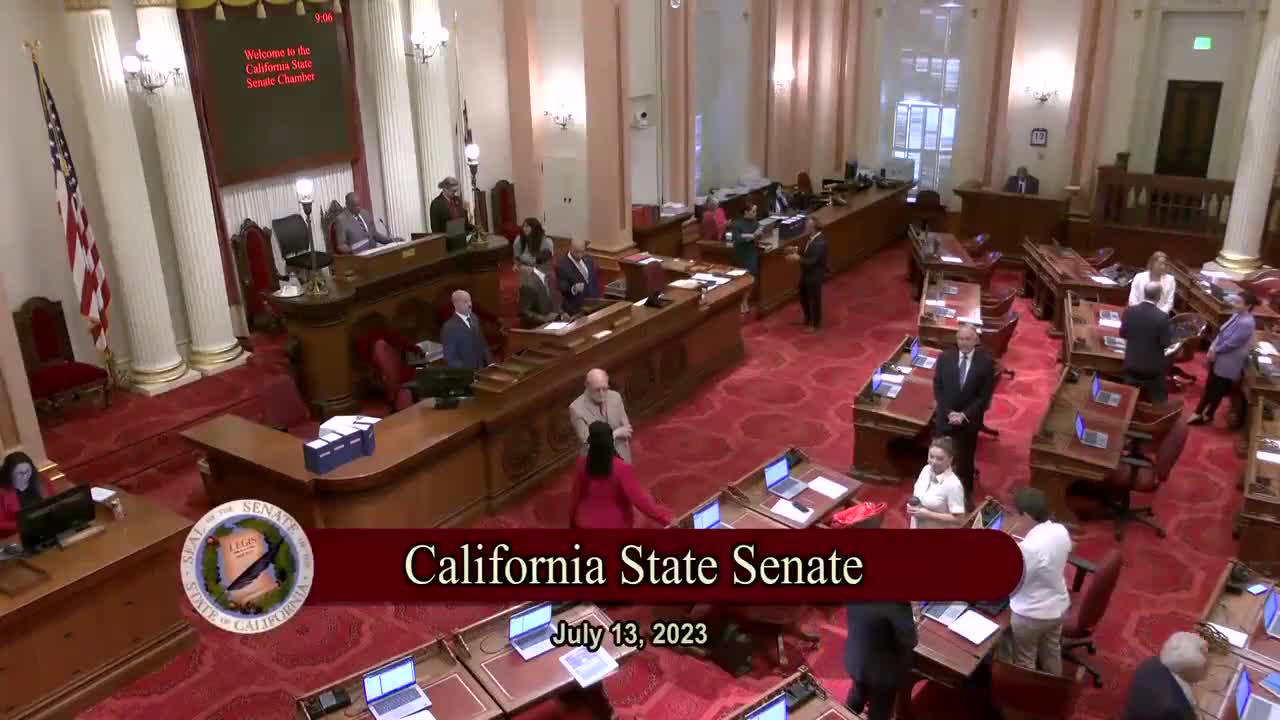 49MIN
Senate Floor
 13MIN
Senate Standing Committee on Elections and Constitutional Amendments
 17MIN
Senate Standing Committee on Judiciary
 20MIN
Assembly Floor
 4MIN
Assembly Standing Committee on Appropriations
 22MIN
Assembly Standing Committee on Judiciary
Bill Author

Bill Co-Author(s):