SB 1002: Firearms: prohibited persons.
- Session Year: 2023-2024
- House: Senate
- Latest Version Date: 2024-09-24
Current Status:
Passed
(2024-09-24: Chaptered by Secretary of State. Chapter 526, Statutes of 2024.)
Introduced
In Committee
First Chamber
In Committee
Second Chamber
Enacted
Existing law prohibits a person who has been taken into custody, assessed, and admitted to a designated facility, or who has been certified for intensive treatment after having been admitted to a designated facility, because the person is a danger to themselves or others as a result of a mental health disorder, from owning a firearm, as specified. Existing law also prohibits a person who has been adjudicated to be a danger to others as a result of a mental disorder or mental illness, or who has been adjudicated to be a mentally disordered sex offender, a person who has been found not guilty by reason of insanity of committing specified crimes, a person found by a court to be mentally incompetent to stand trial, or a person who has been placed under conservatorship by a court because the person is gravely disabled as a result of a mental disorder or impairment by chronic alcoholism from purchasing or receiving, or attempting to purchase or receive, or having possession, custody, or control of a firearm or any other deadly weapon. A violation of these prohibitions is a crime.
This bill would, among other things, expand those prohibitions to also prohibit the ownership, possession, custody, or control of ammunition. The bill would require a person subject to the prohibition because they are a danger to themselves or others as a result of a mental health disorder to relinquish a firearm, other deadly weapon, or ammunition they own, possess, or control within 72 hours of discharge from a facility, as specified, and would require a person subject to the prohibition because they are a person who has been adjudicated to be a danger to others as a result of a mental disorder or mental illness, or who has been adjudicated to be a mentally disordered sex offender, or a person who has been found not guilty by reason of insanity of committing specified crimes, to relinquish to law enforcement a firearm, other deadly weapon, or ammunition in their custody or control within 14 days of the court order finding the person to be a person as described. By expanding the application of an existing crime, this bill would impose a state-mandated local program.
Existing law allows a search warrant to be issued upon probable cause, supported by affidavit, naming or describing the person to be searched or searched for, and particularly describing the property, thing, or things and the place to be searched. Existing law also specifies the grounds upon which a search warrant may be issued, including, among other grounds, when the property or things to be seized include a firearm or other deadly weapon that is owned by, in the possession of, or in the custody or control of specified individuals.
This bill would additionally authorize a search warrant to be issued on the grounds that the property to be seized includes ammunition and is owned by, in the possession of, or in the custody or control of specified individuals.
This bill would incorporate additional changes to Section 1524 of the Penal Code proposed by SB 899 to be operative only if this bill and SB 899 are enacted and this bill is enacted last. The bill would incorporate additional changes to Section 8103 of the Welfare and Institutions Code proposed by AB 2629 and SB 1025 to be operative only if this bill and one or both of those bills are enacted and this bill is enacted last.
The California Constitution requires the state to reimburse local agencies and school districts for certain costs mandated by the state. Statutory provisions establish procedures for making that reimbursement.
This bill would provide that no reimbursement is required by this act for a specified reason.
Existing law prohibits a person who has been taken into custody, assessed, and admitted to a designated facility, or who has been certified for intensive treatment after having been admitted to a designated facility, because the person is a danger to themselves or others as a result of a mental health disorder, from owning a firearm, as specified. Existing law also prohibits a person who has been adjudicated to be a danger to others as a result of a mental disorder or mental illness, or who has been adjudicated to be a mentally disordered sex offender, a person who has been found not guilty by reason of insanity of committing specified crimes, a person found by a court to be mentally incompetent to stand trial, or a person who has been placed under conservatorship by a court because the person is gravely disabled as a result of a mental disorder or impairment by chronic alcoholism from purchasing or receiving, or attempting to purchase or receive, or having possession, custody, or control of a firearm or any other deadly weapon. A violation of these prohibitions is a crime.
This bill would, among other things, expand those prohibitions to also prohibit the ownership, possession, custody, or control of ammunition. The bill would require a person subject to the prohibition because they are a danger to themselves or others as a result of a mental health disorder to relinquish a firearm, other deadly weapon, or ammunition they own, possess, or control within 72 hours of discharge from a facility, as specified, and would require a person subject to the prohibition because they are a person who has been adjudicated to be a danger to others as a result of a mental disorder or mental illness, or who has been adjudicated to be a mentally disordered sex offender, or a person who has been found not guilty by reason of insanity of committing specified crimes, to relinquish to law enforcement a firearm, other deadly weapon, or ammunition in their custody or control within 14 days of the court order finding the person to be a person as described. By expanding the application of an existing crime, this bill would impose a state-mandated local program.
Existing law allows a search warrant to be issued upon probable cause, supported by affidavit, naming or describing the person to be searched or searched for, and particularly describing the property, thing, or things and the place to be searched. Existing law also specifies the grounds upon which a search warrant may be issued, including, among other grounds, when the property or things to be seized include a firearm or other deadly weapon that is owned by, in the possession of, or in the custody or control of specified individuals.
This bill would additionally authorize a search warrant to be issued on the grounds that the property to be seized includes ammunition and is owned by, in the possession of, or in the custody or control of specified individuals.
This bill would incorporate additional changes to Section 1524 of the Penal Code and Section 8103 of the Welfare and Institutions Code proposed by AB 2629 and SB 899 to be operative only if this bill and AB 2629 and SB 899 are enacted and this bill is enacted last.This bill would incorporate additional changes to Section 1524 of the Penal Code proposed by SB 899 to be operative only if this bill and SB 899 are enacted and this bill is enacted last. The bill would incorporate additional changes to Section 8103 of the Welfare and Institutions Code proposed by AB 2629 and SB 1025 to be operative only if this bill and one or both of those bills are enacted and this bill is enacted last.
The California Constitution requires the state to reimburse local agencies and school districts for certain costs mandated by the state. Statutory provisions establish procedures for making that reimbursement.
This bill would provide that no reimbursement is required by this act for a specified reason.
Existing law prohibits a person who has been taken into custody, assessed, and admitted to a designated facility, or who has been certified for intensive treatment after having been admitted to a designated facility, because the person is a danger to themselves or others as a result of a mental health disorder, from owning a firearm for a period of 5 years after the person is released from the facility or for the remainder of their life if the person has previously been taken into custody, assessed, and admitted one or more times within a period of one year preceding the most recent admittance. Existing law requires the facility to submit a report to the Department of Justice containing information that includes, but is not limited to, the identity of the person and the legal grounds upon which the person was admitted to the facility. Existing law allows a person who is prohibited from owning a firearm pursuant to these provisions to request the court for a hearing to reinstate the persons right to own a firearm, and requires the facility to provide a person subject to the prohibition with the Patient Notification of Firearm Prohibition and Right to Hearing Form informing the person of the firearm prohibition and their right to request a hearing. firearm, as specified. Existing law also prohibits a person who has been adjudicated to be a danger to others as a result of a mental disorder or mental illness, or who has been adjudicated to be a mentally disordered sex offender, a person who has been found not guilty by reason of insanity of committing specified crimes, a person found by a court to be mentally incompetent to stand trial, or a person who has been placed under conservatorship by a court because the person is gravely disabled as a result of a mental disorder or impairment by chronic alcoholism from purchasing or receiving, or attempting to purchase or receive, or having possession, custody, or control of a firearm or any other deadly weapon. A violation of these prohibitions is a crime.
This bill would, among other things, instead require the 5-year prohibition to commence on the date that the facility makes the above-described report to the Department of Justice and would require the Department of Justice to, within 7 days of receipt of the report from the facility, notify a person subject to the above-described provisions of the prohibition and their right to request a hearing to reinstate their right to own a firearm, other deadly weapon, or ammunition. expand those prohibitions to also prohibit the ownership, possession, custody, or control of ammunition. The bill would require a person subject to the prohibition because they are a danger to themselves or others as a result of a mental health disorder to relinquish a firearm, other deadly weapon, or ammunition they own, possess, or control within 72 hours of discharge from a facility, as specified, and would require the Patient Notification of Firearm Prohibition and Right to Hearing Form to include information on the relinquishment requirement. The bill would also make technical changes. a person subject to the prohibition because they are a person who has been adjudicated to be a danger to others as a result of a mental disorder or mental illness, or who has been adjudicated to be a mentally disordered sex offender, or a person who has been found not guilty by reason of insanity of committing specified crimes, to relinquish to law enforcement a firearm, other deadly weapon, or ammunition in their custody or control within 14 days of the court order finding the person to be a person as described. By expanding the application of an existing crime, this bill would impose a state-mandated local program.
Existing law also prohibits a person who has been adjudicated to be a danger to others as a result of a mental disorder or mental illness, or who has been adjudicated to be a mentally disordered sex offender, and a person who has been placed under conservatorship by a court because the person is gravely disabled as a result of a mental disorder or impairment by chronic alcoholism from purchasing or receiving, or attempting to purchase or receive, or having possession, custody, or control of a firearm or any other deadly weapon. A violation of this prohibition is a crime.This bill would expand that prohibition to also prohibit the ownership, possession, custody, or control of ammunition. The bill would require the court to inform the above-described persons, and their conservator, if applicable, of how the person may relinquish a firearm, other deadly weapon, or ammunition in the persons possession, custody, or control according to local procedure and the process for submitting a receipt to the court to show proof of relinquishment. By expanding the application of an existing crime, this bill would impose a state-mandated local program.Existing law allows a search warrant to be issued upon probable cause, supported by affidavit, naming or describing the person to be searched or searched for, and particularly describing the property, thing, or things and the place to be searched. Existing law also specifies the grounds upon which a search warrant may be issued, including, among other grounds, when the property or things to be seized include a firearm or other deadly weapon that is owned by, in the possession of, or in the custody or control of specified individuals.
This bill would additionally authorize a search warrant to be issued on the grounds that the property to be seized includes ammunition and is owned by, in the possession of, or in the custody or control of specified individuals.
This bill would incorporate additional changes to Section 1524 of the Penal Code and Section 8103 of the Welfare and Institutions Code proposed by AB 2629 and SB 899 to be operative only if this bill and AB 2629 and SB 899 are enacted and this bill is enacted last.
The California Constitution requires the state to reimburse local agencies and school districts for certain costs mandated by the state. Statutory provisions establish procedures for making that reimbursement.
This bill would provide that no reimbursement is required by this act for a specified reason.
Existing law prohibits a person who has been taken into custody, assessed, and admitted to a designated facility, or who has been certified for intensive treatment after having been admitted to a designated facility, because the person is a danger to themselves or others as a result of a mental health disorder, from owning a firearm for a period of 5 years after the person is released from the facility or for the remainder of their life if the person has previously been taken into custody, assessed, and admitted one or more times within a period of one year preceding the most recent admittance. Existing law requires the facility to submit a report to the Department of Justice containing information that includes, but is not limited to, the identity of the person and the legal grounds upon which the person was admitted to the facility. Existing law allows a person who is prohibited from owning a firearm pursuant to these provisions to request the court for a hearing to reinstate the persons right to own a firearm, and requires the facility to provide a person subject to the prohibition with the Patient Notification of Firearm Prohibition and Right to Hearing Form informing the person of the firearm prohibition and their right to request a hearing.
This bill would, among other things, instead require the 5-year prohibition to commence on the date that the facility makes the above-described report to the Department of Justice and would require the Department of Justice to, within 7 days of receipt of the report from the facility, notify a person subject to the above-described provisions of the prohibition and their right to request a hearing to reinstate their right to own a firearm, other deadly weapon, ammunition, or firearm magazine. or ammunition. The bill would require a person subject to the prohibition to relinquish a firearm, other deadly weapon, ammunition, or firearm magazine or ammunition they own, possess, or control within 72 hours of discharge from a facility, as specified, and would require the Patient Notification of Firearm Prohibition and Right to Hearing Form to include information on the relinquishment requirement. The bill would also make technical changes.
Existing law also prohibits a person who has been found not guilty by reason of insanity of specified crimes adjudicated to be a danger to others as a result of a mental disorder or mental illness, or who has been adjudicated to be a mentally disordered sex offender, and a person who has been placed under conservatorship by a court because the person is gravely disabled as a result of a mental disorder or impairment by chronic alcoholism from purchasing or receiving, or attempting to purchase or receive, or having possession, custody, or control of a firearm or any other deadly weapon. A violation of this prohibition is a crime.
This bill would expand that prohibition to also prohibit the ownership, possession, custody, or control of ammunition or a firearm magazine. ammunition. The bill would require the court to inform the above-described persons, and their conservator, if applicable, of how the person may relinquish a firearm, other deadly weapon, ammunition, or firearm magazine or ammunition in the persons possession, custody, or control according to local procedure and the process for submitting a receipt to the court to show proof of relinquishment. By expanding the application of an existing crime, this bill would impose a state-mandated local program.
Existing law allows a search warrant to be issued upon probable cause, supported by affidavit, naming or describing the person to be searched or searched for, and particularly describing the property, thing, or things and the place to be searched. Existing law also specifies the grounds upon which a search warrant may be issued, including, among other grounds, when the property or things to be seized include a firearm or other deadly weapon that is owned by, in the possession of, or in the custody or control of specified individuals.
This bill would additionally authorize a search warrant to be issued on the grounds that the property to be seized includes ammunition or a firearm magazine, or both, and is owned by, in the possession of, or in the custody or control of specified individuals.
The California Constitution requires the state to reimburse local agencies and school districts for certain costs mandated by the state. Statutory provisions establish procedures for making that reimbursement.
This bill would provide that no reimbursement is required by this act for a specified reason.
Existing law prohibits a person who has been taken into custody, assessed, and admitted to a designated facility, or who has been certified for intensive treatment after having been admitted to a designated facility, because the person is a danger to themselves or others as a result of a mental health disorder, from owning a firearm for a period of 5 years after the person is released from the facility, facility or for the remainder of their life if the person has previously been taken into custody, assessed, and admitted one or more times within a period of one year preceding the most recent admittance. Existing law requires the facility to submit a report to the Department of Justice containing information that includes, but is not limited to, the identity of the person and the legal grounds upon which the person was admitted to the facility. Existing law allows a person who is prohibited from owning a firearm pursuant to these provisions to request the court for a hearing to reinstate the persons right to own a firearm, and requires the facility to provide a person subject to the prohibition with the Patient Notification of Firearm Prohibition and Right to Hearing Form informing the person of the firearm prohibition and their right to request a hearing.
This bill would, among other things, instead require the 5-year prohibition to commence on the date that the facility makes the above-described report to the Department of Justice, Justice and would require the Department of Justice to, within 7 days of receipt of the report from the facility, notify a person subject to the above-described provisions of the firearm prohibition and their right to request a hearing to reinstate their right to own a firearm. firearm, other deadly weapon, ammunition, or firearm magazine. The bill would require a person subject to the firearms prohibition to relinquish any a firearm, other deadly weapon, ammunition, or firearm magazine they own, possess, or control within 72 hours of discharge from a facility, as specified, and would require the Patient Notification of Firearm Prohibition and Right to Hearing Form to include information on the relinquishment requirement. The bill would also make technical changes.
Existing law also prohibits a person who has been found not guilty by reason of insanity of specified crimes and a person who has been placed under conservatorship by a court because the person is gravely disabled as a result of a mental disorder or impairment by chronic alcoholism from purchasing or receiving, or attempting to purchase or receive, or having possession, custody, or control of any a firearm or any other deadly weapon. A violation of this prohibition is a crime.
This bill would expand that prohibition to also prohibit the ownership, possession, custody, or control of ammunition or a firearm magazine. The bill would require the court to inform the above-described persons, and their conservator, if applicable, of how the person may relinquish any a firearm, other deadly weapon, ammunition, or firearm magazine in the persons possession, custody, or control according to local procedure, procedure and the process for submitting a receipt to the court to show proof of relinquishment. By expanding the application of an existing crime, this bill would impose a state-mandated local program.
Existing law allows a search warrant to be issued upon probable cause, supported by affidavit, naming or describing the person to be searched or searched for, and particularly describing the property, thing, or things and the place to be searched. Existing law also specifies the grounds upon which a search warrant may be issued, including, among other grounds, when the property or things to be seized include a firearm or other deadly weapon that is owned by, in the possession of, or in the custody or control of specified individuals.
This bill would additionally authorize a search warrant to be issued on the grounds that the property to be seized includes ammunition or a firearm magazine, or both, and is owned by, in the possession of, or in the custody or control of specified individuals.
The California Constitution requires the state to reimburse local agencies and school districts for certain costs mandated by the state. Statutory provisions establish procedures for making that reimbursement.
This bill would provide that no reimbursement is required by this act for a specified reason.
Existing law prohibits a person who has been taken into custody, assessed, and admitted to a designated facility, or who has been certified for intensive treatment after having been admitted to a designated facility, because the person is a danger to themselves or others as a result of a mental health disorder, from owning a firearm for a period of 5 years after the person is released from the facility, or for the remainder of their life if the person has previously been taken into custody, assessed, and admitted one or more times within a period of one year preceding the most recent admittance. Existing law requires the facility to submit a report to the Department of Justice containing information that includes, but is not limited to, the identity of the person and the legal grounds upon which the person was admitted to the facility. Existing law allows a person who is prohibited from owning a firearm pursuant to these provisions to request the court for a hearing to reinstate the persons right to own a firearm, and requires the facility to provide a person subject to the prohibition with the Patient Notification of Firearm Prohibition and Right to Hearing Form informing the person of the firearm prohibition and their right to request a hearing.
This bill would, among other things, instead require the 5-year prohibition to commence on the date that the facility makes the above-described report to the Department of Justice, and would require the Department of Justice to, within 7 days of receipt of the report from the facility, notify a person subject to the above-described provisions of the firearm prohibition and their right to request a hearing to reinstate their right to own a firearm. The bill would require a person subject to the firearms prohibition to relinquish any firearm, ammunition, or firearm magazine they own, possess, or control within 72 hours of discharge from a facility, as specified, and would require the Patient Notification of Firearm Prohibition and Right to Hearing Form to include information on the relinquishment requirement.
Existing law also prohibits a person who has been found not guilty by reason of insanity of specified crimes and a person who has been placed under conservatorship by a court because the person is gravely disabled as a result of a mental disorder or impairment by chronic alcoholism from purchasing or receiving, or attempting to purchase or receive, or having possession, custody, or control of any firearm or any other deadly weapon.
This bill would require the court to inform the above-described persons, and their conservator, if applicable, of how the person may relinquish any firearm, ammunition, or firearm magazine in the persons possession, custody, or control according to local procedure, and the process for submitting a receipt to the court to show proof of relinquishment.
(a)A search warrant may be issued upon any of the following grounds:
(1)When the property was stolen or embezzled.
(2)When the property or things were used as the means of committing a felony.
(3)When the property or things are in the possession of a person with the intent to use them as a means of committing a public offense, or in the possession of another to whom that person may have delivered them for the purpose of concealing them or preventing them from being discovered.
(4)When the property or things to be seized consist of an item or constitute evidence that tends to show a felony has been committed, or tends to show that a particular person has committed a felony.
(5)When the property or things to be seized consist of evidence that tends to show that sexual exploitation of a child, in violation of Section 311.3, or possession of matter depicting sexual conduct of a person under 18 years of age, in violation of Section 311.11, has occurred or is occurring.
(6)When there is a warrant to arrest a person.
(7)When a provider of electronic communication service or remote computing service has records or evidence, as specified in Section 1524.3, showing that property was stolen or embezzled constituting a misdemeanor, or that property or things are in the possession of a person with the intent to use them as a means of committing a misdemeanor public offense, or in the possession of another to whom that person may have delivered them for the purpose of concealing them or preventing their discovery.
(8)When the property or things to be seized include an item or evidence that tends to show a violation of Section 3700.5 of the Labor Code or tends to show that a particular person has violated Section 3700.5 of the Labor Code.
(9)When the property or things to be seized include a firearm or other deadly weapon at the scene of, or at the premises occupied or under the control of the person arrested in connection with, a domestic violence incident involving a threat to human life or a physical assault as provided in Section 18250. This section does not affect warrantless seizures otherwise authorized by Section 18250.
(10)When the property or things to be seized include a firearm or other deadly weapon that is owned by, or in the possession of, or in the custody or control of, a person described in subdivision (a) of Section 8102 of the Welfare and Institutions Code.
(11)When the property or things to be seized include a firearm that is owned by, or in the possession of, or in the custody or control of, a person who is subject to the prohibitions regarding firearms pursuant to Section 6389 of the Family Code, if a prohibited firearm is possessed, owned, in the custody of, or controlled by a person against whom a protective order has been issued pursuant to Section 6218 of the Family Code, the person has been lawfully served with that order, and the person has failed to relinquish the firearm as required by law.
(12)When the information to be received from the use of a tracking device constitutes evidence that tends to show that either a felony, a misdemeanor violation of the Fish and Game Code, or a misdemeanor violation of the Public Resources Code has been committed or is being committed, tends to show that a particular person has committed a felony, a misdemeanor violation of the Fish and Game Code, or a misdemeanor violation of the Public Resources Code, or is committing a felony, a misdemeanor violation of the Fish and Game Code, or a misdemeanor violation of the Public Resources Code, or will assist in locating an individual who has committed or is committing a felony, a misdemeanor violation of the Fish and Game Code, or a misdemeanor violation of the Public Resources Code. A tracking device search warrant issued pursuant to this paragraph shall be executed in a manner meeting the requirements specified in subdivision (b) of Section 1534.
(13)When a sample of the blood of a person constitutes evidence that tends to show a violation of Section 23140, 23152, or 23153 of the Vehicle Code and the person from whom the sample is being sought has refused an officers request to submit to, or has failed to complete, a blood test as required by Section 23612 of the Vehicle Code, and the sample will be drawn from the person in a reasonable, medically approved manner. This paragraph is not intended to abrogate a courts mandate to determine the propriety of the issuance of a search warrant on a case-by-case basis.
(14)Beginning January 1, 2016, the property or things to be seized are firearms or ammunition or both that are owned by, in the possession of, or in the custody or control of a person who is the subject of a gun violence restraining order that has been issued pursuant to Division 3.2 (commencing with Section 18100) of Title 2 of Part 6, if a prohibited firearm or ammunition or both is possessed, owned, in the custody of, or controlled by a person against whom a gun violence restraining order has been issued, the person has been lawfully served with that order, and the person has failed to relinquish the firearm as required by law.
(15)Beginning January 1, 2018, the property or things to be seized include a firearm that is owned by, or in the possession of, or in the custody or control of, a person who is subject to the prohibitions regarding firearms pursuant to Section 29800 or 29805, and the court has made a finding pursuant to subdivision (c) of Section 29810 that the person has failed to relinquish the firearm as required by law.
(16)When the property or things to be seized are controlled substances or a device, contrivance, instrument, or paraphernalia used for unlawfully using or administering a controlled substance pursuant to the authority described in Section 11472 of the Health and Safety Code.
(17)(A)When all of the following apply:
(i)A sample of the blood of a person constitutes evidence that tends to show a violation of subdivision (b), (c), (d), (e), or (f) of Section 655 of the Harbors and Navigation Code.
(ii)The person from whom the sample is being sought has refused an officers request to submit to, or has failed to complete, a blood test as required by Section 655.1 of the Harbors and Navigation Code.
(iii)The sample will be drawn from the person in a reasonable, medically approved manner.
(B)This paragraph is not intended to abrogate a courts mandate to determine the propriety of the issuance of a search warrant on a case-by-case basis.
(18)When the property or things to be seized consists of evidence that tends to show that a violation of paragraph (1), (2), or (3) of subdivision (j) of Section 647 has occurred or is occurring.
(19)(A)When the property or things to be seized are data, from a recording device installed by the manufacturer of a motor vehicle, that constitutes evidence that tends to show the commission of a felony or misdemeanor offense involving a motor vehicle, resulting in death or serious bodily injury to a person. The data accessed by a warrant pursuant to this paragraph shall not exceed the scope of the data that is directly related to the offense for which the warrant is issued.
(B)For the purposes of this paragraph, recording device has the same meaning as defined in subdivision (b) of Section 9951 of the Vehicle Code. The scope of the data accessible by a warrant issued pursuant to this paragraph shall be limited to the information described in subdivision (b) of Section 9951 of the Vehicle Code.
(C)For the purposes of this paragraph, serious bodily injury has the same meaning as defined in paragraph (4) of subdivision (f) of Section 243.
(20)When the property or things to be seized consists of evidence that tends to show that a violation of Section 647.9 has occurred or is occurring. Evidence to be seized pursuant to this paragraph shall be limited to evidence of a violation of Section 647.9 and shall not include evidence of a violation of a departmental rule or guideline that is not a public offense under California law.
(21)If the property to be seized includes ammunition and all of the following criteria are satisfied:
(A)The property is owned by, in the possession of, or in the custody or control of a person who is subject to the prohibition set forth in Section 8103 of the Welfare and Institutions Code.
(B)The person has been lawfully served with the order required by Section 8103 of the Welfare and Institutions Code.
(C)The person has failed to relinquish the ammunition as required by law.
(b)The property, things, person, or persons described in subdivision (a) may be taken on the warrant from a place or from a person in whose possession the property or things may be.
(c)Notwithstanding subdivision (a) or (b), a search warrant shall not be issued for documentary evidence in the possession or under the control of a person who is a lawyer as defined in Section 950 of the Evidence Code, a physician as defined in Section 990 of the Evidence Code, a psychotherapist as defined in Section 1010 of the Evidence Code, or a member of the clergy as defined in Section 1030 of the Evidence Code, and who is not reasonably suspected of engaging or having engaged in criminal activity related to the documentary evidence for which a warrant is requested unless the following procedure has been complied with:
(1)At the time of the issuance of the warrant, the court shall appoint a special master in accordance with subdivision (d) to accompany the person who will serve the warrant. Upon service of the warrant, the special master shall inform the party served of the specific items being sought and that the party shall have the opportunity to provide the items requested. If the party, in the judgment of the special master, fails to provide the items requested, the special master shall conduct a search for the items in the areas indicated in the search warrant.
(2)(A)If the party who has been served states that an item or items should not be disclosed, they shall be sealed by the special master and taken to court for a hearing.
(B)At the hearing, the party searched shall be entitled to raise an issue that may be raised pursuant to Section 1538.5 as well as a claim that the item or items are privileged, as provided by law. The hearing shall be held in the superior court. The court shall provide sufficient time for the parties to obtain counsel and make motions or present evidence. The hearing shall be held within three days of the service of the warrant unless the court makes a finding that the expedited hearing is impracticable. In that case, the matter shall be heard at the earliest possible time.
(C)If an item or items are taken to court for a hearing, a limitation of time prescribed in Chapter 2 (commencing with Section 799) of Title 3 shall be tolled from the time of the seizure until the final conclusion of the hearing, including an associated writ or appellate proceedings.
(3)The warrant shall, whenever practicable, be served during normal business hours. In addition, the warrant shall be served upon a party who appears to have possession or control of the items sought. If, after reasonable efforts, the party serving the warrant is unable to locate the person, the special master shall seal and return to the court, for determination by the court, an item that appears to be privileged as provided by law.
(d)(1)As used in this section, a special master is an attorney who is a member in good standing of the California State Bar and who has been selected from a list of qualified attorneys that is maintained by the State Bar particularly for the purposes of conducting the searches described in this section. These attorneys shall serve without compensation. A special master shall be considered a public employee, and the governmental entity that caused the search warrant to be issued shall be considered the employer of the special master and the applicable public entity, for purposes of Division 3.6 (commencing with Section 810) of Title 1 of the Government Code, relating to claims and actions against public entities and public employees. In selecting the special master, the court shall make every reasonable effort to ensure that the person selected has no relationship with any of the parties involved in the pending matter. Information obtained by the special master shall be confidential and may not be divulged except in direct response to inquiry by the court.
(2)In a case in which the magistrate determines that, after reasonable efforts have been made to obtain a special master, a special master is not available and would not be available within a reasonable period of time, the magistrate may direct the party seeking the order to conduct the search in the manner described in this section in lieu of the special master.
(e)A search conducted pursuant to this section by a special master may be conducted in a manner that permits the party serving the warrant or that partys designee to accompany the special master as the special master conducts the search. However, that party or that partys designee may not participate in the search nor shall they examine any of the items being searched by the special master except upon agreement of the party upon whom the warrant has been served.
(f)As used in this section, documentary evidence includes, but is not limited to, writings, documents, blueprints, drawings, photographs, computer printouts, microfilms, x-rays, files, diagrams, ledgers, books, tapes, audio and video recordings, films, and papers of any type or description.
(g)No warrant shall issue for an item or items described in Section 1070 of the Evidence Code.
(h)No warrant shall issue for an item or items that pertain to an investigation into a prohibited violation, as defined in Section 629.51.
(i)Notwithstanding any other law, no claim of attorney work product as described in Chapter 4 (commencing with Section 2018.010) of Title 4 of Part 4 of the Code of Civil Procedure shall be sustained where there is probable cause to believe that the lawyer is engaging or has engaged in criminal activity related to the documentary evidence for which a warrant is requested unless it is established at the hearing with respect to the documentary evidence seized under the warrant that the services of the lawyer were not sought or obtained to enable or aid anyone to commit or plan to commit a crime or a fraud.
(j)Nothing in this section is intended to limit an attorneys ability to request an in-camera hearing pursuant to the holding of the Supreme Court of California in People v. Superior Court (Laff) (2001) 25 Cal.4th 703.
(k)In addition to any other circumstance permitting a magistrate to issue a warrant for a person or property in another county, when the property or things to be seized consist of any item or constitute evidence that tends to show a violation of Section 530.5, the magistrate may issue a warrant to search a person or property located in another county if the person whose identifying information was taken or used resides in the same county as the issuing court.
(l)This section does not create a cause of action against a foreign or California corporation, its officers, employees, agents, or other specified persons for providing location information.
SEC. 1.1.Section 1524 of the Penal Code is amended to read:1524.(a)A search warrant may be issued upon any of the following grounds:
(1)When the property was stolen or embezzled.
(2)When the property or things were used as the means of committing a felony.
(3)When the property or things are in the possession of a person with the intent to use them as a means of committing a public offense, or in the possession of another to whom that person may have delivered them for the purpose of concealing them or preventing them from being discovered.
(4)When the property or things to be seized consist of an item or constitute evidence that tends to show a felony has been committed, or tends to show that a particular person has committed a felony.
(5)When the property or things to be seized consist of evidence that tends to show that sexual exploitation of a child, in violation of Section 311.3, or possession of matter depicting sexual conduct of a person under 18 years of age, in violation of Section 311.11, has occurred or is occurring.
(6)When there is a warrant to arrest a person.
(7)When a provider of electronic communication service or remote computing service has records or evidence, as specified in Section 1524.3, showing that property was stolen or embezzled constituting a misdemeanor, or that property or things are in the possession of a person with the intent to use them as a means of committing a misdemeanor public offense, or in the possession of another to whom that person may have delivered them for the purpose of concealing them or preventing their discovery.
(8)When the property or things to be seized include an item or evidence that tends to show a violation of Section 3700.5 of the Labor Code or tends to show that a particular person has violated Section 3700.5 of the Labor Code.
(9)When the property or things to be seized include a firearm or other deadly weapon at the scene of, or at the premises occupied or under the control of the person arrested in connection with, a domestic violence incident involving a threat to human life or a physical assault as provided in Section 18250. This section does not affect warrantless seizures otherwise authorized by Section 18250.
(10)When the property or things to be seized include a firearm or other deadly weapon that is owned by, or in the possession of, or in the custody or control of, a person described in subdivision (a) of Section 8102 of the Welfare and Institutions Code.
(11)When the property or things to be seized include a firearm that is owned by, or in the possession of, or in the custody or control of, a person who is subject to the prohibitions regarding firearms pursuant to Section 6389 of the Family Code, if a prohibited firearm is possessed, owned, in the custody of, or controlled by a person against whom a protective order has been issued pursuant to Section 6218 of the Family Code, the person has been lawfully served with that order, and the person has failed to relinquish the firearm as required by law.
(12)When the information to be received from the use of a tracking device constitutes evidence that tends to show that either a felony, a misdemeanor violation of the Fish and Game Code, or a misdemeanor violation of the Public Resources Code has been committed or is being committed, tends to show that a particular person has committed a felony, a misdemeanor violation of the Fish and Game Code, or a misdemeanor violation of the Public Resources Code, or is committing a felony, a misdemeanor violation of the Fish and Game Code, or a misdemeanor violation of the Public Resources Code, or will assist in locating an individual who has committed or is committing a felony, a misdemeanor violation of the Fish and Game Code, or a misdemeanor violation of the Public Resources Code. A tracking device search warrant issued pursuant to this paragraph shall be executed in a manner meeting the requirements specified in subdivision (b) of Section 1534.
(13)When a sample of the blood of a person constitutes evidence that tends to show a violation of Section 23140, 23152, or 23153 of the Vehicle Code and the person from whom the sample is being sought has refused an officers request to submit to, or has failed to complete, a blood test as required by Section 23612 of the Vehicle Code, and the sample will be drawn from the person in a reasonable, medically approved manner. This paragraph is not intended to abrogate a courts mandate to determine the propriety of the issuance of a search warrant on a case-by-case basis.
(14)Beginning January 1, 2016, the property or things to be seized are firearms or ammunition or both that are owned by, in the possession of, or in the custody or control of a person who is the subject of a gun violence restraining order that has been issued pursuant to Division 3.2 (commencing with Section 18100) of Title 2 of Part 6, if a prohibited firearm or ammunition or both is possessed, owned, in the custody of, or controlled by a person against whom a gun violence restraining order has been issued, the person has been lawfully served with that order, and the person has failed to relinquish the firearm as required by law.
(15)Beginning January 1, 2018, the property or things to be seized include a firearm that is owned by, or in the possession of, or in the custody or control of, a person who is subject to the prohibitions regarding firearms pursuant to Section 29800 or 29805, and the court has made a finding pursuant to subdivision (c) of Section 29810 that the person has failed to relinquish the firearm as required by law.
(16)When the property or things to be seized are controlled substances or a device, contrivance, instrument, or paraphernalia used for unlawfully using or administering a controlled substance pursuant to the authority described in Section 11472 of the Health and Safety Code.
(17)(A)When all of the following apply:
(i)A sample of the blood of a person constitutes evidence that tends to show a violation of subdivision (b), (c), (d), (e), or (f) of Section 655 of the Harbors and Navigation Code.
(ii)The person from whom the sample is being sought has refused an officers request to submit to, or has failed to complete, a blood test as required by Section 655.1 of the Harbors and Navigation Code.
(iii)The sample will be drawn from the person in a reasonable, medically approved manner.
(B)This paragraph is not intended to abrogate a courts mandate to determine the propriety of the issuance of a search warrant on a case-by-case basis.
(18)When the property or things to be seized consists of evidence that tends to show that a violation of paragraph (1), (2), or (3) of subdivision (j) of Section 647 has occurred or is occurring.
(19)(A)When the property or things to be seized are data, from a recording device installed by the manufacturer of a motor vehicle, that constitutes evidence that tends to show the commission of a felony or misdemeanor offense involving a motor vehicle, resulting in death or serious bodily injury to a person. The data accessed by a warrant pursuant to this paragraph shall not exceed the scope of the data that is directly related to the offense for which the warrant is issued.
(B)For the purposes of this paragraph, recording device has the same meaning as defined in subdivision (b) of Section 9951 of the Vehicle Code. The scope of the data accessible by a warrant issued pursuant to this paragraph shall be limited to the information described in subdivision (b) of Section 9951 of the Vehicle Code.
(C)For the purposes of this paragraph, serious bodily injury has the same meaning as defined in paragraph (4) of subdivision (f) of Section 243.
(20)When the property or things to be seized consists of evidence that tends to show that a violation of Section 647.9 has occurred or is occurring. Evidence to be seized pursuant to this paragraph shall be limited to evidence of a violation of Section 647.9 and shall not include evidence of a violation of a departmental rule or guideline that is not a public offense under California law.
(21)If the property to be seized includes ammunition and all of the following criteria are satisfied:
(A)The property is owned by, in the possession of, or in the custody or control of a person who is subject to the prohibition set forth in Section 8103 of the Welfare and Institutions Code.
(B)The person has been lawfully served with the order required by Section 8103 of the Welfare and Institutions Code.
(C)The person has failed to relinquish the ammunition as required by law.
(b)The property, things, person, or persons described in subdivision (a) may be taken on the warrant from a place or from a person in whose possession the property or things may be.
(c)Notwithstanding subdivision (a) or (b), a search warrant shall not be issued for documentary evidence in the possession or under the control of a person who is a lawyer as defined in Section 950 of the Evidence Code, a physician as defined in Section 990 of the Evidence Code, a psychotherapist as defined in Section 1010 of the Evidence Code, or a member of the clergy as defined in Section 1030 of the Evidence Code, and who is not reasonably suspected of engaging or having engaged in criminal activity related to the documentary evidence for which a warrant is requested unless the following procedure has been complied with:
(1)At the time of the issuance of the warrant, the court shall appoint a special master in accordance with subdivision (d) to accompany the person who will serve the warrant. Upon service of the warrant, the special master shall inform the party served of the specific items being sought and that the party shall have the opportunity to provide the items requested. If the party, in the judgment of the special master, fails to provide the items requested, the special master shall conduct a search for the items in the areas indicated in the search warrant.
(2)(A)If the party who has been served states that an item or items should not be disclosed, they shall be sealed by the special master and taken to court for a hearing.
(B)At the hearing, the party searched shall be entitled to raise an issue that may be raised pursuant to Section 1538.5 as well as a claim that the item or items are privileged, as provided by law. The hearing shall be held in the superior court. The court shall provide sufficient time for the parties to obtain counsel and make motions or present evidence. The hearing shall be held within three days of the service of the warrant unless the court makes a finding that the expedited hearing is impracticable. In that case, the matter shall be heard at the earliest possible time.
(C)If an item or items are taken to court for a hearing, a limitation of time prescribed in Chapter 2 (commencing with Section 799) of Title 3 shall be tolled from the time of the seizure until the final conclusion of the hearing, including an associated writ or appellate proceedings.
(3)The warrant shall, whenever practicable, be served during normal business hours. In addition, the warrant shall be served upon a party who appears to have possession or control of the items sought. If, after reasonable efforts, the party serving the warrant is unable to locate the person, the special master shall seal and return to the court, for determination by the court, an item that appears to be privileged as provided by law.
(d)(1)As used in this section, a special master is an attorney who is a member in good standing of the California State Bar and who has been selected from a list of qualified attorneys that is maintained by the State Bar particularly for the purposes of conducting the searches described in this section. These attorneys shall serve without compensation. A special master shall be considered a public employee, and the governmental entity that caused the search warrant to be issued shall be considered the employer of the special master and the applicable public entity, for purposes of Division 3.6 (commencing with Section 810) of Title 1 of the Government Code, relating to claims and actions against public entities and public employees. In selecting the special master, the court shall make every reasonable effort to ensure that the person selected has no relationship with any of the parties involved in the pending matter. Information obtained by the special master shall be confidential and may not be divulged except in direct response to inquiry by the court.
(2)In a case in which the magistrate determines that, after reasonable efforts have been made to obtain a special master, a special master is not available and would not be available within a reasonable period of time, the magistrate may direct the party seeking the order to conduct the search in the manner described in this section in lieu of the special master.
(e)A search conducted pursuant to this section by a special master may be conducted in a manner that permits the party serving the warrant or that partys designee to accompany the special master as the special master conducts the search. However, that party or that partys designee may not participate in the search nor shall they examine any of the items being searched by the special master except upon agreement of the party upon whom the warrant has been served.
(f)As used in this section, documentary evidence includes, but is not limited to, writings, documents, blueprints, drawings, photographs, computer printouts, microfilms, x-rays, files, diagrams, ledgers, books, tapes, audio and video recordings, films, and papers of any type or description.
(g)No warrant shall issue for an item or items described in Section 1070 of the Evidence Code.
(h)No warrant shall issue for an item or items that pertain to an investigation into a prohibited violation, as defined in Section 629.51.
(i)Notwithstanding any other law, no claim of attorney work product as described in Chapter 4 (commencing with Section 2018.010) of Title 4 of Part 4 of the Code of Civil Procedure shall be sustained where there is probable cause to believe that the lawyer is engaging or has engaged in criminal activity related to the documentary evidence for which a warrant is requested unless it is established at the hearing with respect to the documentary evidence seized under the warrant that the services of the lawyer were not sought or obtained to enable or aid anyone to commit or plan to commit a crime or a fraud.
(j)Nothing in this section is intended to limit an attorneys ability to request an in-camera hearing pursuant to the holding of the Supreme Court of California in People v. Superior Court (Laff) (2001) 25 Cal.4th 703.
(k)In addition to any other circumstance permitting a magistrate to issue a warrant for a person or property in another county, when the property or things to be seized consist of any item or constitute evidence that tends to show a violation of Section 530.5, the magistrate may issue a warrant to search a person or property located in another county if the person whose identifying information was taken or used resides in the same county as the issuing court.
(l)This section does not create a cause of action against a foreign or California corporation, its officers, employees, agents, or other specified persons for providing location information.
(m)This section shall remain in effect only until January 1, 2026, and as of that date is repealed.
SEC. 1.2.Section 1524 is added to the Penal Code, to read:1524.(a)A search warrant may be issued upon any of the following grounds:
(1)When the property was stolen or embezzled.
(2)When the property or things were used as the means of committing a felony.
(3)When the property or things are in the possession of a person with the intent to use them as a means of committing a public offense, or in the possession of another to whom that person may have delivered them for the purpose of concealing them or preventing them from being discovered.
(4)When the property or things to be seized consist of an item or constitute evidence that tends to show a felony has been committed, or tends to show that a particular person has committed a felony.
(5)When the property or things to be seized consist of evidence that tends to show that sexual exploitation of a child, in violation of Section 311.3, or possession of matter depicting sexual conduct of a person under 18 years of age, in violation of Section 311.11, has occurred or is occurring.
(6)When there is a warrant to arrest a person.
(7)When a provider of electronic communication service or remote computing service has records or evidence, as specified in Section 1524.3, showing that property was stolen or embezzled constituting a misdemeanor, or that property or things are in the possession of a person with the intent to use them as a means of committing a misdemeanor public offense, or in the possession of another to whom that person may have delivered them for the purpose of concealing them or preventing their discovery.
(8)When the property or things to be seized include an item or evidence that tends to show a violation of Section 3700.5 of the Labor Code or tends to show that a particular person has violated Section 3700.5 of the Labor Code.
(9)When the property or things to be seized include a firearm or other deadly weapon at the scene of, or at the premises occupied or under the control of the person arrested in connection with, a domestic violence incident involving a threat to human life or a physical assault as provided in Section 18250. This section does not affect warrantless seizures otherwise authorized by Section 18250.
(10)When the property or things to be seized include a firearm or other deadly weapon that is owned by, or in the possession of, or in the custody or control of, a person described in subdivision (a) of Section 8102 of the Welfare and Institutions Code.
(11)When the property or things to be seized include a firearm that is owned by, or in the possession of, or in the custody or control of, a person who is subject to the prohibitions regarding firearms or ammunition or both pursuant to Section 6389 of the Family Code, if a prohibited firearm or ammunition or both is possessed, owned, in the custody of, or controlled by a person against whom a protective order has been issued pursuant to Section 6218 of the Family Code, the person has been lawfully served with that order, and the person has failed to relinquish the firearm or ammunition or both as required by law.
(12)When the information to be received from the use of a tracking device constitutes evidence that tends to show that either a felony, a misdemeanor violation of the Fish and Game Code, or a misdemeanor violation of the Public Resources Code has been committed or is being committed, tends to show that a particular person has committed a felony, a misdemeanor violation of the Fish and Game Code, or a misdemeanor violation of the Public Resources Code, or is committing a felony, a misdemeanor violation of the Fish and Game Code, or a misdemeanor violation of the Public Resources Code, or will assist in locating an individual who has committed or is committing a felony, a misdemeanor violation of the Fish and Game Code, or a misdemeanor violation of the Public Resources Code. A tracking device search warrant issued pursuant to this paragraph shall be executed in a manner meeting the requirements specified in subdivision (b) of Section 1534.
(13)When a sample of the blood of a person constitutes evidence that tends to show a violation of Section 23140, 23152, or 23153 of the Vehicle Code and the person from whom the sample is being sought has refused an officers request to submit to, or has failed to complete, a blood test as required by Section 23612 of the Vehicle Code, and the sample will be drawn from the person in a reasonable, medically approved manner. This paragraph is not intended to abrogate a courts mandate to determine the propriety of the issuance of a search warrant on a case-by-case basis.
(14)Beginning January 1, 2016, the property or things to be seized are firearms or ammunition or both that are owned by, in the possession of, or in the custody or control of a person who is the subject of a gun violence restraining order that has been issued pursuant to Division 3.2 (commencing with Section 18100) of Title 2 of Part 6, if a prohibited firearm or ammunition or both is possessed, owned, in the custody of, or controlled by a person against whom a gun violence restraining order has been issued, the person has been lawfully served with that order, and the person has failed to relinquish the firearm as required by law.
(15)Beginning January 1, 2018, the property or things to be seized include a firearm that is owned by, or in the possession of, or in the custody or control of, a person who is subject to the prohibitions regarding firearms pursuant to Section 29800, 29805, 29815, or 29825, and the court has made a finding pursuant to subdivision (c) of Section 29810 that the person has failed to relinquish the firearm as required by law.
(16)When the property or things to be seized are controlled substances or a device, contrivance, instrument, or paraphernalia used for unlawfully using or administering a controlled substance pursuant to the authority described in Section 11472 of the Health and Safety Code.
(17)(A)When all of the following apply:
(i)A sample of the blood of a person constitutes evidence that tends to show a violation of subdivision (b), (c), (d), (e), or (f) of Section 655 of the Harbors and Navigation Code.
(ii)The person from whom the sample is being sought has refused an officers request to submit to, or has failed to complete, a blood test as required by Section 655.1 of the Harbors and Navigation Code.
(iii)The sample will be drawn from the person in a reasonable, medically approved manner.
(B)This paragraph is not intended to abrogate a courts mandate to determine the propriety of the issuance of a search warrant on a case-by-case basis.
(18)When the property or things to be seized consists of evidence that tends to show that a violation of paragraph (1), (2), or (3) of subdivision (j) of Section 647 has occurred or is occurring.
(19)(A)When the property or things to be seized are data, from a recording device installed by the manufacturer of a motor vehicle, that constitutes evidence that tends to show the commission of a felony or misdemeanor offense involving a motor vehicle, resulting in death or serious bodily injury to a person. The data accessed by a warrant pursuant to this paragraph shall not exceed the scope of the data that is directly related to the offense for which the warrant is issued.
(B)For the purposes of this paragraph, recording device has the same meaning as defined in subdivision (b) of Section 9951 of the Vehicle Code. The scope of the data accessible by a warrant issued pursuant to this paragraph shall be limited to the information described in subdivision (b) of Section 9951 of the Vehicle Code.
(C)For the purposes of this paragraph, serious bodily injury has the same meaning as defined in paragraph (4) of subdivision (f) of Section 243.
(20)When the property or things to be seized consists of evidence that tends to show that a violation of Section 647.9 has occurred or is occurring. Evidence to be seized pursuant to this paragraph shall be limited to evidence of a violation of Section 647.9 and shall not include evidence of a violation of a departmental rule or guideline that is not a public offense under California law.
(21)If the property to be seized includes ammunition and all of the following criteria are satisfied:
(A)The property is owned by, in the possession of, or in the custody or control of a person who is subject to the prohibition set forth in Section 8103 of the Welfare and Institutions Code.
(B)The person has been lawfully served with the order required by Section 8103 of the Welfare and Institutions Code.
(C)The person has failed to relinquish the ammunition as required by law.
(22)When the property or things to be seized include a firearm or ammunition or both that is owned by, or in the possession of, or in the custody or control of, a person who is subject to the prohibitions regarding firearms pursuant to Section 527.9 of the Code of Civil Procedure, the person has been lawfully served with that order, and the person has failed to relinquish the firearm or ammunition or both as required by law.
(b)The property, things, person, or persons described in subdivision (a) may be taken on the warrant from a place or from a person in whose possession the property or things may be.
(c)Notwithstanding subdivision (a) or (b), a search warrant shall not be issued for documentary evidence in the possession or under the control of a person who is a lawyer as defined in Section 950 of the Evidence Code, a physician as defined in Section 990 of the Evidence Code, a psychotherapist as defined in Section 1010 of the Evidence Code, or a member of the clergy as defined in Section 1030 of the Evidence Code, and who is not reasonably suspected of engaging or having engaged in criminal activity related to the documentary evidence for which a warrant is requested unless the following procedure has been complied with:
(1)At the time of the issuance of the warrant, the court shall appoint a special master in accordance with subdivision (d) to accompany the person who will serve the warrant. Upon service of the warrant, the special master shall inform the party served of the specific items being sought and that the party shall have the opportunity to provide the items requested. If the party, in the judgment of the special master, fails to provide the items requested, the special master shall conduct a search for the items in the areas indicated in the search warrant.
(2)(A)If the party who has been served states that an item or items should not be disclosed, they shall be sealed by the special master and taken to court for a hearing.
(B)At the hearing, the party searched shall be entitled to raise an issue that may be raised pursuant to Section 1538.5 as well as a claim that the item or items are privileged, as provided by law. The hearing shall be held in the superior court. The court shall provide sufficient time for the parties to obtain counsel and make motions or present evidence. The hearing shall be held within three days of the service of the warrant unless the court makes a finding that the expedited hearing is impracticable. In that case, the matter shall be heard at the earliest possible time.
(C)If an item or items are taken to court for a hearing, a limitation of time prescribed in Chapter 2 (commencing with Section 799) of Title 3 shall be tolled from the time of the seizure until the final conclusion of the hearing, including an associated writ or appellate proceedings.
(3)The warrant shall, whenever practicable, be served during normal business hours. In addition, the warrant shall be served upon a party who appears to have possession or control of the items sought. If, after reasonable efforts, the party serving the warrant is unable to locate the person, the special master shall seal and return to the court, for determination by the court, an item that appears to be privileged as provided by law.
(d)(1)As used in this section, a special master is an attorney who is a member in good standing of the California State Bar and who has been selected from a list of qualified attorneys that is maintained by the State Bar particularly for the purposes of conducting the searches described in this section. These attorneys shall serve without compensation. A special master shall be considered a public employee, and the governmental entity that caused the search warrant to be issued shall be considered the employer of the special master and the applicable public entity, for purposes of Division 3.6 (commencing with Section 810) of Title 1 of the Government Code, relating to claims and actions against public entities and public employees. In selecting the special master, the court shall make every reasonable effort to ensure that the person selected has no relationship with any of the parties involved in the pending matter. Information obtained by the special master shall be confidential and may not be divulged except in direct response to inquiry by the court.
(2)In a case in which the magistrate determines that, after reasonable efforts have been made to obtain a special master, a special master is not available and would not be available within a reasonable period of time, the magistrate may direct the party seeking the order to conduct the search in the manner described in this section in lieu of the special master.
(e)A search conducted pursuant to this section by a special master may be conducted in a manner that permits the party serving the warrant or that partys designee to accompany the special master as the special master conducts the search. However, that party or that partys designee may not participate in the search nor shall they examine any of the items being searched by the special master except upon agreement of the party upon whom the warrant has been served.
(f)As used in this section, documentary evidence includes, but is not limited to, writings, documents, blueprints, drawings, photographs, computer printouts, microfilms, x-rays, files, diagrams, ledgers, books, tapes, audio and video recordings, films, and papers of any type or description.
(g)No warrant shall issue for an item or items described in Section 1070 of the Evidence Code.
(h)No warrant shall issue for an item or items that pertain to an investigation into a prohibited violation, as defined in Section 629.51.
(i)Notwithstanding any other law, no claim of attorney work product as described in Chapter 4 (commencing with Section 2018.010) of Title 4 of Part 4 of the Code of Civil Procedure shall be sustained where there is probable cause to believe that the lawyer is engaging or has engaged in criminal activity related to the documentary evidence for which a warrant is requested unless it is established at the hearing with respect to the documentary evidence seized under the warrant that the services of the lawyer were not sought or obtained to enable or aid anyone to commit or plan to commit a crime or a fraud.
(j)Nothing in this section is intended to limit an attorneys ability to request an in-camera hearing pursuant to the holding of the Supreme Court of California in People v. Superior Court (Laff) (2001) 25 Cal.4th 703.
(k)In addition to any other circumstance permitting a magistrate to issue a warrant for a person or property in another county, when the property or things to be seized consist of any item or constitute evidence that tends to show a violation of Section 530.5, the magistrate may issue a warrant to search a person or property located in another county if the person whose identifying information was taken or used resides in the same county as the issuing court.
(l)This section does not create a cause of action against a foreign or California corporation, its officers, employees, agents, or other specified persons for providing location information.
(m)This section shall become operative on January 1, 2026.
SEC. 2.Section 8103 of the Welfare and Institutions Code is amended to read:8103.(a)(1)A person who after October 1, 1955, has been adjudicated by a court of any state to be a danger to others as a result of a mental disorder or mental illness, or who has been adjudicated to be a mentally disordered sex offender, shall not purchase or receive, or attempt to purchase or receive, or have possession, custody, or control of a firearm, other deadly weapon, or ammunition unless there has been issued to the person a certificate by the court of adjudication upon release from treatment or at a later date stating that the person may possess a firearm, other deadly weapon, or ammunition without endangering others, and the person has not, subsequent to the issuance of the certificate, again been adjudicated by a court to be a danger to others as a result of a mental disorder or mental illness.
(2)The court shall notify the Department of Justice of the court order finding the individual to be a person described in paragraph (1) as soon as possible, but not later than one court day after issuing the order. The court shall also notify the Department of Justice of a certificate issued as described in paragraph (1) as soon as possible, but not later than one court day after issuing the certificate.
(3)A person described in paragraph (1) shall, in accordance with applicable state law and local procedure, relinquish to law enforcement a firearm, other deadly weapon, or ammunition in their custody or control within 14 days of a court order finding the person to be a person described in paragraph (1) and submit a receipt to the court to show proof of relinquishment.
(b)(1)A person who has been found, pursuant to Section 1026 of the Penal Code or the law of any other state or the United States, not guilty by reason of insanity of murder, mayhem, a violation of Section 207, 209, or 209.5 of the Penal Code in which the victim suffers intentionally inflicted great bodily injury, carjacking or robbery in which the victim suffers great bodily injury, a violation of Section 451 or 452 of the Penal Code involving a trailer coach, as defined in Section 635 of the Vehicle Code, or a dwelling house, a violation of paragraph (1) or (2) of subdivision (a) of former Section 262 of the Penal Code or paragraph (2) or (3) of subdivision (a) of Section 261 of the Penal Code, a violation of Section 459 of the Penal Code in the first degree, assault with intent to commit murder, a violation of Section 220 of the Penal Code in which the victim suffers great bodily injury, a violation of Section 18715, 18725, 18740, 18745, 18750, or 18755 of the Penal Code, or of a felony involving death, great bodily injury, or an act which poses a serious threat of bodily harm to another person, or a violation of the law of any other state or the United States that includes all the elements of any of the above felonies as defined under California law, shall not purchase or receive, or attempt to purchase or receive, or have possession, custody, or control of a firearm, other deadly weapon, or ammunition.
(2)The court shall notify the Department of Justice of the court order finding the person to be a person described in paragraph (1) as soon as possible, but not later than one court day after issuing the order.
(3)A person described in paragraph (1) shall, in accordance with applicable state law and local procedure, relinquish to law enforcement a firearm, other deadly weapon, or ammunition in their custody or control within 14 days of the court order finding the person to be a person described in paragraph (1) and submit a receipt to the court to show proof of relinquishment.
(c)(1)A person who has been found, pursuant to Section 1026 of the Penal Code or the law of any other state or the United States, not guilty by reason of insanity of a crime other than those described in subdivision (b) shall not purchase or receive, or attempt to purchase or receive, or have possession, custody, or control of a firearm, other deadly weapon, or ammunition unless the court of commitment has found the person to have recovered sanity, pursuant to Section 1026.2 of the Penal Code or the law of any other state or the United States.
(2)The court shall notify the Department of Justice of the court order finding the person to be a person described in paragraph (1) as soon as possible, but not later than one court day after issuing the order. The court shall also notify the Department of Justice when it finds that the person has recovered their sanity as soon as possible, but not later than one court day after making the finding.
(3)A person described in paragraph (1) shall, in accordance with applicable state law and local procedure, relinquish to law enforcement a firearm, other deadly weapon, or ammunition in their custody or control within 14 days of the court order finding the person to be a person described in paragraph (1) and submit a receipt to the court to show proof of relinquishment.
(d)(1)A person found by a court to be mentally incompetent to stand trial, pursuant to Section 1370 or 1370.1 of the Penal Code or the law of any other state or the United States, shall not purchase or receive, or attempt to purchase or receive, or have possession, custody, or control of a firearm, other deadly weapon, or ammunition unless there has been a finding with respect to the person of restoration to competence to stand trial by the committing court, pursuant to Section 1372 of the Penal Code or the law of any other state or the United States.
(2)The court shall notify the Department of Justice of the court order finding the person to be mentally incompetent, as described in paragraph (1), as soon as possible, but not later than one court day after issuing the order. The court shall also notify the Department of Justice when it finds that the person has recovered competence as soon as possible, but not later than one court day after making the finding.
(e)(1)A person who has been placed under conservatorship by a court, pursuant to Section 5350 or the law of any other state or the United States, because the person is gravely disabled as a result of a mental disorder or impairment by chronic alcoholism, shall not purchase or receive, or attempt to purchase or receive, or have possession, custody, or control of a firearm, other deadly weapon, or ammunition while under the conservatorship if, at the time the conservatorship was ordered or thereafter, the court that imposed the conservatorship found that possession of a firearm, other deadly weapon, or ammunition by the person would present a danger to the safety of the person or to others. Upon placing a person under conservatorship, and prohibiting firearm, other deadly weapon, or ammunition possession by the person, the court shall notify the person of this prohibition.
(2)The court shall notify the Department of Justice of the court order placing the person under conservatorship and prohibiting firearm, other deadly weapon, or ammunition possession by the person, as described in paragraph (1), as soon as possible, but not later than one court day after placing the person under conservatorship. The notice shall include the date the conservatorship was imposed and the date the conservatorship is to be terminated. If the conservatorship is subsequently terminated before the date listed in the notice to the Department of Justice or the court subsequently finds that possession of a firearm, other deadly weapon, or ammunition by the person would no longer present a danger to the safety of the person or others, the court shall notify the Department of Justice as soon as possible, but not later than one court day after terminating the conservatorship.
(3)All information provided to the Department of Justice pursuant to paragraph (2) shall be kept confidential, separate, and apart from all other records maintained by the Department of Justice, and shall be used only to determine eligibility to purchase or possess a firearm, other deadly weapon, or ammunition. A person who knowingly furnishes that information for any other purpose is guilty of a misdemeanor. All the information concerning a person shall be destroyed upon receipt by the Department of Justice of notice of the termination of conservatorship as to that person pursuant to paragraph (2).
(f)(1)(A)A person who has been (i) taken into custody as provided in Section 5150 because that person is a danger to themselves or to others, (ii) assessed within the meaning of Section 5151, and (iii) admitted to a designated facility within the meaning of Sections 5151 and 5152 because that person is a danger to themselves or others shall not own, possess, control, receive, or purchase, or attempt to own, possess, control, receive, or purchase, a firearm, other deadly weapon, or ammunition for a period of five years after the person is released from the facility.
(B)A person who has been taken into custody, assessed, and admitted as specified in subparagraph (A), and who was previously taken into custody, assessed, and admitted as specified in subparagraph (A) one or more times within a period of one year preceding the most recent admittance, shall not own, possess, control, receive, or purchase, or attempt to own, possess, control, receive, or purchase, a firearm for the remainder of their life.
(C)A person described in this paragraph, however, may own, possess, control, receive, or purchase, or attempt to own, possess, control, receive, or purchase a firearm, other deadly weapon, or ammunition if the superior court has, pursuant to paragraph (5), found that the people of the State of California have not met their burden pursuant to paragraph (6).
(2)(A)(i)For each person subject to this subdivision, the facility shall, within 24 hours of the time of admission, submit a report to the Department of Justice, on a form prescribed by the Department of Justice, containing information that includes, but is not limited to, the identity of the person and the legal grounds upon which the person was admitted to the facility.
(ii)A report submitted pursuant to this paragraph shall be confidential, except for purposes of the court proceedings described in this subdivision and for determining the eligibility of the person to own, possess, control, receive, or purchase a firearm, other deadly weapon, or ammunition.
(B)Facilities shall submit reports pursuant to this paragraph exclusively by electronic means, in a manner prescribed by the Department of Justice.
(3)Prior to, or concurrent with, the discharge, the facility shall inform a person subject to this subdivision that they are prohibited from owning, possessing, controlling, receiving, or purchasing a firearm, other deadly weapon, or ammunition for a period of five years or, if the person was previously taken into custody, assessed, and admitted to custody for a 72-hour hold because they were a danger to themselves or to others during the previous one-year period, for life. The facility shall inform the person that they are required to relinquish a firearm, other deadly weapon, or ammunition that the person owns, possesses, or controls within 72 hours of discharge from the facility and how to relinquish a firearm, other deadly weapon, or ammunition according to state law and local procedures. Simultaneously, the facility shall inform the person that they may request a hearing from a court, as provided in this subdivision, for an order permitting the person to own, possess, control, receive, or purchase a firearm, other deadly weapon, or ammunition. The facility shall also provide the person with a copy of the most recent Patient Notification of Firearm Prohibition and Right to Hearing Form prescribed by the Department of Justice and a copy of the completed form to the Department of Justice in a manner prescribed by the Department of Justice. The Department of Justice shall update this form in accordance with the requirements of this section and distribute the updated form to facilities by January 1, 2020. The form shall include information regarding how the person was referred to the facility. The form shall include an authorization for the release of the persons mental health records, upon request, to the appropriate court, solely for use in the hearing conducted pursuant to paragraph (5). A request for the records may be made by mail to the custodian of records at the facility, and shall not require personal service. The facility shall not submit the form on behalf of the person subject to this subdivision.
(4)The Department of Justice shall provide the form upon request to a person described in paragraph (1). The Department of Justice shall also provide the form to the superior court in each county. The Department of Justice shall also provide a copy of the form upon the request of a law enforcement agency solely for investigative purposes. A person described in paragraph (1) may make a single request for a hearing at any time during the five-year period or period of the lifetime prohibition. The request for hearing shall be made on the form prescribed by the department or in a document that includes equivalent language.
(5)A person who is subject to paragraph (1) who has requested a hearing from the superior court of the county of their residence for an order that they may own, possess, control, receive, or purchase a firearm, other deadly weapon, or ammunition shall be given a hearing. The clerk of the court shall set a hearing date and notify the person, the Department of Justice, and the district attorney. The people of the State of California shall be the plaintiff in the proceeding and shall be represented by the district attorney. Upon motion of the district attorney, or on its own motion, the superior court may transfer the hearing to the county in which the person resided at the time of their detention, the county in which the person was detained, or the county in which the person was evaluated or treated. Within seven days after the request for a hearing, the Department of Justice shall file copies of the reports described in this section with the superior court. The reports shall be disclosed upon request to the person and to the district attorney. The court shall set the hearing within 60 days of receipt of the request for a hearing. Upon showing good cause, the district attorney shall be entitled to a continuance not to exceed 30 days after the district attorney was notified of the hearing date by the clerk of the court. If additional continuances are granted, the total length of time for continuances shall not exceed 60 days. The district attorney may notify the county behavioral health director of the hearing who shall provide information about the detention of the person that may be relevant to the court and shall file that information with the superior court. That information shall be disclosed to the person and to the district attorney. The court, upon motion of the person subject to paragraph (1) establishing that confidential information is likely to be discussed during the hearing that would cause harm to the person, shall conduct the hearing in camera with only the relevant parties present, unless the court finds that the public interest would be better served by conducting the hearing in public. Notwithstanding any other law, declarations, police reports, including criminal history information, and any other material and relevant evidence that is not excluded under Section 352 of the Evidence Code shall be admissible at the hearing under this section.
(6)The people shall bear the burden of showing by a preponderance of the evidence that the person would not be likely to use a firearm, other deadly weapon, or ammunition in a safe and lawful manner.
(7)If the court finds at the hearing set forth in paragraph (5) that the people have not met their burden as set forth in paragraph (6), the court shall order that the person shall not be subject to the five-year prohibition or lifetime prohibition, as appropriate, in this section on the ownership, control, receipt, possession, or purchase of a firearm, and that person shall comply with the procedure described in Chapter 2 (commencing with Section 33850) of Division 11 of Title 4 of Part 6 of the Penal Code for the return of a firearm. A copy of the order shall be submitted to the Department of Justice. Upon receipt of the order, the Department of Justice shall delete any reference to the prohibition against firearms from the persons state mental health firearms prohibition system information.
(8)If the district attorney declines or fails to go forward in the hearing, the court shall order that the person shall not be subject to the five-year prohibition or lifetime prohibition required by this subdivision on the ownership, control, receipt, possession, or purchase of firearms. A copy of the order shall be submitted to the Department of Justice. Upon receipt of the order, the Department of Justice shall, within 15 days, delete any reference to the prohibition against firearms from the persons state mental health firearms prohibition system information, and that person shall comply with the procedure described in Chapter 2 (commencing with Section 33850) of Division 11 of Title 4 of Part 6 of the Penal Code for the return of a firearm.
(9)This subdivision does not prohibit the use of reports filed pursuant to this section to determine the eligibility of persons to own, possess, control, receive, or purchase a firearm, other deadly weapon, or ammunition if the person is the subject of a criminal investigation, a part of which involves the ownership, possession, control, receipt, or purchase of a firearm, other deadly weapon, or ammunition.
(10)If the court finds that the people have met their burden to show by a preponderance of the evidence that the person would not be likely to use a firearm, other deadly weapon, or ammunition in a safe and lawful manner and the person is subject to a lifetime firearm prohibition because the person had been admitted as specified in subparagraph (A) of paragraph (1) more than once within the previous one-year period, the court shall inform the person of their right to file a subsequent petition no sooner than five years from the date of the hearing.
(11)A person subject to a lifetime firearm prohibition is entitled to bring subsequent petitions pursuant to this subdivision. A person shall not be entitled to file a subsequent petition, and shall not be entitled to a subsequent hearing, until five years have passed since the determination on the persons last petition. A hearing on subsequent petitions shall be conducted as described in this subdivision, with the exception that the burden of proof shall be on the petitioner to establish by a preponderance of the evidence that the petitioner can use a firearm in a safe and lawful manner. Subsequent petitions shall be filed in the same court of jurisdiction as the initial petition regarding the lifetime firearm prohibition.
(12)(A)A person who is subject to paragraph (1), within 72 hours of discharge from a facility, shall relinquish a firearm, other deadly weapon, or ammunition that they own, possess, or control in a safe manner by any of the following methods:
(i)Surrender to the control of a law enforcement agency.
(ii)Sell or transfer to a licensed firearms dealer, as specified in Article 1 (commencing with Section 26700) and Article 2 (commencing with Section 26800) of Chapter 2 of Division 6 of Title 4 of Part 6 of the Penal Code.
(iii)Transfer or cause to be transferred to a licensed firearms dealer for storage during the duration of the prohibition pursuant to Section 29830 of the Penal Code.
(iv)Sell or transfer to a nonprohibited third party with whom the prohibited person does not live using a licensed firearms dealer pursuant to Section 28050 of the Penal Code.
(B)The law enforcement agency or licensed firearms dealer taking possession of a firearm, other deadly weapon, or ammunition from a person relinquishing a firearm, other deadly weapon, or ammunition pursuant to this paragraph shall issue a receipt to the person at the time of relinquishment.
(C)The Patient Notification of Firearm Prohibition and Right to Hearing Form described in paragraph (3) shall include information about how a person will relinquish their firearm, other deadly weapon, or ammunition pursuant to subparagraph (A).
(g)(1)(A)A person who has been certified for intensive treatment under Section 5250, 5260, or 5270.15 shall not own, possess, control, receive, or purchase, or attempt to own, possess, control, receive, or purchase, a firearm, other deadly weapon, or ammunition for a period of five years.
(B)A person who meets the criteria contained in subdivision (e) or (f) who is released from intensive treatment shall nevertheless, if applicable, remain subject to the prohibition contained in subdivision (e) or (f).
(2)(A)For each person certified for intensive treatment under paragraph (1), the facility shall, within 24 hours of the certification, submit a report to the Department of Justice, on a form prescribed by the department, containing information regarding the person, including, but not limited to, the legal identity of the person and the legal grounds upon which the person was certified. A report submitted pursuant to this paragraph shall only be used for the purposes specified in paragraph (2) of subdivision (f).
(B)Facilities shall submit reports pursuant to this paragraph exclusively by electronic means, in a manner prescribed by the Department of Justice.
(3)Prior to, or concurrent with, the discharge of each person certified for intensive treatment under paragraph (1), the facility shall inform the person of that information specified in paragraph (3) of subdivision (f).
(4)A person who is subject to paragraph (1) may petition the superior court of the county of their residence for an order that they may own, possess, control, receive, or purchase a firearm, other deadly weapon, or ammunition. At the time the petition is filed, the clerk of the court shall set a hearing date within 60 days of receipt of the petition and notify the person, the Department of Justice, and the district attorney. The people of the State of California shall be the respondent in the proceeding and shall be represented by the district attorney. Upon motion of the district attorney, or on its own motion, the superior court may transfer the petition to the county in which the person resided at the time of their detention, the county in which the person was detained, or the county in which the person was evaluated or treated. Within seven days after receiving notice of the petition, the Department of Justice shall file copies of the reports described in this section with the superior court. The reports shall be disclosed upon request to the person and to the district attorney. The district attorney shall be entitled to a continuance of the hearing to a date of not less than 30 days after the district attorney was notified of the hearing date by the clerk of the court. If additional continuances are granted, the total length of time for continuances shall not exceed 60 days. The district attorney may notify the county behavioral health director of the petition, and the county behavioral health director shall provide information about the detention of the person that may be relevant to the court and shall file that information with the superior court. That information shall be disclosed to the person and to the district attorney. The court, upon motion of the person subject to paragraph (1) establishing that confidential information is likely to be discussed during the hearing that would cause harm to the person, shall conduct the hearing in camera with only the relevant parties present, unless the court finds that the public interest would be better served by conducting the hearing in public. Notwithstanding any other law, a declaration, police report, including criminal history information, and any other material and relevant evidence that is not excluded under Section 352 of the Evidence Code, shall be admissible at the hearing under this section. If the court finds by a preponderance of the evidence that the person would be likely to use a firearm, other deadly weapon, or ammunition in a safe and lawful manner, the court may order that the person may own, control, receive, possess, or purchase a firearm, other deadly weapon, or ammunition, and that person shall comply with the procedure described in Chapter 2 (commencing with Section 33850) of Division 11 of Title 4 of Part 6 of the Penal Code for the return of a firearm, other deadly weapon, or ammunition. A copy of the order shall be submitted to the Department of Justice. Upon receipt of the order, the Department of Justice shall delete any reference to the prohibition from the persons state mental health firearms prohibition system information.
(h)(1)For all persons identified in subdivisions (f) and (g), a facility shall report to the Department of Justice, as specified in those subdivisions, except a facility shall not report a person under subdivision (g) if the same person was previously reported under subdivision (f).
(2)Additionally, a facility shall report to the Department of Justice upon the discharge of persons from whom reports have been submitted pursuant to subdivision (f) or (g). However, a report shall not be filed for persons who are discharged within 31 days after the date of admission.
(i)(1)A person, who has been found by a court, on or after July 1, 2024, to be prohibited from owning or controlling a firearm, other deadly weapon, or ammunition because they are a danger to themselves or others and has been granted pretrial mental health diversion pursuant to subdivision (m) of Section 1001.36 of the Penal Code, shall not own, possess, control, receive, or purchase, or attempt to own, possess, control, receive, or purchase, a firearm, other deadly weapon, or ammunition until the person successfully completes diversion or their rights are restored pursuant to paragraph (4) of subdivision (g).
(2)The court shall notify the Department of Justice of the court order finding the person to be an individual described in paragraph (1) as soon as possible, but not later than one court day after issuing the order. The court shall also notify the Department of Justice that the person has successfully completed diversion as soon as possible, but not later than one court day after completion.
(j)Every person who owns or possesses or has custody or control of, or purchases or receives, or attempts to purchase or receive, a firearm, other deadly weapon, or ammunition in violation of this section shall be punished by imprisonment pursuant to subdivision (h) of Section 1170 of the Penal Code or in a county jail for not more than one year.
(k)Deadly weapon, as used in this section, has the meaning prescribed by Section 8100.
(l)A notice or report required to be submitted to the Department of Justice pursuant to this section shall be submitted in an electronic format, in a manner prescribed by the Department of Justice.
SEC. 2.1.Section 8103 of the Welfare and Institutions Code is amended to read:8103.(a)(1)A person who after October 1, 1955, has been adjudicated by a court of any state to be a danger to others as a result of a mental disorder or mental illness, or who has been adjudicated to be a mentally disordered sex offender, shall not purchase or receive, or attempt to purchase or receive, or have possession, custody, or control of a firearm, other deadly weapon, or ammunition unless there has been issued to the person a certificate by the court of adjudication upon release from treatment or at a later date stating that the person may possess a firearm, other deadly weapon, or ammunition without endangering others, and the person has not, subsequent to the issuance of the certificate, again been adjudicated by a court to be a danger to others as a result of a mental disorder or mental illness.
(2)The court shall notify the Department of Justice of the court order finding the individual to be a person described in paragraph (1) as soon as possible, but not later than one court day after issuing the order. The court shall also notify the Department of Justice of a certificate issued as described in paragraph (1) as soon as possible, but not later than one court day after issuing the certificate.
(3)A person described in paragraph (1) shall, in accordance with applicable state law and local procedure, relinquish to law enforcement a firearm, other deadly weapon, or ammunition in their custody or control within 14 days of a court order finding the person to be a person described in paragraph (1) and submit a receipt to the court to show proof of relinquishment.
(b)(1)A person who has been found, pursuant to Section 1026 of the Penal Code or the law of any other state or the United States, not guilty by reason of insanity of murder, mayhem, a violation of Section 207, 209, or 209.5 of the Penal Code in which the victim suffers intentionally inflicted great bodily injury, carjacking or robbery in which the victim suffers great bodily injury, a violation of Section 451 or 452 of the Penal Code involving a trailer coach, as defined in Section 635 of the Vehicle Code, or a dwelling house, a violation of paragraph (1) or (2) of subdivision (a) of former Section 262 of the Penal Code or paragraph (2) or (3) of subdivision (a) of Section 261 of the Penal Code, a violation of Section 459 of the Penal Code in the first degree, assault with intent to commit murder, a violation of Section 220 of the Penal Code in which the victim suffers great bodily injury, a violation of Section 18715, 18725, 18740, 18745, 18750, or 18755 of the Penal Code, or of a felony involving death, great bodily injury, or an act which poses a serious threat of bodily harm to another person, or a violation of the law of any other state or the United States that includes all the elements of any of the above felonies as defined under California law, shall not purchase or receive, or attempt to purchase or receive, or have possession, custody, or control of a firearm, other deadly weapon, or ammunition.
(2)The court shall notify the Department of Justice of the court order finding the person to be a person described in paragraph (1) as soon as possible, but not later than one court day after issuing the order.
(3)A person described in paragraph (1) shall, in accordance with applicable state law and local procedure, relinquish to law enforcement a firearm, other deadly weapon, or ammunition in their custody or control within 14 days of the court order finding the person to be a person described in paragraph (1) and submit a receipt to the court to show proof of relinquishment.
(c)(1)A person who has been found, pursuant to Section 1026 of the Penal Code or the law of any other state or the United States, not guilty by reason of insanity of a crime other than those described in subdivision (b) shall not purchase or receive, or attempt to purchase or receive, or have possession, custody, or control of a firearm, other deadly weapon, or ammunition unless the court of commitment has found the person to have recovered sanity, pursuant to Section 1026.2 of the Penal Code or the law of any other state or the United States.
(2)The court shall notify the Department of Justice of the court order finding the person to be a person described in paragraph (1) as soon as possible, but not later than one court day after issuing the order. The court shall also notify the Department of Justice when it finds that the person has recovered their sanity as soon as possible, but not later than one court day after making the finding.
(3)A person described in paragraph (1) shall, in accordance with applicable state law and local procedure, relinquish to law enforcement a firearm, other deadly weapon, or ammunition in their custody or control within 14 days of the court order finding the person to be a person described in paragraph (1) and submit a receipt to the court to show proof of relinquishment.
(d)(1)A person found by a court to be mentally incompetent to stand trial, pursuant to Section 1370 or 1370.1 of the Penal Code or the law of any other state or the United States, shall not purchase or receive, or attempt to purchase or receive, or have possession, custody, or control of a firearm, other deadly weapon, or ammunition unless there has been a finding with respect to the person of restoration to competence to stand trial by the committing court, pursuant to Section 1372 of the Penal Code or the law of any other state or the United States.
(2)The court shall notify the Department of Justice of the court order finding the person to be mentally incompetent, as described in paragraph (1), as soon as possible, but not later than one court day after issuing the order. The court shall also notify the Department of Justice when it finds that the person has recovered competence as soon as possible, but not later than one court day after making the finding.
(e)(1)A person who has been placed under conservatorship by a court, pursuant to Section 5350 or the law of any other state or the United States, because the person is gravely disabled as a result of a mental disorder or impairment by chronic alcoholism, shall not purchase or receive, or attempt to purchase or receive, or have possession, custody, or control of a firearm, other deadly weapon, or ammunition while under the conservatorship if, at the time the conservatorship was ordered or thereafter, the court that imposed the conservatorship found that possession of a firearm, other deadly weapon, or ammunition by the person would present a danger to the safety of the person or to others. Upon placing a person under conservatorship, and prohibiting firearm, other deadly weapon, or ammunition possession by the person, the court shall notify the person of this prohibition.
(2)The court shall notify the Department of Justice of the court order placing the person under conservatorship and prohibiting firearm, other deadly weapon, or ammunition possession by the person, as described in paragraph (1), as soon as possible, but not later than one court day after placing the person under conservatorship. The notice shall include the date the conservatorship was imposed and the date the conservatorship is to be terminated. If the conservatorship is subsequently terminated before the date listed in the notice to the Department of Justice or the court subsequently finds that possession of a firearm, other deadly weapon, or ammunition by the person would no longer present a danger to the safety of the person or others, the court shall notify the Department of Justice as soon as possible, but not later than one court day after terminating the conservatorship.
(3)All information provided to the Department of Justice pursuant to paragraph (2) shall be kept confidential, separate, and apart from all other records maintained by the Department of Justice, and shall be used only to determine eligibility to purchase or possess a firearm, other deadly weapon, or ammunition. A person who knowingly furnishes that information for any other purpose is guilty of a misdemeanor. All the information concerning a person shall be destroyed upon receipt by the Department of Justice of notice of the termination of conservatorship as to that person pursuant to paragraph (2).
(f)(1)(A)A person who has been (i) taken into custody as provided in Section 5150 because that person is a danger to themselves or to others, (ii) assessed within the meaning of Section 5151, and (iii) admitted to a designated facility within the meaning of Sections 5151 and 5152 because that person is a danger to themselves or others shall not own, possess, control, receive, or purchase, or attempt to own, possess, control, receive, or purchase, a firearm, other deadly weapon, or ammunition for a period of five years after the person is released from the facility.
(B)A person who has been taken into custody, assessed, and admitted as specified in subparagraph (A), and who was previously taken into custody, assessed, and admitted as specified in subparagraph (A) one or more times within a period of one year preceding the most recent admittance, shall not own, possess, control, receive, or purchase, or attempt to own, possess, control, receive, or purchase, a firearm for the remainder of their life.
(C)A person described in this paragraph, however, may own, possess, control, receive, or purchase, or attempt to own, possess, control, receive, or purchase a firearm, other deadly weapon, or ammunition if the superior court has, pursuant to paragraph (5), found that the people of the State of California have not met their burden pursuant to paragraph (6).
(2)(A)(i)For each person subject to this subdivision, the facility shall, within 24 hours of the time of admission, submit a report to the Department of Justice, on a form prescribed by the Department of Justice, containing information that includes, but is not limited to, the identity of the person and the legal grounds upon which the person was admitted to the facility.
(ii)A report submitted pursuant to this paragraph shall be confidential, except for purposes of the court proceedings described in this subdivision and for determining the eligibility of the person to own, possess, control, receive, or purchase a firearm, other deadly weapon, or ammunition.
(B)Facilities shall submit reports pursuant to this paragraph exclusively by electronic means, in a manner prescribed by the Department of Justice.
(3)Prior to, or concurrent with, the discharge, the facility shall inform a person subject to this subdivision that they are prohibited from owning, possessing, controlling, receiving, or purchasing a firearm, other deadly weapon, or ammunition for a period of five years or, if the person was previously taken into custody, assessed, and admitted to custody for a 72-hour hold because they were a danger to themselves or to others during the previous one-year period, for life. The facility shall inform the person that they are required to relinquish a firearm, other deadly weapon, or ammunition that the person owns, possesses, or controls within 72 hours of discharge from the facility and how to relinquish a firearm, other deadly weapon, or ammunition according to state law and local procedures. Simultaneously, the facility shall inform the person that they may request a hearing from a court, as provided in this subdivision, for an order permitting the person to own, possess, control, receive, or purchase a firearm, other deadly weapon, or ammunition. The facility shall also provide the person with a copy of the most recent Patient Notification of Firearm Prohibition and Right to Hearing Form prescribed by the Department of Justice and a copy of the completed form to the Department of Justice in a manner prescribed by the Department of Justice. The Department of Justice shall update this form in accordance with the requirements of this section and distribute the updated form to facilities by January 1, 2020. The form shall include information regarding how the person was referred to the facility. The form shall include an authorization for the release of the persons mental health records, upon request, to the appropriate court, solely for use in the hearing conducted pursuant to paragraph (5). A request for the records may be made by mail to the custodian of records at the facility, and shall not require personal service. The facility shall not submit the form on behalf of the person subject to this subdivision.
(4)The Department of Justice shall provide the form upon request to a person described in paragraph (1). The Department of Justice shall also provide the form to the superior court in each county. The Department of Justice shall also provide a copy of the form upon the request of a law enforcement agency solely for investigative purposes. A person described in paragraph (1) may make a single request for a hearing at any time during the five-year period or period of the lifetime prohibition. The request for hearing shall be made on the form prescribed by the department or in a document that includes equivalent language.
(5)A person who is subject to paragraph (1) who has requested a hearing from the superior court of the county of their residence for an order that they may own, possess, control, receive, or purchase a firearm, other deadly weapon, or ammunition shall be given a hearing. The clerk of the court shall set a hearing date and notify the person, the Department of Justice, and the district attorney. The people of the State of California shall be the plaintiff in the proceeding and shall be represented by the district attorney. Upon motion of the district attorney, or on its own motion, the superior court may transfer the hearing to the county in which the person resided at the time of their detention, the county in which the person was detained, or the county in which the person was evaluated or treated. Within seven days after the request for a hearing, the Department of Justice shall file copies of the reports described in this section with the superior court. The reports shall be disclosed upon request to the person and to the district attorney. The court shall set the hearing within 60 days of receipt of the request for a hearing. Upon showing good cause, the district attorney shall be entitled to a continuance not to exceed 30 days after the district attorney was notified of the hearing date by the clerk of the court. If additional continuances are granted, the total length of time for continuances shall not exceed 60 days. The district attorney may notify the county behavioral health director of the hearing who shall provide information about the detention of the person that may be relevant to the court and shall file that information with the superior court. That information shall be disclosed to the person and to the district attorney. The court, upon motion of the person subject to paragraph (1) establishing that confidential information is likely to be discussed during the hearing that would cause harm to the person, shall conduct the hearing in camera with only the relevant parties present, unless the court finds that the public interest would be better served by conducting the hearing in public. Notwithstanding any other law, declarations, police reports, including criminal history information, and any other material and relevant evidence that is not excluded under Section 352 of the Evidence Code shall be admissible at the hearing under this section.
(6)The people shall bear the burden of showing by a preponderance of the evidence that the person would not be likely to use a firearm, other deadly weapon, or ammunition in a safe and lawful manner.
(7)If the court finds at the hearing set forth in paragraph (5) that the people have not met their burden as set forth in paragraph (6), the court shall order that the person shall not be subject to the five-year prohibition or lifetime prohibition, as appropriate, in this section on the ownership, control, receipt, possession, or purchase of a firearm, and that person shall comply with the procedure described in Chapter 2 (commencing with Section 33850) of Division 11 of Title 4 of Part 6 of the Penal Code for the return of a firearm. A copy of the order shall be submitted to the Department of Justice. Upon receipt of the order, the Department of Justice shall delete any reference to the prohibition against firearms from the persons state mental health firearms prohibition system information.
(8)If the district attorney declines or fails to go forward in the hearing, the court shall order that the person shall not be subject to the five-year prohibition or lifetime prohibition required by this subdivision on the ownership, control, receipt, possession, or purchase of firearms. A copy of the order shall be submitted to the Department of Justice. Upon receipt of the order, the Department of Justice shall, within 15 days, delete any reference to the prohibition against firearms from the persons state mental health firearms prohibition system information, and that person shall comply with the procedure described in Chapter 2 (commencing with Section 33850) of Division 11 of Title 4 of Part 6 of the Penal Code for the return of a firearm.
(9)This subdivision does not prohibit the use of reports filed pursuant to this section to determine the eligibility of persons to own, possess, control, receive, or purchase a firearm, other deadly weapon, or ammunition if the person is the subject of a criminal investigation, a part of which involves the ownership, possession, control, receipt, or purchase of a firearm, other deadly weapon, or ammunition.
(10)If the court finds that the people have met their burden to show by a preponderance of the evidence that the person would not be likely to use a firearm, other deadly weapon, or ammunition in a safe and lawful manner and the person is subject to a lifetime firearm prohibition because the person had been admitted as specified in subparagraph (A) of paragraph (1) more than once within the previous one-year period, the court shall inform the person of their right to file a subsequent petition no sooner than five years from the date of the hearing.
(11)A person subject to a lifetime firearm prohibition is entitled to bring subsequent petitions pursuant to this subdivision. A person shall not be entitled to file a subsequent petition, and shall not be entitled to a subsequent hearing, until five years have passed since the determination on the persons last petition. A hearing on subsequent petitions shall be conducted as described in this subdivision, with the exception that the burden of proof shall be on the petitioner to establish by a preponderance of the evidence that the petitioner can use a firearm in a safe and lawful manner. Subsequent petitions shall be filed in the same court of jurisdiction as the initial petition regarding the lifetime firearm prohibition.
(12)(A)A person who is subject to paragraph (1), within 72 hours of discharge from a facility, shall relinquish a firearm, other deadly weapon, or ammunition that they own, possess, or control in a safe manner by any of the following methods:
(i)Surrender to the control of a law enforcement agency.
(ii)Sell or transfer to a licensed firearms dealer, as specified in Article 1 (commencing with Section 26700) and Article 2 (commencing with Section 26800) of Chapter 2 of Division 6 of Title 4 of Part 6 of the Penal Code.
(iii)Transfer or cause to be transferred to a licensed firearms dealer for storage during the duration of the prohibition pursuant to Section 29830 of the Penal Code.
(iv)Sell or transfer to a nonprohibited third party with whom the prohibited person does not live using a licensed firearms dealer pursuant to Section 28050 of the Penal Code.
(B)The law enforcement agency or licensed firearms dealer taking possession of a firearm, other deadly weapon, or ammunition from a person relinquishing a firearm, other deadly weapon, or ammunition pursuant to this paragraph shall issue a receipt to the person at the time of relinquishment.
(C)The Patient Notification of Firearm Prohibition and Right to Hearing Form described in paragraph (3) shall include information about how a person will relinquish their firearm, other deadly weapon, or ammunition pursuant to subparagraph (A).
(g)(1)(A)A person who has been certified for intensive treatment under Section 5250, 5260, or 5270.15 shall not own, possess, control, receive, or purchase, or attempt to own, possess, control, receive, or purchase, a firearm, other deadly weapon, or ammunition for a period of five years.
(B)A person who meets the criteria contained in subdivision (e) or (f) who is released from intensive treatment shall nevertheless, if applicable, remain subject to the prohibition contained in subdivision (e) or (f).
(2)(A)For each person certified for intensive treatment under paragraph (1), the facility shall, within 24 hours of the certification, submit a report to the Department of Justice, on a form prescribed by the department, containing information regarding the person, including, but not limited to, the legal identity of the person and the legal grounds upon which the person was certified. A report submitted pursuant to this paragraph shall only be used for the purposes specified in paragraph (2) of subdivision (f).
(B)Facilities shall submit reports pursuant to this paragraph exclusively by electronic means, in a manner prescribed by the Department of Justice.
(3)Prior to, or concurrent with, the discharge of each person certified for intensive treatment under paragraph (1), the facility shall inform the person of that information specified in paragraph (3) of subdivision (f).
(4)A person who is subject to paragraph (1) may petition the superior court of the county of their residence for an order that they may own, possess, control, receive, or purchase a firearm, other deadly weapon, or ammunition. At the time the petition is filed, the clerk of the court shall set a hearing date within 60 days of receipt of the petition and notify the person, the Department of Justice, and the district attorney. The people of the State of California shall be the respondent in the proceeding and shall be represented by the district attorney. Upon motion of the district attorney, or on its own motion, the superior court may transfer the petition to the county in which the person resided at the time of their detention, the county in which the person was detained, or the county in which the person was evaluated or treated. Within seven days after receiving notice of the petition, the Department of Justice shall file copies of the reports described in this section with the superior court. The reports shall be disclosed upon request to the person and to the district attorney. The district attorney shall be entitled to a continuance of the hearing to a date of not less than 30 days after the district attorney was notified of the hearing date by the clerk of the court. If additional continuances are granted, the total length of time for continuances shall not exceed 60 days. The district attorney may notify the county behavioral health director of the petition, and the county behavioral health director shall provide information about the detention of the person that may be relevant to the court and shall file that information with the superior court. That information shall be disclosed to the person and to the district attorney. The court, upon motion of the person subject to paragraph (1) establishing that confidential information is likely to be discussed during the hearing that would cause harm to the person, shall conduct the hearing in camera with only the relevant parties present, unless the court finds that the public interest would be better served by conducting the hearing in public. Notwithstanding any other law, a declaration, police report, including criminal history information, and any other material and relevant evidence that is not excluded under Section 352 of the Evidence Code, shall be admissible at the hearing under this section. If the court finds by a preponderance of the evidence that the person would be likely to use a firearm, other deadly weapon, or ammunition in a safe and lawful manner, the court may order that the person may own, control, receive, possess, or purchase a firearm, other deadly weapon, or ammunition, and that person shall comply with the procedure described in Chapter 2 (commencing with Section 33850) of Division 11 of Title 4 of Part 6 of the Penal Code for the return of a firearm, other deadly weapon, or ammunition. A copy of the order shall be submitted to the Department of Justice. Upon receipt of the order, the Department of Justice shall delete any reference to the prohibition from the persons state mental health firearms prohibition system information.
(h)(1)For all persons identified in subdivisions (f) and (g), a facility shall report to the Department of Justice, as specified in those subdivisions, except a facility shall not report a person under subdivision (g) if the same person was previously reported under subdivision (f).
(2)Additionally, a facility shall report to the Department of Justice upon the discharge of persons from whom reports have been submitted pursuant to subdivision (f) or (g). However, a report shall not be filed for persons who are discharged within 31 days after the date of admission.
(i)(1)A person, who has been found by a court, on or after July 1, 2024, to be prohibited from owning or controlling a firearm, other deadly weapon, or ammunition because they are a danger to themselves or others and has been granted pretrial mental health diversion pursuant to subdivision (m) of Section 1001.36 of the Penal Code, shall not own, possess, control, receive, or purchase, or attempt to own, possess, control, receive, or purchase, a firearm, other deadly weapon, or ammunition until the person successfully completes diversion or their rights are restored pursuant to paragraph (4) of subdivision (g).
(2)The court shall notify the Department of Justice of the court order finding the person to be an individual described in paragraph (1) as soon as possible, but not later than one court day after issuing the order. The court shall also notify the Department of Justice that the person has successfully completed diversion as soon as possible, but not later than one court day after completion.
(j)Every person who owns or possesses or has custody or control of, or purchases or receives, or attempts to purchase or receive, a firearm, other deadly weapon, or ammunition in violation of this section shall be punished by imprisonment pursuant to subdivision (h) of Section 1170 of the Penal Code or in a county jail for not more than one year.
(k)Deadly weapon, as used in this section, has the meaning prescribed by Section 8100.
(l)A notice or report required to be submitted to the Department of Justice pursuant to this section shall be submitted in an electronic format, in a manner prescribed by the Department of Justice.
(m)This section shall remain in effect only until September 1, 2025, and as of that date is repealed.
SEC. 2.2.Section 8103 is added to the Welfare and Institutions Code, to read:8103.(a)(1)A person who after October 1, 1955, has been adjudicated by a court of any state to be a danger to others as a result of a mental disorder or mental illness, or who has been adjudicated to be a mentally disordered sex offender, shall not purchase or receive, or attempt to purchase or receive, or have possession, custody, or control of a firearm, other deadly weapon, or ammunition unless there has been issued to the person a certificate by the court of adjudication upon release from treatment or at a later date stating that the person may possess a firearm, other deadly weapon, or ammunition without endangering others, and the person has not, subsequent to the issuance of the certificate, again been adjudicated by a court to be a danger to others as a result of a mental disorder or mental illness.
(2)The court shall notify the Department of Justice of the court order finding the individual to be a person described in paragraph (1) as soon as possible, but not later than one court day after issuing the order. The court shall also notify the department of a certificate issued as described in paragraph (1) as soon as possible, but not later than one court day after issuing the certificate.
(3)A person described in paragraph (1) shall, in accordance with applicable state law and local procedure, relinquish to law enforcement a firearm, other deadly weapon, or ammunition in their custody or control within 14 days of a court order finding the person to be a person described in paragraph (1) and submit a receipt to the court to show proof of relinquishment.
(b)(1)A person who has been found, pursuant to Section 1026 of the Penal Code or the law of any other state or the United States, not guilty by reason of insanity of murder, mayhem, a violation of Section 207, 209, or 209.5 of the Penal Code in which the victim suffers intentionally inflicted great bodily injury, carjacking or robbery in which the victim suffers great bodily injury, a violation of Section 451 or 452 of the Penal Code involving a trailer coach, as defined in Section 635 of the Vehicle Code, or a dwelling house, a violation of paragraph (1) or (2) of subdivision (a) of former Section 262 of the Penal Code or paragraph (2) or (3) of subdivision (a) of Section 261 of the Penal Code, a violation of Section 459 of the Penal Code in the first degree, assault with intent to commit murder, a violation of Section 220 of the Penal Code in which the victim suffers great bodily injury, a violation of Section 18715, 18725, 18740, 18745, 18750, or 18755 of the Penal Code, or of a felony involving death, great bodily injury, or an act which poses a serious threat of bodily harm to another person, or a violation of the law of any other state or the United States that includes all the elements of any of the above felonies as defined under California law, shall not purchase or receive, or attempt to purchase or receive, or have possession, custody, or control of a firearm, other deadly weapon, or ammunition.
(2)The court shall notify the Department of Justice of the court order finding the person to be a person described in paragraph (1) as soon as possible, but not later than one court day after issuing the order.
(3)A person described in paragraph (1) shall, in accordance with applicable state law and local procedure, relinquish to law enforcement a firearm, other deadly weapon, or ammunition in their custody or control within 14 days of the court order finding the person to be a person described in paragraph (1) and submit a receipt to the court to show proof of relinquishment.
(c)(1)A person who has been found, pursuant to Section 1026 of the Penal Code or the law of any other state or the United States, not guilty by reason of insanity of a crime other than those described in subdivision (b) shall not purchase or receive, or attempt to purchase or receive, or have possession, custody, or control of a firearm, other deadly weapon, or ammunition unless the court of commitment has found the person to have recovered sanity, pursuant to Section 1026.2 of the Penal Code or the law of any other state or the United States.
(2)The court shall notify the Department of Justice of the court order finding the person to be a person described in paragraph (1) as soon as possible, but not later than one court day after issuing the order. The court shall also notify the Department of Justice when it finds that the person has recovered their sanity as soon as possible, but not later than one court day after making the finding.
(3)A person described in paragraph (1) shall, in accordance with applicable state law and local procedure, relinquish to law enforcement a firearm, other deadly weapon, or ammunition in their custody or control within 14 days of the court order finding the person to be a person described in paragraph (1) and submit a receipt to the court to show proof of relinquishment.
(d)(1)A person found by a court to be mentally incompetent to stand trial, pursuant to Section 1370, 1370.02, or 1370.1 of the Penal Code or the law of any other state or the United States, shall not purchase or receive, or attempt to purchase or receive, or have possession, custody, or control of a firearm, other deadly weapon, or ammunition unless there has been a finding with respect to the person of restoration to competence to stand trial by the committing court, pursuant to Section 1372 of the Penal Code or the law of any other state or the United States.
(2)The court shall notify the Department of Justice of any court order finding a person to be mentally incompetent to stand trial, but not later than one court day after issuing the order. The court shall also notify the Department of Justice when it finds that the person has recovered competence as soon as possible, but not later than one court day after making the finding.
(e)(1)A person who has been placed under conservatorship by a court, pursuant to Section 5350 or the law of any other state or the United States, because the person is gravely disabled as a result of a mental disorder or impairment by chronic alcoholism, shall not purchase or receive, or attempt to purchase or receive, or have possession, custody, or control of a firearm, other deadly weapon, or ammunition while under the conservatorship if, at the time the conservatorship was ordered or thereafter, the court that imposed the conservatorship found that possession of a firearm, other deadly weapon, or ammunition by the person would present a danger to the safety of the person or to others. Upon placing a person under conservatorship, and prohibiting firearm, other deadly weapon, or ammunition possession by the person, the court shall notify the person of this prohibition.
(2)The court shall notify the Department of Justice of the court order placing the person under conservatorship and prohibiting firearm, other deadly weapon, or ammunition possession by the person, as described in paragraph (1), as soon as possible, but not later than one court day after placing the person under conservatorship. The notice shall include the date the conservatorship was imposed and the date the conservatorship is to be terminated. If the conservatorship is subsequently terminated before the date listed in the notice to the Department of Justice or the court subsequently finds that possession of a firearm, other deadly weapon, or ammunition by the person would no longer present a danger to the safety of the person or others, the court shall notify the Department of Justice as soon as possible, but not later than one court day after terminating the conservatorship.
(3)All information provided to the Department of Justice pursuant to paragraph (2) shall be kept confidential, separate, and apart from all other records maintained by the Department of Justice, and shall be used only to determine eligibility to purchase or possess a firearm, other deadly weapon, or ammunition. A person who knowingly furnishes that information for any other purpose is guilty of a misdemeanor. All the information concerning a person shall be destroyed upon receipt by the Department of Justice of notice of the termination of conservatorship as to that person pursuant to paragraph (2).
(f)(1)(A)A person who has been (i) taken into custody as provided in Section 5150 because that person is a danger to themselves or to others, (ii) assessed within the meaning of Section 5151, and (iii) admitted to a designated facility within the meaning of Sections 5151 and 5152 because that person is a danger to themselves or others shall not own, possess, control, receive, or purchase, or attempt to own, possess, control, receive, or purchase, a firearm, other deadly weapon, or ammunition for a period of five years after the person is released from the facility.
(B)A person who has been taken into custody, assessed, and admitted as specified in subparagraph (A), and who was previously taken into custody, assessed, and admitted as specified in subparagraph (A) one or more times within a period of one year preceding the most recent admittance, shall not own, possess, control, receive, or purchase, or attempt to own, possess, control, receive, or purchase, any firearm for the remainder of their life.
(C)A person described in this paragraph, however, may own, possess, control, receive, or purchase, or attempt to own, possess, control, receive, or purchase a firearm, other deadly weapon, or ammunition if the superior court has, pursuant to paragraph (5), found that the people of the State of California have not met their burden pursuant to paragraph (6).
(2)(A)(i)For each person subject to this subdivision, the facility shall, within 24 hours of the time of admission, submit a report to the Department of Justice, on a form prescribed by the Department of Justice, containing information that includes, but is not limited to, the identity of the person and the legal grounds upon which the person was admitted to the facility.
(ii)A report submitted pursuant to this paragraph shall be confidential, except for purposes of the court proceedings described in this subdivision and for determining the eligibility of the person to own, possess, control, receive, or purchase a firearm, other deadly weapon, or ammunition.
(B)Facilities shall submit reports pursuant to this paragraph exclusively by electronic means, in a manner prescribed by the Department of Justice.
(3)Prior to, or concurrent with, the discharge, the facility shall inform a person subject to this subdivision that they are prohibited from owning, possessing, controlling, receiving, or purchasing a firearm, other deadly weapon, or ammunition for a period of five years or, if the person was previously taken into custody, assessed, and admitted to custody for a 72-hour hold because they were a danger to themselves or to others during the previous one-year period, for life. The facility shall inform the person that they are required to relinquish a firearm, other deadly weapon, or ammunition that the person owns, possesses, or controls within 72 hours of discharge from the facility and how to relinquish a firearm, other deadly weapon, or ammunition according to state law and local procedures. Simultaneously, the facility shall inform the person that they may request a hearing from a court, as provided in this subdivision, for an order permitting the person to own, possess, control, receive, or purchase a firearm, other deadly weapon, or ammunition. The facility shall also provide the person with a copy of the most recent Patient Notification of Firearm Prohibition and Right to Hearing Form prescribed by the Department of Justice and a copy of the completed form to the Department of Justice in a manner prescribed by the Department of Justice. The Department of Justice shall update this form in accordance with the requirements of this section and distribute the updated form to facilities by January 1, 2020. The form shall include information regarding how the person was referred to the facility. The form shall include an authorization for the release of the persons mental health records, upon request, to the appropriate court, solely for use in the hearing conducted pursuant to paragraph (5). A request for the records may be made by mail to the custodian of records at the facility, and shall not require personal service. The facility shall not submit the form on behalf of the person subject to this subdivision.
(4)The Department of Justice shall provide the form upon request to a person described in paragraph (1). The Department of Justice shall also provide the form to the superior court in each county. The Department of Justice shall also provide a copy of the form upon the request of a law enforcement agency solely for investigative purposes. A person described in paragraph (1) may make a single request for a hearing at any time during the five-year period or period of the lifetime prohibition. The request for hearing shall be made on the form prescribed by the department or in a document that includes equivalent language.
(5)A person who is subject to paragraph (1) who has requested a hearing from the superior court of the county of their residence for an order that they may own, possess, control, receive, or purchase a firearm, other deadly weapon, or ammunition shall be given a hearing. The clerk of the court shall set a hearing date and notify the person, the Department of Justice, and the district attorney. The people of the State of California shall be the plaintiff in the proceeding and shall be represented by the district attorney. Upon motion of the district attorney, or on its own motion, the superior court may transfer the hearing to the county in which the person resided at the time of their detention, the county in which the person was detained, or the county in which the person was evaluated or treated. Within seven days after the request for a hearing, the Department of Justice shall file copies of the reports described in this section with the superior court. The reports shall be disclosed upon request to the person and to the district attorney. The court shall set the hearing within 60 days of receipt of the request for a hearing. Upon showing good cause, the district attorney shall be entitled to a continuance not to exceed 30 days after the district attorney was notified of the hearing date by the clerk of the court. If additional continuances are granted, the total length of time for continuances shall not exceed 60 days. The district attorney may notify the county behavioral health director of the hearing who shall provide information about the detention of the person that may be relevant to the court and shall file that information with the superior court. That information shall be disclosed to the person and to the district attorney. The court, upon motion of the person subject to paragraph (1) establishing that confidential information is likely to be discussed during the hearing that would cause harm to the person, shall conduct the hearing in camera with only the relevant parties present, unless the court finds that the public interest would be better served by conducting the hearing in public. Notwithstanding any other law, declarations, police reports, including criminal history information, and any other material and relevant evidence that is not excluded under Section 352 of the Evidence Code shall be admissible at the hearing under this section.
(6)The people shall bear the burden of showing by a preponderance of the evidence that the person would not be likely to use a firearm, other deadly weapon, or ammunition in a safe and lawful manner.
(7)If the court finds at the hearing set forth in paragraph (5) that the people have not met their burden as set forth in paragraph (6), the court shall order that the person shall not be subject to the five-year prohibition or lifetime prohibition, as appropriate, in this section on the ownership, control, receipt, possession, or purchase of a firearm, and that person shall comply with the procedure described in Chapter 2 (commencing with Section 33850) of Division 11 of Title 4 of Part 6 of the Penal Code for the return of a firearm. A copy of the order shall be submitted to the Department of Justice. Upon receipt of the order, the Department of Justice shall delete any reference to the prohibition against firearms from the persons state mental health firearms prohibition system information.
(8)If the district attorney declines or fails to go forward in the hearing, the court shall order that the person shall not be subject to the five-year prohibition or lifetime prohibition required by this subdivision on the ownership, control, receipt, possession, or purchase of firearms. A copy of the order shall be submitted to the Department of Justice. Upon receipt of the order, the Department of Justice shall, within 15 days, delete any reference to the prohibition against firearms from the persons state mental health firearms prohibition system information, and that person shall comply with the procedure described in Chapter 2 (commencing with Section 33850) of Division 11 of Title 4 of Part 6 of the Penal Code for the return of a firearm.
(9)This subdivision does not prohibit the use of reports filed pursuant to this section to determine the eligibility of persons to own, possess, control, receive, or purchase a firearm, other deadly weapon, or ammunition if the person is the subject of a criminal investigation, a part of which involves the ownership, possession, control, receipt, or purchase of a firearm, other deadly weapon, or ammunition.
(10)If the court finds that the people have met their burden to show by a preponderance of the evidence that the person would not be likely to use a firearm, other deadly weapon, or ammunition in a safe and lawful manner and the person is subject to a lifetime firearm prohibition because the person had been admitted as specified in subparagraph (A) of paragraph (1) more than once within the previous one-year period, the court shall inform the person of their right to file a subsequent petition no sooner than five years from the date of the hearing.
(11)A person subject to a lifetime firearm prohibition is entitled to bring subsequent petitions pursuant to this subdivision. A person shall not be entitled to file a subsequent petition, and shall not be entitled to a subsequent hearing, until five years have passed since the determination on the persons last petition. A hearing on subsequent petitions shall be conducted as described in this subdivision, with the exception that the burden of proof shall be on the petitioner to establish by a preponderance of the evidence that the petitioner can use a firearm in a safe and lawful manner. Subsequent petitions shall be filed in the same court of jurisdiction as the initial petition regarding the lifetime firearm prohibition.
(12)(A)A person who is subject to paragraph (1), within 72 hours of discharge from a facility, shall relinquish a firearm, other deadly weapon, or ammunition that they own, possess, or control in a safe manner by any of the following methods:
(i)Surrender to the control of a law enforcement agency.
(ii)Sell or transfer to a licensed firearms dealer, as specified in Article 1 (commencing with Section 26700) and Article 2 (commencing with Section 26800) of Chapter 2 of Division 6 of Title 4 of Part 6 of the Penal Code.
(iii)Transfer or cause to be transferred to a licensed firearms dealer for storage during the duration of the prohibition pursuant to Section 29830 of the Penal Code.
(iv)Sell or transfer to a nonprohibited third party with whom the prohibited person does not live using a licensed firearms dealer pursuant to Section 28050 of the Penal Code.
(B)The law enforcement agency or licensed firearms dealer taking possession of a firearm, other deadly weapon, or ammunition from a person relinquishing a firearm, other deadly weapon, or ammunition pursuant to this paragraph shall issue a receipt to the person at the time of relinquishment.
(C)The Patient Notification of Firearm Prohibition and Right to Hearing Form described in paragraph (3) shall include information about how a person will relinquish their firearm, other deadly weapon, or ammunition pursuant to subparagraph (A).
(g)(1)(A)A person who has been certified for intensive treatment under Section 5250, 5260, or 5270.15 shall not own, possess, control, receive, or purchase, or attempt to own, possess, control, receive, or purchase, a firearm, other deadly weapon, or ammunition for a period of five years.
(B)A person who meets the criteria contained in subdivision (e) or (f) who is released from intensive treatment shall nevertheless, if applicable, remain subject to the prohibition contained in subdivision (e) or (f).
(2)(A)For each person certified for intensive treatment under paragraph (1), the facility shall, within 24 hours of the certification, submit a report to the Department of Justice, on a form prescribed by the department, containing information regarding the person, including, but not limited to, the legal identity of the person and the legal grounds upon which the person was certified. A report submitted pursuant to this paragraph shall only be used for the purposes specified in paragraph (2) of subdivision (f).
(B)Facilities shall submit reports pursuant to this paragraph exclusively by electronic means, in a manner prescribed by the Department of Justice.
(3)Prior to, or concurrent with, the discharge of each person certified for intensive treatment under paragraph (1), the facility shall inform the person of that information specified in paragraph (3) of subdivision (f).
(4)A person who is subject to paragraph (1) may petition the superior court of the county of their residence for an order that they may own, possess, control, receive, or purchase a firearm, other deadly weapon, or ammunition. At the time the petition is filed, the clerk of the court shall set a hearing date within 60 days of receipt of the petition and notify the person, the Department of Justice, and the district attorney. The people of the State of California shall be the respondent in the proceeding and shall be represented by the district attorney. Upon motion of the district attorney, or on its own motion, the superior court may transfer the petition to the county in which the person resided at the time of their detention, the county in which the person was detained, or the county in which the person was evaluated or treated. Within seven days after receiving notice of the petition, the Department of Justice shall file copies of the reports described in this section with the superior court. The reports shall be disclosed upon request to the person and to the district attorney. The district attorney shall be entitled to a continuance of the hearing to a date of not less than 30 days after the district attorney was notified of the hearing date by the clerk of the court. If additional continuances are granted, the total length of time for continuances shall not exceed 60 days. The district attorney may notify the county behavioral health director of the petition, and the county behavioral health director shall provide information about the detention of the person that may be relevant to the court and shall file that information with the superior court. That information shall be disclosed to the person and to the district attorney. The court, upon motion of the person subject to paragraph (1) establishing that confidential information is likely to be discussed during the hearing that would cause harm to the person, shall conduct the hearing in camera with only the relevant parties present, unless the court finds that the public interest would be better served by conducting the hearing in public. Notwithstanding any other law, a declaration, police report, including criminal history information, and any other material and relevant evidence that is not excluded under Section 352 of the Evidence Code, shall be admissible at the hearing under this section. If the court finds by a preponderance of the evidence that the person would be likely to use a firearm, other deadly weapon, or ammunition in a safe and lawful manner, the court may order that the person may own, control, receive, possess, or purchase a firearm, other deadly weapon, or ammunition, and that person shall comply with the procedure described in Chapter 2 (commencing with Section 33850) of Division 11 of Title 4 of Part 6 of the Penal Code for the return of a firearm, other deadly weapon, or ammunition. A copy of the order shall be submitted to the Department of Justice. Upon receipt of the order, the Department of Justice shall delete any reference to the prohibition from the persons state mental health firearms prohibition system information.
(h)(1)For all persons identified in subdivisions (f) and (g), a facility shall report to the Department of Justice, as specified in those subdivisions, except facilities shall not report a person under subdivision (g) if the same person was previously reported under subdivision (f).
(2)Additionally, a facility shall report to the Department of Justice upon the discharge of persons from whom reports have been submitted pursuant to subdivision (f) or (g). However, a report shall not be filed for persons who are discharged within 31 days after the date of admission.
(i)(1)A person, who has been found by a court, on or after July 1, 2024, to be prohibited from owning or controlling a firearm, other deadly weapon, or ammunition because they are a danger to themselves or others and has been granted pretrial mental health diversion pursuant to subdivision (m) of Section 1001.36 of the Penal Code, shall not own, possess, control, receive, or purchase, or attempt to own, possess, control, receive, or purchase, a firearm, other deadly weapon, or ammunition until the person successfully completes diversion or their rights are restored pursuant to paragraph (4) of subdivision (g).
(2)The court shall notify the Department of Justice of the court order finding the person to be an individual described in paragraph (1) as soon as possible, but not later than one court day after issuing the order. The court shall also notify the Department of Justice that the person has successfully completed diversion as soon as possible, but not later than one court day after completion.
(j)Every person who owns or possesses or has custody or control of, or purchases or receives, or attempts to purchase or receive, a firearm, other deadly weapon, or ammunition in violation of this section shall be punished by imprisonment pursuant to subdivision (h) of Section 1170 of the Penal Code or in a county jail for not more than one year.
(k)Deadly weapon, as used in this section, has the meaning prescribed by Section 8100.
(l)A notice or report required to be submitted to the Department of Justice pursuant to this section shall be submitted in an electronic format, in a manner prescribed by the Department of Justice.
(m)This section shall become operative on September 1, 2025.
SEC. 2.3.Section 8103 of the Welfare and Institutions Code is amended to read:8103.(a)(1)A person who after October 1, 1955, has been adjudicated by a court of any state to be a danger to others as a result of a mental disorder or mental illness, or who has been adjudicated to be a mentally disordered sex offender, shall not purchase or receive, or attempt to purchase or receive, or have possession, custody, or control of a firearm, other deadly weapon, or ammunition unless there has been issued to the person a certificate by the court of adjudication upon release from treatment or at a later date stating that the person may possess a firearm, other deadly weapon, or ammunition without endangering others, and the person has not, subsequent to the issuance of the certificate, again been adjudicated by a court to be a danger to others as a result of a mental disorder or mental illness.
(2)The court shall notify the Department of Justice of the court order finding the individual to be a person described in paragraph (1) as soon as possible, but not later than one court day after issuing the order. The court shall also notify the Department of Justice of a certificate issued as described in paragraph (1) as soon as possible, but not later than one court day after issuing the certificate.
(3)A person described in paragraph (1) shall, in accordance with applicable state law and local procedure, relinquish to law enforcement a firearm, other deadly weapon, or ammunition in their custody or control within 14 days of a court order finding the person to be a person described in paragraph (1) and submit a receipt to the court to show proof of relinquishment.
(b)(1)A person who has been found, pursuant to Section 1026 of the Penal Code or the law of any other state or the United States, not guilty by reason of insanity of murder, mayhem, a violation of Section 207, 209, or 209.5 of the Penal Code in which the victim suffers intentionally inflicted great bodily injury, carjacking or robbery in which the victim suffers great bodily injury, a violation of Section 451 or 452 of the Penal Code involving a trailer coach, as defined in Section 635 of the Vehicle Code, or a dwelling house, a violation of paragraph (1) or (2) of subdivision (a) of former Section 262 of the Penal Code or paragraph (2) or (3) of subdivision (a) of Section 261 of the Penal Code, a violation of Section 459 of the Penal Code in the first degree, assault with intent to commit murder, a violation of Section 220 of the Penal Code in which the victim suffers great bodily injury, a violation of Section 18715, 18725, 18740, 18745, 18750, or 18755 of the Penal Code, or of a felony involving death, great bodily injury, or an act which poses a serious threat of bodily harm to another person, or a violation of the law of any other state or the United States that includes all the elements of any of the above felonies as defined under California law, shall not purchase or receive, or attempt to purchase or receive, or have possession, custody, or control of a firearm, other deadly weapon, or ammunition.
(2)The court shall notify the Department of Justice of the court order finding the person to be a person described in paragraph (1) as soon as possible, but not later than one court day after issuing the order.
(3)A person described in paragraph (1) shall, in accordance with applicable state law and local procedure, relinquish to law enforcement a firearm, other deadly weapon, or ammunition in their custody or control within 14 days of the court order finding the person to be a person described in paragraph (1) and submit a receipt to the court to show proof of relinquishment.
(c)(1)A person who has been found, pursuant to Section 1026 of the Penal Code or the law of any other state or the United States, not guilty by reason of insanity of a crime other than those described in subdivision (b) shall not purchase or receive, or attempt to purchase or receive, or have possession, custody, or control of a firearm, other deadly weapon, or ammunition unless the court of commitment has found the person to have recovered sanity, pursuant to Section 1026.2 of the Penal Code or the law of any other state or the United States.
(2)The court shall notify the Department of Justice of the court order finding the person to be a person described in paragraph (1) as soon as possible, but not later than one court day after issuing the order. The court shall also notify the Department of Justice when it finds that the person has recovered their sanity as soon as possible, but not later than one court day after making the finding.
(3)A person described in paragraph (1) shall, in accordance with applicable state law and local procedure, relinquish to law enforcement a firearm, other deadly weapon, or ammunition in their custody or control within 14 days of the court order finding the person to be a person described in paragraph (1) and submit a receipt to the court to show proof of relinquishment.
(d)(1)A person found by a court to be mentally incompetent to stand trial, pursuant to Section 1370 or 1370.1 of the Penal Code or the law of any other state or the United States, shall not purchase or receive, or attempt to purchase or receive, or have possession, custody, or control of a firearm, other deadly weapon, or ammunition unless there has been a finding with respect to the person of restoration to competence to stand trial by the committing court, pursuant to Section 1372 of the Penal Code or the law of any other state or the United States.
(2)The court shall notify the Department of Justice of the court order finding the person to be mentally incompetent, as described in paragraph (1), as soon as possible, but not later than one court day after issuing the order. The court shall also notify the Department of Justice when it finds that the person has recovered competence as soon as possible, but not later than one court day after making the finding.
(e)(1)A person who has been placed under conservatorship by a court, pursuant to Section 5350 or the law of any other state or the United States, because the person is gravely disabled as a result of a mental disorder or impairment by chronic alcoholism, shall not purchase or receive, or attempt to purchase or receive, or have possession, custody, or control of a firearm, other deadly weapon, or ammunition while under the conservatorship if, at the time the conservatorship was ordered or thereafter, the court that imposed the conservatorship found that possession of a firearm, other deadly weapon, or ammunition by the person would present a danger to the safety of the person or to others. Upon placing a person under conservatorship, and prohibiting firearm, other deadly weapon, or ammunition possession by the person, the court shall notify the person of this prohibition.
(2)The court shall notify the Department of Justice of the court order placing the person under conservatorship and prohibiting firearm, other deadly weapon, or ammunition possession by the person, as described in paragraph (1), as soon as possible, but not later than one court day after placing the person under conservatorship. The notice shall include the date the conservatorship was imposed and the date the conservatorship is to be terminated. If the conservatorship is subsequently terminated before the date listed in the notice to the Department of Justice or the court subsequently finds that possession of a firearm, other deadly weapon, or ammunition by the person would no longer present a danger to the safety of the person or others, the court shall notify the Department of Justice as soon as possible, but not later than one court day after terminating the conservatorship.
(3)All information provided to the Department of Justice pursuant to paragraph (2) shall be kept confidential, separate, and apart from all other records maintained by the Department of Justice, and shall be used only to determine eligibility to purchase or possess a firearm, other deadly weapon, or ammunition. A person who knowingly furnishes that information for any other purpose is guilty of a misdemeanor. All the information concerning a person shall be destroyed upon receipt by the Department of Justice of notice of the termination of conservatorship as to that person pursuant to paragraph (2).
(f)(1)(A)A person who has been (i) taken into custody as provided in Section 5150 because that person is a danger to themselves or to others, (ii) assessed within the meaning of Section 5151, and (iii) admitted to a designated facility within the meaning of Sections 5151 and 5152 because that person is a danger to themselves or others shall not own, possess, control, receive, or purchase, or attempt to own, possess, control, receive, or purchase, a firearm, other deadly weapon, or ammunition for a period of five years after the person is released from the facility.
(B)A person who has been taken into custody, assessed, and admitted as specified in subparagraph (A), and who was previously taken into custody, assessed, and admitted as specified in subparagraph (A) one or more times within a period of one year preceding the most recent admittance, shall not own, possess, control, receive, or purchase, or attempt to own, possess, control, receive, or purchase, a firearm for the remainder of their life.
(C)A person described in this paragraph, however, may own, possess, control, receive, or purchase, or attempt to own, possess, control, receive, or purchase a firearm, other deadly weapon, or ammunition if the superior court has, pursuant to paragraph (5), found that the people of the State of California have not met their burden pursuant to paragraph (6).
(2)(A)(i)For each person subject to this subdivision, the facility shall, within 24 hours of the time of admission, submit a report to the Department of Justice, on a form prescribed by the Department of Justice, containing information that includes, but is not limited to, the identity of the person and the legal grounds upon which the person was admitted to the facility.
(ii)A report submitted pursuant to this paragraph shall be confidential, except for purposes of the court proceedings described in this subdivision and for determining the eligibility of the person to own, possess, control, receive, or purchase a firearm, other deadly weapon, or ammunition.
(B)Facilities shall submit reports pursuant to this paragraph exclusively by electronic means, in a manner prescribed by the Department of Justice.
(3)Prior to, or concurrent with, the discharge, the facility shall inform a person subject to this subdivision that they are prohibited from owning, possessing, controlling, receiving, or purchasing a firearm, other deadly weapon, or ammunition for a period of five years or, if the person was previously taken into custody, assessed, and admitted to custody for a 72-hour hold because they were a danger to themselves or to others during the previous one-year period, for life. The facility shall inform the person that they are required to relinquish a firearm, other deadly weapon, or ammunition that the person owns, possesses, or controls within 72 hours of discharge from the facility and how to relinquish a firearm, other deadly weapon, or ammunition according to state law and local procedures. Simultaneously, the facility shall inform the person that they may request a hearing from a court, as provided in this subdivision, for an order permitting the person to own, possess, control, receive, or purchase a firearm, other deadly weapon, or ammunition. The facility shall also provide the person with a copy of the most recent Patient Notification of Firearm Prohibition and Right to Hearing Form prescribed by the Department of Justice and a copy of the completed form to the Department of Justice in a manner prescribed by the Department of Justice. The Department of Justice shall update this form in accordance with the requirements of this section and distribute the updated form to facilities by January 1, 2020. The form shall include information regarding how the person was referred to the facility. The form shall include an authorization for the release of the persons mental health records, upon request, to the appropriate court, solely for use in the hearing conducted pursuant to paragraph (5). A request for the records may be made by mail to the custodian of records at the facility, and shall not require personal service. The facility shall not submit the form on behalf of the person subject to this subdivision.
(4)The Department of Justice shall provide the form upon request to a person described in paragraph (1). The Department of Justice shall also provide the form to the superior court in each county. The Department of Justice shall also provide a copy of the form upon the request of a law enforcement agency solely for investigative purposes. A person described in paragraph (1) may make a single request for a hearing at any time during the five-year period or period of the lifetime prohibition. The request for hearing shall be made on the form prescribed by the department or in a document that includes equivalent language.
(5)A person who is subject to paragraph (1) who has requested a hearing from the superior court of the county of their residence for an order that they may own, possess, control, receive, or purchase a firearm, other deadly weapon, or ammunition shall be given a hearing. The clerk of the court shall set a hearing date and notify the person, the Department of Justice, and the district attorney. The people of the State of California shall be the plaintiff in the proceeding and shall be represented by the district attorney. Upon motion of the district attorney, or on its own motion, the superior court may transfer the hearing to the county in which the person resided at the time of their detention, the county in which the person was detained, or the county in which the person was evaluated or treated. Within seven days after the request for a hearing, the Department of Justice shall file copies of the reports described in this section with the superior court. The reports shall be disclosed upon request to the person and to the district attorney. The court shall set the hearing within 60 days of receipt of the request for a hearing. Upon showing good cause, the district attorney shall be entitled to a continuance not to exceed 30 days after the district attorney was notified of the hearing date by the clerk of the court. If additional continuances are granted, the total length of time for continuances shall not exceed 60 days. The district attorney may notify the county behavioral health director of the hearing who shall provide information about the detention of the person that may be relevant to the court and shall file that information with the superior court. That information shall be disclosed to the person and to the district attorney. The court, upon motion of the person subject to paragraph (1) establishing that confidential information is likely to be discussed during the hearing that would cause harm to the person, shall conduct the hearing in camera with only the relevant parties present, unless the court finds that the public interest would be better served by conducting the hearing in public. Notwithstanding any other law, declarations, police reports, including criminal history information, and any other material and relevant evidence that is not excluded under Section 352 of the Evidence Code shall be admissible at the hearing under this section.
(6)The people shall bear the burden of showing by a preponderance of the evidence that the person would not be likely to use a firearm, other deadly weapon, or ammunition in a safe and lawful manner.
(7)If the court finds at the hearing set forth in paragraph (5) that the people have not met their burden as set forth in paragraph (6), the court shall order that the person shall not be subject to the five-year prohibition or lifetime prohibition, as appropriate, in this section on the ownership, control, receipt, possession, or purchase of a firearm, and that person shall comply with the procedure described in Chapter 2 (commencing with Section 33850) of Division 11 of Title 4 of Part 6 of the Penal Code for the return of a firearm. A copy of the order shall be submitted to the Department of Justice. Upon receipt of the order, the Department of Justice shall delete any reference to the prohibition against firearms from the persons state mental health firearms prohibition system information.
(8)If the district attorney declines or fails to go forward in the hearing, the court shall order that the person shall not be subject to the five-year prohibition or lifetime prohibition required by this subdivision on the ownership, control, receipt, possession, or purchase of firearms. A copy of the order shall be submitted to the Department of Justice. Upon receipt of the order, the Department of Justice shall, within 15 days, delete any reference to the prohibition against firearms from the persons state mental health firearms prohibition system information, and that person shall comply with the procedure described in Chapter 2 (commencing with Section 33850) of Division 11 of Title 4 of Part 6 of the Penal Code for the return of a firearm.
(9)This subdivision does not prohibit the use of reports filed pursuant to this section to determine the eligibility of persons to own, possess, control, receive, or purchase a firearm, other deadly weapon, or ammunition if the person is the subject of a criminal investigation, a part of which involves the ownership, possession, control, receipt, or purchase of a firearm, other deadly weapon, or ammunition.
(10)If the court finds that the people have met their burden to show by a preponderance of the evidence that the person would not be likely to use a firearm, other deadly weapon, or ammunition in a safe and lawful manner and the person is subject to a lifetime firearm prohibition because the person had been admitted as specified in subparagraph (A) of paragraph (1) more than once within the previous one-year period, the court shall inform the person of their right to file a subsequent petition no sooner than five years from the date of the hearing.
(11)A person subject to a lifetime firearm prohibition is entitled to bring subsequent petitions pursuant to this subdivision. A person shall not be entitled to file a subsequent petition, and shall not be entitled to a subsequent hearing, until five years have passed since the determination on the persons last petition. A hearing on subsequent petitions shall be conducted as described in this subdivision, with the exception that the burden of proof shall be on the petitioner to establish by a preponderance of the evidence that the petitioner can use a firearm in a safe and lawful manner. Subsequent petitions shall be filed in the same court of jurisdiction as the initial petition regarding the lifetime firearm prohibition.
(12)(A)A person who is subject to paragraph (1), within 72 hours of discharge from a facility, shall relinquish a firearm, other deadly weapon, or ammunition that they own, possess, or control in a safe manner by any of the following methods:
(i)Surrender to the control of a law enforcement agency.
(ii)Sell or transfer to a licensed firearms dealer, as specified in Article 1 (commencing with Section 26700) and Article 2 (commencing with Section 26800) of Chapter 2 of Division 6 of Title 4 of Part 6 of the Penal Code.
(iii)Transfer or cause to be transferred to a licensed firearms dealer for storage during the duration of the prohibition pursuant to Section 29830 of the Penal Code.
(iv)Sell or transfer to a nonprohibited third party with whom the prohibited person does not live using a licensed firearms dealer pursuant to Section 28050 of the Penal Code.
(B)The law enforcement agency or licensed firearms dealer taking possession of a firearm, other deadly weapon, or ammunition from a person relinquishing a firearm, other deadly weapon, or ammunition pursuant to this paragraph shall issue a receipt to the person at the time of relinquishment.
(C)The Patient Notification of Firearm Prohibition and Right to Hearing Form described in paragraph (3) shall include information about how a person will relinquish their firearm, other deadly weapon, or ammunition pursuant to subparagraph (A).
(g)(1)(A)A person who has been certified for intensive treatment under Section 5250, 5260, or 5270.15 shall not own, possess, control, receive, or purchase, or attempt to own, possess, control, receive, or purchase, a firearm, other deadly weapon, or ammunition for a period of five years.
(B)A person who meets the criteria contained in subdivision (e) or (f) who is released from intensive treatment shall nevertheless, if applicable, remain subject to the prohibition contained in subdivision (e) or (f).
(2)(A)For each person certified for intensive treatment under paragraph (1), the facility shall, within 24 hours of the certification, submit a report to the Department of Justice, on a form prescribed by the department, containing information regarding the person, including, but not limited to, the legal identity of the person and the legal grounds upon which the person was certified. A report submitted pursuant to this paragraph shall only be used for the purposes specified in paragraph (2) of subdivision (f).
(B)Facilities shall submit reports pursuant to this paragraph exclusively by electronic means, in a manner prescribed by the Department of Justice.
(3)Prior to, or concurrent with, the discharge of each person certified for intensive treatment under paragraph (1), the facility shall inform the person of that information specified in paragraph (3) of subdivision (f).
(4)A person who is subject to paragraph (1) may petition the superior court of the county of their residence for an order that they may own, possess, control, receive, or purchase a firearm, other deadly weapon, or ammunition. At the time the petition is filed, the clerk of the court shall set a hearing date within 60 days of receipt of the petition and notify the person, the Department of Justice, and the district attorney. The people of the State of California shall be the respondent in the proceeding and shall be represented by the district attorney. Upon motion of the district attorney, or on its own motion, the superior court may transfer the petition to the county in which the person resided at the time of their detention, the county in which the person was detained, or the county in which the person was evaluated or treated. Within seven days after receiving notice of the petition, the Department of Justice shall file copies of the reports described in this section with the superior court. The reports shall be disclosed upon request to the person and to the district attorney. The district attorney shall be entitled to a continuance of the hearing to a date of not less than 30 days after the district attorney was notified of the hearing date by the clerk of the court. If additional continuances are granted, the total length of time for continuances shall not exceed 60 days. The district attorney may notify the county behavioral health director of the petition, and the county behavioral health director shall provide information about the detention of the person that may be relevant to the court and shall file that information with the superior court. That information shall be disclosed to the person and to the district attorney. The court, upon motion of the person subject to paragraph (1) establishing that confidential information is likely to be discussed during the hearing that would cause harm to the person, shall conduct the hearing in camera with only the relevant parties present, unless the court finds that the public interest would be better served by conducting the hearing in public. Notwithstanding any other law, a declaration, police report, including criminal history information, and any other material and relevant evidence that is not excluded under Section 352 of the Evidence Code, shall be admissible at the hearing under this section. If the court finds by a preponderance of the evidence that the person would be likely to use a firearm, other deadly weapon, or ammunition in a safe and lawful manner, the court may order that the person may own, control, receive, possess, or purchase a firearm, other deadly weapon, or ammunition, and that person shall comply with the procedure described in Chapter 2 (commencing with Section 33850) of Division 11 of Title 4 of Part 6 of the Penal Code for the return of a firearm, other deadly weapon, or ammunition. A copy of the order shall be submitted to the Department of Justice. Upon receipt of the order, the Department of Justice shall delete any reference to the prohibition from the persons state mental health firearms prohibition system information.
(h)(1)For all persons identified in subdivisions (f) and (g), a facility shall report to the Department of Justice, as specified in those subdivisions, except a facility shall not report a person under subdivision (g) if the same person was previously reported under subdivision (f).
(2)Additionally, a facility shall report to the Department of Justice upon the discharge of persons from whom reports have been submitted pursuant to subdivision (f) or (g). However, a report shall not be filed for persons who are discharged within 31 days after the date of admission.
(i)(1)A person, who has been found by a court, on or after July 1, 2024, to be prohibited from owning or controlling a firearm, other deadly weapon, or ammunition because they are a danger to themselves or others and has been granted pretrial mental health diversion pursuant to subdivision (m) of Section 1001.36 or subdivision (p) of Section 1001.80 of the Penal Code, shall not own, possess, control, receive, or purchase, or attempt to own, possess, control, receive, or purchase, a firearm, other deadly weapon, or ammunition until the person successfully completes diversion or their rights are restored pursuant to paragraph (4) of subdivision (g).
(2)The court shall notify the Department of Justice of the court order finding the person to be an individual described in paragraph (1) as soon as possible, but not later than one court day after issuing the order. The court shall also notify the Department of Justice that the person has successfully completed diversion as soon as possible, but not later than one court day after completion.
(j)Every person who owns or possesses or has custody or control of, or purchases or receives, or attempts to purchase or receive, a firearm, other deadly weapon, or ammunition in violation of this section shall be punished by imprisonment pursuant to subdivision (h) of Section 1170 of the Penal Code or in a county jail for not more than one year.
(k)Deadly weapon, as used in this section, has the meaning prescribed by Section 8100.
(l)A notice or report required to be submitted to the Department of Justice pursuant to this section shall be submitted in an electronic format, in a manner prescribed by the Department of Justice.
SEC. 2.4.Section 8103 of the Welfare and Institutions Code is amended to read:8103.(a)(1)A person who after October 1, 1955, has been adjudicated by a court of any state to be a danger to others as a result of a mental disorder or mental illness, or who has been adjudicated to be a mentally disordered sex offender, shall not purchase or receive, or attempt to purchase or receive, or have possession, custody, or control of a firearm, other deadly weapon, or ammunition unless there has been issued to the person a certificate by the court of adjudication upon release from treatment or at a later date stating that the person may possess a firearm, other deadly weapon, or ammunition without endangering others, and the person has not, subsequent to the issuance of the certificate, again been adjudicated by a court to be a danger to others as a result of a mental disorder or mental illness.
(2)The court shall notify the Department of Justice of the court order finding the individual to be a person described in paragraph (1) as soon as possible, but not later than one court day after issuing the order. The court shall also notify the Department of Justice of a certificate issued as described in paragraph (1) as soon as possible, but not later than one court day after issuing the certificate.
(3)A person described in paragraph (1) shall, in accordance with applicable state law and local procedure, relinquish to law enforcement a firearm, other deadly weapon, or ammunition in their custody or control within 14 days of a court order finding the person to be a person described in paragraph (1) and submit a receipt to the court to show proof of relinquishment.
(b)(1)A person who has been found, pursuant to Section 1026 of the Penal Code or the law of any other state or the United States, not guilty by reason of insanity of murder, mayhem, a violation of Section 207, 209, or 209.5 of the Penal Code in which the victim suffers intentionally inflicted great bodily injury, carjacking or robbery in which the victim suffers great bodily injury, a violation of Section 451 or 452 of the Penal Code involving a trailer coach, as defined in Section 635 of the Vehicle Code, or a dwelling house, a violation of paragraph (1) or (2) of subdivision (a) of former Section 262 of the Penal Code or paragraph (2) or (3) of subdivision (a) of Section 261 of the Penal Code, a violation of Section 459 of the Penal Code in the first degree, assault with intent to commit murder, a violation of Section 220 of the Penal Code in which the victim suffers great bodily injury, a violation of Section 18715, 18725, 18740, 18745, 18750, or 18755 of the Penal Code, or of a felony involving death, great bodily injury, or an act which poses a serious threat of bodily harm to another person, or a violation of the law of any other state or the United States that includes all the elements of any of the above felonies as defined under California law, shall not purchase or receive, or attempt to purchase or receive, or have possession, custody, or control of a firearm, other deadly weapon, or ammunition.
(2)The court shall notify the Department of Justice of the court order finding the person to be a person described in paragraph (1) as soon as possible, but not later than one court day after issuing the order.
(3)A person described in paragraph (1) shall, in accordance with applicable state law and local procedure, relinquish to law enforcement a firearm, other deadly weapon, or ammunition in their custody or control within 14 days of the court order finding the person to be a person described in paragraph (1) and submit a receipt to the court to show proof of relinquishment.
(c)(1)A person who has been found, pursuant to Section 1026 of the Penal Code or the law of any other state or the United States, not guilty by reason of insanity of a crime other than those described in subdivision (b) shall not purchase or receive, or attempt to purchase or receive, or have possession, custody, or control of a firearm, other deadly weapon, or ammunition unless the court of commitment has found the person to have recovered sanity, pursuant to Section 1026.2 of the Penal Code or the law of any other state or the United States.
(2)The court shall notify the Department of Justice of the court order finding the person to be a person described in paragraph (1) as soon as possible, but not later than one court day after issuing the order. The court shall also notify the Department of Justice when it finds that the person has recovered their sanity as soon as possible, but not later than one court day after making the finding.
(3)A person described in paragraph (1) shall, in accordance with applicable state law and local procedure, relinquish to law enforcement a firearm, other deadly weapon, or ammunition in their custody or control within 14 days of the court order finding the person to be a person described in paragraph (1) and submit a receipt to the court to show proof of relinquishment.
(d)(1)A person found by a court to be mentally incompetent to stand trial, pursuant to Section 1370 or 1370.1 of the Penal Code or the law of any other state or the United States, shall not purchase or receive, or attempt to purchase or receive, or have possession, custody, or control of a firearm, other deadly weapon, or ammunition unless there has been a finding with respect to the person of restoration to competence to stand trial by the committing court, pursuant to Section 1372 of the Penal Code or the law of any other state or the United States.
(2)The court shall notify the Department of Justice of the court order finding the person to be mentally incompetent, as described in paragraph (1), as soon as possible, but not later than one court day after issuing the order. The court shall also notify the Department of Justice when it finds that the person has recovered competence as soon as possible, but not later than one court day after making the finding.
(e)(1)A person who has been placed under conservatorship by a court, pursuant to Section 5350 or the law of any other state or the United States, because the person is gravely disabled as a result of a mental disorder or impairment by chronic alcoholism, shall not purchase or receive, or attempt to purchase or receive, or have possession, custody, or control of a firearm, other deadly weapon, or ammunition while under the conservatorship if, at the time the conservatorship was ordered or thereafter, the court that imposed the conservatorship found that possession of a firearm, other deadly weapon, or ammunition by the person would present a danger to the safety of the person or to others. Upon placing a person under conservatorship, and prohibiting firearm, other deadly weapon, or ammunition possession by the person, the court shall notify the person of this prohibition.
(2)The court shall notify the Department of Justice of the court order placing the person under conservatorship and prohibiting firearm, other deadly weapon, or ammunition possession by the person, as described in paragraph (1), as soon as possible, but not later than one court day after placing the person under conservatorship. The notice shall include the date the conservatorship was imposed and the date the conservatorship is to be terminated. If the conservatorship is subsequently terminated before the date listed in the notice to the Department of Justice or the court subsequently finds that possession of a firearm, other deadly weapon, or ammunition by the person would no longer present a danger to the safety of the person or others, the court shall notify the Department of Justice as soon as possible, but not later than one court day after terminating the conservatorship.
(3)All information provided to the Department of Justice pursuant to paragraph (2) shall be kept confidential, separate, and apart from all other records maintained by the Department of Justice, and shall be used only to determine eligibility to purchase or possess a firearm, other deadly weapon, or ammunition. A person who knowingly furnishes that information for any other purpose is guilty of a misdemeanor. All the information concerning a person shall be destroyed upon receipt by the Department of Justice of notice of the termination of conservatorship as to that person pursuant to paragraph (2).
(f)(1)(A)A person who has been (i) taken into custody as provided in Section 5150 because that person is a danger to themselves or to others, (ii) assessed within the meaning of Section 5151, and (iii) admitted to a designated facility within the meaning of Sections 5151 and 5152 because that person is a danger to themselves or others shall not own, possess, control, receive, or purchase, or attempt to own, possess, control, receive, or purchase, a firearm, other deadly weapon, or ammunition for a period of five years after the person is released from the facility.
(B)A person who has been taken into custody, assessed, and admitted as specified in subparagraph (A), and who was previously taken into custody, assessed, and admitted as specified in subparagraph (A) one or more times within a period of one year preceding the most recent admittance, shall not own, possess, control, receive, or purchase, or attempt to own, possess, control, receive, or purchase, a firearm for the remainder of their life.
(C)A person described in this paragraph, however, may own, possess, control, receive, or purchase, or attempt to own, possess, control, receive, or purchase a firearm, other deadly weapon, or ammunition if the superior court has, pursuant to paragraph (5), found that the people of the State of California have not met their burden pursuant to paragraph (6).
(2)(A)(i)For each person subject to this subdivision, the facility shall, within 24 hours of the time of admission, submit a report to the Department of Justice, on a form prescribed by the Department of Justice, containing information that includes, but is not limited to, the identity of the person and the legal grounds upon which the person was admitted to the facility.
(ii)A report submitted pursuant to this paragraph shall be confidential, except for purposes of the court proceedings described in this subdivision and for determining the eligibility of the person to own, possess, control, receive, or purchase a firearm, other deadly weapon, or ammunition.
(B)Facilities shall submit reports pursuant to this paragraph exclusively by electronic means, in a manner prescribed by the Department of Justice.
(3)Prior to, or concurrent with, the discharge, the facility shall inform a person subject to this subdivision that they are prohibited from owning, possessing, controlling, receiving, or purchasing a firearm, other deadly weapon, or ammunition for a period of five years or, if the person was previously taken into custody, assessed, and admitted to custody for a 72-hour hold because they were a danger to themselves or to others during the previous one-year period, for life. The facility shall inform the person that they are required to relinquish a firearm, other deadly weapon, or ammunition that the person owns, possesses, or controls within 72 hours of discharge from the facility and how to relinquish a firearm, other deadly weapon, or ammunition according to state law and local procedures. Simultaneously, the facility shall inform the person that they may request a hearing from a court, as provided in this subdivision, for an order permitting the person to own, possess, control, receive, or purchase a firearm, other deadly weapon, or ammunition. The facility shall also provide the person with a copy of the most recent Patient Notification of Firearm Prohibition and Right to Hearing Form prescribed by the Department of Justice and a copy of the completed form to the Department of Justice in a manner prescribed by the Department of Justice. The Department of Justice shall update this form in accordance with the requirements of this section and distribute the updated form to facilities by January 1, 2020. The form shall include information regarding how the person was referred to the facility. The form shall include an authorization for the release of the persons mental health records, upon request, to the appropriate court, solely for use in the hearing conducted pursuant to paragraph (5). A request for the records may be made by mail to the custodian of records at the facility, and shall not require personal service. The facility shall not submit the form on behalf of the person subject to this subdivision.
(4)The Department of Justice shall provide the form upon request to a person described in paragraph (1). The Department of Justice shall also provide the form to the superior court in each county. The Department of Justice shall also provide a copy of the form upon the request of a law enforcement agency solely for investigative purposes. A person described in paragraph (1) may make a single request for a hearing at any time during the five-year period or period of the lifetime prohibition. The request for hearing shall be made on the form prescribed by the department or in a document that includes equivalent language.
(5)A person who is subject to paragraph (1) who has requested a hearing from the superior court of the county of their residence for an order that they may own, possess, control, receive, or purchase a firearm, other deadly weapon, or ammunition shall be given a hearing. The clerk of the court shall set a hearing date and notify the person, the Department of Justice, and the district attorney. The people of the State of California shall be the plaintiff in the proceeding and shall be represented by the district attorney. Upon motion of the district attorney, or on its own motion, the superior court may transfer the hearing to the county in which the person resided at the time of their detention, the county in which the person was detained, or the county in which the person was evaluated or treated. Within seven days after the request for a hearing, the Department of Justice shall file copies of the reports described in this section with the superior court. The reports shall be disclosed upon request to the person and to the district attorney. The court shall set the hearing within 60 days of receipt of the request for a hearing. Upon showing good cause, the district attorney shall be entitled to a continuance not to exceed 30 days after the district attorney was notified of the hearing date by the clerk of the court. If additional continuances are granted, the total length of time for continuances shall not exceed 60 days. The district attorney may notify the county behavioral health director of the hearing who shall provide information about the detention of the person that may be relevant to the court and shall file that information with the superior court. That information shall be disclosed to the person and to the district attorney. The court, upon motion of the person subject to paragraph (1) establishing that confidential information is likely to be discussed during the hearing that would cause harm to the person, shall conduct the hearing in camera with only the relevant parties present, unless the court finds that the public interest would be better served by conducting the hearing in public. Notwithstanding any other law, declarations, police reports, including criminal history information, and any other material and relevant evidence that is not excluded under Section 352 of the Evidence Code shall be admissible at the hearing under this section.
(6)The people shall bear the burden of showing by a preponderance of the evidence that the person would not be likely to use a firearm, other deadly weapon, or ammunition in a safe and lawful manner.
(7)If the court finds at the hearing set forth in paragraph (5) that the people have not met their burden as set forth in paragraph (6), the court shall order that the person shall not be subject to the five-year prohibition or lifetime prohibition, as appropriate, in this section on the ownership, control, receipt, possession, or purchase of a firearm, and that person shall comply with the procedure described in Chapter 2 (commencing with Section 33850) of Division 11 of Title 4 of Part 6 of the Penal Code for the return of a firearm. A copy of the order shall be submitted to the Department of Justice. Upon receipt of the order, the Department of Justice shall delete any reference to the prohibition against firearms from the persons state mental health firearms prohibition system information.
(8)If the district attorney declines or fails to go forward in the hearing, the court shall order that the person shall not be subject to the five-year prohibition or lifetime prohibition required by this subdivision on the ownership, control, receipt, possession, or purchase of firearms. A copy of the order shall be submitted to the Department of Justice. Upon receipt of the order, the Department of Justice shall, within 15 days, delete any reference to the prohibition against firearms from the persons state mental health firearms prohibition system information, and that person shall comply with the procedure described in Chapter 2 (commencing with Section 33850) of Division 11 of Title 4 of Part 6 of the Penal Code for the return of a firearm.
(9)This subdivision does not prohibit the use of reports filed pursuant to this section to determine the eligibility of persons to own, possess, control, receive, or purchase a firearm, other deadly weapon, or ammunition if the person is the subject of a criminal investigation, a part of which involves the ownership, possession, control, receipt, or purchase of a firearm, other deadly weapon, or ammunition.
(10)If the court finds that the people have met their burden to show by a preponderance of the evidence that the person would not be likely to use a firearm, other deadly weapon, or ammunition in a safe and lawful manner and the person is subject to a lifetime firearm prohibition because the person had been admitted as specified in subparagraph (A) of paragraph (1) more than once within the previous one-year period, the court shall inform the person of their right to file a subsequent petition no sooner than five years from the date of the hearing.
(11)A person subject to a lifetime firearm prohibition is entitled to bring subsequent petitions pursuant to this subdivision. A person shall not be entitled to file a subsequent petition, and shall not be entitled to a subsequent hearing, until five years have passed since the determination on the persons last petition. A hearing on subsequent petitions shall be conducted as described in this subdivision, with the exception that the burden of proof shall be on the petitioner to establish by a preponderance of the evidence that the petitioner can use a firearm in a safe and lawful manner. Subsequent petitions shall be filed in the same court of jurisdiction as the initial petition regarding the lifetime firearm prohibition.
(12)(A)A person who is subject to paragraph (1), within 72 hours of discharge from a facility, shall relinquish a firearm, other deadly weapon, or ammunition that they own, possess, or control in a safe manner by any of the following methods:
(i)Surrender to the control of a law enforcement agency.
(ii)Sell or transfer to a licensed firearms dealer, as specified in Article 1 (commencing with Section 26700) and Article 2 (commencing with Section 26800) of Chapter 2 of Division 6 of Title 4 of Part 6 of the Penal Code.
(iii)Transfer or cause to be transferred to a licensed firearms dealer for storage during the duration of the prohibition pursuant to Section 29830 of the Penal Code.
(iv)Sell or transfer to a nonprohibited third party with whom the prohibited person does not live using a licensed firearms dealer pursuant to Section 28050 of the Penal Code.
(B)The law enforcement agency or licensed firearms dealer taking possession of a firearm, other deadly weapon, or ammunition from a person relinquishing a firearm, other deadly weapon, or ammunition pursuant to this paragraph shall issue a receipt to the person at the time of relinquishment.
(C)The Patient Notification of Firearm Prohibition and Right to Hearing Form described in paragraph (3) shall include information about how a person will relinquish their firearm, other deadly weapon, or ammunition pursuant to subparagraph (A).
(g)(1)(A)A person who has been certified for intensive treatment under Section 5250, 5260, or 5270.15 shall not own, possess, control, receive, or purchase, or attempt to own, possess, control, receive, or purchase, a firearm, other deadly weapon, or ammunition for a period of five years.
(B)A person who meets the criteria contained in subdivision (e) or (f) who is released from intensive treatment shall nevertheless, if applicable, remain subject to the prohibition contained in subdivision (e) or (f).
(2)(A)For each person certified for intensive treatment under paragraph (1), the facility shall, within 24 hours of the certification, submit a report to the Department of Justice, on a form prescribed by the department, containing information regarding the person, including, but not limited to, the legal identity of the person and the legal grounds upon which the person was certified. A report submitted pursuant to this paragraph shall only be used for the purposes specified in paragraph (2) of subdivision (f).
(B)Facilities shall submit reports pursuant to this paragraph exclusively by electronic means, in a manner prescribed by the Department of Justice.
(3)Prior to, or concurrent with, the discharge of each person certified for intensive treatment under paragraph (1), the facility shall inform the person of that information specified in paragraph (3) of subdivision (f).
(4)A person who is subject to paragraph (1) may petition the superior court of the county of their residence for an order that they may own, possess, control, receive, or purchase a firearm, other deadly weapon, or ammunition. At the time the petition is filed, the clerk of the court shall set a hearing date within 60 days of receipt of the petition and notify the person, the Department of Justice, and the district attorney. The people of the State of California shall be the respondent in the proceeding and shall be represented by the district attorney. Upon motion of the district attorney, or on its own motion, the superior court may transfer the petition to the county in which the person resided at the time of their detention, the county in which the person was detained, or the county in which the person was evaluated or treated. Within seven days after receiving notice of the petition, the Department of Justice shall file copies of the reports described in this section with the superior court. The reports shall be disclosed upon request to the person and to the district attorney. The district attorney shall be entitled to a continuance of the hearing to a date of not less than 30 days after the district attorney was notified of the hearing date by the clerk of the court. If additional continuances are granted, the total length of time for continuances shall not exceed 60 days. The district attorney may notify the county behavioral health director of the petition, and the county behavioral health director shall provide information about the detention of the person that may be relevant to the court and shall file that information with the superior court. That information shall be disclosed to the person and to the district attorney. The court, upon motion of the person subject to paragraph (1) establishing that confidential information is likely to be discussed during the hearing that would cause harm to the person, shall conduct the hearing in camera with only the relevant parties present, unless the court finds that the public interest would be better served by conducting the hearing in public. Notwithstanding any other law, a declaration, police report, including criminal history information, and any other material and relevant evidence that is not excluded under Section 352 of the Evidence Code, shall be admissible at the hearing under this section. If the court finds by a preponderance of the evidence that the person would be likely to use a firearm, other deadly weapon, or ammunition in a safe and lawful manner, the court may order that the person may own, control, receive, possess, or purchase a firearm, other deadly weapon, or ammunition, and that person shall comply with the procedure described in Chapter 2 (commencing with Section 33850) of Division 11 of Title 4 of Part 6 of the Penal Code for the return of a firearm, other deadly weapon, or ammunition. A copy of the order shall be submitted to the Department of Justice. Upon receipt of the order, the Department of Justice shall delete any reference to the prohibition from the persons state mental health firearms prohibition system information.
(h)(1)For all persons identified in subdivisions (f) and (g), a facility shall report to the Department of Justice, as specified in those subdivisions, except a facility shall not report a person under subdivision (g) if the same person was previously reported under subdivision (f).
(2)Additionally, a facility shall report to the Department of Justice upon the discharge of persons from whom reports have been submitted pursuant to subdivision (f) or (g). However, a report shall not be filed for persons who are discharged within 31 days after the date of admission.
(i)(1)A person, who has been found by a court, on or after July 1, 2024, to be prohibited from owning or controlling a firearm, other deadly weapon, or ammunition because they are a danger to themselves or others and has been granted pretrial mental health diversion pursuant to subdivision (m) of Section 1001.36 or subdivision (p) of Section 1001.80 of the Penal Code, shall not own, possess, control, receive, or purchase, or attempt to own, possess, control, receive, or purchase, a firearm, other deadly weapon, or ammunition until the person successfully completes diversion or their rights are restored pursuant to paragraph (4) of subdivision (g).
(2)The court shall notify the Department of Justice of the court order finding the person to be an individual described in paragraph (1) as soon as possible, but not later than one court day after issuing the order. The court shall also notify the Department of Justice that the person has successfully completed diversion as soon as possible, but not later than one court day after completion.
(j)Every person who owns or possesses or has custody or control of, or purchases or receives, or attempts to purchase or receive, a firearm, other deadly weapon, or ammunition in violation of this section shall be punished by imprisonment pursuant to subdivision (h) of Section 1170 of the Penal Code or in a county jail for not more than one year.
(k)Deadly weapon, as used in this section, has the meaning prescribed by Section 8100.
(l)A notice or report required to be submitted to the Department of Justice pursuant to this section shall be submitted in an electronic format, in a manner prescribed by the Department of Justice.
(m)This section shall remain in effect only until September 1, 2025, and as of that date is repealed.
SEC. 2.5.Section 8103 is added to the Welfare and Institutions Code, to read:8103.(a)(1)A person who after October 1, 1955, has been adjudicated by a court of any state to be a danger to others as a result of a mental disorder or mental illness, or who has been adjudicated to be a mentally disordered sex offender, shall not purchase or receive, or attempt to purchase or receive, or have possession, custody, or control of a firearm, other deadly weapon, or ammunition unless there has been issued to the person a certificate by the court of adjudication upon release from treatment or at a later date stating that the person may possess a firearm, other deadly weapon, or ammunition without endangering others, and the person has not, subsequent to the issuance of the certificate, again been adjudicated by a court to be a danger to others as a result of a mental disorder or mental illness.
(2)The court shall notify the Department of Justice of the court order finding the individual to be a person described in paragraph (1) as soon as possible, but not later than one court day after issuing the order. The court shall also notify the department of a certificate issued as described in paragraph (1) as soon as possible, but not later than one court day after issuing the certificate.
(3)A person described in paragraph (1) shall, in accordance with applicable state law and local procedure, relinquish to law enforcement a firearm, other deadly weapon, or ammunition in their custody or control within 14 days of a court order finding the person to be a person described in paragraph (1) and submit a receipt to the court to show proof of relinquishment.
(b)(1)A person who has been found, pursuant to Section 1026 of the Penal Code or the law of any other state or the United States, not guilty by reason of insanity of murder, mayhem, a violation of Section 207, 209, or 209.5 of the Penal Code in which the victim suffers intentionally inflicted great bodily injury, carjacking or robbery in which the victim suffers great bodily injury, a violation of Section 451 or 452 of the Penal Code involving a trailer coach, as defined in Section 635 of the Vehicle Code, or a dwelling house, a violation of paragraph (1) or (2) of subdivision (a) of former Section 262 of the Penal Code or paragraph (2) or (3) of subdivision (a) of Section 261 of the Penal Code, a violation of Section 459 of the Penal Code in the first degree, assault with intent to commit murder, a violation of Section 220 of the Penal Code in which the victim suffers great bodily injury, a violation of Section 18715, 18725, 18740, 18745, 18750, or 18755 of the Penal Code, or of a felony involving death, great bodily injury, or an act which poses a serious threat of bodily harm to another person, or a violation of the law of any other state or the United States that includes all the elements of any of the above felonies as defined under California law, shall not purchase or receive, or attempt to purchase or receive, or have possession, custody, or control of a firearm, other deadly weapon, or ammunition.
(2)The court shall notify the Department of Justice of the court order finding the person to be a person described in paragraph (1) as soon as possible, but not later than one court day after issuing the order.
(3)A person described in paragraph (1) shall, in accordance with applicable state law and local procedure, relinquish to law enforcement a firearm, other deadly weapon, or ammunition in their custody or control within 14 days of the court order finding the person to be a person described in paragraph (1) and submit a receipt to the court to show proof of relinquishment.
(c)(1)A person who has been found, pursuant to Section 1026 of the Penal Code or the law of any other state or the United States, not guilty by reason of insanity of a crime other than those described in subdivision (b) shall not purchase or receive, or attempt to purchase or receive, or have possession, custody, or control of a firearm, other deadly weapon, or ammunition unless the court of commitment has found the person to have recovered sanity, pursuant to Section 1026.2 of the Penal Code or the law of any other state or the United States.
(2)The court shall notify the Department of Justice of the court order finding the person to be a person described in paragraph (1) as soon as possible, but not later than one court day after issuing the order. The court shall also notify the Department of Justice when it finds that the person has recovered their sanity as soon as possible, but not later than one court day after making the finding.
(3)A person described in paragraph (1) shall, in accordance with applicable state law and local procedure, relinquish to law enforcement a firearm, other deadly weapon, or ammunition in their custody or control within 14 days of the court order finding the person to be a person described in paragraph (1) and submit a receipt to the court to show proof of relinquishment.
(d)(1)A person found by a court to be mentally incompetent to stand trial, pursuant to Section 1370, 1370.02, or 1370.1 of the Penal Code or the law of any other state or the United States, shall not purchase or receive, or attempt to purchase or receive, or have possession, custody, or control of a firearm, other deadly weapon, or ammunition unless there has been a finding with respect to the person of restoration to competence to stand trial by the committing court, pursuant to Section 1372 of the Penal Code or the law of any other state or the United States.
(2)The court shall notify the Department of Justice of any court order finding a person to be mentally incompetent to stand trial, but not later than one court day after issuing the order. The court shall also notify the Department of Justice when it finds that the person has recovered competence as soon as possible, but not later than one court day after making the finding.
(e)(1)A person who has been placed under conservatorship by a court, pursuant to Section 5350 or the law of any other state or the United States, because the person is gravely disabled as a result of a mental disorder or impairment by chronic alcoholism, shall not purchase or receive, or attempt to purchase or receive, or have possession, custody, or control of a firearm, other deadly weapon, or ammunition while under the conservatorship if, at the time the conservatorship was ordered or thereafter, the court that imposed the conservatorship found that possession of a firearm, other deadly weapon, or ammunition by the person would present a danger to the safety of the person or to others. Upon placing a person under conservatorship, and prohibiting firearm, other deadly weapon, or ammunition possession by the person, the court shall notify the person of this prohibition.
(2)The court shall notify the Department of Justice of the court order placing the person under conservatorship and prohibiting firearm, other deadly weapon, or ammunition possession by the person, as described in paragraph (1), as soon as possible, but not later than one court day after placing the person under conservatorship. The notice shall include the date the conservatorship was imposed and the date the conservatorship is to be terminated. If the conservatorship is subsequently terminated before the date listed in the notice to the Department of Justice or the court subsequently finds that possession of a firearm, other deadly weapon, or ammunition by the person would no longer present a danger to the safety of the person or others, the court shall notify the Department of Justice as soon as possible, but not later than one court day after terminating the conservatorship.
(3)All information provided to the Department of Justice pursuant to paragraph (2) shall be kept confidential, separate, and apart from all other records maintained by the Department of Justice, and shall be used only to determine eligibility to purchase or possess a firearm, other deadly weapon, or ammunition. A person who knowingly furnishes that information for any other purpose is guilty of a misdemeanor. All the information concerning a person shall be destroyed upon receipt by the Department of Justice of notice of the termination of conservatorship as to that person pursuant to paragraph (2).
(f)(1)(A)A person who has been (i) taken into custody as provided in Section 5150 because that person is a danger to themselves or to others, (ii) assessed within the meaning of Section 5151, and (iii) admitted to a designated facility within the meaning of Sections 5151 and 5152 because that person is a danger to themselves or others shall not own, possess, control, receive, or purchase, or attempt to own, possess, control, receive, or purchase, a firearm, other deadly weapon, or ammunition for a period of five years after the person is released from the facility.
(B)A person who has been taken into custody, assessed, and admitted as specified in subparagraph (A), and who was previously taken into custody, assessed, and admitted as specified in subparagraph (A) one or more times within a period of one year preceding the most recent admittance, shall not own, possess, control, receive, or purchase, or attempt to own, possess, control, receive, or purchase, any firearm for the remainder of their life.
(C)A person described in this paragraph, however, may own, possess, control, receive, or purchase, or attempt to own, possess, control, receive, or purchase a firearm, other deadly weapon, or ammunition if the superior court has, pursuant to paragraph (5), found that the people of the State of California have not met their burden pursuant to paragraph (6).
(2)(A)(i)For each person subject to this subdivision, the facility shall, within 24 hours of the time of admission, submit a report to the Department of Justice, on a form prescribed by the Department of Justice, containing information that includes, but is not limited to, the identity of the person and the legal grounds upon which the person was admitted to the facility.
(ii)A report submitted pursuant to this paragraph shall be confidential, except for purposes of the court proceedings described in this subdivision and for determining the eligibility of the person to own, possess, control, receive, or purchase a firearm, other deadly weapon, or ammunition.
(B)Facilities shall submit reports pursuant to this paragraph exclusively by electronic means, in a manner prescribed by the Department of Justice.
(3)Prior to, or concurrent with, the discharge, the facility shall inform a person subject to this subdivision that they are prohibited from owning, possessing, controlling, receiving, or purchasing a firearm, other deadly weapon, or ammunition for a period of five years or, if the person was previously taken into custody, assessed, and admitted to custody for a 72-hour hold because they were a danger to themselves or to others during the previous one-year period, for life. The facility shall inform the person that they are required to relinquish a firearm, other deadly weapon, or ammunition that the person owns, possesses, or controls within 72 hours of discharge from the facility and how to relinquish a firearm, other deadly weapon, or ammunition according to state law and local procedures. Simultaneously, the facility shall inform the person that they may request a hearing from a court, as provided in this subdivision, for an order permitting the person to own, possess, control, receive, or purchase a firearm, other deadly weapon, or ammunition. The facility shall also provide the person with a copy of the most recent Patient Notification of Firearm Prohibition and Right to Hearing Form prescribed by the Department of Justice and a copy of the completed form to the Department of Justice in a manner prescribed by the Department of Justice. The Department of Justice shall update this form in accordance with the requirements of this section and distribute the updated form to facilities by January 1, 2020. The form shall include information regarding how the person was referred to the facility. The form shall include an authorization for the release of the persons mental health records, upon request, to the appropriate court, solely for use in the hearing conducted pursuant to paragraph (5). A request for the records may be made by mail to the custodian of records at the facility, and shall not require personal service. The facility shall not submit the form on behalf of the person subject to this subdivision.
(4)The Department of Justice shall provide the form upon request to a person described in paragraph (1). The Department of Justice shall also provide the form to the superior court in each county. The Department of Justice shall also provide a copy of the form upon the request of a law enforcement agency solely for investigative purposes. A person described in paragraph (1) may make a single request for a hearing at any time during the five-year period or period of the lifetime prohibition. The request for hearing shall be made on the form prescribed by the department or in a document that includes equivalent language.
(5)A person who is subject to paragraph (1) who has requested a hearing from the superior court of the county of their residence for an order that they may own, possess, control, receive, or purchase a firearm, other deadly weapon, or ammunition shall be given a hearing. The clerk of the court shall set a hearing date and notify the person, the Department of Justice, and the district attorney. The people of the State of California shall be the plaintiff in the proceeding and shall be represented by the district attorney. Upon motion of the district attorney, or on its own motion, the superior court may transfer the hearing to the county in which the person resided at the time of their detention, the county in which the person was detained, or the county in which the person was evaluated or treated. Within seven days after the request for a hearing, the Department of Justice shall file copies of the reports described in this section with the superior court. The reports shall be disclosed upon request to the person and to the district attorney. The court shall set the hearing within 60 days of receipt of the request for a hearing. Upon showing good cause, the district attorney shall be entitled to a continuance not to exceed 30 days after the district attorney was notified of the hearing date by the clerk of the court. If additional continuances are granted, the total length of time for continuances shall not exceed 60 days. The district attorney may notify the county behavioral health director of the hearing who shall provide information about the detention of the person that may be relevant to the court and shall file that information with the superior court. That information shall be disclosed to the person and to the district attorney. The court, upon motion of the person subject to paragraph (1) establishing that confidential information is likely to be discussed during the hearing that would cause harm to the person, shall conduct the hearing in camera with only the relevant parties present, unless the court finds that the public interest would be better served by conducting the hearing in public. Notwithstanding any other law, declarations, police reports, including criminal history information, and any other material and relevant evidence that is not excluded under Section 352 of the Evidence Code shall be admissible at the hearing under this section.
(6)The people shall bear the burden of showing by a preponderance of the evidence that the person would not be likely to use a firearm, other deadly weapon, or ammunition in a safe and lawful manner.
(7)If the court finds at the hearing set forth in paragraph (5) that the people have not met their burden as set forth in paragraph (6), the court shall order that the person shall not be subject to the five-year prohibition or lifetime prohibition, as appropriate, in this section on the ownership, control, receipt, possession, or purchase of a firearm, and that person shall comply with the procedure described in Chapter 2 (commencing with Section 33850) of Division 11 of Title 4 of Part 6 of the Penal Code for the return of a firearm. A copy of the order shall be submitted to the Department of Justice. Upon receipt of the order, the Department of Justice shall delete any reference to the prohibition against firearms from the persons state mental health firearms prohibition system information.
(8)If the district attorney declines or fails to go forward in the hearing, the court shall order that the person shall not be subject to the five-year prohibition or lifetime prohibition required by this subdivision on the ownership, control, receipt, possession, or purchase of firearms. A copy of the order shall be submitted to the Department of Justice. Upon receipt of the order, the Department of Justice shall, within 15 days, delete any reference to the prohibition against firearms from the persons state mental health firearms prohibition system information, and that person shall comply with the procedure described in Chapter 2 (commencing with Section 33850) of Division 11 of Title 4 of Part 6 of the Penal Code for the return of a firearm.
(9)This subdivision does not prohibit the use of reports filed pursuant to this section to determine the eligibility of persons to own, possess, control, receive, or purchase a firearm, other deadly weapon, or ammunition if the person is the subject of a criminal investigation, a part of which involves the ownership, possession, control, receipt, or purchase of a firearm, other deadly weapon, or ammunition.
(10)If the court finds that the people have met their burden to show by a preponderance of the evidence that the person would not be likely to use a firearm, other deadly weapon, or ammunition in a safe and lawful manner and the person is subject to a lifetime firearm prohibition because the person had been admitted as specified in subparagraph (A) of paragraph (1) more than once within the previous one-year period, the court shall inform the person of their right to file a subsequent petition no sooner than five years from the date of the hearing.
(11)A person subject to a lifetime firearm prohibition is entitled to bring subsequent petitions pursuant to this subdivision. A person shall not be entitled to file a subsequent petition, and shall not be entitled to a subsequent hearing, until five years have passed since the determination on the persons last petition. A hearing on subsequent petitions shall be conducted as described in this subdivision, with the exception that the burden of proof shall be on the petitioner to establish by a preponderance of the evidence that the petitioner can use a firearm in a safe and lawful manner. Subsequent petitions shall be filed in the same court of jurisdiction as the initial petition regarding the lifetime firearm prohibition.
(12)(A)A person who is subject to paragraph (1), within 72 hours of discharge from a facility, shall relinquish a firearm, other deadly weapon, or ammunition that they own, possess, or control in a safe manner by any of the following methods:
(i)Surrender to the control of a law enforcement agency.
(ii)Sell or transfer to a licensed firearms dealer, as specified in Article 1 (commencing with Section 26700) and Article 2 (commencing with Section 26800) of Chapter 2 of Division 6 of Title 4 of Part 6 of the Penal Code.
(iii)Transfer or cause to be transferred to a licensed firearms dealer for storage during the duration of the prohibition pursuant to Section 29830 of the Penal Code.
(iv)Sell or transfer to a nonprohibited third party with whom the prohibited person does not live using a licensed firearms dealer pursuant to Section 28050 of the Penal Code.
(B)The law enforcement agency or licensed firearms dealer taking possession of a firearm, other deadly weapon, or ammunition from a person relinquishing a firearm, other deadly weapon, or ammunition pursuant to this paragraph shall issue a receipt to the person at the time of relinquishment.
(C)The Patient Notification of Firearm Prohibition and Right to Hearing Form described in paragraph (3) shall include information about how a person will relinquish their firearm, other deadly weapon, or ammunition pursuant to subparagraph (A).
(g)(1)(A)A person who has been certified for intensive treatment under Section 5250, 5260, or 5270.15 shall not own, possess, control, receive, or purchase, or attempt to own, possess, control, receive, or purchase, a firearm, other deadly weapon, or ammunition for a period of five years.
(B)A person who meets the criteria contained in subdivision (e) or (f) who is released from intensive treatment shall nevertheless, if applicable, remain subject to the prohibition contained in subdivision (e) or (f).
(2)(A)For each person certified for intensive treatment under paragraph (1), the facility shall, within 24 hours of the certification, submit a report to the Department of Justice, on a form prescribed by the department, containing information regarding the person, including, but not limited to, the legal identity of the person and the legal grounds upon which the person was certified. A report submitted pursuant to this paragraph shall only be used for the purposes specified in paragraph (2) of subdivision (f).
(B)Facilities shall submit reports pursuant to this paragraph exclusively by electronic means, in a manner prescribed by the Department of Justice.
(3)Prior to, or concurrent with, the discharge of each person certified for intensive treatment under paragraph (1), the facility shall inform the person of that information specified in paragraph (3) of subdivision (f).
(4)A person who is subject to paragraph (1) may petition the superior court of the county of their residence for an order that they may own, possess, control, receive, or purchase a firearm, other deadly weapon, or ammunition. At the time the petition is filed, the clerk of the court shall set a hearing date within 60 days of receipt of the petition and notify the person, the Department of Justice, and the district attorney. The people of the State of California shall be the respondent in the proceeding and shall be represented by the district attorney. Upon motion of the district attorney, or on its own motion, the superior court may transfer the petition to the county in which the person resided at the time of their detention, the county in which the person was detained, or the county in which the person was evaluated or treated. Within seven days after receiving notice of the petition, the Department of Justice shall file copies of the reports described in this section with the superior court. The reports shall be disclosed upon request to the person and to the district attorney. The district attorney shall be entitled to a continuance of the hearing to a date of not less than 30 days after the district attorney was notified of the hearing date by the clerk of the court. If additional continuances are granted, the total length of time for continuances shall not exceed 60 days. The district attorney may notify the county behavioral health director of the petition, and the county behavioral health director shall provide information about the detention of the person that may be relevant to the court and shall file that information with the superior court. That information shall be disclosed to the person and to the district attorney. The court, upon motion of the person subject to paragraph (1) establishing that confidential information is likely to be discussed during the hearing that would cause harm to the person, shall conduct the hearing in camera with only the relevant parties present, unless the court finds that the public interest would be better served by conducting the hearing in public. Notwithstanding any other law, a declaration, police report, including criminal history information, and any other material and relevant evidence that is not excluded under Section 352 of the Evidence Code, shall be admissible at the hearing under this section. If the court finds by a preponderance of the evidence that the person would be likely to use a firearm, other deadly weapon, or ammunition in a safe and lawful manner, the court may order that the person may own, control, receive, possess, or purchase a firearm, other deadly weapon, or ammunition, and that person shall comply with the procedure described in Chapter 2 (commencing with Section 33850) of Division 11 of Title 4 of Part 6 of the Penal Code for the return of a firearm, other deadly weapon, or ammunition. A copy of the order shall be submitted to the Department of Justice. Upon receipt of the order, the Department of Justice shall delete any reference to the prohibition from the persons state mental health firearms prohibition system information.
(h)(1)For all persons identified in subdivisions (f) and (g), a facility shall report to the Department of Justice, as specified in those subdivisions, except facilities shall not report a person under subdivision (g) if the same person was previously reported under subdivision (f).
(2)Additionally, a facility shall report to the Department of Justice upon the discharge of persons from whom reports have been submitted pursuant to subdivision (f) or (g). However, a report shall not be filed for persons who are discharged within 31 days after the date of admission.
(i)(1)A person, who has been found by a court, on or after July 1, 2024, to be prohibited from owning or controlling a firearm, other deadly weapon, or ammunition because they are a danger to themselves or others and has been granted pretrial mental health diversion pursuant to subdivision (m) of Section 1001.36 or subdivision (p) of Section 1001.80 of the Penal Code, shall not own, possess, control, receive, or purchase, or attempt to own, possess, control, receive, or purchase, a firearm, other deadly weapon, or ammunition until the person successfully completes diversion or their rights are restored pursuant to paragraph (4) of subdivision (g).
(2)The court shall notify the Department of Justice of the court order finding the person to be an individual described in paragraph (1) as soon as possible, but not later than one court day after issuing the order. The court shall also notify the Department of Justice that the person has successfully completed diversion as soon as possible, but not later than one court day after completion.
(j)Every person who owns or possesses or has custody or control of, or purchases or receives, or attempts to purchase or receive, a firearm, other deadly weapon, or ammunition in violation of this section shall be punished by imprisonment pursuant to subdivision (h) of Section 1170 of the Penal Code or in a county jail for not more than one year.
(k)Deadly weapon, as used in this section, has the meaning prescribed by Section 8100.
(l)A notice or report required to be submitted to the Department of Justice pursuant to this section shall be submitted in an electronic format, in a manner prescribed by the Department of Justice.
(m)This section shall become operative on September 1, 2025.
SEC. 3.(a)Sections 1.1 and 1.2 of this bill incorporate amendments to Section 1524 of the Penal Code proposed by both this bill and Senate Bill 899. Those sections of this bill shall only become operative if (1) both bills are enacted and become effective on or before January 1, 2025, (2) this bill amends Section 1524 of the Penal Code and Senate Bill 899 amends, repeals, and adds Section 1524 of the Penal Code, and (3) this bill is enacted after Senate Bill 899, in which case Section 1 of this bill and Sections 10 and 11 of Senate Bill 899 shall not become operative.
(b)(1)Sections 2.1 and 2.2 of this bill incorporate amendments to Section 8103 of the Welfare and Institutions Code proposed by both this bill and Assembly Bill 2629. Those sections of this bill shall only become operative if (1) both bills are enacted and become effective on or before January 1, 2025, (2) this bill amends Section 8103 of the Welfare and Institutions Code and Assembly Bill 2629 amends, repeals, and adds Section 8103 of the Welfare and Institutions Code, (3) Senate Bill 1025 is not enacted or as enacted does not amend that section, and (4) this bill is enacted after Assembly Bill 2629, in which case Sections 2, 2.3, 2.4, and 2.5 of this bill and Sections 1 and 2 of Assembly Bill 2629 shall not become operative.
(2)Section 2.3 of this bill incorporates amendments to Section 8103 of the Welfare and Institutions Code proposed by both this bill and Senate Bill 1025. That section of this bill shall only become operative if (1) both bills are enacted and become effective on or before January 1, 2026, (2) each bill amends Section 8103 of the Welfare and Institutions Code, (3) Assembly Bill 2629 is not enacted or as enacted does not amend, repeal, and add that section, and (4) this bill is enacted after Senate Bill 1025 in which case Sections 2, 2.1, 2.2, 2.4, and 2.5 of this bill shall not become operative.
(3)Sections 2.4 and 2.5 of this bill incorporate amendments to Section 8103 of the Welfare and Institutions Code proposed by this bill, Assembly Bill 2629, and Senate Bill 1025. Those sections of this bill shall only become operative if (1) all three bills are enacted and become effective on or before January 1, 2026, (2) all three bills amend Section 8103 of the Welfare and Institutions Code, and (3) this bill is enacted after Assembly Bill 2629 and Senate Bill 1025, in which case Sections 2, 2.1, 2.2, and 2.3 of this bill and Sections 1 and 2 of Assembly Bill 2629 shall not become operative.
SEC. 4.No reimbursement is required by this act pursuant to Section 6 of Article XIIIB of the California Constitution because the only costs that may be incurred by a local agency or school district will be incurred because this act creates a new crime or infraction, eliminates a crime or infraction, or changes the penalty for a crime or infraction, within the meaning of Section 17556 of the Government Code, or changes the definition of a crime within the meaning of Section 6 of Article XIIIB of the California Constitution.
(a)A search warrant may be issued upon any of the following grounds:
(1)When the property was stolen or embezzled.
(2)When the property or things were used as the means of committing a felony.
(3)When the property or things are in the possession of a person with the intent to use them as a means of committing a public offense, or in the possession of another to whom that person may have delivered them for the purpose of concealing them or preventing them from being discovered.
(4)When the property or things to be seized consist of an item or constitute evidence that tends to show a felony has been committed, or tends to show that a particular person has committed a felony.
(5)When the property or things to be seized consist of evidence that tends to show that sexual exploitation of a child, in violation of Section 311.3, or possession of matter depicting sexual conduct of a person under 18 years of age, in violation of Section 311.11, has occurred or is occurring.
(6)When there is a warrant to arrest a person.
(7)When a provider of electronic communication service or remote computing service has records or evidence, as specified in Section 1524.3, showing that property was stolen or embezzled constituting a misdemeanor, or that property or things are in the possession of a person with the intent to use them as a means of committing a misdemeanor public offense, or in the possession of another to whom that person may have delivered them for the purpose of concealing them or preventing their discovery.
(8)When the property or things to be seized include an item or evidence that tends to show a violation of Section 3700.5 of the Labor Code or tends to show that a particular person has violated Section 3700.5 of the Labor Code.
(9)When the property or things to be seized include a firearm or other deadly weapon at the scene of, or at the premises occupied or under the control of the person arrested in connection with, a domestic violence incident involving a threat to human life or a physical assault as provided in Section 18250. This section does not affect warrantless seizures otherwise authorized by Section 18250.
(10)When the property or things to be seized include a firearm or other deadly weapon that is owned by, or in the possession of, or in the custody or control of, a person described in subdivision (a) of Section 8102 of the Welfare and Institutions Code.
(11)When the property or things to be seized include a firearm that is owned by, or in the possession of, or in the custody or control of, a person who is subject to the prohibitions regarding firearms pursuant to Section 6389 of the Family Code, if a prohibited firearm is possessed, owned, in the custody of, or controlled by a person against whom a protective order has been issued pursuant to Section 6218 of the Family Code, the person has been lawfully served with that order, and the person has failed to relinquish the firearm as required by law.
(12)When the information to be received from the use of a tracking device constitutes evidence that tends to show that either a felony, a misdemeanor violation of the Fish and Game Code, or a misdemeanor violation of the Public Resources Code has been committed or is being committed, tends to show that a particular person has committed a felony, a misdemeanor violation of the Fish and Game Code, or a misdemeanor violation of the Public Resources Code, or is committing a felony, a misdemeanor violation of the Fish and Game Code, or a misdemeanor violation of the Public Resources Code, or will assist in locating an individual who has committed or is committing a felony, a misdemeanor violation of the Fish and Game Code, or a misdemeanor violation of the Public Resources Code. A tracking device search warrant issued pursuant to this paragraph shall be executed in a manner meeting the requirements specified in subdivision (b) of Section 1534.
(13)When a sample of the blood of a person constitutes evidence that tends to show a violation of Section 23140, 23152, or 23153 of the Vehicle Code and the person from whom the sample is being sought has refused an officers request to submit to, or has failed to complete, a blood test as required by Section 23612 of the Vehicle Code, and the sample will be drawn from the person in a reasonable, medically approved manner. This paragraph is not intended to abrogate a courts mandate to determine the propriety of the issuance of a search warrant on a case-by-case basis.
(14)Beginning January 1, 2016, the property or things to be seized are firearms or ammunition or both that are owned by, in the possession of, or in the custody or control of a person who is the subject of a gun violence restraining order that has been issued pursuant to Division 3.2 (commencing with Section 18100) of Title 2 of Part 6, if a prohibited firearm or ammunition or both is possessed, owned, in the custody of, or controlled by a person against whom a gun violence restraining order has been issued, the person has been lawfully served with that order, and the person has failed to relinquish the firearm as required by law.
(15)Beginning January 1, 2018, the property or things to be seized include a firearm that is owned by, or in the possession of, or in the custody or control of, a person who is subject to the prohibitions regarding firearms pursuant to Section 29800 or 29805, and the court has made a finding pursuant to subdivision (c) of Section 29810 that the person has failed to relinquish the firearm as required by law.
(16)When the property or things to be seized are controlled substances or a device, contrivance, instrument, or paraphernalia used for unlawfully using or administering a controlled substance pursuant to the authority described in Section 11472 of the Health and Safety Code.
(17)(A)When all of the following apply:
(i)A sample of the blood of a person constitutes evidence that tends to show a violation of subdivision (b), (c), (d), (e), or (f) of Section 655 of the Harbors and Navigation Code.
(ii)The person from whom the sample is being sought has refused an officers request to submit to, or has failed to complete, a blood test as required by Section 655.1 of the Harbors and Navigation Code.
(iii)The sample will be drawn from the person in a reasonable, medically approved manner.
(B)This paragraph is not intended to abrogate a courts mandate to determine the propriety of the issuance of a search warrant on a case-by-case basis.
(18)When the property or things to be seized consists of evidence that tends to show that a violation of paragraph (1), (2), or (3) of subdivision (j) of Section 647 has occurred or is occurring.
(19)(A)When the property or things to be seized are data, from a recording device installed by the manufacturer of a motor vehicle, that constitutes evidence that tends to show the commission of a felony or misdemeanor offense involving a motor vehicle, resulting in death or serious bodily injury to a person. The data accessed by a warrant pursuant to this paragraph shall not exceed the scope of the data that is directly related to the offense for which the warrant is issued.
(B)For the purposes of this paragraph, recording device has the same meaning as defined in subdivision (b) of Section 9951 of the Vehicle Code. The scope of the data accessible by a warrant issued pursuant to this paragraph shall be limited to the information described in subdivision (b) of Section 9951 of the Vehicle Code.
(C)For the purposes of this paragraph, serious bodily injury has the same meaning as defined in paragraph (4) of subdivision (f) of Section 243.
(20)When the property or things to be seized consists of evidence that tends to show that a violation of Section 647.9 has occurred or is occurring. Evidence to be seized pursuant to this paragraph shall be limited to evidence of a violation of Section 647.9 and shall not include evidence of a violation of a departmental rule or guideline that is not a public offense under California law.
(21)If the property to be seized includes ammunition and all of the following criteria are satisfied:
(A)The property is owned by, in the possession of, or in the custody or control of a person who is subject to the prohibition set forth in Section 8103 of the Welfare and Institutions Code.
(B)The person has been lawfully served with the order required by Section 8103 of the Welfare and Institutions Code.
(C)The person has failed to relinquish the ammunition as required by law.
(b)The property, things, person, or persons described in subdivision (a) may be taken on the warrant from a place or from a person in whose possession the property or things may be.
(c)Notwithstanding subdivision (a) or (b), a search warrant shall not be issued for documentary evidence in the possession or under the control of a person who is a lawyer as defined in Section 950 of the Evidence Code, a physician as defined in Section 990 of the Evidence Code, a psychotherapist as defined in Section 1010 of the Evidence Code, or a member of the clergy as defined in Section 1030 of the Evidence Code, and who is not reasonably suspected of engaging or having engaged in criminal activity related to the documentary evidence for which a warrant is requested unless the following procedure has been complied with:
(1)At the time of the issuance of the warrant, the court shall appoint a special master in accordance with subdivision (d) to accompany the person who will serve the warrant. Upon service of the warrant, the special master shall inform the party served of the specific items being sought and that the party shall have the opportunity to provide the items requested. If the party, in the judgment of the special master, fails to provide the items requested, the special master shall conduct a search for the items in the areas indicated in the search warrant.
(2)(A)If the party who has been served states that an item or items should not be disclosed, they shall be sealed by the special master and taken to court for a hearing.
(B)At the hearing, the party searched shall be entitled to raise an issue that may be raised pursuant to Section 1538.5 as well as a claim that the item or items are privileged, as provided by law. The hearing shall be held in the superior court. The court shall provide sufficient time for the parties to obtain counsel and make motions or present evidence. The hearing shall be held within three days of the service of the warrant unless the court makes a finding that the expedited hearing is impracticable. In that case, the matter shall be heard at the earliest possible time.
(C)If an item or items are taken to court for a hearing, a limitation of time prescribed in Chapter 2 (commencing with Section 799) of Title 3 shall be tolled from the time of the seizure until the final conclusion of the hearing, including an associated writ or appellate proceedings.
(3)The warrant shall, whenever practicable, be served during normal business hours. In addition, the warrant shall be served upon a party who appears to have possession or control of the items sought. If, after reasonable efforts, the party serving the warrant is unable to locate the person, the special master shall seal and return to the court, for determination by the court, an item that appears to be privileged as provided by law.
(d)(1)As used in this section, a special master is an attorney who is a member in good standing of the California State Bar and who has been selected from a list of qualified attorneys that is maintained by the State Bar particularly for the purposes of conducting the searches described in this section. These attorneys shall serve without compensation. A special master shall be considered a public employee, and the governmental entity that caused the search warrant to be issued shall be considered the employer of the special master and the applicable public entity, for purposes of Division 3.6 (commencing with Section 810) of Title 1 of the Government Code, relating to claims and actions against public entities and public employees. In selecting the special master, the court shall make every reasonable effort to ensure that the person selected has no relationship with any of the parties involved in the pending matter. Information obtained by the special master shall be confidential and may not be divulged except in direct response to inquiry by the court.
(2)In a case in which the magistrate determines that, after reasonable efforts have been made to obtain a special master, a special master is not available and would not be available within a reasonable period of time, the magistrate may direct the party seeking the order to conduct the search in the manner described in this section in lieu of the special master.
(e)A search conducted pursuant to this section by a special master may be conducted in a manner that permits the party serving the warrant or that partys designee to accompany the special master as the special master conducts the search. However, that party or that partys designee may not participate in the search nor shall they examine any of the items being searched by the special master except upon agreement of the party upon whom the warrant has been served.
(f)As used in this section, documentary evidence includes, but is not limited to, writings, documents, blueprints, drawings, photographs, computer printouts, microfilms, x-rays, files, diagrams, ledgers, books, tapes, audio and video recordings, films, and papers of any type or description.
(g)No warrant shall issue for an item or items described in Section 1070 of the Evidence Code.
(h)No warrant shall issue for an item or items that pertain to an investigation into a prohibited violation, as defined in Section 629.51.
(i)Notwithstanding any other law, no claim of attorney work product as described in Chapter 4 (commencing with Section 2018.010) of Title 4 of Part 4 of the Code of Civil Procedure shall be sustained where there is probable cause to believe that the lawyer is engaging or has engaged in criminal activity related to the documentary evidence for which a warrant is requested unless it is established at the hearing with respect to the documentary evidence seized under the warrant that the services of the lawyer were not sought or obtained to enable or aid anyone to commit or plan to commit a crime or a fraud.
(j)Nothing in this section is intended to limit an attorneys ability to request an in-camera hearing pursuant to the holding of the Supreme Court of California in People v. Superior Court (Laff) (2001) 25 Cal.4th 703.
(k)In addition to any other circumstance permitting a magistrate to issue a warrant for a person or property in another county, when the property or things to be seized consist of any item or constitute evidence that tends to show a violation of Section 530.5, the magistrate may issue a warrant to search a person or property located in another county if the person whose identifying information was taken or used resides in the same county as the issuing court.
(l)This section does not create a cause of action against a foreign or California corporation, its officers, employees, agents, or other specified persons for providing location information.
SEC. 1.5.Section 1524 of the Penal Code is amended to read:1524.(a)A search warrant may be issued upon any of the following grounds:(1)When the property was stolen or embezzled.(2)When the property or things were used as the means of committing a felony.(3)When the property or things are in the possession of a person with the intent to use them as a means of committing a public offense, or in the possession of another to whom that person may have delivered them for the purpose of concealing them or preventing them from being discovered.(4)When the property or things to be seized consist of an item or constitute evidence that tends to show a felony has been committed, or tends to show that a particular person has committed a felony.(5)When the property or things to be seized consist of evidence that tends to show that sexual exploitation of a child, in violation of Section 311.3, or possession of matter depicting sexual conduct of a person under 18 years of age, in violation of Section 311.11, has occurred or is occurring.(6)When there is a warrant to arrest a person.(7)When a provider of electronic communication service or remote computing service has records or evidence, as specified in Section 1524.3, showing that property was stolen or embezzled constituting a misdemeanor, or that property or things are in the possession of a person with the intent to use them as a means of committing a misdemeanor public offense, or in the possession of another to whom that person may have delivered them for the purpose of concealing them or preventing their discovery.(8)When the property or things to be seized include an item or evidence that tends to show a violation of Section 3700.5 of the Labor Code or tends to show that a particular person has violated Section 3700.5 of the Labor Code.(9)When the property or things to be seized include a firearm or other deadly weapon at the scene of, or at the premises occupied or under the control of the person arrested in connection with, a domestic violence incident involving a threat to human life or a physical assault as provided in Section 18250. This section does not affect warrantless seizures otherwise authorized by Section 18250.(10)When the property or things to be seized include a firearm or other deadly weapon that is owned by, or in the possession of, or in the custody or control of, a person described in subdivision (a) of Section 8102 of the Welfare and Institutions Code.(11)When the property or things to be seized include a firearm that is owned by, or in the possession of, or in the custody or control of, a person who is subject to the prohibitions regarding firearms or ammunition or both pursuant to Section 6389 of the Family Code, if a prohibited firearm or ammunition or both is possessed, owned, in the custody of, or controlled by a person against whom a protective order has been issued pursuant to Section 6218 of the Family Code, the person has been lawfully served with that order, and the person has failed to relinquish the firearm or ammunition or both as required by law.(12)When the information to be received from the use of a tracking device constitutes evidence that tends to show that either a felony, a misdemeanor violation of the Fish and Game Code, or a misdemeanor violation of the Public Resources Code has been committed or is being committed, tends to show that a particular person has committed a felony, a misdemeanor violation of the Fish and Game Code, or a misdemeanor violation of the Public Resources Code, or is committing a felony, a misdemeanor violation of the Fish and Game Code, or a misdemeanor violation of the Public Resources Code, or will assist in locating an individual who has committed or is committing a felony, a misdemeanor violation of the Fish and Game Code, or a misdemeanor violation of the Public Resources Code. A tracking device search warrant issued pursuant to this paragraph shall be executed in a manner meeting the requirements specified in subdivision (b) of Section 1534.(13)When a sample of the blood of a person constitutes evidence that tends to show a violation of Section 23140, 23152, or 23153 of the Vehicle Code and the person from whom the sample is being sought has refused an officers request to submit to, or has failed to complete, a blood test as required by Section 23612 of the Vehicle Code, and the sample will be drawn from the person in a reasonable, medically approved manner. This paragraph is not intended to abrogate a courts mandate to determine the propriety of the issuance of a search warrant on a case-by-case basis.(14)Beginning January 1, 2016, the property or things to be seized are firearms or ammunition or both that are owned by, in the possession of, or in the custody or control of a person who is the subject of a gun violence restraining order that has been issued pursuant to Division 3.2 (commencing with Section 18100) of Title 2 of Part 6, if a prohibited firearm or ammunition or both is possessed, owned, in the custody of, or controlled by a person against whom a gun violence restraining order has been issued, the person has been lawfully served with that order, and the person has failed to relinquish the firearm as required by law.(15)Beginning January 1, 2018, the property or things to be seized include a firearm that is owned by, or in the possession of, or in the custody or control of, a person who is subject to the prohibitions regarding firearms pursuant to Section 29800, 29805, or 29815 and the court has made a finding pursuant to subdivision (c) of Section 29810 that the person has failed to relinquish the firearm as required by law.(16)When the property or things to be seized are controlled substances or a device, contrivance, instrument, or paraphernalia used for unlawfully using or administering a controlled substance pursuant to the authority described in Section 11472 of the Health and Safety Code.(17)(A)When all of the following apply:(i)A sample of the blood of a person constitutes evidence that tends to show a violation of subdivision (b), (c), (d), (e), or (f) of Section 655 of the Harbors and Navigation Code.(ii)The person from whom the sample is being sought has refused an officers request to submit to, or has failed to complete, a blood test as required by Section 655.1 of the Harbors and Navigation Code.(iii)The sample will be drawn from the person in a reasonable, medically approved manner.(B)This paragraph is not intended to abrogate a courts mandate to determine the propriety of the issuance of a search warrant on a case-by-case basis.(18)When the property or things to be seized consists of evidence that tends to show that a violation of paragraph (1), (2), or (3) of subdivision (j) of Section 647 has occurred or is occurring.(19)(A)When the property or things to be seized are data, from a recording device installed by the manufacturer of a motor vehicle, that constitutes evidence that tends to show the commission of a felony or misdemeanor offense involving a motor vehicle, resulting in death or serious bodily injury to a person. The data accessed by a warrant pursuant to this paragraph shall not exceed the scope of the data that is directly related to the offense for which the warrant is issued.(B)For the purposes of this paragraph, recording device has the same meaning as defined in subdivision (b) of Section 9951 of the Vehicle Code. The scope of the data accessible by a warrant issued pursuant to this paragraph shall be limited to the information described in subdivision (b) of Section 9951 of the Vehicle Code.(C)For the purposes of this paragraph, serious bodily injury has the same meaning as defined in paragraph (4) of subdivision (f) of Section 243.(20)When the property or things to be seized consists of evidence that tends to show that a violation of Section 647.9 has occurred or is occurring. Evidence to be seized pursuant to this paragraph shall be limited to evidence of a violation of Section 647.9 and shall not include evidence of a violation of a departmental rule or guideline that is not a public offense under California law.(21)When the property or things to be seized include a firearm or ammunition or both that is owned by, or in the possession of, or in the custody or control of, a person who is subject to the prohibitions regarding firearms pursuant to Section 527.9 of the Code of Civil Procedure, the person has been lawfully served with that order, and the person has failed to relinquish the firearm or ammunition or both as required by law.(22)If the property to be seized includes ammunition and all of the following criteria are satisfied:(A)The property is owned by, in the possession of, or in the custody or control of a person who is subject to the prohibition set forth in Section 8103 of the Welfare and Institutions Code.(B)The person has been lawfully served with the order required by Section 8103 of the Welfare and Institutions Code.(C)The person has failed to relinquish the ammunition as required by law.(b)The property, things, person, or persons described in subdivision (a) may be taken on the warrant from a place or from a person in whose possession the property or things may be.(c)Notwithstanding subdivision (a) or (b), a search warrant shall not be issued for documentary evidence in the possession or under the control of a person who is a lawyer as defined in Section 950 of the Evidence Code, a physician as defined in Section 990 of the Evidence Code, a psychotherapist as defined in Section 1010 of the Evidence Code, or a member of the clergy as defined in Section 1030 of the Evidence Code, and who is not reasonably suspected of engaging or having engaged in criminal activity related to the documentary evidence for which a warrant is requested unless the following procedure has been complied with:(1)At the time of the issuance of the warrant, the court shall appoint a special master in accordance with subdivision (d) to accompany the person who will serve the warrant. Upon service of the warrant, the special master shall inform the party served of the specific items being sought and that the party shall have the opportunity to provide the items requested. If the party, in the judgment of the special master, fails to provide the items requested, the special master shall conduct a search for the items in the areas indicated in the search warrant.(2)(A)If the party who has been served states that an item or items should not be disclosed, they shall be sealed by the special master and taken to court for a hearing.(B)At the hearing, the party searched shall be entitled to raise an issue that may be raised pursuant to Section 1538.5 as well as a claim that the item or items are privileged, as provided by law. The hearing shall be held in the superior court. The court shall provide sufficient time for the parties to obtain counsel and make motions or present evidence. The hearing shall be held within three days of the service of the warrant unless the court makes a finding that the expedited hearing is impracticable. In that case, the matter shall be heard at the earliest possible time.(C)If an item or items are taken to court for a hearing, a limitation of time prescribed in Chapter 2 (commencing with Section 799) of Title 3 shall be tolled from the time of the seizure until the final conclusion of the hearing, including an associated writ or appellate proceedings.(3)The warrant shall, whenever practicable, be served during normal business hours. In addition, the warrant shall be served upon a party who appears to have possession or control of the items sought. If, after reasonable efforts, the party serving the warrant is unable to locate the person, the special master shall seal and return to the court, for determination by the court, an item that appears to be privileged as provided by law.(d)(1)As used in this section, a special master is an attorney who is a member in good standing of the California State Bar and who has been selected from a list of qualified attorneys that is maintained by the State Bar particularly for the purposes of conducting the searches described in this section. These attorneys shall serve without compensation. A special master shall be considered a public employee, and the governmental entity that caused the search warrant to be issued shall be considered the employer of the special master and the applicable public entity, for purposes of Division 3.6 (commencing with Section 810) of Title 1 of the Government Code, relating to claims and actions against public entities and public employees. In selecting the special master, the court shall make every reasonable effort to ensure that the person selected has no relationship with any of the parties involved in the pending matter. Information obtained by the special master shall be confidential and may not be divulged except in direct response to inquiry by the court.(2)In a case in which the magistrate determines that, after reasonable efforts have been made to obtain a special master, a special master is not available and would not be available within a reasonable period of time, the magistrate may direct the party seeking the order to conduct the search in the manner described in this section in lieu of the special master.(e)A search conducted pursuant to this section by a special master may be conducted in a manner that permits the party serving the warrant or that partys designee to accompany the special master as the special master conducts the search. However, that party or that partys designee may not participate in the search nor shall they examine any of the items being searched by the special master except upon agreement of the party upon whom the warrant has been served.(f)As used in this section, documentary evidence includes, but is not limited to, writings, documents, blueprints, drawings, photographs, computer printouts, microfilms, x-rays, files, diagrams, ledgers, books, tapes, audio and video recordings, films, and papers of any type or description.(g)No warrant shall issue for an item or items described in Section 1070 of the Evidence Code.(h)No warrant shall issue for an item or items that pertain to an investigation into a prohibited violation, as defined in Section 629.51.(i)Notwithstanding any other law, no claim of attorney work product as described in Chapter 4 (commencing with Section 2018.010) of Title 4 of Part 4 of the Code of Civil Procedure shall be sustained where there is probable cause to believe that the lawyer is engaging or has engaged in criminal activity related to the documentary evidence for which a warrant is requested unless it is established at the hearing with respect to the documentary evidence seized under the warrant that the services of the lawyer were not sought or obtained to enable or aid anyone to commit or plan to commit a crime or a fraud.(j)Nothing in this section is intended to limit an attorneys ability to request an in-camera hearing pursuant to the holding of the Supreme Court of California in People v. Superior Court (Laff) (2001) 25 Cal.4th 703.(k)In addition to any other circumstance permitting a magistrate to issue a warrant for a person or property in another county, when the property or things to be seized consist of any item or constitute evidence that tends to show a violation of Section 530.5, the magistrate may issue a warrant to search a person or property located in another county if the person whose identifying information was taken or used resides in the same county as the issuing court.(l)This section does not create a cause of action against a foreign or California corporation, its officers, employees, agents, or other specified persons for providing location information.SEC. 1.1.Section 1524 of the Penal Code is amended to read:1524.(a)A search warrant may be issued upon any of the following grounds:
(1)When the property was stolen or embezzled.
(2)When the property or things were used as the means of committing a felony.
(3)When the property or things are in the possession of any a person with the intent to use them as a means of committing a public offense, or in the possession of another to whom that person may have delivered them for the purpose of concealing them or preventing them from being discovered.
(4)When the property or things to be seized consist of an item or constitute evidence that tends to show a felony has been committed, or tends to show that a particular person has committed a felony.
(5)When the property or things to be seized consist of evidence that tends to show that sexual exploitation of a child, in violation of Section 311.3, or possession of matter depicting sexual conduct of a person under 18 years of age, in violation of Section 311.11, has occurred or is occurring.
(6)When there is a warrant to arrest a person.
(7)When a provider of electronic communication service or remote computing service has records or evidence, as specified in Section 1524.3, showing that property was stolen or embezzled constituting a misdemeanor, or that property or things are in the possession of any a person with the intent to use them as a means of committing a misdemeanor public offense, or in the possession of another to whom that person may have delivered them for the purpose of concealing them or preventing their discovery.
(8)When the property or things to be seized include an item or evidence that tends to show a violation of Section 3700.5 of the Labor Code, Code or tends to show that a particular person has violated Section 3700.5 of the Labor Code.
(9)When the property or things to be seized include a firearm or other deadly weapon at the scene of, or at the premises occupied or under the control of the person arrested in connection with, a domestic violence incident involving a threat to human life or a physical assault as provided in Section 18250. This section does not affect warrantless seizures otherwise authorized by Section 18250.
(10)When the property or things to be seized include a firearm or other deadly weapon that is owned by, or in the possession of, or in the custody or control of, a person described in subdivision (a) of Section 8102 of the Welfare and Institutions Code.
(11)When the property or things to be seized include a firearm that is owned by, or in the possession of, or in the custody or control of, a person who is subject to the prohibitions regarding firearms pursuant to Section 6389 of the Family Code, if a prohibited firearm is possessed, owned, in the custody of, or controlled by a person against whom a protective order has been issued pursuant to Section 6218 of the Family Code, the person has been lawfully served with that order, and the person has failed to relinquish the firearm as required by law.
(12)When the information to be received from the use of a tracking device constitutes evidence that tends to show that either a felony, a misdemeanor violation of the Fish and Game Code, or a misdemeanor violation of the Public Resources Code has been committed or is being committed, tends to show that a particular person has committed a felony, a misdemeanor violation of the Fish and Game Code, or a misdemeanor violation of the Public Resources Code, or is committing a felony, a misdemeanor violation of the Fish and Game Code, or a misdemeanor violation of the Public Resources Code, or will assist in locating an individual who has committed or is committing a felony, a misdemeanor violation of the Fish and Game Code, or a misdemeanor violation of the Public Resources Code. A tracking device search warrant issued pursuant to this paragraph shall be executed in a manner meeting the requirements specified in subdivision (b) of Section 1534.
(13)When a sample of the blood of a person constitutes evidence that tends to show a violation of Section 23140, 23152, or 23153 of the Vehicle Code and the person from whom the sample is being sought has refused an officers request to submit to, or has failed to complete, a blood test as required by Section 23612 of the Vehicle Code, and the sample will be drawn from the person in a reasonable, medically approved manner. This paragraph is not intended to abrogate a courts mandate to determine the propriety of the issuance of a search warrant on a case-by-case basis.
(14)Beginning January 1, 2016, the property or things to be seized are firearms or ammunition or both that are owned by, in the possession of, or in the custody or control of a person who is the subject of a gun violence restraining order that has been issued pursuant to Division 3.2 (commencing with Section 18100) of Title 2 of Part 6, if a prohibited firearm or ammunition or both is possessed, owned, in the custody of, or controlled by a person against whom a gun violence restraining order has been issued, the person has been lawfully served with that order, and the person has failed to relinquish the firearm as required by law.
(15)Beginning January 1, 2018, the property or things to be seized include a firearm that is owned by, or in the possession of, or in the custody or control of, a person who is subject to the prohibitions regarding firearms pursuant to Section 29800 or 29805, and the court has made a finding pursuant to subdivision (c) of Section 29810 that the person has failed to relinquish the firearm as required by law.
(16)When the property or things to be seized are controlled substances or a device, contrivance, instrument, or paraphernalia used for unlawfully using or administering a controlled substance pursuant to the authority described in Section 11472 of the Health and Safety Code.
(17)(A)When all of the following apply:
(i)A sample of the blood of a person constitutes evidence that tends to show a violation of subdivision (b), (c), (d), (e), or (f) of Section 655 of the Harbors and Navigation Code.
(ii)The person from whom the sample is being sought has refused an officers request to submit to, or has failed to complete, a blood test as required by Section 655.1 of the Harbors and Navigation Code.
(iii)The sample will be drawn from the person in a reasonable, medically approved manner.
(B)This paragraph is not intended to abrogate a courts mandate to determine the propriety of the issuance of a search warrant on a case-by-case basis.
(18)When the property or things to be seized consists of evidence that tends to show that a violation of paragraph (1), (2), or (3) of subdivision (j) of Section 647 has occurred or is occurring.
(19)(A)When the property or things to be seized are data, from a recording device installed by the manufacturer of a motor vehicle, that constitutes evidence that tends to show the commission of a felony or misdemeanor offense involving a motor vehicle, resulting in death or serious bodily injury to any a person. The data accessed by a warrant pursuant to this paragraph shall not exceed the scope of the data that is directly related to the offense for which the warrant is issued.
(B)For the purposes of this paragraph, recording device has the same meaning as defined in subdivision (b) of Section 9951 of the Vehicle Code. The scope of the data accessible by a warrant issued pursuant to this paragraph shall be limited to the information described in subdivision (b) of Section 9951 of the Vehicle Code.
(C)For the purposes of this paragraph, serious bodily injury has the same meaning as defined in paragraph (4) of subdivision (f) of Section 243 of the Penal Code. 243.
(20)When the property or things to be seized consists of evidence that tends to show that a violation of Section 647.9 has occurred or is occurring. Evidence to be seized pursuant to this paragraph shall be limited to evidence of a violation of Section 647.9 and shall not include evidence of a violation of a departmental rule or guideline that is not a public offense under California law.
(21)If the property to be seized includes ammunition and all of the following criteria are satisfied:
(A)The property is owned by, in the possession of, or in the custody or control of a person who is subject to the prohibition set forth in Section 8103 of the Welfare and Institutions Code.
(B)The person has been lawfully served with the order required by Section 8103 of the Welfare and Institutions Code.
(C)The person has failed to relinquish the ammunition as required by law.
(b)The property, things, person, or persons described in subdivision (a) may be taken on the warrant from any place, a place or from any a person in whose possession the property or things may be.
(c)Notwithstanding subdivision (a) or (b), a search warrant shall not be issued for any documentary evidence in the possession or under the control of any a person who is a lawyer as defined in Section 950 of the Evidence Code, a physician as defined in Section 990 of the Evidence Code, a psychotherapist as defined in Section 1010 of the Evidence Code, or a member of the clergy as defined in Section 1030 of the Evidence Code, and who is not reasonably suspected of engaging or having engaged in criminal activity related to the documentary evidence for which a warrant is requested unless the following procedure has been complied with:
(1)At the time of the issuance of the warrant, the court shall appoint a special master in accordance with subdivision (d) to accompany the person who will serve the warrant. Upon service of the warrant, the special master shall inform the party served of the specific items being sought and that the party shall have the opportunity to provide the items requested. If the party, in the judgment of the special master, fails to provide the items requested, the special master shall conduct a search for the items in the areas indicated in the search warrant.
(2)(A)If the party who has been served states that an item or items should not be disclosed, they shall be sealed by the special master and taken to court for a hearing.
(B)At the hearing, the party searched shall be entitled to raise any issues an issue that may be raised pursuant to Section 1538.5 as well as a claim that the item or items are privileged, as provided by law. The hearing shall be held in the superior court. The court shall provide sufficient time for the parties to obtain counsel and make motions or present evidence. The hearing shall be held within three days of the service of the warrant unless the court makes a finding that the expedited hearing is impracticable. In that case, the matter shall be heard at the earliest possible time.
(C)If an item or items are taken to court for a hearing, any limitations a limitation of time prescribed in Chapter 2 (commencing with Section 799) of Title 3 of Part 2 shall be tolled from the time of the seizure until the final conclusion of the hearing, including any an associated writ or appellate proceedings.
(3)The warrant shall, whenever practicable, be served during normal business hours. In addition, the warrant shall be served upon a party who appears to have possession or control of the items sought. If, after reasonable efforts, the party serving the warrant is unable to locate the person, the special master shall seal and return to the court, for determination by the court, any an item that appears to be privileged as provided by law.
(d)(1)As used in this section, a special master is an attorney who is a member in good standing of the California State Bar and who has been selected from a list of qualified attorneys that is maintained by the State Bar particularly for the purposes of conducting the searches described in this section. These attorneys shall serve without compensation. A special master shall be considered a public employee, and the governmental entity that caused the search warrant to be issued shall be considered the employer of the special master and the applicable public entity, for purposes of Division 3.6 (commencing with Section 810) of Title 1 of the Government Code, relating to claims and actions against public entities and public employees. In selecting the special master, the court shall make every reasonable effort to ensure that the person selected has no relationship with any of the parties involved in the pending matter. Information obtained by the special master shall be confidential and may not be divulged except in direct response to inquiry by the court.
(2)In any a case in which the magistrate determines that, after reasonable efforts have been made to obtain a special master, a special master is not available and would not be available within a reasonable period of time, the magistrate may direct the party seeking the order to conduct the search in the manner described in this section in lieu of the special master.
(e)Any A search conducted pursuant to this section by a special master may be conducted in a manner that permits the party serving the warrant or that partys designee to accompany the special master as the special master conducts the search. However, that party or that partys designee may not participate in the search nor shall they examine any of the items being searched by the special master except upon agreement of the party upon whom the warrant has been served.
(f)As used in this section, documentary evidence includes, but is not limited to, writings, documents, blueprints, drawings, photographs, computer printouts, microfilms, x-rays, files, diagrams, ledgers, books, tapes, audio and video recordings, films, and papers of any type or description.
(g)No warrant shall issue for any an item or items described in Section 1070 of the Evidence Code.
(h)No warrant shall issue for any an item or items that pertain to an investigation into a prohibited violation, as defined in Section 629.51.
(i)Notwithstanding any other law, no claim of attorney work product as described in Chapter 4 (commencing with Section 2018.010) of Title 4 of Part 4 of the Code of Civil Procedure shall be sustained where there is probable cause to believe that the lawyer is engaging or has engaged in criminal activity related to the documentary evidence for which a warrant is requested unless it is established at the hearing with respect to the documentary evidence seized under the warrant that the services of the lawyer were not sought or obtained to enable or aid anyone to commit or plan to commit a crime or a fraud.
(j)Nothing in this section is intended to limit an attorneys ability to request an in-camera hearing pursuant to the holding of the Supreme Court of California in People v. Superior Court (Laff) (2001) 25 Cal.4th 703.
(k)In addition to any other circumstance permitting a magistrate to issue a warrant for a person or property in another county, when the property or things to be seized consist of any item or constitute evidence that tends to show a violation of Section 530.5, the magistrate may issue a warrant to search a person or property located in another county if the person whose identifying information was taken or used resides in the same county as the issuing court.
(l)This section shall not be construed to does not create a cause of action against any a foreign or California corporation, its officers, employees, agents, or other specified persons for providing location information.
(m)This section shall remain in effect only until January 1, 2026, and as of that date is repealed.
SEC. 1.2.Section 1524 is added to the Penal Code, to read:1524.(a)A search warrant may be issued upon any of the following grounds:
(1)When the property was stolen or embezzled.
(2)When the property or things were used as the means of committing a felony.
(3)When the property or things are in the possession of a person with the intent to use them as a means of committing a public offense, or in the possession of another to whom that person may have delivered them for the purpose of concealing them or preventing them from being discovered.
(4)When the property or things to be seized consist of an item or constitute evidence that tends to show a felony has been committed, or tends to show that a particular person has committed a felony.
(5)When the property or things to be seized consist of evidence that tends to show that sexual exploitation of a child, in violation of Section 311.3, or possession of matter depicting sexual conduct of a person under 18 years of age, in violation of Section 311.11, has occurred or is occurring.
(6)When there is a warrant to arrest a person.
(7)When a provider of electronic communication service or remote computing service has records or evidence, as specified in Section 1524.3, showing that property was stolen or embezzled constituting a misdemeanor, or that property or things are in the possession of a person with the intent to use them as a means of committing a misdemeanor public offense, or in the possession of another to whom that person may have delivered them for the purpose of concealing them or preventing their discovery.
(8)When the property or things to be seized include an item or evidence that tends to show a violation of Section 3700.5 of the Labor Code or tends to show that a particular person has violated Section 3700.5 of the Labor Code.
(9)When the property or things to be seized include a firearm or other deadly weapon at the scene of, or at the premises occupied or under the control of the person arrested in connection with, a domestic violence incident involving a threat to human life or a physical assault as provided in Section 18250. This section does not affect warrantless seizures otherwise authorized by Section 18250.
(10)When the property or things to be seized include a firearm or other deadly weapon that is owned by, or in the possession of, or in the custody or control of, a person described in subdivision (a) of Section 8102 of the Welfare and Institutions Code.
(11)When the property or things to be seized include a firearm that is owned by, or in the possession of, or in the custody or control of, a person who is subject to the prohibitions regarding firearms or ammunition or both pursuant to Section 6389 of the Family Code, if a prohibited firearm or ammunition or both is possessed, owned, in the custody of, or controlled by a person against whom a protective order has been issued pursuant to Section 6218 of the Family Code, the person has been lawfully served with that order, and the person has failed to relinquish the firearm or ammunition or both as required by law.
(12)When the information to be received from the use of a tracking device constitutes evidence that tends to show that either a felony, a misdemeanor violation of the Fish and Game Code, or a misdemeanor violation of the Public Resources Code has been committed or is being committed, tends to show that a particular person has committed a felony, a misdemeanor violation of the Fish and Game Code, or a misdemeanor violation of the Public Resources Code, or is committing a felony, a misdemeanor violation of the Fish and Game Code, or a misdemeanor violation of the Public Resources Code, or will assist in locating an individual who has committed or is committing a felony, a misdemeanor violation of the Fish and Game Code, or a misdemeanor violation of the Public Resources Code. A tracking device search warrant issued pursuant to this paragraph shall be executed in a manner meeting the requirements specified in subdivision (b) of Section 1534.
(13)When a sample of the blood of a person constitutes evidence that tends to show a violation of Section 23140, 23152, or 23153 of the Vehicle Code and the person from whom the sample is being sought has refused an officers request to submit to, or has failed to complete, a blood test as required by Section 23612 of the Vehicle Code, and the sample will be drawn from the person in a reasonable, medically approved manner. This paragraph is not intended to abrogate a courts mandate to determine the propriety of the issuance of a search warrant on a case-by-case basis.
(14)Beginning January 1, 2016, the property or things to be seized are firearms or ammunition or both that are owned by, in the possession of, or in the custody or control of a person who is the subject of a gun violence restraining order that has been issued pursuant to Division 3.2 (commencing with Section 18100) of Title 2 of Part 6, if a prohibited firearm or ammunition or both is possessed, owned, in the custody of, or controlled by a person against whom a gun violence restraining order has been issued, the person has been lawfully served with that order, and the person has failed to relinquish the firearm as required by law.
(15)Beginning January 1, 2018, the property or things to be seized include a firearm that is owned by, or in the possession of, or in the custody or control of, a person who is subject to the prohibitions regarding firearms pursuant to Section 29800, 29805, 29815, or 29825, and the court has made a finding pursuant to subdivision (c) of Section 29810 that the person has failed to relinquish the firearm as required by law.
(16)When the property or things to be seized are controlled substances or a device, contrivance, instrument, or paraphernalia used for unlawfully using or administering a controlled substance pursuant to the authority described in Section 11472 of the Health and Safety Code.
(17)(A)When all of the following apply:
(i)A sample of the blood of a person constitutes evidence that tends to show a violation of subdivision (b), (c), (d), (e), or (f) of Section 655 of the Harbors and Navigation Code.
(ii)The person from whom the sample is being sought has refused an officers request to submit to, or has failed to complete, a blood test as required by Section 655.1 of the Harbors and Navigation Code.
(iii)The sample will be drawn from the person in a reasonable, medically approved manner.
(B)This paragraph is not intended to abrogate a courts mandate to determine the propriety of the issuance of a search warrant on a case-by-case basis.
(18)When the property or things to be seized consists of evidence that tends to show that a violation of paragraph (1), (2), or (3) of subdivision (j) of Section 647 has occurred or is occurring.
(19)(A)When the property or things to be seized are data, from a recording device installed by the manufacturer of a motor vehicle, that constitutes evidence that tends to show the commission of a felony or misdemeanor offense involving a motor vehicle, resulting in death or serious bodily injury to a person. The data accessed by a warrant pursuant to this paragraph shall not exceed the scope of the data that is directly related to the offense for which the warrant is issued.
(B)For the purposes of this paragraph, recording device has the same meaning as defined in subdivision (b) of Section 9951 of the Vehicle Code. The scope of the data accessible by a warrant issued pursuant to this paragraph shall be limited to the information described in subdivision (b) of Section 9951 of the Vehicle Code.
(C)For the purposes of this paragraph, serious bodily injury has the same meaning as defined in paragraph (4) of subdivision (f) of Section 243.
(20)When the property or things to be seized consists of evidence that tends to show that a violation of Section 647.9 has occurred or is occurring. Evidence to be seized pursuant to this paragraph shall be limited to evidence of a violation of Section 647.9 and shall not include evidence of a violation of a departmental rule or guideline that is not a public offense under California law.
(21)If the property to be seized includes ammunition and all of the following criteria are satisfied:
(A)The property is owned by, in the possession of, or in the custody or control of a person who is subject to the prohibition set forth in Section 8103 of the Welfare and Institutions Code.
(B)The person has been lawfully served with the order required by Section 8103 of the Welfare and Institutions Code.
(C)The person has failed to relinquish the ammunition as required by law.
(22)When the property or things to be seized include a firearm or ammunition or both that is owned by, or in the possession of, or in the custody or control of, a person who is subject to the prohibitions regarding firearms pursuant to Section 527.9 of the Code of Civil Procedure, the person has been lawfully served with that order, and the person has failed to relinquish the firearm or ammunition or both as required by law.
(b)The property, things, person, or persons described in subdivision (a) may be taken on the warrant from a place or from a person in whose possession the property or things may be.
(c)Notwithstanding subdivision (a) or (b), a search warrant shall not be issued for documentary evidence in the possession or under the control of a person who is a lawyer as defined in Section 950 of the Evidence Code, a physician as defined in Section 990 of the Evidence Code, a psychotherapist as defined in Section 1010 of the Evidence Code, or a member of the clergy as defined in Section 1030 of the Evidence Code, and who is not reasonably suspected of engaging or having engaged in criminal activity related to the documentary evidence for which a warrant is requested unless the following procedure has been complied with:
(1)At the time of the issuance of the warrant, the court shall appoint a special master in accordance with subdivision (d) to accompany the person who will serve the warrant. Upon service of the warrant, the special master shall inform the party served of the specific items being sought and that the party shall have the opportunity to provide the items requested. If the party, in the judgment of the special master, fails to provide the items requested, the special master shall conduct a search for the items in the areas indicated in the search warrant.
(2)(A)If the party who has been served states that an item or items should not be disclosed, they shall be sealed by the special master and taken to court for a hearing.
(B)At the hearing, the party searched shall be entitled to raise an issue that may be raised pursuant to Section 1538.5 as well as a claim that the item or items are privileged, as provided by law. The hearing shall be held in the superior court. The court shall provide sufficient time for the parties to obtain counsel and make motions or present evidence. The hearing shall be held within three days of the service of the warrant unless the court makes a finding that the expedited hearing is impracticable. In that case, the matter shall be heard at the earliest possible time.
(C)If an item or items are taken to court for a hearing, a limitation of time prescribed in Chapter 2 (commencing with Section 799) of Title 3 shall be tolled from the time of the seizure until the final conclusion of the hearing, including an associated writ or appellate proceedings.
(3)The warrant shall, whenever practicable, be served during normal business hours. In addition, the warrant shall be served upon a party who appears to have possession or control of the items sought. If, after reasonable efforts, the party serving the warrant is unable to locate the person, the special master shall seal and return to the court, for determination by the court, an item that appears to be privileged as provided by law.
(d)(1)As used in this section, a special master is an attorney who is a member in good standing of the California State Bar and who has been selected from a list of qualified attorneys that is maintained by the State Bar particularly for the purposes of conducting the searches described in this section. These attorneys shall serve without compensation. A special master shall be considered a public employee, and the governmental entity that caused the search warrant to be issued shall be considered the employer of the special master and the applicable public entity, for purposes of Division 3.6 (commencing with Section 810) of Title 1 of the Government Code, relating to claims and actions against public entities and public employees. In selecting the special master, the court shall make every reasonable effort to ensure that the person selected has no relationship with any of the parties involved in the pending matter. Information obtained by the special master shall be confidential and may not be divulged except in direct response to inquiry by the court.
(2)In a case in which the magistrate determines that, after reasonable efforts have been made to obtain a special master, a special master is not available and would not be available within a reasonable period of time, the magistrate may direct the party seeking the order to conduct the search in the manner described in this section in lieu of the special master.
(e)A search conducted pursuant to this section by a special master may be conducted in a manner that permits the party serving the warrant or that partys designee to accompany the special master as the special master conducts the search. However, that party or that partys designee may not participate in the search nor shall they examine any of the items being searched by the special master except upon agreement of the party upon whom the warrant has been served.
(f)As used in this section, documentary evidence includes, but is not limited to, writings, documents, blueprints, drawings, photographs, computer printouts, microfilms, x-rays, files, diagrams, ledgers, books, tapes, audio and video recordings, films, and papers of any type or description.
(g)No warrant shall issue for an item or items described in Section 1070 of the Evidence Code.
(h)No warrant shall issue for an item or items that pertain to an investigation into a prohibited violation, as defined in Section 629.51.
(i)Notwithstanding any other law, no claim of attorney work product as described in Chapter 4 (commencing with Section 2018.010) of Title 4 of Part 4 of the Code of Civil Procedure shall be sustained where there is probable cause to believe that the lawyer is engaging or has engaged in criminal activity related to the documentary evidence for which a warrant is requested unless it is established at the hearing with respect to the documentary evidence seized under the warrant that the services of the lawyer were not sought or obtained to enable or aid anyone to commit or plan to commit a crime or a fraud.
(j)Nothing in this section is intended to limit an attorneys ability to request an in-camera hearing pursuant to the holding of the Supreme Court of California in People v. Superior Court (Laff) (2001) 25 Cal.4th 703.
(k)In addition to any other circumstance permitting a magistrate to issue a warrant for a person or property in another county, when the property or things to be seized consist of any item or constitute evidence that tends to show a violation of Section 530.5, the magistrate may issue a warrant to search a person or property located in another county if the person whose identifying information was taken or used resides in the same county as the issuing court.
(l)This section does not create a cause of action against a foreign or California corporation, its officers, employees, agents, or other specified persons for providing location information.
(m)This section shall become operative on January 1, 2026.
SEC. 2.Section 8103 of the Welfare and Institutions Code is amended to read:8103.(a)(1)A person who after October 1, 1955, has been adjudicated by a court of any state to be a danger to others as a result of a mental disorder or mental illness, or who has been adjudicated to be a mentally disordered sex offender, shall not purchase or receive, or attempt to purchase or receive, or have possession, custody, or control of a firearm, other deadly weapon, or ammunition unless there has been issued to the person a certificate by the court of adjudication upon release from treatment or at a later date stating that the person may possess a firearm, other deadly weapon, or ammunition without endangering others, and the person has not, subsequent to the issuance of the certificate, again been adjudicated by a court to be a danger to others as a result of a mental disorder or mental illness.
(2)The court shall notify the Department of Justice of the court order finding the individual to be a person described in paragraph (1) as soon as possible, but not later than one court day after issuing the order. The court shall also notify the Department of Justice of a certificate issued as described in paragraph (1) as soon as possible, but not later than one court day after issuing the certificate.
(3)A person described in paragraph (1) shall, in accordance with applicable state law and local procedure, relinquish to law enforcement a firearm, other deadly weapon, or ammunition in their custody or control within 14 days of a court order finding the person to be a person described in paragraph (1) and submit a receipt to the court to show proof of relinquishment.
(b)(1)A person who has been found, pursuant to Section 1026 of the Penal Code or the law of any other state or the United States, not guilty by reason of insanity of murder, mayhem, a violation of Section 207, 209, or 209.5 of the Penal Code in which the victim suffers intentionally inflicted great bodily injury, carjacking or robbery in which the victim suffers great bodily injury, a violation of Section 451 or 452 of the Penal Code involving a trailer coach, as defined in Section 635 of the Vehicle Code, or a dwelling house, a violation of paragraph (1) or (2) of subdivision (a) of former Section 262 of the Penal Code or paragraph (2) or (3) of subdivision (a) of Section 261 of the Penal Code, a violation of Section 459 of the Penal Code in the first degree, assault with intent to commit murder, a violation of Section 220 of the Penal Code in which the victim suffers great bodily injury, a violation of Section 18715, 18725, 18740, 18745, 18750, or 18755 of the Penal Code, or of a felony involving death, great bodily injury, or an act which poses a serious threat of bodily harm to another person, or a violation of the law of any other state or the United States that includes all the elements of any of the above felonies as defined under California law, shall not purchase or receive, or attempt to purchase or receive, or have possession, custody, or control of a firearm, other deadly weapon, or ammunition.
(2)The court shall notify the Department of Justice of the court order finding the person to be a person described in paragraph (1) as soon as possible, but not later than one court day after issuing the order.
(3)A person described in paragraph (1) shall, in accordance with applicable state law and local procedure, relinquish to law enforcement a firearm, other deadly weapon, or ammunition in their custody or control within 14 days of the court order finding the person to be a person described in paragraph (1) and submit a receipt to the court to show proof of relinquishment.
(c)(1)A person who has been found, pursuant to Section 1026 of the Penal Code or the law of any other state or the United States, not guilty by reason of insanity of a crime other than those described in subdivision (b) shall not purchase or receive, or attempt to purchase or receive, or have possession, custody, or control of a firearm, other deadly weapon, or ammunition unless the court of commitment has found the person to have recovered sanity, pursuant to Section 1026.2 of the Penal Code or the law of any other state or the United States.
(2)The court shall notify the Department of Justice of the court order finding the person to be a person described in paragraph (1) as soon as possible, but not later than one court day after issuing the order. The court shall also notify the Department of Justice when it finds that the person has recovered their sanity as soon as possible, but not later than one court day after making the finding.
(3)A person described in paragraph (1) shall, in accordance with applicable state law and local procedure, relinquish to law enforcement a firearm, other deadly weapon, or ammunition in their custody or control within 14 days of the court order finding the person to be a person described in paragraph (1) and submit a receipt to the court to show proof of relinquishment.
(d)(1)A person found by a court to be mentally incompetent to stand trial, pursuant to Section 1370 or 1370.1 of the Penal Code or the law of any other state or the United States, shall not purchase or receive, or attempt to purchase or receive, or have possession, custody, or control of a firearm, other deadly weapon, or ammunition unless there has been a finding with respect to the person of restoration to competence to stand trial by the committing court, pursuant to Section 1372 of the Penal Code or the law of any other state or the United States.
(2)The court shall notify the Department of Justice of the court order finding the person to be mentally incompetent, as described in paragraph (1), as soon as possible, but not later than one court day after issuing the order. The court shall also notify the Department of Justice when it finds that the person has recovered competence as soon as possible, but not later than one court day after making the finding.
(e)(1)A person who has been placed under conservatorship by a court, pursuant to Section 5350 or the law of any other state or the United States, because the person is gravely disabled as a result of a mental disorder or impairment by chronic alcoholism, shall not purchase or receive, or attempt to purchase or receive, or have possession, custody, or control of a firearm, other deadly weapon, or ammunition while under the conservatorship if, at the time the conservatorship was ordered or thereafter, the court that imposed the conservatorship found that possession of a firearm, other deadly weapon, or ammunition by the person would present a danger to the safety of the person or to others. Upon placing a person under conservatorship, and prohibiting firearm, other deadly weapon, or ammunition possession by the person, the court shall notify the person of this prohibition. The court shall also inform the person and their conservator of how the person may relinquish a firearm, other deadly weapon, or ammunition in the persons possession, custody, or control according to local procedures, and the process for submitting a receipt to show the court proof of relinquishment.
(2)The court shall notify the Department of Justice of the court order placing the person under conservatorship and prohibiting firearm, other deadly weapon, or ammunition possession by the person, as described in paragraph (1), as soon as possible, but not later than one court day after placing the person under conservatorship. The notice shall include the date the conservatorship was imposed and the date the conservatorship is to be terminated. If the conservatorship is subsequently terminated before the date listed in the notice to the Department of Justice or the court subsequently finds that possession of a firearm, other deadly weapon, or ammunition by the person would no longer present a danger to the safety of the person or others, the court shall notify the Department of Justice as soon as possible, but not later than one court day after terminating the conservatorship.
(3)All information provided to the Department of Justice pursuant to paragraph (2) shall be kept confidential, separate, and apart from all other records maintained by the Department of Justice, and shall be used only to determine eligibility to purchase or possess a firearm, other deadly weapon, or ammunition. A person who knowingly furnishes that information for any other purpose is guilty of a misdemeanor. All the information concerning a person shall be destroyed upon receipt by the Department of Justice of notice of the termination of conservatorship as to that person pursuant to paragraph (2).
(f)(1)(A)A person who has been (i) taken into custody as provided in Section 5150 because that person is a danger to themselves or to others, (ii) assessed within the meaning of Section 5151, and (iii) admitted to a designated facility within the meaning of Sections 5151 and 5152 because that person is a danger to themselves or others shall not own, possess, control, receive, or purchase, or attempt to own, possess, control, receive, or purchase, a firearm, other deadly weapon, or ammunition for a period of five years after the person is released from the facility.
(B)A person who has been taken into custody, assessed, and admitted as specified in subparagraph (A), and who was previously taken into custody, assessed, and admitted as specified in subparagraph (A) one or more times within a period of one year preceding the most recent admittance, shall not own, possess, control, receive, or purchase, or attempt to own, possess, control, receive, or purchase, a firearm for the remainder of their life.
(C)A person described in this paragraph, however, may own, possess, control, receive, or purchase, or attempt to own, possess, control, receive, or purchase a firearm, other deadly weapon, or ammunition if the superior court has, pursuant to paragraph (5), found that the people of the State of California have not met their burden pursuant to paragraph (6).
(2)(A)(i)For each person subject to this subdivision, the facility shall, within 24 hours of the time of admission, submit a report to the Department of Justice, on a form prescribed by the Department of Justice, containing information that includes, but is not limited to, the identity of the person and the legal grounds upon which the person was admitted to the facility.
(ii)A report submitted pursuant to this paragraph shall be confidential, except for purposes of the court proceedings described in this subdivision and for determining the eligibility of the person to own, possess, control, receive, or purchase a firearm, other deadly weapon, or ammunition.
(B)Facilities shall submit reports pursuant to this paragraph exclusively by electronic means, in a manner prescribed by the Department of Justice.
(3)Prior to, or concurrent with, the discharge, the facility shall inform a person subject to this subdivision that they are prohibited from owning, possessing, controlling, receiving, or purchasing a firearm, other deadly weapon, or ammunition for a period of five years or, if the person was previously taken into custody, assessed, and admitted to custody for a 72-hour hold because they were a danger to themselves or to others during the previous one-year period, for life. The facility shall inform the person that they are required to relinquish a firearm, other deadly weapon, or ammunition that the person owns, possesses, or controls within 72 hours of discharge from the facility and how to relinquish a firearm, other deadly weapon, or ammunition according to state law and local procedures. Simultaneously, the facility shall inform the person that they may request a hearing from a court, as provided in this subdivision, for an order permitting the person to own, possess, control, receive, or purchase a firearm, other deadly weapon, or ammunition. The facility shall also provide the person with a copy of the most recent Patient Notification of Firearm Prohibition and Right to Hearing Form prescribed by the Department of Justice. Justice and a copy of the completed form to the Department of Justice in a manner prescribed by the Department of Justice. The Department of Justice shall update this form in accordance with the requirements of this section and distribute the updated form to facilities by January 1, 2020. The form shall include information regarding how the person was referred to the facility. The form shall include an authorization for the release of the persons mental health records, upon request, to the appropriate court, solely for use in the hearing conducted pursuant to paragraph (5). A request for the records may be made by mail to the custodian of records at the facility, and shall not require personal service. The facility shall not submit the form on behalf of the person subject to this subdivision.
(4)The Department of Justice shall provide the form upon request to a person described in paragraph (1). The Department of Justice shall also provide the form to the superior court in each county. The Department of Justice shall also provide a copy of the form upon the request of a law enforcement agency solely for investigative purposes. A person described in paragraph (1) may make a single request for a hearing at any time during the five-year period or period of the lifetime prohibition. The request for hearing shall be made on the form prescribed by the department or in a document that includes equivalent language.
(5)A person who is subject to paragraph (1) who has requested a hearing from the superior court of the county of their residence for an order that they may own, possess, control, receive, or purchase a firearm, other deadly weapon, or ammunition shall be given a hearing. The clerk of the court shall set a hearing date and notify the person, the Department of Justice, and the district attorney. The people of the State of California shall be the plaintiff in the proceeding and shall be represented by the district attorney. Upon motion of the district attorney, or on its own motion, the superior court may transfer the hearing to the county in which the person resided at the time of their detention, the county in which the person was detained, or the county in which the person was evaluated or treated. Within seven days after the request for a hearing, the Department of Justice shall file copies of the reports described in this section with the superior court. The reports shall be disclosed upon request to the person and to the district attorney. The court shall set the hearing within 60 days of receipt of the request for a hearing. Upon showing good cause, the district attorney shall be entitled to a continuance not to exceed 30 days after the district attorney was notified of the hearing date by the clerk of the court. If additional continuances are granted, the total length of time for continuances shall not exceed 60 days. The district attorney may notify the county behavioral health director of the hearing who shall provide information about the detention of the person that may be relevant to the court and shall file that information with the superior court. That information shall be disclosed to the person and to the district attorney. The court, upon motion of the person subject to paragraph (1) establishing that confidential information is likely to be discussed during the hearing that would cause harm to the person, shall conduct the hearing in camera with only the relevant parties present, unless the court finds that the public interest would be better served by conducting the hearing in public. Notwithstanding any other law, declarations, police reports, including criminal history information, and any other material and relevant evidence that is not excluded under Section 352 of the Evidence Code shall be admissible at the hearing under this section.
(6)The people shall bear the burden of showing by a preponderance of the evidence that the person would not be likely to use a firearm, other deadly weapon, or ammunition in a safe and lawful manner.
(7)If the court finds at the hearing set forth in paragraph (5) that the people have not met their burden as set forth in paragraph (6), the court shall order that the person shall not be subject to the five-year prohibition or lifetime prohibition, as appropriate, in this section on the ownership, control, receipt, possession, or purchase of a firearm, and that person shall comply with the procedure described in Chapter 2 (commencing with Section 33850) of Division 11 of Title 4 of Part 6 of the Penal Code for the return of a firearm. A copy of the order shall be submitted to the Department of Justice. Upon receipt of the order, the Department of Justice shall delete any reference to the prohibition against firearms from the persons state mental health firearms prohibition system information.
(8)If the district attorney declines or fails to go forward in the hearing, the court shall order that the person shall not be subject to the five-year prohibition or lifetime prohibition required by this subdivision on the ownership, control, receipt, possession, or purchase of firearms. A copy of the order shall be submitted to the Department of Justice. Upon receipt of the order, the Department of Justice shall, within 15 days, delete any reference to the prohibition against firearms from the persons state mental health firearms prohibition system information, and that person shall comply with the procedure described in Chapter 2 (commencing with Section 33850) of Division 11 of Title 4 of Part 6 of the Penal Code for the return of a firearm.
(9)This subdivision does not prohibit the use of reports filed pursuant to this section to determine the eligibility of persons to own, possess, control, receive, or purchase a firearm, other deadly weapon, or ammunition if the person is the subject of a criminal investigation, a part of which involves the ownership, possession, control, receipt, or purchase of a firearm, other deadly weapon, or ammunition.
(10)If the court finds that the people have met their burden to show by a preponderance of the evidence that the person would not be likely to use a firearm, other deadly weapon, or ammunition in a safe and lawful manner and the person is subject to a lifetime firearm prohibition because the person had been admitted as specified in subparagraph (A) of paragraph (1) more than once within the previous one-year period, the court shall inform the person of their right to file a subsequent petition no sooner than five years from the date of the hearing.
(11)A person subject to a lifetime firearm prohibition is entitled to bring subsequent petitions pursuant to this subdivision. A person shall not be entitled to file a subsequent petition, and shall not be entitled to a subsequent hearing, until five years have passed since the determination on the persons last petition. A hearing on subsequent petitions shall be conducted as described in this subdivision, with the exception that the burden of proof shall be on the petitioner to establish by a preponderance of the evidence that the petitioner can use a firearm in a safe and lawful manner. Subsequent petitions shall be filed in the same court of jurisdiction as the initial petition regarding the lifetime firearm prohibition.
(12)(A)A person who is subject to paragraph (1), within 72 hours of discharge from a facility, shall relinquish a firearm, other deadly weapon, or ammunition that they own, possess, or control in a safe manner by any of the following methods:
(i)Surrender to the control of a law enforcement agency.
(ii)Sell or transfer to a licensed firearms dealer, as specified in Article 1 (commencing with Section 26700) and Article 2 (commencing with Section 26800) of Chapter 2 of Division 6 of Title 4 of Part 6 of the Penal Code.
(iii)Transfer or cause to be transferred to a licensed firearms dealer for storage during the duration of the prohibition pursuant to Section 29830 of the Penal Code.
(iv)Sell or transfer to a nonprohibited third party with whom the prohibited person does not live using a licensed firearms dealer pursuant to Section 28050 of the Penal Code.
(B)The law enforcement agency or licensed firearms dealer taking possession of a firearm, other deadly weapon, or ammunition from a person relinquishing a firearm, other deadly weapon, or ammunition pursuant to this paragraph shall issue a receipt to the person at the time of relinquishment.
(C)The Patient Notification of Firearm Prohibition and Right to Hearing Form described in paragraph (3) shall include information about how a person will relinquish their firearm, other deadly weapon, or ammunition pursuant to subparagraph (A).
(g)(1)(A)A person who has been certified for intensive treatment under Section 5250, 5260, or 5270.15 shall not own, possess, control, receive, or purchase, or attempt to own, possess, control, receive, or purchase, a firearm, other deadly weapon, or ammunition for a period of five years.
(B)A person who meets the criteria contained in subdivision (e) or (f) who is released from intensive treatment shall nevertheless, if applicable, remain subject to the prohibition contained in subdivision (e) or (f).
(2)(A)For each person certified for intensive treatment under paragraph (1), the facility shall, within 24 hours of the certification, submit a report to the Department of Justice, on a form prescribed by the department, containing information regarding the person, including, but not limited to, the legal identity of the person and the legal grounds upon which the person was certified. A report submitted pursuant to this paragraph shall only be used for the purposes specified in paragraph (2) of subdivision (f).
(B)Facilities shall submit reports pursuant to this paragraph exclusively by electronic means, in a manner prescribed by the Department of Justice.
(3)Prior to, or concurrent with, the discharge of each person certified for intensive treatment under paragraph (1), the facility shall inform the person of that information specified in paragraph (3) of subdivision (f).
(4)A person who is subject to paragraph (1) may petition the superior court of the county of their residence for an order that they may own, possess, control, receive, or purchase a firearm, other deadly weapon, or ammunition. At the time the petition is filed, the clerk of the court shall set a hearing date within 60 days of receipt of the petition and notify the person, the Department of Justice, and the district attorney. The people of the State of California shall be the respondent in the proceeding and shall be represented by the district attorney. Upon motion of the district attorney, or on its own motion, the superior court may transfer the petition to the county in which the person resided at the time of their detention, the county in which the person was detained, or the county in which the person was evaluated or treated. Within seven days after receiving notice of the petition, the Department of Justice shall file copies of the reports described in this section with the superior court. The reports shall be disclosed upon request to the person and to the district attorney. The district attorney shall be entitled to a continuance of the hearing to a date of not less than 30 days after the district attorney was notified of the hearing date by the clerk of the court. If additional continuances are granted, the total length of time for continuances shall not exceed 60 days. The district attorney may notify the county behavioral health director of the petition, and the county behavioral health director shall provide information about the detention of the person that may be relevant to the court and shall file that information with the superior court. That information shall be disclosed to the person and to the district attorney. The court, upon motion of the person subject to paragraph (1) establishing that confidential information is likely to be discussed during the hearing that would cause harm to the person, shall conduct the hearing in camera with only the relevant parties present, unless the court finds that the public interest would be better served by conducting the hearing in public. Notwithstanding any other law, a declaration, police report, including criminal history information, and any other material and relevant evidence that is not excluded under Section 352 of the Evidence Code, shall be admissible at the hearing under this section. If the court finds by a preponderance of the evidence that the person would be likely to use a firearm, other deadly weapon, or ammunition in a safe and lawful manner, the court may order that the person may own, control, receive, possess, or purchase a firearm, other deadly weapon, or ammunition, and that person shall comply with the procedure described in Chapter 2 (commencing with Section 33850) of Division 11 of Title 4 of Part 6 of the Penal Code for the return of a firearm, other deadly weapon, or ammunition. A copy of the order shall be submitted to the Department of Justice. Upon receipt of the order, the Department of Justice shall delete any reference to the prohibition from the persons state mental health firearms prohibition system information.
(h)(1)For all persons identified in subdivisions (f) and (g), a facility shall report to the Department of Justice, as specified in those subdivisions, except a facility shall not report a person under subdivision (g) if the same person was previously reported under subdivision (f).
(2)Additionally, a facility shall report to the Department of Justice upon the discharge of persons from whom reports have been submitted pursuant to subdivision (f) or (g). However, a report shall not be filed for persons who are discharged within 31 days after the date of admission.
(i)(1)A person, who has been found by a court, on or after July 1, 2024, to be prohibited from owning or controlling a firearm, other deadly weapon, or ammunition because they are a danger to themselves or others and has been granted pretrial mental health diversion pursuant to subdivision (m) of Section 1001.36 of the Penal Code, shall not own, possess, control, receive, or purchase, or attempt to own, possess, control, receive, or purchase, a firearm, other deadly weapon, or ammunition until the person successfully completes diversion or their rights are restored pursuant to paragraph (4) of subdivision (g).
(2)The court shall notify the Department of Justice of the court order finding the person to be an individual described in paragraph (1) as soon as possible, but not later than one court day after issuing the order. The court shall also notify the Department of Justice that the person has successfully completed diversion as soon as possible, but not later than one court day after completion.
(j)Every person who owns or possesses or has custody or control of, or purchases or receives, or attempts to purchase or receive, a firearm, other deadly weapon, or ammunition in violation of this section shall be punished by imprisonment pursuant to subdivision (h) of Section 1170 of the Penal Code or in a county jail for not more than one year.
(k)Deadly weapon, as used in this section, has the meaning prescribed by Section 8100.
(l)A notice or report required to be submitted to the Department of Justice pursuant to this section shall be submitted in an electronic format, in a manner prescribed by the Department of Justice.
SEC. 2.1.Section 8103 of the Welfare and Institutions Code is amended to read:8103.(a)(1)A person who after October 1, 1955, has been adjudicated by a court of any state to be a danger to others as a result of a mental disorder or mental illness, or who has been adjudicated to be a mentally disordered sex offender, shall not purchase or receive, or attempt to purchase or receive, or have possession, custody, or control of a firearm, other deadly weapon, or ammunition unless there has been issued to the person a certificate by the court of adjudication upon release from treatment or at a later date stating that the person may possess a firearm, other deadly weapon, or ammunition without endangering others, and the person has not, subsequent to the issuance of the certificate, again been adjudicated by a court to be a danger to others as a result of a mental disorder or mental illness.
(2)The court shall notify the Department of Justice of the court order finding the individual to be a person described in paragraph (1) as soon as possible, but not later than one court day after issuing the order. The court shall also notify the Department of Justice of a certificate issued as described in paragraph (1) as soon as possible, but not later than one court day after issuing the certificate.
(3)A person described in paragraph (1) shall, in accordance with applicable state law and local procedure, relinquish to law enforcement a firearm, other deadly weapon, or ammunition in their custody or control within 14 days of a court order finding the person to be a person described in paragraph (1) and submit a receipt to the court to show proof of relinquishment.
(b)(1)A person who has been found, pursuant to Section 1026 of the Penal Code or the law of any other state or the United States, not guilty by reason of insanity of murder, mayhem, a violation of Section 207, 209, or 209.5 of the Penal Code in which the victim suffers intentionally inflicted great bodily injury, carjacking or robbery in which the victim suffers great bodily injury, a violation of Section 451 or 452 of the Penal Code involving a trailer coach, as defined in Section 635 of the Vehicle Code, or a dwelling house, a violation of paragraph (1) or (2) of subdivision (a) of former Section 262 of the Penal Code or paragraph (2) or (3) of subdivision (a) of Section 261 of the Penal Code, a violation of Section 459 of the Penal Code in the first degree, assault with intent to commit murder, a violation of Section 220 of the Penal Code in which the victim suffers great bodily injury, a violation of Section 18715, 18725, 18740, 18745, 18750, or 18755 of the Penal Code, or of a felony involving death, great bodily injury, or an act which poses a serious threat of bodily harm to another person, or a violation of the law of any other state or the United States that includes all the elements of any of the above felonies as defined under California law, shall not purchase or receive, or attempt to purchase or receive, or have possession, custody, or control of a firearm, other deadly weapon, or ammunition.
(2)The court shall notify the Department of Justice of the court order finding the person to be a person described in paragraph (1) as soon as possible, but not later than one court day after issuing the order.
(3)A person described in paragraph (1) shall, in accordance with applicable state law and local procedure, relinquish to law enforcement a firearm, other deadly weapon, or ammunition in their custody or control within 14 days of the court order finding the person to be a person described in paragraph (1) and submit a receipt to the court to show proof of relinquishment.
(c)(1)A person who has been found, pursuant to Section 1026 of the Penal Code or the law of any other state or the United States, not guilty by reason of insanity of a crime other than those described in subdivision (b) shall not purchase or receive, or attempt to purchase or receive, or have possession, custody, or control of a firearm, other deadly weapon, or ammunition unless the court of commitment has found the person to have recovered sanity, pursuant to Section 1026.2 of the Penal Code or the law of any other state or the United States.
(2)The court shall notify the Department of Justice of the court order finding the person to be a person described in paragraph (1) as soon as possible, but not later than one court day after issuing the order. The court shall also notify the Department of Justice when it finds that the person has recovered their sanity as soon as possible, but not later than one court day after making the finding.
(3)A person described in paragraph (1) shall, in accordance with applicable state law and local procedure, relinquish to law enforcement a firearm, other deadly weapon, or ammunition in their custody or control within 14 days of the court order finding the person to be a person described in paragraph (1) and submit a receipt to the court to show proof of relinquishment.
(d)(1)A person found by a court to be mentally incompetent to stand trial, pursuant to Section 1370 or 1370.1 of the Penal Code or the law of any other state or the United States, shall not purchase or receive, or attempt to purchase or receive, or have possession, custody, or control of a firearm, other deadly weapon, or ammunition unless there has been a finding with respect to the person of restoration to competence to stand trial by the committing court, pursuant to Section 1372 of the Penal Code or the law of any other state or the United States.
(2)The court shall notify the Department of Justice of the court order finding the person to be mentally incompetent, as described in paragraph (1), as soon as possible, but not later than one court day after issuing the order. The court shall also notify the Department of Justice when it finds that the person has recovered competence as soon as possible, but not later than one court day after making the finding.
(e)(1)A person who has been placed under conservatorship by a court, pursuant to Section 5350 or the law of any other state or the United States, because the person is gravely disabled as a result of a mental disorder or impairment by chronic alcoholism, shall not purchase or receive, or attempt to purchase or receive, or have possession, custody, or control of a firearm, other deadly weapon, or ammunition while under the conservatorship if, at the time the conservatorship was ordered or thereafter, the court that imposed the conservatorship found that possession of a firearm, other deadly weapon, or ammunition by the person would present a danger to the safety of the person or to others. Upon placing a person under conservatorship, and prohibiting firearm, other deadly weapon, or ammunition possession by the person, the court shall notify the person of this prohibition. The court shall also inform the person and their conservator of how the person may relinquish a firearm, other deadly weapon, or ammunition in the persons possession, custody, or control according to local procedures, and the process for submitting a receipt to show the court proof of relinquishment.
(2)The court shall notify the Department of Justice of the court order placing the person under conservatorship and prohibiting firearm, other deadly weapon, or ammunition possession by the person, as described in paragraph (1), as soon as possible, but not later than one court day after placing the person under conservatorship. The notice shall include the date the conservatorship was imposed and the date the conservatorship is to be terminated. If the conservatorship is subsequently terminated before the date listed in the notice to the Department of Justice or the court subsequently finds that possession of a firearm, other deadly weapon, or ammunition by the person would no longer present a danger to the safety of the person or others, the court shall notify the Department of Justice as soon as possible, but not later than one court day after terminating the conservatorship.
(3)All information provided to the Department of Justice pursuant to paragraph (2) shall be kept confidential, separate, and apart from all other records maintained by the Department of Justice, and shall be used only to determine eligibility to purchase or possess a firearm, other deadly weapon, or ammunition. A person who knowingly furnishes that information for any other purpose is guilty of a misdemeanor. All the information concerning a person shall be destroyed upon receipt by the Department of Justice of notice of the termination of conservatorship as to that person pursuant to paragraph (2).
(f)(1)(A)A person who has been (i) taken into custody as provided in Section 5150 because that person is a danger to themselves or to others, (ii) assessed within the meaning of Section 5151, and (iii) admitted to a designated facility within the meaning of Sections 5151 and 5152 because that person is a danger to themselves or others shall not own, possess, control, receive, or purchase, or attempt to own, possess, control, receive, or purchase, a firearm, other deadly weapon, or ammunition for a period of five years after the person is released from the facility.
(B)A person who has been taken into custody, assessed, and admitted as specified in subparagraph (A), and who was previously taken into custody, assessed, and admitted as specified in subparagraph (A) one or more times within a period of one year preceding the most recent admittance, shall not own, possess, control, receive, or purchase, or attempt to own, possess, control, receive, or purchase, a firearm for the remainder of their life.
(C)A person described in this paragraph, however, may own, possess, control, receive, or purchase, or attempt to own, possess, control, receive, or purchase a firearm, other deadly weapon, or ammunition if the superior court has, pursuant to paragraph (5), found that the people of the State of California have not met their burden pursuant to paragraph (6).
(2)(A)(i)For each person subject to this subdivision, the facility shall, within 24 hours of the time of admission, submit a report to the Department of Justice, on a form prescribed by the Department of Justice, containing information that includes, but is not limited to, the identity of the person and the legal grounds upon which the person was admitted to the facility.
(ii)A report submitted pursuant to this paragraph shall be confidential, except for purposes of the court proceedings described in this subdivision and for determining the eligibility of the person to own, possess, control, receive, or purchase a firearm, other deadly weapon, or ammunition.
(B)Facilities shall submit reports pursuant to this paragraph exclusively by electronic means, in a manner prescribed by the Department of Justice.
(3)Prior to, or concurrent with, the discharge, the facility shall inform a person subject to this subdivision that they are prohibited from owning, possessing, controlling, receiving, or purchasing a firearm, other deadly weapon, or ammunition for a period of five years or, if the person was previously taken into custody, assessed, and admitted to custody for a 72-hour hold because they were a danger to themselves or to others during the previous one-year period, for life. The facility shall inform the person that they are required to relinquish a firearm, other deadly weapon, or ammunition that the person owns, possesses, or controls within 72 hours of discharge from the facility and how to relinquish a firearm, other deadly weapon, or ammunition according to state law and local procedures. Simultaneously, the facility shall inform the person that they may request a hearing from a court, as provided in this subdivision, for an order permitting the person to own, possess, control, receive, or purchase a firearm, other deadly weapon, or ammunition. The facility shall also provide the person with a copy of the most recent Patient Notification of Firearm Prohibition and Right to Hearing Form prescribed by the Department of Justice. Justice and a copy of the completed form to the Department of Justice in a manner prescribed by the Department of Justice. The Department of Justice shall update this form in accordance with the requirements of this section and distribute the updated form to facilities by January 1, 2020. The form shall include information regarding how the person was referred to the facility. The form shall include an authorization for the release of the persons mental health records, upon request, to the appropriate court, solely for use in the hearing conducted pursuant to paragraph (5). A request for the records may be made by mail to the custodian of records at the facility, and shall not require personal service. The facility shall not submit the form on behalf of the person subject to this subdivision.
(4)The Department of Justice shall provide the form upon request to a person described in paragraph (1). The Department of Justice shall also provide the form to the superior court in each county. The Department of Justice shall also provide a copy of the form upon the request of a law enforcement agency solely for investigative purposes. A person described in paragraph (1) may make a single request for a hearing at any time during the five-year period or period of the lifetime prohibition. The request for hearing shall be made on the form prescribed by the department or in a document that includes equivalent language.
(5)A person who is subject to paragraph (1) who has requested a hearing from the superior court of the county of their residence for an order that they may own, possess, control, receive, or purchase a firearm, other deadly weapon, or ammunition shall be given a hearing. The clerk of the court shall set a hearing date and notify the person, the Department of Justice, and the district attorney. The people of the State of California shall be the plaintiff in the proceeding and shall be represented by the district attorney. Upon motion of the district attorney, or on its own motion, the superior court may transfer the hearing to the county in which the person resided at the time of their detention, the county in which the person was detained, or the county in which the person was evaluated or treated. Within seven days after the request for a hearing, the Department of Justice shall file copies of the reports described in this section with the superior court. The reports shall be disclosed upon request to the person and to the district attorney. The court shall set the hearing within 60 days of receipt of the request for a hearing. Upon showing good cause, the district attorney shall be entitled to a continuance not to exceed 30 days after the district attorney was notified of the hearing date by the clerk of the court. If additional continuances are granted, the total length of time for continuances shall not exceed 60 days. The district attorney may notify the county behavioral health director of the hearing who shall provide information about the detention of the person that may be relevant to the court and shall file that information with the superior court. That information shall be disclosed to the person and to the district attorney. The court, upon motion of the person subject to paragraph (1) establishing that confidential information is likely to be discussed during the hearing that would cause harm to the person, shall conduct the hearing in camera with only the relevant parties present, unless the court finds that the public interest would be better served by conducting the hearing in public. Notwithstanding any other law, declarations, police reports, including criminal history information, and any other material and relevant evidence that is not excluded under Section 352 of the Evidence Code shall be admissible at the hearing under this section.
(6)The people shall bear the burden of showing by a preponderance of the evidence that the person would not be likely to use a firearm, other deadly weapon, or ammunition in a safe and lawful manner.
(7)If the court finds at the hearing set forth in paragraph (5) that the people have not met their burden as set forth in paragraph (6), the court shall order that the person shall not be subject to the five-year prohibition or lifetime prohibition, as appropriate, in this section on the ownership, control, receipt, possession, or purchase of a firearm, and that person shall comply with the procedure described in Chapter 2 (commencing with Section 33850) of Division 11 of Title 4 of Part 6 of the Penal Code for the return of a firearm. A copy of the order shall be submitted to the Department of Justice. Upon receipt of the order, the Department of Justice shall delete any reference to the prohibition against firearms from the persons state mental health firearms prohibition system information.
(8)If the district attorney declines or fails to go forward in the hearing, the court shall order that the person shall not be subject to the five-year prohibition or lifetime prohibition required by this subdivision on the ownership, control, receipt, possession, or purchase of firearms. A copy of the order shall be submitted to the Department of Justice. Upon receipt of the order, the Department of Justice shall, within 15 days, delete any reference to the prohibition against firearms from the persons state mental health firearms prohibition system information, and that person shall comply with the procedure described in Chapter 2 (commencing with Section 33850) of Division 11 of Title 4 of Part 6 of the Penal Code for the return of a firearm.
(9)This subdivision does not prohibit the use of reports filed pursuant to this section to determine the eligibility of persons to own, possess, control, receive, or purchase a firearm, other deadly weapon, or ammunition if the person is the subject of a criminal investigation, a part of which involves the ownership, possession, control, receipt, or purchase of a firearm, other deadly weapon, or ammunition.
(10)If the court finds that the people have met their burden to show by a preponderance of the evidence that the person would not be likely to use a firearm, other deadly weapon, or ammunition in a safe and lawful manner and the person is subject to a lifetime firearm prohibition because the person had been admitted as specified in subparagraph (A) of paragraph (1) more than once within the previous one-year period, the court shall inform the person of their right to file a subsequent petition no sooner than five years from the date of the hearing.
(11)A person subject to a lifetime firearm prohibition is entitled to bring subsequent petitions pursuant to this subdivision. A person shall not be entitled to file a subsequent petition, and shall not be entitled to a subsequent hearing, until five years have passed since the determination on the persons last petition. A hearing on subsequent petitions shall be conducted as described in this subdivision, with the exception that the burden of proof shall be on the petitioner to establish by a preponderance of the evidence that the petitioner can use a firearm in a safe and lawful manner. Subsequent petitions shall be filed in the same court of jurisdiction as the initial petition regarding the lifetime firearm prohibition.
(12)(A)A person who is subject to paragraph (1), within 72 hours of discharge from a facility, shall relinquish a firearm, other deadly weapon, or ammunition that they own, possess, or control in a safe manner by any of the following methods:
(i)Surrender to the control of a law enforcement agency.
(ii)Sell or transfer to a licensed firearms dealer, as specified in Article 1 (commencing with Section 26700) and Article 2 (commencing with Section 26800) of Chapter 2 of Division 6 of Title 4 of Part 6 of the Penal Code.
(iii)Transfer or cause to be transferred to a licensed firearms dealer for storage during the duration of the prohibition pursuant to Section 29830 of the Penal Code.
(iv)Sell or transfer to a nonprohibited third party with whom the prohibited person does not live using a licensed firearms dealer pursuant to Section 28050 of the Penal Code.
(B)The law enforcement agency or licensed firearms dealer taking possession of a firearm, other deadly weapon, or ammunition from a person relinquishing a firearm, other deadly weapon, or ammunition pursuant to this paragraph shall issue a receipt to the person at the time of relinquishment.
(C)The Patient Notification of Firearm Prohibition and Right to Hearing Form described in paragraph (3) shall include information about how a person will relinquish their firearm, other deadly weapon, or ammunition pursuant to subparagraph (A).
(g)(1)(A)A person who has been certified for intensive treatment under Section 5250, 5260, or 5270.15 shall not own, possess, control, receive, or purchase, or attempt to own, possess, control, receive, or purchase, a firearm, other deadly weapon, or ammunition for a period of five years.
(B)A person who meets the criteria contained in subdivision (e) or (f) who is released from intensive treatment shall nevertheless, if applicable, remain subject to the prohibition contained in subdivision (e) or (f).
(2)(A)For each person certified for intensive treatment under paragraph (1), the facility shall, within 24 hours of the certification, submit a report to the Department of Justice, on a form prescribed by the department, containing information regarding the person, including, but not limited to, the legal identity of the person and the legal grounds upon which the person was certified. A report submitted pursuant to this paragraph shall only be used for the purposes specified in paragraph (2) of subdivision (f).
(B)Facilities shall submit reports pursuant to this paragraph exclusively by electronic means, in a manner prescribed by the Department of Justice.
(3)Prior to, or concurrent with, the discharge of each person certified for intensive treatment under paragraph (1), the facility shall inform the person of that information specified in paragraph (3) of subdivision (f).
(4)A person who is subject to paragraph (1) may petition the superior court of the county of their residence for an order that they may own, possess, control, receive, or purchase a firearm, other deadly weapon, or ammunition. At the time the petition is filed, the clerk of the court shall set a hearing date within 60 days of receipt of the petition and notify the person, the Department of Justice, and the district attorney. The people of the State of California shall be the respondent in the proceeding and shall be represented by the district attorney. Upon motion of the district attorney, or on its own motion, the superior court may transfer the petition to the county in which the person resided at the time of their detention, the county in which the person was detained, or the county in which the person was evaluated or treated. Within seven days after receiving notice of the petition, the Department of Justice shall file copies of the reports described in this section with the superior court. The reports shall be disclosed upon request to the person and to the district attorney. The district attorney shall be entitled to a continuance of the hearing to a date of not less than 30 days after the district attorney was notified of the hearing date by the clerk of the court. If additional continuances are granted, the total length of time for continuances shall not exceed 60 days. The district attorney may notify the county behavioral health director of the petition, and the county behavioral health director shall provide information about the detention of the person that may be relevant to the court and shall file that information with the superior court. That information shall be disclosed to the person and to the district attorney. The court, upon motion of the person subject to paragraph (1) establishing that confidential information is likely to be discussed during the hearing that would cause harm to the person, shall conduct the hearing in camera with only the relevant parties present, unless the court finds that the public interest would be better served by conducting the hearing in public. Notwithstanding any other law, a declaration, police report, including criminal history information, and any other material and relevant evidence that is not excluded under Section 352 of the Evidence Code, shall be admissible at the hearing under this section. If the court finds by a preponderance of the evidence that the person would be likely to use a firearm, other deadly weapon, or ammunition in a safe and lawful manner, the court may order that the person may own, control, receive, possess, or purchase a firearm, other deadly weapon, or ammunition, and that person shall comply with the procedure described in Chapter 2 (commencing with Section 33850) of Division 11 of Title 4 of Part 6 of the Penal Code for the return of a firearm, other deadly weapon, or ammunition. A copy of the order shall be submitted to the Department of Justice. Upon receipt of the order, the Department of Justice shall delete any reference to the prohibition from the persons state mental health firearms prohibition system information.
(h)(1)For all persons identified in subdivisions (f) and (g), a facility shall report to the Department of Justice, as specified in those subdivisions, except a facility shall not report a person under subdivision (g) if the same person was previously reported under subdivision (f).
(2)Additionally, a facility shall report to the Department of Justice upon the discharge of persons from whom reports have been submitted pursuant to subdivision (f) or (g). However, a report shall not be filed for persons who are discharged within 31 days after the date of admission.
(i)(1)A person, who has been found by a court, on or after July 1, 2024, to be prohibited from owning or controlling a firearm, other deadly weapon, or ammunition because they are a danger to themselves or others and has been granted pretrial mental health diversion pursuant to subdivision (m) of Section 1001.36 of the Penal Code, shall not own, possess, control, receive, or purchase, or attempt to own, possess, control, receive, or purchase, a firearm, other deadly weapon, or ammunition until the person successfully completes diversion or their rights are restored pursuant to paragraph (4) of subdivision (g).
(2)The court shall notify the Department of Justice of the court order finding the person to be an individual described in paragraph (1) as soon as possible, but not later than one court day after issuing the order. The court shall also notify the Department of Justice that the person has successfully completed diversion as soon as possible, but not later than one court day after completion.
(j)Every person who owns or possesses or has custody or control of, or purchases or receives, or attempts to purchase or receive, a firearm, other deadly weapon, or ammunition in violation of this section shall be punished by imprisonment pursuant to subdivision (h) of Section 1170 of the Penal Code or in a county jail for not more than one year.
(k)Deadly weapon, as used in this section, has the meaning prescribed by Section 8100.
(l)A notice or report required to be submitted to the Department of Justice pursuant to this section shall be submitted in an electronic format, in a manner prescribed by the Department of Justice.
(m)This section shall remain in effect only until September 1, 2025, and as of that date is repealed.
SEC. 2.2.Section 8103 is added to the Welfare and Institutions Code, to read:8103.(a)(1)A person who after October 1, 1955, has been adjudicated by a court of any state to be a danger to others as a result of a mental disorder or mental illness, or who has been adjudicated to be a mentally disordered sex offender, shall not purchase or receive, or attempt to purchase or receive, or have possession, custody, or control of a firearm, other deadly weapon, or ammunition unless there has been issued to the person a certificate by the court of adjudication upon release from treatment or at a later date stating that the person may possess a firearm, other deadly weapon, or ammunition without endangering others, and the person has not, subsequent to the issuance of the certificate, again been adjudicated by a court to be a danger to others as a result of a mental disorder or mental illness.
(2)The court shall notify the Department of Justice of the court order finding the individual to be a person described in paragraph (1) as soon as possible, but not later than one court day after issuing the order. The court shall also notify the department of a certificate issued as described in paragraph (1) as soon as possible, but not later than one court day after issuing the certificate.
(3)A person described in paragraph (1) shall, in accordance with applicable state law and local procedure, relinquish to law enforcement a firearm, other deadly weapon, or ammunition in their custody or control within 14 days of a court order finding the person to be a person described in paragraph (1) and submit a receipt to the court to show proof of relinquishment.
(b)(1)A person who has been found, pursuant to Section 1026 of the Penal Code or the law of any other state or the United States, not guilty by reason of insanity of murder, mayhem, a violation of Section 207, 209, or 209.5 of the Penal Code in which the victim suffers intentionally inflicted great bodily injury, carjacking or robbery in which the victim suffers great bodily injury, a violation of Section 451 or 452 of the Penal Code involving a trailer coach, as defined in Section 635 of the Vehicle Code, or a dwelling house, a violation of paragraph (1) or (2) of subdivision (a) of former Section 262 of the Penal Code or paragraph (2) or (3) of subdivision (a) of Section 261 of the Penal Code, a violation of Section 459 of the Penal Code in the first degree, assault with intent to commit murder, a violation of Section 220 of the Penal Code in which the victim suffers great bodily injury, a violation of Section 18715, 18725, 18740, 18745, 18750, or 18755 of the Penal Code, or of a felony involving death, great bodily injury, or an act which poses a serious threat of bodily harm to another person, or a violation of the law of any other state or the United States that includes all the elements of any of the above felonies as defined under California law, shall not purchase or receive, or attempt to purchase or receive, or have possession, custody, or control of a firearm, other deadly weapon, or ammunition.
(2)The court shall notify the Department of Justice of the court order finding the person to be a person described in paragraph (1) as soon as possible, but not later than one court day after issuing the order.
(3)A person described in paragraph (1) shall, in accordance with applicable state law and local procedure, relinquish to law enforcement a firearm, other deadly weapon, or ammunition in their custody or control within 14 days of the court order finding the person to be a person described in paragraph (1) and submit a receipt to the court to show proof of relinquishment.
(c)(1)A person who has been found, pursuant to Section 1026 of the Penal Code or the law of any other state or the United States, not guilty by reason of insanity of a crime other than those described in subdivision (b) shall not purchase or receive, or attempt to purchase or receive, or have possession, custody, or control of a firearm, other deadly weapon, or ammunition unless the court of commitment has found the person to have recovered sanity, pursuant to Section 1026.2 of the Penal Code or the law of any other state or the United States.
(2)The court shall notify the Department of Justice of the court order finding the person to be a person described in paragraph (1) as soon as possible, but not later than one court day after issuing the order. The court shall also notify the Department of Justice when it finds that the person has recovered their sanity as soon as possible, but not later than one court day after making the finding.
(3)A person described in paragraph (1) shall, in accordance with applicable state law and local procedure, relinquish to law enforcement a firearm, other deadly weapon, or ammunition in their custody or control within 14 days of the court order finding the person to be a person described in paragraph (1) and submit a receipt to the court to show proof of relinquishment.
(d)(1)A person found by a court to be mentally incompetent to stand trial, pursuant to Section 1370, 1370.01, 1370.02, or 1370.1 of the Penal Code or the law of any other state or the United States, shall not purchase or receive, or attempt to purchase or receive, or have possession, custody, or control of a firearm, other deadly weapon, or ammunition unless there has been a finding with respect to the person of restoration to competence to stand trial by the committing court, pursuant to Section 1370.01 or 1372 of the Penal Code or the law of any other state or the United States.
(2)The court shall notify the Department of Justice of the any court order finding the a person to be mentally incompetent, as described in paragraph (1), as soon as possible, incompetent to stand trial, but not later than one court day after issuing the order. The court shall also notify the Department of Justice when it finds that the person has recovered competence as soon as possible, but not later than one court day after making the finding.
(e)(1)A person who has been placed under conservatorship by a court, pursuant to Section 5350 or the law of any other state or the United States, because the person is gravely disabled as a result of a mental disorder or impairment by chronic alcoholism, shall not purchase or receive, or attempt to purchase or receive, or have possession, custody, or control of a firearm, other deadly weapon, or ammunition while under the conservatorship if, at the time the conservatorship was ordered or thereafter, the court that imposed the conservatorship found that possession of a firearm, other deadly weapon, or ammunition by the person would present a danger to the safety of the person or to others. Upon placing a person under conservatorship, and prohibiting firearm, other deadly weapon, or ammunition possession by the person, the court shall notify the person of this prohibition. The court shall also inform the person and their conservator of how the person may relinquish a firearm, other deadly weapon, or ammunition in the persons possession, custody, or control according to local procedures, and the process for submitting a receipt to show the court proof of relinquishment.
(2)The court shall notify the Department of Justice of the court order placing the person under conservatorship and prohibiting firearm, other deadly weapon, or ammunition possession by the person, as described in paragraph (1), as soon as possible, but not later than one court day after placing the person under conservatorship. The notice shall include the date the conservatorship was imposed and the date the conservatorship is to be terminated. If the conservatorship is subsequently terminated before the date listed in the notice to the Department of Justice or the court subsequently finds that possession of a firearm, other deadly weapon, or ammunition by the person would no longer present a danger to the safety of the person or others, the court shall notify the Department of Justice as soon as possible, but not later than one court day after terminating the conservatorship.
(3)All information provided to the Department of Justice pursuant to paragraph (2) shall be kept confidential, separate, and apart from all other records maintained by the Department of Justice, and shall be used only to determine eligibility to purchase or possess a firearm, other deadly weapon, or ammunition. A person who knowingly furnishes that information for any other purpose is guilty of a misdemeanor. All the information concerning a person shall be destroyed upon receipt by the Department of Justice of notice of the termination of conservatorship as to that person pursuant to paragraph (2).
(f)(1)(A)A person who has been (i) taken into custody as provided in Section 5150 because that person is a danger to themselves or to others, (ii) assessed within the meaning of Section 5151, and (iii) admitted to a designated facility within the meaning of Sections 5151 and 5152 because that person is a danger to themselves or others shall not own, possess, control, receive, or purchase, or attempt to own, possess, control, receive, or purchase, a firearm, other deadly weapon, or ammunition for a period of five years after the person is released from the facility.
(B)A person who has been taken into custody, assessed, and admitted as specified in subparagraph (A), and who was previously taken into custody, assessed, and admitted as specified in subparagraph (A) one or more times within a period of one year preceding the most recent admittance, shall not own, possess, control, receive, or purchase, or attempt to own, possess, control, receive, or purchase, any firearm for the remainder of their life.
(C)A person described in this paragraph, however, may own, possess, control, receive, or purchase, or attempt to own, possess, control, receive, or purchase a firearm, other deadly weapon, or ammunition if the superior court has, pursuant to paragraph (5), found that the people of the State of California have not met their burden pursuant to paragraph (6).
(2)(A)(i)For each person subject to this subdivision, the facility shall, within 24 hours of the time of admission, submit a report to the Department of Justice, on a form prescribed by the Department of Justice, containing information that includes, but is not limited to, the identity of the person and the legal grounds upon which the person was admitted to the facility.
(ii)A report submitted pursuant to this paragraph shall be confidential, except for purposes of the court proceedings described in this subdivision and for determining the eligibility of the person to own, possess, control, receive, or purchase a firearm, other deadly weapon, or ammunition.
(B)Facilities shall submit reports pursuant to this paragraph exclusively by electronic means, in a manner prescribed by the Department of Justice.
(3)Prior to, or concurrent with, the discharge, the facility shall inform a person subject to this subdivision that they are prohibited from owning, possessing, controlling, receiving, or purchasing a firearm, other deadly weapon, or ammunition for a period of five years or, if the person was previously taken into custody, assessed, and admitted to custody for a 72-hour hold because they were a danger to themselves or to others during the previous one-year period, for life. The facility shall inform the person that they are required to relinquish a firearm, other deadly weapon, or ammunition that the person owns, possesses, or controls within 72 hours of discharge from the facility and how to relinquish a firearm, other deadly weapon, or ammunition according to state law and local procedures. Simultaneously, the facility shall inform the person that they may request a hearing from a court, as provided in this subdivision, for an order permitting the person to own, possess, control, receive, or purchase a firearm, other deadly weapon, or ammunition. The facility shall also provide the person with a copy of the most recent Patient Notification of Firearm Prohibition and Right to Hearing Form prescribed by the Department of Justice. Justice and a copy of the completed form to the Department of Justice in a manner prescribed by the Department of Justice. The Department of Justice shall update this form in accordance with the requirements of this section and distribute the updated form to facilities by January 1, 2020. The form shall include information regarding how the person was referred to the facility. The form shall include an authorization for the release of the persons mental health records, upon request, to the appropriate court, solely for use in the hearing conducted pursuant to paragraph (5). A request for the records may be made by mail to the custodian of records at the facility, and shall not require personal service. The facility shall not submit the form on behalf of the person subject to this subdivision.
(4)The Department of Justice shall provide the form upon request to a person described in paragraph (1). The Department of Justice shall also provide the form to the superior court in each county. The Department of Justice shall also provide a copy of the form upon the request of a law enforcement agency solely for investigative purposes. A person described in paragraph (1) may make a single request for a hearing at any time during the five-year period or period of the lifetime prohibition. The request for hearing shall be made on the form prescribed by the department or in a document that includes equivalent language.
(5)A person who is subject to paragraph (1) who has requested a hearing from the superior court of the county of their residence for an order that they may own, possess, control, receive, or purchase a firearm, other deadly weapon, or ammunition shall be given a hearing. The clerk of the court shall set a hearing date and notify the person, the Department of Justice, and the district attorney. The people of the State of California shall be the plaintiff in the proceeding and shall be represented by the district attorney. Upon motion of the district attorney, or on its own motion, the superior court may transfer the hearing to the county in which the person resided at the time of their detention, the county in which the person was detained, or the county in which the person was evaluated or treated. Within seven days after the request for a hearing, the Department of Justice shall file copies of the reports described in this section with the superior court. The reports shall be disclosed upon request to the person and to the district attorney. The court shall set the hearing within 60 days of receipt of the request for a hearing. Upon showing good cause, the district attorney shall be entitled to a continuance not to exceed 30 days after the district attorney was notified of the hearing date by the clerk of the court. If additional continuances are granted, the total length of time for continuances shall not exceed 60 days. The district attorney may notify the county behavioral health director of the hearing who shall provide information about the detention of the person that may be relevant to the court and shall file that information with the superior court. That information shall be disclosed to the person and to the district attorney. The court, upon motion of the person subject to paragraph (1) establishing that confidential information is likely to be discussed during the hearing that would cause harm to the person, shall conduct the hearing in camera with only the relevant parties present, unless the court finds that the public interest would be better served by conducting the hearing in public. Notwithstanding any other law, declarations, police reports, including criminal history information, and any other material and relevant evidence that is not excluded under Section 352 of the Evidence Code shall be admissible at the hearing under this section.
(6)The people shall bear the burden of showing by a preponderance of the evidence that the person would not be likely to use a firearm, other deadly weapon, or ammunition in a safe and lawful manner.
(7)If the court finds at the hearing set forth in paragraph (5) that the people have not met their burden as set forth in paragraph (6), the court shall order that the person shall not be subject to the five-year prohibition or lifetime prohibition, as appropriate, in this section on the ownership, control, receipt, possession, or purchase of a firearm, and that person shall comply with the procedure described in Chapter 2 (commencing with Section 33850) of Division 11 of Title 4 of Part 6 of the Penal Code for the return of a firearm. A copy of the order shall be submitted to the Department of Justice. Upon receipt of the order, the Department of Justice shall delete any reference to the prohibition against firearms from the persons state mental health firearms prohibition system information.
(8)If the district attorney declines or fails to go forward in the hearing, the court shall order that the person shall not be subject to the five-year prohibition or lifetime prohibition required by this subdivision on the ownership, control, receipt, possession, or purchase of firearms. A copy of the order shall be submitted to the Department of Justice. Upon receipt of the order, the Department of Justice shall, within 15 days, delete any reference to the prohibition against firearms from the persons state mental health firearms prohibition system information, and that person shall comply with the procedure described in Chapter 2 (commencing with Section 33850) of Division 11 of Title 4 of Part 6 of the Penal Code for the return of a firearm.
(9)This subdivision does not prohibit the use of reports filed pursuant to this section to determine the eligibility of persons to own, possess, control, receive, or purchase a firearm, other deadly weapon, or ammunition if the person is the subject of a criminal investigation, a part of which involves the ownership, possession, control, receipt, or purchase of a firearm, other deadly weapon, or ammunition.
(10)If the court finds that the people have met their burden to show by a preponderance of the evidence that the person would not be likely to use a firearm, other deadly weapon, or ammunition in a safe and lawful manner and the person is subject to a lifetime firearm prohibition because the person had been admitted as specified in subparagraph (A) of paragraph (1) more than once within the previous one-year period, the court shall inform the person of their right to file a subsequent petition no sooner than five years from the date of the hearing.
(11)A person subject to a lifetime firearm prohibition is entitled to bring subsequent petitions pursuant to this subdivision. A person shall not be entitled to file a subsequent petition, and shall not be entitled to a subsequent hearing, until five years have passed since the determination on the persons last petition. A hearing on subsequent petitions shall be conducted as described in this subdivision, with the exception that the burden of proof shall be on the petitioner to establish by a preponderance of the evidence that the petitioner can use a firearm in a safe and lawful manner. Subsequent petitions shall be filed in the same court of jurisdiction as the initial petition regarding the lifetime firearm prohibition.
(12)(A)A person who is subject to paragraph (1), within 72 hours of discharge from a facility, shall relinquish a firearm, other deadly weapon, or ammunition that they own, possess, or control in a safe manner by any of the following methods:
(i)Surrender to the control of a law enforcement agency.
(ii)Sell or transfer to a licensed firearms dealer, as specified in Article 1 (commencing with Section 26700) and Article 2 (commencing with Section 26800) of Chapter 2 of Division 6 of Title 4 of Part 6 of the Penal Code.
(iii)Transfer or cause to be transferred to a licensed firearms dealer for storage during the duration of the prohibition pursuant to Section 29830 of the Penal Code.
(iv)Sell or transfer to a nonprohibited third party with whom the prohibited person does not live using a licensed firearms dealer pursuant to Section 28050 of the Penal Code.
(B)The law enforcement agency or licensed firearms dealer taking possession of a firearm, other deadly weapon, or ammunition from a person relinquishing a firearm, other deadly weapon, or ammunition pursuant to this paragraph shall issue a receipt to the person at the time of relinquishment.
(C)The Patient Notification of Firearm Prohibition and Right to Hearing Form described in paragraph (3) shall include information about how a person will relinquish their firearm, other deadly weapon, or ammunition pursuant to subparagraph (A).
(g)(1)(A)A person who has been certified for intensive treatment under Section 5250, 5260, or 5270.15 shall not own, possess, control, receive, or purchase, or attempt to own, possess, control, receive, or purchase, a firearm, other deadly weapon, or ammunition for a period of five years.
(B)A person who meets the criteria contained in subdivision (e) or (f) who is released from intensive treatment shall nevertheless, if applicable, remain subject to the prohibition contained in subdivision (e) or (f).
(2)(A)For each person certified for intensive treatment under paragraph (1), the facility shall, within 24 hours of the certification, submit a report to the Department of Justice, on a form prescribed by the department, containing information regarding the person, including, but not limited to, the legal identity of the person and the legal grounds upon which the person was certified. A report submitted pursuant to this paragraph shall only be used for the purposes specified in paragraph (2) of subdivision (f).
(B)Facilities shall submit reports pursuant to this paragraph exclusively by electronic means, in a manner prescribed by the Department of Justice.
(3)Prior to, or concurrent with, the discharge of each person certified for intensive treatment under paragraph (1), the facility shall inform the person of that information specified in paragraph (3) of subdivision (f).
(4)A person who is subject to paragraph (1) may petition the superior court of the county of their residence for an order that they may own, possess, control, receive, or purchase a firearm, other deadly weapon, or ammunition. At the time the petition is filed, the clerk of the court shall set a hearing date within 60 days of receipt of the petition and notify the person, the Department of Justice, and the district attorney. The people of the State of California shall be the respondent in the proceeding and shall be represented by the district attorney. Upon motion of the district attorney, or on its own motion, the superior court may transfer the petition to the county in which the person resided at the time of their detention, the county in which the person was detained, or the county in which the person was evaluated or treated. Within seven days after receiving notice of the petition, the Department of Justice shall file copies of the reports described in this section with the superior court. The reports shall be disclosed upon request to the person and to the district attorney. The district attorney shall be entitled to a continuance of the hearing to a date of not less than 30 days after the district attorney was notified of the hearing date by the clerk of the court. If additional continuances are granted, the total length of time for continuances shall not exceed 60 days. The district attorney may notify the county behavioral health director of the petition, and the county behavioral health director shall provide information about the detention of the person that may be relevant to the court and shall file that information with the superior court. That information shall be disclosed to the person and to the district attorney. The court, upon motion of the person subject to paragraph (1) establishing that confidential information is likely to be discussed during the hearing that would cause harm to the person, shall conduct the hearing in camera with only the relevant parties present, unless the court finds that the public interest would be better served by conducting the hearing in public. Notwithstanding any other law, a declaration, police report, including criminal history information, and any other material and relevant evidence that is not excluded under Section 352 of the Evidence Code, shall be admissible at the hearing under this section. If the court finds by a preponderance of the evidence that the person would be likely to use a firearm, other deadly weapon, or ammunition in a safe and lawful manner, the court may order that the person may own, control, receive, possess, or purchase a firearm, other deadly weapon, or ammunition, and that person shall comply with the procedure described in Chapter 2 (commencing with Section 33850) of Division 11 of Title 4 of Part 6 of the Penal Code for the return of a firearm, other deadly weapon, or ammunition. A copy of the order shall be submitted to the Department of Justice. Upon receipt of the order, the Department of Justice shall delete any reference to the prohibition from the persons state mental health firearms prohibition system information.
(h)(1)For all persons identified in subdivisions (f) and (g), a facility shall report to the Department of Justice, as specified in those subdivisions, except facilities shall not report a person under subdivision (g) if the same person was previously reported under subdivision (f).
(2)Additionally, a facility shall report to the Department of Justice upon the discharge of persons from whom reports have been submitted pursuant to subdivision (f) or (g). However, a report shall not be filed for persons who are discharged within 31 days after the date of admission.
(i)(1)A person, who has been found by a court, on or after July 1, 2024, to be prohibited from owning or controlling a firearm, other deadly weapon, or ammunition because they are a danger to themselves or others and has been granted pretrial mental health diversion pursuant to subdivision (m) of Section 1001.36 of the Penal Code, shall not own, possess, control, receive, or purchase, or attempt to own, possess, control, receive, or purchase, a firearm, other deadly weapon, or ammunition until the person successfully completes diversion or their rights are restored pursuant to paragraph (4) of subdivision (g).
(2)The court shall notify the Department of Justice of the court order finding the person to be an individual described in paragraph (1) as soon as possible, but not later than one court day after issuing the order. The court shall also notify the Department of Justice that the person has successfully completed diversion as soon as possible, but not later than one court day after completion.
(j)Every person who owns or possesses or has custody or control of, or purchases or receives, or attempts to purchase or receive, a firearm, other deadly weapon, or ammunition in violation of this section shall be punished by imprisonment pursuant to subdivision (h) of Section 1170 of the Penal Code or in a county jail for not more than one year.
(k)Deadly weapon, as used in this section, has the meaning prescribed by Section 8100.
(l)A notice or report required to be submitted to the Department of Justice pursuant to this section shall be submitted in an electronic format, in a manner prescribed by the Department of Justice.
(m)This section shall become operative on September 1, 2025.
SEC. 2.3.Section 8103 of the Welfare and Institutions Code is amended to read:8103.(a)(1)A person who after October 1, 1955, has been adjudicated by a court of any state to be a danger to others as a result of a mental disorder or mental illness, or who has been adjudicated to be a mentally disordered sex offender, shall not purchase or receive, or attempt to purchase or receive, or have possession, custody, or control of a firearm or any other deadly weapon firearm, other deadly weapon, or ammunition unless there has been issued to the person a certificate by the court of adjudication upon release from treatment or at a later date stating that the person may possess a firearm or any other deadly weapon firearm, other deadly weapon, or ammunition without endangering others, and the person has not, subsequent to the issuance of the certificate, again been adjudicated by a court to be a danger to others as a result of a mental disorder or mental illness.
(2)The court shall notify the Department of Justice of the court order finding the individual to be a person described in paragraph (1) as soon as possible, but not later than one court day after issuing the order. The court shall also notify the Department of Justice of any a certificate issued as described in paragraph (1) as soon as possible, but not later than one court day after issuing the certificate.
(3)A person described in paragraph (1) shall, in accordance with applicable state law and local procedure, relinquish to law enforcement a firearm, other deadly weapon, or ammunition in their custody or control within 14 days of a court order finding the person to be a person described in paragraph (1) and submit a receipt to the court to show proof of relinquishment.
(b)(1)A person who has been found, pursuant to Section 1026 of the Penal Code or the law of any other state or the United States, not guilty by reason of insanity of murder, mayhem, a violation of Section 207, 209, or 209.5 of the Penal Code in which the victim suffers intentionally inflicted great bodily injury, carjacking or robbery in which the victim suffers great bodily injury, a violation of Section 451 or 452 of the Penal Code involving a trailer coach, as defined in Section 635 of the Vehicle Code, or any a dwelling house, a violation of paragraph (1) or (2) of subdivision (a) of former Section 262 of the Penal Code or paragraph (2) or (3) of subdivision (a) of Section 261 of the Penal Code, a violation of Section 459 of the Penal Code in the first degree, assault with intent to commit murder, a violation of Section 220 of the Penal Code in which the victim suffers great bodily injury, a violation of Section 18715, 18725, 18740, 18745, 18750, or 18755 of the Penal Code, or of a felony involving death, great bodily injury, or an act which poses a serious threat of bodily harm to another person, or a violation of the law of any other state or the United States that includes all the elements of any of the above felonies as defined under California law, shall not purchase or receive, or attempt to purchase or receive, or have possession, custody, or control of any firearm or any other deadly weapon. a firearm, other deadly weapon, or ammunition.
(2)The court shall notify the Department of Justice of the court order finding the person to be a person described in paragraph (1) as soon as possible, but not later than one court day after issuing the order.
(3)A person described in paragraph (1) shall, in accordance with applicable state law and local procedure, relinquish to law enforcement a firearm, other deadly weapon, or ammunition in their custody or control within 14 days of the court order finding the person to be a person described in paragraph (1) and submit a receipt to the court to show proof of relinquishment.
(c)(1)A person who has been found, pursuant to Section 1026 of the Penal Code or the law of any other state or the United States, not guilty by reason of insanity of any a crime other than those described in subdivision (b) shall not purchase or receive, or attempt to purchase or receive, or have possession, custody, or control of any firearm or any other deadly weapon a firearm, other deadly weapon, or ammunition unless the court of commitment has found the person to have recovered sanity, pursuant to Section 1026.2 of the Penal Code or the law of any other state or the United States.
(2)The court shall notify the Department of Justice of the court order finding the person to be a person described in paragraph (1) as soon as possible, but not later than one court day after issuing the order. The court shall also notify the Department of Justice when it finds that the person has recovered their sanity as soon as possible, but not later than one court day after making the finding.
(3)A person described in paragraph (1) shall, in accordance with applicable state law and local procedure, relinquish to law enforcement a firearm, other deadly weapon, or ammunition in their custody or control within 14 days of the court order finding the person to be a person described in paragraph (1) and submit a receipt to the court to show proof of relinquishment.
(d)(1)A person found by a court to be mentally incompetent to stand trial, pursuant to Section 1370 or 1370.1 of the Penal Code or the law of any other state or the United States, shall not purchase or receive, or attempt to purchase or receive, or have possession, custody, or control of any firearm or any other deadly weapon, a firearm, other deadly weapon, or ammunition unless there has been a finding with respect to the person of restoration to competence to stand trial by the committing court, pursuant to Section 1372 of the Penal Code or the law of any other state or the United States.
(2)The court shall notify the Department of Justice of the court order finding the person to be mentally incompetent incompetent, as described in paragraph (1) (1), as soon as possible, but not later than one court day after issuing the order. The court shall also notify the Department of Justice when it finds that the person has recovered competence as soon as possible, but not later than one court day after making the finding.
(e)(1)A person who has been placed under conservatorship by a court, pursuant to Section 5350 or the law of any other state or the United States, because the person is gravely disabled as a result of a mental disorder or impairment by chronic alcoholism, shall not purchase or receive, or attempt to purchase or receive, or have possession, custody, or control of any firearm or any other deadly weapon a firearm, other deadly weapon, or ammunition while under the conservatorship if, at the time the conservatorship was ordered or thereafter, the court that imposed the conservatorship found that possession of a firearm or any other deadly weapon firearm, other deadly weapon, or ammunition by the person would present a danger to the safety of the person or to others. Upon placing a person under conservatorship, and prohibiting firearm or any other deadly weapon firearm, other deadly weapon, or ammunition possession by the person, the court shall notify the person of this prohibition.
(2)The court shall notify the Department of Justice of the court order placing the person under conservatorship and prohibiting firearm or any other deadly weapon firearm, other deadly weapon, or ammunition possession by the person person, as described in paragraph (1) (1), as soon as possible, but not later than one court day after placing the person under conservatorship. The notice shall include the date the conservatorship was imposed and the date the conservatorship is to be terminated. If the conservatorship is subsequently terminated before the date listed in the notice to the Department of Justice or the court subsequently finds that possession of a firearm or any other deadly weapon firearm, other deadly weapon, or ammunition by the person would no longer present a danger to the safety of the person or others, the court shall notify the Department of Justice as soon as possible, but not later than one court day after terminating the conservatorship.
(3)All information provided to the Department of Justice pursuant to paragraph (2) shall be kept confidential, separate, and apart from all other records maintained by the Department of Justice, and shall be used only to determine eligibility to purchase or possess firearms or other deadly weapons. a firearm, other deadly weapon, or ammunition. A person who knowingly furnishes that information for any other purpose is guilty of a misdemeanor. All the information concerning any a person shall be destroyed upon receipt by the Department of Justice of notice of the termination of conservatorship as to that person pursuant to paragraph (2).
(f)(1)(A)A person who has been (i) taken into custody as provided in Section 5150 because that person is a danger to themselves or to others, (ii) assessed within the meaning of Section 5151, and (iii) admitted to a designated facility within the meaning of Sections 5151 and 5152 because that person is a danger to themselves or others, others shall not own, possess, control, receive, or purchase, or attempt to own, possess, control, receive, or purchase, any firearm a firearm, other deadly weapon, or ammunition for a period of five years after the person is released from the facility.
(B)A person who has been taken into custody, assessed, and admitted as specified in subparagraph (A), and who was previously taken into custody, assessed, and admitted as specified in subparagraph (A) one or more times within a period of one year preceding the most recent admittance, shall not own, possess, control, receive, or purchase, or attempt to own, possess, control, receive, or purchase, any a firearm for the remainder of their life.
(C)A person described in this paragraph, however, may own, possess, control, receive, or purchase, or attempt to own, possess, control, receive, or purchase any firearm a firearm, other deadly weapon, or ammunition if the superior court has, pursuant to paragraph (5), found that the people of the State of California have not met their burden pursuant to paragraph (6).
(2)(A)(i)For each person subject to this subdivision, the facility shall, within 24 hours of the time of admission, submit a report to the Department of Justice, on a form prescribed by the Department of Justice, containing information that includes, but is not limited to, the identity of the person and the legal grounds upon which the person was admitted to the facility.
(ii)Any A report submitted pursuant to this paragraph shall be confidential, except for purposes of the court proceedings described in this subdivision and for determining the eligibility of the person to own, possess, control, receive, or purchase a firearm. firearm, other deadly weapon, or ammunition.
(B)Facilities shall submit reports pursuant to this paragraph exclusively by electronic means, in a manner prescribed by the Department of Justice.
(3)Prior to, or concurrent with, the discharge, the facility shall inform a person subject to this subdivision that they are prohibited from owning, possessing, controlling, receiving, or purchasing any firearm a firearm, other deadly weapon, or ammunition for a period of five years or, if the person was previously taken into custody, assessed, and admitted to custody for a 72-hour hold because they were a danger to themselves or to others during the previous one-year period, for life. The facility shall inform the person that they are required to relinquish a firearm, other deadly weapon, or ammunition that the person owns, possesses, or controls within 72 hours of discharge from the facility and how to relinquish a firearm, other deadly weapon, or ammunition according to state law and local procedures. Simultaneously, the facility shall inform the person that they may request a hearing from a court, as provided in this subdivision, for an order permitting the person to own, possess, control, receive, or purchase a firearm. firearm, other deadly weapon, or ammunition. The facility shall also provide the person with a copy of the most recent Patient Notification of Firearm Prohibition and Right to Hearing Form prescribed by the Department of Justice. Justice and a copy of the completed form to the Department of Justice in a manner prescribed by the Department of Justice. The Department of Justice shall update this form in accordance with the requirements of this section and distribute the updated form to facilities by January 1, 2020. The form shall include information regarding how the person was referred to the facility. The form shall include an authorization for the release of the persons mental health records, upon request, to the appropriate court, solely for use in the hearing conducted pursuant to paragraph (5). A request for the records may be made by mail to the custodian of records at the facility, and shall not require personal service. The facility shall not submit the form on behalf of the person subject to this subdivision.
(4)The Department of Justice shall provide the form upon request to any a person described in paragraph (1). The Department of Justice shall also provide the form to the superior court in each county. The Department of Justice shall also provide a copy of the form upon the request of a law enforcement agency solely for investigative purposes. A person described in paragraph (1) may make a single request for a hearing at any time during the five-year period or period of the lifetime prohibition. The request for hearing shall be made on the form prescribed by the department or in a document that includes equivalent language.
(5)A person who is subject to paragraph (1) who has requested a hearing from the superior court of the county of their residence for an order that they may own, possess, control, receive, or purchase firearms a firearm, other deadly weapon, or ammunition shall be given a hearing. The clerk of the court shall set a hearing date and notify the person, the Department of Justice, and the district attorney. The people of the State of California shall be the plaintiff in the proceeding and shall be represented by the district attorney. Upon motion of the district attorney, or on its own motion, the superior court may transfer the hearing to the county in which the person resided at the time of their detention, the county in which the person was detained, or the county in which the person was evaluated or treated. Within seven days after the request for a hearing, the Department of Justice shall file copies of the reports described in this section with the superior court. The reports shall be disclosed upon request to the person and to the district attorney. The court shall set the hearing within 60 days of receipt of the request for a hearing. Upon showing good cause, the district attorney shall be entitled to a continuance not to exceed 30 days after the district attorney was notified of the hearing date by the clerk of the court. If additional continuances are granted, the total length of time for continuances shall not exceed 60 days. The district attorney may notify the county behavioral health director of the hearing who shall provide information about the detention of the person that may be relevant to the court and shall file that information with the superior court. That information shall be disclosed to the person and to the district attorney. The court, upon motion of the person subject to paragraph (1) establishing that confidential information is likely to be discussed during the hearing that would cause harm to the person, shall conduct the hearing in camera with only the relevant parties present, unless the court finds that the public interest would be better served by conducting the hearing in public. Notwithstanding any other law, declarations, police reports, including criminal history information, and any other material and relevant evidence that is not excluded under Section 352 of the Evidence Code shall be admissible at the hearing under this section.
(6)The people shall bear the burden of showing by a preponderance of the evidence that the person would not be likely to use firearms a firearm, other deadly weapon, or ammunition in a safe and lawful manner.
(7)If the court finds at the hearing set forth in paragraph (5) that the people have not met their burden as set forth in paragraph (6), the court shall order that the person shall not be subject to the five-year prohibition or lifetime prohibition, as appropriate, in this section on the ownership, control, receipt, possession, or purchase of firearms, a firearm, and that person shall comply with the procedure described in Chapter 2 (commencing with Section 33850) of Division 11 of Title 4 of Part 6 of the Penal Code for the return of any firearms. a firearm. A copy of the order shall be submitted to the Department of Justice. Upon receipt of the order, the Department of Justice shall delete any reference to the prohibition against firearms from the persons state mental health firearms prohibition system information.
(8)If the district attorney declines or fails to go forward in the hearing, the court shall order that the person shall not be subject to the five-year prohibition or lifetime prohibition required by this subdivision on the ownership, control, receipt, possession, or purchase of firearms. A copy of the order shall be submitted to the Department of Justice. Upon receipt of the order, the Department of Justice shall, within 15 days, delete any reference to the prohibition against firearms from the persons state mental health firearms prohibition system information, and that person shall comply with the procedure described in Chapter 2 (commencing with Section 33850) of Division 11 of Title 4 of Part 6 of the Penal Code for the return of any firearms. a firearm.
(9)This subdivision does not prohibit the use of reports filed pursuant to this section to determine the eligibility of persons to own, possess, control, receive, or purchase a firearm firearm, other deadly weapon, or ammunition if the person is the subject of a criminal investigation, a part of which involves the ownership, possession, control, receipt, or purchase of a firearm. firearm, other deadly weapon, or ammunition.
(10)If the court finds that the people have met their burden to show by a preponderance of the evidence that the person would not be likely to use firearms a firearm, other deadly weapon, or ammunition in a safe and lawful manner and the person is subject to a lifetime firearm prohibition because the person had been admitted as specified in subparagraph (A) of paragraph (1) more than once within the previous one-year period, the court shall inform the person of their right to file a subsequent petition no sooner than five years from the date of the hearing.
(11)A person subject to a lifetime firearm prohibition is entitled to bring subsequent petitions pursuant to this subdivision. A person shall not be entitled to file a subsequent petition, and shall not be entitled to a subsequent hearing, until five years have passed since the determination on the persons last petition. A hearing on subsequent petitions shall be conducted as described in this subdivision, with the exception that the burden of proof shall be on the petitioner to establish by a preponderance of the evidence that the petitioner can use a firearm in a safe and lawful manner. Subsequent petitions shall be filed in the same court of jurisdiction as the initial petition regarding the lifetime firearm prohibition.
(12)(A)A person who is subject to paragraph (1), within 72 hours of discharge from a facility, shall relinquish a firearm, other deadly weapon, or ammunition that they own, possess, or control in a safe manner by any of the following methods:
(i)Surrender to the control of a law enforcement agency.
(ii)Sell or transfer to a licensed firearms dealer, as specified in Article 1 (commencing with Section 26700) and Article 2 (commencing with Section 26800) of Chapter 2 of Division 6 of Title 4 of Part 6 of the Penal Code.
(iii)Transfer or cause to be transferred to a licensed firearms dealer for storage during the duration of the prohibition pursuant to Section 29830 of the Penal Code.
(iv)Sell or transfer to a nonprohibited third party with whom the prohibited person does not live using a licensed firearms dealer pursuant to Section 28050 of the Penal Code.
(B)The law enforcement agency or licensed firearms dealer taking possession of a firearm, other deadly weapon, or ammunition from a person relinquishing a firearm, other deadly weapon, or ammunition pursuant to this paragraph shall issue a receipt to the person at the time of relinquishment.
(C)The Patient Notification of Firearm Prohibition and Right to Hearing Form described in paragraph (3) shall include information about how a person will relinquish their firearm, other deadly weapon, or ammunition pursuant to subparagraph (A).
(g)(1)(A)A person who has been certified for intensive treatment under Section 5250, 5260, or 5270.15 shall not own, possess, control, receive, or purchase, or attempt to own, possess, control, receive, or purchase, any firearm a firearm, other deadly weapon, or ammunition for a period of five years.
(B)Any A person who meets the criteria contained in subdivision (e) or (f) who is released from intensive treatment shall nevertheless, if applicable, remain subject to the prohibition contained in subdivision (e) or (f).
(2)(A)For each person certified for intensive treatment under paragraph (1), the facility shall, within 24 hours of the certification, submit a report to the Department of Justice, on a form prescribed by the department, containing information regarding the person, including, but not limited to, the legal identity of the person and the legal grounds upon which the person was certified. A report submitted pursuant to this paragraph shall only be used for the purposes specified in paragraph (2) of subdivision (f).
(B)Facilities shall submit reports pursuant to this paragraph exclusively by electronic means, in a manner prescribed by the Department of Justice.
(3)Prior to, or concurrent with, the discharge of each person certified for intensive treatment under paragraph (1), the facility shall inform the person of that information specified in paragraph (3) of subdivision (f).
(4)A person who is subject to paragraph (1) may petition the superior court of the county of their residence for an order that they may own, possess, control, receive, or purchase firearms. a firearm, other deadly weapon, or ammunition. At the time the petition is filed, the clerk of the court shall set a hearing date within 60 days of receipt of the petition and notify the person, the Department of Justice, and the district attorney. The people of the State of California shall be the respondent in the proceeding and shall be represented by the district attorney. Upon motion of the district attorney, or on its own motion, the superior court may transfer the petition to the county in which the person resided at the time of their detention, the county in which the person was detained, or the county in which the person was evaluated or treated. Within seven days after receiving notice of the petition, the Department of Justice shall file copies of the reports described in this section with the superior court. The reports shall be disclosed upon request to the person and to the district attorney. The district attorney shall be entitled to a continuance of the hearing to a date of not less than 30 days after the district attorney was notified of the hearing date by the clerk of the court. If additional continuances are granted, the total length of time for continuances shall not exceed 60 days. The district attorney may notify the county behavioral health director of the petition, and the county behavioral health director shall provide information about the detention of the person that may be relevant to the court and shall file that information with the superior court. That information shall be disclosed to the person and to the district attorney. The court, upon motion of the person subject to paragraph (1) establishing that confidential information is likely to be discussed during the hearing that would cause harm to the person, shall conduct the hearing in camera with only the relevant parties present, unless the court finds that the public interest would be better served by conducting the hearing in public. Notwithstanding any other law, any a declaration, police reports, report, including criminal history information, and any other material and relevant evidence that is not excluded under Section 352 of the Evidence Code, shall be admissible at the hearing under this section. If the court finds by a preponderance of the evidence that the person would be likely to use firearms a firearm, other deadly weapon, or ammunition in a safe and lawful manner, the court may order that the person may own, control, receive, possess, or purchase firearms, a firearm, other deadly weapon, or ammunition, and that person shall comply with the procedure described in Chapter 2 (commencing with Section 33850) of Division 11 of Title 4 of Part 6 of the Penal Code for the return of any firearms. a firearm, other deadly weapon, or ammunition. A copy of the order shall be submitted to the Department of Justice. Upon receipt of the order, the Department of Justice shall delete any reference to the prohibition against firearms from the persons state mental health firearms prohibition system information.
(h)(1)For all persons identified in subdivisions (f) and (g), facilities a facility shall report to the Department of Justice Justice, as specified in those subdivisions, except facilities a facility shall not report persons a person under subdivision (g) if the same persons previously have been person was previously reported under subdivision (f).
(2)Additionally, all facilities a facility shall report to the Department of Justice upon the discharge of persons from whom reports have been submitted pursuant to subdivision (f) or (g). However, a report shall not be filed for persons who are discharged within 31 days after the date of admission.
(i)(1)A person, who has been found by a court, on or after July 1, 2024, to be prohibited from owning or controlling a firearm firearm, other deadly weapon, or ammunition because they are a danger to themselves or others and has been granted pretrial mental health diversion pursuant to subdivision (m) of Section 1001.36 or subdivision (p) of Section 1001.80 of the Penal Code, shall not own, possess, control, receive, or purchase, or attempt to own, possess, control, receive, or purchase, any firearm a firearm, other deadly weapon, or ammunition until the person successfully completes diversion or their firearm rights are restored pursuant to paragraph (4) of subdivision (g).
(2)The court shall notify the Department of Justice of the court order finding the person to be an individual described in paragraph (1) as soon as possible, but not later than one court day after issuing the order. The court shall also notify the Department of Justice that the person has successfully completed diversion as soon as possible, but not later than one court day after completion.
(j)Every person who owns or possesses or has custody or control of, or purchases or receives, or attempts to purchase or receive, any firearm or any other deadly weapon a firearm, other deadly weapon, or ammunition in violation of this section shall be punished by imprisonment pursuant to subdivision (h) of Section 1170 of the Penal Code or in a county jail for not more than one year.
(k)Deadly weapon, as used in this section, has the meaning prescribed by Section 8100.
(l)Any A notice or report required to be submitted to the Department of Justice pursuant to this section shall be submitted in an electronic format, in a manner prescribed by the Department of Justice.
SEC. 2.4.Section 8103 of the Welfare and Institutions Code is amended to read:8103.(a)(1)A person who after October 1, 1955, has been adjudicated by a court of any state to be a danger to others as a result of a mental disorder or mental illness, or who has been adjudicated to be a mentally disordered sex offender, shall not purchase or receive, or attempt to purchase or receive, or have possession, custody, or control of a firearm or any other deadly weapon firearm, other deadly weapon, or ammunition unless there has been issued to the person a certificate by the court of adjudication upon release from treatment or at a later date stating that the person may possess a firearm or any other deadly weapon firearm, other deadly weapon, or ammunition without endangering others, and the person has not, subsequent to the issuance of the certificate, again been adjudicated by a court to be a danger to others as a result of a mental disorder or mental illness.
(2)The court shall notify the Department of Justice of the court order finding the individual to be a person described in paragraph (1) as soon as possible, but not later than one court day after issuing the order. The court shall also notify the Department of Justice of any a certificate issued as described in paragraph (1) as soon as possible, but not later than one court day after issuing the certificate.
(3)A person described in paragraph (1) shall, in accordance with applicable state law and local procedure, relinquish to law enforcement a firearm, other deadly weapon, or ammunition in their custody or control within 14 days of a court order finding the person to be a person described in paragraph (1) and submit a receipt to the court to show proof of relinquishment.
(b)(1)A person who has been found, pursuant to Section 1026 of the Penal Code or the law of any other state or the United States, not guilty by reason of insanity of murder, mayhem, a violation of Section 207, 209, or 209.5 of the Penal Code in which the victim suffers intentionally inflicted great bodily injury, carjacking or robbery in which the victim suffers great bodily injury, a violation of Section 451 or 452 of the Penal Code involving a trailer coach, as defined in Section 635 of the Vehicle Code, or any a dwelling house, a violation of paragraph (1) or (2) of subdivision (a) of former Section 262 of the Penal Code or paragraph (2) or (3) of subdivision (a) of Section 261 of the Penal Code, a violation of Section 459 of the Penal Code in the first degree, assault with intent to commit murder, a violation of Section 220 of the Penal Code in which the victim suffers great bodily injury, a violation of Section 18715, 18725, 18740, 18745, 18750, or 18755 of the Penal Code, or of a felony involving death, great bodily injury, or an act which poses a serious threat of bodily harm to another person, or a violation of the law of any other state or the United States that includes all the elements of any of the above felonies as defined under California law, shall not purchase or receive, or attempt to purchase or receive, or have possession, custody, or control of any firearm or any other deadly weapon. a firearm, other deadly weapon, or ammunition.
(2)The court shall notify the Department of Justice of the court order finding the person to be a person described in paragraph (1) as soon as possible, but not later than one court day after issuing the order.
(3)A person described in paragraph (1) shall, in accordance with applicable state law and local procedure, relinquish to law enforcement a firearm, other deadly weapon, or ammunition in their custody or control within 14 days of the court order finding the person to be a person described in paragraph (1) and submit a receipt to the court to show proof of relinquishment.
(c)(1)A person who has been found, pursuant to Section 1026 of the Penal Code or the law of any other state or the United States, not guilty by reason of insanity of any a crime other than those described in subdivision (b) shall not purchase or receive, or attempt to purchase or receive, or have possession, custody, or control of any firearm or any other deadly weapon a firearm, other deadly weapon, or ammunition unless the court of commitment has found the person to have recovered sanity, pursuant to Section 1026.2 of the Penal Code or the law of any other state or the United States.
(2)The court shall notify the Department of Justice of the court order finding the person to be a person described in paragraph (1) as soon as possible, but not later than one court day after issuing the order. The court shall also notify the Department of Justice when it finds that the person has recovered their sanity as soon as possible, but not later than one court day after making the finding.
(3)A person described in paragraph (1) shall, in accordance with applicable state law and local procedure, relinquish to law enforcement a firearm, other deadly weapon, or ammunition in their custody or control within 14 days of the court order finding the person to be a person described in paragraph (1) and submit a receipt to the court to show proof of relinquishment.
(d)(1)A person found by a court to be mentally incompetent to stand trial, pursuant to Section 1370 or 1370.1 of the Penal Code or the law of any other state or the United States, shall not purchase or receive, or attempt to purchase or receive, or have possession, custody, or control of any firearm or any other deadly weapon, a firearm, other deadly weapon, or ammunition unless there has been a finding with respect to the person of restoration to competence to stand trial by the committing court, pursuant to Section 1372 of the Penal Code or the law of any other state or the United States.
(2)The court shall notify the Department of Justice of the court order finding the person to be mentally incompetent incompetent, as described in paragraph (1) (1), as soon as possible, but not later than one court day after issuing the order. The court shall also notify the Department of Justice when it finds that the person has recovered competence as soon as possible, but not later than one court day after making the finding.
(e)(1)A person who has been placed under conservatorship by a court, pursuant to Section 5350 or the law of any other state or the United States, because the person is gravely disabled as a result of a mental disorder or impairment by chronic alcoholism, shall not purchase or receive, or attempt to purchase or receive, or have possession, custody, or control of any firearm or any other deadly weapon a firearm, other deadly weapon, or ammunition while under the conservatorship if, at the time the conservatorship was ordered or thereafter, the court that imposed the conservatorship found that possession of a firearm or any other deadly weapon firearm, other deadly weapon, or ammunition by the person would present a danger to the safety of the person or to others. Upon placing a person under conservatorship, and prohibiting firearm or any other deadly weapon firearm, other deadly weapon, or ammunition possession by the person, the court shall notify the person of this prohibition.
(2)The court shall notify the Department of Justice of the court order placing the person under conservatorship and prohibiting firearm or any other deadly weapon firearm, other deadly weapon, or ammunition possession by the person person, as described in paragraph (1) (1), as soon as possible, but not later than one court day after placing the person under conservatorship. The notice shall include the date the conservatorship was imposed and the date the conservatorship is to be terminated. If the conservatorship is subsequently terminated before the date listed in the notice to the Department of Justice or the court subsequently finds that possession of a firearm or any other deadly weapon firearm, other deadly weapon, or ammunition by the person would no longer present a danger to the safety of the person or others, the court shall notify the Department of Justice as soon as possible, but not later than one court day after terminating the conservatorship.
(3)All information provided to the Department of Justice pursuant to paragraph (2) shall be kept confidential, separate, and apart from all other records maintained by the Department of Justice, and shall be used only to determine eligibility to purchase or possess firearms or other deadly weapons. a firearm, other deadly weapon, or ammunition. A person who knowingly furnishes that information for any other purpose is guilty of a misdemeanor. All the information concerning any a person shall be destroyed upon receipt by the Department of Justice of notice of the termination of conservatorship as to that person pursuant to paragraph (2).
(f)(1)(A)A person who has been (i) taken into custody as provided in Section 5150 because that person is a danger to themselves or to others, (ii) assessed within the meaning of Section 5151, and (iii) admitted to a designated facility within the meaning of Sections 5151 and 5152 because that person is a danger to themselves or others, others shall not own, possess, control, receive, or purchase, or attempt to own, possess, control, receive, or purchase, any firearm a firearm, other deadly weapon, or ammunition for a period of five years after the person is released from the facility.
(B)A person who has been taken into custody, assessed, and admitted as specified in subparagraph (A), and who was previously taken into custody, assessed, and admitted as specified in subparagraph (A) one or more times within a period of one year preceding the most recent admittance, shall not own, possess, control, receive, or purchase, or attempt to own, possess, control, receive, or purchase, any a firearm for the remainder of their life.
(C)A person described in this paragraph, however, may own, possess, control, receive, or purchase, or attempt to own, possess, control, receive, or purchase any firearm a firearm, other deadly weapon, or ammunition if the superior court has, pursuant to paragraph (5), found that the people of the State of California have not met their burden pursuant to paragraph (6).
(2)(A)(i)For each person subject to this subdivision, the facility shall, within 24 hours of the time of admission, submit a report to the Department of Justice, on a form prescribed by the Department of Justice, containing information that includes, but is not limited to, the identity of the person and the legal grounds upon which the person was admitted to the facility.
(ii)Any A report submitted pursuant to this paragraph shall be confidential, except for purposes of the court proceedings described in this subdivision and for determining the eligibility of the person to own, possess, control, receive, or purchase a firearm. firearm, other deadly weapon, or ammunition.
(B)Facilities shall submit reports pursuant to this paragraph exclusively by electronic means, in a manner prescribed by the Department of Justice.
(3)Prior to, or concurrent with, the discharge, the facility shall inform a person subject to this subdivision that they are prohibited from owning, possessing, controlling, receiving, or purchasing any firearm a firearm, other deadly weapon, or ammunition for a period of five years or, if the person was previously taken into custody, assessed, and admitted to custody for a 72-hour hold because they were a danger to themselves or to others during the previous one-year period, for life. The facility shall inform the person that they are required to relinquish a firearm, other deadly weapon, or ammunition that the person owns, possesses, or controls within 72 hours of discharge from the facility and how to relinquish a firearm, other deadly weapon, or ammunition according to state law and local procedures. Simultaneously, the facility shall inform the person that they may request a hearing from a court, as provided in this subdivision, for an order permitting the person to own, possess, control, receive, or purchase a firearm. firearm, other deadly weapon, or ammunition. The facility shall also provide the person with a copy of the most recent Patient Notification of Firearm Prohibition and Right to Hearing Form prescribed by the Department of Justice. Justice and a copy of the completed form to the Department of Justice in a manner prescribed by the Department of Justice. The Department of Justice shall update this form in accordance with the requirements of this section and distribute the updated form to facilities by January 1, 2020. The form shall include information regarding how the person was referred to the facility. The form shall include an authorization for the release of the persons mental health records, upon request, to the appropriate court, solely for use in the hearing conducted pursuant to paragraph (5). A request for the records may be made by mail to the custodian of records at the facility, and shall not require personal service. The facility shall not submit the form on behalf of the person subject to this subdivision.
(4)The Department of Justice shall provide the form upon request to any a person described in paragraph (1). The Department of Justice shall also provide the form to the superior court in each county. The Department of Justice shall also provide a copy of the form upon the request of a law enforcement agency solely for investigative purposes. A person described in paragraph (1) may make a single request for a hearing at any time during the five-year period or period of the lifetime prohibition. The request for hearing shall be made on the form prescribed by the department or in a document that includes equivalent language.
(5)A person who is subject to paragraph (1) who has requested a hearing from the superior court of the county of their residence for an order that they may own, possess, control, receive, or purchase firearms a firearm, other deadly weapon, or ammunition shall be given a hearing. The clerk of the court shall set a hearing date and notify the person, the Department of Justice, and the district attorney. The people of the State of California shall be the plaintiff in the proceeding and shall be represented by the district attorney. Upon motion of the district attorney, or on its own motion, the superior court may transfer the hearing to the county in which the person resided at the time of their detention, the county in which the person was detained, or the county in which the person was evaluated or treated. Within seven days after the request for a hearing, the Department of Justice shall file copies of the reports described in this section with the superior court. The reports shall be disclosed upon request to the person and to the district attorney. The court shall set the hearing within 60 days of receipt of the request for a hearing. Upon showing good cause, the district attorney shall be entitled to a continuance not to exceed 30 days after the district attorney was notified of the hearing date by the clerk of the court. If additional continuances are granted, the total length of time for continuances shall not exceed 60 days. The district attorney may notify the county behavioral health director of the hearing who shall provide information about the detention of the person that may be relevant to the court and shall file that information with the superior court. That information shall be disclosed to the person and to the district attorney. The court, upon motion of the person subject to paragraph (1) establishing that confidential information is likely to be discussed during the hearing that would cause harm to the person, shall conduct the hearing in camera with only the relevant parties present, unless the court finds that the public interest would be better served by conducting the hearing in public. Notwithstanding any other law, declarations, police reports, including criminal history information, and any other material and relevant evidence that is not excluded under Section 352 of the Evidence Code shall be admissible at the hearing under this section.
(6)The people shall bear the burden of showing by a preponderance of the evidence that the person would not be likely to use firearms a firearm, other deadly weapon, or ammunition in a safe and lawful manner.
(7)If the court finds at the hearing set forth in paragraph (5) that the people have not met their burden as set forth in paragraph (6), the court shall order that the person shall not be subject to the five-year prohibition or lifetime prohibition, as appropriate, in this section on the ownership, control, receipt, possession, or purchase of firearms, a firearm, and that person shall comply with the procedure described in Chapter 2 (commencing with Section 33850) of Division 11 of Title 4 of Part 6 of the Penal Code for the return of any firearms. a firearm. A copy of the order shall be submitted to the Department of Justice. Upon receipt of the order, the Department of Justice shall delete any reference to the prohibition against firearms from the persons state mental health firearms prohibition system information.
(8)If the district attorney declines or fails to go forward in the hearing, the court shall order that the person shall not be subject to the five-year prohibition or lifetime prohibition required by this subdivision on the ownership, control, receipt, possession, or purchase of firearms. A copy of the order shall be submitted to the Department of Justice. Upon receipt of the order, the Department of Justice shall, within 15 days, delete any reference to the prohibition against firearms from the persons state mental health firearms prohibition system information, and that person shall comply with the procedure described in Chapter 2 (commencing with Section 33850) of Division 11 of Title 4 of Part 6 of the Penal Code for the return of any firearms. a firearm.
(9)This subdivision does not prohibit the use of reports filed pursuant to this section to determine the eligibility of persons to own, possess, control, receive, or purchase a firearm firearm, other deadly weapon, or ammunition if the person is the subject of a criminal investigation, a part of which involves the ownership, possession, control, receipt, or purchase of a firearm. firearm, other deadly weapon, or ammunition.
(10)If the court finds that the people have met their burden to show by a preponderance of the evidence that the person would not be likely to use firearms a firearm, other deadly weapon, or ammunition in a safe and lawful manner and the person is subject to a lifetime firearm prohibition because the person had been admitted as specified in subparagraph (A) of paragraph (1) more than once within the previous one-year period, the court shall inform the person of their right to file a subsequent petition no sooner than five years from the date of the hearing.
(11)A person subject to a lifetime firearm prohibition is entitled to bring subsequent petitions pursuant to this subdivision. A person shall not be entitled to file a subsequent petition, and shall not be entitled to a subsequent hearing, until five years have passed since the determination on the persons last petition. A hearing on subsequent petitions shall be conducted as described in this subdivision, with the exception that the burden of proof shall be on the petitioner to establish by a preponderance of the evidence that the petitioner can use a firearm in a safe and lawful manner. Subsequent petitions shall be filed in the same court of jurisdiction as the initial petition regarding the lifetime firearm prohibition.
(12)(A)A person who is subject to paragraph (1), within 72 hours of discharge from a facility, shall relinquish a firearm, other deadly weapon, or ammunition that they own, possess, or control in a safe manner by any of the following methods:
(i)Surrender to the control of a law enforcement agency.
(ii)Sell or transfer to a licensed firearms dealer, as specified in Article 1 (commencing with Section 26700) and Article 2 (commencing with Section 26800) of Chapter 2 of Division 6 of Title 4 of Part 6 of the Penal Code.
(iii)Transfer or cause to be transferred to a licensed firearms dealer for storage during the duration of the prohibition pursuant to Section 29830 of the Penal Code.
(iv)Sell or transfer to a nonprohibited third party with whom the prohibited person does not live using a licensed firearms dealer pursuant to Section 28050 of the Penal Code.
(B)The law enforcement agency or licensed firearms dealer taking possession of a firearm, other deadly weapon, or ammunition from a person relinquishing a firearm, other deadly weapon, or ammunition pursuant to this paragraph shall issue a receipt to the person at the time of relinquishment.
(C)The Patient Notification of Firearm Prohibition and Right to Hearing Form described in paragraph (3) shall include information about how a person will relinquish their firearm, other deadly weapon, or ammunition pursuant to subparagraph (A).
(g)(1)(A)A person who has been certified for intensive treatment under Section 5250, 5260, or 5270.15 shall not own, possess, control, receive, or purchase, or attempt to own, possess, control, receive, or purchase, any firearm a firearm, other deadly weapon, or ammunition for a period of five years.
(B)Any A person who meets the criteria contained in subdivision (e) or (f) who is released from intensive treatment shall nevertheless, if applicable, remain subject to the prohibition contained in subdivision (e) or (f).
(2)(A)For each person certified for intensive treatment under paragraph (1), the facility shall, within 24 hours of the certification, submit a report to the Department of Justice, on a form prescribed by the department, containing information regarding the person, including, but not limited to, the legal identity of the person and the legal grounds upon which the person was certified. A report submitted pursuant to this paragraph shall only be used for the purposes specified in paragraph (2) of subdivision (f).
(B)Facilities shall submit reports pursuant to this paragraph exclusively by electronic means, in a manner prescribed by the Department of Justice.
(3)Prior to, or concurrent with, the discharge of each person certified for intensive treatment under paragraph (1), the facility shall inform the person of that information specified in paragraph (3) of subdivision (f).
(4)A person who is subject to paragraph (1) may petition the superior court of the county of their residence for an order that they may own, possess, control, receive, or purchase firearms. a firearm, other deadly weapon, or ammunition. At the time the petition is filed, the clerk of the court shall set a hearing date within 60 days of receipt of the petition and notify the person, the Department of Justice, and the district attorney. The people of the State of California shall be the respondent in the proceeding and shall be represented by the district attorney. Upon motion of the district attorney, or on its own motion, the superior court may transfer the petition to the county in which the person resided at the time of their detention, the county in which the person was detained, or the county in which the person was evaluated or treated. Within seven days after receiving notice of the petition, the Department of Justice shall file copies of the reports described in this section with the superior court. The reports shall be disclosed upon request to the person and to the district attorney. The district attorney shall be entitled to a continuance of the hearing to a date of not less than 30 days after the district attorney was notified of the hearing date by the clerk of the court. If additional continuances are granted, the total length of time for continuances shall not exceed 60 days. The district attorney may notify the county behavioral health director of the petition, and the county behavioral health director shall provide information about the detention of the person that may be relevant to the court and shall file that information with the superior court. That information shall be disclosed to the person and to the district attorney. The court, upon motion of the person subject to paragraph (1) establishing that confidential information is likely to be discussed during the hearing that would cause harm to the person, shall conduct the hearing in camera with only the relevant parties present, unless the court finds that the public interest would be better served by conducting the hearing in public. Notwithstanding any other law, any a declaration, police reports, report, including criminal history information, and any other material and relevant evidence that is not excluded under Section 352 of the Evidence Code, shall be admissible at the hearing under this section. If the court finds by a preponderance of the evidence that the person would be likely to use firearms a firearm, other deadly weapon, or ammunition in a safe and lawful manner, the court may order that the person may own, control, receive, possess, or purchase firearms, a firearm, other deadly weapon, or ammunition, and that person shall comply with the procedure described in Chapter 2 (commencing with Section 33850) of Division 11 of Title 4 of Part 6 of the Penal Code for the return of any firearms. a firearm, other deadly weapon, or ammunition. A copy of the order shall be submitted to the Department of Justice. Upon receipt of the order, the Department of Justice shall delete any reference to the prohibition against firearms from the persons state mental health firearms prohibition system information.
(h)(1)For all persons identified in subdivisions (f) and (g), facilities a facility shall report to the Department of Justice Justice, as specified in those subdivisions, except facilities a facility shall not report persons a person under subdivision (g) if the same persons previously have been person was previously reported under subdivision (f).
(2)Additionally, all facilities a facility shall report to the Department of Justice upon the discharge of persons from whom reports have been submitted pursuant to subdivision (f) or (g). However, a report shall not be filed for persons who are discharged within 31 days after the date of admission.
(i)(1)A person, who has been found by a court, on or after July 1, 2024, to be prohibited from owning or controlling a firearm firearm, other deadly weapon, or ammunition because they are a danger to themselves or others and has been granted pretrial mental health diversion pursuant to subdivision (m) of Section 1001.36 or subdivision (p) of Section 1001.80 of the Penal Code, shall not own, possess, control, receive, or purchase, or attempt to own, possess, control, receive, or purchase, any firearm a firearm, other deadly weapon, or ammunition until the person successfully completes diversion or their firearm rights are restored pursuant to paragraph (4) of subdivision (g).
(2)The court shall notify the Department of Justice of the court order finding the person to be an individual described in paragraph (1) as soon as possible, but not later than one court day after issuing the order. The court shall also notify the Department of Justice that the person has successfully completed diversion as soon as possible, but not later than one court day after completion.
(j)Every person who owns or possesses or has custody or control of, or purchases or receives, or attempts to purchase or receive, any firearm or any other deadly weapon a firearm, other deadly weapon, or ammunition in violation of this section shall be punished by imprisonment pursuant to subdivision (h) of Section 1170 of the Penal Code or in a county jail for not more than one year.
(k)Deadly weapon, as used in this section, has the meaning prescribed by Section 8100.
(l)Any A notice or report required to be submitted to the Department of Justice pursuant to this section shall be submitted in an electronic format, in a manner prescribed by the Department of Justice.
(m)This section shall remain in effect only until September 1, 2025, and as of that date is repealed.
SEC. 2.5.Section 8103 is added to the Welfare and Institutions Code, to read:8103.(a)(1)A person who after October 1, 1955, has been adjudicated by a court of any state to be a danger to others as a result of a mental disorder or mental illness, or who has been adjudicated to be a mentally disordered sex offender, shall not purchase or receive, or attempt to purchase or receive, or have possession, custody, or control of a firearm, other deadly weapon, or ammunition unless there has been issued to the person a certificate by the court of adjudication upon release from treatment or at a later date stating that the person may possess a firearm, other deadly weapon, or ammunition without endangering others, and the person has not, subsequent to the issuance of the certificate, again been adjudicated by a court to be a danger to others as a result of a mental disorder or mental illness.
(2)The court shall notify the Department of Justice of the court order finding the individual to be a person described in paragraph (1) as soon as possible, but not later than one court day after issuing the order. The court shall also notify the department of a certificate issued as described in paragraph (1) as soon as possible, but not later than one court day after issuing the certificate.
(3)A person described in paragraph (1) shall, in accordance with applicable state law and local procedure, relinquish to law enforcement a firearm, other deadly weapon, or ammunition in their custody or control within 14 days of a court order finding the person to be a person described in paragraph (1) and submit a receipt to the court to show proof of relinquishment.
(b)(1)A person who has been found, pursuant to Section 1026 of the Penal Code or the law of any other state or the United States, not guilty by reason of insanity of murder, mayhem, a violation of Section 207, 209, or 209.5 of the Penal Code in which the victim suffers intentionally inflicted great bodily injury, carjacking or robbery in which the victim suffers great bodily injury, a violation of Section 451 or 452 of the Penal Code involving a trailer coach, as defined in Section 635 of the Vehicle Code, or a dwelling house, a violation of paragraph (1) or (2) of subdivision (a) of former Section 262 of the Penal Code or paragraph (2) or (3) of subdivision (a) of Section 261 of the Penal Code, a violation of Section 459 of the Penal Code in the first degree, assault with intent to commit murder, a violation of Section 220 of the Penal Code in which the victim suffers great bodily injury, a violation of Section 18715, 18725, 18740, 18745, 18750, or 18755 of the Penal Code, or of a felony involving death, great bodily injury, or an act which poses a serious threat of bodily harm to another person, or a violation of the law of any other state or the United States that includes all the elements of any of the above felonies as defined under California law, shall not purchase or receive, or attempt to purchase or receive, or have possession, custody, or control of a firearm, other deadly weapon, or ammunition.
(2)The court shall notify the Department of Justice of the court order finding the person to be a person described in paragraph (1) as soon as possible, but not later than one court day after issuing the order.
(3)A person described in paragraph (1) shall, in accordance with applicable state law and local procedure, relinquish to law enforcement a firearm, other deadly weapon, or ammunition in their custody or control within 14 days of the court order finding the person to be a person described in paragraph (1) and submit a receipt to the court to show proof of relinquishment.
(c)(1)A person who has been found, pursuant to Section 1026 of the Penal Code or the law of any other state or the United States, not guilty by reason of insanity of a crime other than those described in subdivision (b) shall not purchase or receive, or attempt to purchase or receive, or have possession, custody, or control of a firearm, other deadly weapon, or ammunition unless the court of commitment has found the person to have recovered sanity, pursuant to Section 1026.2 of the Penal Code or the law of any other state or the United States.
(2)The court shall notify the Department of Justice of the court order finding the person to be a person described in paragraph (1) as soon as possible, but not later than one court day after issuing the order. The court shall also notify the Department of Justice when it finds that the person has recovered their sanity as soon as possible, but not later than one court day after making the finding.
(3)A person described in paragraph (1) shall, in accordance with applicable state law and local procedure, relinquish to law enforcement a firearm, other deadly weapon, or ammunition in their custody or control within 14 days of the court order finding the person to be a person described in paragraph (1) and submit a receipt to the court to show proof of relinquishment.
(d)(1)A person found by a court to be mentally incompetent to stand trial, pursuant to Section 1370, 1370.02, or 1370.1 of the Penal Code or the law of any other state or the United States, shall not purchase or receive, or attempt to purchase or receive, or have possession, custody, or control of a firearm, other deadly weapon, or ammunition unless there has been a finding with respect to the person of restoration to competence to stand trial by the committing court, pursuant to Section 1372 of the Penal Code or the law of any other state or the United States.
(2)The court shall notify the Department of Justice of any court order finding a person to be mentally incompetent to stand trial, but not later than one court day after issuing the order. The court shall also notify the Department of Justice when it finds that the person has recovered competence as soon as possible, but not later than one court day after making the finding.
(e)(1)A person who has been placed under conservatorship by a court, pursuant to Section 5350 or the law of any other state or the United States, because the person is gravely disabled as a result of a mental disorder or impairment by chronic alcoholism, shall not purchase or receive, or attempt to purchase or receive, or have possession, custody, or control of a firearm, other deadly weapon, or ammunition while under the conservatorship if, at the time the conservatorship was ordered or thereafter, the court that imposed the conservatorship found that possession of a firearm, other deadly weapon, or ammunition by the person would present a danger to the safety of the person or to others. Upon placing a person under conservatorship, and prohibiting firearm, other deadly weapon, or ammunition possession by the person, the court shall notify the person of this prohibition.
(2)The court shall notify the Department of Justice of the court order placing the person under conservatorship and prohibiting firearm, other deadly weapon, or ammunition possession by the person, as described in paragraph (1), as soon as possible, but not later than one court day after placing the person under conservatorship. The notice shall include the date the conservatorship was imposed and the date the conservatorship is to be terminated. If the conservatorship is subsequently terminated before the date listed in the notice to the Department of Justice or the court subsequently finds that possession of a firearm, other deadly weapon, or ammunition by the person would no longer present a danger to the safety of the person or others, the court shall notify the Department of Justice as soon as possible, but not later than one court day after terminating the conservatorship.
(3)All information provided to the Department of Justice pursuant to paragraph (2) shall be kept confidential, separate, and apart from all other records maintained by the Department of Justice, and shall be used only to determine eligibility to purchase or possess a firearm, other deadly weapon, or ammunition. A person who knowingly furnishes that information for any other purpose is guilty of a misdemeanor. All the information concerning a person shall be destroyed upon receipt by the Department of Justice of notice of the termination of conservatorship as to that person pursuant to paragraph (2).
(f)(1)(A)A person who has been (i) taken into custody as provided in Section 5150 because that person is a danger to themselves or to others, (ii) assessed within the meaning of Section 5151, and (iii) admitted to a designated facility within the meaning of Sections 5151 and 5152 because that person is a danger to themselves or others shall not own, possess, control, receive, or purchase, or attempt to own, possess, control, receive, or purchase, a firearm, other deadly weapon, or ammunition for a period of five years after the person is released from the facility.
(B)A person who has been taken into custody, assessed, and admitted as specified in subparagraph (A), and who was previously taken into custody, assessed, and admitted as specified in subparagraph (A) one or more times within a period of one year preceding the most recent admittance, shall not own, possess, control, receive, or purchase, or attempt to own, possess, control, receive, or purchase, any firearm for the remainder of their life.
(C)A person described in this paragraph, however, may own, possess, control, receive, or purchase, or attempt to own, possess, control, receive, or purchase a firearm, other deadly weapon, or ammunition if the superior court has, pursuant to paragraph (5), found that the people of the State of California have not met their burden pursuant to paragraph (6).
(2)(A)(i)For each person subject to this subdivision, the facility shall, within 24 hours of the time of admission, submit a report to the Department of Justice, on a form prescribed by the Department of Justice, containing information that includes, but is not limited to, the identity of the person and the legal grounds upon which the person was admitted to the facility.
(ii)A report submitted pursuant to this paragraph shall be confidential, except for purposes of the court proceedings described in this subdivision and for determining the eligibility of the person to own, possess, control, receive, or purchase a firearm, other deadly weapon, or ammunition.
(B)Facilities shall submit reports pursuant to this paragraph exclusively by electronic means, in a manner prescribed by the Department of Justice.
(3)Prior to, or concurrent with, the discharge, the facility shall inform a person subject to this subdivision that they are prohibited from owning, possessing, controlling, receiving, or purchasing a firearm, other deadly weapon, or ammunition for a period of five years or, if the person was previously taken into custody, assessed, and admitted to custody for a 72-hour hold because they were a danger to themselves or to others during the previous one-year period, for life. The facility shall inform the person that they are required to relinquish a firearm, other deadly weapon, or ammunition that the person owns, possesses, or controls within 72 hours of discharge from the facility and how to relinquish a firearm, other deadly weapon, or ammunition according to state law and local procedures. Simultaneously, the facility shall inform the person that they may request a hearing from a court, as provided in this subdivision, for an order permitting the person to own, possess, control, receive, or purchase a firearm, other deadly weapon, or ammunition. The facility shall also provide the person with a copy of the most recent Patient Notification of Firearm Prohibition and Right to Hearing Form prescribed by the Department of Justice and a copy of the completed form to the Department of Justice in a manner prescribed by the Department of Justice. The Department of Justice shall update this form in accordance with the requirements of this section and distribute the updated form to facilities by January 1, 2020. The form shall include information regarding how the person was referred to the facility. The form shall include an authorization for the release of the persons mental health records, upon request, to the appropriate court, solely for use in the hearing conducted pursuant to paragraph (5). A request for the records may be made by mail to the custodian of records at the facility, and shall not require personal service. The facility shall not submit the form on behalf of the person subject to this subdivision.
(4)The Department of Justice shall provide the form upon request to a person described in paragraph (1). The Department of Justice shall also provide the form to the superior court in each county. The Department of Justice shall also provide a copy of the form upon the request of a law enforcement agency solely for investigative purposes. A person described in paragraph (1) may make a single request for a hearing at any time during the five-year period or period of the lifetime prohibition. The request for hearing shall be made on the form prescribed by the department or in a document that includes equivalent language.
(5)A person who is subject to paragraph (1) who has requested a hearing from the superior court of the county of their residence for an order that they may own, possess, control, receive, or purchase a firearm, other deadly weapon, or ammunition shall be given a hearing. The clerk of the court shall set a hearing date and notify the person, the Department of Justice, and the district attorney. The people of the State of California shall be the plaintiff in the proceeding and shall be represented by the district attorney. Upon motion of the district attorney, or on its own motion, the superior court may transfer the hearing to the county in which the person resided at the time of their detention, the county in which the person was detained, or the county in which the person was evaluated or treated. Within seven days after the request for a hearing, the Department of Justice shall file copies of the reports described in this section with the superior court. The reports shall be disclosed upon request to the person and to the district attorney. The court shall set the hearing within 60 days of receipt of the request for a hearing. Upon showing good cause, the district attorney shall be entitled to a continuance not to exceed 30 days after the district attorney was notified of the hearing date by the clerk of the court. If additional continuances are granted, the total length of time for continuances shall not exceed 60 days. The district attorney may notify the county behavioral health director of the hearing who shall provide information about the detention of the person that may be relevant to the court and shall file that information with the superior court. That information shall be disclosed to the person and to the district attorney. The court, upon motion of the person subject to paragraph (1) establishing that confidential information is likely to be discussed during the hearing that would cause harm to the person, shall conduct the hearing in camera with only the relevant parties present, unless the court finds that the public interest would be better served by conducting the hearing in public. Notwithstanding any other law, declarations, police reports, including criminal history information, and any other material and relevant evidence that is not excluded under Section 352 of the Evidence Code shall be admissible at the hearing under this section.
(6)The people shall bear the burden of showing by a preponderance of the evidence that the person would not be likely to use a firearm, other deadly weapon, or ammunition in a safe and lawful manner.
(7)If the court finds at the hearing set forth in paragraph (5) that the people have not met their burden as set forth in paragraph (6), the court shall order that the person shall not be subject to the five-year prohibition or lifetime prohibition, as appropriate, in this section on the ownership, control, receipt, possession, or purchase of a firearm, and that person shall comply with the procedure described in Chapter 2 (commencing with Section 33850) of Division 11 of Title 4 of Part 6 of the Penal Code for the return of a firearm. A copy of the order shall be submitted to the Department of Justice. Upon receipt of the order, the Department of Justice shall delete any reference to the prohibition against firearms from the persons state mental health firearms prohibition system information.
(8)If the district attorney declines or fails to go forward in the hearing, the court shall order that the person shall not be subject to the five-year prohibition or lifetime prohibition required by this subdivision on the ownership, control, receipt, possession, or purchase of firearms. A copy of the order shall be submitted to the Department of Justice. Upon receipt of the order, the Department of Justice shall, within 15 days, delete any reference to the prohibition against firearms from the persons state mental health firearms prohibition system information, and that person shall comply with the procedure described in Chapter 2 (commencing with Section 33850) of Division 11 of Title 4 of Part 6 of the Penal Code for the return of a firearm.
(9)This subdivision does not prohibit the use of reports filed pursuant to this section to determine the eligibility of persons to own, possess, control, receive, or purchase a firearm, other deadly weapon, or ammunition if the person is the subject of a criminal investigation, a part of which involves the ownership, possession, control, receipt, or purchase of a firearm, other deadly weapon, or ammunition.
(10)If the court finds that the people have met their burden to show by a preponderance of the evidence that the person would not be likely to use a firearm, other deadly weapon, or ammunition in a safe and lawful manner and the person is subject to a lifetime firearm prohibition because the person had been admitted as specified in subparagraph (A) of paragraph (1) more than once within the previous one-year period, the court shall inform the person of their right to file a subsequent petition no sooner than five years from the date of the hearing.
(11)A person subject to a lifetime firearm prohibition is entitled to bring subsequent petitions pursuant to this subdivision. A person shall not be entitled to file a subsequent petition, and shall not be entitled to a subsequent hearing, until five years have passed since the determination on the persons last petition. A hearing on subsequent petitions shall be conducted as described in this subdivision, with the exception that the burden of proof shall be on the petitioner to establish by a preponderance of the evidence that the petitioner can use a firearm in a safe and lawful manner. Subsequent petitions shall be filed in the same court of jurisdiction as the initial petition regarding the lifetime firearm prohibition.
(12)(A)A person who is subject to paragraph (1), within 72 hours of discharge from a facility, shall relinquish a firearm, other deadly weapon, or ammunition that they own, possess, or control in a safe manner by any of the following methods:
(i)Surrender to the control of a law enforcement agency.
(ii)Sell or transfer to a licensed firearms dealer, as specified in Article 1 (commencing with Section 26700) and Article 2 (commencing with Section 26800) of Chapter 2 of Division 6 of Title 4 of Part 6 of the Penal Code.
(iii)Transfer or cause to be transferred to a licensed firearms dealer for storage during the duration of the prohibition pursuant to Section 29830 of the Penal Code.
(iv)Sell or transfer to a nonprohibited third party with whom the prohibited person does not live using a licensed firearms dealer pursuant to Section 28050 of the Penal Code.
(B)The law enforcement agency or licensed firearms dealer taking possession of a firearm, other deadly weapon, or ammunition from a person relinquishing a firearm, other deadly weapon, or ammunition pursuant to this paragraph shall issue a receipt to the person at the time of relinquishment.
(C)The Patient Notification of Firearm Prohibition and Right to Hearing Form described in paragraph (3) shall include information about how a person will relinquish their firearm, other deadly weapon, or ammunition pursuant to subparagraph (A).
(g)(1)(A)A person who has been certified for intensive treatment under Section 5250, 5260, or 5270.15 shall not own, possess, control, receive, or purchase, or attempt to own, possess, control, receive, or purchase, a firearm, other deadly weapon, or ammunition for a period of five years.
(B)A person who meets the criteria contained in subdivision (e) or (f) who is released from intensive treatment shall nevertheless, if applicable, remain subject to the prohibition contained in subdivision (e) or (f).
(2)(A)For each person certified for intensive treatment under paragraph (1), the facility shall, within 24 hours of the certification, submit a report to the Department of Justice, on a form prescribed by the department, containing information regarding the person, including, but not limited to, the legal identity of the person and the legal grounds upon which the person was certified. A report submitted pursuant to this paragraph shall only be used for the purposes specified in paragraph (2) of subdivision (f).
(B)Facilities shall submit reports pursuant to this paragraph exclusively by electronic means, in a manner prescribed by the Department of Justice.
(3)Prior to, or concurrent with, the discharge of each person certified for intensive treatment under paragraph (1), the facility shall inform the person of that information specified in paragraph (3) of subdivision (f).
(4)A person who is subject to paragraph (1) may petition the superior court of the county of their residence for an order that they may own, possess, control, receive, or purchase a firearm, other deadly weapon, or ammunition. At the time the petition is filed, the clerk of the court shall set a hearing date within 60 days of receipt of the petition and notify the person, the Department of Justice, and the district attorney. The people of the State of California shall be the respondent in the proceeding and shall be represented by the district attorney. Upon motion of the district attorney, or on its own motion, the superior court may transfer the petition to the county in which the person resided at the time of their detention, the county in which the person was detained, or the county in which the person was evaluated or treated. Within seven days after receiving notice of the petition, the Department of Justice shall file copies of the reports described in this section with the superior court. The reports shall be disclosed upon request to the person and to the district attorney. The district attorney shall be entitled to a continuance of the hearing to a date of not less than 30 days after the district attorney was notified of the hearing date by the clerk of the court. If additional continuances are granted, the total length of time for continuances shall not exceed 60 days. The district attorney may notify the county behavioral health director of the petition, and the county behavioral health director shall provide information about the detention of the person that may be relevant to the court and shall file that information with the superior court. That information shall be disclosed to the person and to the district attorney. The court, upon motion of the person subject to paragraph (1) establishing that confidential information is likely to be discussed during the hearing that would cause harm to the person, shall conduct the hearing in camera with only the relevant parties present, unless the court finds that the public interest would be better served by conducting the hearing in public. Notwithstanding any other law, a declaration, police report, including criminal history information, and any other material and relevant evidence that is not excluded under Section 352 of the Evidence Code, shall be admissible at the hearing under this section. If the court finds by a preponderance of the evidence that the person would be likely to use a firearm, other deadly weapon, or ammunition in a safe and lawful manner, the court may order that the person may own, control, receive, possess, or purchase a firearm, other deadly weapon, or ammunition, and that person shall comply with the procedure described in Chapter 2 (commencing with Section 33850) of Division 11 of Title 4 of Part 6 of the Penal Code for the return of a firearm, other deadly weapon, or ammunition. A copy of the order shall be submitted to the Department of Justice. Upon receipt of the order, the Department of Justice shall delete any reference to the prohibition from the persons state mental health firearms prohibition system information.
(h)(1)For all persons identified in subdivisions (f) and (g), a facility shall report to the Department of Justice, as specified in those subdivisions, except facilities shall not report a person under subdivision (g) if the same person was previously reported under subdivision (f).
(2)Additionally, a facility shall report to the Department of Justice upon the discharge of persons from whom reports have been submitted pursuant to subdivision (f) or (g). However, a report shall not be filed for persons who are discharged within 31 days after the date of admission.
(i)(1)A person, who has been found by a court, on or after July 1, 2024, to be prohibited from owning or controlling a firearm, other deadly weapon, or ammunition because they are a danger to themselves or others and has been granted pretrial mental health diversion pursuant to subdivision (m) of Section 1001.36 or subdivision (p) of Section 1001.80 of the Penal Code, shall not own, possess, control, receive, or purchase, or attempt to own, possess, control, receive, or purchase, a firearm, other deadly weapon, or ammunition until the person successfully completes diversion or their rights are restored pursuant to paragraph (4) of subdivision (g).
(2)The court shall notify the Department of Justice of the court order finding the person to be an individual described in paragraph (1) as soon as possible, but not later than one court day after issuing the order. The court shall also notify the Department of Justice that the person has successfully completed diversion as soon as possible, but not later than one court day after completion.
(j)Every person who owns or possesses or has custody or control of, or purchases or receives, or attempts to purchase or receive, a firearm, other deadly weapon, or ammunition in violation of this section shall be punished by imprisonment pursuant to subdivision (h) of Section 1170 of the Penal Code or in a county jail for not more than one year.
(k)Deadly weapon, as used in this section, has the meaning prescribed by Section 8100.
(l)A notice or report required to be submitted to the Department of Justice pursuant to this section shall be submitted in an electronic format, in a manner prescribed by the Department of Justice.
(m)This section shall become operative on September 1, 2025.
SEC. 3.(a)Section 1.5 of this bill incorporates amendments to Section 1524 of the Penal Code proposed by both this bill and Senate Bill 899. That section of this bill shall only become operative if (1) both bills are enacted and become effective on or before January 1, 2025, (2) each bill amends Section 1524 of the Penal Code, and (3) this bill is enacted after Senate Bill 899, in which case Section 1 of this bill shall not become operative.SEC. 3.(a)Sections 1.1 and 1.2 of this bill incorporate amendments to Section 1524 of the Penal Code proposed by both this bill and Senate Bill 899. Those sections of this bill shall only become operative if (1) both bills are enacted and become effective on or before January 1, 2025, (2) this bill amends Section 1524 of the Penal Code and Senate Bill 899 amends, repeals, and adds Section 1524 of the Penal Code, and (3) this bill is enacted after Senate Bill 899, in which case Section 1 of this bill and Sections 10 and 11 of Senate Bill 899 shall not become operative.
(b)(1)Sections 2.1 and 2.2 of this bill incorporate amendments to Section 8103 of the Welfare and Institutions Code proposed by both this bill and Assembly Bill 2629. Those sections of this bill shall only become operative if (1) both bills are enacted and become effective on or before January 1, 2025, (2) this bill amends Section 8103 of the Welfare and Institutions Code and Assembly Bill 2629 amends, repeals, and adds Section 8103 of the Welfare and Institutions Code, and (3) Senate Bill 1025 is not enacted or as enacted does not amend that section, and (4) this bill is enacted after Assembly Bill 2629, in which case Section 2 Sections 2, 2.3, 2.4, and 2.5 of this bill and Sections 3 and 4 1 and 2 of Assembly Bill 2629 shall not become operative.
(2)Section 2.3 of this bill incorporates amendments to Section 8103 of the Welfare and Institutions Code proposed by both this bill and Senate Bill 1025. That section of this bill shall only become operative if (1) both bills are enacted and become effective on or before January 1, 2026, (2) each bill amends Section 8103 of the Welfare and Institutions Code, (3) Assembly Bill 2629 is not enacted or as enacted does not amend, repeal, and add that section, and (4) this bill is enacted after Senate Bill 1025 in which case Sections 2, 2.1, 2.2, 2.4, and 2.5 of this bill shall not become operative.
(3)Sections 2.4 and 2.5 of this bill incorporate amendments to Section 8103 of the Welfare and Institutions Code proposed by this bill, Assembly Bill 2629, and Senate Bill 1025. Those sections of this bill shall only become operative if (1) all three bills are enacted and become effective on or before January 1, 2026, (2) all three bills amend Section 8103 of the Welfare and Institutions Code, and (3) this bill is enacted after Assembly Bill 2629 and Senate Bill 1025, in which case Sections 2, 2.1, 2.2, and 2.3 of this bill and Sections 1 and 2 of Assembly Bill 2629 shall not become operative.
SEC. 4.No reimbursement is required by this act pursuant to Section 6 of Article XIIIB of the California Constitution because the only costs that may be incurred by a local agency or school district will be incurred because this act creates a new crime or infraction, eliminates a crime or infraction, or changes the penalty for a crime or infraction, within the meaning of Section 17556 of the Government Code, or changes the definition of a crime within the meaning of Section 6 of Article XIIIB of the California Constitution.
(a)A search warrant may be issued upon any of the following grounds:
(1)When the property was stolen or embezzled.
(2)When the property or things were used as the means of committing a felony.
(3)When the property or things are in the possession of a person with the intent to use them as a means of committing a public offense, or in the possession of another to whom that person may have delivered them for the purpose of concealing them or preventing them from being discovered.
(4)When the property or things to be seized consist of an item or constitute evidence that tends to show a felony has been committed, or tends to show that a particular person has committed a felony.
(5)When the property or things to be seized consist of evidence that tends to show that sexual exploitation of a child, in violation of Section 311.3, or possession of matter depicting sexual conduct of a person under 18 years of age, in violation of Section 311.11, has occurred or is occurring.
(6)When there is a warrant to arrest a person.
(7)When a provider of electronic communication service or remote computing service has records or evidence, as specified in Section 1524.3, showing that property was stolen or embezzled constituting a misdemeanor, or that property or things are in the possession of a person with the intent to use them as a means of committing a misdemeanor public offense, or in the possession of another to whom that person may have delivered them for the purpose of concealing them or preventing their discovery.
(8)When the property or things to be seized include an item or evidence that tends to show a violation of Section 3700.5 of the Labor Code or tends to show that a particular person has violated Section 3700.5 of the Labor Code.
(9)When the property or things to be seized include a firearm or other deadly weapon at the scene of, or at the premises occupied or under the control of the person arrested in connection with, a domestic violence incident involving a threat to human life or a physical assault as provided in Section 18250. This section does not affect warrantless seizures otherwise authorized by Section 18250.
(10)When the property or things to be seized include a firearm or other deadly weapon that is owned by, or in the possession of, or in the custody or control of, a person described in subdivision (a) of Section 8102 of the Welfare and Institutions Code.
(11)When the property or things to be seized include a firearm that is owned by, or in the possession of, or in the custody or control of, a person who is subject to the prohibitions regarding firearms pursuant to Section 6389 of the Family Code, if a prohibited firearm is possessed, owned, in the custody of, or controlled by a person against whom a protective order has been issued pursuant to Section 6218 of the Family Code, the person has been lawfully served with that order, and the person has failed to relinquish the firearm as required by law.
(12)When the information to be received from the use of a tracking device constitutes evidence that tends to show that either a felony, a misdemeanor violation of the Fish and Game Code, or a misdemeanor violation of the Public Resources Code has been committed or is being committed, tends to show that a particular person has committed a felony, a misdemeanor violation of the Fish and Game Code, or a misdemeanor violation of the Public Resources Code, or is committing a felony, a misdemeanor violation of the Fish and Game Code, or a misdemeanor violation of the Public Resources Code, or will assist in locating an individual who has committed or is committing a felony, a misdemeanor violation of the Fish and Game Code, or a misdemeanor violation of the Public Resources Code. A tracking device search warrant issued pursuant to this paragraph shall be executed in a manner meeting the requirements specified in subdivision (b) of Section 1534.
(13)When a sample of the blood of a person constitutes evidence that tends to show a violation of Section 23140, 23152, or 23153 of the Vehicle Code and the person from whom the sample is being sought has refused an officers request to submit to, or has failed to complete, a blood test as required by Section 23612 of the Vehicle Code, and the sample will be drawn from the person in a reasonable, medically approved manner. This paragraph is not intended to abrogate a courts mandate to determine the propriety of the issuance of a search warrant on a case-by-case basis.
(14)Beginning January 1, 2016, the property or things to be seized are firearms or ammunition or both that are owned by, in the possession of, or in the custody or control of a person who is the subject of a gun violence restraining order that has been issued pursuant to Division 3.2 (commencing with Section 18100) of Title 2 of Part 6, if a prohibited firearm or ammunition or both is possessed, owned, in the custody of, or controlled by a person against whom a gun violence restraining order has been issued, the person has been lawfully served with that order, and the person has failed to relinquish the firearm as required by law.
(15)Beginning January 1, 2018, the property or things to be seized include a firearm that is owned by, or in the possession of, or in the custody or control of, a person who is subject to the prohibitions regarding firearms pursuant to Section 29800 or 29805, and the court has made a finding pursuant to subdivision (c) of Section 29810 that the person has failed to relinquish the firearm as required by law.
(16)When the property or things to be seized are controlled substances or a device, contrivance, instrument, or paraphernalia used for unlawfully using or administering a controlled substance pursuant to the authority described in Section 11472 of the Health and Safety Code.
(17)(A)When all of the following apply:
(i)A sample of the blood of a person constitutes evidence that tends to show a violation of subdivision (b), (c), (d), (e), or (f) of Section 655 of the Harbors and Navigation Code.
(ii)The person from whom the sample is being sought has refused an officers request to submit to, or has failed to complete, a blood test as required by Section 655.1 of the Harbors and Navigation Code.
(iii)The sample will be drawn from the person in a reasonable, medically approved manner.
(B)This paragraph is not intended to abrogate a courts mandate to determine the propriety of the issuance of a search warrant on a case-by-case basis.
(18)When the property or things to be seized consists of evidence that tends to show that a violation of paragraph (1), (2), or (3) of subdivision (j) of Section 647 has occurred or is occurring.
(19)(A)When the property or things to be seized are data, from a recording device installed by the manufacturer of a motor vehicle, that constitutes evidence that tends to show the commission of a felony or misdemeanor offense involving a motor vehicle, resulting in death or serious bodily injury to a person. The data accessed by a warrant pursuant to this paragraph shall not exceed the scope of the data that is directly related to the offense for which the warrant is issued.
(B)For the purposes of this paragraph, recording device has the same meaning as defined in subdivision (b) of Section 9951 of the Vehicle Code. The scope of the data accessible by a warrant issued pursuant to this paragraph shall be limited to the information described in subdivision (b) of Section 9951 of the Vehicle Code.
(C)For the purposes of this paragraph, serious bodily injury has the same meaning as defined in paragraph (4) of subdivision (f) of Section 243.
(20)When the property or things to be seized consists of evidence that tends to show that a violation of Section 647.9 has occurred or is occurring. Evidence to be seized pursuant to this paragraph shall be limited to evidence of a violation of Section 647.9 and shall not include evidence of a violation of a departmental rule or guideline that is not a public offense under California law.
(21)If the property to be seized includes ammunition and all of the following criteria are satisfied:
(A)The property is owned by, in the possession of, or in the custody or control of a person who is subject to the prohibition set forth in Section 8103 of the Welfare and Institutions Code.
(B)The person has been lawfully served with the order required by Section 8103 of the Welfare and Institutions Code.
(C)The person has failed to relinquish the ammunition as required by law.
(b)The property, things, person, or persons described in subdivision (a) may be taken on the warrant from a place or from a person in whose possession the property or things may be.
(c)Notwithstanding subdivision (a) or (b), a search warrant shall not be issued for documentary evidence in the possession or under the control of a person who is a lawyer as defined in Section 950 of the Evidence Code, a physician as defined in Section 990 of the Evidence Code, a psychotherapist as defined in Section 1010 of the Evidence Code, or a member of the clergy as defined in Section 1030 of the Evidence Code, and who is not reasonably suspected of engaging or having engaged in criminal activity related to the documentary evidence for which a warrant is requested unless the following procedure has been complied with:
(1)At the time of the issuance of the warrant, the court shall appoint a special master in accordance with subdivision (d) to accompany the person who will serve the warrant. Upon service of the warrant, the special master shall inform the party served of the specific items being sought and that the party shall have the opportunity to provide the items requested. If the party, in the judgment of the special master, fails to provide the items requested, the special master shall conduct a search for the items in the areas indicated in the search warrant.
(2)(A)If the party who has been served states that an item or items should not be disclosed, they shall be sealed by the special master and taken to court for a hearing.
(B)At the hearing, the party searched shall be entitled to raise an issue that may be raised pursuant to Section 1538.5 as well as a claim that the item or items are privileged, as provided by law. The hearing shall be held in the superior court. The court shall provide sufficient time for the parties to obtain counsel and make motions or present evidence. The hearing shall be held within three days of the service of the warrant unless the court makes a finding that the expedited hearing is impracticable. In that case, the matter shall be heard at the earliest possible time.
(C)If an item or items are taken to court for a hearing, a limitation of time prescribed in Chapter 2 (commencing with Section 799) of Title 3 shall be tolled from the time of the seizure until the final conclusion of the hearing, including an associated writ or appellate proceedings.
(3)The warrant shall, whenever practicable, be served during normal business hours. In addition, the warrant shall be served upon a party who appears to have possession or control of the items sought. If, after reasonable efforts, the party serving the warrant is unable to locate the person, the special master shall seal and return to the court, for determination by the court, an item that appears to be privileged as provided by law.
(d)(1)As used in this section, a special master is an attorney who is a member in good standing of the California State Bar and who has been selected from a list of qualified attorneys that is maintained by the State Bar particularly for the purposes of conducting the searches described in this section. These attorneys shall serve without compensation. A special master shall be considered a public employee, and the governmental entity that caused the search warrant to be issued shall be considered the employer of the special master and the applicable public entity, for purposes of Division 3.6 (commencing with Section 810) of Title 1 of the Government Code, relating to claims and actions against public entities and public employees. In selecting the special master, the court shall make every reasonable effort to ensure that the person selected has no relationship with any of the parties involved in the pending matter. Information obtained by the special master shall be confidential and may not be divulged except in direct response to inquiry by the court.
(2)In a case in which the magistrate determines that, after reasonable efforts have been made to obtain a special master, a special master is not available and would not be available within a reasonable period of time, the magistrate may direct the party seeking the order to conduct the search in the manner described in this section in lieu of the special master.
(e)A search conducted pursuant to this section by a special master may be conducted in a manner that permits the party serving the warrant or that partys designee to accompany the special master as the special master conducts the search. However, that party or that partys designee may not participate in the search nor shall they examine any of the items being searched by the special master except upon agreement of the party upon whom the warrant has been served.
(f)As used in this section, documentary evidence includes, but is not limited to, writings, documents, blueprints, drawings, photographs, computer printouts, microfilms, x-rays, files, diagrams, ledgers, books, tapes, audio and video recordings, films, and papers of any type or description.
(g)No warrant shall issue for an item or items described in Section 1070 of the Evidence Code.
(h)No warrant shall issue for an item or items that pertain to an investigation into a prohibited violation, as defined in Section 629.51.
(i)Notwithstanding any other law, no claim of attorney work product as described in Chapter 4 (commencing with Section 2018.010) of Title 4 of Part 4 of the Code of Civil Procedure shall be sustained where there is probable cause to believe that the lawyer is engaging or has engaged in criminal activity related to the documentary evidence for which a warrant is requested unless it is established at the hearing with respect to the documentary evidence seized under the warrant that the services of the lawyer were not sought or obtained to enable or aid anyone to commit or plan to commit a crime or a fraud.
(j)Nothing in this section is intended to limit an attorneys ability to request an in-camera hearing pursuant to the holding of the Supreme Court of California in People v. Superior Court (Laff) (2001) 25 Cal.4th 703.
(k)In addition to any other circumstance permitting a magistrate to issue a warrant for a person or property in another county, when the property or things to be seized consist of any item or constitute evidence that tends to show a violation of Section 530.5, the magistrate may issue a warrant to search a person or property located in another county if the person whose identifying information was taken or used resides in the same county as the issuing court.
(l)This section does not create a cause of action against a foreign or California corporation, its officers, employees, agents, or other specified persons for providing location information.
SEC. 1.5.Section 1524 of the Penal Code is amended to read:1524.(a)A search warrant may be issued upon any of the following grounds:
(1)When the property was stolen or embezzled.
(2)When the property or things were used as the means of committing a felony.
(3)When the property or things are in the possession of any a person with the intent to use them as a means of committing a public offense, or in the possession of another to whom that person may have delivered them for the purpose of concealing them or preventing them from being discovered.
(4)When the property or things to be seized consist of an item or constitute evidence that tends to show a felony has been committed, or tends to show that a particular person has committed a felony.
(5)When the property or things to be seized consist of evidence that tends to show that sexual exploitation of a child, in violation of Section 311.3, or possession of matter depicting sexual conduct of a person under 18 years of age, in violation of Section 311.11, has occurred or is occurring.
(6)When there is a warrant to arrest a person.
(7)When a provider of electronic communication service or remote computing service has records or evidence, as specified in Section 1524.3, showing that property was stolen or embezzled constituting a misdemeanor, or that property or things are in the possession of any a person with the intent to use them as a means of committing a misdemeanor public offense, or in the possession of another to whom that person may have delivered them for the purpose of concealing them or preventing their discovery.
(8)When the property or things to be seized include an item or evidence that tends to show a violation of Section 3700.5 of the Labor Code, Code or tends to show that a particular person has violated Section 3700.5 of the Labor Code.
(9)When the property or things to be seized include a firearm or other deadly weapon at the scene of, or at the premises occupied or under the control of the person arrested in connection with, a domestic violence incident involving a threat to human life or a physical assault as provided in Section 18250. This section does not affect warrantless seizures otherwise authorized by Section 18250.
(10)When the property or things to be seized include a firearm or other deadly weapon that is owned by, or in the possession of, or in the custody or control of, a person described in subdivision (a) of Section 8102 of the Welfare and Institutions Code.
(11)When the property or things to be seized include a firearm that is owned by, or in the possession of, or in the custody or control of, a person who is subject to the prohibitions regarding firearms or ammunition or both pursuant to Section 6389 of the Family Code, if a prohibited firearm or ammunition or both is possessed, owned, in the custody of, or controlled by a person against whom a protective order has been issued pursuant to Section 6218 of the Family Code, the person has been lawfully served with that order, and the person has failed to relinquish the firearm or ammunition or both as required by law.
(12)When the information to be received from the use of a tracking device constitutes evidence that tends to show that either a felony, a misdemeanor violation of the Fish and Game Code, or a misdemeanor violation of the Public Resources Code has been committed or is being committed, tends to show that a particular person has committed a felony, a misdemeanor violation of the Fish and Game Code, or a misdemeanor violation of the Public Resources Code, or is committing a felony, a misdemeanor violation of the Fish and Game Code, or a misdemeanor violation of the Public Resources Code, or will assist in locating an individual who has committed or is committing a felony, a misdemeanor violation of the Fish and Game Code, or a misdemeanor violation of the Public Resources Code. A tracking device search warrant issued pursuant to this paragraph shall be executed in a manner meeting the requirements specified in subdivision (b) of Section 1534.
(13)When a sample of the blood of a person constitutes evidence that tends to show a violation of Section 23140, 23152, or 23153 of the Vehicle Code and the person from whom the sample is being sought has refused an officers request to submit to, or has failed to complete, a blood test as required by Section 23612 of the Vehicle Code, and the sample will be drawn from the person in a reasonable, medically approved manner. This paragraph is not intended to abrogate a courts mandate to determine the propriety of the issuance of a search warrant on a case-by-case basis.
(14)Beginning January 1, 2016, the property or things to be seized are firearms or ammunition or both that are owned by, in the possession of, or in the custody or control of a person who is the subject of a gun violence restraining order that has been issued pursuant to Division 3.2 (commencing with Section 18100) of Title 2 of Part 6, if a prohibited firearm or ammunition or both is possessed, owned, in the custody of, or controlled by a person against whom a gun violence restraining order has been issued, the person has been lawfully served with that order, and the person has failed to relinquish the firearm as required by law.
(15)Beginning January 1, 2018, the property or things to be seized include a firearm that is owned by, or in the possession of, or in the custody or control of, a person who is subject to the prohibitions regarding firearms pursuant to Section 29800 or 29800, 29805, or 29815 and the court has made a finding pursuant to subdivision (c) of Section 29810 that the person has failed to relinquish the firearm as required by law.
(16)When the property or things to be seized are controlled substances or a device, contrivance, instrument, or paraphernalia used for unlawfully using or administering a controlled substance pursuant to the authority described in Section 11472 of the Health and Safety Code.
(17)(A)When all of the following apply:
(i)A sample of the blood of a person constitutes evidence that tends to show a violation of subdivision (b), (c), (d), (e), or (f) of Section 655 of the Harbors and Navigation Code.
(ii)The person from whom the sample is being sought has refused an officers request to submit to, or has failed to complete, a blood test as required by Section 655.1 of the Harbors and Navigation Code.
(iii)The sample will be drawn from the person in a reasonable, medically approved manner.
(B)This paragraph is not intended to abrogate a courts mandate to determine the propriety of the issuance of a search warrant on a case-by-case basis.
(18)When the property or things to be seized consists of evidence that tends to show that a violation of paragraph (1), (2), or (3) of subdivision (j) of Section 647 has occurred or is occurring.
(19)(A)When the property or things to be seized are data, from a recording device installed by the manufacturer of a motor vehicle, that constitutes evidence that tends to show the commission of a felony or misdemeanor offense involving a motor vehicle, resulting in death or serious bodily injury to any a person. The data accessed by a warrant pursuant to this paragraph shall not exceed the scope of the data that is directly related to the offense for which the warrant is issued.
(B)For the purposes of this paragraph, recording device has the same meaning as defined in subdivision (b) of Section 9951 of the Vehicle Code. The scope of the data accessible by a warrant issued pursuant to this paragraph shall be limited to the information described in subdivision (b) of Section 9951 of the Vehicle Code.
(C)For the purposes of this paragraph, serious bodily injury has the same meaning as defined in paragraph (4) of subdivision (f) of Section 243 of the Penal Code. 243.
(20)When the property or things to be seized consists of evidence that tends to show that a violation of Section 647.9 has occurred or is occurring. Evidence to be seized pursuant to this paragraph shall be limited to evidence of a violation of Section 647.9 and shall not include evidence of a violation of a departmental rule or guideline that is not a public offense under California law.
(21)When the property or things to be seized include a firearm or ammunition or both that is owned by, or in the possession of, or in the custody or control of, a person who is subject to the prohibitions regarding firearms pursuant to Section 527.9 of the Code of Civil Procedure, the person has been lawfully served with that order, and the person has failed to relinquish the firearm or ammunition or both as required by law.
(22)If the property to be seized includes ammunition and all of the following criteria are satisfied:
(A)The property is owned by, in the possession of, or in the custody or control of a person who is subject to the prohibition set forth in Section 8103 of the Welfare and Institutions Code.
(B)The person has been lawfully served with the order required by Section 8103 of the Welfare and Institutions Code.
(C)The person has failed to relinquish the ammunition as required by law.
(b)The property, things, person, or persons described in subdivision (a) may be taken on the warrant from any place, a place or from any a person in whose possession the property or things may be.
(c)Notwithstanding subdivision (a) or (b), a search warrant shall not be issued for any documentary evidence in the possession or under the control of any a person who is a lawyer as defined in Section 950 of the Evidence Code, a physician as defined in Section 990 of the Evidence Code, a psychotherapist as defined in Section 1010 of the Evidence Code, or a member of the clergy as defined in Section 1030 of the Evidence Code, and who is not reasonably suspected of engaging or having engaged in criminal activity related to the documentary evidence for which a warrant is requested unless the following procedure has been complied with:
(1)At the time of the issuance of the warrant, the court shall appoint a special master in accordance with subdivision (d) to accompany the person who will serve the warrant. Upon service of the warrant, the special master shall inform the party served of the specific items being sought and that the party shall have the opportunity to provide the items requested. If the party, in the judgment of the special master, fails to provide the items requested, the special master shall conduct a search for the items in the areas indicated in the search warrant.
(2)(A)If the party who has been served states that an item or items should not be disclosed, they shall be sealed by the special master and taken to court for a hearing.
(B)At the hearing, the party searched shall be entitled to raise any issues an issue that may be raised pursuant to Section 1538.5 as well as a claim that the item or items are privileged, as provided by law. The hearing shall be held in the superior court. The court shall provide sufficient time for the parties to obtain counsel and make motions or present evidence. The hearing shall be held within three days of the service of the warrant unless the court makes a finding that the expedited hearing is impracticable. In that case, the matter shall be heard at the earliest possible time.
(C)If an item or items are taken to court for a hearing, any limitations a limitation of time prescribed in Chapter 2 (commencing with Section 799) of Title 3 of Part 2 shall be tolled from the time of the seizure until the final conclusion of the hearing, including any an associated writ or appellate proceedings.
(3)The warrant shall, whenever practicable, be served during normal business hours. In addition, the warrant shall be served upon a party who appears to have possession or control of the items sought. If, after reasonable efforts, the party serving the warrant is unable to locate the person, the special master shall seal and return to the court, for determination by the court, any an item that appears to be privileged as provided by law.
(d)(1)As used in this section, a special master is an attorney who is a member in good standing of the California State Bar and who has been selected from a list of qualified attorneys that is maintained by the State Bar particularly for the purposes of conducting the searches described in this section. These attorneys shall serve without compensation. A special master shall be considered a public employee, and the governmental entity that caused the search warrant to be issued shall be considered the employer of the special master and the applicable public entity, for purposes of Division 3.6 (commencing with Section 810) of Title 1 of the Government Code, relating to claims and actions against public entities and public employees. In selecting the special master, the court shall make every reasonable effort to ensure that the person selected has no relationship with any of the parties involved in the pending matter. Information obtained by the special master shall be confidential and may not be divulged except in direct response to inquiry by the court.
(2)In any a case in which the magistrate determines that, after reasonable efforts have been made to obtain a special master, a special master is not available and would not be available within a reasonable period of time, the magistrate may direct the party seeking the order to conduct the search in the manner described in this section in lieu of the special master.
(e)Any A search conducted pursuant to this section by a special master may be conducted in a manner that permits the party serving the warrant or that partys designee to accompany the special master as the special master conducts the search. However, that party or that partys designee may not participate in the search nor shall they examine any of the items being searched by the special master except upon agreement of the party upon whom the warrant has been served.
(f)As used in this section, documentary evidence includes, but is not limited to, writings, documents, blueprints, drawings, photographs, computer printouts, microfilms, x-rays, files, diagrams, ledgers, books, tapes, audio and video recordings, films, and papers of any type or description.
(g)No warrant shall issue for any an item or items described in Section 1070 of the Evidence Code.
(h)No warrant shall issue for any an item or items that pertain to an investigation into a prohibited violation, as defined in Section 629.51.
(i)Notwithstanding any other law, no claim of attorney work product as described in Chapter 4 (commencing with Section 2018.010) of Title 4 of Part 4 of the Code of Civil Procedure shall be sustained where there is probable cause to believe that the lawyer is engaging or has engaged in criminal activity related to the documentary evidence for which a warrant is requested unless it is established at the hearing with respect to the documentary evidence seized under the warrant that the services of the lawyer were not sought or obtained to enable or aid anyone to commit or plan to commit a crime or a fraud.
(j)Nothing in this section is intended to limit an attorneys ability to request an in-camera hearing pursuant to the holding of the Supreme Court of California in People v. Superior Court (Laff) (2001) 25 Cal.4th 703.
(k)In addition to any other circumstance permitting a magistrate to issue a warrant for a person or property in another county, when the property or things to be seized consist of any item or constitute evidence that tends to show a violation of Section 530.5, the magistrate may issue a warrant to search a person or property located in another county if the person whose identifying information was taken or used resides in the same county as the issuing court.
(l)This section shall not be construed to does not create a cause of action against any a foreign or California corporation, its officers, employees, agents, or other specified persons for providing location information.
SEC. 2.Section 8103 of the Welfare and Institutions Code is amended to read:8103.(a)(1)A person who after October 1, 1955, has been adjudicated by a court of any state to be a danger to others as a result of a mental disorder or mental illness, or who has been adjudicated to be a mentally disordered sex offender, shall not purchase or receive, or attempt to purchase or receive, or have possession, custody, or control of a firearm, other deadly weapon, or ammunition unless there has been issued to the person a certificate by the court of adjudication upon release from treatment or at a later date stating that the person may possess a firearm, other deadly weapon, or ammunition without endangering others, and the person has not, subsequent to the issuance of the certificate, again been adjudicated by a court to be a danger to others as a result of a mental disorder or mental illness.
(2)The court shall notify the Department of Justice of the court order finding the individual to be a person described in paragraph (1) as soon as possible, but not later than one court day after issuing the order. The court shall also notify the Department of Justice of a certificate issued as described in paragraph (1) as soon as possible, but not later than one court day after issuing the certificate.
(3)A person described in paragraph (1) shall, in accordance with applicable state law and local procedure, relinquish to law enforcement a firearm, other deadly weapon, or ammunition in their custody or control within 14 days of a court order finding the person to be a person described in paragraph (1) and submit a receipt to the court to show proof of relinquishment.
(4)Upon issuance of the order finding a person to be a person described in paragraph (1), the court shall inform the person and any person to whom they have provided power of attorney of how, in accordance with applicable state law and local procedure, they may relinquish a firearm, other deadly weapon, or ammunition in the persons possession, custody, or control and submit a receipt to the court to show proof of relinquishment.(b)(1)A person who has been found, pursuant to Section 1026 of the Penal Code or the law of any other state or the United States, not guilty by reason of insanity of murder, mayhem, a violation of Section 207, 209, or 209.5 of the Penal Code in which the victim suffers intentionally inflicted great bodily injury, carjacking or robbery in which the victim suffers great bodily injury, a violation of Section 451 or 452 of the Penal Code involving a trailer coach, as defined in Section 635 of the Vehicle Code, or a dwelling house, a violation of paragraph (1) or (2) of subdivision (a) of former Section 262 of the Penal Code or paragraph (2) or (3) of subdivision (a) of Section 261 of the Penal Code, a violation of Section 459 of the Penal Code in the first degree, assault with intent to commit murder, a violation of Section 220 of the Penal Code in which the victim suffers great bodily injury, a violation of Section 18715, 18725, 18740, 18745, 18750, or 18755 of the Penal Code, or of a felony involving death, great bodily injury, or an act which poses a serious threat of bodily harm to another person, or a violation of the law of any other state or the United States that includes all the elements of any of the above felonies as defined under California law, shall not purchase or receive, or attempt to purchase or receive, or have possession, custody, or control of a firearm, other deadly weapon, or ammunition.
(2)The court shall notify the Department of Justice of the court order finding the person to be a person described in paragraph (1) as soon as possible, but not later than one court day after issuing the order.
(3)A person described in paragraph (1) shall, in accordance with applicable state law and local procedure, relinquish to law enforcement a firearm, other deadly weapon, or ammunition in their custody or control within 14 days of the court order finding the person to be a person described in paragraph (1) and submit a receipt to the court to show proof of relinquishment.
(c)(1)A person who has been found, pursuant to Section 1026 of the Penal Code or the law of any other state or the United States, not guilty by reason of insanity of a crime other than those described in subdivision (b) shall not purchase or receive, or attempt to purchase or receive, or have possession, custody, or control of a firearm, other deadly weapon, or ammunition unless the court of commitment has found the person to have recovered sanity, pursuant to Section 1026.2 of the Penal Code or the law of any other state or the United States.
(2)The court shall notify the Department of Justice of the court order finding the person to be a person described in paragraph (1) as soon as possible, but not later than one court day after issuing the order. The court shall also notify the Department of Justice when it finds that the person has recovered their sanity as soon as possible, but not later than one court day after making the finding.
(3)A person described in paragraph (1) shall, in accordance with applicable state law and local procedure, relinquish to law enforcement a firearm, other deadly weapon, or ammunition in their custody or control within 14 days of the court order finding the person to be a person described in paragraph (1) and submit a receipt to the court to show proof of relinquishment.
(d)(1)A person found by a court to be mentally incompetent to stand trial, pursuant to Section 1370 or 1370.1 of the Penal Code or the law of any other state or the United States, shall not purchase or receive, or attempt to purchase or receive, or have possession, custody, or control of a firearm, other deadly weapon, or ammunition unless there has been a finding with respect to the person of restoration to competence to stand trial by the committing court, pursuant to Section 1372 of the Penal Code or the law of any other state or the United States.
(2)The court shall notify the Department of Justice of the court order finding the person to be mentally incompetent, as described in paragraph (1), as soon as possible possible, but not later than one court day after issuing the order. The court shall also notify the Department of Justice when it finds that the person has recovered competence as soon as possible possible, but not later than one court day after making the finding.
(e)(1)A person who has been placed under conservatorship by a court, pursuant to Section 5350 or the law of any other state or the United States, because the person is gravely disabled as a result of a mental disorder or impairment by chronic alcoholism, shall not purchase or receive, or attempt to purchase or receive, or have possession, custody, or control of a firearm, other deadly weapon, or ammunition while under the conservatorship if, at the time the conservatorship was ordered or thereafter, the court that imposed the conservatorship found that possession of a firearm, other deadly weapon, or ammunition by the person would present a danger to the safety of the person or to others. Upon placing a person under conservatorship, and prohibiting firearm, other deadly weapon, or ammunition possession by the person, the court shall notify the person of this prohibition. The court shall also inform the person and their conservator of how the person may relinquish a firearm, other deadly weapon, or ammunition in the persons possession, custody, or control according to local procedures, and the process for submitting a receipt to show the court proof of relinquishment.
(2)The court shall notify the Department of Justice of the court order placing the person under conservatorship and prohibiting firearm, other deadly weapon, or ammunition possession by the person, as described in paragraph (1), as soon as possible possible, but not later than one court day after placing the person under conservatorship. The notice shall include the date the conservatorship was imposed and the date the conservatorship is to be terminated. If the conservatorship is subsequently terminated before the date listed in the notice to the Department of Justice or the court subsequently finds that possession of a firearm, other deadly weapon, or ammunition by the person would no longer present a danger to the safety of the person or others, the court shall notify the Department of Justice as soon as possible, but not later than one court day after terminating the conservatorship.
(3)All information provided to the Department of Justice pursuant to paragraph (2) shall be kept confidential, separate, and apart from all other records maintained by the Department of Justice, and shall be used only to determine eligibility to purchase or possess a firearm, other deadly weapon, or ammunition. A person who knowingly furnishes that information for any other purpose is guilty of a misdemeanor. All the information concerning a person shall be destroyed upon receipt by the Department of Justice of notice of the termination of conservatorship as to that person pursuant to paragraph (2).
(f)(1)(A)A person who has been (i) taken into custody as provided in Section 5150 because that person is a danger to themselves or to others, (ii) assessed within the meaning of Section 5151, and (iii) admitted to a designated facility within the meaning of Sections 5151 and 5152 because that person is a danger to themselves or others shall not own, possess, control, receive, or purchase, or attempt to own, possess, control, receive, or purchase, a firearm, other deadly weapon, or ammunition for a period of five years after the person is released from the facility.
(B)A person who has been taken into custody, assessed, and admitted as specified in subparagraph (A), and who was previously taken into custody, assessed, and admitted as specified in subparagraph (A) one or more times within a period of one year preceding the most recent admittance, shall not own, possess, control, receive, or purchase, or attempt to own, possess, control, receive, or purchase, a firearm for the remainder of their life.
(C)A person described in this paragraph, however, may own, possess, control, receive, or purchase, or attempt to own, possess, control, receive, or purchase a firearm, other deadly weapon, or ammunition if the superior court has, pursuant to paragraph (5), found that the people of the State of California have not met their burden pursuant to paragraph (6).
(2)(A)(i)For each person subject to this subdivision, the facility shall, within 24 hours of the time of admission, submit a report to the Department of Justice, on a form prescribed by the Department of Justice, containing information that includes, but is not limited to, the identity of the person and the legal grounds upon which the person was admitted to the facility.
(ii)A report submitted pursuant to this paragraph shall be confidential, except for purposes of the court proceedings described in this subdivision and for determining the eligibility of the person to own, possess, control, receive, or purchase a firearm, other deadly weapon, or ammunition.
(B)Facilities shall submit reports pursuant to this paragraph exclusively by electronic means, in a manner prescribed by the Department of Justice.
(C)Within seven days of receipt of the report from the facility, the Department of Justice shall notify, by email, text message, or certified mail with return receipt requested, a person subject to this subdivision of the following information and shall enter the date that the notification was issued in the persons state mental health firearms prohibition system information:(i)The person is prohibited from owning, possessing, controlling, receiving, or purchasing, or attempting to own, possess, control, receive, or purchase, a firearm for a period of five years after the notice by the facility is made to the Department of Justice pursuant to subparagraph (A), or if they are a person as described in subparagraph (B) of paragraph (1), for the remainder of their life.(ii)The notice shall also state both of the following:(I)The date when the prohibition commences and the date the prohibition ends.(II)That the person may petition a court, as provided in this subdivision, for an order permitting the person to own, possess, control, receive, or purchase a firearm.(3)Prior to, or concurrent with, the discharge, the facility shall inform a person subject to this subdivision that they are prohibited from owning, possessing, controlling, receiving, or purchasing a firearm, other deadly weapon, or ammunition for a period of five years or, if the person was previously taken into custody, assessed, and admitted to custody for a 72-hour hold because they were a danger to themselves or to others during the previous one-year period, for life. The facility shall inform the person that they are required to relinquish a firearm, other deadly weapon, or ammunition that the person owns, possesses, or controls within 72 hours of discharge from the facility and how to relinquish a firearm, other deadly weapon, or ammunition according to state law and local procedures. Simultaneously, the facility shall inform the person that they may request a hearing from a court, as provided in this subdivision, for an order permitting the person to own, possess, control, receive, or purchase a firearm, other deadly weapon, or ammunition. The facility shall also provide the person with a copy of the most recent Patient Notification of Firearm Prohibition and Right to Hearing Form prescribed by the Department of Justice. The Department of Justice shall update this form in accordance with the requirements of this section and distribute the updated form to facilities by January 1, 2020. The form shall include information regarding how the person was referred to the facility. The form shall include an authorization for the release of the persons mental health records, upon request, to the appropriate court, solely for use in the hearing conducted pursuant to paragraph (5). A request for the records may be made by mail to the custodian of records at the facility, and shall not require personal service. The facility shall not submit the form on behalf of the person subject to this subdivision.
(4)The Department of Justice shall provide the form upon request to a person described in paragraph (1). The Department of Justice shall also provide the form to the superior court in each county. The Department of Justice shall also provide a copy of the form upon the request of a law enforcement agency solely for investigative purposes. A person described in paragraph (1) may make a single request for a hearing at any time during the five-year period or period of the lifetime prohibition. The request for hearing shall be made on the form prescribed by the department or in a document that includes equivalent language.
(5)A person who is subject to paragraph (1) who has requested a hearing from the superior court of the county of their residence for an order that they may own, possess, control, receive, or purchase a firearm, other deadly weapon, or ammunition shall be given a hearing. The clerk of the court shall set a hearing date and notify the person, the Department of Justice, and the district attorney. The people of the State of California shall be the plaintiff in the proceeding and shall be represented by the district attorney. Upon motion of the district attorney, or on its own motion, the superior court may transfer the hearing to the county in which the person resided at the time of their detention, the county in which the person was detained, or the county in which the person was evaluated or treated. Within seven days after the request for a hearing, the Department of Justice shall file copies of the reports described in this section with the superior court. The reports shall be disclosed upon request to the person and to the district attorney. The court shall set the hearing within 60 days of receipt of the request for a hearing. Upon showing good cause, the district attorney shall be entitled to a continuance not to exceed 30 days after the district attorney was notified of the hearing date by the clerk of the court. If additional continuances are granted, the total length of time for continuances shall not exceed 60 days. The district attorney may notify the county behavioral health director of the hearing who shall provide information about the detention of the person that may be relevant to the court and shall file that information with the superior court. That information shall be disclosed to the person and to the district attorney. The court, upon motion of the person subject to paragraph (1) establishing that confidential information is likely to be discussed during the hearing that would cause harm to the person, shall conduct the hearing in camera with only the relevant parties present, unless the court finds that the public interest would be better served by conducting the hearing in public. Notwithstanding any other law, declarations, police reports, including criminal history information, and any other material and relevant evidence that is not excluded under Section 352 of the Evidence Code shall be admissible at the hearing under this section.
(6)The people shall bear the burden of showing by a preponderance of the evidence that the person would not be likely to use a firearm, other deadly weapon, or ammunition in a safe and lawful manner.
(7)If the court finds at the hearing set forth in paragraph (5) that the people have not met their burden as set forth in paragraph (6), the court shall order that the person shall not be subject to the five-year prohibition or lifetime prohibition, as appropriate, in this section on the ownership, control, receipt, possession, or purchase of a firearm, and that person shall comply with the procedure described in Chapter 2 (commencing with Section 33850) of Division 11 of Title 4 of Part 6 of the Penal Code for the return of a firearm. A copy of the order shall be submitted to the Department of Justice. Upon receipt of the order, the Department of Justice shall delete any reference to the prohibition against firearms from the persons state mental health firearms prohibition system information.
(8)If the district attorney declines or fails to go forward in the hearing, the court shall order that the person shall not be subject to the five-year prohibition or lifetime prohibition required by this subdivision on the ownership, control, receipt, possession, or purchase of firearms. A copy of the order shall be submitted to the Department of Justice. Upon receipt of the order, the Department of Justice shall, within 15 days, delete any reference to the prohibition against firearms from the persons state mental health firearms prohibition system information, and that person shall comply with the procedure described in Chapter 2 (commencing with Section 33850) of Division 11 of Title 4 of Part 6 of the Penal Code for the return of a firearm.
(9)This subdivision does not prohibit the use of reports filed pursuant to this section to determine the eligibility of persons to own, possess, control, receive, or purchase a firearm, other deadly weapon, or ammunition if the person is the subject of a criminal investigation, a part of which involves the ownership, possession, control, receipt, or purchase of a firearm, other deadly weapon, or ammunition.
(10)If the court finds that the people have met their burden to show by a preponderance of the evidence that the person would not be likely to use a firearm, other deadly weapon, or ammunition in a safe and lawful manner and the person is subject to a lifetime firearm prohibition because the person had been admitted as specified in subparagraph (A) of paragraph (1) more than once within the previous one-year period, the court shall inform the person of their right to file a subsequent petition no sooner than five years from the date of the hearing.
(11)A person subject to a lifetime firearm prohibition is entitled to bring subsequent petitions pursuant to this subdivision. A person shall not be entitled to file a subsequent petition, and shall not be entitled to a subsequent hearing, until five years have passed since the determination on the persons last petition. A hearing on subsequent petitions shall be conducted as described in this subdivision, with the exception that the burden of proof shall be on the petitioner to establish by a preponderance of the evidence that the petitioner can use a firearm in a safe and lawful manner. Subsequent petitions shall be filed in the same court of jurisdiction as the initial petition regarding the lifetime firearm prohibition.
(12)(A)A person who is subject to paragraph (1), within 72 hours of discharge from a facility, shall relinquish a firearm, other deadly weapon, or ammunition that they own, possess, or control in a safe manner by any of the following methods:
(i)Surrender to the control of a law enforcement agency.
(ii)Sell or transfer to a licensed firearms dealer, as specified in Article 1 (commencing with Section 26700) and Article 2 (commencing with Section 26800) of Chapter 2 of Division 6 of Title 4 of Part 6 of the Penal Code.
(iii)Transfer or cause to be transferred to a licensed firearms dealer for storage during the duration of the prohibition pursuant to Section 29830 of the Penal Code.
(iv)Sell or transfer to a nonprohibited third party with whom the prohibited person does not live using a licensed firearms dealer pursuant to Section 28050 of the Penal Code.
(B)The law enforcement agency or licensed firearms dealer taking possession of a firearm, other deadly weapon, or ammunition from a person relinquishing a firearm, other deadly weapon, or ammunition pursuant to this paragraph shall issue a receipt to the person at the time of relinquishment.
(C)The Patient Notification of Firearm Prohibition and Right to Hearing Form described in paragraph (3) shall include information about how a person will relinquish their firearm, other deadly weapon, or ammunition pursuant to subparagraph (A).
(g)(1)(A)A person who has been certified for intensive treatment under Section 5250, 5260, or 5270.15 shall not own, possess, control, receive, or purchase, or attempt to own, possess, control, receive, or purchase, a firearm, other deadly weapon, or ammunition for a period of five years.
(B)A person who meets the criteria contained in subdivision (e) or (f) who is released from intensive treatment shall nevertheless, if applicable, remain subject to the prohibition contained in subdivision (e) or (f).
(2)(A)For each person certified for intensive treatment under paragraph (1), the facility shall, within 24 hours of the certification, submit a report to the Department of Justice, on a form prescribed by the department, containing information regarding the person, including, but not limited to, the legal identity of the person and the legal grounds upon which the person was certified. A report submitted pursuant to this paragraph shall only be used for the purposes specified in paragraph (2) of subdivision (f).
(B)Facilities shall submit reports pursuant to this paragraph exclusively by electronic means, in a manner prescribed by the Department of Justice.
(3)Prior to, or concurrent with, the discharge of each person certified for intensive treatment under paragraph (1), the facility shall inform the person of that information specified in paragraph (3) of subdivision (f).
(4)A person who is subject to paragraph (1) may petition the superior court of the county of their residence for an order that they may own, possess, control, receive, or purchase a firearm, other deadly weapon, or ammunition. At the time the petition is filed, the clerk of the court shall set a hearing date within 60 days of receipt of the petition and notify the person, the Department of Justice, and the district attorney. The people of the State of California shall be the respondent in the proceeding and shall be represented by the district attorney. Upon motion of the district attorney, or on its own motion, the superior court may transfer the petition to the county in which the person resided at the time of their detention, the county in which the person was detained, or the county in which the person was evaluated or treated. Within seven days after receiving notice of the petition, the Department of Justice shall file copies of the reports described in this section with the superior court. The reports shall be disclosed upon request to the person and to the district attorney. The district attorney shall be entitled to a continuance of the hearing to a date of not less than 30 days after the district attorney was notified of the hearing date by the clerk of the court. If additional continuances are granted, the total length of time for continuances shall not exceed 60 days. The district attorney may notify the county behavioral health director of the petition, and the county behavioral health director shall provide information about the detention of the person that may be relevant to the court and shall file that information with the superior court. That information shall be disclosed to the person and to the district attorney. The court, upon motion of the person subject to paragraph (1) establishing that confidential information is likely to be discussed during the hearing that would cause harm to the person, shall conduct the hearing in camera with only the relevant parties present, unless the court finds that the public interest would be better served by conducting the hearing in public. Notwithstanding any other law, a declaration, police report, including criminal history information, and any other material and relevant evidence that is not excluded under Section 352 of the Evidence Code, shall be admissible at the hearing under this section. If the court finds by a preponderance of the evidence that the person would be likely to use a firearm, other deadly weapon, or ammunition in a safe and lawful manner, the court may order that the person may own, control, receive, possess, or purchase a firearm, other deadly weapon, or ammunition ammunition, and that person shall comply with the procedure described in Chapter 2 (commencing with Section 33850) of Division 11 of Title 4 of Part 6 of the Penal Code for the return of a firearm, other deadly weapon, or ammunition. A copy of the order shall be submitted to the Department of Justice. Upon receipt of the order, the Department of Justice shall delete any reference to the prohibition from the persons state mental health firearms prohibition system information.
(h)(1)For all persons identified in subdivisions (f) and (g), a facility shall report to the Department of Justice Justice, as specified in those subdivisions subdivisions, except a facility shall not report a person under subdivision (g) if the same person was previously reported under subdivision (f).
(2)Additionally, a facility shall report to the Department of Justice upon the discharge of persons from whom reports have been submitted pursuant to subdivision (f) or (g). However, a report shall not be filed for persons who are discharged within 31 days after the date of admission.
(i)(1)A person, who has been found by a court, on or after July 1, 2024, to be prohibited from owning or controlling a firearm, other deadly weapon, or ammunition because they are a danger to themselves or others and has been granted pretrial mental health diversion pursuant to subdivision (m) of Section 1001.36 of the Penal Code, shall not own, possess, control, receive, or purchase, or attempt to own, possess, control, receive, or purchase, a firearm, other deadly weapon, or ammunition until the person successfully completes diversion or their rights are restored pursuant to paragraph (4) of subdivision (g).
(2)The court shall notify the Department of Justice of the court order finding the person to be an individual described in paragraph (1) as soon as possible, but not later than one court day after issuing the order. The court shall also notify the Department of Justice that the person has successfully completed diversion as soon as possible, but not later than one court day after completion.
(j)Every person who owns or possesses or has custody or control of, or purchases or receives, or attempts to purchase or receive, a firearm, other deadly weapon, or ammunition in violation of this section shall be punished by imprisonment pursuant to subdivision (h) of Section 1170 of the Penal Code or in a county jail for not more than one year.
(k)Deadly weapon, as used in this section, has the meaning prescribed by Section 8100.
(l)A notice or report required to be submitted to the Department of Justice pursuant to this section shall be submitted in an electronic format, in a manner prescribed by the Department of Justice.
SEC. 2.1.Section 8103 of the Welfare and Institutions Code is amended to read:8103.(a)(1)A person who after October 1, 1955, has been adjudicated by a court of any state to be a danger to others as a result of a mental disorder or mental illness, or who has been adjudicated to be a mentally disordered sex offender, shall not purchase or receive, or attempt to purchase or receive, or have possession, custody, or control of a firearm or any other deadly weapon firearm, other deadly weapon, or ammunition unless there has been issued to the person a certificate by the court of adjudication upon release from treatment or at a later date stating that the person may possess a firearm or any other deadly weapon firearm, other deadly weapon, or ammunition without endangering others, and the person has not, subsequent to the issuance of the certificate, again been adjudicated by a court to be a danger to others as a result of a mental disorder or mental illness.
(2)The court shall notify the Department of Justice of the court order finding the individual to be a person described in paragraph (1) as soon as possible, but not later than one court day after issuing the order. The court shall also notify the Department of Justice of any a certificate issued as described in paragraph (1) as soon as possible, but not later than one court day after issuing the certificate.
(3)A person described in paragraph (1) shall, in accordance with applicable state law and local procedure, relinquish to law enforcement a firearm, other deadly weapon, or ammunition in their custody or control within 14 days of a court order finding the person to be a person described in paragraph (1) and submit a receipt to the court to show proof of relinquishment.
(b)(1)A person who has been found, pursuant to Section 1026 of the Penal Code or the law of any other state or the United States, not guilty by reason of insanity of murder, mayhem, a violation of Section 207, 209, or 209.5 of the Penal Code in which the victim suffers intentionally inflicted great bodily injury, carjacking or robbery in which the victim suffers great bodily injury, a violation of Section 451 or 452 of the Penal Code involving a trailer coach, as defined in Section 635 of the Vehicle Code, or any a dwelling house, a violation of paragraph (1) or (2) of subdivision (a) of former Section 262 of the Penal Code or paragraph (2) or (3) of subdivision (a) of Section 261 of the Penal Code, a violation of Section 459 of the Penal Code in the first degree, assault with intent to commit murder, a violation of Section 220 of the Penal Code in which the victim suffers great bodily injury, a violation of Section 18715, 18725, 18740, 18745, 18750, or 18755 of the Penal Code, or of a felony involving death, great bodily injury, or an act which poses a serious threat of bodily harm to another person, or a violation of the law of any other state or the United States that includes all the elements of any of the above felonies as defined under California law, shall not purchase or receive, or attempt to purchase or receive, or have possession, custody, or control of any firearm or any other deadly weapon. a firearm, other deadly weapon, or ammunition.
(2)The court shall notify the Department of Justice of the court order finding the person to be a person described in paragraph (1) as soon as possible, but not later than one court day after issuing the order.
(3)A person described in paragraph (1) shall, in accordance with applicable state law and local procedure, relinquish to law enforcement a firearm, other deadly weapon, or ammunition in their custody or control within 14 days of the court order finding the person to be a person described in paragraph (1) and submit a receipt to the court to show proof of relinquishment.
(c)(1)A person who has been found, pursuant to Section 1026 of the Penal Code or the law of any other state or the United States, not guilty by reason of insanity of any a crime other than those described in subdivision (b) shall not purchase or receive, or attempt to purchase or receive, or have possession, custody, or control of any firearm or any other deadly weapon a firearm, other deadly weapon, or ammunition unless the court of commitment has found the person to have recovered sanity, pursuant to Section 1026.2 of the Penal Code or the law of any other state or the United States.
(2)The court shall notify the Department of Justice of the court order finding the person to be a person described in paragraph (1) as soon as possible, but not later than one court day after issuing the order. The court shall also notify the Department of Justice when it finds that the person has recovered their sanity as soon as possible, but not later than one court day after making the finding.
(3)A person described in paragraph (1) shall, in accordance with applicable state law and local procedure, relinquish to law enforcement a firearm, other deadly weapon, or ammunition in their custody or control within 14 days of the court order finding the person to be a person described in paragraph (1) and submit a receipt to the court to show proof of relinquishment.
(d)(1)A person found by a court to be mentally incompetent to stand trial, pursuant to Section 1370 or 1370.1 of the Penal Code or the law of any other state or the United States, shall not purchase or receive, or attempt to purchase or receive, or have possession, custody, or control of any firearm or any other deadly weapon, a firearm, other deadly weapon, or ammunition unless there has been a finding with respect to the person of restoration to competence to stand trial by the committing court, pursuant to Section 1372 of the Penal Code or the law of any other state or the United States.
(2)The court shall notify the Department of Justice of the court order finding the person to be mentally incompetent incompetent, as described in paragraph (1) (1), as soon as possible, but not later than one court day after issuing the order. The court shall also notify the Department of Justice when it finds that the person has recovered competence as soon as possible, but not later than one court day after making the finding.
(e)(1)A person who has been placed under conservatorship by a court, pursuant to Section 5350 or the law of any other state or the United States, because the person is gravely disabled as a result of a mental disorder or impairment by chronic alcoholism, shall not purchase or receive, or attempt to purchase or receive, or have possession, custody, or control of any firearm or any other deadly weapon a firearm, other deadly weapon, or ammunition while under the conservatorship if, at the time the conservatorship was ordered or thereafter, the court that imposed the conservatorship found that possession of a firearm or any other deadly weapon firearm, other deadly weapon, or ammunition by the person would present a danger to the safety of the person or to others. Upon placing a person under conservatorship, and prohibiting firearm or any other deadly weapon firearm, other deadly weapon, or ammunition possession by the person, the court shall notify the person of this prohibition. The court shall also inform the person and their conservator of how the person may relinquish a firearm, other deadly weapon, or ammunition in the persons possession, custody, or control according to local procedures, and the process for submitting a receipt to show the court proof of relinquishment.
(2)The court shall notify the Department of Justice of the court order placing the person under conservatorship and prohibiting firearm or any other deadly weapon firearm, other deadly weapon, or ammunition possession by the person person, as described in paragraph (1) (1), as soon as possible, but not later than one court day after placing the person under conservatorship. The notice shall include the date the conservatorship was imposed and the date the conservatorship is to be terminated. If the conservatorship is subsequently terminated before the date listed in the notice to the Department of Justice or the court subsequently finds that possession of a firearm or any other deadly weapon firearm, other deadly weapon, or ammunition by the person would no longer present a danger to the safety of the person or others, the court shall notify the Department of Justice as soon as possible, but not later than one court day after terminating the conservatorship.
(3)All information provided to the Department of Justice pursuant to paragraph (2) shall be kept confidential, separate, and apart from all other records maintained by the Department of Justice, and shall be used only to determine eligibility to purchase or possess firearms or other deadly weapons. a firearm, other deadly weapon, or ammunition. A person who knowingly furnishes that information for any other purpose is guilty of a misdemeanor. All the information concerning any a person shall be destroyed upon receipt by the Department of Justice of notice of the termination of conservatorship as to that person pursuant to paragraph (2).
(f)(1)(A)A person who has been (i) taken into custody as provided in Section 5150 because that person is a danger to themselves or to others, (ii) assessed within the meaning of Section 5151, and (iii) admitted to a designated facility within the meaning of Sections 5151 and 5152 because that person is a danger to themselves or others, others shall not own, possess, control, receive, or purchase, or attempt to own, possess, control, receive, or purchase, any firearm a firearm, other deadly weapon, or ammunition for a period of five years after the person is released from the facility.
(B)A person who has been taken into custody, assessed, and admitted as specified in subparagraph (A), and who was previously taken into custody, assessed, and admitted as specified in subparagraph (A) one or more times within a period of one year preceding the most recent admittance, shall not own, possess, control, receive, or purchase, or attempt to own, possess, control, receive, or purchase, any a firearm for the remainder of their life.
(C)A person described in this paragraph, however, may own, possess, control, receive, or purchase, or attempt to own, possess, control, receive, or purchase any firearm a firearm, other deadly weapon, or ammunition if the superior court has, pursuant to paragraph (5), found that the people of the State of California have not met their burden pursuant to paragraph (6).
(2)(A)(i)For each person subject to this subdivision, the facility shall, within 24 hours of the time of admission, submit a report to the Department of Justice, on a form prescribed by the Department of Justice, containing information that includes, but is not limited to, the identity of the person and the legal grounds upon which the person was admitted to the facility.
(ii)Any A report submitted pursuant to this paragraph shall be confidential, except for purposes of the court proceedings described in this subdivision and for determining the eligibility of the person to own, possess, control, receive, or purchase a firearm. firearm, other deadly weapon, or ammunition.
(B)Facilities shall submit reports pursuant to this paragraph exclusively by electronic means, in a manner prescribed by the Department of Justice.
(3)Prior to, or concurrent with, the discharge, the facility shall inform a person subject to this subdivision that they are prohibited from owning, possessing, controlling, receiving, or purchasing any firearm a firearm, other deadly weapon, or ammunition for a period of five years or, if the person was previously taken into custody, assessed, and admitted to custody for a 72-hour hold because they were a danger to themselves or to others during the previous one-year period, for life. The facility shall inform the person that they are required to relinquish a firearm, other deadly weapon, or ammunition that the person owns, possesses, or controls within 72 hours of discharge from the facility and how to relinquish a firearm, other deadly weapon, or ammunition according to state law and local procedures. Simultaneously, the facility shall inform the person that they may request a hearing from a court, as provided in this subdivision, for an order permitting the person to own, possess, control, receive, or purchase a firearm. firearm, other deadly weapon, or ammunition. The facility shall also provide the person with a copy of the most recent Patient Notification of Firearm Prohibition and Right to Hearing Form prescribed by the Department of Justice. The Department of Justice shall update this form in accordance with the requirements of this section and distribute the updated form to facilities by January 1, 2020. The form shall include information regarding how the person was referred to the facility. The form shall include an authorization for the release of the persons mental health records, upon request, to the appropriate court, solely for use in the hearing conducted pursuant to paragraph (5). A request for the records may be made by mail to the custodian of records at the facility, and shall not require personal service. The facility shall not submit the form on behalf of the person subject to this subdivision.
(4)The Department of Justice shall provide the form upon request to any a person described in paragraph (1). The Department of Justice shall also provide the form to the superior court in each county. The Department of Justice shall also provide a copy of the form upon the request of a law enforcement agency solely for investigative purposes. A person described in paragraph (1) may make a single request for a hearing at any time during the five-year period or period of the lifetime prohibition. The request for hearing shall be made on the form prescribed by the department or in a document that includes equivalent language.
(5)A person who is subject to paragraph (1) who has requested a hearing from the superior court of the county of their residence for an order that they may own, possess, control, receive, or purchase firearms a firearm, other deadly weapon, or ammunition shall be given a hearing. The clerk of the court shall set a hearing date and notify the person, the Department of Justice, and the district attorney. The people of the State of California shall be the plaintiff in the proceeding and shall be represented by the district attorney. Upon motion of the district attorney, or on its own motion, the superior court may transfer the hearing to the county in which the person resided at the time of their detention, the county in which the person was detained, or the county in which the person was evaluated or treated. Within seven days after the request for a hearing, the Department of Justice shall file copies of the reports described in this section with the superior court. The reports shall be disclosed upon request to the person and to the district attorney. The court shall set the hearing within 60 days of receipt of the request for a hearing. Upon showing good cause, the district attorney shall be entitled to a continuance not to exceed 30 days after the district attorney was notified of the hearing date by the clerk of the court. If additional continuances are granted, the total length of time for continuances shall not exceed 60 days. The district attorney may notify the county behavioral health director of the hearing who shall provide information about the detention of the person that may be relevant to the court and shall file that information with the superior court. That information shall be disclosed to the person and to the district attorney. The court, upon motion of the person subject to paragraph (1) establishing that confidential information is likely to be discussed during the hearing that would cause harm to the person, shall conduct the hearing in camera with only the relevant parties present, unless the court finds that the public interest would be better served by conducting the hearing in public. Notwithstanding any other law, declarations, police reports, including criminal history information, and any other material and relevant evidence that is not excluded under Section 352 of the Evidence Code shall be admissible at the hearing under this section.
(6)The people shall bear the burden of showing by a preponderance of the evidence that the person would not be likely to use firearms a firearm, other deadly weapon, or ammunition in a safe and lawful manner.
(7)If the court finds at the hearing set forth in paragraph (5) that the people have not met their burden as set forth in paragraph (6), the court shall order that the person shall not be subject to the five-year prohibition or lifetime prohibition, as appropriate, in this section on the ownership, control, receipt, possession, or purchase of firearms, a firearm, and that person shall comply with the procedure described in Chapter 2 (commencing with Section 33850) of Division 11 of Title 4 of Part 6 of the Penal Code for the return of any firearms. a firearm. A copy of the order shall be submitted to the Department of Justice. Upon receipt of the order, the Department of Justice shall delete any reference to the prohibition against firearms from the persons state mental health firearms prohibition system information.
(8)If the district attorney declines or fails to go forward in the hearing, the court shall order that the person shall not be subject to the five-year prohibition or lifetime prohibition required by this subdivision on the ownership, control, receipt, possession, or purchase of firearms. A copy of the order shall be submitted to the Department of Justice. Upon receipt of the order, the Department of Justice shall, within 15 days, delete any reference to the prohibition against firearms from the persons state mental health firearms prohibition system information, and that person shall comply with the procedure described in Chapter 2 (commencing with Section 33850) of Division 11 of Title 4 of Part 6 of the Penal Code for the return of any firearms. a firearm.
(9)This subdivision does not prohibit the use of reports filed pursuant to this section to determine the eligibility of persons to own, possess, control, receive, or purchase a firearm firearm, other deadly weapon, or ammunition if the person is the subject of a criminal investigation, a part of which involves the ownership, possession, control, receipt, or purchase of a firearm. firearm, other deadly weapon, or ammunition.
(10)If the court finds that the people have met their burden to show by a preponderance of the evidence that the person would not be likely to use firearms a firearm, other deadly weapon, or ammunition in a safe and lawful manner and the person is subject to a lifetime firearm prohibition because the person had been admitted as specified in subparagraph (A) of paragraph (1) more than once within the previous one-year period, the court shall inform the person of their right to file a subsequent petition no sooner than five years from the date of the hearing.
(11)A person subject to a lifetime firearm prohibition is entitled to bring subsequent petitions pursuant to this subdivision. A person shall not be entitled to file a subsequent petition, and shall not be entitled to a subsequent hearing, until five years have passed since the determination on the persons last petition. A hearing on subsequent petitions shall be conducted as described in this subdivision, with the exception that the burden of proof shall be on the petitioner to establish by a preponderance of the evidence that the petitioner can use a firearm in a safe and lawful manner. Subsequent petitions shall be filed in the same court of jurisdiction as the initial petition regarding the lifetime firearm prohibition.
(12)(A)A person who is subject to paragraph (1), within 72 hours of discharge from a facility, shall relinquish a firearm, other deadly weapon, or ammunition that they own, possess, or control in a safe manner by any of the following methods:
(i)Surrender to the control of a law enforcement agency.
(ii)Sell or transfer to a licensed firearms dealer, as specified in Article 1 (commencing with Section 26700) and Article 2 (commencing with Section 26800) of Chapter 2 of Division 6 of Title 4 of Part 6 of the Penal Code.
(iii)Transfer or cause to be transferred to a licensed firearms dealer for storage during the duration of the prohibition pursuant to Section 29830 of the Penal Code.
(iv)Sell or transfer to a nonprohibited third party with whom the prohibited person does not live using a licensed firearms dealer pursuant to Section 28050 of the Penal Code.
(B)The law enforcement agency or licensed firearms dealer taking possession of a firearm, other deadly weapon, or ammunition from a person relinquishing a firearm, other deadly weapon, or ammunition pursuant to this paragraph shall issue a receipt to the person at the time of relinquishment.
(C)The Patient Notification of Firearm Prohibition and Right to Hearing Form described in paragraph (3) shall include information about how a person will relinquish their firearm, other deadly weapon, or ammunition pursuant to subparagraph (A).
(g)(1)(A)A person who has been certified for intensive treatment under Section 5250, 5260, or 5270.15 shall not own, possess, control, receive, or purchase, or attempt to own, possess, control, receive, or purchase, any firearm a firearm, other deadly weapon, or ammunition for a period of five years.
(B)Any A person who meets the criteria contained in subdivision (e) or (f) who is released from intensive treatment shall nevertheless, if applicable, remain subject to the prohibition contained in subdivision (e) or (f).
(2)(A)For each person certified for intensive treatment under paragraph (1), the facility shall, within 24 hours of the certification, submit a report to the Department of Justice, on a form prescribed by the department, containing information regarding the person, including, but not limited to, the legal identity of the person and the legal grounds upon which the person was certified. A report submitted pursuant to this paragraph shall only be used for the purposes specified in paragraph (2) of subdivision (f).
(B)Facilities shall submit reports pursuant to this paragraph exclusively by electronic means, in a manner prescribed by the Department of Justice.
(3)Prior to, or concurrent with, the discharge of each person certified for intensive treatment under paragraph (1), the facility shall inform the person of that information specified in paragraph (3) of subdivision (f).
(4)A person who is subject to paragraph (1) may petition the superior court of the county of their residence for an order that they may own, possess, control, receive, or purchase firearms. a firearm, other deadly weapon, or ammunition. At the time the petition is filed, the clerk of the court shall set a hearing date within 60 days of receipt of the petition and notify the person, the Department of Justice, and the district attorney. The people of the State of California shall be the respondent in the proceeding and shall be represented by the district attorney. Upon motion of the district attorney, or on its own motion, the superior court may transfer the petition to the county in which the person resided at the time of their detention, the county in which the person was detained, or the county in which the person was evaluated or treated. Within seven days after receiving notice of the petition, the Department of Justice shall file copies of the reports described in this section with the superior court. The reports shall be disclosed upon request to the person and to the district attorney. The district attorney shall be entitled to a continuance of the hearing to a date of not less than 30 days after the district attorney was notified of the hearing date by the clerk of the court. If additional continuances are granted, the total length of time for continuances shall not exceed 60 days. The district attorney may notify the county behavioral health director of the petition, and the county behavioral health director shall provide information about the detention of the person that may be relevant to the court and shall file that information with the superior court. That information shall be disclosed to the person and to the district attorney. The court, upon motion of the person subject to paragraph (1) establishing that confidential information is likely to be discussed during the hearing that would cause harm to the person, shall conduct the hearing in camera with only the relevant parties present, unless the court finds that the public interest would be better served by conducting the hearing in public. Notwithstanding any other law, any a declaration, police reports, report, including criminal history information, and any other material and relevant evidence that is not excluded under Section 352 of the Evidence Code, shall be admissible at the hearing under this section. If the court finds by a preponderance of the evidence that the person would be likely to use firearms a firearm, other deadly weapon, or ammunition in a safe and lawful manner, the court may order that the person may own, control, receive, possess, or purchase firearms, a firearm, other deadly weapon, or ammunition, and that person shall comply with the procedure described in Chapter 2 (commencing with Section 33850) of Division 11 of Title 4 of Part 6 of the Penal Code for the return of any firearms. a firearm, other deadly weapon, or ammunition. A copy of the order shall be submitted to the Department of Justice. Upon receipt of the order, the Department of Justice shall delete any reference to the prohibition against firearms from the persons state mental health firearms prohibition system information.
(h)(1)For all persons identified in subdivisions (f) and (g), facilities a facility shall report to the Department of Justice Justice, as specified in those subdivisions, except facilities a facility shall not report persons a person under subdivision (g) if the same persons previously have been person was previously reported under subdivision (f).
(2)Additionally, all facilities a facility shall report to the Department of Justice upon the discharge of persons from whom reports have been submitted pursuant to subdivision (f) or (g). However, a report shall not be filed for persons who are discharged within 31 days after the date of admission.
(i)(1)A person, who has been found by a court, on or after July 1, 2024, to be prohibited from owning or controlling a firearm firearm, other deadly weapon, or ammunition because they are a danger to themselves or others and has been granted pretrial mental health diversion pursuant to subdivision (m) of Section 1001.36 of the Penal Code, shall not own, possess, control, receive, or purchase, or attempt to own, possess, control, receive, or purchase, any firearm a firearm, other deadly weapon, or ammunition until the person successfully completes diversion or their firearm rights are restored pursuant to paragraph (4) of subdivision (g).
(2)The court shall notify the Department of Justice of the court order finding the person to be an individual described in paragraph (1) as soon as possible, but not later than one court day after issuing the order. The court shall also notify the Department of Justice that the person has successfully completed diversion as soon as possible, but not later than one court day after completion.
(j)Every person who owns or possesses or has custody or control of, or purchases or receives, or attempts to purchase or receive, any firearm or any other deadly weapon a firearm, other deadly weapon, or ammunition in violation of this section shall be punished by imprisonment pursuant to subdivision (h) of Section 1170 of the Penal Code or in a county jail for not more than one year.
(k)Deadly weapon, as used in this section, has the meaning prescribed by Section 8100.
(l)Any A notice or report required to be submitted to the Department of Justice pursuant to this section shall be submitted in an electronic format, in a manner prescribed by the Department of Justice.
(m)This section shall remain in effect only until September 1, 2025, and as of that date is repealed.
SEC. 2.2.Section 8103 is added to the Welfare and Institutions Code, to read:8103.(a)(1)A person who after October 1, 1955, has been adjudicated by a court of any state to be a danger to others as a result of a mental disorder or mental illness, or who has been adjudicated to be a mentally disordered sex offender, shall not purchase or receive, or attempt to purchase or receive, or have possession, custody, or control of a firearm, other deadly weapon, or ammunition unless there has been issued to the person a certificate by the court of adjudication upon release from treatment or at a later date stating that the person may possess a firearm, other deadly weapon, or ammunition without endangering others, and the person has not, subsequent to the issuance of the certificate, again been adjudicated by a court to be a danger to others as a result of a mental disorder or mental illness.
(2)The court shall notify the Department of Justice of the court order finding the individual to be a person described in paragraph (1) as soon as possible, but not later than one court day after issuing the order. The court shall also notify the department of a certificate issued as described in paragraph (1) as soon as possible, but not later than one court day after issuing the certificate.
(3)A person described in paragraph (1) shall, in accordance with applicable state law and local procedure, relinquish to law enforcement a firearm, other deadly weapon, or ammunition in their custody or control within 14 days of a court order finding the person to be a person described in paragraph (1) and submit a receipt to the court to show proof of relinquishment.
(b)(1)A person who has been found, pursuant to Section 1026 of the Penal Code or the law of any other state or the United States, not guilty by reason of insanity of murder, mayhem, a violation of Section 207, 209, or 209.5 of the Penal Code in which the victim suffers intentionally inflicted great bodily injury, carjacking or robbery in which the victim suffers great bodily injury, a violation of Section 451 or 452 of the Penal Code involving a trailer coach, as defined in Section 635 of the Vehicle Code, or a dwelling house, a violation of paragraph (1) or (2) of subdivision (a) of former Section 262 of the Penal Code or paragraph (2) or (3) of subdivision (a) of Section 261 of the Penal Code, a violation of Section 459 of the Penal Code in the first degree, assault with intent to commit murder, a violation of Section 220 of the Penal Code in which the victim suffers great bodily injury, a violation of Section 18715, 18725, 18740, 18745, 18750, or 18755 of the Penal Code, or of a felony involving death, great bodily injury, or an act which poses a serious threat of bodily harm to another person, or a violation of the law of any other state or the United States that includes all the elements of any of the above felonies as defined under California law, shall not purchase or receive, or attempt to purchase or receive, or have possession, custody, or control of a firearm, other deadly weapon, or ammunition.
(2)The court shall notify the Department of Justice of the court order finding the person to be a person described in paragraph (1) as soon as possible, but not later than one court day after issuing the order.
(3)A person described in paragraph (1) shall, in accordance with applicable state law and local procedure, relinquish to law enforcement a firearm, other deadly weapon, or ammunition in their custody or control within 14 days of the court order finding the person to be a person described in paragraph (1) and submit a receipt to the court to show proof of relinquishment.
(c)(1)A person who has been found, pursuant to Section 1026 of the Penal Code or the law of any other state or the United States, not guilty by reason of insanity of a crime other than those described in subdivision (b) shall not purchase or receive, or attempt to purchase or receive, or have possession, custody, or control of a firearm, other deadly weapon, or ammunition unless the court of commitment has found the person to have recovered sanity, pursuant to Section 1026.2 of the Penal Code or the law of any other state or the United States.
(2)The court shall notify the Department of Justice of the court order finding the person to be a person described in paragraph (1) as soon as possible, but not later than one court day after issuing the order. The court shall also notify the Department of Justice when it finds that the person has recovered their sanity as soon as possible, but not later than one court day after making the finding.
(3)A person described in paragraph (1) shall, in accordance with applicable state law and local procedure, relinquish to law enforcement a firearm, other deadly weapon, or ammunition in their custody or control within 14 days of the court order finding the person to be a person described in paragraph (1) and submit a receipt to the court to show proof of relinquishment.
(d)(1)A person found by a court to be mentally incompetent to stand trial, pursuant to Section 1370, 1370.01, 1370.02, or 1370.1 of the Penal Code or the law of any other state or the United States, shall not purchase or receive, or attempt to purchase or receive, or have possession, custody, or control of a firearm, other deadly weapon, or ammunition unless there has been a finding with respect to the person of restoration to competence to stand trial by the committing court, pursuant to Section 1370.01 or 1372 of the Penal Code or the law of any other state or the United States.
(2)The court shall notify the Department of Justice of the court order finding the person to be mentally incompetent, as described in paragraph (1), as soon as possible, but not later than one court day after issuing the order. The court shall also notify the Department of Justice when it finds that the person has recovered competence as soon as possible, but not later than one court day after making the finding.
(e)(1)A person who has been placed under conservatorship by a court, pursuant to Section 5350 or the law of any other state or the United States, because the person is gravely disabled as a result of a mental disorder or impairment by chronic alcoholism, shall not purchase or receive, or attempt to purchase or receive, or have possession, custody, or control of a firearm, other deadly weapon, or ammunition while under the conservatorship if, at the time the conservatorship was ordered or thereafter, the court that imposed the conservatorship found that possession of a firearm, other deadly weapon, or ammunition by the person would present a danger to the safety of the person or to others. Upon placing a person under conservatorship, and prohibiting firearm, other deadly weapon, or ammunition possession by the person, the court shall notify the person of this prohibition. The court shall also inform the person and their conservator of how the person may relinquish a firearm, other deadly weapon, or ammunition in the persons possession, custody, or control according to local procedures, and the process for submitting a receipt to show the court proof of relinquishment.
(2)The court shall notify the Department of Justice of the court order placing the person under conservatorship and prohibiting firearm, other deadly weapon, or ammunition possession by the person, as described in paragraph (1), as soon as possible, but not later than one court day after placing the person under conservatorship. The notice shall include the date the conservatorship was imposed and the date the conservatorship is to be terminated. If the conservatorship is subsequently terminated before the date listed in the notice to the Department of Justice or the court subsequently finds that possession of a firearm, other deadly weapon, or ammunition by the person would no longer present a danger to the safety of the person or others, the court shall notify the Department of Justice as soon as possible, but not later than one court day after terminating the conservatorship.
(3)All information provided to the Department of Justice pursuant to paragraph (2) shall be kept confidential, separate, and apart from all other records maintained by the Department of Justice, and shall be used only to determine eligibility to purchase or possess a firearm, other deadly weapon, or ammunition. A person who knowingly furnishes that information for any other purpose is guilty of a misdemeanor. All the information concerning a person shall be destroyed upon receipt by the Department of Justice of notice of the termination of conservatorship as to that person pursuant to paragraph (2).
(f)(1)(A)A person who has been (i) taken into custody as provided in Section 5150 because that person is a danger to themselves or to others, (ii) assessed within the meaning of Section 5151, and (iii) admitted to a designated facility within the meaning of Sections 5151 and 5152 because that person is a danger to themselves or others shall not own, possess, control, receive, or purchase, or attempt to own, possess, control, receive, or purchase, a firearm, other deadly weapon, or ammunition for a period of five years after the person is released from the facility.
(B)A person who has been taken into custody, assessed, and admitted as specified in subparagraph (A), and who was previously taken into custody, assessed, and admitted as specified in subparagraph (A) one or more times within a period of one year preceding the most recent admittance, shall not own, possess, control, receive, or purchase, or attempt to own, possess, control, receive, or purchase, any firearm for the remainder of their life.
(C)A person described in this paragraph, however, may own, possess, control, receive, or purchase, or attempt to own, possess, control, receive, or purchase a firearm, other deadly weapon, or ammunition if the superior court has, pursuant to paragraph (5), found that the people of the State of California have not met their burden pursuant to paragraph (6).
(2)(A)(i)For each person subject to this subdivision, the facility shall, within 24 hours of the time of admission, submit a report to the Department of Justice, on a form prescribed by the Department of Justice, containing information that includes, but is not limited to, the identity of the person and the legal grounds upon which the person was admitted to the facility.
(ii)A report submitted pursuant to this paragraph shall be confidential, except for purposes of the court proceedings described in this subdivision and for determining the eligibility of the person to own, possess, control, receive, or purchase a firearm, other deadly weapon, or ammunition.
(B)Facilities shall submit reports pursuant to this paragraph exclusively by electronic means, in a manner prescribed by the Department of Justice.
(3)Prior to, or concurrent with, the discharge, the facility shall inform a person subject to this subdivision that they are prohibited from owning, possessing, controlling, receiving, or purchasing a firearm, other deadly weapon, or ammunition for a period of five years or, if the person was previously taken into custody, assessed, and admitted to custody for a 72-hour hold because they were a danger to themselves or to others during the previous one-year period, for life. The facility shall inform the person that they are required to relinquish a firearm, other deadly weapon, or ammunition that the person owns, possesses, or controls within 72 hours of discharge from the facility and how to relinquish a firearm, other deadly weapon, or ammunition according to state law and local procedures. Simultaneously, the facility shall inform the person that they may request a hearing from a court, as provided in this subdivision, for an order permitting the person to own, possess, control, receive, or purchase a firearm, other deadly weapon, or ammunition. The facility shall also provide the person with a copy of the most recent Patient Notification of Firearm Prohibition and Right to Hearing Form prescribed by the Department of Justice. The Department of Justice shall update this form in accordance with the requirements of this section and distribute the updated form to facilities by January 1, 2020. The form shall include information regarding how the person was referred to the facility. The form shall include an authorization for the release of the persons mental health records, upon request, to the appropriate court, solely for use in the hearing conducted pursuant to paragraph (5). A request for the records may be made by mail to the custodian of records at the facility, and shall not require personal service. The facility shall not submit the form on behalf of the person subject to this subdivision.
(4)The Department of Justice shall provide the form upon request to a person described in paragraph (1). The Department of Justice shall also provide the form to the superior court in each county. The Department of Justice shall also provide a copy of the form upon the request of a law enforcement agency solely for investigative purposes. A person described in paragraph (1) may make a single request for a hearing at any time during the five-year period or period of the lifetime prohibition. The request for hearing shall be made on the form prescribed by the department or in a document that includes equivalent language.
(5)A person who is subject to paragraph (1) who has requested a hearing from the superior court of the county of their residence for an order that they may own, possess, control, receive, or purchase a firearm, other deadly weapon, or ammunition shall be given a hearing. The clerk of the court shall set a hearing date and notify the person, the Department of Justice, and the district attorney. The people of the State of California shall be the plaintiff in the proceeding and shall be represented by the district attorney. Upon motion of the district attorney, or on its own motion, the superior court may transfer the hearing to the county in which the person resided at the time of their detention, the county in which the person was detained, or the county in which the person was evaluated or treated. Within seven days after the request for a hearing, the Department of Justice shall file copies of the reports described in this section with the superior court. The reports shall be disclosed upon request to the person and to the district attorney. The court shall set the hearing within 60 days of receipt of the request for a hearing. Upon showing good cause, the district attorney shall be entitled to a continuance not to exceed 30 days after the district attorney was notified of the hearing date by the clerk of the court. If additional continuances are granted, the total length of time for continuances shall not exceed 60 days. The district attorney may notify the county behavioral health director of the hearing who shall provide information about the detention of the person that may be relevant to the court and shall file that information with the superior court. That information shall be disclosed to the person and to the district attorney. The court, upon motion of the person subject to paragraph (1) establishing that confidential information is likely to be discussed during the hearing that would cause harm to the person, shall conduct the hearing in camera with only the relevant parties present, unless the court finds that the public interest would be better served by conducting the hearing in public. Notwithstanding any other law, declarations, police reports, including criminal history information, and any other material and relevant evidence that is not excluded under Section 352 of the Evidence Code shall be admissible at the hearing under this section.
(6)The people shall bear the burden of showing by a preponderance of the evidence that the person would not be likely to use a firearm, other deadly weapon, or ammunition in a safe and lawful manner.
(7)If the court finds at the hearing set forth in paragraph (5) that the people have not met their burden as set forth in paragraph (6), the court shall order that the person shall not be subject to the five-year prohibition or lifetime prohibition, as appropriate, in this section on the ownership, control, receipt, possession, or purchase of a firearm, and that person shall comply with the procedure described in Chapter 2 (commencing with Section 33850) of Division 11 of Title 4 of Part 6 of the Penal Code for the return of a firearm. A copy of the order shall be submitted to the Department of Justice. Upon receipt of the order, the Department of Justice shall delete any reference to the prohibition against firearms from the persons state mental health firearms prohibition system information.
(8)If the district attorney declines or fails to go forward in the hearing, the court shall order that the person shall not be subject to the five-year prohibition or lifetime prohibition required by this subdivision on the ownership, control, receipt, possession, or purchase of firearms. A copy of the order shall be submitted to the Department of Justice. Upon receipt of the order, the Department of Justice shall, within 15 days, delete any reference to the prohibition against firearms from the persons state mental health firearms prohibition system information, and that person shall comply with the procedure described in Chapter 2 (commencing with Section 33850) of Division 11 of Title 4 of Part 6 of the Penal Code for the return of a firearm.
(9)This subdivision does not prohibit the use of reports filed pursuant to this section to determine the eligibility of persons to own, possess, control, receive, or purchase a firearm, other deadly weapon, or ammunition if the person is the subject of a criminal investigation, a part of which involves the ownership, possession, control, receipt, or purchase of a firearm, other deadly weapon, or ammunition.
(10)If the court finds that the people have met their burden to show by a preponderance of the evidence that the person would not be likely to use a firearm, other deadly weapon, or ammunition in a safe and lawful manner and the person is subject to a lifetime firearm prohibition because the person had been admitted as specified in subparagraph (A) of paragraph (1) more than once within the previous one-year period, the court shall inform the person of their right to file a subsequent petition no sooner than five years from the date of the hearing.
(11)A person subject to a lifetime firearm prohibition is entitled to bring subsequent petitions pursuant to this subdivision. A person shall not be entitled to file a subsequent petition, and shall not be entitled to a subsequent hearing, until five years have passed since the determination on the persons last petition. A hearing on subsequent petitions shall be conducted as described in this subdivision, with the exception that the burden of proof shall be on the petitioner to establish by a preponderance of the evidence that the petitioner can use a firearm in a safe and lawful manner. Subsequent petitions shall be filed in the same court of jurisdiction as the initial petition regarding the lifetime firearm prohibition.
(12)(A)A person who is subject to paragraph (1), within 72 hours of discharge from a facility, shall relinquish a firearm, other deadly weapon, or ammunition that they own, possess, or control in a safe manner by any of the following methods:
(i)Surrender to the control of a law enforcement agency.
(ii)Sell or transfer to a licensed firearms dealer, as specified in Article 1 (commencing with Section 26700) and Article 2 (commencing with Section 26800) of Chapter 2 of Division 6 of Title 4 of Part 6 of the Penal Code.
(iii)Transfer or cause to be transferred to a licensed firearms dealer for storage during the duration of the prohibition pursuant to Section 29830 of the Penal Code.
(iv)Sell or transfer to a nonprohibited third party with whom the prohibited person does not live using a licensed firearms dealer pursuant to Section 28050 of the Penal Code.
(B)The law enforcement agency or licensed firearms dealer taking possession of a firearm, other deadly weapon, or ammunition from a person relinquishing a firearm, other deadly weapon, or ammunition pursuant to this paragraph shall issue a receipt to the person at the time of relinquishment.
(C)The Patient Notification of Firearm Prohibition and Right to Hearing Form described in paragraph (3) shall include information about how a person will relinquish their firearm, other deadly weapon, or ammunition pursuant to subparagraph (A).
(g)(1)(A)A person who has been certified for intensive treatment under Section 5250, 5260, or 5270.15 shall not own, possess, control, receive, or purchase, or attempt to own, possess, control, receive, or purchase, a firearm, other deadly weapon, or ammunition for a period of five years.
(B)A person who meets the criteria contained in subdivision (e) or (f) who is released from intensive treatment shall nevertheless, if applicable, remain subject to the prohibition contained in subdivision (e) or (f).
(2)(A)For each person certified for intensive treatment under paragraph (1), the facility shall, within 24 hours of the certification, submit a report to the Department of Justice, on a form prescribed by the department, containing information regarding the person, including, but not limited to, the legal identity of the person and the legal grounds upon which the person was certified. A report submitted pursuant to this paragraph shall only be used for the purposes specified in paragraph (2) of subdivision (f).
(B)Facilities shall submit reports pursuant to this paragraph exclusively by electronic means, in a manner prescribed by the Department of Justice.
(3)Prior to, or concurrent with, the discharge of each person certified for intensive treatment under paragraph (1), the facility shall inform the person of that information specified in paragraph (3) of subdivision (f).
(4)A person who is subject to paragraph (1) may petition the superior court of the county of their residence for an order that they may own, possess, control, receive, or purchase a firearm, other deadly weapon, or ammunition. At the time the petition is filed, the clerk of the court shall set a hearing date within 60 days of receipt of the petition and notify the person, the Department of Justice, and the district attorney. The people of the State of California shall be the respondent in the proceeding and shall be represented by the district attorney. Upon motion of the district attorney, or on its own motion, the superior court may transfer the petition to the county in which the person resided at the time of their detention, the county in which the person was detained, or the county in which the person was evaluated or treated. Within seven days after receiving notice of the petition, the Department of Justice shall file copies of the reports described in this section with the superior court. The reports shall be disclosed upon request to the person and to the district attorney. The district attorney shall be entitled to a continuance of the hearing to a date of not less than 30 days after the district attorney was notified of the hearing date by the clerk of the court. If additional continuances are granted, the total length of time for continuances shall not exceed 60 days. The district attorney may notify the county behavioral health director of the petition, and the county behavioral health director shall provide information about the detention of the person that may be relevant to the court and shall file that information with the superior court. That information shall be disclosed to the person and to the district attorney. The court, upon motion of the person subject to paragraph (1) establishing that confidential information is likely to be discussed during the hearing that would cause harm to the person, shall conduct the hearing in camera with only the relevant parties present, unless the court finds that the public interest would be better served by conducting the hearing in public. Notwithstanding any other law, a declaration, police report, including criminal history information, and any other material and relevant evidence that is not excluded under Section 352 of the Evidence Code, shall be admissible at the hearing under this section. If the court finds by a preponderance of the evidence that the person would be likely to use a firearm, other deadly weapon, or ammunition in a safe and lawful manner, the court may order that the person may own, control, receive, possess, or purchase a firearm, other deadly weapon, or ammunition, and that person shall comply with the procedure described in Chapter 2 (commencing with Section 33850) of Division 11 of Title 4 of Part 6 of the Penal Code for the return of a firearm, other deadly weapon, or ammunition. A copy of the order shall be submitted to the Department of Justice. Upon receipt of the order, the Department of Justice shall delete any reference to the prohibition from the persons state mental health firearms prohibition system information.
(h)(1)For all persons identified in subdivisions (f) and (g), a facility shall report to the Department of Justice, as specified in those subdivisions, except facilities shall not report a person under subdivision (g) if the same person was previously reported under subdivision (f).
(2)Additionally, a facility shall report to the Department of Justice upon the discharge of persons from whom reports have been submitted pursuant to subdivision (f) or (g). However, a report shall not be filed for persons who are discharged within 31 days after the date of admission.
(i)(1)A person, who has been found by a court, on or after July 1, 2024, to be prohibited from owning or controlling a firearm, other deadly weapon, or ammunition because they are a danger to themselves or others and has been granted pretrial mental health diversion pursuant to subdivision (m) of Section 1001.36 of the Penal Code, shall not own, possess, control, receive, or purchase, or attempt to own, possess, control, receive, or purchase, a firearm, other deadly weapon, or ammunition until the person successfully completes diversion or their rights are restored pursuant to paragraph (4) of subdivision (g).
(2)The court shall notify the Department of Justice of the court order finding the person to be an individual described in paragraph (1) as soon as possible, but not later than one court day after issuing the order. The court shall also notify the Department of Justice that the person has successfully completed diversion as soon as possible, but not later than one court day after completion.
(j)Every person who owns or possesses or has custody or control of, or purchases or receives, or attempts to purchase or receive, a firearm, other deadly weapon, or ammunition in violation of this section shall be punished by imprisonment pursuant to subdivision (h) of Section 1170 of the Penal Code or in a county jail for not more than one year.
(k)Deadly weapon, as used in this section, has the meaning prescribed by Section 8100.
(l)A notice or report required to be submitted to the Department of Justice pursuant to this section shall be submitted in an electronic format, in a manner prescribed by the Department of Justice.
(m)This section shall become operative on September 1, 2025.
SEC. 3.(a)Section 1.5 of this bill incorporates amendments to Section 1524 of the Penal Code proposed by both this bill and Senate Bill 899. That section of this bill shall only become operative if (1) both bills are enacted and become effective on or before January 1, 2025, (2) each bill amends Section 1524 of the Penal Code, and (3) this bill is enacted after Senate Bill 899, in which case Section 1 of this bill shall not become operative.
(b)Sections 2.1 and 2.2 of this bill incorporate amendments to Section 8103 of the Welfare and Institutions Code proposed by both this bill and Assembly Bill 2629. Those sections of this bill shall only become operative if (1) both bills are enacted and become effective on or before January 1, 2025, (2) this bill amends Section 8103 of the Welfare and Institutions Code and Assembly Bill 2629 amends, repeals, and adds Section 8103 of the Welfare and Institutions Code, and (3) this bill is enacted after Assembly Bill 2629, in which case Section 2 of this bill and Sections 3 and 4 of Assembly Bill 2629 shall not become operative.
SEC. 3.SEC. 4.No reimbursement is required by this act pursuant to Section 6 of Article XIIIB of the California Constitution because the only costs that may be incurred by a local agency or school district will be incurred because this act creates a new crime or infraction, eliminates a crime or infraction, or changes the penalty for a crime or infraction, within the meaning of Section 17556 of the Government Code, or changes the definition of a crime within the meaning of Section 6 of Article XIIIB of the California Constitution.
(a)A search warrant may be issued upon any of the following grounds:
(1)When the property was stolen or embezzled.
(2)When the property or things were used as the means of committing a felony.
(3)When the property or things are in the possession of a person with the intent to use them as a means of committing a public offense, or in the possession of another to whom that person may have delivered them for the purpose of concealing them or preventing them from being discovered.
(4)When the property or things to be seized consist of an item or constitute evidence that tends to show a felony has been committed, or tends to show that a particular person has committed a felony.
(5)When the property or things to be seized consist of evidence that tends to show that sexual exploitation of a child, in violation of Section 311.3, or possession of matter depicting sexual conduct of a person under 18 years of age, in violation of Section 311.11, has occurred or is occurring.
(6)When there is a warrant to arrest a person.
(7)When a provider of electronic communication service or remote computing service has records or evidence, as specified in Section 1524.3, showing that property was stolen or embezzled constituting a misdemeanor, or that property or things are in the possession of a person with the intent to use them as a means of committing a misdemeanor public offense, or in the possession of another to whom that person may have delivered them for the purpose of concealing them or preventing their discovery.
(8)When the property or things to be seized include an item or evidence that tends to show a violation of Section 3700.5 of the Labor Code or tends to show that a particular person has violated Section 3700.5 of the Labor Code.
(9)When the property or things to be seized include a firearm or other deadly weapon at the scene of, or at the premises occupied or under the control of the person arrested in connection with, a domestic violence incident involving a threat to human life or a physical assault as provided in Section 18250. This section does not affect warrantless seizures otherwise authorized by Section 18250.
(10)When the property or things to be seized include a firearm or other deadly weapon that is owned by, or in the possession of, or in the custody or control of, a person described in subdivision (a) of Section 8102 of the Welfare and Institutions Code.
(11)When the property or things to be seized include a firearm that is owned by, or in the possession of, or in the custody or control of, a person who is subject to the prohibitions regarding firearms pursuant to Section 6389 of the Family Code, if a prohibited firearm is possessed, owned, in the custody of, or controlled by a person against whom a protective order has been issued pursuant to Section 6218 of the Family Code, the person has been lawfully served with that order, and the person has failed to relinquish the firearm as required by law.
(12)When the information to be received from the use of a tracking device constitutes evidence that tends to show that either a felony, a misdemeanor violation of the Fish and Game Code, or a misdemeanor violation of the Public Resources Code has been committed or is being committed, tends to show that a particular person has committed a felony, a misdemeanor violation of the Fish and Game Code, or a misdemeanor violation of the Public Resources Code, or is committing a felony, a misdemeanor violation of the Fish and Game Code, or a misdemeanor violation of the Public Resources Code, or will assist in locating an individual who has committed or is committing a felony, a misdemeanor violation of the Fish and Game Code, or a misdemeanor violation of the Public Resources Code. A tracking device search warrant issued pursuant to this paragraph shall be executed in a manner meeting the requirements specified in subdivision (b) of Section 1534.
(13)When a sample of the blood of a person constitutes evidence that tends to show a violation of Section 23140, 23152, or 23153 of the Vehicle Code and the person from whom the sample is being sought has refused an officers request to submit to, or has failed to complete, a blood test as required by Section 23612 of the Vehicle Code, and the sample will be drawn from the person in a reasonable, medically approved manner. This paragraph is not intended to abrogate a courts mandate to determine the propriety of the issuance of a search warrant on a case-by-case basis.
(14)Beginning January 1, 2016, the property or things to be seized are firearms or ammunition or both that are owned by, in the possession of, or in the custody or control of a person who is the subject of a gun violence restraining order that has been issued pursuant to Division 3.2 (commencing with Section 18100) of Title 2 of Part 6, if a prohibited firearm or ammunition or both is possessed, owned, in the custody of, or controlled by a person against whom a gun violence restraining order has been issued, the person has been lawfully served with that order, and the person has failed to relinquish the firearm as required by law.
(15)Beginning January 1, 2018, the property or things to be seized include a firearm that is owned by, or in the possession of, or in the custody or control of, a person who is subject to the prohibitions regarding firearms pursuant to Section 29800 or 29805, and the court has made a finding pursuant to subdivision (c) of Section 29810 that the person has failed to relinquish the firearm as required by law.
(16)When the property or things to be seized are controlled substances or a device, contrivance, instrument, or paraphernalia used for unlawfully using or administering a controlled substance pursuant to the authority described in Section 11472 of the Health and Safety Code.
(17)(A)When all of the following apply:
(i)A sample of the blood of a person constitutes evidence that tends to show a violation of subdivision (b), (c), (d), (e), or (f) of Section 655 of the Harbors and Navigation Code.
(ii)The person from whom the sample is being sought has refused an officers request to submit to, or has failed to complete, a blood test as required by Section 655.1 of the Harbors and Navigation Code.
(iii)The sample will be drawn from the person in a reasonable, medically approved manner.
(B)This paragraph is not intended to abrogate a courts mandate to determine the propriety of the issuance of a search warrant on a case-by-case basis.
(18)When the property or things to be seized consists of evidence that tends to show that a violation of paragraph (1), (2), or (3) of subdivision (j) of Section 647 has occurred or is occurring.
(19)(A)When the property or things to be seized are data, from a recording device installed by the manufacturer of a motor vehicle, that constitutes evidence that tends to show the commission of a felony or misdemeanor offense involving a motor vehicle, resulting in death or serious bodily injury to a person. The data accessed by a warrant pursuant to this paragraph shall not exceed the scope of the data that is directly related to the offense for which the warrant is issued.
(B)For the purposes of this paragraph, recording device has the same meaning as defined in subdivision (b) of Section 9951 of the Vehicle Code. The scope of the data accessible by a warrant issued pursuant to this paragraph shall be limited to the information described in subdivision (b) of Section 9951 of the Vehicle Code.
(C)For the purposes of this paragraph, serious bodily injury has the same meaning as defined in paragraph (4) of subdivision (f) of Section 243.
(20)When the property or things to be seized consists of evidence that tends to show that a violation of Section 647.9 has occurred or is occurring. Evidence to be seized pursuant to this paragraph shall be limited to evidence of a violation of Section 647.9 and shall not include evidence of a violation of a departmental rule or guideline that is not a public offense under California law.
(21)If the property to be seized includes ammunition or a firearm magazine, or both, and all of the following criteria are satisfied:
(A)The property is owned by, in the possession of, or in the custody or control of a person who is subject to the prohibition set forth in Section 8103 of the Welfare and Institutions Code.
(B)The person has been lawfully served with the order required by Section 8103 of the Welfare and Institutions Code.
(C)The person has failed to relinquish the ammunition or firearm magazine, or both, as required by law.
(b)The property, things, person, or persons described in subdivision (a) may be taken on the warrant from a place or from a person in whose possession the property or things may be.
(c)Notwithstanding subdivision (a) or (b), a search warrant shall not be issued for documentary evidence in the possession or under the control of a person who is a lawyer as defined in Section 950 of the Evidence Code, a physician as defined in Section 990 of the Evidence Code, a psychotherapist as defined in Section 1010 of the Evidence Code, or a member of the clergy as defined in Section 1030 of the Evidence Code, and who is not reasonably suspected of engaging or having engaged in criminal activity related to the documentary evidence for which a warrant is requested unless the following procedure has been complied with:
(1)At the time of the issuance of the warrant, the court shall appoint a special master in accordance with subdivision (d) to accompany the person who will serve the warrant. Upon service of the warrant, the special master shall inform the party served of the specific items being sought and that the party shall have the opportunity to provide the items requested. If the party, in the judgment of the special master, fails to provide the items requested, the special master shall conduct a search for the items in the areas indicated in the search warrant.
(2)(A)If the party who has been served states that an item or items should not be disclosed, they shall be sealed by the special master and taken to court for a hearing.
(B)At the hearing, the party searched shall be entitled to raise an issue that may be raised pursuant to Section 1538.5 as well as a claim that the item or items are privileged, as provided by law. The hearing shall be held in the superior court. The court shall provide sufficient time for the parties to obtain counsel and make motions or present evidence. The hearing shall be held within three days of the service of the warrant unless the court makes a finding that the expedited hearing is impracticable. In that case, the matter shall be heard at the earliest possible time.
(C)If an item or items are taken to court for a hearing, a limitation of time prescribed in Chapter 2 (commencing with Section 799) of Title 3 shall be tolled from the time of the seizure until the final conclusion of the hearing, including an associated writ or appellate proceedings.
(3)The warrant shall, whenever practicable, be served during normal business hours. In addition, the warrant shall be served upon a party who appears to have possession or control of the items sought. If, after reasonable efforts, the party serving the warrant is unable to locate the person, the special master shall seal and return to the court, for determination by the court, an item that appears to be privileged as provided by law.
(d)(1)As used in this section, a special master is an attorney who is a member in good standing of the California State Bar and who has been selected from a list of qualified attorneys that is maintained by the State Bar particularly for the purposes of conducting the searches described in this section. These attorneys shall serve without compensation. A special master shall be considered a public employee, and the governmental entity that caused the search warrant to be issued shall be considered the employer of the special master and the applicable public entity, for purposes of Division 3.6 (commencing with Section 810) of Title 1 of the Government Code, relating to claims and actions against public entities and public employees. In selecting the special master, the court shall make every reasonable effort to ensure that the person selected has no relationship with any of the parties involved in the pending matter. Information obtained by the special master shall be confidential and may not be divulged except in direct response to inquiry by the court.
(2)In a case in which the magistrate determines that, after reasonable efforts have been made to obtain a special master, a special master is not available and would not be available within a reasonable period of time, the magistrate may direct the party seeking the order to conduct the search in the manner described in this section in lieu of the special master.
(e)A search conducted pursuant to this section by a special master may be conducted in a manner that permits the party serving the warrant or that partys designee to accompany the special master as the special master conducts the search. However, that party or that partys designee may not participate in the search nor shall they examine any of the items being searched by the special master except upon agreement of the party upon whom the warrant has been served.
(f)As used in this section, documentary evidence includes, but is not limited to, writings, documents, blueprints, drawings, photographs, computer printouts, microfilms, x-rays, files, diagrams, ledgers, books, tapes, audio and video recordings, films, and papers of any type or description.
(g)No warrant shall issue for an item or items described in Section 1070 of the Evidence Code.
(h)No warrant shall issue for an item or items that pertain to an investigation into a prohibited violation, as defined in Section 629.51.
(i)Notwithstanding any other law, no claim of attorney work product as described in Chapter 4 (commencing with Section 2018.010) of Title 4 of Part 4 of the Code of Civil Procedure shall be sustained where there is probable cause to believe that the lawyer is engaging or has engaged in criminal activity related to the documentary evidence for which a warrant is requested unless it is established at the hearing with respect to the documentary evidence seized under the warrant that the services of the lawyer were not sought or obtained to enable or aid anyone to commit or plan to commit a crime or a fraud.
(j)Nothing in this section is intended to limit an attorneys ability to request an in-camera hearing pursuant to the holding of the Supreme Court of California in People v. Superior Court (Laff) (2001) 25 Cal.4th 703.
(k)In addition to any other circumstance permitting a magistrate to issue a warrant for a person or property in another county, when the property or things to be seized consist of any item or constitute evidence that tends to show a violation of Section 530.5, the magistrate may issue a warrant to search a person or property located in another county if the person whose identifying information was taken or used resides in the same county as the issuing court.
(l)This section does not create a cause of action against a foreign or California corporation, its officers, employees, agents, or other specified persons for providing location information.
SEC. 2.Section 8103 of the Welfare and Institutions Code is amended to read:8103.(a)(1)A person who after October 1, 1955, has been adjudicated by a court of any state to be a danger to others as a result of a mental disorder or mental illness, or who has been adjudicated to be a mentally disordered sex offender, shall not purchase or receive, or attempt to purchase or receive, or have possession, custody, or control of a firearm, other deadly weapon, ammunition, or firearm magazine or ammunition unless there has been issued to the person a certificate by the court of adjudication upon release from treatment or at a later date stating that the person may possess a firearm, other deadly weapon, ammunition, or firearm magazine or ammunition without endangering others, and the person has not, subsequent to the issuance of the certificate, again been adjudicated by a court to be a danger to others as a result of a mental disorder or mental illness.
(2)The court shall notify the Department of Justice of the court order finding the individual to be a person described in paragraph (1) as soon as possible, but not later than one court day after issuing the order. The court shall also notify the Department of Justice of a certificate issued as described in paragraph (1) as soon as possible, but not later than one court day after issuing the certificate.
(3)A person described in paragraph (1) shall, in accordance with applicable state law and local procedure, relinquish to law enforcement a firearm, other deadly weapon, ammunition, or firearm magazine or ammunition in their custody or control within 14 days of a court order finding the person to be a person described in paragraph (1) and submit a receipt to the court to show proof of relinquishment.
(4)Upon issuance of the order finding a person to be a person described in paragraph (1), the court shall inform the person and their legal representative any person to whom they have provided power of attorney of how, in accordance with applicable state law and local procedure, they may relinquish a firearm, other deadly weapon, ammunition, or firearm magazine or ammunition in the persons possession, custody, or control and submit a receipt to the court to show proof of relinquishment.
(b)(1)A person who has been found, pursuant to Section 1026 of the Penal Code or the law of any other state or the United States, not guilty by reason of insanity of murder, mayhem, a violation of Section 207, 209, or 209.5 of the Penal Code in which the victim suffers intentionally inflicted great bodily injury, carjacking or robbery in which the victim suffers great bodily injury, a violation of Section 451 or 452 of the Penal Code involving a trailer coach, as defined in Section 635 of the Vehicle Code, or a dwelling house, a violation of paragraph (1) or (2) of subdivision (a) of former Section 262 of the Penal Code or paragraph (2) or (3) of subdivision (a) of Section 261 of the Penal Code, a violation of Section 459 of the Penal Code in the first degree, assault with intent to commit murder, a violation of Section 220 of the Penal Code in which the victim suffers great bodily injury, a violation of Section 18715, 18725, 18740, 18745, 18750, or 18755 of the Penal Code, or of a felony involving death, great bodily injury, or an act which poses a serious threat of bodily harm to another person, or a violation of the law of any other state or the United States that includes all the elements of any of the above felonies as defined under California law, shall not purchase or receive, or attempt to purchase or receive, or have possession, custody, or control of a firearm, other deadly weapon, ammunition, or firearm magazine. or ammunition.
(2)The court shall notify the Department of Justice of the court order finding the person to be a person described in paragraph (1) as soon as possible, but not later than one court day after issuing the order.
(3)A person described in paragraph (1) shall, in accordance with applicable state law and local procedure, relinquish to law enforcement a firearm, other deadly weapon, ammunition, or firearm magazine or ammunition in their custody or control within 14 days of the court order finding the person to be a person described in paragraph (1) and submit a receipt to the court to show proof of relinquishment.
(4)Upon issuance of the order finding a person to be a person described in paragraph (1), the court shall inform the person and their legal representative of how, in accordance with applicable state law and local procedure, they may relinquish a firearm, other deadly weapon, ammunition, or firearm magazine in the persons possession, custody, or control and submit a receipt to the court to show proof of relinquishment.(c)(1)A person who has been found, pursuant to Section 1026 of the Penal Code or the law of any other state or the United States, not guilty by reason of insanity of a crime other than those described in subdivision (b) shall not purchase or receive, or attempt to purchase or receive, or have possession, custody, or control of a firearm, other deadly weapon, ammunition, or firearm magazine or ammunition unless the court of commitment has found the person to have recovered sanity, pursuant to Section 1026.2 of the Penal Code or the law of any other state or the United States.
(2)The court shall notify the Department of Justice of the court order finding the person to be a person described in paragraph (1) as soon as possible, but not later than one court day after issuing the order. The court shall also notify the Department of Justice when it finds that the person has recovered their sanity as soon as possible, but not later than one court day after making the finding.
(3)A person described in paragraph (1) shall, in accordance with applicable state law and local procedure, relinquish to law enforcement a firearm, other deadly weapon, ammunition, or firearm magazine or ammunition in their custody or control within 14 days of the court order finding the person to be a person described in paragraph (1) and submit a receipt to the court to show proof of relinquishment.
(4)Upon issuance of the order finding a person to be a person described in paragraph (1), the court shall inform the person and their legal representative of how, in accordance with applicable state law and local procedure, they may relinquish a firearm, other deadly weapon, ammunition, or firearm magazine in the persons possession, custody, or control and submit a receipt to the court to show proof of relinquishment.(d)(1)A person found by a court to be mentally incompetent to stand trial, pursuant to Section 1370 or 1370.1 of the Penal Code or the law of any other state or the United States, shall not purchase or receive, or attempt to purchase or receive, or have possession, custody, or control of a firearm, other deadly weapon, ammunition, or firearm magazine or ammunition unless there has been a finding with respect to the person of restoration to competence to stand trial by the committing court, pursuant to Section 1372 of the Penal Code or the law of any other state or the United States.
(2)The court shall notify the Department of Justice of the court order finding the person to be mentally incompetent, as described in paragraph (1), as soon as possible but not later than one court day after issuing the order. The court shall also notify the Department of Justice when it finds that the person has recovered competence as soon as possible but not later than one court day after making the finding.
(e)(1)A person who has been placed under conservatorship by a court, pursuant to Section 5350 or the law of any other state or the United States, because the person is gravely disabled as a result of a mental disorder or impairment by chronic alcoholism, shall not purchase or receive, or attempt to purchase or receive, or have possession, custody, or control of a firearm, other deadly weapon, ammunition, or firearm magazine or ammunition while under the conservatorship if, at the time the conservatorship was ordered or thereafter, the court that imposed the conservatorship found that possession of a firearm, other deadly weapon, ammunition, or firearm magazine or ammunition by the person would present a danger to the safety of the person or to others. Upon placing a person under conservatorship, and prohibiting firearm, other deadly weapon, ammunition, or firearm magazine or ammunition possession by the person, the court shall notify the person of this prohibition. The court shall also inform the person and their conservator of how the person may relinquish a firearm, other deadly weapon, ammunition, or firearm magazine or ammunition in the persons possession, custody, or control according to local procedures, and the process for submitting a receipt to show the court proof of relinquishment.
(2)The court shall notify the Department of Justice of the court order placing the person under conservatorship and prohibiting firearm, other deadly weapon, ammunition, or firearm magazine or ammunition possession by the person, as described in paragraph (1), as soon as possible but not later than one court day after placing the person under conservatorship. The notice shall include the date the conservatorship was imposed and the date the conservatorship is to be terminated. If the conservatorship is subsequently terminated before the date listed in the notice to the Department of Justice or the court subsequently finds that possession of a firearm, other deadly weapon, ammunition, or firearm magazine or ammunition by the person would no longer present a danger to the safety of the person or others, the court shall notify the Department of Justice as soon as possible, but not later than one court day after terminating the conservatorship.
(3)All information provided to the Department of Justice pursuant to paragraph (2) shall be kept confidential, separate, and apart from all other records maintained by the Department of Justice, and shall be used only to determine eligibility to purchase or possess a firearm, other deadly weapon, ammunition, or firearm magazine. or ammunition. A person who knowingly furnishes that information for any other purpose is guilty of a misdemeanor. All the information concerning a person shall be destroyed upon receipt by the Department of Justice of notice of the termination of conservatorship as to that person pursuant to paragraph (2).
(f)(1)(A)A person who has been (i) taken into custody as provided in Section 5150 because that person is a danger to themselves or to others, (ii) assessed within the meaning of Section 5151, and (iii) admitted to a designated facility within the meaning of Sections 5151 and 5152 because that person is a danger to themselves or others shall not own, possess, control, receive, or purchase, or attempt to own, possess, control, receive, or purchase, a firearm, other deadly weapon, ammunition, or firearm magazine or ammunition for a period of five years after the person is released from the facility.
(B)A person who has been taken into custody, assessed, and admitted as specified in subparagraph (A), and who was previously taken into custody, assessed, and admitted as specified in subparagraph (A) one or more times within a period of one year preceding the most recent admittance, shall not own, possess, control, receive, or purchase, or attempt to own, possess, control, receive, or purchase, a firearm for the remainder of their life.
(C)A person described in this paragraph, however, may own, possess, control, receive, or purchase, or attempt to own, possess, control, receive, or purchase a firearm, other deadly weapon, ammunition, or firearm magazine or ammunition if the superior court has, pursuant to paragraph (5), found that the people of the State of California have not met their burden pursuant to paragraph (6).
(2)(A)(i)For each person subject to this subdivision, the facility shall, within 24 hours of the time of admission, submit a report to the Department of Justice, on a form prescribed by the Department of Justice, containing information that includes, but is not limited to, the identity of the person and the legal grounds upon which the person was admitted to the facility.
(ii)A report submitted pursuant to this paragraph shall be confidential, except for purposes of the court proceedings described in this subdivision and for determining the eligibility of the person to own, possess, control, receive, or purchase a firearm, other deadly weapon, ammunition, or firearm magazine. or ammunition.
(B)Facilities shall submit reports pursuant to this paragraph exclusively by electronic means, in a manner prescribed by the Department of Justice.
(C)Within seven days of receipt of the report from the facility, the Department of Justice shall notify, by email, text message, or certified mail with return receipt requested, a person subject to this subdivision of the following information and shall enter the date that the notification was issued in the persons state mental health firearms prohibition system information:
(i)The person is prohibited from owning, possessing, controlling, receiving, or purchasing, or attempting to own, possess, control, receive, or purchase, a firearm for a period of five years after the notice by the facility is made to the Department of Justice pursuant to subparagraph (A), or if they are a person as described in subparagraph (B) of paragraph (1), for the remainder of their life.
(ii)The notice shall also state both of the following:
(I)The date when the prohibition commences and the date the prohibition ends.
(II)That the person may petition a court, as provided in this subdivision, for an order permitting the person to own, posses, possess, control, receive, or purchase a firearm.
(3)Prior to, or concurrent with, the discharge, the facility shall inform a person subject to this subdivision that they are prohibited from owning, possessing, controlling, receiving, or purchasing a firearm, other deadly weapon, ammunition, or firearm magazine or ammunition for a period of five years or, if the person was previously taken into custody, assessed, and admitted to custody for a 72-hour hold because they were a danger to themselves or to others during the previous one-year period, for life. The facility shall inform the person that they are required to relinquish a firearm, other deadly weapon, ammunition, or firearm magazine or ammunition that the person owns, possesses, or controls within 72 hours of discharge from the facility and how to relinquish a firearm, other deadly weapon, ammunition, or firearm magazine or ammunition according to state law and local procedures. Simultaneously, the facility shall inform the person that they may request a hearing from a court, as provided in this subdivision, for an order permitting the person to own, possess, control, receive, or purchase a firearm, other deadly weapon, ammunition, or firearm magazine. or ammunition. The facility shall also provide the person with a copy of the most recent Patient Notification of Firearm Prohibition and Right to Hearing Form prescribed by the Department of Justice. The Department of Justice shall update this form in accordance with the requirements of this section and distribute the updated form to facilities by January 1, 2020. The form shall include information regarding how the person was referred to the facility. The form shall include an authorization for the release of the persons mental health records, upon request, to the appropriate court, solely for use in the hearing conducted pursuant to paragraph (5). A request for the records may be made by mail to the custodian of records at the facility, and shall not require personal service. The facility shall not submit the form on behalf of the person subject to this subdivision.
(4)The Department of Justice shall provide the form upon request to a person described in paragraph (1). The Department of Justice shall also provide the form to the superior court in each county. The Department of Justice shall also provide a copy of the form upon the request of a law enforcement agency solely for investigative purposes. A person described in paragraph (1) may make a single request for a hearing at any time during the five-year period or period of the lifetime prohibition. The request for hearing shall be made on the form prescribed by the department or in a document that includes equivalent language.
(5)A person who is subject to paragraph (1) who has requested a hearing from the superior court of the county of their residence for an order that they may own, possess, control, receive, or purchase a firearm, other deadly weapon, ammunition, or firearm magazine or ammunition shall be given a hearing. The clerk of the court shall set a hearing date and notify the person, the Department of Justice, and the district attorney. The people of the State of California shall be the plaintiff in the proceeding and shall be represented by the district attorney. Upon motion of the district attorney, or on its own motion, the superior court may transfer the hearing to the county in which the person resided at the time of their detention, the county in which the person was detained, or the county in which the person was evaluated or treated. Within seven days after the request for a hearing, the Department of Justice shall file copies of the reports described in this section with the superior court. The reports shall be disclosed upon request to the person and to the district attorney. The court shall set the hearing within 60 days of receipt of the request for a hearing. Upon showing good cause, the district attorney shall be entitled to a continuance not to exceed 30 days after the district attorney was notified of the hearing date by the clerk of the court. If additional continuances are granted, the total length of time for continuances shall not exceed 60 days. The district attorney may notify the county behavioral health director of the hearing who shall provide information about the detention of the person that may be relevant to the court and shall file that information with the superior court. That information shall be disclosed to the person and to the district attorney. The court, upon motion of the person subject to paragraph (1) establishing that confidential information is likely to be discussed during the hearing that would cause harm to the person, shall conduct the hearing in camera with only the relevant parties present, unless the court finds that the public interest would be better served by conducting the hearing in public. Notwithstanding any other law, declarations, police reports, including criminal history information, and any other material and relevant evidence that is not excluded under Section 352 of the Evidence Code shall be admissible at the hearing under this section.
(6)The people shall bear the burden of showing by a preponderance of the evidence that the person would not be likely to use a firearm, other deadly weapon, ammunition, or firearm magazine or ammunition in a safe and lawful manner.
(7)If the court finds at the hearing set forth in paragraph (5) that the people have not met their burden as set forth in paragraph (6), the court shall order that the person shall not be subject to the five-year prohibition or lifetime prohibition, as appropriate, in this section on the ownership, control, receipt, possession, or purchase of a firearm, and that person shall comply with the procedure described in Chapter 2 (commencing with Section 33850) of Division 11 of Title 4 of Part 6 of the Penal Code for the return of a firearm. A copy of the order shall be submitted to the Department of Justice. Upon receipt of the order, the Department of Justice shall delete any reference to the prohibition against firearms from the persons state mental health firearms prohibition system information.
(8)If the district attorney declines or fails to go forward in the hearing, the court shall order that the person shall not be subject to the five-year prohibition or lifetime prohibition required by this subdivision on the ownership, control, receipt, possession, or purchase of firearms. A copy of the order shall be submitted to the Department of Justice. Upon receipt of the order, the Department of Justice shall, within 15 days, delete any reference to the prohibition against firearms from the persons state mental health firearms prohibition system information, and that person shall comply with the procedure described in Chapter 2 (commencing with Section 33850) of Division 11 of Title 4 of Part 6 of the Penal Code for the return of a firearm.
(9)This subdivision does not prohibit the use of reports filed pursuant to this section to determine the eligibility of persons to own, possess, control, receive, or purchase a firearm, other deadly weapon, ammunition, or firearm magazine or ammunition if the person is the subject of a criminal investigation, a part of which involves the ownership, possession, control, receipt, or purchase of a firearm, other deadly weapon, ammunition, or firearm magazine. or ammunition.
(10)If the court finds that the people have met their burden to show by a preponderance of the evidence that the person would not be likely to use a firearm, other deadly weapon, ammunition, or firearm magazine or ammunition in a safe and lawful manner and the person is subject to a lifetime firearm prohibition because the person had been admitted as specified in subparagraph (A) of paragraph (1) more than once within the previous one-year period, the court shall inform the person of their right to file a subsequent petition no sooner than five years from the date of the hearing.
(11)A person subject to a lifetime firearm prohibition is entitled to bring subsequent petitions pursuant to this subdivision. A person shall not be entitled to file a subsequent petition, and shall not be entitled to a subsequent hearing, until five years have passed since the determination on the persons last petition. A hearing on subsequent petitions shall be conducted as described in this subdivision, with the exception that the burden of proof shall be on the petitioner to establish by a preponderance of the evidence that the petitioner can use a firearm in a safe and lawful manner. Subsequent petitions shall be filed in the same court of jurisdiction as the initial petition regarding the lifetime firearm prohibition.
(12)(A)A person who is subject to paragraph (1), within 72 hours of discharge from a facility, shall relinquish a firearm, other deadly weapon, ammunition, or firearm magazine or ammunition that they own, possess, or control in a safe manner by any of the following methods:
(i)Surrender to the control of a law enforcement agency.
(ii)Sell or transfer to a licensed firearms dealer, as specified in Article 1 (commencing with Section 26700) and Article 2 (commencing with Section 26800) of Chapter 2 of Division 6 of Title 4 of Part 6 of the Penal Code.
(iii)Transfer or cause to be transferred to a licensed firearms dealer for storage during the duration of the prohibition pursuant to Section 29830 of the Penal Code.
(iv)Sell or transfer to a nonprohibited third party with whom the prohibited person does not live using a licensed firearms dealer pursuant to Section 28050 of the Penal Code.
(B)The law enforcement agency or licensed firearms dealer taking possession of a firearm, other deadly weapon, ammunition, or firearm magazine or ammunition from a person relinquishing a firearm, other deadly weapon, ammunition, or firearm magazine or ammunition pursuant to this paragraph shall issue a receipt to the person at the time of relinquishment.
(C)The Patient Notification of Firearm Prohibition and Right to Hearing Form described in paragraph (3) shall include information about how a person will relinquish their firearm, other deadly weapon, ammunition, or firearm magazine or ammunition pursuant to subparagraph (A).
(g)(1)(A)A person who has been certified for intensive treatment under Section 5250, 5260, or 5270.15 shall not own, possess, control, receive, or purchase, or attempt to own, possess, control, receive, or purchase, a firearm, other deadly weapon, ammunition, or firearm magazine or ammunition for a period of five years.
(B)A person who meets the criteria contained in subdivision (e) or (f) who is released from intensive treatment shall nevertheless, if applicable, remain subject to the prohibition contained in subdivision (e) or (f).
(2)(A)For each person certified for intensive treatment under paragraph (1), the facility shall, within 24 hours of the certification, submit a report to the Department of Justice, on a form prescribed by the department, containing information regarding the person, including, but not limited to, the legal identity of the person and the legal grounds upon which the person was certified. A report submitted pursuant to this paragraph shall only be used for the purposes specified in paragraph (2) of subdivision (f).
(B)Facilities shall submit reports pursuant to this paragraph exclusively by electronic means, in a manner prescribed by the Department of Justice.
(3)Prior to, or concurrent with, the discharge of each person certified for intensive treatment under paragraph (1), the facility shall inform the person of that information specified in paragraph (3) of subdivision (f).
(4)A person who is subject to paragraph (1) may petition the superior court of the county of their residence for an order that they may own, possess, control, receive, or purchase a firearm, other deadly weapon, ammunition, or firearm magazine. or ammunition. At the time the petition is filed, the clerk of the court shall set a hearing date within 60 days of receipt of the petition and notify the person, the Department of Justice, and the district attorney. The people of the State of California shall be the respondent in the proceeding and shall be represented by the district attorney. Upon motion of the district attorney, or on its own motion, the superior court may transfer the petition to the county in which the person resided at the time of their detention, the county in which the person was detained, or the county in which the person was evaluated or treated. Within seven days after receiving notice of the petition, the Department of Justice shall file copies of the reports described in this section with the superior court. The reports shall be disclosed upon request to the person and to the district attorney. The district attorney shall be entitled to a continuance of the hearing to a date of not less than 30 days after the district attorney was notified of the hearing date by the clerk of the court. If additional continuances are granted, the total length of time for continuances shall not exceed 60 days. The district attorney may notify the county behavioral health director of the petition, and the county behavioral health director shall provide information about the detention of the person that may be relevant to the court and shall file that information with the superior court. That information shall be disclosed to the person and to the district attorney. The court, upon motion of the person subject to paragraph (1) establishing that confidential information is likely to be discussed during the hearing that would cause harm to the person, shall conduct the hearing in camera with only the relevant parties present, unless the court finds that the public interest would be better served by conducting the hearing in public. Notwithstanding any other law, a declaration, police report, including criminal history information, and any other material and relevant evidence that is not excluded under Section 352 of the Evidence Code, shall be admissible at the hearing under this section. If the court finds by a preponderance of the evidence that the person would be likely to use a firearm, other deadly weapon, ammunition, or firearm magazine or ammunition in a safe and lawful manner, the court may order that the person may own, control, receive, possess, or purchase a firearm, other deadly weapon, ammunition, or firearm magazine, or ammunition and that person shall comply with the procedure described in Chapter 2 (commencing with Section 33850) of Division 11 of Title 4 of Part 6 of the Penal Code for the return of a firearm, other deadly weapon, ammunition, or firearm magazine. or ammunition. A copy of the order shall be submitted to the Department of Justice. Upon receipt of the order, the Department of Justice shall delete any reference to the prohibition from the persons state mental health firearms prohibition system information.
(h)(1)For all persons identified in subdivisions (f) and (g), a facility shall report to the Department of Justice as specified in those subdivisions except a facility shall not report a person under subdivision (g) if the same person was previously reported under subdivision (f).
(2)Additionally, a facility shall report to the Department of Justice upon the discharge of persons from whom reports have been submitted pursuant to subdivision (f) or (g). However, a report shall not be filed for persons who are discharged within 31 days after the date of admission.
(i)(1)A person, who has been found by a court, on or after July 1, 2024, to be prohibited from owning or controlling a firearm, other deadly weapon, ammunition, or firearm magazine or ammunition because they are a danger to themselves or others and has been granted pretrial mental health diversion pursuant to subdivision (m) of Section 1001.36 of the Penal Code, shall not own, possess, control, receive, or purchase, or attempt to own, possess, control, receive, or purchase, a firearm, other deadly weapon, ammunition, or firearm magazine or ammunition until the person successfully completes diversion or their rights are restored pursuant to paragraph (4) of subdivision (g).
(2)The court shall notify the Department of Justice of the court order finding the person to be an individual described in paragraph (1) as soon as possible, but not later than one court day after issuing the order. The court shall also notify the Department of Justice that the person has successfully completed diversion as soon as possible, but not later than one court day after completion.
(j)Every person who owns or possesses or has custody or control of, or purchases or receives, or attempts to purchase or receive, a firearm, other deadly weapon, ammunition, or firearm magazine or ammunition in violation of this section shall be punished by imprisonment pursuant to subdivision (h) of Section 1170 of the Penal Code or in a county jail for not more than one year.
(k)Deadly weapon, as used in this section, has the meaning prescribed by Section 8100.
(l)A notice or report required to be submitted to the Department of Justice pursuant to this section shall be submitted in an electronic format, in a manner prescribed by the Department of Justice.
SEC. 3.No reimbursement is required by this act pursuant to Section 6 of Article XIIIB of the California Constitution because the only costs that may be incurred by a local agency or school district will be incurred because this act creates a new crime or infraction, eliminates a crime or infraction, or changes the penalty for a crime or infraction, within the meaning of Section 17556 of the Government Code, or changes the definition of a crime within the meaning of Section 6 of Article XIIIB of the California Constitution.
(a)A search warrant may be issued upon any of the following grounds:
(1)When the property was stolen or embezzled.
(2)When the property or things were used as the means of committing a felony.
(3)When the property or things are in the possession of any a person with the intent to use them as a means of committing a public offense, or in the possession of another to whom that person may have delivered them for the purpose of concealing them or preventing them from being discovered.
(4)When the property or things to be seized consist of an item or constitute evidence that tends to show a felony has been committed, or tends to show that a particular person has committed a felony.
(5)When the property or things to be seized consist of evidence that tends to show that sexual exploitation of a child, in violation of Section 311.3, or possession of matter depicting sexual conduct of a person under 18 years of age, in violation of Section 311.11, has occurred or is occurring.
(6)When there is a warrant to arrest a person.
(7)When a provider of electronic communication service or remote computing service has records or evidence, as specified in Section 1524.3, showing that property was stolen or embezzled constituting a misdemeanor, or that property or things are in the possession of any a person with the intent to use them as a means of committing a misdemeanor public offense, or in the possession of another to whom that person may have delivered them for the purpose of concealing them or preventing their discovery.
(8)When the property or things to be seized include an item or evidence that tends to show a violation of Section 3700.5 of the Labor Code, Code or tends to show that a particular person has violated Section 3700.5 of the Labor Code.
(9)When the property or things to be seized include a firearm or other deadly weapon at the scene of, or at the premises occupied or under the control of the person arrested in connection with, a domestic violence incident involving a threat to human life or a physical assault as provided in Section 18250. This section does not affect warrantless seizures otherwise authorized by Section 18250.
(10)When the property or things to be seized include a firearm or other deadly weapon that is owned by, or in the possession of, or in the custody or control of, a person described in subdivision (a) of Section 8102 of the Welfare and Institutions Code.
(11)When the property or things to be seized include a firearm that is owned by, or in the possession of, or in the custody or control of, a person who is subject to the prohibitions regarding firearms pursuant to Section 6389 of the Family Code, if a prohibited firearm is possessed, owned, in the custody of, or controlled by a person against whom a protective order has been issued pursuant to Section 6218 of the Family Code, the person has been lawfully served with that order, and the person has failed to relinquish the firearm as required by law.
(12)When the information to be received from the use of a tracking device constitutes evidence that tends to show that either a felony, a misdemeanor violation of the Fish and Game Code, or a misdemeanor violation of the Public Resources Code has been committed or is being committed, tends to show that a particular person has committed a felony, a misdemeanor violation of the Fish and Game Code, or a misdemeanor violation of the Public Resources Code, or is committing a felony, a misdemeanor violation of the Fish and Game Code, or a misdemeanor violation of the Public Resources Code, or will assist in locating an individual who has committed or is committing a felony, a misdemeanor violation of the Fish and Game Code, or a misdemeanor violation of the Public Resources Code. A tracking device search warrant issued pursuant to this paragraph shall be executed in a manner meeting the requirements specified in subdivision (b) of Section 1534.
(13)When a sample of the blood of a person constitutes evidence that tends to show a violation of Section 23140, 23152, or 23153 of the Vehicle Code and the person from whom the sample is being sought has refused an officers request to submit to, or has failed to complete, a blood test as required by Section 23612 of the Vehicle Code, and the sample will be drawn from the person in a reasonable, medically approved manner. This paragraph is not intended to abrogate a courts mandate to determine the propriety of the issuance of a search warrant on a case-by-case basis.
(14)Beginning January 1, 2016, the property or things to be seized are firearms or ammunition or both that are owned by, in the possession of, or in the custody or control of a person who is the subject of a gun violence restraining order that has been issued pursuant to Division 3.2 (commencing with Section 18100) of Title 2 of Part 6, if a prohibited firearm or ammunition or both is possessed, owned, in the custody of, or controlled by a person against whom a gun violence restraining order has been issued, the person has been lawfully served with that order, and the person has failed to relinquish the firearm as required by law.
(15)Beginning January 1, 2018, the property or things to be seized include a firearm that is owned by, or in the possession of, or in the custody or control of, a person who is subject to the prohibitions regarding firearms pursuant to Section 29800 or 29805, and the court has made a finding pursuant to subdivision (c) of Section 29810 that the person has failed to relinquish the firearm as required by law.
(16)When the property or things to be seized are controlled substances or a device, contrivance, instrument, or paraphernalia used for unlawfully using or administering a controlled substance pursuant to the authority described in Section 11472 of the Health and Safety Code.
(17)(A)When all of the following apply:
(i)A sample of the blood of a person constitutes evidence that tends to show a violation of subdivision (b), (c), (d), (e), or (f) of Section 655 of the Harbors and Navigation Code.
(ii)The person from whom the sample is being sought has refused an officers request to submit to, or has failed to complete, a blood test as required by Section 655.1 of the Harbors and Navigation Code.
(iii)The sample will be drawn from the person in a reasonable, medically approved manner.
(B)This paragraph is not intended to abrogate a courts mandate to determine the propriety of the issuance of a search warrant on a case-by-case basis.
(18)When the property or things to be seized consists of evidence that tends to show that a violation of paragraph (1), (2), or (3) of subdivision (j) of Section 647 has occurred or is occurring.
(19)(A)When the property or things to be seized are data, from a recording device installed by the manufacturer of a motor vehicle, that constitutes evidence that tends to show the commission of a felony or misdemeanor offense involving a motor vehicle, resulting in death or serious bodily injury to any a person. The data accessed by a warrant pursuant to this paragraph shall not exceed the scope of the data that is directly related to the offense for which the warrant is issued.
(B)For the purposes of this paragraph, recording device has the same meaning as defined in subdivision (b) of Section 9951 of the Vehicle Code. The scope of the data accessible by a warrant issued pursuant to this paragraph shall be limited to the information described in subdivision (b) of Section 9951 of the Vehicle Code.
(C)For the purposes of this paragraph, serious bodily injury has the same meaning as defined in paragraph (4) of subdivision (f) of Section 243 of the Penal Code. 243.
(20)When the property or things to be seized consists of evidence that tends to show that a violation of Section 647.9 has occurred or is occurring. Evidence to be seized pursuant to this paragraph shall be limited to evidence of a violation of Section 647.9 and shall not include evidence of a violation of a departmental rule or guideline that is not a public offense under California law.
(21)If the property to be seized includes ammunition or a firearm magazine, or both, and all of the following criteria are satisfied:
(A)The property is owned by, in the possession of, or in the custody or control of a person who is subject to the prohibition set forth in Section 8103 of the Welfare and Institutions Code.
(B)The person has been lawfully served with the order required by Section 8103 of the Welfare and Institutions Code.
(C)The person has failed to relinquish the ammunition or firearm magazine, or both, as required by law.
(b)The property, things, person, or persons described in subdivision (a) may be taken on the warrant from any place, a place or from any a person in whose possession the property or things may be.
(c)Notwithstanding subdivision (a) or (b), a search warrant shall not be issued for any documentary evidence in the possession or under the control of any a person who is a lawyer as defined in Section 950 of the Evidence Code, a physician as defined in Section 990 of the Evidence Code, a psychotherapist as defined in Section 1010 of the Evidence Code, or a member of the clergy as defined in Section 1030 of the Evidence Code, and who is not reasonably suspected of engaging or having engaged in criminal activity related to the documentary evidence for which a warrant is requested unless the following procedure has been complied with:
(1)At the time of the issuance of the warrant, the court shall appoint a special master in accordance with subdivision (d) to accompany the person who will serve the warrant. Upon service of the warrant, the special master shall inform the party served of the specific items being sought and that the party shall have the opportunity to provide the items requested. If the party, in the judgment of the special master, fails to provide the items requested, the special master shall conduct a search for the items in the areas indicated in the search warrant.
(2)(A)If the party who has been served states that an item or items should not be disclosed, they shall be sealed by the special master and taken to court for a hearing.
(B)At the hearing, the party searched shall be entitled to raise any issues an issue that may be raised pursuant to Section 1538.5 as well as a claim that the item or items are privileged, as provided by law. The hearing shall be held in the superior court. The court shall provide sufficient time for the parties to obtain counsel and make motions or present evidence. The hearing shall be held within three days of the service of the warrant unless the court makes a finding that the expedited hearing is impracticable. In that case, the matter shall be heard at the earliest possible time.
(C)If an item or items are taken to court for a hearing, any limitations a limitation of time prescribed in Chapter 2 (commencing with Section 799) of Title 3 of Part 2 shall be tolled from the time of the seizure until the final conclusion of the hearing, including any an associated writ or appellate proceedings.
(3)The warrant shall, whenever practicable, be served during normal business hours. In addition, the warrant shall be served upon a party who appears to have possession or control of the items sought. If, after reasonable efforts, the party serving the warrant is unable to locate the person, the special master shall seal and return to the court, for determination by the court, any an item that appears to be privileged as provided by law.
(d)(1)As used in this section, a special master is an attorney who is a member in good standing of the California State Bar and who has been selected from a list of qualified attorneys that is maintained by the State Bar particularly for the purposes of conducting the searches described in this section. These attorneys shall serve without compensation. A special master shall be considered a public employee, and the governmental entity that caused the search warrant to be issued shall be considered the employer of the special master and the applicable public entity, for purposes of Division 3.6 (commencing with Section 810) of Title 1 of the Government Code, relating to claims and actions against public entities and public employees. In selecting the special master, the court shall make every reasonable effort to ensure that the person selected has no relationship with any of the parties involved in the pending matter. Information obtained by the special master shall be confidential and may not be divulged except in direct response to inquiry by the court.
(2)In any a case in which the magistrate determines that, after reasonable efforts have been made to obtain a special master, a special master is not available and would not be available within a reasonable period of time, the magistrate may direct the party seeking the order to conduct the search in the manner described in this section in lieu of the special master.
(e)Any A search conducted pursuant to this section by a special master may be conducted in a manner that permits the party serving the warrant or that partys designee to accompany the special master as the special master conducts the search. However, that party or that partys designee may not participate in the search nor shall they examine any of the items being searched by the special master except upon agreement of the party upon whom the warrant has been served.
(f)As used in this section, documentary evidence includes, but is not limited to, writings, documents, blueprints, drawings, photographs, computer printouts, microfilms, x-rays, files, diagrams, ledgers, books, tapes, audio and video recordings, films, and papers of any type or description.
(g)No warrant shall issue for any an item or items described in Section 1070 of the Evidence Code.
(h)No warrant shall issue for any an item or items that pertain to an investigation into a prohibited violation, as defined in Section 629.51.
(i)Notwithstanding any other law, no claim of attorney work product as described in Chapter 4 (commencing with Section 2018.010) of Title 4 of Part 4 of the Code of Civil Procedure shall be sustained where there is probable cause to believe that the lawyer is engaging or has engaged in criminal activity related to the documentary evidence for which a warrant is requested unless it is established at the hearing with respect to the documentary evidence seized under the warrant that the services of the lawyer were not sought or obtained to enable or aid anyone to commit or plan to commit a crime or a fraud.
(j)Nothing in this section is intended to limit an attorneys ability to request an in-camera hearing pursuant to the holding of the Supreme Court of California in People v. Superior Court (Laff) (2001) 25 Cal.4th 703.
(k)In addition to any other circumstance permitting a magistrate to issue a warrant for a person or property in another county, when the property or things to be seized consist of any item or constitute evidence that tends to show a violation of Section 530.5, the magistrate may issue a warrant to search a person or property located in another county if the person whose identifying information was taken or used resides in the same county as the issuing court.
(l)This section shall not be construed to does not create a cause of action against any a foreign or California corporation, its officers, employees, agents, or other specified persons for providing location information.
SECTION 1.SEC. 2.Section 8103 of the Welfare and Institutions Code is amended to read:8103.(a)(1)A person who after October 1, 1955, has been adjudicated by a court of any state to be a danger to others as a result of a mental disorder or mental illness, or who has been adjudicated to be a mentally disordered sex offender, shall not purchase or receive, or attempt to purchase or receive, or have possession, custody, or control of a firearm or any other deadly weapon firearm, other deadly weapon, ammunition, or firearm magazine unless there has been issued to the person a certificate by the court of adjudication upon release from treatment or at a later date stating that the person may possess a firearm or any other deadly weapon firearm, other deadly weapon, ammunition, or firearm magazine without endangering others, and the person has not, subsequent to the issuance of the certificate, again been adjudicated by a court to be a danger to others as a result of a mental disorder or mental illness.
(2)The court shall notify the Department of Justice of the court order finding the individual to be a person described in paragraph (1) as soon as possible, but not later than one court day after issuing the order. The court shall also notify the Department of Justice of any a certificate issued as described in paragraph (1) as soon as possible, but not later than one court day after issuing the certificate.
(3)A person described in paragraph (1) shall, in accordance with applicable state law and local procedure, relinquish to law enforcement a firearm, other deadly weapon, ammunition, or firearm magazine in their custody or control within 14 days of a court order finding the person to be a person described in paragraph (1) and submit a receipt to the court to show proof of relinquishment.
(4)Upon issuance of the order finding a person to be a person described in paragraph (1), the court shall inform the person and their legal representative of how, in accordance with applicable state law and local procedure, they may relinquish a firearm, other deadly weapon, ammunition, or firearm magazine in the persons possession, custody, or control and submit a receipt to the court to show proof of relinquishment.
(b)(1)A person who has been found, pursuant to Section 1026 of the Penal Code or the law of any other state or the United States, not guilty by reason of insanity of murder, mayhem, a violation of Section 207, 209, or 209.5 of the Penal Code in which the victim suffers intentionally inflicted great bodily injury, carjacking or robbery in which the victim suffers great bodily injury, a violation of Section 451 or 452 of the Penal Code involving a trailer coach, as defined in Section 635 of the Vehicle Code, or any a dwelling house, a violation of paragraph (1) or (2) of subdivision (a) of former Section 262 of the Penal Code or paragraph (2) or (3) of subdivision (a) of Section 261 of the Penal Code, a violation of Section 459 of the Penal Code in the first degree, assault with intent to commit murder, a violation of Section 220 of the Penal Code in which the victim suffers great bodily injury, a violation of Section 18715, 18725, 18740, 18745, 18750, or 18755 of the Penal Code, or of a felony involving death, great bodily injury, or an act which poses a serious threat of bodily harm to another person, or a violation of the law of any other state or the United States that includes all the elements of any of the above felonies as defined under California law, shall not purchase or receive, or attempt to purchase or receive, or have possession, custody, or control of any firearm or any other deadly weapon. a firearm, other deadly weapon, ammunition, or firearm magazine.
(2)The court shall notify the Department of Justice of the court order finding the person to be a person described in paragraph (1) as soon as possible, but not later than one court day after issuing the order.
(3)A person described in paragraph (1) shall, in accordance with applicable state law and local procedure, relinquish to law enforcement a firearm, other deadly weapon, ammunition, or firearm magazine in their custody or control within 14 days of the court order finding the person to be a person described in paragraph (1) and submit a receipt to the court to show proof of relinquishment.
(3)(4)Upon issuance of the order finding the a person to be a person described in paragraph (1), the court shall inform the person of how they may relinquish any firearm, other deadly weapon, or ammunition in the persons possession, custody, or control according to local procedure, and the process for submitting and their legal representative of how, in accordance with applicable state law and local procedure, they may relinquish a firearm, other deadly weapon, ammunition, or firearm magazine in the persons possession, custody, or control and submit a receipt to the court to show proof of relinquishment.
(c)(1)A person who has been found, pursuant to Section 1026 of the Penal Code or the law of any other state or the United States, not guilty by reason of insanity of any a crime other than those described in subdivision (b) shall not purchase or receive, or attempt to purchase or receive, or have possession, custody, or control of any firearm or any other deadly weapon a firearm, other deadly weapon, ammunition, or firearm magazine unless the court of commitment has found the person to have recovered sanity, pursuant to Section 1026.2 of the Penal Code or the law of any other state or the United States.
(2)The court shall notify the Department of Justice of the court order finding the person to be a person described in paragraph (1) as soon as possible, but not later than one court day after issuing the order. The court shall also notify the Department of Justice when it finds that the person has recovered their sanity as soon as possible, but not later than one court day after making the finding.
(3)A person described in paragraph (1) shall, in accordance with applicable state law and local procedure, relinquish to law enforcement a firearm, other deadly weapon, ammunition, or firearm magazine in their custody or control within 14 days of the court order finding the person to be a person described in paragraph (1) and submit a receipt to the court to show proof of relinquishment.
(4)Upon issuance of the order finding a person to be a person described in paragraph (1), the court shall inform the person and their legal representative of how, in accordance with applicable state law and local procedure, they may relinquish a firearm, other deadly weapon, ammunition, or firearm magazine in the persons possession, custody, or control and submit a receipt to the court to show proof of relinquishment.
(d)(1)A person found by a court to be mentally incompetent to stand trial, pursuant to Section 1370 or 1370.1 of the Penal Code or the law of any other state or the United States, shall not purchase or receive, or attempt to purchase or receive, or have possession, custody, or control of any firearm or any other deadly weapon, a firearm, other deadly weapon, ammunition, or firearm magazine unless there has been a finding with respect to the person of restoration to competence to stand trial by the committing court, pursuant to Section 1372 of the Penal Code or the law of any other state or the United States.
(2)The court shall notify the Department of Justice of the court order finding the person to be mentally incompetent incompetent, as described in paragraph (1) (1), as soon as possible, possible but not later than one court day after issuing the order. The court shall also notify the Department of Justice when it finds that the person has recovered competence as soon as possible, possible but not later than one court day after making the finding.
(e)(1)A person who has been placed under conservatorship by a court, pursuant to Section 5350 or the law of any other state or the United States, because the person is gravely disabled as a result of a mental disorder or impairment by chronic alcoholism, shall not purchase or receive, or attempt to purchase or receive, or have possession, custody, or control of any firearm or any other deadly weapon a firearm, other deadly weapon, ammunition, or firearm magazine while under the conservatorship if, at the time the conservatorship was ordered or thereafter, the court that imposed the conservatorship found that possession of a firearm or any other deadly weapon firearm, other deadly weapon, ammunition, or firearm magazine by the person would present a danger to the safety of the person or to others. Upon placing a person under conservatorship, and prohibiting firearm or any other deadly weapon firearm, other deadly weapon, ammunition, or firearm magazine possession by the person, the court shall notify the person of this prohibition. The court shall also inform the person and their conservator of how the person may relinquish any firearm, other deadly weapon, or ammunition a firearm, other deadly weapon, ammunition, or firearm magazine in the persons possession, custody, or control according to local procedures, and the process for submitting a receipt to show the court proof of relinquishment.
(2)The court shall notify the Department of Justice of the court order placing the person under conservatorship and prohibiting firearm or any other deadly weapon firearm, other deadly weapon, ammunition, or firearm magazine possession by the person person, as described in paragraph (1) (1), as soon as possible, possible but not later than one court day after placing the person under conservatorship. The notice shall include the date the conservatorship was imposed and the date the conservatorship is to be terminated. If the conservatorship is subsequently terminated before the date listed in the notice to the Department of Justice or the court subsequently finds that possession of a firearm or any other deadly weapon firearm, other deadly weapon, ammunition, or firearm magazine by the person would no longer present a danger to the safety of the person or others, the court shall notify the Department of Justice as soon as possible, but not later than one court day after terminating the conservatorship.
(3)All information provided to the Department of Justice pursuant to paragraph (2) shall be kept confidential, separate, and apart from all other records maintained by the Department of Justice, and shall be used only to determine eligibility to purchase or possess firearms or other deadly weapons. a firearm, other deadly weapon, ammunition, or firearm magazine. A person who knowingly furnishes that information for any other purpose is guilty of a misdemeanor. All the information concerning any a person shall be destroyed upon receipt by the Department of Justice of notice of the termination of conservatorship as to that person pursuant to paragraph (2).
(f)(1)(A)A person who has been (i) taken into custody as provided in Section 5150 because that person is a danger to themselves or to others, (ii) assessed within the meaning of Section 5151, and (iii) admitted to a designated facility within the meaning of Sections 5151 and 5152 because that person is a danger to themselves or others, others shall not own, possess, control, receive, or purchase, or attempt to own, possess, control, receive, or purchase, any firearm a firearm, other deadly weapon, ammunition, or firearm magazine for a period of five years after the notice by the facility is made to the Department of Justice pursuant to paragraph (2). person is released from the facility.
(B)A person who has been taken into custody, assessed, and admitted as specified in subparagraph (A), and who was previously taken into custody, assessed, and admitted as specified in subparagraph (A) one or more times within a period of one year preceding the most recent admittance, shall not own, possess, control, receive, or purchase, or attempt to own, possess, control, receive, or purchase, any a firearm for the remainder of their life.
(C)A person described in this paragraph, however, may own, possess, control, receive, or purchase, or attempt to own, possess, control, receive, or purchase any firearm a firearm, other deadly weapon, ammunition, or firearm magazine if the superior court has, pursuant to paragraph (5), found that the people of the State of California have not met their burden pursuant to paragraph (6).
(2)(A)(i)For each person subject to this subdivision, the facility shall, within 24 hours of the time of admission, submit a report to the Department of Justice, on a form prescribed by the Department of Justice, containing information that includes, but is not limited to, the identity of the person and the legal grounds upon which the person was admitted to the facility.
(ii)Any A report submitted pursuant to this paragraph shall be confidential, except for purposes of the court proceedings described in this subdivision and for determining the eligibility of the person to own, possess, control, receive, or purchase a firearm. firearm, other deadly weapon, ammunition, or firearm magazine.
(B)Facilities shall submit reports pursuant to this paragraph exclusively by electronic means, in a manner prescribed by the Department of Justice.
(C)Within seven days of receipt of the report from the facility, the Department of Justice shall notify, by email, text message, or certified mail with return receipt requested, a person subject to this subdivision of the following information, information and shall enter the date that the notification was issued in the persons state mental health firearms prohibition system information:
(i)The person is prohibited from owning, possessing, controlling, receiving, or purchasing, or attempting to own, possess, control, receive, or purchase, any a firearm for a period of five years after the notice by the facility is made to the Department of Justice pursuant to subparagraph (A), or if they are a person as described in subparagraph (B) of paragraph (1), for the remainder of their life.
(ii)The notice shall also state both of the following:
(I)The date when the firearm prohibition commences and the date the firearm prohibition ends.
(II)That the person may petition a court, as provided in this subdivision, for an order permitting the person to own, posses, control, receive, or purchase a firearm.
(3)Prior to, or concurrent with, the discharge, the facility shall inform a person subject to this subdivision that they are prohibited from owning, possessing, controlling, receiving, or purchasing any firearm a firearm, other deadly weapon, ammunition, or firearm magazine for a period of five years or, if the person was previously taken into custody, assessed, and admitted to custody for a 72-hour hold because they were a danger to themselves or to others during the previous one-year period, for life. The facility shall inform the person that they are required to relinquish any firearm, ammunition, or firearm magazine a firearm, other deadly weapon, ammunition, or firearm magazine that the person owns, possesses, or controls within 72 hours of discharge from the facility and how to relinquish firearms a firearm, other deadly weapon, ammunition, or firearm magazine according to state law and local procedures. Simultaneously, the facility shall inform the person that they may request a hearing from a court, as provided in this subdivision, for an order permitting the person to own, possess, control, receive, or purchase a firearm. firearm, other deadly weapon, ammunition, or firearm magazine. The facility shall also provide the person with a copy of the most recent Patient Notification of Firearm Prohibition and Right to Hearing Form prescribed by the Department of Justice. The Department of Justice shall update this form in accordance with the requirements of this section and distribute the updated form to facilities by January 1, 2020. The form shall include information regarding how the person was referred to the facility. The form shall include an authorization for the release of the persons mental health records, upon request, to the appropriate court, solely for use in the hearing conducted pursuant to paragraph (5). A request for the records may be made by mail to the custodian of records at the facility, and shall not require personal service. The facility shall not submit the form on behalf of the person subject to this subdivision.
(4)The Department of Justice shall provide the form upon request to any a person described in paragraph (1). The Department of Justice shall also provide the form to the superior court in each county. The Department of Justice shall also provide a copy of the form upon the request of a law enforcement agency solely for investigative purposes. A person described in paragraph (1) may make a single request for a hearing at any time during the five-year period or period of the lifetime prohibition. The request for hearing shall be made on the form prescribed by the department or in a document that includes equivalent language.
(5)A person who is subject to paragraph (1) who has requested a hearing from the superior court of the county of their residence for an order that they may own, possess, control, receive, or purchase firearms a firearm, other deadly weapon, ammunition, or firearm magazine shall be given a hearing. The clerk of the court shall set a hearing date and notify the person, the Department of Justice, and the district attorney. The people of the State of California shall be the plaintiff in the proceeding and shall be represented by the district attorney. Upon motion of the district attorney, or on its own motion, the superior court may transfer the hearing to the county in which the person resided at the time of their detention, the county in which the person was detained, or the county in which the person was evaluated or treated. Within seven days after the request for a hearing, the Department of Justice shall file copies of the reports described in this section with the superior court. The reports shall be disclosed upon request to the person and to the district attorney. The court shall set the hearing within 60 days of receipt of the request for a hearing. Upon showing good cause, the district attorney shall be entitled to a continuance not to exceed 30 days after the district attorney was notified of the hearing date by the clerk of the court. If additional continuances are granted, the total length of time for continuances shall not exceed 60 days. The district attorney may notify the county behavioral health director of the hearing who shall provide information about the detention of the person that may be relevant to the court and shall file that information with the superior court. That information shall be disclosed to the person and to the district attorney. The court, upon motion of the person subject to paragraph (1) establishing that confidential information is likely to be discussed during the hearing that would cause harm to the person, shall conduct the hearing in camera with only the relevant parties present, unless the court finds that the public interest would be better served by conducting the hearing in public. Notwithstanding any other law, declarations, police reports, including criminal history information, and any other material and relevant evidence that is not excluded under Section 352 of the Evidence Code shall be admissible at the hearing under this section.
(6)The people shall bear the burden of showing by a preponderance of the evidence that the person would not be likely to use firearms a firearm, other deadly weapon, ammunition, or firearm magazine in a safe and lawful manner.
(7)If the court finds at the hearing set forth in paragraph (5) that the people have not met their burden as set forth in paragraph (6), the court shall order that the person shall not be subject to the five-year prohibition or lifetime prohibition, as appropriate, in this section on the ownership, control, receipt, possession, or purchase of firearms, a firearm, and that person shall comply with the procedure described in Chapter 2 (commencing with Section 33850) of Division 11 of Title 4 of Part 6 of the Penal Code for the return of any firearms. a firearm. A copy of the order shall be submitted to the Department of Justice. Upon receipt of the order, the Department of Justice shall delete any reference to the prohibition against firearms from the persons state mental health firearms prohibition system information.
(8)If the district attorney declines or fails to go forward in the hearing, the court shall order that the person shall not be subject to the five-year prohibition or lifetime prohibition required by this subdivision on the ownership, control, receipt, possession, or purchase of firearms. A copy of the order shall be submitted to the Department of Justice. Upon receipt of the order, the Department of Justice shall, within 15 days, delete any reference to the prohibition against firearms from the persons state mental health firearms prohibition system information, and that person shall comply with the procedure described in Chapter 2 (commencing with Section 33850) of Division 11 of Title 4 of Part 6 of the Penal Code for the return of any firearms. a firearm.
(9)This subdivision does not prohibit the use of reports filed pursuant to this section to determine the eligibility of persons to own, possess, control, receive, or purchase a firearm firearm, other deadly weapon, ammunition, or firearm magazine if the person is the subject of a criminal investigation, a part of which involves the ownership, possession, control, receipt, or purchase of a firearm. firearm, other deadly weapon, ammunition, or firearm magazine.
(10)If the court finds that the people have met their burden to show by a preponderance of the evidence that the person would not be likely to use firearms a firearm, other deadly weapon, ammunition, or firearm magazine in a safe and lawful manner and the person is subject to a lifetime firearm prohibition because the person had been admitted as specified in subparagraph (A) of paragraph (1) more than once within the previous one-year period, the court shall inform the person of their right to file a subsequent petition no sooner than five years from the date of the hearing.
(11)A person subject to a lifetime firearm prohibition is entitled to bring subsequent petitions pursuant to this subdivision. A person shall not be entitled to file a subsequent petition, and shall not be entitled to a subsequent hearing, until five years have passed since the determination on the persons last petition. A hearing on subsequent petitions shall be conducted as described in this subdivision, with the exception that the burden of proof shall be on the petitioner to establish by a preponderance of the evidence that the petitioner can use a firearm in a safe and lawful manner. Subsequent petitions shall be filed in the same court of jurisdiction as the initial petition regarding the lifetime firearm prohibition.
(12)(A)A person who is subject to paragraph (1), within 72 hours of discharge from a facility, shall relinquish any firearm, ammunition, or firearm magazine a firearm, other deadly weapon, ammunition, or firearm magazine that they own, possess, or control in a safe manner by any of the following methods:
(i)Surrender to the control of a law enforcement agency.
(ii)Sell or transfer to a licensed firearms dealer, as specified in Article 1 (commencing with Section 26700) and Article 2 (commencing with Section 26800) of Chapter 2 of Division 6 of Title 4 of Part 6 of the Penal Code.
(iii)Transfer or cause to be transferred to a licensed firearms dealer for storage during the duration of the prohibition pursuant to Section 29830 of the Penal Code.
(iv)Sell or transfer to a nonprohibited third party with whom the prohibited person does not live using a licensed firearms dealer pursuant to Section 28050 of the Penal Code.
(B)The law enforcement agency or licensed firearms dealer taking possession of the firearm or ammunition a firearm, other deadly weapon, ammunition, or firearm magazine from a person relinquishing a firearm or ammunition firearm, other deadly weapon, ammunition, or firearm magazine pursuant to this paragraph shall issue a receipt to the person at the time of relinquishment.
(C)The Patient Notification of Firearm Prohibition and Right to Hearing Form described in paragraph (3) shall include the information described in information about how a person will relinquish their firearm, other deadly weapon, ammunition, or firearm magazine pursuant to subparagraph (A).
(g)(1)(A)A person who has been certified for intensive treatment under Section 5250, 5260, or 5270.15 shall not own, possess, control, receive, or purchase, or attempt to own, possess, control, receive, or purchase, any firearm a firearm, other deadly weapon, ammunition, or firearm magazine for a period of five years.
(B)Any A person who meets the criteria contained in subdivision (e) or (f) who is released from intensive treatment shall nevertheless, if applicable, remain subject to the prohibition contained in subdivision (e) or (f).
(2)(A)For each person certified for intensive treatment under paragraph (1), the facility shall, within 24 hours of the certification, submit a report to the Department of Justice, on a form prescribed by the department, containing information regarding the person, including, but not limited to, the legal identity of the person and the legal grounds upon which the person was certified. A report submitted pursuant to this paragraph shall only be used for the purposes specified in paragraph (2) of subdivision (f).
(B)Facilities shall submit reports pursuant to this paragraph exclusively by electronic means, in a manner prescribed by the Department of Justice.
(3)Prior to, or concurrent with, the discharge of each person certified for intensive treatment under paragraph (1), the facility shall inform the person of that information specified in paragraph (3) of subdivision (f).
(4)A person who is subject to paragraph (1) may petition the superior court of the county of their residence for an order that they may own, possess, control, receive, or purchase firearms. a firearm, other deadly weapon, ammunition, or firearm magazine. At the time the petition is filed, the clerk of the court shall set a hearing date within 60 days of receipt of the petition and notify the person, the Department of Justice, and the district attorney. The people of the State of California shall be the respondent in the proceeding and shall be represented by the district attorney. Upon motion of the district attorney, or on its own motion, the superior court may transfer the petition to the county in which the person resided at the time of their detention, the county in which the person was detained, or the county in which the person was evaluated or treated. Within seven days after receiving notice of the petition, the Department of Justice shall file copies of the reports described in this section with the superior court. The reports shall be disclosed upon request to the person and to the district attorney. The district attorney shall be entitled to a continuance of the hearing to a date of not less than 30 days after the district attorney was notified of the hearing date by the clerk of the court. If additional continuances are granted, the total length of time for continuances shall not exceed 60 days. The district attorney may notify the county behavioral health director of the petition, and the county behavioral health director shall provide information about the detention of the person that may be relevant to the court and shall file that information with the superior court. That information shall be disclosed to the person and to the district attorney. The court, upon motion of the person subject to paragraph (1) establishing that confidential information is likely to be discussed during the hearing that would cause harm to the person, shall conduct the hearing in camera with only the relevant parties present, unless the court finds that the public interest would be better served by conducting the hearing in public. Notwithstanding any other law, any a declaration, police reports, report, including criminal history information, and any other material and relevant evidence that is not excluded under Section 352 of the Evidence Code, shall be admissible at the hearing under this section. If the court finds by a preponderance of the evidence that the person would be likely to use firearms a firearm, other deadly weapon, ammunition, or firearm magazine in a safe and lawful manner, the court may order that the person may own, control, receive, possess, or purchase firearms, a firearm, other deadly weapon, ammunition, or firearm magazine, and that person shall comply with the procedure described in Chapter 2 (commencing with Section 33850) of Division 11 of Title 4 of Part 6 of the Penal Code for the return of any firearms. a firearm, other deadly weapon, ammunition, or firearm magazine. A copy of the order shall be submitted to the Department of Justice. Upon receipt of the order, the Department of Justice shall delete any reference to the prohibition against firearms from the persons state mental health firearms prohibition system information.
(h)(1)For all persons identified in subdivisions (f) and (g), facilities a facility shall report to the Department of Justice as specified in those subdivisions, except facilities subdivisions except a facility shall not report persons a person under subdivision (g) if the same persons person was previously have been reported under subdivision (f).
(2)Additionally, all facilities a facility shall report to the Department of Justice upon the discharge of persons from whom reports have been submitted pursuant to subdivision (f) or (g). However, a report shall not be filed for persons who are discharged within 31 days after the date of admission.
(i)(1)A person, who has been found by a court, on or after July 1, 2024, to be prohibited from owning or controlling a firearm firearm, other deadly weapon, ammunition, or firearm magazine because they are a danger to themselves or others and has been granted pretrial mental health diversion pursuant to subdivision (m) of Section 1001.36 of the Penal Code, shall not own, possess, control, receive, or purchase, or attempt to own, possess, control, receive, or purchase, any firearm a firearm, other deadly weapon, ammunition, or firearm magazine until the person successfully completes diversion or their firearm rights are restored pursuant to paragraph (4) of subdivision (g).
(2)The court shall notify the Department of Justice of the court order finding the person to be an individual described in paragraph (1) as soon as possible, but not later than one court day after issuing the order. The court shall also notify the Department of Justice that the person has successfully completed diversion as soon as possible, but not later than one court day after completion.
(j)Every person who owns or possesses or has custody or control of, or purchases or receives, or attempts to purchase or receive, any firearm or any other deadly weapon a firearm, other deadly weapon, ammunition, or firearm magazine in violation of this section shall be punished by imprisonment pursuant to subdivision (h) of Section 1170 of the Penal Code or in a county jail for not more than one year.
(k)Deadly weapon, as used in this section, has the meaning prescribed by Section 8100.
(l)Any A notice or report required to be submitted to the Department of Justice pursuant to this section shall be submitted in an electronic format, in a manner prescribed by the Department of Justice.
SEC. 3.No reimbursement is required by this act pursuant to Section 6 of Article XIIIB of the California Constitution because the only costs that may be incurred by a local agency or school district will be incurred because this act creates a new crime or infraction, eliminates a crime or infraction, or changes the penalty for a crime or infraction, within the meaning of Section 17556 of the Government Code, or changes the definition of a crime within the meaning of Section 6 of Article XIIIB of the California Constitution.
(a)(1)A person who after October 1, 1955, has been adjudicated by a court of any state to be a danger to others as a result of a mental disorder or mental illness, or who has been adjudicated to be a mentally disordered sex offender, shall not purchase or receive, or attempt to purchase or receive, or have possession, custody, or control of a firearm or any other deadly weapon unless there has been issued to the person a certificate by the court of adjudication upon release from treatment or at a later date stating that the person may possess a firearm or any other deadly weapon without endangering others, and the person has not, subsequent to the issuance of the certificate, again been adjudicated by a court to be a danger to others as a result of a mental disorder or mental illness.
(2)The court shall notify the Department of Justice of the court order finding the individual to be a person described in paragraph (1) as soon as possible, but not later than one court day after issuing the order. The court shall also notify the Department of Justice of any certificate issued as described in paragraph (1) as soon as possible, but not later than one court day after issuing the certificate.
(b)(1)A person who has been found, pursuant to Section 1026 of the Penal Code or the law of any other state or the United States, not guilty by reason of insanity of murder, mayhem, a violation of Section 207, 209, or 209.5 of the Penal Code in which the victim suffers intentionally inflicted great bodily injury, carjacking or robbery in which the victim suffers great bodily injury, a violation of Section 451 or 452 of the Penal Code involving a trailer coach, as defined in Section 635 of the Vehicle Code, or any dwelling house, a violation of paragraph (1) or (2) of subdivision (a) of former Section 262 or paragraph (2) or (3) of subdivision (a) of Section 261 of the Penal Code, a violation of Section 459 of the Penal Code in the first degree, assault with intent to commit murder, a violation of Section 220 of the Penal Code in which the victim suffers great bodily injury, a violation of Section 18715, 18725, 18740, 18745, 18750, or 18755 of the Penal Code, or of a felony involving death, great bodily injury, or an act which poses a serious threat of bodily harm to another person, or a violation of the law of any other state or the United States that includes all the elements of any of the above felonies as defined under California law, shall not purchase or receive, or attempt to purchase or receive, or have possession, custody, or control of any firearm or any other deadly weapon.
(2)The court shall notify the Department of Justice of the court order finding the person to be a person described in paragraph (1) as soon as possible, but not later than one court day after issuing the order.
(3)Upon issuance of the order finding the person to be a person described in paragraph (1), the court shall inform the person of how they may relinquish any firearm, other deadly weapon, or ammunition in the persons possession, custody, or control according to local procedure, and the process for submitting a receipt to the court to show proof of relinquishment.
(c)(1)A person who has been found, pursuant to Section 1026 of the Penal Code or the law of any other state or the United States, not guilty by reason of insanity of any crime other than those described in subdivision (b) shall not purchase or receive, or attempt to purchase or receive, or have possession, custody, or control of any firearm or any other deadly weapon unless the court of commitment has found the person to have recovered sanity, pursuant to Section 1026.2 of the Penal Code or the law of any other state or the United States.
(2)The court shall notify the Department of Justice of the court order finding the person to be a person described in paragraph (1) as soon as possible, but not later than one court day after issuing the order. The court shall also notify the Department of Justice when it finds that the person has recovered their sanity as soon as possible, but not later than one court day after making the finding.
(d)(1)A person found by a court to be mentally incompetent to stand trial, pursuant to Section 1370 or 1370.1 of the Penal Code or the law of any other state or the United States, shall not purchase or receive, or attempt to purchase or receive, or have possession, custody, or control of any firearm or any other deadly weapon, unless there has been a finding with respect to the person of restoration to competence to stand trial by the committing court, pursuant to Section 1372 of the Penal Code or the law of any other state or the United States.
(2)The court shall notify the Department of Justice of the court order finding the person to be mentally incompetent as described in paragraph (1) as soon as possible, but not later than one court day after issuing the order. The court shall also notify the Department of Justice when it finds that the person has recovered competence as soon as possible, but not later than one court day after making the finding.
(e)(1)A person who has been placed under conservatorship by a court, pursuant to Section 5350 or the law of any other state or the United States, because the person is gravely disabled as a result of a mental disorder or impairment by chronic alcoholism, shall not purchase or receive, or attempt to purchase or receive, or have possession, custody, or control of any firearm or any other deadly weapon while under the conservatorship if, at the time the conservatorship was ordered or thereafter, the court that imposed the conservatorship found that possession of a firearm or any other deadly weapon by the person would present a danger to the safety of the person or to others. Upon placing a person under conservatorship, and prohibiting firearm or any other deadly weapon possession by the person, the court shall notify the person of this prohibition. The court shall also inform the person and their conservator of how the person may relinquish any firearm, other deadly weapon, or ammunition in the persons possession, custody, or control according to local procedures, and the process for submitting a receipt to show the court proof of relinquishment.
(2)The court shall notify the Department of Justice of the court order placing the person under conservatorship and prohibiting firearm or any other deadly weapon possession by the person as described in paragraph (1) as soon as possible, but not later than one court day after placing the person under conservatorship. The notice shall include the date the conservatorship was imposed and the date the conservatorship is to be terminated. If the conservatorship is subsequently terminated before the date listed in the notice to the Department of Justice or the court subsequently finds that possession of a firearm or any other deadly weapon by the person would no longer present a danger to the safety of the person or others, the court shall notify the Department of Justice as soon as possible, but not later than one court day after terminating the conservatorship.
(3)All information provided to the Department of Justice pursuant to paragraph (2) shall be kept confidential, separate, and apart from all other records maintained by the Department of Justice, and shall be used only to determine eligibility to purchase or possess firearms or other deadly weapons. A person who knowingly furnishes that information for any other purpose is guilty of a misdemeanor. All the information concerning any person shall be destroyed upon receipt by the Department of Justice of notice of the termination of conservatorship as to that person pursuant to paragraph (2).
(f)(1)(A)A person who has been (i) taken into custody as provided in Section 5150 because that person is a danger to themselves or to others, (ii) assessed within the meaning of Section 5151, and (iii) admitted to a designated facility within the meaning of Sections 5151 and 5152 because that person is a danger to themselves or others, shall not own, possess, control, receive, or purchase, or attempt to own, possess, control, receive, or purchase, any firearm for a period of five years after the person is released from the facility. notice by the facility is made to the Department of Justice pursuant to paragraph (2).
(B)A person who has been taken into custody, assessed, and admitted as specified in subparagraph (A), and who was previously taken into custody, assessed, and admitted as specified in subparagraph (A) one or more times within a period of one year preceding the most recent admittance, shall not own, possess, control, receive, or purchase, or attempt to own, possess, control, receive, or purchase, any firearm for the remainder of their life.
(C)A person described in this paragraph, however, may own, possess, control, receive, or purchase, or attempt to own, possess, control, receive, or purchase any firearm if the superior court has, pursuant to paragraph (5), found that the people of the State of California have not met their burden pursuant to paragraph (6).
(2)(A)(i)For each person subject to this subdivision, the facility shall, within 24 hours of the time of admission, submit a report to the Department of Justice, on a form prescribed by the Department of Justice, containing information that includes, but is not limited to, the identity of the person and the legal grounds upon which the person was admitted to the facility.
(ii)Any report submitted pursuant to this paragraph shall be confidential, except for purposes of the court proceedings described in this subdivision and for determining the eligibility of the person to own, possess, control, receive, or purchase a firearm.
(B)Facilities shall submit reports pursuant to this paragraph exclusively by electronic means, in a manner prescribed by the Department of Justice.
(C)Within seven days of receipt of the report from the facility, the Department of Justice shall notify, by certified mail with return receipt requested, a person subject to this subdivision of the following information, and shall enter the date that the notification was issued in the persons state mental health firearms prohibition system information:
(i)The person is prohibited from owning, possessing, controlling, receiving, or purchasing, or attempting to own, possess, control, receive, or purchase, any firearm for a period of five years after the notice by the facility is made to the Department of Justice pursuant to subparagraph (A), or if they are a person as described in subparagraph (B) of paragraph (1), for the remainder of their life.
(ii)The notice shall also state both of the following:
(I)The date when the firearm prohibition commences and the date the firearm prohibition ends.
(II)That the person may petition a court, as provided in this subdivision, for an order permitting the person to own, posses, control, receive, or purchase a firearm.
(3)Prior to, or concurrent with, the discharge, the facility shall inform a person subject to this subdivision that they are prohibited from owning, possessing, controlling, receiving, or purchasing any firearm for a period of five years or, if the person was previously taken into custody, assessed, and admitted to custody for a 72-hour hold because they were a danger to themselves or to others during the previous one-year period, for life. The facility shall inform the person that they are required to relinquish any firearm, ammunition, or firearm magazine that the person owns, possesses, or controls within 72 hours of discharge from the facility and how to relinquish firearms according to local procedures. Simultaneously, the facility shall inform the person that they may request a hearing from a court, as provided in this subdivision, for an order permitting the person to own, possess, control, receive, or purchase a firearm. The facility shall also provide the person with a copy of the most recent Patient Notification of Firearm Prohibition and Right to Hearing Form prescribed by the Department of Justice. The Department of Justice shall update this form in accordance with the requirements of this section and distribute the updated form to facilities by January 1, 2020. The form shall include information regarding how the person was referred to the facility. The form shall include an authorization for the release of the persons mental health records, upon request, to the appropriate court, solely for use in the hearing conducted pursuant to paragraph (5). A request for the records may be made by mail to the custodian of records at the facility, and shall not require personal service. The facility shall not submit the form on behalf of the person subject to this subdivision.
(4)The Department of Justice shall provide the form upon request to any person described in paragraph (1). The Department of Justice shall also provide the form to the superior court in each county. The Department of Justice shall also provide a copy of the form upon the request of a law enforcement agency solely for investigative purposes. A person described in paragraph (1) may make a single request for a hearing at any time during the five-year period or period of the lifetime prohibition. The request for hearing shall be made on the form prescribed by the department or in a document that includes equivalent language.
(5)A person who is subject to paragraph (1) who has requested a hearing from the superior court of the county of their residence for an order that they may own, possess, control, receive, or purchase firearms shall be given a hearing. The clerk of the court shall set a hearing date and notify the person, the Department of Justice, and the district attorney. The people of the State of California shall be the plaintiff in the proceeding and shall be represented by the district attorney. Upon motion of the district attorney, or on its own motion, the superior court may transfer the hearing to the county in which the person resided at the time of their detention, the county in which the person was detained, or the county in which the person was evaluated or treated. Within seven days after the request for a hearing, the Department of Justice shall file copies of the reports described in this section with the superior court. The reports shall be disclosed upon request to the person and to the district attorney. The court shall set the hearing within 60 days of receipt of the request for a hearing. Upon showing good cause, the district attorney shall be entitled to a continuance not to exceed 30 days after the district attorney was notified of the hearing date by the clerk of the court. If additional continuances are granted, the total length of time for continuances shall not exceed 60 days. The district attorney may notify the county behavioral health director of the hearing who shall provide information about the detention of the person that may be relevant to the court and shall file that information with the superior court. That information shall be disclosed to the person and to the district attorney. The court, upon motion of the person subject to paragraph (1) establishing that confidential information is likely to be discussed during the hearing that would cause harm to the person, shall conduct the hearing in camera with only the relevant parties present, unless the court finds that the public interest would be better served by conducting the hearing in public. Notwithstanding any other law, declarations, police reports, including criminal history information, and any other material and relevant evidence that is not excluded under Section 352 of the Evidence Code shall be admissible at the hearing under this section.
(6)The people shall bear the burden of showing by a preponderance of the evidence that the person would not be likely to use firearms in a safe and lawful manner.
(7)If the court finds at the hearing set forth in paragraph (5) that the people have not met their burden as set forth in paragraph (6), the court shall order that the person shall not be subject to the five-year prohibition or lifetime prohibition, as appropriate, in this section on the ownership, control, receipt, possession, or purchase of firearms, and that person shall comply with the procedure described in Chapter 2 (commencing with Section 33850) of Division 11 of Title 4 of Part 6 of the Penal Code for the return of any firearms. A copy of the order shall be submitted to the Department of Justice. Upon receipt of the order, the Department of Justice shall delete any reference to the prohibition against firearms from the persons state mental health firearms prohibition system information.
(8)If the district attorney declines or fails to go forward in the hearing, the court shall order that the person shall not be subject to the five-year prohibition or lifetime prohibition required by this subdivision on the ownership, control, receipt, possession, or purchase of firearms. A copy of the order shall be submitted to the Department of Justice. Upon receipt of the order, the Department of Justice shall, within 15 days, delete any reference to the prohibition against firearms from the persons state mental health firearms prohibition system information, and that person shall comply with the procedure described in Chapter 2 (commencing with Section 33850) of Division 11 of Title 4 of Part 6 of the Penal Code for the return of any firearms.
(9)This subdivision does not prohibit the use of reports filed pursuant to this section to determine the eligibility of persons to own, possess, control, receive, or purchase a firearm if the person is the subject of a criminal investigation, a part of which involves the ownership, possession, control, receipt, or purchase of a firearm.
(10)If the court finds that the people have met their burden to show by a preponderance of the evidence that the person would not be likely to use firearms in a safe and lawful manner and the person is subject to a lifetime firearm prohibition because the person had been admitted as specified in subparagraph (A) of paragraph (1) more than once within the previous one-year period, the court shall inform the person of their right to file a subsequent petition no sooner than five years from the date of the hearing.
(11)A person subject to a lifetime firearm prohibition is entitled to bring subsequent petitions pursuant to this subdivision. A person shall not be entitled to file a subsequent petition, and shall not be entitled to a subsequent hearing, until five years have passed since the determination on the persons last petition. A hearing on subsequent petitions shall be conducted as described in this subdivision, with the exception that the burden of proof shall be on the petitioner to establish by a preponderance of the evidence that the petitioner can use a firearm in a safe and lawful manner. Subsequent petitions shall be filed in the same court of jurisdiction as the initial petition regarding the lifetime firearm prohibition.
(12)(A)A person who is subject to paragraph (1), within 72 hours of discharge from a facility, shall relinquish any firearm, ammunition, or firearm magazine that they own, possess, or control in a safe manner by any of the following methods:
(i)Surrender to the control of a law enforcement agency.
(ii)Sell or transfer to a licensed firearms dealer, as specified in Article 1 (commencing with Section 26700) and Article 2 (commencing with Section 26800) of Chapter 2 of Division 6 of Title 4 of Part 6 of the Penal Code.
(iii)Transfer or cause to be transferred to a licensed firearms dealer for storage during the duration of the prohibition pursuant to Section 29830 of the Penal Code.
(iv)Sell or transfer to a nonprohibited third party using a licensed firearms dealer pursuant to Section 28050 of the Penal Code.
(B)The law enforcement agency or licensed firearms dealer taking possession of the firearm or ammunition from a person relinquishing a firearm or ammunition pursuant to this paragraph shall issue a receipt to the person at the time of relinquishment.
(C)The Patient Notification of Firearm Prohibition and Right to Hearing Form described in paragraph (3) shall include the information described in subparagraph (A).
(g)(1)(A)A person who has been certified for intensive treatment under Section 5250, 5260, or 5270.15 shall not own, possess, control, receive, or purchase, or attempt to own, possess, control, receive, or purchase, any firearm for a period of five years.
(B)Any person who meets the criteria contained in subdivision (e) or (f) who is released from intensive treatment shall nevertheless, if applicable, remain subject to the prohibition contained in subdivision (e) or (f).
(2)(A)For each person certified for intensive treatment under paragraph (1), the facility shall, within 24 hours of the certification, submit a report to the Department of Justice, on a form prescribed by the department, containing information regarding the person, including, but not limited to, the legal identity of the person and the legal grounds upon which the person was certified. A report submitted pursuant to this paragraph shall only be used for the purposes specified in paragraph (2) of subdivision (f).
(B)Facilities shall submit reports pursuant to this paragraph exclusively by electronic means, in a manner prescribed by the Department of Justice.
(3)Prior to, or concurrent with, the discharge of each person certified for intensive treatment under paragraph (1), the facility shall inform the person of that information specified in paragraph (3) of subdivision (f).
(4)A person who is subject to paragraph (1) may petition the superior court of the county of their residence for an order that they may own, possess, control, receive, or purchase firearms. At the time the petition is filed, the clerk of the court shall set a hearing date within 60 days of receipt of the petition and notify the person, the Department of Justice, and the district attorney. The people of the State of California shall be the respondent in the proceeding and shall be represented by the district attorney. Upon motion of the district attorney, or on its own motion, the superior court may transfer the petition to the county in which the person resided at the time of their detention, the county in which the person was detained, or the county in which the person was evaluated or treated. Within seven days after receiving notice of the petition, the Department of Justice shall file copies of the reports described in this section with the superior court. The reports shall be disclosed upon request to the person and to the district attorney. The district attorney shall be entitled to a continuance of the hearing to a date of not less than 30 days after the district attorney was notified of the hearing date by the clerk of the court. If additional continuances are granted, the total length of time for continuances shall not exceed 60 days. The district attorney may notify the county behavioral health director of the petition, and the county behavioral health director shall provide information about the detention of the person that may be relevant to the court and shall file that information with the superior court. That information shall be disclosed to the person and to the district attorney. The court, upon motion of the person subject to paragraph (1) establishing that confidential information is likely to be discussed during the hearing that would cause harm to the person, shall conduct the hearing in camera with only the relevant parties present, unless the court finds that the public interest would be better served by conducting the hearing in public. Notwithstanding any other law, any declaration, police reports, including criminal history information, and any other material and relevant evidence that is not excluded under Section 352 of the Evidence Code, shall be admissible at the hearing under this section. If the court finds by a preponderance of the evidence that the person would be likely to use firearms in a safe and lawful manner, the court may order that the person may own, control, receive, possess, or purchase firearms, and that person shall comply with the procedure described in Chapter 2 (commencing with Section 33850) of Division 11 of Title 4 of Part 6 of the Penal Code for the return of any firearms. A copy of the order shall be submitted to the Department of Justice. Upon receipt of the order, the Department of Justice shall delete any reference to the prohibition against firearms from the persons state mental health firearms prohibition system information.
(h)(1)For all persons identified in subdivisions (f) and (g), facilities shall report to the Department of Justice as specified in those subdivisions, except facilities shall not report persons under subdivision (g) if the same persons previously have been reported under subdivision (f).
(2)Additionally, all facilities shall report to the Department of Justice upon the discharge of persons from whom reports have been submitted pursuant to subdivision (f) or (g). However, a report shall not be filed for persons who are discharged within 31 days after the date of admission.
(i)(1)A person, who has been found by a court, on or after July 1, 2024, to be prohibited from owning or controlling a firearm because they are a danger to themselves or others and has been granted pretrial mental health diversion pursuant to subdivision (m) of Section 1001.36 of the Penal Code, shall not own, possess, control, receive, or purchase, or attempt to own, possess, control, receive, or purchase, any firearm until the person successfully completes diversion or their firearm rights are restored pursuant to paragraph (4) of subdivision (g).
(2)The court shall notify the Department of Justice of the court order finding the person to be an individual described in paragraph (1) as soon as possible, but not later than one court day after issuing the order. The court shall also notify the Department of Justice that the person has successfully completed diversion as soon as possible, but not later than one court day after completion.
(j)Every person who owns or possesses or has custody or control of, or purchases or receives, or attempts to purchase or receive, any firearm or any other deadly weapon in violation of this section shall be punished by imprisonment pursuant to subdivision (h) of Section 1170 of the Penal Code or in a county jail for not more than one year.
(k)Deadly weapon, as used in this section, has the meaning prescribed by Section 8100.
(l)Any notice or report required to be submitted to the Department of Justice pursuant to this section shall be submitted in an electronic format, in a manner prescribed by the Department of Justice.
|
Date
|
Status
|
|---|---|
| Sep 24, 2024 | Chaptered by Secretary of State. Chapter 526, Statutes of 2024. |
| Sep 24, 2024 | Approved by the Governor. |
| Sep 9, 2024 | Enrolled and presented to the Governor at 3 p.m. |
| Aug 29, 2024 | Assembly amendments concurred in. (Ayes 40. Noes 0. Page 5675.) Ordered to engrossing and enrolling. |
| Aug 28, 2024 | In Senate. Concurrence in Assembly amendments pending. |
| Aug 28, 2024 | Read third time. Passed. (Ayes 76. Noes 0. Page 6718.) Ordered to the Senate. |
| Aug 22, 2024 | Ordered to third reading. |
| Aug 22, 2024 | Read third time and amended. |
| Aug 20, 2024 | Read second time. Ordered to third reading. |
| Aug 19, 2024 | Read second time and amended. Ordered to second reading. |
| Aug 15, 2024 | From committee: Do pass as amended. (Ayes 11. Noes 0.) (August 15). |
| Aug 7, 2024 | August 7 set for first hearing. Placed on suspense file. |
| Jul 3, 2024 | From committee: Do pass and re-refer to Com. on APPR. (Ayes 8. Noes 0.) (July 2). Re-referred to Com. on APPR. |
| Jun 17, 2024 | From committee with author's amendments. Read second time and amended. Re-referred to Com. on PUB. S. |
| Jun 3, 2024 | Referred to Com. on PUB. S. |
| May 24, 2024 | In Assembly. Read first time. Held at Desk. |
| May 23, 2024 | Read third time. Passed. (Ayes 37. Noes 0. Page 4178.) Ordered to the Assembly. |
| May 20, 2024 | Ordered to special consent calendar. |
| May 16, 2024 | Read second time. Ordered to third reading. |
| May 16, 2024 | From committee: Do pass. (Ayes 7. Noes 0. Page 3967.) (May 16). |
| May 14, 2024 | Set for hearing May 16. |
| May 13, 2024 | May 13 hearing: Placed on APPR suspense file. |
| May 3, 2024 | Set for hearing May 13. |
| Mar 19, 2024 | From committee: Do pass and re-refer to Com. on APPR. (Ayes 5. Noes 0. Page 3351.) (March 19). Re-referred to Com. on APPR. |
| Mar 11, 2024 | From committee with author's amendments. Read second time and amended. Re-referred to Com. on PUB S. |
| Feb 28, 2024 | Set for hearing March 19. |
| Feb 14, 2024 | Referred to Com. on PUB S. |
| Feb 2, 2024 | From printer. May be acted upon on or after March 3. |
| Feb 1, 2024 | Introduced. Read first time. To Com. on RLS. for assignment. To print. |
|
Date
|
Description
|
Location
|
Votes
|
|
|---|---|---|---|---|
| Aug 29, 2024 | Unfinished Business SB1002 Blakespear et al. Concurrence | Senate Floor |
Passed |
|
| Aug 28, 2024 | SB 1002 Blakespear Senate Third Reading By Zbur | Assembly Floor |
Passed |
|
| Aug 15, 2024 | Do pass as amended. | Assembly Standing Committee on Appropriations |
Passed |
|
| Jul 2, 2024 | Do pass and be re-referred to the Committee on [Appropriations] | Assembly Standing Committee on Public Safety |
Passed |
|
| May 23, 2024 | Special Consent SB1002 Blakespear et al. | Senate Floor |
Passed |
|
| May 16, 2024 | Do pass | Senate Standing Committee on Appropriations |
Passed |
|
| May 13, 2024 | Placed on suspense file | Senate Standing Committee on Appropriations |
Passed |
|
| Mar 19, 2024 | Do pass, but first be re-referred to the Committee on [Appropriations] | Senate Standing Committee on Public Safety |
Passed |
This list shows positions taken on this bill by organizations on the date displayed, which is linked to the original source.
Positions by individuals are not included.
|
Organization
|
Position
|
Date
|
|---|---|---|
| Brady Campaign and Brady California | ** Support | |
| California Attorneys For Criminal Justice | ** Against | |
| California State Sheriffs Association | ** Support | |
| Giffords Law Center To Prevent Gun Violence | ** Support | |
| Los Angeles County District AttorneyS Office | ** Support | |
| Los Angeles County SheriffS Department | ** Support | |
| Los Angeles County Unified School District | ** Support | |
| Los Angeles Unified School District | ** Support | |
| NeverAgainCA | ** Support | |
| San Diegans For Gun Violence Prevention | ** Support | |
| San Diego City Attorney's Office | ** Support | |
| San Diego County Sheriff's Office | ** Support | |
| Women Against Gun Violence | ** Support | |
| Women for American Values and Ethics | ** Support |
SENATE RULES COMMITTEE Office of Senate Floor Analyses (916) 651-1520 Fax: (916) 327-4478 | SB 1002 |
UNFINISHED BUSINESS
Bill No: SB 1002
Author: Blakespear (D), et al.
Amended: 8/22/24
Vote: 21
SENATE PUBLIC SAFETY COMMITTEE: 5-0, 3/19/24
AYES: Wahab, Seyarto, Bradford, Skinner, Wiener
SENATE APPROPRIATIONS COMMITTEE: 7-0, 5/16/24
AYES: Caballero, Jones, Ashby, Becker, Bradford, Seyarto, Wahab
SENATE FLOOR: 37-0, 5/23/24
AYES: Alvarado-Gil, Ashby, Atkins, Becker, Blakespear, Bradford, Caballero, Cortese, Dahle, Dodd, Durazo, Eggman, Glazer, Gonzalez, Grove, Hurtado, Jones, Laird, Limón, McGuire, Menjivar, Min, Nguyen, Niello, Ochoa Bogh, Padilla, Portantino, Roth, Rubio, Seyarto, Skinner, Smallwood-Cuevas, Stern, Umberg, Wahab, Wiener, Wilk
NO VOTE RECORDED: Allen, Archuleta, Newman
ASSEMBLY FLOOR: 76-0, 8/28/24 - See last page for vote
SUBJECT: Firearms: prohibited persons
SOURCE: San Diego County Sheriff’s Department
DIGEST:
This bill creates a prohibition on the possession of ammunition for individuals subject to specified mental illness-related firearms prohibitions, and requires persons subject to these prohibitions to relinquish any firearms, deadly weapons, or ammunition they own, possess or control within a specified timeframe. The bill authorizes a search warrant to be issued on the grounds that the property to be seized includes ammunition in the possession of individuals subject to these prohibitions.
Assembly Amendments
remove provisions requiring DOJ to provide certain notices to individuals subject to these prohibitions, remove prohibitions related to firearm magazines, and include chaptering amendments.
ANALYSIS:
Existing federal law:
Provides that person who has been adjudicated a “mental defective” or committed to a mental institution is prohibited from shipping, transporting, receiving or possessing any firearm or ammunition, a violation of which is punishable by a fine of $250,000 and/or imprisonment of up to ten years. (18 U.S.C. §§ 922(g)(4), 924(a)(2).)
Existing state law:
- Requires a person, upon conviction of any offense that renders them a prohibited person, to relinquish all firearms they own or possess, or have under their custody or control, and prescribes a process for this relinquishment. (Pen. Code §29810, subds. (a) – (e).)
- Provides that a law enforcement agency shall update the Automated Firearms System (AFS) to reflect any firearms that were relinquished to it pursuant to the above provisions. (Pen. Code §29810, subd. (i).)
- Enumerates the various grounds upon which a search warrant may be issued. (Pen. Code §1524, subd. (a)(1)-(20).)
- Provides that whenever a person who has been detained or apprehended for examination of his or her mental condition, is a person undergoing inpatient treatment at a mental facility, has been adjudicated by a court of any state to be a danger to others as a result of mental illness, or who has be adjudicated to be a mentally disordered sex offender, is found to own, or have in his or her possession any firearm whatsoever, or any other deadly weapon, the firearm or other deadly weapon shall be confiscated by any law enforcement agency or peace officer, who shall retain custody of the firearm or other deadly weapon. (Welf. & Inst. Code §8102, subd. (a).)
- Sets forth a process for law enforcement confiscation of a weapon described above and a process by which the agency may initiate proceedings to retain the weapon, as specified. (Welf. & Inst. Code §8102, subds. (b) – (h).)
- Provides that a person who after October 1, 1955, has been adjudicated by a court of any state to be a danger to others as a result of a mental disorder or mental illness, or who has been adjudicated to be a mentally disordered sex offender, shall not purchase or receive, or attempt to purchase or receive, or have possession, custody, or control of a firearm or any other deadly weapon unless there has been issued to the person a certificate by the court of adjudication upon release from treatment or at a later date stating that the person may possess a firearm or any other deadly weapon without endangering others, and the person has not, subsequent to the issuance of the certificate, again been adjudicated by a court to be a danger to others as a result of a mental disorder or mental illness. (Welf. & Inst. Code §8103, subd. (a).)
- Provides that a person found not guilty by reason of insanity shall not purchase or receive, or attempt to purchase or receive, or have possession, custody, or control of any firearm or any other deadly weapon. (Welf. & Inst. Code §8103, subd. (b), (c).)
- Provides that a person found by a court to be mentally incompetent to stand trial shall not purchase or receive, or attempt to purchase or receive, or have possession, custody, or control of any firearm or any other deadly weapon, unless there has been a finding with respect to the person of restoration to competence by the committing court. (Welf. & Inst. Code §8103, subd. (d).)
- Prohibits any person who has been placed under conservatorship by a court because the person is gravely disabled as a result of a mental disorder or impairment by chronic alcoholism, from purchasing or receiving, or attempting to purchase or receive, or possessing any firearm or any other deadly weapon while under the conservatorship if, at the time the conservatorship was ordered or thereafter, the court that imposed the conservatorship found that possession of a firearm or any other deadly weapon by the person would present a danger to the safety of the person or to others. Upon placing a person under conservatorship, and prohibiting firearm or any other deadly weapon possession by the person, the court shall notify the person of this prohibition. (Welf. & Inst. Code §8103, subd. (e).)
- Provides that a person who has been taken into custody under Welfare and Institutions Code Section 5150 because that person is a danger to themselves or others, and has been assessed and admitted to a designated facility, as specified, because that person is a danger to themselves or others, shall not own, possess, control, receive, or purchase, or attempt to own, possess, control, receive, or purchase, any firearm for a period of five years after the person is released by the facility. For a person taken into custody, assessed and admitted and who was previously taken into custody, assessed and admitted one or more times within one year preceding the most recent admittance, the ban on the purchase, possession, receipt and ownership of a firearm shall last the remainder of their life. (Welf. & Inst. Code §8103, subd. (f)(1).)
- Specifies that for each person subject to the provision above, the facility shall, within 24 hours of the time of admission, submit a specified form to the Department of Justice containing information regarding the identity of the person and the legal grounds upon which the person was admitted to the facility. (Welf. & Inst. Code §8103, subd. (f)(2).)
- Specifies that prior to or concurrent with discharge, the facility shall inform a person subject to the above provisions that they are prohibited from owning, possessing, controlling, receiving, or purchasing any firearm for a period of five years or, if the person was previously taken into custody, assessed, and admitted to custody for a 72-hour hold because they were a danger to themselves or to others during the previous one-year period, for life. The facility is required to provide the person with a copy of the most recent “Patient Notification of Firearm Prohibition and Right to Hearing Form” prescribed by the DOJ. (Welf. & Inst. Code §8103, subd. (f)(3).)
- Requires the DOJ to provide the form it receives from the facility identifying the person and the legal grounds for their admission to that person and to the superior court in each county of the state. (Welf. & Inst. Code §8103, subd. (f)(4).)
This bill:
- Provides that a search warrant may also be issued when the property or things to be seized include ammunition that is owned by or in the custody or control of a person subject to the firearms prohibition set forth in Section 8103 of the Welfare and Institutions Code, as specified.
- Provides that persons who have been adjudicated to be a danger to others as a result of a mental disorder or mental illness, adjudicated to be a mentally disordered sex offender, found not guilty by reason of insanity of committing specified crimes, found incompetent to stand trial, or placed under conservatorship shall not purchase or receive, or attempt to purchase or receive, or have possession, custody or control of ammunition unless specified conditions are met.
- Provides that a person who has been taken into custody on a 5150 hold because that person is a danger to themselves or to others and admitted to a facility for treatment, as provided, shall not own possess, control, receive, or purchase, or attempt to own, possess, control, receive, or purchase ammunition or other deadly weapon for a period of 5 years after the person is released from the facility.
- Provides that persons who are subject to a firearm and ammunition prohibition because they are a person who has been adjudicated to be a danger to others as a result of a mental disorder or mental illness, adjudicated to be a mentally disordered sex offender, or a person who has been found not guilty by reason of insanity of committing specified crimes, to relinquish to law enforcement a firearm, other deadly weapon, or ammunition in their custody or control within 14 days of the court order finding the person to fall in one of the above categories.
- Provides that a person who has been taken into custody on a 5150 hold because that person is a danger to themselves or to others and admitted to a facility for treatment, as provided, shall relinquish any firearms, ammunition or other deadly weapons in their possession or control within 72 hours of discharge, as specified.
- Requires the facility to which a person is committed pursuant to the above provisions to inform the person that they are required to relinquish a firearm, ammunition, or other deadly weapon within 72 hours of discharge, as specified.
- Requires DOJ to provide law enforcement with a copy of the “Patient Notification of Firearm Prohibition and Right to Hearing Form” upon request solely for investigative purposes.
- Requires the form described above to include information about how a person will relinquish their firearm upon being discharged from a facility, as provided.
Comments
According to the Author, “Right now, people experiencing mental health crises can be involuntarily confined at a healthcare facility for 72 hours under section 5150 of the Welfare and Institution Code. The facilities admit people when they are unable to take care of themselves or deem them to be a danger to themselves or others, and the 5150 hold automatically prohibits the individual from having firearms for five years. […] The problem is that there is not a solid framework to ensure that people who have recently experienced a mental health crisis follow the law and turn over their firearms. Instead, these people often join a database (known as APPS) of nearly 24,000 people who are known to have firearms despite being prohibited from having them. […]When it comes to guns and people in mental health crises, that backlog is unacceptable. We are extremely vulnerable to someone slipping through the cracks.
SB 1002 keeps us safer by setting up a system that proactively ensures people comply with the law. It increases the likelihood that an individual who has recently experienced a mental health crisis complies with existing firearm prohibitions by ensuring multiple parties, rather than just the healthcare facility, give the person information on how to comply with the prohibition and providing a clear deadline at which they must turn over their firearms.”
Existing California law prohibits certain persons from owning or possessing firearms, ammunition, other deadly weapons and related devices, including, among other categories, persons subject to a domestic violence restraining order or gun violence restraining order, persons convicted of a felony and certain misdemeanors, and other categories of persons found to be a danger to themselves or others, including specified individuals found to be suffering from mental illness. California Welfare and Institutions Code § 8103 contains several mental illness-related firearms prohibitions for individuals that fall within different categories, most of which are lifetime bans on the ownership, possession or purchase of firearms. Individuals subject to this lifetime ban include persons found by a court of any state to be a danger to others as a result of mental illness, persons adjudicated to be mentally disordered sex offenders, persons found not guilty by reason of insanity, persons found mentally incompetent to stand trial, and any person who is placed under a 5150 hold two or more times within one year. Non-lifetime prohibitions include persons receiving in-patient treatment at a mental health facility for a mental disorder and is a danger to self or others (until discharge), any person placed under a conservatorship because they are gravely disabled from a mental disorder or chronic alcoholism and are a danger to self or others (for the period of the conservatorship), any person who communicates a serious threat of physical violence to a psychotherapist against a reasonably identifiable victim (5 years), any person taken into custody and admitted to a mental health facility under a 5150 hold (5 years).
This bill additionally prohibits individuals who fall into these prohibitive categories from possessing ammunition, and requires any firearms or ammunition in their possession to be relinquished within 14 days of the court finding subjecting them to the prohibition. However, in the case of 5150 holds and commitments, the bill requires that individuals subject to these holds relinquish firearms within 72 hours of discharge from a facility, as specified. In addition, the bill establishes another legal basis for the issuance of a search warrant, specifically when the property or things to be seized include ammunition that is owned by or in the possession of a person subject to any of the previously discussed mental illness-related firearm prohibitions (in Welfare and Institutions Code §8103), provided that the person has been lawfully served with the order, and the person has failed to relinquish the firearm, ammunition or firearm magazine.
FISCAL EFFECT: Appropriation: No Fiscal Com.: Yes Local: Yes
According to the Assembly Appropriations Committee:
- Costs (General Fund) to the Department of Justice (DOJ) for IT system changes and additional staffing. DOJ anticipates costs of approximately $1.4 million in fiscal year (FY) 2024-25, $2.1 million in FY 2025-27, and $1.6 million annually ongoing thereafter to its California Justice Information Services. DOJ reports it would need to update its Mental Health Reporting System, Mental Health Firearms Prohibition System, and Law Enforcement Web so the systems can collect and store new information. DOJ also anticipates costs to its Division of Law Enforcement to issue regulations, generate and send the required notifications, update databases, and communicate with the public. DOJ reports it does not have sufficient resources in the Dealer Record of Sale Fund to support these costs and would need additional General Fund resources to fulfill the bill’s requirements.
- Costs (Trial Court Trust Fund) to the courts to provide information on relinquishment as required by the bill. Judicial Council anticipates these costs will be minor and absorbable.
SUPPORT: (Verified 8/28/24)
San Diego County Sheriff’s Office (source)
Brady Campaign and Brady California
California State Sheriffs’ Association
Giffords Law Center to Prevent Gun Violence
Los Angeles County District Attorney’s Office
Los Angeles County Sheriff’s Department
Los Angeles County Unified School District
NeverAgainCA
San Diegans for Gun Violence Prevention
San Diego City Attorney’s Office
Women Against Gun Violence
Women for American Values and Ethics
OPPOSITION: (Verified 8/28/24)
California Attorneys for Criminal Justice
ASSEMBLY FLOOR: 76-0, 8/28/24
AYES: Addis, Aguiar-Curry, Alanis, Alvarez, Arambula, Bains, Bauer-Kahan, Bennett, Berman, Boerner, Bonta, Bryan, Calderon, Juan Carrillo, Wendy Carrillo, Chen, Connolly, Megan Dahle, Davies, Dixon, Essayli, Flora, Mike Fong, Friedman, Gabriel, Gallagher, Garcia, Gipson, Grayson, Haney, Hart, Holden, Hoover, Irwin, Jackson, Jones-Sawyer, Kalra, Lackey, Lee, Low, Lowenthal, Maienschein, Mathis, McCarty, Muratsuchi, Stephanie Nguyen, Pacheco, Papan, Jim Patterson, Joe Patterson, Pellerin, Petrie-Norris, Quirk-Silva, Ramos, Rendon, Reyes, Luz Rivas, Rodriguez, Blanca Rubio, Sanchez, Santiago, Schiavo, Soria, Ta, Ting, Valencia, Villapudua, Waldron, Wallis, Ward, Weber, Wicks, Wilson, Wood, Zbur, Robert Rivas
NO VOTE RECORDED: Cervantes, McKinnor, Ortega
Prepared by: Alex Barnett / PUB. S. /
8/28/24 22:33:24
**** END ****
SENATE THIRD READING
STR Bill Id:SB 1002
Author:(Blakespear)
As Amended Ver:August 22, 2024
Majority vote
SUMMARY
Requires the relinquishment of firearms and ammunition possessed by certain individuals subject to mental illness-related firearms prohibitions, makes various changes regarding the notices provided to individuals subject to these prohibitions, and authorizes the issuance of a search warrant for firearms and ammunition subject to relinquishment under these provisions
Major Provisions
- Provides that a search warrant may be issued when the property to be seized include ammunition that is owned, in the possession, custody or control of a person subject to the firearms prohibition because they have been adjudicated to be a danger to others due to mental illness, adjudicated to be a mentally disordered sex offender, taken into custody because of the threat they pose to others, found not guilty by reason of insanity, found mentally incompetent to stand trial (IST) or placed under a conservatorship, as specified, the person has been lawfully served, and the person has failed to relinquish the ammunition, as required.
- Requires persons adjudicated to be a danger to others due to mental illness, adjudicated to be a mentally disordered sex offender, or found not guilty by reason of insanity to relinquish to law enforcement any firearms, ammunition or other deadly weapons in their custody or control within 14 days of the court order finding them subject to the prohibition, and to submit a receipt to the court to show proof of relinquishment.
- Provides that the prohibition against purchasing, receiving, possessing or having custody of firearms or other deadly weapons for persons found IST or placed under a conservatorship, also includes ammunition.
- Provides that for individuals subject to the prohibition on the purchase and possession of firearms (due to danger to others as a result of mental disorder, adjudicated as a mentally disordered sex offender, not guilty by reason of insanity, or a conservatee, as specified), such prohibition additionally prohibits them from possessing ammunition.
- Requires a designated facility to inform such a person that they are required to relinquish any firearm, deadly weapon, or ammunition that the person owns, possesses, or controls within 72 hours of discharge from the facility and how to relinquish firearms according to state law and local procedures.
- Specifies, for the purpose of the Patient Notification of Firearm Prohibition and Right to Hearing Form that a designated facility must provide a person subject to a specified firearm prohibition, that the facility must also provide a copy of the completed form to the Department of Justice (DOJ) in a manner to be prescribed by the DOJ.
- Requires the DOJ to also provide a copy of the Patient Notification of Firearm Prohibition and Right to Hearing Form identifying the person and the legal grounds for their admission to that person and to the superior court in each county of the state upon the request of a law enforcement agency solely for investigative purposes.
- Clarifies that the authorization to use designated facility reports containing information including the identity of the person and legal grounds upon which they were admitted to the facility to determine eligibility of persons to own, possess, control, receive, or purchase firearms, also includes other deadly weapons and ammunition.
- Provides that a person taken into custody, assessed and admitted to a facility because that person is a danger to themselves or others, shall, within 72 hours of discharge from a facility, relinquish any firearm, other deadly weapon, or ammunition that they own, possess or control in a safe manner by any of the following methods:
- Surrender to the control of a law enforcement agency.
- Sell or transfer to a licensed firearms dealer, as specified.
- Transfer or cause to be transferred to a licensed firearms dealer for storage during the duration of the prohibition, as specified.
- Sell or transfer to a non-prohibited third party using a licensed firearms dealer, as specified.
- Provides that the law enforcement agency or licensed dealer taking possession of the firearm, deadly weapon, or ammunition, per above, shall issue a receipt to the person relinquishing the firearm or ammunition at the time of relinquishment.
- Provides that the "Patient Notification of Firearm Prohibition and Right to Hearing Form" shall include information about the methods by which the firearm may be relinquished.
- Provides that the prohibition against owning, possessing, receiving, or purchasing a firearm for a period of five years for persons who have been certified for intensive treatment, as specified, also includes other deadly weapons, and ammunition.
- Provides that the authority for persons who have been certified for intensive treatment, as specified, to petition a county superior court for an order permitting the possession, control, receipt, or purchase of a firearm, and associated procedures permitting the return of a firearm, also includes other deadly weapons or ammunition.
- Provides that the prohibition against persons found to be prohibited from owning or controlling a firearm because they are a danger to themselves or others and has been granted mental health diversion, also includes other deadly weapons and ammunition.
- Provides that the punishment for a person who owns, possesses, has custody or control of, or purchases, receives or attempts to purchase a receive a firearm, when prohibited as specified, also includes other deadly weapons and ammunition.
- Double joints this bill with SB 899 (Skinner), AB 2629 (Haney), and SB 1025 (Eggman) in order to avoid chaptering issues.
COMMENTS
According to the Author
"[r]ight now, people experiencing mental health crises can be involuntarily confined at a healthcare facility for 72 hours under section 5150 of the Welfare and Institution Code. The facilities admit people when they are unable to take care of themselves or deem them to be a danger to themselves or others, and the 5150 hold automatically prohibits the individual from having firearms for five years. From 2012 to 2022, healthcare facilities admitted an average of 120,000 Californians per year for 5150 holds.
"The problem is that there is not a solid framework to ensure that people who have recently experienced a mental health crisis follow the law and turn over their firearms. Instead, these people often join a database (known as APPS) of nearly 24,000 people who are known to have firearms despite being prohibited from having them. Just over 4,800 people remain armed despite mental health-related firearm prohibitions. When it comes to guns and people in mental health crises, that backlog is unacceptable. We are extremely vulnerable to someone slipping through the cracks.
"SB 1002 keeps us safer by setting up a system that proactively ensures people comply with the law. It increases the likelihood that an individual who has recently experienced a mental health crisis complies with existing firearm prohibitions by ensuring multiple parties, rather than just the healthcare facility, give the person information on how to comply with the prohibition and providing a clear deadline at which they must turn over their firearms."
Arguments in Support
According to the San Diego City Attorney's Office, "[t]he California Welfare & Institution Code Section 8103 has various provisions prohibiting people who have experienced mental health struggles and crises from possessing firearms, including, but not limited to, people placed in conservatorships, deemed mentally incompetent to stand trial, found not guilty by reason of insanity, adjudicated to be a danger to others due to a mental disorder, and those involuntarily committed to a healthcare facility because of a mental health episode. SB 1002 primarily focuses on ensuring people involuntarily committed to healthcare facilities comply with our public safety laws….
"Unfortunately, the current legal structure has several implementation gaps and inefficiencies that are contributing to the backlog of armed and prohibited persons. First, newly prohibited people are not always aware that they are not allowed to have firearms or, if they are, do not know how to comply. Second, there is no deadline for compliance making it difficult for law enforcement to encourage a reluctant individual to comply. Third, local law enforcement agencies do not always have access to all the information they need to ensure enforcement.
"SB 1002 addresses these issues by:
- Ensuring that individuals are adequately notified of how to comply with firearm prohibitions by multiple parties, including the admitting healthcare facility, the California Department of Justice (DOJ), and, where applicable, the courts. The courts and healthcare facilities must provide information tailored to the local jurisdiction.
Requiring the DOJ to provide, upon request, the same patient notification form they receive from the health care facility. Access to the form will aid local law enforcement's ability to reach out to people and increase voluntary compliance efforts. In instances where a person is reluctant to comply, the information will aid law enforcement's ability to seek voluntary compliance by ensuring the person received and understands the form and, if necessary, to seek assistance from the courts to compel compliance."
Arguments in Opposition
According to the California Attorneys for Criminal Justice, "The bill appears to have a drafting error in Section 2, new paragraph 4 to W&I 8103(a). The language refers to "their legal representative" when discussing who should receive notice of the procedure to be used to relinquish property. "Legal representative" could include a lawyer, a conservator, and possibly other people. However, the bill summary refers to "their conservator," and the bill appears to intend to apply to conservators. It should not be applied to attorneys. Attorneys will be placed in a position of conflict of interest if they have any personal obligation to turn over their clients' property.
"The bill would also add an unnecessary paragraph to Penal Code section 1024, which already authorizes search warrants for property used as a means to commit a felony (sec. 1024(a)(2).) There is no need for the bill to specify firearms and ammunition possessed in violation of W&I Code section 8103, because those are items used to commit a felony violation of that section and are therefore covered by 1024(a)(2).
"Even more concerning is the bill's failure to describe the relinquishment procedure it mandates. It refers to "local procedure," which could mean different things to different people. This vagueness invites arbitrary and capricious enforcement, with the risk of racially disparate treatment in violation of the Racial Justice Act."
FISCAL COMMENTS
According to the Assembly Appropriations Committee:
- Costs (General Fund) of an unknown but potentially absorbable amount to the Department of Justice (DOJ).
- Costs (Trial Court Trust Fund) to the courts to provide information on relinquishment as required by the bill. Judicial Council anticipates these costs will be minor and absorbable.
VOTES
SENATE FLOOR: 37-0-3
YES: Alvarado-Gil, Ashby, Atkins, Becker, Blakespear, Bradford, Caballero, Cortese, Dahle, Dodd, Durazo, Eggman, Glazer, Gonzalez, Grove, Hurtado, Jones, Laird, Limón, McGuire, Menjivar, Min, Nguyen, Niello, Ochoa Bogh, Padilla, Portantino, Roth, Rubio, Seyarto, Skinner, Smallwood-Cuevas, Stern, Umberg, Wahab, Wiener, Wilk
ABS, ABST OR NV: Allen, Archuleta, Newman
ASM PUBLIC SAFETY: 8-0-0
YES: McCarty, Alanis, Lackey, Stephanie Nguyen, Reyes, Ting, Wilson, Zbur
ASM APPROPRIATIONS: 11-0-4
YES: Wicks, Arambula, Bryan, Calderon, Wendy Carrillo, Mike Fong, Grayson, Haney, Hart, Pellerin, Villapudua
ABS, ABST OR NV: Sanchez, Dixon, Jim Patterson, Ta
UPDATED
VERSION: August 22, 2024
CONSULTANT: Ilan Zur / PUB. S. / (916) 319-3744 FN: 0004511
SENATE THIRD READING
STR Bill Id:SB 1002
Author:(Blakespear)
As Amended Ver:August 19, 2024
Majority vote
SUMMARY
Requires the relinquishment of firearms and ammunition possessed by certain individuals subject to mental illness-related firearms prohibitions, makes various changes regarding the notices provided to individuals subject to these prohibitions, and authorizes the issuance of a search warrant for firearms and ammunition subject to relinquishment under these provisions.
Major Provisions
- Provides that a search warrant may be issued when the property to be seized include ammunition that is owned, in the possession, custody or control of a person subject to the firearms prohibition because they have been adjudicated to be a danger to others due to mental illness, adjudicated to be a mentally disordered sex offender, taken into custody because of the threat they pose to others, found not guilty by reason of insanity, found mentally incompetent to stand trial (IST) or placed under a conservatorship, as specified, the person has been lawfully served, and the person has failed to relinquish the ammunition, as required.
- Requires persons adjudicated to be a danger to others due to mental illness, adjudicated to be a mentally disordered sex offender, or found not guilty by reason of insanity to relinquish to law enforcement any firearms, ammunition or other deadly weapons in their custody or control within 14 days of the court order finding them subject to the prohibition, and to submit a receipt to the court to show proof of relinquishment.
- Provides that the prohibition against purchasing, receiving, possessing or having custody of firearms or other deadly weapons for persons found IST or placed under a conservatorship, also includes ammunition.
- Provides, for a person who has been placed under a conservatorship, as specified, that the court shall also inform the person and their conservator of how the person may relinquish any firearm, other deadly weapon, or ammunition in the person's possession, custody, or control according to local procedures, and the process for submitting a receipt to show the court proof of relinquishment.
- Provides that for individuals subject to the prohibition on the purchase and possession of firearms (due to danger to others as a result of mental disorder, adjudicated as a mentally disordered sex offender, not guilty by reason of insanity, or a conservatee, as specified), such prohibition additionally prohibits them from possessing ammunition.
- Requires such a designated facility to inform such a person that they are required to relinquish any firearm, deadly weapon, or ammunition that the person owns, possesses, or controls within 72 hours of discharge from the facility and how to relinquish firearms according to state law and local procedures.
- Requires the DOJ to also provide a copy of the "Patient Notification of Firearm Prohibition and Right to Hearing Form" identifying the person and the legal grounds for their admission to that person and to the superior court in each county of the state upon the request of a law enforcement agency solely for investigative purposes.
- Clarifies that the authorization to use designated facility reports containing information including the identity of the person and legal grounds upon which they were admitted to the facility to determine eligibility of persons to own, possess, control, receive, or purchase firearms, also includes other deadly weapons and ammunition.
- Provides that a person taken into custody, assessed and admitted to a facility because that person is a danger to themselves or others, shall, within 72 hours of discharge from a facility, relinquish any firearm, other deadly weapon, or ammunition that they own, possess or control in a safe manner by any of the following methods:
- Surrender to the control of a law enforcement agency.
- Sell or transfer to a licensed firearms dealer, as specified.
- Transfer or cause to be transferred to a licensed firearms dealer for storage during the duration of the prohibition, as specified.
- Sell or transfer to a non-prohibited third party using a licensed firearms dealer, as specified.
- Provides that the law enforcement agency or licensed dealer taking possession of the firearm, deadly weapon, or ammunition, per above, shall issue a receipt to the person relinquishing the firearm or ammunition at the time of relinquishment.
- Provides that the "Patient Notification of Firearm Prohibition and Right to Hearing Form" shall include information about the methods by which the firearm may be relinquished.
- Provides that the prohibition against owning, possessing, receiving, or purchasing a firearm for a period of five years for persons who have been certified for intensive treatment, as specified, also includes other deadly weapons, and ammunition.
- Provides that the authority for persons who have been certified for intensive treatment, as specified, to petition a county superior court for an order permitting the possession, control, receipt, or purchase of a firearm, and associated procedures permitting the return of a firearm, also includes other deadly weapons or ammunition.
- Provides that the prohibition against persons found to be prohibited from owning or controlling a firearm because they are a danger to themselves or others and has been granted mental health diversion, also includes other deadly weapons and ammunition.
- Provides that the punishment for a person who owns, possesses, has custody or control of, or purchases, receives or attempts to purchase a receive a firearm, when prohibited as specified, also includes other deadly weapons and ammunition.
- Double joints this bill with SB 899 (Skinner) and AB 2629 (Haney) in order to avoid chaptering issues.
COMMENTS
According to the Author
"[r]ight now, people experiencing mental health crises can be involuntarily confined at a healthcare facility for 72 hours under section 5150 of the Welfare and Institution Code. The facilities admit people when they are unable to take care of themselves or deem them to be a danger to themselves or others, and the 5150 hold automatically prohibits the individual from having firearms for five years. From 2012 to 2022, healthcare facilities admitted an average of 120,000 Californians per year for 5150 holds.
"The problem is that there is not a solid framework to ensure that people who have recently experienced a mental health crisis follow the law and turn over their firearms. Instead, these people often join a database (known as APPS) of nearly 24,000 people who are known to have firearms despite being prohibited from having them. Just over 4,800 people remain armed despite mental health-related firearm prohibitions. When it comes to guns and people in mental health crises, that backlog is unacceptable. We are extremely vulnerable to someone slipping through the cracks.
"SB 1002 keeps us safer by setting up a system that proactively ensures people comply with the law. It increases the likelihood that an individual who has recently experienced a mental health crisis complies with existing firearm prohibitions by ensuring multiple parties, rather than just the healthcare facility, give the person information on how to comply with the prohibition and providing a clear deadline at which they must turn over their firearms."
Arguments in Support
According to the San Diego City Attorney's Office, "[t]he California Welfare & Institution Code Section 8103 has various provisions prohibiting people who have experienced mental health struggles and crises from possessing firearms, including, but not limited to, people placed in conservatorships, deemed mentally incompetent to stand trial, found not guilty by reason of insanity, adjudicated to be a danger to others due to a mental disorder, and those involuntarily committed to a healthcare facility because of a mental health episode. SB 1002 primarily focuses on ensuring people involuntarily committed to healthcare facilities comply with our public safety laws….
"Unfortunately, the current legal structure has several implementation gaps and inefficiencies that are contributing to the backlog of armed and prohibited persons. First, newly prohibited people are not always aware that they are not allowed to have firearms or, if they are, do not know how to comply. Second, there is no deadline for compliance making it difficult for law enforcement to encourage a reluctant individual to comply. Third, local law enforcement agencies do not always have access to all the information they need to ensure enforcement.
"SB 1002 addresses these issues by:
- Ensuring that individuals are adequately notified of how to comply with firearm prohibitions by multiple parties, including the admitting healthcare facility, the California Department of Justice (DOJ), and, where applicable, the courts. The courts and healthcare facilities must provide information tailored to the local jurisdiction.
- Requiring the DOJ to provide, upon request, the same patient notification form they receive from the health care facility. Access to the form will aid local law enforcement's ability to reach out to people and increase voluntary compliance efforts. In instances where a person is reluctant to comply, the information will aid law enforcement's ability to seek voluntary compliance by ensuring the person received and understands the form and, if necessary, to seek assistance from the courts to compel compliance."
Arguments in Opposition
According to the California Attorneys for Criminal Justice, "The bill appears to have a drafting error in Section 2, new paragraph 4 to W&I 8103(a). The language refers to "their legal representative" when discussing who should receive notice of the procedure to be used to relinquish property. "Legal representative" could include a lawyer, a conservator, and possibly other people. However, the bill summary refers to "their conservator," and the bill appears to intend to apply to conservators. It should not be applied to attorneys. Attorneys will be placed in a position of conflict of interest if they have any personal obligation to turn over their clients' property.
"The bill would also add an unnecessary paragraph to Penal Code section 1024, which already authorizes search warrants for property used as a means to commit a felony (sec. 1024(a)(2).) There is no need for the bill to specify firearms and ammunition possessed in violation of W&I Code section 8103, because those are items used to commit a felony violation of that section and are therefore covered by 1024(a)(2).
"Even more concerning is the bill's failure to describe the relinquishment procedure it mandates. It refers to "local procedure," which could mean different things to different people. This vagueness invites arbitrary and capricious enforcement, with the risk of racially disparate treatment in violation of the Racial Justice Act."
FISCAL COMMENTS
According to the Assembly Appropriations Committee:
- Costs (General Fund) of an unknown but potentially absorbable amount to the Department of Justice (DOJ).
- Costs (Trial Court Trust Fund) to the courts to provide information on relinquishment as required by the bill. Judicial Council anticipates these costs will be minor and absorbable.
VOTES
SENATE FLOOR: 37-0-3
YES: Alvarado-Gil, Ashby, Atkins, Becker, Blakespear, Bradford, Caballero, Cortese, Dahle, Dodd, Durazo, Eggman, Glazer, Gonzalez, Grove, Hurtado, Jones, Laird, Limón, McGuire, Menjivar, Min, Nguyen, Niello, Ochoa Bogh, Padilla, Portantino, Roth, Rubio, Seyarto, Skinner, Smallwood-Cuevas, Stern, Umberg, Wahab, Wiener, Wilk
ABS, ABST OR NV: Allen, Archuleta, Newman
ASM PUBLIC SAFETY: 8-0-0
YES: McCarty, Alanis, Lackey, Stephanie Nguyen, Reyes, Ting, Wilson, Zbur
ASM APPROPRIATIONS: 11-0-4
YES: Wicks, Arambula, Bryan, Calderon, Wendy Carrillo, Mike Fong, Grayson, Haney, Hart, Pellerin, Villapudua
ABS, ABST OR NV: Sanchez, Dixon, Jim Patterson, Ta
UPDATED
VERSION: August 19, 2024
CONSULTANT: Ilan Zur / PUB. S. / (916) 319-3744 FN: 0004090
Date of Hearing: August 7, 2024
ASSEMBLY COMMITTEE ON APPROPRIATIONS
Buffy Wicks, Chair
SBPCA Bill Id:SB 1002
Author:(Blakespear) – As Amended Ver:June 17, 2024
Policy Committee: | Public Safety | Vote: | 8 - 0 |
|
| ||
|
|
Urgency: No State Mandated Local Program: Yes Reimbursable: No
SUMMARY:
This bill requires a person to relinquish their firearms and ammunition if they are subject to a firearms prohibition based on specified mental health circumstances.
Specifically, among other provisions, this bill:
- Requires a person adjudicated to be a danger to others due to mental illness, adjudicated to be a mentally disordered sex offender, or found not guilty by reason of insanity to relinquish to law enforcement any firearms, ammunition, or other deadly weapons in their custody within 14 days, and to submit a receipt to the court to show proof of relinquishment.
- Requires the court to inform such a person, any person to whom they have provided power of attorney, and, if applicable, the person’s conservator, of how to relinquish their firearms or ammunition and submit a receipt to the court to show proof of relinquishment.
- Provides that a person taken into custody, assessed, and admitted to a facility because that person is a danger to themselves or others must, within 72 hours of discharge from a facility, relinquish any firearm, other deadly weapon, or ammunition that they own, possess or control in a safe manner, as specified.
- Prohibits a person deemed incompetent to stand trial, placed under a conservatorship, granted mental health diversion, or certified for intensive treatment, as specified, from purchasing or possessing ammunition or any deadly weapon.
- Requires the Department of Justice (DOJ) to make specified notifications about to a person admitted to a designated facility about their firearm prohibition, and requires DOJ to enter the date of the notification into its state mental health firearms prohibition system.
FISCAL EFFECT:
- Costs (General Fund) to the Department of Justice (DOJ) for IT system changes and additional staffing. DOJ anticipates costs of approximately $1.4 million in fiscal year (FY) 2024-25, $2.1 million in FY 2025-27, and $1.6 million annually ongoing thereafter to its California Justice Information Services. DOJ reports it would need to update its Mental Health Reporting System, Mental Health Firearms Prohibition System, and Law Enforcement Web so the systems can collect and store new information. DOJ also anticipates costs to its Division of Law Enforcement to issue regulations, generate and send the required notifications, update databases, and communicate with the public. DOJ reports it does not have sufficient resources in the Dealer Record of Sale Fund to support these costs and would need additional General Fund resources to fulfill the bill’s requirements.
- Costs (Trial Court Trust Fund) to the courts to provide information on relinquishment as required by the bill. Judicial Council anticipates these costs will be minor and absorbable.
According to the Legislative Analyst’s Office, the General Fund faces a structural deficit in the tens of billions of dollars over the next several fiscal years.
COMMENTS:
- Purpose. This bill is sponsored by the San Diego County Sheriff’s Department. According to the author:
The problem is that there is not a solid framework to ensure that people who have recently experienced a mental health crisis follow the law and turn over their firearms. Instead, these people often join a database (known as APPS) of nearly 24,000 people who are known to have firearms despite being prohibited from having them. Just over 4,800 people remain armed despite mental health-related firearm prohibitions. When it comes to guns and people in mental health crises, that backlog is unacceptable. We are extremely vulnerable to someone slipping through the cracks. SB 1002 keeps us safer by setting up a system that proactively ensures people comply with the law.
- Background. Under existing law, in different contexts, a person may be prohibited from possessing firearms due to their mental health condition. The law prohibits a person from possessing or acquiring a firearm if any of the following applies: (a) the person is found by a court to be a danger to others as a result of mental illness; (b) the person is adjudicated to be a mentally disordered sex offender; (c) the person has been found not guilty of a criminal offense by reason of insanity; or (d) the person is or was recently held on an involuntary commitment in a mental health facility. However, the law does not require a person subject to these prohibitions to relinquish firearms they currently possess. Instead, they are added to the Armed and Prohibited Persons System (APPS) and may be subject to enforcement by DOJ. However, the backlog of APPS cases is notoriously long, and people with serious mental health conditions may not know they are subject to a firearms prohibition or how to comply.
This bill establishes a timeline in which a person subject to such a firearms prohibition must relinquish their firearms and provide proof that they have done so to the court. The bill also expands existing firearms prohibitions based on a person’s mental health condition to also prohibit possession of ammunition and other deadly weapons, and requires DOJ and the court to make certain notifications to prohibited people and those legally responsible for them about their duty to relinquish their firearms and ammunition.
Analysis Prepared by: Annika Carlson / APPR. / (916) 319-2081
Date of Hearing: July 2, 2024
Counsel: Ilan Zur
ASSEMBLY COMMITTEE ON PUBLIC SAFETY
Kevin McCarty, Chair
SBPCA Bill Id:SB 1002
Author:(Blakespear) – As Amended Ver:June 17, 2024
SUMMARY: Requires the relinquishment of firearms and ammunition possessed by certain individuals subject to mental illness-related firearms prohibitions, makes various changes regarding the notices provided to individuals subject to these prohibitions, and authorizes the issuance of a search warrant for firearms and ammunition subject to relinquishment under these provisions. Specifically, this bill:
- Provides that a search warrant may be issued when the property to be seized include ammunition that is owned, in the possession, custody or control of a person subject to the firearms prohibition because they have been adjudicated to be a danger to others due to mental illness, adjudicated to be a mentally disordered sex offender, taken into custody because of the threat they pose to others, found not guilty by reason of insanity, found mentally incompetent to stand trial, (“IST”), or placed under a conservatorship, as specified, the person has been lawfully served, and the person has failed to relinquish the ammunition, as required.
- Requires persons adjudicated to be a danger to others due to mental illness, adjudicated to be a mentally disordered sex offender, or found not guilty by reason of insanity to relinquish to law enforcement any firearms, ammunition or other deadly weapons in their custody or control within 14 days of the court order finding them subject to the prohibition, and to submit a receipt to the court to show proof of relinquishment.
- Requires, upon the issuance of the order finding the person to be subject to the prohibition against the possession or acquisition of a firearm because they have been adjudicated to be a danger to others as a result of a mental disorder or who has been adjudicated to be a mentally disordered sex offender, a court to inform the person and any person to whom they have provided power of attorney of how they may relinquish the firearm, ammunition or other deadly weapon and submit a receipt to the court to show proof of relinquishment.
- Provides that the prohibition against purchasing, receiving, possessing or having custody of firearms or other deadly weapons for persons found IST or placed under a conservatorship, also includes ammunition.
- Provides, for a person who has been placed under a conservatorship, as specified, that the court shall also inform the person and their conservator of how the person may relinquish any firearm, other deadly weapon, or ammunition in the person’s possession, custody, or control according to local procedures, and the process for submitting a receipt to show the court proof of relinquishment.
- Provides that for individuals subject to the prohibition on the purchase and possession of firearms (due to danger to others as a result of mental disorder, adjudicated as a mentally disordered sex offender, not guilty by reason of insanity, or a conservatee, as specified), such prohibition additionally prohibits them from possessing ammunition.
- Provides that within 7 days of the receipt of a report from a designated facility to which a person has been admitted, containing information including the identity of the person and legal grounds upon which they were admitted to the facility, the Department of Justice (“DOJ”) shall notify, by email, text message or certified mail with a return receipt requested, a person subject to the above provision of the following information, and shall enter the date that the notification was issued in the person’s state mental health firearms prohibition system information:
- That the person is prohibited from owning, possessing, controlling, receiving, or purchasing, or attempting to own, possess, control, receive, or purchase, any firearm or ammunition for a period of either five years or the remainder of their life, whichever is applicable, after the notice by the facility is made to the DOJ.
- The date when the firearm prohibition commences and the date when the firearm prohibition ends.
- That the person may petition a court for an order permitting them to own, possess, control, receive, or purchase a firearm.
- Requires such a designated facility to inform such a person that they are required to relinquish any firearm, deadly weapon, or ammunition that the person owns, possesses, or controls within 72 hours of discharge from the facility and how to relinquish firearms according to state law and local procedures.
- Requires the DOJ to also provide a copy of the “Patient Notification of Firearm Prohibition and Right to Hearing Form” identifying the person and the legal grounds for their admission to that person and to the superior court in each county of the state upon the request of a law enforcement agency solely for investigative purposes.
- Clarifies that the authorization to use designated facility reports containing information including the identity of the person and legal grounds upon which they were admitted to the facility to determine eligibility of persons to own, possess, control, receive, or purchase firearms, also includes other deadly weapons and ammunition.
- Provides that a person taken into custody, assessed and admitted to a facility because that person is a danger to themselves or others, shall, within 72 hours of discharge from a facility, relinquish any firearm, other deadly weapon, or ammunition that they own, possess or control in a safe manner by any of the following methods:
- Surrender to the control of a law enforcement agency.
- Sell or transfer to a licensed firearms dealer, as specified.
- Transfer or cause to be transferred to a licensed firearms dealer for storage during the duration of the prohibition, as specified.
- Sell or transfer to a non-prohibited third party using a licensed firearms dealer, as specified.
- Provides that the law enforcement agency or licensed dealer taking possession of the firearm, deadly weapon, or ammunition, per above, shall issue a receipt to the person relinquishing the firearm or ammunition at the time of relinquishment.
- Provides that the “Patient Notification of Firearm Prohibition and Right to Hearing Form” shall include information about the methods by which the firearm may be relinquished.
- Provides that the prohibition against owning, possessing, receiving, or purchasing a firearm for a period of five years for persons who have been certified for intensive treatment, as specified, also includes other deadly weapons, and ammunition.
- Provides that the authority for persons who have been certified for intensive treatment, as specified, to petition a county superior court for an order permitting the possession, control, receipt, or purchase of a firearm, and associated procedures permitting the return of a firearm, also includes other deadly weapons or ammunition.
- Provides that the prohibition against persons found to be prohibited from owning or controlling a firearm because they are a danger to themselves or others and has been granted mental health diversion, also includes other deadly weapons and ammunition.
- Provides that the punishment for a person who owns, possesses, has custody or control of, or purchases, receives or attempts to purchase a receive a firearm, when prohibited as specified, also includes other deadly weapons and ammunition.
EXISTING FEDERAL LAW:
- Provides that a person who has been adjudicated a “mental defective” or committed to a mental institution is prohibited from shipping, transporting, receiving or possessing any firearm or ammunition, a violation of which is punishable by a fine of $250,000 and/or imprisonment of up to ten years. (18 U.S.C. §§ 922(g)(4), 924(a)(2).)
EXISTING STATE LAW:
- Requires a person, upon conviction of any offense that renders them a prohibited person, to relinquish all firearms they own or possess, or have under their custody or control, and prescribes a process for this relinquishment. (Pen. Code, § 29810.)
- Provides that a person shall not possess, purchase or receive, or attempt to purchase or receive, any firearms whatsoever or any other deadly weapon, if on or after January 1, 1992, he or she has been admitted to a facility and is receiving inpatient treatment and, in the opinion of the attending health professional who is primarily responsible for the patient’s treatment of a mental disorder, is a danger to self or others, as specified. (Welf. & Inst. Code, §8100 (a).)
- Provides that a person shall not possess, purchase or receive, or attempt to purchase or receive, any firearms whatsoever or any other deadly weapon for a period of five years if they communicate to a licensed psychotherapist a serious threat of physical violence against a reasonably identifiable victim or victims, as specified. (Welf. & Inst. Code, § 8100, subd. (b).)
- Provides that whenever a person who has been detained or apprehended for examination of their mental condition, is a person undergoing inpatient treatment at a mental facility, has been adjudicated by a court of any state to be a danger to others as a result of mental illness, or who has be adjudicated to be a mentally disordered sex offender, is found to own, or have in his or her possession any firearm whatsoever, or any other deadly weapon, the firearm or other deadly weapon shall be confiscated by any law enforcement agency or peace officer, who shall retain custody of the firearm or other deadly weapon. (Welf. & Inst. Code, § 8102, subd. (a).)
- Sets forth a process for law enforcement confiscation of a weapon described above and a process by which the agency may initiate proceedings to retain the weapon, as specified. (Welf. & Inst. Code, § 8102, subds. (b) – (h).)
- Enumerates the various grounds upon which a search warrant may be issued. (Pen. Code, § 1524.)
- Provides that a person who has been adjudicated by a court of any state to be a danger to others as a result of a mental disorder or mental illness, or who has been adjudicated to be a mentally disordered sex offender, shall not purchase or receive, or attempt to purchase or receive, or have possession, custody, or control of a firearm or any other deadly weapon unless there has been issued to the person a certificate by the court of adjudication upon release from treatment or at a later date stating that the person may possess a firearm or any other deadly weapon without endangering others, and the person has not, subsequent to the issuance of the certificate, again been adjudicated by a court to be a danger to others as a result of a mental disorder or mental illness. (Welf. & Inst. Code, § 8103, subd. (a).)
- Provides that a person found not guilty by reason of insanity, as specified, shall not purchase or receive, or attempt to purchase or receive, or have possession, custody, or control of any firearm or any other deadly weapon. (Welf. & Inst. Code, § 8103, subd. (b), (c).)
- Provides that a person found by a court to be mentally incompetent to stand trial shall not purchase or receive, or attempt to purchase or receive, or have possession, custody, or control of any firearm or any other deadly weapon, unless there has been a finding with respect to the person of restoration to competence by the committing court. (Welf. & Inst. Code, § 8103, subd. (d).)
- Prohibits any person who has been placed under conservatorship by a court because the person is gravely disabled as a result of a mental disorder or impairment by chronic alcoholism, from purchasing or receiving, or attempting to purchase or receive, or possessing any firearm or any other deadly weapon while under the conservatorship if, at the time the conservatorship was ordered or thereafter, the court that imposed the conservatorship found that possession of a firearm or any other deadly weapon by the person would present a danger to the safety of the person or to others, and requires the court shall notify the person of this prohibition. (Welf. & Inst. Code, § 8103, subd. (e).)
- Provides that a person who has been taken into custody as a “5150 patient” because that person is a danger to themselves or others, and has been assessed and admitted to a designated facility, as specified, because that person is a danger to themselves or others, shall not own, possess, control, receive, or purchase, or attempt to own, possess, control, receive, or purchase, any firearm for a period of five years after the person is released by the facility. (Welf. & Inst. Code, § 8103, subd. (f)(1).)
- For a person taken into custody, assessed and admitted and who was previously taken into custody, assessed and admitted one or more times within one year preceding the most recent admittance, the ban on the purchase, possession, receipt and ownership of a firearm shall last the remainder of their life. (Id.)
- Specifies that for each person subject to the provision above, the designated facility shall, within 24 hours of the time of admission, submit a specified form to the DOJ containing information regarding the identity of the person and the legal grounds upon which the person was admitted to the facility. (Welf. & Inst. Code §8103, subd. (f)(2).)
- Specifies that prior to or concurrent with discharge, the facility shall inform a person subject to the above provisions that they are prohibited from owning, possessing, controlling, receiving, or purchasing any firearm for a period of five years or, if the person was previously taken into custody, assessed, and admitted to custody for a 72-hour hold because they were a danger to themselves or to others during the previous one-year period, for life. (Welf. & Inst. Code, § 8103, subd. (f)(3).)
- Requires a designated facility to provide the person with a copy of the most recent “Patient Notification of Firearm Prohibition and Right to Hearing Form” prescribed by the DOJ. (Welf. & Inst. Code, § 8103, subd. (f)(3).)
- Requires the DOJ to provide the “Patient Notification of Firearm Prohibition and Right to Hearing Form” it receives from the facility identifying the person and the legal grounds for their admission to that person and to the superior court in each county. (Welf. & Inst. Code §8103, subd. (f)(4).)
FISCAL EFFECT: Unknown.
COMMENTS:
- Author's Statement: According to the author, "[r]ight now, people experiencing mental health crises can be involuntarily confined at a healthcare facility for 72 hours under section 5150 of the Welfare and Institution Code. The facilities admit people when they are unable to take care of themselves or deem them to be a danger to themselves or others, and the 5150 hold automatically prohibits the individual from having firearms for five years. From 2012 to 2022, healthcare facilities admitted an average of 120,000 Californians per year for 5150 holds.
The problem is that there is not a solid framework to ensure that people who have recently experienced a mental health crisis follow the law and turn over their firearms. Instead, these people often join a database (known as APPS) of nearly 24,000 people who are known to have firearms despite being prohibited from having them. Just over 4,800 people remain armed despite mental health-related firearm prohibitions. When it comes to guns and people in mental health crises, that backlog is unacceptable. We are extremely vulnerable to someone slipping through the cracks.
“SB 1002 keeps us safer by setting up a system that proactively ensures people comply with the law. It increases the likelihood that an individual who has recently experienced a mental health crisis complies with existing firearm prohibitions by ensuring multiple parties, rather than just the healthcare facility, give the person information on how to comply with the prohibition and providing a clear deadline at which they must turn over their firearms.”
- Background on Mental Illness and Firearms: For decades, government regulation of firearms has been bound up with public discourse surrounding mental health and mental illness, a trend that has only become more prevalent with the tragic rise in mass shootings. However, while mental health issues are certainly a component, they alone cannot predict or cause gun violence. Some research indicates that despite popular misconceptions reflected in the media and in policy, mental illness is a weak risk factor for gun violence, and that framing psychiatric disease as the driving culprit behind such violence has more to do with political expediency than fidelity to the data, which shows that people with mental illnesses are often more likely to be the victims of gun violence.[1] Other research suggests that suicide risk and homicide risk are in fact elevated among people with certain mental illnesses (e.g. schizophrenia, depression, borderline personality disorder, and others) and co-occurring substance abuse disorders, though these individuals still account for a minority of homicides and acts of mass violence in the United States. This research also suggests that people with mental health conditions appear to be at an increased risk for being victims of interpersonal violence.[2] Regardless of any inconsistencies in the research regarding how strong mental illness is as a risk factor for gun violence, most experts agree that policymakers should at least be aware of the connection between these issues in the development of firearm regulations.
- Mental Illness-Related Firearm Restrictions and Reporting Requirements: California Welfare and Institutions Code § 8103 contains several mental illness-related firearms prohibitions for individuals that fall within different categories, most of which are lifetime bans on the ownership, possession or purchase of firearms. Individuals subject to this lifetime ban include persons found by a court of any state to be a danger to others as a result of mental illness, persons adjudicated to be mentally disordered sex offenders, persons found not guilty by reason of insanity, persons found mentally incompetent to stand trial, and any person who is placed under a 5150 hold two or more times within one year.[3] Non-lifetime prohibitions include persons receiving in-patient treatment at a mental health facility for a mental disorder and is a danger to self or others (until discharge),[4] any person placed under a conservatorship because they are gravely disabled from a mental disorder or chronic alcoholism and are a danger to self or others (for the period of the conservatorship), any person who communicates a serious threat of physical violence to a psychotherapist against a reasonably identifiable victim (5 years), any person taken into custody and admitted to a mental health facility under a 5150 hold (5 years).[5]
Additionally, California has a relatively robust set of reporting requirements regarding mental health circumstances triggering a firearm prohibition. For example, mental health facilities must report to DOJ within 24 hours whenever an individual is taken into custody and determined either to be a danger to self or others or gravely disabled due to mental disorder or chronic alcoholism.[6] Other existing requirements relate to the timeline for reporting by psychotherapists and the State Department of State Hospitals. To make these reports, courts, law enforcement agencies, and mental health facilities use the Mental Health Reporting System, established in 2012. According to the DOJ, as of January 1, 2023, 19% of people in the Armed Prohibited Persons System (APPS),[7] or 4,837 individuals, are prohibited from owning, possessing or purchasing a firearm due to a mental health triggering event.[8]
- Effect of this Bill: Regarding the bill’s provisions pertaining to relinquishment, SB 1002 requires persons adjudicated to be a danger to others due to mental illness, adjudicated to be a mentally disordered sex offender, or found not guilty by reason of insanity to relinquish to law enforcement any firearms, ammunition or other deadly weapons within 14 days of the court order finding them subject to the prohibition, and to submit a receipt to the court to show proof of relinquishment. Additionally, for persons adjudicated to be a danger to others due to a mental disorder or adjudicated to be a mentally disordered sex offender, the court must inform the person and any person to whom they have provided power of attorney of how they may relinquish the firearm and submit the required receipt. For individuals placed under a conservatorship and subject to a firearm prohibition for the length of the conservatorship, this bill requires a court to inform the conservatee and their conservator how they may relinquish any firearm in their possession. Here, the author may wish to consider if it is appropriate to have county counsel (who is often the conservator), rather than the court, provide this information to the conservatee and their conservator since that information may be more readily available to county counsel.
Additionally, this bill requires individuals subject to a 5150 hold to relinquish any firearm in their custody or control by specified methods within 72 of discharge from the facility at which they were receiving treatment. These methods include surrender to a law enforcement agency, transfer to a firearms dealer by sale or for storage, or sale or transfer to a non-prohibited third party.
The bill also adds notification requirements for 5150-related notice provisions. Under existing law for a person that has been admitted into a designated facility on a 72-hour 5150 hold (thereby prohibited from possessing a firearm for 5 years after release) that facility, within 24 hours, must submit a report to DOJ containing information regarding the identity of the person and the grounds upon which they were admitted, and, concurrent with discharge, to notify the person via a specified form (“Firearm Prohibition Form”). Additionally, the DOJ must provide the form received from the facility identifying the person and the legal grounds for their admission to that person and to the superior court in each county.[9] This arguably creates duplicative notification requirements. It requires the DOJ, within 7 days of receiving the report from the facility mentioned above, to notify the person subject to the prohibition by email, text message or certified mail. Further it requires such a designated facility to inform such a person that they are required to relinquish any firearm, deadly weapon, or ammunition that the person possesses or controls within 72 hours of discharge and how to relinquish said firearms according to state law and local procedures. Lastly, it requires the DOJ to provide a copy of the firearm prohibition form identifying the person and the legal grounds for their admission to that person and to the superior court in each county of the state upon the request of a law enforcement agency solely for investigative purposes.
Lastly, SB 1002 adds a new legal basis for issuing a search warrant. Specifically it provides that a search warrant may be issued when the property to be seized include ammunition that is in the custody or control of a person subject to the firearms prohibition due to any of the mental-illness related firearm prohibitions previously discussed. This may create some overlap with other firearm related grounds for issuing search warrants. For example, there are several firearm-related grounds for issuing a search warrant including for firearms connected to domestic violence incidents, firearms owned by or in possession of a person subject to a domestic violence restraining order or gun violence restraining order, and guns in possession of a person subject to firearm prohibitions due to a criminal conviction. More notably, another basis for a search warrant is when the property to be seized, includes a firearm or other deadly weapon owned or in the possession of a person adjudicated to be a danger to others due to mental illness, adjudicated to be a mentally disordered sex offender, taken into custody because of the threat they pose to others, found not guilty by reason of insanity, found mentally incompetent to stand trial, (“IST”), or placed under a conservatorship[10]. In such cases, Welfare and Institutions Code Section 8102 already requires the confiscation of such weapons by law enforcement agencies.
- Argument in Support: According to the San Diego City Attorney’s Office, “[t]he California Welfare & Institution Code § 8103 has various provisions prohibiting people who have experienced mental health struggles and crises from possessing firearms, including, but not limited to, people placed in conservatorships, deemed mentally incompetent to stand trial, found not guilty by reason of insanity, adjudicated to be a danger to others due to a mental disorder, and those involuntarily committed to a healthcare facility because of a mental health episode. SB 1002 primarily focuses on ensuring people involuntarily committed to healthcare facilities comply with our public safety laws….
Unfortunately, the current legal structure has several implementation gaps and inefficiencies that are contributing to the backlog of armed and prohibited persons. First, newly prohibited people are not always aware that they are not allowed to have firearms or, if they are, do not know how to comply. Second, there is no deadline for compliance making it difficult for law enforcement to encourage a reluctant individual to comply. Third, local law enforcement agencies do not always have access to all the information they need to ensure enforcement.
SB 1002 addresses these issues by:
- Ensuring that individuals are adequately notified of how to comply with firearm prohibitions by multiple parties, including the admitting healthcare facility, the California Department of Justice (DOJ), and, where applicable, the courts. The courts and healthcare facilities must provide information tailored to the local jurisdiction.
- Requiring the DOJ to provide, upon request, the same patient notification form they receive from the health care facility. Access to the form will aid local law enforcement’s ability to reach out to people and increase voluntary compliance efforts. In instances where a person is reluctant to comply, the information will aid law enforcement’s ability to seek voluntary compliance by ensuring the person received and understands the form and, if necessary, to seek assistance from the courts to compel compliance.”
- Requiring the DOJ to provide, upon request, the same patient notification form they receive from the health care facility. Access to the form will aid local law enforcement’s ability to reach out to people and increase voluntary compliance efforts. In instances where a person is reluctant to comply, the information will aid law enforcement’s ability to seek voluntary compliance by ensuring the person received and understands the form and, if necessary, to seek assistance from the courts to compel compliance.”
- Argument in Opposition: According to the California Attorneys for Criminal Justice, “The bill appears to have a drafting error in Section 2, new paragraph 4 to W&I 8103(a). The language refers to “their legal representative” when discussing who should receive notice of the procedure to be used to relinquish property. “Legal representative” could include a lawyer, a conservator, and possibly other people. However, the bill summary refers to “their conservator,” and the bill appears to intend to apply to conservators. It should not be applied to attorneys. Attorneys will be placed in a position of conflict of interest if they have any personal obligation to turn over their clients’ property.
The bill would also add an unnecessary paragraph to Penal Code section 1024, which already authorizes search warrants for property used as a means to commit a felony (sec. 1024(a)(2).) There is no need for the bill to specify firearms and ammunition possessed in violation of W&I Code section 8103, because those are items used to commit a felony violation of that section and are therefore covered by 1024(a)(2).
Even more concerning is the bill’s failure to describe the relinquishment procedure it mandates. It refers to “local procedure,” which could mean different things to different people. This vagueness invites arbitrary and capricious enforcement, with the risk of racially disparate treatment in violation of the Racial Justice Act.”
- Related Legislation:
- AB 899 (Skinner) of the 2023-2024 Legislative Session, extends firearm and ammunition relinquishment procedures that exist for purposes of domestic violence restraining orders (“DVROs”) to other specified protective orders. AB 899 is pending hearing in Senate Judiciary Committee.
- AB 2629 (Haney), of the 2023-2024 Legislative Session, specifies, commencing September 1, 2025, that any person who is determined to be incompetent to stand trial ("IST") on a misdemeanor offense, or in a post-release community supervision ("PRCS") proceeding, or in a parole revocation hearing, may not possess or own a firearm, as specified. AB 2629 is pending in Senate Appropriations Committee.
- Prior Legislation:
- AB 455 (Quirk-Silva), Chapter 236, Statutes of 2023, prohibits individuals in pretrial mental health diversion for a felony or specified misdemeanor charge from owning a firearm until they successfully complete diversion.
- AB 1968 (Low), Chapter 861, Statutes of 2018, requires that a person who has been taken into custody, assessed, and admitted to a designated facility because he or she is a danger to himself, herself, or others, as a result of a mental health disorder more than once within a one-year period be prohibited from owning a firearm for the remainder of his or her life, subject to the right to challenge the prohibition at periodic hearings.
- AB 1591 (Achadjian), Chapter 141, Statutes of 2014, reduces the time the court has to notify the Department of Justice (DOJ) of court actions that will result in the prohibition of a person from possessing a firearm or any other deadly weapon or result in the person no longer being subject to that prohibition, from two court days to one court day.
- AB 1131 (Skinner), Chapter 747, Statutes of 2013, increases the period of time during which a person is prohibited from possessing a gun based on a mental illness or mental disorder, or a serious threat of violence communicated to a licensed psychotherapist.
- AB 302 (Beall), Chapter 344, Statutes of 2010, requires specified mental health facilities to report to the Department of Justice exclusively by electronic means when a person is admitted to that facility either because that person was found to be a danger to themselves or others, or was certified for intensive treatment for a mental disorder, as specified.
- AB 455 (Quirk-Silva), Chapter 236, Statutes of 2023, prohibits individuals in pretrial mental health diversion for a felony or specified misdemeanor charge from owning a firearm until they successfully complete diversion.
REGISTERED SUPPORT / OPPOSITION:
Support
Brady California
Brady Campaign
California State Sheriffs' Association
Giffords Law Center to Prevent Gun Violence
Los Angeles County District Attorney's Office
Los Angeles County Sheriff's Department
Los Angeles Unified School District
Neveragainca
San Diegans for Gun Violence Prevention
San Diego City Attorney's Office
San Diego County Sheriff's Office
Women Against Gun Violence
Women for American Values and Ethics
Oppose
California Attorneys for Criminal Justice
Analysis Prepared by: Ilan Zur
Rozel, John and Edward Mulvey, The Link Between Mental Illness and Firearm Violence: Implications for Social Policy and Clinical Practice, Annu Rev Clin Psychol. 2017 May 8; 13: 445–469, available at: https://www.ncbi.nlm.nih.gov/pmc/articles/PMC5784421/; Mental Health, Gun Violence, and Why American Connects Them, NPR, ( June 21, 2022), available at: https://www.npr.org/2022/06/21/1106424446/mental-health-gun-violence-and-why-america-connects-them ↑
Ramchand, Rajeev and Lynsay Ayer, Is Mental Illness a Risk Factor for Gun Violence? RAND Corporation (April 15, 2021), available at: https://www.rand.org/research/gun-policy/analysis/essays/mental-illness-risk-factor-for-gun-violence.html ↑
Welf. & Inst. Code, § 8100, et. seq. ↑
Welf. & Inst. Code, § 8100 ↑
See Welf. & Inst. Code, § 8103, subds. (a)-(g). ↑
Welf. & Inst. Code § 8103, subds. (a)-(g) (2). ↑
APPS is DOJ’s tool for tracking individuals in California that are prohibited from possessing, purchasing or owning a firearm, and compiles information reported to it from various databases. ↑
Armed and Prohibited Persons System Report 2022, California Department of Justice (accessed June 19, 2024), available at: https://oag.ca.gov/system/files/media/2022-apps-report.pdf ↑
Welf. & Inst. Code §8103, subd. (f)(4). ↑
See Pen. Code, §1524(a)(10) and Welf. & Inst. Code, §8102. ↑
SENATE RULES COMMITTEE Office of Senate Floor Analyses (916) 651-1520 Fax: (916) 327-4478 | SB 1002 |
THIRD READING
Bill No: SB 1002
Author: Blakespear (D), et al.
Amended: 3/11/24
Vote: 21
SENATE PUBLIC SAFETY COMMITTEE: 5-0, 3/19/24
AYES: Wahab, Seyarto, Bradford, Skinner, Wiener
SENATE APPROPRIATIONS COMMITTEE: 7-0, 5/16/24
AYES: Caballero, Jones, Ashby, Becker, Bradford, Seyarto, Wahab
SUBJECT: Firearms: prohibited persons
SOURCE: San Diego County Sheriff’s Department
DIGEST:
This bill requires the relinquishment of firearms, ammunition and firearm magazines possessed by certain individuals subject to mental illness-related firearms prohibitions and makes various changes regarding the notices provided to individuals subject to these prohibitions. The bill also authorizes the issuance of a search warrant for firearms, ammunition and firearm magazines subject to relinquishment under these provisions.
ANALYSIS:
Existing federal law:
- Provides that a person who has been adjudicated a “mental defective” or committed to a mental institution is prohibited from shipping, transporting, receiving or possessing any firearm or ammunition, a violation of which is punishable by a fine of $250,000 and/or imprisonment of up to ten years. (18 U.S.C. §§ 922(g)(4), 924(a)(2).)
Existing state law:
- Requires a person, upon conviction of any offense that renders them a prohibited person, to relinquish all firearms they own or possess, or have under their custody or control, and prescribes a process for this relinquishment. (Pen. Code §29810, subds. (a) – (e).)
- Provides that a law enforcement agency shall update the Automated Firearms System (AFS) to reflect any firearms that were relinquished to it pursuant to the above provisions. (Pen. Code §29810, subd. (i).)
- Provides that a person subject to a domestic violence protective order, as defined, shall not own, possess, purchase, or receive a firearm or ammunition while that protective order is in effect, and that upon issuance of said order, the court shall order the respondent to relinquish any firearm or ammunition in the respondent’s immediate possession or control or subject to the respondent’s immediate possession or control. (Family Code §6389, subds. (a), (c)(1).)
- Sets forth the process by which the respondent of a domestic violence protective order must relinquish their firearm. (Family Code §6389, subd. (c).)
- Provides that a person shall not possess, purchase or receive, or attempt to purchase or receive, any firearms whatsoever or any other deadly weapon, if on or after January 1, 1992, he or she has been admitted to a facility and is receiving inpatient treatment and, in the opinion of the attending health professional who is primarily responsible for the patient’s treatment of a mental disorder, is a danger to self or others, as specified. However, a person is not subject to this prohibition after he or she is discharged from the facility. (Welf. & Inst. Code §8100(a).)
- Provides that a person shall not possess, purchase or receive, or attempt to purchase or receive, any firearms whatsoever or any other deadly weapon for a period of five years if, on or after January 1, 2014, he or she communicates to a licensed psychotherapist a serious threat of physical violence against a reasonably identifiable victim or victims, as specified. (Welf. & Inst. Code §8100, subd. (b).)
- Provides that whenever a person who has been detained or apprehended for examination of his or her mental condition, is a person undergoing inpatient treatment at a mental facility, has been adjudicated by a court of any state to be a danger to others as a result of mental illness, or who has be adjudicated to be a mentally disordered sex offender, is found to own, or have in his or her possession any firearm whatsoever, or any other deadly weapon, the firearm or other deadly weapon shall be confiscated by any law enforcement agency or peace officer, who shall retain custody of the firearm or other deadly weapon. (Welf. & Inst. Code §8102, subd. (a).)
- Sets forth a process for law enforcement confiscation of a weapon described above and a process by which the agency may initiate proceedings to retain the weapon, as specified. (Welf. & Inst. Code §8102, subds. (b) – (h).)
- Enumerates the various grounds upon which a search warrant may be issued. (Pen. Code §1524, subd. (a)(1)-(20).)
- Provides that a person who after October 1, 1955, has been adjudicated by a court of any state to be a danger to others as a result of a mental disorder or mental illness, or who has been adjudicated to be a mentally disordered sex offender, shall not purchase or receive, or attempt to purchase or receive, or have possession, custody, or control of a firearm or any other deadly weapon unless there has been issued to the person a certificate by the court of adjudication upon release from treatment or at a later date stating that the person may possess a firearm or any other deadly weapon without endangering others, and the person has not, subsequent to the issuance of the certificate, again been adjudicated by a court to be a danger to others as a result of a mental disorder or mental illness. (Welf. & Inst. Code §8103, subd. (a).)
- Provides that a person found not guilty by reason of insanity shall not purchase or receive, or attempt to purchase or receive, or have possession, custody, or control of any firearm or any other deadly weapon. (Welf. & Inst. Code §8103, subd. (b), (c).)
- Provides that a person found by a court to be mentally incompetent to stand trial shall not purchase or receive, or attempt to purchase or receive, or have possession, custody, or control of any firearm or any other deadly weapon, unless there has been a finding with respect to the person of restoration to competence by the committing court. (Welf. & Inst. Code §8103, subd. (d).)
- Prohibits any person who has been placed under conservatorship by a court because the person is gravely disabled as a result of a mental disorder or impairment by chronic alcoholism, from purchasing or receiving, or attempting to purchase or receive, or possessing any firearm or any other deadly weapon while under the conservatorship if, at the time the conservatorship was ordered or thereafter, the court that imposed the conservatorship found that possession of a firearm or any other deadly weapon by the person would present a danger to the safety of the person or to others. Upon placing a person under conservatorship, and prohibiting firearm or any other deadly weapon possession by the person, the court shall notify the person of this prohibition. (Welf. & Inst. Code §8103, subd. (e).)
- Provides that a person who has been taken into custody under Welfare and Institutions Code Section 5150 because that person is a danger to themselves or others, and has been assessed and admitted to a designated facility, as specified, because that person is a danger to themselves or others, shall not own, possess, control, receive, or purchase, or attempt to own, possess, control, receive, or purchase, any firearm for a period of five years after the person is released by the facility. For a person taken into custody, assessed and admitted and who was previously taken into custody, assessed and admitted one or more times within one year preceding the most recent admittance, the ban on the purchase, possession, receipt and ownership of a firearm shall last the remainder of their life. (Welf. & Inst. Code §8103, subd. (f)(1).)
- Specifies that for each person subject to the provision above, the facility shall, within 24 hours of the time of admission, submit a specified form to the Department of Justice containing information regarding the identity of the person and the legal grounds upon which the person was admitted to the facility. (Welf. & Inst. Code §8103, subd. (f)(2).)
- Specifies that prior to or concurrent with discharge, the facility shall inform a person subject to the above provisions that they are prohibited from owning, possessing, controlling, receiving, or purchasing any firearm for a period of five years or, if the person was previously taken into custody, assessed, and admitted to custody for a 72-hour hold because they were a danger to themselves or to others during the previous one-year period, for life. The facility is required to provide the person with a copy of the most recent “Patient Notification of Firearm Prohibition and Right to Hearing Form” prescribed by the DOJ. (Welf. & Inst. Code §8103, subd. (f)(3).)
- Requires the DOJ to provide the form it receives from the facility identifying the person and the legal grounds for their admission to that person and to the superior court in each county of the state. (Welf. & Inst. Code §8103, subd. (f)(4).)
This bill:
- Provides that a search warrant may also be issued when the property or things to be seized include ammunition or firearm magazines, or both, that is owned by or in the custody or control of a person subject to the firearms prohibition set forth in Section 8103 of the Welfare and Institutions Code, as specified.
- Requires persons subject to the prohibition above to relinquish to law enforcement any firearms, firearm magazines, ammunition or other deadly weapons in their custody or control within 14 days of the court order finding them subject to the prohibition, and to submit a receipt to the court to show proof of relinquishment.
- Upon the issuance of the order finding the person to be subject to the prohibition against the possession or acquisition of a firearm by a person with a mental disorder, requires the court to inform the person and their legal representative of how they may relinquish the firearm, firearm magazine, ammunition or other deadly weapon and submit a receipt to the court to show proof of relinquishment.
- Requires persons subject to the prohibition above to relinquish to law enforcement any firearms, firearm magazines, ammunition or other deadly weapons in their custody or control within 14 days of the court order finding them subject to the prohibition, and to submit a receipt to the court to show proof of relinquishment.
- Provides that upon issuance of the court order finding a person not guilty by reason of insanity in specified cases, the court shall inform the person of how they may relinquish any firearm, firearm magazine, ammunition or other deadly weapon in the person’s possession, custody or control according to local procedure, and the process for submitting a receipt to the court to show proof of relinquishment.
- Provides that the court shall also inform the person and their conservator of how the person may relinquish any firearm, other deadly weapon, or ammunition in the person’s possession, custody, or control according to local procedures, and the process for submitting a receipt to show the court proof of relinquishment.
- For individuals subject to the prohibitions (danger to other as a result of mental disorder, mentally disordered sex offender, not guilty by reason of insanity, conservatee) on the purchase and possession of firearms additionally prohibits them from possessing ammunition or firearm magazines.
- Provides that within 7 days of the receipt of the report from the facility, the DOJ shall notify, by email, text message or certified mail with return receipt requested, a person subject to the above provision of the following information, and shall enter the date that the notification was issued in the person’s state mental health firearms prohibition system information:
- That the person is prohibited from owning, possessing, controlling, receiving, or purchasing, or attempting to own, possess, control, receive, or purchase, any firearm, ammunition or firearm magazine for a period of either five years or the remainder of their life, whichever is applicable, after the notice by the facility is made to the Department of Justice.
- The date when the firearm prohibition commences and the date when the firearm prohibition ends.
- That the person may petition a court for an order permitting them to own, possess, control, receive, or purchase a firearm.
- Requires the facility to inform the person that they are required to relinquish any firearm, ammunition, or firearm magazine that the person owns, possesses, or controls within 72 hours of discharge from the facility and how to relinquish firearms according to state law and local procedures.
- Requires the DOJ to also provide a copy of the form upon the request of a law enforcement agency solely for investigative purposes.
- Provides that a person taken into custody, assessed and admitted to a facility per the above shall, within 72 hours of discharge from a facility, relinquish any firearm, ammunition or firearm magazine that they own, possess or control in a safe manner by any of the following methods:
- Surrender to the control of a law enforcement agency.
- Sell or transfer to a licensed firearms dealer, as specified.
- Transfer or cause to be transferred to a licensed firearms dealer for storage during the duration of the prohibition, as specified
- Sell or transfer to a non-prohibited third party using a licensed firearms dealer, as specified.
- Provides that the law enforcement agency or licensed dealer taking possession of the firearm or ammunition shall issue a receipt to the person relinquishing the firearm or ammunition at the time of relinquishment.
- Provides that the “Patient Notification of Firearm Prohibition and Right to Hearing Form” shall include information about the methods by which the firearm may be relinquished.
Comments
According to the Author, “Right now, people experiencing mental health crises can be involuntarily confined at a healthcare facility for 72 hours under section 5150 of the Welfare and Institution Code. The facilities admit people when they are unable to take care of themselves or deem them to be a danger to themselves or others, and the 5150 hold automatically prohibits the individual from having firearms for five years. […] The problem is that there is not a solid framework to ensure that people who have recently experienced a mental health crisis follow the law and turn over their firearms. Instead, these people often join a database (known as APPS) of nearly 24,000 people who are known to have firearms despite being prohibited from having them. […]When it comes to guns and people in mental health crises, that backlog is unacceptable. We are extremely vulnerable to someone slipping through the cracks.
SB 1002 keeps us safer by setting up a system that proactively ensures people comply with the law. It increases the likelihood that an individual who has recently experienced a mental health crisis complies with existing firearm prohibitions by ensuring multiple parties, rather than just the healthcare facility, give the person information on how to comply with the prohibition and providing a clear deadline at which they must turn over their firearms.”
Existing California law prohibits certain persons from owning or possessing firearms, ammunition, other deadly weapons and related devices, including, among other categories, persons subject to a domestic violence restraining order or gun violence restraining order, persons convicted of a felony and certain misdemeanors, and other categories of persons found to be a danger to themselves or others, including specified individuals found to be suffering from mental illness. California Welfare and Institutions Code § 8103 contains several mental illness-related firearms prohibitions for individuals that fall within different categories, most of which are lifetime bans on the ownership, possession or purchase of firearms. Individuals subject to this lifetime ban include persons found by a court of any state to be a danger to others as a result of mental illness, persons adjudicated to be mentally disordered sex offenders, persons found not guilty by reason of insanity, persons found mentally incompetent to stand trial, and any person who is placed under a 5150 hold two or more times within one year. Non-lifetime prohibitions include persons receiving in-patient treatment at a mental health facility for a mental disorder and is a danger to self or others (until discharge), any person placed under a conservatorship because they are gravely disabled from a mental disorder or chronic alcoholism and are a danger to self or others (for the period of the conservatorship), any person who communicates a serious threat of physical violence to a psychotherapist against a reasonably identifiable victim (5 years), any person taken into custody and admitted to a mental health facility under a 5150 hold (5 years).
California has a relatively robust set of reporting requirements regarding mental health circumstances triggering a firearm prohibition. Courts must submit an electronic report to DOJ within 1 court day when they adjudicate someone to be a danger to others as a result of a mental disorder or mental illness, a mentally disordered sex offender, not guilty of a crime by reason of insanity, mentally incompetent to stand trial, or placed under conservatorship. Similarly, mental health facilities must report to DOJ within 24 hours whenever an individual is taken into custody and determined either to be a danger to self or others or gravely disabled due to mental disorder or chronic alcoholism. Other existing requirements relate to the timeline for reporting by psychotherapists and the State Department of State Hospitals. To make these reports, courts, law enforcement agencies, and mental health facilities use the Mental Health Reporting System, established in 2012. According to the DOJ, as of January 1, 2023, 19% of people in the Armed Prohibited Persons System (APPS), or 4,837 individuals, are prohibited from owning, possessing or purchasing a firearm due to a mental health triggering event.
The changes made by this bill to existing law generally fall into three categories: relinquishment requirements for mental health-related firearm prohibitions, notice requirements related to 5150 holds, and search warrant provisions. Regarding relinquishment, This bill requires individuals that fall into these categories relinquish any firearm, ammunition, firearm magazine or other deadly weapon in their custody within 14 days of the court order finding that they are subject to these firearm prohibitions, and requires them to submit a receipt to the court. The bill also requires the court to inform the person and their legal representative of how they may relinquish the firearm and submit the required receipt. For individuals placed under a conservatorship and subject to a firearm prohibition for the length of the conservatorship, this bill requires a court to inform the conservatee and their conservator how they may relinquish any firearm in their possession.
Regarding 5150 holds, this bill creates redundancy in the notice system for 5150-related firearm prohibitions by additionally requiring the DOJ, within 7 days of receiving the report from the facility mentioned above, to notify the person subject to the prohibition by email, text message or certified mail. Additionally, the bill requires the facility to inform the person that they are required to relinquish any firearm, firearm magazine or ammunition within their possession within 72 in accordance with the bill’s 5150 relinquishment provision discussed above. Finally, the bill requires the DOJ to provide a copy of the Firearm Prohibition Form upon request of a law enforcement agency, and requires that the form include information regarding how a firearm may be relinquished.
Additionally, the bill establishes another legal basis for the issuance of a search warrant, specifically when the property or things to be seized include ammunition, firearm magazine, or both that is owned by or in the possession of a person subject to any of the previously discussed mental illness-related firearm prohibitions (in Welfare and Institutions Code §8103), provided that the person has been lawfully served with the order, and the person has failed to relinquish the firearm, ammunition or firearm magazine.
FISCAL EFFECT: Appropriation: No Fiscal Com.: Yes Local: Yes
According to the Senate Appropriations Committee:
- The Judicial Council indicates minor and absorbable costs (Trial Court Trust Fund, General Fund) to the courts to provide information on firearm, deadly weapon, ammunition, and firearm magazine relinquishment in other instances and specified hearings and notes that courts already have the information readily available.
- Unknown, ongoing costs (General Funds) to the Department of Justice (DOJ) to provide information to individuals subject to a mental illness related detention about applicable firearm prohibitions.
SUPPORT: (Verified 5/16/24)
Brady Campaign and Brady California
California State Sheriffs’ Association
Giffords Law Center to Prevent Gun Violence
NeverAgainCA
San Diegans for Gun Violence Prevention
San Diego City Attorney’s Office
Women Against Gun Violence
Women for American Values and Ethics
OPPOSITION: (Verified 5/16/24)
California Attorneys for Criminal Justice
Prepared by: Alex Barnett / PUB. S. /
5/17/24 10:09:17
**** END ****
SENATE COMMITTEE ON
Senator Anna Caballero, Chair
2023 - 2024 Regular Session
SB 1002 (Blakespear) - Firearms: prohibited persons
Version: | Policy Vote: |
Urgency: | Mandate: |
Hearing Date: | Consultant: |
Bill Summary: SB 1002 requires the relinquishment of firearms, ammunition and firearm magazines possessed by certain individuals subject to mental illness-related firearms prohibitions.
Fiscal Impact:
- The Judicial Council indicates minor and absorbable costs (Trial Court Trust Fund, General Fund) to the courts to provide information on firearm, deadly weapon, ammunition, and firearm magazine relinquishment in other instances and specified hearings and notes that courts already have the information readily available.
- Unknown, ongoing costs (General Funds) to the Department of Justice (DOJ) to provide information to individuals subject to a mental illness related detention about applicable firearm prohibitions.
Background: For decades, government regulation of firearms has been bound up with public discourse surrounding mental health and mental illness, a trend that has only become more prevalent with the tragic rise in mass shootings. However, while mental health issues are certainly a component, they alone cannot predict or cause gun violence. Some research indicates that despite popular misconceptions reflected in the media and in policy, mental illness is a weak risk factor for gun violence, and that framing psychiatric disease as the driving culprit behind such violence has more to do with political expediency than fidelity to the data, which shows that people with mental illnesses are often more likely to be the victims of gun violence.[1] Other research suggests that suicide risk and homicide risk are in fact elevated among people with certain mental illnesses (e.g. schizophrenia, depression, borderline personality disorder, and others) and co-occurring substance abuse disorders, though these individuals still account for a minority of homicides and acts of mass violence in the United States. This research also suggests that people with mental health conditions appear to be at an increased risk for being victims of interpersonal violence.[2] Regardless of any inconsistencies in the research regarding how strong mental illness is as a risk factor for gun violence, most experts agree that policymakers should at least be aware of the connection between these issues in the development of firearm regulations.
Existing law contains several prohibitions against the possession, receipt or purchase of a firearm for individuals who fall into different mental illness-related categories. Specifically, existing law prohibits the following categories of individuals from possessing, purchasing or receiving firearms, either for life or for a specified duration: persons found by a court of any state to be a danger to others as a result of mental illness, persons adjudicated to be mentally disordered sex offenders, and persons found not guilty by reason of insanity. Existing law also prohibits individuals subject to a 5150 hold from possessing a firearm for 5 years after the release from a facility, or for their lifetime if they have been subject to 2 or more such holds in 1 year.
Proposed Law: This bill requires the relinquishment of firearms, ammunition and firearm magazines possessed by certain individuals subject to mental illness-related firearms prohibitions, within 14 days of the court order finding that they are subject to firearm prohibitions, and require courts to inform those individuals of the process for relinquishment. This bill requires individuals subject to a 5150 hold to relinquish any firearm in their custody or control by one of 4 specified methods within 72 of discharge from the facility at which they were receiving treatment. These methods include surrender to a law enforcement agency, transfer to a firearms dealer by sale or for storage, or sale or transfer to a non-prohibited third party. This bill requires the DOJ to inform individuals subject to a mental illness-related detention or “5150 hold” of applicable firearm prohibitions. This bill authorizes the issuance of a search warrant when the property or things to be seized include a firearm, ammunition or firearm magazine owned by or in the possession of a person subject to mental illness-related firearm prohibitions and who has failed to relinquish the firearm, ammunition or firearm magazine.
-- END --
Rozel, John and Edward Mulvey. “The Link Between Mental Illness and Firearm Violence: Implications for Social Policy and Clinical Practice.” Annu Rev Clin Psychol. 2017 May 8; 13: 445–469. The Link Between Mental Illness and Firearm Violence: Implications for Social Policy and Clinical Practice - PMC (nih.gov); “Mental Health, Gun Violence, and Why American Connects Them.” NPR. 21 June 2022. Mental Health, Gun Violence, And Why America Connects Them : 1A : NPR ↑
Ramchand, Rajeev and Lynsay Ayer. “Is Mental Illness a Risk Factor for Gun Violence?” RAND Corporation. 15 April 2021. Is Mental Illness a Risk Factor for Gun Violence? | RAND ↑
SENATE COMMITTEE ON PUBLIC SAFETY
Senator Aisha Wahab, Chair
2023 - 2024 Regular
Bill No: SB 1002 Hearing Date: March 19, 2024
Author: | Blakespear | ||
Version: | March 11, 2024 | ||
Urgency: | No | Fiscal: | Yes |
Consultant: | AB | ||
Subject: Firearms: prohibited persons
HISTORY
Source: San Diego County Sheriff’s Department
Prior Legislation: AB 455 (Quirk-Silva), Ch. 236, Stats. of 2023
AB 997 (Low, 2019), failed in Assembly Public Safety
AB 1968 (Low), Ch. 861, Stats. of 2018
AB 1014 (Skinner), Ch. 872, Stats. of 2014
AB 1591 (Achadjian), Ch. 141, Stats. of 2014
SB 755 (Wolk), 2014, vetoed by the Governor
AB 1131 (Skinner), Ch. 747, Stats. of 2013
AB 302 (Beall), Ch. 344, Stats. of 2010
Support: Brady California; Brady Campaign; California State Sheriffs’ Association; Giffords Law Center to Prevent Gun Violence; NeverAgainCA; San Diegans for Gun Violence Prevention; San Diego City Attorney’s Office; Women Against Gun Violence; Women for American Values and Ethics
Opposition: None known
PURPOSE
The purpose of this bill is to 1) require the relinquishment of firearms, ammunition and firearm magazines possessed by certain individuals subject to mental illness-related firearms prohibitions, as specified, and require courts to inform those individuals of the process for relinquishment ; 2) require the DOJ to inform individuals subject to a mental illness-related detention or “5150 hold” of applicable firearm prohibitions; and 3) authorize the issuance of a search warrant when the property or things to be seized include a firearm, ammunition or firearm magazine owned by or in the possession of a person subject to mental illness-related firearm prohibitions and who has failed to relinquish the firearm, ammunition or firearm magazine.
Existing federal law provides that person who has been adjudicated a “mental defective” or committed to a mental institution is prohibited from shipping, transporting, receiving or possessing any firearm or ammunition, a violation of which is punishable by a fine of $250,000 and/or imprisonment of up to ten years. (18 U.S.C. §§ 922(g)(4), 924(a)(2).)
Existing law requires a person, upon conviction of any offense that renders them a prohibited person, to relinquish all firearms they own or possess, or have under their custody or control, and prescribes a process for this relinquishment. (Pen. Code §29810, subds. (a) – (e).)
Existing law provides that a law enforcement agency shall update the Automated Firearms System (AFS) to reflect any firearms that were relinquished to it pursuant to the above provisions. (Pen. Code §29810, subd. (i).)
Existing law provides that a person subject to a domestic violence protective order, as defined, shall not own, possess, purchase, or receive a firearm or ammunition while that protective order is in effect, and that upon issuance of said order, the court shall order the respondent to relinquish any firearm or ammunition in the respondent’s immediate possession or control or subject to the respondent’s immediate possession or control. (Family Code §6389, subds. (a), (c)(1).)
Existing law sets forth the process by which the respondent of a domestic violence protective order must relinquish their firearm. (Family Code §6389, subd. (c).)
Existing law provides that a person shall not possess, purchase or receive, or attempt to purchase or receive, any firearms whatsoever or any other deadly weapon, if on or after January 1, 1992, he or she has been admitted to a facility and is receiving inpatient treatment and, in the opinion of the attending health professional who is primarily responsible for the patient’s treatment of a mental disorder, is a danger to self or others, as specified. However, a person is not subject to this prohibition after he or she is discharged from the facility. (Welf. & Inst. Code §8100(a).)
Existing law provides that a person shall not possess, purchase or receive, or attempt to purchase or receive, any firearms whatsoever or any other deadly weapon for a period of five years if, on or after January 1, 2014, he or she communicates to a licensed psychotherapist a serious threat of physical violence against a reasonably identifiable victim or victims, as specified. (Welf. & Inst. Code §8100, subd. (b).)
Existing law provides that whenever a person who has been detained or apprehended for examination of his or her mental condition, is a person undergoing inpatient treatment at a mental facility, has been adjudicated by a court of any state to be a danger to others as a result of mental illness, or who has be adjudicated to be a mentally disordered sex offender, is found to own, or have in his or her possession any firearm whatsoever, or any other deadly weapon, the firearm or other deadly weapon shall be confiscated by any law enforcement agency or peace officer, who shall retain custody of the firearm or other deadly weapon. (Welf. & Inst. Code §8102, subd. (a).)
Existing law sets forth a process for law enforcement confiscation of a weapon described above and a process by which the agency may initiate proceedings to retain the weapon, as specified. (Welf. & Inst. Code §8102, subds. (b) – (h).)
Existing law enumerates the various grounds upon which a search warrant may be issued. (Pen. Code §1524, subd. (a)(1)-(20).)
This bill provides that a search warrant may also be issued when the property or things to be seized include ammunition or firearm magazines, or both, that is owned by or in the custody or control of a person subject to the firearms prohibition set forth in Section 8103 of the Welfare and Institutions Code, as specified.
Existing law provides that a person who after October 1, 1955, has been adjudicated by a court of any state to be a danger to others as a result of a mental disorder or mental illness, or who has been adjudicated to be a mentally disordered sex offender, shall not purchase or receive, or attempt to purchase or receive, or have possession, custody, or control of a firearm or any other deadly weapon unless there has been issued to the person a certificate by the court of adjudication upon release from treatment or at a later date stating that the person may possess a firearm or any other deadly weapon without endangering others, and the person has not, subsequent to the issuance of the certificate, again been adjudicated by a court to be a danger to others as a result of a mental disorder or mental illness. (Welf. & Inst. Code §8103, subd. (a).)
This bill requires persons subject to the prohibition above to relinquish to law enforcement any firearms, firearm magazines, ammunition or other deadly weapons in their custody or control within 14 days of the court order finding them subject to the prohibition, and to submit a receipt to the court to show proof of relinquishment.
This bill, upon the issuance of the order finding the person to be subject to the prohibition above, requires the court to inform the person and their legal representative of how they may relinquish the firearm, firearm magazine, ammunition or other deadly weapon and submit a receipt to the court to show proof of relinquishment.
Existing law provides that a person found not guilty by reason of insanity shall not purchase or receive, or attempt to purchase or receive, or have possession, custody, or control of any firearm or any other deadly weapon. (Welf. & Inst. Code §8103, subd. (b), (c).)
This bill requires persons subject to the prohibition above to relinquish to law enforcement any firearms, firearm magazines, ammunition or other deadly weapons in their custody or control within 14 days of the court order finding them subject to the prohibition, and to submit a receipt to the court to show proof of relinquishment.
This bill provides that upon issuance of the court order finding a person not guilty by reason of insanity in specified cases, the court shall inform the person of how they may relinquish any firearm, firearm magazine, ammunition or other deadly weapon in the person’s possession, custody or control according to local procedure, and the process for submitting a receipt to the court to show proof of relinquishment.
Existing law provides that a person found by a court to be mentally incompetent to stand trial shall not purchase or receive, or attempt to purchase or receive, or have possession, custody, or control of any firearm or any other deadly weapon, unless there has been a finding with respect to the person of restoration to competence by the committing court. (Welf. & Inst. Code §8103, subd. (d).)
Existing law prohibits any person who has been placed under conservatorship by a court because the person is gravely disabled as a result of a mental disorder or impairment by chronic alcoholism, from purchasing or receiving, or attempting to purchase or receive, or possessing any firearm or any other deadly weapon while under the conservatorship if, at the time the conservatorship was ordered or thereafter, the court that imposed the conservatorship found that possession of a firearm or any other deadly weapon by the person would present a danger to the safety of the person or to others. Upon placing a person under conservatorship, and prohibiting firearm or any other deadly weapon possession by the person, the court shall notify the person of this prohibition. (Welf. & Inst. Code §8103, subd. (e).)
This bill provides that the court shall also inform the person and their conservator of how the person may relinquish any firearm, other deadly weapon, or ammunition in the person’s possession, custody, or control according to local procedures, and the process for submitting a receipt to show the court proof of relinquishment.
This bill, for individuals subject to the prohibitions (danger to other as a result of mental disorder, mentally disordered sex offender, not guilty by reason of insanity, conservatee) on the purchase and possession of firearms additionally prohibits them from possessing ammunition or firearm magazines.
Existing law provides that a person who has been taken into custody under Welfare and Institutions Code Section 5150 because that person is a danger to themselves or others, and has been assessed and admitted to a designated facility, as specified, because that person is a danger to themselves or others, shall not own, possess, control, receive, or purchase, or attempt to own, possess, control, receive, or purchase, any firearm for a period of five years after the person is released by the facility. For a person taken into custody, assessed and admitted and who was previously taken into custody, assessed and admitted one or more times within one year preceding the most recent admittance, the ban on the purchase, possession, receipt and ownership of a firearm shall last the remainder of their life. (Welf. & Inst. Code §8103, subd. (f)(1).)
Existing law specifies that for each person subject to the provision above, the facility shall, within 24 hours of the time of admission, submit a specified form to the Department of Justice containing information regarding the identity of the person and the legal grounds upon which the person was admitted to the facility. (Welf. & Inst. Code §8103, subd. (f)(2).)
This bill provides that within 7 days of the receipt of the report from the facility, the DOJ shall notify, by email, text message or certified mail with return receipt requested, a person subject to the above provision of the following information, and shall enter the date that the notification was issued in the person’s state mental health firearms prohibition system information:
- That the person is prohibited from owning, possessing, controlling, receiving, or purchasing, or attempting to own, possess, control, receive, or purchase, any firearm, ammunition or firearm magazine for a period of either five years or the remainder of their life, whichever is applicable, after the notice by the facility is made to the Department of Justice.
- The date when the firearm prohibition commences and the date when the firearm prohibition ends.
- That the person may petition a court for an order permitting them to own, possess, control, receive, or purchase a firearm.
Existing law specifies that prior to or concurrent with discharge, the facility shall inform a person subject to the above provisions that they are prohibited from owning, possessing, controlling, receiving, or purchasing any firearm for a period of five years or, if the person was previously taken into custody, assessed, and admitted to custody for a 72-hour hold because they were a danger to themselves or to others during the previous one-year period, for life. The facility is required to provide the person with a copy of the most recent “Patient Notification of Firearm Prohibition and Right to Hearing Form” prescribed by the DOJ. (Welf. & Inst. Code §8103, subd. (f)(3).)
This bill requires the facility to inform the person that they are required to relinquish any firearm, ammunition, or firearm magazine that the person owns, possesses, or controls within 72 hours of discharge from the facility and how to relinquish firearms according to state law and local procedures.
Existing law requires the DOJ to provide the form it receives from the facility identifying the person and the legal grounds for their admission to that person and to the superior court in each county of the state. (Welf. & Inst. Code §8103, subd. (f)(4).)
This bill requires the DOJ to also provide a copy of the form upon the request of a law enforcement agency solely for investigative purposes.
This bill provides that a person taken into custody, assessed and admitted to a facility per the above shall, within 72 hours of discharge from a facility, relinquish any firearm, ammunition or firearm magazine that they own, possess or control in a safe manner by any of the following methods:
- Surrender to the control of a law enforcement agency.
- Sell or transfer to a licensed firearms dealer, as specified.
- Transfer or cause to be transferred to a licensed firearms dealer for storage during the duration of the prohibition, as specified
- Sell or transfer to a non-prohibited third party using a licensed firearms dealer, as specified.
This bill provides that the law enforcement agency or licensed dealer taking possession of the firearm or ammunition shall issue a receipt to the person relinquishing the firearm or ammunition at the time of relinquishment.
This bill provides that the “Patient Notification of Firearm Prohibition and Right to Hearing Form” shall include information about the methods by which the firearm may be relinquished.
COMMENTS
- Need for This Bill
According to the Author:
Right now, people experiencing mental health crises can be involuntarily confined at a healthcare facility for 72 hours under section 5150 of the Welfare and Institution Code. The facilities admit people when they are unable to take care of themselves or deem them to be a danger to themselves or others, and the 5150 hold automatically prohibits the individual from having firearms for five years. From 2012 to 2022, healthcare facilities admitted an average of 120,000 Californians per year for 5150 holds.
The problem is that there is not a solid framework to ensure that people who have recently experienced a mental health crisis follow the law and turn over their firearms. Instead, these people often join a database (known as APPS) of nearly 24,000 people who are known to have firearms despite being prohibited from having them. Just over 4,800 people remain armed despite mental health-related firearm prohibitions. When it comes to guns and people in mental health crises, that backlog is unacceptable. We are extremely vulnerable to someone slipping through the cracks.
SB 1002 keeps us safer by setting up a system that proactively ensures people comply with the law. It increases the likelihood that an individual who has recently experienced a mental health crisis complies with existing firearm prohibitions by ensuring multiple parties, rather than just the healthcare facility, give the person information on how to comply with the prohibition and providing a clear deadline at which they must turn over their firearms.
- Firearms and Mental Illness
For decades, government regulation of firearms has been bound up with public discourse surrounding mental health and mental illness, a trend that has only become more prevalent with the tragic rise in mass shootings. However, while mental health issues are certainly a component, they alone cannot predict or cause gun violence. Some research indicates that despite popular misconceptions reflected in the media and in policy, mental illness is a weak risk factor for gun violence, and that framing psychiatric disease as the driving culprit behind such violence has more to do with political expediency than fidelity to the data, which shows that people with mental illnesses are often more likely to be the victims of gun violence.[1] Other research suggests that suicide risk and homicide risk are in fact elevated among people with certain mental illnesses (e.g. schizophrenia, depression, borderline personality disorder, and others) and co-occurring substance abuse disorders, though these individuals still account for a minority of homicides and acts of mass violence in the United States. This research also suggests that people with mental health conditions appear to be at an increased risk for being victims of interpersonal violence.[2] Regardless of any inconsistencies in the research regarding how strong mental illness is as a risk factor for gun violence, most experts agree that policymakers should at least be aware of the connection between these issues in the development of firearm regulations.
- The Lanterman-Petris-Short Act (LPS Act)
The LPS Act governs the involuntary detention for evaluation and treatment of mentally ill individuals in California who are gravely disabled or a danger to self or others. Enacted by the Legislature in 1967, the act includes among its goals ending the inappropriate and indefinite commitment of the mentally ill, providing prompt evaluation and treatment of persons with serious mental disorders, guaranteeing and protecting public safety, safeguarding the rights of the involuntarily committed through judicial review, and providing individualized treatment, supervision and placement services for the gravely disabled by means of a conservatorship program.[3]
Specifically, if a person is gravely disabled as a result of mental illness, or a danger to self or others, then a peace officer, staff of a designated treatment facility or crisis team, or other professional person designated by the county, may, upon probable cause, take that person into custody for a period of up to 72 hours for assessment, evaluation, crisis intervention, or placement in a designated treatment facility (known as a “5150 hold”). A person who has been detained for 72 hours may be further detained for up to 14 days of intensive treatment if the person continues to pose a danger to self or others, or to be gravely disabled, and the person has been unwilling or unable to accept voluntary treatment. After the 14 days, a person may be detained for an additional 30 days of intensive treatment if the person remains gravely disabled and is unwilling or unable to voluntarily accept treatment. A 180-day commitment requires a superior court order.[4] The LPS Act also authorizes the appointment of a conservator for up to one year for a person determined to be gravely disabled as a result of a mental disorder and unable or unwilling to accept voluntary treatment. The proposed conservatee is entitled to demand a jury trial on the issue of his or her grave disability, and has a right to counsel at trial, appointed if necessary.[5]
- Mental Illness-Related Firearm Restrictions in California
Existing California law prohibits certain persons from owning or possessing firearms, ammunition, other deadly weapons and related devices, including, among other categories, persons subject to a domestic violence restraining order or gun violence restraining order, persons convicted of a felony and certain misdemeanors, and other categories of persons found to be a danger to themselves or others, including specified individuals found to be suffering from mental illness.[6] California Welfare and Institutions Code § 8103 contains several mental illness-related firearms prohibitions for individuals that fall within different categories, most of which are lifetime bans on the ownership, possession or purchase of firearms. Individuals subject to this lifetime ban include persons found by a court of any state to be a danger to others as a result of mental illness, persons adjudicated to be mentally disordered sex offenders, persons found not guilty by reason of insanity, persons found mentally incompetent to stand trial, and any person who is placed under a 5150 hold two or more times within one year. Non-lifetime prohibitions include persons receiving in-patient treatment at a mental health facility for a mental disorder and is a danger to self or others (until discharge)[7], any person placed under a conservatorship because they are gravely disabled from a mental disorder or chronic alcoholism and are a danger to self or others (for the period of the conservatorship), any person who communicates a serious threat of physical violence to a psychotherapist against a reasonably identifiable victim (5 years), any person taken into custody and admitted to a mental health facility under a 5150 hold (5 years).[8]
California has a relatively robust set of reporting requirements regarding mental health circumstances triggering a firearm prohibition. Courts must submit an electronic report to DOJ within 1 court day when they adjudicate someone to be a danger to others as a result of a mental disorder or mental illness, a mentally disordered sex offender, not guilty of a crime by reason of insanity, mentally incompetent to stand trial, or placed under conservatorship. Similarly, mental health facilities must report to DOJ within 24 hours whenever an individual is taken into custody and determined either to be a danger to self or others or gravely disabled due to mental disorder or chronic alcoholism.[9] Other existing requirements relate to the timeline for reporting by psychotherapists and the State Department of State Hospitals. To make these reports, courts, law enforcement agencies, and mental health facilities use the Mental Health Reporting System, established in 2012. According to the DOJ, as of January 1, 2023, 19% of people in the Armed Prohibited Persons System (APPS)[10], or 4,837 individuals, are prohibited from owning, possessing or purchasing a firearm due to a mental health triggering event.[11]
- Effect of This Bill
The changes made by this bill to existing law generally fall into three categories: relinquishment requirements for mental health-related firearm prohibitions, notice requirements related to 5150 holds, and search warrant provisions.
Relinquishment Provisions
As described above, existing law contains several prohibitions against the possession, receipt or purchase of a firearm for individuals who fall into different mental illness-related categories. Specifically, existing law prohibits the following categories of individuals from possessing, purchasing or receiving firearms, either for life or for a specified duration: persons found by a court of any state to be a danger to others as a result of mental illness, persons adjudicated to be mentally disordered sex offenders, and persons found not guilty by reason of insanity. This bill requires individuals that fall into these categories relinquish any firearm, ammunition, firearm magazine or other deadly weapon in their custody within 14 days of the court order finding that they are subject to these firearm prohibitions, and requires them to submit a receipt to the court. The bill also requires the court to inform the person and their legal representative of how they may relinquish the firearm and submit the required receipt. For individuals placed under a conservatorship and subject to a firearm prohibition for the length of the conservatorship, this bill requires a court to inform the conservatee and their conservator how they may relinquish any firearm in their possession.
Existing law also prohibits individuals subject to a 5150 hold from possessing a firearm for 5 years after the release from a facility, or for their lifetime if they have been subject to 2 or more such holds in 1 year. However, existing law does not specify a deadline with which an individual subject to this prohibition may comply with it for weapons within their custody or control. This bill requires individuals subject to a 5150 hold to relinquish any firearm in their custody or control by one of 4 specified methods within 72 of discharge from the facility at which they were receiving treatment. These methods include surrender to a law enforcement agency, transfer to a firearms dealer by sale or for storage, or sale or transfer to a non-prohibited third party.
5150-Related Notice Provisions
Existing law states that a person who has been taken into custody on a 72-hour 5150 hold because that person is a danger to himself, herself, or to others, assessed as specified, and admitted to a designated facility because that person is a danger to himself, herself, or others, shall not own or possess any firearm for a period of five years after the person is released from the facility.[12] Existing law requires the facility, within 24 hours, to submit a report to DOJ containing information regarding the identity of the person and the grounds upon which they were admitted, and, concurrent with discharge, to notify the person via a specified form (hereinafter, “Firearm Prohibition Form”) that they are subject to a firearms prohibition and may request a hearing from a court for an order modifying or removing the prohibition.[13] According to the Author of the bill:
Although current law requires the healthcare facility to notify the Department of Justice of a person subject to a 5150 hold upon admittance, it does not allow local law enforcement access to the same information, alerting them to the person’s discharge from the facility. The inability to access this information fails to provide local law enforcement with the tools or information necessary to support the type of education and outreach efforts that lead to voluntary compliance.
This bill creates redundancy in the notice system for 5150-related firearm prohibitions by additionally requiring the DOJ, within 7 days of receiving the report from the facility mentioned above, to notify the person subject to the prohibition by email, text message or certified mail. Additionally, the bill requires the facility to inform the person that they are required to relinquish any firearm, firearm magazine or ammunition within their possession within 72 in accordance with the bill’s 5150 relinquishment provision discussed above. Finally, the bill requires the DOJ to provide a copy of the Firearm Prohibition Form upon request of a law enforcement agency, and requires that the form include information regarding how a firearm may be relinquished.
Search Warrant Provision
Existing law sets forth several grounds upon which a court may issue a search warrant. Under these provisions, a search warrant may be issued when property or things were used to commit a felony, when property subject to search was stolen or embezzled, when the property or things are in the possession of any person with intent to use them as a means of committing a public offense, and a host of other grounds. Several firearm-related grounds for issuing a search warrant are also enumerated in these provisions, including for firearms connected to domestic violence incidents, firearms owned by or in possession of a person subject to a domestic violence restraining order or gun violence restraining order, and guns in possession of a person subject to firearm prohibitions due to a criminal conviction.[14] This bill establishes another legal basis for the issuance of a search warrant, specifically when the property or things to be seized include ammunition, firearm magazine, or both that is owned by or in the possession of a person subject to any of the previously discussed mental illness-related firearm prohibitions (in Welfare and Institutions Code §8103), provided that the person has been lawfully served with the order, and the person has failed to relinquish the firearm, ammunition or firearm magazine. It is possible that this provision is at least partially duplicative of an existing basis for the issuance of a search warrant, which references a Welfare and Institutions Code section that requires law enforcement to confiscate any firearm in the custody or control of a person subject to a mental health prohibition.[15] Though it may not require an amendment, the Author and Committee should be aware of the overlap of these provisions.
- Argument in Support
According to NeverAgainCA:
Right now, California is struggling to keep pace with its existing firearm prohibiting laws. As of January 1, 2023, nearly 24,000 California residents were listed in our Armed and Prohibited Persons System (APPS), meaning there are about 24,000 Californians who legally purchased or acquired firearms and later became prohibited from owning or possessing them. SB 1002 aims to reduce the 20% (4,837) of individuals in APPS due to mental health prohibitions by addressing implementation gaps and inefficiencies within our existing laws.
Unfortunately, the current legal structure has several implementation gaps and inefficiencies that are contributing to the backlog of armed and prohibited persons. First, newly prohibited people are not always aware that they are not allowed to have firearms or, if they are, do not know how to comply. Second, there is no deadline for compliance making it difficult for law enforcement to encourage a reluctant individual to comply. Third, local law enforcement like the bill’s sponsor, San Diego County Sheriff, do not always have access to all the information they need to ensure enforcement. SB 1002 addresses these issues by:
- Ensuring that individuals are adequately notified of how to comply with firearm prohibitions by multiple parties, including the admitting healthcare facility, the Department of Justice, and, where applicable, the courts. The courts and healthcare facilities must provide information tailored to the local jurisdiction.
- Requiring the Department of Justice to provide, upon request, the same patient notification form they receive from the health care facility. Access to the form will aid local law enforcement’s ability to reach out to people and increase voluntary compliance efforts. In instances where a person is reluctant to comply, the information will aid law enforcement’s ability to seek voluntary compliance by ensuring the person received and understands the form and, if necessary, to seek assistance from the courts to compel compliance.
By increasing compliance with existing prohibitions, SB 1002 will save lives. We know people who have recently experienced a mental health crisis may pose a threat to society, but more often, the risk is that they harm themselves. In California, over half of our gun deaths are by suicide. SB 1002 is a crucial step towards preventing such tragedies and ensuring the safety of our community.
-- END –
Rozel, John and Edward Mulvey. “The Link Between Mental Illness and Firearm Violence: Implications for Social Policy and Clinical Practice.” Annu Rev Clin Psychol. 2017 May 8; 13: 445–469. The Link Between Mental Illness and Firearm Violence: Implications for Social Policy and Clinical Practice - PMC (nih.gov); “Mental Health, Gun Violence, and Why American Connects Them.” NPR. 21 June 2022. Mental Health, Gun Violence, And Why America Connects Them : 1A : NPR ↑
Ramchand, Rajeev and Lynsay Ayer. “Is Mental Illness a Risk Factor for Gun Violence?” RAND Corporation. 15 April 2021. Is Mental Illness a Risk Factor for Gun Violence? | RAND ↑
Conservatorship of Susan T. (1994) 8 Cal.4th 1005, 1008-1009. ↑
Welfare and Institutions Code §§5150, 5250, 5260, 5301 ↑
Welfare and Institutions Code §§5350, 5365 ↑
Family Code §6389; Penal Code §§18100, 29800, 29805; Welfare and Institutions Code §8103. Federal law also prohibits persons from possessing firearms who have been “adjudicated as a mental defective or who has been committed to a mental institution.” See 18 USC §922(g)(4). ↑
This prohibition is located in Welfare and Institutions Code § 8100 ↑
See Welfare and Institutions Code § 8103(a)-(g). ↑
See paragraph (2) of subds. (a)-(g) of Welfare and Institutions Code § 8103. ↑
APPS is DOJ’s tool for tracking individuals in California that are prohibited from possessing, purchasing or owning a firearm, and compiles information reported to it from various databases. ↑
“Armed and Prohibited Persons System Report 2022.” California Department of Justice. Armed and Prohibited Persons System Report 2022 (ca.gov) ↑
Welf. and Inst. Code §8103(f)(1). ↑
Welf. and Inst. Code §8103(f)(2)-(3). ↑
Penal Code § 1524(a). ↑
See Penal Code §1524(a)(10) and Welfare and Institutions Code §8102. The provision in this bill is distinguishable in that it requires that the person has been lawfully served with the order and has failed to relinquish the firearm or firearm magazine. ↑
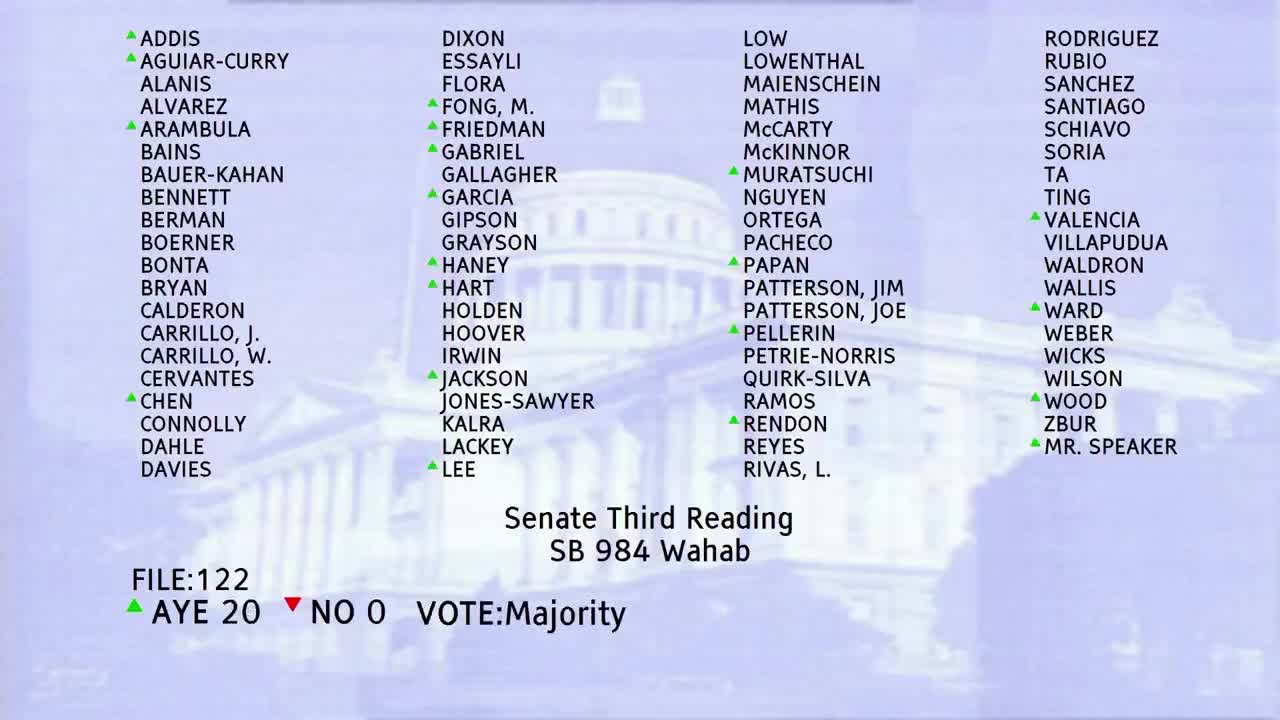
Bill Author