SB 1019: Firearms: destruction.
- Session Year: 2023-2024
- House: Senate
- Latest Version Date: 2024-09-24
Current Status:
Passed
(2024-09-24: Chaptered by Secretary of State. Chapter 547, Statutes of 2024.)
Introduced
In Committee
First Chamber
In Committee
Second Chamber
Enacted
Existing law requires the destruction of certain firearms, in the possession of a law enforcement agency, that have been confiscated, seized, abandoned, unclaimed, or surrendered.
This bill would specify that destruction of a firearm means destroying the firearm in its entirety by smelting, shredding, crushing, or cutting all parts of the firearm, including any attachments. The bill would also require every law enforcement agency, as defined, to develop and maintain a written policy regarding the destruction of firearms and shall make that policy available on its internet website. The bill would exempt from the requirements to destroy a weapon pursuant to the bills provisions law enforcement agencies that have existing contracts prior to November 1, 2024, with another person or entity for the destruction of firearms if the law enforcement agency would have to breach its existing contract with the other person or entity.
By requiring local law enforcement agencies to follow specified requirements for destruction and to create and maintain a written policy on firearm destruction, this bill would impose a state-mandated local program.
Existing law requires certain officers who possess firearms that were exhibits in a criminal proceeding that were left unclaimed for at least 180 days to destroy the firearm, as specified.
This bill would exempt firearms that were stolen or used without the prior knowledge of their lawful owner and that are possessed by a public administrator, public guardian, or public conservator in the performance of their duties as the personal representative of a decedents estate, or in the performance of the duties of a conservator or guardian over a person or their estate.
This bill would incorporate additional changes to Section 18005 of the Penal Code proposed by AB 2739 and AB 2842 to be operative only if this bill and either or both of those bills are enacted and this bill is enacted last.
The California Constitution requires the state to reimburse local agencies and school districts for certain costs mandated by the state. Statutory provisions establish procedures for making that reimbursement.
This bill would provide that, if the Commission on State Mandates determines that the bill contains costs mandated by the state, reimbursement for those costs shall be made pursuant to the statutory provisions noted above.
Existing law requires the destruction of certain firearms, in the possession of a law enforcement agency, that have been confiscated, seized, abandoned, unclaimed, or surrendered.
This bill would specify that destruction of a firearm means destroying the firearm in its entirety by smelting, shredding, crushing, or cutting all parts of the firearm, including any attachments. The bill would also require every law enforcement agency, as defined, to develop and maintain a written policy regarding the destruction of firearms and shall make that policy available on its internet website. The bill would exempt from the requirements to destroy a weapon pursuant to the bills provisions law enforcement agencies that have existing contracts prior to November 1, 2024, with another person or entity for the destruction of firearms if the law enforcement agency would have to breach its existing contract with the other person or entity.
By requiring local law enforcement agencies to follow specified requirements for destruction and to create and maintain a written policy on firearm destruction, this bill would impose a state-mandated local program.
The bill would also make a technical correction.Existing law requires certain officers who possess firearms that were exhibits in a criminal proceeding that were left unclaimed for at least 180 days to destroy the firearm, as specified.
This bill would exempt firearms that were stolen or used without the prior knowledge of their lawful owner and that are possessed by a public administrator, public guardian, or public conservator in the performance of their duties as the personal representative of a decedents estate, or in the performance of the duties of a conservator or guardian over a person or their estate.
The California Constitution requires the state to reimburse local agencies and school districts for certain costs mandated by the state. Statutory provisions establish procedures for making that reimbursement.
This bill would provide that, if the Commission on State Mandates determines that the bill contains costs mandated by the state, reimbursement for those costs shall be made pursuant to the statutory provisions noted above.
Existing law requires the destruction of certain firearms, in the possession of a law enforcement agency, that have been confiscated, seized, abandoned, unclaimed, or surrendered.
This bill would specify that destruction of a firearm means destroying the firearm in its entirety by smelting, shredding, crushing, or cutting all parts of the firearm, including any attachments. The bill would also require every law enforcement agency, as defined, to develop and maintain a written policy regarding the destruction of firearms and shall make that policy available on its internet website.
By requiring local law enforcement agencies to follow specified requirements for destruction and to create and maintain a written policy on firearm destruction, this bill would impose a state-mandated local program.
The bill would also make a technical correction.
The California Constitution requires the state to reimburse local agencies and school districts for certain costs mandated by the state. Statutory provisions establish procedures for making that reimbursement.
This bill would provide that, if the Commission on State Mandates determines that the bill contains costs mandated by the state, reimbursement for those costs shall be made pursuant to the statutory provisions noted above.
Existing law requires the destruction of certain firearms, in the possession of a law enforcement agency, that have been confiscated, seized, abandoned, unclaimed, or surrendered.
This bill would specify that destruction of a firearm means destroying the firearm in its entirety by smelting, shredding, crushing, or cutting all parts of the firearm, including any attachments. The bill would also require every law enforcement agency, as defined, to develop and maintain a written policy regarding the destruction of firearms and shall make that policy available on its internet website.
By requiring local law enforcement agencies to follow specified requirements for destruction and to create and maintain a written policy on firearm destruction, this bill would impose a state-mandated local program.
The California Constitution requires the state to reimburse local agencies and school districts for certain costs mandated by the state. Statutory provisions establish procedures for making that reimbursement.
This bill would provide that, if the Commission on State Mandates determines that the bill contains costs mandated by the state, reimbursement for those costs shall be made pursuant to the statutory provisions noted above.
(a)An officer to whom a weapon is surrendered under Section 18000, except upon the certificate of a judge of a court of record, or of the district attorney of the county, that the retention thereof is necessary or proper to the ends of justice, shall destroy that weapon and, if applicable, submit proof of its destruction to the court.
(b)If any weapon has been stolen and is thereafter recovered from the thief or the thiefs transferee, or is used in a manner as to constitute a nuisance under Section 19190, 21390, 21590, or 29300, or subdivision (a) of Section 25700 without the prior knowledge of its lawful owner that it would be so used, it shall not be destroyed pursuant to subdivision (a) but shall be restored to the lawful owner, as soon as its use as evidence has been served, upon the lawful owners identification of the weapon and proof of ownership, and after the law enforcement agency has complied with Chapter 2 (commencing with Section 33850) of Division 11 of Title 4.
(c)No stolen weapon shall be destroyed pursuant to subdivision (a) unless reasonable notice is given to its lawful owner, if the lawful owners identity and address can be reasonably ascertained.
(d)If the weapon was evidence in a criminal case, the weapon shall be retained as required by Chapter 13 (commencing with Section 1417) of Title 10 of Part 2.
(e)(1)Every law enforcement agency shall develop and maintain a written policy on the destruction of firearms and other weapons including, without limitation, policies for identifying firearms and other weapons that are required to be destroyed, keeping records of those firearms and other weapons, including entry into the Automated Firearms System, as applicable, and the destruction and disposal of those firearms and other weapons. A law enforcement agency that either contracts with, or operates under, a memorandum of understanding (MOU) with another agency for the storage or destruction of weapons or other firearms shall have a policy identifying the other agency and outlining the responsibilities of both agencies under the contract or MOU.
(2)Every law enforcement agency shall post the policy required by this subdivision on its internet website.
(f)As used in this section, the following terms are defined as follows:
(1)Destroy means to destroy a firearm or other weapon in its entirety by smelting, shredding, crushing, or cutting and shall include all parts including, without limitation, the frame or receiver, barrel, bolt, and grip of a firearm, as applicable, and any attachments including, but not limited to, a sight, scope, silencer, or suppressor, as applicable.
(2)Law enforcement agency means any police department, sheriffs department, or other department or agency of the state, or any political subdivision thereof, that employs any peace officer as described in Section 830.
(g)A law enforcement agency that had an existing contract with another person or entity for the destruction of firearms or other weapons prior to November 1, 2024, is not required to destroy a weapon pursuant to the amendments made to this section by the act that added this subdivision if those amendments would require the law enforcement agency to breach its contract with the other person or entity.
SEC. 1.1.Section 18005 of the Penal Code is amended to read:18005.(a)An officer to whom a weapon is surrendered under Section 18000, except upon the certificate of a judge of a court of record, or of the district attorney of the county, that the retention thereof is necessary or proper to the ends of justice, shall destroy that weapon and, if applicable, submit proof of its destruction to the court.
(b)If any weapon has been stolen and is thereafter recovered from the thief or the thiefs transferee, or is used in a manner as to constitute a nuisance under Section 19190, 21390, 21590, 25700, 26110, 26395, or 29300, without the prior knowledge of its lawful owner that it would be so used, it shall not be destroyed pursuant to subdivision (a) but shall be restored to the lawful owner, as soon as its use as evidence has been served, upon the lawful owners identification of the weapon and proof of ownership, and after the law enforcement agency has complied with Chapter 2 (commencing with Section 33850) of Division 11 of Title 4.
(c)No stolen weapon shall be destroyed pursuant to subdivision (a) unless reasonable notice is given to its lawful owner, if the lawful owners identity and address can be reasonably ascertained.
(d)If the weapon was evidence in a criminal case, the weapon shall be retained as required by Chapter 13 (commencing with Section 1417) of Title 10 of Part 2.
(e)(1)Every law enforcement agency shall develop and maintain a written policy on the destruction of firearms and other weapons including, without limitation, policies for identifying firearms and other weapons that are required to be destroyed, keeping records of those firearms and other weapons, including entry into the Automated Firearms System, as applicable, and the destruction and disposal of those firearms and other weapons. A law enforcement agency that either contracts with, or operates under, a memorandum of understanding (MOU) with another agency for the storage or destruction of weapons or other firearms shall have a policy identifying the other agency and outlining the responsibilities of both agencies under the contract or MOU.
(2)Every law enforcement agency shall post the policy required by this subdivision on its internet website.
(f)As used in this section, the following terms are defined as follows:
(1)Destroy means to destroy a firearm or other weapon in its entirety by smelting, shredding, crushing, or cutting and shall include all parts including, without limitation, the frame or receiver, barrel, bolt, and grip of a firearm, as applicable, and any attachments including, but not limited to, a sight, scope, silencer, or suppressor, as applicable.
(2)Law enforcement agency means any police department, sheriffs department, or other department or agency of the state, or any political subdivision thereof, that employs any peace officer as described in Section 830.
(g)A law enforcement agency that had an existing contract with another person or entity for the destruction of firearms or other weapons prior to November 1, 2024, is not required to destroy a weapon pursuant to the requirements of subdivision (e) or (f) if any of those requirements would require the law enforcement agency to breach its contract with the other person or entity.
SEC. 1.3.Section 18005 of the Penal Code is amended to read:18005.(a)An officer to whom a weapon is surrendered under Section 18000, except upon the certificate of a judge of a court of record, or of the district attorney of the county, that the retention thereof is necessary or proper to the ends of justice, shall destroy that weapon and, if applicable, submit proof of its destruction to the court.
(b)If any weapon has been stolen and is thereafter recovered from the thief or the thiefs transferee, or is used in a manner as to constitute a nuisance under Section 19190, 21390, 21590, or 29300, or subdivision (a) of Section 25700 without the prior knowledge of its lawful owner that it would be so used, it shall not be destroyed pursuant to subdivision (a) but shall be restored to the lawful owner, as soon as its use as evidence has been served, upon the lawful owners identification of the weapon and proof of ownership, and after the law enforcement agency has complied with Chapter 2 (commencing with Section 33850) of Division 11 of Title 4.
(c)No stolen weapon shall be destroyed pursuant to subdivision (a) unless reasonable notice is given to its lawful owner, if the lawful owners identity and address can be reasonably ascertained.
(d)If the weapon was evidence in a criminal case, the weapon shall be retained as required by Chapter 13 (commencing with Section 1417) of Title 10 of Part 2.
(e)(1)Every law enforcement agency shall develop and maintain a written policy on the destruction of firearms and other weapons including, without limitation, policies for identifying firearms and other weapons that are required to be destroyed, keeping records of those firearms and other weapons, including entry into the Automated Firearms System, as applicable, and the destruction and disposal of those firearms and other weapons. A law enforcement agency that either contracts with, or operates under, a memorandum of understanding (MOU) with another agency for the storage or destruction of weapons or other firearms shall have a policy identifying the other agency and outlining the responsibilities of both agencies under the contract or MOU.
(2)Every law enforcement agency shall post the policy required by this subdivision on its internet website.
(f)As used in this section, the following terms are defined as follows:
(1)Destroy means to destroy a firearm or other weapon in its entirety by smelting, shredding, crushing, or cutting and shall include all parts including, without limitation, the frame or receiver, barrel, bolt, and grip of a firearm, as applicable, and any attachments including, but not limited to, a sight, scope, silencer, or suppressor, as applicable.
(2)Law enforcement agency means any police department, sheriffs department, or other department or agency of the state, or any political subdivision thereof, that employs any peace officer as described in Section 830.
(g)(1)If a law enforcement agency contracts with a third party for the destruction of firearms or other weapons pursuant to this section or any other related law, the agency shall ensure that any such contract explicitly prohibits the sale of any firearm or weapon, or any part or attachment thereof.
(2)This subdivision is not intended to prohibit the recycling, or sale for the purpose of recycling, of any scrap metal or other material resulting from the destruction of a firearm or other weapon.
(h)A law enforcement agency that had an existing contract with another person or entity for the destruction of firearms or other weapons prior to November 1, 2024, is not required to destroy a weapon pursuant to the requirements of subdivision (e) or (f) if any of those requirements would require the law enforcement agency to breach its contract with the other person or entity.
SEC. 1.5.Section 18005 of the Penal Code is amended to read:18005.(a)An officer to whom a weapon is surrendered under Section 18000, except upon the certificate of a judge of a court of record, or of the district attorney of the county, that the retention thereof is necessary or proper to the ends of justice, shall destroy that weapon and, if applicable, submit proof of its destruction to the court.
(b)If any weapon has been stolen and is thereafter recovered from the thief or the thiefs transferee, or is used in a manner as to constitute a nuisance under Section 19190, 21390, 21590, 25700, 26110, 26395, or 29300, without the prior knowledge of its lawful owner that it would be so used, it shall not be destroyed pursuant to subdivision (a) but shall be restored to the lawful owner, as soon as its use as evidence has been served, upon the lawful owners identification of the weapon and proof of ownership, and after the law enforcement agency has complied with Chapter 2 (commencing with Section 33850) of Division 11 of Title 4.
(c)No stolen weapon shall be destroyed pursuant to subdivision (a) unless reasonable notice is given to its lawful owner, if the lawful owners identity and address can be reasonably ascertained.
(d)If the weapon was evidence in a criminal case, the weapon shall be retained as required by Chapter 13 (commencing with Section 1417) of Title 10 of Part 2.
(e)(1)Every law enforcement agency shall develop and maintain a written policy on the destruction of firearms and other weapons including, without limitation, policies for identifying firearms and other weapons that are required to be destroyed, keeping records of those firearms and other weapons, including entry into the Automated Firearms System, as applicable, and the destruction and disposal of those firearms and other weapons. A law enforcement agency that either contracts with, or operates under, a memorandum of understanding (MOU) with another agency for the storage or destruction of weapons or other firearms shall have a policy identifying the other agency and outlining the responsibilities of both agencies under the contract or MOU.
(2)Every law enforcement agency shall post the policy required by this subdivision on its internet website.
(f)As used in this section, the following terms are defined as follows:
(1)Destroy means to destroy a firearm or other weapon in its entirety by smelting, shredding, crushing, or cutting and shall include all parts including, without limitation, the frame or receiver, barrel, bolt, and grip of a firearm, as applicable, and any attachments including, but not limited to, a sight, scope, silencer, or suppressor, as applicable.
(2)Law enforcement agency means any police department, sheriffs department, or other department or agency of the state, or any political subdivision thereof, that employs any peace officer as described in Section 830.
(g)(1)If a law enforcement agency contracts with a third party for the destruction of firearms or other weapons pursuant to this section or any other related law, the agency shall ensure that any such contract explicitly prohibits the sale of any firearm or weapon, or any part or attachment thereof.
(2)This subdivision is not intended to prohibit the recycling, or sale for the purpose of recycling, of any scrap metal or other material resulting from the destruction of a firearm or other weapon.
(h)A law enforcement agency that had an existing contract with another person or entity for the destruction of firearms or other weapons prior to November 1, 2024, is not required to destroy a weapon pursuant to the requirements of subdivision (e) or (f) if any of those requirements would require the law enforcement agency to breach its contract with the other person or entity.
SEC. 2.Section 34000 of the Penal Code is amended to read:34000.(a)Notwithstanding any provision of law or of any local ordinance to the contrary, when any firearm is in the possession of any officer of the state, or of a county, city, or city and county, or of any campus of the University of California or the California State University, and the firearm is an exhibit filed in any criminal action or proceeding which is no longer needed or is unclaimed or abandoned property, which has been in the possession of the officer for at least 180 days, the firearm shall be destroyed as provided for in Sections 18000 and 18005.
(b)This section does not apply to any firearm in the possession of the Department of Fish and Wildlife, or which was used in the violation of any provision in the Fish and Game Code, or any regulation under that code.
(c)This section does not apply to a firearm described in subdivision (b) of Section 18005 in the possession of a public administrator, public guardian, or public conservator in the performance of their duties as the personal representative of a decedents estate, or in the performance of the duties of a conservator or guardian over a person or their estate, in order to fulfill their obligations under state law.
SEC. 3.(a)Section 1.1 of this bill incorporates amendments to Section 18005 of the Penal Code proposed by both this bill and Assembly Bill 2739. That section of this bill shall only become operative if (1) both bills are enacted and become effective on or before January 1, 2025, (2) each bill amends Section 18005 of the Penal Code, (3) Assembly Bill 2842 is not enacted or as enacted does not amend that section, and (4) this bill is enacted after Assembly Bill 2739, in which case Sections 1, 1.3, and 1.5 of this bill shall not become operative.
(b)Section 1.3 of this bill incorporates amendments to Section 18005 of the Penal Code proposed by both this bill and Assembly Bill 2842. That section of this bill shall only become operative if (1) both bills are enacted and become effective on or before January 1, 2025, (2) each bill amends Section 18005 of the Penal Code, (3) Assembly Bill 2739 is not enacted or as enacted does not amend that section, and (4) this bill is enacted after Assembly Bill 2842 in which case Sections 1, 1.1, and 1.5 of this bill shall not become operative.
(c)Section 1.5 of this bill incorporates amendments to Section 18005 of the Penal Code proposed by this bill, Assembly Bill 2739, and Assembly Bill 2842. That section of this bill shall only become operative if (1) all three bills are enacted and become effective on or before January 1, 2025, (2) all three bills amend Section 18005 of the Penal Code, and (3) this bill is enacted after Assembly Bill 2739 and Assembly Bill 2842, in which case Sections 1, 1.1, and 1.3 of this bill shall not become operative.
SEC. 4.If the Commission on State Mandates determines that this act contains costs mandated by the state, reimbursement to local agencies and school districts for those costs shall be made pursuant to Part 7 (commencing with Section 17500) of Division 4 of Title 2 of the Government Code.
(a)An officer to whom a weapon is surrendered under Section 18000, except upon the certificate of a judge of a court of record, or of the district attorney of the county, that the retention thereof is necessary or proper to the ends of justice, shall destroy that weapon and, if applicable, submit proof of its destruction to the court.
(b)If any weapon has been stolen and is thereafter recovered from the thief or the thiefs transferee, or is used in a manner as to constitute a nuisance under Section 19190, 21390, 21590, or 29300, or subdivision (a) of Section 25700 without the prior knowledge of its lawful owner that it would be so used, it shall not be destroyed pursuant to subdivision (a) but shall be restored to the lawful owner, as soon as its use as evidence has been served, upon the lawful owners identification of the weapon and proof of ownership, and after the law enforcement agency has complied with Chapter 2 (commencing with Section 33850) of Division 11 of Title 4.
(c)No stolen weapon shall be destroyed pursuant to subdivision (a) unless reasonable notice is given to its lawful owner, if the lawful owners identity and address can be reasonably ascertained.
(d)If the weapon was evidence in a criminal case, the weapon shall be retained as required by Chapter 13 (commencing with Section 1417) of Title 10 of Part 2.
(e)(1)Every law enforcement agency shall develop and maintain a written policy on the destruction of firearms and other weapons including, without limitation, policies for identifying firearms and other weapons that are required to be destroyed, keeping records of those firearms and other weapons, including entry into the Automated Firearms System, as applicable, and the destruction and disposal of those firearms and other weapons. A law enforcement agency that either contracts with, or operates under, a memorandum of understanding (MOU) with another agency for the storage or destruction of weapons or other firearms shall have a policy identifying the other agency and outlining the responsibilities of both agencies under the contract or MOU.
(2)Every law enforcement agency shall post the policy required by this subdivision on its internet website.
(f)As used in this section, the following terms are defined as follows:
(1)Destroy means to destroy a firearm or other weapon in its entirety by smelting, shredding, crushing, or cutting and shall include all parts including, without limitation, the frame or receiver, barrel, bolt, and grip of a firearm, as applicable, and any attachments including, but not limited to, a sight, scope, silencer, or suppressor, as applicable.
(2)Law enforcement agency means any police department, sheriffs department, or other department or agency of the state, or any political subdivision thereof, that employs any peace officer as described in Section 830.
(g)A law enforcement agency that had an existing contract with another person or entity for the destruction of firearms or other weapons prior to November 1, 2024, is not required to destroy a weapon pursuant to the amendments made to this section by the act that added this subdivision if those amendments would require the law enforcement agency to breach its contract with the other person or entity.
SEC. 1.1.Section 18005 of the Penal Code is amended to read:18005.(a)An officer to whom a weapon is surrendered under Section 18000, except upon the certificate of a judge of a court of record, or of the district attorney of the county, that the retention thereof is necessary or proper to the ends of justice, shall destroy that weapon and, if applicable, submit proof of its destruction to the court.
(b)If any weapon has been stolen and is thereafter recovered from the thief or the thiefs transferee, or is used in a manner as to constitute a nuisance under Section 19190, 21390, 21590, or 29300, or subdivision (a) of Section 25700 25700, 26110, 26395, or 29300, without the prior knowledge of its lawful owner that it would be so used, it shall not be destroyed pursuant to subdivision (a) but shall be restored to the lawful owner, as soon as its use as evidence has been served, upon the lawful owners identification of the weapon and proof of ownership, and after the law enforcement agency has complied with Chapter 2 (commencing with Section 33850) of Division 11 of Title 4.
(c)No stolen weapon shall be destroyed pursuant to subdivision (a) unless reasonable notice is given to its lawful owner, if the lawful owners identity and address can be reasonably ascertained.
(d)If the weapon was evidence in a criminal case, the weapon shall be retained as required by Chapter 13 (commencing with Section 1417) of Title 10 of Part 2.
(e)(1)Every law enforcement agency shall develop and maintain a written policy on the destruction of firearms and other weapons including, without limitation, policies for identifying firearms and other weapons that are required to be destroyed, keeping records of those firearms and other weapons, including entry into the Automated Firearms System, as applicable, and the destruction and disposal of those firearms and other weapons. A law enforcement agency that either contracts with, or operates under, a memorandum of understanding (MOU) with another agency for the storage or destruction of weapons or other firearms shall have a policy identifying the other agency and outlining the responsibilities of both agencies under the contract or MOU.
(2)Every law enforcement agency shall post the policy required by this subdivision on its internet website.
(f)As used in this section, the following terms are defined as follows:
(1)Destroy means to destroy a firearm or other weapon in its entirety by smelting, shredding, crushing, or cutting and shall include all parts including, without limitation, the frame or receiver, barrel, bolt, and grip of a firearm, as applicable, and any attachments including, but not limited to, a sight, scope, silencer, or suppressor, as applicable.
(2)Law enforcement agency means any police department, sheriffs department, or other department or agency of the state, or any political subdivision thereof, that employs any peace officer as described in Section 830.
(g)A law enforcement agency that had an existing contract with another person or entity for the destruction of firearms or other weapons prior to November 1, 2024, is not required to destroy a weapon pursuant to the requirements of subdivision (e) or (f) if any of those requirements would require the law enforcement agency to breach its contract with the other person or entity.
SEC. 1.3.Section 18005 of the Penal Code is amended to read:18005.(a)An officer to whom a weapon is surrendered under Section 18000, except upon the certificate of a judge of a court of record, or of the district attorney of the county, that the retention thereof is necessary or proper to the ends of justice, shall destroy that weapon and, if applicable, submit proof of its destruction to the court.
(b)If any weapon has been stolen and is thereafter recovered from the thief or the thiefs transferee, or is used in a manner as to constitute a nuisance under Section 19190, 21390, 21590, or 29300, or subdivision (a) of Section 25700 without the prior knowledge of its lawful owner that it would be so used, it shall not be destroyed pursuant to subdivision (a) but shall be restored to the lawful owner, as soon as its use as evidence has been served, upon the lawful owners identification of the weapon and proof of ownership, and after the law enforcement agency has complied with Chapter 2 (commencing with Section 33850) of Division 11 of Title 4.
(c)No stolen weapon shall be destroyed pursuant to subdivision (a) unless reasonable notice is given to its lawful owner, if the lawful owners identity and address can be reasonably ascertained.
(d)If the weapon was evidence in a criminal case, the weapon shall be retained as required by Chapter 13 (commencing with Section 1417) of Title 10 of Part 2.
(e)(1)Every law enforcement agency shall develop and maintain a written policy on the destruction of firearms and other weapons including, without limitation, policies for identifying firearms and other weapons that are required to be destroyed, keeping records of those firearms and other weapons, including entry into the Automated Firearms System, as applicable, and the destruction and disposal of those firearms and other weapons. A law enforcement agency that either contracts with, or operates under, a memorandum of understanding (MOU) with another agency for the storage or destruction of weapons or other firearms shall have a policy identifying the other agency and outlining the responsibilities of both agencies under the contract or MOU.
(2)Every law enforcement agency shall post the policy required by this subdivision on its internet website.
(f)As used in this section, the following terms are defined as follows:
(1)Destroy means to destroy a firearm or other weapon in its entirety by smelting, shredding, crushing, or cutting and shall include all parts including, without limitation, the frame or receiver, barrel, bolt, and grip of a firearm, as applicable, and any attachments including, but not limited to, a sight, scope, silencer, or suppressor, as applicable.
(2)Law enforcement agency means any police department, sheriffs department, or other department or agency of the state, or any political subdivision thereof, that employs any peace officer as described in Section 830.
(g)(1)If a law enforcement agency contracts with a third party for the destruction of firearms or other weapons pursuant to this section or any other related law, the agency shall ensure that any such contract explicitly prohibits the sale of any firearm or weapon, or any part or attachment thereof.
(2)This subdivision is not intended to prohibit the recycling, or sale for the purpose of recycling, of any scrap metal or other material resulting from the destruction of a firearm or other weapon.
(h)A law enforcement agency that had an existing contract with another person or entity for the destruction of firearms or other weapons prior to November 1, 2024, is not required to destroy a weapon pursuant to the requirements of subdivision (e) or (f) if any of those requirements would require the law enforcement agency to breach its contract with the other person or entity.
SEC. 1.5.Section 18005 of the Penal Code is amended to read:18005.(a)An officer to whom a weapon is surrendered under Section 18000, except upon the certificate of a judge of a court of record, or of the district attorney of the county, that the retention thereof is necessary or proper to the ends of justice, shall destroy that weapon and, if applicable, submit proof of its destruction to the court.
(b)If any weapon has been stolen and is thereafter recovered from the thief or the thiefs transferee, or is used in a manner as to constitute a nuisance under Section 19190, 21390, 21590, or 29300, or subdivision (a) of Section 25700 25700, 26110, 26395, or 29300, without the prior knowledge of its lawful owner that it would be so used, it shall not be destroyed pursuant to subdivision (a) but shall be restored to the lawful owner, as soon as its use as evidence has been served, upon the lawful owners identification of the weapon and proof of ownership, and after the law enforcement agency has complied with Chapter 2 (commencing with Section 33850) of Division 11 of Title 4.
(c)No stolen weapon shall be destroyed pursuant to subdivision (a) unless reasonable notice is given to its lawful owner, if the lawful owners identity and address can be reasonably ascertained.
(d)If the weapon was evidence in a criminal case, the weapon shall be retained as required by Chapter 13 (commencing with Section 1417) of Title 10 of Part 2.
(e)(1)Every law enforcement agency shall develop and maintain a written policy on the destruction of firearms and other weapons including, without limitation, policies for identifying firearms and other weapons that are required to be destroyed, keeping records of those firearms and other weapons, including entry into the Automated Firearms System, as applicable, and the destruction and disposal of those firearms and other weapons. A law enforcement agency that either contracts with, or operates under, a memorandum of understanding (MOU) with another agency for the storage or destruction of weapons or other firearms shall have a policy identifying the other agency and outlining the responsibilities of both agencies under the contract or MOU.
(2)Every law enforcement agency shall post the policy required by this subdivision on its internet website.
(f)As used in this section, the following terms are defined as follows:
(1)Destroy means to destroy a firearm or other weapon in its entirety by smelting, shredding, crushing, or cutting and shall include all parts including, without limitation, the frame or receiver, barrel, bolt, and grip of a firearm, as applicable, and any attachments including, but not limited to, a sight, scope, silencer, or suppressor, as applicable.
(2)Law enforcement agency means any police department, sheriffs department, or other department or agency of the state, or any political subdivision thereof, that employs any peace officer as described in Section 830.
(g)(1)If a law enforcement agency contracts with a third party for the destruction of firearms or other weapons pursuant to this section or any other related law, the agency shall ensure that any such contract explicitly prohibits the sale of any firearm or weapon, or any part or attachment thereof.
(2)This subdivision is not intended to prohibit the recycling, or sale for the purpose of recycling, of any scrap metal or other material resulting from the destruction of a firearm or other weapon.
(h)A law enforcement agency that had an existing contract with another person or entity for the destruction of firearms or other weapons prior to November 1, 2024, is not required to destroy a weapon pursuant to the requirements of subdivision (e) or (f) if any of those requirements would require the law enforcement agency to breach its contract with the other person or entity.
SEC. 2.Section 34000 of the Penal Code is amended to read:34000.(a)Notwithstanding any provision of law or of any local ordinance to the contrary, when any firearm is in the possession of any officer of the state, or of a county, city, or city and county, or of any campus of the University of California or the California State University, and the firearm is an exhibit filed in any criminal action or proceeding which is no longer needed or is unclaimed or abandoned property, which has been in the possession of the officer for at least 180 days, the firearm shall be destroyed as provided for in Sections 18000 and 18005.
(b)This section does not apply to any firearm in the possession of the Department of Fish and Wildlife, or which was used in the violation of any provision in the Fish and Game Code, or any regulation under that code.
(c)This section does not apply to a firearm described in subdivision (b) of Section 18005 in the possession of a public administrator, public guardian, or public conservator in the performance of their duties as the personal representative of a decedents estate, or in the performance of the duties of a conservator or guardian over a person or their estate, in order to fulfill their obligations under state law.
SEC. 3.(a)Section 1.1 of this bill incorporates amendments to Section 18005 of the Penal Code proposed by both this bill and Assembly Bill 2739. That section of this bill shall only become operative if (1) both bills are enacted and become effective on or before January 1, 2025, (2) each bill amends Section 18005 of the Penal Code, (3) Assembly Bill 2842 is not enacted or as enacted does not amend that section, and (4) this bill is enacted after Assembly Bill 2739, in which case Sections 1, 1.3, and 1.5 of this bill shall not become operative.
(b)Section 1.3 of this bill incorporates amendments to Section 18005 of the Penal Code proposed by both this bill and Assembly Bill 2842. That section of this bill shall only become operative if (1) both bills are enacted and become effective on or before January 1, 2025, (2) each bill amends Section 18005 of the Penal Code, (3) Assembly Bill 2739 is not enacted or as enacted does not amend that section, and (4) this bill is enacted after Assembly Bill 2842 in which case Sections 1, 1.1, and 1.5 of this bill shall not become operative.
(c)Section 1.5 of this bill incorporates amendments to Section 18005 of the Penal Code proposed by this bill, Assembly Bill 2739, and Assembly Bill 2842. That section of this bill shall only become operative if (1) all three bills are enacted and become effective on or before January 1, 2025, (2) all three bills amend Section 18005 of the Penal Code, and (3) this bill is enacted after Assembly Bill 2739 and Assembly Bill 2842, in which case Sections 1, 1.1, and 1.3 of this bill shall not become operative.
SEC. 3.SEC. 4.If the Commission on State Mandates determines that this act contains costs mandated by the state, reimbursement to local agencies and school districts for those costs shall be made pursuant to Part 7 (commencing with Section 17500) of Division 4 of Title 2 of the Government Code.
(a)An officer to whom a weapon is surrendered under Section 18000, except upon the certificate of a judge of a court of record, or of the district attorney of the county, that the retention thereof is necessary or proper to the ends of justice, shall destroy that weapon and, if applicable, submit proof of its destruction to the court.
(b)If any weapon has been stolen and is thereafter recovered from the thief or the thiefs transferee, or is used in a manner as to constitute a nuisance under Section 19190, 21390, 21590, or 29300, or subdivision (a) of Section 25700 without the prior knowledge of its lawful owner that it would be so used, it shall not be destroyed pursuant to subdivision (a) but shall be restored to the lawful owner, as soon as its use as evidence has been served, upon the lawful owners identification of the weapon and proof of ownership, and after the law enforcement agency has complied with Chapter 2 (commencing with Section 33850) of Division 11 of Title 4.
(c)No stolen weapon shall be destroyed pursuant to subdivision (a) unless reasonable notice is given to its lawful owner, if the lawful owners identity and address can be reasonably ascertained.
(d)If the weapon was evidence in a criminal case, the weapon shall be retained as required by Chapter 13 (commencing with Section 1417) of Title 10 of Part 2.
(e)(1)Every law enforcement agency shall develop and maintain a written policy on the destruction of firearms and other weapons including, without limitation, policies for identifying firearms and other weapons that are required to be destroyed, keeping records of those firearms and other weapons, including entry into the Automated Firearms System, as applicable, and the destruction and disposal of those firearms and other weapons. A law enforcement agency that either contracts with, or operates under, a memorandum of understanding (MOU) with another agency for the storage or destruction of weapons or other firearms shall have a policy identifying the other agency and outlining the responsibilities of both agencies under the contract or MOU.
(2)Every law enforcement agency shall post the policy required by this subdivision on its internet website website.
(f)As used in this section, the following terms are defined as follows:
(1)Destroy means to destroy a firearm or other weapon in its entirety by smelting, shredding, crushing, or cutting and shall include all parts including, without limitation, the frame or receiver, barrel, bolt, and grip of a firearm, as applicable, and any attachments including, but not limited to, a sight, scope, silencer, or suppressor, as applicable.
(2)Law enforcement agency means any police department, sheriffs department, or other department or agency of the state, or any political subdivision thereof, that employs any peace officer as described in Section 830.
(g)A law enforcement agency that had an existing contract with another person or entity for the destruction of firearms or other weapons prior to November 1, 2024, is not required to destroy a weapon pursuant to the amendments made to this section by the act that added this subdivision if those amendments would require the law enforcement agency to breach its contract with the other person or entity.
SEC. 2.Section 34000 of the Penal Code is amended to read:34000.(a)Notwithstanding any provision of law or of any local ordinance to the contrary, when any firearm is in the possession of any officer of the state, or of a county, city, or city and county, or of any campus of the University of California or the California State University, and the firearm is an exhibit filed in any criminal action or proceeding which is no longer needed or is unclaimed or abandoned property, which has been in the possession of the officer for at least 180 days, the firearm shall be destroyed as provided for in Sections 18000 and 18005.
(b)This section does not apply to any firearm in the possession of the Department of Fish and Game, Wildlife, or which was used in the violation of any provision in the Fish and Game Code, or any regulation under that code.
(c)This section does not apply to a firearm described in subdivision (b) of Section 18005 in the possession of a public administrator, public guardian, or public conservator in the performance of their duties as the personal representative of a decedents estate, or in the performance of the duties of a conservator or guardian over a person or their estate, in order to fulfill their obligations under state law.
SEC. 3.If the Commission on State Mandates determines that this act contains costs mandated by the state, reimbursement to local agencies and school districts for those costs shall be made pursuant to Part 7 (commencing with Section 17500) of Division 4 of Title 2 of the Government Code.
(a)An officer to whom a weapon is surrendered under Section 18000, except upon the certificate of a judge of a court of record, or of the district attorney of the county, that the retention thereof is necessary or proper to the ends of justice, shall destroy that weapon and, if applicable, submit proof of its destruction to the court.
(b)If any weapon has been stolen and is thereafter recovered from the thief or the thiefs transferee, or is used in a manner as to constitute a nuisance under Section 19190, 21390, 21590, or 29300, or subdivision (a) of Section 25700 without the prior knowledge of its lawful owner that it would be so used, it shall not be destroyed pursuant to subdivision (a) but shall be restored to the lawful owner, as soon as its use as evidence has been served, upon the lawful owners identification of the weapon and proof of ownership, and after the law enforcement agency has complied with Chapter 2 (commencing with Section 33850) of Division 11 of Title 4.
(c)No stolen weapon shall be destroyed pursuant to subdivision (a) unless reasonable notice is given to its lawful owner, if the lawful owners identity and address can be reasonably ascertained.
(d)If the weapon was evidence in a criminal case, the weapon shall be retained as required by Chapter 13 (commencing with Section 1417) of Title 10 of Part 2.
(e)(1)Every law enforcement agency shall develop and maintain a written policy on the destruction of firearms and other weapons including, without limitation, policies for identifying firearms and other weapons that are required to be destroyed, keeping records of those firearms and other weapons, including entry into the Automated Firearms System, as applicable, and the destruction and disposal of those firearms and other weapons. A law enforcement agency that either contracts with, or operates under, a memorandum of understanding (MOU) with another agency for the storage or destruction of weapons or other firearms shall have a policy identifying the other agency and outlining the responsibilities of both agencies under the contract or MOU.
(2)Every law enforcement agency shall post the policy required by this subdivision on its internet website
(f)As used in this section, the following terms are defined as follows:
(1)Destroy means to destroy a firearm or other weapon in its entirety by smelting, shredding, crushing, or cutting and shall include all parts including, without limitation, the frame or receiver, barrel, bolt, and grip of a firearm, as applicable, and any attachments including, but not limited to, a sight, scope, silencer, or suppressor, as applicable.
(2)Law enforcement agency means any police department, sheriffs department, or other department or agency of the state, or any political subdivision thereof, that employs any peace officer as described in Section 830.
SEC. 2.Section 34000 of the Penal Code is amended to read:34000.(a)Notwithstanding any provision of law or of any local ordinance to the contrary, when any firearm is in the possession of any officer of the state, or of a county, city, or city and county, or of any campus of the University of California or the California State University, and the firearm is an exhibit filed in any criminal action or proceeding which is no longer needed or is unclaimed or abandoned property, which has been in the possession of the officer for at least 180 days, the firearm shall be sold, or destroyed, destroyed as provided for in Sections 18000 and 18005.
(b)This section does not apply to any firearm in the possession of the Department of Fish and Game, or which was used in the violation of any provision in the Fish and Game Code, or any regulation under that code.
SEC. 2.SEC. 3.If the Commission on State Mandates determines that this act contains costs mandated by the state, reimbursement to local agencies and school districts for those costs shall be made pursuant to Part 7 (commencing with Section 17500) of Division 4 of Title 2 of the Government Code.
(a)An officer to whom a weapon is surrendered under Section 18000, except upon the certificate of a judge of a court of record, or of the district attorney of the county, that the retention thereof is necessary or proper to the ends of justice, shall destroy that weapon and, if applicable, submit proof of its destruction to the court.
(b)If any weapon has been stolen and is thereafter recovered from the thief or the thiefs transferee, or is used in a manner as to constitute a nuisance under Section 19190, 21390, 21590, or 29300, or subdivision (a) of Section 25700 without the prior knowledge of its lawful owner that it would be so used, it shall not be destroyed pursuant to subdivision (a) but shall be restored to the lawful owner, as soon as its use as evidence has been served, upon the lawful owners identification of the weapon and proof of ownership, and after the law enforcement agency has complied with Chapter 2 (commencing with Section 33850) of Division 11 of Title 4.
(c)No stolen weapon shall be destroyed pursuant to subdivision (a) unless reasonable notice is given to its lawful owner, if the lawful owners identity and address can be reasonably ascertained.
(d)If the weapon was evidence in a criminal case, the weapon shall be retained as required by Chapter 13 (commencing with Section 1417) of Title 10 of Part 2.
(e)(1)Every law enforcement agency shall develop and maintain a written policy on the destruction of firearms and other weapons including, without limitation, policies for identifying firearms and other weapons that are required to be destroyed, keeping records of those firearms and other weapons, including entry into the Automated Firearms System, as applicable, and the destruction and disposal of those firearms and other weapons. A law enforcement agency that either contracts with, or operates under, a memorandum of understanding (MOU) with another agency for the storage or destruction of weapons or other firearms shall have a policy identifying the other agency and outlining the responsibilities of both agencies under the contract or MOU.
(2)Every law enforcement agency shall post the policy required by this subdivision on its internet website
(f)As used in this section, the following terms are defined as follows:
(1)Destroy means to destroy a firearm or other weapon in its entirety by smelting, shredding, crushing, or cutting and shall include all parts including, without limitation, the frame or receiver, barrel, bolt, and grip of a firearm, as applicable, and any attachments including, but not limited to, a sight, scope, silencer, or suppressor, as applicable.
(2)Law enforcement agency means any police department, sheriffs department, or other department or agency of the state, or any political subdivision thereof, that employs any peace officer as described in Section 830.
SEC. 2.If the Commission on State Mandates determines that this act contains costs mandated by the state, reimbursement to local agencies and school districts for those costs shall be made pursuant to Part 7 (commencing with Section 17500) of Division 4 of Title 2 of the Government Code.
|
Date
|
Status
|
|---|---|
| Sep 24, 2024 | Chaptered by Secretary of State. Chapter 547, Statutes of 2024. |
| Sep 24, 2024 | Approved by the Governor. |
| Sep 10, 2024 | Enrolled and presented to the Governor at 4 p.m. |
| Aug 30, 2024 | Assembly amendments concurred in. (Ayes 40. Noes 0. Page 5748.) Ordered to engrossing and enrolling. |
| Aug 29, 2024 | Ordered to special consent calendar. |
| Aug 28, 2024 | In Senate. Concurrence in Assembly amendments pending. |
| Aug 28, 2024 | Read third time. Passed. (Ayes 73. Noes 1. Page 6785.) Ordered to the Senate. |
| Aug 22, 2024 | Ordered to third reading. |
| Aug 22, 2024 | Read third time and amended. |
| Aug 20, 2024 | Read second time. Ordered to third reading. |
| Aug 19, 2024 | Read second time and amended. Ordered to second reading. |
| Aug 15, 2024 | From committee: Do pass as amended. (Ayes 11. Noes 0.) (August 15). |
| Aug 7, 2024 | August 7 set for first hearing. Placed on suspense file. |
| Jun 18, 2024 | From committee: Do pass and re-refer to Com. on APPR. with recommendation: To consent calendar. (Ayes 7. Noes 0.) (June 18). Re-referred to Com. on APPR. |
| Jun 3, 2024 | Referred to Com. on PUB. S. |
| May 24, 2024 | In Assembly. Read first time. Held at Desk. |
| May 23, 2024 | Read third time. Passed. (Ayes 37. Noes 0. Page 4179.) Ordered to the Assembly. |
| May 20, 2024 | Ordered to special consent calendar. |
| May 16, 2024 | From committee: Do pass. (Ayes 7. Noes 0. Page 3968.) (May 16). |
| May 16, 2024 | Read second time. Ordered to third reading. |
| May 10, 2024 | Set for hearing May 16. |
| Apr 22, 2024 | April 22 hearing: Placed on APPR suspense file. |
| Apr 12, 2024 | Set for hearing April 22. |
| Apr 8, 2024 | April 15 hearing postponed by committee. |
| Apr 5, 2024 | Set for hearing April 15. |
| Mar 19, 2024 | From committee: Do pass and re-refer to Com. on APPR. (Ayes 5. Noes 0. Page 3351.) (March 19). Re-referred to Com. on APPR. |
| Mar 11, 2024 | From committee with author's amendments. Read second time and amended. Re-referred to Com. on PUB S. |
| Feb 28, 2024 | Set for hearing March 19. |
| Feb 14, 2024 | Referred to Com. on PUB S. |
| Feb 7, 2024 | From printer. May be acted upon on or after March 8. |
| Feb 6, 2024 | Introduced. Read first time. To Com. on RLS. for assignment. To print. |
|
Date
|
Description
|
Location
|
Votes
|
|
|---|---|---|---|---|
| Aug 30, 2024 | Special Consent SB1019 Blakespear et al. | Senate Floor |
Passed |
|
| Aug 28, 2024 | SB 1019 Blakespear Senate Third Reading By Papan | Assembly Floor |
Passed |
|
| Aug 15, 2024 | Do pass as amended. | Assembly Standing Committee on Appropriations |
Passed |
|
| Jun 18, 2024 | Do pass and be re-referred to the Committee on [Appropriations] with recommendation: To Consent Calendar | Assembly Standing Committee on Public Safety |
Passed |
|
| May 23, 2024 | Special Consent SB1019 Blakespear et al. | Senate Floor |
Passed |
|
| May 16, 2024 | Do pass | Senate Standing Committee on Appropriations |
Passed |
|
| Apr 22, 2024 | Placed on suspense file | Senate Standing Committee on Appropriations |
Passed |
|
| Mar 19, 2024 | Do pass, but first be re-referred to the Committee on [Appropriations] | Senate Standing Committee on Public Safety |
Passed |
This list shows positions taken on this bill by organizations on the date displayed, which is linked to the original source.
Positions by individuals are not included.
|
Organization
|
Position
|
Date
|
|---|---|---|
| Brady California | ** Support | |
| Click here to enter text. | ** Against | |
| Everytown for Gun Safety Action Fund | ** Support | |
| Giffords Law Center To Prevent Gun Violence | ** Support | |
| Los Angeles County District AttorneyS Office | ** Support | |
| NeverAgainCA | ** Support | |
| San Diegans For Gun Violence Prevention | ** Support | |
| San Diego City Attorney's Office | ** Support | |
| Women Against Gun Violence | ** Support | |
| Women for American Values and Ethics | ** Support |
SENATE RULES COMMITTEE Office of Senate Floor Analyses (916) 651-1520 Fax: (916) 327-4478 | SB 1019 |
UNFINISHED BUSINESS
Bill No: SB 1019
Author: Blakespear (D), et al.
Amended: 8/22/24
Vote: 21
SENATE PUBLIC SAFETY COMMITTEE: 5-0, 3/19/24
AYES: Wahab, Seyarto, Bradford, Skinner, Wiener
SENATE APPROPRIATIONS COMMITTEE: 7-0, 5/16/24
AYES: Caballero, Jones, Ashby, Becker, Bradford, Seyarto, Wahab
SENATE FLOOR: 37-0, 5/23/24
AYES: Alvarado-Gil, Ashby, Atkins, Becker, Blakespear, Bradford, Caballero, Cortese, Dahle, Dodd, Durazo, Eggman, Glazer, Gonzalez, Grove, Hurtado, Jones, Laird, Limón, McGuire, Menjivar, Min, Nguyen, Niello, Ochoa Bogh, Padilla, Portantino, Roth, Rubio, Seyarto, Skinner, Smallwood-Cuevas, Stern, Umberg, Wahab, Wiener, Wilk
NO VOTE RECORDED: Allen, Archuleta, Newman
ASSEMBLY FLOOR: 73-1, 8/28/24 - See last page for vote
SUBJECT: Firearms: destruction
SOURCE: Brady Campaign
DIGEST:
This bill requires law enforcement agencies to destroy firearms subject to destruction under existing law in their entirety by smelting, shredding, crushing or cutting all parts of the firearm, including any attachments, except as specified, and requires every law enforcement agency to develop and make available on its website a written policy regarding the destruction of firearms.
Assembly Amendments
create an exemption for firearms possessed by law enforcement agencies that had an existing contract with another person or entity for the destruction of firearms if destroying those firearms would lead to a breach of contract, as specified, as well as for firearms in the possession of a public administrator, public guardian, or public conservator possessing the firearm in the performance of their duties, as specified. Assembly amendments also resolve chaptering issues.
ANALYSIS:
Existing law:
- States that when a firearm is taken into custody by a law enforcement officer, the officer shall issue the person who possessed the firearm a receipt describing the firearm, as specified, and listing any serial number or other identification on the firearm. (Pen. Code, §33800.)
- Establishes a detailed process governing the return or transfer of a firearm in the custody of a court or law enforcement agency. ((Pen. Code, §§ 33850 – 33895.)
- Provides that no law enforcement agency or court shall be required to retain any firearm or related device for more than 180 days after the owner has been notified that the property has been made available for return, and stipulates that an unclaimed firearm may be disposed of after the 180-day period. (Pen. Code, §§ 33875.)
- Provides that when any firearm is in the possession of any officer of the state, or of a county, city, or city and county, or of any campus of the University of California or the California State University, and the firearm is an exhibit filed in any criminal action or proceeding which is no longer needed or is unclaimed or abandoned property, which has been in the possession of the officer for at least 180 days, the firearm shall be sold, or destroyed, as provided. (Pen. Code § 34000, subd. (a).)
- Provides that any law enforcement agency that has custody of any firearms or any parts of firearms which are subject to destruction may, in lieu of destroying the weapons, retain and use any of them as may be useful in carrying out the official duties of the agency, including releasing weapons to another law enforcement agency for a similar use or turning over to the criminalistics laboratory of the DOJ or other local law enforcement entity, but must destroy the weapon when it is no longer needed by the agency for use in carrying out its official duties. (Pen. Code § 34005, subds. (b), (c).)
- Authorizes a law enforcement agency that has custody of any firearms or any parts of firearms that are subject to destruction to instead obtain a court order directing the release of the firearm to the sheriff, who must record the firearm in the Automated Firearms System (AFS), and may in turn loan out the firearm to the basic training academy so that the firearms may be used for educational purposes. (Pen. Code § 34005, subd. (d).)
- Provides that any weapon which is considered a nuisance under specified provisions of existing law shall be surrendered to the sheriff of a county, the chief of police or other head of a municipal police department of any city or city and county, the chief of police of any campus of the University of California or the California State University, or the Commissioner of the Highway Patrol (CHP). (Pen. Code § 18000, subd. (a).)
- Specifies that, for the purposes of the requirement above, the Commissioner of the CHP shall receive only weapons that were confiscated by a member of the CHP. (Pen. Code § 18000, subd. (b).)
- Provides that an officer to whom a weapon is surrendered, except upon receiving a certificate, as specified, stating that the retention of the weapon is necessary or proper to the ends of justice, shall destroy the weapon, and, if applicable, submit proof of its destruction to the court. (Pen. Code § 18005, subd. (a).)
- Specifies that if any weapon has been stolen and is thereafter recovered, or is used in a manner as to constitute a nuisance without the prior knowledge of its lawful owner that it would be so used, it shall not be destroyed per the above but rather restored to the lawful owner, as soon as its use as evidence has been served, upon the lawful owner’s identification of the weapon and proof of ownership, and after the law enforcement agency has complied with specified provisions of existing law governing the return or transfer of a firearm in the custody or control of a court or law enforcement agency. (Pen. Code § 18005, subd. (b).)
- Specifies that no weapon shall be destroyed per the requirement above unless reasonable notice is given to its lawful owner, if the lawful owner’s identity and address can be reasonable ascertained. (Pen. Code § 18005, subd. (c).)
- Authorizes the Attorney General, a district attorney, or a city attorney to bring an action to enjoin the manufacture, importation of, keeping for sale of, offering or exposing for sale, giving, lending, or possession of specified weapons, including various types of firearms and firearm precursor parts, and provides that those weapons shall be subject to confiscation and summary destruction, in the same manner specified in §18005, whenever they are found within the state. (Pen. Code § 18010.)
This bill:
- Requires every law enforcement agency to develop and maintain a written policy on the destruction of firearms and other weapons including, without limitation, policies for identifying firearms and other weapons that are required to be destroyed, keeping records of those firearms and other weapons, including entry into the Automated Firearms System (AFS), as applicable, and the destruction and disposal of those firearms and other weapons.
- Specifies that a law enforcement agency that either contracts with, or operates under, a memorandum of understanding (MOU) with another agency for the storage or destruction of weapons or other firearms shall have a policy identifying the other agency and outlining the responsibilities of both agencies under the contract or MOU.
- Requires every law enforcement agency subject to its provisions to post the weapon destruction policy on its internet website.
- Provides that a law enforcement agency that had an existing contract with another person or entity for the destruction of firearms or other weapons prior to November 1, 2024, is not required to destroy a weapon pursuant to the bill if it would require the law enforcement agency to breach a contract with the other person or entity.
- Defines “destroy” as the destruction of a firearm or other weapon in its entirety by smelting, shredding, crushing, or cutting and shall include all parts including, without limitation, the frame or receiver, barrel, bolt, and grip of a firearm, as applicable, and any attachments including, but not limited to, a sight, scope, silencer, or suppressor, as applicable.
- Defines “law enforcement agency” as any police department, sheriff’s department, or other department or agency of the state, or any political subdivision thereof, that employs any peace officer, as specified.
- Provides that, from the provision of law requiring law enforcement agencies to dispose of unneeded, unclaimed, or abandoned firearms within 180 days, exempts firearms deemed to be a nuisance that are in the possession of a public administrator, public guardian, or public conservator in the performance of their duties as the personal representative of a decedent’s estate, or in the performance of the duties of a conservator or guardian over a person or their estate, in order to fulfill their obligations under state law.
- Makes a technical change and conforming correction to the provision of law authorizing the sale of abandoned or unclaimed firearms, or firearms previously used as evidence in criminal actions, striking the reference to a law enforcement agency’s authority to sell those firearms.
Comments
According to the author, “Last December, the New York Times reported that, rather than be destroyed as promised, many of the firearms collected in gun buybacks across the country are recycled and resold online. For those of us devoted to reducing gun violence, especially those of us who work on crafting and passing legislation, the article represented a failure. I assumed things were as they seemed. They were not. Under existing federal guidelines and state law, guns are legally “destroyed” when a single part – the serialized frame or receiver – of a gun is destroyed. All the things that make a gun a gun, including the barrel, grip, slide, firing pin, and magazine, do not have to be demolished. Instead, the parts can be sold online as gun kits and combined with a frame or receiver to make a new gun. Individuals who want to avoid registration can easily pair the gun kit with an unserialized frame or receiver to create a “ghost” gun. In practice, this means that all but one piece of a firearm removed from Riverside, California, may end up on the street in Milwaukee as a ghost gun.
SB 1019 is about government doing what it says it’s going to do. When we say we’ll destroy of your unwanted guns for you, we should actually follow through with the implied promise: we are going to destroy your guns. SB 1019 ensures all guns acquired through gun buybacks or confiscated through investigations are completely destroyed.”
Law enforcement agencies routinely acquire and retain possession of firearms in the course of their investigatory duties, and must follow a specific process for their disposal set forth in California law. Generally, law enforcement agencies are not required to retain possession of seized or recovered firearms, ammunition feeding devices, or ammunition for more than 180 days after the owner (if one can be identified) has been notified, and may dispose of the firearm, feeding device, or ammunition once the 180-day period has expired. Moreover, existing law requires that firearms in the possession of law enforcement for at least 180 days and that were exhibits in criminal actions but no longer needed, or were unclaimed or abandoned, must be destroyed. Although exemptions exist for use of those weapons by law enforcement agencies for a limited time to carry out the duties of the agency, and for specified training purposes, the firearms must be destroyed when they are no longer needed. Additionally, existing law requires that specified prohibited firearms and crime guns (i.e. guns defined as a “nuisance”) be surrendered to a law enforcement agency, which in turn must destroy the weapon unless a court certifies that retention of the weapon is “necessary or proper to the end of justice.”
To highlight a key distinction for the purposes of this bill, under existing law, guns deemed to be a “nuisance” must be destroyed, guns that were unclaimed, abandoned, or formerly in evidence but no longer needed may be destroyed if they have been in the possession of law enforcement for at least 180 days. Moreover, existing law does not define “destroy” for the purposes of the provisions referenced above. Thus, it is entirely possible for California law enforcement agencies to dispose of firearms either via the “destruction” companies cited in the New York Times investigation. This bill seeks to proscribe this conduct.
Specifically, this bill requires law enforcement agencies to develop and maintain a written policy on the destruction of firearms including policies for identifying firearms and other weapons required to be destroyed, keeping records of those firearms and other weapons, including entry into the DOJs Automated Firearms System, and the destruction and disposal of those firearms and other weapons. In addition, this bill, for the purposes of the destruction requirements in existing law, defines “destroy” as destroying a firearm in its entirety by smelting, shredding, crushing, or cutting, including all parts, such as the frame or receiver, barrel, bolt, and grip of a firearm, and any attachments.” Such a thoroughgoing definition of “destroy” is likely to prevent the transfer of firearms subject to disposal by law enforcement to destruction companies that would resell certain components, as the definition of destroy would render those components into useless scrap. The bill also creates limited exemptions to avoid potential breaches of existing contracts between law enforcement agencies and firearms destruction entities as well as for public administrators, public guardians, or public conservators.
FISCAL EFFECT: Appropriation: No Fiscal Com.: Yes Local: Yes
According to the Assembly Appropriations Committee:
- One-time costs (local funds, General Fund) of an unknown but, in the aggregate, potentially significant amount to local law enforcement agencies to establish and post firearm destruction policies on their websites. There are more than 450 local law enforcement agencies in California, each of which must comply with the bill’s requirements. While the cost for each agency will likely be low, overall costs statewide may reach the low hundreds of thousands of dollars. Actual cost to the General Fund will depend on whether the Commission on State Mandates determines that these duties constitute a reimbursable state mandate and how many requests for reimbursement are submitted.
- Minor and absorbable costs, if any, to state law enforcement agencies. California Highway Patrol reports minor and absorbable costs to add its policy to its website. The California Guard, Department of Justice, and Department of Fish and Wildlife report no costs to comply with the bill. The California Department of Parks and Recreation (State Parks) estimates General Fund costs of $405,000 in the first year of implementation and $383,000 annually thereafter for software and two additional staff positions to establish a centralized tracking system for firearms seizures and comply with the bill’s reporting requirements. However, the bill does not require a law enforcement agency to establish a centralized tracking system or report information about firearm destruction. State Parks reports its district staff currently work with local law enforcement agencies to destroy seized weapons. State Parks may be able to comply with the bill’s requirements by adopting a policy describing its current firearms destruction agreements and posting the policy on the State Parks website, resulting in only minor and absorbable costs, as other statewide law enforcement agencies have indicated.
SUPPORT: (Verified 8/28/24)
Brady California (source)
Everytown for Gun Safety Action Fund
Giffords Law Center to Prevent Gun Violence
Los Angeles County District Attorney’s Office
NeverAgainCA
San Diegans for Gun Violence Prevention;
San Diego City Attorney’s Office
Women Against Gun Violence
Women for American Values and Ethics
OPPOSITION: (Verified 8/28/24)
None received
ASSEMBLY FLOOR: 73-1, 8/28/24
AYES: Addis, Aguiar-Curry, Alanis, Alvarez, Arambula, Bains, Bauer-Kahan, Bennett, Berman, Boerner, Bonta, Bryan, Calderon, Juan Carrillo, Wendy Carrillo, Connolly, Megan Dahle, Davies, Dixon, Flora, Mike Fong, Friedman, Gabriel, Gallagher, Garcia, Gipson, Grayson, Haney, Hart, Holden, Hoover, Irwin, Jackson, Jones-Sawyer, Kalra, Lackey, Lee, Low, Lowenthal, Maienschein, Mathis, McCarty, Muratsuchi, Stephanie Nguyen, Pacheco, Papan, Jim Patterson, Joe Patterson, Pellerin, Petrie-Norris, Quirk-Silva, Ramos, Rendon, Reyes, Luz Rivas, Rodriguez, Blanca Rubio, Santiago, Schiavo, Soria, Ta, Ting, Valencia, Villapudua, Waldron, Wallis, Ward, Weber, Wicks, Wilson, Wood, Zbur, Robert Rivas
NOES: Essayli
NO VOTE RECORDED: Cervantes, Chen, McKinnor, Ortega, Sanchez
Click here to enter text.
Prepared by: Alex Barnett / PUB. S. /
8/29/24 11:58:09
SENATE RULES COMMITTEE Office of Senate Floor Analyses (916) 651-1520 Fax: (916) 327-4478 | SB 1019 |
UNFINISHED BUSINESS
Bill No: SB 1019
Author: Blakespear (D), et al.
Amended: 8/22/24
Vote: 21
SENATE PUBLIC SAFETY COMMITTEE: 5-0, 3/19/24
AYES: Wahab, Seyarto, Bradford, Skinner, Wiener
SENATE APPROPRIATIONS COMMITTEE: 7-0, 5/16/24
AYES: Caballero, Jones, Ashby, Becker, Bradford, Seyarto, Wahab
SENATE FLOOR: 37-0, 5/23/24
AYES: Alvarado-Gil, Ashby, Atkins, Becker, Blakespear, Bradford, Caballero, Cortese, Dahle, Dodd, Durazo, Eggman, Glazer, Gonzalez, Grove, Hurtado, Jones, Laird, Limón, McGuire, Menjivar, Min, Nguyen, Niello, Ochoa Bogh, Padilla, Portantino, Roth, Rubio, Seyarto, Skinner, Smallwood-Cuevas, Stern, Umberg, Wahab, Wiener, Wilk
NO VOTE RECORDED: Allen, Archuleta, Newman
ASSEMBLY FLOOR: 60-1, 8/28/24
(Roll call vote not available)
SUBJECT: Firearms: destruction
SOURCE: Brady Campaign
DIGEST:
This bill requires law enforcement agencies to destroy firearms subject to destruction under existing law in their entirety by smelting, shredding, crushing or cutting all parts of the firearm, including any attachments, except as specified, and requires every law enforcement agency to develop and make available on its website a written policy regarding the destruction of firearms.
Assembly Amendments
create an exemption for firearms possessed by law enforcement agencies that had an existing contract with another person or entity for the destruction of firearms if destroying those firearms would lead to a breach of contract, as specified, as well as for firearms in the possession of a public administrator, public guardian, or public conservator possessing the firearm in the performance of their duties, as specified. Assembly amendments also resolve chaptering issues.
ANALYSIS:
Existing law:
- States that when a firearm is taken into custody by a law enforcement officer, the officer shall issue the person who possessed the firearm a receipt describing the firearm, as specified, and listing any serial number or other identification on the firearm. (Pen. Code, §33800.)
- Establishes a detailed process governing the return or transfer of a firearm in the custody of a court or law enforcement agency. ((Pen. Code, §§ 33850 – 33895.)
- Provides that no law enforcement agency or court shall be required to retain any firearm or related device for more than 180 days after the owner has been notified that the property has been made available for return, and stipulates that an unclaimed firearm may be disposed of after the 180-day period. (Pen. Code, §§ 33875.)
- Provides that when any firearm is in the possession of any officer of the state, or of a county, city, or city and county, or of any campus of the University of California or the California State University, and the firearm is an exhibit filed in any criminal action or proceeding which is no longer needed or is unclaimed or abandoned property, which has been in the possession of the officer for at least 180 days, the firearm shall be sold, or destroyed, as provided. (Pen. Code § 34000, subd. (a).)
- Provides that any law enforcement agency that has custody of any firearms or any parts of firearms which are subject to destruction may, in lieu of destroying the weapons, retain and use any of them as may be useful in carrying out the official duties of the agency, including releasing weapons to another law enforcement agency for a similar use or turning over to the criminalistics laboratory of the DOJ or other local law enforcement entity, but must destroy the weapon when it is no longer needed by the agency for use in carrying out its official duties. (Pen. Code § 34005, subds. (b), (c).)
- Authorizes a law enforcement agency that has custody of any firearms or any parts of firearms that are subject to destruction to instead obtain a court order directing the release of the firearm to the sheriff, who must record the firearm in the Automated Firearms System (AFS), and may in turn loan out the firearm to the basic training academy so that the firearms may be used for educational purposes. (Pen. Code § 34005, subd. (d).)
- Provides that any weapon which is considered a nuisance under specified provisions of existing law shall be surrendered to the sheriff of a county, the chief of police or other head of a municipal police department of any city or city and county, the chief of police of any campus of the University of California or the California State University, or the Commissioner of the Highway Patrol (CHP). (Pen. Code § 18000, subd. (a).)
- Specifies that, for the purposes of the requirement above, the Commissioner of the CHP shall receive only weapons that were confiscated by a member of the CHP. (Pen. Code § 18000, subd. (b).)
- Provides that an officer to whom a weapon is surrendered, except upon receiving a certificate, as specified, stating that the retention of the weapon is necessary or proper to the ends of justice, shall destroy the weapon, and, if applicable, submit proof of its destruction to the court. (Pen. Code § 18005, subd. (a).)
- Specifies that if any weapon has been stolen and is thereafter recovered, or is used in a manner as to constitute a nuisance without the prior knowledge of its lawful owner that it would be so used, it shall not be destroyed per the above but rather restored to the lawful owner, as soon as its use as evidence has been served, upon the lawful owner’s identification of the weapon and proof of ownership, and after the law enforcement agency has complied with specified provisions of existing law governing the return or transfer of a firearm in the custody or control of a court or law enforcement agency. (Pen. Code § 18005, subd. (b).)
- Specifies that no weapon shall be destroyed per the requirement above unless reasonable notice is given to its lawful owner, if the lawful owner’s identity and address can be reasonable ascertained. (Pen. Code § 18005, subd. (c).)
- Authorizes the Attorney General, a district attorney, or a city attorney to bring an action to enjoin the manufacture, importation of, keeping for sale of, offering or exposing for sale, giving, lending, or possession of specified weapons, including various types of firearms and firearm precursor parts, and provides that those weapons shall be subject to confiscation and summary destruction, in the same manner specified in §18005, whenever they are found within the state. (Pen. Code § 18010.)
This bill:
- Requires every law enforcement agency to develop and maintain a written policy on the destruction of firearms and other weapons including, without limitation, policies for identifying firearms and other weapons that are required to be destroyed, keeping records of those firearms and other weapons, including entry into the Automated Firearms System (AFS), as applicable, and the destruction and disposal of those firearms and other weapons.
- Specifies that a law enforcement agency that either contracts with, or operates under, a memorandum of understanding (MOU) with another agency for the storage or destruction of weapons or other firearms shall have a policy identifying the other agency and outlining the responsibilities of both agencies under the contract or MOU.
- Requires every law enforcement agency subject to its provisions to post the weapon destruction policy on its internet website.
- Provides that a law enforcement agency that had an existing contract with another person or entity for the destruction of firearms or other weapons prior to November 1, 2024, is not required to destroy a weapon pursuant to the bill if it would require the law enforcement agency to breach a contract with the other person or entity.
- Defines “destroy” as the destruction of a firearm or other weapon in its entirety by smelting, shredding, crushing, or cutting and shall include all parts including, without limitation, the frame or receiver, barrel, bolt, and grip of a firearm, as applicable, and any attachments including, but not limited to, a sight, scope, silencer, or suppressor, as applicable.
- Defines “law enforcement agency” as any police department, sheriff’s department, or other department or agency of the state, or any political subdivision thereof, that employs any peace officer, as specified.
- Provides that, from the provision of law requiring law enforcement agencies to dispose of unneeded, unclaimed, or abandoned firearms within 180 days, exempts firearms deemed to be a nuisance that are in the possession of a public administrator, public guardian, or public conservator in the performance of their duties as the personal representative of a decedent’s estate, or in the performance of the duties of a conservator or guardian over a person or their estate, in order to fulfill their obligations under state law.
- Makes a technical change and conforming correction to the provision of law authorizing the sale of abandoned or unclaimed firearms, or firearms previously used as evidence in criminal actions, striking the reference to a law enforcement agency’s authority to sell those firearms.
Comments
According to the author, “Last December, the New York Times reported that, rather than be destroyed as promised, many of the firearms collected in gun buybacks across the country are recycled and resold online. For those of us devoted to reducing gun violence, especially those of us who work on crafting and passing legislation, the article represented a failure. I assumed things were as they seemed. They were not. Under existing federal guidelines and state law, guns are legally “destroyed” when a single part – the serialized frame or receiver – of a gun is destroyed. All the things that make a gun a gun, including the barrel, grip, slide, firing pin, and magazine, do not have to be demolished. Instead, the parts can be sold online as gun kits and combined with a frame or receiver to make a new gun. Individuals who want to avoid registration can easily pair the gun kit with an unserialized frame or receiver to create a “ghost” gun. In practice, this means that all but one piece of a firearm removed from Riverside, California, may end up on the street in Milwaukee as a ghost gun.
SB 1019 is about government doing what it says it’s going to do. When we say we’ll destroy of your unwanted guns for you, we should actually follow through with the implied promise: we are going to destroy your guns. SB 1019 ensures all guns acquired through gun buybacks or confiscated through investigations are completely destroyed.”
Law enforcement agencies routinely acquire and retain possession of firearms in the course of their investigatory duties, and must follow a specific process for their disposal set forth in California law. Generally, law enforcement agencies are not required to retain possession of seized or recovered firearms, ammunition feeding devices, or ammunition for more than 180 days after the owner (if one can be identified) has been notified, and may dispose of the firearm, feeding device, or ammunition once the 180-day period has expired. Moreover, existing law requires that firearms in the possession of law enforcement for at least 180 days and that were exhibits in criminal actions but no longer needed, or were unclaimed or abandoned, must be destroyed. Although exemptions exist for use of those weapons by law enforcement agencies for a limited time to carry out the duties of the agency, and for specified training purposes, the firearms must be destroyed when they are no longer needed. Additionally, existing law requires that specified prohibited firearms and crime guns (i.e. guns defined as a “nuisance”) be surrendered to a law enforcement agency, which in turn must destroy the weapon unless a court certifies that retention of the weapon is “necessary or proper to the end of justice.”
To highlight a key distinction for the purposes of this bill, under existing law, guns deemed to be a “nuisance” must be destroyed, guns that were unclaimed, abandoned, or formerly in evidence but no longer needed may be destroyed if they have been in the possession of law enforcement for at least 180 days. Moreover, existing law does not define “destroy” for the purposes of the provisions referenced above. Thus, it is entirely possible for California law enforcement agencies to dispose of firearms either via the “destruction” companies cited in the New York Times investigation. This bill seeks to proscribe this conduct.
Specifically, this bill requires law enforcement agencies to develop and maintain a written policy on the destruction of firearms including policies for identifying firearms and other weapons required to be destroyed, keeping records of those firearms and other weapons, including entry into the DOJs Automated Firearms System, and the destruction and disposal of those firearms and other weapons. In addition, this bill, for the purposes of the destruction requirements in existing law, defines “destroy” as destroying a firearm in its entirety by smelting, shredding, crushing, or cutting, including all parts, such as the frame or receiver, barrel, bolt, and grip of a firearm, and any attachments.” Such a thoroughgoing definition of “destroy” is likely to prevent the transfer of firearms subject to disposal by law enforcement to destruction companies that would resell certain components, as the definition of destroy would render those components into useless scrap. The bill also creates limited exemptions to avoid potential breaches of existing contracts between law enforcement agencies and firearms destruction entities as well as for public administrators, public guardians, or public conservators.
FISCAL EFFECT: Appropriation: No Fiscal Com.: Yes Local: Yes
According to the Assembly Appropriations Committee:
- One-time costs (local funds, General Fund) of an unknown but, in the aggregate, potentially significant amount to local law enforcement agencies to establish and post firearm destruction policies on their websites. There are more than 450 local law enforcement agencies in California, each of which must comply with the bill’s requirements. While the cost for each agency will likely be low, overall costs statewide may reach the low hundreds of thousands of dollars. Actual cost to the General Fund will depend on whether the Commission on State Mandates determines that these duties constitute a reimbursable state mandate and how many requests for reimbursement are submitted.
- Minor and absorbable costs, if any, to state law enforcement agencies. California Highway Patrol reports minor and absorbable costs to add its policy to its website. The California Guard, Department of Justice, and Department of Fish and Wildlife report no costs to comply with the bill. The California Department of Parks and Recreation (State Parks) estimates General Fund costs of $405,000 in the first year of implementation and $383,000 annually thereafter for software and two additional staff positions to establish a centralized tracking system for firearms seizures and comply with the bill’s reporting requirements. However, the bill does not require a law enforcement agency to establish a centralized tracking system or report information about firearm destruction. State Parks reports its district staff currently work with local law enforcement agencies to destroy seized weapons. State Parks may be able to comply with the bill’s requirements by adopting a policy describing its current firearms destruction agreements and posting the policy on the State Parks website, resulting in only minor and absorbable costs, as other statewide law enforcement agencies have indicated.
SUPPORT: (Verified 8/28/24)
Brady California (source)
Everytown for Gun Safety Action Fund
Giffords Law Center to Prevent Gun Violence
Los Angeles County District Attorney’s Office
NeverAgainCA
San Diegans for Gun Violence Prevention;
San Diego City Attorney’s Office
Women Against Gun Violence
Women for American Values and Ethics
OPPOSITION: (Verified 8/28/24)
None received
Click here to enter text.
Prepared by: Alex Barnett / PUB. S. /
8/28/24 21:59:10
SENATE THIRD READING
STR Bill Id:SB 1019
Author:(Blakespear)
As Amended Ver:August 22, 2024
Majority vote
SUMMARY
Requires law enforcement agencies to destroy fire arms subject to destruction in their entirety, including attachments, and shall develop and maintain a written policy on the destruction of firearms and other weapons.
Major Provisions
- Requires every law enforcement agency to develop and maintain a written policy on the destruction of firearms and other weapons including, without limitation, policies for identifying firearms and other weapons that are required to be destroyed, keeping records of those firearms and other weapons, including entry into the Automated Firearms System (AFS), as applicable, and the destruction and disposal of those firearms and other weapons.
- Specifies that a law enforcement agency that either contracts with, or operates under, a memorandum of understanding (MOU) with another agency for the storage or destruction of weapons or other firearms shall have a policy identifying the other agency and outlining the responsibilities of both agencies under the contract or MOU.
- Requires every law enforcement agency subject to its provisions to post the weapon destruction policy on its internet website.
- Defines "destroy" as the destruction of a firearm or other weapon in its entirety by smelting, shredding, crushing, or cutting and shall include all parts including, without limitation, the frame or receiver, barrel, bolt, and grip of a firearm, as applicable, and any attachments including, but not limited to, a sight, scope, silencer, or suppressor, as applicable.
- Defines "law enforcement agency" as any police department, sheriff's department, or other department or agency of the state, or any political subdivision thereof, that employs any peace officer, as specified.
- Provides that a law enforcement agency that has an existing contract with another person or entity for the destruction of firearms or other weapons prior to November 1, 2024, is not required op destroy a weapon pursuant to the above provisions if these provisions would require the law enforcement agency to breach its contract with the other person or entity.
- Deletes a provision that allowed a law enforcement agency to sell a firearm that was an exhibit in a criminal action or proceeding and is no longer needed, unclaimed, or abandoned.
- Exempts from the above provisions any firearm in the possession of the Department Fish and Wildlife, or a public administrator, public guardian, or public conservator obtained in the performance of their duty.
- Double join this bill with AB2739 (Maienschein) and AB 2842 (Papan) to avoid chaptering problems.
COMMENTS
According to the Author
"Last December, the New York Times reported that, rather than be destroyed as promised, many of the firearms collected in gun buybacks across the country are recycled and resold online. For those of us devoted to reducing gun violence, especially those of us who work on crafting and passing legislation, the article represented a failure. I assumed things were as they seemed. They were not.
"Under existing federal guidelines and state law, guns are legally "destroyed" when a single part – the serialized frame or receiver – of a gun is destroyed. All the things that make a gun a gun, including the barrel, grip, slide, firing pin, and magazine, do not have to be demolished. Instead, the parts can be sold online as gun kits and combined with a frame or receiver to make a new gun. Individuals who want to avoid registration can easily pair the gun kit with an unserialized frame or receiver to create a "ghost" gun. In practice, this means that all but one piece of a firearm removed from Riverside, California, may end up on the street in Milwaukee as a ghost gun.
"SB 1019 is about government doing what it says it's going to do. When we say we'll destroy of your unwanted guns for you, we should actually follow through with the implied promise: we are going to destroy your guns. SB 1019 ensures all guns acquired through gun buybacks or confiscated through investigations are completely destroyed."
Arguments in Support
According to the Los Angeles District Attorney's Office, "Under existing federal guidelines and state law, guns are legally "destroyed" when the serialized frame or receiver of a gun is destroyed. However, the barrel, grip, slide, firing pin, and magazine, may remain intact. As a result, the remaining parts are often sold online as gun kits and combined with a frame or receiver to make a new gun. Individuals who want to avoid registration can easily pair the gun kit with an un-serialized frame or receiver to create a "ghost" gun. This means that all but one piece of a firearm removed from the streets may end up right back on the streets as parts of a "ghost" gun.
"SB 1019 aims to reduce gun violence by ensuring that all firearms confiscated by or surrendered to law enforcement are completely destroyed, and no part makes its way back into society."
Arguments in Opposition
None Submitted.
FISCAL COMMENTS
According to the Assembly Appropriations Committee:
- One-time costs (local funds, General Fund) of an unknown but, in the aggregate, potentially significant amount to local law enforcement agencies to establish and post firearm destruction policies on their websites. There are more than 450 local law enforcement agencies in California, each of which must comply with the bill's requirements. While the cost for each agency will likely be low, overall costs statewide may reach the low hundreds of thousands of dollars. However, the bill exempts firearm destruction contracts in place before November 1, 2024. As a result, each law enforcement agency with an existing firearm destruction contract will not incur costs resulting from this bill until the existing contract expires, which will likely delay the overall fiscal effects of the bill. Actual cost to the General Fund will depend on whether the Commission on State Mandates determines that these duties constitute a reimbursable state mandate and how many requests for reimbursement are submitted.
- Possibly minor and absorbable costs, if any, to state law enforcement agencies. California Highway Patrol reports minor and absorbable costs to add its policy to its website. The California Guard, Department of Justice, and Department of Fish and Wildlife report no costs to comply with the bill. The California Department of Parks and Recreation (State Parks) estimates General Fund costs of $405,000 in the first year of implementation and $383,000 annually thereafter for software and two additional staff positions to establish a centralized tracking system for firearms seizures and comply with the bill's reporting requirements. However, the bill does not require a law enforcement agency to establish a centralized tracking system or report information about firearm destruction. State Parks reports its district staff currently work with local law enforcement agencies to destroy seized weapons. State Parks may be able to comply with the bill's requirements by adopting a policy describing its current firearms destruction agreements and posting the policy on the State Parks website, resulting in only minor and absorbable costs, as other statewide law enforcement agencies have indicated.
VOTES
SENATE FLOOR: 37-0-3
YES: Alvarado-Gil, Ashby, Atkins, Becker, Blakespear, Bradford, Caballero, Cortese, Dahle, Dodd, Durazo, Eggman, Glazer, Gonzalez, Grove, Hurtado, Jones, Laird, Limón, McGuire, Menjivar, Min, Nguyen, Niello, Ochoa Bogh, Padilla, Portantino, Roth, Rubio, Seyarto, Skinner, Smallwood-Cuevas, Stern, Umberg, Wahab, Wiener, Wilk
ABS, ABST OR NV: Allen, Archuleta, Newman
ASM PUBLIC SAFETY: 7-0-1
YES: McCarty, Alanis, Lackey, Stephanie Nguyen, Reyes, Ting, Zbur
ABS, ABST OR NV: Wilson
ASM APPROPRIATIONS: 11-0-4
YES: Wicks, Arambula, Bryan, Calderon, Wendy Carrillo, Mike Fong, Grayson, Haney, Hart, Pellerin, Villapudua
ABS, ABST OR NV: Sanchez, Dixon, Jim Patterson, Ta
UPDATED
VERSION: August 22, 2024
CONSULTANT: Gregory Pagan / PUB. S. / (916) 319-3744 FN: 0004541
SENATE THIRD READING
STR Bill Id:SB 1019
Author:(Blakespear)
As Amended Ver:August 19, 2024
Majority vote
SUMMARY
Requires law enforcement agencies to destroy fire arms subject to destruction in their entirety, including attachments, and shall develop and maintain a written policy on the destruction of firearms and other weapons.
Major Provisions
- Requires every law enforcement agency to develop and maintain a written policy on the destruction of firearms and other weapons including, without limitation, policies for identifying firearms and other weapons that are required to be destroyed, keeping records of those firearms and other weapons, including entry into the Automated Firearms System (AFS), as applicable, and the destruction and disposal of those firearms and other weapons.
- Specifies that a law enforcement agency that either contracts with, or operates under, a memorandum of understanding (MOU) with another agency for the storage or destruction of weapons or other firearms shall have a policy identifying the other agency and outlining the responsibilities of both agencies under the contract or MOU.
- Requires every law enforcement agency subject to its provisions to post the weapon destruction policy on its internet website.
- Defines "destroy" as the destruction of a firearm or other weapon in its entirety by smelting, shredding, crushing, or cutting and shall include all parts including, without limitation, the frame or receiver, barrel, bolt, and grip of a firearm, as applicable, and any attachments including, but not limited to, a sight, scope, silencer, or suppressor, as applicable.
- Defines "law enforcement agency" as any police department, sheriff's department, or other department or agency of the state, or any political subdivision thereof, that employs any peace officer, as specified.
- Provides that a law enforcement agency that has an existing contract with another person or entity for the destruction of firearms or other weapons prior to November 1, 2024, is not required op destroy a weapon pursuant to the above provisions if these provisions would require the law enforcement agency to breach its contract with the other person or entity.
- Deletes a provision that allowed a law enforcement agency to sell a firearm that was an exhibit in a criminal action or proceeding and is no longer needed, unclaimed, or abandoned.
- Exempts from the above provisions any firearm in the possession of the Department Fish and Wildlife, or a public administrator, public guardian, or public conservator obtained in the performance of their duty.
COMMENTS
According to the Author
"Last December, the New York Times reported that, rather than be destroyed as promised, many of the firearms collected in gun buybacks across the country are recycled and resold online. For those of us devoted to reducing gun violence, especially those of us who work on crafting and passing legislation, the article represented a failure. I assumed things were as they seemed. They were not.
"Under existing federal guidelines and state law, guns are legally "destroyed" when a single part – the serialized frame or receiver – of a gun is destroyed. All the things that make a gun a gun, including the barrel, grip, slide, firing pin, and magazine, do not have to be demolished. Instead, the parts can be sold online as gun kits and combined with a frame or receiver to make a new gun. Individuals who want to avoid registration can easily pair the gun kit with an unserialized frame or receiver to create a "ghost" gun. In practice, this means that all but one piece of a firearm removed from Riverside, California, may end up on the street in Milwaukee as a ghost gun.
"SB 1019 is about government doing what it says it's going to do. When we say we'll destroy of your unwanted guns for you, we should actually follow through with the implied promise: we are going to destroy your guns. SB 1019 ensures all guns acquired through gun buybacks or confiscated through investigations are completely destroyed."
Arguments in Support
According to the Los Angeles District Attorney's Office, "Under existing federal guidelines and state law, guns are legally "destroyed" when the serialized frame or receiver of a gun is destroyed. However, the barrel, grip, slide, firing pin, and magazine, may remain intact. As a result, the remaining parts are often sold online as gun kits and combined with a frame or receiver to make a new gun. Individuals who want to avoid registration can easily pair the gun kit with an un-serialized frame or receiver to create a "ghost" gun. This means that all but one piece of a firearm removed from the streets may end up right back on the streets as parts of a "ghost" gun.
"SB 1019 aims to reduce gun violence by ensuring that all firearms confiscated by or surrendered to law enforcement are completely destroyed, and no part makes its way back into society."
Arguments in Opposition
None submitted.
FISCAL COMMENTS
According to the Assembly Appropriations Committee:
- One-time costs (local funds, General Fund) of an unknown but, in the aggregate, potentially significant amount to local law enforcement agencies to establish and post firearm destruction policies on their websites. There are more than 450 local law enforcement agencies in California, each of which must comply with the bill's requirements. While the cost for each agency will likely be low, overall costs statewide may reach the low hundreds of thousands of dollars. However, the bill exempts firearm destruction contracts in place before November 1, 2024. As a result, each law enforcement agency with an existing firearm destruction contract will not incur costs resulting from this bill until the existing contract expires, which will likely delay the overall fiscal effects of the bill. Actual cost to the General Fund will depend on whether the Commission on State Mandates determines that these duties constitute a reimbursable state mandate and how many requests for reimbursement are submitted.
- Possibly minor and absorbable costs, if any, to state law enforcement agencies. California Highway Patrol reports minor and absorbable costs to add its policy to its website. The California Guard, Department of Justice, and Department of Fish and Wildlife report no costs to comply with the bill. The California Department of Parks and Recreation (State Parks) estimates General Fund costs of $405,000 in the first year of implementation and $383,000 annually thereafter for software and two additional staff positions to establish a centralized tracking system for firearms seizures and comply with the bill's reporting requirements. However, the bill does not require a law enforcement agency to establish a centralized tracking system or report information about firearm destruction. State Parks reports its district staff currently work with local law enforcement agencies to destroy seized weapons. State Parks may be able to comply with the bill's requirements by adopting a policy describing its current firearms destruction agreements and posting the policy on the State Parks website, resulting in only minor and absorbable costs, as other statewide law enforcement agencies have indicated.
VOTES
SENATE FLOOR: 37-0-3
YES: Alvarado-Gil, Ashby, Atkins, Becker, Blakespear, Bradford, Caballero, Cortese, Dahle, Dodd, Durazo, Eggman, Glazer, Gonzalez, Grove, Hurtado, Jones, Laird, Limón, McGuire, Menjivar, Min, Nguyen, Niello, Ochoa Bogh, Padilla, Portantino, Roth, Rubio, Seyarto, Skinner, Smallwood-Cuevas, Stern, Umberg, Wahab, Wiener, Wilk
ABS, ABST OR NV: Allen, Archuleta, Newman
ASM PUBLIC SAFETY: 7-0-1
YES: McCarty, Alanis, Lackey, Stephanie Nguyen, Reyes, Ting, Zbur
ABS, ABST OR NV: Wilson
ASM APPROPRIATIONS: 11-0-4
YES: Wicks, Arambula, Bryan, Calderon, Wendy Carrillo, Mike Fong, Grayson, Haney, Hart, Pellerin, Villapudua
ABS, ABST OR NV: Sanchez, Dixon, Jim Patterson, Ta
UPDATED
VERSION: August 19, 2024
CONSULTANT: Gregory Pagan / PUB. S. / (916) 319-3744 FN: 0004001
Date of Hearing: August 7, 2024
ASSEMBLY COMMITTEE ON APPROPRIATIONS
Buffy Wicks, Chair
SBPCA Bill Id:SB 1019
Author:(Blakespear) – As Amended Ver:March 11, 2024
Policy Committee: | Public Safety | Vote: | 7 - 0 |
|
| ||
|
|
Urgency: No State Mandated Local Program: Yes Reimbursable: Yes
SUMMARY:
This bill requires a law enforcement agency to establish, maintain, and post on its website a policy for the destruction of firearms that specifies firearms are entirely destroyed, as defined.
FISCAL EFFECT:
- One-time costs (local funds, General Fund) of an unknown but, in the aggregate, potentially significant amount to local law enforcement agencies to establish and post firearm destruction policies on their websites. There are more than 450 local law enforcement agencies in California, each of which must comply with the bill’s requirements. While the cost for each agency will likely be low, overall costs statewide may reach the low hundreds of thousands of dollars. Actual cost to the General Fund will depend on whether the Commission on State Mandates determines that these duties constitute a reimbursable state mandate and how many requests for reimbursement are submitted.
- Minor and absorbable costs, if any, to state law enforcement agencies. California Highway Patrol reports minor and absorbable costs to add its policy to its website. The California Guard, Department of Justice, and Department of Fish and Wildlife report no costs to comply with the bill. The California Department of Parks and Recreation (State Parks) estimates General Fund costs of $405,000 in the first year of implementation and $383,000 annually thereafter for software and two additional staff positions to establish a centralized tracking system for firearms seizures and comply with the bill’s reporting requirements. However, the bill does not require a law enforcement agency to establish a centralized tracking system or report information about firearm destruction. State Parks reports its district staff currently work with local law enforcement agencies to destroy seized weapons. State Parks may be able to comply with the bill’s requirements by adopting a policy describing its current firearms destruction agreements and posting the policy on the State Parks website, resulting in only minor and absorbable costs, as other statewide law enforcement agencies have indicated.
According to the Legislative Analyst’s Office, the General Fund faces a structural deficit in the tens of billions of dollars over the next several fiscal years.
COMMENTS:
- Purpose. This bill is sponsored by Brady and Brady California. According to the author:
Under existing federal guidelines and state law, guns are legally “destroyed” when a single part – the serialized frame or receiver – of a gun is destroyed. All the things that make a gun a gun, including the barrel, grip, slide, firing pin, and magazine, do not have to be demolished. Instead, the parts can be sold online as gun kits and combined with a frame or receiver to make a new gun…SB 1019 is about government doing what it says it’s going to do. When we say we’ll destroy of your unwanted guns for you, we should actually follow through with the implied promise: we are going to destroy your guns.
- Background. Law enforcement agencies frequently take possession of firearms for a variety of reasons. For example, an agency may seize firearms during an enforcement action, purchase a firearm through a buyback program, or take possession of a firearm that must be surrendered by its owner by law. Generally, a law enforcement agency must destroy a firearm in its possession if or when it cannot be returned to its owner. Some law enforcement agencies contract with third-party companies to fulfill this obligation. In December 2023, the New York Times published an investigation that found some companies that purported to destroy firearms on behalf of law enforcement agencies were instead destroying only a single part of each firearm and selling the remaining parts as a kit to be reassembled by a future buyer.
This bill requires a law enforcement agency in California to establish and maintain a policy on its destruction of firearms and provides a definition of “destroy” that precludes the resale of firearms parts described above. If a law enforcement agency contracts with another agency for the storage and destruction of firearms and other weapons, the bill requires the law enforcement agency to maintain a policy that identifies the other agency and each agency’s responsibilities under the contract. The bill requires each law enforcement agency to post its policy for the destruction of firearms on its website.
- Related Legislation: AB 2842 (Papan) requires a law enforcement agency that contracts for the destruction of firearms to ensure their contract prohibits the sale of firearms or firearms parts. AB 2842 is pending in the Senate Appropriations Committee.
Analysis Prepared by: Annika Carlson / APPR. / (916) 319-2081
Date of Hearing: June 18, 2024
Chief Counsel: Gregory Pagan
ASSEMBLY COMMITTEE ON PUBLIC SAFETY
Kevin McCarty, Chair
SBPCA Bill Id:SB 1019
Author:(Blakespear) – As Amended Ver:March 11, 2024
SUMMARY: Requires law enforcement agencies to destroy fire arms subject to destruction in their entirety, including attachments, and shall develop and maintain a written policy on the destruction of firearms and other weapons. Specifically, this bill:
- Requires every law enforcement agency to develop and maintain a written policy on the destruction of firearms and other weapons including, without limitation, policies for identifying firearms and other weapons that are required to be destroyed, keeping records of those firearms and other weapons, including entry into the Automated Firearms System (AFS), as applicable, and the destruction and disposal of those firearms and other weapons.
- Specifies that a law enforcement agency that either contracts with, or operates under, a memorandum of understanding (MOU) with another agency for the storage or destruction of weapons or other firearms shall have a policy identifying the other agency and outlining the responsibilities of both agencies under the contract or MOU.
- Requires every law enforcement agency subject to its provisions to post the weapon destruction policy on its internet website.
- Defines “destroy” as the destruction of a firearm or other weapon in its entirety by smelting, shredding, crushing, or cutting and shall include all parts including, without limitation, the frame or receiver, barrel, bolt, and grip of a firearm, as applicable, and any attachments including, but not limited to, a sight, scope, silencer, or suppressor, as applicable.
- Defines “law enforcement agency” as any police department, sheriff’s department, or other department or agency of the state, or any political subdivision thereof, that employs any peace officer, as specified.
- Deletes a provision that allowed a law enforcement agency to sell a firearm that was an exhibit in a criminal action or proceeding and is no longer needed, unclaimed, or abandoned.
EXISTING LAW:
- States that when a firearm is taken into custody by a law enforcement officer, the officer shall issue the person who possessed the firearm a receipt describing the firearm, as specified, and listing any serial number or other identification on the firearm. (Pen. Code, §33800.)
- Provides that no law enforcement agency or court shall be required to retain any firearm or related device for more than 180 days after the owner has been notified that the property has been made available for return, and stipulates that an unclaimed firearm may be disposed of after the 180-day period. (Pen. Code, §§ 33875.)
- Provides that when any firearm is in the possession of any officer of the state, or of a county, city, or city and county, or of any campus of the University of California or the California State University, and the firearm is an exhibit filed in any criminal action or proceeding which is no longer needed or is unclaimed or abandoned property, which has been in the possession of the officer for at least 180 days, the firearm shall be sold, or destroyed, as provided. (Pen. Code § 34000, subd. (a).)
- States that any law enforcement agency that has custody of any firearms or any parts of firearms which are subject to destruction may, in lieu of destroying the weapons, retain and use any of them as may be useful in carrying out the official duties of the agency, including releasing weapons to another law enforcement agency for a similar use or turning over to the criminalistics laboratory of the DOJ or other local law enforcement entity, but must destroy the weapon when it is no longer needed by the agency for use in carrying out its official duties. (Pen. Code § 34005, subds. (b), (c).)
- Authorizes a law enforcement agency that has custody of any firearms or any parts of firearms that are subject to destruction to instead obtain a court order directing the release of the firearm to the sheriff, who must record the firearm in the Automated Firearms System (AFS), and may in turn loan out the firearm to the basic training academy so that the firearms may be used for educational purposes. (Pen. Code § 34005, subd. (d).)
- Provides that an officer to whom a weapon is surrendered, except upon receiving a certificate, as specified, stating that the retention of the weapon is necessary or proper to the ends of justice, shall destroy the weapon, and, if applicable, submit proof of its destruction to the court. (Pen. Code § 18005, subd. (a).)
- Specifies that if any weapon has been stolen and is thereafter recovered, or is used in a manner as to constitute a nuisance without the prior knowledge of its lawful owner that it would be so used, it shall not be destroyed per the above but rather restored to the lawful owner, as soon as its use as evidence has been served, upon the lawful owner’s identification of the weapon and proof of ownership, and after the law enforcement agency has complied with specified provisions of existing law governing the return or transfer of a firearm in the custody or control of a court or law enforcement agency. (Pen. Code § 18005, subd. (b).)
- States that no weapon shall be destroyed per the requirement above unless reasonable notice is given to its lawful owner, if the lawful owner’s identity and address can be reasonable ascertained. (Pen. Code § 18005, subd. (c).)
FISCAL EFFECT: Unknown
COMMENTS:
- Author's Statement: According to the author, "Last December, the New York Times reported that, rather than be destroyed as promised, many of the firearms collected in gun buybacks across the country are recycled and resold online. For those of us devoted to reducing gun violence, especially those of us who work on crafting and passing legislation, the article represented a failure. I assumed things were as they seemed. They were not.
“Under existing federal guidelines and state law, guns are legally “destroyed” when a single part – the serialized frame or receiver – of a gun is destroyed. All the things that make a gun a gun, including the barrel, grip, slide, firing pin, and magazine, do not have to be demolished. Instead, the parts can be sold online as gun kits and combined with a frame or receiver to make a new gun. Individuals who want to avoid registration can easily pair the gun kit with an unserialized frame or receiver to create a “ghost” gun. In practice, this means that all but one piece of a firearm removed from Riverside, California, may end up on the street in Milwaukee as a ghost gun.
“SB 1019 is about government doing what it says it’s going to do. When we say we’ll destroy of your unwanted guns for you, we should actually follow through with the implied promise: we are going to destroy your guns. SB 1019 ensures all guns acquired through gun buybacks or confiscated through investigations are completely destroyed.”
- Destruction of Firearms by Law Enforcement: Law enforcement agencies acquire firearms from the communities they serve for a host of reasons and in a variety of ways; they are seized in enforcement actions, relinquished or surrendered by individuals prohibited from possessing them, purchased in gun buyback programs, and sometimes found abandoned. Many jurisdictions, including California (see below), have requirements that firearms acquired in these various ways be destroyed if or when they cannot be returned to a legal owner. However, a recent investigation from the New York Times revealed that in several of these jurisdictions, the guns are not in fact destroyed so as to render them completely inoperable, but rather sent to companies that crush or cut a single piece of the gun that constitutes the “firearm” under federal law and sells the remaining parts as a kit. These kits, which often include barrels, triggers, grips, slides, stocks and springs, can be purchased by individuals across the country and rebuilt into operable firearms. Thus, a firearm seized by a police officer in California and sent to one of these companies for disposal may end up providing parts to a ghost gun built in Florida.[1]
These companies operate by taking advantage of a loophole in federal law related to the definition of a “firearm.” Specifically, the federal definition of “firearm” includes the frame or receiver of a gun that provides housing or structure for the rest of the components, and under federal law, every legal frame or receiver must have a unique serial number.[2] The Bureau of Alcohol, Tobacco, Firearms and Explosives (ATF) provides guidance depicting acceptable methods for smelting, shredding or crushing the firearm receiver so as to render it legally “destroyed,” and specifies that any method of destruction must render the firearm so that it is not restorable to firing condition and is otherwise reduced to scrap.[3] In other words, by destroying the serialized frame or receiver of a firearm but salvaging the remainder of the components, the companies investigated in the New York Times report are technically in compliance with the letter, if not the spirit, of federal law.
The Times investigation also reviewed a contract between a Nevada firearm destruction company called LSC Destruction and Riverside County, California, which stipulated that LSC may sell gun parts to distributors but not to the civilian population. But as the Times notes, distributors often sell to licensed dealers, who sell to the public. LSC’s website also featured a testimonial from an unnamed police official – possibly not linked to Riverside County – saying that “gun buybacks used to be a big headache before contracting with LSC, but now the politicians are happy, and I’m happy too.”
- Existing California Law Regarding Destruction of Firearms: As mentioned above, law enforcement agencies routinely acquire and retain possession of firearms in the course of their investigatory duties, and must follow a specific process for their disposal set forth in California law. Generally, law enforcement agencies are not required to retain possession of seized or recovered firearms, ammunition feeding devices, or ammunition for more than 180 days after the owner (if one can be identified) has been notified, and may dispose of the firearm, feeding device, or ammunition once the 180-day period has expired.[4] Moreover, existing law requires that firearms in the possession of law enforcement for at least 180 days and that were exhibits in criminal actions but no longer needed, or were unclaimed or abandoned, must be destroyed.[5] Although exemptions exist for use of those weapons by law enforcement agencies for a limited time to carry out the duties of the agency, and for specified training purposes, the firearms must be destroyed when they are no longer needed.[6] Additionally, existing law requires that specified prohibited firearms and crime guns (i.e. guns defined as a “nuisance”) be surrendered to a law enforcement agency, which in turn must destroy the weapon unless a court certifies that retention of the weapon is “necessary or proper to the end of justice.”[7]
To highlight a key distinction for the purposes of this bill, under existing law, guns deemed to be a “nuisance” must be destroyed, guns that were unclaimed, abandoned, or formerly in evidence but no longer needed may be destroyed if they have been in the possession of law enforcement for at least 180 days. Moreover, existing law does not define “destroy” for the purposes of the provisions referenced above. Thus, it is entirely possible for California law enforcement agencies to dispose of firearms either via the “destruction” companies cited in the New York Times investigation. This bill seeks to proscribe this conduct.
Specifically, this bill requires law enforcement agencies to develop and maintain a written policy on the destruction of firearms including policies for identifying firearms and other weapons required to be destroyed, keeping records of those firearms and other weapons, including entry into the DOJs Automated Firearms System, and the destruction and disposal of those firearms and other weapons. In addition, this bill, for the purposes of the destruction requirements in existing law, defines “destroy” as destroying a firearm in its entirety by smelting, shredding, crushing, or cutting, including all parts, such as the frame or receiver, barrel, bolt, and grip of a firearm, and any attachments.” Such a thoroughgoing definition of “destroy” is likely to prevent the transfer of firearms subject to disposal by law enforcement to destruction companies that would resell certain components, as the definition of destroy would render those components into useless scrap.
The bill’s destruction policy requirement applies to any police department, sheriffs’ department or other agency that employs peace officers. However, not all such agencies may be regularly engaged in the seizure, retention and destruction of firearms (such as the Department of Fish and Game or the Department of Parks and Recreation, for instance). In fact, the provision of existing law requiring the sale or destruction of unclaimed, abandoned and evidence guns contains an exemption for the Department of Fish and Game.[8] The Author and Committee may wish to consider a similar limitation on the definition of “law enforcement agency” in this bill.
- Argument in Support: According to the Los Angeles District Attorney’s Office, “Under existing federal guidelines and state law, guns are legally “destroyed” when the serialized frame or receiver of a gun is destroyed. However, the barrel, grip, slide, firing pin, and magazine, may remain intact. As a result, the remaining parts are often sold online as gun kits and combined with a frame or receiver to make a new gun. Individuals who want to avoid registration can easily pair the gun kit with an un-serialized frame or receiver to create a “ghost” gun. This means that all but one piece of a firearm removed from the streets may end up right back on the streets as parts of a “ghost” gun.
“SB 1019 aims to reduce gun violence by ensuring that all firearms confiscated by or surrendered to law enforcement are completely destroyed, and no part makes its way back into society.”
- Related Legislation: AB 2842 (Papan), would require law enforcement agencies that contract for the destruction of firearms, to ensure that such contracts prohibit the sale of firearms or any part or attachment of firearms. AB 2842 is currently pending in the Senate Appropriations Committee.
REGISTERED SUPPORT / OPPOSITION:
Support
Brady California
Brady Campaign
Brady United Against Gun Violence
Everytown for Gun Safety Action Fund
Giffords Law Center to Prevent Gun Violence
Los Angeles County District Attorney's Office
Neveragainca
Prosecutors Alliance of California, a Project of Tides Advocacy
San Diegans for Gun Violence Prevention
San Diego City Attorney's Office
Women Against Gun Violence
Women for American Values and Ethics
Opposition
None
Analysis Prepared by: Gregory Pagan / PUB. S. / (916) 319-3744
“The Guns Were Said to Be Destroyed. Instead, They Were Reborn.” New York Times. 10 December 2023. The Guns Were Said to Be Destroyed. Instead, They Were Reborn. - The New York Times (nytimes.com) ↑
See 27 CFR § 478.92\ for the regulations regarding serialization. ↑
How to Properly Destroy Firearms | Bureau of Alcohol, Tobacco, Firearms and Explosives (atf.gov) ↑
Penal Code § 33875; The 9th Circuit Court of Appeals ruled in Wright v. Beck 981 F.3d 719 (2020) that law enforcement may not destroy seized firearms without providing notice to the owner. Wright v. Beck, No. 19-55084 (9th Cir. 2020) :: Justia ↑
This bill strikes language in this statute (Penal Code Sec. 34000) which appears to authorize the sale of such firearms. However, the change proposed by that bill is in fact a technical and conforming change to the AB 200 (Committee on Budget), Ch. 58, Stats. of 2022. Thus, the sale of such firearms is not discussed in this analysis as an accurate reflection of existing law, and this bill makes that technical correction. ↑
Penal Code §§34000, 34005. ↑
Penal Code §§18000, 18005(a). ↑
See Pen. Code Sec. 34000, subd. (b). ↑
SENATE RULES COMMITTEE Office of Senate Floor Analyses (916) 651-1520 Fax: (916) 327-4478 | SB 1019 |
THIRD READING
Bill No: SB 1019
Author: Blakespear (D), et al.
Amended: 3/11/24
Vote: 21
SENATE PUBLIC SAFETY COMMITTEE: 5-0, 3/19/24
AYES: Wahab, Seyarto, Bradford, Skinner, Wiener
SENATE APPROPRIATIONS COMMITTEE: 7-0, 5/16/24
AYES: Caballero, Jones, Ashby, Becker, Bradford, Seyarto, Wahab
SUBJECT: Firearms: destruction
SOURCE: Brady Campaign
DIGEST:
This bill requires law enforcement agencies to destroy firearms subject to destruction under existing law in their entirety by smelting, shredding, crushing or cutting all parts of the firearm, including any attachments, and requires every law enforcement agency to develop and make available on its website a written policy regarding the destruction of firearms.
ANALYSIS:
Existing law:
- States that when a firearm is taken into custody by a law enforcement officer, the officer shall issue the person who possessed the firearm a receipt describing the firearm, as specified, and listing any serial number or other identification on the firearm. (Pen. Code, §33800.)
- Establishes a detailed process governing the return or transfer of a firearm in the custody of a court or law enforcement agency. ((Pen. Code, §§ 33850 – 33895.)
- Provides that no law enforcement agency or court shall be required to retain any firearm or related device for more than 180 days after the owner has been notified that the property has been made available for return, and stipulates that an unclaimed firearm may be disposed of after the 180-day period. (Pen. Code, §§ 33875.)
- Provides that when any firearm is in the possession of any officer of the state, or of a county, city, or city and county, or of any campus of the University of California or the California State University, and the firearm is an exhibit filed in any criminal action or proceeding which is no longer needed or is unclaimed or abandoned property, which has been in the possession of the officer for at least 180 days, the firearm shall be sold, or destroyed, as provided. (Pen. Code § 34000, subd. (a).)
- Provides that any law enforcement agency that has custody of any firearms or any parts of firearms which are subject to destruction may, in lieu of destroying the weapons, retain and use any of them as may be useful in carrying out the official duties of the agency, including releasing weapons to another law enforcement agency for a similar use or turning over to the criminalistics laboratory of the DOJ or other local law enforcement entity, but must destroy the weapon when it is no longer needed by the agency for use in carrying out its official duties. (Pen. Code § 34005, subds. (b), (c).)
- Authorizes a law enforcement agency that has custody of any firearms or any parts of firearms that are subject to destruction to instead obtain a court order directing the release of the firearm to the sheriff, who must record the firearm in the Automated Firearms System (AFS), and may in turn loan out the firearm to the basic training academy so that the firearms may be used for educational purposes. (Pen. Code § 34005, subd. (d).)
- Provides that any weapon which is considered a nuisance under specified provisions of existing law shall be surrendered to the sheriff of a county, the chief of police or other head of a municipal police department of any city or city and county, the chief of police of any campus of the University of California or the California State University, or the Commissioner of the Highway Patrol (CHP). (Pen. Code § 18000, subd. (a).)
- Specifies that, for the purposes of the requirement above, the Commissioner of the CHP shall receive only weapons that were confiscated by a member of the CHP. (Pen. Code § 18000, subd. (b).)
- Provides that an officer to whom a weapon is surrendered, except upon receiving a certificate, as specified, stating that the retention of the weapon is necessary or proper to the ends of justice, shall destroy the weapon, and, if applicable, submit proof of its destruction to the court. (Pen. Code § 18005, subd. (a).)
- Specifies that if any weapon has been stolen and is thereafter recovered, or is used in a manner as to constitute a nuisance without the prior knowledge of its lawful owner that it would be so used, it shall not be destroyed per the above but rather restored to the lawful owner, as soon as its use as evidence has been served, upon the lawful owner’s identification of the weapon and proof of ownership, and after the law enforcement agency has complied with specified provisions of existing law governing the return or transfer of a firearm in the custody or control of a court or law enforcement agency. (Pen. Code § 18005, subd. (b).)
- Specifies that no weapon shall be destroyed per the requirement above unless reasonable notice is given to its lawful owner, if the lawful owner’s identity and address can be reasonable ascertained. (Pen. Code § 18005, subd. (c).)
- Authorizes the Attorney General, a district attorney, or a city attorney to bring an action to enjoin the manufacture, importation of, keeping for sale of, offering or exposing for sale, giving, lending, or possession of specified weapons, including various types of firearms and firearm precursor parts, and provides that those weapons shall be subject to confiscation and summary destruction, in the same manner specified in §18005, whenever they are found within the state. (Pen. Code § 18010.)
This bill:
- Requires every law enforcement agency to develop and maintain a written policy on the destruction of firearms and other weapons including, without limitation, policies for identifying firearms and other weapons that are required to be destroyed, keeping records of those firearms and other weapons, including entry into the Automated Firearms System (AFS), as applicable, and the destruction and disposal of those firearms and other weapons.
- Specifies that a law enforcement agency that either contracts with, or operates under, a memorandum of understanding (MOU) with another agency for the storage or destruction of weapons or other firearms shall have a policy identifying the other agency and outlining the responsibilities of both agencies under the contract or MOU.
- Requires every law enforcement agency subject to its provisions to post the weapon destruction policy on its internet website.
- Defines “destroy” as the destruction of a firearm or other weapon in its entirety by smelting, shredding, crushing, or cutting and shall include all parts including, without limitation, the frame or receiver, barrel, bolt, and grip of a firearm, as applicable, and any attachments including, but not limited to, a sight, scope, silencer, or suppressor, as applicable.
- Defines “law enforcement agency” as any police department, sheriff’s department, or other department or agency of the state, or any political subdivision thereof, that employs any peace officer, as specified.
- Makes a technical change and conforming correction to the provision of law authorizing the sale of abandoned or unclaimed firearms, or firearms previously used as evidence in criminal actions, striking the reference to a law enforcement agency’s authority to sell those firearms.
Comments
According to the Author, “Last December, the New York Times reported that, rather than be destroyed as promised, many of the firearms collected in gun buybacks across the country are recycled and resold online. For those of us devoted to reducing gun violence, especially those of us who work on crafting and passing legislation, the article represented a failure. I assumed things were as they seemed. They were not. Under existing federal guidelines and state law, guns are legally “destroyed” when a single part – the serialized frame or receiver – of a gun is destroyed. All the things that make a gun a gun, including the barrel, grip, slide, firing pin, and magazine, do not have to be demolished. Instead, the parts can be sold online as gun kits and combined with a frame or receiver to make a new gun. Individuals who want to avoid registration can easily pair the gun kit with an unserialized frame or receiver to create a “ghost” gun. In practice, this means that all but one piece of a firearm removed from Riverside, California, may end up on the street in Milwaukee as a ghost gun.
SB 1019 is about government doing what it says it’s going to do. When we say we’ll destroy of your unwanted guns for you, we should actually follow through with the implied promise: we are going to destroy your guns. SB 1019 ensures all guns acquired through gun buybacks or confiscated through investigations are completely destroyed.”
Law enforcement agencies routinely acquire and retain possession of firearms in the course of their investigatory duties, and must follow a specific process for their disposal set forth in California law. Generally, law enforcement agencies are not required to retain possession of seized or recovered firearms, ammunition feeding devices, or ammunition for more than 180 days after the owner (if one can be identified) has been notified, and may dispose of the firearm, feeding device, or ammunition once the 180-day period has expired. Moreover, existing law requires that firearms in the possession of law enforcement for at least 180 days and that were exhibits in criminal actions but no longer needed, or were unclaimed or abandoned, must be destroyed. Although exemptions exist for use of those weapons by law enforcement agencies for a limited time to carry out the duties of the agency, and for specified training purposes, the firearms must be destroyed when they are no longer needed. Additionally, existing law requires that specified prohibited firearms and crime guns (i.e. guns defined as a “nuisance”) be surrendered to a law enforcement agency, which in turn must destroy the weapon unless a court certifies that retention of the weapon is “necessary or proper to the end of justice.”
To highlight a key distinction for the purposes of this bill, under existing law, guns deemed to be a “nuisance” must be destroyed, guns that were unclaimed, abandoned, or formerly in evidence but no longer needed may be destroyed if they have been in the possession of law enforcement for at least 180 days. Moreover, existing law does not define “destroy” for the purposes of the provisions referenced above. Thus, it is entirely possible for California law enforcement agencies to dispose of firearms either via the “destruction” companies cited in the New York Times investigation. This bill seeks to proscribe this conduct.
Specifically, this bill requires law enforcement agencies to develop and maintain a written policy on the destruction of firearms including policies for identifying firearms and other weapons required to be destroyed, keeping records of those firearms and other weapons, including entry into the DOJs Automated Firearms System, and the destruction and disposal of those firearms and other weapons. In addition, this bill, for the purposes of the destruction requirements in existing law, defines “destroy” as destroying a firearm in its entirety by smelting, shredding, crushing, or cutting, including all parts, such as the frame or receiver, barrel, bolt, and grip of a firearm, and any attachments.” Such a thoroughgoing definition of “destroy” is likely to prevent the transfer of firearms subject to disposal by law enforcement to destruction companies that would resell certain components, as the definition of destroy would render those components into useless scrap.
FISCAL EFFECT: Appropriation: No Fiscal Com.: Yes Local: Yes
According to the Senate Appropriations Committee:
- The California Department of Parks and Recreation (State Parks) estimates ongoing costs of about $383,000 annually (General Fund) to support two positions and tracking software in order to comply with this bill.
- The California Highway Patrol (CHP) estimates minor and absorbable costs to add a policy on its website.
- The California Guard, Department of Justice (DOJ), Department of Fish and Wildlife (DFW), and Department of General Services (DGS) estimate no costs.
- Potential unknown but likely minor costs for the other 30+ state departments that employ peace officers.
- To the extent the Commission on State Mandates determines local agency costs mandated by the state as a result of this bill, unknown costs (General Fund) to reimburse local government claims made pursuant to existing statutory provisions. Staff note more than 470 local entities would be considered “law enforcement agencies” as defined by the bill, subject to firearm destruction policy requirements.
SUPPORT: (Verified 5/16/24)
Brady Campaign (source)
Everytown for Gun Safety Action Fund
Giffords Law Center to Prevent Gun Violence
Los Angeles County District Attorney’s Office
NeverAgainCA
San Diegans for Gun Violence Prevention;
San Diego City Attorney’s Office
Women Against Gun Violence
Women for American Values and Ethics
OPPOSITION: (Verified 5/16/24)
None received
Prepared by: Alex Barnett / PUB. S. /
5/17/24 10:09:18
**** END ****
SENATE COMMITTEE ON
Senator Anna Caballero, Chair
2023 - 2024 Regular Session
SB 1019 (Blakespear) - Firearms: destruction
Version: | Policy Vote: |
Urgency: | Mandate: |
Hearing Date: | Consultant: Ashley Ames |
Bill Summary:
This bill would require law enforcement agencies to destroy firearms subject to destruction under existing law in their entirety by smelting, shredding, crushing or cutting all parts of the firearm, including any attachments. It would also require every law enforcement agency to develop and make available on its website a written policy regarding the destruction of firearms.
Fiscal Impact:
- The California Department of Parks and Recreation (State Parks) estimates ongoing costs of about $383,000 annually (General Fund) to support two positions and tracking software in order to comply with this bill.
- The California Highway Patrol (CHP) estimates minor and absorbable costs to add a policy on its website.
- The California Guard, Department of Justice (DOJ), Department of Fish and Wildlife (DFW), and Department of General Services (DGS) estimate no costs.
- Potential unknown but likely minor costs for the other 30+ state departments that employ peace officers.
- To the extent the Commission on State Mandates determines local agency costs mandated by the state as a result of this bill, unknown costs (General Fund) to reimburse local government claims made pursuant to existing statutory provisions. Staff note more than 470 local entities would be considered “law enforcement agencies” as defined by the bill, subject to firearm destruction policy requirements.
Background:
Law enforcement agencies routinely acquire and retain possession of firearms in the course of their investigatory duties, and must follow a specific process for their disposal set forth in statute. California Penal Code §18005 mandates that law enforcement agencies must destroy surrendered firearms. Existing law does not, however, define the term “destroy” for the purposes of these provisions. As a result, some firearms are only partially destroyed, leaving critical components intact. Recent investigations have revealed cases of these components being salvaged and sold.
According to the Senate Public Safety Committee, companies offering free firearm destruction services often dismantle only a single piece of a gun in order to sell the remaining parts, often selling them online as a kit that can be combined with a frame or receiver to make operable firearms. Individuals seeking to evade detection can easily pair an unserialized frame or receiver with other components, creating untraceable firearms known as “ghost guns,” which poses a grave threat to public safety. Thus, firearms seized in California might plausibly provide parts to make ghost guns, completely defeating the purpose of requiring firearm disposal.
Proposed Law:
This bill would require law enforcement agencies to destroy firearms subject to destruction under existing law in their entirety by smelting, shredding, crushing or cutting all parts of the firearm, including any attachments. Specifically, this bill would:
- Require every law enforcement agency to develop and maintain a written policy on the destruction of firearms and other weapons including, without limitation, policies for identifying firearms and other weapons that are required to be destroyed, keeping records of those firearms and other weapons, including entry into the Automated Firearms System (AFS), as applicable, and the destruction and disposal of those firearms and other weapons.
- Specify that a law enforcement agency that either contracts with, or operates under, a memorandum of understanding (MOU) with another agency for the storage or destruction of weapons or other firearms shall have a policy identifying the other agency and outlining the responsibilities of both agencies under the contract or MOU.
- Require every law enforcement agency subject to these provisions to post the weapon destruction policy on its internet website.
- Define “destroy” as the destruction of a firearm or other weapon in its entirety by smelting, shredding, crushing, or cutting and shall include all parts including, without limitation, the frame or receiver, barrel, bolt, and grip of a firearm, as applicable, and any attachments including, but not limited to, a sight, scope, silencer, or suppressor, as applicable.
- Define “law enforcement agency” as any police department, sheriff’s department, or other department or agency of the state, or any political subdivision thereof, that employs any peace officer, as specified.
- Make a technical change and conforming correction to the provision of law authorizing the sale of abandoned or unclaimed firearms, or firearms previously used as evidence in criminal actions, striking the reference to a law enforcement agency’s authority to sell those firearms.
Related Legislation:
AB 733 (Mike Fong, 2023) would have prohibited any state or local government agency or department from selling any firearm, ammunition or body armor, with limited exceptions. This bill was vetoed by Governor Newsom.
Staff Comments:
The California Constitution requires the state to reimburse local agencies for the costs of new or expanded state mandated local programs. Because this bill would require local law enforcement agencies to follow specified requirements for firearm destruction and to create and maintain a written policy as specified, Legislative Counsel says that it imposes a new state mandate. The measure states that if the Commission on State Mandates determines that the bill contains costs mandated by the state, reimbursement will be made pursuant to existing statue. Staff note there are more than 450 local law enforcement agencies in the state that would be subject to the bill’s firearm destruction policy requirements.
-- END --
SENATE COMMITTEE ON PUBLIC SAFETY
Senator Aisha Wahab, Chair
2023 - 2024 Regular
Bill No: SB 1019 Hearing Date: March 19, 2024
Author: | Blakespear | ||
Version: | March 11, 2024 | ||
Urgency: | No | Fiscal: | Yes |
Consultant: | AB | ||
Subject: Firearms: destruction
HISTORY
Source: Brady Campaign
Prior Legislation: AB 733 (Mike Fong, 2023), vetoed by the Governor
AB 200 (Committee on Budget), Ch. 58, Stats. of 2022
SB 1061 (Monning, 2020), not heard in Senate Public Safety
AB 232 (Ting, 2014), not heard in Assembly Public Safety
AB 538 (Pan), Ch. 738, Stats. of 2013
Support: Brady California; Everytown for Gun Safety Action Fund; Giffords Law Center to Prevent Gun Violence; NeverAgainCA; San Diegans for Gun Violence Prevention; San Diego City Attorney’s Office; Women Against Gun Violence; Women for American Values and Ethics
Opposition: None known
PURPOSE
The purpose of this bill is to require law enforcement agencies to destroy firearms subject to destruction under existing law in their entirety by smelting, shredding, crushing or cutting all parts of the firearm, including any attachments. The bill also requires every law enforcement agency to develop and make available on its website a written policy regarding the destruction of firearms.
Existing law states that when a firearm is taken into custody by a law enforcement officer, the officer shall issue the person who possessed the firearm a receipt describing the firearm, as specified, and listing any serial number or other identification on the firearm. (Pen. Code, §33800.)
Existing law establishes a detailed process governing the return or transfer of a firearm in the custody of a court or law enforcement agency. ((Pen. Code, §§ 33850 – 33895.)
Existing law provides that no law enforcement agency or court shall be required to retain any firearm or related device for more than 180 days after the owner has been notified that the property has been made available for return, and stipulates that an unclaimed firearm may be disposed of after the 180-day period. (Pen. Code, §§ 33875.)
Existing law provides that when any firearm is in the possession of any officer of the state, or of a county, city, or city and county, or of any campus of the University of California or the California State University, and the firearm is an exhibit filed in any criminal action or proceeding which is no longer needed or is unclaimed or abandoned property, which has been in the possession of the officer for at least 180 days, the firearm shall be sold, or destroyed, as provided. (Pen. Code § 34000, subd. (a).)
Existing law provides that any law enforcement agency that has custody of any firearms or any parts of firearms which are subject to destruction may, in lieu of destroying the weapons, retain and use any of them as may be useful in carrying out the official duties of the agency, including releasing weapons to another law enforcement agency for a similar use or turning over to the criminalistics laboratory of the DOJ or other local law enforcement entity, but must destroy the weapon when it is no longer needed by the agency for use in carrying out its official duties. (Pen. Code § 34005, subds. (b), (c).)
Existing law authorizes a law enforcement agency that has custody of any firearms or any parts of firearms that are subject to destruction to instead obtain a court order directing the release of the firearm to the sheriff, who must record the firearm in the Automated Firearms System (AFS), and may in turn loan out the firearm to the basic training academy so that the firearms may be used for educational purposes. (Pen. Code § 34005, subd. (d).)
Existing law provides that any weapon which is considered a nuisance under specified provisions of existing law shall be surrendered to the sheriff of a county, the chief of police or other head of a municipal police department of any city or city and county, the chief of police of any campus of the University of California or the California State University, or the Commissioner of the Highway Patrol (CHP). (Pen. Code § 18000, subd. (a).)
Existing law specifies that, for the purposes of the requirement above, the Commissioner of the CHP shall receive only weapons that were confiscated by a member of the CHP. (Pen. Code § 18000, subd. (b).)
Existing law provides that an officer to whom a weapon is surrendered, except upon receiving a certificate, as specified, stating that the retention of the weapon is necessary or proper to the ends of justice, shall destroy the weapon, and, if applicable, submit proof of its destruction to the court. (Pen. Code § 18005, subd. (a).)
Existing law specifies that if any weapon has been stolen and is thereafter recovered, or is used in a manner as to constitute a nuisance without the prior knowledge of its lawful owner that it would be so used, it shall not be destroyed per the above but rather restored to the lawful owner, as soon as its use as evidence has been served, upon the lawful owner’s identification of the weapon and proof of ownership, and after the law enforcement agency has complied with specified provisions of existing law governing the return or transfer of a firearm in the custody or control of a court or law enforcement agency. (Pen. Code § 18005, subd. (b).)
Existing law specifies that no weapon shall be destroyed per the requirement above unless reasonable notice is given to its lawful owner, if the lawful owner’s identity and address can be reasonable ascertained. (Pen. Code § 18005, subd. (c).)
Existing law authorizes the Attorney General, a district attorney, or a city attorney to bring an action to enjoin the manufacture, importation of, keeping for sale of, offering or exposing for sale, giving, lending, or possession of specified weapons, including various types of firearms and firearm precursor parts, and provides that those weapons shall be subject to confiscation and summary destruction, in the same manner specified in §18005, whenever they are found within the state. (Pen. Code § 18010.)
This bill requires every law enforcement agency to develop and maintain a written policy on the destruction of firearms and other weapons including, without limitation, policies for identifying firearms and other weapons that are required to be destroyed, keeping records of those firearms and other weapons, including entry into the Automated Firearms System (AFS), as applicable, and the destruction and disposal of those firearms and other weapons.
This bill specifies that a law enforcement agency that either contracts with, or operates under, a memorandum of understanding (MOU) with another agency for the storage or destruction of weapons or other firearms shall have a policy identifying the other agency and outlining the responsibilities of both agencies under the contract or MOU.
This bill requires every law enforcement agency subject to its provisions to post the weapon destruction policy on its internet website.
This bill defines “destroy” as the destruction of a firearm or other weapon in its entirety by smelting, shredding, crushing, or cutting and shall include all parts including, without limitation, the frame or receiver, barrel, bolt, and grip of a firearm, as applicable, and any attachments including, but not limited to, a sight, scope, silencer, or suppressor, as applicable.
This bill defines “law enforcement agency” as any police department, sheriff’s department, or other department or agency of the state, or any political subdivision thereof, that employs any peace officer, as specified.
This bill makes a technical change and conforming correction to the provision of law authorizing the sale of abandoned or unclaimed firearms, or firearms previously used as evidence in criminal actions, striking the reference to a law enforcement agency’s authority to sell those firearms.
COMMENTS
- Need for This Bill
According to the Author:
Last December, the New York Times reported that, rather than be destroyed as promised, many of the firearms collected in gun buybacks across the country are recycled and resold online. For those of us devoted to reducing gun violence, especially those of us who work on crafting and passing legislation, the article represented a failure. I assumed things were as they seemed. They were not.
Under existing federal guidelines and state law, guns are legally “destroyed” when a single part – the serialized frame or receiver – of a gun is destroyed. All the things that make a gun a gun, including the barrel, grip, slide, firing pin, and magazine, do not have to be demolished. Instead, the parts can be sold online as gun kits and combined with a frame or receiver to make a new gun. Individuals who want to avoid registration can easily pair the gun kit with an unserialized frame or receiver to create a “ghost” gun. In practice, this means that all but one piece of a firearm removed from Riverside, California, may end up on the street in Milwaukee as a ghost gun.
SB 1019 is about government doing what it says it’s going to do. When we say we’ll destroy of your unwanted guns for you, we should actually follow through with the implied promise: we are going to destroy your guns. SB 1019 ensures all guns acquired through gun buybacks or confiscated through investigations are completely destroyed.
- Destruction of Firearms by Law Enforcement Generally
Law enforcement agencies acquire firearms from the communities they serve for a host of reasons and in a variety of ways; they are seized in enforcement actions, relinquished or surrendered by individuals prohibited from possessing them, purchased in gun buyback programs, and sometimes found abandoned. Many jurisdictions, including California (see below), have requirements that firearms acquired in these various ways be destroyed if or when they cannot be returned to a legal owner. However, a recent investigation from the New York Times revealed that in several of these jurisdictions, the guns are not in fact destroyed so as to render them completely inoperable, but rather sent to companies that crush or cut a single piece of the gun that constitutes the “firearm” under federal law and sells the remaining parts as a kit. These kits, which often include barrels, triggers, grips, slides, stocks and springs, can be purchased by individuals across the country and rebuilt into operable firearms. Thus, a firearm seized by a police officer in California and sent to one of these companies for disposal may end up providing parts to a ghost gun built in Florida.[1]
These companies operate by taking advantage of a loophole in federal law related to the definition of a “firearm.” Specifically, the federal definition of “firearm” includes the frame or receiver of a gun that provides housing or structure for the rest of the components, and under federal law, every legal frame or receiver must have a unique serial number.[2] The Bureau of Alcohol, Tobacco, Firearms and Explosives (ATF) provides guidance depicting acceptable methods for smelting, shredding or crushing the firearm receiver so as to render it legally “destroyed,” and specifies that any method of destruction must render the firearm so that it is not restorable to firing condition and is otherwise reduced to scrap.[3] In other words, by destroying the serialized frame or receiver of a firearm but salvaging the remainder of the components, the companies investigated in the New York Times report are technically in compliance with the letter, if not the spirit, of federal law.
The Times investigation also reviewed a contract between a Nevada firearm destruction company called LSC Destruction and Riverside County, California, which stipulated that LSC may sell gun parts to distributors but not to the civilian population. But as the Times notes, distributors often sell to licensed dealers, who sell to the public. LSC’s website also featured a testimonial from an unnamed police official – possibly not linked to Riverside County – saying that “gun buybacks used to be a big headache before contracting with LSC, but now the politicians are happy, and I’m happy too.”
- Existing California Law Regarding Destruction of Firearms and Effect of This Bill
As mentioned above, law enforcement agencies routinely acquire and retain possession of firearms in the course of their investigatory duties, and must follow a specific process for their disposal set forth in California law. Generally, law enforcement agencies are not required to retain possession of seized or recovered firearms, ammunition feeding devices, or ammunition for more than 180 days after the owner (if one can be identified) has been notified, and may dispose of the firearm, feeding device, or ammunition once the 180-day period has expired.[4] Moreover, existing law requires that firearms in the possession of law enforcement for at least 180 days and that were exhibits in criminal actions but no longer needed, or were unclaimed or abandoned, must be destroyed.[5] Although exemptions exist for use of those weapons by law enforcement agencies for a limited time to carry out the duties of the agency, and for specified training purposes, the firearms must be destroyed when they are no longer needed.[6] Additionally, existing law requires that specified prohibited firearms and crime guns (i.e. guns defined as a “nuisance”) be surrendered to a law enforcement agency, which in turn must destroy the weapon unless a court certifies that retention of the weapon is “necessary or proper to the end of justice.”[7]
To highlight a key distinction for the purposes of this bill, under existing law, guns deemed to be a “nuisance” must be destroyed, guns that were unclaimed, abandoned, or formerly in evidence but no longer needed may be destroyed if they have been in the possession of law enforcement for at least 180 days. Moreover, existing law does not define “destroy” for the purposes of the provisions referenced above. Thus, it is entirely possible for California law enforcement agencies to dispose of firearms either via the “destruction” companies cited in the New York Times investigation. This bill seeks to proscribe this conduct.
Specifically, this bill requires law enforcement agencies to develop and maintain a written policy on the destruction of firearms including policies for identifying firearms and other weapons required to be destroyed, keeping records of those firearms and other weapons, including entry into the DOJs Automated Firearms System, and the destruction and disposal of those firearms and other weapons. In addition, this bill, for the purposes of the destruction requirements in existing law, defines “destroy” as destroying a firearm in its entirety by smelting, shredding, crushing, or cutting, including all parts, such as the frame or receiver, barrel, bolt, and grip of a firearm, and any attachments.” Such a thoroughgoing definition of “destroy” is likely to prevent the transfer of firearms subject to disposal by law enforcement to destruction companies that would resell certain components, as the definition of destroy would render those components into useless scrap.
The bill’s destruction policy requirement applies to any police department, sheriffs’ department or other agency that employs peace officers. However, not all such agencies may be regularly engaged in the seizure, retention and destruction of firearms (such as the Department of Fish and Game or the Department of Parks and Recreation, for instance). In fact, the provision of existing law requiring the sale or destruction of unclaimed, abandoned and evidence guns contains an exemption for the Department of Fish and Game.[8] The Author and Committee may wish to consider a similar limitation on the definition of “law enforcement agency” in this bill.
- Prior Legislation – AB 733 (Mike Fong, 2023)
Last year, AB 733 would have prohibited any state or local government agency or department from selling any firearm, ammunition or body armor, with limited exceptions, but was vetoed by the Governor. The bill was introduced in part in response to a situation in Los Angeles County in the wake of the mass shooting in Monterey Park, CA. Shortly after the shooting in Monterey Park, L.A. County officials became aware that the L.A. County Probation Department was preparing to sell firearms from their inventory to the public, and the county’s board of supervisors passed a last minute motion to halt the sale of surplus firearms in an online auction.[9] Although the L.A. County Probation Department ultimately cancelled the auction, the incident raised many questions about the prudence of the state adding firearms back into general circulation.[10] Governor Newsom vetoed AB 733 citing cost concerns:
While I applaud the author for efforts to curb gun violence, I am concerned about the cost implications of this legislation. Law enforcement agencies, both local and state, oftentimes sell their firearms to a dealer when they upgrade. I am concerned that this bill, which limits these sales to a dealer who contractually agrees to resell only to a law enforcement agency, will restrict the ability to trade in these firearms and will cost law enforcement agencies across the state millions of dollars at a time when resources are limited, and staffing is low.
- Argument in Support
According to NeverAgainCA:
In recent years, California has taken steps to promote public safety through initiatives like Governor Newsom’s Real Public Safety Plan. The plan created a statewide gun buyback program and has been instrumental in encouraging voluntary firearm surrender. Unfortunately, recent investigative reporting by the New York Times revealed that not all guns surrendered at gun buybacks are being destroyed as expected, including in certain parts of California. The recycling of firearms intended for disposal arises from the federal guidelines on destruction of firearms set by the Bureau of Alcohol, Tobacco, Firearms and Explosives (ATF). According to ATF guidelines, destroying the serialized frame or receiver of a firearm (which constitutes just one part of the whole) is considered an acceptable method of destruction. Although California Penal Code §18005 mandates that law enforcement agencies destroy surrendered firearms, the statute similarly does not explicitly specify that the entire weapon must be rendered unusable.
As a result, some firearms are only partially destroyed, leaving critical components intact. Companies offering free firearm destruction services often dismantle only a single piece of the gun, allowing the remaining parts to be sold online as gun kits. These gun kits can then be combined with different frames or receivers, effectively circumventing the intent of firearm disposal. Individuals seeking to evade detection can easily pair an unserialized frame or receiver with other components, creating untraceable firearms. This practice poses a grave threat to public safety, as these “ghost guns” can end up in the wrong hands. SB 1019 seeks to rectify this situation by mandating that unwanted and surrendered firearms, whether acquired through gun buyback programs or confiscated by law enforcement, be completely destroyed. This includes attachments such as scopes and silencers. By explicitly requiring the comprehensive destruction of firearms, we can ensure the government is not inadvertently assisting the proliferation of untraceable weapons and enhancing community safety as intended by funding gun buyback programs.
Furthermore, the bill requires law enforcement agencies to develop and maintain a written, publicly available policy regarding firearm destruction. Transparency in this process is crucial to building trust with the public and ensuring accountability. In summary, SB 1019 is a vital step toward responsible firearm disposal. By closing the existing loophole and requiring total destruction, we can safeguard our communities and prevent the misuse of firearm components.
-- END –
“The Guns Were Said to Be Destroyed. Instead, They Were Reborn.” New York Times. 10 December 2023. The Guns Were Said to Be Destroyed. Instead, They Were Reborn. - The New York Times (nytimes.com) ↑
See 27 CFR § 478.92\ for the regulations regarding serialization. ↑
How to Properly Destroy Firearms | Bureau of Alcohol, Tobacco, Firearms and Explosives (atf.gov) ↑
Penal Code § 33875; The 9th Circuit Court of Appeals ruled in Wright v. Beck 981 F.3d 719 (2020) that law enforcement may not destroy seized firearms without providing notice to the owner. Wright v. Beck, No. 19-55084 (9th Cir. 2020) :: Justia ↑
This bill strikes language in this statute (Penal Code Sec. 34000) which appears to authorize the sale of such firearms. However, the change proposed by that bill is in fact a technical and conforming change to the AB 200 (Committee on Budget), Ch. 58, Stats. of 2022. Thus, the sale of such firearms is not discussed in this analysis as an accurate reflection of existing law, and this bill makes that technical correction. ↑
Penal Code §§34000, 34005. ↑
Penal Code §§18000, 18005(a). ↑
See Pen. Code Sec. 34000, subd. (b). ↑
“LA County supervisors move to stop ‘insensitive’ sale of guns by Probation Department.” LA Daily News. 25 January 2023. LA County supervisors move to stop ‘insensitive’ sale of guns by Probation Department – Daily News ↑
“Editorial: What were L.A. probation officials thinking? Public agencies should not profit from firearm sales.” LA Times. 24 January 2023. https://www.latimes.com/opinion/story/2023-01-24/l-a-probation-firearm-auction-semiautomatic ↑
Discussed in Hearing
 1MIN
Assembly Floor
 26SEC
Senate Standing Committee on Appropriations
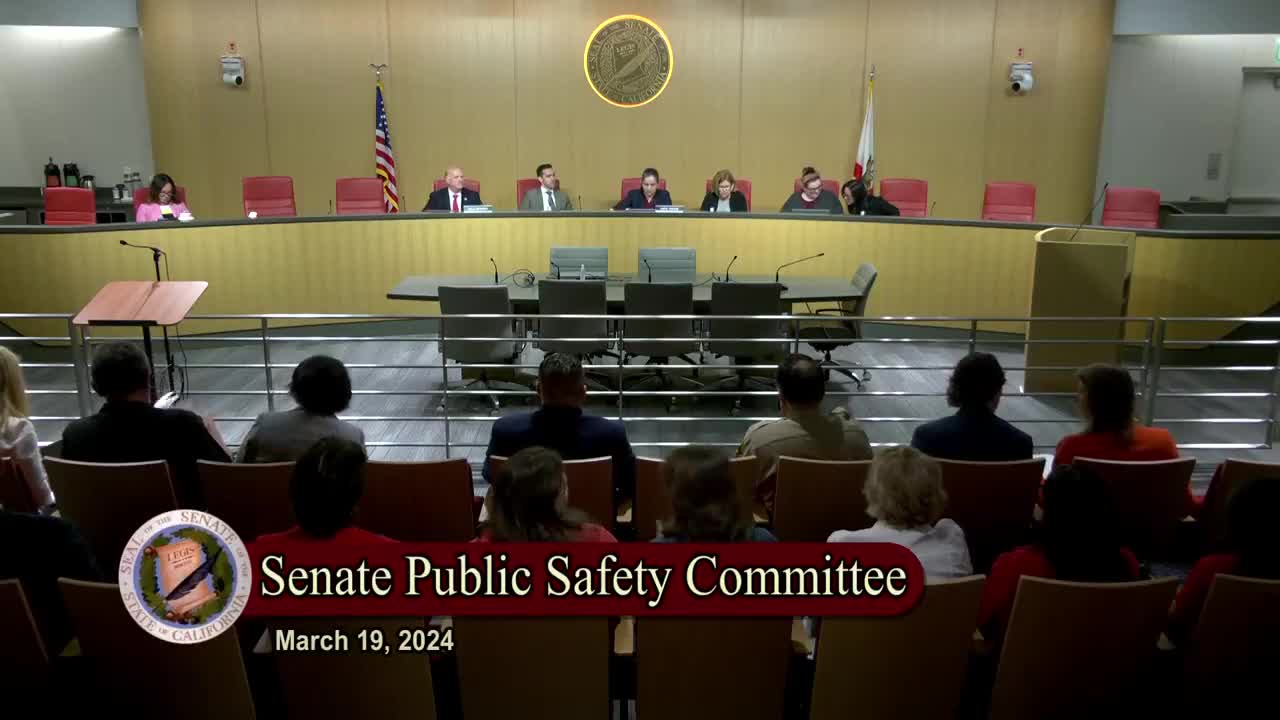 6MIN
Senate Standing Committee on Public Safety
Bill Author