SB 1031: San Francisco Bay area: local revenue measure: transportation improvements.
- Session Year: 2023-2024
- House: Senate
- Latest Version Date: 2024-05-20
Current Status:
Failed
(2024-05-24: In Assembly. Read first time. Held at Desk.)
Introduced
In Committee
First Chamber
In Committee
Second Chamber
Enacted
(1)Existing law creates the Metropolitan Transportation Commission as a local area planning agency for the 9-county San Francisco Bay area with comprehensive regional transportation planning and other related responsibilities. Existing law creates various transit districts located in the San Francisco Bay area, with specified powers and duties relating to providing public transit services.
This bill would authorize the commission to raise and allocate new revenue and incur and issue bonds and other indebtedness, as specified. In this regard, the bill would authorize the commission, until January 1, 2041, to impose a retail transactions and use tax, a regional payroll tax, a parcel tax, and a regional vehicle registration surcharge in all or a subset of the 9 counties of the San Francisco Bay area, except as specified, in accordance with applicable constitutional requirements. The bill would prohibit a tax or surcharge described above from being imposed for a period of time of more than 30 years. The bill would require the parcel tax to be collected by counties and the other 3 taxes to be collected by specified state agencies, and would require the net revenues from those taxes to be remitted to the commission, as prescribed. The bill would require the commission, in consultation with county transportation authorities, to develop an expenditure plan for the expenditure of the revenues expected to be generated by the tax or surcharge, together with other federal, state, and local funds expected to be available for transportation improvements, as specified. The bill would require, before the election on the tax or surcharge, the expenditure plan to be approved by county transportation authorities representing counties meeting certain criteria, as provided. The bill would require the revenue generated pursuant to these provisions to be used for transportation improvements in the San Francisco Bay area, including for various transit purposes, and would require the commission to allocate those revenues in accordance with specified requirements.
By adding to the duties of local officials with respect to elections procedures for revenue measures on behalf of the commission, this bill would impose a state-mandated local program.
(2)Existing law establishes the Transportation Agency, consisting of various state agencies under the supervision of an executive officer known as the Secretary of Transportation, who is required to develop and report to the Governor on legislative, budgetary, and administrative programs to accomplish comprehensive, long-range, and coordinated planning and policy formulation in the matters of public interest related to the agency.
This bill would require the Transportation Agency to select a transportation institute, as defined, to conduct an assessment that analyzes the benefits and disbenefits to riders, and the administrative, financial, legal, contractual, and governance feasibility, of various forms of consolidation and enhanced coordination, as defined, among transit agencies, as defined, that are located in the 9-county San Francisco Bay area. The bill would require that assessment to be completed on or before January 1, 2026, and would require, as part of that assessment, the transportation institute to identify specified information about each transit agency and to consider certain topics relating to consolidation and enhanced coordination. Based on the findings of the assessment, the bill would require the Transportation Agency, on or before January 1, 2027, to develop a report of recommendations that, among other things, identifies opportunities for the consolidation or enhanced coordination, or both, of 2 or more agencies and provides specific recommendations for the consolidation or enhanced coordination of transit agencies and their governing bodies without resulting in the elimination of programs and transportation services, as specified. The bill would establish the Bay Area Transit Consolidation and Coordination Technical Assistance Fund in the State Treasury for the deposit of moneys that can be used for specified purposes, including paying for the cost of conducting the assessment and preparing the report, as specified. The bill would require the assessment and the report to be submitted to the Legislature upon completion.
(3)Existing law requires the Metropolitan Transportation Commission to adopt rules and regulations to promote the coordination of fares and schedules for all public transit systems within its jurisdiction, as specified.
This bill would revise and recast this provision by, among other things, providing that the commission is responsible for implementing a seamless transit rider experience across the San Francisco Bay area and requiring those rules and regulations to also promote the coordination of mapping and wayfinding, real-time transit information, and other customer-facing operating policies, as specified. The bill would also declare that it is the intent of the Legislature that the commission implement and sustain specified outcomes in undertaking these responsibilities. The bill would require the commission to submit an annual report to the Legislature on the status of those outcomes and the status of transit ridership in the San Francisco Bay area. By imposing additional duties on the commission, the bill would create a state-mandated local program.
(4)Under existing law, a transit operator within the jurisdiction of the commission is not eligible to receive funding allocated by the commission pursuant to the State Transit Assistance Program unless it has complied with the above-described rules and regulations adopted by the commission.
This bill would also make a transit operator ineligible to receive an allocation from the commission of specified revenues generated by the new taxing authority authorized by the bill if the operator is not in compliance with those rules and regulations.
(5)Existing law requires designated transportation planning agencies to prepare and adopt regional transportation plans directed at achieving a coordinated and balanced regional transportation system. Existing law requires that each regional transportation plan include a sustainable communities strategy prepared by each metropolitan planning organization in order to, among other things, achieve certain targets established by the State Air Resources Board for the reduction of greenhouse gas emissions from automobiles and light trucks in the region for 2020 and 2035, respectively. Existing law also requires a regional transportation plan to include a financial element that summarizes the cost of plan implementation constrained by a realistic projection of available revenues and that contains recommendations for allocation of funds.
This bill would require the commission, on or before April 1, 2025, to amend or update its regional transportation plan to include a specified project operated by the Sonoma-Marin Area Rail Transit District within the transportation network identified in the sustainable communities strategy and within the financial element. By imposing additional duties on a local agency, the bill would create a state-mandated local program.
(6)Existing law authorizes the commission and the Bay Area Air Quality Management District to jointly adopt a commute benefit ordinance that requires covered employers operating within the common area of the 2 agencies with a specified number of covered employees to offer those employees certain commute benefits, as specified.
This bill would also authorize one of those commute benefit options to include an employer-provided regional transit pass.
This bill would authorize the commission, as part of a measure to impose a tax described above, to propose a ballot measure that would require a covered employer that is located in proximity to transit to purchase a regional transit pass for each of its employees and to require a covered employer that is not located in proximity to transit to provide a subsidy to each of its employees corresponding in financial value to the regional transit pass, as specified. If the ballot measure is approved by the voters, the bill would require the commission and the district to update the ordinance accordingly.
(7)The California Constitution requires the state to reimburse local agencies and school districts for certain costs mandated by the state. Statutory provisions establish procedures for making that reimbursement.
This bill would provide that, if the Commission on State Mandates determines that the bill contains costs mandated by the state, reimbursement for those costs shall be made pursuant to the statutory provisions noted above.
(1)Existing law creates the Metropolitan Transportation Commission as a local area planning agency for the 9-county San Francisco Bay area with comprehensive regional transportation planning and other related responsibilities. Existing law creates various transit districts located in the San Francisco Bay area, with specified powers and duties relating to providing public transit services.
This bill would authorize the commission to raise and allocate new revenue and incur and issue bonds and other indebtedness, as specified. In this regard, the bill would authorize the commission, until January 1, 2041, to impose a retail transactions and use tax, a regional payroll tax, a parcel tax, and a regional vehicle registration surcharge in all or a subset of the 9 counties of the San Francisco Bay area, except as specified, in accordance with applicable constitutional requirements. The bill would prohibit a tax or surcharge described above from being imposed for a period of time of more than 30 years. The bill would require the parcel tax to be collected by counties and the other 3 taxes to be collected by specified state agencies, and would require the net revenues from those taxes to be remitted to the commission, as prescribed. The bill would require the commission, in consultation with county transportation authorities, to develop an expenditure plan for the expenditure of the revenues expected to be generated by the tax or surcharge, together with other federal, state, and local funds expected to be available for transportation improvements, as specified. The bill would require, before the election on the tax or surcharge, the expenditure plan to be approved county transportation authorities representing counties meeting certain criteria, as provided. The bill would require the revenue generated pursuant to these provisions to be used for transportation improvements in the San Francisco Bay area, including for various transit purposes, and would require the commission to distribute allocate those revenues in accordance with specified requirements.
By adding to the duties of local officials with respect to elections procedures for revenue measures on behalf of the commission, this bill would impose a state-mandated local program.
(2)Existing law establishes the Transportation Agency, consisting of various state agencies under the supervision of an executive officer known as the Secretary of Transportation, who is required to develop and report to the Governor on legislative, budgetary, and administrative programs to accomplish comprehensive, long-range, and coordinated planning and policy formulation in the matters of public interest related to the agency.
This bill would require the Transportation Agency to select a transportation institute, as defined, to conduct an assessment that analyzes the benefits and disbenefits to riders, and the administrative, financial, legal, contractual, and governance feasibility, of various forms of consolidation and enhanced coordination, as defined, among transit agencies, as defined, that are located in the 9-county San Francisco Bay area. The bill would require that assessment to be completed on or before January 1, 2026, and would require, as part of that assessment, the transportation institute to identify specified information about each transit agency and to consider certain topics relating to consolidation and enhanced coordination. Based on the findings of the assessment, the bill would require the Transportation Agency, on or before January 1, 2027, to develop a report of recommendations that, among other things, identifies opportunities for the consolidation or enhanced coordination, or both, of 2 or more agencies and provides specific recommendations for the consolidation or enhanced coordination of transit agencies and their governing bodies without resulting in the elimination of programs and transportation services, as specified. The bill would establish the Bay Area Transit Consolidation and Coordination Technical Assistance Fund in the State Treasury for the deposit of moneys that can be used for specified purposes, including paying for the cost of conducting the assessment and preparing the report, as specified. The bill would require the assessment and the report to be submitted to the Legislature upon completion.
(3)Existing law requires the Metropolitan Transportation Commission to adopt rules and regulations to promote the coordination of fares and schedules for all public transit systems within its jurisdiction, as specified.
This bill would revise and recast this provision by, among other things, providing that the commission is responsible for implementing a seamless transit rider experience across the San Francisco Bay area and requiring those rules and regulations to also promote the coordination of mapping and wayfinding, real-time transit information, and other customer-facing operating policies, as specified. The bill would also declare that it is the intent of the Legislature that the commission implement and sustain specified outcomes in undertaking these responsibilities. The bill would require the commission to submit an annual report to the Legislature on the status of those outcomes and the status of transit ridership in the San Francisco Bay area. By imposing additional duties on the commission, the bill would create a state-mandated local program.
(4)Under existing law, a transit operator within the jurisdiction of the commission is not eligible to receive funding allocated by the commission pursuant to the State Transit Assistance Program unless it has complied with the above-described rules and regulations adopted by the commission.
This bill would also make a transit operator ineligible to receive an allocation from the commission of the specified revenues generated by the new taxing authority authorized by the bill if the operator is not in compliance with those rules and regulations.
(5)Existing law requires designated transportation planning agencies to prepare and adopt regional transportation plans directed at achieving a coordinated and balanced regional transportation system. Existing law requires that each regional transportation plan include a sustainable communities strategy prepared by each metropolitan planning organization in order to, among other things, achieve certain targets established by the State Air Resources Board for the reduction of greenhouse gas emissions from automobiles and light trucks in the region for 2020 and 2035, respectively. Existing law also requires a regional transportation plan to include a financial element that summarizes the cost of plan implementation constrained by a realistic projection of available revenues and that contains recommendations for allocation of funds.
This bill would require the commission, on or before April 1, 2025, to amend or update its regional transportation plan to include a specified project operated by the Sonoma-Marin Area Rail Transit District within the transportation network identified in the sustainable communities strategy and within the financial element. By imposing additional duties on a local agency, the bill would create a state-mandated local program.
(5)(6)Existing law authorizes the commission and the Bay Area Air Quality Management District to jointly adopt a commute benefit ordinance that requires covered employers operating within the common area of the 2 agencies with a specified number of covered employees to offer those employees certain commute benefits, as specified.
This bill would also authorize one of those commute benefit options to include an employer-provided regional transit pass.
This bill would authorize the commission, as part of a measure to impose a tax described above, to propose a ballot measure that would require a covered employer that is located in proximity to transit to purchase a regional transit pass for each of its employees and to require a covered employer that is not located in proximity to transit to provide a subsidy to each of its employees corresponding in financial value to the regional transit pass, as specified. If the ballot measure is approved by the voters, the bill would require the commission and the district to update the ordinance accordingly.
(6)(7)The California Constitution requires the state to reimburse local agencies and school districts for certain costs mandated by the state. Statutory provisions establish procedures for making that reimbursement.
This bill would provide that, if the Commission on State Mandates determines that the bill contains costs mandated by the state, reimbursement for those costs shall be made pursuant to the statutory provisions noted above.
(1)Existing law creates the Metropolitan Transportation Commission as a local area planning agency for the 9-county San Francisco Bay area with comprehensive regional transportation planning and other related responsibilities. Existing law creates various transit districts located in the San Francisco Bay area, with specified powers and duties relating to providing public transit services.
This bill would authorize the commission to raise and allocate new revenue and incur and issue bonds and other indebtedness, as specified. In this regard, the bill would authorize the commission commission, until January 1, 2041, to impose a retail transactions and use tax, a regional payroll tax, a parcel tax, and a regional vehicle registration surcharge in all or a subset of the 9 counties of the San Francisco Bay area, in accordance with applicable constitutional requirements. The bill would prohibit a tax or surcharge described above from being imposed for a period of time of more than 30 years. The bill would require the parcel tax to be collected by counties and the other 3 taxes to be collected by specified state agencies, and would require the net revenues from those taxes to be remitted to the commission, as prescribed. The bill would require the revenue generated pursuant to these provisions to be used for transportation improvements in the San Francisco Bay area, including for various transit purposes, and would require the commission to distribute those revenues in accordance with specified requirements.
By adding to the duties of local officials with respect to elections procedures for revenue measures on behalf of the commission, this bill would impose a state-mandated local program.
(2)Existing law establishes the Transportation Agency, consisting of various state agencies under the supervision of an executive officer known as the Secretary of Transportation, who is required to develop and report to the Governor on legislative, budgetary, and administrative programs to accomplish comprehensive, long-range, and coordinated planning and policy formulation in the matters of public interest related to the agency.
This bill would require the Transportation Agency to select a transportation institute, as defined, to conduct an assessment that analyzes the benefits and disbenefits to riders, and the administrative, financial, legal, contractual, and governance feasibility, of various forms of consolidation, consolidation and enhanced coordination, as defined, among transit agencies, as defined, that are located in the 9-county San Francisco Bay area. The bill would require that assessment to be completed on or before January 1, 2026, and would require, as part of that assessment, the transportation institute to identify specified information about each transit agency and to consider certain topics relating to consolidation. consolidation and enhanced coordination. Based on the findings of the assessment, the bill would require the Transportation Agency, on or before January 1, 2027, to develop a report of recommendations that, among other things, identifies opportunities to consolidate for the consolidation or enhanced coordination, or both, of 2 or more agencies and provides specific recommendations for the consolidation or elimination enhanced coordination of transit agencies and their governing bodies without resulting in the elimination of programs and transportation services, as specified. The bill would establish the Bay Area Transit Consolidation and Coordination Technical Assistance Fund in the State Treasury for the deposit of moneys that can be used for specified purposes, including paying for the cost of conducting the assessment and preparing the report, as specified. The bill would require the assessment and the report to be submitted to the Legislature upon completion.
(3)Existing law requires the Metropolitan Transportation Commission to adopt rules and regulations to promote the coordination of fares and schedules for all public transit systems within its jurisdiction, as specified.
This bill would revise and recast this provision by, among other things, providing that the commission is responsible for implementing a seamless transit rider experience across the San Francisco Bay area and requiring those rules and regulations to also promote the coordination of mapping and wayfinding, real-time transit information, and other customer-facing operating policies, as specified. The bill would also declare that it is the intent of the Legislature that the commission implement and sustain specified outcomes in undertaking these responsibilities. The bill would require the commission to submit an annual report to the Legislature on the status of those outcomes and the status of transit ridership in the San Francisco Bay area. By imposing additional duties on the commission, the bill would create a state-mandated local program.
(4)Under existing law, a transit operator within the jurisdiction of the commission is not eligible to receive funding allocated by the commission pursuant to the State Transit Assistance Program unless it has complied with the above-described rules and regulations adopted by the commission.
This bill would also make a transit operator ineligible to receive an allocation from the commission of the revenues generated by the new taxing authority authorized by the bill or to make a claim pursuant to the Transportation Development Act for an allocation of funds from a local transportation fund if the operator is not in compliance with those rules and regulations.
(5)Existing law authorizes the commission and the Bay Area Air Quality Management District to jointly adopt a commute benefit ordinance that requires covered employers operating within the common area of the 2 agencies with a specified number of covered employees to offer those employees certain commute benefits, as specified.
This bill would also authorize one of those commute benefit options to include an employer-provided regional transit pass.
This bill would authorize the commission, as part of a measure to impose a tax described above, to propose a ballot measure that would require a covered employer that is located in proximity to transit to purchase a regional transit pass for each of its employees and to require a covered employer that is not located in proximity to transit to provide a subsidy to each of its employees corresponding in financial value to the regional transit pass, as specified. If the ballot measure is approved by the voters, the bill would require the commission and the district to update the ordinance accordingly.
(6)The California Constitution requires the state to reimburse local agencies and school districts for certain costs mandated by the state. Statutory provisions establish procedures for making that reimbursement.
This bill would provide that, if the Commission on State Mandates determines that the bill contains costs mandated by the state, reimbursement for those costs shall be made pursuant to the statutory provisions noted above.
(1)Existing law creates the Metropolitan Transportation Commission as a local area planning agency for the 9-county San Francisco Bay area with comprehensive regional transportation planning and other related responsibilities. Existing law creates various transit districts located in the San Francisco Bay area, with specified powers and duties relating to providing public transit services.
This bill would authorize the commission to raise and allocate new revenue and incur and issue bonds and other indebtedness, as specified. In this regard, the bill would authorize the commission to impose a retail transactions and use tax, a regional payroll tax, a parcel tax, and a regional vehicle registration surcharge in all or a subset of the 9 counties of the San Francisco Bay area, in accordance with applicable constitutional requirements. The bill would require the parcel tax to be collected by counties and the other 3 taxes to be collected by specified state agencies, and would require the net revenues from those taxes to be remitted to the commission, as prescribed. The bill would require the revenue generated pursuant to these provisions to be used for transportation improvements in the San Francisco Bay area, including for various transit purposes, and would require the commission to distribute those revenues in accordance with specified requirements and expressions of legislative intent. requirements.
By adding to the duties of local officials with respect to elections procedures for revenue measures on behalf of the commission, this bill would impose a state-mandated local program.
(2)Existing law establishes the Transportation Agency, consisting of various state agencies under the supervision of an executive officer known as the Secretary of Transportation, who is required to develop and report to the Governor on legislative, budgetary, and administrative programs to accomplish comprehensive, long-range, and coordinated planning and policy formulation in the matters of public interest related to the agency.
This bill would require the Transportation Agency to select a transportation institute, as defined, to conduct an assessment of the associated advantages and disadvantages of consolidating all of the conduct an assessment that analyzes the benefits and disbenefits to riders, and the administrative, financial, legal, contractual, and governance feasibility, of various forms of consolidation, as defined, among transit agencies, as defined, that are located in the 9-county San Francisco Bay area, as specified. area. The bill would require that assessment to be completed on or before January 1, 2026, and would require, as part of that assessment, the transportation institute to provide recommendations on how to consolidate those transit agencies and to include certain information in the assessment. identify specified information about each transit agency and to consider certain topics relating to consolidation. Based on the findings of the assessment, the bill would require the Transportation Agency, on or before January 1, 2027, to recommend a comprehensive plan to consolidate all of the transit agencies located in the San Francisco Bay area, as provided. develop a report of recommendations that, among other things, identifies opportunities to consolidate 2 or more agencies and provides specific recommendations for the consolidation or elimination of transit agencies and their governing bodies without resulting in the elimination of programs and transportation services, as specified. The bill would establish the Bay Area Transit Consolidation and Coordination Technical Assistance Fund in the State Treasury for the deposit of moneys that can be used for specified purposes, including paying for the cost of conducting the assessment and preparing the comprehensive plan, report, as specified. The bill would require the assessment and the comprehensive plan report to be submitted to the Legislature upon completion.
(3)Existing law requires the Metropolitan Transportation Commission to adopt rules and regulations to promote the coordination of fares and schedules for all public transit systems within its jurisdiction, as specified.
This bill would revise and recast this provision by, among other things, providing that the commission is responsible for implementing a seamless transit rider experience across the San Francisco Bay area and requiring those rules and regulations to also promote the coordination of mapping and wayfinding, real-time transit information, and other customer-facing operating policies, as specified. The bill would also declare that it is the intent of the Legislature that the commission implement and sustain specified outcomes in undertaking these responsibilities. The bill would require the commission to submit an annual report to the Legislature on the status of those outcomes and the status of transit ridership in the San Francisco Bay area. By imposing additional duties on the commission, the bill would create a state-mandated local program.
(4)Under existing law, a transit operator within the jurisdiction of the commission is not eligible to receive funding allocated by the commission pursuant to the State Transit Assistance Program unless it has complied with the above-described rules and regulations adopted by the commission.
This bill would also make a transit operator ineligible to receive an allocation from the commission of the revenues generated by the new taxing authority authorized by the bill or to make a claim pursuant to the Transportation Development Act for an allocation of funds from a local transportation fund if the operator is not in compliance with those rules and regulations.
(5)Existing law authorizes the commission and the Bay Area Air Quality Management District to jointly adopt a commute benefit ordinance that requires covered employers operating within the common area of the 2 agencies with a specified number of covered employees to offer those employees certain commute benefits, as specified.
This bill would also authorize one of those commute benefit options to include an employer-provided regional transit pass.
This bill would authorize the commission, as part of a measure to impose a tax described above, to propose a ballot measure that would require a covered employer that is located in proximity to transit to purchase a regional transit pass for each of its employees and to require a covered employer that is not located in proximity to transit to provide a subsidy to each of its employees corresponding in financial value to the regional transit pass, as specified. If the ballot measure is approved by the voters, the bill would require the commission and the district to update the ordinance accordingly.
(6)The California Constitution requires the state to reimburse local agencies and school districts for certain costs mandated by the state. Statutory provisions establish procedures for making that reimbursement.
This bill would provide that, if the Commission on State Mandates determines that the bill contains costs mandated by the state, reimbursement for those costs shall be made pursuant to the statutory provisions noted above.
(1)Existing law creates the Metropolitan Transportation Commission as a local area planning agency for the 9-county San Francisco Bay area with comprehensive regional transportation planning and other related responsibilities. Existing law creates various transit districts located in the San Francisco Bay area, with specified powers and duties relating to providing public transit services.
This bill would authorize the commission to raise and allocate new revenue and incur and issue bonds and other indebtedness, as specified. In this regard, the bill would authorize the commission to impose a retail transactions and use tax, a regional payroll tax, a parcel tax, and a regional vehicle registration surcharge in all or a subset of the 9 counties of the San Francisco Bay area, in accordance with applicable constitutional requirements. The bill would require the parcel tax to be collected by counties and the other 3 taxes to be collected by specified state agencies, and would require the net revenues from those taxes to be remitted to the commission, as prescribed. The bill would require the revenue generated pursuant to these provisions to be used for transportation improvements in the San Francisco Bay area, including for various transit purposes, and would require the commission to distribute those revenues in accordance with specified requirements and expressions of legislative intent.
By adding to the duties of local officials with respect to elections procedures for revenue measures on behalf of the commission, this bill would impose a state-mandated local program.
(2)Existing law establishes the Transportation Agency, consisting of various state agencies under the supervision of an executive officer known as the Secretary of Transportation, who is required to develop and report to the Governor on legislative, budgetary, and administrative programs to accomplish comprehensive, long-range, and coordinated planning and policy formulation in the matters of public interest related to the agency.
This bill would require the Transportation Agency to select a transportation institute, as defined, to conduct an assessment of the associated advantages and disadvantages of consolidating all of the transit agencies, as defined, that are located in the 9-county San Francisco Bay area, as specified. The bill would require that assessment to be completed on or before January 1, 2026, and would require, as part of that assessment, the transportation institute to provide recommendations on how to consolidate those transit agencies and to include certain information in the assessment. Based on the findings of the assessment, the bill would require the Transportation Agency, on or before January 1, 2027, to recommend a comprehensive plan to consolidate all of the transit agencies located in the San Francisco Bay area, as provided. The bill would establish the Bay Area Transit Consolidation Technical Assistance Fund in the State Treasury for the deposit of moneys that can be used for specified purposes, including paying for the cost of conducting the assessment and preparing the comprehensive plan, as specified. The bill would require the assessment and the comprehensive plan to be submitted to the Legislature upon completion.
(3)Existing law requires the Metropolitan Transportation Commission to adopt rules and regulations to promote the coordination of fares and schedules for all public transit systems within its jurisdiction, as specified.
This bill would revise and recast this provision by, among other things, providing that the commission is responsible for implementing a seamless transit rider experience across the San Francisco Bay area and requiring those rules and regulations to also promote the coordination of mapping and wayfinding, real-time transit information, and other customer-facing operating policies, as specified. The bill would also declare that it is intent of the Legislature that the commission implement and sustain specified outcomes in undertaking these responsibilities. The bill would require the commission to submit an annual report to the Legislature on the status of those outcomes and the status of transit ridership in the San Francisco Bay area. By imposing additional duties on the commission, the bill would create a state-mandated local program.
(4)Under existing law, a transit operator within the jurisdiction of the commission is not eligible to receive funding allocated by the commission pursuant to the State Transit Assistance Program unless it has complied with the above-described rules and regulations adopted by the commission.
This bill would also make a transit operator ineligible to receive an allocation from the commission of the revenues generated by the new taxing authority authorized by the bill or to make a claim pursuant to the Transportation Development Act for an allocation of funds from a local transportation fund if the operator is not in compliance with those rules and regulations.
(5)Existing law authorizes the commission and the Bay Area Air Quality Management District to jointly adopt a commute benefit ordinance that requires covered employers operating within the common area of the 2 agencies with a specified number of covered employees to offer those employees certain commute benefits, as specified.
This bill would also authorize one of those commute benefit options to include an employer-provided regional transit pass.
This bill would authorize the commission, as part of a measure to impose a tax described above, to propose a ballot measure that would require a covered employer that is located in proximity to transit to purchase a regional transit pass for each of its employees and to require a covered employer that is not located in proximity to transit to provide a subsidy to each of its employees corresponding in financial value to the regional transit pass, as specified. If the ballot measure is approved by the voters, the bill would require the commission and the district to update the ordinance accordingly.
(6)The California Constitution requires the state to reimburse local agencies and school districts for certain costs mandated by the state. Statutory provisions establish procedures for making that reimbursement.
This bill would provide that, if the Commission on State Mandates determines that the bill contains costs mandated by the state, reimbursement for those costs shall be made pursuant to the statutory provisions noted above.
Existing law requires a state agency, as specified, to notify the Joint Legislative Budget Committee not less than 60 days prior to the effective date on which the state agency will establish or change a federal aid allocation formula to a local agency. If the chairman of the committee informs committee members of his intention to waive the 60-day notification period, existing law permits the chairman to grant a waiver of that notification period after receipt of the notification. Under existing law, upon the request of the chairman or any member of the committee, the committee must schedule a hearing on the proposed allocation formula to be established or changed.This bill would make technical, nonsubstantive changes to those provisions to use gender-neutral language.Existing law requires a state agency, as specified, to notify the Joint Legislative Budget Committee not less than 60 days prior to the effective date on which the state agency will establish or change a federal aid allocation formula to a local agency. If the chairman of the committee informs committee members of his intention to waive the 60-day notification period, existing law permits the chairman to grant a waiver of that notification period after receipt of the notification. Under existing law, upon the request of the chairman or any member of the committee, the committee must schedule a hearing on the proposed allocation formula to be established or changed.
This bill would make technical, nonsubstantive changes to those provisions to use gender-neutral language.
The Legislature finds and declares all of the following:
(a)The San Francisco Bay area needs a world-class, reliable, affordable, efficient, and connected transportation network that meets the needs of bay area residents, businesses, and visitors while also helping combat the climate crisis.
(b)A world-class transportation network will enhance access to opportunity, lower greenhouse gas emissions, strengthen the regions economy, and improve quality of life.
(c)To achieve that vision, the San Francisco Bay area needs all of the following:
(1)A public transit network that offers safe, clean, frequent, accessible, easy-to-navigate, and reliable service that gets transit riders where they want and need to go safely, affordably, quickly, and seamlessly.
(2)Local roads that are well maintained.
(3)Transit, biking, walking, and wheeling options that are safe, convenient, and competitive alternatives to driving.
(d)Regional funding and reforms are necessary to create a climate-friendly transportation system that is safe, accessible, and convenient for all, including through doing all of the following:
(1)Protecting and enhancing transit service.
(2)Making transit faster, safer, and easier to use.
(3)Enhancing mobility and access for all.
SEC. 2.This act shall be known, and may be cited as, the Connect Bay Area Act of 2024.
SEC. 3.Section 13978.9 is added to the Government Code, to read:13978.9.(a)For purposes of this section, the following definitions apply:
(1)Commission means the Metropolitan Transportation Commission.
(2)Consolidation means a reform to transit agencies that includes one or more of the following:
(A)Combining staffs or back office functions of two or more transit agencies while retaining separate governing boards.
(B)Replacing multiple governing boards with a unified governing board representing a broader jurisdiction.
(C)Creating a more effective umbrella structure under which existing transit agencies are brought together but still operate as distinct agencies with separate governing boards.
(3)Enhanced coordination means increasing coordination across two or more transit agencies to improve service, efficiency, safety, or other benefits. Enhanced coordination may include, but is not limited to, any of the following:
(A)Colocation of facilities, programs, or services.
(B)Collaborating on grant applications, state or local plans, or both, training, vehicle purchasing, or maintenance.
(C)Federal fund braiding.
(D)Initiatives included in the 2021 Bay Area Transit Transformation Action Plan or any successor plan adopted by the commission.
(4)Labor institute means the University of California, Berkeley Labor Center or the UCLA Labor Center.
(5)San Francisco Bay area means the region comprising the commissions jurisdiction, as prescribed by Section 66502.
(6)Transit agency has the same meaning as public transportation operator as defined in subdivision (b) of Section 99312.2 of the Public Utilities Code.
(7)Transportation institute means either the University of California Institute of Transportation Studies or the Mineta Transportation Institute at San Jose State University.
(b)The Transportation Agency shall oversee the completion of the assessment required pursuant to subdivision (c) and the report of legislative recommendations required pursuant to subdivision (d) in a manner that emphasizes, across all facets of analysis and recommendations, benefits to riders and disabled riders, including those who use paratransit. The completion of the assessment and report shall include consultation with impacted stakeholders including, but not limited to, impacted transit agencies, transit unions, transit riders, and local governments. It is the intent of the Legislature that the assessment and the report help achieve all of the following goals with regard to the operation of public transit in the San Francisco Bay area:
(1)Improving the speed, efficiency, and reliability of service.
(2)Improving the affordability of fares.
(3)Improving the safety and cleanliness of service.
(4)Promoting the achievement of the states climate goals, including through the incorporation and diffusion of zero-emission technologies.
(5)Incorporating other technological changes that improve rider experience and safety.
(6)Improving accessibility of, and connections to, regional and interregional transit service in a manner that competes with private automobile travel, particularly for low-income residents and those residing in equity priority communities, as defined by the commission.
(7)Improving and simplifying the accountability of the transportation systems to the public and riders.
(8)Reducing administrative costs and improving cost efficiencies within and across transit agencies.
(c)(1)The Transportation Agency shall select a transportation institute to conduct an assessment in accordance with the requirements of this section. The transportation institute shall consult with a labor institute, if it chooses to participate, in conducting all aspects of the assessment with respect to impacts on the workforce and labor relations. The transportation institute shall complete the assessment on or before January 1, 2026, and upon completion, shall submit the assessment to the Legislature in compliance with Section 9795, and to the commission and each of the transit agencies located in the San Francisco Bay area.
(2)The transportation institute shall identify each transit agency that has authority to create policy or assess charges with regard to transit and that is located in the San Francisco Bay area and, at a minimum, all of the following information in the assessment:
(A)The county where each transit agency and its governing body is located.
(B)The governance structure of each transit agency, including all of the following information:
(i)The size of the membership, terms of service of the members, and whether the members are voting members, and whether the governing body of those agencies is appointed or elected.
(ii)Any qualifications required to serve as a member of the governing board of the transit agency.
(iii)Whether the governing body of the transit agency was created pursuant to state law, local ordinance, city charter, federal law, or ballot measure or initiative.
(C)The funding structures, including any tax assessments, and revenue mechanisms, including any temporary or permanent state or federal support, or both, established for each transit agency.
(D)The fares or other fees imposed on riders by each transit agency and the available routes provided by each transit agency.
(E)The fleet type and size of each transit agency.
(F)The programs and services offered to riders by each transit agency, including any subsidies or discounts offered to riders.
(G)The workforce size and type of each transit agency, whether there are any applicable labor contracts for that workforce, and the socioeconomic makeup of that workforce.
(H)The socioeconomic makeup of the riders of each transit agency.
(I)The number and rate of transfers between public transit services operated by different agencies.
(J)An analysis of existing transit service gaps compared to regional travel patterns and how it relates to transit agencies boundaries.
(3)The assessment shall analyze the benefits and disbenefits to riders, and the administrative, financial, legal, contractual, and governance feasibility, of various forms of consolidation and enhanced coordination among transit agencies that are located within the San Francisco Bay area.
(4)The assessment shall consider all of the following:
(A)The impacts of consolidation or enhanced coordination, or both, on all of the following:
(i)Wages, work conditions, and pension and retirement benefits of workers covered by collective bargaining agreements at relevant agencies and contracted services.
(ii)Operating budgets.
(iii)Existing costs.
(iv)Costs associated with implementation.
(v)Governance.
(vi)The total number of people employed and employment opportunities.
(B)Challenges associated with any form of consolidation or enhanced coordination, including consolidation or enhanced coordination, or both, of transit agencies with different service modes, rolling stock, and technologies, and with other key operational differences across agencies.
(C)Regulatory and legal barriers to any form of consolidation or enhanced coordination.
(D)Existing and planned regional network management efforts, including efforts to modify and improve the commissions regional network management authority, and how consolidation or enhanced coordination, or both, would relate to, or impact, those efforts.
(5)If the Transportation Agency selects the University of California Institute of Transportation Studies to conduct the assessment, the requirement to conduct the assessment shall only apply to the University of California to the extent that the Regents of the University of California, by appropriate resolution, make that requirement applicable.
(d)(1)Based on the findings of the assessment conducted pursuant to subdivision (c), the Transportation Agency shall develop a report of recommendations to the Legislature. The Transportation Agency shall complete the report on or before January 1, 2027, and, upon completion, shall submit the report to the Legislature in compliance with Section 9795, and to the commission and each of the transit agencies located in the San Francisco Bay area. In the report, the Transportation Agency shall do all of the following:
(A)Identify opportunities for the consolidation or enhanced coordination, or both, of two or more agencies and provide specific recommendations for the consolidation or enhanced coordination, or both, of transit agencies and their governing bodies without resulting in the elimination of programs and transportation services, with consideration for existing and planned regional network management efforts or structures.
(B)Identify steps to maintain and transfer labor agreements and bargaining units to maintain employee wages, benefits, protections, and working conditions secured by those agreements.
(C)Identify barriers to the consolidation or enhanced coordination, or both, of transit agencies, including local, state, or federal laws, and alternative actions to the consolidation or enhanced coordination, or both.
(D)Recommend opportunities for securing federal, state, and local moneys that can be used to fund consolidation or enhanced coordination, or both.
(E)Recommend a strategy for a public education and outreach program on any proposed consolidation or enhanced coordination efforts, or both.
(2)If the Transportation Agency recommends a new governing structure and governing board member qualifications, as appropriate, for a new consolidated agency or agencies, the Transportation Agency shall base that recommendation on research of effective international models of transit delivery excellence, and consideration of recent regional and state studies of effective transit governance. In making a recommendation described in this paragraph, the Transportation Agency shall do all of the following:
(A)Identify any future legislative steps required to implement the recommended governing structure.
(B)Consider other reforms necessary to ensure that commission policy is democratically accountable and serves the regional welfare.
(C)Assess any impact that consolidation or enhanced coordination, or both, would have on wages, work conditions, and pension and retirement benefits of workers covered by collective bargaining agreements at the relevant transit agencies, including paratransit and other contracted services.
(3)The Transportation Agency may contract with a consultant to complete the report required pursuant to this subdivision if the Transportation Agency does both of the following:
(A)Establishes a team to advise the consultant that, at minimum, includes a transportation institute and a labor institute, if they choose to participate, and that may additionally include, as needed, individuals with expertise in the legal, governance, financial, and operational aspects of public transportation in the state.
(B)Oversees the consultant consistent with subdivision (b).
(e)(1)The Bay Area Transit Consolidation and Coordination Technical Assistance Fund is hereby established in the State Treasury for the deposit of moneys that can be used for the following purposes:
(A)Paying for the cost of conducting the assessment pursuant to subdivision (c) and preparing the report pursuant to subdivision (d).
(B)Paying for administrative expenses related to the implementation of the consolidation or enhanced coordination, or both, of transit agencies located in the San Francisco Bay area, if those consolidations or enhanced coordinations occur.
(2)Any moneys deposited into the fund, including moneys deposited into the fund pursuant to Section 66538.40, shall be available to the Transportation Agency, upon appropriation by the Legislature, for the purposes described in paragraph (1).
(3)The Transportation Agency may accept private donations to be used for the purposes described in this section. Any donations received pursuant to this paragraph shall be deposited into the fund established pursuant to paragraph (1).
SEC. 4.Section 65080.7 is added to the Government Code, to read:65080.7.On or before April 1, 2025, the Metropolitan Transportation Commission shall update or amend its regional transportation plan adopted pursuant to Section 65080 to include the extension of rail transit service operated by the Sonoma-Marin Area Rail Transit District to the City of Cloverdale in the County of Sonoma within the transportation network identified in the sustainable communities strategy pursuant to subparagraph (B) of paragraph (2) of subdivision (b) of Section 65080 and within the financial element included in the regional transportation plan pursuant to paragraph (4) of subdivision (b) of Section 65080.
SEC. 5.Section 65081 of the Government Code is amended to read:65081.(a)It is the intent of the Legislature to encourage metropolitan planning organizations and local air quality management districts or air pollution control districts to work with local employers to adopt policies that encourage commuting by means other than driving alone. To encourage this, the Legislature hereby establishes a program in that regard in the greater San Francisco Bay Area.
(b)Notwithstanding Section 40717.9 of the Health and Safety Code, the Bay Area Air Quality Management District and the Metropolitan Transportation Commission with respect to the common area within their respective jurisdictions may jointly adopt a commute benefit ordinance that requires covered employers operating within the common area of the district and commission to offer all covered employees one of the following choices:
(1)A pretax option: a program, consistent with Section 132(f) of the Internal Revenue Code, allowing covered employees to elect to exclude from taxable wages employee commuting costs incurred for transit passes or vanpool charges, up to the maximum amount allowed by federal tax law.
(2)Employer-paid benefit: a program whereby the covered employer offers employees a subsidy to offset the monthly cost of commuting via public transit or by vanpool, or, in addition, and at the employers discretion, by bicycle. The subsidy shall be equal to either the monthly cost of commuting via public transit or by vanpool, or seventy-five dollars ($75), whichever is lower. The seventy-five dollar ($75) amount shall be adjusted annually consistent with the California Consumer Price Index. If the covered employer chooses to offer a subsidy to offset the monthly cost of commuting by bicycle, the subsidy shall be either the monthly cost of commuting by bicycle or twenty dollars ($20), whichever is lower.
(3)Employer-provided transit: transportation furnished by the covered employer at no cost, or low cost as determined by the district or commission, to the covered employee in a vanpool or bus, or similar multipassenger vehicle operated by or for the employer.
(4)Employer-provided regional transit pass: a program whereby the covered employer offers covered employees a subsidy in the form of a universal regional transit pass to offset the monthly cost of commuting via public transit.
(c)Nothing in this section shall prevent a covered employer from offering a more generous commuter benefit that is otherwise consistent with the requirements of the applicable commute benefit ordinance. Nothing in this section shall require employees to change their behavior.
(d)An employer offering, or proposing to offer, an alternative commuter benefit on the employers own initiative, or an employer otherwise required to offer an alternative commuter benefit as a condition of a lease, original building permit, or other similar requirement, if the alternative is not one of the options identified in subdivision (b), may seek approval of the alternative from the district or commission. The district or commission may approve an alternative if it determines that the alternative provides at least the same benefit in terms of reducing single-occupant vehicle trips as any of the options in subdivision (b). An employer that offers an approved alternative to covered employees in a manner otherwise consistent with this section is not required to offer one of the options in subdivision (b).
(e)The commute benefit ordinance shall provide covered employers with at least six months to comply after the ordinance is adopted.
(f)An employer that participates in or is represented by a transportation management association that provides the employers covered employees with any of the benefits in subdivision (b), or an alternative benefit determined by the district or commission pursuant to subdivision (d) to provide at least the same benefit in terms of reducing single-occupant vehicle trips as any of the options in subdivision (b), shall be deemed in compliance with the regional ordinance, and the transportation management association may act on behalf of those employers in that regard. The district or commission shall communicate directly with the transportation management association, rather than the participating employers, to determine compliance with the ordinance.
(g)A commute benefit ordinance adopted pursuant to this section shall specify all of the following:
(1)How the implementing agencies will inform covered employers about the ordinance.
(2)How compliance with the ordinance will be demonstrated.
(3)The procedures for proposing and the criteria that will be used to evaluate an alternative commuter benefit pursuant to subdivision (d).
(4)Any consequences for noncompliance.
(h)Nothing in this section shall limit or restrict the statutory or regulatory authority of the commission or district.
(i)The commission shall not use federal planning funds in the implementation of the commute benefit ordinance.
(j)(1)Notwithstanding subdivisions (b) and (d), the commission may, either directly or through a qualified voter initiative, propose a ballot measure in all nine counties of the San Francisco Bay area or a subset of those counties, except as specified in paragraph (2) of subdivision (b) of Section 66538.20, as part of a measure proposed pursuant to Division 2 (commencing with Section 66538) of Title 7.1 and subject to the election procedures set forth in that division to update the ordinance adopted pursuant to this section to do both of the following:
(A)Require a covered employer that is located in proximity to transit to purchase a regional transit pass for each of its employees that provides universal and unlimited access to transit services provided by transit agencies operating in the common area within the jurisdiction of the district and the commission.
(B)Require a covered employer that is not located in proximity to transit to provide a subsidy to each of its employees corresponding in financial value to the regional transit pass described in subparagraph (A) to encourage commuting to work by means other than driving alone.
(2)Consistent with subdivision (b) of Section 66538.20, if the update to the ordinance is proposed in a subset of the counties of the San Francisco Bay area, the update to the ordinance authorized in paragraph (1) shall apply only in those counties in which the measure was submitted to the voters.
(3)Notwithstanding subdivisions (b) and (d), if a ballot measure described in paragraph (1) is approved, the commission and the district shall update the ordinance adopted pursuant to this section to require covered employers to provide covered employees with the applicable commuting benefit set forth in subparagraphs (A) and (B) of paragraph (1) instead of requiring covered employers to offer the choices described in paragraphs (1) to (4), inclusive, of subdivision (b).
(k)As used in this section, the following definitions apply:
(1)Commission means the Metropolitan Transportation Commission.
(2)Covered employer means any employer for which an average of 50 or more employees per week perform work for compensation within the area where the ordinance adopted pursuant to this section operates. In determining the number of employees performing work for an employer during a given week, only employees performing work on a full-time basis shall be counted.
(3)Covered employee means an employee who performed at least an average of 20 hours of work per week within the previous calendar month within the area where the ordinance adopted pursuant to this section operates.
(4)District means the Bay Area Air Quality Management District.
SEC. 6.The heading of Division 1 (commencing with Section 66500) is added to Title 7.1 of the Government Code, to read:1.Metropolitan Transportation CommissionSEC. 7.Section 66516 of the Government Code is amended to read:66516.(a)(1)The commission shall be responsible for implementing a seamless transit rider experience across the region. To implement this responsibility, the commission shall adopt, and update as necessary, rules and regulations to promote the coordination of fares, including fare payment methods and transit fare integration, schedules, mapping and wayfinding, real-time transit information, and other customer-facing operating policies that would benefit from a regional approach for all public transit agencies within its jurisdiction.
(2)(A)It is the intent of the Legislature that the commissions rules and regulations adopted pursuant to paragraph (1) be based on the central goal of increasing transit ridership by improving the customer experience of riding public transit in the San Francisco Bay area and creating a seamless experience across all public transit agencies providing service in the commissions jurisdiction.
(B)It is the further intent of the Legislature that in the exercise of the authority established pursuant to paragraph (1), the act that added this subparagraph shall not expand the commissions authority to withhold funding from public transit agencies beyond the funds described in subdivision (b).
(3)The commission shall require every system to enter into a joint fare revenue sharing agreement with connecting systems consistent with the commissions rules and regulations.
(b)Notwithstanding any other law, each public transit agency within the region shall comply with the commissions rules and regulations adopted pursuant to subdivision (a) as a condition of receiving any of the following funds:
(1)Any funds allocated pursuant to Sections 99313 and 99314 of the Public Utilities Code, consistent with Section 99314.7 of the Public Utilities Code.
(2)Any funds allocated pursuant to paragraph (1) of subdivision (d) of Section 66538.40.
(c)In designating the commission with the responsibility set forth in subdivision (a), it is the intent of the Legislature that the commission implement and sustain the following outcomes:
(1)A common fare payment system for public transit agencies in the region.
(2)A universal regional transit pass that is valid on all public transit agencies in the region.
(3)An integrated transit fare structure with common definitions for adults, youth, seniors, persons with disabilities, and other categories of riders.
(4)A common fare transfer policy that strives to eliminate any extra fare for using more than one transit system on a single journey.
(5)Integrated mapping, signage, and real-time schedule information that makes transit in the region easy to navigate and convenient for both new and existing riders.
(6)Transit services in the region that are equitably planned and integrally managed as a unified, efficient, and reliable network, including interagency transfer policies and coordinating schedules at stops or station areas serving more than one public transit agency.
(7)Transit services for older adults, people with disabilities, and those with lower incomes that are coordinated efficiently throughout the region.
(8)Resources are invested to provide for the comfort and safety of transit riders.
(9)The transit network in the region uses its existing resources more efficiently and secures new, dedicated revenue to meet its capital and operating needs.
(d)Nothing in this section authorizes the commission to do any of the following:
(1)Restrict a public transit agencys access to funds not allocated by the commission.
(2)Require a public transit agency to implement policies or programs that would impede or interfere with its ability to comply with any legal obligations in transit labor contracts.
(3)Restrict the use of a public transit agencys logo outside the scope of the commissions regional mapping and wayfinding standards.
(4)Require that a public transit agency modify the schedule or route of a specific local route that the transit agency and the commission do not identify as primarily serving regional transit service.
(e)(1)The commission shall not require a public transit agency to be subject to a one-time or ongoing policy, or to make a one-time or ongoing expenditure, pursuant to subdivision (a) if the public transit agency adopts a finding that the policy or expenditure would require the agency to take an action that the agency determines to be unacceptable with respect to its impact on transit service, staffing, maintenance, or other specified operational or state of good repair considerations.
(2)Before adopting a finding pursuant to this subdivision, a public transit agency shall conduct an assessment that takes into consideration all funding anticipated to be available to the public transit agency in the next fiscal year, including, but not limited to, any discretionary funding that the commission identifies to help offset the cost of the proposed expenditure or policy, any growth in fare revenue anticipated as a result of the expenditure or policy, and potential adjustments to fares or fare policies the agency could make to increase revenue. The public transit agency shall develop the assessment in consultation with staff from the commission and shall present it to the commission at a public meeting in advance of adopting a finding pursuant to this subdivision.
(3)At the request of the commission, a public transit agency may be required to update its assessment conducted pursuant to paragraph (2) and make a subsequent finding in future fiscal years.
(f)It is the intent of the Legislature to enact legislation that would strengthen regional network management within the region, including the possibility of establishing a body within the commission to guide regional network management efforts.
(g)In implementing this section, each public transit agency in the region shall fulfill all applicable requirements under Title VI of the federal Civil Rights Act of 1964 (Public Law 88-352) regarding service and fare changes.
(h)(1)The commission shall submit a report to the Legislature on or before January 1, 2026, and each year thereafter, on the status of the outcomes described in subdivision (c) and the status of transit ridership in the region. The commission shall submit the annual report to the Legislature in compliance with Section 9795.
(2)The commission shall also post the annual report described in paragraph (1) on its internet website.
(i)For purposes of this section, public transit agency has the same meaning as STA-eligible operator, as defined in Section 99312.2 of the Public Utilities Code.
SEC. 8.Division 2 (commencing with Section 66538) is added to Title 7.1 of the Government Code, to read:2.Taxing Authority and Transportation Funding1.Definitions66538.For purposes of this division, the following definitions apply:
(a)Commission means the Metropolitan Transportation Commission created pursuant to Section 66502.
(b)Public transit agency has the same meaning as STA-eligible operator, as defined in Section 99312.2 of the Public Utilities Code.
(c)San Francisco Bay area has the same meaning as region, as defined in Section 66502.
2.Special Taxes66538.20.(a)The commission, either directly or through a qualified voter initiative, may raise and allocate new revenue through all of the following funding mechanisms:
(1)A retail transactions and use tax, as provided in Section 66538.22.
(2)A regional payroll tax, as provided in Section 66538.24.
(3)A parcel tax, as provided in Section 66538.26.
(4)A regional vehicle registration surcharge, as provided in Section 66538.28.
(b)(1)Any funding mechanism or combination of funding mechanisms authorized pursuant to subdivision (a) that requires voter approval pursuant to the California Constitution may be placed on the ballot in all or a subset of the nine counties in the San Francisco Bay area.
(2)Notwithstanding paragraph (1), a measure to approve a funding mechanism described in paragraph (1) shall not be placed on the ballot in the County of Marin or Sonoma, or both, before November 2028.
(3)A measure placed on the ballot in a subset of those nine counties shall apply only in those counties in which the measure was submitted to the voters.
(c)In addition to the procedures set forth in Chapter 4 (commencing with Section 9300) of Division 9 of the Elections Code, if an ordinance containing a tax authorized by this chapter is proposed by an initiative petition, the initiative shall require the proceeds of the tax to be expended consistent with Chapter 4 (commencing with Section 66538.40).
(d)A tax or surcharge described in subdivision (a) shall not be imposed for a period of time longer than 30 years.
(e)It is the intent of the Legislature that the intended amount of revenue raised pursuant to this division be one billion five hundred million dollars ($1,500,000,000) annually and that the maximum aggregate retail transactions and use tax increase imposed pursuant to this division shall not exceed one-half of 1 percent.
(f)Beginning January 1, 2041, the commission shall have no authority, either directly or through a qualified voter initiative, to propose a measure to raise revenue pursuant to this division.
66538.22.(a)The commission may, either directly or through a qualified voter initiative, impose a retail transactions and use tax ordinance applicable in the San Francisco Bay area in accordance with this division and Part 1.6 (commencing with Section 7251) of Division 2 of the Revenue and Taxation Code.
(b)The commission, in the ordinance, shall state the nature of the tax to be imposed, shall provide the tax rate or the maximum tax rate, shall specify the period during which the tax will be imposed, and shall specify the purposes for which the revenue derived from the tax will be used. The tax rate shall be in one-fourth of 1 percent increments. The tax rate imposed pursuant to this section shall not, in aggregate, exceed a maximum tax rate of one-half of 1 percent.
(c)Notwithstanding Section 7251.1 of the Revenue and Taxation Code, the tax rate authorized pursuant to this section shall not be considered for purposes of the combined rate limit established by Section 7251.1 of the Revenue and Taxation Code.
(d)Any transactions and use tax ordinance adopted pursuant to this chapter shall be operative on the first day of the first calendar quarter commencing more than 110 days after adoption of the ordinance.
(e)Before the operative date of the ordinance, the commission shall contract with the California Department of Tax and Fee Administration to perform all functions incidental to the administration and operation of the ordinance.
66538.24.(a)The commission may, either directly or through a qualified voter initiative, by ordinance, impose a tax on every employer in the San Francisco Bay area, except an employer defined by Section 676, 684, or 685 of the Unemployment Insurance Code, at a percentage, as determined by the commission, of wages paid to an individual.
(b)If the commission acts pursuant to the authorization in subdivision (a), the commission shall contract with the Employment Development Department to perform all functions incidental to the administration and operation of the tax.
(c)The tax shall be collected in the same manner and at the same time as any contributions required under Sections 977 and 977.5 of the Unemployment Insurance Code, except as provided in this section.
66538.26.(a)Subject to Section 4 of Article XIIIA of the California Constitution, the commission may, either directly or through a qualified voter initiative, impose, by ordinance, a parcel tax within the San Francisco Bay area pursuant to the procedures established in Article 3.5 (commencing with Section 50075) of Chapter 1 of Part 1 of Division 1 of Title 5, Chapter 3 (commencing with Section 66538.30), and any other applicable procedures provided by law.
(b)For purposes of this section, parcel tax means a special tax imposed upon a parcel of real property at a rate that is determined without regard to that propertys value.
(c)The commission shall provide notice of any parcel tax imposed pursuant to this section in the manner specified in Section 54930.
(d)The parcel tax shall be collected in the same manner as ordinary ad valorem property taxes are collected and shall be subject to the same penalties and the same procedure, sale, and lien priority in case of delinquency as is provided for ad valorem taxes.
(e)A parcel tax levied pursuant to this section shall be administered in the following manner:
(1)Taxes collected shall be deposited into a separate fund, which shall be established in the treasury of each county and used only as prescribed by this division.
(2)The county shall transfer moneys from the fund to the commission periodically as promptly as feasible. The transmittals shall be made at least twice in each calendar quarter.
(3)The county may deduct incremental costs associated with administering any taxes approved pursuant to this section from the portion transferred to the commission pursuant to paragraph (2).
66538.28.(a)The commission may, either directly or through a qualified voter initiative, by ordinance, impose a regional vehicle registration surcharge on each motor vehicle registered within the San Francisco Bay area. The commission shall not propose a measure to the electors to approve a surcharge pursuant to this section before January 1, 2030.
(b)The commission may determine the rate of the regional vehicle registration surcharge subject to all of the following requirements:
(1)The surcharge shall be paid on an annual basis and shall be collected by the Department of Motor Vehicles at the same time and same manner as the vehicle registration pursuant to Section 9250 of the Vehicle Code.
(2)The amount of the surcharge shall be based on the market value of the vehicle, as determined by the Department of Motor Vehicles pursuant to Sections 10753, 10753.2, and 10753.5 of the Revenue and Taxation Code, using the same vehicle ranges set forth in the schedule established pursuant to Section 11052 of the Revenue and Taxation Code.
(3)The surcharge amount applicable to each vehicle range in the schedule described in paragraph (2) shall be set in amounts that increase based on the increasing value of each vehicle range.
(4)Beginning one year after an ordinance imposing a surcharge is approved by the voters, the amount of the surcharge in each vehicle market range shall be adjusted in an amount equal to the increase in the California Consumer Price Index for the prior year, as calculated by the Department of Finance, with amounts equal to or greater than fifty cents ($0.50) rounded to the highest whole dollar. The incremental change shall be added to the associated fee rate for that year.
(c)If an ordinance imposing a regional vehicle registration surcharge is approved by the voters pursuant to Chapter 3 (commencing with Section 66538.30), the surcharge shall apply to the original vehicle registration occurring on or after six months following the adoption of the ordinance by the voters and to a renewal of registration with an expiration date on or after that six-month period.
3.Election Procedures66538.30.(a)If the commission, either directly or through qualified voter initiative, proposes a measure pursuant to Chapter 2 (commencing with Section 66538.20) that requires voter approval pursuant to the California Constitution, the board of supervisors of the county or counties in which the commission has determined to place the measure on the ballot shall call a special election on the measure. The special election shall be held no sooner than November 2026 and shall be consolidated with the next regularly scheduled statewide election. The measure shall be submitted to the voters in the appropriate counties, consistent with the requirements of Articles XIIIA, XIIIC, and XIII, or Article XVI, of the California Constitution, as applicable.
(b)(1)The commission, in consultation with the county transportation authorities located in the counties in which the commission has determined to place the measure on the ballot, shall develop an expenditure plan consistent with Chapter 4 (commencing with Section 66538.40) for the expenditure of the revenues expected to be generated by a measure placed on the ballot pursuant to this chapter, together with other federal, state, and local funds expected to be available for transportation improvements, for the period during which the tax or surcharge is to be imposed.
(2)Before the call of the election pursuant to subdivision (a), the expenditure plan developed pursuant to paragraph (1) shall be approved by the county transportation authorities representing both a majority of the counties in which the commission has determined to place the measure on the ballot and a majority of the total population in all of the counties in which the commission has determined to place the measure on the ballot.
(3)For purposes of this subdivision, county transportation authority means a county transportation authority established pursuant to Division 12.5 (commencing with Section 131000) of the Public Utilities Code, or if a county transportation authority has not been established in a county, the congestion management agency for that county.
(c)For the purpose of placement of a measure on the ballot, the commission is a district, as defined in Section 317 of the Elections Code. Except as otherwise provided in this section, a measure proposed by the commission that requires voter approval shall be submitted to the voters of the counties, as determined by the commission, in accordance with the provisions of the Elections Code applicable to districts, including Chapter 4 (commencing with Section 9300) of Division 9 of the Elections Code.
(d)Notwithstanding any provision of the Elections Code, the legal counsel for the commission shall prepare an impartial analysis of the measure. Each county included in the measure shall use the election materials provided by the commission, including the exact ballot question, impartial analysis, and full text of the ballot measure for inclusion in the county voter information guide.
(e)If two or more counties included in the measure are required to prepare a translation of ballot materials into the same language other than English, the county that contains the largest population, as determined by the most recent federal decennial census, among those counties that are required to prepare a translation of ballot materials into the same language other than English shall prepare the translation, or authorize the commission to prepare the translation, and that translation shall be used by the other county or counties, as applicable.
(f)Notwithstanding Section 13116 of the Elections Code, the elections officials of the counties where the measure will appear on the ballot shall mutually agree to use the same letter designation for the measure.
(g)The county clerk of each county shall report the results of the special election to the commission. If the approval threshold required by the California Constitution at the time of the election is achieved, the measure shall take effect in the counties in which the measure appeared on the ballot within the timeframe specified in the measure.
(h)(1)Notwithstanding Section 10520 of the Elections Code, for any election at which the commission, either directly or through qualified voter initiative, proposes a measure pursuant to subdivision (a) of Section 66538.20 that would generate revenues, the commission shall reimburse each county in which that measure appears on the ballot only for the incremental costs incurred by the county elections official related to submitting the measure to the voters with proceeds from the measure, or if the measure fails, with any eligible funds provided by the commission or other public or private entity.
(2)For purposes of this subdivision, incremental costs includes both of the following:
(A)The cost to prepare a translation of ballot materials into a language other than English by any county, as described in subdivision (e).
(B)The additional costs that exceed the costs incurred for other election races or ballot measures, if any, appearing on the same ballot in each county in which the measure appears on the ballot, including both of the following:
(i)The printing and mailing of ballot materials.
(ii)The canvass of the vote regarding the measure pursuant to Division 15 (commencing with Section 15000) of the Elections Code.
(i)If the voters approve new revenues pursuant to this section, the commission shall establish an independent oversight committee within six months of the effective date of the tax increase to ensure that any revenues generated pursuant to this section are expended consistent with the applicable requirements set forth in Chapter 4 (commencing with Section 66538.40). The committee may be consolidated with the oversight committee established pursuant to subdivision (h) of Section 30923 of the Streets and Highways Code. Each representative shall be appointed by the applicable county board of supervisors. The oversight committee may request any documents from the commission to assist the committee in performing its functions.
4.Expenditures66538.40.(a)Revenues generated pursuant to Chapter 2 (commencing with Section 66538.20) shall only be used to fund transportation improvements in the San Francisco Bay area, consistent with this chapter.
(b)(1)(A)Revenue measure expenditures shall reflect an equitable allocation of revenues throughout the counties that participated in the election approving the tax measure with not less than 70 percent of the revenues generated in each county being invested in projects and programs that benefit that county, including transit operations funding for transit agencies that serves riders of that county, for the first five-year period that the tax is operative.
(B)After the end of the first five-year period that the tax is operative, the minimum county benefit threshold described in subparagraph (A) shall increase to 90 percent for each succeeding five-year period that the tax is operative.
(C)The funds described in this paragraph shall not supplant any local, regional, state, or federal funding.
(2)The commission shall prepare and adopt a calculation at least once every two years to ensure the allocation of funds pursuant to this chapter complies with paragraph (1).
(c)(1)If the Counties of Marin and Sonoma participate in the election approving a tax measure, the commission shall, before allocating any revenues pursuant to subdivision (d), annually allocate, at minimum, revenues equivalent to the sales tax amount from the revenues generated by that tax measure pursuant to Chapter 2 (commencing with Section 66538.20) to the Sonoma-Marin Area Rail Transit District to support the continuation of commuter rail operations and capital needs in the two counties. Any revenues allocated pursuant to this subdivision shall count towards the minimum county benefit threshold described in paragraph (1) of subdivision (b).
(2)Paragraph (1) shall become inoperative if a retail transactions and use tax ordinance authorized pursuant to Part 16 (commencing with Section 105000) of Division 10 of the Public Utilities Code is in effect on or after January 1, 2028. April 1, 2029.
(3)This subdivision shall only apply to the revenues generated from the first tax measure approved pursuant to this division that includes the Counties of Marin and Sonoma in the election to approve the measure.
(4)For purposes of this subdivision, sales tax amount means the amount of revenue that would be collected in the Counties of Marin and Sonoma if a retail transactions and use tax at the rate of one-quarter of one percent was imposed in those counties pursuant to Part 1.6 (commencing with Section 7251) of Division 2 of the Revenue and Taxation Code.
(d)The commission shall annually allocate revenues generated pursuant to Chapter 2 (commencing with Section 66538.20) in a manner that achieves the following shares and that is consistent with the following requirements:
(1)Forty-five percent for investments that support transit transformation, as follows:
(A)For purposes of this chapter, transit transformation investments shall include all of the following:
(i)Sustaining, expanding, and improving transit service for current and future transit riders.
(ii)Accelerating customer-focused initiatives outlined in the 2021 Bay Area Transit Transformation Action Plan or any successor plan adopted by the commission.
(iii)Developing and implementing customer-focused improvements, including, but not limited to, safety and cleanliness enhancements.
(iv)Zero-emission transit vehicles and infrastructure.
(B)The commission shall prioritize the following in allocating funds that support transit transformation:
(i)For the first five-year period of the tax, assisting transit operators in preventing service cuts.
(ii)After the end of the period described in clause (i), sustaining, expanding, and improving transit service for current and future transit riders, including through implementing the 2021 Bay Area Transit Transformation Action Plan and any successor plan adopted by the commission.
(C)The commission shall allocate no less than 40 percent of the total revenues required to be allocated pursuant to this paragraph to public transit agencies for investments that support transit transformation in accordance with the following:
(i)The commission shall allocate the revenues made available pursuant to this subparagraph by county based on the share of the revenue generated in each county.
(ii)A public transit agency shall be eligible to request an apportionment from the allocation for each county pursuant to clause (i) in which it provides service.
(iii)The commission shall determine the amount to be apportioned to each public transit agency that requests an apportionment consistent with subparagraph (E) and shall update that apportionment at least once every two years.
(D)After allocating funds pursuant to subparagraph (C), the commission shall use any remaining funds available under this paragraph for investments that support transit transformation.
(E)In allocating funds pursuant to subparagraphs (C) and (D), the commission shall ensure that all of the following conditions are met:
(i)Not less than twenty-five million dollars ($25,000,000) annually shall be apportioned to each public transit agency that meets either of the following ridership thresholds:
(I)The public transit agency provides more than 5,000,000 unlinked passenger trips per year.
(II)The public transit agency carries riders more than 25,000,000 passenger miles per year.
(ii)Not less than ten million dollars ($10,000,000) annually shall be apportioned to small public transit agencies in counties where those small public transit agencies provide a combined 3,000,000 or greater unlinked passenger trips per year.
(iii)Not less than five million dollars ($5,000,000) annually shall be apportioned to small public transit agencies in each county with small public transit agencies providing less than 3,000,000 unlinked passenger trips per year.
(iv)The amounts specified in clauses (i) to (iii), inclusive, shall be adjusted at least once every five years in proportion to the rate of increase in revenues during the years preceding the adjustment.
(v)For the purposes of this subparagraph, small public transit agency means a public transit agency that does not meet the service threshold described in clause (i).
(2)Not less than 25 percent for investments that support safe streets, as follows:
(A)Eligible investments shall include projects to transform local streets and roads to support safety, social equity, and climate goals, including, but not limited to, any of the following projects:
(i)Enhancements to safe routes to schools programs and pedestrian safety on sidewalks, crosswalks, and midblock segments with an emphasis on improvements near community facilities such as schools, business districts, and shopping areas.
(ii)Modifications to intersections, including adjustments to signal timing, designed to slow vehicle speeds and reduce conflicts between vehicles and vulnerable road users.
(iii)Safety and accessibility improvements to transit stops, including the cost of relocating them.
(iv)Street surface repair and raised roadway treatments to reduce vehicle speeds.
(v)Improvements to drainage and stormwater infrastructure.
(B)Of the funds described in this paragraph, the commission shall allocate all of the revenues generated in each county to the applicable county transportation authority established pursuant to Division 12.5 (commencing with Section 131000) of the Public Utilities Code for expenditure consistent with subparagraph (A). If a county transportation authority has not been established in a county, the commission shall instead allocate the revenues to the congestion management agency for that county.
(3)Not less than 15 percent for investments that support connectivity, as follows:
(A)Eligible investments shall include highway, transit, and rail mobility projects that close gaps and relieve bottlenecks in the existing transportation network in a climate-neutral manner, resilience improvements that protect transportation infrastructure from climate-fueled natural hazards, active transportation projects, and transportation safety improvements, including, but not limited to, grade separations.
(B)Of the funds described in this paragraph, the commission shall allocate all of the revenues generated in each county to the applicable county transportation authority established pursuant to Division 12.5 (commencing with Section 131000) of the Public Utilities Code for expenditure consistent with subparagraph (A). If a county transportation authority has not been established in a county, the commission shall instead allocate the revenues to the congestion management agency for that county.
(C)A capital project funded pursuant to this paragraph shall be included in, or consistent with, a sustainable communities strategy adopted pursuant to Section 65080.
(4)Up to 15 percent for investments eligible under paragraph (1), (2), or (3). These funds shall be used to do any of the following:
(A)Ensure the minimum county benefit threshold described in subdivision (b) is met or exceeded.
(B)Assist public transit agencies in preventing service cuts and increasing transit ridership, including, but not limited to, by funding implementation of the 2021 Bay Area Transit Transformation Action Plan and any successor plan adopted by the commission.
(C)Invest in other regional priorities.
(e)Notwithstanding subdivisions (c) and (d), the commission may retain, for its cost in administering this chapter, an amount not to exceed 1 percent of the revenues available after paying the administrative costs associated with the collection of the revenues incurred by state agencies or local jurisdictions.
(f)(1)(A)In order to be eligible for funding pursuant to this section, a public transit agency shall verify to the commission that it will maintain its expected level of funding for operations and shall not supplant any sources of operating revenue under its control or fund sources allocated by the commission that were used for transit operations in the preceding three fiscal years.
(B)The expected level of funding for purposes of this subparagraph, which shall be referred to as the maintenance of effort, shall be calculated using the public transit agencys average discretionary operating expenditures for the preceding three fiscal years, two years in arrears as reported to the Controller in its annual report submitted pursuant to Section 99243 of the Public Utilities Code.
(2)Notwithstanding paragraph (1), a transit agency may reduce the amount of funding contributed towards its operating budget in proportion to any reduction in operating costs or reduction in operating revenue based on factors outside the control of the transit agency, including, but not limited to, the expiration of a voter-approved revenue source or the determination based on a statistically valid poll that an expiring ballot measure lacks sufficient support to warrant placement on the ballot.
(3)A transit agency may request that the commission grant an exception to the requirements of this subdivision for the purpose of transferring operating funds to state of good repair needs for assets owned and operated by the transit agency or to cover the cost of compliance with a state or federal law or regulation.
(g)In addition to the requirement set forth in subdivision (f), in order to be eligible for an allocation of funds pursuant to paragraph (1) of subdivision (d), a public transit agency shall be in compliance with the commissions rules and regulations adopted pursuant to Section 66516.
5.Bonds66538.50.The commission may incur indebtedness and issue bonds and other securities as follows:
(a)(1)The commission may incur indebtedness and issue securities of any kind or class, and may renew the same, if that indebtedness, howsoever evidenced, is payable solely from revenues generated pursuant to Chapter 2 (commencing with Section 66538.20) and that are retained by the commission for the purposes described in Chapter 4 (commencing with Section 66538.40), as specified in the indenture, trust agreement, note, bond, lease, loan agreement, or other agreement or evidence of indebtedness relating to those securities.
(2)The proceeds of any bonds or other securities issued pursuant to this chapter shall only be used to fund capital investments consistent with Chapter 4 (commencing with Section 66538.40).
(b)(1)The commission may from time to time issue its negotiable bonds, notes, warrants, debentures, or other securities, hereinafter collectively called bonds for purposes of this section, for any purpose specified in this division.
(2)In anticipation of the sale of the bonds as authorized by this chapter, the commission may issue negotiable bond anticipation notes and may renew the same from time to time. These bond anticipation notes may be paid from the proceeds of sale of the bonds of the commission in anticipation of which they were issued. Bonds, notes, and other agreements relating to those bonds or notes, hereinafter collectively called bond anticipation notes for purposes of this section, and the resolution or resolutions authorizing the same may contain any provisions, conditions, or limitations that a bond, agreement relating to that bond, or bond resolution of the commission may contain, except that the bond anticipation note shall mature at a time not exceeding three years from the date of issue or any renewal.
(c)At any time that the commission desires to issue bonds or bond anticipation notes, it shall adopt a resolution by two-thirds vote of all members of the commission specifying all of the following:
(1)The purposes for which the bonds or bond anticipation notes are to be issued, which may include all costs and estimated costs incidental to, or connected with, the accomplishment of those purposes, including, without limitation, engineering, inspection, legal, fiscal agents, financial consultant and other fees, bond and other reserve funds, credit or liquidity enhancement costs, working capital, bond interest estimated to accrue during any construction period and for a period not to exceed the lesser of 10 years thereafter or the maturity date of the bonds or bond anticipation notes, and expenses of all proceedings for the authorization, issuance, and sale of the bonds or bond anticipation notes.
(2)The maximum principal amount of the bonds or bond anticipation notes.
(3)The maximum term for the bonds or bond anticipation notes.
(4)The maximum rate of interest to be payable upon the bonds or bond anticipation notes. That interest rate shall not exceed the maximum rate specified in Section 53531. The rate may be either fixed or variable and shall be payable at the times and in the manner specified in the resolution.
(d)The pledge of any taxes authorized under this division to the bonds or bond anticipation notes authorized under this chapter shall have priority over the use of any of those taxes for all other purposes, except to the extent that priority is expressly restricted in the resolution authorizing the issuance of the bonds or bond anticipation notes.
(e)The bonds or bond anticipation notes may be sold as the commission determines by resolution, and the bonds or bond anticipation notes may be sold at a price above or below par, whether by negotiated or public sale.
(f)(1)Refunding bonds or bond anticipation notes may be issued in a principal amount sufficient to pay all, or any part, of any of the following:
(A)The principal of the outstanding bonds or bond anticipation notes.
(B)The premiums, if any, due upon call and redemption of those bonds or bond anticipation notes before maturity.
(C)All expenses of the refunding, including any costs related to credit or liquidity support, reserves, swaps, or similar agreements.
(D)Interest on the refunding bonds or bond anticipation notes from the date of sale of the refunding bonds or bond anticipation notes to the date of payment of the bonds or bond anticipation notes to be refunded out of the proceeds of the sale of the refunding bonds or bond anticipation notes or to the date upon which the bonds or bond anticipation notes to be refunded will be paid pursuant to call or agreement with the holders of the bonds or bond anticipation notes.
(E)The interest upon the bonds or bond anticipation notes to be refunded from the date of sale of the refunding bonds or bond anticipation notes to the date of payment of the bonds or bond anticipation notes to be refunded or to the date upon which the bonds or bond anticipation notes to be refunded will be paid pursuant to call or agreement with the holder of the bonds or bond anticipation notes, and all other costs incident to that refunding.
(2)The provisions of this chapter for the issuance and sale of bonds or bond anticipation notes apply to the issuance and sale of refunding bonds or refunding bond anticipation notes.
(g)(1)Any bonds or bond anticipation notes issued pursuant to this chapter are a legal investment for all of the following:
(A)All trust funds.
(B)The funds of insurance companies, commercial and savings banks, and trust companies.
(C)State school funds.
(2)Whenever any money or funds may, by any law in existence as of January 1, 2025, or later enacted, be invested in bonds of cities, counties, school districts, or other districts within the state, those funds may be invested in the bonds issued pursuant to this chapter, and whenever bonds of cities, counties, school districts, or other districts within this state may, by any law in existence as of January 1, 2025, or later enacted, be used as security for the performance of any act or the deposit of any public money, the bonds issued pursuant to this chapter may be so used.
(3)The provisions of this division are in addition to all other laws relating to legal investments and shall be controlling as the latest expression of the Legislature with respect to laws relating to legal investments.
6.Miscellaneous66538.60.Any action or proceeding to contest, question, or deny the validity of a tax provided for in this division, the financing of the programs and projects contemplated by this division, the issuance of any bonds secured by those taxes, or any of the related proceedings, shall be commenced within 60 days from the date of the election at which the tax is approved. After that date, the financing of the program, the issuance of the bonds, and all related proceedings, including the collection of the taxes, shall be held valid and incontestable in every respect.
66538.62.The commission may in its own name do all acts necessary or convenient for the exercise of its powers under this division and the financing of the programs, projects and purposes identified in this division, including, but not limited to, all of the following:
(a)To make and enter into contracts.
(b)To employ agents or employees.
(c)To acquire, construct, manage, maintain, lease, or operate any public facility or improvements.
(d)To sue and be sued in its own name.
(e)To apply for, accept, receive, and disburse grants, loans, and other assistance from any agency of the United States of America or of the State of California.
(f)To invest any money not required for the immediate necessities of the commission, as the commission determines is advisable.
(g)To prepare and include any necessary or helpful bond authorizations in connection with a ballot measure or other proceeding authorized under this division.
(h)To apply for letters of credit or other forms of financial guarantees in order to secure the repayment of bonds and to enter into agreements in connection with those letters of credit or financial guarantees.
SEC. 9.Section 976.9 is added to the Unemployment Insurance Code, to read:976.9.(a)(1)The department, if contracted with the commission, shall administer and collect the tax imposed pursuant to Section 66538.24 of the Government Code.
(2)The department shall administer and collect the tax in the manner set forth in Section 66538.24 of the Government Code.
(b)The department may use proceeds from the tax collected pursuant to Section 66538.24 of the Government Code to offset the costs of all functions incidental to the administration and operation of the contributions.
(c)After deducting all costs described in subdivision (b), the department shall distribute the net revenues to the commission for expenditure pursuant to Chapter 4 (commencing with Section 66538.40) of Division 2 of Title 7.1 of the Government Code.
(d)For purposes of this section, commission means the Metropolitan Transportation Commission created pursuant to Section 66502 of the Government Code.
SEC. 10.Section 9250.3 is added to the Vehicle Code, to read:9250.3.(a)The department, if contracted with the commission, shall collect the regional vehicle registration surcharge imposed pursuant to Section 66538.28 of the Government Code upon the registration or renewal of registration of a motor vehicle registered in the county, except those vehicles that are expressly exempted under this code from the payment of registration fees.
(b)After deducting all costs incurred pursuant to this section, the department shall distribute the net revenues to the commission for expenditure pursuant to Chapter 4 (commencing with Section 66538.40) of Division 2 of Title 7.1 of the Government Code.
(c)The department shall collaborate with the commission to ensure the administration of the surcharge described in subdivision (a) can be facilitated after the modernization of the departments technology systems.
(d)For purposes of this section, commission means the Metropolitan Transportation Commission created pursuant to Section 66502 of the Government Code.
SEC. 11.If the Commission on State Mandates determines that this act contains costs mandated by the state, reimbursement to local agencies and school districts for those costs shall be made pursuant to Part 7 (commencing with Section 17500) of Division 4 of Title 2 of the Government Code.
The Legislature finds and declares all of the following:
(a)The San Francisco Bay area needs a world-class, reliable, affordable, efficient, and connected transportation network that meets the needs of bay area residents, businesses, and visitors while also helping combat the climate crisis.
(b)A world-class transportation network will enhance access to opportunity, lower greenhouse gas emissions, strengthen the regions economy, and improve quality of life.
(c)To achieve that vision, the San Francisco Bay area needs all of the following:
(1)A public transit network that offers safe, clean, frequent, accessible, easy-to-navigate, and reliable service that gets transit riders where they want and need to go safely, affordably, quickly, and seamlessly.
(2)Local roads that are well maintained.
(3)Transit, biking, walking, and wheeling options that are safe, convenient, and competitive alternatives to driving.
(d)Regional funding and reforms are necessary to create a climate-friendly transportation system that is safe, accessible, and convenient for all, including through doing all of the following:
(1)Protecting and enhancing transit service.
(2)Making transit faster, safer, and easier to use.
(3)Enhancing mobility and access for all.
SEC. 2.This act shall be known, and may be cited as, the Connect Bay Area Act of 2024.
SEC. 3.Section 13978.9 is added to the Government Code, to read:13978.9.(a)For purposes of this section, the following definitions apply:
(1)Commission means the Metropolitan Transportation Commission.
(2)Consolidation means a reform to transit agencies that includes one or more of the following:
(A)Combining staffs or back office functions of two or more transit agencies while retaining separate governing boards.
(B)Replacing multiple governing boards with a unified governing board representing a broader jurisdiction.
(C)Creating a more effective umbrella structure under which existing transit agencies are brought together but still operate as distinct agencies with separate governing boards.
(3)Enhanced coordination means increasing coordination across two or more transit agencies to improve service, efficiency, safety, or other benefits. Enhanced coordination may include, but is not limited to, any of the following:
(A)Colocation of facilities, programs, or services.
(B)Collaborating on grant applications, state or local plans, or both, training, vehicle purchasing, or maintenance.
(C)Federal fund braiding.
(D)Initiatives included in the 2021 Bay Area Transit Transformation Action Plan or any successor plan adopted by the commission.
(4)Labor institute means the University of California, Berkeley Labor Center or the UCLA Labor Center.
(5)San Francisco Bay area means the region comprising the commissions jurisdiction, as prescribed by Section 66502.
(6)Transit agency has the same meaning as public transportation operator as defined in subdivision (b) of Section 99312.2 of the Public Utilities Code.
(7)Transportation institute means either the University of California Institute of Transportation Studies or the Mineta Transportation Institute at San Jose State University.
(b)The Transportation Agency shall oversee the completion of the assessment required pursuant to subdivision (c) and the report of legislative recommendations required pursuant to subdivision (d) in a manner that emphasizes, across all facets of analysis and recommendations, benefits to riders and disabled riders, including those who use paratransit. The completion of the assessment and report shall include consultation with impacted stakeholders including, but not limited to, impacted transit agencies, transit unions, transit riders, and local governments. It is the intent of the Legislature that the assessment and the report help achieve all of the following goals with regard to the operation of public transit in the San Francisco Bay area:
(1)Improving the speed, efficiency, and reliability of service.
(2)Improving the affordability of fares.
(3)Improving the safety and cleanliness of service.
(4)Promoting the achievement of the states climate goals, including through the incorporation and diffusion of zero-emission technologies.
(5)Incorporating other technological changes that improve rider experience and safety.
(6)Improving accessibility of, and connections to, regional and interregional transit service in a manner that competes with private automobile travel, particularly for low-income residents and those residing in equity priority communities, as defined by the commission.
(7)Improving and simplifying the accountability of the transportation systems to the public and riders.
(8)Reducing administrative costs and improving cost efficiencies within and across transit agencies.
(c)(1)The Transportation Agency shall select a transportation institute to conduct an assessment in accordance with the requirements of this section. The transportation institute shall consult with a labor institute, if it chooses to participate, in conducting all aspects of the assessment with respect to impacts on the workforce and labor relations. The transportation institute shall complete the assessment on or before January 1, 2026, and upon completion, shall submit the assessment to the Legislature in compliance with Section 9795, and to the commission and each of the transit agencies located in the San Francisco Bay area.
(2)The transportation institute shall identify each transit agency that has authority to create policy or assess charges with regard to transit and that is located in the San Francisco Bay area and, at a minimum, all of the following information in the assessment:
(A)The county where each transit agency and its governing body is located.
(B)The governance structure of each transit agency, including all of the following information:
(i)The size of the membership, terms of service of the members, and whether the members are voting members, and whether the governing body of those agencies is appointed or elected.
(ii)Any qualifications required to serve as a member of the governing board of the transit agency.
(iii)Whether the governing body of the transit agency was created pursuant to state law, local ordinance, city charter, federal law, or ballot measure or initiative.
(C)The funding structures, including any tax assessments, and revenue mechanisms, including any temporary or permanent state or federal support, or both, established for each transit agency.
(D)The fares or other fees imposed on riders by each transit agency and the available routes provided by each transit agency.
(E)The fleet type and size of each transit agency.
(F)The programs and services offered to riders by each transit agency, including any subsidies or discounts offered to riders.
(G)The workforce size and type of each transit agency, whether there are any applicable labor contracts for that workforce, and the socioeconomic makeup of that workforce.
(H)The socioeconomic makeup of the riders of each transit agency.
(I)The number and rate of transfers between public transit services operated by different agencies.
(J)An analysis of existing transit service gaps compared to regional travel patterns and how it relates to transit agencies boundaries.
(3)The assessment shall analyze the benefits and disbenefits to riders, and the administrative, financial, legal, contractual, and governance feasibility, of various forms of consolidation and enhanced coordination among transit agencies that are located within the San Francisco Bay area.
(4)The assessment shall consider all of the following:
(A)The impacts of consolidation or enhanced coordination, or both, on all of the following:
(i)Wages, work conditions, and pension and retirement benefits of workers covered by collective bargaining agreements at relevant agencies and contracted services.
(ii)Operating budgets.
(iii)Existing costs.
(iv)Costs associated with implementation.
(v)Governance.
(vi)The total number of people employed and employment opportunities.
(B)Challenges associated with any form of consolidation or enhanced coordination, including consolidation or enhanced coordination, or both, of transit agencies with different service modes, rolling stock, and technologies, and with other key operational differences across agencies.
(C)Regulatory and legal barriers to any form of consolidation or enhanced coordination.
(D)Existing and planned regional network management efforts, including efforts to modify and improve the commissions regional network management authority, and how consolidation or enhanced coordination, or both, would relate to, or impact, those efforts.
(5)If the Transportation Agency selects the University of California Institute of Transportation Studies to conduct the assessment, the requirement to conduct the assessment shall only apply to the University of California to the extent that the Regents of the University of California, by appropriate resolution, make that requirement applicable.
(d)(1)Based on the findings of the assessment conducted pursuant to subdivision (c), the Transportation Agency shall develop a report of recommendations to the Legislature. The Transportation Agency shall complete the report on or before January 1, 2027, and, upon completion, shall submit the report to the Legislature in compliance with Section 9795, and to the commission and each of the transit agencies located in the San Francisco Bay area. In the report, the Transportation Agency shall do all of the following:
(A)Identify opportunities for the consolidation or enhanced coordination, or both, of two or more agencies and provide specific recommendations for the consolidation or enhanced coordination, or both, of transit agencies and their governing bodies without resulting in the elimination of programs and transportation services, with consideration for existing and planned regional network management efforts or structures.
(B)Identify steps to maintain and transfer labor agreements and bargaining units to maintain employee wages, benefits, protections, and working conditions secured by those agreements.
(C)Identify barriers to the consolidation or enhanced coordination, or both, of transit agencies, including local, state, or federal laws, and alternative actions to the consolidation or enhanced coordination, or both.
(D)Recommend opportunities for securing federal, state, and local moneys that can be used to fund consolidation or enhanced coordination, or both.
(E)Recommend a strategy for a public education and outreach program on any proposed consolidation or enhanced coordination efforts, or both.
(2)If the Transportation Agency recommends a new governing structure and governing board member qualifications, as appropriate, for a new consolidated agency or agencies, the Transportation Agency shall base that recommendation on research of effective international models of transit delivery excellence, and consideration of recent regional and state studies of effective transit governance. In making a recommendation described in this paragraph, the Transportation Agency shall do all of the following:
(A)Identify any future legislative steps required to implement the recommended governing structure.
(B)Consider other reforms necessary to ensure that commission policy is democratically accountable and serves the regional welfare.
(C)Assess any impact that consolidation or enhanced coordination, or both, would have on wages, work conditions, and pension and retirement benefits of workers covered by collective bargaining agreements at the relevant transit agencies, including paratransit and other contracted services.
(3)The Transportation Agency may contract with a consultant to complete the report required pursuant to this subdivision if the Transportation Agency does both of the following:
(A)Establishes a team to advise the consultant that, at minimum, includes a transportation institute and a labor institute, if they choose to participate, and that may additionally include, as needed, individuals with expertise in the legal, governance, financial, and operational aspects of public transportation in the state.
(B)Oversees the consultant consistent with subdivision (b).
(e)(1)The Bay Area Transit Consolidation and Coordination Technical Assistance Fund is hereby established in the State Treasury for the deposit of moneys that can be used for the following purposes:
(A)Paying for the cost of conducting the assessment pursuant to subdivision (c) and preparing the report pursuant to subdivision (d).
(B)Paying for administrative expenses related to the implementation of the consolidation or enhanced coordination, or both, of transit agencies located in the San Francisco Bay area, if those consolidations or enhanced coordinations occur.
(2)Any moneys deposited into the fund, including moneys deposited into the fund pursuant to Section 66538.40, shall be available to the Transportation Agency, upon appropriation by the Legislature, for the purposes described in paragraph (1).
(3)The Transportation Agency may accept private donations to be used for the purposes described in this section. Any donations received pursuant to this paragraph shall be deposited into the fund established pursuant to paragraph (1).
SEC. 4.Section 65080.7 is added to the Government Code, to read:65080.7.On or before April 1, 2025, the Metropolitan Transportation Commission shall update or amend its regional transportation plan adopted pursuant to Section 65080 to include the extension of rail transit service operated by the Sonoma-Marin Area Rail Transit District to the City of Cloverdale in the County of Sonoma within the transportation network identified in the sustainable communities strategy pursuant to subparagraph (B) of paragraph (2) of subdivision (b) of Section 65080 and within the financial element included in the regional transportation plan pursuant to paragraph (4) of subdivision (b) of Section 65080.
SEC. 4.SEC. 5.Section 65081 of the Government Code is amended to read:65081.(a)It is the intent of the Legislature to encourage metropolitan planning organizations and local air quality management districts or air pollution control districts to work with local employers to adopt policies that encourage commuting by means other than driving alone. To encourage this, the Legislature hereby establishes a program in that regard in the greater San Francisco Bay Area.
(b)Notwithstanding Section 40717.9 of the Health and Safety Code, the Bay Area Air Quality Management District and the Metropolitan Transportation Commission with respect to the common area within their respective jurisdictions may jointly adopt a commute benefit ordinance that requires covered employers operating within the common area of the district and commission to offer all covered employees one of the following choices:
(1)A pretax option: a program, consistent with Section 132(f) of the Internal Revenue Code, allowing covered employees to elect to exclude from taxable wages employee commuting costs incurred for transit passes or vanpool charges, up to the maximum amount allowed by federal tax law.
(2)Employer-paid benefit: a program whereby the covered employer offers employees a subsidy to offset the monthly cost of commuting via public transit or by vanpool, or, in addition, and at the employers discretion, by bicycle. The subsidy shall be equal to either the monthly cost of commuting via public transit or by vanpool, or seventy-five dollars ($75), whichever is lower. The seventy-five dollar ($75) amount shall be adjusted annually consistent with the California Consumer Price Index. If the covered employer chooses to offer a subsidy to offset the monthly cost of commuting by bicycle, the subsidy shall be either the monthly cost of commuting by bicycle or twenty dollars ($20), whichever is lower.
(3)Employer-provided transit: transportation furnished by the covered employer at no cost, or low cost as determined by the district or commission, to the covered employee in a vanpool or bus, or similar multipassenger vehicle operated by or for the employer.
(4)Employer-provided regional transit pass: a program whereby the covered employer offers covered employees a subsidy in the form of a universal regional transit pass to offset the monthly cost of commuting via public transit.
(c)Nothing in this section shall prevent a covered employer from offering a more generous commuter benefit that is otherwise consistent with the requirements of the applicable commute benefit ordinance. Nothing in this section shall require employees to change their behavior.
(d)An employer offering, or proposing to offer, an alternative commuter benefit on the employers own initiative, or an employer otherwise required to offer an alternative commuter benefit as a condition of a lease, original building permit, or other similar requirement, if the alternative is not one of the options identified in subdivision (b), may seek approval of the alternative from the district or commission. The district or commission may approve an alternative if it determines that the alternative provides at least the same benefit in terms of reducing single-occupant vehicle trips as any of the options in subdivision (b). An employer that offers an approved alternative to covered employees in a manner otherwise consistent with this section is not required to offer one of the options in subdivision (b).
(e)The commute benefit ordinance shall provide covered employers with at least six months to comply after the ordinance is adopted.
(f)An employer that participates in or is represented by a transportation management association that provides the employers covered employees with any of the benefits in subdivision (b), or an alternative benefit determined by the district or commission pursuant to subdivision (d) to provide at least the same benefit in terms of reducing single-occupant vehicle trips as any of the options in subdivision (b), shall be deemed in compliance with the regional ordinance, and the transportation management association may act on behalf of those employers in that regard. The district or commission shall communicate directly with the transportation management association, rather than the participating employers, to determine compliance with the ordinance.
(g)A commute benefit ordinance adopted pursuant to this section shall specify all of the following:
(1)How the implementing agencies will inform covered employers about the ordinance.
(2)How compliance with the ordinance will be demonstrated.
(3)The procedures for proposing and the criteria that will be used to evaluate an alternative commuter benefit pursuant to subdivision (d).
(4)Any consequences for noncompliance.
(h)Nothing in this section shall limit or restrict the statutory or regulatory authority of the commission or district.
(i)The commission shall not use federal planning funds in the implementation of the commute benefit ordinance.
(j)(1)Notwithstanding subdivisions (b) and (d), the commission may, either directly or through a qualified voter initiative, propose a ballot measure in all nine counties of the San Francisco Bay area or a subset of those counties counties, except as specified in paragraph (2) of subdivision (b) of Section 66538.20, as part of a measure proposed pursuant to Division 2 (commencing with Section 66538) of Title 7.1 and subject to the election procedures set forth in that division to update the ordinance adopted pursuant to this section to do both of the following:
(A)Require a covered employer that is located in proximity to transit to purchase a regional transit pass for each of its employees that provides universal and unlimited access to transit services provided by transit agencies operating in the common area within the jurisdiction of the district and the commission.
(B)Require a covered employer that is not located in proximity to transit to provide a subsidy to each of its employees corresponding in financial value to the regional transit pass described in subparagraph (A) to encourage commuting to work by means other than driving alone.
(2)Consistent with subdivision (b) of Section 66538.20, if the update to the ordinance is proposed in a subset of the counties of the San Francisco Bay area, the update to the ordinance authorized in paragraph (1) shall apply only in those counties in which the measure was submitted to the voters.
(3)Notwithstanding subdivisions (b) and (d), if a ballot measure described in paragraph (1) is approved, the commission and the district shall update the ordinance adopted pursuant to this section to require covered employers to provide covered employees with the applicable commuting benefit set forth in subparagraphs (A) and (B) of paragraph (1) instead of requiring covered employers to offer the choices described in paragraphs (1) to (4), inclusive, of subdivision (b).
(k)As used in this section, the following definitions apply:
(1)Commission means the Metropolitan Transportation Commission.
(2)Covered employer means any employer for which an average of 50 or more employees per week perform work for compensation within the area where the ordinance adopted pursuant to this section operates. In determining the number of employees performing work for an employer during a given week, only employees performing work on a full-time basis shall be counted.
(3)Covered employee means an employee who performed at least an average of 20 hours of work per week within the previous calendar month within the area where the ordinance adopted pursuant to this section operates.
(4)District means the Bay Area Air Quality Management District.
SEC. 5.SEC. 6.The heading of Division 1 (commencing with Section 66500) is added to Title 7.1 of the Government Code, to read:1.Metropolitan Transportation CommissionSEC. 6.SEC. 7.Section 66516 of the Government Code is amended to read:66516.(a)(1)The commission shall be responsible for implementing a seamless transit rider experience across the region. To implement this responsibility, the commission shall adopt, and update as necessary, rules and regulations to promote the coordination of fares, including fare payment methods and transit fare integration, schedules, mapping and wayfinding, real-time transit information, and other customer-facing operating policies that would benefit from a regional approach for all public transit agencies within its jurisdiction.
(2)(A)It is the intent of the Legislature that the commissions rules and regulations adopted pursuant to paragraph (1) be based on the central goal of increasing transit ridership by improving the customer experience of riding public transit in the San Francisco Bay area and creating a seamless experience across all public transit agencies providing service in the commissions jurisdiction.
(B)It is the further intent of the Legislature that in the exercise of the authority established pursuant to paragraph (1), the act that added this subparagraph shall not expand the commissions authority to withhold funding from public transit agencies beyond the funds described in subdivision (b).
(3)The commission shall require every system to enter into a joint fare revenue sharing agreement with connecting systems consistent with the commissions rules and regulations.
(b)Notwithstanding any other law, each public transit agency within the region shall comply with the commissions rules and regulations adopted pursuant to subdivision (a) as a condition of receiving any of the following funds:
(1)Any funds allocated pursuant to Sections 99313 and 99314 of the Public Utilities Code, consistent with Section 99314.7 of the Public Utilities Code.
(2)Any funds allocated pursuant to Division 2 (commencing with Section 66538). paragraph (1) of subdivision (d) of Section 66538.40.
(c)In designating the commission with the responsibility set forth in subdivision (a), it is the intent of the Legislature that the commission implement and sustain the following outcomes:
(1)A common fare payment system for public transit agencies in the region.
(2)A universal regional transit pass that is valid on all public transit agencies in the region.
(3)An integrated transit fare structure with common definitions for adults, youth, seniors, persons with disabilities, and other categories of riders.
(4)A common fare transfer policy that strives to eliminate any extra fare for using more than one transit system on a single journey.
(5)Integrated mapping, signage, and real-time schedule information that makes transit in the region easy to navigate and convenient for both new and existing riders.
(6)Transit services in the region that are equitably planned and integrally managed as a unified, efficient, and reliable network, including interagency transfer policies and coordinating schedules at stops or station areas serving more than one public transit agency.
(7)Transit services for older adults, people with disabilities, and those with lower incomes that are coordinated efficiently throughout the region.
(8)Resources are invested to provide for the comfort and safety of transit riders.
(9)The transit network in the region uses its existing resources more efficiently and secures new, dedicated revenue to meet its capital and operating needs.
(d)Nothing in this section authorizes the commission to do any of the following:
(1)Restrict a public transit agencys access to funds not allocated by the commission.
(2)Require a public transit agency to implement policies or programs that would impede or interfere with its ability to comply with any legal obligations in transit labor contracts.
(3)Restrict the use of a public transit agencys logo outside the scope of the commissions regional mapping and wayfinding standards.
(4)Require that a public transit agency modify the schedule or route of a specific local route that the transit agency and the commission do not identify as primarily serving regional transit service.
(e)(1)The commission shall not require a public transit agency to be subject to a one-time or ongoing policy, or to make a one-time or ongoing expenditure, pursuant to subdivision (a) if the public transit agency adopts a finding that the policy or expenditure would require the agency to take an action that the agency determines to be unacceptable with respect to its impact on transit service, staffing, maintenance, or other specified operational or state of good repair considerations.
(2)Before adopting a finding pursuant to this subdivision, a public transit agency shall conduct an assessment that takes into consideration all funding anticipated to be available to the public transit agency in the next fiscal year, including, but not limited to, any discretionary funding that the commission identifies to help offset the cost of the proposed expenditure or policy, any growth in fare revenue anticipated as a result of the expenditure or policy, and potential adjustments to fares or fare policies the agency could make to increase revenue. The public transit agency shall develop the assessment in consultation with staff from the commission and shall present it to the commission at a public meeting in advance of adopting a finding pursuant to this subdivision.
(3)At the request of the commission, a public transit agency may be required to update its assessment conducted pursuant to paragraph (2) and make a subsequent finding in future fiscal years.
(f)It is the intent of the Legislature to enact legislation that would strengthen regional network management within the region, including the possibility of establishing a body within the commission to guide regional network management efforts.
(g)In implementing this section, each public transit agency in the region shall fulfill all applicable requirements under Title VI of the federal Civil Rights Act of 1964 (Public Law 88-352) regarding service and fare changes.
(h)(1)The commission shall submit a report to the Legislature on or before January 1, 2026, and each year thereafter, on the status of the outcomes described in subdivision (c) and the status of transit ridership in the region. The commission shall submit the annual report to the Legislature in compliance with Section 9795.
(2)The commission shall also post the annual report described in paragraph (1) on its internet website.
(i)For purposes of this section, public transit agency has the same meaning as STA-eligible operator, as defined in Section 99312.2 of the Public Utilities Code.
SEC. 7.SEC. 8.Division 2 (commencing with Section 66538) is added to Title 7.1 of the Government Code, to read:2.Taxing Authority and Transportation Funding1.Definitions66538.For purposes of this division, the following definitions apply:
(a)Commission means the Metropolitan Transportation Commission created pursuant to Section 66502.
(b)Public transit agency has the same meaning as STA-eligible operator, as defined in Section 99312.2 of the Public Utilities Code.
(c)San Francisco Bay area has the same meaning as region, as defined in Section 66502.
2.Special Taxes66538.20.(a)The commission, either directly or through a qualified voter initiative, may raise and allocate new revenue through all of the following funding mechanisms:
(1)A retail transactions and use tax, as provided in Section 66538.22.
(2)A regional payroll tax, as provided in Section 66538.24.
(3)A parcel tax, as provided in Section 66538.26.
(4)A regional vehicle registration surcharge, as provided in Section 66538.28.
(b)(1)Any funding mechanism or combination of funding mechanisms authorized pursuant to subdivision (a) that requires voter approval pursuant to the California Constitution may be placed on the ballot in all or a subset of the nine counties in the San Francisco Bay area. A
(2)Notwithstanding paragraph (1), a measure to approve a funding mechanism described in paragraph (1) shall not be placed on the ballot in the County of Marin or Sonoma, or both, before November 2028.
(3)A measure placed on the ballot in a subset of those nine counties shall apply only in those counties in which the measure was submitted to the voters.
(c)In addition to the procedures set forth in Chapter 4 (commencing with Section 9300) of Division 9 of the Elections Code, if an ordinance containing a tax authorized by this chapter is proposed by an initiative petition, the initiative shall require the proceeds of the tax to be expended consistent with Chapter 4 (commencing with Section 66538.40).
(d)A tax or surcharge described in subdivision (a) shall not be imposed for a period of time longer than 30 years.
(e)It is the intent of the Legislature that the intended amount of revenue raised pursuant to this division be one billion five hundred million dollars ($1,500,000,000) annually and that the maximum aggregate retail transactions and use tax increase imposed pursuant to this division shall not exceed one-half of 1 percent.
(f)Beginning January 1, 2041, the commission shall have no authority, either directly or through a qualified voter initiative, to propose a measure to raise revenue pursuant to this division.
66538.22.(a)The commission may, either directly or through a qualified voter initiative, impose a retail transactions and use tax ordinance applicable in the San Francisco Bay area in accordance with this division and Part 1.6 (commencing with Section 7251) of Division 2 of the Revenue and Taxation Code.
(b)The commission, in the ordinance, shall state the nature of the tax to be imposed, shall provide the tax rate or the maximum tax rate, shall specify the period during which the tax will be imposed, and shall specify the purposes for which the revenue derived from the tax will be used. The tax rate shall be in one-fourth of 1 percent increments. The tax rate imposed pursuant to this section shall not, in aggregate, exceed a maximum tax rate of one-half of 1 percent.
(c)Notwithstanding Section 7251.1 of the Revenue and Taxation Code, the tax rate authorized pursuant to this section shall not be considered for purposes of the combined rate limit established by Section 7251.1 of the Revenue and Taxation Code.
(d)Any transactions and use tax ordinance adopted pursuant to this chapter shall be operative on the first day of the first calendar quarter commencing more than 110 days after adoption of the ordinance.
(e)Before the operative date of the ordinance, the commission shall contract with the California Department of Tax and Fee Administration to perform all functions incidental to the administration and operation of the ordinance.
66538.24.(a)The commission may, either directly or through a qualified voter initiative, by ordinance, impose a tax on every employer in the San Francisco Bay area, except an employer defined by Section 676, 684, or 685 of the Unemployment Insurance Code, at a percentage, as determined by the commission, of wages paid to an individual.
(b)If the commission acts pursuant to the authorization in subdivision (a), the commission shall contract with the Employment Development Department to perform all functions incidental to the administration and operation of the tax.
(c)The tax shall be collected in the same manner and at the same time as any contributions required under Sections 977 and 977.5 of the Unemployment Insurance Code, except as provided in this section.
66538.26.(a)Subject to Section 4 of Article XIIIA of the California Constitution, the commission may, either directly or through a qualified voter initiative, impose, by ordinance, a parcel tax within the San Francisco Bay area pursuant to the procedures established in Article 3.5 (commencing with Section 50075) of Chapter 1 of Part 1 of Division 1 of Title 5, Chapter 3 (commencing with Section 66538.30), and any other applicable procedures provided by law.
(b)For purposes of this section, parcel tax means a special tax imposed upon a parcel of real property at a rate that is determined without regard to that propertys value.
(c)The commission shall provide notice of any parcel tax imposed pursuant to this section in the manner specified in Section 54930.
(d)The parcel tax shall be collected in the same manner as ordinary ad valorem property taxes are collected and shall be subject to the same penalties and the same procedure, sale, and lien priority in case of delinquency as is provided for ad valorem taxes.
(e)A parcel tax levied pursuant to this section shall be administered in the following manner:
(1)Taxes collected shall be deposited into a separate fund, which shall be established in the treasury of each county and used only as prescribed by this division.
(2)The county shall transfer moneys from the fund to the commission periodically as promptly as feasible. The transmittals shall be made at least twice in each calendar quarter.
(3)The county may deduct incremental costs associated with administering any taxes approved pursuant to this section from the portion transferred to the commission pursuant to paragraph (2).
66538.28.(a)The commission may, either directly or through a qualified voter initiative, by ordinance, impose a regional vehicle registration surcharge on each motor vehicle registered within the San Francisco Bay area. The commission shall not propose a measure to the electors to approve a surcharge pursuant to this section before January 1, 2030.
(b)The commission may determine the rate of the regional vehicle registration surcharge subject to all of the following requirements:
(1)The surcharge shall be paid on an annual basis and shall be collected by the Department of Motor Vehicles at the same time and same manner as the vehicle registration pursuant to Section 9250 of the Vehicle Code.
(2)The amount of the surcharge shall be based on the market value of the vehicle, as determined by the Department of Motor Vehicles pursuant to Sections 10753, 10753.2, and 10753.5 of the Revenue and Taxation Code, using the same vehicle ranges set forth in the schedule established pursuant to Section 11052 of the Revenue and Taxation Code.
(3)The surcharge amount applicable to each vehicle range in the schedule described in paragraph (2) shall be set in amounts that increase based on the increasing value of each vehicle range.
(4)Beginning one year after an ordinance imposing a surcharge is approved by the voters, the amount of the surcharge in each vehicle market range shall be adjusted in an amount equal to the increase in the California Consumer Price Index for the prior year, as calculated by the Department of Finance, with amounts equal to or greater than fifty cents ($0.50) rounded to the highest whole dollar. The incremental change shall be added to the associated fee rate for that year.
(c)If an ordinance imposing a regional vehicle registration surcharge is approved by the voters pursuant to Chapter 3 (commencing with Section 66538.30), the surcharge shall apply to the original vehicle registration occurring on or after six months following the adoption of the ordinance by the voters and to a renewal of registration with an expiration date on or after that six-month period.
3.Election Procedures66538.30.(a)If the commission, either directly or through qualified voter initiative, proposes a measure pursuant to Chapter 2 (commencing with Section 66538.20) that requires voter approval pursuant to the California Constitution, the board of supervisors of the county or counties in which the commission has determined to place the measure on the ballot shall call a special election on the measure. The special election shall be held no sooner than November 2026 and shall be consolidated with the next regularly scheduled statewide election. The measure shall be submitted to the voters in the appropriate counties, consistent with the requirements of Articles XIIIA, XIIIC, and XIII, or Article XVI, of the California Constitution, as applicable.
(b)(1)The commission, in consultation with the county transportation authorities located in the counties in which the commission has determined to place the measure on the ballot, shall develop an expenditure plan consistent with Chapter 4 (commencing with Section 66538.40) for the expenditure of the revenues expected to be generated by a measure placed on the ballot pursuant to this chapter, together with other federal, state, and local funds expected to be available for transportation improvements, for the period during which the tax or surcharge is to be imposed.
(2)Before the call of the election pursuant to subdivision (a), the expenditure plan developed pursuant to paragraph (1) shall be approved by the county transportation authorities representing both a majority of the counties in which the commission has determined to place the measure on the ballot and a majority of the total population in all of the counties in which the commission has determined to place the measure on the ballot.
(3)For purposes of this subdivision, county transportation authority means a county transportation authority established pursuant to Division 12.5 (commencing with Section 131000) of the Public Utilities Code, or if a county transportation authority has not been established in a county, the congestion management agency for that county.
(b)(c)For the purpose of placement of a measure on the ballot, the commission is a district, as defined in Section 317 of the Elections Code. Except as otherwise provided in this section, a measure proposed by the commission that requires voter approval shall be submitted to the voters of the counties, as determined by the commission, in accordance with the provisions of the Elections Code applicable to districts, including Chapter 4 (commencing with Section 9300) of Division 9 of the Elections Code.
(c)(d)Notwithstanding any provision of the Elections Code, the legal counsel for the commission shall prepare an impartial analysis of the measure. Each county included in the measure shall use the election materials provided by the commission, including the exact ballot question, impartial analysis, and full text of the ballot measure for inclusion in the county voter information guide.
(d)(e)If two or more counties included in the measure are required to prepare a translation of ballot materials into the same language other than English, the county that contains the largest population, as determined by the most recent federal decennial census, among those counties that are required to prepare a translation of ballot materials into the same language other than English shall prepare the translation, or authorize the commission to prepare the translation, and that translation shall be used by the other county or counties, as applicable.
(e)(f)Notwithstanding Section 13116 of the Elections Code, the elections officials of the counties where the measure will appear on the ballot shall mutually agree to use the same letter designation for the measure.
(f)(g)The county clerk of each county shall report the results of the special election to the commission. If the approval threshold required by the California Constitution at the time of the election is achieved, the measure shall take effect in the counties in which the measure appeared on the ballot within the timeframe specified in the measure.
(g)(h)(1)Notwithstanding Section 10520 of the Elections Code, for any election at which the commission, either directly or through qualified voter initiative, proposes a measure pursuant to subdivision (a) of Section 66538.20 that would generate revenues, the commission shall reimburse each county in which that measure appears on the ballot only for the incremental costs incurred by the county elections official related to submitting the measure to the voters with proceeds from the measure, or if the measure fails, with any eligible funds provided by the commission or other public or private entity.
(2)For purposes of this subdivision, incremental costs includes both of the following:
(A)The cost to prepare a translation of ballot materials into a language other than English by any county, as described in subdivision (d). (e).
(B)The additional costs that exceed the costs incurred for other election races or ballot measures, if any, appearing on the same ballot in each county in which the measure appears on the ballot, including both of the following:
(i)The printing and mailing of ballot materials.
(ii)The canvass of the vote regarding the measure pursuant to Division 15 (commencing with Section 15000) of the Elections Code.
(h)(i)If the voters approve new revenues pursuant to this section, the commission shall establish an independent oversight committee within six months of the effective date of the tax increase to ensure that any revenues generated pursuant to this section are expended consistent with the applicable requirements set forth in Chapter 4 (commencing with Section 66538.40). The committee may be consolidated with the oversight committee established pursuant to subdivision (h) of Section 30923 of the Streets and Highways Code. Each representative shall be appointed by the applicable county board of supervisors. The oversight committee may request any documents from the commission to assist the committee in performing its functions.
4.Expenditures66538.40.(a)Revenues generated pursuant to Chapter 2 (commencing with Section 66538.20) shall only be used to fund transportation improvements in the San Francisco Bay area, consistent with subdivision (c). this chapter.
(b)(1)(A)Revenue measure expenditures shall reflect an equitable allocation of revenues throughout the counties that participated in the election approving the tax measure with not less than 70 percent of the revenues generated in each county being invested in projects and programs that benefit that county, including transit operations funding for transit agencies that serves riders of that county, over each for the first five-year period that the tax is operative.
(B)After the end of the first five-year period that the tax is operative, the minimum county benefit threshold described in subparagraph (A) shall increase to 90 percent for each succeeding five-year period that the tax is operative.
(C)The funds described in this paragraph shall not supplant any local, regional, state, or federal funding.
(2)The commission shall prepare and adopt a calculation at least once every two years to ensure the allocation of funds pursuant to this chapter complies with paragraph (1).
(c)(1)If the Counties of Marin and Sonoma participate in the election approving a tax measure, the commission shall, before allocating any revenues pursuant to subdivision (d), annually allocate, at minimum, revenues equivalent to the sales tax amount from the revenues generated by that tax measure pursuant to Chapter 2 (commencing with Section 66538.20) to the Sonoma-Marin Area Rail Transit District to support the continuation of commuter rail operations and capital needs in the two counties. Any revenues allocated pursuant to this subdivision shall count towards the minimum county benefit threshold described in paragraph (1) of subdivision (b).
(2)Paragraph (1) shall become inoperative if a retail transactions and use tax ordinance authorized pursuant to Part 16 (commencing with Section 105000) of Division 10 of the Public Utilities Code is in effect on or after January 1, 2028.
(3)This subdivision shall only apply to the revenues generated from the first tax measure approved pursuant to this division that includes the Counties of Marin and Sonoma in the election to approve the measure.
(4)For purposes of this subdivision, sales tax amount means the amount of revenue that would be collected in the Counties of Marin and Sonoma if a retail transactions and use tax at the rate of one-quarter of one percent was imposed in those counties pursuant to Part 1.6 (commencing with Section 7251) of Division 2 of the Revenue and Taxation Code.
(c)(d)The commission shall annually allocate revenues generated pursuant to Chapter 2 (commencing with Section 66538.20) in a manner that achieves the following shares and that is consistent with the following requirements:
(1)Forty-five percent for investments that support transit transformation, as follows:
(A)For purposes of this chapter, transit transformation investments shall include all of the following:
(i)Sustaining, expanding, and improving transit service for current and future transit riders.
(ii)Accelerating customer-focused initiatives outlined in the 2021 Bay Area Transit Transformation Action Plan or any successor plan adopted by the commission.
(iii)Developing and implementing customer-focused improvements, including, but not limited to, safety and cleanliness enhancements.
(iv)Zero-emission transit vehicles and infrastructure.
(B)The commission shall prioritize the following in allocating funds that support transit transformation:
(i)For the first five-year period of the tax, assisting transit operators in preventing service cuts.
(ii)After the end of the period described in clause (i), sustaining, expanding, and improving transit service for current and future transit riders, including through implementing the 2021 Bay Area Transit Transformation Action Plan and any successor plan adopted by the commission.
(C)The commission shall allocate no less than 40 percent of the total revenues required to be allocated pursuant to this paragraph to public transit agencies for investments that support transit transformation in accordance with the following:
(i)The commission shall allocate the revenues made available pursuant to this subparagraph by county based on the share of the revenue generated in each county.
(ii)A public transit agency shall be eligible to request an apportionment from the allocation for each county pursuant to clause (i) in which it provides service.
(iii)The commission shall determine the amount to be apportioned to each public transit agency that requests an apportionment consistent with subparagraph (E) and shall update that apportionment at least once every two years.
(D)After allocating funds pursuant to subparagraph (C), the commission shall use any remaining funds available under this paragraph for investments that support transit transformation.
(E)In allocating funds pursuant to subparagraphs (C) and (D), the commission shall ensure that all of the following conditions are met:
(i)Not less than twenty-five million dollars ($25,000,000) annually shall be apportioned to each public transit agency that meets either of the following ridership thresholds:
(I)The public transit agency provides more than 5,000,000 unlinked passenger trips per year.
(II)The public transit agency carries riders more than 25,000,000 passenger miles per year.
(ii)Not less than ten million dollars ($10,000,000) annually shall be apportioned to small public transit agencies in counties where those small public transit agencies provide a combined 3,000,000 or greater unlinked passenger trips per year.
(iii)Not less than five million dollars ($5,000,000) annually shall be apportioned to small public transit agencies in each county with small public transit agencies providing less than 3,000,000 unlinked passenger trips per year.
(iv)The amounts specified in clauses (i) to (iii), inclusive, shall be adjusted at least once every five years in proportion to the rate of increase in revenues during the years preceding the adjustment.
(v)For the purposes of this subparagraph, small public transit agency means a public transit agency that does not meet the service threshold described in clause (i).
(2)Not less than 25 percent for investments that support safe streets, as follows:
(A)Eligible investments shall include projects to transform local streets and roads to support safety, social equity, and climate goals, including, but not limited to, any of the following projects:
(i)Enhancements to safe routes to schools programs and pedestrian safety on sidewalks, crosswalks, and midblock segments with an emphasis on improvements near community facilities such as schools, business districts, and shopping areas.
(ii)Modifications to intersections, including adjustments to signal timing, designed to slow vehicle speeds and reduce conflicts between vehicles and vulnerable road users.
(iii)Safety and accessibility improvements to transit stops, including the cost of relocating them.
(iv)Street surface repair and raised roadway treatments to reduce vehicle speeds.
(v)Improvements to drainage and stormwater infrastructure.
(B)Of the funds described in this paragraph, the commission shall allocate all of the revenues generated in each county to the applicable county transportation authority established pursuant to Division 12.5 (commencing with Section 131000) of the Public Utilities Code for expenditure consistent with subparagraph (A). If a county transportation authority has not been established in a county, the commission shall instead allocate the revenues to the congestion management agency for that county.
(3)Not less than 15 percent for investments that support connectivity, as follows:
(A)Eligible investments shall include highway, transit, and rail mobility projects that close gaps and relieve bottlenecks in the existing transportation network in a climate-neutral manner, resilience improvements that protect transportation infrastructure from climate-fueled natural hazards, active transportation projects, and transportation safety improvements, including, but not limited to, grade separations.
(B)The commission shall ensure revenues generated in each county shall be invested over a ____ year period in projects and programs that benefit that county.(B)Of the funds described in this paragraph, the commission shall allocate all of the revenues generated in each county to the applicable county transportation authority established pursuant to Division 12.5 (commencing with Section 131000) of the Public Utilities Code for expenditure consistent with subparagraph (A). If a county transportation authority has not been established in a county, the commission shall instead allocate the revenues to the congestion management agency for that county.
(C)A capital project funded pursuant to this paragraph shall be included in, or determined by the commission to be consistent with, a sustainable communities strategy adopted pursuant to Section 65080.
(4)Up to 15 percent for investments eligible under paragraph (1), (2), or (3). These funds shall be used to do any of the following:
(A)Ensure the minimum county benefit threshold described in subdivision (b) is met or exceeded.
(B)Assist public transit agencies in preventing service cuts and increasing transit ridership, including, but not limited to, by funding implementation of the 2021 Bay Area Transit Transformation Action Plan and any successor plan adopted by the commission.
(C)Invest in other regional priorities.
(d)(e)Notwithstanding subdivision (c), subdivisions (c) and (d), the commission may retain, for its cost in administering this chapter, an amount not to exceed 1 percent of the revenues available after paying the administrative costs associated with the collection of the revenues incurred by state agencies or local jurisdictions.
(e)(f)(1)(A)In order to be eligible for funding pursuant to this section, a public transit agency shall verify to the commission that it will maintain its expected level of funding for operations and shall not supplant any sources of operating revenue under its control or fund sources allocated by the commission that were used for transit operations in the preceding three fiscal years.
(B)The expected level of funding for purposes of this subparagraph, which shall be referred to as the maintenance of effort, shall be calculated using the public transit agencys average discretionary operating expenditures for the preceding three fiscal years, two years in arrears as reported to the Controller in its annual report submitted pursuant to Section 99243 of the Public Utilities Code.
(2)Notwithstanding paragraph (1), a transit agency may reduce the amount of funding contributed towards its operating budget in proportion to any reduction in operating costs or reduction in operating revenue based on factors outside the control of the transit agency, including, but not limited to, the expiration of a voter-approved revenue source or the determination based on a statistically valid poll that an expiring ballot measure lacks sufficient support to warrant placement on the ballot.
(3)A transit agency may request that the commission grant an exception to the requirements of this subdivision for the purpose of transferring operating funds to state of good repair needs for assets owned and operated by the transit agency or to cover the cost of compliance with a state or federal law or regulation.
(f)(g)In addition to the requirement set forth in subdivision (e), (f), in order to be eligible for an allocation of funds approved by the voters pursuant to Chapter 3 (commencing with Section 66538.30), pursuant to paragraph (1) of subdivision (d), a public transit agency shall be in compliance with the commissions rules and regulations adopted pursuant to Section 66516.
5.Bonds66538.50.The commission may incur indebtedness and issue bonds and other securities as follows:
(a)(1)The commission may incur indebtedness and issue securities of any kind or class, and may renew the same, if that indebtedness, howsoever evidenced, is payable solely from revenues raised generated pursuant to Chapter 2 (commencing with Section 66538.20) and that are retained by the commission for the purposes described in Chapter 4 (commencing with Section 66538.40), as specified in the indenture, trust agreement, note, bond, lease, loan agreement, or other agreement or evidence of indebtedness relating to those securities.
(2)The proceeds of any bonds or other securities issued pursuant to this chapter shall only be used to fund capital investments consistent with Chapter 4 (commencing with Section 66538.40).
(b)(1)The commission may from time to time issue its negotiable bonds, notes, warrants, debentures, or other securities, hereinafter collectively called bonds for purposes of this section, for any purpose specified in this division.
(2)In anticipation of the sale of the bonds as authorized by this chapter, the commission may issue negotiable bond anticipation notes and may renew the same from time to time. These bond anticipation notes may be paid from the proceeds of sale of the bonds of the commission in anticipation of which they were issued. Bonds, notes, and other agreements relating to those bonds or notes, hereinafter collectively called bond anticipation notes for purposes of this section, and the resolution or resolutions authorizing the same may contain any provisions, conditions, or limitations that a bond, agreement relating to that bond, or bond resolution of the commission may contain, except that the bond anticipation note shall mature at a time not exceeding three years from the date of issue or any renewal.
(c)At any time that the commission desires to issue bonds or bond anticipation notes, it shall adopt a resolution by two-thirds vote of all members of the commission specifying all of the following:
(1)The purposes for which the bonds or bond anticipation notes are to be issued, which may include all costs and estimated costs incidental to, or connected with, the accomplishment of those purposes, including, without limitation, engineering, inspection, legal, fiscal agents, financial consultant and other fees, bond and other reserve funds, credit or liquidity enhancement costs, working capital, bond interest estimated to accrue during any construction period and for a period not to exceed the lesser of 10 years thereafter or the maturity date of the bonds or bond anticipation notes, and expenses of all proceedings for the authorization, issuance, and sale of the bonds or bond anticipation notes.
(2)The maximum principal amount of the bonds or bond anticipation notes.
(3)The maximum term for the bonds or bond anticipation notes.
(4)The maximum rate of interest to be payable upon the bonds or bond anticipation notes. That interest rate shall not exceed the maximum rate specified in Section 53531. The rate may be either fixed or variable and shall be payable at the times and in the manner specified in the resolution.
(d)The pledge of any taxes authorized under this division to the bonds or bond anticipation notes authorized under this chapter shall have priority over the use of any of those taxes for all other purposes, except to the extent that priority is expressly restricted in the resolution authorizing the issuance of the bonds or bond anticipation notes.
(e)The bonds or bond anticipation notes may be sold as the commission determines by resolution, and the bonds or bond anticipation notes may be sold at a price above or below par, whether by negotiated or public sale.
(f)(1)Refunding bonds or bond anticipation notes may be issued in a principal amount sufficient to pay all, or any part, of any of the following:
(A)The principal of the outstanding bonds or bond anticipation notes.
(B)The premiums, if any, due upon call and redemption of those bonds or bond anticipation notes before maturity.
(C)All expenses of the refunding, including any costs related to credit or liquidity support, reserves, swaps, or similar agreements.
(D)Interest on the refunding bonds or bond anticipation notes from the date of sale of the refunding bonds or bond anticipation notes to the date of payment of the bonds or bond anticipation notes to be refunded out of the proceeds of the sale of the refunding bonds or bond anticipation notes or to the date upon which the bonds or bond anticipation notes to be refunded will be paid pursuant to call or agreement with the holders of the bonds or bond anticipation notes.
(E)The interest upon the bonds or bond anticipation notes to be refunded from the date of sale of the refunding bonds or bond anticipation notes to the date of payment of the bonds or bond anticipation notes to be refunded or to the date upon which the bonds or bond anticipation notes to be refunded will be paid pursuant to call or agreement with the holder of the bonds or bond anticipation notes, and all other costs incident to that refunding.
(2)The provisions of this chapter for the issuance and sale of bonds or bond anticipation notes apply to the issuance and sale of refunding bonds or refunding bond anticipation notes.
(g)(1)Any bonds or bond anticipation notes issued pursuant to this chapter are a legal investment for all of the following:
(A)All trust funds.
(B)The funds of insurance companies, commercial and savings banks, and trust companies.
(C)State school funds.
(2)Whenever any money or funds may, by any law in existence as of January 1, 2025, or later enacted, be invested in bonds of cities, counties, school districts, or other districts within the state, those funds may be invested in the bonds issued pursuant to this chapter, and whenever bonds of cities, counties, school districts, or other districts within this state may, by any law in existence as of January 1, 2025, or later enacted, be used as security for the performance of any act or the deposit of any public money, the bonds issued pursuant to this chapter may be so used.
(3)The provisions of this division are in addition to all other laws relating to legal investments and shall be controlling as the latest expression of the Legislature with respect to laws relating to legal investments.
6.Miscellaneous66538.60.Any action or proceeding to contest, question, or deny the validity of a tax provided for in this division, the financing of the programs and projects contemplated by this division, the issuance of any bonds secured by those taxes, or any of the related proceedings, shall be commenced within 60 days from the date of the election at which the tax is approved. After that date, the financing of the program, the issuance of the bonds, and all related proceedings, including the collection of the taxes, shall be held valid and incontestable in every respect.
66538.62.The commission may in its own name do all acts necessary or convenient for the exercise of its powers under this division and the financing of the programs, projects and purposes identified in this division, including, but not limited to, all of the following:
(a)To make and enter into contracts.
(b)To employ agents or employees.
(c)To acquire, construct, manage, maintain, lease, or operate any public facility or improvements.
(d)To sue and be sued in its own name.
(e)To apply for, accept, receive, and disburse grants, loans, and other assistance from any agency of the United States of America or of the State of California.
(f)To invest any money not required for the immediate necessities of the commission, as the commission determines is advisable.
(g)To prepare and include any necessary or helpful bond authorizations in connection with a ballot measure or other proceeding authorized under this division.
(h)To apply for letters of credit or other forms of financial guarantees in order to secure the repayment of bonds and to enter into agreements in connection with those letters of credit or financial guarantees.
SEC. 8.SEC. 9.Section 976.9 is added to the Unemployment Insurance Code, to read:976.9.(a)(1)The department, if contracted with the commission, shall administer and collect the tax imposed pursuant to Section 66538.24 of the Government Code.
(2)The department shall administer and collect the tax in the manner set forth in Section 66538.24 of the Government Code.
(b)The department may use proceeds from the tax collected pursuant to Section 66538.24 of the Government Code to offset the costs of all functions incidental to the administration and operation of the contributions.
(c)After deducting all costs described in subdivision (b), the department shall distribute the net revenues to the commission for expenditure pursuant to Chapter 4 (commencing with Section 66538.40) of Division 2 of Title 7.1 of the Government Code.
(d)For purposes of this section, commission means the Metropolitan Transportation Commission created pursuant to Section 66502 of the Government Code.
SEC. 9.SEC. 10.Section 9250.3 is added to the Vehicle Code, to read:9250.3.(a)The department, if contracted with the commission, shall collect the regional vehicle registration surcharge imposed pursuant to Section 66538.28 of the Government Code upon the registration or renewal of registration of a motor vehicle registered in the county, except those vehicles that are expressly exempted under this code from the payment of registration fees.
(b)After deducting all costs incurred pursuant to this section, the department shall distribute the net revenues to the commission for expenditure pursuant to Chapter 4 (commencing with Section 66538.40) of Division 2 of Title 7.1 of the Government Code.
(c)The department shall collaborate with the commission to ensure the administration of the surcharge described in subdivision (a) can be facilitated after the modernization of the departments technology systems.
(d)For purposes of this section, commission means the Metropolitan Transportation Commission created pursuant to Section 66502 of the Government Code.
SEC. 10.SEC. 11.If the Commission on State Mandates determines that this act contains costs mandated by the state, reimbursement to local agencies and school districts for those costs shall be made pursuant to Part 7 (commencing with Section 17500) of Division 4 of Title 2 of the Government Code.
The Legislature finds and declares all of the following:
(a)The San Francisco Bay area needs a world-class, reliable, affordable, efficient, and connected transportation network that meets the needs of bay area residents, businesses, and visitors while also helping combat the climate crisis.
(b)A world-class transportation network will enhance access to opportunity, lower greenhouse gas emissions, strengthen the regions economy, and improve quality of life.
(c)To achieve that vision, the San Francisco Bay area needs all of the following:
(1)A public transit network that offers safe, clean, frequent, accessible, easy-to-navigate, and reliable service that gets transit riders where they want and need to go safely, affordably, quickly, and seamlessly.
(2)Local roads that are well maintained.
(3)Transit, biking, walking, and wheeling options that are safe, convenient, and competitive alternatives to driving.
(d)Regional funding and reforms are necessary to create a climate-friendly transportation system that is safe, accessible, and convenient for all, including through doing all of the following:
(1)Protecting and enhancing transit service.
(2)Making transit faster, safer, and easier to use.
(3)Enhancing mobility and access for all.
SEC. 2.This act shall be known, and may be cited as, the Connect Bay Area Act of 2024.
SEC. 3.Section 13978.9 is added to the Government Code, to read:13978.9.(a)For purposes of this section, the following definitions apply:
(1)Commission means the Metropolitan Transportation Commission.
(2)Consolidation means a reform to transit agencies that includes one or more of the following:
(A)Combining staffs or back office functions of two or more transit agencies while retaining separate governing boards.
(B)Replacing multiple governing boards with a unified governing board representing a broader jurisdiction.
(C)Creating a more effective umbrella structure under which existing transit agencies are brought together but still operate as distinct agencies with separate governing boards.
(D)Increasing(3)Enhanced coordination means increasing coordination across two or more transit agencies to deliver one or more components of a transportation service so the agencies can increase their capacity to provide trips. Coordination improve service, efficiency, safety, or other benefits. Enhanced coordination may include, but is not limited, to limited to, any of the following:
(i)Sharing passenger trips and vehicles.(ii)(A)Colocation of facilities, programs, or services.
(iii)(B)Collaborating on grant applications, state or local plans, or both, training, vehicle purchasing, or maintenance.
(iv)Joint hiring of a mobility manager.(v)(C)Federal fund braiding.
(D)Initiatives included in the 2021 Bay Area Transit Transformation Action Plan or any successor plan adopted by the commission.
(3)(4)Labor institute means the University of California, Berkeley Labor Center or the UCLA Labor Center.
(4)(5)San Francisco Bay area means the region comprising the commissions jurisdiction, as prescribed by Section 66502.
(5)(6)Transit agency has the same meaning as public transportation operator as defined in subdivision (b) of Section 99312.2 of the Public Utilities Code.
(6)(7)Transportation institute means either the University of California Institute of Transportation Studies or the Mineta Transportation Institute at San Jose State University.
(b)The Transportation Agency shall oversee the completion of the assessment required pursuant to subdivision (c) and the report of legislative recommendations required pursuant to subdivision (d) in a manner that emphasizes, across all facets of analysis and recommendations, benefits to riders and disabled riders, including those who use paratransit. The completion of the assessment and report shall include consultation with impacted stakeholders including, but not limited to, impacted transit agencies, transit unions, transit riders, and local governments. It is the intent of the Legislature that the assessment and the report help achieve all of the following goals with regard to the operation of public transit in the San Francisco Bay area:
(1)Improving the speed, efficiency, and reliability of service.
(2)Improving the affordability of fares.
(3)Improving the safety and cleanliness of service.
(4)Promoting the achievement of the states climate goals, including through the incorporation and diffusion of zero-emission technologies.
(5)Incorporating other technological changes that improve rider experience and safety.
(6)Improving accessibility of, and connections to, regional and interregional transit service in a manner that competes with private automobile travel, particularly for low-income residents and those residing in equity priority communities, as defined by the commission.
(7)Improving and simplifying the accountability of the transportation systems to the public and riders.
(8)Reducing administrative costs and improving cost efficiencies within and across transit agencies.
(c)(1)The Transportation Agency shall select a transportation institute to conduct an assessment in accordance with the requirements of this section. The transportation institute shall consult with a labor institute, if it chooses to participate, in conducting all aspects of the assessment with respect to impacts on the workforce and labor relations. The transportation institute shall complete the assessment on or before January 1, 2026, and upon completion, shall submit the assessment to the Legislature in compliance with Section 9795, and to the commission and each of the transit agencies located in the San Francisco Bay area.
(2)The transportation institute shall identify each transit agency that has authority to create policy or assess charges with regard to transit and that is located in the San Francisco Bay area and, at a minimum, all of the following information in the assessment:
(A)The county where each transit agency and its governing body is located.
(B)The governance structure of each transit agency, including all of the following information:
(i)The size of the membership, terms of service of the members, and whether the members are voting members, and whether the governing body of those agencies is appointed or elected.
(ii)Any qualifications required to serve as a member of the governing board of the transit agency.
(iii)Whether the governing body of the transit agency was created pursuant to state law, local ordinance, city charter, federal law, or ballot measure or initiative.
(C)The funding structures, including any tax assessments, and revenue mechanisms, including any temporary or permanent state or federal support, or both, established for each transit agency.
(D)The fares or other fees imposed on riders by each transit agency and the available routes provided by each transit agency.
(E)The fleet type and size of each transit agency.
(F)The programs and services offered to riders by each transit agency, including any subsidies or discounts offered to riders.
(G)The workforce size and type of each transit agency, whether there are any applicable labor contracts for that workforce, and the socioeconomic makeup of that workforce.
(H)The socioeconomic makeup of the riders of each transit agency.
(I)The number and rate of transfers between public transit services operated by different agencies.
(J)An analysis of existing transit service gaps compared to regional travel patterns and how it relates to transit agencies boundaries.
(3)The assessment shall analyze the benefits and disbenefits to riders, and the administrative, financial, legal, contractual, and governance feasibility, of various forms of consolidation and enhanced coordination among transit agencies that are located within the San Francisco Bay area.
(4)The assessment shall consider all of the following:
(A)The impacts of consolidation or enhanced coordination, or both, on all of the following:
(i)Wages, work conditions, and pension and retirement benefits of workers covered by collective bargaining agreements at relevant agencies and contracted services.
(ii)Operating budgets.
(iii)Existing costs.
(iv)Costs associated with implementation.
(v)Governance.
(vi)The total number of people employed and employment opportunities.
(B)Challenges associated with any form of consolidation, consolidation or enhanced coordination, including consolidation or enhanced coordination, or both, of transit agencies with different service modes, rolling stock, and technologies, and with other key operational differences across agencies.
(C)Regulatory and legal barriers to any form of consolidation. consolidation or enhanced coordination.
(D)Existing and planned regional network management efforts, including efforts to modify and improve the commissions regional network management authority, and how consolidation consolidation or enhanced coordination, or both, would relate to, or impact, those efforts.
(5)If the Transportation Agency selects the University of California Institute of Transportation Studies to conduct the assessment, the requirement to conduct the assessment shall only apply to the University of California to the extent that the Regents of the University of California, by appropriate resolution, make that requirement applicable.
(d)(1)Based on the findings of the assessment conducted pursuant to subdivision (c), the Transportation Agency shall develop a report of recommendations to the Legislature. The Transportation Agency shall complete the report on or before January 1, 2027, and, upon completion, shall submit the report to the Legislature in compliance with Section 9795, and to the commission and each of the transit agencies located in the San Francisco Bay area. In the report, the Transportation Agency shall do all of the following:
(A)Identify opportunities to consolidate for the consolidation or enhanced coordination, or both, of two or more agencies and provide specific recommendations for the consolidation or elimination enhanced coordination, or both, of transit agencies and their governing bodies without resulting in the elimination of programs and transportation services, with consideration for existing and planned regional network management efforts or structures.
(B)Identify steps to maintain and transfer labor agreements and bargaining units to maintain employee wages, benefits, protections, and working conditions secured by those agreements.
(C)Identify barriers to the consolidation or elimination enhanced coordination, or both, of transit agencies, including local, state, or federal laws, and alternative actions to the consolidation or elimination of those agencies. enhanced coordination, or both.
(D)Recommend opportunities for securing federal, state, and local moneys that can be used to fund consolidation. consolidation or enhanced coordination, or both.
(E)Recommend a strategy for a public education and outreach program on any proposed consolidation efforts. or enhanced coordination efforts, or both.
(2)If the Transportation Agency recommends a new governing structure and governing board member qualifications, as appropriate, for a new consolidated agency or agencies, the Transportation Agency shall base that recommendation on research of effective international models of transit delivery excellence, and consideration of recent regional and state studies of effective transit governance. In making a recommendation described in this paragraph, the Transportation Agency shall do all of the following:
(A)Identify any future legislative steps required to implement the recommended governing structure.
(B)Consider other reforms necessary to ensure that commission policy is democratically accountable and serves the regional welfare.
(C)Assess any impact that consolidation or enhanced coordination, or both, would have on wages, work conditions, and pension and retirement benefits of workers covered by collective bargaining agreements at the relevant transit agencies, including paratransit and other contracted services.
(3)The Transportation Agency may contract with a consultant to complete the report required pursuant to this subdivision if the Transportation Agency does both of the following:
(A)Establishes a team to advise the consultant that, at minimum, includes a transportation institute and a labor institute, if they choose to participate, and that may additionally include, as needed, individuals with expertise in the legal, governance, financial, and operational aspects of public transportation in the state.
(B)Oversees the consultant consistent with subdivision (b).
(e)(1)The Bay Area Transit Consolidation and Coordination Technical Assistance Fund is hereby established in the State Treasury for the deposit of moneys that can be used for the following purposes:
(A)Paying for the cost of conducting the assessment pursuant to subdivision (c) and preparing the report pursuant to subdivision (d).
(B)Paying for administrative expenses related to the implementation of the consolidation or enhanced coordination, or both, of transit agencies located in the San Francisco Bay area, if those consolidations or enhanced coordinations occur.
(2)Any moneys deposited into the fund, including moneys deposited into the fund pursuant to Section 66538.40, shall be available to the Transportation Agency, upon appropriation by the Legislature, for the purposes described in paragraph (1).
(3)The Transportation Agency may accept private donations to be used for the purposes described in this section. Any donations received pursuant to this paragraph shall be deposited into the fund established pursuant to paragraph (1).
SEC. 4.Section 65081 of the Government Code is amended to read:65081.(a)It is the intent of the Legislature to encourage metropolitan planning organizations and local air quality management districts or air pollution control districts to work with local employers to adopt policies that encourage commuting by means other than driving alone. To encourage this, the Legislature hereby establishes a program in that regard in the greater San Francisco Bay Area.
(b)Notwithstanding Section 40717.9 of the Health and Safety Code, the Bay Area Air Quality Management District and the Metropolitan Transportation Commission with respect to the common area within their respective jurisdictions may jointly adopt a commute benefit ordinance that requires covered employers operating within the common area of the district and commission to offer all covered employees one of the following choices:
(1)A pretax option: a program, consistent with Section 132(f) of the Internal Revenue Code, allowing covered employees to elect to exclude from taxable wages employee commuting costs incurred for transit passes or vanpool charges, up to the maximum amount allowed by federal tax law.
(2)Employer-paid benefit: a program whereby the covered employer offers employees a subsidy to offset the monthly cost of commuting via public transit or by vanpool, or, in addition, and at the employers discretion, by bicycle. The subsidy shall be equal to either the monthly cost of commuting via public transit or by vanpool, or seventy-five dollars ($75), whichever is lower. The seventy-five dollar ($75) amount shall be adjusted annually consistent with the California Consumer Price Index. If the covered employer chooses to offer a subsidy to offset the monthly cost of commuting by bicycle, the subsidy shall be either the monthly cost of commuting by bicycle or twenty dollars ($20), whichever is lower.
(3)Employer-provided transit: transportation furnished by the covered employer at no cost, or low cost as determined by the district or commission, to the covered employee in a vanpool or bus, or similar multipassenger vehicle operated by or for the employer.
(4)Employer-provided regional transit pass: a program whereby the covered employer offers covered employees a subsidy in the form of a universal regional transit pass to offset the monthly cost of commuting via public transit.
(c)Nothing in this section shall prevent a covered employer from offering a more generous commuter benefit that is otherwise consistent with the requirements of the applicable commute benefit ordinance. Nothing in this section shall require employees to change their behavior.
(d)An employer offering, or proposing to offer, an alternative commuter benefit on the employers own initiative, or an employer otherwise required to offer an alternative commuter benefit as a condition of a lease, original building permit, or other similar requirement, if the alternative is not one of the options identified in subdivision (b), may seek approval of the alternative from the district or commission. The district or commission may approve an alternative if it determines that the alternative provides at least the same benefit in terms of reducing single-occupant vehicle trips as any of the options in subdivision (b). An employer that offers an approved alternative to covered employees in a manner otherwise consistent with this section is not required to offer one of the options in subdivision (b).
(e)The commute benefit ordinance shall provide covered employers with at least six months to comply after the ordinance is adopted.
(f)An employer that participates in or is represented by a transportation management association that provides the employers covered employees with any of the benefits in subdivision (b), or an alternative benefit determined by the district or commission pursuant to subdivision (d) to provide at least the same benefit in terms of reducing single-occupant vehicle trips as any of the options in subdivision (b), shall be deemed in compliance with the regional ordinance, and the transportation management association may act on behalf of those employers in that regard. The district or commission shall communicate directly with the transportation management association, rather than the participating employers, to determine compliance with the ordinance.
(g)A commute benefit ordinance adopted pursuant to this section shall specify all of the following:
(1)How the implementing agencies will inform covered employers about the ordinance.
(2)How compliance with the ordinance will be demonstrated.
(3)The procedures for proposing and the criteria that will be used to evaluate an alternative commuter benefit pursuant to subdivision (d).
(4)Any consequences for noncompliance.
(h)Nothing in this section shall limit or restrict the statutory or regulatory authority of the commission or district.
(i)The commission shall not use federal planning funds in the implementation of the commute benefit ordinance.
(j)(1)Notwithstanding subdivisions (b) and (d), the commission may, either directly or through a qualified voter initiative, propose a ballot measure in all nine counties of the San Francisco Bay area or a subset of those counties as part of a measure proposed pursuant to Division 2 (commencing with Section 66538) of Title 7.1 and subject to the election procedures set forth in that division to update the ordinance adopted pursuant to this section to do both of the following:
(A)Require a covered employer that is located in proximity to transit to purchase a regional transit pass for each of its employees that provides universal and unlimited access to transit services provided by transit agencies operating in the common area within the jurisdiction of the district and the commission.
(B)Require a covered employer that is not located in proximity to transit to provide a subsidy to each of its employees corresponding in financial value to the regional transit pass described in subparagraph (A) to encourage commuting to work by means other than driving alone.
(2)Consistent with subdivision (b) of Section 66538.20, if the update to the ordinance is proposed in a subset of the counties of the San Francisco Bay area, the update to the ordinance authorized in paragraph (1) shall apply only in those counties in which the measure was submitted to the voters.
(3)Notwithstanding subdivisions (b) and (d), if a ballot measure described in paragraph (1) is approved, the commission and the district shall update the ordinance adopted pursuant to this section to require covered employers to provide covered employees with the applicable commuting benefit set forth in subparagraphs (A) and (B) of paragraph (1) instead of requiring covered employers to offer the choices described in paragraphs (1) to (4), inclusive, of subdivision (b).
(k)As used in this section, the following definitions apply:
(1)Commission means the Metropolitan Transportation Commission.
(1)(2)Covered employer means any employer for which an average of 50 or more employees per week perform work for compensation within the area where the ordinance adopted pursuant to this section operates. In determining the number of employees performing work for an employer during a given week, only employees performing work on a full-time basis shall be counted.
(2)(3)Covered employee means an employee who performed at least an average of 20 hours of work per week within the previous calendar month within the area where the ordinance adopted pursuant to this section operates.
(3)(4)District means the Bay Area Air Quality Management District.
(4)Commission means the Metropolitan Transportation Commission.SEC. 5.The heading of Division 1 (commencing with Section 66500) is added to Title 7.1 of the Government Code, to read:1.Metropolitan Transportation CommissionSEC. 6.Section 66516 of the Government Code is amended to read:66516.(a)(1)The commission shall be responsible for implementing a seamless transit rider experience across the region. To implement this responsibility, the commission shall adopt, and update as necessary, rules and regulations to promote the coordination of fares, including fare payment methods and transit fare integration, schedules, mapping and wayfinding, real-time transit information, and other customer-facing operating policies that would benefit from a regional approach for all public transit agencies within its jurisdiction.
(2)(A)It is the intent of the Legislature that the commissions rules and regulations adopted pursuant to paragraph (1) be based on the central goal of increasing transit ridership by improving the customer experience of riding public transit in the San Francisco Bay area and creating a seamless experience across all public transit agencies providing service in the commissions jurisdiction.
(B)It is the further intent of the Legislature that in the exercise of the authority established pursuant to paragraph (1), the act that added this subparagraph shall not expand the commissions authority to withhold funding from public transit agencies beyond the funds described in subdivision (b).
(3)The commission shall require every system to enter into a joint fare revenue sharing agreement with connecting systems consistent with the commissions rules and regulations.
(b)Notwithstanding any other law, each public transit agency within the region shall comply with the commissions rules and regulations adopted pursuant to subdivision (a) as a condition of receiving any of the following funds:
(1)Any funds allocated pursuant to Sections 99313 and 99314 of the Public Utilities Code, consistent with Section 99314.7 of the Public Utilities Code.
(2)Any funds allocated from a local transportation fund administered pursuant to Article 3 (commencing with Section 99230) of Chapter 4 of Part 11 of Division 10 of the Public Utilities Code, consistent with subdivision (b) of Section 99270.5 of the Public Utilities Code.(3)(2)Any funds allocated pursuant to Division 2 (commencing with Section 66538).
(c)In designating the commission with the responsibility set forth in subdivision (a), it is the intent of the Legislature that the commission implement and sustain the following outcomes:
(1)A common fare payment system for public transit agencies in the region.
(2)A universal regional transit pass that is valid on all public transit agencies in the region.
(3)An integrated transit fare structure with common definitions for adults, youth, seniors, persons with disabilities, and other categories of riders.
(4)A common fare transfer policy that strives to eliminate any extra fare for using more than one transit system on a single journey.
(5)Integrated mapping, signage, and real-time schedule information that makes transit in the region easy to navigate and convenient for both new and existing riders.
(6)Transit services in the region that are equitably planned and integrally managed as a unified, efficient, and reliable network, including interagency transfer policies and coordinating schedules at stops or station areas serving more than one public transit agency.
(7)Transit services for older adults, people with disabilities, and those with lower incomes that are coordinated efficiently throughout the region.
(8)Resources are invested to provide for the comfort and safety of transit riders.
(9)The transit network in the region uses its existing resources more efficiently and secures new, dedicated revenue to meet its capital and operating needs.
(d)Nothing in this section authorizes the commission to do any of the following:
(1)Restrict a public transit agencys access to funds not allocated by the commission.
(2)Require a public transit agency to implement policies or programs that would impede or interfere with its ability to comply with any legal obligations in transit labor contracts.
(3)Restrict the use of a public transit agencys logo outside the scope of the commissions regional mapping and wayfinding standards.
(4)Require that a public transit agency modify the schedule or route of a specific local route that the transit agency and the commission do not identify as primarily serving regional transit service.
(e)(1)The commission shall not require a public transit agency to be subject to a one-time or ongoing policy, or to make a one-time or ongoing expenditure, pursuant to subdivision (a) if the public transit agency adopts a finding that the policy or expenditure would require the agency to take an action that the agency determines to be unacceptable with respect to its impact on transit service, staffing, maintenance, or other specified operational or state of good repair considerations.
(2)Before adopting a finding pursuant to this subdivision, a public transit agency shall conduct an assessment that takes into consideration all funding anticipated to be available to the public transit agency in the next fiscal year, including, but not limited to, any discretionary funding that the commission identifies to help offset the cost of the proposed expenditure or policy, any growth in fare revenue anticipated as a result of the expenditure or policy, and potential adjustments to fares or fare policies the agency could make to increase revenue. The public transit agency shall develop the assessment in consultation with staff from the commission and shall present it to the commission at a public meeting in advance of adopting a finding pursuant to this subdivision.
(3)At the request of the commission, a public transit agency may be required to update its assessment conducted pursuant to paragraph (2) and make a subsequent finding in future fiscal years.
(f)It is the intent of the Legislature to enact legislation that would strengthen regional network management within the region, including the possibility of establishing a body within the commission to guide regional network management efforts.
(g)In implementing this section, each public transit agency in the region shall fulfill all applicable requirements under Title VI of the federal Civil Rights Act of 1964 (Public Law 88-352) regarding service and fare changes.
(h)(1)The commission shall submit a report to the Legislature on or before January 1, 2026, and each year thereafter, on the status of the outcomes described in subdivision (c) and the status of transit ridership in the region. The commission shall submit the annual report to the Legislature in compliance with Section 9795.
(2)The commission shall also post the annual report described in paragraph (1) on its internet website.
(i)For purposes of this section, public transit agency has the same meaning as STA-eligible operator, as defined in Section 99312.2 of the Public Utilities Code.
SEC. 7.Division 2 (commencing with Section 66538) is added to Title 7.1 of the Government Code, to read:2.Taxing Authority and Transportation Funding1.Definitions66538.For purposes of this division, the following definitions apply:
(a)Commission means the Metropolitan Transportation Commission created pursuant to Section 66502.
(b)Public transit agency has the same meaning as STA-eligible operator, as defined in Section 99312.2 of the Public Utilities Code.
(c)San Francisco Bay area has the same meaning as region, as defined in Section 66502.
2.Special Taxes66538.20.(a)The commission, either directly or through a qualified voter initiative, may raise and allocate new revenue through all of the following funding mechanisms:
(1)A retail transactions and use tax, as provided in Section 66538.22.
(2)A regional payroll tax, as provided in Section 66538.24.
(3)A parcel tax, as provided in Section 66538.26.
(4)A regional vehicle registration surcharge, as provided in Section 66538.28.
(b)Any funding mechanism or combination of funding mechanisms authorized pursuant to subdivision (a) that requires voter approval pursuant to the California Constitution may be placed on the ballot in all or a subset of the nine counties in the San Francisco Bay area. A measure placed on the ballot in a subset of those nine counties shall apply only in those counties in which the measure was submitted to the voters.
(c)In addition to the procedures set forth in Chapter 4 (commencing with Section 9300) of Division 9 of the Elections Code, if an ordinance containing a tax authorized by this chapter is proposed by an initiative petition, the initiative shall require the proceeds of the tax to be expended consistent with Chapter 4 (commencing with Section 66538.40).
(d)A tax or surcharge described in subdivision (a) shall not be imposed for a period of time longer than 30 years.
(e)It is the intent of the Legislature that the intended amount of revenue raised pursuant to this division be one billion five hundred million dollars ($1,500,000,000) annually and that the maximum aggregate retail transactions and use tax increase imposed pursuant to this division shall not exceed one-half of 1 percent.
(f)Beginning January 1, 2041, the commission shall have no authority, either directly or through a qualified voter initiative, to propose a measure to raise revenue pursuant to this division.
66538.22.(a)The commission may, either directly or through a qualified voter initiative, impose a retail transactions and use tax ordinance applicable in the San Francisco Bay area in accordance with this division and Part 1.6 (commencing with Section 7251) of Division 2 of the Revenue and Taxation Code.
(b)The commission, in the ordinance, shall state the nature of the tax to be imposed, shall provide the tax rate or the maximum tax rate, shall specify the period during which the tax will be imposed, and shall specify the purposes for which the revenue derived from the tax will be used. The tax rate shall be in 1/4 one-fourth of 1 percent increments. The tax rate imposed pursuant to this section shall not, in aggregate, exceed a maximum tax rate of one-half of 1 percent.
(c)Notwithstanding Section 7251.1 of the Revenue and Taxation Code, the tax rate authorized pursuant to this section shall not be considered for purposes of the combined rate limit established by Section 7251.1 of the Revenue and Taxation Code.
(d)Any transactions and use tax ordinance adopted pursuant to this chapter shall be operative on the first day of the first calendar quarter commencing more than 110 days after adoption of the ordinance.
(e)Before the operative date of the ordinance, the commission shall contract with the California Department of Tax and Fee Administration to perform all functions incidental to the administration and operation of the ordinance.
66538.24.(a)The commission may, either directly or through a qualified voter initiative, by ordinance, impose a tax on every employer in the San Francisco Bay area, except an employer defined by Section 676, 684, or 685 of the Unemployment Insurance Code, at a percentage, as determined by the commission, of wages paid to an individual.
(b)If the commission acts pursuant to the authorization in subdivision (a), the commission shall contract with the Employment Development Department to perform all functions incidental to the administration and operation of the tax.
(c)The tax shall be collected in the same manner and at the same time as any contributions required under Sections 977 and 977.5 of the Unemployment Insurance Code, except as provided in this section.
66538.26.(a)Subject to Section 4 of Article XIIIA of the California Constitution, the commission may, either directly or through a qualified voter initiative, impose, by ordinance, a parcel tax within the San Francisco Bay area pursuant to the procedures established in Article 3.5 (commencing with Section 50075) of Chapter 1 of Part 1 of Division 1 of Title 5, Chapter 3 (commencing with Section 66538.30), and any other applicable procedures provided by law.
(b)For purposes of this section, parcel tax means a special tax imposed upon a parcel of real property at a rate that is determined without regard to that propertys value.
(c)The commission shall provide notice of any parcel tax imposed pursuant to this section in the manner specified in Section 54930.
(d)The parcel tax shall be collected in the same manner as ordinary ad valorem property taxes are collected and shall be subject to the same penalties and the same procedure, sale, and lien priority in case of delinquency as is provided for ad valorem taxes.
(e)A parcel tax levied pursuant to this section shall be administered in the following manner:
(1)Taxes collected shall be deposited into a separate fund, which shall be established in the treasury of each county and used only as prescribed by this division.
(2)The county shall transfer moneys from the fund to the commission periodically as promptly as feasible. The transmittals shall be made at least twice in each calendar quarter.
(3)The county may deduct incremental costs associated with administering any taxes approved pursuant to this section from the portion transferred to the commission pursuant to paragraph (2).
66538.28.(a)The commission may, either directly or through a qualified voter initiative, by ordinance, impose a regional vehicle registration surcharge on each motor vehicle registered within the San Francisco Bay area. The commission shall not propose a measure to the electors to approve a surcharge pursuant to this section before January 1, 2030.
(b)The commission may determine the rate of the regional vehicle registration surcharge subject to all of the following requirements:
(1)The surcharge shall be paid on an annual basis and shall be collected by the Department of Motor Vehicles at the same time and same manner as the vehicle registration pursuant to Section 9250 of the Vehicle Code.
(2)The amount of the surcharge shall be based on the market value of the vehicle, as determined by the Department of Motor Vehicles pursuant to Sections 10753, 10753.2, and 10753.5 of the Revenue and Taxation Code, using the same vehicle ranges set forth in the schedule established pursuant to Section 11052 of the Revenue and Taxation Code.
(3)The surcharge amount applicable to each vehicle range in the schedule described in paragraph (2) shall be set in amounts that increase based on the increasing value of each vehicle range.
(4)Beginning one year after an ordinance imposing a surcharge is approved by the voters, the amount of the surcharge in each vehicle market range shall be adjusted in an amount equal to the increase in the California Consumer Price Index for the prior year, as calculated by the Department of Finance, with amounts equal to or greater than fifty cents ($0.50) rounded to the highest whole dollar. The incremental change shall be added to the associated fee rate for that year.
(c)If an ordinance imposing a regional vehicle registration surcharge is approved by the voters pursuant to Chapter 3 (commencing with Section 66538.30), the surcharge shall apply to the original vehicle registration occurring on or after six months following the adoption of the ordinance by the voters and to a renewal of registration with an expiration date on or after that six-month period.
3.Election Procedures66538.30.(a)If the commission, either directly or through qualified voter initiative, proposes a measure pursuant to Chapter 2 (commencing with Section 66538.20) that requires voter approval pursuant to the California Constitution, the board of supervisors of the county or counties in which the commission has determined to place the measure on the ballot shall call a special election on the measure. The special election shall be held no sooner than November 2026 and shall be consolidated with the next regularly scheduled statewide election. The measure shall be submitted to the voters in the appropriate counties, consistent with the requirements of Articles XIIIA, XIIIC, and XIII, or Article XVI, of the California Constitution, as applicable.
(b)For the purpose of placement of a measure on the ballot, the commission is a district, as defined in Section 317 of the Elections Code. Except as otherwise provided in this section, a measure proposed by the commission that requires voter approval shall be submitted to the voters of the counties, as determined by the commission, in accordance with the provisions of the Elections Code applicable to districts, including Chapter 4 (commencing with Section 9300) of Division 9 of the Elections Code.
(c)Notwithstanding any provision of the Elections Code, the legal counsel for the commission shall prepare an impartial analysis of the measure. Each county included in the measure shall use the election materials provided by the commission, including the exact ballot question, impartial analysis, and full text of the ballot measure for inclusion in the county voter information guide.
(d)If two or more counties included in the measure are required to prepare a translation of ballot materials into the same language other than English, the county that contains the largest population, as determined by the most recent federal decennial census, among those counties that are required to prepare a translation of ballot materials into the same language other than English shall prepare the translation, or authorize the commission to prepare the translation, and that translation shall be used by the other county or counties, as applicable.
(e)Notwithstanding Section 13116 of the Elections Code, the elections officials of the counties where the measure will appear on the ballot shall mutually agree to use the same letter designation for the measure.
(f)The county clerk of each county shall report the results of the special election to the commission. If the approval threshold required by the California Constitution at the time of the election is achieved, the measure shall take effect in the counties in which the measure appeared on the ballot within the timeframe specified in the measure.
(g)(1)Notwithstanding Section 10520 of the Elections Code, for any election at which the commission, either directly or through qualified voter initiative, proposes a measure pursuant to subdivision (a) of Section 66538.20 that would generate revenues, the commission shall reimburse each county in which that measure appears on the ballot only for the incremental costs incurred by the county elections official related to submitting the measure to the voters with proceeds from the measure, or if the measure fails, with any eligible funds provided by the commission or other public or private entity.
(2)For purposes of this subdivision, incremental costs includes both of the following:
(A)The cost to prepare a translation of ballot materials into a language other than English by any county, as described in subdivision (d).
(B)The additional costs that exceed the costs incurred for other election races or ballot measures, if any, appearing on the same ballot in each county in which the measure appears on the ballot, including both of the following:
(i)The printing and mailing of ballot materials.
(ii)The canvass of the vote regarding the measure pursuant to Division 15 (commencing with Section 15000) of the Elections Code.
(h)If the voters approve new revenues pursuant to this section, the commission shall establish an independent oversight committee within six months of the effective date of the tax increase to ensure that any revenues generated pursuant to this section are expended consistent with the applicable requirements set forth in Chapter 4 (commencing with Section 66538.40). The committee may be consolidated with the oversight committee established pursuant to subdivision (h) of Section 30923 of the Streets and Highways Code. Each representative shall be appointed by the applicable county board of supervisors. The oversight committee may request any documents from the commission to assist the committee in performing its functions.
4.Expenditures66538.40.(a)Revenues generated pursuant to Chapter 2 (commencing with Section 66538.20) shall only be used to fund transportation improvements in the San Francisco Bay area, consistent with subdivision (c).
(b)(1)Revenue measure expenditures shall reflect an equitable allocation of revenues throughout the counties that participated in the election approving the tax measure with not less than 70 percent of the revenues generated in each county being invested in projects and programs that benefit that county, including transit operations funding for transit agencies that serves riders of that county, over each five-year period that the tax is operative.
(2)The commission shall prepare and adopt a calculation at least once every two years to ensure the allocation of funds pursuant to this chapter complies with paragraph (1).
(c)The commission shall annually allocate revenues generated pursuant to Chapter 2 (commencing with Section 66538.20) in a manner that achieves the following shares and that is consistent with the following requirements:
(1)Forty-five percent for investments that support transit transformation, as follows:
(A)For purposes of this chapter, transit transformation investments shall include all of the following:
(i)Sustaining, expanding, and improving transit service for current and future transit riders.
(ii)Accelerating customer-focused initiatives outlined in the 2021 Bay Area Transit Transformation Action Plan or any successor plan adopted by the commission.
(iii)Developing and implementing customer-focused improvements, including, but not limited to, safety and cleanliness enhancements.
(iv)Zero-emission transit vehicles and infrastructure.
(B)The commission shall prioritize the following in allocating funds that support transit transformation:
(i)For the first five-year period of the tax, assisting transit operators in preventing service cuts.
(ii)After the end of the period described in clause (i), sustaining, expanding, and improving transit service for current and future transit riders, including through implementing the 2021 Bay Area Transit Transformation Action Plan and any successor plan adopted by the commission.
(C)The commission shall allocate no less than 40 percent of the total revenues required to be allocated pursuant to this paragraph to public transit agencies for investments that support transit transformation in accordance with the following:
(i)The commission shall allocate the revenues made available pursuant to this subparagraph by county based on the share of the revenue generated in each county.
(ii)A public transit agency shall be eligible to request an apportionment from the allocation for each county pursuant to clause (i) in which it provides service.
(iii)The commission shall determine the amount to be apportioned to each public transit agency that requests an apportionment consistent with subparagraph (E) and shall update that apportionment at least once every two years.
(D)After allocating funds pursuant to subparagraph (C), the commission shall use any remaining funds available under this paragraph for investments that support transit transformation.
(E)In allocating funds pursuant to subparagraphs (C) and (D), the commission shall ensure that all of the following conditions are met:
(i)Not less than twenty-five million dollars ($25,000,000) annually shall be apportioned to each public transit agency that meets either of the following ridership thresholds:
(I)The public transit agency provides more than 5,000,000 unlinked passenger trips per year.
(II)The public transit agency carries riders more than 25,000,000 passenger miles per year.
(ii)Not less than ten million dollars ($10,000,000) annually shall be apportioned to small public transit agencies in counties where those small public transit agencies provide a combined 3,000,000 or greater unlinked passenger trips per year.
(iii)Not less than five million dollars ($5,000,000) annually shall be apportioned to small public transit agencies in each county with small public transit agencies providing less than 3,000,000 unlinked passenger trips per year.
(iv)The amounts specified in clauses (i) to (iii), inclusive, shall be adjusted at least once every five years in proportion to the rate of increase in revenues during the years preceding the adjustment.
(v)For the purposes of this subparagraph, small public transit agency means a public transit agency that does not meet the service threshold described in clause (i).
(2)Not less than 25 percent for investments that support safe streets, as follows:
(A)Eligible investments shall include projects to transform local streets and roads to support safety, social equity, and climate goals, including, but not limited to, any of the following projects:
(i)Enhancements to pedestrian safety on sidewalks, crosswalks, and midblock segments with an emphasis on improvements near community facilities such as schools, business districts, and shopping areas.
(ii)Modifications to intersections, including adjustments to signal timing, designed to slow vehicle speeds and reduce conflicts between vehicles and vulnerable road users.
(iii)Safety and accessibility improvements to transit stops, including the cost of relocating them.
(iv)Street surface repair and raised roadway treatments to reduce vehicle speeds.
(v)Improvements to drainage and stormwater infrastructure.
(B)Of the funds described in this paragraph, the commission shall allocate all of the revenues generated in each county to the applicable county transportation authority established pursuant to Division 12.5 (commencing with Section 131000) of the Public Utilities Code for expenditure consistent with subparagraph (A). If a county transportation authority has not been established in a county, the commission shall instead allocate the revenues to the congestion management agency for that county.
(3)Not less than 15 percent for investments that support connectivity, as follows:
(A)Eligible investments shall include highway, transit, and rail mobility projects that close gaps and relieve bottlenecks in the existing transportation network in a climate-neutral manner, resilience improvements that protect transportation infrastructure from climate-fueled natural hazards, and transportation safety improvements, including, but not limited to, grade separations.
(B)The commission shall ensure revenues generated in each county shall be invested over a ____ year period in projects and programs that benefit that county.
(C)A capital project funded pursuant to this paragraph shall be included in, or determined by the commission to be consistent with, a sustainable communities strategy adopted pursuant to Section 65080.
(4)Up to 15 percent for investments eligible under paragraph (1), (2), or (3). These funds shall be used to do any of the following:
(A)Ensure the minimum county benefit threshold described in subdivision (b) is met or exceeded.
(B)Assist public transit agencies in preventing service cuts and increasing transit ridership, including, but not limited to, by funding implementation of the 2021 Bay Area Transit Transformation Action Plan and any successor plan adopted by the commission.
(C)Invest in other regional priorities.
(d)Notwithstanding subdivision (c), the commission may retain, for its cost in administering this chapter, an amount not to exceed 1 percent of the revenues available after paying the administrative costs associated with the collection of the revenues incurred by state agencies or local jurisdictions.
(e)(1)(A)In order to be eligible for funding pursuant to this section, a public transit agency shall verify to the commission that it will maintain its expected level of funding for operations and shall not supplant any sources of operating revenue under its control or fund sources allocated by the commission that were used for transit operations in the preceding three fiscal years.
(B)The expected level of funding for purposes of this subparagraph, which shall be referred to as the maintenance of effort, shall be calculated using the public transit agencys average discretionary operating expenditures for the preceding three fiscal years, two years in arrears as reported to the Controller in its annual report submitted pursuant to Section 99243 of the Public Utilities Code.
(2)Notwithstanding paragraph (1), a transit agency may reduce the amount of funding contributed towards its operating budget in proportion to any reduction in operating costs or reduction in operating revenue based on factors outside the control of the transit agency, including, but not limited to, the expiration of a voter-approved revenue source or the determination based on a statistically valid poll that an expiring ballot measure lacks sufficient support to warrant placement on the ballot.
(3)A transit agency may request that the commission grant an exception to the requirements of this subdivision for the purpose of transferring operating funds to state of good repair needs for assets owned and operated by the transit agency or to cover the cost of compliance with a state or federal law or regulation.
(f)In addition to the requirement set forth in subdivision (e), in order to be eligible for an allocation of funds approved by the voters pursuant to Chapter 3 (commencing with Section 66538.30), a public transit agency shall be in compliance with the commissions rules and regulations adopted pursuant to Section 66516.
5.Bonds66538.50.The commission may incur indebtedness and issue bonds and other securities as follows:
(a)(1)The commission may incur indebtedness and issue securities of any kind or class, and may renew the same, if that indebtedness, howsoever evidenced, is payable solely from revenues of the commission raised pursuant to Chapter 2 (commencing with Section 66538.20) and that are retained by the commission for the purposes described in Chapter 4 (commencing with Section 66538.40), as specified in the indenture, trust agreement, note, bond, lease, loan agreement, or other agreement or evidence of indebtedness relating to those securities.
(2)The proceeds of any bonds or other securities issued pursuant to this chapter shall only be used to fund capital investments consistent with Chapter 4 (commencing with Section 66538.40).
(b)(1)The commission may from time to time issue its negotiable bonds, notes, warrants, debentures, or other securities, hereinafter collectively called bonds for purposes of this section, for any purpose specified in this division.
(2)In anticipation of the sale of the bonds as authorized by this chapter, the commission may issue negotiable bond anticipation notes and may renew the same from time to time. These bond anticipation notes may be paid from the proceeds of sale of the bonds of the commission in anticipation of which they were issued. Bonds, notes, and other agreements relating to those bonds or notes, hereinafter collectively called bond anticipation notes for purposes of this section, and the resolution or resolutions authorizing the same may contain any provisions, conditions, or limitations that a bond, agreement relating to that bond, or bond resolution of the commission may contain, except that the bond anticipation note shall mature at a time not exceeding three years from the date of issue or any renewal.
(c)At any time that the commission desires to issue bonds or bond anticipation notes, it shall adopt a resolution by two-thirds vote of all members of the commission specifying all of the following:
(1)The purposes for which the bonds or bond anticipation notes are to be issued, which may include all costs and estimated costs incidental to, or connected with, the accomplishment of those purposes, including, without limitation, engineering, inspection, legal, fiscal agents, financial consultant and other fees, bond and other reserve funds, credit or liquidity enhancement costs, working capital, bond interest estimated to accrue during any construction period and for a period not to exceed the lesser of 10 years thereafter or the maturity date of the bonds or bond anticipation notes, and expenses of all proceedings for the authorization, issuance, and sale of the bonds or bond anticipation notes.
(2)The maximum principal amount of the bonds or bond anticipation notes.
(3)The maximum term for the bonds or bond anticipation notes.
(4)The maximum rate of interest to be payable upon the bonds or bond anticipation notes. That interest rate shall not exceed the maximum rate specified in Section 53531. The rate may be either fixed or variable and shall be payable at the times and in the manner specified in the resolution.
(d)The pledge of any taxes authorized under this division to the bonds or bond anticipation notes authorized under this chapter shall have priority over the use of any of those taxes for all other purposes, except to the extent that priority is expressly restricted in the resolution authorizing the issuance of the bonds or bond anticipation notes.
(e)The bonds or bond anticipation notes may be sold as the commission determines by resolution, and the bonds or bond anticipation notes may be sold at a price above or below par, whether by negotiated or public sale.
(f)(1)Refunding bonds or bond anticipation notes may be issued in a principal amount sufficient to pay all, or any part, of any of the following:
(A)The principal of the outstanding bonds or bond anticipation notes.
(B)The premiums, if any, due upon call and redemption of those bonds or bond anticipation notes before maturity.
(C)All expenses of the refunding, including any costs related to credit or liquidity support, reserves, swaps, or similar agreements.
(D)Interest on the refunding bonds or bond anticipation notes from the date of sale of the refunding bonds or bond anticipation notes to the date of payment of the bonds or bond anticipation notes to be refunded out of the proceeds of the sale of the refunding bonds or bond anticipation notes or to the date upon which the bonds or bond anticipation notes to be refunded will be paid pursuant to call or agreement with the holders of the bonds or bond anticipation notes.
(E)The interest upon the bonds or bond anticipation notes to be refunded from the date of sale of the refunding bonds or bond anticipation notes to the date of payment of the bonds or bond anticipation notes to be refunded or to the date upon which the bonds or bond anticipation notes to be refunded will be paid pursuant to call or agreement with the holder of the bonds or bond anticipation notes, and all other costs incident to that refunding.
(2)The provisions of this chapter for the issuance and sale of bonds or bond anticipation notes apply to the issuance and sale of refunding bonds or refunding bond anticipation notes.
(g)(1)Any bonds or bond anticipation notes issued pursuant to this chapter are a legal investment for all of the following:
(A)All trust funds.
(B)The funds of insurance companies, commercial and savings banks, and trust companies.
(C)State school funds.
(2)Whenever any money or funds may, by any law in existence as of January 1, 2025, or later enacted, be invested in bonds of cities, counties, school districts, or other districts within the state, those funds may be invested in the bonds issued pursuant to this chapter, and whenever bonds of cities, counties, school districts, or other districts within this state may, by any law in existence as of January 1, 2025, or later enacted, be used as security for the performance of any act or the deposit of any public money, the bonds issued pursuant to this chapter may be so used.
(3)The provisions of this division are in addition to all other laws relating to legal investments and shall be controlling as the latest expression of the Legislature with respect to laws relating to legal investments.
6.Miscellaneous66538.60.Any action or proceeding to contest, question, or deny the validity of a tax provided for in this division, the financing of the programs and projects contemplated by this division, the issuance of any bonds secured by those taxes, or any of the related proceedings, shall be commenced within 60 days from the date of the election at which the tax is approved. After that date, the financing of the program, the issuance of the bonds, and all related proceedings, including the collection of the taxes, shall be held valid and incontestable in every respect.
66538.62.The commission may in its own name do all acts necessary or convenient for the exercise of its powers under this division and the financing of the programs, projects and purposes identified in this division, including, but not limited to, all of the following:
(a)To make and enter into contracts.
(b)To employ agents or employees.
(c)To acquire, construct, manage, maintain, lease, or operate any public facility or improvements.
(d)To sue and be sued in its own name.
(e)To apply for, accept, receive, and disburse grants, loans, and other assistance from any agency of the United States of America or of the State of California.
(f)To invest any money not required for the immediate necessities of the commission, as the commission determines is advisable.
(g)To prepare and include any necessary or helpful bond authorizations in connection with a ballot measure or other proceeding authorized under this division.
(h)To apply for letters of credit or other forms of financial guarantees in order to secure the repayment of bonds and to enter into agreements in connection with those letters of credit or financial guarantees.
SEC. 8.Section 99270.5 of the Public Utilities Code is amended to read:99270.5.(a)In determining whether there is compliance with Section 99268.1, 99268.2, 99268.3, 99268.4, 99268.5, or 99268.9, as the case may be, by operators serving the area of the San Francisco Bay Area Rapid Transit District, excluding the City and County of San Francisco, the Metropolitan Transportation Commission may make that determination for all or some of the operators as a group, if the Metropolitan Transportation Commission finds that the public transportation services of the operators grouped are coordinated.(b)Commencing with claims for the 202526 fiscal year, an operator providing service within the area under the jurisdiction of the Metropolitan Transportation Commission shall not be eligible to make a claim pursuant to Section 99260 unless the operator is in compliance with the commissions rules and regulations adopted pursuant to Section 66516 of the Government Code.SEC. 9.SEC. 8.Section 976.9 is added to the Unemployment Insurance Code, to read:976.9.(a)(1)The department, if contracted with the commission, shall administer and collect the tax imposed pursuant to Section 66538.24 of the Government Code.
(2)The department shall administer and collect the tax in the manner set forth in Section 66538.24 of the Government Code.
(b)The department may use proceeds from the tax collected pursuant to Section 66538.24 of the Government Code to offset the costs of all functions incidental to the administration and operation of the contributions.
(c)After deducting all costs described in subdivision (b), the department shall distribute the net revenues to the commission for expenditure pursuant to Chapter 4 (commencing with Section 66538.40) of Division 2 of Title 7.1 of the Government Code.
(d)For purposes of this section, commission means the Metropolitan Transportation Commission created pursuant to Section 66502 of the Government Code.
SEC. 10.SEC. 9.Section 9250.3 is added to the Vehicle Code, to read:9250.3.(a)The department, if contracted with the commission, shall collect the regional vehicle registration surcharge imposed pursuant to Section 66538.28 of the Government Code upon the registration or renewal of registration of a motor vehicle registered in the county, except those vehicles that are expressly exempted under this code from the payment of registration fees.
(b)After deducting all costs incurred pursuant to this section, the department shall distribute the net revenues to the commission for expenditure pursuant to Chapter 4 (commencing with Section 66538.40) of Division 2 of Title 7.1 of the Government Code.
(c)The department shall collaborate with the commission to ensure the administration of the surcharge described in subdivision (a) can be facilitated after the modernization of the departments technology systems.
(d)For purposes of this section, commission means the Metropolitan Transportation Commission created pursuant to Section 66502 of the Government Code.
SEC. 11.SEC. 10.If the Commission on State Mandates determines that this act contains costs mandated by the state, reimbursement to local agencies and school districts for those costs shall be made pursuant to Part 7 (commencing with Section 17500) of Division 4 of Title 2 of the Government Code.
The Legislature finds and declares all of the following:
(a)The San Francisco Bay area needs a world-class, reliable, affordable, efficient, and connected transportation network that meets the needs of bay area residents, businesses, and visitors while also helping combat the climate crisis.
(b)A world-class transportation network will enhance access to opportunity, lower greenhouse gas emissions, strengthen the regions economy, and improve quality of life.
(c)To achieve that vision, the San Francisco Bay area needs all of the following:
(1)A public transit network that offers safe, clean, frequent, accessible, easy-to-navigate, and reliable service that gets transit riders where they want and need to go safely, affordably, quickly, and seamlessly.
(2)Local roads that are well maintained.
(3)Transit, biking, walking, and wheeling options that are safe, convenient, and competitive alternatives to driving.
(d)Regional funding and reforms are necessary to create a climate-friendly transportation system that is safe, accessible, and convenient for all, including through doing all of the following:
(1)Protecting and enhancing transit service.
(2)Making transit faster, safer, and easier to use.
(3)Enhancing mobility and access for all.
SEC. 2.This act shall be known, and may be cited as, the ____ Connect Bay Area Act of 2024.
SEC. 3.Section 13978.9 is added to the Government Code, to read:13978.9.(a)For purposes of this section, the following definitions apply:
(1)Commission means the Metropolitan Transportation Commission.
(2)Consolidation means a reform to transit agencies that includes one or more of the following:
(A)Combining staffs or back office functions of two or more transit agencies while retaining separate governing boards.
(B)Replacing multiple governing boards with a unified governing board representing a broader jurisdiction.
(C)Creating a more effective umbrella structure under which existing transit agencies are brought together but still operate as distinct agencies with separate governing boards.
(D)Increasing coordination across two or more transit agencies to deliver one or more components of a transportation service so the agencies can increase their capacity to provide trips. Coordination may include, but is not limited, to any of the following:
(i)Sharing passenger trips and vehicles.
(ii)Colocation of facilities, programs, or services.
(iii)Collaborating on grant applications, state or local plans, or both, training, vehicle purchasing, or maintenance.
(iv)Joint hiring of a mobility manager.
(v)Federal fund braiding.
(3)Labor institute means the University of California, Berkeley Labor Center or the UCLA Labor Center.
(2)(4)San Francisco Bay area means the region comprising the commissions jurisdiction, as prescribed by Section 66502.
(3)(5)Transit agency has the same meaning as public transportation operator as defined in subdivision (b) of Section 99312.2 of the Public Utilities Code.
(4)(6)Transportation institute means either the University of California Institute of Transportation Studies or the Mineta Transportation Institute at San Jose State University.
(b)The Transportation Agency shall oversee the completion of the assessment required pursuant to subdivision (c) and the report of legislative recommendations required pursuant to subdivision (d) in a manner that emphasizes, across all facets of analysis and recommendations, benefits to riders and disabled riders, including those who use paratransit. The completion of the assessment and report shall include consultation with impacted stakeholders including, but not limited to, impacted transit agencies, transit unions, transit riders, and local governments. It is the intent of the Legislature that the assessment and the report help achieve all of the following goals with regard to the operation of public transit in the San Francisco Bay area:
(1)Improving the speed, efficiency, and reliability of service.
(2)Improving the affordability of fares.
(3)Improving the safety and cleanliness of service.
(4)Promoting the achievement of the states climate goals, including through the incorporation and diffusion of zero-emission technologies.
(5)Incorporating other technological changes that improve rider experience and safety.
(6)Improving accessibility of, and connections to, regional and interregional transit service in a manner that competes with private automobile travel, particularly for low-income residents and those residing in equity priority communities, as defined by the commission.
(7)Improving and simplifying the accountability of the transportation systems to the public and riders.
(8)Reducing administrative costs and improving cost efficiencies within and across transit agencies.
(b)(c)(1)The Transportation Agency shall select a transportation institute to conduct an assessment of the associated advantages and disadvantages of consolidating all of the transit agencies that are located within the San Francisco Bay area, and shall oversee the transportation institute in that regard. in accordance with the requirements of this section. The transportation institute shall consult with a labor institute, if it chooses to participate, in conducting all aspects of the assessment with respect to impacts on the workforce and labor relations. The transportation institute shall complete the assessment on or before January 1, 2026, and upon completion, shall submit the assessment to the Legislature in compliance with Section 9795, and to the commission and each of the transit agencies located in the San Francisco Bay area.
(2)In undertaking the duties set forth in paragraph (1), the Transportation Agency shall consult with impacted stakeholders, included, but not limited to, impacted transit agencies, transit unions, transit riders, and local governments.(3)If the Transportation Agency selects the University of California Institute of Transportation Studies to complete the assessment, the requirement to complete the assessment shall only apply to the University of California to the extent that the Regents of the University of California, by appropriate resolution, make that requirement applicable.(4)In conducting the assessment, the transportation institute shall also study the impact that regional consolidation would have on wages, work conditions, pension, and retirement benefits of workers covered by collective bargaining agreements at relevant agencies.(5)As part of the assessment, the transportation institute shall provide recommendations on how to consolidate those transit agencies in a manner that does all of the following:(A)Prioritizes cost savings to the public, the adoption of advanced technology, and other efficiencies.(B)Meets and exceeds climate goals.(C)Improves the speed of transit and the seamlessness of transfers.(D)Advances any other improvements to transit operations.(6)(2)The transportation institute shall identify, identify each transit agency that has authority to create policy or assess charges with regard to transit and that is located in the San Francisco Bay area and, at a minimum, all of the following information in the assessment:
(A)Each transit agency, and each agency that has authority to create policy or assess charges with regard to transit, that is located in the San Francisco Bay area and whether the governing body of those agencies is appointed or elected.(B)The size of the membership, terms of service of the members, and whether the members are voting members, for each governing body of an agency described in subparagraph (A).(C)Whether the governing body of an agency described in subparagraph (A) was created pursuant to state statute, local ordinance, city charter, federal law, or ballot measure or initiative.(D)The county where each agency described in subparagraph (A) and its governing body is located.(E)Any qualifications required to serve as a member of the governing board of an agency described in subparagraph (A).(A)The county where each transit agency and its governing body is located.
(B)The governance structure of each transit agency, including all of the following information:
(i)The size of the membership, terms of service of the members, and whether the members are voting members, and whether the governing body of those agencies is appointed or elected.
(ii)Any qualifications required to serve as a member of the governing board of the transit agency.
(iii)Whether the governing body of the transit agency was created pursuant to state law, local ordinance, city charter, federal law, or ballot measure or initiative.
(F)(C)The funding structures, including any tax assessments, and revenue mechanisms, including any temporary or permanent state or federal support, or both, established for each agency described in subparagraph (A). transit agency.
(G)(D)The fares or other fees imposed on riders by each transit agency and the available routes provided by each transit agency.
(H)(E)The fleet type and size of each transit agency.
(I)(F)The programs and services offered to riders by each transit agency, including any subsidies or discounts offered to riders.
(J)(G)The workforce size and type of each agency described in subparagraph (A), transit agency, whether there are any applicable labor contracts for that workforce, and the socioeconomic makeup of that workforce.
(K)(H)The socioeconomic makeup of the riders of each transit agency.
(L)The continuity of travel between public transit systems operated by different transit agencies and between different services or programs operated by the same transit agency.(M)Infrastructure gaps between routes of regional travel.(N)Service gaps between routes of travel.(O)Existing and planned regional network management efforts, including efforts to modify and improve the commissions regional network management authority, and how consolidation would relate to, or impact, those efforts.(I)The number and rate of transfers between public transit services operated by different agencies.
(J)An analysis of existing transit service gaps compared to regional travel patterns and how it relates to transit agencies boundaries.
(3)The assessment shall analyze the benefits and disbenefits to riders, and the administrative, financial, legal, contractual, and governance feasibility, of various forms of consolidation among transit agencies that are located within the San Francisco Bay area.
(4)The assessment shall consider all of the following:
(A)The impacts of consolidation on all of the following:
(i)Wages, work conditions, and pension and retirement benefits of workers covered by collective bargaining agreements at relevant agencies and contracted services.
(ii)Operating budgets.
(iii)Existing costs.
(iv)Costs associated with implementation.
(v)Governance.
(vi)The total number of people employed and employment opportunities.
(B)Challenges associated with any form of consolidation, including consolidation of transit agencies with different service modes, rolling stock, and technologies, and with other key operational differences across agencies.
(C)Regulatory and legal barriers to any form of consolidation.
(D)Existing and planned regional network management efforts, including efforts to modify and improve the commissions regional network management authority, and how consolidation would relate to, or impact, those efforts.
(5)If the Transportation Agency selects the University of California Institute of Transportation Studies to conduct the assessment, the requirement to conduct the assessment shall only apply to the University of California to the extent that the Regents of the University of California, by appropriate resolution, make that requirement applicable.
(c)(d)(1)Based on the findings of the assessment conducted pursuant to subdivision (b), (c), the Transportation Agency shall recommend a comprehensive plan to consolidate all of the transit agencies that are located in the San Francisco Bay area. develop a report of recommendations to the Legislature. The Transportation Agency shall complete the plan report on or before January 1, 2027, and, upon completion, shall submit the plan report to the Legislature in compliance with Section 9795, and to the commission and each of the transit agencies located in the San Francisco Bay area. In the plan, report, the Transportation Agency shall do all of the following:
(1)Design the plan in a manner that provides benefits to riders, including paratransit riders, and that does all of the following:(A)Improves access to routes and services, including across city and county boundaries, and improves connections to regional and interregional transit service in a manner that competes with private automobile travel.(B)Maintains affordable fares and reliable, safe, and efficient service.(C)Improves and simplifies the accountability of the transportation system to the public and riders.(D)Supports greater efficiency and cost-effectiveness, and reduces administrative costs.(E)Provides more equitable access to quality, connected transit services to communities throughout the region.(2)(A)Identify opportunities to consolidate agencies and provide specific recommendations for the consolidation or elimination of transit agencies and their governing bodies without resulting in the elimination of programs and transportation services.(B)For the purposes of this paragraph, consolidation may include reforms to transit agencies that include one or more of the following:(i)Combining staffs of transit agencies.(ii)Replacing multiple governing boards with a unified governing board representing a broader jurisdiction.(iii)Creating an umbrella structure under which existing transit agencies are brought together but still operate as distinct divisions with separate governing boards.(A)Identify opportunities to consolidate two or more agencies and provide specific recommendations for the consolidation or elimination of transit agencies and their governing bodies without resulting in the elimination of programs and transportation services, with consideration for existing and planned regional network management efforts or structures.
(B)Identify steps to maintain and transfer labor agreements and bargaining units to maintain employee wages, benefits, protections, and working conditions secured by those agreements.
(C)Identify barriers to the consolidation or elimination of transit agencies, including local, state, or federal laws, and alternative actions to the consolidation or elimination of those agencies.
(D)Recommend opportunities for securing federal, state, and local moneys that can be used to fund consolidation.
(E)Recommend a strategy for a public education and outreach program on any proposed consolidation efforts.
(3)Recommend(2)If the Transportation Agency recommends a new governing structure and governing board member qualifications, as appropriate, for a new consolidated agency or agencies based agencies, the Transportation Agency shall base that recommendation on research of effective international models of transit delivery excellence, and consideration of recent regional and state studies of effective transit governance. In making these recommendations, a recommendation described in this paragraph, the Transportation Agency shall do both all of the following:
(A)Identify any future legislative steps required to implement the recommended governing structure.
(B)Consider other reforms necessary to ensure that commission policy is democratically accountable and serves the regional welfare.
(4)Identify and describe any relationship or impacts of the recommendations or elements of the plan on existing and planned regional network management efforts or structures.(5)Identify necessary local, state, or federal laws that may impact efforts to implement the consolidation of the transit agencies.(6)Identify steps, in consultation with impacted stakeholders, to maintain and transfer labor agreements and bargaining units to maintain employee wages, benefits, protections, and working conditions secured by those agreements.(7)Identify barriers to consolidating or eliminating transit agencies and alternative actions, including memorandums of understanding between transit agencies, for the consolidation of services.(8)Describe the steps necessary for, and the feasibility of, interoffice and interagency coordination of programs, services, and resources for riders if consolidation is not feasible.(9)Recommend opportunities for securing federal, state, and local moneys that can be used to fund consolidation.(10)Recommend a strategy for a public education and outreach program on any proposed consolidation efforts and any proposed coordination services and programs.(C)Assess any impact that consolidation would have on wages, work conditions, and pension and retirement benefits of workers covered by collective bargaining agreements at the relevant transit agencies, including paratransit and other contracted services.
(3)The Transportation Agency may contract with a consultant to complete the report required pursuant to this subdivision if the Transportation Agency does both of the following:
(A)Establishes a team to advise the consultant that, at minimum, includes a transportation institute and a labor institute, if they choose to participate, and that may additionally include, as needed, individuals with expertise in the legal, governance, financial, and operational aspects of public transportation in the state.
(B)Oversees the consultant consistent with subdivision (b).
(d)(e)(1)The Bay Area Transit Consolidation and Coordination Technical Assistance Fund is hereby established in the State Treasury for the deposit of moneys that can be used for the following purposes:
(A)Paying for the cost of conducting the assessment pursuant to subdivision (b) (c) and preparing the comprehensive plan report pursuant to subdivision (c). (d).
(B)Paying for administrative expenses related to the implementation of the consolidation of transit agencies located in the San Francisco Bay area, if those consolidations occur.
(2)Any moneys deposited into the fund, including moneys deposited into the fund pursuant to Section 66538.40, shall be available to the Transportation Agency, upon appropriation by the Legislature, for the purposes described in paragraph (1).
(3)The Transportation Agency may accept private donations to be used for the purposes described in this section. Any donations received pursuant to this paragraph shall be deposited into the fund established pursuant to paragraph (1).
SEC. 4.Section 65081 of the Government Code is amended to read:65081.(a)It is the intent of the Legislature to encourage metropolitan planning organizations and local air quality management districts or air pollution control districts to work with local employers to adopt policies that encourage commuting by means other than driving alone. To encourage this, the Legislature hereby establishes a program in that regard in the greater San Francisco Bay Area.
(b)Notwithstanding Section 40717.9 of the Health and Safety Code, the Bay Area Air Quality Management District and the Metropolitan Transportation Commission with respect to the common area within their respective jurisdictions may jointly adopt a commute benefit ordinance that requires covered employers operating within the common area of the district and commission to offer all covered employees one of the following choices:
(1)A pretax option: a program, consistent with Section 132(f) of the Internal Revenue Code, allowing covered employees to elect to exclude from taxable wages employee commuting costs incurred for transit passes or vanpool charges, up to the maximum amount allowed by federal tax law.
(2)Employer-paid benefit: a program whereby the covered employer offers employees a subsidy to offset the monthly cost of commuting via public transit or by vanpool, or, in addition, and at the employers discretion, by bicycle. The subsidy shall be equal to either the monthly cost of commuting via public transit or by vanpool, or seventy-five dollars ($75), whichever is lower. The seventy-five dollar ($75) amount shall be adjusted annually consistent with the California Consumer Price Index. If the covered employer chooses to offer a subsidy to offset the monthly cost of commuting by bicycle, the subsidy shall be either the monthly cost of commuting by bicycle or twenty dollars ($20), whichever is lower.
(3)Employer-provided transit: transportation furnished by the covered employer at no cost, or low cost as determined by the district or commission, to the covered employee in a vanpool or bus, or similar multipassenger vehicle operated by or for the employer.
(4)Employer-provided regional transit pass: a program whereby the covered employer offers covered employees a subsidy in the form of a universal regional transit pass to offset the monthly cost of commuting via public transit.
(c)Nothing in this section shall prevent a covered employer from offering a more generous commuter benefit that is otherwise consistent with the requirements of the applicable commute benefit ordinance. Nothing in this section shall require employees to change their behavior.
(d)An employer offering, or proposing to offer, an alternative commuter benefit on the employers own initiative, or an employer otherwise required to offer an alternative commuter benefit as a condition of a lease, original building permit, or other similar requirement, if the alternative is not one of the options identified in subdivision (b), may seek approval of the alternative from the district or commission. The district or commission may approve an alternative if it determines that the alternative provides at least the same benefit in terms of reducing single-occupant vehicle trips as any of the options in subdivision (b). An employer that offers an approved alternative to covered employees in a manner otherwise consistent with this section is not required to offer one of the options in subdivision (b).
(e)The commute benefit ordinance shall provide covered employers with at least six months to comply after the ordinance is adopted.
(f)An employer that participates in or is represented by a transportation management association that provides the employers covered employees with any of the benefits in subdivision (b), or an alternative benefit determined by the district or commission pursuant to subdivision (d) to provide at least the same benefit in terms of reducing single-occupant vehicle trips as any of the options in subdivision (b), shall be deemed in compliance with the regional ordinance, and the transportation management association may act on behalf of those employers in that regard. The district or commission shall communicate directly with the transportation management association, rather than the participating employers, to determine compliance with the ordinance.
(g)A commute benefit ordinance adopted pursuant to this section shall specify all of the following:
(1)How the implementing agencies will inform covered employers about the ordinance.
(2)How compliance with the ordinance will be demonstrated.
(3)The procedures for proposing and the criteria that will be used to evaluate an alternative commuter benefit pursuant to subdivision (d).
(4)Any consequences for noncompliance.
(h)Nothing in this section shall limit or restrict the statutory or regulatory authority of the commission or district.
(i)The commission shall not use federal planning funds in the implementation of the commute benefit ordinance.
(j)(1)Notwithstanding subdivisions (b) and (d), the commission may may, either directly or through a qualified voter initiative, propose a ballot measure in all nine counties of the San Francisco Bay area or a subset of those counties as part of a measure proposed pursuant to Division 2 (commencing with Section 66538) of Title 7.1 and subject to the election procedures set forth in that division to update the ordinance adopted pursuant to this section to do both of the following:
(A)Require a covered employer that is located in proximity to transit to purchase a regional transit pass for each of its employees that provides universal and unlimited access to transit services provided by transit agencies operating in the common area within the jurisdiction of the district and the commission.
(B)Require a covered employer that is not located in proximity to transit to provide a subsidy to each of its employees corresponding in financial value to the regional transit pass described in subparagraph (A) to encourage commuting to work by means other than driving alone.
(2)Consistent with subdivision (b) of Section 66538.20, if the update to the ordinance is proposed in a subset of the counties of the San Francisco Bay area, the update to the ordinance authorized in paragraph (1) shall apply only in those counties in which the measure was submitted to the voters.
(3)Notwithstanding subdivisions (b) and (d), if a ballot measure described in paragraph (1) is approved, the commission and the district shall update the ordinance adopted pursuant to this section to require covered employers to provide covered employees with the applicable commuting benefit set forth in subparagraphs (A) and (B) of paragraph (1) instead of requiring covered employers to offer the choices described in paragraphs (1) to (4), inclusive, of subdivision (b).
(k)As used in this section, the following definitions apply:
(1)Covered employer means any employer for which an average of 50 or more employees per week perform work for compensation within the area where the ordinance adopted pursuant to this section operates. In determining the number of employees performing work for an employer during a given week, only employees performing work on a full-time basis shall be counted.
(2)Covered employee means an employee who performed at least an average of 20 hours of work per week within the previous calendar month within the area where the ordinance adopted pursuant to this section operates.
(3)District means the Bay Area Air Quality Management District.
(4)Commission means the Metropolitan Transportation Commission.
SEC. 5.The heading of Division 1 (commencing with Section 66500) is added to Title 7.1 of the Government Code, to read:1.Metropolitan Transportation CommissionSEC. 5.SEC. 6.Section 66516 of the Government Code is amended to read:66516.(a)(1)The commission shall be responsible for implementing a seamless transit rider experience across the region. To implement this responsibility, the commission shall adopt, and update as necessary, rules and regulations to promote the coordination of fares, including fare payment methods and transit fare integration, schedules, mapping and wayfinding, real-time transit information, and other customer-facing operating policies that would benefit from a regional approach for all public transit agencies within its jurisdiction.
(2)It is the intent of the Legislature that the commissions rules and regulations adopted pursuant to paragraph (1) be based on the central goal of increasing transit ridership by improving the customer experience of riding public transit in the San Francisco Bay area and creating a seamless experience across all public transit agencies providing service in the commissions jurisdiction.
(3)The commission shall require every system to enter into a joint fare revenue sharing agreement with connecting systems consistent with the commissions rules and regulations.
(b)Notwithstanding any other law, each public transit agency within the region shall comply with the commissions rules and regulations adopted pursuant to subdivision (a) as a condition of receiving any of the following funds:
(1)Any funds allocated pursuant to Sections 99313 and 99314 of the Public Utilities Code, consistent with Section 99314.7 of the Public Utilities Code.
(2)Any funds allocated from a local transportation fund administered pursuant to Article 3 (commencing with Section 99230) of Chapter 4 of Part 11 of Division 10 of the Public Utilities Code, consistent with subdivision (b) of Section 99270.5 of the Public Utilities Code.
(3)Any funds allocated pursuant to Division 2 (commencing with Section 66538).
(c)In designating the commission with the responsibility set forth in subdivision (a), it is the intent of the Legislature that the commission implement and sustain the following outcomes:
(1)A common fare payment system for public transit agencies in the region.
(2)A universal regional transit pass that is valid on all public transit agencies in the region.
(3)An integrated transit fare structure with common definitions for adults, youth, seniors, persons with disabilities, and other categories of riders.
(4)A common fare transfer policy that strives to eliminate any extra fare for using more than one transit system on a single journey.
(5)Integrated mapping, signage, and real-time schedule information that makes transit in the region easy to navigate and convenient for both new and existing riders.
(6)Transit services in the region that are equitably planned and integrally managed as a unified, efficient, and reliable network, including interagency transfer policies and coordinating schedules at stops or station areas serving more than one public transit agency.
(7)Transit services for older adults, people with disabilities, and those with lower incomes that are coordinated efficiently throughout the region.
(8)Resources are invested to provide for the comfort and safety of transit riders.
(9)The transit network in the region uses its existing resources more efficiently and secures new, dedicated revenue to meet its capital and operating needs.
(d)Nothing in this section authorizes the commission to do any of the following:
(1)Restrict a public transit agencys access to funds not allocated by the commission.
(2)Require a public transit agency to implement policies or programs that would impede or interfere with its ability to comply with any legal obligations in transit labor contracts.
(3)Restrict the use of a public transit agencys logo outside the scope of the commissions regional mapping and wayfinding standards.
(4)Require that a public transit agency modify the schedule or route of a specific local route that the transit agency and the commission do not identify as primarily serving regional transit service.
(e)(1)The commission shall not require a public transit agency to be subject to a one-time or ongoing policy, or to make a one-time or ongoing expenditure, pursuant to subdivision (a) if the public transit agency adopts a finding that the policy or expenditure would require the agency to take an action that the agency determines to be unacceptable with respect to its impact on transit service, staffing, maintenance, or other specified operational or state of good repair considerations.
(2)Before adopting a finding pursuant to this subdivision, a public transit agency shall conduct an assessment that takes into consideration all funding anticipated to be available to the public transit agency in the next fiscal year, including, but not limited to, any discretionary funding that the commission identifies to help offset the cost of the proposed expenditure or policy, any growth in fare revenue anticipated as a result of the expenditure or policy, and potential adjustments to fares or fare policies the agency could make to increase revenue. The public transit agency shall develop the assessment in consultation with staff from the commission and shall present it to the commission at a public meeting in advance of adopting a finding pursuant to this subdivision.
(3)At the request of the commission, a public transit agency may be required to update its assessment conducted pursuant to paragraph (2) and make a subsequent finding in future fiscal years.
(d)(f)It is the intent of the Legislature to enact legislation that would strengthen regional network management within the region, including the possibility of establishing a body within the commission to guide regional network management efforts.
(e)(g)In implementing this section, each public transit agency in the region shall fulfill all applicable requirements under Title VI of the federal Civil Rights Act of 1964 (Public Law 88-352) regarding service and fare changes.
(f)(h)(1)The commission shall submit a report to the Legislature on or before January 1, 2026, and each year thereafter, on the status of the outcomes described in subdivision (c) and the status of transit ridership in the region. The commission shall submit the annual report to the Legislature in compliance with Section 9795.
(2)The commission shall also post the annual report described in paragraph (1) on its internet website.
(g)(i)For purposes of this section, public transit agency has the same meaning as STA-eligible operator, as defined in Section 99312.2 of the Public Utilities Code.
SEC. 6.The heading of Division 1 (commencing with Section 66500) is added to Title 7.1 of the Government Code, to read:1.Metropolitan Transportation CommissionSEC. 7.Division 2 (commencing with Section 66538) is added to Title 7.1 of the Government Code, to read:2.Taxing Authority and Transportation Funding1.Definitions66538.For purposes of this division, the following definitions apply:
(a)Commission means the Metropolitan Transportation Commission created pursuant to Section 66502.
(b)Public transit agency has the same meaning as STA-eligible operator, as defined in Section 99312.2 of the Public Utilities Code.
(c)San Francisco Bay area has the same meaning as region, as defined in Section 66502.
2.Special Taxes66538.20.(a)The commission, either directly or through a qualified voter initiative, may raise and allocate new revenue through all of the following funding mechanisms:
(1)A retail transactions and use tax, as provided in Section 66538.22.
(2)A regional payroll tax, as provided in Section 66538.24.
(3)A parcel tax, as provided in Section 66538.26.
(4)A regional vehicle registration surcharge, as provided in Section 66538.28.
(b)Any funding mechanism or combination of funding mechanisms authorized pursuant to subdivision (a) that requires voter approval pursuant to the California Constitution may be placed on the ballot in all or a subset of the nine counties in the San Francisco Bay area. A measure placed on the ballot in a subset of those nine counties shall apply only in those counties in which the measure was submitted to the voters.
(c)In addition to the procedures set forth in Chapter 4 (commencing with Section 9300) of Division 9 of the Elections Code, if an ordinance containing a tax authorized by this chapter is proposed by an initiative petition, the initiative shall require the proceeds of the tax to be expended consistent with Chapter 4 (commencing with Section 66538.40).
66538.22.(a)The commission may may, either directly or through a qualified voter initiative, impose a retail transactions and use tax ordinance applicable in the San Francisco Bay area in accordance with this division and Part 1.6 (commencing with Section 7251) of Division 2 of the Revenue and Taxation Code.
(b)The commission, in the ordinance, shall state the nature of the tax to be imposed, shall provide the tax rate or the maximum tax rate, shall specify the period during which the tax will be imposed, and shall specify the purposes for which the revenue derived from the tax will be used. The tax rate shall be in 1/4 percent increments.
(c)Notwithstanding Section 7251.1 of the Revenue and Taxation Code, the tax rate authorized pursuant to this section shall not be considered for purposes of the combined rate limit established by Section 7251.1 of the Revenue and Taxation Code.
(d)Any transactions and use tax ordinance adopted pursuant to this chapter shall be operative on the first day of the first calendar quarter commencing more than 110 days after adoption of the ordinance.
(e)Before the operative date of the ordinance, the commission shall contract with the California Department of Tax and Fee Administration to perform all functions incidental to the administration and operation of the ordinance.
66538.24.(a)The commission may, either directly or through a qualified voter initiative, by ordinance, impose a tax on every employer in the San Francisco Bay area, except an employer defined by Section 676, 684, or 685 of the Unemployment Insurance Code, at a percentage, as determined by the commission, of wages paid to an individual.
(b)If the commission acts pursuant to the authorization in subdivision (a), the commission shall contract with the Employment Development Department to perform all functions incidental to the administration and operation of the tax.
(c)The tax shall be collected in the same manner and at the same time as any contributions required under Sections 977 and 977.5 of the Unemployment Insurance Code, except as provided in this section.
66538.26.(a)Subject to Section 4 of Article XIIIA of the California Constitution, the commission may may, either directly or through a qualified voter initiative, impose, by ordinance, a parcel tax within the San Francisco Bay area pursuant to the procedures established in Article 3.5 (commencing with Section 50075) of Chapter 1 of Part 1 of Division 1 of Title 5, Chapter 3 (commencing with Section 66538.30), and any other applicable procedures provided by law.
(b)For purposes of this section, parcel tax means a special tax imposed upon a parcel of real property at a rate that is determined without regard to that propertys value.
(c)The commission shall provide notice of any parcel tax imposed pursuant to this section in the manner specified in Section 54930.
(d)The parcel tax shall be collected in the same manner as ordinary ad valorem property taxes are collected and shall be subject to the same penalties and the same procedure, sale, and lien priority in case of delinquency as is provided for ad valorem taxes.
(e)A parcel tax levied pursuant to this section shall be administered in the following manner:
(1)Taxes collected shall be deposited into a separate fund, which shall be established in the treasury of each county and used only as prescribed by this division.
(2)The county shall transfer moneys from the fund to the commission periodically as promptly as feasible. The transmittals shall be made at least twice in each calendar quarter.
(3)The county may deduct incremental costs associated with administering any taxes approved pursuant to this section from the portion transferred to the commission pursuant to paragraph (2).
66538.28.(a)The commission may, either directly or through a qualified voter initiative, by ordinance, impose a regional vehicle registration surcharge on each motor vehicle registered within the San Francisco Bay area. The commission shall not propose a measure to the electors to approve a surcharge pursuant to this section before January 1, 2030.
(b)The commission may determine the rate of the regional vehicle registration surcharge subject to all of the following requirements:
(1)The surcharge shall be paid on an annual basis and shall be collected by the Department of Motor Vehicles at the same time and same manner as the vehicle registration pursuant to Section 9250.3 9250 of the Vehicle Code.
(2)The amount of the surcharge shall be based on the market value of the vehicle, as determined by the Department of Motor Vehicles pursuant to Sections 10753, 10753.2, and 10753.5 of the Revenue and Taxation Code, using the same vehicle ranges set forth in the schedule established pursuant to Section 11052 of the Revenue and Taxation Code.
(3)The surcharge amount applicable to each vehicle range in the schedule described in paragraph (2) shall be set in amounts that increase based on the increasing value of each vehicle range.
(4)Beginning one year after an ordinance imposing a surcharge is approved by the voters, the amount of the surcharge in each vehicle market range shall be adjusted in an amount equal to the increase in the California Consumer Price Index for the prior year, as calculated by the Department of Finance, with amounts equal to or greater than fifty cents ($0.50) rounded to the highest whole dollar. The incremental change shall be added to the associated fee rate for that year.
(c)If an ordinance imposing a regional vehicle registration surcharge is approved by the voters pursuant to Chapter 3 (commencing with Section 66538.30), the surcharge shall apply to the original vehicle registration occurring on or after six months following the adoption of the ordinance by the voters and to a renewal of registration with an expiration date on or after that six-month period.
3.Election Procedures66538.30.(a)If the commission, either directly or through qualified voter initiative, proposes a measure pursuant to Chapter 2 (commencing with Section 66538.20) that requires voter approval pursuant to the California Constitution, the board of supervisors of the county or counties in which the commission has determined to place the measure on the ballot shall call a special election on the measure. The special election shall be held no sooner than November 2026 and shall be consolidated with the next regularly scheduled statewide election. The measure shall be submitted to the voters in the appropriate counties, consistent with the requirements of Articles XIIIA, XIIIC, and XIII, or Article XVI, of the California Constitution, as applicable.
(b)For the purpose of placement of a measure on the ballot, the commission is a district, as defined in Section 317 of the Elections Code. Except as otherwise provided in this section, a measure proposed by the commission that requires voter approval shall be submitted to the voters of the counties, as determined by the commission, in accordance with the provisions of the Elections Code applicable to districts, including Chapter 4 (commencing with Section 9300) of Division 9 of the Elections Code.
(c)Notwithstanding any provision of the Elections Code, the legal counsel for the commission shall prepare an impartial analysis of the measure. Each county included in the measure shall use the election materials provided by the commission, including the exact ballot question, impartial analysis, and full text of the ballot measure for inclusion in the county voter information guide.
(d)If two or more counties included in the measure are required to prepare a translation of ballot materials into the same language other than English, the county that contains the largest population, as determined by the most recent federal decennial census, among those counties that are required to prepare a translation of ballot materials into the same language other than English shall prepare the translation, or authorize the commission to prepare the translation, and that translation shall be used by the other county or counties, as applicable.
(e)Notwithstanding Section 13116 of the Elections Code, the elections officials of the counties where the measure will appear on the ballot shall mutually agree to use the same letter designation for the measure.
(f)The county clerk of each county shall report the results of the special election to the commission. If the approval threshold required by the California Constitution at the time of the election is achieved, the measure shall take effect in the counties in which the measure appeared on the ballot within the timeframe specified in the measure.
(g)(1)Notwithstanding Section 10520 of the Elections Code, for any election at which the commission, either directly or through qualified voter initiative, proposes a measure pursuant to subdivision (a) of Section 66538.20 that would generate revenues, the commission shall reimburse each county in which that measure appears on the ballot only for the incremental costs incurred by the county elections official related to submitting the measure to the voters with proceeds from the measure, or if the measure fails, with any eligible funds provided by the commission or other public or private entity.
(2)For purposes of this subdivision, incremental costs includes both of the following:
(A)The cost to prepare a translation of ballot materials into a language other than English by any county, as described in subdivision (d).
(B)The additional costs that exceed the costs incurred for other election races or ballot measures, if any, appearing on the same ballot in each county in which the measure appears on the ballot, including both of the following:
(i)The printing and mailing of ballot materials.
(ii)The canvass of the vote regarding the measure pursuant to Division 15 (commencing with Section 15000) of the Elections Code.
(h)If the voters approve new revenues pursuant to this section, the commission shall establish an independent oversight committee within six months of the effective date of the tax increase to ensure that any revenues generated pursuant to this section are expended consistent with the applicable requirements set forth in Chapter 4 (commencing with Section 66538.40). The committee may be consolidated with the oversight committee established pursuant to subdivision (h) of section Section 30923 of the Streets and Highways Code. Each representative shall be appointed by the applicable county board of supervisors. The oversight committee may request any documents from the commission to assist the committee in performing its functions.
4.Expenditures66538.40.(a)Except as provided in subdivision (c), revenues generated pursuant to Chapter 2 (commencing with Section 66538.20) shall only be used to fund any of the following transportation improvements in the San Francisco Bay area:(1)Investments that support transit transformation, including all of the following:(A)Sustaining, expanding, and improving transit service for current and future transit riders.(B)Accelerating customer-focused initiatives outlined in the 2020 Bay Area Transit Transformation Action Plan or successor plan adopted by the commission.(C)Transit service improvements that San Francisco Bay area transit riders or residents identify as high-priority, including safety, cleanliness, and first-mile and last-mile connectivity.(D)Zero-emission transit vehicles and infrastructure.(2)Investments that support safe streets, including investments to transform local roads to support safety, equity, and climate goals, including through bicycle and pedestrian infrastructure investments, safe routes to transit, other safety enhancements, and pothole repair.(3)Investments that support connectivity, including mobility improvements that close gaps and relieve bottlenecks in the transportation network in a climate-neutral manner.(4)Investments that support climate resilience, including planning, design, and construction activities that protect transportation infrastructure and nearby communities from rising sea levels, flooding, wildfires, and extreme heat.(b)(1)The commission shall annually allocate a minimum of seven hundred fifty million dollars ($750,000,000) of the revenues generated pursuant to Chapter 2 (commencing with Section 66538.20) to fund investments consistent with the purposes set forth in subparagraphs (A) to (C), inclusive, of paragraph (1) of subdivision (a), including, without limitation, for payment of all indebtedness incurred and bonds issued pursuant to Chapter 5 (commencing with Section 66538.50), and the related costs set forth in that chapter.(2)Notwithstanding any other law, the allocation made pursuant to paragraph (1) shall not impair, limit, or otherwise affect payment of any indebtedness incurred or bonds issued pursuant to Chapter 5 (commencing with Section 66538.50), and the related costs set forth in that chapter.(c)Notwithstanding subdivision (a), the commission may allocate revenues generated pursuant to Chapter 2 (commencing with Section 66538.20) to the Transportation Agency for deposit into the Bay Area Transit Consolidation Technical Assistance Fund. The revenues allocated pursuant to this subdivision shall be used for the purposes specified in subdivision (d) of Section 13978.9.(d)It is the intent of the Legislature to enact legislation that would clarify roadway eligibility criteria for revenues generated pursuant to Chapter 2 (commencing with Section 66538.20), including potential criteria around roadway capacity increases.(e)It is the intent of the Legislature that the commission prioritize the following focus areas when distributing revenues generated pursuant to Chapter 2 (commencing with Section 66538.20):(1)Fund the operations of public transit agencies, including through providing resources to address operating shortfalls and ensuring existing resources are maintained and used effectively. In implementing this paragraph, the commission should prioritize the following:(A)Maintaining transit service for riders who rely on transit as their primary mode of transportation.(B)Prioritizing sustaining services used by the greatest number of transit riders.(2)Enhance frequency of transit service and areas served where needed and financially sustainable.(3)Create a seamless and convenient San Francisco Bay area transit system that attracts far more riders than the number of riders that used that system before January 1, 2025, by improving public safety on transit and implementing the 2020 Bay Area Transit Transformation Action Plan.(4)Make it safer and easier for people of all ages and abilities to get to where they need to go by preserving and enhancing access for all transportation system road users, including people walking, biking, and wheeling.(f)(1)A public transit agency shall maintain its existing commitment of local funds to transit operations in order to be eligible for an allocation of funds approved by the voters pursuant to Chapter 3 (commencing with Section 66538.30). In order to be eligible for funding pursuant to this section, a public transit agency shall verify to the commission that it shall not supplant any sources of its operating revenue used for transit operations as reported to the Controller in the most recent fiscal year pursuant to Section 99243 of the Public Utilities Code before the election approving the revenues imposed pursuant to Chapter 2 (commencing with Section 66538.20).(2)Notwithstanding paragraph (1), a transit agency may reduce the amount of funding contributed towards their operating budget in proportion to any reduction in operating costs.(g)In addition to the requirement set forth in subdivision (f), in order to be eligible for an allocation of funds approved by the voters pursuant to Chapter 3 (commencing with Section 66538.30), a public transit agency shall be in compliance with the commissions rules and regulations adopted pursuant to Section 66516.(h)The commission may retain, for its cost in administering this chapter, an amount not to exceed 1 percent of the revenues allocated by the commission.(i)It is the intent of the Legislature to enact legislation that would require the commission to consider need and geographic balance in distributing regional transportation revenues.66538.40.(a)Revenues generated pursuant to Chapter 2 (commencing with Section 66538.20) shall only be used to fund transportation improvements in the San Francisco Bay area, consistent with subdivision (c).
(b)(1)Revenue measure expenditures shall reflect an equitable allocation of revenues throughout the counties that participated in the election approving the tax measure with not less than 70 percent of the revenues generated in each county being invested in projects and programs that benefit that county, including transit operations funding for transit agencies that serves riders of that county, over each five-year period that the tax is operative.
(2)The commission shall prepare and adopt a calculation at least once every two years to ensure the allocation of funds pursuant to this chapter complies with paragraph (1).
(c)The commission shall annually allocate revenues generated pursuant to Chapter 2 (commencing with Section 66538.20) in a manner that achieves the following shares and that is consistent with the following requirements:
(1)Forty-five percent for investments that support transit transformation, as follows:
(A)For purposes of this chapter, transit transformation investments shall include all of the following:
(i)Sustaining, expanding, and improving transit service for current and future transit riders.
(ii)Accelerating customer-focused initiatives outlined in the 2021 Bay Area Transit Transformation Action Plan or any successor plan adopted by the commission.
(iii)Developing and implementing customer-focused improvements, including, but not limited to, safety and cleanliness enhancements.
(iv)Zero-emission transit vehicles and infrastructure.
(B)The commission shall prioritize the following in allocating funds that support transit transformation:
(i)For the first five-year period of the tax, assisting transit operators in preventing service cuts.
(ii)After the end of the period described in clause (i), sustaining, expanding, and improving transit service for current and future transit riders, including through implementing the 2021 Bay Area Transit Transformation Action Plan and any successor plan adopted by the commission.
(C)The commission shall allocate no less than 40 percent of the total revenues required to be allocated pursuant to this paragraph to public transit agencies for investments that support transit transformation in accordance with the following:
(i)The commission shall allocate the revenues made available pursuant to this subparagraph by county based on the share of the revenue generated in each county.
(ii)A public transit agency shall be eligible to request an apportionment from the allocation for each county pursuant to clause (i) in which it provides service.
(iii)The commission shall determine the amount to be apportioned to each public transit agency that requests an apportionment consistent with subparagraph (E) and shall update that apportionment at least once every two years.
(D)After allocating funds pursuant to subparagraph (C), the commission shall use any remaining funds available under this paragraph for investments that support transit transformation.
(E)In allocating funds pursuant to subparagraphs (C) and (D), the commission shall ensure that all of the following conditions are met:
(i)Not less than twenty-five million dollars ($25,000,000) annually shall be apportioned to each public transit agency that meets either of the following ridership thresholds:
(I)The public transit agency provides more than 5,000,000 unlinked passenger trips per year.
(II)The public transit agency carries riders more than 25,000,000 passenger miles per year.
(ii)Not less than ten million dollars ($10,000,000) annually shall be apportioned to small public transit agencies in counties where those small public transit agencies provide a combined 3,000,000 or greater unlinked passenger trips per year.
(iii)Not less than five million dollars ($5,000,000) annually shall be apportioned to small public transit agencies in each county with small public transit agencies providing less than 3,000,000 unlinked passenger trips per year.
(iv)The amounts specified in clauses (i) to (iii), inclusive, shall be adjusted at least once every five years in proportion to the rate of increase in revenues during the years preceding the adjustment.
(v)For the purposes of this subparagraph, small public transit agency means a public transit agency that does not meet the service threshold described in clause (i).
(2)Not less than 25 percent for investments that support safe streets, as follows:
(A)Eligible investments shall include projects to transform local streets and roads to support safety, social equity, and climate goals, including, but not limited to, any of the following projects:
(i)Enhancements to pedestrian safety on sidewalks, crosswalks, and midblock segments with an emphasis on improvements near community facilities such as schools, business districts, and shopping areas.
(ii)Modifications to intersections, including adjustments to signal timing, designed to slow vehicle speeds and reduce conflicts between vehicles and vulnerable road users.
(iii)Safety and accessibility improvements to transit stops, including the cost of relocating them.
(iv)Street surface repair and raised roadway treatments to reduce vehicle speeds.
(v)Improvements to drainage and stormwater infrastructure.
(B)Of the funds described in this paragraph, the commission shall allocate all of the revenues generated in each county to the applicable county transportation authority established pursuant to Division 12.5 (commencing with Section 131000) of the Public Utilities Code for expenditure consistent with subparagraph (A). If a county transportation authority has not been established in a county, the commission shall instead allocate the revenues to the congestion management agency for that county.
(3)Not less than 15 percent for investments that support connectivity, as follows:
(A)Eligible investments shall include highway, transit, and rail mobility projects that close gaps and relieve bottlenecks in the existing transportation network in a climate-neutral manner, resilience improvements that protect transportation infrastructure from climate-fueled natural hazards, and transportation safety improvements, including, but not limited to, grade separations.
(B)The commission shall ensure revenues generated in each county shall be invested over a ____ year period in projects and programs that benefit that county.
(C)A capital project funded pursuant to this paragraph shall be included in, or determined by the commission to be consistent with, a sustainable communities strategy adopted pursuant to Section 65080.
(4)Up to 15 percent for investments eligible under paragraph (1), (2), or (3). These funds shall be used to do any of the following:
(A)Ensure the minimum county benefit threshold described in subdivision (b) is met or exceeded.
(B)Assist public transit agencies in preventing service cuts and increasing transit ridership, including, but not limited to, by funding implementation of the 2021 Bay Area Transit Transformation Action Plan and any successor plan adopted by the commission.
(C)Invest in other regional priorities.
(d)Notwithstanding subdivision (c), the commission may retain, for its cost in administering this chapter, an amount not to exceed 1 percent of the revenues available after paying the administrative costs associated with the collection of the revenues incurred by state agencies or local jurisdictions.
(e)(1)(A)In order to be eligible for funding pursuant to this section, a public transit agency shall verify to the commission that it will maintain its expected level of funding for operations and shall not supplant any sources of operating revenue under its control or fund sources allocated by the commission that were used for transit operations in the preceding three fiscal years.
(B)The expected level of funding for purposes of this subparagraph, which shall be referred to as the maintenance of effort, shall be calculated using the public transit agencys average discretionary operating expenditures for the preceding three fiscal years, two years in arrears as reported to the Controller in its annual report submitted pursuant to Section 99243 of the Public Utilities Code.
(2)Notwithstanding paragraph (1), a transit agency may reduce the amount of funding contributed towards its operating budget in proportion to any reduction in operating costs or reduction in operating revenue based on factors outside the control of the transit agency, including, but not limited to, the expiration of a voter-approved revenue source or the determination based on a statistically valid poll that an expiring ballot measure lacks sufficient support to warrant placement on the ballot.
(3)A transit agency may request that the commission grant an exception to the requirements of this subdivision for the purpose of transferring operating funds to state of good repair needs for assets owned and operated by the transit agency or to cover the cost of compliance with a state or federal law or regulation.
(f)In addition to the requirement set forth in subdivision (e), in order to be eligible for an allocation of funds approved by the voters pursuant to Chapter 3 (commencing with Section 66538.30), a public transit agency shall be in compliance with the commissions rules and regulations adopted pursuant to Section 66516.
5.Bonds66538.50.The commission may incur indebtedness and issue bonds and other securities as follows:
(a)The commission may incur indebtedness and issue securities of any kind or class, and may renew the same, if that indebtedness, howsoever evidenced, is payable solely from revenues of the commission as specified in the indenture, trust agreement, note, bond, lease, loan agreement, or other agreement or evidence of indebtedness relating to those securities.
(b)(1)The commission may from time to time issue its negotiable bonds, notes, warrants, debentures, or other securities, hereinafter collectively called bonds for purposes of this section, for any purpose specified in this division.
(2)In anticipation of the sale of the bonds as authorized by this chapter, the commission may issue negotiable bond anticipation notes and may renew the same from time to time. These bond anticipation notes may be paid from the proceeds of sale of the bonds of the commission in anticipation of which they were issued. Bonds, notes, and other agreements relating to those bonds or notes, hereinafter collectively called bond anticipation notes for purposes of this section, and the resolution or resolutions authorizing the same may contain any provisions, conditions, or limitations that a bond, agreement relating to that bond, or bond resolution of the commission may contain, except that the bond anticipation note shall mature at a time not exceeding three years from the date of issue or any renewal.
(c)At any time that the commission desires to issue bonds or bond anticipation notes, it shall adopt a resolution by two-thirds vote of all members of the commission specifying all of the following:
(1)The purposes for which the bonds or bond anticipation notes are to be issued, which may include all costs and estimated costs incidental to, or connected with, the accomplishment of those purposes, including, without limitation, engineering, inspection, legal, fiscal agents, financial consultant and other fees, bond and other reserve funds, credit or liquidity enhancement costs, working capital, bond interest estimated to accrue during any construction period and for a period not to exceed the lesser of 10 years thereafter or the maturity date of the bonds or bond anticipation notes, and expenses of all proceedings for the authorization, issuance, and sale of the bonds or bond anticipation notes.
(2)The maximum principal amount of the bonds or bond anticipation notes.
(3)The maximum term for the bonds or bond anticipation notes.
(4)The maximum rate of interest to be payable upon the bonds or bond anticipation notes. That interest rate shall not exceed the maximum rate specified in Section 53531. The rate may be either fixed or variable and shall be payable at the times and in the manner specified in the resolution.
(d)The pledge of any taxes authorized under this division to the bonds or bond anticipation notes authorized under this chapter shall have priority over the use of any of those taxes for all other purposes, except to the extent that priority is expressly restricted in the resolution authorizing the issuance of the bonds or bond anticipation notes.
(e)The bonds or bond anticipation notes may be sold as the commission determines by resolution, and the bonds or bond anticipation notes may be sold at a price above or below par, whether by negotiated or public sale.
(f)(1)Refunding bonds or bond anticipation notes may be issued in a principal amount sufficient to pay all, or any part, of any of the following:
(A)The principal of the outstanding bonds or bond anticipation notes.
(B)The premiums, if any, due upon call and redemption of those bonds or bond anticipation notes before maturity.
(C)All expenses of the refunding, including any costs related to credit or liquidity support, reserves, swaps, or similar agreements.
(D)Interest on the refunding bonds or bond anticipation notes from the date of sale of the refunding bonds or bond anticipation notes to the date of payment of the bonds or bond anticipation notes to be refunded out of the proceeds of the sale of the refunding bonds or bond anticipation notes or to the date upon which the bonds or bond anticipation notes to be refunded will be paid pursuant to call or agreement with the holders of the bonds or bond anticipation notes.
(E)The interest upon the bonds or bond anticipation notes to be refunded from the date of sale of the refunding bonds or bond anticipation notes to the date of payment of the bonds or bond anticipation notes to be refunded or to the date upon which the bonds or bond anticipation notes to be refunded will be paid pursuant to call or agreement with the holder of the bonds or bond anticipation notes, and all other costs incident to that refunding.
(2)The provisions of this chapter for the issuance and sale of bonds or bond anticipation notes apply to the issuance and sale of refunding bonds or refunding bond anticipation notes.
(g)(1)Any bonds or bond anticipation notes issued pursuant to this chapter are a legal investment for all of the following:
(A)All trust funds.
(B)The funds of insurance companies, commercial and savings banks, and trust companies.
(C)State school funds.
(2)Whenever any money or funds may, by any law in existence as of January 1, 2025, or later enacted, be invested in bonds of cities, counties, school districts, or other districts within the state, those funds may be invested in the bonds issued pursuant to this chapter, and whenever bonds of cities, counties, school districts, or other districts within this state may, by any law in existence as of January 1, 2025, or later enacted, be used as security for the performance of any act or the deposit of any public money, the bonds issued pursuant to this chapter may be so used.
(3)The provisions of this division are in addition to all other laws relating to legal investments and shall be controlling as the latest expression of the Legislature with respect to laws relating to legal investments.
6.Miscellaneous66538.60.Any action or proceeding to contest, question, or deny the validity of a tax provided for in this division, the financing of the programs and projects contemplated by this division, the issuance of any bonds secured by those taxes, or any of the related proceedings, shall be commenced within 60 days from the date of the election at which the tax is approved. After that date, the financing of the program, the issuance of the bonds, and all related proceedings, including the collection of the taxes, shall be held valid and incontestable in every respect.
66538.62.The commission may in its own name to do all acts necessary or convenient for the exercise of its powers under this division and the financing of the programs, projects and purposes identified in this division, including, but not limited to, all of the following:
(a)To make and enter into contracts.
(b)To employ agents or employees.
(c)To acquire, construct, manage, maintain, lease, or operate any public facility or improvements.
(d)To sue and be sued in its own name.
(e)To apply for, accept, receive, and disburse grants, loans, and other assistance from any agency of the United States of America or of the State of California.
(f)To invest any money not required for the immediate necessities of the commission, as the commission determines is advisable.
(g)To prepare and include any necessary or helpful bond authorizations in connection with a ballot measure or other proceeding authorized under this division.
(h)To apply for letters of credit or other forms of financial guarantees in order to secure the repayment of bonds and to enter into agreements in connection with those letters of credit or financial guarantees.
SEC. 8.Section 99270.5 of the Public Utilities Code is amended to read:99270.5.(a)In determining whether there is compliance with Section 99268.1, 99268.2, 99268.3, 99268.4, 99268.5, or 99268.9, as the case may be, by operators serving the area of the San Francisco Bay Area Rapid Transit District, excluding the City and County of San Francisco, the Metropolitan Transportation Commission may make that determination for all or some of the operators as a group, if the Metropolitan Transportation Commission finds that the public transportation services of the operators grouped are coordinated.
(b)Commencing with claims for the 202526 fiscal year, an operator providing service within the area under the jurisdiction of the Metropolitan Transportation Commission shall not be eligible to make a claim pursuant to Section 99260 unless the operator is in compliance with the commissions rules and regulations adopted pursuant to Section 66516 of the Government Code.
SEC. 9.Section 976.9 is added to the Unemployment Insurance Code, to read:976.9.(a)(1)The department, if contracted with the commission, shall administer and collect the tax imposed pursuant to Section 66538.24 of the Government Code.
(2)The department shall administer and collect the tax in the manner set forth in Section 66538.24 of the Government Code.
(b)The department may use proceeds from the tax collected pursuant to Section 66538.24 of the Government Code to offset the costs of all functions incidental to the administration and operation of the contributions.
(c)After deducting all costs described in subdivision (b), the department shall distribute the net revenues to the commission for expenditure pursuant to Chapter 4 (commencing with Section 66538.40) of Division 2 of Title 7.1 of the Government Code.
(d)For purposes of this section, commission means the Metropolitan Transportation Commission created pursuant to Section 66502 of the Government Code.
SEC. 10.Section 9250.3 is added to the Vehicle Code, to read:9250.3.(a)The department, if contracted with the commission, shall collect the regional vehicle registration surcharge imposed pursuant to Section 66538.28 of the Government Code upon the registration or renewal of registration of a motor vehicle registered in the county, except those vehicles that are expressly exempted under this code from the payment of registration fees.
(b)After deducting all costs incurred pursuant to this section, the department shall distribute the net revenues to the commission for expenditure pursuant to Chapter 4 (commencing with Section 66538.40) of Division 2 of Title 7.1 of the Government Code.
(c)The department shall collaborate with the commission to ensure the administration of the surcharge described in subdivision (a) can be facilitated after the modernization of the departments technology systems.
(d)For purposes of this section, commission means the Metropolitan Transportation Commission created pursuant to Section 66502 of the Government Code.
SEC. 11.If the Commission on State Mandates determines that this act contains costs mandated by the state, reimbursement to local agencies and school districts for those costs shall be made pursuant to Part 7 (commencing with Section 17500) of Division 4 of Title 2 of the Government Code.
The Legislature finds and declares all of the following:
(a)The San Francisco Bay area needs a world-class, reliable, affordable, efficient, and connected transportation network that meets the needs of bay area residents, businesses, and visitors while also helping combat the climate crisis.
(b)A world-class transportation network will enhance access to opportunity, lower greenhouse gas emissions, strengthen the regions economy, and improve quality of life.
(c)To achieve that vision, the San Francisco Bay area needs all of the following:
(1)A public transit network that offers safe, clean, frequent, accessible, easy-to-navigate, and reliable service that gets transit riders where they want and need to go safely, affordably, quickly, and seamlessly.
(2)Local roads that are well maintained.
(3)Transit, biking, walking, and wheeling options that are safe, convenient, and competitive alternatives to driving.
(d)Regional funding and reforms are necessary to create a climate-friendly transportation system that is safe, accessible, and convenient for all, including through doing all of the following:
(1)Protecting and enhancing transit service.
(2)Making transit faster, safer, and easier to use.
(3)Enhancing mobility and access for all.
SEC. 2.This act shall be known, and may be cited as, the ____ Act of 2024.
SEC. 3.Section 13978.9 is added to the Government Code, to read:13978.9.(a)For purposes of this section, the following definitions apply:
(1)Commission means the Metropolitan Transportation Commission.
(2)San Francisco Bay area means the region comprising the commissions jurisdiction, as prescribed by Section 66502.
(3)Transit agency has the same meaning as public transportation operator as defined in subdivision (b) of Section 99312.2 of the Public Utilities Code.
(4)Transportation institute means either the University of California Institute of Transportation Studies or the Mineta Transportation Institute at San Jose State University.
(b)(1)The Transportation Agency shall select a transportation institute to conduct an assessment of the associated advantages and disadvantages of consolidating all of the transit agencies that are located within the San Francisco Bay area, and shall oversee the transportation institute in that regard. The transportation institute shall complete the assessment on or before January 1, 2026, and upon completion, shall submit the assessment to the Legislature in compliance with Section 9795, and to the commission and each of the transit agencies located in the San Francisco Bay area.
(2)In undertaking the duties set forth in paragraph (1), the Transportation Agency shall consult with impacted stakeholders, included, but not limited to, impacted transit agencies, transit unions, transit riders, and local governments.
(3)If the Transportation Agency selects the University of California Institute of Transportation Studies to complete the assessment, the requirement to complete the assessment shall only apply to the University of California to the extent that the Regents of the University of California, by appropriate resolution, make that requirement applicable.
(4)In conducting the assessment, the transportation institute shall also study the impact that regional consolidation would have on wages, work conditions, pension, and retirement benefits of workers covered by collective bargaining agreements at relevant agencies.
(5)As part of the assessment, the transportation institute shall provide recommendations on how to consolidate those transit agencies in a manner that does all of the following:
(A)Prioritizes cost savings to the public, the adoption of advanced technology, and other efficiencies.
(B)Meets and exceeds climate goals.
(C)Improves the speed of transit and the seamlessness of transfers.
(D)Advances any other improvements to transit operations.
(6)The transportation institute shall identify, at a minimum, all of the following information in the assessment:
(A)Each transit agency, and each agency that has authority to create policy or assess charges with regard to transit, that is located in the San Francisco Bay area and whether the governing body of those agencies is appointed or elected.
(B)The size of the membership, terms of service of the members, and whether the members are voting members, for each governing body of an agency described in subparagraph (A).
(C)Whether the governing body of an agency described in subparagraph (A) was created pursuant to state statute, local ordinance, city charter, federal law, or ballot measure or initiative.
(D)The county where each agency described in subparagraph (A) and its governing body is located.
(E)Any qualifications required to serve as a member of the governing board of an agency described in subparagraph (A).
(F)The funding structures, including any tax assessments, and revenue mechanisms, including any temporary or permanent state or federal support, or both, established for each agency described in subparagraph (A).
(G)The fares or other fees imposed on riders by each transit agency and the available routes provided by each transit agency.
(H)The fleet type and size of each transit agency.
(I)The programs and services offered to riders by each transit agency, including any subsidies offered to riders.
(J)The workforce size and type of each agency described in subparagraph (A), whether there are any applicable labor contracts for that workforce, and the socioeconomic makeup of that workforce.
(K)The socioeconomic makeup of the riders of each transit agency.
(L)The continuity of travel between public transit systems operated by different transit agencies and between different services or programs operated by the same transit agency.
(M)Infrastructure gaps between routes of regional travel.
(N)Service gaps between routes of travel.
(O)Existing and planned regional network management efforts, including efforts to modify and improve the commissions regional network management authority, and how consolidation would relate to, or impact, those efforts.
(c)Based on the findings of the assessment conducted pursuant to subdivision (b), the Transportation Agency shall recommend a comprehensive plan to consolidate all of the transit agencies that are located in the San Francisco Bay area. The Transportation Agency shall complete the plan on or before January 1, 2027, and, upon completion, shall submit the plan to the Legislature in compliance with Section 9795, and to the commission and each of the transit agencies located in the San Francisco Bay area. In the plan, the Transportation Agency shall do all of the following:
(1)Design the plan in a manner that provides benefits to riders, including paratransit riders, and that does all of the following:
(A)Improves access to routes and services, including across city and county boundaries, and improves connections to regional and interregional transit service in a manner that competes with private automobile travel.
(B)Maintains affordable fares and reliable, safe, and efficient service.
(C)Improves and simplifies the accountability of the transportation system to the public and riders.
(D)Supports greater efficiency and cost-effectiveness, and reduces administrative costs.
(E)Provides more equitable access to quality, connected transit services to communities throughout the region.
(2)(A)Identify opportunities to consolidate agencies and provide specific recommendations for the consolidation or elimination of transit agencies and their governing bodies without resulting in the elimination of programs and transportation services.
(B)For the purposes of this paragraph, consolidation may include reforms to transit agencies that include one or more of the following:
(i)Combining staffs of transit agencies.
(ii)Replacing multiple governing boards with a unified governing board representing a broader jurisdiction.
(iii)Creating an umbrella structure under which existing transit agencies are brought together but still operate as distinct divisions with separate governing boards.
(3)Recommend a new governing structure and governing board member qualifications, as appropriate, for a new consolidated agency or agencies based on research of effective international models of transit delivery excellence, and consideration of recent regional and state studies of effective transit governance. In making these recommendations, the Transportation Agency shall do both of the following:
(A)Identify any future legislative steps required to implement the recommended governing structure.
(B)Consider other reforms necessary to ensure that commission policy is democratically accountable and serves the regional welfare.
(4)Identify and describe any relationship or impacts of the recommendations or elements of the plan on existing and planned regional network management efforts or structures.
(5)Identify necessary local, state, or federal laws that may impact efforts to implement the consolidation of the transit agencies.
(6)Identify steps, in consultation with impacted stakeholders, to maintain and transfer labor agreements and bargaining units to maintain employee wages, benefits, protections, and working conditions secured by those agreements.
(7)Identify barriers to consolidating or eliminating transit agencies and alternative actions, including memorandums of understanding between transit agencies, for the consolidation of services.
(8)Describe the steps necessary for, and the feasibility of, interoffice and interagency coordination of programs, services, and resources for riders if consolidation is not feasible.
(9)Recommend opportunities for securing federal, state, and local moneys that can be used to fund consolidation.
(10)Recommend a strategy for a public education and outreach program on any proposed consolidation efforts and any proposed coordination services and programs.
(d)(1)The Bay Area Transit Consolidation Technical Assistance Fund is hereby established in the State Treasury for the deposit of moneys that can be used for the following purposes:
(A)Paying for the cost of conducting the assessment pursuant to subdivision (b) and preparing the comprehensive plan pursuant to subdivision (c).
(B)Paying for expenses related to the implementation of the consolidation of transit agencies located in the San Francisco Bay area, if those consolidations occur.
(2)Any moneys deposited into the fund, including moneys deposited into the fund pursuant to Section 66538.40, shall be available to the Transportation Agency, upon appropriation by the Legislature, for the purposes described in paragraph (1).
(3)The Transportation Agency may accept private donations to be used for the purposes described in this section. Any donations received pursuant to this paragraph shall be deposited into the fund established pursuant to paragraph (1).
SEC. 4.Section 65081 of the Government Code is amended to read:65081.(a)It is the intent of the Legislature to encourage metropolitan planning organizations and local air quality management districts or air pollution control districts to work with local employers to adopt policies that encourage commuting by means other than driving alone. To encourage this, the Legislature hereby establishes a program in that regard in the greater San Francisco Bay Area.
(b)Notwithstanding Section 40717.9 of the Health and Safety Code, the Bay Area Air Quality Management District and the Metropolitan Transportation Commission with respect to the common area within their respective jurisdictions may jointly adopt a commute benefit ordinance that requires covered employers operating within the common area of the district and commission to offer all covered employees one of the following choices:
(1)A pretax option: a program, consistent with Section 132(f) of the Internal Revenue Code, allowing covered employees to elect to exclude from taxable wages employee commuting costs incurred for transit passes or vanpool charges, up to the maximum amount allowed by federal tax law.
(2)Employer-paid benefit: a program whereby the covered employer offers employees a subsidy to offset the monthly cost of commuting via public transit or by vanpool, or, in addition, and at the employers discretion, by bicycle. The subsidy shall be equal to either the monthly cost of commuting via public transit or by vanpool, or seventy-five dollars ($75), whichever is lower. The seventy-five dollar ($75) amount shall be adjusted annually consistent with the California Consumer Price Index. If the covered employer chooses to offer a subsidy to offset the monthly cost of commuting by bicycle, the subsidy shall be either the monthly cost of commuting by bicycle or twenty dollars ($20), whichever is lower.
(3)Employer-provided transit: transportation furnished by the covered employer at no cost, or low cost as determined by the district or commission, to the covered employee in a vanpool or bus, or similar multipassenger vehicle operated by or for the employer.
(4)Employer-provided regional transit pass: a program whereby the covered employer offers covered employees a subsidy in the form of a universal regional transit pass to offset the monthly cost of commuting via public transit.
(c)Nothing in this section shall prevent a covered employer from offering a more generous commuter benefit that is otherwise consistent with the requirements of the applicable commute benefit ordinance. Nothing in this section shall require employees to change their behavior.
(d)An employer offering, or proposing to offer, an alternative commuter benefit on the employers own initiative, or an employer otherwise required to offer an alternative commuter benefit as a condition of a lease, original building permit, or other similar requirement, if the alternative is not one of the options identified in subdivision (b), may seek approval of the alternative from the district or commission. The district or commission may approve an alternative if it determines that the alternative provides at least the same benefit in terms of reducing single-occupant vehicle trips as any of the options in subdivision (b). An employer that offers an approved alternative to covered employees in a manner otherwise consistent with this section is not required to offer one of the options in subdivision (b).
(e)The commute benefit ordinance shall provide covered employers with at least six months to comply after the ordinance is adopted.
(f)An employer that participates in or is represented by a transportation management association that provides the employers covered employees with any of the benefits in subdivision (b), or an alternative benefit determined by the district or commission pursuant to subdivision (d) to provide at least the same benefit in terms of reducing single-occupant vehicle trips as any of the options in subdivision (b), shall be deemed in compliance with the regional ordinance, and the transportation management association may act on behalf of those employers in that regard. The district or commission shall communicate directly with the transportation management association, rather than the participating employers, to determine compliance with the ordinance.
(g)A commute benefit ordinance adopted pursuant to this section shall specify all of the following: (1) how
(1)How the implementing agencies will inform covered employers about the ordinance, (2) how ordinance.
(2)How compliance with the ordinance will be demonstrated, (3) the demonstrated.
(3)The procedures for proposing and the criteria that will be used to evaluate an alternative commuter benefit pursuant to subdivision (d), and (4) any (d).
(4)Any consequences for noncompliance.
(h)Nothing in this section shall limit or restrict the statutory or regulatory authority of the commission or district.
(i)The commission shall not use federal planning funds in the implementation of the commute benefit ordinance.
(j)(1)Notwithstanding subdivisions (b) and (d), the commission may propose a ballot measure as part of a measure proposed pursuant to Division 2 (commencing with Section 66538) of Title 7.1 and subject to the election procedures set forth in that division to update the ordinance adopted pursuant to this section to do both of the following:
(A)Require a covered employer that is located in proximity to transit to purchase a regional transit pass for each of its employees that provides universal and unlimited access to transit services provided by transit agencies operating in the common area within the jurisdiction of the district and the commission.
(B)Require a covered employer that is not located in proximity to transit to provide a subsidy to each of its employees corresponding in financial value to the regional transit pass described in subparagraph (A) to encourage commuting to work by means other than driving alone.
(2)Consistent with subdivision (b) of Section 66538.20, if the update to the ordinance is proposed in a subset of the counties of the San Francisco Bay area, the update to the ordinance authorized in paragraph (1) shall apply only in those counties in which the measure was submitted to the voters.
(3)Notwithstanding subdivisions (b) and (d), if a ballot measure described in paragraph (1) is approved, the commission and the district shall update the ordinance adopted pursuant to this section to require covered employers to provide covered employees with the applicable commuting benefit set forth in subparagraphs (A) and (B) of paragraph (1) instead of requiring covered employers to offer the choices described in paragraphs (1) to (4), inclusive, of subdivision (b).
(j)(k)As used in this section, the following terms have the following meanings: definitions apply:
(1)Covered employer means any employer for which an average of 50 or more employees per week perform work for compensation within the area where the ordinance adopted pursuant to this section operates. In determining the number of employees performing work for an employer during a given week, only employees performing work on a full-time basis shall be counted.
(2)Covered employee means an employee who performed at least an average of 20 hours of work per week within the previous calendar month within the area where the ordinance adopted pursuant to this section operates.
(3)District means the Bay Area Air Quality Management District.
(4)Commission means the Metropolitan Transportation Commission.
SEC. 5.Section 66516 of the Government Code is amended to read:66516.(a)(1)The commission, in coordination with the regional transit coordinating council established by the commission pursuant to Section 29142.4 of the Public Utilities Code, commission shall be responsible for implementing a seamless transit rider experience across the region. To implement this responsibility, the commission shall adopt adopt, and update as necessary, rules and regulations to promote the coordination of fares and schedules fares, including fare payment methods and transit fare integration, schedules, mapping and wayfinding, real-time transit information, and other customer-facing operating policies that would benefit from a regional approach for all public transit systems agencies within its jurisdiction. The
(2)It is the intent of the Legislature that the commissions rules and regulations adopted pursuant to paragraph (1) be based on the central goal of increasing transit ridership by improving the customer experience of riding public transit in the San Francisco Bay area and creating a seamless experience across all public transit agencies providing service in the commissions jurisdiction.
(3)The commission shall require every system to enter into a joint fare revenue sharing agreement with connecting systems consistent with the commissions rules and regulations.
(b)Notwithstanding any other law, each public transit agency within the region shall comply with the commissions rules and regulations adopted pursuant to subdivision (a) as a condition of receiving any of the following funds:
(1)Any funds allocated pursuant to Sections 99313 and 99314 of the Public Utilities Code, consistent with Section 99314.7 of the Public Utilities Code.
(2)Any funds allocated from a local transportation fund administered pursuant to Article 3 (commencing with Section 99230) of Chapter 4 of Part 11 of Division 10 of the Public Utilities Code, consistent with subdivision (b) of Section 99270.5 of the Public Utilities Code.
(3)Any funds allocated pursuant to Division 2 (commencing with Section 66538).
(c)In designating the commission with the responsibility set forth in subdivision (a), it is the intent of the Legislature that the commission implement and sustain the following outcomes:
(1)A common fare payment system for public transit agencies in the region.
(2)A universal regional transit pass that is valid on all public transit agencies in the region.
(3)An integrated transit fare structure with common definitions for adults, youth, seniors, persons with disabilities, and other categories of riders.
(4)A common fare transfer policy that strives to eliminate any extra fare for using more than one transit system on a single journey.
(5)Integrated mapping, signage, and real-time schedule information that makes transit in the region easy to navigate and convenient for both new and existing riders.
(6)Transit services in the region that are equitably planned and integrally managed as a unified, efficient, and reliable network, including interagency transfer policies and coordinating schedules at stops or station areas serving more than one public transit agency.
(7)Transit services for older adults, people with disabilities, and those with lower incomes that are coordinated efficiently throughout the region.
(8)Resources are invested to provide for the comfort and safety of transit riders.
(9)The transit network in the region uses its existing resources more efficiently and secures new, dedicated revenue to meet its capital and operating needs.
(d)It is the intent of the Legislature to enact legislation that would strengthen regional network management within the region, including the possibility of establishing a body within the commission to guide regional network management efforts.
(e)In implementing this section, each public transit agency in the region shall fulfill all applicable requirements under Title VI of the federal Civil Rights Act of 1964 (Public Law 88-352) regarding service and fare changes.
(f)(1)The commission shall submit a report to the Legislature on or before January 1, 2026, and each year thereafter, on the status of the outcomes described in subdivision (c) and the status of transit ridership in the region. The commission shall submit the annual report to the Legislature in compliance with Section 9795.
(2)The commission shall also post the annual report described in paragraph (1) on its internet website.
(g)For purposes of this section, public transit agency has the same meaning as STA-eligible operator, as defined in Section 99312.2 of the Public Utilities Code.
SEC. 6.The heading of Division 1 (commencing with Section 66500) is added to Title 7.1 of the Government Code, to read:1.Metropolitan Transportation CommissionSEC. 7.Division 2 (commencing with Section 66538) is added to Title 7.1 of the Government Code, to read:2.Taxing Authority and Transportation Funding1.Definitions66538.For purposes of this division, the following definitions apply:
(a)Commission means the Metropolitan Transportation Commission created pursuant to Section 66502.
(b)Public transit agency has the same meaning as STA-eligible operator, as defined in Section 99312.2 of the Public Utilities Code.
(c)San Francisco Bay area has the same meaning as region, as defined in Section 66502.
2.Special Taxes66538.20.(a)The commission, either directly or through a qualified voter initiative, may raise and allocate new revenue through all of the following funding mechanisms:
(1)A retail transactions and use tax, as provided in Section 66538.22.
(2)A regional payroll tax, as provided in Section 66538.24.
(3)A parcel tax, as provided in Section 66538.26.
(4)A regional vehicle registration surcharge, as provided in Section 66538.28.
(b)Any funding mechanism or combination of funding mechanisms authorized pursuant to subdivision (a) that requires voter approval pursuant to the California Constitution may be placed on the ballot in all or a subset of the nine counties in the San Francisco Bay area. A measure placed on the ballot in a subset of those nine counties shall apply only in those counties in which the measure was submitted to the voters.
(c)In addition to the procedures set forth in Chapter 4 (commencing with Section 9300) of Division 9 of the Elections Code, if an ordinance containing a tax authorized by this chapter is proposed by an initiative petition, the initiative shall require the proceeds of the tax to be expended consistent with Chapter 4 (commencing with Section 66538.40).
66538.22.(a)The commission may impose a retail transactions and use tax ordinance applicable in the San Francisco Bay area in accordance with this division and Part 1.6 (commencing with Section 7251) of Division 2 of the Revenue and Taxation Code.
(b)The commission, in the ordinance, shall state the nature of the tax to be imposed, shall provide the tax rate or the maximum tax rate, shall specify the period during which the tax will be imposed, and shall specify the purposes for which the revenue derived from the tax will be used. The tax rate shall be in 1/4 percent increments.
(c)Notwithstanding Section 7251.1 of the Revenue and Taxation Code, the tax rate authorized pursuant to this section shall not be considered for purposes of the combined rate limit established by Section 7251.1 of the Revenue and Taxation Code.
(d)Any transactions and use tax ordinance adopted pursuant to this chapter shall be operative on the first day of the first calendar quarter commencing more than 110 days after adoption of the ordinance.
(e)Before the operative date of the ordinance, the commission shall contract with the California Department of Tax and Fee Administration to perform all functions incidental to the administration and operation of the ordinance.
66538.24.(a)The commission may, by ordinance, impose a tax on every employer in the San Francisco Bay area, except an employer defined by Section 676, 684, or 685 of the Unemployment Insurance Code, at a percentage, as determined by the commission, of wages paid to an individual.
(b)If the commission acts pursuant to the authorization in subdivision (a), the commission shall contract with the Employment Development Department to perform all functions incidental to the administration and operation of the tax.
(c)The tax shall be collected in the same manner and at the same time as any contributions required under Sections 977 and 977.5 of the Unemployment Insurance Code, except as provided in this section.
66538.26.(a)Subject to Section 4 of Article XIIIA of the California Constitution, the commission may impose, by ordinance, a parcel tax within the San Francisco Bay area pursuant to the procedures established in Article 3.5 (commencing with Section 50075) of Chapter 1 of Part 1 of Division 1 of Title 5, Chapter 3 (commencing with Section 66538.30), and any other applicable procedures provided by law.
(b)For purposes of this section, parcel tax means a special tax imposed upon a parcel of real property at a rate that is determined without regard to that propertys value.
(c)The commission shall provide notice of any parcel tax imposed pursuant to this section in the manner specified in Section 54930.
(d)The parcel tax shall be collected in the same manner as ordinary ad valorem property taxes are collected and shall be subject to the same penalties and the same procedure, sale, and lien priority in case of delinquency as is provided for ad valorem taxes.
(e)A parcel tax levied pursuant to this section shall be administered in the following manner:
(1)Taxes collected shall be deposited into a separate fund, which shall be established in the treasury of each county and used only as prescribed by this division.
(2)The county shall transfer moneys from the fund to the commission periodically as promptly as feasible. The transmittals shall be made at least twice in each calendar quarter.
(3)The county may deduct incremental costs associated with administering any taxes approved pursuant to this section from the portion transferred to the commission pursuant to paragraph (2).
66538.28.(a)The commission may, by ordinance, impose a regional vehicle registration surcharge on each motor vehicle registered within the San Francisco Bay area. The commission shall not propose a measure to the electors to approve a surcharge pursuant to this section before January 1, 2030.
(b)The commission may determine the rate of the regional vehicle registration surcharge subject to all of the following requirements:
(1)The surcharge shall be paid on an annual basis and shall be collected by the Department of Motor Vehicles at the same time and same manner as the vehicle registration pursuant to Section 9250.3 of the Vehicle Code.
(2)The amount of the surcharge shall be based on the market value of the vehicle, as determined by the Department of Motor Vehicles pursuant to Sections 10753, 10753.2, and 10753.5 of the Revenue and Taxation Code, using the same vehicle ranges set forth in the schedule established pursuant to Section 11052 of the Revenue and Taxation Code.
(3)The surcharge amount applicable to each vehicle range in the schedule described in paragraph (2) shall be set in amounts that increase based on the increasing value of each vehicle range.
(4)Beginning one year after an ordinance imposing a surcharge is approved by the voters, the amount of the surcharge in each vehicle market range shall be adjusted in an amount equal to the increase in the California Consumer Price Index for the prior year, as calculated by the Department of Finance, with amounts equal to or greater than fifty cents ($0.50) rounded to the highest whole dollar. The incremental change shall be added to the associated fee rate for that year.
(c)If an ordinance imposing a regional vehicle registration surcharge is approved by the voters pursuant to Chapter 3 (commencing with Section 66538.30), the surcharge shall apply to the original vehicle registration occurring on or after six months following the adoption of the ordinance by the voters and to a renewal of registration with an expiration date on or after that six-month period.
3.Election Procedures66538.30.(a)If the commission, either directly or through qualified voter initiative, proposes a measure pursuant to Chapter 2 (commencing with Section 66538.20) that requires voter approval pursuant to the California Constitution, the board of supervisors of the county or counties in which the commission has determined to place the measure on the ballot shall call a special election on the measure. The special election shall be held no sooner than November 2026 and shall be consolidated with the next regularly scheduled statewide election. The measure shall be submitted to the voters in the appropriate counties, consistent with the requirements of Articles XIIIA, XIIIC, and XIII, or Article XVI, of the California Constitution, as applicable.
(b)For the purpose of placement of a measure on the ballot, the commission is a district, as defined in Section 317 of the Elections Code. Except as otherwise provided in this section, a measure proposed by the commission that requires voter approval shall be submitted to the voters of the counties, as determined by the commission, in accordance with the provisions of the Elections Code applicable to districts, including Chapter 4 (commencing with Section 9300) of Division 9 of the Elections Code.
(c)Notwithstanding any provision of the Elections Code, the legal counsel for the commission shall prepare an impartial analysis of the measure. Each county included in the measure shall use the election materials provided by the commission, including the exact ballot question, impartial analysis, and full text of the ballot measure for inclusion in the county voter information guide.
(d)If two or more counties included in the measure are required to prepare a translation of ballot materials into the same language other than English, the county that contains the largest population, as determined by the most recent federal decennial census, among those counties that are required to prepare a translation of ballot materials into the same language other than English shall prepare the translation, or authorize the commission to prepare the translation, and that translation shall be used by the other county or counties, as applicable.
(e)Notwithstanding Section 13116 of the Elections Code, the elections officials of the counties where the measure will appear on the ballot shall mutually agree to use the same letter designation for the measure.
(f)The county clerk of each county shall report the results of the special election to the commission. If the approval threshold required by the California Constitution at the time the election is achieved, the measure shall take effect in the counties in which the measure appeared on the ballot within the timeframe specified in the measure.
(g)(1)Notwithstanding Section 10520 of the Elections Code, for any election at which the commission, either directly or through qualified voter initiative, proposes a measure pursuant to subdivision (a) of Section 66538.20 that would generate revenues, the commission shall reimburse each county in which that measure appears on the ballot only for the incremental costs incurred by the county elections official related to submitting the measure to the voters with proceeds from the measure, or if the measure fails, with any eligible funds provided by the commission or other public or private entity.
(2)For purposes of this subdivision, incremental costs includes both of the following:
(A)The cost to prepare a translation of ballot materials into a language other than English by any county, as described in subdivision (d).
(B)The additional costs that exceed the costs incurred for other election races or ballot measures, if any, appearing on the same ballot in each county in which the measure appears on the ballot, including both of the following:
(i)The printing and mailing of ballot materials.
(ii)The canvass of the vote regarding the measure pursuant to Division 15 (commencing with Section 15000) of the Elections Code.
(h)If the voters approve new revenues pursuant to this section, the commission shall establish an independent oversight committee within six months of the effective date of the tax increase to ensure that any revenues generated pursuant to this section are expended consistent with the applicable requirements set forth in Chapter 4 (commencing with Section 66538.40). The committee may be consolidated with the oversight committee established pursuant to subdivision (h) of section 30923 of the Streets and Highways Code. Each representative shall be appointed by the applicable county board of supervisors. The oversight committee may request any documents from the commission to assist the committee in performing its functions.
4.Expenditures66538.40.(a)Except as provided in subdivision (c), revenues generated pursuant to Chapter 2 (commencing with Section 66538.20) shall only be used to fund any of the following transportation improvements in the San Francisco Bay area:
(1)Investments that support transit transformation, including all of the following:
(A)Sustaining, expanding, and improving transit service for current and future transit riders.
(B)Accelerating customer-focused initiatives outlined in the 2020 Bay Area Transit Transformation Action Plan or successor plan adopted by the commission.
(C)Transit service improvements that San Francisco Bay area transit riders or residents identify as high-priority, including safety, cleanliness, and first-mile and last-mile connectivity.
(D)Zero-emission transit vehicles and infrastructure.
(2)Investments that support safe streets, including investments to transform local roads to support safety, equity, and climate goals, including through bicycle and pedestrian infrastructure investments, safe routes to transit, other safety enhancements, and pothole repair.
(3)Investments that support connectivity, including mobility improvements that close gaps and relieve bottlenecks in the transportation network in a climate-neutral manner.
(4)Investments that support climate resilience, including planning, design, and construction activities that protect transportation infrastructure and nearby communities from rising sea levels, flooding, wildfires, and extreme heat.
(b)(1)The commission shall annually allocate a minimum of seven hundred fifty million dollars ($750,000,000) of the revenues generated pursuant to Chapter 2 (commencing with Section 66538.20) to fund investments consistent with the purposes set forth in subparagraphs (A) to (C), inclusive, of paragraph (1) of subdivision (a), including, without limitation, for payment of all indebtedness incurred and bonds issued pursuant to Chapter 5 (commencing with Section 66538.50), and the related costs set forth in that chapter.
(2)Notwithstanding any other law, the allocation made pursuant to paragraph (1) shall not impair, limit, or otherwise affect payment of any indebtedness incurred or bonds issued pursuant to Chapter 5 (commencing with Section 66538.50), and the related costs set forth in that chapter.
(c)Notwithstanding subdivision (a), the commission may allocate revenues generated pursuant to Chapter 2 (commencing with Section 66538.20) to the Transportation Agency for deposit into the Bay Area Transit Consolidation Technical Assistance Fund. The revenues allocated pursuant to this subdivision shall be used for the purposes specified in subdivision (d) of Section 13978.9.
(d)It is the intent of the Legislature to enact legislation that would clarify roadway eligibility criteria for revenues generated pursuant to Chapter 2 (commencing with Section 66538.20), including potential criteria around roadway capacity increases.
(e)It is the intent of the Legislature that the commission prioritize the following focus areas when distributing revenues generated pursuant to Chapter 2 (commencing with Section 66538.20):
(1)Fund the operations of public transit agencies, including through providing resources to address operating shortfalls and ensuring existing resources are maintained and used effectively. In implementing this paragraph, the commission should prioritize the following:
(A)Maintaining transit service for riders who rely on transit as their primary mode of transportation.
(B)Prioritizing sustaining services used by the greatest number of transit riders.
(2)Enhance frequency of transit service and areas served where needed and financially sustainable.
(3)Create a seamless and convenient San Francisco Bay area transit system that attracts far more riders than the number of riders that used that system before January 1, 2025, by improving public safety on transit and implementing the 2020 Bay Area Transit Transformation Action Plan.
(4)Make it safer and easier for people of all ages and abilities to get to where they need to go by preserving and enhancing access for all transportation system road users, including people walking, biking, and wheeling.
(f)(1)A public transit agency shall maintain its existing commitment of local funds to transit operations in order to be eligible for an allocation of funds approved by the voters pursuant to Chapter 3 (commencing with Section 66538.30). In order to be eligible for funding pursuant to this section, a public transit agency shall verify to the commission that it shall not supplant any sources of its operating revenue used for transit operations as reported to the Controller in the most recent fiscal year pursuant to Section 99243 of the Public Utilities Code before the election approving the revenues imposed pursuant to Chapter 2 (commencing with Section 66538.20).
(2)Notwithstanding paragraph (1), a transit agency may reduce the amount of funding contributed towards their operating budget in proportion to any reduction in operating costs.
(g)In addition to the requirement set forth in subdivision (f), in order to be eligible for an allocation of funds approved by the voters pursuant to Chapter 3 (commencing with Section 66538.30), a public transit agency shall be in compliance with the commissions rules and regulations adopted pursuant to Section 66516.
(h)The commission may retain, for its cost in administering this chapter, an amount not to exceed 1 percent of the revenues allocated by the commission.
(i)It is the intent of the Legislature to enact legislation that would require the commission to consider need and geographic balance in distributing regional transportation revenues.
5.Bonds66538.50.The commission may incur indebtedness and issue bonds and other securities as follows:
(a)The commission may incur indebtedness and issue securities of any kind or class, and may renew the same, if that indebtedness, howsoever evidenced, is payable solely from revenues of the commission as specified in the indenture, trust agreement, note, bond, lease, loan agreement, or other agreement or evidence of indebtedness relating to those securities.
(b)(1)The commission may from time to time issue its negotiable bonds, notes, warrants, debentures, or other securities, hereinafter collectively called bonds for purposes of this section, for any purpose specified in this division.
(2)In anticipation of the sale of the bonds as authorized by this chapter, the commission may issue negotiable bond anticipation notes and may renew the same from time to time. These bond anticipation notes may be paid from the proceeds of sale of the bonds of the commission in anticipation of which they were issued. Bonds, notes, and other agreements relating to those bonds or notes, hereinafter collectively called bond anticipation notes for purposes of this section, and the resolution or resolutions authorizing the same may contain any provisions, conditions, or limitations that a bond, agreement relating to that bond, or bond resolution of the commission may contain, except that the bond anticipation note shall mature at a time not exceeding three years from the date of issue or any renewal.
(c)At any time that the commission desires to issue bonds or bond anticipation notes, it shall adopt a resolution by two-thirds vote of all members of the commission specifying all of the following:
(1)The purposes for which the bonds or bond anticipation notes are to be issued, which may include all costs and estimated costs incidental to, or connected with, the accomplishment of those purposes, including, without limitation, engineering, inspection, legal, fiscal agents, financial consultant and other fees, bond and other reserve funds, credit or liquidity enhancement costs, working capital, bond interest estimated to accrue during any construction period and for a period not to exceed the lesser of 10 years thereafter or the maturity date of the bonds or bond anticipation notes, and expenses of all proceedings for the authorization, issuance, and sale of the bonds or bond anticipation notes.
(2)The maximum principal amount of the bonds or bond anticipation notes.
(3)The maximum term for the bonds or bond anticipation notes.
(4)The maximum rate of interest to be payable upon the bonds or bond anticipation notes. That interest rate shall not exceed the maximum rate specified in Section 53531. The rate may be either fixed or variable and shall be payable at the times and in the manner specified in the resolution.
(d)The pledge of any taxes authorized under this division to the bonds or bond anticipation notes authorized under this chapter shall have priority over the use of any of those taxes for all other purposes, except to the extent that priority is expressly restricted in the resolution authorizing the issuance of the bonds or bond anticipation notes.
(e)The bonds or bond anticipation notes may be sold as the commission determines by resolution, and the bonds or bond anticipation notes may be sold at a price above or below par, whether by negotiated or public sale.
(f)(1)Refunding bonds or bond anticipation notes may be issued in a principal amount sufficient to pay all, or any part, of any of the following:
(A)The principal of the outstanding bonds or bond anticipation notes.
(B)The premiums, if any, due upon call and redemption of those bonds or bond anticipation notes before maturity.
(C)All expenses of the refunding, including any costs related to credit or liquidity support, reserves, swaps, or similar agreements.
(D)Interest on the refunding bonds or bond anticipation notes from the date of sale of the refunding bonds or bond anticipation notes to the date of payment of the bonds or bond anticipation notes to be refunded out of the proceeds of the sale of the refunding bonds or bond anticipation notes or to the date upon which the bonds or bond anticipation notes to be refunded will be paid pursuant to call or agreement with the holders of the bonds or bond anticipation notes.
(E)The interest upon the bonds or bond anticipation notes to be refunded from the date of sale of the refunding bonds or bond anticipation notes to the date of payment of the bonds or bond anticipation notes to be refunded or to the date upon which the bonds or bond anticipation notes to be refunded will be paid pursuant to call or agreement with the holder of the bonds or bond anticipation notes, and all other costs incident to that refunding.
(2)The provisions of this chapter for the issuance and sale of bonds or bond anticipation notes apply to the issuance and sale of refunding bonds or refunding bond anticipation notes.
(g)(1)Any bonds or bond anticipation notes issued pursuant to this chapter are a legal investment for all of the following:
(A)All trust funds.
(B)The funds of insurance companies, commercial and savings banks, and trust companies.
(C)State school funds.
(2)Whenever any money or funds may, by any law in existence as of January 1, 2025, or later enacted, be invested in bonds of cities, counties, school districts, or other districts within the state, those funds may be invested in the bonds issued pursuant to this chapter, and whenever bonds of cities, counties, school districts, or other districts within this state may, by any law in existence as of January 1, 2025, or later enacted, be used as security for the performance of any act or the deposit of any public money, the bonds issued pursuant to this chapter may be so used.
(3)The provisions of this division are in addition to all other laws relating to legal investments and shall be controlling as the latest expression of the Legislature with respect to laws relating to legal investments.
6.Miscellaneous66538.60.Any action or proceeding to contest, question, or deny the validity of a tax provided for in this division, the financing of the programs and projects contemplated by this division, the issuance of any bonds secured by those taxes, or any of the related proceedings, shall be commenced within 60 days from the date of the election at which the tax is approved. After that date, the financing of the program, the issuance of the bonds, and all related proceedings, including the collection of the taxes, shall be held valid and incontestable in every respect.
66538.62.The commission may in its own name to do all acts necessary or convenient for the exercise of its powers under this division and the financing of the programs, projects and purposes identified in this division, including, but not limited to, all of the following:
(a)To make and enter into contracts.
(b)To employ agents or employees.
(c)To acquire, construct, manage, maintain, lease, or operate any public facility or improvements.
(d)To sue and be sued in its own name.
(e)To apply for, accept, receive, and disburse grants, loans, and other assistance from any agency of the United States of America or of the State of California.
(f)To invest any money not required for the immediate necessities of the commission, as the commission determines is advisable.
(g)To prepare and include any necessary or helpful bond authorizations in connection with a ballot measure or other proceeding authorized under this division.
(h)To apply for letters of credit or other forms of financial guarantees in order to secure the repayment of bonds and to enter into agreements in connection with those letters of credit or financial guarantees.
SEC. 8.Section 99270.5 of the Public Utilities Code is amended to read:99270.5.(a)In determining whether there is compliance with Section 99268.1, 99268.2, 99268.3, 99268.4, 99268.5, or 99268.9, as the case may be, by operators serving the area of the San Francisco Bay Area Rapid Transit District, excluding the City and County of San Francisco, the Metropolitan Transportation Commission may make that determination for all or some of the operators as a group, if the Metropolitan Transportation Commission finds that the public transportation services of the operators grouped are coordinated.
(b)Commencing with claims for the 202526 fiscal year, an operator providing service within the area under the jurisdiction of the Metropolitan Transportation Commission shall not be eligible to make a claim pursuant Section 99260 unless the operator is in compliance with the commissions rules and regulations adopted pursuant to Section 66516 of the Government Code.
SEC. 9.Section 976.9 is added to the Unemployment Insurance Code, to read:976.9.(a)(1)The department, if contracted with the commission, shall administer and collect the tax imposed pursuant to Section 66538.24 of the Government Code.
(2)The department shall administer and collect the tax in the manner set forth in Section 66538.24 of the Government Code.
(b)The department may use proceeds from the tax collected pursuant to Section 66538.24 of the Government Code to offset the costs of all functions incidental to the administration and operation of the contributions.
(c)After deducting all costs described in subdivision (b), the department shall distribute the net revenues to the commission for expenditure pursuant to Chapter 4 (commencing with Section 66538.40) of Division 2 of Title 7.1 of the Government Code.
(d)For purposes of this section, commission means the Metropolitan Transportation Commission created pursuant to Section 66502 of the Government Code.
SEC. 10.Section 9250.3 is added to the Vehicle Code, to read:9250.3.(a)The department, if contracted with the commission, shall collect the regional vehicle registration surcharge imposed pursuant to Section 66538.28 of the Government Code upon the registration or renewal of registration of a motor vehicle registered in the county, except those vehicles that are expressly exempted under this code from the payment of registration fees.
(b)After deducting all costs incurred pursuant to this section, the department shall distribute the net revenues to the commission for expenditure pursuant to Chapter 4 (commencing with Section 66538.40) of Division 2 of Title 7.1 of the Government Code.
(c)The department shall collaborate with the commission to ensure the administration of the surcharge described in subdivision (a) can be facilitated after the modernization of the departments technology systems.
(d)For purposes of this section, commission means the Metropolitan Transportation Commission created pursuant to Section 66502 of the Government Code.
SEC. 11.If the Commission on State Mandates determines that this act contains costs mandated by the state, reimbursement to local agencies and school districts for those costs shall be made pursuant to Part 7 (commencing with Section 17500) of Division 4 of Title 2 of the Government Code.
SECTION 1.Section 9146 of the Government Code is amended to read:9146.Any state agency which is required or permitted by federal law or regulation to establish or alter a federal aid allocation formula to a local agency shall notify the Joint Legislative Budget Committee not less than 60 days prior to the effective date of the establishment or change in the federal aid allocation formula. The chairperson of the Joint Legislative Budget Committee may grant a waiver of the 60-day notification period after receipt of the notification.The chairperson shall inform members of the Joint Legislative Budget Committee of the chairpersons intention to waive the 60-day notification period after such notification. If no objection is received within 10 days, the chairperson shall proceed to grant the waiver of the 60-day notification period.The notification shall contain the federal law or regulation necessitating or authorizing the establishment or change, a description of the proposed allocation formula to be established or changed, as the case may be, and an estimate of the resulting increase or decrease in federal aid allocated to the affected local agency.When requested by the chairperson or by any member of the committee, or when the Legislature is in session, when requested by the chairperson of the committee, the Joint Legislative Budget Committee shall schedule a hearing on the proposed allocation formula to be established or changed, as the case may be.Local agency as used in this section, means any city, county, city and county, special district, school district, community college district, and county office of education.The establishment or changes in federal aid allocation formulas affecting less than one hundred thousand dollars ($100,000) in federal aid in any fiscal year shall be exempt from the provisions of this section.The provisions of this section shall not apply to any reallocation of funds by a state agency from or to a local agency if the state agency finds that either of the following conditions, or both, exist:(a)The local agency cannot spend its entire allocation within the period established by the federal government.(b)The failure to spend the funds could lead to their recapture by the federal government or to a reduced allocation of federal funds in subsequent years.Any state agency which is required or permitted by federal law or regulation to establish or alter a federal aid allocation formula to a local agency shall notify the Joint Legislative Budget Committee not less than 60 days prior to the effective date of the establishment or change in the federal aid allocation formula. The chairman chairperson of the Joint Legislative Budget Committee may grant a waiver of the 60-day notification period after receipt of the notification.
The chairman chairperson shall inform members of the Joint Legislative Budget Committee of his the chairpersons intention to waive the 60-day notification period after such notification. If no objection is received within 10 days, he the chairperson shall proceed to grant the waiver of the 60-day notification period.
The notification shall contain the federal law or regulation necessitating or authorizing the establishment or change, a description of the proposed allocation formula to be established or changed, as the case may be, and an estimate of the resulting increase or decrease in federal aid allocated to the affected local agency.
When requested by the chairman chairperson or by any member of the committee, or when the Legislature is in session, when requested by the chairman chairperson of the committee, the Joint Legislative Budget Committee shall schedule a hearing on the proposed allocation formula to be established or changed, as the case may be.
Local agency as used in this section, means any city, county, city and county, special district, school district, community college district, and county office of education.
The establishment or changes in federal aid allocation formulas affecting less than one hundred thousand dollars ($100,000) in federal aid in any fiscal year shall be exempt from the provisions of this section.
The provisions of this section shall not apply to any reallocation of funds by a state agency from or to a local agency if the state agency finds that either of the following conditions, or both, exist:
(a)The local agency cannot spend its entire allocation within the period established by the federal government.
(b)The failure to spend the funds could lead to their recapture by the federal government or to a reduced allocation of federal funds in subsequent years.
|
Date
|
Status
|
|---|---|
| May 24, 2024 | In Assembly. Read first time. Held at Desk. |
| May 24, 2024 | Read third time. Passed. (Ayes 26. Noes 10. Page 4207.) Ordered to the Assembly. |
| May 21, 2024 | Read second time. Ordered to third reading. |
| May 20, 2024 | Read second time. Ordered to third reading. |
| May 20, 2024 | Ordered to second reading. |
| May 20, 2024 | Read third time and amended. |
| May 16, 2024 | Read second time and amended. Ordered to second reading. |
| May 16, 2024 | From committee: Do pass as amended. (Ayes 5. Noes 2. Page 3968.) (May 16). |
| May 14, 2024 | Set for hearing May 16. |
| May 13, 2024 | May 13 hearing: Placed on APPR suspense file. |
| May 13, 2024 | From committee with author's amendments. Read second time and amended. Re-referred to Com. on APPR. |
| May 3, 2024 | Set for hearing May 13. |
| Apr 24, 2024 | From committee: Do pass and re-refer to Com. on APPR. (Ayes 6. Noes 1. Page 3758.) (April 24). Re-referred to Com. on APPR. |
| Apr 24, 2024 | From committee: Do pass and re-refer to Com. on REV. & TAX. (Ayes 11. Noes 4. Page 3732.) (April 23). Re-referred to Com. on REV. & TAX. |
| Apr 16, 2024 | From committee with author's amendments. Read second time and amended. Re-referred to Com. on TRANS. |
| Apr 12, 2024 | Set for hearing April 24 in REV. & TAX. pending receipt. |
| Apr 11, 2024 | Set for hearing April 23. |
| Apr 3, 2024 | Re-referred to Coms. on TRANS. and REV. & TAX. |
| Mar 18, 2024 | From committee with author's amendments. Read second time and amended. Re-referred to Com. on RLS. |
| Feb 14, 2024 | Referred to Com. on RLS. |
| Feb 7, 2024 | From printer. May be acted upon on or after March 8. |
| Feb 6, 2024 | Introduced. Read first time. To Com. on RLS. for assignment. To print. |
|
Date
|
Description
|
Location
|
Votes
|
|
|---|---|---|---|---|
| May 24, 2024 | Senate 3rd Reading SB1031 Wiener et al. | Senate Floor |
Passed |
|
| May 16, 2024 | Do pass as amended | Senate Standing Committee on Appropriations |
Passed |
|
| May 13, 2024 | Placed on suspense file | Senate Standing Committee on Appropriations |
Passed |
|
| Apr 24, 2024 | Do pass, but first be re-referred to the Committee on [Appropriations] | Senate Standing Committee on Revenue and Taxation |
Passed |
|
| Apr 23, 2024 | Do pass, but first be re-referred to the Committee on [Revenue and Taxation] | Senate Standing Committee on Transportation |
Passed |
This list shows positions taken on this bill by organizations on the date displayed, which is linked to the original source.
Positions by individuals are not included.
|
Organization
|
Position
|
Date
|
|---|---|---|
| Alameda County Taxpayers' Association | ** Against | |
| Associated General Contractors Of California | ** Against | |
| Bay Area Council | ** Against | |
| Board of Supervisors for the City and County of San Francisco | ** Support | |
| California Alliance for Jobs | ** Against | |
| California Association Of Realtors | ** Against | |
| California Chamber Of Commerce | ** Against | |
| California State Council Of Laborers | ** Against | |
| California Taxpayers Association | ** Against | |
| California YIMBY | ** Support | |
| City/County Association of Governments of San Mateo County | ** Against | |
| Coalition of Sensible Taxpayers | ** Against | |
| Contra Costa Taxpayers Association | ** Against | |
| D2unite | ** Against | |
| Housing Action Coalition | ** Support | |
| Howard Jarvis Taxpayers Association | ** Against | |
| Iconic D3 | ** Against | |
| International Union of Operating Engineers, Cal-Nevada Conference | ** Against | |
| Kern County Taxpayers Association | ** Against | |
| Livermore Amador Valley Transit Authority | ** Against | |
| Metropolitan Transportation Commission | ** Support | |
| Napa County Transportation And Planning Agency/Napa Valley Transportation Authority | ** Support | |
| North Bay Leadership Council | ** Against | |
| Orange County Taxpayers Association | ** Against | |
| Peninsula Corridor Joint Powers Board | ** Against | |
| San Francisco Bay Area Water Emergency Transportation Authority | ** Support | |
| San Francisco County Transportation Authority | ** Support | |
| San Mateo County Transit District | ** Against | |
| Santa Clara Valley Transportation Authority | ** Against | |
| Seamless Bay Area | ** Support | |
| Sensible D7 | ** Against | |
| Soar - Save Our Amazing Richmond | ** Against | |
| Sonoma County Transportation Authority/regional Climate Protection Authority | ** Against | |
| Sun - Sunset United Neighbors | ** Against | |
| Sustainable Silicon Valley | ** Support | |
| Wellstone Democratic Renewal Club | ** Support |
SENATE RULES COMMITTEE Office of Senate Floor Analyses (916) 651-1520 Fax: (916) 327-4478 | SB 1031 |
THIRD READING
Bill No: SB 1031
Author: Wiener (D) and Wahab (D), et al.
Amended: 5/20/24
Vote: 21
SENATE TRANSPORTATION COMMITTEE: 11-4, 4/23/24
AYES: Cortese, Allen, Archuleta, Blakespear, Dodd, Gonzalez, Laird, Limón, Newman, Portantino, Umberg
NOES: Niello, Dahle, Nguyen, Seyarto
SENATE REVENUE AND TAXATION COMMITTEE: 6-1, 4/24/24
AYES: Glazer, Ashby, Bradford, Dodd, Padilla, Skinner
NOES: Dahle
SENATE APPROPRIATIONS COMMITTEE: 5-2, 5/16/24
AYES: Caballero, Ashby, Becker, Bradford, Wahab
NOES: Jones, Seyarto
SUBJECT: San Francisco Bay area: local revenue measure: transportation improvements
SOURCE: Author
DIGEST:
This bill authorizes the Metropolitan Transportation Commission (MTC) to propose new taxes, allocate new revenue and issue bonds for specified transportation projects, and requires the State Transportation Agency to consider transit agency consolidation within the San Francisco Bay area.
Senate Floor Amendments of 5/20/24 add clarification to the bill.
ANALYSIS:
Existing law:
Establishes MTC as the transportation planning, coordinating, and financing agency for the nine-county San Francisco Bay Area, and specifies its governance, structure duties, and powers.
This bill:
Consolidation Assessment and Report
- Requires the California State Transportation Agency (CalSTA) to oversee the completion of a comprehensive assessment of the benefits, disbenefits, and feasibility of consolidation among Bay Area transit agencies. The assessment shall be completed by January 1, 2026.
- Requires CalSTA to develop a report of recommendations to the Legislature by January 1, 2027 based on the findings of the assessment.
Travel Demand Management
- Authorizes MTC to include additional requirements to existing commuter benefit program as part of a ballot measure that would:
- Requires a covered employer that is located in proximity to transit to purchase a regional transit pass for each of its employees that provides universal and unlimited access to transit services, as specified.
- Requires a covered employer that is not located in proximity to transit to provide a subsidy to each of its employees corresponding in financial value to the regional transit pass.
Metropolitan Transportation Commission
- Makes MTC responsible for implementing a seamless transit rider experience across the region and requires MTC to adopt and update rules and regulations to promote the coordination of fares, as specified, scheduling, mapping and way finding, real-time transit information and other customer-facing policies.
- Requires MTC to require every transit system to enter into a joint fare revenue sharing agreement consistent with MTC’s rules and regulations.
- Requires MTC to develop an expenditure plan before placing a measure on the ballot (see below).
Revenue Measures
- Authorizes MTC, either directly or through a qualified voter initiative, to raise and allocate new revenue through all of the following funding mechanisms:
- A retail sales and use tax, which cannot exceed one-half of one percent.
- A regional payroll tax.
- A parcel tax.
- A regional vehicle surcharge.
- Specifies intent that the amount raised be $1.5 billion annually.
- Prohibits any new tax from being imposed for longer than 30 years.
- Until January 1, 2041, grants MTC broad authority over when and how often any of the funding mechanisms, or a combination of funding mechanisms, can be placed on the ballot subject to the following:
- No funding measure can be placed on the ballot in the Counties of Marin and Sonoma before November 2028.
- Before a measure is placed on the ballot MTC shall develop an expenditure plan for the revenues expected to be generated by the measures placed on the ballot in consultation with county transportation authorities. That expenditure plan must be approved by county transportation authorities representing both a majority of the counties in which MTC chooses to place the measures and a majority of the total population in all the counties in which the commission has determined to place the measure.
- A measure proposing a regional vehicle surcharge may not be placed on the ballot until January 1, 2030.
- Exempts any sales tax increase authorized by the measure from contributing to the combined sales tax rate limit for any entity in the region.
Expenditures
- Requires that at least 70% of the revenues generated in each county be invested in projects and programs that benefit that county, including transit operations funding for transit agencies that serve riders of that county, for the first five year period that the tax is operative. After the first five year period the minimum county benefit threshold is 90% for each succeeding five year period.
- Provides that if the Counties of Marin and Sonoma participate in the election approving a tax measure, MTC shall annually allocate revenues equivalent to the revenue that would be collected with a one-quarter of one percent sales tax in those counties to the Sonoma-Marin Area Rail Transit District (SMART). This provision does not apply if a sales tax to fund SMART is in effect on or after April 1, 2029.
- Requires that 45% of the revenues support transit transformation, which includes improving transit service, implementing customer-focused improvements, and deployment of zero-emission vehicles, though for the first five years the priority is to assist transit operators in preventing service cuts. To be eligible for these funds the public transit agency must be in compliance with MTC’s rules and regulations adopted to encourage transit agencies to coordinate fares and schedules. Of the 45%, not less than 40% of revenues shall be allocated by county based on the share of the revenue generated in each county, as determined by MTC. Of the 40%, the CTC shall ensure that each public transit agency receives a minimum annual funding of $5 million to $25 million, based on ridership.
- Requires that not less than 25% of the revenues support projects to transform local streets to support safety, social equity, and climate goals. These funds shall be allocated to the county transportation authority from which the funds were generated.
- Requires at least 15% of the revenues support connectivity, which includes highway, transit and rail mobility projects that close gaps and relieve bottlenecks in the existing transportation network in a climate neutral manner, as well as resilience improvements, active transportation projects and safety improvements. All of these revenues shall be allocated to the county transportation authority representing the county from which the revenue was generated.
- Requires transit agencies to maintain existing commitments of local funds to transit operations in order to be eligible for funding from the measure, except in proportion to any reduction in operating costs.
Bonds
- Authorizes and provides procedures for MTC to incur indebtedness and issue bonds and other securities against the revenues raised pursuant to this bill.
- Bond proceeds can only be used to fund capital investments consistent with the expenditures authorized by this bill.
Elections Procedures
- Establishes MTC as a district for the purposes of the placement of a measure on the ballot.
- If the measure is successful, requires MTC to establish an independent oversight committee, as defined, to ensure that any revenues generated pursuant to this section are expended consistent with the statute.
Miscellaneous
- Requires any legal challenge to any provision of the bill to be commenced within 60 days of the date of the election at which the tax is approved. After that date all financing, bond issuances, and collection of taxes shall be valid and incontestable.
- Requires MTC, no later than April 1, 2025, to update its regional transportation plan to include the extension of rail transit service operated by the Sonoma-Marin Area Rail Transit District to the City of Cloverdale in Sonoma County as part of its sustainable community strategy.
Background
- MTC is the transportation planning, financing and coordinating agency for the nine-county San Francisco Bay Area. As the Bay Area’s federally designated metropolitan planning organization and state-designated regional transportation planning agency, MTC is responsible for developing the Bay Area’s federally mandated long-range transportation plan and state-mandated sustainable communities strategy, a 25-year roadmap to achieving state-mandated goals to reduce greenhouse gas emissions (GHG) from cars and light truck travel, including planning for adequate housing near jobs and transit to accommodate expected population growth. MTC distributes roughly $850 million in federal transportation funds each year for transportation investments across the Bay Area’s 101 cities, 9 counties and 27 transit operators, including $650 million in transit capital funds. Additionally, MTC is responsible for apportioning nearly $1.1 billion in state and locally generated transit operating revenues each year, including roughly $750 million in discretionary operating funds.
- Bay Area transit and the pandemic. The Bay Area transit network includes nine counties with 27 transit operators. The agencies range from large agencies such as BART and Caltrain which serve tens of millions of riders annually to much smaller ones such as Petaluma Transit and the Rio Vista Delta Breeze. Public transit ridership has been declining for decades, nationally and in California, far before the COVID-19 pandemic. The San Francisco Bay Area, which has the state’s highest rates of transit use, had until recent years resisted those trends. Prior to the pandemic, Bay Area transit operators were serving roughly 900,000 passengers per day. In 2017 and 2018, the region lost over 5% of its annual riders despite service increases.
- The transit fiscal cliff. With the onset of the COVID-19 pandemic during the first half of 2020, transit ridership plunged from 50% to as much as 94% in California. Specifically, Caltrain saw a 98% decline in ridership; the Bay Area Rapid Transit District (BART) saw an 88% decline in transit ridership. Bus lines in the Bay Area fared slightly better. San Francisco Metropolitan Transit Association (SFMTA), who operates MUNI, saw a 70% decline in ridership and AC Transit saw a 72% decline.
In an effort to stave off financial losses from declining transit ridership, the federal government provided relief for transit operators across the country. In addition, in June 2023 the Legislature passed and Governor Newsom signed into law the 2023-24 State Budget which provides $5.1 billion for transit agencies to use for both capital and operating expenditures.
Of these funds, the Bay Area is expected to receive roughly $800 million in funds that were previously committed to two major capital projects – BART’s Core Capacity Project and Santa Clara Valley Transportation Authority’s BART to Silicon Valley Phase 2 project. Additionally, the Bay Area will receive roughly $400 million in funding which can be used flexibly for operations or zero emissions transition investments. The transit capital project funding was also made flexible for operations. Bay Area transit operators face a $169 million standardized operating shortfall in budget year 2024-25, which grows to the $600 million range in 2025-26 and beyond
- Regional Network Manager Coordination. In May of 2020, MTC created the Blue Ribbon Transit Recovery Task Force to “guide the future of the Bay Area’s public transportation network as the region adjusts to the new conditions created by the COVID-19 pandemic.” The Task Force released their final report, Bay Area Transit Transformation Action Plan, in June of 2021.
Comments
- New Regional Measure. This bill authorizes MTC either directly or through a qualified voter initiative to raise and allocate new revenue. The measure authorizes a variety of revenue mechanisms, including a combination of them. There is no limitation on the number of times MTC can place a measure on the ballot, the duration of the measure, or the funding amount. MTC is permitted to use an election process which requires a majority vote rather than a 2/3 vote.
- Superagency. The priority of this bill is transit regionalization which reflects a belief that better coordination of the 27 independent transit agencies is foundational to improving transit service. To do this the bill elevates MTC, the regionally focused transportation planning agency, giving them authority to craft ballot measures to raise taxes for the purposes described in the bill and to place those measures before the voters at a general election of their choosing subject to specified constraints. MTC is given responsibility for implementing a “seamless transit rider experience” across the nine county Bay Area and is required to adopt rules and regulations to promote coordination of fares, payment methods, scheduling, mapping, real-time transit information and other policies which benefit from a regional approach for all public transit agencies in its jurisdiction.
- Spending Is Primarily for Transit Operations and Provides a Moderate but Increasing Return to Source Guarantee. Most of the funding in this bill goes toward transit with a secondary emphasis on safe streets: 45% is dedicated for investments that support transit transformation, as specified. At least 25% is dedicated to investments that support safe streets, such as bicycle and pedestrian infrastructure. At least 15% is dedicated for investments that support connectivity in the existing transportation network in a climate-neutral manner. Traffic congestion relief is not prioritized.
This bill requires that not less than 70% of revenues from each county must be invested in projects and programs that benefit that county for the initial five-year period. “Benefit” is defined to include transit operations funding for transit agencies that serve riders of that county. After the initial five-year period the 70% minimum increases to 90%.
- Locally Supported Expenditures Plans. Before placing a tax increase on the ballot the bill requires MTC to create an expenditure plan in consultation with county transportation authorities. That plan must be approved by both a majority of county transportation authorities and by county transportation authorities representing a majority of the population of all the counties in which the ballot measure is to be placed.
The relative population of each of the Bay Area counties:
Santa Clara -- 25% Alameda -- 22% Contra Costa --15%
San Francisco -- 11% San Mateo -- 10% Sonoma -- 6%
Solano -- 6% Marin -- 3% Napa -- 2%
- Consolidation. Improving the efficiency and effectiveness of the Bay Area’s 27 transit agencies is a key objective of this bill. There may be many opportunities to improve service and increase ridership by better coordinating service, reducing redundancies, sharing infrastructure and procurements, and reducing costs.
FISCAL EFFECT: Appropriation: No Fiscal Com.: Yes Local: Yes
According to the Senate Appropriations Committee:
CalSTA estimates that costs related to this bill could be as high as the low tens of millions for consultant contracting costs and workload associated with stakeholder engagement, completion of the specified comprehensive assessment of the 27 Bay Area transit agencies by 2026, and developing recommendations for the report to the Legislature by 2027. Staff notes that detail to support the estimate was not available at the time of this analysis. Staff estimates costs would at least be in the high millions, and could potentially exceed $10 million, based on the level of engagement and analysis required by the bill, and the accelerated timelines for completion of the assessment and report. (State Highway Account, Public Transportation Account)
Unknown significant local costs related to the substantial workload imposed on MTC as a result of this bill in advance of placing any revenue measures before voters in the nine-county Bay Area, including paying for the county costs associated with elections. Ongoing MTC costs would be covered from the 1% set-aside of any new revenues collected from the various taxes and charges authorized by the bill, as specified. Staff is unaware of any instances in which MTC has been deemed an eligible claimant for state reimbursement for mandated costs. Ultimately, whether costs associated with the bill’s requirements are reimbursable from the General Fund would be subject to a determination by the Commission on State Mandates, should MTC file a reimbursement claim. (General Fund)
Unknown, potentially significant costs for the California Department of Tax and Fee Administration (CDTFA), the Employment Development Department, and/or the Department of Motor Vehicles (DMV) to administer the collection of sales and use taxes, payroll taxes, or vehicle registration surcharges, respectively, to the extent those taxes are proposed by MTC and approved by the voters. These costs would be fully recovered from the new tax revenues.
Major local tax revenue gains of up to $1.5 billion annually to fund specified transportation improvements in the Bay Area, as specified. (local funds)
Unknown, significant General Fund cost pressures to deposit funding into the Bay Area Transit Consolidation and Coordination Technical Assistance Fund, which is created by this bill. Any moneys deposited into the fund would be available, upon appropriation by the Legislature, to pay for the costs of the CalSTA assessment and report, and for administrative expenses related to the implementation of the consolidation of transit agencies, if those consolidations occur. (General Fund)
SUPPORT: (Verified 5/16/24)
Board of Supervisors for The City and County of San Francisco
California Yimby
Housing Action Coalition
Metropolitan Transportation Commission
Napa County Transportation and Planning Agency/Napa Valley Transportation Authority
San Francisco Bay Area Water Emergency Transportation Authority
San Francisco County Transportation Authority
Seamless Bay Area
Sustainable Silicon Valley
Wellstone Democratic Renewal Club
OPPOSITION: (Verified 5/16/24)
Alameda County Taxpayers' Association
California Association of Realtors
California Chamber of Commerce
California Taxpayers Association
Coalition of Sensible Taxpayers (COST)
Contra Costa Taxpayers Association
D2unite
Howard Jarvis Taxpayers Association
Iconic D3
Kern County Taxpayers Association
Orange County Taxpayers Association
Sensible D7
Soar - Save Our Amazing Richmond
Sun - Sunset United Neighbors
Associated General Contractors of California
Bay Area Council
California Alliance for Jobs
California State Council of Laborers
City/county Association of Governments of San Mateo County
International Union of Operating Engineers, Cal-nevada Conference
Livermore Amador Valley Transit Authority
North Bay Leadership Council
Peninsula Corridor Joint Powers Board (CALTRAIN)
San Mateo County Transit District (SAMTRANS)
Santa Clara Valley Transportation Authority
Sonoma County Transportation Authority/regional Climate Protection Authority
Prepared by: Randy Chinn 651-4121
5/21/24 18:07:45
**** END ****
SENATE RULES COMMITTEE Office of Senate Floor Analyses (916) 651-1520 Fax: (916) 327-4478 | SB 1031 |
THIRD READING
Bill No: SB 1031
Author: Wiener (D) and Wahab (D), et al.
Amended: 5/16/24
Vote: 21
SENATE TRANSPORTATION COMMITTEE: 11-4, 4/23/24
AYES: Cortese, Allen, Archuleta, Blakespear, Dodd, Gonzalez, Laird, Limón, Newman, Portantino, Umberg
NOES: Niello, Dahle, Nguyen, Seyarto
SENATE REVENUE AND TAXATION COMMITTEE: 6-1, 4/24/24
AYES: Glazer, Ashby, Bradford, Dodd, Padilla, Skinner
NOES: Dahle
SENATE APPROPRIATIONS COMMITTEE: 5-2, 5/16/24
AYES: Caballero, Ashby, Becker, Bradford, Wahab
NOES: Jones, Seyarto
SUBJECT: San Francisco Bay area: local revenue measure: transportation improvements
SOURCE: Author
DIGEST:
This bill authorizes the Metropolitan Transportation Commission (MTC) to propose new taxes, allocate new revenue and issue bonds for specified transportation projects, and requires the State Transportation Agency to consider transit agency consolidation within the San Francisco Bay area.
ANALYSIS:
Existing law:
Establishes MTC as the transportation planning, coordinating, and financing agency for the nine-county San Francisco Bay Area, and specifies its governance, structure duties, and powers.
This bill:
Consolidation Assessment and Report
- Requires the California State Transportation Agency (CalSTA) to oversee the completion of a comprehensive assessment of the benefits, disbenefits, and feasibility of consolidation among Bay Area transit agencies. The assessment shall be completed by January 1, 2026.
- Requires CalSTA to develop a report of recommendations to the Legislature by January 1, 2027 based on the findings of the assessment.
Travel Demand Management
- Authorizes MTC to include additional requirements to existing commuter benefit program as part of a ballot measure that would:
- Require a covered employer that is located in proximity to transit to purchase a regional transit pass for each of its employees that provides universal and unlimited access to transit services, as specified.
- Requires a covered employer that is not located in proximity to transit to provide a subsidy to each of its employees corresponding in financial value to the regional transit pass.
Metropolitan Transportation Commission
- Makes MTC responsible for implementing a seamless transit rider experience across the region and requires MTC to adopt and update rules and regulations to promote the coordination of fares, as specified, scheduling, mapping and way finding, real-time transit information and other customer-facing policies.
- Requires MTC to require every transit system to enter into a joint fare revenue sharing agreement consistent with MTC’s rules and regulations.
- Requires MTC to develop an expenditure plan before placing a measure on the ballot (see below).
Revenue Measures
- Authorizes MTC, either directly or through a qualified voter initiative, to raise and allocate new revenue through all of the following funding mechanisms:
- A retail sales and use tax, which cannot exceed one-half of one percent
- A regional payroll tax
- A parcel tax
- A regional vehicle surcharge
- Specifies intent that the amount raised be $1.5 billion annually.
- Prohibits any new tax from being imposed for longer than 30 years.
- Until January 1, 2041, grants MTC broad authority over when and how often any of the funding mechanisms, or a combination of funding mechanisms, can be placed on the ballot subject to the following:
- No funding measure can be placed on the ballot in the Counties of Marin and Sonoma before November 2028.
- Before a measure is placed on the ballot MTC shall develop an expenditure plan for the revenues expected to be generated by the measures placed on the ballot in consultation with county transportation authorities. That expenditure plan must be approved by county transportation authorities representing both a majority of the counties in which MTC chooses to place the measures and a majority of the total population in all the counties in which the commission has determined to place the measure.
- A measure proposing a regional vehicle surcharge may not be placed on the ballot until January 1, 2030.
- Exempts any sales tax increase authorized by the measure from contributing to the combined sales tax rate limit for any entity in the region.
Expenditures
- Requires that at least 70% of the revenues generated in each county be invested in projects and programs that benefit that county, including transit operations funding for transit agencies that serve riders of that county, for the first five year period that the tax is operative. After the first five year period the minimum county benefit threshold is 90% for each succeeding five year period.
- Provides that if the Counties of Marin and Sonoma participate in the election approving a tax measure, MTC shall annually allocate revenues equivalent to the revenue that would be collected with a one-quarter of one percent sales tax in those counties to the Sonoma-Marin Area Rail Transit District (SMART). This provision does not apply if a sales tax to fund SMART is in effect on or after January 1, 2028.
- Requires that 45% of the revenues support transit transformation, which includes improving transit service, implementing customer-focused improvements, and deployment of zero-emission vehicles, though for the first five years the priority is to assist transit operators in preventing service cuts. To be eligible for these funds the public transit agency must be in compliance with MTC’s rules and regulations adopted to encourage transit agencies to coordinate fares and schedules. Of the 45%, not less than 40% of revenues shall be allocated by county based on the share of the revenue generated in each county, as determined by MTC. Of the 40%, the CTC shall ensure that each public transit agency receives a minimum annual funding of $5 million to $25 million, based on ridership.
- Requires that not less than 25% of the revenues support projects to transform local streets to support safety, social equity, and climate goals. These funds shall be allocated to the county transportation authority from which the funds were generated.
- Requires at least 15% of the revenues support connectivity, which includes highway, transit and rail mobility projects that close gaps and relieve bottlenecks in the existing transportation network in a climate neutral manner, as well as resilience improvements, active transportation projects and safety improvements. All of these revenues shall be allocated to the county transportation authority representing the county from which the revenue was generated.
- Requires transit agencies to maintain existing commitments of local funds to transit operations in order to be eligible for funding from the measure, except in proportion to any reduction in operating costs.
Bonds
- Authorizes and provides procedures for MTC to incur indebtedness and issue bonds and other securities against the revenues raised pursuant to this bill.
- Bond proceeds can only be used to fund capital investments consistent with the expenditures authorized by this bill.
Elections Procedures
- Establishes MTC as a district for the purposes of the placement of a measure on the ballot.
- If the measure is successful, requires MTC to establish an independent oversight committee, as defined, to ensure that any revenues generated pursuant to this section are expended consistent with the statute.
Miscellaneous
- Requires any legal challenge to any provision of the bill to be commenced within 60 days of the date of the election at which the tax is approved. After that date all financing, bond issuances, and collection of taxes shall be valid and incontestable.
- Requires MTC, no later than April 1, 2025, to update its regional transportation plan to include the extension of rail transit service operated by the Sonoma-Marin Area Rail Transit District to the City of Cloverdale in Sonoma County as part of its sustainable community strategy.
Background
- MTC is the transportation planning, financing and coordinating agency for the nine-county San Francisco Bay Area. As the Bay Area’s federally designated metropolitan planning organization and state-designated regional transportation planning agency, MTC is responsible for developing the Bay Area’s federally mandated long-range transportation plan and state-mandated sustainable communities strategy, a 25-year roadmap to achieving state-mandated goals to reduce greenhouse gas emissions (GHG) from cars and light truck travel, including planning for adequate housing near jobs and transit to accommodate expected population growth. MTC distributes roughly $850 million in federal transportation funds each year for transportation investments across the Bay Area’s 101 cities, 9 counties and 27 transit operators, including $650 million in transit capital funds. Additionally, MTC is responsible for apportioning nearly $1.1 billion in state and locally generated transit operating revenues each year, including roughly $750 million in discretionary operating funds.
- Bay Area transit and the pandemic. The Bay Area transit network includes nine counties with 27 transit operators. The agencies range from large agencies such as BART and Caltrain which serve tens of millions of riders annually to much smaller ones such as Petaluma Transit and the Rio Vista Delta Breeze. Public transit ridership has been declining for decades, nationally and in California, far before the COVID-19 pandemic. The San Francisco Bay Area, which has the state’s highest rates of transit use, had until recent years resisted those trends. Prior to the pandemic, Bay Area transit operators were serving roughly 900,000 passengers per day. In 2017 and 2018, the region lost over 5% of its annual riders despite service increases.
- The transit fiscal cliff. With the onset of the COVID-19 pandemic during the first half of 2020, transit ridership plunged from 50% to as much as 94% in California. Specifically, Caltrain saw a 98% decline in ridership; the Bay Area Rapid Transit District (BART) saw an 88% decline in transit ridership. Bus lines in the Bay Area fared slightly better. San Francisco Metropolitan Transit Association (SFMTA), who operates MUNI, saw a 70% decline in ridership and AC Transit saw a 72% decline.
In an effort to stave off financial losses from declining transit ridership, the federal government provided relief for transit operators across the country. In addition, in June 2023 the Legislature passed and Governor Newsom signed into law the 2023-24 State Budget which provides $5.1 billion for transit agencies to use for both capital and operating expenditures.
Of these funds, the Bay Area is expected to receive roughly $800 million in funds that were previously committed to two major capital projects – BART’s Core Capacity Project and Santa Clara Valley Transportation Authority’s BART to Silicon Valley Phase 2 project. Additionally, the Bay Area will receive roughly $400 million in funding which can be used flexibly for operations or zero emissions transition investments. The transit capital project funding was also made flexible for operations. Bay Area transit operators face a $169 million standardized operating shortfall in budget year 2024-25, which grows to the $600 million range in 2025-26 and beyond
- Regional Network Manager Coordination. In May of 2020, MTC created the Blue Ribbon Transit Recovery Task Force to “guide the future of the Bay Area’s public transportation network as the region adjusts to the new conditions created by the COVID-19 pandemic.” The Task Force released their final report, Bay Area Transit Transformation Action Plan, in June of 2021.
COMMENTS:
- New Regional Measure. SB 1031 authorizes MTC either directly or through a qualified voter initiative to raise and allocate new revenue. The measure authorizes a variety of revenue mechanisms, including a combination of them. There is no limitation on the number of times MTC can place a measure on the ballot, the duration of the measure, or the funding amount. MTC is permitted to use an election process which requires a majority vote rather than a 2/3 vote.
- Superagency. The priority of this bill is transit regionalization which reflects a belief that better coordination of the 27 independent transit agencies is foundational to improving transit service. To do this the bill elevates MTC, the regionally focused transportation planning agency, giving them authority to craft ballot measures to raise taxes for the purposes described in the bill and to place those measures before the voters at a general election of their choosing subject to specified constraints. MTC is given responsibility for implementing a “seamless transit rider experience” across the nine county Bay Area and is required to adopt rules and regulations to promote coordination of fares, payment methods, scheduling, mapping, real-time transit information and other policies which benefit from a regional approach for all public transit agencies in its jurisdiction.
- Spending Is Primarily for Transit Operations and Provides a Moderate but Increasing Return to Source Guarantee. Most of the funding in this bill goes toward transit with a secondary emphasis on safe streets: 45% is dedicated for investments that support transit transformation, as specified. At least 25% is dedicated to investments that support safe streets, such as bicycle and pedestrian infrastructure. At least 15% is dedicated for investments that support connectivity in the existing transportation network in a climate-neutral manner. Traffic congestion relief is not prioritized.
This bill requires that not less than 70% of revenues from each county must be invested in projects and programs that benefit that county for the initial five-year period. “Benefit” is defined to include transit operations funding for transit agencies that serve riders of that county. After the initial five-year period the 70% minimum increases to 90%.
- Locally Supported Expenditures Plans. Before placing a tax increase on the ballot the bill requires MTC to create an expenditure plan in consultation with county transportation authorities. That plan must be approved by both a majority of county transportation authorities and by county transportation authorities representing a majority of the population of all the counties in which the ballot measure is to be placed.
The relative population of each of the Bay Area counties:
Santa Clara -- 25% Alameda -- 22% Contra Costa --15%
San Francisco -- 11% San Mateo -- 10% Sonoma -- 6%
Solano -- 6% Marin -- 3% Napa -- 2%
- Consolidation. Improving the efficiency and effectiveness of the Bay Area’s 27 transit agencies is a key objective of this bill. There may be many opportunities to improve service and increase ridership by better coordinating service, reducing redundancies, sharing infrastructure and procurements, and reducing costs.
FISCAL EFFECT: Appropriation: No Fiscal Com.: Yes Local: Yes
According to the Senate Appropriations Committee:
CalSTA estimates that costs related to this bill could be as high as the low tens of millions for consultant contracting costs and workload associated with stakeholder engagement, completion of the specified comprehensive assessment of the 27 Bay Area transit agencies by 2026, and developing recommendations for the report to the Legislature by 2027. Staff notes that detail to support the estimate was not available at the time of this analysis. Staff estimates costs would at least be in the high millions, and could potentially exceed $10 million, based on the level of engagement and analysis required by the bill, and the accelerated timelines for completion of the assessment and report. (State Highway Account, Public Transportation Account)
Unknown significant local costs related to the substantial workload imposed on MTC as a result of this bill in advance of placing any revenue measures before voters in the nine-county Bay Area, including paying for the county costs associated with elections. Ongoing MTC costs would be covered from the 1% set-aside of any new revenues collected from the various taxes and charges authorized by the bill, as specified. Staff is unaware of any instances in which MTC has been deemed an eligible claimant for state reimbursement for mandated costs. Ultimately, whether costs associated with the bill’s requirements are reimbursable from the General Fund would be subject to a determination by the Commission on State Mandates, should MTC file a reimbursement claim. (General Fund)
Unknown, potentially significant costs for the California Department of Tax and Fee Administration (CDTFA), the Employment Development Department, and/or the Department of Motor Vehicles (DMV) to administer the collection of sales and use taxes, payroll taxes, or vehicle registration surcharges, respectively, to the extent those taxes are proposed by MTC and approved by the voters. These costs would be fully recovered from the new tax revenues.
Major local tax revenue gains of up to $1.5 billion annually to fund specified transportation improvements in the Bay Area, as specified. (local funds)
Unknown, significant General Fund cost pressures to deposit funding into the Bay Area Transit Consolidation and Coordination Technical Assistance Fund, which is created by this bill. Any moneys deposited into the fund would be available, upon appropriation by the Legislature, to pay for the costs of the CalSTA assessment and report, and for administrative expenses related to the implementation of the consolidation of transit agencies, if those consolidations occur. (General Fund)
SUPPORT: (Verified May 16, 2024)
Board of Supervisors for The City and County of San Francisco
California Yimby
Housing Action Coalition
Metropolitan Transportation Commission
Napa County Transportation and Planning Agency/Napa Valley Transportation Authority
San Francisco Bay Area Water Emergency Transportation Authority
San Francisco County Transportation Authority
Seamless Bay Area
Sustainable Silicon Valley
Wellstone Democratic Renewal Club
OPPOSITION: (Verified May 16, 2024)
Alameda County Taxpayers' Association
California Association of Realtors
California Chamber of Commerce
California Taxpayers Association
Coalition of Sensible Taxpayers (COST)
Contra Costa Taxpayers Association
D2unite
Howard Jarvis Taxpayers Association
Iconic D3
Kern County Taxpayers Association
Orange County Taxpayers Association
Sensible D7
Soar - Save Our Amazing Richmond
Sun - Sunset United Neighbors
Associated General Contractors of California
Bay Area Council
California Alliance for Jobs
California State Council of Laborers
City/county Association of Governments of San Mateo County
International Union of Operating Engineers, Cal-nevada Conference
Livermore Amador Valley Transit Authority
North Bay Leadership Council
Peninsula Corridor Joint Powers Board (CALTRAIN)
San Mateo County Transit District (SAMTRANS)
Santa Clara Valley Transportation Authority
Sonoma County Transportation Authority/regional Climate Protection Authority
Prepared by: Randy Chinn 651-4121
5/19/24 9:31:13
**** END ****
SENATE COMMITTEE ON APPROPRIATIONS
Senator Anna Caballero, Chair
2023 - 2024 Regular Session
SB 1031 (Wiener) - San Francisco Bay area: local revenue measure: transportation improvements
Version: May 13, 2024 | Policy Vote: TRANS. 11 - 4, REV. & TAX. 6 - 1 |
Urgency: No | Mandate: Yes |
Hearing Date: May 16, 2024 | Consultant: Mark McKenzie |
Bill Summary:
SB 1031 would authorize the Metropolitan Transportation Commission (MTC) to propose new taxes, allocate new revenues, and issue bonds for specified transportation imrovements in the nine-county San Francisco Bay Area (Bay Area). The bill would also require the California State Transportation Agency (CalSTA) to oversee a comprehensive assessment that considers transit agency consolidation within the Bay Area region, and submit a report of recommendations to the Legislature, based on the findings of the assessment.
*********** ANALYSIS ADDENDUM – SUSPENSE FILE ***********
The following information is revised to reflect amendments
adopted by the committee on May 16, 2024
Fiscal Impact:
- CalSTA estimates that costs related to this bill could be as high as the low tens of millions for consultant contracting costs and workload associated with stakeholder engagement, completion of the specified comprehensive assessment of the 27 Bay Area transit agencies by 2026, and developing recommendations for the report to the Legislature by 2027. Staff notes that detail to support the estimate was not available at the time of this analysis. Staff estimates costs would at least be in the high millions, and could potentially exceed $10 million, based on the level of engagement and analysis required by the bill, as well as the accelerated timelines for completion of the assessment and report. (State Highway Account, Public Transportation Account)
- Unknown significant local costs related to the substantial workload imposed on MTC as a result of this bill in advance of placing any revenue measures before voters in the nine-county Bay Area, including paying for the county costs associated with elections. Ongoing MTC costs would be covered from the 1% set-aside of any new revenues collected from the various taxes and charges authorized by the bill, as specified. Staff is unaware of any instances in which MTC has been deemed an eligible claimant for state reimbursement for mandated costs. Ultimately, whether costs associated with the bill’s requirements are reimbursable from the General Fund would be subject to a determination by the Commission on State Mandates, should MTC file a reimbursement claim. (local funds or General Fund)
- Unknown, potentially significant costs for the California Department of Tax and Fee Administration (CDTFA), the Employment Development Department, and/or the Department of Motor Vehicles (DMV) to administer the collection of sales and use taxes, payroll taxes, or vehicle registration surcharges, respectively, to the extent those taxes are proposed by MTC and approved by the voters. These costs would be fully recovered from the new tax revenues.
- Major local tax revenue gains of up to $1.5 billion annually to fund specified transportation improvements in the Bay Area, as specified. (local funds)
- Unknown, significant General Fund cost pressures to deposit funding into the Bay Area Transit Consolidation and Coordination Technical Assistance Fund, which is created by this bill. Any moneys deposited into the fund would be available, upon appropriation by the Legislature, to pay for the costs of the CalSTA assessment and report, and for administrative expenses related to the implementation of the consolidation of transit agencies, if those consolidations occur. (General Fund)
Committee Amendments:
- Specify that a regional measure may not be placed on the ballot in Sonoma or Marin Counties until after January 1, 2028.
- Require MTC to update or amend its regional transportation plan (RTP) by April 1, 2025 to include the extension of Sonoma-Marin Area Rail Transit (SMART) District rail transit service to Cloverdale in Sonoma County within the sustainable communities strategy transportation network and RTP financial element.
- Require MTC to develop an expenditure plan in consultation with the County Transportation Authorities(CTA’s) and require the expenditure plan to be approved by CTA’s representing both a majority of the counties and a majority of the population in those counties, before the call of the election for a regional measure.
- Increase the return to source minimum county benefit from 70% to 90% after five years, and prohibit these fund from supplanting any local, regional, state or federal funding.
- Ensure SMART would receive the equivalent of ¼ cent sales tax from funds generated in Marin and Sonoma under a regional measure if a countywide ¼ cent sales tax for this purpose is not in effect as of January 1, 2028.
- Add safe routes to school as an eligible use of funds allocated to the safe streets expenditure category.
- Add active transportation projects as an eligible use of the connectivity expenditure category, and require connectivity funds to be allocated directly to CTAs for expenditure consistent with that category.
- Specify that MTC’s authority to condition receipt of funds only applies to the receipt of funding attributable to allocations of 45% of regional measure funds that must be used to support transit transformation.
-- END --
SENATE COMMITTEE ON
Senator Anna Caballero, Chair
2023 - 2024 Regular Session
SB 1031 (Wiener) - San Francisco Bay area: local revenue measure: transportation improvements
Version: | Policy Vote: |
Urgency: | Mandate: |
Hearing Date: | Consultant: |
Bill Summary:
SB 1031 would authorize the Metropolitan Transportation Commission (MTC) to propose new taxes, allocate new revenues, and issue bonds for specified transportation imrovements in the nine-county San Francisco Bay Area (Bay Area). The bill would also require the California State Transportation Agency (CalSTA) to oversee a comprehensive assessment that considers transit agency consolidation within the Bay Area region, and submit a report of recommendations to the Legislature, based on the findings of the assessment.
Fiscal Impact:
- CalSTA estimates that costs related to this bill could be as high as the low tens of millions for consultant contracting costs and workload associated with stakeholder engagement, completion of the specified comprehensive assessment of the 27 Bay Area transit agencies by 2026, and developing recommendations for the report to the Legislature by 2027. Staff notes that detail to support the estimate was not available at the time of this analysis. Staff estimates costs would at least be in the high millions, and could potentially exceed $10 million, based on the level of engagement and analysis required by the bill, and the accelerated timelines for completion of the assessment and report. (State Highway Account, Public Transportation Account)
- Unknown significant local costs related to the substantial workload imposed on MTC as a result of this bill in advance of placing any revenue measures before voters in the nine-county Bay Area, including paying for the county costs associated with elections. Ongoing MTC costs would be covered from the 1% set-aside of any new revenues collected from the various taxes and charges authorized by the bill, as specified. Staff is unaware of any instances in which MTC has been deemed an eligible claimant for state reimbursement for mandated costs. Ultimately, whether costs associated with the bill’s requirements are reimbursable from the General Fund would be subject to a determination by the Commission on State Mandates, should MTC file a reimbursement claim. (General Fund)
- Unknown, potentially significant costs for the California Department of Tax and Fee Administration (CDTFA), the Employment Development Department, and/or the Department of Motor Vehicles (DMV) to administer the collection of sales and use taxes, payroll taxes, or vehicle registration surcharges, respectively, to the extent those taxes are proposed by MTC and approved by the voters. These costs would be fully recovered from the new tax revenues.
- Major local tax revenue gains of up to $1.5 billion annually to fund specified transportation improvements in the Bay Area, as specified. (local funds)
- Unknown, significant General Fund cost pressures to deposit funding into the Bay Area Transit Consolidation and Coordination Technical Assistance Fund, which is created by this bill. Any moneys deposited into the fund would be available, upon appropriation by the Legislature, to pay for the costs of the CalSTA assessment and report, and for administrative expenses related to the implementation of the consolidation of transit agencies, if those consolidations occur. (General Fund)
Background:
Existing law establishes MTC as a local area planning agency to provide comprehensive regional transportation planning for the nine-county Bay Area region. Existing law establishes the regional transit coordinating council (RTCC) within MTC, and authorizes MTC to coordinate with RTCC to adopt rules and regulations to promote the coordination of fares and schedules for all public transit systems in the Bay Area. Each transit system is required to enter into a joint fare revenue sharing agreement with connecting systems, consistent with MTC rules and regulations. Existing law, as enacted by SB 1474 (Kopp), Chap. 256/1996, authorizes MTC, in coordination with RTCC, to identify functions performed by individual public transit systems that could be consolidated to improve the efficiency of regional transit service, and authorizes MTC to withhold a transit operator’s State Transit Assistance Program funding until the operator has made a reasonable effort to implement productivity improvements.
In May of 2020, MTC created the Blue Ribbon Transit Recovery Task Force to “guide the future of the Bay Area’s public transportation network as the region adjusts to the new conditions created by the COVID-19 pandemic.” The Task Force released their final report, “Bay Area Transit Transformation Action Plan,” in June of 2021, which outlined a variety of immediate and mid-term steps MTC and area transit operators committed to take in the effort to reform and improve the transit network. Specifically, the Action Plan recommended the following actions: fare-payment coordination and integration; customer information; transit priority on roadways to increase bus speeds and reliability; bus and rail network management reform; connected network planning; data collection and coordination; accessibility; and funding.
In 2019, the Legislature enacted the San Francisco Bay Area Regional Housing Finance Act, which creates the Bay Area Housing Finance Authority (BAHFA), and granted it the authority to impose specified taxes and fees, subject to voter approval, and allocate new revenues for the construction of new affordable housing, affordable housing preservation, tenant protection programs, planning and technical assistance, and infrastructure to support housing, as specified. The BAHFA Board is comprised of the same members as MTC. Existing law authorizes BAHFA’s board to place the following types of revenue-generating measures on the ballot in all nine Bay Area counties: (1) various types of special taxes, including parcel taxes; (2) a regional commercial linkage fee; and (3) general obligation and revenue bonds. BAHFA is considering placing a general obligation bond before its voters in November 2024 to generate up to $20 billion to build more affordable homes and help keep existing homes affordable.
Proposed Law:
SB 1031 would enact the Connect Bay Area Act to do all of the following:
- Expand MTC’s current taxing authority to allow it to impose four new taxes, either directly or through a qualified voter initiative.
- Direct MTC’s allocation of revenues generated by any new voter-approved tax.
- Provide MTC with new authority to issue bonds payable from its revenues.
- Grant MTC specified powers to implement a seamless transit rider experience across the region.
- Allow MTC and the Bay Area Air Quality Management District (BAAQMD) to require employers to purchase a transit pass for their employees or provide an equivalent transit subsidy.
- Require CalSTA to oversee the completion of a transit agency consolidation assessment conducted by a transportation institute, in consultation with a labor institute, and to make recommendations to the Legislature based on the assessment.
Among other requirements, this bill would:
- Authorize MTC, either directly or through a qualified voter initiative, to impose any of the following new taxes:
- A district sales and use tax, administered under contract with CDTFA.
- A regional payroll tax, with specified exceptions, administered under contract with EDD.
- A parcel tax, collected in the same manner as ad valorem property taxes.
- A vehicle registration surcharge; collected by the Department of Motor Vehicles (DMV), based on the market value of the vehicle as determined by DMV where rates increase according to value, and the surcharge amount is indexed for inflation. MTC cannot propose the vehicle surcharge until January 1, 2030.
- Require revenues from any of the above tax measures to only be used to fund transportation improvements in the San Francisco Bay Area, and require at least 70% of revenues generated in each county to be invested in projects and programs that benefit that county. MTC may retain up to 1% of revenues for its administrative costs, and must annually allocate remaining revenues as follows:
- 45% to support transit transformation, as specified.
- Not less than 25% for specified investments that support safe streets.
- Not less than 15% for invests that support connectivity, as specified.
- Up to 15% for uses that ensure the minimum county benefit is met, assist transit agencies in preventing service cuts, and invest in other regional priorities.
- Authorize MTC to issue bonds and other forms of indebtedness payable from its revenues, as specified.
- Require MTC to be responsible for implementing a seamless transit rider experience across the region, and require MTC to adopt and update rules and regulations to promote the coordination of fares, scheduling, mapping and wayfinding, real-time transit information, and other customer-facing policies.
- Require every transit agency to comply with MTC’s rules and regulations as a condition of receiving State Transportation Assistance and Local Transportation Funds funding, as well as any funding from the proposed ballot measure.
- Require MTC to annually report to the Legislature regarding specified outcomes and the status of transit ridership in the region.
- Authorize MTC to include additional requirements to the existing commuter benefit program as part of a ballot measure that would require a covered employer located near transit to purchase a regional transit pass for its employees that provides universal and unlimited access to transit services, or require an employer to provide an equivalent subsidy if it is not located near transit.
- Require CalSTA to oversee the completion of a comprehensive assessment of the benefits, disbenefits, and feasibility of consolidation among Bay Area transit agencies. CalSTA must choose either the Mineta Institute at San Jose State or the University of California Institute of Transportation Studies to conduct the assessment, and either the UCLA or Berkeley Labor Center to be consulted, which must be completed by January 1, 2026.
- Require CalSTA, based on the assessment findings, to develop a report of recommendations to the Legislature by January 1, 2027. The report must identify consolidation opportunities that do not result in the elimination of programs and services, identify steps to maintain employee wages, benefits and protections, identify barriers to consolidation or elimination of transit agencies, and recommend opportunities for securing funding to support consolidation.
The bill also establishes the Bay Area Transit Consolidation and Coordination Technical Assistance Fund in the State Treasury for the deposit of moneys that can pay for the cost of conducting the assessment and pay for the administrative expenses related to the implementation of any consolidations. CalSTA may accept private donations for deposit into the fund that can be used for the specified purposes.
Related Legislation:
SB 917 (Becker), which was held on the Assembly Appropriations Committee’s Suspense file in 2022, would have required MTC, in consultation with the RTCC, to develop and adopt a Connected Network Plan, adopt an integrated transit fare structure, develop a regional transit mapping and wayfinding system, and establish open data standards, as specified, for the 27 transit operators in the San Francisco Bay Area region.
AB 1487 (Chiu), Chap. 598/2019, created the Bay Area Housing Finance Authority, governed by the same board as MTC, to raise and allocate new revenues for the construction of new affordable housing, affordable housing preservation, tenant protection programs, planning and technical assistance, and infrastructure to support housing, as specified.
SB 595 (Beall), Chap. 650/2017, required the nine Bay Area counties to conduct a special election to increase the tolls on state-owned bridges to fund specified transportation projects.
SB 1474 (Kopp), Chap. 256/1996, authorized MTC, through the RTCC, to identify functions performed by individual public transit systems that could be consolidated to improve the efficiency of regional transit service, and authorized MTC to withhold the full allocation of its transit dollars until the operators has been found to have made a reasonable effort to implement productivity improvements.
Staff Comments:
The bill establishes the Bay Area Transit Consolidation and Coordination Technical Assistance Fund to pay for the cost of conducting the CalSTA assessment and report, as well as administrative expenses related to the implementation of the consolidation of Bay Area transit agencies, to the extent those consolidations occur. The bill states that private donations may be accepted by CalSTA for these purposes, but the source of any private donations for these purposes seems unlikely. Staff notes that the creation of a new state fund without a dedicated funding source creates a General Fund cost pressure to provide funding for the purposes specified in this provision. Furthermore, the bill indicates that money deposited into the fund pursuant to Section 66538.40 would be available for these specified purposes, but that proposed statute requires that all revenues generated from the new tax measures must only be used to fund transportation improvements in the Bay Area. It is unclear whether this is a drafting error, or if the intent is that any new tax revenues authorized by the bill could be deposited into the new fund established by the bill to cover CalSTA’s costs and any administrative costs associated with transit agency consolidation. The bill should be amended to clarify this provision.
Proposed Author Amendments:
The author has proposed amendments that would do the following:
- Remove MTC’s authority to place, either directly or by a qualified voter initiative, a measure on the ballot that raises revenue, beginning January 1, 2041.
- Limit the duration of a new tax to no longer than 30 years.
- Limit a sales and use tax to ½%.
- Specify legislative intent that the goal of the measure is to raise $1.5 billion annually.
- Specify that MTC can only bond against revenues raised by the taxes authorized by the bill and retained by MTC, and revenues can only be used for capital investments.
- Authorize MTC to condition State Transit Assistance funds as an enforcement mechanism for transit agencies to ensure compliance with MTCs network manager requirements (e.g. institute fare sharing; consistent signage).
- Define “enhanced coordination” to mean increasing coordination across two or more transit agencies to improve service, efficiency, safety, or other benefits, which may include, but not be limited to, colocation of facilities, programs or services, collaborating on grant applications, state or local plans, training, vehicle purchasing, or maintenance, federal fund braiding, or initiatives included in the 2021 Bay Area Transit Transformation Action plan, as specified.
-- END --
SENATE COMMITTEE ON REVENUE AND TAXATION
Senator Steven Glazer, Chair
2023 - 2024 Regular
Bill No: | SB 1031 | Hearing Date: | 4/24/24 |
Author: | Wiener | Tax Levy: | No |
Version: | 4/16/24 Amended | Fiscal: | Yes |
Consultant: | Grinnell | ||
San Francisco Bay area: local revenue measure: transportation improvements
Enacts the Connect Bay Area Act, which authorizes the Metropolitan Transportation Commission (MTC) to impose specified taxes to fund transportation improvements in the San Francisco Bay Area.
Background
Special taxes. The California Constitution states that taxes levied by local governments are either general taxes, subject to majority approval of its voters, or special taxes, subject to 2/3 vote (Article XIII C), which the state or local agencies use for specified purposes. Proposition 13 (1978) required a 2/3 vote of each house of the Legislature for state tax increases, and 2/3 vote of local voters for local special taxes. Proposition 62 (1986) prohibited local agencies from imposing general taxes without majority approval of local voters, and a 2/3 vote for special taxes.
Upland. In 2017, the California Supreme Court entered a decision in California Cannabis Coalition v. City of Upland, (3 Cal. 5th 1047), which held that Article XIIIC, Section Two, subdivision (b)’s requirement that general taxes be submitted to the electorate at a regularly scheduled general election where members of the local governing board are subject to election did not apply to taxes proposed by voter initiative. Groups seeking to impose special taxes by majority vote by initiative soon argued that if the Court held the general election requirement in subdivision (b) did not apply to initiatives, then neither did the 2/3 vote requirement for special taxes in subdivision (d). At least seven such special taxes imposed by voters in various local agencies across the state have been approved by a majority vote, and no court thus far has invalidated them.
While Section 11 of Article II of the California Constitution provides that initiative powers may be exercised by the electors of each city or county, no similar constitutional authority exists for electors in special districts to exercise initiative powers. However, the Elections Code states that special districts can exercise initiative power so long as the district provides a procedure for elections, among other requirements, generally meaning that it has an independently elected, not appointed governing board.
Sales and Use Taxes. State law imposes the sales tax on every retailer “engaged in business in this state” that sells tangible personal property, and requires them to register with the California Department of Tax and Fee Administration (CDTFA), and remit tax to CDFTA. Sales tax applies whenever a retail sale occurs, which is generally any sale other than one for resale in the regular course of business. The current rate is 7.25% as shown in the table below.
Rate | Jurisdiction | Purpose/Authority | |
|---|---|---|---|
3.9375% | State (General Fund) | State general purposes | |
1.0625% |
| Local governments to fund local public safety services | |
0.50% | State (1991 Realignment) | Local governments to fund health and welfare programs | |
0.50% | State (Proposition 172 - 1993) | Local governments to fund public safety services | |
1.25% | Local (City/County) 1.00% City and County | City and county general operations Dedicated to county transportation purposes | |
7.25% | Total Statewide Rate |
State law allows cities, counties, and specified special districts to increase the sales and use tax applicable in their jurisdiction, also known as district or transactions and use taxes. Generally, local agencies impose these taxes throughout the entire area of a single county, the entire unincorporated area within a single county, or a single incorporated city. However, three transportation operators in the Bay Area have regional district taxes: the Bay Area Rapid Transit (BART) District, which covers Alameda, Contra Costa, and San Francisco, the Peninsula Corridor Joint Powers Board (CalTrain), which covers San Francisco, San Mateo, and Santa Clara counties, and the Sonoma-Marin Rail Transit District, which includes Sonoma and Marin counties. In addition to these multicounty taxes, every Bay Area County except Solano has its own transportation tax or taxes, including Alameda (two taxes for a combined one 1%), Contra Costa (0.5%), Marin (0.5%), Napa (0.5%), San Mateo (3 for a combined 1.5%), Santa Clara (four for a combined 1.625%), San Francisco (0.5%), and Sonoma (0.25%).
State law caps the total rate for any county at 2%. The cap applies countywide, so if one agency imposes a district tax, it limits another agency that shares the jurisdiction to just the remaining room under 2%. For example, if a city imposes a 1% tax, the county in which the city is located or a special district serving that city could not impose one above 1%. The Legislature has enacted several exceptions to the 2% cap, including for Alameda, Contra Costa, and Santa Clara counties. Currently, all Bay Area counties have reached the 2% cap, except for Napa County and the City and County of San Francisco. Additionally, the BART tax no longer counts against the cap (AB 723, Quirk, 2019), and neither does the Cal Train tax (SB 797, Hill, 2017).
Parcel Taxes. One of the most common forms of a special tax is a parcel tax. Parcel taxes are not ad valorem or assessed based on the value of a property; instead they are generally a flat rate assessed per parcel regardless of size, or on a per square foot rate. Agencies can use revenues in almost any way that serves local needs, such as ongoing expenses, programs, or buildings. Counties collect parcel taxes with property taxes, and then remit funds to the agency imposing the tax. Property tax law generally guides parcel tax collection.
Prior to Proposition 62, school districts imposed parcel taxes to fund education; however, the initiative prompted school districts to seek specific legislative authorization to ratify the existing taxes, and clarify the authority to impose new ones. The Legislature allowed school and community college districts to impose qualified special taxes that applied uniformly, to all taxpayers or real property within the district, but allowed districts to exempt persons over the age of 65 from the tax (AB 1440, Hannigan, 1988). In 1991, the Legislature additionally allowed 15 types of local agencies to impose similar taxes; however, the measure allowed local agencies to tax unimproved property at a lower rate than improved property, and contained no other exemptions (SB 158, Committee on Local Government, 1991). In 2016, voters approved a parcel tax in the nine Bay Area counties to fund wetland restoration, among other purposes. The tax is $12 per parcel and collected as part of the property tax bill, but does not contain any exceptions similar to those in school districts for seniors or SSI/SSDI recipients.
Payroll taxes. California’s employment taxes are not general fund revenues, instead they are collected solely to fund Unemployment Insurance (UI) and employment training programs. While the Franchise Tax Board administers income taxes in California, the Employment Development Department (EDD) administers payroll taxes and income tax withholding. Employers generally pay a payroll tax on the first $7,000 of employee wages, based on the employers “experience rating,” in which the tax rate is higher for employers who have had many UI claims in the past and lower for employers with fewer claims.
The Metropolitan Transportation Commission (MTC). MTC provides regional transportation planning for the Bay Area. A 21-member board governs MTC comprising:
- Two county supervisors each from Contra Costa, San Francisco, and San Mateo counties;
- Three county supervisors each from Alameda and Santa Clara counties;
- One county supervisor each from Marin, Napa, Solano, and Sonoma counties;
- One representative each from the Association of Bay Area Governments (ABAG) and the San Francisco Bay Conservation and Development Commission (BCDC);
- One nonvoting representative the state Department of Transportation appoints; and
- One nonvoting member each from the United States Department of Transportation and the U.S. Department of Housing and Urban Development.
MTC can adopt rules and regulations to promote the coordination of fares and schedules for all public transit systems within its jurisdiction, including one requiring every system to enter into a joint fare revenue sharing agreement with connecting systems consistent with its rules and regulations. MTC can also identify functions performed by individual public transit systems that could be consolidated to improve the efficiency of regional transit service, and recommend that those functions be consolidated and performed through inter-operator agreements or as services contracted to a single entity. MTC can withhold transit funding, including from the State Transportation Account, from a transit agency if a transit agency has not complied with MTC’s standards. Additionally, MTC and the Bay Area Air Quality Management District (BAAQMD) can jointly adopt a commute benefit ordinance that requires certain covered employers operating within the common area of the two agencies to offer their employees certain commute benefits.
AB 1487 (Chiu, 2019) In 2019, the Legislature enacted the San Francisco Bay Area Regional Housing Finance Act, which creates the Bay Area Housing Finance Authority (BAHFA), and granted it the authority to impose specified taxes and fees, subject to voter approval. The BAHFA Board is comprised of the same members as MTC. BAHFA states that it may use the authority provided by AB 1487 to place a general obligation bond before its voters in November 2024 to generate up to $20 billion to build more affordable homes and help keep existing homes affordable.
California State Transportation Agency (CalSTA). CalSTA oversees the policies and activities of California’s eight state agencies involved in transportation, and also implements several state programs, including the Transit and Intercity Rail Capital program. This is a competitive program to fund transformative transit capital improvements to modernize California’s intercity, commuter, and urban rail systems and bus and ferry transit systems.
The author and MTC want to authorize MTC – or the voters via voter initiative – to place a measure before voters imposing a tax across some or all of the nine San Francisco Bay Area counties to fund various transportation purposes.
Proposed Law
SB 1031 enacts the Connect Bay Area Act, which contains several parts, including to:
- Expand MTC’s current taxing authority to allow it to impose four taxes, including by voter initiative,,
- Direct MTC’s allocation of revenues generated by any new voter-approved tax,
- Add authority for MTC to issue bonds payable from its revenues,
- Grant MTC specified powers to implement a seamless transit rider experience across the region,
- Allow MTC and the BAAQMD to require employers to purchase a transit pass or provide a transit subsidy for their employees, and
- Require a transportation institute to conduct a consolidation assessment, and CalSTA to make certain recommendations to the Legislature based on the assessment.
Taxing authority. SB 1031 authorizes MTC, either directly or through a voter initiative, to impose any of the following taxes:
- A district sales and use tax, administered under contract with CDTFA,
- A regional payroll tax, with specified exceptions, administered under contract with EDD,
- A parcel tax, collected in the same manner as ad valorem property taxes, or
- A vehicle registration surcharge; collected by the Department of Motor Vehicles (DMV), based on the market value of the vehicle as determined by DMV where rates increase according to value, and the surcharge amount is indexed for inflation; however, MTC cannot propose the surcharge until January 1, 2030.
MTC may place any of the above taxes before voters for approval by the appropriate approval threshold set by the California Constitution. A tax placed on the ballot in a subset of the Bay Area counties is only effective in those counties. If the tax is enacted by voter initiative, the initiative’s allocation must meet the requirements of the bill.
The bill neither caps the rates for the above taxes, nor specifies a maximum duration. The measure also exempts any district sales and use tax imposed under the bill from the 2% cap. However, the ordinance imposing the tax must specify the rate or maximum rate, the period during which the tax is imposed, and the purposes for which revenue derived will be used.
SB 1031 directs the board of supervisors in a county where MTC wants the tax to apply to place the measure before the county’s voters at a special election consolidated with the next regular statewide election, no sooner than November 2026. The measure provides MTC is a district for purposes of the Elections Code, meaning it can enact measures by voter initiative. MTC’s legal counsel must prepare an impartial analysis, which all counties must use, including the ballot question, text, and letter designation. MTC must reimburse counties for any incremental costs of putting the measure before the voters.
Revenue Allocation. Revenues from any tax measure MTC places before voters can only be used to fund transportation improvements in the San Francisco Bay Area, and MTC must invest not less than 70% of revenues generated in the county where the funds are generated. MTC must prepare and adapt a calculation for these purposes at least once every two years.
Among other requirements, MTC must allocate revenues in the following ways:
- 45% for transit transformation, with priority in the first five years assisting transit operators prevent service cuts. MTC must allocate not less than 40% of from this category to counties based on the share of the revenue generated in each county, including transit operations funding that benefit riders of that county. MTC must allocate remaining funds to public transit agencies for investments that support transit transformation, and meet specified minimum annual funding requirements set between $5 million to $25 million.
- 25% for safe streets, which supports projects to transform local streets to support safety, social equity, and climate goals. Instead of spending funds directly, MTC allocates these funds to the county transportation authority from which the funds were generated.
- 15% to support connectivity, which includes highway, transit and rail mobility projects that close gaps and relieve bottlenecks in the existing transportation network in a climate neutral manner, as well as resilience improvements and safety improvements.
- Up to 15% of the revenues to ensure the minimum county benefit is met, and assist transit agencies in preventing service cuts, and invest in other regional priorities.
MTC can retain up to 1% of the revenues for administration. To receive funding, a transit agency must verify it will maintain existing levels of service, and not supplant any sources of operating revenue used for the last three years, except for circumstances outside its control, as defined. Transit agencies must also comply with MTC rules and regulations to implement a seamless rider experience across the region to be eligible for funding.
Bonds. SB 1031 allows MTC to issue bonds and other forms of indebtedness payable from its revenues, including bond anticipation notes and refunding bonds. MTC must adopt a resolution by a 2/3 vote specifying the purpose of the bond, including all costs and estimated costs, maximum principal amount, maximum term, maximum rate of interest, and whether it is fixed or variable. Any pledge of revenues to re-pay bonds MTC issues has priority over the use of any other taxes for other purposes unless specified in the resolution. SB 1031 allows the sale of bonds above or below par, and at public or negotiated sale.
MTC powers. SB 1031 makes MTC responsible for implementing a seamless transit rider experience across the region, and requires MTC to adopt and update rules and regulations to promote the coordination of fares, as specified, scheduling, mapping and wayfinding, real-time transit information and other customer-facing policies. The bill directs MTC to require every transit system to enter into a joint fare revenue sharing agreement consistent with MTC’s rules and regulations. Each public transit operator must comply with MTC’s rules and regulations as a condition of receiving State Transportation Assistance and Local Transportation Funds funding, as well as any funding from the proposed ballot measure. However, MTC cannot:
- Restrict a transit agency’s access to funds not allocated by MTC.
- Require a transit agency to implement policies that would interfere with its compliance with its labor contracts.
- Require the transit agency to modify any schedule or route that is not identified as primarily serving regional transit service.
- Require a transit agency to be subject to a policy or make an expenditure if the agency adopts a finding that the policy or expenditure would require it to take an action it determines would have an unacceptable impact on transit service or staffing. However, the transit agency must complete a specified assessment in consultation with MTC, and present it to MTC at a public meeting, before adopting such a finding.
MTC must report to the Legislature regarding outcomes and the status of transit ridership. The measure also includes legislative intent to enact legislation to strengthen regional network management within the region, including the possibility of establishing a body within the commission to guide regional network management efforts
Commute Benefit Ordinance. SB 1031 permits MTC to include additional requirements to the existing commuter benefit program as part of a ballot measure that would:
- Require a covered employer that is located in proximity to transit to purchase a regional transit pass for each of its employees that provides universal and unlimited access to transit services, as specified.
- Require a covered employer that is not located in proximity to transit to provide a subsidy to each of its employees corresponding in financial value to the regional transit pass.
The ordinance must specify how implementing agencies will inform covered employers, how compliance is demonstrated, and any consequences for noncompliance. The measure provides the permission to include additional commuter benefit programs may enact these requirements directly or by voter initiative.
Consolidation assessment. SB 1031 requires CalSTA to oversee the completion of a comprehensive assessment of the benefits, disbenefits, and feasibility of consolidation among Bay Area transit agencies. CalSTA must choose either the Mineta Institute at San Jose State or the University of California Institute of Transportation Studies to conduct the assessment, and either the UCLA or Berkeley Labor Center to be consulted, which must be completed by January 1, 2026.
Based on the findings of the assessment, CalSTA must develop a report of recommendations to the Legislature by January 1, 2027. The assessment must identify consolidation opportunities that do not result in the elimination of programs and services, identify steps to maintain employee wages, benefits and protections, identify barriers to consolidation or elimination of transit agencies, and recommend opportunities for securing funding to support consolidation.
The bill also stablishes the Bay Area Transit Consolidation and Coordination Technical Assistance Fund in the State Treasury for the deposit of moneys that can pay for the cost of conducting the assessment and pay for the administrative expenses related to the implementation of any consolidations. CalSTA can also accept private donations for the development of the assessment.
Other provisions. Among other provisions, SB 1031 requires any challenge to the validity or any tax, financing of projects or programs funded by the bill, or the issuance of any bonds secured by the taxes. The bill also grants powers to MTC to do anything necessary or convenient for the exercise of its powers and financing of its programs under the bill. The bill also makes conforming changes to add statutes for EDD to collect the measure’s payroll tax, and for the DMV to collect the vehicle registration surcharge. Additionally, the measure defines terms, makes legislative findings and declarations supporting its purposes.
State Revenue Impact
No estimate.
Comments
1. Purpose of the bill. According to the author, “The Connect Bay Area Act, authorizes MTC, the regional transportation authority, or a qualified voter initiative to propose a Bay Area ballot measure to provide sustainable transportation funding on the 2026 ballot or later, to advance transit operational reforms, to require strong network management, and to require a transit agency consolidation assessment, to be completed by January 1, 2026. There are 27 transit agencies across the nine Bay Area counties, and we are long overdue for a comprehensive assessment that identifies the agencies, their operations, revenue mechanisms, and additional details that would allow us to determine how to create safer, faster, and more affordable transit with riders in mind—in consultation with labor and transportation institutes. Public transportation is essential to meet our climate goals, reduce congestion, and have a vibrant economy. Going back years, Bay Area public transportation agencies have struggled with structural operational funding challenges, and the pandemic exacerbated that challenge due to lower ridership. While ridership is gradually recovering, the problem persists and is long-term in nature. SB 1031 provides a path to long-term operational stability for Bay Area transit systems, while also investing in transit capital needs and in our roads. The bill authorizes a ballot measure generating funding from a sales tax, a regional payroll tax, a parcel tax, or a regional vehicle registration charge, with proceeds applied stabilize transit systems’ operations, avoid service cuts, improve transit service and regional transit connectivity, and make local streets safer for walking, biking, and driving, including funding local road repairs, as well as multimodal capital improvements to support connectivity and climate resiliency. The bill also empowers MTC to implement a seamless transit rider experience across the region — network management — requiring it to adopt policies related to real time transit information, and coordination of schedules, fares, and maps across all transit agencies in the region. The bill also allows MTC or a qualified voter initiative to include in the revenue measure an option to change the Bay Area Commuter Benefit Program to require Bay Area employers with 50 or more employees a subsidy to incentivize their workers not to drive to work alone, such as by offering transit passes to employees if the employer is located near transit. SB 1031 is a significant step to empower the Bay Area to engage in self-help to shore up, improve, and modernize the region’s transportation system.”
2. Who pays? SB 1031 allows MTC to propose one, some, or all of four different taxes, at whatever rate it chooses, or for whatever duration it chooses. SB 1031 also allows MTC to propose taxes in as many elections as it wants, and does not sunset its authorization. Many sales and use tax authorizations contain maximum rates for each agency, and are generally subject to the 2% countywide cap.
3. Meeting the challenge. SB 1031 grants extraordinary tax and transportation management powers to MTC, which its supporters argue is necessary to meet the challenges faced by the Bay Area transportation system. According to the Senate Transportation Committee:
The Bay Area transit network includes nine counties with 27 transit operators. The agencies range from large agencies such as BART and Caltrain which serve tens of millions of riders annually to much smaller ones such as Petaluma Transit and the Rio Vista Delta Breeze. Public transit ridership has been declining for decades, nationally and in California, far before the COVID-19 pandemic. The San Francisco Bay Area, which has the state’s highest rates of transit use, had until recent years resisted those trends. Prior to the pandemic, Bay Area transit operators were serving roughly 900,000 passengers per day. In 2017 and 2018, the region lost over 5% of its annual riders despite service increases.
With the onset of the COVID-19 pandemic during the first half of 2020, transit ridership plunged from 50% to as much as 94% in California. Specifically, Caltrain saw a 98% decline in ridership; BART saw an 88% decline in transit ridership. Bus lines in the Bay Area fared slightly better. San Francisco Metropolitan Transit Association (SFMTA), who operates MUNI, saw a 70% decline in ridership and AC Transit saw a 72% decline.
In an effort to stave off financial losses from declining transit ridership, the federal government provided relief for transit operators across the country. Specifically, the Bay Area received $4.5 billion in transit aid through three successive COVID relief packages: MTC distributed this funding based on need and operators pulled back layoff notices keeping essential services running. As federal pandemic relief funds are expended, transit operators are facing fiscal emergencies.
To help support public transit throughout the state, in June 2023 the Legislature passed and Governor Newsom signed into law the 2023-24 State Budget which provides $5.1 billion for transit agencies to use for both capital and operating expenditures. Funding is administered by CalSTA through the Transit and Intercity Rail Capital Program with specific requirements for short and long-term financial plans from transit operators and the collection of transit data. Specifically, Bay Area transit operators faced a $169 million standardized operating shortfall in budget year 2024-25, which grows to the $600 million range in 2025-26 and beyond.
4. Who decides? SB 1031 further elevates MTC as the center of transportation funding and governance in the San Francisco Bay Area. Except for safe streets funding, SB 1031 gives MTC most of the discretion to allocate revenues from the revenue measure, so long as it meets the 70% return to source mandate, and other minimums, among other requirements. In BAHFA, cities, counties, and special districts received money directly, so long as they developed an expenditure plan, and that plan had minimum percentages for each funding category. Additionally, BAHFA directly allocated funds to some jurisdictions based on their population. SB 1031 also empowers MTC with implementing a seamless transit rider experience across the region and requires MTC to adopt and update rules and regulations to do so, and allows it to withhold funding from the proposed ballot measure, from entities that do not comply, similar to other provisions in existing law. However, while housing is mostly local, transportation in the Bay Area is a regional matter: a commuter could pass through several cities and counties, where multiple operators provide service in the course of a single trip. As a result, the role and powers SB 1031 grants MTC may be necessary given the nature of the region’s transportation challenges.
5. How high is too high? Sales and use taxes are a traditional funding mechanism for transit and transportation, and easily administered. However, sales and use taxes can be considered regressive as those with less income tend to spend a relatively higher percentage of it on taxable goods instead of nontaxable services and intangibles. Also, every MTC county besides Napa and San Francisco is at or near the statutory 2% cap, with total sales tax rates already between 10.25% and 10.75% in Alameda County. At some point, sales and use tax rates may begin to provide diminishing returns, where higher rates start to reduce consumption, and therefore revenues generated by current rates. Lastly, state sales and use tax revenues have remained stagnant in the last year despite recent high rates of inflation.
6. Options. Currently MTC can only impose a tax on motor vehicle fuels, but SB 1031 would grant MTC taxing powers that exceed those of any special district by allowing for three other tax options that have not traditionally funded transit and transportation. The bill authorizes MTC to impose a payroll tax, but EDD has never administered a regional payroll tax in California, and it’s unclear whether it can do so with their current systems. While some transit districts can impose parcel taxes, SB 1031 lacks two key elements found in parcel tax statutes: (1) that taxes must be applied uniformly to all taxpayers, and (2) that unimproved property can be taxed at lower rates than improved property.
7. What about us? Every county in the Bay Area except Solano has at least one district tax that funds transportation purposes. While most of those taxes do not sunset anytime soon, SMART’s does after 2028, and others come due in the 2030s. If MTC imposes its own tax, will this limit or reduce voter appetite renew their own existing transportation taxes? Additionally, many cities and counties in the Bay Area impose their own district taxes for a variety of other purposes, so renewing current or authorizing new ones may be impacted by an MTC tax.
8. There be dragons. Voters in at least seven cities and counties, including San Francisco, have recently imposed special taxes by initiative, which only require a majority vote under Upland. However, no special district without a procedure for elections – meaning independently elected board members - has yet imposed a special tax this way. While the Legislature authorized the Los Angeles County Affordable Housing Solutions Agency to do the same when it created the agency in 2022 (SB 679, Kamlager), and may do so for SMART this year if it enacts SB 904 (Dodd), it’s largely uncharted territory. While statute establishes procedures for special district elections, what happens if voters submit a measure that differ from SB 1031’s requirements? What happens if electors submit more than one initiative? Additionally, an initiative currently listed as eligible for the 2024 November Election is Initiative 21-0042A1. Among other provisions, the initiative amends Article XIIIC to delete the word “government” from subdivision (b), and restates voter approval requirements, including the 2/3 vote requirement for special taxes, to apply to a “law whether proposed by the governing body or by an elector.”
9. Incoming! The Senate Transportation Committee approved SB 1031 on April 22, 2024. The Revenue and Taxation Committee is considering the measure as the committee of second reference.
Support and Opposition
(4/23/24)
Support: Metropolitan Transportation Commission (Sponsor)
California Yimby
Housing Action Coalition
Napa County Transportation and Planning Agency/Napa Valley Transportation Authority
San Francisco County Transportation Authority
Seamless Bay Area
Sustainable Silicon Valley
Wellstone Democratic Renewal Club
1 Individual
Opposition: Alameda County Taxpayers' Association
Associated General Contractors of California
Bay Area Council
California Alliance for Jobs
California Association of Realtors
California Chamber of Commerce
California Taxpayers Association
City/County Association of Governments of San Mateo County
Coalition of Sensible Taxpayers (COST)
Contra Costa Taxpayers Association
Howard Jarvis Taxpayers Association
International Union of Operating Engineers, Cal-Nevada Conference
Kern County Taxpayers Association
Orange County Taxpayers Association
Peninsula Corridor Joint Powers Board (CALTRAIN)
San Mateo County Transit District (SAMTRANS)
Santa Clara Valley Transportation Authority
Sonoma County Transportation Authority/Regional Climate Protection Authority
-- END --
SENATE COMMITTEE ON TRANSPORTATION
Senator Dave Cortese, Chair
2023 - 2024 Regular
Bill No: SB 1031 Hearing Date: 4/23/2024
Author: | Wiener | ||
Version: | 4/16/2024 Amended | ||
Urgency: | No | Fiscal: | Yes |
Consultant: | Randy Chinn, Melissa White | ||
SUBJECT: San Francisco Bay area: local revenue measure: transportation improvements
DIGEST: This bill authorizes the Metropolitan Transportation Commission (MTC) to propose new taxes, allocate new revenue and issue bonds for specified transportation projects, and requires the State Transportation Agency to consider transit agency consolidation within the San Francisco Bay area.
ANALYSIS:
Existing law:
- Establishes MTC as the transportation planning, coordinating, and financing agency for the nine-county San Francisco Bay Area, and specifies its governance, structure duties, and powers.
- Establishes various transit districts located in the San Francisco Bay area, with specified powers and duties relating to providing public transit services.
- The Transportation Development Act (TDA) of 1971 provides funding for transit and non-transit related purposes that comply with regional transportation plans. TDA provides funding for public transit from two funding sources:
a) Local Transportation Fund (LTF), which is derived from a 1/4 cent of the general sales tax collected statewide.
b) State Transit Assistance fund (STA), which is derived from the statewide sales tax on diesel fuel.
- Authorizes MTC to adopt rules and regulations to promote the coordination of fares and schedules for all public transit systems within its jurisdiction. Authorizes MTC to withhold transit funding, including STA, from a transit agency if a transit agency has not complied with the standards.
- Authorizes MTC to identify the functions performed by individual transit systems that could be consolidated to improve the efficiency of regional transit service, and recommend that those functions be consolidated and performed through inter-operator agreements or as services contracted to a single entity.
- Authorizes the commission and the Bay Area Air Quality Management District to jointly adopt a commute benefit ordinance that requires covered employers operating within the common area of the 2 agencies with a specified number of covered employees to offer those employees certain commute benefits, as specified.
- Creates the California State Transportation Agency (CalSTA) and vests it various responsibilities including, but not limited to, the implementation and programming of the Transit and Intercity Rail Capital (TIRCP) program, which is a competitive program to fund transformative transit capital improvements that will modernize California’s intercity, commuter, and urban rail systems and bus and ferry transit systems.
This bill:
Findings and Declarations
- Makes several findings and declarations including that the San Francisco Bay Area needs all of the following:
- A public transit network that offers safe, clean, frequent, accessible, easy-to-navigate and reliable service.
- Local roads that are well maintained.
- Transit, biking, walking, and wheeling options that are safe, convenient, and competitive alternatives to driving.
Consolidation Assessment and Report
- Requires the California State Transportation Agency (CalSTA) to oversee the completion of a comprehensive assessment of the benefits, disbenefits, and feasibility of consolidation among Bay Area transit agencies. CalSTA shall choose either the Mineta Institute at San Jose State or the University of California Institute of Transportation Studies to conduct the assessment, and either the UCLA or Berkeley Labor Center shall be consulted. The assessment shall be completed by January 1, 2026.
- Requires CalSTA to develop a report of recommendations to the Legislature by January 1, 2027 based on the findings of the assessment. The report shall identify consolidation opportunities that do not result in the elimination of programs and services, identify steps to maintain employee wages, benefits and protections, identify barriers to consolidation or elimination of transit agencies, and recommend opportunities for securing funding to support consolidation.
- Establishes the Bay Area Transit Consolidation and Coordination Technical Assistance Fund in the State Treasury for the deposit of moneys that can pay for the cost of conducting the assessment and pay for the administrative expenses related to the implementation of any consolidations. CalSTA is authorized to accept private donations for the development of the assessment.
- Authorizes CalSTA to accept private donations for the development of the consolidation assessment and plan.
Travel Demand Management
- Authorizes MTC to include additional requirements to existing commuter benefit program as part of a ballot measure that would:
- Require a covered employer that is located in proximity to transit to purchase a regional transit pass for each of its employees that provides universal and unlimited access to transit services, as specified.
- Requires a covered employer that is not located in proximity to transit to provide a subsidy to each of its employees corresponding in financial value to the regional transit pass.
Metropolitan Transportation Commission
- Makes MTC responsible for implementing a seamless transit rider experience across the region and requires MTC to adopt and update rules and regulations to promote the coordination of fares, as specified, scheduling, mapping and way finding, real-time transit information and other customer-facing policies.
- Requires MTC to require every transit system to enter into a joint fare revenue sharing agreement consistent with MTC’s rules and regulations.
- States it is the intent of the Legislature that MTC implement and sustain specified outcomes for the region’s transit agencies, including a common payment system, a universal regional transit pass, an integrated fare structure, a common fare policy that strives to eliminate extra fares for using more than one transit system, integrated mapping, signage, and real time schedule information, equitably planned transit service, transit service for older adults, people with disabilities, and those with lower incomes, resources are invested to provide for the comfort and safety of riders, and the transit network in the region uses its existing resources more efficiently and secures new, dedicated revenue.
- Requires each public transit operator to comply with MTC’s rules and regulations as a condition of receiving State Transportation Assistance and Local Transportation Funds funding, or any funding from the proposed ballot measure.
- Provides that nothing authorizes MTC to do any of the following:
- Restrict a transit agency’s access to funds not allocated by MTC.
- Require a transit agency to implement policies that would interfere with its compliance with its labor contracts.
- Require the transit agency to modify any schedule or route that is not identified as primarily serving regional transit service.
- Prohibits MTC from requiring a transit agency to be subject to a policy or make an expenditure if the agency adopts a finding that the policy or expenditure would require the agency to take an action that it determines would be unacceptable to its impact on transit service or staffing.
- Requires an annual report on the status of outcomes.
Revenue Measures
- Authorizes MTC, either directly or through a qualified voter initiative, to raise and allocate new revenue through all of the following funding mechanisms:
- A retail sales and use tax
- A regional payroll tax
- A parcel tax
- A regional vehicle surcharge
- Grants MTC broad authority over when and how often any of the funding mechanisms, or a combination of funding mechanisms, can be placed on the ballot.
- Requires any measure proposed by an initiative petition to require proceeds of the tax to be expended consistent with provisions of the bill.
- Includes provisions and requirements for the administration of each revenue option.
- Exempts any sales tax increase authorized by the measure from contributing to the combined sales tax rate limit for any entity in the region.
- Prohibits proposing a regional vehicle surcharge to voters until January 1, 2030.
- Requires that if MTC proposes a measure that requires voter approval, the board of supervisors of the counties in which it determines to place the measure shall call a special election, which shall be consolidated with the next regularly scheduled statewide election.
Expenditures
- Requires that at least 70% of the revenues generated in each county be invested in projects and programs that benefit that county, including transit operations funding for transit agencies that serve riders of that county.
- Requires that 45% of the revenues support transit transformation, which includes improving transit service, implementing customer-focused improvements, and deployment of zero-emission vehicles, though for the first five years the priority is to assist transit operators in preventing service cuts. Of the 45%, not less than 40% of revenues shall be allocated by county based on the share of the revenue generated in each county, as determined by MTC. Of the 40%, the CTC shall ensure that each public transit agency receives a minimum annual funding of $5 million to $25 million, based on ridership.
- Requires that not less than 25% of the revenues support projects to transform local streets to support safety, social equity, and climate goals. These funds shall be allocated to the county transportation authority from which the funds were generated.
- Requires at least 15% of the revenues support connectivity, which includes highway, transit and rail mobility projects that close gaps and relieve bottlenecks in the existing transportation network in a climate neutral manner, as well as resilience improvements and safety improvements.
- Requires up to 15% of the revenues be used to ensure the minimum county benefit is met, assist transit agencies in preventing service cuts, and invest in other regional priorities.
- Authorizes MTC to retain up to 1% of revenues for its cost of administration.
- Requires transit agencies to maintain existing commitments of local funds to transit operations in order to be eligible for funding from the measure, except in proportion to any reduction in operating costs.
Bonds
- Authorizes and provides procedures for MTC to incur indebtedness and issue bonds and other securities against any of its revenues.
- Requires that all revenues from the measure can be used for the payment of all indebtedness and bonds issued.
Elections Procedures
- Establishes MTC as a district for the purposes of the placement of a measure on the ballot.
- Requires MTC to reimburse each county in which the measure appears on the ballot for the incremental costs incurred.
- If the measure is successful, requires MTC to establish an independent oversight committee, as defined, to ensure that any revenues generated pursuant to this section are expended consistent with the statute.
Miscellaneous
- Requires any legal challenge to any provision of the bill to be commenced within 60 days of the date of the election at which the tax is approved. After that date all financing, bond issuances, and collection of taxes shall be valid and incontestable.
Background
- MTC. MTC is the transportation planning, financing and coordinating agency for the nine-county San Francisco Bay Area. As the Bay Area’s federally designated metropolitan planning organization and state-designated regional transportation planning agency, MTC is responsible for developing the Bay Area’s federally mandated long-range transportation plan and state-mandated sustainable communities strategy, a 25-year roadmap to achieving state-mandated goals to reduce greenhouse gas emissions (GHG) from cars and light truck travel, including planning for adequate housing near jobs and transit to accommodate expected population growth. MTC distributes roughly $850 million in federal transportation funds each year for transportation investments across the Bay Area’s 101 cities, 9 counties and 27 transit operators, including $650 million in transit capital funds. Additionally, MTC is responsible for apportioning nearly $1.1 billion in state and locally generated transit operating revenues each year, including roughly $750 million in discretionary operating funds.
- Bay Area transit and the pandemic. The Bay Area transit network includes nine counties with 27 transit operators. The agencies range from large agencies such as BART and Caltrain which serve tens of millions of riders annually to much smaller ones such as Petaluma Transit and the Rio Vista Delta Breeze. Public transit ridership has been declining for decades, nationally and in California, far before the COVID-19 pandemic. The San Francisco Bay Area, which has the state’s highest rates of transit use, had until recent years resisted those trends. Prior to the pandemic, Bay Area transit operators were serving roughly 900,000 passengers per day. In 2017 and 2018, the region lost over 5% of its annual riders despite service increases.
- The transit fiscal cliff. With the onset of the COVID-19 pandemic during the first half of 2020, transit ridership plunged from 50% to as much as 94% in California. Specifically, Caltrain saw a 98% decline in ridership; the Bay Area Rapid Transit District (BART) saw an 88% decline in transit ridership. Bus lines in the Bay Area fared slightly better. San Francisco Metropolitan Transit Association (SFMTA), who operates MUNI, saw a 70% decline in ridership and AC Transit saw a 72% decline.
In an effort to stave off financial losses from declining transit ridership, the federal government provided relief for transit operators across the country. Specifically, the Bay Area received $4.5 billion in transit aid through three successive COVID relief packages: Coronavirus Aid, Relief and Economic Security (CARES) Act, Coronavirus Response and Relief Appropriations Act (CRRSSA), and American Rescue Plan (ARP). MTC distributed this funding based on need and operators pulled back layoff notices keeping essential services running. As federal pandemic relief funds are expended, transit operators are facing fiscal emergencies.
To help support public transit throughout the state, in June 2023 the Legislature passed and Governor Newsom signed into law the 2023-24 State Budget which provides $5.1 billion for transit agencies to use for both capital and operating expenditures. Specifically, $4 billion (General Fund) will be allocated to Regional Transportation Planning Agencies (RTPAs) through a population-based formula. The additional $1.1 billion (Greenhouse Gas Reduction Fund) will be allocated via the existing STA formula and is available for the purchase of zero-emission buses or overall operating costs. Funding is administered by CalSTA through the Transit and Intercity Rail Capital Program (TIRCP), with specific requirements for short and long-term financial plans from transit operators and the collection of transit data.
Of these funds, the Bay Area is expected to receive roughly $800 million in funds that were previously committed to two major capital projects – BART’s Core Capacity Project and Santa Clara Valley Transportation Authority’s BART to Silicon Valley Phase 2 project. Additionally, the Bay Area will receive roughly $400 million in funding which can be used flexibly for operations or zero emissions transition investments. The transit capital project funding was also made flexible for operations.
Specifically, Bay Area transit operators faced a $169 million standardized operating shortfall in budget year 2024-25, which grows to the $600 million range in 2025-26 and beyond. The shortfall numbers were calculated using operator-reported deficits and applying specific standardization factors, including a 2021-2022 service level baseline and increases in STA and LTF revenues. These numbers were submitted to CalSTA as part of the required short-term financial plan. A combination of these state relief funds and $300 million from MTC regional funds closes the standardized operating deficits through 2025-2026.
According to MTC, as part of the state budget discussions, it committed to explore long-term self-help options so operators would not return to the state for assistance in 2026. Polling is showing that the vast majority of voters continue to view transit as important, but that they also strongly value improvements. In MTC’s October 2023 poll, 78% of Bay Area voters said transit is important. They also want a better, more integrated system (80% support oversight and accountability, 73% support a seamless Bay Area transit network with coordinated fares, routes schedules and signage). Voters also support a modally balanced measure, with funds for roads, bike/ped, and other improvements outside of transit.
- Regional Network Manager Coordination. In May of 2020, MTC created the Blue Ribbon Transit Recovery Task Force to “guide the future of the Bay Area’s public transportation network as the region adjusts to the new conditions created by the COVID-19 pandemic.” The Task Force included local elected officials, advocates for people with disabilities, representatives from the state Senate and Assembly, CalSTA, transit operators, business and labor groups, and transit and social justice advocates. The Task Force released their final report, Bay Area Transit Transformation Action Plan, in June of 2021.
The Action Plan outlined a variety of immediate and mid-term steps MTC and area transit operators committed to take in the effort to reform and improve the transit network. These include recommended actions in fare-payment coordination and integration, customer information, transit priority on roadways to increase bus speeds and reliability, bus and rail network management reform, connected network planning, data collection and coordination, accessibility, and funding.
In December 2021, the MTC Commission authorized a Network Management
Business Case Evaluation to assess and recommend a preferred regional network management framework in a format that sets in place an adaptable structure to achieve near-term and longer range regional transit goals and identify next steps to achieve implementation. To support this assessment and ensure that key stakeholders were involved in the process, MTC established a 14-member Advisory Group made up of transit operators and stakeholders to review the analysis and recommendations.
In February 2023, MTC began implementation of the action plan by creating a regional management structure including:
- MTC Regional Network Management Committee, made up of MTC commissioners and some non-voting members with more transit-specific expertise. It sets the regional vision for transit policy and provides leadership on the overall direction of the key initiatives.
- MTC Regional Network Management Council, made up of General Managers of transit agencies and the MTC Executive Director that provides transit operational expertise and leadership in steering the Committee’s work to ensure regional transit policies are feasible and consider the unique contexts of different operators. The Council also allows operator and MTC executive leadership to proactively resolve potential implementation barriers.
- MTC Regional Network Management Customer Advisory Group, made up of advocates and stakeholders, that advises the Committee by providing transit rider perspectives and feedback.
The Committee was tasked with initial focus areas to implement the Transformation Action Plan, including fare integration policy, wayfinding and mapping, accessibility, bus transit priority, rail network management, and developing a connected network plan.
COMMENTS:
- Authors’ Statement. “Senate Bill 1031, The Connect Bay Area Act, authorizes the Metropolitan Transportation Commission (MTC), the regional transportation authority, or a qualified voter initiative to propose a Bay Area ballot measure to provide sustainable transportation funding on the 2026 ballot or later, to advance transit operational reforms, to require strong network management, and to require a transit agency consolidation assessment, to be completed by January 1, 2026. There are 27 transit agencies across the nine Bay Area counties, and we are long overdue for a comprehensive assessment that identifies the agencies, their operations, revenue mechanisms, and additional details that would allow us to determine how to create safer, faster, and more affordable transit with riders in mind—in consultation with labor and transportation institutes. Public transportation is essential to meet our climate goals, reduce congestion, and have a vibrant economy. Going back years, Bay Area public transportation agencies have struggled with structural operational funding challenges, and the pandemic exacerbated that challenge due to lower ridership. While ridership is gradually recovering, the problem persists and is long-term in nature.
SB 1031 provides a path to long-term operational stability for Bay Area transit systems, while also investing in transit capital needs and in our roads. The bill authorizes a ballot measure generating funding from a sales tax, a regional payroll tax, a parcel tax, or a regional vehicle registration charge, with proceeds applied stabilize transit systems’ operations, avoid service cuts, improve transit service and regional transit connectivity, and make local streets safer for walking, biking, and driving, including funding local road repairs, as well as multimodal capital improvements to support connectivity and climate resiliency. The bill also empowers MTC to implement a seamless transit rider experience across the region — network management — requiring it to adopt policies related to real time transit information, and coordination of schedules, fares, and maps across all transit agencies in the region. The bill also allows MTC or a qualified voter initiative to include in the revenue measure an option to change the Bay Area Commuter Benefit Program to require Bay Area employers with 50 or more employees a subsidy to incentivize their workers not to drive to work alone, such as by offering transit passes to employees if the employer is located near transit. SB 1031 is a significant step to empower the Bay Area to engage in self-help to shore up, improve, and modernize the region’s transportation system.”
- New Regional Measure. SB 1031 would authorize MTC either directly or through a qualified voter initiative to raise and allocate new revenue. The measure authorizes a variety of revenue mechanisms, including a combination of them. There is no limitation on the number of times MTC can place a measure on the ballot, the duration of the measure, or the funding amount. MTC is permitted to use an election process which requires a majority vote rather than a 2/3 vote.
- Last Regional Measure. In 2018, the Legislature required the Bay Area counties to seek voter approval to raise bridge tolls to pay for specified projects. Known as Regional Measure 3, it provided $4.5 billion in transportation capital improvements for public transit, traffic congestion relief, and bike/ped safety by increasing bridge tolls by $3 over time. The measure passed with 55%.
- Superagency. The priority of this bill is transit regionalization. To do this the bill elevates MTC, the regionally focused transportation planning agency, giving them broad authority to craft ballot measures to raise taxes for the purposes described in the bill and to place those measures before the voters at a general election of their choosing. MTC allocates the funding pursuant to the broad outlines in the bill. MTC is given responsibility for implementing a “seamless transit rider experience” across the nine county Bay Area and is required to adopt rules and regulations to promote coordination of fares, payment methods, scheduling, mapping, real-time transit information and other policies which benefit from a regional approach for all public transit agencies in its jurisdiction. If a transit agency does not comply, MTC can withhold funds generated from the tax measures authorized by this bill or other funding administered by MTC.
The emphasis on regionalization reflects a belief that better coordination of the 27 independent transit agencies is foundational to improving transit service. This necessarily diminishes the autonomy of the other transit agencies as some of their decision-making will be constrained, or even directed, by MTC’s rules and regulations supporting a seamless intra-regional experience. MTC’s focus and funding for regionalization will mean less emphasis on local and inter-regional transit.
Given this expansion of MTC’s powers, it may be appropriate to consider whether MTC’s governance, organization and mechanisms for accountability are up to the task. MTC’s board members are appointed, not elected, serve without term limits and are apportioned geographically. Is this still appropriate? Board members are often also on the boards of other transit agencies, creating potential conflicts. Do MTC’s recent organizational changes created to implement their relatively new network management duties allow for sufficient input and expertise to execute their new regional coordination role? Is the process for appealing an MTC decision transparent and fair? Are there sufficient opportunities for public interaction and comment? How is MTC held accountable for its decisions?
In 2019 the Legislature created the Bay Area Housing Finance Authority (Authority) to raise funds and issue bonds for new affordable housing. The governing board of the Authority is the same board that governs MTC. Does this bill put too much additional burden on MTC? How does MTC’s role in affordable housing impact its role supporting transit regionalization? Just as with the Authority, under this bill MTC is allowed to raise taxes, with voter approval, and to issue bonds. Does this create any conflicts or give MTC too much power and responsibility?
- Taxing Authority is Broad and May Complicate Other Local and State Efforts. This bill provides broad authority for MTC to raise new revenue through a sales tax, payroll tax, parcel tax, and a vehicle registration surcharge. MTC has no limitation on when, how much, for how long, or how many of these taxes it can submit to voters. The Legislature may wish to balance this open-ended authority with some guardrails on the number, timing, length, or amount of the proposed taxes.
This bill authorizes MTC to put the tax measures on the ballot either directly or through a qualified voter initiative. If done directly the tax measure needs 2/3 approval to pass. If by initiative, the tax measure can pass by majority vote.
California’s transportation funding needs go well beyond funding the Bay Area transit fiscal cliff. The California Transportation Commission has found that over the next 10 years California has $125 billion in unmet transportation funding needs statewide just for repair and maintenance of roads and freeways. Local governments have their own plans for funding their transportation needs, often through local sales tax increases. Funding the High Speed Rail Project could cost another $100 billion. In addition, as Californians switch to zero-emission vehicles, Legislators will need to consider imposing a road charge as a substitute for the gas tax, for which a pilot project will commence later this year. The regional tax measures authorized by this bill may complicate the consideration of funding for these other important transportation needs. This is also true more generally, as local governments propose tax increases to pay for a variety of general government services.
- How Much? Paying for better transit service, or just maintaining existing service levels, is not cheap. Bay Area transit operators, mostly BART and SF MTA, are expected to have an annual operating shortfall of about $600 million in fiscal year 2027. Improving transit service will cost much more. To cover the operating shortfall and provide funds for improvement will require at least $1 billion annually. A back-of-the-napkin estimate of the tax increase needed to raise that much would mean an average $145/year surcharge to the vehicle registration fee or a half-cent increase in the sales tax.
- Spending Is Primarily for Transit Operations and Provides a Modest Return to Source Guarantee. Most of the funding in this bill goes toward transit with a secondary emphasis on safe streets. 45% is dedicated for investments that support transit transformation, as specified. At least 25% is dedicated to investments that support safe streets, such as bicycle and pedestrian infrastructure. At least 15% is dedicated for investments that support connectivity in the existing transportation network in a climate-neutral manner. Traffic congestion relief is not prioritized.
This bill requires that not less than 70% of revenues from each county must be invested in projects and programs that benefit that county over each five-year period. How much of the new funds must be spent in the county from which they are raised is a sensitive issue because some counties will be paying much more than others. For example, if the new revenue comes from an increase in sales taxes the money would be collected from the counties in roughly this proportion:
Santa Clara 29%
Alameda 21%
San Mateo 11%
Contra Costa 11%
San Francisco 10%
Sonoma 6%
Solano 5%
Marin 3%
Napa 2%
- Consolidation. Improving the efficiency and effectiveness of the Bay Area’s 27 transit agencies is a key objective of this bill. There may be many opportunities to improve service and increase ridership by better coordinating service, reducing redundancies, sharing infrastructure and procurements, and reducing costs. Realizing these efficiencies will be challenging because of the different governance and organizational structures, labor agreements, and statutory origins. This bill addresses these issues by directing the California State Transportation Agency (CalSTA) to oversee the completion of a broad transit system assessment, with Legislative recommendations, aimed at improving service quality, efficiency and accountability. CalSTA shall select either the Mineta Transportation Institute at San Jose State or the University of California Institute of Transportation Studies to complete the assessment by January 1, 2026. Based on that report the Agency shall submit a report of recommendations to the Legislature by January 1, 2027.
The bill establishes the Bay Area Transit Consolidation and Coordination Technical Assistance Fund to pay for the cost of conducting the assessment. Private donations can be accepted but the primary funding source is from any funds that MTC chooses to contribute from the tax measures it proposes. However, this creates a timing problem as the tax measures cannot be voted upon until November 2026, too late to fund the report that is due by January 2027.
- Support. Supporters argue that solving the Bay Area’s affordability, climate and housing crises will require revolutionizing our public transit system. This bill is an essential step, they believe, because it will improve transit coordination and provide much needed funding resulting in faster, safer and more reliable transit. A large group of environmental and bike/ped advocates would support the bill if it also prohibited new highway widening projects and included other revenue raising options, such as a means-based income tax or corporate tax.
- Opposition. Several transit authorities oppose the bill. They are concerned with how the funds are allocated to the regions, how the tax election authorized by this bill competes with other local transportation funding measures, and how additional authority is bestowed on MTA. Some agencies are also concerned that the consolidation analysis has a predetermined outcome. Labor and business interests are also opposed, concerned that the expenditures are unbalanced, with inadequate focus on the highway system.
- Double Referral. This bill has been double-referred to the Senate Revenue and Taxation Committee.
Related Legislation:
SB 125 (Committee on Budget and Fiscal Review, Chapter 54, Statutes of 2023) – Outlines accountability framework for transit operators and regional transportation planning agencies to access the funding included in the 2023-24 State Budget. Also creates the Transit Transformation Task Force, led by CalSTA to look at ridership growth strategies, operation innovations, and the reform of TDA.
SB 917 (Becker, 2022) – Would have required MTC to develop and adopt a Connected Network Plan to integrate all aspects of public transit within the San Francisco Bay area. Would have required transit operators to comply with MTC’s requirements and authorized MTC to withhold certain transit funds for non-compliance. This bill was held in the Assembly Appropriations Committee.
AB 629 (Chiu, 2021) – Would have enacted similar provisions to SB 917 to provide more seamless public transit service across the San Francisco Bay Area. This bill was held in the Assembly Appropriations Committee.
AB 2057 (Chiu, 2020) – Would have enacted similar provisions to SB 917, to integrate all aspects of public transit within the San Francisco Bay area, including creating a Bay Area Seamless Transit Task Force. This bill was held in Assembly Transportation Committee due to COVID-19.
AB 1487 (Chiu, Chapter 598 of 109) – Establishes the Bay Area Housing Finance Authority, governed by the same board as MTC, with the purpose of raising, administering and allocating funding for new affordable housing production.
SB 595 (Beall, Chapter 650 of 2017) – Requires the nine Bay Area counties to conduct a special election to increase the rolls on state-owned bridges to fund specified projects.
SB 1474 (Kopp, Chapter 256, Statutes of 1996) – Authorized MTC, through
RTCC, to identify functions performed by individual public transit systems that could be consolidated to improve the efficiency of regional transit service and authorized MTC to withhold the full allocation of its transit dollars until the operators has been found to have made a reasonable effort to implement productivity improvements.
FISCAL EFFECT: Appropriation: Fiscal Com.: Local:
POSITIONS: (Communicated to the committee before noon on Wednesday,
April 17th.)
SUPPORT:
Housing Action Coalition
Metropolitan Transportation Commission
San Francisco County Transportation Authority
Seamless Bay Area
Sustainable Silicon Valley
Wellstone Democratic Renewal Club
OPPOSITION:
Alameda County Taxpayers' Association
Associated General Contractors of California
Bay Area Council
California Alliance for Jobs
California Association of Realtors
California Chamber of Commerce
California State Council of Laborers
California Taxpayers Association
City/county Association of Governments of San Mateo County
Coalition of Sensible Taxpayers (COST)
Contra Costa Taxpayers Association
Howard Jarvis Taxpayers Association
International Union of Operating Engineers, Cal-nevada Conference
Kern County Taxpayers Association
Orange County Taxpayers Association
Peninsula Corridor Joint Powers Board (CALTRAIN)
San Mateo County Transit District (SAMTRANS)
Santa Clara Valley Transportation Authority
Sonoma County Transportation Authority/regional Climate Protection Authority
-- END --
Discussed in Hearing
 41MIN
Senate Floor
 20MIN
Senate Standing Committee on Revenue and Taxation
 25MIN
Senate Standing Committee on Transportation
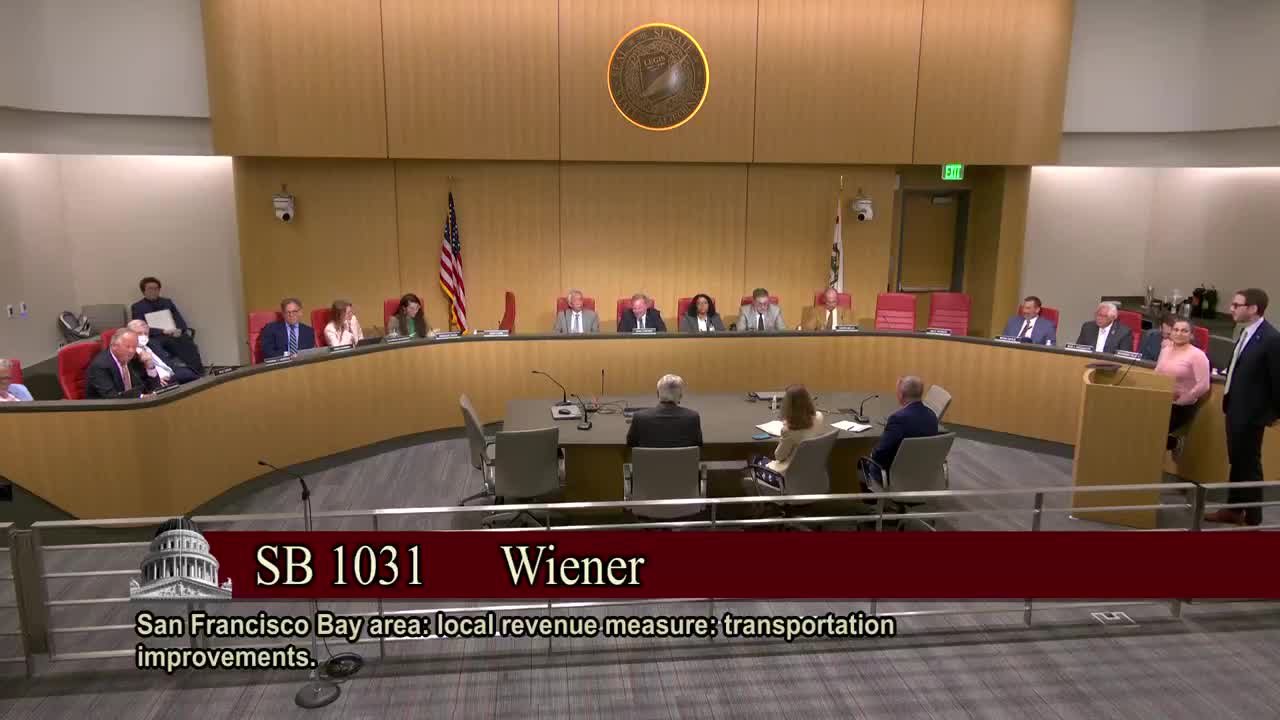 17MIN
Senate Standing Committee on Transportation
 23SEC
Senate Standing Committee on Transportation


Bill Co-Author(s):
