SB 1042: Health facilities and clinics: clinical placements: nursing.
- Session Year: 2023-2024
- House: Senate
- Latest Version Date: 2024-06-20
Current Status:
Failed
(2024-08-15: August 15 hearing: Held in committee and under submission.)
Introduced
In Committee
First Chamber
In Committee
Second Chamber
Enacted
Existing law establishes the Department of Health Care Access and Information (HCAI) to oversee health planning and health policy research, including the health care workforce research and data center. Existing law, the Nursing Practice Act, establishes the Board of Registered Nursing within the Department of Consumer Affairs for the licensure and regulation of nurses. Existing law provides for the licensure and regulation of health facilities and clinics, as defined, by the State Department of Public Health.
Existing law requires an organization that operates, conducts, owns, or maintains a health facility, and the officers thereof, to make and file with HCAI certain reports, including balance sheets and other financial statements. Existing law sets forth related reporting provisions for clinics.
This bill would require a health facility or a clinic, whether or not it currently offers prelicensure clinical placement slots, to meet with representatives from an approved school of nursing or approved nursing program, upon request by the school or program, to discuss the clinical placement needs of the school or program. The bill would require a nursing school or, program, by December 31 of each year, to report to the board or program to annually prepare a report on clinical placements for nursing students and to submit it to the board, with updates. The bill would require the report to include the beginning and end dates of all academic terms within the subsequent calendar year for each clinical slot needed by a clinical group with content area and education level, and the number of clinical slots that the school or program has been unable to fill within the preceding calendar year. The bill would require the board to submit that information to HCAI.
The bill would require a health facility or a clinic, whether or not it currently offers prelicensure clinical placement slots, to annually prepare and submit to HCAI a report, with updates, on clinical placements for nursing students. The bill would authorize HCAI to decide to phase in the types of health facilities or clinics required to report on clinical placements. Under the bill, the report would include, among other things, the estimated number of days and shifts that will be made available within the subsequent calendar year for student use for each type of licensed bed or unit, patient population served in the health facility or clinic, as specified. The bill would require HCAI to post the report on its internet website in a manner that allows for the information in the report to be cross-referenced against the above-described information from the nursing school or program.
The bill would authorize the board, upon request by a nursing school or program, to assist in finding identifying clinical placement slots slot opportunities to meet the clinical placement needs of that school or program, by conferring with health facilities or clinics within the appropriate geographic region of each school or program in an attempt to match available clinical placement slots with needed slots and to encourage the creation of new clinical placement slots at additional clinical training sites to meet school or program demands. If the board attempts to meet clinical placement needs, the bill would require the board to prioritize the requests for assistance from the approved nursing schools or programs of community colleges and California State University campuses. needs, as specified. The bill would require the board to report a summary of every request made by an approved school or program and of any assistance provided and the outcome of that assistance.
The bill would prohibit any attempt to create or secure identify additional clinical placement slots by the board, a health facility, or a clinic from supplanting or disrupting the clinical placement of any nursing student for whom a clinical placement is already in progress or has already been scheduled. progress, has already been scheduled, or is under agreement for future use by an approved school or program.
The bill would condition implementation of its provisions on an appropriation. The bill would also make related legislative findings.
Existing law establishes the Department of Health Care Access and Information (HCAI) to oversee health planning and health policy research, including the health care workforce research and data center. Existing law, the Nursing Practice Act, establishes the Board of Registered Nursing within the Department of Consumer Affairs for the licensure and regulation of nurses. Existing law provides for the licensure and regulation of health facilities and clinics, as defined, by the State Department of Public Health.
Existing law requires an organization that operates, conducts, owns, or maintains a health facility, and the officers thereof, to make and file with HCAI certain reports, including balance sheets and other financial statements. Existing law sets forth related reporting provisions for clinics.
This bill would require a health facility or a clinic, whether or not it currently offers prelicensure clinical placement slots, to meet with representatives from an approved school of nursing or approved nursing program, upon request by the school or program, to discuss the clinical placement needs of the school or program. The bill would require a nursing school or program, program, by December 31 of each year, to report to the board the beginning and end dates of the academic term all academic terms within the subsequent calendar year for each clinical slot needed by a clinical group with content area and education level, and the number of clinical slots that the school or program has been unable to fill. fill within the preceding calendar year. The bill would require the board to submit that information to HCAI.
The bill would require a health facility or a clinic, whether or not it currently offers prelicensure clinical placement slots, to prepare and submit to HCAI a report, with updates, on clinical placements for nursing students. Under the bill, the report would include, among other things, the estimated number of days and shifts available that will be made available within the subsequent calendar year for student use for each type of licensed bed or unit. unit, as specified. The bill would require HCAI to post the report on its internet website in a manner that allows for the information in the report to be cross-referenced against the above-described information from the nursing school or program.
The bill would authorize the board, upon request by a nursing school or program, to assist in finding and securing clinical placement slots to meet the clinical placement needs of that school or program, by conferring with health facilities or clinics within the appropriate geographic region of each school or program in an attempt to match available clinical placement slots with needed slots and to encourage the creation of new clinical placement slots at additional clinical training sites to meet school or program demands. If the board attempts to meet clinical placement needs, the bill would require the board to prioritize the requests for assistance from the approved nursing schools or programs of community colleges and California State University campuses. The bill would require the board to report a summary of any assistance provided and the outcome of that assistance.
The bill would prohibit any attempt to create or secure additional clinical placement slots by the board, a health facility, or a clinic from supplanting or disrupting the clinical placement of any nursing student for whom a clinical placement is already in progress or has already been scheduled.
The bill would condition implementation of its provisions on an appropriation. The bill would also make related legislative findings.
Existing law establishes the Department of Health Care Access and Information (HCAI) to oversee health planning and health policy research, including the health care workforce research and data center. Existing law, the Nursing Practice Act, establishes the Board of Registered Nursing within the Department of Consumer Affairs for the licensure and regulation of nurses. Existing law provides for the licensure and regulation of health facilities and clinics, as defined, by the State Department of Public Health.
Existing law requires an organization that operates, conducts, owns, or maintains a health facility, and the officers thereof, to make and file with HCAI certain reports, including balance sheets and other financial statements. Existing law sets forth related reporting provisions for clinics.
This bill would require a health facility or clinic that offers prelicensure clinical placement slots a clinic, whether or not it currently offers prelicensure clinical placement slots, to meet with representatives from an approved school of nursing or approved nursing program, upon request by the school or program, to discuss the clinical placement needs of the school or program. The bill would require a nursing school or program to report to the board the beginning and end dates of the academic term for each clinical slot needed by a clinical group with content area and education level, and the number of clinical slots that the school or program has been unable to fill. The bill would require the board to submit that information to HCAI.
The bill would require a health facility or clinic a clinic, whether or not it currently offers prelicensure clinical placement slots, to prepare and submit to HCAI a report, with updates, on clinical placements for nursing students. Under the bill, the report would include, among other things, the estimated number of days and shifts available for student use for each type of licensed bed or unit. The bill would require HCAI to post the report on its internet website in a manner that allows for the information in the report to be cross-referenced against the above-described information from the nursing school or program.
The bill would authorize the board, upon request by a nursing school or program, to assist in finding and securing clinical placement slots to meet the clinical placement needs of that school or program, by conferring with health facilities or clinics within the appropriate geographic region of each school or program in an attempt to match available clinical placement slots with needed slots and to create additional clinical placement slots encourage the creation of new clinical placement slots at additional clinical training sites to meet school or program demands. If the board attempts to meet clinical placement needs, the bill would require the board to prioritize the clinical placement needs of requests for assistance from the approved nursing schools or programs of community colleges and California State University campuses.
The bill would prohibit any attempt to create or secure additional clinical placement slots by the board, a health facility, or a clinic from supplanting or disrupting the clinical placement of any nursing student for whom a clinical placement is already in progress or has already been scheduled.
The bill would condition implementation of its provisions on an appropriation. The bill would also make related legislative findings.
Existing law establishes the Department of Health Care Access and Information (HCAI) to oversee health planning and health policy research, including the health care workforce research and data center. Existing law, the Nursing Practice Act, establishes the Board of Registered Nursing within the Department of Consumer Affairs for the licensure and regulation of nurses. Existing law provides for the licensure and regulation of health facilities and clinics, as defined, by the State Department of Public Health.
Existing law requires an organization that operates, conducts, owns, or maintains a health facility, and the officers thereof, to make and file with HCAI certain reports, including balance sheets and other financial statements. Existing law sets forth related reporting provisions for clinics.
This bill would require a health facility or clinic that offers prelicensure clinical placement slots to meet with representatives from an approved school of nursing or approved nursing program, upon request by the school or program, to discuss the clinical placement needs of the school or program. The bill would require a nursing school or program to report to the board the beginning and end dates of the academic term for each clinical slot needed by a clinical group with content area and education level, and the number of clinical slots that the school or program has been unable to fill. The bill would require the board to submit that information to HCAI.
The bill would require a health facility or clinic to prepare and submit to HCAI a report, with updates, on clinical placements for nursing students. Under the bill, the report would include, among other things, the estimated number of days and shifts available for student use for each type of licensed bed or unit. The bill would require HCAI to post the report on its internet website in a manner that allows for the information in the report to be cross-referenced against the above-described information from the nursing school or program.
The bill would authorize the board, upon request by a nursing school or program, to assist in finding and securing clinical placement slots to meet the clinical placement needs of that school or program, by conferring with health facilities or clinics within the appropriate geographic region of each school or program in an attempt to match available clinical placement slots with needed slots and to create additional clinical placement slots to meet school or program demands. If the board attempts to meet clinical placement needs, the bill would require the board to prioritize the clinical placement needs of the approved nursing schools or programs of community colleges and California State University campuses.
The bill would prohibit any attempt to create or secure additional clinical placement slots by the board, a health facility, or a clinic from supplanting or disrupting the clinical placement of any nursing student for whom a clinical placement is already in progress or has already been scheduled.
The bill would condition implementation of its provisions on an appropriation. The bill would also make related legislative findings.
Existing law establishes the Department of Health Care Access and Information in the Health and Welfare Agency to oversee health planning and health policy research, such as the health care workforce research and data center. Existing law, the Nursing Practice Act, establishes the Board of Registered Nurses within the Department of Consumer Affairs for the licensure and regulation of the practice of nursing.This bill would require a health facility, as defined, that offers prelicensure clinical placement slots upon the request of an approved school of nursing or an approved nursing program, as defined, and regardless of whether the school or program is public or private, to meet with representatives of the school or program to discuss the clinical placement needs of the school or program. The bill would require an approved school of nursing or an approved nursing program, regardless of whether the school or program is public or private, to notify the department and the board of the beginning and end dates of the academic term for each clinical slot needed by a clinical group with content area and education level and the number of clinical slots that the school or program has been unable to fill by March 1 of each year.Existing law requires an organization that operates, conducts, owns, or maintains a health facility, and the officers thereof, to make and file with the department specified reports, including, among others, balance sheets detailing the assets, liabilities, and net worth of the health facility at the end of its fiscal year.This bill would further require a report on clinical placement date that includes specified information, including, among other things, the estimated number of days and shifts available for student use for each type of licensed bed or unit. The bill would require the department to post the data in this report with the information required in the March 1 report described above on the departments internet website in a manner that allows for specified information in both reports to be cross-referenced against each other.The bill would also require the department and board to utilize the data in both reports described above to work to meet the clinical placement needs of approved schools of nursing or approved nursing programs, regardless of whether the school or program is public or private, by conferring with health facilities within the appropriate geographic region of each school or program in an attempt to match available clinical placement slots with needed slots and to create additional clinical placement slots to meet school or program demands. In meeting these requirements, the bill would require the department and board to prioritize the clinical placement needs of the approved schools of nursing or approved nursing programs of community colleges and California State University campuses.The bill would require a health facility to provide the department with written justification if it cannot provide additional slots and would require the department, in collaboration with the board, to notify the health facility of the departments acceptance or rejection of the health facilitys justification. The bill would require the department to post all written justifications and outcomes on the departments internet website. The bill would also prohibit any attempt to create or secure additional clinical placement slots by the department, board, or a health facility from supplanting or disrupting the clinical placement of any nursing student for whom a clinical placement is already in progress or has already been scheduled.The bill would also make certain findings and declarations of the Legislature.Existing law establishes the Department of Health Care Access and Information in the Health and Welfare Agency to oversee health planning and health policy research, such as the health care workforce research and data center. Existing law, the Nursing Practice Act, establishes the Board of Registered Nurses within the Department of Consumer Affairs for the licensure and regulation of the practice of nursing.
This bill would require a health facility, as defined, that offers prelicensure clinical placement slots upon the request of an approved school of nursing or an approved nursing program, as defined, and regardless of whether the school or program is public or private, to meet with representatives of the school or program to discuss the clinical placement needs of the school or program. The bill would require an approved school of nursing or an approved nursing program, regardless of whether the school or program is public or private, to notify the department and the board of the beginning and end dates of the academic term for each clinical slot needed by a clinical group with content area and education level and the number of clinical slots that the school or program has been unable to fill by March 1 of each year.
Existing law requires an organization that operates, conducts, owns, or maintains a health facility, and the officers thereof, to make and file with the department specified reports, including, among others, balance sheets detailing the assets, liabilities, and net worth of the health facility at the end of its fiscal year.
This bill would further require a report on clinical placement date that includes specified information, including, among other things, the estimated number of days and shifts available for student use for each type of licensed bed or unit. The bill would require the department to post the data in this report with the information required in the March 1 report described above on the departments internet website in a manner that allows for specified information in both reports to be cross-referenced against each other.
The bill would also require the department and board to utilize the data in both reports described above to work to meet the clinical placement needs of approved schools of nursing or approved nursing programs, regardless of whether the school or program is public or private, by conferring with health facilities within the appropriate geographic region of each school or program in an attempt to match available clinical placement slots with needed slots and to create additional clinical placement slots to meet school or program demands. In meeting these requirements, the bill would require the department and board to prioritize the clinical placement needs of the approved schools of nursing or approved nursing programs of community colleges and California State University campuses.
The bill would require a health facility to provide the department with written justification if it cannot provide additional slots and would require the department, in collaboration with the board, to notify the health facility of the departments acceptance or rejection of the health facilitys justification. The bill would require the department to post all written justifications and outcomes on the departments internet website. The bill would also prohibit any attempt to create or secure additional clinical placement slots by the department, board, or a health facility from supplanting or disrupting the clinical placement of any nursing student for whom a clinical placement is already in progress or has already been scheduled.
The bill would also make certain findings and declarations of the Legislature.
The Legislature finds and declares all of the following:
(a)To graduate from a nursing school or program, students must complete units in both theoretical coursework and hands-on clinical experience. Existing law requires that 500 of a nursing students clinical hours be in a direct patient care model in a clinical setting approved by the Board of Registered Nursing (BRN).
(b)Direct patient care means providing services to a live patient, which can include both in-person and telehealth services. As a result, clinical placements occur within a health facility, clinic, or other health care setting and require agreements between nursing schools or programs and the health care partners for placement of students.
(c)The availability of student placements for clinical experiences is based on clinical settings, such as hospitals or clinics, that are willing to accept and teach students. The settings must have staff that are qualified to teach and supervise students, and often develop contracts with partnering schools or programs to outline responsibilities, liability, and expectations. As a result, clinical placements are often difficult to find.
(d)The California State Auditor Report 2019-120 on the BRN found that, due to a lack of reliable data, the BRN lacked critical information about the location and availability of clinical placement slots. Therefore, the California State Auditor recommends that the BRN require nursing schools or programs to annually update information about the clinical settings that they use for student placements.
(e)Collecting data on clinical placement needs of nursing schools or programs and comparing the data with the availability of clinical placement slots at health facilities or clinics would provide the information necessary for the BRN to properly match scarce clinical placements with the nursing students who need them.
SEC. 2.Article 1 (commencing with Section 127750) is added to Chapter 1 of Part 3 of Division 107 of the Health and Safety Code, to read:1.Nursing Clinical Placements127750.For purposes of this article, the following definitions apply:
(a)Approved school of nursing and approved nursing program, or variations thereof, have the same meaning as set forth in Section 2786 of the Business and Professions Code.
(b)Board means the Board of Registered Nursing, unless otherwise specified.
(c)Clinic has the same meaning as set forth in Section 1200. Clinic includes a primary care clinic and a specialty clinic, as described in Section 1204.
(d)Department means the Department of Health Care Access and Information, unless otherwise specified.
(e)Health facility has the same meaning as set forth in Section 1250.
127751.Implementation of this article shall be subject to an appropriation made by the Legislature for the purpose of this article.
127752.(a)A health facility or a clinic, whether or not it currently offers prelicensure clinical placement slots, shall, upon request by an approved school of nursing or an approved nursing program and regardless of whether the school or program is public or private, meet with representatives from the school or program to discuss the clinical placement needs of the school or program. The health facility or clinic and the school or program shall work together in good faith to meet the demands needs of the school or program to educate and train nursing students.
(b)By December 31 of each year, an An approved school of nursing or an approved nursing program, regardless of whether the school or program is public or private, shall report to the Board of Registered Nursing annually prepare a report on clinical placements for nursing students on a standardized template specified by the Department of Health Care Access and Information. The approved school or program shall submit the report to the Board of Registered Nursing, with updated reporting at times determined by the board in consultation with the department. The report shall include, but not be limited to, the following information:
(1)The beginning and end dates of all academic terms within the subsequent calendar year for each clinical slot needed by a clinical group with content area and education level.
(2)The number of clinical slots that the school or program has been unable to fill within the preceding calendar year.
(c)(1)Following receipt of the information required by subdivision (b) and utilizing the data reported pursuant to Section 127753, the board may, upon request by an approved school of nursing or approved nursing program, assist in finding identifying clinical placement slots slot opportunities to meet the clinical placement needs of that school or program, regardless of whether the school or program is public or private, by conferring with health facilities or clinics within the appropriate geographic region of each school or program in an attempt to match available clinical placement slots with needed slots and to encourage the creation of new clinical placement slots at additional clinical training sites to meet school or program demands. needs. Under those circumstances, the health facilities or clinics involved may elect elect, and are not required, to make those existing or new, but unused, clinical placement slots available. The boards assistance in identifying clinical placement slot opportunities, if the board elects to do so, shall be limited to researching and examining potential clinical placement sites that would meet clinical course objectives, without impacting or displacing existing clinical placements of any approved school of nursing or approved nursing program that are already in progress or have been scheduled in the future.
(2)If the board attempts to meet clinical placement needs pursuant to paragraph (1), the board shall prioritize the requests for assistance from the approved schools of nursing or approved nursing programs of community colleges and California State University campuses.(3)(2)The board shall report, through the boards Education/Licensing Committee, a summary of every request made by an approved school of nursing or approved nursing program pursuant to paragraph (1) and of any assistance provided pursuant to this subdivision and the outcome of that assistance.
(d)Any attempt to create or secure identify additional clinical placement slots by the board, a health facility, or a clinic pursuant to this section shall not supplant or disrupt the clinical placement of any nursing student for whom a clinical placement is already in progress or has already been scheduled. progress, has already been scheduled, or is under agreement for future use by an approved school of nursing or approved nursing program.
(e)This section shall not be construed to limit, prevent, or justify the approval or denial of new schools of nursing or the expansion of approved nursing programs.
127753.(a)A health facility or a clinic, whether or not it currently offers prelicensure clinical placement slots, shall annually prepare a report on clinical placements for nursing students. The health facility or clinic shall submit the report to the Department of Health Care Access and Information, with updated reporting at the times as the department shall require, on a form standardized template specified by the department in accordance with, if applicable, the systems of accounting and uniform reporting required by Part 5 (commencing with Section 128675). The department, in consultation with the board, may decide to phase in the types of health facilities or clinics required to report on clinical placements.
(b)The report described in subdivision (a) shall include, but not be limited to, all of the following information:
(1)Estimated number of days and shifts that will be made available within the subsequent calendar year for student use for each type of licensed bed or unit patient population served in the health facility or clinic, including, but not limited to, days and shifts available in the following areas of study:
(A)Geriatrics.
(B)Medical-surgical.
(C)Mental health/psychiatric nursing.
(D)Obstetrics.
(E)Pediatrics.
(2)Number of days and shifts being utilized within the preceding calendar year for student use for each type of licensed bed or unit patient population served in the health facility or clinic, including, but not limited to, days and shifts available in the areas of study listed in paragraph (1).
(3)Name of the academic institution with an approved school of nursing or nursing program utilizing each type of licensed bed or unit the days and shifts reported in paragraph (2).
(c)If a prelicensure clinical placement slot is available or filled for a period of time that begins in one reporting period, but ends in another reporting period, the slot shall be reported for the period in which the student began the clinical placement and not for the reporting period in which the student ended the clinical placement.
(d)(1)The Board of Registered Nursing shall submit the information described in subdivision (b) of Section 127752 to the department.
(2)The department shall post the report described in this section with the information described in subdivision (b) of Section 127752 on the departments internet website in a manner that allows for the information described in subdivision (b) of this section to be cross-referenced against the information described in subdivision (b) of Section 127752.
(e)For the purposes of implementing this section, including, but not limited to, hiring staff and consultants, facilitating and conducting meetings, developing the required reports, and conducting data collection and analysis, the department may enter into exclusive or nonexclusive contracts on a bid or negotiated basis. Contracts entered into or amended pursuant to this section are exempt from Chapter 6 (commencing with Section 14825) of Part 5.5 of Division 3 of Title 2 of the Government Code and Part 2 (commencing with Section 10100) of Division 2 of the Public Contract Code, and are exempt from the review or approval of any division of the Department of General Services.
The Legislature finds and declares all of the following:
(a)To graduate from a nursing school or program, students must complete units in both theoretical coursework and hands-on clinical experience. Existing law requires that 500 of a nursing students clinical hours be in a direct patient care model in a clinical setting approved by the Board of Registered Nursing (BRN).
(b)Direct patient care means providing services to a live patient, which can include both in-person and telehealth services. As a result, clinical placements occur within a health facility, clinic, or other health care setting and require agreements between nursing schools or programs and the health care partners for placement of students.
(c)The availability of student placements for clinical experiences is based on clinical settings, such as hospitals or clinics, that are willing to accept and teach students. The settings must have staff that are qualified to teach and supervise students, and often develop contracts with partnering schools or programs to outline responsibilities, liability, and expectations. As a result, clinical placements are often difficult to find.
(d)The California State Auditor Report 2019-120 on the BRN found that, due to a lack of reliable data, the BRN lacked critical information about the location and availability of clinical placement slots. Therefore, the California State Auditor recommends that the BRN require nursing schools or programs to annually update information about the clinical settings that they use for student placements.
(e)Collecting data on clinical placement needs of nursing schools or programs and comparing the data with the availability of clinical placement slots at health facilities or clinics would provide the information necessary for the BRN to properly match scarce clinical placements with the nursing students who need them.
SEC. 2.Article 1 (commencing with Section 127750) is added to Chapter 1 of Part 3 of Division 107 of the Health and Safety Code, to read:1.Nursing Clinical Placements127750.For purposes of this article, the following definitions apply:
(a)Approved school of nursing and approved nursing program, or variations thereof, have the same meaning as set forth in Section 2786 of the Business and Professions Code.
(b)Board means the Board of Registered Nursing, unless otherwise specified.
(c)Clinic has the same meaning as set forth in Section 1200. Clinic includes a primary care clinic and a specialty clinic, as described in Section 1204.
(d)Department means the Department of Health Care Access and Information, unless otherwise specified.
(e)Health facility has the same meaning as set forth in Section 1250.
127751.Implementation of this article shall be subject to an appropriation made by the Legislature for the purpose of this article.
127752.(a)A health facility or a clinic, whether or not it currently offers prelicensure clinical placement slots, shall, upon request by an approved school of nursing or an approved nursing program and regardless of whether the school or program is public or private, meet with representatives from the school or program to discuss the clinical placement needs of the school or program. The health facility or clinic and the school or program shall work together in good faith to meet the demands of the school or program to educate and train nursing students.
(b)By the end of its respective academic term, December 31 of each year, an approved school of nursing or an approved nursing program, regardless of whether the school or program is public or private, shall report to the Board of Registered Nursing the following information:
(1)The beginning and end dates of the academic term all academic terms within the subsequent calendar year for each clinical slot needed by a clinical group with content area and education level.
(2)The number of clinical slots that the school or program has been unable to fill. fill within the preceding calendar year.
(c)(1)Following receipt of the information required by subdivision (b) and utilizing the data reported pursuant to Section 127753, the board may, upon request by an approved school of nursing or approved nursing program, assist in finding and securing clinical placement slots to meet the clinical placement needs of that school or program, regardless of whether the school or program is public or private, by conferring with health facilities or clinics within the appropriate geographic region of each school or program in an attempt to match available clinical placement slots with needed slots and to encourage the creation of new clinical placement slots at additional clinical training sites to meet school or program demands. Under those circumstances, the health facilities or clinics involved may elect to make those existing or new, but unused, clinical placement slots available.
(2)If the board attempts to meet clinical placement needs pursuant to paragraph (1), the board shall prioritize the requests for assistance from the approved schools of nursing or approved nursing programs of community colleges and California State University campuses.
(3)The board shall report, through the boards Education/Licensing Committee, a summary of any assistance provided pursuant to this subdivision and the outcome of that assistance.
(d)Any attempt to create or secure additional clinical placement slots by the board, a health facility, or a clinic pursuant to this section shall not supplant or disrupt the clinical placement of any nursing student for whom a clinical placement is already in progress or has already been scheduled.
(e)This section shall not be construed to limit, prevent, or justify the approval or denial of new schools of nursing or the expansion of approved nursing programs.
127753.(a)A health facility or a clinic, whether or not it currently offers prelicensure clinical placement slots, shall prepare a report on clinical placements for nursing students. The health facility or clinic shall submit the report to the Department of Health Care Access and Information, with updated reporting at the times as the department shall require, on a form specified by the department in accordance with, if applicable, the systems of accounting and uniform reporting required by Part 5 (commencing with Section 128675).
(b)The report described in subdivision (a) shall include, but not be limited to, all of the following information:
(1)Estimated number of days and shifts available that will be made available within the subsequent calendar year for student use for each type of licensed bed or unit. unit in the health facility or clinic, including, but not limited to, days and shifts available in the following areas of study:
(A)Geriatrics.
(B)Medical-surgical.
(C)Mental health/psychiatric nursing.
(D)Obstetrics.
(E)Pediatrics.
(2)Number of days and shifts being utilized within the preceding calendar year for student use for each type of licensed bed or unit. unit in the health facility or clinic, including, but not limited to, days and shifts available in the areas of study listed in paragraph (1).
(3)Name of the academic institution with an approved school of nursing or nursing program utilizing each type of licensed bed or unit. unit reported in paragraph (2).
(c)If a prelicensure clinical placement slot is available or filled for a period of time that begins in one reporting period, but ends in another reporting period, the slot shall be reported for the period in which the student began the clinical placement and not for the reporting period in which the student ended the clinical placement.
(d)(1)The Board of Registered Nursing shall submit the information described in subdivision (b) of Section 127752 to the department.
(2)The department shall post the report described in this section with the information described in subdivision (b) of Section 127752 on the departments internet website in a manner that allows for the information described in subdivision (b) of this section to be cross-referenced against the information described in subdivision (b) of Section 127752.
The Legislature finds and declares all of the following:
(a)To graduate from a nursing school or program, students must complete units in both theoretical coursework and hands-on clinical experience. Existing law requires that 500 of a nursing students clinical hours be in a direct patient care model in a clinical setting approved by the Board of Registered Nursing (BRN).
(b)Direct patient care means providing services to a live patient, which can include both in-person and telehealth services. As a result, clinical placements occur within a health facility, clinic, or other health care setting and require agreements between nursing schools or programs and the health care partners for placement of students.
(c)The availability of student placements for clinical experiences is based on clinical settings, such as hospitals or clinics, that are willing to accept and teach students. The settings must have staff that are qualified to teach and supervise students, and often develop contracts with partnering schools or programs to outline responsibilities, liability, and expectations. As a result, clinical placements are often difficult to find.
(d)The California State Auditor Report 2019-120 on the BRN found that, due to a lack of reliable data, the BRN lacked critical information about the location and availability of clinical placement slots. Therefore, the California State Auditor recommends that the BRN require nursing schools or programs to annually update information about the clinical settings that they use for student placements.
(e)Collecting data on clinical placement needs of nursing schools or programs and comparing the data with the availability of clinical placement slots at health facilities or clinics would provide the information necessary for the BRN to properly match scarce clinical placements with the nursing students who need them.
SEC. 2.Article 1 (commencing with Section 127750) is added to Chapter 1 of Part 3 of Division 107 of the Health and Safety Code, to read:1.Nursing Clinical Placements127750.For purposes of this article, the following definitions apply:
(a)Approved school of nursing and approved nursing program, or variations thereof, have the same meaning as set forth in Section 2786 of the Business and Professions Code.
(b)Board means the Board of Registered Nursing, unless otherwise specified.
(c)Clinic has the same meaning as set forth in Section 1200. Clinic includes a primary care clinic and a specialty clinic, as described in Section 1204.
(d)Department means the Department of Health Care Access and Information, unless otherwise specified.
(e)Health facility has the same meaning as set forth in Section 1250.
127751.Implementation of this article shall be subject to an appropriation made by the Legislature for the purpose of this article.
127752.(a)A health facility, or a clinic, that offers prelicensure clinical placement slots shall, facility or a clinic, whether or not it currently offers prelicensure clinical placement slots, shall, upon request by an approved school of nursing or an approved nursing program and regardless of whether the school or program is public or private, meet with representatives from the school or program to discuss the clinical placement needs of the school or program. The health facility or clinic and the school or program shall work together in good faith to meet the demands of the school or program to educate and train nursing students.
(b)By the end of its respective academic term, an approved school of nursing or an approved nursing program, regardless of whether the school or program is public or private, shall report to the Board of Registered Nursing the following information:
(1)The beginning and end dates of the academic term for each clinical slot needed by a clinical group with content area and education level.
(2)The number of clinical slots that the school or program has been unable to fill.
(c)(1)Following receipt of the information required by subdivision (b) and utilizing the data reported pursuant to Section 127753, the board may, upon request by an approved school of nursing or approved nursing program, assist in finding and securing clinical placement slots to meet the clinical placement needs of that school or program, regardless of whether the school or program is public or private, by conferring with health facilities or clinics within the appropriate geographic region of each school or program in an attempt to match available clinical placement slots with needed slots and to create additional clinical placement slots encourage the creation of new clinical placement slots at additional clinical training sites to meet school or program demands.
(2)If the board attempts to meet clinical placement needs pursuant to paragraph (1), the board shall prioritize the clinical placement needs of requests for assistance from the approved schools of nursing or approved nursing programs of community colleges and California State University campuses.
(d)Any attempt to create or secure additional clinical placement slots by the board, a health facility, or a clinic pursuant to this section shall not supplant or disrupt the clinical placement of any nursing student for whom a clinical placement is already in progress or has already been scheduled.
(e)This section shall not be construed to limit, prevent, or justify the approval or denial of new schools of nursing or the expansion of approved nursing programs.
127753.(a)A health facility, or a clinic, facility or a clinic, whether or not it currently offers prelicensure clinical placement slots, shall prepare a report on clinical placements for nursing students. The health facility or clinic shall submit the report to the Department of Health Care Access and Information, with updated reporting at the times as the department shall require, on a form specified by the department in accordance with, if applicable, the systems of accounting and uniform reporting required by Part 5 (commencing with Section 128675).
(b)The report described in subdivision (a) shall include, but not be limited to, all of the following information:
(1)Estimated number of days and shifts available for student use for each type of licensed bed or unit.
(2)Number of days and shifts being utilized for student use for each type of licensed bed or unit.
(3)Name of the academic institution with an approved school of nursing or nursing program utilizing each type of licensed bed or unit.
(4)Average daily patient census per type of licensed bed or unit.(5)Average daily number of registered nurses staffing each type of licensed bed or unit.(c)If a prelicensure clinical placement slot is available or filled for a period of time that begins in one reporting period, but ends in another reporting period, the slot shall be reported for the period in which the student began the clinical placement and not for the reporting period in which the student ended the clinical placement.
(d)(1)The Board of Registered Nursing shall submit the information described in subdivision (b) of Section 127752 to the department.
(2)The department shall post the report described in this section with the information described in subdivision (b) of Section 127752 on the departments internet website in a manner that allows for the information described in subdivision (b) of this section to be cross-referenced against the information described in subdivision (b) of Section 127752.
The Legislature finds and declares all of the following:
(a)To graduate from a nursing school or program, students must complete units in both theoretical coursework and hands-on clinical experience. Existing law requires that 500 of a nursing students clinical hours be in a direct patient care model in a clinical setting approved by the Board of Registered Nursing (BRN).
(b)Direct patient care means providing services to a live patient, which can include both in-person and telehealth services. As a result, clinical placements occur within a health facility, clinic, or other health care setting and require agreements between nursing schools or programs and the health care partners for placement of students.
(c)The availability of student placements for clinical experiences is based on clinical settings, such as hospitals or clinics, that are willing to accept and teach students. The settings must have staff that are qualified to teach and supervise students, and often develop contracts with partnering schools or programs to outline responsibilities, liability, and expectations. As a result, clinical placements are often difficult to find.
(d)The California State Auditor Report 2019-120 on the BRN found that, due to a lack of reliable data, the BRN lacked critical information about the location and availability of clinical placement slots. Therefore, the California State Auditor recommends that the BRN require nursing schools or programs to annually update information about the clinical settings that they use for student placements.
(e)Collecting data on clinical placement needs of nursing schools or programs and comparing the data with the availability of clinical placement slots at health facilities or clinics would provide the information necessary for the BRN to properly match scarce clinical placements with the nursing students who need them.
SEC. 2.Article 1 (commencing with Section 127750) is added to Chapter 1 of Part 3 of Division 107 of the Health and Safety Code, to read:1.Nursing Clinical Placements127750.For purposes of this article, the following definitions apply:
(a)Approved school of nursing and approved nursing program, or variations thereof, have the same meaning as set forth in Section 2786 of the Business and Professions Code.
(b)Board means the Board of Registered Nursing, unless otherwise specified.
(c)Clinic has the same meaning as set forth in Section 1200. Clinic includes a primary care clinic and a specialty clinic, as described in Section 1204.
(d)Department means the Department of Health Care Access and Information, unless otherwise specified.
(e)Health facility has the same meaning as set forth in Section 1250.
127751.Implementation of this article shall be subject to an appropriation made by the Legislature for the purpose of this article.
127752.(a)A health facility, or a clinic, that offers prelicensure clinical placement slots shall, upon request by an approved school of nursing or an approved nursing program and regardless of whether the school or program is public or private, meet with representatives from the school or program to discuss the clinical placement needs of the school or program. The health facility or clinic and the school or program shall work together in good faith to meet the demands of the school or program to educate and train nursing students.
(b)By the end of its respective academic term, an approved school of nursing or an approved nursing program, regardless of whether the school or program is public or private, shall report to the Board of Registered Nursing the following information:
(1)The beginning and end dates of the academic term for each clinical slot needed by a clinical group with content area and education level.
(2)The number of clinical slots that the school or program has been unable to fill.
(c)(1)Following receipt of the information required by subdivision (b) and utilizing the data reported pursuant to Section 127753, the board may, upon request by an approved school of nursing or approved nursing program, assist in finding and securing clinical placement slots to meet the clinical placement needs of that school or program, regardless of whether the school or program is public or private, by conferring with health facilities or clinics within the appropriate geographic region of each school or program in an attempt to match available clinical placement slots with needed slots and to create additional clinical placement slots to meet school or program demands.
(2)If the board attempts to meet clinical placement needs pursuant to paragraph (1), the board shall prioritize the clinical placement needs of the approved schools of nursing or approved nursing programs of community colleges and California State University campuses.
(d)Any attempt to create or secure additional clinical placement slots by the board, a health facility, or a clinic pursuant to this section shall not supplant or disrupt the clinical placement of any nursing student for whom a clinical placement is already in progress or has already been scheduled.
(e)This section shall not be construed to limit, prevent, or justify the approval or denial of new schools of nursing or the expansion of approved nursing programs.
127753.(a)A health facility, or a clinic, shall prepare a report on clinical placements for nursing students. The health facility or clinic shall submit the report to the Department of Health Care Access and Information, with updated reporting at the times as the department shall require, on a form specified by the department in accordance with, if applicable, the systems of accounting and uniform reporting required by Part 5 (commencing with Section 128675).
(b)The report described in subdivision (a) shall include, but not be limited to, all of the following information:
(1)Estimated number of days and shifts available for student use for each type of licensed bed or unit.
(2)Number of days and shifts being utilized for student use for each type of licensed bed or unit.
(3)Name of the academic institution with an approved school of nursing or nursing program utilizing each type of licensed bed or unit.
(4)Average daily patient census per type of licensed bed or unit.
(5)Average daily number of registered nurses staffing each type of licensed bed or unit.
(c)If a prelicensure clinical placement slot is available or filled for a period of time that begins in one reporting period, but ends in another reporting period, the slot shall be reported for the period in which the student began the clinical placement and not for the reporting period in which the student ended the clinical placement.
(d)(1)The Board of Registered Nursing shall submit the information described in subdivision (b) of Section 127752 to the department.
(2)The department shall post the report described in this section with the information described in subdivision (b) of Section 127752 on the departments internet website in a manner that allows for the information described in subdivision (b) of this section to be cross-referenced against the information described in subdivision (b) of Section 127752.
SECTION 1.The Legislature finds and declares all of the following:(a)To graduate from a nursing program, students must complete units in both theoretical coursework and hands on clinical experience. The Board of Registered Nursing (BRN) regulations require that 75% of a nursing students clinical hours be in a direct patient care model.(b)Direct patient care means providing services to a live patient, which can include both inperson and telehealth. As a result, most clinical placements occur within a health care facility and require agreements between nursing programs and the health facility partners for placement of students.(c)The availability of student placements for clinical experiences is based on clinical facilities, such as hospitals or clinics that are willing to accept and teach students. The facilities must have staff that are qualified to teach and supervise students, and often develop contracts with partner educational programs to outline responsibilities, liability, and expectations. As a result, clinical placements are often difficult to find.(d)The California State Auditor Report 2019-120 on the Board of Registered Nursing found that due to a lack of reliable data, the BRN lacked critical information about the location and availability of clinical placement slots. Therefore, the California State Auditor recommends that the BRN require nursing programs to annually update information about the clinical facilities they use for student placements.(e)Collecting data on nursing programs clinical placement needs and comparing it with the availability of clinical placement slots at health facilities would provide the information necessary for the BRN and the Department of Health Care Access and Information to properly match scarce clinical placements with the nursing students that need them.SEC. 2.Article 1 (commencing with Section 127750) is added to Chapter 1 of Part 3 of Division 107 of the Health and Safety Code, to read:1.Nursing Clinical Placements127750.(a)A health facility, as defined in Section 1250, that offers prelicensure clinical placement slots shall, upon the request of an approved school of nursing or an approved nursing program and regardless of whether the school or program is public or private, meet with representatives from the school or program to discuss the clinical placement needs of the school or program. The health facility and the school or program shall work together in good faith to meet the demands of the school or program to educate and train nursing students.(b)By March 1 of each year, an approved school of nursing or an approved nursing program, regardless of whether the school or program is public or private, shall report to the Department of Health Care Access and Information and the Board of Registered Nursing the following information:(1)The beginning and end dates of the academic term for each clinical slot needed by a clinical group with content area and education level.(2)The number of clinical slots that the school or program has been unable to fill.(c)(1)Following receipt of the information required by subdivision (b) and utilizing the data reported pursuant to subdivision (h) of Section 128735, the department and board shall work to meet the clinical placement needs of all approved schools of nursing or approved nursing programs, regardless of whether the school or program is public or private, by conferring with health facilities within the appropriate geographic region of each school or program in an attempt to match available clinical placement slots with needed slots and to create additional clinical placement slots to meet school or program demands.(2)In meeting the requirements of paragraph (1), the department and board shall prioritize the clinical placement needs of the approved schools of nursing or approved nursing programs of community colleges and California State University campuses.(d)If a health facility cannot provide additional slots, the health facility shall provide the department with written justification of its lack of capability or capacity within 30 days. The department shall, in collaboration with the board, notify the health facility within 30 days of its acceptance or rejection of the health facilitys justification. The department shall post all written justifications and outcomes on the departments internet website.(e)Any attempt to create or secure additional clinical placement slots by the department, board, or a health facility pursuant to this section shall not supplant or disrupt the clinical placement of any nursing student for whom a clinical placement is already in progress or has already been scheduled.(f)For purposes of this section, approved school of nursing and approved nursing program, or variations thereof, have the same meaning as set forth in Section 2786 of the Business and Professions Code.(g)Nothing in this section shall be construed to limit, prevent, or justify the approval or denial of new schools of nursing or the expansion of approved nursing programs.SEC. 3.Section 128735 of the Health and Safety Code is amended to read:128735.An organization that operates, conducts, owns, or maintains a health facility, and the officers thereof, shall make and file with the department, at the times as the department shall require, all of the following reports on forms specified by the department that are in accord, if applicable, with the systems of accounting and uniform reporting required by this part, except that the reports required pursuant to subdivision (g) shall be limited to hospitals:(a)A balance sheet detailing the assets, liabilities, and net worth of the health facility at the end of its fiscal year.(b)A statement of income, expenses, and operating surplus or deficit for the annual fiscal period, and a statement of ancillary utilization and patient census.(c)A statement detailing patient revenue by payer, including, but not limited to, Medicare, Medi-Cal, and other payers, and revenue center.(d)A statement of cashflows, including, but not limited to, ongoing and new capital expenditures and depreciation.(e)(1)A statement reporting the information required in subdivisions (a), (b), (c), and (d) for each separately licensed health facility operated, conducted, or maintained by the reporting organization.(2)Notwithstanding paragraph (1), a health facility that receives a preponderance of its revenue from associated comprehensive group practice prepayment health care service plans and that is operated as a unit of a coordinated group of health facilities under common management may report the information required pursuant to subdivisions (a) and (d) for the group and not for each separately licensed health facility.(f)Data reporting requirements established by the department shall be consistent with national standards, as applicable.(g)A Hospital Discharge Abstract Data Record that includes all of the following:(1)Date of birth.(2)Sex.(3)Race.(4)ZIP Code.(5)Preferred language spoken.(6)Patient social security number, if it is contained in the patients medical record.(7)Prehospital care and resuscitation, if any, including all of the following:(A)Do not resuscitate (DNR) order on admission.(B)Do not resuscitate (DNR) order after admission.(8)Admission date.(9)Source of admission.(10)Type of admission.(11)Discharge date.(12)Principal diagnosis and whether the condition was present on admission.(13)Other diagnoses and whether the conditions were present on admission.(14)External causes of morbidity and whether present on admission.(15)Principal procedure and date.(16)Other procedures and dates.(17)Total charges.(18)Disposition of patient.(19)Expected source of payment.(20)Elements added pursuant to Section 128738.(h)(1)A report on clinical placement data that includes, but is not limited to, all of the following information:(A)Estimated number of days and shifts available for student use for each type of licensed bed or unit.(B)Number of days and shifts being utilized for student use for each type of licensed bed or unit.(C)Name of the academic institution with an approved school of nursing or nursing program utilizing each type of licensed bed or unit.(D)Average daily patient census per type of licensed bed or unit.(E)Average daily number of registered nurses staffing each type of licensed bed or unit.(2)If a prelicensure clinical placement slot is available or filled for a period of time that begins in one reporting period, but ends in another reporting period, the slot shall be reported for the period in which the student began the clinical placement and not for the reporting period in which the student ended the clinical placement.(3)The department shall post the information specified in paragraph (1) with the information specified in subdivision (b) of Section 127750 on its internet website in a manner that allows for the information in subparagraphs (A) to (C), inclusive, of paragraph (1) to be cross-referenced against the information specified in subdivision (b) of Section 127750.(i)It is the intent of the Legislature that the patients rights of confidentiality shall not be violated in any manner. Patient social security numbers and other data elements that the department believes could be used to determine the identity of an individual patient shall be exempt from the disclosure requirements of the California Public Records Act (Division 10 (commencing with Section 7920.000) of Title 1 of the Government Code).(j)A person reporting data pursuant to this section shall not be liable for damages in an action based on the use or misuse of patient-identifiable data that has been mailed or otherwise transmitted to the department pursuant to the requirements of subdivision (g).(k)A hospital shall use coding from the International Classification of Diseases in reporting diagnoses and procedures.(l)On or before July 1, 2021, the department shall promulgate regulations as necessary to implement subdivision (e). A health facility that receives a preponderance of its revenue from associated comprehensive group practice prepayment health care service plans and that is operated as a unit of a coordinated group of health facilities under common management shall comply with the reporting requirements of subdivisions (b), (c), and (e) once the department finalizes related regulations.The Legislature finds and declares all of the following:
(a)To graduate from a nursing program, students must complete units in both theoretical coursework and hands on clinical experience. The Board of Registered Nursing (BRN) regulations require that 75% of a nursing students clinical hours be in a direct patient care model.
(b)Direct patient care means providing services to a live patient, which can include both inperson and telehealth. As a result, most clinical placements occur within a health care facility and require agreements between nursing programs and the health facility partners for placement of students.
(c)The availability of student placements for clinical experiences is based on clinical facilities, such as hospitals or clinics that are willing to accept and teach students. The facilities must have staff that are qualified to teach and supervise students, and often develop contracts with partner educational programs to outline responsibilities, liability, and expectations. As a result, clinical placements are often difficult to find.
(d)The California State Auditor Report 2019-120 on the Board of Registered Nursing found that due to a lack of reliable data, the BRN lacked critical information about the location and availability of clinical placement slots. Therefore, the California State Auditor recommends that the BRN require nursing programs to annually update information about the clinical facilities they use for student placements.
(e)Collecting data on nursing programs clinical placement needs and comparing it with the availability of clinical placement slots at health facilities would provide the information necessary for the BRN and the Department of Health Care Access and Information to properly match scarce clinical placements with the nursing students that need them.
SEC. 2.Article 1 (commencing with Section 127750) is added to Chapter 1 of Part 3 of Division 107 of the Health and Safety Code, to read:1.Nursing Clinical Placements127750.(a)A health facility, as defined in Section 1250, that offers prelicensure clinical placement slots shall, upon the request of an approved school of nursing or an approved nursing program and regardless of whether the school or program is public or private, meet with representatives from the school or program to discuss the clinical placement needs of the school or program. The health facility and the school or program shall work together in good faith to meet the demands of the school or program to educate and train nursing students.
(b)By March 1 of each year, an approved school of nursing or an approved nursing program, regardless of whether the school or program is public or private, shall report to the Department of Health Care Access and Information and the Board of Registered Nursing the following information:
(1)The beginning and end dates of the academic term for each clinical slot needed by a clinical group with content area and education level.
(2)The number of clinical slots that the school or program has been unable to fill.
(c)(1)Following receipt of the information required by subdivision (b) and utilizing the data reported pursuant to subdivision (h) of Section 128735, the department and board shall work to meet the clinical placement needs of all approved schools of nursing or approved nursing programs, regardless of whether the school or program is public or private, by conferring with health facilities within the appropriate geographic region of each school or program in an attempt to match available clinical placement slots with needed slots and to create additional clinical placement slots to meet school or program demands.
(2)In meeting the requirements of paragraph (1), the department and board shall prioritize the clinical placement needs of the approved schools of nursing or approved nursing programs of community colleges and California State University campuses.
(d)If a health facility cannot provide additional slots, the health facility shall provide the department with written justification of its lack of capability or capacity within 30 days. The department shall, in collaboration with the board, notify the health facility within 30 days of its acceptance or rejection of the health facilitys justification. The department shall post all written justifications and outcomes on the departments internet website.
(e)Any attempt to create or secure additional clinical placement slots by the department, board, or a health facility pursuant to this section shall not supplant or disrupt the clinical placement of any nursing student for whom a clinical placement is already in progress or has already been scheduled.
(f)For purposes of this section, approved school of nursing and approved nursing program, or variations thereof, have the same meaning as set forth in Section 2786 of the Business and Professions Code.
(g)Nothing in this section shall be construed to limit, prevent, or justify the approval or denial of new schools of nursing or the expansion of approved nursing programs.
SEC. 3.Section 128735 of the Health and Safety Code is amended to read:128735.An organization that operates, conducts, owns, or maintains a health facility, and the officers thereof, shall make and file with the department, at the times as the department shall require, all of the following reports on forms specified by the department that are in accord, if applicable, with the systems of accounting and uniform reporting required by this part, except that the reports required pursuant to subdivision (g) shall be limited to hospitals:
(a)A balance sheet detailing the assets, liabilities, and net worth of the health facility at the end of its fiscal year.
(b)A statement of income, expenses, and operating surplus or deficit for the annual fiscal period, and a statement of ancillary utilization and patient census.
(c)A statement detailing patient revenue by payer, including, but not limited to, Medicare, Medi-Cal, and other payers, and revenue center.
(d)A statement of cashflows, including, but not limited to, ongoing and new capital expenditures and depreciation.
(e)(1)A statement reporting the information required in subdivisions (a), (b), (c), and (d) for each separately licensed health facility operated, conducted, or maintained by the reporting organization.
(2)Notwithstanding paragraph (1), a health facility that receives a preponderance of its revenue from associated comprehensive group practice prepayment health care service plans and that is operated as a unit of a coordinated group of health facilities under common management may report the information required pursuant to subdivisions (a) and (d) for the group and not for each separately licensed health facility.
(f)Data reporting requirements established by the department shall be consistent with national standards, as applicable.
(g)A Hospital Discharge Abstract Data Record that includes all of the following:
(1)Date of birth.
(2)Sex.
(3)Race.
(4)ZIP Code.
(5)Preferred language spoken.
(6)Patient social security number, if it is contained in the patients medical record.
(7)Prehospital care and resuscitation, if any, including all of the following:
(A)Do not resuscitate (DNR) order on admission.
(B)Do not resuscitate (DNR) order after admission.
(8)Admission date.
(9)Source of admission.
(10)Type of admission.
(11)Discharge date.
(12)Principal diagnosis and whether the condition was present on admission.
(13)Other diagnoses and whether the conditions were present on admission.
(14)External causes of morbidity and whether present on admission.
(15)Principal procedure and date.
(16)Other procedures and dates.
(17)Total charges.
(18)Disposition of patient.
(19)Expected source of payment.
(20)Elements added pursuant to Section 128738.
(h)(1)A report on clinical placement data that includes, but is not limited to, all of the following information:
(A)Estimated number of days and shifts available for student use for each type of licensed bed or unit.
(B)Number of days and shifts being utilized for student use for each type of licensed bed or unit.
(C)Name of the academic institution with an approved school of nursing or nursing program utilizing each type of licensed bed or unit.
(D)Average daily patient census per type of licensed bed or unit.
(E)Average daily number of registered nurses staffing each type of licensed bed or unit.
(2)If a prelicensure clinical placement slot is available or filled for a period of time that begins in one reporting period, but ends in another reporting period, the slot shall be reported for the period in which the student began the clinical placement and not for the reporting period in which the student ended the clinical placement.
(3)The department shall post the information specified in paragraph (1) with the information specified in subdivision (b) of Section 127750 on its internet website in a manner that allows for the information in subparagraphs (A) to (C), inclusive, of paragraph (1) to be cross-referenced against the information specified in subdivision (b) of Section 127750.
(h)(i)It is the intent of the Legislature that the patients rights of confidentiality shall not be violated in any manner. Patient social security numbers and other data elements that the department believes could be used to determine the identity of an individual patient shall be exempt from the disclosure requirements of the California Public Records Act (Division 10 (commencing with Section 7920.000) of Title 1 of the Government Code).
(i)(j)A person reporting data pursuant to this section shall not be liable for damages in an action based on the use or misuse of patient-identifiable data that has been mailed or otherwise transmitted to the department pursuant to the requirements of subdivision (g).
(j)(k)A hospital shall use coding from the International Classification of Diseases in reporting diagnoses and procedures.
(k)(l)On or before July 1, 2021, the department shall promulgate regulations as necessary to implement subdivision (e). A health facility that receives a preponderance of its revenue from associated comprehensive group practice prepayment health care service plans and that is operated as a unit of a coordinated group of health facilities under common management shall comply with the reporting requirements of subdivisions (b), (c), and (e) once the department finalizes related regulations.
|
Date
|
Status
|
|---|---|
| Aug 15, 2024 | August 15 hearing: Held in committee and under submission. |
| Aug 7, 2024 | August 7 set for first hearing. Placed on suspense file. |
| Jun 25, 2024 | From committee: Do pass and re-refer to Com. on APPR. (Ayes 16. Noes 0.) (June 25). Re-referred to Com. on APPR. |
| Jun 20, 2024 | From committee with author's amendments. Read second time and amended. Re-referred to Com. on B. & P. |
| Jun 12, 2024 | From committee: Do pass and re-refer to Com. on B. & P. (Ayes 15. Noes 1.) (June 11). Re-referred to Com. on B. & P. |
| Jun 3, 2024 | Referred to Coms. on HEALTH and B. & P. |
| May 23, 2024 | In Assembly. Read first time. Held at Desk. |
| May 22, 2024 | Read third time. Passed. (Ayes 35. Noes 2. Page 4141.) Ordered to the Assembly. |
| May 20, 2024 | Read second time. Ordered to third reading. |
| May 16, 2024 | Read second time and amended. Ordered to second reading. |
| May 16, 2024 | From committee: Do pass as amended. (Ayes 5. Noes 0. Page 3969.) (May 16). |
| May 10, 2024 | Set for hearing May 16. |
| May 6, 2024 | May 6 hearing: Placed on APPR suspense file. |
| Apr 26, 2024 | Set for hearing May 6. |
| Apr 22, 2024 | From committee: Do pass and re-refer to Com. on APPR. (Ayes 11. Noes 0. Page 3698.) (April 22). Re-referred to Com. on APPR. |
| Apr 17, 2024 | From committee with author's amendments. Read second time and amended. Re-referred to Com. on B., P. & E. D. |
| Apr 12, 2024 | Set for hearing April 22. |
| Apr 11, 2024 | From committee: Do pass and re-refer to Com. on B., P. & E. D. (Ayes 11. Noes 0. Page 3561.) (April 10). Re-referred to Com. on B., P. & E. D. |
| Apr 3, 2024 | Set for hearing April 10. |
| Apr 3, 2024 | From committee with author's amendments. Read second time and amended. Re-referred to Com. on HEALTH. |
| Feb 14, 2024 | Referred to Coms. on HEALTH and B., P. & E. D. |
| Feb 8, 2024 | From printer. May be acted upon on or after March 9. |
| Feb 7, 2024 | Introduced. Read first time. To Com. on RLS. for assignment. To print. |
|
Date
|
Description
|
Location
|
Votes
|
|
|---|---|---|---|---|
| Jun 25, 2024 | Do pass and be re-referred to the Committee on [Appropriations] | Assembly Standing Committee on Business and Professions |
Passed |
|
| Jun 11, 2024 | Do pass and be re-referred to the Committee on [Business and Professions] | Assembly Standing Committee on Health |
Passed |
|
| May 22, 2024 | Senate 3rd Reading SB1042 Roth et al. | Senate Floor |
Passed |
|
| May 16, 2024 | Do pass as amended | Senate Standing Committee on Appropriations |
Passed |
|
| May 6, 2024 | Placed on suspense file | Senate Standing Committee on Appropriations |
Passed |
|
| Apr 22, 2024 | Do pass, but first be re-referred to the Committee on [Appropriations] | Senate Standing Committee on Business, Professions and Economic Development |
Passed |
|
| Apr 10, 2024 | Do pass, but first be re-referred to the Committee on [Business, Professions and Economic Development] | Senate Standing Committee on Health |
Passed |
This list shows positions taken on this bill by organizations on the date displayed, which is linked to the original source.
Positions by individuals are not included.
|
Organization
|
Position
|
Date
|
|---|---|---|
| Association of California Healthcare Districts | ** Against | |
| Association of Independent California Colleges Universities | ** Against | |
| Board of Registered Nursing | ** Support | |
| California Children'S Hospital Association | ** Against | |
| California State Council of Service Employees International Union | ** Support | |
| California Teachers Association | ** Support | |
| Disability Rights California | ** Support | |
| Faculty Association Of California Community Colleges | ** Support | |
| Public Health Advocates | ** Support | |
| Rancho Santiago Community College District | ** Support | |
| Rural County Representatives of California | ** Support | |
| United Nurses Associations Of California/Union Of Health Care Professionals | ** Support |
Date of Hearing: August 7, 2024
ASSEMBLY COMMITTEE ON APPROPRIATIONS
Buffy Wicks, Chair
SBPCA Bill Id:SB 1042
Author:(Roth) – As Amended Ver:June 20, 2024
Policy Committee: | Health | Vote: | 15 - 1 |
Business and Professions | 16 - 0 | ||
|
|
Urgency: No State Mandated Local Program: No Reimbursable: No
SUMMARY:
This bill requires health facilities and clinics to work with representatives from nursing schools and programs, upon request of the nursing schools or programs, to meet the clinical placement needs of the schools or programs. The bill also requires nursing schools and programs to report specified clinical placement data to the Board of Registered Nursing (BRN), authorizes the BRN to assist schools or programs in finding clinical placement slots, and requires health facilities and clinics to report specified clinical placement data to the Department of Health Care Access and Information (HCAI).
Specifically, this bill:
- Requires a health facility or a clinic, regardless of whether it offers prelicensure clinical placement slots, to, upon request by an approved school of nursing or an approved nursing program meet with representatives from the school or program to discuss the clinical placement needs of the school or program. Requires the health facility or clinic and the requesting school or program to work together in good faith to meet the needs of the school or program to educate and train nursing students.
- Requires an approved school of nursing or nursing program to annually prepare and submit to the BRN a report on clinical placements for nursing students, with updates as determined by BRN in consultation with HCAI; and requires the report to include specified information about need for clinical placements. Requires the BRN to submit the school or program reports to HCAI.
- Authorizes the BRN, upon request by a school of nursing or nursing program, to assist in identifying clinical placement opportunities to meet the clinical placement needs of that school or program, by conferring with health facilities or clinics in the geographic region of each school or program. Authorizes the health facilities or clinics to make existing or new clinical placement slots available. Prohibits the BRN’s assistance from impacting or displacing existing clinical placements that are already in progress or have been scheduled in the future.
- Requires the BRN to report a summary of every request made by an approved school of nursing or approved nursing program pursuant to paragraph 3, above, and of any assistance provided pursuant to this subdivision and the outcome of that assistance.
- Requires a health facility or a clinic, regardless of whether it currently offers prelicensure clinical placement slots, to annually prepare and submit to HCAI a report on clinical placements for nursing students, as specified. Authorizes HCAI, in consultation with the BRN, to phase in the types of health facilities or clinics required to report on clinical placements, and requires the report to include specified information pertaining to clinical placement shifts, specialties, and other information.
- Requires HCAI to post the school or program and facility reports on its website in a manner that allows for the information reported by the facilities to be cross-referenced against the information reported by the schools and programs.
- Authorizes HCAI to enter into exclusive or nonexclusive contracts on a bid or negotiated basis to implement this bill, as specified.
- Makes implementation of this bill subject to an appropriation by the Legislature.
FISCAL EFFECT:
- HCAI estimates costs of $1,717,000 in fiscal year (FY) 2025-26, including a one-time cost of $500,000 in information technology (IT) contract services, and $1,217,000 for FY 2026-27 and ongoing for staffing and maintenance (Health Data and Planning Fund). HCAI states it would need to establish a new unit with four staff to oversee, administer, and maintain the program, with over 9,000 health facilities and clinics reporting. The unit will also promulgate regulations, conduct substantial outreach and engagement efforts, perform data quality analysis, and provide technical assistance to submitters and data users. Costs also include IT aspects of developing the new data collection system, architecture of the cross-referencing functionality, implementation, program management, business analysis, and maintenance and operations, and three IT specialists to oversee the configuration and implementation, perform ongoing review, and maintenance of the system.
- No costs to the BRN.
COMMENTS:
- Purpose. This bill is sponsored by United Nurses Associations of California/Union of Health Care Professionals. According to the author:
One major reason that we've been unable to grow capacity in our nursing programs is the challenge of locating and securing the clinical placement slots necessary to provide the clinical training required to obtain a nursing degree and a license. This was confirmed by the State Auditor in a 2020 audit report of the Board of Registered Nursing, where the Auditor found that the Board lacked critical information about the location and availability of clinical placement slots to make enrollment decisions. Thus, we need an inventory of clinical placement slots located in a wide range of healthcare settings if we are to provide the clinical training necessary to expand our nursing school capacity and produce more nurses in the state.
By collecting data on nursing programs’ clinical placement needs and collecting data from health facilities and clinics on their clinical placement slots, the BRN and HCAI would have the data necessary to better understand where clinical placement slots currently exist, and where they can potentially be created.
- Background. The California State Auditor Report 2019-120 on the BRN found that, due to a lack of reliable data, the BRN lacked critical information about the location and availability of clinical placement slots. The California State Auditor recommends that the BRN require nursing schools or programs to annually update information about the clinical settings that they use for student placements.
HCAI states it was in the process of negotiating a $15 million contract with the Foundation for California Community Colleges (FCCC) for statewide implementation of its Centralized Clinical Placement System (CCPS), which is an online tool that centralizes communication to enable schools and clinical providers to rapidly match placement needs to provider availability. However, HCAI reports it is unable to move forward with statewide implementation because of recent budget changes.
- Related Legislation.
- SB 1015 (Cortese) requires the BRN’s Nursing Education and Workforce Advisory Committee to study and recommend standards about how approved nursing programs manage and coordinate clinical placements and requires the BRN to annually collect, analyze, and report information related to a program’s management of clinical placements and publish the report annually on the BRN’s website. SB 1015 is pending in this committee.
- AB 1577 (Low) requires hospitals to report clinical placement data for nursing students, and requires community college nursing programs to report clinical placement needs. The bill requires hospitals that offer clinical training slots to work in good faith with community college nursing programs to meet their clinical training needs. If a hospital cannot provide additional slots to meet the needs of community college nursing programs, AB 1577 requires the hospital to provide HCAI with a written justification and requires HCAI to accept or reject the justification, and subjects a hospital to fines if its justification is rejected and the hospital does not take corrective action. AB 1577 is pending in the Senate Appropriations Committee.
- SB 1015 (Cortese) requires the BRN’s Nursing Education and Workforce Advisory Committee to study and recommend standards about how approved nursing programs manage and coordinate clinical placements and requires the BRN to annually collect, analyze, and report information related to a program’s management of clinical placements and publish the report annually on the BRN’s website. SB 1015 is pending in this committee.
Analysis Prepared by: Allegra Kim / APPR. / (916) 319-2081
Date of Hearing: June 25, 2024
ASSEMBLY COMMITTEE ON BUSINESS AND PROFESSIONS
Marc Berman, Chair
SBPCA Bill Id:SB 1042
Author:(Roth) – As Amended Ver:June 20, 2024
NOTE: This bill is double referred and passed the Assembly Health Committee on June 11, 2024, by of a vote of 15-1-0.
SENATE VOTE: 35-2
SUBJECT: Health facilities and clinics: clinical placements: nursing
SUMMARY: Requires health facilities and clinics to work with representatives from nursing schools and programs, upon request, to meet the clinical placement needs of the school or program; requires nursing schools and programs to report specified clinical placement data to the Board of Registered Nursing (BRN); requires the BRN to assist schools or programs in finding clinical placement slots; and requires health facilities and clinics to report specified clinical placement data to the Department of Health Care Access and Information (HCAI).
EXISTING LAW:
- Regulates the practice of nursing under the Nursing Practice Act. (Business and Professions Code (BPC) §§ 2700-2838.4)
- Establishes the Board of Registered Nursing (BRN) within the Department of Consumer Affairs (DCA) to license registered nurses and administer and enforce the Nursing Practice Act. (BPC § 2701)
- Requires an applicant for licensure as an RN to complete the education requirements established by the BRN in a program in this state approved by the BRN or in a school of nursing outside of this state which, in the opinion of the BRN, offers an education that meets the BRN’s requirements. (BPC § 2736)
- Defines “an approved school of nursing” or “an approved nursing program” as one that (1) has been approved by the BRN, (2) gives the course of instruction approved by the BRN, covering not less than two academic years, (3) is affiliated or conducted in connection with one or more hospitals, and (4) is an institution of higher education. (BPC § 2786(a))
- Requires the BRN to determine by regulation the required subjects of instruction for licensure as an RN and (1) include the minimum units of theory and clinical experience necessary to achieve essential clinical competency at the entry level of an RN and (2) require all programs to provide clinical instruction in all phases of the educational process, except as specified. (BPC § 2786(c))
- Requires a nursing program to obtain approval from the BRN for the use of any agency or facility for clinical experience, and requires the program to take into consideration the impact that an additional group of students would have on students of other nursing programs already assigned to the agency or facility. (California Code of Regulations, Title 16, § 1427)
- Prohibits an institution of higher education or a private postsecondary school of nursing, or an entity affiliated with the institution or school of nursing, from making a payment to any clinical agency or facility in exchange for clinical experience placements for students enrolled in a nursing program offered by or affiliated with the institution or private postsecondary school of nursing, as specified. (BPC § 2786.4)
- Defines “clinic” as an organized outpatient health facility that provides direct medical, surgical, dental, optometric, or podiatric advice, services, or treatment to patients who remain less than 24 hours, and that may also provide diagnostic or therapeutic services to patients in the home as an incident to care provided at the clinic facility. (Health and Safety Code (HSC) § 1200)
- Defines “health facility” as a facility, place, or building that is organized, maintained, and operated for the diagnosis, care, prevention, and treatment of human illness, physical or mental, including convalescence and rehabilitation and including care during and after pregnancy, or for any one or more of these purposes, for one or more persons, to which the persons are admitted for a 24-hour stay or longer. (HSC § 1250)
- Establishes HCAI to, among other things, collect health facility data for use by all state agencies and administer healthcare workforce training and development programs. (HSC §§ 127000-130079)
THIS BILL:
- Requires a health facility or a clinic, whether or not it currently offers prelicensure clinical placement slots, to, upon request by an approved school of nursing or an approved nursing program and regardless of whether the school or program is public or private, meet with representatives from the school or program to discuss the clinical placement needs of the school or program.
- Requires the requested health facility or clinic and the requesting school or program to work together in good faith to meet the needs of the school or program to educate and train nursing students.
- Requires an approved school of nursing or an approved nursing program to annually prepare a report on clinical placements for nursing students on a standardized template specified by HCAI; requires the school or program to submit the report to the BRN, with updated reporting at times determined by the BRN in consultation with HCAI; and requires the report to include the following information:
- The beginning and end dates of all academic terms within the subsequent calendar year for each clinical slot needed by a clinical group with content area and education level.
- The number of clinical slots that the school or program has been unable to fill within the preceding calendar year.
- Requires the BRN to submit the school or program reports to HCAI.
- Requires a health facility or a clinic, whether or not it currently offers prelicensure clinical placement slots, to annually prepare a report on clinical placements for nursing students; requires the health facility or clinic to submit the report to HCAI, with updated reporting at the times as HCAI requires, on a standardized template specified by HCAI in accordance with, if applicable, the required systems of accounting and uniform reporting; authorizes HCAI, in consultation with the BRN, to decide to phase in the types of health facilities or clinics required to report on clinical placements; and requires the report to include all of the following information:
- Estimated number of days and shifts that will be made available within the subsequent calendar year for student use for each type of licensed bed or unit in the health facility or clinic, including, but not limited to, days and shifts available in the following areas of study:
- Geriatrics.
- Medical-surgical.
- Mental health/psychiatric nursing.
- Obstetrics.
- Pediatrics.
- Number of days and shifts being utilized within the preceding calendar year for student use for each type of licensed bed or unit in the health facility or clinic, including, but not limited to, days and shifts available in the nursing study areas.
- Name of the academic institution with an approved school of nursing or nursing program utilizing each type of licensed bed or unit reported.
- Estimated number of days and shifts that will be made available within the subsequent calendar year for student use for each type of licensed bed or unit in the health facility or clinic, including, but not limited to, days and shifts available in the following areas of study:
- Requires, if a prelicensure clinical placement slot is available or filled for a period of time that begins in one reporting period, but ends in another reporting period, the slot be reported for the period in which the student began the clinical placement and not for the reporting period in which the student ended the clinical placement.
- Requires HCAI to post the school or program and facility reports on its internet website in a manner that allows for the information reported by the facilities to be cross-referenced against the information reported by the schools and programs.
- Authorizes the BRN, after receiving the required report from schools and programs, and utilizing the data reported to HCAI, and upon request by an approved school of nursing or approved nursing program, to assist in identifying clinical placement slot opportunities to meet the clinical placement needs of that school or program by conferring with health facilities or clinics within the appropriate geographic region of each school or program in an attempt to match available clinical placement slots with needed slots and to encourage the creation of new clinical placement slots at additional clinical training sites to meet school or program needs.
- Specifies that the health facilities or clinics involved in the BRN’s assistance may elect, and are not required, to make those existing or new, but unused, clinical placement slots available.
- Specifies that the BRN’s assistance in identifying clinical placement slot opportunities, if the BRN elects to do so, is limited to researching and examining potential clinical placement sites that would meet clinical course objectives, without impacting or displacing existing clinical placements of any approved school of nursing or approved nursing program that are already in progress or have been scheduled in the future.
- Requires the BRN to report, through the BRN’s Education/Licensing Committee, a summary of every request made by an approved school of nursing or approved nursing program of any assistance provided and the outcome of that assistance.
- Prohibits any attempt to identify additional clinical placement slots by the BRN, a health facility, or a clinic from supplanting or disrupting the clinical placement of any nursing student for whom a clinical placement is already in progress, has already been scheduled, or is under agreement for future use by an approved school of nursing or approved nursing program.
- Specifies that BRN’s assistance process does not limit, prevent, or justify the approval or denial of new schools of nursing or the expansion of approved nursing programs.
FISCAL EFFECT: According to the Senate Appropriations Committee:
- Unknown one-time costs for HCAI, likely hundreds of thousands, for information technology contract services; and unknown ongoing costs, likely hundreds of thousands, for state administration related to implementing a new data collection and database program (Health Data and Planning Fund).
- Unknown costs to the BRN related to data collection and providing a summary report (Board of Registered Nursing Fund).
COMMENTS:
Purpose. This bill is sponsored by the United Nurses Associations of California/Union of Health Care Professionals. According to the author, “One major reason that we've been unable to grow capacity in our nursing programs is the challenge of locating and securing the clinical placement slots necessary to provide the clinical training required to obtain a nursing degree and a license. This was confirmed by the State Auditor in a 2020 audit report of the Board of Registered Nursing, where the Auditor found that the Board lacked critical information about the location and availability of clinical placement slots to make enrollment decisions. Thus, we need an inventory of clinical placement slots located in a wide range of healthcare settings if we are to provide the clinical training necessary to expand our nursing school capacity and produce more nurses in the state. By collecting data on nursing programs’ clinical placement needs and collecting data from health facilities and clinics on their clinical placement slots, the BRN and HCAI would have the data necessary to better understand where clinical placement slots currently exist, and where they can potentially be created.”
Background. The BRN is a licensing entity within DCA and is responsible for administering and enforcing the Nursing Practice Act, which is the chapter of laws that establishes the BRN and outlines the regulatory framework for the practice, licensing, education and discipline of RNs and advanced practice registered nurses. The BRN is also one of the few licensing boards that actively approve and regulate educational programs that offer the degrees necessary for licensure.
The purpose of the BRN’s approval of educational nursing programs is to ensure the programs meet the minimum educational requirements established by the Nursing Practice Act and the BRN, including requirements for clinical experience. The Nursing Practice Act requires that clinical experience be taught in all phases of education, and the BRN’s regulations require that theory and clinical experience be taught concurrently. As a result, approved programs must find clinical experience placements with partnering facilities that match the subject of the theory courses that the placed students will be taking.
Lack of Clinical Placements. As early as the BRN’s 2017 Sunset Review,[1] this committee and the Senate Business, Professions and Economic Development Committee have raised the issue of the availability of clinical placements for nursing students. While there is no requirement for clinical facilities accept nursing students, many willingly accept them because it is necessary for the future of the nursing workforce and can help with onsite recruitment. However, the facilities must have staff that is qualified and available to teach and supervise students. As a result, clinical placements are often difficult to find. Unfortunately, students who are unable to obtain their clinical placements before the end of the term either have to drop out or receive an incomplete. Under either circumstance, the student would have to repeat the course.
Centralized Clinical Placement System and HCAI Grant to Expand the Program. To facilitate the availability of placements, some nursing programs and clinical facilities utilize local databases known as regional consortiums to share placement availability and coordinate partnerships. The consortiums vary by region, function, and pricing methodologies. However, participation is voluntary and as a result the databases are incomplete.
One example is the Centralized Clinical Placement System (CCPS). The Foundation for California Community Colleges (FoundationCCC) launched CCPS as a pilot program that began in the San Francisco Bay Area in 2005, intended to build on existing regional consortia to aggregate school and clinical provider information. The CCPS is an online tool that centralized communication to enable schools and clinical providers to rapidly match clinical placement needs to provider availability. Today, there are three regional consortia in California that are actively collaborating between clinical agencies and nursing schools: in the Bay Area, with 24 schools and 7 hospitals; in Fresno, with 31 schools and 15 hospitals; and in Los Angeles, with 69 schools and 30 hospitals. These consortia work together to coordinate the timing of clinical placement requests and assignments by clinical agencies, and also regularly convene to discuss nursing education and workforce development. HCAI is negotiating a contract with the FoundationCCC. According to FoundationCCC, the HCAI project focuses on three main areas: providing access to CCPS, engaging with existing consortia across California, and supporting regions without a consortium. For existing consortia, FoundationCCC’s efforts will concentrate on implementing CCPS. FoundationCCC will also reach out to regions lacking a consortium to organize meetings between nursing schools and clinical agencies, aiming to establish new consortia statewide. The statewide implementation of the CCPS will achieve several goals: streamlining the request and assignment process for clinical placements, expanding the availability of clinical experiences, engaging with non-traditional clinical agencies (such as private clinics and Public Health Offices), and aggregating data to identify gaps in availability and inform policy decisions. Currently, 43 California Community Colleges, ten California State University campuses, and four University of California campuses already use CCPS for clinical placement.
BRN Role in Clinical placements. While the BRN has little to no direct control over the availability of placements, conversations also revolve around the BRN’s role due to (1) its ability to control new nursing programs and enrollment increases at existing programs and (2) its requirement that nursing programs to obtain the BRN’s approval of clinical placements. For example, under Issue #9 from the BRN’s 2017 sunset review, staff recommended that the BRN contact programs that would share clinical placement space with another program and to comprehensively evaluate the impact of new programs prior to approving the programs. Staff also recommended that the BRN and the Legislature convene a working group with programs and facilities to determine a long-term solution to managing clinical placements. In 2018, the BRN did convene several regional summits to discuss clinical education capacity and produced a report with several recommendations, but widespread adoption of the recommendations did not occur.
In 2019, the Joint Legislative Audit Committee directed the State Auditor to review the BRN’s oversight of prelicensure educational programs. As part of the review, the auditor found that the BRN lacks critical information about clinical placement slots when making enrollment decisions, which hampers its ability to prevent nursing students from being displaced because other nursing programs took their clinical spots. The State Auditor noted that the BRN did not gather and share with board members information about the total number of placement slots that a clinical facility can accommodate annually or how many slots the programs that use the facility will need each year.
As a result, AB 1015 (Blanca Rubio), Chapter 591, Statutes of 2021, required the BRN to incorporate regional forecasts into its biennial analyses of the nursing workforce, develop a plan to address regional areas of shortage identified by its nursing workforce forecast, as specified, and annually collect, analyze, and report information related to the number of clinical placement slots that are available and the location of those clinical placement slots within the state.
To further address clinical placement issues, AB 2684 (Berman), Chapter 413, Statutes of 2022, which was the BRN’s 2022 Sunset Review bill, made several changes to address the lack of clinical placements, including establishing a lower 500 minimum number of clinical experience hours, authorizing clinical placements to take place in the academic term immediately following theory, prohibiting nursing schools and programs from paying for clinical placements, and requiring the BRN to utilize data from available regional or individual institution databases in collecting information related to the number of clinical placement slots available to nursing students. The BRN is still in the process of implementing the sunset recommendations.
This bill additionally requires facilities and clinics to meet with representatives from schools and programs and work with the schools and programs to meet the demands of the school or program to educate and train nursing students. It also authorizes the BRN to help schools and programs find clinical placements. It also adds additional reporting requirements on schools and programs and clinical facilities, centralizing that data at HCAI.
Current Related Legislation. SB 1015 (Cortese), which is pending in the Assembly Appropriations Committee, would require the BRN to study and recommend standards regarding how approved schools of nursing or nursing programs manage or coordinate clinical placements and to annually collect, analyze, and report information related to management of coordination of clinical placements.
Prior Related Legislation. AB 1577 (Low) of 2023 would have required hospitals that offer pre-licensure clinical training slots to work in good faith with community college nursing programs to meet their clinical training needs. AB 1577 died pending a hearing in the Senate Health Committee.
AB 2684 (Berman), Chapter 413, Statutes of 2022, which was the BRN’s 2022 Sunset Review bill, made several changes to address the lack of clinical placements, including establishing a lower 500 minimum number of clinical experience hours, authorizing clinical placements to take place in the academic term immediately following theory, prohibiting nursing schools and programs from paying for clinical placements, and requiring the BRN to utilize data from available regional or individual institution databases in collecting information related to the number of clinical placement slots available to nursing students.
AB 2288 (Low), Chapter 282, Statutes of 2020, in response to the COVID-19 pandemic, authorized the director of an approved nursing program, during a state of emergency, to make requests to the BRN for the following: 1) the use of a clinical setting without meeting specified requirements; 2) the use of preceptorships without having to maintain specified written policies; 3) the use of clinical simulation up to 50% for medical-surgical and geriatric courses; 4) the use of clinical simulation up to 75% for psychiatric-mental health nursing, obstetrics, and pediatrics courses; and 5) allowing clinical placements to take place in the academic term immediately following theory.
AB 1015 (Blanca Rubio), Chapter 591, Statutes of 2021, required the BRN to incorporate regional forecasts into its biennial analyses of the nursing workforce, develop a plan to address regional areas of shortage identified by its nursing workforce forecast, as specified, and annually collect, analyze, and report information related to the number of clinical placement slots that are available and the location of those clinical placement slots within the state.
ARGUMENTS IN SUPPORT:
The United Nurses Associations of California/Union of Health Care Professionals writes in support:
There is a dire nursing shortage in California, and part of that shortage is due to the educational pipeline. Many approved schools of nursing cannot obtain the necessary clinical placement slots for their students at nearby health facilities. This delays completion of the program, and thereby delays the entry of qualified nurses into the workforce. [This bill] will begin to address that barrier.
[This bill] requires approved nursing programs to report to the Board of Registered Nursing (BRN) a variety of information regarding the clinical slots they need for each academic term, as well as the number they were unable to fill. It also requires health facilities to report to the Department of Health Care Access and Information (HCAI) the number of days and shifts available for student use at the facility.
This information addresses the finding of the State Auditor in 2020 which pointed out the BRN currently lacks sufficient data regarding the location and availability of clinical placement slots, which is critical in making enrollment decisions.
Because this bill merely requires nursing programs to file reports with the BRN, there should be negligible cost impacts. Similarly, the data collection required by HCAI should be an absorbable cost given their already existing infrastructure for collecting and managing data.
[This bill] also establishes a mechanism for approved nursing programs to meet with health facilities and work in good faith to accommodate the clinical placement slots needed by the school.
ARGUMENTS IN OPPOSITION:
None on file
REGISTERED SUPPORT:
United Nurses Associations of California/Union of Health Care Professionals (sponsor)
Board of Registered Nursing
California Ambulatory Surgery Association
California Community Colleges Chancellor's Office
California State Council of Service Employees International Union
California State University Employees Union
California Teachers Association
Disability Rights California
Faculty Association of California Community Colleges
Faculty Association of California's Community Colleges
Public Health Advocates
Rancho Santiago Community College District
Rural County Representatives of California
REGISTERED OPPOSITION:
None on file
Analysis Prepared by: Vincent Chee / B. & P. / (916) 319-3301
The sunset review process provides an opportunity for the DCA, the Legislature, the boards, and interested parties and stakeholders to discuss the performance of the boards, and make recommendations for improvements. Each year, the Assembly Business and Professions Committee and the Senate Business, Professions, and Economic Development Committee hold joint sunset review oversight hearings to review the boards and bureaus. For more information on the BRN’s most recent review, see the background paper on the BRN’s 2022 Sunset Review, accessible at: https://abp.assembly.ca.gov/jointsunsethearings. ↑
Date of Hearing: June 11, 2024
ASSEMBLY COMMITTEE ON HEALTH
Mia Bonta, Chair
SBPCA Bill Id:SB 1042
Author:(Roth) – As Amended Ver:May 16, 2024
SENATE VOTE: 35-2
SUBJECT: Health facilities and clinics: clinical placements: nursing.
SUMMARY: Requires health facilities and clinics to report data regarding the availability of clinical placements for nursing students to the Department of Health Care Access and Information (HCAI), and requires nursing schools to report data regarding their clinical placement needs to the Board of Registered Nursing (BRN). Requires HCAI to use both sources of data in a manner that allows for the information received by health facilities and clinics to be cross-referenced against the information received by the BRN. Requires health facilities and clinics to meet with nursing schools upon request to discuss clinical placement needs and to work in good faith to meet the demands of the school. Permits the BRN to assist in finding clinical placement slots to meet the needs of schools, and to prioritize requests for assistance from community colleges and California State University campuses when doing so. Specifically, this bill:
- Requires health facilities and clinics, whether or not it currently offers prelicensure clinical placement slots, upon request by an approved nursing program, to meet with representatives of the school to discuss the clinical placement needs of the school. Requires the health facility or clinic and the school to work together in good faith to meet the demands of the school to educate and train nursing students.
- Requires health facilities and clinics to prepare a report on clinical placements for nursing students. Requires the health facility or clinic to submit the report to HCAI on a form specified by HCAI, with updated reporting at times as HCAI requires, and requires this report to include all of the following information:
- Estimated number of days and shifts that will be made available within the subsequent calendar year for student use for each type of licensed bed or unit in the health facility or clinic, including days and shifts available in the following areas of study: geriatrics, medical-surgical, mental health/psychiatric nursing, obstetrics, and pediatrics;
- Number of days and shifts being utilized within the preceding calendar year for student use for each type of licensed bed or unit in the health facility or clinic, including days and shifts available in the areas of study listed in a) above; and,
- Name of academic institution with an approved school of nursing utilizing each type of licensed bed or unit reported in b) above;
- Requires an approved school of nursing, by December 31 of each year, to report to the BRN the following information, and requires the BRN to submit the information it receives from the schools to HCAI:
- The beginning and end dates of all academic terms within the subsequent calendar year for each clinical slot needed by a clinical group with content area and education level; and,
- The number of clinical slots that the school has been unable to fill within the preceding calendar year.
- Permits the BRN, upon request by an approved school of nursing and following the receipt of the information in 3) above, and utilizing data reported to HCAI pursuant to 2) above, to assist in finding clinical placement slots to meet the clinical placement needs of that school, by conferring with health facilities and clinics within the appropriate geographic region of each school in an attempt to match available clinical placement slots with needed slots and to encourage the creation of new clinical placement slots at additional clinical training sites to meet school demands.
- Requires the BRN, if it attempts to meet clinical placement needs of an approved school of nursing, to prioritize requests for assistance from community colleges and California State University campuses.
- Requires the BRN to report, through its Education/Licensing Committee, a summary of any assistance provided and the outcome of that assistance.
- Prohibits any attempt by the BRN, a health facility, or a clinic to create or secure additional clinical placement slots from supplanting or disrupting the clinical placement of any nursing student for whom a clinical placement is already in progress or has already been scheduled.
- Prohibits this bill from being construed to limit, prevent, or justify the approval or denial of new schools of nursing or the expansion of approved nursing programs.
- Requires HCAI to post the reports received from health facilities and clinics, along with the information received from the BRN, on its website in a manner that allows for the information received by health facilities and clinics to be cross-referenced against the information received by the BRN.
- Makes the implementation of this bill subject to an appropriation by the Legislature.
- Makes legislative findings and declarations, including that collecting data on clinical placement needs of nursing programs and comparing the data with the availability of clinical placement slots at health facilities or clinics would provide the information necessary for the BRN to properly match scarce clinical placements with the nursing students who need them.
EXISTING LAW:
- Licenses and regulates health care facilities, including general acute care hospitals, and licenses and regulates primary care clinics and specialty clinics, through the California Department of Public Health. [Health and Safety Code (HSC) §1200 et seq., §1250 et seq.]
- Designates HCAI as the state agency designated to collect health facility data for use by all state agencies, including various financial data reports. Places numerous healthcare workforce training and development programs under HCAI, including nursing education scholarships, and loan repayment programs for a variety of health care professionals. [HSC §128730, et seq., §127825 et seq.]
- Requires HCAI to establish a health care workforce research and data center to serve as the central source of health care workforce and educational data in the state, and requires the research and data center to be responsible for the collection, analysis, and distribution of information on the educational and employment trends for health care occupations and distribution in the state. [HSC §128050]
- Defines an approved school or an approved nursing program as one that has been approved by the BRN, gives courses of instruction approved by the BRN, covering not less than two academic years, is affiliated or conducted in connection with one or more hospitals and is an institution of higher education, as defined. [Business and Professions Code (BPC) §2786(a)]
- Requires the BRN to determine, through regulations, the required subjects of instruction, which must be completed for licensure as a registered nurse (RN), and must include the minimum units of theory and clinical experience necessary to achieve essential clinical competency at the entry level of RNs. [BPC §2786(c)]
- Requires the BRN’s regulations to be designed to require all school to provide clinical instruction in all phases of the educational process, except as necessary to accommodate military experience. [BPC §2786(c)]
FISCAL EFFECT: According to the Senate Appropriations Committee, unknown one-time costs for HCAI, likely hundreds of thousands, for information technology contract services; and unknown ongoing costs, likely hundreds of thousands, for state administration related to implementing a new data collection and database program (Health Data and Planning Fund).
Unknown costs to the BRN related to data collection and providing a summary report (Board of Registered Nursing Fund).
COMMENTS:
- PURPOSE OF THIS BILL. According to the author, one major reason that we've been unable to grow capacity in our nursing programs is the challenge of locating and securing the clinical placement slots necessary to provide the clinical training required to obtain a nursing degree and a license. This was confirmed by the State Auditor in a 2020 audit report of the BRN, where the Auditor found that the BRN lacked critical information about the location and availability of clinical placement slots to make enrollment decisions. Thus, we need an inventory of clinical placement slots located in a wide range of healthcare settings if we are to provide the clinical training necessary to expand our nursing school capacity and produce more nurses in the state. The author states that by collecting data on nursing programs’ clinical placement needs and collecting data from health facilities and clinics on their clinical placement slots, the BRN and HCAI would have the data necessary to better understand where clinical placement slots currently exist, and where they can potentially be created.
- BACKGROUND.
- BRN and nursing education. The BRN is responsible for the licensure and regulation of the practice of nursing in California through the administration of the Nursing Practice Act, which contains the laws related to nursing education, licensure, practice, and discipline.
Currently, all schools that offer nursing education in California must be approved by the BRN. In addition to approving schools, the BRN determines the required curriculum to be included in a pre-licensure nursing education program. Existing law specifies the licensure requirements to obtain an RN license, in which an applicant is required to complete preliminary education and complete the courses of instruction in nursing education as approved by the BRN, among others. To graduate from a nursing program, students must complete units in both theoretical coursework and hands‑on, clinical experience. California Code of Regulations title 16 §1426 specifies the requirements that a nursing program must comply with as part of the pre-licensure nursing education program. Those regulations specify that theory and clinical practice must be concurrent in the following nursing areas: geriatrics, medical-surgical, mental health/psychiatric nursing, obstetrics, and pediatrics. Instructional outcomes focus on delivering safe, therapeutic, effective, patient-centered care; practicing evidence-based practice; working as part of interdisciplinary teams; focusing on quality improvement; and using information technology. Instructional content includes, but is not limited to, the following: critical thinking, personal hygiene, patient protection and safety, pain management, human sexuality, client abuse, cultural diversity, nutrition (including therapeutic aspects), pharmacology, patient advocacy, legal, social and ethical aspects of nursing, and nursing leadership and management.
- BRN and nursing education. The BRN is responsible for the licensure and regulation of the practice of nursing in California through the administration of the Nursing Practice Act, which contains the laws related to nursing education, licensure, practice, and discipline.
Nursing students are required to have a specified amount of clinical experience, which is the opportunity to apply theory to practice. BRN regulations also require that 75% of a nursing student’s clinical hours be in a direct patient care model. Direct patient care means providing services to a live patient, which can include both in-person and telehealth. As a result, most clinical placements occur within a healthcare facility and require agreements between nursing programs and the health facility partners for placement of students.
- 2020 State Auditor Report on the BRN. In addition to its other duties as the state agency that regulates the practice of RNs, the BRN oversees California’s pre-licensure nursing programs (nursing programs), which prepare students to practice as entry‑level RNs. The BRN’s governing board (governing board) both approves new nursing programs in the State and makes decisions about the number of students that new and existing nursing programs are allowed to enroll (enrollment decisions). Two of the key factors that should influence BRN’s enrollment decisions are the forecasted supply of nurses that the State will need to fulfill demand and the available number of clinical placement slots—placements at a health care facility, such as a hospital, that nursing programs must secure for students to gain required clinical experience. In this audit, it was found that the BRN has failed to gather and use sufficient data related to both of these factors to appropriately inform its enrollment decisions.
- 2020 State Auditor Report on the BRN. In addition to its other duties as the state agency that regulates the practice of RNs, the BRN oversees California’s pre-licensure nursing programs (nursing programs), which prepare students to practice as entry‑level RNs. The BRN’s governing board (governing board) both approves new nursing programs in the State and makes decisions about the number of students that new and existing nursing programs are allowed to enroll (enrollment decisions). Two of the key factors that should influence BRN’s enrollment decisions are the forecasted supply of nurses that the State will need to fulfill demand and the available number of clinical placement slots—placements at a health care facility, such as a hospital, that nursing programs must secure for students to gain required clinical experience. In this audit, it was found that the BRN has failed to gather and use sufficient data related to both of these factors to appropriately inform its enrollment decisions.
Specifically, the BRN’s 2017 forecast of the State’s future nursing workforce needs indicated that the statewide nursing supply would meet demand; however, it failed to identify the regional nursing shortages that California is currently experiencing and is expected to encounter in the years ahead. The audit notes that although the BRN’s methodology for determining the State’s overall nursing supply and demand was reasonable, it did not measure regional variations that would have identified regional nursing shortages. Given the size and diversity of California, regional forecasts would provide critical information to inform enrollment decisions and other actions by BRN’s governing board. The audit also found that the BRN’s governing board lacks critical information about clinical placement slots when it considers enrollment decisions. When
making these decisions, the governing board should consider the available number of clinical placement slots. If the governing board’s enrollment decisions allow for more enrolled students than the number of clinical placements available in the region, nursing programs end up having to compete for clinical space for their students.
During the 2017–18 academic year, nursing programs reported that more than 2,300 students were affected by this clinical displacement—an insufficient supply of clinical placement slots. Nearly half of those programs reported that students from another program displaced their students, while many programs also reported losing clinical placements slots because facility staff workloads were too great to allow time for supervising nursing students.
c) Nursing Programs in California. As of the 2021-22 school year, there were 152 board approved nursing programs in California. Of those programs, 101 are public schools (community colleges and public universities) and 51 are private schools. Admission to a nursing program is competitive: in academic year 2021–22, the programs received more than 64,000 qualified applications, but only 16,612 new students were able to enroll. All nursing programs must offer at least the minimum curriculum required by regulation, including specific numbers of coursework units in select areas, such as the science of nursing, related natural sciences, and behavioral and social sciences. Nursing programs can meet these curriculum requirements by offering a variety of degree programs: Associate Degree of Nursing (ADN), Bachelor of Science in Nursing (BSN), and entry level master’s (ELM) degrees in nursing. According to the BRN, community college nursing students make up about 30% of all nursing students in California, according to nursing enrollment numbers as reported on the October School Survey 2022:
- Total ADN students: 10,994;
- Community Colleges ADN: 9,409 students (85.5%);
- Private colleges: 1,585 students (14.5%);
- Total BSN students: 18,798;
- Public schools: 5,354 (28.5%);
- Private schools: 13,444 (71.5%);
- Total ELM students: 1,422;
- Public schools: 313 students (28.5%); and,
- Private schools: 1,109 (78%).
- Budget funding for community colleges. The state budget for 2023-24 includes $300 million to expand nursing programs at community colleges over a five-year period beginning January 1, 2024. This funding is intended to increase the capacity at the 77 community colleges with nursing schools in order to graduate thousands of additional nurses over the course of the next five years.
- Centralized Clinical Placement System and HCAI grant to expand the program. The Foundation for California Community Colleges (FoundationCCC) launched the Centralized Clinical Placement System (CCPS) as a pilot program that began in the San Francisco Bay Area in 2005, intended to build on existing regional consortia to aggregate school and clinical provider information. The CCPS is an online tool that centralized communication to enable schools and clinical providers to rapidly match clinical placement needs to provider availability. Today, there are three regional consortia in California that are actively collaborating between clinical agencies and nursing schools: in the Bay Area, with 24 schools and 7 hospitals; in Fresno, with 31 schools and 15 hospitals; and in Los Angeles, with 69 schools and 30 hospitals. These consortia work together to coordinate the timing of clinical placement requests and assignments by clinical agencies, and also regularly convene to discuss nursing education and workforce development. HCAI is negotiating a contract with the FoundationCCC. According to FoundationCCC, the HCAI project focuses on three main areas: providing access to CCPS, engaging with existing consortia across California, and supporting regions without a consortium. For existing consortia, FoundationCCC’s efforts will concentrate on implementing CCPS. FoundationCCC will also reach out to regions lacking a consortium to organize meetings between nursing schools and clinical agencies, aiming to establish new consortia statewide. The statewide implementation of the CCPS will achieve several goals: streamlining the request and assignment process for clinical placements, expanding the availability of clinical experiences, engaging with non-traditional clinical agencies (such as private clinics and Public Health Offices), and aggregating data to identify gaps in availability and inform policy decisions. Currently, 43 California Community Colleges, ten California State University campuses, and four University of California campuses already use CCPS for clinical placement.
- Nursing shortage. In 2007, the California Healthcare Workforce Policy Commission (Commission) adopted formal criteria for establishing RN Shortage Areas (RNSA). During the June 2020 policy meeting, the Commission voted to revise the methodology using per-capita based calculations and a custom geographic unit of analysis. The Commission also voted to incorporate the degree of shortage into the RNSA designation, categorizing them as high, medium, or low severity areas. HCAI updated the RNSA designations with the new methodology and the most recently available data. This update designates 58 of 72 custom areas in California as RNSAs, of which the Commission considers 19 to be high-severity, 19 to be medium-severity, and 20 to be low-severity.
 SUPPORT. The United Nurses Associations of California/Union of Health Care Professionals (UNAC/UHCP) is the sponsor of this bill and notes that there is a dire nursing shortage in California, and part of that shortage is due to the educational pipeline. UNAC/UHCP states that many approved schools of nursing cannot obtain the necessary clinical placement slots for their students at nearby health facilities. This delays completion of the program, and thereby delays the entry of qualified nurses into the workforce. This bill will begin to address that barrier. The sponsor states that this bill requires approved nursing programs to report to the BRN a variety of information regarding the clinical slots they need for each academic term, as well as the number they were unable to fill. It also requires health facilities to report to HCAI the number of days and shifts available for student use at the facility. The sponsor contends that this information addresses the finding of the State Auditor in 2020, which pointed out the BRN currently lacks sufficient data regarding the location and availability of clinical placement slots, which is critical in making enrollment decisions. The sponsor concludes that this bill also establishes a mechanism for approved nursing programs to meet with health facilities and work in good faith to accommodate the clinical placement slots needed by the school.
- OPPOSE UNLESS AMENDED. The Association of Independent California Colleges and Universities (AICCU), The Association of California Healthcare Districts (ACHD), and the California Children’s Hospital Association (CCHA) are opposed to this bill unless it is amended. AICCU states that while it agrees that the collection of better data on clinical placement needs is foundational to crafting public policies that address nursing workforce issues, they are concerned that the current language functionally mandates the BRN to prioritize meeting the clinical placement needs of community colleges and California State Universities (CSUs). AICCU states that they do not support the notion that state policy should dictate winners and losers in the securing of clinical placements based on the segment of higher education they are in. ACHD states that they are also concerned with the prioritization language centered around community colleges and CSUs, which may have unintended consequences for districts that partner with other types of educational institutions. CCHA has similar concerns, and states that some of the provisions of this bill go beyond the problem identified by the State Auditor, and would inappropriately urge the BRN to interfere with decisions by health facilities about how many clinical placement slots they can accommodate and when, as well as what degree-category of nursing students they should prioritize for those placements.
- RELATED LEGISLATION.
- SB 895 (Roth) requires the Chancellor of the California Community Colleges to develop a Baccalaureate Degree in Nursing Pilot Program that authorizes up to 15 community college districts to offer a BSN. SB 895 is pending a hearing in the Assembly Higher Education Committee.
- SB 1015 (Cortese) requires the BRN’s Nursing Education and Workforce Advisory Committee to study and recommend standards about how approved nursing programs manage and coordinate clinical placements and requires the BRN to annually collect, analyze, and report information related to a program’s management of clinical placements and publish the report annually on the BRN’s website. SB 1015 pending a hearing in the Assembly Business and Professions Committee.
- AB 1577 (Low) requires hospitals to report clinical placement data for nursing students, and requires community college nursing programs to report clinical placement needs. Requires hospitals that offer pre-licensure clinical training slots to work in good faith with community college nursing programs to meet their clinical training needs. Requires a hospital, if it cannot provide additional slots to meet the needs of community college nursing programs, to provide HCAI with a written justification of its lack of capability or capacity within 30 days, requires HCAI to accept or reject the justification, and subjects a hospital to fines if its justification is rejected and the hospital does not take corrective action. AB 1577 is pending in the Senate Health Committee.
- PREVIOUS LEGISLATION.
- AB 2684 (Berman), Chapter 413, Statutes of 2022 requires the BRN to establish a Nursing Education and Workforce Advisory Committee, requires the BRN’s executive officer to establish a uniform method to evaluate, request, and grant approvals for schools of nursing, prohibits payments for clinical placement, and extends the operations of the BRN by four years, until January 1, 2027. Additionally, AB 2684 extended the provisions of AB 2288 (Low), described below, until the end of the 2023-2024 academic year.
- AB 1015 (Blanca Rubio), Chapter 591, Statutes of 2021 requires the BRN to incorporate regional forecasts into its biennial analyses of the nursing workforce, develop a plan to address regional areas of shortage identified by its nursing workforce forecast, as specified, and annually collect, analyze, and report information related to the number of clinical placement slots that are available and the location of those clinical placement slots within the state.
- AB 2288 (Low), Chapter 282, Statutes of 2020 authorized the director of an approved nursing program to obtain approval from the BRN to utilize substitutions in order to meet requirements for students to earn direct patient care clinical experience and authorizes the use of preceptorships without having to maintain specified written policies during a declared state of emergency, if the approved nursing program meets specified requirements until the end of the declared emergency or the end of the 2020-2021 academic year, whichever occurred sooner.
- SB 1348 (Pan), Chapter 901, Statutes of 2018 requires the California Community College Chancellor’s Office to report to the Legislature in an existing annual report, and a private postsecondary institution to report in its annual compliance report, specified information related to programs that offer certificates or degrees relating to allied health professionals that require clinical training.
- DOUBLE REFERRAL. This bill is double-referred, upon passage of this committee, it will be referred to the Assembly Committee on Business and Professions.
REGISTERED SUPPORT / OPPOSITION:
Support
United Nurses Associations of California/Union of Health Care Professionals (sponsor)
Board of Registered Nursing
California State Council of Service Employees International Union (SEIU California)
California Teachers Association
Disability Rights California
Faculty Association of California Community Colleges
Public Health Advocates
Rancho Santiago Community College District
Rural County Representatives of California (RCRC)
Opposition
None on file.
Analysis Prepared by: Lara Flynn / HEALTH / (916) 319-2097
SENATE RULES COMMITTEE Office of Senate Floor Analyses (916) 651-1520 Fax: (916) 327-4478 | SB 1042 |
THIRD READING
Bill No: SB 1042
Author: Roth (D), et al.
Amended: 5/16/24
Vote: 21
SENATE HEALTH COMMITTEE: 11-0, 4/10/24
AYES: Roth, Nguyen, Glazer, Gonzalez, Grove, Hurtado, Limón, Menjivar, Rubio, Smallwood-Cuevas, Wiener
SENATE BUS., PROF. & ECON. DEV. COMMITTEE: 11-0, 4/22/24
AYES: Ashby, Nguyen, Alvarado-Gil, Archuleta, Becker, Dodd, Eggman, Glazer, Roth, Smallwood-Cuevas, Wilk
NO VOTE RECORDED: Menjivar, Niello
SENATE APPROPRIATIONS COMMITTEE: 5-0, 5/16/24
AYES: Caballero, Ashby, Becker, Bradford, Wahab
NO VOTE RECORDED: Jones, Seyarto
SUBJECT: Health facilities and clinics: clinical placements: nursing
SOURCE: United Nurses Associations of California/Union of Health Care
Professionals
DIGEST:
Requires health facilities and clinics to report data related to the availability of clinical placements for nursing students to the Department of Health Care Access and Information (HCAI), and requires nursing schools to report data related to their clinical placement needs to the Board of Registered Nursing (BRN). Requires HCAI to use both of these sources of data in a manner that allows for the information received by health facilities and clinics to be cross-referenced against the information received by the BRN. Requires health facilities and clinics to meet with nursing schools upon request to discuss clinical placement needs and to work in good faith to meet the demands of the school. Permits the BRN to assist in finding clinical placement slots to meet the needs of schools, and to prioritize requests for assistance from community colleges and California State University campuses when doing so.
ANALYSIS:
Existing law:
- Licenses and regulates health care facilities, including general acute care hospitals, and licenses and regulates primary care clinics and specialty clinics, through the California Department of Public Health (CDPH). [HSC §1200 et seq., §1250 et seq.]
- Designates HCAI as the state agency designated to collect health facility data for use by all state agencies, including various financial data reports. Additionally, places a number of healthcare workforce training and development programs under HCAI, including nursing education scholarships, and loan repayment programs for a variety of health care professionals. [HSC §128730, et seq., §127825 et seq.]
- Requires HCAI to establish a health care workforce research and data center to serve as the central source of health care workforce and educational data in the state, and requires the research and data center to be responsible for the collection, analysis, and distribution of information on the educational and employment trends for health care occupations and distribution in the state. [HSC §128050]
- Defines an approved school or an approved nursing program as one that has been approved by the BRN, gives courses of instruction approved by the BRN, covering not less than two academic years, is affiliated or conducted in connection with one or more hospitals and is an institution of higher education, as defined. [BPC §2786(a)]
- Requires the BRN to determine, through regulations, the required subjects of instruction, which must be completed for licensure as a RN, and must include the minimum units of theory and clinical experience necessary to achieve essential clinical competency at the entry level of RNs. [BPC §2786(c)]
- Requires the BRN’s regulations to be designed to require all school to provide clinical instruction in all phases of the educational process, except as necessary to accommodate military experience. [BPC §2786(c)]
This bill:
- Requires health facilities and clinics, whether or not it currently offers prelicensure clinical placement slots, upon request by an approved nursing program, to meet with representatives of the school to discuss the clinical placement needs of the school. Requires the health facility or clinic and the school to work together in good faith to meet the demands of the school to educate and train nursing students.
- Requires health facilities and clinics to prepare a report on clinical placements for nursing students. Requires the health facility or clinic to submit the report to HCAI on a form specified by HCAI, with updated reporting at times as HCAI requires, and requires this report to include all of the following information:
a) Estimated number of days and shifts that will be made available within the subsequent calendar year for student use for each type of licensed bed or unit in the health facility or clinic, including days and shifts available in the following areas of study: geriatrics, medical-surgical, mental health/psychiatric nursing, obstetrics, and pediatrics;
b) Number of days and shifts being utilized within the preceding calendar year for student use for each type of licensed bed or unit in the health facility or clinic, including days and shifts available in the areas of study listed in a) above; and,
c) Name of academic institution with an approved school of nursing utilizing each type of licensed bed or unit reported in b) above;
- Requires an approved school of nursing, by December 31 of each year, to report to the BRN the following information, and requires the BRN to submit the information it receives from the schools to HCAI:
a) The beginning and end dates of all academic terms within the subsequent calendar year for each clinical slot needed by a clinical group with content area and education level; and,
b) The number of clinical slots that the school has been unable to fill within the preceding calendar year.
- Permits the BRN, upon request by an approved school of nursing and following the receipt of the information in 3) above, and utilizing data reported to HCAI pursuant to 2) above, to assist in finding clinical placement slots to meet the clinical placement needs of that school, by conferring with health facilities and clinics within the appropriate geographic region of each school in an attempt to match available clinical placement slots with needed slots and to encourage the creation of new clinical placement slots at additional clinical training sites to meet school demands.
- Requires the BRN, if it attempts to meet clinical placement needs of an approved school of nursing, to prioritize requests for assistance from community colleges and California State University campuses.
- Requires the BRN to report, through its Education/Licensing Committee, a summary of any assistance provided and the outcome of that assistance.
- Prohibits any attempt by the BRN, a health facility, or a clinic to create or secure additional clinical placement slots from supplanting or disrupting the clinical placement of any nursing student for whom a clinical placement is already in progress or has already been scheduled.
- Prohibits this bill from being construed to limit, prevent, or justify the approval or denial of new schools of nursing or the expansion of approved nursing programs.
- Requires HCAI to post the reports received from health facilities and clinics, along with the information received from the BRN, on its website in a manner that allows for the information received by health facilities and clinics to be cross-referenced against the information received by the BRN.
- Makes various legislative findings and declarations, including that collecting data on clinical placement needs of nursing programs and comparing the data with the availability of clinical placement slots at health facilities or clinics would provide the information necessary for the BRN to properly match scarce clinical placements with the nursing students who need them.
COMMENTS:
- Author’s statement. According to the author:
A 2020 State Auditor Report on the BRN found that nearly half of approved nursing programs reported that students from another program displaced their students, while many programs also reported losing slots because facility staff workloads were too great to allow time for supervising nursing students. The report went on to conclude that due to a lack of reliable data, the BRN lacked critical information about the location and availability of clinical placement slots to make enrollment decisions. Therefore, the State Auditor in its 2020 report, specifically recommended that the BRN require nursing programs to annually update information about the clinical facilities they use for student placements, and that compiling this information and comparing it with other available information about existing clinical facilities would allow the BRN to identify clinical facilities that programs do not currently use for placements, which could help nursing programs find additional facilities for their students. This bill implements that exact recommendation, setting forth a path for identifying and expanding the clinical placement spots needed to alleviate a critical bottleneck point in the nursing education pipeline.
- Background on the BRN, nursing programs, and clinical placements. The BRN regulates over 500,000 nurse-licensees in California, and also issues permits for pending licensees and certificates to Nurse Practitioners, Certified Nurse Anesthetists (CRNAs) Certified Nurse Midwives (CNMs), and Clinical Nurse Specialists (CNSs). The BRN is responsible for setting educational standards for all nursing programs, approving such programs, approving continuing education providers, evaluating and licensing applicants, administering discipline, managing an intervention program for licensees with substance use disorders or mental illness, and providing stakeholder information and outreach. The BRN is a special fund agency that obtains its revenues from licensing, renewal and other fees.
To be eligible for licensure in California, an individual must complete an education program approved by the BRN. RN programs are required to be at least two academic years and affiliated with a hospital. Today, approved RN programs are offered at various academic institutions, including California Community Colleges, California State Universities, University of California campuses, and private for-profit institutions regulated by the Bureau of Private Postsecondary Education. All programs are required to meet the BRN’s regulatory requirements for approved programs and curriculum and the BRN must determine the areas of course work required for each program through regulations.
To graduate from a nursing program, students must complete units in both theoretical coursework and hands on, clinical experience. Regulations adopted by the BRN specify that theory and clinical practice must be concurrent in the following nursing areas: geriatrics, medical-surgical, mental health/psychiatric nursing, obstetrics, and pediatrics. Nursing students are required to have a specified amount of clinical experience, which is the opportunity to apply theory to practice. BRN regulations require that 75% of a nursing student’s clinical hours be in a direct patient care model (the remaining 25% can be simulated). Direct patient care means providing services to a live patient, which can include both in-person and telehealth. As a result, most clinical placements occur within a healthcare facility and require agreements between nursing programs and the health facility partners for placement of students.
The availability of student placements for clinical experiences is based on clinical facilities, such as hospitals or clinics that are willing to accept and teach students. While there are no requirements that facilities accept students, many willingly accept students because it is necessary for the workforce and can help with recruitment. The facilities must have staff that are qualified to teach and supervise students, and often develop contracts with partner educational programs to outline responsibilities, liability, and expectations. As a result, clinical placements are often difficult to find, and even more so during the COVID pandemic when partner facilities were turning students away. While the BRN has little to no direct control over the actual availability of placements, it has been a large part of the ongoing discussion. Part of the issue with clinical placement is the fairness in which some academic institutions may find clinical spots at facilities while others cannot.
- State Auditor report on BRN nursing programs and clinical placements. As directed by the Joint Legislative Audit Committee, the State Auditor conducted an audit of the BRN to assess its oversight of pre-licensure nursing educational programs. The audit report, published in July of 2020, found that the BRN has failed to use sufficient information when considering the number of students new and existing nursing programs propose to enroll. According to the State Auditor, the BRN approves new nursing programs, and additionally makes decisions about the number of students that new and existing nursing programs are allowed to enroll. The State Auditor states that two of the key factors that should influence BRN’s enrollment decisions are the forecasted supply of nurses that California will need to fulfill demand, and the available number of clinical placement slots that nursing programs must secure for students to gain required clinical experience. Among other findings, the State Auditor found that the BRN lacks critical information about clinical placement slots and that if the BRN allows more students enroll than the number of clinical placement slots available in the region, nursing programs end up having to compete for clinical training space. During the 2017-18 academic year, nursing programs reported that more than 2,300 students were affected by this clinical displacement (insufficient supply of clinical placement slots). Nearly half of approved nursing programs reported that students from another program displaced their students, while many programs also reported losing slots because facility staff workloads were too great to allow time for supervising nursing students. The State Auditor found that the BRN uses inconsistent and incomplete information to assess the availability of clinical placements, and that it does not gather and share information concerning the total number of placement slots a clinical facility can accommodate annually and how many slots the programs will need each year. The State Auditor recommended that the BRN require nursing programs to annually update information about the clinical facilities they use for student placements, and that compiling this information and comparing it with other publicly available information about existing clinical facilities would allow the BRN to identify clinical facilities that programs do not currently use for placements, which could help nursing programs find additional facilities for their students.
- Budget funding for community colleges. The state budget for 2023-2024 includes $300 million to expand nursing programs at community colleges over a five-year period beginning January 1, 2024. This funding is intended to increase the capacity at the 77 community colleges with nursing schools in order to graduate thousands of additional nurses over the course of the next five years.
- Centralized Clinical Placement System and HCAI grant to expand the program. The Foundation for California Community Colleges (FoundationCCC) launched the Centralized Clinical Placement System (CCPS) as a pilot program that began in the San Francisco Bay Area in 2005, intended to build on existing regional consortia to aggregate school and clinical provider information. The CCPS is an online tool that centralized communication to enable schools and clinical providers to rapidly match clinical placement needs to provider availability. Today, there are three regional consortia in California that are actively collaborating between clinical agencies and nursing schools: in the Bay Area, with 24 schools and 7 hospitals; in Fresno, with 31 schools and 15 hospitals; and in Los Angeles, with 69 schools and 30 hospitals. These consortia work together to coordinate the timing of clinical placement requests and assignments by clinical agencies, and also regularly convene to discuss nursing education and workforce development. HCAI is negotiating a contract with the FoundationCCC. According to FoundationCCC, the HCAI project focuses on three main areas: providing access to CCPS, engaging with existing consortia across California, and supporting regions without a consortium. For existing consortia, FoundationCCC’s efforts will concentrate on implementing CCPS. FoundationCCC will also reach out to regions lacking a consortium to organize meetings between nursing schools and clinical agencies, aiming to establish new consortia statewide. The statewide implementation of the CCPS will achieve several goals: streamlining the request and assignment process for clinical placements, expanding the availability of clinical experiences, engaging with non-traditional clinical agencies (such as private clinics and Public Health Offices), and aggregating data to identify gaps in availability and inform policy decisions. Currently, 43 California Community Colleges, ten California State University campuses, and four University of California campuses already use CCPS for clinical placement.
FISCAL EFFECT: Appropriation: No Fiscal Com.: Yes Local: No
According to the Senate Appropriations Committee:
- Unknown one-time costs for HCAI, likely hundreds of thousands, for information technology contract services; and unknown ongoing costs, likely hundreds of thousands, for state administration related to implementing a new data collection and database program (Health Data and Planning Fund).
- Unknown costs to the BRN related to data collection and providing a summary report (Board of Registered Nursing Fund).
SUPPORT: (Verified 5/1/24)
United Nurses Associations of California/Union of Health Care Professionals (source)
Board of Registered Nursing
California Teachers Association
California State Council of Service Employees International Union
Disability Rights California
Faculty Association of California Community Colleges
Public Health Advocates
Rancho Santiago Community College District
Rural County Representatives of California
OPPOSITION: (Verified 5/1/24)
Association of Healthcare Districts (unless amended)
Association of Independent California Colleges and Universities (unless amended)
California Children’s Hospital Association (unless amended)
ARGUMENTS IN SUPPORT: The United Nurses Associations of California/Union of Health Care Professionals (UNAC/UHCP) (source) states:
There is a dire nursing shortage in California, and part of that shortage is due to the educational pipeline. Many approved schools of nursing cannot obtain the necessary clinical placement slots for their students at nearby health facilities. UNAC/UHCP states that this bill, in addition to requiring the collection of information that is critical in making enrollment decisions, also establishes a mechanism for nursing programs to meet with health facilities and work in good faith to accommodate needed placement slots. The Faculty Association of California Community Colleges (FACCC) states in support that community college nursing programs face significant challenges in obtaining adequate clinical placements for their students, and without these hands-on clinical experiences, nursing students will be unable to complete their education and obtain licensure. Importantly, FACCC states this bill directs the BRN to prioritize the clinical placement needs of community colleges and California State University nursing programs, and this prioritization is critical because community colleges educate the majority of California’s nursing students, particularly those from underserved areas. The Rural County Representatives of California write in support that for decades California has suffered from a shortage of nurses, and a major bottleneck to growing capacity in our nursing programs is the challenge of locating and securing the necessary clinical placement slots. The Service Employees International Union California State Council states that it has long believed that collecting clinical placement information is vital to understanding California’s workforce pipeline. Disability Rights California writes that in 2021-22, 60.5% of nursing programs reported that they were denied access to a clinical placement, unit, or shift, and that the information required by this bill will assist the BRN and HCAI in working to identify additional clinical placement slots in a broader range of healthcare facilities.
ARGUMENTS IN OPPOSITION:
The Association of Independent California Colleges and Universities (AICCU), The Association of California Healthcare Districts (ACHD), and the California Children’s Hospital Association (CCHA) all oppose this bill unless amended. AICCU states:
While it agrees that the collection of better data on clinical placement needs is foundational to crafting public policies that address nursing workforce issues, they are concerned that the current language functionally mandates the BRN to prioritize meeting the clinical placement needs of community colleges and CSUs. AICCU states that they do not support the notion that state policy should dictate winners and losers in the securing of clinical placements based on the segment of higher education they are in. ACHD states that they are also concerned with the prioritization language centered around community colleges and CSUs, which may have unintended consequences for districts that partner with other types of educational institutions. CCHA has similar concerns, and states that some of the provisions of this bill go beyond the problem identified by the State Auditor, and would inappropriately urge the BRN to interfere with decisions by health facilities about how many clinical placement slots they can accommodate and when, as well as what degree-category of nursing students they should prioritize for those placements.
Prepared by: Vincent D. Marchand / HEALTH / (916) 651-4111
5/17/24 14:02:28
**** END ****
SENATE COMMITTEE ON APPROPRIATIONS
Senator Anna Caballero, Chair
2023 - 2024 Regular Session
SB 1042 (Roth) - Health facilities and clinics: clinical placements: nursing
Version: April 17, 2024 | Policy Vote: HEALTH 11 - 0, B., P. & E.D. 11 - 0 |
Urgency: No | Mandate: No |
Hearing Date: May 16, 2024 | Consultant: Agnes Lee |
Bill Summary:
SB 1042 would require health facilities and clinics to report data related to the availability of clinical placements for nursing students to the Department of Health Care Access and Information (HCAI), and require nursing schools to report data related to their clinical placement needs to the Board of Registered Nursing (BRN).
*********** ANALYSIS ADDENDUM – SUSPENSE FILE ***********
The following information is revised to reflect amendments
adopted by the committee on May 16, 2024
Fiscal Impact:
- Unknown one-time costs for HCAI, likely hundreds of thousands, for information technology contract services; and unknown ongoing costs, likely hundreds of thousands, for state administration related to implementing a new data collection and database program (Health Data and Planning Fund).
- Unknown costs to the BRN related to data collection and providing a summary report (Board of Registered Nursing Fund).
Author Amendments:
Specify further data required by health facilities and clinics; require BRN to report a summary of assistance provided in finding clinical placement slots, as specified; and make other clarifying changes.
-- END --
SENATE COMMITTEE ON APPROPRIATIONS
Senator Anna Caballero, Chair
2023 - 2024 Regular Session
SB 1042 (Roth) - Health facilities and clinics: clinical placements: nursing
Version: April 17, 2024 | Policy Vote: HEALTH 11 - 0, B., P. & E.D. 11 - 0 |
Urgency: No | Mandate: No |
Hearing Date: May 6, 2024 | Consultant: Agnes Lee |
Bill Summary:
SB 1042 would require health facilities and clinics to report data related to the availability of clinical placements for nursing students to the Department of Health Care Access and Information (HCAI), and require nursing schools to report data related to their clinical placement needs to the Board of Registered Nursing (BRN).
Fiscal Impact:
- The HCAI estimates costs of $1,289,000 in 2025-26, which includes a one-time cost of $500,000 in information technology contract services; and $789,000 in 2026-27 and ongoing thereafter (Health Data and Planning Fund) for state administration related to implementing a new data collection and database program.
- The BRN indicates no fiscal impact as they do not anticipate additional workload, since the BRN began working on a clinical facility approval database that, once completed, will be able to capture and report on the data points required by this bill.
Background:
The BRN regulates over 500,000 nurse-licensees in California, and also issues permits for pending licensees and certificates to Nurse Practitioners, Certified Nurse Anesthetists (CRNAs) Certified Nurse Midwives (CNMs), and Clinical Nurse Specialists (CNSs). The BRN is responsible for setting educational standards for all nursing programs, approving such programs, approving continuing education providers, evaluating and licensing applicants, administering discipline, managing an intervention program for licensees with substance use disorders or mental illness, and providing stakeholder information and outreach.
To graduate from a nursing program, students must complete units in both theoretical coursework and hands on, clinical experience. Nursing students are required to have a specified amount of clinical experience, which is the opportunity to apply theory to practice. BRN regulations require that 75 percent of a nursing student’s clinical hours be in a direct patient care model (the remaining 25 percent can be simulated). Direct patient care means providing services to a live patient, which can include both in-person and telehealth. As a result, most clinical placements occur within a healthcare facility and require agreements between nursing programs and the health facility partners for placement of students. The availability of student placements for clinical experiences is based on clinical facilities, such as hospitals or clinics that are willing to accept and teach students. While there are no requirements that facilities accept students, many willingly accept students because it is necessary for the workforce and can help with recruitment. The facilities must have staff that are qualified to teach and supervise students, and often develop contracts with partner educational programs to outline responsibilities, liability, and expectations.
A July 2020 report by the California State Auditor (CSA), “Board of Registered Nursing: It Has Failed to Use Sufficient Information When Considering Enrollment Decisions for New and Existing Nursing Programs,” found that the BRN uses inconsistent and incomplete information to assess the availability of clinical placements, and that it does not gather and share information concerning the total number of placement slots a clinical facility can accommodate annually and how many slots the programs will need each year.
Current law requires HCAI to establish a health care workforce research and data center to serve as the central source of health care workforce and educational data in the state, and requires the research and data center to be responsible for the collection, analysis, and distribution of information on the educational and employment trends for health care occupations and distribution in the state.
Proposed Law:
Specific provisions of the bill would:
- Require a health facility, or a clinic, whether or not it currently offers prelicensure clinical placement slots, upon request by an approved school of nursing or an approved nursing program and regardless of whether the school or program is public or private, to meet with representatives from the school or program to discuss the clinical placement needs of the school or program.
- Require an approved school of nursing or an approved nursing program, regardless of whether the school or program is public or private, to report to the BRN the following information; and require the BRN to report the information to HCAI:
- The beginning and end dates of the academic term for each clinical slot needed by a clinical group with content area and education level.
- The number of clinical slots that the school or program has been unable to fill.
- Permit the BRN, upon request by an approved school of nursing or approved nursing program, to assist in finding and securing clinical placement slots to meet the clinical placement needs of that school or program by conferring with health facilities or clinics within the appropriate geographic region of each school or program in an attempt to match available clinical placement slots with needed slots to encourage the creation of new clinical placement slots at additional clinical training sites to meet school or program demands, as specified.
- Require a health facility, or a clinic, whether or not it currently offers prelicensure clinical placement slots, to prepare a report on clinical placements for nursing students and to submit the report to HCAI, as specified.
- Require HCAI to post information received under the bill’s provisions on its internet website in a specified manner.
- Condition implementation of the bill on an appropriation made by the Legislature.
Related Legislation:
SB 1015 (Cortese) would require the Nursing Education and Workforce Advisory Committee under the BRN to study and recommend standards regarding how approved nursing schools or programs manage or coordinate clinical placements. The bill is currently on the suspense file in this committee.
AB 1577 (Low) would require hospitals to report clinical placement data for nursing students, and require community college nursing programs to report clinical placement needs. The bill is currently in the Senate Health Committee.
-- END --
SENATE COMMITTEE ON
BUSINESS, PROFESSIONS AND ECONOMIC DEVELOPMENT
Senator Angelique Ashby, Chair
2023 - 2024 Regular
Bill No: Hearing Date: April 22, 2024
Author: | |||
Version: | April 17, 2024 | ||
Urgency: | No | Fiscal: | Yes |
Consultant: | Elissa Silva | ||
Subject:
SUMMARY:
Requires the Board of Registered Nursing (BRN) to collect specified data from approved schools of nursing or approved nursing programs (nursing programs) and requires the BRN to share that data with the Department of Health Access and Information (HCAI). Requires the BRN to assist nursing schools who request assistance in securing clinical placement slots, with a priority for community colleges and California State Universities (CSU). Requires HCAI to collect data from facilities and clinics, as specified, about clinical placement slot availability and report data on its website, as specified.
NOTE: This bill was previously heard in the Senate Committee on Health. The bill passed 11-0 on April 11, 2024.
Existing law:
- Establishes the BRN to license and regulate registered nurses (RN) and advance practice registered nurses (APRN) and the approval of nursing education programs. (Business and Professions Code (BPC) § 2701)
- Defines “an approved school of nursing” or “an approved nursing program” as one that has been approved by the BRN, gives the course of instruction approved by the BRN, covering not fewer than two academic years, is affiliated or conducted in connection with one or more hospitals, and is an institution of higher education which includes but is not limited to, community colleges offering an associate of arts or associate of science degree or baccalaureate degree or an entry level master’s degree, and is an institution that is not subject to specified provisions of the California Private Postsecondary Education Act, as specified. (BPC § 2786(a)(1))
- Requires an approved school or nursing or nursing program to meet a minimum of 500 direct patient care clinical hours in a BRN-approved clinical setting with a minimum of 30 hours of supervised direct patient, care clinical hours dedicated to each nursing area specified by the BRN. (BPC § 2786(a)(2))
- Requires the BRN to determine by regulation the subjects of instruction to be completed in an approved school of nursing for licensure as a registered nurse (RN) and must include the minimum units of theory and clinical experience and necessary to achieve essential clinical competency at the entry level of the RN. (BPC § 2786(c)(1))
- Requires the BRN to annually collect, analyze and report information related to the number of clinical placement slots that are available and the location of those clinical placement slots within the state, including but not limited to information concerning the total number of placement slots a clinical facility can accommodate and how many slots the programs that use the facility will need. (BPC § 2786(c)(3)(A))
- Licenses and regulates health care facilities, including general acute care hospitals, and licenses and regulates primary care clinics and specialty clinics, through the California Department of Public Health (CDPH). (Health and Safety Code) (HSC) §1200 et seq., §1250 et seq.)
- Designates HCAI as the state agency designated to collect health facility data for use by all state agencies, including various financial data reports. Additionally, places a number of healthcare workforce training and development programs under HCAI, including nursing education scholarships, and loan repayment programs for a variety of health care professionals. (HSC §128730, et seq., §127825 et seq.)
- Requires HCAI to establish a health care workforce research and data center to serve as the central source of health care workforce and educational data in the state, and requires the research and data center to be responsible for the collection, analysis, and distribution of information on the educational and employment trends for health care occupations and distribution in the state. (HSC §128050)
- Requires HCAI to work with the Employment Development Department’s Labor Market Information Division, state licensing boards, and state higher education entities to collect, to the extent available, all of the following data:
- the current supply of health care workers, by specialty; the geographical distribution of health care workers, by specialty;
- the diversity of the health care workforce, by specialty, including data on race, ethnicity, and languages spoken;
- the current and forecasted demand for health care workers, by specialty; and,
- the educational capacity to produce trained, certified, and licensed health care workers, by specialty and by geographical distribution, including the number of educational slots, the number of enrollments, the attrition rate, and wait time to enter the program of study.(HSC §128051)
- Requires HCAI to prepare an annual report to the Legislature that does all of the following:
- Identifies education and employment trends in the health care profession;
- Reports on the current supply and demand for health care workers in California and gaps in the educational pipeline producing workers in specific occupations and geographic areas;
- Recommends state policy needed to address issues of workforce shortage and distribution; and,
- Describes the health care workforce program outcomes and effectiveness. (HSC § 128052)
This bill:
- Requires a health facility or a clinic whether or not if offers prelicensure clinical placement slots, upon request of an approved nursing school or program, regardless of whether the school or program is public or private to meet with the representatives from the school or program to discuss the clinical placement needs of the school or program.
- Requires the health facility or clinic and the school or program to work together in good faith to meet the demands of the school or program to educate and train nursing students.
- Requires a school or program, regardless if public or private, at the end of its academic term to report to the BRN the following information:
- The beginning and end dates of the academic term for each clinical placement slot needed by a clinical group with content area and education level; and,
- The number of clinical slots that the school or program has been unable to fill;
- Authorizes the BRN following the receipt of the information required by 3) above, and utilizing the data reported by a health facility or clinic required to prepare a report on clinical placement slots for nursing students, as required by the provisions of this bill, upon a request by an approved nursing school may assist in finding and securing clinical placement slots to meet the clinical placement needs of that school or program, regardless of whether the school or program is public or private by conferring with health facilities or clinics within the appropriate geographic region of each school or program in an attempt to match available clinical placement slots with needed slots to encourage the creation of new clinical placement slots at additional clinical training sites to meet school or program demands.
- Requires the BRN, if it attempts to meet clinical placement needs, to prioritize requests for assistance from community colleges and CSU campuses.
- Prohibits any attempt to create or secure additional clinical placement slots by the BRN, a health facility or a clinic from supplanting or disrupting the clinical placement of any nursing student for whom a clinical placement is already in progress or has already been scheduled.
- States that nothing in this bill shall be construed to limit, prevent, or justify the approval or denial of new nursing schools or the expansion of nursing schools.
- Requires the BRN to submit the information in 3) above to HCAI.
- Requires a health facility, or a clinic, whether or not it currently offers prelicensure clinical placement slots to prepare a report on clinical placements for nursing students and submit the report to the HCAI, with updated reporting, at the times HCAI determines, on a form specified by the HCAI, in accordance with, if applicable, the systems of accounting and uniform reporting required by the Health Data and Advisory Council Consolidation Act.
- Requires the report to HCAI in 9) above to include at a minimum the following information:
- Estimated number of days and shifts available for student use for each type of licensed bed or unit;
- Number of days and shifts being utilized for student use for each type of licensed bed or unit;
- Name of the academic institution with an approved nursing school or program utilizing each bed or unit;
- States that for purposes of the report required in 9) above, if a prelicensure clinical placement slot is available or filled for a period of time that begins in one reporting period, but ends in another reporting period, the slot is to be reported for the period in which the student began the clinical placement and not for the reporting period in which the student ended the clinical placement.
- Requires HCAI to post the report with information from the BRN on its website in a manner that allows for the information from the BRN to be cross-referenced against the information from the HCAI.
- Makes the following findings and declarations:
- To graduate from a nursing school or program, students must complete units in both theoretical coursework and hands-on clinical experience. Existing law requires that 500 of a nursing student’s clinical hours be in a direct patient care model in a clinical setting approved by the BRN.
- Direct patient care means providing services to a live patient, which can include both in-person and telehealth services. As a result, clinical placements occur within a health facility, clinic, or other health care setting and require agreements between nursing schools or programs and the health care partners for placement of students.
- The availability of student placements for clinical experiences is based on clinical settings, such as hospitals or clinics that are willing to accept and teach students. The settings must have staff that are qualified to teach and supervise students, and often develop contracts with partnering schools or programs to outline responsibilities, liability, and expectations. As a result, clinical placements are often difficult to find.
- The California State Auditor Report 2019-120 on the BRN found that, due to a lack of reliable data, the BRN lacked critical information about the location and availability of clinical placement slots. Therefore, the California State Auditor recommends that the BRN require nursing schools or programs to annually update information about the clinical settings that they use for student placements.
- Collecting data on clinical placement needs of nursing schools or programs and comparing the data with the availability of clinical placement slots at health facilities or clinics would provide the information necessary for the BRN to properly match scarce clinical placements with the nursing students who need them
FISCAL EFFECT:
Unknown. This bill is keyed fiscal by the Legislative Counsel.
COMMENTS:
- Purpose. This bill requires data collection in an effort to identify clinical placement needs to help nursing programs meet their demand and help identify where placement opportunities may exist or shortages may be prevalent. Additionally, this bill requires the BRN to help nursing programs who request assistance with securing clinical placement slots. To accomplish the goal of obtaining better information about clinical placements, this bill proposes to do the following: 1) requires the BRN, at the request of a nursing program, to assist a program in finding and securing clinical placement slots with a priority for community colleges and CSUs; 2) requires the BRN to collect data from nursing programs on the number of clinical placement slots needed and the number of slots unable to fill; 3) requires health facilities and clinics to report to HCAI, specified data on the number of clinical placement slots they are able to provide; and, 4) requires the BRN to provide its data to HCAI in order for HCAI to post the relevant data on its website. The data provided by to the BRN and the data provided to HCAI should be able to be cross-referenced.
The United Nurses Associations of California/Union of Health Care Professionals is the sponsor of this bill. According to the author, “The lack of information has led to disastrous consequences for the State’s already limited nursing programs. The State Auditor’s report found that nearly half of approved nursing programs reported that students from another program displaced their students, while many programs also reported losing slots because facility staff workloads were too great to allow time for supervising nursing students…[this bill] seeks to address the problems caused by this lack of reliable data on clinical placements by requiring all nursing programs in the state of California to report their clinical placement needs to the BRN, likewise, this bill also requires health facilities and clinics (as defined) to report to HCAI their capacity to provide clinical placement slots for nursing students.”
- Background.
BRN. The BRN regulates over 500,000 nurse-licensees in California, which is typically one of the highest population of nurses in any state. In addition to licensing RNs, the BRN issues licenses and certificates to advance practice RNs including Nurse Practitioners, Certified Nurse Anesthetists, Certified Nurse Midwives, and Clinical Nurse Specialists. The BRN is responsible for setting educational standards for all nursing programs, approving new and expanding nursing programs, approving continuing education providers, evaluating and licensing applicants, administering discipline, managing an intervention program for licensees with substance use disorders or mental illness, and providing stakeholder information and outreach. The BRN is a special fund agency that obtains its revenues from licensing, renewal and other fees. With respect to nursing programs, the BRN has authority to review and approve both new programs in California and oversees enrollment increases and other programmatic changes for existing programs.
To be eligible for licensure in California, an individual must complete a BRN-approved education program, which must be at least two academic years and affiliated with a clinical facility. Today, approved nursing programs are offered at various academic institutions throughout California including Community Colleges, CSUs, University of California system, and private for profit institutions regulated by the Bureau of Private Postsecondary Education. All nursing programs are required to meet the BRN’s regulatory requirements for approved nursing programs and curriculum and the BRN must determine the areas of course work required for each program through regulations. This bill requires nursing programs to provide data to the BRN about their clinical placement spot needs including, those slots that they were unable to fill. The BRN will then be required to provide the data they collect to HCAI.
BRN School Approval Process. In general, the BRN’s current process requires institutions seeking approval for a nursing program to first submit a letter of intent with minor details about the name, contact, type, location, and then start date. Next, the proposed program submits a feasibility study, which is a detailed proposal that outlines most aspects of the proposed program, including a description of the overall institution, including history, accreditation status, and other programs. It also includes geographic area, description of program type, information on the applicant pool, description of the subject matter and support areas, including faculty and facilities, budget projections, and availability of clinical placements. Currently, the BRN does not a play role in finding or securing clinical placement slots for any institution, just reviews whether there is sufficient availability as reported by the institution. As of the 2021-22 school year, there were 152 board approved nursing programs in California. Of those programs, 101 are public schools (community colleges and public universities) and 51 are private schools. Currently, the BRN is required to review and collect some data about clinical placements. Annually the BRN collects, analyzes and reports information related to the number of clinical placement slots that are available and the location of those clinical placement slots within the state, including but not limited to information concerning the total number of placement slots a clinical facility can accommodate and how many slots the programs will need.
Clinical Placements. The issue of clinical placements for all nursing students remain a constant area of concern for many stakeholders. The lack of clinical facility resources for educational providers affects not only new programs seeking BRN-approval, but also programs that seek to expand and students in those programs who lose their clinical placements when a clinical facility no longer offers clinical space. The availability of student placements for clinical experiences is based on clinical facilities, such as hospitals or clinics that are willing to accept and teach students, ability to accommodate students. While there are no requirements that facilities accept students, many willingly accept students because it is necessary for the workforce and can help with recruitment. The facilities must have staff who are qualified to teach and supervise students, and often develop contracts with partner educational programs to outline responsibilities, liability, and expectations. As a result, clinical placements are often difficult to find, and even more so during the pandemic when partner facilities were turning away students. The lack of clinical placement availability was elevated during the COVID-19 pandemic when clinical facilities closed their doors to students and faculty for a variety of reasons, including staff and patient safety and resource challenges. Although the pandemic has waned, the need for clinical space in healthcare facilities remains. While the BRN has little to no direct control over the actual availability of placements, it has been a large part of the ongoing discussion. Part of the issue with clinical placement is the fairness in which some academic institutions may find clinical spots at facilities while other cannot.
Auditor Report. Upon a request from the Joint Legislative Audit Committee, the California State Auditor conducted and subsequently released an audit report in 2020, which assessed the BRN’s oversight of prelicensure nursing programs in California. The audit’s focus reviewed the many facets of the BRN’s oversight role for approving schools in general, including the BRN’s approval process and its authority to control nursing program expansion and the approval of a new nursing program. In general, the auditor found that the BRN had several deficiencies in its review of nursing programs, and the lack of data regarding the assessment of clinical placement availability was of significant concern. As such, the auditor reported:
“BRN’s governing board also lacks critical information about clinical placement slots when making enrollment decisions, which hampers its ability to prevent nursing students from being displaced because other nursing programs took their clinical spots. BRN does not gather and share with the governing board information about the total number of placement slots that a clinical facility can accommodate annually or how many slots the programs that use the facility will need each year. Without this key information, BRN cannot properly gauge the risk of such student placement—reported to have affected 2,300 students in academic year 2017–18—when its governing board makes enrollment decisions.”
Clinical Facilities and HCAI. According to information provided on HCAI’s website, HCAI is the agency with oversight of facilities to monitor the construction, renovation, and seismic safety of California’s hospitals and skilled nursing facilities, and provide loan insurance for nonprofit healthcare facilities to develop or expand services. With respect to the workforce, HCAI’s directive is to promote a culturally competent and linguistically diverse health workforce. HCAI focuses on the affordability of health care through data analysis, through data analysis, spending targets, and measures to advance value, enforces hospital-billing protections, and provide generic drugs at a low, transparent price. Lastly, HCAI is responsible for data collection, analyzation information relevant to California’s healthcare landscape
HCAI does not approve or regulate clinical facilities that would offer clinical placements for nursing programs; those are under the jurisdiction of the Department of Healthcare Services. However, because the HCAI is the data repository for both healthcare facilities and healthcare workforce, this bill requires a health facility or clinic that provides clinical placement slots for the benefit of nursing programs report to HCAI substantive information about the slots that it offers including estimated number of days and shifts available, number of days and shifts being utilized, and the name of the academic institution utilizing clinical slots. HCAI will be required to report this information, along with the information provided by the BRN from the data it collects from nursing programs on its website. As currently drafted, it is unclear what the enforcement process would be for a health facility or clinic that does not report the required data to HCAI. Further, this bill does not specify that timeframe by which any of the reports are to be provided (the BRN to HCAI or HCAI to its website).
- Arguments in Support. The United Nurses Associations of California/Union of Health Care Professionals write in support, “There is a dire nursing shortage in California, and part of that shortage is due to the educational pipeline. Many approved schools of nursing cannot obtain the necessary clinical placement slots for their students at nearby health facilities. This delays completion of the program, and thereby delays the entry of qualified nurses into the workforce. SB 1042 will begin to address that barrier.”
SEIU, Disability Rights, Public Health Advocates, writes in support and notes, “… The State Auditor in its 2020 report specifically recommends that the BRN require nursing programs to annually update information about the clinical facilities they use for student placements, and that compiling this information and comparing it with other available information about existing clinical facilities would allow the BRN to identify clinical facilities that programs do not currently use for placements, which could help nursing programs find additional facilities for their students. SB 1042 does just that – by collecting data on nursing programs’ clinical placement needs and comparing it with the availability of clinical placement slots at health facilities, the BRN and Department of Health Care Access and Information (HCAI) would have the necessary information to properly match scarce clinical placements with the nursing students that need them. The information will also assist the BRN and HCAI in working to identify additional clinical placement slots in a broader range of healthcare facilities.”
Faculty Association of Community Colleges writes in support and notes, Importantly, SB 1042 directs the Department of Health Care Access and Information and the Board of Registered Nursing to prioritize the clinical placement needs of community colleges and CSU nursing programs when matching available slots with schools in need. This prioritization is critical because community colleges educate the majority of California's nursing students, particularly those from underserved areas. This bill will help ensure that community college nursing students have the clinical experiences they need to graduate, resulting in a stronger pipeline of diverse nurses for California's healthcare workforce.”
California Teachers Association writes in support and notes, “… With the high need for credentialed school nurses, this bill allows nurses to get their clinical hours in a timely manner and speeds up their entrance to the workforce, benefiting students. SB 1042 ensures equitable placement and levels the playing field between public and private higher education institutions.”
- Arguments in Opposition. The Association of Independent California Colleges and Universities is opposed unless amended and notes, “While we appreciate the intent of the bill, we are concerned that the current language functionally mandates the Board of Registered Nursing (BRN) to prioritize meeting the clinical placement needs of nursing programs at a California Community College and the California State University. As noted above, we believe that all accredited programs, whether they are at our institutions or our public counterparts, would welcome and benefit from additional clinical placements. However, we do not believe in or support the notion that state policy should dictate winners and losers in the securing of clinical placements based on the segment of higher education they are in.”
The California Children’s Hospital Association is opposed unless amended and notes, “These provisions go beyond solving the problem identified by the State Auditor, are duplicative of work already being done effectively through regional consortiums, and would inappropriately urge the BRN to interfere with decisions by health facilities about how many clinical placement slots they can accommodate and when, as well as what degree-category of nursing students they should prioritize for those placements.”
The Association of California Healthcare Districts is opposed unless amended and notes “concerns regarding the prioritization language centered around community colleges and CSU’s, which may have unintended consequences for districts that partner with other types of educational institutions.”
- Policy Considerations.
Enforcement. As currently drafted, this bill requires nursing programs and clinics, along with facilities to provide specified data to the BRN and HCAI, respectively. It is unclear what recourse any entity would have for not complying with the reporting requirements. The author should continue to work with stakeholders to ensure data is collected from all entities required under the provisions of this bill
Timeline for posting data. As currently drafted, this bill requires HCAI to post the report with data about clinical slots availability and use from health facilities and clinics, but it does not provide a timeframe for when the information is to be posted. The author should continue to work with stakeholders to ensure the information required to be made available under the provisions of this bill is posted in a timeframe that will be most beneficial.
BRN and School Assistant. This bill will authorize the BRN to assist nursing programs, if requested, in finding clinical placements slots with a priority designated for community colleges and CSUs. As currently drafted, this bill does not require the BRN to collect or share any information about the number of schools that have requested assistance, the number of nursing programs the BRN has been able to assist in securing slots, or the school category (community college, CSU, UC, private). Learning the number of nursing programs that have requested assistance along with the success rate of helping nursing programs, may be valuable information. The author should continue to work with stakeholders to provide a report on the number of request, by what type of nursing program, and the BRN’s success rate in doing so.
SUPPORT AND OPPOSITION:
Support:
United Nurses Association of California
Board of Registered Nursing
California State Council of Service Employees International Union
California Teachers Association
Disability Rights California
Faculty Association of California Community Colleges
Public Health Advocates
Opposition:
Association of California Healthcare Districts
Association of Independent California Colleges & Universities
California Children's Hospital Association
-- END --
SENATE COMMITTEE ON HEALTH
Senator Richard Roth, Chair
BILL NO: SB 1042
AUTHOR: | Roth | ||
VERSION: | April 3, 2024 | ||
HEARING DATE: | April 10, 2024 | ||
CONSULTANT: | Vincent D. Marchand | ||
SUBJECT: Health facilities and clinics: clinical placements: nursing
SUMMARY:
Requires health facilities and clinics to report data related to the availability of clinical placements for nursing students to the Department of Health Care Access and Information (HCAI), and requires nursing schools to report data related to their clinical placement needs to the Board of Registered Nursing (BRN). Requires HCAI to use both of these sources of data in a manner that allows for the information received by health facilities and clinics to be cross-referenced against the information received by the BRN. Requires health facilities and clinics to meet with nursing schools upon request to discuss clinical placement needs and to work in good faith to meet the demands of the school. Permits the BRN to assist in finding and securing clinical placement slots to meet the needs of schools, and to prioritize the needs of community colleges and California State University campuses when doing so.
Existing law:
- Licenses and regulates health care facilities, including general acute care hospitals, and licenses and regulates primary care clinics and specialty clinics, through the California Department of Public Health (CDPH). [HSC §1200 et seq., §1250 et seq.]
- Designates HCAI as the state agency designated to collect health facility data for use by all state agencies, including various financial data reports. Additionally, places a number of healthcare workforce training and development programs under HCAI, including nursing education scholarships, and loan repayment programs for a variety of health care professionals. [HSC §128730, et seq., §127825 et seq.]
- Requires HCAI to establish a health care workforce research and data center to serve as the central source of health care workforce and educational data in the state, and requires the research and data center to be responsible for the collection, analysis, and distribution of information on the educational and employment trends for health care occupations and distribution in the state. [HSC §128050]
- Requires HCAI to work with the Employment Development Department’s Labor Market Information Division, state licensing boards, and state higher education entities to collect, to the extent available, all of the following data: the current supply of health care workers, by specialty; the geographical distribution of health care workers, by specialty; the diversity of the health care workforce, by specialty, including data on race, ethnicity, and languages spoken; the current and forecasted demand for health care workers, by specialty; and, the educational capacity to produce trained, certified, and licensed health care workers, by specialty and by geographical distribution, including the number of educational slots, the number of enrollments, the attrition rate, and wait time to enter the program of study. [HSC §128051]
- Requires hospitals to make and file with HCAI certain reports, including a Hospital Discharge Abstract Data Record that is required to include 19 specified data elements for each admission, including information on diagnoses and disposition of the patient. In addition to this discharge report, hospitals are required to file an Emergency Care Data Record for each patient encounter in a hospital emergency department (ED), and hospitals and freestanding ambulatory surgery clinics are required to file an Ambulatory Surgery Data Record for each patient encounter during which at least one ambulatory surgery procedure is performed, with both of these data records including similar data elements to the discharge data record. [HSC §128735, §128736, and §128737]
- Requires every licensed clinic to file certain reports with HCAI, including an annual utilization report, showing specified information about patient visits, operating expenses, and revenues, among other items, relating to the previous calendar year. [HSC §1216]
- Establishes the BRN, consisting of nine members, five of which are required to be licensed registered nurses, to enforce the Nursing Practice Act. [BPC §2700 et seq.]
- Requires the BRN to prepare and maintain a list of approved schools of nursing in California whose graduates, if they have the other necessary qualifications are eligible to apply for a Registered Nurse (RN) license. [BPC §2785]
- Defines an approved school or an approved nursing program as one that has been approved by the BRN, gives courses of instruction approved by the BRN, covering not less than two academic years, is affiliated or conducted in connection with one or more hospitals and is an institution of higher education, as defined. [BPC §2786(a)]
- Requires the BRN to determine, through regulations, the required subjects of instruction, which must be completed for licensure as a RN, and must include the minimum units of theory and clinical experience necessary to achieve essential clinical competency at the entry level of RNs. [BPC §2786(c)]
- Requires the BRN’s regulations to be designed to require all school to provide clinical instruction in all phases of the educational process, except as necessary to accommodate military experience. [BPC §2786(c)]
This bill:
- Requires health facilities and clinics that offer pre-licensure clinical placement slots, upon request by an approved school of nursing, and regardless of whether the school is public or private, to meet with representatives of the school to discuss the clinical placement needs of the school. Requires the health facility or clinic and the school to work together in good faith to meet the demands of the school to educate and train nursing students.
- Requires health facilities and clinics to prepare a report on clinical placements for nursing students. Requires the health facility or clinic to submit the report to HCAI on a form specified by HCAI, with updated reporting at times as HCAI requires, and requires this report to include all of the following information:
- Estimated number of days and shifts available for student use for each type of licensed bed or unit;
- Number of days and shifts being utilized for student use for each type of licensed bed or unit;
- Name of academic institution with an approved school of nursing utilizing each type of licensed bed or unit;
- Average daily patient census per type of licensed bed or unit; and,
- Average daily number of registered nurses staffing each type of licensed bed or unit.
- Requires an approved school of nursing, by the end of its respective academic term, to report to the BRN the following information, and requires the BRN to submit the information it receives from the schools to HCAI:
- The beginning and end dates of the academic term for each clinical slot needed by a clinical group with content area and education level; and,
- The number of clinical slots that the school has been unable to fill.
- Permits the BRN, upon request by an approved school of nursing and following the receipt of the information in 3) above, and utilizing data reported to HCAI pursuant to 2) above, to assist in finding and securing clinical placement slots to meet the clinical placement needs of that school, by conferring with health facilities and clinics within the appropriate geographic region of each school in an attempt to match available clinical placement slots with needed slots and to create additional clinical placement slots to meet school demands.
- Requires the BRN, if it attempts to meet clinical placement needs of an approved school of nursing, to prioritize the clinical placement needs of community colleges and California State University campuses.
- Prohibits any attempt by the BRN, a health facility, or a clinic to create or secure additional clinical placement slots from supplanting or disrupting the clinical placement of any nursing student for whom a clinical placement is already in progress or has already been scheduled.
- Prohibits this bill from being construed to limit, prevent, or justify the approval or denial of new schools of nursing or the expansion of approved nursing programs.
- Requires HCAI to post the reports received from health facilities and clinics, along with the information received from the BRN, on its website in a manner that allows for the information received by health facilities and clinics to be cross-referenced against the information received by the BRN.
- Makes various legislative findings and declarations, including that collecting data on clinical placement needs of nursing programs and comparing the data with the availability of clinical placement slots at health facilities or clinics would provide the information necessary for the BRN to properly match scarce clinical placements with the nursing students who need them.
FISCAL EFFECT:
This bill has not been analyzed by a fiscal committee.
COMMENTS:
- Author’s statement. According to the author, a 2020 State Auditor Report on the BRN found that nearly half of approved nursing programs reported that students from another program displaced their students, while many programs also reported losing slots because facility staff workloads were too great to allow time for supervising nursing students. The report went on to conclude that due to a lack of reliable data, the BRN lacked critical information about the location and availability of clinical placement slots to make enrollment decisions. Therefore, the State Auditor in its 2020 report, specifically recommended that the BRN require nursing programs to annually update information about the clinical facilities they use for student placements, and that compiling this information and comparing it with other available information about existing clinical facilities would allow the BRN to identify clinical facilities that programs do not currently use for placements, which could help nursing programs find additional facilities for their students. This bill implements that exact recommendation, setting forth a path for identifying and expanding the clinical placement spots needed to alleviate a critical bottleneck point in the nursing education pipeline.
- Background on the BRN, nursing programs, and clinical placements. The BRN regulates over 500,000 nurse-licensees in California, and also issues permits for pending licensees and certificates to Nurse Practitioners, Certified Nurse Anesthetists (CRNAs) Certified Nurse Midwives (CNMs), and Clinical Nurse Specialists (CNSs). The BRN is responsible for setting educational standards for all nursing programs, approving such programs, approving continuing education providers, evaluating and licensing applicants, administering discipline, managing an intervention program for licensees with substance use disorders or mental illness, and providing stakeholder information and outreach. The BRN is a special fund agency that obtains its revenues from licensing, renewal and other fees.
To be eligible for licensure in California, an individual must complete an education program approved by the BRN. RN programs are required to be at least two academic years and affiliated with a hospital. Today, approved RN programs are offered at various academic institutions, including California Community Colleges, California State Universities, University of California campuses, and private for-profit institutions regulated by the Bureau of Private Postsecondary Education. All programs are required to meet the BRN’s regulatory requirements for approved programs and curriculum and the BRN must determine the areas of course work required for each program through regulations.
To graduate from a nursing program, students must complete units in both theoretical coursework and hands‑on, clinical experience. Regulations adopted by the BRN specify that theory and clinical practice must be concurrent in the following nursing areas: geriatrics, medical-surgical, mental health/psychiatric nursing, obstetrics, and pediatrics. Nursing students are required to have a specified amount of clinical experience, which is the opportunity to apply theory to practice. BRN regulations require that 75% of a nursing student’s clinical hours be in a direct patient care model (the remaining 25% can be simulated). Direct patient care means providing services to a live patient, which can include both in-person and telehealth. As a result, most clinical placements occur within a healthcare facility and require agreements between nursing programs and the health facility partners for placement of students.
The availability of student placements for clinical experiences is based on clinical facilities, such as hospitals or clinics that are willing to accept and teach students. While there are no requirements that facilities accept students, many willingly accept students because it is necessary for the workforce and can help with recruitment. The facilities must have staff that are qualified to teach and supervise students, and often develop contracts with partner educational programs to outline responsibilities, liability, and expectations. As a result, clinical placements are often difficult to find, and even more so during the COVID pandemic when partner facilities were turning students away. While the BRN has little to no direct control over the actual availability of placements, it has been a large part of the ongoing discussion. Part of the issue with clinical placement is the fairness in which some academic institutions may find clinical spots at facilities while others cannot. - State Auditor report on BRN nursing programs and clinical placements. As directed by the Joint Legislative Audit Committee, the State Auditor conducted an audit of the BRN to assess its oversight of pre-licensure nursing educational programs. The audit report, published in July of 2020, found that the BRN has failed to use sufficient information when considering the number of students new and existing nursing programs propose to enroll. According to the State Auditor, the BRN approves new nursing programs, and additionally makes decisions about the number of students that new and existing nursing programs are allowed to enroll. The State Auditor states that two of the key factors that should influence BRN’s enrollment decisions are the forecasted supply of nurses that California will need to fulfill demand, and the available number of clinical placement slots that nursing programs must secure for students to gain required clinical experience. Among other findings, the State Auditor found that the BRN lacks critical information about clinical placement slots and that if the BRN allows more students enroll than the number of clinical placement slots available in the region, nursing programs end up having to compete for clinical training space. During the 2017-18 academic year, nursing programs reported that more than 2,300 students were affected by this clinical displacement (insufficient supply of clinical placement slots). Nearly half of approved nursing programs reported that students from another program displaced their students, while many programs also reported losing slots because facility staff workloads were too great to allow time for supervising nursing students. The State Auditor found that the BRN uses inconsistent and incomplete information to assess the availability of clinical placements, and that it does not gather and share information concerning the total number of placement slots a clinical facility can accommodate annually and how many slots the programs will need each year. The State Auditor recommended that the BRN require nursing programs to annually update information about the clinical facilities they use for student placements, and that compiling this information and comparing it with other publicly available information about existing clinical facilities would allow the BRN to identify clinical facilities that programs do not currently use for placements, which could help nursing programs find additional facilities for their students.
- Nursing programs in California. As of the 2021-22 school year, there were 152 board‑approved nursing programs in California. Of those programs, 101 are public schools (community colleges and public universities) and 51 are private schools. Admission to a nursing program is competitive: in academic year 2021–22, the programs received more than 64,000 qualified applications, but only 16,612 new students were able to enroll. All nursing programs must offer at least the minimum curriculum required by regulation, including specific numbers of coursework units in select areas, such as the science of nursing, related natural sciences, and behavioral and social sciences. Nursing programs can meet these curriculum requirements by offering a variety of degree programs: Associate Degree of Nursing (ADN), Bachelor of Science in Nursing (BSN), and entry‑level master’s (ELM) degrees in nursing. According to the BRN, community college nursing students make up about 30% of all nursing students in California, according to nursing enrollment numbers as reported on the October School Survey 2022:
- Total ADN students: 10,994
- Community Colleges ADN: 9,409 students (85.5%)
- Private colleges: 1,585 students (14.5%)
- Total BSN students: 18,798
- Public schools: 5,354 (28.5%)
- Private schools: 13,444 (71.5%)
- Total ELM students: 1,422
- Public schools: 313 students (28.5%)
- Private schools: 1,109 (78%)
- Total ADN students: 10,994
- Budget funding for community colleges. The state budget for 2023-2024 includes $300 million to expand nursing programs at community colleges over a five-year period beginning January 1, 2024. This funding is intended to increase the capacity at the 77 community colleges with nursing schools in order to graduate thousands of additional nurses over the course of the next five years.
- Centralized Clinical Placement System and HCAI grant to expand the program. The Foundation for California Community Colleges (FoundationCCC) launched the Centralized Clinical Placement System (CCPS) as a pilot program that began in the San Francisco Bay Area in 2005, intended to build on existing regional consortia to aggregate school and clinical provider information. The CCPS is an online tool that centralized communication to enable schools and clinical providers to rapidly match clinical placement needs to provider availability. Today, there are three regional consortia in California that are actively collaborating between clinical agencies and nursing schools: in the Bay Area, with 24 schools and 7 hospitals; in Fresno, with 31 schools and 15 hospitals; and in Los Angeles, with 69 schools and 30 hospitals. These consortia work together to coordinate the timing of clinical placement requests and assignments by clinical agencies, and also regularly convene to discuss nursing education and workforce development. HCAI is negotiating a contract with the FoundationCCC. According to FoundationCCC, the HCAI project focuses on three main areas: providing access to CCPS, engaging with existing consortia across California, and supporting regions without a consortium. For existing consortia, FoundationCCC’s efforts will concentrate on implementing CCPS. FoundationCCC will also reach out to regions lacking a consortium to organize meetings between nursing schools and clinical agencies, aiming to establish new consortia statewide. The statewide implementation of the CCPS will achieve several goals: streamlining the request and assignment process for clinical placements, expanding the availability of clinical experiences, engaging with non-traditional clinical agencies (such as private clinics and Public Health Offices), and aggregating data to identify gaps in availability and inform policy decisions. Currently, 43 California Community Colleges, ten California State University campuses, and four University of California campuses already use CCPS for clinical placement.
- Double referral. This bill is double referred. Should it pass out of this Committee, it will be referred to the Senate Committee on Business, Professions and Economic Development.
- Related legislation. SB 895 (Roth) requires the Chancellor of the California Community Colleges to develop a Baccalaureate Degree in Nursing Pilot Program that authorizes up to 15 community college districts to offer a Bachelor of Science in Nursing. SB 895 is set for hearing on April 10, 2024 in the Senate Education Committee.
SB 1015 (Cortese) requires the BRN’s Nursing Education and Workforce Advisory Committee to study and recommend standards about how approved nursing programs manage and coordinate clinical placements and requires the BRN to annually collect, analyze, and report information related to a program’s management of clinical placements and publish the report annually on the BRN’s website. SB 1015 is set for hearing on April 8, 2024 in the Senate Business and Professions Committee.
AB 1577 (Low) requires hospitals to report clinical placement data for nursing students, and requires community college nursing programs to report clinical placement needs. Requires hospitals that offer pre-licensure clinical training slots to work in good faith with community college nursing programs to meet their clinical training needs. Requires a hospital, if it cannot provide additional slots to meet the needs of community college nursing programs, to provide HCAI with a written justification of its lack of capability or capacity within 30 days, requires HCAI to accept or reject the justification, and subjects a hospital to fines if its justification is rejected and the hospital does not take corrective action. AB 1577 is pending in this Committee. - Prior legislation. AB 2684 (Berman, Chapter 413, Statutes of 2022) requires the BRN to establish a Nursing Education and Workforce Advisory Committee, requires the BRN’s executive officer to establish a uniform method to evaluate, request, and grant approvals for schools of nursing, prohibits payments for clinical placement, and extends the operations of the BRN by four years, until January 1, 2027. Additionally, AB 2684 extended the provisions of AB 2288 (Low), described below, until the end of the 2023-2024 academic year.
AB 1015 (Blanca Rubio, Chapter 591, Statutes of 2021) requires the BRN to incorporate regional forecasts into its biennial analyses of the nursing workforce, develop a plan to address regional areas of shortage identified by its nursing workforce forecast, as specified, and annually collect, analyze, and report information related to the number of clinical placement slots that are available and the location of those clinical placement slots within the state.
AB 2288 (Low, Chapter 282, Statutes of 2020) authorized the director of an approved nursing program to obtain approval from the BRN to utilize substitutions in order to meet requirements for students to earn direct patient care clinical experience and authorizes the use of preceptorships without having to maintain specified written policies during a declared state of emergency, if the approved nursing program meets specified requirements until the end of the declared emergency or the end of the 2020-2021 academic year, whichever occurred sooner.
SB 1348 (Pan, Chapter 901, Statutes of 2018) requires the California Community College Chancellor’s Office to report to the Legislature in an existing annual report, and a private postsecondary institution to report in its annual compliance report, specified information related to programs that offer certificates or degrees relating to allied health professionals that require clinical training. - Support. This bill is sponsored by the United Nurses Associations of California/Union of Health Care Professionals (UNAC/UHCP), which states that there is a dire nursing shortage in California, and part of that shortage is due to the educational pipeline. Many approved schools of nursing cannot obtain the necessary clinical placement slots for their students at nearby health facilities. UNAC/UHCP states that this bill, in addition to requiring the collection of information that is critical in making enrollment decisions, also establishes a mechanism for nursing programs to meet with health facilities and work in good faith to accommodate needed placement slots. The Faculty Association of California Community Colleges (FACCC) states in support that community college nursing programs face significant challenges in obtaining adequate clinical placements for their students, and without these hands-on clinical experiences, nursing students will be unable to complete their education and obtain licensure. Importantly, FACCC states this bill directs the BRN to prioritize the clinical placement needs of community colleges and California State University nursing programs, and this prioritization is critical because community colleges educate the majority of California’s nursing students, particularly those from underserved areas. The Rural County Representatives of California write in support that for decades California has suffered from a shortage of nurses, and a major bottleneck to growing capacity in our nursing programs is the challenge of locating and securing the necessary clinical placement slots. The Service Employees International Union California State Council states that it has long believed that collecting clinical placement information is vital to understanding California’s workforce pipeline. Disability Rights California writes that in 2021-22, 60.5% of nursing programs reported that they were denied access to a clinical placement, unit, or shift, and that the information required by this bill will assist the BRN and HCAI in working to identify additional clinical placement slots in a broader range of healthcare facilities.
SUPPORT AND OPPOSITION:
Support: United Nurses Associations of California/Union of Health Care Professionals (sponsor)
Board of Registered Nursing
SEIU California
Disability Rights California
Faculty Association of California Community Colleges
Public Health Advocates
Rural County Representatives of California
Oppose: None received
-- END --
Discussed in Hearing
 4MIN
Assembly Standing Committee on Business and Professions
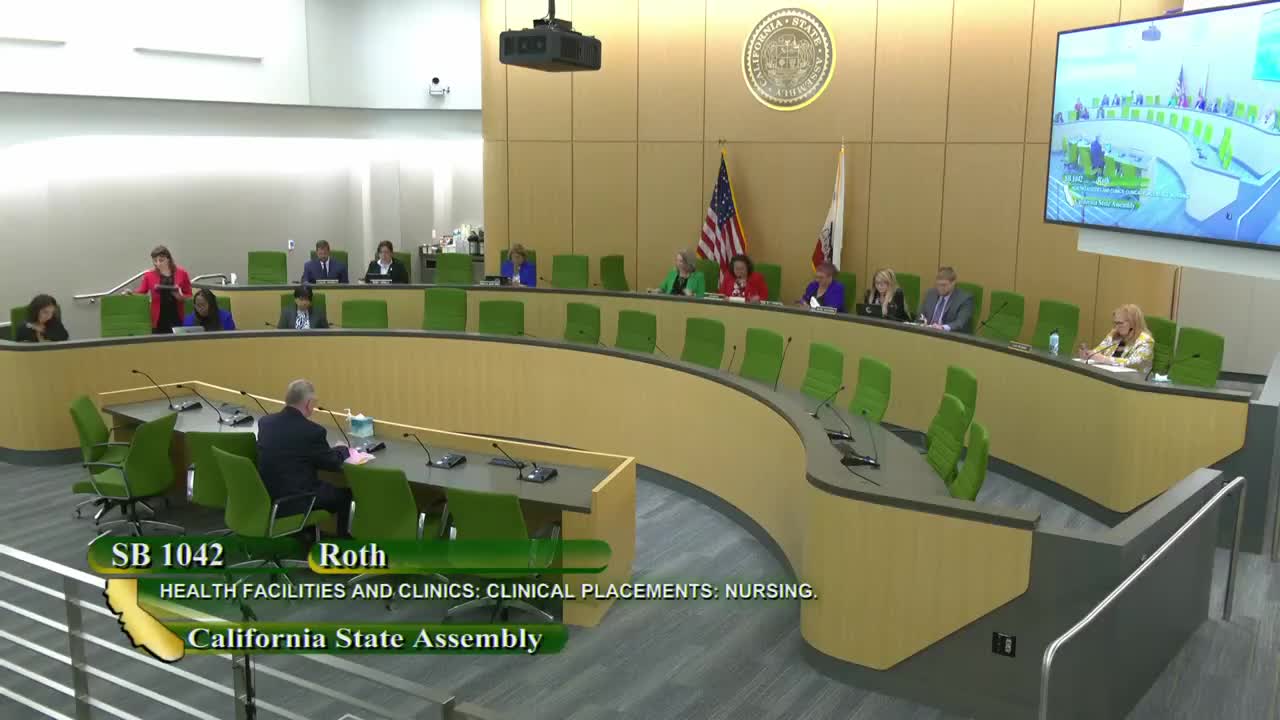 5MIN
Assembly Standing Committee on Health
 15MIN
Senate Floor
 25SEC
Senate Standing Committee on Business, Professions and Economic Development
21SEC
Senate Standing Committee on Business, Professions and Economic Development
 3MIN
Senate Standing Committee on Health
Bill Author





