SB 1089: Food and prescription access: grocery and pharmacy closures.
- Session Year: 2023-2024
- House: Senate
- Latest Version Date: 2024-09-26
Current Status:
Passed
(2024-09-26: Chaptered by Secretary of State. Chapter 625, Statutes of 2024.)
Introduced
In Committee
First Chamber
In Committee
Second Chamber
Enacted
(1)Existing law regulates the employment of workers in grocery establishments, as defined, including requiring an incumbent grocery employer, as defined, where there is a change of control, as defined, to post a public notice of the change in control at the location of the affected grocery establishment within 5 business days following the execution of the transfer document, as specified. Existing law requires the notice to include, among other specified information, the name of the incumbent grocery employer, and to be posted in a conspicuous place at the grocery establishment in a manner where it can be readily viewed by specified persons, including eligible grocery workers.
Existing law, the Pharmacy Law, provides for the licensure and regulation of pharmacies by the California State Board of Pharmacy. Existing law authorizes a pharmacy to furnish prescription drugs only to certain entities, including specific health care entities, and individual patients or another pharmacy either pursuant to prescription or as otherwise authorized by law. Existing law defines a pharmacy as an area, place, or premises licensed by the board in which the profession of pharmacy is practiced and where prescriptions are compounded.
This bill would require a covered establishment, defined to include a grocery establishment or a pharmacy establishment, to satisfy specified requirements no later than 45 days before its closure, as defined, takes effect, including providing written notice of the closure to specified entities, including the employees of the covered establishment affected by the closure and their authorized representatives if the covered establishment employs more than 5 employees, and the Employment Development Department. The bill would require, notwithstanding that provision, a covered establishment that employs 5 or fewer employees to, no later than 30 days before a closure of the covered establishment takes effect, provide written notice of the closure to the employees of the covered establishment affected by the closure. The bill would exempt, notwithstanding the same provision, specified covered establishments, including a covered establishment that, among other things, is a pharmacy and is owned by a person or entity who owns 15 or fewer pharmacies nationwide, from providing written notice to specified persons and entities, including the Employment Development Department. The bill would exempt a covered establishment from these requirements if specified circumstances apply, including that the closure is necessitated by a physical calamity or an act of war, except as specified.
(2)Existing law authorizes an aggrieved employee of a grocery establishment or their representative, as described, to bring an action, as specified, for violations of the above-described change of control provisions to recover, among other awards, reasonable attorneys fees and costs, if specified requirements are met, including that the employee provided written notice to the employer of the violations, as specified. Existing law also authorizes a civil penalty not to exceed $100 against, among other specified entities, the grocery employer for each employee whose rights are violated under those provisions. Existing law also authorizes an additional amount of $100 per employee payable as liquidated damages for each day of the violation until the violation is cured, as specified, and authorizes that amount to be recovered by the Labor Commissioner, as specified, and paid to the employee as compensatory damages.
This bill would authorize a civil penalty not to exceed $10,000 for each closure to be assessed and collected in a civil action against a covered establishment that violates the above-described written notice provisions brought by specified persons or entities, including any person injured by the violation, except as specified. The bill would require the court, in assessing the amount of the civil penalty, to consider relevant circumstances, including the nature and severity of the misconduct, and require the court to award a prevailing plaintiff reasonable attorneys fees and costs. The bill would require, if the action is pursued by specified entities, including the Attorney General, that specified portions of the civil penalty collected be paid to, among other specified sources, the treasurer of the county in which the judgment was entered. The bill would entitle an employee that does not receive the written notice to recover in a civil action an additional sum of $100 payable as liquidated damages per employee for each day of the violation until the violation is cured, as specified. The bill would specify that these provisions do not preempt or alter any other rights or remedies, including any causes of action, available under any other federal or state law, except as specified.
(3)Existing law, the California Workforce Innovation and Opportunity Act, establishes local workforce development boards to perform duties related to the planning, oversight, and evaluation of local workforce investment, including identifying workforce training programs.
This bill would require a county, after receiving a written notice described above from any covered establishment, to provide the local workforce development board of the county in which the covered establishment is located with information about safety net programs, including the CalWORKs program, and would require a local workforce development board to provide the covered establishment with information about safety net programs and the availability of local workforce training services. The bill would require a covered establishment that receives information from a county or a local workforce development board as described above, no later than 30 days before its closure, to provide any of that information it receives to each of its employees. By increasing the duties of a county and a local workforce development board, the bill would impose a state-mandated local program.
(4)Existing law provides for various public social services programs in the state, which are administered by the State Department of Social Services, including the CalFresh program, under which supplemental nutrition assistance benefits allocated to the state by the federal government are distributed to eligible individuals by each county, and the California Work Opportunity and Responsibility to Kids (CalWORKs) program, under which each county provides cash assistance and other benefits to qualified low-income families and individuals.
This bill would require the department, after receiving a written notice described above from a grocery establishment, to transmit to the Food and Nutrition Service of the United States Department of Agriculture information stating that the grocery establishment will be closing and the closing date.
(5)This bill would make findings and declarations relating to these provisions.
(6)The California Constitution requires the state to reimburse local agencies and school districts for certain costs mandated by the state. Statutory provisions establish procedures for making that reimbursement.
This bill would provide that, if the Commission on State Mandates determines that the bill contains costs mandated by the state, reimbursement for those costs shall be made pursuant to the statutory provisions noted above.
(1)Existing law regulates the employment of workers in grocery establishments, as defined, including requiring an incumbent grocery employer, as defined, where there is a change of control, as defined, to post a public notice of the change in control at the location of the affected grocery establishment within 5 business days following the execution of the transfer document, as specified. Existing law requires the notice to include, among other specified information, the name of the incumbent grocery employer, and to be posted in a conspicuous place at the grocery establishment in a manner where it can be readily viewed by specified persons, including eligible grocery workers.
Existing law, the Pharmacy Law, provides for the licensure and regulation of pharmacies by the California State Board of Pharmacy. Existing law authorizes a pharmacy to furnish prescription drugs only to certain entities, including specific health care entities, and individual patients or another pharmacy either pursuant to prescription or as otherwise authorized by law. Existing law defines a pharmacy as an area, place, or premises licensed by the board in which the profession of pharmacy is practiced and where prescriptions are compounded.
This bill would require a covered establishment, defined to include a grocery establishment or a pharmacy establishment, to satisfy specified requirements no later than 60 45 days before its closure, as defined, takes effect, including providing written notice of the closure to specified entities, including the employees of the covered establishment affected by the closure and their authorized representatives if the covered establishment employs more than 5 employees, and the Employment Development Department. The bill would require, notwithstanding that provision, a covered establishment that employs 5 or fewer employees to, no later than 30 days before a closure of the covered establishment takes effect, provide written notice of the closure to the employees of the covered establishment affected by the closure. The bill would exempt, notwithstanding the same provision, specified covered establishments, including a covered establishment that, among other things, is a pharmacy and is owned by a person or entity who owns 15 or fewer pharmacies in California, nationwide, from providing written notice to specified persons and entities, including the Employment Development Department. The bill would exempt a covered establishment from these requirements if specified circumstances apply, including that the closure is necessitated by a physical calamity or an act of war, except as specified.
(2)Existing law authorizes an aggrieved employee of a grocery establishment or their representative, as described, to bring an action, as specified, for violations of the above-described change of control provisions to recover, among other awards, reasonable attorneys fees and costs, if specified requirements are met, including that the employee provided written notice to the employer of the violations, as specified. Existing law also authorizes a civil penalty not to exceed $100 against, among other specified entities, the grocery employer for each employee whose rights are violated under those provisions. Existing law also authorizes an additional amount of $100 per employee payable as liquidated damages for each day of the violation until the violation is cured, as specified, and authorizes that amount to be recovered by the Labor Commissioner, as specified, and paid to the employee as compensatory damages.
This bill would authorize a civil penalty not to exceed $10,000 for each closure to be assessed and collected in a civil action against a covered establishment that violates the above-described written notice provisions brought by specified persons or entities, including any person injured by the violation, except as specified. The bill would require the court, in assessing the amount of the civil penalty, to consider relevant circumstances, including the nature and severity of the misconduct, and require the court to award a prevailing plaintiff reasonable attorneys fees and costs. The bill would require, if the action is pursued by specified entities, including the Attorney General, that specified portions of the civil penalty collected be paid to, among other specified sources, the treasurer of the county in which the judgment was entered. The bill would entitle an employee that does not receive the written notice to recover in a civil action an additional sum of $100 payable as liquidated damages per employee for each day of the violation until the violation is cured. cured, as specified. The bill would specify that these provisions do not preempt or alter any other rights or remedies, including any causes of action, available under any other federal or state law. law, except as specified.
(3)Existing law, the California Workforce Innovation and Opportunity Act, establishes local workforce development boards to perform duties related to the planning, oversight, and evaluation of local workforce investment, including identifying workforce training programs.
This bill would require a county, after receiving a written notice described above from any covered establishment, to provide the local workforce development board of the county in which the covered establishment is located with information about safety net programs, including the CalWORKs program, and would require a local workforce development board to provide the covered establishment with information about safety net programs and the availability of local workforce training services. The bill would require a covered establishment that receives information from a county or a local workforce development board as described above, no later than 30 days before its closure, to provide any of that information it receives to each of its employees. By increasing the duties of a county and a local workforce development board, the bill would impose a state-mandated local program.
(4)Existing law provides for various public social services programs in the state, which are administered by the State Department of Social Services, including the CalFresh program, under which supplemental nutrition assistance benefits allocated to the state by the federal government are distributed to eligible individuals by each county, and the California Work Opportunity and Responsibility to Kids (CalWORKs) program, under which each county provides cash assistance and other benefits to qualified low-income families and individuals. Existing law requires that any benefits provided to recipients under the departments authority be distributed through an electronic benefits transfer system, as specified.
This bill would require the department, after receiving a written notice described above from a grocery establishment, to post on its internet website, as specified, transmit to the Food and Nutrition Service of the United States Department of Agriculture information stating that the grocery establishment will be closing and the closing date.
(5)This bill would make findings and declarations relating to these provisions.
(6)The California Constitution requires the state to reimburse local agencies and school districts for certain costs mandated by the state. Statutory provisions establish procedures for making that reimbursement.
This bill would provide that, if the Commission on State Mandates determines that the bill contains costs mandated by the state, reimbursement for those costs shall be made pursuant to the statutory provisions noted above.
(1)Existing law regulates the employment of workers in grocery establishments, as defined, including requiring an incumbent grocery employer, as defined, where there is a change of control, as defined, to post a public notice of the change in control at the location of the affected grocery establishment within 5 business days following the execution of the transfer document, as specified. Existing law requires the notice to include, among other specified information, the name of the incumbent grocery employer, and to be posted in a conspicuous place at the grocery establishment in a manner where it can be readily viewed by specified persons, including eligible grocery workers.
Existing law, the Pharmacy Law, provides for the licensure and regulation of pharmacies by the California State Board of Pharmacy. Existing law authorizes a pharmacy to furnish prescription drugs only to certain entities, including specific health care entities, and individual patients or another pharmacy either pursuant to prescription or as otherwise authorized by law. Existing law defines a pharmacy as an area, place, or premises licensed by the board in which the profession of pharmacy is practiced and where prescriptions are compounded.
This bill would require a covered establishment, defined to include a grocery establishment or a pharmacy establishment, to satisfy specified requirements no later than 60 days before its closure, as defined, takes effect, including providing written notice of the closure to specified entities, including the employees of the covered establishment affected by the closure and their authorized representatives if the covered establishment employs more than 5 employees, and the Employment Development Department. The bill would require, notwithstanding that provision, a covered establishment that employs 5 or fewer employees to, no later than 30 days before a closure of the covered establishment takes effect, provide written notice of the closure to the employees of the covered establishment affected by the closure. The bill would exempt, notwithstanding the same provision, specified covered establishments, including a covered establishment that that, among other things, is a pharmacy and is owned by a person or entity who owns 15 or fewer pharmacies in California California, from providing written notice to specified persons and entities, including the Employment Development Department. The bill would exempt a covered establishment from these requirements if specified circumstances apply, including that the closure is necessitated by a physical calamity or an act of war, except as specified.
(2)Existing law authorizes an aggrieved employee of a grocery establishment or their representative, as described, to bring an action, as specified, for violations of the above-described change of control provisions to recover, among other awards, reasonable attorneys fees and costs, if specified requirements are met, including that the employee provided written notice to the employer of the violations, as specified. Existing law also authorizes a civil penalty not to exceed $100 against, among other specified entities, the grocery employer for each employee whose rights are violated under those provisions. Existing law also authorizes an additional amount of $100 per employee payable as liquidated damages for each day of the violation until the violation is cured, as specified, and authorizes that amount to be recovered by the Labor Commissioner, as specified, and paid to the employee as compensatory damages.
This bill would authorize a civil penalty not to exceed $10,000 for each closure to be assessed and collected in a civil action against a covered establishment that violates the above-described written notice provisions brought by specified persons or entities, including any person injured by the violation, except as specified. The bill would authorize require the court, in assessing the amount of the civil penalty, to consider relevant circumstances, including the nature and severity of the misconduct, and require the court to award a prevailing plaintiff reasonable attorneys fees and costs. The bill would require, if the action is pursued by specified entities, including the Attorney General, that specified portions of the civil penalty collected be paid to, among other specified sources, the treasurer of the county in which the judgment was entered. The bill would entitle an employee that does not receive the written notice to recover in a civil action an additional sum of $100 payable as liquidated damages per employee for each day of the violation until the violation is cured. The bill would specify that these provisions do not preempt or alter any other rights or remedies, including any causes of action, available under any other federal or state law.
(3)Existing law, the California Workforce Innovation and Opportunity Act, establishes local workforce development boards to perform duties related to the planning, oversight, and evaluation of local workforce investment, including identifying workforce training programs.
This bill would require a county, after receiving a written notice described above from any covered establishment, to provide the covered establishment local workforce development board of the county in which the covered establishment is located with information about safety net programs, including the CalWORKs program, and would require a local workforce development board to provide the covered establishment with information about safety net programs and the availability of local workforce training services. The bill would require a covered establishment that receives information from a county or a local workforce development board as described above, no later than 30 days before its closure, to provide any of that information it receives to each of its employees. By increasing the duties of a county and a local workforce development board, the bill would impose a state-mandated local program.
(4)Existing law provides for various public social services programs in the state, which are administered by the State Department of Social Services, including the CalFresh program, under which supplemental nutrition assistance benefits allocated to the state by the federal government are distributed to eligible individuals by each county, and the California Work Opportunity and Responsibility to Kids (CalWORKs) program, under which each county provides cash assistance and other benefits to qualified low-income families and individuals. Existing law requires that any benefits provided to recipients under the departments authority be distributed through an electronic benefits transfer system, as specified.
This bill would require the department, after receiving a written notice described above from a grocery establishment, to post on its internet website, as specified, information stating that the grocery establishment will be closing and the closing date.
(5)This bill would make findings and declarations relating to these provisions.
(6)The California Constitution requires the state to reimburse local agencies and school districts for certain costs mandated by the state. Statutory provisions establish procedures for making that reimbursement.
This bill would provide that, if the Commission on State Mandates determines that the bill contains costs mandated by the state, reimbursement for those costs shall be made pursuant to the statutory provisions noted above.
(1)Existing law regulates the employment of workers in grocery establishments, as defined, including requiring an incumbent grocery employer, as defined, where there is a change of control, as defined, to post a public notice of the change in control at the location of the affected grocery establishment within 5 business days following the execution of the transfer document, as specified. Existing law requires the notice to include, among other specified information, the name of the incumbent grocery employer, and to be posted in a conspicuous place at the grocery establishment in a manner where it can be readily viewed by specified persons, including eligible grocery workers.
Existing law, the Pharmacy Law, provides for the licensure and regulation of pharmacies by the California State Board of Pharmacy. Existing law authorizes a pharmacy to furnish prescription drugs only to certain entities, including specific health care entities, and individual patients or another pharmacy either pursuant to prescription or as otherwise authorized by law. Existing law defines a pharmacy as an area, place, or premises licensed by the board in which the profession of pharmacy is practiced and where prescriptions are compounded.
This bill would require a covered establishment, defined to include a grocery establishment or a pharmacy establishment, to satisfy specified requirements no later than 60 days before its closure, as defined, takes effect, including providing written notice of the closure to specified entities, including the employees of the covered establishment affected by the closure and their authorized representatives if the covered establishment employs more than 5 employees. employees, and the Employment Development Department. The bill would require, notwithstanding that provision, a covered establishment that employs 5 or fewer employees to, no later than 30 days before a closure of the covered establishment takes effect, provide written notice of the closure to the employees of the covered establishment affected by the closure. The bill would exempt, notwithstanding the same provision, a covered establishment that is a pharmacy and is owned by a person or entity who owns 15 or fewer pharmacies in California from providing written notice to specified persons and entities, including the Employment Development Department. The bill would exempt a covered establishment from these requirements if specified circumstances apply, including that the closure is necessitated by a physical calamity or an act of war, except as specified.
(2)Existing law authorizes an aggrieved employee of a grocery establishment or their representative, as described, to bring an action, as specified, for violations of the above-described change of control provisions to recover, among other awards, reasonable attorneys fees and costs, if specified requirements are met, including that the employee provided written notice to the employer of the violations, as specified. Existing law also authorizes a civil penalty not to exceed $100 against, among other specified entities, the grocery employer for each employee whose rights are violated under those provisions. Existing law also authorizes an additional amount of $100 per employee payable as liquidated damages for each day of the violation until the violation is cured, as specified, and authorizes that amount to be recovered by the Labor Commissioner, as specified, and paid to the employee as compensatory damages.
This bill would authorize a civil penalty not to exceed $10,000 for each closure to be assessed and collected in a civil action against a covered establishment that violates the above-described written notice provisions brought by specified persons or entities, including any person injured by the violation, except as specified. The bill would authorize the court, in assessing the amount of the civil penalty, to consider relevant circumstances, including the nature and severity of the misconduct, and require the court to award a prevailing plaintiff reasonable attorneys attorneys fees and costs. The bill would require, if the action is pursued by specified entities, including the Attorney General, that specified portions of the civil penalty collected be paid to, among other specified sources, the treasurer of the county in which the judgment was entered. The bill would entitle an employee that does not receive the written notice to recover in a civil action an additional sum of $100 payable as liquidated damages per employee for each day of the violation until the violation is cured. The bill would specify that these provisions do not preempt or alter any other rights or remedies, including any causes of action, available under any other federal or state law.
(3)Existing law, the California Workforce Innovation and Opportunity Act, establishes local workforce development boards to perform duties related to the planning, oversight, and evaluation of local workforce investment, including identifying workforce training programs.
This bill would require a county, after receiving a written notice described above from any covered establishment, to provide the covered establishment with information about safety net programs, including the CalWORKs program, and would require a local workforce development board to provide the covered establishment with information about the availability of local workforce training services. The bill would require a covered establishment that receives information from a county or a local workforce development board as described above, no later than 30 days before its closure, to provide any of that information it receives to each of its employees. By increasing the duties of a county and a local workforce development board, the bill would impose a state-mandated local program.
(4)Existing law provides for various public social services programs in the state, which are administered by the State Department of Social Services, including the CalFresh program, under which supplemental nutrition assistance benefits allocated to the state by the federal government are distributed to eligible individuals by each county, and the California Work Opportunity and Responsibility to Kids (CalWORKs) program, under which each county provides cash assistance and other benefits to qualified low-income families and individuals. Existing law requires that any benefits provided to recipients under the departments authority be distributed through an electronic benefits transfer system, as specified.
This bill would require the department, after receiving a written notice described above from a grocery establishment, to post on its internet website, as specified, information stating that the grocery establishment will be closing and the closing date. The bill would require a county to, among other specified duties, track the grocery establishment closures in its jurisdiction. By creating new duties for a county, the bill would impose a state-mandated local program.
(5)This bill would make findings and declarations relating to these provisions.
(6)The California Constitution requires the state to reimburse local agencies and school districts for certain costs mandated by the state. Statutory provisions establish procedures for making that reimbursement.
This bill would provide that, if the Commission on State Mandates determines that the bill contains costs mandated by the state, reimbursement for those costs shall be made pursuant to the statutory provisions noted above.
(1)Existing law regulates the employment of workers in grocery establishments, as defined, including requiring an incumbent grocery employer, as defined, where there is a change of control, as defined, to post a public notice of the change in control at the location of the affected grocery establishment within 5 business days following the execution of the transfer document, as specified. Existing law requires the notice to include, among other specified information, the name of the incumbent grocery employer, and to be posted in a conspicuous place at the grocery establishment in a manner where it can be readily viewed by specified persons, including eligible grocery workers.
Existing law, the Pharmacy Law, provides for the licensure and regulation of pharmacies by the California State Board of Pharmacy. Existing law authorizes a pharmacy to furnish prescription drugs only to certain entities, including specific health care entities, and individual patients or another pharmacy either pursuant to prescription or as otherwise authorized by law. Existing law defines a pharmacy as an area, place, or premises licensed by the board in which the profession of pharmacy is practiced and where prescriptions are compounded.
This bill would require a covered establishment, defined to include a grocery establishment or a pharmacy establishment, to satisfy specified requirements no later than 60 days before its closure, as defined, takes effect, including providing written notice of the closure to specified entities, including the employees of the covered establishment affected by the closure and their authorized representatives if the covered establishment employs more than 5 employees. The bill would require, notwithstanding that provision, a covered establishment that employs 5 or fewer employees to, no later than 30 days before a closure of the covered establishment takes effect, provide written notice of the closure to the employees of the covered establishment affected by the closure. The bill would exempt a covered establishment from these requirements if specified circumstances apply, including that the closure is necessitated by a physical calamity or an act of war, except as specified.
(2)Existing law authorizes an aggrieved employee of a grocery establishment or their representative, as described, to bring an action, as specified, for violations of the above-described change of control provisions to recover, among other awards, reasonable attorneys fees and costs, if specified requirements are met, including that the employee provided written notice to the employer of the violations, as specified. Existing law also authorizes a civil penalty not to exceed $100 against, among other specified entities, the grocery employer for each employee whose rights are violated under those provisions. Existing law also authorizes an additional amount of $100 per employee payable as liquidated damages for each day of the violation until the violation is cured, as specified, and authorizes that amount to be recovered by the Labor Commissioner, as specified, and paid to the employee as compensatory damages.
This bill would authorize a civil penalty not to exceed $10,000 for each closure to be assessed and collected in a civil action against a covered establishment that violates the above-described written notice provisions brought by specified persons or entities, including any person injured by the violation, except as specified. The bill would authorize the court, in assessing the amount of the civil penalty, to consider relevant circumstances, including the nature and severity of the misconduct, and require the court to award a prevailing plaintiff reasonable attorneys fees and costs. The bill would require, if the action is pursued by specified entities, including the Attorney General, that specified portions of the civil penalty collected be paid to, among other specified sources, the treasurer of the county in which the judgment was entered. The bill would entitle an employee that does not receive the written notice to recover in a civil action an additional sum of $100 payable as liquidated damages per employee for each day of the violation until the violation is cured. The bill would specify that these provisions do not preempt or alter any other rights or remedies, including any causes of action, available under any other federal or state law.
(3)Existing law, the California Workforce Innovation and Opportunity Act, establishes local workforce development boards to perform duties related to the planning, oversight, and evaluation of local workforce investment, including identifying workforce training programs.
This bill would require a county, after receiving a written notice described above from any covered establishment, to provide the covered establishment with information about safety net programs, including the CalWORKs program, and would require a local workforce development board to provide the covered establishment with information about the availability of local workforce training services. The bill would also require the covered establishment, require a covered establishment that receives information from a county or a local workforce development board as described above, no later than 30 days before its closure, to provide any of that information it receives to each of its employees. By increasing the duties of a county and a local workforce development board, the bill would impose a state-mandated local program.
(4)Existing law provides for various public social services programs in the state, which are administered by the State Department of Social Services, including the CalFresh program, under which supplemental nutrition assistance benefits allocated to the state by the federal government are distributed to eligible individuals by each county, and the California Work Opportunity and Responsibility to Kids (CalWORKs) program, under which each county provides cash assistance and other benefits to qualified low-income families and individuals. Existing law requires that any benefits provided to recipients under the departments authority be distributed through an electronic benefits transfer system, as specified.
This bill would require the department, after receiving a written notice described above from a grocery establishment, to post on its internet website, as specified, information stating that the grocery establishment will be closing and the closing date. The bill would require a county to, among other specified duties, track the grocery establishment closures in its jurisdiction. By creating new duties for a county, the bill would impose a state-mandated local program.
(5)This bill would make findings and declarations relating to these provisions.
(6)The California Constitution requires the state to reimburse local agencies and school districts for certain costs mandated by the state. Statutory provisions establish procedures for making that reimbursement.
This bill would provide that, if the Commission on State Mandates determines that the bill contains costs mandated by the state, reimbursement for those costs shall be made pursuant to the statutory provisions noted above.
(1)Existing law regulates the employment of workers in grocery establishments, as defined, including requiring an incumbent grocery employer, as defined, where there is a change of control, as defined, to post a public notice of the change in control at the location of the affected grocery establishment within 5 business days following the execution of the transfer document, as specified. Existing law requires the notice to include, among other specified information, the name of the incumbent grocery employer, and to be posted in a conspicuous place at the grocery establishment in a manner where it can be readily viewed by specified persons, including eligible grocery workers.
Existing law, the Pharmacy Law, provides for the licensure and regulation of pharmacies by the California State Board of Pharmacy. Existing law authorizes a pharmacy to furnish prescription drugs only to certain entities, including specific health care entities, and individual patients or another pharmacy either pursuant to prescription or as otherwise authorized by law. Existing law defines a pharmacy as an area, place, or premises licensed by the board in which the profession of pharmacy is practiced and where prescriptions are compounded.
This bill would require a covered establishment, defined to include a grocery establishment or a pharmacy establishment, to satisfy specified requirements no later than 90 60 days before its closure, as defined, takes effect, including providing written notice of the closure to specified entities, including the employees of the covered establishment affected by the closure. The bill would require the written notice to include specified information, including the planned closure date of the covered establishment. closure and their authorized representatives if the covered establishment employs more than 5 employees. The bill would require, notwithstanding that provision, a covered establishment that employs 5 or fewer employees to, no later than 30 days before a closure of the covered establishment takes effect, provide written notice of the closure to the employees of the covered establishment affected by the closure. The bill would exempt a covered establishment from these requirements if the specified circumstances apply, including that the closure is necessitated by a physical calamity or an act of war. war, except as specified.
(2)Existing law authorizes an aggrieved employee of a grocery establishment or their representative, as described, to bring an action, as specified, for violations of the above-described change of control provisions to recover, among other awards, reasonable attorneys fees and costs, if specified requirements are met, including that the employee provided written notice to the employer of the violations, as specified. Existing law also authorizes a civil penalty not to exceed $100 against, among other specified entities, the grocery employer for each employee whose rights are violated under those provisions. Existing law also authorizes an additional amount of $100 per employee payable as liquidated damages for each day of the violation until the violation is cured, as specified, and authorizes that amount to be recovered by the Labor Commissioner, as specified, and paid to the employee as compensatory damages.
This bill would authorize a civil penalty not to exceed $10,000 for each violation closure to be assessed and collected in a civil action against a covered establishment that violates the above-described written notice provisions brought by specified persons or entities, including any person injured by the violation. violation, except as specified. The bill would authorize the court, in assessing the amount of the civil penalty, to consider relevant circumstances, including the nature and severity of the misconduct, and require the court to award a prevailing plaintiff reasonable attorneys fees and costs. The bill would require, if the action is pursued by specified entities, including the Attorney General, that specified portions of the civil penalty collected be paid to, among other specified sources, the treasurer of the county in which the judgment was entered. The bill would entitle an employee that does not receive the written notice to recover in a civil action an additional sum of $100 payable as liquidated damages per employee for each day of the violation until the violation is cured. The bill would specify that these provisions do not preempt or alter any other rights or remedies, including any causes of action, available under any other federal or state law.
(3)Existing law, the California Workforce Innovation and Opportunity Act, establishes local workforce development boards to perform duties related to the planning, oversight, and evaluation of local workforce investment, including identifying workforce training programs.
This bill would require a county, after receiving a written notice described above from any covered establishment, to provide the covered establishment with information about safety net programs, including the CalWORKs program, and would require a local workforce development board to provide the covered establishment with information about the availability of local workforce training services. The bill would also require the covered establishment, no later than 30 days before its closure, to provide any of that information it receives to each of its employees. By increasing the duties of a county and a local workforce development board, the bill would impose a state-mandated local program.
(4)Existing law provides for various public social services programs in the state, which are administered by the State Department of Social Services, including the CalFresh program, under which supplemental nutrition assistance benefits allocated to the state by the federal government are distributed to eligible individuals by each county, and the California Work Opportunity and Responsibility to Kids (CalWORKs) program, under which each county provides cash assistance and other benefits to qualified low-income families and individuals. Existing law requires that any benefits provided to recipients under the departments authority be distributed through an electronic benefits transfer system, as specified.
This bill would require the department, after receiving a written notice described above from a grocery establishment, to post on its internet website, as specified, information stating that the grocery establishment will be closing and the closing date. The bill would require a county to, among other specified duties, track the grocery establishment closures in its jurisdiction. By creating new duties for a county, the bill would impose a state-mandated local program.
(5)This bill would make findings and declarations relating to these provisions.
(6)The California Constitution requires the state to reimburse local agencies and school districts for certain costs mandated by the state. Statutory provisions establish procedures for making that reimbursement.
This bill would provide that, if the Commission on State Mandates determines that the bill contains costs mandated by the state, reimbursement for those costs shall be made pursuant to the statutory provisions noted above.
(1)Existing law regulates the employment of workers in grocery establishments, as defined, including requiring an incumbent grocery employer, as defined, where there is a change of control, as defined, to post a public notice of the change in control at the location of the affected grocery establishment within 5 business days following the execution of the transfer document, as specified. Existing law requires the notice to include, among other specified information, the name of the incumbent grocery employer, and to be posted in a conspicuous place at the grocery establishment in a manner where it can be readily viewed by specified persons, including eligible grocery workers.
Existing law, the Pharmacy Law, provides for the licensure and regulation of pharmacies by the California State Board of Pharmacy. Existing law authorizes a pharmacy to furnish prescription drugs only to certain entities, including specific health care entities, and individual patients or another pharmacy either pursuant to prescription or as otherwise authorized by law. Existing law defines a pharmacy as an area, place, or premises licensed by the board in which the profession of pharmacy is practiced and where prescriptions are compounded.
This bill would require a covered establishment, defined to include a grocery establishment or a pharmacy establishment, to satisfy specified requirements no later than 90 days before its closure, as defined, takes effect, including providing written notice of the closure to specified entities, including the employees of the covered establishment affected by the closure. The bill would require the written notice to include specified information, including the planned closure date of the covered establishment. The bill would exempt a covered establishment from these requirements if the closure is necessitated by a physical calamity or an act of war.
(2)Existing law authorizes an aggrieved employee of a grocery establishment or their representative, as described, to bring an action, as specified, for violations of the above-described change of control provisions to recover, among other awards, reasonable attorneys fees and costs, if specified requirements are met, including that the employee provided written notice to the employer of the violations, as specified. Existing law also authorizes a civil penalty not to exceed $100 against, among other specified entities, the grocery employer for each employee whose rights are violated under those provisions. Existing law also authorizes an additional amount of $100 per employee payable as liquidated damages for each day of the violation until the violation is cured, as specified, and authorizes that amount to be recovered by the Labor Commissioner, as specified, and paid to the employee as compensatory damages.
This bill would authorize a civil penalty not to exceed $10,000 for each violation to be assessed and collected in a civil action against a covered establishment that violates the above-described written notice provisions brought by specified persons or entities, including any person injured by the violation. The bill would authorize the court, in assessing the amount of the civil penalty, to consider relevant circumstances, including the nature and severity of the misconduct, and require the court to award a prevailing plaintiff reasonable attorneys fees and costs. The bill would require, if the action is pursued by specified entities, including the Attorney General, that specified portions of the civil penalty collected be paid to, among other specified sources, the treasurer of the county in which the judgment was entered. The bill would entitle an employee that does not receive the written notice to recover in a civil action an additional sum of $100 payable as liquidated damages per employee for each day of the violation until the violation is cured. The bill would specify that these provisions do not preempt or alter any other rights or remedies, including any causes of action, available under any other federal or state law.
(3)Existing law, the California Workforce Innovation and Opportunity Act, establishes local workforce development boards to perform duties related to the planning, oversight, and evaluation of local workforce investment, including identifying workforce training programs.
This bill would require a county, after receiving a written notice described above from any covered establishment, to provide the covered establishment with information about safety net programs, including the CalWORKs program, and would require a local workforce development board to provide the covered establishment with information about the availability of local workforce training services. The bill would also require the covered establishment, no later than 30 days before its closure, to provide any of that information it receives to each of its employees. By increasing the duties of a county and a local workforce development board, the bill would impose a state-mandated local program.
(4)Existing law provides for various public social services programs in the state, which are administered by the State Department of Social Services, including the CalFresh program, under which supplemental nutrition assistance benefits allocated to the state by the federal government are distributed to eligible individuals by each county, and the California Work Opportunity and Responsibility to Kids (CalWORKs) program, under which each county provides cash assistance and other benefits to qualified low-income families and individuals. Existing law requires that any benefits provided to recipients under the departments authority be distributed through an electronic benefits transfer system, as specified.
This bill would require the department, after receiving a written notice described above from a grocery establishment, to post on its internet website, as specified, information stating that the grocery establishment will be closing and the closing date. The bill would require a county to, among other specified duties, track the grocery establishment closures in its jurisdiction. By creating new duties for a county, the bill would impose a state-mandated local program.
(5)This bill would make findings and declarations relating to these provisions.
(6)The California Constitution requires the state to reimburse local agencies and school districts for certain costs mandated by the state. Statutory provisions establish procedures for making that reimbursement.
This bill would provide that, if the Commission on State Mandates determines that the bill contains costs mandated by the state, reimbursement for those costs shall be made pursuant to the statutory provisions noted above.
Existing law provides for various food-related services and benefits, including the CalFresh program, under which supplemental nutrition assistance benefits allocated to the state by the federal government are distributed to eligible individuals by each county, and the CalFood Program, under which food and funding is provided to food banks whose primary function is to facilitate the distribution of food to low-income households.This bill would state that it is the intent of the Legislature to enact legislation addressing food injustice.Existing law provides for various food-related services and benefits, including the CalFresh program, under which supplemental nutrition assistance benefits allocated to the state by the federal government are distributed to eligible individuals by each county, and the CalFood Program, under which food and funding is provided to food banks whose primary function is to facilitate the distribution of food to low-income households.
This bill would state that it is the intent of the Legislature to enact legislation addressing food injustice.
The Legislature finds and declares all of the following:
(a)African American households disproportionately experience food insecurity.
(b)African American communities also disproportionately experience highly limited access to affordable and nutritious food, and are often inundated with unhealthy options like sugary drinks and processed or fast food.
(c)Redlining, bolstered by other government and government-enabled discrimination, is a central cause of this food injustice.
(d)One of the harms facing African American communities in California is the lack of access to grocery stores and supermarkets. White neighborhoods on average have four times as many supermarkets as predominantly African American communities, which typically are smaller and have less of a selection than White neighborhoods.
(e)According to the California Association of Food Banks, 23 percent of California households overall and 28 percent of California households with children face food insecurity.
(f)Food insecurity is described as the occasional or constant lack of access to the food one needs for a healthy, active life. Because of vast structural inequities, much higher levels of food insecurity are experienced by Black and Latino California households, with White California households experiencing food insecurity at rates lower than the general population.
(g)Black and Latino neighborhoods in the 30 most populous American cities have fewer pharmacies than White or diverse neighborhoods. Pharmacy deserts, which are similar to food deserts, are an often overlooked contributor to persistent racial and ethnic health disparities.
(h)In order to remedy the harms from abrupt disruptions in access to food, prescriptions, and other household goods, the California Reparations Task Force recommends requiring advance notifications to the affected community, employees, and other stakeholders before the closure of a grocery store or pharmacy to ensure that community members are able to locate healthy and affordable food in the surrounding community and that employees are equipped with the resources necessary to gain employment elsewhere.
SEC. 2.Chapter 42 (commencing with Section 22949.92) is added to Division 8 of the Business and Professions Code, to read:42.Grocery and Pharmacy Establishment Closures22949.92.For purposes of this chapter, the following definitions apply:
(a)(1)Covered establishment includes a grocery establishment or a pharmacy establishment.
(A)Grocery establishment means a retail store operating in this state that meets both of the following requirements:
(i)The retail store sells primarily household foodstuffs for offsite consumption, including, but not limited to, the sale of fresh produce, meats, poultry, fish, deli products, dairy products, canned foods, dry foods, beverages, baked foods, or prepared foods.
(ii)The sale of any other household supplies or other products by the retail store is secondary to the primary purpose of food sales.
(B)Pharmacy establishment means a pharmacy as defined in Section 4037 that meets all of the following requirements:
(i)The pharmacy is a chain community pharmacy or an independent community pharmacy as defined in Section 4001.
(ii)The pharmacy is open to the public.
(iii)The pharmacy is not owned by a health facility as defined in Section 1250 of the Health and Safety Code.
(iv)The pharmacy is not a part of a fully integrated delivery system. For purposes of this clause, a fully integrated delivery system means a system that includes a physician organization, health facility or health system, and a nonprofit health care service plan that provides health care services to enrollees in a specific geographic region of the state through an affiliate hospital system and an exclusive contract between the nonprofit health care service plan and a single physician organization in each geographic region to provide those medical services.
(2)Nothing in clause (iii) or (iv) of subparagraph (B) of paragraph (1) shall be construed as exempting a chain community pharmacy as defined in Section 4001 from this chapter. However, a pharmacy location owned and operated by a physician organization, health facility or health system, and a nonprofit health care service plan that is part of a fully integrated delivery system is not a store as described in Section 4001.
(b)Closure means the cessation or substantial cessation of industrial or commercial operations by a covered establishment.
22949.92.1.(a)A covered establishment shall, no later than 45 days before a closure of the covered establishment takes effect, perform all of the following acts:
(1)(A)Provide written notice of the closure to all of the following persons or entities:
(i)(I)The employees of the covered establishment affected by the closure and their authorized representatives if the covered establishment employs more than five employees.
(II)Notwithstanding any other provision of this subdivision, a covered establishment that employs five or fewer employees shall, no later than 30 days before a closure of the covered establishment takes effect, provide written notice of the closure to the employees of the covered establishment affected by the closure.
(ii)The Employment Development Department.
(iii)The State Department of Social Services.
(iv)The local workforce development board of any city and county government within which the closure occurs.
(v)The chief elected official of each city and county government within which the closure occurs.
(vi)The California State Board of Pharmacy, if the covered establishment is a pharmacy establishment.
(B)Notwithstanding any other provision of this subdivision, a covered establishment that is a pharmacy as defined in Section 4037, is owned by a person or entity who owns 15 or fewer pharmacies nationwide, and is not a covered establishment as defined in subdivision (a) of Section 1400.5 of the Labor Code shall not be required to provide written notice pursuant to subparagraph (A) to any of the following persons or entities:
(i)The Employment Development Department.
(ii)The State Department of Social Services.
(iii)The local workforce development board of any city and county government within which the covered establishment is located.
(iv)The chief elected official of each city and county government within which the covered establishment is located.
(C)Notwithstanding any other provision of this subdivision, a covered establishment that is a grocery establishment as defined in subdivision (a) of Section 22949.92, is owned by a person or entity who owns 15 or fewer grocery establishments nationwide, and is not a covered establishment as defined in subdivision (a) of Section 1400.5 of the Labor Code shall not be required to provide written notice pursuant to subparagraph (A) to any of the following persons or entities:
(i)The Employment Development Department.
(ii)The local workforce development board of any city and county government within which the covered establishment is located.
(iii)The chief elected official of each city and county government within which the covered establishment is located.
(D)Notwithstanding any other provision of this subdivision, a covered establishment that is also a covered establishment as defined in subdivision (a) of Section 1400.5 of the Labor Code shall only be considered in compliance with the requirements of clauses (ii), (iv), and (v) of subparagraph (A) if the covered establishment provides a written notice as required and pursuant to the timeframe specified in Section 1401 of the Labor Code.
(2)(A)Post a written notice of the closure in a conspicuous location at the entrance to the covered establishments premises that includes the planned closure date of the covered establishment.
(B)If the covered establishment is a pharmacy establishment regardless of the number of employees, the written notice described in subparagraph (A) shall also include both of the following:
(i)The name, address, and contact information of the pharmacy establishment where any prescriptions will be transferred.
(ii)The phone number, email address, or internet website where patients may obtain information regarding the process of transferring the prescription to a pharmacy establishment of the patients choosing.
(3)Take reasonable steps to provide a written notice of the closure in at least one form other than the forms described in paragraphs (1) and (2) that is in a form in which the covered establishment regularly communicates or advertises to its consumers, if the covered establishment is a grocery establishment, or to its patients, if the covered establishment is a pharmacy establishment.
(b)Except as otherwise required under Section 1401 of the Labor Code or any other provision of the law, a covered establishment shall not be required to provide notice pursuant to this section if either of the following circumstances applies:
(1)A closure is necessitated by a physical calamity or act of war.
(2)The closure is caused by business circumstances that were not reasonably foreseeable at the time that notice would have been required.
(c)(1)A covered establishment that violates this section shall be subject to a civil penalty not to exceed ten thousand dollars ($10,000) for each closure, to be assessed and collected in a civil action brought by any person injured by the violation or in a civil action brought in the name of the people of the State of California by the Attorney General, a district attorney, or a city attorney where the covered establishment was located.
(A)In assessing the amount of the civil penalty, the court shall consider relevant circumstances presented by the parties to the case, including, but not limited to, the following circumstances:
(i)The nature and severity of the misconduct.
(ii)The number of violations.
(iii)The length of time over which the misconduct occurred, and the persistence of the misconduct.
(iv)The willfulness of the misconduct.
(v)The defendants assets, liabilities, and net worth.
(vi)The number of employees employed by the defendant.
(B)(i)If the Attorney General brings the action, one-half of the civil penalty collected shall be paid to the treasurer of the county in which the judgment was entered, and one-half shall be paid to the General Fund.
(ii)If a district attorney brings the action, the civil penalty collected shall be paid to the treasurer of the county in which the judgment was entered.
(iii)If a city attorney brings the action, one-half of the civil penalty collected shall be paid to the treasurer of the city in which the judgment was entered, and one-half shall be paid to the treasurer of the county in which the judgment was entered.
(C)The court shall grant a prevailing plaintiff reasonable attorneys fees and costs.
(2)(A)An employee that does not receive written notice by a covered establishment in violation of this section is entitled to recover in a civil action an additional sum payable as liquidated damages in the amount of one hundred dollars ($100) per employee for each day the rights of an employee under this section are violated and continuing until the violation is cured.
(B)An employee shall only be entitled to either recover the liquidated damages provided for in this paragraph or to enforce a civil penalty as set forth in Section 1403 of the Labor Code, but not both, for the same violation.
(3)Notwithstanding any other provision of this subdivision, a person shall have no right to bring a private cause of action against a covered establishment for a violation of paragraph (3) of subdivision (a).
(d)Except as provided in subparagraph (B) of paragraph (2) of subdivision (c), this section does not preempt or alter any other rights or remedies, including any causes of action, available under any other federal or state law.
22949.92.2.(a)(1)After receiving a written notice described in Section 22949.92.1 from a covered establishment, the county in which that covered establishment is located shall provide the local workforce development board of the county in which the covered establishment is located with information about safety net programs, including, but not limited to, unemployment insurance, the CalWORKs program, the CalFresh program, and the Medi-Cal program. The local workforce development board of the county in which that covered establishment is located shall provide the covered establishment with information about safety net programs and the availability of local workforce training services.
(2)A covered establishment that receives information from a county or a local workforce development board pursuant to paragraph (1) shall, no later than 30 days before a closure of the covered establishment takes effect, provide any information that it receives from the county and local workforce development board to each employee of the covered establishment.
(b)After receiving a written notice described in Section 22949.92.1 from a grocery establishment, the State Department of Social Services shall transmit to the Food and Nutrition Service of the United States Department of Agriculture information stating that the grocery establishment is closing and the closure date.
SEC. 3.If the Commission on State Mandates determines that this act contains costs mandated by the state, reimbursement to local agencies and school districts for those costs shall be made pursuant to Part 7 (commencing with Section 17500) of Division 4 of Title 2 of the Government Code.
The Legislature finds and declares all of the following:
(a)African American households disproportionately experience food insecurity.
(b)African American communities also disproportionately experience highly limited access to affordable and nutritious food, and are often inundated with unhealthy options like sugary drinks and processed or fast food.
(c)Redlining, bolstered by other government and government-enabled discrimination, is a central cause of this food injustice.
(d)One of the harms facing African American communities in California is the lack of access to grocery stores and supermarkets. White neighborhoods on average have four times as many supermarkets as predominantly African American communities, which typically are smaller and have less of a selection than White neighborhoods.
(e)According to the California Association of Food Banks, 23 percent of California households overall and 28 percent of California households with children face food insecurity.
(f)Food insecurity is described as the occasional or constant lack of access to the food one needs for a healthy, active life. Because of vast structural inequities, much higher levels of food insecurity are experienced by Black and Latino California households, with White California households experiencing food insecurity at rates lower than the general population.
(g)Black and Latino neighborhoods in the 30 most populous American cities have fewer pharmacies than White or diverse neighborhoods. Pharmacy deserts, which are similar to food deserts, are an often overlooked contributor to persistent racial and ethnic health disparities.
(h)In order to remedy the harms from abrupt disruptions in access to food, prescriptions, and other household goods, the California Reparations Task Force recommends requiring advance notifications to the affected community, employees, and other stakeholders before the closure of a grocery store or pharmacy to ensure that community members are able to locate healthy and affordable food in the surrounding community and that employees are equipped with the resources necessary to gain employment elsewhere.
SEC. 2.Chapter 42 (commencing with Section 22949.92) is added to Division 8 of the Business and Professions Code, to read:42.Grocery and Pharmacy Establishment Closures22949.9222949.92.For purposes of this chapter, the following definitions apply:
(a)(1)Covered establishment includes a grocery establishment or a pharmacy establishment.
(A)Grocery establishment means a retail store operating in this state that meets both of the following requirements:
(i)The retail store sells primarily household foodstuffs for offsite consumption, including, but not limited to, the sale of fresh produce, meats, poultry, fish, deli products, dairy products, canned foods, dry foods, beverages, baked foods, or prepared foods.
(ii)The sale of any other household supplies or other products by the retail store is secondary to the primary purpose of food sales.
(B)Pharmacy establishment means a pharmacy as defined in Section 4037 that meets all of the following requirements:
(i)The pharmacy is a chain community pharmacy or an independent community pharmacy as defined in Section 4001.
(ii)The pharmacy is open to the public.
(iii)The pharmacy is not owned by a health facility as defined in Section 1250 of the Health and Safety Code.
(iv)The pharmacy is not a part of a fully integrated delivery system. For purposes of this clause, a fully integrated delivery system means a system that includes a physician organization, health facility or health system, and a nonprofit health care service plan that provides health care services to enrollees in a specific geographic region of the state through an affiliate hospital system and an exclusive contract between the nonprofit health care service plan and a single physician organization in each geographic region to provide those medical services.
(2)Nothing in clause (iii) or (iv) of subparagraph (B) of paragraph (1) shall be construed as exempting a chain community pharmacy as defined in Section 4001 from this chapter. However, a pharmacy location owned and operated by a physician organization, health facility or health system, and a nonprofit health care service plan that is part of a fully integrated delivery system is not a store as described in Section 4001.
(b)Closure means the cessation or substantial cessation of industrial or commercial operations by a covered establishment.
22949.92.122949.92.1.(a)A covered establishment shall, no later than 60 45 days before a closure of the covered establishment takes effect, perform all of the following acts:
(1)(A)Provide written notice of the closure to all of the following persons or entities:
(i)(I)The employees of the covered establishment affected by the closure and their authorized representatives if the covered establishment employs more than five employees.
(II)Notwithstanding any other provision of this subdivision, a covered establishment that employs five or fewer employees shall, no later than 30 days before a closure of the covered establishment takes effect, provide written notice of the closure to the employees of the covered establishment affected by the closure.
(ii)The Employment Development Department.
(iii)The State Department of Social Services.
(iv)The local workforce development board of any city and county government within which the closure occurs.
(v)The chief elected official of each city and county government within which the closure occurs.
(vi)The California State Board of Pharmacy, if the covered establishment is a pharmacy establishment.
(B)Notwithstanding any other provision of this subdivision, a covered establishment that is a pharmacy as defined in Section 4037, is owned by a person or entity who owns 15 or fewer pharmacies in California, nationwide, and is not a covered establishment as defined in subdivision (a) of Section 1400.5 of the Labor Code shall not be required to provide written notice pursuant to subparagraph (A) to any of the following persons or entities:
(i)The Employment Development Department.
(ii)The State Department of Social Services.
(iii)The local workforce development board of any city and county government within which the covered establishment is located.
(iv)The chief elected official of each city and county government within which the covered establishment is located.
(C)Notwithstanding any other provision of this subdivision, a covered establishment that is a grocery establishment as defined in subdivision (a) of Section 22949.92, is owned by a person or entity who owns 15 or fewer grocery establishments nationwide, and is not a covered establishment as defined in subdivision (a) of Section 1400.5 of the Labor Code shall not be required to provide written notice pursuant to subparagraph (A) to any of the following persons or entities:
(i)The Employment Development Department.
(ii)The local workforce development board of any city and county government within which the covered establishment is located.
(iii)The chief elected official of each city and county government within which the covered establishment is located.
(D)A Notwithstanding any other provision of this subdivision, a covered establishment that provides a written notice pursuant to Section 1401 of the Labor Code shall is also a covered establishment as defined in subdivision (a) of Section 1400.5 of the Labor Code shall only be considered in compliance with the requirements of clauses (ii), (iv), and (v) of subparagraph (A). (A) if the covered establishment provides a written notice as required and pursuant to the timeframe specified in Section 1401 of the Labor Code.
(2)(A)Post a written notice of the closure in a conspicuous location at the entrance to the covered establishments premises that includes the planned closure date of the covered establishment.
(B)If the covered establishment is a pharmacy establishment regardless of the number of employees, the written notice described in subparagraph (A) shall also include both of the following:
(i)The name, address, and contact information of the pharmacy establishment where any prescriptions will be transferred.
(ii)The phone number, email address, or internet website where consumers patients may obtain information regarding the process of transferring the prescription to a pharmacy establishment of the consumers patients choosing.
(3)Take reasonable steps to provide a written notice of the closure in at least one form other than the forms described in paragraphs (1) and (2) that is in a form in which the covered establishment regularly communicates or advertises to its consumers. consumers, if the covered establishment is a grocery establishment, or to its patients, if the covered establishment is a pharmacy establishment.
(b)Except as otherwise required under Section 1401 of the Labor Code or any other provision of the law, a covered establishment shall not be required to provide notice pursuant to this section if either of the following circumstances applies:
(1)A closure is necessitated by a physical calamity or act of war.
(2)The closure is caused by business circumstances that were not reasonably foreseeable at the time that notice would have been required.
(c)(1)A covered establishment that violates this section shall be subject to a civil penalty not to exceed ten thousand dollars ($10,000) for each closure, to be assessed and collected in a civil action brought by any person injured by the violation or in a civil action brought in the name of the people of the State of California by the Attorney General, a district attorney, or a city attorney where the covered establishment was located.
(A)In assessing the amount of the civil penalty, the court shall consider relevant circumstances presented by the parties to the case, including, but not limited to, the following circumstances:
(i)The nature and severity of the misconduct.
(ii)The number of violations.
(iii)The length of time over which the misconduct occurred, and the persistence of the misconduct.
(iv)The willfulness of the misconduct.
(v)The defendants assets, liabilities, and net worth.
(vi)The number of employees employed by the defendant.
(B)(i)If the Attorney General brings the action, one-half of the civil penalty collected shall be paid to the treasurer of the county in which the judgment was entered, and one-half shall be paid to the General Fund.
(ii)If a district attorney brings the action, the civil penalty collected shall be paid to the treasurer of the county in which the judgment was entered.
(iii)If a city attorney brings the action, one-half of the civil penalty collected shall be paid to the treasurer of the city in which the judgment was entered, and one-half shall be paid to the treasurer of the county in which the judgment was entered.
(C)The court shall grant a prevailing plaintiff reasonable attorneys fees and costs.
(2)(A)An employee that does not receive written notice by a covered establishment in violation of this section is entitled to recover in a civil action an additional sum payable as liquidated damages in the amount of one hundred dollars ($100) per employee for each day the rights of an employee under this section are violated and continuing until the violation is cured.
(B)An employee shall only be entitled to either recover the liquidated damages provided for in this paragraph or to enforce a civil penalty as set forth in Section 1403 of the Labor Code, but not both, for the same violation.
(3)Notwithstanding any other provision of this subdivision, a person shall have no right to bring a private cause of action against a covered establishment for a violation of paragraph (3) of subdivision (a).
(d)This Except as provided in subparagraph (B) of paragraph (2) of subdivision (c), this section does not preempt or alter any other rights or remedies, including any causes of action, available under any other federal or state law.
22949.92.222949.92.2.(a)(1)After receiving a written notice described in Section 22949.92.1 from a covered establishment, the county in which that covered establishment is located shall provide the local workforce development board of the county in which the covered establishment is located with information about safety net programs, including, but not limited to, unemployment insurance, the CalWORKs program, the CalFresh program, and the Medi-Cal program. The local workforce development board of the county in which that covered establishment is located shall provide the covered establishment with information about safety net programs and the availability of local workforce training services.
(2)A covered establishment that receives information from a county or a local workforce development board pursuant to paragraph (1) shall, no later than 30 days before a closure of the covered establishment takes effect, provide any information that it receives from the county and local workforce development board to each employee of the covered establishment.
(b)After receiving a written notice described in Section 22949.92.1 from a grocery establishment, the State Department of Social Services shall post on its internet website for the electronic benefits transfer system, established pursuant to Section 10071 of the Welfare and Institutions Code, that lists the stores that accept the CalFresh programs benefits transmit to the Food and Nutrition Service of the United States Department of Agriculture information stating that the grocery establishment is closing and the closure date.
SEC. 3.If the Commission on State Mandates determines that this act contains costs mandated by the state, reimbursement to local agencies and school districts for those costs shall be made pursuant to Part 7 (commencing with Section 17500) of Division 4 of Title 2 of the Government Code.
The Legislature finds and declares all of the following:
(a)African American households disproportionately experience food insecurity.
(b)African American communities also disproportionately experience highly limited access to affordable and nutritious food, and are often inundated with unhealthy options like sugary drinks and processed or fast food.
(c)Redlining, bolstered by other government and government-enabled discrimination, is a central cause of this food injustice.
(d)One of the harms facing African American communities in California is the lack of access to grocery stores and supermarkets. White neighborhoods on average have four times as many supermarkets as predominantly African American communities, which typically are smaller and have less of a selection than White neighborhoods.
(e)According to the California Association of Food Banks, 23 percent of California households overall and 28 percent of California households with children face food insecurity.
(f)Food insecurity is described as the occasional or constant lack of access to the food one needs for a healthy, active life. Because of vast structural inequities, much higher levels of food insecurity are experienced by Black and Latino California households, with White California households experiencing food insecurity at rates lower than the general population.
(g)Black and Latino neighborhoods in the 30 most populous American cities have fewer pharmacies than White or diverse neighborhoods. Pharmacy deserts, which are similar to food deserts, are an often overlooked contributor to persistent racial and ethnic health disparities.
(h)In order to remedy the harms from abrupt disruptions in access to food, prescriptions, and other household goods, the California Reparations Task Force recommends requiring advance notifications to the affected community, employees, and other stakeholders before the closure of a grocery store or pharmacy to ensure that community members are able to locate healthy and affordable food in the surrounding community and that employees are equipped with the resources necessary to gain employment elsewhere.
SEC. 2.Chapter 41 (commencing with Section 22949.90) is added to Division 8 of the Business and Professions Code, to read:SEC. 2.Chapter 42 (commencing with Section 22949.92) is added to Division 8 of the Business and Professions Code, to read:41.42.Grocery and Pharmacy Establishment Closures22949.90.22949.92For purposes of this chapter, the following definitions apply:
(a)(1)Covered establishment includes a grocery establishment or a pharmacy establishment.
(A)Grocery establishment means a retail store operating in this state that meets both of the following requirements:
(i)The retail store sells primarily household foodstuffs for offsite consumption, including, but not limited to, the sale of fresh produce, meats, poultry, fish, deli products, dairy products, canned foods, dry foods, beverages, baked foods, or prepared foods.
(ii)The sale of any other household supplies or other products by the retail store is secondary to the primary purpose of food sales.
(B)Pharmacy establishment means a pharmacy as defined in Section 4037 that meets all of the following requirements:
(i)The pharmacy is a chain community pharmacy or an independent community pharmacy as defined in Section 4001.
(ii)The pharmacy is open to the public.
(iii)The pharmacy is not owned by a health facility as defined in Section 1250 of the Health and Safety Code.
(iv)The pharmacy is not a part of a fully integrated delivery system. For purposes of this clause, a fully integrated delivery system means a system that includes a physician organization, health facility or health system, and a nonprofit health care service plan that provides health care services to enrollees in a specific geographic region of the state through an affiliate hospital system and an exclusive contract between the nonprofit health care service plan and a single physician organization in each geographic region to provide those medical services.
(2)Nothing in clause (iii) or (iv) of subparagraph (B) of paragraph (1) shall be construed as exempting a chain community pharmacy as defined in Section 4001 from this chapter. However, a pharmacy location owned and operated by a physician organization, health facility or health system, and a nonprofit health care service plan that is part of a fully integrated delivery system is not a store as described in Section 4001.
(b)Closure means the cessation or substantial cessation of industrial or commercial operations by a covered establishment.
22949.91.22949.92.1(a)A covered establishment shall, no later than 60 days before a closure of the covered establishment takes effect, perform all of the following acts:
(1)(A)Provide written notice of the closure to all of the following persons or entities:
(i)(I)The employees of the covered establishment affected by the closure and their authorized representatives if the covered establishment employs more than five employees.
(II)Notwithstanding any other provision of this subdivision, a covered establishment that employs five or fewer employees shall, no later than 30 days before a closure of the covered establishment takes effect, provide written notice of the closure to the employees of the covered establishment affected by the closure.
(ii)The Employment Development Department.
(iii)The State Department of Social Services.
(iv)The local workforce development board of any city and county government within which the covered establishment is located. closure occurs.
(v)The chief elected official of each city and county government within which the covered establishment is located. closure occurs.
(vi)The California State Board of Pharmacy, if the covered establishment is a pharmacy establishment.
(B)Notwithstanding any other provision of this subdivision, a covered establishment that is a pharmacy as defined in Section 4037 and 4037, is owned by a person or entity who owns 15 or fewer pharmacies in California California, and is not a covered establishment as defined in subdivision (a) of Section 1400.5 of the Labor Code shall not be required to provide written notice pursuant to subparagraph (A) to any of the following persons or entities:
(i)The Employment Development Department.
(ii)The State Department of Social Services.
(iii)The local workforce development board of any city and county government within which the covered establishment is located.
(iv)The chief elected official of each city and county government within which the covered establishment is located.
(C)Notwithstanding any other provision of this subdivision, a covered establishment that is a grocery establishment as defined in subdivision (a) of Section 22949.92, is owned by a person or entity who owns 15 or fewer grocery establishments nationwide, and is not a covered establishment as defined in subdivision (a) of Section 1400.5 of the Labor Code shall not be required to provide written notice pursuant to subparagraph (A) to any of the following persons or entities:
(i)The Employment Development Department.
(ii)The local workforce development board of any city and county government within which the covered establishment is located.
(iii)The chief elected official of each city and county government within which the covered establishment is located.
(C)(D)A covered establishment that provides a written notice pursuant to Section 1401 of the Labor Code shall be considered in compliance with the requirements of clauses (ii), (iv), and (v) of subparagraph (A).
(2)(A)Post a written notice of the closure in a conspicuous location at the entrance to the covered establishments premises that includes the planned closure date of the covered establishment.
(B)If the covered establishment is a pharmacy establishment regardless of the number of employees, the written notice described in subparagraph (A) shall also include both of the following:
(i)The name, address, and contact information of the pharmacy establishment where any prescriptions will be transferred.
(ii)Information The phone number, email address, or internet website where consumers may obtain information regarding the process of transferring the prescription to a pharmacy establishment of the consumers choosing.
(3)Provide Take reasonable steps to provide a written notice of the closure in any other form at least one form other than the forms described in paragraphs (1) and (2) that is in a form in which the covered establishment regularly communicates or advertises to its customers, including, but not limited to, text message, email, or advertisements of general circulation. consumers.
(b)Except as otherwise required under Section 1401 of the Labor Code or any other provision of the law, a covered establishment shall not be required to provide notice pursuant to this section if either of the following circumstances applies:
(1)A closure is necessitated by a physical calamity or act of war.
(2)The closure is caused by business circumstances that were not reasonably foreseeable at the time that notice would have been required.
(c)(1)A covered establishment that violates this section shall be subject to a civil penalty not to exceed ten thousand dollars ($10,000) for each closure, to be assessed and collected in a civil action brought by any person injured by the violation or in a civil action brought in the name of the people of the State of California by the Attorney General, a district attorney, or a city attorney where the covered establishment was located.
(A)In assessing the amount of the civil penalty, the court may shall consider relevant circumstances presented by the parties to the case, including, but not limited to, the following circumstances:
(i)The nature and severity of the misconduct.
(ii)The number of violations.
(iii)The length of time over which the misconduct occurred, and the persistence of the misconduct.
(iv)The willfulness of the misconduct.
(v)The defendants assets, liabilities, and net worth.
(vi)The number of employees employed by the defendant.
(B)(i)If the Attorney General brings the action, one-half of the civil penalty collected shall be paid to the treasurer of the county in which the judgment was entered, and one-half shall be paid to the General Fund.
(ii)If a district attorney brings the action, the civil penalty collected shall be paid to the treasurer of the county in which the judgment was entered.
(iii)If a city attorney brings the action, one-half of the civil penalty collected shall be paid to the treasurer of the city in which the judgment was entered, and one-half shall be paid to the treasurer of the county in which the judgment was entered.
(C)The court shall grant a prevailing plaintiff reasonable attorneys fees and costs.
(2)An employee that does not receive written notice by a covered establishment in violation of this section is entitled to recover in a civil action an additional sum payable as liquidated damages in the amount of one hundred dollars ($100) per employee for each day the rights of an employee under this section are violated and continuing until the violation is cured.
(3)Notwithstanding any other provision of this subdivision, a person shall have no right to bring a private cause of action against a covered establishment for a violation of paragraph (3) of subdivision (a).
(d)This section does not preempt or alter any other rights or remedies, including any causes of action, available under any other federal or state law.
22949.92.22949.92.2(a)(1)After receiving a written notice described in Section 22949.91 22949.92.1 from a covered establishment, the county in which that covered establishment is located shall provide the covered establishment local workforce development board of the county in which the covered establishment is located with information about safety net programs, including, but not limited to, unemployment insurance, the CalWORKs program, the CalFresh program, and the Medi-Cal program. The local workforce development board of the county in which that covered establishment is located shall provide the covered establishment with information about safety net programs and the availability of local workforce training services.
(2)A covered establishment that receives information from a county or a local workforce development board pursuant to paragraph (1) shall, no later than 30 days before a closure of the covered establishment takes effect, provide any information that it receives from the county and local workforce development board to each employee of the covered establishment.
(b)After receiving a written notice described in Section 22949.91 22949.92.1 from a grocery establishment, the State Department of Social Services shall post on its internet website for the electronic benefits transfer system, established pursuant to Section 10071 of the Welfare and Institutions Code, that lists the stores that accept the CalFresh programs benefits information stating that the grocery establishment is closing and the closure date.
SEC. 3.If the Commission on State Mandates determines that this act contains costs mandated by the state, reimbursement to local agencies and school districts for those costs shall be made pursuant to Part 7 (commencing with Section 17500) of Division 4 of Title 2 of the Government Code.
The Legislature finds and declares all of the following:
(a)African American households disproportionately experience food insecurity.
(b)African American communities also disproportionately experience highly limited access to affordable and nutritious food, and are often inundated with unhealthy options like sugary drinks and processed or fast food.
(c)Redlining, bolstered by other government and government-enabled discrimination, is a central cause of this food injustice.
(d)One of the harms facing African American communities in California is the lack of access to grocery stores and supermarkets. White neighborhoods on average have four times as many supermarkets as predominantly African American communities, which typically are smaller and have less of a selection than White neighborhoods.
(e)According to the California Association of Food Banks, 23 percent of California households overall and 28 percent of California households with children face food insecurity.
(f)Food insecurity is described as the occasional or constant lack of access to the food one needs for a healthy, active life. Because of vast structural inequities, much higher levels of food insecurity are experienced by Black and Latino California households, with White California households experiencing food insecurity at rates lower than the general population.
(g)Black and Latino neighborhoods in the 30 most populous American cities have fewer pharmacies than White or diverse neighborhoods. Pharmacy deserts, which are similar to food deserts, are an often overlooked contributor to persistent racial and ethnic health disparities.
(h)In order to remedy the harms from abrupt disruptions in access to food, prescriptions, and other household goods, the California Reparations Task Force recommends requiring advance notifications to the affected community, employees, and other stakeholders before the closure of a grocery store or pharmacy to ensure that community members are able to locate healthy and affordable food in the surrounding community and that employees are equipped with the resources necessary to gain employment elsewhere.
SEC. 2.Chapter 41 (commencing with Section 22949.90) is added to Division 8 of the Business and Professions Code, to read:41.Grocery and Pharmacy Establishment Closures22949.90.For purposes of this chapter, the following definitions apply:
(a)(1)Covered establishment includes a grocery establishment or a pharmacy establishment.
(1)(A)Grocery establishment means a retail store operating in this state that meets both of the following requirements:
(A)(i)The retail store sells primarily household foodstuffs for offsite consumption, including, but not limited to, the sale of fresh produce, meats, poultry, fish, deli products, dairy products, canned foods, dry foods, beverages, baked foods, or prepared foods.
(B)(ii)The sale of any other household supplies or other products by the retail store is secondary to the primary purpose of food sales.
(2)(B)Pharmacy establishment means a pharmacy as defined in Section 4037 that meets both all of the following requirements:
(A)(i)The pharmacy is a chain community pharmacy or an independent community pharmacy as defined in Section 4001.
(B)(ii)The pharmacy is open to the public.
(iii)The pharmacy is not owned by a health facility as defined in Section 1250 of the Health and Safety Code.
(iv)The pharmacy is not a part of a fully integrated delivery system. For purposes of this clause, a fully integrated delivery system means a system that includes a physician organization, health facility or health system, and a nonprofit health care service plan that provides health care services to enrollees in a specific geographic region of the state through an affiliate hospital system and an exclusive contract between the nonprofit health care service plan and a single physician organization in each geographic region to provide those medical services.
(2)Nothing in clause (iii) or (iv) of subparagraph (B) of paragraph (1) shall be construed as exempting a chain community pharmacy as defined in Section 4001 from this chapter. However, a pharmacy location owned and operated by a physician organization, health facility or health system, and a nonprofit health care service plan that is part of a fully integrated delivery system is not a store as described in Section 4001.
(b)Closure means the cessation or substantial cessation of industrial or commercial operations by a covered establishment.
22949.91.(a)A covered establishment shall, no later than 60 days before a closure of the covered establishment takes effect, perform all of the following acts:
(1)(A)Provide written notice of the closure to all of the following persons or entities:
(i)(I)The employees of the covered establishment affected by the closure and their authorized representatives if the covered establishment employs more than five employees.
(II)Notwithstanding any other provision of this subdivision, a covered establishment that employs five or fewer employees shall, no later than 30 days before a closure of the covered establishment takes effect, provide written notice of the closure to the employees of the covered establishment affected by the closure.
(ii)The Employment Development Department.
(iii)The State Department of Social Services.
(iv)The local workforce development board of any city and county government within which the covered establishment is located.
(v)The chief elected official of each city and county government within which the covered establishment is located.
(vi)The local human services departments of each county government within which the covered establishment is located.(vi)The California State Board of Pharmacy, if the covered establishment is a pharmacy establishment.
(B)Notwithstanding any other provision of this subdivision, a covered establishment that is a pharmacy as defined in Section 4037 and is owned by a person or entity who owns 15 or fewer pharmacies in California shall not be required to provide written notice pursuant to subparagraph (A) to any of the following persons or entities:
(i)The Employment Development Department.
(ii)The State Department of Social Services.
(iii)The local workforce development board of any city and county government within which the covered establishment is located.
(iv)The chief elected official of each city and county government within which the covered establishment is located.
(B)(C)A covered establishment that provides a written notice pursuant to Section 1401 of the Labor Code shall be considered in compliance with the requirements of clauses (ii), (iv), and (v) of subparagraph (A).
(2)(A)Post a written notice of the closure in a conspicuous location at the entrance to the covered establishments premises that includes the planned closure date of the covered establishment.
(B)If the covered establishment is a pharmacy establishment regardless of the number of employees, the written notice described in subparagraph (A) shall also include both of the following:
(i)The name, address, and contact information of the pharmacy establishment where any prescriptions will be transferred.
(ii)Information regarding the process of transferring the prescription to a pharmacy establishment of the consumers choosing.
(3)Provide a written notice of the closure in any other form in which the covered establishment regularly communicates or advertises to its customers, including, but not limited to, text message, email, or advertisements of general circulation.
(b)Except as otherwise required under Section 1401 of the Labor Code or any other provision of the law, a covered establishment shall not be required to provide notice pursuant to this section if either of the following circumstances applies:
(1)A closure is necessitated by a physical calamity or act of war.
(2)The closure is caused by business circumstances that were not reasonably foreseeable at of the time that notice would have been required.
(c)(1)A covered establishment that violates this section shall be subject to a civil penalty not to exceed ten thousand dollars ($10,000) for each closure, to be assessed and collected in a civil action brought by any person injured by the violation or in a civil action brought in the name of the people of the State of California by the Attorney General, a district attorney, or a city attorney where the covered establishment was located.
(A)In assessing the amount of the civil penalty, the court may consider relevant circumstances presented by the parties to the case, including, but not limited to, the following circumstances:
(i)The nature and severity of the misconduct.
(ii)The number of violations.
(iii)The length of time over which the misconduct occurred, and the persistence of the misconduct.
(iv)The willfulness of the misconduct.
(v)The defendants assets, liabilities, and net worth.
(B)(i)If the Attorney General brings the action, one-half of the civil penalty collected shall be paid to the treasurer of the county in which the judgment was entered, and one-half shall be paid to the General Fund.
(ii)If a district attorney brings the action, the civil penalty collected shall be paid to the treasurer of the county in which the judgment was entered.
(iii)If a city attorney brings the action, one-half of the civil penalty collected shall be paid to the treasurer of the city in which the judgment was entered, and one-half shall be paid to the treasurer of the county in which the judgment was entered.
(C)The court shall grant a prevailing plaintiff reasonable attorneys attorneys fees and costs.
(2)An employee that does not receive written notice by a covered establishment in violation of this section is entitled to recover in a civil action an additional sum payable as liquidated damages in the amount of one hundred dollars ($100) per employee for each day the rights of an employee under this section are violated and continuing until the violation is cured.
(3)Notwithstanding any other provision of this subdivision, a person shall have no right to bring a private cause of action against a covered establishment for a violation of paragraph (3) of subdivision (a).
(d)This section does not preempt or alter any other rights or remedies, including any causes of action, available under any other federal or state law.
22949.92.(a)(1)After receiving a written notice described in Section 22949.91 from a covered establishment, the county in which that covered establishment is located shall provide the covered establishment with information about safety net programs, including, but not limited to, unemployment insurance, the CalWORKs program, the CalFresh program, and the Medi-Cal program. The local workforce development board of the county in which that covered establishment is located shall provide the covered establishment with information about the availability of local workforce training services.
(2)A covered establishment that receives information from a county or a local workforce development board pursuant to paragraph (1) shall, no later than 30 days before a closure of the covered establishment takes effect, provide any information that it receives from the county and local workforce development board to each employee of the covered establishment.
(b)After receiving a written notice described in Section 22949.91 from a grocery establishment, the State Department of Social Services shall post on its internet website for the electronic benefits transfer system, established pursuant to Section 10071 of the Welfare and Institutions Code, that lists the stores that accept the CalFresh programs benefits information stating that the grocery establishment is closing and the closure date.
(c)Each county that receives a written notice described in Section 22949.91 shall track and monitor all of the following:(1)Any grocery establishment closures in its jurisdiction.(2)Identify any trends in grocery establishment closures.(3)Address reasons for the closures if findings suggest the possible need for intervention by the county.SEC. 3.If the Commission on State Mandates determines that this act contains costs mandated by the state, reimbursement to local agencies and school districts for those costs shall be made pursuant to Part 7 (commencing with Section 17500) of Division 4 of Title 2 of the Government Code.
The Legislature finds and declares all of the following:
(a)African American households disproportionately experience food insecurity.
(b)African American communities also disproportionately experience highly limited access to affordable and nutritious food, and are often inundated with unhealthy options like sugary drinks and processed or fast food.
(c)Redlining, bolstered by other government and government-enabled discrimination, is a central cause of this food injustice.
(d)One of the harms facing African American communities in California is the lack of access to grocery stores and supermarkets. White neighborhoods on average have four times as many supermarkets as predominantly African American communities, which typically are smaller and have less of a selection than White neighborhoods.
(e)According to the California Association of Food Banks, 23 percent of California households overall and 28 percent of California households with children face food insecurity.
(f)Food insecurity is described as the occasional or constant lack of access to the food one needs for a healthy, active life. Because of vast structural inequities, much higher levels of food insecurity are experienced by Black and Latino California households, with White California households experiencing food insecurity at rates lower than the general population.
(g)Black and Latino neighborhoods in the 30 most populous American cities have fewer pharmacies than White or diverse neighborhoods. Pharmacy deserts, which are similar to food deserts, are an often overlooked contributor to persistent racial and ethnic health disparities.
(h)In order to remedy the harms from abrupt disruptions in access to food, prescriptions, and other household goods, the California Reparations Task Force recommends requiring advance notifications to the affected community, employees, and other stakeholders before the closure of a grocery store or pharmacy to ensure that community members are able to locate healthy and affordable food in the surrounding community and that employees are equipped with the resources necessary to gain employment elsewhere.
SEC. 2.Chapter 41 (commencing with Section 22949.90) is added to Division 8 of the Business and Professions Code, to read:41.Grocery and Pharmacy Establishment Closures22949.90.For purposes of this chapter, the following definitions apply:
(a)Covered establishment includes a grocery establishment or a pharmacy establishment.
(1)Grocery establishment means a retail store operating in this state that meets both of the following requirements:
(A)The retail store sells primarily household foodstuffs for offsite consumption, including, but not limited to, the sale of fresh produce, meats, poultry, fish, deli products, dairy products, canned foods, dry foods, beverages, baked foods, or prepared foods.
(B)The sale of any other household supplies or other products by the retail store is secondary to the primary purpose of food sales.
(2)Pharmacy establishment means a pharmacy as defined in Section 4037 that meets both of the following requirements:
(A)The pharmacy is a chain or independent pharmacy as defined in Section 4001.
(B)The pharmacy is open to the public.
(b)Closure means the cessation or substantial cessation of industrial or commercial operations by a covered establishment.
22949.91.(a)A covered establishment shall, no later than 60 days before a closure of the covered establishment takes effect, perform all of the following acts:
(1)(A)Provide written notice of the closure to all of the following persons or entities:
(A)
(i)(I)The employees of the covered establishment affected by the closure and their authorized representatives if the covered establishment employs more than five employees.
(ii)(II)Notwithstanding any other provision of this subdivision, a covered establishment that employs five or fewer employees shall, no later than 30 days before a closure of the covered establishment takes effect, provide written notice of the closure to the employees of the covered establishment affected by the closure.
(B)(ii)The Employment Development Department.
(C)(iii)The State Department of Social Services.
(D)(iv)The local workforce development board of any city and county government within which the covered establishment is located.
(E)(v)The chief elected official of each city and county government within which the covered establishment is located.
(F)(vi)The local human services departments of each county government within which the covered establishment is located.
(B)A covered establishment that provides a written notice pursuant to Section 1401 of the Labor Code shall be considered in compliance with the requirements of clauses (ii), (iv), and (v) of subparagraph (A).
(2)(A)Post a written notice of the closure in a conspicuous location at the entrance to the covered establishments premises that includes both of the following: the planned closure date of the covered establishment.
(i)The planned closure date of the covered establishment.(ii)The reasons for the closure of the covered establishment.(B)If the covered establishment is a pharmacy establishment regardless of the number of employees, the written notice described in subparagraph (A) shall also include both of the following:
(i)The name, address, and contact information of the pharmacy establishment where any prescriptions will be transferred.
(ii)Information regarding the process of transferring the prescription to a pharmacy establishment of the consumers choosing.
(3)Provide a written notice of the closure in any other form in which the covered establishment regularly communicates or advertises to its customers, including, but not limited to, text message, email, or advertisements of general circulation.
(b)Except as otherwise required under Section 1401 of the Labor Code or any other provision of the law, a covered establishment shall not be required to provide notice pursuant to this section if either of the following circumstances applies:
(1)A closure is necessitated by a physical calamity or act of war.
(2)The closure is caused by business circumstances that were not reasonably foreseeable at of the time that notice would have been required.
(c)(1)A covered establishment that violates this section shall be subject to a civil penalty not to exceed ten thousand dollars ($10,000) for each closure, to be assessed and collected in a civil action brought by any person injured by the violation or in a civil action brought in the name of the people of the State of California by the Attorney General, a district attorney, or a city attorney where the covered establishment was located.
(A)In assessing the amount of the civil penalty, the court may consider relevant circumstances presented by the parties to the case, including, but not limited to, the following circumstances:
(i)The nature and severity of the misconduct.
(ii)The number of violations.
(iii)The length of time over which the misconduct occurred, and the persistence of the misconduct.
(iv)The willfulness of the misconduct.
(v)The defendants assets, liabilities, and net worth.
(B)(i)If the Attorney General brings the action, one-half of the civil penalty collected shall be paid to the treasurer of the county in which the judgment was entered, and one-half shall be paid to the General Fund.
(ii)If a district attorney brings the action, the civil penalty collected shall be paid to the treasurer of the county in which the judgment was entered.
(iii)If a city attorney brings the action, one-half of the civil penalty collected shall be paid to the treasurer of the city in which the judgment was entered, and one-half shall be paid to the treasurer of the county in which the judgment was entered.
(C)The court shall grant a prevailing plaintiff reasonable attorneys fees and costs.
(2)An employee that does not receive written notice by a covered establishment in violation of this section is entitled to recover in a civil action an additional sum payable as liquidated damages in the amount of one hundred dollars ($100) per employee for each day the rights of an employee under this section are violated and continuing until the violation is cured.
(3)Notwithstanding any other provision of this subdivision, a person shall have no right to bring a private cause of action against a covered establishment for a violation of paragraph (3) of subdivision (a).
(d)This section does not preempt or alter any other rights or remedies, including any causes of action, available under any other federal or state law.
22949.92.(a)(1)After receiving a written notice described in Section 22949.91 from a covered establishment, the county in which that covered establishment is located shall provide the covered establishment with information about safety net programs, including, but not limited to, unemployment insurance, the CalWORKs program, the CalFresh program, and the Medi-Cal program. The local workforce development board of the county in which that covered establishment is located shall provide the covered establishment with information about the availability of local workforce training services.
(2)The A covered establishment that receives information from a county or a local workforce development board pursuant to paragraph (1) shall, no later than 30 days before a closure of the covered establishment takes effect, provide any information that it receives from the county and local workforce development board to each employee of the covered establishment.
(b)After receiving a written notice described in Section 22949.91 from a grocery establishment, the State Department of Social Services shall post on its internet website for the electronic benefits transfer system, established pursuant to Section 10071 of the Welfare and Institutions Code, that lists the stores that accept the CalFresh programs benefits information stating that the grocery establishment is closing and the closure date.
(c)Each county that receives a written notice described in Section 22949.91 shall track and monitor all of the following:
(1)Any grocery establishment closures in its jurisdiction.
(2)Identify any trends in grocery establishment closures.
(3)Address reasons for the closures if findings suggest the possible need for intervention by the county.
SEC. 3.If the Commission on State Mandates determines that this act contains costs mandated by the state, reimbursement to local agencies and school districts for those costs shall be made pursuant to Part 7 (commencing with Section 17500) of Division 4 of Title 2 of the Government Code.
The Legislature finds and declares all of the following:
(a)African American households disproportionately experience food insecurity.
(b)African American communities also disproportionately experience highly limited access to affordable and nutritious food, and are often inundated with unhealthy options like sugary drinks and processed or fast food.
(c)Redlining, bolstered by other government and government-enabled discrimination, is a central cause of this food injustice.
(d)One of the harms facing African American communities in California is the lack of access to grocery stores and supermarkets. White neighborhoods on average have four times as many supermarkets as predominantly African American communities, which typically are smaller and have less of a selection than White neighborhoods.
(e)Advance notification of grocery store closures is needed because many low-income Californians are suffering and losing access to healthy and affordable food. Low-income Californians need to be made aware of a closure ahead of time, and need to be informed of comparable services in the local area. (f)(e)According to the California Association of Food Banks, 23 percent of California households overall and 28 percent of California households with children face food insecurity.
(g)(f)Food insecurity is described as the occasional or constant lack of access to the food one needs for a healthy, active life. Because of vast structural inequities, much higher levels of food insecurity are experienced by Black and Latino California households, with White California households experiencing food insecurity at rates lower than the general population.
(h)(g)Black and Latino neighborhoods in the 30 most populous American cities have fewer pharmacies than White or diverse neighborhoods. Pharmacy deserts, which are similar to food deserts, are an often overlooked contributor to persistent racial and ethnic health disparities.
(i)(h)In order to remedy the harms from abrupt disruptions in access to food, prescriptions, and other household goods, the California Reparations Task Force recommends requiring advance notifications to the affected community, employees, and other stakeholders before the closure of a grocery store or pharmacy to ensure that community members are able to locate healthy and affordable food in the surrounding community and that employees are equipped with the resources necessary to gain employment elsewhere.
SEC. 2.Chapter 41 (commencing with Section 22949.90) is added to Division 8 of the Business and Professions Code, to read:41.Grocery and Pharmacy Establishment Closures22949.90.For purposes of this chapter, the following definitions apply:
(a)Covered establishment includes a grocery establishment or a pharmacy establishment.
(1)Grocery establishment means a retail store operating in this state that meets both of the following requirements:
(A)The retail store sells primarily household foodstuffs for offsite consumption, including, but not limited to, the sale of fresh produce, meats, poultry, fish, deli products, dairy products, canned foods, dry foods, beverages, baked foods, or prepared foods.
(B)The sale of any other household supplies or other products by the retail store is secondary to the primary purpose of food sales.
(2)Pharmacy establishment means a pharmacy as defined in Section 4037 that meets both of the following requirements:
(A)The pharmacy is a chain or independent pharmacy as defined in Section 4001.
(B)The pharmacy is open to the public.
(b)Closure means the cessation or substantial cessation of industrial or commercial operations by a covered establishment.
22949.91.(a)A covered establishment shall, no later than 90 60 days before a closure of the covered establishment takes effect, perform all of the following acts:
(1)Provide written notice of the closure to all of the following persons or entities:
(A)(i)The employees of the covered establishment affected by the closure and their authorized representatives. representatives if the covered establishment employs more than five employees.
(ii)Notwithstanding any other provision of this subdivision, a covered establishment that employs five or fewer employees shall, no later than 30 days before a closure of the covered establishment takes effect, provide written notice of the closure to the employees of the covered establishment affected by the closure.
(B)The Employment Development Department.
(C)The State Department of Social Services.
(D)The local workforce development board of any city and county government within which the covered establishment is located.
(E)The chief elected official of each city and county government within which the covered establishment is located.
(F)The local human services departments of each county government within which the covered establishment is located.
(2)Post a written notice of the closure in a conspicuous location at the entrance to the covered establishments premises that includes a link to, or a quick response (QR) code that links to, a page on the State Department of Social Services internet website that outlines the requirements of this subdivision.(2)(A)Post a written notice of the closure in a conspicuous location at the entrance to the covered establishments premises that includes both of the following:
(i)The planned closure date of the covered establishment.
(ii)The reasons for the closure of the covered establishment.
(B)If the covered establishment is a pharmacy establishment regardless of the number of employees, the written notice described in subparagraph (A) shall also include both of the following:
(i)The name, address, and contact information of the pharmacy establishment where any prescriptions will be transferred.
(ii)Information regarding the process of transferring the prescription to a pharmacy establishment of the consumers choosing.
(3)Provide a written notice of the closure in any other form in which the covered establishment regularly communicates or advertises to its customers, including, but not limited to, text message, email, or advertisements of general circulation.
(b)(1)A written notice by a covered establishment described in subdivision (a) shall include, but not be limited to, the following information:(A)The planned closure date of the covered establishment.(B)The reasons for the closure of the covered establishment.(C)The names, addresses, and contact information of the three nearest covered establishments that provide comparable services to the covered establishment.(2)A written notice by a pharmacy establishment shall also include the name, address, and contact information of the pharmacy where any prescriptions will be transferred and information regarding the process of transferring the prescription to a pharmacy of the consumers choosing.(c)Notwithstanding the requirements of this section, a covered establishment shall not be required to provide written notice if a closure is necessitated by a physical calamity or an act of war.(b)Except as otherwise required under Section 1401 of the Labor Code or any other provision of the law, a covered establishment shall not be required to provide notice pursuant to this section if either of the following circumstances applies:
(1)A closure is necessitated by a physical calamity or act of war.
(2)The closure is caused by business circumstances that were not reasonably foreseeable at of the time that notice would have been required.
(d)(c)(1)A covered establishment that violates this section shall be subject to a civil penalty not to exceed ten thousand dollars ($10,000) for each violation, closure, to be assessed and collected in a civil action brought by any person injured by the violation or in a civil action brought in the name of the people of the State of California by the Attorney General, a district attorney, or a city attorney where the covered establishment was located.
(A)In assessing the amount of the civil penalty, the court may consider relevant circumstances presented by the parties to the case, including, but not limited to, the following circumstances:
(i)The nature and severity of the misconduct.
(ii)The number of violations.
(iii)The length of time over which the misconduct occurred, and the persistence of the misconduct.
(iv)The willfulness of the misconduct.
(v)The defendants assets, liabilities, and net worth.
(B)(i)If the Attorney General brings the action, one-half of the civil penalty collected shall be paid to the treasurer of the county in which the judgment was entered, and one-half shall be paid to the General Fund.
(ii)If a district attorney brings the action, the civil penalty collected shall be paid to the treasurer of the county in which the judgment was entered.
(iii)If a city attorney brings the action, one-half of the civil penalty collected shall be paid to the treasurer of the city in which the judgment was entered, and one-half shall be paid to the treasurer of the county in which the judgment was entered.
(C)The court shall grant a prevailing plaintiff reasonable attorneys fees and costs.
(2)An employee that does not receive written notice by a covered establishment in violation of this section is entitled to recover in a civil action an additional sum payable as liquidated damages in the amount of one hundred dollars ($100) per employee for each day the rights of an employee under this section are violated and continuing until the violation is cured.
(3)Notwithstanding any other provision of this subdivision, a person shall have no right to bring a private cause of action against a covered establishment for a violation of paragraph (3) of subdivision (a).
(e)(d)This section does not preempt or alter any other rights or remedies, including any causes of action, available under any other federal or state law.
22949.92.(a)(1)After receiving a written notice described in Section 22949.91 from a covered establishment, the county in which that covered establishment is located shall provide the covered establishment with information about safety net programs, including, but not limited to, unemployment insurance, the CalWORKs program, the CalFresh program, and the Medi-Cal program. The local workforce development board of the county in which that covered establishment is located shall provide the covered establishment with information about the availability of local workforce training services.
(2)The covered establishment shall, no later than 30 days before a closure of the covered establishment takes effect, provide any information that it receives from the county and local workforce development board to each employee of the covered establishment.
(b)After receiving a written notice described in Section 22949.91 from a grocery establishment, the State Department of Social Services shall post on its internet website for the electronic benefits transfer system, established pursuant to Section 10071 of the Welfare and Institutions Code, that lists the stores that accept the CalFresh programs benefits information stating that the grocery establishment is closing and the closure date.
(c)Each county that receives a written notice described in Section 22949.91 shall track and monitor all of the following:
(1)Any grocery establishment closures in its jurisdiction.
(2)Identify any trends in grocery establishment closures.
(3)Address reasons for the closures if findings suggest the possible need for intervention by the county.
SEC. 3.If the Commission on State Mandates determines that this act contains costs mandated by the state, reimbursement to local agencies and school districts for those costs shall be made pursuant to Part 7 (commencing with Section 17500) of Division 4 of Title 2 of the Government Code.
The Legislature finds and declares all of the following:
(a)African American households disproportionately experience food insecurity.
(b)African American communities also disproportionately experience highly limited access to affordable and nutritious food, and are often inundated with unhealthy options like sugary drinks and processed or fast food.
(c)Redlining, bolstered by other government and government-enabled discrimination, is a central cause of this food injustice.
(d)One of the harms facing African American communities in California is the lack of access to grocery stores and supermarkets. White neighborhoods on average have four times as many supermarkets as predominantly African American communities, which typically are smaller and have less of a selection than White neighborhoods.
(e)Advance notification of grocery store closures is needed because many low-income Californians are suffering and losing access to healthy and affordable food. Low-income Californians need to be made aware of a closure ahead of time, and need to be informed of comparable services in the local area.
(f)According to the California Association of Food Banks, 23 percent of California households overall and 28 percent of California households with children face food insecurity.
(g)Food insecurity is described as the occasional or constant lack of access to the food one needs for a healthy, active life. Because of vast structural inequities, much higher levels of food insecurity are experienced by Black and Latino California households, with White California households experiencing food insecurity at rates lower than the general population.
(h)Black and Latino neighborhoods in the 30 most populous American cities have fewer pharmacies than White or diverse neighborhoods. Pharmacy deserts, which are similar to food deserts, are an often overlooked contributor to persistent racial and ethnic health disparities.
(i)In order to remedy the harms from abrupt disruptions in access to food, prescriptions, and other household goods, the California Reparations Task Force recommends requiring advance notifications to the affected community, employees, and other stakeholders before the closure of a grocery store or pharmacy to ensure that community members are able to locate healthy and affordable food in the surrounding community and that employees are equipped with the resources necessary to gain employment elsewhere.
SEC. 2.Chapter 41 (commencing with Section 22949.90) is added to Division 8 of the Business and Professions Code, to read:41.Grocery and Pharmacy Establishment Closures22949.90.For purposes of this chapter, the following definitions apply:
(a)Covered establishment includes a grocery establishment or a pharmacy establishment.
(1)Grocery establishment means a retail store operating in this state that meets both of the following requirements:
(A)The retail store sells primarily household foodstuffs for offsite consumption, including, but not limited to, the sale of fresh produce, meats, poultry, fish, deli products, dairy products, canned foods, dry foods, beverages, baked foods, or prepared foods.
(B)The sale of any other household supplies or other products by the retail store is secondary to the primary purpose of food sales.
(2)Pharmacy establishment means a pharmacy as defined in Section 4037 that meets both of the following requirements:
(A)The pharmacy is a chain or independent pharmacy as defined in Section 4001.
(B)The pharmacy is open to the public.
(b)Closure means the cessation or substantial cessation of industrial or commercial operations by a covered establishment.
22949.91.(a)A covered establishment shall, no later than 90 days before a closure of the covered establishment takes effect, perform all of the following acts:
(1)Provide written notice of the closure to all of the following persons or entities:
(A)The employees of the covered establishment affected by the closure and their authorized representatives.
(B)The Employment Development Department.
(C)The State Department of Social Services.
(D)The local workforce development board of any city and county government within which the covered establishment is located.
(E)The chief elected official of each city and county government within which the covered establishment is located.
(F)The local human services departments of each county government within which the covered establishment is located.
(2)Post a written notice of the closure in a conspicuous location at the entrance to the covered establishments premises that includes a link to, or a quick response (QR) code that links to, a page on the State Department of Social Services internet website that outlines the requirements of this subdivision.
(3)Provide a written notice of the closure in any other form in which the covered establishment regularly communicates or advertises to its customers, including, but not limited to, text message, email, or advertisements of general circulation.
(b)(1)A written notice by a covered establishment described in subdivision (a) shall include, but not be limited to, the following information:
(A)The planned closure date of the covered establishment.
(B)The reasons for the closure of the covered establishment.
(C)The names, addresses, and contact information of the three nearest covered establishments that provide comparable services to the covered establishment.
(2)A written notice by a pharmacy establishment shall also include the name, address, and contact information of the pharmacy where any prescriptions will be transferred and information regarding the process of transferring the prescription to a pharmacy of the consumers choosing.
(c)Notwithstanding the requirements of this section, a covered establishment shall not be required to provide written notice if a closure is necessitated by a physical calamity or an act of war.
(d)(1)A covered establishment that violates this section shall be subject to a civil penalty not to exceed ten thousand dollars ($10,000) for each violation, to be assessed and collected in a civil action brought by any person injured by the violation or in a civil action brought in the name of the people of the State of California by the Attorney General, a district attorney, or a city attorney where the covered establishment was located.
(A)In assessing the amount of the civil penalty, the court may consider relevant circumstances presented by the parties to the case, including, but not limited to, the following circumstances:
(i)The nature and severity of the misconduct.
(ii)The number of violations.
(iii)The length of time over which the misconduct occurred, and the persistence of the misconduct.
(iv)The willfulness of the misconduct.
(v)The defendants assets, liabilities, and net worth.
(B)(i)If the Attorney General brings the action, one-half of the civil penalty collected shall be paid to the treasurer of the county in which the judgment was entered, and one-half shall be paid to the General Fund.
(ii)If a district attorney brings the action, the civil penalty collected shall be paid to the treasurer of the county in which the judgment was entered.
(iii)If a city attorney brings the action, one-half of the civil penalty collected shall be paid to the treasurer of the city in which the judgment was entered, and one-half shall be paid to the treasurer of the county in which the judgment was entered.
(C)The court shall grant a prevailing plaintiff reasonable attorneys fees and costs.
(2)An employee that does not receive written notice by a covered establishment in violation of this section is entitled to recover in a civil action an additional sum payable as liquidated damages in the amount of one hundred dollars ($100) per employee for each day the rights of an employee under this section are violated and continuing until the violation is cured.
(e)This section does not preempt or alter any other rights or remedies, including any causes of action, available under any other federal or state law.
22949.92.(a)(1)After receiving a written notice described in Section 22949.91 from a covered establishment, the county in which that covered establishment is located shall provide the covered establishment with information about safety net programs, including, but not limited to, unemployment insurance, the CalWORKs program, the CalFresh program, and the Medi-Cal program. The local workforce development board of the county in which that covered establishment is located shall provide the covered establishment with information about the availability of local workforce training services.
(2)The covered establishment shall, no later than 30 days before a closure of the covered establishment takes effect, provide any information that it receives from the county and local workforce development board to each employee of the covered establishment.
(b)After receiving a written notice described in Section 22949.91 from a grocery establishment, the State Department of Social Services shall post on its internet website for the electronic benefits transfer system, established pursuant to Section 10071 of the Welfare and Institutions Code, that lists the stores that accept the CalFresh programs benefits information stating that the grocery establishment is closing and the closure date.
(c)Each county that receives a written notice described in Section 22949.91 shall track and monitor all of the following:
(1)Any grocery establishment closures in its jurisdiction.
(2)Identify any trends in grocery establishment closures.
(3)Address reasons for the closures if findings suggest the possible need for intervention by the county.
SEC. 3.If the Commission on State Mandates determines that this act contains costs mandated by the state, reimbursement to local agencies and school districts for those costs shall be made pursuant to Part 7 (commencing with Section 17500) of Division 4 of Title 2 of the Government Code.
SECTION 1.It is the intent of the Legislature to enact legislation addressing food injustice.It is the intent of the Legislature to enact legislation addressing food injustice.
|
Date
|
Status
|
|---|---|
| Sep 26, 2024 | Chaptered by Secretary of State. Chapter 625, Statutes of 2024. |
| Sep 26, 2024 | Approved by the Governor. |
| Sep 9, 2024 | Enrolled and presented to the Governor at 3 p.m. |
| Aug 29, 2024 | Assembly amendments concurred in. (Ayes 30. Noes 9. Page 5648.) Ordered to engrossing and enrolling. |
| Aug 28, 2024 | In Senate. Concurrence in Assembly amendments pending. |
| Aug 28, 2024 | Read third time. Passed. (Ayes 57. Noes 16. Page 6788.) Ordered to the Senate. |
| Aug 22, 2024 | Ordered to third reading. |
| Aug 22, 2024 | Read third time and amended. |
| Aug 20, 2024 | Read second time. Ordered to third reading. |
| Aug 19, 2024 | Read second time and amended. Ordered to second reading. |
| Aug 15, 2024 | From committee: Do pass as amended. (Ayes 11. Noes 3.) (August 15). |
| Aug 7, 2024 | August 7 set for first hearing. Placed on suspense file. |
| Jul 2, 2024 | From committee: Do pass and re-refer to Com. on APPR. (Ayes 9. Noes 3.) (July 2). Re-referred to Com. on APPR. |
| Jun 20, 2024 | From committee: Do pass and re-refer to Com. on JUD. (Ayes 5. Noes 1.) (June 19). Re-referred to Com. on JUD. |
| Jun 11, 2024 | From committee with author's amendments. Read second time and amended. Re-referred to Com. on L. & E. |
| Jun 3, 2024 | Referred to Coms. on L. & E. and JUD. |
| May 22, 2024 | In Assembly. Read first time. Held at Desk. |
| May 21, 2024 | Read third time. Passed. (Ayes 29. Noes 9. Page 4067.) Ordered to the Assembly. |
| May 20, 2024 | Read second time. Ordered to third reading. |
| May 16, 2024 | Read second time and amended. Ordered to second reading. |
| May 16, 2024 | From committee: Do pass as amended. (Ayes 5. Noes 2. Page 3971.) (May 16). |
| May 10, 2024 | Set for hearing May 16. |
| May 6, 2024 | May 6 hearing: Placed on APPR suspense file. |
| Apr 26, 2024 | Set for hearing May 6. |
| Apr 24, 2024 | From committee: Do pass and re-refer to Com. on APPR. (Ayes 9. Noes 1. Page 3725.) (April 23). Re-referred to Com. on APPR. |
| Apr 22, 2024 | From committee with author's amendments. Read second time and amended. Re-referred to Com. on JUD. |
| Apr 17, 2024 | From committee: Do pass and re-refer to Com. on JUD. (Ayes 4. Noes 0. Page 3662.) (April 17). Re-referred to Com. on JUD. |
| Apr 9, 2024 | Set for hearing April 23 in JUD. pending receipt. |
| Apr 5, 2024 | Set for hearing April 17. |
| Apr 3, 2024 | Re-referred to Coms. on L., P.E. & R. and JUD. |
| Mar 18, 2024 | From committee with author's amendments. Read second time and amended. Re-referred to Com. on RLS. |
| Feb 21, 2024 | Referred to Com. on RLS. |
| Feb 13, 2024 | From printer. May be acted upon on or after March 14. |
| Feb 12, 2024 | Introduced. Read first time. To Com. on RLS. for assignment. To print. |
|
Date
|
Description
|
Location
|
Votes
|
|
|---|---|---|---|---|
| Aug 29, 2024 | Unfinished Business SB1089 Smallwood-Cuevas et Concurrence | Senate Floor |
Passed |
|
| Aug 28, 2024 | SB 1089 Smallwood-Cuevas Senate Third Reading By Gipson | Assembly Floor |
Passed |
|
| Aug 15, 2024 | Do pass as amended. | Assembly Standing Committee on Appropriations |
Passed |
|
| Jul 2, 2024 | Do pass and be re-referred to the Committee on [Appropriations] | Assembly Standing Committee on Judiciary |
Passed |
|
| Jun 19, 2024 | Do pass and be re-referred to the Committee on [Judiciary] | Assembly Standing Committee on Labor and Employment |
Passed |
|
| May 21, 2024 | Senate 3rd Reading SB1089 Smallwood-Cuevas | Senate Floor |
Passed |
|
| May 16, 2024 | Do pass as amended | Senate Standing Committee on Appropriations |
Passed |
|
| May 6, 2024 | Placed on suspense file | Senate Standing Committee on Appropriations |
Passed |
|
| Apr 23, 2024 | Do pass, but first be re-referred to the Committee on [Appropriations] | Senate Standing Committee on Judiciary |
Passed |
|
| Apr 17, 2024 | Do pass, but first be re-referred to the Committee on [Judiciary] | Senate Standing Committee on Labor, Public Employment and Retirement |
Passed |
This list shows positions taken on this bill by organizations on the date displayed, which is linked to the original source.
Positions by individuals are not included.
|
Organization
|
Position
|
Date
|
|---|---|---|
| Alchemist CDC | ** Support | |
| Alliance for Reparations, Reconciliation, and Truth | ** Support | |
| Black Equity Collective | ** Support | |
| CA4Health | ** Support | |
| California Black Power Network | ** Support | |
| California Chamber Of Commerce | ** Against | |
| California Coalition For Worker Power | ** Support | |
| California Community Pharmacy Coalition | ** Against | |
| California Federation Of Teachers | ** Support | |
| California Food and Farming Network | ** Support | |
| California Grocers Association | ** Against | |
| California Labor Federation, Afl-Cio | ** Support | |
| California Reparations Task Force | ** Support | |
| California Reparations Task Force Member Don Tamaki | ** Support | |
| California Reparations Task Force Member Dr. Cheryl Grills | ** Support | |
| California Reparations Task Force Member Lisa Holder | ** Support | |
| California Retailers Association | ** Against | |
| Catalyst California | ** Support | |
| Ceres Community Project | ** Support | |
| City Of Chula Vista | ** Support | |
| Consumer Federation Of California | ** Support | |
| Courage California | ** Support | |
| Democrats for Israel – California | ** Support | |
| Democrats for Israel Los Angeles | ** Support | |
| Elderly Care Everywhere | ** Support | |
| Equal Justice Society | ** Support | |
| ETTA | ** Support | |
| Friends Committee On Legislation Of California | ** Support | |
| Fund Her | ** Support | |
| GRACE - End Child Poverty in California | ** Support | |
| Greater Sacramento Urban League | ** Support | |
| Hadassah | ** Support | |
| Harbor Christian Church | ** Support | |
| Holocaust Museum of LA | ** Support | |
| ikar | ** Support | |
| Jewish Center for Justice | ** Support | |
| Jewish Community Federation & Endowment Fund | ** Support | |
| Jewish Community Relations Council of the Bay Area | ** Support | |
| Jewish Democratic Club of Marin | ** Support | |
| Jewish Democratic Club of Solano County | ** Support | |
| Jewish Democratic Coalition of the Bay Area | ** Support | |
| Jewish Family & Children’s Services Long Beach and Orange County | ** Support | |
| Jewish Family & Children’s Services of SF, the Peninsula, Marin & Sonoma | ** Support | |
| Jewish Family Service of Los Angeles | ** Support | |
| Jewish Family Service of San Diego | ** Support | |
| Jewish Family Services of Silicon Valley | ** Support | |
| Jewish Federation of Los Angeles | ** Support | |
| Jewish Federation of The Greater San Gabriel and Pomona Valleys | ** Support | |
| Jewish Long Beach | ** Support | |
| Jewish Public Affairs Committee Of California | ** Support | |
| Jewish Silicon Valley | ** Support | |
| JVS SoCal | ** Support | |
| Livefree California | ** Support | |
| Marin Food Policy Council | ** Support | |
| Nourish California | ** Support | |
| Pesticide Action Network | ** Support | |
| Pesticide Action Network North America | ** Support | |
| Progressive Zionists of California | ** Support | |
| Rising Communities | ** Support | |
| Roots of Change | ** Support | |
| Sacramento Food Policy Council | ** Support | |
| San Francisco Black & Jewish Unity Coalition | ** Support | |
| Santa Monica Democratic Club | ** Support | |
| SEIU California State Council | ** Support | |
| TechEquity Collaborative | ** Support | |
| The Praxis Project | ** Support | |
| United Food And Commercial Workers, Western States Council | ** Support | |
| UNITE-HERE, AFL-CIO | ** Support | |
| Veggielution | ** Support | |
| Voices for Progress | ** Support | |
| western center on law and poverty | ** Support |
SENATE RULES COMMITTEE Office of Senate Floor Analyses (916) 651-1520 Fax: (916) 327-4478 | SB 1089 |
UNFINISHED BUSINESS
Bill No: SB 1089
Author: Smallwood-Cuevas (D), et al.
Amended: 8/22/24
Vote: 21
SENATE LABOR, PUB. EMP. & RET. COMMITTEE: 4-0, 4/17/24
AYES: Smallwood-Cuevas, Cortese, Durazo, Laird
NO VOTE RECORDED: Wilk
SENATE JUDICIARY COMMITTEE: 9-1, 4/23/24
AYES: Umberg, Allen, Ashby, Caballero, Durazo, Gonzalez, Laird, Min, Wahab
NOES: Niello
NO VOTE RECORDED: Wilk
SENATE APPROPRIATIONS COMMITTEE: 5-2, 5/16/24
AYES: Caballero, Ashby, Becker, Bradford, Wahab
NOES: Jones, Seyarto
SENATE FLOOR: 29-9, 5/21/24
AYES: Archuleta, Ashby, Atkins, Becker, Blakespear, Bradford, Caballero, Cortese, Dodd, Durazo, Eggman, Gonzalez, Hurtado, Laird, Limón, McGuire, Menjivar, Min, Newman, Padilla, Portantino, Roth, Rubio, Skinner, Smallwood-Cuevas, Stern, Umberg, Wahab, Wiener
NOES: Alvarado-Gil, Dahle, Grove, Jones, Nguyen, Niello, Ochoa Bogh, Seyarto, Wilk
NO VOTE RECORDED: Allen, Glazer
ASSEMBLY FLOOR: 57-16, 8/28/24
(Roll call vote not available)
SUBJECT: Food and prescription access: grocery and pharmacy closures
SOURCE: United Food and Commercial Workers, Western States Council
DIGEST:
This bill (1) requires grocery and pharmacy establishments to provide written notice to its employees and others no later than 45 days prior to a closure, with some exceptions as specified; (2) specifies that a covered establishment employing five or fewer employees shall provide the written notice no later than 30 days prior to a closure; (3) authorizes any person aggrieved by a violation of any of these provisions to bring a civil action and imposes specified civil penalties for violations; and (4) requires counties receiving notice of a closure to provide the covered establishment with specified information on safety net programs to be provided to employees of the covered establishment.
Assembly Amendments
1) reduced from 60 to 45, the number of days prior to a closure notification requirement; 2) modified the definition of pharmacy establishment; 3) struck the requirement that a covered establishment notify the local human services departments of counties of impending closures but added the California State Board of Pharmacy as an entity to be notified; 4) added an exemption from the notification requirements for certain small sized covered establishments, as specified; and 5) struck provisions in the bill which would have required counties to track and monitor covered establishment closures in their jurisdictions and address reasons for the closures.
ANALYSIS:
Existing federal law:
- Establishes the federal Worker Adjustment and Retraining Notification (WARN) Act requiring employers with 100 or more full-time employees to provide written notice to employees at least 60 calendar days in advance of covered plant closings and mass layoffs. (29 U.S.C. § 2101 et seq. and 20 CFR 639.3)
Existing state law:
- Establishes the California Worker Adjustment and Retraining Notification (Cal-WARN) Act prohibiting an employer, with 75 or more full time and part-time employees, from ordering a mass layoff, relocation, or termination at a covered establishment unless, 60 days before the order takes effect, the employer gives written notice of the order to employees, EDD, the Local Workforce Investment Board, and the chief elected official of each city and county government where the event will occur. (Labor Code §1400, et seq.)
- Makes employers who fail to give notice as required by Cal-WARN subject to a civil penalty of $500 a day for each day of the employer’s violation, as specified. Additionally, entitles employees to receive back pay, as specified, and the cost of any medical expenses incurred that would have been covered by an employee benefit plan. (Labor Code §1402)
- Authorizes a person, including a local government or an employee representative, seeking to establish liability against an employer for violations of Cal-WARN to bring a civil action on behalf of the person, other persons similarly situated, or both, in any court of competent jurisdiction. Additionally, permits a court to award reasonable attorney’s fees as part costs to any plaintiff who prevails in a civil action. (Labor Code §1404)
- Establishes grocery worker retention provisions requiring an incumbent (buyer) of an existing grocery establishment to retain employees for a 90-day transition period during which an employee may only be discharged for cause, as specified, and considered for continued employment at the end of the transition period. (Labor Code §2500-2522)
- Requires the incumbent grocery employer to post a public notice of the change in control at the location of the affected grocery establishment within five business days following the execution of the transfer document. Notice shall remain posted during any closure of the grocery establishment and until the grocery establishment is fully operational and open to the public under the successor grocery employer. (Labor Code §2508)
- Defines “grocery establishment” to mean a retail store in this state that is over 15,000 square feet in size and that sells primarily household foodstuffs for offsite consumption, including the sale of fresh produce, meats, poultry, fish, deli products, dairy products, canned foods, dry foods, beverages, baked foods, or prepared foods. Other household supplies or other products shall be secondary to the primary purpose of food sales. A distribution center owned and operated by a grocery establishment and used primarily to distribute goods to or from its owned stores shall be considered a grocery establishment, regardless of its square footage. A grocery establishment does not include a retail store that has ceased operations for 12 months or more. (Labor Code §2502)
- Provides, under the Pharmacy Law, for the licensure and regulation of pharmacies by the California State Board of Pharmacy and authorizes a pharmacy to furnish prescription drugs only to certain entities, including specific health care entities, and individual patients or another pharmacy either pursuant to prescription or as otherwise authorized by law. (Business and Professions Code §4000 et seq.)
- Defines “pharmacy” to mean an area, place, or premises licensed by the board in which the profession of pharmacy is practiced and where prescriptions are compounded. “Pharmacy” includes, but is not limited to, any area, place, or premises described in a license issued by the board wherein controlled substances, dangerous drugs, or dangerous devices are stored, possessed, prepared, manufactured, derived, compounded, or repackaged, and from which the controlled substances, dangerous drugs, or dangerous devices are furnished, sold, or dispensed at retail. (Business and Professions Code §4037)
This bill:
- Makes several findings and declarations regarding the impact of store closures including, among others, that in order to remedy the harms from abrupt disruptions in access to food, prescriptions, and other household goods, the California Reparations Task Force recommends requiring advance notifications to the affected community, employees, and other stakeholders before the closure of a grocery store or pharmacy.
- Defines, among others, the following terms:
- “Covered establishment” means a grocery or pharmacy establishment.
- “Grocery establishment” means a retail store operating in this state that meets both of the following requirements:
- The retail store sells primarily household foodstuffs for offsite consumption, including, but not limited to, the sale of fresh produce, meats, poultry, fish, deli products, dairy products, canned foods, dry foods, beverages, baked foods, or prepared foods.
- The sale of any other household supplies or other products by the retail store is secondary to the primary purpose of food sales.
- “Pharmacy establishment” means a pharmacy as defined in Section 4037 (Business and Professions Code) that meets all of the following requirements:
- The pharmacy is a chain community pharmacy or independent community pharmacy as defined in Section 4001.
- The pharmacy is open to the public.
- The pharmacy is not owned by a health facility, as defined.
- The pharmacy is not a part of a fully integrated delivery system, as defined.
- Requires a covered establishment, no later than 45 days before a closure takes effect, to perform all of the following acts:
- Provide written notice of the closure to all of the following persons or entities:
- The employees of the covered establishment and their authorized representatives if the establishment employs more than five employees.
- Covered establishments that employ five or fewer employees shall provide the written notice no later than 30 days before a closure.
- The Employment Development Department (EDD).
- The State Department of Social Services (CDSS).
- The Local Workforce Development Board of any city and county government within which the closure occurs.
- The chief elected official of each city and county government within which the closure occurs.
- The California State Board of Pharmacy, if the covered establishment is a pharmacy establishment.
- The employees of the covered establishment and their authorized representatives if the establishment employs more than five employees.
- Exempts a covered establishment that is a grocery establishment, as defined, is owned by a person or entity who owns 15 or fewer grocery establishments nationwide, and is not a covered establishment under the Cal/WARN Act from providing the above required written notice to any of the following persons or entities:
- The EDD.
- The local workforce development board of any city and county government within which the covered establishment is located.
- The chief elected official of each city and county government within which the covered establishment is located.
- Exempts a covered establishment that is a pharmacy as generally defined in the Business and Professions Code, is owned by a person or entity that owns 15 or fewer pharmacies nationwide, and is not a covered establishment under the Cal/WARN Act, from the above referenced written notice requirements to the following persons or entities:
- The EDD.
- The CDSS.
- The local workforce development board of any city and county government within which the covered establishment is located.
- The chief elected official of each city and county government within which the covered establishment is located.
- Post a written notice of the closure in a conspicuous location at the entrance to the covered establishment’s premises that includes the planned closure date.
- If the covered establishment is a pharmacy, regardless of the number of employees, the written notice shall also include both of the following:
- The name, address, and contact information of the pharmacy establishment where any prescriptions will be transferred.
- The phone number, email address, or internet website where patients may obtain information regarding the process of transferring the prescription to a pharmacy establishment of the patient’s choosing.
- If the covered establishment is a pharmacy, regardless of the number of employees, the written notice shall also include both of the following:
- Take reasonable steps to provide a written notice of the closure to consumers, as specified, if the covered establishment is a grocery establishment or to its patients, if the establishment is a pharmacy.
- Provide written notice of the closure to all of the following persons or entities:
- Specifies that a covered establishment that provides a written notice pursuant to Cal-WARN shall only be considered in compliance with the requirements to notify EDD, local workforce development boards and the chief elected officials of each city and county government of an impending closure if the covered establishment provides a written notice as required and pursuant to the timeframe specified under Cal-WARN provisions.
- Specifies that except as otherwise required under Cal-WARN or any other provision of law, a covered establishment shall not be required to provide notice pursuant to these provisions if either of the following circumstances applies:
- A closure is necessitated by a physical calamity or act of war.
- The closure is caused by business circumstances that were not reasonably foreseeable at the time that notice would have been required.
- Subjects a covered establishment that violates these provisions to a civil penalty not to exceed $10,000 for each closure, to be assessed and collected in a civil action brought by any person injured by the violation or in a civil action brought in the name of the people of the State of California by the Attorney General, a district attorney, or a city attorney where the covered establishment was located.
- Requires the court, in assessing the amount of the civil penalty, to consider relevant circumstances presented by the parties to the case, including, but not limited to, the nature and severity of the misconduct, the number of violations and length of time, the willfulness of the misconduct, the defendant’s assets, liabilities and net worth, and the number of employees employed.
- Specifies the following regarding amounts collected through civil actions:
- If the Attorney General brings the action, half of the civil penalty collected is paid to the treasurer of the county where judgment was entered, and half paid to the General Fund.
- If a district attorney brings the action, the civil penalty collected shall be paid to the treasurer of the county in which the judgment was entered.
- If a city attorney brings the action, half of the civil penalty collected shall be paid to the treasurer of the city where judgment was entered, and half paid to the treasurer of the county in which the judgment was entered.
- Authorizes the court to grant a prevailing plaintiff reasonable attorney’s fees and costs.
- Entitles an employee that does not receive written notice in violation of these provisions to recover, in a civil action, an additional sum payable as liquidated damages in the amount of $100 per employee for each day of the violation and continuing until the violation is cured.
- Specifies that an employee shall only be entitled to either recover the liquidated damages, per the above, or to enforce a civil penalty as set forth in Labor Code Section 1403, but not both, for the same violation.
- Provides that, notwithstanding any other provision, a person shall have no right to bring a private cause of action against a covered establishment for a violation of the provisions on notice to customers of an establishment closure.
- Specifies that these provisions do not preempt or alter any other rights or remedies, including any causes of action, available under any other federal or state law.
- States that after the specified government entities receive the written notice about the closure:
- Requires the county in which that establishment is located to provide the local workforce development board of the county in which the covered establishment is located with information about safety net programs, including, but not limited to, unemployment insurance, the CalWORKs program, the CalFresh program, and the Medi-Cal program.
- Requires the local workforce development board to provide the establishment with information about safety net programs and the availability of local workforce training services.
- Requires the State Department of Social Services to transmit to the Food and Nutrition Service of the United States Department of Agriculture, information regarding the establishment closing and the closure date.
- Requires a covered establishment that receives information from a county or a local workforce development board to, no later than 30 days before a closure takes effect, provide any information that it receives from these entities to each employee of the covered establishment.
Background
Reparations Task Force Report:
AB 3121 (Weber, Chapter 319, Statutes of 2020) established the Reparations Task Force to Study and Develop Reparation Proposals for African Americans, with a Special Consideration for African Americans who are Descendants of Persons Enslaved in the United States (Task Force). On June 29, 2023, the Task Force issued its final report to the California Legislature. This bill advances some of the recommendations by the Task Force to address food injustice.
Need for this bill?
According to the author, “grocery store and pharmacy closures are especially harmful for the employees who work in these stores and who are often residents of the community as well. These workers will experience both a disruption in food security and financial security. Indeed, over 33% of Californians do not have 3 months of savings to cover basic necessities in the event of an unexpected job loss.”
[NOTE: Please see the Senate Labor, Public Employment and Retirement
Committee Policy analysis of this bill for more background information on grocery
and pharmacy store closures and information on prior and related legislation.]
FISCAL EFFECT: Appropriation: No Fiscal Com.: Yes Local: Yes
According to the Assembly Appropriations Committee:
- Likely minor costs to EDD for implementation related to receiving and monitoring additional closure notifications (GF).
Minor and absorbable costs to DSS for similar notification-related workload and to update its CalFresh website with grocery establishment closure dates.
Costs of an unknown, but likely minor, amount to the BOP to receive and monitor pharmacy establishment notifications.
- By requiring local officials and workforce development boards to receive and monitor closure notifications and share safety net and workforce training information with covered establishments, this bill creates a state-mandated local program. If the Commission on State Mandates determines the provisions of this bill create a new program or impose a higher level of service for which the state must reimburse local costs, local agencies could seek reimbursement from the state (GF). The magnitude of costs is unknown, but potentially significant, depending on the number of covered establishment closures.
- Costs of an unknown, but potentially significant amount to the AG (GF). The Department of Justice (DOJ) notes that closures of covered establishments for which DOJ may receive notice are frequent, requiring DOJ's Antitrust Law Section and Healthcare Rights and Access Section to review each closure and possibly file a legal action. Such workload would necessitate an increase in attorney hours and potentially the number of legal staff.
However, potential minor GF revenue gain to the extent an action brought by the AG results in the collection of civil penalties from a covered establishment, as this bill requires half of the penalty amount be paid to the GF.
- Annual cost pressures (GF or Trial Court Trust Fund (TCTF)) of an unknown, but potentially significant, amount to the courts in additional workload by allowing an injured person, the AG, or a district or city attorney to bring a civil action against a covered establishment that violates notice provisions. It is unclear how many civil actions may be filed statewide, but the estimated workload cost of one hour of court time is $1,000. Although courts are not funded on the basis of workload, increased pressure on staff and the TCTF may create a need for increased court funding from the GF to perform existing duties. The Budget Act of 2024 includes $37.3 million ongoing GF to backfill declining TCTF revenue.
SUPPORT: (Verified 8/23/24)
United Food and Commercial Workers, Western States Council (source)
Alchemist CDC
Black Equity Collective
CA4health
California Black Power Network
California Coalition for Worker Power
California Federation of Teachers
California Food and Farming Network
California Labor Federation, AFL-CIO
California Reparations Task Force Members Dr. Cheryl Grills, Lisa Holder, and Don Tamaki
Catalyst California
Ceres Community Project
City of Chula Vista
Consumer Federation of California
Courage California
Democrats for Israel – California
Democrats for Israel – Los Angeles
Equal Justice Society
ETTA
Friends Committee on Legislation of California
Fund Her
Grace - End Child Poverty in California
Greater Sacramento Urban League
Hadassah
Harbor Christian Church
Holocaust Museum of LA
IKAR
Jewish Center for Justice
Jewish Community Federation & Endowment Fund
Jewish Community Relations Council of the Bay Area
Jewish Democratic Club of Marin
Jewish Democratic Club of Solano County
Jewish Democratic Coalition of the Bay Area
Jewish Family Service of Los Angeles
Jewish Family Service of San Diego
Jewish Family Service of Silicon Valley
Jewish Family & Children’s Services Long Beach and Orange County
Jewish Family & Children’s Services of SF, the Peninsula, Marin & Sonoma
Jewish Federation of Los Angeles
Jewish Federation of the Greater San Gabriel and Pomona Valleys
Jewish Long Beach
Jewish Public Affairs Committee of California
Jewish Silicon Valley
JVS SoCal
Livefree California
Marin Food Policy Council
Nourish California
Pesticide Action Network
Pesticide Action Network North America
Progressive Zionists of California
Rising Communities
Roots of Change
Sacramento Food Policy Council
San Francisco Black & Jewish Unity Coalition
Santa Monica Democratic Club
SEIU California State Council
The Praxis Project
Veggielution
Voices for Progress
Western Center on Law and Poverty
OPPOSITION: (Verified 8/23/24)
California Chamber of Commerce
California Community Pharmacy Coalition
California Grocers Association
California Retailers Association
ARGUMENTS IN SUPPORT:
According to proponents, this bill will “help mitigate the harms from abrupt disruptions in access to food and prescription medication, especially in underserved or at-risk African American communities, by requiring advance notifications to the affected community, employees, and other stakeholders, prior to the closure of a grocery store or pharmacy. They argue that, “for example, when grocery stores close, individuals using food benefit programs, such as CalFresh and the Women, Infants and Children (WIC) food program may need to check with the California Department of Social Services or their local agencies for help locating alternative food sources that participate in those programs. When a pharmacy establishment closes, prescriptions are often sold to another pharmacy establishment without any notice to the consumer and without any opportunity for the consumer to choose an alternative pharmacy establishment which may be more convenient, affordable, or accessible for them. This could result in prescriptions unintentionally being sent out of the patients network leaving them with a large financial bill.”
ARGUMENTS IN OPPOSITION:
According to opponents, “SB 1089 will result in a number of unintended consequences that could put Californians at risk. First, 60-days’ advance notification would be unfeasible in many situations for establishments not already covered under the WARN Act and could lead to unmanned, or at the very least understaffed, pharmacies and grocery stores. California already imposes stringent staffing restrictions on California pharmacies, allowing pharmacists to supervise only one pharmacy technician at any given time in most circumstances. This bill could exacerbate this already difficult situation and place unnecessary pressure on pharmacy employees…We believe that a 30-day notice would allow for enough time to meet the needs this bill is aiming to address.”
Furthermore, beyond the workload and access risks, they have concerns with the bill’s onerous reporting requirements argue that pharmacies and grocery stores should be allowed to provide one notice to its employees and specified government entities that fulfills the requirements of this bill. Lastly, they argue that mandating notice to its customer base would be a tremendous undertaking and “worse, the bill appears to give standing to a citizen to bring a civil action for penalties if they believe that the store did not effectively communicate to the community about the closure. This would have catastrophic consequences with costly litigation.”Click or tap here to enter text.
Click here to enter text.
Prepared by: Alma Perez-Schwab / L., P.E. & R. / (916) 651-1556
8/28/24 23:34:35
**** END ****
SENATE THIRD READING
STR Bill Id:SB 1089
Author:(Smallwood-Cuevas)
As Amended Ver:August 22, 2024
Majority vote
SUMMARY
Requires grocery and pharmacy establishments with more than five employees to provide notice, no later than 45 days before a closure, to its employees and various state and local entities and requires the local workforce development board in which that covered establishment is located to provide information about safety net programs and local workforce training services.
Major Provisions
- Defines grocery establishment to mean a retail store operating in this state that meets both of the following requirements:
- The retail store sells primarily household foodstuffs for offsite consumption, including, but not limited to, the sale of fresh produce, meats, poultry, fish, deli products, dairy products, canned foods, dry foods, beverages, baked foods, or prepared foods.
- The sale of any other household supplies or other products by the retail store is secondary to the primary purpose of food sales.
- Defines a covered establishment to mean a grocery establishment or a pharmacy establishment.
- Requires a covered establishment to, no later than 45 days before a closure of the covered establishment takes effect, perform all of the following acts:
- Provide written notice of the closure to all of the following persons or entities:
- The employees of the covered establishment affected by the closure and their authorized representatives if the covered establishment employs more than five employees.
- If the covered establishment employees five or fewer employees, it shall, no later than 30 days before a closure of the covered establishment takes effect, provide written notice of the closure to the affected employees.
- The Employment Development Department (EDD).
- The State Department of Social Services (CDSS).
- The local workforce development board of any city and county government within which closure occurs
- The chief elected official of each city and county government within which closure occurs.
- The California State Board of Pharmacy, if the covered establishment is a pharmacy establishment.
- The employees of the covered establishment affected by the closure and their authorized representatives if the covered establishment employs more than five employees.
- Post a written notice of the closure in a conspicuous location at the entrance to the covered establishment's premises that includes the planned closure date of the covered establishment.
- If the covered establishment is a pharmacy establishment regardless of the number of employees, the posted written notice shall also include both of the following:
- The name, address, and contact information of the pharmacy establishment where any prescriptions will be transferred.
- The phone number, email address, or internet website where patients may obtain information regarding the process of transferring the prescription to a pharmacy establishment of the patient's choosing.
- If the covered establishment is a pharmacy establishment regardless of the number of employees, the posted written notice shall also include both of the following:
- Take reasonable steps to provide a written notice of the closure in at least one form other than the forms described in 3(a) and 3(b) that is in a form in which the covered establishment regularly communicates or advertises to its consumers or patients.
- Provide written notice of the closure to all of the following persons or entities:
- States that a covered establishment that provides a written notice pursuant to the California Worker Adjustment and Retraining (Cal/WARN) Act shall be considered in compliance with the requirements of clauses (ii), (iv), and (v) of 3(a) above if the written notice is provided pursuant to the timeframe specified in the Cal/WARN Act.
- Exempts a covered establishment that is a grocery establishment as defined in 1) above, is owned by a person or entity who owns 15 or fewer grocery establishments nationwide, and is not a covered establishment under the Cal/WARN Act from providing written notice pursuant to 3(a) above to any of the following persons or entities:
- The EDD.
- The local workforce development board of any city and county government within which the covered establishment is located.
- The chief elected official of each city and county government within which the covered establishment is located.
- Exempts a covered establishment that is a pharmacy as generally defined in the Business and Professions Code, is owned by a person or entity that owns 15 or fewer pharmacies nationwide, and is not a covered establishment under the Cal/WARN Act, from the written notice required in 3(a) above to the following persons or entities:
- The EDD.
- The CDSS.
- The local workforce development board of any city and county government within which the covered establishment is located.
- The chief elected official of each city and county government within which the covered establishment is located.
- Exempts a covered establishment from the above notice requirements, except as otherwise required under the Cal/WARN Act or any other provision of the law, if either of the following circumstances applies:
- A closure is necessitated by a physical calamity or act of war.
- The closure is caused by business circumstances that were not reasonably foreseeable at the time that notice would have been required.
- Subjects a covered establishment that violates the above provisions to a civil penalty not to exceed ten thousand dollars ($10,000) for each closure, to be assessed and collected in a civil action brought by any person injured by the violation or in a civil action brought in the name of the people of the State of California by the Attorney General, a district attorney, or a city attorney where the covered establishment was located.
- In assessing the amount of the civil penalty, the court shall consider relevant circumstances presented by the parties to the case, including, among other things, the nature and severity of the misconduct, the number of violations, and the willfulness of the misconduct.
- Permits an employee who does not receive the required written notice to recover in a civil action an additional sum payable as liquidated damages in the amount of one hundred dollars ($100) per employee for each day the rights of the employee are violated and continuing until the violation is cured.
- States that a person shall have no right to bring a private cause of action against a covered establishment for a violation of 3(c) above.
- Provides that an employee is only entitled to either recover the liquidated damages provided for under the bill or to enforce a civil penalty under the Cal/WARN Act, but not both, for the same violation.
- Requires, after receiving a written notice from a covered establishment, the county in which that covered establishment is located to provide the local workforce development board of the county in which the covered establishment is located with information about safety net programs, as specified. The local workforce development board of the county in which that covered establishment is located shall provide the covered establishment with information about safety net programs and the availability of local workforce training services.
- Requires a covered establishment that receives the information in 12) above to, no later than 30 days before a closure of the covered establishment takes effect, provide this information to each employee of the covered establishment.
COMMENTS
As noted by the bill author below, the impact of a pharmacy or grocery establishment closure can be far reaching, threatening the well-being not just of employees but the surrounding communities. The link between access to healthy foods and community health cannot be underscored. For "low-income and food-insecure communities, disproportionate access to affordable, healthy foods contributes to poor nutrition and perpetuates health disparities, leading to higher rates of obesity and other chronic ailments."[1]
According to the Author
"In June 2023, the task force to study and develop reparation proposals for African Americans issued its final report to the California Legislature. As part of the policy proposals to address mental and physical harm or neglect (Chapter 29), the Task Force recommended a slate of measures to remedy the harms of food injustice – which disproportionately effects Black communities. More specifically, the report calls on the legislature to require advanced notification of closures to the affected communities and employees. Black and brown communities are at higher risk of food insecurity due to a lack of supermarkets and limited selection. Even further, Black and Latino neighborhoods in the 30 most populous U.S. cities have fewer pharmacies that white or diverse neighborhoods. These so-called pharmacy deserts – like food deserts – are an often overlooked contributor to persistent racial and ethnic health disparities. When pharmacies close, prescriptions are sold to another pharmacy establishment often without any notice to the consumer and without any opportunity for the consumer to choose an alternative pharmacy which may be more convenient, or affordable for them.
Not only are unexpected store closures harmful for families who struggle with food insecurity, they can also be detrimental to the employees who work in these stores and are often residents of the community as well. These workers may be impacted not only by a disruption in employment and financial security, but may also find themselves at greater risk of food insecurity. By implementing parts of the legislative recommendations made in the Reparations Task Force Report, SB 1089 would begin to remedy some of the harms of abrupt closures. When it comes to access to resources like food and medicine, local communities must be informed. These advanced notifications provide vulnerable communities the opportunity to make a plan to access some of their most basic necessities – food and medications, and in some cases organize to slow or prevent closures altogether."
Arguments in Support
[Note: This support argument does not reflect recent amendments to the bill]
The United Food and Commercial Workers Western States Council, sponsor of the bill, states, "Grocery store and pharmacy closures are especially harmful for the employees who work in
these stores and who are often residents of the community as well. These workers willexperience both a disruption in food security and financial security. Indeed, over 33% ofCalifornians do not have 3 months of savings to cover basic necessities in the event of anunexpected job loss.
In order to remedy the harms from abrupt grocery and pharmacy closures, SB 1089 will require grocery and pharmacy establishments to provide 60 days' notice for stores with more than 5 employees and 30 days' notice for stores with 5 or less employees before the closure takes effect. Specifically, the establishments must provide notice to the impacted employees, the Employment Development Department (EDD), the California Department of Social Services, the local workforce investment board, local human services departments, and the city and county within which the closure occurs…"
Arguments in Opposition
The California Grocers Association is opposed unless amended and states, "Grocers are already obligated to comply with the Federal and State WARN Act. These laws require an employer with 75 or more full-time employees to provide a 60-day closure notice to its employees. The California Economic Development Department (EDD), Local Workforce Development Board, and chief elected official of each city and county government must be notified of a closure or mass layoffs. Since 2015, according to the EDD, 10,136 California WARN Act notices have been filed of which 15 notices have come from grocery store closures, which represents .001 percent of the closures. Of the roughly 1,500 WARN Act notices issued since July 1, 2021, only two have been for grocery store closures. There is no data that WARN notices have been inadequate or that grocery store closures are a rampant issue."
FISCAL COMMENTS
According to the Assembly Appropriations Committee:
- Likely minor costs to EDD for implementation related to receiving and monitoring additional closure notifications (GF).
Minor and absorbable costs to DSS for similar notification-related workload and to update its CalFresh website with grocery establishment closure dates.
Costs of an unknown, but likely minor, amount to the BOP to receive and monitor pharmacy establishment notifications.
- By requiring local officials and workforce development boards to receive and monitor closure notifications and share safety net and workforce training information with covered establishments, this bill creates a state-mandated local program. If the Commission on State Mandates determines the provisions of this bill create a new program or impose a higher level of service for which the state must reimburse local costs, local agencies could seek reimbursement from the state (GF). The magnitude of costs is unknown, but potentially significant, depending on the number of covered establishment closures.
- Costs of an unknown, but potentially significant amount to the AG (GF). The Department of Justice (DOJ) notes that closures of covered establishments for which DOJ may receive notice are frequent, requiring DOJ's Antitrust Law Section and Healthcare Rights and Access Section to review each closure and possibly file a legal action. Such workload would necessitate an increase in attorney hours and potentially the number of legal staff.
VOTES
SENATE FLOOR: 29-9-2
YES: Archuleta, Ashby, Atkins, Becker, Blakespear, Bradford, Caballero, Cortese, Dodd, Durazo, Eggman, Gonzalez, Hurtado, Laird, Limón, McGuire, Menjivar, Min, Newman, Padilla, Portantino, Roth, Rubio, Skinner, Smallwood-Cuevas, Stern, Umberg, Wahab, Wiener
NO: Alvarado-Gil, Dahle, Grove, Jones, Nguyen, Niello, Ochoa Bogh, Seyarto, Wilk
ABS, ABST OR NV: Allen, Glazer
ASM LABOR AND EMPLOYMENT: 5-1-1
YES: Ortega, Lowenthal, Lee, Ward, Zbur
NO: Alanis
ABS, ABST OR NV: Flora
ASM JUDICIARY: 9-3-0
YES: Kalra, Bauer-Kahan, Bryan, Connolly, Haney, Maienschein, McKinnor, Pacheco, Reyes
NO: Dixon, Joe Patterson, Sanchez
ASM APPROPRIATIONS: 11-3-1
YES: Wicks, Arambula, Bryan, Calderon, Wendy Carrillo, Mike Fong, Grayson, Haney, Hart, Pellerin, Villapudua
NO: Sanchez, Dixon, Ta
ABS, ABST OR NV: Jim Patterson
UPDATED
VERSION: August 22, 2024
CONSULTANT: Megan Lane / L. & E. / (916) 319-2091 FN: 0004413
Amber Charles Alexis, MSPH, RDN, "What are food deserts? All you need to know," Healthline. June 14, 2021. ↑
SENATE THIRD READING
STR Bill Id:SB 1089
Author:(Smallwood-Cuevas)
As Amended Ver:August 19, 2024
Majority vote
SUMMARY
Requires grocery and pharmacy establishments with more than five employees to provide notice, no later than 60 days before a closure, to its employees and various state and local entities and requires the local workforce development board in which that covered establishment is located to provide information about safety net programs and local workforce training services.
Major Provisions
- Defines grocery establishment to mean a retail store operating in this state that meets both of the following requirements:
- The retail store sells primarily household foodstuffs for offsite consumption, including, but not limited to, the sale of fresh produce, meats, poultry, fish, deli products, dairy products, canned foods, dry foods, beverages, baked foods, or prepared foods.
- The sale of any other household supplies or other products by the retail store is secondary to the primary purpose of food sales.
- Defines a covered establishment to mean a grocery establishment or a pharmacy establishment.
- Requires a covered establishment to, no later than 60 days before a closure of the covered establishment takes effect, perform all of the following acts:
- Provide written notice of the closure to all of the following persons or entities:
- The employees of the covered establishment affected by the closure and their authorized representatives if the covered establishment employs more than five employees.
- If the covered establishment employees five or fewer employees, it shall, no later than 30 days before a closure of the covered establishment takes effect, provide written notice of the closure to the affected employees.
- The Employment Development Department (EDD).
- The State Department of Social Services (CDSS).
- The local workforce development board of any city and county government within which closure occurs.
- The chief elected official of each city and county government within which closure occurs.
- The California State Board of Pharmacy, if the covered establishment is a pharmacy establishment.
- The employees of the covered establishment affected by the closure and their authorized representatives if the covered establishment employs more than five employees.
- Post a written notice of the closure in a conspicuous location at the entrance to the covered establishment's premises that includes the planned closure date of the covered establishment.
- If the covered establishment is a pharmacy establishment regardless of the number of employees, the posted written notice shall also include both of the following:
- The name, address, and contact information of the pharmacy establishment where any prescriptions will be transferred.
- The phone number, email address, or internet website where consumers may obtain information regarding the process of transferring the prescription to a pharmacy establishment of the consumer's choosing.
- If the covered establishment is a pharmacy establishment regardless of the number of employees, the posted written notice shall also include both of the following:
- Take reasonable steps to provide a written notice of the closure in at least one form other than the forms described in 3(a) and 3(b) above that is in a form in which the covered establishment regularly communicates or advertises to its consumers.
- Provide written notice of the closure to all of the following persons or entities:
- States that a covered establishment that provides a written notice pursuant to the California Worker Adjustment and Retraining (Cal/WARN) Act shall be considered in compliance with the requirements of clauses (ii), (iv), and (v) of 3(a) above.
- Exempts a covered establishment that is a grocery establishment as defined in 1) above, is owned by a person or entity who owns 15 or fewer grocery establishments nationwide, and is not a covered establishment under the Cal/WARN Act from providing written notice pursuant to 3(a) above to any of the following persons or entities:
- The EDD.
- The local workforce development board of any city and county government within which the covered establishment is located.
- The chief elected official of each city and county government within which the covered establishment is located.
- Exempts a covered establishment that is a pharmacy as generally defined in the Business and Professions Code, is owned by a person or entity that owns 15 or fewer pharmacies in California, and is not a covered establishment under the Cal/WARN Act, from the written notice required in 3(a) above to the following persons or entities:
- The EDD.
- The CDSS.
- The local workforce development board of any city and county government within which the covered establishment is located.
- The chief elected official of each city and county government within which the covered establishment is located.
- Exempts a covered establishment from the above notice requirements, except as otherwise required under the Cal/WARN Act or any other provision of the law, if either of the following circumstances applies:
- A closure is necessitated by a physical calamity or act of war.
- The closure is caused by business circumstances that were not reasonably foreseeable at the time that notice would have been required.
- Subjects a covered establishment that violates the above provisions to a civil penalty not to exceed ten thousand dollars ($10,000) for each closure, to be assessed and collected in a civil action brought by any person injured by the violation or in a civil action brought in the name of the people of the State of California by the Attorney General, a district attorney, or a city attorney where the covered establishment was located.
- In assessing the amount of the civil penalty, the court shall consider relevant circumstances presented by the parties to the case, including, among other things, the nature and severity of the misconduct, the number of violations, and the willfulness of the misconduct.
- Permits an employee who does not receive the required written notice to recover in a civil action an additional sum payable as liquidated damages in the amount of one hundred dollars ($100) per employee for each day the rights of the employee are violated and continuing until the violation is cured.
- States that a person shall have no right to bring a private cause of action against a covered establishment for a violation of 3(c) above.
- Requires, after receiving a written notice from a covered establishment, the county in which that covered establishment is located to provide the local workforce development board of the county in which the covered establishment is located with information about safety net programs, as specified. The local workforce development board of the county in which that covered establishment is located shall provide the covered establishment with information about safety net programs and the availability of local workforce training services.
- Requires a covered establishment that receives the information in 11) above to, no later than 30 days before a closure of the covered establishment takes effect, provide this information to each employee of the covered establishment.
- Requires the CDSS, after receiving the written notice from a grocery establishment, to post on its internet website for the electronic benefits transfer system that lists the stores that accept the CalFresh program's benefits information stating that the grocery establishment is closing and the closure date.
COMMENTS
As noted by the bill author below, the impact of a pharmacy or grocery establishment closure can be far reaching, threatening the well-being not just of employees but the surrounding communities. The link between access to healthy foods and community health cannot be underscored. For "low-income and food-insecure communities, disproportionate access to affordable, healthy foods contributes to poor nutrition and perpetuates health disparities, leading to higher rates of obesity and other chronic ailments."[1]
According to the Author
"In June 2023, the task force to study and develop reparation proposals for African Americans issued its final report to the California Legislature. As part of the policy proposals to address mental and physical harm or neglect (Chapter 29), the Task Force recommended a slate of measures to remedy the harms of food injustice – which disproportionately effects Black communities. More specifically, the report calls on the legislature to require advanced notification of closures to the affected communities and employees. Black and brown communities are at higher risk of food insecurity due to a lack of supermarkets and limited selection. Even further, Black and Latino neighborhoods in the 30 most populous U.S. cities have fewer pharmacies that white or diverse neighborhoods. These so-called pharmacy deserts – like food deserts – are an often overlooked contributor to persistent racial and ethnic health disparities. When pharmacies close, prescriptions are sold to another pharmacy establishment often without any notice to the consumer and without any opportunity for the consumer to choose an alternative pharmacy which may be more convenient, or affordable for them.
Not only are unexpected store closures harmful for families who struggle with food insecurity, they can also be detrimental to the employees who work in these stores and are often residents of the community as well. These workers may be impacted not only by a disruption in employment and financial security, but may also find themselves at greater risk of food insecurity. By implementing parts of the legislative recommendations made in the Reparations Task Force Report, SB 1089 would begin to remedy some of the harms of abrupt closures. When it comes to access to resources like food and medicine, local communities must be informed. These advanced notifications provide vulnerable communities the opportunity to make a plan to access some of their most basic necessities – food and medications, and in some cases organize to slow or prevent closures altogether."
Arguments in Support
The United Food and Commercial Workers Western States Council, sponsor of the bill, states, "Grocery store and pharmacy closures are especially harmful for the employees who work in
these stores and who are often residents of the community as well. These workers will experience both a disruption in food security and financial security. Indeed, over 33% of Californians do not have 3 months of savings to cover basic necessities in the event of an unexpected job loss.
In order to remedy the harms from abrupt grocery and pharmacy closures, SB 1089 will require grocery and pharmacy establishments to provide 60 days' notice for stores with more than 5 employees and 30 days' notice for stores with 5 or less employees before the closure takes effect. Specifically, the establishments must provide notice to the impacted employees, the Employment Development Department (EDD), the California Department of Social Services, the local workforce investment board, local human services departments, and the city and county within which the closure occurs…"
Arguments in Opposition
The California Grocers Association is opposed unless amended and states, "Grocers are already obligated to comply with the Federal and State WARN Act. These laws require an employer with 75 or more full-time employees to provide a 60-day closure notice to its employees. The California Economic Development Department (EDD), Local Workforce Development Board, and chief elected official of each city and county government must be notified of a closure or mass layoffs. Since 2015, according to the EDD, 10,136 California WARN Act notices have been filed of which 15 notices have come from grocery store closures, which represents .001 percent of the closures. Of the roughly 1,500 WARN Act notices issued since July 1, 2021, only two have been for grocery store closures. There is no data that WARN notices have been inadequate or that grocery store closures are a rampant issue."
FISCAL COMMENTS
According to the Assembly Appropriations Committee:
- Likely minor costs to EDD for implementation related to receiving and monitoring additional closure notifications (GF).
Minor and absorbable costs to DSS for similar notification-related workload and to update its CalFresh website with grocery establishment closure dates.
Costs of an unknown, but likely minor, amount to the BOP to receive and monitor pharmacy establishment notifications.
- By requiring local officials and workforce development boards to receive and monitor closure notifications and share safety net and workforce training information with covered establishments, this bill creates a state-mandated local program. If the Commission on State Mandates determines the provisions of this bill create a new program or impose a higher level of service for which the state must reimburse local costs, local agencies could seek reimbursement from the state (GF). The magnitude of costs is unknown, but potentially significant, depending on the number of covered establishment closures.
- Costs of an unknown, but potentially significant amount to the AG (GF). The Department of Justice (DOJ) notes that closures of covered establishments for which DOJ may receive notice are frequent, requiring DOJ's Antitrust Law Section and Healthcare Rights and Access Section to review each closure and possibly file a legal action. Such workload would necessitate an increase in attorney hours and potentially the number of legal staff.
However, potential minor GF revenue gain to the extent an action brought by the AG results in the collection of civil penalties from a covered establishment, as this bill requires half of the penalty amount be paid to the GF.
- Annual cost pressures (GF or Trial Court Trust Fund (TCTF)) of an unknown, but potentially significant, amount to the courts in additional workload by allowing an injured person, the AG, or a district or city attorney to bring a civil action against a covered establishment that violates notice provisions. It is unclear how many civil actions may be filed statewide, but the estimated workload cost of one hour of court time is $1,000. Although courts are not funded on the basis of workload, increased pressure on staff and the TCTF may create a need for increased court funding from the GF to perform existing duties. The Budget Act of 2024 includes $37.3 million ongoing GF to backfill declining TCTF revenue.
VOTES
SENATE FLOOR: 29-9-2
YES: Archuleta, Ashby, Atkins, Becker, Blakespear, Bradford, Caballero, Cortese, Dodd, Durazo, Eggman, Gonzalez, Hurtado, Laird, Limón, McGuire, Menjivar, Min, Newman, Padilla, Portantino, Roth, Rubio, Skinner, Smallwood-Cuevas, Stern, Umberg, Wahab, Wiener
NO: Alvarado-Gil, Dahle, Grove, Jones, Nguyen, Niello, Ochoa Bogh, Seyarto, Wilk
ABS, ABST OR NV: Allen, Glazer
ASM LABOR AND EMPLOYMENT: 5-1-1
YES: Ortega, Lowenthal, Lee, Ward, Zbur
NO: Alanis
ABS, ABST OR NV: Flora
ASM JUDICIARY: 9-3-0
YES: Kalra, Bauer-Kahan, Bryan, Connolly, Haney, Maienschein, McKinnor, Pacheco, Reyes
NO: Dixon, Joe Patterson, Sanchez
ASM APPROPRIATIONS: 11-3-1
YES: Wicks, Arambula, Bryan, Calderon, Wendy Carrillo, Mike Fong, Grayson, Haney, Hart, Pellerin, Villapudua
NO: Sanchez, Dixon, Ta
ABS, ABST OR NV: Jim Patterson
UPDATED
VERSION: August 19, 2024
CONSULTANT: Megan Lane / L. & E. / (916) 319-2091 FN: 0004011
Amber Charles Alexis, MSPH, RDN, "What are food deserts? All you need to know," Healthline. June 14, 2021. ↑
Date of Hearing: August 7, 2024
ASSEMBLY COMMITTEE ON APPROPRIATIONS
Buffy Wicks, Chair
SBPCA Bill Id:SB 1089
Author:(Smallwood-Cuevas) – As Amended Ver:June 11, 2024
Policy Committee: | Labor and Employment | Vote: | 5 - 1 |
Judiciary | 9 - 3 | ||
|
|
Urgency: No State Mandated Local Program: Yes Reimbursable: Yes
SUMMARY:
This bill requires a grocery or pharmacy establishment (“covered establishment”) to provide certain notices to workers and public agencies prior to closure and requires local agencies to provide information to affected workers about safety net and workforce training programs.
Specifically, this bill:
- Requires, no later than 60 days before a closure takes effect, a covered establishment to provide written notice of the impending closure to: (a) affected employees and their authorized representatives, (b) the Employment Development Department (EDD), (c) the Department of Social Services (DSS), (d) the local workforce development board, (e) the chief elected official of the location’s city and county government, (f) if a pharmacy establishment, the Board of Pharmacy (BOP), and (g) the public, including information about the transfer of a customer’s prescription to a different pharmacy. A covered establishment with five or fewer employees may provide employees notice no later than 30 days before the closure, and independent and small-chain pharmacy establishments are not required to provide notice to certain governmental entities.
- Authorizes a civil penalty of up to $10,000 per closure against a covered establishment that violates notice provisions, assessed in a civil action brought by a person injured by the violation, the Attorney General (AG), a district attorney, or a city attorney. An employee who does not receive the required notice is entitled to additional liquidated damages. If the action is brought by the AG, half the penalty must be paid to the county in which the judgment is entered and half must be paid to the General Fund (GF).
- Requires a county, after receiving notice of an impending closure, to provide the covered establishment with information about safety net programs and requires a local workforce development board to provide information about local workforce training services, which the covered establishment must share with employees no later than 30 days before the closure.
- Requires, after receiving notice of an impending closure, DSS to post the closing date of a grocery establishment on DSS’s website listing stores that accept food assistance benefits.
FISCAL EFFECT:
- One-time costs of approximately $50,000 to EDD for implementation related to receiving and monitoring additional closure notifications (GF).
Minor and absorbable costs to DSS for similar notification-related workload and to update its CalFresh website with grocery establishment closure dates.
Costs of an unknown, but likely minor, amount to the BOP to receive and monitor pharmacy establishment notifications.
- By requiring local officials and workforce development boards to receive and monitor closure notifications and share safety net and workforce training information with covered establishments, this bill creates a state-mandated local program. If the Commission on State Mandates determines the provisions of this bill create a new program or impose a higher level of service for which the state must reimburse local costs, local agencies could seek reimbursement from the state (GF). The magnitude of costs is unknown, but potentially significant, depending on the number of covered establishment closures.
- Costs of an unknown, but potentially significant amount to the AG (GF). The Department of Justice (DOJ) notes that closures of covered establishments for which DOJ may receive notice are frequent, requiring DOJ’s Antitrust Law Section and Healthcare Rights and Access Section to review each closure and possibly file a legal action. Such workload would necessitate an increase in attorney hours and potentially the number of legal staff.
However, potential minor GF revenue gain to the extent an action brought by the AG results in the collection of civil penalties from a covered establishment, as this bill requires half of the penalty amount be paid to the GF.
- Annual cost pressures (GF or Trial Court Trust Fund (TCTF)) of an unknown, but potentially significant, amount to the courts in additional workload by allowing an injured person, the AG, or a district or city attorney to bring a civil action against a covered establishment that violates notice provisions. It is unclear how many civil actions may be filed statewide, but the estimated workload cost of one hour of court time is $1,000. Although courts are not funded on the basis of workload, increased pressure on staff and the TCTF may create a need for increased court funding from the GF to perform existing duties. The Budget Act of 2024 includes $37.3 million ongoing GF to backfill declining TCTF revenue.
According to the Legislative Analyst’s Office, the GF faces a structural deficit in the tens of billions of dollars over the next several fiscal years.
COMMENTS:
- Purpose. According to the author:
Not only are unexpected store closures harmful for families who struggle with food insecurity, they can also be detrimental to the employees who work in these stores and are often residents of the community as well…By implementing parts of the legislative recommendations made in the Reparations Task Force Report, SB 1089 would begin to remedy some of the harms of abrupt closures…These advanced notifications provide vulnerable communities the opportunity to make a plan to access some of their most basic necessities – food and medications, and in some cases organize to slow or prevent closures altogether.
- Support and Opposition. This bill is sponsored by the United Food and Commercial Workers, Western States Council, which argues notifying the affected community, employees, and other stakeholders, prior to the closure of a grocery store or pharmacy, will “mitigate the harms from abrupt disruptions in access to food and prescription medication, especially in underserved or at-risk African American communities.” This bill is also supported by other labor organizations, food access groups, and social justice groups.
This bill is opposed by a coalition of business groups led by the California Retailers Association, which argues this bill “will result in a number of unintended consequences that could put Californians at risk,” such as the 60-day advance notice requirement that “would be unfeasible in many situations for establishments not already covered under the Worker Adjustment and Retraining Notification (WARN) Act and could lead to unmanned, or at the very least understaffed, pharmacies and grocery stores.”
- Background.
California Reparations Task Force Report. Because of the clear historical links between patterns of urban planning, racial segregation, and the problem of food and pharmacy deserts, the California Reparations Task Force included addressing “food injustice” among the reparation proposals in its 2023 report. Although this bill does not promote the opening of new grocery or pharmacy establishments or prohibit the closure of such establishments, this bill helps communities prepare for closures by requiring establishments to provide advance notice to workers, customers, and local and state agencies. Local agencies, in turn, must provide information to affected workers about safety net and workforce training programs. A covered establishment that violates notice requirements is subject to specified civil penalties.
WARN Act. In addition to the federal WARN Act, the state WARN Act requires an employer with 75 or more employees at a single establishment to give 60 days’ notice when 50 or more workers during a single 30-day period may be impacted by a mass layoff, relocation, or termination. Similar to this bill, notice must also be provided to EDD, the local workforce development board, and chief elected officials of the impacted city and county. Failure to provide appropriate notice exposes the employer to significant monetary penalties, specifically liability for backpay and the value of the cost of benefits to which an employee would have been entitled. Furthermore, an employer that does not compensate employees accordingly is subject to a civil penalty of $500 per day the employer is in violation.
Thus, similar to this bill, the WARN Acts allow impacted employees to prepare for the potential loss of income and alerts impacted communities of the need to provide resources to unemployed workers. However, this bill applies notice requirements to establishments of any size, as many covered establishments have less than 75 employees, and additionally requires specified notice be given to DSS, BOP, and customers who may need assistance obtaining food and medication after an establishment’s closure.
- Prior Legislation. AB 889 (Gipson), of the 2021-22 Legislative Session, was similar to this bill, but would have applied to only grocery stores and included additional local requirements. Upon passage of the bill to the Senate, AB 889 was amended by the author to address an unrelated issue.
Analysis Prepared by: Irene Ho / APPR. / (916) 319-2081
Date of Hearing: July 2, 2024
ASSEMBLY COMMITTEE ON JUDICIARY
Ash Kalra, Chair
SBPCA Bill Id:SB 1089
Author:(Smallwood-Cuevas) – As Amended Ver:June 11, 2024
SENATE VOTE: 29-9
SUBJECT: Food and prescription access: grocery and pharmacy closures
KEY ISSUE: should a grocery store or pharmacy with five or more employees provide 60-day advance notice to employees and other designated persons before closing the establishment?
SYNOPSIS
This bill, like previous measures heard by this Committee, grows out of recommendations of California’s Reparations Task Force. The many legacies of de facto segregation and racially biased urban planning include unequal access to food and medicine from one neighborhood to the next. Studies have documented the problem of “food deserts,” or areas in which it is almost impossible to find affordable, high quality, healthy food. A recent study by the USC Schaeffer Center found that “pharmacy deserts” – like the better-known food deserts – also serve to reinforce persistent racial and ethnic health disparity. The fact that food and pharmacy deserts are more common in predominantly African American and Latino neighborhoods is not a coincidence, but a predictable result of systemic bias. Racially discriminatory housing and urban development policies have created poorer neighborhoods home to a disproportionate number of persons of color, and groceries and pharmacies are less likely to locate (and more likely to close) in poorer neighborhoods.
While this bill does not do anything to prevent grocery stores and pharmacies from closing in poor neighborhoods, but it will require groceries and pharmacies to provide advance notice of intent to close, so that employees and communities can prepare and plan accordingly. Specifically, the bill requires grocery stores and pharmacies with more than five employees to provide 60-day advance notice of any closure to employees, the employees’ representative, community members, and specified public agencies and officials. The bill imposes a more lenient 30-day notice requirement on an establishment with five or fewer employees. A grocery or pharmacy that fails to provide the notice will face a civil penalty and liquidated damages, as specified, assessed in a civil action brought by any person injured by the violation or in a civil action brought in the name of the people of the State of California by the Attorney General, a district attorney, or a city attorney.
The bill, sponsored by the United Food and Commercial Workers (UFCW), has the support of several labor and social justice groups. The California Chamber of Commerce, the California Retailers Association, and the California Community Pharmacy Coalition oppose the bill, in part because the California WARN Act already requires establishments with 75 or more employees to provide notice of a closure. The California Grocers Association opposes the bill unless amended to remove the civil action and fold the notice requirement into the existing notice required under the WARN Act.
SUMMARY: Requires a grocery or pharmacy establishment to provide closure notices to specified persons and entities at least 60 days prior to closing. Specifically, this bill:
- Defines a “covered establishment” to mean a grocery establishment or a pharmacy establishment.
- Defines a “grocery establishment” to mean a retail store that meets both of the following requirements:
- Sells primarily household foodstuffs for offsite consumption, including, but not limited to, the sale of fresh produce, meats, poultry, fish, deli products, dairy products, canned foods, dry foods, beverages, baked foods, or prepared foods.
- The sale of any other household supplies or other products by the retail store is secondary to the primary purpose of food sales.
- Defines “pharmacy establishment” to mean a pharmacy that is:
a) A chain community pharmacy of 75 or more stores in California under the same ownership or an independent community pharmacy owned by a person or entity who owns no more than four pharmacies in California.
b) Open to the public.
c) Not owned by a health facility.
d) Not part of a fully integrated delivery system, as defined.
- Requires a covered establishment, at least 60 days before the closure of the covered establishment, to post a notice of closure in a conspicuous location at the entry of the premises and to include notice of closure in any form by which the establishment regularly communicates with customers, including general advertisements and text or email messages.
- Requires a covered establishment to provide written notice of the closure, at least 60 days prior to the closure, to the following:
- The establishment’s employees and their authorized representative, if the establishment has more than five employees. (Requires the establishment to provide a 30-day notice if the establishment has five or fewer employees.)
- The Employment Development Department.
- The California Department of Social Services.
- The local workforce development board of any city and county government within which the covered establishment is located.
- The chief elected official of each city and county government within which the covered establishment is located.
- The California State Board of Pharmacy, if the covered establishment is a pharmacy establishment. A pharmacy establishment owned by a person or entity with 15 or fewer pharmacies in California is not required to provide notices per a) to d) above.
- Specifies that notice requirements do not apply if the closure results from a physical calamity or act of war, or from business circumstances that were not reasonably foreseeable at the time that notice would have been required.
- Subjects an establishment that violates the bill’s provisions to a civil penalty not to exceed $10,000 for each closure, assessed and collected in a civil action brought by any person injured by the violation or in a civil action brought by the California Attorney General, a district attorney, or a city attorney where the covered establishment was located.
- Permits an employee that does not receive written notice as required to recover in a civil action an additional sum of $100 per employee for each day of the violation.
- Requires the county in which the covered entity operates, upon receiving a written notice of the closure, to provide the covered establishment with information about safety net programs, as specified, and requires the workforce development board of the county to provide the covered establishment with information about the availability of local workforce training services. Requires the covered establishment to provide the information it receives to employees, as specified.
EXISTING LAW:
- Regulates the employment of workers in grocery establishments, including requiring an incumbent grocery employer, where there is a sale, merger, or other change of control, to post a public notice of the change in control at the location of the affected grocery establishment within five business days following the execution of the transfer document. Subjects a grocery employer that fails to provide notice to civil penalties or to a civil action brought by an aggrieved employee or employee organization. (Labor Code Sections 2508-2510.)
- Requires, under the California WARN Act, employers with 75 or more full-time and part time employees at a covered establishment to provide 60 days' notice before implementing terminations, relocations, or mass layoffs, as specified. (Labor Code Section 1400 et seq.)
- Makes an employer who fails to comply with 2) above liable to employees for specified compensation and benefits and subjects the employer to civil penalties, as specified. Permits a person, including a local government or employee organization, to bring a civil action on behalf of the person or other persons similarly situated, or both, and permits a court to award reasonable attorney’s fees, as specified. (Labor Code Section 1402-1404.)
FISCAL EFFECT: As currently in print this bill is keyed fiscal.
COMMENTS: According to the author, “not only are unexpected store closures harmful for families who struggle with food insecurity, they can also be detrimental to the employees who work in these stores and are often residents of the community as well.” The author argues that by “implementing parts of the legislative recommendations made in the Reparations Task Force Report, SB 1089 would begin to remedy some of the harms of abrupt closures. When it comes to access to resources like food and medicine, local communities must be informed. These advanced notifications provide vulnerable communities the opportunity to make a plan to access some of their most basic necessities – food and medications, and in some cases organize to slow or prevent closures altogether.”
The urban geography of food and pharmacy “deserts.” Studies have exposed a connection between poverty and adequate access to healthy foods since at least the mid-1990s. However, newer studies suggest that income is not the only relevant variable. In 2014, one study found that, even when accounting for income and poverty rates, African American and Latino neighborhoods have fewer large supermarkets, and more small grocery stores than their white counterparts do. As the study concluded, "the poverty level of a neighborhood certainly matters, but even beyond poverty, the racial composition matters." (See “Research Shows Food Deserts More Abundant in Minority Neighborhoods,” Johns Hopkins Magazine, Spring 2014.)
More recently, a study by the USC Schaeffer Center found that “pharmacy deserts” – like the better-known food deserts – serve to reinforce persistent racial and ethnic health disparities. That food and pharmacy deserts are more common in predominantly African American and Latino is not a coincidence, but a predictable result of systemic bias. Racially discriminatory housing and urban development policies have created poorer neighborhoods with a disproportionate number of persons of color, and groceries and pharmacies are less likely to locate (and more likely to close) in poorer neighborhoods. (See USC Schaeffer Center, “‘Pharmacy Deserts’ Disproportionately Affect Black and Latino Residents in Largest U.S. Cities,” May 3, 2012, available at https://healthpolicy.usc.edu/.)
Because of the clear historical links between patterns of urban planning, racial segregation, and the problem of food and pharmacy deserts, California’s Reparations Task Force included addressing “food injustice” among the list of policy recommendations in its final report. (The California Reparations Report, Chapter 29, pp. 777-779.) The Task Force recommended “a slate of measures” to address the problem, such as:
[I]mproving supermarket and grocery store access in African American communities; increasing the number of farmers markets and community gardens in these communities; supporting healthy food retailing and limiting liquor and tobacco stores; and funding descendants and trusted community-based organizations to launch and sustain urban agriculture ventures, grocery stores and cooperatives, farmers markets, mobile food vending operations, and related infrastructure needed to bring food justice to African American communities, with special consideration for African Americans who are descendants of persons enslaved in the United States. (Id. p. 777.)
This bill addresses one aspect of the recommendations: increasing supermarket and grocery store access and, additionally, pharmacy access. Although the bill does not expressly target African American neighborhoods, it will no doubt disproportionately benefit African American neighborhoods since they are more likely to lack access to quality grocery stores and pharmacies. However, the bill, if effective, will benefit all neighborhoods that suffer from food and pharmacy deserts.
Although the bill does not do anything to prevent grocery and pharmacy closures – or promote establishment of new groceries and pharmacies – it does seek to help communities plan and prepare for closures by requiring that covered establishments provide advance notice to employees, customers, community officials, and state agencies. Specifically, this bill requires a grocery store or pharmacy with more than five employees to provide their employees with written notice of the impending closure at least 60 days prior to closure. A grocery store or pharmacy with five or fewer employees must provide the written notice at least 30 days prior to closure. In addition to notifying employees, the establishment must also notify their customers by posting a closure notice in a conspicuous location at the establishment’s main entrance. The establishment must also provide a notice in any of the forms by which it regularly communicates with customers, including advertisements or text or email messages.
Allowing the community to prepare. In addition to notifying employees and customers, the establishment must provide advance notice to the Employment Development Department; the State Department of Social Services; the local workforce development board of any city and county government within which the covered establishment is located; and the chief elected official of each city and county government within which the covered establishment is located. Presumably, these agencies and public officials will use this information to prepare or plan for the consequences of the closures. The bill requires the county in which a noticing establishment is located to provide the covered establishment with information about safety net programs, including unemployment insurance and the CalWORKs, CalFresh, and Medi-Cal programs. The local workforce development agency, upon receipt of the closure notice, must provide the covered establishment with information about the availability of local workforce training services. In addition to allowing local officials to take appropriate steps, the advance notice will facilitate self-help, allowing employees and community members to organize in order to take any steps that might possibly forestall the closure.
Existing notice requirements. As noted by the opponents of this bill, existing state and federal law already require many employers to provide advance notice to their employees of any planned closures. For example, federal Worker Adjustment and Retraining Notification (WARN) Act requires employers with 100 or more employees to provide at least 60 calendar days advance written notice of a plant closing and mass layoff affecting 50 or more employees at a single site of employment. California’s WARN Act (Labor Code Sections 1400-1408) is more protective in that it applies to employers with 75 of more employees and covers a broader range of employers. Specifically, it prohibits the employer from ordering a mass layoff, relocation, or termination at a covered establishment unless, 60 days before the order takes effect, the employer gives written notice of the order to employees and the Employment Development Department. In addition, existing law requires a grocery establishment to notify employees, and post a public notice, within five days of executing a sale, merger, or other change of ownership. However, this bill differs from existing law. Most significantly, whereas existing law requires 60 days advance written notice for an employer with 75 or more employees, this bill would require 60 days advance notice of a closure for an employer with five or more employees, and would require 30 days advance notice for an employer with five or fewer employees.
Opposition concerns somewhat overstated. While this bill will extend notice requirements to employers with far fewer employees, as the opposition correctly notes, it is not clear why a 60-day notice would be “unfeasible,” as the opposition claims, for an employer not now covered by the WARN Act. It is not clear, for example, why employers with fewer employees will be less able to anticipate closings. If there is some reason that smaller employers, because of some peculiarity of their business model, would be less able to anticipate a closing, the bill already provides for this possibility. In addition to exempting closings due to some “physical calamity or act of war,” the bill also exempts closings caused by “business circumstances that were not reasonably foreseeable at the time that notice would have been required.” If a small business – or a large one for that matter – could not have foreseen the closing in time to meet the 60-day advance notice requirement, then the bill does not apply.
While extending the notice requirement to employers with fewer employees does not appear to implicate problems that one would already see under existing law, the California Grocers Association nonetheless proposes an amendment that the author may wish to consider. To the extent that an employer must already provide notices under the WARN Act, some of the notice information could “be included in the state’s WARN act notice requirements, rather than creating a third, distinct notice.” Because the bill will move to the Assembly Appropriations Committee if it passes out of this Committee, the author may consider ways to more clearly consolidate notices for employers who must comply with both the WARN Act and this bill.
Enforcement Questions. This bill subjects a grocery or pharmacy establishment that violates the notice requirements in this bill to a civil penalty not to exceed $10,000 for each closure. The bill specifies that this civil penalty may “be assessed and collected in a civil action brought by any person injured by the violation or in a civil action brought in the name of the people of the State of California by the Attorney General, a district attorney, or a city attorney where the covered establishment was located.” The bill would also allow an employee that does not receive the required written notice “to recover in a civil action an additional sum of $100” for each day of violation as liquidated damages. It is not entirely clear if the civil action brought by an injured employee to recover $10,000 for each closure, and the civil action brought by an injured employee to recover $100 per day in liquidated damages, would be done in the same civil action. Presumably it would be the same civil action, given that the bill describes that the $100 per day as an “additional sum.” In either case, the amounts recovered will not reflect or depend upon the actual damages suffered by the employee.
Another question raised by the enforcement provisions concerns the language stating that a person shall have no right to bring a private cause of action against the covered establishment if it violates the provision requiring that the notice appear in any manner in which the establishment regularly communicates or advertisers to its customers. It is not clear why employees would have a right to bring an action, but customers, whose communications with the establishment may be limited to those advertisements, would not have the right to bring an action if the establishment violated that particular provision.
ARGUMENTS IN SUPPORT: The United Food and Commercial Workers (UFCW), the bill’s sponsor, argue that SB 1089 “will help mitigate the harms from abrupt disruptions in access to food and prescription medication, especially in underserved or at-risk African American communities.” It will do this “by requiring advance notifications to the affected community, employees, and other stakeholders, prior to the closure of a grocery store or pharmacy.” One of the harms facing Black communities in California, UFCW notes, “is the lack of access to grocery stores, supermarkets, and pharmacies. White neighborhoods on average have four times as many supermarkets as predominantly Black neighborhoods, and grocery stores in Black communities typically are smaller and have less of a selection . . . These disparities are exacerbated further when grocery stores and pharmacies abruptly close. Residents of the community may not know where to go to or how to get to similar grocery or pharmacy establishments.”
UFCW contends that advance notice of closures will help individuals and communities prepare for the consequences of closures. For example, “SB 1089 will require the State Department of Social Services to post online a list of stores that accept CalFresh benefits, information stating that the grocery establishment will be closing and the closing date. The bill also requires the county to provide the closing establishment with information about safety net programs, including Unemployment Insurance, CalWORKs, CalFresh, and Medi-Cal, and requires the local workforce development board to provide the establishment with information about the availability of local workforce training services.” In short, SB 1089 will provide a “critically important framework to support food justice and health equity for low-income families, thereby helping to undo the legacy of structural racism in California.”
The Jewish Public Affairs Committee (JPAC), writing on behalf of itself and over 20 other Jewish organizations, support this bill for substantially the same reasons articulated by UFCW. Additionally, JPAC thoughtfully reminds us of the deep moral underpinnings of the connection between food and social justice: “The Torah commands individuals to leave the corners of their fields unharvested so that those in need can come and gather food. This practice is known as pe'ah, and it reflects the Jewish belief in the obligation to share resources and ensure access to food.”
ARGUMENTS IN OPPOSITION: In a joint letter of opposition, the California Chamber of Commerce, the California Retailers Association, and the California Community Pharmacy Coalition (opponents), write that they “appreciate the intent of the bill to ensure impacted employees and communities are aware of impending grocery store and pharmacy closures.” However, the opponents claim that:
SB 1089 will result in a number of unintended consequences that could put Californians at risk. First, 60-days’ advance notification would be unfeasible in many situations for establishments not already covered under the Worker Adjustment and Retraining Notification (WARN) Act and could lead to unmanned, or at the very least understaffed, pharmacies and grocery stores. California already imposes stringent staffing restrictions on California pharmacies, allowing pharmacists to supervise only one pharmacy technician at any given time in most circumstances. This bill could exacerbate this already difficult situation and place unnecessary pressure on pharmacy employees. In addition, the 60-day advance notice requirement will greatly reduce employee and prescription retention. Our member companies already work closely with impacted employees to place them in other stores or comparable positions when a pharmacy closes. We believe that a 30-day notice would allow enough time to meet the needs this bill is aiming to address
In addition to these general objections, the opponents also express concern about what they see as the duplicative nature of the reporting requirements and a lack of clarity in certain terms and definitions.
Arguments in Opposition Unless Amended. The California Grocers Association (CGA) raises issues similar to those raised by the opponents above, but they take an “oppose unless amended” position. Specifically, CGA writes that if the author’s intent is “to provide public and employee notice so grassroots efforts can mobilize to keep a grocery store open, we request the bill could be amended to solely include this notice standard in a simplified form.” The CGA also requests that the “notice information be included in the state’s WARN act notice requirements, rather than creating a third, distinct notice.”
REGISTERED SUPPORT / OPPOSITION:
Support
Alchemist CDC
Black Equity Collective
Ca4health
California Black Power Network
California Coalition for Worker Power
California Federation of Teachers
California Food and Farming Network
California Labor Federation
California Reparations Task Force Members Dr. Cheryl Grills, Lisa Holder, and Don Tamaki
Catalyst California
Ceres Community Project
Consumer Federation of California
Courage California
Democrats for Israel Los Angeles
Democrats for Israel – California
Elderly Care Everywhere
Equal Justice Society
ETTA
Friends Committee on Legislation of California
Fund Her
Grace - End Child Poverty in California
Greater Sacramento Urban League
Hadassah
Harbor Christian Church
Holocaust Museum LA
IKAR
JCRC Bay Area
Jewish Center for Justice
Jewish Community Federation and Endowment Fund
Jewish Democratic Club of Marin
Jewish Democratic Club of Solano County
Jewish Democratic Coalition of the Bay Area
Jewish Family and Children's Service of Long Beach and Orange County
Jewish Family and Children's Services of San Francisco, the Peninsula, Marin and Sonoma Counties
Jewish Family Service of Los Angeles
Jewish Family Service of San Diego
Jewish Family Services of Silicon Valley
Jewish Federation of Greater Los Angeles, the
Jewish Federation of the Greater San Gabriel and Pomona Valleys
Jewish Long Beach
Jewish Public Affairs Committee of California (JPAC)
Jewish Silicon Valley
JVS SoCal
LiveFree California
Marin Food Policy Council
Nourish California
Pesticide Action Network
Pesticide Action Network North America
Progressive Zionists of California
Rising Communities
Roots of Change
Sacramento Food Policy Council
Santa Monica Democratic Club
SEIU California
SEIU California State Council
SF Black and Jewish Unity Coalition
TechEquity Collaborative
The Praxis Project
Unite-here, AFL-CIO
United Food and Commercial Workers, Western States Council
Veggielution
Voices for Progress
Western Center on Law and Poverty
Opposition
California Chamber of Commerce
California Community Pharmacy Coalition
California Grocers Association (unless amended)
California Retailers Association
Analysis Prepared by: Tom Clark / JUD. / (916) 319-2334
Date of Hearing: June 19, 2024
ASSEMBLY COMMITTEE ON LABOR AND EMPLOYMENT
Liz Ortega, Chair
SBPCA Bill Id:SB 1089
Author:(Smallwood-Cuevas) – As Amended Ver:June 11, 2024
SENATE VOTE: 29-9
SUBJECT: Food and prescription access: grocery and pharmacy closures
SUMMARY: Requires specified grocery and pharmacy establishments to provide notice, no later than 60 days before a closure, to its employees and various state and local entities and requires the county and the local workforce development board in which that covered establishment is located to provide information about safety net programs and local workforce training services.
Specifically, this bill:
- Defines grocery establishment to mean a retail store operating in this state that meets both of the following requirements:
- The retail store sells primarily household foodstuffs for offsite consumption, including, but not limited to, the sale of fresh produce, meats, poultry, fish, deli products, dairy products, canned foods, dry foods, beverages, baked foods, or prepared foods.
- The sale of any other household supplies or other products by the retail store is secondary to the primary purpose of food sales.
- Defines pharmacy establishment to mean a pharmacy that meets all of the following requirements:
- The pharmacy is a chain community pharmacy of 75 or more stores in California under the same ownership or an independent community pharmacy owned by a person or entity who owns no more than four pharmacies in California.
- The pharmacy is open to the public.
- The pharmacy is not owned by a health facility, as defined.
- The pharmacy is not part of a fully integrated delivery system, as defined.
- Nothing in (c) or (d) shall be construed as exempting a chain pharmacy from this bill.
- Defines a covered establishment to mean a grocery establishment or a pharmacy establishment.
- Requires a covered establishment to, no later than 60 days before a closure of the covered establishment takes effect, perform all of the following acts:
- Provide written notice of the closure to all of the following persons or entities:
- The employees of the covered establishment affected by the closure and their authorized representatives if the covered establishment employs more than five employees.
- If the covered establishment employees five or fewer employees, it shall, no later than 30 days before a closure of the covered establishment takes effect, provide written notice of the closure to the affected employees.
- The Employment Development Department (EDD).
- The State Department of Social Services (CDSS).
- The local workforce development board of any city and county government within which the covered establishment is located.
- The chief elected official of each city and county government within which the covered establishment is located.
- The California State Board of Pharmacy, if the covered establishment is a pharmacy establishment.
- The employees of the covered establishment affected by the closure and their authorized representatives if the covered establishment employs more than five employees.
- Post a written notice of the closure in a conspicuous location at the entrance to the covered establishment’s premises that includes the planned closure date of the covered establishment.
- If the covered establishment is a pharmacy establishment regardless of the number of employees, the posted written notice shall also include both of the following:
- The name, address, and contact information of the pharmacy establishment where any prescriptions will be transferred.
- Information regarding the process of transferring the prescription to a pharmacy establishment of the consumer’s choosing.
- If the covered establishment is a pharmacy establishment regardless of the number of employees, the posted written notice shall also include both of the following:
- Provide a written notice of the closure in any other form in which the covered establishment regularly communicates or advertises to its customers, including, but not limited to, text message, email, or advertisements of general circulation.
- Provide written notice of the closure to all of the following persons or entities:
- States that a covered establishment that provides a written notice pursuant to the California Worker Adjustment and Retraining (Cal/WARN) Act shall be considered in compliance with the requirements of clauses (ii), (iv), and (v) of 4(a) above.
- Exempts a covered establishment that is a pharmacy as generally defined in the Business and Professions Code and is owned by a person or entity that owns 15 or fewer pharmacies in California from the written notice required in 4(a) above to the following persons or entities:
- The EDD.
- The CDSS.
- The local workforce development board of any city and county government within which the covered establishment is located.
- The chief elected official of each city and county government within which the covered establishment is located.
- Exempts a covered establishment from the above notice requirements, except as otherwise required under the Cal/WARN Act or any other provision of the law, if either of the following circumstances applies:
- A closure is necessitated by a physical calamity or act of war.
- The closure is caused by business circumstances that were not reasonably foreseeable at the time that notice would have been required.
- Subjects a covered establishment that violates the above provisions to a civil penalty not to exceed ten thousand dollars ($10,000) for each closure, to be assessed and collected in a civil action brought by any person injured by the violation or in a civil action brought in the name of the people of the State of California by the Attorney General, a district attorney, or a city attorney where the covered establishment was located.
- In assessing the amount of the civil penalty, the court may consider relevant circumstances presented by the parties to the case, including, among other things, the nature and severity of the misconduct, the number of violations, and the willfulness of the misconduct.
- Provides where penalties shall be deposited depending on which prosecuting entity brings the case.
- Requires the court to grant a prevailing plaintiff reasonable attorney’s fees and costs.
- Permits an employee who does not receive the required written notice to recover in a civil action an additional sum payable as liquidated damages in the amount of one hundred dollars ($100) per employee for each day the rights of the employee are violated and continuing until the violation is cured.
- States that a person shall have no right to bring a private cause of action against a covered establishment for a violation of 4(c) above.
- Requires, after receiving a written notice from a covered establishment, the county in which that covered establishment is located to provide the covered establishment with information about safety net programs, as specified. The local workforce development board of the county in which that covered establishment is located shall provide the covered establishment with information about the availability of local workforce training services.
- Requires a covered establishment that receives the information in 13) above to, no later than 30 days before a closure of the covered establishment takes effect, provide this information to each employee of the covered establishment.
- Requires the CDSS, after receiving the written notice from a grocery establishment, to post on its internet website for the electronic benefits transfer system that lists the stores that accept the CalFresh program’s benefits information stating that the grocery establishment is closing and the closure date.
EXISTING LAW:
- Defines pharmacy to mean an area, place, or premises licensed by the board in which the profession of pharmacy is practiced and where prescriptions are compounded. Pharmacy includes, but is not limited to, any area, place, or premises described in a license issued by the board wherein controlled substances, dangerous drugs, or dangerous devices are stored, possessed, prepared, manufactured, derived, compounded, or repackaged, and from which the controlled substances, dangerous drugs, or dangerous devices are furnished, sold, or dispensed at retail. Pharmacy shall not include any area in a facility licensed by the State Department of Public Health where specified supplies of dangerous drugs or dangerous devices are stored or possessed solely for treatment of patients registered for treatment in the facility or for treatment of patients receiving emergency care there. B&P Code §4037.
- Provides that in the event of a grocery establishment sale or merger, a grocery employer shall post public notice of the change in control at the location of the affected grocery establishment within five business days following the execution of the purchase agreement. Notice shall remain posted during any closure of the grocery establishment and until the grocery establishment is fully operational and open to the public under the successor grocery employer. Labor Code §2508(a).
- Provides that an aggrieved grocery employee or an employee representative may bring an action in the superior court of the State of California for a violation of 2) above provided the employee gives specified notice to the employer and the employer is given a cure period and may be awarded the following:
- Hiring and reinstatement rights pursuant to this part.
- Front pay or back pay for each day during which the violation continues.
- The value of the benefits the employee would have received under any benefit plans.
- Punitive damages, as specified.
- The court may award reasonable attorney’s fees and costs to any employee or employee representative who prevails in an enforcement action. Labor Code §2510(a).
- States that an employer, agent of an employer, or other person who violates 2) above or causes a violation of 2) above may be subject to a civil penalty of one hundred dollars ($100) for each employee whose rights under these provisions are violated. Labor Code §2510(e).
- Establishes Cal/WARN, which requires, among other things, employers with 75 or more full-time and part-time employees at a covered establishment, as defined, to provide 60 days' notice before implementing terminations, relocations, or mass layoffs, as specified. Labor Code § 1400 et seq.
- States that an employer that fails to give the required notice, as required by Cal/WARN, before ordering a mass layoff, relocation, or termination, is liable to each employee entitled to notice, for specified compensation and benefits, calculated for the period of the employer’s violation, up to a maximum of 60 days, or half the number of days that the employee was employed by the employer, whichever period is smaller. Labor Code, § 1402.
- States that an employer who fails to give the notice, as required by Cal/WARN, is subject to a civil penalty of not more than five hundred dollars ($500) for each day of the employer’s violation.
- Exempts an employer from this civil penalty, if the employer pays, to all applicable employees, the amounts for which the employer is liable, as specified, within three weeks from the date the employer ordered the mass layoff, relocation, or termination. Labor Code § 1403.
- Permits a person, including a local government, or an employee representative, seeking to establish liability against an employer, for violation of Cal/WARN, to bring a civil action on behalf of the person other persons similarly situated, or both, in any court of competent jurisdiction. Additionally, permits a court to award reasonable attorney’s fees as part of the costs to any plaintiff who prevails in a civil action. Labor Code §1404.
FISCAL EFFECT: According to the Senate Appropriations Committee,
- The bill would not result in a fiscal impact to the Department of Industrial Relations (DIR).
- The Department of Social Services (DSS) and the Employment Development Department (EDD) would incur increased administrative costs related to the bill’s closure notice requirement. Each department would experience increased workload related to receiving the notices, processing, and record retention. The bill also would require DSS to post on its internet site such notices and update them on websites specifying to where CalFresh benefits are accepted. The resulting costs for EDD and DSS would likely be, at a minimum, in the hundreds of thousands of dollars annually (General Fund and/or special funds).
- The Department of Justice (DOJ) indicates that the bill’s impact to its Antitrust Law Section and its Health Care Rights and Access Section is unquantifiable but potentially significant. DOJ notes that it receives frequent notice of grocery stores and retail pharmacy closures. DOJ anticipates having to review each closure and possibly file legal actions. The work anticipated by the Antitrust and HRA could require an increase in attorney hours, with a potential increase in related staff as well (General Fund).
- By requiring local officials to track specified information related to closures, this bill creates a state-mandated local program. To the extent the Commission on State Mandates determines that the provisions of this bill create a new program or impose a higher level of service on local agencies, local agencies could claim reimbursement of those costs. The magnitude is unknown, but potentially in excess of $50,000 annually (General Fund).
COMMENTS: Note: This bill is double referred to the Assembly Judiciary Committee upon passage out of this Committee.
As noted by the bill author below, the impact of a pharmacy or grocery establishment closure can be far reaching, threatening the well-being not just of employees but the surrounding communities. The link between access to healthy foods and community health cannot be underscored. For “low-income and food-insecure communities, disproportionate access to affordable, healthy foods contributes to poor nutrition and perpetuates health disparities, leading to higher rates of obesity and other chronic ailments.”[1] People with chronic diseases who lose access to a grocery store are likely to rely on convenience stores and corner stores for their shopping, which often sell expensive foods with low nutritional value — further limiting people’s capacity to buy healthy foods.[2] This perpetuates structural inequalities that many now refer to as “food apartheid,” wherein certain communities have limited access to food.
According to the author, “In June 2023, the task force to study and develop reparation proposals for African Americans issued its final report to the California Legislature. As part of the policy proposals to address mental and physical harm or neglect (Chapter 29), the Task Force recommended a slate of measures to remedy the harms of food injustice – which disproportionately effects Black communities. More specifically, the report calls on the legislature to require advanced notification of closures to the affected communities and employees. Black and brown communities are at higher risk of food insecurity due to a lack of supermarkets and limited selection. Even further, Black and Latino neighborhoods in the 30 most populous U.S. cities have fewer pharmacies that white or diverse neighborhoods. These so-called pharmacy deserts – like food deserts – are an often overlooked contributor to persistent racial and ethnic health disparities. When pharmacies close, prescriptions are sold to another pharmacy establishment often without any notice to the consumer and without any opportunity for the consumer to choose an alternative pharmacy which may be more convenient, or affordable for them.
Not only are unexpected store closures harmful for families who struggle with food insecurity, they can also be detrimental to the employees who work in these stores and are often residents of the community as well. These workers may be impacted not only by a disruption in employment and financial security, but may also find themselves at greater risk of food insecurity. By implementing parts of the legislative recommendations made in the Reparations Task Force Report, SB 1089 would begin to remedy some of the harms of abrupt closures. When it comes to access to resources like food and medicine, local communities must be informed. These advanced notifications provide vulnerable communities the opportunity to make a plan to access some of their most basic necessities – food and medications, and in some cases organize to slow or prevent closures altogether.”
Committee Comments
Opponents of this measure argue that its notice provision is unnecessary because grocery establishments are already required to provide notice of a closure or mass layoffs under the Cal/WARN and Federal WARN Acts. Committee staff do not find this argument persuasive as the state WARN Act only applies to employers with 75 or more employees and the Federal WARN Act applies to those with 100 or more employees. This bill would cover more grocery establishments by setting the employee threshold at 5 or more employees and would require critical safety net and workforce training information be provided to the establishments for the benefit of their impacted workers.
Arguments in Support
The United Food and Commercial Workers Western States Council, sponsor of the bill, states, “Grocery store and pharmacy closures are especially harmful for the employees who work in
these stores and who are often residents of the community as well. These workers will
experience both a disruption in food security and financial security. Indeed, over 33% of
Californians do not have 3 months of savings to cover basic necessities in the event of an
unexpected job loss.
In order to remedy the harms from abrupt grocery and pharmacy closures, SB 1089 will require
grocery and pharmacy establishments to provide 60 days’ notice for stores with more than 5
employees and 30 days’ notice for stores with 5 or less employees before the closure takes effect.
Specifically, the establishments must provide notice to the impacted employees, the Employment
Development Department (EDD), the California Department of Social Services, the local
workforce investment board, local human services departments, and the city and county within
which the closure occurs. Additionally, the establishment must provide notice to the community
by posting a notice of closure in a conspicuous place at the entrance to the premises and in any
other form in which the establishment communicates or advertises to its customers.”
Arguments in Opposition
The California Grocers Association is opposed unless amended and states, “Grocers are already obligated to comply with the Federal and State WARN Act. These laws require an employer with 75 or more full-time employees to provide a 60-day closure notice to its employees. The California Economic Development Department (EDD), Local Workforce Development Board, and chief elected official of each city and county government must be notified of a closure or mass layoffs. Since 2015, according to the EDD, 10,136 California WARN Act notices have been filed of which 15 notices have come from grocery store closures, which represents .001 percent of the closures. Of the roughly 1,500 WARN Act notices issued since July 1, 2021, only two have been for grocery store closures. There is no data that WARN notices have been inadequate or that grocery store closures are a rampant issue.
SB 1089 creates a third warning for grocery store closures, creating a burdensome public noticing requirement, and expands on what is within a notice. Not only is this requirement unnecessary, but greater advanced notice will lead to significant staffing shortages, further restricting services and goods to customers and even more rapid store closures.”
Prior Legislation
AB 1356 (Haney) of 2023 revised the California Worker Adjustment and Retraining Act (Cal/WARN) to: 1) include a “client employer” of a “labor contractor” in the definition of “employer”; and 2) increase from 60 to 75 days, the length of notice an employer must provide to employees prior to ordering terminations, relocations, or mass layoffs, as specified. The bill was vetoed by Governor Newsom.
AB 647 (Holden) Chapter 452, Statutes of 2023, revises recall rights for grocery workers when there is a change of control in a grocery establishment to: 1) cover workers of a grocery distribution center; and 2) create a private right of action with an opportunity for an employer to cure and an administrative complaint process for violations of recall provisions.
AB 889 (Gipson) of 2021 required grocery establishments, as soon as possible, but no later than 60 or 180 days depending on the size of the establishment, to provide written notice the California Department of Social Services (CDSS), the city and county in which the establishment is located, and the local workforce development board of a planned closure. This bill was gut and amended of these provisions in the Senate.
REGISTERED SUPPORT / OPPOSITION:
Support
United Food and Commercial Workers, Western States Council (Sponsor)
Alchemist CDC
Black Equity Collective
CA4health
California Black Power Network
California Coalition for Worker Power
California Federation of Teachers
California Food and Farming Network
California Labor Federation
California Reparations Task Force Members Dr. Cheryl Grills, Lisa Holder, and Don Tamaki
Catalyst California
Ceres Community Project
Courage California
Democrats for Israel - CA
Democrats for Israel Los Angeles
Elderly Care Everywhere
Equal Justice Society
Etta
Friends Committee on Legislation of California
Fund Her
Grace - End Child Poverty in California
Hadassah
Holocaust Museum LA
Ikar
JCRC Bay Area
Jewish Center for Justice
Jewish Community Federation and Endowment Fund
Jewish Democratic Club of Marin
Jewish Democratic Club of Solano County
Jewish Democratic Coalition of The Bay Area
Jewish Family and Children's Service of Long Beach and Orange County
Jewish Family and Children's Services of San Francisco, the Peninsula, Marin and Sonoma Counties
Jewish Family Service of Los Angeles
Jewish Family Service of San Diego
Jewish Family Services of Silicon Valley
Jewish Federation of Greater Los Angeles
Jewish Federation of The Greater San Gabriel and Pomona Valleys
Jewish Long Beach
Jewish Public Affairs Committee
Jewish Silicon Valley
JVS SoCal
Livefree California
Marin Food Policy Council
Nourish California
Pesticide Action Network
Pesticide Action Network North America
Progressive Zionists of California
Rising Communities
Roots of Change
Sacramento Food Policy Council
Santa Monica Democratic Club
SEIU California State Council
SF Black and Jewish Unity Coalition
Techequity Collaborative
The Praxis Project
Unite-HERE
Veggielution
Voices for Progress
Western Center on Law and Poverty
Support If Amended
California State Board of Pharmacy
Opposition
California Chamber of Commerce
California Community Pharmacy Coalition
California Retailers Association
Oppose Unless Amended
California Grocers Association
Analysis Prepared by: Megan Lane / L. & E. /
SENATE RULES COMMITTEE Office of Senate Floor Analyses (916) 651-1520 Fax: (916) 327-4478 | SB 1089 |
THIRD READING
Bill No: SB 1089
Author: Smallwood-Cuevas (D)
Amended: 5/16/24
Vote: 21
SENATE LABOR, PUB. EMP. & RET. COMMITTEE: 4-0, 4/17/24
AYES: Smallwood-Cuevas, Cortese, Durazo, Laird
NO VOTE RECORDED: Wilk
SENATE JUDICIARY COMMITTEE: 9-1, 4/23/24
AYES: Umberg, Allen, Ashby, Caballero, Durazo, Gonzalez, Laird, Min, Wahab
NOES: Niello
NO VOTE RECORDED: Wilk
SENATE APPROPRIATIONS COMMITTEE: 5-2, 5/16/24
AYES: Caballero, Ashby, Becker, Bradford, Wahab
NOES: Jones, Seyarto
SUBJECT: Food and prescription access: grocery and pharmacy closures
SOURCE: United Food and Commercial Workers, Western States Council
DIGEST:
This bill (1) requires grocery and pharmacy establishments to provide written notice to its employees and others no later than 60 days prior to a closure, each as specified; (2) specifies that a covered establishment employing five or fewer employees shall provide the written notice no later than 30 days prior to a closure; (3) authorizes any person aggrieved by a violation of any of these provisions to bring a civil action and imposes specified civil penalties for violations; and (4) requires counties to track and address reasons for grocery establishment closures in their jurisdictions.
ANALYSIS:
Existing federal law:
- Establishes the federal Worker Adjustment and Retraining Notification (WARN) Act requiring employers to provide written notice to employees at least 60 calendar days in advance of covered plant closings and mass layoffs. (29 U.S.C. § 2101 et seq. and 20 CFR 639.3)
- Applies the WARN Act requirements to employers with 100 or more full-time employees and requires the 60-day notice be provided to employees or their representative, the state dislocated worker unit (Employment Development Department (EDD)), and the chief elected official of local government where the closing or layoff is to occur. (29 U.S.C. § 2101 et seq. and 20 CFR 639.3)
- Makes an employer who violates the WARN provisions liable to each employee for an amount equal to back pay and benefits for the period of the violation, up to 60 days, but no more than half the number of days the employee was employed by the employer. (29 U.S.C. § 2104 (a))
Existing state law:
- Establishes the California Worker Adjustment and Retraining Notification (Cal-WARN) Act prohibiting an employer from ordering a mass layoff, relocation, or termination at a covered establishment unless, 60 days before the order takes effect, the employer gives written notice of the order to employees, EDD, the Local Workforce Investment Board, and the chief elected official of each city and county government where the event will occur. (Labor Code §1400, et seq.)
- Specifies that Cal-WARN requirements apply to a “covered establishment” that employs or has employed in the preceding 12 months, 75 or more full time and part-time employees. Cal-WARN requires employers to include in the notice, elements required by the federal WARN Act. (Labor Code §1400.5 and §1401)
- Makes employers who fail to give notice as required by Cal-WARN subject to a civil penalty of $500 a day for each day of the employer’s violation, as specified. Additionally, entitles employees to receive back pay, as specified, and the cost of any medical expenses incurred that would have been covered by an employee benefit plan. (Labor Code §1402)
- Authorizes a person, including a local government or an employee representative, seeking to establish liability against an employer for violations of Cal-WARN to bring a civil action on behalf of the person, other persons similarly situated, or both, in any court of competent jurisdiction. Additionally, permits a court to award reasonable attorney’s fees as part costs to any plaintiff who prevails in a civil action. (Labor Code §1404)
- Establishes grocery worker retention provisions requiring an incumbent (buyer) of an existing grocery establishment to retain employees for a 90-day transition period during which an employee may only be discharged for cause, as specified, and considered for continued employment at the end of the transition period. (Labor Code §2500-2522)
- Requires the incumbent grocery employer to post a public notice of the change in control at the location of the affected grocery establishment within five business days following the execution of the transfer document. Notice shall remain posted during any closure of the grocery establishment and until the grocery establishment is fully operational and open to the public under the successor grocery employer. (Labor Code §2508)
- Defines “grocery establishment” to mean a retail store in this state that is over 15,000 square feet in size and that sells primarily household foodstuffs for offsite consumption, including the sale of fresh produce, meats, poultry, fish, deli products, dairy products, canned foods, dry foods, beverages, baked foods, or prepared foods. Other household supplies or other products shall be secondary to the primary purpose of food sales. A distribution center owned and operated by a grocery establishment and used primarily to distribute goods to or from its owned stores shall be considered a grocery establishment, regardless of its square footage. A grocery establishment does not include a retail store that has ceased operations for 12 months or more. (Labor Code §2502)
- Authorizes an aggrieved employee of a grocery establishment or their representative, as specified, to bring an action for violations of the above-described change of control provisions and specifies civil penalties for violations, including reasonable attorney’s fees and costs. (Labor Code §2510)
- Provide, Under the Pharmacy Law, for the licensure and regulation of pharmacies by the California State Board of Pharmacy and authorizes a pharmacy to furnish prescription drugs only to certain entities, including specific health care entities, and individual patients or another pharmacy either pursuant to prescription or as otherwise authorized by law. (Business and Professions Code §4000 et seq.)
- Defines “pharmacy” to mean an area, place, or premises licensed by the board in which the profession of pharmacy is practiced and where prescriptions are compounded. “Pharmacy” includes, but is not limited to, any area, place, or premises described in a license issued by the board wherein controlled substances, dangerous drugs, or dangerous devices are stored, possessed, prepared, manufactured, derived, compounded, or repackaged, and from which the controlled substances, dangerous drugs, or dangerous devices are furnished, sold, or dispensed at retail. (Business and Professions Code §4037)
This bill:
- Makes several findings and declarations regarding the impact of store closures including, among others, that in order to remedy the harms from abrupt disruptions in access to food, prescriptions, and other household goods, the California Reparations Task Force recommends requiring advance notifications to the affected community, employees, and other stakeholders before the closure of a grocery store or pharmacy.
- Defines, among others, the following terms:
- “Grocery establishment” means a retail store operating in this state that meets both of the following requirements:
- The retail store sells primarily household foodstuffs for offsite consumption, including, but not limited to, the sale of fresh produce, meats, poultry, fish, deli products, dairy products, canned foods, dry foods, beverages, baked foods, or prepared foods.
- The sale of any other household supplies or other products by the retail store is secondary to the primary purpose of food sales.
- “Pharmacy establishment” means a pharmacy as defined in Section 4037 (Business and Professions Code) that meets both of the following requirements”
- The pharmacy is a chain or independent pharmacy as defined in Section 4001.
- The pharmacy is open to the public.
- “Grocery establishment” means a retail store operating in this state that meets both of the following requirements:
- Requires a covered establishment, no later than 60 days before a closure takes effect, to perform all of the following acts:
- Provide written notice of the closure to all of the following persons or entities:
- The employees of the covered establishment and their authorized representatives if the establishment employs more than five employees.
- Provide written notice of the closure to all of the following persons or entities:
- Notwithstanding any other provision, a covered establishment that employs five or fewer employees shall provide the written notice no later than 30 days before a closure takes effect.
- The Employment Development Department.
- The State Department of Social Services.
- The Local Workforce Development Board of any city and county government within which the covered establishment is located.
- The chief elected official of each city and county government within which the covered establishment is located.
- The local human services departments of each county government within which the covered establishment is located.
- Post a written notice of the closure in a conspicuous location at the entrance to the covered establishment’s premises that includes the planned closure date.
- If the covered establishment is a pharmacy, regardless of the number of employees, the written notice shall also include both of the following:
- The name, address, and contact information of the pharmacy establishment where any prescriptions will be transferred.
- Information regarding the process of transferring the prescription to a pharmacy establishment of the consumer’s choosing.
- If the covered establishment is a pharmacy, regardless of the number of employees, the written notice shall also include both of the following:
- Provide a written notice of the closure in any other form in which the covered establishment regularly communicates or advertises to its customers, including, but not limited to, text message, email, or advertisements of general circulation.
- Specifies that a covered establishment that provides a written notice pursuant to Cal-WARN shall be considered in compliance with the requirements to notify EDD, local workforce development boards and the chief elected officials of each city and county government of an impending closure, as specified.
- Specifies that except as otherwise required under Cal-WARN or any other provision of law, a covered establishment shall not be required to provide notice pursuant to these provisions if either of the following circumstances applies:
- A closure is necessitated by a physical calamity or act of war.
- The closure is caused by business circumstances that were not reasonably foreseeable at the time that notice would have been required.
- Subjects a covered establishment that violates these provisions to a civil penalty not to exceed $10,000 for each closure, to be assessed and collected in a civil action brought by any person injured by the violation or in a civil action brought in the name of the people of the State of California by the Attorney General, a district attorney, or a city attorney where the covered establishment was located.
- Authorizes the court, in assessing the amount of the civil penalty, to consider relevant circumstances presented by the parties to the case, including, but not limited to, the nature and severity of the misconduct, the number of violations and length of time, the willfulness and the defendant’s assets, liabilities and net worth.
- Specifies the following regarding amounts collected through civil actions:
- If the Attorney General brings the action, half of the civil penalty collected is paid to the treasurer of the county where judgment was entered, and half paid to the General Fund.
- If a district attorney brings the action, the civil penalty collected shall be paid to the treasurer of the county in which the judgment was entered.
- If a city attorney brings the action, half of the civil penalty collected shall be paid to the treasurer of the city where judgment was entered, and half paid to the treasurer of the county in which the judgment was entered.
- Authorizes the court to grant a prevailing plaintiff reasonable attorneys’ fees and costs.
- Entitles an employee that does not receive written notice in violation of these provisions to recover, in a civil action, an additional sum payable as liquidated damages in the amount of $100 per employee for each day of the violation and continuing until the violation is cured.
- Provides that, notwithstanding any other provision, a person shall have no right to bring a private cause of action against a covered establishment for a violation of the provisions on notice to customers of an establishment closure.
- Specifies that these provisions do not preempt or alter any other rights or remedies, including any causes of action, available under any other federal or state law.
- States that after the specified government entities receive the written notice about the closure:
- Requires the county in which that establishment is located to provide the establishment with information about safety net programs, including, but not limited to, unemployment insurance, the CalWORKs program, the CalFresh program, and the Medi-Cal program.
- Requires the local workforce development board to provide the establishment with information about the availability of local workforce training services.
- Requires the State Department of Social Services to post on its internet website section on the CalFresh benefits program, as specified, information regarding the establishment closing and the closure date.
- Requires each county to track and monitor all of the following:
- Any grocery establishment closures in its jurisdiction.
- Identify any trends in grocery establishment closures.
- Address reasons for the closures if findings suggest the possible need for intervention by the county.
- Requires a covered establishment that receives information from a county or a local workforce development board to, no later than 30 days before a closure takes effect, provide any information that it receives from these entities to each employee of the covered establishment.
Background
Reparations Task Force Report: AB 3121 (Weber, Chapter 319, Statutes of 2020) established the Reparations Task Force to Study and Develop Reparation Proposals for African Americans, with a Special Consideration for African Americans who are Descendants of Persons Enslaved in the United States (Task Force). On June 29, 2023, the Task Force issued its final report to the California Legislature. Among other things, the report highlighted the disparities that exist in access to food, noting that “predominantly African American communities also disproportionately experience highly limited access to affordable, nutritious food, and are often inundated with unhealthy options like sugary drinks and processed or fast food. High densities of liquor stores and tobacco shops in these communities also pose a public health concern because of their link with violent crime.”[1] This bill advances some of the recommendations by the Task Force to address food injustice.
Need for this bill? According to the author, “grocery store and pharmacy closures are especially harmful for the employees who work in these stores and who are often residents of the community as well. These workers will experience both a disruption in food security and financial security. Indeed, over 33% of Californians do not have 3 months of savings to cover basic necessities in the event of an unexpected job loss.”
[NOTE: Please see the Senate Labor, Public Employment and Retirement
Committee Policy analysis of this bill for more background information on grocery
and pharmacy store closures and information on prior and related legislation.]
FISCAL EFFECT: Appropriation: No Fiscal Com.: Yes Local: Yes
According to the Senate Appropriations Committee:
- The bill would not result in a fiscal impact to the Department of Industrial Relations (DIR).
- The Department of Social Services (DSS) and the Employment Development Department (EDD) would incur increased administrative costs related to the bill’s closure notice requirement. Each department would experience increased workload related to receiving the notices, processing, and record retention. The bill also would require DSS to post on its internet site such notices and update them on websites specifying to where CalFresh benefits are accepted. The resulting costs for EDD and DSS would likely be, at a minimum, in the hundreds of thousands of dollars annually (General Fund and/or special funds).
- The Department of Justice (DOJ) indicates that the bill’s impact to its Antitrust Law Section and its Health Care Rights and Access Section is unquantifiable but potentially significant. DOJ notes that it receives frequent notice of grocery stores and retail pharmacy closures. DOJ anticipates having to review each closure and possibly file legal actions. The work anticipated by the Antitrust and HRA could require an increase in attorney hours, with a potential increase in related staff as well (General Fund).
- By requiring local officials to track specified information related to closures, this bill creates a state-mandated local program. To the extent the Commission on State Mandates determines that the provisions of this bill create a new program or impose a higher level of service on local agencies, local agencies could claim reimbursement of those costs. The magnitude is unknown, but potentially in excess of $50,000 annually (General Fund).
SUPPORT: (Verified 5/16/24)
United Food and Commercial Workers, Western States Council (source)
Alchemist CDC
Black Equity Collective
Ca4health
California Black Power Network
California Coalition for Worker Power
California Federation of Teachers
California Food and Farming Network
California Labor Federation, AFL-CIO
California Reparations Task Force Members Dr. Cheryl Grills, Lisa Holder, and Don Tamaki
Catalyst California
Ceres Community Project
Consumer Federation of California
Courage California
Democrats for Israel – California
Democrats for Israel – Los Angeles
Equal Justice Society
ETTA
Friends Committee on Legislation of California
Fund Her
Grace - End Child Poverty in California
Hadassah
Harbor Christian Church
Holocaust Museum of LA
IKAR
Jewish Center for Justice
Jewish Community Federation & Endowment Fund
Jewish Community Relations Council of the Bay Area
Jewish Democratic Club of Marin
Jewish Democratic Club of Solano County
Jewish Democratic Coalition of the Bay Area
Jewish Family Service of Los Angeles
Jewish Family Service of San Diego
Jewish Family Service of Silicon Valley
Jewish Family & Children’s Services Long Beach and Orange County
Jewish Family & Children’s Services of SF, the Peninsula, Marin & Sonoma
Jewish Federation of Los Angeles
Jewish Federation of the Greater San Gabriel and Pomona Valleys
Jewish Long Beach
Jewish Public Affairs Committee of California
Jewish Silicon Valley
JVS SoCal
Livefree California
Marin Food Policy Council
Nourish California
Pesticide Action Network
Pesticide Action Network North America
Progressive Zionists of California
Rising Communities
Roots of Change
Sacramento Food Policy Council
Santa Monica Democratic Club
SEIU California State Council
The Praxis Project
Veggielution
Voices for Progress
Western Center on Law and Poverty
OPPOSITION: (Verified 5/16/24)
California Chamber of Commerce
California Community Pharmacy Coalition
California Grocers Association
California Retailers Association
ARGUMENTS IN SUPPORT: According to proponents, this bill will “help mitigate the harms from abrupt disruptions in access to food and prescription medication, especially in underserved or at-risk African American communities, by requiring advance notifications to the affected community, employees, and other stakeholders, prior to the closure of a grocery store or pharmacy. They argue that, “for example, when grocery stores close, individuals using food benefit programs, such as CalFresh and the Women, Infants and Children (WIC) food program may need to check with the California Department of Social Services or their local agencies for help locating alternative food sources that participate in those programs. When a pharmacy establishment closes, prescriptions are often sold to another pharmacy establishment without any notice to the consumer and without any opportunity for the consumer to choose an alternative pharmacy establishment which may be more convenient, affordable, or accessible for them. This could result in prescriptions unintentionally being sent out of the patients network leaving them with a large financial bill.”
ARGUMENTS IN OPPOSITION: According to opponents, the notification changes and additions of this bill are “unnecessary as there are already mechanisms in place to notify employees of anticipated store closures, no data that supports such a drastic change, and we believe the bill would exacerbate existing food insecurity and food deserts in California.” They argue that “rather than preparing and submitting multiple, duplicate written notices, pharmacies and grocery stores should be allowed to provide one notice to its employees and specified government entities that fulfills both the requirements of this bill and the Worker Adjustment and Retraining Notification (WARN) Act.” Further, they argue, “mandating grocery stores and pharmacies to provide the required notice to its customer base would be a tremendous undertaking.”
With respect to planned closure dates, opponents argue that, “the grocery establishment may not be aware of the exact date of closure considering notice must be provided an entire fiscal quarter before closure is anticipated. Significant economic changes may occur from that period which could lead to shifting closure dates or no closure.” Lastly, they argue that the consequences for failing to provide notice or perhaps simply failing to provide this notice correctly are severe, which will have a significant chilling effect on any store expansion in California.
Prepared by: Alma Perez-Schwab / L., P.E. & R. / (916) 651-1556
5/18/24 14:48:47
**** END ****
Reparations Task Force to Study and Develop Reparation Proposals for African Americans, Final Report. (June 29, 2023, Chapter 29) https://oag.ca.gov/system/files/media/full-ca-reparations.pdf ↑
SENATE COMMITTEE ON APPROPRIATIONS
Senator Anna Caballero, Chair
2023 - 2024 Regular Session
SB 1089 (Smallwood-Cuevas) - Food and prescription access: grocery and pharmacy closures
Version: April 22, 2024 | Policy Vote: L., P.E. & R. 4 - 0, JUD. 9 - 1 |
Urgency: No | Mandate: Yes |
Hearing Date: May 16, 2024 | Consultant: Robert Ingenito |
Bill Summary:
SB 1089 would (1) require grocery and pharmacy establishments to provide written notice no later than 90 days prior to a closure, each as specified, and (2) authorize any person injured by a violation of any of these provisions to bring a civil action and imposes specified civil penalties for violations.
*********** ANALYSIS ADDENDUM – SUSPENSE FILE ***********
The following information is revised to reflect amendments
adopted by the committee on May 16, 2024
Fiscal Impact:
- The bill would not result in a fiscal impact to the Department of Industrial Relations (DIR).
- The Department of Social Services (DSS) and the Employment Development Department (EDD) would incur increased administrative costs related to the bill’s closure notice requirement. Each department would experience increased workload related to receiving the notices, processing, and record retention. The bill also would require DSS to post on its internet site such notices and update them on websites specifying to where CalFresh benefits are accepted. The resulting costs for EDD and DSS would likely be, at a minimum, in the hundreds of thousands of dollars annually (General Fund and/or special funds).
- The Department of Justice (DOJ) indicates that the bill’s impact to its Antitrust Law Section and its Health Care Rights and Access Section is unquantifiable but potentially significant. DOJ notes that it receives frequent notice of grocery stores and retail pharmacy closures. DOJ anticipates having to review each closure and possibly file legal actions. The work anticipated by the Antitrust and HRA could require an increase in attorney hours, with a potential increase in related staff as well (General Fund).
- By requiring local officials to track specified information related to closures, this bill creates a state-mandated local program. To the extent the Commission on State Mandates determines that the provisions of this bill create a new program or impose a higher level of service on local agencies, local agencies could claim reimbursement of those costs. The magnitude is unknown, but potentially in excess of $50,000 annually (General Fund).
Author Amendments:
Clarify that (1) retailers do not need to disclose the reason for closure, and (2) notices given in compliance with WARN may also be used to comply with this bill’s provisions.
-- END --
SENATE COMMITTEE ON APPROPRIATIONS
Senator Anna Caballero, Chair
2023 - 2024 Regular Session
SB 1089 (Smallwood-Cuevas) - Food and prescription access: grocery and pharmacy closures
Version: April 22, 2024 | Policy Vote: L., P.E. & R. 4 - 0, JUD. 9 - 1 |
Urgency: No | Mandate: Yes |
Hearing Date: May 6, 2024 | Consultant: Robert Ingenito |
Bill Summary:
SB 1089 would (1) require grocery and pharmacy establishments to provide written notice no later than 90 days prior to a closure, each as specified, and (2) authorize any person injured by a violation of any of these provisions to bring a civil action and imposes specified civil penalties for violations.
Fiscal Impact:
- The bill would not result in a fiscal impact to the Department of Industrial Relations (DIR).
- The Department of Social Services (DSS) and the Employment Development Department (EDD) would incur increased administrative costs related to the bill’s closure notice requirement. Each department would experience increased workload related to receiving the notices, processing, and record retention. The bill also would require DSS to post on its internet site such notices and update them on websites specifying to where CalFresh benefits are accepted. The resulting costs for EDD and DSS would likely be, at a minimum, in the hundreds of thousands of dollars annually (General Fund and/or special funds).
- The Department of Justice (DOJ) indicates that the bill’s impact to its Antitrust Law Section and its Health Care Rights and Access Section is unquantifiable but potentially significant. DOJ notes that it receives frequent notice of grocery stores and retail pharmacy closures. DOJ anticipates having to review each closure and possibly file legal actions. The work anticipated by the Antitrust and HRA could require an increase in attorney hours, with a potential increase in related staff as well (General Fund).
- By requiring local officials to track specified information related to closures, this bill creates a state-mandated local program. To the extent the Commission on State Mandates determines that the provisions of this bill create a new program or impose a higher level of service on local agencies, local agencies could claim reimbursement of those costs. The magnitude is unknown, but potentially in excess of $50,000 annually (General Fund).
Background:
The Worker Adjustment and Retraining Notification (WARN) Act requires employers to give a 60-day notice to the affected employees and both state and local representatives before a plant closing or mass layoff. An employer is not required to provide notice if a mass layoff, relocation, or termination is necessitated by a physical calamity or act of war. Additionally, an employer is not required to comply with the notice requirement if the employer was actively seeking capital or business, at the time the notice would have been required. A failure to sufficiently notice the appropriate agency exposes the employer to a penalty of $500 per day of the violation.
The federal WARN applies to employers with 100 or more full-time employees while the California WARN applies to a “covered establishment” that employs 75 or more full and part-time employees. This notice requirement also applies to “mass layoffs” where the employer has 50 or more employees within a 30-day period. For purposes of the WARN Act, “employee” is defined as a person employed by an employer for at least 6 months of the 12 months preceding the date on which notice is required.
Proposed Law:
This bill would, among other things, do the following:
- Define the following for purposes of this bill:
- “Covered establishment” includes a grocery establishment or a pharmacy establishment.
- “Grocery establishment” means a retail store operating in this state that meets both of the following requirements: the retail store sells primarily household foodstuffs for offsite consumption, including, but not limited to, the sale of fresh produce, meats, poultry, fish, deli products, dairy products, canned foods, dry foods, beverages, baked foods, or prepared foods; and the sale of any other household supplies or other products by the retail store is secondary to the primary purpose of food sales.
- “Pharmacy establishment” means a pharmacy as defined in Section 4037 of the Business and Professions Code that meets both of the following requirements: the pharmacy is a chain or independent pharmacy as defined in Business and Professions Code Section 4001; and the pharmacy is open to the public.
- “Closure” means the cessation or substantial cessation of industrial or commercial operations by a covered establishment.
- Require a covered establishment to satisfy specified requirements no later than 60 days before its closure, as defined, takes effect, including providing written notice of the closure to specified entities, including the employees of the covered establishment affected by the closure and their authorized representatives if the covered establishment employs more than five employees.
- Provide that a covered establishment that employs five or fewer employees shall, no later than 30 days before a closure of the covered establishment takes effect, provide written notice of the closure to the employees of the covered establishment affected by the closure.
- Provide that a covered establishment shall, no later than 60 days before a closure of the covered establishment takes effect, provide written notice of the closure to all of the following persons or entities: The Employment Development Department; the State Department of Social Services; the local workforce development board of any city and county government within which the covered establishment is located; the chief elected official of each city and county government within which the covered establishment is located; the local human services departments of each county government within which the covered establishment is located.
- Provide that a covered establishment shall, no later than 60 days before a closure of the covered establishment takes effect, post a written notice of the closure in a conspicuous location at the entrance to the covered establishment’s premises that includes: the planned closure date of the covered establishment; and the reasons for the closure of the covered establishment.
- Specify that if the covered establishment is a pharmacy establishment, the 60 day written notice of closure shall also include: the name, address, and contact information of the pharmacy establishment where any prescriptions will be transferred; and information regarding the process of transferring the prescription to a pharmacy establishment of the consumer’s choosing.
- Provide that a covered establishment shall, no later than 60 days before a closure of the covered establishment takes effect, provide a written notice of the closure in any form in which the covered establishment regularly communicates or advertises to its customers, including, but not limited to, text message, email, or advertisements of general circulation.
- Provide that except as otherwise required under section 1401 of the Labor Code or any other provision of the law, a covered establishment shall not be required to provide notice pursuant to this bill if either of the following circumstances applies: a closure is necessitated by a physical calamity or act of war; or the closure is caused by business circumstance that were not reasonably foreseeable as of the time that notice would have been required.
- Authorize a civil penalty not to exceed $10,000 for each closure to be assessed and collected in a civil action against a covered establishment that violates the above-described written notice provisions brought by specified persons or entities, including any person injured by the violation, except as specified.
- Authorize the court, in assessing the amount of the civil penalty, to consider relevant circumstances, including the nature and severity of the misconduct, and requires the court to award a prevailing plaintiff reasonable attorneys’ fees and costs.
- Require, if the action is pursued by specified entities, including the Attorney General, that specified portions of the civil penalty collected be paid to, among other specified sources, the treasurer of the county in which the judgment was entered.
- Entitle an employee that does not receive the written notice to recover in a civil action an additional sum of $100 payable as liquidated damages per employee for each day of the violation until the violation is cured.
- Specify that these provisions do not preempt or alter any other rights or remedies, including any causes of action, available under any other federal or state law.
- Provide that notwithstanding any other provision in this bill, a person shall have no right to bring a private cause of action against a covered establishment for a violation of the requirement (described in 8), above) that a covered establishment shall, no later than 60 days before a closure of the covered establishment takes effect, provide a written notice of the closure in any form in which the covered establishment regularly communicates or advertises to its customers, including, but not limited to, text message, email, or advertisements of general circulation.
- Require a county, after receiving a written notice described above from any covered establishment, to provide the covered establishment with information about safety net programs, including the CalWORKs program, and requires a local workforce development board to provide the covered establishment with information about the availability of local workforce training services.
- Require the covered establishment, no later than 30 days before its closure, to provide any of that information it receives (pursuant to 16), above) to each of its employees.
- Require, after receiving a written notice described above from a grocery establishment, that the State Department of Social Services post on its internet website for the electronic benefits transfer system, established pursuant to Section 10071 of the Welfare and Institutions Code, that lists the stores that accept the CalFresh program’s benefits information stating that the grocery establishment is closing and the closure date.
- Requires that each county that receives a written notice described in this bill shall track and monitor all of the following: any grocery establishment closures in its jurisdiction; identify any trends in grocery establishment closures; and address reasons for the closures if finding suggest the possible need for intervention by the county.
Related Legislation:
- SB 627 (Smallwood-Cuevas, 2023) would have established the Displaced Worker Retention and Transfer Rights Act to, among other things; require a chain employer (100 or more establishments, as defined) to provide workers and their exclusive representative, if any, a displacement notice at least 60 days before the expected date of closure of a covered establishment; require a chain employer to provide workers the opportunity to transfer to a location of the chain within 25 miles of the closing establishment; and require chain employers to maintain a preferential transfer list and make job offers based on length of service. The bill was vetoed by the Governor.
- AB 647 (Holden, Chapter 452, Statutes of 2023) strengthened the existing recall and retention protections for grocery workers under the Grocery Worker Retention Law by, among other things, (1) adding an enforcement mechanism to hold the employer accountable for violations; (2) including distribution centers that meet specified requirements within the definition of “grocery establishment”; and (3) exempting incumbent and successor grocery employers whose sum of employees is less than 300 nationwide, as specified.
- AB 853 (Maienschein, Chapter 457, Statutes of 2023) prohibited a person from acquiring any voting securities or assets of a retail grocery firm or retail drug firm, as those terms are defined, unless specified written notice is given to the Attorney General at least 180 days before the acquisition is to become effective. The bill specified information required to be included in the notice, including information required to assess the competitive effects of the proposed acquisition and to assess the economic and community impact of any planned divestiture or store closures, including, but not limited to, the impact on food deserts.
- AB 1356 (Haney, 2023, Vetoed), among other things, would have revised the Cal-WARN provisions to include a “client employer” of a “labor contractor” in the definition of “employer” and would have increased from 60 to 90 days the length of notice an employer must provide to employees prior to terminations, relocations, or mass layoffs.
- AB 889 (Gipson, 2021) would have required grocery establishments, as soon as possible, but no later than 60 or 180 days depending on the size of the establishment, to provide written notice to the California Department of Social Services (CDSS), the city and county in which the establishment is located, and the local workforce development board of a planned closure; requires the notice include specific information about the closure plan; requires a county to provide information to the grocery establishment about the availability of public social services benefits; and, requires CDSS to include closure information in its internet website, among other requirements. This bill was gut and amended when it arrived in the Senate into an issue dealing with landlords.
-- END --
Senator Thomas Umberg, Chair
2023-2024 Regular Session
Bill No: SB 1089 (Author:Smallwood-Cuevas)
Version: April 22, 2024
Hearing Date: April 23, 2024
Fiscal: Yes
Urgency: No
Consultant: ME
SUBJECT
Food and prescription access: grocery and pharmacy closures
DIGEST
This bill, as recently amended, requires grocery and pharmacy establishments, as defined, to satisfy specified notice requirements no later than 60 days prior to a closure, including providing written notice of the closure to specified entities and individuals, containing specified information, such as closure date and reason for the closure. This bill requires, for a pharmacy establishment closure, that the written notice to consumers include information of the pharmacy where prescriptions will be transferred to and information on transferring the prescription to a pharmacy of the consumer’s choosing. This bill authorizes any person injured by a violation of most of these provisions to bring a civil action and imposes specified civil penalties for violations. The bill also authorizes the Attorney General, District Attorneys, and City Attorneys to bring a civil action for violations.
EXECUTIVE SUMMARY
This bill requires grocery and pharmacy establishments, as defined, to satisfy specified notice requirements no later than 60 days prior to closure, as specified, including providing written notice of the closure to specified entities and individuals. For example, this bill requires, for a pharmacy establishment closure, that written notice be given to consumers regarding where their prescriptions will be transferred to and information regarding how the consumer can transfer prescriptions. The bill requires that employees of covered establishments receive 60 day notice that their workplace will be closing if the establishment employs 5 or more workers. If the workplace employs less than 5 employees then the employer must provide the employees with 30 day notice of the closure of their workplace. The California WARN Act requirements must also be adhered to if these establishments are also covered by the California WARN Act. The bill also requires that there be a posting of the closure within 60 days of the closure of a covered establishment that lets the public know that the establishment is closing and the reason for the closure. The bill provides that injured consumers and employees are authorized to bring civil enforcement actions when most provisions of this bill are violated. The bill also authorizes the Attorney General, District Attorneys, and City Attorneys to bring civil actions to enforce the bill. The bill is designed to ensure that community members are made aware that the establishment they rely on for groceries and prescriptions will be closing so they can seek out alternative locations to shop and fill their prescriptions. Employees are better able to prepare for their unemployment and job search when given ample notice of the closure of their place of work.
The bill is supported by a coalition of unions, legal services organizations, religious organizations, food security organizations, the Black Equity Collective, and California Black Power Network, and opposed by the California Community Pharmacy Coalition, the California Grocers Association, the California Retailers Association, and the California Chamber of Commerce. The bill passed out of the Senate Labor, Public Employment and Retirement Committee with a vote of 4 to 0. Should the bill pass out of the Senate Judiciary Committee it will next be heard in the Senate Appropriations Committee.
PROPOSED CHANGES TO THE LAW
Existing federal law:
- Establishes the federal Worker Adjustment and Retraining Notification (WARN) Act to provide workers with sufficient time to prepare for impending employment closures or mass layoffs. The Act requires employers to provide written notice at least 60 calendar days in advance of covered plant closings and mass layoffs. (29 U.S.C. § 2101 et seq. and 20 CFR 639.3.)
- Requires the 60-day prior to a closure or layoff notice be provided to employees or their representative, the state dislocated worker unit (in California that is the Employment Development Department, Workforce Services Division), and the chief elected official of local government where the closing or layoff is to occur. (29 U.S.C. § 2101 et seq. and 20 CFR 639.3.)
- Applies the WARN Act requirements to employers with 100 or more full-time employees, who must have been employed for at least 6 months of the 12 months preceding the date of the required notice, and when the closure or layoff involves 50 or more employees during a 30-day period. (29 U.S.C. § 2101 et seq. and 20 CFR 639.3.)
- Makes an employer who violates the WARN provisions liable to each employee for an amount equal to back pay and benefits for the period of the violation, up to 60 days, but no more than half the number of days the employee was employed by the employer. (29 U.S.C. § 2104 (a).)
Existing state law:
- Establishes the California Worker Adjustment and Retraining Notification (Cal-WARN) Act prohibiting an employer from ordering a mass layoff, relocation, or termination at a covered establishment unless, 60 days before the order takes effect, the employer gives written notice of the order to employees, the Employment Development Department, the Local Workforce Investment Board, and the chief elected official of each city and county government within which the termination, relocation, or mass layoff occurs. (Labor Code §1400, et seq.)
- Specifies that Cal-WARN requirements apply to a “covered establishment” that employs or has employed in the preceding 12 months, 75 or more full time and part-time employees. As under the federal WARN, employees must have been employed for at least 6 months of the 12 months preceding the date of the required notice in order to be counted. Additionally, requires employers to include in the notice, elements required by the federal WARN. (Labor Code §1400.5 and §1401.)
- Makes employers who fail to give notice as required by Cal-WARN subject to a civil penalty of $500 a day for each day of the employer’s violation, as specified. Additionally, entitles employees to the following:
- Receive back pay to be paid at employee’s final rate or 3 year average rate of compensation, whichever is higher;
- Cost of any medical expenses incurred by employees that would have been covered under an employee benefit plan.
(Labor Code §1402.)
- Authorizes a person, including a local government or an employee representative, seeking to establish liability against an employer for violations of Cal-WARN to bring a civil action on behalf of the person, other persons similarly situated, or both, in any court of competent jurisdiction. Additionally, permits a court to award reasonable attorney’s fees as part of costs to any plaintiff who prevails in a civil action. (Labor Code §1404.)
- Establishes grocery worker retention provisions requiring an incumbent (buyer) of an existing grocery establishment to retain employees for a 90-day transition period during which an employee may only be discharged for cause, as specified, and considered for continued employment at the end of the transition period. (Labor Code §2500-2522.)
- Requires the incumbent grocery employer to post a public notice of the change in control at the location of the affected grocery establishment within five business days following the execution of the transfer document. Notice shall remain posted during any closure of the grocery establishment and until the grocery establishment is fully operational and open to the public under the successor grocery employer. (Labor Code §2508.)
- Requires the above notice to include, but not be limited to, the name and contact information of the incumbent and successor grocery employers, and the effective date of the change in control and requires that the notice be posted in a conspicuous place at the establishment where it can be readily viewed by both employees and customers. (Labor Code §2508.)
- Defines “grocery establishment” to mean a retail store in this state that is over 15,000 square feet in size and that sells primarily household foodstuffs for offsite consumption, including the sale of fresh produce, meats, poultry, fish, deli products, dairy products, canned foods, dry foods, beverages, baked foods, or prepared foods. Other household supplies or other products shall be secondary to the primary purpose of food sales. A distribution center owned and operated by a grocery establishment and used primarily to distribute goods to or from its owned stores shall be considered a grocery establishment, regardless of its square footage. A grocery establishment does not include a retail store that has ceased operations for 12 months or more. (Labor Code §2502.)
- Authorizes an aggrieved employee of a grocery establishment or their representative, as specified, to bring an action for violations of the above-described change of control provisions to recover, among other awards, reasonable attorney’s fees and costs, if specified requirements are met, including that the employee provided written notice to the employer of the violations, as specified. (Labor Code §2510.)
- Authorizes a civil penalty not to exceed $100 against, among other specified entities, the grocery employer for each employee whose rights are violated under those provisions. Existing law also authorizes an additional amount of $100 per employee payable as liquidated damages for each day of the violation until the violation is cured, as specified, and authorizes that amount to be recovered by the Labor Commissioner, as specified, and paid to the employee as compensatory damages. (Labor Code §2510.)
- Under the Pharmacy Law, provides for the licensure and regulation of pharmacies by the California State Board of Pharmacy (Board) and authorizes a pharmacy to furnish prescription drugs only to certain entities, including specific health care entities, and individual patients or another pharmacy either pursuant to a prescription or as otherwise authorized by law. (Business and Professions Code §4000 et seq.)
- Defines “pharmacy” to mean an area, place, or premises licensed by the Board in which the profession of pharmacy is practiced and where prescriptions are compounded. “Pharmacy” includes, but is not limited to, any area, place, or premises described in a license issued by the Board wherein controlled substances, dangerous drugs, or dangerous devices are stored, possessed, prepared, manufactured, derived, compounded, or repackaged, and from which the controlled substances, dangerous drugs, or dangerous devices are furnished, sold, or dispensed at retail. (Business and Professions Code §4037.)
This bill:
- Makes findings and declarations relating to the provisions in the bill. These include that: a)White neighborhoods on average have four times as many supermarkets as predominantly African American communities, which typically are smaller and have less of a selection than White neighborhoods. b) Black and Latino neighborhoods in the 30 most populous American cities have fewer pharmacies than White or diverse neighborhoods. c) “Pharmacy deserts,” which are similar to “food deserts,” are an often overlooked contributor to persistent racial and ethnic health disparities. d) In order to remedy the harms from abrupt disruptions in access to food, prescriptions, and other household goods, the California Reparations Task Force recommends requiring advance notifications to the affected community, employees, and other stakeholders before the closure of a grocery store or pharmacy to ensure that community members are able to locate healthy and affordable food in the surrounding community and that employees are equipped with the resources necessary to gain employment elsewhere.
- Defines the following for purposes of this bill:
- “Covered establishment” includes a grocery establishment or a pharmacy establishment.
- “Grocery establishment” means a retail store operating in this state that meets both of the following requirements: the retail store sells primarily household foodstuffs for offsite consumption, including, but not limited to, the sale of fresh produce, meats, poultry, fish, deli products, dairy products, canned foods, dry foods, beverages, baked foods, or prepared foods; and the sale of any other household supplies or other products by the retail store is secondary to the primary purpose of food sales.
- “Pharmacy establishment” means a pharmacy as defined in Section 4037 of the Business and Professions Code that meets both of the following requirements: the pharmacy is a chain or independent pharmacy as defined in Business and Professions Code Section 4001; and the pharmacy is open to the public.
- “Closure” means the cessation or substantial cessation of industrial or commercial operations by a covered establishment.
- Requires a covered establishment to satisfy specified requirements no later than 60 days before its closure, as defined, takes effect, including providing written notice of the closure to specified entities, including the employees of the covered establishment affected by the closure and their authorized representatives if the covered establishment employs more than 5 employees.
- A covered establishment that employs five or fewer employees shall, no later than 30 days before a closure of the covered establishment takes effect, provide written notice of the closure to the employees of the covered establishment affected by the closure.
- A covered establishment shall, no later than 60 days before a closure of the covered establishment takes effect, provide written notice of the closure to all of the following persons or entities: The Employment Development Department; the State Department of Social Services; the local workforce development board of any city and county government within which the covered establishment is located; the chief elected official of each city and county government within which the covered establishment is located; the local human services departments of each county government within which the covered establishment is located.
- A covered establishment shall, no later than 60 days before a closure of the covered establishment takes effect, post a written notice of the closure in a conspicuous location at the entrance to the covered establishment’s premises that includes: the planned closure date of the covered establishment; and the reasons for the closure of the covered establishment.
- If the covered establishment is a pharmacy establishment, the 60 day written notice of closure shall also include: the name, address, and contact information of the pharmacy establishment where any prescriptions will be transferred; and information regarding the process of transferring the prescription to a pharmacy establishment of the consumer’s choosing.
- A covered establishment shall, no later than 60 days before a closure of the covered establishment takes effect, provide a written notice of the closure in any form in which the covered establishment regularly communicates or advertises to its customers, including, but not limited to, text message, email, or advertisements of general circulation.
- Provides that except as otherwise required under section 1401 of the Labor Code or any other provision of the law, a covered establishment shall not be required to provide notice pursuant to this bill if either of the following circumstances applies: a closure is necessitated by a physical calamity or act of war; or the closure is caused by business circumstance that were not reasonably foreseeable as of the time that notice would have been required.
- Authorizes a civil penalty not to exceed $10,000 for each closure to be assessed and collected in a civil action against a covered establishment that violates the above-described written notice provisions brought by specified persons or entities, including any person injured by the violation, except as specified.
- Authorizes the court, in assessing the amount of the civil penalty, to consider relevant circumstances, including the nature and severity of the misconduct, and requires the court to award a prevailing plaintiff reasonable attorneys’ fees and costs.
- Requires, if the action is pursued by specified entities, including the Attorney General, that specified portions of the civil penalty collected be paid to, among other specified sources, the treasurer of the county in which the judgment was entered.
- Entitles an employee that does not receive the written notice to recover in a civil action an additional sum of $100 payable as liquidated damages per employee for each day of the violation until the violation is cured.
- Specifies that these provisions do not preempt or alter any other rights or remedies, including any causes of action, available under any other federal or state law.
- Provides that notwithstanding any other provision in this bill, a person shall have no right to bring a private cause of action against a covered establishment for a violation of the requirement (described in 8), above) that a covered establishment shall, no later than 60 days before a closure of the covered establishment takes effect, provide a written notice of the closure in any form in which the covered establishment regularly communicates or advertises to its customers, including, but not limited to, text message, email, or advertisements of general circulation.
- Requires a county, after receiving a written notice described above from any covered establishment, to provide the covered establishment with information about safety net programs, including the CalWORKs program, and requires a local workforce development board to provide the covered establishment with information about the availability of local workforce training services.
- Requires the covered establishment, no later than 30 days before its closure, to provide any of that information it receives (pursuant to 16), above) to each of its employees.
- Requires, after receiving a written notice described above from a grocery establishment, that the State Department of Social Services post on its internet website for the electronic benefits transfer system, established pursuant to Section 10071 of the Welfare and Institutions Code, that lists the stores that accept the CalFresh program’s benefits information stating that the grocery establishment is closing and the closure date.
- Requires that each county that receives a written notice described in this bill shall track and monitor all of the following: any grocery establishment closures in its jurisdiction; identify any trends in grocery establishment closures; and address reasons for the closures if finding suggest the possible need for intervention by the county.
COMMENTS
- Need for the bill
According to the author:
In June 2023, the Task Force to study and Develop Reparation Proposals for African Americans issued its final report to the California Legislature. As part of the policy proposals to address mental and physical harm or neglect (Chapter 29), the Task Force recommended a slate of measures to remedy the harms of food injustice – which disproportionately effects Black communities. More specifically, the report calls on the legislature to require advanced notification of closures to the affected communities and employees.
Black and brown communities are at higher risk of food insecurity due to a lack of supermarkets and limited selection. Even further, Black and Latino neighborhoods in the 30 most populous U.S. cities have fewer pharmacies than white or diverse neighborhoods. These so-called pharmacy deserts – like food deserts – are an often overlooked contributor to persistent racial and ethnic health disparities. When pharmacies close, prescriptions are sold to another pharmacy establishment often without any notice to the consumer and without any opportunity for the consumer to choose an alternative pharmacy which may be more convenient, or affordable for them.
Not only are unexpected store closures harmful for families who struggle with food insecurity, they can also be detrimental to the employees who work in these stores and are often residents of the community as well. These workers may be impacted not only by a disruption in employment and financial security, but may also find themselves at greater risk of food insecurity.
By implementing parts of the legislative recommendations made in the Reparations Task Force Report, SB 1089 would begin to remedy some of the harms of abrupt closures. When it comes to access to resources like food and medicine, local communities must be informed. These advanced notifications provide vulnerable communities the opportunity to make a plan to access some of their most basic necessities – food and medications, and in some cases organize to slow or prevent closures altogether.
The Senate Labor, Public Employee and Retirement Committee analysis of this bill describes the following regarding pharmacy store closures:
[ . . . ] Pharmacy establishment closures also appear to be on the rise. On April 10, 2024, Rite Aid announced the closure of 53 stores, including 18 in California, adding to the nearly 200 it has already shut down since filing for bankruptcy last year.[1] CVS has also closed many of its pharmacies throughout the country, including dozens in California located inside Target as well as CVS MinuteClinics throughout the Los Angeles area.[2] As noted in the Reparations Task Force Report, highlighted above, racism and housing segregation has created a lack of access to high-quality primary and specialty care as well as lack of access to pharmacy services. Pharmacy closures only make these health disparities worse.
2. Obligation under CalWARN to give workers 60 day notice when the establishment they work at will close
CalWARN prohibits specified employers from ordering a mass layoff, relocation, or termination at a covered establishment unless, 60 days before the order takes effect, the employer gives written notice of the order to the employees of the covered establishment affected by the order and to the Employment Development Department, the local workforce investment board, and the chief elected official of each city and county government within which the termination, relocation, or mass layoff occurs. An employer is not required to provide notice if a mass layoff, relocation, or termination is necessitated by a physical calamity or act of war. Additionally, an employer is not required to comply with the notice requirement if the employer was actively seeking capital or business, at the time the notice would have been required.
The Cal-WARN Act protects and supports workers during company closures and layoffs. Advance notice provides workers time to prepare for unemployment, look for a job, seek training, and prepare financially. The notice also prepares communities and local and state government for the loss of jobs and economic activity in the area. Under Cal-WARN, employers who fail to appropriately notice their employees or the required agencies are subject to penalties, including back pay for each employee, and the value of benefits that the employee would have been entitled to. A failure to sufficiently notice the appropriate agency exposes the employer to a civil penalty of $500 per day of the violation. The requirements under this bill are in addition to the requirements pursuant to Cal-WARN and the federal WARN Act that are both detailed in the existing law section of this analysis.
3. Requirements in the bill
In this bill the Legislature makes various findings and declarations to support the need for the bill and specifies that the California Reparations Task Force recommends requiring advance notifications to the affected community, employees, and other stakeholders before the closure of a grocery store or pharmacy to ensure that community members are able to locate healthy and affordable food in the surrounding community and that employees are equipped with the resources necessary to gain employment elsewhere.
The bill specifies that the provisions of the bill apply to “covered establishments” which include grocery establishments and pharmacy establishments, as defined. The bill defines “closure” to mean the cessation or substantial cessation of industrial or commercial operations by a covered establishment. The bill requires a covered establishment to satisfy specified requirements no later than 60 days before its closure, as defined, takes effect, including providing written notice of the closure to specified entities, including the employees of the covered establishment affected by the closure and their authorized representatives if the covered establishment employs more than 5 employees. A covered establishment that employs five or fewer employees shall, no later than 30 days before a closure of the covered establishment takes effect, provide written notice of the closure to the employees of the covered establishment affected by the closure.
A covered establishment is obligated to, no later than 60 days before a closure of the covered establishment takes effect, provide written notice of the closure to all of the following persons or entities: The Employment Development Department; the State Department of Social Services; the local workforce development board of any city and county government within which the covered establishment is located; the chief elected official of each city and county government within which the covered establishment is located; and the local human services departments of each county government within which the covered establishment is located.
A covered establishment must also, no later than 60 days before a closure of the covered establishment takes effect, post a written notice of the closure in a conspicuous location at the entrance to the covered establishment’s premises that includes: the planned closure date of the covered establishment; and the reasons for the closure of the covered establishment. If the covered establishment is a pharmacy establishment, the 60 day written notice of closure shall also include: the name, address, and contact information of the pharmacy establishment where any prescriptions will be transferred; and information regarding the process of transferring the prescription to a pharmacy establishment of the consumer’s choosing.
A covered establishment shall, no later than 60 days before a closure of the covered establishment takes effect, provide a written notice of the closure in any form in which the covered establishment regularly communicates or advertises to its customers, including, but not limited to, text message, email, or advertisements of general circulation. A violation of this provision is not subject to a private right of action.
The bill provides that except as otherwise required under section 1401 of the Labor Code or any other provision of the law, a covered establishment shall not be required to provide notice pursuant to this bill if either of the following circumstances applies: a closure is necessitated by a physical calamity or act of war; or the closure is caused by business circumstance that were not reasonably foreseeable as of the time that notice would have been required.
The bill requires that after receiving a written notice, described above, from a covered establishment, the county in which that covered establishment is located shall provide the covered establishment with information about safety net programs, including, but not limited to, unemployment insurance, the CalWORKs program, the CalFresh program, and the Medi-Cal program. The local workforce development board of the county in which that covered establishment is located is required to provide the covered establishment with information about the availability of local workforce training services. Additionally, the covered establishment shall, no later than 30 days before a closure of the covered establishment takes effect, provide any information that it receives from the county and local workforce development board to each employee of the covered establishment. Each county that receives a written notice, described above, shall track and monitor any grocery establishment closures in its jurisdiction, identify any trends in grocery establishment closures, and address reasons for the closures if findings suggest the possible need for intervention by the county.
4. Enforcement mechanism
The bill specifies that provisions of this bill do not preempt or alter any other rights or remedies, including any causes of action, available under any other federal or state law. A covered establishment that violates the provisions of the bill is subject to a civil penalty not to exceed $10,000 for each closure, to be assessed and collected in a civil action brought by any person injured by the violation or in a civil action brought in the name of the people of the State of California by the Attorney General, a district attorney, or a city attorney where the covered establishment was located. The bill requires that a court, in assessing the amount of the civil penalty, may consider relevant circumstances presented by the parties to the case, including, but not limited to, the following circumstances: the nature and severity of the misconduct; the number of violations; the length of time over which the misconduct occurred, and the persistence of the misconduct; the willfulness of the misconduct; and the defendant’s assets, liabilities, and net worth. If the Attorney General brings the action, one-half of the civil penalty collected shall be paid to the treasurer of the county in which the judgment was entered, and one-half shall be paid to the General Fund. If a district attorney brings the action, the civil penalty collected shall be paid to the treasurer of the county in which the judgment was entered. If a city attorney brings the action, one-half of the civil penalty collected shall be paid to the treasurer of the city in which the judgment was entered, and one-half shall be paid to the treasurer of the county in which the judgment was entered. An employee that does not receive written notice by a covered establishment in violation of this bill is entitled to recover in a civil action an additional sum payable as liquidated damages in the amount of $100 per employee for each day the rights of an employee under this bill are violated and continuing until the violation is cured. The bill also requires a court to grant a prevailing plaintiff reasonable attorneys’ fees and costs.
5. Support
A coalition of supporters of the bill write the following:
One of the harms facing African American communities in California is the lack of access to grocery stores, supermarkets, and pharmacies. [ . . .] When a pharmacy establishment closes, prescriptions are often sold to another pharmacy establishment without any notice to the consumer and without any opportunity for the consumer to choose an alternative pharmacy establishment which may be more convenient, affordable, or accessible for them. Grocery store and pharmacy closures are especially harmful for the employees who work in these stores and who are often residents of the community as well.
These workers will experience both a disruption in food security and financial security. [ . . . ] In order to remedy the harms from abrupt grocery and pharmacy closures, SB 1089 will require grocery and pharmacy establishments to provide 90 days’ notice before the closure takes effect. Specifically, the establishments must provide notice to the impacted employees, the Employment Development Department (EDD), the California Department of Social Services, the local workforce investment board, local human services departments, and the city and county within which the closure occurs. Additionally, the establishment must provide notice to the community by posting a notice of closure in a conspicuous place at the entrance to the premises and in any other form in which the establishment communicates or advertises to its customers.
[ . . . ] For closure of a pharmacy establishment, the pharmacy must provide the name and contact information of the pharmacy where any prescriptions will be transferred to and information on how to transfer the prescription to a pharmacy of the consumer’s choosing. Additionally, SB 1089 will require the State Department of Social Services to post online a list of stores that accept CalFresh benefits, information stating that the grocery establishment will be closing and the closing date. The bill also requires the county to provide the closing establishment with information about safety net programs, including Unemployment Insurance, CalWORKs, CalFresh, and Medi-Cal, and requires the local workforce development board to provide the establishment with information about the availability of local workforce training services. SB 1089 establishes a critically important framework that will help mitigate the harms of abrupt grocery and pharmacy closures, especially in underserved neighborhoods.
6. Opposition
The California Chamber of Commerce, California Community Pharmacy Coalition, California Grocers Association, and California Retailers Association write the following in opposition to this bill:
While we appreciate the intent of the bill to ensure impacted employees and communities are aware of impending grocery store and pharmacy closures, SB 1089 will result in a number of unintended consequences that could put Californians at risk. First, 90-days’ advance notification would be unfeasible in many situations and could lead to unmanned, or at the very least understaffed, pharmacies and grocery stores. California already imposes stringent staffing restrictions on California pharmacies, allowing pharmacists to supervise only one pharmacy technician at any given time in most circumstances. This bill could exacerbate this already difficult situation and place unnecessary pressure on pharmacy employees. In addition, the 90-day advance notice requirement will greatly reduce employee and prescription retention. Our member companies already work closely with impacted employees to place them in other stores or comparable positions when a pharmacy closes.
Beyond the workload and access risks associated with SB 1089, we have concerns with the bill’s onerous reporting requirements. As currently drafted, grocery stores and pharmacies would be required to provide 90-days’ written notice to all affected employees, the Employment Development Department, the Department of Social Services, the local workforce development board, the chief local elected officials, the county human services departments, and all of their customers. Rather than preparing and submitting multiple, duplicate written notices, pharmacies and grocery stores should be allowed to provide one notice to its employees and specified government entities that fulfills both the requirements of this bill and the Worker Adjustment and Retraining Notification (WARN) Act, which is an existing law that requires most large employers to provide 60-days’ notice prior to closures.
Further, mandating grocery stores and pharmacies to provide the required notice to its customer base would be a tremendous undertaking. Worse, the bill appears to give standing to a citizen to bring a civil action for penalties if they believe that the store did not effectively communicate to the community about the closure. This would have catastrophic consequences with costly litigation.
Finally, the bill lacks clarity with respect to certain terms and definitions. “Cessation” and “substantial cessation” are not defined which is problematic as there should be some exception for temporary closures due to fire, casualty, or other unexpected circumstances. The advertisement notice requirements are also overly broad, and the definition of "written notice" as used throughout the bill is concerning [ . . . ].
SUPPORT
Alchemist CDC
Alliance for Reparations, Reconciliation, and Truth
Black Equity Collective
CA4Health
California Black Power Network
California Coalition for Worker Power
California Food and Farming Network
California Federation of Teachers
California Labor Federation, AFL-CIO
California Reparations Task Force (three members)
Catalyst California
Ceres Community Project
CFT
Courage California
Equal Justice Society
Friends Committee on Legislation of California
Fund Her
GRACE/End Child Poverty California
Live Free California
Marin Food Policy Council
Nourish California
Pesticide Action Network North America
The Praxis Project
Rising Communities
Roots of Change
Sacramento Food Policy Council
Santa Monica Democratic Club
SEIU California State Council
United Food and Commercial Workers, Western States Council
UNITE-HERE, AFL-CIO
Veggielution
Voices for Progress
Western Center on Law and Poverty
Two individuals
OPPOSITION
California Chamber of Commerce
California Community Pharmacy Coalition
California Grocers Association
California Retailers Association
RELATED LEGISLATION
Pending Legislation: None Known.
Prior Legislation:
SB 627 (Smallwood-Cuevas, 2023) would have established the Displaced Worker Retention and Transfer Rights Act to, among other things: require a chain employer, as defined, to provide workers and their exclusive representative, if any, a displacement notice at least 60 days before the expected date of closure of a covered establishment; require a chain employer to provide workers the opportunity to transfer to a location of the chain within 25 miles of the closing establishment; and require chain employers to maintain a preferential transfer list and make job offers based on length of service. The bill was vetoed by Governor Gavin Newsom.
AB 647 (Holden, Ch. 452, Stats. 2023) strengthened the existing recall and retention protections for grocery workers under the Grocery Worker Retention Law by, among other things: (1) adding an enforcement mechanism to hold the employer accountable for violations; (2) including distribution centers that meet specified requirements within the definition of “grocery establishment”; and (3) exempting incumbent and successor grocery employers whose sum of employees is less than 300 nationwide, as specified.
AB 853 (Maienschein, Ch. 457, Stats. 2023) prohibited a person from acquiring any voting securities or assets of a retail grocery firm or retail drug firm, as those terms are defined, unless specified written notice is given to the Attorney General at least 180 days before the acquisition is to become effective. The bill specified information required to be included in the notice, including information required to assess the competitive effects of the proposed acquisition and to assess the economic and community impact of any planned divestiture or store closures, including, but not limited to, the impact on food deserts.
AB 1356 (Haney, 2023) among other things, would have revised the Cal-WARN provisions to include a “client employer” of a “labor contractor” in the definition of “employer” and would have increased from 60 to 90 days the length of notice an employer must provide to employees prior to terminations, relocations, or mass layoffs. The bill was vetoed by Governor Gavin Newsom.
AB 889 (Gipson, 2021) would have required grocery establishments, as soon as possible, but no later than 60 or 180 days depending on the size of the establishment, to provide written notice to the California Department of Social Services (CDSS), the city and county in which the establishment is located, and the local workforce development board of a planned closure; requires the notice include specific information about the closure plan; requires a county to provide information to the grocery establishment about the availability of public social services benefits; and, requires CDSS to include closure information in its internet website, among other requirements. This bill was gut and amended when it arrived in the Senate into an issue dealing with landlords.
PRIOR VOTES
(Senate Labor, Public Employment and Retirement Committee (Ayes 4, Noes 0)
**************
Langenfeld, D. & Bink, A. (April 10, 2024) Rite Aid announces more store closures, including 18 in California. KTLA 5. https://ktla.com/news/california/rite-aid-announces-more-store-closures-including-18-in-california/ ↑
https://www.latimes.com/business/story/2024-01-31/cvs-to-close-25-minuteclinics-los-angeles-area https://www.ocregister.com/2024/01/12/cvs-closing-dozens-of-pharmacies-inside-target-by-april/ ↑
SENATE COMMITTEE ON LABOR, PUBLIC EMPLOYMENT AND RETIREMENT
Senator Lola Smallwood-Cuevas, Chair
2023 - 2024 Regular
Bill No: SB 1089 Hearing Date: April 17, 2024
Author: | Smallwood-Cuevas | ||
Version: | March 18, 2024 | ||
Urgency: | No | Fiscal: | Yes |
Consultant: | Alma Perez-Schwab | ||
SUBJECT: Food and prescription access: grocery and pharmacy closures
KEY ISSUES
This bill requires grocery and pharmacy establishments to provide written notice no later than 90 days prior to a closure, including specified information such as closure date and reason for the closure, to employees, specified government entities, and customers.
This bill requires, for a pharmacy establishment closure, that the written notice to customers also include information of the pharmacy where prescriptions will be transferred to and information on transferring the prescription to a pharmacy of the consumer’s choosing.
This bill authorizes any person injured by a violation of any of these provisions to bring a civil action and imposes specified civil penalties for violations.
ANALYSIS
Existing federal law:
- Establishes the federal Worker Adjustment and Retraining Notification (WARN) Act to provide workers with sufficient time to prepare for impending employment closures or mass layoffs. The Act requires employers to provide written notice at least 60 calendar days in advance of covered plant closings and mass layoffs. (29 U.S.C. § 2101 et seq. and 20 CFR 639.3)
- Requires the 60-day prior to a closure or layoff notice be provided to employees or their representative, the state dislocated worker unit (in California that is the Employment Development Department, Workforce Services Division), and the chief elected official of local government where the closing or layoff is to occur. (29 U.S.C. § 2101 et seq. and 20 CFR 639.3)
- Applies the WARN Act requirements to employers with 100 or more full-time employees, who must have been employed for at least 6 months of the 12 months preceding the date of the required notice, and when the closure or layoff involves 50 or more employees during a 30-day period. (29 U.S.C. § 2101 et seq. and 20 CFR 639.3)
- Makes an employer who violates the WARN provisions liable to each employee for an amount equal to back pay and benefits for the period of the violation, up to 60 days, but no more than half the number of days the employee was employed by the employer. (29 U.S.C. § 2104 (a))
Existing state law:
California WARN Act
- Establishes the California Worker Adjustment and Retraining Notification (Cal-WARN) Act prohibiting an employer from ordering a mass layoff, relocation, or termination at a covered establishment unless, 60 days before the order takes effect, the employer gives written notice of the order to employees, the Employment Development Department, the Local Workforce Investment Board, and the chief elected official of each city and county government within which the termination, relocation, or mass layoff occurs. (Labor Code §1400, et seq.)
- Specifies that Cal-WARN requirements apply to a “covered establishment” that employs or has employed in the preceding 12 months, 75 or more full time and part-time employees. As under the federal WARN Act, employees must have been employed for at least 6 months of the 12 months preceding the date of the required notice in order to be counted. Additionally, requires employers to include in the notice, elements required by the federal WARN Act. (Labor Code §1400.5 and §1401)
- Makes employers who fail to give notice as required by Cal-WARN subject to a civil penalty of $500 a day for each day of the employer’s violation, as specified. Additionally, entitles employees to the following:
- Receive back pay to be paid at employee’s final rate or 3 year average rate of compensation, whichever is higher;
- Cost of any medical expenses incurred by employees that would have been covered under an employee benefit plan.
(Labor Code §1402)
- Authorizes a person, including a local government or an employee representative, seeking to establish liability against an employer for violations of Cal-WARN to bring a civil action on behalf of the person, other persons similarly situated, or both, in any court of competent jurisdiction. Additionally, permits a court to award reasonable attorney’s fees as part costs to any plaintiff who prevails in a civil action. (Labor Code §1404)
Grocery Worker Retention
- Establishes grocery worker retention provisions requiring an incumbent (buyer) of an existing grocery establishment to retain employees for a 90-day transition period during which an employee may only be discharged for cause, as specified, and considered for continued employment at the end of the transition period. (Labor Code §2500-2522)
- Requires the incumbent grocery employer to post a public notice of the change in control at the location of the affected grocery establishment within five business days following the execution of the transfer document. Notice shall remain posted during any closure of the grocery establishment and until the grocery establishment is fully operational and open to the public under the successor grocery employer. (Labor Code §2508)
- Requires the above notice to include, but not be limited to, the name and contact information of the incumbent and successor grocery employers, and the effective date of the change in control and requires that the notice be posted in a conspicuous place at the establishment where it can be readily viewed by both employees and customers. (Labor Code §2508)
- Defines “grocery establishment” to mean a retail store in this state that is over 15,000 square feet in size and that sells primarily household foodstuffs for offsite consumption, including the sale of fresh produce, meats, poultry, fish, deli products, dairy products, canned foods, dry foods, beverages, baked foods, or prepared foods. Other household supplies or other products shall be secondary to the primary purpose of food sales. A distribution center owned and operated by a grocery establishment and used primarily to distribute goods to or from its owned stores shall be considered a grocery establishment, regardless of its square footage. A grocery establishment does not include a retail store that has ceased operations for 12 months or more. (Labor Code §2502)
- Authorizes an aggrieved employee of a grocery establishment or their representative, as specified, to bring an action for violations of the above-described change of control provisions to recover, among other awards, reasonable attorney’s fees and costs, if specified requirements are met, including that the employee provided written notice to the employer of the violations, as specified. (Labor Code §2510)
- Authorizes a civil penalty not to exceed $100 against, among other specified entities, the grocery employer for each employee whose rights are violated under those provisions. Existing law also authorizes an additional amount of $100 per employee payable as liquidated damages for each day of the violation until the violation is cured, as specified, and authorizes that amount to be recovered by the Labor Commissioner, as specified, and paid to the employee as compensatory damages. (Labor Code §2510)
Pharmacy Laws
- Under the Pharmacy Law, provides for the licensure and regulation of pharmacies by the California State Board of Pharmacy and authorizes a pharmacy to furnish prescription drugs only to certain entities, including specific health care entities, and individual patients or another pharmacy either pursuant to prescription or as otherwise authorized by law. (Business and Professions Code §4000 et seq.)
- Defines “pharmacy” to mean an area, place, or premises licensed by the board in which the profession of pharmacy is practiced and where prescriptions are compounded. “Pharmacy” includes, but is not limited to, any area, place, or premises described in a license issued by the board wherein controlled substances, dangerous drugs, or dangerous devices are stored, possessed, prepared, manufactured, derived, compounded, or repackaged, and from which the controlled substances, dangerous drugs, or dangerous devices are furnished, sold, or dispensed at retail. (Business and Professions Code §4037)
This bill:
- Makes several findings and declarations regarding the impact of store closures including:
- That advance notification of grocery store closures is needed because many low-income Californians are suffering and losing access to healthy and affordable food.
- That “pharmacy deserts,” which are similar to “food deserts,” are an often overlooked contributor to persistent racial and ethnic health disparities.
- In order to remedy the harms from abrupt disruptions in access to food, prescriptions, and other household goods, the California Reparations Task Force recommends requiring advance notifications to the affected community, employees, and other stakeholders before the closure of a grocery store or pharmacy to ensure that community members are able to locate healthy and affordable food in the surrounding community and that employees are equipped with the resources necessary to gain employment elsewhere.
- Defines, among others, the following terms:
- “Grocery establishment” means a retail store operating in this state that meets both of the following requirements:
- The retail store sells primarily household foodstuffs for offsite consumption, including, but not limited to, the sale of fresh produce, meats, poultry, fish, deli products, dairy products, canned foods, dry foods, beverages, baked foods, or prepared foods.
- The sale of any other household supplies or other products by the retail store is secondary to the primary purpose of food sales.
- “Pharmacy establishment” means a pharmacy as defined in Section 4037 (Business and Professions Code) that meets both of the following requirements”
- The pharmacy is a chain or independent pharmacy as defined in Section 4001.
- The pharmacy is open to the public.
- “Grocery establishment” means a retail store operating in this state that meets both of the following requirements:
- Requires a covered establishment, no later than 90 days before a closure takes effect, to perform all of the following acts:
- Provide written notice of the closure to all of the following persons or entities:
- The employees of the covered establishment and their authorized representatives.
- The Employment Development Department.
- The State Department of Social Services.
- The Local Workforce Development Board of any city and county government within which the covered establishment is located.
- The chief elected official of each city and county government within which the covered establishment is located.
- The local human services departments of each county government within which the covered establishment is located.
- Post a written notice of the closure in a conspicuous location at the entrance to the covered establishment’s premises that includes a link to, or a quick response (QR) code that links to, a page on the State Department of Social Services’ internet website that outlines these requirements.
- Provide a written notice of the closure in any other form in which the covered establishment regularly communicates or advertises to its customers, including, but not limited to, text message, email, or advertisements of general circulation.
- Provide written notice of the closure to all of the following persons or entities:
- Specifies that the written notice must include, but not be limited to, the following information:
- The planned closure date of the covered establishment.
- The reasons for the closure of the covered establishment.
- The names, addresses, and contact information of the three nearest covered establishments that provide comparable services to the covered establishment.
- Requires the written notice by a pharmacy establishment to also include the name, address, and contact information of the pharmacy where any prescriptions will be transferred and information regarding the process of transferring the prescription to a pharmacy of the consumer’s choosing.
- Subjects a covered establishment that violates these provisions to a civil penalty not to exceed $10,000 for each violation, to be assessed and collected in a civil action brought by any person injured by the violation or in a civil action brought in the name of the people of the State of California by the Attorney General, a district attorney, or a city attorney where the covered establishment was located.
- Authorizes the court, in assessing the amount of the civil penalty, to consider relevant circumstances presented by the parties to the case, including, but not limited to, the nature and severity of the misconduct, the number of violations and length of time, the willfulness and the defendant’s assets, liabilities and net worth.
- Specifies the following regarding amounts collected through civil actions:
- If the Attorney General brings the action, 1/2 of the civil penalty collected is paid to the treasurer of the county where judgment was entered, and 1/2 paid to the General Fund.
- If a district attorney brings the action, the civil penalty collected shall be paid to the treasurer of the county in which the judgment was entered.
- If a city attorney brings the action, 1/2 of the civil penalty collected shall be paid to the treasurer of the city where judgment was entered, and 1/2 paid to the treasurer of the county in which the judgment was entered.
- Authorizes the court to grant a prevailing plaintiff reasonable attorneys’ fees and costs.
- Entitles an employee that does not receive written notice in violation of these provisions to recover, in a civil action, an additional sum payable as liquidated damages in the amount of $100 per employee for each day of the violation and continuing until the violation is cured.
- Specifies that these provisions do not preempt or alter any other rights or remedies, including any causes of action, available under any other federal or state law.
- After the specified government entities receive the written notice about the closure:
- Requires the county in which that establishment is located to provide the establishment with information about safety net programs, including, but not limited to, unemployment insurance, the CalWORKs program, the CalFresh program, and the Medi-Cal program.
- Requires the local workforce development board to provide the establishment with information about the availability of local workforce training services.
- Requires the State Department of Social Services to post on its internet website section on the CalFresh benefits program, as specified, information regarding the establishment closing and the closure date.
- Requires each county to track and monitor all of the following:
- Any grocery establishment closures in its jurisdiction.
- Identify any trends in grocery establishment closures.
- Address reasons for the closures if findings suggest the possible need for intervention by the county.
- Requires the covered establishment, no later than 30 days before a closure takes effect, to provide any information that it receives from the county and local workforce development board to each employee of the covered establishment.
COMMENTS
1. Reparations Task Force Report:
AB 3121 (Weber, Chapter 319, Statutes of 2020) established the Reparations Task Force to Study and Develop Reparation Proposals for African Americans, with a Special Consideration for African Americans who are Descendants of Persons Enslaved in the United States (Task Force). The purpose of the Task Force is:
- To study and develop reparation proposals for African Americans;
- To recommend appropriate ways to educate the California public of the task force's findings; and
- To recommend appropriate remedies in consideration of the Task Force’s findings.
On June 29, 2023, the Task Force issued its final report to the California Legislature. Among other things, the report highlighted the disparities that exist in access to food, noting that “predominantly African American communities also disproportionately experience highly limited access to affordable, nutritious food, and are often inundated with unhealthy options like sugary drinks and processed or fast food. High densities of liquor stores and tobacco shops in these communities also pose a public health concern because of their link with violent crime. The resulting health harms are stark. Redlining, bolstered by other government and government-enabled discrimination, is a central cause of this food injustice.”[1]
In order to remedy these harms and improve access to food, the Task Force recommended various measures including that “the Legislature consider requiring advance notifications to the affected community, employees, and other stakeholders, prior to the closure of a grocery store in underserved or at-risk African American communities. Such notice should be meaningful and adequate for the circumstances and include informing the California Department of Social Services and local entities of a planned closure, and should also include the identification of the three nearest grocery establishments that provide comparable service. The Legislature should also consider requiring county human services departments to provide grocery establishments that have announced a closure with information about public social services for which employees may be eligible. Additionally, cities should be required to monitor grocery store closures to assess potential trends.”[2]
The Reparations Task Force Report also addressed the negative and disproportionate impacts of the environment on the health of African American communities. As noted in the report, “state and federal underfunding of medical resources combined with unhealthy physical environments, unemployment, and poverty in African American communities has led to a public health crisis. Urban neighborhoods have the highest rates of preventable diseases, and lack health insurance and adequate housing.” Furthermore, “housing segregation excessively exposes African American communities to pollution and isolates African Americans from healthcare resources, including pharmacies, clinics, hospitals, and healthy food stores.”[3]
This bill advances some of the recommendations by the Task Force to address food injustice.
2. Background on Grocery and Pharmacy Store Closure Trends:
Grocery Store Closures
The last few decades have seen a rise in the closure or consolidation of grocery store chains by mergers and acquisitions. Regarding mergers and acquisitions, researchers studying past grocery store mergers have identified significant risks for workers, including the loss of good jobs. Additionally, the impact of grocery store consolidations and closures extends to consumers and local communities that rely on these establishments.
According to the California Association of Food Banks, as of October 2023, over 3 million households in California – including over 1 million households with children – face food insecurity. Using data collected by the U.S. Census Bureau on food hardships, it appears that 23 percent of overall households and 28 percent of households with children in California are struggling with food insecurity and do not know where their next meal will come from. Unfortunately, because of vast structural inequities, much higher levels of food insecurity are experienced by Black and Hispanic/Latino households, with white Californians experiencing food insecurity at rates lower than the general population.
Additionally, according to a 2016 report by the California Endowment, “nearly one million Californians, 45 percent of whom are low-income, live without access to nearby supermarkets or large grocery stores in communities known as ‘food deserts.’[4] The report noted that providing access to healthy food through full-service supermarkets and other retail outlets is an important part of the solution, and an essential component of healthy communities. The problem is further complicated, as noted by Food & Water Watch, an advocacy organization fighting for safe food, clean water, and a livable climate, by the trend of fewer, bigger stores. From 1993 to 2019, the number of grocery stores nationwide declined by roughly 30 percent, as the combined market share of the four largest grocery retailers tripled to 69 percent.”[5]
Pharmacy Store Closures
Pharmacy establishment closures also appear to be on the rise. On April 10, 2024, Rite Aid announced the closure of 53 stores, including 18 in California, adding to the nearly 200 it has already shut down since filing for bankruptcy last year.[6] CVS has also closed many of its pharmacies throughout the country, including dozens in California located inside Target as well as CVS MinuteClinics throughout the Los Angeles area.[7] As noted in the Reparations Task Force Report, highlighted above, racism and housing segregation has created a lack of access to high-quality primary and specialty care as well as lack of access to pharmacy services. Pharmacy closures only make these health disparities worse.
3. Need for this bill?
According to the author, “disparities are exacerbated further when grocery stores and pharmacies abruptly close. Residents of the community may not know where to go to or how to get to similar grocery or pharmacy establishments.” Additionally, the author states that “grocery store and pharmacy closures are especially harmful for the employees who work in these stores and who are often residents of the community as well. These workers will experience both a disruption in food security and financial security. Indeed, over 33% of Californians do not have 3 months of savings to cover basic necessities in the event of an unexpected job loss.”
4. Proponent Arguments:
According to the sponsors, the United Food and Commercial Workers Western States Council, this bill will “help mitigate the harms from abrupt disruptions in access to food and prescription medication, especially in underserved or at-risk African American communities, by requiring advance notifications to the affected community, employees, and other stakeholders, prior to the closure of a grocery store or pharmacy. This bill is part of the 2024 Reparations Priority Bill Package by the California Legislative Black Caucus.”
According to proponents, “for example, when grocery stores close, individuals using food benefit programs, such as CalFresh and the Women, Infants and Children (WIC) food program may need to check with the California Department of Social Services or their local agencies for help locating alternative food sources that participate in those programs. When a pharmacy establishment closes, prescriptions are often sold to another pharmacy establishment without any notice to the consumer and without any opportunity for the consumer to choose an alternative pharmacy establishment which may be more convenient, affordable, or accessible for them. This could result in prescriptions unintentionally being sent out of the patients network leaving them with a large financial bill.”
5. Opponent Arguments:
Opposition from the California Community Pharmacy Coalition, the California Retailers Association, and the California Chamber of Commerce rests on the unintended consequences of the bill which they argue could put Californians at risk. According to them “90-days’ advance notification would be unfeasible in many situations and could lead to unmanned, or at the very least understaffed, pharmacies and grocery stores. California already imposes stringent staffing restrictions on California pharmacies, allowing pharmacists to supervise only one pharmacy technician at any given time in most circumstances.” They argue that this bill exacerbates this difficult situation adding pressure on pharmacy employees. They argue that pharmacies already work closely with impacted employees to place them in other stores or comparable positions when a pharmacy closes.
These opposing organizations are additionally concerned with the “onerous reporting requirements of the bill” arguing that, “rather than preparing and submitting multiple, duplicate written notices, pharmacies and grocery stores should be allowed to provide one notice to its employees and specified government entities that fulfills both the requirements of this bill and the Worker Adjustment and Retraining Notification (WARN) Act.” Further, they argue, “mandating grocery stores and pharmacies to provide the required notice to its customer base would be a tremendous undertaking. Worse, the bill appears to give standing to a citizen to bring a civil action for penalties if they believe that the store did not effectively communicate to the community about the closure. This would have catastrophic consequences with costly litigation.”
Additional opposition comes from the California Grocers Association (CGA) who write, “We find the changes and additions unnecessary as there are already mechanisms in place to notify employees of anticipated store closures, no data that supports such a drastic change, and we believe the bill would exacerbate existing food insecurity and food deserts in California.” They argue that grocers are already obligated to comply with the Federal and state WARN Act and cite that “since 2015, according to the EDD, 10,136 California WARN Act notices have been filed of which 15 notices have come from grocery store closures, which represents .001 percent of the closures. Of the roughly 1,500 WARN Act notices issued since July 1, 2021, only two have been for grocery store closures. There is no data that WARN notices have been inadequate or that grocery store closures are a rampant issue.”
With respect to planned closure dates, CGA argues, “the grocery establishment may not be aware of the exact date of closure considering notice must be provided an entire fiscal quarter before closure is anticipated. Significant economic changes may occur from that period which could lead to shifting closure dates or no closure.” Additionally, regarding the requirement to state the reason for a closure, they argue, “considering the notice would be publicly advertised, reasons such negative financial margins, high instances of retail theft, etc. would further disincentivize any successor grocer from replacing that predecessor store with grocery services, thus perpetuating food deserts.” Lastly, they argue that the consequences for failing to provide notice or perhaps simply failing to provide this notice correctly are severe, which will have a significant chilling effect on any store expansion in California.
6. Staff Comments:
As noted above, this bill requires grocery and pharmacy establishments to satisfy specified notice requirements no later than 90 days prior to a closure, including providing written notice of the closure containing specified information. The bill requires written notice be provided to 1) employees, 2) specified government departments, both state and local, 3) specified elected officials, and 4) customers. The bill also requires additional information regarding prescriptions to be included in the written notice when it applies to a pharmacy closure. Throughout the measure, the term “written notice” is used to refer to all the entities being informed of the closure. The author may wish to amend the bill to differentiate the various written notices and address any potential confusion that may arise.
7. Double Referral:
This bill has been double referred and, if approved by this Committee today, will be sent to Senate Judiciary Committee for a hearing.
8. Prior/Related Legislation:
SB 627 (Smallwood-Cuevas, 2023, Vetoed) would have established the Displaced Worker Retention and Transfer Rights Act to, among other things; require a chain employer (100 or more establishments, as defined) to provide workers and their exclusive representative, if any, a displacement notice at least 60 days before the expected date of closure of a covered establishment; require a chain employer to provide workers the opportunity to transfer to a location of the chain within 25 miles of the closing establishment; and require chain employers to maintain a preferential transfer list and make job offers based on length of service.
AB 647 (Holden, Chapter 452, Statutes of 2023) strengthened the existing recall and retention protections for grocery workers under the Grocery Worker Retention Law by, among other things, (1) adding an enforcement mechanism to hold the employer accountable for violations; (2) including distribution centers that meet specified requirements within the definition of “grocery establishment”; and (3) exempting incumbent and successor grocery employers whose sum of employees is less than 300 nationwide, as specified.
AB 853 (Maienschein, Chapter 457, Statutes of 2023) prohibited a person from acquiring any voting securities or assets of a retail grocery firm or retail drug firm, as those terms are defined, unless specified written notice is given to the Attorney General at least 180 days before the acquisition is to become effective. The bill specified information required to be included in the notice, including information required to assess the competitive effects of the proposed acquisition and to assess the economic and community impact of any planned divestiture or store closures, including, but not limited to, the impact on food deserts.
AB 1356 (Haney, 2023, Vetoed), among other things, would have revised the Cal-WARN provisions to include a “client employer” of a “labor contractor” in the definition of “employer” and would have increased from 60 to 90 days the length of notice an employer must provide to employees prior to terminations, relocations, or mass layoffs.
AB 889 (Gipson, 2021) would have required grocery establishments, as soon as possible, but no later than 60 or 180 days depending on the size of the establishment, to provide written notice to the California Department of Social Services (CDSS), the city and county in which the establishment is located, and the local workforce development board of a planned closure; requires the notice include specific information about the closure plan; requires a county to provide information to the grocery establishment about the availability of public social services benefits; and, requires CDSS to include closure information in its internet website, among other requirements. This bill was gut and amended when it arrived in the Senate into an issue dealing with landlords.
SUPPORT
United Food and Commercial Workers, Western States Council (Sponsor)
Alchemist CDC
Black Equity Collective
Ca4health
California Black Power Network
California Coalition for Worker Power
California Federation of Teachers
California Food and Farming Network
California Labor Federation, Afl-cio
California Reparations Task Force Members Dr. Cheryl Grills, Lisa Holder, and Don Tamaki
Catalyst California
Ceres Community Project
Courage California
Equal Justice Society
Friends Committee on Legislation of California
Fund Her
Grace - End Child Poverty in California
Harbor Christian Church
Livefree California
Marin Food Policy Council
Nourish California
Pesticide Action Network
Pesticide Action Network North America
Rising Communities
Roots of Change
Sacramento Food Policy Council
Santa Monica Democratic Club
SEIU California State Council
The Praxis Project
Veggielution
Voices for Progress
Western Center on Law and Poverty
OPPOSITION
California Chamber of Commerce
California Community Pharmacy Coalition
California Grocers Association
California Retailers Association
-- END --
Reparations Task Force to Study and Develop Reparation Proposals for African Americans, Final Report. (June 29, 2023, Chapter 29) https://oag.ca.gov/system/files/media/full-ca-reparations.pdf ↑
Ibid 777. ↑
Ibid 463. ↑
The California Endowment. (May 2016) California FreshWorks Food Access Report, An Examination of Three Northgate Gonzalez Grocery Store Investments. ↑
https://www.foodandwaterwatch.org/2021/11/15/as-food-prices-soar-new-report-details-vast-grocery-industry-consolidation-crisis/#:%7E:text=The%20research%20also%20shows%20an,retailers%20tripled%20to%2069%20percent ↑
Langenfeld, D. & Bink, A. (April 10, 2024) Rite Aid announces more store closures, including 18 in California. KTLA 5. https://ktla.com/news/california/rite-aid-announces-more-store-closures-including-18-in-california/ ↑
https://www.latimes.com/business/story/2024-01-31/cvs-to-close-25-minuteclinics-los-angeles-area https://www.ocregister.com/2024/01/12/cvs-closing-dozens-of-pharmacies-inside-target-by-april/ ↑
Discussed in Hearing
 2MIN
Senate Floor
 1MIN
Assembly Floor
 17MIN
Assembly Standing Committee on Judiciary
 14MIN
Assembly Standing Committee on Labor and Employment
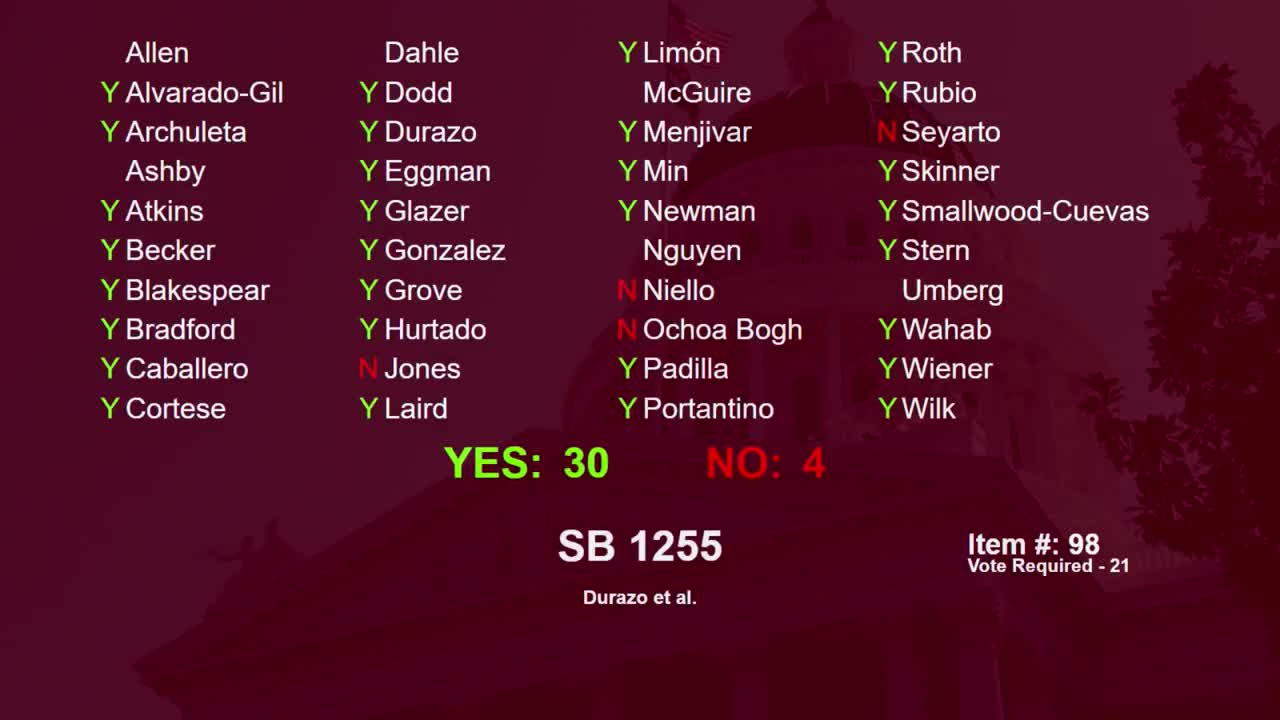 6MIN
Senate Floor
 16SEC
Senate Standing Committee on Judiciary
 48MIN
Senate Standing Committee on Judiciary
 11SEC