SB 1126: Child abuse and neglect.
- Session Year: 2023-2024
- House: Senate
- Latest Version Date: 2024-04-01
Current Status:
Failed
(2024-05-23: Ordered to inactive file on request of Senator Min.)
Introduced
In Committee
First Chamber
In Committee
Second Chamber
Enacted
Existing law defines child abuse or neglect for the purposes of the Child Abuse and Neglect Reporting Act to include, among other things, physical injury or death inflicted by other than accidental means and the willful harming or injuring of a child.
This bill would provide that the fact that a child witnessing witnessed domestic violence is not a sufficient basis for reporting child abuse or neglect, as specified. or was present during a domestic violence incident does not require a mandated reporter to report child abuse or neglect. The bill would also provide that the definition of child abuse or neglect does not apply to how a child witnessing domestic violence or residing in a household where domestic violence exists may be is relevant to, among other things, a determination of child custody or visitation.
Existing law defines child abuse or neglect for the purposes of the Child Abuse and Neglect Reporting Act to include, among other things, physical injury or death inflicted by other than accidental means and the willful harming or injuring of a child.
This bill would provide that a child witnessing domestic violence is not a sufficient basis for reporting child abuse or neglect, as specified. The bill would also provide that the definition of child abuse or neglect does not apply to how a child witnessing domestic violence or residing in a household where domestic violence exists may be relevant to, among other things, a determination of child custody or visitation.
The Legislature finds and declares all of the following:
(a)When a mandatory reporter is required to report a childs exposure to domestic violence, the fact that a child witnessed domestic violence or was present during a domestic violence incident, far too often non-violent, protective survivor parents are charged with neglect, which discourages non-violent those survivor parents from seeking services and support. Paradoxically, abuse survivors are treated as culpable as the abusive parent survivor parents are often treated as responsible for the violence they seek to escape and can lose custody of their children at the point when they seek help escaping violence. The abusive parent is often aware of this false equivalency and threatens reporting or makes bad-faith reports. help.
(b)The mandatory reporting to child welfare of abused survivor parents has increased unnecessary state intrusion and the needless removal of children from their non-abusive traumatic separation of a child from their survivor parent, even as studies show that experiencing abuse does not compromise an abuse a survivors ability to effectively parent.
(c)Children are frequently removed from the non-abusive survivor parent and placed in foster care, although the harms of separation from a non-abusive survivor parent are well established.
(d)Failure to protect laws operate contrary to research findings, which show that the best ways to keep a child who has been exposed to domestic violence safe are to help the non-offending survivor parent be safe and to support the abused that parents ability to engage in a nurturing relationship with the child. Indeed, the childs continued relationship with the abused survivor parent is the most critical resiliency factor and predictor of lifetime positive outcomes for a child who has witnessed domestic violence.
(e)Mandatory reporting also disproportionately surveils and investigates low-income Black, Latino, and indigenous families. One in three children nationwide, and half of Black children, experience a child welfare investigation during childhood. Additionally, mandated reporting has negative impacts on linguistically marginalized communities, particularly with Asian and Pacific Islander families, who experience their children being unnecessarily detained due to cultural and linguistic barriers and misunderstandings. These families are also often ordered to complete programs that are not available or have limited availability in their primary language, which adversely affects and prolongs the period of family separation and their legal cases. The racial discrimination of the child welfare system reflects prevalence and vectors of inequality, produces mass insecurity in neighborhoods of color, and results in racialized family separations.
(f)This section is not meant to apply to how a child witnessing abuse or neglect or residing in a home where domestic violence occurs might be the fact that a child witnessed domestic violence or was present during a domestic violence incident is relevant to a determination of custody or visitation or the issuance of a domestic violence restraining order under the Family Code.
SEC. 2.Section 11165.6 of the Penal Code is amended to read:11165.6.(a)(1)As used in this article, the term child abuse or neglect includes physical injury or death inflicted upon a child by another person by other than accidental means, sexual abuse, as defined in Section 11165.1, neglect, as defined in Section 11165.2, the willful harming or injuring of a child or the endangering of the person or health of a child, as defined in Section 11165.3, and unlawful corporal punishment or injury, as defined in Section 11165.4.
(2)Child abuse or neglect does not include a mutual affray between minors.
(3)Child abuse or neglect does not include an injury caused by reasonable and necessary force used by a peace officer acting within the course and scope of their employment as a peace officer.
(b)A child witnessing domestic violence is not a sufficient basis for reporting child abuse or neglect for purposes of this section.(b)The fact that a child witnessed domestic violence or was present during a domestic violence incident does not require a mandated reporter to report child abuse or neglect.
(c)This section does not apply to how a child witnessing the fact that a child witnessed domestic violence or residing in a household where domestic violence exists may be was present during a domestic violence incident is relevant to a determination of custody or visitation or the issuance of a domestic violence restraining order under the Family Code.
The Legislature finds and declares all of the following:
(a)When a mandatory reporter is required to report a childs exposure to domestic violence, far too often non-violent, protective parents are charged with neglect, which discourages non-violent parents from seeking services and support. Paradoxically, abuse survivors are treated as culpable as the abusive parent and can lose custody of their children at the point when they seek help escaping violence. The abusive parent is often aware of this false equivalency and threatens reporting or makes bad-faith reports.
(b)The mandatory reporting to child welfare of abused parents has increased unnecessary state intrusion and the needless removal of children from their non-abusive parent, even as studies show that experiencing abuse does not compromise an abuse survivors ability to parent.
(c)Children are frequently removed from the non-abusive parent and placed in foster care, although the harms of separation from a non-abusive parent are well established.
(d)Failure to protect laws operate contrary to research findings, which show that the best ways to keep a child who has been exposed to domestic violence safe are to help the non-offending parent be safe and to support the abused parents ability to engage in a nurturing relationship with the child. Indeed, the childs continued relationship with the abused parent is the most critical resiliency factor and predictor of lifetime positive outcomes for a child who has witnessed domestic violence.
(e)Mandatory reporting also disproportionately surveils and investigates low-income Black, Latino, and indigenous families. One in three children nationwide, and half of Black children, experience a child welfare investigation during childhood. The racial discrimination of the child welfare system reflects prevalence and vectors of inequality, produces mass insecurity in neighborhoods of color, and results in racialized family separations.
(f)This section is not meant to apply to how a child witnessing abuse or neglect or residing in a home where domestic violence occurs might be relevant to a determination of custody or visitation or the issuance of a domestic violence restraining order under the Family Code.
SEC. 2.Section 11165.6 of the Penal Code is amended to read:11165.6.(a)(1)As used in this article, the term child abuse or neglect includes physical injury or death inflicted upon a child by another person by other than accidental means upon a child by another person, sexual abuse means, sexual abuse, as defined in Section 11165.1, neglect neglect, as defined in Section 11165.2, the willful harming or injuring of a child or the endangering of the person or health of a child, as defined in Section 11165.3, and unlawful corporal punishment or injury injury, as defined in Section 11165.4. Child
(2)Child abuse or neglect does not include a mutual affray between minors. Child
(3)Child abuse or neglect does not include an injury caused by reasonable and necessary force used by a peace officer acting within the course and scope of his or her their employment as a peace officer.
(b)A child witnessing domestic violence is not a sufficient basis for reporting child abuse or neglect for purposes of this section.
(c)This section does not apply to how a child witnessing domestic violence or residing in a household where domestic violence exists may be relevant to a determination of custody or visitation or the issuance of a domestic violence restraining order under the Family Code.
|
Date
|
Status
|
|---|---|
| May 23, 2024 | Ordered to inactive file on request of Senator Min. |
| Apr 10, 2024 | Read second time. Ordered to third reading. |
| Apr 9, 2024 | From committee: Do pass. (Ayes 4. Noes 0. Page 3533.) (April 9). |
| Apr 1, 2024 | From committee with author's amendments. Read second time and amended. Re-referred to Com. on PUB S. |
| Mar 13, 2024 | Set for hearing April 9. |
| Feb 21, 2024 | Referred to Com. on PUB S. |
| Feb 14, 2024 | From printer. May be acted upon on or after March 15. |
| Feb 13, 2024 | Introduced. Read first time. To Com. on RLS. for assignment. To print. |
|
Date
|
Description
|
Location
|
Votes
|
|
|---|---|---|---|---|
| Apr 9, 2024 | Do pass | Senate Standing Committee on Public Safety |
Passed |
This list shows positions taken on this bill by organizations on the date displayed, which is linked to the original source.
Positions by individuals are not included.
|
Organization
|
Position
|
Date
|
|---|---|---|
| AAPI Equity Alliance | ** Support | |
| Alliance for Boys and Men of Color | ** Support | |
| Alliance for Children's Rights | ** Support | |
| Alliance for Hope International | ** Against | |
| Asian Americans for Community Involvement | ** Support | |
| California Alliance of Caregivers | ** Support | |
| California Alliance Of Child And Family Services | ** Support | |
| California Partnership To End Domestic Violence | ** Support | |
| California Public Defenders Association | ** Support | |
| California Youth Connection | ** Support | |
| Caminar Latino-Latinos United for Peace and Equity | ** Support | |
| CASA of Los Angeles | ** Support | |
| Child Abuse Prevention Center | ** Support | |
| ChildrenS Institute | ** Support | |
| Children'S Law Center Of California | ** Support | |
| Coalition to Abolish Slavery and Trafficking | ** Support | |
| Community Resource Center | ** Support | |
| County Welfare Directors Association of California | ** Against | |
| Crime Survivors for Safety and Justice | ** Support | |
| Dependency Advocacy Center | ** Support | |
| Downtown Women's Center | ** Support | |
| Family Violence Appellate Project | ** Support | |
| Futures Without Violence | ** Support | |
| Healthy Alternatives to Violent Environments | ** Support | |
| Human Options | ** Support | |
| Jenesse Center, Inc. | ** Support | |
| Legal Aid Foundation of Los Angeles | ** Support | |
| Los Angeles Center for Law and Justice | ** Support | |
| Los Angeles Dependency Lawyers, Inc. | ** Support | |
| Lumina Alliance | ** Support | |
| National Center for Youth Law | ** Support | |
| Next Door Solutions to Domestic Violence | ** Support | |
| Project Sanctuary, INC. | ** Support | |
| Public Counsel | ** Support | |
| Reimagine Child Safety Coalition | ** Support | |
| San Francisco Public Defender | ** Support | |
| Sayra & Neil Meyerhoff Center for Families, Children & the Courts | ** Support | |
| Sheedy Consulting, LLC | ** Support | |
| The People Concern | ** Support | |
| University of California, Irvine School of Law Domestic Violence Clinic | ** Support | |
| WEAVE | ** Support | |
| western center on law & poverty | ** Support | |
| Woman, INC. | ** Support |
SENATE RULES COMMITTEE Office of Senate Floor Analyses (916) 651-1520 Fax: (916) 327-4478 | SB 1126 |
THIRD READING
Bill No: SB 1126
Author: Min (D)
Amended: 4/1/24
Vote: 21
SENATE PUBLIC SAFETY COMMITTEE: 4-0, 4/9/24
AYES: Wahab, Bradford, Skinner, Wiener
NO VOTE RECORDED: Seyarto
SUBJECT: Child abuse and neglect
SOURCE: Alliance for Boys and Men of Color
California Partnership to End Domestic Violence
Family Violence Appellate Project
Futures Without Violence
Public Counsel
University of California, Irvine School of Law Domestic Violence Clinic
DIGEST:
This bill clarifies that a child who witnessed or was present during a domestic violence incident does not alone meet the definition of child abuse or neglect as outlined by the Child Abuse and Neglect Reporting Act (CANRA), and thus does not require a report from a mandated reporter on the basis of witnessing an incident of domestic violence.
ANALYSIS:
Existing law:
- Establishes the Child Abuse and Neglect Reporting Act (CANRA). (Penal Code § 11164)
- Defines a child as a person under the age of 18 years (Penal Code § 11165)
- Defines child “neglect” as the negligent treatment or the maltreatment of a child by a person responsible for the child’s welfare under circumstances indicating harm or threatened harm to the child’s health or welfare. The term includes both acts and omissions on the part of the responsible person. (Penal Code § 11165.2)
- Defines “general neglect” under CANRA as the negligent failure of a person having the care or custody of a child to provide adequate food, clothing, shelter, medical care, or supervision where no physical injury to the child has occurred. (Penal Code § 11165.2 (b).)
- Defines “the willful harming or injuring of a child” as a situation where a person willfully causes or permits any child to suffer, or inflicts thereon, unjustifiable physical pain or mental suffering, or having the care or custody of any child, willfully causes or permits the person or health of the child to be placed in a situation in which his or her person or health is endangered. (Penal Code § 11165.3)
- Defines “Child abuse or neglect” as physical injury or death inflicted by other than accidental means upon a child by another person, sexual abuse, neglect, the willful harming or injuring of a child or the endangering of the person or health of a child, and unlawful corporal punishment or injury. Provided the child abuse or neglect does not include a mutual affray between minors or an injury caused by reasonable and necessary force used by a peace officer acting within the course and scope of his or her employment as a peace officer. (Penal Code § 11165.6)
- Defines “mandated reporter” under CANRA as specific child-care custodians, health practitioners, law enforcement officers, medical professionals and lists the categories of professions who are considered mandated reporters. (Penal Code § 11165.7)
- Provides that agencies that are required to receive reports of suspected child abuse or neglect may not refuse to accept a report of suspected child abuse or neglect from a mandated reporter or another person and are required to maintain a record of all reports received. (Penal Code § 11165.9)
- Defines “reasonable suspicion” under CANRA as meaning that it is objectively reasonable for a person to entertain a suspicion, based upon facts that could cause a reasonable person in a like position, drawing, when appropriate, on the person’s training and experience, to suspect child abuse or neglect. Provides that “reasonable suspicion” does not require certainty that child abuse or neglect has occurred nor does it require a specific medical indication of child abuse or neglect; any “reasonable suspicion” is sufficient. For purposes of this article, the pregnancy of a minor does not, in and of itself, constitute a basis for a reasonable suspicion of sexual abuse. (Penal Code § 11166 (a)(1).)
- Requires a mandated reporter to make a report whenever, in their professional capacity or within the scope of their employment, they have knowledge of or observe a child whom they know or reasonably suspect has been the victim of child abuse or neglect. (Penal Code § 11166.)
- Allows any other person who is not a mandated reporter, who has knowledge of or observes a child whom the person knows or reasonably suspects has been a victim of child abuse or neglect, to report the known or suspected instance of child abuse or neglect. (Penal Code § 11166 (g).)
- States that mandated reporters who have knowledge of or reasonably suspect that a child is suffering serious emotional damage may make a report to the relevant agency (Penal Code § 11166.05)
- Mandates reports of suspected child abuse or neglect to include (a) the name, business address, and telephone number of the mandated reporter; (b) the capacity that makes the person a mandated reporter; and (c) the information that gave rise to the reasonable suspicion of child abuse or neglect and the source or sources of that information. Provides that, if a report is made, the following information, if known, shall also be included in the report: (d) the child's name, the child's address, present location, and, if applicable, school, grade, and class; (e) the names, addresses, and telephone numbers of the child's parents or guardians; and (f) the name, address, telephone number, and other relevant personal information about the person or persons who might have abused or neglected the child. The mandated reporter shall make a report even if some of this information is not known or is uncertain to them. (Penal Code § 11167 (a).)
- States that information relevant to the incident of child abuse or neglect may be given to an investigator from an agency that is investigating the known or suspected case of child abuse or neglect. (Penal Code § 11167 (b).)
- Allows information relevant to the incident of child abuse or neglect, including the investigation report and other pertinent materials, to be given to the licensing agency when it is investigating a known or suspected case of child abuse or neglect. (Penal Code § 11167 (c).)
- Requires specified government agencies to forward to the DOJ a report of every case of suspected child abuse or neglect that it investigates and determines to be substantiated; and if a previously filed report proves to be not substantiated, the DOJ shall be notified in writing, and shall not retain that report. (Penal Code § 11169 (a).)
- Defines “substantiated report” as a report that is determined by the investigator to constitute child abuse or neglect based on some evidence that makes it more likely than not that child abuse or neglect occurred. (Penal Code § 11165.12(b).)
- Provides that any mandated reporter who fails to report an incident of known or reasonably suspected child abuse or neglect as required is guilty of a misdemeanor punishable by up to six months confinement in a county jail or by a fine of $1,000 or by both. If a mandated reporter intentionally conceals his or her failure to report an incident known by the mandated reporter to be abuse or severe neglect, the failure to report is a continuing offense until a specified agency discovers the offense. (Penal Code § 11166 (c).)
This bill:
- Changes the requirements under CANRA to specify that a child witnessing domestic violence is not a sufficient basis for reporting child abuse or neglect.
- Clarifies that a child witnessing domestic violence or residing in a household where domestic violence exists can still be used in a determination of custody or visitation or the issuance of a domestic violence restraining order under the Family Code.
Comments
This bill clarifies that a child witnessing or being present during an act of domestic violence does not meet the criteria of child abuse or neglect that forces a mandated reporter to file a report with the appropriate local law enforcement or county child welfare agency. However, it does not prevent a mandated reporter from reporting situations where domestic violence causes severe emotional or physical trauma to a child. The main goal of this bill is to clarify that mandated reporters must use their discretion when determining whether an instance of a child witnessing domestic violence meets the already defined criteria for child abuse or neglect.
Under current law, there exists some confusion as to whether mandatory reporters are required to automatically file a report when they discover a child has witnessed domestic violence and whether mandated reporters can be held liable for not reporting these situations. For example, if a child is in the custody of a survivor parent after escaping a domestically violent situation and a mandated reporter learns of the prior situation, that mandated reporter may feel forced to file a report, subjecting the survivor parent and their child to an intrusive investigation after already taking steps to address the prior harm. In that scenario, and under existing law, a report would not be necessary because the conditions do not meet the criteria of child abuse or neglect outlined by CANRA. This bill adda language to the Penal Code’s definition of child abuse or neglect that would relinquish a mandated reporter from reporting scenarios such as the aforementioned. Mandated reporters would only be required to report cases of domestic violence under CANRA when the situation is ongoing or is severely harming a child.
This bill acknowledges the complex nature of domestic violence while ensuring children can remain in the custody of their survivor parent and protects the ability of survivor parents to escape abusive situations and seek resources.
FISCAL EFFECT: Appropriation: No Fiscal Com.: No Local: No
SUPPORT: (Verified 4/9/24)
Alliance for Boys and Men of Color (co-source)
California Partnership to End Domestic Violence (co-source)
Family Violence Appellate Project (co-source)
Futures Without Violence (co-source)
Public Counsel (co-source)
University of California, Irvine School of Law Domestic Violence Clinic (co-source)
AAPI Equity Alliance
Alliance for Children's Rights
Asian Americans for Community Involvement
California Alliance of Caregivers
California Alliance of Child and Family Services
California Public Defenders Association
California Youth Connection
Caminar Latino-Latinos United for Peace and Equity
Casa of Los Angeles
Child Abuse Prevention Center
Children's Institute
Children's Law Center of California
Coalition to Abolish Slavery and Trafficking
Community Resource Center
Crime Survivors for Safety and Justice
Dependency Advocacy Center
Downtown Women's Center
Family Violence Appellate Project
Healthy Alternatives to Violent Environments
Human Options
Jenesse Center, INC.
Legal Aid Foundation of Los Angeles
Los Angeles Center for Law and Justice
Los Angeles Dependency Lawyers, INC.
Lumina Alliance
National Center for Youth Law
Next Door Solutions to Domestic Violence
Project Sanctuary, INC.
Reimagine Child Safety Coalition
San Francisco Public Defender
Sayra & Neil Meyerhoff Center for Families, Children & the Courts
Sheedy Consulting, LLC.
The People Concern
Weave
Western Center on Law & Poverty
Woman, INC.
OPPOSITION: (Verified 4/9/24)
Alliance for Hope International
County Welfare Directors Association of California
ARGUMENT IN SUPPORT: According to Alliance for Boys and Men of Color, the California Partnership to End Domestic Violence, Family Violence Appellate Project, Futures Without Violence, Public Counsel, and University of California, Irvine School of Law Domestic Violence Clinic:
It is with urgency that our organizations write to you as co-sponsors to support SB 1126, which would clarify that a mandated reporter of child abuse and neglect is not required to make a report to Child Protective Services (CPS) when they learn that a child has witnessed domestic violence. This bill is a critical clarification of existing law that will result in increased safety and support for parents and children who are survivors of domestic violence. It is consistent with the broader recognition of how the current mandated reporting system has harmed countless California families, including many survivor children and their parents, with specific, disproportionate harm to California’s Black, Native and Indigenous, and Hispanic/Latine communities. For survivors of domestic violence, clarifying the law would also be a significant step towards a more constructive, effective, and humane model of support that aims to keep their families together safely and address the systemic racial bias that has characterized the mandated reporting system for far too long. As such, this bill is a priority policy for our organizations this year.
Currently in California, when a child who has witnessed domestic violence comes to the attention of service providers, medical professionals, police, and other mandated reporters, both parents are often reported to CPS, including the parent who has been the victim of violence. The family is then subjected to an invasive investigation that can create toxic levels of stress for the survivor parent and child, who live for weeks with the very real threat of separation looming over them. Even worse, survivors of domestic violence often come to the attention of mandated reporters only because they are actively seeking help from the service providers, medical professionals, or police who then report them to CPS based on the belief that this is required under current law when it is suspected only that a child has witnessed domestic violence in the home.
As a result, paradoxically, survivor parents, including those who are “victims” under our criminal laws, can have their children taken from them, including as a result of their efforts to seek and receive support. Because mandated reporters face liability if they fail to report, many mandated reporters file reports even when they do not have real concerns for child safety or are actively providing services to support the survivor parent and children. Survivors report that the threat of being reported to CPS is a deterrent to seeking help, and data show Black, Native and Indigenous, and Hispanic/Latine families are reported at substantially higher rates than other families as a result of racial bias, not the risk of harm to children (Safe and Sound, Creating a Child & Family Well-Being System: A Paradigm Shift from Mandated Reporting to Community Supporting).
Research shows that keeping survivor parents and their children together with access to support and services is the most effective way to help children who witness domestic violence (A. Rosewater & K. Moore 2010). In contrast, studies show that separating children who witness domestic violence from their survivor parents can cause long-term harm to the child (Meier & Sankaran 2021). State separation of children from a parent and placement in the child welfare system leads to the known harms of system involvement often caused by “vulnerabilities foster care itself creates,” (Roberts 2017) and children in foster care often experience physical and sexual abuse or neglect at higher rates than children who remain with their families (Huntington 2006)(Stark 2002)(Gruskin 2000).
ARGUMENT IN OPPOSITION: According to County Welfare Directors Association of California:
The County Welfare Directors Association of California (CWDA) respectfully opposes SB 1126 by Senator Min. This bill would establish that a child who witnesses domestic violence or is present during a domestic violence incident does not require a mandated reporter to report child abuse or neglect.
CWDA supports the ongoing effort within child welfare services (CWS), to shift from a system that relies primarily on mandated reporting to one that empowers community supporting of children. CWDA does not support changing the requirements on mandated reporters in a piecemeal fashion pending the completion of the work of the task force and the issuance of its recommendations.
[…] CWDA is also concerned that this bill would change the legal expectations for mandated reporters without ensuring or funding additional training for mandated reporters. Assuming this change goes into effect, additional training would be needed to educate mandated reporters on when the presence of domestic violence might be one factor that could warrant a report, and when it might not warrant making a report. Simply removing the requirement without providing training risks miscommunicating to reporters that they ought not report any case where domestic violence is present, rather than empowering them with the necessary tools to determine when a report may or may not be warranted. CWDA argues that such a change should not be made without updated training, especially while the work of the task force is not completed.
Click here to enter text.
Prepared by: John Duncan / PUB. S. /
4/10/24 12:35:58
SENATE COMMITTEE ON PUBLIC SAFETY
Senator Aisha Wahab, Chair
2023 - 2024 Regular
Bill No: SB 1126 Hearing Date: April 9, 2024
Author: | Min | ||
Version: | April 1, 2024 | ||
Urgency: | No | Fiscal: | No |
Consultant: | JD | ||
Subject: Child abuse and neglect
HISTORY
Source: California Partnership to End Domestic Violence and UCI Domestic Violence Law Clinic
Prior Legislation: SB 537 (Rubio) 2021
Support: AAPI Equity Alliance; Alliance for Boys and Men of Color; Alliance for Children's Rights; Asian Americans for Community Involvement; California Alliance of Caregivers; California Alliance of Child and Family Services; California Partnership to End Domestic Violence; California Public Defenders Association; California Youth Connection (CYC); Caminar Latino-latinos United for Peace and Equity; Casa of Los Angeles; Child Abuse Prevention Center; Children's Law Center of California; Coalition to Abolish Slavery and Trafficking (CAST); Community Resource Center; Crime Survivors for Safety and Justice; Dependency Advocacy Center; Downtown Women's Center; Family Violence Appellate Project; Futures Without Violence; Healthy Alternatives to Violent Environments; Human Options; Legal Aid Foundation of Los Angeles; Los Angeles Center for Law and Justice; Los Angeles Dependency Lawyers, INC.; Lumina Alliance; National Center for Youth Law; Next Door Solutions to Domestic Violence; Project Sanctuary, INC.; Public Counsel; Reimagine Child Safety Coalition; Sayra & Neil Meyerhoff Center for Families, Children & the Courts; Sheedy Consulting, LLC; The People Concern; University of California, Irvine School of Law Domestic Violence Clinic; WEAVE; Western Center on Law & Poverty; Woman INC
Opposition: County Welfare Directors Association of California
PURPOSE
The purpose of this bill is to clarify that a child who witnessed or was present during a domestic violence incident does not alone meet the definition of child abuse or neglect as outlined by the Child Abuse and Neglect Reporting Act (CANRA), and thus does not require a report from a mandated reporter on the basis of witnessing an incident of domestic violence.
Existing law establishes the Child Abuse and Neglect Reporting Act (CANRA). (Penal Code § 11164.)
Existing law defines a child as a person under the age of 18 years (Penal Code § 11165)
Existing law defines child “neglect” as the negligent treatment or the maltreatment of a child by a person responsible for the child’s welfare under circumstances indicating harm or threatened harm to the child’s health or welfare. The term includes both acts and omissions on the part of the responsible person. (Penal Code § 11165.2)
Existing law defines “general neglect” under CANRA as the negligent failure of a person having the care or custody of a child to provide adequate food, clothing, shelter, medical care, or supervision where no physical injury to the child has occurred. (Penal Code § 11165.2 (b).)
Existing law defines “the willful harming or injuring of a child” as a situation where a person willfully causes or permits any child to suffer, or inflicts thereon, unjustifiable physical pain or mental suffering, or having the care or custody of any child, willfully causes or permits the person or health of the child to be placed in a situation in which his or her person or health is endangered (Penal Code § 11165.3).
Existing law defines “Child abuse or neglect” as physical injury or death inflicted by other than accidental means upon a child by another person, sexual abuse, neglect, the willful harming or injuring of a child or the endangering of the person or health of a child, and unlawful corporal punishment or injury. Child abuse or neglect does not include a mutual affray between minors or an injury caused by reasonable and necessary force used by a peace officer acting within the course and scope of his or her employment as a peace officer. (Penal Code § 11165.6.)
Existing law defines “mandated reporter” under CANRA as specific child-care custodians, health practitioners, law enforcement officers, medical professionals and lists the categories of professions who are considered mandated reporters. (Penal Code § 11165.7)
Existing law provides that agencies that are required to receive reports of suspected child abuse or neglect may not refuse to accept a report of suspected child abuse or neglect from a mandated reporter or another person and are required to maintain a record of all reports received. (Penal Code § 11165.9.)
Existing law defines “reasonable suspicion” under CANRA as meaning that it is objectively reasonable for a person to entertain a suspicion, based upon facts that could cause a reasonable person in a like position, drawing, when appropriate, on the person’s training and experience, to suspect child abuse or neglect. “Reasonable suspicion” does not require certainty that child abuse or neglect has occurred nor does it require a specific medical indication of child abuse or neglect; any “reasonable suspicion” is sufficient. For purposes of this article, the pregnancy of a minor does not, in and of itself, constitute a basis for a reasonable suspicion of sexual abuse. (Penal Code § 11166 (a)(1).)
Existing law requires a mandated reporter to make a report whenever, in their professional capacity or within the scope of their employment, they have knowledge of or observe a child whom they know or reasonably suspect has been the victim of child abuse or neglect. (Penal Code § 11166.)
Existing law allows any other person who is not a mandated reporter, who has knowledge of or observes a child whom the person knows or reasonably suspects has been a victim of child abuse or neglect, to report the known or suspected instance of child abuse or neglect. (Penal Code § 11166 (g).)
Existing law states that mandated reporters who have knowledge of or reasonably suspect that a child is suffering serious emotional damage may make a report to the relevant agency (Penal Code § 11166.05)
Existing law mandates reports of suspected child abuse or neglect to include the name, business address, and telephone number of the mandated reporter; the capacity that makes the person a mandated reporter; and the information that gave rise to the reasonable suspicion of child abuse or neglect and the source or sources of that information. If a report is made, the following information, if known, shall also be included in the report: the child's name, the child's address, present location, and, if applicable, school, grade, and class; the names, addresses, and telephone numbers of the child's parents or guardians; and the name, address, telephone number, and other relevant personal information about the person or persons who might have abused or neglected the child. The mandated reporter shall make a report even if some of this information is not known or is uncertain to them. (Penal Code § 11167 (a).)
Existing law states that information relevant to the incident of child abuse or neglect may be given to an investigator from an agency that is investigating the known or suspected case of child abuse or neglect. (Penal Code § 11167 (b).)
Existing law allows information relevant to the incident of child abuse or neglect, including the investigation report and other pertinent materials, to be given to the licensing agency when it is investigating a known or suspected case of child abuse or neglect. (Penal Code § 11167 (c).)
Existing law requires specified government agencies to forward to the DOJ a report of every case of suspected child abuse or neglect that it investigates and determines to be substantiated; and if a previously filed report proves to be not substantiated, the DOJ shall be notified in writing, and shall not retain that report. (Penal Code § 11169 (a).)
Existing law defines “substantiated report” as a report that is determined by the investigator to constitute child abuse or neglect based on some evidence that makes it more likely than not that child abuse or neglect occurred. (Penal Code § 11165.12(b).)
Existing law provides that any mandated reporter who fails to report an incident of known or reasonably suspected child abuse or neglect as required is guilty of a misdemeanor punishable by up to six months confinement in a county jail or by a fine of $1,000 or by both. If a mandated reporter intentionally conceals his or her failure to report an incident known by the mandated reporter to be abuse or severe neglect, the failure to report is a continuing offense until a specified agency discovers the offense. (Penal Code § 11166 (c).)
This bill would change the requirements under CANRA to specify that a child witnessing domestic violence is not a sufficient basis for reporting child abuse or neglect.
This bill clarifies that a child witnessing domestic violence or residing in a household where domestic violence exists can still be used in a determination of custody or visitation or the issuance of a domestic violence restraining order under the Family Code.
COMMENTS
- Need for This Bill
According to the Author:
It is both wrong and ineffective to separate or threaten to separate the children of domestic violence survivors from their parents solely because those parents have experienced domestic violence. The law should make it clear that we do not punish parents who are being abused by funneling them into the child welfare system, especially when they reach out for help. Unfortunately, current law is often interpreted to require reporting whenever a mandated reporter knows of a parent experiencing domestic violence. This includes reporting even when the victim parent is taking steps to protect their child. Mandatory reporting in these cases can be harmful and does not result in child safety. By amending the law to make it clear that a child witnessing domestic violence is not a sufficient basis to mandate a report to child protective services, SB 1126 will reduce barriers for survivors of domestic violence who seek help with their children. It will do nothing to prevent a mandated reporter from reporting child neglect, abuse, or misconduct when they suspect or observe it.
- Mandatory Reporting with Child Abuse and Neglect
This bill clarifies that a child witnessing or being present during an act of domestic violence does not meet the criteria of child abuse or neglect that forces a mandated reporter to file a report with the appropriate local law enforcement or county child welfare agency. However, it does not prevent a mandated reporter from reporting situations where domestic violence causes severe emotional or physical trauma to a child. The main goal of this bill is to clarify that mandated reporters must use their discretion when determining whether an instance of a child witnessing domestic violence meets the already defined criteria for child abuse or neglect.
Under current law, there exists some confusion as to whether mandatory reporters are required to automatically file a report when they discover a child has witnessed domestic violence and whether mandated reporters can be held liable for not reporting these situations. For example, if a child is in the custody of a survivor parent after escaping a domestically violent situation and a mandated reporter learns of the prior situation, that mandated reporter may feel forced to file a report, subjecting the survivor parent and their child to an intrusive investigation after already taking steps to address the prior harm. In that scenario, and under existing law, a report would not be necessary because the conditions do not meet the criteria of child abuse or neglect outlined by CANRA. This bill would add language to the Penal Code’s definition of child abuse or neglect that would relinquish a mandated reporter from reporting scenarios such as the aforementioned. Mandated reporters would only be required to report cases of domestic violence under CANRA when the situation is ongoing or is severely harming a child.
This bill acknowledges the complex nature of domestic violence while ensuring children can remain in the custody of their survivor parent and protects the ability of survivor parents to escape abusive situations and seek resources.
- Argument in Support
According to Alliance for Boys and Men of Color, the California Partnership to End Domestic Violence, Family Violence Appellate Project, Futures Without Violence, National Center for Youth Law, Public Counsel, and University of California Irvine School of Law Domestic Violence Clinic:
It is with urgency that our organizations write to you as co-sponsors to support SB 1126, which would clarify that a mandated reporter of child abuse and neglect is not required to make a report to Child Protective Services (CPS) when they learn that a child has witnessed domestic violence. This bill is a critical clarification of existing law that will result in increased safety and support for parents and children who are survivors of domestic violence. It is consistent with the broader recognition of how the current mandated reporting system has harmed countless California families, including many survivor children and their parents, with specific, disproportionate harm to California’s Black, Native and Indigenous, and Hispanic/Latine communities. For survivors of domestic violence, clarifying the law would also be a significant step towards a more constructive, effective, and humane model of support that aims to keep their families together safely and address the systemic racial bias that has characterized the mandated reporting system for far too long. As such, this bill is a priority policy for our organizations this year.
Currently in California, when a child who has witnessed domestic violence comes to the attention of service providers, medical professionals, police, and other mandated reporters, both parents are often reported to CPS, including the parent who has been the victim of violence. The family is then subjected to an invasive investigation that can create toxic levels of stress for the survivor parent and child, who live for weeks with the very real threat of separation looming over them. Even worse, survivors of domestic violence often come to the attention of mandated reporters only because they are actively seeking help from the service providers, medical professionals, or police who then report them to CPS based on the belief that this is required under current law when it is suspected only that a child has witnessed domestic violence in the home.
As a result, paradoxically, survivor parents, including those who are “victims” under our criminal laws, can have their children taken from them, including as a result of their efforts to seek and receive support. Because mandated reporters face liability if they fail to report, many mandated reporters file reports even when they do not have real concerns for child safety or are actively providing services to support the survivor parent and children. Survivors report that the threat of being reported to CPS is a deterrent to seeking help, and data show Black, Native and Indigenous, and Hispanic/Latine families are reported at substantially higher rates than other families as a result of racial bias, not the risk of harm to children.[1]
Research shows that keeping survivor parents and their children together with access to support and services is the most effective way to help children who witness domestic violence.[2] In contrast, studies show that separating children who witness domestic violence from their survivor parents can cause long-term harm to the child.[3] State separation of children from a parent and placement in the child welfare system leads to the known harms of system involvement often caused by “vulnerabilities foster care itself creates,”[4] and children in foster care often experience physical and sexual abuse or neglect at higher rates than children who remain with their families.[5]
- Argument in Opposition
According to County Welfare Directors Association of California:
The County Welfare Directors Association of California (CWDA) respectfully opposes SB 1126 by Senator Min. This bill would establish that a child who witnesses domestic violence or is present during a domestic violence incident does not require a mandated reporter to report child abuse or neglect.
CWDA supports the ongoing effort within child welfare services (CWS), to shift from a system that relies primarily on mandated reporting to one that empowers community supporting of children. CWDA does not support changing the requirements on mandated reporters in a piecemeal fashion pending the completion of the work of the task force and the issuance of its recommendations.
[…] CWDA is also concerned that this bill would change the legal expectations for mandated reporters without ensuring or funding additional training for mandated reporters. Assuming this change goes into effect, additional training would be needed to educate mandated reporters on when the presence of domestic violence might be one factor that could warrant a report, and when it might not warrant making a report. Simply removing the requirement without providing training risks miscommunicating to reporters that they ought not report any case where domestic violence is present, rather than empowering them with the necessary tools to determine when a report may or may not be warranted. CWDA argues that such a change should not be made without updated training, especially while the work of the task force is not completed
-- END –
Safe and Sound, Creating a Child & Family Well-Being System: A Paradigm Shift from Mandated Reporting to Community Supporting (September 2021), at https://economics.safeandsound.org/static_reports/Shifting.from.Mandated.Reporting.to.Community.Supporting_brief.pdf, see also D. Webster et. al., U. Cal.at Berkeley Cal. Child Welfare Indicators Project, CCWIP reports (2022), at https://ccwip.berkeley.edu/childwelfare/reports/DisparityIndices/STSG/r/rts/l; Children’s Rights, Racism at the Front End of Child Welfare, (January 2023), at https://www.childrensrights.org/wp-content/uploads/2023/04/CR-Racism-at-the-Front-End-of-Child-Welfare-2023-Fact-Sheet.pdf; National Indian Child Welfare Association, Disproportionality in Child Welfare, (November 2021), at https://www.nicwa.org/wp-content/uploads/2021/12/NICWA_11_2021-Disproportionality-Fact-Sheet.pdf; V. J. Palusci, A.S. Botash; Race and Bias in Child Maltreatment Diagnosis and Reporting, Pediatrics July 2021; 148 (1), at https://publications.aap.org/pediatrics/article/148/1/e2020049625/179923/Race-and-Bias-in-Child-Maltreatment-Diagnosis-and ↑
A. Rosewater & K. Moore, Addressing Domestic Violence, Child Safety and Well-being: Collaborative Strategies for California Families, Recommendations from the California Leadership Group on Domestic Violence and Child Well-being 6 (2010) at, https://www.courts.ca.gov/documents/DVReport2010V3.pdf ↑
Joan S. Meier & Vivek Sankaran, Breaking Down the Silos that Harm Children: A Call to Child Welfare, Domestic Violence, and Family Court Professionals, 28 Va. J. Soc. Pol’y 275, 295 n.99 (2021) (identifying potential lifelong harm to a child who is removed from the abused parent); Vivek Sankaran, Parens Patriae Run Amuck: The Child Welfare System’s Disregard for the Constitutional Rights of Nonoffending Parents, 82 Temp. L. Rev. 55, 84 (2009) (describing stripping abused parents of their rights to custody); Therese Zink, Darlene Kamine, Lauren Musk, Morgan Sill, Valerie Field & Frank Putnam, What Are Providers’ Reporting Requirements for Children Who Witness Domestic Violence?, 43 Clinical Pediatrics 449, 457 (2004) (describing serious disruption to the child’s life when removed from abused parent). ↑
Dorothy Roberts, How the Child Welfare System Polices Black Mothers, (2017) (edited transcript of a video presentation made by Prof. Roberts that opened the “Policing Motherhood” presentation at the Invisible No More conference in November 2017) https://sfonline.barnard.edu/how-the-child-welfare-system-polices-black-mothers/#identifier_8_4255. ↑
Clare Huntington, Rights Myopia in Child Welfare, 53 UCLA L. REV. 637, 661–62 (2006) (describing studies finding that children in foster care are seventy-five percent more likely to be maltreated and foster families are four times more likely to be reported for sexually abuse than non-foster families); Evan Stark, The Battered Mother in the Child Protective Service Caseload: Developing an Appropriate Response, 23 WOMEN’S RTS. L. REP. 107, 130 (2002); (identifying that children from homes with domestic violence are especially vulnerable to the trauma associated with foster care placement); Shana Gruskin, Advocate Sues State Foster Care Children Put at Risk in System, Suit Contends, SUN SENTINEL, June 15, 2000, at 1B (reporting on a state class action filed on behalf of over 14,000 children in the Florida child welfare system, alleging beatings, sexual abuse, malnutrition, torture, and neglect). ↑
Discussed in Hearing
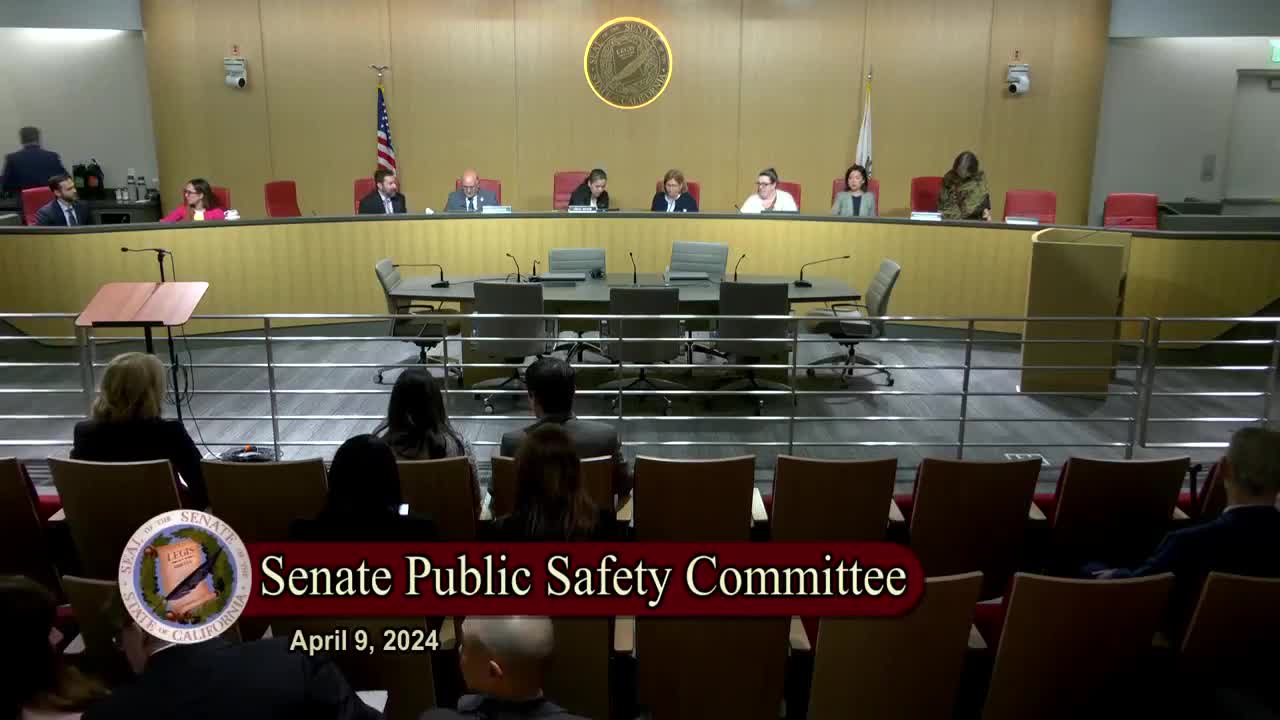 15MIN
Senate Standing Committee on Public Safety
Bill Author

Bill Co-Author(s):