SB 1128: Sex offender registration: unlawful sexual intercourse with a minor.
- Session Year: 2023-2024
- House: Senate
- Latest Version Date: 2024-04-11
Current Status:
Failed
(2024-08-15: August 15 hearing: Held in committee and under submission.)
Introduced
In Committee
First Chamber
In Committee
Second Chamber
Enacted
Existing law, the Sex Offender Registration Act (the Act), requires a person convicted of specified crimes to register with law enforcement as a sex offender while residing in California or while attending school or working in California, as specified. Existing law establishes 3 tiers of registration based on specified criteria, for periods of at least 10 years, at least 20 years, and life, respectively, for a conviction of specified sex offenses. Existing law exempts from mandatory registration under the Act a person convicted of certain offenses involving minors if the person is not more than 10 years older than the minor and if that offense is the only one requiring the person to register. A willful failure to register, as required by the Act, is a misdemeanor or felony, depending on the underlying offense.
This bill would require offenders guilty of engaging in an act of unlawful sexual intercourse with a minor who is more than 3 years younger than the offender, or, if the offender was 21 years of age or older, engaging in an act of unlawful sexual intercourse with a minor who is under 16 years of age, to register for 10 years as a tier one offender under the Act, unless the offender was not more than 10 years older than the minor and if that offense is the only one requiring the offender to register. The bill would require an individual who was required to register for a violation described above, to register for life under the Act if they are subsequently convicted in a separate proceeding of engaging in an act of unlawful sexual intercourse with a minor who is more than 3 years younger than the offender, or, if the offender was 21 years of age or older, engaging in an act of unlawful sexual intercourse with a minor who is under 16 years of age. By expanding the scope of a crime, this bill would impose a state-mandated local program.
The California Constitution requires the state to reimburse local agencies and school districts for certain costs mandated by the state. Statutory provisions establish procedures for making that reimbursement.
This bill would provide that no reimbursement is required by this act for a specified reason.
Existing law, the Sex Offender Registration Act (the Act), requires a person convicted of specified crimes to register with law enforcement as a sex offender while residing in California or while attending school or working in California, as specified. Existing law establishes 3 tiers of registration based on specified criteria, for periods of at least 10 years, at least 20 years, and life, respectively, for a conviction of specified sex offenses. Existing law exempts from mandatory registration under the Act a person convicted of certain offenses involving minors if the person is not more than 10 years older than the minor and if that offense is the only one requiring the person to register. A willful failure to register, as required by the act, Act, is a misdemeanor or felony, depending on the underlying offense.
This bill would require offenders guilty of engaging in an act of unlawful sexual intercourse with a minor who is more than 3 years younger than the offender, or, if the offender was 21 years of age or older, engaging in an act of unlawful sexual intercourse with a minor who is under 16 years of age, to register for 10 years as a tier one offender under the Act. Act, unless the offender was not more than 10 years older than the minor and if that offense is the only one requiring the offender to register. The bill would require an individual who was required to register for a violation described above, to register for life under the Act if they are subsequently convicted in a separate proceeding of engaging in an act of unlawful sexual intercourse with a minor who is more than 3 years younger than the offender, or, if the offender was 21 years of age or older, engaging in an act of unlawful sexual intercourse with a minor who is under 16 years of age. By expanding the scope of a crime, this bill would impose a state-mandated local program.
The California Constitution requires the state to reimburse local agencies and school districts for certain costs mandated by the state. Statutory provisions establish procedures for making that reimbursement.
This bill would provide that no reimbursement is required by this act for a specified reason.
Existing law, the Sex Offender Registration Act (the Act), requires a person convicted of specified crimes to register with law enforcement as a sex offender while residing in California or while attending school or working in California, as specified. Existing law establishes 3 tiers of registration based on specified criteria, for periods of at least 10 years, at least 20 years, and life, respectively, for a conviction of specified sex offenses. A willful failure to register, as required by the act, is a misdemeanor or felony, depending on the underlying offense.
This bill would require offenders guilty of engaging in an act of unlawful sexual intercourse with a minor who is more than 3 years younger than the offender, or, if the offender was 21 years of age or older, engaging in an act of unlawful sexual intercourse with a minor who is under 16 years of age, to register for 10 years as a tier one offender under the Act. The bill would require an individual who was required to register for a violation described above, to register for life under the Act if they are subsequently convicted in a separate proceeding of engaging in an act of unlawful sexual intercourse with a minor who is more than 3 years younger than the offender, or, if the offender was 21 years of age or older, engaging in an act of unlawful sexual intercourse with a minor who is under 16 years of age. By expanding the scope of a crime, this bill would impose a state-mandated local program.
Existing law authorizes the court, upon the conviction of any person for a violation of specified offenses regarding harmful matter and specified sex offenses, to, in addition to any other penalty or restitution fine imposed, order the defendant to pay a restitution fine based on the defendants ability to pay. The bill would also authorize a court to order the defendant to pay a restitution fine for violation of provisions regarding unlawful sexual intercourse with a minor when the violation is with a minor under the age of 14 years.The California Constitution requires the state to reimburse local agencies and school districts for certain costs mandated by the state. Statutory provisions establish procedures for making that reimbursement.
This bill would provide that no reimbursement is required by this act for a specified reason.
Existing law, the Sex Offender Registration Act (the Act), requires a person convicted of specified crimes to register with law enforcement as a sex offender while residing in California or while attending school or working in California, as specified. Existing law establishes 3 tiers of registration based on specified criteria, for periods of at least 10 years, at least 20 years, and life, respectively, for a conviction of specified sex offenses. A willful failure to register, as required by the act, is a misdemeanor or felony, depending on the underlying offense.
This bill would require offenders guilty of engaging in an act of unlawful sexual intercourse with a minor who is more than 3 years younger than the offender, or, if the offender was 21 years of age or older, engaging in an act of unlawful sexual intercourse with a minor who is under 16 years of age, to register for 10 years as a tier one offender under the Act. The bill would require an individual who was required to register for a violation described above, to register for life under the Act if they are subsequently convicted in a separate proceeding of engaging in an act of unlawful sexual intercourse with a minor who is more than 3 years younger than the offender, or, if the offender was 21 years of age or older, engaging in an act of unlawful sexual intercourse with a minor who is under 16 years of age. By expanding the scope of a crime, this bill would impose a state-mandated local program.
Existing law authorizes the court, upon the conviction of any person for a violation of specified offenses regarding harmful matter and specified sex offenses, to, in addition to any other penalty or restitution fine imposed, order the defendant to pay a restitution fine based on the defendants ability to pay.
The bill would also authorize a court to order the defendant to pay a restitution fine for violation of provisions regarding unlawful sexual intercourse with a minor when the violation is with a minor under the age of 14 years.
The California Constitution requires the state to reimburse local agencies and school districts for certain costs mandated by the state. Statutory provisions establish procedures for making that reimbursement.
This bill would provide that no reimbursement is required by this act for a specified reason.
(a)Sections 290 to 290.024, inclusive, shall be known, and may be cited, as the Sex Offender Registration Act. All references to the Act in those sections are to the Sex Offender Registration Act.
(b)Every person described in subdivision (c), for the period specified in subdivision (d) while residing in California, or while attending school or working in California, as described in Sections 290.002 and 290.01, shall register with the chief of police of the city in which the person is residing, or the sheriff of the county if the person is residing in an unincorporated area or city that has no police department, and, additionally, with the chief of police of a campus of the University of California, the California State University, or community college if the person is residing upon the campus or in any of its facilities, within five working days of coming into, or changing the persons residence within, any city, county, or city and county, or campus in which the person temporarily resides, and shall register thereafter in accordance with the Act, unless the duty to register is terminated pursuant to Section 290.5 or as otherwise provided by law.
(c)(1)The following persons shall register:
Every person who, since July 1, 1944, has been or is hereafter convicted in any court in this state or in any federal or military court of a violation of Section 187 committed in the perpetration, or an attempt to perpetrate, rape, or any act punishable under Section 286, 287, 288, or 289 or former Section 288a, Section 207 or 209 committed with intent to violate Section 261, subdivision (c) or (d) of Section 261.5, 286, 287, 288, or 289 or former Section 288a, Section 220, except assault to commit mayhem, subdivision (b) or (c) of Section 236.1, Section 243.4, Section 261, paragraph (1) of subdivision (a) of former Section 262 involving the use of force or violence for which the person is sentenced to the state prison, Section 264.1, 266, or 266c, subdivision (b) of Section 266h, subdivision (b) of Section 266i, Section 266j, 267, 269, 285, 286, 287, 288, 288.3, 288.4, 288.5, 288.7, 289, or 311.1, or former Section 288a, subdivision (b), (c), or (d) of Section 311.2, Section 311.3, 311.4, 311.10, 311.11, or 647.6, former Section 647a, subdivision (c) of Section 653f, subdivision 1 or 2 of Section 314, any offense involving lewd or lascivious conduct under Section 272, or any felony violation of Section 288.2; any statutory predecessor that includes all elements of one of the offenses described in this subdivision; or any person who since that date has been or is hereafter convicted of the attempt or conspiracy to commit any of the offenses described in this subdivision.
(2)Notwithstanding paragraph (1), a person convicted of a violation of subdivision (c) or (d) of Section 261.5, subdivision (b) of Section 286, subdivision (b) of Section 287, or subdivision (h) or (i) of Section 289 shall not be required to register if, at the time of the offense, the person is not more than 10 years older than the minor, as measured from the minors date of birth to the persons date of birth, and the conviction is the only one requiring the person to register. This paragraph does not preclude the court from requiring a person to register pursuant to Section 290.006.
(d)A person described in subdivision (c), or who is otherwise required to register pursuant to the Act shall register for 10 years, 20 years, or life, following a conviction and release from incarceration, placement, commitment, or release on probation or other supervision, as follows:
(1)(A)A tier one offender is subject to registration for a minimum of 10 years. A person is a tier one offender if the person is required to register for conviction of a misdemeanor described in subdivision (c), or for conviction of a felony described in subdivision (c) that was not a serious or violent felony as described in subdivision (c) of Section 667.5 or subdivision (c) of Section 1192.7.
(B)This paragraph does not apply to a person who is subject to registration pursuant to paragraph (2) or (3).
(2)(A)A tier two offender is subject to registration for a minimum of 20 years. A person is a tier two offender if the person was convicted of an offense described in subdivision (c) that is also described in subdivision (c) of Section 667.5 or subdivision (c) of Section 1192.7, Section 285, subdivision (g) or (h) of Section 286, subdivision (g) or (h) of Section 287 or former Section 288a, subdivision (b) of Section 289, or Section 647.6 if it is a second or subsequent conviction for that offense that was brought and tried separately.
(B)This paragraph does not apply if the person is subject to lifetime registration as required in paragraph (3).
(3)A tier three offender is subject to registration for life. A person is a tier three offender if any one of the following applies:
(A)Following conviction of a registerable offense, the person was subsequently convicted in a separate proceeding of committing an offense described in subdivision (c) and the conviction is for commission of a violent felony described in subdivision (c) of Section 667.5, or the person was subsequently convicted of committing an offense for which the person was ordered to register pursuant to Section 290.006, and the conviction is for the commission of a violent felony described in subdivision (c) of Section 667.5.
(B)The person was committed to a state mental hospital as a sexually violent predator pursuant to Article 4 (commencing with Section 6600) of Chapter 2 of Part 2 of Division 6 of the Welfare and Institutions Code.
(C)The person was convicted of violating any of the following:
(i)Section 187 while attempting to commit or committing an act punishable under Section 261, 286, 287, 288, or 289 or former Section 288a.
(ii)Section 207 or 209 with intent to violate Section 261, 286, 287, 288, or 289 or former Section 288a.
(iii)Section 220.
(iv)Subdivision (b) of Section 266h.
(v)Subdivision (b) of Section 266i.
(vi)Section 266j.
(vii)Section 267.
(viii)Section 269.
(ix)Subdivision (b) or (c) of Section 288.
(x)Section 288.2.
(xi)Section 288.3, unless committed with the intent to commit a violation of subdivision (b) of Section 286, subdivision (b) of Section 287 or former Section 288a, or subdivision (h) or (i) of Section 289.
(xii)Section 288.4.
(xiii)Section 288.5.
(xiv)Section 288.7.
(xv)Subdivision (c) of Section 653f.
(xvi)Any offense for which the person is sentenced to a life term pursuant to Section 667.61.
(D)The persons risk level on the static risk assessment instrument for sex offenders (SARATSO), pursuant to Section 290.04, is well above average risk at the time of release on the index sex offense into the community, as defined in the Coding Rules for that instrument.
(E)The person is a habitual sex offender pursuant to Section 667.71.
(F)The person was convicted of violating subdivision (a) of Section 288 in two proceedings brought and tried separately.
(G)The person was sentenced to 15 to 25 years to life for an offense listed in Section 667.61.
(H)The person is required to register pursuant to Section 290.004.
(I)The person was convicted of a felony offense described in subdivision (b) or (c) of Section 236.1.
(J)The person was convicted of a felony offense described in subdivision (a), (c), or (d) of Section 243.4.
(K)The person was convicted of violating paragraph (2), (3), or (4) of subdivision (a) of Section 261 or was convicted of violating Section 261 and punished pursuant to paragraph (1) or (2) of subdivision (c) of Section 264, or following conviction of a registerable offense under Section 261.5, the person is convicted in a separate proceeding of committing an offense described in subdivision (c) or (d) of Section 261.5. 264.
(L)The person was convicted of violating paragraph (1) of subdivision (a) of former Section 262.
(M)The person was convicted of violating Section 264.1.
(N)The person was convicted of any offense involving lewd or lascivious conduct under Section 272.
(O)The person was convicted of violating paragraph (2) of subdivision (c) or subdivision (d), (f), or (i) of Section 286.
(P)The person was convicted of violating paragraph (2) of subdivision (c) or subdivision (d), (f), or (i) of Section 287 or former Section 288a.
(Q)The person was convicted of violating paragraph (1) of subdivision (a) or subdivision (d), (e), or (j) of Section 289.
(R)The person was convicted of a felony violation of Section 311.1 or 311.11 or of violating subdivision (b), (c), or (d) of Section 311.2, Section 311.3, 311.4, or 311.10.
(4)(A)A person who is required to register pursuant to Section 290.005 shall be placed in the appropriate tier if the offense is assessed as equivalent to a California registerable offense described in subdivision (c).
(B)If the persons duty to register pursuant to Section 290.005 is based solely on the requirement of registration in another jurisdiction, and there is no equivalent California registerable offense, the person shall be subject to registration as a tier two offender, except that the person is subject to registration as a tier three offender if one of the following applies:
(i)The persons risk level on the static risk assessment instrument (SARATSO), pursuant to Section 290.06, is well above average risk at the time of release on the index sex offense into the community, as defined in the Coding Rules for that instrument.
(ii)The person was subsequently convicted in a separate proceeding of an offense substantially similar to an offense listed in subdivision (c) which is also substantially similar to an offense described in subdivision (c) of Section 667.5, or is substantially similar to Section 269 or 288.7.
(iii)The person has ever been committed to a state mental hospital or mental health facility in a proceeding substantially similar to civil commitment as a sexually violent predator pursuant to Article 4 (commencing with Section 6600) of Chapter 2 of Part 2 of Division 6 of the Welfare and Institutions Code.
(5)(A)The Department of Justice may place a person described in subdivision (c), or who is otherwise required to register pursuant to the Act, in a tier-to-be-determined category if the appropriate tier designation described in this subdivision cannot be immediately ascertained. An individual placed in this tier-to-be-determined category shall continue to register in accordance with the Act. The individual shall be given credit toward the mandated minimum registration period for any period for which the individual registers.
(B)The Department of Justice shall ascertain an individuals appropriate tier designation as described in this subdivision within 24 months of the individuals placement in the tier-to-be-determined category.
(e)The minimum time period for the completion of the required registration period in tier one or two commences on the date of release from incarceration, placement, or commitment, including any related civil commitment on the registerable offense. The minimum time for the completion of the required registration period for a designated tier is tolled during any period of subsequent incarceration, placement, or commitment, including any subsequent civil commitment, except that arrests not resulting in conviction, adjudication, or revocation of probation or parole shall not toll the required registration period. The minimum time period shall be extended by one year for each misdemeanor conviction of failing to register under this Act, and by three years for each felony conviction of failing to register under this Act, without regard to the actual time served in custody for the conviction. If a registrant is subsequently convicted of another offense requiring registration pursuant to the Act, a new minimum time period for the completion of the registration requirement for the applicable tier shall commence upon that persons release from incarceration, placement, or commitment, including any related civil commitment. If the subsequent conviction requiring registration pursuant to the Act occurs prior to an order to terminate the registrant from the registry after completion of a tier associated with the first conviction for a registerable offense, the applicable tier shall be the highest tier associated with the convictions.
(f)This section does not require a ward of the juvenile court to register under the Act, except as provided in Section 290.008.
SEC. 2.No reimbursement is required by this act pursuant to Section 6 of Article XIIIB of the California Constitution because the only costs that may be incurred by a local agency or school district will be incurred because this act creates a new crime or infraction, eliminates a crime or infraction, or changes the penalty for a crime or infraction, within the meaning of Section 17556 of the Government Code, or changes the definition of a crime within the meaning of Section 6 of Article XIIIB of the California Constitution.
REVISIONS: HeadingLines 3 and 4.(a)Sections 290 to 290.024, inclusive, shall be known, and may be cited, as the Sex Offender Registration Act. All references to the Act in those sections are to the Sex Offender Registration Act.
(b)Every person described in subdivision (c), for the period specified in subdivision (d) while residing in California, or while attending school or working in California, as described in Sections 290.002 and 290.01, shall register with the chief of police of the city in which the person is residing, or the sheriff of the county if the person is residing in an unincorporated area or city that has no police department, and, additionally, with the chief of police of a campus of the University of California, the California State University, or community college if the person is residing upon the campus or in any of its facilities, within five working days of coming into, or changing the persons residence within, any city, county, or city and county, or campus in which the person temporarily resides, and shall register thereafter in accordance with the Act, unless the duty to register is terminated pursuant to Section 290.5 or as otherwise provided by law.
(c)(1)The following persons shall register:
Every person who, since July 1, 1944, has been or is hereafter convicted in any court in this state or in any federal or military court of a violation of Section 187 committed in the perpetration, or an attempt to perpetrate, rape, or any act punishable under Section 286, 287, 288, or 289 or former Section 288a, Section 207 or 209 committed with intent to violate Section 261, subdivision (c) or (d) of Section 261.5, 286, 287, 288, or 289 or former Section 288a, Section 220, except assault to commit mayhem, subdivision (b) or (c) of Section 236.1, Section 243.4, Section 261, paragraph (1) of subdivision (a) of former Section 262 involving the use of force or violence for which the person is sentenced to the state prison, Section 264.1, 266, or 266c, subdivision (b) of Section 266h, subdivision (b) of Section 266i, Section 266j, 267, 269, 285, 286, 287, 288, 288.3, 288.4, 288.5, 288.7, 289, or 311.1, or former Section 288a, subdivision (b), (c), or (d) of Section 311.2, Section 311.3, 311.4, 311.10, 311.11, or 647.6, former Section 647a, subdivision (c) of Section 653f, subdivision 1 or 2 of Section 314, any offense involving lewd or lascivious conduct under Section 272, or any felony violation of Section 288.2; any statutory predecessor that includes all elements of one of the offenses described in this subdivision; or any person who since that date has been or is hereafter convicted of the attempt or conspiracy to commit any of the offenses described in this subdivision.
(2)Notwithstanding paragraph (1), a person convicted of a violation of subdivision (c) or (d) of Section 261.5, subdivision (b) of Section 286, subdivision (b) of Section 287, or subdivision (h) or (i) of Section 289 shall not be required to register if, at the time of the offense, the person is not more than 10 years older than the minor, as measured from the minors date of birth to the persons date of birth, and the conviction is the only one requiring the person to register. This paragraph does not preclude the court from requiring a person to register pursuant to Section 290.006.
(d)A person described in subdivision (c), or who is otherwise required to register pursuant to the Act shall register for 10 years, 20 years, or life, following a conviction and release from incarceration, placement, commitment, or release on probation or other supervision, as follows:
(1)(A)A tier one offender is subject to registration for a minimum of 10 years. A person is a tier one offender if the person is required to register for conviction of a misdemeanor described in subdivision (c), or for conviction of a felony described in subdivision (c) that was not a serious or violent felony as described in subdivision (c) of Section 667.5 or subdivision (c) of Section 1192.7.
(B)This paragraph does not apply to a person who is subject to registration pursuant to paragraph (2) or (3).
(2)(A)A tier two offender is subject to registration for a minimum of 20 years. A person is a tier two offender if the person was convicted of an offense described in subdivision (c) that is also described in subdivision (c) of Section 667.5 or subdivision (c) of Section 1192.7, Section 285, subdivision (g) or (h) of Section 286, subdivision (g) or (h) of Section 287 or former Section 288a, subdivision (b) of Section 289, or Section 647.6 if it is a second or subsequent conviction for that offense that was brought and tried separately.
(B)This paragraph does not apply if the person is subject to lifetime registration as required in paragraph (3).
(3)A tier three offender is subject to registration for life. A person is a tier three offender if any one of the following applies:
(A)Following conviction of a registerable offense, the person was subsequently convicted in a separate proceeding of committing an offense described in subdivision (c) and the conviction is for commission of a violent felony described in subdivision (c) of Section 667.5, or the person was subsequently convicted of committing an offense for which the person was ordered to register pursuant to Section 290.006, and the conviction is for the commission of a violent felony described in subdivision (c) of Section 667.5.
(B)The person was committed to a state mental hospital as a sexually violent predator pursuant to Article 4 (commencing with Section 6600) of Chapter 2 of Part 2 of Division 6 of the Welfare and Institutions Code.
(C)The person was convicted of violating any of the following:
(i)Section 187 while attempting to commit or committing an act punishable under Section 261, 286, 287, 288, or 289 or former Section 288a.
(ii)Section 207 or 209 with intent to violate Section 261, 286, 287, 288, or 289 or former Section 288a.
(iii)Section 220.
(iv)Subdivision (b) of Section 266h.
(v)Subdivision (b) of Section 266i.
(vi)Section 266j.
(vii)Section 267.
(viii)Section 269.
(ix)Subdivision (b) or (c) of Section 288.
(x)Section 288.2.
(xi)Section 288.3, unless committed with the intent to commit a violation of subdivision (b) of Section 286, subdivision (b) of Section 287 or former Section 288a, or subdivision (h) or (i) of Section 289.
(xii)Section 288.4.
(xiii)Section 288.5.
(xiv)Section 288.7.
(xv)Subdivision (c) of Section 653f.
(xvi)Any offense for which the person is sentenced to a life term pursuant to Section 667.61.
(D)The persons risk level on the static risk assessment instrument for sex offenders (SARATSO), pursuant to Section 290.04, is well above average risk at the time of release on the index sex offense into the community, as defined in the Coding Rules for that instrument.
(E)The person is a habitual sex offender pursuant to Section 667.71.
(F)The person was convicted of violating subdivision (a) of Section 288 in two proceedings brought and tried separately.
(G)The person was sentenced to 15 to 25 years to life for an offense listed in Section 667.61.
(H)The person is required to register pursuant to Section 290.004.
(I)The person was convicted of a felony offense described in subdivision (b) or (c) of Section 236.1.
(J)The person was convicted of a felony offense described in subdivision (a), (c), or (d) of Section 243.4.
(K)The person was convicted of violating paragraph (2), (3), or (4) of subdivision (a) of Section 261 or was convicted of violating Section 261 and punished pursuant to paragraph (1) or (2) of subdivision (c) of Section 264, or following conviction of a registerable offense under Section 261.5, the person is convicted in a separate proceeding of committing an offense described in subdivision (c) or (d) of Section 261.5.
(L)The person was convicted of violating paragraph (1) of subdivision (a) of former Section 262.
(M)The person was convicted of violating Section 264.1.
(N)The person was convicted of any offense involving lewd or lascivious conduct under Section 272.
(O)The person was convicted of violating paragraph (2) of subdivision (c) or subdivision (d), (f), or (i) of Section 286.
(P)The person was convicted of violating paragraph (2) of subdivision (c) or subdivision (d), (f), or (i) of Section 287 or former Section 288a.
(Q)The person was convicted of violating paragraph (1) of subdivision (a) or subdivision (d), (e), or (j) of Section 289.
(R)The person was convicted of a felony violation of Section 311.1 or 311.11 or of violating subdivision (b), (c), or (d) of Section 311.2, Section 311.3, 311.4, or 311.10.
(4)(A)A person who is required to register pursuant to Section 290.005 shall be placed in the appropriate tier if the offense is assessed as equivalent to a California registerable offense described in subdivision (c).
(B)If the persons duty to register pursuant to Section 290.005 is based solely on the requirement of registration in another jurisdiction, and there is no equivalent California registerable offense, the person shall be subject to registration as a tier two offender, except that the person is subject to registration as a tier three offender if one of the following applies:
(i)The persons risk level on the static risk assessment instrument (SARATSO), pursuant to Section 290.06, is well above average risk at the time of release on the index sex offense into the community, as defined in the Coding Rules for that instrument.
(ii)The person was subsequently convicted in a separate proceeding of an offense substantially similar to an offense listed in subdivision (c) which is also substantially similar to an offense described in subdivision (c) of Section 667.5, or is substantially similar to Section 269 or 288.7.
(iii)The person has ever been committed to a state mental hospital or mental health facility in a proceeding substantially similar to civil commitment as a sexually violent predator pursuant to Article 4 (commencing with Section 6600) of Chapter 2 of Part 2 of Division 6 of the Welfare and Institutions Code.
(5)(A)The Department of Justice may place a person described in subdivision (c), or who is otherwise required to register pursuant to the Act, in a tier-to-be-determined category if the appropriate tier designation described in this subdivision cannot be immediately ascertained. An individual placed in this tier-to-be-determined category shall continue to register in accordance with the Act. The individual shall be given credit toward the mandated minimum registration period for any period for which the individual registers.
(B)The Department of Justice shall ascertain an individuals appropriate tier designation as described in this subdivision within 24 months of the individuals placement in the tier-to-be-determined category.
(e)The minimum time period for the completion of the required registration period in tier one or two commences on the date of release from incarceration, placement, or commitment, including any related civil commitment on the registerable offense. The minimum time for the completion of the required registration period for a designated tier is tolled during any period of subsequent incarceration, placement, or commitment, including any subsequent civil commitment, except that arrests not resulting in conviction, adjudication, or revocation of probation or parole shall not toll the required registration period. The minimum time period shall be extended by one year for each misdemeanor conviction of failing to register under this act, Act, and by three years for each felony conviction of failing to register under this act, Act, without regard to the actual time served in custody for the conviction. If a registrant is subsequently convicted of another offense requiring registration pursuant to the Act, a new minimum time period for the completion of the registration requirement for the applicable tier shall commence upon that persons release from incarceration, placement, or commitment, including any related civil commitment. If the subsequent conviction requiring registration pursuant to the Act occurs prior to an order to terminate the registrant from the registry after completion of a tier associated with the first conviction for a registerable offense, the applicable tier shall be the highest tier associated with the convictions.
(f)This section does not require a ward of the juvenile court to register under the Act, except as provided in Section 290.008.
SEC. 2.No reimbursement is required by this act pursuant to Section 6 of Article XIIIB of the California Constitution because the only costs that may be incurred by a local agency or school district will be incurred because this act creates a new crime or infraction, eliminates a crime or infraction, or changes the penalty for a crime or infraction, within the meaning of Section 17556 of the Government Code, or changes the definition of a crime within the meaning of Section 6 of Article XIIIB of the California Constitution.
(a)Sections 290 to 290.024, inclusive, shall be known, and may be cited, as the Sex Offender Registration Act. All references to the Act in those sections are to the Sex Offender Registration Act.
(b)Every person described in subdivision (c), for the period specified in subdivision (d) while residing in California, or while attending school or working in California, as described in Sections 290.002 and 290.01, shall register with the chief of police of the city in which the person is residing, or the sheriff of the county if the person is residing in an unincorporated area or city that has no police department, and, additionally, with the chief of police of a campus of the University of California, the California State University, or community college if the person is residing upon the campus or in any of its facilities, within five working days of coming into, or changing the persons residence within, any city, county, or city and county, or campus in which the person temporarily resides, and shall register thereafter in accordance with the Act, unless the duty to register is terminated pursuant to Section 290.5 or as otherwise provided by law.
(c)(1)The following persons shall register:
Every person who, since July 1, 1944, has been or is hereafter convicted in any court in this state or in any federal or military court of a violation of Section 187 committed in the perpetration, or an attempt to perpetrate, rape, or any act punishable under Section 286, 287, 288, or 289 or former Section 288a, Section 207 or 209 committed with intent to violate Section 261, subdivision (c) or (d) of Section 261.5, 286, 287, 288, or 289 or former Section 288a, Section 220, except assault to commit mayhem, subdivision (b) or (c) of Section 236.1, Section 243.4, Section 261, paragraph (1) of subdivision (a) of former Section 262 involving the use of force or violence for which the person is sentenced to the state prison, Section 264.1, 266, or 266c, subdivision (b) of Section 266h, subdivision (b) of Section 266i, Section 266j, 267, 269, 285, 286, 287, 288, 288.3, 288.4, 288.5, 288.7, 289, or 311.1, or former Section 288a, subdivision (b), (c), or (d) of Section 311.2, Section 311.3, 311.4, 311.10, 311.11, or 647.6, former Section 647a, subdivision (c) of Section 653f, subdivision 1 or 2 of Section 314, any offense involving lewd or lascivious conduct under Section 272, or any felony violation of Section 288.2; any statutory predecessor that includes all elements of one of the offenses described in this subdivision; or any person who since that date has been or is hereafter convicted of the attempt or conspiracy to commit any of the offenses described in this subdivision.
(2)Notwithstanding paragraph (1), a person convicted of a violation of subdivision (b) of Section 286, subdivision (b) of Section 287, or subdivision (h) or (i) of Section 289 shall not be required to register if, at the time of the offense, the person is not more than 10 years older than the minor, as measured from the minors date of birth to the persons date of birth, and the conviction is the only one requiring the person to register. This paragraph does not preclude the court from requiring a person to register pursuant to Section 290.006.
(d)A person described in subdivision (c), or who is otherwise required to register pursuant to the Act shall register for 10 years, 20 years, or life, following a conviction and release from incarceration, placement, commitment, or release on probation or other supervision, as follows:
(1)(A)A tier one offender is subject to registration for a minimum of 10 years. A person is a tier one offender if the person is required to register for conviction of a misdemeanor described in subdivision (c), or for conviction of a felony described in subdivision (c) that was not a serious or violent felony as described in subdivision (c) of Section 667.5 or subdivision (c) of Section 1192.7.
(B)This paragraph does not apply to a person who is subject to registration pursuant to paragraph (2) or (3).
(2)(A)A tier two offender is subject to registration for a minimum of 20 years. A person is a tier two offender if the person was convicted of an offense described in subdivision (c) that is also described in subdivision (c) of Section 667.5 or subdivision (c) of Section 1192.7, Section 285, subdivision (g) or (h) of Section 286, subdivision (g) or (h) of Section 287 or former Section 288a, subdivision (b) of Section 289, or Section 647.6 if it is a second or subsequent conviction for that offense that was brought and tried separately.
(B)This paragraph does not apply if the person is subject to lifetime registration as required in paragraph (3).
(3)A tier three offender is subject to registration for life. A person is a tier three offender if any one of the following applies:
(A)Following conviction of a registerable offense, the person was subsequently convicted in a separate proceeding of committing an offense described in subdivision (c) and the conviction is for commission of a violent felony described in subdivision (c) of Section 667.5, or the person was subsequently convicted of committing an offense for which the person was ordered to register pursuant to Section 290.006, and the conviction is for the commission of a violent felony described in subdivision (c) of Section 667.5.
(B)The person was committed to a state mental hospital as a sexually violent predator pursuant to Article 4 (commencing with Section 6600) of Chapter 2 of Part 2 of Division 6 of the Welfare and Institutions Code.
(C)The person was convicted of violating any of the following:
(i)Section 187 while attempting to commit or committing an act punishable under Section 261, 286, 287, 288, or 289 or former Section 288a.
(ii)Section 207 or 209 with intent to violate Section 261, 286, 287, 288, or 289 or former Section 288a.
(iii)Section 220.
(iv)Subdivision (b) of Section 266h.
(v)Subdivision (b) of Section 266i.
(vi)Section 266j.
(vii)Section 267.
(viii)Section 269.
(ix)Subdivision (b) or (c) of Section 288.
(x)Section 288.2.
(xi)Section 288.3, unless committed with the intent to commit a violation of subdivision (b) of Section 286, subdivision (b) of Section 287 or former Section 288a, or subdivision (h) or (i) of Section 289.
(xii)Section 288.4.
(xiii)Section 288.5.
(xiv)Section 288.7.
(xv)Subdivision (c) of Section 653f.
(xvi)Any offense for which the person is sentenced to a life term pursuant to Section 667.61.
(D)The persons risk level on the static risk assessment instrument for sex offenders (SARATSO), pursuant to Section 290.04, is well above average risk at the time of release on the index sex offense into the community, as defined in the Coding Rules for that instrument.
(E)The person is a habitual sex offender pursuant to Section 667.71.
(F)The person was convicted of violating subdivision (a) of Section 288 in two proceedings brought and tried separately.
(G)The person was sentenced to 15 to 25 years to life for an offense listed in Section 667.61.
(H)The person is required to register pursuant to Section 290.004.
(I)The person was convicted of a felony offense described in subdivision (b) or (c) of Section 236.1.
(J)The person was convicted of a felony offense described in subdivision (a), (c), or (d) of Section 243.4.
(K)The person was convicted of violating paragraph (2), (3), or (4) of subdivision (a) of Section 261 or was convicted of violating Section 261 and punished pursuant to paragraph (1) or (2) of subdivision (c) of Section 264, or following conviction of a registerable offense under Section 261.5, the person is convicted in a separate proceeding of committing an offense described in subdivision (c) or (d) of Section 261.5.
(L)The person was convicted of violating paragraph (1) of subdivision (a) of former Section 262.
(M)The person was convicted of violating Section 264.1.
(N)The person was convicted of any offense involving lewd or lascivious conduct under Section 272.
(O)The person was convicted of violating paragraph (2) of subdivision (c) or subdivision (d), (f), or (i) of Section 286.
(P)The person was convicted of violating paragraph (2) of subdivision (c) or subdivision (d), (f), or (i) of Section 287 or former Section 288a.
(Q)The person was convicted of violating paragraph (1) of subdivision (a) or subdivision (d), (e), or (j) of Section 289.
(R)The person was convicted of a felony violation of Section 311.1 or 311.11 or of violating subdivision (b), (c), or (d) of Section 311.2, Section 311.3, 311.4, or 311.10.
(4)(A)A person who is required to register pursuant to Section 290.005 shall be placed in the appropriate tier if the offense is assessed as equivalent to a California registerable offense described in subdivision (c).
(B)If the persons duty to register pursuant to Section 290.005 is based solely on the requirement of registration in another jurisdiction, and there is no equivalent California registerable offense, the person shall be subject to registration as a tier two offender, except that the person is subject to registration as a tier three offender if one of the following applies:
(i)The persons risk level on the static risk assessment instrument (SARATSO), pursuant to Section 290.06, is well above average risk at the time of release on the index sex offense into the community, as defined in the Coding Rules for that instrument.
(ii)The person was subsequently convicted in a separate proceeding of an offense substantially similar to an offense listed in subdivision (c) which is also substantially similar to an offense described in subdivision (c) of Section 667.5, or is substantially similar to Section 269 or 288.7.
(iii)The person has ever been committed to a state mental hospital or mental health facility in a proceeding substantially similar to civil commitment as a sexually violent predator pursuant to Article 4 (commencing with Section 6600) of Chapter 2 of Part 2 of Division 6 of the Welfare and Institutions Code.
(5)(A)The Department of Justice may place a person described in subdivision (c), or who is otherwise required to register pursuant to the Act, in a tier-to-be-determined category if the appropriate tier designation described in this subdivision cannot be immediately ascertained. An individual placed in this tier-to-be-determined category shall continue to register in accordance with the Act. The individual shall be given credit toward the mandated minimum registration period for any period for which the individual registers.
(B)The Department of Justice shall ascertain an individuals appropriate tier designation as described in this subdivision within 24 months of the individuals placement in the tier-to-be-determined category.
(e)The minimum time period for the completion of the required registration period in tier one or two commences on the date of release from incarceration, placement, or commitment, including any related civil commitment on the registerable offense. The minimum time for the completion of the required registration period for a designated tier is tolled during any period of subsequent incarceration, placement, or commitment, including any subsequent civil commitment, except that arrests not resulting in conviction, adjudication, or revocation of probation or parole shall not toll the required registration period. The minimum time period shall be extended by one year for each misdemeanor conviction of failing to register under this act, and by three years for each felony conviction of failing to register under this act, without regard to the actual time served in custody for the conviction. If a registrant is subsequently convicted of another offense requiring registration pursuant to the Act, a new minimum time period for the completion of the registration requirement for the applicable tier shall commence upon that persons release from incarceration, placement, or commitment, including any related civil commitment. If the subsequent conviction requiring registration pursuant to the Act occurs prior to an order to terminate the registrant from the registry after completion of a tier associated with the first conviction for a registerable offense, the applicable tier shall be the highest tier associated with the convictions.
(f)This section does not require a ward of the juvenile court to register under the Act, except as provided in Section 290.008.
SEC. 2.Section 290.008 of the Penal Code is amended to read:290.008.(a)Any person who, on or after January 1, 1986, is discharged or paroled from the Department of Corrections and Rehabilitation to the custody of which they were committed after having been adjudicated a ward of the juvenile court pursuant to Section 602 of the Welfare and Institutions Code because of the commission or attempted commission of any offense described in subdivision (c) shall register in accordance with the Act unless the duty to register is terminated pursuant to Section 290.5 or as otherwise provided by law.(b)Any person who is discharged or paroled from a facility in another state that is equivalent to the Division of Juvenile Justice, to the custody of which they were committed because of an offense which, if committed or attempted in this state, would have been punishable as one or more of the offenses described in subdivision (c) shall register in accordance with the Act.(c)Any person described in this section who committed an offense in violation of any of the following provisions shall be required to register pursuant to the Act:(1)Assault with intent to commit rape, sodomy, oral copulation, or any violation of Section 264.1, 288, or 289 under Section 220.(2)Any offense defined in paragraph (1), (2), (3), (4), or (6) of subdivision (a) of Section 261, Section 264.1, 266c, or 267, paragraph (1) of subdivision (b) of, or subdivision (c) or (d) of, Section 286, paragraph (1) of subdivision (b) of, or subdivision (c) or (d) of, Section 287, Section 288 or 288.5, paragraph (1) of subdivision (b) of, or subdivision (c) or (d) of, former Section 288a, subdivision (a) of Section 289, or Section 647.6.(3)A violation of Section 207 or 209 committed with the intent to violate Section 261, 261.5, 286, 287, 288, or 289, or former Section 288a.(d)(1)A tier one juvenile offender is subject to registration for a minimum of five years. A person is a tier one juvenile offender if the person is required to register after being adjudicated as a ward of the court and discharged or paroled from the Department of Corrections and Rehabilitation for an offense listed in subdivision (c) that is not a serious or violent felony as described in subdivision (c) of Section 667.5 or subdivision (c) of Section 1192.7.(2)A tier two juvenile offender is subject to registration for a minimum of 10 years. A person is a tier two juvenile offender if the person is required to register after being adjudicated as a ward of the court and discharged or paroled from the Department of Corrections and Rehabilitation for an offense listed in subdivision (c) that is a serious or violent felony as described in subdivision (c) of Section 667.5 or subdivision (c) of Section 1192.7.(3)A person who is required to register as a sex offender pursuant to this section may file a petition for termination from the sex offender registry in the juvenile court in the county in which they are registered at the expiration of their mandated minimum registration period, pursuant to Section 290.5.(e)Prior to discharge or parole from the Department of Corrections and Rehabilitation, any person who is subject to registration under this section shall be informed of the duty to register under the procedures set forth in the Act. Department officials shall transmit the required forms and information to the Department of Justice.(f)All records specifically relating to the registration in the custody of the Department of Justice, law enforcement agencies, and other agencies or public officials shall be destroyed when the person who is required to register has their records sealed under the procedures set forth in Section 781 of the Welfare and Institutions Code. This section shall not be construed as requiring the destruction of other criminal offender or juvenile records relating to the case that are maintained by the Department of Justice, law enforcement agencies, the juvenile court, or other agencies and public officials unless ordered by a court under Section 781 of the Welfare and Institutions Code.(g)This section shall become operative on January 1, 2021.(h)For purposes of this section, a discharged person shall include all of the following:(1)A ward in the custody of the Department of Corrections and Rehabilitation, Division of Juvenile Justice on or after July 1, 2022, who, prior to discharge, is returned by the division or the chief probation officer of the county to the court of jurisdiction for alternative disposition, specifically due to the statutorily required closure of the division. The division shall inform the ward of the duty to register prior to the ward being returned to the court.(2)A patient described in Section 1732.10 of the Welfare and Institutions Code. The division shall inform the patient of the duty to register immediately prior to closure of the division.(3)A person described in Section 1732.9 of the Welfare and Institutions Code. The Department of Corrections and Rehabilitation shall inform the person of the duty to register immediately prior to the person being returned to the court of jurisdiction.(i)The court of jurisdiction shall establish the point at which the ward described in subdivision (h) is required to register and notify the Department of Justice of its decision.SEC. 3.Section 294 of the Penal Code is amended to read:294.(a)Upon conviction of any person for a violation of Section 273a, 273d, 288.5, 311.2, 311.3, or 647.6, the court may, in addition to any other penalty or restitution fine imposed, order the defendant to pay a restitution fine based on the defendants ability to pay not to exceed five thousand dollars ($5,000), upon a felony conviction, or one thousand dollars ($1,000), upon a misdemeanor conviction, to be deposited in the Restitution Fund to be transferred to the county childrens trust fund for the purposes of child abuse prevention.(b)Upon conviction of any person for a violation of Section 261, 261.5, 264.1, 285, 286, 287, or 289 or former Section 288a, where the violation is with a minor under the age of 14 years, the court may, in addition to any other penalty or restitution fine imposed, order the defendant to pay a restitution fine based on the defendants ability to pay not to exceed five thousand dollars ($5,000), upon a felony conviction, or one thousand dollars ($1,000), upon a misdemeanor conviction, to be deposited in the Restitution Fund to be transferred to the county childrens trust fund for the purpose of child abuse prevention.(c)If the perpetrator is a member of the immediate family of the victim, the court shall consider in its decision to impose a fine under this section any hardship that may impact the victim from the imposition of the fine.(d)If the court orders a fine to be imposed pursuant to this section, the actual administrative cost of collecting that fine, not to exceed 2 percent of the total amount paid, may be paid into the general fund of the county treasury for the use and benefit of the county.SEC. 4.SEC. 2.No reimbursement is required by this act pursuant to Section 6 of Article XIIIB of the California Constitution because the only costs that may be incurred by a local agency or school district will be incurred because this act creates a new crime or infraction, eliminates a crime or infraction, or changes the penalty for a crime or infraction, within the meaning of Section 17556 of the Government Code, or changes the definition of a crime within the meaning of Section 6 of Article XIIIB of the California Constitution.
(a)Sections 290 to 290.024, inclusive, shall be known, and may be cited, as the Sex Offender Registration Act. All references to the Act in those sections are to the Sex Offender Registration Act.
(b)Every person described in subdivision (c), for the period specified in subdivision (d) while residing in California, or while attending school or working in California, as described in Sections 290.002 and 290.01, shall register with the chief of police of the city in which the person is residing, or the sheriff of the county if the person is residing in an unincorporated area or city that has no police department, and, additionally, with the chief of police of a campus of the University of California, the California State University, or community college if the person is residing upon the campus or in any of its facilities, within five working days of coming into, or changing the persons residence within, any city, county, or city and county, or campus in which the person temporarily resides, and shall register thereafter in accordance with the Act, unless the duty to register is terminated pursuant to Section 290.5 or as otherwise provided by law.
(c)(1)The following persons shall register:
Every person who, since July 1, 1944, has been or is hereafter convicted in any court in this state or in any federal or military court of a violation of Section 187 committed in the perpetration, or an attempt to perpetrate, rape, or any act punishable under Section 286, 287, 288, or 289 or former Section 288a, Section 207 or 209 committed with intent to violate Section 261, subdivision (c) or (d) of Section 261.5, 286, 287, 288, or 289 or former Section 288a, Section 220, except assault to commit mayhem, subdivision (b) or (c) of Section 236.1, Section 243.4, Section 261, paragraph (1) of subdivision (a) of former Section 262 involving the use of force or violence for which the person is sentenced to the state prison, Section 264.1, 266, or 266c, subdivision (b) of Section 266h, subdivision (b) of Section 266i, Section 266j, 267, 269, 285, 286, 287, 288, 288.3, 288.4, 288.5, 288.7, 289, or 311.1, or former Section 288a, subdivision (b), (c), or (d) of Section 311.2, Section 311.3, 311.4, 311.10, 311.11, or 647.6, former Section 647a, subdivision (c) of Section 653f, subdivision 1 or 2 of Section 314, any offense involving lewd or lascivious conduct under Section 272, or any felony violation of Section 288.2; any statutory predecessor that includes all elements of one of the offenses described in this subdivision; or any person who since that date has been or is hereafter convicted of the attempt or conspiracy to commit any of the offenses described in this subdivision.
(2)Notwithstanding paragraph (1), a person convicted of a violation of subdivision (b) of Section 286, subdivision (b) of Section 287, or subdivision (h) or (i) of Section 289 shall not be required to register if, at the time of the offense, the person is not more than 10 years older than the minor, as measured from the minors date of birth to the persons date of birth, and the conviction is the only one requiring the person to register. This paragraph does not preclude the court from requiring a person to register pursuant to Section 290.006.
(d)A person described in subdivision (c), or who is otherwise required to register pursuant to the Act shall register for 10 years, 20 years, or life, following a conviction and release from incarceration, placement, commitment, or release on probation or other supervision, as follows:
(1)(A)A tier one offender is subject to registration for a minimum of 10 years. A person is a tier one offender if the person is required to register for conviction of a misdemeanor described in subdivision (c), or for conviction of a felony described in subdivision (c) that was not a serious or violent felony as described in subdivision (c) of Section 667.5 or subdivision (c) of Section 1192.7.
(B)This paragraph does not apply to a person who is subject to registration pursuant to paragraph (2) or (3).
(2)(A)A tier two offender is subject to registration for a minimum of 20 years. A person is a tier two offender if the person was convicted of an offense described in subdivision (c) that is also described in subdivision (c) of Section 667.5 or subdivision (c) of Section 1192.7, Section 285, subdivision (g) or (h) of Section 286, subdivision (g) or (h) of Section 287 or former Section 288a, subdivision (b) of Section 289, or Section 647.6 if it is a second or subsequent conviction for that offense that was brought and tried separately.
(B)This paragraph does not apply if the person is subject to lifetime registration as required in paragraph (3).
(3)A tier three offender is subject to registration for life. A person is a tier three offender if any one of the following applies:
(A)Following conviction of a registerable offense, the person was subsequently convicted in a separate proceeding of committing an offense described in subdivision (c) and the conviction is for commission of a violent felony described in subdivision (c) of Section 667.5, or the person was subsequently convicted of committing an offense for which the person was ordered to register pursuant to Section 290.006, and the conviction is for the commission of a violent felony described in subdivision (c) of Section 667.5.
(B)The person was committed to a state mental hospital as a sexually violent predator pursuant to Article 4 (commencing with Section 6600) of Chapter 2 of Part 2 of Division 6 of the Welfare and Institutions Code.
(C)The person was convicted of violating any of the following:
(i)Section 187 while attempting to commit or committing an act punishable under Section 261, 286, 287, 288, or 289 or former Section 288a.
(ii)Section 207 or 209 with intent to violate Section 261, 286, 287, 288, or 289 or former Section 288a.
(iii)Section 220.
(iv)Subdivision (b) of Section 266h.
(v)Subdivision (b) of Section 266i.
(vi)Section 266j.
(vii)Section 267.
(viii)Section 269.
(ix)Subdivision (b) or (c) of Section 288.
(x)Section 288.2.
(xi)Section 288.3, unless committed with the intent to commit a violation of subdivision (b) of Section 286, subdivision (b) of Section 287 or former Section 288a, or subdivision (h) or (i) of Section 289.
(xii)Section 288.4.
(xiii)Section 288.5.
(xiv)Section 288.7.
(xv)Subdivision (c) of Section 653f.
(xvi)Any offense for which the person is sentenced to a life term pursuant to Section 667.61.
(D)The persons risk level on the static risk assessment instrument for sex offenders (SARATSO), pursuant to Section 290.04, is well above average risk at the time of release on the index sex offense into the community, as defined in the Coding Rules for that instrument.
(E)The person is a habitual sex offender pursuant to Section 667.71.
(F)The person was convicted of violating subdivision (a) of Section 288 in two proceedings brought and tried separately.
(G)The person was sentenced to 15 to 25 years to life for an offense listed in Section 667.61.
(H)The person is required to register pursuant to Section 290.004.
(I)The person was convicted of a felony offense described in subdivision (b) or (c) of Section 236.1.
(J)The person was convicted of a felony offense described in subdivision (a), (c), or (d) of Section 243.4.
(K)The person was convicted of violating paragraph (2), (3), or (4) of subdivision (a) of Section 261 or was convicted of violating Section 261 and punished pursuant to paragraph (1) or (2) of subdivision (c) of Section 264. 264, or following conviction of a registerable offense under Section 261.5, the person is convicted in a separate proceeding of committing an offense described in subdivision (c) or (d) of Section 261.5.
(L)The person was convicted of violating paragraph (1) of subdivision (a) of former Section 262.
(M)The person was convicted of violating Section 264.1.
(N)The person was convicted of any offense involving lewd or lascivious conduct under Section 272.
(O)The person was convicted of violating paragraph (2) of subdivision (c) or subdivision (d), (f), or (i) of Section 286.
(P)The person was convicted of violating paragraph (2) of subdivision (c) or subdivision (d), (f), or (i) of Section 287 or former Section 288a.
(Q)The person was convicted of violating paragraph (1) of subdivision (a) or subdivision (d), (e), or (j) of Section 289.
(R)The person was convicted of a felony violation of Section 311.1 or 311.11 or of violating subdivision (b), (c), or (d) of Section 311.2, Section 311.3, 311.4, or 311.10.
(4)(A)A person who is required to register pursuant to Section 290.005 shall be placed in the appropriate tier if the offense is assessed as equivalent to a California registerable offense described in subdivision (c).
(B)If the persons duty to register pursuant to Section 290.005 is based solely on the requirement of registration in another jurisdiction, and there is no equivalent California registerable offense, the person shall be subject to registration as a tier two offender, except that the person is subject to registration as a tier three offender if one of the following applies:
(i)The persons risk level on the static risk assessment instrument (SARATSO), pursuant to Section 290.06, is well above average risk at the time of release on the index sex offense into the community, as defined in the Coding Rules for that instrument.
(ii)The person was subsequently convicted in a separate proceeding of an offense substantially similar to an offense listed in subdivision (c) which is also substantially similar to an offense described in subdivision (c) of Section 667.5, or is substantially similar to Section 269 or 288.7.
(iii)The person has ever been committed to a state mental hospital or mental health facility in a proceeding substantially similar to civil commitment as a sexually violent predator pursuant to Article 4 (commencing with Section 6600) of Chapter 2 of Part 2 of Division 6 of the Welfare and Institutions Code.
(5)(A)The Department of Justice may place a person described in subdivision (c), or who is otherwise required to register pursuant to the Act, in a tier-to-be-determined category if the appropriate tier designation described in this subdivision cannot be immediately ascertained. An individual placed in this tier-to-be-determined category shall continue to register in accordance with the Act. The individual shall be given credit toward the mandated minimum registration period for any period for which the individual registers.
(B)The Department of Justice shall ascertain an individuals appropriate tier designation as described in this subdivision within 24 months of the individuals placement in the tier-to-be-determined category.
(e)The minimum time period for the completion of the required registration period in tier one or two commences on the date of release from incarceration, placement, or commitment, including any related civil commitment on the registerable offense. The minimum time for the completion of the required registration period for a designated tier is tolled during any period of subsequent incarceration, placement, or commitment, including any subsequent civil commitment, except that arrests not resulting in conviction, adjudication, or revocation of probation or parole shall not toll the required registration period. The minimum time period shall be extended by one year for each misdemeanor conviction of failing to register under this act, and by three years for each felony conviction of failing to register under this act, without regard to the actual time served in custody for the conviction. If a registrant is subsequently convicted of another offense requiring registration pursuant to the Act, a new minimum time period for the completion of the registration requirement for the applicable tier shall commence upon that persons release from incarceration, placement, or commitment, including any related civil commitment. If the subsequent conviction requiring registration pursuant to the Act occurs prior to an order to terminate the registrant from the registry after completion of a tier associated with the first conviction for a registerable offense, the applicable tier shall be the highest tier associated with the convictions.
(f)This section does not require a ward of the juvenile court to register under the Act, except as provided in Section 290.008.
SEC. 2.Section 290.008 of the Penal Code is amended to read:290.008.(a)Any person who, on or after January 1, 1986, is discharged or paroled from the Department of Corrections and Rehabilitation to the custody of which they were committed after having been adjudicated a ward of the juvenile court pursuant to Section 602 of the Welfare and Institutions Code because of the commission or attempted commission of any offense described in subdivision (c) shall register in accordance with the Act unless the duty to register is terminated pursuant to Section 290.5 or as otherwise provided by law.
(b)Any person who is discharged or paroled from a facility in another state that is equivalent to the Division of Juvenile Justice, to the custody of which they were committed because of an offense which, if committed or attempted in this state, would have been punishable as one or more of the offenses described in subdivision (c) shall register in accordance with the Act.
(c)Any person described in this section who committed an offense in violation of any of the following provisions shall be required to register pursuant to the Act:
(1)Assault with intent to commit rape, sodomy, oral copulation, or any violation of Section 264.1, 288, or 289 under Section 220.
(2)Any offense defined in paragraph (1), (2), (3), (4), or (6) of subdivision (a) of Section 261, Section 264.1, 266c, or 267, paragraph (1) of subdivision (b) of, or subdivision (c) or (d) of, Section 286, paragraph (1) of subdivision (b) of, or subdivision (c) or (d) of, Section 287, Section 288 or 288.5, paragraph (1) of subdivision (b) of, or subdivision (c) or (d) of, former Section 288a, subdivision (a) of Section 289, or Section 647.6.
(3)A violation of Section 207 or 209 committed with the intent to violate Section 261, 261.5, 286, 287, 288, or 289, or former Section 288a.
(d)(1)A tier one juvenile offender is subject to registration for a minimum of five years. A person is a tier one juvenile offender if the person is required to register after being adjudicated as a ward of the court and discharged or paroled from the Department of Corrections and Rehabilitation for an offense listed in subdivision (c) that is not a serious or violent felony as described in subdivision (c) of Section 667.5 or subdivision (c) of Section 1192.7.
(2)A tier two juvenile offender is subject to registration for a minimum of 10 years. A person is a tier two juvenile offender if the person is required to register after being adjudicated as a ward of the court and discharged or paroled from the Department of Corrections and Rehabilitation for an offense listed in subdivision (c) that is a serious or violent felony as described in subdivision (c) of Section 667.5 or subdivision (c) of Section 1192.7.
(3)A person who is required to register as a sex offender pursuant to this section may file a petition for termination from the sex offender registry in the juvenile court in the county in which they are registered at the expiration of their mandated minimum registration period, pursuant to Section 290.5.
(e)Prior to discharge or parole from the Department of Corrections and Rehabilitation, any person who is subject to registration under this section shall be informed of the duty to register under the procedures set forth in the Act. Department officials shall transmit the required forms and information to the Department of Justice.
(f)All records specifically relating to the registration in the custody of the Department of Justice, law enforcement agencies, and other agencies or public officials shall be destroyed when the person who is required to register has their records sealed under the procedures set forth in Section 781 of the Welfare and Institutions Code. This section shall not be construed as requiring the destruction of other criminal offender or juvenile records relating to the case that are maintained by the Department of Justice, law enforcement agencies, the juvenile court, or other agencies and public officials unless ordered by a court under Section 781 of the Welfare and Institutions Code.
(g)This section shall become operative on January 1, 2021.
(h)For purposes of this section, a discharged person shall include all of the following:
(1)A ward in the custody of the Department of Corrections and Rehabilitation, Division of Juvenile Justice on or after July 1, 2022, who, prior to discharge, is returned by the division or the chief probation officer of the county to the court of jurisdiction for alternative disposition, specifically due to the statutorily required closure of the division. The division shall inform the ward of the duty to register prior to the ward being returned to the court.
(2)A patient described in Section 1732.10 of the Welfare and Institutions Code. The division shall inform the patient of the duty to register immediately prior to closure of the division.
(3)A person described in Section 1732.9 of the Welfare and Institutions Code. The Department of Corrections and Rehabilitation shall inform the person of the duty to register immediately prior to the person being returned to the court of jurisdiction.
(i)The court of jurisdiction shall establish the point at which the ward described in subdivision (h) is required to register and notify the Department of Justice of its decision.
SEC. 3.Section 294 of the Penal Code is amended to read:294.(a)Upon conviction of any person for a violation of Section 273a, 273d, 288.5, 311.2, 311.3, or 647.6, the court may, in addition to any other penalty or restitution fine imposed, order the defendant to pay a restitution fine based on the defendants ability to pay not to exceed five thousand dollars ($5,000), upon a felony conviction, or one thousand dollars ($1,000), upon a misdemeanor conviction, to be deposited in the Restitution Fund to be transferred to the county childrens trust fund for the purposes of child abuse prevention.
(b)Upon conviction of any person for a violation of Section 261, 261.5, 264.1, 285, 286, 287, or 289 or former Section 288a, where the violation is with a minor under the age of 14 years, the court may, in addition to any other penalty or restitution fine imposed, order the defendant to pay a restitution fine based on the defendants ability to pay not to exceed five thousand dollars ($5,000), upon a felony conviction, or one thousand dollars ($1,000), upon a misdemeanor conviction, to be deposited in the Restitution Fund to be transferred to the county childrens trust fund for the purpose of child abuse prevention.
(c)If the perpetrator is a member of the immediate family of the victim, the court shall consider in its decision to impose a fine under this section any hardship that may impact the victim from the imposition of the fine.
(d)If the court orders a fine to be imposed pursuant to this section, the actual administrative cost of collecting that fine, not to exceed 2 percent of the total amount paid, may be paid into the general fund of the county treasury for the use and benefit of the county.
SEC. 4.No reimbursement is required by this act pursuant to Section 6 of Article XIIIB of the California Constitution because the only costs that may be incurred by a local agency or school district will be incurred because this act creates a new crime or infraction, eliminates a crime or infraction, or changes the penalty for a crime or infraction, within the meaning of Section 17556 of the Government Code, or changes the definition of a crime within the meaning of Section 6 of Article XIIIB of the California Constitution.
|
Date
|
Status
|
|---|---|
| Aug 15, 2024 | August 15 hearing: Held in committee and under submission. |
| Aug 7, 2024 | August 7 set for first hearing. Placed on suspense file. |
| Jul 3, 2024 | From committee: Do pass and re-refer to Com. on APPR. (Ayes 7. Noes 0.) (July 2). Re-referred to Com. on APPR. |
| Jul 3, 2024 | Coauthors revised. |
| Jun 3, 2024 | Referred to Com. on PUB. S. |
| May 23, 2024 | In Assembly. Read first time. Held at Desk. |
| May 22, 2024 | Read third time. Passed. (Ayes 34. Noes 3. Page 4138.) Ordered to the Assembly. |
| May 16, 2024 | Read second time. Ordered to third reading. |
| May 16, 2024 | From committee: Do pass. (Ayes 7. Noes 0. Page 3972.) (May 16). |
| May 14, 2024 | Set for hearing May 16. |
| May 13, 2024 | May 13 hearing: Placed on APPR suspense file. |
| May 3, 2024 | Set for hearing May 13. |
| Apr 11, 2024 | Read second time and amended. Re-referred to Com. on APPR. |
| Apr 10, 2024 | From committee: Do pass as amended and re-refer to Com. on APPR. (Ayes 3. Noes 1. Page 3533.) (April 9). |
| Apr 2, 2024 | From committee with author's amendments. Read second time and amended. Re-referred to Com. on PUB S. |
| Mar 28, 2024 | Set for hearing April 9. |
| Mar 25, 2024 | April 2 hearing postponed by committee. |
| Mar 18, 2024 | From committee with author's amendments. Read second time and amended. Re-referred to Com. on PUB S. |
| Mar 5, 2024 | Set for hearing April 2. |
| Feb 21, 2024 | Referred to Com. on PUB S. |
| Feb 14, 2024 | From printer. May be acted upon on or after March 15. |
| Feb 13, 2024 | Introduced. Read first time. To Com. on RLS. for assignment. To print. |
|
Date
|
Description
|
Location
|
Votes
|
|
|---|---|---|---|---|
| Jul 2, 2024 | Do pass and be re-referred to the Committee on [Appropriations] | Assembly Standing Committee on Public Safety |
Passed |
|
| May 22, 2024 | Senate 3rd Reading SB1128 Portantino et al. | Senate Floor |
Passed |
|
| May 16, 2024 | Do pass | Senate Standing Committee on Appropriations |
Passed |
|
| May 13, 2024 | Placed on suspense file | Senate Standing Committee on Appropriations |
Passed |
|
| Apr 9, 2024 | Do pass as amended, but first amend, and re-refer to the Committee on [Appropriations] | Senate Standing Committee on Public Safety |
Passed |
This list shows positions taken on this bill by organizations on the date displayed, which is linked to the original source.
Positions by individuals are not included.
|
Organization
|
Position
|
Date
|
|---|---|---|
| Aclu California Action | ** Against | |
| Alliance for Constitutional Sex Offense Laws | ** Against | |
| Brentwood Community Council | ** Support | |
| Brentwood Community Council - West Los Angeles | ** Support | |
| California Attorneys For Criminal Justice | ** Against | |
| California District Attorneys Association | ** Support | |
| Californians United for a Responsible Budget | ** Against | |
| California Public Defenders Association | ** Against | |
| California Sexual Assault Forensic Examiners Association | ** Support | |
| California Women's Law Center | ** Support | |
| City Of Los Angeles | ** Support | |
| Courage California | ** Against | |
| Dignity Health | ** Support | |
| Dtla Chamber of Commerce | ** Support | |
| Ella Baker Center For Human Rights | ** Against | |
| Feminist Majority | ** Support | |
| Forgotten Children INC. | ** Support | |
| Los Angeles City Attorney'S Office | ** Support | |
| Los Angeles County Prosecutors Association | ** Support | |
| Orange County Sheriff's Department | ** Support | |
| Pacific Juvenile Defender Center | ** Against | |
| Peace Officers Research Association Of California | ** Support | |
| Root & Rebound | ** Against | |
| San Francisco Public Defender | ** Against | |
| Sistahfriends | ** Support | |
| South Central United | ** Support | |
| The Teen Project | ** Support |
Date of Hearing: August 7, 2024
ASSEMBLY COMMITTEE ON APPROPRIATIONS
Buffy Wicks, Chair
SBPCA Bill Id:SB 1128
Author:(Portantino) – As Amended Ver:April 11, 2024
Policy Committee: | Public Safety | Vote: | 7 - 0 |
|
| ||
|
|
Urgency: No State Mandated Local Program: Yes Reimbursable: No
SUMMARY:
This bill requires a defendant convicted of statutory rape to register as a sex offender if the defendant is more than 10 years older than the victim.
FISCAL EFFECT:
- Costs (General Fund) to the Department of Justice (DOJ) for staffing to handle increased workload resulting from additional sex offender registrations. DOJ anticipates costs of $434,000 in fiscal year 2024-25 and $704,000 annually ongoing thereafter for six full time positions and overtime in its Division of California Justice Information Services. These positions would be responsible for, among other duties, processing requests for offender information from law enforcement agencies, processing registration documents and termination requests, updating offenders’ criminal history records, and handling related record management and programming. DOJ reports it is unable to absorb these costs within its existing resources and would require additional funding to implement this bill.
- Likely non-reimbursable costs (local funds) of an unknown but potentially significant amount to local law enforcement agencies to fulfill sex offender registration requirements and provide supervision for people required to register under this bill. Although these duties are mandated by the state, the Commission on State Mandates has previously denied reimbursement for law enforcement duties relating to new sex offender registration requirements. The Commission determined that since the penalty for failure to register is a crime, a statute that adds a new registration requirement creates a new crime and therefore state reimbursement is not required.
- Costs (General Fund, local funds) of an unknown but significant amount to the California Department of Corrections and Rehabilitation (CDCR) and the counties to incarcerate people convicted of failure to register as required by this bill. Failure to register is charged as a misdemeanor or a felony depending on the underlying conviction, and is punishable by a term in county jail or in state prison. Actual incarceration costs will depend on the number of convictions, the length of each sentence, and whether each sentence must be served in county jail or state prison. The average annual cost to incarcerate one person in county jail is approximately $29,000. Although county incarceration costs are generally not considered reimbursable state mandates pursuant to Proposition 30 (2012), overcrowding in county jails creates cost pressure on the General Fund because the state has historically granted new funding to counties to offset overcrowding resulting from 2011 public safety realignment.
According to CDCR data, 469 people were admitted to prison in 2023 with the primary offense of felony failure to register as a sex offender. The Legislative Analyst’s Office (LAO) estimates the average annual cost to incarcerate one person in prison is $133,000. By way of illustration: if 20 people are convicted of failure to register following a statutory rape conviction and each must serve 16 months in prison, the resulting cost to CDCR would be over $3.5 million.
According to the LAO, the General Fund faces a structural deficit in the tens of billions of dollars over the next several fiscal years.
COMMENTS:
- Purpose. This bill is sponsored by the Los Angeles City Attorney. According to the author:
It is imperative that we do everything we can to protect vulnerable youth and reduce the demand for sex and the human trafficking of minors. It is inexplicable that some “consensual” sex acts with a minor require sex offender registration but the unlawful sexual intercourse with a minor, irrespective of the age difference, does not. This is particularly troubling considering the increased risk for unintended pregnancies and sexually transmitted infections that may result from sexual intercourse. Unintended adolescent pregnancies often lead to poor outcomes and frequently results in socioeconomic and health related challenges for the adolescent and their children.
- Background. Statutory Rape. Statutory rape is the colloquial name for the offenses included in Penal Code section 261.5, which criminalizes sexual intercourse with a person under the age of 18. In pertinent part for this bill, statutory rape is a wobbler if the defendant is 18 or older and the victim is more than three years younger than the defendant, or if the defendant is 21 or older and the victim is under 16. A wobbler is an offense that may be charged as a misdemeanor or a felony at a prosecutor’s discretion. In the circumstances covered by this bill, statutory rape is punishable as a misdemeanor by imprisonment in county jail for up to a year, a fine, or both. The offense is punishable as a felony by 16 months, two years, or three years in county jail, or, if the defendant has certain prior convictions, a state prison term.
Human trafficking offenses are distinct from statutory rape and are punished much more harshly, with sentences ranging from five years to 15-years-to-life in prison. Unlike statutory rape, human trafficking offenses often involve the use of force, fear, or coercion against the victim.
Sex Offender Registration. California law requires a person convicted of certain offenses to register with state and local law enforcement agencies as a sex offender. The law also authorizes a court to order any defendant to register as a sex offender if the court finds at the time of conviction or sentencing that the defendant committed the offense as a result of sexual compulsion or for purposes of sexual gratification. People required to register as sex offenders are subject to monitoring by law enforcement and subject to many registration requirements, including annual reviews and restrictions on where they may live and work.
The California Sex Offender Management Board (CASOMB) is a statewide advisory board made up of corrections officials, law enforcement representatives, county administrators, psychologists, and victims services representatives, among other members. Based on research on sex offender recidivism and in light of the significant cost of registrant management, over the years CASOMB has advocated for changes to the state’s sex offender registration system. The board recommends focusing more resources and attention on offenders with the highest risk of reoffending while reducing restrictions on low-level offenders that make it more difficult for them to successfully reintegrate into the community and avoid reoffending. According to the CASOMB’s 2023 year-end report:
Research has also been conducted on the impact of registration on community safety and recidivism. Research does not support a link between registration and preventing recidivism or improving community safety. The cost of implementing registration for jurisdictions like Los Angeles County, is staggering.
This bill requires a defendant convicted of statutory rape to register as a sex offender for a minimum of 10 years if the defendant is more than 10 years older than the victim of the offense.
Analysis Prepared by: Annika Carlson / APPR. / (916) 319-2081
Date of Hearing: July 2, 2024
Counsel: Kimberly Horiuchi
ASSEMBLY COMMITTEE ON PUBLIC SAFETY
Kevin McCarty, Chair
SBPCA Bill Id:SB 1128
Author:(Portantino) – As Amended Ver:April 11, 2024
SUMMARY: Requires any person to register as a sex offender for a period of 10 years when the person is convicted of statutory rape and the age difference is more than 10 years between the adult and the minor. Specifically, this bill:
- Requires sex offender registration if the defendant is 18 or older, engages in an act of unlawful sexual intercourse with a minor, and the minor is more than three years younger than the defendant.
- Requires registration if the defendant is 21 or older, engages in an act of unlawful sexual intercourse with a minor, and the minor is under 16.
- Provides that, notwithstanding the registration requirements above, a person is not required to register if, at the time of the offense, they are not more than 10 years older than the minor.
EXISTING LAW:
- Requires a sex offender to register for ten years, 20 years, or for a lifetime, depending on the offense. (Pen. Code, § 290, subd. (c)(1-2), (d).)
- Requires persons convicted of specified sex offenses to register a sex offender, or re-register if the person has been previously registered, upon release from incarceration, placement, commitment, or release on probation. States that the registration shall consist of all of the following:
- A statement signed in writing by the person, giving information as shall be required by DOJ and giving the name and address of the person's employer, and the address of the person's place of employment, if different from the employer's main address;
- Fingerprints and a current photograph taken by the registering official;
- The license plate number of any vehicle owned by, regularly driven by or registered in the name of the registrant;
- Notice to the person that he or she may have a duty to register in any other state where he or she may relocate; and, Copies of adequate proof of residence, such as a California driver's license or identification card, recent rent or utility receipt or any other information that the registering official believes is reliable. (Pen. Code, § 290.015, subd. (a).)
- A statement signed in writing by the person, giving information as shall be required by DOJ and giving the name and address of the person's employer, and the address of the person's place of employment, if different from the employer's main address;
- Provides that willful violation of any part of the registration requirements constitutes a misdemeanor if the offense requiring registration was a misdemeanor, and constitutes a felony of the offense requiring registration was a felony or if the person has a prior conviction of failing to register. (Pen. Code, § 290.018, subd. (a) and (b).)
- Provides that within three days thereafter, the registering law enforcement agency or agencies shall forward the statement, fingerprints, photograph, and vehicle license plate number, if any, to the DOJ. (Pen. Code, § 290.015, subd. (b).)
- States that a misdemeanor failure to register shall be punishable by imprisonment in a county jail not exceeding one year, and a felony failure to register shall be punishable in the state prison for 16 months, two or three years. (Pen. Code, § 290.018, subd. (a) and (b).)
- Provides that a court can require a person not otherwise required to register if the court finds at the time of conviction or sentencing that the person committed the offense as a result of sexual compulsion or for the propose of sexual gratification. (Pen. Code, § 290.006)
- States the Department of Justice (DOJ) is required to make information about registered sex offenders available to the public via an Internet Web site, as specified. (Pen. Code, § 290.46.)
- Provides that DOJ is required to include on this web site a registrant's name and known aliases, a photograph, a physical description, including gender and race, date of birth, criminal history, any other information that the Department of Justice deems relevant unless expressly excluded under the statute. (Id.) Requires DOJ to include on its Internet Web site either the home address or zip code of residence of persons who are required to register as sex offenders based upon their registration offense (Pen. Code, §§ 290.46, subd. (b)(2); 290.46, subd. (d)(2).)
- Requires people who are sex offender registrants to disclose this status to the licensee of a community care facility before becoming a client of that facility. (Health and Safety Code § 1522.01.)
- Imposes specified restrictions on persons registered as sex offenders with respect to employment in certain areas, such as in education (Education Code §§ 35021, 44345), community care facilities (Health and Safety Code § 1522), residential care facilities (Health and Safety Code § 1568.09), residential care facilities for the elderly (Health and Safety Code § 1569.17), day care facilities (Health and Safety Code § 1596.871), engaging in the business of massage (Government Code § 51032), physicians and surgeons (Business and Professions Code § 2221 ), registered nurses (Business and Professions Code § 2760.1), and others.
- Provides that notwithstanding any other law, an inmate who is released on parole for any violation of Section 288 or 288.5 shall not be placed or reside, for the duration of his or her period of parole, within one-quarter mile of any school including any public or private school including any or all of kindergarten and grades 1 to 8, inclusive. (Pen. Code, § 3003, subd. (g).)
- Creates the Sex Offender Management board (SOMB) to address any issue, concerns and problem related to the community management of adult sex offenders. (Pen. Code, § 9000, et seq.)
- Provides that unlawful sexual intercourse is an act of sexual intercourse accomplished with a person who is not the spouse of the perpetrator if the person is a minor under 18 years of age. (Pen. Code, § 261.5, subd. (a).)
- Provides that a person who engages in an act of unlawful sexual intercourse with a minor who is not more than three years older or three years younger than the perpetrator is guilty of a misdemeanor. (Pen. Code, § 261.5, subd. (b).)
- Provides that a person who engages in an act of unlawful sexual intercourse with a minor who is more than three years younger than the perpetrator is guilty of a wobbler. (Pen. Code, § 261.5, subd. (c).)
- Provides that a person 21years of age or older who engages in an act of unlawful sexual intercourse with a minor who under 16 years of age is guilty of a wobbler. (Pen. Code, § 261.5, subd. (d).)
FISCAL EFFECT: Unknown.
COMMENTS:
- Author's Statement: According to the author, “It is imperative that we do everything we can to protect vulnerable youth and reduce the demand for sex and the human trafficking of minors. It is inexplicable that some “consensual” sex acts with a minor require sex offender registration but the unlawful sexual intercourse with a minor, irrespective of the age difference, does not. This is particularly troubling considering the increased risk for unintended pregnancies and sexually transmitted infections that may result from sexual intercourse. Unintended adolescent pregnancies often lead to poor outcomes and frequently results in socioeconomic and health related challenges for the adolescent and their children. SB 1128 fixes this discrepancy.
“This bill will ensure those who engage in the unlawful sexual intercourse with a minor who is more than ten (10) years younger than the offender are required to register as a sex offender. This bill seeks to eliminate the current omission in the law that prevents offenders that engage in the unlawful sexual intercourse with a minor from mandated sex registration. In doing so, offenders will be held accountable and the demand for sex and human trafficking of minors will be reduced.”
- Need for the Bill: As noted by the author, the intent of this bill is to remedy a perceived inequity in the law and protect people from human trafficking. The author states:
“Current law requires sex offender registration for those engaged in specific ‘consensual’ sex acts with a minor, including oral copulation, sodomy, and sexual penetration with a foreign object, if the offender is more than 10 years older than the minor. Current law, however, does not require sex offender registration for a violation of Penal Code section 261.5, the unlawful sexual intercourse with a minor, irrespective of the age difference between the offender and the minor.
“SB 1128 will protect vulnerable children and hold offenders accountable. The following juvenile demographic data was collected by the LAPD and confirmed by the LA City Attorney’s Office. It demonstrates a subset of data on minors in California who are impacted by the issues that SB 1128 seeks to address.
“For 2023, the LA City Attorney had the following Juvenile (underage) "rescues" from the Figueroa Corridor:
60 Juveniles:
70% - African American
26% - Hispanic
3% - White
1% - Other
Gender:
100% - Females
0% - Males
“Here is the 2023 "John" data for solicitation of prostitution in exchange for compensation that was compiled by the LA City Attorney’s Office. This data is not broken down between adults and minors.
A. Filed Cases
63% - Hispanic
23% - White
7% - Black
7% - Other
B. Diversion Cases
City Attorney Hearings:
85% - Hispanic
7.5% - Black
7.5% - White
Neighborhood Justice Program:
67% - Hispanic
16.5% - White
16.5% - Other
Rejected Cases
75% - Hispanic
12% - Other
7% - White
6% - Black
“Current law requires sex offender registration for those engaged in specific ‘consensual’ sex acts with a minor, including oral copulation, sodomy, and sexual penetration with a foreign object, if the offender is more than 10 years older than the minor. Current law, however, does not require sex offender registration for a violation of Penal Code section 261.5, the unlawful sexual intercourse with a minor, irrespective of the age difference between the offender and the minor.
- Sex Registration Laws: In 1947, California became the first state in the nation to require sex offender registration for persons convicted of specified offenses. Sex offender registration is a regulatory means of assisting law enforcement in dealing with the problem of recidivist sex offenders. (In re Alval (2004) 33 Cal.4th 254, 279.) Until recently, California was one of the few states that required lifetime registration for all registerable offenses with no discernment. However, as explained below, the Legislature enacted numerous changes to the sex offender registration law in 2017.
Prior to changes made in 2017, California had thousands of people on the registry that posed no threat to public safety, were deceased, or who had otherwise left the state. The registry was so bloated as to be meaningless in tracking, what could be, dangerous people. In its report, SOMB noted that its highest priority for 2017 was advocating for a system of tiered registry, because, “The proposed change in the law would allow law enforcement, with their limited resources, to focus on those sex offenders who pose the higher risk of reoffending.”[1]
In response, the Legislature passed SB 384 (Wiener) Chapter 541, Statutes of 2017, which established a three-tiered registration system. The changes to California law take into consideration the seriousness of the offender’s criminal history, the empirically assessed risk level of the offender, and whether the offender is a recidivist or has violated California’s sex offender registration law. Duration of registration would range from 10 years to lifetime registration.[2]
Also, in California specifically, a court may order registration for any crime that occurred because of “sexual compulsion” or for “sexual gratification.” Such registration may be issued even if the offense is not one specified in Penal Code section 290, subdivision (c). Penal Code section 290.006 states:
Any person ordered by any court to register pursuant to the act, who is not required to register pursuant to Section 290, shall so register, if the court finds at the time of conviction or sentencing that the person committed the offense as a result of sexual compulsion or for purposes of sexual gratification. The court shall state on the record the reasons for its findings and the reasons for requiring registration.
Given a court may already issue registration requirements where appropriate for statutory rape, does it make sense to mandate registration in every instance, without judicial discretion?
Furthermore, registration laws rely on the presumption that registration is not punitive, but regulatory. Therefore, it is required by law that registration requirements have a connection to tracking and monitoring dangerous sex offenders.
Simply requiring registration in every instance, without evidence to support the need, may suffer constitutional infirmity. If this is viewed as an aggravating factor, it must be proven beyond a reasonable doubt to the trier of fact. (See Blakely v. Washington (2004) 542 U.S. 296 [holding that in the context of mandatory sentencing guidelines under state law, the Sixth Amendment right to a jury trial prohibited judges from enhancing criminal sentences based on facts other than those decided by the jury or admitted by the defendant.].)
Finally, as explained below, it is this constitutional concern that resulted in California standing up the SOMB on an urgency basis.[3] SOMB’s obligation is to evaluate and examine specific registration requirements in a non-partisan, evidence-based manner in order to ensure maximum effectiveness – not merely to punish without evidence of solvency.
- Constitutionality of Sex Offender Registration: Both the California and the United States Supreme Court have ruled that, generally, sex offender registration laws do not run afoul of constitutional prohibitions against ex post facto, double jeopardy, the right to a jury trial, and cruel and unusual punishment. (In re Leon Casey Alva (2004) 33 Cal. 4th 254; Smith v. Doe (2003) 538 U.S. 84.) In making such a finding, both state and federal courts applied the Mendoza-Martinez test which outlines several guiding factors in determining whether a law is punitive.[4] If a law is viewed as punitive, rather than regulatory or administrative, it may violate the constitutional prohibitions against violating various constitutional due process provisions.
The factors include whether the “regulatory scheme” has been regarded in history and tradition as punitive, imposes an affirmative disability or restraint, promotes the traditional aims of punishment, has a rational connection to a non-punitive purpose, or is excessive with respect to its purpose. The state may not make publicity and stigma an integral part of the objective of such regulation. (Kennedy, supra, 372 U.S. 144.) Sex offender registration has been viewed as a non-punitive regulatory scheme because it is designed only to keep law enforcement and to some extent, the public aware of dangers.
The Ex Post Facto Clause of the United States Constitution forbids the application of any new punitive measure to a crime already consummated. When determining whether a state's sex offender registration statute violates the Ex Post Facto Clause, courts must first ascertain whether the legislature meant the statute to establish civil proceedings. If the intention of the legislature was to impose punishment, that ends the inquiry. If, however, the intention was to enact a regulatory scheme that is civil and non-punitive, courts must then examine whether the statutory scheme is so punitive either in purpose or effect as to negate the State's intention to deem it civil.[5] (Emphasis added.)
For the most part, sex offender registration laws have been remarkably resilient to constitutional challenges. However, several courts have enjoined community-notification provisions under the Fourteenth Amendment, holding that states must provide minimum due-process protections, such as hearings and a state burden of clear-and-convincing evidence for those hearings, before infringing upon either state privacy rights or the right not to be defamed by the government.
The courts generally recognized that the increased burden on the state was necessitated by the relatively serious liberty interest of the registrant when compared to the insubstantial value of community notification to the state. As stated by the Third Circuit in 1997:
“An erroneous underestimation of an individual's dangerousness will not necessarily result in harm to protected groups . . . . On the other hand, an overestimation of an individual's dangerousness will lead to immediate and irreparable harm to the offender: his conviction becomes public, he is officially recorded as being a danger to the community, and the veil of relative anonymity behind which he might have existed disappears.”[6]
For instance, the California Court of Appeals for the Fourth District held that after the residency restrictions in Jessica's Law passed in November of 2006, sex offender registration may no longer a regulatory scheme but instead a form of punishment. The E.B. court stated:
“We conclude, based on our analysis of the salient Mendoza-Martinez factors, Jessica's Law's residency restriction has an overwhelming punitive effect. It effectuates traditional banishment under a different name, interferes with the right to use and enjoy real property near schools and parks, and subjects housing choices to government approval like parole or probation. It affirmatively restrains the right to choose a home and limits the right to live with one's family. It deters recidivism and comes close to imposing retribution on offenders. While it has a non-punitive of protecting children, it is excessive with regard to that purpose.”
The United States Supreme Court rejected lifetime GPS because it constituted a Fourth Amendment violation. (Grady v. North Carolina (2015) 575 U.S. 306, 307 [holding
satellite-based monitoring of a recidivist sex offender constituted a search within the scope of the Fourth Amendment, since attaching a monitoring device to the offender involved physically intruding on the offender's body without consent for purposes of obtaining information concerning the offender's movement.].)
This bill proposes to require registration for sex between two people separated by 10 years when one party is a minor. If the scheme is designed to gravely disable a person or is seen as a way to further punish “sex offenders,” courts may re-examine sex offender registration with the attitude that it is all designed to further the punish the offender and require it be proven to the jury as an additional penalty. This may result in some offenders escaping registration.
- SOMB Annual Report and Tiered Registration: As eluded to above, the SOMB was created in 2006 to examine the state of California’s sex offender laws, and particularly, sex offender registration.[7] As a general matter, the Legislature sought to defer research questions to SOMB given its capacity for detailed analysis of available data and the highly politicized nature of sex offender registration.
The SOMB began advocating for tiered registration based on the data in 2010, but ultimately, it took seven more years to sign tiered registration into law given the very political nature of this debate. Specifically, when tiered registration was created in 2017, it was done very late in the legislative year. According to the SOMB, several confusions resulted:
Years were spent by the CASOMB (a multidisciplinary board that includes victim advocates, law enforcement, district attorney, defense attorney, judge, treatment providers, and other key stakeholders) and district attorneys to create a responsible and evidence informed bill. The bill was co-sponsored by Los Angeles District Attorneys, Equality California, and California Coalition against Sexual Assault (victim advocates) and received no formal opposition.
Through the amendment process, several changes were made to the well thought out and written proposal that affected tier placement for certain types of offense behavior. In its original version, it passed through the assembly public safety and senate public safety committees. It was modified as a condition of being released from the Assembly Appropriations Committee.
In this gut and amend process, many offense behaviors were moved from tiers 1 and 2 and placed into Tier 3. In examining Tier 3, the CASOMB recognizes that it requires amending as some of the offenses that were placed in Tier 3 were not research informed decisions. Tier 3 was intended for individuals with lifetime prison sentences, individuals found to meet the criteria under the Sexually Violent Predator Act, Mentally Disordered Offenders with increased risk of re-offense, and individuals with more than one separately tried sexual offense conviction against a minor. The changes recommended by the CASOMB are the first steps in restoring the original intent of the bill. (Emphasis added.)
SOMB continues in its December 2023 report[8] explaining some of the tiered registration mistakes. “[P]lacing individuals with a conviction of PC 288(c)(1) on Tier 3, is not consistent with the current legal continuum for sentencing. Individuals convicted under PC 261.5. subdivision (d) - unlawful sexual intercourse, sentencing includes a range of 1 year for misdemeanors, and 2, 3, or 4 years for felonies and does not require registration. Individuals convicted for PC 288(a) – Lewd and Lascivious acts with a minor under the age of 14 are placed in Tier 2.
“Individuals convicted for PC 288(a) have more severe sentences. The statute states, ‘they shall be punished by imprisonment in the state prison, by three, six, or eight years.” While those convicted for PC 288(c)(1) “shall be punished by one, two, or three years, or by imprisonment in a county jail for not more than one year.” PC 667.5 defines Section (a) as a serious offense, which allows for them to stay on probation for 5 years.”
“The discrepancy can be seen in the table below:
261.5 (d) Unlawful sexual intercourse def. over 21/vic. Under 16 | 288(a) – Lewd and Lascivious with a minor under 14 | 288(c)(1) – Lewd and Lascivious with a minor 14/15 | |
Sentencing Guidelines | 1 year (misdemeanor) 2,3,and 4years (felony) | 3,6,8 years in state prison | 1, 2, or 3 years state prison, or no more than 1 year in county jail. |
Serious felony per PC 667.5 | No | Yes | No |
Probation Term | 1 year for misdemeanor 2 years for felony | Up to five years | 1 year for misdemeanor 2 years for a felony |
Tier Level | No registration | 2 (20) years | 3 (lifetime)” |
SOMB recommends placing 288, subdivision (c)[9] on tier 2 [20 year registration – not lifetime registration] because it is consistent with the risk of re-offense and risk to public safety. It points to the disparity between these crimes to illustrate its point about the error in 288, subdivision (c) that resulted from last minute amends to tiered registration. SOMB made clear in its recent report that it did not find support for the proposition that Penal Code section 288(c) should be subjected to lifetime registration and did not mention requiring registration for statutory rape.
Additionally, as eluded to by the author, Penal Code section 290, subdivision (c)(2) states: “Notwithstanding paragraph (1), a person convicted of a violation of subdivision (b) of Section 286, subdivision (b) of Section 287, or subdivision (h) or (i) of Section 289 shall not be required to register if, at the time of the offense, the person is not more than 10 years older than the minor, as measured from the minor’s date of birth to the person’s date of birth, and the conviction is the only one requiring the person to register….” (Emphasis added.) This language was added by SB 384 in late amends, but was not part of the original SOMB recommendation or in the initial draft of the bill.[10]
Protecting anyone, but particularly young people, from sexual assault is, most certainly, everyone’s very laudable intended goal. However, a fully responsive and responsible legislative debate must rely on the best possible evidence from those in the strongest position to make changes – such as the SOMB – to protect all Californians. The language pointed to by the bill’s proponents as evidence there is a difference in law likely resulted from moving very fast, late in the session, on a very politically polarizing issue, and is likely to have serious consequences. Given it was not recommended by the SOMB, does it make more sense to remove the (c)(2) provision from Penal Code section 290 all together?
In order to ensure our registration laws do not run afoul of the constitution and actually protect the community regardless of sex or gender, these issues should be deferred to scholarly experts, local district attorneys, sexual assault experts such as the California Coalition Against Sexual Assault, defense attorneys, and others with verifiable experience in studying these issues. If SOMB contends this may be necessary to protect victims based on available data and evidence, then the idea of registration for statutory rape would have much stronger standing.
- Human Trafficking: The state’s human trafficking law was enacted by AB 22 (Lieber) Chapter 240, Statutes of 2005. AB 22 provided that the essence of human trafficking is the deprivation of the victim’s liberty in order to place the person in sexual commerce or obtain labor. The human trafficking law was amended by Proposition 35 in 2012. The initiative significantly increased and established fairly comprehensive penalties for human trafficking. Human trafficking of minors can be done through inducements and persuasion. The use of coercion, fraud, force or duress against a minor does, however, subject a defendant to a term of 15-years-to-life in prison.
Human trafficking of a minor includes a relatively long list of crimes involving commercial sex, including prostitution and child pornography. If the minor is brought into such activities through “force, fear, fraud, deceit, coercion, violence, duress, menace, or threat of unlawful injury to the victim or to another person,” the penalty is a term of 15-years-to-life in prison and a fine of up to $500,000.
With mandatory penalty assessments, a fine of $500,000 is actually a fine of over $2,000,000. It seems likely that most cases of human trafficking involving a minor would include force, fear, fraud, deceit, coercion, violence, duress, menace, or threat of an injury. For example, if the trafficker misrepresented what the minor would be doing or the conditions under which they would be done, that would appear to be a case involving fraud or deceit. The punishment for human trafficking of a minor, when the crime does not involve some sort of deceit, coercion or force, is still relatively severe—5, 8, or 12 years in prison and a fine of up to $500,000.
The author alleges changing this “disparity” will assist in rescuing women and girls from the grips of human trafficking. However, if there is any evidence of trafficking – it begs the question – why is the prosecutor not seeking a charge pursuant to Penal Code section 236.1?
- Argument in Support: According to the Los Angeles City Attorney, the bill’s sponsor: According to the California Attorney General, “human trafficking is among the world’s fastest growing criminal enterprises and is estimated to be a $150 billion-a-year global industry,” which according to the California Child Welfare Council, involves over 100,000 children in the United States.
Within the United States, California consistently ranks number one in the nation in the number of human trafficking cases reported to the National Human Trafficking Hotline and, according to the Federal Bureau of Investigation, Los Angeles ranks near the top of the nation’s high intensity child prostitution areas. In acknowledging the prevalence and serious nature of this crime, the California Attorney General notes that young girls and women account for 99.4% of sex trafficking victims. These statistics highlight the need to do more to protect vulnerable youth and reduce the demand for the sex trafficking of minors. SB 1128 answers this call.
By requiring sex offender registration for those who engage in unlawful sexual intercourse with a minor, SB 1128 will help deter the sexual exploitation of children and hold those who prey upon them accountable. Moreover, SB 1128 fixes the current disparity in the law that treats different sex acts differently. It is inexplicable that some “consensual” sex acts with a minor currently require sex offender registration but the unlawful sexual intercourse with a minor, irrespective of the age difference, does not. This disparity in the law is nonsensical considering the increased risks of unintended pregnancies and sexually transmitted infections that may result from sexual intercourse.
According to the California Department of Public Health, unintended adolescent pregnancies often lead to socioeconomic and health related challenges for the adolescent and their children. SB 1128 recognizes this aggravated harm and, similar to how the law treats other sex acts with a minor, appropriately requires an offender who engaged in unlawful sexual intercourse with a minor to register in the sex offender registry.
- Argument in Opposition: According to According to the San Francisco Public Defenders Office: SB 1128 is redundant and unnecessary. A judge can find that anyone convicted of any offense as a result of sexual compulsion or for purposes of sexual gratification can be ordered to register pursuant to Penal Code section 290. (Penal Code section 290.006.)
290.006.
(a) Any person ordered by any court to register pursuant to the act, who is not required to register pursuant to Section 290, shall so register, if the court finds at the time of conviction or sentencing that the person committed the offense as a result of sexual compulsion or for purposes of sexual gratification. The court shall state on the record the reasons for its findings and the reasons for requiring registration.
Given that SB 1128 is totally unnecessary for any legitimate public safety purpose, there is no need to tinker with the Act a mere three years after it went into effect undercutting the work of the broad coalition of stakeholders who crafted Penal Code section 290 based on the science, the law and community safety. California already treats sex offenses seriously, and sex offender registration is a harsh and lifelong punishment. Lifetime registration is by far not the norm in this country, and only three other states require it: Alabama, South Carolina, and Florida. Sex offenders in California are required to re-register annually, filling out extensive paperwork on their activities and locations because there are rules prohibiting them from being close to schools, parks and other locations where children congregate. The registry prevents individuals from successful reentry upon their release.
There is generally no need to require someone to register for a lifetime. In one study, “high-risk” offenders who hadn't committed a new sex offense within fifteen years of their release rarely did later. In that same study, about 97.5% of the low-risk offenders were offense-free after five years; about 95% were still offense-free after 15 years. People on the registry face challenges in finding housing, employment, and other necessities, which can result in incarceration for lacking those resources. Registration places extreme stress and pressure on offenders and thereby intensifies their risk of recidivism. Stressors include threats of bodily harm, termination of employment, on-the-job harassment, and forced instability of residence.
- Related Legislation:
- AB 2034 (Rodriguez) would re-enact, with some changes, the crime of loitering for the purpose of engaging in a prostitution offense which, before it was repealed, criminalized standing or loitering in public in order to engage in sex for compensation. AB 2034 is pending hearing in this committee. AB 2034 was held in this committee.
- AB 2419 (Gipson) would the grounds upon which a search warrant may be issued to include when the property or things to be seized consist of evidence that tend to show that sex trafficking of a person under 18 years of age, as specified, has occurred or is occurring. AB 2419 will be heard today in the Senate Public Safety Committee.
- AB 2924 (Petrie-Norris) would repeal the authorization for a person under 18 years of age to be issued a marriage license or to establish a domestic partnership, thereby prohibiting a person under 18 years of age from being issued a marriage license or from establishing a domestic partnership. The hearing on AB 2924 was canceled at the request of the author.
- SB 1414 (Grove) would increases the punishment for the crime of solicitation (asking for a sex act in exchange for something of value) of a minor under the age of 16 and requires a person convicted of soliciting a minor who has a prior conviction of soliciting a minor to register as a sex offender if the person was more than 10 years older than the minor at the time of the offense. SB 1414 will be heard today in this committee.
- Prior Legislation:
- SB 14 (Grove), Chapter 230, Statutes 2023 designates human trafficking of a minor for purposes of a commercial sex act as a “serious felony,” making it a strike for purposes of the Three Strikes Law.
- SB 384 (Weiner), Chapter 541, Statutes of 2017, bill creates a tiered registry for sex offenses so that people will be required to register for 10 years, 20 years, or lifetime depending on the conviction offense.
- SB 421 (Weiner) recasts the California sex offender registry scheme into a three-tiered registration system for periods of 10 years, 20 years or life, for a conviction in adult court of specified sex offenses, and five years, 10 years, and possibly life, for an adjudication as a ward of the juvenile court for specified sex offenses.
- SB 1322 (Mitchell), of the 2015-16 Legislative Session, provides that a minor engaged in commercial sexual activity will not be arrested for a prostitution offense; (2) directs a law enforcement officer who comes upon a minor engaged in a commercial sexual act to report the conduct or situation to county social services as abuse or neglect; and (3) provides that a commercially sexually exploited child (CSEC) may be adjudged a dependent child of the juvenile court and taken into temporary custody to protect the minor’s health or safety. This bill failed passage on the Senate Floor.
- SB 14 (Grove), Chapter 230, Statutes 2023 designates human trafficking of a minor for purposes of a commercial sex act as a “serious felony,” making it a strike for purposes of the Three Strikes Law.
REGISTERED SUPPORT / OPPOSITION:
Support
Brentwood Community Council
Brentwood Community Council - West Los Angeles
California District Attorneys Association
California Sexual Assault Forensic Examiner Association
California Women's Law Center
City of Los Angeles
Dignity Health
Dtla Chamber of Commerce
Feminist Majority
Forgotten Children INC.
Los Angeles City Attorney's Office
Los Angeles County Prosecutors Association
Orange County Sheriff's Department
Peace Officers Research Association of California (PORAC)
Sistahfriends
South Central United
The Teen Project
Opposition
ACLU California Action
Alliance for Constitutional Sex Offense Laws
California Attorneys for Criminal Justice
California Public Defenders Association
Californians United for A Responsible Budget
Courage California
Ella Baker Center for Human Rights
Pacific Juvenile Defender Center
Root & Rebound
Root & Rebound (UNREG)
San Francisco Public Defender
Analysis Prepared by: Kimberly Horiuchi / PUB. S. / (916) 319-3744
Id., supra at fn. 1, p. ii. ↑
http://www.casomb.org/docs/CASOMB% 20Report%20Jan%202010_Final%20Report. pdf [last visited June 20, 2024.] ↑
See AB 1015 (Chu), Chapter 338, Statutes of 2006. AB 1015 was passed as an urgency to take effect immediately because: “To allow the Governor and the Legislature to make appointments to the Sex Offender Management Board as soon as possible to allow the board to begin working on an assessment of current adult sex offender programs for a report to the Legislature, which is due on January 1, 2008.” ↑
Kennedy vs. Mendoza-Martinez (1963) 372 U.S. 144 ↑
Clark v. Ryan (9th Cir. 2016) 836 F.3d 1013, 1014. ↑
E.B. vs. Verniero (1997) 119 F.3rd 1077, superseded by state constitutional amendment, L.A. ex rel. Z.kh. v. Hoffman (N.J., 2015) 144 F.Supp.3d 649; Garfinkle, COMMENT: Coming of Age in America: The Misapplication of Sex-Offender Registration and Community – Notification Laws to Juveniles, (2003) 91 Calif. L. Rev. 163, 202.) ↑
See https://casomb.org/index.cfm?pid=1211 [last visited June 20, 2024]. ↑
See fn. 9, supra. ↑
Penal Code section 288, subdivision (c) states “A person who commits a [lewd and lascivious act] with the intent described in that subdivision, and the victim is a child of 14 or 15 years, and that person is at least 10 years older than the child, is guilty of a public offense and shall be punished by imprisonment in the state prison for one, two, or three years, or by imprisonment in a county jail for not more than one year. In determining whether the person is at least 10 years older than the child, the difference in age shall be measured from the birth date of the person to the birth date of the child.” Conduct consistent with Penal Code section 261.5, subdivision (c) and (d) is likely consistent with Penal Code section 288, subdivision (c) and would result in a lifetime registration and state prison.” ↑
See https://lis.calegis.net/LISWeb/faces/bills/billverscomp.xhtml;jsessionid=iAU3vysgtqSkOW0AxIZehwQWWLWmJWP_42egvP09bRn7Cp_6G2ne!-1868324493!574167095. Additionally, SB 384 initially started out as SB 421 (Weiner) – but due to serious objections in the Assembly Committee on Appropriations, SB 421 was gutted into another vehicle – SB 384. ↑
SENATE RULES COMMITTEE Office of Senate Floor Analyses (916) 651-1520 Fax: (916) 327-4478 | SB 1128 |
THIRD READING
Bill No: SB 1128
Author: Portantino (D), et al.
Amended: 4/11/24
Vote: 21
SENATE PUBLIC SAFETY COMMITTEE: 3-1, 4/9/24
AYES: Wahab, Seyarto, Bradford
NOES: Wiener
NO VOTE RECORDED: Skinner
SENATE APPROPRIATIONS COMMITTEE: 7-0, 5/16/24
AYES: Caballero, Jones, Ashby, Becker, Bradford, Seyarto, Wahab
SUBJECT: Sex offender registration: unlawful sexual intercourse with a minor
SOURCE: Los Angeles City Attorney
DIGEST:
This bill requires person to register as a sex offender who is convicted of statutory rape when the age difference is more than 10 years between the victim and perpetrator.
ANALYSIS:
Existing law:
- Requires persons convicted of specified sex offenses to register a sex offender, or reregister if the person has been previously registered, upon release from incarceration, placement, commitment, or release on probation. States that the registration shall consist of all of the following:
a) A statement signed in writing by the person, giving information as shall be required by DOJ and giving the name and address of the person's employer, and the address of the person's place of employment, if different from the employer's main address;
b) Fingerprints and a current photograph taken by the registering official;
c) The license plate number of any vehicle owned by, regularly driven by or registered in the name of the registrant;
d) Notice to the person that he or she may have a duty to register in any other state where he or she may relocate; and,
e) Copies of adequate proof of residence, such as a California driver's license or identification card, recent rent or utility receipt or any other information that the registering official believes is reliable. (Pen. Code, § 290.015(a).)
- Provides that willful violation of any part of the registration requirements constitutes a misdemeanor if the offense requiring registration was a misdemeanor, and constitutes a felony of the offense requiring registration was a felony or if the person has a prior conviction of failing to register. (Pen. Code, § 290.018(a)(b).)
- Provides that within three days thereafter, the registering law enforcement agency or agencies shall forward the statement, fingerprints, photograph, and vehicle license plate number, if any, to the DOJ. (Pen. Code, § 290.015(b).)
- States that a misdemeanor failure to register shall be punishable by imprisonment in a county jail not exceeding one year, and a felony failure to register shall be punishable in the state prison for 16 months, two or three years. (Pen. Code, § 290.018(a)(b).)
- Provides that provides that a court can require a person not otherwise required to register if the court finds at the time of conviction or sentencing that the person committed the offense as a result of sexual compulsion or for the propose of sexual gratification. (Pen. Code, § 290.006)
- The Department of Justice ("DOJ") is required to make information about registered sex offenders available to the public via an Internet Web site, as specified. (Pen. Code, § 290.46.) DOJ is required to include on this Web site a registrant's name and known aliases, a photograph, a physical description, including gender and race, date of birth, criminal history, any other information that the Department of Justice deems relevant unless expressly excluded under the statute. (Id.) Requires DOJ to include on its Internet Web site either the home address or zip code of residence of persons who are required to register as sex offenders based upon their registration offense (Pen. Code, §§ 290.46(b)(2); 290.46(d)(2).)
- Requires people who are sex offender registrants to disclose this status to the licensee of a community care facility before becoming a client of that facility. (Health and Safety Code § 1522.01.)
- Imposes specified restrictions on persons registered as sex offenders with respect to employment in certain areas, such as in education (Education Code §§ 35021, 44345), community care facilities (Health and Safety Code § 1522), residential care facilities (Health and Safety Code § 1568.09), residential care facilities for the elderly (Health and Safety Code § 1569.17), day care facilities (Health and Safety Code § 1596.871), engaging in the business of massage (Government Code § 51032), physicians and surgeons (Business and Professions Code § 2221 ), registered nurses (Business and Professions Code § 2760.1), and others.
- Provides that "(n)otwithstanding any other law, an inmate who is released on parole for any violation of Section 288 or 288.5 shall not be placed or reside, for the duration of his or her period of parole, within one-quarter mile of any school including any public or private school including any or all of kindergarten and grades 1 to 8, inclusive." (Pen. Code, § 3003(g) (emphasis added).)
- Creates the Sex Offender Management board to address any issue, concerns and problem related to the community management of adult sex offenders. (Pen. Code, § 9000 et seq)
- Provides that unlawful sexual intercourse is an act of sexual intercourse accomplished with a person who is not the spouse of the perpetrator if the person is a minor under 18 years of age. (Pen. Code, § 261.5 (a))
- Provides that a person who engages in an act of unlawful sexual intercourse with a minor who is not more than three years older or three years younger than the perpetrator is guilty of a misdemeanor. (Pen. Code, § 261.5 (b))
- Provides that a person who engages in an act of unlawful sexual intercourse with a minor who is more than three years younger than the perpetrator is guilty of a wobbler. (Pen. Code, § 261.5 (c))
- Provides that a person 21years of age or older who engages in an act of unlawful sexual intercourse with a minor who under 16 years of age is guilty of a wobbler. (Pen. Code, § 261.5 (d))
This bill requires a person convicted of Penal Code Section 261.5 (c)or (d) to register as a sex offender, however, registration is not required if the person is not more than 10 years older than the victim.
Background
Until passage of SB 145 (Wiener, Chapter 145, Statutes of 2020), California mandated sex offender registration for the following offenses involving voluntary sexual acts minors with someone who was aged within 10 years of the minor:
- Sodomy
- Sexual penetration
- Oral copulation
At the time that California created the sex offender registry in 1947, the acts of sodomy, oral copulation, and sexual penetration were illegal amongst consenting adults. At the time, that was likely the reason these offenses were included in the registry. The articulated conduct was legalized between consenting adults in 1975 by AB 489.
The California Supreme Court has twice spoken on the issue of unequal registration requirements for similarly situated offenders. The first case on this issue was People v. Hofsheier (2004), 37 Cal. 4th 1185. The second case was Johnson v. Department of Justice (2015), 60 Cal. 4th 871. The two decisions reached very different results with very similar fact patterns. The Legislature speaking on this issue in SB 145 provided necessary guidance to resolve the issue going forward.
Existing law does not require registration for a person convicted of statutory rape, although in appropriate cases a court can order registration under Penal Code Section 290.006.
This bill provides that a person convicted of statutory rape when there is a three year age difference or when the person is older than 21 and has sexual intercourse with a person is under 16 if the age difference is more than 10 years.
FISCAL EFFECT: Appropriation: No Fiscal Com.: Yes Local: Yes
According to the Senate Appropriations Committee:
The Department of Justice (DOJ) indicates significant one-time and ongoing costs (General Funds) of up to $1 million to implement this bill. To meet the mandates of this bill, DOJ’s Justice Data and Investigative Services Bureau would require 5.0 new permanent positions, and Bureau of Criminal Information and Analysis would require 1.0 new permanent position and additional overtime. DOJ notes that implementation of this bill will be dependent upon the appropriation of funds and that the department will be unable to absorb costs to comply with or implement the requirements of this bill within existing budgeted resources. (See Staff Comments.)
Unknown, potentially significant reimbursable annual costs (General Fund, local funds) to counties in the hundreds of thousands of dollars to low millions of dollars to counties for increased incarceration costs. The average annual cost to incarcerate a defendant in county jail is approximately $29,000. If 10 defendants statewide are sentenced annually to an average of six months in county jail for failing to register, the total cost to counties would be $145,000. California county jails are increasingly overcrowded – particularly since the enactment of the Realignment Act in 2011. (See Staff Comments.)
Unknown, potentially significant cost pressure (General funds, local funds) to local law enforcement for increased sex offender registrations and to dedicate resources for sex offender supervision. (See Staff Comments.)
Unknown, potentially significant incarceration costs (General Fund) annually to the California Department of Corrections and Rehabilitation (CDCR). Total costs will depend on the number individuals who are convicted of a felony and fail to register as a sex offender. The Legislative Analyst’s Office (LAO) estimates that the average annual cost to incarcerate one person in CDCR is $133,000. If CDCR admits 25 additional offenders who each must serve a two-year sentence under this bill, the total cost of their incarceration resulting from this bill will be approximately $6.65 million over two years. (See Staff Comments.)
SUPPORT: (Verified 5/16/24)
Los Angeles City Attorney (source)
California District Attorneys Association
California Sexual Assault Forensic Examiner Association
City of Los Angeles
Dignity Health
Detla Chamber of Commerce
Los Angeles County Prosecutors Association
Orange County Sheriff's Department
Peace Officers Research Association of California (PORAC)
Sistahfriends
The Teen Project
OPPOSITION: (Verified 5/16/24)
ACLU California Action
California Attorneys for Criminal Justice
California Public Defenders Association
Californians United for A Responsible Budget
Ella Baker Center for Human Rights
Pacific Juvenile Defender Center
Root & Rebound
San Francisco Public Defender
ARGUMENTS IN SUPPORT: The California District Attorneys Association supports this bill stating:
As a society, we must protect vulnerable youth and hold those who harm them accountable. Unfortunately, sex trafficking of minors is on the rise. According to the Public Policy Institute of California, between 2015 and 2021, the share of human trafficking cases that involved sex trafficking grew from 87% to 89% in California and from 85% to 88% nationally. And according to the California Department of Justice, the victims of human trafficking are often young girls
and women. Young girls and women are 57.6% of forced labor victims and 99.4% of sex trafficking victims.
California has standards requiring sex offender registration for all those convicted of a wide variety of sexual offenses. However, current law does not require adults convicted of unlawful sexual activity with a minor in violation of Penal Code section 261.5(c) or (d) to be listed on the sex offender registry. SB 1128 would close this gap, strengthen our laws, and hold accountable sex offenders who target minors.
ARGUMENTS IN OPPOSITION: The California Attorneys for Criminal Justice oppose this bill stating:
While current law recognizes that cases of unlawful sex with a minor vary widely in their circumstances and potential harm, and thus provides flexibility in charging, SB 1128 ignores those varying circumstances and applies the measure of sex offender registration to anyone convicted of this crime, regardless of circumstance, and regardless of whether the individual is convicted of a felony or a misdemeanor. The California Sex Offender Management Board reviews registration laws, has suggested revisions to ensure proper focus and investment of law enforcement resources and the Board has not recommended expansion of registration as outlined in this legislation.
The majority of people affected by SB 1128 would be youth, as they are the people most likely to enter into sexual relationships with minors. According to the Sex Offender Management Board, “[y]outh, ages 13-17, are significantly different from adults in virtually all aspects of life. Youth are in a developmental stage of life in which rapid changes and maturation processes are affected by many forces, including biological, familial, educational and social. Youth who have offended sexually have a low likelihood of committing a new sexual offense, with estimates as low as 2.75%. Common methods of supervision and treatment used with adult sexual offenders are, for the most part, inappropriate and potentially harmful with youth. The Board strongly recommends that youth who have offended sexually should have services specialized for their needs.” (https://casomb.org/index.cfm?pid=1211) Accordingly, the experts at the CASOMB do not recommend sex offender registration for minors, even for serious sex offenses. Those most likely to be prosecuted under Penal Code section 261.5 are young adults, under twenty-six, who are youthful offenders, which California law recognizes are subject to many of the same developmental issues as those under 18.
Sex offender registration, even for serious sexual offenders, has a problematic history and has not been shown to benefit either the offender or the community. More often, sex offender registration programs have been counterproductive, marginalizing and isolating offenders, depriving them of homes and jobs, and hindering rehabilitation. According to CASOMB, California already supervises 88,000 registered sex offenders. SB 1128 would drastically increase that number and include within it young people who have engaged in conduct that is commonplace and not indicative of a potential for societal harm. Although SB 1128 has been described as aimed at “human trafficking,” it is not so limited and would sweep within its ambit ordinary young people with poor judgement. Penal Code section 261.5 is more than adequate to address the problem of age-inappropriate sexual relationships. Adding sex offender registration would add no benefit, cause great harm to youth, and be enormously expensive.
Prepared by: Mary Kennedy / PUB. S. /
5/17/24 10:09:23
**** END ****
SENATE COMMITTEE ON
Senator Anna Caballero, Chair
2023 - 2024 Regular Session
SB 1128 (Portantino) - Sex offender registration: unlawful sexual intercourse with a minor
Version: | Policy Vote: |
Urgency: | Mandate: |
Hearing Date: | Consultant: |
Bill Summary: SB 1128 requires a person to register as a sex offender if they engages in an act of unlawful sexual intercourse with a minor, as specified.
Fiscal Impact:
- The Department of Justice (DOJ) indicates significant one-time and ongoing costs (General Funds) of up to $1 million to implement this bill. To meet the mandates of this bill, DOJ’s Justice Data and Investigative Services Bureau would require 5.0 new permanent positions, and Bureau of Criminal Information and Analysis would require 1.0 new permanent position and additional overtime. DOJ notes that implementation of this bill will be dependent upon the appropriation of funds and that the department will be unable to absorb costs to comply with or implement the requirements of this bill within existing budgeted resources. (See Staff Comments.)
- Unknown, potentially significant reimbursable annual costs (General Fund, local funds) to counties in the hundreds of thousands of dollars to low millions of dollars to counties for increased incarceration costs. The average annual cost to incarcerate a defendant in county jail is approximately $29,000. If 10 defendants statewide are sentenced annually to an average of six months in county jail for failing to register, the total cost to counties would be $145,000. California county jails are increasingly overcrowded – particularly since the enactment of the Realignment Act in 2011. (See Staff Comments.)
- Unknown, potentially significant cost pressure (General funds, local funds) to local law enforcement for increased sex offender registrations and to dedicate resources for sex offender supervision. (See Staff Comments.)
- Unknown, potentially significant incarceration costs (General Fund) annually to the California Department of Corrections and Rehabilitation (CDCR). Total costs will depend on the number individuals who are convicted of a felony and fail to register as a sex offender. The Legislative Analyst’s Office (LAO) estimates that the average annual cost to incarcerate one person in CDCR is $133,000. If CDCR admits 25 additional offenders who each must serve a two-year sentence under this bill, the total cost of their incarceration resulting from this bill will be approximately $6.65 million over two years. (See Staff Comments.)
Background:
Sex Offender Registration: Under Penal Code 290, people convicted of certain sex offenses are required to register as sex offenders. Some of these offenses include sodomy and oral copulation with a minor, enticing a child into a house of prostitution, solicitation of a minor for lewd purposes, annoying a child, child pornography, indecent exposure, rape, lewd acts with a minor under 14, contacting a minor with intent to commit a specified felony, sex trafficking a minor, pimping and pandering a minor, transporting a child under 16 for lewd purposes, aggravated sexual assault of a child, contributing to the delinquency of a minor, lewd acts with a minor under 14, sending harmful material to seduce a minor, continuous sexual assault of a minor, sex acts against a child 10 or younger, and solicitation of forcible sex crimes. Individuals required to register as a sex offender are subject to stringent rules. For example, they can be prohibited from working or volunteering for certain positions are subject to residency restrictions, and can be prohibited from owning firearms.
Penal Code section 290.006 additionally authorizes the court to order any person to register as a sex offender, if the court finds at the time of conviction or sentencing that the person committed the offense as a result of sexual compulsion or for purposes of sexual gratification.
Unlawful Sexual Intercourse with a Minor: In addition to a myriad of offenses that criminalize sexual conduct with a minor, Penal Code section 261.5 makes it unlawful for anyone 18 or older to engage in an act of sexual intercourse with a minor under 18.The offense is a wobbler, punishable as a misdemeanor or a felony if the defendant is more than three years older than the minor (if, for example, an 18 year old has sex with a 14 year old). The penalties are increased if the defendant is 21 or older and the minor is 16 or younger. In addition to incarceration, defendants can be liable for civil penalties ranging from $2,000 to $25,000.
This offence does not require sex offender registration. However, the court can order the defendant to register under Section 290.006, if the person committed the offense as a result of sexual compulsion or for purposes of sexual gratification.
Proposed Law: SB 1128 would require sex offender registration for unlawful sexual intercourse with a minor as follows:
- Requires registration if (1) the defendant is 18 or older; (2) engages in an act of unlawful sexual intercourse with a minor; and, (3) the minor is more than three years younger than the defendant.
- Requires registration if (1) the defendant is 21 or older; (2) engages in an act of unlawful sexual intercourse with a minor; and, (3) the minor is under 16.
- Provides that a person is not required to register, if, at the time of the offense, they are not more than 10 years older than the minor.
Related Legislation: SB 1414 (Grove) would increase the punishment for solicitation of a minor and requires a person convicted of the offense to register as a sex offender. SB 1414 is pending in this Committee.
Staff Comments: The fiscal impact of this bill cannot be known with certainty, as the actual impact will be dependent on numerous factors, including, but not limited to, judicial and prosecutorial discretion, and the factors unique to each case. It is unknown what percentage of cases would involve minors that could potentially be impacted by this measure However, this bill could substantially impact the General Fund, and according to the LAO, the General Fund faces a structural deficit in the tens of billions of dollars over the next several fiscal years.
The DOJ notes significant General Fund costs. Specifically, to meet the mandates of this bill, DOJ notes that it would require:
- 1.0 Crime Analyst (CA) I – Beginning January 1, 2025. The CA I would analyze criminal history and related information to establish a sex offender’s requirement to register pursuant to PC section 290. This includes processing requests for offender information received from law enforcement and other criminal justice agencies to aid in the prosecution of offenders who have failed to register as required by law. In addition, the CA I would interpret statutory codes and laws for updating criminal record information on sex offenders. The CA I would also collect and prepare documentation for assessment review by the Deputy Attorney General (DAG) staff assigned to the CSOR.
- 1.0 Crime Analyst (CA) II – Beginning January 1, 2025. The CA II would initiate the processing of court ordered petitions for termination in accordance with SB 1128. The CA II reviews preliminary termination requests for accuracy and reviews information from various databases/information systems to confirm the offender’s duty to register. If an offender’s record requires further review due to its legal complexity, the CA II will consult with the DAG, as needed, to obtain legal assistance on issues.
- 1.0 Crime Analyst (CA) I – Beginning January 1, 2025. The CA I would analyze sex offender criminal history and other related information for the purpose of processing registration documents submitted by law enforcement partners, make preliminary determination if an offender has a duty to register, and would make a preliminary determination if the subject's registration requirement should be terminated.
- 1.0 Crime Analyst (CA) I – Beginning January 1, 2025. The CA I would analyze criminal history and related information to establish a sex offender’s requirement to register pursuant to PC section 290. The CA I would assess the California registration requirement of sex offenders who have been convicted in California (adult & juvenile), out-of-state, federal, military, foreign courts or through risk assessment scores. In addition, the CA I would be processing requests for offender information received from law enforcement and other criminal justice agencies to aid in the prosecution of offenders who have failed to register as required by law. The CA I would also collect and prepare documentation for assessment review by DAG staff assigned to the program.
- 1.0 Crime Analyst (CA) I – Beginning January 1, 2025. The CA I would analyze criminal history and related information to establish a sex offender’s requirement to register pursuant to PC section 290. The CA I would assess the California registration requirement of sex offenders who have been convicted in California (adult & juvenile) sex offender, out-of-state, federal, military or foreign courts. In addition, the CA I would be processing requests for offender information received from law enforcement and other criminal justice agencies to aid in the prosecution of offenders who have failed to register as required by law. The CA I would also collect and prepare documentation for assessment review by DAG staff assigned to the program.
- Crime Analyst (CA) I – 98 Overtime Hours in 2024-25, 195 Overtime hours in 2025-26 and 50 Overtime hours in 2026-27 and ongoing. SB 1128 would create a new requirement to register as a sex offender, which would result in an increase in sex offender registrations requiring fingerprint verification. In order to process this increase in registrant prints, the Cal-ID Program would require overtime from a CA I. SB 1128 would establish a new crime and expand the scope of an existing crime, which would result in an increase in arrest prints. In order to process this increase in arrest prints, the Cal-ID Program would require overtime from a CA I.
- 1.0 Program Technician (PT) III – Beginning January 1, 2025. SB 1128 will increase the amount of expedite requests received by the CSOR. CRESP is responsible for manually updating criminal history information to the ACHS. The PT III would process the increase in requests.
- Program Technician (PT) III - 400 Overtime Hours in 2024-25 and onging. The potential review by VCIC of 32,000 records creates potential workload for CRUS regarding records that are flagged and not available for review by VCIC staff until CRUS works their inventory and can un-flag the record. These expedited requests would create additional workload for CRUS. Assuming 5% of the 32,000 records are flagged, CRUS would require overtime from a PT III to conduct the additional workload.
- Office Assistant (OA) – 457 Overtime Hours in 2024-25 and ongoing. ATOSS receives, processes, and assigns all flagged record expedite work for the RMB. Assuming 10% of the 32,000 records are flagged, ATOSS would require overtime from an OA to conduct the additional workload.
Increasing the number of individuals who have to register as a sex offender is a cost pressure for both the state and counties for the administrative maintenance of registry and notification. Local police departments and sheriff’s offices are charged with managing the registration process. Registered sex offenders must re-register annually on their birthdays as well as every time they have a change of address. Transient sex offenders re-register every 30 days. Registration information collected by law enforcement is sent to the DOJ and stored in the statewide registry. Based on a survey of several municipal law enforcement agencies in California, it is estimated that local law enforcement agencies spend between 60-66% of their resources dedicated for sex offender supervision on monthly or annual registration paperwork because of the large numbers of registered sex offenders on our registry. The California Sex Offender Management Board recommends removing low risk offenders from the registry in order to free up law enforcement officers to monitor the high risk offenders living in our communities. Law enforcement cannot protect the community effectively when they are in the office doing monthly or annual paperwork for low risk offenders, when they could be out in the community monitoring high risk offenders. Furthermore, the public is overwhelmed by the number of offenders displayed online in each neighborhood and do not know which offenders are considered low risk and which offenders are considered high risk and therefore truly dangerous.[1] Considering that courts already have discretion to order a person to register for this offense under existing law, if it is so warranted, this bill would increase cost pressures without the attendant benefit to public safety.
As discussed above, this bill would increase incarceration costs to state prisons due to increased incarceration of individuals who fail to register as a sex offender. A person who fails to register as a sex offender within the period required by law is guilty of a felony punishable by incarceration for a period of 16 months, 2 or 3 years in the state prison. According to the Legislative Analyst’s Office (LAO), the state saves roughly $15,000 per year each time one fewer person needs to be housed in a prison. When taking into account the total costs of incarceration, including fixed costs for staffing and infrastructure in addition to the marginal cost of each inmate, the average annual per capita cost to confine a person in state prison is over $133,000. That’s because there are many other types of costs—including most staffing costs—that are only saved when capacity is reduced. Specifically, when a whole prison is deactivated, the state can save several tens of thousands of dollars per capita annually in addition to the population driven savings. Since 2021, the administration has deactivated several prisons and yards. CDCR estimates that these deactivations resulted in ongoing General Fund savings totaling about $620 million annually. The administration currently plans to deactivate additional prisons. The Governor’s 2024-25 budget proposes a $493 million decrease in CDCR funding, largely as a result of previous capacity reductions and the planned deactivation of a prison in March 2025. Increasing state prison admissions would delay prison closures and the cost savings associated with them.
This bill would also this bill would increase incarceration costs to county jails for individuals convicted of a misdemeanor that fail to register. Under existing law, a person who fails to register as a sex offender for a misdemeanor conviction, within the period required by law, is guilty of a misdemeanor punishable by incarceration in a county jail for up to six months. Overcrowding in county jails creates cost pressure on the General Fund because the state has historically granted new funding to counties to offset overcrowding caused by the Realignment Act.
-- END --
See, California Sex Offender Management Board’s 2010 Recommendations Report. https://casomb.org/docs/CASOMB%20Report%20Jan%202010_Final%20Report.pdf (Jan. 2010), p. 50; Sen. Com. on Public Safety, Analysis of Senate Bill No. 421 (2017-18 Reg. Sess.) as amended Apr. 17, 2017, p. 9.; and Justice Policy Institute, [Registries and notification have not been proven to protect communities from sexual offenses, and may even distract from more effective approaches. https://www.njjn.org/uploads/digital-library/resource_840.pdf.) ↑
SENATE COMMITTEE ON PUBLIC SAFETY
Senator Aisha Wahab, Chair
2023 - 2024 Regular
Bill No: SB 1128 Hearing Date: April 9, 2024
Author: | Portantino | ||
Version: | April 2, 2024 | ||
Urgency: | No | Fiscal: | Yes |
Consultant: | MK | ||
Subject: Sex offender registration: unlawful sexual intercourse with a minor
HISTORY
Source: Los Angeles City Attorney
Prior Legislation: SB 615 (Melendez) failed Senate Public Safety 2021
SB 145 (Wiener), Ch, 79, Stats. of 2020
AB 1640 (Jones-Sawyer), 2014, failed passage on the Assembly Floor
Support: California District Attorneys Association; Los Angeles City Attorney's Office
Los Angeles County Prosecutors Association; Peace Officers Research; Association of California (PORAC); Sistahfriends; The Teen Project
Opposition: California Attorneys for Criminal Justice; California Public Defenders Association; Pacific Juvenile Defender Center; Root & Rebound
PURPOSE
This bill would require a person to register as a sex offender who is convicted of statutory rape when the age difference is more than 10 years between the victim and perpetrator.
Existing law requires persons convicted of specified sex offenses to register a sex offender, or reregister if the person has been previously registered, upon release from incarceration, placement, commitment, or release on probation. States that the registration shall consist of all of the following:
a) A statement signed in writing by the person, giving information as shall be required by DOJ and giving the name and address of the person's employer, and the address of the person's place of employment, if different from the employer's main address;
b) Fingerprints and a current photograph taken by the registering official;
c) The license plate number of any vehicle owned by, regularly driven by or registered in the name of the registrant;
d) Notice to the person that he or she may have a duty to register in any other state where he or she may relocate; and,
e) Copies of adequate proof of residence, such as a California driver's license or identification card, recent rent or utility receipt or any other information that the registering official believes is reliable. (Pen. Code, § 290.015(a).)
Existing law provides that willful violation of any part of the registration requirements constitutes a misdemeanor if the offense requiring registration was a misdemeanor, and constitutes a felony of the offense requiring registration was a felony or if the person has a prior conviction of failing to register. (Pen. Code, § 290.018(a)(b).)
Existing law provides that within three days thereafter, the registering law enforcement agency or agencies shall forward the statement, fingerprints, photograph, and vehicle license plate number, if any, to the DOJ. (Pen. Code, § 290.015(b).)
Existing law states that a misdemeanor failure to register shall be punishable by imprisonment in a county jail not exceeding one year, and a felony failure to register shall be punishable in the state prison for 16 months, 2 or 3 years. (Pen. Code, § 290.018(a)(b).)
Existing law provides that provides that a court can require a person not otherwise required to register if the court finds at the time of conviction or sentencing that the person committed the offense as a result of sexual compulsion or for the propose of sexual gratification. (Pen. Code, § 290.006)
Under existing law, the Department of Justice ("DOJ") is required to make information about registered sex offenders available to the public via an Internet Web site, as specified. (Pen. Code, § 290.46.) DOJ is required to include on this Web site a registrant's name and known aliases, a photograph, a physical description, including gender and race, date of birth, criminal history, any other information that the Department of Justice deems relevant unless expressly excluded under the statute. (Id.) Existing law additionally requires DOJ to include on its Internet Web site either the home address or zip code of residence of persons who are required to register as sex offenders based upon their registration offense (Pen. Code, §§ 290.46(b)(2); 290.46(d)(2).)
Existing law requires people who are sex offender registrants to disclose this status to the licensee of a community care facility before becoming a client of that facility. (Health and Safety Code § 1522.01.)
Existing law imposes specified restrictions on persons registered as sex offenders with respect to employment in certain areas, such as in education (Education Code §§ 35021, 44345), community care facilities (Health and Safety Code § 1522), residential care facilities (Health and Safety Code § 1568.09), residential care facilities for the elderly (Health and Safety Code § 1569.17), day care facilities (Health and Safety Code § 1596.871), engaging in the business of massage (Government Code § 51032), physicians and surgeons (Business and Professions Code § 2221 ), registered nurses (Business and Professions Code § 2760.1), and others.
Existing law provides that "(n)otwithstanding any other law, an inmate who is released on parole for any violation of Section 288[1] or 288.5[2] shall not be placed or reside, for the duration of his or her period of parole, within one-quarter mile of any school including any public or private school including any or all of kindergarten and grades 1 to 8, inclusive." (Pen. Code, § 3003(g) (emphasis added).)
Existing law creates the Sex Offender Management board to address any issue, concerns and problem related to the community management of adult sex offenders. (Pen. Code, § 9000 et seq)
Existing law provides that unlawful sexual intercourse is an act of sexual intercourse accomplished with a person who is not the spouse of the perpetrator if the person is a minor under 18 years of age. (Pen. Code, § 261.5 (a))
Existing law provides that a person who engages in an act of unlawful sexual intercourse with a minor who is not more than three years older or three years younger than the perpetrator is guilty of a misdemeanor. (Pen. Code, § 261.5 (b))
Existing law provides that a person who engages in an act of unlawful sexual intercourse with a minor who is more than three years younger than the perpetrator is guilty of a wobbler. (Pen. Code, § 261.5 (c))
Existing law provides that a person 21years of age or older who engages in an act of unlawful sexual intercourse with a minor who under 16 years of age is guilty of a wobbler. (Pen. Code, § 261.5 (d))
This bill requires a person convicted of Penal Code Section 261.5 (c)or (d) to register as a sex offender, however, registration is not required if the person is not more than 10 years older than the victim.
COMMENTS
1. Need for This Bill
According to the author:
It is imperative that we do everything we can to protect vulnerable youth and reduce the demand for sex and the human trafficking of minors. It is inexplicable that some “consensual” sex acts with a minor require sex offender registration but the unlawful sexual intercourse with a minor, irrespective of the age difference, does not. This is particularly troubling considering the increased risk for unintended pregnancies and sexually transmitted infections that may result from sexual intercourse. Unintended adolescent pregnancies often lead to poor outcomes and frequently results in socioeconomic and health related challenges for the adolescent and their children. SB 1128 fixes this discrepancy. This bill will ensure those who engage in the unlawful sexual intercourse with a minor who is more than three (3) younger than the offender, or if the offender is over 21 years of age and minor is under 16 years of age, are required to register as a sex offender. This bill seeks to eliminate the current omission in the law that prevents offenders that engage in the unlawful sexual intercourse with a minor from mandated sex registration. In doing so, offenders will be held accountable and the demand for sex and human trafficking of minors will be reduced.
2. History of Sex Registration
California was the first state to require sex offender registration in 1947. The stated purpose for sex offender registration is to deter offenders from committing future crimes, provide law enforcement with an additional investigative tool, and increase public protection. [Wright vs. Superior Court (1997) 15 Cal.4th 521, 526; Alissa Pleau (2007) Review of Selected 2007 California Legislation: Closing a Loophole in California's Sex Offender Registration Laws, 38 McGeorge L. Rev. 276, 277; Hatton vs. Bonner (2004) 365 F. 3rd 955, 961.] Pen. Code, § 290 historically required lifetime registration by persons convicted of specified sex crimes that reside in, attend school or work in California. (Pen. Code, § 290 subd. (a).) In 2017 SB 384 (Wiener), Ch. 541 modified California’s sex registration to a three-tiered registration system.
Sex offenders are required to register annually within five working days of their birthday. (Pen. Code, § 290 subd. (b).) If the offender has no fixed address, he or she is required to register every 30 days. (Pen. Code, § 290.011 subd. (a).) A person is also required to notify law enforcement of any change of address within five days of moving. (Pen. Code, § 290.014.) A person who fails to register as a sex offender within the period required by law is guilty of a felony punishable by 16 months, 2 or 3 years. (Pen. Code, § 290.018 subd. (b).)
In 1996, California enacted "Megan's Law" allowing the public to access an address list of registered sex offenders. Before 2003, members of the public could only obtain the information on the Megan's Law list by calling a "900" or visiting certain designated law enforcement agencies and reviewing a CD-ROM. However, in 2003, California required the DOJ to put the Megan's Law list of offenders on a public access Web site with the offender's address, photo and list of offenses. [See Pen. Code, § 290.46(a).] For some offenders with less serious offenses, only his or her ZIP code is listed. Now, a citizen can enter his or her address and see if there are registered sex offenders living in his or her community or even next door.
The registration statute does not distinguish crimes based on severity and instead requires all persons convicted of a listed crime must register annually within five days of his or her birthday and for the rest of his or her life. (Pen. Code, § 290.012 subd. (a).) Although most registerable offenses are felonies, there some alternate felony/misdemeanor penalties and a few straight misdemeanors. [See (Pen. Code, § 243.4 (sexual battery); (Pen. Code, § 266c (obtaining sexual consent by fraud); (Pen. Code, §§ 311.1, 311.2(c), 311.4, 311.11 (child pornography); (Pen. Code § 647.6 (annoying or molesting a child); and, (Pen. Code, § 314(1)(2) (indecent exposure).)
A court may also order a person not otherwise required to register if they find that the person committed the offense as a result of sexual compulsion or for the purposes of sexual gratification. (Pen. Code, § 290.006.)
3. Registration as Applied to Offenses Involving Minors Aged 14-17
Until passage of SB 145 (Wiener), Ch. 145, Stats. of 2020, California mandated sex offender registration for the following offenses involving voluntary sexual acts minors with someone who was aged within 10 years of the minor:
- Sodomy
- Sexual penetration
- Oral copulation
At the time that California created the sex offender registry in 1947, the acts of sodomy, oral copulation, and sexual penetration were illegal amongst consenting adults. At the time, that was likely the reason these offenses were included in the registry. The articulated conduct was legalized between consenting adults in 1975 by AB 489.
The California Supreme Court has twice spoken on the issue of unequal registration requirements for similarly situated offenders. The first case on this issue was People v. Hofsheier (2004), 37 Cal. 4th 1185. The second case was Johnson v. Department of Justice (2015), 60 Cal. 4th 871. The two decisions reached very different results with very similar fact patterns. The Legislature speaking on this issue in SB 145 provided necessary guidance to resolve the issue going forward.
Existing law does not require registration for a person convicted of statutory rape, although in appropriate cases a court can order registration under Penal Code Section 290.006.
This bill provides that a person convicted of statutory rape when there is a three year age difference or when the person is older than 21 and has sexual intercourse with a person is under 16 if the age difference is more than 10 years.
4. Argument in Support
The California District Attorneys Association supports this bill stating:
As a society, we must protect vulnerable youth and hold those who harm them accountable. Unfortunately, sex trafficking of minors is on the rise. According to the Public Policy Institute of California, between 2015 and 2021, the share of human trafficking cases that involved sex trafficking grew from 87% to 89% in California and from 85% to 88% nationally. And according to the California Department of Justice, the victims of human trafficking are often young girls
and women. Young girls and women are 57.6% of forced labor victims and 99.4% of sex trafficking victims.
California has standards requiring sex offender registration for all those convicted of a wide variety of sexual offenses. However, current law does not require adults convicted of unlawful sexual activity with a minor in violation of Penal Code section 261.5(c) or (d) to be listed on the sex offender registry. SB 1128 would close this gap, strengthen our laws, and hold accountable sex offenders who target minors.
5. Argument in Opposition
The California Attorneys for Criminal Justice oppose this bill stating:
While current law recognizes that cases of unlawful sex with a minor vary widely in their circumstances and potential harm, and thus provides flexibility in charging, SB 1128 ignores those varying circumstances and applies the measure of sex offender registration to anyone convicted of this crime, regardless of circumstance, and regardless of whether the individual is convicted of a felony or a misdemeanor. The California Sex Offender Management Board reviews registration laws, has suggested revisions to ensure proper focus and investment of law enforcement resources and the Board has not recommended expansion of registration as outlined in this legislation.
The majority of people affected by SB 1128 would be youth, as they are the people most likely to enter into sexual relationships with minors. According to the Sex Offender Management Board, “[y]outh, ages 13-17, are significantly different from adults in virtually all aspects of life. Youth are in a developmental stage of life in which rapid changes and maturation processes are affected by many forces, including biological, familial, educational and social. Youth who have offended sexually have a low likelihood of committing a new sexual offense, with estimates as low as 2.75%. Common methods of supervision and treatment used with adult sexual offenders are, for the most part, inappropriate and potentially harmful with youth. The Board strongly recommends that youth who have offended sexually should have services specialized for their needs.” (https://casomb.org/index.cfm?pid=1211) Accordingly, the experts at the CASOMB do not recommend sex offender registration for minors, even for serious sex offenses. Those most likely to be prosecuted under Penal Code section 261.5 are young adults, under twenty-six, who are youthful offenders, which California law recognizes are subject to many of the same developmental issues as those under 18.
Sex offender registration, even for serious sexual offenders, has a problematic history and has not been shown to benefit either the offender or the community. More often, sex offender registration programs have been counterproductive, marginalizing and isolating offenders, depriving them of homes and jobs, and hindering rehabilitation. According to CASOMB, California already supervises 88,000 registered sex offenders. SB 1128 would drastically increase that number and include within it young people who have engaged in conduct that is commonplace and not indicative of a potential for societal harm. Although SB 1128 has been described as aimed at “human trafficking,” it is not so limited and would sweep within its ambit ordinary young people with poor judgement. Penal Code section 261.5 is more than adequate to address the problem of age-inappropriate sexual relationships. Adding sex offender registration would add no benefit, cause great harm to youth, and be enormously expensive.
-- END –
Discussed in Hearing
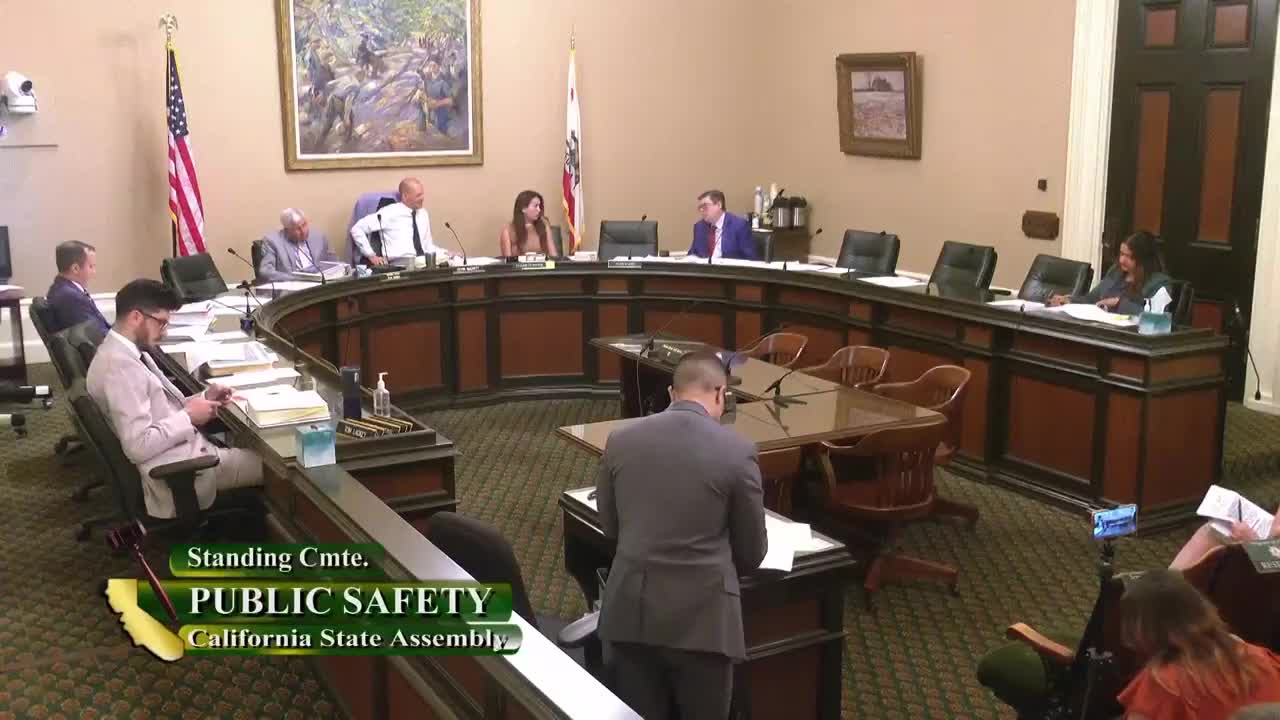 29MIN
Assembly Standing Committee on Public Safety
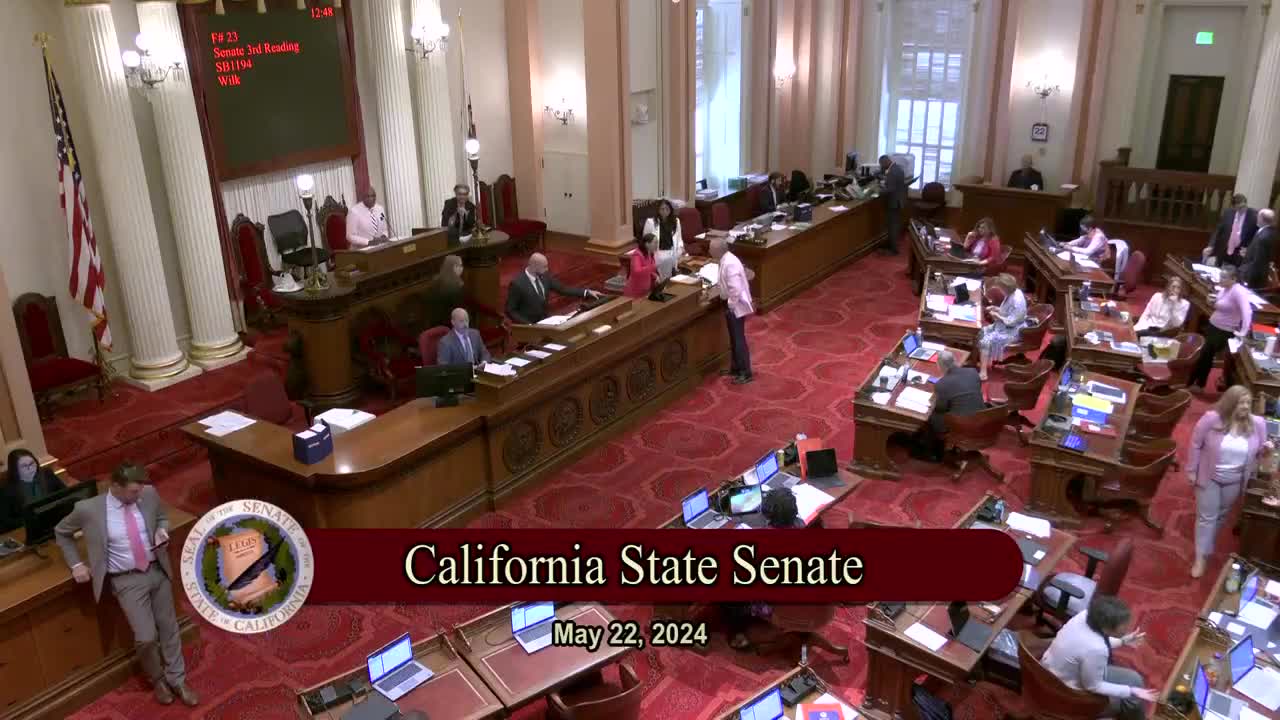 3MIN
Senate Floor
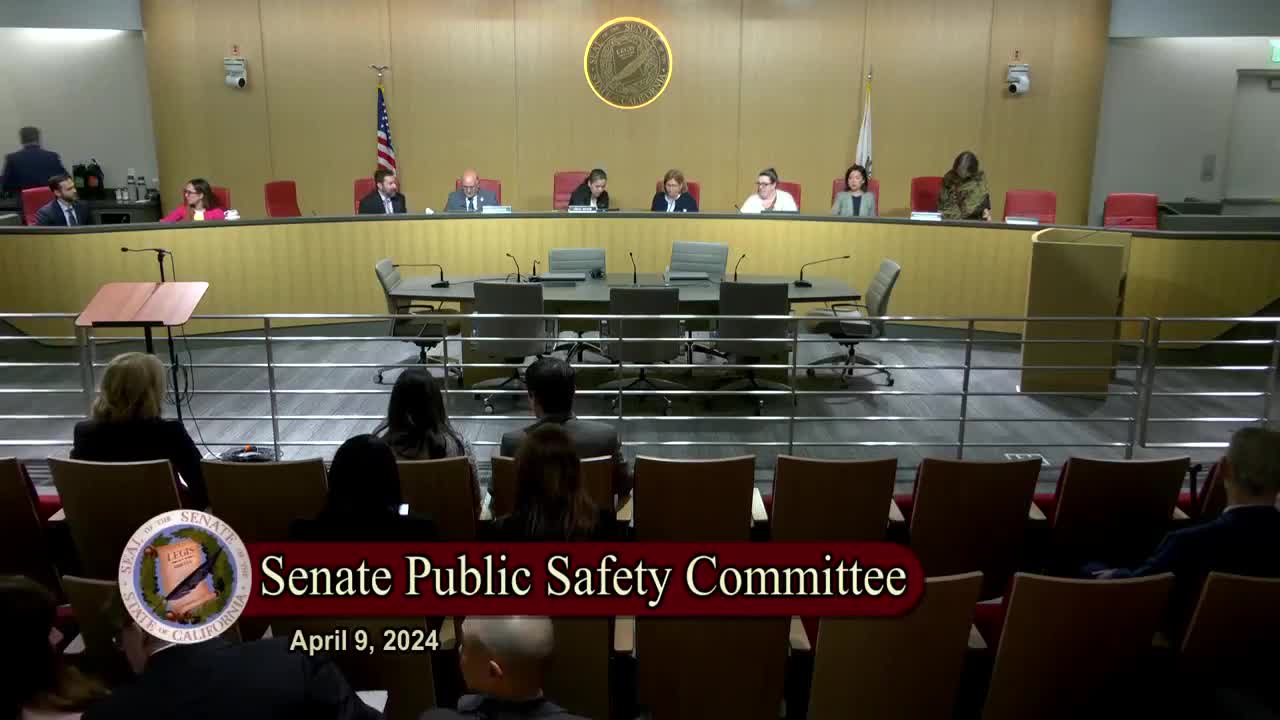 20MIN
Senate Standing Committee on Public Safety
Bill Author