SB 1164: Property taxation: new construction exclusion: accessory dwelling units.
- Session Year: 2023-2024
- House: Senate
- Latest Version Date: 2024-05-16
Current Status:
Failed
(2024-06-24: June 24 set for first hearing canceled at the request of author.)
Introduced
In Committee
First Chamber
In Committee
Second Chamber
Enacted
The California Constitution generally limits ad valorem taxes on real property to 1% of the full cash value of that property. For purposes of this limitation, full cash value is defined as the assessors valuation of real property as shown on the 197576 tax bill under full cash value or, thereafter, the appraised value of that real property when purchased, newly constructed, or a change in ownership has occurred.
This bill would exclude from classification as newly constructed and new construction the construction of an accessory dwelling unit, as defined, if construction on the unit is completed on or after January 1, 2025, and before January 1, 2030, until one of specified events occurs. The bill would require the property owner to, among other things, notify the assessor that the property owner intends to claim the exclusion for an accessory dwelling unit and submit an affidavit stating that the owner shall make a good faith effort to ensure the unit will be used as residential housing for the duration the owner receives the exclusion. The bill would require the State Board of Equalization to prescribe the manner and form for claiming the exclusion. Because this bill would require an affidavit by a property owner and a higher level of service from county assessors, it would impose a state-mandated local program.
The California Constitution requires the state to reimburse local agencies and school districts for certain costs mandated by the state. Statutory provisions establish procedures for making that reimbursement.
This bill would provide that with regard to certain mandates no reimbursement is required by this act for a specified reason.
With regard to any other mandates, this bill would provide that, if the Commission on State Mandates determines that the bill contains costs so mandated by the state, reimbursement for those costs shall be made pursuant to the statutory provisions noted above.
Existing law requires the state to reimburse local agencies annually for certain property tax revenues lost as a result of any exemption or classification of property for purposes of ad valorem property taxation.
This bill would provide that, notwithstanding those provisions, no appropriation is made and the state shall not reimburse local agencies for property tax revenues lost by them pursuant to the bill.
This bill would take effect immediately as a tax levy.
The California Constitution generally limits ad valorem taxes on real property to 1% of the full cash value of that property. For purposes of this limitation, full cash value is defined as the assessors valuation of real property as shown on the 197576 tax bill under full cash value or, thereafter, the appraised value of that real property when purchased, newly constructed, or a change in ownership has occurred.
This bill would exclude from classification as newly constructed and new construction the construction of an accessory dwelling unit, as defined, until 15 years have passed since construction on the accessory dwelling unit was completed or there is a subsequent change in ownership of the accessory dwelling unit. if construction on the unit is completed on or after January 1, 2025, and before January 1, 2030, until one of specified events occurs. The bill would require the property owner to, prior to or within 30 days of completion of the project, notify to, among other things, notify the assessor that the property owner intends to claim the exclusion for an accessory dwelling unit and submit an affidavit stating that the owner shall make a good faith effort to ensure the unit will be used as residential housing for the duration the owner receives the exclusion. The bill would require the State Board of Equalization to prescribe the manner and form for claiming the exclusion and would require all additional documents necessary to support the exclusion to be filed by the property owner with the assessor not later than 6 months after the completion of the project. exclusion. Because this bill would require an affidavit by a property owner and a higher level of service from county assessors, it would impose a state-mandated local program.
The California Constitution requires the state to reimburse local agencies and school districts for certain costs mandated by the state. Statutory provisions establish procedures for making that reimbursement.
This bill would provide that with regard to certain mandates no reimbursement is required by this act for a specified reason.
With regard to any other mandates, this bill would provide that, if the Commission on State Mandates determines that the bill contains costs so mandated by the state, reimbursement for those costs shall be made pursuant to the statutory provisions noted above.
Existing law requires the state to reimburse local agencies annually for certain property tax revenues lost as a result of any exemption or classification of property for purposes of ad valorem property taxation.
This bill would provide that, notwithstanding those provisions, no appropriation is made and the state shall not reimburse local agencies for property tax revenues lost by them pursuant to the bill.
This bill would take effect immediately as a tax levy.
The California Constitution generally limits ad valorem taxes on real property to 1% of the full cash value of that property. For purposes of this limitation, full cash value is defined as the assessors valuation of real property as shown on the 197576 tax bill under full cash value or, thereafter, the appraised value of that real property when purchased, newly constructed, or a change in ownership has occurred.
This bill would exclude from classification as newly constructed and new construction the construction of an accessory dwelling unit, as defined, until 15 years have passed since construction on the accessory dwelling unit was completed or there is a subsequent change in ownership of the accessory dwelling unit. The bill would require the property owner to, prior to or within 30 days of completion of the project, notify the assessor that the property owner intends to claim the exclusion for an accessory dwelling unit and submit an affidavit stating that the owner shall make a good faith effort to ensure the unit will be used as residential housing for the duration the owner receives the exclusion. The bill would require the State Board of Equalization to prescribe the manner and form for claiming the exclusion and would require all additional documents necessary to support the exclusion to be filed by the property owner with the assessor not later than 6 months after the completion of the project. Because this bill would require an affidavit by a property owner and a higher level of service from county assessors, it would impose a state-mandated local program.
The California Constitution requires the state to reimburse local agencies and school districts for certain costs mandated by the state. Statutory provisions establish procedures for making that reimbursement.
This bill would provide that with regard to certain mandates no reimbursement is required by this act for a specified reason.
With regard to any other mandates, this bill would provide that, if the Commission on State Mandates determines that the bill contains costs so mandated by the state, reimbursement for those costs shall be made pursuant to the statutory provisions noted above.
Existing law requires the state to reimburse local agencies annually for certain property tax revenues lost as a result of any exemption or classification of property for purposes of ad valorem property taxation.
This bill would provide that, notwithstanding those provisions, no appropriation is made and the state shall not reimburse local agencies for property tax revenues lost by them pursuant to the bill.
This bill would take effect immediately as a tax levy.
(a)Notwithstanding Section 70 and subject to the requirements of this section, for purposes of Section 2 of Article XIII A of the California Constitution, new construction and newly constructed does not include the construction or addition of an accessory dwelling unit, if construction on the unit is completed on or after January 1, 2025, and before January 1, 2030.
(b)(1)Subject to paragraph (2), the exclusion described in subdivision (a) shall remain in effect only until any of the following occurs:
(A)Fifteen Ten years have passed from the first lien date following completion of construction on the accessory dwelling unit.
(B)There is a subsequent change in ownership of the accessory dwelling unit.
(C)The unit is converted to any use other than for residential housing.
(2)Notwithstanding any law, upon the occurrence of one of the events described in paragraph (1), the new base year value of the unit shall be established as of the occurrence of the event, be adjusted annually in accordance with paragraph (1) of subdivision (a) of Section 51, and be enrolled.
(c)(1)For purposes of this section, accessory dwelling unit means an attached or detached residential dwelling unit that provides complete, independent living facilities for one or more persons and that is located on a lot with a preexisting, single-family or multifamily residential dwelling on the lot. An accessory dwelling unit shall include permanent provisions for living, sleeping, eating, cooking, and sanitation on the same parcel that the single-family or multifamily residential dwelling is located.
(2)An accessory dwelling unit includes, but is not limited to, either of the following:
(A)An efficiency unit, as defined in Section 17958.1 of the Health and Safety Code.
(B)A manufactured home, as defined in Section 18007 of the Health and Safety Code.
(d)(1)In order to receive the exclusion, the property owner shall do all of the following:
(A)Notify the assessor prior to, or within 30 days of, completion of the project that the property owner intends to claim the exclusion for an accessory dwelling unit.
(B)Submit, at the same time notification is given pursuant to subparagraph (A), an affidavit stating that the owner shall make a good faith effort to ensure the unit will be used as residential housing for the duration the owner receives the exclusion under this section.
(C)Maintain the residential use of the accessory dwelling unit receiving the exclusion under this section.
(D)Provide any additional documentation that the assessor requests. All additional documents necessary to support the exclusion shall be filed by the property owner with the assessor not later than six months after the completion of the project.
(2)The property owner shall inform the county assessor within 30 days of the conversion of the unit to any use other than for residential housing.
(3)The State Board of Equalization shall prescribe the manner and form for claiming the exclusion.
(e)This section shall remain in effect only until January 1, 2046, 2041, and as of that date is repealed.
SEC. 2.No reimbursement is required by this act pursuant to Section 6 of Article XIIIB of the California Constitution for certain costs that may be incurred by a local agency or school district because, in that regard, this act creates a new crime or infraction, eliminates a crime or infraction, or changes the penalty for a crime or infraction, within the meaning of Section 17556 of the Government Code, or changes the definition of a crime within the meaning of Section 6 of Article XIIIB of the California Constitution.
However, if the Commission on State Mandates determines that this act contains other costs mandated by the state, reimbursement to local agencies and school districts for those costs shall be made pursuant to Part 7 (commencing with Section 17500) of Division 4 of Title 2 of the Government Code.
SEC. 3.Notwithstanding Section 2229 of the Revenue and Taxation Code, no appropriation is made by this act and the state shall not reimburse any local agency for any property tax revenues lost by it pursuant to this act.
SEC. 4.This act provides for a tax levy within the meaning of Article IV of the California Constitution and shall go into immediate effect.
(a)Notwithstanding Section 70 and subject to the requirements of this section, for purposes of Section 2 of Article XIII A of the California Constitution, new construction and newly constructed does not include the construction or addition of an accessory dwelling unit. unit, if construction on the unit is completed on or after January 1, 2025, and before January 1, 2030.
(b)The (1)Subject to paragraph (2), the exclusion provided under this section described in subdivision (a) shall remain in effect only until either any of the following occurs:
(1)(A)Fifteen years have passed since construction on the accessory dwelling unit was completed. from the first lien date following completion of construction on the accessory dwelling unit.
(2)(B)There is a subsequent change in ownership of the accessory dwelling unit.
(C)The unit is converted to any use other than for residential housing.
(2)Notwithstanding any law, upon the occurrence of one of the events described in paragraph (1), the new base year value of the unit shall be established as of the occurrence of the event, be adjusted annually in accordance with paragraph (1) of subdivision (a) of Section 51, and be enrolled.
(c)(1)For purposes of this section, accessory dwelling unit means an attached or detached residential dwelling unit that provides complete, independent living facilities for one or more persons and that is located on a lot with a preexisting, single-family or multifamily residential dwelling on the lot. An accessory dwelling unit shall include permanent provisions for living, sleeping, eating, cooking, and sanitation on the same parcel that the single-family or multifamily residential dwelling is located.
(2)An accessory dwelling unit includes, but is not limited to, any either of the following:
(A)An efficiency unit, as defined in Section 17958.1 of the Health and Safety Code.
(B)A manufactured home, as defined in Section 18007 of the Health and Safety Code.
(d)(1)In order to receive the exclusion, the property owner shall notify do all of the following:
(A)Notify the assessor prior to, or within 30 days of, completion of the project that the property owner intends to claim the exclusion for an accessory dwelling unit and, at the same time, shall submit unit.
(B)Submit, at the same time notification is given pursuant to subparagraph (A), an affidavit stating that the owner shall make a good faith effort to ensure the unit will be used as residential housing for the duration the owner receives the exclusion under this section. The
(C)Maintain the residential use of the accessory dwelling unit receiving the exclusion under this section.
(D)Provide any additional documentation that the assessor requests. All additional documents necessary to support the exclusion shall be filed by the property owner with the assessor not later than six months after the completion of the project.
(2)The property owner shall inform the county assessor within 30 days of the conversion of the unit to any use other than for residential housing.
(3)The State Board of Equalization shall prescribe the manner and form for claiming the exclusion. All additional documents necessary to support the exclusion shall be filed by the property owner with the assessor not later than six months after the completion of the project.
(e)This section applies to new construction completed on or after January 1, 2025.(e)This section shall remain in effect only until January 1, 2046, and as of that date is repealed.
SEC. 2.No reimbursement is required by this act pursuant to Section 6 of Article XIIIB of the California Constitution for certain costs that may be incurred by a local agency or school district because, in that regard, this act creates a new crime or infraction, eliminates a crime or infraction, or changes the penalty for a crime or infraction, within the meaning of Section 17556 of the Government Code, or changes the definition of a crime within the meaning of Section 6 of Article XIIIB of the California Constitution.
However, if the Commission on State Mandates determines that this act contains other costs mandated by the state, reimbursement to local agencies and school districts for those costs shall be made pursuant to Part 7 (commencing with Section 17500) of Division 4 of Title 2 of the Government Code.
SEC. 3.Notwithstanding Section 2229 of the Revenue and Taxation Code, no appropriation is made by this act and the state shall not reimburse any local agency for any property tax revenues lost by it pursuant to this act.
SEC. 4.This act provides for a tax levy within the meaning of Article IV of the California Constitution and shall go into immediate effect.
(a)Notwithstanding Section 70 and for purposes of Section 2 of Article XIII A of the California Constitution, new construction and newly constructed does not include the construction or addition of an accessory dwelling unit.
(b)The exclusion provided under this section shall remain in effect only until either of the following occurs:
(1)Fifteen years have passed since construction on the accessory dwelling unit was completed.
(2)There is a subsequent change in ownership of the accessory dwelling unit.
(c)(1)For purposes of this section, accessory dwelling unit means an attached or detached residential dwelling unit that provides complete, independent living facilities for one or more persons and that is located on a lot with a preexisting, single-family or multifamily residential dwelling on the lot. An accessory dwelling unit shall include permanent provisions for living, sleeping, eating, cooking, and sanitation on the same parcel that the single-family or multifamily residential dwelling is located.
(2)An accessory dwelling unit includes, but is not limited to, any of the following:
(A)An efficiency unit, as defined in Section 17958.1 of the Health and Safety Code.
(B)A manufactured home, as defined in Section 18007 of the Health and Safety Code.
(d)In order to receive the exclusion, the property owner shall notify the assessor prior to, or within 30 days of, completion of the project that the property owner intends to claim the exclusion for an accessory dwelling unit and, at the same time, shall submit an affidavit stating that the owner shall make a good faith effort to ensure the unit will be used as residential housing for the duration the owner receives the exclusion under this section. The State Board of Equalization shall prescribe the manner and form for claiming the exclusion. All additional documents necessary to support the exclusion shall be filed by the property owner with the assessor not later than six months after the completion of the project.
(e)This section applies to new construction completed on or after January 1, 2025.
SEC. 2.No reimbursement is required by this act pursuant to Section 6 of Article XIIIB of the California Constitution for certain costs that may be incurred by a local agency or school district because, in that regard, this act creates a new crime or infraction, eliminates a crime or infraction, or changes the penalty for a crime or infraction, within the meaning of Section 17556 of the Government Code, or changes the definition of a crime within the meaning of Section 6 of Article XIIIB of the California Constitution.
However, if the Commission on State Mandates determines that this act contains other costs mandated by the state, reimbursement to local agencies and school districts for those costs shall be made pursuant to Part 7 (commencing with Section 17500) of Division 4 of Title 2 of the Government Code.
SEC. 3.Notwithstanding Section 2229 of the Revenue and Taxation Code, no appropriation is made by this act and the state shall not reimburse any local agency for any property tax revenues lost by it pursuant to this act.
SEC. 4.This act provides for a tax levy within the meaning of Article IV of the California Constitution and shall go into immediate effect.
|
Date
|
Status
|
|---|---|
| Jun 24, 2024 | June 24 set for first hearing canceled at the request of author. |
| Jun 3, 2024 | Referred to Com. on REV. & TAX. |
| May 23, 2024 | In Assembly. Read first time. Held at Desk. |
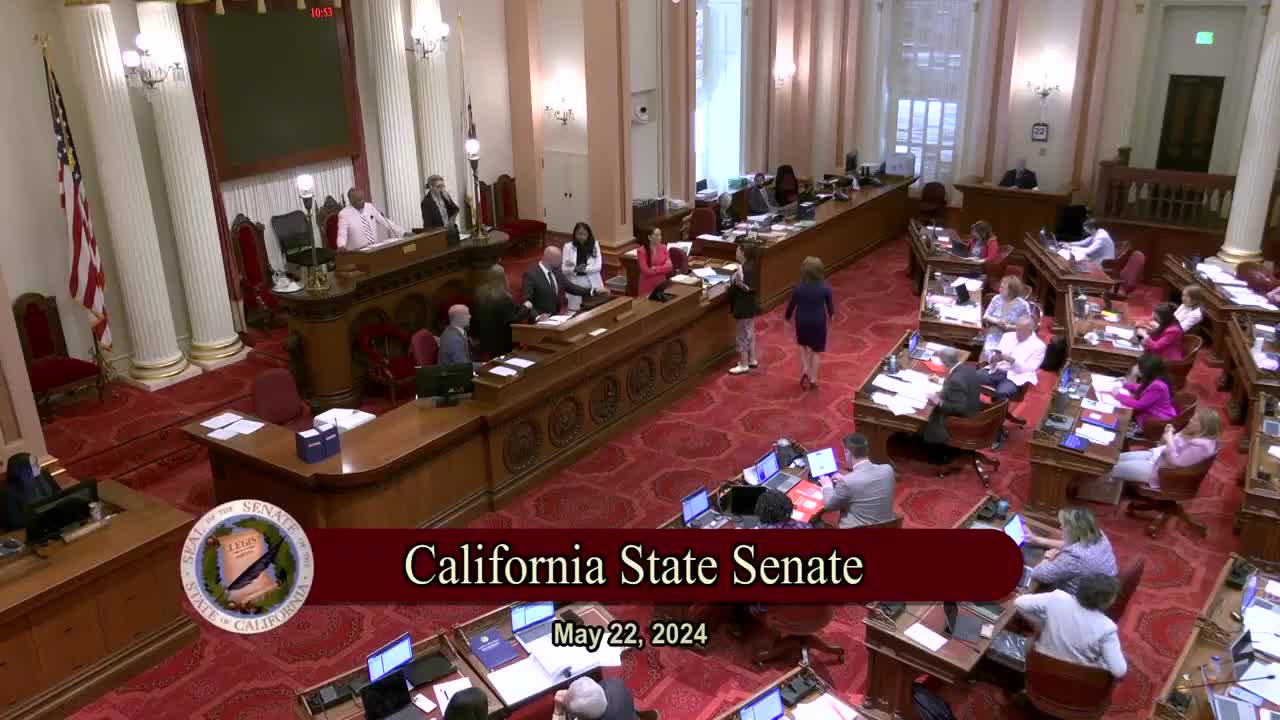
| May 22, 2024 | Read third time. Passed. (Ayes 29. Noes 6. Page 4132.) Ordered to the Assembly. |
| May 20, 2024 | Read second time. Ordered to third reading. |
| May 16, 2024 | Read second time and amended. Ordered to second reading. |
| May 16, 2024 | From committee: Do pass as amended. (Ayes 5. Noes 2. Page 3974.) (May 16). |
| May 10, 2024 | Set for hearing May 16. |
| Apr 22, 2024 | April 22 hearing: Placed on APPR suspense file. |
| Apr 16, 2024 | Set for hearing April 22. |
| Apr 11, 2024 | Read second time and amended. Re-referred to Com. on APPR. |
| Apr 10, 2024 | From committee: Do pass as amended and re-refer to Com. on APPR. (Ayes 6. Noes 0. Page 3564.) (April 10). |
| Mar 19, 2024 | Set for hearing April 10. |
| Feb 21, 2024 | Referred to Com. on REV. & TAX. |
| Feb 15, 2024 | From printer. May be acted upon on or after March 16. |
| Feb 14, 2024 | Introduced. Read first time. To Com. on RLS. for assignment. To print. |
|
Date
|
Description
|
Location
|
Votes
|
|
|---|---|---|---|---|
| May 22, 2024 | Senate 3rd Reading SB1164 Newman | Senate Floor |
Passed |
|
| May 16, 2024 | Do pass as amended | Senate Standing Committee on Appropriations |
Passed |
|
| Apr 22, 2024 | Placed on suspense file | Senate Standing Committee on Appropriations |
Passed |
|
| Apr 10, 2024 | Do pass as amended, but first amend, and re-refer to the Committee on [Appropriations] | Senate Standing Committee on Revenue and Taxation |
Passed |
This list shows positions taken on this bill by organizations on the date displayed, which is linked to the original source.
Positions by individuals are not included.
|
Organization
|
Position
|
Date
|
|---|---|---|
| California Apartment Association | ** Support | |
| California Assessors' Association | ** Against | |
| California Association Of Realtors | ** Support | |
| California Special Districts Association | ** Against | |
| California State Association Of Counties | ** Against | |
| California Teachers Association | ** Against | |
| City of Alameda | ** Support | |
| City of Citrus Heights | ** Against | |
| City of Encinitas | ** Against | |
| City Of Garden Grove | ** Against | |
| City of La Verne | ** Against | |
| City of Redwood City | ** Against | |
| City of San Marcos | ** Against | |
| City of Simi Valley | ** Against | |
| City of Whittier | ** Against | |
| League Of California Cities | ** Against | |
| San Rafael/Marin County Council of Mayors & Council Members | ** Against | |
| South Bay Cities Council of Governments | ** Against |
SENATE RULES COMMITTEE Office of Senate Floor Analyses (916) 651-1520 Fax: (916) 327-4478 | SB 1164 |
THIRD READING
Bill No: SB 1164
Author: Newman (D)
Amended: 5/16/24
Vote: 21- Urgency
SENATE REVENUE AND TAXATION COMMITTEE: 6-0, 4/10/24
AYES: Glazer, Ashby, Bradford, Dodd, Padilla, Skinner
NO VOTE RECORDED: Dahle
SENATE APPROPRIATIONS COMMITTEE: 5-2, 5/16/24
AYES: Caballero, Jones, Ashby, Becker, Bradford
NOES: Seyarto, Wahab
SUBJECT: Property taxation: new construction exclusion: accessory dwelling units
SOURCE: Author
DIGEST:
This bill enacts a new construction exclusion of specified duration for the addition or construction of an accessory dwelling unit (ADU).
ANALYSIS:
Existing law:
- Provides that all property is taxable unless explicitly exempted by the Constitution or federal law (California Constitution, Article XIII, Section One).
- Limits the maximum amount of any ad valorem tax on real property at 1% of full cash value, plus any locally-authorized bonded indebtedness, and directs assessors to only reassess property when it is newly constructed or when ownership changes (California Constitution, Article, XIIIA, Section One).
- Allows the Legislature to exclude from the definition of “new construction” any of the following property improvements, among others (California Constitution, Article XIIIA, Section 2(c)):
- Any active solar energy system (Proposition 7, 1980).
- Any fire sprinkler system, as defined (Proposition 31, 1984).
- Any portion or structural component that makes the dwelling more accessible for a disabled or severely disable person (Proposition 110, 1990 and Proposition 177, 1994).
- Seismic retrofit components (Proposition 23, 1984 and Proposition 127, 1990).
- The construction or installation of a rain water capture system completed on or after January 1, 2019 (Proposition 72, 2018).
- Enacts statutory new construction exclusions for seismic retrofits and contaminated property.
- Defines ADU to mean an attached or a detached residential dwelling unit that provides complete independent living facilities for one or more persons and is located on a lot with a proposed or existing primary residence.
- Requires local agencies to ministerially approve, within specified timelines, an application for a building permit within a residential or mixed-use zone to create one or more ADUs that meet all state and local requirements.
- Provides that a local agency may establish local development standards for both attached and detached ADUs, except that they cannot establish the following:
- A minimum square footage requirement for either an attached or detached ADU that prohibits an efficiency unit.
- A maximum square footage requirement for either an attached or detached ADU that is less than 850 square feet, or 1,000 square feet for an ADU that provides more than one bedroom.
- A height limit of less than 16 to 25 feet, depending on the specified circumstance.
- Specified requirements that preclude development of an ADU of at least 800 square feet and that four-foot side and rear yard setbacks, including minimum or maximum size, limits on lot coverage, limits on floor area ratio, requirements for open space, requirements for front setbacks, and minimum lot size.
- Prohibits local agencies from requiring owner-occupancy on a parcel containing an ADU.
- Permits cities and counties that have a local ADU ordinance to allow ADUs to be sold separately or conveyed from the primary residence.
- Requires local agencies to create a program for the pre-approval of standardized plans for ADUs.
This bill:
- Enacts a new construction exclusion for the addition or construction of an ADU, where construction is completed between January 1, 2025, and January 1, 2030, that remains in effect until:
- Ten years have passed since the construction of the ADU was completed, or
- The ADU changes ownership.
- Directs assessors to establish a new base year value for the unit upon the occurrence of either above event.
- Requires a property owner to:
- Notify the assessor prior to, or within 30 days of, completion of the project that the property owner intends to claim the exclusion for an ADU.
- Submit an affidavit stating that the owner shall make a good faith effort to ensure the unit will be used as residential housing for the duration the owner receives the exclusion.
- Maintain the residential use of the accessory dwelling unit receiving the exclusion.
- Provide any additional documentation that the assessor requests, with all additional documents necessary to support the exclusion filed by the property owner with the assessor not later than six months after the completion of the project.
- Inform the county assessor within 30 days of the conversion of the unit to any use other than for residential housing.
- Defines an ADU similarly as existing law, which includes efficiency units and manufactured homes.
- Directs the State Board of Equalization (BOE) to prescribe the manner and form for claiming the exclusion.
- Provides that the state shall not reimburse any local agency for any property tax revenues lost by it pursuant to the bill.
- Sunsets its provisions on January 1, 2041.
Background
Generally, when something of value is physically added to real property, what is added is considered new construction and assessed at current market value. This value is added to the existing base year value of the real property, but generally does not trigger reassessment of land or structures previously constructed. For example, increasing the square footage of their home, or adding a garage, pool, or new structure is generally considered new construction. SB 1164 would add to the list of items either the voters or the Legislature have excluded from new construction, meaning assessors would not value a newly constructed ADU for property taxes like other new construction, contingent on a property owner complying with the bill’s requirements.
The Legislature has long identified ADUs, also known as second units, in-law apartments, or “granny flats,” as a valuable form of housing for family members, students, the elderly, in-home health care providers, the disabled, and others, at below market prices within existing neighborhoods. In 1982, the Legislature first provided a framework for local governments to enact ordinances that permit the construction of ADUs, while preserving local government flexibility to regulate the units as necessary. When fewer ADUs than anticipated were developed, the Legislature significantly amended ADU law in 2002 to address some of the barriers property owners encountered while trying to develop them. There are few other areas where the Legislature has been more active than with regard to creating incentives for homeowners to construct ADUs. Beginning in 2016, when the ADU law was re-written, the Legislature has enacted at least 15 measures that amend ADU law to some degree, plus three more in 2023. Housing experts state the changes enacted before 2021 have led to a significant increase in ADU construction in the state. This bill adds another incentive – up to 10 years of deferred property taxes – to this growing list.
FISCAL EFFECT: Appropriation: No Fiscal Com.: Yes Local: Yes
According to the Senate Appropriations Committee:
- The Board of Equalization (BOE) estimates that this bill would result in annual property tax revenue losses of $20 million. Reductions in local property tax revenues, in turn, increase General Fund Proposition 98 spending by up to roughly 50 percent (the exact amount depends on the specific amount of the annual Proposition 98 guarantee, which in turns depends upon a variety of economic, demographic and budgetary factors).
- BOE indicates that it would incur General Fund costs of $10,000 in 2024-25, and $65,000 in 2025-26.
- By adding to the duties of local tax officials in administering the property tax, this bill creates a state-mandated local program. To the extent the Commission on State Mandates determines that the provisions of this bill create a new program or impose a higher level of service on local agencies, local agencies could claim reimbursement of those costs (General Fund). The magnitude is unknown.
SUPPORT: (Verified 5/17/24)
California Apartment Association
California Association of Realtors
City of Alameda
OPPOSITION: (Verified 5/17/24)
California Assessors' Association
California Special Districts Association
California State Association of Counties
California Teachers Association
City of Citrus Heights
City of Encinitas
City of Garden Grove
City of La Verne
City of Redwood City
City of San Marcos
City of Simi Valley
City of Whittier
League of California Cities
San Rafael/Marin County Council of Mayors & Council Members
South Bay Cities Council of Governments
ARGUMENTS IN SUPPORT: According to the author, “Despite the numerous measures the legislature has advanced in recent years to remove administrative barriers to the construction of Accessory Dwelling Units, barriers still persist which serve to deter property owners who might otherwise be inclined to build an ADU on their property. Currently, when a new addition to a home or an ADU is completed, the resulting additional square footage is assessed at 1% of the value of the addition, which is then appended to the property owner’s yearly property tax bill. As an example, for an ADU valued at $200,000, a property owner would incur an ongoing property tax increase of $2,000 a year. The prospect of such an immediate increase in an owner’s property tax burden, especially on top of the considerable expense associated with the construction of the ADU, can serve as a substantial deterrent to building an ADU, despite the benefits that would eventually accrue to a property owner. By temporarily waiving the tax liability associated with the ADU, SB 1164 will make the construction of ADUs more attractive and manageable to California homeowners, consistent with the State’s broader housing creation goals.”
ARGUMENTS IN OPPOSITION: According to a coalition of local government organizations, “SB 1164 would negatively impact local government property tax revenue by exempting newly constructed accessory dwelling units (ADUs) from property tax assessment, if certain conditions are met. Since 2018, there have been year over year increases in the number of newly permitted and constructed ADUs throughout the state. According to data from the UC Berkeley Center for Innovation, from 2018 to 2022, roughly 10,276 ADUs were built, while 28,547 units were permitted during that same period. It is clear there is a demand for ADUs that California cannot keep pace with. This bill assumes property taxes are an impediment that disincentivize homeowners from building ADUs. However, the data show significant increases in the number of permits and constructed units in previous years, signaling that property tax adjustments have not exclusively halted or discouraged construction on new ADUs. Separate from property tax, the disproportionate share of accessory dwelling units that have been permitted, but not yet built, represents a supply and demand concern that is wholly divorced from property tax considerations. By creating a property tax assessment exemption on newly constructed ADUs, SB 1164 will deprive local governments of the revenues needed to provide and expand services that are of communitywide benefit. Property taxes generate a critical revenue source local governments depend on to provide services, including public safety, education, parks, libraries, public health, and fire protection.”
Prepared by: Colin Grinnell / REV. & TAX. / (916) 651-4117
5/18/24 16:20:55
**** END ****
SENATE COMMITTEE ON APPROPRIATIONS
Senator Anna Caballero, Chair
2023 - 2024 Regular Session
SB 1164 (Newman) - Property taxation: new construction exclusion: accessory dwelling units
Version: April 11, 2024 | Policy Vote: REV. & TAX. 6 - 0 |
Urgency: No | Mandate: Yes |
Hearing Date: May 16, 2024 | Consultant: Robert Ingenito |
Bill Summary:
SB 1164 would enact a property tax new construction exclusion for the addition or construction of an accessory dwelling unit, as specified.
*********** ANALYSIS ADDENDUM – SUSPENSE FILE ***********
The following information is revised to reflect amendments
adopted by the committee on May 16, 2024
Fiscal Impact:
- The Board of Equalization (BOE) estimates that this bill would result in annual property tax revenue losses of $20 million. Reductions in local property tax revenues, in turn, increase General Fund Proposition 98 spending by up to roughly 50 percent (the exact amount depends on the specific amount of the annual Proposition 98 guarantee, which in turns depends upon a variety of economic, demographic and budgetary factors).
- BOE indicates that it would incur General Fund costs of $10,000 in 2024-25, and $65,000 in 2025-26.
- By adding to the duties of local tax officials in administering the property tax, this bill creates a state-mandated local program. To the extent the Commission on State Mandates determines that the provisions of this bill create a new program or impose a higher level of service on local agencies, local agencies could claim reimbursement of those costs (General Fund). The magnitude is unknown.
Author Amendments:
Reduce the exclusion period from 15 years to ten years.
-- END --
SENATE COMMITTEE ON
Senator Anna Caballero, Chair
2023 - 2024 Regular Session
SB 1164 (Newman) - Property taxation: new construction exclusion: accessory dwelling units
Version: | Policy Vote: |
Urgency: | Mandate: |
Hearing Date: | Consultant: |
Bill Summary:
SB 1164 would enact a property tax new construction exclusion for the addition or construction of an accessory dwelling unit, as specified.
Fiscal Impact:
- The Board of Equalization (BOE) estimates that this bill would result in annual property tax revenue losses of $20 million. Reductions in local property tax revenues, in turn, increase General Fund Proposition 98 spending by up to roughly 50 percent (the exact amount depends on the specific amount of the annual Proposition 98 guarantee, which in turns depends upon a variety of economic, demographic and budgetary factors).
- BOE indicates that it would incur General Fund costs of $10,000 in 2024-25, and $65,000 in 2025-26.
- By adding to the duties of local tax officials in administering the property tax, this bill creates a state-mandated local program. To the extent the Commission on State Mandates determines that the provisions of this bill create a new program or impose a higher level of service on local agencies, local agencies could claim reimbursement of those costs (General Fund). The magnitude is unknown.
Background:
Under the California Constitution, all property is taxable unless explicitly exempted by itself or federal law. The Constitution limits the maximum amount of any ad valorem tax on real property at 1 percent of full cash value, plus any locally-authorized bonded indebtedness. Assessors reappraise property whenever (as defined by both statute and the Constitution) it is purchased, newly constructed, or when ownership changes.
Generally, when value is physically added to real property, what is added is considered new construction and assessed at current market value. This value is added to the existing base year value of the real property, but generally does not trigger reassessment of land or structures previously constructed. For example, adding a garage, new bathroom or swimming pool is generally considered new construction.
The Constitution allows the Legislature to exclude from the definition of “new construction” several types of property improvements, including among others: (1) any active solar energy system, (2) any sprinkler system, as defined, (3) any portion or structural component that makes the dwelling more accessible for a disabled or severely disable person, (4) seismic retrofit components, and (5) the construction or installation of a rain water capture system completed on or after January 1, 2019.
Current law authorizes a local agency to provide by ordinance for the creation of an ADU in single-family and multifamily residential zones and requires that an ADU comply with certain conditions. An ADU is defined as an attached or detached residential dwelling unit that provides complete independent living facilities for one or more persons and includes permanent provisions for living, sleeping, eating, cooking, and sanitation on the same parcel as a single-family dwelling is situated. The Legislature has long identified ADUs, also known as second units, in-law apartments, or “granny flats,” as a valuable form of housing for family members, students, the elderly, in-home health care providers, the disabled, and others, at below market prices within existing neighborhoods. In 1982, the Legislature first provided a framework for local governments to enact ordinances that permit the construction of ADU. Several bills in recent years have expanded on many aspects of ADU law.
Proposed Law:
This bill would, among other things, do the following:
- Exclude from classification as “newly constructed” and “new construction” the construction of an accessory dwelling unit, as defined, if construction on the unit is completed on or after January 1, 2025, and before January 1, 2030, until (1) fifteen years have passed from the first lien date following completion of construction, (2) there is a subsequent change in ownership of the ADU, or (3) the unit is converted to any use other than for residential housing.
- Require the property owner
- Require BOE to prescribe the manner and form for claiming the exclusion.
Related Legislation:
- AB 1866 (Wright, Chapter 1062, Statutes of 2002) required local governments to use a ministerial process for approving ADUs, notwithstanding other laws that regulate the issuance of variances or special use permits. A local government may provide for the construction of ADUs by ordinance, and may designate areas where ADUs are allowed, as well as require standards for parking, setback, lot coverage, and maximum size. If a local government has not adopted an ordinance governing ADUs, it must grant a variance or special use permit for the creation of ADUs if the unit complies with requirements specified in statute, including size and zoning restrictions.
- AB 2299 (Bloom, Chapter 735, Statutes of 2016) and SB 1069 (Wieckowski, Chapter 720, Statutes of 2016) required cities and counties to allow ADUs on most residential lots, preempting local zoning ordinances and other permitting processes.
- AB 1033 (Ting. Chapter 752, Statutes of 2023) authorized a local agency to adopt a local ordinance to allow the separate conveyance of the primary dwelling unit and accessory dwelling unit or units as condominiums.
Staff Comments:
Using available data, BOE estimates that annual ADU construction cost is about $2 billion, resulting (at the one percent property tax rate) in a $20 million revenue loss. BOE notes that its revenue estimate does not factor in the 15-year mark when an ADU’s exclusion ends.
-- END --
SENATE COMMITTEE ON REVENUE AND TAXATION
Senator Steven Glazer, Chair
2023 - 2024 Regular
Bill No: | SB 1164 | Hearing Date: | 4/10/24 |
Author: | Newman | Tax Levy: | Yes |
Version: | 2/14/24 | Fiscal: | Yes |
Consultant: | Grinnell | ||
Property taxation: new construction exclusion: accessory dwelling units
Enacts a new construction exclusion of specified duration for the addition or construction of an accessory dwelling unit.
Background
Property taxation. Section One of Article XIII of the California Constitution provides that all property is taxable unless explicitly exempted by the Constitution or federal law. The Constitution limits the maximum amount of any ad valorem tax on real property at 1% of full cash value, plus any locally-authorized bonded indebtedness. Assessors reappraise property whenever it is purchased, newly constructed, or when ownership changes. The Constitution and statute define those terms.
New construction. Generally, when something of value is physically added to real property, what is added is considered new construction and assessed at current market value. This value is added to the existing base year value of the real property, but generally does not trigger reassessment of land or structures previously constructed. For example, increasing the square footage of their home, or adding a garage, pool, or new structure is generally considered new construction.
The Constitution allows the Legislature to exclude from the definition of “new construction” any of the following property improvements, among others:
- Any active solar energy system (Proposition 7, 1980).
- Any fire sprinkler system, as defined (Proposition 31, 1984).
- Any portion or structural component that makes the dwelling more accessible for a disabled or severely disable person (Proposition 110, 1990 and Proposition 177, 1994).
- Seismic retrofit components (Proposition 23, 1984 and Proposition 127, 1990).
- The construction or installation of a rain water capture system completed on or after January 1, 2019 (Proposition 72, 2018).
Accessory Dwelling Units (ADUs). The Legislature has long identified accessory dwelling units (ADUs), also known as second units, in-law apartments, or “granny flats,” as a valuable form of housing for family members, students, the elderly, in-home health care providers, the disabled, and others, at below market prices within existing neighborhoods. In 1982, the Legislature first provided a framework for local governments to enact ordinances that permit the construction of ADUs, while preserving local government flexibility to regulate the units as necessary. When fewer ADUs than anticipated were developed, the Legislature significantly amended ADU law to address some of the barriers property owners encountered while trying to develop them (AB 1866, Wright, 2002).
Among other provisions, AB 1866 allowed local governments to adopt an ordinance that allows the creation of ADUs in single-family and multi-family residential zones and to set standards on the units regarding parking, height, setback, maximum size, and potential adverse impacts on historic places. AB 1866 also prohibited local agencies from adopting an ordinance that entirely prohibits ADUs unless it made specific findings regarding adverse impacts from the units. Some local governments continued to impose onerous requirements or prohibit ADUs entirely.
Recent ADU law changes. In 2016, the Legislature revised ADU laws to address some of the barriers to ADU creation that local governments had adopted (SB 1069, Wieckowski and AB 2299, Bloom). These changes prohibited local ordinances that entirely ban ADUs and required a local agency to, among other provisions:
- Designate areas within the jurisdiction where ADUs may be permitted;
- Impose standards on ADUs, including minimum lot sizes and requiring ADUs to be set back from the property line (“setbacks”);
- Consider permit applications within 120 days;
- Approve or disapprove an application for an ADU ministerially without discretionary review if the local government does not have an ADU ordinance when it receives a permit application; and
- Approve building permits to create an ADU ministerially if the ADU is within an existing residence, has independent exterior access, and meets certain fire safety requirements.
These bills also limited the cases when local agencies could require new utility connections for water and sewer, and limited the fees to be proportionate to the burden created by the ADU. AB 2408 (Thurmond, 2016) also allowed local agencies to adopt an ordinance regulating Junior ADUs (JADUs), which are smaller ADUs under 500 square feet, are contained entirely within an existing single-family residence, and may or may not have separate sanitation facilities. In 2017, the Legislature clarified portions of the law (SB 229, Wieckowski and AB 494, Bloom).
2019 changes. The Legislature expanded on many aspects of ADU law in 2019 through a set of three bills: SB 13 (Wieckowski), AB 68 (Ting), and AB 881 (Bloom). The most significant provisions of these bills:
- Prohibit local governments from requiring owner occupancy, until January 1, 2025;
- Require local governments to allow at least an 800 square foot ADU of up to 16 feet on the lot, regardless of local zoning standards;
- Require local governments to allow one ADU and one JADU on a single-family parcel (even if the jurisdiction has not adopted an ordinance allowing JADUs);
- Allow up to two detached units on the same site as an existing multifamily dwelling and the ministerial creation of multiple ADUs within the portions of existing multifamily buildings that are not used as livable space, as long as each unit complies with state building standards for dwellings. Local governments must allow at least one such ADU and the construction of at least 25% of the number of existing multifamily units more in the form of ADUs;
- Deem approved an application for an ADU if a local government does not act on it within 60 days;
- Exempt ADUs under 750 square feet from impact fees and require impact fees for larger ADUs to be proportional to the square footage of the primary unit;
- Allows, until January 1, 2030, ADU owners to request a delay of up to five years in any enforcement actions for violations of building standards if the enforcement agency determines the standards are not necessary to protect public health and safety; and
- Requires the Department of Housing and Community Development (HCD) to notify local governments if they are in violation of state law and allows HCD to refer alleged violations to the Attorney General.
2022 changes. The Legislature made further changes to many aspects of ADU law in 2022 through two bills: SB 897 (Wieckowski) and AB 2221 (Quirk-Silva). The most significant provisions of these bills:
- Adjust the minimum ADU height limit a local agency may impose, as follows:
- For detached ADUs on a lot with an existing or proposed single family, a 16 feet height limitation is allowed.
- For detached ADUs on a lot with an existing or proposed multifamily dwelling unit, an 18 feet height limitation is allowed.
- For a detached ADU within one-half of one mile walking distance of a major transit stop or a high-quality transit corridor, an 18 feet height limitation is allowed. Also, requires a local agency to allow an additional two feet in height to accommodate a roof pitch on an ADU that is aligned with the roof pitch of the primary dwelling unit; and
- For ADUs attached to the primary dwelling, a height of 25 feet or the height limitation in the local zoning ordinance that applies to the primary dwelling, whichever is lower, is allowed.
- Require a permitting agency to act by specifically approving or denying an application for an ADU or JADU within 60 days from receiving it. If a permitting agency denies an application, it must return in writing a full set of comments on how the application can be remedied;
- Prohibit a local agency from denying a permit for a constructed, unpermitted ADU built before January 1, 2018, that is in violation of building standards, but the correction is not necessary to protect health and safety;
- Provide the construction of an ADU on a property does not trigger a requirement for fire sprinklers in the proposed or existing primary dwelling; and
- Add front setbacks to the list of local development standards local governments cannot impose if they would preclude construction of an attached or detached ADU.
2023 Changes. Last year, the Legislature made three changes to ADU law:
- Make permanent the existing prohibition on local government's ability to require owner-occupancy on a parcel containing an Accessory Dwelling Unit (AB 976, Ting).
- Permit cities and counties that have a local ADU ordinance to allow ADUs to be sold separately or conveyed from the primary residence (AB 1033, Ting).
- Require local agencies to create a program for the pre-approval of standardized plans for ADUs (AB 1332, Juan Carrillo).
Seeking additional incentives for taxpayers to construct ADUs, the author wants to exempt the new construction of an ADU from new construction reassessment for property tax purposes until it changes ownership, or fifteen years, whichever is sooner.
Proposed Law
Senate Bill 1164 enacts a new construction exclusion for the addition or construction of an ADU that remains in effect until:
- Fifteen years have passed since the construction of the ADU was completed, or
- The ADU changes ownership.
The bill defines an ADU very similarly to the one used by the measures referenced above, which includes efficiency units and manufactured homes. To claim the exclusion, the property owner must notify the assessor before construction is completed, or within 30 days after, that they intend to claim the exclusion. The property owner must also submit an affidavit stating the owner shall make a good faith effort to ensure the unit will be used as residential housing for the duration the owner receives the exclusion. The measure directs the Board of Equalization (BOE) to prescribe the manner and form for claiming the exclusion, and requires a property owner to file all additional documents necessary to support the exclusion within six months of the project’s completion.
State Revenue Impact
The State Board of Equalization estimates SB 1164 will reduce annual property tax revenues by $19 million.
Comments
1. Purpose of the bill. According to the author, “Despite the numerous measures the legislature has advanced in recent years to remove administrative barriers to the construction of Accessory Dwelling Units, barriers still persist which serve to deter property owners who might otherwise be inclined to build an ADU on their property. Currently, when a new addition to a home or an ADU is completed, the resulting additional square footage is assessed at 1% of the value of the addition, which is then appended to the property owner’s yearly property tax bill. As an example, for an ADU valued at $200,000, a property owner would incur an ongoing property tax increase of $2,000 a year. The prospect of such an immediate increase in an owner’s property tax burden, especially on top of the considerable expense associated with the construction of the ADU, can serve as a substantial deterrent to building an ADU, despite the benefits that would eventually accrue to a property owner. By temporarily waiving the tax liability associated with the ADU, SB 1164 will make the construction of ADUs more attractive and manageable to California homeowners, consistent with the State’s broader housing creation goals.”
2. Windfall? California’s housing crisis is acute, and the Legislature has responded in several ways, from streamlined local agency approval procedures, general obligation bonds, increased authorizations of Low-Income Housing Tax credits, changes to mitigation fees, and increased recording fees to supplement state housing programs, among others. There are few other areas where the Legislature has been more active than with regard to creating incentives for homeowners to construct ADUs. Housing experts state the changes enacted before 2021 have led to a significant increase in ADU construction in the state:[1]
California jurisdictions went from issuing 5,911 ADU permits in 2018 to 15,571 in 2019, with ADU completions following a similar upward trend, more than tripling over the same period (from 1,984 to 6,668 units). The ADU laws that took effect in 2019 allowing two ADUs on single-family parcels and more on multi-family parcels are already having a significant impact on gently adding density across the state in single- and multi-family properties. In early 2021, the City of Los Angeles reports processing upwards of 20,000 ADUs where ADUs make up nearly 40 percent of all housing building permits, and the City of San Jose reports that ADUs make up 38 percent of all housing building permits
SB 1164 would add another significant incentive – up to 15 years of deferred property taxes – to this growing list. While deferring property taxes on newly constructed ADUs could be a significant post-construction savings to those who can either afford to pay or obtain credit on favorable terms to build an ADU, previously enacted measures are clearly working. It’s unclear whether SB 1164 would produce more ADUs, or serve as a windfall to those who would build one anyway. The measure will reduce local property tax revenues that finance public services provided by cities, counties, special and school districts to the extent that the ADU would not have been constructed but for the bill.
3. Equity. Creating incentives for construction of ADUs has been an important part of the Legislature’s efforts to increase housing supply and affordability. Especially in communities with a lack of available land for new or infill development, new ADUs can provide a valuable supply of residential housing of different sizes, ages, and income levels at lower construction costs. However, disparities in home ownership in California carry through to disparities in homeowners who can construct ADUs. According to housing experts, homeowners with an ADU are much more affluent and less likely to identify as Hispanic than the typical California homeowner.[2] Other experts agree the state’s racial homeownership gap—fueled by a century of racist housing policies that explicitly subsidized single-family homes for white households while denying these opportunities to households of color— means that fewer black, indigenous, and other people of color (BIPOC) households own property, a prerequisite for building an ADU.[3] Experts identify a lack of financing options, complex approval processes, insufficient local support and access to information, and unclear regulation as the primary obstacles to building ADUs in many low- and moderate-income BIPOC households.[4] Recommendations to reduce these barriers include investing in building the capacity of existing community organizations and programs that provide education, community outreach and technical assistance, encourage local and state agencies to reduce fees and streamline permitting to reduce the cost and complexities of building an ADU, and share solutions that make it easier to bring unpermitted units up to code.
4. No constitutional amendment. As noted above, new construction exclusions enacted since Proposition 13 were mostly enacted as amendments to the Constitution approved by voters. However, a few were not: the Legislature enacted statutory new construction exclusions for seismic retrofits and contaminated property. A new construction exclusion for ADUs would affect a significant amount of taxable value, but an accompanying constitutional amendment to SB 1164 has not yet been introduced.
5. Too soon? As mentioned above, SB 1164 would create an additional incentive for ADU construction that follows a nearly annual tradition of numerous significant revisions to ADU law. Beginning in 2016, when the ADU law was re-written, the Legislature has enacted at least 15 measures that amend ADU law to some degree, plus three more in 2023. Given so many changes in such a short time, should the Legislature wait on further changes to ADU laws until the Legislature can evaluate the effect of recent changes on ADU development?
6. Take it on faith. To obtain the bill’s exclusion, it requires the property owner to submit an affidavit stating they must make a “good faith effort to ensure” the unit will be used as residential housing for the duration the owner receives the exclusion. While it’s possible an ADU could be used as a business or another non-residential housing use, the meaning of “good faith” is unclear in this context, and the measure does not contain any guidance for assessors to determine whether the property owner meets the standard, and whether they should revoke the exclusion if they find it isn’t met. Additionally, the measure does not preclude a property owner from receiving the benefit of an exclusion if the property is operated as a for-profit short-term rental. While only 8% of new ADUs in California are short-term rentals, more affluent homeowners are more likely to list their ADUs as short-term rentals than those making less than $100,000 a year.[5]
7. Technicals. SB 1164 would benefit from clarity in the following areas:
- Specifically stating that the assessor should enroll the ADU’s full cash value at the end of the 15-year exclusion period.
- Measuring the 15-year period from the lien date of the assessment year following the date of completion of construction.
- Providing that the exclusion applies to construction in progress as of the lien date.
- Require a taxpayer claiming the exclusion to maintain the use of the ADU for residential housing for the duration of the exclusion, notify the assessor if the use changes from residential housing to any other use, and direct the assessor to remove the exclusion if the taxpayer does not maintain residential use of the ADU.
- Adding a sunset date to allow the Legislature to review the exclusion.
Support and Opposition
(4/5/24)
Support: California Apartment Association
City of Alameda
Opposition: California Assessors' Association
California Special Districts Association
California State Association of Counties
League of California Cities
-- END --
Ben Metcalf et al. “Will Allowing Duplexes and Lot Splits on Parcels Zoned for Single-Family Create New Homes?” Terner Center for Housing Innovation, July, 2021. ↑
Karren Chapple et. al, “Implementing the Backyard Revolution: Perspectives of California ADU owners,” UC Berkeley Center Community Innovation, April 22, 2021. ↑
Julia Greenberg et al, “ADUs for All: Breaking Down Barriers to Racial and Economic Equity in Accessory Dwelling Unit Construction,” Terner Center for Housing Innovation, August, 2022. ↑
Ibid. ↑
Chapple, supra. ↑
Discussed in Hearing
 4MIN
Senate Floor
 29SEC
Senate Standing Committee on Appropriations
 23MIN
Senate Standing Committee on Revenue and Taxation
Bill Author

Bill Co-Author(s):