SB 1193: Airports: leaded aviation gasoline.
- Session Year: 2023-2024
- House: Senate
- Latest Version Date: 2024-09-22
Current Status:
Passed
(2024-09-22: Chaptered by Secretary of State. Chapter 460, Statutes of 2024.)
Introduced
In Committee
First Chamber
In Committee
Second Chamber
Enacted
Existing law, the State Aeronautics Act, governs various matters relative to aviation in the state, and authorizes the Department of Transportation to adopt, administer, and enforce rules and regulations for the administration of the act. Under existing law, a violation of the State Aeronautics Act is a crime.
This bill would prohibit an airport operator or aviation retail establishment, as defined, from selling, distributing, or otherwise making available leaded aviation gasoline to consumers on or after January 1, 2031, as provided. Because these provisions would be part of the State Aeronautics Act, the bill would impose a state-mandated local program.
The California Constitution requires the state to reimburse local agencies and school districts for certain costs mandated by the state. Statutory provisions establish procedures for making that reimbursement.
This bill would provide that no reimbursement is required by this act for a specified reason.
Existing law, the State Aeronautics Act, governs various matters relative to aviation in the state, and authorizes the Department of Transportation to adopt, administer, and enforce rules and regulations for the administration of the act. Under existing law, a violation of the State Aeronautics Act is a crime.
This bill would prohibit an airport operator or aviation retail establishment, as defined, from selling, distributing, or otherwise making available leaded aviation gasoline to consumers on or after January 1, 2031, as provided. Because these provisions would be a part of the State Aeronautics Act, the bill would impose a state-mandated local program.
The California Constitution requires the state to reimburse local agencies and school districts for certain costs mandated by the state. Statutory provisions establish procedures for making that reimbursement.
This bill would provide that no reimbursement is required by this act for a specified reason.
Existing law, the State Aeronautics Act, governs various matters relative to aviation in the state, and authorizes the Department of Transportation to adopt, administer, and enforce rules and regulations for the administration of the act. Under existing law, a violation of the State Aeronautics Act is a crime.
This bill would prohibit an airport operator or aviation retail establishment, as defined, from selling, distributing, or otherwise making available leaded aviation gasoline to consumers, consistent with a specified timeline, as provided. The bill would exempt an airport operator or aviation retail establishment from that prohibition if the board of supervisors of the county in which the point of sale occurs has made a final, written determination supported by clear and convincing evidence, after a noticed public hearing, that an unleaded aviation replacement fuel is not commercially available in the county. The bill would authorize an airport operator or aviation retail establishment to make a written request to the board of supervisors of a county to make the above determination, as provided. consumers on or after January 1, 2031, as provided. Because these provisions would be a part of the State Aeronautics Act, the bill would impose a state-mandated local program.
This bill would make its provisions severable.The California Constitution requires the state to reimburse local agencies and school districts for certain costs mandated by the state. Statutory provisions establish procedures for making that reimbursement.
This bill would provide that no reimbursement is required by this act for a specified reason.
Existing law, the State Aeronautics Act, governs various matters relative to aviation in the state, and authorizes the Department of Transportation to adopt, administer, and enforce rules and regulations for the administration of the act. Under existing law, a violation of the State Aeronautics Act is a crime.
This bill would prohibit an airport operator or aviation retail establishment, as defined, from selling, distributing, or otherwise making available leaded aviation gasoline to consumers, consistent with a specified timeline, as provided. The bill would exempt an airport operator or aviation retail establishment from that prohibition if the board of supervisors of the county in which the point of sale occurs has made a final, written determination supported by clear and convincing evidence, after a noticed public hearing, that an unleaded aviation replacement fuel is not commercially available in the county. The bill would authorize an airport operator or aviation retail establishment to make a written request to the board of supervisors of a county to make the above determination, as provided. Because these provisions would be a part of the State Aeronautics Act, the bill would impose a state-mandated local program.
This bill would require the department, in consultation with the State Department of Public Health and the California Environmental Protection Agency, to identify best management practices for reducing public health and environmental exposures to lead associated with airport operations. The bill would require the department, on or before July 1, 2025, to publish on its internet website initial guidance for airport operators regarding best airport operating practices to minimize environmental and public health impacts of lead exposure. The bill would require the department to publish updated guidance on or before July 1, 2026, as specified.This bill would require each airport operator, on or before November 1, 2025, to submit to the department, and begin implementing, a plan to implement the best practices identified by the department to minimize environmental impacts and public health risks associated with leaded aviation gasoline use at airports. The bill would require each airport operator, by December 1, 2026, and each December 1 thereafter, to provide a status report to the department regarding its implementation of the plan, including the status of planning and investments to facilitate the supply of unleaded aviation replacement fuel at the airport, except as specified. The bill would require the department, in consultation with the State Department of Public Health and the California Environmental Protection Agency, to offer technical assistance to each airport operator that has not submitted a plan, or that does not implement the plan submitted to the department in the manner described in the plan.This bill would make its provisions severable.
Because the above provisions would be a part of the State Aeronautics Act, the bill would impose a state-mandated local program.The California Constitution requires the state to reimburse local agencies and school districts for certain costs mandated by the state. Statutory provisions establish procedures for making that reimbursement.
This bill would provide that no reimbursement is required by this act for a specified reason.
Existing law, the State Aeronautics Act, governs various matters relative to aviation in the state, and authorizes the Department of Transportation to adopt, administer, and enforce rules and regulations for the administration of the act. Under existing law, a violation of the State Aeronautics Act is a crime.
This bill would prohibit an airport operator or aviation retail establishment, as defined, from selling, distributing, or otherwise making available leaded aviation gasoline to consumers, consistent with a specified timeline, as provided. The bill would exempt an airport operator or aviation retail establishment from that prohibition if the board of supervisors of the county in which the point of sale occurs has made a final, written determination supported by clear and convincing evidence, after a noticed public hearing, that an unleaded aviation replacement fuel is not commercially available in the county. The bill would authorize an airport operator or aviation retail establishment to make a written request to the board of supervisors of a county to make the above determination, as provided.
This bill would require the department, in consultation with the State Department of Public Health and the California Environmental Protection Agency, to identify best management practices for reducing public health and environmental exposures to lead associated with airport operations. The bill would require the department, on or before July 1, 2025, to publish on its internet website initial guidance for airport operators regarding best airport operating practices to minimize environmental and public health impacts of lead exposure. The bill would require the department to publish updated guidance on or before July 1, 2026, as specified.
This bill would require each airport operator, on or before November 1, 2025, to submit to the department, and begin implementing, a plan to implement the best practices identified by the department to minimize environmental impacts and public health risks associated with leaded aviation gasoline use at airports. The bill would require each airport operator, by December 1, 2026, and each December 1 thereafter, to provide a status report to the department regarding its implementation of the plan, including the status of planning and investments to facilitate the supply of unleaded aviation gasoline replacement fuel at the airport, except as specified. The bill would require the department, in consultation with the State Department of Public Health and the California Environmental Protection Agency, to offer technical assistance to each airport operator that has not submitted a plan, or that does not implement the plan submitted to the department in the manner described in the plan.
This bill would provide that a person in violation of the prohibition on selling, distributing, or otherwise making available leaded aviation gasoline to consumers is subject to a civil penalty of up to $1,000 per day that leaded aviation gasoline was sold, distributed, or supplied. The bill would provide that a person who remains in violation of the requirements to submit a plan or status report to the department 30 days after the offer of technical assistance by the department is subject to a civil penalty of up to $1,000 per day of continued noncompliance. The bill would also make its provisions severable.
Because the above provisions would be a part of the State Aeronautics Act, the bill would impose a state-mandated local program.
The California Constitution requires the state to reimburse local agencies and school districts for certain costs mandated by the state. Statutory provisions establish procedures for making that reimbursement.
This bill would provide that no reimbursement is required by this act for a specified reason.
Existing law, the State Aeronautics Act, governs various matters relative to aviation in the state, and authorizes the Department of Transportation to adopt, administer, and enforce rules and regulations for the administration of the act. Under existing law, a violation of the State Aeronautics Act is a crime.
This bill would prohibit an airport operator or aviation retail establishment, as defined, from selling, distributing, or otherwise making available leaded aviation gasoline to consumers, consistent with a specified timeline, as provided.
This bill would require the department, in consultation with the State Department of Public Health and the California Environmental Protection Agency, to identify best management practices for reducing public health and environmental exposures to lead associated with airport operations. The bill would require the department, on or before July 1, 2025, to publish on its internet website initial guidance for airport operators regarding best airport operating practices to minimize environmental and public health impacts of lead exposure. The bill would require the department to publish updated guidance on or before July 1, 2026, as specified.
This bill would require each airport operator, on or before November 1, 2025, to submit to the department, and begin implementing, a plan to implement the best practices identified by the department to minimize environmental impacts and public health risks associated with leaded aviation gasoline use at airports. The bill would require each airport operator, by December 1, 2026, and each December 1 thereafter, to provide a status report to the department regarding its implementation of the plan, including the status of planning and investments to facilitate the supply of unleaded aviation gasoline at the airport, except as specified. The bill would require the department, in consultation with the State Department of Public Health and the California Environmental Protection Agency, to offer technical assistance to each airport operator that has not submitted a plan, or that does not implement the plan submitted to the department in the manner described in the plan.
This bill would provide that a person in violation of the prohibition on selling, distributing, or otherwise making available leaded aviation gasoline to consumers is subject to a civil penalty of up to $1,000 per day that leaded aviation gasoline was sold, distributed, or supplied. The bill would provide that a person who remains in violation of the requirements to submit a plan or status report to the department 30 days after the offer of technical assistance by the department is subject to a civil penalty of up to $1,000 per day of continued noncompliance. The bill would also make its provisions severable.
Because the above provisions would be a part of the State Aeronautics Act, the bill would impose a state-mandated local program.
The California Constitution requires the state to reimburse local agencies and school districts for certain costs mandated by the state. Statutory provisions establish procedures for making that reimbursement.
This bill would provide that no reimbursement is required by this act for a specified reason.
For purposes of this chapter, aviation retail establishment means any public or private entity that sells aviation gasoline, or offers or otherwise makes available aviation gasoline, to a customer, including other businesses or government entities, for use in this state.
21711.An airport operator or aviation retail establishment shall not sell, distribute, or otherwise make available leaded aviation gasoline to consumers on or after January 1, 2031, in compliance with Section 47107 of Title 49 of the United States Code.
21712.If a provision of this chapter conflicts with a federal grant assurance in effect on or before December 31, 2030, that provision shall not apply to an airport operator subject to that grant assurance until the federal grant assurance expires.
SEC. 2.No reimbursement is required by this act pursuant to Section 6 of Article XIIIB of the California Constitution because the only costs that may be incurred by a local agency or school district will be incurred because this act creates a new crime or infraction, eliminates a crime or infraction, or changes the penalty for a crime or infraction, within the meaning of Section 17556 of the Government Code, or changes the definition of a crime within the meaning of Section 6 of Article XIIIB of the California Constitution.
For purposes of this chapter, the following definitions apply:
(a)Aviation aviation retail establishment means any public or private entity that sells aviation gasoline, or offers or otherwise makes available aviation gasoline gasoline, to a customer, including other businesses or government entities, for use in this state. (b)Commercially available means sufficient prime suppliers are willing to transport the fuel to aviation retail establishments and airport operators, and sufficient quantities are available to reasonably meet the aviation needs in the county.(c)Prime supplier means a firm that produces, imports, or transports selected petroleum products across state boundaries and local marketing areas, and sells the product to local distributors, local retailers, or end users.(d)Unleaded aviation replacement fuel means an unleaded aviation gasoline that meets both of the following criteria:(1)It has been authorized for use by the Administrator of the Federal Aviation Administration as a replacement for 100-octane low lead aviation gas for use in nearly all spark ignition aircraft and engine models.(2)It meets either an industry consensus standard or other standard that facilitates the safe use, production, and distribution of that unleaded aviation gasoline.21711.(a)Except as specified in subdivision (b), an An airport operator or aviation retail establishment shall not sell, distribute, or otherwise make available leaded aviation gasoline to consumers consistent with the following timeline: on or after January 1, 2031, in compliance with Section 47107 of Title 49 of the United States Code.
(1)Beginning January 1, 2027, for airports and aviation retail establishments located in or adjacent to either of the following:(A)A disadvantaged community, as identified pursuant to Section 39711 of the Health and Safety Code.(B)A city with a population of at least 700,000 as of January 1, 2024, as determined using the latest official estimate published by the Department of Finance.(2)Beginning January 1, 2028, for airports and aviation retail establishments located in or immediately adjacent to an urban growth boundary.(3)Beginning January 1, 2030, for all other airports and aviation retail establishments.(b)(1)Subdivision (a) does not apply to an airport operator or aviation retail establishment if the board of supervisors of the county in which the point of sale occurs has made a final, written determination supported by clear and convincing evidence, after a noticed public hearing, that an unleaded aviation replacement fuel is not commercially available in the county. (2)A determination made pursuant to paragraph (1), and any subsequent determination, is valid for one year.(c)(1)An airport operator or aviation retail establishment may make a written request to the board of supervisors of a county to make a determination pursuant to subdivision (b).(2)The board of supervisors may establish a fee schedule that sets forth the fees to be paid by an applicant that makes a request pursuant to paragraph (1) for the county to recover the reasonable costs incurred in making a determination pursuant to subdivision (b).(3)The board of supervisors shall consider all evidence submitted by the applicant and any other interested parties when making a determination pursuant to subdivision (b).21712.(a)If a provision of this chapter conflicts with a federal grant assurance in effect on or before January 1, 2025, that provision shall not apply to an airport operator subject to that grant assurance until the federal grant assurance expires.(b)The provisions of this chapter are severable. If any provision of this chapter or its application is held invalid, that invalidity shall not affect other provisions or applications that can be given effect without the invalid provision or application.SEC. 2.No reimbursement is required by this act pursuant to Section 6 of Article XIIIB of the California Constitution because the only costs that may be incurred by a local agency or school district will be incurred because this act creates a new crime or infraction, eliminates a crime or infraction, or changes the penalty for a crime or infraction, within the meaning of Section 17556 of the Government Code, or changes the definition of a crime within the meaning of Section 6 of Article XIIIB of the California Constitution.
For purposes of this chapter, the following definitions apply:
(a)Aviation retail establishment means any public or private entity that sells aviation gasoline, or offers or otherwise makes available aviation gasoline to a customer, including other businesses or government entities, for use in this state.
(b)Commercially available means sufficient prime suppliers are willing to transport the fuel to aviation retail establishments and airport operators, and sufficient quantities are available to reasonably meet the aviation needs in the county.
(c)Prime supplier means a firm that produces, imports, or transports selected petroleum products across state boundaries and local marketing areas, and sells the product to local distributors, local retailers, or end users.
(d)Unleaded aviation replacement fuel means an unleaded aviation gasoline that meets both of the following criteria:
(1)It has been authorized for use by the Administrator of the Federal Aviation Administration as a replacement for 100-octane low lead aviation gas for use in nearly all spark ignition aircraft and engine models.
(2)It meets either an industry consensus standard or other standard that facilitates the safe use, production, and distribution of that unleaded aviation gasoline.
21711.(a)Except as specified in subdivision (b), an airport operator or aviation retail establishment shall not sell, distribute, or otherwise make available leaded aviation gasoline to consumers consistent with the following timeline:
(1)Beginning January 1, 2027, for airports and aviation retail establishments located in or adjacent to either of the following:
(A)A disadvantaged community, as identified pursuant to Section 39711 of the Health and Safety Code.
(B)A city with a population of at least 700,000 as of January 1, 2024, as determined using the latest official estimate published by the Department of Finance.
(2)Beginning January 1, 2028, for airports and aviation retail establishments located in or immediately adjacent to an urban growth boundary.
(3)Beginning January 1, 2030, for all other airports and aviation retail establishments.
(b)(1)Subdivision (a) does not apply to an airport operator or aviation retail establishment if the board of supervisors of the county in which the point of sale occurs has made a final, written determination supported by clear and convincing evidence, after a noticed public hearing, that an unleaded aviation replacement fuel is not commercially available in the county.
(2)A determination made pursuant to paragraph (1), and any subsequent determination, is valid for one year.
(c)(1)An airport operator or aviation retail establishment may make a written request to the board of supervisors of a county to make a determination pursuant to subdivision (b).
(2)The board of supervisors may establish a fee schedule that sets forth the fees to be paid by an applicant that makes a request pursuant to paragraph (1) for the county to recover the reasonable costs incurred in making a determination pursuant to subdivision (b).
(3)The board of supervisors shall consider all evidence submitted by the applicant and any other interested parties when making a determination pursuant to subdivision (b).
21712.(a)The department, in consultation with the State Department of Public Health and the California Environmental Protection Agency, and using all available information, shall identify best management practices for reducing public health and environmental exposures to lead associated with airport operations.(b)On or before July 1, 2025, the department shall publish on its internet website initial guidance for airport operators regarding best airport operating practices to minimize environmental and public health impacts of lead exposure. The department shall publish updated guidance on or before July 1, 2026, and may periodically review and update its guidance thereafter.(c)In developing the guidance pursuant to subdivision (b), the department shall consider including measures to address all of the following:(1)Managing runup practices, including by increasing the distance between runup areas and public areas on or off the airport, or increasing the size of runup areas.(2)Eliminating the castoff of leaded aviation gasoline, and minimizing and mitigating other spills and releases of unexpended leaded aviation gasoline.(3)Minimizing airport employee exposures.(4)Minimizing releases of leaded aviation gasoline caused by refueling and maintenance activities at the airport, including processes used to store and dispense aviation gasoline at the airport.(5)Minimizing idle time and engine runup time.(6)Educating and financially incentivizing consumers that have the option to purchase and use unleaded aviation replacement fuel at the airport to do so.(d)The department may adopt rules and regulations to implement, administer, and enforce the requirements of this chapter.21713.(a)On or before November 1, 2025, each airport operator shall submit to the department, and begin implementing, a plan to implement the best practices identified by the department pursuant to Section 21712 designed to minimize environmental impacts and public health risks associated with leaded aviation gasoline use at airports. (b)Each airport operator shall update its plan by the November 1 following an updated publication of the guidance issued by the department pursuant to subdivision (b) of Section 21712.(c)At minimum, each airport operator shall include in its plan both of the following:(1)A description of how the airport operator plans to implement the operational and logistical recommendations contained in the guidance issued pursuant to subdivision (b) of Section 21712.(2)A plan and budget for the financing of any needed fueling infrastructure improvements at the airport to enable the airport to begin supplying unleaded aviation replacement fuel pursuant to Section 21711.(d)By December 1, 2026, and each December 1 thereafter, each airport operator shall provide a status report to the department regarding its implementation of the plan submitted pursuant to subdivision (a), including the status of planning and investments to facilitate the supply of unleaded aviation replacement fuel at the airport.(e)The department, in consultation with the State Department of Public Health and the California Environmental Protection Agency, shall offer technical assistance to each airport operator that has not submitted a plan pursuant to subdivision (a), or that does not implement the plan submitted to the department in the manner described in the plan.(f)This section does not apply to the operator of an airport at which leaded aviation gasoline is not sold, distributed, or otherwise made available. When an airport ceases to sell, distribute, or otherwise make available leaded aviation gasoline, the airport operator shall notify the department within 30 days of the cessation of the use of leaded aviation gasoline at the airport.21714.21712.(a)If a provision of this chapter conflicts with a federal grant assurance in effect on or before January 1, 2025, that provision shall not apply to an airport operator subject to that grant assurance until the federal grant assurance expires.
(b)The provisions of this chapter are severable. If any provision of this chapter or its application is held invalid, that invalidity shall not affect other provisions or applications that can be given effect without the invalid provision or application.
SEC. 2.No reimbursement is required by this act pursuant to Section 6 of Article XIIIB of the California Constitution because the only costs that may be incurred by a local agency or school district will be incurred because this act creates a new crime or infraction, eliminates a crime or infraction, or changes the penalty for a crime or infraction, within the meaning of Section 17556 of the Government Code, or changes the definition of a crime within the meaning of Section 6 of Article XIIIB of the California Constitution.
For purposes of this chapter, the following definitions apply:
(a)Aviation retail establishment means any public or private entity that sells aviation gasoline, or offers or otherwise makes available aviation gasoline to a customer, including other businesses or government entities, for use in this state.
(b)Commercially available means sufficient prime suppliers are willing to transport the fuel to aviation retail establishments and airport operators, and sufficient quantities are available to reasonably meet the aviation needs in the county.
(c)Prime supplier means a firm that produces, imports, or transports selected petroleum products across state boundaries and local marketing areas, and sells the product to local distributors, local retailers, or end users.
(d)Unleaded aviation replacement fuel means an unleaded aviation gasoline that meets both of the following criteria:
(1)It has been authorized for use by the Administrator of the Federal Aviation Administration as a replacement for 100-octane low lead aviation gas for use in nearly all spark ignition aircraft and engine models.
(2)It meets either an industry consensus standard or other standard that facilitates the safe use, production, and distribution of that unleaded aviation gasoline.
21711.(a)Except as specified in subdivision (b), an airport operator or aviation retail establishment shall not sell, distribute, or otherwise make available leaded aviation gasoline to consumers consistent with the following timeline:
(1)Beginning January 1, 2027, for airports and aviation retail establishments located in or adjacent to either of the following:
(A)A disadvantaged community, as identified pursuant to Section 39711 of the Health and Safety Code.
(B)A city with a population of at least 700,000 as of January 1, 2024, as determined using the latest official estimate published by the Department of Finance.
(2)Beginning January 1, 2028, for airports and aviation retail establishments located in or immediately adjacent to an urban growth boundary.
(3)Beginning January 1, 2030, for all other airports and aviation retail establishments.
(b)(1)Subdivision (a) does not apply to an airport operator or aviation retail establishment if the board of supervisors of the county in which the point of sale occurs has made a final, written determination supported by clear and convincing evidence, after a noticed public hearing, that an unleaded aviation replacement fuel is not commercially available in the county.
(2)A determination made pursuant to paragraph (1), and any subsequent determination, is valid for one year.
(c)(1)An airport operator or aviation retail establishment may make a written request to the board of supervisors of a county to make a determination pursuant to subdivision (b).
(2)The board of supervisors may establish a fee schedule that sets forth the fees to be paid by an applicant that makes a request pursuant to paragraph (1) for the county to recover the reasonable costs incurred in making a determination pursuant to subdivision (b).
(3)The board of supervisors shall consider all evidence submitted by the applicant and any other interested parties when making a determination pursuant to subdivision (b).
21711.21712.(a)The department, in consultation with the State Department of Public Health and the California Environmental Protection Agency, and using all available information, shall identify best management practices for reducing public health and environmental exposures to lead associated with airport operations.
(b)On or before July 1, 2025, the department shall publish on its internet website initial guidance for airport operators regarding best airport operating practices to minimize environmental and public health impacts of lead exposure. The department shall publish updated guidance on or before July 1, 2026, and may periodically review and update its guidance thereafter.
(c)In developing the guidance pursuant to subdivision (b), the department shall consider including measures to address all of the following:
(1)Managing runup practices, including by increasing the distance between runup areas and public areas on or off the airport, or increasing the size of runup areas.
(2)Eliminating the castoff of leaded aviation gasoline, and minimizing and mitigating other spills and releases of unexpended leaded aviation gasoline.
(3)Minimizing airport employee exposures.
(4)Minimizing releases of leaded aviation gasoline caused by refueling and maintenance activities at the airport, including processes used to store and dispense aviation gasoline at the airport.
(5)Minimizing idle time and engine runup time.
(6)Educating and financially incentivizing consumers that have the option to purchase and use unleaded aviation gasoline replacement fuel at the airport to do so.
(d)The department may adopt rules and regulations to implement, administer, and enforce the requirements of this chapter.
21712.21713.(a)On or before November 1, 2025, each airport operator shall submit to the department, and begin implementing, a plan to implement the best practices identified by the department pursuant to Section 21711 21712 designed to minimize environmental impacts and public health risks associated with leaded aviation gasoline use at airports.
(b)Each airport operator shall update its plan by the November 1 following an updated publication of the guidance issued by the department pursuant to subdivision (b) of Section 21711. 21712.
(c)At minimum, each airport operator shall include in its plan both of the following:
(1)A description of how the airport operator plans to implement the operational and logistical recommendations contained in the guidance issued pursuant to subdivision (b) of Section 21711. 21712.
(2)A plan and budget for the financing of any needed fueling infrastructure improvements at the airport to enable the airport to begin supplying unleaded aviation gasoline by the timelines established in replacement fuel pursuant to Section 21710. 21711.
(d)By December 1, 2026, and each December 1 thereafter, each airport operator shall provide a status report to the department regarding its implementation of the plan submitted pursuant to subdivision (a), including the status of planning and investments to facilitate the supply of unleaded aviation gasoline replacement fuel at the airport.
(e)The department, in consultation with the State Department of Public Health and the California Environmental Protection Agency, shall offer technical assistance to each airport operator that has not submitted a plan pursuant to subdivision (a), or that does not implement the plan submitted to the department in the manner described in the plan.
(f)This section does not apply to the operator of an airport at which leaded aviation gasoline is not sold, distributed, or otherwise made available. When an airport ceases to sell, distribute, or otherwise make available leaded aviation gasoline, the airport operator shall notify the department within 30 days of the cessation of the use of leaded aviation gasoline at the airport.
21713.(a)A person in violation of the requirements of Section 21710 is subject to a civil penalty of up to one thousand dollars ($1,000) per day that leaded aviation gasoline was sold, distributed, or supplied.(b)A person who remains in violation of the requirements of Section 21712 30 days after the offer of technical assistance under subdivision (e) of Section 21712 is subject to a civil penalty of up to one thousand dollars ($1,000) per day of continued noncompliance.21714.(a)If the provisions a provision of this section are in conflict chapter conflicts with a federal grant assurances assurance in effect on or before January 1, 2025, those provisions of this section that provision shall not apply to an airport operator upon the expiration of those grant assurances. subject to that grant assurance until the federal grant assurance expires.
(b)The provisions of this chapter are severable. If any provision of this chapter or its application is held invalid, that invalidity shall not affect other provisions or applications that can be given effect without the invalid provision or application.
SEC. 2.No reimbursement is required by this act pursuant to Section 6 of Article XIIIB of the California Constitution because the only costs that may be incurred by a local agency or school district will be incurred because this act creates a new crime or infraction, eliminates a crime or infraction, or changes the penalty for a crime or infraction, within the meaning of Section 17556 of the Government Code, or changes the definition of a crime within the meaning of Section 6 of Article XIIIB of the California Constitution.
(a)An airport operator or aviation retail establishment shall not sell, distribute, or otherwise make available leaded aviation gasoline to consumers consistent with the following timeline:
(1)Beginning January 1, 2026, for airports and aviation retail establishments located in or adjacent to either of the following:
(A)A disadvantaged community, as identified pursuant to Section 39711 of the Health and Safety Code.
(B)A city with a population of at least 700,000 as of January 1, 2024, as determined using the latest official estimate published by the Department of Finance.
(2)Beginning January 1, 2028, for airports and aviation retail establishments located in or immediately adjacent to an urban growth boundary.
(3)Beginning January 1, 2030, for all other airports and aviation retail establishments.
(b)For purposes of this section, aviation retail establishment means any public or private entity that sells aviation gasoline, or offers or otherwise makes available aviation gasoline to a customer, including other businesses or government entities, for use in this state.
21711.(a)The department, in consultation with the State Department of Public Health and the California Environmental Protection Agency, and using all available information, shall identify best management practices for reducing public health and environmental exposures to lead associated with airport operations.
(b)On or before July 1, 2025, the department shall publish on its internet website initial guidance for airport operators regarding best airport operating practices to minimize environmental and public health impacts of lead exposure. The department shall publish updated guidance on or before July 1, 2026, and may periodically review and update its guidance thereafter.
(c)In developing the guidance pursuant to subdivision (b), the department shall consider including measures to address all of the following:
(1)Managing runup practices, including by increasing the distance between runup areas and public areas on or off the airport, or increasing the size of runup areas.
(2)Eliminating the castoff of leaded aviation gasoline, and minimizing and mitigating other spills and releases of unexpended leaded aviation gasoline.
(3)Minimizing airport employee exposures.
(4)Minimizing releases of leaded aviation gasoline caused by refueling and maintenance activities at the airport, including processes used to store and dispense aviation gasoline at the airport.
(5)Minimizing idle time and engine runup time.
(6)Educating and financially incentivizing consumers that have the option to purchase and use unleaded aviation gasoline at the airport to do so.
(d)The department may adopt rules and regulations to implement, administer, and enforce the requirements of this chapter.
21712.(a)On or before November 1, 2025, each airport operator shall submit to the department, and begin implementing, a plan to implement the best practices identified by the department pursuant to Section 21711 designed to minimize environmental impacts and public health risks associated with leaded aviation gasoline use at airports.
(b)Each airport operator shall update its plan by the November 1 following an updated publication of the guidance issued by the department pursuant to subdivision (b) of Section 21711.
(c)At minimum, each airport operator shall include in its plan both of the following:
(1)A description of how the airport operator plans to implement the operational and logistical recommendations contained in the guidance issued pursuant to subdivision (b) of Section 21711.
(2)A plan and budget for the financing of any needed fueling infrastructure improvements at the airport to enable the airport to begin supplying unleaded aviation gasoline by the timelines established in Section 21710.
(d)By December 1, 2026, and each December 1 thereafter, each airport operator shall provide a status report to the department regarding its implementation of the plan submitted pursuant to subdivision (a), including the status of planning and investments to facilitate the supply of unleaded aviation gasoline at the airport.
(e)The department, in consultation with the State Department of Public Health and the California Environmental Protection Agency, shall offer technical assistance to each airport operator that has not submitted a plan pursuant to subdivision (a), or that does not implement the plan submitted to the department in the manner described in the plan.
(f)This section does not apply to the operator of an airport at which leaded aviation gasoline is not sold, distributed, or otherwise made available. When an airport ceases to sell, distribute, or otherwise make available leaded aviation gasoline, the airport operator shall notify the department within 30 days of the cessation of the use of leaded aviation gasoline at the airport.
21713.(a)A person in violation of the requirements of Section 21710 is subject to a civil penalty of up to one thousand dollars ($1,000) per day that leaded aviation gasoline was sold, distributed, or supplied.
(b)A person who remains in violation of the requirements of Section 21712 30 days after the offer of technical assistance under subdivision (e) of Section 21712 is subject to a civil penalty of up to one thousand dollars ($1,000) per day of continued noncompliance.
21714.(a)If the provisions of this section are in conflict with federal grant assurances in effect on or before January 1, 2025, those provisions of this section shall apply to an airport operator upon the expiration of those grant assurances.
(b)The provisions of this chapter are severable. If any provision of this chapter or its application is held invalid, that invalidity shall not affect other provisions or applications that can be given effect without the invalid provision or application.
SEC. 2.No reimbursement is required by this act pursuant to Section 6 of Article XIIIB of the California Constitution because the only costs that may be incurred by a local agency or school district will be incurred because this act creates a new crime or infraction, eliminates a crime or infraction, or changes the penalty for a crime or infraction, within the meaning of Section 17556 of the Government Code, or changes the definition of a crime within the meaning of Section 6 of Article XIIIB of the California Constitution.
|
Date
|
Status
|
|---|---|
| Sep 22, 2024 | Chaptered by Secretary of State. Chapter 460, Statutes of 2024. |
| Sep 22, 2024 | Approved by the Governor. |
| Sep 9, 2024 | Enrolled and presented to the Governor at 3 p.m. |
| Aug 29, 2024 | Assembly amendments concurred in. (Ayes 31. Noes 9. Page 5653.) Ordered to engrossing and enrolling. |
| Aug 28, 2024 | In Senate. Concurrence in Assembly amendments pending. |
| Aug 28, 2024 | Read third time. Passed. (Ayes 59. Noes 11. Page 6688.) Ordered to the Senate. |
| Aug 8, 2024 | Read second time. Ordered to third reading. |
| Aug 7, 2024 | From committee: Do pass. (Ayes 10. Noes 2.) (August 7). |
| Jun 27, 2024 | Read second time and amended. Re-referred to Com. on APPR. |
| Jun 26, 2024 | From committee: Do pass as amended and re-refer to Com. on APPR. (Ayes 8. Noes 0.) (June 26). |
| Jun 19, 2024 | Read second time and amended. Re-referred to Com. on L. GOV. |
| Jun 18, 2024 | From committee: Do pass as amended and re-refer to Com. on L. GOV. (Ayes 11. Noes 1.) (June 17). |
| Jun 3, 2024 | Referred to Coms. on TRANS. and L. GOV. |
| May 23, 2024 | In Assembly. Read first time. Held at Desk. |
| May 22, 2024 | Read third time. Passed. (Ayes 29. Noes 8. Page 4146.) Ordered to the Assembly. |
| May 20, 2024 | Read second time. Ordered to third reading. |
| May 16, 2024 | Read second time and amended. Ordered to second reading. |
| May 16, 2024 | From committee: Do pass as amended. (Ayes 4. Noes 2. Page 3975.) (May 16). |
| May 10, 2024 | Set for hearing May 16. |
| Apr 29, 2024 | April 29 hearing: Placed on APPR suspense file. |
| Apr 22, 2024 | Set for hearing April 29. |
| Apr 15, 2024 | Re-referred to Com. on APPR. |
| Apr 15, 2024 | Withdrawn from committee. |
| Apr 11, 2024 | Read second time and amended. Re-referred to Com. on JUD. |
| Apr 10, 2024 | From committee: Do pass as amended and re-refer to Com. on JUD. (Ayes 11. Noes 3. Page 3535.) (April 9). |
| Mar 6, 2024 | Set for hearing April 9. |
| Feb 21, 2024 | Referred to Coms. on TRANS. and JUD. |
| Feb 15, 2024 | From printer. May be acted upon on or after March 16. |
| Feb 14, 2024 | Introduced. Read first time. To Com. on RLS. for assignment. To print. |
|
Date
|
Description
|
Location
|
Votes
|
|
|---|---|---|---|---|
| Aug 29, 2024 | Unfinished Business SB1193 Menjivar et al. Concurrence | Senate Floor |
Passed |
|
| Aug 28, 2024 | SB 1193 Menjivar Senate Third Reading By Gabriel | Assembly Floor |
Passed |
|
| Aug 7, 2024 | Do pass. | Assembly Standing Committee on Appropriations |
Passed |
|
| Jun 26, 2024 | Do pass as amended and be re-referred to the Committee on [Appropriations] | Assembly Standing Committee on Local Government |
Passed |
|
| Jun 17, 2024 | Do pass as amended and be re-referred to the Committee on [Local Government] | Assembly Standing Committee on Transportation |
Passed |
|
| May 22, 2024 | Senate 3rd Reading SB1193 Menjivar et al. | Senate Floor |
Passed |
|
| May 16, 2024 | Do pass as amended | Senate Standing Committee on Appropriations |
Passed |
|
| Apr 29, 2024 | Placed on suspense file | Senate Standing Committee on Appropriations |
Passed |
|
| Apr 9, 2024 | Do pass as amended, but first amend, and re-refer to the Committee on [Judiciary] | Senate Standing Committee on Transportation |
Passed |
This list shows positions taken on this bill by organizations on the date displayed, which is linked to the original source.
Positions by individuals are not included.
|
Organization
|
Position
|
Date
|
|---|---|---|
| Acterra: Action for A Healthy Planet | ** Support | |
| Active San Gabriel Valley | ** Support | |
| Agua Dulce Airport Association | ** Against | |
| Aircraft Owners and Pilots Association | ** Against | |
| Asian Americans Advancing Justice Southern California | ** Support | |
| Association of California Airports | ** Against | |
| Ban Single Use Plastic | ** Support | |
| Ban SUP | ** Support | |
| Bay Area Air Quality Management District | ** Support | |
| Big Bear Airport Pilots Association | ** Against | |
| Breathe California | ** Support | |
| Buen Vecino | ** Support | |
| California Airports Council | ** Against | |
| California Catholic Conference | ** Support | |
| California Environmental Voters | ** Support | |
| California Lulac State Organization | ** Support | |
| California Nurses for Environmental Health and Justice | ** Support | |
| California Nurses for Environmental Health & Justice | ** Support | |
| California Pilots Association | ** Against | |
| California Teamsters Public Affairs Council | ** Support | |
| Center For Biological Diversity | ** Support | |
| Center For Environmental Health | ** Support | |
| Central Valley Aviation Association | ** Against | |
| Children Now | ** Support | |
| City Of Los Angeles | ** Support | |
| City of San Jose | ** Support | |
| cleanearth4kids.org | ** Support | |
| Clean Water Action | ** Support | |
| ClimatePlan | ** Support | |
| Climate Plan | ** Support | |
| Climate Reality Project, Los Angeles Chapter | ** Support | |
| Climate Reality Project, San Fernando Valley | ** Support | |
| Climate Reality San Fernando Valley, CA Chapter | ** Support | |
| Coalition For Clean Air | ** Support | |
| Community and Airport Partnership for Safe Operation | ** Against | |
| Contra Costa Move On | ** Support | |
| County of Santa Clara | ** Support | |
| Courage California | ** Support | |
| Earthjustice | ** Support | |
| Environmental Defense Fund | ** Support | |
| Environmental Working Group | ** Support | |
| Facts Families Advocating for Chemical and Toxics Safety | ** Support | |
| Facts: Families Advocating for Chemical & Toxics Safety | ** Support | |
| Families Advocating for Chemical and Toxics Safety | ** Support | |
| Fox Airport Association | ** Against | |
| Friends Committee On Legislation Of California | ** Support | |
| Friends of Banning Airport | ** Against | |
| Friends of Oceano Airport | ** Against | |
| friends of the earth us | ** Support | |
| Gnoss Field Community Association | ** Against | |
| Grandparents4action | ** Support | |
| Half Moon Bay Airport Pilots' Association | ** Against | |
| Hollister Airmen's Association | ** Against | |
| Indivisible Alta Pasadena | ** Support | |
| Indivisible California Green Team | ** Support | |
| Lake County Airmen's Association | ** Against | |
| Latina Coalition of Silicon Valley | ** Support | |
| Little River Airport Pilots Association | ** Against | |
| Lutheran Office of Public Affairs | ** Support | |
| Lutheran Office Of Public Policy - California | ** Support | |
| Modesto Airport Pilots Association | ** Against | |
| Our Voice: Communities for Quality Education | ** Support | |
| Pacoima Beautiful | ** Support | |
| Palo Alto Airport Association | ** Against | |
| Palo Alto City Of | ** Support | |
| Palomar Airport Association | ** Against | |
| Redlands Airport Association | ** Against | |
| Rural County Representatives of California | ** Against | |
| Sacramento; County Of | ** Against | |
| San Carlos Airport Pilots Association | ** Against | |
| San Diego Pediatricians for Clean Air | ** Support | |
| San Francisco Bay Area Chapter Physicians for Social Responsibility | ** Support | |
| San Francisco Bay Physicians for Social Responsibility | ** Support | |
| Santa Cruz Climate Action Network | ** Support | |
| Scott Valley Pilots Association | ** Against | |
| S.F. Bay Physicians for Social Responsibility | ** Support | |
| Sierra Club California | ** Support | |
| South Coast Air Quality Management District | ** Support | |
| South County Airport Pilots Association | ** Against | |
| Sutter Buttes Regional Aviation Association | ** Against | |
| Tehachapi Society of Pilots, INC. | ** Against | |
| The Salvador E. Alvarez Institute for Non-violence | ** Support | |
| The San Fernando Valley Young Democrats | ** Support | |
| Town of Middleton, Dane County, Wisconsin | ** Support | |
| Turlock Regional Aviation Association | ** Against | |
| VALLEY INDUSTRY AND COMMERCE ASSOCIATION | ** Against | |
| Voices for Progress | ** Support | |
| Watsonville Airport Pilots Association | ** Against | |
| Western Center on Law & Poverty, INC. | ** Support | |
| Western States Petroleum Association | ** Against | |
| Whiteman Airport Association | ** Against |
SENATE RULES COMMITTEE Office of Senate Floor Analyses (916) 651-1520 Fax: (916) 327-4478 | SB 1193 |
UNFINISHED BUSINESS
Bill No: SB 1193
Author: Menjivar (D), et al.
Amended: 6/27/24
Vote: 21
SENATE TRANSPORTATION COMMITTEE: 11-3, 4/9/24
AYES: Cortese, Allen, Archuleta, Becker, Blakespear, Dodd, Gonzalez, Limón, Newman, Portantino, Umberg
NOES: Niello, Nguyen, Seyarto
NO VOTE RECORDED: Dahle
SENATE APPROPRIATIONS COMMITTEE: 4-2, 5/16/24
AYES: Caballero, Ashby, Becker, Wahab
NOES: Jones, Seyarto
NO VOTE RECORDED: Bradford
SENATE FLOOR: 29-8, 5/22/24
AYES: Alvarado-Gil, Ashby, Atkins, Becker, Blakespear, Bradford, Caballero, Cortese, Dodd, Durazo, Eggman, Glazer, Gonzalez, Hurtado, Laird, Limón, McGuire, Menjivar, Min, Newman, Padilla, Portantino, Rubio, Skinner, Smallwood-Cuevas, Stern, Umberg, Wahab, Wiener
NOES: Dahle, Grove, Jones, Nguyen, Niello, Ochoa Bogh, Seyarto, Wilk
NO VOTE RECORDED: Allen, Archuleta, Roth
ASSEMBLY FLOOR: 46-8, 8/28/24 - Roll call not available
SUBJECT: Airports: leaded aviation gasoline
SOURCE: Author
DIGEST:
This bill prohibits an airport operator or aviation retail establishment from selling, distributing, or making available leaded aviation gasoline (avgas) on or after January 1, 2031
Assembly Amendments
delay the prohibition on the sale of leaded avgas from January 1, 2027 to January 1, 2031.
ANALYSIS:
Existing law:
- Establishes the Federal Aviation Administration (FAA) with powers to regulate all aspects of civil aviation.
- Establishes the Aeronautics Division within Caltrans which establishes statewide guidelines for airport land use.
This bill:
- Prohibits an airport operator from selling or making available leaded aviation gasoline beginning January 1, 2027 at airports in disadvantaged communities or adjacent to communities with a population of at least 700,000, by January 1, 2028 at airports located in or immediately adjacent to urban growth boundaries, and by January 1, 2030 for all airports.
- Authorizes a county to exempt itself from the prohibition if the board of supervisors determines that an unleaded aviation fuel is not commercially available in the county. This exemption is valid for one year and can be renewed by a subsequent determination by the board.
- Provides that if its provisions conflict with federal grant assurances in effect on or before December 31, 2030, the provisions shall only apply upon the expiration of those grant assurances.
- Provides that if any provision of the bill is held invalid it shall not affect the other provisions of the bill.
Comments
- Purpose of the bill. According to the author, “SB 1193 takes a necessary step to mitigate lead exposure in our communities by phasing out the sale of leaded airplane fuel, known as avgas. In October 2023, the federal Environmental Protection Agency announced its final determination that emissions of lead from aircraft that use leaded fuel causes or contributes to air pollution that endangers public health. Only small, piston-engine planes currently use avgas, and commercially available unleaded alternatives are already or imminently available. It is well-documented that exposure to lead causes irreversible and lifelong health effects in children, including reduced IQ, decreased academic performance, as well as increased risk for additional health concerns. Lower income communities with high populations of people of color are exposed to greater numbers and concentrations of environmental hazards already. A California based study found that children who lived less than a mile away from an airport had 21% higher lead levels in their blood compared to children who lived further away. My district, Senate District 20, is a Latino-majority district that has three airports within approximately 10 miles of each other. There is no safe level of lead exposure, and SB 1193 is a necessary step towards mitigating lead exposure in our most vulnerable communities.”
- Getting the Lead Out. Lead was added to gasoline in the 1920’s to improve engine performance. Over time researchers discovered that even minute amounts of lead were very harmful, particularly to children. In 1973 the U.S. Environmental Protection Agency (EPA) started phasing out leaded gasoline for vehicles and by the mid-1980’s most gasoline used in the United States was unleaded. Today leaded fuel can only be used in aircraft and off-road vehicles.
The federal government has started to phase out lead in aviation gasoline, or avgas, through the EAGLE (Eliminate Aviation Gasoline Lead Emissions) partnership with the private sector and aviation associations. The goal is to transition to lead-free aviation fuels for piston-engine aircraft by the end of 2030. Underscoring the need to achieve that goal is an October 2023 determination by the EPA that emissions of lead from aircraft that operate on leaded fuel cause or contribute to air pollution which may reasonably be anticipated to endanger public health and welfare. Adding to the urgency to eliminate lead from aviation gas (avgas) is a 2022 study commissioned by the County of Santa Clara that found the use of leaded aviation gas significantly elevates the blood lead levels of at-risk children.
- Unleaded Aviation Fuel. Unleaded avgas is available today and is sold at several California airports, though its use is limited to smaller aircraft, such as single engine aircraft used in flight schools. Larger and more powerful aircraft need a higher octane fuel. The first such unleaded fuel, known as G100UL, was certified by the FAA in September 2022 for use in all aircraft except helicopters. Pursuant to the FAA’s rules, every individual aircraft must obtain an FAA certification, known as a Supplemental Type Certificate (STC), to use this fuel. The cost of the STC varies by aircraft but is typically about $600. Unleaded avgas will likely be more expensive than leaded avgas because of supply constraints and higher transportation costs. A January 2024 article in the Long Beach Business Journal noted that leaded avgas cost $7.59/gallon compared to $11.39/gallon for the unleaded alternative.[1]
- Support for Unleaded Avgas. Some airports have established incentives to encourage the use of unleaded avgas. Long Beach has a program to subsidize the cost of the STC and to reduce the cost differential of the unleaded fuel. In Livermore and in Los Angeles County, some airport operators are required to offer unleaded avgas. Other jurisdictions have gone farther, attempting to ban the sale of leaded avgas. Palo Alto and Santa Monica tried but were blocked by the Federal Aviation Administration (FAA). Santa Clara County has had at least some temporary success, having prohibited the sale of leaded avgas at the two county airports, Reid-Hillview and San Martin, and delaying an FAA challenge while they cooperatively consider participation in an FAA demonstration project on reducing aircraft lead emissions. However, a complaint against the prohibition by the Aircraft Owners and Pilots Association to the FAA is pending.
No other states have enacted a ban on leaded avgas though bills have been introduced to do so in Washington and Oregon.
- Making Unleaded Avgas Widely Available Will Take Time. Until a high octane unleaded avgas is widely available, such as G100UL, a ban on leaded avgas will mean that 30% of aircraft and all helicopters won’t have access to suitable fuel. And while the G100UL formula has been approved by the FAA, it has not yet been produced in commercial quantities. Establishing a distribution network is also critical as some of California’s 241 general aviation airports are in the most remote parts of the state. There is some question about how quickly and widely G100UL will be available because it did not receive a certification by ASTM, the American standards-setting body. ASTM certification is the gold standard because it looks at the fuel performance more comprehensively from production to consumption while the FAA certification looks only at the performance in the engine. The lack of ASTM certification may cause distributors to delay or decline to provide the fuel.
Other unleaded high performance fuels are in development and pending certification, some of which are going through the ASTM certification process. This effort by the aviation fuel industry is evidence of industry support for getting rid of lead in fuels. This bill is consistent with the federal government’s EAGLE partnership noted above.
- Federal Preemption. Earlier this year Congress passed, and the President signed, legislation funding the FAA. This new federal law prohibits airport owners or operators from restricting or prohibiting the sale of any 100-octane low lead aviation fuel if such fuel was available at the airport any time during 2022 until the earlier of December 31, 2030 or a suitable unleaded replacement aviation fuel is available, as determined by the FAA. This bill is consistent with that law.
FISCAL EFFECT: Appropriation: No Fiscal Com.: Yes Local: Yes
From the Assembly Appropriations Committee: No state costs.
SUPPORT: (Verified 8/27/24)
Acterra: Action for A Healthy Planet
Active San Gabriel Valley
Asian Americans Advancing Justice-southern California
Ban Single Use Plastic (SUP)
Ban Sup (single Use Plastic)
Bay Area Air Quality Management District
Breathe California
Buen Vecino
California Catholic Conference
California Environmental Voters (formerly Clcv)
California Lulac State Organization
California Nurses for Environmental Health & Justice
California Nurses for Environmental Health and Justice
California Teamsters Public Affairs Council
Center for Biological Diversity
Center for Environmental Health
Children Now
City of Los Angeles
City of San Jose
Clean Water Action
Cleanearth4kids.org
Climate Plan
Climate Reality Project, Los Angeles Chapter
Climate Reality Project, San Fernando Valley
Climate Reality San Fernando Valley, CA Chapter
Climateplan
Coalition for Clean Air
Contra Costa Moveon
County of Santa Clara
Courage California
Earthjustice
Environmental Defense Fund
Environmental Working Group
Facts Families Advocating for Chemical and Toxics Safety
Facts: Families Advocating for Chemical & Toxics Safety
Families Advocating for Chemical and Toxics Safety
Friends Committee on Legislation of California
Friends of The Earth US
Grandparents4action
Indivisible Alta Pasadena
Indivisible California Green Team
Latina Coalition of Silicon Valley
Lutheran Office of Public Affairs
Lutheran Office of Public Policy - California
Our Voice: Communities for Quality Education
Pacoima Beautiful
Palo Alto; City of
S.f. Bay Physicians for Social Responsibility
San Diego Pediatricians for Clean Air
San Francisco Bay Area Chapter Physicians for Social Responsibility
San Francisco Bay Physicians for Social Responsibility
Santa Cruz Climate Action Network
Sierra Club California
South Coast Air Quality Management District
The Salvador E. Alvarez Institute for Non-violence
The San Fernando Valley Young Democrats
Town of Middleton, Dane County, Wisconsin
Voices for Progress
Western Center on Law & Poverty, INC.
OPPOSITION: (Verified 8/27/24)
Agua Dulce Airport Association
Big Bear Airport Pilots Association
California Pilots Association
Central Valley Aviation Association
Community and Airport Partnership for Safe Operation
Fox Airport Association
Friends of Banning Airport
Friends of Oceano Airport
Gnoss Field Community Association
Half Moon Bay Airport Pilots' Association
Hollister Airmen's Association
Lake County Airmen's Association
Little River Airport Pilots Association
Modesto Airport Pilots Association
Palo Alto Airport Association
Palomar Airport Association
Redlands Airport Association
Rural County Representatives of California (RCRC)
Sacramento; County of
San Carlos Airport Pilots Association
Scott Valley Pilots Association
South County Airport Pilots Association
Sutter Buttes Regional Aviation Association
Tehachapi Society of Pilots, INC.
Turlock Regional Aviation Association
Watsonville Airport Pilots Association
Whiteman Airport Association
Valley Industry and Commerce Association (VICA)
Prepared by: Randy Chinn / TRANS. / (916) 651-4121
8/28/24 22:08:07
**** END ****
Long Beach Business Journal: “Long Beach says it wants a healthier airport, but dangerous lead emissions still reign supreme” by Brandon Richardson; January 16, 2024. ↑
SENATE THIRD READING
STR Bill Id:SB 1193
Author:(Menjivar)
As Amended Ver:June 27, 2024
Majority vote
SUMMARY
Prohibits an airport operator or aviation retail establishment from selling, distributing, or making available leaded aviation gasoline (avgas) on or after January 1, 2031 and provides that if there are conflicts with federal grant assurances on or before December 31, 2030, the provisions of this bill shall only apply upon the expiration of those grant assurances.
COMMENTS
Lead is a toxic metal that has been used in many products over time. Even in small amounts, lead can have harmful effects on the body. Infants and young children are especially sensitive to lead, and even low levels may contribute to behavioral problems, learning deficits and lowered IQ. While many leaded products have been phased out, lead may still be found in and around older homes and buildings, in certain occupations and hobbies, and some consumer products, remedies, and foods.
Lead has been used as a gasoline additive since the early 1920s, when researchers at General Motors found that adding tetraethyl lead (hereafter referred to simply as "lead") to gasoline improved engine performance. In early 1973, the Environmental Protection Agency (EPA) adopted a series of regulations to phase out leaded gasoline and forced the oil industry to provide for the general availability of lead-free gasoline. By the 1980s, most gasoline used in the United States was unleaded. The state of California banned the sale of leaded gasoline in 1992, four years before the federal government, almost 20 years after the oil industry was forced to provide general availability of unleaded gasoline and about a decade after unleaded gasoline was the most widely used fuel in automobiles.
The US EPA recently determined that emissions of lead from aircraft that operate on leaded fuel cause or contribute to air pollution which may reasonably be anticipated to endanger public health and welfare. In addition, a 2022 study the County of Santa Clara commissioned that found the use of leaded aviation gas significantly elevates the blood lead levels of at-risk children.
The federal government in May 2024 reauthorized the Federal Aviation Administration (FAA) through HR 3935. HR 3935 includes provisions to eliminate lead emissions from aviation fuel by 2030. Importantly, there are two sections in the reauthorization act that directly related to this bill. Section 770 of HR 3935 states:
"(22) the airport owner or operator may not restrict or prohibit the sale or self-fueling of any 100-octane low lead avgas for purchase or use by operators of general aviation aircraft if such avgas was available at such airport at any time during calendar year 2022, until the earlier of—
- December 31, 2030; or
- the date on which the airport or any retail fuel seller at such airport makes available an unleaded avgas that—
- has been authorized for use by the Administrator of the Federal Aviation Administration as a replacement for 100-octane low lead avgas for use in nearly all piston-engine aircraft and engine models; and
- meets either an industry consensus standard or other standard that facilitates the safe use, production, and distribution of such unleaded avgas, as determined appropriate by the Administrator."
If an airport or operator fails to continue to offer leaded aviation fuel, they may be subject to a fine of up to $5,000 per day.
Section 827 of HR 3935, lays out the framework for the federal Eliminate Aviation Gasoline Lead Emissions (EAGLE) initiative. The initiative requires the FAA, along with industry and other government stakeholders, to facilitate:
- "the safe elimination of the use of leaded avgas by piston-engine aircraft by the end of 2030 without adversely affecting the safe and efficient operation of the piston-engine aircraft fleet;
- the approval of the use of unleaded alternative to leaded avgas for use in all piston-engine aircraft types and piston-engine models;
- the implementation of the requirements of section 47107(a)(22) of title 49, United States Code, as added by this Act, as such requirements relate to the continued availability of avgas;
- efforts to make unleaded avgas that is approved for use in piston-engine aircraft and engines widely available for purchase and use at airports in the National Plan of Integrated Airport Systems; and
- the development of a transition plan to safely enable the transition of the piston-engine general aviation aircraft fleet to unleaded avgas by 2030, to the extent practicable.
Safety. Ensuring a safe transition to unleaded avgas is a highly complex process at all stages, so it is critical that new fuels are properly vetted for safety, from production through use by an aircraft. While the FAA approves avgas for use in aircraft types and aircraft engines, the FAA does not regulate or oversee the production, handling, operation, or quality control of avgas prior to the point it reaches the aircraft fuel tank. As a result, pilots, airports, fixed base operators (FBOs), and avgas distributors have historically relied on ASTM International (formerly known as American Society for Testing and Materials) product specifications.
ASTM International (ASTM) is a globally recognized leader in the development and delivery of voluntary consensus standards. ASTM standards allow refineries, terminals, fuel distributors, FBOs and other aviation stakeholders throughout the supply chain to appropriately examine and process aviation gasolines to ensure their quality towards safe and efficient use. Among other characteristics, ASTM D7826-21 Standard Guide for Evaluation of New Aviation Gasolines and New Aviation Gasoline Additives evaluates compatibility with materials throughout the supply chain upstream of the aircraft, including those used in hoses, filters, gaskets, and other wetted components among railcars, transport trucks, fuel farms, mobile refuelers, and other dispensing equipment. Just as aircraft owners and operators need assurances that the use of an alternative fuel will not compromise the integrity of any component of their aircraft nor void applicable warranties, the same is true for fuel distributors, transport companies, airports, and FBOs, who rely on ASTM specifications to minimize or eliminate the potential for degradation or contamination of either the fuel itself or the equipment used to transport, handle, and dispense it. There is currently no 100-octane aviation fuel with an ASTM certification.
The FAA approves Fleet Authorization of a candidate fuel once it has successfully completed Piston Engine Aviation Fuels Initiative (PAFI) testing and has a published ASTM specification. UL100E is the first aviation fuel to successfully pass (in November 2023) the most rigorous PAFI phase of initial detonation and 150-hour engine durability testing. UL100E is still in the process of completing PAFI full-scale engine/flight testing and the ASTM process.
The FAA has approved two unleaded fuels, Swift Fuel's UL94 and General Aviation Modifications, Inc.'s (GAMI) G100UL, for a broad portion of the GA fleet to use. The FAA's approval of unleaded avgas for use in these aircraft is an important first step in the process of transitioning to an unleaded fuel for the entire GA fleet, but it is not the only step needed to ensure a safe transition. Fuel distributors and FBOs lack safety assurance without an industry consensus standard or ASTM International product specification. At present, G100UL is not commercially available for distribution and sale in the U.S. largely due to the fact it does not have an ASTM International product specification.
Cost. The sale of fuel at airports is an important source of revenue, especially in rural locations. Unleaded avgas will likely be more expensive than leaded avgas because of supply constraints and higher transportation costs. A January 2024 article in the Long Beach Business Journal noted that leaded avgas cost $7.59/gallon compared to $11.39/gallon for the unleaded alternative. The cost differential could cause aircraft owners to choose to refuel at airports that continue to offer the lower cost leaded avgas, causing airports that only offer an unleaded alternative to lose revenue.
According to the Author
"SB 1193 would mitigate lead exposure to disadvantaged communities by phasing out the sale of leaded airplane fuel (avgas). Last fall, the USEPA issued its final determination that aircraft lead emissions cause or contribute to air pollution endangering public health. Currently, only small, piston-engine aircraft use avgas. Unleaded fuel is commercially available, with market growth imminent. Established science shows lead exposure causes detrimental, irreversible health effects in children, e.g. reduced IQ, decreased academic performance, and increased risk for other health concerns. Lower income communities with large populations of BIPOC are disparately exposed to environmental hazards. One California study found children living <1 mile away from an airport had 21% higher blood lead levels compared to children living further away. Senate District 20 is Latino-majority with three airports within a 10 mile radius. There is no safe level of lead exposure. SB 1193 would phase out unsafe leaded avgas emissions."
Arguments in Support
Supporters of the bill state, "Exposure to lead causes irreversible and lifelong health effects in children. Lead exposure can have harmful effects on cognitive function, including reduced IQ, decreased academic performance, as well as increased risk for additional health concerns. All of these outcomes result in long-term human suffering, financial costs to families – and enormous costs to state systems of education and healthcare. There is no evidence of a threshold below which there are no harmful effects on cognition from lead exposure. Responsibly phasing out an established harm to young students and families is fiscally responsible and shrewd in the face of budgetary deficits."
Arguments in Opposition
No opposition on file.
FISCAL COMMENTS
According to the Assembly Appropriations committee, this bill has no state costs.
VOTES
SENATE FLOOR: 29-8-3
YES: Alvarado-Gil, Ashby, Atkins, Becker, Blakespear, Bradford, Caballero, Cortese, Dodd, Durazo, Eggman, Glazer, Gonzalez, Hurtado, Laird, Limón, McGuire, Menjivar, Min, Newman, Padilla, Portantino, Rubio, Skinner, Smallwood-Cuevas, Stern, Umberg, Wahab, Wiener
NO: Dahle, Grove, Jones, Nguyen, Niello, Ochoa Bogh, Seyarto, Wilk
ABS, ABST OR NV: Allen, Archuleta, Roth
ASM TRANSPORTATION: 11-1-3
YES: Wilson, Aguiar-Curry, Berman, Juan Carrillo, Hart, Jackson, Lowenthal, Papan, Ting, Ward, Wicks
NO: Hoover
ABS, ABST OR NV: Davies, Sanchez, Wallis
ASM LOCAL GOVERNMENT: 8-0-1
YES: Juan Carrillo, Waldron, Haney, Kalra, Pacheco, Ramos, Ward, Wilson
ABS, ABST OR NV: Essayli
ASM APPROPRIATIONS: 10-2-3
YES: Wicks, Arambula, Bryan, Calderon, Wendy Carrillo, Mike Fong, Grayson, Haney, Hart, Pellerin
NO: Jim Patterson, Ta
ABS, ABST OR NV: Sanchez, Dixon, Villapudua
UPDATED
VERSION: June 27, 2024
CONSULTANT: Aaron Kurz / TRANS. / (916) 319-2093 FN: 0003776
Date of Hearing: August 7, 2024
ASSEMBLY COMMITTEE ON APPROPRIATIONS
Buffy Wicks, Chair
SBPCA Bill Id:SB 1193
Author:(Menjivar) – As Amended Ver:June 27, 2024
Policy Committee: | Transportation | Vote: | 11 - 1 |
Local Government | 8 - 0 | ||
|
|
Urgency: No State Mandated Local Program: Yes Reimbursable: No
SUMMARY:
This bill prohibits an airport operator or an aviation retail establishment from selling, distributing or making available leaded aviation gasoline to consumers, effective January 1, 2031.
The bill specifies its provisions shall not apply to an airport operator subject to a federal grant assurance in effect on or before December 31, 2030, until the federal grant assurance expires, if the bill’s prohibition conflicts with the grant assurance.
FISCAL EFFECT:
No state costs.
COMMENTS:
- Purpose. The author notes “there is no safe level of lead exposure” and intends this bill to eliminate aircraft lead emissions, thereby decreasing exposure to lead among those living in communities near the airports subject to the bill’s prohibition. According to the author:
SB 1193 would mitigate lead exposure to disadvantaged communities by phasing out the sale of leaded airplane fuel (avgas).Last fall, the USEPA issued its final determination that aircraft lead emissions cause or contribute to air pollution endangering public health. Currently, only small, piston-engine aircraft use avgas. Unleaded fuel is commercially available, with market growth imminent….There is no safe level of lead exposure.
- Background. Lead is toxic, and, as the author notes, there is no safe level of lead exposure. Lead was commonly an ingredient in most transportation fuels, and exposure to lead in the environment was common. In the 1980s, unleaded gasoline became widely available. In 1992, California banned lead in gasoline for use in motor vehicles. The federal government soon followed.
Yet, leaded gasoline is still used in California, mainly by small, piston-engine aircraft. Recently enacted federal law plans for the elimination of leaded aviation gasoline by 2030, and provides stiff penalties for just about any airport that fails to sell leaded aviation fuel before that time. This bill seems to accommodate the restrictions of federal law by making its effective date January 1, 2031.
Nonetheless, and despite a long list of environmental and environmental justice advocacy organizations in support of the bill, opposition remains. The Western States Petroleum Association (WSPA) argues:
The Assembly Transportation Committee recently proposed committee amendments that would better align SB 1193 with federal law. Unfortunately, there could be future misalignment with the federal government if Congress or the FAA act to change the date. The bill should be further amended to include language that would ensure that California policy aligns with any potential changes at the federal level in the future.
Analysis Prepared by: Jay Dickenson / APPR. / (916) 319-2081
Date of Hearing: June 26, 2024
ASSEMBLY COMMITTEE ON LOCAL GOVERNMENT
Juan Carrillo, Chair
SBPCA Bill Id:SB 1193
Author:(Menjivar) – As Amended Ver:June 19, 2024
SENATE VOTE: 29-8
SUBJECT: Airports: leaded aviation gasoline.
SUMMARY: Prohibits an airport operator or aviation retail establishment from selling, distributing, or otherwise making available leaded aviation gasoline (avgas) to consumers on or after January 1, 2031, in compliance with specified federal law. Specifically, this bill:
- Provides that an airport operator or aviation retail establishment shall not sell, distribute, or otherwise make available leaded aviation gasoline to consumers on or after January 1, 2031, in compliance with Section 47107 of Title 49 of the United States Code.
- Defines “aviation retail establishment” to mean any public or private entity that sells aviation gasoline, or offers or otherwise makes available aviation gasoline, to a customer, including other businesses or government entities, for use in this state.
- Provides that no reimbursement is required by this bill pursuant to Section 6 of Article XIII B of the California Constitution because the only costs that may be incurred by a local agency or school district will be incurred because this act creates a new crime or infraction, eliminates a crime or infraction, or changes the penalty for a crime or infraction, within the meaning of Section 17556 of the Government Code, or changes the definition of a crime within the meaning of Section 6 of Article XIII B of the California Constitution.
EXISTING LAW:
- Establishes the Federal Aviation Administration (FAA) with powers to regulate all aspects of civil aviation. (49 U.S. Code § 106)
- Establishes the Aeronautics Division within Caltrans which establishes statewide guidelines for airport land use. (Public Utilities Code 21241)
FISCAL EFFECT: This bill is keyed fiscal and contains a state-mandated local program. According to the Senate Appropriations Committee analysis of a prior version of this bill, “No state costs. The bill is keyed as a mandate because it creates a new crime for failure to comply with the prohibition against selling leaded aviation gasoline. Existing law specifies that the state is not responsible for reimbursement of any local costs associated with the creation of a new crime.”
COMMENTS:
- Author’s Statement. According to the author, “SB 1193 takes a necessary step to mitigate lead exposure in our communities by phasing out the sale of leaded airplane fuel, known as avgas. In October 2023, the federal Environmental Protection Agency announced its final determination that emissions of lead from aircraft that use leaded fuel causes or contributes to air pollution that endangers public health. Only small, piston-engine planes currently use avgas, and commercially available unleaded alternatives are already or imminently available.
“It is well-documented that exposure to lead causes irreversible and lifelong health effects in children, including reduced IQ, decreased academic performance, as well as increased risk for additional health concerns. Lower income communities with high populations of people of color are exposed to greater numbers and concentrations of environmental hazards already. A California based study found that children who lived less than a mile away from an airport had 21% higher lead levels in their blood compared to children who lived further away.
“My district, Senate District 20, is a Latino-majority district that has three airports within approximately 10 miles of each other. There is no safe level of lead exposure, and SB 1193 is a necessary step towards mitigating lead exposure in our most vulnerable communities.”
- Lead in Gasoline. Lead is a toxic metal that has been used in many products over time. Even in small amounts, lead can have harmful effects on the body. Infants and young children are especially sensitive to lead, and even low levels may contribute to behavioral problems, learning deficits and lowered IQ. While many leaded products have been phased out, lead may still be found in and around older homes and buildings, in certain occupations and hobbies, and some consumer products, remedies, and foods.
Lead has been used as a gasoline additive since the early 1920s, when researchers at General Motors found that adding tetraethyl lead (hereafter referred to simply as “lead”) to gasoline improved engine performance. In early 1973, the Environmental Protection Agency (EPA) adopted a series of regulations to phase out leaded gasoline and forced the oil industry to provide for the general availability of lead-free gasoline. By the 1980s, most gasoline used in the United States was unleaded. The state of California banned the sale of leaded gasoline in 1992, four years before the federal government, almost 20 years after the oil industry was forced to provide general availability of unleaded gasoline and about a decade after unleaded gasoline was the most widely used fuel in automobiles.
- Lead in Aircraft Fuel. The US EPA recently determined that emissions of lead from aircraft that operate on leaded fuel cause or contribute to air pollution which may reasonably be anticipated to endanger public health and welfare. In addition, a 2022 study commissioned by the County of Santa Clara found that the use of leaded aviation gas significantly elevates the blood lead levels of at-risk children.
The federal government in May 2024 reauthorized the Federal Aviation Administration (FAA) through HR 3935. HR 3935 includes provisions to eliminate lead emissions from aviation fuel by 2030. Two sections in the reauthorization act are directly related to this bill.
Section 770 of HR 3935 states:
“(22) the airport owner or operator may not restrict or prohibit the sale or self-fueling of any 100-octane low lead avgas for purchase or use by operators of general aviation aircraft if such avgas was available at such airport at any time during calendar year 2022, until the earlier of—
(A) December 31, 2030; or
(B) the date on which the airport or any retail fuel seller at such airport makes available an unleaded avgas that—
(i) has been authorized for use by the Administrator of the Federal Aviation Administration as a replacement for 100-octane low lead avgas for use in nearly all piston-engine aircraft and engine models; and
(ii) meets either an industry consensus standard or other standard that facilitates the safe use, production, and distribution of such unleaded avgas, as determined appropriate by the Administrator.’’
If an airport or operator fails to continue to offer leaded aviation fuel, they may be subject to a fine of up to $5,000 per day.
Section 827 of HR 3935, lays out the framework for the federal Eliminate Aviation Gasoline Lead Emissions (EAGLE) initiative. The initiative requires the FAA, along with industry and other government stakeholders, to facilitate:
“(A) the safe elimination of the use of leaded avgas by piston-engine aircraft by the end of 2030 without adversely affecting the safe and efficient operation of the piston-engine aircraft fleet;
(B) the approval of the use of unleaded alternative to leaded avgas for use in all piston-engine aircraft types and piston-engine models;
(C) the implementation of the requirements of section 47107(a)(22) of title 49, United States Code, as added by this Act, as such requirements relate to the continued availability of avgas;
(D) efforts to make unleaded avgas that is approved for use in piston-engine aircraft and engines widely available for purchase and use at airports in the National Plan of Integrated Airport Systems; and
(E) the development of a transition plan to safely enable the transition of the piston-engine general aviation aircraft fleet to unleaded avgas by 2030, to the extent practicable.
- Safety. Ensuring a safe transition to unleaded avgas is a highly complex process at all stages, so it is critical that new fuels are properly vetted for safety, from production through use by an aircraft. While the FAA approves avgas for use in aircraft types and aircraft engines, the FAA does not regulate or oversee the production, handling, operation, or quality control of avgas prior to the point it reaches the aircraft fuel tank. As a result, pilots, airports, fixed base operators (FBOs), and avgas distributors have historically relied on ASTM International (formerly known as American Society for Testing and Materials) for product specifications.
ASTM International is a globally recognized leader in the development and delivery of voluntary consensus standards. ASTM standards allow refineries, terminals, fuel distributors, FBOs and other aviation stakeholders throughout the supply chain to appropriately examine and process aviation gasolines to ensure their quality towards safe and efficient use. Among other characteristics, ASTM D7826-21 Standard Guide for Evaluation of New Aviation Gasolines and New Aviation Gasoline Additives evaluates compatibility with materials throughout the supply chain upstream of the aircraft, including those used in hoses, filters, gaskets, and other wetted components among railcars, transport trucks, fuel farms, mobile refuelers, and other dispensing equipment. Just as aircraft owners and operators need assurances that the use of an alternative fuel will not compromise the integrity of any component of their aircraft nor void applicable warranties, the same is true for fuel distributors, transport companies, airports, and FBOs, who rely on ASTM specifications to minimize or eliminate the potential for degradation or contamination of either the fuel itself or the equipment used to transport, handle, and dispense it. There is currently no 100-octane aviation fuel with an ASTM certification.
The FAA approves Fleet Authorization of a candidate fuel once it has successfully completed Piston Engine Aviation Fuels Initiative (PAFI) testing and has a published ASTM specification. UL100E is the first aviation fuel to successfully pass (in November 2023) the most rigorous PAFI phase of initial detonation and 150-hour engine durability testing. UL100E is still in the process of completing PAFI full-scale engine/flight testing and the ASTM process.
The FAA has approved two unleaded fuels, Swift Fuel’s UL94 and General Aviation Modifications, Inc.’s (GAMI) G100UL, for a broad portion of the GA fleet to use. The FAA’s approval of unleaded avgas for use in these aircraft is an important first step in the process of transitioning to an unleaded fuel for the entire GA fleet, but it is not the only step needed to ensure a safe transition. Fuel distributors and FBOs lack safety assurance without an industry consensus standard or ASTM International product specification. At present, G100UL is not commercially available for distribution and sale in the U.S. largely due to the fact it does not have an ASTM International product specification.
- Cost. The sale of fuel at airports is an important source of revenue, especially in rural locations. Unleaded avgas will likely be more expensive than leaded avgas because of supply constraints and higher transportation costs. A January 2024 article in the Long Beach Business Journal noted that leaded avgas cost $7.59/gallon compared to $11.39/gallon for the unleaded alternative. The cost differential could cause aircraft owners to choose to refuel at airports that continue to offer the lower cost leaded avgas, causing airports that only offer an unleaded alternative to lose revenue.
- Bill Summary. This bill prohibits an airport operator or aviation retail establishment from not selling, distributing, or otherwise making available leaded aviation gasoline to consumers on or after January 1, 2031, in compliance with Section 47107 of Title 49 of the United States Code.
This bill defines “aviation retail establishment” to mean any public or private entity that sells aviation gasoline, or offers or otherwise makes available aviation gasoline, to a customer, including other businesses or government entities, for use in this state.
This bill is co-sponsored by the California League of United Latin American Citizens, the Coalition for Clean Air, Santa Clara County, and the Western Center on Law and Poverty.
- Author’s Amendments. In a prior version, SB 1193 provided that if the bill’s provisions conflict with federal grant assurances on or before January 1, 2025, the provisions shall only apply upon the expiration of those grant assurances. Assembly Transportation Committee noted that “almost all airports in California receive FAA grants for a variety of projects and failure to properly understand and carry out the requirements of grant assurances can have serious consequences for an airport. This provision only covers airports that received an FAA grant prior to January 1, 2025, and would be in direct conflict with airports that receive FAA grants after January 1, 2025.” This provision was removed in the last set of amendments. The author has requested the addition of the following language as an alternative, to ensure that federal grant assurances are not adversely impacted by the bill:
21712. If a provision of this chapter conflicts with a federal grant assurance in effect on or before December 31, 2030, that provision shall not apply to an airport operator subject to that grant assurance until the federal grant assurance expires.
- Arguments in Support. Santa Clara County, co-sponsor of this bill, writes, “While lead has been banned in every other transportation fuel for decades, lead is still an ingredient in the most common fuel for piston engine aircraft, a 100-octane leaded fuel known as 100 Low Lead or 100LL. Lead emissions from piston-engine aircrafts remain the largest unregulated source of lead emissions in this country and account for approximately 70 percent of our airborne lead emissions. Aviation industry, airport operators, government agencies, and community leaders all agree that the piston engine fleet must transition away from avgas. While no 100 octane unleaded avgas varieties are currently commercially available, several are expected to become available in a matter of months…
“As the owner and operator of two general aviation airports, Reid-Hillview Airport (“RHV”) and San Martin Airport (“San Martin”), the County is intimately familiar with the harms of lead exposure. RHV in San José is one of the busiest general aviation airports in the country and has one of the highest levels of lead emissions with 746 pounds of emissions in 2017. RHV is also surrounded by built out residential neighborhoods with over 30,000 people living within one mile of the airport; these residents are disproportionately minority and low income. San Martin is a smaller airport in a sparsely populated rural community. In 2021, a study peer reviewed and published by the National Academy of Sciences found that general aviation activity at RHV was causing increases in blood lead levels of children in the surrounding neighborhood. The increase in blood lead levels from living downwind of the airport was comparable to the increases in blood lead levels at the height of the water crisis in Flint, Michigan.
“In response to these findings, the County took successful measures to mitigate lead exposure from its airports without disrupting airport operations. The County prohibited the sale of leaded avgas at its airports in 2022. Today, the County sells only an unleaded 94 octane fuel usable by about 70% of piston engine aircraft at RHV. A private retailer sells the same fuel at San Martin. In 2022, over 248,000 gallons of unleaded avgas were purchased at the County Airports, preventing the emission of over 800 pounds of lead into the environment. There has been no meaningful change in operations or aircraft based at either of the County Airports, and no verified safety incidents due to the unavailability of leaded avgas for purchase. The Federal Aviation Administration has recognized the County’s efforts, inviting the County to participate in a demonstration project on transitioning the piston engine fleet to unleaded avgas. The County’s experience demonstrates that California can and should lead the way in protecting our most vulnerable communities against exposure to leaded avgas.”
- Arguments in Opposition. The Rural County Representatives of California, in an “oppose, unless amended” position, write, “…as currently amended the bill still risks placing airports in untenable position in 2031,namely if, for unforeseen or unanticipated reasons, the aviation and fuels industries have not developed a safe and widely commercially available 100 octane unleaded alternative to the current low-leaded standard. Were that scenario to occur, this bill would impose a ban on the sale of a fuel type that currently fuels the entirely of the piston engine fleet in California, as well as piston rotor crafts. Such a ban prior to the availability of a safety certified and commercially available alternative would impair much of the state’s small aircraft fleet, and shutter general aviation airports—especially rural general aviation airports that sustain commerce and emergency response in their communities.
“We ask that this committee consider further amendment to the bill, specifically a one-year pause that would preclude the bill’s fuel ban in the case where: (1) the Federal Aviation Administration Administrator has not designated an unleaded replacement fuel for the current 100 octane low-lead standard, or (2) the fuels industry has not successfully advanced a replacement fuel under the Piston Aviation Fuels Initiative (PAVI), also overseen by FAA. We ask that this amendment allow the ban to be paused for a year if neither of these pathways for the successful testing, proving, and manufacture of a replacement standard has yet to be achieved. We ask that the one-year pause renew annually until the replacement standard has been identified per the above-mentioned conditions, which conform with the current federal process for providing for replacement fuels.
“While we greatly hope that the current FAA-industry collaborative, EAGLE2, is able to successfully identify a replacement standard on or before 2030, we believe these additional amendments are prudent to ensure that our state’s general aviation airports remain in operation, should the unforeseen occur.”
- Double-Referral. This bill was double-referred to the Assembly Transportation Committee, where it passed on a 11-1 vote on June 17, 2024.
REGISTERED SUPPORT / OPPOSITION:
Support
California League of United Latin American Citizens [CO-SPONSOR]
Coalition for Clean Air [CO-SPONSOR]
Santa Clara County [CO-SPONSOR]
Western Center on Law and Poverty [CO-SPONSOR]
Acterra: Action for A Healthy Planet
Active San Gabriel Valley
Asian Americans Advancing Justice-southern California
Ban Single Use Plastic (SUP)
Ban Sup (single Use Plastic)
Bay Area Air Quality Management District
Breathe California
Buen Vecino
California Catholic Conference
California Environmental Voters (formerly Clcv)
California Lulac State Organization
California Teamsters Public Affairs Council
Center for Biological Diversity
Center for Environmental Health
Children Now
City of San Jose
Clean Water Action
Cleanearth4kids.org
Climate Plan
Climate Reality Project, Los Angeles Chapter
Climate Reality Project, San Fernando Valley
Climate Reality San Fernando Valley, CA Chapter
Climateplan
Contra Costa Moveon
Courage California
Earthjustice
Environmental Defense Fund
Environmental Working Group
Facts Families Advocating for Chemical and Toxics Safety
Facts: Families Advocating for Chemical & Toxics Safety
Families Advocating for Chemical and Toxics Safety
Friends Committee on Legislation of California
Friends of The Earth US
Grandparents4action
Indivisible Alta Pasadena
Indivisible California Green Team
Lutheran Office of Public Affairs
Lutheran Office of Public Policy - California
Our Voice: Communities for Quality Education
Pacoima Beautiful
Palo Alto; City of
S.F. Bay Physicians for Social Responsibility
San Diego Pediatricians for Clean Air
San Francisco Bay Area Chapter Physicians for Social Responsibility
San Francisco Bay Physicians for Social Responsibility
Santa Cruz Climate Action Network
Sierra Club California
South Coast Air Quality Management District
The Salvador E. Alvarez Institute for Non-violence
The San Fernando Valley Young Democrats
Town of Middleton, Dane County, Wisconsin
Voices for Progress
Oppose
Agua Dulce Airport Association
Aircraft Owners and Pilots Association
Big Bear Airport Pilots Association
California Pilots Association
Central Valley Aviation Association
Community and Airport Partnership for Safe Operation
Experimental Aircraft Association (EAA)
Fox Airport Association
Friends of Banning Airport
Friends of Oceano Airport
Gnoss Field Community Association
Half Moon Bay Airport Pilots' Association
Hollister Airmen's Association
Lake County Airmen's Association
Little River Airport Pilots Association
Modesto Airport Pilots Association
National Air Transportation Association
National Business Aviation Association
Palo Alto Airport Association
Palomar Airport Association
Redlands Airport Association
San Carlos Airport Pilots Association
Scott Valley Pilots Association
South County Airport Pilots Association
Sutter Buttes Regional Aviation Association
Tehachapi Society of Pilots, INC.
Turlock Regional Aviation Association
Vertical Aviation International (VAI)
Watsonville Airport Pilots Association
Whiteman Airport Association
Oppose Unless Amended
Rural County Representatives of California (RCRC)
Western States Petroleum Association
Analysis Prepared by: Angela Mapp / L. GOV. / (916) 319-3958
Date of Hearing: June 17, 2024
ASSEMBLY COMMITTEE ON TRANSPORTATION
Lori D. Wilson, Chair
SBPCA Bill Id:SB 1193
Author:(Menjivar) – As Amended Ver:May 16, 2024
SENATE VOTE: 29-8
SUBJECT: Airports: leaded aviation gasoline
SUMMARY: Prohibits an airport operator or aviation retail establishment from selling, distributing, or making available leaded aviation gasoline (avgas), beginning January 1, 2027 and for all airports by January 1, 2030. Specifically, this bill:
- Prohibits an airport operator or aviation retail establishment from selling or making available leaded aviation gasoline beginning January 1, 2027 at airports in disadvantaged communities or adjacent to communities with a population of at least 700,000, by January 1, 2028 at airports located in or immediately adjacent to urban growth boundaries, and by January 1, 2030 for all airports.
- Allows an airport operator or aviation retail establishment to request the board of county supervisors in the county in which the point of sale occurs to determine that an unleaded aviation fuel is not commercially available in the county and grant a one year, renewable exemption.
- Provides that if the bill’s provisions conflict with federal grant assurances on or before January 1, 2025, the provisions shall only apply upon the expiration of those grant assurances.
- Provides that if any provision of the bill is held invalid it shall not affect the other provisions of this bill.
EXISTING LAW:
- Federal law establishes the Federal Aviation Administration (FAA) with powers to regulate all aspects of civil aviation. (49 U.S. Code § 106)
- Establishes the Aeronautics Division within Caltrans which establishes statewide guidelines for airport land use. (Public Utilities Code 21241)
FISCAL EFFECT: According to the Senate Appropriations Committee this bill has “No state costs. The bill is keyed as a mandate because it creates a new crime for failure to comply with the prohibition against selling leaded aviation gasoline. Existing law specifies that the state is not responsible for reimbursement of any local costs associated with the creation of a new crime.”
COMMENTS:
Lead is a toxic metal that has been used in many products over time. Even in small amounts, lead can have harmful effects on the body. Infants and young children are especially sensitive to lead, and even low levels may contribute to behavioral problems, learning deficits and lowered IQ. While many leaded products have been phased out, lead may still be found in and around older homes and buildings, in certain occupations and hobbies, and some consumer products, remedies, and foods.
Lead has been used as a gasoline additive since the early 1920s, when researchers at General Motors found that adding tetraethyl lead (hereafter referred to simply as “lead”) to gasoline improved engine performance. In early 1973, the Environmental Protection Agency (EPA) adopted a series of regulations to phase out leaded gasoline and forced the oil industry to provide for the general availability of lead-free gasoline. By the 1980s, most gasoline used in the United States was unleaded. The state of California banned the sale of leaded gasoline in 1992, four years before the federal government, almost 20 years after the oil industry was forced to provide general availability of unleaded gasoline and about a decade after unleaded gasoline was the most widely used fuel in automobiles.
The US EPA recently determined that emissions of lead from aircraft that operate on leaded fuel cause or contribute to air pollution which may reasonably be anticipated to endanger public health and welfare. In addition, a 2022 study the County of Santa Clara commissioned that found the use of leaded aviation gas significantly elevates the blood lead levels of at-risk children.
The federal government in May 2024 reauthorized the Federal Aviation Administration (FAA) through HR 3935. HR 3935 includes provisions to eliminate lead emissions from aviation fuel by 2030. Importantly, there are two sections in the reauthorization act that directly related to this bill. Section 770 of HR 3935 states:
“(22) the airport owner or operator may not restrict or prohibit the sale or self-fueling of any 100-octane low lead avgas for purchase or use by operators of general aviation aircraft if such avgas was available at such airport at any time during calendar year 2022, until the earlier of—
(A) December 31, 2030; or
(B) the date on which the airport or any retail fuel seller at such airport makes available an unleaded avgas that—
(i) has been authorized for use by the Administrator of the Federal Aviation Administration as a replacement for 100-octane low lead avgas for use in nearly all piston-engine aircraft and engine models; and
(ii) meets either an industry consensus standard or other standard that facilitates the safe use, production, and distribution of such unleaded avgas, as determined appropriate by the Administrator.’’
If an airport or operator fails to continue to offer leaded aviation fuel, they may be subject to a fine of up to $5,000 per day. SB 1193 provides that if the bill’s provisions conflict with federal grant assurances on or before January 1, 2025, the provisions shall only apply upon the expiration of those grant assurances. However, almost all airports in California receive FAA grants for a variety of projects and failure to properly understand, and carry out the requirements of grant assurances can have serious consequences for an airport. This provision only covers airports that have received an FAA grant prior to January 1, 2025 and would be in direct conflict with airports that receive FAA grants after January 1, 2025.
Section 827 of HR 3935, lays out the framework for the federal Eliminate Aviation Gasoline Lead Emissions (EAGLE) initiative. The initiative requires the FAA, along with industry and other government stakeholders, to facilitate:
“(A) the safe elimination of the use of leaded avgas by piston-engine aircraft by the end of 2030 without adversely affecting the safe and efficient operation of the piston-engine aircraft fleet;
(B) the approval of the use of unleaded alternative to leaded avgas for use in all piston-engine aircraft types and piston-engine models;
(C) the implementation of the requirements of section 47107(a)(22) of title 49, United States Code, as added by this Act, as such requirements relate to the continued availability of avgas;
(D) efforts to make unleaded avgas that is approved for use in piston-engine aircraft and engines widely available for purchase and use at airports in the National Plan of Integrated Airport Systems; and
(E) the development of a transition plan to safely enable the transition of the piston-engine general aviation aircraft fleet to unleaded avgas by 2030, to the extent practicable.
Safety. Ensuring a safe transition to unleaded avgas is a highly complex process at all stages, so it is critical that new fuels are properly vetted for safety, from production through use by an aircraft. While the FAA approves avgas for use in aircraft types and aircraft engines, the FAA does not regulate or oversee the production, handling, operation, or quality control of avgas prior to the point it reaches the aircraft fuel tank. As a result, pilots, airports, fixed base operators (FBOs), and avgas distributors have historically relied on ASTM International (formerly known as American Society for Testing and Materials) product specifications.
ASTM International is a globally recognized leader in the development and delivery of voluntary consensus standards. ASTM standards allow refineries, terminals, fuel distributors, FBOs and other aviation stakeholders throughout the supply chain to appropriately examine and process aviation gasolines to ensure their quality towards safe and efficient use. Among other characteristics, ASTM D7826-21 Standard Guide for Evaluation of New Aviation Gasolines and New Aviation Gasoline Additives evaluates compatibility with materials throughout the supply chain upstream of the aircraft, including those used in hoses, filters, gaskets, and other wetted components among railcars, transport trucks, fuel farms, mobile refuelers, and other dispensing equipment. Just as aircraft owners and operators need assurances that the use of an alternative fuel will not compromise the integrity of any component of their aircraft nor void applicable warranties, the same is true for fuel distributors, transport companies, airports, and FBOs, who rely on ASTM specifications to minimize or eliminate the potential for degradation or contamination of either the fuel itself or the equipment used to transport, handle, and dispense it. There is currently no 100-octane aviation fuel with an ASTM certification.
The FAA approves Fleet Authorization of a candidate fuel once it has successfully completed Piston Engine Aviation Fuels Initiative (PAFI) testing and has a published ASTM specification. UL100E is the first aviation fuel to successfully pass (in November 2023) the most rigorous PAFI phase of initial detonation and 150-hour engine durability testing. UL100E is still in the process of completing PAFI full-scale engine/flight testing and the ASTM process.
The FAA has approved two unleaded fuels, Swift Fuel’s UL94 and General Aviation Modifications, Inc.’s (GAMI) G100UL, for a broad portion of the GA fleet to use. The FAA’s approval of unleaded avgas for use in these aircraft is an important first step in the process of transitioning to an unleaded fuel for the entire GA fleet, but it is not the only step needed to ensure a safe transition. Fuel distributors and FBOs lack safety assurance without an industry consensus standard or ASTM International product specification. At present, G100UL is not commercially available for distribution and sale in the U.S. largely due to the fact it does not have an ASTM International product specification.
Cost. The sale of fuel at airports is an important source of revenue, especially in rural locations. Unleaded avgas will likely be more expensive than leaded avgas because of supply constraints and higher transportation costs. A January 2024 article in the Long Beach Business Journal noted that leaded avgas cost $7.59/gallon compared to $11.39/gallon for the unleaded alternative. The cost differential could cause aircraft owners to choose to refuel at airports that continue to offer the lower cost leaded avgas, causing airports that only offer an unleaded alternative to lose revenue.
Exemption provision. A Senate amendment provides an airport operator or aviation retail establishment to request to the board of county supervisors in which the point of sale occurs to determine that an unleaded aviation fuel is not commercially available in the county. This exemption is valid for one year and can be renewed by a subsequent determination by the board. Boards of county supervisors are not experts on the aviation industry and would likely need to contract with a third party to provide clear and convincing evidence that an unleaded aviation fuel is not commercially available in the county. This cost is recoverable by the county and would place a cost burden on the airport operator or aviation retail establishment.
According to the author, “SB 1193 would mitigate lead exposure to disadvantaged communities by phasing out the sale of leaded airplane fuel (avgas). Last fall, the USEPA issued its final determination that aircraft lead emissions cause or contribute to air pollution endangering public health. Currently, only small, piston-engine aircraft use avgas. Unleaded fuel is commercially available, with market growth imminent. Established science shows lead exposure causes detrimental, irreversible health effects in children, e.g. reduced IQ, decreased academic performance, and increased risk for other health concerns. Lower income communities with large populations of BIPOC are disparately exposed to environmental hazards. One California study found children living <1 mile away from an airport had 21% higher blood lead levels compared to children living further away. Senate District 20 is Latino-majority with three airports within a 10 mile radius. There is no safe level of lead exposure. SB 1193 would phase out unsafe leaded avgas emissions.”
Supporters of the bill state, “Exposure to lead causes irreversible and lifelong health effects in children. Lead exposure can have harmful effects on cognitive function, including reduced IQ, decreased academic performance, as well as increased risk for additional health concerns. All of these outcomes result in long-term human suffering, financial costs to families – and enormous costs to state systems of education and healthcare. There is no evidence of a threshold below which there are no harmful effects on cognition from lead exposure. Responsibly phasing out an established harm to young students and families is fiscally responsible and shrewd in the face of budgetary deficits.”
Opponents of the bill state, “Congress enacted the Federal Aviation Administration Reauthorization legislation on May 15 of this year and was promptly signed into law by President Biden. The new federal law now requires the vast majority of the nation’s airports to continue to offer leaded aviation gasoline (avgas) through 2030, unless an earlier transition date is possible. A variety of conditions must be met in order for the leaded fuel transition to occur, including the identification of an unleaded fuel “that meets industry standards”. The new federal law also includes a $5,000 per day fine for airports that do not comply with the requirement to maintain the availability of leaded avgas. The provisions of SB 1193 are now clearly inconsistent with federal law, to which airports must comply.”
Committee concerns: This bill requires the elimination of leaded avgas at certain airports a few years earlier than a federal initiative that is underway. Doing so could cause widespread confusion among pilots, result in airports losing federal grant funds, impose additional costs on airports to receive the exemption allowed for in this bill, and potentially create safety concerns for pilots operating these aircraft. This could be avoided by allowing the federal process to prevail. While eliminating lead in order to minimize exposure especially to children is critically important, so is ensuring that aircraft that currently operate on leaded fuels have an unleaded alternative that is 100% safe and effective.
Proposed committee amendments: The proposed committee amendments help to ensure that any state effort to ban leaded aviation fuel ban aligns with federal efforts that are currently underway. The proposed amendments are as follows:
Strike Public Utilities Code (PUC) 21710 (b), (c), and (d).
Amend PUC 21711 to read: An airport operator or aviation retail establishment shall not sell, distribute, or otherwise make available leaded aviation gasoline to consumers on or after January 1, 2031, in compliance with Section 47107 of Title 49 of the United States Code.
Strike PUC 21711 (b) and (c).
Strike PUC 21712 (a) and (b).
REGISTERED SUPPORT / OPPOSITION:
Support
Acterra: Action for a Healthy Planet
Active San Gabriel Valley
Ban Sup (single Use Plastic)
California Environmental Voters
California Lulac State Organization
Center for Biological Diversity
Children Now
City of San Jose
Clean Water Action
Cleanearth4kids.org
Climate Reality Project, San Fernando Valley
Climateplan
Coalition for Clean Air
Contra Costa Move On
County of Santa Clara
Environmental Defense Fund
Facts Families Advocating for Chemical and Toxics Safety
Friends Committee on Legislation of California
Grandparents4Action
Indivisible Alta Pasadena
Indivisible California Green Team
Lutheran Office of Public Policy - California
Our Voice: Communities for Quality Education
San Francisco Bay Area Chapter Physicians for Social Responsibility
Santa Cruz Climate Action Network
South Coast Air Quality Management District
The Salvador E. Alvarez Institute for Non-violence
Voices for Progress
Western Center on Law & Poverty
Opposition
Agua Dulce Airport Association
Aircraft Owners and Pilots Association
Big Bear Airport Pilots Association
California Pilots Association
Central Valley Aviation Association
Community and Airport Partnership for Safe Operation
Experimental Aircraft Association (EAA)
Fox Airport Association
Friends of Banning Airport
Friends of Oceano Airport
Gnoss Field Community Association
Half Moon Bay Airport Pilots' Association
Hollister Airmen's Association
Lake County Airmen's Association
Little River Airport Pilots Association
Modesto Airport Pilots Association
National Air Transportation Association
National Business Aviation Association
Palo Alto Airport Association
Palomar Airport Association
Redlands Airport Association
San Carlos Airport Pilots Association
Scott Valley Pilots Association
South County Airport Pilots Association
Sutter Buttes Regional Aviation Association
Tehachapi Society of Pilots, INC.
Turlock Regional Aviation Association
Vertical Aviation International (VAI)
Watsonville Airport Pilots Association
Whiteman Airport Association
Oppose Unless Amended
Association of California Airports
California Airports Council
Western States Petroleum Association
Analysis Prepared by: Aaron Kurz / TRANS. / (916) 319-2093
SENATE RULES COMMITTEE Office of Senate Floor Analyses (916) 651-1520 Fax: (916) 327-4478 | SB 1193 |
THIRD READING
Bill No: SB 1193
Author: Menjivar (D), et al.
Amended: 5/16/24
Vote: 21
SENATE TRANSPORTATION COMMITTEE: 11-3, 4/9/24
AYES: Cortese, Allen, Archuleta, Becker, Blakespear, Dodd, Gonzalez, Limón, Newman, Portantino, Umberg
NOES: Niello, Nguyen, Seyarto
NO VOTE RECORDED: Dahle
SENATE APPROPRIATIONS COMMITTEE: 4-2, 5/16/24
AYES: Caballero, Ashby, Becker, Wahab
NOES: Jones, Seyarto
NO VOTE RECORDED: Bradford
SUBJECT: Airports: leaded aviation gasoline
SOURCE: Author
DIGEST:
This bill prohibits the sale of leaded aviation gasoline, phasing it out beginning January 1, 2026. Allows counties to opt-out.
ANALYSIS:
Existing law:
- Establishes the Federal Aviation Administration (FAA) with powers to regulate all aspects of civil aviation.
- Establishes the Aeronautics Division within Caltrans which establishes statewide guidelines for airport land use.
This bill:
- Prohibits an airport operator from selling or making available leaded aviation gasoline beginning January 1, 2027 at airports in disadvantaged communities or adjacent to communities with a population of at least 700,000, by January 1, 2028 at airports located in or immediately adjacent to urban growth boundaries, and by January 1, 2030 for all airports.
- Authorizes a county to exempt itself from the prohibition if the board of supervisors determines that an unleaded aviation fuel is not commercially available in the county. This exemption is valid for one year and can be renewed by a subsequent determination by the board.
- Provides that if its provisions conflict with federal grant assurances, the provisions shall only apply upon the expiration of those grant assurances.
- Provides that if any provision of the bill is held invalid it shall not affect the other provisions of this bill.
Comments
- Purpose. “SB 1193 takes a necessary step to mitigate lead exposure in our communities by phasing out the sale of leaded airplane fuel, known as avgas. In October 2023, the federal Environmental Protection Agency announced its final determination that emissions of lead from aircraft that use leaded fuel causes or contributes to air pollution that endangers public health. Only small, piston-engine planes currently use avgas, and commercially available unleaded alternatives are already or imminently available. It is well-documented that exposure to lead causes irreversible and lifelong health effects in children, including reduced IQ, decreased academic performance, as well as increased risk for additional health concerns. Lower income communities with high populations of people of color are exposed to greater numbers and concentrations of environmental hazards already. A California based study found that children who lived less than a mile away from an airport had 21% higher lead levels in their blood compared to children who lived further away. My district, Senate District 20, is a Latino-majority district that has three airports within approximately 10 miles of each other. There is no safe level of lead exposure, and SB 1193 is a necessary step towards mitigating lead exposure in our most vulnerable communities.”
- Getting the Lead Out. Lead was added to gasoline in the 1920’s to improve engine performance. Over time researchers discovered that even minute amounts of lead were very harmful, particularly to children. In 1973 the U.S. Environmental Protection Agency (EPA) started phasing out leaded gasoline for vehicles and by the mid-1980’s most gasoline used in the United States was unleaded. Today leaded fuel can only be used in aircraft and off-road vehicles.
The federal government has started to phase out lead in aviation gasoline, or avgas, through the EAGLE (Eliminate Aviation Gasoline Lead Emissions) partnership with the private sector and aviation associations. The goal is to transition to lead-free aviation fuels for piston-engine aircraft by the end of 2030. Underscoring the need to achieve that goal is an October 2023 determination by the EPA that emissions of lead from aircraft that operate on leaded fuel cause or contribute to air pollution which may reasonably be anticipated to endanger public health and welfare. Adding to the urgency to eliminate lead from aviation gas (avgas) is a 2022 study commissioned by the County of Santa Clara that found the use of leaded aviation gas significantly elevates the blood lead levels of at-risk children.
- Unleaded Aviation Fuel. Unleaded avgas is available today and is sold at several California airports, though its use is limited to smaller aircraft, such as single engine aircraft used in flight schools. Larger and more powerful aircraft need a higher octane fuel. The first such unleaded fuel, known as G100UL, was certified by the FAA in September 2022 for use in all aircraft except helicopters. Pursuant to the FAA’s rules, every individual aircraft must obtain an FAA certification, known as a Supplemental Type Certificate (STC), to use this fuel. The cost of the STC varies by aircraft but is typically about $600. Unleaded avgas will likely be more expensive than leaded avgas because of supply constraints and higher transportation costs. A January 2024 article in the Long Beach Business Journal noted that leaded avgas cost $7.59/gallon compared to $11.39/gallon for the unleaded alternative.[1]
- Support for Unleaded Avgas. Some airports have established incentives to encourage the use of unleaded avgas. Long Beach has a program to subsidize the cost of the STC and to reduce the cost differential of the unleaded fuel. In Livermore and in Los Angeles County, some airport operators are required to offer unleaded avgas. Other jurisdictions have gone farther, attempting to ban the sale of leaded avgas. Palo Alto and Santa Monica tried but were blocked by the Federal Aviation Administration (FAA). Santa Clara County has had at least some temporary success, having prohibited the sale of leaded avgas at the two county airports, Reid-Hillview and San Martin, and delaying an FAA challenge while they cooperatively consider participation in an FAA demonstration project on reducing aircraft lead emissions. However, a complaint against the prohibition by the Aircraft Owners and Pilots Association to the FAA is pending.
No other states have enacted a ban on leaded avgas though bills have been introduced to do so in Washington and Oregon.
- A Ban on Leaded Avgas May Be Premature. Until a high octane unleaded avgas is widely available, such as G100UL, a ban on leaded avgas will mean that 30% of aircraft and all helicopters won’t have access to suitable fuel. And while the G100UL formula has been approved by the FAA, it has not yet been produced in commercial quantities. Establishing a distribution network is also critical as some of California’s 241 general aviation airports are in the most remote parts of the state. There is some question about how quickly and widely G100UL will be available because it did not receive a certification by ASTM, the American standards-setting body. ASTM certification is the gold standard because it looks at the fuel performance more comprehensively from production to consumption while the FAA certification looks only at the performance in the engine. The lack of ASTM certification may cause distributors to delay or decline to provide the fuel.
Other unleaded high performance fuels are in development and pending certification, some of which are going through the ASTM certification process. This effort by the aviation fuel industry is evidence of industry support for getting rid of lead in fuels. But there is no assurance that these fuels will be available in commercial quantities in the timeframe required by this bill.[2]
- Federal Preemption. Earlier this month the Congress of the United States passed, and the President of the United States signed, legislation funding the FAA. This new federal law prohibits airport owners or operators from restricting or prohibiting the sale of any 100-octane low lead aviation fuel if such fuel was available at the airport any time during 2022 until the earlier of December 31, 2030 or a suitable unleaded replacement aviation fuel is available, as determined by the FAA. This raises questions about the effectiveness of this bill.
FISCAL EFFECT: Appropriation: No Fiscal Com.: Yes Local: Yes
According to the Senate Appropriations Committee:
No state costs. The bill is keyed as a mandate because it creates a new crime for failure to comply with the prohibition against selling leaded aviation gasoline. Existing law specifies that the state is not responsible for reimbursement of any local costs associated with the creation of a new crime.
SUPPORT: (Verified 5/16/24)
Acterra: Action for A Healthy Planet
Active San Gabriel Valley
Asian Americans Advancing Justice-southern California
Ban Single Use Plastic
Bay Area Air Quality Management District
California Catholic Conference
California Environmental Voters
California Lulac State Organization
California Teamsters Public Affairs Council
Center for Biological Diversity
Children Now
City of Palo Alto
City of San Jose
Clean Water Action
Cleanearth4kids.org
Climate Plan
Climate Reality Project, Los Angeles Chapter
Climate Reality Project, San Fernando Valley
Climate Reality San Fernando Valley, CA Chapter
Coalition for Clean Air
Contra Costa Moveon
County of Santa Clara
Courage California
Earthjustice
Environmental Defense Fund
Facts: Families Advocating for Chemical & Toxics Safety
Friends Committee on Legislation of California
Indivisible Alta Pasadena
Indivisible California Green Team
Pacoima Beautiful
S.F. Bay Physicians for Social Responsibility
Santa Cruz Climate Action Network
Sierra Club California
The Salvador E. Alvarez Institute for Non-violence
The San Fernando Valley Young Democrats
Town of Middleton, Dane County, Wisconsin
Voices for Progress
Western Center on Law & Poverty, INC.
OPPOSITION: (Verified 5/16/24)
Aircraft Owners and Pilots Association
Association of California Airports
California Airports Council
Sacramento; County of
Valley Industry and Commerce Association
Western States Petroleum Association
Prepared by: Randy Chinn / TRANS. / (916) 651-4121
5/19/24 8:59:58
**** END ****
Long Beach Business Journal: “Long Beach says it wants a healthier airport, but dangerous lead emissions still reign supreme” by Brandon Richardson; January 16, 2024. ↑
The market for avgas is very small relative to gasoline for cars. About 120 million gallons of avgas is sold in the U.S. every year, compared to 135 billion gallons of gasoline. The relatively small market may partially explain the slow development of unleaded avgas. ↑
SENATE COMMITTEE ON APPROPRIATIONS
Senator Anna Caballero, Chair
2023 - 2024 Regular Session
SB 1193 (Menjivar) - Airports: leaded aviation gasoline
Version: April 11, 2024 | Policy Vote: TRANS. 11 - 3 |
Urgency: No | Mandate: Yes |
Hearing Date: May 16, 2024 | Consultant: Mark McKenzie |
Bill Summary:
SB 1193 would prohibit airport operators and aviation fuel establishments from selling leaded aviation gasoline, phasing out its use beginning January 1, 2027. The bill would also require the Department of Transportation (Caltrans), in consultation with specified state entities, to develop and publish guidance for airport operators to minimize environmental and public health impacts of lead exposure, and require airport operators to submit plans to Caltrans to implement those best practices, as specified.
*********** ANALYSIS ADDENDUM – SUSPENSE FILE ***********
The following information is revised to reflect amendments
adopted by the committee on May 16, 2024
Fiscal Impact:
- No state costs. The bill is keyed as a mandate because it creates a new crime for failure to comply with the prohibition against selling leaded aviation gasoline. Existing law specifies that the state is not responsible for reimbursement of any local costs associated with the creation of a new crime.
Author Amendments:
- Delete provisions that would have required Caltrans, in consultation with California Department of Public Health (CDPH) and the California Air Resources Board (CARB), to identify best practices for reducing public health an environmental exposures to lead associated with airport operations, and to publish guidance for airport operators regarding best practices for minimizing impacts related to lead exposure.
- Delete provisions that would have required airport operators to submit plans and status reports to Caltrans for implementing best practices to minimize impacts and risks associated with leaded aviation gas use at airports.
- Delete requirements for Caltrans, CDPH, and CARB to provide technical assistance to airport operators who have not submitted or implemented plans.
-- END --
SENATE COMMITTEE ON APPROPRIATIONS
Senator Anna Caballero, Chair
2023 - 2024 Regular Session
SB 1193 (Menjivar) - Airports: leaded aviation gasoline
Version: April 11, 2024 | Policy Vote: TRANS. 11 - 3 |
Urgency: No | Mandate: Yes |
Hearing Date: April 29, 2024 | Consultant: Mark McKenzie |
Bill Summary:
SB 1193 would prohibit airport operators and aviation fuel establishments from selling leaded aviation gasoline, phasing out its use beginning January 1, 2027. The bill would also require the Department of Transportation (Caltrans), in consultation with specified state entities, to develop and publish guidance for airport operators to minimize environmental and public health impacts of lead exposure, and require airport operators to submit plans to Caltrans to implement those best practices, as specified.
Fiscal Impact:
- Caltrans estimates one-time costs of approximately $600,000 to contract with a consultant to assist in the development of best practices guidance for use by airports. In addition, Caltrans estimates ongoing costs of approximately $320,000 and 2.0 PY of staff annually until leaded aviation fuel is no longer in use to coordinate with specified entities, develop and implement regulations, conduct outreach to airports, and perform analysis and coordination associated with the publication of guidance and provision of technical assistance. (Aeronautics Account)
- The California Department of Public Health (CDPH) indicates that it could incur costs of approximately $415,000 in 2025-26, $665,000 in 2026-27, and $255,000 annually through 2029-30 to coordinate with Caltrans and other state entities on the development of guidance and providing technical assistance for airports to provide input on minimizing public health impacts of lead exposure. (General Fund)
- The California Air Resources Board (CARB), within the California Environmental Protection Agency (CalEPA), estimates annual costs of approximately $711,000 for 3.0 PY of staff to work with Caltrans and CDPH on developing guidance, conduct analysis of lead emission rates, assess effective strategies to mitigate lead exposure, evaluate airport compliance, and provide technical assistance. Staff notes that CARB staffing needs beyond 2030, the deadline for all airports to cease selling leaded aviation fuel, are likely unnecessary. Some continued resources may be necessary to the extent some airports are granted an exemption or have not complied with the bill’s requirements. (Aeronautics Account)
Background:
Existing state law establishes a Division of Aeronautics within Caltrans to foster and promote safety in aeronautics and establish only those regulations that are necessary so that persons may engage in aeronautics with the least possible restriction consistent with the safety and rights of others. The Division of Aeronautics is primarily involved in the siting, planning, and inspection of public-use airports in the state. Existing law requires Caltrans to prepare a California Aviation System Plan (CASP) every five years which addresses specified areas including planning and capital improvements. Caltrans’ Division of Research, Innovation and System Information recently approved $250,000 for a research project that will identify barriers to the rapid deployment of unleaded aviation fuels from different stakeholders’ perspectives. The report will include a literature review, research tools and methods, data analysis, findings, and recommendations to overcome those barriers.
Lead is a toxic metal that has been used in many products over time. Even small amounts of lead can have harmful effects on the body, especially in children, which may lead to lifelong learning, behavioral, reproductive, cardiovascular, and other health problems. Lead was added to gasoline in the 1920’s to improve engine performance. The U.S. Environmental Protection Agency started phasing out leaded gasoline for vehicles in 1973, and by the early 1990s lead was removed from gasoline in the United States. Today leaded fuel can only be used in aircraft and off-road vehicles.
The federal government has started to phase out lead in aviation gasoline, through the EAGLE (Eliminate Aviation Gasoline Lead Emissions) partnership with the private sector and aviation associations. The goal is to transition to lead-free aviation fuels for piston-engine aircraft by the end of 2030. Underscoring the need to achieve that goal is an October 2023 determination by the U.S. EPA that emissions of lead from aircraft that operate on leaded fuel cause or contribute to air pollution which may reasonably be anticipated to endanger public health and welfare. In addition, a 2022 study commissioned by the County of Santa Clara found the use of leaded aviation gas significantly elevates the blood lead levels of at-risk children living near airports.
Some California airports have established incentives to encourage the use of unleaded aviation fuels, and others have attempted to ban the sale of leaded aviation gasoline altogether. Among those that have tried, Palo Alto and Santa Monica have both been blocked by the Federal Aviation Administration (FAA), which has regulatory authority over the operation of aircraft and the use of airways in the United States. Santa Clara County, on the other hand, has had some success to date, having prohibited the sale of leaded aviation fuel at the two county airports, Reid-Hillview and San Martin, and delaying an FAA challenge while they cooperatively consider participation in an FAA demonstration project on reducing aircraft lead emissions. However, a complaint against the prohibition in Santa Clara County is currently pending with the FAA.
Proposed Law:
SB 1193 would prohibit airport operators and aviation fuel establishments from selling leaded aviation gasoline. Specifically, this bill would:
- Prohibit an airport operator or aviation retail establishment from selling, distributing, or otherwise making available leaded aviation gasoline to consumers as follows:
- Beginning January 1, 2027 for airports and establishments located in or adjacent to a disadvantaged community or a city with a population of at least 700,000 as of January 1, 2024, as specified.
- Beginning January 1, 2028 for airports and establishments located in or immediately adjacent to an urban growth boundary.
- Beginning January 1, 2030 for all airports and aviation retail establishments.
- Provide an exception to the above requirements if the board of supervisors in which a point of sale occurs has made a final, written determination supported by clear and convincing evidence, after a noticed public hearing, that an unleaded replacement fuel is not commercially available in the county, as specified. Unleaded aviation replacement fuel is defined as an unleaded gasoline authorized for use by the FAA as a replacement for 100-octane low lead aviation gas for use in nearly all spark ignition aircraft and engine models, and meets specified industry standards.
- Specify that any such determination is valid for one year, authorizes an airport operator or aviation retail establishment to request the board of supervisors to make that determination, and authorizes the board of supervisors to charge a fee to recover its costs for making that determination.
- Require Caltrans, in consultation with CDPH and CalEPA, to identify best management practices for reducing public health and environmental exposures to lead associated with airport operations.
- Require Caltrans to publish initial guidance by July 1, 2025 for airport operators regarding those identified best practices, and publish updated guidance by July 1, 2026. Caltrans may periodically review and update that guidance thereafter.
- Require Caltrans to consider including measures to address all of the following when developing guidance for airport operators:
- Managing runup practices, including by increasing the distance between runup areas and public areas on or off the airport, or the size of runup areas.
- Eliminating the castoff of leaded aviation gasoline, and minimizing and mitigating other spills and releases of unexpended leaded gasoline.
- Minimizing airport employee exposure.
- Minimizing releases of leaded aviation gasoline caused by refueling and maintenance activities, including storage and dispensing processes.
- Minimizing idle time and engine runup time.
- Educating and financially incentivizing consumers that have the option to purchase and use unleaded aviation replacement fuel.
- Authorize Caltrans to adopt rules and regulations to implement, administer, and enforce the bill’s requirements.
- Require each airport operator to submit a plan to Caltrans by November 1, 2025 to implement the best practices identified by Caltrans that are designed to minimize environmental impacts and public health risks associated with leaded aviation gasoline use at airports.
- Require the plan to include both of the following:
- A description of how the airport operator plans to implement the operational and logistical recommendations contained in the Caltrans guidance.
- A plan and budget for financing any of the needed fueling infrastructure improvements at the airport to enable it to begin supplying unleaded aviation replacement fuel.
- Require an airport operator to update its plan by November 1 following an updated publication of the guidance issued by Caltrans.
- Require airport operators to provide a status report to Caltrans by December 1, 2026 and annually thereafter regarding the implementation of its plan, including the status of planning and investments to facilitate the supply of unleaded fuel at the airport.
- Require Caltrans, in consultation with CDPH and CalEPA, to offer technical assistance to each airport operator that has not submitted an implementation plan, or that does not implement the plan in the manner described in the plan.
- Specify that the requirements to submit an implementation plan do not apply to an operator of an airport that does not sell or distribute leaded aviation gasoline. When an airport ceases to sell or distribute leaded fuel, the operator must notify Caltrans within 30 days of the cessation of the use of leaded fuels at the airport.
- Specify that if a provision of the bill conflicts with a federal grant assurance in effect as of January 1, 2025, that provision would not apply to an airport operator subject to that grant assurance until it expires.
- Specify that the provisions of the bill are severable.
Related Legislation:
SB 1505 (Stern), which was referred to the Senate Transportation Committee this year but not heard before the fiscal deadline, would require aircraft to register with Caltrans with part of the registration fee used to mitigate the harms caused by aircraft emissions.
SB 720 (Stern), which is currently pending in the Assembly Natural Resources Committee, would require airports in disadvantaged communities to submit a net-zero greenhouse gas report to CARB for approval.
Staff Comments:
Unleaded aviation fuel is available today and is sold at several California airports, though its use is limited to smaller aircraft, such as single engine aircraft used in flight schools. Larger and more powerful aircraft need a higher octane fuel. The first such unleaded fuel, known as G100UL, was certified by the FAA in September 2022 for use in all aircraft except helicopters. However, pursuant to FAA rules, every individual aircraft must obtain FAA certification, known as a Supplemental Type Certificate (STC), to use this fuel. The cost of the STC varies by aircraft but is typically about $600. Unleaded aviation fuels will likely be more expensive than leaded gasoline because of supply constraints and higher transportation costs.
Until a high octane unleaded avgas is widely available, such as G100UL, a ban on leaded avgas will mean that 30% of aircraft and all helicopters won’t have access to suitable fuel. And while the G100UL formula has been approved by the FAA, it has not yet been produced in commercial quantities. Establishing a distribution network is also critical as some of California’s 241 general aviation airports are in the most remote parts of the state. There is some question about how quickly and widely G100UL will be available because it has not been certified by ASTM, the American standards-setting body, which looks at the fuel performance more comprehensively from production to consumption. FAA certification looks only at the performance in the engine of a particular aircraft. The lack of ASTM certification may cause distributors to delay or decline to provide the fuel. Other unleaded high performance fuels are in development and pending certification, some of which are going through the ASTM certification process, but there is no assurance that these fuels will be available in commercial quantities within the timeframes specified in this bill.
This bill requires Caltrans to consult with CDPH and CalEPA to develop initial guidance by July 1, 2025 for airports to use to develop plans to minimize public health and environmental impacts of lead exposure, which must be submitted to Caltrans by November 1, 2025. Caltrans indicates that publication of guidance within 6 months of this bill’s enactment date is infeasible, and that, without emergency authority, the development and implementation of regulations will take more than a year, making the November 1, 2025 date for airports to submit plans to Caltrans is also infeasible.
-- END --
SENATE COMMITTEE ON TRANSPORTATION
Senator Dave Cortese, Chair
2023 - 2024 Regular
Bill No: SB 1193 Hearing Date: 4/9/2024
Author: | Menjivar | ||
Version: | 2/14/2024 Introduced | ||
Urgency: | No | Fiscal: | Yes |
Consultant: | Randy Chinn | ||
SUBJECT: Airports: leaded aviation gasoline
DIGEST: This bill prohibits the sale of leaded aviation gasoline, phasing it out beginning January 1, 2026.
ANALYSIS:
Existing law:
- Establishes the Federal Aviation Administration (FAA) with powers to regulate all aspects of civil aviation.
- Establishes the Aeronautics Division within Caltrans which establishes statewide guidelines for airport land use.
This bill:
- Prohibits an airport operator from selling or making available leaded aviation gasoline beginning January 1, 2026 at airports in disadvantaged communities or adjacent to communities with a population of at least 700,000, by January 1, 2028 at airports located in or immediately adjacent to urban growth boundaries, and by January 1, 2030 for all airports.
- Requires Caltrans, in consultation with the Department of Public Health and the California Environmental Protection Agency, to identify best management practices for reducing public exposure to lead associated with airport operations and to publish those practices by July 1, 2025 updating them one year later.
- Requires each airport to submit to Caltrans a plan for implementation of the best practices, and to begin implementing the plan, by November 1, 2025. Each airport shall provide a status report to Caltrans by December 1, 2026 and annually thereafter, for as long as leaded aviation gasoline is sold. A violation is a civil penalty of up to $1,000 per day that leaded aviation gasoline was sold.
- Provides that if its provisions conflict with federal grant assurances, the provisions shall only apply upon the expiration of those grant assurances.
- Provides that if any provision of the bill is held invalid it shall not affect the other provisions of the bill.
COMMENTS:
- Purpose. “SB 1193 takes a necessary step to mitigate lead exposure in our communities by phasing out the sale of leaded airplane fuel, known as avgas. In October 2023, the federal Environmental Protection Agency announced its final determination that emissions of lead from aircraft that use leaded fuel causes or contributes to air pollution that endangers public health. Only small, piston-engine planes currently use avgas, and commercially available unleaded alternatives are already or imminently available. It is well-documented that exposure to lead causes irreversible and lifelong health effects in children, including reduced IQ, decreased academic performance, as well as increased risk for additional health concerns. Lower income communities with high populations of people of color are exposed to greater numbers and concentrations of environmental hazards already. A California based study found that children who lived less than a mile away from an airport had 21% higher lead levels in their blood compared to children who lived further away. My district, Senate District 20, is a Latino-majority district that has three airports within approximately 10 miles of each other. There is no safe level of lead exposure, and SB 1193 is a necessary step towards mitigating lead exposure in our most vulnerable communities.”
- Getting the Lead Out. Lead was added to gasoline in the 1920’s to improve engine performance. Over time researchers discovered that even minute amounts of lead were very harmful, particularly to children. In 1973 the U.S. Environmental Protection Agency (EPA) started phasing out leaded gasoline for vehicles and by the mid-1980’s most gasoline used in the United States was unleaded. Today leaded fuel can only be used in aircraft and off-road vehicles.
The federal government has started to phase out lead in aviation gasoline, or avgas, through the EAGLE (Eliminate Aviation Gasoline Lead Emissions) partnership with the private sector and aviation associations. The goal is to transition to lead-free aviation fuels for piston-engine aircraft by the end of 2030. Underscoring the need to achieve that goal is an October 2023 determination by the EPA that emissions of lead from aircraft that operate on leaded fuel cause or contribute to air pollution which may reasonably be anticipated to endanger public health and welfare. Adding to the urgency to eliminate lead from aviation gas (avgas) is a 2022 study commissioned by the County of Santa Clara that found the use of leaded aviation gas significantly elevates the blood lead levels of at-risk children.
- Unleaded Aviation Fuel. Unleaded avgas is available today and is sold at several California airports, though its use is limited to smaller aircraft, such as single engine aircraft used in flight schools. Larger and more powerful aircraft need a higher octane fuel. The first such unleaded fuel, known as G100UL, was certified by the FAA in September 2022 for use in all aircraft except helicopters. Pursuant to the FAA’s rules, every individual aircraft must obtain an FAA certification, known as a Supplemental Type Certificate (STC), to use this fuel. The cost of the STC varies by aircraft but is typically about $600. Unleaded avgas will likely be more expensive than leaded avgas because of supply constraints and higher transportation costs. A January 2024 article in the Long Beach Business Journal noted that leaded avgas cost $7.59/gallon compared to $11.39/gallon for the unleaded alternative.[1]
- Support for Unleaded Avgas. Some airports have established incentives to encourage the use of unleaded avgas. Long Beach has a program to subsidize the cost of the STC and to reduce the cost differential of the unleaded fuel. In Livermore and in Los Angeles County, some airport operators are required to offer unleaded avgas. Other jurisdictions have gone farther, attempting to ban the sale of leaded avgas. Palo Alto and Santa Monica tried but were blocked by the Federal Aviation Administration (FAA). Santa Clara County has had at least some temporary success, having prohibited the sale of leaded avgas at the two county airports, Reid-Hillview and San Martin, and delaying an FAA challenge while they cooperatively consider participation in an FAA demonstration project on reducing aircraft lead emissions. However, a complaint against the prohibition by the Aircraft Owners and Pilots Association to the FAA is pending.
No other states have enacted a ban on leaded avgas though bills have been introduced to do so in Washington and Oregon.
- A Ban on Leaded Avgas May Be Premature. Until a high octane unleaded avgas is widely available, such as G100UL, a ban on leaded avgas will mean that 30% of aircraft and all helicopters won’t have access to suitable fuel. And while the G100UL formula has been approved by the FAA, it has not yet been produced in commercial quantities. Establishing a distribution network is also critical as some of California’s 241 general aviation airports are in the most remote parts of the state. There is some question about how quickly and widely G100UL will be available because it did not receive a certification by ASTM, the American standards-setting body. ASTM certification is the gold standard because it looks at the fuel performance more comprehensively from production to consumption while the FAA certification looks only at the performance in the engine. The lack of ASTM certification may cause distributors to delay or decline to provide the fuel.
Other unleaded high performance fuels are in development and pending certification, some of which are going through the ASTM certification process. This effort by the aviation fuel industry is evidence of industry support for getting rid of lead in fuels. But there is no assurance that these fuels will be available in commercial quantities in the timeframe required by this bill.[2]
- Potential Amendments. Encouraging the rapid phase-out of leaded avgas has clear public health benefits. But banning the sale of leaded avgas before it is widely available could ground aircraft jeopardizing public safety, commerce and recreation. The author proposes to address this by permitting counties or airports to petition the California Energy Commission (CEC), which is the one state agency with some knowledge about fuel production and distribution because of its role in investigating gasoline shortages. If the county or airport demonstrates with clear and convincing evidence that an unleaded replacement fuel is not commercially available the CEC can permit a one year exemption from the ban which can be renewed upon a subsequent showing by the county or airport.
The success of this proposal is predicated on the timely public development of a process by the CEC to evaluate petitions for exemption, counties and airports researching and creating exemption petitions which meet the criteria established by the CEC, and the CEC evaluating those petition before January 1, 2026. Even if the CEC were to begin this process in January the timeframes seem extremely optimistic.
- Federal Preemption. The industry reports that the FAA reauthorization bills pending in Congress require leaded avgas be made available through 2030 or whenever unleaded avgas is widely available. Should these bills become law the prohibition in this bill will be preempted.
- Double Referral. This bill is double-referred to the Judiciary Committee.
Related Legislation:
SB 1505 (Stern; 2024) – Requires aircraft to register with Caltrans with part of the registration fee used to mitigate the harms caused by aircraft emissions. This bill is pending in the Senate Transportation Committee.
SB 720 (Stern; 2023) – Requires airports in disadvantaged communities to submit a net-zero greenhouse gas report to the California Air Resources Board for approval. This bill is pending in the Assembly Appropriations Committee.
FISCAL EFFECT: Appropriation: Fiscal Com.: Local:
POSITIONS: (Communicated to the committee before noon on Wednesday,
April 3, 2024.)
SUPPORT:
Acterra: Action for A Healthy Planet
Active San Gabriel Valley
Asian Americans Advancing Justice-southern California
Ban Single Use Plastic (SUP)
Bay Area Air Quality Management District
California Catholic Conference
California Environmental Voters (formerly Clcv)
California Lulac State Organization
California Teamsters Public Affairs Council
Center for Biological Diversity
Children Now
Clean Water Action
Cleanearth4kids.org
Climate Plan
Climate Reality Project, Los Angeles Chapter
Climate Reality Project, San Fernando Valley
Climate Reality San Fernando Valley, CA Chapter
Coalition for Clean Air
Contra Costa Moveon
County of Santa Clara
Courage California
Earthjustice
Environmental Defense Fund
Facts: Families Advocating for Chemical & Toxics Safety
Friends Committee on Legislation of California
Indivisible Alta Pasadena
Indivisible California Green Team
Pacoima Beautiful
Palo Alto; City of
S.f. Bay Physicians for Social Responsibility
Santa Cruz Climate Action Network
Sierra Club California
The Salvador E. Alvarez Institute for Non-violence
The San Fernando Valley Young Democrats
Town of Middleton, Dane County, Wisconsin
Voices for Progress
Western Center on Law & Poverty, INC.
OPPOSITION:
Aircraft Owners and Pilots Association
Association of California Airports
California Airports Council
Western States Petroleum Association
-- END --
Long Beach Business Journal: “Long Beach says it wants a healthier airport, but dangerous lead emissions still reign supreme” by Brandon Richardson; January 16, 2024. ↑
The market for avgas is very small relative to gasoline for cars. About 120 million gallons of avgas is sold in the U.S. every year, compared to 135 billion gallons of gasoline. The relatively small market may partially explain the slow development of unleaded avgas. ↑
Discussed in Hearing
 2MIN
Senate Floor
 9MIN
Assembly Floor
 8MIN
Assembly Standing Committee on Appropriations
 23MIN
Assembly Standing Committee on Local Government
 22MIN
Assembly Standing Committee on Transportation
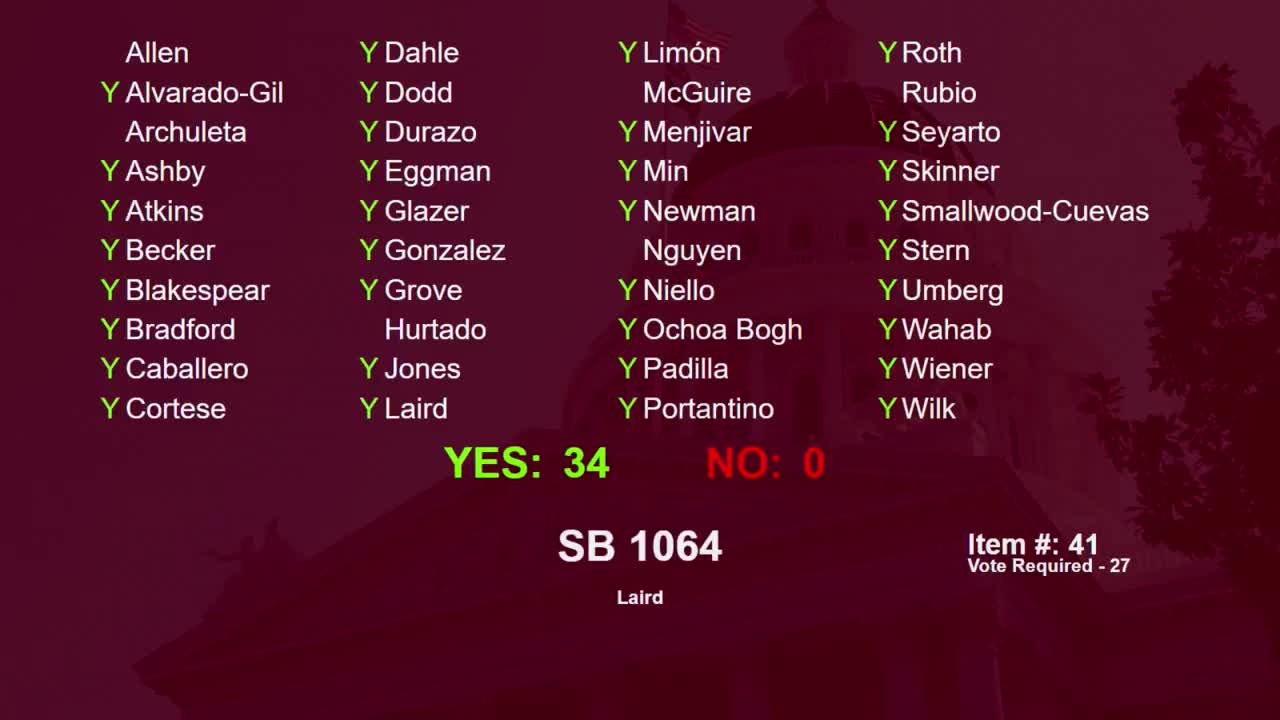 11MIN
Senate Floor
 45MIN
Senate Standing Committee on Transportation
Bill Author