SB 1205: Workers’ compensation: medical treatment.
- Session Year: 2023-2024
- House: Senate
- Latest Version Date: 2024-08-19
Current Status:
Failed
(2024-08-26: Ordered to inactive file on request of Assembly Member Aguiar-Curry.)
Introduced
In Committee
First Chamber
In Committee
Second Chamber
Enacted
Existing law establishes a workers compensation system, administered by the Administrative Director of the Division of Workers Compensation, to compensate an employee, as defined, for injuries that arise out of, and in the course of, employment. Existing law requires employers to provide medical, surgical, chiropractic, acupuncture, licensed clinical social worker, and hospital treatment reasonably required to cure or relieve the injured worker from the effects of the injury.
Existing law makes it a misdemeanor for an employer to discharge, threaten to discharge, or discriminate against, or for an insurer to advise, direct, or threaten an insured to discharge, an employee because they have filed or made known their intention to file a claim for compensation, or an application for adjudication, or because the employee has received a rating, award, or settlement, as specified.
This bill would require an employee, when possible, to make a reasonable effort to schedule treatment outside of work hours. The bill would require the employee to provide notice if treatment occurs during work hours, as specified. specified, and require the employer to provide this leave during work hours unless business necessity requires the treatment to occur at a different time or on a different day. The bill would require that the leave taken by an employee pursuant to these provisions run concurrently with leave taken pursuant to the federal Family and Medical Leave Act of 1993 and the California Family Rights Act if the employee would have been eligible for that leave. If an employer denies an employees request to attend scheduled treatment during regular work hours, the bill would make that denial a violation of the misdemeanor described above.
By expanding the scope of a crime, this bill would impose a state-mandated local program.
The California Constitution requires the state to reimburse local agencies and school districts for certain costs mandated by the state. Statutory provisions establish procedures for making that reimbursement.
This bill would provide that no reimbursement is required by this act for a specified reason.
Existing law establishes a workers compensation system, administered by the Administrative Director of the Division of Workers Compensation, to compensate an employee, as defined, for injuries sustained that arise out of, and in the course of of, employment. Existing law requires employers to secure the payment of workers compensation, including wage replacement and medical treatment, for injuries incurred by their employees that arise out of, or in the course of, employment. provide medical, surgical, chiropractic, acupuncture, licensed clinical social worker, and hospital treatment reasonably required to cure or relieve the injured worker from the effects of the injury.
Existing law makes it a misdemeanor for an employer to discharge, threaten to discharge, or discriminate against, or for an insurer to advise, direct, or threaten an insured to discharge, an employee because they have filed or made known their intention to file a claim for compensation, or an application for adjudication, or because the employee has received a rating, award, or settlement, as specified.
This bill would make an employee who is working entitled to receive all reasonable expenses of transportation, meals, and lodging incident to receiving treatment, in addition to one day of temporary disability indemnity, or a percentage of one day of temporary disability indemnity representative of the percentage of the wages lost receiving treatment, as specified.This bill would require an employee, when possible, to make a reasonable effort to schedule treatment outside of work hours. The bill would require the employee to provide notice if treatment occurs during work hours, as specified. The bill would require that the leave taken by an employee pursuant to these provisions run concurrently with leave taken pursuant to the federal Family and Medical Leave Act of 1993 and the California Family Rights Act if the employee would have been eligible for that leave. If an employer denies an employees request to attend scheduled treatment during regular work hours, the bill would make that denial a violation of the misdemeanor described above.
By expanding the scope of a crime, this bill would impose a state-mandated local program.
The California Constitution requires the state to reimburse local agencies and school districts for certain costs mandated by the state. Statutory provisions establish procedures for making that reimbursement.
This bill would provide that no reimbursement is required by this act for a specified reason.
Existing law establishes a workers compensation system, administered by the Administrative Director of the Division of Workers Compensation, to compensate an employee, as defined, for injuries sustained in the course of employment. Existing law requires employers to secure the payment of workers compensation, including wage replacement and medical treatment, for injuries incurred by their employees that arise out of, or in the course of, employment.
This bill would make an employee who is working entitled to receive all reasonable expenses of transportation, meals, and lodging incident to receiving treatment, in addition to one day of temporary disability indemnity, or a percentage of one day of temporary disability indemnity representative of the percentage of the wages lost receiving treatment. treatment, as specified.
Existing law establishes a workers compensation system, administered by the Administrative Director of the Division of Workers Compensation, to compensate an employee, as defined, for injuries sustained in the course of employment. Existing law requires employers to secure the payment of workers compensation, including wage replacement and medical treatment, for injuries incurred by their employees that arise out of, or in the course of, employment.
This bill would make an employee who is working entitled to receive all reasonable expenses of transportation, meals, and lodging incident to receiving treatment, in addition to one day of temporary disability indemnity, or a percentage of one day of temporary disability indemnity representative of the percentage of the wages lost receiving treatment.
(a)(1)Medical, surgical, chiropractic, acupuncture, licensed clinical social worker, and hospital treatment, including nursing, medicines, medical and surgical supplies, crutches, and apparatuses, including orthotic and prosthetic devices and services, that is reasonably required to cure or relieve the injured worker from the effects of the workers injury shall be provided by the employer. In the case of the employers neglect or refusal reasonably to do so, the employer is liable for the reasonable expense incurred by or on behalf of the employee in providing treatment.
(2)(A)When possible, an employee shall make a reasonable effort to schedule treatment outside of regular work hours. A reasonable effort shall not require a worker to consequentially delay treatment.
(B)If the treatment occurs during working hours and if the timing of the treatment is foreseeable, the employee shall provide reasonable, advance notification to the employer. If the timing of the treatment is unforeseeable, the employee shall provide notice of the treatment as soon as practicable.
(C)If an employee has requested leave during work hours for treatment pursuant to subparagraph (B), the employer shall allow the employee to take leave unless business necessity would require the treatment to occur at a different time or on a different day.
(C)(D)Leave taken by an employee pursuant to this section shall run concurrently with leave taken pursuant to the federal Family and Medical Leave Act of 1993 (29 U.S.C. Sec. 2601 et seq.), if the employee would have been eligible for that leave at the time leave was taken, and the Moore-Brown-Roberti Family Rights Act, commonly referred to as the California Family Rights Act (Sections 12945.2 and 19702.3 of the Government Code), if the employee would have been eligible for that leave at the time leave was taken.
(D)(E)If an employer denies an employees request to attend scheduled treatment during regular work hours, except pursuant to subparagraph (C), the employers conduct constitutes a violation under the provisions of Section 132a.
(b)As used in this division and notwithstanding any other law, medical treatment that is reasonably required to cure or relieve the injured worker from the effects of the workers injury means treatment that is based upon the guidelines adopted by the administrative director pursuant to Section 5307.27.
(c)Unless the employer or the employers insurer has established or contracted with a medical provider network as provided for in Section 4616, after 30 days from the date the injury is reported, the employee may be treated by a physician of the employees own choice or at a facility of the employees own choice within a reasonable geographic area. A chiropractor shall not be a treating physician after the employee has received the maximum number of chiropractic visits allowed by subdivision (c) of Section 4604.5.
(d)(1)If an employee has notified the employees employer in writing prior to the date of injury that the employee has a personal physician, the employee shall have the right to be treated by that physician from the date of injury if the employee has health care coverage for nonoccupational injuries or illnesses on the date of injury in a plan, policy, or fund as described in subdivisions (b), (c), and (d) of Section 4616.7.
(2)For purposes of paragraph (1), a personal physician shall meet all of the following conditions:
(A)Be the employees regular physician and surgeon, licensed pursuant to Chapter 5 (commencing with Section 2000) of Division 2 of the Business and Professions Code.
(B)Be the employees primary care physician and has previously directed the medical treatment of the employee, and who retains the employees medical records, including the employees medical history. Personal physician includes a medical group, if the medical group is a single corporation or partnership composed of licensed doctors of medicine or osteopathy, which operates an integrated multispecialty medical group providing comprehensive medical services predominantly for nonoccupational illnesses and injuries.
(C)The physician agrees to be predesignated.
(3)If the employee has health care coverage for nonoccupational injuries or illnesses on the date of injury in a health care service plan licensed pursuant to Chapter 2.2 (commencing with Section 1340) of Division 2 of the Health and Safety Code, and the employer is notified pursuant to paragraph (1), all medical treatment, utilization review of medical treatment, access to medical treatment, and other medical treatment issues shall be governed by Chapter 2.2 (commencing with Section 1340) of Division 2 of the Health and Safety Code. Disputes regarding the provision of medical treatment shall be resolved pursuant to Article 5.55 (commencing with Section 1374.30) of Chapter 2.2 of Division 2 of the Health and Safety Code.
(4)If the employee has health care coverage for nonoccupational injuries or illnesses on the date of injury in a group health insurance policy as described in Section 4616.7, all medical treatment, utilization review of medical treatment, access to medical treatment, and other medical treatment issues shall be governed by the applicable provisions of the Insurance Code.
(5)The insurer may require prior authorization of any nonemergency treatment or diagnostic service and may conduct reasonably necessary utilization review pursuant to Section 4610.
(6)An employee is entitled to all medically appropriate referrals by the personal physician to other physicians or medical providers within the nonoccupational health care plan. An employee is entitled to treatment by physicians or other medical providers outside of the nonoccupational health care plan pursuant to standards established in Article 5 (commencing with Section 1367) of Chapter 2.2 of Division 2 of the Health and Safety Code.
(e)(1)When at the request of the employer, the employers insurer, the administrative director, the appeals board, or a workers compensation administrative law judge, the employee submits to examination by a physician, the employee is entitled to receive, in addition to all other benefits herein provided, all reasonable expenses of transportation, meals, and lodging incident to reporting for the examination, together with one day of temporary disability indemnity for each day of wages lost in submitting to the examination.
(2)Regardless of the date of injury, reasonable expenses of transportation includes mileage fees from the employees home to the place of the examination and back at the rate of twenty-one cents ($0.21) a mile or the mileage rate adopted by the Director of Human Resources pursuant to Section 19820 of the Government Code, whichever is higher, plus any bridge tolls. The mileage and tolls shall be paid to the employee at the time the employee is given notification of the time and place of the examination.
(f)When at the request of the employer, the employers insurer, the administrative director, the appeals board, or a workers compensation administrative law judge, an employee submits to examination by a physician and the employee does not proficiently speak or understand the English language, the employee shall be entitled to the services of a qualified interpreter in accordance with conditions and a fee schedule prescribed by the administrative director. These services shall be provided by the employer. For purposes of this section, qualified interpreter means a language interpreter certified, or deemed certified, pursuant to Article 8 (commencing with Section 11435.05) of Chapter 4.5 of Part 1 of Division 3 of Title 2 of, or Section 68566 of, the Government Code.
(g)If the injured employee cannot effectively communicate with the employees treating physician because the employee cannot proficiently speak or understand the English language, the injured employee is entitled to the services of a qualified interpreter during medical treatment appointments. To be a qualified interpreter for purposes of medical treatment appointments, an interpreter is not required to meet the requirements of subdivision (f), but shall meet any requirements established by rule by the administrative director that are substantially similar to the requirements set forth in Section 1367.04 of the Health and Safety Code. The administrative director shall adopt a fee schedule for qualified interpreter fees in accordance with this section. Upon request of the injured employee, the employer or insurance carrier shall pay for interpreter services. An employer shall not be required to pay for the services of an interpreter who is not certified or is provisionally certified by the person conducting the medical treatment or examination unless either the employer consents in advance to the selection of the individual who provides the interpreting service or the injured worker requires interpreting service in a language other than the languages designated pursuant to Section 11435.40 of the Government Code.
(h)Home health care services shall be provided as medical treatment only if reasonably required to cure or relieve the injured employee from the effects of the employees injury and prescribed by a physician and surgeon licensed pursuant to Chapter 5 (commencing with Section 2000) of Division 2 of the Business and Professions Code, and subject to Section 5307.1 or 5307.8. The employer is not liable for home health care services that are provided more than 14 days prior to the date of the employers receipt of the physicians prescription.
SEC. 2.No reimbursement is required by this act pursuant to Section 6 of Article XIIIB of the California Constitution because the only costs that may be incurred by a local agency or school district will be incurred because this act creates a new crime or infraction, eliminates a crime or infraction, or changes the penalty for a crime or infraction, within the meaning of Section 17556 of the Government Code, or changes the definition of a crime within the meaning of Section 6 of Article XIIIB of the California Constitution.
(a)(1)Medical, surgical, chiropractic, acupuncture, licensed clinical social worker, and hospital treatment, including nursing, medicines, medical and surgical supplies, crutches, and apparatuses, including orthotic and prosthetic devices and services, that is reasonably required to cure or relieve the injured worker from the effects of the workers injury shall be provided by the employer. In the case of the employers neglect or refusal reasonably to do so, the employer is liable for the reasonable expense incurred by or on behalf of the employee in providing treatment.
(2)(A)When possible, an employee shall make a reasonable effort to schedule treatment outside of regular work hours. A reasonable effort shall not require a worker to consequentially delay treatment.
(B)If the treatment occurs during working hours and if the timing of the treatment is foreseeable, the employee shall provide reasonable, advance notification to the employer. If the timing of the treatment is unforeseeable, the employee shall provide notice of the treatment as soon as practicable.
(C)Leave taken by an employee pursuant to this section shall run concurrently with leave taken pursuant to the federal Family and Medical Leave Act of 1993 (29 U.S.C. Sec. 2601 et seq.), if the employee would have been eligible for that leave at the time leave was taken, and the Moore-Brown-Roberti Family Rights Act, commonly referred to as the California Family Rights Act (Sections 12945.2 and 19702.3 of the Government Code), if the employee would have been eligible for that leave at the time leave was taken.
(D)If an employer denies an employees request to attend scheduled treatment during regular work hours, the employers conduct constitutes a violation under the provisions of Section 132a.
(b)As used in this division and notwithstanding any other law, medical treatment that is reasonably required to cure or relieve the injured worker from the effects of the workers injury means treatment that is based upon the guidelines adopted by the administrative director pursuant to Section 5307.27.
(c)Unless the employer or the employers insurer has established or contracted with a medical provider network as provided for in Section 4616, after 30 days from the date the injury is reported, the employee may be treated by a physician of the employees own choice or at a facility of the employees own choice within a reasonable geographic area. A chiropractor shall not be a treating physician after the employee has received the maximum number of chiropractic visits allowed by subdivision (c) of Section 4604.5.
(d)(1)If an employee has notified the employees employer in writing prior to the date of injury that the employee has a personal physician, the employee shall have the right to be treated by that physician from the date of injury if the employee has health care coverage for nonoccupational injuries or illnesses on the date of injury in a plan, policy, or fund as described in subdivisions (b), (c), and (d) of Section 4616.7.
(2)For purposes of paragraph (1), a personal physician shall meet all of the following conditions:
(A)Be the employees regular physician and surgeon, licensed pursuant to Chapter 5 (commencing with Section 2000) of Division 2 of the Business and Professions Code.
(B)Be the employees primary care physician and has previously directed the medical treatment of the employee, and who retains the employees medical records, including the employees medical history. Personal physician includes a medical group, if the medical group is a single corporation or partnership composed of licensed doctors of medicine or osteopathy, which operates an integrated multispecialty medical group providing comprehensive medical services predominantly for nonoccupational illnesses and injuries.
(C)The physician agrees to be predesignated.
(3)If the employee has health care coverage for nonoccupational injuries or illnesses on the date of injury in a health care service plan licensed pursuant to Chapter 2.2 (commencing with Section 1340) of Division 2 of the Health and Safety Code, and the employer is notified pursuant to paragraph (1), all medical treatment, utilization review of medical treatment, access to medical treatment, and other medical treatment issues shall be governed by Chapter 2.2 (commencing with Section 1340) of Division 2 of the Health and Safety Code. Disputes regarding the provision of medical treatment shall be resolved pursuant to Article 5.55 (commencing with Section 1374.30) of Chapter 2.2 of Division 2 of the Health and Safety Code.
(4)If the employee has health care coverage for nonoccupational injuries or illnesses on the date of injury in a group health insurance policy as described in Section 4616.7, all medical treatment, utilization review of medical treatment, access to medical treatment, and other medical treatment issues shall be governed by the applicable provisions of the Insurance Code.
(5)The insurer may require prior authorization of any nonemergency treatment or diagnostic service and may conduct reasonably necessary utilization review pursuant to Section 4610.
(6)An employee is entitled to all medically appropriate referrals by the personal physician to other physicians or medical providers within the nonoccupational health care plan. An employee is entitled to treatment by physicians or other medical providers outside of the nonoccupational health care plan pursuant to standards established in Article 5 (commencing with Section 1367) of Chapter 2.2 of Division 2 of the Health and Safety Code.
(e)(1)When at the request of the employer, the employers insurer, the administrative director, the appeals board, or a workers compensation administrative law judge, the employee submits to examination by a physician, the employee is entitled to receive, in addition to all other benefits herein provided, all reasonable expenses of transportation, meals, and lodging incident to reporting for the examination, together with one day of temporary disability indemnity for each day of wages lost in submitting to the examination.
(2)Regardless of the date of injury, reasonable expenses of transportation includes mileage fees from the employees home to the place of the examination and back at the rate of twenty-one cents ($0.21) a mile or the mileage rate adopted by the Director of Human Resources pursuant to Section 19820 of the Government Code, whichever is higher, plus any bridge tolls. The mileage and tolls shall be paid to the employee at the time the employee is given notification of the time and place of the examination.
(f)When at the request of the employer, the employers insurer, the administrative director, the appeals board, or a workers compensation administrative law judge, an employee submits to examination by a physician and the employee does not proficiently speak or understand the English language, the employee shall be entitled to the services of a qualified interpreter in accordance with conditions and a fee schedule prescribed by the administrative director. These services shall be provided by the employer. For purposes of this section, qualified interpreter means a language interpreter certified, or deemed certified, pursuant to Article 8 (commencing with Section 11435.05) of Chapter 4.5 of Part 1 of Division 3 of Title 2 of, or Section 68566 of, the Government Code.
(g)If the injured employee cannot effectively communicate with the employees treating physician because the employee cannot proficiently speak or understand the English language, the injured employee is entitled to the services of a qualified interpreter during medical treatment appointments. To be a qualified interpreter for purposes of medical treatment appointments, an interpreter is not required to meet the requirements of subdivision (f), but shall meet any requirements established by rule by the administrative director that are substantially similar to the requirements set forth in Section 1367.04 of the Health and Safety Code. The administrative director shall adopt a fee schedule for qualified interpreter fees in accordance with this section. Upon request of the injured employee, the employer or insurance carrier shall pay for interpreter services. An employer shall not be required to pay for the services of an interpreter who is not certified or is provisionally certified by the person conducting the medical treatment or examination unless either the employer consents in advance to the selection of the individual who provides the interpreting service or the injured worker requires interpreting service in a language other than the languages designated pursuant to Section 11435.40 of the Government Code.
(h)Home health care services shall be provided as medical treatment only if reasonably required to cure or relieve the injured employee from the effects of the employees injury and prescribed by a physician and surgeon licensed pursuant to Chapter 5 (commencing with Section 2000) of Division 2 of the Business and Professions Code, and subject to Section 5307.1 or 5307.8. The employer is not liable for home health care services that are provided more than 14 days prior to the date of the employers receipt of the physicians prescription.
SEC. 2.No reimbursement is required by this act pursuant to Section 6 of Article XIIIB of the California Constitution because the only costs that may be incurred by a local agency or school district will be incurred because this act creates a new crime or infraction, eliminates a crime or infraction, or changes the penalty for a crime or infraction, within the meaning of Section 17556 of the Government Code, or changes the definition of a crime within the meaning of Section 6 of Article XIIIB of the California Constitution.
SECTION 1.Section 4600.03 is added to the Labor Code, to read:4600.03.(a)Notwithstanding Section 4656, when treatment is provided pursuant to this article to an employee who is working, the employee is entitled to receive, in addition to all other benefits, all reasonable expenses of transportation, meals, and lodging incident to receiving treatment, together with one day of temporary disability indemnity for each day of wages lost receiving treatment.(b)If treatment does not require the employee to miss a full day of work, the employer may instead provide a percentage of one day of temporary disability indemnity representative of the percentage of the wages lost receiving treatment.(c)An employer may require an employee to first exhaust leave provided under Sections 245 to 247.5, inclusive, of the Labor Code or Section 44978 or 45191 of the Education Code before the employer is required to provide temporary disability indemnity leave under this section.(d)This section applies whether the injury has become permanent and stationary or not.(e)Regardless of the date of injury, reasonable expenses of transportation includes mileage fees from the employees home to the place of the treatment and back at the rate adopted by the Director of Human Resources pursuant to Section 19820 of the Government Code, plus any bridge tolls.(f)The employer may not discharge or in any way discriminate against the employee for receiving treatment during normal business hours or during the hours of the day when the employee is customarily at work.(a)Notwithstanding Section 4656, when treatment is provided pursuant to this article to an employee who is working, the employee is entitled to receive, in addition to all other benefits, all reasonable expenses of transportation, meals, and lodging incident to receiving treatment, together with one day of temporary disability indemnity for each day of wages lost receiving treatment.
(b)If treatment does not require the employee to miss a full day of work, the employer may instead provide a percentage of one day of temporary disability indemnity representative of the percentage of the wages lost receiving treatment.
(c)An employer may require an employee to first exhaust leave provided under Sections 245 to 247.5, inclusive, of the Labor Code or Section 44978 or 45191 of the Education Code before the employer is required to provide temporary disability indemnity leave under this section.
(c)(d)This section applies whether the injury has become permanent and stationary or not.
(d)(e)Regardless of the date of injury, reasonable expenses of transportation includes mileage fees from the employees home to the place of the treatment and back at the rate adopted by the Director of Human Resources pursuant to Section 19820 of the Government Code, plus any bridge tolls.
(e)(f)The employer may not discharge or in any way discriminate against the employee for receiving treatment during normal business hours or during the hours of the day when the employee is customarily at work.
(a)Notwithstanding Section 4656, when treatment is provided pursuant to this article to an employee who is working, the employee is entitled to receive, in addition to all other benefits, all reasonable expenses of transportation, meals, and lodging incident to receiving treatment, together with one day of temporary disability indemnity for each day of wages lost receiving treatment.
(b)If treatment does not require the employee to miss a full day of work, the employer may instead provide a percentage of one day of temporary disability indemnity representative of the percentage of the wages lost receiving treatment.
(c)This section applies whether the injury has become permanent and stationary or not.
(d)Regardless of the date of injury, reasonable expenses of transportation includes mileage fees from the employees home to the place of the treatment and back at the rate adopted by the Director of Human Resources pursuant to Section 19820 of the Government Code, plus any bridge tolls.
(e)The employer may not discharge or in any way discriminate against the employee for receiving treatment during normal business hours or during the hours of the day when the employee is customarily at work.
|
Date
|
Status
|
|---|---|
| Aug 26, 2024 | Ordered to inactive file on request of Assembly Member Aguiar-Curry. |
| Aug 20, 2024 | Read second time. Ordered to third reading. |
| Aug 19, 2024 | Read second time and amended. Ordered to second reading. |
| Aug 15, 2024 | From committee: Do pass as amended. (Ayes 11. Noes 3.) (August 15). |
| Aug 7, 2024 | August 7 set for first hearing. Placed on suspense file. |
| Jun 27, 2024 | Read second time and amended. Re-referred to Com. on APPR. |
| Jun 26, 2024 | From committee: Do pass as amended and re-refer to Com. on APPR. (Ayes 10. Noes 0.) (June 26). |
| Jun 3, 2024 | Referred to Com. on INS. |
| May 23, 2024 | In Assembly. Read first time. Held at Desk. |
| May 22, 2024 | Read third time. Passed. (Ayes 29. Noes 8. Page 4144.) Ordered to the Assembly. |
| May 20, 2024 | Read second time. Ordered to third reading. |
| May 16, 2024 | Read second time and amended. Ordered to second reading. |
| May 16, 2024 | From committee: Do pass as amended. (Ayes 5. Noes 2. Page 3975.) (May 16). |
| May 10, 2024 | Set for hearing May 16. |
| Apr 22, 2024 | April 22 hearing: Placed on APPR suspense file. |
| Apr 12, 2024 | Set for hearing April 22. |
| Apr 10, 2024 | From committee: Do pass and re-refer to Com. on APPR. (Ayes 4. Noes 1. Page 3563.) (April 10). Re-referred to Com. on APPR. |
| Mar 26, 2024 | Set for hearing April 10. |
| Feb 29, 2024 | Referred to Com. on L., P.E. & R. |
| Feb 16, 2024 | From printer. May be acted upon on or after March 17. |
| Feb 15, 2024 | Introduced. Read first time. To Com. on RLS. for assignment. To print. |
|
Date
|
Description
|
Location
|
Votes
|
|
|---|---|---|---|---|
| Aug 15, 2024 | Do pass as amended. | Assembly Standing Committee on Appropriations |
Passed |
|
| Jun 26, 2024 | Do pass as amended and be re-referred to the Committee on [Appropriations] | Assembly Standing Committee on Insurance |
Passed |
|
| May 22, 2024 | Senate 3rd Reading SB1205 Laird | Senate Floor |
Passed |
|
| May 16, 2024 | Do pass as amended | Senate Standing Committee on Appropriations |
Passed |
|
| Apr 22, 2024 | Placed on suspense file | Senate Standing Committee on Appropriations |
Passed |
|
| Apr 10, 2024 | Do pass, but first be re-referred to the Committee on [Appropriations] | Senate Standing Committee on Labor, Public Employment and Retirement |
Passed |
This list shows positions taken on this bill by organizations on the date displayed, which is linked to the original source.
Positions by individuals are not included.
|
Organization
|
Position
|
Date
|
|---|---|---|
| Acclamation Insurance Management Services | ** Against | |
| Allied Managed Care | ** Against | |
| American Federation of State, County and Municipal Employees | ** Support | |
| American Property Casualty Insurance Association | ** Against | |
| Association of California Healthcare Districts | ** Against | |
| California Association Of Joint Powers Authorities | ** Against | |
| California Chamber Of Commerce | ** Against | |
| California Coalition On Workers Compensation | ** Against | |
| California Grocers Association | ** Against | |
| California Joint Powers Insurance Authority | ** Against | |
| California Labor Federation, Afl-Cio | ** Support | |
| California Manufacturers & Technology Association | ** Against | |
| California Nurses Association | ** Support | |
| California School Employees Association | ** Support | |
| California State Association Of Counties | ** Against | |
| California Teachers Association | ** Support | |
| California Teamsters Public Affairs Council | ** Support | |
| CFT- a Union of Educators & Classified Professionals, Aft, Afl-cio | ** Support | |
| City of Thousand Oaks | ** Against | |
| County of Los Angeles Board of Supervisors | ** Against | |
| Disability Rights California | ** Support | |
| Public Risk Innovation Solutions and Management | ** Against | |
| SMART - Transportation Division | ** Support | |
| VALLEY INDUSTRY AND COMMERCE ASSOCIATION | ** Against |
SENATE THIRD READING
STR Bill Id:SB 1205
Author:(Laird)
As Amended Ver:August 19, 2024
Majority vote
SUMMARY
Provides that an employer's denial of an employee's request to receive workers' compensation treatment during work hours constitutes discrimination against the employee.
Major Provisions
- Requires an employee, when possible, to make a reasonable effort to schedule treatment received under the workers' compensation system outside of regular work hours.
- Requires an employee to provide reasonable, advance notice to the employer if treatment occurs during work hours and the timing of treatment is foreseeable. If timing of the treatment is unforeseeable, notice must be provided as soon as practicable.
- Requires the employer to provide this leave during work hours unless business necessity requires the treatment to occur at a different time or on a different day.
- Requires treatment-related leave taken by an employee to run concurrently with leave taken pursuant to the federal Family and Medical Leave Act of 1993 (FMLA) and California Family Rights Act (CFRA) if the employee is eligible for such leave.
- Provides that an employer's denial of an employee's request to attend scheduled treatment during regular work hours constitutes a violation of existing labor law, which prohibits discrimination against an employee because they have filed a claim for workers' compensation. In such instances, the employer is: a) guilty of a misdemeanor and b) liable for increased compensation of up to $10,000 to the worker, costs and expenses of up to $250, and reinstatement and reimbursement for lost wages and benefits
COMMENTS
Workers' compensation has always been based on a compromise that employers would pay for the treatment for their injured employees in exchange for certain fraud and legal protections. Workers' comp allows employees who are injured at work to receive employer-funded medical care, temporary disability to replace lost wages, and permanent disability to compensate for lasting impairment. In exchange for these benefits, the injured worker cannot sue their employer for their injury. This is why the workers' comp system is often referred to as the "grand bargain." For California's workers' compensation system to remain functional, the balance of this compromise must be maintained.
This bill addresses issues employees may have in taking time off work to receive care under the workers' compensation system. California law already provides employees with several types of paid leave. This includes paid sick leave (PSL) and the California Family Rights Act (CFRA). A worker who has a workers' compensation claim may already qualify for and is eligible to use PSL or CFRA to take time off work. This bill provides that an employer cannot discriminate against an employee for taking time off to attend medical appointments related to treatment for workers' compensation claims, but also requires employees to take the time concurrently with these existing types of leave, should the appointment need to occur during regular work hours. Additionally, this bill provides a "business necessity" exception for employers related to the granting of leave during work hours.
According to the Author
Currently, employees injured at work can be denied necessary medical treatment during work hours. In cases where employees are at work during regular business hours, this forces those employees to forgo essential medical care, which can worsen their condition and potentially turn a temporary injury into a permanent one, or face losing wages, benefits, or employment simply for seeing a doctor during work hours.
Senate Bill 1205 protects workers injured on the job by ensuring they can access timely medical care, without retaliation, for their occupational injuries by prohibiting employers from retaliating in any way against workers who must receive care during normal business hours. Injured workers deserve care and compassion, not retaliation.
Arguments in Support
This bill is sponsored by the California Federation of Teachers, which argues the "need for this bill is great, as evidenced by reports from our members–including written communication from employers to workers–that workers are being instructed by employers to schedule workers' compensation medical care appointments outside of regular business hours." This bill is also supported by other labor organizations and Disability Rights California.
Arguments in Opposition
This bill is opposed by a coalition of employer groups led by the California Chamber of Commerce, which argues, "stating that any failure to provide time off is discrimination/retaliation subject to penalties is inappropriate. Any error by a small business or urgent matter requiring an employee to be present at work would constitute discrimination."
FISCAL COMMENTS
According to the Assembly Appropriations Committee:
- Costs of approximately $5.7 million in the first year and $5.3 million annually thereafter shared between the Division of Workers' Compensation to manage a significant increase in inquiries from employees, employers, labor unions, insurance carriers, attorneys, and other interested parties regarding the new requirements, and the Workers' Compensation Appeals Board to process and hear petitions for increased compensation resulting from discrimination violations (Workers' Compensation Administration Revolving Fund).
- Annual costs of an unknown, but potentially significant, amount to the state as an employer. To the extent a state agency denies an employee's request to attend treatment, this bill may result in increased discrimination claims against the state, with costs related to litigation and entitled compensation (General Fund (GF) and special funds).
- Potential cost pressures (GF or Trial Court Trust Fund) of an unknown, but likely minor, amount to the trial courts in increased workload by specifying it is a misdemeanor for an employer to deny an employee's request to attend treatment. A defendant charged with a misdemeanor is entitled to no-cost legal representation and a jury trial.
VOTES
SENATE FLOOR: 29-8-3
YES: Ashby, Atkins, Becker, Blakespear, Bradford, Caballero, Cortese, Dodd, Durazo, Eggman, Glazer, Gonzalez, Hurtado, Laird, Limón, McGuire, Menjivar, Min, Newman, Padilla, Portantino, Roth, Rubio, Skinner, Smallwood-Cuevas, Stern, Umberg, Wahab, Wiener
NO: Dahle, Grove, Jones, Nguyen, Niello, Ochoa Bogh, Seyarto, Wilk
ABS, ABST OR NV: Allen, Alvarado-Gil, Archuleta
ASM INSURANCE: 10-0-5
YES: Calderon, Bauer-Kahan, Berman, McKinnor, Lee, Lowenthal, Ortega, Blanca Rubio, Valencia, Wood
ABS, ABST OR NV: Chen, Alvarez, Joe Patterson, Petrie-Norris, Wallis
ASM APPROPRIATIONS: 11-3-1
YES: Wicks, Arambula, Bryan, Calderon, Wendy Carrillo, Mike Fong, Grayson, Haney, Hart, Pellerin, Villapudua
NO: Sanchez, Dixon, Ta
ABS, ABST OR NV: Jim Patterson
UPDATED
VERSION: August 19, 2024
CONSULTANT: Claire Wendt / INS. / (916) 319-2086 FN: 0004002
Date of Hearing: August 7, 2024
ASSEMBLY COMMITTEE ON APPROPRIATIONS
Buffy Wicks, Chair
SBPCA Bill Id:SB 1205
Author:(Laird) – As Amended Ver:June 27, 2024
Policy Committee: | Insurance | Vote: | 10 - 0 |
|
| ||
|
|
Urgency: No State Mandated Local Program: Yes Reimbursable: No
SUMMARY:
This bill provides that an employer’s denial of an employee’s request to receive workers’ compensation treatment during work hours constitutes discrimination against the employee.
Specifically, this bill:
- Requires an employee, when possible, to make a reasonable effort to schedule treatment received under the workers’ compensation system outside of regular work hours.
- Requires an employee to provide reasonable, advance notice to the employer if treatment occurs during work hours and the timing of treatment is foreseeable. If timing of the treatment is unforeseeable, notice must be provided as soon as practicable.
- Requires treatment-related leave taken by an employee to run concurrently with leave taken pursuant to the federal Family and Medical Leave Act of 1993 (FMLA) and California Family Rights Act (CFRA) if the employee is eligible for such leave.
- Provides that an employer’s denial of an employee’s request to attend scheduled treatment during regular work hours constitutes a violation of existing labor law, which prohibits discrimination against an employee because they have filed a claim for workers’ compensation. In such instances, the employer is: (a) guilty of a misdemeanor and (b) liable for increased compensation of up to $10,000 to the worker, costs and expenses of up to $250, and reinstatement and reimbursement for lost wages and benefits.
FISCAL EFFECT:
- Costs of approximately $5.7 million in the first year and $5.3 million annually thereafter shared between the Division of Workers’ Compensation to manage a significant increase in inquiries from employees, employers, labor unions, insurance carriers, attorneys, and other interested parties regarding the new requirements, and the Workers’ Compensation Appeals Board to process and hear petitions for increased compensation resulting from discrimination violations (Workers’ Compensation Administration Revolving Fund).
- Annual costs of an unknown, but potentially significant, amount to the state as an employer. To the extent a state agency denies an employee’s request to attend treatment, this bill may result in increased discrimination claims against the state, with costs related to litigation and entitled compensation (General Fund (GF) and special funds).
- Potential cost pressures (GF or Trial Court Trust Fund) of a an unknown, but likely minor, amount to the trial courts in increased workload by specifying it is a misdemeanor for an employer to deny an employee’s request to attend treatment. A defendant charged with a misdemeanor is entitled to no-cost legal representation and a jury trial.
According to the Legislative Analyst’s Office, the GF faces a structural deficit in the tens of billions of dollars over the next several fiscal years.
COMMENTS:
- Purpose. According to the author:
Currently, employees injured at work can be denied necessary medical treatment during work hours. In cases where employees are at work during regular business hours, this forces those employees to forgo essential medical care, which can worsen their condition and potentially turn a temporary injury into a permanent one, or face losing wages, benefits, or employment simply for seeing a doctor during work hours.
[SB 1205] protects workers injured on the job by ensuring they can access timely medical care, without retaliation, for their occupational injuries by prohibiting employers from retaliating in any way against workers who must receive care during normal business hours.
- Support and Opposition. This bill is sponsored by the California Federation of Teachers, which argues the “need for this bill is great, as evidenced by reports from our members–including written communication from employers to workers–that workers are being instructed by employers to schedule workers’ compensation medical care appointments outside of regular business hours.” This bill is also supported by other labor organizations and Disability Rights California.
This bill is opposed by a coalition of employer groups led by the California Chamber of Commerce, which argues, “stating that any failure to provide time off is discrimination/retaliation subject to penalties is inappropriate. Any error by a small business or urgent matter requiring an employee to be present at work would constitute discrimination.”
- Workers’ Compensation Compromise. The workers’ compensation system is based on a compromise that allows an employee injured at work to receive employer-funded medical care, temporary disability (TD) to replace lost wages, and permanent disability to provide compensation for lasting impairment. In exchange, the injured worker cannot sue their employer for their injury.
Prior to amendments adopted by the Assembly Insurance Committee upon passage of this bill, this bill provided that an injured employee, who is still able to work, is entitled to receive TD to supplement wages lost as a result of seeking prescribed treatment. However, courts have repeatedly held that an employee is not entitled to TD to attend medical appointments. Thus, the Assembly Insurance Committee amended this bill to instead provide that an employer’s denial of an employee’s request to receive treatment during work hours constitutes discrimination against the employee. However, an employee must make a reasonable effort to schedule treatment outside of regular work hours and provide advance notice to the employer if treatment occurs during work hours. As noted in the Assembly Insurance Committee’s analysis of this bill, “the committee recommends that the author consider adding additional language to provide employers some ability, in limited circumstances, to reject an employee’s leave request.” Additionally, this bill requires an employee covered by FMLA or CFRA to take treatment-related leave concurrently with leave under those programs. However, this requirement may inadvertently require a covered employee to expend more benefits to take treatment-related leave than another employee who is not covered by FMLA or CFRA but still entitled to the same level of workers’ compensation protections.
Analysis Prepared by: Irene Ho / APPR. / (916) 319-2081
Date of Hearing: June 26, 2024
ASSEMBLY COMMITTEE ON INSURANCE
Lisa Calderon, Chair
SBPCA Bill Id:SB 1205
Author:(Laird) – As Amended Ver:May 16, 2024
SENATE VOTE: 29-8
SUBJECT: Workers’ compensation: medical benefits
SUMMARY: Provides that an injured employee, who is still able to work, is entitled to receive additional benefits incident to receiving treatment. Specifically, this bill:
- Provides that an injured employee who is working, in addition to all other benefits, is entitled to receive all reasonable expenses of transportation, meals, and lodging incident to receiving medical treatment for the injury, as provided.
- Defines “reasonable expenses of transportation” to include mileage fees from the employee’s home to the place of the treatment and back at the rate adopted by the director of Human Resources pursuant to Government Code Section 19820, plus bridge tolls.
- Provides that an injured employee who is working is entitled to receive one day of temporary disability (TD) benefits, or a percentage of one day of TD representative of the percentage of the wages lost as a result of attending a medical appointment.
- Provides that an employer may require an employee to first exhaust specified leave before the employer is required to provide TD leave.
- Specifies that the employer may not discharge or in any way discriminate against the employee for receiving treatment during normal business hours or during the hours of the day when the employee is customarily at work.
- Specifies that these provisions apply whether the injury has become permanent and stationary or not.
EXISTING LAW:
- Establishes a workers’ compensation system that provides benefits to an employee who suffers from an injury or illness that arises out of, and in the course of, employment, irrespective of fault. This system requires all employers to secure payment of benefits by either securing the consent of the Department of Industrial Relations (DIR) to self-insure or by securing insurance against liability from an insurance company duly authorized by the state. (California Constitution Article XIV, Section 4)
- Provides that medical care and services that are reasonably required to cure or relieve the injured worker from the effects of the injury shall be provided by the employer. (Labor Code Section (LAB) 4600(a))
- Specifies that when at the request of the employer, the employer’s insurer, the administrative director, the appeals board, or a workers’ compensation administrative law judge, the employee submits to examination by a qualified medical evaluator (physician), the employee is entitled to receive, in addition to all other benefits herein provided, all reasonable expenses of transportation, meals, and lodging incident to reporting for the examination, together with one day of TD for each day of wages lost in submitting to the examination. Regardless of the date of injury, “reasonable expenses of transportation” shall include mileage fees from the employee’s home to the place of the examination and back at the rate of twenty-one cents ($0.21) a mile or the mileage rate adopted by the Director of Human Resources pursuant to Government Code Section 19820, whichever is higher, plus any bridge tolls. The mileage and tolls shall be paid to the employee at the time the employee is given notification of the time and place of the examination. (LAB 4600(e))
- Establishes within the workers’ compensation system temporary and permanent benefits, referred to as disability indemnity, which offer wage replacement equal to two-thirds of a specified injured employee’s average weekly earnings for up to 240 weeks while an employee is unable to work due to a workplace illness or injury. (LAB 4653-4656)
- Establishes procedures for the payment of TD and permanent disability indemnity. This includes a requirement that a Qualified Medical Evaluator make a determination about the degree of disability experienced by the injured worker. (LAB 4650)
- Provides that any employer who discharges or threatens to discharge or in any manner discriminate against an injured employee is guilty of a misdemeanor, and the employee’s compensation shall be increased by one-half but to more than $10,000, together with costs and expenses up to $250. The employee shall also be entitled to reinstatement and reimbursement for lost wages and work benefits caused by the acts of the employer. (LAB 132a)
- Requires the Director of the Department of Human Resources to, among other things, adopt general rules and regulations that provide for reasonable reimbursement for expenses incurred by an agent of the state. The current personal vehicle mileage reimbursement rate, effective January 1, 2024, is 67 cents per mile. (Government Code Section 19820)
FISCAL EFFECT: Unknown.
COMMENTS:
- Purpose. According to the author:
Currently, employees injured at work can be denied necessary medical treatment during work hours. In cases where employees are at work during regular business hours, this forces those employees to forgo essential medical care, which can worsen their condition and potentially turn a temporary injury into a permanent one, or face losing wages, benefits, or employment simply for seeing a doctor during work hours.
Senate Bill 1205 protects workers injured on the job by ensuring they can access timely medical care, without retaliation, for their occupational injuries by prohibiting employers from retaliating in any way against workers who must receive care during normal business hours. Injured workers deserve care and compassion, not retaliation
- Background. Workers’ compensation has always been based on a compromise that employers would pay for the treatment for their injured employees in exchange for certain fraud and legal protections. Workers’ comp allows employees who are injured at work to receive employer-funded medical care, temporary disability to replace lost wages, and permanent disability to compensate for lasting impairment. In exchange for these benefits, the injured worker cannot sue their employer for their injury. This is why the workers’ comp system is often referred to as the “grand bargain.” For California’s workers’ compensation system to remain functional, the balance of this compromise must be maintained.
Additionally, any discussion on the expansion of workers’ compensation benefits, including what is proposed in this bill, should begin with the understanding that the workers’ compensation system faces a relatively high degree of frictional costs. Frictional costs are those expenses that are not part of the normal business expenses anticipated as part of underwriting including claim adjustment and administrative expenses. A significant proportion of every dollar spent to deliver benefits goes to cover frictional costs. According to the 2023 State of the System report by the Workers’ Compensation Insurance Rating Bureau of California, California ranked the second highest in the country in terms of Unallocated Loss Expenses within the Workers’ Comp system.
- Bill runs counter to purpose of TD. The purpose of TD is to temporarily provide wage replacement to injured employees who are unable to work due to an occupational injury. TD, as the name implies, is meant to be temporary and not ongoing. Once, an employee is able to return to work TD is no longer necessary, because they are back at work. Following a diagnosis from the injured worker’s medical provider that the condition is not improving but not worsening, the condition is considered permanent and stationary and the employee would instead become eligible for permanent disability benefits.
The goal of TD is to approximate an employee's take home pay during the period after injury when the employee is temporarily unable to work. This goal is implemented by basing the weekly TD benefit on 2/3 of the employee's average weekly wages. The TD benefit is capped at $1,619 per week. Currently, TD is available for up to 104 weeks of aggregate benefits, payable within five years of the date of injury.
It is unclear from the provisions of this bill how TD benefits would actually be claimed and what would happen in the event an employee has exhausted their available TD benefits. Additionally, under the provisions of this bill it is possible that employees will consistently be starting and stopping the receipt of TD benefits. For claims administrators this could prevent a significant administrative hurdle, for among other reasons, the fact that a notice has to be provided to an employee each time TD is started and stopped.
- Employees already have several types of leave available to use for medical appointments. California law already provides employees with several types of paid leave. This includes paid sick leave (PSL) and the California Family Rights Act (CFRA). A worker who has a workers’ compensation claim may already qualify for and is eligible to use PSL or CFRA to take time off work.
PSL is a permanent law in California that requires employers to provide paid time off to workers for treatment, diagnosis or preventative care for themselves, a family member or a designated person. Starting January 1, 2024, with limited exceptions, employers must provide at least 40 hours or five days off each year to employees.
CFRA allows an employee to take up to 12 weeks of family leave to care for a newborn child or to care for a family member suffering from a serious medical condition. CFRA originally applied only to employers with 50 more employees. However, in 2020 CFRA was expanded to apply to employers with five or more employees.
No clear data was provided to the committee to show that employees are having difficulties using existing leave provisions to access medical care for workers’ compensation claims or are being denied time-off by employers to attend medical appointments. Therefore, it is unclear how widespread of an issue this is, especially considering the various types of leave already available for employees to use, in addition to any other flexibility they have within their schedule.
- Employees could bargain for additional benefits. If the sponsor has concerns about their members being able to attend medical appointments related to workers’ compensation claims there is nothing in current law that prevents them from collectively bargaining for this benefit. California law allows labor groups to collectively bargain carve outs to the statutorily mandated workers’ compensation system, so long as the Administrative Director of DWC approves these changes to benefits. However, labor groups and employers are generally given wide latitude by DWC, as evidenced by the numerous carve outs and special provisions that already exist.
- Workers’ compensation is already subject to anti-discrimination law. LAB 132a provides that “It is the declared policy of this state that there should not be discrimination against workers who are injured in the course and scope of their employment.” These provisions apply to the entire workers’ compensation portion of the labor code. These provisions are arguably more compressive than what is proposed in this bill and provide for penalties and a method of enforcement. This seems to render the anti-discrimination provisions proposed in this bill as unnecessary and likely to create confusion.
- Bill’s provisions run counter to established case law. The courts have repeatedly held that an employee is not entitled to TD to attend medical appointments. By allowing an employee to collect TD to attend a medical appointment this bill would represent a departure from existing case law. Two examples are provided below.
- Skelton v. Workers Compensation Appeals Board, 39 CalApp.5th 1098 (2019). This case limited the type of medical-legal appointments an injured employee may be reimbursed for. The workers’ compensation claimant sought benefits for time lost from work due to injuries to her ankle and shoulder, which were separately sustained in 2012 and 2014. She continued to work after each injury and missed work to attend appointments with her treating physicians and to attend two qualified medical evaluator appointments, which are considered medical-legal evaluations. Her work hours were fixed, not flexible, and she could not see the treating physicians on the weekends. After having exhausted all leave, her paycheck was reduced for missed time at work. She then missed doctor appointments because she could no longer afford to miss work.
A workers’ compensation judge determined she was not entitled to TD for lost time from work to attend medical appointments, based on Department of Rehabilitation. She petitioned WCAB for reconsideration, which affirmed she was only entitled to TD for missed work to attend a qualified medical evaluator appointment.
- Department of Rehabilitation v. Workers’ Compensation Appeals Board (Lauher), 30 Cal. 4th 1281, 1295 (2003). This case determined an employee returning to work following a permanent and stationary determination by the physician is not entitled to TD to compensate them for time off from work while continuing to receive medical treatment for the injury. The question of whether an employee is entitled to TD for missing work to attend medical appointments before permanent and stationary status was not addressed.
- Arguments in support. CFT - A Union of Educators & Classified Professionals, the sponsor this bill, writes in support saying, “SB 1205 will prohibit employers from firing or retaliating against workers who must receive care during normal business hours. The bill does not in any way affect non-occupational injuries and illnesses, leaving untouched any laws governing how workers receive medical care for these conditions. Given that non-occupational injuries constitute roughly 98% of the healthcare system, the number of employers affected should be relatively small.”
- Arguments in opposition. A coalition of employers and insurers, including the California Chamber of Commerce, the California Coalition on Workers’ Compensation, and the American Property Casualty Insurance Association write saying they are opposed to this bill because, “[it] would increase costs and administrative friction in California’s workers’ compensation system by broadly expanding the payment of temporary disability benefits in a way that fundamentally undermines its purpose, which is to be available as wage replacement in situations where the worker is temporarily disabled and unable to work while recovering from an industrial injury.”
- Recommended committee amendments. Delete the contents of the bill and insert the following amendments to LAB 4600 (shown in underline and bold.)
SECTION 1. Section 4600 of the Labor Code is amended to read:
4600 (a)(1) Medical, surgical, chiropractic, acupuncture, licensed clinical social worker, and hospital treatment, including nursing, medicines, medical and surgical supplies, crutches, and apparatuses, including orthotic and prosthetic devices and services, that is reasonably required to cure or relieve the injured worker from the effects of the worker’s injury shall be provided by the employer. In the case of the employer’s neglect or refusal reasonably to do so, the employer is liable for the reasonable expense incurred by or on behalf of the employee in providing treatment.
(2) When possible, an employee should make a reasonable effort to schedule treatment outside of regular work hours. A reasonable effort shall not require a worker to consequentially delay treatment.
(3) If the treatment occurs during working hours and if the timing of the treatment is foreseeable, the employee must provide reasonable advance notification to the employer. If the timing of the treatment is unforeseeable, the employee shall provide notice of the treatment as soon as practicable.
(4) Leave taken by an employee pursuant to this section shall run concurrently with leave taken pursuant to the federal Family and Medical Leave Act of 1993 (29 U.S.C. Sec. 2601 et seq.), if the employee would have been eligible for that leave at the time leave was taken, and the Moore-Brown-Roberti Family Rights Act, commonly referred to as the California Family Rights Act (Sections 12945.2 and 19702.3 of the Government Code), if the employee would have been eligible for that leave at the time leave was taken.
(5) If an employer denies an employee’s request to attend scheduled treatment during regular work hours the employer’s conduct constitutes a violation under the provisions of Labor Code Section 132a.
- Additional committee concerns. The above recommended committee amendments address many of the committee’s concerns related to the TD provisions in this bill. However, paragraph (3) in the above recommended amendments does not provide any opportunity for an employer to turn down an employee’s leave request. Should this bill move forward, the committee recommends that the author consider adding additional language to provide employers some ability, in limited circumstances, to reject an employee’s leave request.
REGISTERED SUPPORT / OPPOSITION:
Support
CFT- a Union of Educators & Classified Professionals, Aft, Afl-cio
Smart - Transportation Division (SMART-TD)
Opposition
American Property Casualty Insurance Association
Association of California Healthcare Districts
California Association of Joint Powers Authorities
California Chamber of Commerce
California Coalition on Workers Compensation
California Grocers Association
California Joint Powers Insurance Authority
California Manufacturers & Technology Association
California State Association of Counties (CSAC)
City of Thousand Oaks
County of Los Angeles Board of Supervisors
Public Risk Innovation, Solutions, and Management (PRISM)
Valley Industry and Commerce Association (VICA)
Analysis Prepared by: Claire Wendt / INS. / (916) 319-2086
SENATE RULES COMMITTEE Office of Senate Floor Analyses (916) 651-1520 Fax: (916) 327-4478 | SB 1205 |
THIRD READING
Bill No: SB 1205
Author: Laird (D)
Amended: 5/16/24
Vote: 21
SENATE LABOR, PUB. EMP. & RET. COMMITTEE: 4-1, 4/10/24
AYES: Smallwood-Cuevas, Cortese, Durazo, Laird
NOES: Wilk
SENATE APPROPRIATIONS COMMITTEE: 5-2, 5/16/24
AYES: Caballero, Ashby, Becker, Bradford, Wahab
NOES: Jones, Seyarto
SUBJECT: Workers’ compensation: medical benefits
SOURCE: California Federation of Teachers
DIGEST:
This bill entitles specified injured employees, who are still able to work, temporary disability indemnity payment for wages lost as a result of medical treatment and all reasonable expenses of transportation, meals, and lodging associated with that treatment.
ANALYSIS:
- Establishes a compensation system, administered by the Division of Workers’ Compensation (DWC), which provides benefits to an employee who suffers from an injury that arises out of and in the course of employment, regardless of fault. This system requires all employers to insure payment of benefits by either securing the consent of the Department of Industrial Relations to self-insure or by obtaining insurance against liability from an insurance company duly authorized by the state. (Labor Code §3200 et seq.)
- Provides that medical care and services that are reasonably required to cure or relieve the injured worker from the effects of the injury shall be provided by the employer. (Labor Code §4600(a))
- Specifies that when at the request of the employer, the employer’s insurer, the administrative director, the appeals board, or a workers’ compensation administrative law judge, the employee submits to examination by a qualified medical evaluator (physician), the employee is entitled to receive, in addition to all other benefits herein provided, all reasonable expenses of transportation, meals, and lodging incident to reporting for the examination, together with one day of temporary disability indemnity (TDI) for each day of wages lost in submitting to the examination. Regardless of the date of injury, “reasonable expenses of transportation” shall include mileage fees from the employee’s home to the place of the examination and back at the rate of twenty-one cents ($0.21) a mile or the mileage rate adopted by the Director of Human Resources pursuant to Government Code §19820, whichever is higher, plus any bridge tolls. The mileage and tolls shall be paid to the employee at the time the employee is given notification of the time and place of the examination. (Labor Code §4600(e))
- Establishes within the workers’ compensation system temporary and permanent benefits, referred to as disability indemnity, which offer wage replacement equal to two-thirds of a specified injured employee’s average weekly earnings for up to 240 weeks while an employee is unable to work due to a workplace illness or injury. (Labor Code §§4653-4656)
- Establishes procedures for the payment of TDI and permanent disability indemnity. This includes a requirement that a Qualified Medical Evaluator make a determination about the degree of disability experienced by the injured worker. (Labor Code §4650)
- Provides that any employer who discharges or threatens to discharge or in any manner discriminate against an injured employee is guilty of a misdemeanor, and the employee’s compensation shall be increased, as specified. The employee shall also be entitled to reinstatement and reimbursement for lost wages and work benefits caused by the acts of the employer. (Labor Code §132a)
- Provides, under the Healthy Workplaces, Healthy Families Act of 2014, with limited exceptions, that an employee who works in California for 30 or more days within a year from the start of employment is entitled to paid sick days for specified purposes, to be accrued at a rate of no less than one hour for every 30 hours worked, and to be available for use beginning on the 90th day of employment. (Labor Code §246)
- Provides that an employer may satisfy sick leave accrual requirements by providing not less than 24 hours or 3 days of paid sick leave that is available to the employee to use by the completion of the employee’s 120th calendar day of employment, and no less than 40 hours or 5 days of paid sick leave that is available to the employee to use by the completion of the employee’s 200th calendar day of employment. (Labor Code §246(b)(4))
- Provides that certificated employees employed five days a week by a school district are entitled to 10 days leave of absence for illness or injury and additional days, as specified. Pay for any day of this absence shall be the same as the pay that would have been received had the employee served during the day. (Education Code §44978)
- Provides that certificated employees employed for less than five schooldays a week are entitled, for a school year of service, to that proportion of 10 days’ leave of absence for illness or injury as the number of days he or she is employed per week bears to five and are entitled to additional days, as specified. Pay for any day of this absence shall be the same as the pay that would have been received had the employee served during the day. (Education Code §44978)
- Provides that classified employees employed five days a week by a school district are entitled to 12 days leave of absence for illness or injury and such additional days, as specified. Pay for any day of absence shall be the same as the pay which would have been received had the employee served during the day. (Education Code §45191)
- Provides that classified employees employed less than five days per week are entitled, for a fiscal year of service, to that proportion of 12 days leave of absence for illness or injury as the number of days the classified employee is employed per week bears to five and is entitled to the proportionate amount, consistent with this formula, of such additional days, as specified. Pay for any day of absence shall be the same as the pay which would have been received had the employee served during the day. (Education Code §45191)
- Requires the Director of the Department of Human Resources to, among other things, adopt general rules and regulations that provide for reasonable reimbursement for expenses incurred by an agent of the state. The current personal vehicle mileage reimbursement rate, effective January 1, 2024, is 67 cents per mile. (Government Code §19820)
This bill:
- Provides that an injured employee who is working is additionally entitled to receive all reasonable expenses of transportation, meals, and lodging incident to receiving medical treatment for the injury.
- Defines “reasonable expenses of transportation” to include mileage fees from the employee’s home to the place of the treatment and back at the rate adopted by the director of Human Resources pursuant to Government Code §19820, plus bridge tolls.
- Defines “reasonable expenses of transportation” to include mileage fees from the employee’s home to the place of the treatment and back at the rate adopted by the director of Human Resources pursuant to Government Code §19820, plus bridge tolls.
- Provides that an injured employee who is working is entitled to receive one day of TDI, or a percentage of one day of TDI representative of the percentage of the wages lost as a result of attending a medical appointment.
- Provides that an employer may require an employee to first exhaust leave provided under Sections 245 to 247.5, inclusive, of the Labor Code or Section 44978 or 45191 of the Education Code, described under existing law, before the employer is required to provide TDI under these provisions.
- Specifies that the employer may not discharge or in any way discriminate against the employee for receiving treatment during normal business hours or during the hours of the day when the employee is customarily at work.
Background
Workers’ Compensation. California’s workers’ compensation system, enacted in the early 1900s during the Progressive Era, predates social security and unemployment compensation. Prior to its passage, injured employees who had the means to attempt to recuperate lost wages and medical expenses navigated a lengthy judicial process. Employers, concerned with injury liability and potentially unpredictable costs, supported the creation of a no-fault system that provides for medical attention and benefits.
Disability Indemnity. Indemnity benefits are the benefits an injured worker receives to make up for wages lost due to injury or illness acquired on the job or during the course of their work. In California, these payments are two-thirds of the workers’ weekly earnings. Calculation of indemnity benefits is outlined in statute based upon the employee’s type of injury and subsequent disability.
Temporary disability (TD) is the incapacity to work. Employees with TD can reasonably expect to be cured or relieved (materially improved) with medical treatment. Total TD applies to injured employees unable to work at all due to the injury. Partial TD indicates the injured employee is capable of performing work.
Temporary partial disability indemnity is paid to workers who are cleared by their medical provider to return to work while they are being treated and/or recovering. Generally, TDI is provided during the employee’s healing period until they have recovered sufficiently to return to work or until the condition has reached a permanent and stationary status. Following a diagnosis from the injured worker’s medical provider that the condition is not improving but not worsening, the condition is considered permanent and stationary.
Relevant Court Cases:
- Department of Rehabilitation v. Workers’ Compensation Appeals Board (Lauher), 30 Cal. 4th 1281, 1295 (2003). This case determined an employee returning to work following a permanent and stationary determination by the physician is not entitled to TDI to compensate them for time off from work while continuing to receive medical treatment for the injury. The question of whether an employee is entitled to TDI for missing work to attend medical appointments before permanent and stationary status was not addressed.
Skelton v. Workers Compensation Appeals Board, 39 CalApp.5th 1098 (2019). This case limited the type of medical-legal appointments an injured employee may be reimbursed for. The workers’ compensation claimant sought benefits for time lost from work due to injuries to her ankle and shoulder, which were separately sustained in 2012 and 2014. She continued to work after each injury and missed work to attend appointments with her treating physicians and to attend two qualified medical evaluator appointments, which are considered medical-legal evaluations. Her work hours were fixed, not flexible, and she could not see the treating physicians on the weekends. After having exhausted all leave, her paycheck was reduced for missed time at work. She then missed doctor appointments because she could no longer afford to miss work.
A workers’ compensation judge determined she was not entitled to TDI for lost time from work to attend medical appointments, based on Department of Rehabilitation. She petitioned WCAB for reconsideration, which affirmed she was only entitled to TDI for missed work to attend a qualified medical evaluator appointment.
In Skelton, the court stated “The purpose of TDI is to provide interim wage replacement assistance to an injured worker during the period of time he or she is healing and incapable of working…the employer’s obligation to pay TD benefits is tied to the employee’s actual incapacity to perform the tasks usually encountered in one’s employment and the wage loss resulting therefrom.”
FISCAL EFFECT: Appropriation: No Fiscal Com.: Yes Local: No
According to the Senate Appropriations Committee:
- The bill would result in increased annual costs to the State of California as a direct employer (General Fund and special funds). The magnitude of these costs is unknown, but likely would be, at a minimum, in the hundreds of thousands of dollars.
- The Department of Industrial Relations (DIR) indicates that any costs to its Workers Compensation Division would be minor and absorbable.
SUPPORT: (Verified 5/16/24)
California Federation of Teachers (source)
American Federation of State, County and Municipal Employees
California Labor Federation, AFL-CIO
California Nurses Association
California School Employees Association
California Teachers Association
California Teamsters Public Affairs Council
Disability Rights California
SMART - Transportation Division (SMART-TD)
OPPOSITION: (Verified 5/16/24)
Acclamation Insurance Management Services
Allied Managed Care
American Property Casualty Insurance Association
Association of California Healthcare Districts
California Association of Joint Powers Authorities
California Chamber of Commerce
California Coalition on Workers Compensation
California Grocers Association
California Joint Powers Insurance Authority
California Manufacturers & Technology Association
California State Association of Counties
County of Los Angeles Board of Supervisors
Public Risk Innovation, Solutions, and Management
ARGUMENTS IN SUPPORT:
According to the sponsors of the measure, the California Federation of Teachers, “SB 1205 will extend the same workers’ compensation protections currently received by those seeking employer-requested medical care to any medical care needed by an injured employee who has returned to work. In so doing, this bill guarantees [TD] benefits to workers during the time in which they must receive medical care for their injury. This bill also prohibits employers from retaliating in any way against workers who must receive care during normal business hours.”
Furthermore, “Given that TD does not replace all wages, simply a portion of them, workers will still face a strong incentive to schedule medical care outside of customary shift hours when possible. Further, given that this bill simply applies existing TD requirements around employer-requested care to other forms of workers’ compensation medical treatment, employers and insurers should already be familiar with how to implement the new protections, minimizing any compliance issues for the payer community.”
ARGUMENTS IN OPPOSITION:
According to a coalition of opponents, this bill “would increase costs and administrative friction in California’s workers’ compensation system by broadly expanding the payment of temporary disability benefits in a way that fundamentally undermines its purpose, which is to be available as wage replacement in situations where the worker is temporarily disabled and unable to work while recovering from an industrial injury. Once the employee’s condition stabilizes or reaches maximal medical improvement, they are no longer entitled to temporary disability. While the author and sponsors contend that the bill is needed to allow injured workers to effectively access medical treatment, they have provided no objective information indicating that injured workers are struggling to access care for this reason, or that SB 1205 appropriate solution. SB 1205 would be a costly expansion of temporary disability benefits that would lead to extraordinary frictional costs to employers while providing no significant new benefit to employees.”
Prepared by: Emma Bruce / L., P.E. & R. / (916) 651-1556
5/19/24 9:00:00
**** END ****
SENATE COMMITTEE ON APPROPRIATIONS
Senator Anna Caballero, Chair
2023 - 2024 Regular Session
SB 1205 (Laird) - Workers’ compensation: medical benefits
Version: February 15, 2024 | Policy Vote: L., P.E. & R. 4 - 1 |
Urgency: No | Mandate: No |
Hearing Date: May 16, 2024 | Consultant: Robert Ingenito |
Bill Summary:
SB 1205 would entitle specified injured employees who are still able to work, (1) temporary disability indemnity payment for wages lost as a result of medical treatment, and (2) all reasonable expenses of transportation, meals, and lodging associated with that treatment.
*********** ANALYSIS ADDENDUM – SUSPENSE FILE ***********
The following information is revised to reflect amendments
adopted by the committee on May 16, 2024
Fiscal Impact:
- The bill would result in increased annual costs to the State of California as a direct employer (General Fund and special funds). The magnitude of these costs is unknown, but likely would be, at a minimum, in the hundreds of thousands of dollars.
- The Department of Industrial Relations (DIR) indicates that any costs to its Workers Compensation Division would be minor and absorbable.
Author Amendments:
Provide that an employer may require an employee to first exhaust specified leave before the employer is required to provide temporary disability indemnity leave.
-- END --
SENATE COMMITTEE ON
Senator Anna Caballero, Chair
2023 - 2024 Regular Session
SB 1205 (Laird) - Workers’ compensation: medical benefits
Version: | Policy Vote: |
Urgency: | Mandate: |
Hearing Date: | Consultant: |
Bill Summary:
SB 1205 would entitle specified injured employees who are still able to work, (1) temporary disability indemnity payment for wages lost as a result of medical treatment, and (2) all reasonable expenses of transportation, meals, and lodging associated with that treatment.
Fiscal Impact:
- The bill would result unknown, but likely significant, costs to the State of California as a direct employer (General Fund and special funds). The magnitude of these costs has yet to be identified by the California Department of Human Resources.
- The Department of Industrial Relations (DIR) indicates that any costs to its Workers Compensation Division would be minor and absorbable.
Background:
Indemnity benefits are the benefits an injured worker receives to make up for wages lost due to injury or illness acquired on the job or during the course of their work. Under current law, these payments are two-thirds of the workers’ weekly earnings. Calculation of indemnity benefits is provided in statute, and is determined by the employee’s type of injury and subsequent disability.
Temporary disability (TD) is the incapacity to work. Employees with TD can reasonably expect to be cured or relieved (materially improved) with medical treatment. Total TD applies to injured employees unable to work at all due to the injury. Partial TD indicates the injured employee is capable of performing work.
Temporary partial disability indemnity is paid to workers who are cleared by their medical provider to return to work while they are being treated and/or recovering. Generally, temporary disability indemnity (TDI) is provided during the employee’s healing period until they have recovered sufficiently to return to work or until the condition has reached a permanent and stationary status. Following a diagnosis from the injured worker’s medical provider that the condition is not improving but not worsening, the condition is considered permanent and stationary.
Proposed Law:
This bill would do the following:
- Provide that an injured employee who is working is additionally entitled to receive all reasonable expenses of transportation, meals, and lodging incident to receiving medical treatment for the injury.
- Define “reasonable expenses of transportation” to include mileage fees from the employee’s home to the place of the treatment and back at the rate adopted by the director of CalHR pursuant to Government Code §19820, plus bridge tolls.
- Provide that an injured employee who is working is entitled to receive one day of TDI, or a percentage of one day of TDI representative of the percentage of the wages lost as a result of attending a medical appointment.
- Specify that the employer may not discharge or in any way discriminate against the employee for receiving treatment during normal business hours or during the hours of the day when the employee is customarily at work.
Related Legislation:
- SB 1002 (Portantino, Chapter 609, Statutes of 2022) allowed an employer’s workers’ compensation insurer, or self-insured employer, to provide employees with access to the services of a licensed clinical social worker.
- SB 1127 (Atkins, Chapter 835, Statutes of 2022), among other things, reduced the time period a public safety employer has between the filing of a workers’ compensation claim and when the employer must accept liability for a non-rebutted claim and extended the duration of TD benefits from 104 weeks to 240 weeks for cancer presumption statutes.
- SB 863 (De León, Chapter 363, Statutes of 2012) enacted workers’ compensation system reform, which, among other things, revised the method for determining TD benefits.
Staff Comments:
Available data from the State Compensation Insurance Fund indicate that in 2023, there were a total of 97,290 treatment dates for State contract claims (an average of 8.2 treatment dates per claim) that were settled with an award for future medical treatment: This figure is likely an undercount, as State Fund’s data does not include treatment dates for active, non-settled State claims.
-- END --
SENATE COMMITTEE ON LABOR, PUBLIC EMPLOYMENT AND RETIREMENT
Senator Lola Smallwood-Cuevas, Chair
2023 - 2024 Regular
Bill No: SB 1205 Hearing Date: April 10, 2024
Author: | Laird | ||
Version: | February 15, 2024 | ||
Urgency: | No | Fiscal: | Yes |
Consultant: | Dawn Clover | ||
SUBJECT: Workers’ compensation: medical benefits
KEY ISSUE
This bill entitles specified injured employees, who are still able to work, temporary disability indemnity payment for wages lost as a result of medical treatment and all reasonable expenses of transportation, meals, and lodging associated with that treatment.
ANALYSIS
Existing law:
- Establishes a compensation system, administered by the Division of Workers’ Compensation (DWC), which provides benefits to an employee who suffers from an injury that arises out of and in the course of employment, regardless of fault. This system requires all employers to insure payment of benefits by either securing the consent of the Department of Industrial Relations to self-insure or by obtaining insurance against liability from an insurance company duly authorized by the state. (Labor Code §§3200 et seq.)
- Provides that medical care and services that are reasonably required to cure or relieve the injured worker from the effects of the injury shall be provided by the employer. (Labor Code §4600(a))
- Specifies that when at the request of the employer, the employer’s insurer, the administrative director, the appeals board, or a workers’ compensation administrative law judge, the employee submits to examination by a qualified medical evaluator (physician), the employee is entitled to receive, in addition to all other benefits herein provided, all reasonable expenses of transportation, meals, and lodging incident to reporting for the examination, together with one day of temporary disability indemnity (TDI) for each day of wages lost in submitting to the examination. Regardless of the date of injury, “reasonable expenses of transportation” shall include mileage fees from the employee’s home to the place of the examination and back at the rate of twenty-one cents ($0.21) a mile or the mileage rate adopted by the Director of Human Resources pursuant to Government Code §19820, whichever is higher, plus any bridge tolls. The mileage and tolls shall be paid to the employee at the time the employee is given notification of the time and place of the examination. (Labor Code §4600(e))
- Establishes within the workers’ compensation system temporary and permanent benefits, referred to as disability indemnity, which offer wage replacement equal to two-thirds of a specified injured employee’s average weekly earnings for up to 240 weeks while an employee is unable to work due to a workplace illness or injury. (Labor Code §§4653-4656)
- Establishes procedures for the payment of TDI and permanent disability indemnity. This includes a requirement that a Qualified Medical Evaluator make a determination about the degree of disability experienced by the injured worker. (Labor Code §4650)
- Provides that any employer who discharges or threatens to discharge or in any manner discriminate against an injured employee is guilty of a misdemeanor, and the employee’s compensation shall be increased by one-half but to more than $10,000, together with costs and expenses up to $250. The employee shall also be entitled to reinstatement and reimbursement for lost wages and work benefits caused by the acts of the employer. (Labor Code §132a)
- Requires the Director of the Department of Human Resources to, among other things, adopt general rules and regulations that provide for reasonable reimbursement for expenses incurred by an agent of the state. The current personal vehicle mileage reimbursement rate, effective January 1, 2024, is 67 cents per mile. (Government Code §19820)
This bill:
- Provides that an injured employee who is working is additionally entitled to receive all reasonable expenses of transportation, meals, and lodging incident to receiving medical treatment for the injury.
- Defines “reasonable expenses of transportation” to include mileage fees from the employee’s home to the place of the treatment and back at the rate adopted by the director of Human Resources pursuant to Government Code §19820, plus bridge tolls.
- Defines “reasonable expenses of transportation” to include mileage fees from the employee’s home to the place of the treatment and back at the rate adopted by the director of Human Resources pursuant to Government Code §19820, plus bridge tolls.
- Provides that an injured employee who is working is entitled to receive one day of TDI, or a percentage of one day of TDI representative of the percentage of the wages lost as a result of attending a medical appointment.
- Specifies that the employer may not discharge or in any way discriminate against the employee for receiving treatment during normal business hours or during the hours of the day when the employee is customarily at work.
COMMENTS
- Background
Workers’ Compensation
California’s workers’ compensation system was enacted in the early 1900s during the Progressive Era and predates social security and unemployment compensation. Prior to its passage, injured employees who had the means to attempt to recuperate lost wages and medical expenses navigated a lengthy judicial process. Employers, concerned with injury liability and potentially unpredictable costs as a result, were drawn to the concept of ensuring a no-fault system in exchange for providing medical attention and benefits. The overall societal benefit of workers’ compensation ensures the cost of work-related injuries is not borne by the taxpayers.
Disability Indemnity
Indemnity benefits are the benefits an injured worker receives to make up for wages lost due to injury or illness acquired on the job or during the course of their work. In California, these payments are two-thirds of the workers’ weekly earnings. Calculation of indemnity benefits is outlined in statute based upon the employee’s type of injury and subsequent disability.
Temporary disability (TD) is the incapacity to work. Employees with TD can reasonably expect to be cured or relieved (materially improved) with medical treatment. Total TD applies to injured employees unable to work at all due to the injury. Partial TD indicates the injured employee is capable of performing work.
Temporary partial disability indemnity is paid to workers who are cleared by their medical provider to return to work while they are being treated and/or recovering. Generally, TDI is provided during the employee’s healing period until they have recovered sufficiently to return to work or until the condition has reached a permanent and stationary status. Following a diagnosis from the injured worker’s medical provider that the condition is not improving but not worsening, the condition is considered permanent and stationary.
Workers’ Compensation Appeals Board
The Workers' Compensation Appeals Board (WCAB) is a seven member judicial body appointed by the Governor and confirmed by the Senate. It exercises all judicial powers pursuant to the Labor Code. Its major functions include issuing judicial opinions in response to decisions by workers' compensation administrative law judges, representing WCAB in appellate proceedings, and regulating the adjudication process by adopting rules of practice and procedure. In exercising its authority, WCAB provides guidance to the workers' compensation community.
Relevant Court Cases
Department of Rehabilitation v. WCAB (Lauher), 30 Cal. 4th 1281, 1295 (2003)
This case determined an employee returning to work following a permanent and stationary determination by the physician is not entitled to TDI to compensate them for time off from work while continuing to receive medical treatment for the injury. The question of whether an employee is entitled to TDI for missing work to attend medical appointments before permanent and stationary status was not addressed.
The employee submitted a workers’ compensation claim based on work-related stress and depression, and discrimination for requiring the use of accrued leave to attend medical appointments. His doctor submitted a report stating the employee suffered from a medical condition that was responding to treatment and the injury had become permanent and stationary, meaning not improving or worsening. Based on this, the employee entered into a stipulation with his employer that stated there was a need for medical treatment to cure or relieve the effects of the injury.
The workers' compensation judge accepted the stipulation and denied the employee’s claims based on allegations that his supervisor had made harassing phone calls to him and his family and that the employer, before agreeing to the stipulation, had discriminated against the employee by requiring that he use accrued leave for absences to attend medical appointments. The judge denied a petition for reconsideration as did WCAB.
The employee returned to work and continued medical treatment, which was only available during business hours. The round trip journey for the employee was approximately 60 miles. The employer informed the employee he would not be paid full wages unless he used accrued leave. The employee used nearly 200 hours of leave to do so. He then filed a petition seeking reimbursement for the leave he used, as well as penalties. The workers’ compensation judge ruled that the employee established a nexus between his industrial injury and his employer’s conduct of requiring him to use accrued leave (earned sick and/or vacation time) and ruled that he was entitled to workers’ compensation benefits in the form of medical treatment under Labor Code §4600. Further, the judge held that the employer had not established a good faith necessity justifying the use of accrued leave and concluded the employer had also unlawfully discriminated against the employee.
The Court of Appeal subsequently annulled WCAB’s decision and the California Supreme Court then granted the employee’s petition for review. The Supreme Court held that when the employee returned to work following the determination that the injury had become permanent and stationary, he was not entitled to TDI to compensate him for time off from work while continuing medical treatment for that injury, and that he failed to establish a claim of discrimination within the meaning of Labor Code §132(a). The Supreme Court, however, did not specifically address whether an employee was entitled to TD benefits for missing work to attend medical appointments before permanent and stationary status.
Skelton v. Workers Compensation Appeals Board, 39 CalApp.5th 1098 (2019)
This case limited the type of medical-legal appointments an injured employee may be reimbursed for. The workers’ compensation claimant sought benefits for time lost from work due to injuries to her ankle and shoulder, which were separately sustained in 2012 and 2014. She continued to work after each injury and missed work to attend appointments with her treating physicians and to attend two qualified medical evaluator appointments, which are considered medical-legal evaluations. Her work hours were fixed, not flexible, and she could not see the treating physicians on the weekends. After having exhausted all leave, her paycheck was reduced for missed time at work. She then missed doctor appointments because she could no longer afford to miss work.
A workers’ compensation judge determined she was not entitled to TDI for lost time from work to attend medical appointments, based on Department of Rehabilitation. She petitioned WCAB for reconsideration, which affirmed she was only entitled to TDI for missed work to attend a qualified medical evaluator appointment.
In Skelton, the court stated “The purpose of TDI is to provide interim wage replacement assistance to an injured worker during the period of time he or she is healing and incapable of working…the employer’s obligation to pay TD benefits is tied to the employee’s actual incapacity to perform the tasks usually encountered in one’s employment and the wage loss resulting therefrom.”
2. Need for this bill?
The author states the California Federation of Teachers “has seen instances where classified employees of theirs have effectively been denied access to workers’ compensation medical treatment. There have been instances of employers barring workers from pursuing treatment for their on-the-job injuries as the only time they are able to receive treatment is during workers’ comp office hours which overlaps with their work shifts, and employers have not allowed injured workers to take off work for treatment. With no opportunities left to pursue treatment outside their shift, they are effectively being denied treatment by their employers for work-related injuries. In researching this issue further, we have discovered cases confirming the existence of a serious problem in this area, such as Skelton v. WCAB (2019), DOR v. WCAB (2003), and in a number of discussions with different applicant’s attorneys who practice in this area we have confirmed the widespread existence and persistence of a problem. They will attest to the widely known problem of employers refusing to pay workers for time lost, refusing to give additional paid leave, and refusing to allow workers to use earned sick leave to seek care for occupational injuries and illnesses. CFT members have been plainly told that they are not to see the doctor during their shift.
Under current law and given the 2003 Supreme Court case decision (link here: https://caselaw.findlaw.com/court/ca-supreme-court/1190309.html), employers are allowed to tell workers that any medical care for an occupational injury must happen outside of the worker’s regular shift hours, and employers can deny wage loss benefits to injured workers who, following a return to their job, must miss work to receive medical care necessary to treat an occupational injury. In such cases, this decision even allows employers to deny injured workers the right to use their earned sick leave. Additionally, neither this decision nor current law clearly protects workers willing to forgo all wages, temporary disability (TD) benefits, or sick leave while missing work to seek medical care for occupational injury or illness.
The end result is workers being forced to forego essential medical care, which can worsen their condition and potentially turn a temporary injury into a permanent one, or face losing wages, benefits, or employment simply for seeing a doctor during work hours.”
3. Proponent Arguments
The California Federation of Teachers states “SB 1205 will extend the same workers’ compensation protections currently received by those seeking employer-requested medical care to any medical care needed by an injured employee who has returned to work. In so doing, this bill guarantees [TD] benefits to workers during the time in which they must receive medical care for their injury. This bill also prohibits employers from retaliating in any way against workers who must receive care during normal business hours.
Given that TD does not replace all wages, simply a portion of them, workers will still face a strong incentive to schedule medical care outside of customary shift hours when possible. Further, given that this bill simply applies existing TD requirements around employer-requested care to other forms of workers’ compensation medical treatment, employers and insurers should already be familiar with how to implement the new protections, minimizing any compliance issues for the payer community.
The bill does not in any way affect non-occupational injuries and illnesses, absolving employers of any additional responsibility to pay workers for time receiving medical care for these injuries. Given that non-occupational injuries constitute roughly 98% of the healthcare system, and that most workers’ comp claims never trigger TD payments from the employer, and finally, that most workers are likely already able to arrange appointments to not conflict with their work schedule, the number of employers affected should be relatively small.
We strongly believe that this bill will significantly improve injury and illness outcomes for those workers in need of its protections, and as a result, employers and insurers should often see reduced long-term exposure to unnecessary workers’ compensation costs.”
California School Employees Association states “SB 1205 protects injured workers by ensuring they can access timely medical care, without retaliation, for their occupational injuries. Additionally, this bill allows workers to receive reimbursement for reasonable costs associated with transportation, meals, and lodging. By alleviating this financial burden, SB 1205 will help injured workers focus on recovery and get back to work sooner.”
4. Opponent Arguments:
According to a coalition of opponents, this bill “would increase costs and administrative friction in California’s workers’ compensation system by broadly expanding the payment of temporary disability benefits in a way that fundamentally undermines its purpose, which is to be available as wage replacement in situations where the worker is temporarily disabled and unable to work while recovering from an industrial injury. Once the employee’s condition stabilizes or reaches maximal medical improvement, they are no longer entitled to temporary disability. While the author and sponsors contend that the bill is needed to allow injured workers to effectively access medical treatment, they have provided no objective information indicating that injured workers are struggling to access care for this reason, or that SB 1205 appropriate solution. SB 1205 would be a costly expansion of temporary disability benefits that would lead to extraordinary frictional costs to employers while providing no significant new benefit to employees.”
5. Prior Legislation:
SB 1002 (Portantino, Chapter 609, Statutes of 2022) allowed an employer’s workers’ compensation insurer, or self-insured employer, to provide employees with access to the services of a licensed clinical social worker.
SB 1127 (Atkins, Chapter 835, Statutes of 2022), among other things, reduced the time period a public safety employer has between the filing of a workers’ compensation claim and when the employer must accept liability for a non-rebutted claim and extended the duration of TD benefits from 104 weeks to 240 weeks for cancer presumption statutes.
SB 863 (De León, Chapter 363, Statutes of 2012) enacted workers’ compensation system reform, which, among other things, revised the method for determining TD benefits.
SUPPORT
California Federation of Teachers (Sponsor)
American Federation of State, County and Municipal Employees
California Labor Federation
California School Employees Association
Disability Rights California
SMART - Transportation Division, California State Legislative Board
OPPOSITION
American Property Casualty Insurance Association
Association of California Health Care Districts
California Association of Joint Powers Authorities
California Chamber of Commerce California Coalition on Workers’ Compensation
California Grocers Association
California Joint Powers Insurance Authority
California Manufacturers & Technology Association
California State Association of Counties (CSAC)
Public Risk, Innovation, Solutions, and Management (PRISM)
-- END --
Discussed in Hearing
 12MIN
Assembly Standing Committee on Insurance
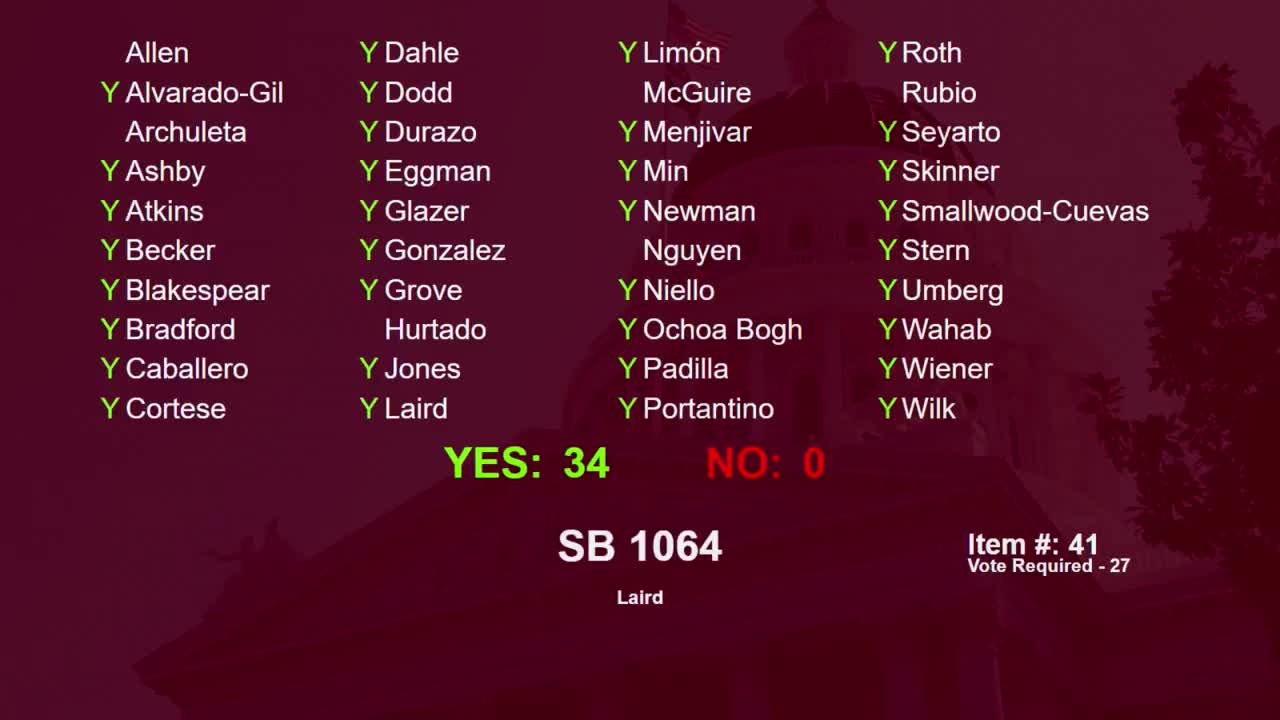 3MIN
Senate Floor
 26SEC
Senate Standing Committee on Appropriations
 12MIN
Senate Standing Committee on Labor, Public Employment and Retirement
Bill Author

Bill Co-Author(s):