SB 1216: Transportation projects: Class III bikeways: prohibition.
- Session Year: 2023-2024
- House: Senate
- Latest Version Date: 2024-09-27
Current Status:
Passed
(2024-09-27: Chaptered by Secretary of State. Chapter 788, Statutes of 2024.)
Introduced
In Committee
First Chamber
In Committee
Second Chamber
Enacted
(1)Existing law establishes 4 classifications of bikeways and defines a Class III bikeway as a bikeway that provides a right-of-way on-street or off-street, designated by signs or permanent markings and shared with pedestrians and motorists.
This bill would define sharrow as the pavement marking used to inform road users that bicyclists might occupy the travel lane. The bill would prohibit, on and after January 1, 2025, an agency responsible for the development or operation of bikeways or highways where bicycle travel is permitted from installing a new sharrow on a highway that has a posted speed limit greater than 30 miles per hour, except as specified.
(2)Existing law establishes the Active Transportation Program in the Department of Transportation for the purpose of encouraging increased use of active modes of transportation, such as biking and walking, with specified available funds to be allocated to eligible projects by the California Transportation Commission and regional transportation agencies through the adoption of a program of projects. Existing law requires the commission to develop guidelines regarding, among other topics, project eligibility and project selection for the program of projects, as provided.
This bill would prohibit, on and after January 1, 2026, the commission from adding a project that creates a Class III bikeway or a sharrow to the program of projects, except as specified. The bill would require the commission to make conforming changes to its guidelines regarding project eligibility and project selection for the program of projects, as specified.
(1)Existing law establishes 4 classifications of bikeways and defines a Class III bikeway as a bikeway that provides a right-of-way on-street or off-street, designated by signs or permanent markings and shared with pedestrians and motorists.
This bill would define sharrow as the pavement marking used to inform road users that bicyclists might occupy the travel lane. The bill would prohibit, on and after January 1, 2025, an agency responsible for the development or operation of bikeways or highways where bicycle travel is permitted from installing a new sharrow on a highway that has a posted speed limit greater than 30 miles per hour. hour, except as specified.
(2)Existing law establishes the Active Transportation Program in the Department of Transportation for the purpose of encouraging increased use of active modes of transportation, such as biking and walking, with specified available funds to be allocated to eligible projects by the California Transportation Commission and regional transportation agencies through the adoption of a program of projects. Existing law requires the commission to develop guidelines regarding, among other topics, project eligibility and project selection for the program of projects, as provided.
This bill would prohibit, on and after January 1, 2026, the commission from adding a project that creates a Class III bikeway or a sharrow to the program of projects, except as specified. The bill would require the commission to make conforming changes to its guidelines regarding project eligibility and project selection for the program of projects, as specified.
(1)Existing law establishes 4 classifications of bikeways and defines a Class III bikeway as a bikeway that provides a right-of-way on-street or off-street, designated by signs or permanent markings and shared with pedestrians and motorists.
This bill would define sharrow as the pavement marking used to inform road users that bicyclists might occupy the travel lane. The bill would prohibit, on and after January 1, 2025, an agency responsible for the development or operation of bikeways or highways where bicycle travel is permitted from installing or restriping a Class III bikeway or a sharrow on a highway that has a posted speed limit greater than 30 miles per hour.
(2)Existing law establishes the Active Transportation Program in the Department of Transportation for the purpose of encouraging increased use of active modes of transportation, such as biking and walking, with specified available funds to be allocated to eligible projects by the California Transportation Commission and regional transportation agencies through the adoption of a program of projects. Existing law requires the commission to develop guidelines regarding, among other topics, project eligibility and project selection for the program of projects, as provided.
This bill would prohibit, on and after January 1, 2026, the commission from adding a project that creates a Class III bikeway or a sharrow to the program of projects, unless the bikeway or sharrow is on a highway with a design speed limit of 25 miles per hour or less or the project will implement improvements to reduce the design speed limit to 25 miles per hour or less. except as specified. The bill would require the commission to make conforming changes to its guidelines regarding project eligibility and project selection for the program of projects, as specified.
(1)Existing law establishes 4 classifications of bikeways and defines a Class III bikeway as a bikeway that provide provides a right-of-way on-street or off-street, designated by signs or permanent markings and shared with pedestrians and motorists.
This bill would define sharrow as the pavement marking used to inform road users that bicyclists might occupy the travel lane. The bill would prohibit, on and after January 1, 2025, an agency responsible for the development or operation of bikeways or highways where bicycle travel is permitted from installing or restriping a Class III bikeway or restriping a Class III bikeway or a sharrow on a highway that has a posted speed limit greater than 30 miles per hour.
(2)Existing law establishes the Active Transportation Program in the Department of Transportation for the purpose of encouraging increased use of active modes of transportation, such as biking and walking, with specified available funds to be allocated to eligible projects by the California Transportation Commission and regional transportation agencies. agencies through the adoption of a program of projects. Existing law requires the commission to develop guidelines and project selection criteria for the program, as provided. Existing law requires the guidelines regarding project eligibility to include, among other guidelines, the development of new bikeways and walkways, or improvements to existing bikeways and walkways, that improve mobility, access, or safety for nonmotorized users. Existing law requires the guidelines regarding project selection to include, among other guidelines, increasing and improving connectivity and mobility of nonmotorized users. regarding, among other topics, project eligibility and project selection for the program of projects, as provided.
This bill would prohibit, on and after January 1, 2025, funds appropriated to the program from being allocated to a project that creates a Class III bikeway. The bill would prohibit, on and after January 1, 2025, the commissions guidelines with regard to project eligibility from including the development of Class III bikeways. The bill also would prohibit, on and after January 1, 2025, the commissions guidelines with regard to project selection from including the connection of a bikeway connecting to a Class III bikeway as increasing and improving connectivity and mobility of nonmotorized users.This bill would prohibit, on and after January 1, 2026, the commission from adding a project that creates a Class III bikeway or a sharrow to the program of projects, unless the bikeway or sharrow is on a highway with a design speed limit of 25 miles per hour or less or the project will implement improvements to reduce the design speed limit to 25 miles per hour or less. The bill would require the commission to make conforming changes to its guidelines regarding project eligibility and project selection for the program of projects, as specified.
(1)Existing law establishes 4 classifications of bikeways and defines a Class III bikeway as a bikeway that provide a right-of-way on-street or off-street, designated by signs or permanent markings and shared with pedestrians and motorists.
This bill would prohibit, on and after January 1, 2025, an agency responsible for the development or operation of bikeways or highways where bicycle travel is permitted from installing a Class III bikeway or restriping a Class III bikeway on a highway that has a posted speed limit greater than 30 miles per hour.
(2)Existing law establishes the Active Transportation Program in the Department of Transportation for the purpose of encouraging increased use of active modes of transportation, such as biking and walking, with specified available funds to be allocated to eligible projects by the California Transportation Commission and regional transportation agencies. Existing law requires the commission to develop guidelines and project selection criteria for the program, as provided. Existing law requires the guidelines regarding project eligibility to include, among other guidelines, the development of new bikeways and walkways, or improvements to existing bikeways and walkways, that improve mobility, access, or safety for nonmotorized users. Existing law requires the guidelines regarding project selection to include, among other guidelines, increasing and improving connectivity and mobility of nonmotorized users.
This bill would prohibit, on and after January 1, 2025, funds appropriated to the program from being allocated to a project that creates a Class III bikeway. The bill would prohibit, on and after January 1, 2025, the commissions guidelines with regard to project eligibility from including the development of Class III bikeways. The bill also would prohibit, on and after January 1, 2025, the commissions guidelines with regard to project selection from including the connection of a bikeway connecting to a Class III bikeway as increasing and improving connectivity and mobility of nonmotorized users.
(a)On and after January 1, 2025, an agency responsible for the development or operation of bikeways or highways where bicycle travel is permitted shall not install a new sharrow on a highway that has a posted speed limit greater than 30 miles per hour, except at or near an intersection for the purpose of connecting a Class I, Class II, or Class IV bikeway through the intersection.
(b)For purposes of this section, sharrow means the marking in Figure 9C-9 of the 2014 California Manual on Uniform Traffic Control Devices, Revision 8.
SEC. 2.Section 2382 of the Streets and Highways Code is amended to read:2382.(a)The California Transportation Commission shall develop guidelines and project selection criteria for the Active Transportation Program in consultation with the Active Transportation Program Workgroup, which shall be formed for purposes of providing guidance on matters including, but not limited to, development of and subsequent revisions to program guidelines, schedules and procedures, project selection criteria, performance measures, and program evaluation. The workgroup shall include, but not be limited to, representatives of government agencies and active transportation stakeholder organizations with expertise in pedestrian and bicycle issues, including Safe Routes to School programs.
(b)The guidelines shall be the complete and full statement of the policies and criteria that the commission intends to use in selecting projects to be included in the program. The guidelines shall address subjects that include, but are not limited to, project eligibility, application timelines, application rating and ranking criteria, project monitoring, reporting, and transparency, and project performance measurement.
(c)The guidelines shall include a process to ensure that no less than 25 percent of overall program funds benefit disadvantaged communities during each program cycle. The guidelines shall establish a program definition for disadvantaged communities that may include, but need not be limited to, the definition in Section 39711 of the Health and Safety Code and the definition of low-income schools in paragraph (7) of subdivision (b) of former Section 2333.5, as that section read on January 1, 2013. A project eligible under this subdivision shall clearly demonstrate a benefit to a disadvantaged community or be directly located in a disadvantaged community.
(d)The guidelines shall allow streamlining of project delivery by authorizing an implementing agency to seek commission approval of a letter of no prejudice that will allow the agency to expend its own funds for a project programmed in a future year of the adopted program of projects, in advance of allocation of funds to the project by the commission, and to be reimbursed at a later time for eligible expenditures.
(e)The California Transportation Commission shall adopt the guidelines and selection criteria for, and define the types of projects eligible to be funded through, the program following at least two public hearings. Projects funded in this program shall be limited to active transportation projects. The guidelines shall ensure that eligible projects meet one or more of the goals set forth in Section 2380 and may give increased weight to projects meeting multiple goals.
(f)In developing the guidelines with regard to project eligibility, the commission shall include, but need not be limited to, the following project types:
(1)Development of new bikeways and walkways, or improvements to existing bikeways and walkways, that improve mobility, access, or safety for nonmotorized users. On and after January 1, 2026, the guidelines with regard to project eligibility shall not include the development of Class III bikeways, as described in Section 890.4, or the marking in Figure 9C-9 of the 2014 California Manual on Uniform Traffic Control Devices, Revision 8, unless any of the following apply:
(A)The Class III bikeway or marking is on a highway with a design speed limit of 25 miles per hour or less.
(B)The project will implement improvements to reduce the design speed limit to 25 miles per hour or less.
(C)The project applicant demonstrates that the use of the Class III bikeway or marking is appropriate for the local community context and advances a lower stress environment or a low-stress network.
(2)Secure bicycle parking at employment centers, park and ride lots, rail and transit stations, and ferry docks and landings.
(3)Bicycle-carrying facilities on public transit, including rail and ferries.
(4)Installation of traffic control devices to improve the safety of pedestrians and bicyclists.
(5)Elimination of hazardous conditions on existing bikeways and walkways.
(6)Maintenance of bikeways and walkways.
(7)Recreational trails and trailheads, park projects that facilitate trail linkages or connectivity to nonmotorized corridors, and conversion of abandoned railroad corridors to trails.
(8)Safe Routes to School projects that improve the safety of children walking and bicycling to school, in accordance with Section 1404 of Public Law 109-59.
(9)Safe routes to transit projects, which will encourage transit by improving biking and walking routes to mass transportation facilities and schoolbus stops.
(10)Educational programs to increase biking and walking, and other noninfrastructure investments that demonstrate effectiveness in increasing active transportation.
(g)In developing the guidelines with regard to project selection, the commission shall include, but need not be limited to, the following criteria:
(1)Demonstrated needs of the applicant.
(2)Potential for reducing pedestrian and bicyclist injuries and fatalities.
(3)Potential for encouraging increased walking and bicycling, especially among students.
(4)Identification of safety hazards for pedestrians and bicyclists.
(5)Identification of walking and bicycling routes to and from schools, transit facilities, and community centers.
(6)Identification of the local public participation process that culminated in the project proposal, which may include noticed public meetings and consultation with local stakeholders.
(7)Benefit to disadvantaged communities. In developing guidelines relative to this paragraph, the commission shall consider, but need not be limited to, the definition of disadvantaged communities as applied pursuant to subdivision (c).
(8)Cost-effectiveness, defined as maximizing the impact of the funds provided.
(9)The adoption by a city or county applicant of a bicycle transportation plan, pursuant to Section 891.2, a pedestrian plan, a safe routes to school plan, or an overall active transportation plan.
(10)Use of the California Conservation Corps or a qualified community conservation corps, as defined in Section 14507.5 of the Public Resources Code, as partners to undertake or construct applicable projects in accordance with Section 1524 of Public Law 112-141.
(11)Other factors, such as potential for reducing congestion, improving air quality, reducing greenhouse gas emissions, and increasing and improving connectivity and mobility of nonmotorized users. On and after January 1, 2026, increasing or improving connectivity of nonmotorized users shall not include the addition of a bikeway connecting to a Class III bikeway, as described in Section 890.4, or the marking in Figure 9C-9 of the 2014 California Manual on Uniform Traffic Control Devices, Revision 8, unless the bikeway or marking is on a highway with a design speed limit of 25 miles per hour or less or the project will implement improvements to reduce the design speed limit to 25 miles per hour or less.
(h)For the use of federal Transportation Alternative Program funds, or other federal funds, commission guidelines shall meet all applicable federal requirements.
(i)For the use of federal Highway Safety Improvement Program funds for active transportation projects specific to reducing fatalities and serious injuries, the criteria for the selection of projects shall be based on a data-driven process that is aligned with the states Strategic Highway Safety Plan.
(j)The guidelines may include incentives intended to maximize the potential for attracting funds other than program funds for eligible projects.
(k)In reviewing and selecting projects funded by federal funds in the Recreational Trails Program, the commission shall collaborate with the Department of Parks and Recreation to evaluate proposed projects, and to ensure federal requirements are met.
(l)To ensure that regional agencies charged with allocating funds to projects pursuant to paragraph (1) of subdivision (a) of Section 2381 have sufficient discretion to develop regional guidelines, the commission may adopt separate guidelines for the state and for the regional agencies relative to subdivision (g).
SEC. 3.Section 2384 of the Streets and Highways Code is amended to read:2384.(a)The commission shall adopt a program of projects to receive allocations under this chapter. The guidelines for an initial two-year program of projects shall be adopted within six months of the enactment of the act enacting this section. The commission shall adopt each program by no later than July 1 of each odd-numbered year, but may alternatively elect to adopt a program annually. Each subsequent program shall cover a period of four fiscal years, beginning July 1 of the year of adoption, and shall be a statement of intent by the commission for the allocation or expenditure of funds during those four fiscal years. The commission shall form a multidisciplinary advisory group to assist it in evaluating project applications.
(b)On and after January 1, 2026, the program of projects shall not add a project that creates a Class III bikeway, as described in Section 890.4, or the marking in Figure 9C-9 of the 2014 California Manual on Uniform Traffic Control Devices, Revision 8, unless any of the following apply:
(1)The Class III bikeway or marking is on a highway with a design speed limit of 25 miles per hour or less.
(2)The project will implement improvements to reduce the design speed limit to 25 miles per hour or less.
(3)The project applicant demonstrates that the use of the Class III bikeway or marking is appropriate for the local community context and advances a lower stress environment or a low-stress network.
(a)On and after January 1, 2025, an agency responsible for the development or operation of bikeways or highways where bicycle travel is permitted shall not install a new sharrow on a highway that has a posted speed limit greater than 30 miles per hour. hour, except at or near an intersection for the purpose of connecting a Class I, Class II, or Class IV bikeway through the intersection.
(b)For purposes of this section, sharrow means the marking in Figure 9C-9 of the 2014 California Manual on Uniform Traffic Control Devices, Revision 8.
SEC. 2.Section 2382 of the Streets and Highways Code is amended to read:2382.(a)The California Transportation Commission shall develop guidelines and project selection criteria for the Active Transportation Program in consultation with the Active Transportation Program Workgroup, which shall be formed for purposes of providing guidance on matters including, but not limited to, development of and subsequent revisions to program guidelines, schedules and procedures, project selection criteria, performance measures, and program evaluation. The workgroup shall include, but not be limited to, representatives of government agencies and active transportation stakeholder organizations with expertise in pedestrian and bicycle issues, including Safe Routes to School programs.
(b)The guidelines shall be the complete and full statement of the policies and criteria that the commission intends to use in selecting projects to be included in the program. The guidelines shall address subjects that include, but are not limited to, project eligibility, application timelines, application rating and ranking criteria, project monitoring, reporting, and transparency, and project performance measurement.
(c)The guidelines shall include a process to ensure that no less than 25 percent of overall program funds benefit disadvantaged communities during each program cycle. The guidelines shall establish a program definition for disadvantaged communities that may include, but need not be limited to, the definition in Section 39711 of the Health and Safety Code and the definition of low-income schools in paragraph (7) of subdivision (b) of former Section 2333.5, as that section read on January 1, 2013. A project eligible under this subdivision shall clearly demonstrate a benefit to a disadvantaged community or be directly located in a disadvantaged community.
(d)The guidelines shall allow streamlining of project delivery by authorizing an implementing agency to seek commission approval of a letter of no prejudice that will allow the agency to expend its own funds for a project programmed in a future year of the adopted program of projects, in advance of allocation of funds to the project by the commission, and to be reimbursed at a later time for eligible expenditures.
(e)The California Transportation Commission shall adopt the guidelines and selection criteria for, and define the types of projects eligible to be funded through, the program following at least two public hearings. Projects funded in this program shall be limited to active transportation projects. The guidelines shall ensure that eligible projects meet one or more of the goals set forth in Section 2380 and may give increased weight to projects meeting multiple goals.
(f)In developing the guidelines with regard to project eligibility, the commission shall include, but need not be limited to, the following project types:
(1)Development of new bikeways and walkways, or improvements to existing bikeways and walkways, that improve mobility, access, or safety for nonmotorized users. On and after January 1, 2026, the guidelines with regard to project eligibility shall not include the development of Class III bikeways, as described in Section 890.4, or the marking in Figure 9C-9 of the 2014 California Manual on Uniform Traffic Control Devices, Revision 8, unless any of the following apply:
(A)The Class III bikeway or marking is on a highway with a design speed limit of 25 miles per hour or less.
(B)The project will implement improvements to reduce the design speed limit to 25 miles per hour or less.
(C)The project applicant demonstrates that the use of the Class III bikeway or marking is appropriate for the local community context and advances a lower stress environment or a low-stress network.
(2)Secure bicycle parking at employment centers, park and ride lots, rail and transit stations, and ferry docks and landings.
(3)Bicycle-carrying facilities on public transit, including rail and ferries.
(4)Installation of traffic control devices to improve the safety of pedestrians and bicyclists.
(5)Elimination of hazardous conditions on existing bikeways and walkways.
(6)Maintenance of bikeways and walkways.
(7)Recreational trails and trailheads, park projects that facilitate trail linkages or connectivity to nonmotorized corridors, and conversion of abandoned railroad corridors to trails.
(8)Safe Routes to School projects that improve the safety of children walking and bicycling to school, in accordance with Section 1404 of Public Law 109-59.
(9)Safe routes to transit projects, which will encourage transit by improving biking and walking routes to mass transportation facilities and schoolbus stops.
(10)Educational programs to increase biking and walking, and other noninfrastructure investments that demonstrate effectiveness in increasing active transportation.
(g)In developing the guidelines with regard to project selection, the commission shall include, but need not be limited to, the following criteria:
(1)Demonstrated needs of the applicant.
(2)Potential for reducing pedestrian and bicyclist injuries and fatalities.
(3)Potential for encouraging increased walking and bicycling, especially among students.
(4)Identification of safety hazards for pedestrians and bicyclists.
(5)Identification of walking and bicycling routes to and from schools, transit facilities, and community centers.
(6)Identification of the local public participation process that culminated in the project proposal, which may include noticed public meetings and consultation with local stakeholders.
(7)Benefit to disadvantaged communities. In developing guidelines relative to this paragraph, the commission shall consider, but need not be limited to, the definition of disadvantaged communities as applied pursuant to subdivision (c).
(8)Cost-effectiveness, defined as maximizing the impact of the funds provided.
(9)The adoption by a city or county applicant of a bicycle transportation plan, pursuant to Section 891.2, a pedestrian plan, a safe routes to school plan, or an overall active transportation plan.
(10)Use of the California Conservation Corps or a qualified community conservation corps, as defined in Section 14507.5 of the Public Resources Code, as partners to undertake or construct applicable projects in accordance with Section 1524 of Public Law 112-141.
(11)Other factors, such as potential for reducing congestion, improving air quality, reducing greenhouse gas emissions, and increasing and improving connectivity and mobility of nonmotorized users. On and after January 1, 2026, increasing or improving connectivity of nonmotorized users shall not include the addition of a bikeway connecting to a Class III bikeway, as described in Section 890.4, or the marking in Figure 9C-9 of the 2014 California Manual on Uniform Traffic Control Devices, Revision 8, unless the bikeway or marking is on a highway with a design speed limit of 25 miles per hour or less or the project will implement improvements to reduce the design speed limit to 25 miles per hour or less.
(h)For the use of federal Transportation Alternative Program funds, or other federal funds, commission guidelines shall meet all applicable federal requirements.
(i)For the use of federal Highway Safety Improvement Program funds for active transportation projects specific to reducing fatalities and serious injuries, the criteria for the selection of projects shall be based on a data-driven process that is aligned with the states Strategic Highway Safety Plan.
(j)The guidelines may include incentives intended to maximize the potential for attracting funds other than program funds for eligible projects.
(k)In reviewing and selecting projects funded by federal funds in the Recreational Trails Program, the commission shall collaborate with the Department of Parks and Recreation to evaluate proposed projects, and to ensure federal requirements are met.
(l)To ensure that regional agencies charged with allocating funds to projects pursuant to paragraph (1) of subdivision (a) of Section 2381 have sufficient discretion to develop regional guidelines, the commission may adopt separate guidelines for the state and for the regional agencies relative to subdivision (g).
SEC. 3.Section 2384 of the Streets and Highways Code is amended to read:2384.(a)The commission shall adopt a program of projects to receive allocations under this chapter. The guidelines for an initial two-year program of projects shall be adopted within six months of the enactment of the act enacting this section. The commission shall adopt each program by no later than July 1 of each odd-numbered year, but may alternatively elect to adopt a program annually. Each subsequent program shall cover a period of four fiscal years, beginning July 1 of the year of adoption, and shall be a statement of intent by the commission for the allocation or expenditure of funds during those four fiscal years. The commission shall form a multidisciplinary advisory group to assist it in evaluating project applications.
(b)On and after January 1, 2026, the program of projects shall not add a project that creates a Class III bikeway, as described in Section 890.4, or the marking in Figure 9C-9 of the 2014 California Manual on Uniform Traffic Control Devices, Revision 8, unless any of the following apply:
(1)The Class III bikeway or marking is on a highway with a design speed limit of 25 miles per hour or less.
(2)The project will implement improvements to reduce the design speed limit to 25 miles per hour or less.
(3)The project applicant demonstrates that the use of the Class III bikeway or marking is appropriate for the local community context and advances a lower stress environment or a low-stress network.
(a)(1)On and after January 1, 2025, an agency responsible for the development or operation of bikeways or highways where bicycle travel is permitted shall not install or restripe a Class III bikeway or a sharrow on a highway that has a posted speed limit greater than 30 miles per hour.
(2)(b)For purpose purposes of this subdivision, section, sharrow means the marking in Figure 9C-9 of the 2014 California Manual on Uniform Traffic Control Devices, Revision 8.
(b)This section does not prohibit the installation of sign R4-11, as depicted in Figure 9B-2 of the 2014 California Manual on Uniform Traffic Control Devices, Revision 8, if the sign is not considered part of a Class III bikeway for the purposes of evaluating bicycle or complete streets goals and targets by the department or the installing agency.SEC. 2.Section 2382 of the Streets and Highways Code is amended to read:2382.(a)The California Transportation Commission shall develop guidelines and project selection criteria for the Active Transportation Program in consultation with the Active Transportation Program Workgroup, which shall be formed for purposes of providing guidance on matters including, but not limited to, development of and subsequent revisions to program guidelines, schedules and procedures, project selection criteria, performance measures, and program evaluation. The workgroup shall include, but not be limited to, representatives of government agencies and active transportation stakeholder organizations with expertise in pedestrian and bicycle issues, including Safe Routes to School programs.
(b)The guidelines shall be the complete and full statement of the policies and criteria that the commission intends to use in selecting projects to be included in the program. The guidelines shall address subjects that include, but are not limited to, project eligibility, application timelines, application rating and ranking criteria, project monitoring, reporting, and transparency, and project performance measurement.
(c)The guidelines shall include a process to ensure that no less than 25 percent of overall program funds benefit disadvantaged communities during each program cycle. The guidelines shall establish a program definition for disadvantaged communities that may include, but need not be limited to, the definition in Section 39711 of the Health and Safety Code and the definition of low-income schools in paragraph (7) of subdivision (b) of former Section 2333.5, as that section read on January 1, 2013. A project eligible under this subdivision shall clearly demonstrate a benefit to a disadvantaged community or be directly located in a disadvantaged community.
(d)The guidelines shall allow streamlining of project delivery by authorizing an implementing agency to seek commission approval of a letter of no prejudice that will allow the agency to expend its own funds for a project programmed in a future year of the adopted program of projects, in advance of allocation of funds to the project by the commission, and to be reimbursed at a later time for eligible expenditures.
(e)The California Transportation Commission shall adopt the guidelines and selection criteria for, and define the types of projects eligible to be funded through, the program following at least two public hearings. Projects funded in this program shall be limited to active transportation projects. The guidelines shall ensure that eligible projects meet one or more of the goals set forth in Section 2380 and may give increased weight to projects meeting multiple goals.
(f)In developing the guidelines with regard to project eligibility, the commission shall include, but need not be limited to, the following project types:
(1)Development of new bikeways and walkways, or improvements to existing bikeways and walkways, that improve mobility, access, or safety for nonmotorized users. On and after January 1, 2026, the guidelines with regard to project eligibility shall not include the development of Class III bikeways, as described in Section 890.4, or the marking in Figure 9C-9 of the 2014 California Manual on Uniform Traffic Control Devices, Revision 8, unless the any of the following apply:
(A)The Class III bikeway or marking is on a highway with a design speed limit of 25 miles per hour or less or the less.
(B)The project will implement improvements to reduce the design speed limit to 25 miles per hour or less.
(C)The project applicant demonstrates that the use of the Class III bikeway or marking is appropriate for the local community context and advances a lower stress environment or a low-stress network.
(2)Secure bicycle parking at employment centers, park and ride lots, rail and transit stations, and ferry docks and landings.
(3)Bicycle-carrying facilities on public transit, including rail and ferries.
(4)Installation of traffic control devices to improve the safety of pedestrians and bicyclists.
(5)Elimination of hazardous conditions on existing bikeways and walkways.
(6)Maintenance of bikeways and walkways.
(7)Recreational trails and trailheads, park projects that facilitate trail linkages or connectivity to nonmotorized corridors, and conversion of abandoned railroad corridors to trails.
(8)Safe Routes to School projects that improve the safety of children walking and bicycling to school, in accordance with Section 1404 of Public Law 109-59.
(9)Safe routes to transit projects, which will encourage transit by improving biking and walking routes to mass transportation facilities and schoolbus stops.
(10)Educational programs to increase biking and walking, and other noninfrastructure investments that demonstrate effectiveness in increasing active transportation.
(g)In developing the guidelines with regard to project selection, the commission shall include, but need not be limited to, the following criteria:
(1)Demonstrated needs of the applicant.
(2)Potential for reducing pedestrian and bicyclist injuries and fatalities.
(3)Potential for encouraging increased walking and bicycling, especially among students.
(4)Identification of safety hazards for pedestrians and bicyclists.
(5)Identification of walking and bicycling routes to and from schools, transit facilities, and community centers.
(6)Identification of the local public participation process that culminated in the project proposal, which may include noticed public meetings and consultation with local stakeholders.
(7)Benefit to disadvantaged communities. In developing guidelines relative to this paragraph, the commission shall consider, but need not be limited to, the definition of disadvantaged communities as applied pursuant to subdivision (c).
(8)Cost-effectiveness, defined as maximizing the impact of the funds provided.
(9)The adoption by a city or county applicant of a bicycle transportation plan, pursuant to Section 891.2, a pedestrian plan, a safe routes to school plan, or an overall active transportation plan.
(10)Use of the California Conservation Corps or a qualified community conservation corps, as defined in Section 14507.5 of the Public Resources Code, as partners to undertake or construct applicable projects in accordance with Section 1524 of Public Law 112-141.
(11)Other factors, such as potential for reducing congestion, improving air quality, reducing greenhouse gas emissions, and increasing and improving connectivity and mobility of nonmotorized users. On and after January 1, 2026, increasing or improving connectivity of nonmotorized users shall not include the addition of a bikeway connecting to a Class III bikeway, as described in Section 890.4, or the marking in Figure 9C-9 of the 2014 California Manual on Uniform Traffic Control Devices, Revision 8, unless the bikeway or marking is on a highway with a design speed limit of 25 miles per hour or less or the project will implement improvements to reduce the design speed limit to 25 miles per hour or less.
(h)For the use of federal Transportation Alternative Program funds, or other federal funds, commission guidelines shall meet all applicable federal requirements.
(i)For the use of federal Highway Safety Improvement Program funds for active transportation projects specific to reducing fatalities and serious injuries, the criteria for the selection of projects shall be based on a data-driven process that is aligned with the states Strategic Highway Safety Plan.
(j)The guidelines may include incentives intended to maximize the potential for attracting funds other than program funds for eligible projects.
(k)In reviewing and selecting projects funded by federal funds in the Recreational Trails Program, the commission shall collaborate with the Department of Parks and Recreation to evaluate proposed projects, and to ensure federal requirements are met.
(l)To ensure that regional agencies charged with allocating funds to projects pursuant to paragraph (1) of subdivision (a) of Section 2381 have sufficient discretion to develop regional guidelines, the commission may adopt separate guidelines for the state and for the regional agencies relative to subdivision (g).
SEC. 3.Section 2384 of the Streets and Highways Code is amended to read:2384.(a)The commission shall adopt a program of projects to receive allocations under this chapter. The guidelines for an initial two-year program of projects shall be adopted within six months of the enactment of the act enacting this section. The commission shall adopt each program by no later than July 1 of each odd-numbered year, but may alternatively elect to adopt a program annually. Each subsequent program shall cover a period of four fiscal years, beginning July 1 of the year of adoption, and shall be a statement of intent by the commission for the allocation or expenditure of funds during those four fiscal years. The commission shall form a multidisciplinary advisory group to assist it in evaluating project applications.
(b)On and after January 1, 2026, the program of projects shall not add a project that creates a Class III bikeway, as described in Section 890.4, or the marking in Figure 9C-9 of the 2014 California Manual on Uniform Traffic Control Devices, Revision 8, unless the any of the following apply:
(1)The Class III bikeway or marking is on a highway with a design speed limit of 25 miles per hour or less or the less.
(2)The project will implement improvements to reduce the design speed limit to 25 miles per hour or less.
(3)The project applicant demonstrates that the use of the Class III bikeway or marking is appropriate for the local community context and advances a lower stress environment or a low-stress network.
(a)(1)On and after January 1, 2025, an agency responsible for the development or operation of bikeways or highways where bicycle travel is permitted shall not install or restripe a Class III bikeway or restripe a Class III bikeway or a sharrow on a highway that has a posted speed limit greater than 30 miles per hour.
(2)For purpose of this subdivision, sharrow means the marking in Figure 9C-9 of the 2014 California Manual on Uniform Traffic Control Devices, Revision 8.
(b)This section does not prohibit the installation of sign R4-11, as depicted in Figure 9B-2 of the 2014 California Manual on Uniform Traffic Control Devices, Revision 8, if the sign is not considered part of a Class III bikeway for the purposes of evaluating bicycle or complete streets goals and targets by the department or the installing agency.
SEC. 2.Section 2381 of the Streets and Highways Code is amended to read:2381.(a)The Active Transportation Program shall be funded by state and federal funds from appropriations in the annual Budget Act. Funds for the program shall be appropriated to the department, for allocation by the commission. The amount to be appropriated shall include 100 percent of the federal Transportation Alternative Program funds described in Section 133(h) of Title 23 of the United States Code, except for any federal funds for recreational trails projects described in Section 133(h)(5) of Title 23 of the United States Code appropriated to the Department of Parks and Recreation; twenty-one million dollars ($21,000,000) of federal Highway Safety Improvement funds or other federal funds; and State Highway Account funds. Future funding may be augmented if state or federal funds increase, or if other funding sources are identified. Funds appropriated for the Active Transportation Program shall be distributed as follows:(1)Forty percent to metropolitan planning organizations in urban areas with populations greater than 200,000, in proportion to their relative share of population. Funds allocated under this paragraph shall be obligated for eligible projects selected through a competitive process by the metropolitan planning organizations in consultation with the department and the commission and in accordance with guidelines established pursuant to this chapter.(2)Ten percent to small urban and rural regions with populations of 200,000 or less, with projects competitively awarded by the commission to projects in those regions.(3)Fifty percent to projects competitively awarded by the commission on a statewide basis.(b)For the purpose of paragraph (1) of subdivision (a), the following shall apply in the region served by the multicounty designated transportation planning agency described in Section 130004 of the Public Utilities Code:(1)The multicounty designated transportation planning agency shall consult with the county transportation commissions created pursuant to Sections 130050, 130050.1, and 132800 of the Public Utilities Code, the commission, and the department in the development of competitive selection criteria to be adopted by the multicounty designated transportation planning agency, which should include consideration of geographic equity, consistent with program objectives.(2)The multicounty designated transportation planning agency shall place priority on projects that are consistent with plans adopted by local and regional governments within the county where the project is located.(3)The multicounty designated transportation planning agency shall obtain concurrence from the county transportation commissions, adopt the projects selected in a comprehensive program of projects, and make funds available to selected project recipients.(c)On and after January 1, 2025, funds appropriated for the Active Transportation Program shall not be allocated to a project that creates a Class III bikeway, as described in Section 890.4.(d)The Legislature finds and declares that the program described in this chapter constitutes a highway purpose under Article XIX of the California Constitution and justifies the expenditure of highway funds therefor, and all expenditures of Article XIX funds under this program shall be consistent with Article XIX.SEC. 3.SEC. 2.Section 2382 of the Streets and Highways Code is amended to read:2382.(a)The California Transportation Commission shall develop guidelines and project selection criteria for the Active Transportation Program in consultation with the Active Transportation Program Workgroup, which shall be formed for purposes of providing guidance on matters including, but not limited to, development of and subsequent revisions to program guidelines, schedules and procedures, project selection criteria, performance measures, and program evaluation. The workgroup shall include, but not be limited to, representatives of government agencies and active transportation stakeholder organizations with expertise in pedestrian and bicycle issues, including Safe Routes to School programs.
(b)The guidelines shall be the complete and full statement of the policies and criteria that the commission intends to use in selecting projects to be included in the program. The guidelines shall address subjects that include, but are not limited to, project eligibility, application timelines, application rating and ranking criteria, project monitoring, reporting, and transparency, and project performance measurement.
(c)The guidelines shall include a process to ensure that no less than 25 percent of overall program funds benefit disadvantaged communities during each program cycle. The guidelines shall establish a program definition for disadvantaged communities that may include, but need not be limited to, the definition in Section 39711 of the Health and Safety Code and the definition of low-income schools in paragraph (7) of subdivision (b) of former Section 2333.5, as that section read on January 1, 2013. A project eligible under this subdivision shall clearly demonstrate a benefit to a disadvantaged community or be directly located in a disadvantaged community.
(d)The guidelines shall allow streamlining of project delivery by authorizing an implementing agency to seek commission approval of a letter of no prejudice that will allow the agency to expend its own funds for a project programmed in a future year of the adopted program of projects, in advance of allocation of funds to the project by the commission, and to be reimbursed at a later time for eligible expenditures.
(e)The California Transportation Commission shall adopt the guidelines and selection criteria for, and define the types of projects eligible to be funded through, the program following at least two public hearings. Projects funded in this program shall be limited to active transportation projects. The guidelines shall ensure that eligible projects meet one or more of the goals set forth in Section 2380 and may give increased weight to projects meeting multiple goals.
(f)In developing the guidelines with regard to project eligibility, the commission shall include, but need not be limited to, the following project types:
(1)Development of new bikeways and walkways, or improvements to existing bikeways and walkways, that improve mobility, access, or safety for nonmotorized users. On and after January 1, 2025, 2026, the guidelines with regard to project eligibility shall not include the development of Class III bikeways, as described in Section 890.4. 890.4, or the marking in Figure 9C-9 of the 2014 California Manual on Uniform Traffic Control Devices, Revision 8, unless the bikeway or marking is on a highway with a design speed limit of 25 miles per hour or less or the project will implement improvements to reduce the design speed limit to 25 miles per hour or less.
(2)Secure bicycle parking at employment centers, park and ride lots, rail and transit stations, and ferry docks and landings.
(3)Bicycle-carrying facilities on public transit, including rail and ferries.
(4)Installation of traffic control devices to improve the safety of pedestrians and bicyclists.
(5)Elimination of hazardous conditions on existing bikeways and walkways.
(6)Maintenance of bikeways and walkways.
(7)Recreational trails and trailheads, park projects that facilitate trail linkages or connectivity to nonmotorized corridors, and conversion of abandoned railroad corridors to trails.
(8)Safe Routes to School projects that improve the safety of children walking and bicycling to school, in accordance with Section 1404 of Public Law 109-59.
(9)Safe routes to transit projects, which will encourage transit by improving biking and walking routes to mass transportation facilities and schoolbus stops.
(10)Educational programs to increase biking and walking, and other noninfrastructure investments that demonstrate effectiveness in increasing active transportation.
(g)In developing the guidelines with regard to project selection, the commission shall include, but need not be limited to, the following criteria:
(1)Demonstrated needs of the applicant.
(2)Potential for reducing pedestrian and bicyclist injuries and fatalities.
(3)Potential for encouraging increased walking and bicycling, especially among students.
(4)Identification of safety hazards for pedestrians and bicyclists.
(5)Identification of walking and bicycling routes to and from schools, transit facilities, and community centers.
(6)Identification of the local public participation process that culminated in the project proposal, which may include noticed public meetings and consultation with local stakeholders.
(7)Benefit to disadvantaged communities. In developing guidelines relative to this paragraph, the commission shall consider, but need not be limited to, the definition of disadvantaged communities as applied pursuant to subdivision (c).
(8)Cost-effectiveness, defined as maximizing the impact of the funds provided.
(9)The adoption by a city or county applicant of a bicycle transportation plan, pursuant to Section 891.2, a pedestrian plan, a safe routes to school plan, or an overall active transportation plan.
(10)Use of the California Conservation Corps or a qualified community conservation corps, as defined in Section 14507.5 of the Public Resources Code, as partners to undertake or construct applicable projects in accordance with Section 1524 of Public Law 112-141.
(11)Other factors, such as potential for reducing congestion, improving air quality, reducing greenhouse gas emissions, and increasing and improving connectivity and mobility of nonmotorized users. On and after January 1, 2025, 2026, increasing or improving connectivity of nonmotorized users shall not include the addition of a bikeway connecting to a Class III bikeway, as described in Section 890.4. 890.4, or the marking in Figure 9C-9 of the 2014 California Manual on Uniform Traffic Control Devices, Revision 8, unless the bikeway or marking is on a highway with a design speed limit of 25 miles per hour or less or the project will implement improvements to reduce the design speed limit to 25 miles per hour or less.
(h)For the use of federal Transportation Alternative Program funds, or other federal funds, commission guidelines shall meet all applicable federal requirements.
(i)For the use of federal Highway Safety Improvement Program funds for active transportation projects specific to reducing fatalities and serious injuries, the criteria for the selection of projects shall be based on a data-driven process that is aligned with the states Strategic Highway Safety Plan.
(j)The guidelines may include incentives intended to maximize the potential for attracting funds other than program funds for eligible projects.
(k)In reviewing and selecting projects funded by federal funds in the Recreational Trails Program, the commission shall collaborate with the Department of Parks and Recreation to evaluate proposed projects, and to ensure federal requirements are met.
(l)To ensure that regional agencies charged with allocating funds to projects pursuant to paragraph (1) of subdivision (a) of Section 2381 have sufficient discretion to develop regional guidelines, the commission may adopt separate guidelines for the state and for the regional agencies relative to subdivision (g).
SEC. 3.Section 2384 of the Streets and Highways Code is amended to read:2384.(a)The commission shall adopt a program of projects to receive allocations under this chapter. The guidelines for an initial two-year program of projects shall be adopted within six months of the enactment of the act enacting this section. The commission shall adopt each program by no later than July 1 of each odd-numbered year, but may alternatively elect to adopt a program annually. Each subsequent program shall cover a period of four fiscal years, beginning July 1 of the year of adoption, and shall be a statement of intent by the commission for the allocation or expenditure of funds during those four fiscal years. The commission shall form a multidisciplinary advisory group to assist it in evaluating project applications.
(b)On and after January 1, 2026, the program of projects shall not add a project that creates a Class III bikeway, as described in Section 890.4, or the marking in Figure 9C-9 of the 2014 California Manual on Uniform Traffic Control Devices, Revision 8, unless the bikeway or marking is on a highway with a design speed limit of 25 miles per hour or less or the project will implement improvements to reduce the design speed limit to 25 miles per hour or less.
On and after January 1, 2025, an agency responsible for the development or operation of bikeways or highways where bicycle travel is permitted shall not install a Class III bikeway or restripe a Class III bikeway on a highway that has a posted speed limit greater than 30 miles per hour.
SEC. 2.Section 2381 of the Streets and Highways Code is amended to read:2381.(a)The Active Transportation Program shall be funded by state and federal funds from appropriations in the annual Budget Act. Funds for the program shall be appropriated to the department, for allocation by the commission. The amount to be appropriated shall include 100 percent of the federal Transportation Alternative Program funds described in Section 133(h) of Title 23 of the United States Code, except for any federal funds for recreational trails projects described in Section 133(h)(5) of Title 23 of the United States Code appropriated to the Department of Parks and Recreation; twenty-one million dollars ($21,000,000) of federal Highway Safety Improvement funds or other federal funds; and State Highway Account funds. Future funding may be augmented if state or federal funds increase, or if other funding sources are identified. Funds appropriated for the Active Transportation Program shall be distributed as follows:
(1)Forty percent to metropolitan planning organizations in urban areas with populations greater than 200,000, in proportion to their relative share of population. Funds allocated under this paragraph shall be obligated for eligible projects selected through a competitive process by the metropolitan planning organizations in consultation with the department and the commission and in accordance with guidelines established pursuant to this chapter.
(2)Ten percent to small urban and rural regions with populations of 200,000 or less, with projects competitively awarded by the commission to projects in those regions.
(3)Fifty percent to projects competitively awarded by the commission on a statewide basis.
(b)For the purpose of paragraph (1) of subdivision (a), the following shall apply in the region served by the multicounty designated transportation planning agency described in Section 130004 of the Public Utilities Code:
(1)The multicounty designated transportation planning agency shall consult with the county transportation commissions created pursuant to Sections 130050, 130050.1, and 132800 of the Public Utilities Code, the commission, and the department in the development of competitive selection criteria to be adopted by the multicounty designated transportation planning agency, which should include consideration of geographic equity, consistent with program objectives.
(2)The multicounty designated transportation planning agency shall place priority on projects that are consistent with plans adopted by local and regional governments within the county where the project is located.
(3)The multicounty designated transportation planning agency shall obtain concurrence from the county transportation commissions, adopt the projects selected in a comprehensive program of projects, and make funds available to selected project recipients.
(c)On and after January 1, 2025, funds appropriated for the Active Transportation Program shall not be allocated to a project that creates a Class III bikeway, as described in Section 890.4.
(c)(d)The Legislature finds and declares that the program described in this chapter constitutes a highway purpose under Article XIX of the California Constitution and justifies the expenditure of highway funds therefor, and all expenditures of Article XIX funds under this program shall be consistent with Article XIX.
SEC. 3.Section 2382 of the Streets and Highways Code is amended to read:2382.(a)The California Transportation Commission shall develop guidelines and project selection criteria for the Active Transportation Program in consultation with the Active Transportation Program Workgroup, which shall be formed for purposes of providing guidance on matters including, but not limited to, development of and subsequent revisions to program guidelines, schedules and procedures, project selection criteria, performance measures, and program evaluation. The workgroup shall include, but not be limited to, representatives of government agencies and active transportation stakeholder organizations with expertise in pedestrian and bicycle issues, including Safe Routes to School programs.
(b)The guidelines shall be the complete and full statement of the policies and criteria that the commission intends to use in selecting projects to be included in the program. The guidelines shall address subjects that include, but are not limited to, project eligibility, application timelines, application rating and ranking criteria, project monitoring, reporting, and transparency, and project performance measurement.
(c)The guidelines shall include a process to ensure that no less than 25 percent of overall program funds benefit disadvantaged communities during each program cycle. The guidelines shall establish a program definition for disadvantaged communities that may include, but need not be limited to, the definition in Section 39711 of the Health and Safety Code and the definition of low-income schools in paragraph (7) of subdivision (b) of former Section 2333.5, as that section read on January 1, 2013. A project eligible under this subdivision shall clearly demonstrate a benefit to a disadvantaged community or be directly located in a disadvantaged community.
(d)The guidelines shall allow streamlining of project delivery by authorizing an implementing agency to seek commission approval of a letter of no prejudice that will allow the agency to expend its own funds for a project programmed in a future year of the adopted program of projects, in advance of allocation of funds to the project by the commission, and to be reimbursed at a later time for eligible expenditures.
(e)The California Transportation Commission shall adopt the guidelines and selection criteria for, and define the types of projects eligible to be funded through, the program following at least two public hearings. Projects funded in this program shall be limited to active transportation projects. The guidelines shall ensure that eligible projects meet one or more of the goals set forth in Section 2380 and may give increased weight to projects meeting multiple goals.
(f)In developing the guidelines with regard to project eligibility, the commission shall include, but need not be limited to, the following project types:
(1)Development of new bikeways and walkways, or improvements to existing bikeways and walkways, that improve mobility, access, or safety for nonmotorized users. On and after January 1, 2025, the guidelines with regard to project eligibility shall not include the development of Class III bikeways, as described in Section 890.4.
(2)Secure bicycle parking at employment centers, park and ride lots, rail and transit stations, and ferry docks and landings.
(3)Bicycle-carrying facilities on public transit, including rail and ferries.
(4)Installation of traffic control devices to improve the safety of pedestrians and bicyclists.
(5)Elimination of hazardous conditions on existing bikeways and walkways.
(6)Maintenance of bikeways and walkways.
(7)Recreational trails and trailheads, park projects that facilitate trail linkages or connectivity to nonmotorized corridors, and conversion of abandoned railroad corridors to trails.
(8)Safe Routes to School projects that improve the safety of children walking and bicycling to school, in accordance with Section 1404 of Public Law 109-59.
(9)Safe routes to transit projects, which will encourage transit by improving biking and walking routes to mass transportation facilities and schoolbus stops.
(10)Educational programs to increase biking and walking, and other noninfrastructure investments that demonstrate effectiveness in increasing active transportation.
(g)In developing the guidelines with regard to project selection, the commission shall include, but need not be limited to, the following criteria:
(1)Demonstrated needs of the applicant.
(2)Potential for reducing pedestrian and bicyclist injuries and fatalities.
(3)Potential for encouraging increased walking and bicycling, especially among students.
(4)Identification of safety hazards for pedestrians and bicyclists.
(5)Identification of walking and bicycling routes to and from schools, transit facilities, and community centers.
(6)Identification of the local public participation process that culminated in the project proposal, which may include noticed public meetings and consultation with local stakeholders.
(7)Benefit to disadvantaged communities. In developing guidelines relative to this paragraph, the commission shall consider, but need not be limited to, the definition of disadvantaged communities as applied pursuant to subdivision (c).
(8)Cost-effectiveness, defined as maximizing the impact of the funds provided.
(9)The adoption by a city or county applicant of a bicycle transportation plan, pursuant to Section 891.2, a pedestrian plan, a safe routes to school plan, or an overall active transportation plan.
(10)Use of the California Conservation Corps or a qualified community conservation corps, as defined in Section 14507.5 of the Public Resources Code, as partners to undertake or construct applicable projects in accordance with Section 1524 of Public Law 112-141.
(11)Other factors, such as potential for reducing congestion, improving air quality, reducing greenhouse gas emissions, and increasing and improving connectivity and mobility of nonmotorized users. On and after January 1, 2025, increasing or improving connectivity of nonmotorized users shall not include the addition of a bikeway connecting to a Class III bikeway, as described in Section 890.4.
(h)For the use of federal Transportation Alternative Program funds, or other federal funds, commission guidelines shall meet all applicable federal requirements.
(i)For the use of federal Highway Safety Improvement Program funds for active transportation projects specific to reducing fatalities and serious injuries, the criteria for the selection of projects shall be based on a data-driven process that is aligned with the states Strategic Highway Safety Plan.
(j)The guidelines may include incentives intended to maximize the potential for attracting funds other than program funds for eligible projects.
(k)In reviewing and selecting projects funded by federal funds in the Recreational Trails Program, the commission shall collaborate with the Department of Parks and Recreation to evaluate proposed projects, and to ensure federal requirements are met.
(l)To ensure that regional agencies charged with allocating funds to projects pursuant to paragraph (1) of subdivision (a) of Section 2381 have sufficient discretion to develop regional guidelines, the commission may adopt separate guidelines for the state and for the regional agencies relative to subdivision (g).
|
Date
|
Status
|
|---|---|
| Sep 27, 2024 | Chaptered by Secretary of State. Chapter 788, Statutes of 2024. |
| Sep 27, 2024 | Approved by the Governor. |
| Sep 9, 2024 | Enrolled and presented to the Governor at 3 p.m. |
| Aug 29, 2024 | Assembly amendments concurred in. (Ayes 31. Noes 8. Page 5649.) Ordered to engrossing and enrolling. |
| Aug 28, 2024 | In Senate. Concurrence in Assembly amendments pending. |
| Aug 28, 2024 | Read third time. Passed. (Ayes 54. Noes 18. Page 6689.) Ordered to the Senate. |
| Aug 22, 2024 | Ordered to third reading. |
| Aug 22, 2024 | Read third time and amended. |
| Aug 8, 2024 | Read second time. Ordered to third reading. |
| Aug 7, 2024 | From committee: Do pass. (Ayes 10. Noes 4.) (August 7). |
| Jul 3, 2024 | Read second time and amended. Re-referred to Com. on APPR. |
| Jul 2, 2024 | From committee: Do pass as amended and re-refer to Com. on APPR. (Ayes 11. Noes 4.) (July 1). |
| May 28, 2024 | Referred to Com. on TRANS. |
| May 22, 2024 | In Assembly. Read first time. Held at Desk. |
| May 21, 2024 | Read third time. Passed. (Ayes 30. Noes 9. Page 4096.) Ordered to the Assembly. |
| May 7, 2024 | Read second time. Ordered to third reading. |
| May 6, 2024 | From committee: Be ordered to second reading pursuant to Senate Rule 28.8. |
| Apr 26, 2024 | Set for hearing May 6. |
| Apr 24, 2024 | From committee: Do pass and re-refer to Com. on APPR. (Ayes 11. Noes 4. Page 3732.) (April 23). Re-referred to Com. on APPR. |
| Apr 16, 2024 | From committee with author's amendments. Read second time and amended. Re-referred to Com. on TRANS. |
| Apr 3, 2024 | Set for hearing April 23. |
| Apr 2, 2024 | April 9 set for first hearing canceled at the request of author. |
| Mar 14, 2024 | Set for hearing April 9. |
| Feb 29, 2024 | Referred to Com. on TRANS. |
| Feb 16, 2024 | From printer. May be acted upon on or after March 17. |
| Feb 15, 2024 | Introduced. Read first time. To Com. on RLS. for assignment. To print. |
|
Date
|
Description
|
Location
|
Votes
|
|
|---|---|---|---|---|
| Aug 29, 2024 | Unfinished Business SB1216 Blakespear Concurrence | Senate Floor |
Passed |
|
| Aug 28, 2024 | SB 1216 Blakespear Senate Third Reading By Bryan | Assembly Floor |
Passed |
|
| Aug 7, 2024 | Do pass. | Assembly Standing Committee on Appropriations |
Passed |
|
| Jul 1, 2024 | Do pass as amended and be re-referred to the Committee on [Appropriations] | Assembly Standing Committee on Transportation |
Passed |
|
| May 21, 2024 | Senate 3rd Reading SB1216 Blakespear | Senate Floor |
Passed |
|
| Apr 23, 2024 | Do pass, but first be re-referred to the Committee on [Appropriations] | Senate Standing Committee on Transportation |
Passed |
This list shows positions taken on this bill by organizations on the date displayed, which is linked to the original source.
Positions by individuals are not included.
|
Organization
|
Position
|
Date
|
|---|---|---|
| Active San Gabriel Valley | ** Support | |
| Bike East Bay | ** Support | |
| Bike LA | ** Support | |
| butte county association of governments | ** Against | |
| CalBike | ** Support | |
| California Association of Bicycling Organizations | ** Against | |
| California Bicycle Coalition | ** Support | |
| Car-Lite Long Beach | ** Support | |
| Coachella Valley Association of Governments | ** Against | |
| Conor Lynch Foundation | ** Support | |
| East Bay for Everyone | ** Support | |
| El Dorado County Transportation Commission | ** Against | |
| Everybody's Long Beach | ** Support | |
| Lassen County Transportation Commission | ** Against | |
| Long Beach Bike Co-op | ** Support | |
| Los Angeles Walks | ** Support | |
| Marin County Bicycle Coalition | ** Support | |
| Merced County Association Of Governments | ** Against | |
| Nevada County Transportation Commission | ** Against | |
| Pedal Movement | ** Support | |
| Safe Routes Partnership | ** Support | |
| SanDiego350 | ** Support | |
| San Francisco Physicians for Social Responsibility | ** Support | |
| Siskiyou County Local Transportation Commission | ** Against | |
| Socal Families for Safe Streets | ** Support | |
| Streets Are For Everyone | ** Support | |
| Streets for All | ** Support | |
| Streets for Everyone | ** Support | |
| Transbay Coalition | ** Support | |
| Tulare County Association of Governments | ** Against | |
| Youth Climate Strike Los Angeles | ** Support |
SENATE RULES COMMITTEE Office of Senate Floor Analyses (916) 651-1520 Fax: (916) 327-4478 | SB 1216 |
UNFINISHED BUSINESS
Bill No: SB 1216
Author: Blakespear (D)
Amended: 8/22/24
Vote: 21
SENATE TRANSPORTATION COMMITTEE: 11-4, 4/23/24
AYES: Cortese, Allen, Archuleta, Blakespear, Dodd, Gonzalez, Laird, Limón, Newman, Portantino, Umberg
NOES: Niello, Dahle, Nguyen, Seyarto
SENATE APPROPRIATIONS COMMITTEE: Senate Rule 28.8
SENATE FLOOR: 30-9, 5/21/24
AYES: Archuleta, Ashby, Atkins, Becker, Blakespear, Bradford, Caballero, Cortese, Dodd, Durazo, Eggman, Glazer, Gonzalez, Hurtado, Laird, Limón, McGuire, Menjivar, Min, Newman, Padilla, Portantino, Roth, Rubio, Skinner, Smallwood-Cuevas, Stern, Umberg, Wahab, Wiener
NOES: Alvarado-Gil, Dahle, Grove, Jones, Nguyen, Niello, Ochoa Bogh, Seyarto, Wilk
NO VOTE RECORDED: Allen
ASSEMBLY FLOOR: 54-18, 8/28/24 - See last page for vote
SUBJECT: Transportation projects: Class III bikeways: prohibition
SOURCE: Streets For All
DIGEST:
This bill prohibits an agency from installing a class III bikeway or sharrow on a highway that has a posted speed limit greater than 30 mph, except as specified, and would prohibit funds appropriated for the Active Transportation Program from being allocated to a project that creates a class III bikeway on a highway with a design speed greater than 25 mph.
Assembly Amendments
allowed for instillation of class III bikeways at or near an intersection to connect other bikeways through the intersection and for the ATP to install bikeways if the use is appropriate for the local community context.
ANALYSIS:
Existing law:
- Defines “bikeway” as all facilities that provide primarily for, and promote, bicycle travel. Categorizes bikeways as follows: (Streets and Highways Code (SHC) §890.4)
- Class I bikeways as bike paths or shared paths which provide a completely separated right-of-way designated for the exclusive use of bicycles and pedestrians with crossflows by motorists minimized;
- Class II bikeways as bike lanes which provide restricted right-of-way designated for the semi exclusive use of bicycles with through travel by motor vehicles or pedestrians prohibited, but with vehicle parking and crossflows by pedestrians and motorists permitted;
- Class III bikeways as bike routes which provide right-of-way on-street or off-street designated by signs or permanent markings and shared with pedestrians and motorists;
- Class IV bikeways as cycle tracks or separated bikeways which provide a right-of-way designated exclusively for bicycle travel adjacent to a roadway and which are separated from vehicular traffic.
- Establishes the Active Transportation Program within the Department of Transportation (Caltrans) for the purpose of encouraging increased use of active modes of transportation, such as biking and walking. (SHC §2380)
- Requires funds for the program to be appropriated to Caltrans in the annual Budget Act and allocated to eligible projects by the California Transportation Commission (CTC). (SHC §2381)
- Requires the CTC to develop guidelines and project selection criteria for the program in consultation with various agencies and interested parties. (SHC §2381)
- Requires the CTC to initially adopt a 2-year program of projects for the program, with subsequent 4-year programs thereafter.
- Requires all city, county, regional, and other local agencies responsible for the development or operation of bikeways or roadways where bicycle travel is permitted to use the minimum safety design criteria developed by Caltrans for bikeways unless the local agency develops their own minimum safety design criteria that are reviewed by a Caltrans engineer. (SHC §891)
This bill:
- Defines, for the purpose of this legislation, “sharrow” as a shared lane bicycle marking as described in the California Manual on Uniform Traffic Devices.
- Prohibits any agency responsible for the development or operation of bikeways or highways where bicycle travel is prohibited from installing a new sharrow on a highway that has a posted speed limit greater than 30 miles per hour (mph), except at or near an intersection for the purpose of connecting a Class I, II, or IV bikeway through the intersection.
- Prohibits, beginning January 1, 2026, the ATP from adding projects that create a class III bikeway or sharrow unless:
- It is on a highway with a design speed limit of 25 mph or less;
- The project will implement improvements to reduce the design speed limit to 25 mph or less; or
- The project applicant demonstrates that the use of the Class III bikeway or marking is appropriate for the local community context and advances a lower stress environment or network.
- Requires the CTC to update their project eligibility guidelines to exclude the development of Class III bikeways or sharrows and not consider class III bikeways or sharrows as contributing to improving the connectivity of non-motorized users unless they meet the above criteria.
Comments
- Purpose of bill. According to the author, “I’ve heard from many constituents that they feel unsafe biking on busy roads with fast moving traffic. To promote active transportation like biking or walking, the Active Transportation Program was created in 2017. Eligible projects include building or maintaining bikeways or eliminating hazards on existing bikeways. These projects should promote cycling through improving connectivity and finding ways to reduce cyclist injuries and fatalities.
Unfortunately, ATP funds are sometimes used to create “sharrows,” which are often no more than paint on a roadway and provide no physical safety protection for cyclists. ATP funds should not be used for projects that do not actually make biking safer, like sharrows.
With SB 1216, ATP projects can only fund sharrows and other Class III bikeways on roads with a design speed of 25 mph and under. While some sort of physical separation is safest, sometimes that isn’t possible. In those cases, using ATP funds to guide cyclists to safer routes with slower traffic is an important improvement.”
- Class III bikeways. Class III bikeways, referred to as bike routes in Caltrans design documents, are bike facilities shared with motor vehicles on the street. They are meant to provide continuity to the bikeway system or to designate preferred routes through high demand corridors. The use of sidewalks as class III bikeways is strongly discouraged. Caltrans design documents say class III bikeways should only be used if some of the following apply:
- They provide for direct travel in bicycle-demand corridors;
- They connect discontinuous segments of bike lanes;
- They provide traffic actuated signals for bicycles and appropriate assignment of right of way at intersections to give greater priority to bicyclists, as compared with alternative streets;
- Street parking has been removed or restricted in areas of critical width to provide improved safety;
- Surface imperfections or irregularities have been corrected (e.g., utility covers adjusted to grade, potholes filled, etc.); or
- Maintenance of the route will be at a higher standard than that of other comparable streets (e.g., more frequent street sweeping).
There are three broad categories of Class III bikeways identified in Caltrans’ reference document for planners and engineers. Firstly, there are “bicycle boulevards” which are streets where all types of vehicles are allowed but the roadway has been improved to enhance bicycle safety and convenience, typically with roadway improvements that calm traffic and improve pedestrian safety. Such improvements include signage, unique pavement, pavement legends, landscaping, traffic circles, bulb outs, traffic signals, and highly visible sidewalks. Bicycle boulevards are generally not approved for use on the State Highway System due to the moderate to higher traffic volumes and speeds associated with highways that also serve as community main streets. Instead, bicycle boulevards are supposed to be used on local streets and roads.
The second category of class III bikeways are widened curb lanes. A wide lane usually allows an average size motor vehicle to pass a bicyclist without crossing over into the adjacent lane. Caltrans guidance says these bikeways are meant for streets where shoulder bikeways or bike lanes are warranted but cannot be provided due to severe physical constraints. Bike lanes should resume where the restriction ends.
The last type of class III bikeways are referred to as “sharrows” a portmanteau of shared arrow. These bikeways consist of pavement markings on the highway of a bicycle and two arrows designed to direct a cyclist to travel closer to the middle of the roadway to avoid being struck by a suddenly opened car door and to encourage motorists to be aware of cyclists sharing the roadway. Sharrows are only meant to be used on roads where the rightmost lane on a class III bikeway is too narrow to be safely shared side-by-side by cyclists and passing motorists. Sharrows can also be used outside of a Class III bikeway to guide cyclists in short gaps between existing bicycling infrastructure.
- Sharrow safety. The use of sharrows is relatively new. They first appeared in the 1993 Denver Bicycle plan and were further experimented with and developed in San Francisco starting in the late 90s and early 00s. In a study conducted for the San Francisco Department of Parking and Traffic (SF DPT), the stencil markings significantly improved both motorists’ and cyclists’ positions in the roadway. The markings also reduced sidewalk and wrong-way riding. This study for SF DPT was accepted by the California Traffic Control Devices Committee, which approved the shared lane marking as an optional marking for roadways in 2004. Then, in 2009, sharrows were added to the Federal Highway Administration’s Manual on Uniform Traffic Control devices and became approved for general use across the country.
Further research since those early studies has complicated the initial findings of the safety effectiveness of sharrows. A 2010 evaluation of shared lane markings in three separate cities showed that sharrows increased the operating space for bicyclists, though the effect was small. Other research has found that shared use facilities like sharrows provide no significant protection from motor vehicle accidents. One recent study from Atlanta even found that sharrows and painted bike lanes increased bicycle risk, likely because several of the sharrows in the study were inappropriately installed on roads with high levels of traffic volume. Research does generally show that the other classes of bikeways provide greater safety benefits than sharrows, underscoring the importance of limiting their use to specific circumstances where other bikeways are not appropriate.
- Active Transportation Program (ATP). The ATP was established by SB 99 (Committee on Budget and Fiscal Review, Chapter 359, Statutes of 2013) and AB 101 (Committee on Budget, Chapter 354, Statutes of 2013). The ATP consolidates several federal and state transportation programs, including the Transportation Alternatives Program, Bicycle Transportation Account, and State Safe Routes to School, into a single program. It is administered by the Office of Active Transportation and Special Programs (OAT) in Caltrans’ Division of Local Assistance. The ATP aims to increase the number of bicycling and walking trips, increase safety and mobility for bicyclists and pedestrians, reduce greenhouse gas emissions through active transportation, enhance public health, and provide benefits to disadvantaged communities.
The CTC is required to adopt a program of projects for the ATP by April 1st of each odd-numbered year. ATP funds must be allocated by the CTC as follows: 40% to metropolitan planning organizations (MPOs) in urban areas with populations greater than 200,000; 10% to small urban and rural areas with populations of 200,000 or less, with projects competitively awarded by the CTC to projects in these regions; and 50% to projects competitively awarded by the CTC on a statewide basis. At least 25% of funds distributed in each of these categories must benefit disadvantaged communities.
- Class III and the ATP. The ATP program guidelines do not currently have any explicit limitations on the types of bikeways a project may include, but do require applicants with projects that include bicycle improvements to discuss the considerations they made when evaluating and selecting the type of bikeway in their proposal. Applicants should discuss how the project advances a lower-stress environment or a low-stress network. Additionally, applicants should provide a description of the innovative features of the project or explain why the context of the project best lends itself to standard treatments/features.
This bill would prevent the ATP from being used to support class III facilities or sharrows on roads with design speed limits greater than 25 mph. As class III bikeways are generally cheaper than other classes, advocates are concerned jurisdictions are inappropriately installing or relying upon class III bikeways in order to comply with complete streets requirements and goals. The goal of this provision is to ensure that if ATP funds are being used to support class III bikeways they are being appropriately installed to direct cyclists to corridors that are truly safe and comfortable. Under this bill, jurisdictions will still be able to use the ATP to work on transformative bicycle boulevard networks.
- Local considerations flexibility. This bill would set a statewide prohibition on the construction of class III bikeways based on posted speed. This can be a problem when edge cases arise, such as along coastal highway stretches in rural areas. The bill makes an important exception to cover these edge cases by allowing a project applicant to demonstrate that adding a class III on a higher-speed road is appropriate for that context and would advance a lower stress cycling environment or network.
FISCAL EFFECT: Appropriation: No Fiscal Com.: Yes Local: No
SUPPORT: (Verified 8/28/24)
Streets for All (source)
Active San Gabriel Valley
Bike East Bay
Bike LA
Calbike
California Bicycle Coalition
Car-lite Long Beach
Conor Lynch Foundation
East Bay for Every One
East Bay for Everyone
Everybody's Long Beach
Long Beach Bike Co-op
Los Angeles Walks
Marin County Bicycle Coalition
Pedal Movement
Safe Routes Partnership
San Francisco Physicians for Social Responsibility
Sandiego350
Socal Families for Safe Streets
Streets are For Everyone
Transbay Coalition
Youth Climate Strike Los Angeles
OPPOSITION: (Verified 8/28/24)
Butte County Association of Governments
California Association of Bicycling Organizations
El Dorado County Transportation Commission
Lassen County Transportation Commission
Merced County Association of Governments
Nevada County Transportation Commission
Siskiyou County Local Transportation Commission
Tulare County Association of Governments
ASSEMBLY FLOOR: 54-18, 8/28/24
AYES: Addis, Aguiar-Curry, Alvarez, Arambula, Bauer-Kahan, Bennett, Berman, Boerner, Bonta, Bryan, Calderon, Juan Carrillo, Wendy Carrillo, Connolly, Mike Fong, Friedman, Gabriel, Garcia, Gipson, Grayson, Haney, Hart, Holden, Jackson, Kalra, Lee, Low, Lowenthal, Maienschein, McCarty, Muratsuchi, Stephanie Nguyen, Pacheco, Papan, Pellerin, Petrie-Norris, Quirk-Silva, Ramos, Rendon, Reyes, Luz Rivas, Rodriguez, Blanca Rubio, Santiago, Schiavo, Soria, Ting, Valencia, Ward, Weber, Wicks, Wilson, Zbur, Robert Rivas
NOES: Alanis, Chen, Megan Dahle, Davies, Dixon, Essayli, Flora, Gallagher, Hoover, Lackey, Mathis, McKinnor, Jim Patterson, Joe Patterson, Sanchez, Ta, Waldron, Wallis
NO VOTE RECORDED: Bains, Cervantes, Irwin, Jones-Sawyer, Ortega, Villapudua, Wood
Prepared by: Jacob O'Connor / TRANS. / (916) 651-4121
8/29/24 8:47:51
**** END ****
SENATE RULES COMMITTEE Office of Senate Floor Analyses (916) 651-1520 Fax: (916) 327-4478 | SB 1216 |
UNFINISHED BUSINESS
Bill No: SB 1216
Author: Blakespear (D)
Amended: 8/22/24
Vote: 21
SENATE TRANSPORTATION COMMITTEE: 11-4, 4/23/24
AYES: Cortese, Allen, Archuleta, Blakespear, Dodd, Gonzalez, Laird, Limón, Newman, Portantino, Umberg
NOES: Niello, Dahle, Nguyen, Seyarto
SENATE APPROPRIATIONS COMMITTEE: Senate Rule 28.8
SENATE FLOOR: 30-9, 5/21/24
AYES: Archuleta, Ashby, Atkins, Becker, Blakespear, Bradford, Caballero, Cortese, Dodd, Durazo, Eggman, Glazer, Gonzalez, Hurtado, Laird, Limón, McGuire, Menjivar, Min, Newman, Padilla, Portantino, Roth, Rubio, Skinner, Smallwood-Cuevas, Stern, Umberg, Wahab, Wiener
NOES: Alvarado-Gil, Dahle, Grove, Jones, Nguyen, Niello, Ochoa Bogh, Seyarto, Wilk
NO VOTE RECORDED: Allen
SUBJECT: Transportation projects: Class III bikeways: prohibition
SOURCE: Streets For All
DIGEST:
This bill would prohibit an agency from installing a class III bikeway or sharrow on a highway that has a posted speed limit greater than 30 mph, except as specified, and would prohibit funds appropriated for the Active Transportation Program from being allocated to a project that creates a class III bikeway on a highway with a design speed greater than 25 mph.
Assembly Amendments
allowed for instillation of class III bikeways at or near an intersection to connect other bikeways through the intersection and for the ATP to install bikeways if the use is appropriate for the local community context.
ANALYSIS:
Existing law:
- Defines “bikeway” as all facilities that provide primarily for, and promote, bicycle travel. Categorizes bikeways as follows: (Streets and Highways Code (SHC) §890.4)
- Class I bikeways as bike paths or shared paths which provide a completely separated right-of-way designated for the exclusive use of bicycles and pedestrians with crossflows by motorists minimized;
- Class II bikeways as bike lanes which provide restricted right-of-way designated for the semi exclusive use of bicycles with through travel by motor vehicles or pedestrians prohibited, but with vehicle parking and crossflows by pedestrians and motorists permitted;
- Class III bikeways as bike routes which provide right-of-way on-street or off-street designated by signs or permanent markings and shared with pedestrians and motorists;
- Class IV bikeways as cycle tracks or separated bikeways which provide a right-of-way designated exclusively for bicycle travel adjacent to a roadway and which are separated from vehicular traffic.
- Establishes the Active Transportation Program within the Department of Transportation (Caltrans) for the purpose of encouraging increased use of active modes of transportation, such as biking and walking. (SHC §2380)
- Requires funds for the program to be appropriated to Caltrans in the annual Budget Act and allocated to eligible projects by the California Transportation Commission (CTC). (SHC §2381)
- Requires the CTC to develop guidelines and project selection criteria for the program in consultation with various agencies and interested parties. (SHC §2381)
- Requires the CTC to initially adopt a 2-year program of projects for the program, with subsequent 4-year programs thereafter.
- Requires all city, county, regional, and other local agencies responsible for the development or operation of bikeways or roadways where bicycle travel is permitted to use the minimum safety design criteria developed by Caltrans for bikeways unless the local agency develops their own minimum safety design criteria that are reviewed by a Caltrans engineer. (SHC §891)
This bill:
- Defines, for the purpose of this legislation, “sharrow” as a shared lane bicycle marking as described in the California Manual on Uniform Traffic Devices.
- Prohibits any agency responsible for the development or operation of bikeways or highways where bicycle travel is prohibited from installing a new sharrow on a highway that has a posted speed limit greater than 30 miles per hour (mph), except at or near an intersection for the purpose of connecting a Class I, II, or IV bikeway through the intersection.
- Prohibits, beginning January 1, 2026, the ATP from adding projects that create a class III bikeway or sharrow unless:
- It is on a highway with a design speed limit of 25 mph or less;
- The project will implement improvements to reduce the design speed limit to 25 mph or less; or
- The project applicant demonstrates that the use of the Class III bikeway or marking is appropriate for the local community context and advances a lower stress environment or network.
- Requires the CTC to update their project eligibility guidelines to exclude the development of Class III bikeways or sharrows and not consider class III bikeways or sharrows as contributing to improving the connectivity of non-motorized users unless they meet the above criteria.
Comments
- Purpose of bill. According to the author, “I’ve heard from many constituents that they feel unsafe biking on busy roads with fast moving traffic. To promote active transportation like biking or walking, the Active Transportation Program was created in 2017. Eligible projects include building or maintaining bikeways or eliminating hazards on existing bikeways. These projects should promote cycling through improving connectivity and finding ways to reduce cyclist injuries and fatalities.
Unfortunately, ATP funds are sometimes used to create “sharrows,” which are often no more than paint on a roadway and provide no physical safety protection for cyclists. ATP funds should not be used for projects that do not actually make biking safer, like sharrows.
With SB 1216, ATP projects can only fund sharrows and other Class III bikeways on roads with a design speed of 25 mph and under. While some sort of physical separation is safest, sometimes that isn’t possible. In those cases, using ATP funds to guide cyclists to safer routes with slower traffic is an important improvement.”
- Class III bikeways. Class III bikeways, referred to as bike routes in Caltrans design documents, are bike facilities shared with motor vehicles on the street. They are meant to provide continuity to the bikeway system or to designate preferred routes through high demand corridors. The use of sidewalks as class III bikeways is strongly discouraged. Caltrans design documents say class III bikeways should only be used if some of the following apply:
- They provide for direct travel in bicycle-demand corridors;
- They connect discontinuous segments of bike lanes;
- They provide traffic actuated signals for bicycles and appropriate assignment of right of way at intersections to give greater priority to bicyclists, as compared with alternative streets;
- Street parking has been removed or restricted in areas of critical width to provide improved safety;
- Surface imperfections or irregularities have been corrected (e.g., utility covers adjusted to grade, potholes filled, etc.); or
- Maintenance of the route will be at a higher standard than that of other comparable streets (e.g., more frequent street sweeping).
There are three broad categories of Class III bikeways identified in Caltrans’ reference document for planners and engineers. Firstly, there are “bicycle boulevards” which are streets where all types of vehicles are allowed but the roadway has been improved to enhance bicycle safety and convenience, typically with roadway improvements that calm traffic and improve pedestrian safety. Such improvements include signage, unique pavement, pavement legends, landscaping, traffic circles, bulb outs, traffic signals, and highly visible sidewalks. Bicycle boulevards are generally not approved for use on the State Highway System due to the moderate to higher traffic volumes and speeds associated with highways that also serve as community main streets. Instead, bicycle boulevards are supposed to be used on local streets and roads.
The second category of class III bikeways are widened curb lanes. A wide lane usually allows an average size motor vehicle to pass a bicyclist without crossing over into the adjacent lane. Caltrans guidance says these bikeways are meant for streets where shoulder bikeways or bike lanes are warranted but cannot be provided due to severe physical constraints. Bike lanes should resume where the restriction ends.
The last type of class III bikeways are referred to as “sharrows” a portmanteau of shared arrow. These bikeways consist of pavement markings on the highway of a bicycle and two arrows designed to direct a cyclist to travel closer to the middle of the roadway to avoid being struck by a suddenly opened car door and to encourage motorists to be aware of cyclists sharing the roadway. Sharrows are only meant to be used on roads where the rightmost lane on a class III bikeway is too narrow to be safely shared side-by-side by cyclists and passing motorists. Sharrows can also be used outside of a Class III bikeway to guide cyclists in short gaps between existing bicycling infrastructure.
- Sharrow safety. The use of sharrows is relatively new. They first appeared in the 1993 Denver Bicycle plan and were further experimented with and developed in San Francisco starting in the late 90s and early 00s. In a study conducted for the San Francisco Department of Parking and Traffic (SF DPT), the stencil markings significantly improved both motorists’ and cyclists’ positions in the roadway. The markings also reduced sidewalk and wrong-way riding. This study for SF DPT was accepted by the California Traffic Control Devices Committee, which approved the shared lane marking as an optional marking for roadways in 2004. Then, in 2009, sharrows were added to the Federal Highway Administration’s Manual on Uniform Traffic Control devices and became approved for general use across the country.
Further research since those early studies has complicated the initial findings of the safety effectiveness of sharrows. A 2010 evaluation of shared lane markings in three separate cities showed that sharrows increased the operating space for bicyclists, though the effect was small. Other research has found that shared use facilities like sharrows provide no significant protection from motor vehicle accidents. One recent study from Atlanta even found that sharrows and painted bike lanes increased bicycle risk, likely because several of the sharrows in the study were inappropriately installed on roads with high levels of traffic volume. Research does generally show that the other classes of bikeways provide greater safety benefits than sharrows, underscoring the importance of limiting their use to specific circumstances where other bikeways are not appropriate.
- Active Transportation Program (ATP). The ATP was established by SB 99 (Committee on Budget and Fiscal Review, Chapter 359, Statutes of 2013) and AB 101 (Committee on Budget, Chapter 354, Statutes of 2013). The ATP consolidates several federal and state transportation programs, including the Transportation Alternatives Program, Bicycle Transportation Account, and State Safe Routes to School, into a single program. It is administered by the Office of Active Transportation and Special Programs (OAT) in Caltrans’ Division of Local Assistance. The ATP aims to increase the number of bicycling and walking trips, increase safety and mobility for bicyclists and pedestrians, reduce greenhouse gas emissions through active transportation, enhance public health, and provide benefits to disadvantaged communities.
The CTC is required to adopt a program of projects for the ATP by April 1st of each odd-numbered year. ATP funds must be allocated by the CTC as follows: 40% to metropolitan planning organizations (MPOs) in urban areas with populations greater than 200,000; 10% to small urban and rural areas with populations of 200,000 or less, with projects competitively awarded by the CTC to projects in these regions; and 50% to projects competitively awarded by the CTC on a statewide basis. At least 25% of funds distributed in each of these categories must benefit disadvantaged communities.
- Class III and the ATP. The ATP program guidelines do not currently have any explicit limitations on the types of bikeways a project may include, but do require applicants with projects that include bicycle improvements to discuss the considerations they made when evaluating and selecting the type of bikeway in their proposal. Applicants should discuss how the project advances a lower-stress environment or a low-stress network. Additionally, applicants should provide a description of the innovative features of the project or explain why the context of the project best lends itself to standard treatments/features.
This bill would prevent the ATP from being used to support class III facilities or sharrows on roads with design speed limits greater than 25 mph. As class III bikeways are generally cheaper than other classes, advocates are concerned jurisdictions are inappropriately installing or relying upon class III bikeways in order to comply with complete streets requirements and goals. The goal of this provision is to ensure that if ATP funds are being used to support class III bikeways they are being appropriately installed to direct cyclists to corridors that are truly safe and comfortable. Under this bill, jurisdictions will still be able to use the ATP to work on transformative bicycle boulevard networks.
- Local considerations flexibility. This bill would set a statewide prohibition on the construction of class III bikeways based on posted speed. This can be a problem when edge cases arise, such as along coastal highway stretches in rural areas. The bill makes an important exception to cover these edge cases by allowing a project applicant to demonstrate that adding a class III on a higher-speed road is appropriate for that context and would advance a lower stress cycling environment or network.
FISCAL EFFECT: Appropriation: No Fiscal Com.: Yes Local: No
SUPPORT: (Verified 8/28/24)
Streets for All (source)
Active San Gabriel Valley
Bike East Bay
Bike LA
Calbike
California Bicycle Coalition
Car-lite Long Beach
Conor Lynch Foundation
East Bay for Every One
East Bay for Everyone
Everybody's Long Beach
Long Beach Bike Co-op
Los Angeles Walks
Marin County Bicycle Coalition
Pedal Movement
Safe Routes Partnership
San Francisco Physicians for Social Responsibility
Sandiego350
Socal Families for Safe Streets
Streets are For Everyone
Transbay Coalition
Youth Climate Strike Los Angeles
OPPOSITION: (Verified 8/28/24)
Butte County Association of Governments
California Association of Bicycling Organizations
El Dorado County Transportation Commission
Lassen County Transportation Commission
Merced County Association of Governments
Nevada County Transportation Commission
Siskiyou County Local Transportation Commission
Tulare County Association of Governments
Prepared by: Jacob O'Connor / TRANS. / (916) 651-4121
8/28/24 14:24:31
**** END ****
SENATE RULES COMMITTEE Office of Senate Floor Analyses (916) 651-1520 Fax: (916) 327-4478 | SB 1216 |
UNFINISHED BUSINESS
Bill No: SB 1216
Author: Blakespear (D)
Amended: 8/22/24
Vote: 21
SENATE TRANSPORTATION COMMITTEE: 11-4, 4/23/24
AYES: Cortese, Allen, Archuleta, Blakespear, Dodd, Gonzalez, Laird, Limón, Newman, Portantino, Umberg
NOES: Niello, Dahle, Nguyen, Seyarto
SENATE APPROPRIATIONS COMMITTEE: Senate Rule 28.8
SENATE FLOOR: 30-9, 5/21/24
AYES: Archuleta, Ashby, Atkins, Becker, Blakespear, Bradford, Caballero, Cortese, Dodd, Durazo, Eggman, Glazer, Gonzalez, Hurtado, Laird, Limón, McGuire, Menjivar, Min, Newman, Padilla, Portantino, Roth, Rubio, Skinner, Smallwood-Cuevas, Stern, Umberg, Wahab, Wiener
NOES: Alvarado-Gil, Dahle, Grove, Jones, Nguyen, Niello, Ochoa Bogh, Seyarto, Wilk
NO VOTE RECORDED: Allen
ASSEMBLY FLOOR: 41-13, 8/28/24 – Roll Call vote not available
SUBJECT: Transportation projects: Class III bikeways: prohibition
SOURCE: Streets For All
DIGEST:
This bill prohibits an agency from installing a class III bikeway or sharrow on a highway that has a posted speed limit greater than 30 mph, except as specified, and would prohibit funds appropriated for the Active Transportation Program from being allocated to a project that creates a class III bikeway on a highway with a design speed greater than 25 mph.
Assembly Amendments
allowed for instillation of class III bikeways at or near an intersection to connect other bikeways through the intersection and for the ATP to install bikeways if the use is appropriate for the local community context.
ANALYSIS:
Existing law:
- Defines “bikeway” as all facilities that provide primarily for, and promote, bicycle travel. Categorizes bikeways as follows: (Streets and Highways Code (SHC) §890.4)
- Class I bikeways as bike paths or shared paths which provide a completely separated right-of-way designated for the exclusive use of bicycles and pedestrians with crossflows by motorists minimized;
- Class II bikeways as bike lanes which provide restricted right-of-way designated for the semi exclusive use of bicycles with through travel by motor vehicles or pedestrians prohibited, but with vehicle parking and crossflows by pedestrians and motorists permitted;
- Class III bikeways as bike routes which provide right-of-way on-street or off-street designated by signs or permanent markings and shared with pedestrians and motorists;
- Class IV bikeways as cycle tracks or separated bikeways which provide a right-of-way designated exclusively for bicycle travel adjacent to a roadway and which are separated from vehicular traffic.
- Establishes the Active Transportation Program within the Department of Transportation (Caltrans) for the purpose of encouraging increased use of active modes of transportation, such as biking and walking. (SHC §2380)
- Requires funds for the program to be appropriated to Caltrans in the annual Budget Act and allocated to eligible projects by the California Transportation Commission (CTC). (SHC §2381)
- Requires the CTC to develop guidelines and project selection criteria for the program in consultation with various agencies and interested parties. (SHC §2381)
- Requires the CTC to initially adopt a 2-year program of projects for the program, with subsequent 4-year programs thereafter.
- Requires all city, county, regional, and other local agencies responsible for the development or operation of bikeways or roadways where bicycle travel is permitted to use the minimum safety design criteria developed by Caltrans for bikeways unless the local agency develops their own minimum safety design criteria that are reviewed by a Caltrans engineer. (SHC §891)
This bill:
- Defines, for the purpose of this legislation, “sharrow” as a shared lane bicycle marking as described in the California Manual on Uniform Traffic Devices.
- Prohibits any agency responsible for the development or operation of bikeways or highways where bicycle travel is prohibited from installing a new sharrow on a highway that has a posted speed limit greater than 30 miles per hour (mph), except at or near an intersection for the purpose of connecting a Class I, II, or IV bikeway through the intersection.
- Prohibits, beginning January 1, 2026, the ATP from adding projects that create a class III bikeway or sharrow unless:
- It is on a highway with a design speed limit of 25 mph or less;
- The project will implement improvements to reduce the design speed limit to 25 mph or less; or
- The project applicant demonstrates that the use of the Class III bikeway or marking is appropriate for the local community context and advances a lower stress environment or network.
- Requires the CTC to update their project eligibility guidelines to exclude the development of Class III bikeways or sharrows and not consider class III bikeways or sharrows as contributing to improving the connectivity of non-motorized users unless they meet the above criteria.
Comments
- Purpose of bill. According to the author, “I’ve heard from many constituents that they feel unsafe biking on busy roads with fast moving traffic. To promote active transportation like biking or walking, the Active Transportation Program was created in 2017. Eligible projects include building or maintaining bikeways or eliminating hazards on existing bikeways. These projects should promote cycling through improving connectivity and finding ways to reduce cyclist injuries and fatalities.
Unfortunately, ATP funds are sometimes used to create “sharrows,” which are often no more than paint on a roadway and provide no physical safety protection for cyclists. ATP funds should not be used for projects that do not actually make biking safer, like sharrows.
With SB 1216, ATP projects can only fund sharrows and other Class III bikeways on roads with a design speed of 25 mph and under. While some sort of physical separation is safest, sometimes that isn’t possible. In those cases, using ATP funds to guide cyclists to safer routes with slower traffic is an important improvement.”
- Class III bikeways. Class III bikeways, referred to as bike routes in Caltrans design documents, are bike facilities shared with motor vehicles on the street. They are meant to provide continuity to the bikeway system or to designate preferred routes through high demand corridors. The use of sidewalks as class III bikeways is strongly discouraged. Caltrans design documents say class III bikeways should only be used if some of the following apply:
- They provide for direct travel in bicycle-demand corridors;
- They connect discontinuous segments of bike lanes;
- They provide traffic actuated signals for bicycles and appropriate assignment of right of way at intersections to give greater priority to bicyclists, as compared with alternative streets;
- Street parking has been removed or restricted in areas of critical width to provide improved safety;
- Surface imperfections or irregularities have been corrected (e.g., utility covers adjusted to grade, potholes filled, etc.); or
- Maintenance of the route will be at a higher standard than that of other comparable streets (e.g., more frequent street sweeping).
There are three broad categories of Class III bikeways identified in Caltrans’ reference document for planners and engineers. Firstly, there are “bicycle boulevards” which are streets where all types of vehicles are allowed but the roadway has been improved to enhance bicycle safety and convenience, typically with roadway improvements that calm traffic and improve pedestrian safety. Such improvements include signage, unique pavement, pavement legends, landscaping, traffic circles, bulb outs, traffic signals, and highly visible sidewalks. Bicycle boulevards are generally not approved for use on the State Highway System due to the moderate to higher traffic volumes and speeds associated with highways that also serve as community main streets. Instead, bicycle boulevards are supposed to be used on local streets and roads.
The second category of class III bikeways are widened curb lanes. A wide lane usually allows an average size motor vehicle to pass a bicyclist without crossing over into the adjacent lane. Caltrans guidance says these bikeways are meant for streets where shoulder bikeways or bike lanes are warranted but cannot be provided due to severe physical constraints. Bike lanes should resume where the restriction ends.
The last type of class III bikeways are referred to as “sharrows” a portmanteau of shared arrow. These bikeways consist of pavement markings on the highway of a bicycle and two arrows designed to direct a cyclist to travel closer to the middle of the roadway to avoid being struck by a suddenly opened car door and to encourage motorists to be aware of cyclists sharing the roadway. Sharrows are only meant to be used on roads where the rightmost lane on a class III bikeway is too narrow to be safely shared side-by-side by cyclists and passing motorists. Sharrows can also be used outside of a Class III bikeway to guide cyclists in short gaps between existing bicycling infrastructure.
- Sharrow safety. The use of sharrows is relatively new. They first appeared in the 1993 Denver Bicycle plan and were further experimented with and developed in San Francisco starting in the late 90s and early 00s. In a study conducted for the San Francisco Department of Parking and Traffic (SF DPT), the stencil markings significantly improved both motorists’ and cyclists’ positions in the roadway. The markings also reduced sidewalk and wrong-way riding. This study for SF DPT was accepted by the California Traffic Control Devices Committee, which approved the shared lane marking as an optional marking for roadways in 2004. Then, in 2009, sharrows were added to the Federal Highway Administration’s Manual on Uniform Traffic Control devices and became approved for general use across the country.
Further research since those early studies has complicated the initial findings of the safety effectiveness of sharrows. A 2010 evaluation of shared lane markings in three separate cities showed that sharrows increased the operating space for bicyclists, though the effect was small. Other research has found that shared use facilities like sharrows provide no significant protection from motor vehicle accidents. One recent study from Atlanta even found that sharrows and painted bike lanes increased bicycle risk, likely because several of the sharrows in the study were inappropriately installed on roads with high levels of traffic volume. Research does generally show that the other classes of bikeways provide greater safety benefits than sharrows, underscoring the importance of limiting their use to specific circumstances where other bikeways are not appropriate.
- Active Transportation Program (ATP). The ATP was established by SB 99 (Committee on Budget and Fiscal Review, Chapter 359, Statutes of 2013) and AB 101 (Committee on Budget, Chapter 354, Statutes of 2013). The ATP consolidates several federal and state transportation programs, including the Transportation Alternatives Program, Bicycle Transportation Account, and State Safe Routes to School, into a single program. It is administered by the Office of Active Transportation and Special Programs (OAT) in Caltrans’ Division of Local Assistance. The ATP aims to increase the number of bicycling and walking trips, increase safety and mobility for bicyclists and pedestrians, reduce greenhouse gas emissions through active transportation, enhance public health, and provide benefits to disadvantaged communities.
The CTC is required to adopt a program of projects for the ATP by April 1st of each odd-numbered year. ATP funds must be allocated by the CTC as follows: 40% to metropolitan planning organizations (MPOs) in urban areas with populations greater than 200,000; 10% to small urban and rural areas with populations of 200,000 or less, with projects competitively awarded by the CTC to projects in these regions; and 50% to projects competitively awarded by the CTC on a statewide basis. At least 25% of funds distributed in each of these categories must benefit disadvantaged communities.
- Class III and the ATP. The ATP program guidelines do not currently have any explicit limitations on the types of bikeways a project may include, but do require applicants with projects that include bicycle improvements to discuss the considerations they made when evaluating and selecting the type of bikeway in their proposal. Applicants should discuss how the project advances a lower-stress environment or a low-stress network. Additionally, applicants should provide a description of the innovative features of the project or explain why the context of the project best lends itself to standard treatments/features.
This bill would prevent the ATP from being used to support class III facilities or sharrows on roads with design speed limits greater than 25 mph. As class III bikeways are generally cheaper than other classes, advocates are concerned jurisdictions are inappropriately installing or relying upon class III bikeways in order to comply with complete streets requirements and goals. The goal of this provision is to ensure that if ATP funds are being used to support class III bikeways they are being appropriately installed to direct cyclists to corridors that are truly safe and comfortable. Under this bill, jurisdictions will still be able to use the ATP to work on transformative bicycle boulevard networks.
- Local considerations flexibility. This bill would set a statewide prohibition on the construction of class III bikeways based on posted speed. This can be a problem when edge cases arise, such as along coastal highway stretches in rural areas. The bill makes an important exception to cover these edge cases by allowing a project applicant to demonstrate that adding a class III on a higher-speed road is appropriate for that context and would advance a lower stress cycling environment or network.
FISCAL EFFECT: Appropriation: No Fiscal Com.: Yes Local: No
SUPPORT: (Verified 8/28/24)
Streets for All (source)
Active San Gabriel Valley
Bike East Bay
Bike LA
Calbike
California Bicycle Coalition
Car-lite Long Beach
Conor Lynch Foundation
East Bay for Every One
East Bay for Everyone
Everybody's Long Beach
Long Beach Bike Co-op
Los Angeles Walks
Marin County Bicycle Coalition
Pedal Movement
Safe Routes Partnership
San Francisco Physicians for Social Responsibility
Sandiego350
Socal Families for Safe Streets
Streets are For Everyone
Transbay Coalition
Youth Climate Strike Los Angeles
OPPOSITION: (Verified 8/28/24)
Butte County Association of Governments
California Association of Bicycling Organizations
El Dorado County Transportation Commission
Lassen County Transportation Commission
Merced County Association of Governments
Nevada County Transportation Commission
Siskiyou County Local Transportation Commission
Tulare County Association of Governments
Prepared by: Jacob O'Connor / TRANS. / (916) 651-4121
8/28/24 22:09:25
**** END ****
SENATE THIRD READING
STR Bill Id:SB 1216
Author:(Blakespear)
As Amended Ver:August 22, 2024
Majority vote
SUMMARY
Prohibits an agency from installing a new sharrow on a highway where bicycle travel is permitted that has a posted speed limit greater than 30 miles per hour (mph), except at specified intersections, and prohibits the Active Transportation Program from funding projects that create a Class III bikeway on a highway with a design speed greater than 25 mph.
Major Provisions
- Prohibits any agency responsible for the development or operation of bikeways or highways where bicycle travel is permitted from installing or restriping a new sharrow on a highway that has a posted speed limit greater than 30 mph, except at or near an intersection for the purposes of connecting a Class I, Class II, or Class IV bikeway through the intersection.
- Defines, for the purpose of this legislation, "sharrow" as a shared lane bicycle marking as described in the California Manual on Uniform Traffic Devices.
- Prohibits, beginning January 1, 2026, the ATP from funding projects that create a Class III bikeway or sharrow unless:
- It is on a highway with a design speed limit of 25 mph or less; and,
- The project will implement improvements to reduce the design speed limit to 25 mph or less.
- Requires the California Transportation Commission (CTC) to update their project eligibility guidelines to on or after January 1, 2026 exclude the development of Class III bikeways or sharrows and not consider Class III bikeways or sharrows as contributing to improving the connectivity of non-motorized users unless:
- They are installed on a highway with a speed limit of 25 mph or less;
- They are part of a project that will implement improvements to reduce the speed limit to 25 mph or less, or;
- The project applicant demonstrates that the use of the Class III bikeway or marking is appropriate for the local community context and advances a lower stress environment or a low-stress network.
- Requires the California Department of Transportation (Caltrans) to submit a report to the Legislature regarding the use of sharrows and Class III bikeways on state and local highways by July 1, 2026, including applicable safety considerations for, and the number of sharrows and Class III bikeways on state and local highways.
COMMENTS
There are four classes of bikeways. Class I bikeways, or marked bike lanes, provide a completely separated right-of-way designated for the exclusive use of bicycles and pedestrians with crossflows by motorists minimized. Class II bikeways provide restricted right-of-way designated for the semi exclusive use of bicycles with through travel by motor vehicles or pedestrians prohibited, but with vehicle parking and crossflows by pedestrians and motorists permitted. On Class III bikeways cyclists share the road with motor vehicles on the street, and the road is marked by a sharrow or sign indicating shared use. Finally, Class IV bikeways are completely separated from road traffic.
Class III bikeways provide no protection for the cyclist from road traffic. Instead they are intended to be used sparingly to provide continuity to the bikeway system or to designate preferred routes through high demand corridors. Caltrans design documents say Class III bikeways should only be used if; 1) they provide for direct travel in bicycle-demand corridors; 2) they connect discontinuous segments of bike lanes; 3) they provide traffic actuated signals for bicycles and appropriate assignment of right-of-way at intersections to give greater priority to bicyclists, as compared with alternative streets; 4) street parking has been removed or restricted in areas of critical width to provide improved safety; 5) surface imperfections or irregularities have been corrected (e.g., utility covers adjusted to grade, potholes filled, etc.); or 6) maintenance of the route will be at a higher standard than that of other comparable streets (e.g., more frequent street sweeping).
Caltrans in its planning documents identifies three types of Class III bikeways. "Bicycle boulevards" are streets where all types of vehicles are allowed but the roadway has been improved to enhance bicycle safety and convenience, typically with roadway improvements that calm traffic and improve pedestrian safety. Such improvements include signage, unique pavement, pavement legends, landscaping, traffic circles, bulb outs, traffic signals, and highly visible sidewalks. Bicycle boulevards are generally not approved for use on the State Highway System due to the moderate to higher traffic volumes and speeds. Instead, bicycle boulevards are supposed to be used on local streets and roads.
The second category of Class III bikeways are widened curb lanes. A wide lane usually allows an average size motor vehicle to pass a bicyclist without crossing over into the adjacent lane. Caltrans guidance says these bikeways are meant for streets where shoulder bikeways or bike lanes are warranted but cannot be provided due to severe physical constraints. Bike lanes should resume where the restriction ends.
The last type of Class III bikeways are referred to as "sharrows". These bikeways consist of pavement markings on the highway of a bicycle and two arrows designed to direct a cyclist to travel closer to the middle of the roadway to avoid being struck by a suddenly opened car door and to encourage motorists to be aware of cyclists sharing the roadway. Sharrows are only meant to be used on roads where the rightmost lane on a Class III bikeway is too narrow to be safely shared side-by-side by cyclists and passing motorists. Sharrows can also be used outside of a Class III bikeway to guide cyclists in short gaps between existing bicycling infrastructure.
Effectiveness of sharrows. Sharrows first appeared in the 1993 Denver Bicycle plan and were further experimented with and developed in San Francisco starting in the late 1990s and early 2000s. The San Francisco Department of Parking and Traffic conducted a study and found the stencil markings significantly improved both motorists' and cyclists' positions in the roadway and reduced sidewalk and wrong-way riding. Based on this study, the California Traffic Control Devices Committee approved the shared lane marking as an optional marking for roadways in 2004. Then in 2009, sharrows were added to the Federal Highway Administration's Manual on Uniform Traffic Control devices and became approved for general use across the country.
Further research since those early studies has complicated the initial findings of the safety effectiveness of sharrows. A 2010 evaluation of shared lane markings in three separate cities showed that sharrows increased the operating space for bicyclists, though the effect was small. Other research found that sharrows provide no significant protection from motor vehicle accidents. One recent study from Atlanta found that sharrows and painted bike lanes increased bicycle risk, likely because several of the sharrows in the study were inappropriately installed on roads with high traffic volumes. Research shows that the other classes of bikeways provide greater safety benefits than sharrows, underscoring the importance of limiting their use to specific circumstances where other bikeways are not appropriate.
State guidance for use of sharrows. Earlier this year Caltrans released Design Information Bulletin (DIB) 94, which provides contextual design guidance for complete streets facilities, including bikeways. Local jurisdictions must comply with the guidance in this document unless they establish their own minimum safety design criteria in collaboration with Caltrans.
DIB 94 states that Class III bikeways are not considered a dedicated bicycle facility and class III route linear footage does not count towards performance targets for bicycle and pedestrian facilities in the State Highway System Management Pan. The DIB states that Class III shared lanes should only be used in very low speed and volume locations and should be a last resort when there are no other viable alternatives for redistributing space. The type of class III bikeway recommended depends on the type of road, for example in an urban area a sharrow or bicycle boulevard is to be preferred, but in undeveloped and transitional areas that connect to rural main streets a shared shoulder may be considered due to the low volume of bicyclists. The design document makes no explicit posted speed recommendation for Class III bikeways, though it does recommend an average daily traffic volume of around 2,000 vehicles or less.
Active Transportation Program (ATP). The ATP was established in 2013, and consolidates several federal and state transportation programs, including the Transportation Alternatives Program, Bicycle Transportation Account, and State Safe Routes to School, into a single program. It is administered by the Office of Active Transportation and Special Programs (OAT) in Caltrans' Division of Local Assistance. The ATP aims to increase the number of bicycling and walking trips, increase safety and mobility for bicyclists and pedestrians, reduce greenhouse gas emissions through active transportation, enhance public health, and provide benefits to disadvantaged communities. The ATP has funded over 800 active transportation projects across the state in both urban and rural areas, and remains oversubscribed.
Class III and the ATP. The current ATP program guidelines do not have any explicit limitations on the types of bikeways a project may include, but do require applicants with projects that include bicycle improvements to discuss the considerations they made when evaluating and selecting the type of bikeway in their proposal. Applicants should discuss how the project advances a lower-stress environment or a low-stress network. Additionally, applicants should provide a description of the innovative features of the project or explain why the context of the project best lends itself to standard treatments/features. As required by statute, all bikeways must comply with Caltrans design guidance unless the local jurisdiction has developed its own minimum design criteria.
This bill prevents the ATP from funding Class III bikeways or sharrows on roads with design speed limits greater than 25 mph, or unless the applicant demonstrates that the use of the Class III bikeway or marking is appropriate for the local community context and advances a lower stress environment or a low-stress network.
According to the Author
"SB 1216 improves safety for road cyclists by limiting sharrows and class III bikeways. Without physical separation from large, fast-moving vehicles, cyclists face the danger of being struck and seriously injured or killed. This risk discourages many from cycling and leads some to choose to drive cars instead of riding a bike, which is healthier and better for the environment. This bill prohibits sharrows and class III bikeways on streets with a posted speed limit over 30 mph. This aligns with design guidelines recently published by Caltrans that class III bikeways should only be used in very low speed and volume locations, and as a last resort when no viable alternatives exist. SB 1216 also ensures proposed sharrows or class III bikeways on roads with a design speed greater than 25 mph aren't eligible for active transportation program (ATP) funds and don't count toward connectivity for ATP selection criteria."
Arguments in Support
California Bicycle Coalition writes, "We firmly believe that California should not be funding infrastructure that causes net harm to cyclists. Further, the selection criteria of increasing and improving connectivity should no longer include adding any bikeways connected to a Class III bikeway. Lastly, would prohibit the installation or restriping of a Class III bikeway when the posted speed limit is over 30 miles per hour on any street, road, or highway in the state. Funds in the highly competitive ATP program should be prioritized to instead focus on roadways that promote safety for all users. SB 1216 ensures that further development of multi-modal infrastructure in California is safe and usable for all.
Arguments in Opposition
California Association of Bicycling Organizations writes, "Bike routes are a useful component of the traffic engineer's toolbox to encourage and facilitate bicycling and promote safety, and if you have concerns about them, we'd like to understand why… It is not a matter of eliminating the use of shared lane markings and replacing them with bicycle facilities of your preferred variety. They are not suitable for the same locations. All you would achieve is the loss of a useful traffic control device."
FISCAL COMMENTS
According to the Assembly Appropriations Committee:
"Minor, absorbable cost to the CTC to update its Active Transportation Program guidelines, which the CTC indicates it would do during the next general update."
VOTES
SENATE FLOOR: 30-9-1
YES: Archuleta, Ashby, Atkins, Becker, Blakespear, Bradford, Caballero, Cortese, Dodd, Durazo, Eggman, Glazer, Gonzalez, Hurtado, Laird, Limón, McGuire, Menjivar, Min, Newman, Padilla, Portantino, Roth, Rubio, Skinner, Smallwood-Cuevas, Stern, Umberg, Wahab, Wiener
NO: Alvarado-Gil, Dahle, Grove, Jones, Nguyen, Niello, Ochoa Bogh, Seyarto, Wilk
ABS, ABST OR NV: Allen
ASM TRANSPORTATION: 11-4-0
YES: Wilson, Aguiar-Curry, Berman, Juan Carrillo, Hart, Jackson, Lowenthal, Papan, Ting, Ward, Wicks
NO: Davies, Hoover, Sanchez, Wallis
ASM APPROPRIATIONS: 10-4-1
YES: Wicks, Arambula, Bryan, Calderon, Wendy Carrillo, Mike Fong, Grayson, Haney, Hart, Pellerin
NO: Sanchez, Dixon, Jim Patterson, Ta
ABS, ABST OR NV: Villapudua
UPDATED
VERSION: August 22, 2024
CONSULTANT: Julia Kingsley / TRANS. / (916) 319-2093 FN: 0004533
SENATE THIRD READING
STR Bill Id:SB 1216
Author:(Blakespear)
As Amended Ver:July 3, 2024
Majority vote
SUMMARY
Prohibits an agency from installing a sharrow on a highway where bicycle travel is permitted that has a posted speed limit greater than 30 miles per hour (mph) and prohibits the Active Transportation Program (ATP) from funding projects that create a Class III bikeway on a highway with a design speed greater than 25 mph.
Major Provisions
- Prohibits any agency responsible for the development or operation of bikeways or highways where bicycle travel is permitted from installing or restriping a sharrow on a highway that has a posted speed limit greater than 30 mph.
- Defines, for the purpose of this legislation, "sharrow" as a shared lane bicycle marking as described in the California Manual on Uniform Traffic Devices.
- Prohibits, beginning January 1, 2026, the ATP from funding projects that create a Class III bikeway or sharrow unless:
- It is on a highway with a design speed limit of 25 mph or less; and,
- The project will implement improvements to reduce the design speed limit to 25 mph or less.
- Requires the California Transportation Commission (CTC) to update their project eligibility guidelines to on or after January 1, 2026 exclude the development of Class III bikeways or sharrows and not consider Class III bikeways or sharrows as contributing to improving the connectivity of non-motorized users unless:
- They are installed on a highway with a speed limit of 25 mph or less;
- They are part of a project that will implement improvements to reduce the speed limit to 25 mph or less, or;
- The project applicant demonstrates that the use of the Class III bikeway or marking is appropriate for the local community context and advances a lower stress environment or a low-stress network.
- Requires the California Department of Transportation (Caltrans) to submit a report to the Legislature regarding the use of sharrows and Class III bikeways on state and local highways by July 1, 2026, including applicable safety considerations for, and the number of sharrows and Class III bikeways on state and local highways.
COMMENTS
There are four classes of bikeways. Class I bikeways, or marked bike lanes, provide a completely separated right-of-way designated for the exclusive use of bicycles and pedestrians with crossflows by motorists minimized. Class II bikeways provide restricted right-of-way designated for the semi exclusive use of bicycles with through travel by motor vehicles or pedestrians prohibited, but with vehicle parking and crossflows by pedestrians and motorists permitted. On Class III bikeways cyclists share the road with motor vehicles on the street, and the road is marked by a sharrow or sign indicating shared use. Finally, Class IV bikeways are completely separated from road traffic.
Class III bikeways provide no protection for the cyclist from road traffic. Instead they are intended to be used sparingly to provide continuity to the bikeway system or to designate preferred routes through high demand corridors. Caltrans design documents say Class III bikeways should only be used if; 1) they provide for direct travel in bicycle-demand corridors; 2) they connect discontinuous segments of bike lanes; 3) they provide traffic actuated signals for bicycles and appropriate assignment of right-of-way at intersections to give greater priority to bicyclists, as compared with alternative streets; 4) street parking has been removed or restricted in areas of critical width to provide improved safety; 5) surface imperfections or irregularities have been corrected (e.g., utility covers adjusted to grade, potholes filled, etc.); or 6) maintenance of the route will be at a higher standard than that of other comparable streets (e.g., more frequent street sweeping).
Caltrans in its planning documents identifies three types of Class III bikeways. "Bicycle boulevards" are streets where all types of vehicles are allowed but the roadway has been improved to enhance bicycle safety and convenience, typically with roadway improvements that calm traffic and improve pedestrian safety. Such improvements include signage, unique pavement, pavement legends, landscaping, traffic circles, bulb outs, traffic signals, and highly visible sidewalks. Bicycle boulevards are generally not approved for use on the State Highway System due to the moderate to higher traffic volumes and speeds. Instead, bicycle boulevards are supposed to be used on local streets and roads.
The second category of Class III bikeways are widened curb lanes. A wide lane usually allows an average size motor vehicle to pass a bicyclist without crossing over into the adjacent lane. Caltrans guidance says these bikeways are meant for streets where shoulder bikeways or bike lanes are warranted but cannot be provided due to severe physical constraints. Bike lanes should resume where the restriction ends.
The last type of Class III bikeways are referred to as "sharrows". These bikeways consist of pavement markings on the highway of a bicycle and two arrows designed to direct a cyclist to travel closer to the middle of the roadway to avoid being struck by a suddenly opened car door and to encourage motorists to be aware of cyclists sharing the roadway. Sharrows are only meant to be used on roads where the rightmost lane on a Class III bikeway is too narrow to be safely shared side-by-side by cyclists and passing motorists. Sharrows can also be used outside of a Class III bikeway to guide cyclists in short gaps between existing bicycling infrastructure.
Effectiveness of sharrows. Sharrows first appeared in the 1993 Denver Bicycle plan and were further experimented with and developed in San Francisco starting in the late 1990s and early 2000s. The San Francisco Department of Parking and Traffic conducted a study and found the stencil markings significantly improved both motorists' and cyclists' positions in the roadway and reduced sidewalk and wrong-way riding. Based on this study, the California Traffic Control Devices Committee approved the shared lane marking as an optional marking for roadways in 2004. Then in 2009, sharrows were added to the Federal Highway Administration's Manual on Uniform Traffic Control devices and became approved for general use across the country.
Further research since those early studies has complicated the initial findings of the safety effectiveness of sharrows. A 2010 evaluation of shared lane markings in three separate cities showed that sharrows increased the operating space for bicyclists, though the effect was small. Other research found that sharrows provide no significant protection from motor vehicle accidents. One recent study from Atlanta found that sharrows and painted bike lanes increased bicycle risk, likely because several of the sharrows in the study were inappropriately installed on roads with high traffic volumes. Research shows that the other classes of bikeways provide greater safety benefits than sharrows, underscoring the importance of limiting their use to specific circumstances where other bikeways are not appropriate.
State guidance for use of sharrows. Earlier this year Caltrans released Design Information Bulletin (DIB) 94, which provides contextual design guidance for complete streets facilities, including bikeways. Local jurisdictions must comply with the guidance in this document unless they establish their own minimum safety design criteria in collaboration with Caltrans.
DIB 94 states that Class III bikeways are not considered a dedicated bicycle facility and class III route linear footage does not count towards performance targets for bicycle and pedestrian facilities in the State Highway System Management Pan. The DIB states that Class III shared lanes should only be used in very low speed and volume locations and should be a last resort when there are no other viable alternatives for redistributing space. The type of class III bikeway recommended depends on the type of road, for example in an urban area a sharrow or bicycle boulevard is to be preferred, but in undeveloped and transitional areas that connect to rural main streets a shared shoulder may be considered due to the low volume of bicyclists. The design document makes no explicit posted speed recommendation for Class III bikeways, though it does recommend an average daily traffic volume of around 2,000 vehicles or less.
Active Transportation Program (ATP). The ATP was established in 2013, and consolidates several federal and state transportation programs, including the Transportation Alternatives Program, Bicycle Transportation Account, and State Safe Routes to School, into a single program. It is administered by the Office of Active Transportation and Special Programs (OAT) in Caltrans' Division of Local Assistance. The ATP aims to increase the number of bicycling and walking trips, increase safety and mobility for bicyclists and pedestrians, reduce greenhouse gas emissions through active transportation, enhance public health, and provide benefits to disadvantaged communities. The ATP has funded over 800 active transportation projects across the state in both urban and rural areas, and remains oversubscribed.
Class III and the ATP. The current ATP program guidelines do not have any explicit limitations on the types of bikeways a project may include, but do require applicants with projects that include bicycle improvements to discuss the considerations they made when evaluating and selecting the type of bikeway in their proposal. Applicants should discuss how the project advances a lower-stress environment or a low-stress network. Additionally, applicants should provide a description of the innovative features of the project or explain why the context of the project best lends itself to standard treatments/features. As required by statute, all bikeways must comply with Caltrans design guidance unless the local jurisdiction has developed its own minimum design criteria.
This bill prevents the ATP from funding Class III bikeways or sharrows on roads with design speed limits greater than 25 mph, or unless the applicant demonstrates that the use of the Class III bikeway or marking is appropriate for the local community context and advances a lower stress environment or a low-stress network.
According to the Author
"SB 1216 improves safety for road cyclists by limiting sharrows and class III bikeways. Without physical separation from large, fast-moving vehicles, cyclists face the danger of being struck and seriously injured or killed. This risk discourages many from cycling and leads some to choose to drive cars instead of riding a bike, which is healthier and better for the environment. This bill prohibits sharrows and class III bikeways on streets with a posted speed limit over 30 mph. This aligns with design guidelines recently published by Caltrans that class III bikeways should only be used in very low speed and volume locations, and as a last resort when no viable alternatives exist. SB 1216 also ensures proposed sharrows or class III bikeways on roads with a design speed greater than 25 mph aren't eligible for active transportation program (ATP) funds and don't count toward connectivity for ATP selection criteria."
Arguments in Support
California Bicycle Coalition writes, "We firmly believe that California should not be funding infrastructure that causes net harm to cyclists. Further, the selection criteria of increasing and improving connectivity should no longer include adding any bikeways connected to a Class III bikeway. Lastly, would prohibit the installation or restriping of a Class III bikeway when the posted speed limit is over 30 miles per hour on any street, road, or highway in the state. Funds in the highly competitive ATP program should be prioritized to instead focus on roadways that promote safety for all users. SB 1216 ensures that further development of multi-modal infrastructure in California is safe and usable for all.
Arguments in Opposition
California Association of Bicycling Organizations writes, "Bike routes are a useful component of the traffic engineer's toolbox to encourage and facilitate bicycling and promote safety, and if you have concerns about them, we'd like to understand why… It is not a matter of eliminating the use of shared lane markings and replacing them with bicycle facilities of your preferred variety. They are not suitable for the same locations. All you would achieve is the loss of a useful traffic control device."
FISCAL COMMENTS
According to the Assembly Appropriations Committee:
"Minor, absorbable cost to the CTC to update its Active Transportation Program guidelines, which the CTC indicates it would do during the next general update."
VOTES
SENATE FLOOR: 30-9-1
YES: Archuleta, Ashby, Atkins, Becker, Blakespear, Bradford, Caballero, Cortese, Dodd, Durazo, Eggman, Glazer, Gonzalez, Hurtado, Laird, Limón, McGuire, Menjivar, Min, Newman, Padilla, Portantino, Roth, Rubio, Skinner, Smallwood-Cuevas, Stern, Umberg, Wahab, Wiener
NO: Alvarado-Gil, Dahle, Grove, Jones, Nguyen, Niello, Ochoa Bogh, Seyarto, Wilk
ABS, ABST OR NV: Allen
ASM TRANSPORTATION: 11-4-0
YES: Wilson, Aguiar-Curry, Berman, Juan Carrillo, Hart, Jackson, Lowenthal, Papan, Ting, Ward, Wicks
NO: Davies, Hoover, Sanchez, Wallis
ASM APPROPRIATIONS: 10-4-1
YES: Wicks, Arambula, Bryan, Calderon, Wendy Carrillo, Mike Fong, Grayson, Haney, Hart, Pellerin
NO: Sanchez, Dixon, Jim Patterson, Ta
ABS, ABST OR NV: Villapudua
UPDATED
VERSION: July 3, 2024
CONSULTANT: Julia Kingsley / TRANS. / (916) 319-2093 FN: 0003782
Date of Hearing: August 7, 2024
ASSEMBLY COMMITTEE ON APPROPRIATIONS
Buffy Wicks, Chair
SBPCA Bill Id:SB 1216
Author:(Blakespear) – As Amended Ver:July 3, 2024
Policy Committee: | Transportation | Vote: | 11 - 4 |
|
| ||
|
|
Urgency: No State Mandated Local Program: No Reimbursable: No
SUMMARY:
This bill limits the use certain roadways designs and designations that provide for the shared use of the roadway with bicycle traffic and other traffic.
Specifically, this bill:
- In describing a Class III bikeway, references Streets and Highway Code Section 890.4, which defines such a bikeway as one that provides a right-of-way on-street or off-street, designated by signs or permanent markings and shared with pedestrians and motorists.
- In describing a “sharrow,” references the marking in Figure 9C-9 of the “2014 California Manual on Uniform Traffic Control Devices, Revision 8,” which generally describes a sharrow as a shared lane marking meant to assist bicyclists with lane positioning on shared roadways, alert drivers of the likely location of bicyclists on a shared roadway and indicate that a bicyclist may travel straight through a right-turn or left-turn only lane, among other things.
- Prohibits an agency responsible for the development or operation of bikeways or highways where bicycle travel is permitted from installing a “sharrow” on a highway that has a posted speed limit greater than 30 miles per hour (MPH), effective January 1, 2025.
- Effective July 1, 2026, prohibits the project eligibility criteria of the guidelines for the Active Transportation Program, which current law requires the California Transportation Commission (CTC) to develop, from including the development of Class III bikeways or sharrows, unless (a) the Class III bikeway or marking is on a highway with a design speed limit of 25 MPH or less, (b) the project will implement improvements to reduce the design speed limit to 25 MPH or less or (c) the project applicant demonstrates the use of the Class III bikeway or marking is appropriate for the local community context and advances a lower stress environment or a low-stress network.
- Effective 1, 2026, prohibits CTC’s Active Transportation Program guidelines for increasing or improving connectivity of nonmotorized users from including the addition of a bikeway connecting to a Class III bikeway or a sharrow unless the bikeway or marking is on a highway with a design speed limit of 25 MPH or less or the project will implement improvements to reduce the design speed limit to 25 MPH or less.
- Effective January 1, 2026, prohibits the program of projects to receive allocations under the Active Transportation Program, which existing law requires CTC to adopt, from adding a project that creates a Class III bikeway or a sharrow unless any of the following apply (a) the Class III bikeway or sharrow is on a highway with a design speed limit of 25 MPH or less, (b) the project will implement improvements to reduce the design speed limit to 25 MPH or less, or (c) the project applicant demonstrates the use of the Class III bikeway or sharrow is appropriate for the local community context and advances a lower stress environment or a low-stress network.
FISCAL EFFECT:
Minor, absorbable cost to the CTC to update its Active Transportation Program guidelines, which the CTC indicates it would do during the next general update.
COMMENTS:
The author intends this bill to improve safety for road cyclists by limiting sharrows and Class III bikeways, both of which are defined in the bill and described above. According to the author:
Without physical separation from large, fast-moving vehicles, cyclists face the danger of being struck and seriously injured or killed. This risk discourages many from cycling and leads some to choose to drive cars instead of riding a bike, which is healthier and better for the environment. This bill…aligns with design guidelines recently published by Caltrans that class III bikeways should only be used in very low speed and volume locations, and as a last resort when no viable alternatives exist.
Statute establishes the Active Transportation Program in Department of Transportation (Caltrans), with the goals of:
- Increasing the proportion of trips accomplished by biking and walking.
- Increasing safety and mobility for nonmotorized users.
- Advancing the active transportation efforts of regional agencies to achieve statutory greenhouse gas reduction goals.
- Enhancing public health, including reduction of childhood obesity through the use of programs including, but not limited to, projects eligible for Safe Routes to School Program funding.
- Ensuring disadvantaged communities fully share in the benefits of the program.
- Providing a broad spectrum of projects to benefit many types of active transportation users.
Statute directs the CTC to distribute program funding to various regional and local transportation entities according to formulas established in law.
The CTC also develops guidelines and project selection criteria for the Active Transportation Program, as directed by statute. Existing program guidelines do not prohibit the use of sharrows or Class III bike lanes.
The bill is generally supported by organizations that advocate for cyclists, but not universally so. The bill is opposed by a coalition of rural governmental organizations and transportation planning agencies that receive money from the Active Transportation Program and who object to the bill’s restriction on use of Class III bike lanes. According to the coalition:
Many rural roadways have limited right-of-way widths, as well as topographical and financial constraints, which make it infeasible for certain roadways to be widened to meet a Class II bike lane standard. In these circumstances, Class III bikeways may be the only feasible option to provide safer and lower-stress connection for people riding bikes. These facilities serve a valuable purpose by indicating to people riding bicycles that a route is safer than other options and by alerting drivers that there may be a higher concentration of cyclists. While it may be reasonable to limit the use of sharrows on higher-speed roadways, a broader prohibition on Class III bikeways is not warranted, particularly in rural areas.
The San Joaquin Valley Regional Policy Council expresses similar concerns.
Analysis Prepared by: Jay Dickenson / APPR. / (916) 319-2081
Date of Hearing: July 1, 2024
ASSEMBLY COMMITTEE ON TRANSPORTATION
Lori D. Wilson, Chair
SBPCA Bill Id:SB 1216
Author:(Blakespear) – As Amended Ver:April 16, 2024
SENATE VOTE: 30-9
SUBJECT: Transportation projects: Class III bikeways: prohibition
SUMMARY: Prohibits an agency from installing a sharrow on a highway where bicycle travel is permitted that has a posted speed limit greater than 30 miles per hour (mph) and prohibits the Active Transportation Program from funding projects that create a Class III bikeway on a highway with a design speed greater than 25 mph. Specifically, this bill:
- Prohibits any agency responsible for the development or operation of bikeways or highways where bicycle travel is permitted from installing or restriping a sharrow on a highway that has a posted speed limit greater than 30 mph.
- Defines, for the purpose of this legislation, “sharrow” as a shared lane bicycle marking as described in the California Manual on Uniform Traffic Devices.
- Allows installation of “Bicycles May Use Full Lane” signs on roads with a speed greater than 30 mph if they are not considered part of a Class III bikeway for the purpose of evaluating bicycle or complete streets targets and goals by Caltrans and the installing agency.
- Prohibits, beginning January 1, 2026, the ATP from funding projects that create a Class III bikeway or sharrow unless:
- It is on a highway with a design speed limit of 25 mph or less; and,
- The project will implement improvements to reduce the design speed limit to 25 mph or less;
- Requires the California Transportation Commission (CTC) to update their project eligibility guidelines to on or after January 1, 2026 exclude the development of Class III bikeways or sharrows and not consider Class III bikeways or sharrows as contributing to improving the connectivity of non-motorized users unless:
- They are installed on a highway with a speed limit of 25 mph or less;
- They are part of a project that will implement improvements to reduce the speed limit to 25 mph or less, or;
- The project applicant demonstrates that the use of the Class III bikeway or marking is appropriate for the local community context and advances a lower stress environment or a low-stress network.
- Requires the California Department of Transportation (Caltrans) to submit a report to the Legislature regarding the use of sharrows and Class III bikeways on state and local highways by July 1, 2026, including applicable safety considerations for, and the number of sharrows and Class III bikeways on state and local highways.
EXISTING LAW:
- Defines “bikeway” as all facilities that provide primarily for, and promote, bicycle travel. Categorizes bikeways as follows:
- Class I bikeways as bike paths or shared paths which provide a completely separated right-of-way designated for the exclusive use of bicycles and pedestrians with crossflows by motorists minimized;
- Class II bikeways as bike lanes which provide restricted right-of-way designated for the semi exclusive use of bicycles with through travel by motor vehicles or pedestrians prohibited, but with vehicle parking and crossflows by pedestrians and motorists permitted;
- Class III bikeways as bike routes which provide right-of-way on-street or off-street designated by signs or permanent markings and shared with pedestrians and motorists; and,
- Class IV bikeways as cycle tracks or separated bikeways which provide a right-of-way designated exclusively for bicycle travel adjacent to a roadway and which are separated from vehicular traffic. (Streets and Highways Code (SHC) 890.4)
- Establishes the Active Transportation Program within Caltrans to encourage increased use of active modes of transportation, such as biking and walking. (SHC 2380)
- Requires funds for the program to be appropriated to Caltrans in the annual Budget Act and allocated to eligible projects by the CTC. (SHC 2381)
- Requires the CTC to develop guidelines and project selection criteria for the program in consultation with various agencies and interested parties. (SHC 2381)
- Requires the CTC to initially adopt a two-year program of projects for the program, with subsequent four-year programs thereafter. (SHC 2381)
- Requires all city, county, regional, and other local agencies responsible for the development or operation of bikeways or roadways where bicycle travel is permitted to use the minimum safety design criteria developed by Caltrans for bikeways unless the local agency develops their own minimum safety design criteria that are reviewed by a Caltrans engineer. (SHC 891)
FISCAL EFFECT: According to the Senate Appropriations Committee, this bill will have negligible state costs pursuant to Senate Rule 28.8.
COMMENTS: There are four classes of bikeways. Class I bikeways, or marked bike lanes, provide a completely separated right-of-way designated for the exclusive use of bicycles and pedestrians with crossflows by motorists minimized. Class II bikeways provide restricted right-of-way designated for the semi exclusive use of bicycles with through travel by motor vehicles or pedestrians prohibited, but with vehicle parking and crossflows by pedestrians and motorists permitted. On Class III bikeways cyclists share the road with motor vehicles on the street, and the road is marked by a sharrow or sign indicating shared use. Finally, Class IV bikeways are completely separated from road traffic.
Class III bikeways are the least safe for cyclists because they provide no protection for the cyclist from road traffic. Instead they are intended to be used sparingly and meant to provide continuity to the bikeway system or to designate preferred routes through high demand corridors. The use of sidewalks as Class III bikeways is strongly discouraged. Caltrans design documents say Class III bikeways should only be used if; 1) they provide for direct travel in bicycle-demand corridors; 2) they connect discontinuous segments of bike lanes; 3) they provide traffic actuated signals for bicycles and appropriate assignment of right-of-way at intersections to give greater priority to bicyclists, as compared with alternative streets; 4) street parking has been removed or restricted in areas of critical width to provide improved safety; 5) surface imperfections or irregularities have been corrected (e.g., utility covers adjusted to grade, potholes filled, etc.); or 6) maintenance of the route will be at a higher standard than that of other comparable streets (e.g., more frequent street sweeping).
Caltrans in its planning documents identifies three categories of Class III bikeways. “Bicycle boulevards” are streets where all types of vehicles are allowed but the roadway has been improved to enhance bicycle safety and convenience, typically with roadway improvements that calm traffic and improve pedestrian safety. Such improvements include signage, unique pavement, pavement legends, landscaping, traffic circles, bulb outs, traffic signals, and highly visible sidewalks. Bicycle boulevards are generally not approved for use on the State Highway System due to the moderate to higher traffic volumes and speeds associated with highways that also serve as community main streets. Instead, bicycle boulevards are supposed to be used on local streets and roads.
The second category of Class III bikeways are widened curb lanes. A wide lane usually allows an average size motor vehicle to pass a bicyclist without crossing over into the adjacent lane. Caltrans guidance says these bikeways are meant for streets where shoulder bikeways or bike lanes are warranted but cannot be provided due to severe physical constraints. Bike lanes should resume where the restriction ends.
The last type of Class III bikeways are referred to as “sharrows”. These bikeways consist of pavement markings on the highway of a bicycle and two arrows designed to direct a cyclist to travel closer to the middle of the roadway to avoid being struck by a suddenly opened car door and to encourage motorists to be aware of cyclists sharing the roadway. Sharrows are only meant to be used on roads where the rightmost lane on a Class III bikeway is too narrow to be safely shared side-by-side by cyclists and passing motorists. Sharrows can also be used outside of a Class III bikeway to guide cyclists in short gaps between existing bicycling infrastructure.
This bill prohibits the use of sharrows on roads 30 mph or greater, and allows the ATP to allocate funding for sharrows and Class III bikeways only if the project is on a highway with a design speed limit of 25 mph or less, the project will implement improvements to reduce the design speed limit to 25 mph or less, or the project applicant demonstrates that the use of the Class III bikeway or marking is appropriate for the local community context and advances a lower stress environment or a low-stress network.
Effectiveness of sharrows. The use of sharrows is relatively new. They first appeared in the 1993 Denver Bicycle plan and were further experimented with and developed in San Francisco starting in the late 90s and early 00s. The San Francisco Department of Parking and Traffic (SF DPT) conducted a study and found, the stencil markings significantly improved both motorists’ and cyclists’ positions in the roadway and reduced sidewalk and wrong-way riding. Based on this study, the California Traffic Control Devices Committee approved the shared lane marking as an optional marking for roadways in 2004. Then in 2009, sharrows were added to the Federal Highway Administration’s Manual on Uniform Traffic Control devices and became approved for general use across the country.
Further research since those early studies has complicated the initial findings of the safety effectiveness of sharrows. A 2010 evaluation of shared lane markings in three separate cities showed that sharrows increased the operating space for bicyclists, though the effect was small. Other research has found that shared use facilities like sharrows provide no significant protection from motor vehicle accidents. One recent study from Atlanta even found that sharrows and painted bike lanes increased bicycle risk, likely because several of the sharrows in the study were inappropriately installed on roads with high levels of traffic volume. Research shows that the other classes of bikeways provide greater safety benefits than sharrows, underscoring the importance of limiting their use to specific circumstances where other bikeways are not appropriate.
State consensus on sharrows. Earlier this year Caltrans released Design Information Bulletin (DIB) 94, which provides contextual design guidance for complete streets facilities, including bikeways. Local jurisdictions must comply with the guidance in this document unless they establish their own minimum safety design criteria in collaboration with Caltrans.
DIB 94 states that Class III bikeways are not considered a dedicated bicycle facility and class III route linear footage does not count towards performance targets for bicycle and pedestrian facilities in the State Highway System Management Pan. The DIB states that Class III shared lanes should only be used in very low speed and volume locations and should be a last resort when there are no other viable alternatives for redistributing space. The type of class III bikeway recommended depends on the type of road, for example in an urban area a sharrow or bicycle boulevard is to be preferred, but in undeveloped and transitional areas that connect to rural main streets a shared shoulder may be considered due to the low volume of bicyclists. The design document makes no explicit posted speed recommendation for Class III bikeways, though it does recommend an average daily traffic volume of around 2,000 vehicles or less.
Additionally, the California Manual on Uniform Traffic Control Devices (MUTCD), the standard for traffic signs, road surface markings, and traffic signals, outlines appropriate applications for shared lane markings, including; assisting bicyclists with lateral positioning in lanes that are too narrow for a motor vehicle and a bicycle to travel side by side within the same traffic lane, encouraging safe passing of bicyclists by motorists, and alerting road users of the lateral location bicyclists are likely to occupy within the traveled way.
Active Transportation Program (ATP). The ATP was established in 2013, and consolidates several federal and state transportation programs, including the Transportation Alternatives Program, Bicycle Transportation Account, and State Safe Routes to School, into a single program. It is administered by the Office of Active Transportation and Special Programs (OAT) in Caltrans’ Division of Local Assistance. The ATP aims to increase the number of bicycling and walking trips, increase safety and mobility for bicyclists and pedestrians, reduce greenhouse gas emissions through active transportation, enhance public health, and provide benefits to disadvantaged communities. The ATP has funded over 800 active transportation projects across the state in both urban and rural areas, and remains oversubscribed.
Class III and the ATP. The current ATP program guidelines do not have any explicit limitations on the types of bikeways a project may include, but do require applicants with projects that include bicycle improvements to discuss the considerations they made when evaluating and selecting the type of bikeway in their proposal. Applicants should discuss how the project advances a lower-stress environment or a low-stress network. Additionally, applicants should provide a description of the innovative features of the project or explain why the context of the project best lends itself to standard treatments/features. As required by statute, all bikeways must comply with Caltrans design guidance unless the local jurisdiction has developed its own minimum design criteria.
This bill prevents the ATP from Funding Class III bikeways or sharrows on roads with design speed limits greater than 25 mph, or unless the applicant demonstrates that the use of the Class III bikeway or marking is appropriate for the local community context and advances a lower stress environment or a low-stress network.
According to the author, “SB 1216 improves safety for road cyclists by limiting sharrows and class III bikeways. Without physical separation from large, fast-moving vehicles, cyclists face the danger of being struck and seriously injured or killed. This risk discourages many from cycling and leads some to choose to drive cars instead of riding a bike, which is healthier and better for the environment. This bill prohibits sharrows and class III bikeways on streets with a posted speed limit over 30 mph. This aligns with design guidelines recently published by Caltrans that class III bikeways should only be used in very low speed and volume locations, and as a last resort when no viable alternatives exist. SB 1216 also ensures proposed sharrows or class III bikeways on roads with a design speed greater than 25 mph aren’t eligible for active transportation program (ATP) funds and don’t count toward connectivity for ATP selection criteria.”
In support, Streets for All writes, “Given current knowledge about the dangers of sharrows, we propose in AB 1216 to exclude Class III bikeways from ATP funding. We firmly believe that California should not be funding infrastructure that causes net harm to cyclists. Further, the selection criteria of increasing and improving connectivity should no longer include adding any bikeways connected to a Class III bikeway. Lastly, would prohibit the installation or restriping of a Class III bikeway when the posted speed limit is over 30 miles per hour on any street, road, or highway in the state. Funds in the highly competitive ATP program should be prioritized to instead focus on roadways that promote safety for all users.”
In opposition, the California Association of Bicycling Organizations writes, “Bike routes are a useful component of the traffic engineer's toolbox to encourage and facilitate bicycling and promote safety, and if you have concerns about them, we'd like to understand why… It is not a matter of eliminating the use of shared lane markings and replacing them with bicycle facilities of your preferred variety. They are not suitable for the same locations. All you would achieve is the loss of a useful traffic control device.”
Committee comments. Along with statewide guidance, according to the Federal Highway Administration (FHWA) bikeway selection guide, shared lane bikeways are an appropriate bikeway selection for lanes with lower vehicle speeds and volumes, and where there is no ability to imply right-of-way priority to bicyclists. However, shared lanes rely on perfect user behavior to avoid crashes. This bill prohibits the installation of shared lanes on roads greater than 30 mph. While this may be an appropriate threshold to limit the use of sharrows, this is a decision that locals should be able to make when planning a bicycle network. Additionally, it is unclear how many sharrows and Class III lanes are being installed at the local and state level. By prohibiting sharrows and Class III, this bill significantly limits the use of a potentially useful bikeway. The author may wish to consider the following amendments:
- Strike “or restripe a Class III bikeway or” from SHC 891.9 (a) (1);
- Strike current SHC 891.9 (b);
3) Amend SHC 2382 (f) (1) to read;
“(f) In developing the guidelines with regard to project eligibility, the commission shall include, but need not be limited to, the following project types:
(1) Development of new bikeways and walkways, or improvements to existing bikeways and walkways, that improve mobility, access, or safety for nonmotorized users. On and after January 1, 2026, the guidelines with regard to project eligibility shall not include the development of Class III bikeways, as described in Section 890.4, or the marking in Figure 9C-9 of the 2014 California Manual on Uniform Traffic Control Devices, Revision 8, unless the any of the following apply:
(A) The Class III bikeway or marking is on a highway with a design speed limit of 25 miles per hour or less or the less.
(B) The project will implement improvements to reduce the design speed limit to 25 miles per hour or less.
(C) The project applicant demonstrates that the use of the Class III bikeway or marking is appropriate for the local community context and advances a lower stress environment or a low-stress network.
4) Amend SHC 2384 (b) to read;
“(b) On and after January 1, 2026, the program of projects shall not add a project that creates a Class III bikeway, as described in Section 890.4, or the marking in Figure 9C-9 of the 2014 California Manual on Uniform Traffic Control Devices, Revision 8, unless the any of the following apply:
(1) The Class III bikeway or marking is on a highway with a design speed limit of 25 miles per hour or less or the less.
(2) The project will implement improvements to reduce the design speed limit to 25 miles per hour or less.
(3) The project applicant demonstrates that the use of the Class III bikeway or marking is appropriate for the local community context and advances a lower stress environment or a low-stress network.
Previous and related legislation. AB 2290 (Friedman) of 2024 would, among other requirements, restrict the ATP from awarding funding to a Class III bikeway unless the project is on a residential street with a posted speed limit of 25 miles per hour or less. This bill passed this committee 11-4.
SB 127 (Wiener) of 2019 would have changed state policies for the management of the state highway system, including requiring Caltrans to incorporate new pedestrian and bicycle facilities into projects in specified areas.
SB 1 (Beall), Chapter 5, Statutes of 2017 increased several taxes and fees to raise the equivalent of roughly $52.4 billion over ten years in new transportation revenues and makes adjustments for inflation every year; directed the funding to be used towards deferred maintenance on the state highways and local streets and roads, and to improve the state's trade corridors, transit, and active transportation facilities.
SB 99 (Senate Committee on Budget and Fiscal Review), Chapter 359, Statutes of 2013 created the “Active Transportation Program” which distributes funding for human-powered transportation projects and programs.
AB 1358 (Leno), Chapter 657, Statutes of 2008 created the Complete Streets Act of 2008, which required the Office of Planning and Research to amend its “General Plan Guidelines” for the circulation element to specify how local officials can accommodate safe and convenient travel and for cities and counties to modify their circulation elements to plan for a balanced multi-modal transportation network that meets the needs of all users of streets, roads, and highways.
REGISTERED SUPPORT / OPPOSITION:
Support
Active San Gabriel Valley
Bike East Bay
Bike LA
California Bicycle Coalition
Car-Lite Long Beach
Conor Lynch Foundation
East Bay for Everyone
Everybody's Long Beach
Long Beach Bike Co-Op
Los Angeles Walks
Marin County Bicycle Coalition
Pedal Movement
Safe Routes Partnership
San Francisco Physicians for Social Responsibility
SanDiego350
So-Cal Families for Safe Streets
Streets for All
Streets for Everyone
Transbay Coalition
Youth Climate Strike Los Angeles
Opposition
Butte County Association of Governments
Coachella Valley Association of Governments
El Dorado County Transportation Commission
Lassen County Transportation Commission
Merced County Association of Governments
Nevada County Transportation Commission
San Deigo Cylo-Vets (unless amended)
Siskiyou County Local Transportation Commission
Tulare County Association of Governments
Analysis Prepared by: Julia Kingsley / TRANS. / (916) 319-2093
SENATE RULES COMMITTEE Office of Senate Floor Analyses (916) 651-1520 Fax: (916) 327-4478 | SB 1216 |
THIRD READING
Bill No: SB 1216
Author: Blakespear (D)
Amended: 4/16/24
Vote: 21
SENATE TRANSPORTATION COMMITTEE: 11-4, 4/23/24
AYES: Cortese, Allen, Archuleta, Blakespear, Dodd, Gonzalez, Laird, Limón, Newman, Portantino, Umberg
NOES: Niello, Dahle, Nguyen, Seyarto
SENATE APPROPRIATIONS COMMITTEE: Senate Rule 28.8
SUBJECT: Transportation projects: Class III bikeways: prohibition
SOURCE: Streets For All
DIGEST:
This bill prohibits an agency from installing a class III bikeway or sharrow on a highway that has a posted speed limit greater than 30 mph, except for specified signs, and would prohibit funds appropriated for the Active Transportation Program from being allocated to a project that creates a class III bikeway on a highway with a design speed greater than 25 mph.
ANALYSIS:
Existing law:
- Defines “bikeway” as all facilities that provide primarily for, and promote, bicycle travel. Categorizes bikeways as follows: (SHC §890.4)
- Class I bikeways as bike paths or shared paths which provide a completely separated right-of-way designated for the exclusive use of bicycles and pedestrians with crossflows by motorists minimized;
- Class II bikeways as bike lanes which provide restricted right-of-way designated for the semi exclusive use of bicycles with through travel by motor vehicles or pedestrians prohibited, but with vehicle parking and crossflows by pedestrians and motorists permitted;
- Class III bikeways as bike routes which provide right-of-way on-street or off-street designated by signs or permanent markings and shared with pedestrians and motorists; and
- Class IV bikeways as cycle tracks or separated bikeways which provide a right-of-way designated exclusively for bicycle travel adjacent to a roadway and which are separated from vehicular traffic.
- Establishes the Active Transportation Program within the Department of Transportation (Caltrans) for the purpose of encouraging increased use of active modes of transportation, such as biking and walking. (SHC §2380)
- Requires funds for the program to be appropriated to Caltrans in the annual Budget Act and allocated to eligible projects by the California Transportation Commission (CTC). (SHC §2381)
- Requires the CTC to develop guidelines and project selection criteria for the program in consultation with various agencies and interested parties. (SHC §2381)
- Requires the CTC to initially adopt a 2-year program of projects for the program, with subsequent 4-year programs thereafter.
- Requires all city, county, regional, and other local agencies responsible for the development or operation of bikeways or roadways where bicycle travel is permitted to use the minimum safety design criteria developed by Caltrans for bikeways unless the local agency develops their own minimum safety design criteria that are reviewed by a Caltrans engineer. (SHC §891)
This bill:
- Defines, for the purpose of this legislation, “sharrow” as a shared lane bicycle marking as described in the California Manual on Uniform Traffic Devices.
- Prohibits any agency responsible for the development or operation of bikeways or highways where bicycle travel is prohibited from installing or restriping a class III bikeway or sharrow on a highway that has a posted speed limit greater than 30 miles per hour (mph).
- Allows installation of “Bicycles May Use Full Lane” signs on roads greater than 30mph if they are not considered part of a class III bikeway for the purpose of evaluating bicycle or complete streets targets and goals by Caltrans and the installing agency.
- Prohibits, beginning January 1, 2026, the ATP from adding projects that create a class III bikeway or sharrow unless it is on a highway with a design speed limit of 25 mph or less or the project will implement improvements to reduce the design speed limit to 25 mph or less.
- Requires the CTC to update their project eligibility guidelines to exclude the development of Class III bikeways or sharrows and not consider class III bikeways or sharrows as contributing to improving the connectivity of non-motorized users unless they are installed on a highway with a design speed limit of 25 mph or less or are part of a project that will implement improvements to reduce the design speed limit to 25 mph or less.
Comments
- Purpose of bill. According to the author, “I’ve heard from many constituents that they feel unsafe biking on busy roads with fast moving traffic. To promote active transportation like biking or walking, the Active Transportation Program was created in 2017. Eligible projects include building or maintaining bikeways or eliminating hazards on existing bikeways. These projects should promote cycling through improving connectivity and finding ways to reduce cyclist injuries and fatalities.
“Unfortunately, ATP funds are sometimes used to create “sharrows,” which are often no more than paint on a roadway and provide no physical safety protection for cyclists. ATP funds should not be used for projects that do not actually make biking safer, like sharrows.
“With SB 1216, ATP projects can only fund sharrows and other Class III bikeways on roads with a design speed of 25 mph and under. While some sort of physical separation is safest, sometimes that isn’t possible. In those cases, using ATP funds to guide cyclists to safer routes with slower traffic is an important improvement.”
- Class III bikeways. Class III bikeways, referred to as bike routes in Caltrans design documents, are bike facilities shared with motor vehicles on the street. They are meant to provide continuity to the bikeway system or to designate preferred routes through high demand corridors. The use of sidewalks as class III bikeways is strongly discouraged. Caltrans design documents say class III bikeways should only be used if some of the following apply:
- They provide for direct travel in bicycle-demand corridors;
- They connect discontinuous segments of bike lanes;
- They provide traffic actuated signals for bicycles and appropriate assignment of right of way at intersections to give greater priority to bicyclists, as compared with alternative streets;
- Street parking has been removed or restricted in areas of critical width to provide improved safety;
- Surface imperfections or irregularities have been corrected (e.g., utility covers adjusted to grade, potholes filled, etc.); or
- Maintenance of the route will be at a higher standard than that of other comparable streets (e.g., more frequent street sweeping).
There are three broad categories of Class III bikeways identified in Caltrans’ reference document for planners and engineers. Firstly, there are “bicycle boulevards” which are streets where all types of vehicles are allowed but the roadway has been improved to enhance bicycle safety and convenience, typically with roadway improvements that calm traffic and improve pedestrian safety. Such improvements include signage, unique pavement, pavement legends, landscaping, traffic circles, bulb outs, traffic signals, and highly visible sidewalks. Bicycle boulevards are generally not approved for use on the State Highway System due to the moderate to higher traffic volumes and speeds associated with highways that also serve as community main streets. Instead, bicycle boulevards are supposed to be used on local streets and roads.
The second category of class III bikeways are widened curb lanes. A wide lane usually allows an average size motor vehicle to pass a bicyclist without crossing over into the adjacent lane. Caltrans guidance says these bikeways are meant for streets where shoulder bikeways or bike lanes are warranted but cannot be provided due to severe physical constraints. Bike lanes should resume where the restriction ends.
The last type of class III bikeways are referred to as “sharrows” a portmanteau of shared arrow. These bikeways consist of pavement markings on the highway of a bicycle and two arrows designed to direct a cyclist to travel closer to the middle of the roadway to avoid being struck by a suddenly opened car door and to encourage motorists to be aware of cyclists sharing the roadway. Sharrows are only meant to be used on roads where the rightmost lane on a class III bikeway is too narrow to be safely shared side-by-side by cyclists and passing motorists. Sharrows can also be used outside of a Class III bikeway to guide 

 cyclists in short gaps between existing bicycling infrastructure.
An example of the three types of class III bikeways with a bicycle boulevard (top), a widened curb (center), and a sharrow. (bottom)
- Sharrow safety. The use of sharrows is relatively new. They first appeared in the 1993 Denver Bicycle plan and were further experimented with and developed in San Francisco starting in the late 90s and early 00s. In a study conducted for the San Francisco Department of Parking and Traffic (SF DPT), the stencil markings significantly improved both motorists’ and cyclists’ positions in the roadway. The markings also reduced sidewalk and wrong-way riding. This study for SF DPT was accepted by the California Traffic Control Devices Committee, which approved the shared lane marking as an optional marking for roadways in 2004. Then, in 2009, sharrows were added to the Federal Highway Administration’s Manual on Uniform Traffic Control devices and became approved for general use across the country.
Further research since those early studies has complicated the initial findings of the safety effectiveness of sharrows. A 2010 evaluation of shared lane markings in three separate cities showed that sharrows increased the operating space for bicyclists, though the effect was small. Other research has found that shared use facilities like sharrows provide no significant protection from motor vehicle accidents. One recent study from Atlanta even found that sharrows and painted bike lanes increased bicycle risk, likely because several of the sharrows in the study were inappropriately installed on roads with high levels of traffic volume. Research does generally show that the other classes of bikeways provide greater safety benefits than sharrows, underscoring the importance of limiting their use to specific circumstances where other bikeways are not appropriate.
- Design Information Bulletin (DIB) 94. Earlier this year Caltrans released DIB-94 which provides contextual design guidance for complete streets facilities, including bikeways. Local jurisdictions must comply with the guidance in this document unless they establish their own minimum safety design criteria in collaboration with Caltrans.
This DIB states that Class III bike routes are not considered a dedicated bicycle facility and class III route linear footage does not count towards performance targets for bicycle and pedestrian facilities in the State Highway System Management Pan. The DIB states that class III shared lanes should only be used in very low speed and volume locations and should be a last resort when there are no other viable alternatives for redistributing space. The type of class III bikeway recommended depends on the type of road, for example in an urban area a sharrow or bicycle boulevard is to be preferred, but in undeveloped and transitional areas that connect to rural main streets a shared shoulder may be considered due to the low volume of bicyclists. The design document makes no explicit posted speed recommendation for class III bikeways, though it does recommend an average daily traffic volume of around 2,000 vehicles or less.
- Active Transportation Program (ATP). The ATP was established by SB 99 (Committee on Budget and Fiscal Review, Chapter 359, Statutes of 2013) and AB 101 (Committee on Budget, Chapter 354, Statutes of 2013). The ATP consolidates several federal and state transportation programs, including the Transportation Alternatives Program, Bicycle Transportation Account, and State Safe Routes to School, into a single program. It is administered by the Office of Active Transportation and Special Programs (OAT) in Caltrans’ Division of Local Assistance. The ATP aims to increase the number of bicycling and walking trips, increase safety and mobility for bicyclists and pedestrians, reduce greenhouse gas emissions through active transportation, enhance public health, and provide benefits to disadvantaged communities.
The CTC is required to adopt a program of projects for the ATP by April 1st of each odd-numbered year. ATP funds must be allocated by the CTC as follows: 40% to metropolitan planning organizations (MPOs) in urban areas with populations greater than 200,000; 10% to small urban and rural areas with populations of 200,000 or less, with projects competitively awarded by the CTC to projects in these regions; and 50% to projects competitively awarded by the CTC on a statewide basis. At least 25% of funds distributed in each of these categories must benefit disadvantaged communities.
The ATP has funded over 800 active transportation projects across the state benefiting both urban and rural areas. While the Active Transportation Program has successfully funded projects across the State, the Program is very oversubscribed and cannot meet all of the State's needs.
- Class III and the ATP. The ATP program guidelines do not currently have any explicit limitations on the types of bikeways a project may include, but do require applicants with projects that include bicycle improvements to discuss the considerations they made when evaluating and selecting the type of bikeway in their proposal. Applicants should discuss how the project advances a lower-stress environment or a low-stress network. Additionally, applicants should provide a description of the innovative features of the project or explain why the context of the project best lends itself to standard treatments/features. As required by statute, all bikeways most comply with Caltrans design guidance unless the local jurisdiction has developed its own minimum design criteria.
This bill would prevent the ATP from being used to support class III facilities or sharrows on roads with design speed limits greater than 25 mph. As class III bikeways are generally cheaper than other classes, advocates are concerned jurisdictions are inappropriately installing or relying upon class III bikeways in order to comply with complete streets requirements and goals. The goal of this provision is to ensure that if ATP funds are being used to support class III bikeways they are being appropriately installed to direct cyclists to corridors that are truly safe and comfortable. Under this bill, jurisdictions will still be able to use the ATP to work on transformative bicycle boulevard networks.
- Local considerations and lack of flexibility. This bill would set a statewide prohibition on the construction of class III bikeways based on posted speed regardless of local considerations. This can be a problem when edge cases arise, such as along coastal highway stretches in rural areas. This bill makes an important exception to cover one of these edge cases. Along stretches of State Route 1 is an iconic coastal biking route, providing striking shoreline views. However many portions of this route are located along cliffs, far between towns, or in other areas where a full bike lane is not feasible. Instead, Caltrans and other agencies have installed signage alerting motorists and cyclists that cyclists may take the full lane and providing wayfinding for cyclists. Such signage is usually requested by cyclists who wish motorists to be more aware of their presence on the road. This bill clarifies that such signage may be installed as long as installing agencies are not using these facilities to boost their numbers for their goals of installing safe, comfortable, and convents bicycle infrastructure. As this bill proceeds, local jurisdictions may raise other edge cases, such as the use of expanded shoulders, and the author may wish to consider working to address these concerns where appropriate.
Related/Prior Legislation
AB 2290 (Friedman) would prohibit the allocation of ATP funds for a project that creates a Class III bikeway unless it is on a residential street with a posted speed limit of 20 mph or less, among other provisions. This bill is in the Assembly Appropriations Committee.
FISCAL EFFECT: Appropriation: No Fiscal Com.: Yes Local: No
SUPPORT: (Verified 5/7/24)
Streets For All (source)
Bike LA
Calbike
East Bay for Every One
Everybody's Long Beach
Marin County Bicycle Coalition
Pedal Movement
Transbay Coalition
Youth Climate Strike Los Angeles
OPPOSITION: (Verified 5/7/24)
California Association of Bicycling Organizations
Nevada County Transportation Commission
ARGUMENTS IN SUPPORT: According to Streets For All, “Sharrows are quite literally just often no more than paint on a roadway and provide no physical safety protection, such as barriers or buffers, for cyclists against multi-ton and fast-moving motor vehicles. Multiple research studies have found that sharrows are now associated with increased risks of injury for cyclists.
Given current knowledge about the dangers of sharrows, we propose in AB 1216 to exclude Class III bikeways from ATP funding. We firmly believe that California should not be funding infrastructure that causes a net harm to cyclists. Further, the selection criteria of increasing and improving connectivity should no longer include adding any bikeways connected to a Class III bikeway. Lastly, would prohibit the installation or restriping of a Class III bikeway when the posted speed limit is over 30 miles per hour on any street, road, or highway in the state. Funds in the highly competitive ATP program should be prioritized to instead focus on roadways that promote safety for all users.”
ARGUMENTS IN OPPOSITION: According to the Nevada County Transportation Commission, “SB 1216 would prevent NCTC and its local and state partners from installing a Class III bikeway on or after January 1, 2025. While the focus of the bill seems to be “sharrows” – painted symbols on roadway surfaces which indicate to drivers and people riding bicycles that they should share the road—the bill’s language prevents the installation or maintenance of any Class III bikeway facility. In Nevada County, where many rural roadways have limited right-of-way widths and the topography and financial constraints make it unlikely that roadways will ever be widened, Class III bikeways may be the only feasible option. This prohibition should be limited to funding sharrows on highways with higher speeds rather than also extending to other more protective Class III bikeways, particularly when included as a component of a broader project.”
Prepared by: Jacob O'Connor / TRANS. / (916) 651-4121
5/8/24 10:48:57
**** END ****
SENATE COMMITTEE ON TRANSPORTATION
Senator Dave Cortese, Chair
2023 - 2024 Regular
Bill No: Hearing Date: 4/23/2024
Author: | Blakespear | ||
Version: | 4/16/2024 Amended | ||
Urgency: | No | Fiscal: | Yes |
Consultant: | Jacob O'Connor | ||
SUBJECT:
DIGEST: This bill would prohibit an agency from installing a class III bikeway or sharrow on a highway that has a posted speed limit greater than 30 mph, except for specified signs, and would prohibit funds appropriated for the Active Transportation Program from being allocated to a project that creates a class III bikeway on a highway with a design speed greater than 25 mph.
ANALYSIS:
Existing law:
- Defines “bikeway” as all facilities that provide primarily for, and promote, bicycle travel. Categorizes bikeways as follows: (SHC §890.4)
- Class I bikeways as bike paths or shared paths which provide a completely separated right-of-way designated for the exclusive use of bicycles and pedestrians with crossflows by motorists minimized;
- Class II bikeways as bike lanes which provide restricted right-of-way designated for the semi exclusive use of bicycles with through travel by motor vehicles or pedestrians prohibited, but with vehicle parking and crossflows by pedestrians and motorists permitted;
- Class III bikeways as bike routes which provide right-of-way on-street or off-street designated by signs or permanent markings and shared with pedestrians and motorists;
- Class IV bikeways as cycle tracks or separated bikeways which provide a right-of-way designated exclusively for bicycle travel adjacent to a roadway and which are separated from vehicular traffic.
- Establishes the Active Transportation Program within the Department of Transportation (Caltrans) for the purpose of encouraging increased use of active modes of transportation, such as biking and walking. (SHC §2380)
- Requires funds for the program to be appropriated to Caltrans in the annual Budget Act and allocated to eligible projects by the California Transportation Commission (CTC). (SHC §2381)
- Requires the CTC to develop guidelines and project selection criteria for the program in consultation with various agencies and interested parties. (SHC §2381)
- Requires the CTC to initially adopt a 2-year program of projects for the program, with subsequent 4-year programs thereafter.
- Requires all city, county, regional, and other local agencies responsible for the development or operation of bikeways or roadways where bicycle travel is permitted to use the minimum safety design criteria developed by Caltrans for bikeways unless the local agency develops their own minimum safety design criteria that are reviewed by a Caltrans engineer and adhere to guidelines established by a national association of public agency transportation officials. (SHC §891)
This bill:
- Defines, for the purpose of this legislation, “sharrow” as a shared lane bicycle marking as described in the California Manual on Uniform Traffic Devices.
- Prohibits any agency responsible for the development or operation of bikeways or highways where bicycle travel is prohibited from installing or restriping a class III bikeway or sharrow on a highway that has a posted speed limit greater than 30 miles per hour (mph).
- Allows installation of “Bicycles May Use Full Lane” signs on roads greater than 30mph if they are not considered part of a class III bikeway for the purpose of evaluating bicycle or complete streets targets and goals by Caltrans and the installing agency.
- Prohibits, beginning January 1, 2026, the ATP from adding projects that create a class III bikeway or sharrow unless it is on a highway with a design speed limit of 25 mph or less or the project will implement improvements to reduce the design speed limit to 25 mph or less.
- Requires the CTC to update their project eligibility guidelines to exclude the development of Class III bikeways or sharrows and not consider class III bikeways or sharrows as contributing to improving the connectivity of non-motorized users unless they are installed on a highway with a design speed limit of 25 mph or less or are part of a project that will implement improvements to reduce the design speed limit to 25 mph or less.
COMMENTS:
- Purpose of bill. According to the author “I’ve heard from many constituents that they feel unsafe biking on busy roads with fast moving traffic. To promote active transportation like biking or walking, the Active Transportation Program was created in 2017. Eligible projects include building or maintaining bikeways or eliminating hazards on existing bikeways. These projects should promote cycling through improving connectivity and finding ways to reduce cyclist injuries and fatalities.
Unfortunately, ATP funds are sometimes used to create “sharrows,” which are often no more than paint on a roadway and provide no physical safety protection for cyclists. ATP funds shouldn’t be used for projects that don’t actually make biking safer, like sharrows.
With SB 1216, ATP projects can only fund sharrows and other Class III bikeways on roads with a design speed of 25 mph and under. While some sort of physical separation is safest, sometimes that isn’t possible. In those cases, using ATP funds to guide cyclists to safer routes with slower traffic is an important improvement.”
- Class III bikeways. Class III bikeways, referred to as bike routes in Caltrans design documents, are bike facilities shared with motor vehicles on the street. They are meant to provide continuity to the bikeway system or to designate preferred routes through high demand corridors. The use of sidewalks as class III bikeways is strongly discouraged. Caltrans design documents say class III bikeways should only be used if some of the following apply:
- They provide for through and direct travel in bicycle-demand corridors;
- They connect discontinuous segments of bike lanes;
- They provide traffic actuated signals for bicycles and appropriate assignment of right of way at intersections to give greater priority to bicyclists, as compared with alternative streets;
- Street parking has been removed or restricted in areas of critical width to provide improved safety;
- Surface imperfections or irregularities have been corrected (e.g., utility covers adjusted to grade, potholes filled, etc.); or
- Maintenance of the route will be at a higher standard than that of other comparable streets (e.g., more frequent street sweeping).
There are three broad categories of Class III bikeways identified in Caltrans’ reference document for planners and engineers. Firstly, there are “bicycle boulevards” which are streets where all types of vehicles are allowed but the roadway has been improved to enhance bicycle safety and convenience, typically with roadway improvements that calm traffic and improve pedestrian safety. Such improvements include signage, unique pavement, pavement legends, landscaping, traffic circles, bulb outs, traffic signals, and highly visible sidewalks. Bicycle boulevards are generally not approved for use on the State Highway System due to the moderate to higher traffic volumes and speeds associated with highways that also serve as community main streets. Instead bicycle boulevards are supposed to be used on local streets and roads parallel to the State Highway System.
The second category of class III bikeways are widened curb lanes. A wide lane usually allows an average size motor vehicle to pass a bicyclist without crossing over into the adjacent lane. Caltrans guidance says these bikeways are meant for streets where shoulder bikeways or bike lanes are warranted but cannot be provided due to severe physical constraints. Bike lanes should resume where the restriction ends.
The last type of class III bikeways are referred to as “sharrows” a portmanteau of shared arrow. These bikeways consist of pavement markings on the highway of a bicycle and two arrows designed to direct a cyclist to travel closer to the middle of the roadway to avoid being struck by a suddenly opened car door and to encourage motorists to be aware of cyclists sharing the roadway. Sharrows are only meant to be used on roads where the rightmost lane on a class III bikeway is too narrow to be safely shared side-by-side by cyclists and passing motorists. Sharrows can also be used outside of the context of a Class III bikeway to guide cyclists in short gaps between existing bicycling infrastructure.

An example of the three types of class III bikeways with a bicycle boulevard (top), a widened curb (center), and a sharrow. (bottom)
- Sharrow safety. The use of sharrows is relatively new. They first appeared in the 1993 Denver Bicycle plan and were further experimented with and developed in San Francisco starting in the late 90s and early 00s. In a study conducted for the San Francisco Department of Parking and Traffic (SF DPT), the stencil markings significantly improved both motorists’ and cyclists’ positions in the roadway. The markings also reduced sidewalk and wrong-way riding. This study for SF DPT was accepted by the California Traffic Control Devices Committee, which approved the shared lane marking as an optional marking for roadways in 2004. Then, in 2009, sharrows were added to the Federal Highway Administration’s Manual on Uniform Traffic Control devices and became approved for general use across the country.
Further research since those early studies has complicated the initial findings of the safety effectiveness of sharrows. A 2010 evaluation of shared lane markings in three separate cities showed that sharrows increased the operating space for bicyclists, though the effect was small. Other research has found that shared use facilities like sharrows provide no significant protection from motor vehicle accidents. One recent study from Atlanta even found that sharrows and painted bike lanes increased bicycle risk, likely because several of the sharrows in the study were inappropriately installed on roads with high levels of traffic volume. Research does generally show that the other classes of bikeways provide greater safety benefits than sharrows, underscoring the importance of limiting their use to specific circumstances where other bikeways are not appropriate.
- Design Information Bulletin (DIB) 94. Earlier this year Caltrans released DIB-94 which provides contextual design guidance for complete streets facilities, including bikeways. Local jurisdictions must comply with the guidance in this document unless they establish their own minimum safety design criteria in collaboration with Caltrans.
This DIB states that Class III bike routes are not considered a dedicated bicycle facility and class III route linear footage does not count towards performance targets for bicycle and pedestrian facilities in the State Highway System Management Pan. The DIB states that class III shared lanes should only be used in very low speed and volume locations and should be a last resort when there are no other viable alternatives for redistributing space. The type of class III bikeway recommended depends on the type of road, for example in an urban area a sharrow or bicycle boulevard is to be preferred, because any space where an increased shoulder is possible a class II bike lane would be the minimum solution. However, in undeveloped and transitional areas that connect to rural main streets a shared shoulder may be considered due to the low volume of bicyclist. The design document makes no explicit posted speed recommendation for class III bikeways, though it does recommend an average daily traffic volume of around 2,000 vehicles or less. The DIB does not apply to roads with posted speeds above 45 mph.
- Active Transportation Program (ATP). The ATP was established by SB 99 (Committee on Budget and Fiscal Review, Chapter 359, Statutes of 2013) and AB 101 (Committee on Budget, Chapter 354, Statutes of 2013). The ATP consolidates several federal and state transportation programs, including the Transportation Alternatives Program, Bicycle Transportation Account, and State Safe Routes to School, into a single program. It is administered by the Office of Active Transportation and Special Programs (OAT) in Caltrans’ Division of Local Assistance. The ATP aims to increase the number of bicycling and walking trips, increase safety and mobility for bicyclists and pedestrians, reduce greenhouse gas emissions through active transportation, enhance public health, and provide benefits to disadvantaged communities.
The CTC is required to adopt a program of projects for the ATP by April 1st of each odd-numbered year. ATP funds must be allocated by the CTC as follows: 40% to metropolitan planning organizations (MPOs) in urban areas with populations greater than 200,000; 10% to small urban and rural areas with populations of 200,000 or less, with projects competitively awarded by the CTC to projects in these regions; and 50% to projects competitively awarded by the CTC on a statewide basis. At least 25% of funds distributed in each of these categories must benefit disadvantaged communities.
The ATP has funded over 800 active transportation projects across the state benefiting both urban and rural areas. While the Active Transportation Program has successfully funded projects across the State, the Program is incredibly oversubscribed and cannot meet all of the State's needs.
- Class III and the ATP. The ATP program guidelines do not currently have any explicit limitations on the types of bikeways a project may include, but do require applicants with projects that include bicycle improvements to discuss the considerations they made when evaluating and selecting the type of bikeway in their proposal. Applicants should discuss how the project advances a lower-stress environment or a low-stress network. Additionally, applicants should provide a description of the innovative features of the project or explain why the context of the project best lends itself to standard treatments/features. As required by statute, all bikeways most comply with Caltrans design guidance unless the local jurisdiction has developed its own minimum design criteria.
This bill would prevent the ATP from being used to support class III facilities or sharrows on roads with design speed limits greater than 25 mph. As class III bikeways are generally cheaper than other classes, advocates are concerned jurisdictions are inappropriately installing or relying upon class III bikeways in order to comply with complete streets requirements and goals. The goal of this provision is to ensure that if ATP funds are being used to support class III bikeways they are being appropriately installed to direct cyclists to corridors that are truly safe and comfortable. Under this bill, jurisdictions will still be able to use the ATP to work on transformative bicycle boulevard networks.
- Local considerations and lack of flexibility. This bill would set a statewide prohibition on the construction of class III bikeways based on posted speed regardless of local considerations. This can be a problem when edge cases arise, such as along coastal highway stretches in rural areas. The bill makes an important exception to cover one of these edge cases. Along stretches of State Route 1 is an iconic coastal biking route, providing striking shoreline views. However many portions of this route are located along cliffs, far between towns, or in other areas where a full bike lane is not feasible. Instead, Caltrans and other agencies have installed signage alerting motorists and cyclists that cyclists may take the full lane and providing wayfinding for cyclists. Such signage is usually requested by cyclists who wish motorists to be more aware of their presence on the road. This bill clarifies that such signage may be installed as long as installing agencies aren’t using these facilities to boost their numbers for their goals of installing safe, comfortable, and convents bicycle infrastructure. As this bill proceeds, local jurisdictions may raise other edge cases, such as the use of expanded shoulders, and the author may wish to consider working to address these concerns where appropriate.
Related Legislation:
AB 2290 (Friedman) would prohibit the allocation of ATP funds for a project that creates a Class III bikeway unless it is on a residential street with a posted speed limit of 20 mph or less, among other provisions. This bill is in the Assembly Appropriations Committee.
FISCAL EFFECT: Appropriation: No Fiscal Com.: Yes Local: No
POSITIONS: (Communicated to the committee before noon on Wednesday,
April 17th.)
SUPPORT:
Bike LA
Calbike
East Bay for Every One
Everybody's Long Beach
Marin County Bicycle Coalition
Pedal Movement
Streets for All (sponsor)
Transbay Coalition
Youth Climate Strike Los Angeles
OPPOSITION:
California Association of Bicycling Organizations
Nevada County Transportation Commission
ARGUMENTS IN SUPPORT: According to Streets for All, “Cyclists are safest when physically separated from vehicles. In the past, the “vehicular cycling” model assumed cyclists were safest when they “took the lane” and rode down the center of lanes shared with vehicles. To emphasize that cyclists were entitled to using the road, cities began using “sharrows” (a blend of the words share and arrows), a painted road marking of a bicycle and two chevrons.
Sharrows are quite literally just often no more than paint on a roadway and provide no physical safety protection, such as barriers or buffers, for cyclists against multi-ton and fast-moving motor vehicles. Multiple research studies have found that sharrows are now associated with increased risks of injury for cyclists. A recently published analysis found that sharrows have “estimated harmful effects,” which means “drivers may actually be crashing into riders on such roads more than if there wasn’t any paint on the ground.” Even worse, the presence of a sharrow could give cyclists a false sense of security, especially for children who are not yet old enough to understand the risks of serious injury or even death associated with auto-cyclist collisions…
Given current knowledge about the dangers of sharrows, we propose in AB 1216 to exclude Class III bikeways from ATP funding. We firmly believe that California should not be funding infrastructure that causes a net harm to cyclists. Further, the selection criteria of increasing and improving connectivity should no longer include adding any bikeways connected to a Class III bikeway. Lastly, would prohibit the installation or restriping of a Class III bikeway when the posted speed limit is over 30 miles per hour on any street, road, or highway in the state. Funds in the highly competitive ATP program should be prioritized to instead focus on roadways that promote safety for all users.
Given Streets For All’s focus on promoting sustainable and smart transportation in
California for all users, SB 1216 is a top priority for us and passage is necessary to ensure that further development of multi-modal infrastructure in California is safe and usable for all”
ARGUMENTS IN OPPOSITION: According to the Nevada County Transportation Commission, “SB 1216 would prevent NCTC and its local and state partners from installing a Class III bikeway on or after January 1, 2025. While the focus of the bill seems to be “sharrows” – painted symbols on roadway surfaces which indicate to drivers and people riding bicycles that they should share the road—the bill’s language prevents the installation or maintenance of any Class III bikeway facility. In Nevada County, where many rural roadways have limited right-of-way widths and the topography and financial constraints make it unlikely that roadways will ever be widened, Class III bikeways may be the only feasible option.
The Nevada County Active Transportation Plan includes a special “Class III Bike Routes with Multi-use Shoulders” facility type classification that includes features of Class III bikeways and additionally provides a striped shoulder of variable width. This type of facility is used when jurisdictions wish to maximize safety and road space for bicycles, but do not have sufficient right-of-way to meet minimum requirements for Class II bike lanes. These facilities serve a valuable purpose by indicating to people riding bicycles that a route is safer than other options and by alerting drivers that there may be a higher concentration of cyclists. In such circumstances, NCTC commonly uses the multipurpose striped shoulder with bicycle route signs. Sharrows are more commonly used within Nevada County communities on roadways where there is limited right-of-way and vehicle speeds are lower.
The April 16 amendments restore the ability for agencies to receive Active Transportation Program (ATP) funding for projects that include a Class III bikeway, but only where the roadway’s design speed is 25 mph or less, or where the project includes features that would reduce the design speed accordingly. While NCTC would typically focus its ATP grant funding requests on more expensive and transformative projects, a Class III facility could be included as part of a broader application—particularly as a connection to segments of Class I pathways or Class II bikeways. As noted above, the bill’s language currently applies to “sharrows” as well as other Class III facilities. This prohibition should be limited to funding sharrows on highways with higher speeds rather than also extending to other more protective Class III bikeways, particularly when included as a component of a broader project.”
-- END --
Discussed in Hearing
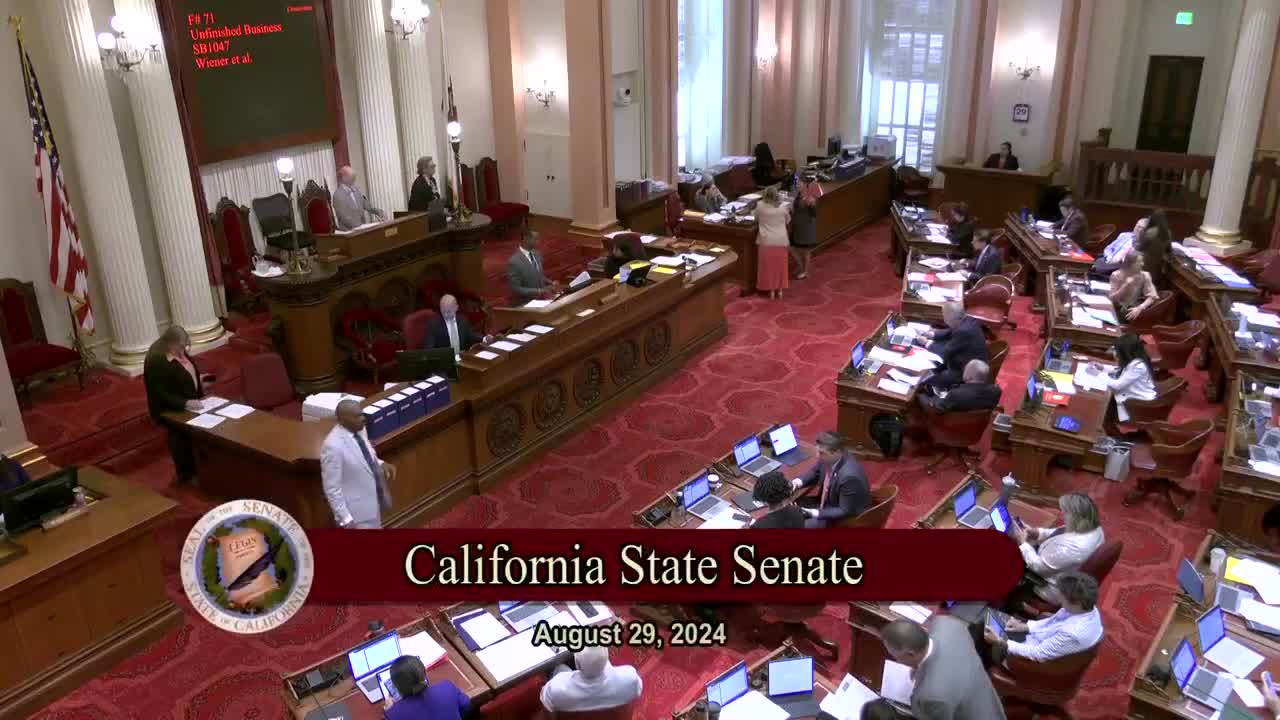 1MIN
Senate Floor
 1MIN
Assembly Floor
 1MIN
Assembly Standing Committee on Appropriations
 7MIN
Assembly Standing Committee on Transportation
 2MIN
Senate Floor
 16MIN
Senate Standing Committee on Transportation
 3SEC
Senate Standing Committee on Transportation
 37SEC
Senate Standing Committee on Transportation
Bill Author

Bill Co-Author(s):