SB 1238: Health facilities.
- Session Year: 2023-2024
- House: Senate
- Latest Version Date: 2024-09-27
Current Status:
Passed
(2024-09-27: Chaptered by Secretary of State. Chapter 644, Statutes of 2024.)
Introduced
In Committee
First Chamber
In Committee
Second Chamber
Enacted
(1)Existing law defines health facility to include a psychiatric health facility that is licensed by the State Department of Health Care Services and provides 24-hour inpatient care for people with mental health disorders. Existing law requires that such care include, but is not limited to, psychiatry, clinical psychology, psychiatric nursing, social work, rehabilitation, drug administration, and food services for persons whose physical health needs can be met in an affiliated hospital or in outpatient settings.
This bill would expand the definition of psychiatric health facility to also include a facility that provides 24-hour inpatient care for people with severe substance use disorders, or cooccurring mental health and substance use disorders. The bill would expand that 24-hour inpatient care also include substance use disorder services, as medically necessary and appropriate. The bill would specify that psychiatric health facilities to only admit persons with stand-alone severe substance use disorders involuntarily pursuant to specified requirements.
The bill would authorize a psychiatric health facility to admit persons diagnosed only with a severe substance use disorder when specified conditions are met. The bill would authorize the department to implement, interpret, or make specific these provisions, in whole or in part, by means of plan or county letters, information notices, plan or provider bulletins, or other similar instructions, until the time when regulations are adopted no later than December 31, 2027.
(2)Under existing law, regulations adopted by the department are to include standards appropriate for 2 levels of disorder: (1) involuntary ambulatory psychiatric patients, and (2) voluntary ambulatory psychiatric patients.
This bill would instead require regulations to include standards appropriate for 3 levels of disorder: (1) involuntary ambulatory patients receiving treatment for a mental health disorder, (2) voluntary ambulatory patients receiving treatment for a mental health disorder, and (3) involuntary ambulatory patients receiving treatment for a severe substance use disorder.
(3)Existing law requires the program aspects of a psychiatric health facility to be reviewed and approved by the department to include, among others, activities programs, interdisciplinary treatment teams, and rehabilitation services. Existing law requires proposed changes in the standards or regulations affecting health facilities that serve persons with mental health disorders to be effected only with review and coordination of the California Health and Human Services Agency.
This bill would expand these program aspects to also include substance use disorder services, if the psychiatric health facility admits persons diagnosed only with a severe substance use disorder. The bill would also require proposed changes in the standards or regulations affecting health facilities that serve persons with severe substance use disorders, or cooccurring mental health and severe substance use disorders, to be effected only with review and coordination of the California Health and Human Services Agency.
(4)Under existing law, the Lanterman-Petris-Short Act (act), when a person, as a result of a mental health disorder, is a danger to others or to themselves, or gravely disabled, as defined, the person may, upon probable cause, be taken into custody for a period of up to 72 hours for assessment, evaluation, and crisis intervention, or placement for evaluation and treatment in a facility designated by the county for evaluation and treatment and approved by the State Department of Health Care Services.
Existing law defines the above-described designated facility as a facility that is licensed or certified as a mental health treatment facility or a hospital by the State Department of Public Health, and may include, but is not limited to, a licensed psychiatric hospital, a licensed psychiatric health facility, and a certified crisis stabilization unit.
Existing law authorizes each county to designate facilities, which are not hospitals or clinics, as 72-hour evaluation and treatment facilities and as 14-day intensive treatment facilities if the facilities meet requirements as the Director of Health Care Services may establish by regulation.
This bill would define designated facility, facility designated by the county for evaluation and treatment, or facility designated by the county to provide intensive treatment to mean a facility that meets designation requirements established by the department to include, but not be limited to, enumerated facilities, including psychiatric health facilities licensed by the department, general acute care hospitals licensed by the department, and chemical dependency recovery hospitals licensed by the department.
The bill would authorize counties to designate facilities to provide evaluation and treatment, as specified, and intensive treatment, as specified. The bill would authorize counties to designate appropriate facilities that are not hospitals or clinics, subject to requirements established by the department. The bill would require the department to approve county designation of facilities to provide these treatments. The bill would require the State Department of Health Care Services, in consultation with the County Behavioral Health Directors Association of California, provider representatives, substance use treatment representatives, patients rights advocates, disability rights advocates, and other relevant stakeholders, to establish updated regulations for the purpose of developing designation requirements for facilities who are admitting and treating persons involuntarily, as specified. The bill would authorize the department to implement, interpret, or make specific these provisions, in whole or in part, by means of county letters, information notices, plan or provider bulletins, or other similar instructions, until the time regulations are adopted no later than December 31, 2027.
(5)Existing law requires an application by counties, county contract providers, or other organizations in order for a mental health rehabilitation center to be licensed by the department. Existing law requires the department to conduct annual licensing inspections of mental health rehabilitation centers.
This bill would authorize the department to adopt, amend, or repeal regulations regarding the licensing of mental health rehabilitation centers.
The bill would authorize a mental health rehabilitation center to admit clients diagnosed only with a severe substance use disorder only when the mental health rehabilitation center meets specified requirements, including either offering medications for addiction treatment (MAT) or having an effective referral process in place to other MAT providers. The bill would also authorize the department to implement, interpret, or make specific these provisions, in whole or in part, by means of county letters, information notices, plan or provider bulletins, or other similar instructions, until the time regulations are adopted no later than December 31, 2027.
This bill would require the department to issue guidance regarding Medi-Cal reimbursement for covered Medi-Cal services provided to an individual receiving involuntary treatment for a severe substance use disorder, as specified. The bill would authorize the department to implement, interpret, or make specific these provisions, in whole or in part, by means of information notices, provider bulletins, or other similar instructions, without taking further regulatory action.
The bill would make conforming and nonsubstantive changes.
This bill would generally authorize the department to implement, interpret, or make specific these provisions, in whole or in part, by means of information notices, provider bulletins, or other similar instructions, until the time regulations are adopted.
(1)Existing law defines health facility to include a psychiatric health facility that is licensed by the State Department of Health Care Services and provides 24-hour inpatient care for people with mental health disorders. Existing law requires that such care include, but is not limited to, psychiatry, clinical psychology, psychiatric nursing, social work, rehabilitation, drug administration, and food services for persons whose physical health needs can be met in an affiliated hospital or in outpatient settings.
This bill would expand the definition of psychiatric health facility to also include a facility that provides 24-hour inpatient care for people with severe substance use disorders, or cooccurring mental health and substance use disorders. The bill would expand that 24-hour inpatient care also include substance use disorder services, as medically necessary and appropriate. The bill would specify that psychiatric health facilities to only admit persons with stand-alone severe substance use disorders involuntarily pursuant to specified requirements.
The bill would authorize a psychiatric health facility to admit persons diagnosed only with a severe substance use disorder when specified conditions are met. The bill would authorize the department to implement, interpret, or make specific these provisions, in whole or in part, by means of plan or county letters, information notices, plan or provider bulletins, or other similar instructions, until the time when regulations are adopted no later than December 31, 2027.
(2)Under existing law, regulations adopted by the department are to include standards appropriate for 2 levels of disorder: (1) involuntary ambulatory psychiatric patients, and (2) voluntary ambulatory psychiatric patients.
This bill would instead require regulations to include standards appropriate for 3 levels of disorder: (1) involuntary ambulatory patients receiving treatment for a mental health disorder, (2) voluntary ambulatory patients receiving treatment for a mental health disorder, and (3) involuntary ambulatory patients receiving treatment for a severe substance use disorder.
(3)Existing law requires the program aspects of a psychiatric health facility to be reviewed and approved by the department to include, among others, activities programs, interdisciplinary treatment teams, and rehabilitation services. Existing law requires proposed changes in the standards or regulations affecting health facilities that serve persons with mental health disorders to be effected only with review and coordination of the California Health and Human Services Agency.
This bill would expand these program aspects to also include substance use disorder services, if the psychiatric health facility admits persons diagnosed only with a severe substance use disorder. The bill would also require proposed changes in the standards or regulations affecting health facilities that serve persons with severe substance use disorders, or cooccurring mental health and severe substance use disorders, to be effected only with review and coordination of the California Health and Human Services Agency.
(4)Under existing law, the Lanterman-Petris-Short Act (act), when a person, as a result of a mental health disorder, is a danger to others or to themselves, or gravely disabled, as defined, the person may, upon probable cause, be taken into custody for a period of up to 72 hours for assessment, evaluation, and crisis intervention, or placement for evaluation and treatment in a facility designated by the county for evaluation and treatment and approved by the State Department of Health Care Services.
Existing law defines the above-described designated facility as a facility that is licensed or certified as a mental health treatment facility or a hospital by the State Department of Public Health, and may include, but is not limited to, a licensed psychiatric hospital, a licensed psychiatric health facility, and a certified crisis stabilization unit.
Existing law authorizes each county to designate facilities, which are not hospitals or clinics, as 72-hour evaluation and treatment facilities and as 14-day intensive treatment facilities if the facilities meet requirements as the Director of Health Care Services may establish by regulation.
This bill would define designated facility, facility designated by the county for evaluation and treatment, or facility designated by the county to provide intensive treatment to mean a facility that meets designation requirements established by the department to include, but not be limited to, enumerated facilities, including psychiatric health facilities licensed by the department, general acute care hospitals licensed by the department, and chemical dependency recovery hospitals licensed by the department.
The bill would authorize counties to designate facilities to provide evaluation and treatment, as specified, and intensive treatment, as specified. The bill would authorize counties to designate appropriate facilities that are not hospitals or clinics, subject to requirements established by the department. The bill would require the department to approve county designation of facilities to provide these treatments. The bill would require the State Department of Health Care Services, in consultation with the County Behavioral Health Directors Association of California, provider representatives, substance use treatment representatives, patients rights advocates, disability rights advocates, and other relevant stakeholders, to establish updated regulations for the purpose of developing designation requirements for facilities who are admitting and treating persons involuntarily, as specified. The bill would authorize the department to implement, interpret, or make specific these provisions, in whole or in part, by means of county letters, information notices, plan or provider bulletins, or other similar instructions, until the time regulations are adopted no later than December 31, 2027.
(5)Existing law requires an application by counties, county contract providers, or other organizations in order for a mental health rehabilitation center to be licensed by the department. Existing law requires the department to conduct annual licensing inspections of mental health rehabilitation centers.
This bill would authorize the department to adopt, amend, or repeal regulations regarding the licensing of mental health rehabilitation centers.
The bill would authorize a mental health rehabilitation center to admit clients diagnosed only with a severe substance use disorder only when the mental health rehabilitation center meets specified requirements, including either offering medications for addiction treatment (MAT) or having an effective referral process in place to other MAT providers. The bill would also authorize the department to implement, interpret, or make specific these provisions, in whole or in part, by means of county letters, information notices, plan or provider bulletins, or other similar instructions, until the time regulations are adopted no later than December 31, 2027.
This bill would require the department to issue guidance regarding Medi-Cal reimbursement for covered Medi-Cal services provided to an individual receiving involuntary treatment for a severe substance use disorder, as specified. The bill would authorize the department to implement, interpret, or make specific these provisions, in whole or in part, by means of information notices, provider bulletins, or other similar instructions, without taking further regulatory action.
The bill would make conforming and nonsubstantive changes.
This bill would generally authorize the department to implement, interpret, or make specific these provisions, in whole or in part, by means of information notices, provider bulletins, or other similar instructions, until the time regulations are adopted.
(1)Existing law defines health facility to include a psychiatric health facility that is licensed by the State Department of Health Care Services and provides 24-hour inpatient care for people with mental health disorders. Existing law requires that such care include, but is not limited to, psychiatry, clinical psychology, psychiatric nursing, social work, rehabilitation, drug administration, and food services for persons whose physical health needs can be met in an affiliated hospital or in outpatient settings.
This bill would expand the definition of psychiatric health facility to also include a facility that provides 24-hour inpatient care for people with severe substance use disorders, or cooccurring mental health and substance use disorders. The bill would expand that 24-hour inpatient care also include substance use disorder services, as medically necessary and appropriate. The bill would specify that psychiatric health facilities to only admit persons with stand-alone severe substance use disorders involuntarily pursuant to specified requirements.
The bill would authorize a psychiatric health facility to admit persons diagnosed only with a severe substance use disorder when specified conditions are met. The bill would authorize the department to implement, interpret, or make specific these provisions, in whole or in part, by means of plan or county letters, information notices, plan or provider bulletins, or other similar instructions, until the time when regulations are adopted no later than December 31, 2027.
(2)Under existing law, regulations adopted by the department are to include standards appropriate for 2 levels of disorder: (1) involuntary ambulatory psychiatric patients, and (2) voluntary ambulatory psychiatric patients.
This bill would instead require regulations to include standards appropriate for 3 levels of disorder: (1) involuntary ambulatory patients receiving treatment for a mental health disorder, (2) voluntary ambulatory patients receiving treatment for a mental health disorder, and (3) involuntary ambulatory patients receiving treatment for a severe substance use disorder.
(3)Existing law requires the program aspects of a psychiatric health facility to be reviewed and approved by the department to include, among others, activities programs, interdisciplinary treatment teams, and rehabilitation services. Existing law requires proposed changes in the standards or regulations affecting health facilities that serve persons with mental health disorders to be effected only with review and coordination of the California Health and Human Services Agency.
This bill would expand these program aspects to also include substance use disorder services, if the psychiatric health facility admits persons diagnosed only with a severe substance use disorder. The bill would also require proposed changes in the standards or regulations affecting health facilities that serve persons with severe substance use disorders, or cooccurring mental health and severe substance use disorders, to be effected only with review and coordination of the California Health and Human Services Agency.
(4)Under existing law, the Lanterman-Petris-Short Act (act), when a person, as a result of a mental health disorder, is a danger to others or to themselves, or gravely disabled, as defined, the person may, upon probable cause, be taken into custody for a period of up to 72 hours for assessment, evaluation, and crisis intervention, or placement for evaluation and treatment in a facility designated by the county for evaluation and treatment and approved by the State Department of Health Care Services.
Existing law defines the above-described designated facility as a facility that is licensed or certified as a mental health treatment facility or a hospital by the State Department of Public Health, and may include, but is not limited to, a licensed psychiatric hospital, a licensed psychiatric health facility, and a certified crisis stabilization unit.
Existing law authorizes each county to designate facilities, which are not hospitals or clinics, as 72-hour evaluation and treatment facilities and as 14-day intensive treatment facilities if the facilities meet requirements as the Director of Health Care Services may establish by regulation.
This bill would define designated facility, facility designated by the county for evaluation and treatment, or facility designated by the county to provide intensive treatment to mean a facility that meets designation requirements established by the department to include, but not be limited to, enumerated facilities, including psychiatric health facilities licensed by the department, general acute care hospitals licensed by the department, and chemical dependency recovery hospitals licensed by the department.
The bill would authorize counties to designate facilities to provide evaluation and treatment, as specified, and intensive treatment, as specified. The bill would authorize counties to designate appropriate facilities that are not hospitals or clinics, subject to requirements established by the department. The bill would require the department to approve county designation of facilities to provide these treatments. The bill would require the State Department of Health Care Services, in consultation with the County Behavioral Health Directors Association of California, provider representatives, substance use treatment representatives, patients rights advocates, disability rights advocates, and other relevant stakeholders, to establish updated regulations for the purpose of developing designation requirements for facilities who are admitting and treating persons involuntarily, as specified. The bill would authorize the department to implement, interpret, or make specific these provisions, in whole or in part, by means of county letters, information notices, plan or provider bulletins, or other similar instructions, until the time regulations are adopted no later than December 31, 2027.
(5)Existing law requires an application by counties, county contract providers, or other organizations in order for a mental health rehabilitation center to be licensed by the department. Existing law requires the department to conduct annual licensing inspections of mental health rehabilitation centers.
This bill would authorize the department to adopt, amend, or repeal regulations regarding the licensing of mental health rehabilitation centers.
The bill would authorize a mental health rehabilitation center to admit clients diagnosed only with a severe substance use disorder only when the mental health rehabilitation center meets specified requirements, including either offering medications for addiction treatment (MAT) or having an effective referral process in place to other MAT providers. The bill would also authorize the department to implement, interpret, or make specific these provisions, in whole or in part, by means of county letters, information notices, plan or provider bulletins, or other similar instructions, until the time regulations are adopted no later than December 31, 2027.
This bill would require the department to issue guidance regarding Medi-Cal reimbursement for covered Medi-Cal services provided to an individual receiving involuntary treatment for a severe substance use disorder, as specified. The bill would authorize the department to implement, interpret, or make specific these provisions, in whole or in part, by means of information notices, provider bulletins, or other similar instructions, without taking further regulatory action.
The bill would make conforming and nonsubstantive changes.
This bill would generally authorize the department to implement, interpret, or make specific these provisions, in whole or in part, by means of information notices, provider bulletins, or other similar instructions, until the time regulations are adopted.
(1)Existing law defines health facility to include a psychiatric health facility that is licensed by the State Department of Health Care Services and provides 24-hour inpatient care for people with mental health disorders. Existing law requires that such care include, but is not limited to, psychiatry, clinical psychology, psychiatric nursing, social work, rehabilitation, drug administration, and food services for persons whose physical health needs can be met in an affiliated hospital or in outpatient settings.
This bill would expand the definition of psychiatric health facility to also include a facility that provides 24-hour inpatient care for people with severe substance use disorders, or cooccurring mental health and substance use disorders. The bill would expand that 24-hour inpatient care also include substance use disorder services, as medically necessary and appropriate. The bill would specify that psychiatric health facilities to only admit persons with stand-alone severe substance use disorders involuntarily pursuant to specified requirements.
The bill would authorize a psychiatric health facility to admit persons diagnosed only with a severe substance use disorder when specified conditions are met. The bill would authorize the department to implement, interpret, or make specific these provisions, in whole or in part, by means of plan or county letters, information notices, plan or provider bulletins, or other similar instructions, until the time when regulations are adopted no later than December 31, 2027.
(2)Under existing law, regulations adopted by the department are to include standards appropriate for 2 levels of disorder: (1) involuntary ambulatory psychiatric patients, and (2) voluntary ambulatory psychiatric patients.
This bill would instead require regulations to include standards appropriate for 3 levels of disorder: (1) involuntary ambulatory patients receiving treatment for a mental health disorder, (2) voluntary ambulatory patients receiving treatment for a mental health disorder, and (3) involuntary ambulatory patients receiving treatment for a severe substance use disorder.
(3)Existing law requires the program aspects of a psychiatric health facility to be reviewed and approved by the department to include, among others, activities programs, interdisciplinary treatment teams, and rehabilitation services. Existing law requires proposed changes in the standards or regulations affecting health facilities that serve persons with mental health disorders to be effected only with review and coordination of the California Health and Human Services Agency.
This bill would expand these program aspects to also include substance use disorder services, if the psychiatric health facility admits persons diagnosed only with a severe substance use disorder. The bill would also require proposed changes in the standards or regulations affecting health facilities that serve persons with severe substance use disorders, or cooccurring mental health and severe substance use disorders, to be effected only with review and coordination of the California Health and Human Services Agency.
Under(4)Under existing law, the Lanterman-Petris-Short Act (act), when a person, as a result of a mental health disorder, is a danger to others or to themselves, or gravely disabled, as defined, the person may, upon probable cause, be taken into custody for a period of up to 72 hours for assessment, evaluation, and crisis intervention, or placement for evaluation and treatment in a facility designated by the county for evaluation and treatment and approved by the State Department of Health Care Services.
Existing law defines the above-described designated facility as a facility that is licensed or certified as a mental health treatment facility or a hospital by the State Department of Public Health, and may include, but is not limited to, a licensed psychiatric hospital, a licensed psychiatric health facility, and a certified crisis stabilization unit.
Existing law authorizes each county to designate facilities, which are not hospitals or clinics, as 72-hour evaluation and treatment facilities and as 14-day intensive treatment facilities if the facilities meet requirements as the Director of Health Care Services may establish by regulation.
This bill would expand the definition of a facility designated by the county for evaluation and treatment or designated facility by specifying that it may also include a facility that both (1) has appropriate services, personnel, and security to safely treat individuals being held involuntarily and (2) is licensed or certified as a skilled nursing facility, mental health rehabilitation center, social rehabilitation facility, or as a facility capable of providing treatment at American Society of Addiction Medicine levels of care 3.7 to 4.0, inclusive. The bill would authorize a county to designate a facility for the purpose of providing one or more specified treatments required by the act. define designated facility, facility designated by the county for evaluation and treatment, or facility designated by the county to provide intensive treatment to mean a facility that meets designation requirements established by the department to include, but not be limited to, enumerated facilities, including psychiatric health facilities licensed by the department, general acute care hospitals licensed by the department, and chemical dependency recovery hospitals licensed by the department.
Existing regulations prohibit a licensed psychiatric health facility or licensed mental health rehabilitation center from admitting an individual who is diagnosed only with a substance use disorder.This bill would require the State Department of Health Care Services to authorize licensed psychiatric health facilities and licensed mental health rehabilitation centers to admit an individual who is diagnosed only with a severe substance use disorder, as defined.Existing law requires a person admitted to a facility for 72-hour treatment and evaluation to receive an evaluation as soon as possible after the person is admitted and to receive whatever treatment and care the persons condition requires for the full period that they are held, as specified.This bill would require the State Department of Health Care Services to ensure that designated facilities are reimbursed for evaluation and treatment of stand-alone substance use disorders at reimbursement rates equivalent to those provided for evaluation and treatment of mental health disorders.The bill would authorize counties to designate facilities to provide evaluation and treatment, as specified, and intensive treatment, as specified. The bill would authorize counties to designate appropriate facilities that are not hospitals or clinics, subject to requirements established by the department. The bill would require the department to approve county designation of facilities to provide these treatments. The bill would require the State Department of Health Care Services, in consultation with the County Behavioral Health Directors Association of California, provider representatives, substance use treatment representatives, patients rights advocates, disability rights advocates, and other relevant stakeholders, to establish updated regulations for the purpose of developing designation requirements for facilities who are admitting and treating persons involuntarily, as specified. The bill would authorize the department to implement, interpret, or make specific these provisions, in whole or in part, by means of county letters, information notices, plan or provider bulletins, or other similar instructions, until the time regulations are adopted no later than December 31, 2027.
(5)Existing law requires an application by counties, county contract providers, or other organizations in order for a mental health rehabilitation center to be licensed by the department. Existing law requires the department to conduct annual licensing inspections of mental health rehabilitation centers.
This bill would authorize the department to adopt, amend, or repeal regulations regarding the licensing of mental health rehabilitation centers.
The bill would authorize a mental health rehabilitation center to admit clients diagnosed only with a severe substance use disorder only when the mental health rehabilitation center meets specified requirements, including either offering medications for addiction treatment (MAT) or having an effective referral process in place to other MAT providers. The bill would also authorize the department to implement, interpret, or make specific these provisions, in whole or in part, by means of county letters, information notices, plan or provider bulletins, or other similar instructions, until the time regulations are adopted no later than December 31, 2027.
This bill would require the department to issue guidance regarding Medi-Cal reimbursement for covered Medi-Cal services provided to an individual receiving involuntary treatment for a severe substance use disorder, as specified. The bill would authorize the department to implement, interpret, or make specific these provisions, in whole or in part, by means of information notices, provider bulletins, or other similar instructions, without taking further regulatory action.
The bill would make conforming and nonsubstantive changes.
This bill would generally authorize the State Department of Health Care Services department to implement, interpret, or make specific these provisions, in whole or in part, by means of information notices, provider bulletins, or other similar instructions, until the time regulations are adopted.
Under existing law, the Lanterman-Petris-Short Act (act), when a person, as a result of a mental health disorder, is a danger to others or to themselves, or gravely disabled, as defined, the person may, upon probable cause, be taken into custody for a period of up to 72 hours for assessment, evaluation, and crisis intervention, or placement for evaluation and treatment in a facility designated by the county for evaluation and treatment and approved by the State Department of Health Care Services.
Existing law defines the above-described designated facility as a facility that is licensed or certified as a mental health treatment facility or a hospital by the State Department of Public Health, and may include, but is not limited to, a licensed psychiatric hospital, a licensed psychiatric health facility, and a certified crisis stabilization unit.
This bill would expand the definition of a facility designated by the county for evaluation and treatment or designated facility by specifying that it may also include a facility that both (1) has appropriate services, personnel, and security to safely treat individuals being held involuntarily and (2) is licensed or certified as a skilled nursing facility, mental health rehabilitation center, social rehabilitation facility, or as a facility capable of providing treatment at American Society of Addiction Medicine levels of care 3.7 to 4.0, inclusive. The bill would authorize a county to designate a facility for the purpose of providing one or more specified treatments required by the act.
Existing regulations prohibit a licensed psychiatric health facility or licensed mental health rehabilitation center from admitting an individual who is diagnosed only with a substance use disorder.
This bill would require the State Department of Health Care Services to authorize licensed psychiatric health facilities and licensed mental health rehabilitation centers to admit an individual who is diagnosed only with a severe substance use disorder, as defined.
Existing law requires a person admitted to a facility for 72-hour treatment and evaluation to receive an evaluation as soon as possible after the person is admitted and to receive whatever treatment and care the persons condition requires for the full period that they are held, as specified.
This bill would require the State Department of Health Care Services to ensure that designated facilities are reimbursed for evaluation and treatment of stand-alone substance use disorders at reimbursement rates equivalent to those provided for evaluation and treatment of mental health disorders.
This bill would authorize the State Department of Health Care Services to implement, interpret, or make specific these provisions, in whole or in part, by means of information notices, provider bulletins, or other similar instructions, without taking any further regulatory action. until the time regulations are adopted.
Under existing law, the Lanterman-Petris-Short Act, Act (act), when a person, as a result of a mental health disorder, is a danger to others or to themselves, or gravely disabled, as defined, the person may, upon probable cause, be taken into custody for a period of up to 72 hours for assessment, evaluation, and crisis intervention, or placement for evaluation and treatment in a facility designated by the county for evaluation and treatment and approved by the State Department of Health Care Services. The act also authorizes a conservator of the person, of the estate, or of both, to be appointed for a person who is gravely disabled as a result of a mental health disorder. Existing law requires the Director of Health Care Services to administer the act and to adopt rules, regulations, and standards as necessary.
This bill would authorize the State Department of Health Care Services to implement, interpret, or make specific the act, in whole or in part, by means of information notices, provider bulletins, or other similar instructions, without taking any further regulatory action.Existing law defines the above-described designated facility as a facility that is licensed or certified as a mental health treatment facility or a hospital by the State Department of Public Health, and may include, but is not limited to, a licensed psychiatric hospital, a licensed psychiatric health facility, and a certified crisis stabilization unit.
This bill would expand the definition of a facility designated by the county for evaluation and treatment or designated facility by specifying that it may also include a facility that both (1) has appropriate services, personnel, and security to safely treat individuals being held involuntarily and (2) is licensed or certified as a skilled nursing facility, mental health rehabilitation center, social rehabilitation facility, or as a facility capable of providing treatment at American Society of Addiction Medicine levels of care 3.7 to 4.0, inclusive. The bill would authorize a county to designate a facility for the purpose of providing one or more specified treatments required by the act.
Existing regulations prohibit a licensed psychiatric health facility or licensed mental health rehabilitation center from admitting an individual who is diagnosed only with a substance use disorder.
This bill would require the State Department of Health Care Services to authorize licensed psychiatric health facilities and licensed mental health rehabilitation centers to admit those individuals an individual who is diagnosed only with a severe substance use disorder, as defined.
Existing law requires a person admitted to a facility for 72-hour treatment and evaluation to receive an evaluation as soon as possible after the person is admitted and to receive whatever treatment and care the persons condition requires for the full period that they are held, as specified.
This bill would require the State Department of Health Care Services to ensure that designated facilities are reimbursed for evaluation and treatment of stand-alone substance use disorders at reimbursement rates equivalent to those provided for evaluation and treatment of mental health disorders.
This bill would authorize the State Department of Health Care Services to implement, interpret, or make specific these provisions, in whole or in part, by means of information notices, provider bulletins, or other similar instructions, without taking any further regulatory action.
Under existing law, the Lanterman-Petris-Short Act, when a person, as a result of a mental health disorder, is a danger to others or to themselves, or gravely disabled, as defined, the person may, upon probable cause, be taken into custody for a period of up to 72 hours for assessment, evaluation, and crisis intervention, or placement for evaluation and treatment in a facility designated by the county for evaluation and treatment and approved by the State Department of Health Care Services. The act also authorizes a conservator of the person, of the estate, or of both, to be appointed for a person who is gravely disabled as a result of a mental health disorder. Existing law requires the Director of Health Care Services to administer the act and to adopt rules, regulations, and standards as necessary.
This bill would authorize the State Department of Health Care Services to implement, interpret, or make specific the act, in whole or in part, by means of information notices, provider bulletins, or other similar instructions, without taking any further regulatory action.
Existing law defines the above-described designated facility as a facility that is licensed or certified as a mental health treatment facility or a hospital by the State Department of Public Health, and may include, but is not limited to, a licensed psychiatric hospital, a licensed psychiatric health facility, and a certified crisis stabilization unit.
This bill would expand the definition of a facility designated by the county for evaluation and treatment or designated facility by specifying that it may also include a facility that both (1) has appropriate services, personnel, and security to safely treat individuals being held involuntarily and (2) is licensed or certified as a skilled nursing facility, mental health rehabilitation center, or as a facility capable of providing treatment at American Society of Addiction Medicine levels of care 3.7 to 4.0, inclusive.
Existing regulations prohibit a licensed psychiatric health facility or licensed mental health rehabilitation center from admitting an individual who is diagnosed only with a substance use disorder.
This bill would require the State Department of Health Care Services to authorize licensed psychiatric health facilities and licensed mental health rehabilitation centers to admit those individuals.
Existing law requires a person admitted to a facility for 72-hour treatment and evaluation to receive an evaluation as soon as possible after the person is admitted and to receive whatever treatment and care the persons condition requires for the full period that they are held, as specified.
This bill would require the State Department of Health Care Services to ensure that designated facilities are reimbursed for evaluation and treatment of stand-alone substance use disorders at reimbursement rates equivalent to those provided for evaluation and treatment of mental health disorders.
Existing law, the Lanterman-Petris-Short Act, provides for the involuntary detention and treatment of persons with specified mental health disorders. Under the act, when a person, as a result of a mental health disorder, is a danger to others, or to themselves, or gravely disabled, the person may, upon probable cause, be taken into custody and placed in a facility designated by the county and approved by the State Department of Health Care Services for up to 72 hours for evaluation and treatment. Existing law authorizes specified individuals, including professional persons designated by the county, to determine probable cause and take a person into custody pursuant to these provisions.This bill would authorize a county to designate a professional who is not a county employee or not contracted by the county to perform the above-described functions.Existing law, the Lanterman-Petris-Short Act, provides for the involuntary detention and treatment of persons with specified mental health disorders. Under the act, when a person, as a result of a mental health disorder, is a danger to others, or to themselves, or gravely disabled, the person may, upon probable cause, be taken into custody and placed in a facility designated by the county and approved by the State Department of Health Care Services for up to 72 hours for evaluation and treatment. Existing law authorizes specified individuals, including professional persons designated by the county, to determine probable cause and take a person into custody pursuant to these provisions.
This bill would authorize a county to designate a professional who is not a county employee or not contracted by the county to perform the above-described functions.
(a)(1)As defined in Section 1250, health facility includes a psychiatric health facility, defined to mean a health facility, licensed by the State Department of Health Care Services, that provides 24-hour inpatient care for people with mental health disorders, severe substance use disorders, as defined in subdivision (o) of Section 5008 of the Welfare and Institutions Code, or cooccurring mental health and severe substance use disorders, or other persons described in Division 5 (commencing with Section 5000) or Division 6 (commencing with Section 6000) of the Welfare and Institutions Code. This care shall include, but not be limited to, the following basic services: psychiatry, clinical psychology, psychiatric nursing, social work, rehabilitation, drug administration, food services, and substance use disorder services, as medically necessary and appropriate. Psychiatric health facilities shall only admit persons whose physical health needs can be met in an affiliated hospital or in outpatient settings and shall only admit people with stand-alone severe substance use disorders involuntarily pursuant to Part 1 (commencing with Section 5000) of Division 5 of the Welfare and Institutions Code.
(2)It is the intent of the Legislature that the psychiatric health facility shall provide a distinct type of service to persons with mental health disorders, severe substance use disorders, or cooccurring mental health and substance use disorders in a 24-hour acute inpatient setting. The State Department of Health Care Services shall require regular utilization reviews of admission and discharge criteria and lengths of stay in order to ensure that these patients are moved to less restrictive levels of care as soon as appropriate.
(b)(1)The State Department of Health Care Services may issue a special permit to a psychiatric health facility for it to provide structured outpatient services (commonly referred to as SOPS) consisting of morning, afternoon, or full daytime organized programs, not exceeding 10 hours, for acute daytime care for patients admitted to the facility. This subdivision shall not be construed as requiring a psychiatric health facility to apply for a special permit to provide these alternative levels of care.
(2)The Legislature recognizes that, with access to structured outpatient services, as an alternative to 24-hour inpatient care, certain patients would be provided with effective intervention and less restrictive levels of care. The Legislature further recognizes that, for certain patients, the less restrictive levels of care eliminate the need for inpatient care, enable earlier discharge from inpatient care by providing a continuum of care with effective aftercare services, or reduce or prevent the need for a subsequent readmission to inpatient care.
(c)Any reference in any statute to Section 1250 of the Health and Safety Code shall be deemed and construed to also be a reference to this section.
(d)Notwithstanding any other law, and to the extent consistent with federal law, a psychiatric health facility shall be eligible to participate in the Medicare program under Title XVIII of the federal Social Security Act (42 U.S.C. Sec. 1395 et seq.), and the Medicaid program under Title XIX of the federal Social Security Act (42 U.S.C. Sec. 1396 et seq.), if all of the following conditions are met:
(1)The facility is a licensed facility.
(2)The facility is in compliance with all related statutes and regulations enforced by the State Department of Health Care Services, including regulations contained in Chapter 9 (commencing with Section 77001) of Division 5 of Title 22 of the California Code of Regulations.
(3)The facility meets the definitions and requirements contained in subdivisions (e) and (f) of Section 1861 of the federal Social Security Act (42 U.S.C. Sec. 1395x(e) and (f)), including the approval process specified in Section 1861(e)(7)(B) of the federal Social Security Act (42 U.S.C. Sec. 1395x(e)(7)(B)), which requires that the state agency responsible for licensing hospitals has ensured that the facility meets licensing requirements.
(4)The facility meets the conditions of participation for hospitals pursuant to Part 482 of Title 42 of the Code of Federal Regulations.
SEC. 2.Section 1275.1 of the Health and Safety Code is amended to read:1275.1.(a)Notwithstanding any rules or regulations governing other health facilities, the regulations developed by the State Department of Health Care Services, or a predecessor, for psychiatric health facilities shall prevail. The regulations applying to psychiatric health facilities shall prescribe standards of adequacy, safety, and sanitation of the physical plant, of staffing with duly qualified licensed personnel, and of services based on the needs of the persons served thereby.
(b)(1)The regulations shall include standards appropriate for treatment of three levels of disorder:
(A)Involuntary ambulatory patients receiving treatment for a mental health disorder.
(B)Voluntary ambulatory patients receiving treatment for a mental health disorder.
(C)Involuntary ambulatory patients receiving treatment for a severe substance use disorder, as defined in subdivision (o) of Section 5008 of the Welfare and Institutions Code.
(2)For purposes of this subdivision, ambulatory patients shall include, but not be limited to, persons who are deaf, blind, or have physical disabilities. Disoriented persons who are not bedridden or wheelchair users shall also be considered ambulatory patients.
(c)The regulations shall not require, but may permit building and services requirements for hospitals which are only applicable to physical health care needs of patients that can be met in an affiliated hospital or in outpatient settings including, but not limited to, such requirements as surgical, dietary, laboratory, laundry, central supply, radiologic, and pharmacy.
(d)The regulations shall include provisions for an open planning architectural concept.
(e)The regulations shall exempt from seismic requirements all structures of Type V and of one-story construction.
(f)Standards for involuntary patients shall include provisions to allow for restraint and seclusion of patients. These standards shall provide for adequate safeguards for patient safety and protection of patient rights.
(g)The regulations shall provide for the retention by the psychiatric health facility of a consultant pharmacist, who shall supervise and review pharmaceutical services within the facility and perform any other services, including prevention of the unlawful diversion of controlled substances subject to abuse, as the State Department of Health Care Services may by regulation require. Regulations adopted pursuant to this subdivision shall take into consideration the varying bed sizes of psychiatric health facilities.
SEC. 3.Section 4080 of the Welfare and Institutions Code is amended to read:4080.(a)Psychiatric health facilities, as defined in Section 1250.2 of the Health and Safety Code, shall only be licensed by the State Department of Health Care Services subsequent to application by counties, county contract providers, or other organizations pursuant to this part.
(b)(1)For counties or county contract providers that choose to apply, the local behavioral health director shall first present to the local behavioral health advisory board for its review an explanation of the need for the facility and a description of the services to be provided. The local behavioral health director shall then submit to the governing body the explanation and description. The governing body, upon its approval, may submit the application to the State Department of Health Care Services.
(2)Other organizations that will be applying for licensure and do not intend to use any Bronzan-McCorquodale funds pursuant to Section 5707 shall submit to the local behavioral health director and the governing body in the county in which the facility is to be located a written and dated proposal of the services to be provided. The local behavioral health director and governing body shall have 30 days during which to provide advice and recommendations regarding licensure, as they deem appropriate. At any time after the 30-day period, the organizations may then submit their applications, along with the behavioral health directors and governing bodys advice and recommendations, if any, to the State Department of Health Care Services.
(c)The State Fire Marshal and other appropriate state agencies, to the extent required by law, shall cooperate fully with the State Department of Health Care Services to ensure that the State Department of Health Care Services approves or disapproves the licensure applications not later than 90 days after the application submission by a county, county contract provider, or other organization.
(d)Every psychiatric health facility and program for which a license has been issued shall be periodically inspected by a multidisciplinary team appointed or designated by the State Department of Health Care Services. The inspection shall be conducted no less than once every two years and as often as necessary to ensure the quality of care provided. During the inspections the review team shall offer advice and assistance to the psychiatric health facility as it deems appropriate.
(e)(1)The program aspects of a psychiatric health facility that shall be reviewed and may be approved by the State Department of Health Care Services shall include, but not be limited to:
(A)Activities programs.
(B)Administrative policies and procedures.
(C)Admissions, including provisions for a mental evaluation.
(D)Discharge planning.
(E)Health records content.
(F)Health records services.
(G)Interdisciplinary treatment teams.
(H)Nursing services.
(I)Patient rights.
(J)Pharmaceutical services.
(K)Program space requirements.
(L)Psychiatrist and clinical psychological services.
(M)Rehabilitation services.
(N)Restraint and seclusion.
(O)Social work services.
(P)Space, supplies, and equipment.
(Q)Staffing standards.
(R)Unusual occurrences.
(S)Use of outside resources, including agreements with general acute care hospitals.
(T)Linguistic access and cultural competence.
(U)Structured outpatient services to be provided under special permit.
(V)Substance use disorder services, if the psychiatric health facility admits persons diagnosed only with a severe substance use disorder in accordance with Section 4080.5.
(2)The State Department of Health Care Services has the sole authority to grant program flexibility.
(f)The State Department of Health Care Services may adopt regulations regarding psychiatric health facilities that shall include, but not be limited to, all of the following:
(1)Procedures by which the State Department of Health Care Services shall review and may approve the program and facility requesting licensure as a psychiatric health facility as being in compliance with program standards established by the department.
(2)Procedures by which the State Department of Health Care Services shall approve, or deny approval of, the program and facility licensed as a psychiatric health facility pursuant to this section.
(3)Provisions for site visits by the State Department of Health Care Services for the purpose of reviewing a facilitys compliance with program and facility standards.
(4)Provisions for the State Department of Health Care Services for any administrative proceeding regarding denial, suspension, or revocation of a psychiatric health facility license.
(5)Procedures for the appeal of an administrative finding or action pursuant to paragraph (4) of this subdivision and subdivision (j).
(g)Regulations may be adopted by the State Department of Health Care Services that establish standards for pharmaceutical services in psychiatric health facilities. Licensed psychiatric health facilities shall be exempt from requirements to obtain a separate pharmacy license or permit.
(h)(1)It is the intent of the Legislature that the State Department of Health Care Services shall license the facility in order to establish innovative and more competitive and specialized acute care services.
(2)The State Department of Health Care Services shall review and may approve the program aspects of public or private facilities, with the exception of those facilities that are federally certified or accredited by a nationally recognized commission that accredits health care facilities, only if the average per diem charges or costs of service provided in the facility is approximately 60 percent of the average per diem charges or costs of similar psychiatric services provided in a general hospital.
(3)(A)When a private facility is accredited by a nationally recognized commission that accredits health care facilities, the State Department of Health Care Services shall review and may approve the program aspects only if the average per diem charges or costs of service provided in the facility do not exceed approximately 75 percent of the average per diem charges or costs of similar psychiatric service provided in a psychiatric or general hospital.
(B)When a private facility serves county patients, the State Department of Health Care Services shall review and may approve the program aspects only if the facility is federally certified by the federal Centers for Medicare and Medicaid Services and serves a population mix that includes a proportion of Medi-Cal patients sufficient to project an overall cost savings to the county, and the average per diem charges or costs of service provided in the facility do not exceed approximately 75 percent of the average per diem charges or costs of similar psychiatric service provided in a psychiatric or general hospital.
(4)When a public facility is federally certified by the federal Centers for Medicare and Medicaid Services and serves a population mix that includes a proportion of Medi-Cal patients sufficient to project an overall program cost savings with certification, the State Department of Health Care Services shall approve the program aspects only if the average per diem charges or costs of service provided in the facility do not exceed approximately 75 percent of the average per diem charges or costs of similar psychiatric service provided in a psychiatric or general hospital.
(5)(A)The State Department of Health Care Services may set a lower rate for private or public facilities than that required by paragraph (3) or (4), if so required by the federal Centers for Medicare and Medicaid Services as a condition for the receipt of federal matching funds.
(B)This section does not impose any obligation on any private facility to contract with a county for the provision of services to Medi-Cal beneficiaries, and any contract for that purpose is subject to the agreement of the participating facility.
(6)(A)In using the guidelines specified in this subdivision, the State Department of Health Care Services shall take into account local conditions affecting the costs or charges.
(B)In those psychiatric health facilities authorized by special permit to offer structured outpatient services not exceeding 10 daytime hours, the following limits on per diem rates shall apply:
(i)The per diem charge for patients in both a morning and an afternoon program on the same day shall not exceed 60 percent of the facilitys authorized per diem charge for inpatient services.
(ii)The per diem charge for patients in either a morning or afternoon program shall not exceed 30 percent of the facilitys authorized per diem charge for inpatient services.
(i)The licensing fees charged for these facilities shall be credited to the State Department of Health Care Services for its costs incurred in the review of psychiatric health facility programs, in connection with the licensing of these facilities.
(j)(1)The State Department of Health Care Services shall establish a system for the imposition of prompt and effective civil sanctions against psychiatric health facilities in violation of the laws and regulations of this state pertaining to psychiatric health facilities. If the State Department of Health Care Services determines that there is or has been a failure, in a substantial manner, on the part of a psychiatric health facility to comply with the laws and regulations, the Director of Health Care Services may impose the following sanctions:
(A)Cease and desist orders.
(B)Monetary sanctions, which may be imposed in addition to the penalties of suspension, revocation, or cease and desist orders. The amount of monetary sanctions permitted to be imposed pursuant to this subparagraph shall not be less than fifty dollars ($50) nor more than one hundred dollars ($100) multiplied by the licensed bed capacity, per day, for each violation. However, the monetary sanction shall not exceed three thousand dollars ($3,000) per day. A facility that is assessed a monetary sanction under this subparagraph, and that repeats the deficiency, may, in accordance with the regulations adopted pursuant to this subdivision, be subject to immediate suspension of its license until the deficiency is corrected.
(2)The State Department of Health Care Services may adopt regulations necessary to implement this subdivision and paragraph (5) of subdivision (f) in accordance with the Administrative Procedure Act (Chapter 3.5 (commencing with Section 11340) of Part 1 of Division 3 of Title 2 of the Government Code).
(k)Proposed changes in the standards or regulations affecting health facilities that serve persons with mental health disorders, severe substance use disorders, as defined in subdivision (o) of Section 5008, or cooccurring mental health and severe substance use disorders shall be effected only with the review and coordination of the California Health and Human Services Agency.
(l)In psychiatric health facilities where the clinical director is not a physician, a psychiatrist, or if one is temporarily not available, a physician shall be designated who shall direct those medical treatments and services that can only be provided by, or under the direction of, a physician.
SEC. 4.Section 4080.5 is added to the Welfare and Institutions Code, to read:4080.5.(a)A psychiatric health facility may admit persons diagnosed only with a severe substance use disorder, as defined in subdivision (o) of Section 5008, under the following conditions:
(1)The State Department of Health Care Services approves the psychiatric health facilitys policies and procedures for providing substance use disorder services, in accordance with subparagraph (V) of paragraph (1) of subdivision (e) of Section 4080.
(2)The psychiatric health facility admits these persons involuntarily pursuant to Part 1 (commencing with Section 5000) of Division 5 of the Welfare and Institutions Code.
(3)The psychiatric health facility either offers medications for addiction treatment (MAT) or has an effective referral process in place with narcotic treatment programs, community health centers, or other MAT providers. An effective referral process shall include an established relationship with a MAT provider and transportation to appointments for MAT.
(4)The psychiatric health facility implements and maintains a MAT policy approved by the State Department of Health Care Services. The MAT policy shall do all of the following:
(A)Explain how a person receives information about the benefits and risks of MAT.
(B)Describe the availability of MAT at the program, if applicable, or the referral process for MAT.
(C)Identify an evidence-based assessment for determining a persons MAT needs.
(D)Address administration, storage, and disposal of MAT medication, if applicable.
(E)Outline training for staff about the benefits and risks of MAT.
(F)Outline training for staff on the MAT policy.
(b)Notwithstanding Chapter 3.5 (commencing with Section 11340) of Part 1 of Division 3 of Title 2 of the Government Code, the State Department of Health Care Services may implement, interpret, or make specific this section, in whole or in part, by means of plan or county letters, information notices, plan or provider bulletins, or other similar instructions, until the time regulations are adopted no later than December 31, 2027.
SEC. 5.Section 5008 of the Welfare and Institutions Code is amended to read:5008.Unless the context otherwise requires, the following definitions shall govern the construction of this part:
(a)Evaluation consists of multidisciplinary professional analyses of a persons medical, psychological, educational, social, financial, and legal conditions as may appear to constitute a problem. Persons providing evaluation services shall be properly qualified professionals and may be full-time employees of an agency providing face-to-face, which includes telehealth, evaluation services or may be part-time employees or may be employed on a contractual basis.
(b)Court-ordered evaluation means an evaluation ordered by a superior court pursuant to Article 2 (commencing with Section 5200) of Chapter 2 or by a superior court pursuant to Article 3 (commencing with Section 5225) of Chapter 2.
(c)Intensive treatment consists of such hospital and other services as may be indicated. Intensive treatment shall be provided by properly qualified professionals and carried out in facilities qualifying for reimbursement under the California Medical Assistance Program (Medi-Cal) set forth in Chapter 7 (commencing with Section 14000) of Part 3 of Division 9, or under Title XVIII of the federal Social Security Act and regulations thereunder. Intensive treatment may be provided in hospitals of the United States government by properly qualified professionals. This part does not prohibit an intensive treatment facility from also providing 72-hour evaluation and treatment.
(d)Referral is referral of persons by each agency or facility providing assessment, evaluation, crisis intervention, or treatment services to other agencies or individuals. The purpose of referral shall be to provide for continuity of care, and may include, but need not be limited to, informing the person of available services, making appointments on the persons behalf, discussing the persons problem with the agency or individual to which the person has been referred, appraising the outcome of referrals, and arranging for personal escort and transportation when necessary. Referral shall be considered complete when the agency or individual to whom the person has been referred accepts responsibility for providing the necessary services. All persons shall be advised of available precare services that prevent initial recourse to hospital treatment or aftercare services that support adjustment to community living following hospital treatment. These services may be provided through county or city mental health departments, state hospitals under the jurisdiction of the State Department of State Hospitals, regional centers under contract with the State Department of Developmental Services, or other public or private entities.
Each agency or facility providing evaluation services shall maintain a current and comprehensive file of all community services, both public and private. These files shall contain current agreements with agencies or individuals accepting referrals, as well as appraisals of the results of past referrals.
(e)Crisis intervention consists of an interview or series of interviews within a brief period of time, conducted by qualified professionals, and designed to alleviate personal or family situations that present a serious and imminent threat to the health or stability of the person or the family. The interview or interviews may be conducted in the home of the person or family, or on an inpatient or outpatient basis with such therapy, or other services, as may be appropriate. The interview or interviews may include family members, significant support persons, providers, or other entities or individuals, as appropriate and as authorized by law. Crisis intervention may, as appropriate, include suicide prevention, psychiatric, welfare, psychological, legal, or other social services.
(f)Prepetition screening is a screening of all petitions for court-ordered evaluation as provided in Article 2 (commencing with Section 5200) of Chapter 2, consisting of a professional review of all petitions; an interview with the petitioner and, whenever possible, the person alleged, as a result of a mental health disorder, to be a danger to others, or to themselves, or to be gravely disabled, to assess the problem and explain the petition; when indicated, efforts to persuade the person to receive, on a voluntary basis, comprehensive evaluation, crisis intervention, referral, and other services specified in this part.
(g)Conservatorship investigation means investigation by an agency appointed or designated by the governing body of cases in which conservatorship is recommended pursuant to Chapter 3 (commencing with Section 5350).
(h)(1)For purposes of Article 1 (commencing with Section 5150), Article 2 (commencing with Section 5200), Article 3 (commencing with Section 5225), and Article 4 (commencing with Section 5250) of Chapter 2, and for purposes of Chapter 3 (commencing with Section 5350), gravely disabled means any of the following, as applicable:
(A)A condition in which a person, as a result of a mental health disorder, a severe substance use disorder, or a co-occurring mental health disorder and a severe substance use disorder, is unable to provide for their basic personal needs for food, clothing, shelter, personal safety, or necessary medical care.
(B)A condition in which a person has been found mentally incompetent under Section 1370 of the Penal Code and all of the following facts exist:
(i)The complaint, indictment, or information pending against the person at the time of commitment charges a felony involving death, great bodily harm, or a serious threat to the physical well-being of another person.
(ii)There has been a finding of probable cause on a complaint pursuant to paragraph (2) of subdivision (a) of Section 1368.1 of the Penal Code, a preliminary examination pursuant to Section 859b of the Penal Code, or a grand jury indictment, and the complaint, indictment, or information has not been dismissed.
(iii)As a result of a mental health disorder, the person is unable to understand the nature and purpose of the proceedings taken against them and to assist counsel in the conduct of their defense in a rational manner.
(iv)The person represents a substantial danger of physical harm to others by reason of a mental disease, defect, or disorder.
(2)For purposes of Article 3 (commencing with Section 5225) and Article 4 (commencing with Section 5250), of Chapter 2, and for purposes of Chapter 3 (commencing with Section 5350), gravely disabled includes a condition in which a person, as a result of impairment by chronic alcoholism, is unable to provide for their basic personal needs for food, clothing, shelter, personal safety, or necessary medical care.
(3)The term gravely disabled does not include persons with intellectual disabilities by reason of that disability alone.
(4)A county, by adoption of a resolution of its governing body, may elect to defer implementation of the changes made to this section by Senate Bill 43 of the 202324 Regular Session of the Legislature until January 1, 2026.
(i)Peace officer means a duly sworn peace officer as that term is defined in Chapter 4.5 (commencing with Section 830) of Title 3 of Part 2 of the Penal Code who has completed the basic training course established by the Commission on Peace Officer Standards and Training, or any parole officer or probation officer specified in Section 830.5 of the Penal Code when acting in relation to cases for which the officer has a legally mandated responsibility.
(j)Postcertification treatment means an additional period of treatment pursuant to Article 6 (commencing with Section 5300) of Chapter 2.
(k)Court, unless otherwise specified, means a court of record.
(l)Antipsychotic medication means any medication customarily prescribed for the treatment of symptoms of psychoses and other severe mental and emotional disorders.
(m)Emergency means a situation in which action to impose treatment over the persons objection is immediately necessary for the preservation of life or the prevention of serious bodily harm to the patient or others, and it is impracticable to first gain consent. It is not necessary for harm to take place or become unavoidable prior to treatment.
(n)(1)Designated facility, facility designated by the county for evaluation and treatment, or facility designated by the county to provide intensive treatment means a facility that meets designation requirements duly established by the State Department of Health Care Services in accordance with Section 5404, including, but not limited to, the following:
(A)Psychiatric health facilities licensed by the State Department of Health Care Services.
(B)Psychiatric residential treatment facilities licensed by the State Department of Health Care Services.
(C)Mental health rehabilitation centers licensed by the State Department of Health Care Services.
(D)Provider sites certified by the State Department of Health Care Services or a mental health plan to provide crisis stabilization.
(E)General acute care hospitals licensed by the State Department of Public Health.
(F)Acute psychiatric hospitals licensed by the State Department of Public Health.
(G)Chemical dependency recovery hospitals licensed by the State Department of Public Health.
(H)Hospitals operated by the United States Department of Veterans Affairs.
(2)(A)A county may designate a facility for the purpose of providing one or more of the following services:
(i)Providing evaluation and treatment pursuant to Article 1 (commencing with Section 5150) of Chapter 2.
(ii)Providing intensive treatment pursuant to Article 4 (commencing with Section 5250) of Chapter 2.
(iii)Providing additional intensive treatment pursuant to Article 4.5 (commencing with Section 5260) of Chapter 2.
(iv)Providing additional intensive treatment pursuant to Article 4.7 (commencing with Section 5270.10) of Chapter 2.
(v)Providing postcertification treatment pursuant to Article 6 (commencing with Section 5300) of Chapter 2.
(B)A county may designate a facility, as is appropriate and based on capability, for the purpose of providing one or more types of treatment listed in subparagraph (A) of paragraph (3) of subdivision (n) without designating the facility to provide all treatments.
(3)Notwithstanding Chapter 3.5 (commencing with Section 11340) of Part 1 of Division 3 of Title 2 of the Government Code, the State Department of Health Care Services may implement, interpret, or make specific this subdivision, in whole or in part, by means of plan or county letters, information notices, plan or provider bulletins, or other similar instructions, until the time regulations are adopted no later than December 31, 2027.
(o)Severe substance use disorder means a diagnosed substance-related disorder that meets the diagnostic criteria of severe as defined in the most current version of the Diagnostic and Statistical Manual of Mental Disorders.
(p)Personal safety means the ability of one to survive safely in the community without involuntary detention or treatment pursuant to this part.
(q)Necessary medical care means care that a licensed health care practitioner, while operating within the scope of their practice, determines to be necessary to prevent serious deterioration of an existing physical medical condition that, if left untreated, is likely to result in serious bodily injury as defined in Section 15610.67.
SEC. 6.Section 5400.1 is added to the Welfare and Institutions Code, to read:5400.1.(a)The State Department of Health Care Services shall issue guidance regarding Medi-Cal reimbursement for covered Medi-Cal services provided to an individual receiving involuntary treatment for a severe substance use disorder pursuant to this part. This guidance shall be consistent with Medi-Cal reimbursement for covered Medi-Cal services provided to an individual receiving involuntary treatment for a mental health disorder pursuant to this part, to the extent that federal financial participation under the Medi-Cal program is not jeopardized and all necessary federal approvals have been obtained.
(b)Notwithstanding Chapter 3.5 (commencing with Section 11340) of Part 1 of Division 3 of Title 2 of the Government Code, the State Department of Health Care Services may implement, interpret, or make specific this section, in whole or in part, by means of plan or county letters, information notices, plan or provider bulletins, or other similar instructions, without taking further regulatory action.
SEC. 7.Section 5404 of the Welfare and Institutions Code is amended to read:5404.(a)Counties may designate facilities to provide evaluation and treatment in accordance with Article 1 (commencing with Section 5150) of Chapter 2 of this part, and intensive treatment in accordance with Articles 4 through 4.7, inclusive, and Article 6 (commencing with Section 5300) of Chapter 2 of this part. Designated facilities shall meet those designation requirements duly established by the State Department of Health Care Services. Subject to requirements duly established by the State Department of Health Care Services, counties may designate appropriate facilities, that are not hospitals or clinics.
(b)The State Department of Health Care Services shall approve county designation of facilities to provide the types of treatment described in subdivision (a).
(c)All regulations relating to the approval of facilities designated by the county in accordance with this part, heretofore adopted by the State Department of Mental Health, or a successor, shall remain in effect and shall be fully enforceable by the State Department of Health Care Services with respect to the designation of any facility or program required to be approved to provide the types of treatment described in subdivision (a), unless and until readopted, amended, or repealed by the State Department of Health Care Services. The State Department of Health Care Services shall succeed to and be vested with all duties, powers, purposes, functions, responsibilities, and jurisdiction of the State Department of Mental Health, or a successor, as they relate to approval of facilities to provide the types of treatment described in subdivision (a).
(d)The State Department of Health Care Services shall, in consultation with the County Behavioral Health Directors Association of California, provider representatives, substance use treatment representatives, patients rights advocates, disability rights advocates, and other relevant stakeholders, establish updated regulations for the purpose of developing designation requirements for facilities who are admitting and treating persons involuntarily pursuant to this part. At a minimum, the regulations shall include all of the following;
(1)Minimum substance use disorder related service requirements with sufficient substance use disorder staff to maintain appropriate substance use disorder only and cooccurring disorder programs, treatment setting, services, and safety measures, based on the individual patients substance use disorder needs.
(2)Standards for offering medications for addiction treatment (MAT) or an effective referral process in place with narcotic treatment programs, community health centers, or other MAT providers.
(3)Length of stay standards consistent with evidence-based care for substance use disorders.
(4)Discharge planning for substance use disorder services, consistent with existing requirements.
(5)Privacy and data sharing requirements, including, but not limited to developing guidance and tools to facilitate data sharing for care coordination and discharge purposes.
(6)The process for transitioning and assisting designated facilities to meet updated regulatory requirements, including, but not limited to, providing substance use disorder services.
(7)Systems of public accountability and oversight that include, but are not limited to, readiness to meet, and ongoing maintenance of, required standards for staffing, facilities, and care established pursuant to this section.
(e)Notwithstanding Chapter 3.5 (commencing with Section 11340) of Part 1 of Division 3 of Title 2 of the Government Code, the State Department of Health Care Services may implement, interpret, or make specific this section, in whole or in part, by means of plan or county letters, information notices, plan or provider bulletins, or other similar instructions, until the time regulations are adopted no later than December 31, 2027.
SEC. 8.Section 5675 of the Welfare and Institutions Code is amended to read:5675.(a)(1)Mental health rehabilitation centers shall only be licensed by the State Department of Health Care Services subsequent to application by counties, county contract providers, or other organizations.
(2)In the application for a mental health rehabilitation center, program evaluation measures shall include, but not be limited to, all of the following:
(A)That the clients placed in the facilities show improved global assessment scores as measured by preadmission and postadmission tests.
(B)That the clients placed in the facilities demonstrate improved functional behavior as measured by preadmission and postadmission tests.
(C)That the clients placed in the facilities have reduced medication levels as determined by comparison of preadmission and postadmission records.
(b)The State Department of Health Care Services shall conduct annual licensing inspections of mental health rehabilitation centers.
(c)(1)All regulations relating to the licensing of mental health rehabilitation centers, heretofore adopted by the State Department of Mental Health, or its successor, shall remain in effect and shall be fully enforceable by the State Department of Health Care Services with respect to any facility or program required to be licensed as a mental health rehabilitation center, unless and until readopted, amended, or repealed by the Director of Health Care Services.
(2)The State Department of Health Care Services shall succeed to and be vested with all duties, powers, purposes, functions, responsibilities, and jurisdiction of the State Department of Mental Health, and its successor, if any, as they relate to licensing mental health rehabilitation centers. The State Department of Health Care Services may adopt, amend, or repeal regulations regarding the licensing of mental health rehabilitation centers.
(d)(1)Notwithstanding subdivision (c), pursuant to Section 5963.05, the State Department of Health Care Services may develop and revise documentation standards for individual service plans to be consistent with the standards developed pursuant to paragraph (3) of subdivision (h) of Section 14184.402.
(2)The department shall require mental health rehabilitation centers to implement these documentation standards and shall conduct annual licensing inspections and investigations to determine compliance with these standards.
SEC. 9.Section 5675.05 is added to the Welfare and Institutions Code, to read:5675.05.(a)A mental health rehabilitation center may admit clients diagnosed only with a severe substance use disorder, as defined in subdivision (o) of Section 5008, under the following conditions:
(1)The mental health rehabilitation center obtains and maintains at least one level of care designation from the State Department of Health Care Services or at least one level of care certification from the American Society of Addiction Medicine consistent with all program services it offers for the treatment of severe substance use disorder.
(2)The State Department of Health Care Services approves the mental health rehabilitation centers policies and procedures for providing substance use disorder services.
(3)The mental health rehabilitation center admits these clients involuntarily pursuant to Part 1 (commencing with Section 5000).
(4)The mental health rehabilitation center either offers medications for addiction treatment (MAT) or has an effective referral process in place with narcotic treatment programs, community health centers, or other MAT providers. An effective referral process shall include an established relationship with a MAT provider and transportation to appointments for MAT.
(5)The mental health rehabilitation center implements and maintains a MAT policy approved by the State Department of Health Care Services. The MAT policy shall do all of the following:
(A)Explain how a client receives information about the benefits and risks of MAT.
(B)Describe the availability of MAT at the program, if applicable, or the referral process for MAT.
(C)Identify an evidence-based assessment for determining a clients MAT needs.
(D)Address administration, storage, and disposal of MAT, if applicable.
(E)Outline training for staff about the benefits and risks of MAT.
(F)Outline training for staff on the MAT policy.
(b)Notwithstanding Chapter 3.5 (commencing with Section 11340) of Part 1 of Division 3 of Title 2 of the Government Code, the department may implement, interpret, or make specific this section, in whole or in part, by means of plan or county letters, information notices, plan or provider bulletins, or other similar instructions, until the time regulations are adopted no later than December 31, 2027.
SEC. 10.Notwithstanding Chapter 3.5 (commencing with Section 11340) of Part 1 of Division 3 of Title 2 of the Government Code, the State Department of Health Care Services may implement, interpret, or make specific this act, in whole or in part, by means of information notices, provider bulletins, or other similar instructions, until the time regulations are adopted no later than December 31, 2027.
(a)(1)As defined in Section 1250, health facility includes a psychiatric health facility, defined to mean a health facility, licensed by the State Department of Health Care Services, that provides 24-hour inpatient care for people with mental health disorders, severe substance use disorders, as defined in subdivision (o) of Section 5008 of the Welfare and Institutions Code, or cooccurring mental health and severe substance use disorders, or other persons described in Division 5 (commencing with Section 5000) or Division 6 (commencing with Section 6000) of the Welfare and Institutions Code. This care shall include, but not be limited to, the following basic services: psychiatry, clinical psychology, psychiatric nursing, social work, rehabilitation, drug administration, food services, and substance use disorder services, as medically necessary and appropriate. Psychiatric health facilities shall only admit persons whose physical health needs can be met in an affiliated hospital or in outpatient settings and shall only admit people with stand-alone severe substance use disorders involuntarily pursuant to Part 1 (commencing with Section 5000) of Division 5 of the Welfare and Institutions Code.
(2)It is the intent of the Legislature that the psychiatric health facility shall provide a distinct type of service to persons with mental health disorders, severe substance use disorders, or cooccurring mental health and substance use disorders in a 24-hour acute inpatient setting. The State Department of Health Care Services shall require regular utilization reviews of admission and discharge criteria and lengths of stay in order to ensure that these patients are moved to less restrictive levels of care as soon as appropriate.
(b)(1)The State Department of Health Care Services may issue a special permit to a psychiatric health facility for it to provide structured outpatient services (commonly referred to as SOPS) consisting of morning, afternoon, or full daytime organized programs, not exceeding 10 hours, for acute daytime care for patients admitted to the facility. This subdivision shall not be construed as requiring a psychiatric health facility to apply for a special permit to provide these alternative levels of care.
(2)The Legislature recognizes that, with access to structured outpatient services, as an alternative to 24-hour inpatient care, certain patients would be provided with effective intervention and less restrictive levels of care. The Legislature further recognizes that, for certain patients, the less restrictive levels of care eliminate the need for inpatient care, enable earlier discharge from inpatient care by providing a continuum of care with effective aftercare services, or reduce or prevent the need for a subsequent readmission to inpatient care.
(c)Any reference in any statute to Section 1250 of the Health and Safety Code shall be deemed and construed to also be a reference to this section.
(d)Notwithstanding any other law, and to the extent consistent with federal law, a psychiatric health facility shall be eligible to participate in the Medicare program under Title XVIII of the federal Social Security Act (42 U.S.C. Sec. 1395 et seq.), and the Medicaid program under Title XIX of the federal Social Security Act (42 U.S.C. Sec. 1396 et seq.), if all of the following conditions are met:
(1)The facility is a licensed facility.
(2)The facility is in compliance with all related statutes and regulations enforced by the State Department of Health Care Services, including regulations contained in Chapter 9 (commencing with Section 77001) of Division 5 of Title 22 of the California Code of Regulations.
(3)The facility meets the definitions and requirements contained in subdivisions (e) and (f) of Section 1861 of the federal Social Security Act (42 U.S.C. Sec. 1395x(e) and (f)), including the approval process specified in Section 1861(e)(7)(B) of the federal Social Security Act (42 U.S.C. Sec. 1395x(e)(7)(B)), which requires that the state agency responsible for licensing hospitals has ensured that the facility meets licensing requirements.
(4)The facility meets the conditions of participation for hospitals pursuant to Part 482 of Title 42 of the Code of Federal Regulations.
SEC. 2.Section 1275.1 of the Health and Safety Code is amended to read:1275.1.(a)Notwithstanding any rules or regulations governing other health facilities, the regulations developed by the State Department of Health Care Services, or a predecessor, for psychiatric health facilities shall prevail. The regulations applying to psychiatric health facilities shall prescribe standards of adequacy, safety, and sanitation of the physical plant, of staffing with duly qualified licensed personnel, and of services based on the needs of the persons served thereby.
(b)(1)The regulations shall include standards appropriate for treatment of three levels of disorder:
(A)Involuntary ambulatory patients receiving treatment for a mental health disorder.
(B)Voluntary ambulatory patients receiving treatment for a mental health disorder.
(C)Involuntary ambulatory patients receiving treatment for a severe substance use disorder, as defined in subdivision (o) of Section 5008 of the Welfare and Institutions Code.
(2)For purposes of this subdivision, ambulatory patients shall include, but not be limited to, persons who are deaf, blind, or have physical disabilities. Disoriented persons who are not bedridden or wheelchair users shall also be considered ambulatory patients.
(c)The regulations shall not require, but may permit building and services requirements for hospitals which are only applicable to physical health care needs of patients that can be met in an affiliated hospital or in outpatient settings including, but not limited to, such requirements as surgical, dietary, laboratory, laundry, central supply, radiologic, and pharmacy.
(d)The regulations shall include provisions for an open planning architectural concept.
(e)The regulations shall exempt from seismic requirements all structures of Type V and of one-story construction.
(f)Standards for involuntary patients shall include provisions to allow for restraint and seclusion of patients. These standards shall provide for adequate safeguards for patient safety and protection of patient rights.
(g)The regulations shall provide for the retention by the psychiatric health facility of a consultant pharmacist, who shall supervise and review pharmaceutical services within the facility and perform any other services, including prevention of the unlawful diversion of controlled substances subject to abuse, as the State Department of Health Care Services may by regulation require. Regulations adopted pursuant to this subdivision shall take into consideration the varying bed sizes of psychiatric health facilities.
SEC. 3.Section 4080 of the Welfare and Institutions Code is amended to read:4080.(a)Psychiatric health facilities, as defined in Section 1250.2 of the Health and Safety Code, shall only be licensed by the State Department of Health Care Services subsequent to application by counties, county contract providers, or other organizations pursuant to this part.
(b)(1)For counties or county contract providers that choose to apply, the local behavioral health director shall first present to the local behavioral health advisory board for its review an explanation of the need for the facility and a description of the services to be provided. The local behavioral health director shall then submit to the governing body the explanation and description. The governing body, upon its approval, may submit the application to the State Department of Health Care Services.
(2)Other organizations that will be applying for licensure and do not intend to use any Bronzan-McCorquodale funds pursuant to Section 5707 shall submit to the local behavioral health director and the governing body in the county in which the facility is to be located a written and dated proposal of the services to be provided. The local behavioral health director and governing body shall have 30 days during which to provide advice and recommendations regarding licensure, as they deem appropriate. At any time after the 30-day period, the organizations may then submit their applications, along with the behavioral health directors and governing bodys advice and recommendations, if any, to the State Department of Health Care Services.
(c)The State Fire Marshal and other appropriate state agencies, to the extent required by law, shall cooperate fully with the State Department of Health Care Services to ensure that the State Department of Health Care Services approves or disapproves the licensure applications not later than 90 days after the application submission by a county, county contract provider, or other organization.
(d)Every psychiatric health facility and program for which a license has been issued shall be periodically inspected by a multidisciplinary team appointed or designated by the State Department of Health Care Services. The inspection shall be conducted no less than once every two years and as often as necessary to ensure the quality of care provided. During the inspections the review team shall offer advice and assistance to the psychiatric health facility as it deems appropriate.
(e)(1)The program aspects of a psychiatric health facility that shall be reviewed and may be approved by the State Department of Health Care Services shall include, but not be limited to:
(A)Activities programs.
(B)Administrative policies and procedures.
(C)Admissions, including provisions for a mental evaluation.
(D)Discharge planning.
(E)Health records content.
(F)Health records services.
(G)Interdisciplinary treatment teams.
(H)Nursing services.
(I)Patient rights.
(J)Pharmaceutical services.
(K)Program space requirements.
(L)Psychiatrist and clinical psychological services.
(M)Rehabilitation services.
(N)Restraint and seclusion.
(O)Social work services.
(P)Space, supplies, and equipment.
(Q)Staffing standards.
(R)Unusual occurrences.
(S)Use of outside resources, including agreements with general acute care hospitals.
(T)Linguistic access and cultural competence.
(U)Structured outpatient services to be provided under special permit.
(V)Substance use disorder services, if the psychiatric health facility admits persons diagnosed only with a severe substance use disorder in accordance with Section 4080.5.
(2)The State Department of Health Care Services has the sole authority to grant program flexibility.
(f)The State Department of Health Care Services may adopt regulations regarding psychiatric health facilities that shall include, but not be limited to, all of the following:
(1)Procedures by which the State Department of Health Care Services shall review and may approve the program and facility requesting licensure as a psychiatric health facility as being in compliance with program standards established by the department.
(2)Procedures by which the State Department of Health Care Services shall approve, or deny approval of, the program and facility licensed as a psychiatric health facility pursuant to this section.
(3)Provisions for site visits by the State Department of Health Care Services for the purpose of reviewing a facilitys compliance with program and facility standards.
(4)Provisions for the State Department of Health Care Services for any administrative proceeding regarding denial, suspension, or revocation of a psychiatric health facility license.
(5)Procedures for the appeal of an administrative finding or action pursuant to paragraph (4) of this subdivision and subdivision (j).
(g)Regulations may be adopted by the State Department of Health Care Services that establish standards for pharmaceutical services in psychiatric health facilities. Licensed psychiatric health facilities shall be exempt from requirements to obtain a separate pharmacy license or permit.
(h)(1)It is the intent of the Legislature that the State Department of Health Care Services shall license the facility in order to establish innovative and more competitive and specialized acute care services.
(2)The State Department of Health Care Services shall review and may approve the program aspects of public or private facilities, with the exception of those facilities that are federally certified or accredited by a nationally recognized commission that accredits health care facilities, only if the average per diem charges or costs of service provided in the facility is approximately 60 percent of the average per diem charges or costs of similar psychiatric services provided in a general hospital.
(3)(A)When a private facility is accredited by a nationally recognized commission that accredits health care facilities, the State Department of Health Care Services shall review and may approve the program aspects only if the average per diem charges or costs of service provided in the facility do not exceed approximately 75 percent of the average per diem charges or costs of similar psychiatric service provided in a psychiatric or general hospital.
(B)When a private facility serves county patients, the State Department of Health Care Services shall review and may approve the program aspects only if the facility is federally certified by the federal Centers for Medicare and Medicaid Services and serves a population mix that includes a proportion of Medi-Cal patients sufficient to project an overall cost savings to the county, and the average per diem charges or costs of service provided in the facility do not exceed approximately 75 percent of the average per diem charges or costs of similar psychiatric service provided in a psychiatric or general hospital.
(4)When a public facility is federally certified by the federal Centers for Medicare and Medicaid Services and serves a population mix that includes a proportion of Medi-Cal patients sufficient to project an overall program cost savings with certification, the State Department of Health Care Services shall approve the program aspects only if the average per diem charges or costs of service provided in the facility do not exceed approximately 75 percent of the average per diem charges or costs of similar psychiatric service provided in a psychiatric or general hospital.
(5)(A)The State Department of Health Care Services may set a lower rate for private or public facilities than that required by paragraph (3) or (4), if so required by the federal Centers for Medicare and Medicaid Services as a condition for the receipt of federal matching funds.
(B)This section does not impose any obligation on any private facility to contract with a county for the provision of services to Medi-Cal beneficiaries, and any contract for that purpose is subject to the agreement of the participating facility.
(6)(A)In using the guidelines specified in this subdivision, the State Department of Health Care Services shall take into account local conditions affecting the costs or charges.
(B)In those psychiatric health facilities authorized by special permit to offer structured outpatient services not exceeding 10 daytime hours, the following limits on per diem rates shall apply:
(i)The per diem charge for patients in both a morning and an afternoon program on the same day shall not exceed 60 percent of the facilitys authorized per diem charge for inpatient services.
(ii)The per diem charge for patients in either a morning or afternoon program shall not exceed 30 percent of the facilitys authorized per diem charge for inpatient services.
(i)The licensing fees charged for these facilities shall be credited to the State Department of Health Care Services for its costs incurred in the review of psychiatric health facility programs, in connection with the licensing of these facilities.
(j)(1)The State Department of Health Care Services shall establish a system for the imposition of prompt and effective civil sanctions against psychiatric health facilities in violation of the laws and regulations of this state pertaining to psychiatric health facilities. If the State Department of Health Care Services determines that there is or has been a failure, in a substantial manner, on the part of a psychiatric health facility to comply with the laws and regulations, the Director of Health Care Services may impose the following sanctions:
(A)Cease and desist orders.
(B)Monetary sanctions, which may be imposed in addition to the penalties of suspension, revocation, or cease and desist orders. The amount of monetary sanctions permitted to be imposed pursuant to this subparagraph shall not be less than fifty dollars ($50) nor more than one hundred dollars ($100) multiplied by the licensed bed capacity, per day, for each violation. However, the monetary sanction shall not exceed three thousand dollars ($3,000) per day. A facility that is assessed a monetary sanction under this subparagraph, and that repeats the deficiency, may, in accordance with the regulations adopted pursuant to this subdivision, be subject to immediate suspension of its license until the deficiency is corrected.
(2)The State Department of Health Care Services may adopt regulations necessary to implement this subdivision and paragraph (5) of subdivision (f) in accordance with the Administrative Procedure Act (Chapter 3.5 (commencing with Section 11340) of Part 1 of Division 3 of Title 2 of the Government Code).
(k)Proposed changes in the standards or regulations affecting health facilities that serve persons with mental health disorders, severe substance use disorders, as defined in subdivision (o) of Section 5008, or cooccurring mental health and severe substance use disorders shall be effected only with the review and coordination of the California Health and Human Services Agency.
(l)In psychiatric health facilities where the clinical director is not a physician, a psychiatrist, or if one is temporarily not available, a physician shall be designated who shall direct those medical treatments and services that can only be provided by, or under the direction of, a physician.
SEC. 4.Section 4080.5 is added to the Welfare and Institutions Code, to read:4080.5.(a)A psychiatric health facility may admit persons diagnosed only with a severe substance use disorder, as defined in subdivision (o) of Section 5008, under the following conditions:
(1)The State Department of Health Care Services approves the psychiatric health facilitys policies and procedures for providing substance use disorder services, in accordance with subparagraph (V) of paragraph (1) of subdivision (e) of Section 4080.
(2)The psychiatric health facility admits these persons involuntarily pursuant to Part 1 (commencing with Section 5000) of Division 5 of the Welfare and Institutions Code.
(3)The psychiatric health facility either offers medications for addiction treatment (MAT) or has an effective referral process in place with narcotic treatment programs, community health centers, or other MAT providers. An effective referral process shall include an established relationship with a MAT provider and transportation to appointments for MAT.
(4)The psychiatric health facility implements and maintains a MAT policy approved by the State Department of Health Care Services. The MAT policy shall do all of the following:
(A)Explain how a person receives information about the benefits and risks of MAT.
(B)Describe the availability of MAT at the program, if applicable, or the referral process for MAT.
(C)Identify an evidence-based assessment for determining a persons MAT needs.
(D)Address administration, storage, and disposal of MAT medication, if applicable.
(E)Outline training for staff about the benefits and risks of MAT.
(F)Outline training for staff on the MAT policy.
(b)Notwithstanding Chapter 3.5 (commencing with Section 11340) of Part 1 of Division 3 of Title 2 of the Government Code, the State Department of Health Care Services may implement, interpret, or make specific this section, in whole or in part, by means of plan or county letters, information notices, plan or provider bulletins, or other similar instructions, until the time regulations are adopted no later than December 31, 2027.
SEC. 5.Section 5008 of the Welfare and Institutions Code is amended to read:5008.Unless the context otherwise requires, the following definitions shall govern the construction of this part:
(a)Evaluation consists of multidisciplinary professional analyses of a persons medical, psychological, educational, social, financial, and legal conditions as may appear to constitute a problem. Persons providing evaluation services shall be properly qualified professionals and may be full-time employees of an agency providing face-to-face, which includes telehealth, evaluation services or may be part-time employees or may be employed on a contractual basis.
(b)Court-ordered evaluation means an evaluation ordered by a superior court pursuant to Article 2 (commencing with Section 5200) of Chapter 2 or by a superior court pursuant to Article 3 (commencing with Section 5225) of Chapter 2.
(c)Intensive treatment consists of such hospital and other services as may be indicated. Intensive treatment shall be provided by properly qualified professionals and carried out in facilities qualifying for reimbursement under the California Medical Assistance Program (Medi-Cal) set forth in Chapter 7 (commencing with Section 14000) of Part 3 of Division 9, or under Title XVIII of the federal Social Security Act and regulations thereunder. Intensive treatment may be provided in hospitals of the United States government by properly qualified professionals. This part does not prohibit an intensive treatment facility from also providing 72-hour evaluation and treatment.
(d)Referral is referral of persons by each agency or facility providing assessment, evaluation, crisis intervention, or treatment services to other agencies or individuals. The purpose of referral shall be to provide for continuity of care, and may include, but need not be limited to, informing the person of available services, making appointments on the persons behalf, discussing the persons problem with the agency or individual to which the person has been referred, appraising the outcome of referrals, and arranging for personal escort and transportation when necessary. Referral shall be considered complete when the agency or individual to whom the person has been referred accepts responsibility for providing the necessary services. All persons shall be advised of available precare services that prevent initial recourse to hospital treatment or aftercare services that support adjustment to community living following hospital treatment. These services may be provided through county or city mental health departments, state hospitals under the jurisdiction of the State Department of State Hospitals, regional centers under contract with the State Department of Developmental Services, or other public or private entities.
Each agency or facility providing evaluation services shall maintain a current and comprehensive file of all community services, both public and private. These files shall contain current agreements with agencies or individuals accepting referrals, as well as appraisals of the results of past referrals.
(e)Crisis intervention consists of an interview or series of interviews within a brief period of time, conducted by qualified professionals, and designed to alleviate personal or family situations that present a serious and imminent threat to the health or stability of the person or the family. The interview or interviews may be conducted in the home of the person or family, or on an inpatient or outpatient basis with such therapy, or other services, as may be appropriate. The interview or interviews may include family members, significant support persons, providers, or other entities or individuals, as appropriate and as authorized by law. Crisis intervention may, as appropriate, include suicide prevention, psychiatric, welfare, psychological, legal, or other social services.
(f)Prepetition screening is a screening of all petitions for court-ordered evaluation as provided in Article 2 (commencing with Section 5200) of Chapter 2, consisting of a professional review of all petitions; an interview with the petitioner and, whenever possible, the person alleged, as a result of a mental health disorder, to be a danger to others, or to themselves, or to be gravely disabled, to assess the problem and explain the petition; when indicated, efforts to persuade the person to receive, on a voluntary basis, comprehensive evaluation, crisis intervention, referral, and other services specified in this part.
(g)Conservatorship investigation means investigation by an agency appointed or designated by the governing body of cases in which conservatorship is recommended pursuant to Chapter 3 (commencing with Section 5350).
(h)(1)For purposes of Article 1 (commencing with Section 5150), Article 2 (commencing with Section 5200), Article 3 (commencing with Section 5225), and Article 4 (commencing with Section 5250) of Chapter 2, and for purposes of Chapter 3 (commencing with Section 5350), gravely disabled means any of the following, as applicable:
(A)A condition in which a person, as a result of a mental health disorder, a severe substance use disorder, or a co-occurring mental health disorder and a severe substance use disorder, is unable to provide for their basic personal needs for food, clothing, shelter, personal safety, or necessary medical care.
(B)A condition in which a person has been found mentally incompetent under Section 1370 of the Penal Code and all of the following facts exist:
(i)The complaint, indictment, or information pending against the person at the time of commitment charges a felony involving death, great bodily harm, or a serious threat to the physical well-being of another person.
(ii)There has been a finding of probable cause on a complaint pursuant to paragraph (2) of subdivision (a) of Section 1368.1 of the Penal Code, a preliminary examination pursuant to Section 859b of the Penal Code, or a grand jury indictment, and the complaint, indictment, or information has not been dismissed.
(iii)As a result of a mental health disorder, the person is unable to understand the nature and purpose of the proceedings taken against them and to assist counsel in the conduct of their defense in a rational manner.
(iv)The person represents a substantial danger of physical harm to others by reason of a mental disease, defect, or disorder.
(2)For purposes of Article 3 (commencing with Section 5225) and Article 4 (commencing with Section 5250), of Chapter 2, and for purposes of Chapter 3 (commencing with Section 5350), gravely disabled includes a condition in which a person, as a result of impairment by chronic alcoholism, is unable to provide for their basic personal needs for food, clothing, shelter, personal safety, or necessary medical care.
(3)The term gravely disabled does not include persons with intellectual disabilities by reason of that disability alone.
(4)A county, by adoption of a resolution of its governing body, may elect to defer implementation of the changes made to this section by Senate Bill 43 of the 202324 Regular Session of the Legislature until January 1, 2026.
(i)Peace officer means a duly sworn peace officer as that term is defined in Chapter 4.5 (commencing with Section 830) of Title 3 of Part 2 of the Penal Code who has completed the basic training course established by the Commission on Peace Officer Standards and Training, or any parole officer or probation officer specified in Section 830.5 of the Penal Code when acting in relation to cases for which the officer has a legally mandated responsibility.
(j)Postcertification treatment means an additional period of treatment pursuant to Article 6 (commencing with Section 5300) of Chapter 2.
(k)Court, unless otherwise specified, means a court of record.
(l)Antipsychotic medication means any medication customarily prescribed for the treatment of symptoms of psychoses and other severe mental and emotional disorders.
(m)Emergency means a situation in which action to impose treatment over the persons objection is immediately necessary for the preservation of life or the prevention of serious bodily harm to the patient or others, and it is impracticable to first gain consent. It is not necessary for harm to take place or become unavoidable prior to treatment.
(n)(1)Designated facility, facility designated by the county for evaluation and treatment, or facility designated by the county to provide intensive treatment means a facility that meets designation requirements duly established by the State Department of Health Care Services in accordance with Section 5404, including, but not limited to, the following:
(A)Psychiatric health facilities licensed by the State Department of Health Care Services.
(B)Psychiatric residential treatment facilities licensed by the State Department of Health Care Services.
(C)Mental health rehabilitation centers licensed by the State Department of Health Care Services.
(D)Provider sites certified by the State Department of Health Care Services or a mental health plan to provide crisis stabilization.
(E)General acute care hospitals licensed by the State Department of Public Health.
(F)Acute psychiatric hospitals licensed by the State Department of Public Health.
(G)Chemical dependency recovery hospitals licensed by the State Department of Public Health.
(H)Hospitals operated by the United States Department of Veterans Affairs.
(2)(A)A county may designate a facility for the purpose of providing one or more of the following services:
(i)Providing evaluation and treatment pursuant to Article 1 (commencing with Section 5150) of Chapter 2.
(ii)Providing intensive treatment pursuant to Article 4 (commencing with Section 5250) of Chapter 2.
(iii)Providing additional intensive treatment pursuant to Article 4.5 (commencing with Section 5260) of Chapter 2.
(iv)Providing additional intensive treatment pursuant to Article 4.7 (commencing with Section 5270.10) of Chapter 2.
(v)Providing postcertification treatment pursuant to Article 6 (commencing with Section 5300) of Chapter 2.
(B)A county may designate a facility, as is appropriate and based on capability, for the purpose of providing one or more types of treatment listed in subparagraph (A) of paragraph (3) of subdivision (n) without designating the facility to provide all treatments.
(3)Notwithstanding Chapter 3.5 (commencing with Section 11340) of Part 1 of Division 3 of Title 2 of the Government Code, the State Department of Health Care Services may implement, interpret, or make specific this subdivision, in whole or in part, by means of plan or county letters, information notices, plan or provider bulletins, or other similar instructions, until the time regulations are adopted no later than December 31, 2027.
(o)Severe substance use disorder means a diagnosed substance-related disorder that meets the diagnostic criteria of severe as defined in the most current version of the Diagnostic and Statistical Manual of Mental Disorders.
(p)Personal safety means the ability of one to survive safely in the community without involuntary detention or treatment pursuant to this part.
(q)Necessary medical care means care that a licensed health care practitioner, while operating within the scope of their practice, determines to be necessary to prevent serious deterioration of an existing physical medical condition that, if left untreated, is likely to result in serious bodily injury as defined in Section 15610.67.
SEC. 6.Section 5400.1 is added to the Welfare and Institutions Code, to read:5400.1.(a)The State Department of Health Care Services shall issue guidance regarding Medi-Cal reimbursement for covered Medi-Cal services provided to an individual receiving involuntary treatment for a severe substance use disorder pursuant to this part. This guidance shall be consistent with Medi-Cal reimbursement for covered Medi-Cal services provided to an individual receiving involuntary treatment for a mental health disorder pursuant to this part, to the extent that federal financial participation under the Medi-Cal program is not jeopardized and all necessary federal approvals have been obtained.
(b)Notwithstanding Chapter 3.5 (commencing with Section 11340) of Part 1 of Division 3 of Title 2 of the Government Code, the State Department of Health Care Services may implement, interpret, or make specific this section, in whole or in part, by means of plan or county letters, information notices, plan or provider bulletins, or other similar instructions, without taking further regulatory action.
SEC. 7.Section 5404 of the Welfare and Institutions Code is amended to read:5404.(a)Counties may designate facilities to provide evaluation and treatment in accordance with Article 1 (commencing with Section 5150) of Chapter 2 of this part, and intensive treatment in accordance with Articles 4 through 4.7, inclusive, and Article 6 (commencing with Section 5300) of Chapter 2 of this part. Designated facilities shall meet those designation requirements duly established by the State Department of Health Care Services. Subject to requirements duly established by the State Department of Health Care Services, counties may designate appropriate facilities, that are not hospitals or clinics.
(b)The State Department of Health Care Services shall approve county designation of facilities to provide the types of treatment described in subdivision (a).
(c)All regulations relating to the approval of facilities designated by the county in accordance with this part, heretofore adopted by the State Department of Mental Health, or a successor, shall remain in effect and shall be fully enforceable by the State Department of Health Care Services with respect to the designation of any facility or program required to be approved to provide the types of treatment described in subdivision (a), unless and until readopted, amended, or repealed by the State Department of Health Care Services. The State Department of Health Care Services shall succeed to and be vested with all duties, powers, purposes, functions, responsibilities, and jurisdiction of the State Department of Mental Health, or a successor, as they relate to approval of facilities to provide the types of treatment described in subdivision (a).
(d)The State Department of Health Care Services shall, in consultation with the County Behavioral Health Directors Association of California, provider representatives, substance use treatment representatives, patients rights advocates, disability rights advocates, and other relevant stakeholders, establish updated regulations for the purpose of developing designation requirements for facilities who are admitting and treating persons involuntarily pursuant to this part. At a minimum, the regulations shall include all of the following;
(1)Minimum substance use disorder related service requirements with sufficient substance use disorder staff to maintain appropriate substance use disorder only and cooccurring disorder programs, treatment setting, services, and safety measures, based on the individual patients substance use disorder needs.
(2)Standards for offering medications for addiction treatment (MAT) or an effective referral process in place with narcotic treatment programs, community health centers, or other MAT providers.
(3)Length of stay standards consistent with evidence-based care for substance use disorders.
(4)Discharge planning for substance use disorder services, consistent with existing requirements.
(5)Privacy and data sharing requirements, including, but not limited to developing guidance and tools to facilitate data sharing for care coordination and discharge purposes.
(6)The process for transitioning and assisting designated facilities to meet updated regulatory requirements, including, but not limited to, providing substance use disorder services.
(7)Systems of public accountability and oversight that include, but are not limited to, readiness to meet, and ongoing maintenance of, required standards for staffing, facilities, and care established pursuant to this section.
(e)Notwithstanding Chapter 3.5 (commencing with Section 11340) of Part 1 of Division 3 of Title 2 of the Government Code, the State Department of Health Care Services may implement, interpret, or make specific this section, in whole or in part, by means of plan or county letters, information notices, plan or provider bulletins, or other similar instructions, until the time regulations are adopted no later than December 31, 2027.
SEC. 8.Section 5675 of the Welfare and Institutions Code is amended to read:5675.(a)(1)Mental health rehabilitation centers shall only be licensed by the State Department of Health Care Services subsequent to application by counties, county contract providers, or other organizations.
(2)In the application for a mental health rehabilitation center, program evaluation measures shall include, but not be limited to, all of the following:
(A)That the clients placed in the facilities show improved global assessment scores as measured by preadmission and postadmission tests.
(B)That the clients placed in the facilities demonstrate improved functional behavior as measured by preadmission and postadmission tests.
(C)That the clients placed in the facilities have reduced medication levels as determined by comparison of preadmission and postadmission records.
(b)The State Department of Health Care Services shall conduct annual licensing inspections of mental health rehabilitation centers.
(c)(1)All regulations relating to the licensing of mental health rehabilitation centers, heretofore adopted by the State Department of Mental Health, or its successor, shall remain in effect and shall be fully enforceable by the State Department of Health Care Services with respect to any facility or program required to be licensed as a mental health rehabilitation center, unless and until readopted, amended, or repealed by the Director of Health Care Services.
(2)The State Department of Health Care Services shall succeed to and be vested with all duties, powers, purposes, functions, responsibilities, and jurisdiction of the State Department of Mental Health, and its successor, if any, as they relate to licensing mental health rehabilitation centers. The State Department of Health Care Services may adopt, amend, or repeal regulations regarding the licensing of mental health rehabilitation centers.
(d)(1)Notwithstanding subdivision (c), pursuant to Section 5963.05, the State Department of Health Care Services may develop and revise documentation standards for individual service plans to be consistent with the standards developed pursuant to paragraph (3) of subdivision (h) of Section 14184.402.
(2)The department shall require mental health rehabilitation centers to implement these documentation standards and shall conduct annual licensing inspections and investigations to determine compliance with these standards.
SEC. 9.Section 5675.05 is added to the Welfare and Institutions Code, to read:5675.05.(a)A mental health rehabilitation center may admit clients diagnosed only with a severe substance use disorder, as defined in subdivision (o) of Section 5008, under the following conditions:
(1)The mental health rehabilitation center obtains and maintains at least one level of care designation from the State Department of Health Care Services or at least one level of care certification from the American Society of Addiction Medicine consistent with all program services it offers for the treatment of severe substance use disorder.
(2)The State Department of Health Care Services approves the mental health rehabilitation centers policies and procedures for providing substance use disorder services.
(3)The mental health rehabilitation center admits these clients involuntarily pursuant to Part 1 (commencing with Section 5000).
(4)The mental health rehabilitation center either offers medications for addiction treatment (MAT) or has an effective referral process in place with narcotic treatment programs, community health centers, or other MAT providers. An effective referral process shall include an established relationship with a MAT provider and transportation to appointments for MAT.
(5)The mental health rehabilitation center implements and maintains a MAT policy approved by the State Department of Health Care Services. The MAT policy shall do all of the following:
(A)Explain how a client receives information about the benefits and risks of MAT.
(B)Describe the availability of MAT at the program, if applicable, or the referral process for MAT.
(C)Identify an evidence-based assessment for determining a clients MAT needs.
(D)Address administration, storage, and disposal of MAT, if applicable.
(E)Outline training for staff about the benefits and risks of MAT.
(F)Outline training for staff on the MAT policy.
(b)Notwithstanding Chapter 3.5 (commencing with Section 11340) of Part 1 of Division 3 of Title 2 of the Government Code, the department may implement, interpret, or make specific this section, in whole or in part, by means of plan or county letters, information notices, plan or provider bulletins, or other similar instructions, until the time regulations are adopted no later than December 31, 2027.
SEC. 10.Notwithstanding Chapter 3.5 (commencing with Section 11340) of Part 1 of Division 3 of Title 2 of the Government Code, the State Department of Health Care Services may implement, interpret, or make specific this act, in whole or in part, by means of information notices, provider bulletins, or other similar instructions, until the time regulations are adopted no later than December 31, 2027.
(a)(1)As defined in Section 1250, health facility includes a psychiatric health facility, defined to mean a health facility, licensed by the State Department of Health Care Services, that provides 24-hour inpatient care for people with mental health disorders, severe substance use disorders, as defined in subdivision (o) of Section 5008 of the Welfare and Institutions Code, or cooccurring mental health and severe substance use disorders, or other persons described in Division 5 (commencing with Section 5000) or Division 6 (commencing with Section 6000) of the Welfare and Institutions Code. This care shall include, but not be limited to, the following basic services: psychiatry, clinical psychology, psychiatric nursing, social work, rehabilitation, drug administration, food services, and substance use disorder services, as medically necessary and appropriate. Psychiatric health facilities shall only admit persons whose physical health needs can be met in an affiliated hospital or in outpatient settings and shall only admit people with stand-alone severe substance use disorders involuntarily pursuant to Part 1 (commencing with Section 5000) of Division 5 of the Welfare and Institutions Code.
(2)It is the intent of the Legislature that the psychiatric health facility shall provide a distinct type of service to persons with mental health disorders, severe substance use disorders, or cooccurring mental health and substance use disorders in a 24-hour acute inpatient setting. The State Department of Health Care Services shall require regular utilization reviews of admission and discharge criteria and lengths of stay in order to ensure that these patients are moved to less restrictive levels of care as soon as appropriate.
(b)(1)The State Department of Health Care Services may issue a special permit to a psychiatric health facility for it to provide structured outpatient services (commonly referred to as SOPS) consisting of morning, afternoon, or full daytime organized programs, not exceeding 10 hours, for acute daytime care for patients admitted to the facility. This subdivision shall not be construed as requiring a psychiatric health facility to apply for a special permit to provide these alternative levels of care.
(2)The Legislature recognizes that, with access to structured outpatient services, as an alternative to 24-hour inpatient care, certain patients would be provided with effective intervention and less restrictive levels of care. The Legislature further recognizes that, for certain patients, the less restrictive levels of care eliminate the need for inpatient care, enable earlier discharge from inpatient care by providing a continuum of care with effective aftercare services, or reduce or prevent the need for a subsequent readmission to inpatient care.
(c)Any reference in any statute to Section 1250 of the Health and Safety Code shall be deemed and construed to also be a reference to this section.
(d)Notwithstanding any other law, and to the extent consistent with federal law, a psychiatric health facility shall be eligible to participate in the Medicare program under Title XVIII of the federal Social Security Act (42 U.S.C. Sec. 1395 et seq.), and the Medicaid program under Title XIX of the federal Social Security Act (42 U.S.C. Sec. 1396 et seq.), if all of the following conditions are met:
(1)The facility is a licensed facility.
(2)The facility is in compliance with all related statutes and regulations enforced by the State Department of Health Care Services, including regulations contained in Chapter 9 (commencing with Section 77001) of Division 5 of Title 22 of the California Code of Regulations.
(3)The facility meets the definitions and requirements contained in subdivisions (e) and (f) of Section 1861 of the federal Social Security Act (42 U.S.C. Sec. 1395x(e) and (f)), including the approval process specified in Section 1861(e)(7)(B) of the federal Social Security Act (42 U.S.C. Sec. 1395x(e)(7)(B)), which requires that the state agency responsible for licensing hospitals has ensured that the facility meets licensing requirements.
(4)The facility meets the conditions of participation for hospitals pursuant to Part 482 of Title 42 of the Code of Federal Regulations.
SEC. 2.Section 1275.1 of the Health and Safety Code is amended to read:1275.1.(a)Notwithstanding any rules or regulations governing other health facilities, the regulations developed by the State Department of Health Care Services, or a predecessor, for psychiatric health facilities shall prevail. The regulations applying to psychiatric health facilities shall prescribe standards of adequacy, safety, and sanitation of the physical plant, of staffing with duly qualified licensed personnel, and of services based on the needs of the persons served thereby.
(b)(1)The regulations shall include standards appropriate for treatment of three levels of disorder:
(A)Involuntary ambulatory patients receiving treatment for a mental health disorder.
(B)Voluntary ambulatory patients receiving treatment for a mental health disorder.
(C)Involuntary ambulatory patients receiving treatment for a severe substance use disorder, as defined in subdivision (o) of Section 5008 of the Welfare and Institutions Code.
(2)For purposes of this subdivision, ambulatory patients shall include, but not be limited to, persons who are deaf, blind, or have physical disabilities. Disoriented persons who are not bedridden or wheelchair users shall also be considered ambulatory patients.
(c)The regulations shall not require, but may permit building and services requirements for hospitals which are only applicable to physical health care needs of patients that can be met in an affiliated hospital or in outpatient settings including, but not limited to, such requirements as surgical, dietary, laboratory, laundry, central supply, radiologic, and pharmacy.
(d)The regulations shall include provisions for an open planning architectural concept.
(e)The regulations shall exempt from seismic requirements all structures of Type V and of one-story construction.
(f)Standards for involuntary patients shall include provisions to allow for restraint and seclusion of patients. These standards shall provide for adequate safeguards for patient safety and protection of patient rights.
(g)The regulations shall provide for the retention by the psychiatric health facility of a consultant pharmacist, who shall supervise and review pharmaceutical services within the facility and perform any other services, including prevention of the unlawful diversion of controlled substances subject to abuse, as the State Department of Health Care Services may by regulation require. Regulations adopted pursuant to this subdivision shall take into consideration the varying bed sizes of psychiatric health facilities.
SEC. 3.Section 4080 of the Welfare and Institutions Code is amended to read:4080.(a)Psychiatric health facilities, as defined in Section 1250.2 of the Health and Safety Code, shall only be licensed by the State Department of Health Care Services subsequent to application by counties, county contract providers, or other organizations pursuant to this part.
(b)(1)For counties or county contract providers that choose to apply, the local behavioral health director shall first present to the local behavioral health advisory board for its review an explanation of the need for the facility and a description of the services to be provided. The local behavioral health director shall then submit to the governing body the explanation and description. The governing body, upon its approval, may submit the application to the State Department of Health Care Services.
(2)Other organizations that will be applying for licensure and do not intend to use any Bronzan-McCorquodale funds pursuant to Section 5707 shall submit to the local behavioral health director and the governing body in the county in which the facility is to be located a written and dated proposal of the services to be provided. The local behavioral health director and governing body shall have 30 days during which to provide advice and recommendations regarding licensure, as they deem appropriate. At any time after the 30-day period, the organizations may then submit their applications, along with the behavioral health directors and governing bodys advice and recommendations, if any, to the State Department of Health Care Services.
(c)The State Fire Marshal and other appropriate state agencies, to the extent required by law, shall cooperate fully with the State Department of Health Care Services to ensure that the State Department of Health Care Services approves or disapproves the licensure applications not later than 90 days after the application submission by a county, county contract provider, or other organization.
(d)Every psychiatric health facility and program for which a license has been issued shall be periodically inspected by a multidisciplinary team appointed or designated by the State Department of Health Care Services. The inspection shall be conducted no less than once every two years and as often as necessary to ensure the quality of care provided. During the inspections the review team shall offer advice and assistance to the psychiatric health facility as it deems appropriate.
(e)(1)The program aspects of a psychiatric health facility that shall be reviewed and may be approved by the State Department of Health Care Services shall include, but not be limited to:
(A)Activities programs.
(B)Administrative policies and procedures.
(C)Admissions, including provisions for a mental evaluation.
(D)Discharge planning.
(E)Health records content.
(F)Health records services.
(G)Interdisciplinary treatment teams.
(H)Nursing services.
(I)Patient rights.
(J)Pharmaceutical services.
(K)Program space requirements.
(L)Psychiatrist and clinical psychological services.
(M)Rehabilitation services.
(N)Restraint and seclusion.
(O)Social work services.
(P)Space, supplies, and equipment.
(Q)Staffing standards.
(R)Unusual occurrences.
(S)Use of outside resources, including agreements with general acute care hospitals.
(T)Linguistic access and cultural competence.
(U)Structured outpatient services to be provided under special permit.
(V)Substance use disorder services, if the psychiatric health facility admits persons diagnosed only with a severe substance use disorder in accordance with Section 4080.5.
(2)The State Department of Health Care Services has the sole authority to grant program flexibility.
(f)The State Department of Health Care Services may adopt regulations regarding psychiatric health facilities that shall include, but not be limited to, all of the following:
(1)Procedures by which the State Department of Health Care Services shall review and may approve the program and facility requesting licensure as a psychiatric health facility as being in compliance with program standards established by the department.
(2)Procedures by which the State Department of Health Care Services shall approve, or deny approval of, the program and facility licensed as a psychiatric health facility pursuant to this section.
(3)Provisions for site visits by the State Department of Health Care Services for the purpose of reviewing a facilitys compliance with program and facility standards.
(4)Provisions for the State Department of Health Care Services for any administrative proceeding regarding denial, suspension, or revocation of a psychiatric health facility license.
(5)Procedures for the appeal of an administrative finding or action pursuant to paragraph (4) of this subdivision and subdivision (j).
(g)Regulations may be adopted by the State Department of Health Care Services that establish standards for pharmaceutical services in psychiatric health facilities. Licensed psychiatric health facilities shall be exempt from requirements to obtain a separate pharmacy license or permit.
(h)(1)It is the intent of the Legislature that the State Department of Health Care Services shall license the facility in order to establish innovative and more competitive and specialized acute care services.
(2)The State Department of Health Care Services shall review and may approve the program aspects of public or private facilities, with the exception of those facilities that are federally certified or accredited by a nationally recognized commission that accredits health care facilities, only if the average per diem charges or costs of service provided in the facility is approximately 60 percent of the average per diem charges or costs of similar psychiatric services provided in a general hospital.
(3)(A)When a private facility is accredited by a nationally recognized commission that accredits health care facilities, the State Department of Health Care Services shall review and may approve the program aspects only if the average per diem charges or costs of service provided in the facility do not exceed approximately 75 percent of the average per diem charges or costs of similar psychiatric service provided in a psychiatric or general hospital.
(B)When a private facility serves county patients, the State Department of Health Care Services shall review and may approve the program aspects only if the facility is federally certified by the federal Centers for Medicare and Medicaid Services and serves a population mix that includes a proportion of Medi-Cal patients sufficient to project an overall cost savings to the county, and the average per diem charges or costs of service provided in the facility do not exceed approximately 75 percent of the average per diem charges or costs of similar psychiatric service provided in a psychiatric or general hospital.
(4)When a public facility is federally certified by the federal Centers for Medicare and Medicaid Services and serves a population mix that includes a proportion of Medi-Cal patients sufficient to project an overall program cost savings with certification, the State Department of Health Care Services shall approve the program aspects only if the average per diem charges or costs of service provided in the facility do not exceed approximately 75 percent of the average per diem charges or costs of similar psychiatric service provided in a psychiatric or general hospital.
(5)(A)The State Department of Health Care Services may set a lower rate for private or public facilities than that required by paragraph (3) or (4), if so required by the federal Centers for Medicare and Medicaid Services as a condition for the receipt of federal matching funds.
(B)This section does not impose any obligation on any private facility to contract with a county for the provision of services to Medi-Cal beneficiaries, and any contract for that purpose is subject to the agreement of the participating facility.
(6)(A)In using the guidelines specified in this subdivision, the State Department of Health Care Services shall take into account local conditions affecting the costs or charges.
(B)In those psychiatric health facilities authorized by special permit to offer structured outpatient services not exceeding 10 daytime hours, the following limits on per diem rates shall apply:
(i)The per diem charge for patients in both a morning and an afternoon program on the same day shall not exceed 60 percent of the facilitys authorized per diem charge for inpatient services.
(ii)The per diem charge for patients in either a morning or afternoon program shall not exceed 30 percent of the facilitys authorized per diem charge for inpatient services.
(i)The licensing fees charged for these facilities shall be credited to the State Department of Health Care Services for its costs incurred in the review of psychiatric health facility programs, in connection with the licensing of these facilities.
(j)(1)The State Department of Health Care Services shall establish a system for the imposition of prompt and effective civil sanctions against psychiatric health facilities in violation of the laws and regulations of this state pertaining to psychiatric health facilities. If the State Department of Health Care Services determines that there is or has been a failure, in a substantial manner, on the part of a psychiatric health facility to comply with the laws and regulations, the Director of Health Care Services may impose the following sanctions:
(A)Cease and desist orders.
(B)Monetary sanctions, which may be imposed in addition to the penalties of suspension, revocation, or cease and desist orders. The amount of monetary sanctions permitted to be imposed pursuant to this subparagraph shall not be less than fifty dollars ($50) nor more than one hundred dollars ($100) multiplied by the licensed bed capacity, per day, for each violation. However, the monetary sanction shall not exceed three thousand dollars ($3,000) per day. A facility that is assessed a monetary sanction under this subparagraph, and that repeats the deficiency, may, in accordance with the regulations adopted pursuant to this subdivision, be subject to immediate suspension of its license until the deficiency is corrected.
(2)The State Department of Health Care Services may adopt regulations necessary to implement this subdivision and paragraph (5) of subdivision (f) in accordance with the Administrative Procedure Act (Chapter 3.5 (commencing with Section 11340) of Part 1 of Division 3 of Title 2 of the Government Code).
(k)Proposed changes in the standards or regulations affecting health facilities that serve persons with mental health disorders, severe substance use disorders, as defined in subdivision (o) of Section 5008, or cooccurring mental health and severe substance use disorders shall be effected only with the review and coordination of the California Health and Human Services Agency.
(l)In psychiatric health facilities where the clinical director is not a physician, a psychiatrist, or if one is temporarily not available, a physician shall be designated who shall direct those medical treatments and services that can only be provided by, or under the direction of, a physician.
SEC. 4.Section 4080.5 is added to the Welfare and Institutions Code, to read:4080.5.(a)A psychiatric health facility may admit persons diagnosed only with a severe substance use disorder, as defined in subdivision (o) of Section 5008, under the following conditions:
(1)The State Department of Health Care Services approves the psychiatric health facilitys policies and procedures for providing substance use disorder services, in accordance with subparagraph (V) of paragraph (1) of subdivision (e) of Section 4080.
(2)The psychiatric health facility admits these persons involuntarily pursuant to Part 1 (commencing with Section 5000) of Division 5 of the Welfare and Institutions Code.
(3)The psychiatric health facility either offers medications for addiction treatment (MAT) or has an effective referral process in place with narcotic treatment programs, community health centers, or other MAT providers. An effective referral process shall include an established relationship with a MAT provider and transportation to appointments for MAT.
(4)The psychiatric health facility implements and maintains a MAT policy approved by the State Department of Health Care Services. The MAT policy shall do all of the following:
(A)Explain how a person receives information about the benefits and risks of MAT.
(B)Describe the availability of MAT at the program, if applicable, or the referral process for MAT.
(C)Identify an evidence-based assessment for determining a persons MAT needs.
(D)Address administration, storage, and disposal of MAT medication, if applicable.
(E)Outline training for staff about the benefits and risks of MAT.
(F)Outline training for staff on the MAT policy.
(b)Notwithstanding Chapter 3.5 (commencing with Section 11340) of Part 1 of Division 3 of Title 2 of the Government Code, the State Department of Health Care Services may implement, interpret, or make specific this section, in whole or in part, by means of plan or county letters, information notices, plan or provider bulletins, or other similar instructions, until the time regulations are adopted no later than December 31, 2027.
SEC. 5.Section 5008 of the Welfare and Institutions Code is amended to read:5008.Unless the context otherwise requires, the following definitions shall govern the construction of this part:
(a)Evaluation consists of multidisciplinary professional analyses of a persons medical, psychological, educational, social, financial, and legal conditions as may appear to constitute a problem. Persons providing evaluation services shall be properly qualified professionals and may be full-time employees of an agency providing face-to-face, which includes telehealth, evaluation services or may be part-time employees or may be employed on a contractual basis.
(b)Court-ordered evaluation means an evaluation ordered by a superior court pursuant to Article 2 (commencing with Section 5200) of Chapter 2 or by a superior court pursuant to Article 3 (commencing with Section 5225) of Chapter 2.
(c)Intensive treatment consists of such hospital and other services as may be indicated. Intensive treatment shall be provided by properly qualified professionals and carried out in facilities qualifying for reimbursement under the California Medical Assistance Program (Medi-Cal) set forth in Chapter 7 (commencing with Section 14000) of Part 3 of Division 9, or under Title XVIII of the federal Social Security Act and regulations thereunder. Intensive treatment may be provided in hospitals of the United States government by properly qualified professionals. This part does not prohibit an intensive treatment facility from also providing 72-hour evaluation and treatment.
(d)Referral is referral of persons by each agency or facility providing assessment, evaluation, crisis intervention, or treatment services to other agencies or individuals. The purpose of referral shall be to provide for continuity of care, and may include, but need not be limited to, informing the person of available services, making appointments on the persons behalf, discussing the persons problem with the agency or individual to which the person has been referred, appraising the outcome of referrals, and arranging for personal escort and transportation when necessary. Referral shall be considered complete when the agency or individual to whom the person has been referred accepts responsibility for providing the necessary services. All persons shall be advised of available precare services that prevent initial recourse to hospital treatment or aftercare services that support adjustment to community living following hospital treatment. These services may be provided through county or city mental health departments, state hospitals under the jurisdiction of the State Department of State Hospitals, regional centers under contract with the State Department of Developmental Services, or other public or private entities.
Each agency or facility providing evaluation services shall maintain a current and comprehensive file of all community services, both public and private. These files shall contain current agreements with agencies or individuals accepting referrals, as well as appraisals of the results of past referrals.
(e)Crisis intervention consists of an interview or series of interviews within a brief period of time, conducted by qualified professionals, and designed to alleviate personal or family situations that present a serious and imminent threat to the health or stability of the person or the family. The interview or interviews may be conducted in the home of the person or family, or on an inpatient or outpatient basis with such therapy, or other services, as may be appropriate. The interview or interviews may include family members, significant support persons, providers, or other entities or individuals, as appropriate and as authorized by law. Crisis intervention may, as appropriate, include suicide prevention, psychiatric, welfare, psychological, legal, or other social services.
(f)Prepetition screening is a screening of all petitions for court-ordered evaluation as provided in Article 2 (commencing with Section 5200) of Chapter 2, consisting of a professional review of all petitions; an interview with the petitioner and, whenever possible, the person alleged, as a result of a mental health disorder, to be a danger to others, or to themselves, or to be gravely disabled, to assess the problem and explain the petition; when indicated, efforts to persuade the person to receive, on a voluntary basis, comprehensive evaluation, crisis intervention, referral, and other services specified in this part.
(g)Conservatorship investigation means investigation by an agency appointed or designated by the governing body of cases in which conservatorship is recommended pursuant to Chapter 3 (commencing with Section 5350).
(h)(1)For purposes of Article 1 (commencing with Section 5150), Article 2 (commencing with Section 5200), Article 3 (commencing with Section 5225), and Article 4 (commencing with Section 5250) of Chapter 2, and for purposes of Chapter 3 (commencing with Section 5350), gravely disabled means any of the following, as applicable:
(A)A condition in which a person, as a result of a mental health disorder, a severe substance use disorder, or a co-occurring mental health disorder and a severe substance use disorder, is unable to provide for their basic personal needs for food, clothing, shelter, personal safety, or necessary medical care.
(B)A condition in which a person has been found mentally incompetent under Section 1370 of the Penal Code and all of the following facts exist:
(i)The complaint, indictment, or information pending against the person at the time of commitment charges a felony involving death, great bodily harm, or a serious threat to the physical well-being of another person.
(ii)There has been a finding of probable cause on a complaint pursuant to paragraph (2) of subdivision (a) of Section 1368.1 of the Penal Code, a preliminary examination pursuant to Section 859b of the Penal Code, or a grand jury indictment, and the complaint, indictment, or information has not been dismissed.
(iii)As a result of a mental health disorder, the person is unable to understand the nature and purpose of the proceedings taken against them and to assist counsel in the conduct of their defense in a rational manner.
(iv)The person represents a substantial danger of physical harm to others by reason of a mental disease, defect, or disorder.
(2)For purposes of Article 3 (commencing with Section 5225) and Article 4 (commencing with Section 5250), of Chapter 2, and for purposes of Chapter 3 (commencing with Section 5350), gravely disabled includes a condition in which a person, as a result of impairment by chronic alcoholism, is unable to provide for their basic personal needs for food, clothing, shelter, personal safety, or necessary medical care.
(3)The term gravely disabled does not include persons with intellectual disabilities by reason of that disability alone.
(4)A county, by adoption of a resolution of its governing body, may elect to defer implementation of the changes made to this section by Senate Bill 43 of the 202324 Regular Session of the Legislature until January 1, 2026.
(i)Peace officer means a duly sworn peace officer as that term is defined in Chapter 4.5 (commencing with Section 830) of Title 3 of Part 2 of the Penal Code who has completed the basic training course established by the Commission on Peace Officer Standards and Training, or any parole officer or probation officer specified in Section 830.5 of the Penal Code when acting in relation to cases for which the officer has a legally mandated responsibility.
(j)Postcertification treatment means an additional period of treatment pursuant to Article 6 (commencing with Section 5300) of Chapter 2.
(k)Court, unless otherwise specified, means a court of record.
(l)Antipsychotic medication means any medication customarily prescribed for the treatment of symptoms of psychoses and other severe mental and emotional disorders.
(m)Emergency means a situation in which action to impose treatment over the persons objection is immediately necessary for the preservation of life or the prevention of serious bodily harm to the patient or others, and it is impracticable to first gain consent. It is not necessary for harm to take place or become unavoidable prior to treatment.
(n)(1)Designated facility, facility designated by the county for evaluation and treatment, or facility designated by the county to provide intensive treatment means a facility that meets designation requirements duly established by the State Department of Health Care Services in accordance with Section 5404, including, but not limited to, the following:
(A)Psychiatric health facilities licensed by the State Department of Health Care Services.
(B)Psychiatric residential treatment facilities licensed by the State Department of Health Care Services.
(C)Mental health rehabilitation centers licensed by the State Department of Health Care Services.
(D)Provider sites certified by the State Department of Health Care Services or a mental health plan to provide crisis stabilization.
(E)General acute care hospitals licensed by the State Department of Public Health.
(F)Acute psychiatric hospitals licensed by the State Department of Public Health.
(G)Chemical dependency recovery hospitals licensed by the State Department of Public Health.
(H)Hospitals operated by the United States Department of Veterans Affairs.
(2)(A)A county may designate a facility for the purpose of providing one or more of the following services:
(i)Providing evaluation and treatment pursuant to Article 1 (commencing with Section 5150) of Chapter 2.
(ii)Providing intensive treatment pursuant to Article 4 (commencing with Section 5250) of Chapter 2.
(iii)Providing additional intensive treatment pursuant to Article 4.5 (commencing with Section 5260) of Chapter 2.
(iv)Providing additional intensive treatment pursuant to Article 4.7 (commencing with Section 5270.10) of Chapter 2.
(v)Providing postcertification treatment pursuant to Article 6 (commencing with Section 5300) of Chapter 2.
(B)A county may designate a facility, as is appropriate and based on capability, for the purpose of providing one or more types of treatment listed in subparagraph (A) of paragraph (3) of subdivision (n) without designating the facility to provide all treatments.
(3)Notwithstanding Chapter 3.5 (commencing with Section 11340) of Part 1 of Division 3 of Title 2 of the Government Code, the State Department of Health Care Services may implement, interpret, or make specific this subdivision, in whole or in part, by means of plan or county letters, information notices, plan or provider bulletins, or other similar instructions, until the time regulations are adopted no later than December 31, 2027.
(o)Severe substance use disorder means a diagnosed substance-related disorder that meets the diagnostic criteria of severe as defined in the most current version of the Diagnostic and Statistical Manual of Mental Disorders.
(p)Personal safety means the ability of one to survive safely in the community without involuntary detention or treatment pursuant to this part.
(q)Necessary medical care means care that a licensed health care practitioner, while operating within the scope of their practice, determines to be necessary to prevent serious deterioration of an existing physical medical condition that, if left untreated, is likely to result in serious bodily injury as defined in Section 15610.67.
SEC. 6.Section 5400.1 is added to the Welfare and Institutions Code, to read:5400.1.(a)The State Department of Health Care Services shall issue guidance regarding Medi-Cal reimbursement for covered Medi-Cal substance use disorder services provided to an individual receiving involuntary treatment for a severe substance use disorder pursuant to this part. This guidance shall be consistent with Medi-Cal reimbursement for covered Medi-Cal services provided to an individual receiving involuntary treatment for a mental health disorder pursuant to this part, to the extent that federal financial participation under the Medi-Cal program is not jeopardized and all necessary federal approvals have been obtained.
(b)Notwithstanding Chapter 3.5 (commencing with Section 11340) of Part 1 of Division 3 of Title 2 of the Government Code, the State Department of Health Care Services may implement, interpret, or make specific this section, in whole or in part, by means of plan or county letters, information notices, plan or provider bulletins, or other similar instructions, without taking further regulatory action.
SEC. 7.Section 5404 of the Welfare and Institutions Code is amended to read:5404.(a)Counties may designate facilities to provide evaluation and treatment in accordance with Article 1 (commencing with Section 5150) of Chapter 2 of this part, and intensive treatment in accordance with Articles 4 through 4.7, inclusive, and Article 6 (commencing with Section 5300) of Chapter 2 of this part. Designated facilities shall meet those designation requirements duly established by the State Department of Health Care Services. Subject to requirements duly established by the State Department of Health Care Services, counties may designate appropriate facilities, that are not hospitals or clinics.
(b)The State Department of Health Care Services shall approve county designation of facilities to provide the types of treatment described in subdivision (a).
(c)All regulations relating to the approval of facilities designated by the county in accordance with this part, heretofore adopted by the State Department of Mental Health, or a successor, shall remain in effect and shall be fully enforceable by the State Department of Health Care Services with respect to the designation of any facility or program required to be approved to provide the types of treatment described in subdivision (a), unless and until readopted, amended, or repealed by the State Department of Health Care Services. The State Department of Health Care Services shall succeed to and be vested with all duties, powers, purposes, functions, responsibilities, and jurisdiction of the State Department of Mental Health, or a successor, as they relate to approval of facilities to provide the types of treatment described in subdivision (a).
(d)The State Department of Health Care Services shall, in consultation with the County Behavioral Health Directors Association of California, provider representatives, substance use treatment representatives, patients rights advocates, disability rights advocates, and other relevant stakeholders, establish updated regulations for the purpose of developing designation requirements for facilities who are admitting and treating persons involuntarily pursuant to this part. At a minimum, the regulations shall include all of the following;
(1)Minimum substance use disorder related service requirements with sufficient substance use disorder staff to maintain appropriate substance use disorder only and cooccurring disorder programs, treatment setting, services, and safety measures, based on the individual patients substance use disorder needs.
(2)Standards for offering medications for addiction treatment (MAT) or an effective referral process in place with narcotic treatment programs, community health centers, or other MAT providers.
(3)Length of stay standards consistent with evidence-based care for substance use disorders.
(4)Discharge planning for substance use disorder services, consistent with existing requirements.
(5)Privacy and data sharing requirements, including, but not limited to developing guidance and tools to facilitate data sharing for care coordination and discharge purposes.
(6)The process for transitioning and assisting designated facilities to meet updated regulatory requirements, including, but not limited to, providing substance use disorder services.
(7)Systems of public accountability and oversight that include, but are not limited to, readiness to meet, and ongoing maintenance of, required standards for staffing, facilities, and care established pursuant to this section.
(e)Notwithstanding Chapter 3.5 (commencing with Section 11340) of Part 1 of Division 3 of Title 2 of the Government Code, the State Department of Health Care Services may implement, interpret, or make specific this section, in whole or in part, by means of plan or county letters, information notices, plan or provider bulletins, or other similar instructions, until the time regulations are adopted no later than December 31, 2027.
SEC. 8.Section 5675 of the Welfare and Institutions Code is amended to read:5675.(a)(1)Mental health rehabilitation centers shall only be licensed by the State Department of Health Care Services subsequent to application by counties, county contract providers, or other organizations.
(2)In the application for a mental health rehabilitation center, program evaluation measures shall include, but not be limited to, all of the following:
(A)That the clients placed in the facilities show improved global assessment scores as measured by preadmission and postadmission tests.
(B)That the clients placed in the facilities demonstrate improved functional behavior as measured by preadmission and postadmission tests.
(C)That the clients placed in the facilities have reduced medication levels as determined by comparison of preadmission and postadmission records.
(b)The State Department of Health Care Services shall conduct annual licensing inspections of mental health rehabilitation centers.
(c)(1)All regulations relating to the licensing of mental health rehabilitation centers, heretofore adopted by the State Department of Mental Health, or its successor, shall remain in effect and shall be fully enforceable by the State Department of Health Care Services with respect to any facility or program required to be licensed as a mental health rehabilitation center, unless and until readopted, amended, or repealed by the Director of Health Care Services.
(2)The State Department of Health Care Services shall succeed to and be vested with all duties, powers, purposes, functions, responsibilities, and jurisdiction of the State Department of Mental Health, and its successor, if any, as they relate to licensing mental health rehabilitation centers. The State Department of Health Care Services may adopt, amend, or repeal regulations regarding the licensing of mental health rehabilitation centers.
(d)(1)Notwithstanding subdivision (c), pursuant to Section 5963.05, the State Department of Health Care Services may develop and revise documentation standards for individual service plans to be consistent with the standards developed pursuant to paragraph (3) of subdivision (h) of Section 14184.402.
(2)The department shall require mental health rehabilitation centers to implement these documentation standards and shall conduct annual licensing inspections and investigations to determine compliance with these standards.
SEC. 9.Section 5675.05 is added to the Welfare and Institutions Code, to read:5675.05.(a)A mental health rehabilitation center may admit clients diagnosed only with a severe substance use disorder, as defined in subdivision (o) of Section 5008, under the following conditions:
(1)The mental health rehabilitation center obtains and maintains at least one level of care designation from the State Department of Health Care Services or at least one level of care certification from the American Society of Addiction Medicine consistent with all program services it offers for the treatment of severe substance use disorder.
(2)The State Department of Health Care Services approves the mental health rehabilitation centers policies and procedures for providing substance use disorder services.
(3)The mental health rehabilitation center admits these clients involuntarily pursuant to Part 1 (commencing with Section 5000).
(4)The mental health rehabilitation center either offers medications for addiction treatment (MAT) or has an effective referral process in place with narcotic treatment programs, community health centers, or other MAT providers. An effective referral process shall include an established relationship with a MAT provider and transportation to appointments for MAT.
(5)The mental health rehabilitation center implements and maintains a MAT policy approved by the State Department of Health Care Services. The MAT policy shall do all of the following:
(A)Explain how a client receives information about the benefits and risks of MAT.
(B)Describe the availability of MAT at the program, if applicable, or the referral process for MAT.
(C)Identify an evidence-based assessment for determining a clients MAT needs.
(D)Address administration, storage, and disposal of MAT, if applicable.
(E)Outline training for staff about the benefits and risks of MAT.
(F)Outline training for staff on the MAT policy.
(b)Notwithstanding Chapter 3.5 (commencing with Section 11340) of Part 1 of Division 3 of Title 2 of the Government Code, the department may implement, interpret, or make specific this section, in whole or in part, by means of plan or county letters, information notices, plan or provider bulletins, or other similar instructions, until the time regulations are adopted no later than December 31, 2027.
SEC. 10.Notwithstanding Chapter 3.5 (commencing with Section 11340) of Part 1 of Division 3 of Title 2 of the Government Code, the State Department of Health Care Services may implement, interpret, or make specific this act, in whole or in part, by means of information notices, provider bulletins, or other similar instructions, until the time regulations are adopted no later than December 31, 2027.
(a)(1)As defined in Section 1250, health facility includes a psychiatric health facility, defined to mean a health facility, licensed by the State Department of Health Care Services, that provides 24-hour inpatient care for people with mental health disorders disorders, severe substance use disorders, as defined in subdivision (o) of Section 5008 of the Welfare and Institutions Code, or cooccurring mental health and severe substance use disorders, or other persons described in Division 5 (commencing with Section 5000) or Division 6 (commencing with Section 6000) of the Welfare and Institutions Code. This care shall include, but not be limited to, the following basic services: psychiatry, clinical psychology, psychiatric nursing, social work, rehabilitation, drug administration, and appropriate food services for those food services, and substance use disorder services, as medically necessary and appropriate. Psychiatric health facilities shall only admit persons whose physical health needs can be met in an affiliated hospital or in outpatient settings. settings and shall only admit people with stand-alone severe substance use disorders involuntarily pursuant to Part 1 (commencing with Section 5000) of Division 5 of the Welfare and Institutions Code.
(2)It is the intent of the Legislature that the psychiatric health facility shall provide a distinct type of service to psychiatric patients persons with mental health disorders, severe substance use disorders, or cooccurring mental health and substance use disorders in a 24-hour acute inpatient setting. The State Department of Health Care Services shall require regular utilization reviews of admission and discharge criteria and lengths of stay in order to ensure that these patients are moved to less restrictive levels of care as soon as appropriate.
(b)(1)The State Department of Health Care Services may issue a special permit to a psychiatric health facility for it to provide structured outpatient services (commonly referred to as SOPS) consisting of morning, afternoon, or full daytime organized programs, not exceeding 10 hours, for acute daytime care for patients admitted to the facility. This subdivision shall not be construed as requiring a psychiatric health facility to apply for a special permit to provide these alternative levels of care.
(2)The Legislature recognizes that, with access to structured outpatient services, as an alternative to 24-hour inpatient care, certain patients would be provided with effective intervention and less restrictive levels of care. The Legislature further recognizes that, for certain patients, the less restrictive levels of care eliminate the need for inpatient care, enable earlier discharge from inpatient care by providing a continuum of care with effective aftercare services, or reduce or prevent the need for a subsequent readmission to inpatient care.
(c)Any reference in any statute to Section 1250 of the Health and Safety Code shall be deemed and construed to also be a reference to this section.
(d)Notwithstanding any other law, and to the extent consistent with federal law, a psychiatric health facility shall be eligible to participate in the Medicare program under Title XVIII of the federal Social Security Act (42 U.S.C. Sec. 1395 et seq.), and the Medicaid program under Title XIX of the federal Social Security Act (42 U.S.C. Sec. 1396 et seq.), if all of the following conditions are met:
(1)The facility is a licensed facility.
(2)The facility is in compliance with all related statutes and regulations enforced by the State Department of Health Care Services, including regulations contained in Chapter 9 (commencing with Section 77001) of Division 5 of Title 22 of the California Code of Regulations.
(3)The facility meets the definitions and requirements contained in subdivisions (e) and (f) of Section 1861 of the federal Social Security Act (42 U.S.C. Sec. 1395x(e) and (f)), including the approval process specified in Section 1861(e)(7)(B) of the federal Social Security Act (42 U.S.C. Sec. 1395x(e)(7)(B)), which requires that the state agency responsible for licensing hospitals has ensured that the facility meets licensing requirements.
(4)The facility meets the conditions of participation for hospitals pursuant to Part 482 of Title 42 of the Code of Federal Regulations.
(e)(1)The State Department of Health Care Services shall authorize licensed psychiatric health facilities to admit patients who are diagnosed only with a severe substance use disorder. (2)For purposes of this subdivision, severe substance use disorder has the same meaning as defined in Section 5008 of the Welfare and Institutions Code. SEC. 2.Section 1275.1 of the Health and Safety Code is amended to read:1275.1.(a)Notwithstanding any rules or regulations governing other health facilities, the regulations developed by the State Department of Health Care Services, or a predecessor, for psychiatric health facilities shall prevail. The regulations applying to psychiatric health facilities shall prescribe standards of adequacy, safety, and sanitation of the physical plant, of staffing with duly qualified licensed personnel, and of services based on the needs of the persons served thereby.
(b)(1)The regulations shall include standards appropriate for two treatment of three levels of disorder:
(1)(A)Involuntary ambulatory psychiatric patients. patients receiving treatment for a mental health disorder.
(2)(B)Voluntary ambulatory psychiatric patients. patients receiving treatment for a mental health disorder.
(C)Involuntary ambulatory patients receiving treatment for a severe substance use disorder, as defined in subdivision (o) of Section 5008 of the Welfare and Institutions Code.
For(2)For purposes of this subdivision, ambulatory patients shall include, but not be limited to, deaf, blind, and physically handicapped persons. persons who are deaf, blind, or have physical disabilities. Disoriented persons who are not bedridden or confined to a wheelchair users shall also be considered as ambulatory patients.
(c)The regulations shall not require, but may permit building and services requirements for hospitals which are only applicable to physical health care needs of patients that can be met in an affiliated hospital or in outpatient settings including, but not limited to, such requirements as surgical, dietary, laboratory, laundry, central supply, radiologic, and pharmacy.
(d)The regulations shall include provisions for an open planning architectural concept.
(e)The regulations shall exempt from seismic requirements all structures of Type V and of one-story construction.
(f)Standards for involuntary patients shall include provisions to allow for restraint and seclusion of patients. These standards shall provide for adequate safeguards for patient safety and protection of patient rights.
(g)The regulations shall provide for the retention by the psychiatric health facility of a consultant pharmacist, who shall supervise and review pharmaceutical services within the facility and perform any other services, including prevention of the unlawful diversion of controlled substances subject to abuse, as the State Department of Health Care Services may by regulation require. Regulations adopted pursuant to this subdivision shall take into consideration the varying bed sizes of psychiatric health facilities.
SEC. 3.Section 4080 of the Welfare and Institutions Code is amended to read:4080.(a)Psychiatric health facilities, as defined in Section 1250.2 of the Health and Safety Code, shall only be licensed by the State Department of Health Care Services subsequent to application by counties, county contract providers, or other organizations pursuant to this part.
(b)(1)For counties or county contract providers that choose to apply, the local mental behavioral health director shall first present to the local mental behavioral health advisory board for its review an explanation of the need for the facility and a description of the services to be provided. The local mental behavioral health director shall then submit to the governing body the explanation and description. The governing body, upon its approval, may submit the application to the State Department of Health Care Services.
(2)Other organizations that will be applying for licensure and do not intend to use any Bronzan-McCorquodale funds pursuant to Section 5707 shall submit to the local mental behavioral health director and the governing body in the county in which the facility is to be located a written and dated proposal of the services to be provided. The local mental behavioral health director and governing body shall have 30 days during which to provide advice and recommendations regarding licensure, as they deem appropriate. At any time after the 30-day period, the organizations may then submit their applications, along with the mental behavioral health directors and governing bodys advice and recommendations, if any, to the State Department of Health Care Services.
(c)The State Fire Marshal and other appropriate state agencies, to the extent required by law, shall cooperate fully with the State Department of Health Care Services to ensure that the State Department of Health Care Services approves or disapproves the licensure applications not later than 90 days after the application submission by a county, county contract provider, or other organization.
(d)Every psychiatric health facility and program for which a license has been issued shall be periodically inspected by a multidisciplinary team appointed or designated by the State Department of Health Care Services. The inspection shall be conducted no less than once every two years and as often as necessary to ensure the quality of care provided. During the inspections the review team shall offer advice and assistance to the psychiatric health facility as it deems appropriate.
(e)(1)The program aspects of a psychiatric health facility that shall be reviewed and may be approved by the State Department of Health Care Services shall include, but not be limited to:
(A)Activities programs.
(B)Administrative policies and procedures.
(C)Admissions, including provisions for a mental evaluation.
(D)Discharge planning.
(E)Health records content.
(F)Health records services.
(G)Interdisciplinary treatment teams.
(H)Nursing services.
(I)Patient rights.
(J)Pharmaceutical services.
(K)Program space requirements.
(L)Psychiatrist and clinical psychological services.
(M)Rehabilitation services.
(N)Restraint and seclusion.
(O)Social work services.
(P)Space, supplies, and equipment.
(Q)Staffing standards.
(R)Unusual occurrences.
(S)Use of outside resources, including agreements with general acute care hospitals.
(T)Linguistic access and cultural competence.
(U)Structured outpatient services to be provided under special permit.
(V)Substance use disorder services, if the psychiatric health facility admits persons diagnosed only with a severe substance use disorder in accordance with Section 4080.5.
(2)The State Department of Health Care Services has the sole authority to grant program flexibility.
(f)Commencing July 1, 2013, the The State Department of Health Care Services may adopt regulations regarding psychiatric health facilities that shall include, but not be limited to, all of the following:
(1)Procedures by which the State Department of Health Care Services shall review and may approve the program and facility requesting licensure as a psychiatric health facility as being in compliance with program standards established by the department.
(2)Procedures by which the Director State Department of Health Care Services shall approve, or deny approval of, the program and facility licensed as a psychiatric health facility pursuant to this section.
(3)Provisions for site visits by the State Department of Health Care Services for the purpose of reviewing a facilitys compliance with program and facility standards.
(4)Provisions for the State Department of Health Care Services for any administrative proceeding regarding denial, suspension, or revocation of a psychiatric health facility license.
(5)Procedures for the appeal of an administrative finding or action pursuant to paragraph (4) of this subdivision and subdivision (j).
(g)Regulations may be adopted by the State Department of Health Care Services that establish standards for pharmaceutical services in psychiatric health facilities. Licensed psychiatric health facilities shall be exempt from requirements to obtain a separate pharmacy license or permit.
(h)(1)It is the intent of the Legislature that the State Department of Health Care Services shall license the facility in order to establish innovative and more competitive and specialized acute care services.
(2)The State Department of Health Care Services shall review and may approve the program aspects of public or private facilities, with the exception of those facilities that are federally certified or accredited by a nationally recognized commission that accredits health care facilities, only if the average per diem charges or costs of service provided in the facility is approximately 60 percent of the average per diem charges or costs of similar psychiatric services provided in a general hospital.
(3)(A)When a private facility is accredited by a nationally recognized commission that accredits health care facilities, the State Department of Health Care Services shall review and may approve the program aspects only if the average per diem charges or costs of service provided in the facility do not exceed approximately 75 percent of the average per diem charges or costs of similar psychiatric service provided in a psychiatric or general hospital.
(B)When a private facility serves county patients, the State Department of Health Care Services shall review and may approve the program aspects only if the facility is federally certified by the federal Centers for Medicare and Medicaid Services and serves a population mix that includes a proportion of Medi-Cal patients sufficient to project an overall cost savings to the county, and the average per diem charges or costs of service provided in the facility do not exceed approximately 75 percent of the average per diem charges or costs of similar psychiatric service provided in a psychiatric or general hospital.
(4)When a public facility is federally certified by the federal Centers for Medicare and Medicaid Services and serves a population mix that includes a proportion of Medi-Cal patients sufficient to project an overall program cost savings with certification, the State Department of Health Care Services shall approve the program aspects only if the average per diem charges or costs of service provided in the facility do not exceed approximately 75 percent of the average per diem charges or costs of similar psychiatric service provided in a psychiatric or general hospital.
(5)(A)The State Department of Health Care Services may set a lower rate for private or public facilities than that required by paragraph (3) or (4), if so required by the federal Centers for Medicare and Medicaid Services as a condition for the receipt of federal matching funds.
(B)This section does not impose any obligation on any private facility to contract with a county for the provision of services to Medi-Cal beneficiaries, and any contract for that purpose is subject to the agreement of the participating facility.
(6)(A)In using the guidelines specified in this subdivision, the State Department of Health Care Services shall take into account local conditions affecting the costs or charges.
(B)In those psychiatric health facilities authorized by special permit to offer structured outpatient services not exceeding 10 daytime hours, the following limits on per diem rates shall apply:
(i)The per diem charge for patients in both a morning and an afternoon program on the same day shall not exceed 60 percent of the facilitys authorized per diem charge for inpatient services.
(ii)The per diem charge for patients in either a morning or afternoon program shall not exceed 30 percent of the facilitys authorized per diem charge for inpatient services.
(i)The licensing fees charged for these facilities shall be credited to the State Department of Health Care Services for its costs incurred in the review of psychiatric health facility programs, in connection with the licensing of these facilities.
(j)(1)The State Department of Health Care Services shall establish a system for the imposition of prompt and effective civil sanctions against psychiatric health facilities in violation of the laws and regulations of this state pertaining to psychiatric health facilities. If the State Department of Health Care Services determines that there is or has been a failure, in a substantial manner, on the part of a psychiatric health facility to comply with the laws and regulations, the Director of Health Care Services may impose the following sanctions:
(A)Cease and desist orders.
(B)Monetary sanctions, which may be imposed in addition to the penalties of suspension, revocation, or cease and desist orders. The amount of monetary sanctions permitted to be imposed pursuant to this subparagraph shall not be less than fifty dollars ($50) nor more than one hundred dollars ($100) multiplied by the licensed bed capacity, per day, for each violation. However, the monetary sanction shall not exceed three thousand dollars ($3,000) per day. A facility that is assessed a monetary sanction under this subparagraph, and that repeats the deficiency, may, in accordance with the regulations adopted pursuant to this subdivision, be subject to immediate suspension of its license until the deficiency is corrected.
(2)The State Department of Health Care Services may adopt regulations necessary to implement this subdivision and paragraph (5) of subdivision (f) in accordance with the Administrative Procedure Act (Chapter 3.5 (commencing with Section 11340) of Part 1 of Division 3 of Title 2 of the Government Code).
(k)Proposed changes in the standards or regulations affecting health facilities that serve persons with mental health disorders disorders, severe substance use disorders, as defined in subdivision (o) of Section 5008, or cooccurring mental health and severe substance use disorders shall be effected only with the review and coordination of the California Health and Human Services Agency.
(l)In psychiatric health facilities where the clinical director is not a physician, a psychiatrist, or if one is temporarily not available, a physician shall be designated who shall direct those medical treatments and services that can only be provided by, or under the direction of, a physician.
SEC. 4.Section 4080.5 is added to the Welfare and Institutions Code, to read:4080.5.(a)A psychiatric health facility may admit persons diagnosed only with a severe substance use disorder, as defined in subdivision (o) of Section 5008, under the following conditions:
(1)The State Department of Health Care Services approves the psychiatric health facilitys policies and procedures for providing substance use disorder services, in accordance with subparagraph (V) of paragraph (1) of subdivision (e) of Section 4080.
(2)The psychiatric health facility admits these persons involuntarily pursuant to Part 1 (commencing with Section 5000) of Division 5 of the Welfare and Institutions Code.
(3)The psychiatric health facility either offers medications for addiction treatment (MAT) or has an effective referral process in place with narcotic treatment programs, community health centers, or other MAT providers. An effective referral process shall include an established relationship with a MAT provider and transportation to appointments for MAT.
(4)The psychiatric health facility implements and maintains a MAT policy approved by the State Department of Health Care Services. The MAT policy shall do all of the following:
(A)Explain how a person receives information about the benefits and risks of MAT.
(B)Describe the availability of MAT at the program, if applicable, or the referral process for MAT.
(C)Identify an evidence-based assessment for determining a persons MAT needs.
(D)Address administration, storage, and disposal of MAT medication, if applicable.
(E)Outline training for staff about the benefits and risks of MAT.
(F)Outline training for staff on the MAT policy.
(b)Notwithstanding Chapter 3.5 (commencing with Section 11340) of Part 1 of Division 3 of Title 2 of the Government Code, the State Department of Health Care Services may implement, interpret, or make specific this section, in whole or in part, by means of plan or county letters, information notices, plan or provider bulletins, or other similar instructions, until the time regulations are adopted no later than December 31, 2027.
SEC. 2.SEC. 5.Section 5008 of the Welfare and Institutions Code is amended to read:5008.Unless the context otherwise requires, the following definitions shall govern the construction of this part:
(a)Evaluation consists of multidisciplinary professional analyses of a persons medical, psychological, educational, social, financial, and legal conditions as may appear to constitute a problem. Persons providing evaluation services shall be properly qualified professionals and may be full-time employees of an agency providing face-to-face, which includes telehealth, evaluation services or may be part-time employees or may be employed on a contractual basis.
(b)Court-ordered evaluation means an evaluation ordered by a superior court pursuant to Article 2 (commencing with Section 5200) of Chapter 2 or by a superior court pursuant to Article 3 (commencing with Section 5225) of Chapter 2.
(c)Intensive treatment consists of such hospital and other services as may be indicated. Intensive treatment shall be provided by properly qualified professionals and carried out in facilities qualifying for reimbursement under the California Medical Assistance Program (Medi-Cal) set forth in Chapter 7 (commencing with Section 14000) of Part 3 of Division 9, or under Title XVIII of the federal Social Security Act and regulations thereunder. Intensive treatment may be provided in hospitals of the United States government by properly qualified professionals. This part does not prohibit an intensive treatment facility from also providing 72-hour evaluation and treatment.
(d)Referral is referral of persons by each agency or facility providing assessment, evaluation, crisis intervention, or treatment services to other agencies or individuals. The purpose of referral shall be to provide for continuity of care, and may include, but need not be limited to, informing the person of available services, making appointments on the persons behalf, discussing the persons problem with the agency or individual to which the person has been referred, appraising the outcome of referrals, and arranging for personal escort and transportation when necessary. Referral shall be considered complete when the agency or individual to whom the person has been referred accepts responsibility for providing the necessary services. All persons shall be advised of available precare services that prevent initial recourse to hospital treatment or aftercare services that support adjustment to community living following hospital treatment. These services may be provided through county or city mental health departments, state hospitals under the jurisdiction of the State Department of State Hospitals, regional centers under contract with the State Department of Developmental Services, or other public or private entities.
Each agency or facility providing evaluation services shall maintain a current and comprehensive file of all community services, both public and private. These files shall contain current agreements with agencies or individuals accepting referrals, as well as appraisals of the results of past referrals.
(e)Crisis intervention consists of an interview or series of interviews within a brief period of time, conducted by qualified professionals, and designed to alleviate personal or family situations that present a serious and imminent threat to the health or stability of the person or the family. The interview or interviews may be conducted in the home of the person or family, or on an inpatient or outpatient basis with such therapy, or other services, as may be appropriate. The interview or interviews may include family members, significant support persons, providers, or other entities or individuals, as appropriate and as authorized by law. Crisis intervention may, as appropriate, include suicide prevention, psychiatric, welfare, psychological, legal, or other social services.
(f)Prepetition screening is a screening of all petitions for court-ordered evaluation as provided in Article 2 (commencing with Section 5200) of Chapter 2, consisting of a professional review of all petitions; an interview with the petitioner and, whenever possible, the person alleged, as a result of a mental health disorder, to be a danger to others, or to themselves, or to be gravely disabled, to assess the problem and explain the petition; when indicated, efforts to persuade the person to receive, on a voluntary basis, comprehensive evaluation, crisis intervention, referral, and other services specified in this part.
(g)Conservatorship investigation means investigation by an agency appointed or designated by the governing body of cases in which conservatorship is recommended pursuant to Chapter 3 (commencing with Section 5350).
(h)(1)For purposes of Article 1 (commencing with Section 5150), Article 2 (commencing with Section 5200), Article 3 (commencing with Section 5225), and Article 4 (commencing with Section 5250) of Chapter 2, and for purposes of Chapter 3 (commencing with Section 5350), gravely disabled means any of the following, as applicable:
(A)A condition in which a person, as a result of a mental health disorder, a severe substance use disorder, or a co-occurring mental health disorder and a severe substance use disorder, is unable to provide for their basic personal needs for food, clothing, shelter, personal safety, or necessary medical care.
(B)A condition in which a person has been found mentally incompetent under Section 1370 of the Penal Code and all of the following facts exist:
(i)The complaint, indictment, or information pending against the person at the time of commitment charges a felony involving death, great bodily harm, or a serious threat to the physical well-being of another person.
(ii)There has been a finding of probable cause on a complaint pursuant to paragraph (2) of subdivision (a) of Section 1368.1 of the Penal Code, a preliminary examination pursuant to Section 859b of the Penal Code, or a grand jury indictment, and the complaint, indictment, or information has not been dismissed.
(iii)As a result of a mental health disorder, the person is unable to understand the nature and purpose of the proceedings taken against them and to assist counsel in the conduct of their defense in a rational manner.
(iv)The person represents a substantial danger of physical harm to others by reason of a mental disease, defect, or disorder.
(2)For purposes of Article 3 (commencing with Section 5225) and Article 4 (commencing with Section 5250), of Chapter 2, and for purposes of Chapter 3 (commencing with Section 5350), gravely disabled includes a condition in which a person, as a result of impairment by chronic alcoholism, is unable to provide for their basic personal needs for food, clothing, shelter, personal safety, or necessary medical care.
(3)The term gravely disabled does not include persons with intellectual disabilities by reason of that disability alone.
(4)A county, by adoption of a resolution of its governing body, may elect to defer implementation of the changes made to this section by Senate Bill 43 of the 202324 Regular Session of the Legislature until January 1, 2026.
(i)Peace officer means a duly sworn peace officer as that term is defined in Chapter 4.5 (commencing with Section 830) of Title 3 of Part 2 of the Penal Code who has completed the basic training course established by the Commission on Peace Officer Standards and Training, or any parole officer or probation officer specified in Section 830.5 of the Penal Code when acting in relation to cases for which the officer has a legally mandated responsibility.
(j)Postcertification treatment means an additional period of treatment pursuant to Article 6 (commencing with Section 5300) of Chapter 2.
(k)Court, unless otherwise specified, means a court of record.
(l)Antipsychotic medication means any medication customarily prescribed for the treatment of symptoms of psychoses and other severe mental and emotional disorders.
(m)Emergency means a situation in which action to impose treatment over the persons objection is immediately necessary for the preservation of life or the prevention of serious bodily harm to the patient or others, and it is impracticable to first gain consent. It is not necessary for harm to take place or become unavoidable prior to treatment.
(n)(1)Designated facility or facility, facility designated by the county for evaluation and treatment means a facility that is licensed or certified as a mental health treatment facility or a hospital, as defined in subdivision (a) or (b) of Section 1250 of the Health and Safety Code, by the State Department of Public Health, and may include, but is not limited to, a licensed psychiatric hospital, a licensed psychiatric health facility, and a certified crisis stabilization unit. treatment, or facility designated by the county to provide intensive treatment means a facility that meets designation requirements duly established by the State Department of Health Care Services in accordance with Section 5404, including, but not limited to, the following:
(A)Psychiatric health facilities licensed by the State Department of Health Care Services.
(B)Psychiatric residential treatment facilities licensed by the State Department of Health Care Services.
(C)Mental health rehabilitation centers licensed by the State Department of Health Care Services.
(D)Provider sites certified by the State Department of Health Care Services or a mental health plan to provide crisis stabilization.
(E)General acute care hospitals licensed by the State Department of Public Health.
(F)Acute psychiatric hospitals licensed by the State Department of Public Health.
(G)Chemical dependency recovery hospitals licensed by the State Department of Public Health.
(H)Hospitals operated by the United States Department of Veterans Affairs.
(2)Designated facility or facility designated by the county for evaluation and treatment may also include a facility that meets both of the following requirements:(A)The facility has appropriate services, personnel, and security to safely treat individuals being held involuntarily.(B)The facility is licensed or certified as any of the following:(i)A facility licensed by the State Department of Public Health as a skilled nursing facility, as defined in subdivision (c) of Section 1250 of the Health and Safety Code.(ii)A facility licensed by the State Department of Health Care Services as a mental health rehabilitation center pursuant to Section 5675.(iii)A facility licensed or certified by the State Department of Public Health or the State Department of Health Care Services as capable of providing treatment at American Society of Addiction Medicine levels of care 3.7 to 4.0, inclusive.(iv)A facility licensed by the State Department of Social Services as a social rehabilitation facility, as defined in Section 1502 of the Health and Safety Code, with a mental health program certified by the State Department of Health Care Services. (3)Nothing in this section shall be interpreted to preclude a mental health facility or substance use disorder facility from treating either mental health or severe substance use disorders as a primary condition if the facility is appropriate to provide those treatment services.(4)(2)(A)A county may designate a facility for the purpose of providing one or more of the following services:
(i)Providing evaluation and treatment required by pursuant to Article 1 (commencing with Section 5150) of Chapter 2.
(ii)Providing intensive treatment required by pursuant to Article 4 (commencing with Section 5250) of Chapter 2.
(iii)Providing additional intensive treatment required by pursuant to Article 4.5 (commencing with Section 5260) of Chapter 2.
(iv)Providing additional intensive treatment required by pursuant to Article 4.7 (commencing with Section 5270.10) of Chapter 2.
(v)Providing postcertification treatment required by pursuant to Article 6 (commencing with Section 5300) of Chapter 2.
(B)A county may designate a facility, as is appropriate and based on capability, for the purpose of providing one or more types of treatment listed in subdivision (a) subparagraph (A) of paragraph (3) of subdivision (n) without designating the facility to provide all treatments.
(3)Notwithstanding Chapter 3.5 (commencing with Section 11340) of Part 1 of Division 3 of Title 2 of the Government Code, the State Department of Health Care Services may implement, interpret, or make specific this subdivision, in whole or in part, by means of plan or county letters, information notices, plan or provider bulletins, or other similar instructions, until the time regulations are adopted no later than December 31, 2027.
(o)Severe substance use disorder means a diagnosed substance-related disorder that meets the diagnostic criteria of severe as defined in the most current version of the Diagnostic and Statistical Manual of Mental Disorders.
(p)Personal safety means the ability of one to survive safely in the community without involuntary detention or treatment pursuant to this part.
(q)Necessary medical care means care that a licensed health care practitioner, while operating within the scope of their practice, determines to be necessary to prevent serious deterioration of an existing physical medical condition that, if left untreated, is likely to result in serious bodily injury as defined in Section 15610.67.
SEC. 3.Section 5152.5 is added to the Welfare and Institutions Code, to read:5152.5.The State Department of Health Care Services shall ensure that designated facilities are reimbursed for evaluation and treatment of stand-alone severe substance use disorders at reimbursement rates equivalent to those provided for evaluation and treatment of mental health disorders.SEC. 4.Section 5675.5 is added to the Welfare and Institutions Code, to read:5675.5.(a)The State Department of Health Care Services shall authorize licensed mental health rehabilitation centers to admit clients who are diagnosed only with a severe substance use disorder.(b)For purposes of this section, severe substance use disorder has the same meaning as defined in Section 5008.SEC. 6.Section 5400.1 is added to the Welfare and Institutions Code, to read:5400.1.(a)The State Department of Health Care Services shall issue guidance regarding Medi-Cal reimbursement for covered Medi-Cal substance use disorder services provided to an individual receiving involuntary treatment for a severe substance use disorder pursuant to this part. This guidance shall be consistent with Medi-Cal services provided to an individual receiving involuntary treatment for a mental health disorder pursuant to this part, to the extent that federal financial participation under the Medi-Cal program is not jeopardized and all necessary federal approvals have been obtained.
(b)Notwithstanding Chapter 3.5 (commencing with Section 11340) of Part 1 of Division 3 of Title 2 of the Government Code, the State Department of Health Care Services may implement, interpret, or make specific this section, in whole or in part, by means of plan or county letters, information notices, plan or provider bulletins, or other similar instructions, without taking further regulatory action.
SEC. 7.Section 5404 of the Welfare and Institutions Code is amended to read:5404.(a)Each county may designate facilities, which are not hospitals or clinics, as 72-hour evaluation and treatment facilities and as 14-day intensive treatment facilities if the facilities meet those requirements as the Director of Health Care Services may establish by regulation. The Director of Health Care Services shall encourage the use by counties of appropriate facilities, which are not hospitals or clinics, for the evaluation and treatment of patients pursuant to this part. Counties may designate facilities to provide evaluation and treatment in accordance with Article 1 (commencing with Section 5150) of Chapter 2 of this part, and intensive treatment in accordance with Articles 4 through 4.7, inclusive, and Article 6 (commencing with Section 5300) of Chapter 2 of this part. Designated facilities shall meet those designation requirements duly established by the State Department of Health Care Services. Subject to requirements duly established by the State Department of Health Care Services, counties may designate appropriate facilities, that are not hospitals or clinics.
(b)The State Department of Health Care Services shall approve county designation of facilities to provide the types of treatment described in subdivision (a).
(b)(c)All regulations relating to the approval of facilities designated by the county for 72-hour treatment and evaluation and 14-day intensive treatment facilities, in accordance with this part, heretofore adopted by the State Department of Mental Health, or a successor, shall remain in effect and shall be fully enforceable by the State Department of Health Care Services with respect to the designation of any facility or program required to be approved as a facility for 72-hour treatment and evaluation and 14-day intensive treatment facilities, to provide the types of treatment described in subdivision (a), unless and until readopted, amended, or repealed by the Director State Department of Health Care Services. The State Department of Health Care Services shall succeed to and be vested with all duties, powers, purposes, functions, responsibilities, and jurisdiction of the State Department of Mental Health, or a successor, as they relate to approval of facilities for 72-hour treatment and evaluation and 14-day intensive treatment facilities. to provide the types of treatment described in subdivision (a).
(d)The State Department of Health Care Services shall, in consultation with the County Behavioral Health Directors Association of California, provider representatives, substance use treatment representatives, patients rights advocates, disability rights advocates, and other relevant stakeholders, establish updated regulations for the purpose of developing designation requirements for facilities who are admitting and treating persons involuntarily pursuant to this part. At a minimum, the regulations shall include all of the following;
(1)Minimum substance use disorder related service requirements with sufficient substance use disorder staff to maintain appropriate substance use disorder only and cooccurring disorder programs, treatment setting, services, and safety measures, based on the individual patients substance use disorder needs.
(2)Standards for offering medications for addiction treatment (MAT) or an effective referral process in place with narcotic treatment programs, community health centers, or other MAT providers.
(3)Length of stay standards consistent with evidence-based care for substance use disorders.
(4)Discharge planning for substance use disorder services, consistent with existing requirements.
(5)Privacy and data sharing requirements, including, but not limited to developing guidance and tools to facilitate data sharing for care coordination and discharge purposes.
(6)The process for transitioning and assisting designated facilities to meet updated regulatory requirements, including, but not limited to, providing substance use disorder services.
(7)Systems of public accountability and oversight that include, but are not limited to, readiness to meet, and ongoing maintenance of, required standards for staffing, facilities, and care established pursuant to this section.
(e)Notwithstanding Chapter 3.5 (commencing with Section 11340) of Part 1 of Division 3 of Title 2 of the Government Code, the State Department of Health Care Services may implement, interpret, or make specific this section, in whole or in part, by means of plan or county letters, information notices, plan or provider bulletins, or other similar instructions, until the time regulations are adopted no later than December 31, 2027.
SEC. 8.Section 5675 of the Welfare and Institutions Code is amended to read:5675.(a)(1)Mental health rehabilitation centers shall only be licensed by the State Department of Health Care Services subsequent to application by counties, county contract providers, or other organizations.
(2)In the application for a mental health rehabilitation center, program evaluation measures shall include, but not be limited to, all of the following:
(A)That the clients placed in the facilities show improved global assessment scores as measured by preadmission and postadmission tests.
(B)That the clients placed in the facilities demonstrate improved functional behavior as measured by preadmission and postadmission tests.
(C)That the clients placed in the facilities have reduced medication levels as determined by comparison of preadmission and postadmission records.
(b)The State Department of Health Care Services shall conduct annual licensing inspections of mental health rehabilitation centers.
(c)(1)All regulations relating to the licensing of mental health rehabilitation centers, heretofore adopted by the State Department of Mental Health, or its successor, shall remain in effect and shall be fully enforceable by the State Department of Health Care Services with respect to any facility or program required to be licensed as a mental health rehabilitation center, unless and until readopted, amended, or repealed by the Director of Health Care Services.
(2)The State Department of Health Care Services shall succeed to and be vested with all duties, powers, purposes, functions, responsibilities, and jurisdiction of the State Department of Mental Health, and its successor, if any, as they relate to licensing mental health rehabilitation centers. The State Department of Health Care Services may adopt, amend, or repeal regulations regarding the licensing of mental health rehabilitation centers.
(d)(1)Notwithstanding subdivision (c), pursuant to Section 5963.05, the State Department of Health Care Services may develop and revise documentation standards for individual service plans to be consistent with the standards developed pursuant to paragraph (3) of subdivision (h) of Section 14184.402.
(2)The department shall require mental health rehabilitation centers to implement these documentation standards and shall conduct annual licensing inspections and investigations to determine compliance with these standards.
SEC. 9.Section 5675.05 is added to the Welfare and Institutions Code, to read:5675.05.(a)A mental health rehabilitation center may admit clients diagnosed only with a severe substance use disorder, as defined in subdivision (o) of Section 5008, under the following conditions:
(1)The mental health rehabilitation center obtains and maintains at least one level of care designation from the State Department of Health Care Services or at least one level of care certification from the American Society of Addiction Medicine consistent with all program services it offers for the treatment of severe substance use disorder.
(2)The State Department of Health Care Services approves the mental health rehabilitation centers policies and procedures for providing substance use disorder services.
(3)The mental health rehabilitation center admits these clients involuntarily pursuant to Part 1 (commencing with Section 5000).
(4)The mental health rehabilitation center either offers medications for addiction treatment (MAT) or has an effective referral process in place with narcotic treatment programs, community health centers, or other MAT providers. An effective referral process shall include an established relationship with a MAT provider and transportation to appointments for MAT.
(5)The mental health rehabilitation center implements and maintains a MAT policy approved by the State Department of Health Care Services. The MAT policy shall do all of the following:
(A)Explain how a client receives information about the benefits and risks of MAT.
(B)Describe the availability of MAT at the program, if applicable, or the referral process for MAT.
(C)Identify an evidence-based assessment for determining a clients MAT needs.
(D)Address administration, storage, and disposal of MAT, if applicable.
(E)Outline training for staff about the benefits and risks of MAT.
(F)Outline training for staff on the MAT policy.
(b)Notwithstanding Chapter 3.5 (commencing with Section 11340) of Part 1 of Division 3 of Title 2 of the Government Code, the department may implement, interpret, or make specific this section, in whole or in part, by means of plan or county letters, information notices, plan or provider bulletins, or other similar instructions, until the time regulations are adopted no later than December 31, 2027.
SEC. 5.SEC. 10.Notwithstanding Chapter 3.5 (commencing with Section 11340) of Part 1 of Division 3 of Title 2 of the Government Code, the State Department of Health Care Services may implement, interpret, or make specific this act, in whole or in part, by means of information notices, provider bulletins, or other similar instructions, until the time regulations are adopted. adopted no later than December 31, 2027.
(a)(1)As defined in Section 1250, health facility includes a psychiatric health facility, defined to mean a health facility, licensed by the State Department of Health Care Services, that provides 24-hour inpatient care for people with mental health disorders or other persons described in Division 5 (commencing with Section 5000) or Division 6 (commencing with Section 6000) of the Welfare and Institutions Code. This care shall include, but not be limited to, the following basic services: psychiatry, clinical psychology, psychiatric nursing, social work, rehabilitation, drug administration, and appropriate food services for those persons whose physical health needs can be met in an affiliated hospital or in outpatient settings.
(2)It is the intent of the Legislature that the psychiatric health facility shall provide a distinct type of service to psychiatric patients in a 24-hour acute inpatient setting. The State Department of Health Care Services shall require regular utilization reviews of admission and discharge criteria and lengths of stay in order to ensure that these patients are moved to less restrictive levels of care as soon as appropriate.
(b)(1)The State Department of Health Care Services may issue a special permit to a psychiatric health facility for it to provide structured outpatient services (commonly referred to as SOPS) consisting of morning, afternoon, or full daytime organized programs, not exceeding 10 hours, for acute daytime care for patients admitted to the facility. This subdivision shall not be construed as requiring a psychiatric health facility to apply for a special permit to provide these alternative levels of care.
(2)The Legislature recognizes that, with access to structured outpatient services, as an alternative to 24-hour inpatient care, certain patients would be provided with effective intervention and less restrictive levels of care. The Legislature further recognizes that, for certain patients, the less restrictive levels of care eliminate the need for inpatient care, enable earlier discharge from inpatient care by providing a continuum of care with effective aftercare services, or reduce or prevent the need for a subsequent readmission to inpatient care.
(c)Any reference in any statute to Section 1250 of the Health and Safety Code shall be deemed and construed to also be a reference to this section.
(d)Notwithstanding any other law, and to the extent consistent with federal law, a psychiatric health facility shall be eligible to participate in the Medicare program under Title XVIII of the federal Social Security Act (42 U.S.C. Sec. 1395 et seq.), and the Medicaid program under Title XIX of the federal Social Security Act (42 U.S.C. Sec. 1396 et seq.), if all of the following conditions are met:
(1)The facility is a licensed facility.
(2)The facility is in compliance with all related statutes and regulations enforced by the State Department of Health Care Services, including regulations contained in Chapter 9 (commencing with Section 77001) of Division 5 of Title 22 of the California Code of Regulations.
(3)The facility meets the definitions and requirements contained in subdivisions (e) and (f) of Section 1861 of the federal Social Security Act (42 U.S.C. Sec. 1395x(e) and (f)), including the approval process specified in Section 1861(e)(7)(B) of the federal Social Security Act (42 U.S.C. Sec. 1395x(e)(7)(B)), which requires that the state agency responsible for licensing hospitals has ensured that the facility meets licensing requirements.
(4)The facility meets the conditions of participation for hospitals pursuant to Part 482 of Title 42 of the Code of Federal Regulations.
(e)(1)The State Department of Health Care Services shall authorize licensed psychiatric health facilities to admit patients who are diagnosed only with a severe substance use disorder.
(2)For purposes of this subdivision, severe substance use disorder has the same meaning as defined in Section 5008 of the Welfare and Institutions Code.
SEC. 2.Section 5008 of the Welfare and Institutions Code is amended to read:5008.Unless the context otherwise requires, the following definitions shall govern the construction of this part:
(a)Evaluation consists of multidisciplinary professional analyses of a persons medical, psychological, educational, social, financial, and legal conditions as may appear to constitute a problem. Persons providing evaluation services shall be properly qualified professionals and may be full-time employees of an agency providing face-to-face, which includes telehealth, evaluation services or may be part-time employees or may be employed on a contractual basis.
(b)Court-ordered evaluation means an evaluation ordered by a superior court pursuant to Article 2 (commencing with Section 5200) of Chapter 2 or by a superior court pursuant to Article 3 (commencing with Section 5225) of Chapter 2.
(c)Intensive treatment consists of such hospital and other services as may be indicated. Intensive treatment shall be provided by properly qualified professionals and carried out in facilities qualifying for reimbursement under the California Medical Assistance Program (Medi-Cal) set forth in Chapter 7 (commencing with Section 14000) of Part 3 of Division 9, or under Title XVIII of the federal Social Security Act and regulations thereunder. Intensive treatment may be provided in hospitals of the United States government by properly qualified professionals. This part does not prohibit an intensive treatment facility from also providing 72-hour evaluation and treatment.
(d)Referral is referral of persons by each agency or facility providing assessment, evaluation, crisis intervention, or treatment services to other agencies or individuals. The purpose of referral shall be to provide for continuity of care, and may include, but need not be limited to, informing the person of available services, making appointments on the persons behalf, discussing the persons problem with the agency or individual to which the person has been referred, appraising the outcome of referrals, and arranging for personal escort and transportation when necessary. Referral shall be considered complete when the agency or individual to whom the person has been referred accepts responsibility for providing the necessary services. All persons shall be advised of available precare services that prevent initial recourse to hospital treatment or aftercare services that support adjustment to community living following hospital treatment. These services may be provided through county or city mental health departments, state hospitals under the jurisdiction of the State Department of State Hospitals, regional centers under contract with the State Department of Developmental Services, or other public or private entities.
Each agency or facility providing evaluation services shall maintain a current and comprehensive file of all community services, both public and private. These files shall contain current agreements with agencies or individuals accepting referrals, as well as appraisals of the results of past referrals.
(e)Crisis intervention consists of an interview or series of interviews within a brief period of time, conducted by qualified professionals, and designed to alleviate personal or family situations that present a serious and imminent threat to the health or stability of the person or the family. The interview or interviews may be conducted in the home of the person or family, or on an inpatient or outpatient basis with such therapy, or other services, as may be appropriate. The interview or interviews may include family members, significant support persons, providers, or other entities or individuals, as appropriate and as authorized by law. Crisis intervention may, as appropriate, include suicide prevention, psychiatric, welfare, psychological, legal, or other social services.
(f)Prepetition screening is a screening of all petitions for court-ordered evaluation as provided in Article 2 (commencing with Section 5200) of Chapter 2, consisting of a professional review of all petitions; an interview with the petitioner and, whenever possible, the person alleged, as a result of a mental health disorder, to be a danger to others, or to themselves, or to be gravely disabled, to assess the problem and explain the petition; when indicated, efforts to persuade the person to receive, on a voluntary basis, comprehensive evaluation, crisis intervention, referral, and other services specified in this part.
(g)Conservatorship investigation means investigation by an agency appointed or designated by the governing body of cases in which conservatorship is recommended pursuant to Chapter 3 (commencing with Section 5350).
(h)(1)For purposes of Article 1 (commencing with Section 5150), Article 2 (commencing with Section 5200), Article 3 (commencing with Section 5225), and Article 4 (commencing with Section 5250) of Chapter 2, and for purposes of Chapter 3 (commencing with Section 5350), gravely disabled means any of the following, as applicable:
(A)A condition in which a person, as a result of a mental health disorder, a severe substance use disorder, or a co-occurring mental health disorder and a severe substance use disorder, is unable to provide for their basic personal needs for food, clothing, shelter, personal safety, or necessary medical care.
(B)A condition in which a person has been found mentally incompetent under Section 1370 of the Penal Code and all of the following facts exist:
(i)The complaint, indictment, or information pending against the person at the time of commitment charges a felony involving death, great bodily harm, or a serious threat to the physical well-being of another person.
(ii)There has been a finding of probable cause on a complaint pursuant to paragraph (2) of subdivision (a) of Section 1368.1 of the Penal Code, a preliminary examination pursuant to Section 859b of the Penal Code, or a grand jury indictment, and the complaint, indictment, or information has not been dismissed.
(iii)As a result of a mental health disorder, the person is unable to understand the nature and purpose of the proceedings taken against them and to assist counsel in the conduct of their defense in a rational manner.
(iv)The person represents a substantial danger of physical harm to others by reason of a mental disease, defect, or disorder.
(2)For purposes of Article 3 (commencing with Section 5225) and Article 4 (commencing with Section 5250), of Chapter 2, and for purposes of Chapter 3 (commencing with Section 5350), gravely disabled includes a condition in which a person, as a result of impairment by chronic alcoholism, is unable to provide for their basic personal needs for food, clothing, shelter, personal safety, or necessary medical care.
(3)The term gravely disabled does not include persons with intellectual disabilities by reason of that disability alone.
(4)A county, by adoption of a resolution of its governing body, may elect to defer implementation of the changes made to this section by Senate Bill 43 of the 202324 Regular Session of the Legislature until January 1, 2026.
(i)Peace officer means a duly sworn peace officer as that term is defined in Chapter 4.5 (commencing with Section 830) of Title 3 of Part 2 of the Penal Code who has completed the basic training course established by the Commission on Peace Officer Standards and Training, or any parole officer or probation officer specified in Section 830.5 of the Penal Code when acting in relation to cases for which the officer has a legally mandated responsibility.
(j)Postcertification treatment means an additional period of treatment pursuant to Article 6 (commencing with Section 5300) of Chapter 2.
(k)Court, unless otherwise specified, means a court of record.
(l)Antipsychotic medication means any medication customarily prescribed for the treatment of symptoms of psychoses and other severe mental and emotional disorders.
(m)Emergency means a situation in which action to impose treatment over the persons objection is immediately necessary for the preservation of life or the prevention of serious bodily harm to the patient or others, and it is impracticable to first gain consent. It is not necessary for harm to take place or become unavoidable prior to treatment.
(n)(1)Designated facility or facility designated by the county for evaluation and treatment means a facility that is licensed or certified as a mental health treatment facility or a hospital, as defined in subdivision (a) or (b) of Section 1250 of the Health and Safety Code, by the State Department of Public Health, and may include, but is not limited to, a licensed psychiatric hospital, a licensed psychiatric health facility, and a certified crisis stabilization unit.
(2)Designated facility or facility designated by the county for evaluation and treatment may also include a facility that meets both of the following requirements:
(A)The facility has appropriate services, personnel, and security to safely treat individuals being held involuntarily.
(B)The facility is licensed or certified as any of the following:
(i)A facility licensed by the State Department of Public Health as a skilled nursing facility, as defined in subdivision (c) of Section 1250 of the Health and Safety Code.
(ii)A facility licensed by the State Department of Health Care Services as a mental health rehabilitation center pursuant to Section 5675.
(iii)A facility licensed or certified by the State Department of Public Health or the State Department of Health Care Services as capable of providing treatment at American Society of Addiction Medicine levels of care 3.7 to 4.0, inclusive.
(iv)A facility licensed by the State Department of Social Services as a social rehabilitation facility, as defined in Section 1502 of the Health and Safety Code, with a mental health program certified by the State Department of Health Care Services.
(3)Nothing in this section shall be interpreted to preclude a mental health facility or substance use disorder facility from treating either mental health or severe substance use disorders as a primary condition if the facility is appropriate to provide those treatment services.
(4)(A)A county may designate a facility for the purpose of providing one or more of the following services:
(i)Providing evaluation and treatment required by Article 1 (commencing with Section 5150) of Chapter 2.
(ii)Providing intensive treatment required by Article 4 (commencing with Section 5250) of Chapter 2.
(iii)Providing additional intensive treatment required by Article 4.5 (commencing with Section 5260) of Chapter 2.
(iv)Providing additional intensive treatment required by Article 4.7 (commencing with Section 5270.10) of Chapter 2.
(v)Providing postcertification treatment required by Article 6 (commencing with Section 5300) of Chapter 2.
(B)A county may designate a facility, as is appropriate and based on capability, for the purpose of providing one or more types of treatment listed in subdivision (a) without designating the facility to provide all treatments.
(o)Severe substance use disorder means a diagnosed substance-related disorder that meets the diagnostic criteria of severe as defined in the most current version of the Diagnostic and Statistical Manual of Mental Disorders.
(p)Personal safety means the ability of one to survive safely in the community without involuntary detention or treatment pursuant to this part.
(q)Necessary medical care means care that a licensed health care practitioner, while operating within the scope of their practice, determines to be necessary to prevent serious deterioration of an existing physical medical condition that, if left untreated, is likely to result in serious bodily injury as defined in Section 15610.67.
SEC. 3.Section 5152.5 is added to the Welfare and Institutions Code, to read:5152.5.The State Department of Health Care Services shall ensure that designated facilities are reimbursed for evaluation and treatment of stand-alone severe substance use disorders at reimbursement rates equivalent to those provided for evaluation and treatment of mental health disorders.
SEC. 4.Section 5675.5 is added to the Welfare and Institutions Code, to read:5675.5.(a)The State Department of Health Care Services shall authorize licensed mental health rehabilitation centers to admit clients who are diagnosed only with a severe substance use disorder.
(b)For purposes of this section, severe substance use disorder has the same meaning as defined in Section 5008.
SEC. 5.Notwithstanding Chapter 3.5 (commencing with Section 11340) of Part 1 of Division 3 of Title 2 of the Government Code, the State Department of Health Care Services may implement, interpret, or make specific this act, in whole or in part, by means of information notices, provider bulletins, or other similar instructions, without taking any further regulatory action. until the time regulations are adopted.
(a)(1)As defined in Section 1250, health facility includes a psychiatric health facility, defined to mean a health facility, licensed by the State Department of Health Care Services, that provides 24-hour inpatient care for people with mental health disorders or other persons described in Division 5 (commencing with Section 5000) or Division 6 (commencing with Section 6000) of the Welfare and Institutions Code. This care shall include, but not be limited to, the following basic services: psychiatry, clinical psychology, psychiatric nursing, social work, rehabilitation, drug administration, and appropriate food services for those persons whose physical health needs can be met in an affiliated hospital or in outpatient settings.
(2)It is the intent of the Legislature that the psychiatric health facility shall provide a distinct type of service to psychiatric patients in a 24-hour acute inpatient setting. The State Department of Health Care Services shall require regular utilization reviews of admission and discharge criteria and lengths of stay in order to ensure that these patients are moved to less restrictive levels of care as soon as appropriate.
(b)(1)The State Department of Health Care Services may issue a special permit to a psychiatric health facility for it to provide structured outpatient services (commonly referred to as SOPS) consisting of morning, afternoon, or full daytime organized programs, not exceeding 10 hours, for acute daytime care for patients admitted to the facility. This subdivision shall not be construed as requiring a psychiatric health facility to apply for a special permit to provide these alternative levels of care.
(2)The Legislature recognizes that, with access to structured outpatient services, as an alternative to 24-hour inpatient care, certain patients would be provided with effective intervention and less restrictive levels of care. The Legislature further recognizes that, for certain patients, the less restrictive levels of care eliminate the need for inpatient care, enable earlier discharge from inpatient care by providing a continuum of care with effective aftercare services, or reduce or prevent the need for a subsequent readmission to inpatient care.
(c)Any reference in any statute to Section 1250 of the Health and Safety Code shall be deemed and construed to also be a reference to this section.
(d)Notwithstanding any other law, and to the extent consistent with federal law, a psychiatric health facility shall be eligible to participate in the medicare Medicare program under Title XVIII of the federal Social Security Act (42 U.S.C. Sec. 1395 et seq.), and the medicaid Medicaid program under Title XIX of the federal Social Security Act (42 U.S.C. Sec. 1396 et seq.), if all of the following conditions are met:
(1)The facility is a licensed facility.
(2)The facility is in compliance with all related statutes and regulations enforced by the State Department of Health Care Services, including regulations contained in Chapter 9 (commencing with Section 77001) of Division 5 of Title 22 of the California Code of Regulations.
(3)The facility meets the definitions and requirements contained in subdivisions (e) and (f) of Section 1861 of the federal Social Security Act (42 U.S.C. Sec. 1395x(e) and (f)), including the approval process specified in Section 1861(e)(7)(B) of the federal Social Security Act (42 U.S.C. Sec. 1395x(e)(7)(B)), which requires that the state agency responsible for licensing hospitals has ensured that the facility meets licensing requirements.
(4)The facility meets the conditions of participation for hospitals pursuant to Part 482 of Title 42 of the Code of Federal Regulations.
(e)(1)The State Department of Health Care Services shall authorize licensed psychiatric health facilities to admit patients who are diagnosed only with a severe substance use disorder.
(2)For purposes of this subdivision, severe substance use disorder has the same meaning as defined in Section 5008 of the Welfare and Institutions Code.
SEC. 2.Section 5008 of the Welfare and Institutions Code is amended to read:5008.Unless the context otherwise requires, the following definitions shall govern the construction of this part:
(a)Evaluation consists of multidisciplinary professional analyses of a persons medical, psychological, educational, social, financial, and legal conditions as may appear to constitute a problem. Persons providing evaluation services shall be properly qualified professionals and may be full-time employees of an agency providing face-to-face, which includes telehealth, evaluation services or may be part-time employees or may be employed on a contractual basis.
(b)Court-ordered evaluation means an evaluation ordered by a superior court pursuant to Article 2 (commencing with Section 5200) of Chapter 2 or by a superior court pursuant to Article 3 (commencing with Section 5225) of Chapter 2.
(c)Intensive treatment consists of such hospital and other services as may be indicated. Intensive treatment shall be provided by properly qualified professionals and carried out in facilities qualifying for reimbursement under the California Medical Assistance Program (Medi-Cal) set forth in Chapter 7 (commencing with Section 14000) of Part 3 of Division 9, or under Title XVIII of the federal Social Security Act and regulations thereunder. Intensive treatment may be provided in hospitals of the United States government by properly qualified professionals. This part does not prohibit an intensive treatment facility from also providing 72-hour evaluation and treatment.
(d)Referral is referral of persons by each agency or facility providing assessment, evaluation, crisis intervention, or treatment services to other agencies or individuals. The purpose of referral shall be to provide for continuity of care, and may include, but need not be limited to, informing the person of available services, making appointments on the persons behalf, discussing the persons problem with the agency or individual to which the person has been referred, appraising the outcome of referrals, and arranging for personal escort and transportation when necessary. Referral shall be considered complete when the agency or individual to whom the person has been referred accepts responsibility for providing the necessary services. All persons shall be advised of available precare services that prevent initial recourse to hospital treatment or aftercare services that support adjustment to community living following hospital treatment. These services may be provided through county or city mental health departments, state hospitals under the jurisdiction of the State Department of State Hospitals, regional centers under contract with the State Department of Developmental Services, or other public or private entities.
Each agency or facility providing evaluation services shall maintain a current and comprehensive file of all community services, both public and private. These files shall contain current agreements with agencies or individuals accepting referrals, as well as appraisals of the results of past referrals.
(e)Crisis intervention consists of an interview or series of interviews within a brief period of time, conducted by qualified professionals, and designed to alleviate personal or family situations that present a serious and imminent threat to the health or stability of the person or the family. The interview or interviews may be conducted in the home of the person or family, or on an inpatient or outpatient basis with such therapy, or other services, as may be appropriate. The interview or interviews may include family members, significant support persons, providers, or other entities or individuals, as appropriate and as authorized by law. Crisis intervention may, as appropriate, include suicide prevention, psychiatric, welfare, psychological, legal, or other social services.
(f)Prepetition screening is a screening of all petitions for court-ordered evaluation as provided in Article 2 (commencing with Section 5200) of Chapter 2, consisting of a professional review of all petitions; an interview with the petitioner and, whenever possible, the person alleged, as a result of a mental health disorder, to be a danger to others, or to themselves, or to be gravely disabled, to assess the problem and explain the petition; when indicated, efforts to persuade the person to receive, on a voluntary basis, comprehensive evaluation, crisis intervention, referral, and other services specified in this part.
(g)Conservatorship investigation means investigation by an agency appointed or designated by the governing body of cases in which conservatorship is recommended pursuant to Chapter 3 (commencing with Section 5350).
(h)(1)For purposes of Article 1 (commencing with Section 5150), Article 2 (commencing with Section 5200), Article 3 (commencing with Section 5225), and Article 4 (commencing with Section 5250) of Chapter 2, and for purposes of Chapter 3 (commencing with Section 5350), gravely disabled means any of the following, as applicable:
(A)A condition in which a person, as a result of a mental health disorder, a severe substance use disorder, or a co-occurring mental health disorder and a severe substance use disorder, is unable to provide for their basic personal needs for food, clothing, shelter, personal safety, or necessary medical care.
(B)A condition in which a person has been found mentally incompetent under Section 1370 of the Penal Code and all of the following facts exist:
(i)The complaint, indictment, or information pending against the person at the time of commitment charges a felony involving death, great bodily harm, or a serious threat to the physical well-being of another person.
(ii)There has been a finding of probable cause on a complaint pursuant to paragraph (2) of subdivision (a) of Section 1368.1 of the Penal Code, a preliminary examination pursuant to Section 859b of the Penal Code, or a grand jury indictment, and the complaint, indictment, or information has not been dismissed.
(iii)As a result of a mental health disorder, the person is unable to understand the nature and purpose of the proceedings taken against them and to assist counsel in the conduct of their defense in a rational manner.
(iv)The person represents a substantial danger of physical harm to others by reason of a mental disease, defect, or disorder.
(2)For purposes of Article 3 (commencing with Section 5225) and Article 4 (commencing with Section 5250), of Chapter 2, and for purposes of Chapter 3 (commencing with Section 5350), gravely disabled includes a condition in which a person, as a result of impairment by chronic alcoholism, is unable to provide for their basic personal needs for food, clothing, shelter, personal safety, or necessary medical care.
(3)The term gravely disabled does not include persons with intellectual disabilities by reason of that disability alone.
(4)A county, by adoption of a resolution of its governing body, may elect to defer implementation of the changes made to this section by Senate Bill 43 of the 20232024 202324 Regular Session of the Legislature until January 1, 2026.
(i)Peace officer means a duly sworn peace officer as that term is defined in Chapter 4.5 (commencing with Section 830) of Title 3 of Part 2 of the Penal Code who has completed the basic training course established by the Commission on Peace Officer Standards and Training, or any parole officer or probation officer specified in Section 830.5 of the Penal Code when acting in relation to cases for which the officer has a legally mandated responsibility.
(j)Postcertification treatment means an additional period of treatment pursuant to Article 6 (commencing with Section 5300) of Chapter 2.
(k)Court, unless otherwise specified, means a court of record.
(l)Antipsychotic medication means any medication customarily prescribed for the treatment of symptoms of psychoses and other severe mental and emotional disorders.
(m)Emergency means a situation in which action to impose treatment over the persons objection is immediately necessary for the preservation of life or the prevention of serious bodily harm to the patient or others, and it is impracticable to first gain consent. It is not necessary for harm to take place or become unavoidable prior to treatment.
(n)(1)Designated facility or facility designated by the county for evaluation and treatment means a facility that is licensed or certified as a mental health treatment facility or a hospital, as defined in subdivision (a) or (b) of Section 1250 of the Health and Safety Code, by the State Department of Public Health, and may include, but is not limited to, a licensed psychiatric hospital, a licensed psychiatric health facility, and a certified crisis stabilization unit.
(2)Designated facility or facility designated by the county for evaluation and treatment may also include a facility that meets both of the following requirements:
(A)The facility has appropriate services, personnel, and security to safely treat individuals being held involuntarily.
(B)The facility is licensed or certified as any of the following:
(i)A facility licensed by the State Department of Health Care Services Public Health as a skilled nursing facility, as defined in subdivision (c) of Section 1250 of the Health and Safety Code.
(ii)A facility licensed by the State Department of Health Care Services as a mental health rehabilitation center pursuant to Section 5675.
(iii)A facility licensed or certified by the State Department of Public Health or the State Department of Health Care Services as capable of providing treatment at American Society of Addiction Medicine levels of care 3.7 to 4.0, inclusive.
(iv)A facility licensed by the State Department of Social Services as a social rehabilitation facility, as defined in Section 1502 of the Health and Safety Code, with a mental health program certified by the State Department of Health Care Services.
(3)Nothing in this section shall be interpreted to preclude a mental health facility or substance use disorder facility from treating either mental health or severe substance use disorders as a primary condition if the facility is appropriate to provide those treatment services.
(4)(A)A county may designate a facility for the purpose of providing one or more of the following services:
(i)Providing evaluation and treatment required by Article 1 (commencing with Section 5150) of Chapter 2.
(ii)Providing intensive treatment required by Article 4 (commencing with Section 5250) of Chapter 2.
(iii)Providing additional intensive treatment required by Article 4.5 (commencing with Section 5260) of Chapter 2.
(iv)Providing additional intensive treatment required by Article 4.7 (commencing with Section 5270.10) of Chapter 2.
(v)Providing postcertification treatment required by Article 6 (commencing with Section 5300) of Chapter 2.
(B)A county may designate a facility, as is appropriate and based on capability, for the purpose of providing one or more types of treatment listed in subdivision (a) without designating the facility to provide all treatments.
(o)Severe substance use disorder means a diagnosed substance-related disorder that meets the diagnostic criteria of severe as defined in the most current version of the Diagnostic and Statistical Manual of Mental Disorders.
(p)Personal safety means the ability of one to survive safely in the community without involuntary detention or treatment pursuant to this part.
(q)Necessary medical care means care that a licensed health care practitioner, while operating within the scope of their practice, determines to be necessary to prevent serious deterioration of an existing physical medical condition that, if left untreated, is likely to result in serious bodily injury as defined in Section 15610.67.
SEC. 3.Section 5152.5 is added to the Welfare and Institutions Code, to read:5152.5.The State Department of Health Care Services shall ensure that designated facilities are reimbursed for evaluation and treatment of stand-alone severe substance use disorders at reimbursement rates equivalent to those provided for evaluation and treatment of mental health disorders.
SEC. 4.Section 5401 is added to the Welfare and Institutions Code, to read:5401.Notwithstanding Chapter 3.5 (commencing with Section 11340) of Part 1 of Division 3 of Title 2 of the Government Code, the department may implement, interpret, or make specific this part, in whole or in part, by means of information notices, provider bulletins, or other similar instructions, without taking any further regulatory action.SEC. 5.SEC. 4.Section 5675.5 is added to the Welfare and Institutions Code, to read:5675.5.(a)The State Department of Health Care Services shall authorize licensed mental health rehabilitation centers to admit clients who are diagnosed only with a severe substance use disorder.
(b)For purposes of this section, severe substance use disorder has the same meaning as defined in Section 5008.
SEC. 5.Notwithstanding Chapter 3.5 (commencing with Section 11340) of Part 1 of Division 3 of Title 2 of the Government Code, the State Department of Health Care Services may implement, interpret, or make specific this act, in whole or in part, by means of information notices, provider bulletins, or other similar instructions, without taking any further regulatory action.
(a)(1)As defined in Section 1250, health facility includes a psychiatric health facility, defined to mean a health facility, licensed by the State Department of Health Care Services, that provides 24-hour inpatient care for people with mental health disorders or other persons described in Division 5 (commencing with Section 5000) or Division 6 (commencing with Section 6000) of the Welfare and Institutions Code. This care shall include, but not be limited to, the following basic services: psychiatry, clinical psychology, psychiatric nursing, social work, rehabilitation, drug administration, and appropriate food services for those persons whose physical health needs can be met in an affiliated hospital or in outpatient settings.
(2)It is the intent of the Legislature that the psychiatric health facility shall provide a distinct type of service to psychiatric patients in a 24-hour acute inpatient setting. The State Department of Health Care Services shall require regular utilization reviews of admission and discharge criteria and lengths of stay in order to ensure that these patients are moved to less restrictive levels of care as soon as appropriate.
(b)(1)The State Department of Health Care Services may issue a special permit to a psychiatric health facility for it to provide structured outpatient services (commonly referred to as SOPS) consisting of morning, afternoon, or full daytime organized programs, not exceeding 10 hours, for acute daytime care for patients admitted to the facility. This subdivision shall not be construed as requiring a psychiatric health facility to apply for a special permit to provide these alternative levels of care.
(2)The Legislature recognizes that, with access to structured outpatient services, as an alternative to 24-hour inpatient care, certain patients would be provided with effective intervention and less restrictive levels of care. The Legislature further recognizes that, for certain patients, the less restrictive levels of care eliminate the need for inpatient care, enable earlier discharge from inpatient care by providing a continuum of care with effective aftercare services, or reduce or prevent the need for a subsequent readmission to inpatient care.
(c)Any reference in any statute to Section 1250 of the Health and Safety Code shall be deemed and construed to also be a reference to this section.
(d)Notwithstanding any other law, and to the extent consistent with federal law, a psychiatric health facility shall be eligible to participate in the medicare program under Title XVIII of the federal Social Security Act (42 U.S.C. Sec. 1395 et seq.), and the medicaid program under Title XIX of the federal Social Security Act (42 U.S.C. Sec. 1396 et seq.), if all of the following conditions are met:
(1)The facility is a licensed facility.
(2)The facility is in compliance with all related statutes and regulations enforced by the State Department of Health Care Services, including regulations contained in Chapter 9 (commencing with Section 77001) of Division 5 of Title 22 of the California Code of Regulations.
(3)The facility meets the definitions and requirements contained in subdivisions (e) and (f) of Section 1861 of the federal Social Security Act (42 U.S.C. Sec. 1395x(e) and (f)), including the approval process specified in Section 1861(e)(7)(B) of the federal Social Security Act (42 U.S.C. Sec. 1395x(e)(7)(B)), which requires that the state agency responsible for licensing hospitals has ensured that the facility meets licensing requirements.
(4)The facility meets the conditions of participation for hospitals pursuant to Part 482 of Title 42 of the Code of Federal Regulations.
(e)The State Department of Health Care Services shall authorize licensed psychiatric health facilities to admit patients who are diagnosed only with a substance use disorder.
SEC. 2.Section 5008 of the Welfare and Institutions Code is amended to read:5008.Unless the context otherwise requires, the following definitions shall govern the construction of this part:
(a)Evaluation consists of multidisciplinary professional analyses of a persons medical, psychological, educational, social, financial, and legal conditions as may appear to constitute a problem. Persons providing evaluation services shall be properly qualified professionals and may be full-time employees of an agency providing face-to-face, which includes telehealth, evaluation services or may be part-time employees or may be employed on a contractual basis.
(b)Court-ordered evaluation means an evaluation ordered by a superior court pursuant to Article 2 (commencing with Section 5200) of Chapter 2 or by a superior court pursuant to Article 3 (commencing with Section 5225) of Chapter 2.
(c)Intensive treatment consists of such hospital and other services as may be indicated. Intensive treatment shall be provided by properly qualified professionals and carried out in facilities qualifying for reimbursement under the California Medical Assistance Program (Medi-Cal) set forth in Chapter 7 (commencing with Section 14000) of Part 3 of Division 9, or under Title XVIII of the federal Social Security Act and regulations thereunder. Intensive treatment may be provided in hospitals of the United States government by properly qualified professionals. This part does not prohibit an intensive treatment facility from also providing 72-hour evaluation and treatment.
(d)Referral is referral of persons by each agency or facility providing assessment, evaluation, crisis intervention, or treatment services to other agencies or individuals. The purpose of referral shall be to provide for continuity of care, and may include, but need not be limited to, informing the person of available services, making appointments on the persons behalf, discussing the persons problem with the agency or individual to which the person has been referred, appraising the outcome of referrals, and arranging for personal escort and transportation when necessary. Referral shall be considered complete when the agency or individual to whom the person has been referred accepts responsibility for providing the necessary services. All persons shall be advised of available precare services that prevent initial recourse to hospital treatment or aftercare services that support adjustment to community living following hospital treatment. These services may be provided through county or city mental health departments, state hospitals under the jurisdiction of the State Department of State Hospitals, regional centers under contract with the State Department of Developmental Services, or other public or private entities.
Each agency or facility providing evaluation services shall maintain a current and comprehensive file of all community services, both public and private. These files shall contain current agreements with agencies or individuals accepting referrals, as well as appraisals of the results of past referrals.
(e)Crisis intervention consists of an interview or series of interviews within a brief period of time, conducted by qualified professionals, and designed to alleviate personal or family situations that present a serious and imminent threat to the health or stability of the person or the family. The interview or interviews may be conducted in the home of the person or family, or on an inpatient or outpatient basis with such therapy, or other services, as may be appropriate. The interview or interviews may include family members, significant support persons, providers, or other entities or individuals, as appropriate and as authorized by law. Crisis intervention may, as appropriate, include suicide prevention, psychiatric, welfare, psychological, legal, or other social services.
(f)Prepetition screening is a screening of all petitions for court-ordered evaluation as provided in Article 2 (commencing with Section 5200) of Chapter 2, consisting of a professional review of all petitions; an interview with the petitioner and, whenever possible, the person alleged, as a result of a mental health disorder, to be a danger to others, or to themselves, or to be gravely disabled, to assess the problem and explain the petition; when indicated, efforts to persuade the person to receive, on a voluntary basis, comprehensive evaluation, crisis intervention, referral, and other services specified in this part.
(g)Conservatorship investigation means investigation by an agency appointed or designated by the governing body of cases in which conservatorship is recommended pursuant to Chapter 3 (commencing with Section 5350).
(h)(1)For purposes of Article 1 (commencing with Section 5150), Article 2 (commencing with Section 5200), Article 3 (commencing with Section 5225), and Article 4 (commencing with Section 5250) of Chapter 2, and for the purposes of Chapter 3 (commencing with Section 5350), gravely disabled means any of the following, as applicable:
(A)A condition in which a person, as a result of a mental health disorder, a severe substance use disorder, or a co-occurring mental health disorder and a severe substance use disorder, is unable to provide for their basic personal needs for food, clothing, shelter, personal safety, or necessary medical care.
(B)A condition in which a person has been found mentally incompetent under Section 1370 of the Penal Code and all of the following facts exist:
(i)The complaint, indictment, or information pending against the person at the time of commitment charges a felony involving death, great bodily harm, or a serious threat to the physical well-being of another person.
(ii)There has been a finding of probable cause on a complaint pursuant to paragraph (2) of subdivision (a) of Section 1368.1 of the Penal Code, a preliminary examination pursuant to Section 859b of the Penal Code, or a grand jury indictment, and the complaint, indictment, or information has not been dismissed.
(iii)As a result of a mental health disorder, the person is unable to understand the nature and purpose of the proceedings taken against them and to assist counsel in the conduct of their defense in a rational manner.
(iv)The person represents a substantial danger of physical harm to others by reason of a mental disease, defect, or disorder.
(2)For purposes of Article 3 (commencing with Section 5225) and Article 4 (commencing with Section 5250), of Chapter 2, and for the purposes of Chapter 3 (commencing with Section 5350), gravely disabled includes a condition in which a person, as a result of impairment by chronic alcoholism, is unable to provide for their basic personal needs for food, clothing, shelter, personal safety, or necessary medical care.
(3)The term gravely disabled does not include persons with intellectual disabilities by reason of that disability alone.
(4)A county, by adoption of a resolution of its governing body, may elect to defer implementation of the changes made to this section by Senate Bill 43 of the 20222023 20232024 Regular Legislative Session of the Legislature until January 1, 2026.
(i)Peace officer means a duly sworn peace officer as that term is defined in Chapter 4.5 (commencing with Section 830) of Title 3 of Part 2 of the Penal Code who has completed the basic training course established by the Commission on Peace Officer Standards and Training, or any parole officer or probation officer specified in Section 830.5 of the Penal Code when acting in relation to cases for which the officer has a legally mandated responsibility.
(j)Postcertification treatment means an additional period of treatment pursuant to Article 6 (commencing with Section 5300) of Chapter 2.
(k)Court, unless otherwise specified, means a court of record.
(l)Antipsychotic medication means any medication customarily prescribed for the treatment of symptoms of psychoses and other severe mental and emotional disorders.
(m)Emergency means a situation in which action to impose treatment over the persons objection is immediately necessary for the preservation of life or the prevention of serious bodily harm to the patient or others, and it is impracticable to first gain consent. It is not necessary for harm to take place or become unavoidable prior to treatment.
(n)(1)Designated facility or facility designated by the county for evaluation and treatment means a facility that is licensed or certified as a mental health treatment facility or a hospital, as defined in subdivision (a) or (b) of Section 1250 of the Health and Safety Code, by the State Department of Public Health, and may include, but is not limited to, a licensed psychiatric hospital, a licensed psychiatric health facility, and a certified crisis stabilization unit.
(2)Designated facility or facility designated by the county for evaluation and treatment may also include a facility that meets both of the following requirements:
(A)The facility has appropriate services, personnel, and security to safely treat individuals being held involuntarily.
(B)The facility is licensed or certified as any of the following:
(i)A facility licensed by the State Department of Health Care Services as a skilled nursing facility, as defined in subdivision (c) of Section 1250 of the Health and Safety Code.
(ii)A facility licensed by the State Department of Health Care Services as a mental health rehabilitation center pursuant to Section 5675.
(iii)A facility licensed or certified by the State Department of Public Health as capable of providing treatment at American Society of Addiction Medicine levels of care 3.7 to 4.0, inclusive.
(3)Nothing in this section shall be interpreted to preclude a mental health facility or substance use disorder facility from treating either mental health or substance use disorders as a primary condition if the facility is appropriate to provide those treatment services.
(o)Severe substance use disorder means a diagnosed substance-related disorder that meets the diagnostic criteria of severe as defined in the most current version of the Diagnostic and Statistical Manual of Mental Disorders.
(p)Personal safety means the ability of one to survive safely in the community without involuntary detention or treatment pursuant to this part.
(q)Necessary medical care means care that a licensed health care practitioner, while operating within the scope of their practice, determines to be necessary to prevent serious deterioration of an existing physical medical condition which, that, if left untreated, is likely to result in serious bodily injury as defined in Section 15610.67.
SEC. 3.Section 5152.5 is added to the Welfare and Institutions Code, to read:5152.5.The State Department of Health Care Services shall ensure that designated facilities are reimbursed for evaluation and treatment of stand-alone substance use disorders at reimbursement rates equivalent to those provided for evaluation and treatment of mental health disorders.
SEC. 4.Section 5401 is added to the Welfare and Institutions Code, to read:5401.Notwithstanding Chapter 3.5 (commencing with Section 11340) of Part 1 of Division 3 of Title 2 of the Government Code, the department may implement, interpret, or make specific this part, in whole or in part, by means of information notices, provider bulletins, or other similar instructions, without taking any further regulatory action.
SEC. 5.Section 5675.5 is added to the Welfare and Institutions Code, to read:5675.5.The State Department of Health Care Services shall authorize licensed mental health rehabilitation centers to admit clients who are diagnosed only with a substance use disorder.
SECTION 1.Section 5121 of the Welfare and Institutions Code is amended to read:5121.(a)The county behavioral health director may develop procedures for the countys designation and training of professionals who will be designated to perform functions under Section 5150. These procedures may include, but are not limited to, the following:(1)The license types, practice disciplines, and clinical experience of professionals eligible to be designated by the county.(2)The initial and ongoing training and testing requirements for professionals eligible to be designated by the county.(3)The application and approval processes for professionals seeking to be designated by the county, including the timeframe for initial designation and procedures for renewal of the designation.(4)The countys process for monitoring and reviewing professionals designated by the county to ensure appropriate compliance with state law, regulations, and county procedures.(b)A county may designate a professional who is not a county employee or not contracted by the county to perform functions under Section 5150.(c)A county behavioral health director may develop a training for the procedures for designation developed pursuant to subdivision (a).(d)If a county behavioral health director denies or revokes an individuals designation, the county behavioral health director shall, in writing, notify the person who made the request for designation of the individual and the individual who is the subject of the request for designation describing the reasons for denial or revocation.(e)Designated members of a mobile crisis team and designated professional persons shall not be prohibited from transporting a person taken into custody pursuant to Section 5150.(f)If the county behavioral health director of the County of Sacramento develops procedures pursuant to subdivision (a), the county behavioral health director of the County of Sacramento shall, by April 1, 2022, issue a written policy regarding the procedures developed pursuant to subdivision (a). The policy shall address, at a minimum, the topics identified in paragraphs (1) to (4), inclusive, of subdivision (a). The policy shall require the county behavioral health director of the County of Sacramento to designate individuals employed by the City of Sacramento who are also members of a mobile crisis team or who are also professional persons if all of the following are true:(1)The City of Sacramento submits a written request to the county behavioral health director.(2)The individuals meet the requirements for designation included in the policy.(3)If the county behavioral health director of the County of Sacramento has developed a training pursuant to subdivision (b), the individuals have completed that training.(a)The county behavioral health director may develop procedures for the countys designation and training of professionals who will be designated to perform functions under Section 5150. These procedures may include, but are not limited to, the following:
(1)The license types, practice disciplines, and clinical experience of professionals eligible to be designated by the county.
(2)The initial and ongoing training and testing requirements for professionals eligible to be designated by the county.
(3)The application and approval processes for professionals seeking to be designated by the county, including the timeframe for initial designation and procedures for renewal of the designation.
(4)The countys process for monitoring and reviewing professionals designated by the county to ensure appropriate compliance with state law, regulations, and county procedures.
(b)A county may designate a professional who is not a county employee or not contracted by the county to perform functions under Section 5150.
(b)(c)A county behavioral health director may develop a training for the procedures for designation developed pursuant to subdivision (a).
(c)(d)If a county behavioral health director denies or revokes an individuals designation, the county behavioral health director shall, in writing, notify the person who made the request for designation of the individual and the individual who is the subject of the request for designation describing the reasons for denial or revocation.
(d)(e)Designated members of a mobile crisis team and designated professional persons shall not be prohibited from transporting a person taken into custody pursuant to Section 5150.
(e)(f)If the county behavioral health director of the County of Sacramento develops procedures pursuant to subdivision (a), the county behavioral health director of the County of Sacramento shall, by April 1, 2022, issue a written policy regarding the procedures developed pursuant to subdivision (a). The policy shall address, at a minimum, the topics identified in paragraphs (1) to (4), inclusive, of subdivision (a). The policy shall require the county behavioral health director of the County of Sacramento to designate individuals employed by the City of Sacramento who are also members of a mobile crisis team or who are also professional persons if all of the following are true:
(1)The City of Sacramento submits a written request to the county behavioral health director.
(2)The individuals meet the requirements for designation included in the policy.
(3)If the county behavioral health director of the County of Sacramento has developed a training pursuant to subdivision (b), the individuals have completed that training.
|
Date
|
Status
|
|---|---|
| Sep 27, 2024 | Chaptered by Secretary of State. Chapter 644, Statutes of 2024. |
| Sep 27, 2024 | Approved by the Governor. |
| Sep 4, 2024 | Enrolled and presented to the Governor at 4 p.m. |
| Aug 28, 2024 | Assembly amendments concurred in. (Ayes 39. Noes 0. Page 5589.) Ordered to engrossing and enrolling. |
| Aug 28, 2024 | In Senate. Concurrence in Assembly amendments pending. |
| Aug 27, 2024 | Read third time. Passed. (Ayes 75. Noes 0. Page 6658.) Ordered to the Senate. |
| Aug 22, 2024 | Ordered to third reading. |
| Aug 22, 2024 | Read third time and amended. |
| Aug 19, 2024 | Read second time. Ordered to third reading. |
| Aug 15, 2024 | From committee: Do pass. (Ayes 14. Noes 0.) (August 15). |
| Aug 7, 2024 | August 7 set for first hearing. Placed on suspense file. |
| Jun 27, 2024 | Read second time and amended. Re-referred to Com. on APPR. |
| Jun 26, 2024 | From committee: Do pass as amended and re-refer to Com. on APPR. (Ayes 16. Noes 0.) (June 25). |
| Jun 17, 2024 | June 18 hearing postponed by committee. |
| Jun 3, 2024 | Referred to Com. on HEALTH. |
| May 22, 2024 | In Assembly. Read first time. Held at Desk. |
| May 21, 2024 | Read third time. Passed. (Ayes 39. Noes 0. Page 4087.) Ordered to the Assembly. |
| May 16, 2024 | Read second time. Ordered to third reading. |
| May 16, 2024 | From committee: Do pass. (Ayes 7. Noes 0. Page 3976.) (May 16). |
| May 10, 2024 | Set for hearing May 16. |
| Apr 29, 2024 | April 29 hearing: Placed on APPR suspense file. |
| Apr 23, 2024 | Set for hearing April 29. |
| Apr 18, 2024 | Read second time and amended. Re-referred to Com. on APPR. |
| Apr 17, 2024 | From committee: Do pass as amended and re-refer to Com. on APPR. (Ayes 11. Noes 0. Page 3636.) (April 16). |
| Apr 11, 2024 | From committee: Do pass and re-refer to Com. on JUD. (Ayes 11. Noes 0. Page 3561.) (April 10). Re-referred to Com. on JUD. |
| Apr 3, 2024 | Set for hearing April 16 in JUD. pending receipt. |
| Apr 1, 2024 | From committee with author's amendments. Read second time and amended. Re-referred to Com. on HEALTH. |
| Mar 20, 2024 | Set for hearing April 10. |
| Mar 18, 2024 | From committee with author's amendments. Read second time and amended. Re-referred to Com. on HEALTH. |
| Feb 29, 2024 | Referred to Coms. on HEALTH and JUD. |
| Feb 16, 2024 | From printer. May be acted upon on or after March 17. |
| Feb 15, 2024 | Introduced. Read first time. To Com. on RLS. for assignment. To print. |
|
Date
|
Description
|
Location
|
Votes
|
|
|---|---|---|---|---|
| Aug 28, 2024 | Unfinished Business SB1238 Eggman Concurrence | Senate Floor |
Passed |
|
| Aug 27, 2024 | SB 1238 Eggman Senate Third Reading By Wood | Assembly Floor |
Passed |
|
| Aug 15, 2024 | Do pass. | Assembly Standing Committee on Appropriations |
Passed |
|
| Jun 25, 2024 | Do pass as amended and be re-referred to the Committee on [Appropriations] | Assembly Standing Committee on Health |
Passed |
|
| May 21, 2024 | Senate 3rd Reading SB1238 Eggman | Senate Floor |
Passed |
|
| May 16, 2024 | Do pass | Senate Standing Committee on Appropriations |
Passed |
|
| Apr 29, 2024 | Placed on suspense file | Senate Standing Committee on Appropriations |
Passed |
|
| Apr 16, 2024 | Do pass as amended, but first amend, and re-refer to the Committee on [Appropriations] | Senate Standing Committee on Judiciary |
Passed |
|
| Apr 10, 2024 | Do pass, but first be re-referred to the Committee on [Judiciary] | Senate Standing Committee on Health |
Passed |
This list shows positions taken on this bill by organizations on the date displayed, which is linked to the original source.
Positions by individuals are not included.
|
Organization
|
Position
|
Date
|
|---|---|---|
| American Civil Liberties Union California Action | ** Against | |
| Big City Mayors | ** Support | |
| California Association of Social Rehabilitation Agencies | ** Against | |
| California Chapter of the American College of Emergency Physicians | ** Support | |
| California Hospital Association | ** Support | |
| California Medical Association | ** Support | |
| California State Association of Psychiatrists | ** Support | |
| Cal Voices | ** Against | |
| Cedars-Sinai | ** Support | |
| County Behavioral Health Directors Association | ** Against | |
| County Of San Diego | ** Support | |
| Disability Rights California | ** Against | |
| Families Advocating for the Seriously Mentally Ill | ** Support | |
| Mental Health America of California | ** Against | |
| National Alliance on Mental Illness | ** Support | |
| Psychiatric Physicians Alliance of California | ** Support | |
| Sharp Healthcare | ** Support |
SENATE RULES COMMITTEE Office of Senate Floor Analyses (916) 651-1520 Fax: (916) 327-4478 | SB 1238 |
UNFINISHED BUSINESS
Bill No: SB 1238
Author: Eggman (D)
Amended: 8/22/24
Vote: 21
SENATE HEALTH COMMITTEE: 11-0, 4/10/24
AYES: Roth, Nguyen, Glazer, Gonzalez, Grove, Hurtado, Limón, Menjivar, Rubio, Smallwood-Cuevas, Wiener
SENATE JUDICIARY COMMITTEE: 11-0, 4/16/24
AYES: Umberg, Wilk, Allen, Ashby, Caballero, Durazo, Laird, Min, Niello, Stern, Wahab
SENATE APPROPRIATIONS COMMITTEE: 7-0, 5/16/24
AYES: Caballero, Jones, Ashby, Becker, Bradford, Seyarto, Wahab
SENATE FLOOR: 39-0, 5/21/24
AYES: Alvarado-Gil, Archuleta, Ashby, Atkins, Becker, Blakespear, Bradford, Caballero, Cortese, Dahle, Dodd, Durazo, Eggman, Glazer, Gonzalez, Grove, Hurtado, Jones, Laird, Limón, McGuire, Menjivar, Min, Newman, Nguyen, Niello, Ochoa Bogh, Padilla, Portantino, Roth, Rubio, Seyarto, Skinner, Smallwood-Cuevas, Stern, Umberg, Wahab, Wiener, Wilk
NO VOTE RECORDED: Allen
ASSEMBLY FLOOR: 75-0, 8/27/24 - See last page for vote
SUBJECT: Health facilities
SOURCE: California Chapter of the American College of Emergency Physicians
California State Association of Psychiatrists
Psychiatric Physicians Alliance of California
DIGEST:
This bill expands the definition of “designated facility” or “facility designated by the county for evaluation and treatment” to include additional settings, including those currently explicitly prohibited from admitting patients with primary and/or standalone substance use disorders (SUDs).
Assembly Amendments
incorporate technical assistance from the Department of Health Care Services (DHCS) to provide them the authority to carry out the author’s goal of permitting facilities to admit individuals diagnosed only with a severe SUD for purposes of involuntary treatment, as follows:
- Amend the definition and current law related to psychiatric health facilities (PHFs) and mental health rehabilitation centers (MHRCs) to explicitly authorize them to admit people diagnosed only with severe SUDs, upon approval by DHCS.
- Require PHFs and MHRCs, as a condition of approval by DHCS, to offer medication assisted treatment (MAT) or have an effective referral process in place for MAT treatment.
- Strike facilities that DHCS does not feel are appropriate for individuals with SUD from the list of those who can be designated, including skilled nursing facilities (SNFs), social rehabilitation facilities (SRFs), and facilities licensed or certified by the California Department of Public Health (CDPH) or DHCS as capable of providing treatment at American Society of Addiction Medicine levels of care 3.7 to 4.0.
- Add new facilities to the list of those who can be designated, including PHFs, psychiatric residential treatment facilities, a certified crisis stabilization unit (CSU), general acute care hospitals (GACHs), acute psychiatric hospitals (APHs), hospitals operated by the US Department of Veteran Affairs, and chemical dependency recovery hospitals (CDRHs).
- Revise language regarding reimbursement to instead direct DHCS to issue guidance regarding Medi-Cal reimbursement for covered Medi-Cal services provided to an individual receiving involuntary SUD treatment.
- Make various technical and clarifying changes.
ANALYSIS:
Existing law:
- Establishes the Lanterman-Petris-Short (LPS) Act to end the inappropriate, indefinite, and involuntary commitment of persons with mental health (MH) disorders, developmental disabilities, and chronic alcoholism, as well as to safeguard a person’s rights, provide prompt evaluation and treatment, and provide services in the least restrictive setting appropriate to the needs of each person. Permits involuntary detention of a person deemed to be a danger to self or others, or “gravely disabled,” as defined, for periods of up to 72 hours for evaluation and treatment through conservatorship for up to one year, as specified. [Welfare and Institutions Code (WIC) §5000, et seq.]
- Defines “gravely disabled,” for purposes of evaluating and treating an individual who has been involuntarily detained or for placing an individual in conservatorship, as a condition in which a person, as a result of a mental health disorder, a severe substance use disorder, or a co-occurring MH disorder and a severe substance use disorder (MH/SUD), is unable to provide for their basic personal needs for food, clothing, shelter, personal safety, or necessary medical care. [WIC §5008]
- Requires the phrase “a danger to himself or herself or others, or gravely disabled” throughout the LPS Act to refer also to the condition of being a danger to self or others, or gravely disabled, as a result of the use of controlled substances rather than by a MH/SUD. [WIC §5342]
- Defines a “designated facility” or “facility designated by the county for evaluation and treatment” as a facility that is licensed or certified as a MH treatment facility or a hospital, as specified, by CDPH, and includes a licensed psychiatric hospital, a PHF, and CSUs. [WIC §5008]
- Defines “PHF” as a facility licensed by DHCS that provides 24-hour inpatient care for people with MH disorders that includes, but is not limited to, the following basic services: psychiatry; clinical psychology; psychiatric nursing; social work; rehabilitation drug administration; and, appropriate food services for those persons whose physical health needs can be met in an affiliated hospital or in outpatient settings. Prohibits PHFs from admitting and treating patients when the primary diagnosis is chemical dependency, chemical intoxication, or chemical withdrawal. [Health and Safety Code (HSC) §1250.2, WIC §4080, and 22 California Code of Regulations (CCR) §77113(a)(3)]
- Requires MHRCs to be licensed only by DHCS subsequent to application by counties, county contract providers, or other organizations. Requires DHCS to conduct annual licensing inspections of MHRCs. Prohibits an MHRC from admitting any person who is nonambulatory; requires a level or levels of medical care not provided; who would be appropriately served by an acute psychiatric hospital (APH); or who is diagnosed only with a substance use (SUD) or eating disorder. [WIC §5675 and 9 CCR §784.26(d)]
- Provides for the licensure of health facilities, including SNFs, by CDPH, and defines a SNF as a health facility that provides skilled nursing care and supportive care to patients whose primary need is for availability of skilled nursing care on an extended basis. [HSC §1250(c)]
- Requires the California Department of Social Services (CDSS) to license, pursuant to the Community Care Facilities Act, SRFs, which are defined as any residential facility that provides social rehabilitation services for no longer than 18 months in a group setting to adults recovering from MHD who temporarily need assistance, guidance, or counseling. [HSC §1502]
This bill:
- Expands the definition of “designated facility” or “facility designated by the county for evaluation and treatment” to include facilities that meet both of the following:
- Have appropriate services, personnel, and security to safely treat individuals being held involuntarily; and,
- Are licensed or certified as any of the following:
- PHFs licensed by DHCS.
- Psychiatric residential treatment facilities licensed by DHCS.
- MHRCs licensed by DHCS.
- Provider sites certified by DHCS or a mental health plan to provide crisis stabilization.
- GACHs licensed by CDPH.
- APHs licensed by CDPH.
- CDRHs licensed by CDPH.
- Hospitals operated by the United States Department of Veterans Affairs.
- Prohibits the provisions in this bill from being interpreted to preclude a MH facility or SUD facility from treating either a MH or severe SUD as a primary condition if the facility is appropriate to provide those treatment services.
- Permits a county to designate a facility for the purpose of providing one or more of the following services:
- Providing evaluation and treatment for the initial involuntary detention of up-to 72 hours;
- Providing intensive treatment for an initial up-to 14 days, following the 72 hour detention;
- Providing additional intensive treatment, following the initial up-to 14 days for an additional up-to14 days for suicidal persons;
- Providing additional intensive treatment, following the initial up-to 14 days for an additional up-to 30 days; or,
- Providing post certification treatment, following the expiration of the 14-day period of intensive treatment not to exceed an additional 180 days when the individual continues substantially to be a danger to self or others, as specified.
- Permits a county to designate a facility, as is appropriate and based on capability, to provide one or more types of treatment listed in 3) above without designating the facility to provide all the possible treatments.
- Requires DHCS to issue guidance regarding Medi-Cal reimbursement for covered Medi-Cal SUD services provided to an individual receiving involuntary treatment for a severe SUD.
- Requires DHCS, in consultation with the County Behavioral Health Directors Association of California, provider representatives, SUD treatment representatives, patients’ rights advocates, disability rights advocates, and other relevant stakeholders, to establish updated regulations for the purpose of developing designation requirements for facilities subject to the provisions of this bill.
- Permits DHCS to implement, interpret, or make specific the provisions in this bill, in whole or in part, by means of information notices, provider bulletins, or other similar instructions, until the time regulations are adopted no later than December 31, 2027.
Comments
- Author’s statement. According to the author:
Last year the Legislature passed SB 43 (Eggman, Chapter 637, Statutes of 2023) to amend the LPS Act by modernizing the definition of “gravely disabled.” Thousands of Californians are suffering with severe MH/SUDs, and it is our obligation to ensure appropriate facilities and services are made available to give them the treatment they need. This bill is necessary to ensure that counties have the necessary authorized facilities, appropriate reimbursement, and policy guidance from the state to both implement SB 43 and provide the appropriate care to these Californians.
- LPS Act involuntary detentions. The LPS Act provides for involuntary detentions for varying lengths of time for the purpose of evaluation and treatment, provided certain requirements are met, such as that an individual is taken to a county-designated facility. Typically, one first interacts with the LPS Act through a 5150 hold initiated by a peace officer or other person authorized by a county, who must determine and document that the individual meets the standard for a 5150 hold. A county-designated facility is authorized to then involuntarily detain an individual for up to 72 hours for evaluation and treatment if they are determined to be, as a result of a MH/SUD, a danger to self or others, or gravely disabled. The professional person in charge of the county-designated facility is required to assess an individual to determine the appropriateness of the involuntary detention prior to admitting the individual. Subject to various conditions, a person who is found to be a danger to self or others, or gravely disabled, can be subsequently involuntarily detained for an initial up-to 14 days for intensive treatment, an additional up-to 14 days (or an additional up-to 30 days in counties that have opted to provide this additional up-to 30-day intensive treatment episode), and ultimately a conservatorship, which is typically for up to a year and may be extended as appropriate. (According to DHCS’s website, the following counties offer additional up-to 30 days of intensive treatment: Butte, El Dorado, Fresno, Humboldt, Kern, Los Angeles, Mendocino, Merced, Monterey, Orange, Placer, Plumas, Riverside, Sacramento, San Benito, San Diego, San Joaquin, San Mateo, Santa Barbara, Shasta, Tulare, Yolo and Sutter/Yuba.) Throughout this process, existing law requires specified entities to notify family members or others identified by the detained individual of various hearings, where it is determined whether a person will be further detained or released, unless the detained person requests that this information is not provided. Additionally, a person cannot be found to be gravely disabled if they can survive safely without involuntary detention, with the help of responsible family, friends, or others who indicate they are both willing and able to help. A person can also be released prior to the end of intensive treatment if they are found to no longer meet the criteria or are prepared to accept treatment voluntarily.
- Recently enacted legislation. SB 43, among other things, expanded the definition of “gravely disabled” to also include a condition in which a person, as a result of a severe SUD, or a co-occurring MH/SUD, is unable to provide for their personal safety or necessary medical care, in addition to the inability to provide for basic personal needs of food, clothing, and shelter. Upon its passage and signature by Governor Newsom, all but two counties (San Francisco and San Luis Obispo) indicated they would take advantage of a provision in the law permitting counties to defer implementation of the expanded definition until January 1, 2026. One of the reasons committee staff learned of the desire to defer was the lack of clarity about current designated facilities’ authorization to treat patients with a primary and/or standalone diagnosis of SUD. Stakeholders also desired DHCS to issue a bulletin to clarify SB 43, which it had not done until March 25, 2024. In its Behavioral Health Information Notice (BHIN) No. 24-011, DHCS reiterates the prohibition for PHFs and MHRCs to admit those with primary SUDs, as well as the lack of DHCS’s authority in the new law to approve the designation of new categories of facilities for the evaluation and treatment of individuals on involuntary detentions for grave disability due only to a severe SUD. The BHIN did state, however, that, currently, general acute care hospitals (GACH), APHs, and CSUs could treat patients with only a severe SUD if the facilities have distinct part units providing chemical dependency recovery as a supplemental service and the CSU complies with specified regulations.
- County-designated facilities vs. non-designated facilities (NDFs). Individual counties are responsible for determining whether GACHs, PHFs, APHs, and other licensed facilities qualify to be designated facilities for evaluating and treating individuals placed in involuntary detentions. DHCS is responsible for the approval of designated facilities as determined by the counties. Counties generally have the discretion to implement how facilities are designated, but facilities are required to uphold proper care of the patient and a patient’s civil rights throughout the process of detention. As one example, Los Angeles County (LAC) has strict guidelines that designated facilities must meet. Every three years, facilities are re-evaluated for designation. If there are complaints about a designated facility, LAC has the authority to inspect patient medical records and issue corrective action plans to the designated facilities. If designated facilities do not comply, LAC can revoke designation. While the intent of the LPS Act is for authorized individuals to take those whom have been placed on a 5150 hold to a designated facility, if one does not exist, or a person is suffering another condition that requires immediate emergency medical services, the person is transported to the nearest facility, which is often an emergency department that is an NDF. Pursuant to existing law, NDFs are permitted to involuntarily detain an individual who meets grave disability criteria, as outlined in the LPS Act, for more than eight, but less than 24, hours for evaluation and treatment, until the individual is either safely released or transferred to a designated facility.
FISCAL EFFECT: Appropriation: No Fiscal Com.: Yes Local: No
According to the Assembly Committee on Appropriations, costs of an unknown amount, potentially in the high hundreds of thousands or millions of dollars, for DHCS to issue various guidances, convene stakeholders, promulgate regulations, and review county designations of facilities. Additional cost pressures of an unknown amount, potentially in the millions of dollars, to provide reimbursement for Medi-Cal enrollees who receive SUD treatment as a result of facilities being able to treat those with severe SUD only (General Fund, Behavioral Health Services Fund, federal funds).
SUPPORT: (Verified 8/19/24)
California Chapter of the American College of Emergency Physicians (co-source)
California State Association of Psychiatrists (co-source)
Psychiatric Physicians Alliance of California (co-source)
Big City Mayors
California Hospital Association
California Medical Association
Cedars-Sinai
County of San Diego
Families Advocating for the Seriously Mentally Ill
National Alliance on Mental Illness
Sharp HealthCare
OPPOSITION: (Verified 8/19/24)
American Civil Liberties Union California Action
Cal Voices
California Association of Social Rehabilitation Agencies
Disability Rights California
Mental Health America of California
ARGUMENTS IN SUPPORT: The California Chapter of the American College of Emergency Physicians, California State Association of Psychiatrists, and Psychiatric Physicians Alliance of California state:
While there has been progress, far too many people suffering with significant psychotic disorders are in incredibly unsafe situations, leading to severe injury, incarceration, homelessness, or death. While well intentioned, the dated criteria in the LPS Act no longer works for today, and further reform is still needed. This bill would help ensure those who need help can get it by expanding the definition of designated facilities, in order to admit an individual who is diagnosed only with a SUD. Ultimately, this bill would allow for licensed professionals to more accurately and comprehensively provide for the needs of individuals experiencing a substantial risk of serious harm due to a MH/SUD, and would help to provide dignity and treatment to those who are the most difficult to reach. Lastly, this bill is in line with other recent legislative actions pertaining to the LPS Act. The California Hospital Association states that recent experience indicates DHCS is hesitant to provide implementation guidance or publish BHINs pertaining to legislation affecting the LPS Act because it has viewed its authority very narrowly. This bill gives DHCS the administrative authority to provide much-needed guidance and technical assistance to local agencies doing their best to implement SB 43.
ARGUMENTS IN OPPOSITION: Disability Rights California (DRC) states:
Involuntary SUD treatment is not effective, increases risk of overdose death, perpetuates racial disparities, and will overburden our already strained mental health system. Additionally, this bill allows state administrative agencies to bypass the regulatory rulemaking process, thwarting important procedures for soliciting public feedback. Expansion of SUD treatment is critical to better meet the needs of individuals struggling with addiction. These services should be voluntary, affordable, and accessible. People of color, particularly Black people, are disproportionately impacted by civil commitment. In other states, Black people are overrepresented in civil commitment for SUD because they’re less likely to have access to sufficient voluntary SUD treatment services in their community. California should focus on increasing access to voluntary SUD treatment services, particularly in underserved communities, instead of expanding involuntary SUD treatment. The California Association of Social Rehabilitation Agencies (CASRA) argues the inclusion of SRFs as designated facilities is not as simple as the proposed legislation would seem to indicate. The SRF licensing designation is supported by a statutory and regulatory structure that in turn are intimately tied to Medi-Cal reimbursement eligibility requirements. CASRA argues why would the state want to spend a great deal of time, money, and effort just to lose the revenue that is so badly needed to operate SRFs specifically and the public behavioral health system as a whole? This makes even less sense given the numerous behavioral health initiatives currently underway, such as the 988-crisis line implementation, and those that will soon start such as the California Behavioral Health Community-Based Organized Networks of Equitable Care and Treatment, both of which demand expanding the number of the full range of voluntary treatment beds. The inclusion of SRFs as designated facilities is tantamount to California repeatedly shooting itself in the foot.
The County Behavioral Health Directors Association (CBHDA) states that while they recognize this bill would ultimately leave it to counties to determine and designate these facilities, nearly all of these facilities are inappropriate from a safety and quality of care perspective as currently licensed or certified. Whether they are unallowable by law or regulation for purposes of detention under the LPS Act, or are unlocked, lack appropriate medical staffing and/or are inappropriate to serve clients who might be in the process of withdrawal from SUD, this bill is an inadequate solution to the facilities discussion and requirements so key to successful and thoughtful SB 43 implementation. DHCS’s BHIN on SB 43, issued March 25, 2024, acknowledges that only certain existing types of facilities can be designated by counties and approved by DHCS for involuntary holds due to severe SUD under current law: general acute care hospitals, acute psychiatric hospitals with distinct units providing substance use recovery and certified crisis stabilization units. DHCS also clarified that psychiatric health facilities and mental health rehabilitation facilities could be used when an individual with a severe SUD has a co-occurring mental health condition. This bill does not actually solve the problem regarding the lack of appropriate LPS designated facilities capable of treating individuals with severe SUD or co-occurring medical needs because it fails to address the additional regulatory, legal, funding, and staffing requirements needed to make these facilities work for the purposes of this law. CHBDA proposes an amendment that DHCS convene a working group, with county behavioral health departments, providers, and consumers at the table, to review facility types and the kind of regulatory and fiscal changes that might be needed to expand the facilities so that California could provide safe, quality treatment to individuals pursuant to SB 43’s expanded definition of grave disability.
ASSEMBLY FLOOR: 75-0, 8/27/24
Ayes: Addis, Aguiar-Curry, Alanis, Alvarez, Arambula, Bains, Bauer-Kahan, Bennett, Berman, Boerner, Bonta, Calderon, Juan Carrillo, Wendy Carrillo, Chen, Connolly, Megan Dahle, Davies, Dixon, Essayli, Flora, Mike Fong, Friedman, Gabriel, Gallagher, Garcia, Gipson, Grayson, Haney, Hart, Holden, Hoover, Irwin, Jackson, Jones-Sawyer, Kalra, Lackey, Lee, Low, Lowenthal, Maienschein, Mathis, McCarty, McKinnor, Muratsuchi, Stephanie Nguyen, Pacheco, Papan, Jim Patterson, Joe Patterson, Pellerin, Petrie-Norris, Quirk-Silva, Ramos, Reyes, Luz Rivas, Rodriguez, Blanca Rubio, Sanchez, Santiago, Schiavo, Soria, Ta, Ting, Valencia, Villapudua, Waldron, Wallis, Ward, Weber, Wicks, Wilson, Wood, Zbur, Robert Rivas
Noes:
No Vote Recorded: Bryan, Cervantes, Ortega, Rendon
Prepared by: Reyes Diaz / HEALTH / (916) 651-4111
8/27/24 18:55:11
**** END ****
SENATE THIRD READING
STR Bill Id:SB 1238
Author:(Eggman)
As Amended Ver:August 22, 2024
Majority vote
SUMMARY
Expands the definition of "designated facility" or "facility designated by the county for evaluation or treatment" for purposes of an involuntary hold.
Major Provisions
- Expands the definition of "designated facility" or "facility designated by the county for evaluation and treatment" to include:
- Psychiatric health facilities licensed by the Department of Health Care Services (DHCS).
- Psychiatric residential treatment facilities licensed by DHCS.
- Mental health rehabilitation centers licensed by DHCS.
- Provider sites certified by DHCS or a mental health plan to provide crisis stabilization.
- General acute care hospitals licensed by the Department of Public Health (DPH).
- Acute psychiatric hospitals licensed by DPH.
- Chemical dependency recovery hospitals licensed by DPH.
- Hospitals operated by the United States Department of Veterans Affairs.
- Requires DHCS, in consultation with the County Behavioral Health Directors Association of California, provider representatives, and specified stakeholders, to establish updated regulations for counties to designate facilities to provide evaluation and treatment to persons involuntarily detained pursuant to the Lanterman-Petris-Short Act (LPS Act). Authorizes counties to designate such facilities, and requires DHCS to approve the county designations.
- Authorizes psychiatric health facilities and mental health rehabilitation centers to admit clients diagnosed with only a severe substance use disorder (SUD) only when specified requirements are met, including either offering medications for assisted treatment or having an effective referral process in place.
- Generally authorizes DHCS to implement, interpret, or make specific the provisions of this bill by various means, until DHCS adopts regulations by December 31, 2027.
COMMENTS
- LPS Act involuntary detentions. The LPS Act provides for involuntary detentions for varying lengths of time for the purpose of evaluation and treatment, provided certain requirements are met, such as that an individual is taken to a county-designated facility. Typically, one first interacts with the LPS Act through a "5150" hold initiated by a peace officer or other person authorized by a county, who must determine and document that the individual meets the standard for a 5150 hold. A county-designated facility is authorized to then involuntarily detain an individual for up to 72 hours for evaluation and treatment if they are determined to be, as a result of a mental health disorder, a danger to self or others, or gravely disabled. The professional person in charge of the county-designated facility is required to assess an individual to determine the appropriateness of the involuntary detention prior to admitting the individual. Subject to various conditions, a person who is found to be a danger to self or others, or gravely disabled, can be subsequently involuntarily detained for an initial up-to 14 days for intensive treatment, an additional 14 days (or up to an additional 30 days in counties that have opted to provide this additional up-to 30 day intensive treatment episode), and ultimately a conservatorship, which is typically for up to a year and may be extended as appropriate.
- Recent changes to the LPS Act. SB 43 (Eggman), Chapter 637, Statutes of 2023, expanded the definition of "gravely disabled" to also include a condition in which a person, as a result of a severe SUD, or a co-occurring mental health and SUD, is unable to provide for their personal safety or necessary medical care, in addition to the inability to provide for basic personal needs of food, clothing, and shelter. Upon its passage and signature by Governor Newsom, all but two counties (San Francisco and San Luis Obispo) indicated they would take advantage of a provision in the law permitting counties to defer implementation of the expanded definition until January 1, 2026. As the County Behavioral Health Directors noted in their letter of concern on SB 43, the treatment, workforce, and housing capacity needed to support implementation was not addressed in that bill.
- Lack of evidence supporting involuntary SUD treatment. This bill is intended to close the gap in facility capacity left by SB 43. But this gap may be due to a lack of evidence-based models for compulsory SUD care. According to a review of studies on involuntary SUD treatment, "The effectiveness of compulsory drug treatment: A systemic review," the majority of studies evaluating compulsory treatment failed to detect any significant positive impacts on drug use or criminal recidivism over other approaches, and found that some studies suggest potential harms. In Massachusetts, where general law permits the involuntary commitment of individuals with SUD, the state's department of public health found that those who received involuntary treatment were 2.2 times more likely to die of opioid-related overdoses than those who received voluntary treatment. A June 2020 statement from the World Health Organization (WHO) urged the permanent closure of compulsory SUD treatment facilities, stating "there is no evidence that compulsory drug detention and rehabilitation centers are beneficial." The WHO further urged a transition to evidence-informed systems that are aligned with international guidelines and principles of drug dependence treatment, drug use, and human rights.
According to the Author
Last year this Legislature passed SB 43, to amend the LPS Act by modernizing the definition of "gravely disabled." The author continues that thousands of Californians are suffering with severe mental illness and SUDs and it is our obligation to ensure appropriate facilities and services are made available to give them the treatment they need. The author argues that this bill is necessary to ensure that counties have the necessary authorized facilities, appropriate reimbursement, and policy guidance from the state to both implement SB 43, and provide the appropriate care to these Californians.
Arguments in Support
The Big City Mayors coalition, representing the 13 largest cities, are sponsoring this bill stating that while last year's reforms to the LPS Act focused on eligibility and the definition of "gravely disabled," other state codes now need to be updated to provide successful implementation. The Big City Mayors continue that this bill seeks to update licensing and reimbursement regulations to make sure facilities providing behavioral health treatment, including substance use treatment, have the authorities and funding mechanisms in place to treat this population. The Big City Mayors argue that this bill would also give DHCS the necessary authorities to provide implementing regulations for these updated behavioral health laws. The Big City Mayors conclude that we have reached a crisis point of seriously mentally ill Californians languishing in our communities and this bill will make improvements across the continuum of care and better position California to provide the services and care that our constituents expect and desperately seek.
Arguments in Opposition
ACLU California Action is opposed to this bill, stating that it would increase risk of overdose death, perpetuate racial disparities, overburden our already strained mental health system, and allow state administrative agencies to make major changes to the behavioral health system before engaging in the regulatory rulemaking process, thwarting important procedures for soliciting public feedback. The ACLU continues that expanding involuntary behavioral health facilities and treatment will disproportionately cause harm and death to people of color, particularly Black people, who are civilly committed at much higher rates than their white counterparts. In other states that involuntarily commit individuals for SUD, research has shown that Black people are overrepresented because they are less likely to have access to sufficient voluntary substance use disorder treatment services in their community.
FISCAL COMMENTS
According to the Assembly Committee on Appropriations, costs of an unknown amount, potentially in the high hundreds of thousands or millions of dollars, for DHCS to issue various guidances, convene stakeholders, promulgate regulations, and review county designations of facilities. Additional cost pressures of an unknown amount, potentially in the millions of dollars, to provide reimbursement for Medi-Cal enrollees who receive SUD treatment as a result of facilities being able to treat those with severe SUD only (General Fund, Behavioral Health Services Fund, federal funds).
According to the Legislative Analyst's Office, the General Fund faces a structural deficit in the tens of billions of dollars over the next several fiscal years.
VOTES
SENATE FLOOR: 39-0-1
YES: Alvarado-Gil, Archuleta, Ashby, Atkins, Becker, Blakespear, Bradford, Caballero, Cortese, Dahle, Dodd, Durazo, Eggman, Glazer, Gonzalez, Grove, Hurtado, Jones, Laird, Limón, McGuire, Menjivar, Min, Newman, Nguyen, Niello, Ochoa Bogh, Padilla, Portantino, Roth, Rubio, Seyarto, Skinner, Smallwood-Cuevas, Stern, Umberg, Wahab, Wiener, Wilk
ABS, ABST OR NV: Allen
ASM HEALTH: 16-0-0
YES: Bonta, Waldron, Aguiar-Curry, Arambula, Wendy Carrillo, Flora, Haney, Wood, Jackson, McCarty, Joe Patterson, Rodriguez, Sanchez, Santiago, Schiavo, Weber
ASM APPROPRIATIONS: 14-0-1
YES: Wicks, Sanchez, Arambula, Bryan, Calderon, Wendy Carrillo, Dixon, Mike Fong, Grayson, Haney, Hart, Pellerin, Ta, Villapudua
ABS, ABST OR NV: Jim Patterson
UPDATED
VERSION: August 22, 2024
CONSULTANT: Riana King / HEALTH / (916) 319-2097 FN: 0004334
SENATE THIRD READING
STR Bill Id:SB 1238
Author:(Eggman)
As Amended Ver:June 27, 2024
Majority vote
SUMMARY
Expands the definition of "designated facility" or "facility designated by the county for evaluation or treatment" for purposes of an involuntary hold.
Major Provisions
- Expands the definition of "designated facility" or "facility designated by the county for evaluation and treatment" to include:
- Psychiatric health facilities licensed by the Department of Health Care Services (DHCS).
- Psychiatric residential treatment facilities licensed by DHCS.
- Mental health rehabilitation centers licensed by DHCS.
- Provider sites certified by DHCS or a mental health plan to provide crisis stabilization.
- General acute care hospitals licensed by the Department of Public Health (DPH).
- Acute psychiatric hospitals licensed by DPH.
- Chemical dependency recovery hospitals licensed by DPH.
- Hospitals operated by the United States Department of Veterans Affairs.
- Requires DHCS, in consultation with the County Behavioral Health Directors Association of California, provider representatives, and specified stakeholders, to establish updated regulations for counties to designate facilities to provide evaluation and treatment to persons involuntarily detained pursuant to the Lanterman-Petris-Short Act (LPS Act). Authorizes counties to designate such facilities, and requires DHCS to approve the county designations.
- Authorizes psychiatric health facilities and mental health rehabilitation centers to admit clients diagnosed with only a severe substance use disorder (SUD) only when specified requirements are met, including either offering medications for assisted treatment or having an effective referral process in place.
- Generally authorizes DHCS to implement, interpret, or make specific the provisions of this bill by various means, until DHCS adopts regulations by December 31, 2027.
COMMENTS
- LPS Act involuntary detentions. The LPS Act provides for involuntary detentions for varying lengths of time for the purpose of evaluation and treatment, provided certain requirements are met, such as that an individual is taken to a county-designated facility. Typically, one first interacts with the LPS Act through a "5150" hold initiated by a peace officer or other person authorized by a county, who must determine and document that the individual meets the standard for a 5150 hold. A county-designated facility is authorized to then involuntarily detain an individual for up to 72 hours for evaluation and treatment if they are determined to be, as a result of a mental health disorder, a danger to self or others, or gravely disabled. The professional person in charge of the county-designated facility is required to assess an individual to determine the appropriateness of the involuntary detention prior to admitting the individual. Subject to various conditions, a person who is found to be a danger to self or others, or gravely disabled, can be subsequently involuntarily detained for an initial up-to 14 days for intensive treatment, an additional 14 days (or up to an additional 30 days in counties that have opted to provide this additional up-to 30 day intensive treatment episode), and ultimately a conservatorship, which is typically for up to a year and may be extended as appropriate.
- Recent changes to the LPS Act. SB 43 (Eggman), Chapter 637, Statutes of 2023, expanded the definition of "gravely disabled" to also include a condition in which a person, as a result of a severe SUD, or a co-occurring mental health and SUD, is unable to provide for their personal safety or necessary medical care, in addition to the inability to provide for basic personal needs of food, clothing, and shelter. Upon its passage and signature by Governor Newsom, all but two counties (San Francisco and San Luis Obispo) indicated they would take advantage of a provision in the law permitting counties to defer implementation of the expanded definition until January 1, 2026. As the County Behavioral Health Directors noted in their letter of concern on SB 43, the treatment, workforce, and housing capacity needed to support implementation was not addressed in that bill.
- Lack of evidence supporting involuntary SUD treatment. This bill is intended to close the gap in facility capacity left by SB 43. But this gap may be due to a lack of evidence-based models for compulsory SUD care. According to a review of studies on involuntary SUD treatment, "The effectiveness of compulsory drug treatment: A systemic review," the majority of studies evaluating compulsory treatment failed to detect any significant positive impacts on drug use or criminal recidivism over other approaches, and found that some studies suggest potential harms. In Massachusetts, where general law permits the involuntary commitment of individuals with SUD, the state's department of public health found that those who received involuntary treatment were 2.2 times more likely to die of opioid-related overdoses than those who received voluntary treatment. A June 2020 statement from the World Health Organization (WHO) urged the permanent closure of compulsory SUD treatment facilities, stating "there is no evidence that compulsory drug detention and rehabilitation centers are beneficial." The WHO further urged a transition to evidence-informed systems that are aligned with international guidelines and principles of drug dependence treatment, drug use, and human rights.
According to the Author
Last year this Legislature passed SB 43, to amend the LPS Act by modernizing the definition of "gravely disabled." The author continues that thousands of Californians are suffering with severe mental illness and SUDs and it is our obligation to ensure appropriate facilities and services are made available to give them the treatment they need. The author argues that this bill is necessary to ensure that counties have the necessary authorized facilities, appropriate reimbursement, and policy guidance from the state to both implement SB 43, and provide the appropriate care to these Californians.
Arguments in Support
The Big City Mayors coalition, representing the 13 largest cities, are sponsoring this bill stating that while last year's reforms to the LPS Act focused on eligibility and the definition of "gravely disabled," other state codes now need to be updated to provide successful implementation. The Big City Mayors continue that this bill seeks to update licensing and reimbursement regulations to make sure facilities providing behavioral health treatment, including substance use treatment, have the authorities and funding mechanisms in place to treat this population. The Big City Mayors argue that this bill would also give DHCS the necessary authorities to provide implementing regulations for these updated behavioral health laws. The Big City Mayors conclude that we have reached a crisis point of seriously mentally ill Californians languishing in our communities and this bill will make improvements across the continuum of care and better position California to provide the services and care that our constituents expect and desperately seek.
Arguments in Opposition
ACLU California Action is opposed to this bill, stating that it would increase risk of overdose death, perpetuate racial disparities, overburden our already strained mental health system, and allow state administrative agencies to make major changes to the behavioral health system before engaging in the regulatory rulemaking process, thwarting important procedures for soliciting public feedback. The ACLU continues that expanding involuntary behavioral health facilities and treatment will disproportionately cause harm and death to people of color, particularly Black people, who are civilly committed at much higher rates than their white counterparts. In other states that involuntarily commit individuals for SUD, research has shown that Black people are overrepresented because they are less likely to have access to sufficient voluntary substance use disorder treatment services in their community.
FISCAL COMMENTS
According to the Assembly Committee on Appropriations, costs of an unknown amount, potentially in the high hundreds of thousands or millions of dollars, for DHCS to issue various guidances, convene stakeholders, promulgate regulations, and review county designations of facilities. Additional cost pressures of an unknown amount, potentially in the millions of dollars, to provide reimbursement for Medi-Cal enrollees who receive SUD treatment as a result of facilities being able to treat those with severe SUD only (General Fund, Behavioral Health Services Fund, federal funds).
According to the Legislative Analyst's Office, the General Fund faces a structural deficit in the tens of billions of dollars over the next several fiscal years
VOTES
SENATE FLOOR: 39-0-1
YES: Alvarado-Gil, Archuleta, Ashby, Atkins, Becker, Blakespear, Bradford, Caballero, Cortese, Dahle, Dodd, Durazo, Eggman, Glazer, Gonzalez, Grove, Hurtado, Jones, Laird, Limón, McGuire, Menjivar, Min, Newman, Nguyen, Niello, Ochoa Bogh, Padilla, Portantino, Roth, Rubio, Seyarto, Skinner, Smallwood-Cuevas, Stern, Umberg, Wahab, Wiener, Wilk
ABS, ABST OR NV: Allen
ASM HEALTH: 16-0-0
YES: Bonta, Waldron, Aguiar-Curry, Arambula, Wendy Carrillo, Flora, Haney, Wood, Jackson, McCarty, Joe Patterson, Rodriguez, Sanchez, Santiago, Schiavo, Weber
ASM APPROPRIATIONS: 14-0-1
YES: Wicks, Sanchez, Arambula, Bryan, Calderon, Wendy Carrillo, Dixon, Mike Fong, Grayson, Haney, Hart, Pellerin, Ta, Villapudua
ABS, ABST OR NV: Jim Patterson
UPDATED
VERSION: June 27, 2024
CONSULTANT: Riana King / HEALTH / (916) 319-2097 FN: 0004035
Date of Hearing: August 7, 2024
ASSEMBLY COMMITTEE ON APPROPRIATIONS
Buffy Wicks, Chair
SBPCA Bill Id:SB 1238
Author:(Eggman) – As Amended Ver:June 27, 2024
Policy Committee: | Health | Vote: | 16 - 0 |
|
| ||
|
|
Urgency: No State Mandated Local Program: No Reimbursable: No
SUMMARY:
This bill expands the definition of a psychiatric health facility to include a facility that provides inpatient care for people with severe substance use disorders or co-occurring mental health and substance use disorders (SUDs). The bill also requires the Department of Health Care Services (DHCS) develop regulations to include, in addition to the existing two levels of disorder, a third level for involuntary ambulatory patients receiving treatment for a severe SUD.
Specifically, this bill:
- Expands the definition of a psychiatric health facility to include a facility that provides 24-hour inpatient care for people with severe substance use disorders or co-occurring mental health and substance use disorders (SUDs), and specifies:
- A psychiatric health facility may admit only persons whose physical needs the facility can meet.
- A psychiatric health facility may admit people with standalone severe substance use disorders involuntarily only pursuant to the Lanterman-Petris-Short Act and under other specified conditions, including the ability to provide, or refer patients for, medications for addiction treatment (MAT). DHCS may implement, interpret, or specify these conditions by means of plan or county letters, information notices, plan or provider bulletins, or other similar instructions, until DHCS adopts regulations no later than December 31, 2027.
- Requires DHCS to adopt regulations to include standards for three levels of disorder (instead of two levels), as follows:
- Involuntary ambulatory patients receiving treatment for a mental health disorder.
- Voluntary ambulatory patients receiving treatment for a mental health disorder.
- Involuntary ambulatory patients receiving treatment for a severe SUD, as defined.
Clarifies that “ambulatory patients” includes persons who are deaf, blind, or have physical disabilities, and disoriented persons who are not bedridden or wheelchair users.
- Expands program aspects of a psychiatric health facility to include SUD services if the facility admits persons diagnosed with only a severe SUD, and upon review and coordination of the California Health and Human Services Agency (CalHHS).
- Defines a “designated facility,” “facility designated by the county for evaluation and treatment,” or “facility designated by the county to provide intensive treatment” to mean a facility that meets designation requirements established by DHCS, is licensed by DHCS as a psychiatric health facility, and is on a list of types of facilities. Authorizes a county to designate a facility for the purpose of providing specified services.
- Requires DHCS, in consultation with the County Behavioral Health Directors Association of California, provider representatives, and specified stakeholders, establish updated regulations for counties to designate facilities to provide evaluation and treatment to persons involuntarily detained pursuant to the LPS Act. Authorizes counties to designate such facilities, and requires DHCS to approve the county designations.
- Authorizes a mental health rehabilitation center to admit clients diagnosed with only a severe substance use disorder only when the center meets specified requirements, including either offering MAT or having an effective referral process in place.
- Requires DHCS to issue guidance regarding Medi-Cal reimbursement for covered Medi-Cal SUD services provided to an individual receiving involuntary treatment for a severe SUD.
- Authorizes DHCS to adopt, amend, or repeal regulations regarding the licensing of mental health rehabilitation centers and to implement, interpret, or make specific these provisions by various means, until DHCS adopts regulations, by December 31, 2027.
- Generally authorizes DHCS to implement, interpret, or make specific the provisions of this bill by various means, until DHCS adopts regulations.
FISCAL EFFECT:
Costs of an unknown amount, potentially in the high hundreds of thousands or millions of dollars, for DHCS to issue various guidances, convene stakeholders, promulgate regulations, and review county designations of facilities. Additional cost pressures of an unknown amount, potentially in the millions of dollars, to provide reimbursement for Medi-Cal enrollees who receive SUD treatment as a result of facilities being able to treat those with severe SUD only (General Fund, Behavioral Health Services Fund, federal funds).
According to the Legislative Analyst’s Office, the General Fund faces a structural deficit in the tens of billions of dollars over the next several fiscal years.
COMMENTS:
- Purpose. This bill is sponsored by the California State Association of Psychiatrists, California American College of Emergency Physicians, and Psychiatric Physicians Alliance of California. According to the author:
Last year, this Legislature passed SB 43 to amend the Lanterman-Petris-Short Act by modernizing the definition of “gravely disabled.” Thousands of Californians are suffering with severe mental illness and substance use disorders and it is our obligation to ensure appropriate facilities and services are made available to give them the treatment they need. SB 1238 is necessary to ensure that counties have the necessary authorized facilities, appropriate reimbursement, and policy guidance from the state to both implement SB 43, and provide the appropriate care to these Californians.
- Background. SB 43 (Eggman), Chapter 637, Statutes of 2023, amended the definition of “gravely disabled” to include a person’s inability to provide for their personal safety and necessary medical care due to mental disorder or severe SUD. The types and quantities of facilities authorized to provide treatment to patients on involuntary holds is likely insufficient to meet the expected increased number of patients who fit the expanded definition of “gravely disabled.” The addition of severe SUDs without mental illness to the definition of grave disability also creates barriers for existing authorized designated facilities that have previously not been permitted to admit or treat patients with standalone SUD.
As the County Behavioral Health Directors Association noted in a letter of concern regarding SB 43, the treatment, workforce, and housing capacity needed to support implementation was not addressed in that bill. To clarify SB 43 implementation, in March, DHCS issued a Behavioral Health Information Notice (BHIN). In the BHIN, DHCS reiterates the prohibition for licensed psychiatric health facilities and mental health rehabilitation centers to admit those with standalone SUDs, as well as the lack of DHCS’s authority to approve the designation of new categories of facilities for the evaluation and treatment of individuals on involuntary detentions for grave disability due only to a severe SUD.
- Lack of Evidence to Support Involuntary SUD Treatment. As noted in the Assembly Health Committee analysis of this bill, the evidence supporting compulsory SUD care is scarce. The analysis cites a systematic review of studies on involuntary SUD treatment, which concludes: “Evidence does not, on the whole, suggest improved outcomes related to compulsory treatment approaches, with some studies suggesting potential harms.” In Massachusetts, where general law permits the involuntary commitment of individuals with SUD, the state’s department of public health found that those who received involuntary treatment were 2.2 times more likely to die of opioid-related overdoses than those who received voluntary treatment. A June 2020 statement from the World Health Organization (WHO) urged the permanent closure of compulsory SUD treatment facilities, stating “there is no evidence that compulsory drug detention and rehabilitation centers are beneficial.” WHO further urged a transition to evidence-informed systems that are aligned with international guidelines and principles of drug dependence treatment, drug use, and human rights.
- Policy and Process Concerns. The Assembly Health Committee significantly amended this bill with technical assistance provided by DHCS and amendments suggested by the committee. No other policy committee has analyzed this bill in its current form. The Assembly Health Committee analysis concluded with “Remaining Policy Concerns” and strongly encouraged the author to continue conversations with stakeholders and DHCS to ensure this bill will meet the needs of patients and those who serve them.
Analysis Prepared by: Allegra Kim / APPR. / (916) 319-2081
Date of Hearing: June 25, 2024
ASSEMBLY COMMITTEE ON HEALTH
Mia Bonta, Chair
SBPCA Bill Id:SB 1238
Author:(Eggman) – As Amended Ver:April 18, 2024
SENATE VOTE: 39-0
SUBJECT: Lanterman-Petris-Short Act: designated facilities.
SUMMARY: Expands the definition of “designated facility” or “facility designated by the county for evaluation or treatment” for purposes of an involuntary hold. Specifically, this bill:
- Expands the definition of “designated facility” or “facility designated by the county for evaluation and treatment” to include facilities that meet both of the following:
- Have appropriate services, personnel, and security to safely treat individuals being held involuntarily; and,
- Are licensed or certified as any of the following:
- A facility licensed by the Department of Public Health (DPH) as a skilled nursing facility (SNF);
- A facility licensed by the Department of Health Care Services (DHCS) as a mental health rehabilitation center (MHRC);
- A facility licensed or certified by DPH or DHCS as capable of providing treatment at American Society of Addiction Medicine levels of care 3.7 to 4.0; or,
- A facility licensed by the Department of Social Services (DSS) as a social rehabilitation facility (SRF) with a mental health (MH) program certification from DHCS.
- Prohibits the provisions in this bill from being interpreted to preclude a MH facility or substance use disorder (SUD) facility from treating either a MH or severe SUD as a primary condition if the facility is appropriate to provide those treatment services.
- Permits a county to designate a facility for the purpose of providing one or more of the following services:
- Providing evaluation and treatment for the initial involuntary detention of up-to 72 hours;
- Providing intensive treatment for an initial up-to 14 days, following the 72 hour detention;
- Providing additional intensive treatment, following the initial up-to 14 days for an additional up-to14 days for suicidal persons;
- Providing additional intensive treatment, following the initial up-to 14 days for an additional up-to 30 days; or,
- Providing postcertification treatment, following the expiration of the 14 day period of intensive treatment not to exceed an additional 180 days when the individual continues substantially to be a danger to self or others, as specified.
- Permits a county to designate a facility, as is appropriate and based on capability, to provide one or more types of treatment without designating the facility to provide all the possible treatments.
- Requires DHCS to ensure that designated facilities are reimbursed for evaluation and treatment of standalone severe SUDs at reimbursement rates equivalent to those provided for evaluation and treatment of MH disorders.
- Requires DHCS to authorize licensed MHRCs to admit clients who are only diagnosed with a severe SUD.
- Permits DHCS to implement, interpret, or make specific the provisions in this bill, in whole or in part, by means of information notices, provider bulletins, or other similar instructions, until the time regulations are adopted.
EXISTING LAW:
- Establishes the Lanterman-Petris-Short Act (LPS Act) to end the inappropriate, indefinite, and involuntary commitment of persons with mental health disorders, developmental disabilities, and chronic alcoholism, as well as to safeguard a person’s rights, provide prompt evaluation and treatment, and provide services in the least restrictive setting appropriate to the needs of each person. Permits involuntary detention of a person deemed to be a danger to self or others, or “gravely disabled,” as defined, for periods of up to 72 hours for evaluation and treatment, or for up-to 14 days and up-to 30 days for additional intensive treatment in county-designated facilities. [Welfare and Institutions Code (WIC) §5000, et seq.]
- Defines “gravely disabled,” for purposes of evaluating and treating an individual who has been involuntarily detained or for placing an individual in conservatorship, as a condition in which a person, as a result of a MH disorder, a severe SUD, or both, is unable to provide for their basic personal needs for food, clothing, shelter, personal safety, or necessary medical care. [WIC §5008]
- Requires the phrase “a danger to himself or herself or others, or gravely disabled” throughout the LPS Act to refer also to the condition of being a danger to self or others, or gravely disabled, as a result of the use of controlled substances rather than by a MH/SUD. [WIC §5342]
- Defines a “designated facility” or “facility designated by the county for evaluation and treatment” as a facility that is licensed or certified as a MH treatment facility or a hospital, as specified, by DPH, and includes a licensed psychiatric hospital, a licensed psychiatric health facility (PHF), and a certified crisis stabilization unit (CSU). [WIC §5008]
- Defines “PHF” as a facility licensed by DHCS that provides 24-hour inpatient care for people with MH disorders that includes, but is not limited to, the following basic services: psychiatry; clinical psychology; psychiatric nursing; social work; rehabilitation drug administration; and, appropriate food services for those persons whose physical health needs can be met in an affiliated hospital or in outpatient settings. Prohibits PHFs from admitting and treating patients when the primary diagnosis is chemical dependency, chemical intoxication, or chemical withdrawal. [Health and Safety Code (HSC) §1250.2, WIC §4080, and 22 California Code of Regulations (CCR) §77113(a)(3)]
- Requires MHRCs to be licensed only by DHCS subsequent to application by counties, county contract providers, or other organizations. Requires DHCS to conduct annual licensing inspections of MHRCs. Prohibits an MHRC from admitting any person who is nonambulatory, who requires a level or levels of medical care not provided, who would be appropriately served by an acute psychiatric hospital (APH), or who is diagnosed only with a SUD or eating disorder. [WIC §5675 and 9 CCR §784.26(d)]
- Provides for the licensure of health facilities, including SNFs, by DPH, and defines a SNF as a health facility that provides skilled nursing care and supportive care to patients whose primary need is for availability of skilled nursing care on an extended basis. [HSC §1250(c)]
- Requires DSS to license SRFs, which are defined as any residential facility that provides social rehabilitation services for no longer than 18 months in a group setting to adults recovering from MH disorders who temporarily need assistance, guidance, or counseling. [HSC §1502]
FISCAL EFFECT: According to the Senate Appropriations Committee there are unknown, ongoing General Fund costs for DHCS for state administration.
COMMENTS:
- PURPOSE OF THIS BILL. According to the author, last year this Legislature passed SB 43 (Eggman), Chapter 637, Statutes of 2023, to amend the LPS Act by modernizing the definition of “gravely disabled.” The author continues that thousands of Californians are suffering with severe mental illness and SUDs and it is our obligation to ensure appropriate facilities and services are made available to give them the treatment they need. The author argues that this bill is necessary to ensure that counties have the necessary authorized facilities, appropriate reimbursement, and policy guidance from the state to both implement SB 43, and provide the appropriate care to these Californians.
- BACKGROUND.
- LPS Act involuntary detentions. The LPS Act provides for involuntary detentions for varying lengths of time for the purpose of evaluation and treatment, provided certain requirements are met, such as that an individual is taken to a county-designated facility. Typically, one first interacts with the LPS Act through a “5150” hold initiated by a peace officer or other person authorized by a county, who must determine and document that the individual meets the standard for a 5150 hold. A county-designated facility is authorized to then involuntarily detain an individual for up to 72 hours for evaluation and treatment if they are determined to be, as a result of a mental health disorder, a danger to self or others, or gravely disabled. The professional person in charge of the county-designated facility is required to assess an individual to determine the appropriateness of the involuntary detention prior to admitting the individual. Subject to various conditions, a person who is found to be a danger to self or others, or gravely disabled, can be subsequently involuntarily detained for an initial up-to 14 days for intensive treatment, an additional 14 days (or up to an additional 30 days in counties that have opted to provide this additional up-to 30 day intensive treatment episode), and ultimately a conservatorship, which is typically for up to a year and may be extended as appropriate.
Throughout this process, existing law requires specified entities to notify family members or others identified by the detained individual of various hearings, where it is determined whether a person will be further detained or released, unless the detained person requests that this information is not provided. Additionally, a person cannot be found to be gravely disabled if they can survive safely without involuntary detention with the help of responsible family, friends, or others who indicate they are both willing and able to help. A person can also be released prior to the end of intensive treatment if they are found to no longer meet the criteria or are prepared to accept treatment voluntarily.
- County-designated facilities vs. non-designated facilities (NDFs). Individual counties are responsible for determining whether general acute care hospitals (GACHs), PHFs, APHs, and other licensed facilities qualify to be designated facilities for evaluating and treating individuals placed in involuntary detentions. DHCS is responsible for the approval of designated facilities as determined by the counties. Counties generally have the discretion to implement how facilities are designated, but facilities are required to uphold proper care of the patient and a patient’s civil rights throughout the process of detention. As one example, Los Angeles County (LAC) has strict guidelines that designated facilities must meet. Every three years, facilities are re-evaluated for designation. If there are complaints about a designated facility, LAC has the authority to inspect patient medical records and issue corrective action plans to the designated facilities. If designated facilities do not comply, LAC can revoke designation. While the intent of the LPS Act is for authorized individuals to take those whom have been placed on a 5150 hold to a designated facility, if one does not exist, or a person is suffering another condition that requires immediate emergency medical services, the person is transported to the nearest facility, which is often an emergency department that is in an NDF. Pursuant to existing law, NDFs are permitted to involuntarily detain an individual who meets grave disability criteria, as outlined in the LPS Act, for more than eight, but less than 24, hours for evaluation and treatment, until the individual is either safely released or transferred to a designated facility.
- Recent changes to the LPS Act. SB 43 expanded the definition of “gravely disabled” to also include a condition in which a person, as a result of a severe SUD, or a co-occurring mental health and SUD, is unable to provide for their personal safety or necessary medical care, in addition to the inability to provide for basic personal needs of food, clothing, and shelter. Upon its passage and signature by Governor Newsom, all but two counties (San Francisco and San Luis Obispo) indicated they would take advantage of a provision in the law permitting counties to defer implementation of the expanded definition until January 1, 2026.
As the County Behavioral Health Directors noted in their letter of concern on SB 43, the treatment, workforce, and housing capacity needed to support implementation was not addressed in that bill. Stakeholders also desired DHCS to issue a bulletin to clarify SB 43, which it had not done until March 25, 2024. In its Behavioral Health Information Notice (BHIN) No. 24-011, DHCS reiterates the prohibition for PHFs and MHRCs to admit those with primary SUDs, as well as the lack of DHCS’s authority in the new law to approve the designation of new categories of facilities for the evaluation and treatment of individuals on involuntary detentions for grave disability due only to a severe SUD. The BHIN did state, however, that, currently, GACHs, APHs, and CSUs could treat patients with only a severe SUD if the facilities have distinct part units providing chemical dependency recovery as a supplemental service and the CSU complies with specified regulations.
- Prevalence of SUD in California. A 2022 publication from the California Health Care Foundation, entitled “Substance Use in California: Prevalence and Treatment” reported that substance use in California is widespread with over half of Californians over age 12 years reporting using alcohol in the past month and 20% reporting using marijuana in the past year. According to the report, 9% of Californians have met the criteria for a SUD within the last year. While the health care system is moving toward acknowledging SUDs as a chronic illness, only about 10% of people with an SUD within the last year received treatment. Overdose deaths from both opioids and psychostimulants (such as amphetamines), are soaring. This issue, compounded by the increased availability of fentanyl, has resulted in a 10-fold increase in fentanyl related deaths between 2015 and 2019. DPH’s Opioid Overdose Dashboard reported 7,385 deaths related to “any” opioid overdose in 2022, with 6,473 (87.7%) of those deaths fentanyl related.
- Shortage of treatment beds in California. According to a 2021 RAND report, California requires 50.5 inpatient psychiatric beds per 100,000 adults: 26.0 per 100,000 at the acute level and 24.6 per 100,000 at the subacute level, or 7,945 and 7,518 beds, respectively. At the community residential level, the estimated need is 22.3 beds per 100,000 adults. RAND estimated that California has a total of 5,975 beds at the acute level (19.5 per 100,000 adults) and 4,724 at the subacute level (15.4 per 100,000 adults), excluding state hospital beds. If state hospital beds are included, these figures increase to 7,679 (25.1 per 100,000 adults) and 9,168 beds (29.9 per 100,000 adults), respectively. RAND also observed large regional variation. For example, excluding state hospitals, acute bed capacity ranged from 9.1 beds per 100,000 adults in the Northern San Joaquin Valley to 27.9 beds per 100,000 adults in the Superior county region. For subacute bed capacity, regional estimates ranged from 7.4 to 31.8 beds per 100,000 adults. At the community residential level, RAND estimated that California has a total of 3,872 beds (12.7 per 100,000 adults). California has a shortfall of approximately 1,971 beds at the acute level (6.4 additional beds required per 100,000 adults) and a shortage of 2,796 beds at the subacute level (9.1 additional beds required per 100,000 adults), or 4,767 subacute and acute beds combined, excluding state hospital beds. If state hospitals were included in this estimate, the shortage of acute inpatient beds would shrink to 267, and there would be no observable shortage in beds at the subacute level. Separately, RAND estimated a shortage of 2,963 community-based residential beds.
- Lack of evidence supporting involuntary SUD treatment. This bill is intended to close the gap in facility capacity left by SB 43. But this gap may be due to a lack of evidence-based models for compulsory SUD care. According to a review of studies on involuntary SUD treatment, “The effectiveness of compulsory drug treatment: A systemic review,” the majority of studies evaluating compulsory treatment failed to detect any significant positive impacts on drug use or criminal recidivism over other approaches, and found that some studies suggest potential harms. In Massachusetts, where general law permits the involuntary commitment of individuals with SUD, the state’s department of public health found that those who received involuntary treatment were 2.2 times more likely to die of opioid-related overdoses than those who received voluntary treatment. A June 2020 statement from the World Health Organization (WHO) urged the permanent closure of compulsory SUD treatment facilities, stating “there is no evidence that compulsory drug detention and rehabilitation centers are beneficial.” The WHO further urged a transition to evidence-informed systems that are aligned with international guidelines and principles of drug dependence treatment, drug use, and human rights.
- SUPPORT. The Big City Mayors coalition, representing the 13 largest cities, are sponsoring this bill stating that while last year’s reforms to the LPS Act focused on eligibility and the definition of “gravely disabled,” other state codes now need to be updated to provide successful implementation. The Big City Mayors continue that this bill seeks to update licensing and reimbursement regulations to make sure facilities providing behavioral health treatment, including substance use treatment, have the authorities and funding mechanisms in place to treat this population. The Big City Mayors argue that this bill would also give DHCS the necessary authorities to provide implementing regulations for these updated behavioral health laws. The Big City Mayors conclude that we have reached a crisis point of seriously mentally ill Californians languishing in our communities and this bill will make improvements across the continuum of care and better position California to provide the services and care that our constituents expect and desperately seek. The California State Association of Psychiatrists (CSAP) are also sponsors of this bill and argue that it would allow for licensed professionals to more accurately and comprehensively provide for the needs of individuals experiencing a substantial risk of serious harm due to a mental health or SUD and help to provide dignity and treatment to those who are the most difficult to reach. CSAP concludes that this bill is in line with other recent legislative actions pertaining to the LPS Act.
- OPPOSITION. ACLU California Action is opposed to this bill, stating that it would increase risk of overdose death, perpetuate racial disparities, overburden our already strained mental health system, and allow state administrative agencies to make major changes to the behavioral health system before engaging in the regulatory rulemaking process, thwarting important procedures for soliciting public feedback. The ACLU continues that expanding involuntary behavioral health facilities and treatment will disproportionately cause harm and death to people of color, particularly Black people, who are civilly committed at much higher rates than their white counterparts. In other states that involuntarily commit individuals for SUD, research has shown that Black people are overrepresented because they are less likely to have access to sufficient voluntary substance use disorder treatment services in their community. The ACLU also opposes this bill’s approach to reducing public input and adherence to accepted rulemaking processes by allowing DHCS to “implement, interpret, or make specific this act, in whole or in part, by means of information notices, provider bulletins, or other similar instructions, until the time regulations are adopted.” The ACLU argues that this provides an unjustifiable workaround without any enforceable guardrails to the regulatory rulemaking process, which has comprehensive public notice and comment requirements, allowing DHCS to issue guidance without a public process soliciting input from those most impacted.
- OPPOSED UNLESS AMENDED. SEIU California is opposed to this bill unless amended to address their concerns that this bill would negatively impact the successful implementation of SB 43 and would put existing patients in the proposed expansion of designated facilities at risk of harm. SEIU acknowledges the bill’s reference to all future facilities needing to have “appropriate services, personnel, and security to safely treat individuals,” but are concerned this language does not go far enough. SEIU argues that it lacks specificity and definition to guarantee readiness of facilities, nor does it reflect dialog with stakeholders on appropriateness of settings to guarantee the best clinical outcomes. SEIU also states that the needs of those who may be involuntarily detained may go well beyond the immediate event or episode that led to the individual being held involuntarily. SEIU requests that the bill is amended to better reflect these realities and include language on how designated facilities will meet these needs, including how continuity of care and care coordination will be maintained for those already in a program of care for a medical or behavioral need. SEIU continues that clear accountability and oversight is needed to ensure that data, patient outcomes, and trends are being tracked over time to identify where facility, staffing, and/or policy level changes are needed. Lastly, SEIU argues that to guarantee implementation success, this bill should be amended such that stakeholder engagement is clearly identified.
- RELATED LEGISLATION.
- SB 1017 (Eggman) would have required DHCS, in consultation with DPH and DSS, to develop a solution to collect, aggregate, and display information about beds in specified facilities to identify the availability of inpatient and residential MH or SUD treatment. SB 1017 was held on the Senate Appropriations Committee suspense file.
- SB 1319 (Wahab) permits a SNF, that is applying to provide therapeutic behavioral health programs in a physically separate unit of a SNF and is required to receive approvals from multiple departments, to apply simultaneously to those departments, and requires those departments to work jointly to develop processes to allow applications to be reviewed simultaneously to minimize the total approval time for all departments. SB 1319 is currently pending in the Assembly Health Committee.
- PREVIOUS LEGISLATION.
- SB 43, among other things, expands the definition of “gravely disabled,” for purposes of involuntarily detaining an individual under the LPS Act, to include an individual with a severe SUD, or a co-occurring mental health disorder and a severe SUD, or chronic alcoholism, who is unable to provide for food, clothing, shelter, personal safety or necessary medical care.
- SB 363 (Eggman) of 2023 was substantially similar to SB 1017, except it required the creation of a database instead of a solution. SB 363 was held on the Assembly Appropriations Committee suspense file.
- SB 1227 (Eggman), Chapter 619, Statutes of 2022, modifies the LPS Act to allow a second 30-day intensive treatment hold for a person who has been certified as “gravely disabled” on top of the existing 72 hour, 14 day, and 30 day treatment holds; the second 30-day treatment hold must be approved by a court pursuant to a petition filed by the professional in charge of the intensive treatment, as specified.
- PROPOSED TECHNICAL AMENDMENTS. The author’s office has received proposed technical amendments from DHCS, which DHCS states will provide them with the comprehensive authority to carry out the author’s goal of permitting PHFs and MHRCs to admit individuals diagnosed only with a severe SUD for purposes of involuntary treatment. The Committee may wish to adopt some of DHCS’ proposed amendments, including provisions to:
- Amend the definition and various code sections related to PHFs to explicitly authorize PHFs to admit people diagnosed only with severe SUDs, upon approval by DHCS.
- Explicitly authorize MHRCs to admit clients diagnosed only with severe SUDs, upon approval by DHCS.
- Require PHFs and MHRCs, as a condition of approval by DHCS, to offer medications for addiction treatment (MAT) or have an effective referral process in place for MAT treatment. Require MAT policies to align with existing standards for other SUD providers as defined in SB 184 (Committee on Budget), Chapter 47, Statutes of 2022.
- Strike facilities that DHCS does not feel are appropriate for individuals with SUD from the list of those who can be designated, including SNFs, SRFs, and facilities licensed or certified by DPH or DHCS as capable of providing treatment at American Society of Addiction Medicine levels of care 3.7 to 4.0.
- Add new facilities to the list of those who can be designated, including PHFs, psychiatric residential treatment facilities, CSUs, GACHs, APHs, hospitals operated by the US Department of Veteran Affairs, and chemical dependency recovery hospitals.
- Revise language regarding reimbursement to instead direct DHCS to issue guidance regarding Medi-Cal reimbursement for covered Medi-Cal services provided to an individual receiving involuntary SUD treatment.
- Make various technical and clarifying changes.
- PROPOSED COMMITTEE AMENDMENTS. The amendments proposed by DHCS do not address the entirety of concerns raised by various stakeholders. Given this historic expansion of the LPS Act and lack of evidence-based models for involuntary SUD care there are legitimate concerns about the outcomes of the implementation of SB 43 and this bill. This is especially important given the existing disproportionality of Black and Latinx individuals involuntarily detained and conserved in California. Based on an analysis from the Department of Healthcare Access and Information, Black and Latinx Californians were 57.2% and 154.5%, respectively, more likely to be placed on a 5150 hold compared to their white counterparts. The Committee may wish to further amend the bill to address gaps and concerns left unaddressed by language proposed by DHCS, including amendments to:
- Require DHCS, in consultation with pertinent stakeholders, to establish updated regulations for the purpose of developing standards for designated facilities who are involuntarily admitting and treating persons. The regulations should, at a minimum, include:
- Minimum SUD service requirements with sufficient SUD staff to maintain programs, treatment setting services, and safety measures;
- Standards for offering MAT or an effective referral process to other MAT providers;
- Length of stay standards consistent with evidence-based care for SUD disorders;
- Discharge planning for SUD disorder services;
- Privacy and data sharing requirements;
- Process for transitioning and assisting licensed facilities and centers to updated regulatory requirements; and,
- Systems of public accountability and oversight that include, but are not limited to, readiness to meet, and ongoing maintenance of, required standards for staffing, facilities, and care established pursuant to this section.
- Require DHCS to adopt regulations by December 31, 2027.
- Require DHCS, in consultation with pertinent stakeholders, to establish updated regulations for the purpose of developing standards for designated facilities who are involuntarily admitting and treating persons. The regulations should, at a minimum, include:
- REMAINING POLICY CONCERNS. Some stakeholders still question whether this bill, as proposed to be amended, will be enough to ensure that counties can successfully and safely implement SB 43. This bill is authorizing, not requiring, certain facilities to provide involuntary SUD services. Some stakeholders question whether there is enough incentive and support in this bill to create the bed capacity needed to implement SB 43. Additionally, this bill only authorizes facilities to provide involuntary treatment for severe SUDs, even though these facilities may admit and treat both involuntary and voluntary mental health patients with a range of diagnoses. This raises a few questions and concerns. What happens if an involuntary SUD patient becomes voluntary, but wants to stay at the same facility? Would they be required to leave? What if a patient is on an involuntary MH hold but needs SUD services, would those be available to them? This bill isn’t requiring these facilities to provide any type of SUD services. But if they want and have the capacity to provide them wouldn’t that be something to encourage given our state’s significant shortage of treatment beds? The author is strongly encouraged to continue conversations with stakeholders and DHCS to ensure this bill is structured in a way that will fully meet the needs of patients across the state and those who are charged with serving them.
REGISTERED SUPPORT / OPPOSITION:
Support
Big City Mayors Coalition (cosponsor)
California State Association of Psychiatrists (cosponsor)
Mayor London Breed, City of San Francisco
Alameda County Families Advocating for the Seriously Mentally Ill
California Chapter of the American College of Emergency Physicians
California Hospital Association
California Medical Association
Cedars Sinai
County of San Diego
National Alliance on Mental Illness (NAMI-CA)
Psychiatric Physicians Alliance of California
Sharp Healthcare
Opposition
ACLU California Action
Cal Voices
Disability Rights California
Mental Health America of California
Analysis Prepared by: Riana King / HEALTH / (916) 319-2097
8SENATE RULES COMMITTEE Office of Senate Floor Analyses (916) 651-1520 Fax: (916) 327-4478 | SB 1238 |
THIRD READING
Bill No: SB 1238
Author: Eggman (D)
Amended: 4/18/24
Vote: 21
SENATE HEALTH COMMITTEE: 11-0, 4/10/24
AYES: Roth, Nguyen, Glazer, Gonzalez, Grove, Hurtado, Limón, Menjivar, Rubio, Smallwood-Cuevas, Wiener
SENATE JUDICIARY COMMITTEE: 11-0, 4/16/24
AYES: Umberg, Wilk, Allen, Ashby, Caballero, Durazo, Laird, Min, Niello, Stern, Wahab
SENATE APPROPRIATIONS COMMITTEE: 7-0, 5/16/24
AYES: Caballero, Jones, Ashby, Becker, Bradford, Seyarto, Wahab
SUBJECT: Lanterman-Petris-Short Act: designated facilities
SOURCE: California Chapter of the American College of Emergency Physicians (co-source)
California State Association of Psychiatrists (co-source)
Psychiatric Physicians Alliance of California (co-source)
DIGEST:
Expands the definition of “designated facility” or “facility designated by the county for evaluation and treatment” to include additional settings, including those currently explicitly prohibited from admitting patients with primary and/or standalone substance use disorders.
ANALYSIS:
Existing law:
- Establishes the Lanterman-Petris-Short (LPS) Act to end the inappropriate, indefinite, and involuntary commitment of persons with mental health (MH) disorders, developmental disabilities, and chronic alcoholism, as well as to safeguard a person’s rights, provide prompt evaluation and treatment, and provide services in the least restrictive setting appropriate to the needs of each person. Permits involuntary detention of a person deemed to be a danger to self or others, or “gravely disabled,” as defined, for periods of up to 72 hours for evaluation and treatment through conservatorship for up to one year, as specified. [WIC §5000, et seq.]
- Defines “gravely disabled,” for purposes of evaluating and treating an individual who has been involuntarily detained or for placing an individual in conservatorship, as a condition in which a person, as a result of a mental health disorder, a severe substance use disorder, or a co-occurring MH disorder and a severe substance use disorder (MH/SUD), is unable to provide for their basic personal needs for food, clothing, shelter, personal safety, or necessary medical care. [WIC §5008]
- Requires the phrase “a danger to himself or herself or others, or gravely disabled” throughout the LPS Act to refer also to the condition of being a danger to self or others, or gravely disabled, as a result of the use of controlled substances rather than by a MH/SUD. [WIC §5342]
- Defines a “designated facility” or “facility designated by the county for evaluation and treatment” as a facility that is licensed or certified as a MH treatment facility or a hospital, as specified, by the California Department of Public Health (CDPH), and includes a licensed psychiatric hospital, a licensed psychiatric health facility (PHF), and a certified crisis stabilization unit (CSU). [WIC §5008]
- Defines “PHF” as a facility licensed by DHCS that provides 24-hour inpatient care for people with MH disorders that includes, but is not limited to, the following basic services: psychiatry; clinical psychology; psychiatric nursing; social work; rehabilitation drug administration; and, appropriate food services for those persons whose physical health needs can be met in an affiliated hospital or in outpatient settings. Prohibits PHFs from admitting and treating patients when the primary diagnosis is chemical dependency, chemical intoxication, or chemical withdrawal. [HSC §1250.2, WIC §4080, and 22 CCR §77113(a)(3)]
- Requires mental health rehabilitation centers (MHRCs) to be licensed only by DHCS subsequent to application by counties, county contract providers, or other organizations. Requires DHCS to conduct annual licensing inspections of MHRCs. Prohibits an MHRC from admitting any person who is nonambulatory; requires a level or levels of medical care not provided; who would be appropriately served by an acute psychiatric hospital (APH); or who is diagnosed only with a substance use (SUD) or eating disorder. [WIC §5675 and 9 CCR §784.26(d)]
- Provides for the licensure of health facilities, including skilled nursing facilities (SNFs), by CDPH, and defines a SNF as a health facility that provides skilled nursing care and supportive care to patients whose primary need is for availability of skilled nursing care on an extended basis. [HSC §1250(c)]
- Requires the California Department of Social Services (CDSS) to license, pursuant to the Community Care Facilities Act, social rehabilitation facilities (SRF), which are defined as any residential facility that provides social rehabilitation services for no longer than 18 months in a group setting to adults recovering from MHD who temporarily need assistance, guidance, or counseling. [HSC §1502]
This bill:
- Expands the definition of “designated facility” or “facility designated by the county for evaluation and treatment” to include facilities that meet both of the following:
- Have appropriate services, personnel, and security to safely treat individuals being held involuntarily; and,
- Are licensed of certified as any of the following:
- A facility licensed by CDPH as a SNF;
- A facility licensed by DHCS as a MHRC;
- A facility licensed or certified by CDPH or DHCS as capable of providing treatment at American Society of Addiction Medicine levels of care 3.7 to 4.0, inclusive (which is medically managed high-intensity inpatient treatment for people who need intensive medical or psychological monitoring in a 24-hour setting but do not need daily physician interaction, or provides 24-hour nursing care and daily physician visits); or,
- A facility licensed by CDSS as a SRF with a MH program certification from DHCS.
- Prohibits the provisions in this bill from being interpreted to preclude a MH facility or SUD facility from treating either a MH or severe SUD as a primary condition if the facility is appropriate to provide those treatment services.
- Permits a county to designate a facility for the purpose of providing one or more of the following services:
- Providing evaluation and treatment for the initial involuntary detention of up-to 72 hours;
- Providing intensive treatment for an initial up-to 14 days, following the 72 hour detention;
- Providing additional intensive treatment, following the initial up-to 14 days for an additional up-to14 days for suicidal persons;
- Providing additional intensive treatment, following the initial up-to 14 days for an additional up-to 30 days; or,
- Providing post certification treatment, following the expiration of the 14-day period of intensive treatment not to exceed an additional 180 days when the individual continues substantially to be a danger to self or others, as specified.
- Permits a county to designate a facility, as is appropriate and based on capability, to provide one or more types of treatment listed in 3) above without designating the facility to provide all the possible treatments.
- Requires DHCS to ensure that designated facilities are reimbursed for evaluation and treatment of standalone severe SUDs at reimbursement rates equivalent to those provided for evaluation and treatment of MH disorders.
- Permits DHCS to implement, interpret, or make specific the provisions in this bill, in whole or in part, by means of information notices, provider bulletins, or other similar instructions, without taking any further regulatory action.
COMMENTS:
- Author’s statement. According to the author:
Last year the Legislature passed SB 43 (Eggman, Chapter 637, Statutes of 2023) to amend the LPS Act by modernizing the definition of “gravely disabled.” Thousands of Californians are suffering with severe MH/SUDs, and it is our obligation to ensure appropriate facilities and services are made available to give them the treatment they need. This bill is necessary to ensure that counties have the necessary authorized facilities, appropriate reimbursement, and policy guidance from the state to both implement SB 43 and provide the appropriate care to these Californians.
- LPS Act involuntary detentions. The LPS Act provides for involuntary detentions for varying lengths of time for the purpose of evaluation and treatment, provided certain requirements are met, such as that an individual is taken to a county-designated facility. Typically, one first interacts with the LPS Act through a 5150 hold initiated by a peace officer or other person authorized by a county, who must determine and document that the individual meets the standard for a 5150 hold. A county-designated facility is authorized to then involuntarily detain an individual for up to 72 hours for evaluation and treatment if they are determined to be, as a result of a MH/SUD, a danger to self or others, or gravely disabled. The professional person in charge of the county-designated facility is required to assess an individual to determine the appropriateness of the involuntary detention prior to admitting the individual. Subject to various conditions, a person who is found to be a danger to self or others, or gravely disabled, can be subsequently involuntarily detained for an initial up-to 14 days for intensive treatment, an additional up-to 14 days (or an additional up-to 30 days in counties that have opted to provide this additional up-to 30-day intensive treatment episode), and ultimately a conservatorship, which is typically for up to a year and may be extended as appropriate. (According to DHCS’s website, the following counties offer additional up-to 30 days of intensive treatment: Butte, El Dorado, Fresno, Humboldt, Kern, Los Angeles, Mendocino, Merced, Monterey, Orange, Placer, Plumas, Riverside, Sacramento, San Benito, San Diego, San Joaquin, San Mateo, Santa Barbara, Shasta, Tulare, Yolo and Sutter/Yuba.) Throughout this process, existing law requires specified entities to notify family members or others identified by the detained individual of various hearings, where it is determined whether a person will be further detained or released, unless the detained person requests that this information is not provided. Additionally, a person cannot be found to be gravely disabled if they can survive safely without involuntary detention, with the help of responsible family, friends, or others who indicate they are both willing and able to help. A person can also be released prior to the end of intensive treatment if they are found to no longer meet the criteria or are prepared to accept treatment voluntarily.
- Recently enacted legislation. SB 43, among other things, expanded the definition of “gravely disabled” to also include a condition in which a person, as a result of a severe SUD, or a co-occurring MH/SUD, is unable to provide for their personal safety or necessary medical care, in addition to the inability to provide for basic personal needs of food, clothing, and shelter. Upon its passage and signature by Governor Newsom, all but two counties (San Francisco and San Luis Obispo) indicated they would take advantage of a provision in the law permitting counties to defer implementation of the expanded definition until January 1, 2026. One of the reasons committee staff learned of the desire to defer was the lack of clarity about current designated facilities’ authorization to treat patients with a primary and/or standalone diagnosis of SUD. Stakeholders also desired DHCS to issue a bulletin to clarify SB 43, which it had not done until March 25, 2024. In its Behavioral Health Information Notice (BHIN) No. 24-011, DHCS reiterates the prohibition for PHFs and MHRCs to admit those with primary SUDs, as well as the lack of DHCS’s authority in the new law to approve the designation of new categories of facilities for the evaluation and treatment of individuals on involuntary detentions for grave disability due only to a severe SUD. The BHIN did state, however, that, currently, general acute care hospitals (GACH), APHs, and CSUs could treat patients with only a severe SUD if the facilities have distinct part units providing chemical dependency recovery as a supplemental service and the CSU complies with specified regulations.
- County-designated facilities vs. non-designated facilities (NDFs). Individual counties are responsible for determining whether GACHs, PHFs, APHs, and other licensed facilities qualify to be designated facilities for evaluating and treating individuals placed in involuntary detentions. DHCS is responsible for the approval of designated facilities as determined by the counties. Counties generally have the discretion to implement how facilities are designated, but facilities are required to uphold proper care of the patient and a patient’s civil rights throughout the process of detention. As one example, Los Angeles County (LAC) has strict guidelines that designated facilities must meet. Every three years, facilities are re-evaluated for designation. If there are complaints about a designated facility, LAC has the authority to inspect patient medical records and issue corrective action plans to the designated facilities. If designated facilities do not comply, LAC can revoke designation. While the intent of the LPS Act is for authorized individuals to take those whom have been placed on a 5150 hold to a designated facility, if one does not exist, or a person is suffering another condition that requires immediate emergency medical services, the person is transported to the nearest facility, which is often an emergency department that is an NDF. Pursuant to existing law, NDFs are permitted to involuntarily detain an individual who meets grave disability criteria, as outlined in the LPS Act, for more than eight, but less than 24, hours for evaluation and treatment, until the individual is either safely released or transferred to a designated facility.
FISCAL EFFECT: Appropriation: No Fiscal Com.: Yes Local: No
According to the Senate Appropriations Committee:
Unknown, ongoing General Fund costs for DHCS for state administration.
SUPPORT: (Verified 5/15/24)
California Chapter of the American College of Emergency Physicians (co-source)
California State Association of Psychiatrists (co-source)
Psychiatric Physicians Alliance of California (co-source)
Big City Mayors
California Hospital Association
California Medical Association
County of San Diego
Families Advocating for the Seriously Mentally Ill
OPPOSITION: (Verified 5/15/24)
American Civil Liberties Union California Action
California Association of Social Rehabilitation Agencies
County Behavioral Health Directors Association of California (unless amended)
Disability Rights California
ARGUMENTS IN SUPPORT: The sponsors state:
While there has been progress, far too many people suffering with significant psychotic disorders are in incredibly unsafe situations, leading to severe injury, incarceration, homelessness, or death. While well intentioned, the dated criteria in the LPS Act no longer works for today, and further reform is still needed. This bill would help ensure those who need help can get it by expanding the definition of designated facilities, in order to admit an individual who is diagnosed only with a SUD. Ultimately, this bill would allow for licensed professionals to more accurately and comprehensively provide for the needs of individuals experiencing a substantial risk of serious harm due to a MH/SUD, and would help to provide dignity and treatment to those who are the most difficult to reach. Lastly, this bill is in line with other recent legislative actions pertaining to the LPS Act. The California Hospital Association states that recent experience indicates DHCS is hesitant to provide implementation guidance or publish BHINs pertaining to legislation affecting the LPS Act because it has viewed its authority very narrowly. This bill gives DHCS the administrative authority to provide much-needed guidance and technical assistance to local agencies doing their best to implement SB 43.
ARGUMENTS IN OPPOSITION: Disability Rights California (DRC) states:
Involuntary SUD treatment is not effective, increases risk of overdose death, perpetuates racial disparities, and will overburden our already strained mental health system. Additionally, this bill allows state administrative agencies to bypass the regulatory rulemaking process, thwarting important procedures for soliciting public feedback. Expansion of SUD treatment is critical to better meet the needs of individuals struggling with addiction. These services should be voluntary, affordable, and accessible. People of color, particularly Black people, are disproportionately impacted by civil commitment. In other states, Black people are overrepresented in civil commitment for SUD because they’re less likely to have access to sufficient voluntary SUD treatment services in their community. California should focus on increasing access to voluntary SUD treatment services, particularly in underserved communities, instead of expanding involuntary SUD treatment. The California Association of Social Rehabilitation Agencies (CASRA) argues the inclusion of SRFs as designated facilities is not as simple as the proposed legislation would seem to indicate. The SRF licensing designation is supported by a statutory and regulatory structure that in turn are intimately tied to Medi-Cal reimbursement eligibility requirements. CASRA argues why would the state want to spend a great deal of time, money, and effort just to lose the revenue that is so badly needed to operate SRFs specifically and the public behavioral health system as a whole? This makes even less sense given the numerous behavioral health initiatives currently underway, such as the 988-crisis line implementation, and those that will soon start such as the California Behavioral Health Community-Based Organized Networks of Equitable Care and Treatment, both of which demand expanding the number of the full range of voluntary treatment beds. The inclusion of SRFs as designated facilities is tantamount to California repeatedly shooting itself in the foot.
The County Behavioral Health Directors Association (CBHDA) states that while they recognize this bill would ultimately leave it to counties to determine and designate these facilities, nearly all of these facilities are inappropriate from a safety and quality of care perspective as currently licensed or certified. Whether they are unallowable by law or regulation for purposes of detention under the LPS Act, or are unlocked, lack appropriate medical staffing and/or are inappropriate to serve clients who might be in the process of withdrawal from SUD, this bill is an inadequate solution to the facilities discussion and requirements so key to successful and thoughtful SB 43 implementation. DHCS’s BHIN on SB 43, issued March 25, 2024, acknowledges that only certain existing types of facilities can be designated by counties and approved by DHCS for involuntary holds due to severe SUD under current law: general acute care hospitals, acute psychiatric hospitals with distinct units providing substance use recovery and certified crisis stabilization units. DHCS also clarified that psychiatric health facilities and mental health rehabilitation facilities could be used when an individual with a severe SUD has a co-occurring mental health condition. This bill does not actually solve the problem regarding the lack of appropriate LPS designated facilities capable of treating individuals with severe SUD or co-occurring medical needs because it fails to address the additional regulatory, legal, funding, and staffing requirements needed to make these facilities work for the purposes of this law. CHBDA proposes an amendment that DHCS convene a working group, with county behavioral health departments, providers, and consumers at the table, to review facility types and the kind of regulatory and fiscal changes that might be needed to expand the facilities so that California could provide safe, quality treatment to individuals pursuant to SB 43’s expanded definition of grave disability.
Prepared by: Reyes Diaz / HEALTH / (916) 651-4111
5/17/24 16:07:56
**** END ****
SENATE COMMITTEE ON APPROPRIATIONS
Senator Anna Caballero, Chair
2023 - 2024 Regular Session
SB 1238 (Eggman) - Lanterman-Petris-Short Act: designated facilities
Version: April 18, 2024 | Policy Vote: HEALTH 11 - 0, JUD. 11 - 0 |
Urgency: No | Mandate: No |
Hearing Date: April 29, 2024 | Consultant: Agnes Lee |
Bill Summary:
SB 1238 would expand the definition of “designated facility” or “facility designated by the county for evaluation and treatment” for purposes of detaining individuals for mental health or substance abuse disorder treatment and evaluation.
Fiscal Impact:
Unknown, ongoing General Fund costs for the Department of Health Care Services (DHCS) for state administration.
Background:
Current law establishes the Lanterman-Petris-Short (LPS) Act, which authorizes a person to be involuntarily detained for a period of up to 72 hours for assessment, evaluation, and crisis intervention (known as a “5150” hold), when as a result of a mental health disorder the person is a danger to self or others, or is “gravely disabled”. Existing law defines “gravely disabled” as a condition in which a person, as a result of a mental health disorder, a severe substance use disorder, or a co-occurring mental health disorder and a severe substance use disorder, is unable to provide for their basic personal needs for food, clothing, shelter, personal safety, or necessary medical care.
Current law requires facilities, for the purposes of detaining a person for up to 72-hour treatment and evaluation, to be designated by a county and approved by DHCS. Current law defines “designated facility” or “facility designated by the county for evaluation and treatment” as a facility that is licensed or certified as a mental health treatment facility or a hospital, and may include, but is not limited to, a licensed psychiatric hospital, a licensed psychiatric health facility, and a certified crisis stabilization unit.
Proposed Law:
Specific provisions of the bill would:
- Expand the definition of “designated facility” or “facility designated by the county for evaluation and treatment” to also include a facility that meets both of the following requirements:
- The facility has appropriate services, personnel, and security to safely treat individuals being held involuntarily.
- The facility is licensed or certified as any of the following:
- A facility licensed by the California Department of Public Health (CDPH) as a skilled nursing facility.
- A facility licensed by the DHCS as a mental health rehabilitation center.
- A facility licensed or certified by the CDPH or DHCS as capable of providing treatment at American Society of Addiction Medicine levels of care, as specified.
- A facility licensed by the CDSS as a social rehabilitation facility, with a mental health program certified by the DHCS.
- Require DHCS to ensure that designated facilities are reimbursed for evaluation and treatment of stand-alone severe substance use disorders at reimbursement rates equivalent to those provided for evaluation and treatment of mental health disorders.
- Require DHCS to authorize licensed mental health rehabilitation centers to admit clients who are diagnosed only with a severe substance use disorder.
- Require DHCS to authorize licensed psychiatric health facilities to admit patients who are diagnosed only with a severe substance use disorder.
-- END --
Senator Thomas Umberg, Chair
2023-2024 Regular Session
Bill No: SB 1238 (Author:Eggman)
Version: April 1, 2024
Hearing Date: April 16, 2024
Fiscal: Yes
Urgency: No
Consultant: AWM
SUBJECT
Lanterman-Petris-Short Act
DIGEST
This bill expands the definition of a “designated facility” and “facility designated by the county” under the Lanterman-Petris-Short (LPS) Act and authorizes the State Department of Health Care Services (DHCS) to license and ensure reimbursement is provided for facilities that admit patients who are diagnosed only with a severe substance use disorder.
EXECUTIVE SUMMARY
The LPS Act authorizes a series of involuntary detentions, which may culminate in the establishment of a year-long conservatorship, for a person who is found to be “gravely disabled.” In 2023, the Legislature passed SB 43 (Eggman, Ch. 637, Stats. 2023), which expanded the definition of “gravely disabled” to, among other things, include severe substance abuse disorders, or co-occurring mental health and severe substance use disorders, to the list of conditions from which a person could be suffering and be gravely disabled. Current law, however, does not authorize the types of facilities necessary to treat persons who are gravely disabled as a result of standalone substance abuse disorders.
This bill is intended to close the gap in care left by SB 43 by requiring DHCS to authorize facilities to accept patients with standalone severe substance abuse disorders and to provide for reimbursement for the treatment of standalone severe substance abuse disorders. This bill also permits counties to designate facilities under the LPS Act to provide care for only certain stages of holds under the LPS Act, based on the level of care the facility is able to provide. Finally, the bill permits DHCS to implement the provisions of this bill (but not the LPS Act as a whole) through bulletins or other means without going through a formal rulemaking process. The author has agreed to amend the bill to state that DHCS may implement the provisions through informal measures until it adopts formal regulations.
This bill is sponsored by the California Chapter of the American College of Emergency Physicians, the California State Association of Psychiatrists, and the Psychiatric Physicians Alliance of California, and is supported by the California Hospital Association, the California Medical Association, the County of San Diego, and Families Advocating for the Seriously Mentally Ill. This bill is opposed by the County Behavioral Health Directors Association and Disability Rights California. The Senate Health Committee passed this bill with a vote of 11-0.
PROPOSED CHANGES TO THE LAW
Existing law:
- Establishes the LPS Act, which provides for the involuntary detention for treatment and evaluation of people who are gravely disabled or a danger to self or others. (Welf. & Inst. Code, div. 5, pt. 1, §§ 5000 et seq.)
- Defines “grave disability,” for purposes of involuntarily detaining a person under the LPS Act, as follows:
- A condition in which a person, as a result of a mental health disorder, a severe substance use disorder, or a co-occurring mental health disorder and a severe substance use disorder, is unable to provide for their basic personal needs for food, clothing, shelter, personal safety, or medical care.
- A condition in which a person has been found incompetent to stand trial, as provided.
- A condition in which a person, as a result of impairment by chronic alcoholism, is unable to provide for their basic personal needs for food, clothing, shelter, personal safety, or necessary medical care; except this definition does not apply in the initial 5150 hold. (Welf. & Inst. Code, § 5008(h)(1) & (2).)
- Authorizes a county, by adoption of a resolution of its governing body, to elect to defer implementation of the definitions in 2)(a) and (c) until January 1, 2026, and instead use the definitions in place prior to the enactment of SB 43 (Eggman, Ch. 637, Stats. 2023), which are:
- A condition in which a person, as a result of a mental health disorder, is unable to provide for their basic personal needs for food, clothing and shelter.
- A condition in which a person, as a result of impairment by chronic alcoholism, is unable to provide for their basic personal needs for food, clothing, or shelter; except this definition does not apply in the initial 5150 hold. (Welf. & Inst. Code, § 5008(h)(4).)
- Establishes a series of escalating detentions for involuntary treatment of a person who meets the criteria above, which may culminate in a renewable one-year conservatorship for a person determined to be gravely disabled. Specifically:
- If a person is gravely disabled as a result of mental illness, or a danger to self or others, then a peace officer, staff of a designated treatment facility or crisis team, or other professional person designated by the county, may, upon probable cause, take that person into custody for a period of up to 72 hours for assessment, evaluation, crisis intervention, or placement in a designated treatment facility (known as a “5150 hold”). (Welf. & Inst. Code, § 5150.)
- A person who has been detained for 72 hours may be further detained for up to 14 days of intensive treatment if the person continues to pose a danger to self or others, or to be gravely disabled, and the person has been unwilling or unable to accept voluntary treatment. (Welf. & Inst. Code, § 5250.)
- After the 14 days, a person may be detained for an additional 30 days of intensive treatment if the person remains gravely disabled and is unwilling or unable to voluntarily accept treatment. (Welf. & Inst. Code, §§ 5260, 5270.15.)
- If, after 15 days of the 30-day period of intensive treatment, but at least 7 days before the expiration of the 30 days, the professional staff find the person remains gravely disabled and remains unwilling or unable to accept treatment voluntarily, the facility may petition the superior court for approval for up to an additional 30 days of intensive treatment. (Welf. & Inst. Code, § 5270.70.)
- At any time during the holds set forth in (a)-(d), the person in charge of the facility may recommend an LPS conservatorship for the person treated, provided the person being treated remains gravely disabled and remains unwilling or unable to accept voluntary treatment. If the county conservatorship investigator concurs with the assessment, the county must petition the superior court to establish an LPS conservatorship. The county must establish, beyond a reasonable doubt, that the person is gravely disabled. (Welf. & Inst. Code, §§ 5350 et seq.)
- Authorizes DHCS to license psychiatric health facilities to provide a range of care, including acute inpatient services and structured outpatient services. (Health & Saf. Code, §§ 1250-1252.)
This bill:
- Requires DHCS to authorize licensed psychiatric health facilities to admit patients who are diagnosed only with a severe substance use disorder; “severe substance use disorder” has the same meaning as in the LPS Act.
- Provides that, within the LPS Act, the terms “designated facility” or “facility designated by the county for evaluation and treatment” may include a facility that meets the following requirements:
- The facility has appropriate services, personnel, and security to safely treat individuals being held involuntarily.
- The facility is licensed as a skilled nursing facility, a facility licensed as a mental health rehabilitation center, a facility licensed or certified as capable of providing treatment at American Society of Addiction Medicine levels of care 3.7 to 4.0, inclusive, or a facility licensed as a social rehabilitation facility with a mental health program certified by DHCS, as specified.
- Provides that nothing in 2) shall be interpreted to preclude a mental health facility or substance use disorder facility from treating either mental health or substance use disorders as a primary condition if the facility is appropriate to provide those treatment services.
- Permits a county to designate a facility for the purpose of providing one or more of the following services, as is appropriate and based on capability, without designating the facility to provide all treatments under the LPS Act:
- Providing evaluation and treatment during a 5150 hold.
- Providing intensive treatment during the initial 14-day hold.
- Providing additional intensive treatment during a 30-day hold.
- Providing treatment to a person following their certification for placement in a conservatorship.
- Requires DHCS to ensure that designated facilities are reimbursed for evaluation and treatment of standalone severe substance use disorders at reimbursement rates equivalent to those provided for evaluation and treatment of mental health disorders.
- Requires DHCS to authorize licensed mental health rehabilitation centers to admit clients who are diagnosed only with a severe substance use disorder; “severe substance use disorder” has the same meaning as in the LPS Act.
- Permits DHCS to implement, interpret, or make specific 1)-6), in whole or in part, by means of information notices, provider bulletins, or other similar instructions, without taking any further regulatory action.
- Makes nonsubstantive technical and conforming changes, and corrects a reference to SB 43.
COMMENTS
- Author’s comment
According to the author:
Last year, this Legislature passed SB 43 to amend the Lanterman-Petris-Short Act by modernizing the definition of “gravely disabled.” Thousands of Californians are suffering with severe mental illness and substance use disorders and it is our obligation to ensure appropriate facilities and services are made available to give them the treatment they need. SB 1238 is necessary to ensure that counties have the necessary authorized facilities, appropriate reimbursement, and policy guidance from the state to both implement SB 43, and provide the appropriate care to these Californians.
2. County facilities do not have the capacity or authorization to treat the number of people who qualify as “gravely disabled” under SB 43
The LPS Act authorizes a series of involuntary detentions, which may culminate in the establishment of a year-long conservatorship, for a person who is found to be “gravely disabled.” [1] Until this year, the definition of “gravely disabled” was limited to persons who were unable to provide for their basic personal needs for food, clothing, and shelter as a result of a mental health or, in the case of holds other than a 5150 hold, as a result of impairment by chronic alcoholism.[2]
In 2023, however, the Legislature passed, and the Governor signed, SB 43 (Eggman, Ch. 637, Stats. 2023), which expanded the definition of “gravely disabled” in two main ways. First, SB 43 added severe substance abuse disorders, or co-occurring mental health and severe substance use disorders, to the list of conditions a person could be suffering and be gravely disabled. Second, SB 43 expanded the list of limitations the mental health, substance abuse, or co-occurring mental health and substance abuse disorder, or chronic alcoholism, could cause to render a person gravely disabled, to include the person’s basic personal needs for personal safety or medical care. SB 43 took effect on January 1, 2024, but gave counties the option to delay implementation of the new definition until January 1, 2026.[3] At the time, many stakeholders raised concerns about SB 43’s expansion of the “gravely disabled” definition on the grounds that the LPS system was already overburdened and over capacity, and that there is no system of care in California to involuntarily treat persons suffering from severe substance abuse disorders.[4] According to the Senate Health Committee’s analysis of this bill, all but two counties have indicated that they would take advantage of SB 43’s delayed implementation option, in part due to a lack of clarity over whether designated facilities are authorized to treat patients with a primary or standalone substance use disorder.
3. This bill expands authorization and reimbursement for facilities to treat people newly categorized as “gravely disabled” under the LPS Act
This bill makes a number of changes to the statutes relating to licensed mental health facilities and reimbursement for mental health care. Specifically, this bill:
- Authorizes psychiatric health facilities and licensed mental health rehabilitation centers to admit clients who are diagnosed only with a severe substance use disorder.
- Amends the current definitions of “designated facility” and “facility designated by the county for evaluation and treatment” for purposes of the LPS Act to licensed skilled nursing facilities, licensed mental health rehabilitation centers, and facilities licensed as capable of providing treatment at American Society of Addiction Medicine levels of care 3.7-4.0, inclusive, provided that the facility has appropriate services, personnel, and security to safely treat individuals being held involuntarily.
- Requires DHCS to ensure that facilities designated pursuant to the LPS Act are reimbursed for evaluation and treatment of standalone severe substance use disorders at reimbursement rates equivalent to those provided for evaluation and treatment of mental health disorders.
- Authorizes DHCS to implement the licensing and designation provisions of this bill through information notices, provider bulletins, or other similar instructions without undergoing a formal rulemaking process.[5]
The Senate Health Committee’s analysis, incorporated here by reference, discusses the licensing and reimbursement issues, including the suitability of the designated facilities for treating severe substance abuse disorders, in greater detail. For purposes of this Committee’s analysis, it appears that these changes merely authorize DHCS and the counties to establish facilities to provide treatment for persons covered by SB 43; the bill does not make any substantive changes to the LPS Act or restrict any of the rights guaranteed to persons within the LPS Act system. And to respond to stakeholder concerns and ensure that members of the public are given the right to weigh in on regulations adopted to implement the bill’s provisions, the author has agreed to amend the bill to provide that DHCS may use informal implementation measures until the time it adopts regulations via the formal rulemaking process.
4. Amendments
As noted above, the author has agreed to amend the bill as follows, subject to any nonsubstantive changes the Office of Legislative Council may make:
At page 10, in line 25, after “instructions,” delete “without taking any further regulatory action” and insert “until the time regulations are adopted”
5. Arguments in support
According to the Psychiatric Physicians Alliance of California (PPAC), a co-sponsor of the bill:
PPAC last year surveyed medical directors of acute and subacute psychiatric inpatient units and consulted with emergency room physicians to determine next steps in implementing SB 43 (Eggman, 2023). One of the findings revealed that mental health rehabilitation centers regulations prohibited [mental health recovery centers (MHRCs)] from admitting and treating individuals gravely disabled solely by a [substance use disorder (SUD)]. There is no clinical reason why an MHRC could not treat gravely disabled individuals with SUD, in fact persons with a co-occurring [serious mental illness (SMI)] and SUD illness are routinely and successfully treated in these settings.
Designation authority simply means the ability of a county, with concurrence of the state, to designate secure acute and subacute facilities for the evaluation and treatment of individuals who are a danger to themselves, a danger to others, or gravely disabled. This authority already exists for individuals gravely disabled by an SMI but is lacking for individuals with a SUD. SB 1238 levels the playing field and creates parity in access to these vital and lifesaving services.
6. Arguments in opposition
According to Disability Rights California:
SB 1238 allows the California Department of Health Care Services (DHCS) to “implement, interpret, or make specific this act, in whole or in part, by means of information notices, provider bulletins, or other similar instructions, without taking any further regulatory action.” This provides a workaround to the regulatory rulemaking process, which has comprehensive public notice and comment requirements. SB 1238 allows DHCS to issue guidance without a public process soliciting input from those most impacted.
SUPPORT
California Chapter of the American College of Emergency Physicians (co-sponsor)
California State Association of Psychiatrists (co-sponsor)
Psychiatric Physicians Alliance of California (co-sponsor)
California Hospital Association
California Medical Association
County of San Diego
Families Advocating for the Seriously Mentally Ill
OPPOSITION
County Behavioral Health Directors Association
Disability Rights California
RELATED LEGISLATION
Pending Legislation:
SB 1184 (Eggman, 2024) permits a court’s order that a person lacks capacity to refuse consent to psychotropic medication lasts for the duration of specified LPS Act detention periods. SB 1184 is pending before this Committee.
SB 1017 (Eggman, 2024) requires, by January 1, 2026, the State Department of Health Care Services to develop a solution to collect, aggregate, and display information about beds in specified types of facilities, to identify the availability of inpatient and residential mental health or substance use disorder treatment, and have the capacity to, among other things, enable searches to identify beds that are appropriate for individuals in need of inpatient or residential mental health or substance use disorder treatment. SB 1017 is pending before the Senate Appropriations Committee.
Prior Legislation:
SB 363 (Eggman, 2023) was substantially similar to SB 1017 (Eggman, 2024), except it required the creation of a database instead of a solution. SB 363 died in the Assembly Appropriations Committee.
SB 43 (Eggman, Ch. 637, Stats. 2023) among other things, expanded the definition of “gravely disabled,” for purposes of involuntarily detaining an individual under the LPS Act, to include an individual with a severe substance use disorder (SUD), or a co-occurring mental health disorder and a severe SUD, or chronic alcoholism, who is unable to provide for food, clothing, shelter, personal safety or necessary medical care.
SB 1227 (Eggman, Ch. 619, Stats. 2022) modified the LPS Act to allow a second 30-day intensive treatment hold for a person who has been certified as “gravely disabled” on top of the existing 3-day, 14-day, and 30-day treatment holds, without needing to file a conservatorship petition or seek judicial review.
SB 1154 (Eggman, 2022) would have required, by January 1, 2024, the State Department of Public Health, in consultation with the State Department of Health Care Services and the State Department of Social Services, and by conferring with specified stakeholders, to develop a real-time, internet-based database to collect, aggregate, and display information about beds in inpatient psychiatric facilities, crisis stabilization units, residential community mental health facilities, and licensed residential alcoholism or drug abuse recovery or treatment facilities in order to facilitate the identification and designation of facilities for the temporary treatment of individuals in mental health or substance use disorder crisis. SB 1154 died in the Assembly Appropriations Committee.
PRIOR VOTES:
Senate Health Committee (Ayes 11, Noes 0)
**************
Welf. & Inst. Code, § 5008(h). The LPS Act also authorizes detention and involuntary treatment for persons who, as a result of a mental health disorder, are a danger to themselves or others (Welf. & Inst. Code, §§ 5150, 5250); this category is not pertinent to this analysis. ↑
Former Welf. & Inst. Code, § 5008(h). ↑
See Welf. & Inst. Code, § 5008(h)(4). ↑
E.g., Assem. Com. on Judiciary, Analysis of Sen. Bill No. 43 (2023-2024 Reg. Sess.) as amended Jun. 30. 2023, pp. 18-19. ↑
The bill language refers to DHCS implementing provisions of “this act” in Section 5 of the bill, which is not codified; in this context, “this act” refers to this bill (SB 1238), not the LPS Act. ↑
SENATE COMMITTEE ON HEALTH
Senator Richard Roth, Chair
BILL NO: SB 1238
AUTHOR: | Eggman | ||
VERSION: | April 1, 2024 | ||
HEARING DATE: | April 10, 2024 | ||
CONSULTANT: | Reyes Diaz | ||
SUBJECT: Lanterman-Petris-Short Act: designated facilities
SUMMARY:
Expands the definition of “designated facility” or “facility designated by the county for evaluation and treatment” to include additional settings, including those currently explicitly prohibited from admitting patients with primary and/or standalone substance use disorders.
Existing law:
- Establishes the Lanterman-Petris-Short (LPS) Act to end the inappropriate, indefinite, and involuntary commitment of persons with mental health (MH) disorders, developmental disabilities, and chronic alcoholism, as well as to safeguard a person’s rights, provide prompt evaluation and treatment, and provide services in the least restrictive setting appropriate to the needs of each person. Permits involuntary detention of a person deemed to be a danger to self or others, or “gravely disabled,” as defined, for periods of up to 72 hours for evaluation and treatment through conservatorship for up to one year, as specified. [WIC §5000, et seq.]
- Defines “gravely disabled,” for purposes of evaluating and treating an individual who has been involuntarily detained or for placing an individual in conservatorship, as a condition in which a person, as a result of a mental health disorder, a severe substance use disorder, or a co-occurring MH disorder and a severe substance use disorder (MH/SUD), is unable to provide for their basic personal needs for food, clothing, shelter, personal safety, or necessary medical care. [WIC §5008]
- Requires the phrase “a danger to himself or herself or others, or gravely disabled” throughout the LPS Act to refer also to the condition of being a danger to self or others, or gravely disabled, as a result of the use of controlled substances rather than by a MH/SUD. [WIC §5342]
- Defines a “designated facility” or “facility designated by the county for evaluation and treatment” as a facility that is licensed or certified as a MH treatment facility or a hospital, as specified, by the California Department of Public Health (CDPH), and includes a licensed psychiatric hospital, a licensed psychiatric health facility (PHF), and a certified crisis stabilization unit (CSU). [WIC §5008]
- Defines “PHF” as a facility licensed by DHCS that provides 24-hour inpatient care for people with MH disorders that includes, but is not limited to, the following basic services: psychiatry; clinical psychology; psychiatric nursing; social work; rehabilitation drug administration; and, appropriate food services for those persons whose physical health needs can be met in an affiliated hospital or in outpatient settings. Prohibits PHFs from admitting and treating patients when the primary diagnosis is chemical dependency, chemical intoxication, or chemical withdrawal. [HSC §1250.2, WIC §4080, and 22 CCR §77113(a)(3)]
- Requires mental health rehabilitation centers (MHRCs) to be licensed only by DHCS subsequent to application by counties, county contract providers, or other organizations. Requires DHCS to conduct annual licensing inspections of MHRCs. Prohibits an MHRC from admitting any person who is nonambulatory; requires a level or levels of medical care not provided; who would be appropriately served by an acute psychiatric hospital (APH); or who is diagnosed only with a substance use (SUD) or eating disorder. [WIC §5675 and 9 CCR §784.26(d)]
- Provides for the licensure of health facilities, including skilled nursing facilities (SNFs), by CDPH, and defines a SNF as a health facility that provides skilled nursing care and supportive care to patients whose primary need is for availability of skilled nursing care on an extended basis. [HSC §1250(c)]
- Requires the California Department of Social Services (CDSS) to license, pursuant to the Community Care Facilities Act, social rehabilitation facilities (SRF), which are defined as any residential facility that provides social rehabilitation services for no longer than 18 months in a group setting to adults recovering from MHD who temporarily need assistance, guidance, or counseling. [HSC §1502]
This bill:
- Expands the definition of “designated facility” or “facility designated by the county for evaluation and treatment” to include facilities that meet both of the following:
- Have appropriate services, personnel, and security to safely treat individuals being held involuntarily; and,
- Are licensed of certified as any of the following:
- A facility licensed by CDPH as a SNF;
- A facility licensed by DHCS as a MHRC;
- A facility licensed or certified by CDPH or DHCS as capable of providing treatment at American Society of Addiction Medicine levels of care 3.7 to 4.0, inclusive (which is medically managed high-intensity inpatient treatment for people who need intensive medical or psychological monitoring in a 24-hour setting but do not need daily physician interaction, or provides 24-hour nursing care and daily physician visits); or,
- A facility licensed by CDSS as a SRF with a MH program certification from DHCS.
- Prohibits the provisions in this bill from being interpreted to preclude a MH facility or SUD facility from treating either a MH or severe SUD as a primary condition if the facility is appropriate to provide those treatment services.
- Permits a county to designate a facility for the purpose of providing one or more of the following services:
- Providing evaluation and treatment for the initial involuntary detention of up-to 72 hours;
- Providing intensive treatment for an initial up-to 14 days, following the 72 hour detention;
- Providing additional intensive treatment, following the initial up-to 14 days for an additional up-to14 days for suicidal persons;
- Providing additional intensive treatment, following the initial up-to 14 days for an additional up-to 30 days; or,
- Providing post certification treatment, following the expiration of the 14-day period of intensive treatment not to exceed an additional 180 days when the individual continues substantially to be a danger to self or others, as specified.
- Permits a county to designate a facility, as is appropriate and based on capability, to provide one or more types of treatment listed in 3) above without designating the facility to provide all the possible treatments.
- Requires DHCS to ensure that designated facilities are reimbursed for evaluation and treatment of standalone severe SUDs at reimbursement rates equivalent to those provided for evaluation and treatment of MH disorders.
- Permits DHCS to implement, interpret, or make specific the provisions in this bill, in whole or in part, by means of information notices, provider bulletins, or other similar instructions, without taking any further regulatory action.
FISCAL EFFECT:
This bill has not been analyzed by a fiscal committee.
COMMENTS:
- Author’s statement. According to the author, last year the Legislature passed SB 43 (Eggman, Chapter 637, Statutes of 2023) to amend the LPS Act by modernizing the definition of “gravely disabled.” Thousands of Californians are suffering with severe MH/SUDs, and it is our obligation to ensure appropriate facilities and services are made available to give them the treatment they need. This bill is necessary to ensure that counties have the necessary authorized facilities, appropriate reimbursement, and policy guidance from the state to both implement SB 43 and provide the appropriate care to these Californians.
- LPS Act involuntary detentions. The LPS Act provides for involuntary detentions for varying lengths of time for the purpose of evaluation and treatment, provided certain requirements are met, such as that an individual is taken to a county-designated facility. Typically, one first interacts with the LPS Act through a 5150 hold initiated by a peace officer or other person authorized by a county, who must determine and document that the individual meets the standard for a 5150 hold. A county-designated facility is authorized to then involuntarily detain an individual for up to 72 hours for evaluation and treatment if they are determined to be, as a result of a MH/SUD, a danger to self or others, or gravely disabled. The professional person in charge of the county-designated facility is required to assess an individual to determine the appropriateness of the involuntary detention prior to admitting the individual. Subject to various conditions, a person who is found to be a danger to self or others, or gravely disabled, can be subsequently involuntarily detained for an initial up-to 14 days for intensive treatment, an additional up-to 14 days (or an additional up-to 30 days in counties that have opted to provide this additional up-to 30-day intensive treatment episode), and ultimately a conservatorship, which is typically for up to a year and may be extended as appropriate. (According to DHCS’s website, the following counties offer additional up-to 30 days of intensive treatment: Butte, El Dorado, Fresno, Humboldt, Kern, Los Angeles, Mendocino, Merced, Monterey, Orange, Placer, Plumas, Riverside, Sacramento, San Benito, San Diego, San Joaquin, San Mateo, Santa Barbara, Shasta, Tulare, Yolo and Sutter/Yuba.) Throughout this process, existing law requires specified entities to notify family members or others identified by the detained individual of various hearings, where it is determined whether a person will be further detained or released, unless the detained person requests that this information is not provided. Additionally, a person cannot be found to be gravely disabled if they can survive safely without involuntary detention, with the help of responsible family, friends, or others who indicate they are both willing and able to help. A person can also be released prior to the end of intensive treatment if they are found to no longer meet the criteria or are prepared to accept treatment voluntarily.
- Recently enacted legislation. SB 43, among other things, expanded the definition of “gravely disabled” to also include a condition in which a person, as a result of a severe SUD, or a co-occurring MH/SUD, is unable to provide for their personal safety or necessary medical care, in addition to the inability to provide for basic personal needs of food, clothing, and shelter. Upon its passage and signature by Governor Newsom, all but two counties (San Francisco and San Luis Obispo) indicated they would take advantage of a provision in the law permitting counties to defer implementation of the expanded definition until January 1, 2026. One of the reasons committee staff learned of the desire to defer was the lack of clarity about current designated facilities’ authorization to treat patients with a primary and/or standalone diagnosis of SUD. Stakeholders also desired DHCS to issue a bulletin to clarify SB 43, which it had not done until March 25, 2024. In its Behavioral Health Information Notice (BHIN) No. 24-011, DHCS reiterates the prohibition for PHFs and MHRCs to admit those with primary SUDs, as well as the lack of DHCS’s authority in the new law to approve the designation of new categories of facilities for the evaluation and treatment of individuals on involuntary detentions for grave disability due only to a severe SUD. The BHIN did state, however, that, currently, general acute care hospitals (GACH), APHs, and CSUs could treat patients with only a severe SUD if the facilities have distinct part units providing chemical dependency recovery as a supplemental service and the CSU complies with specified regulations.
- County-designated facilities vs. non-designated facilities (NDFs). Individual counties are responsible for determining whether GACHs, PHFs, APHs, and other licensed facilities qualify to be designated facilities for evaluating and treating individuals placed in involuntary detentions. DHCS is responsible for the approval of designated facilities as determined by the counties. Counties generally have the discretion to implement how facilities are designated, but facilities are required to uphold proper care of the patient and a patient’s civil rights throughout the process of detention. As one example, Los Angeles County (LAC) has strict guidelines that designated facilities must meet. Every three years, facilities are re-evaluated for designation. If there are complaints about a designated facility, LAC has the authority to inspect patient medical records and issue corrective action plans to the designated facilities. If designated facilities do not comply, LAC can revoke designation. While the intent of the LPS Act is for authorized individuals to take those whom have been placed on a 5150 hold to a designated facility, if one does not exist, or a person is suffering another condition that requires immediate emergency medical services, the person is transported to the nearest facility, which is often an emergency department that is an NDF. Pursuant to existing law, NDFs are permitted to involuntarily detain an individual who meets grave disability criteria, as outlined in the LPS Act, for more than eight, but less than 24, hours for evaluation and treatment, until the individual is either safely released or transferred to a designated facility.
- Double referral. This bill is double referred. Should it pass out of this Committee, it will be referred to the Senate Committee on Judiciary.
- Related legislation. SB 1017 (Eggman) requires DHCS, in consultation with CDPH and CDSS, to develop a solution to collect, aggregate, and display information about beds in specified facilities to identify the availability of inpatient and residential mental health or substance use disorder treatment. SB 1017 is set for hearing on April 15, 2024 in the Senate Appropriations Committee.
SB 1319 (Wahab) requires a SNF to apply simultaneously to relevant multiple departments for review and approval before providing therapeutic behavioral health programs in an identifiable and physically separate locked unit. SB 1319 authorizes a SNF, when it is unable to obtain approval from one department and not all documentation was submitted to a particular department, to submit all available forms and supporting documentation along with a letter estimating when the remaining materials will be submitted. SB 1319 further requires receiving departments to initiate review of the SNF’s application and requires final approval of the application to be granted only when all required documentation has been submitted by the SNF to each department from which approval is required. SB 1319 requires the departments to work jointly to develop processes to allow applications to be reviewed simultaneously and in a coordinated manner, as specified. SB 1319 is set for hearing on April 10, 2024 in this Committee.
- Prior legislation. SB 43 (Eggman, Chapter 637, Statutes of 2023), among other things, expanded the definition of “gravely disabled” for purposes of involuntarily detaining individuals with mental illness, severe SUD, or co-occurring mental illness and severe SUD.
SB 363 (Eggman of 2023), SB 1154 (Eggman of 2022), AB 682 (Eggman of 2019), AB 1136 (Eggman of 2018), and AB 2743 (Eggman of 2016) were substantially similar to SB 1017. SB 363, SB 1154, AB 682, and AB 2743 were held on the Assembly Appropriations Committee suspense file. AB 1136 was held on the Senate Appropriations Committee suspense file.
- Support. The sponsors of this bill and other supporters, representing providers, state that while there has been progress, far too many people suffering with significant psychotic disorders are in incredibly unsafe situations, leading to severe injury, incarceration, homelessness, or death. While well intentioned, the dated criteria in the LPS Act no longer works for today, and further reform is still needed. This bill would help ensure those who need help can get it by expanding the definition of designated facilities, in order to admit an individual who is diagnosed only with a SUD. Ultimately, this bill would allow for licensed professionals to more accurately and comprehensively provide for the needs of individuals experiencing a substantial risk of serious harm due to a MH/SUD, and would help to provide dignity and treatment to those who are the most difficult to reach. Lastly, this bill is in line with other recent legislative actions pertaining to the LPS Act. The California Hospital Association states that recent experience indicates DHCS is hesitant to provide implementation guidance or publish BHINs pertaining to legislation affecting the LPS Act because it has viewed its authority very narrowly. This bill gives DHCS the administrative authority to provide much-needed guidance and technical assistance to local agencies doing their best to implement SB 43.
- Opposition. Disability Rights California (DRC) states that involuntary SUD treatment is not effective, increases risk of overdose death, perpetuates racial disparities, and will overburden our already strained mental health system. Additionally, this bill allows state administrative agencies to bypass the regulatory rulemaking process, thwarting important procedures for soliciting public feedback. Expansion of SUD treatment is critical to better meet the needs of individuals struggling with addiction. These services should be voluntary, affordable, and accessible. People of color, particularly Black people, are disproportionately impacted by civil commitment. In other states, Black people are overrepresented in civil commitment for SUD because they’re less likely to have access to sufficient voluntary SUD treatment services in their community. California should focus on increasing access to voluntary SUD treatment services, particularly in underserved communities, instead of expanding involuntary SUD treatment. The California Association of Social Rehabilitation Agencies (CASRA) argues the inclusion of SRFs as designated facilities is not as simple as the proposed legislation would seem to indicate. The SRF licensing designation is supported by a statutory and regulatory structure that in turn are intimately tied to Medi-Cal reimbursement eligibility requirements. CASRA argues why would the state want to spend a great deal of time, money, and effort just to lose the revenue that is so badly needed to operate SRFs specifically and the public behavioral health system as a whole? This makes even less sense given the numerous behavioral health initiatives currently underway, such as the 988-crisis line implementation, and those that will soon start such as the California Behavioral Health Community-Based Organized Networks of Equitable Care and Treatment, both of which demand expanding the number of the full range of voluntary treatment beds. The inclusion of SRFs as designated facilities is tantamount to California repeatedly shooting itself in the foot.
- Oppose unless amended. The County Behavioral Health Directors Association (CBHDA) states that while they recognize this bill would ultimately leave it to counties to determine and designate these facilities, nearly all of these facilities are inappropriate from a safety and quality of care perspective as currently licensed or certified. Whether they are unallowable by law or regulation for purposes of detention under the LPS Act, or are unlocked, lack appropriate medical staffing and/or are inappropriate to serve clients who might be in the process of withdrawal from SUD, this bill is an inadequate solution to the facilities discussion and requirements so key to successful and thoughtful SB 43 implementation. DHCS’s BHIN on SB 43, issued March 25, 2024, acknowledges that only certain existing types of facilities can be designated by counties and approved by DHCS for involuntary holds due to severe SUD under current law: general acute care hospitals, acute psychiatric hospitals with distinct units providing substance use recovery and certified crisis stabilization units. DHCS also clarified that psychiatric health facilities and mental health rehabilitation facilities could be used when an individual with a severe SUD has a co-occurring mental health condition. This bill does not actually solve the problem regarding the lack of appropriate LPS designated facilities capable of treating individuals with severe SUD or co-occurring medical needs because it fails to address the additional regulatory, legal, funding, and staffing requirements needed to make these facilities work for the purposes of this law. CHBDA proposes an amendment that DHCS convene a working group, with county behavioral health departments, providers, and consumers at the table, to review facility types and the kind of regulatory and fiscal changes that might be needed to expand the facilities so that California could provide safe, quality treatment to individuals pursuant to SB 43’s expanded definition of grave disability.
SUPPORT AND OPPOSITION:
Support: California Chapter of the American College of Emergency Physicians (cosponsor)
California State Association of Psychiatrists (cosponsor)
Psychiatric Physicians Alliance of California (cosponsor)
California Hospital Association
County of San Diego
Families Advocating for the Seriously Mentally Ill
Oppose: California Association of Social Rehabilitation Agencies
County Behavioral Health Directors Association of California (unless amended)
Disability Rights California
-- END --
Discussed in Hearing
 51SEC
Senate Floor
 1MIN
Assembly Floor
 39SEC
Assembly Floor
 20SEC
Assembly Standing Committee on Appropriations
 10MIN
Assembly Standing Committee on Health
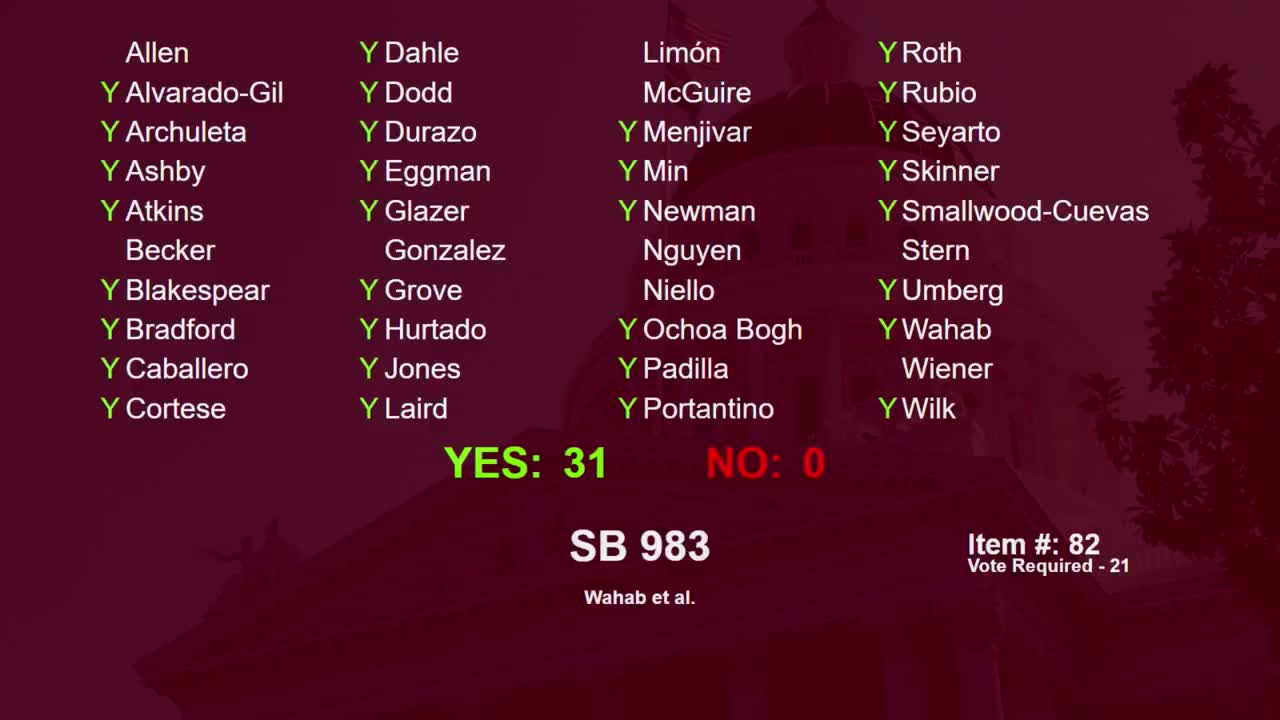 1MIN
Senate Floor
 13MIN
Senate Standing Committee on Judiciary
 16MIN
Senate Standing Committee on Health
Bill Author
Bill Co-Author(s):