SB 1251: Mosquito abatement inspections.
- Session Year: 2023-2024
- House: Senate
- Latest Version Date: 2024-09-22
Current Status:
Passed
(2024-09-22: Chaptered by Secretary of State. Chapter 464, Statutes of 2024.)
Introduced
In Committee
First Chamber
In Committee
Second Chamber
Enacted
Existing law, the Mosquito Abatement and Vector Control District Law, provides for the formation of mosquito abatement and vector control districts and specifies the powers and duties of the district boards, including the authority to request an inspection and abatement warrant to determine the presence of vectors or public nuisances, abate the nuisances, determine if a notice to abate a public nuisance has been complied with, and control vectors and treat property with control measures, as specified. Existing law authorizes a county board of supervisors to provide the same services and exercise the same powers as a mosquito abatement and vector control district.
This bill would require an electrical utility, as defined, to enter into a vector management agreement with a mosquito abatement or vector control district or city or county health department within 180 days of a request to do so, as specified. The bill would specifically authorize a mosquito abatement district or vector control district or a city or county health department to seek that agreement. The bill would require the agreement to contain specified provisions, including the location of its electrical vaults, as defined, within the jurisdiction of the district or health department and a reasonable time for the electrical utility to provide supervised access to its electrical vaults. The bill would require a mosquito abatement district, vector control district, or local public health department to keep confidential utility infrastructure data that it receives pursuant to an agreement entered into between the electrical utility and the district or health department.
Existing constitutional provisions require that a statute that limits the right of access to the meetings of public bodies or the writings of public officials and agencies be adopted with findings demonstrating the interest protected by the limitation and the need for protecting that interest.
This bill would make legislative findings to that effect.
Existing law, the Mosquito Abatement and Vector Control District Law, provides for the formation of mosquito abatement and vector control districts and specifies the powers and duties of the district boards, including the authority to request an inspection and abatement warrant to determine the presence of vectors or public nuisances, abate the nuisances, determine if a notice to abate a public nuisance has been complied with, and control vectors and treat property with control measures, as specified. Existing law authorizes a county board of supervisors to provide the same services and exercise the same powers as a mosquito abatement and vector control district.
This bill would require an electrical utility, as defined, to enter into a vector management agreement with a mosquito abatement or vector control district or city or county health department within 180 days of a request to do so. so, as specified. The bill would specifically authorize a mosquito abatement district or vector control district or a city or county health department to seek that agreement. The bill would require the agreement to contain specified provisions, including the location of its electrical vaults, as defined, within the jurisdiction of the district or health department and a reasonable time for the electrical utility to provide supervised access to its electrical vaults. The bill would require a mosquito abatement district, vector control district, or local public health department to keep confidential utility infrastructure data that it receives pursuant to an agreement entered into between the electrical utility and the district or health department.
Existing constitutional provisions require that a statute that limits the right of access to the meetings of public bodies or the writings of public officials and agencies be adopted with findings demonstrating the interest protected by the limitation and the need for protecting that interest.
This bill would make legislative findings to that effect.
Existing law, the Mosquito Abatement and Vector Control District Law, provides for the formation of mosquito abatement and vector control districts and specifies the powers and duties of the district boards, including the authority to request an inspection and abatement warrant to determine the presence of vectors or public nuisances, abate the nuisances, determine if a notice to abate a public nuisance has been complied with, and control vectors and treat property with control measures, as specified. Existing law authorizes a county board of supervisors to provide the same services and exercise the same powers as a mosquito abatement and vector control district.
This bill would require an electrical corporation, electrical utility, as defined, to enter into a vector management agreement with a mosquito abatement or vector control district or city or county health department within 180 days of a request to do so. The bill would specifically authorize a mosquito abatement district or vector control district or a city or county health department to seek that agreement. The bill would require the agreement to contain specified provisions, including the location of its electrical vaults, as defined, within the jurisdiction of the district or health department and a reasonable time for the electrical corporation electrical utility to provide access to its electrical vaults. The bill would require a mosquito abatement district, vector control district, or local public health department to keep confidential utility infrastructure data that it receives pursuant to an agreement entered into between the electrical corporation electrical utility and the district or health department.
Existing constitutional provisions require that a statute that limits the right of access to the meetings of public bodies or the writings of public officials and agencies be adopted with findings demonstrating the interest protected by the limitation and the need for protecting that interest.
This bill would make legislative findings to that effect.
Existing law, the Mosquito Abatement and Vector Control District Law, provides for the formation of mosquito abatement and vector control districts and specifies the powers and duties of the district boards, including the authority to request an inspection and abatement warrant to determine the presence of vectors or public nuisances, abate the nuisances, determine if a notice to abate a public nuisance has been complied with, and control vectors and treat property with control measures, as specified. Existing law authorizes a county board of supervisors to provide the same services and exercise the same powers as a mosquito abatement and vector control district.
This bill would require an electrical corporation, as defined, to enter into a vector management agreement with a mosquito abatement or vector control district or city or county health department within 180 days of a request to do so. The bill would specifically authorize a mosquito abatement district or vector control district or a city or county health department to seek that agreement. The bill would require the agreement to contain specified provisions, including the location of its electrical vaults, as defined, within the jurisdiction of the district or health department and a reasonable time for the electrical corporation to provide access to its electrical vaults. The bill would require a mosquito abatement district, vector control district, or local public health department to keep confidential utility infrastructure data that it receives pursuant to an agreement entered into between the electrical corporation and the district or health department.
Existing constitutional provisions require that a statute that limits the right of access to the meetings of public bodies or the writings of public officials and agencies be adopted with findings demonstrating the interest protected by the limitation and the need for protecting that interest.
This bill would make legislative findings to that effect.
Existing law, the Mosquito Abatement and Vector Control District Law, provides for the formation of mosquito abatement and vector control districts and specifies the powers and duties of the district boards, including the authority to request an inspection and abatement warrant to determine the presence of vectors or public nuisances, abate the nuisances, determine if a notice to abate a public nuisance has been complied with, and control vectors and treat property with control measures, as specified. Existing law authorizes a county board of supervisors to provide the same services and exercise the same powers as a mosquito abatement and vector control district.
This bill would require an electrical corporation, as defined, to enter into a vector management agreement with a mosquito abatement or vector control district or city or county health department within 72 hours 180 days of a request to do so. The bill would specifically authorize a mosquito abatement district or vector control district or a city or county health department to seek that agreement. The bill would require the agreement to contain specified provisions, including the location of its electrical vaults, as defined, within the jurisdiction of the district or health department and a reasonable time for the electrical corporation to provide access to its electrical vaults.
Existing law, the Mosquito Abatement and Vector Control District Law, provides for the formation of mosquito abatement and vector control districts and specifies the powers and duties of the district boards, including the authority to request an inspection and abatement warrant to determine the presence of vectors or public nuisances, abate the nuisances, determine if a notice to abate a public nuisance has been complied with, and control vectors and treat property with control measures, as specified. Existing law authorizes a county board of supervisors to provide the same services and exercise the same powers as a mosquito abatement and vector control district.
This bill would require an electrical corporation, as defined, to enter into a vector management agreement with a mosquito abatement or vector control district or city or county health department within 72 hours of a request to do so. The bill would specifically authorize a mosquito abatement district or vector control district or a city or county health department to seek that agreement. The bill would require the agreement to contain specified provisions, including the location of its electrical vaults, as defined, within the jurisdiction of the district or health department and a reasonable time for the electrical corporation to provide access to its electrical vaults.
(a)(1)An electrical utility, upon receiving a request from a mosquito abatement district or vector control district or a city or county health department, shall enter into a vector management agreement with the requesting entity within 180 days of the request.
(2)A mosquito abatement district or vector control district or a city or county health department may seek a vector management agreement with an electrical utility pursuant to this section if efforts to obtain a voluntary cooperation agreement from the electrical utility have failed.
(b)A vector management agreement shall contain, but not be limited to, all of the following provisions:
(1)The locations of electrical vaults that the electric utility, mosquito abatement district, or vector control district reasonably believe, due to the type or the location of the vault, may contain standing water within the jurisdiction of the district or health department.
(2)(A)A reasonable time period for the electrical utility to provide supervised access to its electrical vaults to the district or health department for surveillance, treatment, and post-treatment inspections.
(B)In determining the time period in subparagraph (A), the district or health department and the electrical utility shall consider the seasonality of mosquito activity in the area.
(3)The contact information for relevant individuals at the district or health department and the electrical utility.
(4)A time line for the periodic update of the information in this subdivision.
(5)Consideration, where feasible, of modifications to electrical vaults for the purposes of mosquito exclusion or discharge of captured waters.
(6)A minimum term of three years for the agreement, with provisions for modification or extension of the agreement.
(c)This section does not affect the existing authority of a mosquito abatement district or vector control district under Section 2040.
(d)(1)Utility infrastructure data disclosed pursuant to an agreement entered into pursuant to this section shall be kept confidential by the mosquito abatement district, vector control district, or city or county health department that receives the data.
(2)Data disclosure by the utility may be limited to the affected geographical area identified by the mosquito abatement district, vector control district, or health department, and disclosed in a manner deemed as a best practice by the utility for the safety and security of public utility infrastructure.
(e)An electrical utility that has an existing vector management agreement with a mosquito abatement district, vector control district, or a city or county health department is not subject to this provision for as long as the agreement is in effect.
(f)For the purposes of this section, the following terms have the following meanings:
(1)Electrical utility means an electrical corporation, as defined in Section 218 of the Public Utilities Code, or a local publicly owned electric utility, as defined in Section 224.3 of the Public Utilities Code.
(2)Electrical vault means an enclosure, either above or below ground, that may contain transformers or other electrical equipment and is the property of an electrical utility.
SEC. 2.The Legislature finds and declares that Section 1 of this act, which adds Section 2056 to the Health and Safety Code, imposes a limitation on the publics right of access to the meetings of public bodies or the writings of public officials and agencies within the meaning of Section 3 of Article I of the California Constitution. Pursuant to that constitutional provision, the Legislature makes the following findings to demonstrate the interest protected by this limitation and the need for protecting that interest:
In order to facilitate the treatment of electrical vaults to minimize the spread of mosquitoborne diseases, it is necessary to keep the location of electrical vaults private to ensure the safety of public utility infrastructure.
(a)(1)An electrical utility, upon receiving a request from a mosquito abatement district or vector control district or a city or county health department, shall enter into a vector management agreement with the requesting entity within 180 days of the request.
(2)A mosquito abatement district or vector control district or a city or county health department may seek a vector management agreement with an electrical utility pursuant to this section. section if efforts to obtain a voluntary cooperation agreement from the electrical utility have failed.
(b)A vector management agreement shall contain, but not be limited to, all of the following provisions:
(1)The locations of electrical vaults that the electric utility, mosquito abatement district, or vector control district reasonably believe, due to the type or the location of the vault, may contain standing water within the jurisdiction of the district or health department.
(2)(A)A reasonable time period for the electrical utility to provide supervised access to its electrical vaults to the district or health department for surveillance, treatment, and post-treatment inspections.
(B)In determining the time period in subparagraph (A), the district or health department and the electrical utility shall consider the seasonality of mosquito activity in the area.
(3)The contact information for relevant individuals at the district or health department and the electrical utility.
(4)A time line for the periodic update of the information in this subdivision.
(5)Consideration, where feasible, of modifications to electrical vaults for the purposes of mosquito exclusion or discharge of captured waters.
(6)A minimum term of three years for the agreement, with provisions for modification or extension of the agreement.
(c)This section does not affect the existing authority of a mosquito abatement district or vector control district under Section 2040.
(d)(1)Utility infrastructure data disclosed pursuant to an agreement entered into pursuant to this section shall be kept confidential by the mosquito abatement district, vector control district, or city or county health department that receives the data.
(2)Data disclosure by the utility may be limited to the affected geographical area identified by the mosquito abatement district, vector control district, or health department, and disclosed in a manner deemed as a best practice by the utility for the safety and security of public utility infrastructure.
(e)An electrical utility that has an existing vector management agreement with a mosquito abatement district, vector control district, or a city or county health department is not subject to this provision for as long as the agreement is in effect.
(e)(f)For the purposes of this section, the following terms have the following meanings:
(1)Electrical utility means an electrical corporation, as defined in Section 218 of the Public Utilities Code, or a local publicly owned electric utility, as defined in Section 224.3 of the Public Utilities Code.
(2)Electrical vault means an enclosure, either above or below ground, that may contain transformers or other electrical equipment and is the property of an electrical utility.
SEC. 2.The Legislature finds and declares that Section 1 of this act, which adds Section 2056 to the Health and Safety Code, imposes a limitation on the publics right of access to the meetings of public bodies or the writings of public officials and agencies within the meaning of Section 3 of Article I of the California Constitution. Pursuant to that constitutional provision, the Legislature makes the following findings to demonstrate the interest protected by this limitation and the need for protecting that interest:
In order to facilitate the treatment of electrical vaults to minimize the spread of mosquitoborne diseases, it is necessary to keep the location of electrical vaults private to ensure the safety of public utility infrastructure.
(a)(1)An electrical corporation, as defined in Section 218 of the Public Utilities Code, electrical utility, upon receiving a request from a mosquito abatement district or vector control district or a city or county health department, shall enter into a vector management agreement with the requesting entity within 180 days of the request.
(2)A mosquito abatement district or vector control district or a city or county health department may seek a vector management agreement with an electrical corporation electrical utility pursuant to this section.
(b)A vector management agreement shall contain, but not be limited to, all of the following provisions:
(1)The locations of electrical vaults within the jurisdiction of the district or health department.
(2)(A)A reasonable time period for the electrical corporation electrical utility to provide access to its electrical vaults to the district or health department for surveillance, treatment, and post-treatment inspections.
(B)In determining the time period in subparagraph (A), the district or health department and the electrical corporation electrical utility shall consider the seasonality of mosquito activity in the area.
(3)The contact information for relevant individuals at the district or health department and the electrical corporation. electrical utility.
(4)A time line for the periodic update of the information in this subdivision.
(5)Consideration, where feasible, of modifications to electrical vaults for the purposes of mosquito exclusion or discharge of captured waters.
(6)A minimum term of three years for the agreement, with provisions for modification or extension of the agreement.
(c)As used in this section, electrical vault means an enclosure, either above or below ground or in a building that may contain transformers or other electrical equipment and is the property of an electrical corporation.(d)(c)This section does not affect the existing authority of a mosquito abatement district or vector control district under Section 2040.
(e)(d)Utility infrastructure data disclosed pursuant to an agreement entered into pursuant to this section shall be kept confidential by the mosquito abatement district, vector control district, or city or county health department that receives the data.
(e)For the purposes of this section, the following terms have the following meanings:
(1)Electrical utility means an electrical corporation, as defined in Section 218 of the Public Utilities Code, or a local publicly owned electric utility, as defined in Section 224.3 of the Public Utilities Code.
(2)Electrical vault means an enclosure, either above or below ground, that may contain transformers or other electrical equipment and is the property of an electrical utility.
SEC. 2.The Legislature finds and declares that Section 1 of this act, which adds Section 2056 to the Health and Safety Code, imposes a limitation on the publics right of access to the meetings of public bodies or the writings of public officials and agencies within the meaning of Section 3 of Article I of the California Constitution. Pursuant to that constitutional provision, the Legislature makes the following findings to demonstrate the interest protected by this limitation and the need for protecting that interest:
In order to facilitate the treatment of electrical vaults to minimize the spread of mosquitoborne diseases, it is necessary to keep the location of electrical vaults private to ensure the safety of public utility infrastructure.
(a)(1)An electrical corporation, as defined in Section 218 of the Public Utilities Code, upon receiving a request from a mosquito abatement district or vector control district or a city or county health department, shall enter into a vector management agreement with the requesting entity within 180 days of the request.
(2)A mosquito abatement district or vector control district or a city or county health department may seek a vector management agreement with an electrical corporation pursuant to this section.
(b)A vector management agreement shall contain, but not be limited to, all of the following provisions:
(1)The locations of electrical vaults within the jurisdiction of the district or health department.
(2)(A)A reasonable time period for the electrical corporation to provide access to its electrical vaults to the district or health department for surveillance, treatment, and post-treatment inspections.
(B)In determining the time period in subparagraph (A), the district or health department and the electrical corporation shall consider the seasonality of mosquito activity in the area.
(3)The contact information for relevant individuals at the district or health department and the electrical corporation.
(4)A time line for the periodic update of the information in this subdivision.
(5)Consideration, where feasible, of modifications to electrical vaults for the purposes of mosquito exclusion or discharge of captured waters.
(6)A minimum term of three years for the agreement, with provisions for modification or extension of the agreement.
(c)As used in this section, electrical vault means an enclosure, either above or below ground or in a building that may contain transformers or other electrical equipment and is the property of an electrical corporation.
(d)This section does not affect the existing authority of a mosquito abatement district or vector control district under Section 2040.
(e)Utility infrastructure data disclosed pursuant to an agreement entered into pursuant to this section shall be kept confidential by the mosquito abatement district, vector control district, or city or county health department that receives the data.
SEC. 2.The Legislature finds and declares that Section 1 of this act, which adds Section 2056 to the Health and Safety Code, imposes a limitation on the publics right of access to the meetings of public bodies or the writings of public officials and agencies within the meaning of Section 3 of Article I of the California Constitution. Pursuant to that constitutional provision, the Legislature makes the following findings to demonstrate the interest protected by this limitation and the need for protecting that interest:
In order to facilitate the treatment of electrical vaults to minimize the spread of mosquitoborne diseases, it is necessary to keep the location of electrical vaults private to ensure the safety of public utility infrastructure.
(a)(1)An electrical corporation, as defined in Section 218 of the Public Utilities Code, upon receiving a request from a mosquito abatement district or vector control district or a city or county health department, shall enter into a vector management agreement with the requesting entity within 72 hours 180 days of the request.
(2)A mosquito abatement district or vector control district or a city or county health department may seek a vector management agreement with an electrical corporation pursuant to this section.
(b)A vector management agreement shall contain, but not be limited to, all of the following provisions:
(1)The locations of electrical vaults within the jurisdiction of the district or health department.
(2)(A)A reasonable time period for the electrical corporation to provide access to its electrical vaults to the district or health department for surveillance, treatment, and post-treatment inspections.
(B)In determining the time period in subparagraph (A), the district or health department and the electrical corporation shall consider the seasonality of mosquito activity in the area.
(3)The contact information for relevant individuals at the district or health department and the electrical corporation.
(4)A time line for the periodic update of the information in this subdivision.
(5)Consideration, where feasible, of modifications to electrical vaults for the purposes of mosquito exclusion or discharge of captured waters.
(6)A minimum term of three years for the agreement, with provisions for modification or extension of the agreement.
(c)As used in this section, electrical vault means an enclosure, either above or below ground or in a building, that is large enough for a person to enter, contains building that may contain transformers or other electrical equipment, equipment and is the property of an electrical corporation.
(d)This section does not affect the existing authority of a mosquito abatement district or vector control district under Section 2040.
(a)(1)An electrical corporation, as defined in Section 218 of the Public Utilities Code, upon receiving a request from a mosquito abatement district or vector control district or a city or county health department, shall enter into a vector management agreement with the requesting entity within 72 hours of the request.
(2)A mosquito abatement district or vector control district or a city or county health department may seek a vector management agreement with an electrical corporation pursuant to this section.
(b)A vector management agreement shall contain, but not be limited to, all of the following provisions:
(1)The locations of electrical vaults within the jurisdiction of the district or health department.
(2)(A)A reasonable time period for the electrical corporation to provide access to its electrical vaults to the district or health department for surveillance, treatment, and post-treatment inspections.
(B)In determining the time period in subparagraph (A), the district or health department and the electrical corporation shall consider the seasonality of mosquito activity in the area.
(3)The contact information for relevant individuals at the district or health department and the electrical corporation.
(4)A time line for the periodic update of the information in this subdivision.
(c)As used in this section, electrical vault means an enclosure, either above or below ground or in a building, that is large enough for a person to enter, contains transformers or other electrical equipment, and is the property of an electrical corporation.
(d)This section does not affect the existing authority of a mosquito abatement district or vector control district under Section 2040.
|
Date
|
Status
|
|---|---|
| Sep 22, 2024 | Chaptered by Secretary of State. Chapter 464, Statutes of 2024. |
| Sep 22, 2024 | Approved by the Governor. |
| Sep 3, 2024 | Enrolled and presented to the Governor at 3 p.m. |
| Aug 27, 2024 | Assembly amendments concurred in. (Ayes 40. Noes 0. Page 5509.) Ordered to engrossing and enrolling. |
| Aug 20, 2024 | In Senate. Concurrence in Assembly amendments pending. |
| Aug 19, 2024 | Read third time. Passed. (Ayes 69. Noes 0. Page 6377.) Ordered to the Senate. |
| Aug 6, 2024 | Read second time. Ordered to third reading. |
| Aug 5, 2024 | Read second time and amended. Ordered to second reading. |
| Jul 3, 2024 | From committee: Do pass as amended. (Ayes 15. Noes 0.) (July 1). |
| Jun 17, 2024 | From committee with author's amendments. Read second time and amended. Re-referred to Com. on U. & E. |
| Jun 13, 2024 | From committee: Do pass and re-refer to Com. on U. & E. (Ayes 9. Noes 0.) (June 12). Re-referred to Com. on U. & E. |
| Jun 3, 2024 | Referred to Coms. on L. GOV. and U. & E. |
| May 22, 2024 | In Assembly. Read first time. Held at Desk. |
| May 21, 2024 | Read third time. Passed. (Ayes 39. Noes 0. Page 4096.) Ordered to the Assembly. |
| May 2, 2024 | Read second time. Ordered to third reading. |
| May 1, 2024 | Ordered to second reading. |
| May 1, 2024 | Withdrawn from committee. |
| Apr 30, 2024 | Read second time and amended. Re-referred to Com. on APPR. |
| Apr 29, 2024 | From committee: Do pass as amended and re-refer to Com. on APPR. (Ayes 15. Noes 0. Page 3701.) (April 22). |
| Apr 9, 2024 | Set for hearing April 22. |
| Apr 3, 2024 | From committee: Do pass and re-refer to Com. on E., U. & C. (Ayes 5. Noes 1. Page 3469.) (April 3). Re-referred to Com. on E., U. & C. |
| Apr 1, 2024 | From committee with author's amendments. Read second time and amended. Re-referred to Com. on L. GOV. |
| Mar 15, 2024 | Set for hearing April 3. |
| Feb 29, 2024 | Referred to Coms. on L. GOV. and E., U. & C. |
| Feb 16, 2024 | From printer. May be acted upon on or after March 17. |
| Feb 15, 2024 | Introduced. Read first time. To Com. on RLS. for assignment. To print. |
|
Date
|
Description
|
Location
|
Votes
|
|
|---|---|---|---|---|
| Aug 27, 2024 | Unfinished Business SB1251 Stern Concurrence | Senate Floor |
Passed |
|
| Aug 19, 2024 | SB 1251 Stern Senate Third Reading By Schiavo | Assembly Floor |
Passed |
|
| Jul 1, 2024 | Do pass as amended. | Assembly Standing Committee on Utilities and Energy |
Passed |
|
| Jun 12, 2024 | Do pass and be re-referred to the Committee on [Utilities and Energy] | Assembly Standing Committee on Local Government |
Passed |
|
| May 21, 2024 | Senate 3rd Reading SB1251 Stern | Senate Floor |
Passed |
|
| Apr 22, 2024 | Do pass as amended, but first amend, and re-refer to the Committee on [Appropriations] | Senate Standing Committee on Energy, Utilities and Communications |
Passed |
|
| Apr 3, 2024 | Do pass, but first be re-referred to the Committee on [Energy, Utilities and Communications] | Senate Standing Committee on Local Government |
Passed |
This list shows positions taken on this bill by organizations on the date displayed, which is linked to the original source.
Positions by individuals are not included.
|
Organization
|
Position
|
Date
|
|---|---|---|
| Alameda County Mosquito Abatement District | ** Support | |
| Butte County Mosquito and Vector Control District | ** Support | |
| California Special Districts Association | ** Support | |
| City and County of San Francisco | ** Support | |
| Coachella Valley Mosquito and Vector Control District | ** Support | |
| Coachella Valley Mosquito & Vector Control District | ** Support | |
| Colusa Mosquito Abatement District | ** Support | |
| Consolidated Mosquito Abatement District | ** Support | |
| Contra Costa Mosquito and Vector Control District | ** Support | |
| County Health Executives Association Of California | ** Support | |
| Delano Mosquito Abatement District | ** Support | |
| Delta Mosquito and Vector Control District | ** Support | |
| East Side Mosquito Abatement District | ** Support | |
| Fresno Mosquito And Vector Control District | ** Support | |
| Fresno Westside Mosquito Abatement District | ** Support | |
| Greater Los Angeles County Vector Control District | ** Support | |
| Kern Mosquito and Vector Control District | ** Support | |
| Kern Mosquito & Vector Control District | ** Support | |
| Kings Mosquito Abatement District | ** Support | |
| Marin/Sonoma Mosquito & Vector Control District | ** Support | |
| Mosquito And Vector Control Association Of California | ** Support | |
| Northwest Mosquito and Vector Control District | ** Support | |
| Orange County Mosquito and Vector Control District | ** Support | |
| Placer Mosquito and Vector Control District | ** Support | |
| Sacramento-Yolo Mosquito & Vector Control District | ** Support | |
| San Joaquin County Mosquito and Vector Control District | ** Support | |
| San Mateo County Mosquito & Vector Control District | ** Support | |
| Santa Cruz County Mosquito & Vector Control | ** Support | |
| Sutter-Yuba Mosquito and Vector Control District | ** Support | |
| Tulare Mosquito Abatement District | ** Support |
SENATE RULES COMMITTEE Office of Senate Floor Analyses (916) 651-1520 Fax: (916) 327-4478 | SB 1251 |
UNFINISHED BUSINESS
Bill No: SB 1251
Author: Stern (D)
Amended: 8/5/24
Vote: 21
SENATE LOCAL GOVERNMENT COMMITTEE: 5-1, 4/3/24
AYES: Durazo, Seyarto, Skinner, Wahab, Wiener
NOES: Dahle
NO VOTE RECORDED: Glazer
SENATE ENERGY, U. & C. COMMITTEE: 15-0, 4/22/24
AYES: Bradford, Ashby, Becker, Caballero, Dodd, Durazo, Eggman, Gonzalez, Limón, Min, Newman, Rubio, Seyarto, Skinner, Wahab
NO VOTE RECORDED: Dahle, Grove, Wilk
SENATE FLOOR: 39-0, 5/21/24
AYES: Alvarado-Gil, Archuleta, Ashby, Atkins, Becker, Blakespear, Bradford, Caballero, Cortese, Dahle, Dodd, Durazo, Eggman, Glazer, Gonzalez, Grove, Hurtado, Jones, Laird, Limón, McGuire, Menjivar, Min, Newman, Nguyen, Niello, Ochoa Bogh, Padilla, Portantino, Roth, Rubio, Seyarto, Skinner, Smallwood-Cuevas, Stern, Umberg, Wahab, Wiener, Wilk
NO VOTE RECORDED: Allen
ASSEMBLY FLOOR: 69-0, 8/19/24 - See last page for vote
SUBJECT: Mosquito abatement inspections
SOURCE: Mosquito and Vector Control Association of California
DIGEST:
This bill requires an electrical utility to enter into a vector management agreement with a mosquito abatement district, vector control district or a city or county health department within 180 days of being asked in certain circumstances.
Assembly Amendments expand the scope of the bill by applying its provisions to public utility districts, including additional security protections, and imposed a requirement for a mosquito abatement district, vector control district or a city or county health department to seek a voluntary vector management agreement with an electrical utility prior to attempting to impose one.
ANALYSIS:
Existing law:
1) States that, under the state’s Mosquito Abatement and Vector Control District Law, mosquito abatement and vector control districts have broad statutory authority to “conduct effective programs for the surveillance, prevention, abatement, and control of mosquitoes and other vectors.”
2) Provides these districts have the power to:
- Conduct surveillance programs and to study of vectors and vectorborne diseases;
- Take any and all necessary or proper actions to prevent the occurrence of vectors and vectorborne diseases; and
- Take any and all necessary or proper actions to abate or control vectors and vectorborne diseases.
This bill:
1) Gives an electric utility 180 days to enter into a vector management agreement with a mosquito abatement or vector control district when the district makes such a request. The agreement must run for at least three years and contain, at a minimum:
a) The locations of all electrical vaults in the district’s jurisdiction;
b) A reasonable period of time for the IOU to give the district access to the vault to conduct surveillance, treatment, and post-treatment inspections;
c) The contact information for relevant people at the district and the IOU;
d) A timeline to ensure the agreement is updated periodically; and
e) Consideration of modifying electrical vaults to keep pests out, eliminate water in the vault, and prevent water from re-entering the vault.
2) Requires mosquito abatement districts, vector control districts, and city and county health districts to try to enter into voluntary electrical vault inspections with an electrical utility before attempting to require a utility to enter into a vector management agreement.
3) Requires a mosquito abatement district, vector control district, or local public health department to keep confidential any utility infrastructure data it receives pursuant to this bill.
4) Creates definition of “electrical utility” to include both investor-owned utilities (IOUs) and public utility districts (PUDs) for the purposes of the bill.
5) Requires all visits to an electrical vault to be supervised by the electrical utility.
6) Requires electrical utilities to provide mosquito abatement districts, vector control districts, and city and county health districts with the only with the locations of electrical vaults where the PUD or IOU and the districts believe there is standing water.
7) Allows an electrical utility to limit the data it discloses to the mosquito abatement districts, vector control districts, and city and county health districts to specific geographic areas and to determine how to disclose it.
8) Exempts electrical utilities that already have vector management agreements with a mosquito abatement district, vector control district, or a city or county health district from the provisions of the bill as long as that agreement remains in place.
9) Makes legislative findings that in order to facilitate the treatment of electrical vaults to minimize the spread of mosquito borne diseases, it is necessary to keep the location of electrical vaults private to ensure the safety of public utility infrastructure.
Background
What’s your vector, Victor? California created the Mosquito Abatement Districts Act in 1915 to address the health threats posed by mosquitoes and 20 years later, in 1935, the Legislature created pest abatement districts (also referred to as vector control districts) to address plants, animals, fish and other insects deemed to be pests. According to the Mosquito and Vector Control Association of California (MVCAC) there are more than 60 mosquito abatement or vector control districts in California, though they do not cover the entire state.
The primary responsibilities of these districts are to discover where pests are, to control or eradicate them, and to conduct public outreach to eliminate breeding grounds for pests, such as pools of standing water that are often home to mosquitoes and other insects.
According to the County Health Executives Association of California, California monitors 15 mosquito-borne viruses including West Nile Virus (WNV), St. Louis encephalitis virus, and western equine encephalitis virus, with WNV being the most dominant. Since WNV was first discovered in California in 2003, there have been 7,597 WNV human cases and 345 deaths. Last year, California saw three local transmissions of the dengue virus – a virus typically transmitted in tropical or subtropical climates.
Not Al Capone’s vault. A utility vault is most often an underground room that holds equipment such as valves for water or natural gas pipes, or switching gear for electrical or telecommunications equipment. Vaults most generally are built from concrete and similar to mechanical or electrical rooms and most, though not all, are big enough for someone to walk into and stand up in. Vaults can be accessed from streets, sidewalks, or other outdoor areas. By the very nature of their underground location, utility vaults can become home to pools of standing water, which in turn can lead to breeding grounds for mosquitoes and other vectors. There are six IOUs operating in California, with over 500,000 vaults:
- Southern California Edison (SCE), which has about 15 million customers and estimates it has approximately 400,000 utility vaults.
- Sempra Energy (Sempra), which has about 8.6 million customer and estimates it has approximately 100,000 utility vaults.
- Pacific Gas & Electric (PG&E), which has about 16 million customers and does not have an estimated number of utility vaults.
- Bear Valley Electric Service, Liberty Utilities, and PacifiCorp, which have a combined total of about 100,000 California customers and an unknown number of utility vaults.
There are 82 PUDs in California with an unknown number of electrical vaults.
How do things work in practice right now? The state’s Mosquito Abatement and Vector Control District Law gives these districts broad statutory to tackle mosquito and other pest problems, including the ability to pursue statutory abatement actions against property owners to recover any costs associated with controlling pests, plus districts can assess civil penalties against violators.
However, the districts say they use these powers infrequently given the legal and cost-sharing ramifications associated with abatement orders. Instead, the MVCAC says its member agencies prefer to work with the IOUs to gain access to utility vaults. How well that has been working seems to vary by IOU.
According to Sempra, it works with the San Diego County Department of Environmental Health’s Vector Control (San Diego County) to provide the agency with access to utility vaults. Sempra provided San Diego County with a GIS map showing the location of its utility vaults and San Diego County trained some Sempra workers on how best to remove standing water and spray for mosquitoes in some locations. Of its approximately 100,000 utility vaults, Sempra estimates it has about 12 or so on a “hot list” where there are re-occurring problems due to the design of the vault, its proximity to water runoff from rain or agricultural use, and other issues. The utility does not have an official memorandum of understanding (MOU) with San Diego County, but does agree by letter each year on how and when inspections and treatments will occur.
According to PG&E, it has worked with at least one district in its territory – the Madera County Mosquito Vector Control District (Madera) – to try and address standing water and mosquito related issues. PG&E states it partnered with Madera to conduct an eight month pilot to attach filters to the underside of enclosure lids to prevent mosquitoes from entering or leaving the vault, thus eliminating the possibility of infestation.
Comments
1) Purpose of the bill. According to the author, “Mosquitos pose significant health risks, with invasive species of Mosquitos exacerbating the states issue with flying pest. As the author of SB 1251, I know the immediate need for a bill like this to address the escalating threat of mosquito borne illness. This coordinated effort to access utility vaults is needed to remove barriers to access, improve safe access, enhance communication between mosquito control agencies and electrical corporations, and streamline the mosquito abatement and vector control process for the most problematic source of mosquito production. SB 1251 makes certain that those tasked with protecting public health from mosquito borne illness can stay ahead of emerging challenges and ensures effective mosquito control efforts statewide.”
2) Mandatory cooperation. At the root of this bill is an attempt to require the IOUs to cooperate with mosquito abatement and vector control districts to establish a schedule and a protocol to allow the districts to check utility vaults for standing water and pests – and to remove them if they do exist. This bill takes a light hand with its approach in the sense that it sets a 180-day timeline to negotiate an agreement but does not mandate a specific inspection schedule, who should do the inspections, or how they should be done. Furthermore, there is no penalty should an IOU not adhere to the requirements in this measure.
3) Who supplies the person power? While some IOUs have expressed a concern about the person-power required to accompany a mosquito abatement and vector control district employee to inspect hundreds of thousands of utility vaults, it should be noted these districts don’t have the person-power to do that either. More importantly, this bill is silent in terms of how many vaults will be inspected, when the inspections will occur, and how often they will be repeated – those details are left to the districts and the IOUs to negotiate as part of the agreement required by this bill should the parties be unable to reach a voluntary working relationship.
FISCAL EFFECT: Appropriation: No Fiscal Com.: No Local: No
SUPPORT: (Verified 8/20/24)
Mosquito and Vector Control Association of California (source)
Alameda County Mosquito Abatement District
Butte County Mosquito and Vector Control District
California Special Districts Association
City and County of San Francisco
Coachella Valley Mosquito and Vector Control District
Colusa Mosquito Abatement District
Consolidated Mosquito Abatement District
Contra Costa Mosquito and Vector Control District
County Health Executives Association of California
Delano Mosquito Abatement District
Fresno Mosquito and Vector Control District
Fresno Westside Mosquito Abatement District
Greater Los Angeles County Vector Control District
Kern Mosquito and Vector Control District
Kings Mosquito Abatement District
Marin/Sonoma Mosquito & Vector Control District
Northwest Mosquito and Vector Control District
Orange County Mosquito and Vector Control District
Placer Mosquito and Vector Control District
Sacramento-Yolo Mosquito & Vector Control District
San Joaquin County Mosquito and Vector Control District
San Mateo County Mosquito & Vector Control District
Santa Cruz County Mosquito & Vector Control
Sutter-Yuba Mosquito and Vector Control District
Tulare Mosquito Abatement District
OPPOSITION: (Verified 8/20/24)
None received
ARGUMENTS IN SUPPORT: According to the bill’s sponsor, the Mosquito and Vector Control Association of California (MVCAC):
Disease-spreading mosquitoes are a major threat in our state, and utility vaults are widely reported by mosquito control professionals to be the most problematic source of mosquito production due to access issues. In 2003, California saw its first cases of West Nile virus; since then, there have been over 8,000 human West Nile cases statewide. Then in 2010, the invasive mosquitoes that can transmit dengue and Zika viruses were detected, with 3 local transmissions of dengue in Los Angeles County in 2023. MVCAC members are experts at detecting the sources of mosquito production, and utility vaults are especially prone to this.
Utility vaults are enclosures above or below ground owned by the electrical corporation and water accumulation can be a byproduct of the design. Three-quarters of MVCAC members reported mosquito production issues in utility vaults, and less than one-third had sufficient access for operational needs. Less than half are able to obtain the locations of utility vaults within their district.
ASSEMBLY FLOOR: 69-0, 8/19/24
AYES: Addis, Aguiar-Curry, Alanis, Alvarez, Arambula, Bains, Bauer-Kahan, Bennett, Berman, Boerner, Bonta, Bryan, Calderon, Juan Carrillo, Cervantes, Connolly, Megan Dahle, Davies, Dixon, Essayli, Mike Fong, Friedman, Gabriel, Garcia, Gipson, Grayson, Haney, Hart, Holden, Hoover, Irwin, Jackson, Jones-Sawyer, Kalra, Lee, Low, Lowenthal, Maienschein, Mathis, McCarty, McKinnor, Muratsuchi, Stephanie Nguyen, Pacheco, Papan, Pellerin, Petrie-Norris, Quirk-Silva, Ramos, Rendon, Luz Rivas, Rodriguez, Blanca Rubio, Sanchez, Santiago, Schiavo, Soria, Ta, Ting, Valencia, Villapudua, Waldron, Wallis, Ward, Weber, Wilson, Wood, Zbur, Robert Rivas
NO VOTE RECORDED: Wendy Carrillo, Chen, Flora, Gallagher, Lackey, Ortega, Jim Patterson, Joe Patterson, Reyes, Wicks
Prepared by: Evan Goldberg / L. GOV. / (916) 651-4119
8/20/24 16:11:20
**** END ****
SENATE THIRD READING
STR Bill Id:SB 1251
Author:(Stern)
As Amended Ver:June 17, 2024
Majority vote
SUMMARY
Requires a mosquito abatement district or vector control district or a city or county health department to seek a vector management agreement with an electrical utility within 180 days if efforts to obtain a voluntary cooperation agreement from the electrical utility have failed.
Major Provisions
COMMENTS
Mosquitoes in California. California is home to more than 50 species of mosquitoes with habitats ranging from deserts at or below sea level to mountain meadows at elevations of 10,000 feet or more. While many of these species seldom pose a threat to humans, some of them can transmit microbial organisms through their bites that cause serious diseases, including West Nile virus, St. Louis encephalitis virus, western equine encephalitis virus, dengue, and Zika. In 2023 alone, there were 461 cases of West Nile in humans in California, and 19 were fatal. As such, California remains vulnerable to the introduction of other highly virulent mosquito-borne viruses of public health concern, including Japanese encephalitis, yellow fever, and Rift Valley fever, among others.
Statutory Authority. The state's Mosquito Abatement and Vector Control District Law gives vector control districts statutory authority to "conduct effective programs for the surveillance, prevention, abatement, and control of mosquitoes and other vectors." These powers include the ability to take any and all necessary actions to abate or control vectors and vector-borne diseases. In practice, the primary responsibilities of these districts often involve discovering where pests are or can be expected to proliferate, eradicating an existing colony, cleaning standing water sources to reduce mosquito habitats, and conducting public outreach.
Mosquitoes in Electric Vaults – This bill defines an "electrical vault" as an enclosure, either above or below ground, that may contain transformers or other electrical equipment and is the property of an electrical utility. While utility vaults may not be a primary source of mosquitoes, vaults can collect standing water, which can serve as breeding grounds for mosquitoes. Although vector control districts have the right to take any and all necessary actions to abate mosquitos under existing law, including entering vaults should they deem it appropriate, electric vaults many be inaccessible to districts unless a utility provides access to the vault. The author contends that requiring agreements between districts and utilities as this bill provides could clarify a protocol for quick and safe access to electric vaults.
According to the Author
According to the author, "Mosquitos pose significant health risks, with invasive species of Mosquitos exacerbating the states issue with flying pest. As the author of SB 1251, I know the immediate need for a bill like this to address the escalating threat of mosquito borne illness. This coordinated effort to access utility vaults is needed to remove barriers to access, improve safe access, enhance communication between mosquito control agencies and electrical corporations, and streamline the mosquito abatement and vector control process for the most problematic source of mosquito production. SB 1251 makes certain that those tasked with protecting public health from mosquito borne illness can stay ahead of emerging challenges and ensures effective mosquito control efforts statewide."
Arguments in Support
This measure is supported by numerous mosquito and vector control districts. For instance, The Mosquito and Vector Control Association of California argue that, "Mosquito control agencies report mixed results in attempting to locate or access utility vaults, and a streamlined process to improve safe access and communication would remove many barriers to operations. Some agencies have received comprehensive data on vault locations and types and have been granted restricted access to vaults, with approved training and equipment."
Arguments in Opposition
None on file.
FISCAL COMMENTS
The costs are unknown. This bill is keyed non-fiscal.
VOTES
SENATE FLOOR: 39-0-1
YES: Alvarado-Gil, Archuleta, Ashby, Atkins, Becker, Blakespear, Bradford, Caballero, Cortese, Dahle, Dodd, Durazo, Eggman, Glazer, Gonzalez, Grove, Hurtado, Jones, Laird, Limón, McGuire, Menjivar, Min, Newman, Nguyen, Niello, Ochoa Bogh, Padilla, Portantino, Roth, Rubio, Seyarto, Skinner, Smallwood-Cuevas, Stern, Umberg, Wahab, Wiener, Wilk
ABS, ABST OR NV: Allen
ASM LOCAL GOVERNMENT: 9-0-0
YES: Juan Carrillo, Waldron, Essayli, Haney, Kalra, Pacheco, Ramos, Ward, Wilson
ASM UTILITIES AND ENERGY: 15-0-1
YES: Petrie-Norris, Bauer-Kahan, Calderon, Chen, Friedman, Hart, Holden, Joe Patterson, Reyes, Santiago, Schiavo, Ting, Wallis, Wood, Zbur
ABS, ABST OR NV: Jim Patterson
UPDATED
VERSION: June 17, 2024
CONSULTANT: Lina Malova / U. & E. / (916) 319-2083 FN: 0003703
Date of Hearing: July 1, 2024
ASSEMBLY COMMITTEE ON UTILITIES AND ENERGY
Cottie Petrie-Norris, Chair
SBPCA Bill Id:SB 1251
Author:(Stern) – As Amended Ver:April 30, 2024
SENATE VOTE: 39-0
SUBJECT: Mosquito abatement inspections
SUMMARY: Requires an electrical utility, as defined, to enter into a vector management agreement with a mosquito abatement district, vector control district, or a city or county health department within 180 days of receiving a request from the district or department.
Specifically, this bill:
- Requires an electrical utility to enter into a vector management agreement within 180 days of receiving a request from a mosquito abatement district, vector control district, or local health department.
- Requires the agreement to contain specified provisions, including the location of its electrical vaults, as defined, within the jurisdiction of the district or health department and a reasonable time for the electrical utility to provide access to its electrical vaults.
- Defines an “electrical vault” for the purposes of this bill as an enclosure, either above or below ground that may contain transformers or other electrical equipment and is the property of an electrical corporation.
- Requires a mosquito abatement district, vector control district, or local public health department to keep confidential utility infrastructure data that it receives pursuant to an agreement entered into between the electrical utility and the district or health department.
EXISTING LAW:
- Authorizes the California Public Utilities Commission (CPUC) to regulate public utilities, including electric and natural gas corporations, and establish rates for these utilities. (Public Utilities Code §201 et. seq.)
- Defines an “electrical corporation” as every corporation or person owning, controlling, operating, or managing any electric plant for compensation in the state, except where electricity is generated on or distributed by the producer through private property solely for its own use or the use of its tenants and not for sale or transmission to others. Establishes limited exemptions to the definition of an electrical corporation. Existing law generally designates any entity that sells electricity to more than two contiguous parcels or across the street as an “electrical corporation.” (Public Utilities Code §218)
- Establishes the Mosquito Abatement and Vector Control District Law, which authorizes the establishment of mosquito abatement and vector control districts, as specified. (Health and Safety Code §2000)
- Establishes the authority of Mosquito Abatement and Vector Control districts. Existing law broadly authorizes these special districts to take any and all necessary or proper actions to prevent and abate vectors and associated diseases within their jurisdictions and carry out certain activities outside their districts when vectors and associated diseases may enter their districts. (Health and Safety Code §2040)
- Establishes the California Mosquito Surveillance and Research Program, which is administered by the University of California at Davis to conduct specified duties regarding research, interagency coordination, and dissemination of data on mosquitos and vector-borne diseases. (Health and Safety Code §2101)
FISCAL EFFECT: The costs are unknown. This bill is keyed non-fiscal.
BACKGROUND:
Mosquitoes in California – California is home to more than 50 species of mosquitoes with habitats ranging from deserts at or below sea level to mountain meadows at elevations of 10,000 feet or more.[1] While many of these species seldom pose a threat to humans, some of them can transmit microbial organisms through their bites that cause serious diseases, including West Nile virus, St. Louis encephalitis virus, western equine encephalitis virus, dengue, and Zika. In 2023 alone, there were 461 cases of West Nile in humans in California, and 19 were fatal.[2] California also remains vulnerable to the introduction of other highly virulent mosquito-borne viruses of public health concern, including Japanese encephalitis, yellow fever, and Rift Valley fever, among others.
Mosquito Abatement Districts – In 1915, the California State Legislature passed the Mosquito Abatement Act which permitted local governments to collect revenues and form special districts to protect the public from mosquitoes and mosquito-borne diseases.[3] Two decades later, in 1935, the Legislature created vector control districts (also referred to as pest abatement districts) to
control the numbers and spread of animals, fish, and other insects believed to be pests. California has more than 60 mosquito abatement and vector control districts; some are small and have responsibility over a city or portion of a county, while others cover a wider span across one or more counties.
The state’s Mosquito Abatement and Vector Control District Law gives vector control districts statutory authority to “conduct effective programs for the surveillance, prevention, abatement, and control of mosquitoes and other vectors.” These powers include the ability to:
- Conduct surveillance programs and to study vectors and vector-borne diseases;
- Take any and all necessary or proper actions to prevent the occurrence of vectors and
vector-borne diseases;
- Take any and all necessary actions to abate or control vectors and vector-borne diseases.
In practice, the primary responsibilities of these districts often involve discovering where pests are or can be expected to proliferate, eradicating an existing colony, cleaning standing water sources to reduce mosquito habitats, and conducting public outreach.
The California Mosquito Surveillance and Research Program (Program) – AB 320 (Quirk, Chapter 422, Statutes of 2019) requires UC Davis, in administering the Program, to maintain an interactive internet website for the management and dissemination of data on mosquito-borne virus and surveillance control, and to coordinate with the California Department of Public Health (CDPH), the Mosquito and Vector Control Association of California, local mosquito abatement and vector control districts, local governments, and other affected stakeholders and share information and conduct research on vector-borne diseases and mosquito control. This is to the extent the program receives funding for those purposes. In response to enactment of AB 320, staff at UC Davis established the California Vectorborne Disease Surveillance Gateway (CalSurv), the statewide surveillance database that assists with preventing the spread of mosquito-borne diseases. CalSurv curates local and statewide data to enable mosquito and vector control and public health agencies to make informed decisions on public health interventions.
COMMENTS:
- Author’s Statement. According to the author, “Mosquitos pose significant health risks, with invasive species of Mosquitos exacerbating the states issue with flying pest. As the author of SB 1251, I know the immediate need for a bill like this to address the escalating threat of mosquito borne illness. This coordinated effort to access utility vaults is needed to remove barriers to access, improve safe access, enhance communication between mosquito control agencies and electrical corporations, and streamline the mosquito abatement and vector control process for the most problematic source of mosquito production. SB 1251 makes certain that those tasked with protecting public health from mosquito borne illness can stay ahead of emerging challenges and ensures effective mosquito control efforts statewide.”
- Mosquitoes in Electric Vaults – This bill defines an “electrical vault” as an enclosure, either above or below ground, that may contain transformers or other electrical equipment and is the property of an electrical utility. Electric vaults vary in size and nature, but underground vaults are generally accessible only through lids at the street level. While utility vaults may not be a primary source of mosquitoes, vaults can collect standing water, which can serve as breeding grounds for mosquitoes. This bill would require an electric utility to enter into agreements with a district if a district makes such a request. Although vector control districts have the right to take any and all necessary actions to prevent, survey, and abate mosquitos under existing law, including entering vaults should they deem it appropriate, the author motivates a need for this bill because electric vaults are often inaccessible to districts without a utility providing access to the an electric vault. As such, requiring agreements between districts and utilities could clarify a protocol for quick and safe access to vaults.
- Addressing Safety and Workforce Concerns. This bill would require a utility that enters into an agreement with a district to contain specified information about their infrastructure. Utilities play a critical role in providing essential services and are vital components of our electrical grid, facilitating the generation, transmission, and distribution of electricity to homes, schools and businesses. To facilitate these operations, utilities handle vast amounts of sensitive data, including customer, operational, and system control information. As such, the committee recommends including clarifying language that data disclosure shall be in a manner deemed as a best practice by the utility for safety and security of a public utility infrastructure. Additionally, the committee recommends clarifying that districts may seek a vector management agreement if efforts to obtain voluntary cooperation with the electric utility have failed before vector management agreements are initiated, such that the disclosure of sensitive data is only mandated when necessary.
Utility operations inside vaults require highly skilled workers. These operations can involve highly risky work environments, with workers often facing high voltage electricity, hazardous materials, and severe weather. Therefore, maintaining the safety of operations and of the people who enter these vaults, whether employed by the utility or a third party, is paramount. As such, the committee recommends requiring utilities to provide supervised access to electric vaults.
- Related Legislation
SB 1252 (Stern) would update the California Mosquito Surveillance and Research Program to require the program’s administrator, the University of California at Davis, to consult with partners at the University of California and the California State University about the most-up-to-date research pertaining to mosquito abatement. The bill is pending hearing on July 2 in the Assembly Committee on Higher Education.
- Prior Legislation
AB 320 (Quirk) established the California Mosquito Surveillance and Research Program, administered by the University of California at Davis, and specifies the duties of the program. Status: Chapter 422, Statutes of 2019.
AB 2892 (Quirk, 2018) was similar to AB 320 (2019), but would have housed CalSurv at CDPH. The bill was held on the Senate Appropriations Committee suspense file.
SB 382 (Pan, 2017) would have created the California Mosquito Surveillance and Research Program Account to fund CalSurv and research grants to help mitigate the effects of increasing vector populations. The bill was held on the Senate Appropriations Committee suspense file.
REGISTERED SUPPORT / OPPOSITION:
Support
Alameda County Mosquito Abatement District
Butte County Mosquito and Vector Control District
California Special Districts Association
City and County of San Francisco
Coachella Valley Mosquito and Vector Control District
Colusa Mosquito Abatement District
Consolidated Mosquito Abatement District
Contra Costa Mosquito and Vector Control District
County Health Executives Association of California (CHEAC)
Delano Mosquito Abatement District
Fresno Mosquito and Vector Control District
Fresno Westside Mosquito Abatement District
Greater Los Angeles County Vector Control District
Kern Mosquito and Vector Control District
Kings Mosquito Abatement District
Marin/Sonoma Mosquito & Vector Control District
Mosquito and Vector Control Association of California
Northwest Mosquito and Vector Control District
Orange County Mosquito and Vector Control District
Placer Mosquito and Vector Control District
Sacramento-yolo Mosquito & Vector Control District
San Joaquin County Mosquito and Vector Control District
San Mateo County Mosquito & Vector Control District
Santa Cruz County Mosquito & Vector Control
Sutter-Yuba Mosquito and Vector Control District
Tulare Mosquito Abatement District
Opposition
None on file.
Analysis Prepared by: Lina V. Malova / U. & E. / (916) 319-2083
UCIPM, “Pests of Homes, Structures, People, and Pets”; https://ipm.ucanr.edu/PMG/PESTNOTES/pn7451.html ↑
Los Angeles Times; “West Nile a growing threat this summer in California. Here’s why”; August 2023; https://www.latimes.com/california/story/2023-08-30/west-nile-growing-threat-california ↑
San Mateo County Mosquito & Vector Control District, “District History” https://www.smcmvcd.org/district-history ↑
Date of Hearing: June 12, 2024
ASSEMBLY COMMITTEE ON LOCAL GOVERNMENT
Juan Carrillo, Chair
SBPCA Bill Id:SB 1251
Author:(Stern) – As Amended Ver:April 30, 2024
SENATE VOTE: 39-0
SUBJECT: Mosquito abatement inspections
SUMMARY: Requires an electrical corporation to enter into a vector management agreement with a mosquito abatement district, vector control district, or city or county health department within 180 days of receiving a request from the district or department. Specifically, this bill:
- Requires an electrical corporation as defined in specified existing law, to enter into a vector management agreement within 180 days of receiving a request from a mosquito abatement district, vector control district, or local health department.
- Defines an “electrical vault” as an enclosure, either above or below ground, or in a building that may contain transformers or other electrical equipment and is the property of an electrical corporation.
- Specifies that a vector management agreement must contain, but is not limited to the following:
- The locations of electrical vaults within the district or health department’s jurisdiction.
- A reasonable time period for the electrical corporation to provide the district or health department with access to its electrical vaults for surveillance, treatment, and post-treatment inspections. This bill specifies that this time period must consider the seasonality of mosquito activity in the area.
- The contact information for the relevant individuals at the electrical corporation and the local health department or district.
- A timeline for the periodic update of the information in this section.
- Consideration, where feasible, of changes to electrical vaults to block mosquitos or discharge captured waters.
- A minimum of three years for the agreement, with provisions for the modification or extension of the agreement.
- Specifies that this bill does not affect existing authority of mosquito abatement and vector control districts under existing law, as specified.
- Requires that utility infrastructure data disclosed pursuant to an agreement entered into pursuant to this bill shall be kept confidential by the mosquito abatement district, vector control district, or city or county health department that receives the data.
- Finds and declares that in order to facilitate the treatment of electrical vaults to minimize the spread of mosquito-borne diseases, it is necessary to keep the location of electrical vaults private to ensure the safety of public utility infrastructure.
EXISTING LAW:
- Authorizes the California Public Utilities Commission (CPUC) to regulate public utilities, including electric and natural gas corporations, and establish rates for these utilities. [Public and Utilities Code (PUC) Section 201 et. seq.]
- Defines an “electrical corporation” as every corporation or person owning, controlling, operating, or managing any electric plant for compensation in the state, except where electricity is generated on or distributed by the producer through private property solely for its own use or the use of its tenants and not for sale or transmission to others. Existing law establishes limited exemptions to the definition of an electrical corporation. Existing law generally designates any entity that sells electricity to more than two contiguous parcels or across the street as an “electrical corporation.” [PUC Section 218]
- Establishes the Mosquito Abatement and Vector Control District Law, which authorizes the establishment of mosquito abatement and vector control districts, as specified. [PUC Section 2000]
- Establishes the authority of mosquito abatement and vector control districts. Existing law broadly authorizes these special districts to take any and all necessary or proper actions to prevent and abate vectors and associated diseases within their jurisdictions and carry out certain activities outside their districts when vectors and associated diseases may enter their districts. [Health and Safety Code (HSC) Section 2040]
- Establishes the California Mosquito Surveillance and Research Program, which is administered by the University of California at Davis to conduct specified duties regarding research, interagency coordination, and dissemination of data on mosquitos and vector-borne diseases. [HSC Section 2101]
FISCAL EFFECT: None.
COMMENTS:
- Bill Summary. This bill requires electrical corporations to enter into vector management agreements with mosquito abatement districts, vector control districts, or city and county health departments within 180 days upon request. A vector management agreement shall:
- Identify vault locations within the district/department’s jurisdiction;
- Specify reasonable access times for surveillance, treatment, and inspections, considering mosquito seasonality;
- List relevant contacts at both the district/department and the electrical corporation;
- Set a timeline for updating agreement information;
- Consider feasible modifications for mosquito exclusion or water discharge; and
- Allow for a minimum term of three years for the agreement with options for modification or extension.
This bill defines “electrical vault” to mean an enclosure, either above or below ground or in a building that may contain transformers or other electrical equipment and is the property of an electrical corporation.
This bill requires utility infrastructure data shared under the agreement to remain confidential.
This bill is sponsored by the Mosquito and Vector Control Association of California.
- Author’s Statement. According to the author, “Mosquitoes pose significant health risks, with invasive species of mosquitoes exacerbating the state’s issue with flying pests. As the author of SB 1251, I know the immediate need for a bill like this to address the escalating threat of mosquito-borne illness. This coordinated effort to access utility vaults is needed to remove barriers to access, improve safe access, enhance communication between mosquito control agencies and electrical corporations, and streamline the mosquito abatement and vector control process for the most problematic source of mosquito production. SB 1251 makes certain that those tasked with protecting public health from mosquito-borne illness can stay ahead of emerging challenges and ensures effective mosquito control efforts statewide.”
- Viruses Contracted by Mosquitoes. Mosquitos are vectors for several viruses. Increasingly, viruses associated with serious diseases have been spreading in California due to mosquito bites. California saw its first cases of West Nile Virus in 2003. Since those initial cases, over 8,000 West Nile cases have been reported in the state. While none of California’s Zika virus cases have originated from mosquito bites in the state, the type of mosquitos prone to carrying Zika have been observed in the state.
According to the County Health Executives Association of California, California monitors 15 mosquito-borne viruses including West Nile Virus (WNV), St. Louis encephalitis virus, and western equine encephalitis virus, with WNV being the most dominant. Since WNV was first discovered in California in 2003, there have been 7,597 WNV human cases and 345 deaths. Last year, California saw three local transmissions of the dengue virus – a virus typically transmitted in tropical or subtropical climates.
In 2023, California became one of five states in which the local spread of Dengue occurred. Mosquitos carrying these viruses are more likely to proliferate at certain times of the year under certain conditions. Mosquitos are particularly known to proliferate in the hottest months (July through September) and breed in standing water. Utility vaults vary in size and nature, but underground vaults are generally accessible only through lids at the street level. While utility vaults may not be the primary source of mosquitos, vaults can collect standing water and are inaccessible without a utility providing access to the vault.
This bill is aimed at establishing more consistent plans for how utilities will address the potential breeding of mosquitos in their vaults, including providing vector control agencies with access to those vaults for mosquito abatement if the utility does not have its own mosquito abatement program.
- Mosquito Abatement Districts Act. California created the Mosquito Abatement Districts Act in 1915 to address the health threats posed by mosquitoes and 20 years later, in 1935, the Legislature created pest abatement districts (also referred to as vector control districts) to address plants, animals, fish, and other insects deemed to be pests. According to the Mosquito and Vector Control Association of California (MVCAC), there are more than 60 mosquito abatement or vector control districts in California, though they do not cover the entire state.
The primary responsibilities of these districts are to discover where pests are, to control or eradicate them, and to conduct public outreach to eliminate breeding grounds for pests, such as pools of standing water that are often home to mosquitoes and other insects.
The state’s Mosquito Abatement and Vector Control District Law gives these districts broad statutory authority to “conduct effective programs for the surveillance, prevention, abatement, and control of mosquitoes and other vectors.” These powers include the ability to:
- Conduct surveillance programs and to study vectors and vector-borne diseases;
- Take any and all necessary or proper actions to prevent the occurrence of vectors and vector-borne diseases; and
- Take any and all necessary or proper actions to abate or control vectors and vector-borne diseases.
These “any and all” actions include the ability to pursue statutory abatement actions against property owners to recover any costs associated with controlling pests, plus districts can assess civil penalties against violators. However, the districts say they use these powers infrequently given the legal and cost-sharing ramifications associated with abatement orders.
- Investor-Owned Electric Utilities (IOUs). While mosquito abatement and vector control districts have the authority to declare something a public nuisance in order to gain access to it and tackle a pest problem, the MVCAC says its member agencies prefer to work with the IOUs to gain access to utility vaults. How well that has been working seems to vary by IOU.
According to Sempra, it works with the San Diego County Department of Environmental Health’s Vector Control (San Diego County) to provide the agency with access to utility vaults. Sempra provided San Diego County with a GIS map showing the location of its utility vaults and San Diego County trained some Sempra workers on how best to remove standing water and spray for mosquitoes in some locations. Of its approximately 100,000 utility vaults, Sempra estimates it has about 12 or so on a “hot list” where there are re-occurring problems due to the design of the vault, its proximity to water runoff from rain or agricultural use, and other issues. The utility does not have an official memorandum of understanding (MOU) with San Diego County, but does agree by letter each year on how and when inspections and treatments will occur.
According to PG&E, it has worked with at least one district in its territory – the Madera County Mosquito Vector Control District (Madera) – to try and address standing water and mosquito-related issues. PG&E states it partnered with Madera to conduct an eight-month pilot to attach filters to the underside of enclosure lids to prevent mosquitoes from entering or leaving the vault, thus eliminating the possibility of infestation.
- Arguments in Support. The Mosquito and Vector Control Association of California, the sponsor of this bill, writes, “Disease-spreading mosquitoes are a major threat in our state, and utility vaults are widely reported by mosquito control professionals to be one of the most problematic sources of mosquito production due to access issues. In 2003, California saw its first cases of West Nile virus; since then, there have been over 8,000 human West Nile cases statewide. A new challenge arose in 2010, the arrival and establishment of invasive mosquitoes capable of transmitting pathogens like dengue and Zika virus. This threat was fully realized in 2023 with 3 local transmissions of dengue in Los Angeles County
“Where certain sources pose a recurring nuisance, mosquito control agencies can pursue statutory abatement against property owners to recover the costs of control and to assess civil penalties. Mosquito control agencies report mixed results in attempting to locate or access utility vaults, and a streamlined process to improve safe access and communication would remove many barriers to operations.”
- Arguments in Opposition. Southern California Edison (SCE) writes, “Under the existing Mosquito Abatement and Vector Control District Law, vector control districts have the right to take any and all necessary actions to prevent, survey, and abate mosquitos, including the ability to declare a public nuisance and take escalated action. SB 1251 presents vector management agreements as a tool to streamline the ability to access and abate mosquitos in electric vaults but, in practice, creates an unnecessary process that provides no further benefit than existing law.
“As written, the bill targets underground vaults belonging to investor-owned utilities (IOUs), and excludes vaults belonging to publicly owned utilities, or other entities with underground equipment. By failing to require action from other stakeholders, this bill presents a whack-a-mole scenario, where mitigation efforts in an IOU vault would be thwarted by adjacent underground equipment that may also house mosquitos but would not be mandated to act.
“While the bill includes protections to maintain confidential IOU data, the bill will increase the risk of data breaches or incidental data mismanagement that can leak sensitive information such as vault location. Furthermore, forcing IOUs to provide vault access presents worker safety and reliability concerns by granting access to individuals who may lack the knowledge and training to safely enter an electrical vault.”
- Related Legislation. SB 1252 (Stern) updates the California Mosquito Surveillance and Research Program to require the program’s administrator, the University of California at Davis, to consult with partners at the University of California and the California State University about the most up-to-date research pertaining to mosquito abatement. SB 1252 is pending in the Assembly Environmental Safety and Toxic Materials Committee.
- Previous Legislation. AB 320 (Quirk), Chapter 422, Statutes of 2019, established the California Mosquito Surveillance and Research Program, administered by the University of California at Davis, and specifies the duties of the program.
- Double-Referral. This bill is double-referred to the Utilities and Energy Committee.
REGISTERED SUPPORT / OPPOSITION:
Support
Mosquito and Vector Control Association of California [SPONSOR]
Alameda County Mosquito Abatement District
Butte County Mosquito and Vector Control District
California Special Districts Association
City and County of San Francisco
Coachella Valley Mosquito and Vector Control District
Colusa Mosquito Abatement District
Consolidated Mosquito Abatement District
Contra Costa Mosquito and Vector Control District
County Health Executives Association of California
Delano Mosquito Abatement District
Fresno Mosquito and Vector Control District
Fresno Westside Mosquito Abatement District
Greater Los Angeles County Vector Control District
Kern Mosquito and Vector Control District
Kings Mosquito Abatement District
Marin/Sonoma Mosquito & Vector Control District
Northwest Mosquito and Vector Control District
Orange County Mosquito and Vector Control District
Placer Mosquito and Vector Control District
Sacramento-yolo Mosquito & Vector Control District
San Joaquin County Mosquito and Vector Control District
San Mateo County Mosquito & Vector Control District
Santa Cruz County Mosquito & Vector Control
Sutter-Yuba Mosquito and Vector Control District
Tulare Mosquito Abatement District
Oppose
Edison International and Affiliates, Including Southern California Edison
Analysis Prepared by: Claire Norton / L. GOV. / (916) 319-3958
SENATE RULES COMMITTEE Office of Senate Floor Analyses (916) 651-1520 Fax: (916) 327-4478 | SB 1251 |
THIRD READING
Bill No: SB 1251
Author: Stern (D)
Amended: 4/30/24
Vote: 21
SENATE LOCAL GOVERNMENT COMMITTEE: 5-1, 4/3/24
AYES: Durazo, Seyarto, Skinner, Wahab, Wiener
NOES: Dahle
NO VOTE RECORDED: Glazer
SENATE ENERGY, U. & C. COMMITTEE: 15-0, 4/22/24
AYES: Bradford, Ashby, Becker, Caballero, Dodd, Durazo, Eggman, Gonzalez, Limón, Min, Newman, Rubio, Seyarto, Skinner, Wahab
NO VOTE RECORDED: Dahle, Grove, Wilk
SUBJECT: Mosquito abatement inspections
SOURCE: Mosquito and Vector Control Association of California
DIGEST:
This bill requires investor-owned utilities (IOUs) to enter into an agreement with a mosquito abatement or vector control district within 180 days of receiving a request to allow the district to inspect utility vaults for mosquito and other pest infestations and issues.
ANALYSIS: Existing law states that, under the state’s Mosquito Abatement and Vector Control District Law, mosquito abatement and vector control districts have broad statutory authority to “conduct effective programs for the surveillance, prevention, abatement, and control of mosquitoes and other vectors.” Provides that these powers include the ability to: (1) conduct surveillance programs and to study of vectors and vectorborne diseases; (2) Take any and all necessary or proper actions to prevent the occurrence of vectors and vectorborne diseases; and (3) take any and all necessary or proper actions to abate or control vectors and vectorborne diseases.
This bill:
1) Gives an IOU 180 days to enter into a vector management agreement with a mosquito abatement or vector control district when the district makes such a request. The agreement must run for at least three years and contain, at a minimum:
- The locations of all electrical vaults in the district’s jurisdiction;
- A reasonable period of time for the IOU to give the district access to the vault to conduct surveillance, treatment, and post-treatment inspections;
- The contact information for relevant people at the district and the IOU;
- A timeline to ensure the agreement is updated periodically; and
- Consideration of modifying electrical vaults to keep pests out, eliminate water in the vault, and prevent water from re-entering the vault.
2) Requires a mosquito abatement district, vector control district, or local public health department to keep confidential any utility infrastructure data it receives pursuant to this bill.
3) Makes legislative findings that in order to facilitate the treatment of electrical vaults to minimize the spread of mosquito borne diseases, it is necessary to keep the location of electrical vaults private to ensure the safety of public utility infrastructure.
Background
What’s your vector, Victor? California created the Mosquito Abatement Districts Act in 1915 to address the health threats posed by mosquitoes and 20 years later, in 1935, the Legislature created pest abatement districts (also referred to as vector control districts) to address plants, animals, fish and other insects deemed to be pests. According to the Mosquito and Vector Control Association of California (MVCAC) there are more than 60 mosquito abatement or vector control districts in California, though they do not cover the entire state.
The primary responsibilities of these districts are to discover where pests are, to control or eradicate them, and to conduct public outreach to eliminate breeding grounds for pests, such as pools of standing water that are often home to mosquitoes and other insects.
According to the County Health Executives Association of California, California monitors 15 mosquito-borne viruses including West Nile Virus (WNV), St. Louis encephalitis virus, and western equine encephalitis virus, with WNV being the most dominant. Since WNV was first discovered in California in 2003, there have been 7,597 WNV human cases and 345 deaths. Last year, California saw three local transmissions of the dengue virus – a virus typically transmitted in tropical or subtropical climates.
Not Al Capone’s vault. A utility vault is most often an underground room that holds equipment such as valves for water or natural gas pipes, or switching gear for electrical or telecommunications equipment. Vaults most generally are built from concrete and similar to mechanical or electrical rooms and most, though not all, are big enough for someone to walk into and stand up in. Vaults can be accessed from streets, sidewalks, or other outdoor areas. By the very nature of their underground location, utility vaults can become home to pools of standing water, which in turn can lead to breeding grounds for mosquitoes and other vectors. There are six IOUs operating in California, with over 500,000 vaults:
- Southern California Edison (SCE), which has about 15 million customers and estimates it has approximately 400,000 utility vaults.
- Sempra Energy (Sempra), which has about 8.6 million customer and estimates it has approximately 100,000 utility vaults.
- Pacific Gas & Electric (PG&E), which has about 16 million customers and does not have an estimated number of utility vaults.
- Bear Valley Electric Service, Liberty Utilities, and PacifiCorp, which have a combined total of about 100,000 California customers and an unknown number of utility vaults.
How do things work in practice right now? The state’s Mosquito Abatement and Vector Control District Law gives these districts broad statutory to tackle mosquito and other pest problems, including the ability to pursue statutory abatement actions against property owners to recover any costs associated with controlling pests, plus districts can assess civil penalties against violators.
However, the districts say they use these powers infrequently given the legal and cost-sharing ramifications associated with abatement orders. Instead, the MVCAC says its member agencies prefer to work with the IOUs to gain access to utility vaults. How well that has been working seems to vary by IOU.
According to Sempra, it works with the San Diego County Department of Environmental Health’s Vector Control (San Diego County) to provide the agency with access to utility vaults. Sempra provided San Diego County with a GIS map showing the location of its utility vaults and San Diego County trained some Sempra workers on how best to remove standing water and spray for mosquitoes in some locations. Of its approximately 100,000 utility vaults, Sempra estimates it has about 12 or so on a “hot list” where there are re-occurring problems due to the design of the vault, its proximity to water runoff from rain or agricultural use, and other issues. The utility does not have an official memorandum of understanding (MOU) with San Diego County, but does agree by letter each year on how and when inspections and treatments will occur.
According to PG&E, it has worked with at least one district in its territory – the Madera County Mosquito Vector Control District (Madera) – to try and address standing water and mosquito related issues. PG&E states it partnered with Madera to conduct an eight month pilot to attach filters to the underside of enclosure lids to prevent mosquitoes from entering or leaving the vault, thus eliminating the possibility of infestation.
Comments
- Purpose of the bill. According to the author, “Mosquitos pose significant health risks, with invasive species of Mosquitos exacerbating the states issue with flying pest. As the author of SB 1251, I know the immediate need for a bill like this to address the escalating threat of mosquito borne illness. This coordinated effort to access utility vaults is needed to remove barriers to access, improve safe access, enhance communication between mosquito control agencies and electrical corporations, and streamline the mosquito abatement and vector control process for the most problematic source of mosquito production. SB 1251 makes certain that those tasked with protecting public health from mosquito borne illness can stay ahead of emerging challenges and ensures effective mosquito control efforts statewide.”
- Mandatory cooperation. At the root of the bill is an attempt to require the IOUs to cooperate with mosquito abatement and vector control districts to establish a schedule and a protocol to allow the districts to check utility vaults for standing water and pests – and to remove them if they do exist.
This bill takes a light hand with its approach in the sense that it sets a 180-day timeline to negotiate an agreement but does not mandate a specific inspection schedule, who should do the inspections, or how they should be done. Furthermore, there is no penalty should an IOU not adhere to the requirements in this measure.
According to this bill’s sponsor, the MVCAC, the problem this bill is attempting to solve is:
Three-quarters of MVCAC members reported mosquito production issues in utility vaults, and less than one-third had sufficient access for operational needs. Less than half are able to obtain the locations of utility vaults within their district.
Some agencies have received comprehensive data on vault locations and types and have been granted restricted access to vaults, with approved training and equipment. However, this is not the norm …
3) Security! This bill requires IOUs, as part of the mandatory agreement, to provide a mosquito abatement and vector control district with the locations of all of their utility vaults in the district. The measure requires any district that receives this information to keep it confidential, and makes legislative findings about the need to prevent the location of the vaults from being released as part of a public records request.
4) Who supplies the person power? While some IOUs have expressed a concern about the person-power required to accompany a mosquito abatement and vector control district employee to inspect hundreds of thousands of utility vaults, it should be noted these districts don’t have the person-power to do that either. More importantly, this bill is silent in terms of how many vaults will be inspected, when the inspections will occur, and how often they will be repeated – those details are left to the districts and the IOUs to negotiate as part of the agreement required by this bill.
5) POUs have utility vaults, too. This bill only applies to the state’s IOUs – it does not apply to utility vaults owned by California’s the publicly-owned utilities (POUs) of which there are 82 of in the state. It’s not clear why the measure does not allow mosquito abatement and vector control districts to request utility vault inspection agreements with the state’s POUs as well.
FISCAL EFFECT: Appropriation: No Fiscal Com.: No Local: No
SUPPORT: (Verified 5/3/24)
Mosquito and Vector Control Association of California (source)
Alameda County Mosquito Abatement District
Butte County Mosquito and Vector Control District
California Special Districts Association
Coachella Valley Mosquito and Vector Control District
Colusa Mosquito Abatement District
Consolidated Mosquito Abatement District
Contra Costa Mosquito and Vector Control District
County Health Executives Association of California
Delano Mosquito Abatement District
Delta Mosquito and Vector Control District
East Side Mosquito Abatement District
Fresno Mosquito and Vector Control District
Fresno Westside Mosquito Abatement District
Greater Los Angeles County Vector Control District
Kern Mosquito and Vector Control District
Kings Mosquito Abatement District
Marin/Sonoma Mosquito & Vector Control District
Northwest Mosquito and Vector Control District
Orange County Mosquito and Vector Control District
Placer Mosquito and Vector Control District
Sacramento-Yolo Mosquito & Vector Control District
San Joaquin County Mosquito and Vector Control District
San Mateo County Mosquito & Vector Control District
Santa Cruz County Mosquito & Vector Control
Sutter-Yuba Mosquito and Vector Control District
Tulare Mosquito Abatement District
OPPOSITION: (Verified 5/3/24)
None received
ARGUMENTS IN SUPPORT: According to the bill’s sponsor, the Mosquito and Vector Control Association of California (MVCAC):
Disease-spreading mosquitoes are a major threat in our state, and utility vaults are widely reported by mosquito control professionals to be the most problematic source of mosquito production due to access issues. In 2003, California saw its first cases of West Nile virus; since then, there have been over 8,000 human West Nile cases statewide. Then in 2010, the invasive mosquitoes that can transmit dengue and Zika viruses were detected, with 3 local transmissions of dengue in Los Angeles County in 2023. MVCAC members are experts at detecting the sources of mosquito production, and utility vaults are especially prone to this.
Utility vaults are enclosures above or below ground owned by the electrical corporation and water accumulation can be a byproduct of the design. Three-quarters of MVCAC members reported mosquito production issues in utility vaults, and less than one-third had sufficient access for operational needs. Less than half are able to obtain the locations of utility vaults within their district.
Prepared by: Evan Goldberg / L. GOV. / (916) 651-4119
5/3/24 15:27:57
**** END ****
SENATE COMMITTEE ON ENERGY, UTILITIES AND COMMUNICATIONS
Senator Steven Bradford, Chair
2023 - 2024 Regular
Bill No: Hearing Date: 4/22/2024
Author: | |||
Version: | Amended | ||
Urgency: | Fiscal: | ||
Consultant: | |||
SUBJECT:
DIGEST: This bill requires an electrical corporation to enter into a vector management agreement with a mosquito abatement district, vector control district, or a city or county health department within 180 days of receiving a request from the district or department. This bill specifies provisions that must be included in a vector management agreement established under this bill.
ANALYSIS:
Existing law:
- Authorizes the California Public Utilities Commission (CPUC) to regulate public utilities, including electric and natural gas corporations and establish rates for these utilities. (Public Utilities Code §201 et. seq.)
- Defines an “electrical corporation” as every corporation or person owning, controlling, operating, or managing any electric plant for compensation in the state, except where electricity is generated on or distributed by the producer through private property solely for its own use or the use of its tenants and not for sale or transmission to others. Existing law establishes limited exemptions to the definition of an electrical corporation. Existing law generally designates any entity that sells electricity to more than two contiguous parcels or across the street as an “electrical corporation.” (Public Utilities Code §218)
- Establishes the Mosquito Abatement and Vector Control District Law, which authorizes the establishment of mosquito abatement and vector control districts, as specified. (Health and Safety Code §2000)
- Establishes the authority of Mosquito Abatement and Vector Control districts. Existing law broadly authorizes these special districts to take any and all necessary or proper actions to prevent and abate vectors and associated diseases within their jurisdictions and carry out certain activities outside their districts when vectors and associated diseases may enter their districts. (Health and Safety Code §2040)
- Establishes the California Mosquito Surveillance and Research Program, which is administered by the University of California at Davis to conduct specified duties regarding research, interagency coordination, and dissemination of data on mosquitos and vector-borne diseases. (Health and Safety Code §2101)
This bill:
- Requires and electrical corporation to enter into a vector management agreement within 180 days of receiving a request from a mosquito abatement district, vector control district, or local health department.
- Defines an “electrical vault” for the purposes of this bill as an enclosure, either above or below ground, or in a building that may contain transformers or other electrical equipment and is the property of an electrical corporation.
- Specifies that a vector management agreement must contain, but is not limited to the following:
- The locations of electrical vaults within the district or health department’s jurisdiction.
- A reasonable time period for the electrical corporation to provide the district or health department with access to its electrical vaults for surveillance, treatment, and post-treatment inspections. This bill specifies that this time period must consider the seasonality of mosquito activity in the area.
- The contact information for the relevant individuals at the electrical corporation and the local health department or district.
- A timeline for the periodic update of the information in this subdivision.
- Consideration, where feasible, of changes to electrical vaults to block mosquitos or discharge captured waters.
- A three-year period covered by the agreement, with provisions for the modification or extension of the agreement.
- Specifies that this bill does not affect the powers granted to Mosquito Abatement and Vector Control districts under existing law.
Background
West Nile, Zika and now, Dengue. Mosquitos are vectors for a number of viruses. Increasingly, viruses associated with serious disease have been spreading in California due to mosquito bites. California saw its first cases of West Nile Virus is 2003. Since those initial cases, over 8,000 West Nile cases have been reported in the state. While none of California’s Zika virus cases have originated from mosquito bites in the state, the type of mosquitos prone to carrying Zika have been observed in the state. In 2023, California became one of five states in which local spread of Dengue occurred. Mosquitos carrying these viruses are more likely to proliferate at certain times of the year under certain conditions. Mosquitos are particularly known to proliferate in the hottest months (July through September) and breed in standing water. Utility vaults vary in size and nature, but underground vaults are generally accessible only through lids at the street level. While utility vaults may not be the primary source of mosquitos, vaults can collect standing water and are inaccessible without a utility providing access to the vault. This bill is aimed at establishing more consistent plans for how utilities will address potential breeding of mosquitos in their vaults, including providing vector control agencies with access to those vaults for mosquito abatement if the utility does not have its own mosquito abatement program.
Bill is aimed at increasing vector control for utility vaults. This bill requires investor-owned electric utilities (IOUs) to enter into specified vector management agreements with local vector control districts or local public health agencies upon receiving a request from a local vector control agency. While the types of mosquitos carrying viruses like Zika, Dengue and West Nile are prevalent in various locations throughout the state, this bill’s requirement for a utility to establish a vector management agreement with each local vector control agency in its service territory may disproportionately impact Pacific Gas and Electric (PG&E) due to the size and geographic range of the utility’s service territory. To the extent that each vector management agreement must include mosquito abatement measures that are customized for the location, this bill may require the IOUs to separately negotiate these agreements each local government and vector control district that requests an agreement. The extent to which these negotiations will require significant workload from the IOUs will depend upon the extent to which these agreements can be standardized and the number of local vector control agencies that request these agreements.
Need for amendments. As currently written, this bill could be interpreted to require utilities to disclose the location of all their utility vaults to local governments. While some vault locations may be identifiable by the naked eye, others may be obscured. The CPUC has already established requirements for disclosures of information that may pose safety concerns in its General Order 66-D. To prevent unnecessary disclosures about utility infrastructure with safety considerations, the author and committee may wish to amend this bill to clarify that any utility infrastructure data disclosed pursuant to the agreements established under this bill must be kept confidential by a vector control district or local public health agency that enters into an agreement with an electrical corporation under this bill.
Dual Referral. This bill passed out of the Senate Committee on Local Government on April 3, 2024 with a vote of 5-1.
Prior/Related Legislation
SB 1252 (Stern, 2024) updates the California Mosquito Surveillance and Research Program to require the program’s administrator, the University of California at Davis, to consult with partners at the University of California and the California State University about the most-up-to-date research pertaining to mosquito abatement. The bill is pending in the Senate Education Committee.
AB 320 (Quirk, Chapter 422, Statutes of 2019) established the California Mosquito Surveillance and Research Program, administered by the University of California at Davis, and specifies the duties of the program.
FISCAL EFFECT: Appropriation: Fiscal Com.: Local:
SUPPORT:
Mosquito and Vector Control Association of California, Sponsor
Alameda County Mosquito Abatement District
Coachella Valley Mosquito & Vector Control District
Consolidated Mosquito Abatement District
County Health Executives Association of California
Delano Mosquito Abatement District
Fresno Westside Mosquito Abatement District
Kern Mosquito & Vector Control District
Kings Mosquito Abatement District
Marin/Sonoma Mosquito & Vector Control District
Orange County Mosquito and Vector Control District
Sacramento-Yolo Mosquito & Vector Control District
San Mateo County Mosquito & Vector Control District
Santa Cruz County Mosquito & Vector Control
Sutter-Yuba Mosquito and Vector Control District
Two Individuals
OPPOSITION:
None received
ARGUMENTS IN SUPPORT: According to the author:
Mosquitos pose significant health risks, with invasive species of Mosquitos exacerbating the states issue with flying pest. As the author of SB 1251, I know the immediate need for a bill like this to address the escalating threat of mosquito borne illness. This coordinated effort to access utility vaults is needed to remove barriers to access, improve safe access, enhance communication between mosquito control agencies and electrical corporations, and streamline the mosquito abatement and vector control process for the most problematic source of mosquito production. SB 1251 makes certain that those tasked with protecting public health from mosquito borne illness can stay ahead of emerging challenges and ensures effective mosquito control efforts statewide.
-- END --
SENATE COMMITTEE ON LOCAL GOVERNMENT
Senator Maria Elena Durazo, Chair
2023 - 2024 Regular
Bill No: | SB 1251 | Hearing Date: | 4/3/24 |
Author: | Stern | Fiscal: | No |
Version: | 4/1/24 | Consultant: | Goldberg |
Mosquito abatement inspections
Requires investor-owned utilities to enter into an agreement with a mosquito abatement or vector control district within 180 days of receiving a request to allow the district to inspect utility vaults for mosquito and other pest infestations and issues.
Background
What’s your vector, Victor? California created the Mosquito Abatement Districts Act in 1915 to address the health threats posed by mosquitoes and 20 years later, in 1935, the Legislature created pest abatement districts (also referred to as vector control districts) to address plants, animals, fish and other insects deemed to be pests. According to the Mosquito and Vector Control Association of California (MVCAC) there are more than 60 mosquito abatement or vector control districts in California, though they do not cover the entire state.
The primary responsibilities of these districts are to discover where pests are, to control or eradicate them, and to conduct public outreach to eliminate breeding grounds for pests, such as pools of standing water that are often home to mosquitoes and other insects.
The state’s Mosquito Abatement and Vector Control District Law gives these districts broad statutory authority to “conduct effective programs for the surveillance, prevention, abatement, and control of mosquitoes and other vectors.”
These powers include the ability to:
- Conduct surveillance programs and to study of vectors and vectorborne diseases.
- Take any and all necessary or proper actions to prevent the occurrence of vectors and vectorborne diseases.
- Take any and all necessary or proper actions to abate or control vectors and vectorborne diseases.
These “any and all” actions include the ability to pursue statutory abatement actions against property owners to recover any costs associated with controlling pests, plus districts can assess civil penalties against violators. However, the districts say they use these powers infrequently given the legal and cost-sharing ramifications associated with abatement orders.
According to the County Health Executives Association of California, California monitors 15 mosquito-borne viruses including West Nile Virus (WNV), St. Louis encephalitis virus, and western equine encephalitis virus, with WNV being the most dominant. Since WNV was first discovered in California in 2003, there have been 7,597 WNV human cases and 345 deaths. Last year, California saw three local transmissions of the dengue virus – a virus typically transmitted in tropical or subtropical climates.
Not Al Capone’s vault. A utility vault is most often an underground room that holds equipment such as valves for water or natural gas pipes, or switching gear for electrical or telecommunications equipment. Vaults most generally are built from concrete and similar to mechanical or electrical rooms and most, though not all, are big enough for someone to walk into and stand up in. Vaults can be accessed from streets, sidewalks, or other outdoor areas. By the very nature of their underground location, utility vaults can become home to pools of standing water, which in turn can lead to breeding grounds for mosquitoes and other vectors. There are six investor-owned utilities (IOUs) operating in California, with over 500,000 vaults:
- Southern California Edison (SCE), which has about 15 million customers and estimates it has approximately 400,000 utility vaults.
- Sempra Energy (Sempra), which has about 8.6 million customer and estimates it has approximately 100,000 utility vaults.
- Pacific Gas & Electric (PG&E), which has about 16 million customers and does not have an estimated number of utility vaults.
- Bear Valley Electric Service, Liberty Utilities, and PacifiCorp, which have a combined total of about 100,000 California customers and an unknown number of utility vaults.
How do things work in practice right now? While mosquito abatement and vector control districts have the authority to declare something a public nuisance in order to gain access to it and tackle a pest problem, the MVCAC says its member agencies prefer to work with the IOUs to gain access to utility vaults. How well that has been working seems to vary by IOU.
According to Sempra, it works with the San Diego County Department of Environmental Health’s Vector Control (San Diego County) to provide the agency with access to utility vaults. Sempra provided SD County with a GIS map showing the location of its utility vaults and San Diego County trained some Sempra workers on how best to remove standing water and spray for mosquitoes in some locations. Of its approximately 100,000 utility vaults, Sempra estimates it has about 12 or so on a “hot list” where there are re-occurring problems due to the design of the vault, its proximity to water runoff from rain or agricultural use, and other issues. The utility does not have an official memorandum of understanding (MOU) with San Diego County, but does agree by letter each year on how and when inspections and treatments will occur.
According to PG&E, it has worked with at least one district in its territory – the Madera County Mosquito Vector Control District (Madera) – to try and address standing water and mosquito related issues. PG&E states it partnered with Madera to conduct an eight month pilot to attach filters to the underside of enclosure lids to prevent mosquitoes from entering or leaving the vault, thus eliminating the possibility of infestation.
The author wants to create a more formalized mechanism whereby a mosquito abatement or vector control district could require an IOU to enter an agreement with a district to ensure the district has access to the IOU’s utility vaults in order to eliminate pest and vector problems.
Proposed Law
Senate Bill 1251 gives an IOU 180 days to enter into a vector management agreement with a mosquito abatement or vector control district when the district makes such a request. The agreement must run for at least three years and contain, at a minimum:
- The locations of all electrical vaults in the district’s jurisdiction;
- A reasonable period of time for the IOU to give the district access to the vault to conduct surveillance, treatment, and post-treatment inspections;
- The contact information for relevant people at the district and the IOU;
- A timeline to ensure the agreement is updated periodically; and
- Consideration of modifying electrical vaults to keep pests out, eliminate water in the vault, and prevent water from re-entering the vault.
Comments
1. Purpose of the bill. According to the author, “Mosquitos pose significant health risks, with invasive species of Mosquitos exacerbating the states issue with flying pest. As the author of SB 1251, I know the immediate need for a bill like this to address the escalating threat of mosquito borne illness. This coordinated effort to access utility vaults is needed to remove barriers to access, improve safe access, enhance communication between mosquito control agencies and electrical corporations, and streamline the mosquito abatement and vector control process for the most problematic source of mosquito production. SB 1251 makes certain that those tasked with protecting public health from mosquito borne illness can stay ahead of emerging challenges and ensures effective mosquito control efforts statewide.”
2. Mandatory cooperation. At the root of the bill is an attempt to require the IOUs to cooperate with mosquito abatement and vector control districts to establish a schedule and a protocol to allow the districts to check utility vaults for standing water and pests – and to remove them if they do exist.
The bill takes a light hand with its approach in the sense that it sets a 180-day timeline to negotiate an agreement but does not mandate a specific inspection schedule, who should do the inspections, or how they should be done. Furthermore, there is no penalty should an IOU not adhere to the requirements in this measure.
According to the bill’s sponsor, the MVCAC, the problem SB 1251 is attempting to solve is:
“Three-quarters of MVCAC members reported mosquito production issues in utility vaults, and less than one-third had sufficient access for operational needs. Less than half are able to obtain the locations of utility vaults within their district.
“Some agencies have received comprehensive data on vault locations and types and have been granted restricted access to vaults, with approved training and equipment. However, this is not the norm …”
3. Security! SB 1251 requires IOUs, as part of the mandatory agreement, to provide a mosquito abatement and vector control district with the locations of all of their utility vaults in the district. While Sempra states it has provided GIS information on all of its approximately 100,000 utility vaults to San Diego County as part of an existing arrangement, SCE notes it has concerns about handing over the locations of all of its vaults for security reasons.
If this concern stems from the belief that a mosquito abatement or vector control district could be compelled to disclose the locations of utility vaults under the California Public Records Act (CPRA), it may be worth noting this information is likely exempt from disclosure under one of the CPRA’s more than 70 specific exemptions. In the event it is not specifically called out, Government Code 7922.000 allows public agencies to use what is commonly referred to as the “balancing test” to withhold disclosure of certain records:
“An agency shall justify withholding any record by demonstrating that the record in question is exempt under express provisions of this division, or that on the facts of the particular case the public interest served by not disclosing the record clearly outweighs the public interest served by disclosure of the record.”
4. Who supplies the person power? While some IOUs have expressed a concern about the person-power required to accompany a mosquito abatement and vector control district employee to inspect hundreds of thousands of utility vaults, it should be noted these districts don’t have the person-power to do that either. More importantly, the bill is silent in terms of how many vaults will be inspected, when the inspections will occur, and how often they will be repeated – those details are left to the districts and the IOUs to negotiate as part of the agreement required by this bill.
5. POUs have utility vaults, too. This bill only applies to the state’s IOUs – it does not apply to utility vaults owned by California’s the publicly-owned utilities (POUs) of which there are 82 of in the state. The Committee may wish to consider whether the bill should be expanded to allow mosquito abatement and vector control districts to request utility vault inspection agreements with the state’s POUs as well.
6. Does this bus stop at 82nd Street? Possibly, though not right away. The Senate Rules Committee has double-referred SB 1251 to the Senate Local Government Committee and the Senate Energy, Utilities & Communications Committee, which is where it will go next should it be approved today.
Support and Opposition (3/28/24)
Support: Mosquito and Vector Control Association of California (Sponsor)
Alameda County Mosquito Abatement District
Butte County Mosquito and Vector Control District
Coachella Valley Mosquito and Vector Control District
Colusa Mosquito Abatement District
Consolidated Mosquito Abatement District
Contra Costa Mosquito and Vector Control District
County Health Executives Association of California (CHEAC)
Delano Mosquito Abatement District
Delta Mosquito and Vector Control District
East Side Mosquito Abatement District
Fresno Mosquito and Vector Control District
Fresno Westside Mosquito Abatement District
Greater Los Angeles County Vector Control District
Kern Mosquito and Vector Control District
Northwest Mosquito and Vector Control District
Orange County Mosquito and Vector Control District
Placer Mosquito and Vector Control District
Sacramento-Yolo Mosquito & Vector Control District
San Joaquin County Mosquito and Vector Control District
San Mateo County Mosquito & Vector Control District
Santa Cruz County Mosquito & Vector Control
Sutter-Yuba Mosquito and Vector Control District
1 Individual
Opposition: None submitted.
-- END --
Discussed in Hearing
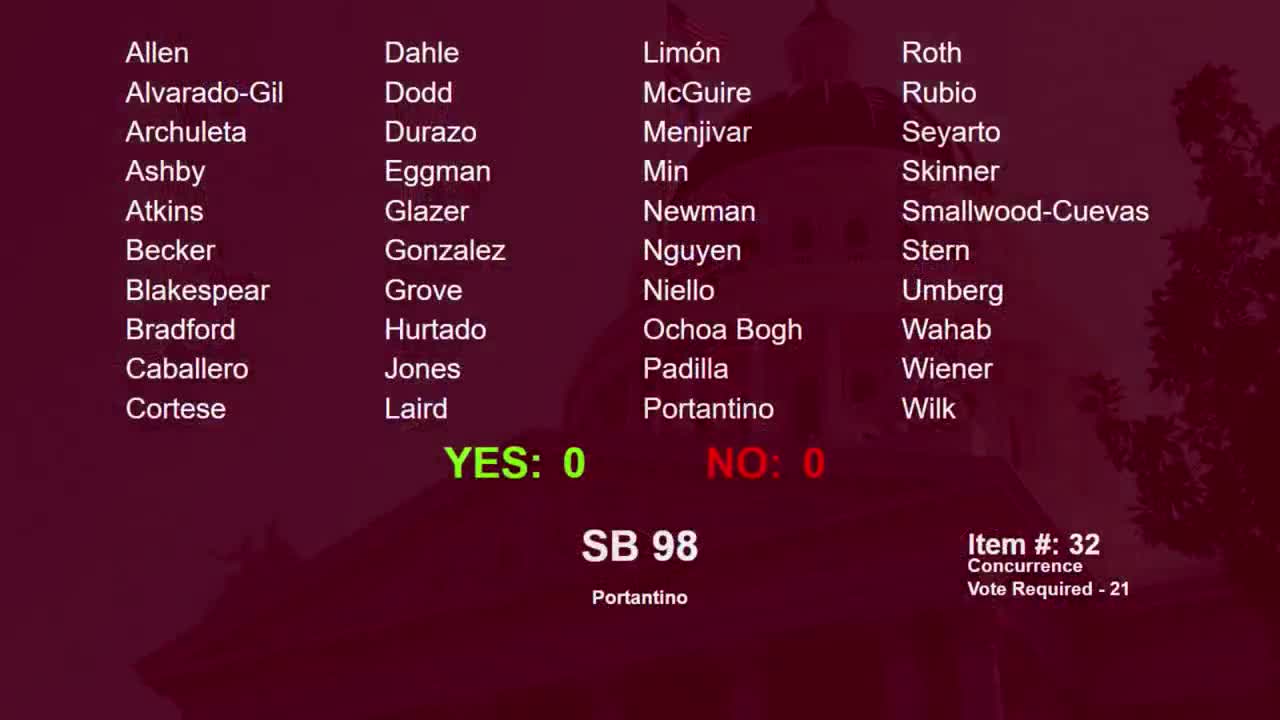 46SEC
Senate Floor
 1MIN
Assembly Floor
 2MIN
Assembly Standing Committee on Utilities and Energy
 16MIN
Assembly Standing Committee on Local Government
 3MIN
Senate Floor
 7MIN
Senate Standing Committee on Energy, Utilities and Communications
 29SEC
Senate Standing Committee on Energy, Utilities and Communications
 10MIN
Senate Standing Committee on Local Government
Bill Author

Bill Co-Author(s):