SB 1267: Crimes: notification of release.
- Session Year: 2023-2024
- House: Senate
- Latest Version Date: 2024-03-18
Current Status:
Failed
(2024-05-16: May 16 hearing: Held in committee and under submission.)
Introduced
In Committee
First Chamber
In Committee
Second Chamber
Enacted
Existing law requires the Department of Corrections and Rehabilitation to supply a form to designated county agencies in order to enable persons to request and receive notification from the department of the release, escape, scheduled execution, or death of the violent offender. Existing law requires the agency to give the form to the victim, witness, or next of kin of the victim for completion, explain to that person or persons the right to be notified, and forward the completed form to the department.
This bill would require that form to additionally enable the person to request and receive notification of changes to the defendants minimum eligible parole date that changes it by more than 6 months, as specified. By increasing duties on county agencies, this bill would impose a state-mandated local program. The bill would also require these notices to be given by the Department of Corrections and Rehabilitation to victims, witnesses, and their next of kin for changes of status for defendants convicted of a sexually violent offense, specified sex offense involving a minor, or homicide offense, among others, as specified.
The California Constitution requires the state to reimburse local agencies and school districts for certain costs mandated by the state. Statutory provisions establish procedures for making that reimbursement.
This bill would provide that, if the Commission on State Mandates determines that the bill contains costs mandated by the state, reimbursement for those costs shall be made pursuant to the statutory provisions noted above.
Existing law, as amended by Proposition 9, the Victims Bill of Rights Act of 2008: Marsys Law, at the November 4, 2008, statewide general election, establishes procedures at all parole suitability hearings for the purpose of reviewing a prisoners parole suitability, or the setting, postponing, or rescinding of parole dates, and provides inmates and victims specified rights at parole suitability hearings.This bill would state the intent of the Legislature to enact legislation that would ensure Marsys Law is fully recognized, as specified.Existing law, as amended by Proposition 9, the Victims Bill of Rights Act of 2008: Marsys Law, at the November 4, 2008, statewide general election, establishes procedures at all parole suitability hearings for the purpose of reviewing a prisoners parole suitability, or the setting, postponing, or rescinding of parole dates, and provides inmates and victims specified rights at parole suitability hearings.
This bill would state the intent of the Legislature to enact legislation that would ensure Marsys Law is fully recognized, as specified.
(a)With respect to the conviction of a defendant involving a violent offense, as defined in Section 29905, the county district attorney, probation department, and victim-witness coordinator shall confer and establish an annual policy within existing resources to decide which one of their agencies shall inform each witness involved in the conviction who was threatened by the defendant following the defendants arrest and each victim or next of kin of the victim of that offense of the right to request and receive a notice pursuant to Section 3058.8 or 3605. If no agreement is reached, the presiding judge shall designate the appropriate county agency or department to provide this notification.
(b)The Department of Corrections and Rehabilitation shall supply a form to the agency designated pursuant to subdivision (a) in order to enable persons specified in subdivision (a) to request and receive notification from the department of the release, escape, scheduled execution, or death of the violent offender. offender, or changes in minimum eligible parole for reasons including, but not limited to, new resentencing considerations or postconviction good conduct credit that changes the defendants minimum eligible parole date by more than six months. That agency shall give the form to the victim, witness, or next of kin of the victim for completion, explain to that person or persons the right to be so notified, and forward the completed form to the department. The department or the Board of Parole Hearings is responsible for notifying all victims, witnesses, or next of kin of victims who request to be notified of a violent offenders release or scheduled execution, as provided by Sections 3058.8 and 3605.
(c)For any change of status described in subdivision (b) of a defendant convicted of a crime described in clause (iv) of subparagraph (C) of paragraph (2) of subdivision (e) of Section 667 or of a defendant convicted before January 1, 1996, of a crime that was punished by life without the possibility of parole, the Department of Corrections and Rehabilitation shall notify all victims, witnesses, and next of kin of that change of status.
(c)(d)All information relating to any person receiving notice pursuant to subdivision (b) shall remain confidential and is not subject to disclosure pursuant to the California Public Records Act (Division 10 (commencing with Section 7920.000) of Title 1 of the Government Code).
(d)(e)Nothing in this section precludes a victim, witness, or next of kin of the victim from requesting notification using an automated electronic notification process, if available.
SEC. 2.If the Commission on State Mandates determines that this act contains costs mandated by the state, reimbursement to local agencies and school districts for those costs shall be made pursuant to Part 7 (commencing with Section 17500) of Division 4 of Title 2 of the Government Code.
SECTION 1.It is the intent of the Legislature to enact legislation that would ensure Marsys Law is fully recognized through an updated notification process that reflects the changing criminal justice landscape. This update would include, but is not limited to, post-conviction changes, resentencing considerations, retroactive state policy decisions, and cases that predate Department of Corrections and Rehabilitation form 1707.It is the intent of the Legislature to enact legislation that would ensure Marsys Law is fully recognized through an updated notification process that reflects the changing criminal justice landscape. This update would include, but is not limited to, post-conviction changes, resentencing considerations, retroactive state policy decisions, and cases that predate Department of Corrections and Rehabilitation form 1707.
|
Date
|
Status
|
|---|---|
| May 16, 2024 | May 16 hearing: Held in committee and under submission. |
| May 10, 2024 | Set for hearing May 16. |
| May 6, 2024 | May 6 hearing: Placed on APPR suspense file. |
| Apr 26, 2024 | Set for hearing May 6. |
| Apr 23, 2024 | From committee: Do pass and re-refer to Com. on APPR. (Ayes 5. Noes 0. Page 3731.) (April 23). Re-referred to Com. on APPR. |
| Apr 5, 2024 | Set for hearing April 23. |
| Apr 3, 2024 | Re-referred to Com. on PUB S. |
| Mar 18, 2024 | From committee with author's amendments. Read second time and amended. Re-referred to Com. on RLS. |
| Feb 29, 2024 | Referred to Com. on RLS. |
| Feb 16, 2024 | From printer. May be acted upon on or after March 17. |
| Feb 15, 2024 | Introduced. Read first time. To Com. on RLS. for assignment. To print. |
|
Date
|
Description
|
Location
|
Votes
|
|
|---|---|---|---|---|
| May 6, 2024 | Placed on suspense file | Senate Standing Committee on Appropriations |
Passed |
|
| Apr 23, 2024 | Do pass, but first be re-referred to the Committee on [Appropriations] | Senate Standing Committee on Public Safety |
Passed |
This list shows positions taken on this bill by organizations on the date displayed, which is linked to the original source.
Positions by individuals are not included.
SENATE COMMITTEE ON
Senator Anna Caballero, Chair
2023 - 2024 Regular Session
SB 1267 (Dahle) - Crimes: notification of release
Version: | Policy Vote: |
Urgency: | Mandate: |
Hearing Date: | Consultant: |
Bill Summary:
SB 1267 requires the California Department of Corrections and Rehabilitation (CDCR) to make changes to the existing form that it supplies to the district attorney, probation department, or victim-witness coordinator to allow a victim, victim’s next-of-kin, or witness to request and receive notification from CDCR of changes to the incarcerated individual’s minimum eligible parole date (MEPD), and requires CDCR to notify all victims, next-of-kin of victims, and witnesses of any change of status (i.e., release, escape, scheduled execution, death, or change to minimum eligible parole date) for a defendant convicted of specified offenses.
Fiscal Impact:
According to CDCR, this bill would result in a significant fiscal impact (General Fund) to the department, likely in the millions of dollars annually, to ensure appropriate staffing at each institution to track and verify changes in MEPD and provide timely and appropriate notification to individuals.
Background:
Under existing law, victims and their next-of-kin can request notification from CDCR of an incarcerated person’s death, escape, scheduled release from custody. CDCR’s Form 1707 is the form used to request notification of changes to an incarcerated person’s custody status. To enable a person to request and receive notification from CDCR of the release, escape, scheduled execution, or death of a violent offender, existing law requires CDCR to supply a form to designated county agencies (i.e., the county district attorney, probation department, or victim-witness coordinator depending on their annual policy and existing resources). Existing law further requires the designated agency to give the form to the victim, victim’s next-of-kin, or witness for completion, explain to that person the right to be notified, and forward the completed form to CDCR. CDCR is responsible for notifying all victims, next-of-kin of victims, or witnesses who request to be notified of a violent offender’s scheduled release, as specified, or scheduled execution, as specified.
Currently, CDCR has Form 1707 that certain specified individuals can complete, which allows CDCR to provide notification of when an incarcerated person is released, escapes, scheduled for execution, or dies while in custody.
Proposed Law:
This bill requires CDCR to include additional information on the form including changes in MEPD for reasons including, but not limited to, new resentencing considerations or postconviction good conduct credit that changes the defendant’s MEPD by more than six months.
This bill also requires CDCR to, for a defendant convicted of specified sex offenses, any homicide offense, solicitation to commit murder, assault with a machinegun on a peace officer or firefighter, possession of a weapon of mass destruction, any serious or violent felony punishable by life imprisonment or death, or before January 1, 1996, of a crime that was punished by life without the possibility of parole, notify all victims, witnesses, and next of kin of any change in the persons status, including their release, escape, scheduled execution, and changes in MEPD.
Related Legislation:
AB 313 (Fong, 2023) would have required any detention agency to notify a victim’s immediate family of a violent offender’s release, escape, scheduled execution, or death. AB 313 was held in Assembly Appropriations Committee.
(SB 852 (Harman, Chapter 364, Statutes of 2011) authorized a crime victim to request the option of being notified of an offender's custody status by electronic mail, if that method is available, and made numerous conforming changes.
-- END --
SENATE COMMITTEE ON PUBLIC SAFETY
Senator Aisha Wahab, Chair
2023 - 2024 Regular
Bill No: SB 1267 Hearing Date: April 23, 2024
Author: | Dahle | ||
Version: | March 18, 2024 | ||
Urgency: | No | Fiscal: | Yes |
Consultant: | SJ | ||
Subject: Crimes: notification of release
HISTORY
Source: Placer County District Attorney’s Office
Prior Legislation: AB 313 (Fong), held on the Assembly Suspense File in 2023
Proposition 57, as approved by the voters on November 8, 2016
SB 852 (Harman), Ch. 364, Stats. 2011
Proposition 9, as approved by the voters on November 4, 2008
Support: Peace Officers Research Association of California
Opposition: California Public Defenders Association
PURPOSE
The purpose of this bill is to require the California Department of Corrections and Rehabilitation (CDCR) to make changes to the existing form that it supplies to the district attorney, probation department, or victim-witness coordinator that enables the victim, victim’s next-of-kin, or witness to request and receive notification from the department in order for those individuals to receive notification regarding changes to the incarcerated individual’s minimum eligible parole date, and requires CDCR to notify all victims, next-of-kin of victims, and witnesses of any change of status (i.e., release, escape, scheduled execution, death, or change to minimum eligible parole date) for a defendant convicted of specified sex offenses, any homicide offense, solicitation to commit murder, assault with a machinegun on a peace officer or firefighter, possession of a weapon of mass destruction, any serious or violent felony punishable by life imprisonment or death, or if the defendant was convicted before January 1, 1996 of a crime that was punished by life without the possibility of parole.
Existing law delineates the rights that a victim is entitled to, including the right to reasonable notice of all public proceedings, including delinquency proceedings, upon request, at which the defendant and the prosecutor are entitled to be present and of all parole or other post-conviction release proceedings, and to be present at all such proceedings. (Cal. Const., art. 1, § 28, subd. (b)(7).)
Existing law defines “crime” to mean an act committed in this state which, if committed by a competent adult, would constitute a misdemeanor or felony. (Pen. Code, § 679.01, subd. (a).)
Existing law defines “victim” to mean a person against whom a crime has been committed. (Pen. Code, § 679.01, subd. (b).)
Existing law defines “witness” to mean any person who has been or is expected to testify for the prosecution, or who, by reason of having relevant information, is subject to call or likely to be called as a witness for the prosecution, whether or not any action or proceeding has yet been commenced. (Pen. Code, § 679.01, subd. (c).)
Existing law provides the right, upon request by the victim or the next of kin of the victim if the victim has died, to be notified of any parole eligibility hearing and of the right to appear, either personally, as provided, or by other means, as provided, to reasonably express their views, and to have their statements considered, as provided. (Pen. Code, § 679.02, subd. (a)(5).)
Existing law establishes the right of victims and witnesses of crime to be notified, if applicable, if the defendant is to be placed on parole. (Pen. Code, § 679.02, subd. (a)(11).)
Existing law requires, with respect to the conviction of a defendant involving a violent offense, as defined, the county district attorney, probation department, and victim-witness coordinator to confer and establish an annual policy within existing resources to decide which one of their agencies will inform each witness involved in the conviction who was threatened by the defendant following the defendant’s arrest and each victim or next of kin of the victim of that offense of the right to request and receive a notice. Requires the presiding judge to designate the appropriate county agency or department to provide this notification if no agreement is reached. (Pen. Code, § 679.03, subd. (a).)
Existing law requires CDCR, with respect to the conviction of a defendant involving a violent offense, as defined, to supply a form to the agency designated to notify victims, victims’ next of kin, and witnesses in order to enable those individuals specified to request and receive notification from CDCR of the release, escape, scheduled execution, or death of the violent offender. (Pen. Code, § 679.03, subd. (b).)
Existing law requires that agency to give the form to the victim, witness, or next of kin of the victim for completion, explain the right to be so notified, and forward the completed form to CDCR. Provides that CDCR or the Board of Parole Hearings (BPH) is responsible for notifying all victims, witnesses, or next of kin of victims who request to be notified of a violent offender’s release or scheduled execution, as provided. (Pen. Code, § 679.03, subd. (b).)
Existing law provides that all information relating to any person receiving notice is confidential and is not subject to disclosure pursuant to the California Public Records Act. (Pen. Code, § 679.03, subd. (c).)
Existing law specifies that a victim, witness, or next of kin of the victim are not precluded from requesting notification using an automated electronic notification process, if available. (Pen. Code, § 679.03, subd. (d).)
Existing law requires BPH or CDCR to notify the sheriff, chief of police, or both, and the district attorney who has jurisdiction over the community in which the person was convicted, of a scheduled release. (Pen. Code, § 3058.6, subd. (a).)
Existing law requires BPH, CDCR, or a designated agency to send a notice to the victim, witness, or victim’s next of kin who has requested notification that a person convicted of a violent felony is scheduled to be released. Requires notice of the community in which the person is scheduled to reside also be given if it is in the county of residence or within 100 miles of the actual residence of a witness, victim, or family member of a victim who has requested notification. (Pen. Code, § 3058.8, subd. (a).)
Existing law allows a victim’s immediate family to be present at an execution. Provides that if the family files a written request to be present, the family has a right to be notified by the warden 30 days prior to the execution or as close to that date as possible. Defines “immediate family” as those persons who are related by blood, adoption, or marriage, within the second degree of consanguinity or affinity. (Pen. Code, § 3605, subds. (a) & (b).)
Existing law requires CDCR to immediately notify a victim or their next of kin if the crime was homicide, and if notification was previously requested, of an incarcerated person under their jurisdiction’s escape. Requires the department to notify the victim or their next of kin within 30 days if the person is recaptured. (Pen. Code, § 11155, subd. (b).)
This bill requires CDCR to supply a form to the agency designated to notify victims, victims’ next of kin, and witnesses in order to enable those individuals specified to request and receive notification from CDCR of changes in minimum eligible parole for reasons including, but not limited to, new resentencing considerations or postconviction good conduct credit that changes the defendant’s minimum eligible parole date by more than six months.
This bill requires CDCR to notify all victims, witnesses, and next of kin of any change of status for a defendant convicted of specified sex offenses, homicide, solicitation to commit murder, assault with a machinegun on a peace officer or firefighter, possession of a weapon of mass destruction, or any serious or violent felony punishable by life imprisonment or death, or of a defendant convicted before January 1, 1996 of a crime that was punished by life without the possibility of parole.
COMMENTS
- Need For This Bill
According to the author:
In 2008 California voters approved Proposition 9, the Victims’ Bill of Rights of Act of 2008: Marsy’s Law which amended the California Constitution to protect the victims’ right to have their voice heard and considered during the criminal justice process. SB 1267 presents a significant opportunity to bridge the existing gap in the notification process for victims and their families by updating the CDCR 1707 form to align with changes in the state’s retroactive criminal justice reform policies as well as ensure victims of serious and violent crimes prior to the creation of the 1707 form are receiving notifications. This bill will help provide a sense of safety, security and certainty to victims by keeping them updated on the current status of their offenders through an updated notification system.
- Notifications to Victims, Next-of-Kin, and Witnesses
CDCR’s Department Operations Manual section 72060.7 provides that victims, witnesses, next-of-kin, or immediate family members who request notification in writing by letter or CDCR Form 1707 must be notified of the incarcerated person’s death, escape, scheduled release to parole, discharge, release from custody for any other reason, or transfer of custody to another agency. (CDCR, Operations Manual (2024), p. 623 available at <https://www.cdcr.ca.gov/regulations/wp-content/uploads/sites/171/2024/03/2024-DOM.pdf>.) For these purposes, “immediate family member” means “legal spouse; registered domestic partner, natural parents; adoptive parents, if the adoption occurred and a family relationship existed prior to the inmate’s incarceration; step-parents or foster parents; grandparents; natural, step, or foster brothers or sisters; the inmate’s natural and adoptive children; grandchildren; and legal stepchildren of the inmate. Aunts, uncles and cousins are not immediate family members unless a verified foster relationship exists.” (Ibid.; Cal. Code Regs., tit. 15, § 3000.)
To enable a person to request and receive notification from CDCR of the release, escape, scheduled execution, or death of a violent offender, Penal Code section 679.03 requires CDCR to supply a form to designated county agencies (i.e., the county district attorney, probation department, or victim-witness coordinator depending on their annual policy and existing resources). Section 679.03, in turn, requires the designated agencies to give the form to the victim, victim’s next-of-kin, or witness for completion, explain to that person or persons the right to be notified, and forward the completed form to CDCR. CDCR or BPH is responsible for notifying all victims, next-of-kin of victims, or witnesses who request to be notified of a violent offender’s scheduled release, as specified, or scheduled execution, as specified. (Pen. Code, § 679.03, subd. (b).)
As stated above, CDCR’s Form 1707 is the form that is utilized by the victim of a crime, family member of the victim, or witness who testified against the incarcerated individual to request notification of changes to an incarcerated person’s custody status. The form defines change in custody status to include “release, death, escape, parole suitability hearing (for victims and victims’ family members only), contract, name/gender change, or scheduled execution.” (CDCR, Form-1707 Request for Victim Services available at <https://cdcr.ca.gov/victim-services/wp-content/uploads/sites/169/2019/06/CDCR1707.pdf>.)
- Minimum Eligible Parole Date
Incarcerated individuals with an indeterminate sentence of life with the possibility of parole must be granted parole by BPH in order to be released from prison. A person’s minimum eligible parole date (MEPD) is the date the person is first eligible for release upon being found suitable for parole. BPH’s handbook on the parole process describes how parole eligibility dates are calculated:
CDCR’s Case Records Services determines whether a person will be eligible for a parole hearing and if so, the date the person will be eligible for their first parole hearing. CDCR’s Case Records Services calculates a person’s parole eligible date(s) when they are first admitted to CDCR custody based on the laws applicable to the person’s sentence. If there is a change in the law or the person is resentenced, CDCR’s Case Records Services will recalculate the person’s parole eligible dates, if necessary. In addition, a parole eligible date may be moved up based on credits that may apply to the person’s sentence. Credit-earning is governed by regulations found in Division 3 of Title 15 of the California Code of Regulations and can be changed through the state’s administrative rulemaking process. CDCR notifies the incarcerated person of their parole eligible date(s), and the person may appeal the calculation through CDCR’s appeal process if they think there is an error.
If a person has more than one parole eligible date, their “earliest parole eligible date” is the date that gives the person the earliest opportunity for parole consideration or release. Each person’s earliest parole eligible date is provided to them and is publicly available on CDCR’s website via the California Incarcerated Records and Information Search (CIRIS) application.
(Board of Parole Hearings, The California Parole Hearing Process Handbook (Mar. 2024), pp. 8-9 available at <https://cdcr.ca.gov/bph/wp-content/uploads/sites/161/2024/03/CA-Parole-Hearing-Process-Handbook-For-Publication-03-08-24.pdf>.)
The handbook defines the MEPD as follows:
Minimum Eligible Parole Date (MEPD) – This date applies to persons with an indeterminate sentence of life with the possibility of parole. The MEPD is the date they are first eligible for release upon being found suitable for parole at a parole hearing. An MEPD is based on the minimum term imposed by the court (such as 25 years for a person sentenced to 25 years to life), less any applicable credits. A person will be scheduled for their first parole hearing at least one year prior to their MEPD if their MEPD is their earliest parole eligible date.
(Id. at p. 9.)
- Reforms Have Resulted in Changes to Parole Eligibility Dates
Proposition 57 was approved by the voters in 2016 and changed the rules governing parole and the granting of custody credits to incarcerated individuals in state prison. Proposition 57 authorized CDCR to award credits earned for good behavior and approved rehabilitative or educational achievements. Prior to the passage of the initiative, the matter of conduct credits earned in prison was governed by statute. (See e.g., Pen. Code, §§ 2933 and 2933.1.)
Proposition 57 added section 32 to article I of the California Constitution which provides, in pertinent part:
“32. (a) The following provisions are hereby added to enhance public safety, improve rehabilitation, and avoid the release of prisoners by federal court order, notwithstanding anything in this article or any other provision of law….
(2) Credit Earning: The Department of Corrections and Rehabilitation shall have authority to award credits earned for good behavior and approved rehabilitative or educational achievements.
(b) The Department of Corrections and Rehabilitation shall adopt regulations in furtherance of these provisions, and the Secretary of the Department of Corrections and Rehabilitation shall certify that these regulations protect and enhance public safety.” (Cal. Const., art. I, § 32, emphasis added)
Following the passage of Proposition 57, CDCR made changes to credit-earning opportunities for sustained good behavior and participation in in-prison programming in order to “incentivize[] incarcerated people to take responsibility for their own rehabilitation.” (CDCR, In-Prison Credit-Earning Opportunities available at <https://www.cdcr.ca.gov/proposition57/>.) Specifically, CDCR increased the rate of Good Conduct Credits earned by individuals. (Id.) Good Conduct Credits and other programming credits, such as Rehabilitative Achievement Credits, Milestone Completion Credits, and Educational Merit Credits, apply toward an incarcerated person’s Earliest Possible Release Date for determinate sentences and Minimum Eligible Parole Date for indeterminate sentences.
In addition to credit-earning opportunities leading to changes for individuals’ parole eligibility dates, recently enacted legislation has provided opportunities for incarcerated individuals to be resentenced under certain circumstances which has also resulted in changes to those individuals’ parole eligibility dates. For example, SB 1437 (Skinner, Chapter 1015, Statutes of 2018) created a mechanism for individuals previously sentenced on a theory of felony murder to petition for resentencing if they met specified qualifications.
- Effect of This Bill
This bill does two things. First, it requires CDCR to make changes to the existing form that it supplies to the district attorney, probation department, or victim-witness coordinator that enables the victim, victim’s next-of-kin, or witness to request and receive notification from the department in order for those individuals to request and receive notification regarding changes to the incarcerated individual’s MEPD. Second, this bill requires CDCR to notify all victims, next-of-kin of victims, and witnesses of any change of status (i.e., release, escape, scheduled execution, death, or change to MEPD) for a defendant convicted of a sexually violent offense, specified sex offenses involving a child under 14, any homicide offense, solicitation to commit murder, assault with a machinegun on a peace officer or firefighter, possession of a weapon of mass destruction, or any serious or violent felony punishable by life imprisonment or death. This bill also requires this notification if the defendant was convicted before January 1, 1996 of a crime that was punished by life without the possibility of parole.
This bill is mostly duplicative of existing law as it relates to victims and victims’ next-of-kin. It requires changes to the CDCR Form-1707 which enables the victim, victim’s next-of-kin, or witness to request and receive notification from the department in order for those individuals to receive notification regarding changes to the incarcerated individual’s MEPD. As stated above, the MEPD is the date that an incarcerated person is first eligible for release upon being found suitable for parole at a parole hearing. A person’s first parole suitability hearing is scheduled prior to the MEPD. Victims and victims’ next-of-kin who have registered with CDCR’s Office of Victim and Survivor Rights and Services to receive notice of parole hearings are required to receive notice at least 90 days before the parole hearing pursuant to Penal Code section 3043. A change to a person’s MEPD that results in an earlier initial parole suitability hearing than originally anticipated would still require the 90 days’ notice to the victim or victim’s next-of-kin prior to the hearing. All subsequent parole suitability hearings would similarly require 90 days’ notice prior to a hearing.
However, this bill does require changes to the CDCR Form-1707 to allow a witness to a crime to request and receive notification from the department regarding changes to the incarcerated individual’s MEPD. A witness is not currently entitled to receive notice prior to an incarcerated individual’s parole suitability hearing so this bill would expand a witness’ right to notifications.
This bill also requires CDCR to notify all victims, victims’ next-of-kin, and witnesses of any change of status for a defendant convicted of specified sex offenses, homicide, solicitation to commit murder, assault with a machinegun on a peace officer or firefighter, possession of a weapon of mass destruction, or any serious or violent felony punishable by life imprisonment or death, or of a defendant convicted before January 1, 1996 of a crime that was punished by life without the possibility of parole. The only limit under existing law is that notification is limited to defendants convicted of a violent offense. (Pen. Code, § 679.03, subd. (a).) CDCR has shared with this Committee that in practice, the Office of Victim and Survivor Rights and Services generally honors all requests for notification by persons entitled to request notification regardless of the offense.
- Argument in Support
The Peace Officers Research Association of California writes:
Current law requires the Department of Corrections and Rehabilitation to supply a form to designated county agencies in order to enable persons to request and receive notification from the department of the release, escape, scheduled execution, or death of the violent offender. Current law requires the agency to give the form to the victim, witness, or next of kin of the victim for completion, explain to that person or persons the right to be notified, and forward the completed form to the department. This bill would require that form to additionally enable the person to request and receive notification of changes to the defendant’s minimum eligible parole date that changes it by more than 6 months.
- Argument in Opposition
According to the California Public Defenders Association:
SB 1267 will cost the state a significant amount of money. It will confuse and traumatize victims and victims’ family members and is redundant of existing law.
The California Constitution provides that victims and their families must be provided “reasonable notice of all public proceedings, including delinquency proceedings, upon request, at which the defendant and the prosecutor are entitled to be present and of all parole or other post-conviction release proceedings, and to be present at all such proceedings.” In other words, the prosecutorial agency is required to notify all victims of these proceedings regardless of whether the victims complete a CDCR form requesting notification. Additionally, victims have a right to be present and be heard at these proceedings if they so choose.
Prosecutorial agencies have within their offices, individuals who are trained to provide victim-assistance and to answer any questions victims may have about a possible resentencing. Prosecutors are in the best position to explain what is occurring and to ensure victims are able to make their positions known to the court.
Existing law and practice already require notification of victims of parole hearings where victims may exercise their right to be present and convey their views on parole.
SB 1267 would require CDCR to provide a second layer of notification after someone has been resentenced, or if their parole date is changed by more than six months. There is no reason for this added layer of notice and CDCR is not in a position to provide an explanation of the reasons for the changes in the sentence or answer questions regarding a change in minimum eligible parole date.
-- END --
Discussed in Hearing
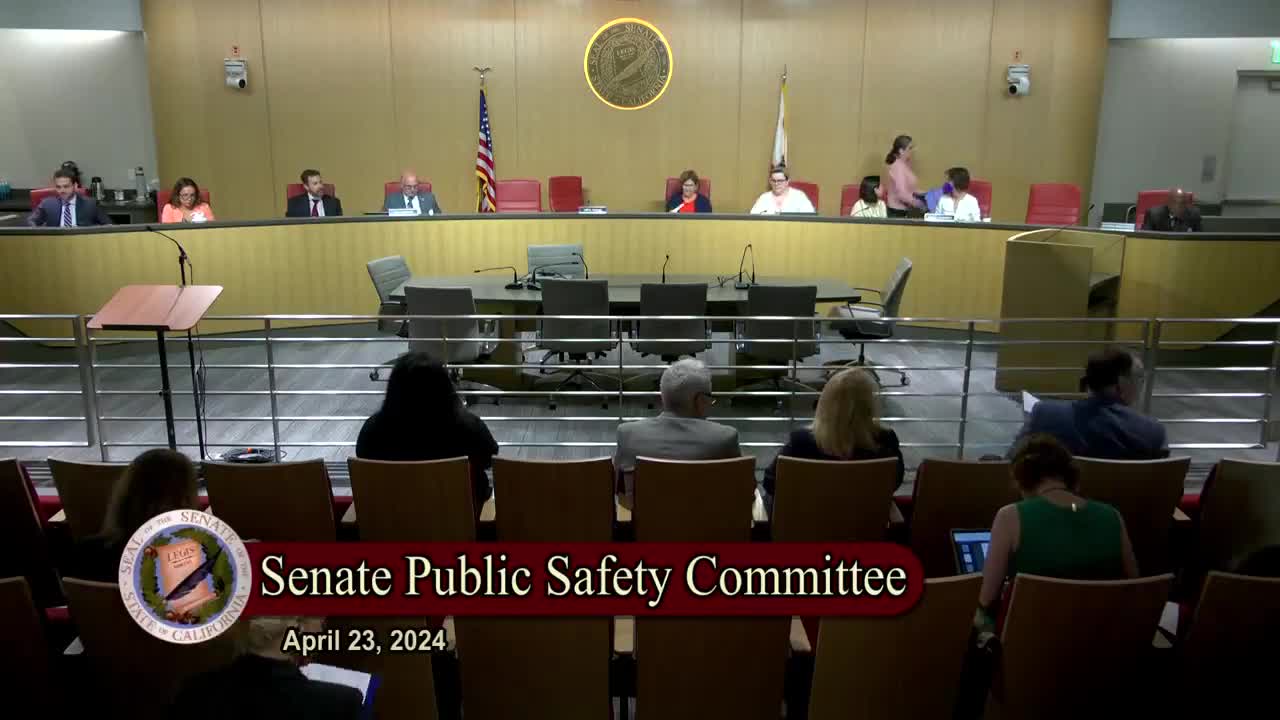 8MIN
Senate Standing Committee on Public Safety
 1MIN
Senate Standing Committee on Public Safety
 16SEC
Senate Standing Committee on Public Safety
Bill Author

Bill Co-Author(s):