SB 1297: The City of Malibu’s speed safety system pilot program.
- Session Year: 2023-2024
- House: Senate
- Latest Version Date: 2024-09-27
Current Status:
Passed
(2024-09-27: Chaptered by Secretary of State. Chapter 631, Statutes of 2024.)
Introduced
In Committee
First Chamber
In Committee
Second Chamber
Enacted
Existing law authorizes, until January 1, 2032, the Cities of Los Angeles, San Jose, Oakland, Glendale, and Long Beach, and the City and County of San Francisco to establish a speed safety system pilot program if the system meets specified requirements. Existing law requires a participating city or city and county to adopt a Speed Safety System Use Policy and a Speed Safety System Impact Report before implementing the program, and requires the participating city or city and county to engage in a public information campaign at least 30 days before implementation of the program, including information relating to when the systems would begin detecting violations and where the systems would be utilized. Existing law requires a participating city or city and county to issue warning notices rather than notices of violations for violations detected within the first 60 calendar days of the program. Existing law also requires a participating city or city and county to develop uniform guidelines for, among other things, the processing and storage of confidential information. Existing law designates all photographic or administrative records, not including data about the number of violations issued or the speeds at which they were issued for, made by a system as confidential, and would only authorize public agencies to use and allow access to these records for specified purposes.
This bill would authorize, until January 1, 2032, the City of Malibu to establish a similar program for speed enforcement that utilizes up to 5 speed safety systems on the Pacific Coast Highway.
Existing law specifies that any violation of a speed law recorded by a speed safety system authorized by the Speed Safety System Pilot Program provisions would be subject only to the provided civil penalties. Existing law provides, among other things, for the issuance of a notice of violation, an initial review, an administrative hearing, and an appeals process, as specified, for a violation under this program. Existing law requires any program created pursuant to these provisions to offer a diversion program for indigent speed safety system violation recipients, as specified. Existing law requires a city or city and county participating in the pilot program to submit a report to evaluate the speed safety system to determine the systems impact on street safety and the economic impact on the communities where the system is utilized. Existing law requires revenues derived from any program to first be used to cover program costs, including, among other things, the construction of traffic-calming measures, as specified.
This bill would require the City of Malibu to also implement the above provisions if it establishes the speed safety system program on the Pacific Coast Highway. The bill would additionally require the City of Malibu to enter into an agreement with the Department of Transportation regarding the use of any excess revenue for traffic-calming measures on the Pacific Coast Highway, in the City of Malibu.
Existing law establishes a $25 filing fee for specified appeals and petitions.
This bill would require a $25 filing fee for an appeal challenging a notice of violation issued as a result of the City of Malibus speed safety system program until January 1, 2032.
Existing constitutional provisions require that a statute that limits the right of access to the meetings of public bodies or the writings of public officials and agencies be adopted with findings demonstrating the interest protected by the limitation and the need for protecting that interest.
This bill would make legislative findings to that effect.
This bill would make legislative findings and declarations as to the necessity of a special statute for the City of Malibu.
Existing law authorizes, until January 1, 2032, the Cities of Los Angeles, San Jose, Oakland, Glendale, and Long Beach, and the City and County of San Francisco to establish a speed safety system pilot program if the system meets specified requirements. Existing law requires a participating city or city and county to adopt a Speed Safety System Use Policy and a Speed Safety System Impact Report before implementing the program, and requires the participating city or city and county to engage in a public information campaign at least 30 days before implementation of the program, including information relating to when the systems would begin detecting violations and where the systems would be utilized. Existing law requires a participating city or city and county to issue warning notices rather than notices of violations for violations detected within the first 60 calendar days of the program. Existing law also requires a participating city or city and county to develop uniform guidelines for, among other things, the processing and storage of confidential information. Existing law designates all photographic or administrative records, not including data about the number of violations issued or the speeds at which they were issued for, made by a system as confidential, and would only authorize public agencies to use and allow access to these records for specified purposes.
This bill would authorize, until January 1, 2032, the City of Malibu to establish a similar program for speed enforcement that utilizes up to 5 speed safety systems on the Pacific Coast Highway.
Existing law specifies that any violation of a speed law recorded by a speed safety system authorized by the Speed Safety System Pilot Program provisions would be subject only to the provided civil penalties. Existing law provides, among other things, for the issuance of a notice of violation, an initial review, an administrative hearing, and an appeals process, as specified, for a violation under this program. Existing law requires any program created pursuant to these provisions to offer a diversion program for indigent speed safety system violation recipients, as specified. Existing law requires a city or city and county participating in the pilot program to submit a report to evaluate the speed safety system to determine the systems impact on street safety and the economic impact on the communities where the system is utilized.
This bill would require the City of Malibu to also implement the above provisions if it establishes the speed safety system program on the Pacific Coast Highway.
Existing law establishes a $25 filing fee for specified appeals and petitions.
This bill would require a $25 filing fee for an appeal challenging a notice of violation issued as a result of the City of Malibus speed safety system program until January 1, 2032.
Existing constitutional provisions require that a statute that limits the right of access to the meetings of public bodies or the writings of public officials and agencies be adopted with findings demonstrating the interest protected by the limitation and the need for protecting that interest.
This bill would make legislative findings to that effect.
This bill would make legislative findings and declarations as to the necessity of a special statute for the City of Malibu.
Existing law authorizes, until January 1, 2032, specified cities and the City and County of San Francisco to establish a local speed safety system pilot program, operated in certain types of streets and school zones, to detect speed violations by using an electronic speed safety system, as defined. Pursuant to the pilot program, a designated jurisdiction participating within the pilot program with a population of less than 300,000, as determined by the United States Census Bureau in the 2020 Census, is authorized to operate no more than 9 speed safety systems.This bill would instead authorize a designated jurisdiction participating within the pilot program with a population of less than 300,000, as determined, to operate no more than 12 speed safety systems.Existing law authorizes, until January 1, 2032, specified cities and the City and County of San Francisco to establish a local speed safety system pilot program, operated in certain types of streets and school zones, to detect speed violations by using an electronic speed safety system, as defined. Pursuant to the pilot program, a designated jurisdiction participating within the pilot program with a population of less than 300,000, as determined by the United States Census Bureau in the 2020 Census, is authorized to operate no more than 9 speed safety systems.
This bill would instead authorize a designated jurisdiction participating within the pilot program with a population of less than 300,000, as determined, to operate no more than 12 speed safety systems.
The Legislature finds and declares all of the following:
(a)On October 17, 2023, a driver speeding at 104 miles per hour on the Pacific Coast Highway (PCH) in the City of Malibu lost control of their vehicle and killed four university students standing on the side of the highway.
(b)Since 2010, 59 people have been killed in vehicle accidents along the PCH in the City of Malibu.
(c)Crash data from the Los Angeles County Sheriffs Department shows that, in 2023, there were 127 property-damage collisions, 93 injury collisions, and seven deaths in the City of Malibu.
(d)The City of Malibu suffers uniquely from collisions. Over the past five years, the City of Malibu has had the highest number of fatalities and serious injuries resulting from vehicle crashes among similarly sized cities. Compared to all cities of every size, the City of Malibu is ranked 91st highest out of 482 cities despite being one of the smallest cities in the state.
(e)The City of Malibus traffic environment is uniquely hazardous with few sidewalks or separated bike lanes, limited parking, regionally popular beaches, and commercial establishments adjacent to a major highway with few safe ways to cross.
(f)To address its traffic safety problem, the City of Malibu has contracted for additional traffic patrols from the Los Angeles County Sheriffs Department and, more recently, from the Department of the California Highway Patrol.
(g)The City of Malibu would like to obtain additional traffic patrols and is willing to pay for them, but staffing shortages limit the ability of the Los Angeles County Sheriffs Department or the Department of the California Highway Patrol to provide them.
SEC. 2.Section 70615 of the Government Code, as amended by Section 2 of Chapter 808 of the Statutes of 2023, is amended to read:70615.The fee for filing any of the following appeals to the superior court is twenty-five dollars ($25):
(a)An appeal of a local agencys decision regarding an administrative fine or penalty under Section 53069.4.
(b)An appeal under Section 40230 of the Vehicle Code of an administrative agencys decision regarding a parking violation.
(c)An appeal under Section 99582 of the Public Utilities Code of a hearing officers determination regarding an administrative penalty for fare evasion or a passenger conduct violation.
(d)A petition under Section 186.35 of the Penal Code challenging a law enforcement agencys inclusion of a persons information in a shared gang database.
(e)An appeal under Section 22428 of the Vehicle Code of a hearing officers determination regarding a civil penalty for an automated speed violation, as defined in Section 22425 of the Vehicle Code.
(f)An appeal under Section 22438 of the Vehicle Code of a hearing officers determination regarding a civil penalty for an automated speed violation, as defined in Section 22435 of the Vehicle Code.
(g)This section shall remain in effect only until January 1, 2032, and as of that date is repealed.
SEC. 3.Article 4 (commencing with Section 22435) is added to Chapter 7 of Division 11 of the Vehicle Code, to read:4.The City of Malibus Speed Safety Pilot Program 22435.(a)As used in this article, the following definitions apply:
(1)Automated speed violation means a violation of a speed law detected by a speed safety system operated pursuant to this article.
(2)Designated jurisdiction means the City of Malibu.
(3)A person is indigent if either of the following conditions is met:
(A)The person meets the income criteria set forth in subdivision (b) of Section 68632 of the Government Code.
(B)The person receives public benefits from a program listed in subdivision (a) of Section 68632 of the Government Code.
(4)Local department of transportation means the City of Malibus department that administers transportation and traffic matters under this code.
(5)Speed safety system or system means a fixed or mobile radar or laser system or any other electronic device that utilizes automated equipment to detect a violation of speed laws and obtains a clear photograph of a speeding vehicles license plate.
(b)The designated jurisdiction may establish a program for speed enforcement that utilizes up to five speed safety systems, to be operated by the local department of transportation, on the Pacific Coast Highway.
(c)The speed safety system may be utilized pursuant to subdivision (b) if the program meets all of the following requirements:
(1)The designated jurisdiction continues funding the additional traffic enforcement on the Pacific Coast Highway provided by the Department of the California Highway Patrol.
(2)Clearly identifies the presence of the speed safety system by signs stating Photo Enforced, along with the speed limit signs with flashing beacons and speed feedback signs, no more than 500 feet before the placement of the system. The signs shall be visible to traffic traveling on the street from the direction of travel for which the system is utilized, and shall be posted at locations as may be determined necessary by the Department of Transportation after consultation with the California Traffic Control Devices Committee.
(3)Identifies the street or portions of the street approved for enforcement using a speed safety system and the hours of enforcement on the municipalitys internet website, which shall be updated whenever the municipality changes locations of enforcement.
(4)Ensures that the speed safety system is regularly inspected no less than once every 60 days, and certifies that the system is installed and operating properly. Each camera unit shall be calibrated in accordance with the manufacturers instructions, and at least once per year by an independent calibration laboratory. Documentation of the regular inspection, operation, and calibration of the system shall be retained for at least 180 days after the date on which the system has been permanently removed from use.
(5)Utilizes fixed or mobile speed safety systems that provide real-time notification to the driver when violations are detected.
(d)Prior to enforcing speed laws utilizing speed safety systems, the designated jurisdiction shall do both of the following:
(1)Administer a public information campaign for at least 30 calendar days prior to the commencement of the program, which shall include public announcements in major media outlets and press releases. The public information campaign shall include the draft Speed Safety System Use Policy pursuant to subdivision (e), the Speed Safety System Impact Report pursuant to subdivision (f), information on when systems will begin detecting violations, the street, or portions of the street, where systems will be utilized, and the designated jurisdictions internet website, where additional information about the program can be obtained. Notwithstanding the above, no further public announcement by the municipality shall be required for additional systems that may be added to the program.
(2)(A)Issue warning notices rather than notices of violation for violations detected by the speed safety system during the first 60 calendar days of enforcement under the program.
(B)A vehicles first violation for traveling 11 to 15 miles per hour over the posted speed limit shall be a warning notice.
(e)The governing body of the designated jurisdiction shall adopt a Speed Safety System Use Policy before entering into an agreement regarding a speed safety system, purchasing or leasing equipment for a program, or implementing a program. The Speed Safety System Use Policy shall set forth the specific purpose for the system, the uses that are authorized, the rules and processes required to be followed by employees and contractors of the designated jurisdiction administering the system prior to its use, and the uses of the equipment and data collected that are prohibited. The policy shall identify the data or information that can be collected by the speed safety system and the individuals who can access or use the collected information, and the rules and processes related to the access, transfer, and use or use of the information. The policy shall also include provisions for protecting data from unauthorized access, data retention, public access, third-party data sharing, training, auditing, and oversight to ensure compliance with the Speed Safety System Use Policy. The Speed Safety System Use Policy shall be made available for public review, including, but not limited to, by posting it on the designated jurisdictions internet website at least 30 calendar days prior to adoption by the governing body of the designated jurisdiction.
(f)(1)The governing body of the designated jurisdiction shall approve a Speed Safety System Impact Report prior to implementing a program. The Speed Safety System Impact Report shall include all of the following information:
(A)Assessment of the potential impact of the speed safety system on civil liberties and civil rights and any plans to safeguard those public rights.
(B)Description of the speed safety system and how it works.
(C)Fiscal costs for the speed safety system, including program establishment costs, ongoing costs, and program funding.
(D)If potential deployment locations of systems are predominantly in low-income neighborhoods, a determination of why these locations experience high fatality and injury collisions due to unsafe speed.
(E)Locations where the system may be deployed and traffic data for these locations, including the address where the cameras will be located.
(F)Proposed purpose of the speed safety system.
(2)The Speed Safety System Impact Report shall be made available for public review at least 30 calendar days prior to adoption by the governing body at a public hearing.
(3)The governing body of the designated jurisdiction shall consult and work collaboratively with relevant local stakeholder organizations, including racial equity, privacy protection, and economic justice groups, in developing the Speed Safety System Use Policy and Speed Safety System Impact Report.
(g)The designated jurisdiction shall develop uniform guidelines, consistent with the provisions of this section, for both of the following:
(1)The screening and issuing of notices of violation.
(2)The processing and storage of confidential information and procedures to ensure compliance with confidentiality requirements.
(h)Notices of violation issued pursuant to this section shall include a clear photograph of the license plate and rear of the vehicle only, identify the specific section of the Vehicle Code violated, the camera location, and the date and time when the violation occurred. Notices of violation shall exclude images of the rear window area of the vehicle.
(i)The photographic evidence stored by a speed safety system does not constitute an out-of-court hearsay statement by a declarant under Division 10 (commencing with Section 1200) of the Evidence Code.
(j)(1)Notwithstanding any provision of the California Public Records Act, or any other law, photographic or administrative records made by a system shall be confidential. Public agencies shall use and allow access to these records only for the purposes authorized by this article or to assess the impacts of the system. Data about the number of violations issued and the speeds at which they were issued is not considered an administrative record required not to be disclosed by this section.
(2)Confidential information obtained from the Department of Motor Vehicles for the administration of speed safety systems and enforcement of this article shall be held confidential, and shall not be used for any other purpose. Designated jurisdictions agents shall establish procedures to protect the confidentiality of these records consistent with Section 1808.47.
(3)Except for court records described in Section 68152 of the Government Code, or as provided in paragraph (4), the confidential records and evidence described in paragraphs (1) and (2) may be retained for up to 60 days after final disposition of the notice of violation. The designated jurisdiction may retain information that a vehicle has been cited and fined for a violation for up to three years. The municipality may adopt a retention period of less than 60 days in the Speed Safety System Use Policy. Administrative records described in paragraph (1) may be retained for up to 120 days after final disposition of the notice of violation. Notwithstanding any other law, the confidential records and evidence shall be destroyed in a manner that maintains the confidentiality of any person included in the record or evidence.
(4)Photographic evidence that is obtained from a speed safety system that does not result in the issuance of a notice of violation shall be destroyed within five business days after the photograph was first made. The use of facial recognition technology in conjunction with a speed safety system shall be prohibited.
(5)Information collected and maintained by a designated jurisdiction to administer a program shall only be used to administer the program, and shall not be disclosed to any other persons, including, but not limited to, any other state or federal governmental agency or official for any other purpose, except as required by state or federal law, court order, or in response to a subpoena in an individual case or proceeding.
(k)Notwithstanding subdivision (j), the registered owner or an individual identified by the registered owner as the driver of the vehicle at the time of the alleged violation shall be permitted to review and obtain a copy of the photographic evidence of the alleged violation.
(l)A contract between the designated jurisdiction and a manufacturer or supplier of speed safety systems shall allow the local authority to purchase materials, lease equipment, and contract for processing services from the manufacturer or supplier based on the services rendered on a monthly schedule or another schedule agreed upon by the municipality and contractor. The contract shall not allow for payment or compensation based on the number of notices of violation issued, or as a percentage of revenue generated, from the use of the system. The contract shall include a provision that all data collected from the speed safety system is confidential, and shall prohibit the manufacturer or supplier of the contracted speed safety system from sharing, repurposing, or monetizing collected data, except as specifically authorized in this article. The designated jurisdiction shall oversee, maintain control, and have the final decision over all enforcement activities, including the determination of when a notice of violation should be issued.
(m)Notwithstanding subdivision (l), a designated jurisdiction may contract with a vendor for the processing of notices of violation after an employee of a designated jurisdiction has issued a notice of violation. The vendor shall be a separate legal and corporate entity from, and not related to or affiliated in any manner with, the manufacturer or supplier of speed safety systems used by the designated jurisdiction. Any contract between the designated jurisdiction and a vendor to provide processing services may include a provision for the payment of compensation based on the number of notices of violation processed by the vendor.
(n)The speed safety system, to the extent feasible, shall be angled and focused so as to only capture photographs of speeding violations and shall not capture identifying images of other drivers, vehicles, or pedestrians.
(o)Notwithstanding subdivision (c) of Section 21455.6, the designated jurisdiction listed herein may use automated enforcement systems and photographic radar for speed enforcement consistent with this article.
22436.(a)Notwithstanding any other law, a violation of any speed law pursuant to this chapter that is recorded by a speed safety system authorized pursuant to Section 22435 shall be subject only to a civil penalty, as provided in subdivision (c), and shall not result in the department suspending or revoking the privilege of a violator to drive a motor vehicle or in a violation point being assessed against the violator.
(b)The speed safety system shall capture images of the rear license plate of vehicles that are traveling 11 miles per hour or more over the posted speed limit and notices of violation shall only be issued to registered owners of those vehicles based on that evidence.
(c)A civil penalty shall be assessed as follows:
(1)Fifty dollars ($50) for driving at a speed of 11 to 15 miles per hour over the posted speed limit.
(2)One hundred dollars ($100) for driving at a speed of 16 to 25 miles per hour over the posted speed limit.
(3)Two hundred dollars ($200) for driving at a speed of 26 miles per hour or more over the posted speed limit, unless paragraph (4) applies.
(4)Five hundred dollars ($500) for driving at a speed of 100 miles per hour or more.
(d)A civil penalty shall not be assessed against an authorized emergency vehicle.
(e)The notice of violation shall be in writing and issued to the registered owner of the vehicle within 15 calendar days of the date of the violation. The notice of violation shall include all of the following information:
(1)The violation, including reference to the speed law that was violated, the speed of the vehicle, the speed limit for the road on which the violation occurred, and verification of the most recent calibration of the system in accordance with paragraph (4) of subdivision (c) of Section 22435.
(2)The date, approximate time, and location where the violation occurred.
(3)The vehicle license number and the name and address of the registered owner of the vehicle.
(4)A statement that payment is required to be made no later than 30 calendar days from the date of mailing of the notice of violation, or that the violation may be contested pursuant to Section 22437.
(5)The amount of the civil penalty due for that violation and the procedures for the payment of the civil penalty or for contesting the notice of violation.
(6)An affidavit of nonliability, and information of what constitutes nonliability, information as to the effect of executing the affidavit, and instructions for returning the affidavit to the processor. If the affidavit of nonliability is returned to the processing agency within 30 calendar days of the mailing of the notice of violation, together with proof of a written lease or rental agreement between a bona fide rental company, as defined in Section 1939.01 of the Civil Code, or a personal vehicle sharing program, as defined in Section 11580.24 of the Insurance Code, and its customer that identifies the renter or lessee, the processing agency shall serve or mail a notice of violation to the renter or lessee identified in the affidavit of nonliability. If the affidavit of nonliability is returned to the processing agency within 30 calendar days of the mailing of the notice of violation, together with proof of a copy of a police report indicating the vehicle had been stolen at the time of the violation, the processing agency shall not subject the registered owner to a civil violation.
(7)A proof of service consistent with Section 1013a of the Code of Civil Procedure.
(f)Mobile radar or laser systems shall not be used until at least two years after the installation of the first fixed radar or laser system unless the mobile radar or laser system is kept at a fixed location.
(g)(1)Revenues derived from any program utilizing a speed safety system for speed limit enforcement shall first be used to recover program costs. Program costs include, but are not limited to, the installation of speed safety systems, the adjudication of violations, and reporting requirements as specified in this section.
(2)The designated jurisdiction shall maintain their existing commitment of local funds for traffic-calming measures in order to remain authorized to participate in the pilot program, and shall annually expend not less than the annual average of expenditures for traffic-calming measures during the 201617, 201718, and 201819 fiscal years. For purposes of this subdivision, in calculating average expenditures on traffic-calming measures, restricted funds that may not be available on an ongoing basis, including those from voter-approved bond issuances or tax measures, shall not be included. The designated jurisdiction shall enter into an agreement with the Department of Transportation for the use of any excess revenue for traffic calming-measures on the Pacific Coast Highway, in the City of Malibu. Excess revenue shall be used for traffic-calming measures within three years of the end of the fiscal year in which the excess revenue was received. If traffic-calming measures are not planned or constructed after the third year, excess revenue shall revert to the Active Transportation Program established pursuant to Chapter 8 (commencing with Section 2380) of the Streets and Highways Code, to be allocated by the California Transportation Commission pursuant to Section 2381 of the Streets and Highways Code.
(h)A person shall not be assessed a civil penalty if they are subject to criminal penalties for the same act.
(i)A speed safety system may only be in operation for five years, or until January 1, 2032, whichever date is sooner.
22437.(a)No later than 30 calendar days from the date of mailing of a notice of violation, the recipient may request an initial review of the notice by the issuing agency. The request may be made by telephone, in writing, electronically, or in person. There shall be no charge for this review. If, following the initial review, the issuing agency is satisfied that the violation did not occur, or that extenuating circumstances make cancellation of the notice of violation appropriate in the interest of justice, the issuing agency shall cancel the notice of violation. The issuing agency shall advise the processing agency, if any, of the cancellation. The issuing agency or the processing agency shall mail the results of the initial review to the person contesting the notice within 60 days of receipt of the recipients request for an initial review, and, if cancellation of the notice does not occur following that review, include a reason for that denial, notification of the ability to request an administrative hearing, and notice of the procedures adopted by the designated jurisdiction for the administrative hearing, including for waiving prepayment of the civil penalty based upon an inability to pay pursuant to paragraph (2) of subdivision (b).
(b)(1)If the person contesting the notice of violation is dissatisfied with the results of the initial review, the person may, no later than 21 calendar days following the mailing of the results of the issuing agencys initial review, request an administrative hearing of the violation. The request may be made by telephone, in writing, electronically, or in person.
(2)The person requesting an administrative hearing shall pay the amount of the civil penalty to the processing agency. The issuing agency shall adopt a written procedure to allow a person to request an administrative hearing without payment of the civil penalty upon satisfactory proof of an inability to pay the amount due.
(3)The administrative hearing shall be held within 90 calendar days following the receipt of a request for an administrative hearing. The person requesting the hearing may request one continuance, not to exceed 21 calendar days.
(c)The administrative hearing process shall include all of the following:
(1)The person requesting a hearing shall have the choice of a hearing upon written declaration, video conference, or in person. An in-person hearing shall be conducted within the jurisdiction of the issuing agency.
(2)If the person requesting a hearing is an unemancipated minor, that person shall be permitted to appear at a hearing or admit responsibility for the automated speed violation without the appointment of a guardian. The processing agency may proceed against the minor in the same manner as against an adult.
(3)The administrative hearing shall be conducted in accordance with written procedures established by the issuing agency and approved by the governing body or chief executive officer of the issuing agency. The hearing shall provide an independent, objective, fair, and impartial review of contested automated speed violations.
(4)(A)The issuing agencys governing body or chief executive officer of the designated jurisdiction shall appoint or contract with qualified independent examiners or administrative hearing providers that employ qualified independent examiners to conduct the administrative hearings. Examiners shall demonstrate the qualifications, training, and objectivity necessary to conduct a fair and impartial review, and shall meet the minimum requirements specified in subparagraph (B). The examiner shall be separate and independent from the notice of violation issuing and processing functions. An examiners continued employment, performance evaluation, compensation, and benefits shall not, directly or indirectly, be linked to the amount of civil penalties upheld by the examiner or the number or percentage of violations upheld by the examiner.
(B)(i)Examiners shall have a minimum of 20 hours of training. The examiner, unless an employee of the designated jurisdiction, is responsible for the costs of the training. The issuing agency may reimburse the examiner for those costs. Training may be provided through any of the following:
(I)An accredited college or university.
(II)A program conducted by the Commission on Peace Officer Standards and Training.
(III)A program conducted by the American Arbitration Association or a similar organization.
(IV)Any program approved by the governing body or chief executive officer of the issuing agency, including a program developed and provided by, or for, the agency.
(ii)Training programs shall include topics relevant to the administrative hearing, including, but not limited to, applicable laws and regulations, enforcement procedures, due process, evaluation of evidence, hearing procedures, and effective oral and written communication. Upon the approval of the governing body or chief executive officer of the issuing agency, up to 12 hours of relevant experience may be substituted for up to 12 hours of training. Up to eight hours of the training requirements described in this subparagraph may be credited to an individual, at the discretion of the governing body or chief executive officer of the issuing agency, based upon training programs or courses described in this subparagraph that the individual attended within the last five years.
(5)The employee of the designated jurisdiction who issues a notice of violation shall not be required to participate in an administrative hearing. To establish a violation, the issuing agency shall not be required to produce any evidence other than, in proper form, the notice of violation or copy thereof, including the photograph of the vehicles license plate, and information received from the Department of Motor Vehicles identifying the registered owner of the vehicle. The documentation in proper form shall be prima facie evidence of the violation. If the designated jurisdiction meets its initial burden, the recipient of the notice of violation may present any evidence and argument in defense.
(6)The examiners final decision following the administrative hearing may be personally delivered to the person by the examiner or sent by first-class mail within 60 days of the date of the conclusion of the administrative hearing.
(7)Following a determination by the examiner that a person has committed the violation, the examiner may, consistent with the written guidelines established by the issuing agency, allow payment of the civil penalty in installments, or an issuing agency may allow for deferred payment or payments in installments, if the person provides evidence satisfactory to the examiner or the issuing agency, as the case may be, of an inability to pay the civil penalty in full. If authorized by the governing body of the issuing agency, the examiner may permit the performance of community service in lieu of payment of the civil penalty.
(8)If a notice of violation is dismissed following an administrative hearing, any civil penalty, if paid, shall be refunded by the issuing agency within 30 days.
22438.(a)Within 30 days after personal delivery or mailing of the final decision described in subdivision (c) of Section 22437, the contestant may seek review by filing an appeal to the superior court, where the case shall be heard de novo, except that the contents of the processing agencys file in the case on appeal shall be lodged by the designated agency at the designated agencys expense and be received into evidence. A copy of the notice of violation shall be admitted into evidence as prima facie evidence of the facts stated in the notice. A copy of the notice of appeal shall be served in person or by certified first-class mail with return receipt upon the processing agency by the appellant. For purposes of computing the 30-day period, Section 1013 of the Code of Civil Procedure shall be applicable. A proceeding under this subdivision is a limited civil case.
(b)The fee for filing the notice of appeal shall be as provided in Section 70615 of the Government Code. Upon receipt of the notice of appeal, the designated jurisdiction shall lodge its administrative record for the case with the court within 15 calendar days. The court shall notify the appellant of the appearance date by mail or personal delivery. The court shall retain the fee under Section 70615 of the Government Code regardless of the outcome of the appeal. If the appellant prevails, this fee and any payment of the civil penalty shall be promptly refunded by the issuing agency in accordance with the judgment of the court.
(c)The conduct of the hearing on appeal under this section is a subordinate judicial duty that may be performed by a commissioner or other subordinate judicial officer at the direction of the presiding judge of the court.
(d)If a notice of appeal of the examiners decision is not filed within the period set forth in subdivision (a), the decision shall be deemed final.
(e)If the civil penalty has not been paid and the final decision is adverse to the appellant, the processing agency may, promptly after the decision becomes final, proceed to collect the civil penalty under Section 22436.
22439.(a)A designated jurisdiction shall offer a diversion program for indigent speed safety system violation recipients, to perform community service in lieu of paying the penalty for a speed system violation.
(b)A designated jurisdiction shall offer the ability for indigent speed safety system violation recipients to pay applicable fines and penalties over a period of time under a payment plan with monthly installments of no more than twenty-five dollars ($25) and shall limit the processing fee to participate in a payment plan to five dollars ($5) or less.
(c)Notwithstanding subdivisions (a) and (b), a designated jurisdiction shall reduce the applicable fines and penalties by 80 percent for indigent persons, and by 50 percent for individuals up to 250 percent above the federal poverty level.
(d)The person may demonstrate that they are indigent or make up to 250 percent above the poverty level or less by providing either of the following information, as applicable:
(1)Proof of income from a pay stub or another form of proof of earnings, such as a bank statement, that shows that the person meets the income criteria set forth in subdivision (b) of Section 68632 of the Government Code, subject to review and approval by the processing agency or its designee. The processing agency or its designee shall not unreasonably withhold its approval.
(2)Proof of receipt of benefits under the programs described in subdivision (a) of Section 68632 of the Government Code, including, but not limited to, an electronic benefits transfer card or another card, subject to review and approval by the processing agency. The processing agency or its designee shall not unreasonably withhold its approval.
22440.The designated jurisdiction that used a speed safety system shall, on or before March 1 of the fifth year in which the system has been implemented, submit to its governing body and the transportation committees of the Legislature, consistent with Section 9795 of the Government Code, an evaluation of the speed safety system in their respective jurisdictions to determine the systems impact on street safety and the systems economic impact on the communities where the system is utilized. The report shall be made available on the internet website of the jurisdiction and shall include all of the following information:
(a)Data, at least three months before and at least six months after implementation of each system, on the number and proportion of vehicles speeding from 11 to 15 miles per hour over the legal speed limit, inclusive, from 16 to 25 miles per hour over the legal speed limit, inclusive, 26 miles per hour over the legal speed limit, and for every violator traveling at a speed of 100 miles per hour or greater. Data shall also be collected on the average speed of vehicles and 85th percentile speed of vehicles. To the extent feasible, the data should be collected at the same time of day, day of week, and location.
(b)The number of notices of violation issued under the program by month and year, the corridors or locations where violations occurred, and the number of vehicles with two or more violations in a monthly period and a yearly period.
(c)Data, before and after implementation of the system, on the number of traffic collisions that occurred where speed safety systems are used, relative to citywide data, and the transportation mode of the parties involved. The data on traffic collisions shall be categorized by collision type and injury severity, such as property damage only, complaint of pain, other visible injury, or severe or fatal injury.
(d)The number of violations paid, the number of delinquent violations, and the number of violations for which an initial review is requested. For the violations in which an initial review was requested, the report shall indicate the number of violations that went to initial review, administrative hearing, and de novo hearing, the number of notices that were dismissed at each level of review, and the number of notices that were not dismissed after each level of review.
(e)The costs associated with implementation and operation of the speed safety system and revenues collected by the jurisdiction.
(f)A racial and economic equity impact analysis, developed in collaboration with local racial justice and economic equity stakeholder groups. The analysis shall include the number of notices of violations issued to indigent individuals, the number of notices of violations issued to individuals of up to 250 percent above the poverty line, and the number of violations issued to each ZIP Code.
22441.This article shall remain in effect only until January 1, 2032, and as of that date is repealed.
SEC. 4.The Legislature finds and declares that Section 3 of this act, which adds Section 22435 to the Vehicle Code, imposes a limitation on the publics right of access to the meetings of public bodies or the writings of public officials and agencies within the meaning of Section 3 of Article I of the California Constitution. Pursuant to that constitutional provision, the Legislature makes the following findings to demonstrate the interest protected by this limitation and the need for protecting that interest:
To protect the privacy interests of persons who are issued notices of violation under a speed safety system pilot program, the Legislature finds and declares that the photographic or administrative records generated by the program shall be confidential, and shall be made available only to alleged violators and to governmental agencies solely for the purpose of enforcing these violations and assessing the impact of the use of speed safety systems, as required by this act.
SEC. 5.The Legislature finds and declares that a special statute is necessary and that a general statute cannot be made applicable within the meaning of Section 16 of Article IV of the California Constitution because of the unique need to provide additional traffic safety in the City of Malibu.
The Legislature finds and declares all of the following:
(a)On October 17, 2023, a driver speeding at 104 miles per hour on the Pacific Coast Highway (PCH) in the City of Malibu lost control of their vehicle and killed four university students standing on the side of the highway.
(b)Since 2010, 59 people have been killed in vehicle accidents along the PCH in the City of Malibu.
(c)Crash data from the Los Angeles County Sheriffs Department shows that, in 2023, there were 127 property-damage collisions, 93 injury collisions, and seven deaths in the City of Malibu.
(d)The City of Malibu suffers uniquely from collisions. Over the past five years, the City of Malibu has had the highest number of fatalities and serious injuries resulting from vehicle crashes among similarly sized cities. Compared to all cities of every size, the City of Malibu is ranked 91st highest out of 482 cities despite being one of the smallest cities in the state.
(e)The City of Malibus traffic environment is uniquely hazardous with few sidewalks or separated bike lanes, limited parking, regionally popular beaches, and commercial establishments adjacent to a major highway with few safe ways to cross.
(f)To address its traffic safety problem, the City of Malibu has contracted for additional traffic patrols from the Los Angeles County Sheriffs Department and, more recently, from the Department of the California Highway Patrol.
(g)The City of Malibu would like to obtain additional traffic patrols and is willing to pay for them, but staffing shortages limit the ability of the Los Angeles County Sheriffs Department or the Department of the California Highway Patrol to provide them.
SEC. 2.Section 70615 of the Government Code, as amended by Section 2 of Chapter 808 of the Statutes of 2023, is amended to read:70615.The fee for filing any of the following appeals to the superior court is twenty-five dollars ($25):
(a)An appeal of a local agencys decision regarding an administrative fine or penalty under Section 53069.4.
(b)An appeal under Section 40230 of the Vehicle Code of an administrative agencys decision regarding a parking violation.
(c)An appeal under Section 99582 of the Public Utilities Code of a hearing officers determination regarding an administrative penalty for fare evasion or a passenger conduct violation.
(d)A petition under Section 186.35 of the Penal Code challenging a law enforcement agencys inclusion of a persons information in a shared gang database.
(e)An appeal under Section 22428 of the Vehicle Code of a hearing officers determination regarding a civil penalty for an automated speed violation, as defined in Section 22425 of the Vehicle Code.
(f)An appeal under Section 22438 of the Vehicle Code of a hearing officers determination regarding a civil penalty for an automated speed violation, as defined in Section 22435 of the Vehicle Code.
(g)This section shall remain in effect only until January 1, 2032, and as of that date is repealed.
SEC. 3.Article 4 (commencing with Section 22435) is added to Chapter 7 of Division 11 of the Vehicle Code, to read:4.The City of Malibus Speed Safety Pilot Program 22435.(a)As used in this article, the following definitions apply:
(1)Automated speed violation means a violation of a speed law detected by a speed safety system operated pursuant to this article.
(2)Designated jurisdiction means the City of Malibu.
(3)A person is indigent if either of the following conditions is met:
(A)The person meets the income criteria set forth in subdivision (b) of Section 68632 of the Government Code.
(B)The person receives public benefits from a program listed in subdivision (a) of Section 68632 of the Government Code.
(4)Local department of transportation means the City of Malibus department that administers transportation and traffic matters under this code.
(5)Speed safety system or system means a fixed or mobile radar or laser system or any other electronic device that utilizes automated equipment to detect a violation of speed laws and obtains a clear photograph of a speeding vehicles license plate.
(b)The designated jurisdiction may establish a program for speed enforcement that utilizes up to five speed safety systems, to be operated by the local department of transportation, on the Pacific Coast Highway.
(c)The speed safety system may be utilized pursuant to subdivision (b) if the program meets all of the following requirements:
(1)The designated jurisdiction continues funding the additional traffic enforcement on the Pacific Coast Highway provided by the Department of the California Highway Patrol.
(2)Clearly identifies the presence of the speed safety system by signs stating Photo Enforced, along with the speed limit signs with flashing beacons and speed feedback signs, no more than 500 feet before the placement of the system. The signs shall be visible to traffic traveling on the street from the direction of travel for which the system is utilized, and shall be posted at locations as may be determined necessary by the Department of Transportation after consultation with the California Traffic Control Devices Committee.
(3)Identifies the street or portions of the street approved for enforcement using a speed safety system and the hours of enforcement on the municipalitys internet website, which shall be updated whenever the municipality changes locations of enforcement.
(4)Ensures that the speed safety system is regularly inspected no less than once every 60 days, and certifies that the system is installed and operating properly. Each camera unit shall be calibrated in accordance with the manufacturers instructions, and at least once per year by an independent calibration laboratory. Documentation of the regular inspection, operation, and calibration of the system shall be retained for at least 180 days after the date on which the system has been permanently removed from use.
(5)Utilizes fixed or mobile speed safety systems that provide real-time notification to the driver when violations are detected.
(d)Prior to enforcing speed laws utilizing speed safety systems, the designated jurisdiction shall do both of the following:
(1)Administer a public information campaign for at least 30 calendar days prior to the commencement of the program, which shall include public announcements in major media outlets and press releases. The public information campaign shall include the draft Speed Safety System Use Policy pursuant to subdivision (e), the Speed Safety System Impact Report pursuant to subdivision (f), information on when systems will begin detecting violations, the street, or portions of the street, where systems will be utilized, and the designated jurisdictions internet website, where additional information about the program can be obtained. Notwithstanding the above, no further public announcement by the municipality shall be required for additional systems that may be added to the program.
(2)(A)Issue warning notices rather than notices of violation for violations detected by the speed safety system during the first 60 calendar days of enforcement under the program.
(B)A vehicles first violation for traveling 11 to 15 miles per hour over the posted speed limit shall be a warning notice.
(e)The governing body of the designated jurisdiction shall adopt a Speed Safety System Use Policy before entering into an agreement regarding a speed safety system, purchasing or leasing equipment for a program, or implementing a program. The Speed Safety System Use Policy shall set forth the specific purpose for the system, the uses that are authorized, the rules and processes required to be followed by employees and contractors of the designated jurisdiction administering the system prior to its use, and the uses of the equipment and data collected that are prohibited. The policy shall identify the data or information that can be collected by the speed safety system and the individuals who can access or use the collected information, and the rules and processes related to the access, transfer, and use or use of the information. The policy shall also include provisions for protecting data from unauthorized access, data retention, public access, third-party data sharing, training, auditing, and oversight to ensure compliance with the Speed Safety System Use Policy. The Speed Safety System Use Policy shall be made available for public review, including, but not limited to, by posting it on the designated jurisdictions internet website at least 30 calendar days prior to adoption by the governing body of the designated jurisdiction.
(f)(1)The governing body of the designated jurisdiction shall approve a Speed Safety System Impact Report prior to implementing a program. The Speed Safety System Impact Report shall include all of the following information:
(A)Assessment of the potential impact of the speed safety system on civil liberties and civil rights and any plans to safeguard those public rights.
(B)Description of the speed safety system and how it works.
(C)Fiscal costs for the speed safety system, including program establishment costs, ongoing costs, and program funding.
(D)If potential deployment locations of systems are predominantly in low-income neighborhoods, a determination of why these locations experience high fatality and injury collisions due to unsafe speed.
(E)Locations where the system may be deployed and traffic data for these locations, including the address where the cameras will be located.
(F)Proposed purpose of the speed safety system.
(2)The Speed Safety System Impact Report shall be made available for public review at least 30 calendar days prior to adoption by the governing body at a public hearing.
(3)The governing body of the designated jurisdiction shall consult and work collaboratively with relevant local stakeholder organizations, including racial equity, privacy protection, and economic justice groups, in developing the Speed Safety System Use Policy and Speed Safety System Impact Report.
(g)The designated jurisdiction shall develop uniform guidelines, consistent with the provisions of this section, for both of the following:
(1)The screening and issuing of notices of violation.
(2)The processing and storage of confidential information and procedures to ensure compliance with confidentiality requirements.
(h)Notices of violation issued pursuant to this section shall include a clear photograph of the license plate and rear of the vehicle only, identify the specific section of the Vehicle Code violated, the camera location, and the date and time when the violation occurred. Notices of violation shall exclude images of the rear window area of the vehicle.
(i)The photographic evidence stored by a speed safety system does not constitute an out-of-court hearsay statement by a declarant under Division 10 (commencing with Section 1200) of the Evidence Code.
(j)(1)Notwithstanding any provision of the California Public Records Act, or any other law, photographic or administrative records made by a system shall be confidential. Public agencies shall use and allow access to these records only for the purposes authorized by this article or to assess the impacts of the system. Data about the number of violations issued and the speeds at which they were issued is not considered an administrative record required not to be disclosed by this section.
(2)Confidential information obtained from the Department of Motor Vehicles for the administration of speed safety systems and enforcement of this article shall be held confidential, and shall not be used for any other purpose. Designated jurisdictions agents shall establish procedures to protect the confidentiality of these records consistent with Section 1808.47.
(3)Except for court records described in Section 68152 of the Government Code, or as provided in paragraph (4), the confidential records and evidence described in paragraphs (1) and (2) may be retained for up to 60 days after final disposition of the notice of violation. The designated jurisdiction may retain information that a vehicle has been cited and fined for a violation for up to three years. The municipality may adopt a retention period of less than 60 days in the Speed Safety System Use Policy. Administrative records described in paragraph (1) may be retained for up to 120 days after final disposition of the notice of violation. Notwithstanding any other law, the confidential records and evidence shall be destroyed in a manner that maintains the confidentiality of any person included in the record or evidence.
(4)Photographic evidence that is obtained from a speed safety system that does not result in the issuance of a notice of violation shall be destroyed within five business days after the photograph was first made. The use of facial recognition technology in conjunction with a speed safety system shall be prohibited.
(5)Information collected and maintained by a designated jurisdiction to administer a program shall only be used to administer the program, and shall not be disclosed to any other persons, including, but not limited to, any other state or federal governmental agency or official for any other purpose, except as required by state or federal law, court order, or in response to a subpoena in an individual case or proceeding.
(k)Notwithstanding subdivision (j), the registered owner or an individual identified by the registered owner as the driver of the vehicle at the time of the alleged violation shall be permitted to review and obtain a copy of the photographic evidence of the alleged violation.
(l)A contract between the designated jurisdiction and a manufacturer or supplier of speed safety systems shall allow the local authority to purchase materials, lease equipment, and contract for processing services from the manufacturer or supplier based on the services rendered on a monthly schedule or another schedule agreed upon by the municipality and contractor. The contract shall not allow for payment or compensation based on the number of notices of violation issued, or as a percentage of revenue generated, from the use of the system. The contract shall include a provision that all data collected from the speed safety system is confidential, and shall prohibit the manufacturer or supplier of the contracted speed safety system from sharing, repurposing, or monetizing collected data, except as specifically authorized in this article. The designated jurisdiction shall oversee, maintain control, and have the final decision over all enforcement activities, including the determination of when a notice of violation should be issued.
(m)Notwithstanding subdivision (l), a designated jurisdiction may contract with a vendor for the processing of notices of violation after an employee of a designated jurisdiction has issued a notice of violation. The vendor shall be a separate legal and corporate entity from, and not related to or affiliated in any manner with, the manufacturer or supplier of speed safety systems used by the designated jurisdiction. Any contract between the designated jurisdiction and a vendor to provide processing services may include a provision for the payment of compensation based on the number of notices of violation processed by the vendor.
(n)The speed safety system, to the extent feasible, shall be angled and focused so as to only capture photographs of speeding violations and shall not capture identifying images of other drivers, vehicles, or pedestrians.
(o)Notwithstanding subdivision (c) of Section 21455.6, the designated jurisdiction listed herein may use automated enforcement systems and photographic radar for speed enforcement consistent with this article.
22436.(a)Notwithstanding any other law, a violation of any speed law pursuant to this chapter that is recorded by a speed safety system authorized pursuant to Section 22435 shall be subject only to a civil penalty, as provided in subdivision (c), and shall not result in the department suspending or revoking the privilege of a violator to drive a motor vehicle or in a violation point being assessed against the violator.
(b)The speed safety system shall capture images of the rear license plate of vehicles that are traveling 11 miles per hour or more over the posted speed limit and notices of violation shall only be issued to registered owners of those vehicles based on that evidence.
(c)A civil penalty shall be assessed as follows:
(1)Fifty dollars ($50) for driving at a speed of 11 to 15 miles per hour over the posted speed limit.
(2)One hundred dollars ($100) for driving at a speed of 16 to 25 miles per hour over the posted speed limit.
(3)Two hundred dollars ($200) for driving at a speed of 26 miles per hour or more over the posted speed limit, unless paragraph (4) applies.
(4)Five hundred dollars ($500) for driving at a speed of 100 miles per hour or more.
(d)A civil penalty shall not be assessed against an authorized emergency vehicle.
(e)The notice of violation shall be in writing and issued to the registered owner of the vehicle within 15 calendar days of the date of the violation. The notice of violation shall include all of the following information:
(1)The violation, including reference to the speed law that was violated, the speed of the vehicle, the speed limit for the road on which the violation occurred, and verification of the most recent calibration of the system in accordance with paragraph (4) of subdivision (c) of Section 22435.
(2)The date, approximate time, and location where the violation occurred.
(3)The vehicle license number and the name and address of the registered owner of the vehicle.
(4)A statement that payment is required to be made no later than 30 calendar days from the date of mailing of the notice of violation, or that the violation may be contested pursuant to Section 22437.
(5)The amount of the civil penalty due for that violation and the procedures for the payment of the civil penalty or for contesting the notice of violation.
(6)An affidavit of nonliability, and information of what constitutes nonliability, information as to the effect of executing the affidavit, and instructions for returning the affidavit to the processor. If the affidavit of nonliability is returned to the processing agency within 30 calendar days of the mailing of the notice of violation, together with proof of a written lease or rental agreement between a bona fide rental company, as defined in Section 1939.01 of the Civil Code, or a personal vehicle sharing program, as defined in Section 11580.24 of the Insurance Code, and its customer that identifies the renter or lessee, the processing agency shall serve or mail a notice of violation to the renter or lessee identified in the affidavit of nonliability. If the affidavit of nonliability is returned to the processing agency within 30 calendar days of the mailing of the notice of violation, together with proof of a copy of a police report indicating the vehicle had been stolen at the time of the violation, the processing agency shall not subject the registered owner to a civil violation.
(7)A proof of service consistent with Section 1013a of the Code of Civil Procedure.
(f)Mobile radar or laser systems shall not be used until at least two years after the installation of the first fixed radar or laser system unless the mobile radar or laser system is kept at a fixed location.
(g)(1)Revenues derived from any program utilizing a speed safety system for speed limit enforcement shall first be used to recover program costs. Program costs include, but are not limited to, the installation of speed safety systems, the adjudication of violations, and reporting requirements as specified in this section.
(2)The designated jurisdiction shall maintain their existing commitment of local funds for traffic-calming measures in order to remain authorized to participate in the pilot program, and shall annually expend not less than the annual average of expenditures for traffic-calming measures during the 201617, 201718, and 201819 fiscal years. For purposes of this subdivision, in calculating average expenditures on traffic-calming measures, restricted funds that may not be available on an ongoing basis, including those from voter-approved bond issuances or tax measures, shall not be included. Any excess The designated jurisdiction shall enter into an agreement with the Department of Transportation for the use of any excess revenue for traffic calming-measures on the Pacific Coast Highway, in the City of Malibu. Excess revenue shall be used for traffic-calming measures within three years of the end of the fiscal year in which the excess revenue was received. If traffic-calming measures are not planned or constructed after the third year, excess revenue shall revert to the Active Transportation Program established pursuant to Chapter 8 (commencing with Section 2380) of the Streets and Highways Code, to be allocated by the California Transportation Commission pursuant to Section 2381 of the Streets and Highways Code.
(h)A person shall not be assessed a civil penalty if they are subject to criminal penalties for the same act.
(i)A speed safety system may only be in operation for five years, or until January 1, 2032, whichever date is sooner.
22437.(a)No later than 30 calendar days from the date of mailing of a notice of violation, the recipient may request an initial review of the notice by the issuing agency. The request may be made by telephone, in writing, electronically, or in person. There shall be no charge for this review. If, following the initial review, the issuing agency is satisfied that the violation did not occur, or that extenuating circumstances make cancellation of the notice of violation appropriate in the interest of justice, the issuing agency shall cancel the notice of violation. The issuing agency shall advise the processing agency, if any, of the cancellation. The issuing agency or the processing agency shall mail the results of the initial review to the person contesting the notice within 60 days of receipt of the recipients request for an initial review, and, if cancellation of the notice does not occur following that review, include a reason for that denial, notification of the ability to request an administrative hearing, and notice of the procedures adopted by the designated jurisdiction for the administrative hearing, including for waiving prepayment of the civil penalty based upon an inability to pay pursuant to paragraph (2) of subdivision (b).
(b)(1)If the person contesting the notice of violation is dissatisfied with the results of the initial review, the person may, no later than 21 calendar days following the mailing of the results of the issuing agencys initial review, request an administrative hearing of the violation. The request may be made by telephone, in writing, electronically, or in person.
(2)The person requesting an administrative hearing shall pay the amount of the civil penalty to the processing agency. The issuing agency shall adopt a written procedure to allow a person to request an administrative hearing without payment of the civil penalty upon satisfactory proof of an inability to pay the amount due.
(3)The administrative hearing shall be held within 90 calendar days following the receipt of a request for an administrative hearing. The person requesting the hearing may request one continuance, not to exceed 21 calendar days.
(c)The administrative hearing process shall include all of the following:
(1)The person requesting a hearing shall have the choice of a hearing upon written declaration, video conference, or in person. An in-person hearing shall be conducted within the jurisdiction of the issuing agency.
(2)If the person requesting a hearing is an unemancipated minor, that person shall be permitted to appear at a hearing or admit responsibility for the automated speed violation without the appointment of a guardian. The processing agency may proceed against the minor in the same manner as against an adult.
(3)The administrative hearing shall be conducted in accordance with written procedures established by the issuing agency and approved by the governing body or chief executive officer of the issuing agency. The hearing shall provide an independent, objective, fair, and impartial review of contested automated speed violations.
(4)(A)The issuing agencys governing body or chief executive officer of the designated jurisdiction shall appoint or contract with qualified independent examiners or administrative hearing providers that employ qualified independent examiners to conduct the administrative hearings. Examiners shall demonstrate the qualifications, training, and objectivity necessary to conduct a fair and impartial review, and shall meet the minimum requirements specified in subparagraph (B). The examiner shall be separate and independent from the notice of violation issuing and processing functions. An examiners continued employment, performance evaluation, compensation, and benefits shall not, directly or indirectly, be linked to the amount of civil penalties upheld by the examiner or the number or percentage of violations upheld by the examiner.
(B)(i)Examiners shall have a minimum of 20 hours of training. The examiner, unless an employee of the designated jurisdiction, is responsible for the costs of the training. The issuing agency may reimburse the examiner for those costs. Training may be provided through any of the following:
(I)An accredited college or university.
(II)A program conducted by the Commission on Peace Officer Standards and Training.
(III)A program conducted by the American Arbitration Association or a similar organization.
(IV)Any program approved by the governing body or chief executive officer of the issuing agency, including a program developed and provided by, or for, the agency.
(ii)Training programs shall include topics relevant to the administrative hearing, including, but not limited to, applicable laws and regulations, enforcement procedures, due process, evaluation of evidence, hearing procedures, and effective oral and written communication. Upon the approval of the governing body or chief executive officer of the issuing agency, up to 12 hours of relevant experience may be substituted for up to 12 hours of training. Up to eight hours of the training requirements described in this subparagraph may be credited to an individual, at the discretion of the governing body or chief executive officer of the issuing agency, based upon training programs or courses described in this subparagraph that the individual attended within the last five years.
(5)The employee of the designated jurisdiction who issues a notice of violation shall not be required to participate in an administrative hearing. To establish a violation, the issuing agency shall not be required to produce any evidence other than, in proper form, the notice of violation or copy thereof, including the photograph of the vehicles license plate, and information received from the Department of Motor Vehicles identifying the registered owner of the vehicle. The documentation in proper form shall be prima facie evidence of the violation. If the designated jurisdiction meets its initial burden, the recipient of the notice of violation may present any evidence and argument in defense.
(6)The examiners final decision following the administrative hearing may be personally delivered to the person by the examiner or sent by first-class mail within 60 days of the date of the conclusion of the administrative hearing.
(7)Following a determination by the examiner that a person has committed the violation, the examiner may, consistent with the written guidelines established by the issuing agency, allow payment of the civil penalty in installments, or an issuing agency may allow for deferred payment or payments in installments, if the person provides evidence satisfactory to the examiner or the issuing agency, as the case may be, of an inability to pay the civil penalty in full. If authorized by the governing body of the issuing agency, the examiner may permit the performance of community service in lieu of payment of the civil penalty.
(8)If a notice of violation is dismissed following an administrative hearing, any civil penalty, if paid, shall be refunded by the issuing agency within 30 days.
22438.(a)Within 30 days after personal delivery or mailing of the final decision described in subdivision (c) of Section 22437, the contestant may seek review by filing an appeal to the superior court, where the case shall be heard de novo, except that the contents of the processing agencys file in the case on appeal shall be lodged by the designated agency at the designated agencys expense and be received into evidence. A copy of the notice of violation shall be admitted into evidence as prima facie evidence of the facts stated in the notice. A copy of the notice of appeal shall be served in person or by certified first-class mail with return receipt upon the processing agency by the appellant. For purposes of computing the 30-day period, Section 1013 of the Code of Civil Procedure shall be applicable. A proceeding under this subdivision is a limited civil case.
(b)The fee for filing the notice of appeal shall be as provided in Section 70615 of the Government Code. Upon receipt of the notice of appeal, the designated jurisdiction shall lodge its administrative record for the case with the court within 15 calendar days. The court shall notify the appellant of the appearance date by mail or personal delivery. The court shall retain the fee under Section 70615 of the Government Code regardless of the outcome of the appeal. If the appellant prevails, this fee and any payment of the civil penalty shall be promptly refunded by the issuing agency in accordance with the judgment of the court.
(c)The conduct of the hearing on appeal under this section is a subordinate judicial duty that may be performed by a commissioner or other subordinate judicial officer at the direction of the presiding judge of the court.
(d)If a notice of appeal of the examiners decision is not filed within the period set forth in subdivision (a), the decision shall be deemed final.
(e)If the civil penalty has not been paid and the final decision is adverse to the appellant, the processing agency may, promptly after the decision becomes final, proceed to collect the civil penalty under Section 22436.
22439.(a)A designated jurisdiction shall offer a diversion program for indigent speed safety system violation recipients, to perform community service in lieu of paying the penalty for a speed system violation.
(b)A designated jurisdiction shall offer the ability for indigent speed safety system violation recipients to pay applicable fines and penalties over a period of time under a payment plan with monthly installments of no more than twenty-five dollars ($25) and shall limit the processing fee to participate in a payment plan to five dollars ($5) or less.
(c)Notwithstanding subdivisions (a) and (b), a designated jurisdiction shall reduce the applicable fines and penalties by 80 percent for indigent persons, and by 50 percent for individuals up to 250 percent above the federal poverty level.
(d)The person may demonstrate that they are indigent or make up to 250 percent above the poverty level or less by providing either of the following information, as applicable:
(1)Proof of income from a pay stub or another form of proof of earnings, such as a bank statement, that shows that the person meets the income criteria set forth in subdivision (b) of Section 68632 of the Government Code, subject to review and approval by the processing agency or its designee. The processing agency or its designee shall not unreasonably withhold its approval.
(2)Proof of receipt of benefits under the programs described in subdivision (a) of Section 68632 of the Government Code, including, but not limited to, an electronic benefits transfer card or another card, subject to review and approval by the processing agency. The processing agency or its designee shall not unreasonably withhold its approval.
22440.The designated jurisdiction that used a speed safety system shall, on or before March 1 of the fifth year in which the system has been implemented, submit to its governing body and the transportation committees of the Legislature, consistent with Section 9795 of the Government Code, an evaluation of the speed safety system in their respective jurisdictions to determine the systems impact on street safety and the systems economic impact on the communities where the system is utilized. The report shall be made available on the internet website of the jurisdiction and shall include all of the following information:
(a)Data, at least three months before and at least six months after implementation of each system, on the number and proportion of vehicles speeding from 11 to 15 miles per hour over the legal speed limit, inclusive, from 16 to 25 miles per hour over the legal speed limit, inclusive, 26 miles per hour over the legal speed limit, and for every violator traveling at a speed of 100 miles per hour or greater. Data shall also be collected on the average speed of vehicles and 85th percentile speed of vehicles. To the extent feasible, the data should be collected at the same time of day, day of week, and location.
(b)The number of notices of violation issued under the program by month and year, the corridors or locations where violations occurred, and the number of vehicles with two or more violations in a monthly period and a yearly period.
(c)Data, before and after implementation of the system, on the number of traffic collisions that occurred where speed safety systems are used, relative to citywide data, and the transportation mode of the parties involved. The data on traffic collisions shall be categorized by collision type and injury severity, such as property damage only, complaint of pain, other visible injury, or severe or fatal injury.
(d)The number of violations paid, the number of delinquent violations, and the number of violations for which an initial review is requested. For the violations in which an initial review was requested, the report shall indicate the number of violations that went to initial review, administrative hearing, and de novo hearing, the number of notices that were dismissed at each level of review, and the number of notices that were not dismissed after each level of review.
(e)The costs associated with implementation and operation of the speed safety system and revenues collected by the jurisdiction.
(f)A racial and economic equity impact analysis, developed in collaboration with local racial justice and economic equity stakeholder groups. The analysis shall include the number of notices of violations issued to indigent individuals, the number of notices of violations issued to individuals of up to 250 percent above the poverty line, and the number of violations issued to each ZIP Code.
22441.This article shall remain in effect only until January 1, 2032, and as of that date is repealed.
SEC. 4.The Legislature finds and declares that Section 3 of this act, which adds Section 22435 to the Vehicle Code, imposes a limitation on the publics right of access to the meetings of public bodies or the writings of public officials and agencies within the meaning of Section 3 of Article I of the California Constitution. Pursuant to that constitutional provision, the Legislature makes the following findings to demonstrate the interest protected by this limitation and the need for protecting that interest:
To protect the privacy interests of persons who are issued notices of violation under a speed safety systems system pilot program, the Legislature finds and declares that the photographic or administrative records generated by the program shall be confidential, and shall be made available only to alleged violators and to governmental agencies solely for the purpose of enforcing these violations and assessing the impact of the use of speed safety systems, as required by this act.
SEC. 5.The Legislature finds and declares that a special statute is necessary and that a general statute cannot be made applicable within the meaning of Section 16 of Article IV of the California Constitution because of the unique need to provide additional traffic safety in the City of Malibu.
The Legislature finds and declares all of the following:
(a)On October 17, 2023, a driver speeding at 104 miles per hour on the Pacific Coast Highway (PCH) in the City of Malibu lost control of their vehicle and killed four university students standing on the side of the highway.
(b)Since 2010, 59 people have been killed in vehicle accidents along the PCH in the City of Malibu.
(c)Crash data from the Los Angeles County Sheriffs Department shows that, in 2023, there were 127 property-damage collisions, 93 injury collisions, and seven deaths in the City of Malibu.
(d)The City of Malibu suffers uniquely from collisions. Over the past five years, the City of Malibu has had the highest number of fatalities and serious injuries resulting from vehicle crashes among similarly sized cities. Compared to all cities of every size, the City of Malibu is ranked 91st highest out of 482 cities despite being one of the smallest cities in the state.
(e)The City of Malibus traffic environment is uniquely hazardous with few sidewalks or separated bike lanes, limited parking, regionally popular beaches, and commercial establishments adjacent to a major highway with few safe ways to cross.
(f)To address its traffic safety problem, the City of Malibu has contracted for additional traffic patrols from the Los Angeles County Sheriffs Department and, more recently, from the Department of the California Highway Patrol.
(g)The City of Malibu would like to obtain additional traffic patrols and is willing to pay for them, but staffing shortages limit the ability of the Los Angeles County Sheriffs Department or the Department of the California Highway Patrol to provide them.
SEC. 2.Section 70615 of the Government Code, as amended by Section 2 of Chapter 808 of the Statutes of 2023, is amended to read:70615.The fee for filing any of the following appeals to the superior court is twenty-five dollars ($25):
(a)An appeal of a local agencys decision regarding an administrative fine or penalty under Section 53069.4.
(b)An appeal under Section 40230 of the Vehicle Code of an administrative agencys decision regarding a parking violation.
(c)An appeal under Section 99582 of the Public Utilities Code of a hearing officers determination regarding an administrative penalty for fare evasion or a passenger conduct violation.
(d)A petition under Section 186.35 of the Penal Code challenging a law enforcement agencys inclusion of a persons information in a shared gang database.
(e)An appeal under Section 22428 of the Vehicle Code of a hearing officers determination regarding a civil penalty for an automated speed violation, as defined in Section 22425 of the Vehicle Code.
(f)An appeal under Section 22438 of the Vehicle Code of a hearing officers determination regarding a civil penalty for an automated speed violation, as defined in Section 22435 of the Vehicle Code.
(f)(g)This section shall remain in effect only until January 1, 2032, and as of that date is repealed.
SEC. 3.Article 4 (commencing with Section 22435) is added to Chapter 7 of Division 11 of the Vehicle Code, to read:4.The City of Malibus Speed Safety Pilot Program 22435.(a)As used in this article, the following definitions apply:
(1)Automated speed violation means a violation of a speed law detected by a speed safety system operated pursuant to this article.
(2)Designated jurisdiction means the City of Malibu.
(3)A person is indigent if either of the following conditions is met:
(A)The person meets the income criteria set forth in subdivision (b) of Section 68632 of the Government Code.
(B)The person receives public benefits from a program listed in subdivision (a) of Section 68632 of the Government Code.
(4)Local department of transportation means the City of Malibus department that administers transportation and traffic matters under this code.
(5)Speed safety system or system means a fixed or mobile radar or laser system or any other electronic device that utilizes automated equipment to detect a violation of speed laws and obtains a clear photograph of a speeding vehicles license plate.
(b)The designated jurisdiction may establish a program for speed enforcement that utilizes up to five speed safety systems, to be operated by the local department of transportation, on the Pacific Coast Highway.
(c)The speed safety system may be utilized pursuant to subdivision (b) if the program meets all of the following requirements:
(1)The designated jurisdiction continues funding the additional traffic enforcement on the Pacific Coast Highway provided by the Department of the California Highway Patrol.
(2)Clearly identifies the presence of the speed safety system by signs stating Photo Enforced, along with the speed limit signs with flashing beacons and speed feedback signs, no more than 500 feet before the placement of the system. The signs shall be visible to traffic traveling on the street from the direction of travel for which the system is utilized, and shall be posted at locations as may be determined necessary by the Department of Transportation after consultation with the California Traffic Control Devices Committee.
(3)Identifies the street or portions of the street approved for enforcement using a speed safety system and the hours of enforcement on the municipalitys internet website, which shall be updated whenever the municipality changes locations of enforcement.
(4)Ensures that the speed safety system is regularly inspected no less than once every 60 days, and certifies that the system is installed and operating properly. Each camera unit shall be calibrated in accordance with the manufacturers instructions, and at least once per year by an independent calibration laboratory. Documentation of the regular inspection, operation, and calibration of the system shall be retained for at least 180 days after the date on which the system has been permanently removed from use.
(5)Utilizes fixed or mobile speed safety systems that provide real-time notification to the driver when violations are detected.
(d)Prior to enforcing speed laws utilizing speed safety systems, the designated jurisdiction shall do both of the following:
(1)Administer a public information campaign for at least 30 calendar days prior to the commencement of the program, which shall include public announcements in major media outlets and press releases. The public information campaign shall include the draft Speed Safety System Use Policy pursuant to subdivision (e), the Speed Safety System Impact Report pursuant to subdivision (f), information on when systems will begin detecting violations, the street, or portions of the street, where systems will be utilized, and the designated jurisdictions internet website, where additional information about the program can be obtained. Notwithstanding the above, no further public announcement by the municipality shall be required for additional systems that may be added to the program.
(2)(A)Issue warning notices rather than notices of violation for violations detected by the speed safety system during the first 60 calendar days of enforcement under the program.
(B)A vehicles first violation for traveling 11 to 15 miles per hour over the posted speed limit shall be a warning notice.
(e)The governing body of the designated jurisdiction shall adopt a Speed Safety System Use Policy before entering into an agreement regarding a speed safety system, purchasing or leasing equipment for a program, or implementing a program. The Speed Safety System Use Policy shall set forth the specific purpose for the system, the uses that are authorized, the rules and processes required to be followed by employees and contractors of the designated jurisdiction administering the system prior to its use, and the uses of the equipment and data collected that are prohibited. The policy shall identify the data or information that can be collected by the speed safety system and the individuals who can access or use the collected information, and the rules and processes related to the access, transfer, and use or use of the information. The policy shall also include provisions for protecting data from unauthorized access, data retention, public access, third-party data sharing, training, auditing, and oversight to ensure compliance with the Speed Safety System Use Policy. The Speed Safety System Use Policy shall be made available for public review, including, but not limited to, by posting it on the designated jurisdictions internet website at least 30 calendar days prior to adoption by the governing body of the designated jurisdiction.
(f)(1)The governing body of the designated jurisdiction shall approve a Speed Safety System Impact Report prior to implementing a program. The Speed Safety System Impact Report shall include all of the following information:
(A)Assessment of the potential impact of the speed safety system on civil liberties and civil rights and any plans to safeguard those public rights.
(B)Description of the speed safety system and how it works.
(C)Fiscal costs for the speed safety system, including program establishment costs, ongoing costs, and program funding.
(D)If potential deployment locations of systems are predominantly in low-income neighborhoods, a determination of why these locations experience high fatality and injury collisions due to unsafe speed.
(E)Locations where the system may be deployed and traffic data for these locations, including the address where the cameras will be located.
(F)Proposed purpose of the speed safety system.
(2)The Speed Safety System Impact Report shall be made available for public review at least 30 calendar days prior to adoption by the governing body at a public hearing.
(3)The governing body of the designated jurisdiction shall consult and work collaboratively with relevant local stakeholder organizations, including racial equity, privacy protection, and economic justice groups, in developing the Speed Safety System Use Policy and Speed Safety System Impact Report.
(g)The designated jurisdiction shall develop uniform guidelines, consistent with the provisions of this section, for both of the following:
(1)The screening and issuing of notices of violation.
(2)The processing and storage of confidential information and procedures to ensure compliance with confidentiality requirements.
(h)Notices of violation issued pursuant to this section shall include a clear photograph of the license plate and rear of the vehicle only, identify the specific section of the Vehicle Code violated, the camera location, and the date and time when the violation occurred. Notices of violation shall exclude images of the rear window area of the vehicle.
(i)The photographic evidence stored by a speed safety system does not constitute an out-of-court hearsay statement by a declarant under Division 10 (commencing with Section 1200) of the Evidence Code.
(j)(1)Notwithstanding any provision of the California Public Records Act, or any other law, photographic or administrative records made by a system shall be confidential. Public agencies shall use and allow access to these records only for the purposes authorized by this article or to assess the impacts of the system. Data about the number of violations issued and the speeds at which they were issued is not considered an administrative record required not to be disclosed by this section.
(2)Confidential information obtained from the Department of Motor Vehicles for the administration of speed safety systems and enforcement of this article shall be held confidential, and shall not be used for any other purpose. Designated jurisdictions agents shall establish procedures to protect the confidentiality of these records consistent with Section 1808.47.
(3)Except for court records described in Section 68152 of the Government Code, or as provided in paragraph (4), the confidential records and evidence described in paragraphs (1) and (2) may be retained for up to 60 days after final disposition of the notice of violation. The designated jurisdiction may retain information that a vehicle has been cited and fined for a violation for up to three years. The municipality may adopt a retention period of less than 60 days in the Speed Safety System Use Policy. Administrative records described in paragraph (1) may be retained for up to 120 days after final disposition of the notice of violation. Notwithstanding any other law, the confidential records and evidence shall be destroyed in a manner that maintains the confidentiality of any person included in the record or evidence.
(4)Photographic evidence that is obtained from a speed safety system that does not result in the issuance of a notice of violation shall be destroyed within five business days after the photograph was first made. The use of facial recognition technology in conjunction with a speed safety system shall be prohibited.
(5)Information collected and maintained by a designated jurisdiction to administer a program shall only be used to administer the program, and shall not be disclosed to any other persons, including, but not limited to, any other state or federal governmental agency or official for any other purpose, except as required by state or federal law, court order, or in response to a subpoena in an individual case or proceeding.
(k)Notwithstanding subdivision (j), the registered owner or an individual identified by the registered owner as the driver of the vehicle at the time of the alleged violation shall be permitted to review and obtain a copy of the photographic evidence of the alleged violation.
(l)A contract between the designated jurisdiction and a manufacturer or supplier of speed safety systems shall allow the local authority to purchase materials, lease equipment, and contract for processing services from the manufacturer or supplier based on the services rendered on a monthly schedule or another schedule agreed upon by the municipality and contractor. The contract shall not allow for payment or compensation based on the number of notices of violation issued, or as a percentage of revenue generated, from the use of the system. The contract shall include a provision that all data collected from the speed safety system is confidential, and shall prohibit the manufacturer or supplier of the contracted speed safety system from sharing, repurposing, or monetizing collected data, except as specifically authorized in this article. The designated jurisdiction shall oversee, maintain control, and have the final decision over all enforcement activities, including the determination of when a notice of violation should be issued.
(m)Notwithstanding subdivision (l), a designated jurisdiction may contract with a vendor for the processing of notices of violation after an employee of a designated jurisdiction has issued a notice of violation. The vendor shall be a separate legal and corporate entity from, and not related to or affiliated in any manner with, the manufacturer or supplier of speed safety systems used by the designated jurisdiction. Any contract between the designated jurisdiction and a vendor to provide processing services may include a provision for the payment of compensation based on the number of notices of violation processed by the vendor.
(n)The speed safety system, to the extent feasible, shall be angled and focused so as to only capture photographs of speeding violations and shall not capture identifying images of other drivers, vehicles, or pedestrians.
(o)Notwithstanding subdivision (c) of Section 21455.6, the designated jurisdiction listed herein may use automated enforcement systems and photographic radar for speed enforcement consistent with this article.
22436.(a)Notwithstanding any other law, a violation of any speed law pursuant to this chapter that is recorded by a speed safety system authorized pursuant to Section 22435 shall be subject only to a civil penalty, as provided in subdivision (c), and shall not result in the department suspending or revoking the privilege of a violator to drive a motor vehicle or in a violation point being assessed against the violator.
(b)The speed safety system shall capture images of the rear license plate of vehicles that are traveling 11 miles per hour or more over the posted speed limit and notices of violation shall only be issued to registered owners of those vehicles based on that evidence.
(c)A civil penalty shall be assessed as follows:
(1)Fifty dollars ($50) for driving at a speed of 11 to 15 miles per hour over the posted speed limit.
(2)One hundred dollars ($100) for driving at a speed of 16 to 25 miles per hour over the posted speed limit.
(3)Two hundred dollars ($200) for driving at a speed of 26 miles per hour or more over the posted speed limit, unless paragraph (4) applies.
(4)Five hundred dollars ($500) for driving at a speed of 100 miles per hour or more.
(d)A civil penalty shall not be assessed against an authorized emergency vehicle.
(e)The notice of violation shall be in writing and issued to the registered owner of the vehicle within 15 calendar days of the date of the violation. The notice of violation shall include all of the following information:
(1)The violation, including reference to the speed law that was violated, the speed of the vehicle, the speed limit for the road on which the violation occurred, and verification of the most recent calibration of the system in accordance with paragraph (4) of subdivision (c) of Section 22435.
(2)The date, approximate time, and location where the violation occurred.
(3)The vehicle license number and the name and address of the registered owner of the vehicle.
(4)A statement that payment is required to be made no later than 30 calendar days from the date of mailing of the notice of violation, or that the violation may be contested pursuant to Section 22437.
(5)The amount of the civil penalty due for that violation and the procedures for the payment of the civil penalty or for contesting the notice of violation.
(6)An affidavit of nonliability, and information of what constitutes nonliability, information as to the effect of executing the affidavit, and instructions for returning the affidavit to the processor. If the affidavit of nonliability is returned to the processing agency within 30 calendar days of the mailing of the notice of violation, together with proof of a written lease or rental agreement between a bona fide rental company, as defined in Section 1939.01 of the Civil Code, or a personal vehicle sharing program, as defined in Section 11580.24 of the Insurance Code, and its customer that identifies the renter or lessee, the processing agency shall serve or mail a notice of violation to the renter or lessee identified in the affidavit of nonliability. If the affidavit of nonliability is returned to the processing agency within 30 calendar days of the mailing of the notice of violation, together with proof of a copy of a police report indicating the vehicle had been stolen at the time of the violation, the processing agency shall not subject the registered owner to a civil violation.
(7)A proof of service consistent with Section 1013a of the Code of Civil Procedure.
(f)Mobile radar or laser systems shall not be used until at least two years after the installation of the first fixed radar or laser system unless the mobile radar or laser system is kept at a fixed location.
(g)(1)Revenues derived from any program utilizing a speed safety system for speed limit enforcement shall first be used to recover program costs. Program costs include, but are not limited to, the installation of speed safety systems, the adjudication of violations, and reporting requirements as specified in this section.
(2)The designated jurisdiction shall maintain their existing commitment of local funds for traffic-calming measures in order to remain authorized to participate in the pilot program, and shall annually expend not less than the annual average of expenditures for traffic-calming measures during the 201617, 201718, and 201819 fiscal years. For purposes of this subdivision, in calculating average expenditures on traffic-calming measures, restricted funds that may not be available on an ongoing basis, including those from voter-approved bond issuances or tax measures, shall not be included. Any excess revenue shall be used for traffic-calming measures within three years of the end of the fiscal year in which the excess revenue was received. If traffic-calming measures are not planned or constructed after the third year, excess revenue shall revert to the Active Transportation Program established pursuant to Chapter 8 (commencing with Section 2380) of the Streets and Highways Code, to be allocated by the California Transportation Commission pursuant to Section 2381 of the Streets and Highways Code.
(h)A person shall not be assessed a civil penalty if they are subject to criminal penalties for the same act.
(i)A speed safety system may only be in operation for five years, or until January 1, 2032, whichever date is sooner.
22437.(a)No later than 30 calendar days from the date of mailing of a notice of violation, the recipient may request an initial review of the notice by the issuing agency. The request may be made by telephone, in writing, electronically, or in person. There shall be no charge for this review. If, following the initial review, the issuing agency is satisfied that the violation did not occur, or that extenuating circumstances make cancellation of the notice of violation appropriate in the interest of justice, the issuing agency shall cancel the notice of violation. The issuing agency shall advise the processing agency, if any, of the cancellation. The issuing agency or the processing agency shall mail the results of the initial review to the person contesting the notice within 60 days of receipt of the recipients request for an initial review, and, if cancellation of the notice does not occur following that review, include a reason for that denial, notification of the ability to request an administrative hearing, and notice of the procedures adopted by the designated jurisdiction for the administrative hearing, including for waiving prepayment of the civil penalty based upon an inability to pay pursuant to paragraph (2) of subdivision (b).
(b)(1)If the person contesting the notice of violation is dissatisfied with the results of the initial review, the person may, no later than 21 calendar days following the mailing of the results of the issuing agencys initial review, request an administrative hearing of the violation. The request may be made by telephone, in writing, electronically, or in person.
(2)The person requesting an administrative hearing shall pay the amount of the civil penalty to the processing agency. The issuing agency shall adopt a written procedure to allow a person to request an administrative hearing without payment of the civil penalty upon satisfactory proof of an inability to pay the amount due.
(3)The administrative hearing shall be held within 90 calendar days following the receipt of a request for an administrative hearing. The person requesting the hearing may request one continuance, not to exceed 21 calendar days.
(c)The administrative hearing process shall include all of the following:
(1)The person requesting a hearing shall have the choice of a hearing upon written declaration, video conference, or in person. An in-person hearing shall be conducted within the jurisdiction of the issuing agency.
(2)If the person requesting a hearing is an unemancipated minor, that person shall be permitted to appear at a hearing or admit responsibility for the automated speed violation without the appointment of a guardian. The processing agency may proceed against the minor in the same manner as against an adult.
(3)The administrative hearing shall be conducted in accordance with written procedures established by the issuing agency and approved by the governing body or chief executive officer of the issuing agency. The hearing shall provide an independent, objective, fair, and impartial review of contested automated speed violations.
(4)(A)The issuing agencys governing body or chief executive officer of the designated jurisdiction shall appoint or contract with qualified independent examiners or administrative hearing providers that employ qualified independent examiners to conduct the administrative hearings. Examiners shall demonstrate the qualifications, training, and objectivity necessary to conduct a fair and impartial review, and shall meet the minimum requirements specified in subparagraph (B). The examiner shall be separate and independent from the notice of violation issuing and processing functions. An examiners continued employment, performance evaluation, compensation, and benefits shall not, directly or indirectly, be linked to the amount of civil penalties upheld by the examiner or the number or percentage of violations upheld by the examiner.
(B)(i)Examiners shall have a minimum of 20 hours of training. The examiner, unless an employee of the designated jurisdiction, is responsible for the costs of the training. The issuing agency may reimburse the examiner for those costs. Training may be provided through any of the following:
(I)An accredited college or university.
(II)A program conducted by the Commission on Peace Officer Standards and Training.
(III)A program conducted by the American Arbitration Association or a similar organization.
(IV)Any program approved by the governing body or chief executive officer of the issuing agency, including a program developed and provided by, or for, the agency.
(ii)Training programs shall include topics relevant to the administrative hearing, including, but not limited to, applicable laws and regulations, enforcement procedures, due process, evaluation of evidence, hearing procedures, and effective oral and written communication. Upon the approval of the governing body or chief executive officer of the issuing agency, up to 12 hours of relevant experience may be substituted for up to 12 hours of training. Up to eight hours of the training requirements described in this subparagraph may be credited to an individual, at the discretion of the governing body or chief executive officer of the issuing agency, based upon training programs or courses described in this subparagraph that the individual attended within the last five years.
(5)The employee of the designated jurisdiction who issues a notice of violation shall not be required to participate in an administrative hearing. To establish a violation, the issuing agency shall not be required to produce any evidence other than, in proper form, the notice of violation or copy thereof, including the photograph of the vehicles license plate, and information received from the Department of Motor Vehicles identifying the registered owner of the vehicle. The documentation in proper form shall be prima facie evidence of the violation. If the designated jurisdiction meets its initial burden, the recipient of the notice of violation may present any evidence and argument in defense.
(6)The examiners final decision following the administrative hearing may be personally delivered to the person by the examiner or sent by first-class mail within 60 days of the date of the conclusion of the administrative hearing.
(7)Following a determination by the examiner that a person has committed the violation, the examiner may, consistent with the written guidelines established by the issuing agency, allow payment of the civil penalty in installments, or an issuing agency may allow for deferred payment or payments in installments, if the person provides evidence satisfactory to the examiner or the issuing agency, as the case may be, of an inability to pay the civil penalty in full. If authorized by the governing body of the issuing agency, the examiner may permit the performance of community service in lieu of payment of the civil penalty.
(8)If a notice of violation is dismissed following an administrative hearing, any civil penalty, if paid, shall be refunded by the issuing agency within 30 days.
22438.(a)Within 30 days after personal delivery or mailing of the final decision described in subdivision (c) of Section 22437, the contestant may seek review by filing an appeal to the superior court, where the case shall be heard de novo, except that the contents of the processing agencys file in the case on appeal shall be lodged by the designated agency at the designated agencys expense and be received into evidence. A copy of the notice of violation shall be admitted into evidence as prima facie evidence of the facts stated in the notice. A copy of the notice of appeal shall be served in person or by certified first-class mail with return receipt upon the processing agency by the appellant. For purposes of computing the 30-day period, Section 1013 of the Code of Civil Procedure shall be applicable. A proceeding under this subdivision is a limited civil case.
(b)The fee for filing the notice of appeal shall be as provided in Section 70615 of the Government Code. Upon receipt of the notice of appeal, the designated jurisdiction shall lodge its administrative record for the case with the court within 15 calendar days. The court shall notify the appellant of the appearance date by mail or personal delivery. The court shall retain the fee under Section 70615 of the Government Code regardless of the outcome of the appeal. If the appellant prevails, this fee and any payment of the civil penalty shall be promptly refunded by the issuing agency in accordance with the judgment of the court.
(c)The conduct of the hearing on appeal under this section is a subordinate judicial duty that may be performed by a commissioner or other subordinate judicial officer at the direction of the presiding judge of the court.
(d)If a notice of appeal of the examiners decision is not filed within the period set forth in subdivision (a), the decision shall be deemed final.
(e)If the civil penalty has not been paid and the final decision is adverse to the appellant, the processing agency may, promptly after the decision becomes final, proceed to collect the civil penalty under Section 22436.
22439.(a)A designated jurisdiction shall offer a diversion program for indigent speed safety system violation recipients, to perform community service in lieu of paying the penalty for a speed system violation.
(b)A designated jurisdiction shall offer the ability for indigent speed safety system violation recipients to pay applicable fines and penalties over a period of time under a payment plan with monthly installments of no more than twenty-five dollars ($25) and shall limit the processing fee to participate in a payment plan to five dollars ($5) or less.
(c)Notwithstanding subdivisions (a) and (b), a designated jurisdiction shall reduce the applicable fines and penalties by 80 percent for indigent persons, and by 50 percent for individuals up to 250 percent above the federal poverty level.
(d)The person may demonstrate that they are indigent or make up to 250 percent above the poverty level or less by providing either of the following information, as applicable:
(1)Proof of income from a pay stub or another form of proof of earnings, such as a bank statement, that shows that the person meets the income criteria set forth in subdivision (b) of Section 68632 of the Government Code, subject to review and approval by the processing agency or its designee. The processing agency or its designee shall not unreasonably withhold its approval.
(2)Proof of receipt of benefits under the programs described in subdivision (a) of Section 68632 of the Government Code, including, but not limited to, an electronic benefits transfer card or another card, subject to review and approval by the processing agency. The processing agency or its designee shall not unreasonably withhold its approval.
22440.The designated jurisdiction that used a speed safety system shall, on or before March 1 of the fifth year in which the system has been implemented, submit to its governing body and the transportation committees of the Legislature, consistent with Section 9795 of the Government Code, an evaluation of the speed safety system in their respective jurisdictions to determine the systems impact on street safety and the systems economic impact on the communities where the system is utilized. The report shall be made available on the internet website of the jurisdiction and shall include all of the following information:
(a)Data, at least three months before and at least six months after implementation of each system, on the number and proportion of vehicles speeding from 11 to 15 miles per hour over the legal speed limit, inclusive, from 16 to 25 miles per hour over the legal speed limit, inclusive, 26 miles per hour over the legal speed limit, and for every violator traveling at a speed of 100 miles per hour or greater. Data shall also be collected on the average speed of vehicles and 85th percentile speed of vehicles. To the extent feasible, the data should be collected at the same time of day, day of week, and location.
(b)The number of notices of violation issued under the program by month and year, the corridors or locations where violations occurred, and the number of vehicles with two or more violations in a monthly period and a yearly period.
(c)Data, before and after implementation of the system, on the number of traffic collisions that occurred where speed safety systems are used, relative to citywide data, and the transportation mode of the parties involved. The data on traffic collisions shall be categorized by collision type and injury severity, such as property damage only, complaint of pain, other visible injury, or severe or fatal injury.
(d)The number of violations paid, the number of delinquent violations, and the number of violations for which an initial review is requested. For the violations in which an initial review was requested, the report shall indicate the number of violations that went to initial review, administrative hearing, and de novo hearing, the number of notices that were dismissed at each level of review, and the number of notices that were not dismissed after each level of review.
(e)The costs associated with implementation and operation of the speed safety system and revenues collected by the jurisdiction.
(f)A racial and economic equity impact analysis, developed in collaboration with local racial justice and economic equity stakeholder groups. The analysis shall include the number of notices of violations issued to indigent individuals, the number of notices of violations issued to individuals of up to 250 percent above the poverty line, and the number of violations issued to each ZIP Code.
22441.This article shall remain in effect only until January 1, 2032, and as of that date is repealed.
SEC. 4.The Legislature finds and declares that Section 3 of this act, which adds Section 22435 to the Vehicle Code, imposes a limitation on the publics right of access to the meetings of public bodies or the writings of public officials and agencies within the meaning of Section 3 of Article I of the California Constitution. Pursuant to that constitutional provision, the Legislature makes the following findings to demonstrate the interest protected by this limitation and the need for protecting that interest:
To protect the privacy interests of persons who are issued notices of violation under a speed safety systems pilot program, the Legislature finds and declares that the photographic or administrative records generated by the program shall be confidential, and shall be made available only to alleged violators and to governmental agencies solely for the purpose of enforcing these violations and assessing the impact of the use of speed safety systems, as required by this act.
SEC. 5.The Legislature finds and declares that a special statute is necessary and that a general statute cannot be made applicable within the meaning of Section 16 of Article IV of the California Constitution because of the unique need to provide additional traffic safety in the City of Malibu.
All matter omitted in this version of the bill appears in the bill as introduced in the Senate, February 15, 2024. (JR11)(a)As used in this article, the following definitions apply:
(1)Automated speed violation means a violation of a speed law detected by a speed safety system operated pursuant to this article.
(2)Designated jurisdiction means any of the Cities of Los Angeles, San Jose, Oakland, Glendale, or Long Beach, or the City and County of San Francisco.
(3)A person is indigent if either of the following conditions is met:
(A)The person meets the income criteria set forth in subdivision (b) of Section 68632 of the Government Code.
(B)The person receives public benefits from a program listed in subdivision (a) of Section 68632 of the Government Code.
(4)Local department of transportation means a designated jurisdictions department of transportation or, if a designated jurisdiction does not have a department of transportation, their administrative division, including, but not limited to, a public works department that administers transportation and traffic matters under this code.
(5)School zone means an area described by subdivision (b) of Section 40802.
(6)Speed safety system or system means a fixed or mobile radar or laser system or any other electronic device that utilizes automated equipment to detect a violation of speed laws and obtains a clear photograph of a speeding vehicles license plate.
(b)(1)A designated jurisdiction may establish a program for speed enforcement that utilizes a speed safety system, to be operated by a local department of transportation, in the following areas:
(A)On a street meeting the standards of a safety corridor under Section 22358.7.
(B)On a street a local authority has determined to have had a high number of incidents for motor vehicle speed contests or motor vehicle exhibitions of speed. For the purposes of this provision, a high number of incidents shall be calls for law enforcement to respond to the area for at least four separate incidences of a motor vehicle speed contest or motor vehicle exhibition of speed within the last two years before the placement of the speed safety system.
(C)School zones, subject to subdivision (c).
(2)The number of speed safety systems operated by a designated jurisdiction at any time shall be limited as follows:
(A)For a jurisdiction with a population over 3,000,000, as determined by the United States Census Bureau in the 2020 Census, no more than 125 systems.
(B)For a jurisdiction with a population between 800,000 and 3,000,000, inclusive, as determined by the United States Census Bureau in the 2020 Census, no more than 33 systems.
(C)For a jurisdiction with a population of 300,000 up to 800,000, as determined by the United States Census Bureau in the 2020 Census, no more than 18 systems.
(D)For a jurisdiction with a population of less than 300,000, as determined by the United States Census Bureau in the 2020 Census, no more than 9 12 systems.
(3)A speed enforcement program developed pursuant to paragraph (1) shall place the speed safety systems in locations that are geographically and socioeconomically diverse. The designated jurisdiction shall describe how it has complied with this provision in the Speed Safety System Impact Report described in subdivision (h).
(c)If a speed safety system is deployed in a school zone and the school zone has a higher posted speed limit when children are not present, a designated jurisdiction may only enforce the school zone speed limit up to one hour before the regular school session begins, 10 minutes after school begins, one hour during lunch period, and up to one hour after regular school session concludes. For these school zones, flashing beacons activated by a time clock, other automatic device, or manual activation shall be installed on a school zone sign and be active to indicate the times during which the school zone speed limit is enforced with a speed safety system.
(d)A speed safety system may be utilized pursuant to subdivision (b) if the program meets all of the following requirements:
(1)Clearly identifies the presence of the speed safety system by signs stating Photo Enforced, along with the posted speed limit no more than 500 feet before the placement of the system. The signs shall be visible to traffic traveling on the street from the direction of travel for which the system is utilized, and shall be posted at all locations as may be determined necessary by the Department of Transportation after consultation with the California Traffic Control Devices Committee.
(2)Identifies the streets or portions of streets that have been approved for enforcement using a speed safety system and the hours of enforcement on the municipalitys internet website, which shall be updated whenever the municipality changes locations of enforcement.
(3)Ensures that the speed safety system is regularly inspected, but no less than once every 60 days, and certifies that the system is installed and operating properly. Each camera unit shall be calibrated in accordance with the manufacturers instructions, and at least once per year by an independent calibration laboratory. Documentation of the regular inspection, operation, and calibration of the system shall be retained at least 180 days after the date on which the system has been permanently removed from use.
(4)Utilizes fixed or mobile speed safety systems that provide real-time notification to the driver when violations are detected.
(e)A speed safety system shall not be operated on any California state route, as defined in Section 231 of the Streets and Highways Code, including all freeways and expressways, United States highways, interstate highways, or any public road in unincorporated areas of any county where the Commissioner of the California Highway Patrol has full responsibility and primary jurisdiction for the administration and enforcement of the laws, and for the investigation of traffic accidents, pursuant to Section 2400.
(f)Prior to enforcing speed laws utilizing speed safety systems, the designated jurisdiction shall do both of the following:
(1)Administer a public information campaign for at least 30 calendar days prior to the commencement of the program, which shall include public announcements in major media outlets and press releases. The public information campaign shall include the draft Speed Safety System Use Policy pursuant to subdivision (g), the Speed Safety System Impact Report pursuant to subdivision (h), information on when systems will begin detecting violations, the streets, or portions of streets, where systems will be utilized, and the designated jurisdictions internet website, where additional information about the program can be obtained. Notwithstanding the above, no further public announcement by the municipality shall be required for additional systems that may be added to the program.
(2)(A)Issue warning notices rather than notices of violation for violations detected by the speed safety systems during the first 60 calendar days of enforcement under the program. If additional systems are utilized on additional streets after the initial program implementation, the designated jurisdiction shall issue warning notices rather than notices of violation for violations detected by the new speed safety systems during the first 60 calendar days of enforcement for the additional streets added to the program.
(B)A vehicles first violation within a designated jurisdiction for traveling 11 to 15 miles per hour over the posted speed limit shall be a warning notice.
(g)The governing body of a designated jurisdiction shall adopt a Speed Safety System Use Policy before entering into an agreement regarding a speed safety system, purchasing or leasing equipment for a program, or implementing a program. The Speed Safety System Use Policy shall set forth the specific purpose for the system, the uses that are authorized, the rules and processes required to be followed by employees and contractors of the designated jurisdiction administering the system prior to its use, and the uses of the equipment and data collected that are prohibited. The policy shall identify the data or information that can be collected by the speed safety system and the individuals who can access or use the collected information, and the rules and processes related to the access, transfer, and use or use of the information. The policy shall also include provisions for protecting data from unauthorized access, data retention, public access, third-party data sharing, training, auditing, and oversight to ensure compliance with the Speed Safety System Use Policy. The Speed Safety System Use Policy shall be made available for public review, including, but not limited to, by posting it on the designated jurisdictions internet website at least 30 calendar days prior to adoption by the governing body of the designated jurisdiction.
(h)(1)The governing body of the designated jurisdiction also shall approve a Speed Safety System Impact Report prior to implementing a program. The Speed Safety System Impact Report shall include all of the following information:
(A)Assessment of potential impact of the speed safety system on civil liberties and civil rights and any plans to safeguard those public rights.
(B)Description of the speed safety system and how it works.
(C)Fiscal costs for the speed safety system, including program establishment costs, ongoing costs, and program funding.
(D)If potential deployment locations of systems are predominantly in low-income neighborhoods, a determination of why these locations experience high fatality and injury collisions due to unsafe speed.
(E)Locations where the system may be deployed and traffic data for these locations, including the address of where the cameras will be located.
(F)Proposed purpose of the speed safety system.
(2)The Speed Safety System Impact Report shall be made available for public review at least 30 calendar days prior to adoption by the governing body at a public hearing.
(3)The governing body of the designated jurisdiction shall consult and work collaboratively with relevant local stakeholder organizations, including racial equity, privacy protection, and economic justice groups, in developing the Speed Safety System Use Policy and Speed Safety System Impact Report.
(i)The designated jurisdiction shall develop uniform guidelines, consistent with the provisions of this section, for both of the following:
(1)The screening and issuing of notices of violation.
(2)The processing and storage of confidential information and procedures to ensure compliance with confidentiality requirements.
(j)Notices of violation issued pursuant to this section shall include a clear photograph of the license plate and rear of the vehicle only, identify the specific section of the Vehicle Code violated, the camera location, and the date and time when the violation occurred. Notices of violation shall exclude images of the rear window area of the vehicle.
(k)The photographic evidence stored by a speed safety system does not constitute an out-of-court hearsay statement by a declarant under Division 10 (commencing with Section 1200) of the Evidence Code.
(l)(1)Notwithstanding any provision of the California Public Records Act, or any other law, photographic or administrative records made by a system shall be confidential. Public agencies shall use and allow access to these records only for the purposes authorized by this article or to assess the impacts of the system. Data about the number of violations issued and the speeds at which they were issued is not considered an administrative record required not to be disclosed by this section.
(2)Confidential information obtained from the Department of Motor Vehicles for the administration of speed safety systems and enforcement of this article shall be held confidential, and shall not be used for any other purpose. Designated jurisdictions agents shall establish procedures to protect the confidentiality of these records consistent with Section 1808.47.
(3)Except for court records described in Section 68152 of the Government Code, or as provided in paragraph (4), the confidential records and evidence described in paragraphs (1) and (2) may be retained for up to 60 days after final disposition of the notice of violation. The designated jurisdiction may retain information that a vehicle has been cited and fined for a violation for up to three years. The municipality may adopt a retention period of less than 60 days in the Speed Safety System Use Policy. Administrative records described in paragraph (1) may be retained for up to 120 days after final disposition of the notice of violation. Notwithstanding any other law, the confidential records and evidence shall be destroyed in a manner that maintains the confidentiality of any person included in the record or evidence.
(4)Photographic evidence that is obtained from a speed safety system that does not result in the issuance of a notice of violation shall be destroyed within five business days after the photograph was first made. The use of facial recognition technology in conjunction with a speed safety system shall be prohibited.
(5)Information collected and maintained by a designated jurisdiction to administer a program shall only be used to administer the program, and shall not be disclosed to any other persons, including, but not limited to, any other state or federal government agency or official for any other purpose, except as required by state or federal law, court order, or in response to a subpoena in an individual case or proceeding.
(m)Notwithstanding subdivision (l), the registered owner or an individual identified by the registered owner as the driver of the vehicle at the time of the alleged violation shall be permitted to review and obtain a copy of the photographic evidence of the alleged violation.
(n)A contract between the designated jurisdiction and a manufacturer or supplier of speed safety systems shall allow the local authority to purchase materials, lease equipment, and contract for processing services from the manufacturer or supplier based on the services rendered on a monthly schedule or another schedule agreed upon by the municipality and contractor. The contract shall not allow for payment or compensation based on the number of notices of violation issued, or as a percentage of revenue generated, from the use of the system. The contract shall include a provision that all data collected from the speed safety systems is confidential, and shall prohibit the manufacturer or supplier of the contracted speed safety system from sharing, repurposing, or monetizing collected data, except as specifically authorized in this article. The designated jurisdiction shall oversee, maintain control, and have the final decision over all enforcement activities, including the determination of when a notice of violation should be issued.
(o)Notwithstanding subdivision (n), a designated jurisdiction may contract with a vendor for the processing of notices of violation after an employee of a designated jurisdiction has issued a notice of violation. The vendor shall be a separate legal and corporate entity from, and not related to or affiliated in any manner with, the manufacturer or supplier of speed safety systems used by the designated jurisdiction. Any contract between the designated jurisdiction and a vendor to provide processing services may include a provision for the payment of compensation based on the number of notices of violation processed by the vendor.
(p)(1)A speed safety system at a specific location shall be operated for no more than 18 months after installation of a system, unless one of the following thresholds has been met:
(A)A reduction in the 85th percentile speed of vehicles compared to data collected before the system was in operation.
(B)A 20-percent reduction in vehicles that exceed the posted speed limit by 10 miles per hour or more compared to data collected before the system was in operation.
(C)A 20-percent reduction in the number of violators who received two or more violations at the location since the system became operational.
(2)(A)Paragraph (1) does not apply if a designated jurisdiction adds traffic-calming measures to the street. Traffic-calming measures include, but are not limited to, all of the following:
(i)Bicycle lanes.
(ii)Chicanes.
(iii)Chokers.
(iv)Curb extensions.
(v)Median islands.
(vi)Raised crosswalks.
(vii)Road diets.
(viii)Roundabouts.
(ix)Speed humps or speed tables.
(x)Traffic circles.
(xi)Flashing beacons for school zone speed limits.
(B)A designated jurisdiction may continue to operate a speed safety system with a fixed or mobile vehicle speed feedback sign while traffic-calming measures are being planned or constructed, but shall halt their use if construction has not begun within two years.
(3)If the percentage of violations has not decreased by the metrics identified pursuant to paragraph (1) within one year after traffic-calming measures have completed construction, a designated jurisdiction shall either construct additional traffic-calming measures or cease operation of the system on that street.
(q)The speed safety system, to the extent feasible, shall be angled and focused so as to only capture photographs of speeding violations and shall not capture identifying images of other drivers, vehicles, or pedestrians.
(r)Notwithstanding subdivision (c) of Section 21455.6, the designated jurisdictions listed herein may use automated enforcement systems and photo radar for speed enforcement consistent with this article.
|
Date
|
Status
|
|---|---|
| Sep 27, 2024 | Chaptered by Secretary of State. Chapter 631, Statutes of 2024. |
| Sep 27, 2024 | Approved by the Governor. |
| Sep 10, 2024 | Enrolled and presented to the Governor at 4 p.m. |
| Aug 30, 2024 | Assembly amendments concurred in. (Ayes 36. Noes 4. Page 5731.) Ordered to engrossing and enrolling. |
| Aug 30, 2024 | In Senate. Concurrence in Assembly amendments pending. |
| Aug 29, 2024 | Read third time. Passed. (Ayes 54. Noes 6. Page 6892.) Ordered to the Senate. |
| Aug 23, 2024 | Ordered to third reading. |
| Aug 23, 2024 | Read third time and amended. |
| Aug 19, 2024 | Read second time. Ordered to third reading. |
| Aug 15, 2024 | From committee: Do pass. (Ayes 11. Noes 0.) (August 15). |
| Aug 7, 2024 | August 7 set for first hearing. Placed on suspense file. |
| Jul 3, 2024 | From committee: Do pass and re-refer to Com. on APPR. (Ayes 8. Noes 1.) (July 2). Re-referred to Com. on APPR. |
| Jun 18, 2024 | From committee: Do pass and re-refer to Com. on P. & C.P. (Ayes 13. Noes 1.) (June 17). Re-referred to Com. on P. & C.P. |
| Jun 3, 2024 | Referred to Coms. on TRANS. and P. & C.P. |
| May 21, 2024 | In Assembly. Read first time. Held at Desk. |
| May 20, 2024 | Read third time. Passed. (Ayes 36. Noes 3. Page 4026.) Ordered to the Assembly. |
| May 16, 2024 | Read second time. Ordered to third reading. |
| May 16, 2024 | From committee: Do pass. (Ayes 6. Noes 1. Page 3978.) (May 16). |
| May 10, 2024 | Set for hearing May 16. |
| Apr 22, 2024 | April 22 hearing: Placed on APPR suspense file. |
| Apr 16, 2024 | Set for hearing April 22. |
| Apr 11, 2024 | Read second time and amended. Re-referred to Com. on APPR. |
| Apr 10, 2024 | From committee: Do pass as amended and re-refer to Com. on APPR. (Ayes 14. Noes 1. Page 3536.) (April 9). |
| Mar 26, 2024 | Set for hearing April 9. |
| Feb 29, 2024 | Referred to Com. on TRANS. |
| Feb 16, 2024 | From printer. May be acted upon on or after March 17. |
| Feb 15, 2024 | Introduced. Read first time. To Com. on RLS. for assignment. To print. |
|
Date
|
Description
|
Location
|
Votes
|
|
|---|---|---|---|---|
| Aug 30, 2024 | Unfinished Business SB1297 Allen et al. Concurrence | Senate Floor |
Passed |
|
| Aug 29, 2024 | SB 1297 Allen Senate Third Reading By Irwin | Assembly Floor |
Passed |
|
| Aug 15, 2024 | Do pass. | Assembly Standing Committee on Appropriations |
Passed |
|
| Jul 2, 2024 | Do pass and be re-referred to the Committee on [Appropriations] | Assembly Standing Committee on Privacy and Consumer Protection |
Passed |
|
| Jun 17, 2024 | Do pass and be re-referred to the Committee on [Privacy and Consumer Protection] | Assembly Standing Committee on Transportation |
Passed |
|
| May 20, 2024 | Senate 3rd Reading SB1297 Allen et al. | Senate Floor |
Passed |
|
| May 16, 2024 | Do pass | Senate Standing Committee on Appropriations |
Passed |
|
| Apr 22, 2024 | Placed on suspense file | Senate Standing Committee on Appropriations |
Passed |
|
| Apr 9, 2024 | Do pass as amended, but first amend, and re-refer to the Committee on [Appropriations] | Senate Standing Committee on Transportation |
Passed |
This list shows positions taken on this bill by organizations on the date displayed, which is linked to the original source.
Positions by individuals are not included.
|
Organization
|
Position
|
Date
|
|---|---|---|
| Aclu California Action | ** Against | |
| Alliance For Automotive Innovation | ** Support | |
| California Transportation Commission | ** Support | |
| City of Malibu | ** Support | |
| City of West Hollywood | ** Support | |
| Electronic Frontier Foundation | ** Against | |
| League Of California Cities | ** Support | |
| Los Angeles County Sheriff'S Department | ** Support | |
| Office of Los Angeles County Supervisor Lindsey P. Horvath | ** Support | |
| Peace Officers Research Association Of California | ** Against | |
| Safer Streets LA | ** Against | |
| Streets Are For Everyone | ** Support | |
| Streets for All | ** Support | |
| Sunset Mesa Property Owners Association, INC. | ** Support | |
| West Hollywood Bicycle Coalition | ** Support |
SENATE RULES COMMITTEE Office of Senate Floor Analyses (916) 651-1520 Fax: (916) 327-4478 | SB 1297 |
UNFINISHED BUSINESS
Bill No: SB 1297
Author: Allen (D), et al.
Amended: 8/23/24
Vote: 21
SENATE TRANSPORTATION COMMITTEE: 14-1, 4/9/24
AYES: Cortese, Allen, Archuleta, Becker, Blakespear, Dahle, Dodd, Gonzalez, Limón, Newman, Nguyen, Portantino, Seyarto, Umberg
NOES: Niello
SENATE APPROPRIATIONS COMMITTEE: 6-1, 5/16/24
AYES: Caballero, Ashby, Becker, Bradford, Seyarto, Wahab
NOES: Jones
SENATE FLOOR: 36-3, 5/20/24
AYES: Allen, Alvarado-Gil, Archuleta, Ashby, Atkins, Becker, Blakespear, Bradford, Caballero, Cortese, Dahle, Dodd, Durazo, Eggman, Glazer, Gonzalez, Grove, Hurtado, Laird, Limón, McGuire, Menjivar, Newman, Nguyen, Padilla, Portantino, Roth, Rubio, Seyarto, Skinner, Smallwood-Cuevas, Stern, Umberg, Wahab, Wiener, Wilk
NOES: Jones, Niello, Ochoa Bogh
NO VOTE RECORDED: Min
ASSEMBLY FLOOR: 54-6, 8/29/24 - See last page for vote
SUBJECT: The City of Malibu’s speed safety system pilot program
SOURCE: Author
DIGEST:
This bill authorizes the City of Malibu to establish a speed safety system pilot program.
Assembly Amendments
specify that any excess revenues shall be used to establish traffic calming measures on the Pacific Coast Highway in the City of Malibu.
ANALYSIS:
Existing law:
- Establishes a speed safety system pilot program in the cities of Los Angeles, San Jose, Oakland, Glendale, Long Beach and San Francisco with the following provisions:
- The number of cameras is capped and the trial is limited to five years.
- The program must be approved by the local governing body and is subject to substantial public input, notice and warnings.
- Violations are a civil penalty with specified fines which may be lowered depending on income.
- Fine revenue pays for the operation of the pilot with any extra revenues dedicated to traffic calming measures.
- An appeals process is established as are privacy protections.
- The local governing body must report to the Legislature on the impact of the program.
This bill:
- Authorizes the City of Malibu to establish a speed safety pilot program that is nearly identical to the existing speed safety pilot program in Los Angeles, et al. The following provisions are the same as the existing speed safety pilot program:
- Requires the local authority to develop a Speed Safety System Impact Report prior to implementing the program which would assess any impact on civil liberties, a description of the program, program cost, if potential deployment locations are predominantly in low-income neighborhoods, and a determination of why those locations experience high fatality and injury collisions due to unsafe speed. The report shall be available for public review prior to adoption and consultation with racial equity, privacy protection, and economic groups is required.
- Requires that a public information program be commenced for at least 30 days prior to the implementation of the camera program and that for the first 60 days of enforcement only warning notices be issued.
- Requires that the local authority establish guidelines for the screening and issuing of notices of violation and for the processing and storage of confidential information. The notice shall include a clear photograph of the license plate and rear of the vehicle only, the Vehicle Code violation, the location, and the date and time the violation occurred.
- Provides for a fine to the registered owner of the vehicle of $50 for a speed violation from 11 to 15 mph over the posted speed limit, $100 for a speed violation from 16 to 25 mph over the posted speed limit, $200 for a speed violation of 26 mph or more over the posted speed limit, and $500 for traveling at a speed of 100 mph or greater. The fine is a civil penalty and shall not result in a loss of the driving privilege or in a violation point being assessed against the violator. If an individual is indigent, as defined, the individual must be offered community service in lieu of the fine, or the fine is reduced by 80%. The fine is reduced by 50% if the individual makes 200% above the federal poverty level. The vehicle’s first violation results in a warning, not a fine, if that violation is for driving not more than 15 mph over the posted speed limit.
- Establishes a process where the registered owner can request a review of the fine by the issuing agency and a hearing on the fine by the issuing agency.
- Establishes that the photos and administrative records shall be confidential, and that public agencies shall use and allow access to these records only for the purposes of the automated speed enforcement system. Limits on how long records can be retained are established and disclosures to others prohibited.
- The City of Malibu program allows for up to five cameras on the Pacific Coast Highway, requires enhanced signage to alert drivers of their speed, the speed limit, and the presence of video enforcement, and requires the City of Malibu to continue funding additional patrols by the California Highway Patrol. The program can operate for five years or until January 1, 2032, whichever is earlier.
Comments
- Author’s Statement. According to the author “The evening of October 17, 2023, a young man speeding at 104 miles per hour on Pacific Coast Highway (PCH) in the City of Malibu lost control of his vehicle and killed four Pepperdine University students standing on the side of the highway. Since 2010, 59 people have been killed in vehicle accidents along the same beautiful but exceedingly dangerous 21-mile stretch of highway. Crash data from the Los Angeles County Sheriff shows that in 2023 alone there were 127 property-damage collisions, 93 injury collisions, and seven deaths. A primary factor in all of these incidents was high vehicle speed.
SB 1297 will allow the usage of speed cameras on State Highway 1, PCH and a portion of Lincoln Boulevard through the cities of Malibu and Santa Monica as well as State Highway 2, Santa Monica Boulevard, through West Hollywood and Beverly Hills. The bill will also provide an additional tool for cities to lower speed limits on state highways like PCH to further increase safety and reduce speeds.”
- Speed Camera Pilot. Responding to concerns about excessive speeding, last year the Legislature passed AB 645 (Friedman; Chapter 808 of 2023) to establish a pilot program for automated speed enforcement. The law only became effective in January so no city has implemented the pilot program yet and therefore its effectiveness cannot be judged.
- Will Automated Photo Enforcement Decrease Speeding? The evidence seems to support the notion that photo enforcement of speed limits reduces speeding. A report by the New York City Department of Transportation found that their speed camera program has proven to be effective and efficient in reducing speeding. As of December 2021, speeding at fixed camera locations had dropped on average 73%.[1] An analysis of Chicago’s speed camera program showed less dramatic improvement[2]. The expected number of fatal and severe injury crashes was reduced by 15%. Looking at specific camera sites, about 70% of the sites had a positive safety improvement.
- This Time is Different. There are unique circumstances to Malibu that may justify allowing it to establish its own speed camera pilot:
- Malibu has an extraordinarily high number of car crashes that result in fatalities or serious injuries (FSI) with 134 crashes from 2019 – 2023[3]. Among cities of the same size, no city has more FSI crashes than Malibu. Malibu ranks 91 in the number of FSI crashes out of all 482 California cities even though Malibu’s population is only about 10,000. Among larger nearby cities that also straddle the PCH, the number of FSI crashes is only a small fraction of Malibu’s.
- Malibu’s traffic environment is uniquely hazardous with few sidewalks or separated bike lanes, limited parking, regionally popular beaches, and commercial establishments adjacent to a major highway with few safe ways to cross. The development of the area seems incompatible with driver and pedestrian safety given the traffic patterns and road layout.
- Malibu has requested additional traffic patrols by the Los Angeles County Sheriff’s Department and has paid for additional patrols from the California Highway Patrol. They report that they would pay for even more patrols but that neither law enforcement agency has available staff. (Malibu does not have its own police department.)
- Automated Enforcement v. Traditional Enforcement. The automated speed enforcement program authorized by this bill has significant differences from traditional officer-based enforcement. The automated program operates 24x7, avoids interaction with an officer, has lower financial penalties, fines the vehicle owner who might not be the driver, does not assess points on a driver’s license, and presumes guilt. Law enforcement representatives believe that having officers on patrol is the most effective form of enforcement because their presence deters unsafe driving, the enforcement is immediate, and the penalties are more severe and directed at the driver. This bill requires Malibu to continue to fund enhanced officer patrols as a condition of deploying speed cameras.
- Fix the Road. Much can be done to change the physical characteristics of the PCH to naturally slow traffic down and make it safer for pedestrians. Many improvements were recommended in a PCH safety study performed for Malibu and accepted by their city council in 2015. Among the improvements are clearer markings, improved crosswalks with medians, clearer warning signs, more off-street parking, and narrower lanes. Some of these projects have been completed but many more remain to be done. Fixing the roads so that they encourage compliance is especially important as local jurisdictions lower speed limits as recently provided for in law.
- Opposition. Safer Streets L.A. opposes this bill as premature, contending that the speed camera pilot project has only begun to be implemented. They argue that unsafe speed caused just five fatalities between 2012 and 2022 and believe a more effective and fairer solution would be to redesign the road and utilize better pavement markings and signage to reduce speed. The ACLU is concerned about increased surveillance and the disproportionate impact of citations on lower-income individuals.
- Rich and Poor. Malibu stands out as the unfortunate leader in fatal and serious injury (FSI) collissions, and the tragic deaths of four college students last year has focused attention on its traffic issues. However, cities with high rates of FSI collisions are located throughout the state, often in areas that cannot afford to pay for additional law enforcement patrols. After Malibu, the small cities with the most FSI collisions are Commerce, Anderson and Marysville. While Malibu is the subject of this bill, future legislation should consider how to address safety in these poorer cities.
FISCAL EFFECT: Appropriation: No Fiscal Com.: Yes Local: No
From the Assembly Appropriations Committee:
- Cost pressures to the courts of an unknown, but potentially significant amount to adjudicate appeals of alleged violations captured by devices installed by the City of Malibu (General Fund (GF), Trial Court Trust Fund (TCTF)). The bill authorizes a person who receives a notice of violation to appeal it through an administrative appeals process and, if the administrative appeal sustains the violation, to file an appeal in court. It is unclear how many court actions may be filed for such alleged violations, which the bill specifies to be subject to civil penalties—not criminal penalties—but the estimated workload cost of one hour of court time is $1,000. Although courts are not funded on the basis of workload, increased pressure on staff and the TCTF may create a need for increased court funding from the GF to perform existing duties. The Budget Act of 2024 includes $37.3 million ongoing GF to backfill declining TCTF revenue. Any such costs would be offset, somewhat, by the $25 filing fee authorized by existing law.
- Minor and absorbable costs to Caltrans safety staff to work with the California Traffic Control Devices Committee (CTCDC) to update the California Manual of Traffic Control Devices (CAMUTCD) to include the new photo enforced sign required by this bill.
- Minor and absorbable costs to the DMV to prepare and distribute electronic memos to courts, law enforcement and DMV staff regarding treatment of violations under this bill.
SUPPORT: (Verified 8/27/24)
Alliance for Automotive Innovation
California Transportation Commission
City of Malibu
City of West Hollywood
League of California Cities
Los Angeles County Sheriff's Department
Office of Los Angeles County Supervisor Lindsey P. Horvath
Streets are For Everyone
Streets for All
Sunset Mesa Property Owners Association, INC.
West Hollywood Bicycle Coalition
OPPOSITION: (Verified 8/27/24)
ACLU California Action
Electronic Frontier Foundation
Peace Officers Research Association of California
Safer Streets LA
ASSEMBLY FLOOR: 54-6, 8/29/24
AYES: Addis, Aguiar-Curry, Alanis, Alvarez, Arambula, Bauer-Kahan, Bennett, Berman, Boerner, Bonta, Bryan, Calderon, Juan Carrillo, Wendy Carrillo, Davies, Mike Fong, Friedman, Gabriel, Garcia, Gipson, Haney, Hart, Holden, Hoover, Irwin, Jones-Sawyer, Kalra, Lee, Low, Lowenthal, Maienschein, McCarty, McKinnor, Muratsuchi, Stephanie Nguyen, Pacheco, Papan, Pellerin, Petrie-Norris, Quirk-Silva, Reyes, Luz Rivas, Blanca Rubio, Santiago, Schiavo, Ting, Valencia, Villapudua, Wallis, Ward, Weber, Wicks, Wood, Robert Rivas
NOES: Megan Dahle, Essayli, Mathis, Joe Patterson, Sanchez, Waldron
NO VOTE RECORDED: Bains, Cervantes, Chen, Connolly, Dixon, Flora, Gallagher, Grayson, Jackson, Lackey, Ortega, Jim Patterson, Ramos, Rendon, Rodriguez, Soria, Ta, Wilson, Zbur
Prepared by: Randy Chinn / TRANS. / (916) 651-4121
8/29/24 19:46:31
**** END ****
New York City Automated Speed Enforcement Report; 2022 Report; p 2. ↑
Red-Light and Speed Cameras: Analyzing the Equity and Efficacy of Chicago’s Automated Camera Enforcement Program, by Sutton and Tilahun, Department of Urban Policy and Planning, University of Illinois Chicago; January 10, 2022. ↑
The data was produced by SangHyouk Oum with the UC Berkeley SafeTREC {Safe Transportation Research and Education Center} using the Statewide Integrated Traffic Records System that is maintained by the California Highway Patrol. ↑
SENATE THIRD READING
STR Bill Id:SB 1297
Author:(Allen)
As Amended Ver:August 23, 2024
Majority vote
SUMMARY
Authorizes the City of Malibu to establish a speed enforcement pilot program that uses up to five speed safety systems on the Pacific Coast Highway (PCH).
Major Provisions
- Allows Malibu to establish a speed enforcement pilot program that uses up to five cameras on PCH, requires the program to clearly identify the presence of the speed safety system using enhanced signage, flashing beacons, and speed feedback signs, requires regular inspection and calibration of the cameras, and requires Malibu to continue funding the California Highway Patrol (CHP) providing additional traffic enforcement. The program can operate for five years or until January 1, 2032, whichever is earlier.
- Includes the following provisions that are nearly identical to the existing speed safety pilot program in Los Angeles, et al.:
- Provides for a fine to the registered owner of the vehicle of $50 for a speed violation from 11 to 15 mph over the posted speed limit, $100 for a speed violation from 16 to 25 mph over the posted speed limit, $200 for a speed violation of 26 mph or more over the posted speed limit, and $500 for traveling at a speed of 100 mph or greater. The fine is a civil penalty and shall not result in a loss of the driving privilege or in a violation point being assessed against the violator;
- Requires indigent individuals be offered community service in lieu of the fine, or the fine is reduced by 80%. The fine is reduced by 50% for individuals up to 250% above the federal poverty level;
- The vehicle's first violation results in a warning, not a fine, if that violation is for driving not more than 15 mph over the posted speed limit;
- Establishes a process where the registered owner can request a review of the fine by the issuing agency and a hearing on the fine by the issuing agency;
- Establishes that the photos and administrative records shall be confidential, and that public agencies shall use and allow access to these records only for the purposes of the automated speed enforcement system. Limits on how long records can be retained are established and disclosures to others prohibited;
- Provides that a person will not be subject to a civil violation if there is proof the vehicle was being used by someone sharing their vehicle in a personal vehicle sharing program or if proof of a copy of a police report indicating the vehicle had been stolen at the time of the violation, in addition to the existing provision for the owner of a rental car;
- Requires speed safety systems to be placed in locations that are geographically and socioeconomically diverse; and,
- Requires the revenue raised by speed cameras to first be spent on implementing the program and then be spent on traffic-calming measures. Funds not spent within three years are required to be sent to the Active Transportation Program (ATP).
COMMENTS
AB 645 (Friedman), Chapter 808, Statutes of 2023 established a speed safety system program in California and authorized the cities of Los Angeles, San Jose, San Francisco, Oakland, Long Beach and Glendale to operate a limited number of speed safety systems for five years, or until January 1, 2032, whichever is sooner.
As of the writing of this analysis, none of the cities have begun to pilot speed cameras. San Jose was recently awarded nearly $9 million from a federal grant to purchase speed safety systems under a program created by the bipartisan Infrastructure Investment and Jobs Act (IIJA). San Jose and San Francisco have indicated that their programs will likely start either at the end of this year or at the beginning of next year.
This bill is nearly identical to AB 645, and allows the City of Malibu to use five cameras on its 20-mile stretch of the PCH. Unlike AB 645 which authorizes speed cameras on local streets and roads, this bill authorizes speed cameras on a state highway. Malibu recently entered into an agreement with CHP for additional enforcement officers on the PCH, and this bill requires them to maintain that commitment for the life of the pilot program.
Speed safety systems can save lives. According to The National Transportation Safety Board (NTSB), a 2010 review of 28 studies of ASE in the United States, Canada, Europe, Australia, and New Zealand determined a lower number of crashes in automated speed enforcement (ASE) areas after ASE implementation. These studies reported reductions of 8% to 49% for all crashes and reductions of 11% to 44% for crashes causing serious injuries or fatalities.
.Since June 2020, New York City has deployed 750 speed cameras in school zones that were authorized to be used from 6 A.M. to 10 P.M. on weekdays (as of August 2022 cameras are now permitted to operate 24/7). As of December 2021, speeding at fixed camera locations had dropped, on average, 73%. In the eight full calendar years New York City's speed camera program has been in operation, 46% of plates receiving a Notice of Liability have not received a second. An additional 19% received no more than two over this period. From 2018 to 2020 New York City saw a 35.3% decrease in injuries in areas where new speed cameras were installed.
Achieving vision zero. Between 2000 and 2018, over 660,000 people were killed in vehicle collisions. According to the National Safety Council, vehicle miles traveled dropped 13% in 2020, but the mileage death rate went up 24%, the highest estimated year-over-year jump in 96 years. Over 42 thousand Americans lost their lives to traffic collisions in 2020, and an estimated 4.8 million road users were seriously injured last year. According to the Governors Highway Safety Association, the number of pedestrian fatalities in the United States has grown sharply. Between 2009 and 2018, pedestrian fatalities increased 53%. This is during a time when all other traffic-related deaths increased by 2%. In 2018, 17% of all traffic fatalities were pedestrians, compared to 12% in 2009.
According to the National Transportation Safety Board (NTSB), from 2005-14, crashes in which a law enforcement officer indicated a vehicle's speed was a factor resulted in 112,580 fatalities, representing 31% of all traffic fatalities. NTSB notes that speeding increases the risk of a crash and the severity of injuries. According to the Office of Traffic Safety crash ranking results, the six pilot cities in this bill saw a total of 4,795 speed-related traffic injuries and fatalities in 2020 alone, with 3,297 occurring in the City of Los Angeles.
More recently, the United States Department of Transportation (USDOT) introduced the National Roadway Safety Strategy (NRSS). Under the NRSS, USDOT has set a goal to strive for zero roadway fatalities. Zero is the only acceptable number of deaths on our highways, roads, and streets. The USDOT is committed to taking substantial, comprehensive actions to significantly reduce serious and fatal injuries on the Nation's roadways. Reaching zero will require USDOT to work with the entire roadway transportation community and the American people to lead a significant cultural shift that treats roadway deaths as unacceptable and preventable. To achieve this goal, USDOT is adopting a safe systems approach, with the principles that death and serious injuries are unacceptable, humans make mistakes, humans are vulnerable, responsibility is shared, safety is proactive, and redundancy is crucial. USDOT recommends states implement the use of ASE. In addition, USDOT recommends states implement traffic calming measures to slow cars down to make things safer for pedestrians.
Some of the most dangerous roads in California and in the United States are in minority communities and as a result, people of color are disproportionally affected by traffic collisions.
Pacific Coast Highway: The PCH in Malibu is a particularly deadly stretch of highway. From 2012 to 2023 2,272 people were injured or killed on PCH in Malibu. 49 people were killed and 209 were seriously injured. Speeding was the primary factor in 25% of all crashes on PCH and the primary factor in 10% of the fatal crashes as shown in the figures below. Moreover, 21 of the 49 killed were pedestrians.
In 2015 the City of Malibu issued a PCH Safety Study to identify safety countermeasures to reduce fatalities on PCH. According to a letter from the Department of Transportation (Caltrans) addressed to the author, Caltrans has identified the five most impactful multimodal safety enhancements for PCH, including pedestrian hybrid beacons, roundabouts, bicycle lanes, walkways, and bus stop enhancements/relocations. Caltrans has used its emergency contracting authority to execute a contract for $4.25 million to upgrade crosswalks, traffic signs, pavement markings, road delineations, and traffic signals to improve safety. Caltrans plans on installing 13 electronic feedback signs, 10-speed bars near curves and intersections, and a full pedestrian signal.
According to the Author
"The evening of October 17, 2023, a young man speeding at 104 miles per hour on PCH (PCH) in the City of Malibu lost control of his vehicle and killed four Pepperdine University students standing on the side of the highway. Since 2010, 59 people have been killed in vehicle accidents along the same beautiful but exceedingly dangerous 21-mile stretch of highway. Crash data from the Los Angeles County Sheriff shows that in 2023 alone there were 127 property damage collisions, 93 injury collisions, and seven deaths. A primary factor in all of these incidents was high vehicle speed."
Arguments in Support
According to The City of Malibu, "Over the past five years Malibu has had the highest number of fatalities and serious injuries resulting from vehicle crashes among similarly sized cities. Compared to all cities of every size, Malibu is ranked 91st highest out of 482 cities despite being one of the smallest cities in the state. Since 2010, 59 people have been killed in vehicle accidents along the PCH in Malibu. Crash data from the Los Angeles County Sheriff shows that in 2023 there were 127 property-damage collisions, 93 injury collisions, and seven deaths, and most recently, on October 17, 2023, a driver speeding at 104 miles per hour on PCH in the City of Malibu lost control of his vehicle and killed four university students standing on the side of the highway.
To address its traffic safety problem Malibu has contracted additional traffic patrols from the Los Angeles County Sheriff and, more recently, from the California Highway Patrol, however, additional measures are needed. SB 1297 seeks to address this urgent issue by building off previous legislation to establish an automated speed enforcement system for portions of PCH, which will help deter and reduce speeding, leading to fewer collisions and fatalities."
Arguments in Opposition
According to Safer Streets LA, "Before considering additional enforcement in the form of automated ticketing machines, Caltrans should take all reasonable measures to employ engineering safety countermeasures along PCH in Malibu. A recent news report revealed that in 2015, Caltrans produced a study on safety issues on this stretch of roadway. The report listed 130 recommendations for improvements, but Caltrans only implemented 11 of those 130 recommendations.
It is almost a certainty that proper engineering will prove to be much more effective in improving real-time speed compliance than issuing automated tickets weeks after an alleged violation. Until these types of low-cost improvements are installed and evaluated on PCH, it is premature to consider breaking prior agreements and expanding the Speed Ticketing Camera Pilot Program authorized under AB-645."
FISCAL COMMENTS
According to Assembly Appropriations Committee:
- Cost pressures to the courts of an unknown, but potentially significant amount to adjudicate appeals of alleged violations captured by devices installed by the City of Malibu (General Fund (GF), Trial Court Trust Fund (TCTF)). The bill authorizes a person who receives a notice of violation to appeal it through an administrative appeals process and, if the administrative appeal sustains the violation, to file an appeal in court. It is unclear how many court actions may be filed for such alleged violations, which the bill specifies to be subject to civil penalties—not criminal penalties—but the estimated workload cost of one hour of court time is $1,000. Although courts are not funded on the basis of workload, increased pressure on staff and the TCTF may create a need for increased court funding from the GF to perform existing duties. The Budget Act of 2024 includes $37.3 million ongoing GF to backfill declining TCTF revenue. Any such costs would be offset, somewhat, by the $25 filing fee authorized by existing law.
- Minor and absorbable costs to Caltrans safety staff to work with the California Traffic Control Devices Committee (CTCDC) to update the California Manual of Traffic Control Devices (CAMUTCD) to include the new photo enforced sign required by this bill.
- Minor and absorbable costs to the DMV to prepare and distribute electronic memos to courts, law enforcement and DMV staff regarding treatment of violations under this bill.
VOTES
SENATE FLOOR: 36-3-1
YES: Allen, Alvarado-Gil, Archuleta, Ashby, Atkins, Becker, Blakespear, Bradford, Caballero, Cortese, Dahle, Dodd, Durazo, Eggman, Glazer, Gonzalez, Grove, Hurtado, Laird, Limón, McGuire, Menjivar, Newman, Nguyen, Padilla, Portantino, Roth, Rubio, Seyarto, Skinner, Smallwood-Cuevas, Stern, Umberg, Wahab, Wiener, Wilk
NO: Jones, Niello, Ochoa Bogh
ABS, ABST OR NV: Min
ASM TRANSPORTATION: 13-1-1
YES: Davies, Aguiar-Curry, Berman, Juan Carrillo, Hart, Hoover, Jackson, Lowenthal, Papan, Ting, Wallis, Ward, Wicks
NO: Wilson
ABS, ABST OR NV: Sanchez
ASM PRIVACY AND CONSUMER PROTECTION: 8-1-2
YES: Bauer-Kahan, Bryan, Dixon, Hoover, Irwin, Lowenthal, Ortega, Ward
NO: Wilson
ABS, ABST OR NV: Joe Patterson, Wicks
ASM APPROPRIATIONS: 11-0-4
YES: Wicks, Arambula, Bryan, Calderon, Wendy Carrillo, Mike Fong, Grayson, Haney, Hart, Pellerin, Villapudua
ABS, ABST OR NV: Sanchez, Dixon, Jim Patterson, Ta
UPDATED
VERSION: August 23, 2024
CONSULTANT: David Sforza / TRANS. / (916) 319-2093 FN: 0004561
SENATE THIRD READING
STR Bill Id:SB 1297
Author:(Allen)
As Amended Ver:April 11, 2024
Majority vote
SUMMARY
Authorizes the City of Malibu to establish a speed enforcement pilot program that uses up to five speed safety systems on the Pacific Coast Highway (PCH).
Major Provisions
- Allows the City of Malibu to establish a program for speed enforcement that uses up to five cameras on PCH, requires the program to clearly identify the presence of the speed safety system using enhanced signage, flashing beacons, and speed feedback signs, requires regular inspection and calibration of the cameras, and requires the City of Malibu to continue funding additional traffic enforcement by the California Highway Patrol (CHP). The program can operate for five years or until January 1, 2032, whichever is earlier.
- Includes the following provisions that are nearly identical to the existing speed safety pilot program in Los Angeles, et al.:
- Provides for a fine to the registered owner of the vehicle of $50 for a speed violation from 11 to 15 mph over the posted speed limit, $100 for a speed violation from 16 to 25 mph over the posted speed limit, $200 for a speed violation of 26 mph or more over the posted speed limit, and $500 for traveling at a speed of 100 mph or greater. The fine is a civil penalty and shall not result in a loss of the driving privilege or in a violation point being assessed against the violator;
- Requires indigent individuals be offered community service in lieu of the fine, or the fine is reduced by 80%. The fine is reduced by 50% for individuals up to 250% above the federal poverty level;
- The vehicle's first violation results in a warning, not a fine, if that violation is for driving not more than 15 mph over the posted speed limit;
- Establishes a process where the registered owner can request a review of the fine by the issuing agency and a hearing on the fine by the issuing agency;
- Establishes that the photos and administrative records shall be confidential, and that public agencies shall use and allow access to these records only for the purposes of the automated speed enforcement system. Limits on how long records can be retained are established and disclosures to others prohibited;
- Provides that a person will not be subject to a civil violation if there is proof the vehicle was being used by someone sharing their vehicle in a personal vehicle sharing program or if proof of a copy of a police report indicating the vehicle had been stolen at the time of the violation, in addition to the existing provision for the owner of a rental car;
- Requires speed safety systems to be placed in locations that are geographically and socioeconomically diverse; and,
- Requires the revenue raised by speed cameras to first be spent on implementing the program and then be spent on traffic-calming measures. Funds not spent within three years are required to be sent to the Active Transportation Program (ATP).
COMMENTS
Last year AB 645 (Friedman), Chapter 808, Statutes of 2023 was enacted which established a speed safety system program in California and authorized the cities of Los Angeles, San Jose, San Francisco, Oakland, Long Beach and Glendale to operate a limited number of speed safety systems for five years, or until January 1, 2032, whichever is sooner.
As of the writing of this analysis, none of the cities have begun to pilot speed cameras. San Jose was recently awarded nearly $9 million from a federal grant to purchase speed safety systems under a program created by the bipartisan Infrastructure Investment and Jobs Act (IIJA). San Jose and San Francisco have indicated that their programs will likely start either at the end of this year or at the beginning of next year.
This bill is nearly identical to AB 645, and allows the City of Malibu to use five cameras on its 20-mile stretch of the PCH. Unlike AB 645 which authorizes speed cameras on local streets and roads, this bill authorizes speed cameras on a state highway. Malibu recently entered into an agreement with CHP for additional enforcement officers on the PCH, and this bill requires them to maintain that commitment for the life of the pilot program.
Speed safety systems can save lives. According to The National Transportation Safety Board (NTSB), a 2010 review of 28 studies of ASE in the United States, Canada, Europe, Australia, and New Zealand determined a lower number of crashes in automated speed enforcement (ASE) areas after ASE implementation. These studies reported reductions of 8% to 49% for all crashes and reductions of 11% to 44% for crashes causing serious injuries or fatalities
Since June 2020, New York City has deployed 750 speed cameras in school zones that were authorized to be used from 6 A.M. to 10 P.M. on weekdays (as of August 2022 cameras are now permitted to operate 24/7). As of December 2021, speeding at fixed camera locations had dropped, on average, 73%. In the eight full calendar years New York City's speed camera program has been in operation, 46% of plates receiving a Notice of Liability have not received a second. An additional 19% received no more than two over this period. From 2018 to 2020 New York City saw a 35.3% decrease in injuries in areas where new speed cameras were installed.
Achieving vision zero. Between 2000 and 2018, over 660,000 people were killed in vehicle collisions. According to the National Safety Council, vehicle miles traveled dropped 13% in 2020, but the mileage death rate went up 24%, the highest estimated year-over-year jump in 96 years. Over 42 thousand Americans lost their lives to traffic collisions in 2020, and an estimated 4.8 million road users were seriously injured last year. According to the Governors Highway Safety Association, the number of pedestrian fatalities in the United States has grown sharply. Between 2009 and 2018, pedestrian fatalities increased 53%. This is during a time when all other traffic-related deaths increased by 2%. In 2018, 17% of all traffic fatalities were pedestrians, compared to 12% in 2009.
According to the National Transportation Safety Board (NTSB), from 2005-14, crashes in which a law enforcement officer indicated a vehicle's speed was a factor resulted in 112,580 fatalities, representing 31% of all traffic fatalities. NTSB notes that speeding increases the risk of a crash and the severity of injuries. According to the Office of Traffic Safety crash ranking results, the six pilot cities in this bill saw a total of 4,795 speed-related traffic injuries and fatalities in 2020 alone, with 3,297 occurring in the City of Los Angeles.
More recently, the United States Department of Transportation (USDOT) introduced the National Roadway Safety Strategy (NRSS). Under the NRSS, USDOT has set a goal to strive for zero roadway fatalities. Zero is the only acceptable number of deaths on our highways, roads, and streets. The USDOT is committed to taking substantial, comprehensive actions to significantly reduce serious and fatal injuries on the Nation's roadways. Reaching zero will require USDOT to work with the entire roadway transportation community and the American people to lead a significant cultural shift that treats roadway deaths as unacceptable and preventable. To achieve this goal, USDOT is adopting a safe systems approach, with the principles that death and serious injuries are unacceptable, humans make mistakes, humans are vulnerable, responsibility is shared, safety is proactive, and redundancy is crucial. USDOT recommends states implement the use of ASE. In addition, USDOT recommends states implement traffic calming measures to slow cars down to make things safer for pedestrians.
Some of the most dangerous roads in California and in the United States are in minority communities and as a result, people of color are disproportionally affected by traffic collisions.
Pacific Coast Highway: The PCH in Malibu is a particularly deadly stretch of highway. From 2012 to 2023 2,272 people were injured or killed on PCH in Malibu. 49 people were killed and 209 were seriously injured. Speeding was the primary factor in 25% of all crashes on PCH and the primary factor in 10% of the fatal crashes as shown in the figures below. Moreover, 21 of the 49 killed were pedestrians.
In 2015 the City of Malibu issued a PCH Safety Study to identify safety countermeasures to reduce fatalities on PCH. According to a letter from the Department of Transportation (Caltrans) addressed to the author, Caltrans has identified the five most impactful multimodal safety enhancements for PCH, including pedestrian hybrid beacons, roundabouts, bicycle lanes, walkways, and bus stop enhancements/relocations. Caltrans has used its emergency contracting authority to execute a contract for $4.25 million to upgrade crosswalks, traffic signs, pavement markings, road delineations, and traffic signals to improve safety. Caltrans plans on installing 13 electronic feedback signs, 10-speed bars near curves and intersections, and a full pedestrian signal.
According to the Author
"The evening of October 17, 2023, a young man speeding at 104 miles per hour on PCH (PCH) in the City of Malibu lost control of his vehicle and killed four Pepperdine University students standing on the side of the highway. Since 2010, 59 people have been killed in vehicle accidents along the same beautiful but exceedingly dangerous 21-mile stretch of highway. Crash data from the Los Angeles County Sheriff shows that in 2023 alone there were 127 property damage collisions, 93 injury collisions, and seven deaths. A primary factor in all of these incidents was high vehicle speed."
Arguments in Support
According to The City of Malibu, "Over the past five years Malibu has had the highest number of fatalities and serious injuries resulting from vehicle crashes among similarly sized cities. Compared to all cities of every size, Malibu is ranked 91st highest out of 482 cities despite being one of the smallest cities in the state. Since 2010, 59 people have been killed in vehicle accidents along the PCH in Malibu. Crash data from the Los Angeles County Sheriff shows that in 2023 there were 127 property-damage collisions, 93 injury collisions, and seven deaths, and most recently, on October 17, 2023, a driver speeding at 104 miles per hour on PCH in the City of Malibu lost control of his vehicle and killed four university students standing on the side of the highway.
To address its traffic safety problem Malibu has contracted additional traffic patrols from the Los Angeles County Sheriff and, more recently, from the California Highway Patrol, however, additional measures are needed. SB 1297 seeks to address this urgent issue by building off previous legislation to establish an automated speed enforcement system for portions of PCH, which will help deter and reduce speeding, leading to fewer collisions and fatalities."
Arguments in Opposition
According to Safer Streets LA, "Before considering additional enforcement in the form of automated ticketing machines, Caltrans should take all reasonable measures to employ engineering safety countermeasures along PCH in Malibu. A recent news report revealed that in 2015, Caltrans produced a study on safety issues on this stretch of roadway. The report listed 130 recommendations for improvements, but Caltrans only implemented 11 of those 130 recommendations.
It is almost a certainty that proper engineering will prove to be much more effective in improving real-time speed compliance than issuing automated tickets weeks after an alleged violation. Until these types of low-cost improvements are installed and evaluated on PCH, it is premature to consider breaking prior agreements and expanding the Speed Ticketing Camera Pilot Program authorized under AB-645."
FISCAL COMMENTS
According to Assembly Appropriations Committee:
- Cost pressures to the courts of an unknown, but potentially significant amount to adjudicate appeals of alleged violations captured by devices installed by the City of Malibu (General Fund (GF), Trial Court Trust Fund (TCTF)). The bill authorizes a person who receives a notice of violation to appeal it through an administrative appeals process and, if the administrative appeal sustains the violation, to file an appeal in court. It is unclear how many court actions may be filed for such alleged violations, which the bill specifies to be subject to civil penalties—not criminal penalties—but the estimated workload cost of one hour of court time is $1,000. Although courts are not funded on the basis of workload, increased pressure on staff and the TCTF may create a need for increased court funding from the GF to perform existing duties. The Budget Act of 2024 includes $37.3 million ongoing GF to backfill declining TCTF revenue. Any such costs would be offset, somewhat, by the $25 filing fee authorized by existing law.
- Minor and absorbable costs to Caltrans safety staff to work with the California Traffic Control Devices Committee (CTCDC) to update the California Manual of Traffic Control Devices (CAMUTCD) to include the new photo enforced sign required by this bill.
- Minor and absorbable costs to the DMV to prepare and distribute electronic memos to courts, law enforcement and DMV staff regarding treatment of violations under this bill.
VOTES
SENATE FLOOR: 36-3-1
YES: Allen, Alvarado-Gil, Archuleta, Ashby, Atkins, Becker, Blakespear, Bradford, Caballero, Cortese, Dahle, Dodd, Durazo, Eggman, Glazer, Gonzalez, Grove, Hurtado, Laird, Limón, McGuire, Menjivar, Newman, Nguyen, Padilla, Portantino, Roth, Rubio, Seyarto, Skinner, Smallwood-Cuevas, Stern, Umberg, Wahab, Wiener, Wilk
NO: Jones, Niello, Ochoa Bogh
ABS, ABST OR NV: Min
ASM TRANSPORTATION: 13-1-1
YES: Davies, Aguiar-Curry, Berman, Juan Carrillo, Hart, Hoover, Jackson, Lowenthal, Papan, Ting, Wallis, Ward, Wicks
NO: Wilson
ABS, ABST OR NV: Sanchez
ASM PRIVACY AND CONSUMER PROTECTION: 8-1-2
YES: Bauer-Kahan, Bryan, Dixon, Hoover, Irwin, Lowenthal, Ortega, Ward
NO: Wilson
ABS, ABST OR NV: Joe Patterson, Wicks
ASM APPROPRIATIONS: 11-0-4
YES: Wicks, Arambula, Bryan, Calderon, Wendy Carrillo, Mike Fong, Grayson, Haney, Hart, Pellerin, Villapudua
ABS, ABST OR NV: Sanchez, Dixon, Jim Patterson, Ta
UPDATED
VERSION: April 11, 2024
CONSULTANT: David Sforza / TRANS. / (916) 319-2093 FN: 0003978
Date of Hearing: August 7, 2024
ASSEMBLY COMMITTEE ON APPROPRIATIONS
Buffy Wicks, Chair
SBPCA Bill Id:SB 1297
Author:(Allen) – As Amended Ver:April 11, 2024
Policy Committee: | Transportation | Vote: | 13 - 1 |
Privacy and Consumer Protection | 8 - 1 | ||
|
|
Urgency: No State Mandated Local Program: No Reimbursable: No
SUMMARY:
This bill authorizes the City of Malibu to temporarily operate on the Pacific Coast Highway (PCH) up to five speed safety systems—that is, a fixed or mobile radar or laser system or any other electronic device that utilizes automated equipment to detect a violation of speed laws and obtains a clear photograph of a speeding vehicle’s license plate, to be known as the City of Malibu’s speed safety system pilot program.
This bill, among other things:
- Requires the speed safety system meet numerous requirements, including that the City of Malibu continue funding the additional traffic enforcement on PCH provided by the California Highway Patrol; the presence, location and operation of the speed safety system be clearly identified and publicized; the system be inspected no less than once every 60 days; and the system provide real-time notification to a driver whose violation is detected.
- Before the city may enforce speed laws through use of the system, requires the City of Malibu to adopt a Speed Safety System Use Policy following stakeholder engagement and a Speed Safety System Impact Report, and conduct a public information campaign for at least 30 days.
- Prescribes how the system is to handle and publicize evidence, maintain, dispose of and keep confidential records, prescribes how the system is to operate, and requires the system to issue a warning notice, rather than a violation, for violations detected by the speed safety system during the first 60 calendar days of enforcement, and for each vehicle’s first violation for traveling 11 to 15 miles per hour over the posted speed limit.
- Provides that a person subject to a violation recorded by the speed safety system is subject only to a civil penalty, according to a prescribed schedule of fines, and prohibits the Department of Motor Vehicles (DMV) from suspending or revoking the person’s driving privilege or assessing a violation point against the person.
- Provides alternative, reduced fines for a person who is indigent and requires the city to offer such a person a diversion program in lieu of fines.
- Provide a multi-step process by which a person may contest a violation through the superior court.
- Requires revenue generated by the system be first used to recover program costs and directs the City of Malibu maintain its existing commitment of local funds for traffic-calming measures in order to remain authorized to participate in the pilot program, and to annually expend not less than the annual average of expenditures for traffic-calming measures during the 2016–17, 2017–18, and 2018–19 fiscal years, and directs any excess revenue be used for traffic-calming measures within three years or, otherwise, revert to the Active Transportation Program, to be allocated by the California Transportation Commission.
- Requires the City of Malibu, by March 1 of the fifth year in which it has implemented the system, to submit to its governing body and the Legislature an evaluation of the speed safety system.
- Repeals the authority to operate the speed safety system, effective January 1, 2032.
FISCAL EFFECT:
- Cost pressures to the courts of an unknown, but potentially significant amount to adjudicate appeals of alleged violations captured by devices installed by the City of Malibu (General Fund (GF), Trial Court Trust Fund (TCTF)). The bill authorizes a person who receives a notice of violation to appeal it through an administrative appeals process and, if the administrative appeal sustains the violation, to file an appeal in court. It is unclear how many court actions may be filed for such alleged violations, which the bill specifies to be subject to civil penalties—not criminal penalties—but the estimated workload cost of one hour of court time is $1,000. Although courts are not funded on the basis of workload, increased pressure on staff and the TCTF may create a need for increased court funding from the GF to perform existing duties. The Budget Act of 2024 includes $37.3 million ongoing GF to backfill declining TCTF revenue. Any such costs would be offset, somewhat, by the $25 filing fee authorized by existing law.
- Minor and absorbable costs to Caltrans safety staff to work with the California Traffic Control Devices Committee (CTCDC) to update the California Manual of Traffic Control Devices (CAMUTCD) to include the new photo enforced sign required by this bill.
- Minor and absorbable costs to the DMV to prepare and distribute electronic memos to courts, law enforcement and DMV staff regarding treatment of violations under this bill.
According to the Legislative Analyst’s Office, the General Fund faces a structural deficit in the tens of billions of dollars over the next several fiscal years
COMMENTS:
- Purpose. The author was motivated to introduce this bill by a recent multi-party death on the stretch of PCH in the City of Malibu, and by many similar deaths and injuries there over the years. According to the author:
The evening of October 17, 2023, a young man speeding at 104 miles per hour on PCH (PCH) in the City of Malibu lost control of his vehicle and killed four Pepperdine University students standing on the side of the highway. Since 2010, 59 people have been killed in vehicle accidents along the same beautiful but exceedingly dangerous 21-mile stretch of highway. Crash data from the Los Angeles County Sheriff shows that in 2023 alone there were 127 property damage collisions, 93 injury collisions, and seven deaths. A primary factor in all of these incidents was high vehicle speed. SB 1297 will allow the usage of speed cameras on State Highway 1.
- Background. The segment of PCH that passes through the City of Malibu has been the location of many vehicle-related deaths and injuries, as described in the author’s statement above. This includes the death of four young women—Niamh Rolston, Peyton Stewart, Asha Weir and Deslyn Williams—in October of 2023.
In response, the City of Malibu has contracted with the Los Angeles County Sheriff’s Department and the California Highway Patrol to increase law enforcement presence and activity on the highway. In addition, Caltrans has begun implementing additional safety measures on the highway, described by the city as efforts to “upgrade crosswalks, traffic signs, pavement markings, road delineations and traffic signals to improve safety.”
The theory behind this bill is that speeding is a significant factor behind the too-frequent injuries and deaths on this section of PCH, and that speed cameras and similar devices will reduce incidences of speeding there, thereby reducing vehicle-related collisions. However, as relayed in the Assembly Transportation Committee analysis of this bill, excessive speed was the primary factor in 25% of all crashes on PCH and only 10% of all traffic fatalities on the roadway.
Last year, the Legislature passed legislation (AB 645 (Friedman) Chapter 808, Statutes of 2023) to authorize the use of speed cameras in several California cities on a pilot program basis, so the state could assess the efficacy of speed cameras at reducing speed and collisions, as well as other effects and, possibly, harms resulting from use of such cameras. The Legislature has yet to benefit from the experiences learned from those still-to-be-implemented pilot programs.
Nonetheless, the City of Malibu asks the Legislature to authorize it to use speed cameras on PCH, which, the city contends, “will help deter and reduce speeding, leading to fewer collisions and fatalities.”
- Support and Opposition. This bill is supported by the City of Malibu, the Los Angeles County Sheriff’s Department, County Supervisor Lindsey P. Horvath and others.
The bill is opposed by the Electronic Frontiers Foundation, which contends authorizing further use of speed cameras contradicts agreements made in negotiations over last year’s AB 645 and that “By encouraging the use of surveillance technologies, like automated license plate readers (ALPRs), for enforcement of speed limits, these pilots subject Californians to increased surveillance and perpetuate the false notion that this surveillance benefits the communities that are surveilled.”
Safer Streets LA also opposes the bill, asserting (a) excessive speed is not a significant cause of fatalities along PCH in Malibu, based on an analysis of publicly available California Highway Patrol data, and (b) proper traffic engineering countermeasures are more effective than cameras.
Analysis Prepared by: Jay Dickenson / APPR. / (916) 319-2081
Date of Hearing: July 2, 2024
ASSEMBLY COMMITTEE ON PRIVACY AND CONSUMER PROTECTION
Rebecca Bauer-Kahan, Chair
SBPCA Bill Id:SB 1297
Author:(Allen) – As Amended Ver:April 11, 2024
SENATE VOTE: 36-3
SUBJECT: The City of Malibu’s speed safety system pilot program
SYNOPSIS
According to the author “The evening of October 17, 2023, a young man speeding at 104 miles per hour on Pacific Coast Highway (PCH) in the City of Malibu lost control of his vehicle and killed four Pepperdine University students standing on the side of the highway. Since 2010, 59 people have been killed in vehicle accidents along the same beautiful but exceedingly dangerous 21-mile stretch of highway. Crash data from the Los Angeles County Sheriff shows that in 2023 alone there were 127 property-damage collisions, 93 injury collisions, and seven deaths. A primary factor in all of these incidents was high vehicle speed.”
This bill adds the City of Malibu to a speed safety system pilot program created by AB 645 (Friedman; Ch. 808, Stats. of 2023). Under this pilot, the city is authorized to place five speed enforcement cameras along the stretch of the PCH that goes through Malibu. This bill includes the same privacy protections that were included in AB 645, which was passed by this Committee in 2023. These provisions ensure that the personal information related to the location of drivers travelling on the PCH remains protected. For example, the bill requires that photographic or administrative records generated by the speed safety system be confidential, and only used to administer a program. The bill prohibits the information from being disclosed to any other person, including any other state or federal government agency or official for any other purpose, except as required by state or federal law, or court order.
In addition, the local authority is only permitted to retain speed safety system data and evidence for 60 days and speed safety system administrative records for 120 days following final disposition of a violation, after which the data, evidence, and administrative records must be destroyed in a manner that maintains the confidentiality of any person included in the evidence. The city is also required to destroy any speed safety system data within five days if the data shows no evidence of a speeding violation. Finally, the bill also ensures that any vendors are held to these same standards and provides that any speed safety system data collected is confidential and may not be shared, repurposed, or monetized for purposes other than speed safety system enforcement. The bill additionally prohibits the use of facial recognition software.
The bill contains a sunset of five years or until January 1, 2032, whichever is earlier.
The bill is supported by the City of Malibu, Streets for All, and the Alliance of Automotive Innovation, among others. The American Civil Liberties Union – California Action and Peace Officers Research Association of California (PORAC) are among the opposition. The bill passed the Transportation Committee on a 13-1-1 vote.
SUMMARY: Authorizes the City of Malibu to establish a speed safety system pilot program on the Pacific Coast Highway (PCH). Specifically, this bill:
- Allows the City of Malibu to establish a program for speed enforcement that uses up to five cameras on the PCH.
- Requires the program to clearly identify the presence of the speed safety system using enhanced signage, flashing beacons, and speed feedback signs.
- Requires regular inspection and calibration of the cameras.
- Requires the City of Malibu to continue funding additional traffic enforcement by the California Highway Patrol.
- Requires the local authority to develop and make available for public review a Speed Safety System Impact Report prior to implementing the program to assess any impact on civil liberties, including a description of the program, program cost, if potential deployment locations are predominantly in low-income neighborhoods, and a determination of why those locations experience high fatality and injury collisions due to unsafe speed.
- Requires that a public information program at least 30 days prior to the implementation of the camera program and that for the first 60 days of enforcement only warning notices be issued.
- Requires that the local authority establish guidelines for the screening and issuing of notices of violation and for the processing and storage of confidential information. The notice shall include a clear photograph of the license plate and rear of the vehicle only, the Vehicle Code violation, the location, and the date and time the violation occurred.
- Provides for a fine to the registered owner of the vehicle of $50 for a speed violation from 11 to 15 mph over the posted speed limit, $100 for a speed violation from 16 to 25 mph over the posted speed limit, $200 for a speed violation of 26 mph or more over the posted speed limit, and $500 for traveling at a speed of 100 mph or greater. The fine is a civil penalty and shall not result in a loss of the driving privilege or in a violation point being assessed against the violator.
- Requires indigent individuals be offered community service in lieu of the fine, or the fine is reduced by 80%. The fine is reduced by 50% for individuals up to 250% above the federal poverty level.
- The vehicle’s first violation results in a warning, not a fine, if that violation is for driving not more than 15 mph over the posted speed limit.
- Establishes a process where the registered owner can request a review of the fine by the issuing agency and a hearing on the fine by the issuing agency.
- Establishes that the photos and administrative records shall be confidential, and that public agencies shall use and allow access to these records only for the purposes of the automated speed enforcement system. Limits on how long records can be retained are established and disclosures to others prohibited.
- Provides that a person will not be subject to a civil violation if there is proof the vehicle was being used by someone sharing their vehicle in a personal vehicle sharing program or if proof of a copy of a police report indicating the vehicle had been stolen at the time of the violation, in addition to the existing provision for the owner of a rental car.
- Requires speed safety systems to be placed in locations that are geographically and socioeconomically diverse.
- Requires, to the extent feasible, for the speed safety system camera to be angled and focused so as to only capture photographs of speeding violations and not capture identifying images of other drivers, vehicles, or pedestrians.
- Requires the revenue raised by speed cameras to first be spent on implementing the program and then be spent on traffic-calming measures. Funds not spent within three years are required to be sent to the Active Transportation Program (ATP).
- Authorizes the program to operate for five years or until January 1, 2032, whichever is earlier.
EXISTING LAW:
- Authorizes the cities of Los Angeles, San Jose, San Francisco, Oakland, Long Beach and Glendale to establish a five year speed safety system pilot program. (Veh. Code §§ 22425 - 22431)
- Defines a “Speed safety system” or “system” as a fixed or mobile radar or laser system or any other electronic device that utilizes automated equipment to detect a violation of speed laws and obtains a clear photograph of a speeding vehicle’s license plate. (Veh. Code § 22425(a)(6).)
- Authorizes a speed safety system to be used if the program meets all of the following requirements:
- Clearly identifies the presence of the speed safety system by signs stating “Photo Enforced,” along with the posted speed limit no more than 500 feet before the placement of the system. The signs shall be visible to traffic traveling on the street from the direction of travel for which the system is utilized, and shall be posted at all locations as may be determined necessary by the Department of Transportation after consultation with the California Traffic Control Devices Committee.
- Identifies the streets or portions of streets that have been approved for enforcement using a speed safety system and the hours of enforcement on the municipality’s internet website, which shall be updated whenever the municipality changes locations of enforcement.
- Ensures that the speed safety system is regularly inspected, but no less than once every 60 days, and certifies that the system is installed and operating properly. Each camera unit shall be calibrated in accordance with the manufacturer’s instructions, and at least once per year by an independent calibration laboratory. Documentation of the regular inspection, operation, and calibration of the system shall be retained at least 180 days after the date on which the system has been permanently removed from use.
- Utilizes fixed or mobile speed safety systems that provide real-time notification to the driver when violations are detected. (Veh. Code § 22425(d).)
- Requires that prior to enforcing speed laws utilizing speed safety systems that the designated jurisdiction do the following:
- Administer a public information campaign for at least 30 calendar days prior to the commencement of the program, which shall include public announcements in major media outlets and press releases. The public information campaign shall include the draft Speed Safety System Use Policy pursuant to subdivision (g), the Speed Safety System Impact Report pursuant to subdivision (h), information on when systems will begin detecting violations, the streets, or portions of streets, where systems will be utilized, and the designated jurisdiction’s internet website, where additional information about the program can be obtained. Notwithstanding the above, no further public announcement by the municipality shall be required for additional systems that may be added to the program.
- Issue warning notices rather than notices of violation for violations detected by the speed safety systems during the first 60 calendar days of enforcement under the program. If additional systems are utilized on additional streets after the initial program implementation, the designated jurisdiction shall issue warning notices rather than notices of violation for violations detected by the new speed safety systems during the first 60 calendar days of enforcement for the additional streets added to the program. (Veh. Code § 22425(f).)
- Requires that a vehicle’s first violation within a designated jurisdiction for traveling 11 to 15 miles per hour over the posted speed limit be a warning notice. (Veh. Code § 22425(f)(2)(B).)
- Requires the governing body of a designated jurisdiction to adopt a Speed Safety System Use Policy and approve a Speed Safety System Impact report prior to implementing a program. (Veh. Code § 22425(g) and (h).)
- Requires notices of violation issued to include a clear photograph of the license plate and rear of the vehicle only, identify the specific section of the Vehicle Code violated, the camera location, and the date and time when the violation occurred. Notices of violation must not include images of the rear window area of the vehicle. (Veh. Code § 22425(j).)
- Requires that, notwithstanding any other law, photographic or administrative records made by a system be confidential. Public agencies shall use and allow access to these records only for the purposes authorized by this article or to assess the impacts of the system. (Veh. Code § 22425(i)(1).)
- Requires that any photographic evidence obtained by the system may only be retained for up to 60 days after the final disposition of the notice and any photographic evidence that does not result in the issuance of a notice of violations must be destroyed within five business days after the photograph was first made. (Veh. Code § 22425(i)(3) and (4).)
- Requires that a speed safety system at a specific location be operated for no more than 18 months after installation of a system, unless one of the following thresholds has been met:
- A reduction in the 85th percentile speed of vehicles compared to data collected before the system was in operation.
- A 20-percent reduction in vehicles that exceed the posted speed limit by 10 miles per hour or more compared to data collected before the system was in operation.
- A 20-percent reduction in the number of violators who received two or more violations at the location since the system became operational. (Veh. Code § 22425(p).)
- Requires that the speed safety system, to the extent feasible, be angled and focused so as to only capture photographs of speeding violations and not capture identifying images of other drivers, vehicles, or pedestrians. (Veh. Code § 22425(q).)
- Limits the violation of any speed law that is recorded by a speed safety system to a civil penalty and that it shall not result in the suspension or revocation of a driver’s license or a point being assessed against the violator. (Veh. Code § 22426(a).)
- Restricts the use of mobile radar or laser systems shall not be used until at least two years after the installation of the first fixed radar or laser system unless the mobile radar or laser system is kept at a fixed location. (Veh. Code § 22426(f).)
- Sunsets the speed safety system after five years of operation, or until January 1, 2032, whichever date is sooner. (Veh. Code § 22426(i).)
- Requires that notices of violations only be issued to registered owners of the vehicles based on the photographic evidence captured by the speed safety system. (Veh. Code § 22426(b).)
- Authorizes the use of automated traffic enforcement systems (i.e., red light cameras) at railroad crossings and intersections to record violations of unlawful grade crossings and running of red lights. (Veh. Code § 21455.5)
FISCAL EFFECT: As currently in print, this bill is keyed fiscal.
COMMENTS:
1) Purpose. The Pacific Coast Highway (PCH) through the City of Malibu is a notoriously dangerous stretch of highway. According to the author, “Since 2010, over 60 people have been killed on the 21 miles of highway in Malibu. This major thoroughfare is the primary transportation route for 10,654 residents and more than 40,000 visitors per day. Malibu’s stretch of PCH is uniquely hazardous—with few sidewalks or separated bike lanes, limited parking, extremely heavy visitor traffic, and homes and businesses just feet from passing traffic and few safe ways to cross.” The author further notes that with a population of just over 10,000 people, Malibu ranks in the top 25 small cities with the worst crash fatality rates in the country. The purpose of this bill is to provide Malibu with an additional tool to assist in slowing down traffic and increasing roadway safety. According to the mayor of Malibu, the city is committed to using an “all of the above” approach to reducing the number of accidents along their stretch of PCH.
Last year, AB 645 (Friedman; Ch. 808, Stats. of 2023) was enacted, which established a speed safety system program in California and authorized the cities of Los Angeles, San Jose, San Francisco, Oakland, Long Beach and Glendale to operate a limited number of speed safety systems for five years, or until January 1, 2032, whichever is sooner. The provisions in that bill are substantially similar to this bill. Essentially, the effect of this bill is to expand the existing pilot project to include the City of Malibu.
2) Author’s statement. According to the author:
The evening of October 17, 2023, a young man speeding at 104 miles per hour on Pacific Coast Highway (PCH) in the City of Malibu lost control of his vehicle and killed four Pepperdine University students standing on the side of the highway. Since 2010, 59 people have been killed in vehicle accidents along the same beautiful but exceedingly dangerous 21-mile stretch of highway. Crash data from the Los Angeles County Sheriff shows that in 2023 alone there were 127 property-damage collisions, 93 injury collisions, and seven deaths. A primary factor in all of these incidents was high vehicle speed.
SB 1297 will create a 5-year pilot program authorizing the City of Malibu to use speed cameras to enforce speed limits on Pacific Coast Highway. The pilot program includes equity and privacy protections, public notice requirements, and roadway signage to alert drivers of their speed.
3) Effectiveness of speed safety systems. Both the Assembly and the Senate Transportation Committees have found that automated speed safety cameras appear to be effective. Specifically, according to the Senate Transportation analysis:
The evidence seems to support the notion that photo enforcement of speed limits reduces speeding. A report by the New York City Department of Transportation found that their speed camera program has proven to be effective and efficient in reducing speeding. As of December 2021, speeding at fixed camera locations had dropped on average 73%.[1] An analysis of Chicago’s speed camera program showed less dramatic improvement[2]. The expected number of fatal and severe injury crashes was reduced by 15%. Looking at specific camera sites, about 70% of the sites had a positive safety improvement.
4) Analysis. The question before this Committee is whether or not gathering additional license plate information using speed cameras constitutes an unnecessary privacy risk for drivers in California. The author has included the same privacy protections in this bill as were included in AB 645, which was passed by this Committee in 2023. These provisions ensure that the personal information related to the location of drivers travelling on the PCH remains protected. For example, the bill requires that photographic or administrative records generated by the speed safety system be confidential, and only used to administer a program. The bill prohibits the information from being disclosed to any other person, including any other state or federal government agency or official for any other purpose, except as required by state or federal law, or court order.
In addition, the local authority is only permitted to retain speed safety system data and evidence for 60 days and speed safety system administrative records for 120 days following final disposition of a violation, after which the data, evidence, and administrative records must be destroyed in a manner that maintains the confidentiality of any person included in the evidence. The city is also required to destroy any speed safety system data within five days if the data shows no evidence of a speeding violation. Finally, the bill also ensures that any vendors are held to these same standards and provides that any speed safety system data collected is confidential and may not be shared, repurposed, or monetized for purposes other than speed safety system enforcement. The bill additionally prohibits the use of facial recognition software.
5) Larger policy questions. As it stands now, the continued proliferation of surveillance technology, including speed safety cameras, red light cameras, public surveillance cameras, public and private security cameras, including cameras built into doorbells, and automated license plate recognition tools means that whenever someone steps out the front door of their home, any expectation of privacy vanishes. Should Californians simply accept the complete loss of privacy as people move through their lives in public and private spaces?
Much like the focus that is being placed on the impact of social media, advancement in artificial intelligence technology, and the collection and sale of personal information for profit, constant surveillance by private individuals, businesses, and government has a profound impact on Californians’ lives. Rather than considering the risks of one device or technological advancement at a time, at some point, it might behoove the Legislature, and this Committee in particular, to explore the larger surveillance policy questions, including the dangers associated with the unchecked proliferation of surveillance tools and their impact on Californians’ privacy rights.
6) Related legislation. AB 645 (Friedman; Ch. 808, Stats. 2023) establishes a five-year pilot program to give local transportation authorities in the cities of San Jose, Oakland, Los Angeles, Glendale, Long Beach, and the City and County of San Francisco the authority to install speed safety systems.
AB 2336 (Friedman, 2022) was substantially similar to AB 645. That bill was held on suspense in the Assembly Appropriations Committee.
AB 43 (Friedman, Ch. 690, Stats. 2021) granted Caltrans and local authorities greater flexibility in setting speed limits based on recommendations the Zero Traffic Fatality Task Force (Task Force) made in January 2020.
AB 550 (Chiu, 2021) was substantially similar to this bill. That bill was held on suspense in Assembly Appropriations Committee.
SB 735 (Rubio, 2021) would have authorized the use of ASE cameras in school zones. That bill died in the Senate Transportation Committee.
AB 2363 (Friedman, Ch. 650, Stats. 2018) created the Zero Traffic Fatalities Task Force.
AB 342 (Chiu, 2017) would have established a five-year pilot program to give local transportation authorities in the City of San Jose and the City and County of San Francisco the authority to install ASE systems in the two municipalities.
ARGUMENTS IN SUPPORT: The City of Malibu writes of the need for this bill:
PCH runs through 21 miles of Malibu’s picturesque beaches and coastal landscapes. This major thoroughfare is the primary transportation route for 10,654 residents and more than 40,000 commuters and visitors per day. Malibu’s stretch of PCH is uniquely hazardous—with few sidewalks or separated bike lanes, limited parking, extremely heavy visitor traffic, and homes and businesses just feet from passing traffic and few safe ways to cross. Dangerous conditions have significantly worsened by an epidemic of excessive speeding. From 2011 to 2023, there were 58 people killed and hundreds of injuries to drivers, passengers, bicyclists, and pedestrians. In 2023 alone, there were 220 crashes on PCH. Three of the crashes killed seven people and another 93 crashes resulted in injuries.
The Administration and Malibu are committed to an “all of the above” approach to increase road safety along PCH. In partnership with CalSTA, several infrastructure improvements have been made to PCH in Malibu, such as pavement delineation, optical speed reduction bar segments, installation of radar feedback signs, additional road safety signage, “smart corridor” traffic signals, and pedestrian crosswalk enhancements. In addition, the City has helped pay for increased enforcement presence, public awareness campaigns, improved road signage, and enhanced infrastructure. Despite these improvements, speeding remains an untenable risk on PCH in Malibu.
The Alliance for Automotive Innovation writes in support of the bill:
Auto Innovators supports the goal of SB 1297 to reduce fatalities caused by vehicle crashes, which are overwhelmingly linked to instances of speeding. The National Transportation Safety Board (NTSB) has found that speed monitoring systems are an effective mechanism to reduce instances of speeding and therefore reduce fatalities caused by vehicle crashes. This is a proven mechanism in improving safety on highways that is already being used in several other cities. SB 1297 would simply expand the program to the City of Malibu, further increasing highway safety measures.
ARGUMENTS IN OPPOSITION: Arguing in opposition of the bill, the Peace Officers Research Association of California (PORAC) writes:
Law enforcement officers often use discretion and provide drivers an opportunity to mitigate the violation. Verbal and written warnings are often given in place of a ticket. They assess the situation, and after a conversation with the driver, they decide if a verbal or written warning is a better course of action. This discretion saves many low-income individuals and senior citizens their hard-earned dollars. Law enforcement exercises discretion; cameras do not.
Also in opposition, the American Civil Liberties Union – California Action argues:
We joined a coalition of civil society groups last year in expressing concerns about AB 645 (Friedman, 2023), which set up the existing pilot programs. We opposed the bill for a number of racial and economic justice, due process, and privacy concerns. While speed camera programs may start small, they can expanding surveillance and ticketing regardless of whether they result in fewer speed-related traffic collisions. At that time, in response to our many concerns about these systems, we were told the pilot would be limited in scope to only five cities. Expanding the program to include more cities directly contradicts the negotiations we had on the original pilot program.
Our concerns about automated traffic enforcement systems remain. As we noted last year, surveillance systems like these surveillance and automated systems also often disproportionately impact marginalized communities. While a speeding ticket may seem like a minor penalty, speeding tickets could result in other, life-altering, consequences, particularly for people experiencing poverty. By encouraging the use of surveillance technologies, like automated license plate readers (ALPRs), for enforcement of speed limits, these pilots subject Californians to increased surveillance and perpetuate the false notion that this surveillance benefits the communities that are surveilled. The need to enforce speed limits does not warrant the government collection of large amounts of data on Californians.
REGISTERED SUPPORT / OPPOSITION:
Support
Alliance for Automotive Innovation
City of Malibu
City of West Hollywood
Los Angeles County Sheriff's Department
Streets for All
Sunset Mesa Property Owners Association, INC.
Opposition
ACLU California Action
Electronic Frontier Foundation
Peace Officers Research Association of California (PORAC)
Safer Streets LA
Analysis Prepared by: Julie Salley / P. & C.P. / (916) 319-2200
Date of Hearing: June 17, 2024
ASSEMBLY COMMITTEE ON TRANSPORTATION
Lori D. Wilson, Chair
SBPCA Bill Id:SB 1297
Author:(Allen) – As Amended Ver:April 11, 2024
SENATE VOTE: 36-3
SUBJECT: The City of Malibu’s speed safety system pilot program
SUMMARY: Authorizes the City of Malibu to establish a speed safety system pilot program on the Pacific Coast Highway (PCH).
Specifically, this bill:
- Allows the City of Malibu to establish a program for speed enforcement that uses up to five cameras on PCH, requires the program to clearly identify the presence of the speed safety system using enhanced signage, flashing beacons, and speed feedback signs, requires regular inspection and calibration of the cameras, and , and requires the City of Malibu to continue funding additional traffic enforcement by the California Highway Patrol. The program can operate for five years or until January 1, 2032, whichever is earlier.
- Includes the following provisions that are nearly identical to the existing speed safety pilot program in Los Angeles, et al.:
- Requires the local authority to develop and make available for public review a Speed Safety System Impact Report prior to implementing the program to assess any impact on civil liberties, including a description of the program, program cost, if potential deployment locations are predominantly in low-income neighborhoods, and a determination of why those locations experience high fatality and injury collisions due to unsafe speed;
- Requires that a public information program at least 30 days prior to the implementation of the camera program and that for the first 60 days of enforcement only warning notices be issued;
- Requires that the local authority establish guidelines for the screening and issuing of notices of violation and for the processing and storage of confidential information. The notice shall include a clear photograph of the license plate and rear of the vehicle only, the Vehicle Code violation, the location, and the date and time the violation occurred;
- Provides for a fine to the registered owner of the vehicle of $50 for a speed violation from 11 to 15 mph over the posted speed limit, $100 for a speed violation from 16 to 25 mph over the posted speed limit, $200 for a speed violation of 26 mph or more over the posted speed limit, and $500 for traveling at a speed of 100 mph or greater. The fine is a civil penalty and shall not result in a loss of the driving privilege or in a violation point being assessed against the violator;
- Requires indigent individuals be offered community service in lieu of the fine, or the fine is reduced by 80%. The fine is reduced by 50% for individuals up to 250% above the federal poverty level;
- The vehicle’s first violation results in a warning, not a fine, if that violation is for driving not more than 15 mph over the posted speed limit.
- Establishes a process where the registered owner can request a review of the fine by the issuing agency and a hearing on the fine by the issuing agency;
- Establishes that the photos and administrative records shall be confidential, and that public agencies shall use and allow access to these records only for the purposes of the automated speed enforcement system. Limits on how long records can be retained are established and disclosures to others prohibited;
- Provides that a person will not be subject to a civil violation if there is proof the vehicle was being used by someone sharing their vehicle in a personal vehicle sharing program or if proof of a copy of a police report indicating the vehicle had been stolen at the time of the violation, in addition to the existing provision for the owner of a rental car;
- Requires speed safety systems to be placed in locations that are geographically and socioeconomically diverse;
- Requires, to the extent feasible, for the speed safety system camera to be angled and focused so as to only capture photographs of speeding violations and not capture identifying images of other drivers, vehicles, or pedestrians; and,
- Requires the revenue raised by speed cameras to first be spent on implementing the program and then be spent on traffic-calming measures. Funds not spent within three years are required to be sent to the Active Transportation Program (ATP).
EXISTING LAW:
- Authorizes the cities of Los Angeles, San Jose, San Francisco, Oakland, Long Beach and Glendale to establish a five year speed safety system pilot program. (Vehicle Code section (VEH) 22425)
- Authorizes the use of automated traffic enforcement systems (i.e., red light cameras) at railroad crossings and intersections to record violations of unlawful grade crossings and running of red lights. (VEH 21455.5)
- Establishes ATP, a grant program administered by the California Transportation Commission to encourage increased use of active modes of transportation, such as walking and biking. (Streets and Highway Code Section 2380)
FISCAL EFFECT: Unknown
COMMENTS: Last year AB 645 (Friedman) Chapter 808, Statutes of 2023 was enacted which established a speed safety system program in California and authorized the cities of Los Angeles, San Jose, San Francisco, Oakland, Long Beach and Glendale to operate a limited number of speed safety systems for five years, or until January 1, 2032, whichever is sooner.
As of the writing of this analysis, none of the cities have begun to pilot speed cameras. San Jose was recently awarded nearly $9 million from a federal grant to purchase speed safety systems under a program created by the bipartisan Infrastructure Investment and Jobs Act (IIJA). San Jose and San Francisco have indicated that their programs will likely start either at the end of this year or at the beginning of next year.
According to the author, “The evening of October 17, 2023, a young man speeding at 104 miles per hour on PCH (PCH) in the City of Malibu lost control of his vehicle and killed four Pepperdine University students standing on the side of the highway. Since 2010, 59 people have been killed in vehicle accidents along the same beautiful but exceedingly dangerous 21-mile stretch of highway. Crash data from the Los Angeles County Sheriff shows that in 2023 alone there were 127 property damage collisions, 93 injury collisions, and seven deaths. A primary factor in all of these incidents was high vehicle speed.
SB 1297 will allow the usage of speed cameras on State Highway 1, PCH, and a portion of Lincoln Boulevard through the cities of Malibu and Santa Monica as well as State Highway 2, Santa Monica Boulevard, through West Hollywood and Beverly Hills. The bill will also provide an additional tool for cities to lower speed limits on state highways like PCH to further increase safety and reduce speeds.”
This bill is nearly identical to AB 645, and allows the City of Malibu to use five cameras on its 20-mile stretch of the PCH. Unlike AB 645 which authorizes speed cameras on local streets and roads, this bill authorizes speed cameras on a state highway. Malibu recently entered into an agreement with CHP for additional enforcement officers on the PCH, and this bill requires them to maintain that commitment for the life of the pilot program.
Speed safety systems can save lives. According to The National Transportation Safety Board (NTSB), a 2010 review of 28 studies of ASE in the United States, Canada, Europe, Australia, and New Zealand determined a lower number of crashes in automated speed enforcement (ASE) areas after ASE implementation. These studies reported reductions of 8% to 49% for all crashes and reductions of 11% to 44% for crashes causing serious injuries or fatalities
.
Since June 2020, New York City has deployed 750 speed cameras in school zones that were authorized to be used from 6 A.M. to 10 P.M. on weekdays (as of August 2022 cameras are now permitted to operate 24/7). As of December 2021, speeding at fixed camera locations had dropped, on average, 73%. In the eight full calendar years New York City's speed camera program has been in operation, 46% of plates receiving a Notice of Liability have not received a second. An additional 19% received no more than two over this period. From 2018 to 2020 New York City saw a 35.3% decrease in injuries in areas where new speed cameras were installed.
Achieving vision zero. Between 2000 and 2018, over 660,000 people were killed in vehicle collisions. According to the National Safety Council, vehicle miles traveled dropped 13% in 2020, but the mileage death rate went up 24%, the highest estimated year-over-year jump in 96 years. Over 42 thousand Americans lost their lives to traffic collisions in 2020, and an estimated 4.8 million road users were seriously injured last year. According to the Governors Highway Safety Association, the number of pedestrian fatalities in the United States has grown sharply. Between 2009 and 2018, pedestrian fatalities increased 53%. This is during a time when all other traffic-related deaths increased by 2%. In 2018, 17% of all traffic fatalities were pedestrians, compared to 12% in 2009.
According to the National Transportation Safety Board (NTSB), from 2005-14, crashes in which a law enforcement officer indicated a vehicle's speed was a factor resulted in 112,580 fatalities, representing 31% of all traffic fatalities. NTSB notes that speeding increases the risk of a crash and the severity of injuries. According to the Office of Traffic Safety crash ranking results, the six pilot cities in this bill saw a total of 4,795 speed-related traffic injuries and fatalities in 2020 alone, with 3,297 occurring in the City of Los Angeles.
More recently, the United States Department of Transportation (USDOT) introduced the National Roadway Safety Strategy (NRSS). Under the NRSS, USDOT has set a goal to strive for zero roadway fatalities. Zero is the only acceptable number of deaths on our highways, roads, and streets. The USDOT is committed to taking substantial, comprehensive actions to significantly reduce serious and fatal injuries on the Nation's roadways. Reaching zero will require USDOT to work with the entire roadway transportation community and the American people to lead a significant cultural shift that treats roadway deaths as unacceptable and preventable. To achieve this goal, USDOT is adopting a safe systems approach, with the principles that death and serious injuries are unacceptable, humans make mistakes, humans are vulnerable, responsibility is shared, safety is proactive, and redundancy is crucial. USDOT recommends states implement the use of ASE. In addition, USDOT recommends states implement traffic calming measures to slow cars down to make things safer for pedestrians.
Some of the most dangerous roads in California and in the United States are in minority communities and as a result, people of color are disproportionally affected by traffic collisions.
According to NRSS, African Americans, Latinos, and Native American, pedestrians are more likely to be killed in a traffic collision. According to the UCLA Lewis Center Policy Brief, The Need to Prioritize Black Lives in LA's Traffic Safety Efforts, "In terms of fatalities, 43% of all victims who were killed in this dataset were walking. One in four fatal victims represents a Black or Latino/a pedestrian." The brief found that African Americans make up 9% of the city of LA's population, but 16% of the traffic fatalities and 14% of the injuries caused by vehicle crashes. The requirement for traffic calming measures to be added to areas where speed cameras exist and fail to curb speed violations should also help make these roads safer.
Pacific Coast Highway: The PCH in Malibu is a particularly deadly stretch of highway. From 2012 to 2023 2,272 people were injured or killed on PCH in Malibu. 49 people were killed and 209 were seriously injured. Speeding was the primary factor in 25% of all crashes on PCH and the primary factor in 10% of the fatal crashes as shown in the figures below. Moreover, 21 of the 49 killed were pedestrians.


The City of Malibu, writing in support of this bill, argues “Over the past five years Malibu has had the highest number of fatalities and serious injuries resulting from vehicle crashes among similarly sized cities. Compared to all cities of every size, Malibu is ranked 91st highest out of 482 cities despite being one of the smallest cities in the state. Since 2010, 59 people have been killed in vehicle accidents along the PCH in Malibu. Crash data from the Los Angeles County Sheriff shows that in 2023 there were 127 property-damage collisions, 93 injury collisions, and seven deaths, and most recently, on October 17, 2023, a driver speeding at 104 miles per hour on PCH in the City of Malibu lost control of his vehicle and killed four university students standing on the side of the highway.
To address its traffic safety problem Malibu has contracted additional traffic patrols from the Los Angeles County Sheriff and, more recently, from the California Highway Patrol, however, additional measures are needed. SB 1297 seeks to address this urgent issue by building off previous legislation to establish an automated speed enforcement system for portions of PCH, which will help deter and reduce speeding, leading to fewer collisions and fatalities.”
In 2015 the City of Malibu issued a PCH Safety Study to identify safety countermeasures to reduce fatalities on PCH. According to a letter from the Department of Transportation (Caltrans) addressed to the author, Caltrans has identified the five most impactful multimodal safety enhancements for PCH, including pedestrian hybrid beacons, roundabouts, bicycle lanes, walkways, and bus stop enhancements/relocations. Caltrans has used its emergency contracting authority to execute a contract for $4.25 million to upgrade crosswalks, traffic signs, pavement markings, road delineations, and traffic signals to improve safety. Caltrans plans on installing 13 electronic feedback signs, 10-speed bars near curves and intersections, and a full pedestrian signal.
Safer Streets LA, opposing this bill, argues “Before considering additional enforcement in the form of automated ticketing machines, Caltrans should take all reasonable measures to employ engineering safety countermeasures along PCH in Malibu. A recent news report revealed that in 2015, Caltrans produced a study on safety issues on this stretch of roadway. The report listed 130 recommendations for improvements, but Caltrans only implemented 11 of those 130 recommendations.
It is almost a certainty that proper engineering will prove to be much more effective in improving real-time speed compliance than issuing automated tickets weeks after an alleged violation. Until these types of low-cost improvements are installed and evaluated on PCH, it is premature to consider breaking prior agreements and expanding the Speed Ticketing Camera Pilot Program authorized under AB-645.”
Committee concerns: Speeding was the primary factor in 25% of all crashes on PCH and 10% of all traffic fatalities. While speed cameras may provide a safety benefit to this dangerous corridor, the design of the road itself is likely the primary cause of the vast majority of the deaths. The vast majority of pedestrians killed were for unsafe crossings. More needs to be done to create safe spaces for pedestrians to cross PCH as indicated in the 2015 Malibu PCH Safety Study, including pedestrian signals, roundabouts, sidewalks, and an underpass for pedestrians to cross from the shopping centers to the beach.
Freeways have unique characteristics that are different from local streets and roads. PCH is unique from most freeways in that pedestrians have the desire to cross it at certain sections to access the ocean or retail along the highway.
The Legislature should have a broader discussion on what a pilot program for speed cameras on freeways should look like and consider this stretch of the PCH in those conversations.
Related legislation: AB 2809 (Haney of 2024) would have authorized the California Transportation Agency to establish a speed safety system pilot program in work zones. That bill was not set for a hearing in this committee.
AB 645 (Friedman) Chapter 808, Statutes of 2023 established a speed safety system pilot program in six specified cities.
SB 1509 (Stern of 2024) creates a rebuttable presumption that driving at a speed that exceeds the posted speed limit by 26 miles per hour or more on a highway with a posted speed limit of 55 miles per hour or less is reckless driving. That bill is pending before this committee.
REGISTERED SUPPORT / OPPOSITION:
Support
Alliance for Automotive Innovation
City of Malibu
League of California Cities
Los Angeles County Sheriff’s Department
Office of Los Angeles County Supervisor, Lindsey P. Horvath
Streets are For Everyone
Streets for All
Steets are for Everyone
Sunset Mesa Property Owners Association
West Hollywood Bicycle Coalition
Opposition
ACLU California Action
Electronic Frontier Foundation
Peace Officers Research Association of California
Safer Streets LA
Analysis Prepared by: David Sforza / TRANS. / (916) 319-2093
SENATE RULES COMMITTEE Office of Senate Floor Analyses (916) 651-1520 Fax: (916) 327-4478 | SB 1297 |
THIRD READING
Bill No: SB 1297
Author: Allen (D), et al.
Amended: 4/11/24
Vote: 21
SENATE TRANSPORTATION COMMITTEE: 14-1, 4/9/24
AYES: Cortese, Allen, Archuleta, Becker, Blakespear, Dahle, Dodd, Gonzalez, Limón, Newman, Nguyen, Portantino, Seyarto, Umberg
NOES: Niello
SENATE APPROPRIATIONS COMMITTEE: 6-1, 5/16/24
AYES: Caballero, Ashby, Becker, Bradford, Seyarto, Wahab
NOES: Jones
SUBJECT: The City of Malibu’s speed safety system pilot program
SOURCE: Author
DIGEST:
This bill authorizes the City of Malibu to establish a speed safety system pilot program.
ANALYSIS:
Existing law:
- Establishes a speed safety system pilot program in the cities of Los Angeles, San Jose, Oakland, Glendale, Long Beach and San Francisco with the following provisions:
- The number of cameras is capped and the trial is limited to five years.
- The program must be approved by the local governing body and is subject to substantial public input, notice and warnings.
- Violations are a civil penalty with specified fines which may be lowered depending on income.
- Fine revenue pays for the operation of the pilot with any extra revenues dedicated to traffic calming measures.
- An appeals process is established as are privacy protections.
- The local governing body must report to the Legislature on the impact of the program.
This bill:
- Authorizes the City of Malibu to establish a speed safety pilot program that is nearly identical to the existing speed safety pilot program in Los Angeles, et al. The following provisions are the same as the existing speed safety pilot program:
- Requires the local authority to develop a Speed Safety System Impact Report prior to implementing the program which would assess any impact on civil liberties, a description of the program, program cost, if potential deployment locations are predominantly in low-income neighborhoods, and a determination of why those locations experience high fatality and injury collisions due to unsafe speed. The report shall be available for public review prior to adoption and consultation with racial equity, privacy protection, and economic groups is required.
- Requires that a public information program be commenced for at least 30 days prior to the implementation of the camera program and that for the first 60 days of enforcement only warning notices be issued.
- Requires that the local authority establish guidelines for the screening and issuing of notices of violation and for the processing and storage of confidential information. The notice shall include a clear photograph of the license plate and rear of the vehicle only, the Vehicle Code violation, the location, and the date and time the violation occurred.
- Provides for a fine to the registered owner of the vehicle of $50 for a speed violation from 11 to 15 mph over the posted speed limit, $100 for a speed violation from 16 to 25 mph over the posted speed limit, $200 for a speed violation of 26 mph or more over the posted speed limit, and $500 for traveling at a speed of 100 mph or greater. The fine is a civil penalty and shall not result in a loss of the driving privilege or in a violation point being assessed against the violator. If an individual is indigent, as defined, the individual must be offered community service in lieu of the fine, or the fine is reduced by 80%. The fine is reduced by 50% if the individual makes 200% above the federal poverty level. The vehicle’s first violation results in a warning, not a fine, if that violation is for driving not more than 15 mph over the posted speed limit.
- Establishes a process where the registered owner can request a review of the fine by the issuing agency and a hearing on the fine by the issuing agency.
- Establishes that the photos and administrative records shall be confidential, and that public agencies shall use and allow access to these records only for the purposes of the automated speed enforcement system. Limits on how long records can be retained are established and disclosures to others prohibited.
- Provides that the City of Malibu program allows for up to five cameras on the Pacific Coast Highway, requires enhanced signage to alert drivers of their speed, the speed limit, and the presence of video enforcement, and requires the City of Malibu to continue funding additional patrols by the California Highway Patrol. The program can operate for five years or until January 1, 2032, whichever is earlier.
Comments
- Author’s Statement. According to the author “The evening of October 17, 2023, a young man speeding at 104 miles per hour on Pacific Coast Highway (PCH) in the City of Malibu lost control of his vehicle and killed four Pepperdine University students standing on the side of the highway. Since 2010, 59 people have been killed in vehicle accidents along the same beautiful but exceedingly dangerous 21-mile stretch of highway. Crash data from the Los Angeles County Sheriff shows that in 2023 alone there were 127 property-damage collisions, 93 injury collisions, and seven deaths. A primary factor in all of these incidents was high vehicle speed.
“SB 1297 will allow the usage of speed cameras on State Highway 1, PCH and a portion of Lincoln Boulevard through the cities of Malibu and Santa Monica as well as State Highway 2, Santa Monica Boulevard, through West Hollywood and Beverly Hills. The bill will also provide an additional tool for cities to lower speed limits on state highways like PCH to further increase safety and reduce speeds.”
- Speed Camera Pilot. Responding to concerns about excessive speeding, last year the Legislature passed AB 645 (Friedman, Chapter 808, Statutes of 2023) to establish a pilot program for automated speed enforcement. The law only became effective in January so no city has implemented the pilot program yet and therefore its effectiveness cannot be judged.
- Will Automated Photo Enforcement Decrease Speeding? The evidence seems to support the notion that photo enforcement of speed limits reduces speeding. A report by the New York City Department of Transportation found that their speed camera program has proven to be effective and efficient in reducing speeding. As of December 2021, speeding at fixed camera locations had dropped on average 73%.[1] An analysis of Chicago’s speed camera program showed less dramatic improvement[2]. The expected number of fatal and severe injury crashes was reduced by 15%. Looking at specific camera sites, about 70% of the sites had a positive safety improvement.
- This Time is Different. There are unique circumstances to Malibu that may justify allowing it to establish its own speed camera pilot:
- Malibu has an extraordinarily high number of car crashes that result in fatalities or serious injuries (FSI) with 134 crashes from 2019 – 2023[3]. Among cities of the same size, no city has more FSI crashes than Malibu. Malibu ranks 91 in the number of FSI crashes out of all 482 California cities even though Malibu’s population is only about 10,000. Among larger nearby cities that also straddle the PCH, the number of FSI crashes is only a small fraction of Malibu’s.
- Malibu’s traffic environment is uniquely hazardous with few sidewalks or separated bike lanes, limited parking, regionally popular beaches, and commercial establishments adjacent to a major highway with few safe ways to cross. The development of the area seems incompatible with driver and pedestrian safety given the traffic patterns and road layout.
- Malibu has requested additional traffic patrols by the Los Angeles County Sheriff’s Department and has paid for additional patrols from the California Highway Patrol. They report that they would pay for even more patrols but that neither law enforcement agency has available staff. (Malibu does not have its own police department.)
- Automated Enforcement v. Traditional Enforcement. The automated speed enforcement program authorized by this bill has significant differences from traditional officer-based enforcement. The automated program operates 24x7, avoids interaction with an officer, has lower financial penalties, fines the vehicle owner who might not be the driver, does not assess points on a driver’s license, and presumes guilt. Law enforcement representatives believe that having officers on patrol is the most effective form of enforcement because their presence deters unsafe driving, the enforcement is immediate, and the penalties are more severe and directed at the driver. This bill requires Malibu to continue to fund enhanced officer patrols as a condition of deploying speed cameras.
- Fix the Road. Much can be done to change the physical characteristics of the PCH to naturally slow traffic down and make it safer for pedestrians. Many improvements were recommended in a PCH safety study performed for Malibu and accepted by their city council in 2015. Among the improvements are clearer markings, improved crosswalks with medians, clearer warning signs, more off-street parking, and narrower lanes. Some of these projects have been completed but many more remain to be done. Fixing the roads so that they encourage compliance is especially important as local jurisdictions lower speed limits as recently provided for in law.
- Opposition. Safer Streets L.A. opposes this bill as premature, contending that the speed camera pilot project has only begun to be implemented. They argue that unsafe speed caused just five fatalities between 2012 and 2022 and believe a more effective and fairer solution would be to redesign the road and utilize better pavement markings and signage to reduce speed. More recent data demonstrate a higher number of crashes than cited by the opposition, but the contentions of the opposition are not unreasonable.
- Rich and Poor. Malibu stands out as the unfortunate leader in fatal and serious injury (FSI) collissions, and the tragic deaths of four college students last year has focused attention on its traffic issues. However, cities with high rates of FSI collisions are located throughout the state, often in areas that cannot afford to pay for additional law enforcement patrols. After Malibu, the small cities with the most FSI collisions are Commerce, Anderson and Marysville. While Malibu is the subject of this bill, future legislation should consider how to address safety in these poorer cities.
FISCAL EFFECT: Appropriation: No Fiscal Com.: Yes Local: No
According to the Senate Appropriations Committee:
- Unknown, potentially significant court workload cost pressures for superior courts to hear and adjudicate appeals of hearing officer determinations that are brought under the provisions of this bill. These costs would be partially offset by the $25 fees for filing appeals.
- Unknown, significant local costs for the City of Malibu to establish and administer automated speed enforcement systems, including adopting specified policies and guidelines prior to implementing a program, conducting a public information campaign, entering into contracts with suppliers of camera enforcement systems, identifying sites, installing signage and infrastructure, adjudicating violations, establishing a diversion program for indigent violation recipients, and evaluating and reporting the systems’ impacts. Staff notes that any costs incurred by the City of Malibu to establish and administer an automated speed enforcement system would not be state-reimbursable because those costs would be attributable to a discretionary action, rather than a state mandated local program. In addition, any local costs are likely to be fully offset by revenue gains from civil penalties paid by violators of speed laws in enforcement zones.
SUPPORT: (Verified 5/16/24)
City of Malibu
League of California Cities
Office of Los Angeles County Supervisor Lindsey P. Horvath
Streets are For Everyone
Streets for All
West Hollywood Bicycle Coalition
OPPOSITION: (Verified 5/16/24)
Electronic Frontier Foundation
Peace Officers Research Association of California
Safer Streets LA
Prepared by: Randy Chinn / TRANS. / (916) 651-4121
5/17/24 10:09:31
**** END ****
New York City Automated Speed Enforcement Report; 2022 Report; p 2. ↑
Red-Light and Speed Cameras: Analyzing the Equity and Efficacy of Chicago’s Automated Camera Enforcement Program, by Sutton and Tilahun, Department of Urban Policy and Planning, University of Illinois Chicago; January 10, 2022. ↑
The data was produced by SangHyouk Oum with the UC Berkeley SafeTREC {Safe Transportation Research and Education Center} using the Statewide Integrated Traffic Records System that is maintained by the California Highway Patrol. ↑
SENATE COMMITTEE ON APPROPRIATIONS
Senator Anna Caballero, Chair
2023 - 2024 Regular Session
SB 1297 (Allen) - The City of Malibu’s speed safety system pilot program
Version: April 11, 2024 | Policy Vote: TRANS. 14 - 1 |
Urgency: No | Mandate: No |
Hearing Date: April 22, 2024 | Consultant: Mark McKenzie |
Bill Summary:
SB 1297 would authorize the City of Malibu to establish a five-year speed safety system pilot program that utilizes up to five speed safety systems on the Pacific Coast Highway (PCH) until January 1, 2032.
Fiscal Impact:
- Unknown, potentially significant court workload cost pressures for superior courts to hear and adjudicate appeals of hearing officer determinations that are brought under the provisions of this bill. These costs would be partially offset by the $25 fees for filing appeals. See Staff Comments. (Trial Court Trust Fund, General Fund).
- Unknown, significant local costs for the City of Malibu to establish and administer automated speed enforcement systems, including adopting specified policies and guidelines prior to implementing a program, conducting a public information campaign, entering into contracts with suppliers of camera enforcement systems, identifying sites, installing signage and infrastructure, adjudicating violations, establishing a diversion program for indigent violation recipients, and evaluating and reporting the systems’ impacts. Staff notes that any costs incurred by the City of Malibu to establish and administer an automated speed enforcement system would not be state-reimbursable because those costs would be attributable to a discretionary action, rather than a state mandated local program. In addition, any local costs are likely to be fully offset by revenue gains from civil penalties paid by violators of speed laws in enforcement zones. (local funds)
Background:
Existing law establishes a “basic speed law” that prohibits a person from driving a vehicle upon a highway at a speed greater than is reasonable or prudent having due regard for weather, visibility, the traffic on, and the surface and width of, the highway, and in no event at a speed which endangers the safety of persons or property. Existing law authorizes the designation of “safety corridors” for up to one-fifth of a local jurisdiction’s streets with the highest number of injuries and fatalities, and requires the Department of Transportation to formally define the term in the next revision of the California Manual on Uniform Traffic Control Devices. Once a local agency designates a safety corridor, existing law authorizes the jurisdiction to lower speed limits in those corridors by 5 mph from the existing speed limit established by an engineering and traffic survey.
Existing law, as enacted by AB 645 (Friedman), Chap. 808/2023, authorizes the cities of Los Angeles, San Jose, Oakland, Glendale, Long Beach and San Francisco to establish an automated sped enforcement pilot program for five years until January 1, 2032. Existing law specifies the number of cameras that may be installed in each jurisdiction, and limits their use to school zones, streets that local authorities have determined to have a high number of incidents of speed contests or exhibitions of speed, and streets that are safety corridors, as specified. Existing law requires a participating jurisdiction to do the following:
- Adopt a specified Speed Safety System Use Policy and Speed Safety System Impact Report prior to implementing the program.
- Engage in a specified public information campaign at least 30 days prior to implementation, as specified.
- Issue warning notices rather than notices of violation for the first 60 days of the program.
- Develop uniform guidelines for the screening and issuing of notices of violation and for the processing and storage of confidential information.
- Impose a specified graduated scale of civil penalties for violations, depending on the speed recorded over the established speed limit, provide for an appeals process, and offer a specified diversion program for indigent persons who receive a notice of violation.
- Use revenues from automated enforcement violation penalties to first be used to recover program costs, including installation of cameras, adjudication of violations, reporting requirements, and the construction of traffic calming measures.
- Submit an evaluation of the program to its local governing body and the Legislature to determine the system’s impact on street safety and the economic impact on the communities where the system is utilized, as specified.
The City of Malibu has an extraordinarily high number of car crashes that result in fatalities or serious injuries (FSI) with 134 crashes from 2019 – 2023. Malibu ranks 91 in the number of FSI crashes out of all 482 California cities even though the City’s population is only about 10,000, and no city of a similar size has more FSI crashes than Malibu. Among larger nearby cities that also straddle the Pacific Coast Highway (PCH), the number of FSI crashes is only a small fraction of Malibu’s. The City’s traffic environment is uniquely hazardous with few sidewalks or separated bike lanes, limited parking, regionally popular beaches, and commercial establishments adjacent to a major highway with few safe ways to cross. The development of the area seems incompatible with driver and pedestrian safety given the traffic patterns and road layout. Malibu commissioned a safety study and accepted its findings in 2015, which recommended numerous improvements to the PCD to slow traffic and improve pedestrian safety. Among the improvements are clearer markings, improved crosswalks with medians, clearer warning signs, more off-street parking, and narrower lanes. Some of these projects have been completed but many more remain to be done. Fixing the roads so that they encourage compliance is especially important as local jurisdictions lower speed limits as recently provided for in law.
Proposed Law:
SB 1297 would authorize the City of Malibu to establish an automated speed enforcement program for five years until January 1, 2032. Specifically, this bill would:
- Authorize the City of Malibu to establish a program for speed enforcement that uses up to five automated cameras to enforce speed limits on the PCH if the program meets all of the following requirements:
- The City continues to fund the additional traffic enforcement on the PCH provided by the California Highway Patrol.
- Identifies the presence of a speed safety system by signs stating “Photo Enforced,” along with speed limit signs with flashing beacons and speed feedback, within 500 feet of the placement of the system, as specified.
- Identifies the street or portions of the street approved for automated enforcement and the hours of enforcement on the City’s website.
- Ensures that the system is regularly inspected at least every 60 days and certified as properly installed and operating, and calibrated at least once each year, as specified. Documentation of regular inspection, operation, and calibration must be retained for at least 180 days after the system has been permanently removed.
- Utilizes fixed or mobile systems that provide real-time notification to the driver when violations are detected.
- Require Malibu’s governing body to adopt a Speed Safety System Use Policy before entering into an agreement, purchasing or leasing equipment, or implementing a program that includes the purpose of the system, authorized uses, data or information that can be collected and who can access the information, and efforts for protecting that information and data. The policy must be posted on the local agency’s website at least 30 days before it is adopted.
- Require Malibu’s governing body to develop a Speed Safety System Impact Report prior to implementing the program which would assess any impact on civil liberties, a description of the program, program cost, if potential deployment locations are predominantly in low-income neighborhoods, and a determination of why those locations experience high fatality and injury collisions due to unsafe speed. The report shall be available for public review prior to adoption at a public hearing, and consultation with racial equity, privacy protection, and economic groups is required.
- Require that a public information program be commenced for at least 30 days prior to the implementation of the camera program and that for the first 60 days of enforcement only warning notices be issued. A vehicle’s first violation for traveling 11-15 miles per hour over the posted speed limit would also be a warning notice.
- Require the City of Malibu to establish guidelines for the screening and issuing of notices of violation and for the processing and storage of confidential information. The notice shall include a clear photograph of the license plate and rear of the vehicle only, the name and address of the vehicle owner, the vehicle license number, the Vehicle Code violation, the sped of the vehicle, posted speed limit, the date, time, and location of the violation, a statement that payment is required within 30 days, the amount of civil penalty that is due, a specified affidavit of nonliability, and a specified proof of service. Notices must not include images of the rear window area of the vehicle.
- Specify a violation of speed laws captured by an automated speed enforcement system is subject to a civil penalty assessed to the registered owner of the vehicle in the amount of $50 for a speed violation from 11 to 15 miles per hour over the posted speed limit, $100 for a speed violation from 16 to 25 miles per hour over the posted speed limit, $200 for a speed violation of 26 miles per hour or more over the posted speed limit, and $500 for traveling at a speed of 100 miles per hour or greater. The penalty would not result in a loss of the driving privilege or in a violation point being assessed against the violator.
- Require Malibu to: (1) offer a diversion program for an indigent person, as defined, to perform community service in lieu of paying a civil penalty for an automated speed system violation; (2) offer a payment plan to pay fines in monthly installments of no more than $25 with a processing fee of no more than $5; and (3) reduces the applicable fines and penalties by 80% for indigent persons and by 50% for persons up to 250% above the federal poverty level.
- Require revenues from automated enforcement violation penalties to first be used to recover program costs, including installation of cameras, adjudication of violations, and reporting requirements.
- Require Malibu to maintain existing commitments of local funds for traffic calming measures and annually expend not less than the average annual expenditures for those purposes, as specified, to retain authorization to participate in the program.
- Establish that the photos and administrative records shall be confidential, and that Malibu shall use and allow access to these records only for the purposes of the automated speed enforcement system. Limits on how long records can be retained are established and disclosures to others prohibited.
- Prescribe a process for contesting a violation, including requesting an initial review of the notice of violation by the issuing agency, conducting an administrative hearing, and authorization for a violator to file an appeal with the superior court if the person is not satisfied with the results of the administrative hearing, as specified.
- Require Malibu to submit an evaluation of the program to its local governing body and the Legislature by March 1 of the fifth year in which the system has been implemented to determine the system’s impact on street safety and the economic impact on the communities where the system is utilized, as specified.
- Sunset the provisions of the bill on January 1, 2032.
Related Legislation:
AB 645 (Friedman), Chap. 808/2023, authorizes the Cities of Glendale, Long Beach, Los Angeles, Oakland, San Francisco, and San Jose to establish a Speed Safety System Pilot Program, which provides for automated speed enforcement on specified streets for up to five years until January 1, 2032.
AB 43 (Friedman), Chap. 690/2021, established a process for local governments to reduce speed limits under specified conditions.
Staff Comments:
It is unknown how many additional actions will be brought in superior court to appeal hearing officer determinations as a result of this bill. It generally costs about $8,000 to operate a courtroom for one eight-hour day. If civil cases brought as a result of this bill take an additional 50 hours of court time in the aggregate in a given year, the cost pressures to the courts would surpass the Suspense File threshold. Court costs would be partially offset by the $25 filing fees specified in the bill. Although courts are not funded on the basis of workload, increased staff time and resources may create a need for increased funding for courts from the General Fund to perform existing duties. Numerous trial court operations are funded through the imposition and collection of criminal fines and fees. However, the Legislature has reduced and eliminated criminal fines and fees over the past decade. As a result, the 2023-24 Budget includes an ongoing annual allocation of $105.1 million from the General Fund to backfill declining revenue to the Trial Court Trust Fund.
-- END --
SENATE COMMITTEE ON TRANSPORTATION
Senator Dave Cortese, Chair
2023 - 2024 Regular
Bill No: SB 1297 Hearing Date:
Author: | Allen | ||
Version: | 2/15/2024 Introduced | ||
Urgency: | No | Fiscal: | Yes |
Consultant: | Randy Chinn | ||
SUBJECT: Speed safety system pilot program
DIGEST: This bill authorizes the City of Malibu to establish a speed safety system pilot program.
ANALYSIS:
Existing law:
- Establishes a speed safety system pilot program in the cities of Los Angeles, San Jose, Oakland, Glendale, Long Beach and San Francisco with the following provisions:
- The number of cameras is capped and the trial is limited to five years.
- The program must be approved by the local governing body and is subject to substantial public input, notice and warnings.
- Violations are a civil penalty with specified fines which may be lowered depending on income.
- Fine revenue pays for the operation of the pilot with any extra revenues dedicated to traffic calming measures.
- An appeals process is established as are privacy protections.
- The local governing body must report to the Legislature on the impact of the program.
This bill:
- Increases the number of cameras which may be used in the pilot program.
COMMENTS:
- Author’s Statement. According to the author “The evening of October 17, 2023, a young man speeding at 104 miles per hour on Pacific Coast Highway (PCH) in the City of Malibu lost control of his vehicle and killed four Pepperdine University students standing on the side of the highway. Since 2010, 59 people have been killed in vehicle accidents along the same beautiful but exceedingly dangerous 21-mile stretch of highway. Crash data from the Los Angeles County Sheriff shows that in 2023 alone there were 127 property-damage collisions, 93 injury collisions, and seven deaths. A primary factor in all of these incidents was high vehicle speed.
SB 1297 will allow the usage of speed cameras on State Highway 1, PCH and a portion of Lincoln Boulevard through the cities of Malibu and Santa Monica as well as State Highway 2, Santa Monica Boulevard, through West Hollywood and Beverly Hills. The bill will also provide an additional tool for cities to lower speed limits on state highways like PCH to further increase safety and reduce speeds.”
- Proposed Amendments. The author and committee have been discussing amendments which authorize the City of Malibu to host a speed safety system pilot program along the Pacific Coast Highway (PCH). The amendments replace the contents of the bill with a program specific to Malibu that is the same as the existing speed safety system pilot program but it is limited to five systems on the PCH, requires enhanced signage to alert drivers of the speed limit, and requires Malibu to continue funding additional California Highway Patrol officers.
- Will Automated Photo Enforcement Decrease Speeding? The evidence seems to support the notion that photo enforcement of speed limits reduces speeding. A report by the New York City Department of Transportation found that their speed camera program has proven to be effective and efficient in reducing speeding. As of December 2021, speeding at fixed camera locations had dropped on average 73%.[1] An analysis of Chicago’s speed camera program showed less dramatic improvement[2]. The expected number of fatal and severe injury crashes was reduced by 15%. Looking at specific camera sites, about 70% of the sites had a positive safety improvement.
- Speed Camera Pilot. Responding to concerns about excessive speeding, last year the Legislature passed AB 645 (Friedman; Chapter 808 of 2023) to establish a pilot program for automated speed enforcement. The law only became effective in January so no city has implemented the pilot program yet and therefore its effectiveness cannot be judged. It would therefore seem premature to expand the pilot.
- This Time is Different. There are unique circumstances to Malibu that may justify allowing it to establish its own speed camera pilot:
- Malibu has an extraordinarily high number of car crashes that result in fatalities or serious injuries (FSI) with 134 crashes from 2019 – 2023[3]. Among cities of the same size, no city has more FSI crashes than Malibu. Malibu ranks 91 in the number of FSI crashes out of all 482 California cities even though Malibu’s population is only about 10,000. Among larger nearby cities that also straddle the PCH, the number of FSI crashes is only a small fraction of Malibu’s.
- Malibu’s traffic environment is uniquely hazardous with few sidewalks or separated bike lanes, limited parking, regionally popular beaches, and commercial establishments adjacent to a major highway with few safe ways to cross. The development of the area seems incompatible with driver and pedestrian safety given the traffic patterns and road layout.
- Malibu has requested additional traffic patrols by the Los Angeles County Sheriff’s Department and has paid for additional patrols from the California Highway Patrol. They report that they would pay for even more patrols but that neither law enforcement agency has available staff. (Malibu does not have its own police department.)
- Automated Enforcement v. Traditional Enforcement. The automated speed enforcement program authorized by this bill has significant differences from traditional officer-based enforcement. The automated program operates 24x7, avoids interaction with an officer, has lower financial penalties, fines the vehicle owner who might not be the driver, does not assess points on a driver’s license, and presumes guilt. Law enforcement representatives believe that having officers on patrol is the most effective form of enforcement because their presence deters unsafe driving, the enforcement is immediate, and the penalties are more severe and directed at the driver. The amendments proposed to this bill require Malibu to continue to fund enhanced officer patrols as a condition of deploying speed cameras.
- Fix the Road. Much can be done to change the physical characteristics of the PCH to naturally slow traffic down and make it safer for pedestrians. Many improvements were recommended in a PCH safety study performed for Malibu and accepted by their city council in 2015. Among the improvements are clearer markings, improved crosswalks with medians, clearer warning signs, more off-street parking, and narrower lanes. Some of these projects have been completed but many more remain to be done. Fixing the roads so that they encourage compliance is especially important as local jurisdictions lower speed limits as recently provided for in law.
- Opposition. Safer Streets L.A. opposes this bill as premature, contending that the speed camera pilot project has only begun to be implemented. They argue that unsafe speed caused just five fatalities between 2012 and 2022 and believe a more effective and fairer solution would be to redesign the road and utilize better pavement markings and signage to reduce speed. More recent data demonstrate a higher number of crashes than cited by the opposition, but the contentions of the opposition are not unreasonable.
- Rich and Poor. Malibu stands out as the unfortunate leader in FSI, and the tragic deaths of four college students last year has focused attention on its traffic issues. However, cities with high rates of FSI collisions are located throughout the state, often in areas that cannot afford to pay for additional law enforcement patrols. After Malibu, the small cities with the most FSI collisions are Commerce, Anderson and Marysville. While Malibu is the subject of this bill, future legislation should consider how to address safety in these poorer cities.
Related Legislation:
AB 645 (Friedman: Chapter 808 of 2023) – Establishes an automated speed enforcement program pilot project in five specified cities.
AB 43 (Friedman: Chapter 690 of 2021) – Establishes a process for local governments to reduce speed limits under specified conditions.
FISCAL EFFECT: Appropriation: Fiscal Com.: Local:
POSITIONS: (Communicated to the committee before noon on Wednesday,
April 3, 2024.)
SUPPORT:
City of Malibu
League of California Cities
Office of Los Angeles County Supervisor Lindsey P. Horvath
Streets for All
OPPOSITION:
Electronic Frontier Foundation
Peace Officers Research Association of California (PORAC)
Safer Streets LA
-- END --
New York City Automated Speed Enforcement Report; 2022 Report; p 2. ↑
Red-Light and Speed Cameras: Analyzing the Equity and Efficacy of Chicago’s Automated Camera Enforcement Program, by Sutton and Tilahun, Department of Urban Policy and Planning, University of Illinois Chicago; January 10, 2022. ↑
The data was produced by SangHyouk Oum with the UC Berkeley SafeTREC {Safe Transportation Research and Education Center} using the Statewide Integrated Traffic Records System that is maintained by the California Highway Patrol. ↑
SENATE COMMITTEE ON TRANSPORTATION
Senator Dave Cortese, Chair
2023 - 2024 Regular
Bill No: Hearing Date: 4/9/2024
Author: | Allen | ||
Version: | 2/15/2024 Introduced | ||
Urgency: | No | Fiscal: | Yes |
Consultant: | Randy Chinn | ||
SUBJECT:
DIGEST: This bill authorizes the City of Malibu to establish a speed safety system pilot program.
ANALYSIS:
Existing law:
- Establishes a speed safety system pilot program in the cities of Los Angeles, San Jose, Oakland, Glendale, Long Beach and San Francisco with the following provisions:
- The number of cameras is capped and the trial is limited to five years.
- The program must be approved by the local governing body and is subject to substantial public input, notice and warnings.
- Violations are a civil penalty with specified fines which may be lowered depending on income.
- Fine revenue pays for the operation of the pilot with any extra revenues dedicated to traffic calming measures.
- An appeals process is established as are privacy protections.
- The local governing body must report to the Legislature on the impact of the program.
This bill:
- Increases the number of cameras which may be used in the pilot program.
COMMENTS:
- Author’s Statement. According to the author “The evening of October 17, 2023, a young man speeding at 104 miles per hour on Pacific Coast Highway (PCH) in the City of Malibu lost control of his vehicle and killed four Pepperdine University students standing on the side of the highway. Since 2010, 59 people have been killed in vehicle accidents along the same beautiful but exceedingly dangerous 21-mile stretch of highway. Crash data from the Los Angeles County Sheriff shows that in 2023 alone there were 127 property-damage collisions, 93 injury collisions, and seven deaths. A primary factor in all of these incidents was high vehicle speed.
SB 1297 will allow the usage of speed cameras on State Highway 1, PCH and a portion of Lincoln Boulevard through the cities of Malibu and Santa Monica as well as State Highway 2, Santa Monica Boulevard, through West Hollywood and Beverly Hills. The bill will also provide an additional tool for cities to lower speed limits on state highways like PCH to further increase safety and reduce speeds.”
- Proposed Amendments. The author and committee have been discussing amendments which authorize the City of Malibu to host a speed safety system pilot program along the Pacific Coast Highway (PCH). The amendments replace the contents of the bill with a program specific to Malibu that is the same as the existing speed safety system pilot program but it is limited to five systems on the PCH, requires enhanced signage to alert drivers of the speed limit, and requires Malibu to continue funding additional California Highway Patrol officers.
- Will Automated Photo Enforcement Decrease Speeding? The evidence seems to support the notion that photo enforcement of speed limits reduces speeding. A report by the New York City Department of Transportation found that their speed camera program has proven to be effective and efficient in reducing speeding. As of December 2021, speeding at fixed camera locations had dropped on average 73%.[1] An analysis of Chicago’s speed camera program showed less dramatic improvement[2]. The expected number of fatal and severe injury crashes was reduced by 15%. Looking at specific camera sites, about 70% of the sites had a positive safety improvement.
- Speed Camera Pilot. Responding to concerns about excessive speeding, last year the Legislature passed AB 645 (Friedman; Chapter 808 of 2023) to establish a pilot program for automated speed enforcement. The law only became effective in January so no city has implemented the pilot program yet and therefore its effectiveness cannot be judged. It would therefore seem premature to expand the pilot.
- This Time is Different. There are unique circumstances to Malibu that may justify allowing it to establish its own speed camera pilot:
- Malibu has an extraordinarily high number of car crashes that result in fatalities or serious injuries (FSI) with 134 crashes from 2019 – 2023[3]. Among cities of the same size, no city has more FSI crashes than Malibu. Malibu ranks 91 in the number of FSI crashes out of all 482 California cities even though Malibu’s population is only about 10,000. Among larger nearby cities that also straddle the PCH, the number of FSI crashes is only a small fraction of Malibu’s.
- Malibu’s traffic environment is uniquely hazardous with few sidewalks or separated bike lanes, limited parking, regionally popular beaches, and commercial establishments adjacent to a major highway with few safe ways to cross. The development of the area seems incompatible with driver and pedestrian safety given the traffic patterns and road layout.
- Malibu has requested additional traffic patrols by the Los Angeles County Sheriff’s Department and has paid for additional patrols from the California Highway Patrol. They report that they would pay for even more patrols but that neither law enforcement agency has available staff. (Malibu does not have its own police department.)
- Automated Enforcement v. Traditional Enforcement. The automated speed enforcement program authorized by this bill has significant differences from traditional officer-based enforcement. The automated program operates 24x7, avoids interaction with an officer, has lower financial penalties, fines the vehicle owner who might not be the driver, does not assess points on a driver’s license, and presumes guilt. Law enforcement representatives believe that having officers on patrol is the most effective form of enforcement because their presence deters unsafe driving, the enforcement is immediate, and the penalties are more severe and directed at the driver. The amendments proposed to this bill require Malibu to continue to fund enhanced officer patrols as a condition of deploying speed cameras.
- Fix the Road. Much can be done to change the physical characteristics of the PCH to naturally slow traffic down and make it safer for pedestrians. Many improvements were recommended in a PCH safety study performed for Malibu and accepted by their city council in 2015. Among the improvements are clearer markings, improved crosswalks with medians, clearer warning signs, more off-street parking, and narrower lanes. Some of these projects have been completed but many more remain to be done. Fixing the roads so that they encourage compliance is especially important as local jurisdictions lower speed limits as recently provided for in law.
- Opposition. Safer Streets L.A. opposes this bill as premature, contending that the speed camera pilot project has only begun to be implemented. They argue that unsafe speed caused just five fatalities between 2012 and 2022 and believe a more effective and fairer solution would be to redesign the road and utilize better pavement markings and signage to reduce speed. More recent data demonstrate a higher number of crashes than cited by the opposition, but the contentions of the opposition are not unreasonable.
- Rich and Poor. Malibu stands out as the unfortunate leader in FSI, and the tragic deaths of four college students last year has focused attention on its traffic issues. However, cities with high rates of FSI collisions are located throughout the state, often in areas that cannot afford to pay for additional law enforcement patrols. After Malibu, the small cities with the most FSI collisions are Commerce, Anderson and Marysville. While Malibu is the subject of this bill, future legislation should consider how to address safety in these poorer cities.
Related Legislation:
AB 645 (Friedman: Chapter 808 of 2023) – Establishes an automated speed enforcement program pilot project in five specified cities.
AB 43 (Friedman: Chapter 690 of 2021) – Establishes a process for local governments to reduce speed limits under specified conditions.
FISCAL EFFECT: Appropriation: No Fiscal Com.: Yes Local: No
POSITIONS: (Communicated to the committee before noon on Wednesday,
April 3, 2024.)
SUPPORT:
City of Malibu
League of California Cities
Office of Los Angeles County Supervisor Lindsey P. Horvath
Streets for All
OPPOSITION:
Electronic Frontier Foundation
Peace Officers Research Association of California (PORAC)
Safer Streets LA
-- END --
New York City Automated Speed Enforcement Report; 2022 Report; p 2. ↑
Red-Light and Speed Cameras: Analyzing the Equity and Efficacy of Chicago’s Automated Camera Enforcement Program, by Sutton and Tilahun, Department of Urban Policy and Planning, University of Illinois Chicago; January 10, 2022. ↑
The data was produced by SangHyouk Oum with the UC Berkeley SafeTREC {Safe Transportation Research and Education Center} using the Statewide Integrated Traffic Records System that is maintained by the California Highway Patrol. ↑
Discussed in Hearing
 4MIN
Senate Floor
 2MIN
Assembly Floor
 13MIN
Assembly Standing Committee on Privacy and Consumer Protection
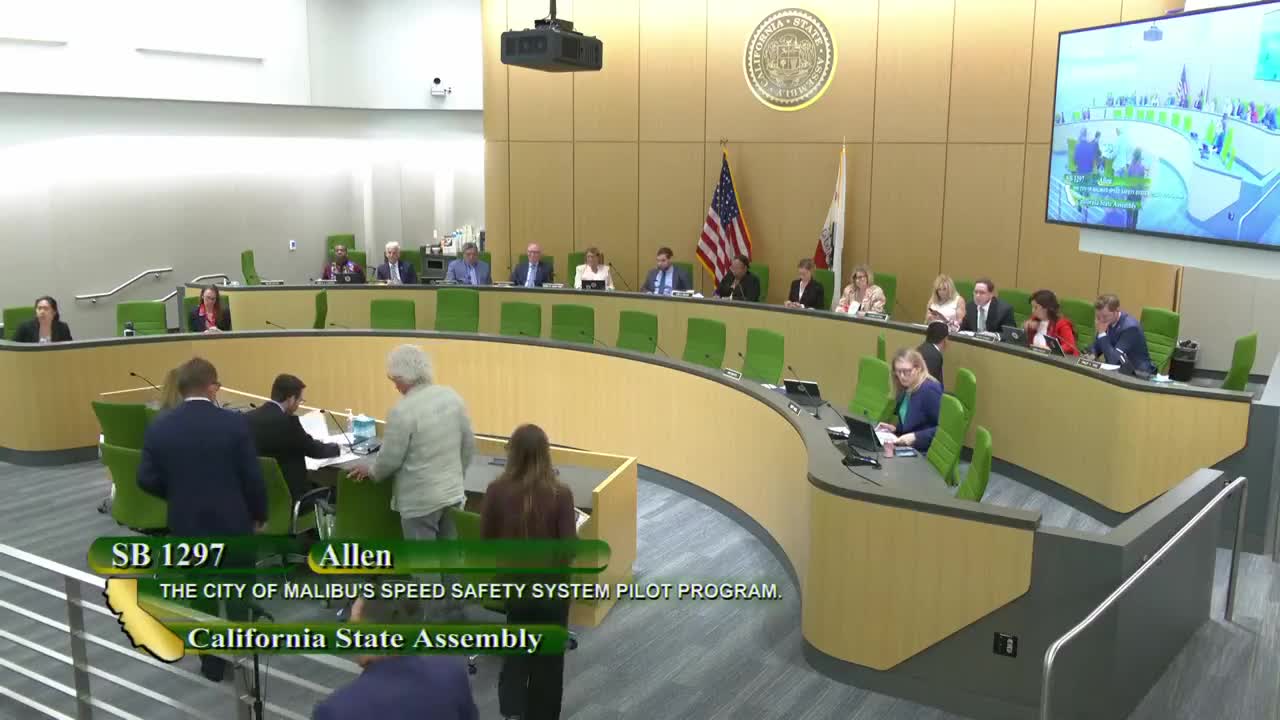 26MIN
Assembly Standing Committee on Transportation
 3MIN
Senate Floor
 29SEC
Senate Standing Committee on Appropriations
 30MIN
Senate Standing Committee on Transportation
Bill Author



