SB 1298: Certification of thermal powerplants: data centers.
- Session Year: 2023-2024
- House: Senate
- Latest Version Date: 2024-08-19
Current Status:
Failed
(2024-08-27: Re-referred to Com. on RLS. pursuant to Assembly Rule 97.)
Introduced
In Committee
First Chamber
In Committee
Second Chamber
Enacted
Existing law vests the State Energy Resources Conservation and Development Commission with the exclusive power to certify all locations on which an electrical transmission line or thermal powerplant is constructed, or is proposed to be constructed, and related electrical transmission lines or thermal powerplants. Existing law authorizes the commission to exempt from certification a thermal powerplant with a generating capacity of up to 100 megawatts, and modifications to existing generating facilities that do not add capacity in excess of 100 megawatts, if the commission finds that no substantial adverse impact on the environment or energy resources will result from the construction or operation of the proposed facility or from the modifications.
This bill would additionally authorize the commission to exempt from certification a thermal powerplant with a generating capacity of up to 150 megawatts if specified requirements are met, including that it is used solely as a backup generation facility for a data center, it is located on the customer side of the meter and is not interconnected to the distribution system, a skilled and trained workforce is used to perform all construction work on the facility, as specified, the commission finds that no substantial adverse impact on the environment or energy resources will result from the construction and operation of the facility, and the commission obtains a determination from the applicable air pollution control district or air quality management district that the facilitys backup generation technology meets the best available control technology requirements. The bill would require the owner or operator of a facility granted an exemption under the bill to fully mitigate the facilitys impacts on air quality, as provided. The bill would repeal its provisions on January 1, 2030. 2027.
Existing law vests the State Energy Resources Conservation and Development Commission with the exclusive power to certify all locations on which an electrical transmission line or thermal powerplant is constructed, or is proposed to be constructed, and related electrical transmission lines or thermal powerplants. Existing law authorizes the commission to exempt from certification a thermal powerplant with a generating capacity of up to 100 megawatts, and modifications to existing generating facilities that do not add capacity in excess of 100 megawatts, if the commission finds that no substantial adverse impact on the environment or energy resources will result from the construction or operation of the proposed facility or from the modifications.
This bill would additionally authorize the commission to exempt from certification a thermal powerplant with a generating capacity of up to 150 megawatts if specified requirements are met, including that it is used solely as a backup generation facility for a data center, it is located on the customer side of the meter and is not interconnected to the distribution system, a skilled and trained workforce is used to perform all construction work on the facility, as specified, the commission finds that no substantial adverse impact on the environment or energy resources will result from the construction and operation of the facility, and the commission obtains a determination from the applicable air pollution control district or air quality management district that the facilitys backup generation technology meets the best available control technology requirements. The bill would repeal its provisions on January 1, 2030.
Existing law vests the State Energy Resources Conservation and Development Commission with the exclusive power to certify all locations on which an electrical transmission line or thermal powerplant is constructed, or is proposed to be constructed, and related electrical transmission lines or thermal powerplants. Existing law authorizes the commission to exempt from certification a thermal powerplant with a generating capacity of up to 100 megawatts, and modifications to existing generating facilities that do not add capacity in excess of 100 megawatts, if the commission finds that no substantial adverse impact on the environment or energy resources will result from the construction or operation of the proposed facility or from the modifications.
This bill would additionally authorize the commission to exempt from certification a thermal powerplant with a generating capacity of up to 150 megawatts if specified requirements are met, including that it is used solely as a backup generation facility for a data center, it is located on the customer side of the meter and is not interconnected to the distribution system, a skilled and trained workforce is used to perform all construction work on the facility, as specified, the commission finds that no substantial adverse impact on the environment or energy resources will result from the construction and operation of the facility, and the commission finds obtains a determination from the applicable air pollution control district or air quality management district that the facilitys backup generation technology meets the best available control technology requirements set by the applicable air pollution control district or air quality management district. requirements. The bill would repeal its provisions on January 1, 2030.
Existing law vests the State Energy Resources Conservation and Development Commission with the exclusive power to certify all locations on which an electrical transmission line or thermal powerplant is constructed, or is proposed to be constructed, and related electrical transmission lines or thermal powerplants. Existing law authorizes the commission to exempt from certification a thermal powerplant with a generating capacity of up to 100 megawatts, and modifications to existing generating facilities that do not add capacity in excess of 100 megawatts, if the commission finds that no substantial adverse impact on the environment or energy resources will result from the construction or operation of the proposed facility or from the modifications.
This bill would additionally authorize the commission to exempt from certification a thermal powerplant with a generating capacity of up to 150 megawatts if it is used solely as a backup generation facility for a data center, it is located on the customer side of the meter and is not interconnected to the distribution system, a skilled and trained workforce is used to perform all construction work on the facility, as specified, the commission finds that no substantial adverse impact on the environment or energy resources will result from the construction and operation of the facility, and the commission finds, based on substantial evidence, that the lowest technologically feasible emissions of criteria air pollutants, toxic air contaminants, and greenhouse gases will result from the construction and operation of the facility. finds that the facilitys backup generation technology meets the best available control technology requirements set by the applicable air pollution control district or air quality management district.
Existing law vests the State Energy Resources Conservation and Development Commission with the exclusive power to certify all locations on which an electrical transmission line or thermal powerplant is constructed, or is proposed to be constructed, and related electrical transmission lines or thermal powerplants. Existing law authorizes the commission to exempt from certification a thermal powerplant with a generating capacity of up to 100 megawatts, and modifications to existing generating facilities that do not add capacity in excess of 100 megawatts, if the commission finds that no substantial adverse impact on the environment or energy resources will result from the construction or operation of the proposed facility or from the modifications.
This bill would additionally authorize the commission to exempt from certification a thermal powerplant with a generating capacity of up to 150 megawatts if it is used solely as a backup generation facility for a data center, it is located on the customer side of the meter and is not interconnected to the distribution system, and the commission finds that no substantial adverse impact on the environment or energy resources will result from the construction and operation of the facility. facility, and the commission finds, based on substantial evidence, that the lowest technologically feasible emissions of criteria air pollutants, toxic air contaminants, and greenhouse gases will result from the construction and operation of the facility.
Existing law vests the State Energy Resources Conservation and Development Commission with the exclusive power to certify all locations on which an electrical transmission line or thermal powerplant is constructed, or is proposed to be constructed, and related electrical transmission lines or thermal powerplants. Existing law authorizes the commission to exempt from certification a thermal powerplant with a generating capacity of up to 100 megawatts, and modifications to existing generating facilities that do not add capacity in excess of 100 megawatts, if the commission finds that no substantial adverse impact on the environment or energy resources will result from the construction or operation of the proposed facility or from the modifications.
This bill would additionally authorize the commission to exempt from certification a thermal powerplant with a generating capacity of up to 200 150 megawatts that if it is used solely as an emergency backup generating a backup generation facility for a data center and that is not interconnected with the electrical transmission grid for purposes of exporting electricity, if center, it is located on the customer side of the meter and is not interconnected to the distribution system, and the commission finds that no substantial adverse impact on the environment or energy resources will result from the construction or and operation of the proposed data center. facility.
Existing law vests the State Energy Resources Conservation and Development Commission with the exclusive power to certify all locations on which an electrical transmission line or thermal powerplant is constructed, or is proposed to be constructed, and related electrical transmission lines or thermal powerplants. Existing law authorizes the commission to exempt from certification a thermal powerplant with a generating capacity of up to 100 megawatts, and modifications to existing generating facilities that do not add capacity in excess of 100 megawatts, if the commission finds that no substantial adverse impact on the environment or energy resources will result from the construction or operation of the proposed facility or from the modifications.
This bill would additionally authorize the commission to exempt from certification a thermal powerplant with a generating capacity of up to 200 megawatts that is used solely as an emergency backup generating facility for a data center and that is not interconnected with the electrical transmission grid for purposes of exporting electricity, if the commission finds that no substantial adverse impact on the environment or energy resources will result from the construction or operation of the proposed data center.
The commission may exempt from this chapter both of the following:
(a)Thermal powerplants with a generating capacity of up to 100 megawatts and modifications to existing generating facilities that do not add capacity in excess of 100 megawatts, if the commission finds that no substantial adverse impact on the environment or energy resources will result from the construction or operation of the proposed facility or from the modifications.
(b)(1)Thermal powerplants with a generating capacity of up to 150 megawatts, subject to all of the following conditions:
(A)The facility is used solely as a backup generation facility for a data center.
(B)The facility is located on the customer side of the meter and is not interconnected to the distribution system.
(C)A skilled and trained workforce will be used to perform all construction work on the facility pursuant to paragraph (2).
(D)The commission finds that no substantial adverse impact on the environment or energy resources will result from the construction and operation of the facility.
(E)The commission obtains a determination from the applicable air pollution control district or air quality management district that the facilitys backup generation technology meets the best available control technology requirements, as defined in Section 40405 of the Health and Safety Code. The applicable air pollution control district or air quality management district shall report its determination to the commission pursuant to this subparagraph.
(F)The commission finds that energy efficiency technologies, including Energy Star appliances and demand response options, have been considered first to reduce data center load.
(G)The applicant provides a report to the commission on the expected energy use of the facility, including, but not limited to, energy intensities, peak factors, load profiles, and other related information.
(2)An application for an exemption pursuant to this subdivision shall include the applicants certification that a skilled and trained workforce will be used to perform all construction work on the facility and all of the following apply:
(A)The applicant shall require in all contracts for the performance of work that every contractor and subcontractor at every tier will individually use a skilled and trained workforce to construct the facility.
(B)Every contractor and subcontractor shall use a skilled and trained workforce to construct the facility.
(C)Except as provided in subparagraph (E), contractors and subcontractors that fail to use a skilled and trained workforce shall be subject to the penalties provided in Section 2603 of the Public Contract Code. Penalties for a contractors or subcontractors failure to comply with the requirement to use a skilled and trained workforce may be assessed by the Labor Commissioner within 18 months of completion of the facility using the same procedures for issuance of civil wage and penalty assessments pursuant to Section 2603 of the Public Contract Code. Penalties shall be paid to the State Public Works Enforcement Fund.
(D)For purposes of this subparagraph, an applicant shall be considered to be an awarding body under Chapter 2.9 (commencing with Section 2600) of Part 1 of Division 2 of the Public Contract Code. Except as provided in subparagraph (E), the applicant shall retain records, including copies of monthly reports, that demonstrate compliance with Chapter 2.9 (commencing with Section 2600) of Part 1 of Division 2 of the Public Contract Code while the facility or contract is being performed and for three years after completion of the facility or contract. The applicant shall submit these records immediately upon request of the commission. When submitted to the commission, these records shall be a public record under the California Public Records Act (Division 10 (commencing with Section 7920.000) of Title 1 of the Government Code) and shall be open to public inspection.
(E)Subparagraphs (C) and (D) do not apply if all contractors and subcontractors performing work on the facility are subject to a project labor agreement. The project labor agreement shall also include, but not be limited to, all of the following:
(i)Provisions requiring compliance with the skilled and trained workforce requirement and for enforcement of that obligation through an arbitration procedure.
(ii)Targeted hiring provisions, including a targeted hiring plan, on a craft-by-craft basis to address job access for local, disadvantaged, or underrepresented workers, as defined by a local agency.
(iii)Apprenticeship utilization provisions that commit all parties to increasing the share of work performed by state-registered apprentices above the state-mandated minimum ratio required in Section 1777.5 of the Labor Code.
(iv)Apprenticeship utilization provisions that commit all parties to hiring and retaining a certain percentage of state-registered apprentices that have completed the Multi-Craft Core preapprenticeship training curriculum referenced in subdivision (t) of Section 14005 of the Unemployment Insurance Code.
(3)Nothing in this subdivision affects the authority of the applicable air pollution control district or air quality management district pursuant to Division 26 (commencing with Section 39000) of the Health and Safety Code or the federal Clean Air Act (42 U.S.C. Sec. 7401 et seq.).
(c)This section shall remain in effect only until January 1, 2030, 2027, and as of that date is repealed.
SEC. 2.Section 25541 is added to the Public Resources Code, to read:25541.(a)The commission may exempt from this chapter thermal powerplants with a generating capacity of up to 100 megawatts and modifications to existing generating facilities that do not add capacity in excess of 100 megawatts, if the commission finds that no substantial adverse impact on the environment or energy resources will result from the construction or operation of the proposed facility or from the modifications.
(b)This section shall become operative on January 1, 2030. 2027.
SEC. 3.Section 25541.2 is added to the Public Resources Code, to read:25541.2.(a)The owner or operator of a facility granted an exemption pursuant to subdivision (b) of Section 25541 shall fully mitigate the facilitys impacts on air quality, as determined by the appropriate air district. All actual emissions shall be mitigated, including emissions from emergency, maintenance, and testing operations.
(b)(1)For purposes of this section, a facilitys actual emissions shall be all emissions from any unit or engine when the unit or engine is in use for any reason.
(2)A facility subject to the requirements of this section shall report usage data to the commission and the appropriate air district on or before May 1 annually, including data on the hours of operation, fuel type, engine capacity, and tier of the engine.
(c)This section shall remain in effect only until January 1, 2027, and as of that date is repealed.
The commission may exempt from this chapter both of the following:
(a)Thermal powerplants with a generating capacity of up to 100 megawatts and modifications to existing generating facilities that do not add capacity in excess of 100 megawatts, if the commission finds that no substantial adverse impact on the environment or energy resources will result from the construction or operation of the proposed facility or from the modifications.
(b)(1)Thermal powerplants with a generating capacity of up to 150 megawatts, subject to all of the following conditions:
(A)The facility is used solely as a backup generation facility for a data center.
(B)The facility is located on the customer side of the meter and is not interconnected to the distribution system.
(C)A skilled and trained workforce will be used to perform all construction work on the facility pursuant to paragraph (2).
(D)The commission finds that no substantial adverse impact on the environment or energy resources will result from the construction and operation of the facility.
(E)The commission obtains a determination from the applicable air pollution control district or air quality management district that the facilitys backup generation technology meets the best available control technology requirements, as defined in Section 40405 of the Health and Safety Code. The applicable air pollution control district or air quality management district shall report its determination to the commission pursuant to this subparagraph.
(F)The commission finds that energy efficiency technologies, including Energy Star appliances and demand response options, have been considered first to reduce data center load.
(G)The applicant provides a report to the commission on the expected energy use of the facility, including, but not limited to, energy intensities, peak factors, load profiles, and other related information.
(2)An application for an exemption pursuant to this subdivision shall include the applicants certification that a skilled and trained workforce will be used to perform all construction work on the facility and all of the following apply:
(A)The applicant shall require in all contracts for the performance of work that every contractor and subcontractor at every tier will individually use a skilled and trained workforce to construct the facility.
(B)Every contractor and subcontractor shall use a skilled and trained workforce to construct the facility.
(C)Except as provided in subparagraph (E), contractors and subcontractors that fail to use a skilled and trained workforce shall be subject to the penalties provided in Section 2603 of the Public Contract Code. Penalties for a contractors or subcontractors failure to comply with the requirement to use a skilled and trained workforce may be assessed by the Labor Commissioner within 18 months of completion of the facility using the same procedures for issuance of civil wage and penalty assessments pursuant to Section 2603 of the Public Contract Code. Penalties shall be paid to the State Public Works Enforcement Fund.
(D)For purposes of this subparagraph, an applicant shall be considered to be an awarding body under Chapter 2.9 (commencing with Section 2600) of Part 1 of Division 2 of the Public Contract Code. Except as provided in subparagraph (E), the applicant shall retain records, including copies of monthly reports, that demonstrate compliance with Chapter 2.9 (commencing with Section 2600) of Part 1 of Division 2 of the Public Contract Code while the facility or contract is being performed and for three years after completion of the facility or contract. The applicant shall submit these records immediately upon request of the commission. When submitted to the commission, these records shall be a public record under the California Public Records Act (Division 10 (commencing with Section 7920.000) of Title 1 of the Government Code) and shall be open to public inspection.
(E)Subparagraphs (C) and (D) do not apply if all contractors and subcontractors performing work on the facility are subject to a project labor agreement. The project labor agreement shall also include, but not be limited to, all of the following:
(i)Provisions requiring compliance with the skilled and trained workforce requirement and for enforcement of that obligation through an arbitration procedure.
(ii)Targeted hiring provisions, including a targeted hiring plan, on a craft-by-craft basis to address job access for local, disadvantaged, or underrepresented workers, as defined by a local agency.
(iii)Apprenticeship utilization provisions that commit all parties to increasing the share of work performed by state-registered apprentices above the state-mandated minimum ratio required in Section 1777.5 of the Labor Code.
(iv)Apprenticeship utilization provisions that commit all parties to hiring and retaining a certain percentage of state-registered apprentices that have completed the Multi-Craft Core preapprenticeship training curriculum referenced in subdivision (t) of Section 14005 of the Unemployment Insurance Code.
(3)Nothing in this subdivision affects the authority of the applicable air pollution control district or air quality management district pursuant to Division 26 (commencing with Section 39000) of the Health and Safety Code or the federal Clean Air Act (42 U.S.C. Sec. 7401 et seq.).
(c)This section shall remain in effect only until January 1, 2030, and as of that date is repealed.
SEC. 2.Section 25541 is added to the Public Resources Code, to read:25541.(a)The commission may exempt from this chapter thermal powerplants with a generating capacity of up to 100 megawatts and modifications to existing generating facilities that do not add capacity in excess of 100 megawatts, if the commission finds that no substantial adverse impact on the environment or energy resources will result from the construction or operation of the proposed facility or from the modifications.
(b)This section shall become operative on January 1, 2030.
The commission may exempt from this chapter both of the following:
(a)Thermal powerplants with a generating capacity of up to 100 megawatts and modifications to existing generating facilities that do not add capacity in excess of 100 megawatts, if the commission finds that no substantial adverse impact on the environment or energy resources will result from the construction or operation of the proposed facility or from the modifications.
(b)(1)Thermal powerplants with a generating capacity of up to 150 megawatts, subject to all of the following conditions:
(A)The facility is used solely as a backup generation facility for a data center.
(B)The facility is located on the customer side of the meter and is not interconnected to the distribution system.
(C)A skilled and trained workforce will be used to perform all construction work on the facility pursuant to paragraph (2).
(D)The commission finds that no substantial adverse impact on the environment or energy resources will result from the construction and operation of the facility.
(E)The commission finds obtains a determination from the applicable air pollution control district or air quality management district that the facilitys backup generation technology meets the best available control technology requirements set by the requirements, as defined in Section 40405 of the Health and Safety Code. The applicable air pollution control district or air quality management district. district shall report its determination to the commission pursuant to this subparagraph.
(F)The commission finds that energy efficiency technologies, including Energy Star appliances and demand response options, have been considered first to reduce data center load.
(G)The applicant provides a report to the commission on the expected energy use of the facility, including, but not limited to, energy intensities, peak factors, load profiles, and other related information.
(2)An application for an exemption pursuant to this subdivision shall include the applicants certification that a skilled and trained workforce will be used to perform all construction work on the facility and all of the following apply:
(A)The applicant shall require in all contracts for the performance of work that every contractor and subcontractor at every tier will individually use a skilled and trained workforce to construct the facility.
(B)Every contractor and subcontractor shall use a skilled and trained workforce to construct the facility.
(C)Except as provided in subparagraph (E), contractors and subcontractors that fail to use a skilled and trained workforce shall be subject to the penalties provided in Section 2603 of the Public Contract Code. Penalties for a contractors or subcontractors failure to comply with the requirement to use a skilled and trained workforce may be assessed by the Labor Commissioner within 18 months of completion of the facility using the same procedures for issuance of civil wage and penalty assessments pursuant to Section 2603 of the Public Contract Code. Penalties shall be paid to the State Public Works Enforcement Fund.
(D)For purposes of this subparagraph, an applicant shall be considered to be an awarding body under Chapter 2.9 (commencing with Section 2600) of Part 1 of Division 2 of the Public Contract Code. Except as provided in subparagraph (E), the applicant shall retain records, including copies of monthly reports, that demonstrate compliance with Chapter 2.9 (commencing with Section 2600) of Part 1 of Division 2 of the Public Contract Code while the facility or contract is being performed and for three years after completion of the facility or contract. The applicant shall submit these records immediately upon request of the commission. When submitted to the commission, these records shall be a public record under the California Public Records Act (Division 10 (commencing with Section 7920.000) of Title 1 of the Government Code) and shall be open to public inspection.
(E)Subparagraphs (C) and (D) do not apply if all contractors and subcontractors performing work on the facility are subject to a project labor agreement. The project labor agreement shall also include, but not be limited to, all of the following:
(i)Provisions requiring compliance with the skilled and trained workforce requirement and for enforcement of that obligation through an arbitration procedure.
(ii)Targeted hiring provisions, including a targeted hiring plan, on a craft-by-craft basis to address job access for local, disadvantaged, or underrepresented workers, as defined by a local agency.
(iii)Apprenticeship utilization provisions that commit all parties to increasing the share of work performed by state-registered apprentices above the state-mandated minimum ratio required in Section 1777.5 of the Labor Code.
(iv)Apprenticeship utilization provisions that commit all parties to hiring and retaining a certain percentage of state-registered apprentices that have completed the Multi-Craft Core preapprenticeship training curriculum referenced in subdivision (t) of Section 14005 of the Unemployment Insurance Code.
(c)This section shall remain in effect only until January 1, 2030, and as of that date is repealed.
SEC. 2.Section 25541 is added to the Public Resources Code, to read:25541.(a)The commission may exempt from this chapter thermal powerplants with a generating capacity of up to 100 megawatts and modifications to existing generating facilities that do not add capacity in excess of 100 megawatts, if the commission finds that no substantial adverse impact on the environment or energy resources will result from the construction or operation of the proposed facility or from the modifications.
(b)This section shall become operative on January 1, 2030.
The commission may exempt from this chapter both of the following:
(a)Thermal powerplants with a generating capacity of up to 100 megawatts and modifications to existing generating facilities that do not add capacity in excess of 100 megawatts, if the commission finds that no substantial adverse impact on the environment or energy resources will result from the construction or operation of the proposed facility or from the modifications.
(b)(1)Thermal powerplants with a generating capacity of up to 150 megawatts, subject to all of the following conditions:
(1)(A)The facility is used solely as a backup generation facility for a data center.
(2)(B)The facility is located on the customer side of the meter and is not interconnected to the distribution system.
(C)A skilled and trained workforce will be used to perform all construction work on the facility pursuant to paragraph (2).
(3)(D)The commission finds that no substantial adverse impact on the environment or energy resources will result from the construction and operation of the facility.
(4)The commission finds, based on substantial evidence, that the lowest technologically feasible emissions of criteria air pollutants, toxic air contaminants, and greenhouse gases will result from the construction and operation of the facility.(E)The commission finds that the facilitys backup generation technology meets the best available control technology requirements set by the applicable air pollution control district or air quality management district.
(2)An application for an exemption pursuant to this subdivision shall include the applicants certification that a skilled and trained workforce will be used to perform all construction work on the facility and all of the following apply:
(A)The applicant shall require in all contracts for the performance of work that every contractor and subcontractor at every tier will individually use a skilled and trained workforce to construct the facility.
(B)Every contractor and subcontractor shall use a skilled and trained workforce to construct the facility.
(C)Except as provided in subparagraph (E), contractors and subcontractors that fail to use a skilled and trained workforce shall be subject to the penalties provided in Section 2603 of the Public Contract Code. Penalties for a contractors or subcontractors failure to comply with the requirement to use a skilled and trained workforce may be assessed by the Labor Commissioner within 18 months of completion of the facility using the same procedures for issuance of civil wage and penalty assessments pursuant to Section 2603 of the Public Contract Code. Penalties shall be paid to the State Public Works Enforcement Fund.
(D)For purposes of this subparagraph, an applicant shall be considered to be an awarding body under Chapter 2.9 (commencing with Section 2600) of Part 1 of Division 2 of the Public Contract Code. Except as provided in subparagraph (E), the applicant shall retain records, including copies of monthly reports, that demonstrate compliance with Chapter 2.9 (commencing with Section 2600) of Part 1 of Division 2 of the Public Contract Code while the facility or contract is being performed and for three years after completion of the facility or contract. The applicant shall submit these records immediately upon request of the commission. When submitted to the commission, these records shall be a public record under the California Public Records Act (Division 10 (commencing with Section 7920.000) of Title 1 of the Government Code) and shall be open to public inspection.
(E)Subparagraphs (C) and (D) do not apply if all contractors and subcontractors performing work on the facility are subject to a project labor agreement. The project labor agreement shall also include, but not be limited to, all of the following:
(i)Provisions requiring compliance with the skilled and trained workforce requirement and for enforcement of that obligation through an arbitration procedure.
(ii)Targeted hiring provisions, including a targeted hiring plan, on a craft-by-craft basis to address job access for local, disadvantaged, or underrepresented workers, as defined by a local agency.
(iii)Apprenticeship utilization provisions that commit all parties to increasing the share of work performed by state-registered apprentices above the state-mandated minimum ratio required in Section 1777.5 of the Labor Code.
(iv)Apprenticeship utilization provisions that commit all parties to hiring and retaining a certain percentage of state-registered apprentices that have completed the Multi-Craft Core preapprenticeship training curriculum referenced in subdivision (t) of Section 14005 of the Unemployment Insurance Code.
The commission may exempt from this chapter both of the following:
(a)Thermal powerplants with a generating capacity of up to 100 megawatts and modifications to existing generating facilities that do not add capacity in excess of 100 megawatts, if the commission finds that no substantial adverse impact on the environment or energy resources will result from the construction or operation of the proposed facility or from the modifications.
(b)Thermal powerplants with a generating capacity of up to 150 megawatts, subject to all of the following conditions:
(1)The facility is used solely as a backup generation facility for a data center.
(2)The facility is located on the customer side of the meter and is not interconnected to the distribution system.
(3)The commission finds that no substantial adverse impact on the environment or energy resources will result from the construction and operation of the facility.
(4)The commission finds, based on substantial evidence, that the lowest technologically feasible emissions of criteria air pollutants, toxic air contaminants, and greenhouse gases will result from the construction and operation of the facility.
The commission may exempt from this chapter both of the following:
(a)Thermal powerplants with a generating capacity of up to 100 megawatts and modifications to existing generating facilities that do not add capacity in excess of 100 megawatts, if the commission finds that no substantial adverse impact on the environment or energy resources will result from the construction or operation of the proposed facility or from the modifications.
(b)Thermal powerplants with a generating capacity of up to 200 megawatts that are used solely as emergency backup generating facilities for a data center and that are not interconnected with the electrical transmission grid for purposes of exporting electricity, if the commission finds that no substantial adverse impact on the environment or energy resources will result from the construction or operation of the proposed data center.(b)Thermal powerplants with a generating capacity of up to 150 megawatts, subject to all of the following conditions:
(1)The facility is used solely as a backup generation facility for a data center.
(2)The facility is located on the customer side of the meter and is not interconnected to the distribution system.
(3)The commission finds that no substantial adverse impact on the environment or energy resources will result from the construction and operation of the facility.
The commission may exempt from this chapter thermal both of the following:
(a)Thermal powerplants with a generating capacity of up to 100 megawatts and modifications to existing generating facilities that do not add capacity in excess of 100 megawatts, if the commission finds that no substantial adverse impact on the environment or energy resources will result from the construction or operation of the proposed facility or from the modifications.
(b)Thermal powerplants with a generating capacity of up to 200 megawatts that are used solely as emergency backup generating facilities for a data center and that are not interconnected with the electrical transmission grid for purposes of exporting electricity, if the commission finds that no substantial adverse impact on the environment or energy resources will result from the construction or operation of the proposed data center.
|
Date
|
Status
|
|---|---|
| Aug 27, 2024 | Re-referred to Com. on RLS. pursuant to Assembly Rule 97. |
| Aug 20, 2024 | Read second time. Ordered to third reading. |
| Aug 19, 2024 | Read second time and amended. Ordered to second reading. |
| Aug 15, 2024 | From committee: Do pass as amended. (Ayes 11. Noes 0.) (August 15). |
| Aug 7, 2024 | August 7 set for first hearing. Placed on suspense file. |
| Jul 3, 2024 | Read second time and amended. Re-referred to Com. on APPR. |
| Jul 2, 2024 | From committee: Do pass as amended and re-refer to Com. on APPR. (Ayes 7. Noes 0.) (July 2). |
| Jul 2, 2024 | From committee: Do pass and re-refer to Com. on L. & E. (Ayes 12. Noes 0.) (July 1). Re-referred to Com. on L. & E. |
| Jun 24, 2024 | Re-referred to Coms. on NAT. RES. and L. & E. pursuant to Assembly Rule 96. |
| Jun 24, 2024 | Assembly Rule 56 suspended. |
| Jun 24, 2024 | Read second time and amended. Re-referred to Com. on L. & E. |
| Jun 20, 2024 | From committee: Do pass as amended and re-refer to Com. on L. & E. (Ayes 14. Noes 0.) (June 19). |
| Jun 3, 2024 | From committee with author's amendments. Read second time and amended. Re-referred to Com. on U. & E. |
| Jun 3, 2024 | Referred to Coms. on U. & E. and L. & E. |
| May 23, 2024 | In Assembly. Read first time. Held at Desk. |
| May 22, 2024 | Read third time. Passed. (Ayes 33. Noes 0. Page 4146.) Ordered to the Assembly. |
| May 20, 2024 | Read second time. Ordered to third reading. |
| May 16, 2024 | May 16 set for first hearing. Reconsideration of favorable vote granted. |
| May 16, 2024 | Read second time and amended. Ordered to second reading. |
| May 16, 2024 | From committee: Do pass as amended. (Ayes 6. Noes 0. Page 3979.) (May 16). |
| May 10, 2024 | Set for hearing May 16. |
| May 6, 2024 | May 6 hearing: Placed on APPR suspense file. |
| Apr 26, 2024 | Set for hearing May 6. |
| Apr 22, 2024 | Read second time and amended. Re-referred to Com. on APPR. |
| Apr 18, 2024 | From committee: Do pass as amended and re-refer to Com. on APPR. (Ayes 14. Noes 0. Page 3632.) (April 16). |
| Apr 4, 2024 | Set for hearing April 16. |
| Feb 29, 2024 | Referred to Com. on E., U. & C. |
| Feb 16, 2024 | From printer. May be acted upon on or after March 17. |
| Feb 15, 2024 | Introduced. Read first time. To Com. on RLS. for assignment. To print. |
|
Date
|
Description
|
Location
|
Votes
|
|
|---|---|---|---|---|
| Aug 15, 2024 | Do pass as amended. | Assembly Standing Committee on Appropriations |
Passed |
|
| Jul 2, 2024 | Do pass as amended and be re-referred to the Committee on [Appropriations] | Assembly Standing Committee on Labor and Employment |
Passed |
|
| Jul 1, 2024 | Do pass and be re-referred to the Committee on [Labor and Employment] | Assembly Standing Committee on Natural Resources |
Passed |
|
| Jun 19, 2024 | Do pass as amended and be re-referred to the Committee on [Labor and Employment] | Assembly Standing Committee on Utilities and Energy |
Passed |
|
| May 22, 2024 | Senate 3rd Reading SB1298 Cortese | Senate Floor |
Passed |
|
| May 16, 2024 | Do pass as amended | Senate Standing Committee on Appropriations |
Passed |
|
| May 16, 2024 | [05-16-2024] set for [First] hearing: Reconsideration of favorable vote granted | Senate Standing Committee on Appropriations |
Passed |
|
| May 16, 2024 | Do pass as amended | Senate Standing Committee on Appropriations |
Passed |
|
| May 6, 2024 | Placed on suspense file | Senate Standing Committee on Appropriations |
Passed |
|
| Apr 16, 2024 | Do pass as amended, but first amend, and re-refer to the Committee on [Appropriations] | Senate Standing Committee on Energy, Utilities and Communications |
Passed |
This list shows positions taken on this bill by organizations on the date displayed, which is linked to the original source.
Positions by individuals are not included.
|
Organization
|
Position
|
Date
|
|---|---|---|
| American Lung Association in California | ** Against | |
| Bay Area Air Quality Management District | ** Against | |
| Bay Area Council | ** Support | |
| Brea Chamber of Commerce | ** Support | |
| California Air Pollution Control Officers Association | ** Against | |
| California State Association Of Electrical Workers | ** Support | |
| California State Pipe Trades Council | ** Support | |
| Carlsbad Chamber of Commerce | ** Support | |
| Clean Power Campaign | ** Against | |
| Coalition For Clean Air | ** Against | |
| Data Center Coalition | ** Support | |
| Ecolab | ** Support | |
| Environmental Defense Fund | ** Against | |
| Greater Irvine Chamber of Commerce | ** Support | |
| Matt Mahan, Mayor, City of San José | ** Support | |
| Microsoft Corporation | ** Support | |
| Multicultural Business Alliance | ** Support | |
| opportunity stanislaus | ** Support | |
| Pure Storage | ** Support | |
| San Francisco Filipino American Chamber of Commerce | ** Support | |
| Silicon Valley Leadership Group | ** Support | |
| South Coast Air Quality Management District | ** Against | |
| State Building & Construction Trades Council Of California | ** Support | |
| Technology Industry Association of California | ** Support | |
| Union Of Concerned Scientists | ** Against | |
| Walnut Creek Chamber of Commerce & Visitors Bureau | ** Support | |
| Western Electrical Contractors Association | ** Against | |
| Western States Council Of Sheet Metal Workers | ** Support | |
| Western States Council Sheet Metal, Air, Rail And Transportation | ** Support |
SENATE THIRD READING
STR Bill Id:SB 1298
Author:(Cortese)
As Amended Ver:August 19, 2024
Majority vote
SUMMARY
Authorizes the California Energy Commission (CEC), until January 1, 2027, to exempt from certification a thermal power plant with generating capacity of up to 150 megawatts (MW) that is to be used solely as a backup generation facility for a data center, if certain conditions are met. Requires the owner or operator of an exempted facility with generating capacity between 100 MW and 150 MW to fully mitigate the facility's impacts on air quality, as provided, and provide an annual data report on the facility's usage.
Major Provisions
- Authorizes the CEC to exempt from its power plant siting process a thermal power plant with a generating capacity up to 150 MW if all of the following conditions are met:
- The facility is used solely as a backup generation facility for a data center;
- The facility is located on the customer side of the meter and is not interconnected to the distribution center;
- A skilled and trained workforce will be used to perform all construction work on the facility;
- The CEC finds that no substantial adverse impact on the environment or energy resources will result from the construction and operation of the facility;
- The CEC obtains a determination from the applicable air district that the facility's backup generation technology meets the best available control technology (BACT) requirements;
- The CEC finds that energy efficiency technologies, including Energy Star appliances and demand response options, have been considered first to reduce data center load; and
- The applicant provides a report to the CEC on the expected energy use of the facility.
- Provides penalties for applicants, contractors, and subcontractors that fail to use a skilled and trained workforce, to be assessed by the Labor Commissioner within 18 months of completion and paid to the State Public Works Enforcement Fund. Requires an applicant to retain records that demonstrate compliance while the facility or contract is being performed and for three years after completion of the facility or contract unless all contractors and subcontractors are subject to a project labor agreement that meets certain conditions, as specified.
- Asserts that nothing in the bill affects the authority of the applicable air district as provided in current law.
- Requires the owner or operator to mitigate all emissions – as determined by the appropriate air district – from any unit or engine of a facility granted an exemption under this bill when in use for any reason, including for emergency, maintenance, and testing operations. Also requires the facility to report usage data to the CEC and the relevant air district on or before May 1 annually, including data on the hours of operation, fuel type, engine capacity, and tier of the engine.
- Sunsets the provisions of this bill on January 1, 2027.
COMMENTS
Small power plant exemptions – The CEC has exclusive jurisdiction to review, and ultimately approve or deny, applications to construct and operate thermal power plants that generate 50 MW or more. For projects that will generate more than 50 MW but less than 100 MW, the CEC may grant the proposed project a Small Power Plant Exemption (SPPE) from the CEC's exclusive jurisdiction whereby local permitting entities would obtain jurisdiction over the approval of the site and related facility. As the lead agency under the California Environmental Quality Act, the CEC must find that a proposed project would not create a substantial adverse impact on the environment or on energy resources in order to approve the project or grant it an SPPE. Air districts maintain their authorities under the state and federal Clean Air Acts to review and permit these SPPE projects, which cannot be overridden by the CEC.
Energy consumption by data centers – Data centers are facilities that house large volumes of high-performance computers, storage systems, and computing infrastructure. They are crucial for maintaining internet-based communications and providing certain services, including virtually all cloud-based computing; however, data centers also support a variety of non-essential functions, such as mining for cryptocurrency. These systems require continuous power and cooling, which requires a substantial amount of electricity. According to the U.S. Department of Energy, data centers consume 10 to 50 times more energy than similarly sized commercial office buildings.[1] The CEC estimated that data centers accounted for 2% of California's electricity demand in 2019.[2] Since then, the technology sector has seen a boom in artificial intelligence (AI) and a corresponding growth in load; as a result, grid planners expect electricity consumption by data centers to accelerate more rapidly over the next five years and beyond.[3]
Since the establishment of the SPPE process in the 1980s, the CEC has provided a total of 36 SPPEs, including 17 for data centers' backup power generation.[4] All of the SPPE applications filed since 2011 have been for backup generating facilities serving data centers, and all but one of the 17 data center exemptions were provided for diesel generator systems. Fuel costs, fuel availability, and energy capacity shape the selection of diesel generators over lower and zero-emitting backup power systems. These exempted power generator systems typically comprise banks of 30 to 50 small (2 to 4 MW) diesel generators to allow for as needed, segmented use; most have a total generation capacity above 100 MW to provide redundancy in the case that there are any downed generators when the backup power system is needed. The singular non-diesel CEC-exempted system runs off of renewable natural gas generators.
Proliferating data centers – This bill narrowly provides expansion of the SPPE to data center backup systems, which have historically been sized to match the computing power of a data center. Although these backup systems have been rarely used, the potential environmental harms caused by use of diesel generator systems are considerable. Data centers have uniquely proliferated within small, densely urban geographic areas, primarily in the Silicon Valley. As a result, this bill may disproportionately impact certain communities near large population centers, increasing local air pollution concerns. This bill contemplates this potential harm, in that it requires, for an exemption to be granted, that (a) the CEC find no substantial adverse impact on the environment or energy resources will result from the construction and operation of the facility; (b) the local air district determine that the facility meets BACT requirements; and (c) the owner or operator of the facility fully mitigate the facility’s impacts on air quality.
This bill also contemplates the concerns regarding increased energy demands by the proliferation of data centers. While there is consensus that data center energy loads will grow over the next several years, largely due to the shift towards cloud computing and AI, the magnitude of that load growth is less certain. To better inform the state’s assessment of future electricity demand and supply and urge businesses along towards our clean energy future, this bill requires (a) applicants to provide a report on the expected energy use of the data center project; (a) applicants to consider energy efficiency technologies and demand response options; and (c) provides a sunset date so the Legislature and the public may review the effects of the bill’s exemption.
According to the Author
"Recognizing the critical demand for data processing capabilities, SB 1298 allows infrastructure development to keep pace with advancements in cloud computing. The current vacancy rate of data centers in Silicon Valley is a mere 1.6%, underscoring the need to expand capacity to meet the growing demand. By streamlining the approval process for data centers and maintaining clear guidelines for development, SB 1298 will ensure that innovation is thriving and sustainable in Silicon Valley and across California. Expanding our data center infrastructure is essential for the continued growth and competitiveness of our tech industry, supporting and expanding the economy throughout California in many sectors."
Arguments in Support
The California State Association of Electrical Workers writes, "Data centers are critical to California's economy, driving innovation and supporting a vast range of industries. Ensuring reliable backup power for these centers is essential for maintaining the state's economic stability and growth. Moreover, the construction of these backup facilities will great good union jobs, providing high-quality employment opportunities and strengthening our skilled labor force."
Arguments in Opposition
The Clean Power Campaign writes, "Increasing the exemption threshold from 100 MW to 150 MW will increase [emissions of pollutants], undermining California's efforts to improve air quality and combat climate change. Communities near data centers, particularly those in Santa Clara and San Jose, will bear the brunt of these emissions… The bill fails to provide adequate protections for these vulnerable communities that are disproportionately impacted by air pollution… Allowing any fossil fuel generation is a major step back on California's clean energy goals." It is unclear to this committee if recent amendments clarifying the role of local air district review have addressed their concerns.
FISCAL COMMENTS
According to the Assembly Committee on Appropriations, this bill will incur minor, absorbable costs to the CEC to consider requests for exemption from its permitting process. While this bill does not explicitly assign duties to the California Air Resources Board (CARB), CARB asserts significant annual costs as a result of this bill, likely in the millions of dollars and possibly in the tens of millions of dollars, to address the possibility of increased diesel emissions, including needing resources for ensuring adequate mitigation, overseeing air districts activities, and reviewing projects submitted to the CEC for exemption consideration.
VOTES
SENATE FLOOR: 33-0-7
YES: Alvarado-Gil, Ashby, Atkins, Becker, Blakespear, Bradford, Caballero, Cortese, Dahle, Dodd, Durazo, Glazer, Gonzalez, Grove, Hurtado, Jones, Laird, Limón, McGuire, Min, Newman, Nguyen, Niello, Ochoa Bogh, Padilla, Portantino, Roth, Rubio, Seyarto, Smallwood‑Cuevas, Umberg, Wahab, Wilk
ABS, ABST OR NV: Allen, Archuleta, Eggman, Menjivar, Skinner, Stern, Wiener
ASM UTILITIES AND ENERGY: 14-0-2
YES: Petrie-Norris, Jim Patterson, Boerner, Calderon, Chen, Friedman, Hart, Holden, Joe Patterson, Santiago, Ting, Wallis, Wood, Zbur
ABS, ABST OR NV: Bauer-Kahan, Reyes
ASM NATURAL RESOURCES: 12-0-0
YES: Bryan, Flora, Bauer-Kahan, Connolly, Friedman, Hoover, Kalra, Lackey, Muratsuchi, Pellerin, Wicks, Wood
ASM LABOR AND EMPLOYMENT: 7-0-0
YES: Ortega, Flora, Alanis, Wendy Carrillo, Lee, Ward, Zbur
ASM APPROPRIATIONS: 11-0-4
YES: Wicks, Arambula, Bryan, Calderon, Wendy Carrillo, Mike Fong, Grayson, Haney, Hart, Pellerin, Villapudua
ABS, ABST OR NV: Sanchez, Dixon, Jim Patterson, Ta
UPDATED
VERSION: August 19, 2024
CONSULTANT: Kathleen Chen / U. & E. / (916) 319-2083 FN: 0004116
US DOE; “Data Centers and Servers”; https://www.energy.gov/eere/buildings/data-centers-and-servers. ↑
CEC; “Enabling Energy Efficient Data Center in Smart Power Distribution Systems”; May 2024. ↑
CPower; “Demand Growth Offers Opportunities for Data Centers”; March 2024; https://cpowerenergy.com/demand-growth-offers-opportunities-for-data-centers/. ↑
CEC; “Power Plant Listing”; https://www.energy.ca.gov/proceedings/power-plant-listing?field_project_type_value=SPPE&field_project_status_value=All&field_technology_value=All. ↑
Date of Hearing: August 7, 2024
ASSEMBLY COMMITTEE ON APPROPRIATIONS
Buffy Wicks, Chair
SBPCA Bill Id:SB 1298
Author:(Cortese) – As Amended Ver:July 3, 2024
Policy Committee: | Utilities and Energy | Vote: | 14 - 0 |
Natural Resources | 12 - 0 | ||
Labor and Employment | 7 - 0 |
Urgency: No State Mandated Local Program: No Reimbursable: No
SUMMARY:
This bill, until January 1, 2030, authorizes the California Energy Commission (CEC) to exempt from its permitting process, known as powerplant and site certification, a thermal powerplant with a generating capacity of up to 150 megawatts (MW) that is to be used solely as backup generation for a data center, if certain conditions are met.
Specifically, this bill:
- Authorizes CEC to exempt from its certification process a thermal powerplant to be used solely as a backup generation facility for a data center, as described above, if certain conditions are met, including, but not limited to the following: (a) the facility is located on the customer side of the meter and is not interconnected to the distribution system; (b) a skilled-and-trained workforce will be used to perform all construction work on the facility and the applicant includes in its application a certification of this fact, and other related requirements; (c) the CEC finds that no substantial adverse impact on the environment or energy resources will result from the construction and operation of the facility; (d) the CEC obtains a determination from the applicable air district that the facility’s backup generation technology meets the best available control technology requirements; (e) the CEC finds that energy efficiency technologies, including Energy Star appliances and demand response options, have been considered first to reduce data center load; and (f) the applicant provides a report to the CEC on the expected energy use of the facility.
- Provides penalties for contractors and subcontractors that fail to use a skilled-and-trained workforce, to be assessed by the Labor Commissioner within 18 months of completion of the facility using, and consistent with existing law, provides any such penalties be paid to the State Public Works Enforcement Fund.
- Asserts that nothing in the bill affects the authority of the applicable air district as provided in current law.
FISCAL EFFECT:
- Minor, absorbable costs to the CEC to consider requests for exemption from the CEC’s permitting process.
- This bill does not explicitly assign duties to the Air Resources Board (ARB). Nonetheless, ARB asserts significant annual costs as a result of this bill, likely in the millions of dollars and possibly in the tens of millions of dollars, to address what ARB describes as “the significant increase in diesel emissions and the associated negative impacts on air quality due to the large diesel generators being installed.”
ARB explains its cost estimate by noting that (a), of the 12 data center backup power installations that have received a permitting exemption from CEC, all but one are diesel generators, (b) the installations contemplated by this bill will be significantly larger than those that have receive CEC exemptions to date, (c) the installations are likely to be geographically concentrated, as will their emissions, and (d) the diesel generators will operate not only during a utility power outages, but also monthly for maintenance. ARB asserts operation of these backup power installations will significantly increase local air pollution and emission of greenhouse gases. ARB contends, as a result it will expend significant resources (a) ensuring adequate mitigation, (b) overseeing air districts activities and (c) reviewing projects submitted to CEC for exemption consideration.
COMMENTS:
- Purpose. The author describes expanding data center infrastructure as essential for the continued growth and competitiveness of California’s technology industry and intends this bill to support that expansion. According to the author:
Recognizing the critical demand for data processing capabilities, SB 1298 allows infrastructure development to keep pace with advancements in cloud computing. The current vacancy rate of data centers in Silicon Valley is a mere 1.6%, underscoring the need to expand capacity to meet the growing demand. By streamlining the approval process for data centers and maintaining clear guidelines for development, SB 1298 will ensure that innovation is thriving and sustainable in Silicon Valley and across California.
- Background. Existing law recognizes the need to quickly site new large thermal powerplants, while at the same time acknowledging these large powerplants may significantly harm the environment and the public should participate in the siting process. For these reasons, the Legislature provided the CEC with exclusive authority to permit “large” thermal powerplant—that is, powerplants with capacity to generate at least 50MW of electricity through the use of heat. The CEC’s process includes review and permitting pursuant to the California Environmental Quality Act.
Existing law provides for an exemption from CEC’s permitting process. Specifically, the CEC may exempt from its permitting process a thermal powerplant with a generating capacity of up to 100 MW. But the law allows the CEC to grant such an exemption only if it finds no substantial adverse impact on the environment or energy resources will result from the construction or operation of the proposed facility. Following the CEC’s grant of an exemption, a local agency becomes the primary permitting agency for the proposed powerplant.
Similarly, this bill authorizes the CEC to exempt from its permitting process a powerplant with a generating capacity of up to 150MW, provided the powerplant is used solely as a backup generation facility for a data center, among other things.
If a powerplant with a generating capacity of 50MW is large, then a backup powerplant with a generating capacity of 150MW is large, indeed. It is reasonable to expect data centers to need backup power of this magnitude: datacenters use considerable amounts of power, and their operation depends on a very consistent electrical power supply.
Still, the potential environmental harms caused by use of such powerplants are considerable. Datacenters are dispersed throughout the state, but many are concentrated in portions of the Bay Area. And most of them will be powered by diesel fuel, for the foreseeable future, at least. Data centers may rely on this backup power infrequently, but it is conceivable that many in a given area would operate at once in response to an event, such as a regional power outage. The resulting concentrated harm to air quality could be considerable.
The bill contemplates this potential harm, in that it requires the CEC, in order to grant an exemption, (a) find no substantial adverse impact on the environment or energy resources will result from the construction and operation of the facility and (b) obtain a determination from the applicable air district the facility’s backup generation technology meets the best available control technology requirements. And the bill does not affect an air district’s authority to review and permit a backup powerplant to which the CEC provides an exemption. The bill provides a sunset date—2030—so the Legislature and the public may review the effects of the bill’s exemption.
Given the potential for harm to local air quality—and to the people who breathe that air—it is worth considering establishing some type of mechanism to require a datacenter that uses its backup powerplant to locally mitigate the resulting harm, assuming the bill moves forward.
Analysis Prepared by: Jay Dickenson / APPR. / (916) 319-2081
Date of Hearing: July 2, 2024
ASSEMBLY COMMITTEE ON LABOR AND EMPLOYMENT
Liz Ortega, Chair
SBPCA Bill Id:SB 1298
Author:(Cortese) – As Amended Ver:June 24, 2024
SENATE VOTE: 33-0
SUBJECT: Certification of thermal powerplants: data centers
SUMMARY: Authorizes the California Energy Commission (CEC), until January 1, 2030, to exempt from its certification a thermal powerplant with a generating capacity of up to 150 megawatts, if specified requirements are met, including that the power plant is used solely as a backup generation facility for a data center and that a skilled and trained workforce is used to perform all construction work on the facility, as specified. Specifically, this bill:
- Authorizes the CEC to exempt from certification a thermal powerplant with a generating capacity of up to 150 megawatts if the following conditions are met:
- The facility is used solely as a backup generation facility for a data center.
- The facility is located on the customer side of the meter and is not interconnected to the distribution system.
- A skilled and trained workforce will be used to perform all construction work on the facility, as specified in 2)-7) below.
- The CEC finds that no substantial adverse impact on the environment or energy resources will result from the construction and operation of the facility.
- The CEC obtains a determination from the applicable air pollution control district or air quality management district that the facility’s backup generation technology meets the best available control technology requirements, as specified. The applicable air pollution control district or air quality management district shall report its determination to the CEC.
- The CEC finds that energy efficiency technologies, including Energy Star appliances and demand response options, have been considered first to reduce data center load.
- The applicant provides a report to the CEC on the expected energy use of the facility, including, but not limited to, energy intensities, peak factors, load profiles, and other related information.
- Requires an application for an exemption to include the applicant’s certification that a skilled and trained workforce will be used to perform all construction work on the facility.
- Requires the applicant to require in all contracts for the performance of work that every contractor and subcontractor at every tier will individually use a skilled and trained workforce to construct the facility.
- Requires every contractor and subcontractor to use a skilled and trained workforce to construct the facility.
- Provides that, except as provided in 7) below, contractors and subcontractors that fail to use a skilled and trained workforce will be subject to specified penalties paid to the State Public Works Enforcement Fund, and that penalties may be assessed by the Labor Commissioner (LC) within 18 months of completion of the facility using specified procedures.
- States that, under this bill, an applicant shall be considered to be an “awarding body” under the Public Contract Code and, except as provided in 7) below, requires the applicant to do the following:
- Retain records, including copies of monthly reports, that demonstrate compliance with skilled and trained requirements while the facility or contract is being performed and for three years after completion of the facility or contract.
- Submit these records immediately upon request of the CEC. When submitted to the CEC, these records shall be a public record under the California Public Records Act and shall be open to public inspection.
- Provides that 5) and 6) above do not apply if all contractors and subcontractors performing work on the facility are subject to a project labor agreement that includes at least all of the following:
- Provisions requiring compliance with the skilled and trained workforce requirement and for enforcement of that obligation through an arbitration procedure.
- Targeted hiring provisions, as specified.
- Apprenticeship utilization provisions, as specified.
- Sunsets and repeals these provisions on January 1, 2030.
EXISTING LAW:
Labor Code provisions:
- Authorizes a public entity to require a bidder, contractor, or other entity to use a skilled and trained workforce to complete a contract or project regardless of whether the public entity is required to do so by a statute or regulation. Public Contract Code § 2600(b).
- Requires, when the use of a skilled and trained workforce to complete a contract or project is required, the public entity to include in all bid documents and construction contracts a notice that the project is subject to the skilled and trained workforce requirement. Public Contract Code § 2600(c).
- Defines a “skilled and trained workforce” to mean a workforce that meets certain conditions, including specified apprenticeship graduation requirements. Public Contract Code § 2601.
- Requires a contractor, bidder, or other entity to provide to the public entity or other awarding body, on a monthly basis while the project or contract is being performed, a report demonstrating compliance with skilled and trained workforce requirements. Public Contract Code § 2602.
- Requires a contractor or subcontractor to pay a civil penalty to the state of not more than $5,000 per month of work performed in violation of the skilled and trained workforce requirements if the LC or his or her designee determines that the contractor or subcontractor failed to use a skilled and trained workforce. A contractor or subcontractor that commits a second or subsequent violation within a three-year period shall forfeit as a civil penalty to the state the sum of not more than $10,000 per month of work performed in violation. Public Contract Code § 2603.
- Provides that the ratio of work performed by apprentices to journeymen employed in a particular craft or trade on the public work may be no higher than the ratio stipulated in the apprenticeship standards under which the apprenticeship program operates if the contractor agrees to be bound by those standards, but provides that, unless otherwise specified, in no case shall the ratio be less than one hour of apprentice work for every five hours of journeyman work. Labor Code § 1777.5(g).
- Defines “project labor agreement” to mean a prehire collective bargaining agreement that establishes terms and conditions of employment for a specific construction project or projects, and authorizes a public entity to use, enter into, or require contractors to enter into a project labor agreement for a construction project if specified conditions are met. Public Contract Code § 2500(b)(1).
- Establishes the California Public Records Act, and requires state and local agencies to make their records available for public inspection, unless an exemption from disclosure applies. Government Code § 7920.000 et seq.
FISCAL EFFECT: According to the Senate Appropriations Committee:
(Note: This fiscal effect does not reflect the current version of this bill)
- “To the extent this bill results in the installation of large diesel generators that increase diesel emissions or have negative impacts on air quality, unknown but potentially significant ongoing costs (General Fund or special fund) to the California Air Resources Board (ARB) for activities and actions to address these emissions and/or negative impacts. Committee amendments would likely lower ARB costs significantly by ensuring that any emissions, pollutants, or toxic air contaminants would be as low as technologically feasible.
- Unknown ongoing costs (General Fund or special fund) for the CEC to make certain findings and implement provisions of this bill. The 4/22 version of this bill would require the CEC to make a finding before it issues an exemption (to find that no substantial adverse impact on the environment or energy resources would result from the construction or operation of the proposed data center). The CEC anticipated no cost related to this provision. Committee amendments would add another finding requirement to the conditions of certification exemption.”
COMMENTS: This analysis is focused on the labor components of this bill – notably, the requirement that the facilities be constructed by a skilled and trained workforce. The analysis prepared by the Assembly Committee on Utilities and Energy contains helpful background about the facilities at issue, recast below in part:
Small power plant exemptions – The CEC has exclusive jurisdiction to review, and ultimately approve or deny, applications to construct and operate thermal power plants[1] that generate 50 MW or more.[2] For projects that will generate more than 50 MW but less than 100 MW, the CEC may grant the proposed project an exemption to the CEC’s exclusive jurisdiction whereby local permitting entities would obtain jurisdiction over the approval of the site and related facility.[3] As the lead agency under CEQA for all thermal power plant projects, the CEC must find that a proposed project would not create a substantial adverse impact on the environment or on energy resources in order to approve the project or grant it an SPPE. If the application for the SPPE is denied, the project applicant would be required to file an application for power plant certification with the CEC.
Gluttons for energy – Data centers are facilities that house large volumes of high-performance computers, storage systems, and computing infrastructure. They are crucial for maintaining internet-based communications and providing certain services, including virtually all cloud-based computing; however, data centers also support a variety of non-essential functions, such as mining for cryptocurrency. These systems require continuous power and cooling, which requires a substantial amount of electricity. According to the U.S. Department of Energy, data centers consume 10 to 50 times more energy than similarly sized commercial office buildings.[4] The CEC estimated that data centers accounted for 2% of California’s electricity demand in 2019.[5] Since then, the technology sector has seen a boom in artificial intelligence (AI) and a corresponding growth in load; as a result, grid planners expect electricity consumption by data centers to accelerate more rapidly over the next five years and beyond.[6]
Since the establishment of the SPPE process in the 1980s, the CEC has provided a total of 36 SPPEs, including 17 for data centers’ backup power generation.[7] All of the SPPE applications filed since 2011 have been for backup generating facilities serving data centers, and all but one of the 17 data center exemptions were provided for diesel generator systems. Fuel costs, fuel availability, and energy capacity shape the selection of diesel generators over lower and zero-emitting backup power systems. These exempted power generator systems typically comprise banks of 30 to 50 small (2 to 4 MW) diesel generators to allow for as needed, segmented use; most have a total generation capacity above 100 MW to provide redundancy in the case that there are any downed generators when the backup power system is needed. The singular non-diesel CEC-exempted system runs off of renewable natural gas generators.”
Skilled and Trained Workforce Requirements
As noted above, data centers are critical to the functioning of California’s modern economy. As such, it is important that they are built by qualified professionals. This bill’s sponsor, Silicon Valley Leadership group, conveyed to the Committee that they already require a skilled and trained workforce on these projects. This bill would codify that requirement for facilities between 100 megawatts and 150 megawatts, along with other specified requirements.
A “skilled and trained workforce” is defined in the Public Contract Code as a workforce where all the workers performing work in an apprenticeable occupation in the building and construction trades are either skilled journeypersons or apprentices registered in an apprenticeship program approved by the Division of Apprenticeship Standards (DAS). A skilled journeyperson is defined as a worker who either 1) graduated from an apprenticeship program for the applicable occupation that was approved by the DAS, or located outside California and approved pursuant to the federal apprenticeship regulations, or 2) has at least as many hours of on-the-job experience in the applicable occupation as would be required to graduate from an apprenticeship program for the applicable occupation that is approved by the DAS.
When a contractor, bidder or other entity is required to provide an enforceable commitment that a skilled and trained workforce will be used to complete a contract or project, they must commit to the awarding body that: 1) The contractor, bidder, or other entity, and its contractors and subcontractors at every tier will comply with the skilled and trained workforce requirements; and 2) the contractor, bidder, or other entity will provide to the public entity or other awarding body, on a monthly basis while the project or contract is being performed, a report demonstrating compliance with skilled and trained requirements.
Contractors and subcontractors who violate skilled and trained workforce requirements can face civil penalties of up to $10,000 per month and debarment.
According to the author, “Recognizing the critical demand for data processing capabilities, SB 1298 allows infrastructure development to keep pace with advancements in cloud computing. The current vacancy rate of data centers in Silicon Valley is a mere 1.6%, underscoring the need to expand capacity to meet the growing demand. By streamlining the approval process for data centers and maintaining clear guidelines for development, SB 1298 will ensure that innovation is thriving and sustainable in Silicon Valley and across California. Expanding our data center infrastructure is essential for our tech industry's continued growth and competitiveness, supporting and expanding the economy throughout California in many sectors.”
Regarding how the bill promotes equity solutions and maximizes benefits for underserved and marginalized communities, the author adds that “This bill at its core is an infrastructure bill. This bill will expand the states Data Center capacity and will ensure that we’re building out a robust technology sector in California that will create more jobs. This bill will also ensure that our emergency services infrastructure is online and ready at all times to meet the needs of Californians across the state. The indirect benefits of economic growth and infrastructure stability will be a long term benefit.”
Arguments in Support
A coalition of organizations that rely on data centers, including the Silicon Valley Leadership Group, are in support and state, “The demand for the digital services provide continues to grow throughout the state, but particularly in Silicon Valley, where the vacancy rate for data centers is a mere 1.6%. Despite data centers playing a pivotal role in California’s economy, their expansion faces regulatory hurdles. Currently, there is a de facto cap on their size of 99 MW in the CEC process that permits them. SB 1298 would allow data centers to be built up to a size of 150 MW to consolidate facilities and better serve California’s industries. This would not impact local planning, as the CEC process for permitting data centers requires collaboration with local agencies and a showing of no substantial adverse impact on the environment by the local air district.”
Arguments in Opposition
The Western Electrical Contractors Association is in opposition and states, “Public Contract Code §2600 et. seq. is a crucial tool establishing substantial financial penalties and possible debarment for failure to use a skilled and trained workforce. However, the language in SB 1298 gives contractors “a pass” under a PLA from these penalties. WECA firmly believes that §2600 should apply irrespective of a PLA, as it is vital for maintaining industry standards and ensuring worker safety.”
Prior Legislation
SB 144 (Committee on Budget and Fiscal Review) Chapter 367, Statutes of 2023 required eligible centralized procurement entity projects to, among other things, use a skilled and trained workforce.
AB 205 (Committee on Budget) Chapter 61, Statutes of 2021 allowed specified clean energy projects to seek consolidated permitting at the CEC, as specified, if they have adhere to labor standards and provide community benefits.
SB 858 (Beall) of 2020 would have excluded from the definition of a thermal powerplant subject to the jurisdiction of the CEC an emergency backup or standby generator that is not connected to the electrical grid and that is constructed, operated, or modified to provide immediate electrical power to maintain the operations of a data center in the event of an outage of electricity from the electrical grid, as well as would have designated the local land use authority with jurisdiction to approve emergency backup or standby generators as the lead agency for purposes of the California Environmental Quality Act. This bill was held in the Senate Committee on Energy, Utilities and Communications.
SB 524 (Stern) of 2019 would have required that a skilled and trained workforce perform the work for energy efficiency projects of $50,000 or more in ratepayer-funded incentives within the same building, facility or complex. This bill died on the Assembly inactive file.
REGISTERED SUPPORT / OPPOSITION:
Support
Bay Area Council
California State Association of Electrical Workers
California State Pipe Trades Council
Carlsbad Chamber of Commerce
Data Center Coalition
ECOLAB
Greater Irvine Chamber of Commerce
Microsoft Corporation
Opportunity Stanislaus
San Francisco Filipino American Chamber of Commerce
Silicon Valley Leadership Group
State Building & Construction Trades Council of California
Western States Council Sheet Metal, Air, Rail and Transportation
Opposition
American Lung Association in California
Clean Power Campaign
Coalition for Clean Air
Environmental Defense Fund
South Coast Air Quality Management District
Union of Concerned Scientists
Western Electrical Contractors Association
Oppose Unless Amended
Bay Area Air Quality Management District
Analysis Prepared by: Erin Hickey / L. & E. /
And related facilities, such as transmission to and from the power plant ↑
Public Resources Code § 25500 ↑
Public Resources Code § 25541 ↑
US DOE; “Data Centers and Servers”; https://www.energy.gov/eere/buildings/data-centers-and-servers. ↑
CEC; “Enabling Energy Efficient Data Center in Smart Power Distribution Systems”; May 2024. ↑
CPower; “Demand Growth Offers Opportunities for Data Centers”; March 2024; https://cpowerenergy.com/demand-growth-offers-opportunities-for-data-centers/. ↑
CEC; “Power Plant Listing”; https://www.energy.ca.gov/proceedings/power-plant-listing?field_project_type_value=SPPE&field_project_status_value=All&field_technology_value=All. ↑
Date of Hearing: July 1, 2024
ASSEMBLY COMMITTEE ON NATURAL RESOURCES
Isaac G. Bryan, Chair
SBPCA Bill Id:SB 1298
Author:(Cortese) – As Amended Ver:June 24, 2024
SENATE VOTE: 33-0
SUBJECT: Certification of thermal powerplants: data centers
SUMMARY: Authorizes the California Energy Commission (CEC) to exempt a thermal powerplant with generating capacity of up to 150 megawatts (MW) from the powerplant certification chapter of the Warren-Alquist Act, if the powerplant is used solely as a backup generation facility for a data center and specified conditions are met.
EXISTING LAW:
- The California Environmental Quality Act (CEQA) requires lead agencies with the principal responsibility for carrying out or approving a proposed project to prepare a negative declaration, mitigated negative declaration, or environmental impact report (EIR) for this action, unless the project is exempt from CEQA. (Public Resources Code (PRC) 21000 et seq.)
- The Warren-Alquist Act grants the CEC exclusive authority to license thermal powerplants 50 MW and larger (including related facilities such as fuel supply lines, water pipelines and electric transmission lines that tie the plant to the grid). The CEC must consult with specified agencies, but the CEC may override any contrary state or local decision. The CEC process is a certified regulatory program (determined by the Resources Secretary to be the functional equivalent of CEQA), so the CEC is exempt from having to prepare an EIR. The certified program, however, does require environmental analysis of the project, including an analysis of alternatives and mitigation measures to minimize any significant adverse effect the project may have on the environment. (PRC 25500 et seq.)
- Authorizes the CEC to exempt thermal powerplants with a generating capacity of up to 100 MW if the CEC finds that no substantial adverse impact on the environment or energy resources will result from the construction or operation of the proposed facility. (PRC 25541)
- Authorizes air district boards to establish a permit system that requires that before any person builds, erects, alters, replaces, operates, or uses any article, machine, equipment, or other contrivance which may cause the issuance of air contaminants, the person obtain a permit to do so from the air pollution control officer of the district. (Health and Safety Code (HSC) 42300)
- Generally requires “best available control technology” (BACT) for new sources permitted by an air district, and defines BACT as an emission limitation that will achieve the lowest achievable emission rate for the source to which it is applied (i.e., the more stringent of (a) the most stringent emission limitation that is contained in the state implementation plan for the particular class or category of source, unless the owner or operator of the source demonstrates that the limitation is not achievable or (b) the most stringent emission limitation that is achieved in practice by that class or category or source). (HSC 40405)
THIS BILL expands the small powerplant exemption to authorize the CEC to exempt thermal powerplants up to 150 MW, subject to all of the following conditions:
- The facility is used solely as a backup generation facility for a data center.
- The facility is located on the customer side of the meter and is not interconnected to the distribution system.
- A skilled and trained workforce will be used to perform all construction work on the facility, as specified.
- The CEC finds that no substantial adverse impact on the environment or energy resources will result from the construction and operation of the facility.
- The CEC obtains a determination from the applicable air district that the facility’s backup generation technology meets BACT.
- The CEC finds that energy efficiency technologies, including Energy Star appliances and demand response options, have been considered first to reduce data center load.
- The applicant provides a report to the CEC on the expected energy use of the facility, including, but not limited to, energy intensities, peak factors, load profiles, and other related information.
- Sunsets January 1, 2030.
FISCAL EFFECT: According to Senate Appropriations Committee:
To the extent this bill results in the installation of large diesel generators that increase diesel emissions or have negative impacts on air quality, unknown but potentially significant ongoing costs (General Fund or special fund) to the Air Resources Board (ARB) for activities and actions to address these emissions and/or negative impacts. Committee amendments would likely lower ARB costs significantly by ensuring that any emissions, pollutants, or toxic air contaminants would be as low as technologically feasible.
Unknown ongoing costs (General Fund or special fund) for the CEC to make certain findings and implement provisions of this bill. The 4/22 version of this bill would require the CEC to make a finding before it issues an exemption (to find that no substantial adverse impact on the environment or energy resources would result from the construction or operation of the proposed data center). The CEC anticipated no cost related to this provision. Committee amendments would add another finding requirement to the conditions of certification exemption.
COMMENTS:
- Background. The CEC has exclusive jurisdiction to review, and ultimately approve or deny, applications to construct and operate thermal power plants that generate 50 MW or more. For projects that will generate more than 50 MW but less than 100 MW, the CEC may grant the proposed project an exemption from the CEC’s exclusive jurisdiction whereby local permitting entities would obtain jurisdiction over the approval of the site and related facility. The CEC acts as the CEQA lead agency these projects projects, and must find that a proposed project would not create a substantial adverse impact on the environment or on energy resources in order to approve the project or grant it an SPPE. Air districts maintain their authorities under the state and federal Clean Air Acts to review and permit these SPPE projects, which cannot be overridden by the CEC.
Data centers are facilities that house large volumes of high-performance computers, storage systems, and computing infrastructure. They are crucial for maintaining internet-based communications and providing certain services, including virtually all cloud-based computing. These systems require continuous power and cooling, which requires a substantial amount of electricity. According to the U.S. Department of Energy, data centers consume 10 to 50 times more energy than similarly sized commercial office buildings. The CEC estimated that data centers accounted for 2% of California’s electricity demand in 2019. Since then, the technology sector has seen a boom in artificial intelligence (AI) and a corresponding growth in load. As a result, grid planners expect electricity consumption by data centers to accelerate more rapidly over the next five years and beyond.
Since the establishment of the SPPE process in the 1980s, the CEC has provided a total of 36 SPPEs, including 17 for data centers’ backup power generation. All of the SPPE applications filed since 2011 have been for backup generating facilities serving data centers, and all but one of the 17 data center exemptions were provided for diesel generator systems. Fuel costs, fuel availability, and energy capacity shape the selection of diesel generators over lower and zero-emitting backup power systems.
- Author’s statement:
Recognizing the critical demand for data processing capabilities, SB 1298 allows infrastructure development to keep pace with advancements in cloud computing. The current vacancy rate of data centers in Silicon Valley is a mere 1.6%, underscoring the need to expand capacity to meet the growing demand. By streamlining the approval process for data centers and maintaining clear guidelines for development, SB 1298 will ensure that innovation is thriving and sustainable in Silicon Valley and across California. Expanding our data center infrastructure is essential for the continued growth and competitiveness of our tech industry, supporting and expanding the economy throughout California in many sectors.
- Suggested amendment. To address opposition concerns and confirm the authority of air districts in the review of projects eligible for the SPPE under this bill, the author and the committee may wish to consider adding the following language to subdivision (b):
Nothing in this subdivision affects the authority of the applicable air pollution control district or air quality management district pursuant to Division 26 of the Health and Safety Code or the federal Clean Air Act.
Note, this amendment may be adopted in the Labor and Employment or Appropriations Committee due to timing issues.
- Triple referral. This bill passed the Utilities and Energy Committee on June 19 by a vote of 14-0. Should it pass this committee, it will be heard by the Labor and Employment Committee on July 2.
REGISTERED SUPPORT / OPPOSITION:
Support
California State Association of Electrical Workers
California State Pipe Trades Council
Data Center Coalition
Microsoft Corporation
Silicon Valley Leadership Group
State Building & Construction Trades Council of California
Western States Council of Sheet Metal Workers
Opposition
American Lung Association in California
Bay Area Air Quality Management District (unless amended)
Clean Power Campaign
Coalition for Clean Air
Environmental Defense Fund
South Coast Air Quality Management District
Union of Concerned Scientists
Western Electrical Contractors Association
Analysis Prepared by: Lawrence Lingbloom / NAT. RES. /
Date of Hearing: June 19, 2024
ASSEMBLY COMMITTEE ON UTILITIES AND ENERGY
Cottie Petrie-Norris, Chair
SBPCA Bill Id:SB 1298
Author:(Cortese) – As Amended Ver:June 3, 2024
SENATE VOTE: 33-0
SUBJECT: Certification of thermal powerplants: data centers
SUMMARY: Authorizes the California Energy Commission (CEC) to exempt from certification a thermal power plant with generating capacity of up to 150 megawatts (MW) if that power plant is used solely as a backup generation facility for a data center and certain conditions are met.
Specifically, this bill:
- Exempts from the CEC’s power plant siting process a thermal power plant with a generating capacity up to 150 MW if all of the following conditions are met:
- The facility is used solely as a backup generation facility for a data center;
- The facility is located on the customer side of the meter and is not interconnected to the distribution center;
- A skilled and trained workforce, as specified below, will be used to perform all construction work on the facility;
- The CEC finds that no substantial adverse impact on the environment or energy resources will result from the construction and operation of the facility; and
- The CEC finds that the facility’s backup generation technology meets the best available control technology (BACT) requirements set by the applicable air pollution control district or air quality management district.
- Provides that an application for an exemption shall include the applicant’s, including every contractor’s and subcontractor’s, certification that a skilled and trained workforce will be used to perform all construction work on the facility. Authorizes the Labor Commissioner to assess a penalty within 18 months of completion of the facility should a contractor or subcontractor fail to comply with the requirement to use a skilled and trained workforce. Requires an applicant to retain records that demonstrate compliance while the facility or contract is being performed and for three years after completion of the facility or contract unless all contractors and subcontractors are subject to a project labor agreement that meets certain conditions, as specified.
EXISTING LAW:
- Defines a “thermal power plant” as any stationary or floating electrical generating facility with a generating capacity of 50 MW or more using any source of thermal energy, including any facilities related to the power plant. Exempts from the definition facilities related to a geothermal development or production facility, as well as wind, hydroelectric, or solar photovoltaic facilities. (Public Resources Code § 25120)
- Authorizes the CEC with exclusive jurisdiction to certify all thermal power plants and facilities in the state, regardless of whether a facility is a new site or a change or addition to an existing facility. Provides that the certificate issued by the CEC for a power facility serves in lieu of any permit, certificate, or similar authorization required by any local, regional, state, or federal agency to the extent permitted by federal law. (Public Resources Code § 25500)
- Designates the CEC as the lead review agency under the California Environmental Quality Act (CEQA) for projects subject to the CEC’s power plant siting review authority. Requires any other public agency making a decision related to the CEQA review of a power plant that is subject to the CEC’s authority to use the CEC’s certification review as the environmental impact report (EIR) for that decision. (Public Resources Code § 25519)
- Allows the CEC to exempt from its certification process certain thermal power plants with a generating capacity of up to 100 MW and modifications to existing facilities that do not add capacity in excess of 100 MW, as long as the CEC finds that no substantial adverse impact on the environment or energy resources will result from the construction or operation of the proposed facility or from the modifications. This is referred to as the Small Power Plant Exemption (SPPE). (Public Resources Code § 25541)
- Provides an expedited judicial review by the California Supreme Court of decisions by the CEC on applications for certification of a power plant or transmission facility. (Public Resources Code § 25531)
FISCAL EFFECT: According to the Senate Committee on Appropriations, this bill would incur ongoing costs of an unknown amount (General Fund or special fund) at the California Air Resources Board (CARB) for activities and actions to address emissions and/or negative impacts by, to the extent that this bill results in, the installation of large diesel generators. The CEC also estimates ongoing costs of an unknown amount (General Fund or special fund) to make certain findings and implement provisions of this bill.
BACKGROUND:
Small power plant exemptions – The CEC has exclusive jurisdiction to review, and ultimately approve or deny, applications to construct and operate thermal power plants[1] that generate 50 MW or more.[2] For projects that will generate more than 50 MW but less than 100 MW, the CEC may grant the proposed project an exemption to the CEC’s exclusive jurisdiction whereby local permitting entities would obtain jurisdiction over the approval of the site and related facility.[3] As the lead agency under CEQA for all thermal power plant projects, the CEC must find that a proposed project would not create a substantial adverse impact on the environment or on energy resources in order to approve the project or grant it an SPPE. If the application for the SPPE is denied, the project applicant would be required to file an application for power plant certification with the CEC.
Gluttons for energy – Data centers are facilities that house large volumes of high-performance computers, storage systems, and computing infrastructure. They are crucial for maintaining internet-based communications and providing certain services, including virtually all cloud-based computing; however, data centers also support a variety of non-essential functions, such as mining for cryptocurrency. These systems require continuous power and cooling, which requires a substantial amount of electricity. According to the U.S. Department of Energy, data centers consume 10 to 50 times more energy than similarly sized commercial office buildings.[4] The CEC estimated that data centers accounted for 2% of California’s electricity demand in 2019.[5] Since then, the technology sector has seen a boom in artificial intelligence (AI) and a corresponding growth in load; as a result, grid planners expect electricity consumption by data centers to accelerate more rapidly over the next five years and beyond.[6]
Since the establishment of the SPPE process in the 1980s, the CEC has provided a total of 36 SPPEs, including 17 for data centers’ backup power generation.[7] All of the SPPE applications filed since 2011 have been for backup generating facilities serving data centers, and all but one of the 17 data center exemptions were provided for diesel generator systems. Fuel costs, fuel availability, and energy capacity shape the selection of diesel generators over lower and zero-emitting backup power systems. These exempted power generator systems typically comprise banks of 30 to 50 small (2 to 4 MW) diesel generators to allow for as needed, segmented use; most have a total generation capacity above 100 MW to provide redundancy in the case that there are any downed generators when the backup power system is needed. The singular non-diesel CEC-exempted system runs off of renewable natural gas generators.
COMMENTS:
- Author’s statement. According to the author, “Recognizing the critical demand for data processing capabilities, SB 1298 allows infrastructure development to keep pace with advancements in cloud computing. The current vacancy rate of data centers in Silicon Valley is a mere 1.6%, underscoring the need to expand capacity to meet the growing demand. By streamlining the approval process for data centers and maintaining clear guidelines for development, SB 1298 will ensure that innovation is thriving and sustainable in Silicon Valley and across California. Expanding our data center infrastructure is essential for the continued growth and competitiveness of our tech industry, supporting and expanding the economy throughout California in many sectors.”
- Knowing little, planning for a lot. The Electric Power Research Institute estimates that AI queries require ten times the electricity of traditional Google queries; and emerging, computation-intensive capabilities such as image, audio, and video generation have no precedent.[8] While there is consensus that data center loads will grow over the next several years, largely due to the shift towards cloud computing and AI, the magnitude of that load growth is less certain. Goldman Sachs Research estimated that global data center electricity demand will grow 160% from 2023 to 2030;[9] while the International Energy Agency projected more than 200% from 2024 to 2026.[10] This disparity in demand forecasting points to a large gap in knowledge about energy use by data centers. To understand commercial sector energy use and inform their load forecast modeling, the CEC conducts a survey study every six to eight years that randomly samples tens of thousands of commercial facilities, including data centers. Since participation by the selected facilities is voluntary, oftentimes the CEC can only make conjectures about energy usage at these facilities.[11] To better inform the CEC’s assessment of future electricity demand and supply, which it does every two years in the Integrated Energy Policy Report, the committee recommends requiring an applicant seeking an SPPE for a data center’s backup power system with generating capacity between 100 and 150 MW to submit a report on the expected energy use of the entire data center project.[12]
- Emissions oversight. Health and safety concerns around granting an expansion of the SPPE arise due to drastically higher carbon emissions from most thermal power plants compared to clean energy facilities. This bill narrowly provides expansion of the SPPE to data center backup systems, which have most often relied on diesel fuel. It is important to note that a data center itself is run day-to-day off of California’s electricity grid; the diesel backup is not connected to the state’s grid system and provides power only in instances where the grid power to the facilities is impacted. The author notes that this diesel backup is rarely, if ever, used; the generators are primarily turned on for routine testing and maintenance, which previous data center project applicants have stated rarely exceed 12 hours per year per engine.[13]
Nevertheless, the potential proliferation of hundreds of MW of diesel power plants, as made possible under this bill, presents a departure from California’s clean energy goals. As noted by the California Air Pollution Control Officers Association, writing in opposition, “just 100 MW of backup power is equivalent to approximately…670 automobiles operating at full throttle at once.” Data centers have also uniquely proliferated within small, densely urban geographic areas, primarily in the Silicon Valley; as a result, this bill may disproportionately impact certain communities near large population centers, increasing local air pollution concerns. The author acknowledges this concern, and references the provision in the bill requiring the backup facility must comply with current air district requirements regarding BACT. However, the construction of this requirement seems to give responsibility to the CEC in making that determination. Since local air districts have the exclusive authority to determine BACT requirements for any facility in California, the committee recommends providing clarifying language that preserves this authority to determine whether a facility meets BACT requirements with the air districts, and requires the air districts to report their determination to the CEC during its review of an SPPE application.
- Sized to match. Historically, backup power systems are sized to match the computing power of a data center one-to-one. In conversations with the committee, the bill’s sponsors indicated that building larger data centers in California will require an increased allowance in the SPPE, as proposed by this bill, for a couple of reasons. One, tech companies want to maintain the one-to-one size matching between the data center and the backup generator; as data centers increase in size, the backup generation facility would follow suit. The companies cite a duty to provide customers with a high level of reliability as the need for this one-to-one matching. Two, diesel generators, specifically, provide a level of reliability and quickness that is currently unmatched by cleaner energy technology.
However, it is unclear to the committee why the MW expansion put forward by this bill is necessary. According to the bill’s sponsors, the availability of computing power at existing data centers in the state is the lowest in the nation. They note new and bigger data centers, and the backup power needed to support them, will be critical to maintaining California’s economy, comfort, and livelihood. Even so, the practice of matching the total computing power of a data center to the total generation capacity of its onsite backup power source is not regulated nor required by statute. For many facilities that need a backup power system in the event of an outage, including hospitals and skilled nursing facilities, the system is not matched one-to-one; rather, it is required to power only certain indispensable functions, such as maintaining ventilators.[14],[15] The sponsors of this bill maintain size matching of their backup is necessary because data centers serve all aspects of our economy, including emergency services and hospitals. Certainly backup reliability, and thus backup generation, should be provided for the subset of systems in a data center that serves critical infrastructure. However, there are also subsets of data center systems that serve nonessential functions.
The sponsor contends that data centers are not typically built in a modular way to allow prioritization of its clients and servers. Yet some data center companies have begun to employ demand response programs to shift portions of data processing workloads to times or geographies where the grid is less congested or renewable energy sources are more plentiful.[16] Such functionality speaks to the ability of some data centers to power only a limited set of critical infrastructure when needed, belying the need for larger backup power for these facilities. The disparity between data centers in deploying such flexibility may be, as the Rocky Mountain Institute points out, due to demand flexibility incentives varying among data centers.[17] Cryptocurrency mining operations, for instance, often suspend activities when electricity prices exceed operational profitability. On the other hand, data centers engaged in AI computations and which serve to lose major profit should they go down – a survey by Ponemon Institute found that the average cost of data center downtime in 2015 was about $7,900 per minute,[18] a figure that has likely gone up as AI has proliferated – may see little cause to reduce demand, making their need for one-to-one backup more a strategic decision influenced by corporate goals. In contrast, all state-owned and leased data centers must annually report their power usage effectiveness (PUE), a common metric for measuring data center energy efficiency, and employ energy saving measures and/or scheduled and budgeted power and cooling supply equipment replacements to achieve a PUE of 1.5[19] – this, generally speaking, is the PUE at which most energy efficient data centers run today.[20]
Given that these backup systems, according to the author, have been rarely used, it may be valuable to consider policy and regulatory mechanisms to encourage adoption of demand flexibility tools and energy efficiency technologies in data center operations – rather than an expansion of these backup systems as this bill puts forward – in line with policies the state has enacted to foster adoption of such programs by California residents. As advancements in clean energy technologies, such as batteries or hydrogen fuel cells,[21],[22] continue to be made, it may also be prudent to revisit this expansion of small thermal power plant exemptions and reconsider its need. As such, the committee recommends adding a provision for the CEC to find that energy efficiency technologies or demand response options to reduce a data center’s load have been considered by the applicant before it exempts that data center’s thermal backup power system, should it have a generation capacity between 100 and 150 MW; requiring the owner or operator of these exempted data centers to annually report their PUE to the CEC; and including a sunset provision that will make this exemption operative between January 1, 2025 and January 1, 2030.
- Diluting stakeholder engagement. The CEC’s power plant siting authority was established to set requirements for certifying the construction and operation of new power plants in the state. Additionally, the process was intended to provide certainty for project developers and offer a public forum in which stakeholders could submit comments and concerns about proposed power plants, and workshop with CEC staff to discuss, clarify, and inform pertinent issues like clean energy alternatives, which the CEC considers under CEQA. If a project applies for an SPPE and is approved, there are no clear opportunities offered for stakeholder engagement within that timeline. Established in the 1980s, the SPPE program may not have been created with data centers, which entered a frenzy of expansion in the 1990s,[23] in mind. Taken together, it may be shrewd to reconsider if the SPPE is the best pathway for certifying data center-associated power plant systems.
- Wrong place, wrong time? This bill would require a data center applicant to certify that a skilled and trained workforce is used to perform all construction work on the proposed facility. However, the timing of such certification may be inappropriately tied to the SPPE. Data center developers at the time of seeking an SPPE may not yet be in negotiations with contractors or subcontractors for construction of the facility. The ownership of data center projects can also often change at any stage of a project, between when they’re exempted, entitled locally, permitted locally, partially constructed, or fully constructed. More importantly, this provision is beyond the traditional scope of the CEC’s review of an SPPE application; the CEC reviews the environmental impact of the construction and operation of a proposed project. If an SPPE is granted, all authority to grant land use entitlements, issuance of building permits, and compliance monitoring and enforcement for the life of the project changes hands to the local jurisdictions. Therefore, the construction labor provision within this bill is likely unenforceable by the CEC.
- Prior legislation.
SB 858 (Beall, 2020) would have exempted data centers’ emergency backup power generators from CEC siting approvals and shifted CEQA lead agency authority for these generators from the CEC to local land use authorities. Status: Died – Senate Committee on Energy, Utilities, and Communications.
- Double referral. This bill is double-referred; upon passage in this Committee, this bill will be referred to the Assembly Committee on Labor and Employment.
REGISTERED SUPPORT / OPPOSITION:
Support
California State Association of Electrical Workers
California State Pipe Trades Council
Data Center Coalition
Microsoft Corporation
State Building & Construction Trades Council of California
Western States Council Sheet Metal, Air, Rail and Transportation
Opposition
American Lung Association in California
California Air Pollution Control Officers Association
Clean Power Campaign
Coalition for Clean Air
Environmental Defense Fund
South Coast Air Quality Management District
Union of Concerned Scientists
Western Electrical Contractors Association
Analysis Prepared by: Kathleen Chen / U. & E. / (916) 319-2083
And related facilities, such as transmission to and from the power plant ↑
Public Resources Code § 25500 ↑
Public Resources Code § 25541 ↑
US DOE; “Data Centers and Servers”; https://www.energy.gov/eere/buildings/data-centers-and-servers. ↑
CEC; “Enabling Energy Efficient Data Center in Smart Power Distribution Systems”; May 2024. ↑
CPower; “Demand Growth Offers Opportunities for Data Centers”; March 2024; https://cpowerenergy.com/demand-growth-offers-opportunities-for-data-centers/. ↑
CEC; “Power Plant Listing”; https://www.energy.ca.gov/proceedings/power-plant-listing?field_project_type_value=SPPE&field_project_status_value=All&field_technology_value=All. ↑
Electric Power Research Institute; “Powering Intelligence: Analyzing Artificial Intelligence and Data Center Energy Consumption”; May 2024. ↑
Goldman Sachs; “Generational Growth: AI, data centers and the coming US power demand surge”; April 2024; https://www.goldmansachs.com/intelligence/pages/generational-growth-ai-data-centers-and-the-coming-us-power-surge.html. ↑
International Energy Agency; Page 35; “Electricity 2024: Analysis and forecast to 2026”; January 2024. ↑
CEC; “California Commercial End-Use Survey”; https://www.energy.ca.gov/data-reports/surveys/california-commercial-end-use-survey. ↑
CEQA requires the lead agency to consider the whole of the action; therefore, the CEC will include an entire data center project in its EIR ↑
CEC; Page 4.3-8; “Bowers Backup Generating Facility Final EIR – Part 1”; October 2023. ↑
Code of Regulations Title 22 § 73639 ↑
Health and Safety Code § 1418.22 ↑
Google; “Supporting power grids with demand response at Google data centers”; October 2023; https://cloud.google.com/blog/products/infrastructure/using-demand-response-to-reduce-data-center-power-consumption. ↑
Rocky Mountain Institute; “How data centers can set the stage for larger loads to come”; May 2024; https://rmi.org/how-data-centers-can-set-the-stage-for-larger-loads-to-come/. ↑
Ponemon Institute; “Cost of Data Center Outages”; January 2016. ↑
Department of General Services; State Administrative Manual § 1820.3; https://www.dgs.ca.gov/Resources/SAM/TOC/1800/1820-3. ↑
Sunbird; “How do I calculate PUE?”; June 2022; https://www.sunbirddcim.com/blog/how-do-i-calculate-pue. ↑
Data Center Dynamics; “Microsoft replaces diesels with battery system at Swedish data center”; October 2023; https://www.datacenterdynamics.com/en/news/microsoft-replaces-diesels-with-battery-system-at-swedish-data-center/. ↑
Hitachi; “Hitachi Energy unveils new emission-free alternative to diesel-powered generators”; November 2023; https://www.hitachi.com/New/cnews/month/2023/11/231122.html. ↑
Robertson, Duke; “The History of Data Centers: An Exponential Evolution”; March 2024; https://blog.enconnex.com/data-center-history-and-evolution. ↑
SENATE RULES COMMITTEE Office of Senate Floor Analyses (916) 651-1520 Fax: (916) 327-4478 | SB 1298 |
THIRD READING
Bill No: SB 1298
Author: Cortese (D)
Amended: 4/22/24
Vote: 21
SENATE ENERGY, U. & C. COMMITTEE: 14-0, 4/16/24
AYES: Bradford, Dahle, Ashby, Becker, Caballero, Dodd, Durazo, Gonzalez, Limón, Min, Newman, Rubio, Seyarto, Wilk
NO VOTE RECORDED: Eggman, Grove, Skinner, Stern
SENATE APPROPRIATIONS COMMITTEE: 6-0, 5/16/24
AYES: Caballero, Ashby, Becker, Bradford, Seyarto, Wahab
NO VOTE RECORDED: Jones
SUBJECT: Certification of thermal powerplants: data centers
SOURCE: Silicon Valley Leadership Group
DIGEST:
This bill authorizes the California Energy Commission (CEC) to exempt a thermal powerplant with generation capacity up to 150 megawatts (MW) from the CEC’s powerplant siting review if that powerplant is solely used as emergency backup power for a data center and certain conditions are met.
ANALYSIS:
Existing law:
- Defines a “thermal powerplant” as any stationary or floating electrical generating facility with a generating capacity of 50 MW or more using any source of thermal energy. Thermal powerplants include facilities related to the powerplant; however, they do not include facilities related to a geothermal development or production facility. Existing law also exempts certain renewable energy generation facilities from the definition of a thermal powerplant, including wind, hydroelectric, and solar photovoltaic facilities. (Public Resources Code §25120)
- Provides the CEC with exclusive authority to certify all power facilities in the state, regardless of whether a facility is a new power site or an addition to an existing site. A certificate provided by the CEC for a power facility serves in lieu of any permit, certificate, or similar authorization required by any local, regional, state, or federal agency to the extent permitted by federal law. (Public Resources Code §25500)
- Designates the CEC as the lead review agency under the California Environmental Quality Act (CEQA) for projects subject to the CEC’s powerplant siting review authority. Any other public agency making a decision related to the CEQA review of a powerplant that is subject to the CEC’s authority must use the CEC’s certification review as the environmental impact report for that decision. (Public Resources Code §25519)
- Allows the CEC to exempt from its certification process certain thermal powerplants with a generating capacity up to 100 MW and modifications to existing facilities that do not add capacity in excess of 100 MW. The CEC may provide an exemption as long as the CEC finds that no substantial adverse impact on the environment or energy resources will result from the construction or operation of the proposed facility or from the modifications. (Public Resources Code §25541)
- Provides an expedited judicial review of CEC decisions for powerplant and transmission applications for certification. These decisions are subject to judicial review by the California Supreme Court. All other courts within the state are prohibited from hearing or determining any issue regarding CEC powerplant and transmission applications which could have been determined in a CEC proceeding and all other courts may not delay or stop construction of a powerplant except to enforce a CEC decision regarding the construction. (Public Resources Code §25531)
This bill exempts thermal powerplants with a generation capacity up to 150 MW from the CEC’s powerplant siting process if the following conditions are met: (1) the powerplant is used solely as an emergency backup generation facility for a data center; (2) the powerplant is located on the customer side of the meter and is not interconnected to the distribution system; (3) the CEC finds that no substantial adverse impact on the environment or energy resources will result from the construction or operation of the proposed data center; and (4) the CEC finds, based on substantial evidence, that the lowest technologically feasible emissions of criteria air pollutants, toxic air contaminants, and greenhouse gases will result from the construction and operation of the facility.
Background
- The CEC’s powerplant siting process has certain benefits for CEQA review. The CEC’s powerplant siting authority was established to set requirements for certifying the construction and operation of new powerplants in the state. Additionally, the process was intended to provide certainty for project developers and offer a public forum in which stakeholders could submit comments and concerns about proposed powerplants. Existing law provides the CEC with the exclusive authority to certify thermal powerplants with a generating capacity of at least 50 MW and the facilities related to those powerplants (e.g. transmission to and from the facility). Existing law designates this review as a CEQA-equivalent process for the purpose of conducting environmental reviews of large thermal power generation facilities. Projects benefit from the designation of a clear lead agency, which prevents jurisdictional conflicts between agencies. Existing law also establishes an expedited judicial review process for appealing any CEC powerplant certification decisions; these appeals are made directly to the California Supreme Court. Other projects subject to CEQA do not have a similar judicial review process, and the appeals process can require years of litigation before a project can move forward.
- Bill expands exemptions to the CEC’s powerplant siting review process. While thermal powerplants with a capacity of at least 50 MW are subject to the CEC’s powerplant siting review, existing law provides a limited exemption for small thermal generation between 50 MW and 100 MW. Under existing law, the CEC may exempt these smaller generators from the powerplant certification process if the CEC finds that the construction and operation of the powerplant will not result in any adverse impacts on the environment or energy resources. A facility that receives as small powerplant exemption must obtain local, state and federal permits. Additionally, under these exemptions local and state agencies will consider the CEC’s findings of environmental and energy impacts for local and state discretionary decisions under CEQA. This bill would expand the existing small powerplant exemption to allow thermal power generators up to 150 MW to obtain an exemption from the CEC’s powerplant certification process if the powerplant is used solely for backup power at a data center, the powerplant is located on the customer side of the meter and not interconnected to the electrical distribution system, and the CEC makes certain findings, including that the construction and operation of the facility will result in the lowest technologically feasible emissions of criteria air pollutants, toxic air contaminants, and greenhouse gases. As a result, the CEC may find that there are other technologically feasible backup power systems that provide similar backup power capacities with lower emissions. For any project receiving a small powerplant exemption under this bill, the CEC would be responsible for performing any needed environmental analyses to determine whether a data center’s backup power would have a negative impact on the environment or energy resources, and other local and state agencies providing construction and operation permits would be responsible for any follow-up and mitigation requirements needed. At a minimum, a city or county and the local air quality management district would be responsible for establishing mitigation requirements for permitting an exempted powerplant.
- Conspicuous consumption: data centers are major sources of electrical load. Data centers are facilities comprised of large volumes of information technology systems, including servers, data storage, and internet networking infrastructure. Data centers are essential for maintaining internet-based communications and providing certain services, including virtually all cloud-based computing; however, data centers also support a variety of non-essential functions, such as mining for cryptocurrency. Cryptocurrency mining may not be dominant in California as the economies of cryptocurrency mining rely on very low electricity rates. While some data centers serve multiple clients, other data centers are used by only one organization. Maintaining continuous power and cooling for these systems requires a substantial amount of electricity, making data centers uniquely large energy consumers within the commercial sector. According to the U.S. Department of Energy (DOE), data centers consume 10 to 50 times more energy than similarly sized typical office buildings. In 2022, data centers comprised four percent of total electricity consumption in the United States, and reports indicate that data center electricity consumption is expected to accelerate over the next five years. Data center load growth has already exacerbated electricity reliability in some other states. As this load grows, energy needs for data centers may increase data centers’ demand for on-site backup generation facilities. Data centers’ demand for backup power is directly tied to the data centers’ computing power. These backup power systems are sized to match computing power on a one-to-one basis. As a result, for every unit of computing power added at a data center, the data center must add an additional unit of backup power to secure the operation of those new computing units in the event of a power outage.
- Devious Diesel: data centers are unique in their reliance on large diesel backup power. Since data centers rely on a continuous consumption of uninterrupted electricity, these facilities almost always include large-scale diesel combustion generators for backup power. Fuel costs, fuel availability, and the energy capacity of diesel shape the demand for diesel generators over lower and zero-emitting backup power systems. Since the establishment of the small powerplant exemption process in the 1980s, the CEC has provided a total of 31 small powerplant exemptions, including 12 exemptions provided for data centers’ backup power generators. All but one of the 12 data center backup power exemptions were provided for diesel generators. While other critical facilities, including hospitals, military facilities, telecommunications facilities, and certain government offices maintain some diesel generation for backup power, none of these facilities have required the scale of diesel backup used by data centers. Additionally, a number of critical facilities have sought to reduce their reliance on diesel backup power by adding other on-site power resources that have lower emissions profiles, such as solar-storage microgrids and fuel cells.
- Bill may disproportionately impact certain communities. This bill expands the CEC’s small powerplant exemption authority solely for data centers’ backup power. As a result, this bill may result in increased thermal generation co-located with large data centers. Large data center construction has not occurred evenly across the state. These centers primarily exist in the Silicon Valley; however, even in the Silicon Valley, not all cities are experiencing the same growth in data center construction. The CEC’s small powerplant exemption data shows that all the data centers seeking powerplant exemptions are located in the cities of Santa Clara and San Jose. However, even between just these two cities, the construction of data centers with large backup power systems is not consistent – 75 percent of the data centers that have received small power plant exemptions are located in Santa Clara. Additionally, the rate at which these exemptions are approved is increasing. Out of a total of 12 small powerplant exemptions for data centers, the CEC has provided 10 of these exemptions in the past five years. These 10 exemptions have resulted in the addition of over 667 MW of diesel generation in the City of Santa Clara and over 190 MW of diesel generation in the City of San Jose since 2019. In addition to accelerating the amount of local thermal generation sited in a small geographic area, the increased rate of small powerplant exemptions also increases these cities’ duties to conduct follow-up CEQA duties that would otherwise have been conducted by the CEC.
Prior/Related Legislation
SB 858 (Beall, 2020) would have exempted data centers’ emergency backup power generators from CEC siting approvals and shifted CEQA lead agency authority for these generators from the CEC to local land use authorities. The bill died in the Senate.
FISCAL EFFECT: Appropriation: No Fiscal Com.: Yes Local: No
According to Senate Appropriations Committee:
- To the extent this bill results in the installation of large diesel generators that increase diesel emissions or have negative impacts on air quality, unknown but potentially significant ongoing costs (General Fund or special fund) to the California Air Resources Board (ARB) for activities and actions to address these emissions and/or negative impacts. Committee amendments would likely lower ARB costs significantly by ensuring that any emissions, pollutants, or toxic air contaminants would be as low as technologically feasible.
- Unknown ongoing costs (General Fund or special fund) for the CEC to make certain findings and implement provisions of this bill. The 4/22 version of this bill would require the CEC to make a finding before it issues an exemption (to find that no substantial adverse impact on the environment or energy resources would result from the construction or operation of the proposed data center). The CEC anticipated no cost related to this provision. Committee amendments would add another finding requirement to the conditions of certification exemption.
SUPPORT: (Verified 5/15/24)
Silicon Valley Leadership Group (source)
Matt Mahan, Mayor, City of San José
Bay Area Council
Brea Chamber of Commerce
Carlsbad Chamber of Commerce
Data Center Coalition
ECOLAB
Greater Irvine Chamber of Commerce
Microsoft Corporation
Multicultural Business Alliance
Opportunity Stanislaus
Pure Storage
San Francisco Filipino American Chamber of Commerce
Technology Industry Association of California
Walnut Creek Chamber of Commerce & Visitors Bureau
OPPOSITION: (Verified 5/15/24)
American Lung Association
Bay Area Air Quality Management District
California Air Pollution Control Officers Association
Coalition for Clean Air
Union of Concerned Scientists
ARGUMENTS IN SUPPORT: According to the author:
Recognizing the critical demand for data processing capabilities, Senate Bill (SB) 1298 allows infrastructure development to keep pace with advancements in cloud computing.
The current vacancy rate of data centers in Silicon Valley is a mere 1.6%, underscoring the need to expand capacity to meet the growing demand. By streamlining the approval process for data centers and maintaining clear guidelines for development, SB 1298 will ensure that innovation is thriving and sustainable in Silicon Valley and across California.
Expanding our data center infrastructure is essential for the continued growth and competitiveness of our tech industry, supporting and expanding the economy throughout California in many sectors.
ARGUMENTS IN OPPOSITION: In opposition, the California Air Pollution Control Officers Association (CAPCOA) states:
We are concerned that raising the exemption threshold from the current 100 MW to 150 MW will encourage larger data centers to be installed, resulting in even more negative impacts to nearby communities. Instead of increasing the exemption by fifty percent, we recommend the Legislature conduct a thorough review of the current 100 MW exemption and determine if the exemption threshold should be lowered or even done away with to be more protective of public health.
The Bay Area Air Quality Management District (BAAQMD) opposes this bill unless it is amended to only expand the CEC’s small power plant exemption authority for thermal backup generation if that thermal backup power is not diesel. BAAQMD states:
The air quality, climate, and public health impacts due to emissions from these diesel engine power plants is of significant concern, and the Bay Area AQMD routinely provides comments during the CEC siting process to request alternatives to the use of diesel generators such as natural gas engines or fuel cells, or to use better pollution control technology on the proposed diesel engines…With that in mind, the Bay Area AQMD would not oppose SB 1298 if projects utilizing diesel generators were not eligible for small power plant exemptions over the existing 100MW threshold.
Prepared by: Sarah Smith / E., U. & C. / (916) 651-4107
5/17/24 10:09:32
**** END ****
SENATE COMMITTEE ON
Senator Anna Caballero, Chair
2023 - 2024 Regular Session
SB 1298 (Cortese) - Certification of thermal powerplants: data centers
Version: | Policy Vote: |
Urgency: | Mandate: |
Hearing Date: | Consultant: |
Bill Summary:
This bill would authorize the California Energy Commission (CEC) to exempt from certification a thermal power plant with generating capacity of up to 150 megawatts (MW) if it is used solely as a backup generation facility for a data center and certain conditions are met.
*********** ANALYSIS ADDENDUM – SUSPENSE FILE ***********
The following information is revised to reflect amendments
adopted by the committee on May 16, 2024
Fiscal Impact:
- To the extent this bill results in the installation of large diesel generators that increase diesel emissions or have negative impacts on air quality, unknown but potentially significant ongoing costs (General Fund or special fund) to the California Air Resources Board (ARB) for activities and actions to address these emissions and/or negative impacts. Committee amendments would likely lower ARB costs significantly by ensuring that any emissions, pollutants, or toxic air contaminants would be as low as technologically feasible.
- Unknown ongoing costs (General Fund or special fund) for the CEC to make certain findings and implement provisions of this bill. The 4/22 version of this bill would require the CEC to make a finding before it issues an exemption (to find that no substantial adverse impact on the environment or energy resources would result from the construction or operation of the proposed data center). The CEC anticipated no cost related to this provision. Committee amendments would add another finding requirement to the conditions of certification exemption.
Committee Amendments:
Committee amendments would require the CEC, before issuing an exemption, to determine that the construction and operation of a facility would result in the lowest technologically feasible emissions of criteria air pollutants, toxic air contaminants, and GHGs. As amended, this bill would authorize the CEC to exempt from certification a thermal power plant with generating capacity of up to 150 MW if it is used solely as a backup generation facility for a data center and the following conditions are met:
- The power plant is used solely as an emergency backup generation facility for a data center.
- The power plant is located on the customer side of the meter and is not interconnected with the electrical transmission grid for the purposes of exporting electricity.
- The CEC finds that no substantial adverse impact on the environment or energy resources will result from the construction or operation of the proposed data center.
- The CEC finds, based on substantial evidence, that the lowest technologically feasible emissions of criteria air pollutants, toxic air contaminants, and GHGs will result from the construction and operation of the facility.
-- END --
SENATE COMMITTEE ON APPROPRIATIONS
Senator Anna Caballero, Chair
2023 - 2024 Regular Session
SB 1298 (Cortese) - Certification of thermal powerplants: data centers
Version: April 22, 2024 | Policy Vote: E., U. & C. 14 - 0 |
Urgency: No | Mandate: No |
Hearing Date: May 6, 2024 | Consultant: Ashley Ames |
Bill Summary:
This bill would authorize the California Energy Commission (CEC) to exempt from certification a thermal power plant with generating capacity of up to 150 megawatts (MW) if it is used solely as a backup generation facility for a data center and certain conditions are met.
Fiscal Impact:
- The California Air Resources Board (ARB) estimates significant ongoing costs of an unknown amount, likely in the millions to tens of millions of dollars annually (General Fund or special fund), for activities and actions to address the significant increase in diesel emissions anticipated by ARB and the associated negative impacts on air quality due to the installation of large diesel generators.
Background:
The CEC’s power plant siting authority was established to set requirements for certifying the construction and operation of new power plants in the state. Additionally, the process was intended to provide certainty for project developers and offer a public forum in which stakeholders could submit comments and concerns about proposed power plants. Existing law provides the CEC with the exclusive authority to certify thermal power plants with a generating capacity of at least 50 MW and the facilities related to those power plants (e.g. transmission to and from the facility). Existing law designates this review as a CEQA-equivalent process for the purpose of conducting environmental reviews of large thermal power generation facilities. Projects benefit from the designation of a clear lead agency, which prevents jurisdictional conflicts between agencies. Existing law also establishes an expedited judicial review process for appealing any CEC power plant certification decisions; these appeals are made directly to the California Supreme Court. Other projects subject to CEQA do not have a similar judicial review process, and the appeals process can require years of litigation before a project can move forward.
Data centers use a lot of power. Data centers are facilities comprised of large volumes of information technology systems, including servers, data storage, and internet networking infrastructure. Maintaining continuous power and cooling for these systems requires a substantial amount of electricity, making data centers uniquely large energy consumers within the commercial sector. According to the U.S. Department of Energy (DOE), data centers consume 10 to 50 times more energy than similarly sized typical office buildings. In 2022, data centers comprised four percent of total electricity consumption in the United States, and reports indicate that data center electricity consumption is expected to accelerate over the next five years. Data centers’ demand for backup power is directly tied to the data centers’ computing power. These backup power systems are sized to match computing power on a one-to-one basis. As a result, for every unit of computing power added at a data center, the data center must add an additional unit of backup power to secure the operation of those new computing units in the event of a power outage.
A lot of that power comes from diesel. Since data centers rely on a continuous consumption of uninterrupted electricity, data centers almost always include large-scale diesel combustion generators for backup power. Fuel costs, fuel availability, and the energy capacity of diesel shape the demand for diesel generators over lower and zero-emitting backup power systems. Since the establishment of the small power plant exemption process in the 1980s, the CEC has provided a total of 31 small power plant exemptions, including 12 exemptions provided for data centers’ backup power generators. All but one of the 12 data center backup power exemptions were provided for diesel generators. While other critical facilities, including hospitals, military facilities, telecommunications facilities, and certain government offices maintain some diesel generation for backup power, none of these facilities have required the scale of diesel backup used by data centers. Additionally, a number of critical facilities have sought to reduce their reliance on diesel backup power by adding other on-site power resources that have lower emissions profiles, such as solar-storage microgrids and fuel cells.
Proposed Law:
This bill would authorize the CEC to exempt from certification a thermal power plant with generating capacity of up to 150 MW if it is used solely as a backup generation facility for a data center and the following conditions are met:
- The power plant is used solely as an emergency backup generation facility for a data center.
- The power plant is located on the customer side of the meter and is not interconnected with the electrical transmission grid for the purposes of exporting electricity.
- The CEC finds that no substantial adverse impact on the environment or energy resources will result from the construction or operation of the proposed data center.
Related Legislation:
SB 858 (Beall, 2020) would have exempted data centers’ emergency backup power generators from CEC siting approvals and shifted CEQA lead agency authority for these generators from the CEC to local land use authorities. The bill died in the Senate.
Staff Comments:
As noted above, of the 12 data center backup power exemptions done by CEC, all but one are diesel generators. Since 2019, over 667 megawatts of diesel generation have occurred in the City of Santa Clara and over 190 megawatts of diesel generation in the City of San Jose. ARB expects SB 1298 to increase the installation of diesel generation substantially. ARB notes that, for perspective, the diesel generator engines used by data centers typically range in size from 1 to 2 megawatts per engine. Therefore, a data center with a 100megawatt generating capacity can have a hundred of these generators in a single facility. For comparison purposes, a typical medium-size diesel locomotive has a rating of approximately 2 megawatts. Moreover, the emergency generator engines at a data center not only operate during a utility power outage but also must be operated monthly for maintenance purposes. Such an increase in emissions would have significant impacts on ambient NO2 levels (due to NOx emissions), localized toxic air contaminant impacts (due to diesel particulate emissions), and greenhouse gas emissions.
-- END --
SENATE COMMITTEE ON ENERGY, UTILITIES AND COMMUNICATIONS
Senator Steven Bradford, Chair
2023 - 2024 Regular
Bill No: SB 1298 Hearing Date: 4/16/2024
Author: | Cortese | ||
Version: | 2/15/2024 Introduced | ||
Urgency: | No | Fiscal: | Yes |
Consultant: | Sarah Smith | ||
SUBJECT: Certification of thermal powerplants: data centers
DIGEST: This bill authorizes the California Energy Commission (CEC) to exempt a thermal powerplant with generation capacity up to 200 megawatts (MW) from the CEC’s powerplant siting review if that powerplant is solely used as emergency backup power for a data center and certain conditions are met.
ANALYSIS:
Existing law:
- Defines a “thermal powerplant” as any stationary or floating electrical generating facility with a generating capacity of 50 MW or more using any source of thermal energy. Thermal powerplants include facilities related to the powerplant; however, they do not include facilities related to a geothermal development or production facility. Existing law also exempts certain renewable energy generation facilities from the definition of a thermal powerplant, including wind, hydroelectric, and solar photovoltaic facilities. (Public Resources Code §25120)
- Provides the CEC with exclusive authority to certify all power facilities in the state, regardless of whether a facility is a new power site or an addition to an existing site. A certificate provided by the CEC for a power facility serves in lieu of any permit, certificate, or similar authorization required by any local, regional, state, or federal agency to the extent permitted by federal law. (Public Resources Code §25500)
- Designates the CEC as the lead review agency under the California Environmental Quality Act (CEQA) for projects subject to the CEC’s powerplant siting review authority. Any other public agency making a decision related to the CEQA review of a powerplant that is subject to the CEC’s authority must use the CEC’s certification review as the environmental impact report for that decision. (Public Resources Code §25519)
- Allows the CEC to exempt from its certification process certain thermal powerplants with a generating capacity up to 100 MW and modifications to existing facilities that do not add capacity in excess of 100 MW. The CEC may provide an exemption as long as the CEC finds that no substantial adverse impact on the environment or energy resources will result from the construction or operation of the proposed facility or from the modifications. (Public Resources Code §25541)
- Provides an expedited judicial review of CEC decisions for powerplant and transmission applications for certification. These decisions are subject to judicial review by the California Supreme Court. All other courts within the state are prohibited from hearing or determining any issue regarding CEC powerplant and transmission applications which could have been determined in a CEC proceeding and all other courts may not delay or stop construction of a powerplant except to enforce a CEC decision regarding the construction. (Public Resources Code §25531)
This bill exempts thermal powerplants with a generation capacity up to 200 MW from the CEC’s powerplant siting process if the following conditions are met:
- The powerplant is used solely as an emergency backup generation facility for a data center.
- The powerplant is not interconnected with the electrical transmission grid for the purposes of exporting electricity.
- The CEC finds that no substantial adverse impact on the environment or energy resources will result from the construction or operation of the proposed data center.
Background
The CEC’s powerplant siting process has certain benefits for CEQA review. The CEC’s powerplant siting authority was established to set requirements for certifying the construction and operation of new powerplants in the state. Additionally, the process was intended to provide certainty for project developers and offer a public forum in which stakeholders could submit comments and concerns about proposed powerplants. Existing law provides the CEC with the exclusive authority to certify thermal powerplants with a generating capacity of at least 50 MW and the facilities related to those powerplants (e.g. transmission to and from the facility). Existing law designates this review as a CEQA-equivalent process for the purpose of conducting environmental reviews of large thermal power generation facilities. Projects benefit from the designation of a clear lead agency, which prevents jurisdictional conflicts between agencies. Existing law also establishes an expedited judicial review process for appealing any CEC powerplant certification decisions; these appeals are made directly to the California Supreme Court. Other projects subject to CEQA do not have a similar judicial review process, and the appeals process can require years of litigation before a project can move forward.
Bill expands exemptions to the CEC’s powerplant siting review process. While thermal powerplants with a capacity of at least 50 MW are subject to the CEC’s powerplant siting review, existing law provides a limited exemption for small thermal generation between 50 MW and 100 MW. Under existing law, the CEC may exempt these smaller generators from the powerplant certification process if the CEC finds that the construction and operation of the powerplant will not result in any adverse impacts on the environment or energy resources. A facility that receives as small powerplant exemption must obtain local, state and federal permits. Additionally, under these exemptions local and state agencies will consider the CEC’s findings of environmental and energy impacts for local and state discretionary decisions under CEQA. This bill would expand the existing small powerplant exemption to allow thermal power generators up to 200 MW to obtain an exemption from the CEC’s powerplant certification process if the powerplant is used solely for backup power at a data center, the powerplant is not interconnected to transmission for the purposes of exporting electricity, and the CEC finds that the operation of the data center will not result in substantial adverse impacts on the environment or energy resources. For any project receiving a small powerplant exemption under this bill, the CEC would be responsible for performing any needed environmental analyses to determine whether a data center’s backup power would have a negative impact on the environment or energy resources, and other local and state agencies providing construction and operation permits would be responsible for any follow-up and mitigation requirements needed. At a minimum, a city or county and the local air quality management district would be responsible for establishing mitigation requirements for permitting an exempted powerplant.
Conspicuous consumption: data centers are major sources of electrical load. Data centers are facilities comprised of large volumes of information technology systems, including servers, data storage, and internet networking infrastructure. Data centers are essential for maintaining internet-based communications and providing certain services, including virtually all cloud-based computing; however, data centers also support a variety of non-essential functions, such as mining for cryptocurrency. Cryptocurrency mining may not be dominant in California as the economies of cryptocurrency mining rely on very low electricity rates. While some data centers serve multiple clients, other data centers are used by only one organization. Maintaining continuous power and cooling for these systems requires a substantial amount of electricity, making data centers uniquely large energy consumers within the commercial sector. According to the U.S. Department of Energy (DOE), data centers consume 10 to 50 times more energy than similarly sized typical office buildings. In 2022, data centers comprised four percent of total electricity consumption in the United States, and reports indicate that data center electricity consumption is expected to accelerate over the next five years. Data center load growth has already exacerbated electricity reliability in some other states. As this load grows, energy needs for data centers may increase data centers’ demand for on-site backup generation facilities. Data centers’ demand for backup power is directly tied to the data centers’ computing power. These backup power systems are sized to match computing power on a one-to-one basis. As a result, for every unit of computing power added at a data center, the data center must add an additional unit of backup power to secure the operation of those new computing units in the event of a power outage.
Devious Diesel: data centers overwhelmingly rely on diesel for backup power. Since data centers rely on a continuous consumption of uninterrupted electricity, data centers almost always include large-scale diesel combustion generators for backup power. Fuel costs, fuel availability, and the energy capacity of diesel shape the demand for diesel generators over lower and zero-emitting backup power systems. Since the establishment of the small powerplant exemption process in the 1980s, the CEC has provided a total of 31 small powerplant exemptions, including 12 exemptions provided for data centers’ backup power generators. All but one of the 12 data center backup power exemptions were provided for diesel generators. While other critical facilities, including hospitals, military facilities, telecommunications facilities, and certain government offices maintain some diesel generation for backup power, none of these facilities have required the scale of diesel backup used by data centers. Additionally, a number of critical facilities have sought to reduce their reliance on diesel backup power by adding other on-site power resources that have lower emissions profiles, such as solar-storage microgrids and fuel cells.
Bill may disproportionately impact certain communities. This bill provides expands the CEC’s small powerplant exemption authority solely for data centers’ backup power. As a result, this bill may result in increased thermal generation co-located with large data centers. Large data center construction has not occurred evenly across the state. These centers largely exist in the Silicon Valley; however, even in the Silicon Valley, not all cities are experiencing the same growth in data center construction. The CEC’s small powerplant exemption data shows that all the data centers seeking powerplant exemptions are located in the cities of Santa Clara and San Jose; however, 75 percent of the facilities are located in Santa Clara. Additionally, all but two of the 12 small powerplant exemptions for data centers’ backup power generators have occurred in the past five years, resulting in the addition of over 667 MW of diesel generation in the City of Santa Clara and over 190 MW of diesel generation in the City of San Jose since 2019. In addition to accelerating the amount of local thermal generation sited in a small geographic area, the increased rate of small powerplant exemptions has also increased these cities’ workload to follow-up on CEQA duties that otherwise would have been conducted by the CEC.
Need for Amendments. This bill would double the allowable diesel generation for data centers’ backup power that may be exempted from the CEC’s full powerplant siting review process. However, the continuous siting of backup power for data centers under current law does not clearly show that increasing the amount of diesel generation exempt from this certification process is needed to sufficiently provide backup power to data centers. This bill also implies that data centers’ thermal power generation can be interconnected to transmission systems despite backup generation being on the customer-side of the meter. As a result, the author and committee may wish to amend this bill to clarify that the CEC may exempt up to a total of 150 MW of thermal backup power at a single data center facility, subject to the following conditions: the backup power systems are not interconnected to the distribution system, the CEC finds that no lower emission backup power systems are technologically feasible, and the construction and operation of the facility and any modifications would not result in any substantial adverse impacts on the environment and energy resources.
Prior/Related Legislation
SB 858 (Beall, 2020) would have exempted data centers’ emergency backup power generators from CEC siting approvals and shifted CEQA lead agency authority for these generators from the CEC to local land use authorities. The bill died in the Senate.
FISCAL EFFECT: Appropriation: No Fiscal Com.: Yes Local: No
SUPPORT:
Silicon Valley Leadership Group, Sponsor
Bay Area Council
Carlsbad Chamber of Commerce
Data Center Coalition
ECOLAB
Greater Irvine Chamber of Commerce
Microsoft Corporation
Multicultural Business Alliance
Opportunity Stanislaus
San Francisco Filipino American Chamber of Commerce
OPPOSITION:
Bay Area Air Quality Management District, unless amended
California Air Pollution Control Officers Association
Coalition for Clean Air
Union of Concerned Scientists
ARGUMENTS IN SUPPORT: According to the author:
Recognizing the critical demand for data processing capabilities, Senate Bill (SB) 1298 allows infrastructure development to keep pace with advancements in cloud computing.
The current vacancy rate of data centers in Silicon Valley is a mere 1.6%, underscoring the need to expand capacity to meet the growing demand. By streamlining the approval process for data centers and maintaining clear guidelines for development, SB 1298 will ensure that innovation is thriving and sustainable in Silicon Valley and across California.
Expanding our data center infrastructure is essential for the continued growth and competitiveness of our tech industry, supporting and expanding the economy throughout California in many sectors.
ARGUMENTS IN OPPOSITION: In opposition, the California Air Pollution Control Officers Association (CAPCOA) states:
CAPCOA is concerned that raising the exemption threshold from the current 100 to 200 megawatts will encourage larger data centers to be installed, resulting in even more negative impacts to nearby communities. Instead of doubling the exemption, we recommend the Legislature conduct a thorough review of the current 100 megawatt exemption and determine if the exemption threshold should be lowered or removed to be more protective of public health.
The Bay Area Air Quality Management District (BAAQMD) opposes this bill unless it is amended to only expand the CEC’s small power plant exemption authority for thermal backup generation if that thermal backup power is not diesel. BAAQMD states:
The air quality, climate, and public health impacts due to emissions from these diesel engine power plants is of significant concern, and the Bay Area AQMD routinely provides comments during the CEC siting process to request alternatives to the use of diesel generators such as natural gas engines or fuel cells, or to use better pollution control technology on the proposed diesel engines… Increasing the SPPE threshold from 100MW to 200MW would encourage larger diesel generator facilities to be sited in areas already experiencing higher cumulative burdens. With that in mind, the Bay Area AQMD would not oppose SB 1298 if projects utilizing diesel generators were not eligible for small power plant exemptions over the existing 100MW threshold.
-- END --
Discussed in Hearing
 7MIN
Assembly Standing Committee on Labor and Employment
 8MIN
Assembly Standing Committee on Natural Resources
 1H
Assembly Standing Committee on Utilities and Energy
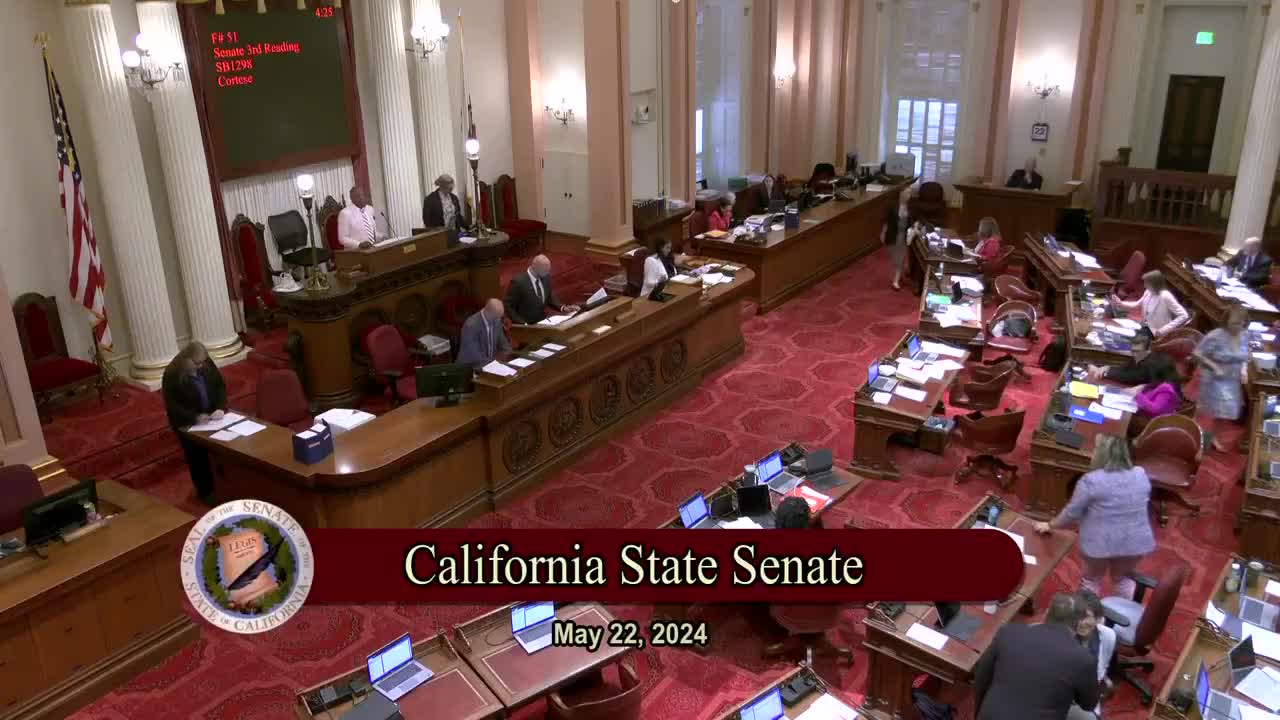 9MIN
Senate Floor
 2MIN
Senate Standing Committee on Appropriations
 37MIN
Senate Standing Committee on Energy, Utilities and Communications
Bill Author
Bill Co-Author(s):