SB 1300: Health facility closure: public notice: inpatient psychiatric and perinatal services.
- Session Year: 2023-2024
- House: Senate
- Latest Version Date: 2024-09-28
Current Status:
Passed
(2024-09-28: Chaptered by Secretary of State. Chapter 894, Statutes of 2024.)
Introduced
In Committee
First Chamber
In Committee
Second Chamber
Enacted
Existing law requires the State Department of Public Health to license, regulate, and inspect health facilities, as specified, including general acute care hospitals. A violation of these provisions is a crime. Under existing law, a general acute care hospital is required to provide certain basic services, including medical, nursing, surgical, anesthesia, laboratory, radiology, pharmacy, and dietary services. Existing law authorizes a general acute care hospital to provide various special or supplemental services if certain conditions are met. Existing regulations define a supplemental service as an organized inpatient or outpatient service that is not required to be provided by law or regulation. Existing law requires a health facility to provide 90 days of public notice of the proposed closure or elimination of a supplemental service, and 120 days of public notice of the proposed closure or elimination of an acute psychiatric hospital.
This bill would change the notice period required before proposed closure or elimination of the supplemental service of inpatient psychiatric unit or a perinatal unit from 90 days to 120 days. By changing the definition of a crime, this bill would impose a state-mandated local program. The bill would require the health facility to provide public notice of the proposed elimination of the supplemental service of either inpatient psychiatric unit or perinatal unit, as specified. The bill would require the health facility to conduct at least one noticed public hearing within 60 days of providing public notice of the proposed elimination of the inpatient psychiatric unit or perinatal unit and would require the health facility to accept public comment. The bill would require the health facility to post the public hearing notice and the agenda along with the public notice. The bill would require the health facility holding the public hearing to meet prescribed requirements, including notifying the board of supervisors of the county in which the health facility is located when a public hearing is scheduled and inviting the board of supervisors to provide testimony on the impacts of the elimination of the services to the county and community health systems.
The California Constitution requires the state to reimburse local agencies and school districts for certain costs mandated by the state. Statutory provisions establish procedures for making that reimbursement.
This bill would provide that no reimbursement is required by this act for a specified reason.
Existing law requires the State Department of Public Health to license, regulate, and inspect health facilities, as specified, including general acute care hospitals. A violation of these provisions is a crime. Under existing law, a general acute care hospital is required to provide certain basic services, including medical, nursing, surgical, anesthesia, laboratory, radiology, pharmacy, and dietary services. Existing law authorizes a general acute care hospital to provide various special or supplemental services if certain conditions are met. Existing regulations define a supplemental service as an organized inpatient or outpatient service that is not required to be provided by law or regulation. Existing law requires a health facility to provide 90 days of public notice of the proposed closure or elimination of a supplemental service, and 120 days of public notice of the proposed closure or elimination of an acute psychiatric hospital.
This bill would change the notice period required before proposed closure or elimination of the supplemental service of inpatient psychiatric unit or a perinatal unit from 90 days to 120 days. By changing the definition of a crime, this bill would impose a state-mandated local program. The bill would require the health facility to provide public notice of the proposed elimination of the supplemental service of either inpatient psychiatric unit or perinatal unit, as specified. The bill would require the health facility to conduct at least one noticed public hearing within 60 days of providing public notice of the proposed elimination of the inpatient psychiatric unit or perinatal unit and would require the health facility to accept public comment. The bill would require the health facility to post the public hearing notice and the agenda along with the public notice. The bill would require the health facility holding the public hearing to meet prescribed requirements, including notifying the board of supervisors of the county in which the health facility is located when a public hearing is scheduled and inviting the board of supervisors to provide testimony on the impacts of the elimination of the services to the county and community health systems.
The California Constitution requires the state to reimburse local agencies and school districts for certain costs mandated by the state. Statutory provisions establish procedures for making that reimbursement.
This bill would provide that no reimbursement is required by this act for a specified reason.
Existing law requires the State Department of Public Health to license, regulate, and inspect health facilities, as specified, including general acute care hospitals. A violation of these provisions is a crime. Under existing law, a general acute care hospital is required to provide certain basic services, including medical, nursing, surgical, anesthesia, laboratory, radiology, pharmacy, and dietary services. Existing law authorizes a general acute care hospital to provide various special or supplemental services if certain conditions are met. Existing regulations define a supplemental service as an organized inpatient or outpatient service that is not required to be provided by law or regulation. Existing law requires a health facility to provide 90 days of public notice of the proposed closure or elimination of a supplemental service, and 120 days of public notice of the proposed closure or elimination of an acute psychiatric hospital.
This bill would change the notice period required before proposed closure or elimination of the supplemental service of inpatient psychiatric service or maternity service unit or a perinatal unit from 90 days to 120 days. By changing the definition of a crime, this bill would impose a state-mandated local program. The bill would authorize the hospital to close the inpatient psychiatric service or maternity service 90 days after providing public notice of the closure if the department determines that the use of resources to keep the inpatient psychiatric services or maternity services open for the full 120 days threatens the stability of the hospital or if the department determines the hospital cannot maintain required staffing levels due to employee attrition. The bill would require the health facility to provide public notice of the proposed elimination of the supplemental service of either inpatient psychiatric unit or perinatal unit, as specified. The bill would require the health facility to conduct at least one noticed public hearing within 60 days of providing public notice of the proposed elimination of the inpatient psychiatric unit or perinatal unit and would require the health facility to accept public comment. The bill would require the health facility to post the public hearing notice and the agenda along with the public notice. The bill would require the health facility holding the public hearing to meet prescribed requirements, including notifying the board of supervisors of the county in which the health facility is located when a public hearing is scheduled and inviting the board of supervisors to provide testimony on the impacts of the elimination of the services to the county and community health systems.
Before a health facility may provide notice of a proposed closure or elimination of an inpatient psychiatric service or maternity service, this bill would require the facility to provide an impact analysis report, as specified, regarding the impact on the health of the community resulting from the proposed elimination of the services. By changing the requirements on a health care facility, the violation of which is a crime, this bill would impose a state-mandated local program.The bill would require that the impact analysis report be delivered to the local county board of supervisors and to the department. The bill also would require the cost of preparing the impact analysis report to be borne by the hospital. The bill would strongly encourage the board of supervisors to hold a public hearing within 15 days of receipt of the report, as specified, and to post the impact analysis report on its internet website. The bill would require, if the loss of beds will have an impact on the health of the community, that the State Department of Public Health prioritize and expedite the licensing of additional beds to replace the number of lost beds necessary to mitigate the negative impacts identified in the impact analysis report.The California Constitution requires the state to reimburse local agencies and school districts for certain costs mandated by the state. Statutory provisions establish procedures for making that reimbursement.
This bill would provide that no reimbursement is required by this act for a specified reason.
Existing law requires the State Department of Public Health to license, regulate, and inspect health facilities, as specified, including general acute care hospitals. A violation of these provisions is a crime. Under existing law, a general acute care hospital is required to provide certain basic services, including medical, nursing, surgical, anesthesia, laboratory, radiology, pharmacy, and dietary services. Existing law authorizes a general acute care hospital to provide various special or supplemental services if certain conditions are met. Existing regulations define a supplemental service as an organized inpatient or outpatient service that is not required to be provided by law or regulation. Existing law requires a health facility to provide 90 days of public notice of the proposed closure or elimination of a supplemental service, and 120 days of public notice of the proposed closure or elimination of an acute psychiatric hospital.
This bill would change the notice period required before proposed closure or elimination of the supplemental service of inpatient psychiatric service or maternity service from 90 days to 120 days. By changing the definition of a crime, this bill would impose a state-mandated local program. The bill would authorize the hospital to close the inpatient psychiatric service or maternity service 90 days after providing public notice of the closure if the department determines that the use of resources to keep the inpatient psychiatric services or maternity services open for the full 120 days threatens the stability of the hospital or if the department cites the hospital for unsafe staffing practices related to these services. determines the hospital cannot maintain required staffing levels due to employee attrition.
Before a health facility may provide notice of a proposed closure or elimination of an inpatient psychiatric service or maternity service, this bill would require the facility to provide an impact analysis report, as specified, regarding the impact on the health of the community resulting from the proposed elimination of the services. By changing the requirements on a health care facility, the violation of which is a crime, this bill would impose a state-mandated local program.
The bill would require that the impact analysis report be delivered to the local county board of supervisors and to the department. The bill also would require the cost of preparing the impact analysis report to be borne by the hospital. The bill would strongly encourage the board of supervisors to hold a public hearing within 15 days of receipt of the report, as specified, and to post the impact analysis report on its internet website. The bill would require, if the loss of beds will have an impact on the health of the community, that the State Department of Public Health prioritize and expedite the licensing of additional beds to replace the number of lost beds necessary to mitigate the negative impacts identified in the impact analysis report.
The California Constitution requires the state to reimburse local agencies and school districts for certain costs mandated by the state. Statutory provisions establish procedures for making that reimbursement.
This bill would provide that no reimbursement is required by this act for a specified reason.
Existing law requires the State Department of Public Health to license, regulate, and inspect health facilities, as specified, including general acute care hospitals. A violation of these provisions is a crime. Under existing law, a general acute care hospital is required to provide certain basic services, including medical, nursing, surgical, anesthesia, laboratory, radiology, pharmacy, and dietary services. Existing law authorizes a general acute care hospital to provide various special or supplemental services if certain conditions are met. Existing regulations define a supplemental service as an organized inpatient or outpatient service that is not required to be provided by law or regulation. Existing law requires a health facility to provide 90 days of public notice of the proposed closure or elimination of a supplemental service, and 120 days of public notice of the proposed closure or elimination of an acute psychiatric hospital.
This bill would change the notice period required before proposed closure or elimination of the supplemental service of inpatient psychiatric service or maternity service from 90 days to 120 days. By changing the definition of a crime, this bill would impose a state-mandated local program. The bill would authorize the hospital to close the inpatient psychiatric service or maternity service 90 days after providing public notice of the closure if the department determines that the use of resources to keep the inpatient psychiatric services or maternity services open for the full 120 days threatens the stability of the hospital or if the department cites the hospital for unsafe staffing practices related to these services.
Before a health facility may provide notice of a proposed closure or elimination of an inpatient psychiatric service or maternity service, this bill would require the facility to provide an impact analysis report, as specified, regarding the impact on the health of the community resulting from the proposed elimination of the services. The bill would require the health facility to provide the impact analysis report to the Department of Health Care Access and Information for review and certification. By changing the requirements on a health care facility, the violation of which is a crime, this bill would impose a state-mandated local program.
The bill would require, after certification, require that the impact analysis report be delivered to the local county board of supervisors and to the department. The bill also would require the cost of preparing the impact analysis report to be borne by the hospital. The bill would strongly encourage the board of supervisors to hold a public hearing within 15 days of receipt of the report, as specified, and to post the impact analysis report on its internet website. The bill would require, if the loss of beds will have an impact to on the health of the community, that the State Department of Public Health prioritize and expedite the licensing of additional beds to replace the number of lost beds necessary to mitigate the negative impacts identified in the impact analysis report.
The California Constitution requires the state to reimburse local agencies and school districts for certain costs mandated by the state. Statutory provisions establish procedures for making that reimbursement.
This bill would provide that no reimbursement is required by this act for a specified reason.
Existing law requires the State Department of Public Health to license, regulate, and inspect health facilities, as specified, including general acute care hospitals. A violation of these provisions is a crime. Under existing law, a general acute care hospital is required to provide certain basic services, including medical, nursing, surgical, anesthesia, laboratory, radiology, pharmacy, and dietary services. Existing law authorizes a general acute care hospital to provide various special or supplemental services if certain conditions are met. Existing regulations define a supplemental service as an organized inpatient or outpatient service that is not required to be provided by law or regulation. Existing law requires a health facility to provide 90 days of public notice of the proposed closure or elimination of a supplemental service, and 120 days of public notice of the proposed closure or elimination of an acute psychiatric hospital.
This bill would change the notice period required before proposed closure or elimination of the supplemental service of inpatient psychiatric service or maternity service from 90 days to 120 days. By changing the definition of a crime, this bill would impose a state-mandated local program.
Before a health facility may provide notice of a proposed closure or elimination of an inpatient psychiatric service or maternity service, this bill would require the facility to provide an impact analysis report, as specified, regarding the impact on the health of the community resulting from the proposed elimination of the services. The bill would require the health facility to provide the impact analysis report to the Department of Health Care Access and Information for review and certification. By changing the requirements on a health care facility, the violation of which is a crime, this bill would impose a state-mandated local program.
The bill would require, after certification, that the impact analysis report be delivered to the local county board of supervisors and to the department. The bill also would require the cost of preparing the impact analysis report to be borne by the hospital. The bill would strongly encourage the board of supervisors to hold a public hearing within 15 days of receipt of the report, as specified, and to post the impact analysis report on its internet website. The bill would require, if the loss of beds will have an impact to on the health of the community, that the State Department of Public Health prioritize and expedite the licensing of additional beds for up to 18 months to replace the number of lost beds. to replace the number of lost beds necessary to mitigate the negative impacts identified in the impact analysis report.
The California Constitution requires the state to reimburse local agencies and school districts for certain costs mandated by the state. Statutory provisions establish procedures for making that reimbursement.
This bill would provide that no reimbursement is required by this act for a specified reason.
Existing law requires the State Department of Public Health to license, regulate, and inspect health facilities, as specified, including general acute care hospitals. A violation of these provisions is a crime. Under existing law, a general acute care hospital is required to provide certain basic services, including medical, nursing, surgical, anesthesia, laboratory, radiology, pharmacy, and dietary services. Existing law authorizes a general acute care hospital to provide various special or supplemental services if certain conditions are met. Existing regulations define a supplemental service as an organized inpatient or outpatient service that is not required to be provided by law or regulation. Existing law requires a health facility to provide 90 days of public notice of the proposed closure or elimination of a supplemental service, and 120 days of public notice of the proposed closure or elimination of an acute psychiatric hospital.
This bill would change the notice period required before proposed closure or elimination of the supplemental service of inpatient psychiatric service or maternity service from 90 days to 120 days. By changing the definition of a crime, this bill would impose a state-mandated local program.
Before a health facility may provide notice of a proposed closure or elimination of an inpatient psychiatric service or maternity service, this bill would require the facility to provide an impact analysis report, as specified, regarding the impact on the health of the community resulting from the proposed elimination of the services. The bill would require the health facility to provide the impact analysis report to the Department of Health Care Access and Information for review and certification. By changing the requirements on a health care facility, the violation of which is a crime, this bill would impose a state-mandated local program.
The bill would require, after certification, that the impact analysis report be delivered to the local county board of supervisors and to the department. The bill also would require the cost of preparing the impact analysis report to be borne by the hospital. The bill would strongly encourage the board of supervisors to hold a public hearing within 15 days of receipt of the report, as specified, and to post the impact analysis report on its internet website. The bill would require, if the loss of beds will have an impact to on the health of the community, that the State Department of Public Health prioritize and expedite the licensing of additional beds for up to 18 months to replace the number of lost beds.
The California Constitution requires the state to reimburse local agencies and school districts for certain costs mandated by the state. Statutory provisions establish procedures for making that reimbursement.
This bill would provide that no reimbursement is required by this act for a specified reason.
(a)(1)Except as provided in subparagraph (3), not less than 120 days prior to closing a health facility, as defined in subdivision (a) or (b) of Section 1250, or 90 days prior to eliminating a supplemental service, as defined in Section 70067 of Chapter 1 of Division 5 of Title 22 of the California Code of Regulations, the facility shall provide public notice of the proposed closure or elimination of the supplemental service, including a notice posted at the entrance to all affected facilities, a notice to all contracted Medi-Cal managed care plans, as defined in subdivision (j) of Section 14181.101 of the Welfare and Institutions Code, and a notice to the department and the board of supervisors of the county in which the health facility is located.
(2)Not less than 90 days prior to relocating the provision of supplemental services to a different campus, a health facility, as defined in subdivision (a) or (b) of Section 1250, shall provide public notice of the proposed relocation of supplemental services, including a notice posted at the entrance to all affected facilities and notice to the department and the board of supervisors of the county in which the health facility is located.
(3)(A)Not less than 120 days prior to eliminating a supplemental service of either an inpatient psychiatric unit or a perinatal unit, a health facility, as defined in subdivisions (a) and (b) of Section 1250, shall provide public notice of the proposed elimination of the supplemental service, including a notice posted at the entrance to all affected facilities, a notice to all contracted Medi-Cal managed care plans, as defined in subdivision (j) of Section 141814.101 of the Welfare and Institutions Code, and a notice to the department and the board of supervisors of the county in which the health facility is located.
(B)The health facility shall conduct at least one noticed public hearing within 60 days of providing public notice of the proposed elimination of the inpatient psychiatric unit or perinatal unit, in addition to accepting public comment pursuant to subparagraph (C) of paragraph (1) of subdivision (b). The health facility shall post the public hearing notice and the agenda alongside their public notice for the proposed elimination of services, pursuant to paragraph (2) of subdivision (b). The health facility holding the public hearing held shall comply with all of the following requirements:
(i)Hold the public hearing within the county in which the health facility is located and within 25 miles of the health facility and be accessible to the public remotely.
(ii)Accept written public comment in advance of the hearing and reserve adequate time on the agenda for public comments from individuals attending in-person and remotely.
(iii)Notify the board of supervisors of the county in which the health facility is located when a public hearing is scheduled and invite the board of supervisors to provide testimony on the impacts of the elimination of services to the county and community health systems.
(b)(1)The public notice required by subdivision (a) shall include all of the following:
(A)A description of the proposed closure, elimination, or relocation. The description shall be limited to publicly available data, including the number of beds eliminated, if any, the probable decrease in the number of personnel, and a summary of any service that is being eliminated, if applicable.
(B)A description of the three nearest available comparable services in the community. If the health facility closing these services serves Medi-Cal or Medicare patients, this health facility shall specify if the providers of the nearest available comparable services serve these patients.
(C)A telephone number, address, and email address for each of the following, where interested parties may offer comments:
(i)The health facility.
(ii)The parent entity, if any, or contracted company, if any, that acts as the corporate administrator of the health facility.
(iii)The chief executive officer.
(D)Statistically deidentified and aggregated data about the health facilitys patients who received either inpatient psychiatric services or perinatal services, as applicable, within the past five years, including, but not limited to, all of the following:
(i)The conditions treated.
(ii)The ethnicities of patients served, if the patient voluntarily shared their ethnicity with the health facility. Data on ethnicities shall only be shared on the public notice to the extent to which it does not disclose any personal information in a manner that would link the information disclosed to the individual to whom it pertains.
(iii)The ages of patients served.
(iv)Whether the patients served had private insurance, Medi-Cal, Medicare, or no insurance.
(v)A justification for the health facilitys decision to eliminate services.
(2)For purposes of this section, the public notice required in subdivision (a) shall include, but not be limited to, all of the following:
(A)Written notice to the city council of the city in which the health facility is located.
(B)A continuous notice posted in a conspicuous location on the homepage of the health facilitys internet website.
(C)A notice published in a conspicuous location within a newspaper of general circulation serving the local geographical area in which the health facility is located. The notice shall continue for a minimum of 15 publication dates.
(D)A continuous notice posted in a conspicuous location within the internet website of a newspaper of general circulation serving the local geographical area in which the health facility is located.
(E)A notice posted at the entrance of every community clinic within the affected county in which the health facility is located that grants voluntary permission for posting.
(c)Notwithstanding subdivisions (a) and (b), this section shall not apply to county facilities subject to Section 1442.5.
(d)This section shall not apply to a health facility that is forced to close or eliminate a service as a result of a natural disaster or state of emergency that prevents the health facility from being able to operate at its current level.
SEC. 2.No reimbursement is required by this act pursuant to Section 6 of Article XIIIB of the California Constitution because the only costs that may be incurred by a local agency or school district will be incurred because this act creates a new crime or infraction, eliminates a crime or infraction, or changes the penalty for a crime or infraction, within the meaning of Section 17556 of the Government Code, or changes the definition of a crime within the meaning of Section 6 of Article XIIIB of the California Constitution.
(a)(1)Except as provided in subparagraph (3), not less than 120 days prior to closing a health facility, as defined in subdivision (a) or (b) of Section 1250, or 90 days prior to eliminating a supplemental service, as defined in Section 70067 of Chapter 1 of Division 5 of Title 22 of the California Code of Regulations, the facility shall provide public notice of the proposed closure or elimination of the supplemental service, including a notice posted at the entrance to all affected facilities, a notice to all contracted Medi-Cal managed care plans, as defined in subdivision (j) of Section 14181.101 of the Welfare and Institutions Code, and a notice to the department and the board of supervisors of the county in which the health facility is located.
(2)Not less than 90 days prior to relocating the provision of supplemental services to a different campus, a health facility, as defined in subdivision (a) or (b) of Section 1250, shall provide public notice of the proposed relocation of supplemental services, including a notice posted at the entrance to all affected facilities and notice to the department and the board of supervisors of the county in which the health facility is located.
(3)(A)Not less than 120 days prior to eliminating a supplemental service of either an inpatient psychiatric unit or a perinatal unit, a health facility, as defined in subdivisions (a) and (b) of Section 1250, shall provide public notice of the proposed elimination of the supplemental service, including a notice posted at the entrance to all affected facilities, a notice to all contracted Medi-Cal managed care plans, as defined in subdivision (j) of Section 141814.101 of the Welfare and Institutions Code, and a notice to the department and the board of supervisors of the county in which the health facility is located.
(B)The health facility shall conduct at least one noticed public hearing within 60 days of providing public notice of the proposed elimination of the inpatient psychiatric unit or perinatal unit, in addition to accepting public comment pursuant to subparagraph (C) of paragraph (1) of subdivision (b). The health facility shall post the public hearing notice and the agenda alongside their public notice for the proposed elimination of services, pursuant to paragraph (2) of subdivision (b). The health facility holding the public hearing held shall comply with all of the following requirements:
(i)Hold the public hearing within the county in which the health facility is located and within 25 miles of the health facility and be accessible to the public remotely.
(ii)Accept written public comment in advance of the hearing and reserve adequate time on the agenda for public comments from individuals attending in-person and remotely.
(iii)Notify the board of supervisors of the county in which the health facility is located when a public hearing is scheduled and invite the board of supervisors to provide testimony on the impacts of the elimination of services to the county and community health systems.
(b)(1)The public notice required by subdivision (a) shall include all of the following:
(A)A description of the proposed closure, elimination, or relocation. The description shall be limited to publicly available data, including the number of beds eliminated, if any, the probable decrease in the number of personnel, and a summary of any service that is being eliminated, if applicable.
(B)A description of the three nearest available comparable services in the community. If the health facility closing these services serves Medi-Cal or Medicare patients, this health facility shall specify if the providers of the nearest available comparable services serve these patients.
(C)A telephone number, address, and email address for each of the following, where interested parties may offer comments:
(i)The health facility.
(ii)The parent entity, if any, or contracted company, if any, that acts as the corporate administrator of the health facility.
(iii)The chief executive officer.
(D)Statistically deidentified and aggregated data about the health facilitys patients who received either inpatient psychiatric services or perinatal services, as applicable, within the past five years, including, but not limited to, all of the following:
(i)The conditions treated.
(ii)The ethnicities of patients served, if the patient voluntarily shared their ethnicity with the health facility. Data on ethnicities shall only be shared on the public notice to the extent to which it does not disclose any personal information in a manner that would link the information disclosed to the individual to whom it pertains.
(iii)The ages of patients served.
(iv)Whether the patients served had private insurance, Medi-Cal, Medicare, or no insurance.
(v)A justification for the health facilitys decision to eliminate services.
(2)For purposes of this section, the public notice required in subdivision (a) shall include, but not be limited to, all of the following:
(A)Written notice to the city council of the city in which the health facility is located.
(B)A continuous notice posted in a conspicuous location on the homepage of the health facilitys internet website.
(C)A notice published in a conspicuous location within a newspaper of general circulation serving the local geographical area in which the health facility is located. The notice shall continue for a minimum of 15 publication dates.
(D)A continuous notice posted in a conspicuous location within the internet website of a newspaper of general circulation serving the local geographical area in which the health facility is located.
(E)A notice posted at the entrance of every community clinic within the affected county in which the health facility is located that grants voluntary permission for posting.
(c)Notwithstanding subdivisions (a) and (b), this section shall not apply to county facilities subject to Section 1442.5.
(d)This section shall not apply to a health facility that is forced to close or eliminate a service as a result of a natural disaster or state of emergency that prevents the health facility from being able to operate at its current level.
SEC. 2.No reimbursement is required by this act pursuant to Section 6 of Article XIIIB of the California Constitution because the only costs that may be incurred by a local agency or school district will be incurred because this act creates a new crime or infraction, eliminates a crime or infraction, or changes the penalty for a crime or infraction, within the meaning of Section 17556 of the Government Code, or changes the definition of a crime within the meaning of Section 6 of Article XIIIB of the California Constitution.
(a)(1)Except as provided in subparagraph (3), not less than 120 days prior to closing a health facility, as defined in subdivision (a) or (b) of Section 1250, or 90 days prior to eliminating a supplemental service, as defined in Section 70067 of Chapter 1 of Division 5 of Title 22 of the California Code of Regulations, the facility shall provide public notice of the proposed closure or elimination of the supplemental service, including a notice posted at the entrance to all affected facilities facilities, a notice to all contracted Medi-Cal managed care plans, as defined in subdivision (j) of Section 14181.101 of the Welfare and Institutions Code, and a notice to the department and the board of supervisors of the county in which the health facility is located.
(2)Not less than 90 days prior to relocating the provision of supplemental services to a different campus, a health facility, as defined in subdivision (a) or (b) of Section 1250, shall provide public notice of the proposed relocation of supplemental services, including a notice posted at the entrance to all affected facilities and notice to the department and the board of supervisors of the county in which the health facility is located.
(3)Not less than 120 days prior to eliminating a supplemental service of either inpatient psychiatric services or maternity services, a health facility shall provide public notice of the proposed elimination of the supplemental service, including a notice posted at the entrance to all affected facilities and a notice to the department and the board of supervisors of the county in which the health facility is located.(3)(A)Not less than 120 days prior to eliminating a supplemental service of either an inpatient psychiatric unit or a perinatal unit, a health facility, as defined in subdivisions (a) and (b) of Section 1250, shall provide public notice of the proposed elimination of the supplemental service, including a notice posted at the entrance to all affected facilities, a notice to all contracted Medi-Cal managed care plans, as defined in subdivision (j) of Section 141814.101 of the Welfare and Institutions Code, and a notice to the department and the board of supervisors of the county in which the health facility is located.
(B)The health facility shall conduct at least one noticed public hearing within 60 days of providing public notice of the proposed elimination of the inpatient psychiatric unit or perinatal unit, in addition to accepting public comment pursuant to subparagraph (C) of paragraph (1) of subdivision (b). The health facility shall post the public hearing notice and the agenda alongside their public notice for the proposed elimination of services, pursuant to paragraph (2) of subdivision (b). The health facility holding the public hearing held shall comply with all of the following requirements:
(i)Hold the public hearing within the county in which the health facility is located and within 25 miles of the health facility and be accessible to the public remotely.
(ii)Accept written public comment in advance of the hearing and reserve adequate time on the agenda for public comments from individuals attending in-person and remotely.
(iii)Notify the board of supervisors of the county in which the health facility is located when a public hearing is scheduled and invite the board of supervisors to provide testimony on the impacts of the elimination of services to the county and community health systems.
(b)(1)The public notice required by paragraph (1) or (2) of subdivision (a) shall include all of the following:
(1)(A)A description of the proposed closure, elimination, or relocation. The description shall be limited to publicly available data, including the number of beds eliminated, if any, the probable decrease in the number of personnel, and a summary of any service that is being eliminated, if applicable.
(2)(B)A description of the three nearest available comparable services in the community. If the health facility closing these services serves Medi-Cal or Medicare patients, this health facility shall specify if the providers of the nearest available comparable services serve these patients.
(3)(C)A telephone number and address number, address, and email address for each of the following, where interested parties may offer comments:
(A)(i)The health facility.
(B)(ii)The parent entity, if any, or contracted company, if any, that acts as the corporate administrator of the health facility.
(C)(iii)The chief executive officer.
(c)Notwithstanding subdivisions (a) and (b), this section shall not apply to county facilities subject to Section 1442.5.(D)Statistically deidentified and aggregated data about the health facilitys patients who received either inpatient psychiatric services or perinatal services, as applicable, within the past five years, including, but not limited to, all of the following:
(i)The conditions treated.
(ii)The ethnicities of patients served, if the patient voluntarily shared their ethnicity with the health facility. Data on ethnicities shall only be shared on the public notice to the extent to which it does not disclose any personal information in a manner that would link the information disclosed to the individual to whom it pertains.
(iii)The ages of patients served.
(iv)Whether the patients served had private insurance, Medi-Cal, Medicare, or no insurance.
(v)A justification for the health facilitys decision to eliminate services.
(d)(2)For purposes of this section, the public notice required in subdivision (a) shall include, but not be limited to, all of the following:
(1)(A)Written notice to the city council of the city in which the health facility is located.
(2)(B)A continuous notice posted in a conspicuous location on the homepage of the health facilitys internet website.
(3)(C)A notice published in a conspicuous location within a newspaper of general circulation serving the local geographical area in which the health facility is located. The notice shall continue for a minimum of 15 publication dates.
(4)(D)A continuous notice posted in a conspicuous location within the internet website of a newspaper of general circulation serving the local geographical area in which the health facility is located.
(5)(E)A notice posted at the entrance of every community clinic within the affected county in which the health facility is located that grants voluntary permission for posting.
(c)Notwithstanding subdivisions (a) and (b), this section shall not apply to county facilities subject to Section 1442.5.
(e)(d)This section shall not apply to a health facility that is forced to close or eliminate a service as a result of a natural disaster or state of emergency that prevents the health facility from being able to operate at its current level.
(f)Notwithstanding paragraph (3) of subdivision (a), if the department determines that the use of resources to keep the inpatient psychiatric services or maternity services open for the full 120 days threatens the stability of the hospital as a whole, or if the department determines the hospital cannot maintain required staffing levels due to employee attrition, a hospital may close the inpatient psychiatric service or maternity service 90 days after providing public notice of the planned closure.SEC. 2.Section 1255.26 is added to the Health and Safety Code, to read:1255.26.(a)A health facility subject to subparagraph (3) of subdivision (a) of Section 1255.25 shall complete an impact analysis report prior to providing notice of a proposed elimination of the supplemental service of either inpatient psychiatric services or maternity services. This impact analysis report is in addition to the public notice required by subdivision (b) of Section 1255.25.(b)On or after July 1, 2025, when providing notice of elimination of a supplemental service of either inpatient psychiatric services or maternity services, as required by subdivision (a) of Section 1255.25, a health facility shall submit the impact analysis report described in subdivision (a) to the department and to the board of supervisors of the county in which the health facility is located. (c)The impact analysis report shall include, but is not limited to, all of the following information:(1)An analysis of the impact on the health of the community resulting from the proposed elimination of the services. The analysis shall include a good faith estimate of the impact of the closure on the county, including potential increased annual costs to the county for providing additional inpatient psychiatric care or maternity care, and on the continuum of care capacity in the county.(2)Pursuant to paragraph (2) of subdivision (b) of Section 1255.25, a description of the three nearest available comparable services. If the health facility closing these services serves Medi-Cal or Medicare patients, the health facility shall specify if the providers of the nearest available comparable services serve these patients.(3)Aggregated data about the health facilitys patients who received either inpatient psychiatric services or maternity services, as applicable, within the past five years, including, but not limited to:(A)The conditions treated.(B)The ethnicities of patients served.(C)The ages of patients served.(D)Whether the patients served had private insurance, Medi-Cal, Medicare, or no insurance.(d)The cost of preparing the analysis shall be borne by the hospital.(e)On or before July 1, 2025, the Department of Health Care Access and Information shall create a report format for the submission of the impact analysis report required by subdivision (a).(f)Within 15 days of the receipt of a notice of elimination of services and receipt of an impact analysis, the county board of supervisors in the county in which the health facility is located is strongly encouraged to convene a public hearing to provide an overview of the impact analysis report and to hear public testimony. The county board of supervisors is also strongly encouraged to post the impact analysis on its internet website.(g)The board of supervisors of the county in which the services are proposed to be eliminated is strongly encouraged to ensure that all health facilities in the geographic area impacted are informed of the proposed elimination of services prior to the public hearing.(h)If the loss of beds will have an impact on the health of the community, the State Department of Public Health shall prioritize and expedite the licensing of additional beds to replace the number of lost beds necessary to mitigate the negative impacts identified in the impact analysis report.SEC. 3.SEC. 2.No reimbursement is required by this act pursuant to Section 6 of Article XIIIB of the California Constitution because the only costs that may be incurred by a local agency or school district will be incurred because this act creates a new crime or infraction, eliminates a crime or infraction, or changes the penalty for a crime or infraction, within the meaning of Section 17556 of the Government Code, or changes the definition of a crime within the meaning of Section 6 of Article XIIIB of the California Constitution.
(a)(1)Except as provided in subparagraph (3), not less than 120 days prior to closing a health facility, as defined in subdivision (a) or (b) of Section 1250, or 90 days prior to eliminating a supplemental service, as defined in Section 70067 of Chapter 1 of Division 5 of Title 22 of the California Code of Regulations, the facility shall provide public notice of the proposed closure or elimination of the supplemental service, including a notice posted at the entrance to all affected facilities and a notice to the department and the board of supervisors of the county in which the health facility is located.
(2)Not less than 90 days prior to relocating the provision of supplemental services to a different campus, a health facility, as defined in subdivision (a) or (b) of Section 1250, shall provide public notice of the proposed relocation of supplemental services, including a notice posted at the entrance to all affected facilities and notice to the department and the board of supervisors of the county in which the health facility is located.
(3)Not less than 120 days prior to eliminating a supplemental service of either inpatient psychiatric services or maternity services, a health facility shall provide public notice of the proposed elimination of the supplemental service, including a notice posted at the entrance to all affected facilities and a notice to the department and the board of supervisors of the county in which the health facility is located.
(b)The public notice required by paragraph (1) or (2) of subdivision (a) shall include all of the following:
(1)A description of the proposed closure, elimination, or relocation. The description shall be limited to publicly available data, including the number of beds eliminated, if any, the probable decrease in the number of personnel, and a summary of any service that is being eliminated, if applicable.
(2)A description of the three nearest available comparable services in the community. If the health facility closing these services serves Medi-Cal or Medicare patients, this health facility shall specify if the providers of the nearest available comparable services serve these patients.
(3)A telephone number and address for each of the following, where interested parties may offer comments:
(A)The health facility.
(B)The parent entity, if any, or contracted company, if any, that acts as the corporate administrator of the health facility.
(C)The chief executive officer.
(c)Notwithstanding subdivisions (a) and (b), this section shall not apply to county facilities subject to Section 1442.5.
(d)For purposes of this section, the public notice required in subdivision (a) shall include, but not be limited to, all of the following:
(1)Written notice to the city council of the city in which the health facility is located.
(2)A continuous notice posted in a conspicuous location on the homepage of the health facilitys internet website.
(3)A notice published in a conspicuous location within a newspaper of general circulation serving the local geographical area in which the health facility is located. The notice shall continue for a minimum of 15 publication dates.
(4)A continuous notice posted in a conspicuous location within the internet website of a newspaper of general circulation serving the local geographical area in which the health facility is located.
(5)A notice posted at the entrance of every community clinic within the affected county in which the health facility is located that grants voluntary permission for posting.
(e)This section shall not apply to a health facility that is forced to close or eliminate a service as a result of a natural disaster or state of emergency that prevents the health facility from being able to operate at its current level.
(f)Notwithstanding paragraph (3) of subdivision (a), if the department determines that the use of resources to keep the inpatient psychiatric services or maternity services open for the full 120 days threatens the stability of the hospital as a whole, or if the department cites the hospital for unsafe staffing practices related to inpatient psychiatric services or maternity services, determines the hospital cannot maintain required staffing levels due to employee attrition, a hospital may close the inpatient psychiatric service or maternity service 90 days after providing public notice of the planned closure.
SEC. 2.Section 1255.26 is added to the Health and Safety Code, to read:1255.26.(a)A health facility subject to subparagraph (3) of subdivision (a) of Section 1255.25 shall complete an impact analysis report prior to providing notice of a proposed elimination of the supplemental service of either inpatient psychiatric services or maternity services. This impact analysis report is in addition to the public notice required by subdivision (b) of Section 1255.25.
(b)On or after July 1, 2025, when providing notice of elimination of a supplemental service of either inpatient psychiatric services or maternity services, as required by subdivision (a) of Section 1255.25, a health facility shall submit the impact analysis report described in subdivision (a) to the department and to the board of supervisors of the county in which the health facility is located.
(c)The impact analysis report shall include, but is not limited to, all of the following information:
(1)An analysis of the impact on the health of the community resulting from the proposed elimination of the services. The analysis shall include a good faith estimate of the impact of the closure on the county, including potential increased annual costs to the county for providing additional inpatient psychiatric care or maternity care, and on the continuum of care capacity in the county.
(2)Identification Pursuant to paragraph (2) of subdivision (b) of Section 1255.25, a description of the three nearest available comparable services. If the health facility closing these services serves Medi-Cal or Medicare patients, the health facility shall specify if the providers of the nearest available comparable services serve these patients.
(3)Aggregated data about the health facilitys patients who had been treated by the health facility received either inpatient psychiatric services or maternity services, as applicable, within the past five years, including, but not limited to:
(A)The conditions treated.
(B)The ethnicities of patients served.
(C)The ages of patients served.
(D)Whether the patients served had private insurance, Medi-Cal, Medicare, or no insurance.
(d)The cost of preparing the analysis shall be borne by the hospital.
(e)On or before July 1, 2025, the Department of Health Care Access and Information shall create a report format for the submission of the impact analysis report required by subdivision (a).
(f)Within 15 days of the receipt of a notice of elimination of services and receipt of an impact analysis, the county board of supervisors in the county in which the health facility is located is strongly encouraged to convene a public hearing to provide an overview of the impact analysis report and to hear public testimony. The county board of supervisors is also strongly encouraged to post the impact analysis on its internet website.
(g)The board of supervisors of the county in which the services are proposed to be eliminated is strongly encouraged to ensure that all health facilities in the geographic area impacted are informed of the proposed elimination of services prior to the public hearing.
(h)If the loss of beds will have an impact on the health of the community, the State Department of Public Health shall prioritize and expedite the licensing of additional beds to replace the number of lost beds necessary to mitigate the negative impacts identified in the impact analysis report.
SEC. 3.No reimbursement is required by this act pursuant to Section 6 of Article XIIIB of the California Constitution because the only costs that may be incurred by a local agency or school district will be incurred because this act creates a new crime or infraction, eliminates a crime or infraction, or changes the penalty for a crime or infraction, within the meaning of Section 17556 of the Government Code, or changes the definition of a crime within the meaning of Section 6 of Article XIIIB of the California Constitution.
(a)(1)Except as provided in subparagraph (3), not less than 120 days prior to closing a health facility, as defined in subdivision (a) or (b) of Section 1250, or 90 days prior to eliminating a supplemental service, as defined in Section 70067 of Chapter 1 of Division 5 of Title 22 of the California Code of Regulations, the facility shall provide public notice of the proposed closure or elimination of the supplemental service, including a notice posted at the entrance to all affected facilities and a notice to the department and the board of supervisors of the county in which the health facility is located.
(2)Not less than 90 days prior to relocating the provision of supplemental services to a different campus, a health facility, as defined in subdivision (a) or (b) of Section 1250, shall provide public notice of the proposed relocation of supplemental services, including a notice posted at the entrance to all affected facilities and notice to the department and the board of supervisors of the county in which the health facility is located.
(3)Not less than 120 days prior to eliminating a supplemental service of either inpatient psychiatric services or maternity services, a health facility shall provide public notice of the proposed elimination of the supplemental service, including a notice posted at the entrance to all affected facilities and a notice to the department and the board of supervisors of the county in which the health facility is located.
(b)The public notice required by paragraph (1) or (2) of subdivision (a) shall include all of the following:
(1)A description of the proposed closure, elimination, or relocation. The description shall be limited to publicly available data, including the number of beds eliminated, if any, the probable decrease in the number of personnel, and a summary of any service that is being eliminated, if applicable.
(2)A description of the three nearest available comparable services in the community. If the health facility closing these services serves Medi-Cal or Medicare patients, this health facility shall specify if the providers of the nearest available comparable services serve these patients.
(3)A telephone number and address for each of the following, where interested parties may offer comments:
(A)The health facility.
(B)The parent entity, if any, or contracted company, if any, that acts as the corporate administrator of the health facility.
(C)The chief executive officer.
(c)Notwithstanding subdivisions (a) and (b), this section shall not apply to county facilities subject to Section 1442.5.
(d)For purposes of this section, the public notice required in subdivision (a) shall include, but not be limited to, all of the following:
(1)Written notice to the city council of the city in which the health facility is located.
(2)A continuous notice posted in a conspicuous location on the homepage of the health facilitys internet website.
(3)A notice published in a conspicuous location within a newspaper of general circulation serving the local geographical area in which the health facility is located. The notice shall continue for a minimum of 15 publication dates.
(4)A continuous notice posted in a conspicuous location within the internet website of a newspaper of general circulation serving the local geographical area in which the health facility is located.
(5)A notice posted at the entrance of every community clinic within the affected county in which the health facility is located that grants voluntary permission for posting.
(e)This section shall not apply to a health facility that is forced to close or eliminate a service as a result of a natural disaster or state of emergency that prevents the health facility from being able to operate at its current level.
(f)Notwithstanding paragraph (3) of subdivision (a), if the department determines that the use of resources to keep the inpatient psychiatric services or maternity services open for the full 120 days threatens the stability of the hospital as a whole, or if the department cites the hospital for unsafe staffing practices related to inpatient psychiatric services or maternity services, a hospital may close the inpatient psychiatric service or maternity service 90 days after providing public notice of the planned closure.
SEC. 2.Section 1255.26 is added to the Health and Safety Code, to read:1255.26.(a)A health facility subject to subparagraph (3) of subdivision (a) of Section 1255.25 shall complete an impact analysis report prior to providing notice of a proposed elimination of the supplemental service of either inpatient psychiatric services or maternity services. This impact analysis report is in addition to the public notice required by subdivision (b) of Section 1255.25.
(b)On or after July 1, 2025, when providing notice of elimination of a supplemental service of either inpatient psychiatric services or maternity services, as required by subdivision (a) of Section 1255.25, a health facility shall submit the impact analysis report described in subdivision (a) to the department and to the board of supervisors of the county in which the health facility is located.
(c)Prior to providing notice of elimination of services pursuant to subdivision (b), the health facility shall provide the impact analysis report to the Department of Health Care Access and Information for review and certification. The department shall review and certify the impact analysis report before the health facility may provide notice of the proposed elimination of services. (d)(c)The impact analysis report shall include, but is not limited to, all of the following information:
(1)An analysis of the impact on the health of the community resulting from the proposed elimination of the services. The analysis shall calculate the projected annual increased costs to the county for providing additional inpatient psychiatric care or maternity care, for a period of ____ years, resulting from the reduction of available psychiatric or maternity beds due to the elimination of the hospitals inpatient psychiatric service or maternity service. The analysis shall include a good faith estimate of the impact of the closure on the county, including potential increased annual costs to the county for providing additional inpatient psychiatric care or maternity care, and on the continuum of care capacity in the county.
(2)Identification of the three nearest available comparable services. If the health facility closing these services serves Medi-Cal or Medicare patients, the health facility shall specify if the providers of the nearest available comparable services serve these patients.
(3)Aggregated data about the patients who had been treated by the health facility within the past ____ five years, including, but not limited to:
(i)(A)The conditions treated.
(ii)(B)The ethnicities of patients served.
(iii)(C)The ages of patients served.
(iv)The incomes of patients served. (v)(D)Whether the patients served had private insurance, Medi-Cal, Medicare, or no insurance.
(vi)The impact of the elimination of beds on the continuum of care capacity for the county.(e)(d)The cost of preparing the analysis shall be borne by the hospital.
(f)(e)On or before July 1, 2025, the Department of Health Care Access and Information shall create a report format for the submission of the impact analysis report required by subdivision (a).
(g)(f)Within 15 days of the receipt of a notice of elimination of services and receipt of an impact analysis, the county board of supervisors in the county in which the health facility is located is strongly encouraged to convene a public hearing to provide an overview of the impact analysis report and to hear public testimony. The county board of supervisors is also strongly encouraged to post the impact analysis on its internet website.
(h)(g)The board of supervisors of the county in which the services are proposed to be eliminated is strongly encouraged to ensure that all health facilities in the geographic area impacted are informed of the proposed elimination of services prior to the public hearing.
(i)(h)If the loss of beds will have an impact on the health of the community, the State Department of Public Health shall prioritize and expedite the licensing of additional beds to replace the number of lost beds necessary to mitigate the negative impacts identified in the impact analysis report.
SEC. 3.No reimbursement is required by this act pursuant to Section 6 of Article XIIIB of the California Constitution because the only costs that may be incurred by a local agency or school district will be incurred because this act creates a new crime or infraction, eliminates a crime or infraction, or changes the penalty for a crime or infraction, within the meaning of Section 17556 of the Government Code, or changes the definition of a crime within the meaning of Section 6 of Article XIIIB of the California Constitution.
(a)(1)Except as provided in subparagraph (3), not less than 120 days prior to closing a health facility, as defined in subdivision (a) or (b) of Section 1250, or 90 days prior to eliminating a supplemental service, as defined in Section 70067 of Chapter 1 of Division 5 of Title 22 of the California Code of Regulations, the facility shall provide public notice of the proposed closure or elimination of the supplemental service, including a notice posted at the entrance to all affected facilities and a notice to the department and the board of supervisors of the county in which the health facility is located.
(2)Not less than 90 days prior to relocating the provision of supplemental services to a different campus, a health facility, as defined in subdivision (a) or (b) of Section 1250, shall provide public notice of the proposed relocation of supplemental services, including a notice posted at the entrance to all affected facilities and notice to the department and the board of supervisors of the county in which the health facility is located.
(3)Not less than 120 days prior to eliminating a supplemental service of either inpatient psychiatric services or maternity services, a health facility shall provide public notice of the proposed elimination of the supplemental service, including a notice posted at the entrance to all affected facilities and a notice to the department and the board of supervisors of the county in which the health facility is located.
(b)The public notice required by paragraph (1) or (2) of subdivision (a) shall include all of the following:
(1)A description of the proposed closure, elimination, or relocation. The description shall be limited to publicly available data, including the number of beds eliminated, if any, the probable decrease in the number of personnel, and a summary of any service that is being eliminated, if applicable.
(2)A description of the three nearest available comparable services in the community. If the health facility closing these services serves Medi-Cal or Medicare patients, this health facility shall specify if the providers of the nearest available comparable services serve these patients.
(3)A telephone number and address for each of the following, where interested parties may offer comments:
(A)The health facility.
(B)The parent entity, if any, or contracted company, if any, that acts as the corporate administrator of the health facility.
(C)The chief executive officer.
(c)Notwithstanding subdivisions (a) and (b), this section shall not apply to county facilities subject to Section 1442.5.
(d)For purposes of this section, the public notice required in subdivision (a) shall include, but not be limited to, all of the following:
(1)Written notice to the city council of the city in which the health facility is located.
(2)A continuous notice posted in a conspicuous location on the homepage of the health facilitys internet website.
(3)A notice published in a conspicuous location within a newspaper of general circulation serving the local geographical area in which the health facility is located. The notice shall continue for a minimum of 15 publication dates.
(4)A continuous notice posted in a conspicuous location within the internet website of a newspaper of general circulation serving the local geographical area in which the health facility is located.
(5)A notice posted at the entrance of every community clinic within the affected county in which the health facility is located that grants voluntary permission for posting.
(e)This section shall not apply to a health facility that is forced to close or eliminate a service as a result of a natural disaster or state of emergency that prevents the health facility from being able to operate at its current level.
SEC. 2.Section 1255.26 is added to the Health and Safety Code, to read:1255.26.(a)A health facility subject to subparagraph (3) of subdivision (a) of Section 1255.25 shall complete an impact analysis report prior to providing notice of a proposed elimination of the supplemental service of either inpatient psychiatric services or maternity services. This impact analysis report is in addition to the public notice required by subdivision (b) of Section 1255.25.
(b)On or after July 1, 2025, when providing notice of elimination of a supplemental service of either inpatient psychiatric services or maternity services, as required by subdivision (a) of Section 1255.25, a health facility shall submit the impact analysis report described in subdivision (a) to the department and to the board of supervisors of the county in which the health facility is located.
(c)Prior to providing notice of elimination of services pursuant to subdivision (b), the health facility shall provide the impact analysis report to the Department of Health Care Access and Information for review and certification. The department shall review and certify the impact analysis report before the health facility may provide notice of the proposed elimination of services.
(d)The impact analysis report shall include, but is not limited to, all of the following information:
(1)An analysis of the impact on the health of the community resulting from the proposed elimination of the services. The analysis shall calculate the projected annual increased costs to the county for providing additional inpatient psychiatric care or maternity care, for a period of ____ years, resulting from the reduction of available psychiatric or maternity beds due to the elimination of the hospitals inpatient psychiatric service or maternity service.
(2)Identification of the three nearest available comparable services. If the health facility closing these services serves Medi-Cal or Medicare patients, the health facility shall specify if the providers of the nearest available comparable services serve these patients.
(3)Aggregated data about the patients who had been treated by the health facility within the past ____ years, including, but not limited to:
(i)The conditions treated.
(ii)The ethnicities of patients served.
(iii)The ages of patients served.
(iv)The incomes of patients served.
(v)Whether the patients served had private insurance, Medi-Cal, Medicare, or no insurance.
(vi)The impact of the elimination of beds on the continuum of care capacity for the county.
(e)The cost of preparing the analysis shall be borne by the hospital.
(f)On or before July 1, 2025, the Department of Health Care Access and Information shall create a report format for the submission of the impact analysis report required by subdivision (a).
(g)Within 15 days of the receipt of a notice of elimination of services and receipt of an impact analysis, the county board of supervisors in the county in which the health facility is located is strongly encouraged to convene a public hearing to provide an overview of the impact analysis report and to hear public testimony. The county board of supervisors is also strongly encouraged to post the impact analysis on its internet website.
(h)The board of supervisors of the county in which the services are proposed to be eliminated is strongly encouraged to ensure that all health facilities in the geographic area impacted are informed of the proposed elimination of services prior to the public hearing.
(i)If the loss of beds will have an impact on the health of the community, the State Department of Public Health shall prioritize and expedite the licensing of additional beds for up to 18 months to replace the number of lost beds. to replace the number of lost beds necessary to mitigate the negative impacts identified in the impact analysis report.
SEC. 3.No reimbursement is required by this act pursuant to Section 6 of Article XIIIB of the California Constitution because the only costs that may be incurred by a local agency or school district will be incurred because this act creates a new crime or infraction, eliminates a crime or infraction, or changes the penalty for a crime or infraction, within the meaning of Section 17556 of the Government Code, or changes the definition of a crime within the meaning of Section 6 of Article XIIIB of the California Constitution.
(a)(1)Not Except as provided in subparagraph (3), not less than 120 days prior to closing a health facility, as defined in subdivision (a) or (b) of Section 1250, or 90 days prior to eliminating a supplemental service, as defined in Section 70067 of Chapter 1 of Division 5 of Title 22 of the California Code of Regulations, the facility shall provide public notice of the proposed closure or elimination of the supplemental service, including a notice posted at the entrance to all affected facilities and a notice to the department and the board of supervisors of the county in which the health facility is located.
(2)Not less than 90 days prior to relocating the provision of supplemental services to a different campus, a health facility, as defined in subdivision (a) or (b) of Section 1250, shall provide public notice of the proposed relocation of supplemental services, including a notice posted at the entrance to all affected facilities and notice to the department and the board of supervisors of the county in which the health facility is located.
(3)Not less than 120 days prior to eliminating a supplemental service of either inpatient psychiatric services or maternity services, a health facility shall provide public notice of the proposed elimination of the supplemental service, including a notice posted at the entrance to all affected facilities and a notice to the department and the board of supervisors of the county in which the health facility is located.
(b)The public notice required by paragraph (1) or (2) of subdivision (a) shall include all of the following:
(1)A description of the proposed closure, elimination, or relocation. The description shall be limited to publicly available data, including the number of beds eliminated, if any, the probable decrease in the number of personnel, and a summary of any service that is being eliminated, if applicable.
(2)A description of the three nearest available comparable services in the community. If the health facility closing these services serves Medi-Cal or Medicare patients, this health facility shall specify if the providers of the nearest available comparable services serve these patients.
(3)A telephone number and address for each of the following, where interested parties may offer comments:
(A)The health facility.
(B)The parent entity, if any, or contracted company, if any, that acts as the corporate administrator of the health facility.
(C)The chief executive officer.
(c)Notwithstanding subdivisions (a) and (b), this section shall not apply to county facilities subject to Section 1442.5.
(d)For purposes of this section, the public notice required in subdivision (a) shall include, but not be limited to, all of the following:
(1)Written notice to the city council of the city in which the health facility is located.
(2)A continuous notice posted in a conspicuous location on the homepage of the health facilitys internet website.
(3)A notice published in a conspicuous location within a newspaper of general circulation serving the local geographical area in which the health facility is located. The notice shall continue for a minimum of 15 publication dates.
(4)A continuous notice posted in a conspicuous location within the internet website of a newspaper of general circulation serving the local geographical area in which the health facility is located.
(5)A notice posted at the entrance of every community clinic within the affected county in which the health facility is located that grants voluntary permission for posting.
(e)This section shall not apply to a health facility that is forced to close or eliminate a service as a result of a natural disaster or state of emergency that prevents the health facility from being able to operate at its current level.
SEC. 2.Section 1255.26 is added to the Health and Safety Code, to read:1255.26.(a)A health facility subject to subparagraph (3) of subdivision (a) of Section 1255.25 shall complete an impact analysis report prior to providing notice of a proposed elimination of the supplemental service of either inpatient psychiatric services or maternity services. This impact analysis report is in addition to the public notice required by subdivision (b) of Section 1255.25.
(b)On or after July 1, 2025, when providing notice of elimination of a supplemental service of either inpatient psychiatric services or maternity services, as required by subdivision (a) of Section 1255.25, a health facility shall submit the impact analysis report described in subdivision (a) to the department and to the board of supervisors of the county in which the health facility is located.
(c)Prior to providing notice of elimination of services pursuant to subdivision (b), the health facility shall provide the impact analysis report to the Department of Health Care Access and Information for review and certification. The department shall review and certify the impact analysis report before the health facility may provide notice of the proposed elimination of services.
(d)The impact analysis report shall include, but is not limited to, all of the following information:
(1)An analysis of the impact on the health of the community resulting from the proposed elimination of the services. The analysis shall calculate the projected annual increased costs to the county for providing additional inpatient psychiatric care or maternity care, for a period of ____ years, resulting from the reduction of available psychiatric or maternity beds due to the elimination of the hospitals inpatient psychiatric service or maternity service.
(2)Identification of the three nearest available comparable services. If the health facility closing these services serves Medi-Cal or Medicare patients, the health facility shall specify if the providers of the nearest available comparable services serve these patients.
(3)Aggregated data about the patients who had been treated by the health facility within the past ____ years, including, but not limited to:
(i)The conditions treated.
(ii)The ethnicities of patients served.
(iii)The ages of patients served.
(iv)The incomes of patients served.
(v)Whether the patients served had private insurance, Medi-Cal, Medicare, or no insurance.
(vi)The impact of the elimination of beds on the continuum of care capacity for the county.
(e)The cost of preparing the analysis shall be borne by the hospital.
(f)On or before July 1, 2025, the Department of Health Care Access and Information shall create a report format for the submission of the impact analysis report required by subdivision (a).
(g)Within 15 days of the receipt of a notice of elimination of services and receipt of an impact analysis, the county board of supervisors in the county in which the health facility is located is strongly encouraged to convene a public hearing to provide an overview of the impact analysis report and to hear public testimony. The county board of supervisors is also strongly encouraged to post the impact analysis on its internet website.
(h)The board of supervisors of the county in which the services are proposed to be eliminated is strongly encouraged to ensure that all health facilities in the geographic area impacted are informed of the proposed elimination of services prior to the public hearing.
(i)If the loss of beds will have an impact on the health of the community, the State Department of Public Health shall prioritize and expedite the licensing of additional beds for up to 18 months to replace the number of lost beds.
SEC. 3.No reimbursement is required by this act pursuant to Section 6 of Article XIIIB of the California Constitution because the only costs that may be incurred by a local agency or school district will be incurred because this act creates a new crime or infraction, eliminates a crime or infraction, or changes the penalty for a crime or infraction, within the meaning of Section 17556 of the Government Code, or changes the definition of a crime within the meaning of Section 6 of Article XIIIB of the California Constitution.
|
Date
|
Status
|
|---|---|
| Sep 28, 2024 | Chaptered by Secretary of State. Chapter 894, Statutes of 2024. |
| Sep 28, 2024 | Approved by the Governor. |
| Sep 3, 2024 | Enrolled and presented to the Governor at 3 p.m. |
| Aug 27, 2024 | Assembly amendments concurred in. (Ayes 28. Noes 9. Page 5512.) Ordered to engrossing and enrolling. |
| Aug 26, 2024 | In Senate. Concurrence in Assembly amendments pending. |
| Aug 26, 2024 | Read third time. Passed. (Ayes 70. Noes 3. Page 6503.) Ordered to the Senate. |
| Aug 20, 2024 | Ordered to third reading. |
| Aug 20, 2024 | Read third time and amended. |
| Jul 3, 2024 | Read second time. Ordered to third reading. |
| Jul 2, 2024 | From committee: Do pass. (Ayes 11. Noes 4.) (July 2). |
| Jun 20, 2024 | Read second time and amended. Re-referred to Com. on APPR. |
| Jun 19, 2024 | From committee: Do pass as amended and re-refer to Com. on APPR. (Ayes 11. Noes 3.) (June 18). |
| Jun 3, 2024 | Referred to Com. on HEALTH. |
| May 22, 2024 | In Assembly. Read first time. Held at Desk. |
| May 21, 2024 | Read third time. Passed. (Ayes 27. Noes 9. Page 4048.) Ordered to the Assembly. |
| Apr 16, 2024 | Read second time. Ordered to third reading. |
| Apr 15, 2024 | From committee: Be ordered to second reading pursuant to Senate Rule 28.8. |
| Apr 9, 2024 | Set for hearing April 15. |
| Apr 8, 2024 | Read second time and amended. Re-referred to Com. on APPR. |
| Apr 4, 2024 | From committee: Do pass as amended and re-refer to Com. on APPR. (Ayes 8. Noes 2. Page 3469.) (April 3). |
| Mar 19, 2024 | From committee with author's amendments. Read second time and amended. Re-referred to Com. on HEALTH. |
| Mar 14, 2024 | Set for hearing April 3. |
| Feb 29, 2024 | Referred to Com. on HEALTH. |
| Feb 16, 2024 | From printer. May be acted upon on or after March 17. |
| Feb 15, 2024 | Introduced. Read first time. To Com. on RLS. for assignment. To print. |
|
Date
|
Description
|
Location
|
Votes
|
|
|---|---|---|---|---|
| Aug 27, 2024 | Unfinished Business SB1300 Cortese et al. Concurrence | Senate Floor |
Passed |
|
| Aug 26, 2024 | SB 1300 Cortese Senate Third Reading By Jackson | Assembly Floor |
Passed |
|
| Jul 2, 2024 | Do pass. | Assembly Standing Committee on Appropriations |
Passed |
|
| Jun 18, 2024 | Do pass as amended and be re-referred to the Committee on [Appropriations] | Assembly Standing Committee on Health |
Passed |
|
| May 21, 2024 | Senate 3rd Reading SB1300 Cortese | Senate Floor |
Passed |
|
| Apr 3, 2024 | Do pass as amended, but first amend, and re-refer to the Committee on [Appropriations] | Senate Standing Committee on Health |
Passed |
This list shows positions taken on this bill by organizations on the date displayed, which is linked to the original source.
Positions by individuals are not included.
|
Organization
|
Position
|
Date
|
|---|---|---|
| Alum Rock Counseling Center | ** Support | |
| American Federation of State, County, and Municipal Employees | ** Support | |
| Asian Americans for Community Involvement | ** Support | |
| Bel Air Living Congregate | ** Support | |
| Bill Wilson Center | ** Support | |
| California Council Of Community Behavioral Health Agencies | ** Support | |
| California Hospital Association | ** Against | |
| California Labor Federation | ** Support | |
| California Nurses Association | ** Support | |
| California State Association of Psychiatrists | ** Support | |
| City of San Jose | ** Support | |
| County of Santa Clara | ** Support | |
| Health Access California | ** Support | |
| John Muir Health | ** Against | |
| National Alliance on Mental Illness | ** Support | |
| National Alliance on Mental Illness California | ** Support | |
| Stanford Health Care | ** Against | |
| The Law Foundation Of Silicon Valley | ** Support | |
| western center on law & poverty | ** Support |
SENATE RULES COMMITTEE Office of Senate Floor Analyses (916) 651-1520 Fax: (916) 327-4478 | SB 1300 |
UNFINISHED BUSINESS
Bill No: SB 1300
Author: Cortese (D), et al.
Amended: 8/20/24
Vote: 21
SENATE HEALTH COMMITTEE: 8-2, 4/3/24
AYES: Roth, Gonzalez, Hurtado, Limón, Menjivar, Rubio, Smallwood-Cuevas, Wiener
NOES: Nguyen, Grove
NO VOTE RECORDED: Glazer
SENATE APPROPRIATIONS COMMITTEE: Senate Rule 28.8
SENATE FLOOR: 27-9, 5/21/24
AYES: Archuleta, Ashby, Atkins, Becker, Blakespear, Bradford, Caballero, Cortese, Durazo, Gonzalez, Hurtado, Laird, Limón, McGuire, Menjivar, Min, Newman, Padilla, Portantino, Roth, Rubio, Skinner, Smallwood-Cuevas, Stern, Umberg, Wahab, Wiener
NOES: Alvarado-Gil, Dahle, Dodd, Grove, Jones, Nguyen, Niello, Seyarto, Wilk
NO VOTE RECORDED: Allen, Eggman, Glazer, Ochoa Bogh
ASSEMBLY FLOOR: 70-3, 8/26/24 - See last page for vote
SUBJECT: Health facility closure: public notice: inpatient psychiatric and perinatal services
SOURCE: National Alliance on Mental Illness California
DIGEST:
This bill extends the public notice requirement when a health facility eliminates a supplemental service, currently 90 days prior to elimination of the service, to instead be 120 days when it involves the closure of either inpatient psychiatric services or perinatal services, expands the notice of closure to include data on the patients served and a justification for the decision to eliminate services, and requires the hospital to hold a public hearing within 60 days of providing the notice.
Assembly Amendments
delete a requirement that a health facility complete an impact analysis prior to providing notice of a proposed elimination of inpatient psychiatric or perinatal services, and instead require hospitals to include additional data on patients served when providing public notice of a proposed closure and to hold a public hearing within 60 days of providing notice of closure, and deleted a provision that encouraged the board of supervisors to convene a public hearing.
ANALYSIS:
Existing law:
- Licenses and regulates health facilities by the California Department of Public Health (CDPH), including general acute care hospitals, acute psychiatric hospitals, skilled nursing facilities, and intermediate care facilities, among others. [HSC §1250, et seq.]
- Requires any hospital that provides emergency medical services (EMS) to provide notice of a planned reduction or elimination of the level of EMS to CDPH, the local government entity in charge of the provision of health services, and all health care service plans or other entities under contract with the hospital, as soon as possible but not later than 180 days prior to the planned reduction or elimination of emergency services. Requires the hospital to also provide public notice, within the same time limits, in a manner that is likely to reach a significant number of residents of the community serviced by that facility. [HSC §1255.1]
- Specifies that a hospital is not subject to the notice requirements in 2) above if CDPH determines that the use of resources to keep the emergency center open substantially threatens the stability of the hospital as a whole, or if CDPH cites the emergency center for unsafe staffing practices. [HSC §1255.1(c)]
- Requires a health facility implementing a downgrade or change to make reasonable efforts to ensure that the community served by its facility is informed of the downgrade or closure, including advertising the change in terms likely to be understood by a layperson, soliciting media coverage regarding the change, informing patients of the facility of the impending change, and notifying contracting health plans. [HSC §1255.2]
- Permits a health facility license holder, with the approval of CDPH, to surrender its license or special permit for suspension or cancellation by CDPH. Requires CDPH, before approving a downgrade or closure of emergency services, to receive a copy of an impact evaluation by the county to determine impacts of the closure or downgrade on the community. Permits the county to designate the local EMS agency as the appropriate agency to conduct the impact evaluation. Requires development of the impact evaluation to incorporate at least one public hearing, and requires the impact evaluation and hearing to be completed within 60 days of the county receiving notification of intent to downgrade or close emergency services.
[HSC §1300]
- Requires a general acute care hospital or acute psychiatric hospital, not less than 120 days prior to closing the facility, or 90 days prior to eliminating a supplemental service, or relocating a supplemental service to a different campus, to provide public notice, containing specified information, of the proposed closure, elimination, or relocation, including a notice posted at the entrance to all affected facilities and a notice to CDPH and the board of supervisors of the county in which the health facility is located. [HSC §1255.25]
- Excludes county facilities from the public notice requirements of 6) above, as county facilities are subject to separate provisions of law requiring counties to provide public notice and public hearings when proposing to eliminate or reduce the level of medical services provided by a county, or when selling or transferring management of these service. This process is known as the Beilenson Act. [HSC §1442.5]
This bill:
- Extends the public notice requirement when a health facility eliminates a supplemental service, from 90 days to 120 days, when it involves the closure of either inpatient psychiatric services or perinatal services.
- Modifies the public notice requirement when a hospital either closes a facility or proposed to eliminate any supplemental service, by including a notice to all contracted Medi-Cal managed care plans.
- Expands the public notice requirement when a health facility eliminates inpatient psychiatric or perinatal services by requiring the hospital to include statistically deidentified and aggregated data about the health facility’s patients who received either inpatient psychiatric services or perinatal services, as applicable, within the past five years, including all of the following:
- Conditions treated;
- Ethnicities of patients served, if the patient voluntarily shared their ethnicity with the health facility. Specifies that data on ethnicities can only be shared on the public notice to the extent to which it does not disclose any personal information in a manner that would link the information disclosed to the individual to whom it pertains;
- Ages of patients served;
- Whether the patients served had private insurance, Medi-Cal, Medicare, or no insurance; and,
- A justification for the health facility’s decision to eliminate services.
- Requires a health facility to conduct at least one noticed public hearing within 60 days of providing public notice of the proposed elimination of the inpatient psychiatric unit or perinatal unit, in addition to accepting public comment pursuant to provisions of existing law. Requires the health facility to post the public hearing notice and the agenda alongside their public notice for the proposed elimination of services, and to comply with the following requirements:
- Hold the public hearing within the county in which the health facility is located and within 25 miles of the health facility and be accessible to the public remotely;
- Accept written public comment in advance of the hearing and reserve adequate time on the agenda for public comments from individuals attending in-person and remotely;
- Notify the board of supervisors of the county in which the health facility is located when a public hearing is scheduled and invite the board of supervisors to provide testimony on the impacts of elimination of services to the county and community health systems.
Comments
- Author’s statement. According to the author, the closure of vital psychiatric and maternity units, such as the one at Good Samaritan Hospital, can be catastrophic for families and creates a public health crisis. Some of these sudden hospital closures occur in lower-income areas. The outcome is 21st-century redlining, with underrepresented people cut off from essential services. This bill will ensure that hospitals provide sufficient notice and conduct comprehensive impact analyses when discontinuing such essential services. This will help communities better plan for the impact of a closure and provide a lifeline to those needing access to critical health services.
- Sharp increase in maternity unit closures. On November 15, 2023, CalMatters published an investigative story focusing on the increase in maternity unit closures in California, titled “As Hospitals Close Labor Wards, Large Stretches of California Are Without Maternity Care.” According to this report, from 2012 to 2019, at least 19 hospitals stopped offering labor and delivery services (six of those were because the hospitals closed completely). In an acceleration, 16 more closed maternity services from 2020 to 2022. By the time of publication, 11 more had announced maternity closures in 2023, including one hospital that completely closed (Madera Community Hospital). CalMatters reported that after El Centro Regional Medical Center closed its maternity service in January of 2023, Imperial County was left with only one hospital doing births for the approximately 2,500 babies born every year in Imperial County. In total, according to CalMatters analysis, at least 46 California hospitals have shut down or suspended labor and delivery since 2012, and 27 of those have taken place in the last three years. Twelve rural counties do not have any hospitals delivering babies, and Latino and low-income communities have been hit hardest by losses. CalMatters noted that the closures come as the country and state contend with a maternal mortality crisis, with pregnancy-related deaths reaching a ten-year high in 2020 in California.
The CalMatters report stated that hospital administrators cite a number of reasons for the closures, including high costs, labor shortages, and declining birth rates. In the past 30 years, the number of births have dropped by half in California, and the birth rate is at its lowest level on record. CalMatters noted that the trend is not unique to California, with labor and delivery units closing across the country. Many closures result from hospital systems consolidating maternity care into one location, which hospitals argue can help maintain staff training and provide a higher level of care. According to CalMatters, labor and delivery units are often the second-most expensive department for hospitals to run, second only to emergency rooms, and quoted a health researcher as stating that obstetrics units are often unprofitable for hospitals to operate.
As recently as February 8, 2024, Adventist Health Simi Valley announced it was closing its labor and delivery department and neonatal intensive care unit effective May 8, 2024. Adventist stated that births had declined by 25% at the hospital and it could no longer sustain the service. Adventist noted that Ventura County births dropped from 19 per 1,000 in 1990 to 10.5 per 1,000 in 2021. - Closure of inpatient psychiatric unit operated by Good Samaritan Hospital. As the author stated, one impetus for this bill was the decision by HCA Healthcare, which operates Good Samaritan Hospital in San Jose along with its Mission Oaks campus in Los Gatos, to close its 18-bed inpatient psychiatric unit at Mission Oaks, effective in August of 2023. HCA Healthcare cited the difficulty to secure and sustain physicians and therapists to maintain the program when explaining the decision to close the unit. The closure left Santa Clara County with only 211 inpatient psychiatric beds for its population of nearly 1.9 million residents.
- Current process for closing an Emergency Department requires an impact evaluation. Under existing law, while most supplemental services only require a 90 day notice, hospitals are required to provide at least a 180 day notice prior to a planned reduction or elimination of the level of EMS to CDPH, the local health department, and all health plans or other entities under contract with the hospital to provide services to enrollees. A separate provision of law, which permits a hospital to surrender a license or permit with the approval of CDPH, specifies that “before approving a downgrade or closure of emergency services,” the county or the local EMS agency is required to conduct an impact evaluation of the downgrade or closure upon the community, and how that downgrade or closure will affect emergency services provided by other entities. This impact evaluation is required to incorporate at least one public hearing, and must be done within 60 days of CDPH receiving notice of the intent to downgrade or close emergency services. Despite the language stating “before approving a downgrade or closure of emergency services,” CDPH has not interpreted this provision of law as giving them the ability to deny a hospital the ability to close or reduce emergency services, and therefore the impact evaluation is more of a tool to help the community and the local emergency services agency prepare for the reduction or closure.
FISCAL EFFECT: Appropriation: No Fiscal Com.: Yes Local: Yes
According to Assembly Appropriations Committee, amendments adopted on the Assembly Floor removed the provisions of this bill that had costs identified in the
SUPPORT: (Verified 8/26/24)
National Alliance on Mental Illness California (source)
Alum Rock Counseling Center
American Federation of State, County, and Municipal Employees
Asian Americans for Community Involvement
Bel Air Living Congregate
Bill Wilson Center
California Council of Community Behavioral Health Agencies
California Labor Federation
California Nurses Association
California State Association of Psychiatrists
City of San Jose
County of Santa Clara
Health Access California
National Alliance on Mental Illness
The Law Foundation of Silicon Valley
Western Center on Law & Poverty
OPPOSITION: (Verified 8/26/24)
John Muir Health (prior version)
Stanford Health Care (prior version)
ARGUMENTS IN SUPPORT: This bill is sponsored by the National Alliance on Mental Illness California (NAMI-CA), who states that this bill responds that this bill responds to the state’s mental health and maternity deserts crises by increasing accountability, transparency, and mitigating the impact to the health of the community. According to NAMI-CA, under current law, a health facility must give a 90-day notice before closing a service such as maternity or inpatient psychiatric care, but that such short notice leaves vulnerable individuals without critical support, leading to increased mental health crises, emergency room visits, and potentially escalating to homelessness and incarceration. NAMI-CA states that the HCAI-certified impact report required by this bill would inform and allow the county board of supervisors and the public to determine the magnitude of the reduction of beds and services within a locality and whether to expedite licensing of new bed services to account for the loss. By having health facilities procure an HCAI-certified impact report, communities will be better able to plan for such closures and limit service interruption to patients.
Health Access California states in support, that California currently has a shortage of beds for psychiatric care, yet despite the need, we are seeing closures of these services such as the one in Santa Clara County. The closures of labor and delivery wards leave large parts of California without access to obstetric care, disproportionately impacting low-income communities and communities of color. Health Access California states that to inform the community, the public, and local governments about the impact of the loss of these services, this bill requires the hospital to develop and pay for an impact report analyzing the loss of services.
ARGUMENTS IN OPPOSITION: John Muir Health and Stanford Health Care submitted opposition letters to a prior version of this bill, stating that it does not improve much needed access to care, and instead places new requirements on hospitals that may need to close inpatient psychiatric or labor and delivery units.
ASSEMBLY FLOOR: 70-3, 8/26/24
AYES: Addis, Aguiar-Curry, Alanis, Alvarez, Arambula, Bains, Bauer-Kahan, Bennett, Berman, Boerner, Bonta, Bryan, Calderon, Juan Carrillo, Wendy Carrillo, Chen, Connolly, Davies, Flora, Mike Fong, Friedman, Gabriel, Gallagher, Garcia, Gipson, Grayson, Haney, Hart, Holden, Hoover, Irwin, Jackson, Jones-Sawyer, Kalra, Lee, Low, Lowenthal, Maienschein, Mathis, McCarty, McKinnor, Muratsuchi, Pacheco, Papan, Joe Patterson, Pellerin, Petrie-Norris, Quirk-Silva, Ramos, Rendon, Reyes, Luz Rivas, Rodriguez, Blanca Rubio, Sanchez, Santiago, Schiavo, Soria, Ta, Ting, Valencia, Villapudua, Waldron, Wallis, Ward, Wicks, Wilson, Wood, Zbur, Robert Rivas
NOES: Dixon, Essayli, Jim Patterson
NO VOTE RECORDED: Cervantes, Megan Dahle, Lackey, Stephanie Nguyen, Ortega, Weber
Prepared by: Vincent D. Marchand / HEALTH / (916) 651-4111
8/27/24 13:23:09
**** END ****
SENATE THIRD READING
STR Bill Id:SB 1300
Author:(Cortese)
As Amended Ver:August 20, 2024
Majority vote
SUMMARY
Requires a health facility to provide public notice of the proposed elimination of either an inpatient psychiatric unit or perinatal unit. Requires a health facility to conduct at least one noticed public hearing within 60 days of providing public notice of the proposed elimination of a unit and to accept public comment. Requires a health facility to post the public hearing notice and the agenda along with the public notice, and to notify the board of supervisors (BoS) of the county in which the health facility is located when a public hearing is scheduled and to invite the BoS to provide testimony on the impacts of the elimination of the services to the county and community health systems.
Major Provisions
COMMENTS
- Supplemental Services. With some exceptions, general acute care hospitals are required to provide eight basic services: medical, nursing, surgical, anesthesia, laboratory, radiology, pharmacy, and dietary. Beyond these basic services, hospitals can be authorized to offer supplemental services, including outpatient services such as emergency services, or inpatient services such as intensive care, cardiovascular surgery, maternity, and a psychiatric unit, among others.
- Increasing Maternity Unit Closures. On November 15, 2023, CalMatters published an investigative story focusing on the increase in maternity unit closures in California, titled "As Hospitals Close Labor Wards, Large Stretches of California Are Without Maternity Care." According to this report, from 2012 to 2019, at least 19 hospitals stopped offering labor and delivery services (six of those were because the hospitals closed completely). In an acceleration, 16 more closed maternity services from 2020 to 2022. By the time of publication, 11 more had announced maternity closures in 2023, including one hospital that completely closed (Madera Community Hospital). CalMatters reported that after El Centro Regional Medical Center closed its maternity service in January of 2023, Imperial County was left with only one hospital doing births for the approximately 2,500 babies born every year in Imperial County. In total, according to the CalMatters analysis, at least 46 California hospitals have shut down or suspended labor and delivery since 2012, and 27 of those have taken place in the last three years. Twelve rural counties do not have any hospitals delivering babies, and Latino and low-income communities have been hit hardest by losses. CalMatters noted that the closures come as the country and state contend with a maternal mortality crisis, with pregnancy-related deaths reaching a 10 year high in 2020 in California.
The CalMatters report stated that hospital administrators cite a number of reasons for the closures, including high costs, labor shortages, and declining birth rates. In the past 30 years, the number of births have dropped by half in California, and the birth rate is at its lowest level on record. CalMatters noted that the trend is not unique to California, with labor and delivery units closing across the country. Many closures result from hospital systems consolidating maternity care into one location, which hospitals argue can help maintain staff training and provide a higher level of care. According to CalMatters, labor and delivery units are often the second-most expensive department for hospitals to run, second only to emergency rooms, and quoted a health researcher as stating that obstetrics units are often unprofitable for hospitals to operate. As recently as February 8, 2024, Adventist Health Simi Valley announced it was closing its labor and delivery department and neonatal intensive care unit effective May 8, 2024. Adventist stated that births had declined by 25% at the hospital and it could no longer sustain the service. Adventist noted that Ventura County births dropped from 19 per 1,000 in 1990 to 10.5 per 1,000 in 2021.
- Effects of Maternity Ward Closures. A 2018 study published by the Journal of the American Medical Association showed that rural counties not adjacent to urban areas fare the worst with the loss of hospital-based obstetric services. For these counties, maternity ward closures were associated with increases in out-of-hospital and preterm births and births in hospitals without obstetric units in the following year. The latter "emergency births" in unprepared facilities also occurred in urban-adjacent counties. The Association of State and Territorial Health Organizations notes that the effect of hospital closures goes well beyond isolated negative health consequences, including the exacerbation of poor socioeconomic conditions, job loss, transportation barriers, and overall higher health care costs for disadvantaged communities. A study set for publication in April 2024 shows that obstetric closures have a nuanced impact on communities, depending on the size and rurality of the community. For example, in far northern counties, birthing people take the understood risk of giving birth while making the long drive to their obstetric facility. Others, in more urban communities may face other negative impacts not otherwise revealed without a specific impact assessment.
- Closure of inpatient psychiatric unit operated by Good Samaritan Hospital. As the author stated, one impetus for this bill was the decision by HCA Healthcare, which operates Good Samaritan Hospital in San Jose along with its Mission Oaks campus in Los Gatos, to close its 18-bed inpatient psychiatric unit at Mission Oaks, effective in August of 2023. HCA Healthcare cited the difficulty to secure and sustain physicians and therapists to maintain the program when explaining the decision to close the unit. The closure left Santa Clara County with only 211 inpatient psychiatric beds for its population of nearly 1.9 million residents.
- Current Process for Closing an emergency department Requires an Impact Evaluation. Under existing law, while most supplemental services only require a 90 day notice, hospitals are required to provide at least a 180 day notice prior to a planned reduction or elimination of the level of emergency medical services (EMS) to the Department of public health (DPH), the local health department, and all health plans or other entities under contract with the hospital to provide services to enrollees. A separate provision of law, which permits a hospital to surrender a license or permit with the approval of DPH, specifies that "before approving a downgrade or closure of emergency services," the county or the local EMS authority is required to conduct an impact evaluation of the downgrade or closure upon the community, and how that downgrade or closure will affect emergency services provided by other entities. This impact evaluation is required to incorporate at least one public hearing, and must be done within 60 days of DPH receiving notice of the intent to downgrade or close emergency services. Despite the language stating, "before approving a downgrade or closure of emergency services," DPH has not interpreted this provision of law as giving them the ability to deny a hospital the ability to close or reduce emergency services, and therefore the impact evaluation is more of a tool to help the community and the local emergency services agency prepare for the reduction or closure.
According to the Author
The closure of vital psychiatric and maternity units, such as the one at Good Samaritan Hospital in the author's district, can be catastrophic for families and creates a public health crisis. Some of these sudden hospital closures occur in lower-income areas. The outcome is 21st-century redlining, with underrepresented people cut off from essential services. The author states this bill will ensure that hospitals provide sufficient notice and conduct comprehensive impact analyses when discontinuing such essential services. The author concludes this will help communities better plan for the impact of a closure and provide a lifeline to those needing access to critical health services.
Arguments in Support
The National Alliance on Mental Illness – California (NAMI-CA), is the sponsor of this bill and states that it responds to the state's mental health and "maternity deserts" crises by increasing accountability, transparency and mitigating the impact to the health of the community. NAMI-CA notes that under current law, a health facility must give a 90-day public notice before closing or discontinuing services like maternity or inpatient psychiatric care. Such short notice for psychiatric facility closures deeply affects our loved ones. Sudden service disruption risks leaving vulnerable individuals without critical support, leading to increased mental health crises, emergency room visits, and potentially escalating to homelessness and incarceration.
Arguments in Opposition
Stanford Health Care (SHC) is opposed to the previous version of this bill and states that it will require hospitals to adhere to an additional 30-day notice – to now 120 days – when there is a planned closure of inpatient psychiatric or maternity services. In addition, this bill will require the hospital to prepare an impact analysis of the closure for submission to the Department of Health Care Access and Information (HCAI) prior to the notice of the termination of the inpatient psychiatric or maternity services. The cost of the analysis will be borne by the hospital. SHC notes that no health care facility closes critical services such as psychiatric or maternity unless there are overwhelming factors requiring them to do so, and the new requirements stipulated in this bill will do nothing to mitigate the closures or in any way replace those services.
Argument in Opposition Unless Amended
The California Hospital Association (CHA) is opposed to this bill unless it is amended. CHA notes that they appreciate recent amendments which clarified that the hospital's report would be based on a "good faith estimate" of the impact of the closure. However, CHA remains strongly opposed to the requirement that the health facility estimate the closure's impact on the county, the county's potential annual increased costs for providing additional inpatient psychiatric care or maternity care, and the impact on the continuum of care capacity in the county. Instead, CHA proposes that this bill be amended to refer to the information provided by the health facility as a "report" – not an impact analysis. Additionally, CHA amendments would require the health facility's report to include only the information it could realistically provide or estimate, such as the impact on the availability of those services in the county. CHA states that only the counties themselves could estimate local impacts on their own costs and the care continuums they oversee.
FISCAL COMMENTS
According to the Assembly Appropriations Committee, DPH estimates no fiscal impact because there would be no additional workload for DPH to prioritize and expedite the licensing of new beds if the loss of beds from eliminating inpatient psychiatric or maternity services adversely impacts the health of the community. HCAI estimates absorbable one-time costs to create the report format included in the bill.
VOTES
SENATE FLOOR: 27-9-4
YES: Archuleta, Ashby, Atkins, Becker, Blakespear, Bradford, Caballero, Cortese, Durazo, Gonzalez, Hurtado, Laird, Limón, McGuire, Menjivar, Min, Newman, Padilla, Portantino, Roth, Rubio, Skinner, Smallwood-Cuevas, Stern, Umberg, Wahab, Wiener
NO: Alvarado-Gil, Dahle, Dodd, Grove, Jones, Nguyen, Niello, Seyarto, Wilk
ABS, ABST OR NV: Allen, Eggman, Glazer, Ochoa Bogh
ASM HEALTH: 11-3-2
YES: Bonta, Aguiar-Curry, Arambula, Jackson, Haney, Jones-Sawyer, Maienschein, McCarty, Rodriguez, Santiago, Schiavo
NO: Flora, Joe Patterson, Sanchez
ABS, ABST OR NV: Waldron, Weber
ASM APPROPRIATIONS: 11-4-0
YES: Wicks, Arambula, Bryan, Calderon, Wendy Carrillo, Mike Fong, Grayson, Haney, Hart, Pellerin, Villapudua
NO: Sanchez, Dixon, Jim Patterson, Ta
UPDATED
VERSION: August 20, 2024
CONSULTANT: Lara Flynn / HEALTH / (916) 319-2097 FN: 0004219
SENATE THIRD READING
STR Bill Id:SB 1300
Author:(Cortese)
As Amended Ver:June 20, 2024
Majority vote
SUMMARY
Extends the public notice requirement when a health facility eliminates a supplemental service, from 90 days prior to elimination of the service, to instead be 120 days, when it involves the closure of either inpatient psychiatric services or maternity services. Requires a health facility that is eliminating an inpatient psychiatric or maternity supplemental service to complete an impact analysis report prior to providing notice of the proposed elimination of the supplemental service.
Major Provisions
COMMENTS
- Supplemental Services. With some exceptions, general acute care hospitals are required to provide eight basic services: medical, nursing, surgical, anesthesia, laboratory, radiology, pharmacy, and dietary. Beyond these basic services, hospitals can be authorized to offer supplemental services, including outpatient services such as emergency services, or inpatient services such as intensive care, cardiovascular surgery, maternity, and a psychiatric unit, among others.
- Increasing Maternity Unit Closures. On November 15, 2023, CalMatters published an investigative story focusing on the increase in maternity unit closures in California, titled "As Hospitals Close Labor Wards, Large Stretches of California Are Without Maternity Care." According to this report, from 2012 to 2019, at least 19 hospitals stopped offering labor and delivery services (six of those were because the hospitals closed completely). In an acceleration, 16 more closed maternity services from 2020 to 2022. By the time of publication, 11 more had announced maternity closures in 2023, including one hospital that completely closed (Madera Community Hospital). CalMatters reported that after El Centro Regional Medical Center closed its maternity service in January of 2023, Imperial County was left with only one hospital doing births for the approximately 2,500 babies born every year in Imperial County. In total, according to the CalMatters analysis, at least 46 California hospitals have shut down or suspended labor and delivery since 2012, and 27 of those have taken place in the last three years. Twelve rural counties do not have any hospitals delivering babies, and Latino and low-income communities have been hit hardest by losses. CalMatters noted that the closures come as the country and state contend with a maternal mortality crisis, with pregnancy-related deaths reaching a 10 year high in 2020 in California.
The CalMatters report stated that hospital administrators cite a number of reasons for the closures, including high costs, labor shortages, and declining birth rates. In the past 30 years, the number of births have dropped by half in California, and the birth rate is at its lowest level on record. CalMatters noted that the trend is not unique to California, with labor and delivery units closing across the country. Many closures result from hospital systems consolidating maternity care into one location, which hospitals argue can help maintain staff training and provide a higher level of care. According to CalMatters, labor and delivery units are often the second-most expensive department for hospitals to run, second only to emergency rooms, and quoted a health researcher as stating that obstetrics units are often unprofitable for hospitals to operate. As recently as February 8, 2024, Adventist Health Simi Valley announced it was closing its labor and delivery department and neonatal intensive care unit effective May 8, 2024. Adventist stated that births had declined by 25% at the hospital and it could no longer sustain the service. Adventist noted that Ventura County births dropped from 19 per 1,000 in 1990 to 10.5 per 1,000 in 2021.
- Effects of Maternity Ward Closures. A 2018 study published by the Journal of the American Medical Association showed that rural counties not adjacent to urban areas fare the worst with the loss of hospital-based obstetric services. For these counties, maternity ward closures were associated with increases in out-of-hospital and preterm births and births in hospitals without obstetric units in the following year. The latter "emergency births" in unprepared facilities also occurred in urban-adjacent counties. The Association of State and Territorial Health Organizations notes that the effect of hospital closures goes well beyond isolated negative health consequences, including the exacerbation of poor socioeconomic conditions, job loss, transportation barriers, and overall higher health care costs for disadvantaged communities. A study set for publication in April 2024 shows that obstetric closures have a nuanced impact on communities, depending on the size and rurality of the community. For example, in far northern counties, birthing people take the understood risk of giving birth while making the long drive to their obstetric facility. Others, in more urban communities may face other negative impacts not otherwise revealed without a specific impact assessment.
- Closure of inpatient psychiatric unit operated by Good Samaritan Hospital. As the author stated, one impetus for this bill was the decision by HCA Healthcare, which operates Good Samaritan Hospital in San Jose along with its Mission Oaks campus in Los Gatos, to close its 18-bed inpatient psychiatric unit at Mission Oaks, effective in August of 2023. HCA Healthcare cited the difficulty to secure and sustain physicians and therapists to maintain the program when explaining the decision to close the unit. The closure left Santa Clara County with only 211 inpatient psychiatric beds for its population of nearly 1.9 million residents.
- Insufficient inpatient psychiatric beds. According to the California Hospital Association (CHA), since 1995 the state has lost at least 37 facilities, either through the elimination of psychiatric inpatient care, or complete hospital closure, representing a 20% drop. CHA states that while there has been an increase in psychiatric beds over the past several years, California has lost nearly 30% of the psychiatric beds it had in 1995. On a per capita basis, accounting for the growth in California's population, this translates into a loss of more than 42% of the psychiatric inpatient beds per capita since 1995. California now has only 17 psychiatric beds for every 100,000 residents, compared to nearly 30 beds per 100,000 in 1995, and well short of the recommended minimum number of 50 psychiatric beds per 100,000.
- Current Process for Closing an emergency department Requires an Impact Evaluation. Under existing law, while most supplemental services only require a 90 day notice, hospitals are required to provide at least a 180 day notice prior to a planned reduction or elimination of the level of emergency medical services (EMS) to the Department of public health (DPH), the local health department, and all health plans or other entities under contract with the hospital to provide services to enrollees. A separate provision of law, which permits a hospital to surrender a license or permit with the approval of DPH, specifies that "before approving a downgrade or closure of emergency services," the county or the local EMS authority is required to conduct an impact evaluation of the downgrade or closure upon the community, and how that downgrade or closure will affect emergency services provided by other entities. This impact evaluation is required to incorporate at least one public hearing, and must be done within 60 days of DPH receiving notice of the intent to downgrade or close emergency services. Despite the language stating, "before approving a downgrade or closure of emergency services," DPH has not interpreted this provision of law as giving them the ability to deny a hospital the ability to close or reduce emergency services, and therefore the impact evaluation is more of a tool to help the community and the local emergency services agency prepare for the reduction or closure.
According to the Author
The closure of vital psychiatric and maternity units, such as the one at Good Samaritan Hospital in the author's district, can be catastrophic for families and creates a public health crisis. Some of these sudden hospital closures occur in lower-income areas. The outcome is 21st-century redlining, with underrepresented people cut off from essential services. The author states this bill will ensure that hospitals provide sufficient notice and conduct comprehensive impact analyses when discontinuing such essential services. The author concludes this will help communities better plan for the impact of a closure and provide a lifeline to those needing access to critical health services.
Arguments in Support
The National Alliance on Mental Illness – California (NAMI-CA), is the sponsor of this bill and states that it responds to the state's mental health and "maternity deserts" crises by increasing accountability, transparency and mitigating the impact to the health of the community. NAMI-CA notes that under current law, a health facility must give a 90-day public notice before closing or discontinuing services like maternity or inpatient psychiatric care. Such short notice for psychiatric facility closures deeply affects our loved ones. Sudden service disruption risks leaving vulnerable individuals without critical support, leading to increased mental health crises, emergency room visits, and potentially escalating to homelessness and incarceration. NAMI-CA states that this bill would require a health facility to provide a 120-day public notice of the elimination of its inpatient psychiatric or maternity ward unit. As part of its public notice, a health facility would be required to conduct, complete, and submit a in impact analysis report indicating the impact to the health of the surrounding community. The report would inform and allow the county board of supervisors and the public to determine the magnitude of the reduction of beds and services within a locality on the public health system and whether to expedite licensing of new bed services to account for the loss.
Arguments in Opposition
Stanford Health Care (SHC) is opposed to this bill and states that it will require hospitals to adhere to an additional 30-day notice – to now 120 days – when there is a planned closure of inpatient psychiatric or maternity services. In addition, the bill will require the hospital to prepare an impact analysis of the closure for submission to HCAI prior to the notice of the termination of the inpatient psychiatric or maternity services. The cost of the analysis will be borne by the hospital. SHC notes that no health care facility closes critical services such as psychiatric or maternity unless there are overwhelming factors requiring them to do so, and the new requirements stipulated in this bill will do nothing to mitigate the closures or in any way replace those services.
Argument in Opposition Unless Amended
CHA is opposed to this bill unless it is amended. CHA notes that they appreciate recent amendments which clarified that the hospital's report would be based on a "good faith estimate" of the impact of the closure. However, CHA remains strongly opposed to the requirement that the health facility estimate the closure's impact on the county, the county's potential annual increased costs for providing additional inpatient psychiatric care or maternity care, and the impact on the continuum of care capacity in the county. Instead, CHA proposes that this bill be amended to refer to the information provided by the health facility as a "report" – not an impact analysis. Additionally, CHA amendments would require the health facility's report to include only the information it could realistically provide or estimate, such as the impact on the availability of those services in the county. CHA states that only the counties themselves could estimate local impacts on their own costs and the care continuums they oversee.
FISCAL COMMENTS
According to the Assembly Appropriations Committee, DPH estimates no fiscal impact because there would be no additional workload for DPH to prioritize and expedite the licensing of new beds if the loss of beds from eliminating inpatient psychiatric or maternity services adversely impacts the health of the community. HCAI estimates absorbable one-time costs to create the report format included in the bill
VOTES
SENATE FLOOR: 27-9-4
YES: Archuleta, Ashby, Atkins, Becker, Blakespear, Bradford, Caballero, Cortese, Durazo, Gonzalez, Hurtado, Laird, Limón, McGuire, Menjivar, Min, Newman, Padilla, Portantino, Roth, Rubio, Skinner, Smallwood-Cuevas, Stern, Umberg, Wahab, Wiener
NO: Alvarado-Gil, Dahle, Dodd, Grove, Jones, Nguyen, Niello, Seyarto, Wilk
ABS, ABST OR NV: Allen, Eggman, Glazer, Ochoa Bogh
ASM HEALTH: 11-3-2
YES: Bonta, Aguiar-Curry, Arambula, Jackson, Haney, Jones-Sawyer, Maienschein, McCarty, Rodriguez, Santiago, Schiavo
NO: Flora, Joe Patterson, Sanchez
ABS, ABST OR NV: Waldron, Weber
ASM APPROPRIATIONS: 11-4-0
YES: Wicks, Arambula, Bryan, Calderon, Wendy Carrillo, Mike Fong, Grayson, Haney, Hart, Pellerin, Villapudua
NO: Sanchez, Dixon, Jim Patterson, Ta
UPDATED
VERSION: June 20, 2024
CONSULTANT: Lara Flynn / HEALTH / (916) 319-2097 FN: 0003704
Date of Hearing: July 2, 2024
ASSEMBLY COMMITTEE ON APPROPRIATIONS
Buffy Wicks, Chair
SBPCA Bill Id:SB 1300
Author:(Cortese) – As Amended Ver:June 20, 2024
Policy Committee: | Health | Vote: | 11 - 3 |
|
| ||
|
|
Urgency: No State Mandated Local Program: Yes Reimbursable: No
SUMMARY:
This bill extends, from 90 days, to 120 days, the public notice requirement when a health facility eliminates inpatient psychiatric services or maternity services, and requires a general acute care hospital (GACH) or acute psychiatric hospital (APH) that is eliminating inpatient psychiatric or maternity services to complete an impact analysis report and provide public notice of the proposed elimination of the service at least 120 days before eliminating that service, with specified exceptions.
Specifically, this bill:
- Extends, from 90 days to 120 days, the public notice requirement when a health facility eliminates inpatient psychiatric services or maternity services.
- Requires a GACH or an APH that is eliminating inpatient psychiatric or maternity services to complete an impact analysis report and provide public notice of the proposed elimination of the service at least 120 days before eliminating that service.
- Requires a health facility to provide public notice at least 120 days prior to eliminating inpatient psychiatric services or maternity services. Requires the facility to post the notice at the entrance to each affected facility and a notice to the California Department of Public Health (CDPH) and the board of supervisors of the county in which the health facility is located (county).
- Authorizes a hospital to close the inpatient psychiatric service or maternity service 90 days after providing public notice of the planned closure if CDPH determines (a) the use of resources to keep the inpatient psychiatric services or maternity services open for the full 120 days threatens the stability of the hospital as a whole, or (b) the hospital cannot maintain required staffing levels due to employee attrition.
- Requires a health facility subject to the provisions of 1, above, prior to providing notice of a proposed elimination of inpatient psychiatric services or maternity services, to complete an impact analysis report and submit the impact analysis report to CDPH and the board of supervisors of the county.
- Requires the impact analysis report to include an analysis of the impact on the community resulting from the proposed elimination of the services; identification of the three nearest available comparable services and whether the providers of the nearest available comparable services serve Medi-Cal and Medicare patients; and aggregated data about the patients treated by the health facility within the past five years, as specified.
- Requires, on or before July 1, 2025, the Department of Health Care Access and Information (HCAI) to create a format for the submission of the impact analysis report in 5, above.
- Strongly encourages the county board of supervisors, within 15 days of the receipt of a notice of elimination of services and receipt of an impact analysis, to convene a public hearing about the impact analysis report and to hear public testimony, and to post the impact analysis on its website.
- Encourages the board of supervisors of the county to ensure all health facilities in the area impacted are informed of the proposed elimination of services prior to the public hearing.
- Requires CDPH, if the loss of beds will have an impact on the health of the community, to prioritize and expedite the licensing of additional beds to replace the number of lost beds necessary to mitigate the negative impacts identified in the impact analysis report.
FISCAL EFFECT:
CDPH estimates no fiscal impact because there would be no additional workload for CDPH to prioritize and expedite the licensing of new beds if the loss of beds from eliminating inpatient psychiatric or maternity services adversely impacts the health of the community.
HCAI estimates absorbable one-time costs to create the report format included in the bill.
COMMENTS:
- Purpose. This bill is sponsored by the National Alliance on Mental Illness (NAMI) California and NAMI Santa Clara County. According to the author,
The closure of vital psychiatric and maternity units, such as the one at Good Samaritan Hospital in my district, can be catastrophic for families and creates a public health crisis. Some of these sudden hospital closures occur in lower-income areas. The outcome is 21st-century redlining, with underrepresented people cut off from essential services. SB 1300 will ensure that hospitals provide sufficient notice and conduct comprehensive impact analyses when discontinuing such essential services. This will help communities better plan for the impact of a closure and provide a lifeline to those needing access to critical health services.
- Background.
Supplemental Services. With some exceptions, a GACH must provide eight basic types of services: medical, nursing, surgical, anesthesia, laboratory, radiology, pharmacy, and dietary. CDPH may authorize a hospital to offer supplemental services, including outpatient services such as emergency services, or inpatient services such as intensive care, cardiovascular surgery, maternity, and a psychiatric unit, among others.
Maternity Unit Closures. On November 15, 2023, CalMatters published “As Hospitals Close Labor Wards, Large Stretches of California Are Without Maternity Care.” According to the CalMatters analysis, at least 46 California hospitals have shut down or suspended labor and delivery since 2012, and 27 of those have taken place in the last three years. Twelve rural counties do not have any hospitals delivering babies, with Latino and low-income communities most affected by losses. Imperial County now has only one hospital for the approximately 2,500 babies born there every year. CalMatters noted that the closures come as the country and state contend with a maternal mortality crisis, with pregnancy-related deaths reaching a 10-year high in 2020 in California.
Insufficient Inpatient Psychiatric Beds. According to the California Hospital Association (CHA), California has lost nearly 42% of per capita psychiatric inpatient beds since 1995. California now has only 17 psychiatric beds for every 100,000 residents, compared to nearly 30 beds per 100,000 in 1995, and well short of the recommended minimum number of 50 psychiatric beds per 100,000. - Opposition. CHA opposes this bill, arguing the bill does not address the underlying challenges that might force a hospital to make the difficult decision to reduce services, and will likely make current problems worse. CHA states extending the public notice requirements will exacerbate the situation and speed up closures as health care providers and staff leave their jobs quickly after learning that a service is closing. CHA points out that hospitals already experience this challenge with the 90-day notification requirement; service lines often operate at lower capacity than initially expected or close sooner than 90 days due to staff shortages caused by departures. CHA concludes this bill places new and ineffectual responsibilities and costs on the state and hospitals, without any evidence these activities will prevent the closure of psychiatric or maternity care services.
- Related Legislation. AB 1895 (Weber) requires a hospital, if it determines its maternity services are at risk of closure in the next 12 months, to report certain information to the Department of Health Care Services, HCAI, CDPH, and the Legislature. AB 1895 requires HCAI, in conjunction with CDPH, to conduct a community impact assessment regarding the closure, to be completed within six months of notice from the hospital that the service is at risk. AB 1895 is pending in Senate Health Committee.
- Prior Legislation. Various bills have sought to increase the notice period when a hospital closes or eliminates a service. For example, AB 2037 (Wicks), Chapter 95, Statutes of 2020, increases notice periods for a proposed closure or elimination of a supplemental service. AB 1014 (O’Donnell), of the 2019-20 Legislative Session, would have increased notice periods but was vetoed by the Governor, who stated, “this bill would not change the fact that the State is not able to force a hospital to stay open when they are financially unable. I am also concerned that this bill may exacerbate the financial and patient safety concerns that often lead to closures.”
Analysis Prepared by: Allegra Kim / APPR. / (916) 319-2081
Date of Hearing: June 18, 2024
ASSEMBLY COMMITTEE ON HEALTH
Mia Bonta, Chair
SBPCA Bill Id:SB 1300
Author:(Cortese) – As Amended Ver:April 8, 2024
SENATE VOTE: 27-9
SUBJECT: Health facility closure: public notice: inpatient psychiatric and maternity services.
SUMMARY: Extends the public notice requirement when a health facility eliminates a supplemental service, from 90 days prior to elimination of the service, to instead be 120 days, when it involves the closure of either inpatient psychiatric services or maternity services. Requires a health facility that is eliminating an inpatient psychiatric or maternity supplemental service to complete an impact analysis report prior to providing notice of the proposed elimination of the supplemental service. Specifically, this bill:
- Requires, not less than 120 days prior to eliminating a supplemental service of either inpatient psychiatric services or maternity services, a health facility to provide public notice of the proposed elimination of the supplemental service, including a notice posted at the entrance to all affected facilities and a notice to the Department of Public Health (DPH) and the board of supervisors of the county in which the health facility is located.
- Authorizes a hospital, if DPH determines that the use of resources to keep the inpatient psychiatric services or maternity services open for the full 120 days threatens the stability of the hospital as a whole, or if DPH cites the hospital for unsafe staffing practices related to inpatient psychiatric services or maternity services, a hospital to close the inpatient psychiatric service or maternity service 90 days after providing public notice of the planned closure.
- Requires a health facility subject to the provisions of 1) above, to complete an impact analysis report prior to providing notice of a proposed elimination of the supplemental service of either inpatient psychiatric services or maternity services. Specifies that this impact analysis report is in addition to the public notice described in 1) above.
- Requires a health facility, on or after July 1, 2025, when providing notice of elimination of a supplemental service of either inpatient psychiatric services or maternity services, to submit the impact analysis report to DPH and to the board of supervisors of the county in which the health facility is located.
- Requires the impact analysis report to include, but is not limited to, all of the following information:
- An analysis of the impact on the health of the community resulting from the proposed elimination of the services. Requires the analysis to include a good faith estimate of the impact of the closure on the county, including potential increased annual costs to the county for providing additional inpatient psychiatric care or maternity care, and on the continuum of care capacity in the county;
- Identification of the three nearest available comparable services. Requires, if the health facility closing these services serves Medi-Cal or Medicare patients, the health facility to specify if the providers of the nearest available comparable services serve these patients;
- Aggregated data about the patients who had been treated by the health facility within the past five years, including, but not limited to:
- The conditions treated;
- The ethnicities of patients served;
- The ages of patients served; and,
- Whether the patients served had private insurance, Medi-Cal, Medicare, or no insurance.
- States that the cost of preparing the analysis will be borne by the hospital.
- Requires, on or before July 1, 2025, the Department of Health Care Access and Information (HCAI) to create a report format for the submission of the impact analysis report as described in 5) above.
- Strongly encourages, within 15 days of the receipt of a notice of elimination of services and receipt of an impact analysis, the county board of supervisors in the county in which the health facility is located to convene a public hearing to provide an overview of the impact analysis report and to hear public testimony. The county board of supervisors is also strongly encouraged to post the impact analysis on its internet website.
- Strongly encourages the board of supervisors of the county in which the services are proposed to be eliminated to ensure that all health facilities in the geographic area impacted are informed of the proposed elimination of services prior to the public hearing.
- Requires DPH, if the loss of beds will have an impact on the health of the community, to prioritize and expedite the licensing of additional beds to replace the number of lost beds necessary to mitigate the negative impacts identified in the impact analysis report.
EXISTING LAW:
- Licenses and regulates health facilities by DPH, including general acute care hospitals, acute psychiatric hospitals, skilled nursing facilities, and intermediate care facilities, among others. [Health and Safety Code (HSC) §1250, et seq.]
- Requires any hospital that provides emergency medical services (EMS) to provide notice of a planned reduction or elimination of the level of EMS to DPH, the local government entity in charge of the provision of health services, and all health care service plans or other entities under contract with the hospital, as soon as possible but not later than 180 days prior to the planned reduction or elimination of emergency services. Requires the hospital to also provide public notice, within the same time limits, in a manner that is likely to reach a significant number of residents of the community serviced by that facility. [HSC §1255.1]
- Specifies that a hospital is not subject to the notice requirements in 2) above if DPH determines that the use of resources to keep the emergency center open substantially threatens the stability of the hospital as a whole, or if DPH cites the emergency center for unsafe staffing practices. [HSC §1255.1(c)]
- Requires a health facility implementing a downgrade or change to make reasonable efforts to ensure that the community served by its facility is informed of the downgrade or closure, including advertising the change in terms likely to be understood by a layperson, soliciting media coverage regarding the change, informing patients of the facility of the impending change, and notifying contracting health plans. [HSC §1255.2]
- Requires, not less than 120 days prior to closing a health facility, or 90 days prior to eliminating a supplemental service, the facility to provide public notice of the proposed closure or elimination of the supplemental service, including a notice posted at the entrance to all affected facilities and a notice to DPH and the board of supervisors of the county in which the health facility is located. [HSC §1255.25]
- Permits a health facility license holder, with the approval of DPH, to surrender its license or special permit for suspension or cancellation by DPH. Requires DPH, before approving a downgrade or closure of emergency services, to receive a copy of an impact evaluation by the county to determine impacts of the closure or downgrade on the community. Permits the county to designate the local EMS agency as the appropriate agency to conduct the impact evaluation. Requires development of the impact evaluation to incorporate at least one public hearing, and requires the impact evaluation and hearing to be completed within 60 days of the county receiving notification of intent to downgrade or close emergency services.
[HSC §1300]
- Requires a general acute care hospital (GACH) or acute psychiatric hospital, not less than 120 days prior to closing the facility, or 90 days prior to eliminating a supplemental service, or relocating a supplemental service to a different campus, to provide public notice, containing specified information, of the proposed closure, elimination, or relocation, including a notice posted at the entrance to all affected facilities and a notice to DPH and the board of supervisors of the county in which the health facility is located. [HSC §1255.25]
- Excludes county facilities from the public notice requirements of 6) above, as county facilities are subject to separate provisions of law requiring counties to provide public notice and public hearings when proposing to eliminate or reduce the level of medical services provided by a county, or when selling or transferring management of these service. This process is known as the Beilenson Act. [HSC §1442.5]
FISCAL EFFECT: According to the Senate Appropriations Committee, pursuant to Senate Rule 28.8, negligible state costs.
COMMENTS:
- PURPOSE OF THIS BILL. According to the author, the closure of vital psychiatric and maternity units, such as the one at Good Samaritan Hospital in the author’s district, can be catastrophic for families and creates a public health crisis. Some of these sudden hospital closures occur in lower-income areas. The outcome is 21st-century redlining, with underrepresented people cut off from essential services. The author states this bill will ensure that hospitals provide sufficient notice and conduct comprehensive impact analyses when discontinuing such essential services. The author concludes this will help communities better plan for the impact of a closure and provide a lifeline to those needing access to critical health services.
- BACKGROUND.
- Supplemental Services. With some exceptions, GACHs are required to provide eight basic services: medical, nursing, surgical, anesthesia, laboratory, radiology, pharmacy, and dietary. Beyond these basic services, hospitals can be authorized to offer supplemental services, including outpatient services such as emergency services, or inpatient services such as intensive care, cardiovascular surgery, maternity, and a psychiatric unit, among others.
- Increasing Maternity Unit Closures. On November 15, 2023, CalMatters published an investigative story focusing on the increase in maternity unit closures in California, titled “As Hospitals Close Labor Wards, Large Stretches of California Are Without Maternity Care.” According to this report, from 2012 to 2019, at least 19 hospitals stopped offering labor and delivery services (six of those were because the hospitals closed completely). In an acceleration, 16 more closed maternity services from 2020 to 2022. By the time of publication, 11 more had announced maternity closures in 2023, including one hospital that completely closed (Madera Community Hospital). CalMatters reported that after El Centro Regional Medical Center closed its maternity service in January of 2023, Imperial County was left with only one hospital doing births for the approximately 2,500 babies born every year in Imperial County. In total, according to the CalMatters analysis, at least 46 California hospitals have shut down or suspended labor and delivery since 2012, and 27 of those have taken place in the last three years. Twelve rural counties do not have any hospitals delivering babies, and Latino and low-income communities have been hit hardest by losses. CalMatters noted that the closures come as the country and state contend with a maternal mortality crisis, with pregnancy-related deaths reaching a 10 year high in 2020 in California.
The CalMatters report stated that hospital administrators cite a number of reasons for the closures, including high costs, labor shortages, and declining birth rates. In the past 30 years, the number of births have dropped by half in California, and the birth rate is at its lowest level on record. CalMatters noted that the trend is not unique to California, with labor and delivery units closing across the country. Many closures result from hospital systems consolidating maternity care into one location, which hospitals argue can help maintain staff training and provide a higher level of care. According to CalMatters, labor and delivery units are often the second-most expensive department for hospitals to run, second only to emergency rooms, and quoted a health researcher as stating that obstetrics units are often unprofitable for hospitals to operate.
As recently as February 8, 2024, Adventist Health Simi Valley announced it was closing its labor and delivery department and neonatal intensive care unit effective May 8, 2024. Adventist stated that births had declined by 25% at the hospital and it could no longer sustain the service. Adventist noted that Ventura County births dropped from 19 per 1,000 in 1990 to 10.5 per 1,000 in 2021. - Effects of Maternity Ward Closures. A 2018 study published by the Journal of the American Medical Association showed that rural counties not adjacent to urban areas fare the worst with the loss of hospital-based obstetric services. For these counties, maternity ward closures were associated with increases in out-of-hospital and preterm births and births in hospitals without obstetric units in the following year. The latter “emergency births” in unprepared facilities also occurred in urban-adjacent counties. The Association of State and Territorial Health Organizations notes that the effect of hospital closures goes well beyond isolated negative health consequences, including the exacerbation of poor socioeconomic conditions, job loss, transportation barriers, and overall higher health care costs for disadvantaged communities. A study set for publication in April 2024 shows that obstetric closures have a nuanced impact on communities, depending on the size and rurality of the community. For example, in far northern counties, birthing people take the understood risk of giving birth while making the long drive to their obstetric facility. Others, in more urban communities may face other negative impacts not otherwise revealed without a specific impact assessment.
- Closure of inpatient psychiatric unit operated by Good Samaritan Hospital. As the author stated, one impetus for this bill was the decision by HCA Healthcare, which operates Good Samaritan Hospital in San Jose along with its Mission Oaks campus in Los Gatos, to close its 18-bed inpatient psychiatric unit at Mission Oaks, effective in August of 2023. HCA Healthcare cited the difficulty to secure and sustain physicians and therapists to maintain the program when explaining the decision to close the unit. The closure left Santa Clara County with only 211 inpatient psychiatric beds for its population of nearly 1.9 million residents.
- Insufficient inpatient psychiatric beds. According to the California Hospital Association (CHA), since 1995 the state has lost at least 37 facilities, either through the elimination of psychiatric inpatient care, or complete hospital closure, representing a 20% drop. CHA states that while there has been an increase in psychiatric beds over the past several years, California has lost nearly 30% of the psychiatric beds it had in 1995. On a per capita basis, accounting for the growth in California’s population, this translates into a loss of more than 42% of the psychiatric inpatient beds per capita since 1995. California now has only 17 psychiatric beds for every 100,000 residents, compared to nearly 30 beds per 100,000 in 1995, and well short of the recommended minimum number of 50 psychiatric beds per 100,000. A County Behavioral Health Directors Association of California Governing Board Policy Brief from November 2015 cites specific challenges that contribute to the lack of crisis and inpatient care capacity, including:
- The federal Medicaid Institutions for Mental Disease exclusion, which prohibits states from receiving federal matching funds for inpatient services they provide to adult Medicaid enrollees aged 18 to 65 years in a hospital, nursing home, or other inpatient care setting with more than 16 beds;
- Stigma and discrimination, due to negative attitudes and myths about the dangerousness of people with mental illness. Counties and providers often face substantial community opposition when attempting to construct or repurpose a facility intended to be used for individuals in psychiatric crisis or in need of inpatient care; and,
- Divestment in acute psychiatric care and competing demands on hospitals, as, according to a report by the California Health Care Foundation, hospitals have focused more in the last decade on general acute care services (both adult and newborn intensive care capacity) over skilled nursing and acute psychiatric services. According to the American Hospital Association, hospitals have been closing psychiatric units because of low payments from public and private payers, uncompensated care for uninsured patients, and a dearth of psychiatrists willing to work in hospitals.
- Current Process for Closing an emergency department Requires an Impact Evaluation. Under existing law, while most supplemental services only require a 90 day notice, hospitals are required to provide at least a 180 day notice prior to a planned reduction or elimination of the level of EMS to DPH, the local health department, and all health plans or other entities under contract with the hospital to provide services to enrollees. A separate provision of law, which permits a hospital to surrender a license or permit with the approval of DPH, specifies that “before approving a downgrade or closure of emergency services,” the county or the local EMS authority is required to conduct an impact evaluation of the downgrade or closure upon the community, and how that downgrade or closure will affect emergency services provided by other entities. This impact evaluation is required to incorporate at least one public hearing, and must be done within 60 days of DPH receiving notice of the intent to downgrade or close emergency services. Despite the language stating, “before approving a downgrade or closure of emergency services,” DPH has not interpreted this provision of law as giving them the ability to deny a hospital the ability to close or reduce emergency services, and therefore the impact evaluation is more of a tool to help the community and the local emergency services agency prepare for the reduction or closure.
- SUPPORT. The National Alliance on Mental Illness – California (NAMI-CA), is the sponsor of this bill and states that it responds to the state’s mental health and “maternity deserts” crises by increasing accountability, transparency and mitigating the impact to the health of the community. NAMI-CA notes that under current law, a health facility must give a 90-day public notice before closing or discontinuing services like maternity or inpatient psychiatric care. Such short notice for psychiatric facility closures deeply affects our loved ones. Sudden service disruption risks leaving vulnerable individuals without critical support, leading to increased mental health crises, emergency room visits, and potentially escalating to homelessness and incarceration. NAMI-CA states that this bill would require a health facility to provide a 120-day public notice of the elimination of its inpatient psychiatric or maternity ward unit. As part of its public notice, a health facility would be required to conduct, complete, and submit a in impact analysis report indicating the impact to the health of the surrounding community. The report would inform and allow the county board of supervisors and the public to determine the magnitude of the reduction of beds and services within a locality on the public health system and whether to expedite licensing of new bed services to account for the loss.
- OPPOSITION. The California Hospital Association (CHA) is opposed to this bill and contends that hospitals are facing many challenges that are forcing them to eliminate or reduce services just to keep their doors open. CHA notes that they support policy changes and payment reforms that can improve access to care. Unfortunately, this bill does not address the underlying challenges that might force a hospital to make the difficult decision to reduce services. In fact, it will likely make current problems even worse. Specifically, this bill expands existing public noticing requirements from 90 days to 120 days. CHA states that it is unclear how an additional 30 days of public notice would mitigate the effects of service closure, or prevent the closure from occurring. Extending the public notice requirements will exacerbate the situation and speed up closures as health care providers and staff leave their jobs quickly after learning that a service is closing. CHA points out that hospitals already experience this challenge with the 90-day notification requirement; service lines often operate at reduced capacity than initially expected or close sooner than 90 days due to staff shortages caused by departures. Additionally, this bill would require hospitals to pay for and provide an impact analysis to HCAI before issuing the 120-day notice of the proposed closure or elimination. The bill requires the impact analysis to include demographic data about every patient treated by the hospital over the past five years — data that hospitals already report to HCAI, and which is already publicly available.
This bill does not explain the purpose of providing the impact analysis to HCAI, yet gives HCAI new responsibilities without an identified funding source. Specifically, this bill would require HCAI to create a report format for the impact analysis that hospitals would be required to submit. CHA further notes that this bill requires DPH to determine whether the use of resources to keep the inpatient psychiatric services or maternity services open for the full 120 days would threaten the stability of the hospital as a whole. This bill also requires DPH to prioritize and expedite the licensing of additional beds to replace the number of lost beds “necessary to mitigate the negative impacts identified in the impact analysis report.” CHA posits that presumably, DPH would need to obtain the impact analysis from the
hospital or HCAI and then assess necessary service levels in a particular community, then require licensing staff to re-prioritize their existing workload, without any new resources.
CHA concludes that, ultimately, this bill places new and ineffectual responsibilities and costs on the state and hospitals — without demonstrating any evidence these activities will prevent the closure of inpatient psychiatric care or maternity care services.
- RELATED LEGISLATION. AB 1895 (Weber) requires, if a hospital that offers maternity services determines that those services are at risk of closure in the next 12 months, to report certain information to the Department of Health Care Services, HCAI, DPH, and the chairs of the Assembly and Senate Health Committee, including the number of patients served and prior and projected financial performance metrics, and requires this information to be kept confidential. Requires HCAI, in conjunction with DPH, to conduct a community impact assessment regarding the closure, to be completed within six months of notice from the hospital that the service is at risk. Requires this impact analysis to be provided to the public as part of the 90 day notice required under existing law. AB 1895 is pending in the Senate Health Committee.
- PREVIOUS LEGISLATION.
- SB 45 (Roth) of 2023 would have established the California Acute Care Psychiatric Hospital Loan Fund to provide loans to qualifying county applicants for the purpose of constructing or renovating acute care psychiatric hospitals or psychiatric health facilities, or renovating or expanding general acute care hospitals in order to add or expand an inpatient psychiatric unit. SB 45 was held on the Assembly Appropriations Committee Suspense File.
- SB 1143 (Roth) of 2022 was substantially similar to SB 45. SB 1143 was vetoed by the Governor. In the veto message, the Governor stated that creating a new loan program without a funding source would create millions of dollars in General Fund pressure, and that bills with significant fiscal impact should be considered and accounted for as part of the annual budget process.
- AB 2037 (Wicks), Chapter 95, Statutes of 2020, increased the period of time when a hospital is required to provide public notice of a proposed closure or elimination of a supplemental service, from 90 days for the closure or downgrading of emergency services and 30 days for all other closures or eliminations of supplemental services, to 180 days prior to the elimination or downgrading of emergency services, 120 days prior to the closure of a hospital, and 90 days prior to the elimination of any other supplemental service.
- AB 1014 (O’Donnell) of 2019 would have increased the period of time when a hospital is required to provide public notice of a proposed closure or elimination of a supplemental service, from 90 days for the closure or downgrading of emergency services and 30 days for all other closures or eliminations of supplemental services, to 180 days prior to the closure of a hospital or the elimination or downgrading of emergency services, and 90 days prior to the elimination of any other supplemental service. AB 1014 was vetoed by the Governor, who stated the following in his veto message: “I agree that hospital closures have vast impacts on communities. However, this bill would not change the fact that the State is not able to force a hospital to stay open when they are financially unable. I am concerned that this bill may exacerbate the financial and patient safety concerns that often lead to closures.”
- AB 2874 (Thurmond) of 2018 would have required any hospital that provides EMS to notify the Attorney General no later than 180 days prior to a planned reduction or elimination of the level of EMS. AB 2874 failed passage on the Assembly Floor.
- SB 687 (Skinner) of 2017 would have required a nonprofit corporation that operates a health facility that includes a licensed emergency center to obtain the consent of the Attorney General prior to a planned elimination or reduction in the level of EMS provided. SB 687 was vetoed by Governor Brown.
- AB 2400 (Price), Chapter 459, Statutes of 2008, requires hospitals, not less than 30 days prior to closing a general acute care or acute psychiatric hospital, eliminating a supplemental service, as defined in existing regulations, or relocating the provision of a supplemental service to a different campus, to provide notice to the public and the applicable administering state department.
- AMENDMENTS. In an attempt to address some of the concerns expressed by CHA, the author is proposing to amend this bill as follows:
- To remove the option of closing a service line early if DPH cites for unsafe staffing practices, and instead to allow for earlier closure if DPH determines the hospital cannot maintain required staffing levels due to employee attrition;
- Clarify language regarding the identification of the three nearest facilities with comparable services; and,
- Specify that the data the health facility must report pertains only to the patients that received either inpatient psychiatric services or maternity services.
- POLICY COMMENT. As currently drafted, this bill requires a hospital, when providing notice of elimination of a supplemental service of either inpatient psychiatric services or maternity services, to submit the impact analysis report to DPH and to the board of supervisors of the county in which the health facility is located. AB 1895 (Weber) as passed by this Committee requires HCAI, in conjunction with DPH, to conduct a community impact assessment regarding the closure of maternity services. Moving forward the author may wish to work with the author of AB 1895 to ensure that the two bills are not in conflict.
REGISTERED SUPPORT / OPPOSITION:
Support
National Alliance on Mental Illness (sponsor)
Alum Rock Counseling Center
American Federation of State, County and Municipal Employees, AFL-CIO
Asian Americans for Community Involvement
Bel Air Congregate Living
Bill Wilson Center
California Council of Community Behavioral Health Agencies
California Labor Federation, AFL-CIO
California Nurses Association
California State Association of Psychiatrists
City of San Jose
County of Santa Clara
Health Access California
The Law Foundation of Silicon Valley
Western Center on Law & Poverty, INC.
Opposition
California Hospital Association
John Muir Health
Stanford Health Care
Analysis Prepared by: Lara Flynn / HEALTH / (916) 319-2097
SENATE RULES COMMITTEE Office of Senate Floor Analyses (916) 651-1520 Fax: (916) 327-4478 | SB 1300 |
THIRD READING
Bill No: SB 1300
Author: Cortese (D)
Amended: 4/8/24
Vote: 21
SENATE HEALTH COMMITTEE: 8-2, 4/3/24
AYES: Roth, Gonzalez, Hurtado, Limón, Menjivar, Rubio, Smallwood-Cuevas, Wiener
NOES: Nguyen, Grove
NO VOTE RECORDED: Glazer
SENATE APPROPRIATIONS COMMITTEE: Senate Rule 28.8
SUBJECT: Health facility closure: public notice: inpatient psychiatric and maternity services
SOURCE: National Alliance on Mental Illness California
DIGEST:
This bill extends the public notice requirement when a health facility eliminates a supplemental service, currently 90 days prior to elimination of the service, to instead be 120 days when it involves the closure of either inpatient psychiatric services or maternity services. This bill requires a health facility that is eliminating an inpatient psychiatric or maternity supplemental service to complete an impact analysis report prior to providing notice of the proposed elimination of the supplemental service.
ANALYSIS:
Existing law:
- Licenses and regulates health facilities by the California Department of Public Health (CDPH), including general acute care hospitals, acute psychiatric hospitals, skilled nursing facilities, and intermediate care facilities, among others. [HSC §1250, et seq.]
- Requires any hospital that provides emergency medical services (EMS) to provide notice of a planned reduction or elimination of the level of EMS to CDPH, the local government entity in charge of the provision of health services, and all health care service plans or other entities under contract with the hospital, as soon as possible but not later than 180 days prior to the planned reduction or elimination of emergency services. Requires the hospital to also provide public notice, within the same time limits, in a manner that is likely to reach a significant number of residents of the community serviced by that facility. [HSC §1255.1]
- Specifies that a hospital is not subject to the notice requirements in 2) above if CDPH determines that the use of resources to keep the emergency center open substantially threatens the stability of the hospital as a whole, or if CDPH cites the emergency center for unsafe staffing practices. [HSC §1255.1(c)]
- Requires a health facility implementing a downgrade or change to make reasonable efforts to ensure that the community served by its facility is informed of the downgrade or closure, including advertising the change in terms likely to be understood by a layperson, soliciting media coverage regarding the change, informing patients of the facility of the impending change, and notifying contracting health plans. [HSC §1255.2]
- Permits a health facility license holder, with the approval of CDPH, to surrender its license or special permit for suspension or cancellation by CDPH. Requires CDPH, before approving a downgrade or closure of emergency services, to receive a copy of an impact evaluation by the county to determine impacts of the closure or downgrade on the community. Permits the county to designate the local EMS agency as the appropriate agency to conduct the impact evaluation. Requires development of the impact evaluation to incorporate at least one public hearing, and requires the impact evaluation and hearing to be completed within 60 days of the county receiving notification of intent to downgrade or close emergency services.
[HSC §1300]
- Requires a general acute care hospital or acute psychiatric hospital, not less than 120 days prior to closing the facility, or 90 days prior to eliminating a supplemental service, or relocating a supplemental service to a different campus, to provide public notice, containing specified information, of the proposed closure, elimination, or relocation, including a notice posted at the entrance to all affected facilities and a notice to CDPH and the board of supervisors of the county in which the health facility is located. [HSC §1255.25]
- Excludes county facilities from the public notice requirements of 6) above, as county facilities are subject to separate provisions of law requiring counties to provide public notice and public hearings when proposing to eliminate or reduce the level of medical services provided by a county, or when selling or transferring management of these service. This process is known as the Beilenson Act. [HSC §1442.5]
This bill:
- Extends the public notice requirement when a health facility eliminates a supplemental service, from 90 days to 120 days, when it involves the closure of either inpatient psychiatric services or maternity services.
- Permits a hospital, notwithstanding 1) above, to close the inpatient psychiatric service or maternity service 90 days after public notice if CDPH determines that the use of resources to keep the services open for the full 120 days threatens the stability of the hospital as a whole, or if CDPH cites the hospital for unsafe staffing practices related to these services.
- Requires a health facility that is eliminating an inpatient psychiatric or maternity supplemental service to complete an impact analysis report prior to providing notice of the proposed elimination of the supplemental service. Requires this impact analysis to be in addition to the required public notice.
- Requires health facilities, beginning on July 1, 2025, when providing notice of elimination of a supplemental service of either inpatient psychiatric or maternity services, to submit the impact analysis report to CDPH and to the board of supervisors of the county in which the health facility is located.
- Requires the impact analysis to include all of the following information:
- An analysis of the impact on the health of the community resulting from the proposed elimination of services. Requires the analysis to include a good faith estimate of the impact of the closure on the county, including potential increased annual costs to the county for providing additional inpatient psychiatric care or maternity care, and on the continuum of care capacity in the county;
- Identification of the three nearest available comparable services. Requires the health facility, if it serves Medi-Cal or Medicare patients, to specify if the providers of the nearest available comparable services also serve these patients; and,
- Aggregated data about the patients who had been treated by the health facility within the past five years, including but not limited to the conditions treated, the ethnicities of patients served, the ages of patients served, and what type of insurance coverage if any.
- Requires HCAI, on or before July 1, 2025, to create a report format for the submission of the required impact analyses.
- Requires CDPH, if the loss of beds will have an impact on the health of the community, to prioritize and expedite the licensing of additional beds to replace the number of lost beds necessary to mitigate the negative impacts identified in the impact analysis.
- Encourages, strongly, the county board of supervisors in the county in which a health facility is proposing to close an inpatient psychiatric or maternity service, to convene a public hearing within 15 days of the receipt of a notice, to provide an overview of the impact analysis report and to hear public testimony. Strongly encourages the county to post the impact analysis on its website.
- Encourages, strongly, the board of supervisors of the county in which the services are proposed to be eliminated, to ensure that all health facilities in the geographic area impacted are informed of the proposed elimination of services prior to the public hearing suggested in 8) above.
Comments
- Author’s statement. According to the author, the closure of vital psychiatric and maternity units, such as the one at Good Samaritan Hospital, can be catastrophic for families and creates a public health crisis. Some of these sudden hospital closures occur in lower-income areas. The outcome is 21st-century redlining, with underrepresented people cut off from essential services. This bill will ensure that hospitals provide sufficient notice and conduct comprehensive impact analyses when discontinuing such essential services. This will help communities better plan for the impact of a closure and provide a lifeline to those needing access to critical health services.
- Sharp increase in maternity unit closures. On November 15, 2023, CalMatters published an investigative story focusing on the increase in maternity unit closures in California, titled “As Hospitals Close Labor Wards, Large Stretches of California Are Without Maternity Care.” According to this report, from 2012 to 2019, at least 19 hospitals stopped offering labor and delivery services (six of those were because the hospitals closed completely). In an acceleration, 16 more closed maternity services from 2020 to 2022. By the time of publication, 11 more had announced maternity closures in 2023, including one hospital that completely closed (Madera Community Hospital). CalMatters reported that after El Centro Regional Medical Center closed its maternity service in January of 2023, Imperial County was left with only one hospital doing births for the approximately 2,500 babies born every year in Imperial County. In total, according to CalMatters analysis, at least 46 California hospitals have shut down or suspended labor and delivery since 2012, and 27 of those have taken place in the last three years. Twelve rural counties do not have any hospitals delivering babies, and Latino and low-income communities have been hit hardest by losses. CalMatters noted that the closures come as the country and state contend with a maternal mortality crisis, with pregnancy-related deaths reaching a ten-year high in 2020 in California.
The CalMatters report stated that hospital administrators cite a number of reasons for the closures, including high costs, labor shortages, and declining birth rates. In the past 30 years, the number of births have dropped by half in California, and the birth rate is at its lowest level on record. CalMatters noted that the trend is not unique to California, with labor and delivery units closing across the country. Many closures result from hospital systems consolidating maternity care into one location, which hospitals argue can help maintain staff training and provide a higher level of care. According to CalMatters, labor and delivery units are often the second-most expensive department for hospitals to run, second only to emergency rooms, and quoted a health researcher as stating that obstetrics units are often unprofitable for hospitals to operate.
As recently as February 8, 2024, Adventist Health Simi Valley announced it was closing its labor and delivery department and neonatal intensive care unit effective May 8, 2024. Adventist stated that births had declined by 25% at the hospital and it could no longer sustain the service. Adventist noted that Ventura County births dropped from 19 per 1,000 in 1990 to 10.5 per 1,000 in 2021. - Closure of inpatient psychiatric unit operated by Good Samaritan Hospital. As the author stated, one impetus for this bill was the decision by HCA Healthcare, which operates Good Samaritan Hospital in San Jose along with its Mission Oaks campus in Los Gatos, to close its 18-bed inpatient psychiatric unit at Mission Oaks, effective in August of 2023. HCA Healthcare cited the difficulty to secure and sustain physicians and therapists to maintain the program when explaining the decision to close the unit. The closure left Santa Clara County with only 211 inpatient psychiatric beds for its population of nearly 1.9 million residents.
- Current process for closing an Emergency Department requires an impact evaluation. Under existing law, while most supplemental services only require a 90 day notice, hospitals are required to provide at least a 180 day notice prior to a planned reduction or elimination of the level of EMS to CDPH, the local health department, and all health plans or other entities under contract with the hospital to provide services to enrollees. A separate provision of law, which permits a hospital to surrender a license or permit with the approval of CDPH, specifies that “before approving a downgrade or closure of emergency services,” the county or the local EMS agency is required to conduct an impact evaluation of the downgrade or closure upon the community, and how that downgrade or closure will affect emergency services provided by other entities. This impact evaluation is required to incorporate at least one public hearing, and must be done within 60 days of CDPH receiving notice of the intent to downgrade or close emergency services. Despite the language stating “before approving a downgrade or closure of emergency services,” CDPH has not interpreted this provision of law as giving them the ability to deny a hospital the ability to close or reduce emergency services, and therefore the impact evaluation is more of a tool to help the community and the local emergency services agency prepare for the reduction or closure.
FISCAL EFFECT: Appropriation: No Fiscal Com.: Yes Local: Yes
SUPPORT: (Verified 4/15/24)
National Alliance on Mental Illness California (source)
Alum Rock Counseling Center
American Federation of State, County, and Municipal Employees
Asian Americans for Community Involvement
Bill Wilson Center
California Council of Community Behavioral Health Agencies
California Nurses Association
County of Santa Clara
Health Access California
National Alliance on Mental Illness
The Law Foundation of Silicon Valley
Western Center on Law & Poverty
OPPOSITION: (Verified 4/15/24)
California Hospital Association
John Muir Health
Stanford Health Care
ARGUMENTS IN SUPPORT: This bill is sponsored by the National Alliance on Mental Illness California (NAMI-CA), who states that this bill responds that this bill responds to the state’s mental health and maternity deserts crises by increasing accountability, transparency, and mitigating the impact to the health of the community. According to NAMI-CA, under current law, a health facility must give a 90-day notice before closing a service such as maternity or inpatient psychiatric care, but that such short notice leaves vulnerable individuals without critical support, leading to increased mental health crises, emergency room visits, and potentially escalating to homelessness and incarceration. NAMI-CA states that the HCAI-certified impact report required by this bill would inform and allow the county board of supervisors and the public to determine the magnitude of the reduction of beds and services within a locality and whether to expedite licensing of new bed services to account for the loss. By having health facilities procure an HCAI-certified impact report, communities will be better able to plan for such closures and limit service interruption to patients.
Health Access California states in support, that California currently has a shortage of beds for psychiatric care, yet despite the need, we are seeing closures of these services such as the one in Santa Clara County. The closures of labor and delivery wards leave large parts of California without access to obstetric care, disproportionately impacting low-income communities and communities of color. Health Access California states that to inform the community, the public, and local governments about the impact of the loss of these services, this bill requires the hospital to develop and pay for an impact report analyzing the loss of services.
ARGUMENTS IN OPPOSITION: The California Hospital Association (CHA) opposes this bill, stating that it does not address the underlying issues that might force a hospital to make the difficult decision to close services, and will likely make the problem worse. CHA states that it is unclear how an additional 30 days of public notice, on top of the existing 90 day notice requirement, will mitigate the effects of service closure, and is concerned that increasing the notice will exacerbate the situation as health care providers and staff leave their jobs after learning that the service is closing. CHA states that hospitals already experience this challenge with the 90 day notification requirement, and that service lines will often have to operate at an even more reduced rate or close sooner than 90 days due to a lack of staff. With regard to the impact analysis report, CHA states that this bill does not specify how HCAI will “review and certify” the impact analysis report and there is no specified deadline for HCAI to conclude this evaluation and certification process. Consequently, a hospital might have to wait indefinitely for HCAI’s assessment before submitting its 120-day notice, exacerbating the strain on hospital resources. CHA also points out that the impact analysis requires information that a hospital would not be able to provide, such as the “projected annual increased costs to the county for providing additional inpatient psychiatric care or maternity care.” According to CHA, hospitals would not be able to determine this information, and nor do counties provide additional inpatient psychiatric care or maternity care when another hospital is forced to reduce or eliminate these services. CHA argues that when hospitals have eliminated inpatient psychiatric services, they have most frequently cited inadequate Medi-Cal reimbursement levels as the primary reason. Regarding labor and delivery unit closures, the reasons hospitals may choose to discontinue this service are complex and finances are only one piece of the puzzle, with a low birth rate and workforce shortages among the challenges. None of these issues will be helped by the additional requirements in this bill. CHA states that the one provision of the bill that can have a positive effect is the requirement that CDPH prioritize and expedite licensing of additional beds to replace lost beds, but CHA notes that given the current shortage of inpatient psychiatric care, CDPH should already be licensing beds as quickly as possible and not waiting for service line closures.
Prepared by: Vincent D. Marchand / HEALTH / (916) 651-4111
4/17/24 12:47:22
**** END ****
SENATE COMMITTEE ON HEALTH
Senator Richard Roth, Chair
BILL NO: SB 1300
AUTHOR: | Cortese | ||
VERSION: | March 19, 2024 | ||
HEARING DATE: | April 3, 2024 | ||
CONSULTANT: | Vincent D. Marchand | ||
SUBJECT: Health facility closure: public notice: inpatient psychiatric and maternity services
SUMMARY:
Extends the public notice requirement when a health facility eliminates a supplemental service, currently 90 days prior to elimination of the service, to instead be 120 days when it involves the closure of either inpatient psychiatric services or maternity services. Requires a health facility that is eliminating an inpatient psychiatric or maternity supplemental service to complete an impact analysis report prior to providing notice of the proposed elimination of the supplemental service, and requires the Department of Health Care Access and Information to prepare a form for this report and to review and certify the impact analyses.
Existing law:
- Licenses and regulates health facilities by the California Department of Public Health (CDPH), including general acute care hospitals, acute psychiatric hospitals, skilled nursing facilities, and intermediate care facilities, among others. [HSC §1250, et seq.]
- Requires any hospital that provides emergency medical services (EMS) to provide notice of a planned reduction or elimination of the level of EMS to CDPH, the local government entity in charge of the provision of health services, and all health care service plans or other entities under contract with the hospital, as soon as possible but not later than 180 days prior to the planned reduction or elimination of emergency services. Requires the hospital to also provide public notice, within the same time limits, in a manner that is likely to reach a significant number of residents of the community serviced by that facility. [HSC §1255.1]
- Specifies that a hospital is not subject to the notice requirements in 2) above if CDPH determines that the use of resources to keep the emergency center open substantially threatens the stability of the hospital as a whole, or if CDPH cites the emergency center for unsafe staffing practices. [HSC §1255.1(c)]
- Requires a health facility implementing a downgrade or change to make reasonable efforts to ensure that the community served by its facility is informed of the downgrade or closure, including advertising the change in terms likely to be understood by a layperson, soliciting media coverage regarding the change, informing patients of the facility of the impending change, and notifying contracting health plans. [HSC §1255.2]
- Permits a health facility license holder, with the approval of CDPH, to surrender its license or special permit for suspension or cancellation by CDPH. Requires CDPH, before approving a downgrade or closure of emergency services, to receive a copy of an impact evaluation by the county to determine impacts of the closure or downgrade on the community. Permits the county to designate the local EMS agency as the appropriate agency to conduct the impact evaluation. Requires development of the impact evaluation to incorporate at least one public hearing, and requires the impact evaluation and hearing to be completed within 60 days of the county receiving notification of intent to downgrade or close emergency services.
[HSC §1300]
- Requires a general acute care hospital or acute psychiatric hospital, not less than 120 days prior to closing the facility, or 90 days prior to eliminating a supplemental service, or relocating a supplemental service to a different campus, to provide public notice, containing specified information, of the proposed closure, elimination, or relocation, including a notice posted at the entrance to all affected facilities and a notice to CDPH and the board of supervisors of the county in which the health facility is located. [HSC §1255.25]
- Excludes county facilities from the public notice requirements of 6) above, as county facilities are subject to separate provisions of law requiring counties to provide public notice and public hearings when proposing to eliminate or reduce the level of medical services provided by a county, or when selling or transferring management of these service. This process is known as the Beilenson Act. [HSC §1442.5]
This bill:
- Extends the public notice requirement when a health facility eliminates a supplemental service, from 90 days to 120 days, when it involves the closure of either inpatient psychiatric services or maternity services.
- Requires a health facility that is eliminating an inpatient psychiatric or maternity supplemental service to complete an impact analysis report prior to providing notice of the proposed elimination of the supplemental service. Requires this impact analysis to be in addition to the required public notice.
- Requires health facilities, beginning on July 1, 2025, when providing notice of elimination of a supplemental service of either inpatient psychiatric or maternity services, to submit the impact analysis report to CDPH and to the board of supervisors of the county in which the health facility is located.
- Requires health facilities, prior to providing notice of the elimination of inpatient psychiatric or maternity services pursuant to 3) above, to provide the impact analysis to the Department of Health Care Access and Information (HCAI) for review and certification.
- Requires HCAI to review and certify the impact analysis report before the health facility is permitted to provide notice of the proposed elimination of services.
- Requires the impact analysis to include all of the following information:
- An analysis of the impact on the health of the community resulting from the proposed elimination of services. Requires the analysis to calculate the projected annual increased costs to the county for providing additional inpatient psychiatric care or maternity care, for an unspecified period of years, resulting from the reduction of available psychiatric or maternity beds due to the elimination of the hospital’s inpatient psychiatric service or maternity service;
- Identification of the three nearest available comparable services. Requires the health facility, if it serves Medi-Cal or Medicare patients, to specify if the providers of the nearest available comparable services also serve these patients; and,
- Aggregated data about the patients who had been treated by the health facility within an unspecified number of years, including but not limited to the conditions treated, the ethnicities of patients served, the ages of patients served, the incomes of patients served, what type of insurance the patients had, and the impact of the elimination of beds on the continuum of care for the county.
- Requires HCAI, on or before July 1, 2025, to create a report format for the submission of the required impact analyses.
- Requires CDPH, if the loss of beds will have an impact on the health of the community, to prioritize and expedite the licensing of additional beds to replace the number of lost beds necessary to mitigate the negative impacts identified in the impact analysis.
- Strongly encourages the county board of supervisors in the county in which a health facility is proposing to close an inpatient psychiatric or maternity service, to convene a public hearing within 15 days of the receipt of a notice, to provide an overview of the impact analysis report and to hear public testimony. Strongly encourages the county to post the impact analysis on its website.
- Strongly encourages the board of supervisors of the county in which the services are proposed to be eliminated, to ensure that all health facilities in the geographic area impacted are informed of the proposed elimination of services prior to the public hearing suggested in 8) above.
FISCAL EFFECT:
This bill has not been analyzed by a fiscal committee.
COMMENTS:
- Author’s statement. According to the author, the closure of vital psychiatric and maternity units, such as the one at Good Samaritan Hospital, can be catastrophic for families and creates a public health crisis. Some of these sudden hospital closures occur in lower-income areas. The outcome is 21st-century redlining, with underrepresented people cut off from essential services. This bill will ensure that hospitals provide sufficient notice and conduct comprehensive impact analyses when discontinuing such essential services. This will help communities better plan for the impact of a closure and provide a lifeline to those needing access to critical health services.
- Hospitals required to provide basic services, and can be approved to provide supplemental services. With some exceptions, general acute care hospitals are required to provide eight basic services: medical, nursing, surgical, anesthesia, laboratory, radiology, pharmacy, and dietary. Beyond these basic services, hospitals can be authorized to offer supplemental services, including outpatient services such as emergency services, or inpatient services such as intensive care, cardiovascular surgery, maternity, and a psychiatric unit, among other supplemental services.
- Sharp increase in maternity unit closures. On November 15, 2023, CalMatters published an investigative story focusing on the increase in maternity unit closures in California, titled “As Hospitals Close Labor Wards, Large Stretches of California Are Without Maternity Care.” According to this report, from 2012 to 2019, at least 19 hospitals stopped offering labor and delivery services (six of those were because the hospitals closed completely). In an acceleration, 16 more closed maternity services from 2020 to 2022. By the time of publication, 11 more had announced maternity closures in 2023, including one hospital that completely closed (Madera Community Hospital). CalMatters reported that after El Centro Regional Medical Center closed its maternity service in January of 2023, Imperial County was left with only one hospital doing births for the approximately 2,500 babies born every year in Imperial County. In total, according to CalMatters analysis, at least 46 California hospitals have shut down or suspended labor and delivery since 2012, and 27 of those have taken place in the last three years. Twelve rural counties do not have any hospitals delivering babies, and Latino and low-income communities have been hit hardest by losses. CalMatters noted that the closures come as the country and state contend with a maternal mortality crisis, with pregnancy-related deaths reaching a ten-year high in 2020 in California.
The CalMatters report stated that hospital administrators cite a number of reasons for the closures, including high costs, labor shortages, and declining birth rates. In the past 30 years, the number of births have dropped by half in California, and the birth rate is at its lowest level on record. CalMatters noted that the trend is not unique to California, with labor and delivery units closing across the country. Many closures result from hospital systems consolidating maternity care into one location, which hospitals argue can help maintain staff training and provide a higher level of care. According to CalMatters, labor and delivery units are often the second-most expensive department for hospitals to run, second only to emergency rooms, and quoted a health researcher as stating that obstetrics units are often unprofitable for hospitals to operate.
As recently as February 8, 2024, Adventist Health Simi Valley announced it was closing its labor and delivery department and neonatal intensive care unit effective May 8, 2024. Adventist stated that births had declined by 25% at the hospital and it could no longer sustain the service. Adventist noted that Ventura County births dropped from 19 per 1,000 in 1990 to 10.5 per 1,000 in 2021. - Closure of inpatient psychiatric unit operated by Good Samaritan Hospital. As the author stated, one impetus for this bill was the decision by HCA Healthcare, which operates Good Samaritan Hospital in San Jose along with its Mission Oaks campus in Los Gatos, to close its 18-bed inpatient psychiatric unit at Mission Oaks, effective in August of 2023. HCA Healthcare cited the difficulty to secure and sustain physicians and therapists to maintain the program when explaining the decision to close the unit. The closure left Santa Clara County with only 211 inpatient psychiatric beds for its population of nearly 1.9 million residents.
- Insufficient inpatient psychiatric beds. According to the California Hospital Association (CHA), since 1995 the state has lost at least 37 facilities, either through the elimination of psychiatric inpatient care, or complete hospital closure, representing a 20% drop. CHA states that while there has been an increase in psychiatric beds over the past several years, California has lost nearly 30% of the psychiatric beds it had in 1995. On a per capita basis, accounting for the growth in California’s population, this translates into a loss of more than 42% of the psychiatric inpatient beds per capita since 1995. California now has only 17 psychiatric beds for every 100,000 residents, compared to nearly 30 beds per 100,000 in 1995, and well short of the recommended minimum number of 50 psychiatric beds per 100,000. A County Behavioral Health Directors Association of California (CBHDA) Governing Board Policy Brief from November 2015 cites specific challenges that contribute to the lack of crisis and inpatient care capacity, including:
- The federal Medicaid Institutions for Mental Disease exclusion (IMD exclusion), which prohibits states from receiving federal matching funds for inpatient services they provide to adult Medicaid enrollees aged 18 to 65 years in a hospital, nursing home, or other inpatient care setting with more than 16 beds;
- Stigma and discrimination, due to negative attitudes and myths about the dangerousness of people with mental illness. Counties and providers often face substantial community opposition when attempting to construct or repurpose a facility intended to be used for individuals in psychiatric crisis or in need of inpatient care; and,
- Divestment in acute psychiatric care and competing demands on hospitals, as, according to a report by the California Health Care Foundation, hospitals have focused more in the last decade on general acute care services (both adult and newborn intensive care capacity) over skilled nursing and acute psychiatric services. According to the American Hospital Association, hospitals have been closing psychiatric units because of low payments from public and private payers, uncompensated care for uninsured patients, and a dearth of psychiatrists willing to work in hospitals.
- Current process for closing an Emergency Department requires an impact evaluation. Under existing law, while most supplemental services only require a 90 day notice, hospitals are required to provide at least a 180 day notice prior to a planned reduction or elimination of the level of EMS to CDPH, the local health department, and all health plans or other entities under contract with the hospital to provide services to enrollees. A separate provision of law, which permits a hospital to surrender a license or permit with the approval of CDPH, specifies that “before approving a downgrade or closure of emergency services,” the county or the local EMS agency is required to conduct an impact evaluation of the downgrade or closure upon the community, and how that downgrade or closure will affect emergency services provided by other entities. This impact evaluation is required to incorporate at least one public hearing, and must be done within 60 days of CDPH receiving notice of the intent to downgrade or close emergency services. Despite the language stating “before approving a downgrade or closure of emergency services,” CDPH has not interpreted this provision of law as giving them the ability to deny a hospital the ability to close or reduce emergency services, and therefore the impact evaluation is more of a tool to help the community and the local emergency services agency prepare for the reduction or closure.
- Related legislation. AB 1895 (Weber) requires, if a hospital that offers maternity services determines that those services are at risk of closure in the next 12 months, to report certain information to the Department of Health Care Services, HCAI, CDPH, and the chairs of the Assembly and Senate Health Committee, including the number of patients served and prior and projected financial performance metrics, and requires this information to be kept confidential. Requires HCAI, in conjunction with CDPH, to conduct a community impact assessment regarding the closure, to be completed within six months of notice from the hospital that the service is at risk. Requires this impact analysis to be provided to the public as part of the 90 day notice required under existing law. AB 1895 is pending in the Assembly Health Committee.
- Prior legislation. SB 45 (Roth of 2023) would have established the California Acute Care Psychiatric Hospital Loan Fund to provide loans to qualifying county applicants for the purpose of constructing or renovating acute care psychiatric hospitals or psychiatric health facilities, or renovating or expanding general acute care hospitals in order to add or expand an inpatient psychiatric unit. SB 45 was held on the Assembly Appropriations Committee Suspense File.
SB 1143 (Roth of 2022) was substantially similar to SB 45 (Roth). SB 1143 was vetoed by the Governor. According to the veto message, the Governor stated that creating a new loan program without a funding source would create millions of dollars in General Fund pressure, and stated that bills with significant fiscal impact should be considered and accounted for as part of the annual budget process.
AB 2037 (Wicks, Chapter 95, Statutes of 2020) increased the period of time when a hospital is required to provide public notice of a proposed closure or elimination of a supplemental service, from 90 days for the closure or downgrading of emergency services and 30 days for all other closures or eliminations of supplemental services, to 180 days prior to the elimination or downgrading of emergency services, 120 days prior to the closure of a hospital, and 90 days prior to the elimination of any other supplemental service.
AB 1014 (O’Donnell of 2019) would have increased the period of time when a hospital is required to provide public notice of a proposed closure or elimination of a supplemental service, from 90 days for the closure or downgrading of emergency services and 30 days for all other closures or eliminations of supplemental services, to 180 days prior to the closure of a hospital or the elimination or downgrading of emergency services, and 90 days prior to the elimination of any other supplemental service. AB 1014 was vetoed by the Governor, who stated the following in his veto message: “I agree that hospital closures have vast impacts on communities. However, this bill would not change the fact that the State is not able to force a hospital to stay open when they are financially unable. I am concerned that this bill may exacerbate the financial and patient safety concerns that often lead to closures.”
AB 2874 (Thurmond of 2018) would have required any hospital that provides EMS to notify the Attorney General no later than 180 days prior to a planned reduction or elimination of the level of EMS. AB 2874 failed passage on the Assembly Floor.
SB 687 (Skinner of 2017) would have required a nonprofit corporation that operates a health facility that includes a licensed emergency center to obtain the consent of the Attorney General prior to a planned elimination or reduction in the level of EMS provided. SB 687 was vetoed by Governor Brown.
AB 2400 (Price, Chapter 459, Statutes of 2008) requires hospitals, not less than 30 days prior to closing a general acute care or acute psychiatric hospital, eliminating a supplemental service, as defined in existing regulations, or relocating the provision of a supplemental service to a different campus, to provide notice to the public and the applicable administering state department.
- Support. This bill is sponsored by the National Alliance on Mental Illness – California (NAMI-CA), who states that this bill responds to the state’s mental health and maternity deserts crises by increasing accountability, transparency, and mitigating the impact to the health of the community. According to NAMI-CA, under current law, a health facility must give a 90-day notice before closing a service such as maternity or inpatient psychiatric care, but that such short notice leaves vulnerable individuals without critical support, leading to increased mental health crises, emergency room visits, and potentially escalating to homelessness and incarceration. NAMI-CA states that the HCAI-certified impact report required by this bill would inform and allow the county board of supervisors and the public to determine the magnitude of the reduction of beds and services within a locality and whether to expedite licensing of new bed services to account for the loss. By having health facilities procure an HCAI-certified impact report, communities will be better able to plan for such closures and limit service interruption to patients.
Health Access California states in support, that California currently has a shortage of beds for psychiatric care, yet despite the need, we are seeing closures of these services such as the one in Santa Clara County. The closures of labor and delivery wards leave large parts of California without access to obstetric care, disproportionately impacting low-income communities and communities of color. Health Access California states that to inform the community, the public, and local governments about the impact of the loss of these services, this bill requires the hospital to develop and pay for an impact report analyzing the loss of services. - Opposition. The California Hospital Association (CHA) opposes this bill, stating that it does not address the underlying issues that might force a hospital to make the difficult decision to close services, and will likely make the problem worse. CHA states that it is unclear how an additional 30 days of public notice, on top of the existing 90 day notice requirement, will mitigate the effects of service closure, and is concerned that increasing the notice will exacerbate the situation as health care providers and staff leave their jobs after learning that the service is closing. CHA states that hospitals already experience this challenge with the 90 day notification requirement, and that service lines will often have to operate at an even more reduced rate or close sooner than 90 days due to a lack of staff. With regard to the impact analysis report, CHA states that this bill does not specify how HCAI will “review and certify” the impact analysis report and there is no specified deadline for HCAI to conclude this evaluation and certification process. Consequently, a hospital might have to wait indefinitely for HCAI’s assessment before submitting its 120-day notice, exacerbating the strain on hospital resources. CHA also points out that the impact analysis requires information that a hospital would not be able to provide, such as the “projected annual increased costs to the county for providing additional inpatient psychiatric care or maternity care.” According to CHA, hospitals would not be able to determine this information, and nor do counties provide additional inpatient psychiatric care or maternity care when another hospital is forced to reduce or eliminate these services. CHA argues that when hospitals have eliminated inpatient psychiatric services, they have most frequently cited inadequate Medi-Cal reimbursement levels as the primary reason. Regarding labor and delivery unit closures, the reasons hospitals may choose to discontinue this service are complex and finances are only one piece of the puzzle, with a low birth rate and workforce shortages among the challenges. None of these issues will be helped by the additional requirements in this bill. CHA states that the one provision of the bill that can have a positive effect is the requirement that CDPH prioritize and expedite licensing of additional beds to replace lost beds, but CHA notes that given the current shortage of inpatient psychiatric care, CDPH should already be licensing beds as quickly as possible and not waiting for service line closures.
- Amendments needed to fill in blank dates. The impact analysis that hospitals are required to prepare prior to noticing closure of services under this bill include two places where the date range needs to be filled in: for how many years does the impact analysis have to calculate the projected annual increased costs to the county; and, for how many years does the impact analysis have to include aggregate data on the patients treated by the facility prior to noticing the closure of the service. The author should amend this bill to specify how many years for these two pieces of data.
- Policy comment. As the opposition from the California Hospital Association notes, this bill requires the impact analysis to include data that the hospital has no way of knowing, such as the projected annual increased costs to the county for providing additional inpatient psychiatric or maternity care, or the incomes of patients. The author and Committee may wish to consider removing these data elements. Additionally, this bill requires HCAI to review and certify the impact analysis prior to the public notice which starts the 120 day clock. It is unclear what is meant by “certify.” Is this intended only to ensure that all data elements have been completed, or does the author intend for HCAI to certify that the information is correct? The author should clarify the intent of this certification, and additionally, there should at least be some minimum time required for HCAI to complete this review process, as this time is in addition to the 120 day notice requirement, and if a hospital is struggling financially, the inability to close a department for a lengthy period could impact the hospital’s viability itself.
SUPPORT AND OPPOSITION:
Support: National Alliance on Mental Illness California (sponsor)
Alum Rock Counseling Center
American Federation of State, County, and Municipal Employees
Asian Americans for Community Involvement
Bill Wilson Center
California Council of Community Behavioral Health Agencies
California Nurses Association
County of Santa Clara
Health Access California
The Law Foundation of Silicon Valley
Western Center on Law & Poverty
Oppose: California Hospital Association
John Muir Health
Stanford Health Care
-- END --
Discussed in Hearing
 2MIN
Senate Floor
 55SEC
Assembly Floor
 1MIN
Assembly Standing Committee on Appropriations
 27MIN
Assembly Standing Committee on Health
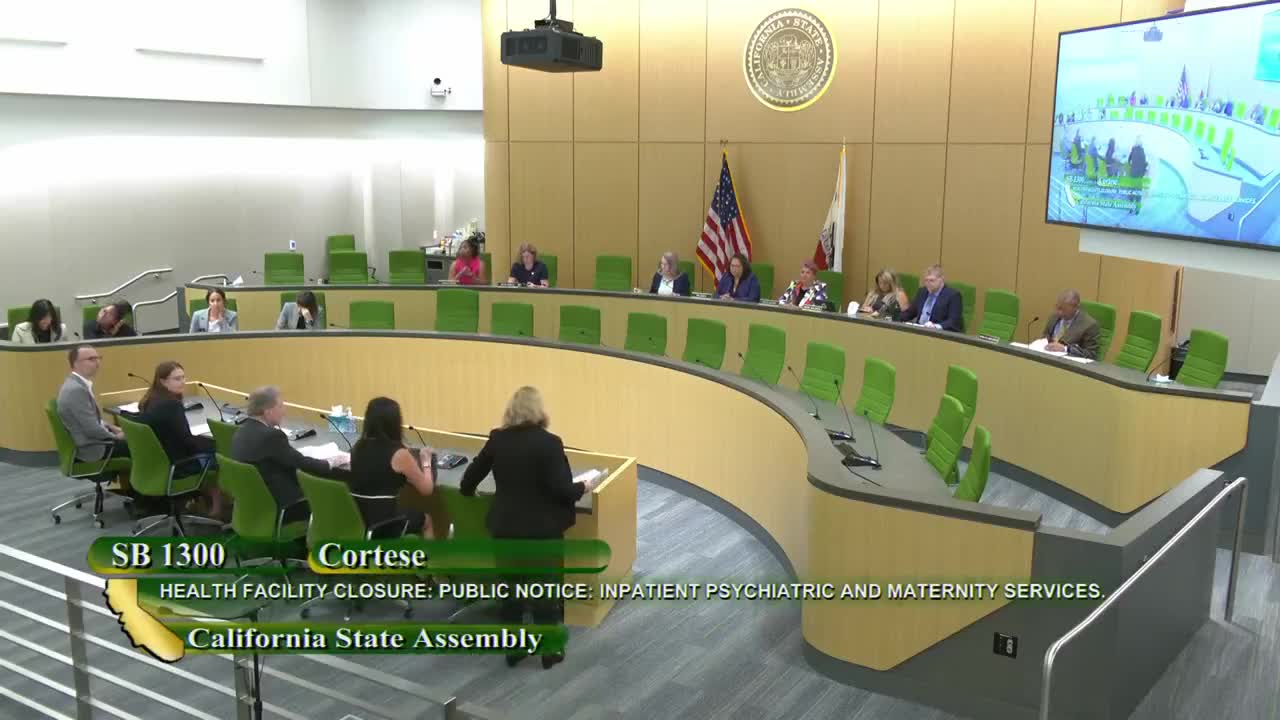 31MIN
Assembly Standing Committee on Health
 3MIN
Senate Floor
 32MIN
Senate Standing Committee on Health
Bill Author