SB 1303: Public works.
- Session Year: 2023-2024
- House: Senate
- Latest Version Date: 2024-09-29
Current Status:
Passed
(2024-09-29: Chaptered by Secretary of State. Chapter 991, Statutes of 2024.)
Introduced
In Committee
First Chamber
In Committee
Second Chamber
Enacted
Existing law requires that, except as specified, not less than the general prevailing rate of per diem wages, determined by the Director of Industrial Relations, be paid to workers employed on public works projects. Existing law defines the term public works for purposes of requirements regarding the payment of prevailing wages to include construction, alteration, demolition, installation, or repair work done under contract and paid for using public funds, except as specified.
Existing law requires an awarding body, as part of a labor compliance program, to withhold contract payments when, among other things, payroll records are delinquent or inadequate. Existing law requires an awarding body, as specified, to provide notice of withholding of contract payments to the contractor or subcontractor. Existing law requires the notice to be in writing, and describe the nature of the violation and the amount of wages, penalties, and forfeitures withheld.
This bill would require a private labor compliance entity, prior to withholding funds for an alleged violation, to confer with the negotiating parties to review relevant public works law, and would prohibit the entity from withholding an amount that exceeds the alleged underpayments and penalty assessments. The bill would require a private labor compliance entity seeking to withhold funds to provide a venue for a public works contractor or subcontractor to review and respond to evidence of alleged violations, as specified.
This bill would also provide that a violation of the conflict of interest provisions by a private labor compliance entity, as defined, would void a contract between the parties and subject the entity to specified civil fines and fees. The bill would require a private labor compliance entity to submit a signed declaration under penalty of perjury verifying that it has no conflicts of interest, as specified. By requiring private labor compliance entities to declare under penalty of perjury that they have no conflicts of interest, the bill would expand the crime of perjury and impose a state-mandated local program.
Existing law authorizes a joint labor-management committee established pursuant to the federal Labor Management Cooperation Act of 1978 to bring an action against an employer who fails to pay the prevailing wage, or who fails to provide payroll records, as specified.
This bill would authorize, among others, a joint labor-management committee to initiate a private right of action against certain entities, when the court is required to award reasonable attorneys fees and costs, as specified.
This bill would exempt certain awarding bodies operating labor compliance programs that are approved and monitored by the Department of Industrial Relations from the above-described provisions.
The California Constitution requires the state to reimburse local agencies and school districts for certain costs mandated by the state. Statutory provisions establish procedures for making that reimbursement.
This bill would provide that no reimbursement is required by this act for a specified reason.
Existing law requires that, except as specified, not less than the general prevailing rate of per diem wages, determined by the Director of Industrial Relations, be paid to workers employed on public works projects. Existing law defines the term public works for purposes of requirements regarding the payment of prevailing wages to include construction, alteration, demolition, installation, or repair work done under contract and paid for using public funds, except as specified.
Existing law requires an awarding body, as part of a labor compliance program, to withhold contract payments when, among other things, payroll records are delinquent or inadequate. Existing law requires an awarding body, as specified, to provide notice of withholding of contract payments to the contractor or subcontractor. Existing law requires the notice to be in writing, and describe the nature of the violation and the amount of wages, penalties, and forfeitures withheld.
This bill would require a private labor compliance entity, prior to withholding funds for an alleged violation, to, among other things, notify the Division of Labor Standards Enforcement and to confer with the negotiating parties to review relevant public works law. law, and would prohibit the entity from withholding an amount that exceeds the alleged underpayments and penalty assessments. The bill would require the a private labor compliance entity to participate in a revised process authorizing the contractor or subcontractor to review and respond to the alleged violations. seeking to withhold funds to provide a venue for a public works contractor or subcontractor to review and respond to evidence of alleged violations, as specified.
This bill would also provide that a violation of the conflict of interest provisions by a private labor compliance entity, as defined, would void a contract between the parties and subject the entity to specified civil fines and fees. The bill would require a private labor compliance entity to submit a signed declaration under penalty of perjury verifying that it has no conflicts of interest, as specified. By requiring private labor compliance entities to declare under penalty of perjury that they have no conflicts of interest, the bill would expand the crime of perjury and impose a state-mandated local program.
Existing law authorizes a joint labor-management committee established pursuant to the federal Labor Management Cooperation Act of 1978 to bring an action against an employer who fails to pay the prevailing wage, or who fails to provide payroll records, as specified.
This bill would authorize, among others, a joint labor-management committee to initiate a private right of action against certain entities, when the court is required to award reasonable attorneys fees and costs, as specified.
This bill would exempt certain awarding bodies operating labor compliance programs that are approved and monitored by the Department of Industrial Relations from the above-described provisions.
The California Constitution requires the state to reimburse local agencies and school districts for certain costs mandated by the state. Statutory provisions establish procedures for making that reimbursement.
This bill would provide that no reimbursement is required by this act for a specified reason.
Existing law requires that, except as specified, not less than the general prevailing rate of per diem wages, determined by the Director of Industrial Relations, be paid to workers employed on public works projects. Existing law defines the term public works for purposes of requirements regarding the payment of prevailing wages to include construction, alteration, demolition, installation, or repair work done under contract and paid for using public funds, except as specified.
Existing law requires an awarding body, as part of a labor compliance program, to withhold contract payments when, among other things, payroll records are delinquent or inadequate. Existing law requires an awarding body, as specified, to provide notice of withholding of contract payments to the contractor or subcontractor. Existing law requires the notice to be in writing, and describe the nature of the violation and the amount of wages, penalties, and forfeitures withheld.
This bill would require an awarding body, a private labor compliance entity, prior to withholding funds for an alleged violation, to, among other things, notify the Division of Labor Standards Enforcement and confer with the negotiating parties to review relevant public works law. The bill would require the awarding body private labor compliance entity to participate in a revised process authorizing the contractor or subcontractor to review and respond to the alleged violations.
This bill would also provide that a violation of the conflict of interest provisions by a private labor compliance entity, as defined, would void a contract between the parties and subject the entity to specified civil fines and fees. The bill would require a private labor compliance entity to submit a signed declaration under penalty of perjury verifying that it has no conflicts of interest, as specified. By requiring private labor compliance entities to declare under penalty of perjury that they have no conflicts of interest, the bill would expand the crime of perjury and impose a state-mandated local program.
Existing law authorizes a joint labor-management committee established pursuant to the federal Labor Management Cooperation Act of 1978 to bring an action against an employer who fails to pay the prevailing wage, or who fails to provide payroll records, as specified.
This bill would authorize, among others, a joint labor-management committee to initiate a private right of action against certain entities, when the court is required to award reasonable attorneys fees and costs, as specified.
This bill would exempt certain awarding bodies operating labor compliance programs that are approved and monitored by the Department of Industrial Relations from the above-described provisions.
The California Constitution requires the state to reimburse local agencies and school districts for certain costs mandated by the state. Statutory provisions establish procedures for making that reimbursement.
This bill would provide that no reimbursement is required by this act for a specified reason.
Existing law requires that, except as specified, not less than the general prevailing rate of per diem wages, determined by the Director of Industrial Relations, be paid to workers employed on public works projects. Existing law defines the term public works for purposes of requirements regarding the payment of prevailing wages to include construction, alteration, demolition, installation, or repair work done under contract and paid for using public funds, except as specified.
Existing law requires an awarding body, as part of a labor compliance program, to withhold contract payments when, among other things, payroll records are delinquent or inadequate. Existing law requires an awarding body, as specified, to provide notice of withholding of contract payments to the contractor or subcontractor. Existing law requires the notice to be in writing, and describe the nature of the violation and the amount of wages, penalties, and forfeitures withheld.
This bill would require an awarding body or its agent, body, prior to withholding funds for an alleged violation, to, among other things, notify the Division of Labor Standards Enforcement and confer with the negotiating parties to review relevant public works law. The bill would require the awarding body or its agent to participate in a revised process authorizing the contractor or subcontractor to review and respond to the alleged violations.
This bill would also provide that a violation of the conflict of interest provisions by a private labor compliance entity, as defined, would void a contract between the parties and subject the entity to specified civil fines and fees. The bill would require a private labor compliance entity to submit a signed declaration under penalty of perjury verifying that it has no conflicts of interest, as specified. By requiring private labor compliance entities to declare under penalty of perjury that they have no conflicts of interest, the bill would expand the crime of perjury and impose a state-mandated local program.
Existing law authorizes a joint labor-management committee established pursuant to the federal Labor Management Cooperation Act of 1978 to bring an action against an employer who fails to pay the prevailing wage, or who fails to provide payroll records, as specified.
This bill would authorize, among others, a joint labor-management committee to initiate a private right of action against certain entities, when the court is required to award reasonable attorneys fees and costs, as specified.
This bill would exempt certain awarding bodies operating labor compliance programs that are approved and monitored by the Department of Industrial Relations from the above-described provisions.
The California Constitution requires the state to reimburse local agencies and school districts for certain costs mandated by the state. Statutory provisions establish procedures for making that reimbursement.
This bill would provide that no reimbursement is required by this act for a specified reason.
Existing law requires that, except as specified, not less than the general prevailing rate of per diem wages, determined by the Director of Industrial Relations, be paid to workers employed on public works projects. Existing law defines the term public works for purposes of requirements regarding the payment of prevailing wages to include construction, alteration, demolition, installation, or repair work done under contract and paid for using public funds, except as specified.
Existing law requires an awarding body, as part of a labor compliance program, to withhold contract payments when, among other things, payroll records are delinquent or inadequate. Existing law requires an awarding body, as specified, to provide notice of withholding of contract payments to the contractor or subcontractor. Existing law requires the notice to be in writing, and describe the nature of the violation and the amount of wages, penalties, and forfeitures withheld.
This bill would require an awarding body or its agent, prior to withholding funds for an alleged violation, to, among other things, notify the Division of Labor Standards Enforcement and confer with the negotiating parties to review relevant public works law. The bill would require the awarding body or its agent to participate in a revised process authorizing the contractor or subcontractor to review and respond to the alleged violations.
This bill would also provide that a violation of the conflict of interest provisions by a private labor compliance entity, as defined, would void a contract between the parties and subject the entity to specified civil fines and fees. The bill would require a private labor compliance entity to submit a signed declaration under penalty of perjury verifying that it has no conflicts of interest, as specified. By requiring private labor compliance entities to declare under penalty of perjury that they have no conflicts of interest, the bill would expand the crime of perjury and impose a state-mandated local program.
Existing law authorizes a joint labor-management committee established pursuant to the federal Labor Management Cooperation Act of 1978 to bring an action against an employer who fails to pay the prevailing wage, or who fails to provide payroll records, as specified.
This bill would authorize, among others, a joint labor-management committee to initiate a private right of action when the court is required to award reasonable attorneys fees and costs, as specified.
This bill would exempt certain awarding bodies operating labor compliance programs that are approved and monitored by the Department of Industrial Relations from the above-described provisions.
The California Constitution requires the state to reimburse local agencies and school districts for certain costs mandated by the state. Statutory provisions establish procedures for making that reimbursement.
This bill would provide that no reimbursement is required by this act for a specified reason.
Existing law requires that, except as specified, not less than the general prevailing rate of per diem wages, determined by the Director of Industrial Relations, be paid to workers employed on public works projects. Existing law defines the term public works for purposes of requirements regarding the payment of prevailing wages to include construction, alteration, demolition, installation, or repair work done under contract and paid for using public funds, except as specified.
Existing law requires an awarding body, as part of a labor compliance program, to withhold contract payments when, among other things, payroll records are delinquent or inadequate. Existing law requires an awarding body, as specified, to provide notice of withholding of contract payments to the contractor or subcontractor. Existing law requires the notice to be in writing, and describe the nature of the violation and the amount of wages, penalties, and forfeitures withheld.
This bill would require an awarding body or its agent, prior to withholding funds for an alleged violation, to, among other things, confer with both notify the Division of Labor Standards Enforcement and confer with the negotiating parties. parties to review relevant public works law. The bill would require the awarding body or its agent to participate in a revised process authorizing the contractor or subcontractor to review and respond to the alleged violations.
This bill would also provide that a violation of the conflict of interest provisions by a private labor compliance entity, as defined, would void a contract between the parties and subject the entity to specified civil fines and fees. The bill would require a private labor compliance entity to submit a signed declaration under penalty of perjury verifying that it has no conflicts of interest, as specified. By requiring private labor compliance entities to declare under penalty of perjury that they have no conflicts of interest, the bill would expand the crime of perjury and impose a state-mandated local program.
Existing law authorizes a joint labor-management committee established pursuant to the federal Labor Management Cooperation Act of 1978 to bring an action against an employer who fails to pay the prevailing wage, or who fails to provide payroll records, as specified.
This bill would authorize, among others, a joint labor-management committee to initiate a private right of action when the court is required to award reasonable attorneys fees and costs, as specified.
The California Constitution requires the state to reimburse local agencies and school districts for certain costs mandated by the state. Statutory provisions establish procedures for making that reimbursement.
This bill would provide that no reimbursement is required by this act for a specified reason.
Existing law requires that, except as specified, not less than the general prevailing rate of per diem wages, determined by the Director of Industrial Relations, be paid to workers employed on public works projects. Existing law defines the term public works for purposes of requirements regarding the payment of prevailing wages to include construction, alteration, demolition, installation, or repair work done under contract and paid for using public funds, except as specified.
This bill would state the intent of the Legislature to enact subsequent legislation related to the use of for-profit labor compliance entities for the monitoring and enforcement of prevailing wage laws on public works projects.Existing law requires an awarding body, as part of a labor compliance program, to withhold contract payments when, among other things, payroll records are delinquent or inadequate. Existing law requires an awarding body, as specified, to provide notice of withholding of contract payments to the contractor or subcontractor. Existing law requires the notice to be in writing, and describe the nature of the violation and the amount of wages, penalties, and forfeitures withheld.
This bill would require an awarding body or its agent, prior to withholding funds for an alleged violation, to, among other things, confer with both the Division of Labor Standards Enforcement and the negotiating parties. The bill would require the awarding body or its agent to participate in a revised process authorizing the contractor or subcontractor to review and respond to the alleged violations.
This bill would also provide that a violation of the conflict of interest provisions by a private labor compliance entity, as defined, would void a contract between the parties and subject the entity to specified civil fines and fees. The bill would require a private labor compliance entity to submit a signed declaration under penalty of perjury verifying that it has no conflicts of interest, as specified. By requiring private labor compliance entities to declare under penalty of perjury that they have no conflicts of interest, the bill would expand the crime of perjury and impose a state-mandated local program.
Existing law authorizes a joint labor-management committee established pursuant to the federal Labor Management Cooperation Act of 1978 to bring an action against an employer who fails to pay the prevailing wage, or who fails to provide payroll records, as specified.
This bill would authorize, among others, a joint labor-management committee to initiate a private right of action when the court is required to award reasonable attorneys fees and costs, as specified.
The California Constitution requires the state to reimburse local agencies and school districts for certain costs mandated by the state. Statutory provisions establish procedures for making that reimbursement.
This bill would provide that no reimbursement is required by this act for a specified reason.
Existing law requires that, except as specified, not less than the general prevailing rate of per diem wages, determined by the Director of Industrial Relations, be paid to workers employed on public works projects. Existing law defines the term public works for purposes of requirements regarding the payment of prevailing wages to include construction, alteration, demolition, installation, or repair work done under contract and paid for using public funds, except as specified.
This bill would state the intent of the Legislature to enact subsequent legislation related to the use of for-profit labor compliance entities for the monitoring and enforcement of prevailing wage laws on public works projects.
(a)For the purposes of this section, the following terms have the following meanings:
(1)A private labor compliance entity is defined as a third-party company that is hired by an awarding body to perform labor compliance and enforcement activities on public works projects on its behalf.
(2)A conflict of interest is a situation in which a private labor compliance entity performs labor compliance work under contract for both an awarding body, and a contractor who is bidding a public works project for the same awarding body.
(b)(1)A private labor compliance entity shall be prohibited from providing labor compliance and enforcement activities on behalf of an awarding body if it has a conflict of interest.
(2)Prior to an awarding body entering a contract for a public works project, a private labor compliance entity shall disclose a potential conflict of interest to the awarding body. If no conflict exists, a private labor compliance entity shall submit to the awarding body a signed declaration under penalty of perjury verifying that it has no conflicts of interest.
(c)A private labor compliance entity, prior to withholding funds from a public works contractor for an alleged violation, including, but not limited to, worker classification, scope of work, travel and subsistence apprenticeship standards, shall do the following:
(1)Confer with the negotiating parties of the applicable agreements to review relevant public works law.
(2)Not withhold an amount that exceeds the alleged underpayments and penalty assessments.
(d)A private labor compliance entity seeking to withhold funds from a public works contractor or subcontractor on behalf of an awarding body pursuant to Sections 1726 and 1771.6 shall, within 20 days of a written request for review by the contractor or subcontractor, provide a venue for a public works contractor or subcontractor to review and respond to evidence of alleged violations.
(e)A violation of this section shall make a contract between a private labor compliance entity and an awarding body null and void, and the private labor compliance entity would be subject to a penalty by the awarding body of not less than one thousand dollars ($1,000), including reasonable attorneys fees, subject matter expert costs, and expenses.
(f)In the event of a violation of this section, an aggrieved party, including a joint labor-management committee established pursuant to the federal Labor Management Cooperation Act of 1978 (29 U.S.C. Sec. 175(a)), shall have the right to initiate a private right of action. The private right of action may only be filed against a private labor compliance entity as defined in subdivision (a), an awarding body, or an awarding bodys agent. The court shall award reasonable attorneys fees and costs incurred in maintaining the action, including expert witness fees to a prevailing plaintiff.
(g)In addition, the provisions of this section may be enforced by a public prosecutor as defined in Section 180.
(h)This section does not apply to the following awarding bodies operating labor compliance programs approved and monitored by the Department of Industrial Relations pursuant to Section 1771.5:
(1)The Department of Transportation.
(2)The City of Los Angeles.
(3)The Los Angeles Unified School District.
(4)The County of Sacramento.
SEC. 2.No reimbursement is required by this act pursuant to Section 6 of Article XIIIB of the California Constitution because the only costs that may be incurred by a local agency or school district will be incurred because this act creates a new crime or infraction, eliminates a crime or infraction, or changes the penalty for a crime or infraction, within the meaning of Section 17556 of the Government Code, or changes the definition of a crime within the meaning of Section 6 of Article XIIIB of the California Constitution.
(a)For the purposes of this section, the following terms have the following meanings:
(1)A private labor compliance entity is defined as a third-party company that is hired by an awarding body to perform labor compliance and enforcement activities on public works projects on its behalf.
(2)A conflict of interest is a situation in which a private labor compliance entity performs labor compliance work under contract for both an awarding body, and a contractor who is bidding a public works project for the same awarding body.
(b)(1)A private labor compliance entity shall be prohibited from providing labor compliance and enforcement activities on behalf of an awarding body if it has a conflict of interest.
(2)Prior to an awarding body entering a contract for a public works project, a private labor compliance entity shall disclose a potential conflict of interest to the awarding body and the Division of Labor Standards Enforcement related to any clients of the private labor compliance entity who have bid on the proposed project. body. If no conflict exists, a private labor compliance entity shall submit to the awarding body and the Division of Labor Standards Enforcement a signed declaration under penalty of perjury verifying that it has no conflicts of interest.
(c)A private labor compliance entity, prior to withholding funds from a public works contractor for an alleged violation, including, but not limited to, worker classification, scope of work, travel and subsistence apprenticeship standards, shall do all of the following:
(1)Confer with the negotiating parties of the applicable agreements to review relevant public works law.
(2)Notify the Division of Labor Standards Enforcement.(3)(2)Not withhold an amount that exceeds the alleged underpayments and penalty assessments.
(d)A private labor compliance entity withholding seeking to withhold funds from a public works contractor or subcontractor shall do both of the following: on behalf of an awarding body pursuant to Sections 1726 and 1771.6 shall, within 20 days of a written request for review by the contractor or subcontractor, provide a venue for a public works contractor or subcontractor to review and respond to evidence of alleged violations.
(1)Within 20 days of a written request for review by the contractor or subcontractor, provide a venue for a public works contractor or subcontractor to review and respond to evidence of alleged violations.(2)Forward any unremedied alleged violations to the Division of Labor Standards Enforcement for formal investigation within 45 days of withholding of funds.(e)A violation of this section shall make a contract between a private labor compliance entity and an awarding agency body null and void, and the private labor compliance entity would be subject to a penalty by the awarding body of not less than one thousand dollars ($1,000), including reasonable attorneys fees, subject matter expert costs, and expenses.
(f)In the event of a violation of this section, an aggrieved party, including a joint labor-management committee established pursuant to the federal Labor Management Cooperation Act of 1978 (29 U.S.C. Sec. 175(a)), shall have the right to initiate a private right of action. The private right of action may only be filed against a private labor compliance entity as defined in subdivision (a), an awarding entity, body, or an awarding entitys bodys agent. The court shall award reasonable attorneys fees and costs incurred in maintaining the action, including expert witness fees to a prevailing plaintiff.
(g)In addition, the provisions of this section may be enforced by the Labor Commissioner or a public prosecutor as defined in Section 180.
(h)This section does not apply to the following awarding bodies operating labor compliance programs approved and monitored by the Department of Industrial Relations pursuant to Section 1771.5:
(1)The Department of Transportation.
(2)The City of Los Angeles.
(3)The Los Angeles Unified School District.
(4)The County of Sacramento.
SEC. 2.No reimbursement is required by this act pursuant to Section 6 of Article XIIIB of the California Constitution because the only costs that may be incurred by a local agency or school district will be incurred because this act creates a new crime or infraction, eliminates a crime or infraction, or changes the penalty for a crime or infraction, within the meaning of Section 17556 of the Government Code, or changes the definition of a crime within the meaning of Section 6 of Article XIIIB of the California Constitution.
(a)For the purposes of this section, the following terms have the following meanings:
(1)A private labor compliance entity is defined as a third-party company that is hired by an awarding body to perform labor compliance and enforcement activities on public works projects on its behalf.
(2)A conflict of interest is a situation in which a private labor compliance entity performs labor compliance work under contract for both an awarding body, and a contractor who is bidding a public works project for the same awarding body.
(b)(1)A private labor compliance entity shall be prohibited from providing labor compliance and enforcement activities on behalf of an awarding body if it has a conflict of interest.
(2)Prior to an awarding body entering a contract for a public works project, a private labor compliance entity shall disclose a potential conflict of interest to the awarding body and the Division of Labor Standards Enforcement related to any clients of the private labor compliance entity who have bid on the proposed project. If no conflict exists, a private labor compliance entity shall submit to the awarding body and the Division of Labor Standards Enforcement a signed declaration under penalty of perjury verifying that it has no conflicts of interest.
(c)An awarding body, A private labor compliance entity, prior to withholding funds from a public works contractor for an alleged violation, including, but not limited to, worker classification, scope of work, travel and subsistence apprenticeship standards, shall do all of the following:
(1)Confer with the negotiating parties of the applicable agreements to review relevant public works law.
(2)Notify the Division of Labor Standards Enforcement.
(3)Not withhold an amount that exceeds the alleged underpayments and penalty assessments.
(d)An awarding body A private labor compliance entity withholding funds from a public works contractor or subcontractor shall do both of the following:
(1)Within 20 days of a written request for review by the contractor or subcontractor, provide a venue for a public works contractor or subcontractor to review and respond to evidence of alleged violations.
(2)Forward any unremedied alleged violations to the Division of Labor Standards Enforcement for formal investigation within 45 days of withholding of funds.
(e)A violation of this section shall make a contract between a private labor compliance entity and an awarding agency null and void, and the private labor compliance entity would be subject to a penalty of not less than one thousand dollars ($1,000), including reasonable attorneys fees, subject matter expert costs, and expenses.
(f)In the event of a violation of this section, an aggrieved party, including a joint labor-management committee established pursuant to the federal Labor Management Cooperation Act of 1978 (29 U.S.C. Sec. 175(a)), shall have the right to initiate a private right of action. The private right of action may only be filed against a private labor compliance entity as defined in subdivision (a), an awarding entity, or an awarding entitys agent. The court shall award reasonable attorneys fees and costs incurred in maintaining the action, including expert witness fees to a prevailing plaintiff.
(g)In addition, the provisions of this section may be enforced by the Labor Commissioner or a public prosecutor as defined in Section 180.
(h)This section does not apply to the following awarding bodies operating labor compliance programs approved and monitored by the Department of Industrial Relations pursuant to Section 1771.5:
(1)The Department of Transportation.
(2)The City of Los Angeles.
(3)The Los Angeles Unified School District.
(4)The County of Sacramento.
SEC. 2.No reimbursement is required by this act pursuant to Section 6 of Article XIIIB of the California Constitution because the only costs that may be incurred by a local agency or school district will be incurred because this act creates a new crime or infraction, eliminates a crime or infraction, or changes the penalty for a crime or infraction, within the meaning of Section 17556 of the Government Code, or changes the definition of a crime within the meaning of Section 6 of Article XIIIB of the California Constitution.
(a)For the purposes of this section, a the following terms have the following meanings:
(1)A private labor compliance entity is defined as a third-party company that is hired by an awarding body to perform labor compliance and enforcement activities on public works projects on its behalf.
(2)A conflict of interest is a situation in which a private labor compliance entity performs labor compliance work under contract for both an awarding body, and a contractor who is bidding a public works project for the same awarding body.
(b)(1)A private labor compliance entity shall be prohibited from providing labor compliance and enforcement activities on behalf of an awarding body if it has a conflict of interest.
(2)A private labor compliance entity shall disclose a potential conflict of interest to the awarding body and the Division of Labor Standards Enforcement, including whether a client of the private labor compliance entity bids on, or has been awarded, a public works project that the labor compliance program has or will contract.(3)Prior to entering into a contract for labor compliance and enforcement on a public works project of an awarding body, a private labor compliance entity shall submit to the awarding body and the Division of Labor Standards Enforcement a signed declaration under penalty of perjury verifying that it has no conflicts of interest.(2)Prior to an awarding body entering a contract for a public works project, a private labor compliance entity shall disclose a potential conflict of interest to the awarding body and the Division of Labor Standards Enforcement related to any clients of the private labor compliance entity who have bid on the proposed project. If no conflict exists, a private labor compliance entity shall submit to the awarding body and the Division of Labor Standards Enforcement a signed declaration under penalty of perjury verifying that it has no conflicts of interest.
(c)An awarding body or its agent, body, prior to withholding funds from a public works contractor for an alleged violation, including, but not limited to, worker classification, scope of work, travel and subsistence apprenticeship standards, shall do all of the following:
(1)Confer with the negotiating parties of the applicable agreements to review relevant public works law.
(2)Notify the Division of Labor Standards Enforcement.
(3)Not withhold an amount that exceeds the alleged underpayments and penalty assessments.
(d)An awarding body or its agent withholding funds from a public works contractor or subcontractor shall do both of the following:
(1)Within 20 days of a written request for review by the contractor or subcontractor, provide a venue for a public works contractor or subcontractor to review and respond to evidence of alleged violations.
(2)Forward any unremedied alleged violations to the Division of Labor Standards Enforcement for formal investigation within 45 days of withholding of funds.
(e)A violation of this section shall make a contract between a private labor compliance entity and an awarding agency null and void, and the private labor compliance entity would be subject to a penalty of not less than one thousand dollars ($1,000), including reasonable attorneys fees, subject matter expert costs, and expenses.
(f)In the event of a violation of this section, an aggrieved party, including a joint labor-management committee established pursuant to the federal Labor Management Cooperation Act of 1978 (29 U.S.C. Sec. 175(a)), shall have the right to initiate a private right of action. The private right of action may only be filed against a private labor compliance entity as defined in subdivision (a), an awarding entity, or an awarding entitys agent. The court shall award reasonable attorneys fees and costs incurred in maintaining the action, including expert witness fees to a prevailing plaintiff.
(g)In addition, the provisions of this section may be enforced by the Labor Commissioner or a public prosecutor as defined in Section 180.
(h)This section does not apply to the following awarding bodies operating labor compliance programs approved and monitored by the Department of Industrial Relations pursuant to Section 1771.5:
(1)The Department of Transportation.
(2)The City of Los Angeles.
(3)The Los Angeles Unified School District.
(4)The County of Sacramento.
SEC. 2.No reimbursement is required by this act pursuant to Section 6 of Article XIIIB of the California Constitution because the only costs that may be incurred by a local agency or school district will be incurred because this act creates a new crime or infraction, eliminates a crime or infraction, or changes the penalty for a crime or infraction, within the meaning of Section 17556 of the Government Code, or changes the definition of a crime within the meaning of Section 6 of Article XIIIB of the California Constitution.
(a)For the purposes of this section, a private labor compliance entity is defined as a third-party company that is hired by an awarding body to perform labor compliance and enforcement activities on public works projects on its behalf.
(b)(1)A private labor compliance entity shall be prohibited from providing labor compliance and enforcement activities on behalf of an awarding body if it has a conflict of interest.
(2)A private labor compliance entity shall disclose a potential conflict of interest to the awarding body and the Division of Labor Standards Enforcement, including whether a client of the private labor compliance entity bids on, or has been awarded, a public works project that the labor compliance program has or will contract.
(3)Prior to entering into a contract for labor compliance and enforcement on a public works project of an awarding body, a private labor compliance entity shall submit to the awarding body and the Division of Labor Standards Enforcement a signed declaration under penalty of perjury verifying that it has no conflicts of interest.
(c)An awarding body or its agent, prior to withholding funds from a public works contractor for an alleged violation, including, but not limited to, worker classification, scope of work, travel and subsistence apprenticeship standards, shall do all of the following:
(1)Confer with the negotiating parties of the applicable agreements to review relevant public works law.
(2)Notify the Division of Labor Standards Enforcement.
(3)Not withhold an amount that exceeds the alleged underpayments and penalty assessments.
(d)An awarding body or its agent withholding funds from a public works contractor or subcontractor shall do both of the following:
(1)Within 20 days of a written request for review by the contractor or subcontractor, provide a venue for a public works contractor or subcontractor to review and respond to evidence of alleged violations.
(2)Forward any unremedied alleged violations to the Division of Labor Standards Enforcement for formal investigation within 45 days of withholding of funds.
(e)A violation of this section shall make a contract between a private labor compliance entity and an awarding agency null and void, and the private labor compliance entity would be subject to a penalty of not less than one thousand dollars ($1,000), including reasonable attorneys fees, subject matter expert costs, and expenses.
(f)In the event of a violation of this section, an aggrieved party, including a joint labor-management committee established pursuant to the federal Labor Management Cooperation Act of 1978 (29 U.S.C. Sec. 175(a)), shall have the right to initiate a private right of action. The court shall award reasonable attorneys fees and costs incurred in maintaining the action, including expert witness fees to a prevailing plaintiff.
(g)In addition, the provisions of this section may be enforced by the Labor Commissioner or a public prosecutor as defined in Section 180.
(h)This section does not apply to the following awarding bodies operating labor compliance programs approved and monitored by the Department of Industrial Relations pursuant to Section 1771.5:
(1)The Department of Transportation.
(2)The City of Los Angeles.
(3)The Los Angeles Unified School District.
(4)The County of Sacramento.
SEC. 2.No reimbursement is required by this act pursuant to Section 6 of Article XIIIB of the California Constitution because the only costs that may be incurred by a local agency or school district will be incurred because this act creates a new crime or infraction, eliminates a crime or infraction, or changes the penalty for a crime or infraction, within the meaning of Section 17556 of the Government Code, or changes the definition of a crime within the meaning of Section 6 of Article XIIIB of the California Constitution.
(a)For the purposes of this section, a private labor compliance entity is defined as a third-party company that is hired by an awarding body to perform labor compliance and enforcement activities on public works projects on its behalf.
(b)(1)A private labor compliance entity shall be prohibited from providing labor compliance and enforcement activities on behalf of an awarding body if it has a conflict of interest.
(2)A private labor compliance entity shall disclose a potential conflict of interest to the awarding body and the Division of Labor Standards Enforcement, including whether a client of the private labor compliance entity bids on, or has been awarded, a public works project that the labor compliance program has or will contract.
(3)Prior to entering into a contract for labor compliance and enforcement on a public works project of an awarding body, a private labor compliance entity shall submit to the awarding body and the Division of Labor Standards Enforcement a signed declaration under penalty of perjury verifying that it has no conflicts of interest.
(c)An awarding body or its agent, prior to withholding funds from a public works contractor for an alleged violation, including, but not limited to, worker classification, scope of work, travel and subsistence apprenticeship standards, shall do all of the following:
(1)Confer with the negotiating parties of the applicable agreements to establish current area standards. review relevant public works law.
(2)Confer with Notify the Division of Labor Standards Enforcement.
(3)Not withhold an amount that exceeds the alleged underpayments and penalty assessments.
(d)An awarding body or its agent withholding funds from a public works contractor or subcontractor shall do both of the following:
(1)Within 20 days of a written request for review by the contractor or subcontractor, provide a venue for a public works contractor or subcontractor to review and respond to evidence of alleged violations.
(2)Forward any unremedied alleged violations to the Division of Labor Standards Enforcement for formal investigation within 45 days of withholding of funds.
(e)A violation of this section shall make a contract between a private labor compliance entity and an awarding agency null and void, and the private labor compliance entity would be subject to a penalty of not less than one thousand dollars ($1,000), including reasonable attorneys fees, subject matter expert costs, and expenses.
(f)In the event of a violation of this section, an aggrieved party, including a joint labor-management committee established pursuant to the federal Labor Management Cooperation Act of 1978 (29 U.S.C. Sec. 175(a)), shall have the right to initiate a private right of action. The court shall award reasonable attorneys fees and costs incurred in maintaining the action, including expert witness fees to a prevailing plaintiff.
(g)In addition, the provisions of this section may be enforced by the Labor Commissioner or a public prosecutor as defined in Section 180.
SEC. 2.No reimbursement is required by this act pursuant to Section 6 of Article XIIIB of the California Constitution because the only costs that may be incurred by a local agency or school district will be incurred because this act creates a new crime or infraction, eliminates a crime or infraction, or changes the penalty for a crime or infraction, within the meaning of Section 17556 of the Government Code, or changes the definition of a crime within the meaning of Section 6 of Article XIIIB of the California Constitution.
(a)For the purposes of this section, a private labor compliance entity is defined as a third-party company that is hired by an awarding body to perform labor compliance and enforcement activities on public works projects on its behalf.
(b)(1)A private labor compliance entity shall be prohibited from providing labor compliance and enforcement activities on behalf of an awarding body if it has a conflict of interest.
(2)A private labor compliance entity shall disclose a potential conflict of interest to the awarding body and the Division of Labor Standards Enforcement, including whether a client of the private labor compliance entity bids on, or has been awarded, a public works project that the labor compliance program has or will contract.
(3)Prior to entering into a contract for labor compliance and enforcement on a public works project of an awarding body, a private labor compliance entity shall submit to the awarding body and the Division of Labor Standards Enforcement a signed declaration under penalty of perjury verifying that it has no conflicts of interest.
(c)An awarding body or its agent, prior to withholding funds from a public works contractor for an alleged violation, including, but not limited to, worker classification, scope of work, travel and subsistence apprenticeship standards, shall do all of the following:
(1)Confer with the negotiating parties of the applicable agreements to establish current area standards.
(2)Confer with the Division of Labor Standards Enforcement.
(3)Not withhold an amount that exceeds the alleged underpayments and penalty assessments.
(d)An awarding body or its agent withholding funds from a public works contractor or subcontractor shall do both of the following:
(1)Within 20 days of a written request for review by the contractor or subcontractor, provide a venue for a public works contractor or subcontractor to review and respond to evidence of alleged violations.
(2)Forward any unremedied alleged violations to the Division of Labor Standards Enforcement for formal investigation within 45 days of withholding of funds.
(e)A violation of this section shall make a contract between a private labor compliance entity and an awarding agency null and void, and the private labor compliance entity would be subject to a penalty of not less than one thousand dollars ($1,000), including reasonable attorneys fees, subject matter expert costs, and expenses.
(f)In the event of a violation of this section, an aggrieved party, including a joint labor-management committee established pursuant to the federal Labor Management Cooperation Act of 1978 (29 U.S.C. Sec. 175(a)), shall have the right to initiate a private right of action. The court shall award reasonable attorneys fees and costs incurred in maintaining the action, including expert witness fees to a prevailing plaintiff.
(g)In addition, the provisions of this section may be enforced by the Labor Commissioner or a public prosecutor as defined in Section 180.
SEC. 2.No reimbursement is required by this act pursuant to Section 6 of Article XIIIB of the California Constitution because the only costs that may be incurred by a local agency or school district will be incurred because this act creates a new crime or infraction, eliminates a crime or infraction, or changes the penalty for a crime or infraction, within the meaning of Section 17556 of the Government Code, or changes the definition of a crime within the meaning of Section 6 of Article XIIIB of the California Constitution.
SECTION 1.It is the intent of the Legislature to enact subsequent legislation related to the use of for-profit labor compliance entities for the monitoring and enforcement of prevailing wage laws on public works projects.It is the intent of the Legislature to enact subsequent legislation related to the use of for-profit labor compliance entities for the monitoring and enforcement of prevailing wage laws on public works projects.
|
Date
|
Status
|
|---|---|
| Sep 29, 2024 | Chaptered by Secretary of State. Chapter 991, Statutes of 2024. |
| Sep 29, 2024 | Approved by the Governor. |
| Sep 11, 2024 | Enrolled and presented to the Governor at 3 p.m. |
| Aug 31, 2024 | Assembly amendments concurred in. (Ayes 33. Noes 7. Page 5781.) Ordered to engrossing and enrolling. |
| Aug 31, 2024 | In Senate. Concurrence in Assembly amendments pending. |
| Aug 31, 2024 | Read third time. Passed. (Ayes 75. Noes 0. Page 7067.) Ordered to the Senate. |
| Aug 20, 2024 | Read second time. Ordered to third reading. |
| Aug 19, 2024 | Read second time and amended. Ordered to second reading. |
| Aug 15, 2024 | From committee: Do pass as amended. (Ayes 11. Noes 0.) (August 15). |
| Aug 7, 2024 | August 7 set for first hearing. Placed on suspense file. |
| Jun 26, 2024 | Read second time and amended. Re-referred to Com. on APPR. |
| Jun 25, 2024 | From committee: Do pass as amended and re-refer to Com. on APPR. (Ayes 10. Noes 0.) (June 25). |
| Jun 20, 2024 | From committee: Do pass and re-refer to Com. on JUD. (Ayes 7. Noes 0.) (June 19). Re-referred to Com. on JUD. |
| Jun 3, 2024 | Referred to Coms. on L. & E. and JUD. |
| May 22, 2024 | In Assembly. Read first time. Held at Desk. |
| May 21, 2024 | Read third time. Passed. (Ayes 31. Noes 8. Page 4070.) Ordered to the Assembly. |
| May 16, 2024 | Read second time. Ordered to third reading. |
| May 16, 2024 | From committee: Do pass. (Ayes 5. Noes 2. Page 3979.) (May 16). |
| May 14, 2024 | Set for hearing May 16. |
| May 13, 2024 | May 13 hearing: Placed on APPR suspense file. |
| May 3, 2024 | Set for hearing May 13. |
| Apr 25, 2024 | Read second time and amended. Re-referred to Com. on APPR. |
| Apr 24, 2024 | From committee: Do pass as amended and re-refer to Com. on APPR. (Ayes 9. Noes 1. Page 3726.) (April 23). |
| Apr 18, 2024 | From committee with author's amendments. Read second time and amended. Re-referred to Com. on JUD. |
| Apr 17, 2024 | From committee: Do pass and re-refer to Com. on JUD. (Ayes 4. Noes 1. Page 3662.) (April 17). Re-referred to Com. on JUD. |
| Apr 12, 2024 | Set for hearing April 23 in JUD. pending receipt. |
| Apr 10, 2024 | From committee with author's amendments. Read second time and amended. Re-referred to Com. on L., P.E. & R. |
| Apr 5, 2024 | Set for hearing April 17. |
| Apr 4, 2024 | From committee with author's amendments. Read second time and amended. Re-referred to Com. on L., P.E. & R. |
| Apr 3, 2024 | Re-referred to Coms. on L., P.E. & R. and JUD. |
| Mar 18, 2024 | From committee with author's amendments. Read second time and amended. Re-referred to Com. on RLS. |
| Feb 29, 2024 | Referred to Com. on RLS. |
| Feb 16, 2024 | From printer. May be acted upon on or after March 17. |
| Feb 15, 2024 | Introduced. Read first time. To Com. on RLS. for assignment. To print. |
|
Date
|
Description
|
Location
|
Votes
|
|
|---|---|---|---|---|
| Aug 31, 2024 | Unfinished Business SB1303 Caballero Concurrence | Senate Floor |
Passed |
|
| Aug 31, 2024 | SB 1303 Caballero Senate Third Reading By Haney | Assembly Floor |
Passed |
|
| Aug 15, 2024 | Do pass as amended. | Assembly Standing Committee on Appropriations |
Passed |
|
| Jun 25, 2024 | Do pass as amended and be re-referred to the Committee on [Appropriations] | Assembly Standing Committee on Judiciary |
Passed |
|
| Jun 19, 2024 | Do pass and be re-referred to the Committee on [Judiciary] | Assembly Standing Committee on Labor and Employment |
Passed |
|
| May 21, 2024 | Senate 3rd Reading SB1303 Caballero | Senate Floor |
Passed |
|
| May 16, 2024 | Do pass | Senate Standing Committee on Appropriations |
Passed |
|
| May 13, 2024 | Placed on suspense file | Senate Standing Committee on Appropriations |
Passed |
|
| Apr 23, 2024 | Do pass as amended, but first amend, and re-refer to the Committee on [Appropriations] | Senate Standing Committee on Judiciary |
Passed |
|
| Apr 17, 2024 | Do pass, but first be re-referred to the Committee on [Judiciary] | Senate Standing Committee on Labor, Public Employment and Retirement |
Passed |
This list shows positions taken on this bill by organizations on the date displayed, which is linked to the original source.
Positions by individuals are not included.
|
Organization
|
Position
|
Date
|
|---|---|---|
| Associated General Contractors | ** Against | |
| CALIFORNIA CONSTRUCTION & INDUSTRIAL MATERIALS ASSOCIATION | ** Support | |
| California Labor Federation | ** Support | |
| California Legislative Conference Of Plumbing, Heating & Piping Industry | ** Support | |
| California-Nevada Conference Of Operating Engineers | ** Support | |
| California State Association Of Electrical Workers | ** Support | |
| California State Council Of Laborers | ** Support | |
| California State Pipe Trades Council | ** Support | |
| County Employee Management Association | ** Support | |
| District Council 16 International Union Of Painters And Allied Trades | ** Support | |
| National Electrical Contractors Association | ** Support | |
| Northern California Allied Trades | ** Support | |
| Southern California Contractors Association | ** Support | |
| Southern California Glass Management Association | ** Support | |
| State Building and Construction Trades Council | ** Support | |
| United Contractors | ** Support | |
| Wall and Ceiling Alliance | ** Support | |
| Western Painting and Coating Contractors Association | ** Support | |
| Western States Council Sheet Metal, Air, Rail And Transportation | ** Support | |
| Western Wall And Ceiling Contractors Association | ** Support |
SENATE RULES COMMITTEE Office of Senate Floor Analyses (916) 651-1520 Fax: (916) 327-4478 | SB 1303 |
UNFINISHED BUSINESS
Bill No: SB 1303
Author: Caballero (D)
Amended: 8/19/24
Vote: 21
SENATE LABOR, PUB. EMP. & RET. COMMITTEE: 4-1, 4/17/24
AYES: Smallwood-Cuevas, Cortese, Durazo, Laird
NOES: Wilk
SENATE JUDICIARY COMMITTEE: 9-1, 4/23/24
AYES: Umberg, Allen, Ashby, Caballero, Durazo, Gonzalez, Laird, Min, Wahab
NOES: Niello
NO VOTE RECORDED: Wilk
SENATE APPROPRIATIONS COMMITTEE: 5-2, 5/16/24
AYES: Caballero, Ashby, Becker, Bradford, Wahab
NOES: Jones, Seyarto
SENATE FLOOR: 31-8, 5/21/24
AYES: Alvarado-Gil, Archuleta, Ashby, Atkins, Becker, Blakespear, Bradford, Caballero, Cortese, Dodd, Durazo, Eggman, Glazer, Gonzalez, Hurtado, Laird, Limón, McGuire, Menjivar, Min, Newman, Padilla, Portantino, Roth, Rubio, Skinner, Smallwood-Cuevas, Stern, Umberg, Wahab, Wiener
NOES: Dahle, Grove, Jones, Nguyen, Niello, Ochoa Bogh, Seyarto, Wilk
NO VOTE RECORDED: Allen
ASSEMBLY FLOOR: 50-0, 8/31/24 – Roll call vote not available
SUBJECT: Public works
SOURCE: California Labor Federation
California-Nevada Conference of Operating Engineers
DIGEST:
This bill requires a private labor compliance entity to disclose potential conflicts of interest to a body awarding a public works contract, as specified, and if conflict exists, prohibits the entity from entering into a contract with an awarding body.
Additionally, this bill requires a private labor compliance entity to take certain steps before and after withholding funds from a contractor or subcontractor who violates public works law. These violations include providing a venue for a contractor or subcontractor to respond to alleged violations.
Assembly Amendments
1) require a private labor compliance entity to disclose potential conflicts of interest and submit a signed declaration under penalty of perjury verifying that no conflict exists to only an awarding body and not the Division of Labor Standards Enforcement (DLSE); 2) remove the requirement for a private labor compliance entity, prior to withholding funds from a public works contractor for an alleged violation, to notify DLSE; 3) remove the requirement for a private labor compliance entity to forward any unremedied alleged violations to DLSE within 45 days of withholding funds; 4) make various clarifying changes.
ANALYSIS:
Existing federal law permits, pursuant to the Labor Management Cooperation Act of 1978, the establishment of plant, area, and industrywide labor management committees, which have been organized jointly by employers and labor organizations representing employees in that plant, area, or industry, as specified. (29 U.S.C. §175a)
Existing state law:
- Requires that not less than the general prevailing rate of per diem wages be paid to all workers employed on a “public works” project costing over $1,000 dollars and imposes misdemeanor penalties for violation of this requirement. (Labor Code §1771)
- Defines “public work” to include, among other things, construction, alteration, demolition, installation, or repair work done under contract and paid for in whole or in part out of public funds, except work done directly by a public utility company pursuant to order of the Public Utilities Commission or other public authority. (Labor Code §1720(a))
- Requires contractors and subcontractors, while performing public works, to keep accurate payroll records showing the name, address, social security number, work classification, straight time and overtime hours worked each day and week, and the actual per diem wages paid to each journeyman, apprentice, worker, or other employee employed by the contractor or subcontractor in connection with the public work. (Labor Code §1776 (a))
- Requires contractors and subcontractors, while performing public works, to furnish specified payroll records at least once a month directly to the Labor Commissioner (LC), in an electronic format, in the manner prescribed by the LC, on the department’s internet website. (Labor Code §1771.4 (a)(3))
- Authorizes an awarding body to elect to initiate and be approved by DIR to enforce a labor compliance program in exchange for higher prevailing wage exemptions. (Labor Code §1771.5)
- Requires the body awarding the contract for public work to take cognizance of violations of public works law committed in the course of the execution of the contract, and promptly report any suspected violations to the LC. An awarding body may withhold contract payments following an investigation, as specified. (Labor Code §1726)
- Directs any awarding body enforcing public works law to provide notice of the withholding of contract payments to the contractor and subcontractor in writing. The notice shall describe the nature of the violation and the amount of wages, penalties, and forfeitures withheld as well as the procedure for obtaining review of the withholding. (Labor Code §1771.6)
- Specifies that the withholding of contract payments by an awarding body is reviewable in the same manner as if the notice of the withholding was a civil penalty order of the LC and that the LC may intervene to represent the awarding body. (Labor Code §1771.6)
- Authorizes a joint labor-management committee (JLMC) to bring an action in any court of competent jurisdiction against an employer that fails to pay the prevailing wage to its employees or that fails to provide required payroll records. (Labor Code §1771.2)
- Requires that any action brought by a JLMC be commenced not later than 18 months after the filing of a valid notice of completion in the office of the county recorder in each county in which the public work or some part thereof was performed, or not later than 18 months after acceptance of the public work, whichever occurs last. (Labor Code §1771.2)
This bill:
- Defines a “private labor compliance entity” as a third-party company that is hired by an awarding body to perform labor compliance and enforcement activities on public works projects on its behalf.
- Defines a “conflict of interest” as a situation in which a private labor compliance entity performs labor compliance work under contract for both an awarding body, and a contractor who is bidding a public works project for the same awarding body.
- Prohibits a private labor compliance entity from providing labor compliance and enforcement activities on behalf of an awarding body if it has a conflict of interest.
- Requires a private labor compliance entity to disclose a potential conflict of interest to the awarding body and if no conflict exists to submit a signed declaration under penalty of perjury verifying that.
- Requires a private labor compliance entity, prior to withholding funds from a public works contractor for an alleged violation to do all of the following:
- Confer with the negotiating parties of the applicable agreements to review relevant public works law.
- Notify DLSE.
- Not withhold an amount that exceeds the alleged underpayments and penalty assessments.
- Requires a private labor compliance entity seeking to withhold funds from a public works contractor or subcontractor on behalf of an awarding body to within 20 days of a written request for review by the contractor or subcontractor, provide a venue for a public works contractor or subcontractor to review and respond to evidence of alleged violations.
- Provides that a violation of these provisions shall make a contract between a private labor compliance entity and an awarding body null and void, and subjects the private labor compliance entity to a penalty by the awarding body of not less than one thousand dollars ($1,000), including reasonable attorney’s fees, subject matter expert costs, and expenses.
- Authorizes, in the event of a violation of these provisions, an aggrieved party, including a JLMC established pursuant to the federal Labor Management Cooperation Act of 1978, to initiate a private right of action. The private right of action may only be filed against a private labor compliance entity, an awarding body, or an awarding body’s agent, as specified.
- Specifies that a public prosecutor may enforce the provisions of this section.
- Provides that these provisions do not apply to the following awarding bodes operating labor compliance programs approved and monitored by DIR:
- The Department of Transportation
- The City of Los Angeles
- The Los Angeles Unified School District
- The County of Sacramento
Background
All awarding bodies and contractors working on “public works” projects are required to abide by a set of laws that ensure the responsible use of public funds. Among other things, these laws require contractors to pay prevailing wages and submit certified payroll records to the LC. These requirements necessitate monitoring by the LC, awarding bodies, and JLMCs.
Specifically, awarding bodies have a responsibility to “take cognizance of violations of public works law.” This responsibility is often shifted to labor compliance entities, of which there are two kinds: ones approved by the Department of Industrial Relations (DIR) and ones operated by third parties.
DIR-Approved Labor Compliance Entities
Labor compliance entities or programs approved by DIR are a rarity these days, and only exist for public works funded by Proposition 84, in certain pre-2012 projects subject to the requirement, and in four legacy programs for Caltrans, the City of Los Angeles, the Los Angeles Unified School District, and the County of Sacramento. Unlike private labor compliance entities, DIR-approved ones are required to submit applications demonstrating their capacity to operate and expertise in public works. Staff working for these entities must know how to conduct pre-job conferences with contractors, ensure certified payroll records are submitted on time, identify potential violations in those records, conduct investigations, prepare an audit, and assess penalties. DIR considers the extent to which a compliance entity is already providing services for other awarding bodies before it approves an application. Additionally, these entities are subject to specific reporting and performance standards set forth in regulations adopted by the Director of Industrial Relations in Title 8, California Code of Regulations (CCR), sections §16421–16439.
Third Party/Private Labor Compliance Entities
These entities are not specifically authorized by statute and are not subject to DIR approval or oversight. However, they do follow the enforcement procedures specified in the Labor Code for awarding bodies. There is no requirement that their staff have knowledge of public works law or that the entity not take on too many compliance projects at once. The pre-job conference to review labor law, required for DIR-approved entities, does not exist here. Ultimately, third party entities receive public funds with little oversight over how they operate.
Withholding Process for DIR-Approved Labor Compliance Entities
When DIR-approved labor compliance entities withhold funds from contractors they are required to follow specific protocols enumerated in the CCR, including, in some instances, obtaining prior approval from the LC. The withholding of contract payments when payroll records are delinquent or inadequate does not require the prior approval of the LC. The compliance entity, however, is required to provide the contractor and subcontractor with written notice specifying why payments are being withheld, the amount withheld, and their right to repeal and request an expedited hearing.
The withholding of contract payments when an underpayment of wages or another violation has occurred does require approval from the LC. The compliance entity must submit a comprehensive report that includes, among other things, evidence of the violation and evidence that the contractor had the opportunity to explain why there was no violation, or that any violation was a good faith mistake and promptly corrected. A copy of this report is served to the contractor and subcontractor. The LC then affirms, rejects, or modifies the withholding in whole or in part.
Withholding Process for Third Party Labor Compliance Entities
An awarding body, or its third party labor compliance entity, does not need to obtain approval from the LC to withhold funds from contractors for any violation of public works law. If the awarding body determines after an investigation that there has been a violation, they are required to report this to the LC, but they do not need express permission to act. Once a violation is identified, written notice describing the nature of the violation, the amount of wages and penalties withheld, and the procedure for obtaining review of the withholding is served to the contractor and subcontractor.
An affected contractor or subcontractor may obtain review of a withholding by transmitting a written request to the LC within 60 days after service of the assessment. If review is requested the LC may intervene to represent the awarding body. Within 45 days of the conclusion of the hearing, the Director of Industrial Relations shall issue a written decision affirming, modifying, or dismissing the assessment. If no hearing is requested within 60 days after service of the assessment, the assessment shall become final.
These entities are not required to give contractors the opportunity to explain why there was no violation of law or why any violation was caused by a good faith mistake and promptly corrected before funds are withheld.
FISCAL EFFECT: Appropriation: No Fiscal Com.: Yes Local: Yes
According to the Assembly Appropriations Committee:
1) Costs of approximately $1.7 million in the first year and $1.6 million annually thereafter to DLSE to monitor conflicts of interest and the withholding of funds by private labor compliance entities, as well as provide enforcement of violations by such entities (State Public Works Enforcement Fund).
2) Annual cost pressures (General Fund (GF) or Trial Court Trust Fund (TCTF)) of an unknown amount, potentially up to $150,000, to the courts in additional workload. This bill creates a new cause of action for an aggrieved party, including a JLMC, against a private labor compliance entity or awarding body if certain conflict of interest and procedural requirements are not met, and also allows DLSE or a public prosecutor to file suit. It is unclear how many civil actions may be filed statewide, but the estimated workload cost of one hour of court time is $1,000. Although courts are not funded on the basis of workload, increased pressure on staff and the TCTF may create a need for increased court funding from the GF to perform existing duties. The Budget Act of 2024 includes $37.3 million ongoing GF to backfill declining TCTF revenue.
According to the Legislative Analyst’s Office, the GF faces a structural deficit in the tens of billions of dollars over the next several fiscal years.
*The above fiscal analysis is for an outdated version of the bill.
SUPPORT: (Verified 8/21/24)
California Labor Federation (co-source)
California-Nevada Conference of Operating Engineers (co-source)
California Construction & Industrial Materials Association
California Legislative Conference of Plumbing, Heating & Piping Industry
California State Association of Electrical Workers
California State Council of Laborers
California State Pipe Trades Council
County Employees Management Association
District Council 36, International Union of Painters and Allied Trades
National Electrical Contractors Association
Northern California Allied Trades
Southern California Contractors Association
Southern California Glass Management Association
State Building and Construction Trades Council
United Contractors
Wall and Ceiling Alliance
Western Painting and Coating Contractors Association
Western States Council Sheet Metal, Air, Rail and Transportation
Western Wall and Ceiling Contractors Association
OPPOSITION: (Verified 8/21/24)
None received.
ARGUMENTS IN SUPPORT: vThe California Labor Federation and California-Nevada Conference of Operating Engineers (co-sources) state:
“Recently, more public agencies have started contracting out enforcement on public works projects to for-profit third-party companies who claim to specialize in labor compliance. Although increased labor compliance is positive, there are very minimal guidelines or standards for these third parties creating inconsistencies in enforcement. Third parties can create unnecessary delays on projects when they are unfamiliar with existing labor agreements and misinterpret them.
These misinterpretations can lead to withholding of funds that stall projects, with little recourse or procedure for contractors to clarify misunderstandings.”
Prepared by: Emma Bruce / L., P.E. & R. / (916) 651-1556
8/31/24 17:54:02
SENATE THIRD READING
STR Bill Id:SB 1303
Author:(Caballero)
As Amended Ver:August 19, 2024
Majority vote
SUMMARY
Requires certain actions by private labor compliance entities, as defined, on public works projects prior to withholding contract payments for an alleged violation of public works law, and requires a private labor compliance entity to disclose potential conflicts of interest to the awarding body prior to contracting for a public works project.
Major Provisions
- Prohibits a private labor compliance entity from providing labor compliance and enforcement activities on behalf of an awarding body if it has a conflict of interest.
- Requires, prior to an awarding body entering a contract for a public works project, a private labor compliance entity to disclose a potential conflict of interest to the awarding body or, if no conflict exists, to certify that under penalty of perjury.
- Defines "private labor compliance entity" to mean a third-party company that is hired by an awarding body to perform labor compliance and enforcement activities on public works projects on its behalf.
- Defines "conflict of interest" to mean a situation in which a private labor compliance entity performs labor compliance work under contract for both an awarding body, and a contractor who is bidding on a public works project for the same awarding body.
- Requires a private labor compliance entity, prior to withholding funds from a public works contractor for an alleged violation, to do the following:
- Confer with the negotiating parties of the applicable agreements to review relevant public works law.
- Not withhold an amount that exceeds the alleged underpayments and penalty assessments.
- Requires a private labor compliance entity seeking to withhold funds from a public works contractor or subcontractor on behalf of an awarding body to, within 20 days of a written request for review by the contractor or subcontractor, provide a venue for a public works contractor or subcontractor to review and respond to evidence of alleged violations.
- Provides that a violation of these provisions makes a contract between a private labor compliance entity and an awarding body null and void, and the private labor compliance entity would be subject to a penalty by the awarding body of not less than one thousand dollars ($1,000), including reasonable attorney's fees, subject matter expert costs, and expenses.
- Authorizes, in the event of a violation of these provisions, an aggrieved party, including a joint labor management committee, to initiate a private right of action but provides that the private right of action may only be filed against a private labor compliance entity as defined, an awarding body, or an awarding body's agent. Requires the court to award reasonable attorney's fees and costs incurred in maintaining the action, including expert witness fees to a prevailing plaintiff.
- Authorizes a public prosecutor to enforce these provisions.
- Exempts from these provisions the following awarding bodies operating labor compliance programs approved and monitored by the Department of Industrial Relations (DIR):
- The Department of Transportation.
- The City of Los Angeles.
- The Los Angeles Unified School District.
- The County of Sacramento.
COMMENTS
Public works law requires that, among other things, prevailing wage is paid to workers on publicly-funded projects, as specified. In California, the prevailing wage rate is an hourly rate paid on public works projects that is often set in the terms of a collective bargaining agreement. According to the DIR, the wage rate relies upon such factors as "the particular craft, classification or type of work within the locality and in the nearest labor market area (if majorities of such workers are paid at a single rate). If there is no single rate paid to a majority, then the single or modal rate being paid to the greater number of workers is prevailing."
Prevailing wage laws are intended to ensure that contractors are not awarded public works contracts by paying low wages and undercutting competitors who provide higher compensation. In this way, these laws create a level playing field by requiring an across-the-board rate for all bidders on publicly-subsidized projects.
In addition to prevailing wage requirements, for public works contracts valued at $30,000 or more, contractors are required to use apprentices from an apprenticeship program approved by the DAS, unless the craft or trade does not require the use of apprentices. This duty applies to all contractors and subcontractors on a project, even if their part of the project is valued at less than $30,000.
Awarding bodies of public works projects are required to "take cognizance" of a violation of the prevailing wage and public works laws and promptly report any suspected violations to the LC. Should the awarding body find that a contractor has not paid the prevailing wage, the awarding body may withhold contract payments until the violations are resolved.
The awarding body must provide notice of the withholding of contract payments to the contractor and subcontractor, if applicable. The notice must be in writing and describe the nature of the violation and the amount of wages, penalties, and forfeitures withheld. The contractor may request review of this withholding and any assessment of penalties through a specified process.
Ensuring that the contractors on a public works project are complying with the law can be an onerous task for some smaller awarding bodies. Therefore, many awarding bodies instead contract out the compliance work to third party labor compliance entities.
Although not expressly authorized in statute, these entities operate under the same requirements as the awarding body with which they contract. However, few other guidelines exist. This bill would impose requirements for these entities, including:
- Requiring the third-party compliance entity to disclose any potential conflict of interest to the awarding body and prohibiting any compliance entity with a conflict of interest from receiving a contract award.
- Establishing a process that the third party compliance entity must follow prior to and after withholding contract payments from a public works contractor for an alleged violation, including not withholding an amount that exceeds the alleged underpayments and penalty assessments, and providing a venue for the contractor or subcontractor to review and respond to the alleged violations.
The bill would exempt from these requirements four awarding bodies that operate labor compliance programs approved and monitored by the DIR, which have more requirements established in the California Code of Regulations.
According to the Author
"SB 1303 will ensure effective enforcement of labor laws consistent with state law by mandating accountability when for-profit compliance companies are contracted by local entities to oversee public works projects. Currently, third-party compliance companies operate with minimal oversight, which can negatively impact project timelines and outcomes. This lack of rules increases the risk of problematic conflicts of interest. Additionally, when compliance companies withhold payment to contractors and subcontractors, projects can stall without due process. The provisions of this bill would alleviate these problems by protecting the interests of both workers and employers, and safeguard public funds expended on public works projects."
The author adds that "In accordance with HR 39, our bill promotes equity by ensuring that third-party labor compliance companies operate transparently and without conflicts of interest, thereby protecting the rights of workers, especially those in underserved and marginalized communities who are most vulnerable to exploitation. By enforcing stringent guidelines and due process, the bill seeks to create a fairer work environment where labor laws are upheld consistently, benefiting all workers and ensuring that public funds are used efficiently and ethically."
Arguments in Support
The California Labor Federation and the California-Nevada Conference of Operating Engineers, co-sponsors, state "Recently, more public agencies have started contracting out enforcement on public works projects to for-profit third-party companies who claim to specialize in labor compliance. Although increased labor compliance is positive, there are very minimal guidelines or standards for these third parties creating inconsistencies in enforcement. Third parties can create unnecessary delays on projects when they are unfamiliar with existing labor agreements and misinterpret them. These misinterpretations can lead to withholding of funds that stall projects, with little recourse or procedure for contractors to clarify misunderstandings.
Third party compliance groups can act to withhold funds or demand alleged penalties in a completely subjective manner. They can also operate even if they have conflicts of interest on projects they are tasked with overseeing. A third party with a conflict of interest on a project may enforce to their advantage, resulting in labor law not being enforced fairly or uniformly. This causes unnecessary delays of payment to workers and slows completion of projects, wasting taxpayer dollars in the process."
Arguments in Opposition
None on file.
FISCAL COMMENTS
According to the Assembly Appropriations Committee:
"Annual cost pressures (General Fund (GF) or Trial Court Trust Fund (TCTF)) of an unknown amount, potentially up to $150,000, to the courts in additional workload. This bill creates a new cause of action for an aggrieved party, including a JLMC, against a private labor compliance entity or awarding body if certain conflict of interest and procedural requirements are not met, and also allows a public prosecutor to file suit. It is unclear how many civil actions may be filed statewide, but the estimated workload cost of one hour of court time is $1,000. Although courts are not funded on the basis of workload, increased pressure on staff and the TCTF may create a need for increased court funding from the GF to perform existing duties. The Budget Act of 2024 includes $37.3 million ongoing GF to backfill declining TCTF revenue."
VOTES
SENATE FLOOR: 31-8-1
YES: Alvarado-Gil, Archuleta, Ashby, Atkins, Becker, Blakespear, Bradford, Caballero, Cortese, Dodd, Durazo, Eggman, Glazer, Gonzalez, Hurtado, Laird, Limón, McGuire, Menjivar, Min, Newman, Padilla, Portantino, Roth, Rubio, Skinner, Smallwood-Cuevas, Stern, Umberg, Wahab, Wiener
NO: Dahle, Grove, Jones, Nguyen, Niello, Ochoa Bogh, Seyarto, Wilk
ABS, ABST OR NV: Allen
ASM LABOR AND EMPLOYMENT: 7-0-0
YES: Ortega, Flora, Alanis, Lowenthal, Lee, Ward, Zbur
ASM JUDICIARY: 10-0-2
YES: Kalra, Dixon, Bauer-Kahan, Bryan, Connolly, Haney, Maienschein, McKinnor, Pacheco, Reyes
ABS, ABST OR NV: Joe Patterson, Sanchez
ASM APPROPRIATIONS: 11-0-4
YES: Wicks, Arambula, Bryan, Calderon, Wendy Carrillo, Mike Fong, Grayson, Haney, Hart, Pellerin, Villapudua
ABS, ABST OR NV: Sanchez, Dixon, Jim Patterson, Ta
UPDATED
VERSION: August 19, 2024
CONSULTANT: Erin Hickey / L. & E. / (916) 319-2091 FN: 0003997
Date of Hearing: August 7, 2024
ASSEMBLY COMMITTEE ON APPROPRIATIONS
Buffy Wicks, Chair
SBPCA Bill Id:SB 1303
Author:(Caballero) – As Amended Ver:June 26, 2024
Policy Committee: | Labor and Employment | Vote: | 7 - 0 |
Judiciary | 10 - 0 | ||
|
|
Urgency: No State Mandated Local Program: Yes Reimbursable: No
SUMMARY:
This bill imposes requirements a private labor compliance entity must follow when providing enforcement of public works law for an awarding body.
Specifically, this bill:
- Defines a “private labor compliance entity” as a third-party company hired by an awarding body to perform labor compliance and enforcement activities on public works projects on behalf of the awarding body, except for certain state-approved labor compliance programs.
- Prohibits a private labor compliance entity from providing compliance and enforcement activities on behalf of an awarding body if the entity has a conflict of interest, meaning the entity also performs labor compliance work for a contractor bidding on a public works project from the same awarding body.
- Requires a private labor compliance entity to disclose a potential conflict of interest to the awarding body and the Division of Labor Standards Enforcement (DLSE). If no conflict exists, the entity must submit a signed statement declaring as much under penalty of perjury.
- Requires a private labor compliance entity, prior to withholding funds for an alleged violation, to notify DLSE and confer with the negotiating parties to review relevant public works law. The entity is prohibited from withholding an amount that exceeds the alleged underpayments and penalty assessments and must provide, upon request of the contractor (or subcontractor), a venue for the contractor to review and respond to evidence of an alleged violation. Any unremedied alleged violations must be sent to DLSE for formal investigation.
- Provides that a violation of these provisions by a private labor compliance entity voids its contract with the awarding body and subjects the entity to specified penalties.
- Enacts a private right of action for an aggrieved party, including a joint labor-management committee (JLMC), against a private labor compliance entity or awarding body and authorizes enforcement by the Labor Commissioner (DLSE) or a public prosecutor.
FISCAL EFFECT:
- Costs of approximately $1.7 million in the first year and $1.6 million annually thereafter to DLSE to monitor conflicts of interest and the withholding of funds by private labor compliance entities, as well as provide enforcement of violations by such entities (State Public Works Enforcement Fund).
- Annual cost pressures (General Fund (GF) or Trial Court Trust Fund (TCTF)) of an unknown amount, potentially up to $150,000, to the courts in additional workload. This bill creates a new cause of action for an aggrieved party, including a JLMC, against a private labor compliance entity or awarding body if certain conflict of interest and procedural requirements are not met, and also allows DLSE or a public prosecutor to file suit. It is unclear how many civil actions may be filed statewide, but the estimated workload cost of one hour of court time is $1,000. Although courts are not funded on the basis of workload, increased pressure on staff and the TCTF may create a need for increased court funding from the GF to perform existing duties. The Budget Act of 2024 includes $37.3 million ongoing GF to backfill declining TCTF revenue.
According to the Legislative Analyst’s Office, the GF faces a structural deficit in the tens of billions of dollars over the next several fiscal years.
COMMENTS:
- Purpose. According to the author:
SB 1303 will ensure effective enforcement of labor laws consistent with state law by mandating accountability when for-profit compliance companies are contracted by local entities to oversee public works projects. Currently, third-party compliance companies operate with minimal oversight, which can negatively impact project timelines and outcomes. This lack of rules increases the risk of problematic conflicts of interest. Additionally, when compliance companies withhold payment to contractors and subcontractors, projects can stall without due process.
This bill is co-sponsored by the California Labor Federation and California-Nevada Conference of Operating Engineers and supported by other labor organizations and contractor associations.
- Background.
Public Works. Existing law requires payment of prevailing wage to all workers employed on a public works project valued over $1,000, such as publicly funded construction, alteration, demolition, installation, maintenance, or repair work done under contract. Requiring an across-the-board rate ensures bidders are not awarded public works contracts by virtue of paying low wages and undercutting competitors who provide higher compensation. For a public works contract valued at $30,000 or more, the contractor must also utilize apprentices from an apprenticeship program approved by the Division of Apprenticeship Standards, unless the craft or trade does not require the use of apprentices. Existing law requires the awarding body of a project to “take cognizance” of a violation of prevailing wage and public works law and report any suspected violations to DLSE. If an awarding body determines a contractor has not paid prevailing wage, the entity may withhold payments from the contractor until the violation is resolved, but must provide sufficient notice and give the contractor a chance to review the decision.
Private Labor Compliance Entities. Ensuring contractor compliance with public works law can be an onerous task, especially for smaller awarding entities. Thus, many agencies contract out this compliance work to a private labor compliance entity. Although these private entities generally follow the same procedures as the awarding body, these entities are not expressly authorized in statute and few governing rules exist. This bill sets rules for a private labor compliance entity, such as requiring an entity to disclose any potential conflicts of interest, prohibiting an entity from entering into a contract with an awarding body if a conflict exists, and establishing a process the entity must follow prior to withholding payments from a public works contractor for an alleged violation. An entity that violates these rules is subject to specified penalties, and may also be subject to a civil action, alongside the awarding body, filed by an aggrieved party, including a JLMC, although it is unclear how these various enforcement provisions may conflict or overlap.
Analysis Prepared by: Irene Ho / APPR. / (916) 319-2081
Date of Hearing: June 25, 2024
ASSEMBLY COMMITTEE ON JUDICIARY
Ash Kalra, Chair
SBPCA Bill Id:SB 1303
Author:(Caballero) – As Amended Ver:April 25, 2024
As Proposed to be Amended
SENATE VOTE: 31-8
SUBJECT: Public works
KEY ISSUES:
- Should a “private labor compliance entity,” as defined, disclose potential conflicts of interest to an awarding body and refrain from contracting with the awarding body if it has a conflict of interest?
- Should a “private labor compliance entity” notify and confer with designated agencies and parties relating to the withholding of payments for a public works contract?
SYNOPSIS
Existing law requires each contractor and subcontractor on a public works project to pay the prevailing wage, as determined by the Department of Industrial Relations. Existing law also requires the public agency that awards the public works contract (the “awarding body”) to monitor the work for labor violations and report them to the Labor Commissioner, and permits the awarding agency to withhold contract payments if it determines that there has been a violation. However, as noted by the author and co-sponsors of this bill, the awarding agencies are too often contracting out this compliance and enforcement function – including the authority to withhold payment – to private, for-profit “compliance entities.” However, existing law does not impose any limits on the power of agencies to delegate this work, and, more important from the author’s perspective, does not regulate these private, for-profit companies, notwithstanding that they have the substantial power to withhold payment from contractors and their workers.
This bill addresses this problem in two ways. First, the bill requires the private labor compliance entity to disclose any potential conflicts of interest and, if conflicts exists, prohibits the entity from entering into a contract with the awarding body. Second, the bill requires the entity to take certain steps, including conferring with parties and notifying the Division of Labor Standards Enforcement (DLSE), before withholding funds from a contractor or subcontractor if there is a violation. If they withhold payment, they must provide the contractor or subcontractor with a venue to respond to alleged violations and forward unaddressed violations to DLSE for formal investigation.
The bill is co-sponsored by the California Labor Federation and the California-Nevada Conference of Operating Engineers and is supported by several organizations representing workers in the building trades. There is no registered opposition to the bill. The bill passed out of the Assembly Labor Committee on a 7-0 vote. The author will take clarifying amendments in this Committee, as explained in the analysis.
SUMMARY: Requires a private labor compliance entity, as defined, prior to withholding funds from a public works contractor for an alleged violation, to notify and confer with designated parties, as specified, and prohibits a private labor compliance entity from providing services to the awarding body if it has a conflict of interest. Specifically, this bill:
- Prohibits a private labor compliance entity from providing labor compliance and enforcement activities on behalf of an awarding body if it has a conflict of interest.
- Requires, prior to contracting for a public works project, a private labor compliance entity to disclose any potential conflict of interest to the awarding body and the Division of Labor Standards Enforcement (DLSE) or, if no conflict exists, to certify that under penalty of perjury.
- Defines “private labor compliance entity” to mean a third-party company hired by an awarding body to perform labor compliance and enforcement activities on public works projects on its behalf.
- Defines “conflict of interest” to mean a situation in which a private labor compliance entity performs labor compliance work under contract for both an awarding body, and a contractor who is bidding on a public works project for the same awarding body.
- Requires a private labor compliance entity, prior to withholding funds from a public works contractor for an alleged violation to do all of the following:
- Confer with the negotiating parties of the applicable agreements to review relevant public works law.
- Notify the DLSE.
- Not withhold an amount that exceeds the alleged underpayments and penalty assessments.
- Requires a private labor compliance entity withholding funds from a public works contractor or subcontractor to do both of the following:
- Within 20 days of a written request for review by the contractor or subcontractor, provide a venue for a public works contractor or subcontractor to review and respond to evidence of alleged violations.
- Forward any un-remedied alleged violations to the DLSE for formal investigation within 45 days of withholding of funds.
- Provides that a violation of these provisions makes a contract between a private labor compliance entity and an awarding body null and void, and the private labor compliance entity would be subject to a penalty of not less than one thousand dollars ($1,000), including reasonable attorney’s fees, subject matter expert costs, and expenses.
- Authorizes, in the event of a violation of these provisions, an aggrieved party, including a joint labor management committee, to initiate a private right of action, but only against a private labor compliance entity, an awarding entity, or an awarding entity’s agent. Requires the court to award reasonable attorney’s fees and costs incurred in maintaining the action, including expert witness fees to a prevailing plaintiff. Further authorizes the Labor Commissioner or a public prosecutor to enforce these provisions.
- Exempts from these provisions the following awarding bodies operating labor compliance programs approved and monitored by the Department of Industrial Relations (DIR): Department of Transportation; City of Los Angeles; Los Angeles Unified School District; and County of Sacramento.
EXISTING LAW:
- Establishes the Division of Labor Standards Enforcement (DLSE), under the direction of the Labor Commissioner and within the Department of Industrial Relations (DIR), to enforce the Labor Code and all other state labor laws not enforced by another public entity. (Labor Code Section 79 et seq. All subsequent section numbers refer to the Labor Code.)
- Requires contractors and subcontractors to pay prevailing wages, as determined by DIR, to all workers on a public works project costing over $1,000 and imposes penalties for violations of this requirement. (Section 1771.)
- Requires each contractor and subcontractor on a public works project to keep accurate payroll records, which include, among other things, the actual per diem wages paid to each journeyman, apprentice, worker, or other employee employed by the contractor or subcontractor in connection with the public work. (Section 1776.)
- Defines a “public works” project for purposes of the above to include construction, alteration, demolition, installation, or repair work done under contract and paid for, in whole or in part, out of public funds. (Section 1720.)
- Requires an agency awarding a contract for public works (awarding body) to take cognizance of violations of the Labor Code and to report suspected violations to the Labor Commissioner. Permits the awarding body to withhold contract payments, as specified, if it determines that there has been a violation. (Sections 1726-1727.)
- Requires an awarding body to provide notice of withholding of contract payments to the contractor or subcontractor. Specifies that the notice shall be in writing and describe the nature of the violation and the amount of wages, penalties, and forfeitures withheld. (Section 1771.6.)
- Authorizes a joint labor-management committee established pursuant to the federal Labor Management Cooperation Act of 1978 to bring an action against an employer who fails to pay the prevailing wage, or who fails to provide payroll records, as specified. (Section 1771.2.)
FISCAL EFFECT: As currently in print this bill is keyed fiscal.
COMMENTS: Existing law provides that when government entities contract for public works projects, the awarding agency must ensure that the contractors and subcontractors pay prevailing wages and generally follow other applicable labor laws. According to the author, many public agencies “contract with a private, third-party compliance company to ensure that the public works contractor is compliant with all the rules” even though currently “there are minimal guidelines or requirements” that govern the conduct of these private, for-profit entities. “This lack of rules,” the author writes, ”can negatively impact public works projects, halting the construction when, without notice, the compliance entity withholds funds from the public works contractors, with no process in place to resolve the conflict. . . SB 1303 will ensure that if a public agency contracts with a contractor to complete a public works project, and delegates the enforcement of labor compliance to a private, for-profit third-party, that there are safeguards to protect the integrity of the process.”
Existing law and the emergence of “private labor compliance entities.” Existing law regulates public works contracts, including a requirement that each contractor and subcontractor on a public works project pay their workers the prevailing wage, as determined by the Department of Industrial Relations. Existing law also requires the public agency that awards the contract (the “awarding body”) to monitor the work for compliance with labor laws and standards and report suspected violations to the Labor Commissioner. Finally, existing law permits the awarding body to withhold contract payments if there has been a violation, and it provides procedures for the affected contractor or subcontractor to request that the Labor Commissioner review any penalties assessed. In addition – and perhaps most relevant to this bill – existing law imposes limits on the awarding body’s ability to withhold funds.
As noted by the author and co-sponsors of this bill, in recent years the awarding bodies have increasingly contracted with private companies to perform their compliance and enforcement duties. Under these contracts, the awarding body effectively delegates to a private entity the considerable authority to withhold payments to public works contractors and subcontractors. Unfortunately, existing law does not regulate these private, for-profit companies, notwithstanding their substantial power. In short, as with many other areas, government agencies often find it easier to contract with private entities rather than perform a function themselves. The ability of government agencies to do this, the author and co-sponsors concede, is not itself a problem, so long as the private performance serves the public interest.
In many cases, no doubt, the best private companies may do a better job of ensuring compliance and enforcement than the government agency, which has many other responsibilities, could do itself. However, the author and co-sponsors claim that this is not always the case. Some of the for-profit compliance entities may have conflicts of interest, such as a pre-existing relationship with either the awarding agency or one of the contractors or subcontractors. In addition to potential conflicts of interest, the author and co-sponsors believe that not all of these private companies fully understand existing labor agreements, which leads to unnecessary withholdings that delay project completion and prevent prompt payment to workers.
This bill addresses the problem in three ways. First, the bill requires the private labor compliance entity to disclose any potential conflicts of interest and, if conflicts exists, prohibits the entity from entering into a contract with the awarding body. Failure of the entity to disclose conflicts would result in the voiding of its contract with the awarding body. The bill defines “conflict of interest” to mean a situation in which a private labor compliance entity performs labor compliance work under contract for both an awarding body, and a contractor who is bidding on a public works project for the same awarding body.
Second, the bill requires the entity, prior to exercising their withholding power, to take certain steps. For example, before withholding payments, the entity must confer with the negotiating parties and notify DLSE. The bill also specifies that the entity may not withhold an amount that exceeds alleged underpayments and penalty assessments. If the entity does withhold funds, it must provide a venue for the contractors or subcontractors to respond to evidence of the alleged violations. It must also forward any unaddressed alleged violations to the DLSE for formal investigation.
Third, the bill subjects the private labor compliance entity to certain penalties if they violate the provisions. First, in addition to voiding the contract between the awarding body and the compliance entity, a violation of the bill’s provisions could result in a civil penalty of not less than $1,000. In addition, any aggrieved party may bring a civil action against the private labor compliance entity, the awarding body, or the awarding body’s agent for damages and attorney’s fees.
In sum, the bill quite reasonably seeks to ensure that when a public agency delegates labor law compliance and enforcement duties to a private entity, that entity must comply with the same standard that applies to a public agency performing the same function. Existing law requires awarding bodies that withhold payment for a public works project to meet certain notice and reporting requirements, both before and after withholding payment; therefore, this bill would ensure that private entities do the same.
Author Amendments. The bill in print somewhat confusingly imposes obligations on the “awarding body,” including notice and confer requirements prior to withholding funds, yet it imposes liability for violations on the “private labor compliance entity.” [See proposed subdivisions (c)-(e), pages 3-4, of the bill in print.] The original use of the term “awarding party” apparently reflected the fact that the private entity was exercising a withholding power formally exercised by the awarding body. However, the author and co-sponsors have confirmed that the bill only applies when the awarding body has delegated the withholding power to the private labor compliance entity. Therefore, it is the private labor compliance entity that must comply with the requirements in subdivision (c) and (d), which is why it is liable for violations as provided in subdivision (e) and (f).
- In subdivision (c) on page 3, line 35, and subdivision (d) on page 4, line 6, strike out “awarding body” and insert: private labor compliance entity
ARGUMENTS IN SUPPORT: The California Labor Federation and the California-Nevada Conference of Operating Engineers, the co-sponsors, write in support of this bill:
Recently, more public agencies have started contracting out enforcement on public works projects to for-profit third-party companies who claim to specialize in labor compliance. Although increased labor compliance is positive, there are very minimal guidelines or standards for these third parties creating inconsistencies in enforcement. Third parties can create unnecessary delays on projects when they are unfamiliar with existing labor agreements and misinterpret them. These misinterpretations can lead to withholding of funds that stall projects, with little recourse or procedure for contractors to clarify misunderstandings.
Third party compliance groups can act to withhold funds or demand alleged penalties in a completely subjective manner. They can also operate even if they have conflicts of interest on projects they are tasked with overseeing. A third party with a conflict of interest on a project may enforce to their advantage, resulting in labor law not being enforced fairly or uniformly. This causes unnecessary delays of payment to workers and slows completion of projects, wasting taxpayer dollars in the process.
SB 1303 will increase enforcement of labor law by requiring third party compliance companies to disclose any potential conflicts of interest when hired to perform labor compliance on public works projects. It will additionally prohibit companies from doing this work if any conflicts of interest exist. By mandating these companies give full disclosure of their professional relationships, SB 1303 can ensure that these companies, and the agencies who contract work to them, are fully accountable and effectively enforcing labor law without prejudice.
REGISTERED SUPPORT / OPPOSITION:
Support
California Labor Federation (co-sponsor)
California-Nevada Conference of Operating Engineers (co-sponsor)
California Construction & Industrial Materials Association
California Legislative Conference of Plumbing, Heating & Piping Industry
California State Association of Electrical Workers
California State Council of Laborers
California State Pipe Trades Council
County Employees Management Association
District Council 36, International Union of Painters and Allied Trades
National Electrical Contractors Association
Northern California Allied Trades
Southern California Glass Management Association
State Building and Construction Trades Council
United Contractors
Wall and Ceiling Alliance
Western Painting and Coating Contractors Association
Western States Council Sheet Metal, Air, Rail and Transportation
Western Wall and Ceiling Contractors Association (WWCCA)
Opposition
None on file
Analysis Prepared by: Tom Clark / JUD. / (916) 319-2334
Date of Hearing: June 19, 2024
ASSEMBLY COMMITTEE ON LABOR AND EMPLOYMENT
Liz Ortega, Chair
SBPCA Bill Id:SB 1303
Author:(Caballero) – As Amended Ver:April 25, 2024
SENATE VOTE: 31-8
SUBJECT: Public works
SUMMARY: Requires certain actions by awarding bodies on public works projects prior to withholding contract payments for an alleged violation of public works law, and requires a private labor compliance entity, as defined, to disclose potential conflicts of interest to the awarding body and the Division of Labor Standards Enforcement (DLSE) prior to contracting for a public works project. Specifically, this bill:
- Prohibits a private labor compliance entity from providing labor compliance and enforcement activities on behalf of an awarding body if it has a conflict of interest.
- Requires, prior to contracting for a public works project, a private labor compliance entity to disclose a potential conflict of interest to the awarding body and the DLSE or, if no conflict exists, to certify that under penalty of perjury.
- Defines “private labor compliance entity” to mean a third-party company that is hired by an awarding body to perform labor compliance and enforcement activities on public works projects on its behalf.
- Defines “conflict of interest” to mean a situation in which a private labor compliance entity performs labor compliance work under contract for both an awarding body, and a contractor who is bidding on a public works project for the same awarding body.
- Requires an awarding body, prior to withholding funds from a public works contractor for an alleged violation to do all of the following:
- Confer with the negotiating parties of the applicable agreements to review relevant public works law.
- Notify the DLSE.
- Not withhold an amount that exceeds the alleged underpayments and penalty assessments.
- Requires an awarding body withholding funds from a public works contractor or subcontractor to do both of the following:
- Within 20 days of a written request for review by the contractor or subcontractor, provide a venue for a public works contractor or subcontractor to review and respond to evidence of alleged violations.
- Forward any unremedied alleged violations to the DLSE for formal investigation within 45 days of withholding of funds.
- Provides that a violation of these provisions makes a contract between a private labor compliance entity and an awarding agency null and void, and the private labor compliance entity would be subject to a penalty of not less than one thousand dollars ($1,000), including reasonable attorney’s fees, subject matter expert costs, and expenses.
- Authorizes, in the event of a violation of these provisions, an aggrieved party, including a joint labor management committee (JLMC), to initiate a private right of action but provides that the private right of action may only be filed against a private labor compliance entity as defined, an awarding entity, or an awarding entity’s agent. Requires the court to award reasonable attorney’s fees and costs incurred in maintaining the action, including expert witness fees to a prevailing plaintiff.
- Authorizes the Labor Commissioner (LC) or a public prosecutor to enforce these provisions.
- Exempts from these provisions the following awarding bodies operating labor compliance programs approved and monitored by the Department of Industrial Relations (DIR):
- The Department of Transportation.
- The City of Los Angeles.
- The Los Angeles Unified School District.
- The County of Sacramento.
EXISTING LAW:
- Establishes the DLSE, the head of which is the LC, within the DIR, to enforce the Labor Code and all labor laws of the state the enforcement of which is not specifically vested in any other officer, board, or commission. Labor Code § 79 et seq.
- Requires that not less than the general prevailing rate of per diem wages be paid to all workers employed on a "public works" project costing over $1,000 dollars and imposes misdemeanor penalties for violation of this requirement. Labor Code § 1771.
- Defines “public works,” for the purposes of regulating public works contracts, as, among other things, construction, alteration, demolition, installation, or repair work done under contract and paid for, in whole or in part, out of public funds. Labor Code § 1720(a).
- Defines “awarding body” or “body awarding the contract” to mean a department, board, authority, officer or agent awarding a contract for public work. Labor Code § 1722.
- Requires each contractor and subcontractor on a public works project to keep accurate payroll records, showing the name, address, social security number, work classification, straight time and overtime hours worked each day and week, and the actual per diem wages paid to each journeyman, apprentice, worker, or other employee employed by the contractor or subcontractor in connection with the public work. Labor Code § 1776(a).
- Requires contractors and subcontractors, while performing public works, to furnish specified payroll records at least once a month directly to the LC, in an electronic format, in the manner prescribed by the LC, on the department’s internet website. Labor Code § 1771.4(a)(3).
- Authorizes a JLMC to bring an action in any court of competent jurisdiction against an employer that fails to pay the prevailing wage to its employees or that fails to provide required payroll records. Labor Code § 1771.2.
- Requires an awarding agency awarding a contract for a public works project to take cognizance of violations of the requirements by a contractor, and promptly report any suspected violations to the LC. Labor Code § 1726(a).
- Authorizes the awarding body to withhold contract payments if the awarding body determines as a result of its own investigation that there has been a violation. Labor Code § 1726(b).
- Requires an awarding body, before making payments to the contractor of money due under the contract for a public work, to withhold and retain all amounts required to satisfy any civil wage and penalty assessed by the LC pursuant to a final order that is no longer subject to judicial review. Labor Code § 1727.
- Authorizes an affected contractor or subcontractor to obtain review of a civil wage and penalty assessment by transmitting a written request to the LC that appears on the assessment within 60 days after service of the assessment and provides that, if no hearing is requested within 60 days after service of the assessment, the assessment shall become final. Labor Code § 1742.
- Authorizes an awarding body to choose not to require the payment of the general prevailing rate of per diem wages or the general prevailing rate of per diem wages for holiday and overtime work for any public works project of $25,000 or less when the project is for construction work, or for any public works project of $15,000 or less when the project is for alteration, demolition, repair, or maintenance work, if the awarding body has elected to initiate and has been approved by the DIR to enforce a labor compliance program, as defined, for every public works project under the authority of the awarding body. Labor Code § 1771.5.
- Requires an awarding body, as specified, to provide notice of withholding of contract payments to the contractor or subcontractor, and requires the notice to be in writing, and describe the nature of the violation and the amount of wages, penalties and forfeitures withheld. Labor Code § 1771.6.
FISCAL EFFECT: According to the Senate Appropriations Committee:
“The Department of Industrial Relations (DIR) indicates that it would incur first year costs of $1.7 million, and $1.6 million annually thereafter, to implement the provisions of the bill (State Public Works Enforcement Fund).”
COMMENTS: This bill is double referred to the Assembly Judiciary Committee upon passage out of this Committee.
Public Works and Prevailing Wage Laws
Public works law requires that, among other things, prevailing wage is paid to workers on publicly-funded projects, as specified. In California, the prevailing wage rate is an hourly rate paid on public works projects that is often set in the terms of a collective bargaining agreement. According to the DIR, the wage rate relies upon such factors as "the particular craft, classification or type of work within the locality and in the nearest labor market area (if majorities of such workers are paid at a single rate). If there is no single rate paid to a majority, then the single or modal rate being paid to the greater number of workers is prevailing."
Prevailing wage laws are intended to ensure that contractors are not awarded public works contracts by paying low wages and undercutting competitors who provide higher compensation. In this way, these laws create a level playing field by requiring an across-the-board rate for all bidders on publicly-subsidized projects.
In addition to prevailing wage requirements, for public works contracts valued at $30,000 or more, contractors are required to use apprentices from an apprenticeship program approved by the DAS, unless the craft or trade does not require the use of apprentices. This duty applies to all contractors and subcontractors on a project, even if their part of the project is valued at less than $30,000.
Awarding entities of public works projects are required to “take cognizance” of a violation of the prevailing wage and public works laws and promptly report any suspected violations to the LC. Should the awarding agency find that a contractor has not paid the prevailing wage, the awarding agency may withhold contract payments until the violations are resolved.
The awarding entity must provide notice of the withholding of contract payments to the contractor and subcontractor, if applicable. The notice must be in writing and describe the nature of the violation and the amount of wages, penalties, and forfeitures withheld. The contractor may request review of this withholding and any assessment of penalties through a specified process.
Third-Party Labor Compliance Entities
Ensuring that the contractors on a public works project are complying with the law can be an onerous task for some smaller agencies. Therefore, many agencies instead contract out the compliance work to third party labor compliance entities.
Although not expressly authorized in statute, these entities operate under the same requirements as the awarding agency with which they contract. However, few other guidelines exist. This bill would impose requirements for these entities, including:
- Requiring the third-party compliance entity disclose any potential conflict of interest to the DLSE and prohibiting any compliance entity with a conflict of interest from receiving a contract award.
- Establishing a process that the third party compliance entity must follow prior to and after withholding contract payments from a public works contractor for an alleged violation, including not withholding an amount that exceeds the alleged underpayments and penalty assessments, and providing a venue for the contractor or subcontractor to review and respond to the alleged violations.
The bill would exempt from these requirements four awarding bodies that operate labor compliance programs approved and monitored by the DIR, which have more requirements established in the California Code of Regulations.
According to the author, “SB 1303 will ensure effective enforcement of labor laws consistent with state law by mandating accountability when for-profit compliance companies are contracted by local entities to oversee public works projects. Currently, third-party compliance companies operate with minimal oversight, which can negatively impact project timelines and outcomes. This lack of rules increases the risk of problematic conflicts of interest. Additionally, when compliance companies withhold payment to contractors and subcontractors, projects can stall without due process. The provisions of this bill would alleviate these problems by protecting the interests of both workers and employers, and safeguard public funds expended on public works projects.”
The author adds that “In accordance with HR 39, our bill promotes equity by ensuring that third-party labor compliance companies operate transparently and without conflicts of interest, thereby protecting the rights of workers, especially those in underserved and marginalized communities who are most vulnerable to exploitation. By enforcing stringent guidelines and due process, the bill seeks to create a fairer work environment where labor laws are upheld consistently, benefiting all workers and ensuring that public funds are used efficiently and ethically.”
Arguments in Support
The California Labor Federation and the California-Nevada Conference of Operating Engineers, co-sponsors, state “Recently, more public agencies have started contracting out enforcement on public works projects to for-profit third-party companies who claim to specialize in labor compliance. Although increased labor compliance is positive, there are very minimal guidelines or standards for these third parties creating inconsistencies in enforcement. Third parties can create unnecessary delays on projects when they are unfamiliar with existing labor agreements and misinterpret them. These misinterpretations can lead to withholding of funds that stall projects, with little recourse or procedure for contractors to clarify misunderstandings.
Third party compliance groups can act to withhold funds or demand alleged penalties in a completely subjective manner. They can also operate even if they have conflicts of interest on projects they are tasked with overseeing. A third party with a conflict of interest on a project may enforce to their advantage, resulting in labor law not being enforced fairly or uniformly. This causes unnecessary delays of payment to workers and slows completion of projects, wasting taxpayer dollars in the process.”
Arguments in Opposition
None on file.
Prior Legislation
AB 594 (Maienschein) Chapter 659, Statutes of 2023 authorized, until January 1, 2029, public prosecutors to sue for certain violations of the Labor Code independently of the DLSE, among other things.
AB 1023 (Kalra) Chapter 326, Statutes of 2021 permitted the LC to impose a penalty on a contractor or subcontractor on a public works project if they fail to furnish payroll records to the LC, as specified.
SB 854 (Committee on Budget and Fiscal Review) Chapter 28, Statutes of 2014 directed specified awarding bodies to develop and receive DIR approval for labor compliance programs.
AB 324 (Diaz) Chapter 834, Statutes of 2003 codified state regulations requiring a labor compliance program on a public works project be approved by the Director of the Industrial Relations, and modified the formula that provides reimbursement for increased costs associated with labor compliance programs pursuant to the School Bonds Acts.
AB 1646 (Steinberg) Chapter 954, Statutes of 2000 streamlined the procedures for review of a decision to withhold funds from a contractor due to failure to pay prevailing wages on a public works project.
REGISTERED SUPPORT / OPPOSITION:
Support
California Labor Federation (Co-Sponsor)
California-Nevada Conference of Operating Engineers (Co-Sponsor)
California Construction & Industrial Materials Association
California Legislative Conference of Plumbing, Heating & Piping Industry
California State Association of Electrical Workers
California State Council of Laborers
California State Pipe Trades Council
County Employees Management Association
National Electrical Contractors Association
Northern California Allied Trades
Southern California Glass Management Association
State Building and Construction Trades Council
United Contractors
Wall and Ceiling Alliance
Western Painting and Coating Contractors Association
Western States Council Sheet Metal, Air, Rail and Transportation
Western Wall and Ceiling Contractors Association
Other
Associated General Contractors of California
Associated General Contractors-San Diego Chapter
Opposition
None on file.
Analysis Prepared by: Erin Hickey / L. & E. /
303 SENATE RULES COMMITTEE Office of Senate Floor Analyses (916) 651-1520 Fax: (916) 327-4478 | SB 1303 |
THIRD READING
Bill No: SB 1303
Author: Caballero (D)
Amended: 4/25/24
Vote: 21
SENATE LABOR, PUB. EMP. & RET. COMMITTEE: 4-1, 4/17/24
AYES: Smallwood-Cuevas, Cortese, Durazo, Laird
NOES: Wilk
SENATE JUDICIARY COMMITTEE: 9-1, 4/23/24
AYES: Umberg, Allen, Ashby, Caballero, Durazo, Gonzalez, Laird, Min, Wahab
NOES: Niello
NO VOTE RECORDED: Wilk
SENATE APPROPRIATIONS COMMITTEE: 5-2, 5/16/24
AYES: Caballero, Ashby, Becker, Bradford, Wahab
NOES: Jones, Seyarto
SUBJECT: Public works
SOURCE: California Labor Federation
California-Nevada Conference of Operating Engineers
DIGEST:
This bill requires an awarding body, prior to withholding contract payments for violations of public works law, to, among other things, notify the Division of Labor Standards Enforcement (DLSE) and confer with negotiating parties as well as participate in a process authorizing the contractor to review and respond to the alleged violations.
Additionally, this bill requires a private labor compliance entity to disclose potential conflicts of interest, as defined, and submit to the awarding body and DLSE a signed declaration under penalty of perjury verifying that it has no conflicts of interest and creates a private right of action, as specified.
ANALYSIS:
Existing federal law:
- Permits, pursuant to the Labor Management Cooperation Act of 1978, the establishment of plant, area, and industrywide labor management committees, which have been organized jointly by employers and labor organizations representing employees in that plant, area, or industry, as specified. (29 U.S.C. §175a)
Existing state law:
- Requires that not less than the general prevailing rate of per diem wages be paid to all workers employed on a “public works” project costing over $1,000 dollars and imposes misdemeanor penalties for violation of this requirement. (Labor Code §1771)
- Defines “public work” to include, among other things, construction, alteration, demolition, installation, or repair work done under contract and paid for in whole or in part out of public funds, except work done directly by a public utility company pursuant to order of the Public Utilities Commission or other public authority. (Labor Code §1720(a))
- Requires contractors and subcontractors, while performing public works, to keep accurate payroll records showing the name, address, social security number, work classification, straight time and overtime hours worked each day and week, and the actual per diem wages paid to each journeyman, apprentice, worker, or other employee employed by the contractor or subcontractor in connection with the public work. (Labor Code §1776 (a))
- Requires contractors and subcontractors, while performing public works, to furnish specified payroll records at least once a month directly to the Labor Commissioner (LC), in an electronic format, in the manner prescribed by the LC, on the department’s internet website. (Labor Code §1771.4 (a)(3))
- Authorizes an awarding body to elect to initiate and be approved by DIR to enforce a labor compliance program in exchange for higher prevailing wage exemptions. (Labor Code §1771.5)
- Requires the body awarding the contract for public work to take cognizance of violations of public works law committed in the course of the execution of the contract, and promptly report any suspected violations to the LC. An awarding body may withhold contract payments following an investigation, as specified. (Labor Code §1726)
- Directs any awarding body enforcing public works law to provide notice of the withholding of contract payments to the contractor and subcontractor in writing. The notice shall describe the nature of the violation and the amount of wages, penalties, and forfeitures withheld as well as the procedure for obtaining review of the withholding. (Labor Code §1771.6)
- Specifies that the withholding of contract payments by an awarding body is reviewable in the same manner as if the notice of the withholding was a civil penalty order of the LC and that the LC may intervene to represent the awarding body. (Labor Code §1771.6)
- Authorizes a joint labor-management committee (JLMC) to bring an action in any court of competent jurisdiction against an employer that fails to pay the prevailing wage to its employees or that fails to provide required payroll records. (Labor Code §1771.2)
This bill:
- Defines a “private labor compliance entity” as a third-party company that is hired by an awarding body to perform labor compliance and enforcement activities on public works projects on its behalf.
- Defines a “conflict of interest” as a situation in which a private labor compliance entity performs labor compliance work under contract for both an awarding body, and a contractor who is bidding a public works project for the same awarding body.
- Prohibits a private labor compliance entity from providing labor compliance and enforcement activities on behalf of an awarding body if it has a conflict of interest.
- Requires a private labor compliance entity to disclose a potential conflict of interest to the awarding body and DLSE and if no conflict exists to submit a signed declaration under penalty of perjury verifying that.
- Requires an awarding body, prior to withholding funds from a public works contractor for an alleged violation to do all of the following:
- Confer with the negotiating parties of the applicable agreements to review relevant public works law.
- Notify DLSE.
- Not withhold an amount that exceeds the alleged underpayments and penalty assessments.
- Directs an awarding body that withholds funds from a public works contractor or subcontractor to do both of the following:
- Within 20 days of a written request for review by the contractor or subcontractor, provide a venue for a public works contractor or subcontractor to review and respond to evidence of alleged violations.
- Forward any unremedied alleged violations to DLSE for formal investigation within 45 days of withholding of funds.
- Provides that a violation of these provisions shall make a contract between a private labor compliance entity and an awarding agency null and void, and subjects the private labor compliance entity to a penalty of not less than one thousand dollars ($1,000), including reasonable attorney’s fees, subject matter expert costs, and expenses.
- Authorizes, in the event of a violation of these provisions, an aggrieved party, including a JLMC established pursuant to the federal Labor Management Cooperation Act of 1978, to initiate a private right of action. The private right of action may only be filed against a private labor compliance entity, an awarding entity, or an awarding entity’s agent, as specified.
- Specifies that the LC or a public prosecutor may enforce the provisions of this section.
- Provides that these provisions do not apply to the following awarding bodes operating labor compliance programs approved and monitored by DIR:
- The Department of Transportation
- The City of Los Angeles
- The Los Angeles Unified School District
- The County of Sacramento
Background
The determination that a project constitutes a “public work” carries with it contractor requirements to, among other things, pay prevailing wage and submit certified payroll records to the LC. These requirements necessitate monitoring by the LC, awarding bodies, and JLMCs.
Specifically, awarding bodies have a responsibility to “take cognizance of violations of public works law.” This responsibility is often shifted to labor compliance entities, of which there are two kinds, ones approved by the Department of Industrial Relations (DIR) and ones operated by third parties.
DIR-Approved Labor Compliance Entities
Labor compliance entities or programs approved by DIR are a rarity these days, and only exist for public works funded by Proposition 84, in certain pre-2012 projects subject to the requirement, and in four legacy programs for Caltrans, the City of Los Angeles, the Los Angeles Unified School District, and the County of Sacramento. Unlike private labor compliance entities, DIR-approved ones are required to submit applications demonstrating their capacity to operate and expertise in public works. Staff working for these entities must know how to conduct pre-job conferences with contractors, ensure certified payroll records are submitted on time, identify potential violations in those records, conduct investigations, prepare an audit, and assess penalties. DIR considers the extent to which a compliance entity is already providing services for other awarding bodies before it approves an application. Additionally, these entities are subject to specific reporting and performance standards set forth in regulations adopted by the Director of Industrial Relations in Title 8, California Code of Regulations (CCR), sections §16421–16439.
Third Party Labor Compliance Entities
These entities are not specifically authorized by statute and are not subject to DIR approval or oversight. However, they do follow the enforcement procedures specified in the Labor Code for awarding bodies. There is no requirement that their staff have knowledge of public works law or that the entity not take on too many compliance projects at once. The pre-job conference to review labor law, required for DIR-approved entities, does not exist here. These entities cannot have their authority revoked. Ultimately, these third party entities are receiving public funds with little oversight over how they operate.
Withholding Process for DIR-Approved Labor Compliance Entities
When DIR-approved labor compliance entities withhold funds from contractors they are required to follow specific protocols enumerated in the CCR, including, in some instances, obtaining prior approval from the LC. The withholding of contract payments when payroll records are delinquent or inadequate does not require the prior approval of the LC. The compliance entity, however, is required to provide the contractor and subcontractor with written notice specifying why payments are being withheld, the amount withheld, and their right to repeal and request an expedited hearing.
The withholding of contract payments when an underpayment of wages or another violation has occurred does require approval from the LC. The compliance entity must submit a comprehensive report that includes, among other things, evidence of the violation and evidence that the contractor had the opportunity to explain why there was no violation, or that any violation was a good faith mistake and promptly corrected. A copy of this report is served to the contractor and subcontractor. The LC then affirms, rejects, or modifies the withholding in whole or in part.
Withholding Process for Third Party Labor Compliance Entities
An awarding body, or its third party labor compliance entity, does not need to obtain approval from the LC to withhold funds from contractors for any violation of public works law. If the awarding body determines after an investigation that there has been a violation, they are required to report this to the LC, but they do not need express permission to act. Once a violation is identified, written notice describing the nature of the violation, the amount of wages and penalties withheld, and the procedure for obtaining review of the withholding is served to the contractor and subcontractor.
An affected contractor or subcontractor may obtain review of a withholding by transmitting a written request to the LC within 60 days after service of the assessment. If review is requested the LC may intervene to represent the awarding body. Within 45 days of the conclusion of the hearing, the Director of Industrial Relations shall issue a written decision affirming, modifying, or dismissing the assessment. If no hearing is requested within 60 days after service of the assessment, the assessment shall become final.
These entities are not required to give contractors the opportunity to explain why there was no violation of law or why any violation was caused by a good faith mistake and promptly corrected before funds are withheld.
FISCAL EFFECT: Appropriation: No Fiscal Com.: Yes Local: Yes
According to the Senate Appropriations Committee:
“The Department of Industrial Relations (DIR) indicates that it would incur first year costs of $1.7 million, and $1.6 million annually thereafter, to implement the provisions of the bill (State Public Works Enforcement Fund).”
SUPPORT: (Verified 5/16/24)
California Labor Federation (co-source)
California-Nevada Conference of Operating Engineers (co-source)
California Construction and Industrial Materials Association
California State Association of Electrical Workers
California State Pipe Trades Council
International Union of Painters and Allied Trades - District Council 36
State Building and Construction Trades Council
Western States Council of Sheet Metal Workers
OPPOSITION: (Verified 5/16/24)
None received
ARGUMENTS IN SUPPORT: The California Labor Federation and California-Nevada Conference of Operating Engineers (co-sources) state:
“Recently, more public agencies have started contracting out enforcement on public works projects to for-profit third-party companies who claim to specialize in labor compliance. Although increased labor compliance is positive, there are very minimal guidelines or standards for these third parties creating inconsistencies in enforcement. Third parties can create unnecessary delays on projects when they are unfamiliar with existing labor agreements and misinterpret them. These misinterpretations can lead to withholding of funds that stall projects, with little recourse or procedure for contractors to clarify misunderstandings.”
ARGUMENTS IN OPPOSITION: None received.
Prepared by: Emma Bruce / L., P.E. & R. / (916) 651-1556
5/17/24 18:49:02
**** END ****
SENATE COMMITTEE ON APPROPRIATIONS
Senator Anna Caballero, Chair
2023 - 2024 Regular Session
SB 1303 (Caballero) - Public works
Version: April 25, 2024 | Policy Vote: L., P.E. & R. 4 - 1, JUD. 9 - 1 |
Urgency: No | Mandate: Yes |
Hearing Date: May 13, 2024 | Consultant: Robert Ingenito |
Bill Summary:
SB 1303 would (1) create a prohibition on a private, third-party labor compliance entity for a public works project from having a conflict of interest, and (2) create a process for such an entity to disclose any potential conflicts of interest and withhold contract payments when it determines that a contractor has violated the prevailing wage requirements.
Fiscal Impact:
The Department of Industrial Relations (DIR) indicates that it would incur first year costs of $1.7 million, and $1.6 million annually thereafter, to implement the provisions of the bill (State Public Works Enforcement Fund).
Background:
Current law requires that not less than the general prevailing wage rate of per diem wages, as determined by DIR, be paid to all workers employed on a “public works” projects. The prevailing wage rate is the basic hourly rate paid on public works projects to a majority of workers engaged in a particular craft, classification or type of work within the locality and in the nearest labor market area. The determination of whether a project is deemed a "public work" is important because the Labor Code requires (except for projects of $1,000 or less) that the prevailing wage be paid to all workers employed on public works projects.
In general, the term "public works" is defined to include construction, alteration, demolition, installation or repair work done under contract and "paid for in whole or in part out of public funds." About twenty years ago, there was much administrative and legislative action over what constituted the term "paid for in whole or in part out of public funds." These debates culminated in the enactment of SB 975 (Alarcón, Chapter 938, Statutes of 2001), which codified a definition of "paid for in whole or in part out of public funds" as well as exempted certain affordable housing, residential and private development projects, as specified. Currently, “paid for in whole or in part out of public funds” is defined as, among other things, “fees, costs, rents, insurance or bond premiums, loans, interest rates, or other obligations normally required in the execution of a contract that are paid, reduced, charged at less than fair market value, waived or forgiven.”
When a contract for a public works project has been awarded, the awarding agency must ensure that a prevailing wage is paid by the contractor or subcontractor. An awarding agency is supposed to “take cognizance” of a violation of the prevailing wage and public works laws and promptly report any suspected violations to the Labor Commissioner, head of DIR’s Division of Labor Standards Enforcement (DLSE). If the contractor has not paid a prevailing wage, the awarding agency is empowered to withhold contract payments until the violations are resolved. When it does so, the agency must provide the contractor with a written notice of the withholding, describing the violation and the amount of wages, penalties, and forfeitures withheld. A contractor may request review of the withholding and any assessment of penalties within 60 days after receiving the notice, and such review would then be conducted within 90 days at a hearing before an impartial hearing officer. The contractor has the burden to prove the assessment of a violation and penalty is incorrect. A decision by the hearing officer may also be appealed through a petition for a writ of mandate to a local superior court. A joint labor-management committee, which is an organization jointly organized by management and labor organizations representing employees in the area for the purpose of improving labor-management relationships, job security, organizational effectiveness, and economic opportunity pursuant to Title 29 of the United States Code, Section 175a, also may enforce the prevailing wage requirements for public projects by bringing a civil action against the contractor that failed to pay the required prevailing wage.
However, ensuring compliance may be a resource-demanding task that a smaller agency may not have the capacity to perform. Thus, the agency may instead also contract out the task of ensuring that the contractors for the public works project are complying with the prevailing wage rules. These third-parties are considered labor compliance entities. Some statutes also require awarding bodies to utilize labor compliance programs that are DIR-approved for the purpose of labor compliance, and current law provides for four remaining DIR-approved labor compliance programs exist for Caltrans, the City of Los Angeles, Los Angeles Unified School District, and the County of Sacramento.
Under current law, few guidelines currently apply for private labor compliance entities that contract with public agencies for labor compliance.
Proposed Law:
This bill would, among other things, do the following:
- Prohibit a private labor compliance entity, as defined, from providing labor compliance and enforcement activities on behalf of an awarding agency if it has a conflict of interest.
- Require that private labor compliance entities disclose a potential conflict of interest to the awarding agency and DLSE, as specified.
- Require that a private labor compliance entity, prior to entering into a contract for labor compliance and enforcement with an awarding agency, provide the awarding agency and DLSE a signed declaration under penalty of perjury that it has no conflicts of interest.
- Require, within 20 days of a written request for review by the contractor or subcontractor, that an awarding agency or its agency provide a venue for a public works contractor or subcontractor to review and respond to the alleged violations.
- Require that an awarding agency forward any unremedied alleged violations to DLSE for formal investigation within 45 days of withholding funds.
- Provide that a violation of the bill’s provisions makes a contract between a private labor compliance entity and an awarding agency null and void, and subjects a violating private labor compliance entity to a penalty of at least $1,000, including reasonable attorney’s fees, subject matter expert costs, and expenses.
- Allow an aggrieved party, including a joint labor-management committee established pursuant to the Labor Management Cooperation Act of 1978, to bring a civil cause of action for a violation of the bill’s provisions, and requires that the court award reasonable attorney’s fees and costs, including expert witness fees, to a prevailing plaintiff.
- Allow that the bill’s provisions may be enforced by the Labor Commissioner or a public prosecutor, as defined.
- Specify that its provisions do not apply to specified awarding agencies that operate labor compliance programs approved by DIR pursuant to Labor Code Section 1771.5.
Related Legislation:
- AB 1023 (Kalra, Chapter 326, Statutes of 2021) revised the requirement that a public works contractor provide the Labor Commissioner with payroll records at least monthly, and specified that a contractor or subcontractor who fails to provide the records is liable for a penalty, as specified.
- AB 1926 (Cooper, Chapter 746, Statutes of 2016) extended the requirement that employees of a public works project be paid a prevailing wage to apprentices, as specified.
Staff Comments:
Any local government costs resulting from the mandate in this measure are not state-reimbursable because the mandate only involves the definition of a crime or the penalty for conviction of a crime.
-- END --
Senator Thomas Umberg, Chair
2023-2024 Regular Session
Bill No: SB 1303 (Author:Caballero)
Version: April 18, 2024
Hearing Date: April 23, 2024
Fiscal: Yes
Urgency: No
Consultant: ID
SUBJECT
Public works
DIGEST
This bill creates a prohibition on a private, third-party labor compliance entity for a public works project from having a conflict of interest, and creates a process for such an entity to disclose any potential conflicts of interest and withhold contract payments when it determines that a contractor has violated the prevailing wage requirements.
EXECUTIVE SUMMARY
When a public agency contracts out to a contractor for the completion of a public works project, the contractor must pay a prevailing wage for work of a similar character in the locality of the project to all workers on the public works project. The agency must ensure that these prevailing wages provisions are followed. In order to do so, some agencies contract for private, third-party labor compliance entities to monitor and enforce compliance. However, few laws regulate these third-party labor compliance entities, and the author reports that some have conflicts of interest with the contractors they are monitoring. Additionally, such entities do not follow any specific guidelines when they determine that a contractor has violated the prevailing wages rules and withholds funds from the contractor that unnecessarily delays the project. To address these issues, this bill provides that private, third-party labor compliance entities must disclose any potential conflicts of interest, and declare under penalty of perjury that they have no conflicts of interest before entering into a contract with an awarding agency for labor compliance. This bill also provides that a third-party compliance entity must, prior to withholding funds from a contractor for an alleged violation, notify the Division of Labor Standards Enforcement and confer with the parties regarding the violation. This bill requires a third-party labor compliance entity to provide a venue for a contractor to review and respond to any alleged violations within 20 days of a request for such review. This bill provides that its provisions may be enforced through a civil action by an aggrieved party, a joint labor-management committee, the Labor Commissioner, and a public prosecutor, and that a prevailing plaintiff may obtain reasonable attorney’s fees, costs, and expert witness fees. Lastly, this bill specifies that a violation of its provisions makes any contract between a private, third-party labor compliance entity and the awarding entity null and void, and subjects the labor compliance entity to a penalty of up to $1,000. SB 1303 is sponsored by the California Labor Federation and the California-Nevada Conference of Operating Engineers, and is supported by the California Construction and Industrial Association, the California State Council of Sheet Metal Workers, the California State Pipe Trades Council, the Western States Council of Sheet Metal Workers, and the State Building and Construction Trades Council of California. The Committee received no timely opposition. SB 1303 passed out of the Senate Labor, Public Employment, and Retirement Committee by a vote of 4 to 1.
PROPOSED CHANGES TO THE LAW
Existing law:
- Defines a “public work” as construction, alteration, demolition, installation, or repair work done under contract and paid in part or in whole out of public funds, except for work done directly by a public utility company pursuant to Public Utilities Commission or other public authority. Includes work done for irrigation, utility, reclamation, improvement districts and other similar districts, street, sewer, or other improvement work, laying of carpet in specified circumstances, tree removal work, and public transportation demonstration projects. (Labor Code § 1720.)
- Requires that, when a public agency contracts for a public works project, except for public works projects of $1,000 or less, all workers on the public works project must be paid at least a prevailing rate of per diem wages for work of a similar character in the locality in which the public project is performed, including the prevailing rate for any holiday or overtime work. (Labor Code § 1771.)
- Requires the Director of the Department of Industrial Relations (DIR) to determine the general prevailing rate of per diem wages, as specified, and specifies that the director’s determination shall be final, except as specified. (Labor Code § 1770.)
- Specifies that per diem wages applicable to public works projects includes employer payments for health and welfare, pension, vacation, travel, subsistence, training for apprenticeships, worker protection and assistance programs or committees as specified, administrative fees for industry advancement and collective bargaining agreements, and other similar purposes. (Labor Code § 1773.1.)
- Specifies that an awarding agency undertaking any public work must specify in the call for bids for the contract, and in the bid specifications and in the contract itself, what the general rate of per diem wages is for each craft, classification, or type of worker needed to execute the contract. (Labor Code § 1773.2.)
- Requires that an awarding agency awarding a contract for a public works project must take cognizance of violations of the requirements by a contractor, and shall promptly report any suspected violations to the Labor Commissioner. (Labor Code § 1726.)
- Specifies that, before making payments to the contractor of money due under the contract for a public work, the awarding body withhold and retain all amounts required to satisfy any civil wage and penalty assessed by the Labor Commissioner pursuant to a final order that is no longer subject to judicial review. (Labor Code § 1727.)
- An awarding agency, if upon its own investigation determines that a violation has occurred by a contractor on the public works project, may withhold contract payments. (Labor Code § 1771.6.)
- When an awarding agency withholds contract payments for a violation of these provisions, it must provide written notice of the withholding of contract payments to the contractor or subcontractor, any bonding company issuing a bond that secures the payment of wages, and to any surety on the bond, as specified. (Labor Code § 1771.6.)
- An affected contractor or subcontractor may request a review of a civil wage and penalty assessment and withholding to the Labor Commissioner, if requested within 60 days after they are served with the notice of the assessment. Upon the contractor’s request, a hearing before an impartial hearing officer within 90 days, at which the contractor will have the burden of proving that the basis for the civil wage and penalty assessment was incorrect. Within 45 days of the conclusion of the hearing, the director must issue a written decision regarding the assessment. An affected contractor or subcontractor may obtain review of this decision by filing a petition for a writ of mandate to the appropriate superior court. (Labor Code § 1742.)
- A joint labor-management committee, established pursuant to the federal Labor Management Cooperation Act of 1978, may bring a civil action against an employer that fails to pay the prevailing wage to its employees for a public works project within 18 months of the later of the filing of a valid notice of completion in the office of the county recorder or the acceptance of the public work. A court must award restitution to an employee for unpaid wages, plus interest, and liquidated damages equal to the amount of the unpaid wages owed, and may impose civil penalties, injunctive relief, or any other appropriate form of equitable relief. (Labor Code § 1771.2.)
This bill:
- Defines, for the purposes of its provisions, a “private labor compliance entity” to be a third-party company that is hired by an awarding agency to perform labor compliance and enforcement activities on public works projects on the agency’s behalf.
- Prohibits a private labor compliance entity from providing labor compliance and enforcement activities on behalf of an awarding agency if it has a conflict of interest.
- Requires that private labor compliance entities disclose a potential conflict of interest to the awarding agency and the DLSE, including if a client of the entity bids on, or has been awarded, a public works project over which the entity will provide labor compliance monitoring and enforcement.
- Requires that private labor compliance entity, prior to entering into a contract for labor compliance and enforcement with an awarding agency, provide the awarding agency and the DLSE a signed declaration under penalty of perjury that it has no conflicts of interest.
- Requires an awarding body or its agent, prior to withholding funds for an alleged violation of prevailing wages from a public works contractor, notify the Division of Labor Standards Enforcement (DLSE) and confer with the parties of the agreement to review relevant public works law. Requires that an awarding body or its agent withhold an amount that does not exceed the alleged underpayment and penalty assessments.
- Requires, within 20 days of a written request for review by the contractor or subcontractor, that an awarding agency or its agency provide a venue for a public works contractor or subcontractor to review and respond to the alleged violations.
- Requires that an awarding agency or its agent forward any unremedied alleged violations to DLSE for formal investigation within 45 days of withholding funds.
- Provides that a violation of the bill’s provisions makes a contract between a private labor compliance entity and an awarding agency null and void, and subjects a violating private labor compliance entity to a penalty of at least $1,000, including reasonable attorney’s fees, subject matter expert costs, and expenses.
- Allows an aggrieved party, including a joint labor-management committee established pursuant to the Labor Management Cooperation Act of 1978, to bring a civil cause of action for a violation of the bill’s provisions, and requires that the court award reasonable attorney’s fees and costs, including expert witness fees, to a prevailing plaintiff.
- Allows that the bill’s provisions may be enforced by the Labor Commissioner or a public prosecutor, as defined in Labor Code Section 180.
- Specifies that its provisions do not apply to specified awarding agencies that operate labor compliance programs approved by the DIR pursuant to Labor Code Section 1771.5:
- the Department of Transportation;
- the City of Los Angeles;
- the Los Angeles Unified School District; and
- the County of Sacramento.
COMMENTS
- Author’s statement
According to the author:
Labor laws protect the rights of workers and ensure that there is a mechanism to enforce compliance if an employer is not following the rules. Local government entities who contract for public works projects must pay prevailing wage and may contract with a private, third-party compliance company to ensure that the public works contractor is compliant with all the rules.
Currently, there are minimal guidelines or requirements that dictate third-party labor compliance entities conduct. This lack of rules can negatively impact public works projects, halting the construction when without notice the compliance entity withholds funds from the public works contractors, with no process in place to resolve the conflict. Without guardrails for how these compliance entities operate, the third party’s labor compliance entities can continue to earn public dollars, even if they have problematic conflicts of interest on projects they are tasked with overseeing. Additionally, third-party labor compliance organizations are not required to have policies that mandate that they meet with awarding agencies to seek clarification and to negotiate possible violations prior to withholding funds.
SB 1303 will ensure that if a public agency contracts with a contractor to complete a public works project, and delegates the enforcement of labor compliance to a private, for profit third-party, that there are safeguards to protect the integrity of the process; Mandating accountability for third-party compliance companies and ensuring effective enforcement of labor laws consistent with state laws.
- California’s labor requirements for public works projects
Many of California’s labor laws aim to protect the state’s workers and ensure they are paid fairly and adequately for their work. These laws are of significant importance, as they ensure that workers can meet their basic needs and protect their right to just compensation for their labor. California leads the country in its protections of workers’ rights and fair wages. However, wage theft, in which an employer does not pay a worker the amount the worker is due, or does not pay the worker for all of their working hours, is the largest form of theft in the nation.[1] Reports state that workers lost at least 338 million dollars to wage theft in 2021, and one of the top industries for wage theft was construction.[2] Thus, equally important to California’s labor standards is the enforcement and ensuring compliance.
When a state or local agency completes any construction, demolition, installation, alteration, or repair work, or work on any irrigation, utility, or street, sewer, public transportation, or other infrastructure project through the use of public funds, it is considered a “public works” project. (Labor Code § 1720.) When a California state or local agency initiates a public works project, the agency often lacks the staff and expertise to carry out the project itself. Instead, it turns to contractors to which it awards funds and a contract to complete the project for the agency. Under state law, when a public agency contracts for a public works project, all workers employed on the public works project must be paid a prevailing wage for the locality, as determined by the Director of the Department of Industrial Relations (DIR). (Labor Code § 1771.) Furthermore, in any call for bids for a public works contract, as well as in the final contract for the contracted-for work, the agency must specify the prevailing wage rate for each type of worker needed for the project, or otherwise make the rate available upon request. (Labor Code § 1773.2.) The prevailing wage is based on the standard wages for a particular work or position, and is often based on the rate in local collective bargaining agreements. The function of prevailing wage laws is to ensure that a contractor’s ability to obtain a public works contract is not based on paying lower wage rates than competing bidders. Thus, all bidders on a public works project are required to use the same wage rates when bidding for a public works project, and contractors cannot squeeze their employees or rely on nonunionized workers in order to outbid another contractor for the project.
- Awarding agencies often rely on third-party entities to ensure contractors’ compliance with the prevailing wage requirements
When a contract for a public works project has been awarded, the awarding agency must ensure that a prevailing wage is paid by the contractor or subcontractor. An awarding agency is supposed to “take cognizance” of a violation of the prevailing wage and public works laws and promptly report any suspected violations to the Labor Commissioner. (Labor Code § 1726.) If the contractor has not paid a prevailing wage, the awarding agency is empowered to withhold contract payments until the violations are resolved. (Labor Code §§b 1726, 1771.6.) When it does so, the agency must provide the contractor with a written notice of the withholding, describing the violation and the amount of wages, penalties, and forfeitures withheld. A contractor may request review of the withholding and any assessment of penalties within 60 days after receiving the notice, and such review would then be conducted within 90 days at a hearing before an impartial hearing officer. (Labor Code § 1742.) The contractor has the burden to prove the assessment of a violation and penalty is incorrect. A decision by the hearing officer may also be appealed through a petition for a writ of mandate to a local superior court. (Id.) A joint labor-management committee, which is an organization jointly organized by management and labor organizations representing employees in the area for the purpose of improving labor-management relationships, job security, organizational effectiveness, and economic opportunity pursuant to Title 29 of the United States Code, Section 175a, also may enforce the prevailing wage requirements for public projects by bringing a civil action against the contractor that failed to pay the required prevailing wage. (Labor Code § 1771.2.)
However, ensuring compliance may be a resource-demanding task that a smaller agency may not have the capacity to perform. Thus, the agency may instead also contract out the task of ensuring that the contractors for the public works project are complying with the prevailing wage rules. These third-parties are considered labor compliance entities. Some statutes also require awarding bodies to utilize labor compliance programs that are DIR approved for the purpose of labor compliance, and four remaining DIR-approved labor compliance programs exist for Caltrans, the City of Los Angeles, Los Angeles Unified School District, and the County of Sacramento, pursuant to Labor Code Section 1771.5.[3]
- SB 1303 attempts to establish rules for private, third-party labor compliance entities
Yet few guidelines currently apply for private labor compliance entities that contract with public agencies for labor compliance. According to the author, this lack of rules is resulting in circumstances in which the private labor compliance entities are halting construction on a project without notice or process for resolving a claim of a prevailing wage violation. The author further claims that some private third-party labor contractors have relationships with the contractors they oversee, resulting in problematic conflicts of interest and inconsistent enforcement of the prevailing wages rules on different contractors.
In order to address this issue, SB 1303 proposes creating a regulatory scheme for private labor compliance entities that involves both rules about potential conflicts of interest and for a third party labor compliance entity’s withholding of project funds. SB 1303 first prohibits any private labor compliance entity from providing labor compliance and enforcement services to an awarding agency if the entity has a conflict of interest. In order to help the awarding agency and DIR determine if such a conflict of interest exists, SB 1303 requires a private labor compliance entity to disclose all potential conflicts of interests to the awarding body and the Division of Labor Standards Enforcement (DLSE). Such potential conflicts of interest include when a client of the private labor compliance entity bids on, or has been awarded, a public works project that will be covered by the labor compliance activities of the private labor compliance entity. In addition to disclosing any potential conflict of interest, private labor compliance entities are required by SB 1303 to submit to the awarding agency and DLSE a signed declaration under penalty of perjury that it has no conflicts of interest prior to entering into a contract for labor compliance and enforcement.
SB 1303 also includes various provisions outlining a process that an awarding agency or the agent must follow in order to withhold funds from a public works contractor. Those provisions specify that, prior to withholding funds for an alleged violation of various labor standards, the awarding agency or its agent must: confer with the parties of the applicable agreements to review relevant public works law; notify DLSE; and not withhold an amount of project funds from the violating contractor that exceeds the alleged underpayments and penalty assessments. SB 1303 provides that a public works contractor or subcontractor may make a written request to review and respond to the evidence of alleged violations, and that the agency must provide a venue for this review and response within 20 days of receiving the written request. The agency or its agent must also forward any unremedied alleged violations to DLSE for formal investigation within 45 days of withholding funds.
Through this process, SB 1303 creates an additional procedure for the review of any alleged violation by a contractor than what currently exists in the law. Under Labor Code Section 1742, a public works project contractor is afforded the opportunity to bring a challenge before the Labor Commissioner about any withholding and alleged prevailing wage violation within 60 days, and is afforded a hearing with an impartial hearing officer of DIR. SB 1303 provides a separate process by which an affected contractor can request to meet with the awarding agency or its agent that is alleging a violation first, before requesting review by the Labor Commissioner. This process must, by its deadlines, take place before the 60-day deadline for when a contractor can request review by the Labor Commissioner expires. Thus, SB 1303’s provisions act to create an opportunity for a contractor to seek a conference and review with the agency or its agent that is alleging the violation first, before the contractor need request a hearing before an impartial hearing officer.
SB 1303 also includes provisions for its enforcement. It specifies that a violation of its provisions makes the contract between a private labor compliance entity and an awarding agency null and void, and that a violating private labor compliance entity is subject to a penalty of not less than $1,000, including reasonable attorney’s fees, subject matter expert costs, and other expenses. Furthermore, SB 1303 provides that its provisions can be enforced independently through a civil cause of action by a variety of parties. It allows an aggrieved party, including a labor-management committee, to bring a civil cause of action, in which a court shall award reasonable attorney’s fees and costs, including expert witness fees, to a prevailing plaintiff. It also allows the Labor Commissioner or a public prosecutor (the Attorney General, a district attorney, city attorney, county counsel, or any other city or county prosecutor) to enforce its provisions through a civil cause of action.
SB 1303 does not apply to every agency in the state; it includes an exception for specified awarding agencies that operate DIR-approved labor compliance programs pursuant to Labor Code Section 1771.5. As previously mentioned, these programs are the Department of Transportation, the City of Los Angeles, the Los Angeles Unified School District, and the County of Sacramento.
- Amendments to SB 1303
The author has accepted amendments that will provide an applicable definition of a conflict of interest, and clarify the requirements for a third-party labor compliance entity regarding disclosure of potential conflicts of interest. The amendments provide that a conflict of interest exists when a third-party labor compliance entity is providing labor compliance for an awarding agency at the same time that it is also providing contract labor compliance work to the contractor that is bidding for construction services on the public works project to the awarding agency. The amendments also clarify that a third-party labor compliance entity must disclose to an awarding agency any potential conflicts of interest it may have prior to entering into a contract for labor compliance services with the agency, and that, if it does not have any potential conflicts of interest, it must declare so under penalty of perjury. A mock-up of the amendments are attached to the end of this analysis.
- Arguments in support
According to the California Labor Federation AFL-CIO, which is the sponsor of SB 1303:
Public works projects include publicly funded construction projects and other construction-related tasks, including maintenance work. Existing law requires that all workers who are employed on public works projects be paid the prevailing wage on the project as determined by the Director of the Department of Industrial Relations (DIR).
The Labor Commissioner is tasked with enforcing prevailing wage requirements on public works projects. Public agencies awarding funds must ensure that all contractors comply with labor standards on projects. The Labor Code also authorizes a joint labor-management committee established pursuant to the federal Labor-Management Cooperation Act of 1978 to bring a civil action against an employer that fails to pay prevailing wages to its employees.
Recently, more public agencies have started contracting out enforcement on public works projects to for-profit third-party companies who claim to specialize in labor compliance. Although increased labor compliance is positive, there are very minimal guidelines or standards for these third parties creating inconsistencies in enforcement. Third parties can create unnecessary delays on projects when they are unfamiliar with existing labor agreements and misinterpret them. These misinterpretations can lead to withholding of funds that stall projects, with little recourse or procedure for contractors to clarify misunderstandings.
Third party compliance groups can act to withhold funds or demand alleged penalties in a completely subjective manner. They can also operate even if they have conflicts of interest on projects they are tasked with overseeing. A third party with a conflict of interest on a project may enforce to their advantage, resulting in labor law not being enforced fairly or uniformly. This causes unnecessary delays of payment to workers and slows completion of projects, wasting taxpayer dollars in the process.
SB 1303 will increase enforcement of labor law by requiring third party compliance companies to disclose any potential conflicts of interest when hired to perform labor compliance on public works projects. It will additionally prohibit companies from doing this work if any conflicts of interest exist. By mandating these companies give full disclosure of their professional relationships, SB 1303 can ensure that these companies, and the agencies who contract work to them, are fully accountable and effectively enforcing labor law without prejudice.
SUPPORT
California Labor Federation, AFL-CIO (sponsor)
California-Nevada Conference of Operating Engineers (sponsor)
California Construction and Industrial Materials Association
California State Association of Electrical Workers,
California State Pipe Trades Council
State Building and Construction Trades Council of California
Western States Council of Sheet Metal Workers
OPPOSITION
None received
RELATED LEGISLATION
Pending Legislation: None known.
Prior Legislation:
AB 1023 (Kalra, Ch. 326, Stats. 2021) revised the requirement that a public works contractor provide the Labor Commissioner with payroll records at least monthly, and specified that a contractor or subcontractor who fails to provide the records is liable for a penalty, as specified.
AB 1926 (Cooper, Ch. 746, Stats. 2016) extended the requirement that employees of a public works project be paid a prevailing wage to apprentices, as specified.
PRIOR VOTES:
Senate Labor, Public Employment, and Retirement Committee (Ayes 4, Noes 1)
**************
MOCK-UP OF PROPOSED AMENDMENTS TO SB 1303
THE PEOPLE OF THE STATE OF CALIFORNIA DO ENACT AS FOLLOWS:
SECTION 1.
Section 1771.8 is added to the Labor Code, to read:
1771.8.
(a) For the purposes of this section, a “private labor compliance entity” is defined as a third-party company that is hired by an awarding body to perform labor compliance and enforcement activities on public works projects on its behalf.
(b) For the purposes of this section, “conflict of interest” is defined as a situation in which a private labor compliance entity performs labor compliance work under contract for both an awarding body, and a contractor who is bidding a public works project for the same awarding body.
(b) (c) (1) A private labor compliance entity shall be prohibited from providing labor compliance and enforcement activities on behalf of an awarding body if it has a conflict of interest.
(2) Prior to an awarding agency entering a contract for a public works project, A private labor compliance entity shall disclose a potential conflict of interest to the awarding body and the Division of Labor Standards Enforcement related to any clients of the private labor compliance entity who have bid on the proposed public works project. If no conflict exists, a private labor compliance entity shall submit to the awarding body and the Division of Labor Standards Enforcement a signed declaration under penalty of perjury verifying that it has no conflicts of interest.
(2) A private labor compliance entity shall disclose a potential conflict of interest to the awarding body and the Division of Labor Standards Enforcement, including whether a client of the private labor compliance entity bids on, or has been awarded, a public works project that the labor compliance program has or will contract.
(3) Prior to entering into a contract for labor compliance and enforcement on a public works project of an awarding body, a private labor compliance entity shall submit to the awarding body and the Division of Labor Standards Enforcement a signed declaration under penalty of perjury verifying that it has no conflicts of interest.
(c) (d) An awarding body or its agent, prior to withholding funds from a public works contractor for an alleged violation, including, but not limited to, worker classification, scope of work, travel and subsistence apprenticeship standards, shall do all of the following:
(1) Confer with the negotiating parties of the applicable agreements to review relevant public works law.
(2) Notify the Division of Labor Standards Enforcement.
(3) Not withhold an amount that exceeds the alleged underpayments and penalty assessments.
(d) (e) An awarding body or its agent withholding funds from a public works contractor or subcontractor shall do both of the following:
(1) Within 20 days of a written request for review by the contractor or subcontractor, provide a venue for a public works contractor or subcontractor to review and respond to evidence of alleged violations.
(2) Forward any unremedied alleged violations to the Division of Labor Standards Enforcement for formal investigation within 45 days of withholding of funds.
(e) (f) A violation of this section shall make a contract between a private labor compliance entity and an awarding agency null and void, and the private labor compliance entity would be subject to a penalty of not less than one thousand dollars ($1,000), including reasonable attorney’s fees, subject matter expert costs, and expenses.
(f) (g) In the event of a violation of this section, an aggrieved party, including a joint labor-management committee established pursuant to the federal Labor Management Cooperation Act of 1978 (29 U.S.C. Sec. 175(a)), shall have the right to initiate a private right of action. The court shall award reasonable attorney’s fees and costs incurred in maintaining the action, including expert witness fees to a prevailing plaintiff.
(g) (h) In addition, the provisions of this section may be enforced by the Labor Commissioner or a public prosecutor as defined in Section 180.
(h) (i) This section does not apply to the following awarding bodies operating labor compliance programs approved and monitored by the Department of Industrial Relations pursuant to Section 1771.5:
(1) The Department of Transportation.
(2) The City of Los Angeles.
(3) The Los Angeles Unified School District.
(4) The County of Sacramento.
SEC. 2.
No reimbursement is required by this act pursuant to Section 6 of Article XIII B of the California Constitution because the only costs that may be incurred by a local agency or school district will be incurred because this act creates a new crime or infraction, eliminates a crime or infraction, or changes the penalty for a crime or infraction, within the meaning of Section 17556 of the Government Code, or changes the definition of a crime within the meaning of Section 6 of Article XIII B of the California Constitution.
Brady Meixell & Ross Eisenbrey, Wage theft is a much bigger problem than other forms of theft – but workers remain mostly unprotected, Economic Policy Institute (Sept. 18, 2014), available at https://www.epi.org/publication/wage-theft-bigger-problem-forms-theft-workers/. ↑
Alejandro Lazo et al, When employers steal wages from workers, CalMatters (Jul. 25, 2022), available at https://calmatters.org/explainers/when-employers-steal-wages-from-workers/?series=unpaid-wages-california-workers. ↑
See, Department of Industrial Relations, LCP Statutes (Apr. 1, 2020), available at https://www.dir.ca.gov/lcp/StatutesRequiringLCPs.htm. ↑
SENATE COMMITTEE ON LABOR, PUBLIC EMPLOYMENT AND RETIREMENT
Senator Lola Smallwood-Cuevas, Chair
2023 - 2024 Regular
Bill No: SB 1303 Hearing Date: April 17, 2024
Author: | Caballero | ||
Version: | April 10, 2024 | ||
Urgency: | No | Fiscal: | Yes |
Consultant: | Emma Bruce | ||
SUBJECT: Public works
KEY ISSUE
This bill requires an awarding body or its agent, prior to withholding contract payments for violations of public works law, to, among other things, notify the Division of Labor Standards Enforcement (DLSE) and confer with negotiating parties as well as participate in a process authorizing the contractor to review and respond to the alleged violations.
Additionally, this bill requires a private labor compliance entity to disclose potential conflicts of interest and submit to the awarding body and DLSE a signed declaration under penalty of perjury verifying that it has no conflicts of interest and creates a private right of action, as specified.
ANALYSIS
Existing federal law:
- Permits, pursuant to the Labor Management Cooperation Act of 1978, the establishment of plant, area, and industrywide labor management committees, which have been organized jointly by employers and labor organizations representing employees in that plant, area, or industry, as specified. (29 U.S.C. §175a)
- Establishes labor management committees for the purpose of improving labor management relationships, job security, organizational effectiveness, enhancing economic development, or involving workers in decisions affecting their jobs. (29 U.S.C. §175a)
Existing state law:
- Requires that not less than the general prevailing rate of per diem wages be paid to all workers employed on a “public works” project costing over $1,000 dollars and imposes misdemeanor penalties for violation of this requirement. (Labor Code §1771)
- Defines “public work” to include, among other things, construction, alteration, demolition, installation, or repair work done under contract and paid for in whole or in part out of public funds, except work done directly by a public utility company pursuant to order of the Public Utilities Commission or other public authority. (Labor Code §1720(a))
- Requires contractors and subcontractors, while performing public works, to keep accurate payroll records showing the name, address, social security number, work classification, straight time and overtime hours worked each day and week, and the actual per diem wages paid to each journeyman, apprentice, worker, or other employee employed by the contractor or subcontractor in connection with the public work. (Labor Code §1776 (a))
- Requires contractors and subcontractors, while performing public works, to furnish specified payroll records at least once a month directly to the Labor Commissioner (LC), in an electronic format, in the manner prescribed by the LC, on the department’s internet website. (Labor Code §1771.4 (a)(3))
- Authorizes an awarding body to elect to initiate and be approved by DIR to enforce a labor compliance program in exchange for higher prevailing wage exemptions. (Labor Code §1771.5)
- Requires the body awarding the contract for public work to take cognizance of violations of public works law committed in the course of the execution of the contract, and promptly report any suspected violations to the LC. An awarding body may withhold contract payments following an investigation, as specified. (Labor Code §1726)
- Directs any awarding body enforcing public works law to provide notice of the withholding of contract payments to the contractor and subcontractor in writing. The notice shall describe the nature of the violation and the amount of wages, penalties, and forfeitures withheld as well as the procedure for obtaining review of the withholding. (Labor Code §1771.6)
- Specifies that the withholding of contract payments by an awarding body is reviewable in the same manner as if the notice of the withholding was a civil penalty order of the LC and that the LC may intervene to represent the awarding body. (Labor Code §1771.6)
- Authorizes a joint labor-management committee (JLMC) to bring an action in any court of competent jurisdiction against an employer that fails to pay the prevailing wage to its employees or that fails to provide required payroll records. (Labor Code §1771.2)
- Requires that any action brought by a JLMC be commenced not later than 18 months after the filing of a valid notice of completion in the office of the county recorder in each county in which the public work or some part thereof was performed, or not later than 18 months after acceptance of the public work, whichever occurs last. (Labor Code §1771.2)
- Provides for the enforcement of specified labor laws through civil or criminal actions by a public prosecutor without specific authorization from the Division of Labor Standards Enforcement (DLSE). (Labor Code §180-183)
This bill:
- Defines a “private labor compliance entity” as a third-party company that is hired by an awarding body to perform labor compliance and enforcement activities on public works projects on its behalf.
- Prohibits a private labor compliance entity from providing labor compliance and enforcement activities on behalf of an awarding body if it has a conflict of interest and requires these entities to submit to the awarding body and DLSE a signed declaration under penalty of perjury verifying that it has no conflicts of interest.
- Requires a private labor compliance entity to disclose a potential conflict of interest to the awarding body and the DLSE, including whether a client of the private labor compliance entity has bid on, or has been awarded, a public works project that the labor compliance program has or will contract.
- Requires an awarding body or its agent, prior to withholding funds from a public works contractor for an alleged violation to do all of the following:
- Confer with the negotiating parties of the applicable agreements to review relevant public works law.
- Notify DLSE.
- Not withhold an amount that exceeds the alleged underpayments and penalty assessments.
- Directs an awarding body or its agent that withholds funds from a public works contractor or subcontractor to do both of the following:
- Within 20 days of a written request for review by the contractor or subcontractor, provide a venue for a public works contractor or subcontractor to review and respond to evidence of alleged violations.
- Forward any unremedied alleged violations to DLSE for formal investigation within 45 days of withholding of funds.
- Provides that a violation of these provisions shall make a contract between a private labor compliance entity and an awarding agency null and void, and subjects the private labor compliance entity to a penalty of not less than one thousand dollars ($1,000), including reasonable attorney’s fees, subject matter expert costs, and expenses.
- Authorizes, in the event of a violation of these provisions, an aggrieved party, including a JLMC established pursuant to the federal Labor Management Cooperation Act of 1978, to initiate a private right of action. The court shall award reasonable attorney’s fees and costs incurred in maintaining the action, including expert witness fees to a prevailing plaintiff.
- Specifies that the LC or a public prosecutor may enforce the provisions of this section.
- Provides that these provisions do not apply to the following awarding bodies operating labor compliance programs approved and monitored by DIR:
- The Department of Transportation
- The City of Los Angeles
- The Los Angeles Unified School District
- The County of Sacramento
COMMENTS
1. Labor Compliance Programs:
The determination that a project constitutes a “public work” carries with it contractor requirements to, among other things, pay prevailing wage and submit certified payroll records to the LC. These requirements necessitate monitoring by the LC, awarding bodies, and JLMCs.
Specifically, awarding bodies have a responsibility to “take cognizance of violations of public works law.” This responsibility is often shifted to labor compliance entities, of which there are two kinds, ones approved by the Department of Industrial Relations (DIR) and ones operated by third parties.
DIR-Approved Labor Compliance Entities
Labor compliance entities or programs approved by DIR are a rarity these days, and only exist for public works funded by Proposition 84, in certain pre-2012 projects subject to the requirement, and in four legacy programs for Caltrans, the City of Los Angeles, the Los Angeles Unified School District, and the County of Sacramento. Unlike private labor compliance entities, DIR-approved ones are required to submit applications demonstrating their capacity to operate and expertise in public works. Staff working for these entities must know how to conduct pre-job conferences with contractors, ensure certified payroll records are submitted on time, identify potential violations in those records, conduct investigations, prepare an audit, and assess penalties. DIR considers the extent to which a compliance entity is already providing services for other awarding bodies before it approves an application. Additionally, these entities are subject to specific reporting and performance standards set forth in regulations adopted by the Director of Industrial Relations in Title 8, California Code of Regulations (CCR), sections §16421–16439.
Third Party Labor Compliance Entities
These entities are not specifically authorized by statute and are not subject to DIR approval or oversight. However, they do follow the enforcement procedures specified in the Labor Code for awarding bodies. There is no requirement that their staff have knowledge of public works law or that the entity not take on too many compliance projects at once. The pre-job conference to review labor law, required for DIR-approved entities, does not exist here. These entities cannot have their authority revoked. Ultimately, these third party entities are receiving public funds with little oversight over how they operate.
2. Existing Withholding Process
Withholding Process for DIR-Approved Labor Compliance Entities
When DIR-approved labor compliance entities withhold funds from contractors they are required to follow specific protocols enumerated in the CCR, including, in some instances, obtaining prior approval from the LC. The withholding of contract payments when payroll records are delinquent or inadequate does not require the prior approval of the LC. The compliance entity, however, is required to provide the contractor and subcontractor with written notice specifying why payments are being withheld, the amount withheld, and their right to repeal and request an expedited hearing.
The withholding of contract payments when an underpayment of wages or another violation has occurred does require approval from the LC. The compliance entity must submit a comprehensive report that includes, among other things, evidence of the violation and evidence that the contractor had the opportunity to explain why there was no violation, or that any violation was a good faith mistake and promptly corrected. A copy of this report is served to the contractor and subcontractor. The LC then affirms, rejects, or modifies the withholding in whole or in part.
Withholding Process for Third Party Labor Compliance Entities
An awarding body, or its third party labor compliance entity, does not need to obtain approval from the LC to withhold funds from contractors for any violation of public works law. If the awarding body determines after an investigation that there has been a violation, they are required to report this to the LC, but they do not need express permission to act. Once a violation is identified, written notice describing the nature of the violation, the amount of wages and penalties withheld, and the procedure for obtaining review of the withholding is served to the contractor and subcontractor.
An affected contractor or subcontractor may obtain review of a withholding by transmitting a written request to the LC within 60 days after service of the assessment. If review is requested the LC may intervene to represent the awarding body. Within 45 days of the conclusion of the hearing, the Director of Industrial Relations shall issue a written decision affirming, modifying, or dismissing the assessment. If no hearing is requested within 60 days after service of the assessment, the assessment shall become final.
These entities are not required to give contractors the opportunity to explain why there was no violation of law or why any violation was caused by a good faith mistake and promptly corrected before funds are withheld. Violations can include, but are not limited to, missing payroll records, incorrect wage rates, and illegal taking of wages.
3. Need for this bill?
According to the author, “Third-party labor compliance companies are hired by the public agency who awards the public works project. The job of these 3rd party labor compliance companies is to conduct enforcement activities on public works projects. There are minimal guidelines or requirements as to how these 3rd party compliance companies operate. This lack of guidelines negatively impact public works projects, which can result in compliance companies withholding funds with no procedure and stalling the project, with little recourse to remedy these effects.”
4. Proponent Arguments:
According to the sponsors, the California Labor Federation and California-Nevada Conference of Operating Engineers,
“Recently, more public agencies have started contracting out enforcement on public works projects to for-profit third-party companies who claim to specialize in labor compliance. Although increased labor compliance is positive, there are very minimal guidelines or standards for these third parties creating inconsistencies in enforcement. Third parties can create unnecessary delays on projects when they are unfamiliar with existing labor agreements and misinterpret them. These misinterpretations can lead to withholding of funds that stall projects, with little recourse or procedure for contractors to clarify misunderstandings.”
“Third party compliance groups can act to withhold funds or demand alleged penalties in a completely subjective manner. They can also operate even if they have conflicts of interest on projects they are tasked with overseeing. A third party with a conflict of interest on a project may enforce to their advantage, resulting in labor law not being enforced fairly or uniformly. This causes unnecessary delays of payment to workers and slows completion of projects, wasting taxpayer dollars in the process.”
4. Opponent Arguments:
The Associated General Contractors, who are opposed unless amended, argue, “Creating more specific rules for third-party labor compliance entities provides more certainty around the roles of these entities. It also provides opportunities for streamlining and accelerating project delivery in certain cases by hiring companies to complete this work.”
“However, we have concerns additional liabilities contractors may encounter based on if an awarding jurisdiction chooses to use a third-party labor compliance entity. Specifically, proposed Labor Code Section 1771.8 (f) would allow for a private right of action by an aggrieved party, which includes joint labor-management committee. Further, the section allows for the court to award reasonable attorney’s fees and costs to the prevailing plaintiff, not the party. This section potentially creates conflicts and selectively biased enforcement between unions. It is possible a union would file a private right of action simply because their union workers are not affiliated with the project. This does not help in the delivery of the public works project, but rather increases liability and costs for the contractor, and overall, for public works projects.”
5. Dual Referral:
This bill has been double referred and if approved by this Committee today, will be sent to Senate Judiciary Committee for a hearing.
6. Prior Legislation:
AB 594 (Maienschein, Chapter 659, Statutes of 2023) provided for the enforcement of specified labor laws through civil or criminal actions by a public prosecutor without specific authorization from (DLSE).
SB 854 (Committee on Budget and Fiscal Review, Chapter 28, Statutes of 2014) directed specified awarding bodies to develop and get DIR approval for labor compliance programs.
AB 1646 (Steinberg, Chapter 2000, Statutes of 2000) required, among other things, an awarding body to report promptly any suspected violations of public works law to the LC.
SUPPORT
California Labor Federation (Co-Sponsor)
California-Nevada Conference of Operating Engineers (Co-Sponsor)
California Construction and Industrial Materials Association
California State Association of Electrical Workers
California State Pipe Trades Council
Painters and Allied Trades- District Council 36
State Building and Construction Trades Council
Western States Council Sheet Metal, Air, Rail and Transportation
OPPOSITION
Associated General Contractors
-- END --
Discussed in Hearing
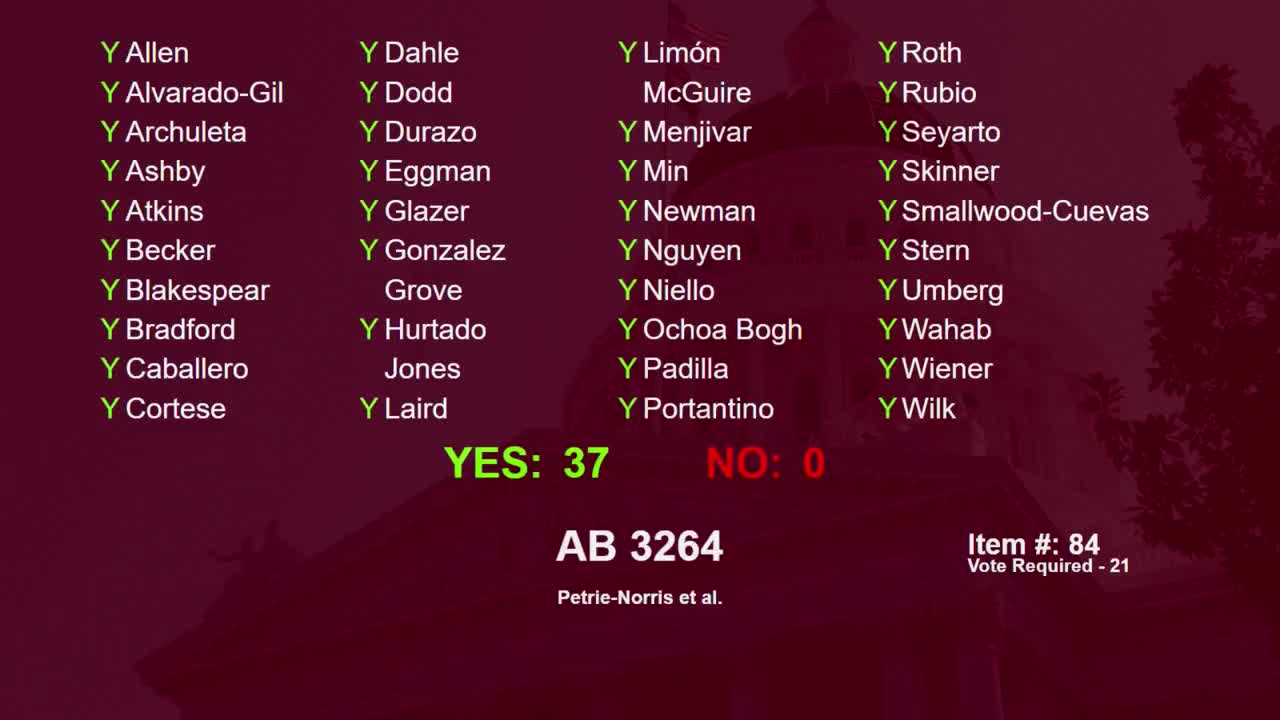 1MIN
Senate Floor
 2MIN
Assembly Floor
 6MIN
Assembly Standing Committee on Judiciary
 7MIN
Assembly Standing Committee on Labor and Employment
 4MIN
Senate Floor
 8MIN
Senate Standing Committee on Judiciary
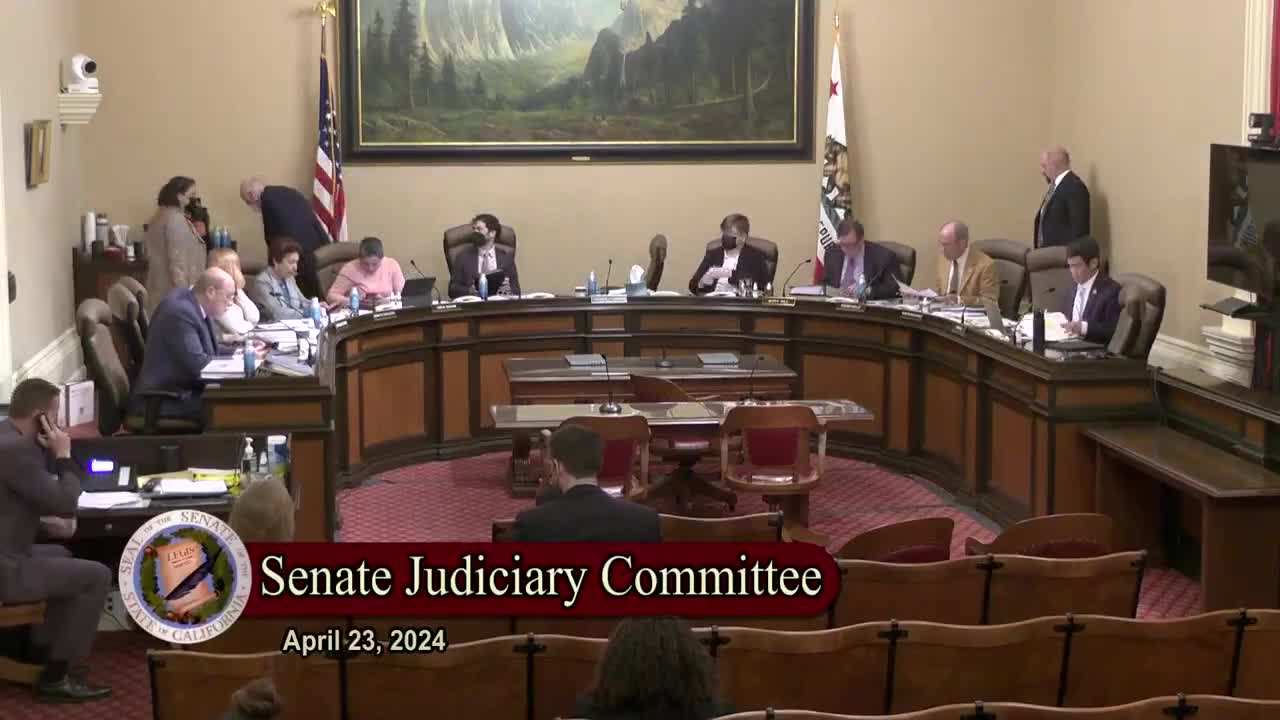 55SEC
Senate Standing Committee on Judiciary
 10MIN
Senate Standing Committee on Labor, Public Employment and Retirement
Bill Author

Bill Co-Author(s):