SB 1309: Lithium Battery Production Council.
- Session Year: 2023-2024
- House: Senate
- Latest Version Date: 2024-02-15
Current Status:
Failed
(2024-05-16: May 16 hearing: Held in committee and under submission.)
Introduced
In Committee
First Chamber
In Committee
Second Chamber
Enacted
Existing law establishes the State Energy Resources Conservation and Development Commission with various responsibilities with respect to developing and implementing the states energy policies.
This bill would require the commission, in consultation with other appropriate state agencies, including the Governors Office of Business and Economic Development and the California Workforce Development Board, to establish a Lithium Battery Production Council to conduct an economic analysis on workforce development needs, infrastructure needs, housing needs, and sewage and wastewater treatment for lithium battery production. The bill would require the council to develop a strategic plan to address the needs identified by the economic analysis. The bill would require the council to submit a report to the Legislature, on or before March 1, 2025, with the results of the economic analysis and the strategic plan.
(a)The commission, in consultation with other appropriate state agencies, including, but not limited to, the Governors Office of Business and Economic Development and the California Workforce Development Board, shall establish a Lithium Battery Production Council to conduct an economic analysis on workforce development needs, infrastructure needs, sewage and wastewater treatment, and housing needs for lithium battery production.
(b)The council shall develop a strategic plan to address the needs identified by the economic analysis conducted pursuant to subdivision (a).
(c)The council shall submit a report to the Legislature, on or before March 1, 2025, with the results of the economic analysis and the strategic plan developed pursuant to subdivision (b).
(d)(1)A report to be submitted pursuant to subdivision (c) shall be submitted in compliance with Section 9795 of the Government Code.
(2)Pursuant to Section 10231.5 of the Government Code, this section is repealed on January 1, 2030.
|
Date
|
Status
|
|---|---|
| May 16, 2024 | May 16 hearing: Held in committee and under submission. |
| May 10, 2024 | Set for hearing May 16. |
| Apr 8, 2024 | April 8 hearing: Placed on APPR suspense file. |
| Mar 28, 2024 | Set for hearing April 8. |
| Mar 19, 2024 | From committee: Do pass and re-refer to Com. on APPR. (Ayes 15. Noes 1. Page 3349.) (March 19). Re-referred to Com. on APPR. |
| Mar 6, 2024 | Set for hearing March 19. |
| Feb 29, 2024 | Referred to Com. on E., U. & C. |
| Feb 16, 2024 | From printer. May be acted upon on or after March 17. |
| Feb 15, 2024 | Introduced. Read first time. To Com. on RLS. for assignment. To print. |
|
Date
|
Description
|
Location
|
Votes
|
|
|---|---|---|---|---|
| Apr 8, 2024 | Placed on suspense file | Senate Standing Committee on Appropriations |
Passed |
|
| Mar 19, 2024 | Do pass, but first be re-referred to the Committee on [Appropriations] | Senate Standing Committee on Energy, Utilities and Communications |
Passed |
This list shows positions taken on this bill by organizations on the date displayed, which is linked to the original source.
Positions by individuals are not included.
SENATE COMMITTEE ON APPROPRIATIONS
Senator Anna Caballero, Chair
2023 - 2024 Regular Session
SB 1309 (Padilla) - Lithium Battery Production Council
Version: February 15, 2024 | Policy Vote: E., U. & C. 15 - 1 |
Urgency: No | Mandate: No |
Hearing Date: April 8, 2024 | Consultant: Ashley Ames |
Bill Summary:
This bill would require the California Energy Commission (CEC) to establish a Lithium Battery Production Council to analyze economic and infrastructure needs for lithium battery production.
Fiscal Impact:
- CEC estimates ongoing costs of about $250,000 annually (Energy Resource Programs Account [ERPA] or General Fund) and one position to establish and support the activities of the Council. In addition, CEC estimates one-time costs of $500,000 (ERPA or General Fund) for technical support contracts to conduct some of the economic analysis as required by the bill. CEC notes that the bill has no reference to reimbursements; therefore, reimbursement of time or costs for the Council members is not included in this estimate. Staff note that ERPA, the CEC’s main funding source, has a significant structural deficit and may not be the most appropriate funding source to support the implementation of this bill.
- Unknown but likely significant one-time costs, possibly in the high millions of dollars (General Fund), for the Governor’s Office of Business and Economic Development and the California Workforce Development Board to conduct economic analysis and consult with CEC and the Council.
Background:
While zero-emission vehicles (ZEVs) have become one of California’s largest exports, the manufacture of electric vehicles (EVs) and other electronics that use lithium-ion batteries still relies on raw materials and components sourced from foreign countries. According to the United States Geological Survey 2023 Mineral Commodities, 80 percent of the global market for lithium is associated with battery components, and Australia, Argentina, Chile, and China are the largest global producers of lithium. To address rising battery consumption and demand for lithium, many countries are developing lithium resources. California’s Salton Sea is the location of multiple geothermal brines, which can be a rich source of lithium. Similar brines are currently the largest sources of lithium in the world. The Salton Sea’s potential for lithium extraction has led some to refer to it as “Lithium Valley.”
Like all races for mineral extraction, the development of lithium resources is fraught with concerns about exploitative labor and environmental practices. California has sought options to expand in-state lithium extraction without repeating these practices. In recent years, the Legislature has passed several bills aimed at balancing the development of Lithium Valley with the development of high-road jobs and environmental investments that address air and water quality concerns in the Salton Sea community.
Proposed Law:
This bill would require the CEC to establish a Lithium Battery Production Council. Specifically, this bill would:
- Require the CEC to establish a Lithium Battery Production Council to conduct economic, workforce and infrastructures analyses for lithium battery production.
- Require the council to develop a strategic plan for lithium battery production needs and submit a report to the Legislature on this strategic plan by March 1, 2025.
- Sunset the bill on January 1, 2030.
Related Legislation:
AB 1569 (Garcia, 2023) would have established a Lithium Valley Office of Development at the CEC, subject to an appropriation. The bill was held on Suspense in this committee.
AB 2851 (Garcia, 2022) would have established a Lithium Valley Office of Development at the California Natural Resources Agency. The bill was held in the Assembly Committee on Appropriations.
AB 2929 (Garcia, 2022) would have required the Legislative Analyst’s Office to annually report on the health, environmental, and economic impacts and benefits of producing lithium from geothermal brines located in Lithium Valley in Imperial County in the area commonly referred to as Lithium Valley. The bill was held on Suspense in the Assembly Committee on Appropriations.
AB 589 (Hueso, Chapter 732, Statutes of 2021) expanded the types of projects eligible for funding from the CEC’s Clean Transportation Program (CTP) to include projects, including workforce development program, to develop in-state production of raw materials and the manufacturing supply chain for ZEV components. The bill also required the CEC to consult with certain workforce development and training institutions during the creation of the CTP investment plan.
AB 1657 (Garcia, Chapter 271, Statutes of 2020) established a Blue Ribbon Commission on Lithium Extraction at the CEC to review, investigate and analyze specified issues relating to lithium extraction and use in California and report to the Legislature on its findings and recommendations.
Staff Comments:
The main funding source supporting CEC is ERPA, which was established to provide funds for ongoing energy programs and energy as established to provide funds for ongoing energy programs and energy projects, including the operations of the CEC. ERPA is supported by a statutory surcharge on electricity consumption. According to the CEC, as building and appliance energy efficiency and the increase of behind-the-meter solar produce customer savings and flatten statewide electricity consumption, ERPA revenues have decreased, and the costs have been borne by fewer and fewer customers. Even as revenues drop, ERPA is repeatedly tapped to support new programs and must cover increases in employee compensation and benefit contributions.
The surcharge generated approximately $69.1 million in 2020-21 and currently costs the average household about $2.13 annually (larger customers pay the same rate but pay more based on volume). Despite CEC efforts to reduce ERPA spending by more than $37 million over four years, a structural deficit remains and ERPA’s fund balance is projected to be in the red in 2024-25.
As part of the 2022-23 budget, the Legislature passed trailer bill language that raised the statutory cap on the ERPA surcharge, tied the statutory cap to the Consumer Price Index, and extended the surcharge to behind-the-meter electricity consumption. Using ERPA to fund implementation of this bill would increase ERPA expenditures thereby exacerbating the structural deficit. A better funding source may need to be identified.
Staff note this bill is one of several recent measures aimed at establishing a body within state agencies to support analysis and outreach regarding economic development associated with the creation of a Lithium Valley in California. While the Blue Ribbon Commission on Lithium Extraction has recommended that more analysis is needed on economic resources that can be deployed to support the development of in-state battery supply chains, some existing local and state agencies are already convening stakeholders and making recommendations to balance environmental and economic development regulations.
-- END --
SENATE COMMITTEE ON ENERGY, UTILITIES AND COMMUNICATIONS
Senator Steven Bradford, Chair
2023 - 2024 Regular
Bill No: Hearing Date: 3/19/2024
Author: | |||
Version: | Introduced | ||
Urgency: | Fiscal: | ||
Consultant: | |||
SUBJECT:
DIGEST: This bill would require the California Energy Commission (CEC) to establish a Lithium Battery Production Council to analyze economic and infrastructure needs for lithium battery production.
ANALYSIS:
Existing law:
- Establishes the Geothermal Resources Development Account (GRDA), which is administered by the CEC to make grants and loans for the purposes of developing geothermal resources, including, but not limited to, the recovery of lithium and other beneficial minerals from geothermal brines in a disadvantaged community that provides local employment opportunities. (Public Resources Code §3820 et. seq.)
- Requires the CEC to establish the Blue Ribbon Commission on Lithium Extraction. Existing law requires the Blue Ribbon Commission to review, investigate, and analyze certain actions related to lithium extraction and use, including the economic and environmental benefits of lithium extraction and use and opportunities for certain financial incentives to support lithium extraction from geothermal brines. Existing law requires the Blue Ribbon Commission to submit a report on its findings and recommendations to the Legislature by October 1, 2022. (Public Resources Code §25232)
This bill:
- Requires the CEC to establish a Lithium Battery Production Council to conduct economic, workforce and infrastructures analyses for lithium battery production.
- Requires the council to develop a strategic plan for lithium battery production needs and submit a report to the Legislature on this strategic plan by March 1, 2025.
- Sunsets the bill on January 1, 2030.
Background
Lithium Valley and the new gold rush for battery components. While zero-emission vehicles (ZEVs) have become one of California’s largest exports, the manufacture of electric vehicles (EVs) and other electronics that use lithium-ion batteries still relies on raw materials and components sourced from foreign countries. According to the United States Geological Survey 2023 Mineral Commodities, 80 percent of the global market for lithium is associated with battery components, and Australia, Argentina, Chile, and China are the largest global producers of lithium. To address rising battery consumption and demand for lithium, many countries are developing lithium resources. California’s Salton Sea is the location of multiple geothermal brines, which can be a rich source of lithium. Similar brines are currently the largest sources of lithium in the world. The Salton Sea’s potential for lithium extraction has led some to refer to it as “Lithium Valley.”
With great power, comes great responsibility. Like all races for mineral extraction, the development of lithium resources is fraught with concerns about exploitative labor and environmental practices. California has sought options to expand in-state lithium extraction without repeating these practices. In recent years, the Legislature has passed several bills aimed at balancing the development of Lithium Valley with the development of high-road jobs and environmental investments that address air and water quality concerns in the Salton Sea community.
Is a new entity needed for economic analyses for in-state battery production? This bill is one of several recent measures aimed at establishing a body within state agencies to support analysis and outreach regarding economic development associated with the creation of a Lithium Valley in California. While the Blue Ribbon Commission on Lithium Extraction has recommended that more analysis is needed on economic resources that can be deployed to support the development of in-state battery supply chains, some existing local and state agencies are already convening stakeholders and making recommendations to balance environmental and economic development regulations.
Prior/Related Legislation
AB 1569 (Garcia, 2023) would have established a Lithium Valley Office of Development at the CEC, subject to an appropriation. The bill was held on the Senate Committee on Appropriations.
AB 2851 (Garcia, 2022) would have established a Lithium Valley Office of Development at the California Natural Resources Agency. The bill was held in the Assembly Committee on Appropriations.
AB 2929 (Garcia, 2022) would have required the Legislative Analyst’s Office to annually report on the health, environmental, and economic impacts and benefits of producing lithium from geothermal brines located in Lithium Valley in Imperial County in the area commonly referred to as Lithium Valley. The bill was held on the Assembly Committee on Appropriations.
AB 589 (Hueso, Chapter 732, Statutes of 2021) expanded the types of projects eligible for funding from the CEC’s Clean Transportation Program (CTP) to include projects, including workforce development program, to develop in-state production of raw materials and the manufacturing supply chain for ZEV components. The bill also required the CEC to consult with certain workforce development and training institutions during the creation of the CTP investment plan.
AB 1657 (Garcia, Chapter 271, Statutes of 2020) established a Blue Ribbon Commission on Lithium Extraction at the CEC to review, investigate and analyze specified issues relating to lithium extraction and use in California and report to the Legislature on its findings and recommendations.
FISCAL EFFECT: Appropriation: Fiscal Com.: Local:
SUPPORT:
None received
OPPOSITION:
None received
ARGUMENTS IN SUPPORT: According to the Author:
The communities in the so-called Lithium Valley are some of California’s poorest, with limited public infrastructure and the state’s highest unemployment rate. Time and time again, they have been made promises of economic growth that have never come true. Now, the discovery of this resource stands to put this region at the front of a global market. We need to ensure that these communities actually enjoy the benefits of this critically important emerging industry. Given the area’s lack of bridges, roads, housing and sewage treatment capacity, California must develop and deploy a comprehensive strategy to develop the lithium and lithium battery manufacturing space. The growth that this development will bring has the potential to uplift these communities with investment, infrastructure, jobs, and environmental and public health improvements rarely seen in the state.
-- END --
Discussed in Hearing
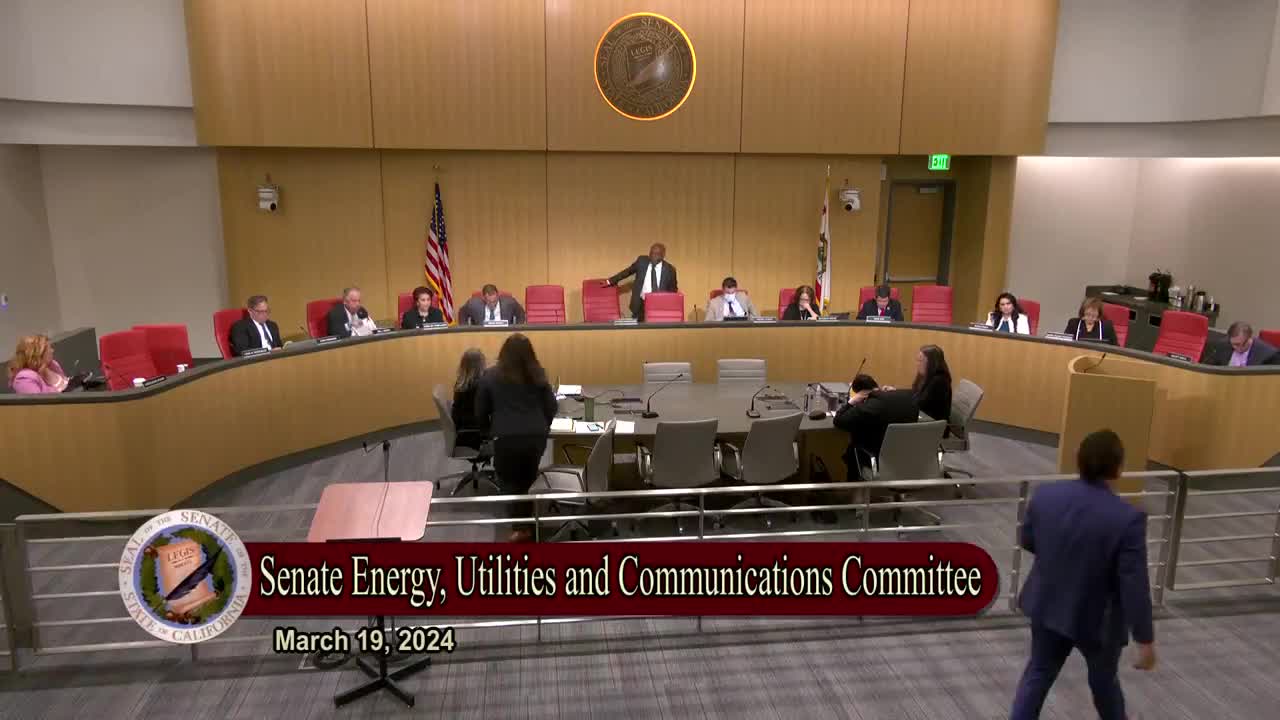 22MIN
Senate Standing Committee on Energy, Utilities and Communications
Bill Author

Bill Co-Author(s):
