SB 1316: School employees: state special school personnel: salaries.
- Session Year: 2023-2024
- House: Senate
- Latest Version Date: 2024-02-16
Current Status:
Failed
(2024-05-16: May 16 hearing: Held in committee and under submission.)
Introduced
In Committee
First Chamber
In Committee
Second Chamber
Enacted
Existing law establishes the California School for the Deaf, Northern California, the California School for the Deaf, Southern California, known collectively as the California School for the Deaf, and the California School for the Blind, as the state special schools, under the administration of the State Department of Education. Existing law requires the Department of Human Resources to consider making salaries for teachers, specialists, and administrators of the state special schools competitive with the salaries of similarly qualified school teachers, specialists, and administrators who are employed by the encompassing school districts.
This bill would instead require the department to establish salaries for school personnel, as defined, of the state special schools that are comparable with the salaries of similarly qualified school personnel who are employed by the encompassing school districts.
(a)The Department of Human Resources shall consider making establish salaries for teachers, specialists, and administrators school personnel of the California School for the Deaf competitive that are comparable with the salaries of similarly qualified school teachers, specialists, and administrators personnel who are employed by the encompassing school districts.
(b)For purposes of this section, teachers, teacher specialists, and administrators mean those individuals who hold the appropriate teaching, service, or teaching and administrative credential, as appropriate, as issued by the Commission on Teacher Credentialing, as determined by the employing state agency. school personnel means those individuals who are employed to perform services at the school, including, but not limited to, teachers, specialists, administrators, counselors, substitute teachers, support liaisons, custodians, and groundskeepers.
SEC. 2.Section 59104 of the Education Code is amended to read:59104.(a)The Department of Human Resources shall consider making establish salaries for teachers, specialists, and administrators school personnel of the California School for the Blind competitive that are comparable with the salaries of similarly qualified school teachers, specialists, and administrators personnel who are employed by the encompassing school districts.
(b)For purposes of this section, teachers, teacher specialists, and administrators mean those individuals who hold the appropriate teaching, service, or teaching and administrative credential, as appropriate, as issued by the Commission on Teacher Credentialing, as determined by the employing state agency. school personnel means those individuals who are employed to perform services at the school, including, but not limited to, teachers, specialists, administrators, counselors, substitute teachers, support liaisons, custodians, and groundskeepers.
|
Date
|
Status
|
|---|---|
| May 16, 2024 | May 16 hearing: Held in committee and under submission. |
| May 10, 2024 | Set for hearing May 16. |
| Apr 29, 2024 | April 29 hearing: Placed on APPR suspense file. |
| Apr 22, 2024 | Set for hearing April 29. |
| Apr 17, 2024 | From committee: Do pass and re-refer to Com. on APPR. (Ayes 5. Noes 0. Page 3662.) (April 17). Re-referred to Com. on APPR. |
| Apr 5, 2024 | Set for hearing April 17. |
| Feb 29, 2024 | Referred to Com. on L., P.E. & R. |
| Feb 20, 2024 | From printer. May be acted upon on or after March 18. |
| Feb 16, 2024 | Introduced. Read first time. To Com. on RLS. for assignment. To print. |
|
Date
|
Description
|
Location
|
Votes
|
|
|---|---|---|---|---|
| Apr 29, 2024 | Placed on suspense file | Senate Standing Committee on Appropriations |
Passed |
|
| Apr 17, 2024 | Do pass, but first be re-referred to the Committee on [Appropriations] | Senate Standing Committee on Labor, Public Employment and Retirement |
Passed |
This list shows positions taken on this bill by organizations on the date displayed, which is linked to the original source.
Positions by individuals are not included.
|
Organization
|
Position
|
Date
|
|---|---|---|
| Alameda County Democratic Central Committee | ** Support | |
| Service Employees International Union, Local 1000 | ** Support | |
| State Superintendent of Public Instruction Tony Thurmond | ** Support |
SENATE COMMITTEE ON APPROPRIATIONS
Senator Anna Caballero, Chair
2023 - 2024 Regular Session
SB 1316 (Wahab) - School employees: state special school personnel: salaries
Version: February 16, 2024 | Policy Vote: L., P.E. & R. 5 - 0 |
Urgency: No | Mandate: No |
Hearing Date: April 29, 2024 | Consultant: Robert Ingenito |
Bill Summary:
SB 1316 would require the California Department of Human Resources (CalHR) to establish salaries for specified personnel of the California School for the Deaf (CSD) and the California School for the Blind (CSB) that are comparable with the salaries of similarly qualified school personnel who are employed by encompassing school districts
Fiscal Impact:
- CalHR indicates that its administrative costs resulting from the bill are still being determined. However, Staff estimates that the Department would incur one-time costs, likely in the hundreds of thousands of dollars, to identify the requisite number of schools and perform the comparative work (General Fund).
- This bill would result in unknown costs to establish salaries at CSD and CSB that are competitive with those in surrounding school districts. Staff estimates that these costs would be, at a minimum, in the millions of dollars annually (General Fund, see Staff Comments).
Background:
California operates three State Special Schools (SSS): the California School for the Deaf, Fremont (CSDF); the California School for the Deaf, Riverside (CSDR); and the California School for the Blind (CSB), which is also located in Fremont. CDE also operates three Diagnostic Centers, located in Fremont, Fresno, and Los Angeles. CDE administers the SSS and Diagnostic Centers, all of which are funded by the State.
CSDF was established in 1860 and CDFR opened in 1953. The schools provide instructional programs to deaf students in California and serve as resources to educational and community service agencies. Students are enrolled in either a day school or a residential program, depending upon their individual needs and their residences. CSB was founded in 1860 as part of the same institution as CSD but became a separate school in 1922. CSB provides educational programs for blind, visually impaired, and deaf-blind students from five through twenty-two years of age in residential as well as day school programs. CSB’s long-term goal for each student is to preparation them for adult life in their home community. CSB also provides local education agencies with a variety of staff development programs to assist with local efforts in the areas of assistive technology and instruction for blind students.
Proposed Law:
This bill would do the following:
- Require CalHR to establish salaries for the CSD and CSB school personnel that are comparable with the salaries of similarly qualified school personnel employed by the encompassing school districts.
- Define “school personnel” to mean those individuals who are employed to perform services at the school, including, but not limited to, teachers, specialists, administrators, counselors, substitute teachers, support liaisons, custodians, and groundskeepers.
Related Legislation:
AB 1051 (Cervantes, 2023) would have required, commencing with the 2024-25 fiscal year, that the amount apportioned to the SSS for categorical programs as of the 2012-13 fiscal year be annually adjusted by a cost-of-living (COLA) adjustment. The bill also would have declared that it is the intent of the Legislature to provide an annual COLA to the SSS and Diagnostic Centers. The bill was held under submission on the Suspense File of the Assembly Appropriations Committee.
Staff Comments:
As noted previously, the SSS receive funding from the State through an annual budget appropriation; consequently, SSS employees are state employees, not local school district employees. Pursuant to the Dills Act, state employee compensation and working conditions are subject to collective bargaining between CalHR and the employees’ unions.
Also as noted previously, this bill would result in increased state costs for personnel at CSDF, CSDR and CSB. The magnitude of the increase would depend on CalHR’s calculations that would be needed to achieve parity with nearby school districts. The California Wage and Salary Supplement, published annually by the Department of Finance, indicates that in 2023-24, the number of positions at the three schools combined totaled 865, with total wage and salary costs of $64 million. As an order of magnitude, raising the salaries of all 865 positions by 25 percent would result in an increased annual expenditure of $16 million.
To develop a more refined estimate, CalHR would need to (1) identify which nearby school districts should be included in the salary comparison, and (2) determine which positions in those nearby school districts perform work comparable to the positions at CSDF, CSDR and CSB. Performing this workload would result in one-time costs to the Department, potentially in the hundreds of thousands of dollars.
-- END --
SENATE COMMITTEE ON LABOR, PUBLIC EMPLOYMENT AND RETIREMENT
Senator Lola Smallwood-Cuevas, Chair
2023 - 2024 Regular
Bill No: SB 1316 Hearing Date: April 17, 2024
Author: | Wahab | ||
Version: | February 16, 2024 | ||
Urgency: | No | Fiscal: | Yes |
Consultant: | Glenn Miles | ||
SUBJECT: School employees: state special school personnel: salaries
KEY ISSUE
This bill would require the California Department of Human Resources (CalHR) to establish salaries for specified personnel of the California School for the Deaf (CSD) and the California School for the Blind (CSB) that are comparable with the salaries of similarly qualified school personnel who are employed by their encompassing school districts.
ANALYSIS
Existing law:
- Declares that there are two state schools for the deaf, known and designated as the California School for the Deaf, Northern California, and the California School for the Deaf, Southern California. The term “California School for the Deaf” (CSD) shall refer to both schools unless the context otherwise requires. (Education Code (EC) § 59000)
- Declares that there is one state school for the blind, known and designated as the California School for the Blind (CSB). (EC § 59100)
- Provides that the CSD and the CSB are part of the public school system of the state except that they derive no revenue from the State School Fund, and have for their object, respectively, the education of the deaf and of the blind pursuant to their particular educational needs, as specified. (EC § 59001, § 59101)
- Places the CSD and the CSB under the administration of the State Department of Education (CDE). (EC § 59002, § 59102)
- Requires CDE to appoint CSD’s and CSB’s superintendents and other officers and employees and to fix the compensation of their officers, teachers, and employees. (EC § 59003, § 59103)
- Requires CalHR to consider making salaries for CSD and CSB teachers, specialists, and administrators competitive with the salaries of similarly qualified school teachers, specialists, and administrators who are employed by the encompassing school districts. (EC § 59008 (a), § 59104 (a))
- Defines “teachers,” “teacher specialists,” and “administrators” to mean those individuals who hold the appropriate teaching, service, or teaching and administrative credential, as appropriate, as issued by the Commission on Teacher Credentialing, as determined by the employing state agency. (EC § 59008 (b), § 59104 (b)
- Establishes the Ralph C. Dills Act, which requires the state to collectively bargain with the exclusive representatives of state employees’ regarding wages and working conditions, and to define negotiated agreements in memoranda of understanding (MOUs). (Government Code (GC) § 3512 et seq.)
- Designates CalHR as the Governor’s official representative in all matters related to collective bargaining with state employees. (GC § 19815.4 (g))
This bill:
- Requires CalHR to establish salaries for the CSD and CSB school personnel that are comparable with the salaries of similarly qualified school personnel employed by the encompassing school districts.
- Defines “school personnel” to mean those individuals who are employed to perform services at the school, including, but not limited to, teachers, specialists, administrators, counselors, substitute teachers, support liaisons, custodians, and groundskeepers.
COMMENTS
1. Need for this bill?
According to the author:
“Existing law only requires the Department of Human Resources to consider making salaries for teachers, specialists, and administrators of state special schools competitive with those in encompassing school districts. This allows for discrepancies in compensation levels and has led to unequal pay for teachers, specialists, and administrators of state special schools.”
Background
California operates three State Special Schools (SSS): the California School for the Deaf, Fremont (CSDF); the California School for the Deaf, Riverside (CSDR); and the California School for the Blind (CSB), which is also located in Fremont. The CDE also operates three Diagnostic Centers, located in Fremont, Fresno, and Los Angeles. CDE administer the SSS and Diagnostic Centers, all of which the state funds by an appropriation in the annual budget act.
CSDF was established in 1860 and CDFR opened in 1953. The schools provide instructional programs to deaf students in California and serve as resources to educational and community service agencies. Students are enrolled in either a day school or a residential program, depending upon their individual needs and their residences.
CSB was founded in 1860 as part of the same institution as CSD but became a separate school in 1922. CSB provides educational programs for blind, visually impaired, and deaf-blind students from five through twenty-two years of age in residential as well as day school programs. CSB’s long-term goal for each student is to preparation them for adult life in their home community. CSB also provides local education agencies with a variety of staff development programs to assist with local efforts in the areas of assistive technology and instruction for blind students.
Like other California public schools, the SSS experienced significant enrollment declines due to the COVID-19 pandemic. Additionally, CSDF representatives state that CSDF faces a particularly severe employee recruitment and retention crisis because school personnel are either transferring to the CSDR (where the cost of living is more affordable) or leaving for positions in surrounding Bay Area school districts that pay substantially more than CSDF. Therefore, unless the state provides some kind of relief, CSDF faces a serious risk of closing. This bill seeks to address the problem by requiring the state to compensate all SSS personnel at a level that is comparable to the pay scales of their nearby, local school districts.
State Employees and Collective Bargaining
The SSS receive funding from the state through an annual budget appropriation and SSS employees are state employees, not local school district employees. Pursuant to the Dills Act, state employee compensation and working conditions are subject to collective bargaining between CalHR and the employees’ unions. Therefore, proposed requests for the Legislature to impose special statutory conditions on employee compensation interfere with important policy goals underlying the public sector collective bargaining system and should instead be resolved through bargaining.
Nevertheless, the SSS’ unique circumstances and their rich historical and cultural importance may justify legislative action to stabilize these state landmarks. Even so, the bill’s supporters will likely face significant challenges in getting the Administration to approve statutory compensation requirements that CalHR has until now declined to implement through the collective bargaining process.
2. Proponent Arguments
According to Service Employees International Union, Local 1000:
“Currently, California School for the Deaf educators in Fremont (CSDF) make 25% less in salary compared to other educators in nearby districts. For example, new teachers at the California School for the Deaf-Fremont are paid $24,160 less than their counterparts in the neighboring school district. This further exacerbates wage discrepancies amongst individuals doing the same vital work to serve the same communities. Despite desperately needing high-quality educators, CSDF struggles with recruitment and retention and cannot compete with neighboring districts. CSDF has been an incredible lifeline for generations of students and families. The school is a safe space for learning, moral guidance, and developing social skills for one of the most underserved communities in our state.”
According to the California Superintendent of Public Instruction:
“Senate Bill 1316 addresses pay disparity among employees at California’s oldest schools for individuals with sensory impairments, the California Schools for the Deaf and the California School for the Blind. These schools’ staff members currently receive compensation rates significantly lower than those in publicly funded schools in surrounding districts. This bill will help ensure that all employees at these schools receive pay comparable to staff members in their respective school districts. Given the high cost of living throughout the state, this compensation adjustment is crucial for these institutions to attract and retain qualified personnel.”
3. Opponent Arguments:
None received.
4. Prior Legislation:
AB 1051 (Cervantes 2023) would have required, commencing with the 2024-25 fiscal year, that the amount apportioned to the State Special Schools for the Deaf and the Blind (SSS) for categorical programs as of the 2012-13 fiscal year be annually adjusted by a cost-of-living (COLA) adjustment. The bill also would have declared that it is the intent of the Legislature to provide an annual COLA to the SSS and Diagnostic Centers. The bill died in the Assembly Appropriations Committee.
SUPPORT
Service Employees International Union, Local 1000 (co-sponsor)
State Superintendent of Public Instruction Tony Thurmond (co-sponsor)
Alameda County Democratic Central Committee
OPPOSITION
None received.
-- END --
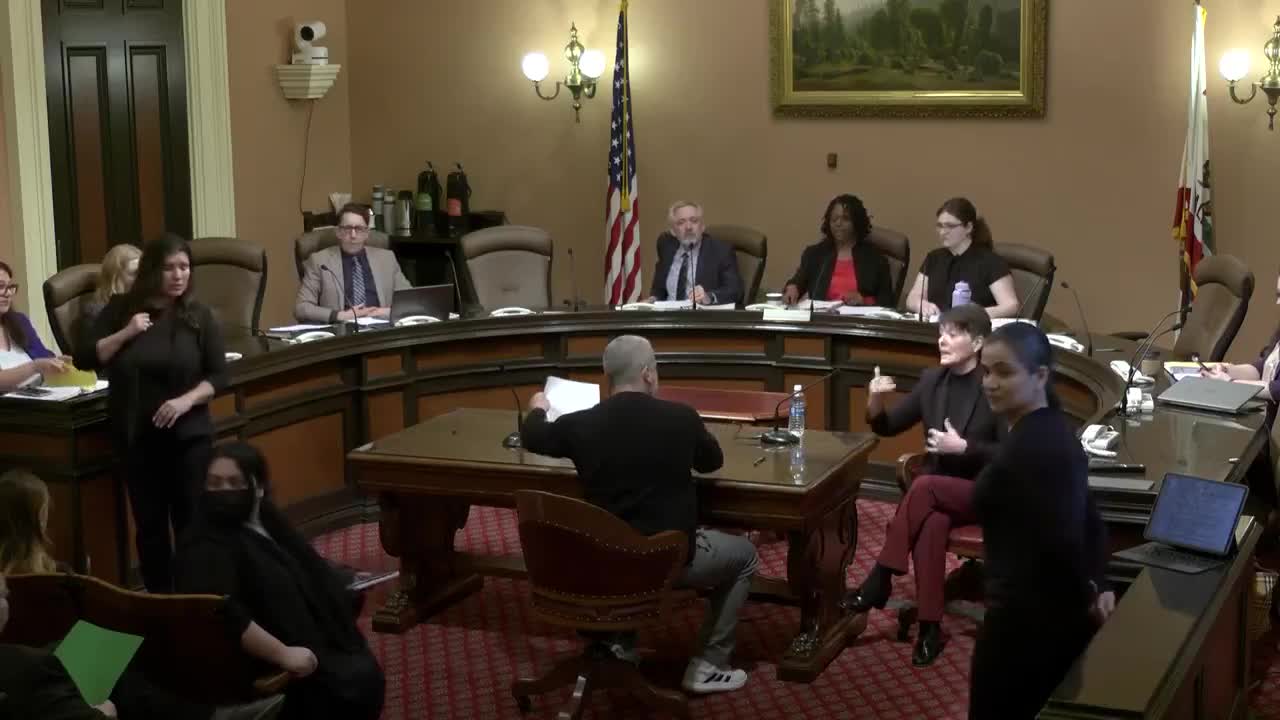
Discussed in Hearing
 16MIN
Senate Standing Committee on Labor, Public Employment and Retirement
Bill Author