SB 1365: Pharmacy technicians: supervision.
- Session Year: 2023-2024
- House: Senate
- Latest Version Date: 2024-04-24
Current Status:
Failed
(2024-05-16: May 16 hearing: Held in committee and under submission.)
Introduced
In Committee
First Chamber
In Committee
Second Chamber
Enacted
Existing law, the Pharmacy Law, establishes the California State Board of Pharmacy and sets forth its powers and duties relating to the licensing and regulation of pharmacists, pharmacy technicians, and pharmacies.
Existing law authorizes a pharmacy technician to perform packaging, manipulative, repetitive, or other nondiscretionary tasks only while assisting, and while under the direct supervision and control of, a pharmacist. Existing law prohibits a pharmacy with only one pharmacist from having more than one pharmacy technician performing those tasks and prohibits the ratio of pharmacy technicians performing those tasks for any additional pharmacist from exceeding a 2 to 1 ratio, except as specified.
This bill would instead authorize a pharmacy with only one pharmacist to have up to 6 4 pharmacy technicians performing those tasks and would prohibit the ratio of pharmacy technicians performing those tasks for any additional pharmacist from exceeding a 6 4 to 1 ratio.
Existing law, the Pharmacy Law, establishes the California State Board of Pharmacy and sets forth its powers and duties relating to the licensing and regulation of pharmacists, pharmacy technicians, and pharmacies.
Existing law authorizes a pharmacy technician to perform packaging, manipulative, repetitive, or other nondiscretionary tasks only while assisting, and while under the direct supervision and control of, a pharmacist. Existing law prohibits a pharmacy with only one pharmacist from having more than one pharmacy technician performing those tasks and prohibits the ratio of pharmacy technicians performing those tasks for any additional pharmacist from exceeding a 2 to 1 ratio, except as specified.
This bill would instead authorize a pharmacy with only one pharmacist to have up to 6 pharmacy technicians performing those tasks and would prohibit the ratio of pharmacy technicians performing those tasks for any additional pharmacist from exceeding a 6 to 1 ratio.
(a)A pharmacy technician may perform packaging, manipulative, repetitive, or other nondiscretionary tasks only while assisting, and while under the direct supervision and control of, a pharmacist. The pharmacist shall be responsible for the duties performed under their supervision by a technician.
(b)(1)In addition to the tasks specified in subdivision (a) a pharmacy technician may, under the direct supervision and control of a pharmacist, prepare and administer influenza and COVID-19 vaccines via injection or intranasally, prepare and administer epinephrine, perform specimen collection for tests that are classified as waived under CLIA, receive prescription transfers, and accept clarification on prescriptions under the following conditions:
(A)The pharmacy has scheduled another pharmacy technician to assist the pharmacist by performing the tasks provided in subdivision (a).
(B)The pharmacy technician is certified pursuant to paragraph (4) of subdivision (a) of Section 4202 and maintains that certification.
(C)The pharmacy technician has successfully completed at least six hours of practical training approved by the Accreditation Council for Pharmacy Education and includes hands-on injection technique, the recognition and treatment of emergency reactions to vaccines, and an assessment of the pharmacy technicians injection technique.
(D)The pharmacy technician is certified in basic life support.
(2)CLIA means the federal Clinical Laboratory Improvement Amendments of 1988 (42 U.S.C. Sec. 263a; Public Law 100-578).
(c)This section does not authorize the performance of any tasks specified in subdivisions (a) and (b) by a pharmacy technician without a pharmacist on duty.
(d)This section does not authorize a pharmacy technician to perform any act requiring the exercise of professional judgment by a pharmacist.
(e)The board shall adopt regulations to specify tasks pursuant to subdivision (a) that a pharmacy technician may perform under the supervision of a pharmacist. Any pharmacy that employs a pharmacy technician shall do so in conformity with the regulations adopted by the board.
(f)A person shall not act as a pharmacy technician without first being licensed by the board as a pharmacy technician.
(g)(1)A pharmacy with only one pharmacist shall have no more than six four pharmacy technicians performing the tasks specified in subdivision (a). A pharmacy with only one pharmacist shall have no more than one pharmacy technician performing the tasks specified in subdivision (b). If a pharmacy technician is performing the tasks specified in subdivision (b), a second pharmacy technician shall be assisting a pharmacist with performing tasks specified in subdivision (a). The ratio of pharmacy technicians performing the tasks specified in subdivision (a) to any additional pharmacist shall not exceed 6:1, 4:1, except that this ratio shall not apply to personnel performing clerical functions pursuant to Section 4116 or 4117. This ratio is applicable to all practice settings, except for an inpatient of a licensed health facility, a patient of a licensed home health agency, as specified in paragraph (2), an inmate of a correctional facility of the Department of Corrections and Rehabilitation, and for a person receiving treatment in a facility operated by the State Department of State Hospitals, the State Department of Developmental Services, or the Department of Veterans Affairs.
(2)The board may adopt regulations establishing the ratio of pharmacy technicians performing the tasks specified in subdivision (a) to pharmacists applicable to the filling of prescriptions of an inpatient of a licensed health facility and for a patient of a licensed home health agency. Any ratio established by the board pursuant to this subdivision shall allow, at a minimum, at least one pharmacy technician for a single pharmacist in a pharmacy and two pharmacy technicians for each additional pharmacist, except that this ratio shall not apply to personnel performing clerical functions pursuant to Section 4116 or 4117.
(3)A pharmacist scheduled to supervise a second pharmacy technician may refuse to supervise a second pharmacy technician if the pharmacist determines, in the exercise of their professional judgment, that permitting the second pharmacy technician to be on duty would interfere with the effective performance of the pharmacists responsibilities under this chapter. A pharmacist assigned to supervise a second pharmacy technician shall notify the pharmacist-in-charge in writing of their determination, specifying the circumstances of concern with respect to the pharmacy or the pharmacy technician that have led to the determination, within a reasonable period, but not to exceed 24 hours, after the posting of the relevant schedule. An entity employing a pharmacist shall not discharge, discipline, or otherwise discriminate against any pharmacist in the terms and conditions of employment for exercising or attempting to exercise in good faith the right established pursuant to this paragraph.
(h)Notwithstanding subdivisions (a) to (c), inclusive, the board shall by regulation establish conditions to permit the temporary absence of a pharmacist for breaks and lunch periods pursuant to Section 512 of the Labor Code and the orders of the Industrial Welfare Commission without closing the pharmacy. During these temporary absences, a pharmacy technician may, at the discretion of the pharmacist, remain in the pharmacy but may only perform nondiscretionary tasks. The pharmacist shall be responsible for a pharmacy technician and shall review any task performed by a pharmacy technician during the pharmacists temporary absence. This subdivision shall not be construed to authorize a pharmacist to supervise pharmacy technicians in greater ratios than those described in subdivision (g).
(i)The pharmacist on duty shall be directly responsible for the conduct of a pharmacy technician supervised by that pharmacist.
(j)In a health care facility licensed under subdivision (a) of Section 1250 of the Health and Safety Code, a pharmacy technicians duties may include any of the following:
(1)Packaging emergency supplies for use in the health care facility and the hospitals emergency medical system or as authorized under Section 4119.
(2)Sealing emergency containers for use in the health care facility.
(3)Performing monthly checks of the drug supplies stored throughout the health care facility. Irregularities shall be reported within 24 hours to the pharmacist-in-charge and the director or chief executive officer of the health care facility in accordance with the health care facilitys policies and procedures.
(a)A pharmacy technician may perform packaging, manipulative, repetitive, or other nondiscretionary tasks only while assisting, and while under the direct supervision and control of, a pharmacist. The pharmacist shall be responsible for the duties performed under their supervision by a technician.
(b)(1)In addition to the tasks specified in subdivision (a) a pharmacy technician may, under the direct supervision and control of a pharmacist, prepare and administer influenza and COVID-19 vaccines via injection or intranasally, prepare and administer epinephrine, perform specimen collection for tests that are classified as waived under CLIA, receive prescription transfers, and accept clarification on prescriptions under the following conditions:
(A)The pharmacy has scheduled another pharmacy technician to assist the pharmacist by performing the tasks provided in subdivision (a).
(B)The pharmacy technician is certified pursuant to paragraph (4) of subdivision (a) of Section 4202 and maintains that certification.
(C)The pharmacy technician has successfully completed at least six hours of practical training approved by the Accreditation Council for Pharmacy Education and includes hands-on injection technique, the recognition and treatment of emergency reactions to vaccines, and an assessment of the pharmacy technicians injection technique.
(D)The pharmacy technician is certified in basic life support.
(2)CLIA means the federal Clinical Laboratory Improvement Amendments of 1988 (42 U.S.C. Sec. 263a; Public Law 100-578).
(c)This section does not authorize the performance of any tasks specified in subdivisions (a) and (b) by a pharmacy technician without a pharmacist on duty.
(d)This section does not authorize a pharmacy technician to perform any act requiring the exercise of professional judgment by a pharmacist.
(e)The board shall adopt regulations to specify tasks pursuant to subdivision (a) that a pharmacy technician may perform under the supervision of a pharmacist. Any pharmacy that employs a pharmacy technician shall do so in conformity with the regulations adopted by the board.
(f)A person shall not act as a pharmacy technician without first being licensed by the board as a pharmacy technician.
(g)(1)A pharmacy with only one pharmacist shall have no more than one pharmacy technician six pharmacy technicians performing the tasks specified in subdivision (a). A pharmacy with only one pharmacist shall have no more than one pharmacy technician performing the tasks specified in subdivision (b). If a pharmacy technician is performing the tasks specified in subdivision (b), a second pharmacy technician shall be assisting a pharmacist with performing tasks specified in subdivision (a). The ratio of pharmacy technicians performing the tasks specified in subdivision (a) to any additional pharmacist shall not exceed 2:1, 6:1, except that this ratio shall not apply to personnel performing clerical functions pursuant to Section 4116 or 4117. This ratio is applicable to all practice settings, except for an inpatient of a licensed health facility, a patient of a licensed home health agency, as specified in paragraph (2), an inmate of a correctional facility of the Department of Corrections and Rehabilitation, and for a person receiving treatment in a facility operated by the State Department of State Hospitals, the State Department of Developmental Services, or the Department of Veterans Affairs.
(2)The board may adopt regulations establishing the ratio of pharmacy technicians performing the tasks specified in subdivision (a) to pharmacists applicable to the filling of prescriptions of an inpatient of a licensed health facility and for a patient of a licensed home health agency. Any ratio established by the board pursuant to this subdivision shall allow, at a minimum, at least one pharmacy technician for a single pharmacist in a pharmacy and two pharmacy technicians for each additional pharmacist, except that this ratio shall not apply to personnel performing clerical functions pursuant to Section 4116 or 4117.
(3)A pharmacist scheduled to supervise a second pharmacy technician may refuse to supervise a second pharmacy technician if the pharmacist determines, in the exercise of their professional judgment, that permitting the second pharmacy technician to be on duty would interfere with the effective performance of the pharmacists responsibilities under this chapter. A pharmacist assigned to supervise a second pharmacy technician shall notify the pharmacist-in-charge in writing of their determination, specifying the circumstances of concern with respect to the pharmacy or the pharmacy technician that have led to the determination, within a reasonable period, but not to exceed 24 hours, after the posting of the relevant schedule. An entity employing a pharmacist shall not discharge, discipline, or otherwise discriminate against any pharmacist in the terms and conditions of employment for exercising or attempting to exercise in good faith the right established pursuant to this paragraph.
(h)Notwithstanding subdivisions (a) to (c), inclusive, the board shall by regulation establish conditions to permit the temporary absence of a pharmacist for breaks and lunch periods pursuant to Section 512 of the Labor Code and the orders of the Industrial Welfare Commission without closing the pharmacy. During these temporary absences, a pharmacy technician may, at the discretion of the pharmacist, remain in the pharmacy but may only perform nondiscretionary tasks. The pharmacist shall be responsible for a pharmacy technician and shall review any task performed by a pharmacy technician during the pharmacists temporary absence. This subdivision shall not be construed to authorize a pharmacist to supervise pharmacy technicians in greater ratios than those described in subdivision (g).
(i)The pharmacist on duty shall be directly responsible for the conduct of a pharmacy technician supervised by that pharmacist.
(j)In a health care facility licensed under subdivision (a) of Section 1250 of the Health and Safety Code, a pharmacy technicians duties may include any of the following:
(1)Packaging emergency supplies for use in the health care facility and the hospitals emergency medical system or as authorized under Section 4119.
(2)Sealing emergency containers for use in the health care facility.
(3)Performing monthly checks of the drug supplies stored throughout the health care facility. Irregularities shall be reported within 24 hours to the pharmacist-in-charge and the director or chief executive officer of the health care facility in accordance with the health care facilitys policies and procedures.
|
Date
|
Status
|
|---|---|
| May 16, 2024 | May 16 hearing: Held in committee and under submission. |
| May 14, 2024 | Set for hearing May 16. |
| May 13, 2024 | May 13 hearing: Placed on APPR suspense file. |
| May 3, 2024 | Set for hearing May 13. |
| Apr 24, 2024 | Read second time and amended. Re-referred to Com. on APPR. |
| Apr 23, 2024 | From committee: Do pass as amended and re-refer to Com. on APPR. (Ayes 11. Noes 0. Page 3605.) (April 15). |
| Apr 5, 2024 | Set for hearing April 15. |
| Feb 29, 2024 | Referred to Com. on B., P. & E. D. |
| Feb 20, 2024 | From printer. May be acted upon on or after March 18. |
| Feb 16, 2024 | Introduced. Read first time. To Com. on RLS. for assignment. To print. |
|
Date
|
Description
|
Location
|
Votes
|
|
|---|---|---|---|---|
| May 13, 2024 | Placed on suspense file | Senate Standing Committee on Appropriations |
Passed |
|
| Apr 15, 2024 | Do pass as amended, but first amend, and re-refer to the Committee on [Appropriations] | Senate Standing Committee on Business, Professions and Economic Development |
Passed |
This list shows positions taken on this bill by organizations on the date displayed, which is linked to the original source.
Positions by individuals are not included.
|
Organization
|
Position
|
Date
|
|---|---|---|
| California Community Pharmacy Coalition | ** Support | |
| California Medical Association | ** Against | |
| Numerous individuals | ** Against | |
| SEIU California | ** Against | |
| United Food And Commercial Workers, Western States Council | ** Against | |
| United Nurses Associations Of California/Union Of Health Care Professionals | ** Against |
SENATE COMMITTEE ON
Senator Anna Caballero, Chair
2023 - 2024 Regular Session
SB 1365 (Glazer) - Pharmacy technicians: supervision
Version: | Policy Vote: |
Urgency: | Mandate: |
Hearing Date: | Consultant: |
Bill Summary:
SB 1365 increases, from one to four, the number of pharmacy technicians (PTs) a pharmacy with one pharmacist is authorized to have and specifies the ratio of PTs to any additional pharmacist is 4:1, as specified.
Fiscal Impact:
- The Board of Pharmacy reports costs of approximately $1.021 million in Fiscal Year (FY) 2025-26 and annually ongoing for additional permanent staff to address an anticipated increase in enforcement workload (Pharmacy Board Contingent Fund).
- The Office of Information Services in the Department of Consumer Affairs reports absorbable costs to create new enforcement codes.
Background:
The law creating registration for PTs was enacted in 1991 (AB 1244, Polanco, Chapter 841, Statutes of 1991), in part to free up pharmacists to perform additional duties that they had been trained for and were being required to perform (e.g., patient counseling). The rationale for AB 1244 was that having a PT perform non-discretionary duties that do not require a pharmacist's professional training or judgment would enable the pharmacist to provide more services to a larger number of patients.
PTs have to have one of the following in order to be licensed:
- Affidavit of Completed Coursework or Graduation for Pharmacy Technician. The program director, school registrar or pharmacist must complete and sign an affidavit. Copies or stamped signatures are not accepted. The school seal must be embossed on the affidavit and/or the applicant must attach a pharmacist’s business card with license number. An affidavit is required for either an Associate Degree in Pharmacy Technology; any other course that provides a training period of at least 240 hours of instruction; a training course accredited by the American Society of Health-System Pharmacists; or graduation from a school of pharmacy accredited by the Accreditation Council for Pharmacy Education.
- A copy of a certificate issued by the Pharmacy Technician Certification Board.
- A copy of a certificate issued by the National Healthcare Association Pharmacy Technician Certification Program.
- A copy of documenting evidence of the individual’s pharmacy technician training provided by a branch of the federal armed services.
The Board’s regulations (Title 16, Division 17, Article 11, § 1793.2) define “nondiscretionary tasks” as: removing the drug or drugs from stock; counting, pouring or mixing pharmaceuticals; placing the product into a container; affixing the label or labels to a container and; packaging and repackaging.
PTs must wear identification clearly identifying themselves as a PT in a pharmacy and may only perform duties under the direct supervision of a pharmacist, ensuring that a pharmacist is fully aware of all activities involved in the preparation and dispensing of medications, including the maintenance of appropriate records.
Proposed Law:
- Increases, from one to four, the number of PTs a pharmacy with one pharmacist is authorized to have performing packaging, manipulative, repetitive, or other nondiscretionary tasks only while assisting, and while under the direct supervision and control of, a pharmacist.
- Specifies the ratio of PTs performing the above specified tasks to any additional pharmacist is 4:1.
Staff Comments:
The Board’s fiscal estimate includes increased staff costs for 3.0 Inspectors and 1.0 Supervising Inspector, based on an anticipated increase of approximately 350 complaints per year generally related to the following potential patient care and safety violations:
- Medication errors.
- Failure to provide patient consultation.
- Delay in therapy.
- Failure to comply with quality assurance regulations.
- Health Insurance Portability & Accountability Act violations.
Staff notes that the actual fiscal impact on the Board’s enforcement operations will depend on the number of complaints received and complexity of any subsequent investigations.
-- END --
SENATE COMMITTEE ON
BUSINESS, PROFESSIONS AND ECONOMIC DEVELOPMENT
Senator Angelique Ashby, Chair
2023 - 2024 Regular
Bill No: Hearing Date: April 15, 2024
Author: | |||
Version: | February 16, 2024 | ||
Urgency: | No | Fiscal: | Yes |
Consultant: | Sarah Mason | ||
Subject:
SUMMARY:
Authorizes a pharmacy with one pharmacist to have up to six pharmacy technicians (PT). Specifies that the ratio of pharmacy technicians performing packaging, manipulative, repetitive, or other nondiscretionary tasks only while assisting, and while under the direct supervision and control of, a pharmacist is six to one.
Existing law:
- Establishes the Board of Pharmacy (Board) to administer and enforce the Pharmacy Law, which licenses and regulates pharmacists PTs, among other licensees. (Business and Professions Code (BPC) § 4001 (a))
- Defines a PT as an individual who assists a pharmacist in a pharmacy in the performance of his or her related duties, which includes packaging, manipulative, repetitive, or other nondiscretionary tasks only while assisting, and while under the direct supervision and control of a pharmacist. Authorizes a PT to additionally prepare and administer influenza and COVID-19 vaccines, via injection or intranasally, prepare and administer epinephrine, perform specimen collection for certain tests, receive prescription transfers, and accept clarification on prescriptions under the direct supervision and control of a pharmacist and according to certain staffing and training requirements. Clarifies that a PT can only perform the above tasks with a pharmacist on duty. Prohibits a PT from performing any act requiring the exercise of professional judgment by a pharmacist. (BPC §§ 4038, 4115 (a-c))
- Establishes that a pharmacy with only one pharmacist shall have no more than one PT (1:1) performing packaging, manipulative, repetitive, or other nondiscretionary tasks. Specifies that if a PT is preparing and administering influenza and COVID-19 vaccines, preparing and administering epinephrine, performing specimen collection for certain tests, receiving prescription transfers, and accepting clarification on prescriptions, the PT performing the additional tasks does not count in the 1:1 ratio, and another PT is required to assist with packaging and other related tasks. Establishes that any additional pharmacists shall oversee no more than two PTs, except if those PTs are performing specified clerical functions. Establishes that this ratio applies to all practice settings except for an inpatient of a health facility, a patient of a home health agency, an inmate of a correctional facility, or for a person receiving treatment through specified state services. (BPC § 4115 (g)(1))
- Authorizes the Board to adopt regulations establishing the ratio of PTs to pharmacists for an inpatient of a health facility or a patient of a home health agency. (BPC § 4115 (g)(2))
- Authorizes a pharmacist scheduled to supervise a second PT to refuse the duty if they determine that the additional PT would interfere with the responsibilities of the pharmacist. (BPC § 4115(g)(3))
- Requires the Board to establish regulations to permit the temporary absence of a pharmacist for breaks and lunch periods without closing the pharmacy.
(BPC § 4115 (h)) - Establishes that the pharmacist on duty is directly responsible for the conduct of a PT that he or she supervises. (BPC § 4115 (i))
This bill Revises the current ratios and authorizes a pharmacy with one pharmacist to have up to six PTs (6:1). Specifies that the ratio of PTs performing packaging, manipulative, repetitive, or other nondiscretionary tasks only while assisting, and while under the direct supervision and control of, a pharmacist is 6:1.
FISCAL EFFECT:
Unknown. This bill is keyed fiscal by Legislative Counsel.
COMMENTS:
- Purpose. The Author is the Sponsor of this bill. According to the Author, “SB 1365 will reduce healthcare costs and improve patient safety by increasing California’s pharmacy technician supervision ratio from 1:1 to 6 to 1. Increasing the ratio allows a highly trained pharmacist to focus on services that require their expertise like consultations with patients while allowing pharmacists to utilize pharmacy techs to perform administrative functions. California remains trapped in the era of ratios resulting in longer wait times for consumers and over worked pharmacists. Following the 1999 Task Force on Standardization of Technicians' Roles and Competencies, the National Association of Boards of Pharmacy recommended that states increase or eliminate ratios. Most other states followed the recommendation. Today, 31 states have a ratio of 6 or greater. 24 states have no ratio at all. California lawmakers have taken comparable steps to increasing access to healthcare by increasing supervision ratios. Notably, AB 1070 (Low, 2023), signed and chaptered, increased the amount of physician assistants a physician could supervise from 4:1 to 8:1”
The Author notes that “The restrictive and arbitrary 1:1 ratio forces pharmacists to run a pharmacy with one hand tied behind their back. A recent workforce survey conducted by the Board of Pharmacy found that 91% of pharmacists working in community chain pharmacies felt they did not have the appropriate staffing to ensure adequate patient care. 83% of chain store pharmacists felt they did not have sufficient time to provide patient consultations. Another study found that pharmacists only spend about 25% of their time actually counseling patients. A 6:1 ratio maximizes the staff available to assist pharmacists while allowing the state and the board of pharmacy to have a sense of accountability and control over patient safety.”
- Pharmacy Technicians. The law creating registration for PTs was enacted in 1991 (AB 1244, Polanco, Chapter 841, Statutes of 1991), in part to free up pharmacists to perform additional duties that they had been trained for and were being required to perform (e.g., patient counseling). The rationale for AB 1244 was that having a PT perform non-discretionary duties that do not require a pharmacist's professional training or judgment would enable the pharmacist to provide more services to a larger number of patients.
PTs have to have one of the following in order to be licensed:
- Affidavit of Completed Coursework or Graduation for Pharmacy Technician. The program director, school registrar or pharmacist must complete and sign an affidavit. Copies or stamped signatures are not accepted. The school seal must be embossed on the affidavit and/or the applicant must attach a pharmacist’s business card with license number. An affidavit is required for either an Associate Degree in Pharmacy Technology; Any other course that provides a training period of at least 240 hours of instruction; A training course accredited by the American Society of Health-System Pharmacists (ASHP); or Graduation from a school of pharmacy accredited by the Accreditation Council for Pharmacy Education (ACPE).
- A copy of a certificate issued by the Pharmacy Technician Certification Board (PTCB)
- A copy of a certificate issued by the National Healthcare Association Pharmacy Technician Certification Program (ExCPT)
- A copy of documenting evidence of the individual’s pharmacy technician training provided by a branch of the federal armed services
The Board’s regulations (Title 16, Division 17, Article 11, § 1793.2) define “nondiscretionary tasks” as: removing the drug or drugs from stock; counting, pouring or mixing pharmaceuticals; placing the product into a container; affixing the label or labels to a container and; packaging and repackaging.
PTs must wear identification clearly identifying themselves as a PT in a pharmacy and may only perform duties under the direct supervision of a pharmacist, ensuring that a pharmacist is fully aware of all activities involved in the preparation and dispensing of medications, including the maintenance of appropriate records.
The U.S. Bureau of Labor Statistics notes that employment of PTs is projected to grow 6 percent from 2022 to 2032, faster than the average for all occupations.
The pharmacist to PT ratio varies by state, from 1:1 in California up to 1:6 in Idaho. The majority of states have a 1:4 ratio for retail community pharmacies. Some states vary the ratio depending on the setting or the certification status of the PTs, and some do not even set a ratio. California limits the ratios of pharmacists to PTs at 1:1, but allows the ratio to increase to 1:2 for additional pharmacists, thus resulting in an effective ratio or 2:3 or 3:5 and so on. PTs are not included in the limited ratio if they are performing only specified clerical functions. Additionally, settings providing for an inpatient of a health facility, a patient of a home health agency, an inmate of a correctional facility, or a person receiving treatment through specified state services are exempt from the limiting ratio. As far back as 2004, the National Association of Boards of Pharmacy has recommended eliminating the ratio of pharmacists to PTs entirely. Currently, the landscape of California pharmacies is varied in how and whether its pharmacists and PTs are represented by unions. Prior attempts by the California Legislature to expand the ratio have been met with opposition by various parties claiming that a pharmacist would be unable to properly and safely supervise more than one technician and that a pharmacist would be increasing their liability by overextending their supervisorial powers.
- Comments. The California Pharmacists Association does not believe a 6:1 ratio will meet its intended purpose of providing relief to pharmacists and note that there remain responsibilities that only the pharmacist can do. They note that “Maintaining an appropriate ratio of pharmacists to technicians is essential for ensuring patient safety, maintaining quality standards, and complying with regulations within a pharmacy setting” and request that the Author increase the current ratio to 2:1 or a maximum of 3:1 and specify that the increase in ratios would only apply to community pharmacies and hospital settings and would not apply to nonresident pharmacies.
- Arguments in Support. The California Community Pharmacy Coalition writes in support, noting that “Several pieces of landmark legislation approved over the past decade have expanded the scope of practice for pharmacists, prompting the need to update the existing ratio to match the additional services pharmacists are able to provide. In addition to allowing pharmacists to obtain Advanced Practice Pharmacist (APP) recognition, these bills allowed pharmacists to provide consultation on drug therapy, perform CLIA-waived testing, administer immunizations to patients three years and older, directly prescribe Paxlovid to patients with COVID-19, and to furnish medications like self-administered hormonal contraceptives, tobacco cessation products, travel medications, and naloxone. To balance these new authorizations and meet the demand for care, the existing ratio must be expanded. Changes in the pharmacy technician ratio are not unprecedented. In fact, California has the most restrictive pharmacist to technician ratio in the country. Over half of the nation allows four or more pharmacy technicians to be supervised by one pharmacist, recognizing that restrictive ratios prevent pharmacies from maximizing use of pharmacy technicians to provide a broader set of patient care services to the public. Many state boards of pharmacy, acknowledging this fact, have relaxed or eliminated restrictive ratios over the years to allow for optimal use of pharmacy technicians. Notably, the National Association of Boards of Pharmacy (NABP) believes that the pharmacist to technician ratio should be eliminated entirely. Further, updating the pharmacist to technician ratio will not change the role of pharmacy technicians, nor will it jeopardize patient safety…Having the ability to delegate non-judgmental tasks to pharmacy technicians enables pharmacists to focus on counseling patients, performing comprehensive medication therapy management, providing disease management programs, engaging in other important pharmaceutical patient care services, and conferring with other health care professionals, thus permitting a higher level of service to patients.”
- Arguments in Opposition. The California Medical Association writes that “the current ratio is necessary to ensure adequate patient safety and prevent corporate pressure from influencing the delivery of patient care. There is no corporate bar on the practice of pharmacy which could lead to efforts by a parent company to implement decisions that are driven by profit motives rather than clinical necessity.”
SEIU California states that the bill “would authorize a chain pharmacy to compel a pharmacist on duty to have to supervise the work of up to six pharmacy technicians…If the premise of this bill is that a shortage of qualified workers is causing delays in patient care, we encourage the industry to undertake steps to participate and develop appropriate training to meet the workforce demand. These could include expanding clinical placement opportunities and other investments in the pipeline, which do not jeopardize patient care and will result in reduced wait times.
According to the United Food and Commercial Workers, Western States Council, “It is a certainty that the publicly-traded chain stores will, if this bill were enacted, use it to try and maximize profits in ways that could compromise patient safety… Under SB 1365, a pharmacist who now must “directly” supervise the work of six technicians as opposed to two will either not be able to perform these tasks at all or will not be able to perform them up to the standards of their ethics and as required for patient protection.”
The United Nurses Associations of California/Union of Health Care Professionals states that …”there is no real problem that this bill purports to solve. Rather, pharmacies simply don’t want to hire sufficient pharmacists to provide the necessary oversight. Health care should not be turned into a business model dependent upon a bunch of less skilled allied health professionals in a context where the licensed professional pharmacists are unable to provide adequate oversight.” According to the organization, “Pharmacists are already overworked and they work to fill their vital role as part of the health care access and delivery team in California. SB 1365 would impose on pharmacists an onerous new task of monitoring the work of up to six pharmacy technicians. While this might allow chain drug stores to process prescriptions more quickly, it greatly increases the risk of serious medication errors to the lack of adequate oversight by a licensed pharmacist.”
- Suggested Amendments. While PTs are certainly well-trained, reliable licensees who add value both to the pharmacy setting and to patients in terms of their ability to receive medications and care, particularly in light of the growth in pharmacist duties, authority, and opportunities for pharmacists to now provide more direct, patient-facing care, in order to ensure maximum effectiveness and oversight, the bill should be amended to establish a 4:1 PT to pharmacist ratio.
On page 3, in line 7, strike “six” and replace with “four”.
On page 3, in line 16, strike “6:1” and replace with “4:1”
(g) (1) A pharmacy with only one pharmacist shall have no more than six four pharmacy technician technicians performing the tasks specified in subdivision (a). A pharmacy with only one pharmacist shall have no more than one pharmacy technician performing the tasks specified in subdivision (b). If a pharmacy technician is performing the tasks specified in subdivision (b), a second pharmacy technician shall be assisting a pharmacist with performing tasks specified in subdivision (a). The ratio of pharmacy technicians performing the tasks specified in subdivision (a) to any additional pharmacist shall not exceed 6:1 4:1, except that this ratio shall not apply to personnel performing clerical functions pursuant to Section 4116 or 4117. This ratio is applicable to all practice settings, except for an inpatient of a licensed health facility, a patient of a licensed home health agency, as specified in paragraph (2), an inmate of a correctional facility of the Department of Corrections and Rehabilitation, and for a person receiving treatment in a facility operated by the State Department of State Hospitals, the State Department of Developmental Services, or the Department of Veterans Affairs.
SUPPORT AND OPPOSITION:
Support:
California Community Pharmacy Coalition
Opposition:
California Medical Association
SEIU California
United Food and Commercial Workers, Western States Council
United Nurses Associations of California/Union of Health Care Professionals
Numerous individuals
-- END --
Discussed in Hearing
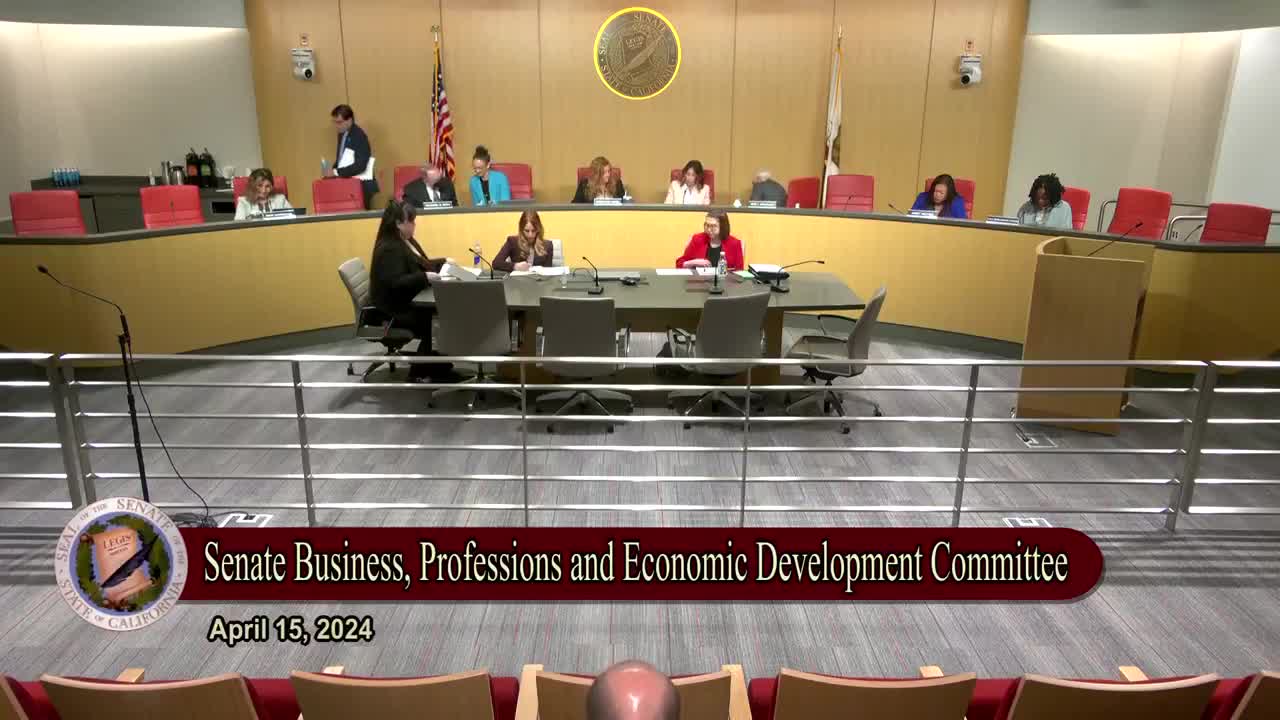 20MIN
Senate Standing Committee on Business, Professions and Economic Development
Bill Author

Bill Co-Author(s):