SB 1368: School curriculum: sexual health education and human immunodeficiency virus (HIV) prevention education: health framework: pregnancy centers.
- Session Year: 2023-2024
- House: Senate
- Latest Version Date: 2024-02-16
Current Status:
Failed
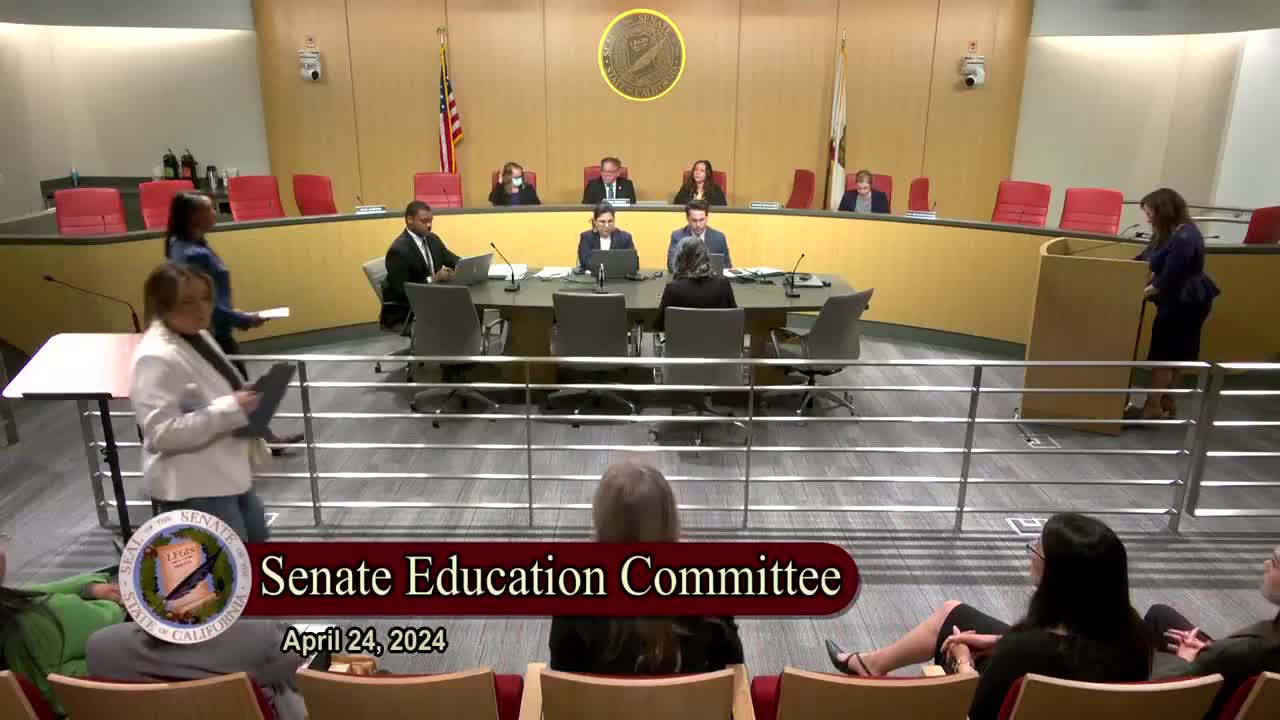
(2024-04-24: April 24 set for first hearing. Failed passage in committee. (Ayes 2. Noes 4. Page 3752.))
Introduced
In Committee
First Chamber
In Committee
Second Chamber
Enacted
Existing law establishes the Instructional Quality Commission and requires the commission to, among other things, recommend curriculum frameworks to the State Board of Education.
This bill would require the commission, when the Health Framework for California Public Schools is next revised after January 1, 2025, to include information on pregnancy centers as a resource in that health framework.
Existing law, the California Healthy Youth Act, requires school districts to ensure that all pupils in grades 7 to 12, inclusive, receive comprehensive sexual health education and human immunodeficiency virus (HIV) prevention education, as specified. Under the act, this instruction includes, among other things, information about local resources related to sexual and reproductive health and pregnancy prevention and care, as provided.
This bill would require the department to make information about pregnancy centers available on its internet website and would require pregnancy centers to be included by school districts in the above-described information about local resources. By imposing additional duties on school districts, the bill would impose a state-mandated local program.
The California Constitution requires the state to reimburse local agencies and school districts for certain costs mandated by the state. Statutory provisions establish procedures for making that reimbursement.
This bill would provide that, if the Commission on State Mandates determines that the bill contains costs mandated by the state, reimbursement for those costs shall be made pursuant to the statutory provisions noted above.
When the Health Framework for California Public Schools (health framework) is next revised after January 1, 2025, the commission shall include information on pregnancy centers as a resource in that health framework.
SEC. 2.Section 51933.5 is added to the Education Code, to read:51933.5.On or before July 1, 2025, the department shall make information about pregnancy centers available on the departments internet website.
SEC. 3.Section 51934 of the Education Code is amended to read:51934.(a)Each school district shall ensure that all pupils in grades 7 to 12, inclusive, receive comprehensive sexual health education and HIV prevention education from instructors trained in the appropriate courses. Each pupil shall receive this instruction at least once in junior high or middle school and at least once in high school. This instruction shall include all of the following:
(1)Information on the nature of HIV, as well as other sexually transmitted infections, and their effects on the human body.
(2)Information on the manner in which HIV and other sexually transmitted infections are and are not transmitted, including information on the relative risk of infection according to specific behaviors, including sexual activities and injection drug use.
(3)Information that abstinence from sexual activity and injection drug use is the only certain way to prevent HIV and other sexually transmitted infections and abstinence from sexual intercourse is the only certain way to prevent unintended pregnancy. This instruction shall provide information about the value of delaying sexual activity while also providing medically accurate information on other methods of preventing HIV and other sexually transmitted infections and pregnancy.
(4)Information about the effectiveness and safety of all federal Food and Drug Administration (FDA) approved methods that prevent or reduce the risk of contracting HIV and other sexually transmitted infections, including use of antiretroviral medication, consistent with the federal Centers for Disease Control and Prevention.
(5)Information about the effectiveness and safety of reducing the risk of HIV transmission as a result of injection drug use by decreasing needle use and needle sharing.
(6)Information about the treatment of HIV and other sexually transmitted infections, including how antiretroviral therapy can dramatically prolong the lives of many people living with HIV and reduce the likelihood of transmitting HIV to others.
(7)Discussion about social views on HIV and AIDS, including addressing unfounded stereotypes and myths regarding HIV and AIDS and people living with HIV. This instruction shall emphasize that successfully treated HIV-positive individuals have a normal life expectancy, all people are at some risk of contracting HIV, and the only way to know if one is HIV-positive is to get tested.
(8)Information about local resources, including, but not limited to, pregnancy centers, how to access local resources, and pupils legal rights to access local resources for sexual and reproductive health care such as testing and medical care for HIV and other sexually transmitted infections and pregnancy prevention and care, as well as local resources for assistance with sexual assault and intimate partner violence.
(9)Information about the effectiveness and safety of all FDA-approved contraceptive methods in preventing pregnancy, including, but not limited to, emergency contraception. Instruction on pregnancy shall include an objective discussion of all legally available pregnancy outcomes, including, but not limited to, all of the following:
(A)Parenting, adoption, and abortion.
(B)Information on the law on surrendering physical custody of a minor child 72 hours of age or younger, pursuant to Section 1255.7 of the Health and Safety Code and Section 271.5 of the Penal Code.
(C)The importance of prenatal care.
(10)Information about sexual harassment, sexual assault, sexual abuse, and human trafficking. Information on human trafficking shall include both of the following:
(A)Information on the prevalence, nature, and strategies to reduce the risk of human trafficking, techniques to set healthy boundaries, and how to safely seek assistance.
(B)Information on how social media and mobile device applications are used for human trafficking.
(11)Information about adolescent relationship abuse and intimate partner violence, including the early warning signs thereof.
(b)A school district may provide optional instruction, as part of comprehensive sexual health education and HIV prevention education, regarding the potential risks and consequences of creating and sharing sexually suggestive or sexually explicit materials through cellular telephones, social networking Internet Web sites, computer networks, or other digital media.
(c)A school district may provide comprehensive sexual health education or HIV prevention education consisting of age-appropriate instruction earlier than grade 7 using instructors trained in the appropriate courses. A school district that elects to offer comprehensive sexual health education or HIV prevention education earlier than grade 7 may provide age appropriate and medically accurate information on any of the general topics contained in paragraphs (1) to (11), inclusive, of subdivision (a).
SEC. 4.If the Commission on State Mandates determines that this act contains costs mandated by the state, reimbursement to local agencies and school districts for those costs shall be made pursuant to Part 7 (commencing with Section 17500) of Division 4 of Title 2 of the Government Code.
|
Date
|
Status
|
|---|---|
| Apr 24, 2024 | April 24 set for first hearing. Failed passage in committee. (Ayes 2. Noes 4. Page 3752.) |
| Apr 5, 2024 | Set for hearing April 24. |
| Feb 29, 2024 | Referred to Com. on ED. |
| Feb 20, 2024 | From printer. May be acted upon on or after March 18. |
| Feb 16, 2024 | Introduced. Read first time. To Com. on RLS. for assignment. To print. |
|
Date
|
Description
|
Location
|
Votes
|
|
|---|---|---|---|---|
| Apr 24, 2024 | Do pass, but first be re-referred to the Committee on [Appropriations] | Senate Standing Committee on Education |
Failed |
This list shows positions taken on this bill by organizations on the date displayed, which is linked to the original source.
Positions by individuals are not included.
|
Organization
|
Position
|
Date
|
|---|---|---|
| California Baptist for Biblical Values | ** Support | |
| California Catholic Conference | ** Support | |
| California Family Council | ** Support | |
| Informed Choices | ** Support | |
| Life Choice Pregnancy Center | ** Support | |
| Moreno Valley Women's Health Center | ** Support | |
| National Institute of Family and Life Advocates | ** Support | |
| THE AMERICAN COUNCIL | ** Support | |
| The National Center for Law & Policy | ** Support |
SENATE COMMITTEE ON EDUCATION
Senator Josh Newman, Chair
2023 - 2024 Regular
Bill No: SB 1368 Hearing Date: April 24, 2024
Author: | |||
Version: | February 16, 2024 | ||
Urgency: | No | Fiscal: | Yes |
Consultant: | Kordell Hampton | ||
Subject: School curriculum: sexual health education and human immunodeficiency virus (HIV) prevention education: health framework: pregnancy centers.
SUMMARY
This bill requires pregnancy centers to be included in the next revision of the Health framework and for information about pregnancy centers to be made available by the California Department of Education (CDE) and local educational agencies (LEA), as specified.
BACKGROUND
Existing Law:
Education Code (EC)
- Establishes the California Healthy Youth Act (CHYA), which requires LEAs to provide comprehensive sexual health and HIV prevention instruction to all students in grades 7 to 12, at least once in middle school and once in high school. (EC § 51933)
- Authorizes an LEA to contract with outside consultants or guest speakers, including those who have developed multilingual curricula or curricula accessible to persons with disabilities, to deliver comprehensive sexual health education and HIV prevention education or to provide training for school district personnel. All outside consultants and guest speakers shall have expertise in comprehensive sexual health education and HIV prevention education and have knowledge of the most recent medically accurate research on the relevant topic or topics covered in their instruction. (EC § 51936)
- Requires that pupils in grades 7 to 12, inclusive, receive comprehensive sexual health education at least once in junior high or middle school and at least once in high school. (EC § 51934)
4) Requires that the instruction and related instructional materials be, among other things:
a) Age appropriate.
b) Medically accurate and objective.
c) Appropriate for use with pupils of all races, genders, sexual orientations, and ethnic and cultural backgrounds, pupils with disabilities, and English learners.
d) Made available on an equal basis to a pupil who is an English learner, consistent with the existing curriculum and alternative options for an English learner pupil.
e) Accessible to pupils with disabilities. (EC § 51934)
- Authorizes LEA to provide comprehensive sexual health education and HIV prevention education earlier than grade 7 using instructors trained in the appropriate courses and age-appropriate and medically-accurate information. (EC § 51933)
- Requires LEAs to provide parents and guardians with a notice at the beginning of each school year, or, for a pupil who enrolls in a school after the beginning of the school year, at the time of that pupil’s enrollment the following:
a) About instruction in comprehensive sexual health education and HIV prevention education and research on pupil health behaviors and risks planned for the coming year.
b) Advise the parent or guardian that the educational materials used in sexual health education are available for inspection.
c) Advise the parent or guardian whether the comprehensive sexual health education or HIV prevention education will be taught by school district personnel or by an outside consultant, as provided.
d) Advise the parent or guardian that the parent or guardian has the right to excuse their child from comprehensive sexual health education and HIV prevention education and that in order to excuse their child, they must state their request in writing to the LEA. (EC § 51938)
- Provides that the parent or guardian of a pupil has the right to excuse their child from all or part of that education, including related assessments, through a passive consent (“opt-out”) process. (EC § 51938)
ANALYSIS
This bill:
- Requires the Instructional Quality Commission (IQC) to include in the next revision of the Health Framework for California Public Schools, after January 1, 2025, information on pregnancy centers as a resource.
- Requires the CDE, on or before July 1, 2025 to make information about pregnancy centers available on its internet website.
- Require each LEA to ensure that all pupils in grades 7 to 12, at least once in junior high and high school, receive information about local resources, including but not limited to, pregnancy centers.
STAFF COMMENTS
- Need for the bill. According to the author, “SB 1368 would provide an additional resource for middle and high school students alongside the resources that are already provided under the CYHA. Our goal is not to change existing law but to add options, specifically to increase awareness for already available free services provided by local pregnancy centers. It is our duty to present women with all choices when it comes to pregnancy. Young women who want to explore all of their choices should have the right to do so and when organizations like pregnancy centers provide exceptional services at little to no cost they should be recognized.”
- What is a Pregnancy Center? In September 2012, the Guttmacher Institute released a report regarding Crisis Pregnancy Centers (CPCs). The report cites that “these centers offer counseling and prenatal services with an anti-abortion (pro-life) perspective. CPCs are typically associated with national anti-abortion organizations and evangelical Christian networks. Women who visit these centers need accurate medical information and timely medical attention. However, CPCs often offer misleading information that may delay or deny women access to proper reproductive health services, influence their decisions, and ultimately lead to more unintended births.”
Recently, on April 8, 2022, California Attorney General Rob Bonta sent a letter to Modesto Pregnancy Center, also known as Personal Health Now, demanding that the entity substantiate its claims that it provides medically accurate and unbiased sexual education to public school students. The Center currently provides sexual education curriculum to Modesto City Schools District and advertises that its program meets the requirements of the CHYA, which requires sexual education in California’s public schools be “comprehensive” and medically accurate, and may not promote religious doctrine. However, the Department of Justice (DOJ) has received parent complaints indicating that the Center’s sexual education curriculum does not, in fact, appear to comply with state law. Under Business and Professions Code section 17508, the Attorney General demands that the Center substantiate their claims within 20 days of letter issuance. Failure to provide substantiation by that deadline may result in legal action.
California Health and Human Services Agency (Abortion.ca.gov).
In 2022, the Legislature passed SB 1142 (Caballero, Chapter 566, Statutes of 2022), which required the California Health and Human Services Agency (CHHSA), or a designated entity, to create an internet website that provides information on abortion services in the state. Recently, the website abortion.ca.gov was launched, and it offers information on the types of abortion and the steps involved, as well as a tool to find abortion providers. The website also features telehealth-only options, alerts on CPCs providing false and medically incorrect information to discourage abortion, and a link to the consumer alert from the DOJ titled “Know the Difference: Crisis Pregnancy Centers v. Reproductive Health Facilities.”
Current statute already requires LEAs to provide students, at least once in junior high and once in high school, information, including but not limited to Information about local resources, how to access local resources, and pupils’ legal rights to access local resources for sexual and reproductive health care such as testing and medical care for HIV and other sexually transmitted infections and pregnancy prevention and care, as well as local resources for assistance with sexual assault and intimate partner violence (EC 51934 § (a)(8)).
- Health Education Framework (2019). On May 8, 2019, the State Board of Education (SBE) officially adopted the 2019 Health Education Curriculum Framework for California Public Schools (the Health Education Framework) after over two years of development. The Health Education Framework is aligned to the 2008 California Health Education Content Standards, which support the development of knowledge, skills, and attitudes in eight overarching standards: (1) essential health concepts; (2) analyzing health influences; (3) accessing valid health information; (4) interpersonal communication; (5) decision making; (6) goal setting; (7) practicing health-enhancing behaviors; and (8) health promotion in six content areas of health education, including sexual health.
This bill would require the IQC in the next revision of the Health Framework for California Public Schools include information on pregnancy centers as a resource. The committee may wish to consider if it is appropriate to bind the IQC to a future obligation when considering the next revision of the Health Framework.
- California Healthy Youth Act. The CHYA took effect in 2003 and was initially known as the Comprehensive Sexual Health and HIV/AIDS Prevention Education Act (Act). Originally, the Act required LEAs to provide comprehensive sexual health education in any grade, including kindergarten, so long as it consisted of age-appropriate instruction and used instructors trained in the appropriate courses. Beginning in 2016 with AB 329 (Weber, 2015), the act was renamed the CHYA and, for the first time, required LEAs to provide comprehensive sexual health education and HIV prevention education to all students at least once in middle school and at least once in high school. From its inception in 2003 through today, the CHYA has always afforded parents the right to opt their child out of a portion, or all, of the instruction and required LEAs to notify parents and guardians of this right. Parents and guardians can exercise this right by informing the LEA in writing of their decision.
In addition to the CHYA, CDE also provide information on its website regarding resources for sexual and reproductive health for LEAs.
- Instructional Quality Commission. How Curriculum, Standards, Frameworks, and Model Curricula Are Created and Adopted. The Legislature has vested the IQC and SBE with the authority to develop and adopt state curriculum and instructional materials. The IQC develops curriculum frameworks in each subject by convening expert panels, developing drafts, and holding public hearings to solicit input. Changes are frequently made in response to public comment. The SBE then adopts the frameworks in a public meeting. The SBE also adopts, in a public process, instructional materials aligned to those frameworks for grades K-8. School district governing boards and charter schools then adopt instructional materials aligned to these standards and frameworks. Local adoption of new curricula involves significant local cost and investment of resources and professional development.
These existing processes involve practitioners and experts who have an in-depth understanding of curriculum and instruction, including the full scope and sequence of the curriculum in each subject and at each grade level, constraints on instructional time and resources, and the relationship of curriculum to state assessments and other measures of student progress.
The committee has adopted a joint policy with the Assembly Education Committee that prohibits the introduction of measures which propose to require, or require consideration of, modifications to state curriculum frameworks, to require that specified content be taught, or to require the development of new model curricula, must comply with requirements set forth in this policy. A portion of this bill violates the policy adopted by this committee.
- Related Legislation.
SB 1142 (Caballero, Chapter 566, Statutes of 2022) requires CHHSA, or an entity designated by the agency, to establish an internet website where the public can find information on abortion services in California. Requires CHHSA to also develop, implement, and update, as necessary, a statewide educational and outreach campaign to inform the public on how to access abortion services in the state.
AB 2134 (Akilah Weber, Chapter 562, Statutes of 2022) among various provisions, establishes the California Abortion and Reproductive Equity Program, and the California Reproductive Health Equity Program within the Department of Health Care Access and Information, to ensure abortion and contraception services are affordable for and accessible to all patients and to provide financial support for safety net providers of these services.
AB 315 (Bauer-Kahan, 2023) would have specified a person doing business who performs or intends to perform pregnancy-related services cannot advertise using false or misleading statements about whether they provide abortion services, and allows public prosecutors to file lawsuits against businesses that violate this provision. This bill also creates a private right of action that allows any individual who is harmed by a business’s false or misleading advertising about abortion services, as specified, to bring a civil lawsuit against the business. This bill was held in Assembly Appropriations Committee.
AB 710 (Schiavo, 2023) would have required the Department of Public Health (DPH) to conduct an awareness campaign to communicate with local health departments, health care providers, and the public, regarding facilities that provide health care services, including, but not limited to, primary care and specialty clinics. This bill was held in Assembly Appropriations Committee.
SUPPORT
Life Choice Pregnancy Center (sponsor)
California Baptist for Biblical Values
California Catholic Conference
California Family Council
Informed Choices
Moreno Valley Women's Health Center
National Institute of Family and Life Advocates
The American Council
The National Center for Law & Policy
41 individuals
OPPOSITION
1 individual
-- END --
Bill Author
Bill Co-Author(s):