SB 1374: Net energy metering.
- Session Year: 2023-2024
- House: Senate
- Latest Version Date: 2024-09-04
Current Status:
Failed
(2024-09-27: In Senate. Consideration of Governor's veto pending.)
Introduced
In Committee
First Chamber
In Committee
Second Chamber
Enacted
Existing law vests the Public Utilities Commission with regulatory authority over public utilities, including electrical corporations. Existing law requires the commission to develop a standard contract or tariff, which may include net energy metering, for eligible customer-generators, as defined, with a renewable electrical generation facility, as defined, that is a customer of a large electrical corporation. Existing law requires, in developing the standard contract or tariff for large electrical corporations, the commission to take specified actions.
This bill would require, no later than July 1, 2025, the commission to ensure that any contract or tariff established by the commission pursuant to the above-described provisions for renewable electrical generation facilities configured to serve multiple customers with meters at one or more apartment buildings on a single property, or configured to serve multiple meters of a single customer on a public school property, or a set of contiguous public school properties owned, leased, or rented by the public school customer, meets certain requirements, as specified. The bill would require the commission, no later than July 1, 2026, to ensure that any contract or tariff established by the commission pursuant to a specified commission decision meets specified requirements, as provided. The bill would make these provisions inoperative on July 1, 2033.
Under existing law, a violation of any order, decision, rule, direction, demand, or requirement of the commission is a crime.
Because a violation of a commission action implementing this bills requirements would be a crime, the bill would impose a state-mandated local program.
The California Constitution requires the state to reimburse local agencies and school districts for certain costs mandated by the state. Statutory provisions establish procedures for making that reimbursement.
This bill would provide that no reimbursement is required by this act for a specified reason.
Existing law vests the Public Utilities Commission with regulatory authority over public utilities, including electrical corporations. Existing law requires the commission to develop a standard contract or tariff, which may include net energy metering, for eligible customer-generators, as defined, with a renewable electrical generation facility, as defined, that is a customer of a large electrical corporation. Existing law requires, in developing the standard contract or tariff for large electrical corporations, the commission to take specified actions.
This bill would require, no later than July 1, 2025, the commission to ensure that any contract or tariff established by the commission pursuant to the above-described provisions for renewable electrical generation facilities configured to serve multiple customers with meters at one or more apartment buildings on a single property, or configured to serve multiple meters of a single customer on a public school property, or a set of contiguous public school properties owned, leased, or rented by the public school customer, meets certain requirements, as specified. The bill would require the commission, no later than July 1, 2026, to ensure that any contract or tariff established by the commission pursuant to a specified commission decision meets specified requirements, as provided. The bill would make these provisions inoperative on July 1, 2033, or 7 years after the last effective date of any adjustments the commission makes to certain tariffs, whichever is later, as specified. 2033.
Under existing law, a violation of any order, decision, rule, direction, demand, or requirement of the commission is a crime.
Because a violation of a commission action implementing this bills requirements would be a crime, the bill would impose a state-mandated local program.
The California Constitution requires the state to reimburse local agencies and school districts for certain costs mandated by the state. Statutory provisions establish procedures for making that reimbursement.
This bill would provide that no reimbursement is required by this act for a specified reason.
Existing law vests the Public Utilities Commission with regulatory authority over public utilities, including electrical corporations. Existing law requires the commission to develop a standard contract or tariff, which may include net energy metering, for eligible customer-generators, as defined, with a renewable electrical generation facility, as defined, that is a customer of a large electrical corporation. Existing law requires, in developing the standard contract or tariff for large electrical corporations, the commission to take specified actions.
This bill would require, no later than July 1, 2025, the commission to ensure that any contract or tariff established by the commission pursuant to the above-described provisions for renewable electrical generation facilities configured to serve multiple customers with meters at an apartment building one or more apartment buildings on a single property, or configured to serve multiple meters of a single customer on a public school property, or a set of contiguous public school properties owned, leased, or rented by the public school customer, meets certain requirements, as specified. The bill would require the commission, no later than July 1, 2027, 2026, to ensure that any contract or tariff established by the commission pursuant to a specified commission decision meets specified requirements, as provided. The bill would make these provisions inoperative on July 1, 2033, or 7 years after the last effective date of any adjustments the commission makes to certain tariffs, whichever is later, as specified.
Under existing law, a violation of any order, decision, rule, direction, demand, or requirement of the commission is a crime.
Because a violation of a commission action implementing this bills requirements would be a crime, the bill would impose a state-mandated local program.
The California Constitution requires the state to reimburse local agencies and school districts for certain costs mandated by the state. Statutory provisions establish procedures for making that reimbursement.
This bill would provide that no reimbursement is required by this act for a specified reason.
Existing law vests the Public Utilities Commission with regulatory authority over public utilities, including electrical corporations. Existing law requires the commission to develop a standard contract or tariff, which may include net energy metering, for eligible customer-generators, as defined, with a renewable electrical generation facility, as defined, that is a customer of a large electrical corporation. Existing law requires, in developing the standard contract or tariff for large electrical corporations, the commission to take specified actions.
This bill would require, no later than July 1, 2025, the commission to ensure that any contract or tariff established by the commission pursuant to the above described above-described provisions for renewable electrical generation facilities configured to serve multiple customers with meters at an apartment building on a single property, or configured to serve multiple meters of a single customer on a public school property, or a set of contiguous public school properties owned, leased, or rented by the public school customer, meets certain requirements, as specified. The bill would require the commission, no later than July 1, 2027, to ensure that any contract or tariff established by the commission pursuant to a specified commission decision meets specified requirements, as provided.
Under existing law, a violation of any order, decision, rule, direction, demand, or requirement of the commission is a crime.
Because a violation of a commission action implementing this bills requirements would be a crime, the bill would impose a state-mandated local program.
The California Constitution requires the state to reimburse local agencies and school districts for certain costs mandated by the state. Statutory provisions establish procedures for making that reimbursement.
This bill would provide that no reimbursement is required by this act for a specified reason.
Existing law vests the Public Utilities Commission with regulatory authority over public utilities, including electrical corporations. Existing law requires the commission to develop a standard contract or tariff, which may include net energy metering, for eligible customer-generators, as defined, with a renewable electrical generation facility, as defined, that is a customer of a large electrical corporation. Existing law requires, in developing the standard contract or tariff for large electrical corporations, the commission to take specified actions.
This bill would require, no later than July 1, 2025, the commission to ensure that any contract or tariff established by the commission pursuant to the above described provisions for renewable electrical generation facilities configured to serve either multiple customers with meters at an apartment building on a single property, or configured to serve multiple meters of a single customer on a property public school property, or a set of contiguous public school properties owned, leased, or rented by the public school customer, meets certain requirements, including that eligible customer-generators are authorized to elect to aggregate the electrical load, as specified. The bill would require the commission, no later than July 1, 2027, to ensure that any contract or tariff established by the commission pursuant to a specified commission decision meets specified requirements, as provided.
Under existing law, a violation of any order, decision, rule, direction, demand, or requirement of the commission is a crime.
Because a violation of a commission action implementing this bills requirements would be a crime, the bill would impose a state-mandated local program.
The California Constitution requires the state to reimburse local agencies and school districts for certain costs mandated by the state. Statutory provisions establish procedures for making that reimbursement.
This bill would provide that no reimbursement is required by this act for a specified reason.
Existing law vests the Public Utilities Commission with regulatory authority over public utilities, including electrical corporations. Existing law requires the commission to develop a standard contract or tariff, which may include net energy metering, for eligible customer-generators, as defined, with a renewable electrical generation facility, as defined, that is a customer of a large electrical corporation. Existing law requires, in developing the standard contract or tariff for large electrical corporations, the commission to take specified actions.
This bill would require, no later than July 1, 2025, the commission to ensure that any contract or tariff established by the commission pursuant to the above described provisions for renewable electrical generation facilities configured to serve either multiple customers with meters on a single property, or multiple meters of a single customer on a property or a set of contiguous properties owned, leased, or rented by the customer, meets certain requirements, including that the eligible customer-generators may are authorized to elect to aggregate the electrical load, as specified.
Under existing law, a violation of the Public Utilities Act or any order, decision, rule, direction, demand, or requirement of the commission is a crime.
Because the provisions of this bill would be a part of the act and a violation of a commission action implementing its this bills requirements would be a crime, this the bill would impose a state-mandated local program.
The California Constitution requires the state to reimburse local agencies and school districts for certain costs mandated by the state. Statutory provisions establish procedures for making that reimbursement.
This bill would provide that no reimbursement is required by this act for a specified reason.
Existing law vests the Public Utilities Commission with regulatory authority over public utilities, including electrical corporations. Existing law requires the commission to develop a standard contract or tariff, which may include net energy metering, for eligible customer-generators, as defined, with a renewable electrical generation facility, as defined, that is a customer of a large electrical corporation. Existing law requires, in developing the standard contract or tariff for large electrical corporations, the commission to take specified actions.
This bill would require, no later than July 1, 2025, the commission to ensure that any contract or tariff established by the commission pursuant to the above described provisions for renewable electrical generation facilities configured to serve either multiple customers with meters on a single property, or multiple meters of a single customer on a property or a set of contiguous properties owned, leased, or rented by the customer, meets certain requirements, including that the eligible customer-generators may elect to aggregate the electrical load, as specified.
Under existing law, a violation of the Public Utilities Act or any order, decision, rule, direction, demand, or requirement of the commission is a crime.
Because the provisions of this bill would be a part of the act and a violation of a commission action implementing its requirements would be a crime, this bill would impose a state-mandated local program.
The California Constitution requires the state to reimburse local agencies and school districts for certain costs mandated by the state. Statutory provisions establish procedures for making that reimbursement.
This bill would provide that no reimbursement is required by this act for a specified reason.
(a)For purposes of this section, eligible customer-generator, large electrical corporation, and renewable electrical generation facility have the same meanings as defined in Section 2827.
(b)Notwithstanding any other law, the commission shall develop a standard contract or tariff, which may include net energy metering, for eligible customer-generators with a renewable electrical generation facility that is a customer of a large electrical corporation no later than December 31, 2015. The commission may develop the standard contract or tariff before December 31, 2015, and may require a large electrical corporation that has reached the net energy metering program limit of subparagraph (B) of paragraph (4) of subdivision (c) of Section 2827 to offer the standard contract or tariff to eligible customer-generators. A large electrical corporation shall offer the standard contract or tariff to an eligible customer-generator beginning July 1, 2017, or before that date if ordered to do so by the commission because it has reached the net energy metering program limit of subparagraph (B) of paragraph (4) of subdivision (c) of Section 2827. The commission may revise the standard contract or tariff as appropriate to achieve the objectives of this section. In developing the standard contract or tariff, the commission shall do all of the following:
(1)Ensure that the standard contract or tariff made available to eligible customer-generators ensures that customer-sited renewable distributed generation continues to grow sustainably and include specific alternatives designed for growth among residential customers in disadvantaged communities.
(2)Establish terms of service and billing rules for eligible customer-generators.
(3)Ensure that the standard contract or tariff made available to eligible customer-generators is based on the costs and benefits of the renewable electrical generation facility.
(4)Ensure that the total benefits of the standard contract or tariff to all customers and the electrical system are approximately equal to the total costs.
(5)Allow projects greater than one megawatt that do not have significant impact on the distribution grid to be built to the size of the onsite load if the projects with a capacity of more than one megawatt are subject to reasonable interconnection charges established pursuant to the commissions Electric Rule 21 and applicable state and federal requirements.
(6)Establish a transition period during which eligible customer-generators taking service under a net energy metering tariff or contract before July 1, 2017, or until the electrical corporation reaches its net energy metering program limit pursuant to subparagraph (B) of paragraph (4) of subdivision (c) of Section 2827, whichever is earlier, shall be eligible to continue service under the previously applicable net energy metering tariff for a length of time to be determined by the commission by March 31, 2014. Any rules adopted by the commission shall consider a reasonable expected payback period based on the year the customer initially took service under the tariff or contract authorized by Section 2827.
(7)The commission shall determine which rates and tariffs are applicable to customer generators only during a rulemaking proceeding. Any fixed charges for residential customer generators that differ from the fixed charges allowed pursuant to subdivision (e) of Section 739.9 shall be authorized only in a rulemaking proceeding involving every large electrical corporation. The commission shall ensure customer generators are provided electrical service at rates that are just and reasonable.
(c)Beginning July 1, 2017, or when ordered to do so by the commission because the large electrical corporation has reached its capacity limitation of subparagraph (B) of paragraph (4) of subdivision (c) of Section 2827, all new eligible customer-generators shall be subject to the standard contract or tariff developed by the commission and any rules, terms, and rates developed pursuant to subdivision (b). There shall be no limitation on the amount of generating capacity or number of new eligible customer-generators entitled to receive service pursuant to the standard contract or tariff after July 1, 2017. An eligible customer-generator that has received service under a net energy metering standard contract or tariff pursuant to Section 2827 that is no longer eligible to receive service shall be eligible to receive service pursuant to the standard contract or tariff developed by the commission pursuant to this section.
(d)(1)No later than July 1, 2025, the commission shall ensure that any contract or tariff established by the commission pursuant to this section for renewable electrical generation facilities configured to serve multiple customers, which may include both residential and nonresidential customers, with meters at one or more apartment buildings on a single property meets all of the following requirements:
(A)Each accounts portion of the generation shall be subtracted from that accounts consumption in each 15-minute period for billing purposes.
(B)Customers shall be compensated at no less than utility avoided cost for generation in excess of consumption.
(C)All customer-generators shall be subject to any nonbypassable charges, flat rates, or minimum bills that are contained in a customers applicable rate.
(2)The commission shall exclude the tariffs designed to serve customer-generators eligible for the Multifamily Affordable Solar Housing program and the Solar on Multifamily Affordable Housing program pursuant to Section 2870 from the requirements of this subdivision.
(3)This subdivision shall only apply to a contract or tariff entered into on or after November 1, 2023.
(e)(1)No later than July 1, 2025, the commission shall ensure that any contract or tariff established by the commission pursuant to this section for renewable electrical generation facilities configured to serve multiple meters of a single customer on a public school property, or a set of contiguous public school properties owned, leased, or rented by the public school customer, meets all of the following requirements:
(A)The eligible customer-generator shall determine the percentage of the total generation to be allocated to each meter on the property or set of contiguous properties serving the public school.
(B)Each meters portion of the generation shall be subtracted from that meters consumption in each 15-minute period for billing purposes.
(C)Only public school customers shall be eligible customer-generators.
(D)All customer-generators shall be subject to any nonbypassable charges, flat rates, or minimum bills that are contained in a customers applicable rate.
(2)For purposes of this subdivision, public school means a school operated by a school district, county office of education, a charter school, or a community college district.
(3)This subdivision shall only apply to a contract or tariff entered into on or after November 1, 2023.
(f)No later than July 1, 2026, the commission shall ensure that any contract or tariff established by the commission pursuant to commission Decision 23-11-068 (November 16, 2023), Decision Addressing Remaining Proceeding Issues, meets both of the following requirements:
(1)(A)The commission establishes criteria for determining a set of meters that are sufficiently close in proximity to the renewable electrical generation facilities to be reasonably considered as operating with onsite self-consumption of the generated electricity.
(B)The criteria shall be designed to allow account-level netting among meters while ensuring a limited amount of utility infrastructure is involved in delivering the electricity to the meters.
(C)Notwithstanding the criteria established pursuant to this paragraph, all of the meters on the campus of a public school or at one or more apartment buildings on a single property shall be eligible for the tariffs established pursuant to this section.
(2)All customer-generators shall be subject to any nonbypassable charges, flat rates, or minimum bills that are contained in a customers applicable rate.
(g)Subdivisions (d), (e), and (f) shall become inoperative on July 1, 2033.
SEC. 2.No reimbursement is required by this act pursuant to Section 6 of Article XIIIB of the California Constitution because the only costs that may be incurred by a local agency or school district will be incurred because this act creates a new crime or infraction, eliminates a crime or infraction, or changes the penalty for a crime or infraction, within the meaning of Section 17556 of the Government Code, or changes the definition of a crime within the meaning of Section 6 of Article XIIIB of the California Constitution.
(a)For purposes of this section, eligible customer-generator, large electrical corporation, and renewable electrical generation facility have the same meanings as defined in Section 2827.
(b)Notwithstanding any other law, the commission shall develop a standard contract or tariff, which may include net energy metering, for eligible customer-generators with a renewable electrical generation facility that is a customer of a large electrical corporation no later than December 31, 2015. The commission may develop the standard contract or tariff before December 31, 2015, and may require a large electrical corporation that has reached the net energy metering program limit of subparagraph (B) of paragraph (4) of subdivision (c) of Section 2827 to offer the standard contract or tariff to eligible customer-generators. A large electrical corporation shall offer the standard contract or tariff to an eligible customer-generator beginning July 1, 2017, or before that date if ordered to do so by the commission because it has reached the net energy metering program limit of subparagraph (B) of paragraph (4) of subdivision (c) of Section 2827. The commission may revise the standard contract or tariff as appropriate to achieve the objectives of this section. In developing the standard contract or tariff, the commission shall do all of the following:
(1)Ensure that the standard contract or tariff made available to eligible customer-generators ensures that customer-sited renewable distributed generation continues to grow sustainably and include specific alternatives designed for growth among residential customers in disadvantaged communities.
(2)Establish terms of service and billing rules for eligible customer-generators.
(3)Ensure that the standard contract or tariff made available to eligible customer-generators is based on the costs and benefits of the renewable electrical generation facility.
(4)Ensure that the total benefits of the standard contract or tariff to all customers and the electrical system are approximately equal to the total costs.
(5)Allow projects greater than one megawatt that do not have significant impact on the distribution grid to be built to the size of the onsite load if the projects with a capacity of more than one megawatt are subject to reasonable interconnection charges established pursuant to the commissions Electric Rule 21 and applicable state and federal requirements.
(6)Establish a transition period during which eligible customer-generators taking service under a net energy metering tariff or contract before July 1, 2017, or until the electrical corporation reaches its net energy metering program limit pursuant to subparagraph (B) of paragraph (4) of subdivision (c) of Section 2827, whichever is earlier, shall be eligible to continue service under the previously applicable net energy metering tariff for a length of time to be determined by the commission by March 31, 2014. Any rules adopted by the commission shall consider a reasonable expected payback period based on the year the customer initially took service under the tariff or contract authorized by Section 2827.
(7)The commission shall determine which rates and tariffs are applicable to customer generators only during a rulemaking proceeding. Any fixed charges for residential customer generators that differ from the fixed charges allowed pursuant to subdivision (e) of Section 739.9 shall be authorized only in a rulemaking proceeding involving every large electrical corporation. The commission shall ensure customer generators are provided electrical service at rates that are just and reasonable.
(c)Beginning July 1, 2017, or when ordered to do so by the commission because the large electrical corporation has reached its capacity limitation of subparagraph (B) of paragraph (4) of subdivision (c) of Section 2827, all new eligible customer-generators shall be subject to the standard contract or tariff developed by the commission and any rules, terms, and rates developed pursuant to subdivision (b). There shall be no limitation on the amount of generating capacity or number of new eligible customer-generators entitled to receive service pursuant to the standard contract or tariff after July 1, 2017. An eligible customer-generator that has received service under a net energy metering standard contract or tariff pursuant to Section 2827 that is no longer eligible to receive service shall be eligible to receive service pursuant to the standard contract or tariff developed by the commission pursuant to this section.
(d)(1)No later than July 1, 2025, the commission shall ensure that any contract or tariff established by the commission pursuant to this section for renewable electrical generation facilities configured to serve multiple customers, which may include both residential and nonresidential customers, with meters at one or more apartment buildings on a single property meets all of the following requirements:
(A)Each accounts portion of the generation shall be subtracted from that accounts consumption in each 15-minute period for billing purposes.
(B)Customers shall be compensated at no less than utility avoided cost for generation in excess of consumption.
(C)All customer-generators shall be subject to any nonbypassable charges, flat rates, or minimum bills that are contained in a customers applicable rate.
(2)The commission shall exclude the tariffs designed to serve customer-generators eligible for the Multifamily Affordable Solar Housing program and the Solar on Multifamily Affordable Housing program pursuant to Section 2870 from the requirements of this subdivision.
(3)This subdivision shall only apply to a contract or tariff entered into on or after November 1, 2023.
(e)(1)No later than July 1, 2025, the commission shall ensure that any contract or tariff established by the commission pursuant to this section for renewable electrical generation facilities configured to serve multiple meters of a single customer on a public school property, or a set of contiguous public school properties owned, leased, or rented by the public school customer, meets all of the following requirements:
(A)The eligible customer-generator shall determine the percentage of the total generation to be allocated to each meter on the property or set of contiguous properties serving the public school.
(B)Each meters portion of the generation shall be subtracted from that meters consumption in each 15-minute period for billing purposes.
(C)Only public school customers shall be eligible customer-generators.
(D)All customer-generators shall be subject to any nonbypassable charges, flat rates, or minimum bills that are contained in a customers applicable rate.
(2)For purposes of this subdivision, public school means a school operated by a school district, county office of education, a charter school, or a community college district.
(3)This subdivision shall only apply to a contract or tariff entered into on or after November 1, 2023.
(f)No later than July 1, 2026, the commission shall ensure that any contract or tariff established by the commission pursuant to commission Decision 23-11-068 (November 16, 2023), Decision Addressing Remaining Proceeding Issues, meets both of the following requirements:
(1)(A)The commission establishes criteria for determining a set of meters that are sufficiently close in proximity to the renewable electrical generation facilities to be reasonably considered as operating with onsite self-consumption of the generated electricity.
(B)The criteria shall be designed to allow account-level netting among meters while ensuring a limited amount of utility infrastructure is involved in delivering the electricity to the meters.
(C)Notwithstanding the criteria established pursuant to this paragraph, all of the meters on the campus of a public school or at one or more apartment buildings on a single property shall be eligible for the tariffs established pursuant to this section.
(2)All customer-generators shall be subject to any nonbypassable charges, flat rates, or minimum bills that are contained in a customers applicable rate.
(g)(1)Subdivisions (d), (e), and (f) shall become inoperative on July 1, 2033, or seven years after the last effective date of any adjustments the commission makes to tariffs pursuant to the requirements of subdivision (f), whichever is later. 2033.
(2)The commission shall report to the Legislature, pursuant to Section 9795 of the Government Code, the last effective date of any adjustments it makes to tariffs pursuant to the requirements of subdivision (f).SEC. 2.No reimbursement is required by this act pursuant to Section 6 of Article XIIIB of the California Constitution because the only costs that may be incurred by a local agency or school district will be incurred because this act creates a new crime or infraction, eliminates a crime or infraction, or changes the penalty for a crime or infraction, within the meaning of Section 17556 of the Government Code, or changes the definition of a crime within the meaning of Section 6 of Article XIIIB of the California Constitution.
(a)For purposes of this section, eligible customer-generator, large electrical corporation, and renewable electrical generation facility have the same meanings as defined in Section 2827.
(b)Notwithstanding any other law, the commission shall develop a standard contract or tariff, which may include net energy metering, for eligible customer-generators with a renewable electrical generation facility that is a customer of a large electrical corporation no later than December 31, 2015. The commission may develop the standard contract or tariff before December 31, 2015, and may require a large electrical corporation that has reached the net energy metering program limit of subparagraph (B) of paragraph (4) of subdivision (c) of Section 2827 to offer the standard contract or tariff to eligible customer-generators. A large electrical corporation shall offer the standard contract or tariff to an eligible customer-generator beginning July 1, 2017, or before that date if ordered to do so by the commission because it has reached the net energy metering program limit of subparagraph (B) of paragraph (4) of subdivision (c) of Section 2827. The commission may revise the standard contract or tariff as appropriate to achieve the objectives of this section. In developing the standard contract or tariff, the commission shall do all of the following:
(1)Ensure that the standard contract or tariff made available to eligible customer-generators ensures that customer-sited renewable distributed generation continues to grow sustainably and include specific alternatives designed for growth among residential customers in disadvantaged communities.
(2)Establish terms of service and billing rules for eligible customer-generators.
(3)Ensure that the standard contract or tariff made available to eligible customer-generators is based on the costs and benefits of the renewable electrical generation facility.
(4)Ensure that the total benefits of the standard contract or tariff to all customers and the electrical system are approximately equal to the total costs.
(5)Allow projects greater than one megawatt that do not have significant impact on the distribution grid to be built to the size of the onsite load if the projects with a capacity of more than one megawatt are subject to reasonable interconnection charges established pursuant to the commissions Electric Rule 21 and applicable state and federal requirements.
(6)Establish a transition period during which eligible customer-generators taking service under a net energy metering tariff or contract before July 1, 2017, or until the electrical corporation reaches its net energy metering program limit pursuant to subparagraph (B) of paragraph (4) of subdivision (c) of Section 2827, whichever is earlier, shall be eligible to continue service under the previously applicable net energy metering tariff for a length of time to be determined by the commission by March 31, 2014. Any rules adopted by the commission shall consider a reasonable expected payback period based on the year the customer initially took service under the tariff or contract authorized by Section 2827.
(7)The commission shall determine which rates and tariffs are applicable to customer generators only during a rulemaking proceeding. Any fixed charges for residential customer generators that differ from the fixed charges allowed pursuant to subdivision (e) of Section 739.9 shall be authorized only in a rulemaking proceeding involving every large electrical corporation. The commission shall ensure customer generators are provided electrical service at rates that are just and reasonable.
(c)Beginning July 1, 2017, or when ordered to do so by the commission because the large electrical corporation has reached its capacity limitation of subparagraph (B) of paragraph (4) of subdivision (c) of Section 2827, all new eligible customer-generators shall be subject to the standard contract or tariff developed by the commission and any rules, terms, and rates developed pursuant to subdivision (b). There shall be no limitation on the amount of generating capacity or number of new eligible customer-generators entitled to receive service pursuant to the standard contract or tariff after July 1, 2017. An eligible customer-generator that has received service under a net energy metering standard contract or tariff pursuant to Section 2827 that is no longer eligible to receive service shall be eligible to receive service pursuant to the standard contract or tariff developed by the commission pursuant to this section.
(d)(1)No later than July 1, 2025, the commission shall ensure that any contract or tariff established by the commission pursuant to this section for renewable electrical generation facilities configured to serve multiple customers customers, which may include both residential and nonresidential customers, with meters at an apartment building one or more apartment buildings on a single property meets all of the following requirements:
(A)Each accounts portion of the generation shall be subtracted from that accounts consumption in each 15-minute period for billing purposes.
(B)Customers shall be compensated at no less than utility avoided cost for generation in excess of consumption.
(C)All customer-generators shall be subject to any nonbypassable charges, flat rates, or minimum bills that are contained in a customers applicable rate.
(2)The commission shall exclude the tariffs designed to serve customer-generators eligible for the Multifamily Affordable Solar Housing program and the Solar on Multifamily Affordable Housing program pursuant to Section 2870 from the requirements of this subdivision.
(3)This subdivision shall only apply to a contract or tariff entered into on or after November 1, 2023.
(e)(1)No later than July 1, 2025, the commission shall ensure that any contract or tariff established by the commission pursuant to this section for renewable electrical generation facilities configured to serve multiple meters of a single customer on a public school property, or a set of contiguous public school properties owned, leased, or rented by the public school customer, meets all of the following requirements:
(A)The eligible customer-generator shall determine the percentage of the total generation to be allocated to each meter on the property or set of contiguous properties serving the public school.
(B)Each meters portion of the generation shall be subtracted from that meters consumption in each 15-minute period for billing purposes.
(C)Only public school customers shall be eligible customer-generators.
(D)All customer-generators shall be subject to any nonbypassable charges, flat rates, or minimum bills that are contained in a customers applicable rate.
(2)For purposes of this subdivision, public school means a school operated by a school district, county office of education, a charter school, or a community college district.
(3)This subdivision shall only apply to a contract or tariff entered into on or after November 1, 2023.
(f)No later than July 1, 2027, 2026, the commission shall ensure that any contract or tariff established by the commission pursuant to commission Decision 23-11-068 (November 16, 2023), Decision Addressing Remaining Proceeding Issues, meets both of the following requirements:
(1)(A)The commission establishes criteria for determining a set of meters that are sufficiently close in proximity to the renewable electrical generation facilities to be reasonably considered as operating with onsite self-consumption of the generated electricity.
(B)The criteria shall be designed to allow account-level netting among meters while ensuring a limited amount of utility infrastructure is involved in delivering the electricity to the meters.
(C)Notwithstanding the criteria established pursuant to this paragraph, all of the meters on the campus of a public school or on an apartment building at one or more apartment buildings on a single property shall be eligible for the tariffs established pursuant to this section.
(2)All customer-generators shall be subject to any nonbypassable charges, flat rates, or minimum bills that are contained in a customers applicable rate.
(g)(1)Subdivisions (d), (e), and (f) shall become inoperative on July 1, 2033, or seven years after the last effective date of any adjustments the commission makes to tariffs pursuant to the requirements of subdivision (f), whichever is later.
(2)The commission shall report to the Legislature, pursuant to Section 9795 of the Government Code, the last effective date of any adjustments it makes to tariffs pursuant to the requirements of subdivision (f).
SEC. 2.No reimbursement is required by this act pursuant to Section 6 of Article XIIIB of the California Constitution because the only costs that may be incurred by a local agency or school district will be incurred because this act creates a new crime or infraction, eliminates a crime or infraction, or changes the penalty for a crime or infraction, within the meaning of Section 17556 of the Government Code, or changes the definition of a crime within the meaning of Section 6 of Article XIIIB of the California Constitution.
(a)For purposes of this section, eligible customer-generator, large electrical corporation, and renewable electrical generation facility have the same meanings as defined in Section 2827.
(b)Notwithstanding any other law, the commission shall develop a standard contract or tariff, which may include net energy metering, for eligible customer-generators with a renewable electrical generation facility that is a customer of a large electrical corporation no later than December 31, 2015. The commission may develop the standard contract or tariff before December 31, 2015, and may require a large electrical corporation that has reached the net energy metering program limit of subparagraph (B) of paragraph (4) of subdivision (c) of Section 2827 to offer the standard contract or tariff to eligible customer-generators. A large electrical corporation shall offer the standard contract or tariff to an eligible customer-generator beginning July 1, 2017, or before that date if ordered to do so by the commission because it has reached the net energy metering program limit of subparagraph (B) of paragraph (4) of subdivision (c) of Section 2827. The commission may revise the standard contract or tariff as appropriate to achieve the objectives of this section. In developing the standard contract or tariff, the commission shall do all of the following:
(1)Ensure that the standard contract or tariff made available to eligible customer-generators ensures that customer-sited renewable distributed generation continues to grow sustainably and include specific alternatives designed for growth among residential customers in disadvantaged communities.
(2)Establish terms of service and billing rules for eligible customer-generators.
(3)Ensure that the standard contract or tariff made available to eligible customer-generators is based on the costs and benefits of the renewable electrical generation facility.
(4)Ensure that the total benefits of the standard contract or tariff to all customers and the electrical system are approximately equal to the total costs.
(5)Allow projects greater than one megawatt that do not have significant impact on the distribution grid to be built to the size of the onsite load if the projects with a capacity of more than one megawatt are subject to reasonable interconnection charges established pursuant to the commissions Electric Rule 21 and applicable state and federal requirements.
(6)Establish a transition period during which eligible customer-generators taking service under a net energy metering tariff or contract before July 1, 2017, or until the electrical corporation reaches its net energy metering program limit pursuant to subparagraph (B) of paragraph (4) of subdivision (c) of Section 2827, whichever is earlier, shall be eligible to continue service under the previously applicable net energy metering tariff for a length of time to be determined by the commission by March 31, 2014. Any rules adopted by the commission shall consider a reasonable expected payback period based on the year the customer initially took service under the tariff or contract authorized by Section 2827.
(7)The commission shall determine which rates and tariffs are applicable to customer generators only during a rulemaking proceeding. Any fixed charges for residential customer generators that differ from the fixed charges allowed pursuant to subdivision (e) of Section 739.9 shall be authorized only in a rulemaking proceeding involving every large electrical corporation. The commission shall ensure customer generators are provided electrical service at rates that are just and reasonable.
(c)Beginning July 1, 2017, or when ordered to do so by the commission because the large electrical corporation has reached its capacity limitation of subparagraph (B) of paragraph (4) of subdivision (c) of Section 2827, all new eligible customer-generators shall be subject to the standard contract or tariff developed by the commission and any rules, terms, and rates developed pursuant to subdivision (b). There shall be no limitation on the amount of generating capacity or number of new eligible customer-generators entitled to receive service pursuant to the standard contract or tariff after July 1, 2017. An eligible customer-generator that has received service under a net energy metering standard contract or tariff pursuant to Section 2827 that is no longer eligible to receive service shall be eligible to receive service pursuant to the standard contract or tariff developed by the commission pursuant to this section.
(d)(1)No later than July 1, 2025, the commission shall ensure that any contract or tariff established by the commission pursuant to this section for renewable electrical generation facilities configured to serve multiple customers with meters at an apartment building on a property meets all of the following requirements:
(A)Each accounts portion of the generation shall be subtracted from that accounts consumption in each 15-minute period for billing purposes.
(B)Customers shall be compensated at no less than utility avoided cost for generation in excess of consumption.
(C)All customer-generators shall be subject to any nonbypassable charges, flat rates, or minimum bills that are contained in a customers applicable rate.
(2)The commission shall exclude the tariffs designed to serve customer-generators eligible for the Multifamily Affordable Solar Housing program and the Solar on Multifamily Affordable Housing program pursuant to Section 2870 from the requirements of this subdivision.
(e)(1)No later than July 1, 2025, the commission shall ensure that any contract or tariff established by the commission pursuant to this section for renewable electrical generation facilities configured to serve multiple meters of a single customer on a public school property, or a set of contiguous public school properties owned, leased, or rented by the public school customer, meets all of the following requirements:
(A)The eligible customer-generator shall determine the percentage of the total generation to be allocated to each meter on the property or set of contiguous properties serving the public school.
(B)Each meters portion of the generation shall be subtracted from that meters consumption in each 15-minute period for billing purposes.
(C)Only public school customers shall be eligible customer-generators.
(D)All customer-generators shall be subject to any nonbypassable charges, flat rates, or minimum bills that are contained in a customers applicable rate.
(2)For purposes of this subdivision, public school means a school operated by a school district, county office of education, a charter school, or a community college district, the California State University, or the University of California. district.
(f)No later than July 1, 2027, the commission shall ensure that any contract or tariff established by the commission pursuant to commission Decision 23-11-068 (November 16, 2023), Decision Addressing Remaining Proceeding Issues, meets both of the following requirements:
(1)(A)The commission establishes criteria for determining a set of meters that are sufficiently close in proximity to the renewable electrical generation facilities to be reasonably considered as operating with onsite self-consumption of the generated electricity.
(B)The criteria shall be designed to allow account-level netting among meters while ensuring a limited amount of utility infrastructure is involved in delivering the electricity to the meters.
(C)Notwithstanding the criteria established pursuant to this paragraph, all of the meters on the campus of a public school or on an apartment building shall be eligible for the tariffs established pursuant to this section.
(2)All customer-generators shall be subject to any nonbypassable charges, flat rates, or minimum bills that are contained in a customers applicable rate.
SEC. 2.No reimbursement is required by this act pursuant to Section 6 of Article XIIIB of the California Constitution because the only costs that may be incurred by a local agency or school district will be incurred because this act creates a new crime or infraction, eliminates a crime or infraction, or changes the penalty for a crime or infraction, within the meaning of Section 17556 of the Government Code, or changes the definition of a crime within the meaning of Section 6 of Article XIIIB of the California Constitution.
(a)For purposes of this section, eligible customer-generator, large electrical corporation, and renewable electrical generation facility have the same meanings as defined in Section 2827.
(b)Notwithstanding any other law, the commission shall develop a standard contract or tariff, which may include net energy metering, for eligible customer-generators with a renewable electrical generation facility that is a customer of a large electrical corporation no later than December 31, 2015. The commission may develop the standard contract or tariff before December 31, 2015, and may require a large electrical corporation that has reached the net energy metering program limit of subparagraph (B) of paragraph (4) of subdivision (c) of Section 2827 to offer the standard contract or tariff to eligible customer-generators. A large electrical corporation shall offer the standard contract or tariff to an eligible customer-generator beginning July 1, 2017, or before that date if ordered to do so by the commission because it has reached the net energy metering program limit of subparagraph (B) of paragraph (4) of subdivision (c) of Section 2827. The commission may revise the standard contract or tariff as appropriate to achieve the objectives of this section. In developing the standard contract or tariff, the commission shall do all of the following:
(1)Ensure that the standard contract or tariff made available to eligible customer-generators ensures that customer-sited renewable distributed generation continues to grow sustainably and include specific alternatives designed for growth among residential customers in disadvantaged communities.
(2)Establish terms of service and billing rules for eligible customer-generators.
(3)Ensure that the standard contract or tariff made available to eligible customer-generators is based on the costs and benefits of the renewable electrical generation facility.
(4)Ensure that the total benefits of the standard contract or tariff to all customers and the electrical system are approximately equal to the total costs.
(5)Allow projects greater than one megawatt that do not have significant impact on the distribution grid to be built to the size of the onsite load if the projects with a capacity of more than one megawatt are subject to reasonable interconnection charges established pursuant to the commissions Electric Rule 21 and applicable state and federal requirements.
(6)Establish a transition period during which eligible customer-generators taking service under a net energy metering tariff or contract before July 1, 2017, or until the electrical corporation reaches its net energy metering program limit pursuant to subparagraph (B) of paragraph (4) of subdivision (c) of Section 2827, whichever is earlier, shall be eligible to continue service under the previously applicable net energy metering tariff for a length of time to be determined by the commission by March 31, 2014. Any rules adopted by the commission shall consider a reasonable expected payback period based on the year the customer initially took service under the tariff or contract authorized by Section 2827.
(7)The commission shall determine which rates and tariffs are applicable to customer generators only during a rulemaking proceeding. Any fixed charges for residential customer generators that differ from the fixed charges allowed pursuant to subdivision (e) of Section 739.9 shall be authorized only in a rulemaking proceeding involving every large electrical corporation. The commission shall ensure customer generators are provided electrical service at rates that are just and reasonable.
(c)Beginning July 1, 2017, or when ordered to do so by the commission because the large electrical corporation has reached its capacity limitation of subparagraph (B) of paragraph (4) of subdivision (c) of Section 2827, all new eligible customer-generators shall be subject to the standard contract or tariff developed by the commission and any rules, terms, and rates developed pursuant to subdivision (b). There shall be no limitation on the amount of generating capacity or number of new eligible customer-generators entitled to receive service pursuant to the standard contract or tariff after July 1, 2017. An eligible customer-generator that has received service under a net energy metering standard contract or tariff pursuant to Section 2827 that is no longer eligible to receive service shall be eligible to receive service pursuant to the standard contract or tariff developed by the commission pursuant to this section.
(d)(1)No later than July 1, 2025, the commission shall ensure that any contract or tariff established by the commission pursuant to this section for renewable electrical generation facilities configured to serve either multiple customers with meters at an apartment building on a single property, or multiple meters of a single customer on a property or a set of contiguous properties owned, leased, or rented by the customer, property meets all of the following requirements:
(A)The eligible customer-generators may elect to aggregate the electrical load of the meters located on the property or set of contiguous properties to determine onsite consumption from the renewable electrical generation facility.(B)The eligible customer-generators shall determine the percentage of the total generation to be allocated to each account on the property or set of contiguous properties.(C)(A)Each accounts portion of the generation shall be subtracted from that accounts consumption in each 15-minute period for billing purposes.
(D)(B)Customers shall be compensated at no less than utility avoided cost for generation in excess of consumption.
(2)For purposes of this subdivision, parcels that are divided by a street, highway, waterway, or public thoroughfare are considered contiguous, provided that they are otherwise contiguous.(C)All customer-generators shall be subject to any nonbypassable charges, flat rates, or minimum bills that are contained in a customers applicable rate.
(2)The commission shall exclude the tariffs designed to serve customer-generators eligible for the Multifamily Affordable Solar Housing program and the Solar on Multifamily Affordable Housing program pursuant to Section 2870 from the requirements of this subdivision.
(e)(1)No later than July 1, 2025, the commission shall ensure that any contract or tariff established by the commission pursuant to this section for renewable electrical generation facilities configured to serve multiple meters of a single customer on a public school property, or a set of contiguous public school properties owned, leased, or rented by the public school customer, meets all of the following requirements:
(A)The eligible customer-generator shall determine the percentage of the total generation to be allocated to each meter on the property or set of contiguous properties serving the public school.
(B)Each meters portion of the generation shall be subtracted from that meters consumption in each 15-minute period for billing purposes.
(C)Only public school customers shall be eligible customer-generators.
(D)All customer-generators shall be subject to any nonbypassable charges, flat rates, or minimum bills that are contained in a customers applicable rate.
(2)For purposes of this subdivision, public school means a school operated by a school district, county office of education, a charter school, a community college district, the California State University, or the University of California.
(f)No later than July 1, 2027, the commission shall ensure that any contract or tariff established by the commission pursuant to commission Decision 23-11-068 (November 16, 2023), Decision Addressing Remaining Proceeding Issues, meets both of the following requirements:
(1)(A)The commission establishes criteria for determining a set of meters that are sufficiently close in proximity to the renewable electrical generation facilities to be reasonably considered as operating with onsite self-consumption of the generated electricity.
(B)The criteria shall be designed to allow account-level netting among meters while ensuring a limited amount of utility infrastructure is involved in delivering the electricity to the meters.
(C)Notwithstanding the criteria established pursuant to this paragraph, all of the meters on the campus of a public school or on an apartment building shall be eligible for the tariffs established pursuant to this section.
(2)All customer-generators shall be subject to any nonbypassable charges, flat rates, or minimum bills that are contained in a customers applicable rate.
SEC. 2.No reimbursement is required by this act pursuant to Section 6 of Article XIIIB of the California Constitution because the only costs that may be incurred by a local agency or school district will be incurred because this act creates a new crime or infraction, eliminates a crime or infraction, or changes the penalty for a crime or infraction, within the meaning of Section 17556 of the Government Code, or changes the definition of a crime within the meaning of Section 6 of Article XIIIB of the California Constitution.
(a)For purposes of this section, eligible customer-generator, large electrical corporation, and renewable electrical generation facility have the same meanings as defined in Section 2827.
(b)Notwithstanding any other law, the commission shall develop a standard contract or tariff, which may include net energy metering, for eligible customer-generators with a renewable electrical generation facility that is a customer of a large electrical corporation no later than December 31, 2015. The commission may develop the standard contract or tariff before December 31, 2015, and may require a large electrical corporation that has reached the net energy metering program limit of subparagraph (B) of paragraph (4) of subdivision (c) of Section 2827 to offer the standard contract or tariff to eligible customer-generators. A large electrical corporation shall offer the standard contract or tariff to an eligible customer-generator beginning July 1, 2017, or before that date if ordered to do so by the commission because it has reached the net energy metering program limit of subparagraph (B) of paragraph (4) of subdivision (c) of Section 2827. The commission may revise the standard contract or tariff as appropriate to achieve the objectives of this section. In developing the standard contract or tariff, the commission shall do all of the following:
(1)Ensure that the standard contract or tariff made available to eligible customer-generators ensures that customer-sited renewable distributed generation continues to grow sustainably and include specific alternatives designed for growth among residential customers in disadvantaged communities.
(2)Establish terms of service and billing rules for eligible customer-generators.
(3)Ensure that the standard contract or tariff made available to eligible customer-generators is based on the costs and benefits of the renewable electrical generation facility.
(4)Ensure that the total benefits of the standard contract or tariff to all customers and the electrical system are approximately equal to the total costs.
(5)Allow projects greater than one megawatt that do not have significant impact on the distribution grid to be built to the size of the onsite load if the projects with a capacity of more than one megawatt are subject to reasonable interconnection charges established pursuant to the commissions Electric Rule 21 and applicable state and federal requirements.
(6)Establish a transition period during which eligible customer-generators taking service under a net energy metering tariff or contract before July 1, 2017, or until the electrical corporation reaches its net energy metering program limit pursuant to subparagraph (B) of paragraph (4) of subdivision (c) of Section 2827, whichever is earlier, shall be eligible to continue service under the previously applicable net energy metering tariff for a length of time to be determined by the commission by March 31, 2014. Any rules adopted by the commission shall consider a reasonable expected payback period based on the year the customer initially took service under the tariff or contract authorized by Section 2827.
(7)The commission shall determine which rates and tariffs are applicable to customer generators only during a rulemaking proceeding. Any fixed charges for residential customer generators that differ from the fixed charges allowed pursuant to subdivision (e) of Section 739.9 shall be authorized only in a rulemaking proceeding involving every large electrical corporation. The commission shall ensure customer generators are provided electrical service at rates that are just and reasonable.
(c)Beginning July 1, 2017, or when ordered to do so by the commission because the large electrical corporation has reached its capacity limitation of subparagraph (B) of paragraph (4) of subdivision (c) of Section 2827, all new eligible customer-generators shall be subject to the standard contract or tariff developed by the commission and any rules, terms, and rates developed pursuant to subdivision (b). There shall be no limitation on the amount of generating capacity or number of new eligible customer-generators entitled to receive service pursuant to the standard contract or tariff after July 1, 2017. An eligible customer-generator that has received service under a net energy metering standard contract or tariff pursuant to Section 2827 that is no longer eligible to receive service shall be eligible to receive service pursuant to the standard contract or tariff developed by the commission pursuant to this section.
(d)(1)No later than July 1, 2025, the commission shall ensure that any contract or tariff established by the commission pursuant to this section for renewable electrical generation facilities configured to serve either multiple customers with meters on a single property, or multiple meters of a single customer on a property or a set of contiguous properties owned, leased, or rented by the customer, meets both all of the following requirements:
(A)The eligible customer-generators may elect to aggregate the electrical load of the meters located on the property or set of contiguous properties to determine onsite consumption from the renewable electrical generation facility.
(B)The eligible customer-generators shall determine the percentage of the total generation to be allocated to each account on the property or set of contiguous properties. Each
(C)Each accounts portion of the generation shall be subtracted from that accounts consumption in each 15-minute period for billing purposes. Customers
(D)Customers shall be compensated at no less than utility avoided cost for generation in excess of consumption. The intervals shall be tallied within a monthly billing period.
(2)For purposes of this subdivision, parcels that are divided by a street, highway, waterway, or public thoroughfare are considered contiguous, provided that they are otherwise contiguous.
SEC. 2.No reimbursement is required by this act pursuant to Section 6 of Article XIIIB of the California Constitution because the only costs that may be incurred by a local agency or school district will be incurred because this act creates a new crime or infraction, eliminates a crime or infraction, or changes the penalty for a crime or infraction, within the meaning of Section 17556 of the Government Code, or changes the definition of a crime within the meaning of Section 6 of Article XIIIB of the California Constitution.
(a)For purposes of this section, eligible customer-generator, large electrical corporation, and renewable electrical generation facility have the same meanings as defined in Section 2827.
(b)Notwithstanding any other law, the commission shall develop a standard contract or tariff, which may include net energy metering, for eligible customer-generators with a renewable electrical generation facility that is a customer of a large electrical corporation no later than December 31, 2015. The commission may develop the standard contract or tariff prior to before December 31, 2015, and may require a large electrical corporation that has reached the net energy metering program limit of subparagraph (B) of paragraph (4) of subdivision (c) of Section 2827 to offer the standard contract or tariff to eligible customer-generators. A large electrical corporation shall offer the standard contract or tariff to an eligible customer-generator beginning July 1, 2017, or prior to before that date if ordered to do so by the commission because it has reached the net energy metering program limit of subparagraph (B) of paragraph (4) of subdivision (c) of Section 2827. The commission may revise the standard contract or tariff as appropriate to achieve the objectives of this section. In developing the standard contract or tariff, the commission shall do all of the following:
(1)Ensure that the standard contract or tariff made available to eligible customer-generators ensures that customer-sited renewable distributed generation continues to grow sustainably and include specific alternatives designed for growth among residential customers in disadvantaged communities.
(2)Establish terms of service and billing rules for eligible customer-generators.
(3)Ensure that the standard contract or tariff made available to eligible customer-generators is based on the costs and benefits of the renewable electrical generation facility.
(4)Ensure that the total benefits of the standard contract or tariff to all customers and the electrical system are approximately equal to the total costs.
(5)Allow projects greater than one megawatt that do not have significant impact on the distribution grid to be built to the size of the onsite load if the projects with a capacity of more than one megawatt are subject to reasonable interconnection charges established pursuant to the commissions Electric Rule 21 and applicable state and federal requirements.
(6)Establish a transition period during which eligible customer-generators taking service under a net energy metering tariff or contract prior to before July 1, 2017, or until the electrical corporation reaches its net energy metering program limit pursuant to subparagraph (B) of paragraph (4) of subdivision (c) of Section 2827, whichever is earlier, shall be eligible to continue service under the previously applicable net energy metering tariff for a length of time to be determined by the commission by March 31, 2014. Any rules adopted by the commission shall consider a reasonable expected payback period based on the year the customer initially took service under the tariff or contract authorized by Section 2827.
(7)The commission shall determine which rates and tariffs are applicable to customer generators only during a rulemaking proceeding. Any fixed charges for residential customer generators that differ from the fixed charges allowed pursuant to subdivision (e) of Section 739.9 shall be authorized only in a rulemaking proceeding involving every large electrical corporation. The commission shall ensure customer generators are provided electric electrical service at rates that are just and reasonable.
(c)Beginning July 1, 2017, or when ordered to do so by the commission because the large electrical corporation has reached its capacity limitation of subparagraph (B) of paragraph (4) of subdivision (c) of Section 2827, all new eligible customer-generators shall be subject to the standard contract or tariff developed by the commission and any rules, terms, and rates developed pursuant to subdivision (b). There shall be no limitation on the amount of generating capacity or number of new eligible customer-generators entitled to receive service pursuant to the standard contract or tariff after July 1, 2017. An eligible customer-generator that has received service under a net energy metering standard contract or tariff pursuant to Section 2827 that is no longer eligible to receive service shall be eligible to receive service pursuant to the standard contract or tariff developed by the commission pursuant to this section.
(d)(1)No later than July 1, 2025, the commission shall ensure that any contract or tariff established by the commission pursuant to this section for renewable electrical generation facilities configured to serve either multiple customers with meters on a single property, or multiple meters of a single customer on a property or a set of contiguous properties owned, leased, or rented by the customer, meets both of the following requirements:
(A)The eligible customer-generators may elect to aggregate the electrical load of the meters located on the property or set of contiguous properties to determine onsite consumption from the renewable electrical generation facility.
(B)The eligible customer-generators shall determine the percentage of the total generation to be allocated to each account on the property or set of contiguous properties. Each accounts portion of the generation shall be subtracted from that accounts consumption in each 15-minute period for billing purposes. Customers shall be compensated at utility avoided cost for generation in excess of consumption. The intervals shall be tallied within a monthly billing period.
(2)For purposes of this subdivision, parcels that are divided by a street, highway, waterway, or public thoroughfare are considered contiguous, provided that they are otherwise contiguous.
SEC. 2.No reimbursement is required by this act pursuant to Section 6 of Article XIIIB of the California Constitution because the only costs that may be incurred by a local agency or school district will be incurred because this act creates a new crime or infraction, eliminates a crime or infraction, or changes the penalty for a crime or infraction, within the meaning of Section 17556 of the Government Code, or changes the definition of a crime within the meaning of Section 6 of Article XIIIB of the California Constitution.
|
Date
|
Status
|
|---|---|
| Sep 27, 2024 | In Senate. Consideration of Governor's veto pending. |
| Sep 27, 2024 | Vetoed by the Governor. |
| Sep 10, 2024 | Enrolled and presented to the Governor at 4 p.m. |
| Aug 30, 2024 | Assembly amendments concurred in. (Ayes 28. Noes 9. Page 5734.) Ordered to engrossing and enrolling. |
| Aug 30, 2024 | In Senate. Concurrence in Assembly amendments pending. |
| Aug 29, 2024 | Read third time. Passed. (Ayes 48. Noes 9. Page 6888.) Ordered to the Senate. |
| Aug 23, 2024 | Ordered to third reading. |
| Aug 23, 2024 | Read third time and amended. |
| Aug 20, 2024 | Read second time. Ordered to third reading. |
| Aug 19, 2024 | Read second time and amended. Ordered to second reading. |
| Aug 15, 2024 | From committee: Do pass as amended. (Ayes 9. Noes 3.) (August 15). |
| Aug 7, 2024 | August 7 set for first hearing. Placed on suspense file. |
| Jul 3, 2024 | Read second time and amended. Re-referred to Com. on APPR. |
| Jul 2, 2024 | From committee: Do pass as amended and re-refer to Com. on APPR. (Ayes 11. Noes 1.) (July 1). |
| Jun 17, 2024 | June 19 hearing postponed by committee. |
| May 28, 2024 | Referred to Com. on U. & E. |
| May 21, 2024 | In Assembly. Read first time. Held at Desk. |
| May 20, 2024 | Read third time. Passed. (Ayes 28. Noes 7. Page 4031.) Ordered to the Assembly. |
| May 16, 2024 | Read second time. Ordered to third reading. |
| May 16, 2024 | From committee: Do pass. (Ayes 4. Noes 2. Page 3981.) (May 16). |
| May 10, 2024 | Set for hearing May 16. |
| May 6, 2024 | May 6 hearing: Placed on APPR suspense file. |
| Apr 26, 2024 | Set for hearing May 6. |
| Apr 23, 2024 | From committee: Do pass and re-refer to Com. on APPR. (Ayes 11. Noes 5. Page 3702.) (April 22). Re-referred to Com. on APPR. |
| Apr 4, 2024 | Set for hearing April 22. |
| Apr 2, 2024 | April 2 set for first hearing canceled at the request of author. |
| Mar 19, 2024 | Set for hearing April 2. |
| Mar 18, 2024 | From committee with author's amendments. Read second time and amended. Re-referred to Com. on E., U. & C. |
| Feb 29, 2024 | Referred to Com. on E., U. & C. |
| Feb 20, 2024 | From printer. May be acted upon on or after March 18. |
| Feb 16, 2024 | Introduced. Read first time. To Com. on RLS. for assignment. To print. |
|
Date
|
Description
|
Location
|
Votes
|
|
|---|---|---|---|---|
| Aug 30, 2024 | Unfinished Business SB1374 Becker et al. Concurrence | Senate Floor |
Passed |
|
| Aug 29, 2024 | SB 1374 Becker Senate Third Reading By Friedman | Assembly Floor |
Passed |
|
| Aug 15, 2024 | Do pass as amended. | Assembly Standing Committee on Appropriations |
Passed |
|
| Jul 1, 2024 | Do pass as amended and be re-referred to the Committee on [Appropriations] | Assembly Standing Committee on Utilities and Energy |
Passed |
|
| May 20, 2024 | Senate 3rd Reading SB1374 Becker | Senate Floor |
Passed |
|
| May 16, 2024 | Do pass | Senate Standing Committee on Appropriations |
Passed |
|
| May 6, 2024 | Placed on suspense file | Senate Standing Committee on Appropriations |
Passed |
|
| Apr 22, 2024 | Do pass, but first be re-referred to the Committee on [Appropriations] | Senate Standing Committee on Energy, Utilities and Communications |
Passed |
This list shows positions taken on this bill by organizations on the date displayed, which is linked to the original source.
Positions by individuals are not included.
|
Organization
|
Position
|
Date
|
|---|---|---|
| 350s: Conejo, Humboldt Grassroots Climate Action, | ** Support | |
| Acterra: Action for A Healthy Planet | ** Support | |
| Advanced Energy United | ** Support | |
| Affordable Development LLC: 380, 818, 820, 2002, | ** Support | |
| Agricultural Council Of California | ** Support | |
| Agricultural Energy Consumers Association | ** Support | |
| Alameda County Democratic Party | ** Support | |
| Almond Alliance | ** Support | |
| An individual | ** Support | |
| Aztec Solar | ** Support | |
| Ballona Institute | ** Support | |
| Ban SUP | ** Support | |
| Bay Area Community Services | ** Support | |
| Beach, Los Angeles, Morgan Hill, Mt. Diablo, | ** Support | |
| Benicians for a Safe and Healthy Community | ** Support | |
| Bryce Nesbitt | ** Support | |
| CA 43, CA 45, Alta-Pasadena, Auburn CA, Beach | ** Support | |
| CA Cotton Ginners & Growers Association | ** Support | |
| Cadem Renters Council | ** Support | |
| California Alliance for Community Energy | ** Support | |
| California Apartment Association | ** Support | |
| California Assn of Local Housing Finance Agencies | ** Support | |
| California Association Of Local Housing Finance Agencies | ** Support | |
| California Association Of School Business Officials | ** Support | |
| California Association Of Winegrape Growers | ** Support | |
| California Building Industry Association | ** Support | |
| California Climate & Agriculture Network | ** Support | |
| California Climate Voters | ** Support | |
| California Construction & Industrial Materials Assn | ** Support | |
| California Cotton Ginners & Growers Association | ** Support | |
| California Democratic Party | ** Support | |
| California Democratic Renters Council | ** Support | |
| California Farm Bureau | ** Support | |
| California Fresh Fruit Association | ** Support | |
| California Housing Partnership | ** Support | |
| California League of Food Producers | ** Support | |
| Californians for Energy Choice | ** Support | |
| California School Board Association | ** Support | |
| California Solar & Storage Association | ** Support | |
| California State Association Of Electrical Workers | ** Against | |
| California State Parent Teacher Association | ** Support | |
| California State PTA | ** Support | |
| California Wind Energy Association | ** Against | |
| Change Begins With Me | ** Support | |
| Citadel Roofing and Solar | ** Support | |
| Citadel Roofing & Solar | ** Support | |
| City Of Laguna Beach | ** Support | |
| Claremont/Inland Valley, Cloverdale, Colusa County, East Bay, East | ** Support | |
| Clean Coalition | ** Support | |
| cleanearth4kids.org | ** Support | |
| Climate Action California | ** Support | |
| Climate Action Campaign | ** Support | |
| Climate Breakthrough | ** Support | |
| Coalition For Adequate School Housing | ** Support | |
| Coalition of California Utility Employees | ** Against | |
| Coastal Lands Action Network | ** Support | |
| Community College Facility Coalition | ** Support | |
| Contra Costa Move On | ** Support | |
| County Climate Hub | ** Support | |
| County School Facilities Consortium | ** Support | |
| Courageous Resistance | ** Support | |
| Courageous Resistance of The Desert | ** Support | |
| Creek, Ross Valley, Sacramento, San Diego Central, San Jose, San Pedro, | ** Support | |
| Crenshaw Subway Coalition | ** Support | |
| Culver City Democratic Club | ** Support | |
| Custom Power Solar | ** Support | |
| Defend Ballona Wetlands | ** Support | |
| Diego Central, San Jose, San Pedro, Santa Barbara, Santa Cruz County, | ** Support | |
| Domo Modular LLC | ** Support | |
| East Bay Housing Organization | ** Support | |
| Eden Housing | ** Support | |
| Elders Climate Action, Norcal and Socal Chapters | ** Support | |
| Engie North America | ** Support | |
| Environment California | ** Support | |
| Extinction Rebellion San Francisco Bay Area | ** Support | |
| Feminists In Action Los Angeles | ** Support | |
| GENup | ** Support | |
| Glendale Environmental Coalition | ** Support | |
| Greenbank Associates | ** Support | |
| Green Schoolyards America | ** Support | |
| Grossmont Union High School District | ** Support | |
| Habitable Designs | ** Support | |
| Hammond Climate Solutions | ** Support | |
| Hang Out Do Good | ** Support | |
| Harris & Kaen, Inc. | ** Support | |
| Harris & Kaen INC | ** Support | |
| HED | ** Support | |
| Hillcrest, Indian Valley, Livermore, Los Angeles, | ** Support | |
| HomeFed | ** Support | |
| Housing Action Coalition | ** Support | |
| Indivisible: 36, 41, CA 25 Simi Valley-Porter Ranch, | ** Support | |
| Ivy Energy | ** Support | |
| JKB ENERGY | ** Support | |
| JKB Living | ** Support | |
| Labor Network for Sustainability | ** Support | |
| Lafayette Governing Board | ** Support | |
| LA, Southland Legislative Alliance, Ventura | ** Support | |
| Livermore, Los Angeles, Manteca, Marin, Media City Burbank, Mendocino, | ** Support | |
| local clean air energy alliance | ** Support | |
| Local Clean Energy Alliance | ** Support | |
| Long Beach Alliance for Clean Energy | ** Support | |
| Long Beach Environmental Alliance | ** Support | |
| Long Beach Unified School District | ** Support | |
| Los Angeles Unified School District | ** Support | |
| Manteca, Marin, Media City Burbank, Mendocino, | ** Support | |
| Marin, Media City Burbank, Mendocino, Normal Heights, OC 46, OC 48, | ** Support | |
| Menlo Spark | ** Support | |
| mill valley community action network | ** Support | |
| Mothers Out Front California | ** Support | |
| Mt. San Antonio Gardens Resident Committee | ** Support | |
| Mt. San Antonio Gardens Resident Committee on Conservation & Sustainability | ** Support | |
| Mutual Housing California | ** Support | |
| Ndg Real Estate | ** Support | |
| New Buildings Institute | ** Support | |
| Nexamp | ** Support | |
| Normal Heights, OC 46, OC 48, Orchard City, | ** Support | |
| Normal Heights, OC 46, OC 48, Orchard City, Petaluma, Resisters Walnut | ** Support | |
| Oakland, Riverside, San Diego, San Jacinto, Tracy, | ** Support | |
| Oakland Unified School District | ** Support | |
| Oak View ComUNIDAD | ** Support | |
| Ofl 2275 LLC | ** Support | |
| Ofl 2290 LLC | ** Support | |
| OFL LLC: 2275 and 2290 | ** Support | |
| Orchard City, Petaluma, ReSisters Walnut Creek, Ross Valley, Sacramento, San | ** Support | |
| our revolution, long beach | ** Support | |
| Pacific Gas And Electric Company | ** Against | |
| Pacific Solar & Wind | ** Support | |
| Panoramic Interests | ** Support | |
| Pasadena, Auburn CA, Beach Cities, California Green Team, | ** Support | |
| Pasadena, Auburn CA, Beach Cities, California Green Team, Claremont/Inland | ** Support | |
| Pearlx Infrastructure LLC | ** Support | |
| Pedro, Santa Barbara, Santa Cruz County, Sausalito, | ** Support | |
| Petaluma, ReSisters Walnut Creek, Ross Valley, | ** Support | |
| Progressive Democrats of America of California and Santa Monica Mountains | ** Support | |
| Progressive Democrats Of Santa Monica Mountains | ** Support | |
| Prologis Management, LLC | ** Support | |
| Public Advocates Office | ** Against | |
| Récolte Energy | ** Support | |
| Redwood Energy | ** Support | |
| Resistance Northridge, Ventura, Westside LA, | ** Support | |
| Resistance Northridge, Ventura, Westside LA, Yalla, and Yolo | ** Support | |
| Resources for Community Development | ** Support | |
| Rewiring America | ** Support | |
| Rhoades Planning Group | ** Support | |
| Rooted in Resistance | ** Support | |
| Sacramento Legislation Team, SoCal, South Bay | ** Support | |
| Sacramento, San Diego Central, San Jose, San | ** Support | |
| Salinas City Elementary, South Bay Union, | ** Support | |
| San Diego Energy | ** Support | |
| San Diego Energy District | ** Support | |
| San Diego Gas and Electric Company | ** Against | |
| San Diego, San Jacinto, and Ukiah | ** Support | |
| San Diego, San Jacinto, Tracy, and Ukiah | ** Support | |
| San Diego Unified School District | ** Support | |
| San Fernando Valley, San Francisco Bay Area, and | ** Support | |
| San Jacinto Unified School District | ** Support | |
| San Joaquin Valley Democratic Club | ** Support | |
| San Jose Community Energy Advocates | ** Support | |
| San Lorenzo Valley Women’s Club Enviro Committee | ** Support | |
| San Lorenzo Valley Women’s Club Environmental Committee | ** Support | |
| San Luis Obispo Mothers for Peace | ** Support | |
| San Mateo Climate Action Team | ** Support | |
| Santa Barbara, Santa Cruz County, Sausalito, Sebastopol, SF, SF Peninsula | ** Support | |
| Santa Clara County Office Of Education | ** Support | |
| Santa Clara County School Boards Association Legislative Action Committee | ** Support | |
| Santa Cruz Climate Action Network | ** Support | |
| Santa Monica Democratic Club | ** Support | |
| Sausalito, Sebastopol, SF, SF Peninsula and CA-14, SFV, Sonoma County, | ** Support | |
| School Districts: Cajon Valley Union, Campbell | ** Support | |
| School Energy Coalition | ** Support | |
| Scudder Solar Electrical Energy System | ** Support | |
| Sierra Club California | ** Support | |
| Silicon Valley Youth Climate Action | ** Support | |
| Solano County Democratic Central Committee | ** Support | |
| SolarCraft | ** Support | |
| SolarCraft Services | ** Support | |
| Solar Energy Industries Association | ** Support | |
| SolarGain West | ** Support | |
| Solar Rights Alliance | ** Support | |
| SOLAR TECHNOLOGIES | ** Support | |
| Solar Works | ** Support | |
| Solirvine | ** Support | |
| Solvista Farm | ** Support | |
| Solvista Farming | ** Support | |
| Sonoma County Democratic Party | ** Support | |
| South Bay LA, Stanislaus, The Resistance Northridge, Ventura, Westside LA, | ** Support | |
| Southern California Edison | ** Against | |
| Southland Legislative Alliance, Ventura County Climate Hub | ** Support | |
| Steve Brown, Volunteer Organizer for Citizens Climate Lobby | ** Support | |
| Strategic Energy Innovations | ** Support | |
| StudioKDA | ** Support | |
| Sunflower Alliance | ** Support | |
| Sunnova Energy International | ** Support | |
| SunPower by Quality Home Services | ** Support | |
| Sustainable Mill Valley | ** Support | |
| Sustainable: Mill Valley, Rossmoor, & Silicon Valley | ** Support | |
| Sustainable Rossmoor | ** Support | |
| Sustainable Silicon Valley | ** Support | |
| Sustainable Systems Research Foundation | ** Support | |
| Sweetwater Union High, and Vallecitos | ** Support | |
| Tenants Together | ** Support | |
| Ten Strands | ** Support | |
| The Austin Group | ** Support | |
| The Austin Group LLC | ** Support | |
| The Climate Alliance of Santa Cruz County | ** Support | |
| The Climate Reality Projects: California, Los Angeles, | ** Support | |
| The Harker School | ** Support | |
| The R&d Lab | ** Support | |
| The R&D Lab Co. | ** Support | |
| The Utility Reform Network | ** Against | |
| Together We Will: Los Gatos and Contra Costa | ** Support | |
| Tracy Unified School District | ** Support | |
| Ukiah Unified School District | ** Support | |
| UndauntedK12 | ** Support | |
| Unified School Districts: Castro Valley, Clovis, Long | ** Support | |
| Unified School Districts: Grossmont High, Long Beach, Los Angeles, Oakland, | ** Support | |
| Union, Grossmont Union, Ravenswood City, | ** Support | |
| Urban Habitat | ** Support | |
| Usgbc-ca | ** Support | |
| Usgbc Ca-duplicate | ** Support | |
| U.S. Green Building Council California | ** Support | |
| Valley Women's Club of San Lorenzo Valley | ** Support | |
| Valta Energy | ** Support | |
| Vector Green Power and Materials | ** Support | |
| Venice Resistance | ** Support | |
| Vincent Casalaina, Willard | ** Support | |
| Vindium Real Estate | ** Support | |
| Vote Solar | ** Support | |
| Western Agricultural Processors Association | ** Support | |
| Western Growers Association | ** Support | |
| WEST LOS ANGELES DEMOCRATIC CLUB | ** Support | |
| White Metal Golf | ** Support | |
| Wicks Roofing and Solar INC | ** Support | |
| Wicks Roofing & Solar | ** Support | |
| Wine Institute | ** Support | |
| Winston Oak, Ltd. | ** Support | |
| Winston Oak LTD | ** Support | |
| Women's Alliance Los Angeles | ** Support | |
| Women'S Energy Matters | ** Support | |
| Yalla, and Yolo | ** Support |
SENATE RULES COMMITTEE Office of Senate Floor Analyses (916) 651-1520 Fax: (916) 327-4478 | SB 1374 |
VETO
Bill No: SB 1374
Author: Becker (D)
Amended: 8/23/24
Vote: 21
SENATE ENERGY, U. & C. COMMITTEE: 11-5, 4/22/24
AYES: Ashby, Becker, Caballero, Eggman, Gonzalez, Grove, Limón, Min, Rubio, Skinner, Wahab
NOES: Bradford, Dahle, Dodd, Seyarto, Wilk
NO VOTE RECORDED: Durazo, Newman
SENATE APPROPRIATIONS COMMITTEE: 4-2, 5/16/24
AYES: Caballero, Ashby, Becker, Wahab
NOES: Jones, Seyarto
NO VOTE RECORDED: Bradford
SENATE FLOOR: 28-7, 5/20/24
AYES: Allen, Alvarado-Gil, Archuleta, Ashby, Atkins, Becker, Blakespear, Caballero, Cortese, Dodd, Glazer, Gonzalez, Grove, Hurtado, Laird, Limón, McGuire, Menjivar, Padilla, Portantino, Roth, Rubio, Skinner, Smallwood-Cuevas, Stern, Umberg, Wahab, Wiener
NOES: Dahle, Jones, Nguyen, Niello, Ochoa Bogh, Seyarto, Wilk
NO VOTE RECORDED: Bradford, Durazo, Eggman, Min, Newman
SENATE FLOOR: 28-9, 8/30/24
AYES: Allen, Archuleta, Ashby, Atkins, Becker, Blakespear, Caballero, Cortese, Dodd, Durazo, Glazer, Gonzalez, Hurtado, Laird, Limón, McGuire, Menjivar, Min, Padilla, Portantino, Roth, Rubio, Skinner, Smallwood-Cuevas, Stern, Umberg, Wahab, Wiener
NOES: Alvarado-Gil, Dahle, Eggman, Grove, Jones, Nguyen, Niello, Seyarto, Wilk
NO VOTE RECORDED: Bradford, Newman, Ochoa Bogh
ASSEMBLY FLOOR: 48-9, 8/29/24 - See last page for vote
SUBJECT: Net energy metering
SOURCE: School Energy Coalition
Undaunted K12
DIGEST:
This bill makes changes to a November 2023 decision by the California Public Utilities Commission (CPUC) concerning the Net Energy Metering (NEM) program, including the compensation treatment of electric utility customers of apartment buildings and public schools who install solar and other renewable generating facilities on the customer’s side of the meter.
ANALYSIS:
Existing law:
- Provides that an eligible customer-generator with multiple meters may elect to aggregate the electrical load of the meters located on the property where the renewable electrical generation facility is located and on all property adjacent or contiguous to the property on which the renewable electrical generation facility is located, if those properties are solely owned, leased, or rented by the eligible customer-generator. Makes customer-generators electing to aggregate the electric load permanently ineligible to receive net surplus compensation. (Public Utilities Code §2721(h)(4)(A)(B))
- Requires the CPUC to develop a standard contract or tariff, which may include NEM, for eligible customer-generators with a renewable electrical generation facility that is a customer of a large electrical corporation no later than December 31, 2015. Authorizes the CPUC to require a large electrical corporation that has reached the net energy metering program limit (of NEM 1.0) to offer the standard contract or tariff to eligible customer-generators (known as NEM 2.0). Requires the CPUC, in developing the standard contract or tariff for large electrical corporations to take specified actions. Provides that there is no limitation on the amount of generating capacity or number of new eligible customer-generators. (Public Utilities Code §2827.1)
This bill:
- Requires, no later than July 1, 2025, the CPUC to ensure that any contract or tariff established by the CPUC, as part of the NEM program, for renewable electrical generation facilities configured to serve multiple customers with meters at one or more apartment buildings on a single property (virtual net energy metering (VNEM)), or configured to serve multiple meters of a single customer on a public school property, or a set of contiguous public school properties owned, leased, or rented by the public school customer (net energy metering aggregation (NEMA)), meets certain requirements, including:
- Each account’s portion of the generation shall be subtracted from that account’s consumption in each 15-minute period for billing purposes.
- Requires customers to be compensated at no less than utility avoided cost for generation in excess of consumption.
- All customer-generators are subject to any nonbypassable charges, flat rates, or minimum bills that are contained in the customer’s applicable rate.
- In the case of apartment buildings, excludes the tariffs designed to serve customer-generators eligible for two existing ratepayer-funded solar incentive programs service multifamily housing.
- In the case of public school buildings, provides that only public school customers are eligible customer-generators for the purposes of the tariff. Defines “public school” to mean a school operated by a school district, county office of education, a charter school, or a community college district.
- Provides that these tariffs only apply to a contract or tariff entered into on or after November 1, 2023.
- Requires the CPUC, no later than July 1, 2026, to ensure that any contract or tariff established by the CPUC pursuant to CPUC Decision 23-11-068 (November 16, 2023) meets specified requirements, including: (a) CPUC allows for account-level netting among meters that the CPUC determines meets criteria for reasonably being considered as operating with onsite self-consumption; and (b) all customer-generators are subject to any nonbypassable charges, flat rates, or minimum bills that are contained in a customer’s applicable rate.
- Makes the provisions of this bill inoperative on July 1, 2033.
Background
- Net energy metering. NEM allows an electric utility customer who self-generates electricity using specified renewable energy technologies (most commonly solar energy on the rooftop) to receive a credit on their utility bill for generation that is not consumed onsite and exported to the electric grid. The credits may be used to offset the customer’s utility bill and reduce the amount of electricity consumed from the electric grid. As such, the reduced volumetric usage also reduces the collection of public purpose programs, distribution, and transmission charges that are otherwise collected via a volumetric charge from customers. Pursuant to SB 656 (Alquist, Chapter 369, Statutes of 1995), in 1996, the CPUC created the first NEM tariff, commonly known as “NEM 1.0.” The CPUC created the second NEM tariff, “NEM 2.0,” in 2016 pursuant to AB 327 (Perea, Chapter 611, Statutes of 2013). In December 2022, CPUC decision (D. 22-12-056) adopted a new successor tariff, a net-billing tariff (NBT), to better align the costs and benefits of customer-generated onsite renewable electricity and align price signals with the electric grid’s conditions. The December 2022 decision primarily focused on single-meter properties/customers.
- About VNEM. In a VNEM tariff system, the generation facility is installed on the building’s roof or nearby, often on a carport. A simple system design includes (1) one central generation facility, (2) multiple tenants, and (3) one service delivery point. The generation facility generates electricity and sends it to the electrical grid, while tenant and common area units consume energy from the grid. The utility then allocates compensation for the tenant and common area units’ virtual self-generation via monthly utility bill credits. VNEM was originally adopted as a tariff to facilitate benefits to tenants from a solar energy system installed by a building owner on an affordable housing complex without master metering hardware or site-specific electric utility infrastructure upgrades as part of a specific program. In 2008 CPUC decision, the CPUC authorized the expansion of VNEM to apply to any multi-tenant property that installs a generation facility, not just affordable housing. In that decision, the CPUC established several policies for VNEM, including limiting sharing the bill credits to only those multi-tenant or multi-meter property accounts served by a single service delivery point that receive a full retail rate credit, with some exceptions.
Based on data collected by the CPUC, there is a low VNEM participation rate, with most projects and capacity participating in either the Multi-family Affordable Solar Housing (MASH) or the Solar on Multifamily Affordable Housing (SOMAH) program. Only one utility, Pacific Gas & Electric (PG&E), reports any existence of the use of energy storage combined with solar in the VNEM tariff (one customer, with a capacity of 13 kilowatts of battery storage.)
- About NEMA. Pursuant to SB 594 (Wolk, Chapter 610, Statutes of 2012), the CPUC established the NEMA subtariff of the NEM tariff to allow an eligible customer-generator with multiple meters to aggregate the electrical load of the meters located on the property where the generation facility is located or on property contiguous to that with the generation facility. The legislation provided that a customer could install one generation facility sized to serve the entire load of these meters (up to one megawatt (MW)) as opposed to separate facilities at each meter. This is predicated on the CPUC making a determination that aggregating the load from multiple meters would not result in an increase in the costs for customers not participating in the NEMA tariff. Customers who elect to participate in NEMA are prohibited from receiving net surplus electricity compensation.
Currently, utilities have about 13,000 properties interconnected to the grid under a NEMA subtariff with a cumulative solar capacity of about 1,000 MW. Based on data provided in the CPUC NEM proceeding, PG&E’s customer participation is split between residential (2,307 properties), non-residential (2,357 properties), and mixed residential and nonresidential (2,387 properties). The cumulative capacity of three property types range from 25.95 MW to 557.9 MW. Utilities reported that combined solar and storage installations participating in NEMA is about 181 properties of the 13,000 NEMA participating properties.
- CPUC November 2023 Decision (D. 23-11-068). After nearly a year since the December 2022 NBT decision, with stakeholder workshops, comments, and reply comments, the CPUC adopted a decision (D. 23-11-068) in November 2023 concerning VNEM and NEMA, including the treatment of self-consumption. The CPUC concluded it is reasonable to replace the VNEM tariff with a virtual NBT that aligns with the NBT adopted in D.22-12-056, but with different netting/self-consumption requirements for nonresidential benefitting account holders as compared to residential.
- Self-consumption. In the November 2023 decision, the CPUC distinguished between single-metered properties and multi-meter properties. The CPUC declined to allow self-consumption to be on VNEM properties, noting that VNEM configurations send all generation produced to the electric grid. Whereas single-meter properties under NBT use generation onsite and behind-the-meter, they are not compensated for generation produced, “but only production minus self-consumption.” These customers self-consume before sending any residual energy to the grid. In the NBT, customers are compensated for their net generation, not all generation. However, in the case of VNEM, benefitting accounts would be compensated for their allocation of all generation.
- CPUC Decision authorizes self-consumption for residential VNEM. The CPUC decision provided a policy reasoning to address equity for residential VNEM customers who are more likely to be renters, and therefore not benefit from the same NBT as adopted for single-metered homes (which are more likely to be homeowners). The CPUC adopted a 15-minute unit-level netting of consumption and generation for residential virtual NBT customers, which is meant to approximate the availability of self-consumption provided to NBT customers (single-meter properties). The 15-minute unit level netting of consumption and generation for residential virtual net billing customers is intended to make the value of energy self-consumption higher than the value of the Avoided Cost Calculator-based retail export compensation rates. Whereas for nonresidential accounts, the CPUC decision declined to adopt similar self-consumption approaches. As such the decision adopted different requirements for residential v. nonresidential customers, specifically noting two separate customers: 1) benefitting customers taking retail service on residential rates; and 2) nonresidential benefiting customers not taking retail service on residential rates.
With regards to NEMA, the CPUC decision states it is the CPUC’s choice to maintain or change NEMA subtariff as the authorizing statute only required NEMA as part of NEM 1.0. In the November 2023 decision, the CPUC adopted a Net Billing Tariff –Aggregation (NBT-A) to optimize land resources, including locating solar facilities on agriculturally underperforming land. The CPUC elected not to allow for netting/self-consumption. While the decision does not go into great detail regarding netting/self-consumption for NEMA, it does express concerns about interconnection costs in relation to NEMA and found that savings from net surplus compensation do not compensate for higher utility costs caused by NEMA subtariff customers.
Comments
This bill seeks to overturn recent the November 2023 CPUC decision by providing non-residential customers of apartment buildings the same treatment provided to residential customers in the CPUC decision, and to provide public schools (K-12 and community college) the option to aggregate their meters on multiple properties. As noted above, these issues were discussed in the CPUC proceeding, as netting for self-consumption was raised by multiple parties. Nonetheless the supporters of this bill contend the CPUC decision should be changed by the Legislature and believe the CPUC’s decision lacked explanation as to why the same approach for residential customers should not also apply to nonresidential customers at apartment buildings. The supporters of this bill argue that the CPUC’s decision to not allow netting of self-consumption will make it economically infeasible to install solar projects at schools and multifamily apartment properties. In the case of multifamily properties, supporters contend that the landowner will have a vastly diminished incentive to install solar or other onsite renewable generation, which as a result will mean renters will not receive the benefit (even as their accounts are allowed to be netted for self-consumption). In the case of public schools, supporters of the bill contend the compensation is needed to help schools offset the electricity bills and to help the state achieve its climate goals, among other reasons. However, the need to address existing costs and cost shifts to better align all NEM-related programs was raised, repeatedly, in the decision and an ongoing concern regarding ensuring affordable electric utility bills generally.
Related/Prior Legislation
AB 327 (Perea, Chapter 611, Statutes of 2013) created, among its provisions, a new NEM program – NEM 2.0 that is applicable to the state’s three largest electrical corporations.
SB 594 (Wolk, Chapter 610, Statutes of 2012) authorized, among its provisions, NEMA to allow an eligible customer-generator to aggregate the electrical load from multiple meters, and NEM credits are shared among all property that is attached, adjacent, or contiguous to the generation facility. Required that a customer-generator must be the sole owner, lessee, or renter of the properties in order to utilize NEMA.
AB 2723 (Pavley, Chapter 864, Statutes of 2006) provided, among its provisions, that not less than 10 percent of funds collected by the electric utilities for the CPUC’s California Solar Initiative program must be utilities for the installation of solar energy systems in low-income residential housing.
SB 656 (Alquist, Chapter 369, Statutes of 1995) required every electric utility, including electrical corporations that offer residential service to develop a standard tariff providing for NEM to eligible customer-generators. Applies only to those systems that produce up to 10 kilowatts and would be restricted to 0.1 percent of a utility’s peak demand.
FISCAL EFFECT: Appropriation: No Fiscal Com.: Yes Local: Yes
According to the Assembly Committee on Appropriations:
The CPUC contends it will need significant new resources to open and administer a new proceeding, or more than one proceeding, to consider and implement the requirements of this bill. The CPUC describes the associated workload, generally, as defining tariff eligibility, net export values, billing practices, customer protections, and other criteria for a safe and reliable facility interconnection; accommodating and incorporating comment from an unusually large number of interested parties; developing analysis for the participating CPUC commissioner and the assigned administrative law judge.
Additionally, the CPUC asserts it would undertake the following actions after it issues the decision that results from the proceeding: accepting and reviewing investor-owned electric utilities (IOUs) re-submittal of proposed tariffs; approving related customer forms for conformity with new CPUC rules; overseeing amendments to IOU billing systems or bill formats; and responding to support requests from CPUC programs or other agencies.
To complete these tasks, the CPUC estimates it will need $1.1 million annually ongoing and $1.5 million one-time over 6 years, which includes the following:
- One program and project supervisor ($279,000 annually), three regulatory analysts ($189,000 each annually) and an attorney ($250,000 annually), along with minor, related ongoing travel and training costs.
- A six-year contract with an outside consultant ($1.5 million one-time) to provide research, analysis and evaluation of tariffs, markets and customer needs and behavior.
All costs would be funded from the Public Utilities Commission Utilities Reimbursement Account.
SUPPORT: (Verified 10/7/24)
School Energy Coalition (co-source) 350s: Conejo, Humboldt Grassroots Climate Action, Sacramento Legislation Team, SoCal, South Bay LA, Southland Legislative Alliance, Ventura County Climate Hub Affordable Development LLC: 380, 818, 820, 2002, 3612, 3745, 5616, and SD Alameda County Democratic Party Aztec Solar Ballona Institute CADEM Renters Council California Alliance for Community Energy California Assn of Local Housing Finance Agencies California Association of School Business Officials California Association of Winegrape Growers California Building Industry Association California Climate Voters California Democratic Party California Democratic Renters Council California Fresh Fruit Association California Housing Partnership California School Board Association California Solar & Storage Association Californians for Energy Choice City of Laguna Beach Clean Coalition Climate Action Campaign Climate Breakthrough Coastal Lands Action Network Contra Costa MoveOn Courageous Resistance Culver City Democratic Club | Defend Ballona Wetlands East Bay Housing Organization Eden Housing Elders Climate Action, NorCal and SoCal Chapters ENGIE North America Environment California Extinction Rebellion San Francisco Bay Area Glendale Environmental Coalition Green SchoolYards America Greenbank Associates Habitable Designs HED HomeFed Indivisible: 36, 41, CA 25 Simi Valley-Porter Ranch, CA 43, CA 45, Alta-Pasadena, Auburn CA, Beach Cities, California Green Team, Claremont/Inland Valley, Cloverdale, Colusa County, East Bay, East Valley, El Dorado Hills, Elmwood, Euclid, Hillcrest, Indian Valley, Livermore, Los Angeles, Manteca, Marin, Media City Burbank, Mendocino, Normal Heights, OC 46, OC 48, Orchard City, Petaluma, ReSisters Walnut Creek, Ross Valley, Sacramento, San Diego Central, San Jose, San Pedro, Santa Barbara, Santa Cruz County, Sausalito, Sebastopol, SF, SF Peninsula and CA-14, SFV, Sonoma County, South Bay LA, Stanislaus, The Resistance Northridge, Ventura, Westside LA, Yalla, and Yolo JKB Energy JKB Living Labor Network for Sustainability Lafayette Governing Board Local Clean Energy Alliance Mill Valley Community Action Network Mt. San Antonio Gardens Resident Committee Mutual Housing California NDG Real Estate New Buildings Institute |
Nexamp OFL LLC: 2275 and 2290 Our Revolution Long Beach Panoramic Interests PearlX Infrastructure, LLC Resources for Community Development Rewiring America Rhoades Planning Group Rooted in Resistance San Diego Energy District San Joaquin Valley Democratic Club San Luis Obispo Mothers for Peace Santa Clara County Office of Education Santa Clara County School Boards Association Legislative Action Committee Santa Cruz Climate Action Network Scudder Solar Electrical Energy System School Districts: Cajon Valley Union, Campbell Union, Grossmont Union, Ravenswood City, Salinas City Elementary, South Bay Union, Sweetwater Union High, and Vallecitos Sierra Club California Silicon Valley Youth Climate Action Solar Energy Industries Association Solar Rights Alliance Solar Technologies Solar Works SolarCraft Services | SolarGain West Solirvine Solvista Farming Sonoma County Democratic Party StudioKDA Sunnova Energy International SunPower by Quality Home Services Sustainable: Mill Valley, Rossmoor, & Silicon Valley Sustainable Systems Research Foundation Tenants Together The Austin Group LLC The Climate Alliance of Santa Cruz County San Fernando Valley, San Francisco Bay Area, and Silicon Valley The Harker School Together We Will: Los Gatos and Contra Costa Unified School Districts: Castro Valley, Clovis, Long Beach, Los Angeles, Morgan Hill, Mt. Diablo, Oakland, Riverside, San Diego, San Jacinto, Tracy, and Ukiah U.S. Green Building Council-California Urban Habitat Valta Energy Vector Green Power and Materials Venice Resistance Vote Solar West Los Angeles Democratic Club White Metal Golf Wicks Roofing & Solar Wine Institute Winston Oak, Ltd. Women's Alliance Los Angeles 29 Individuals |
OPPOSITION: (Verified 10/7/24)
California State Association of Electrical Workers
California Wind Energy Association
Pacific Gas and Electric Company
Public Advocates Office
San Diego Gas and Electric Company
Southern California Edison
The Utility Reform Network
ARGUMENTS IN SUPPORT: School districts in support of this bill contend that the November 2023 CPUC decision prevents utilities’ customers from self-consuming their own on-site solar energy generation if it is metered separately from other usage, thereby making it economically infeasible for school districts to utilize rooftop solar. San Diego Unified School District states: “Increases in energy expenditures take money directly out of the classroom… By restoring net energy metering for non-residential customers, SB 1374 would ensure that clean energy remains a viable option for utility customers like public school districts.”
ARGUMENTS IN OPPOSITION: The Utility Reform Network (TURN) opposes the bill because “it is guaranteed to accelerate the pace of electric rate increases for residential customers in future years.” TURN contends that if SB 1374 is enacted, “projects under VNEM and NEMA will likely be optimized to have a high proportion of their generation treated as ‘self-consumption’ by non-residential accounts.” Instead, TURN recommends the Legislature provide compensation to these customers via the state’s general fund, as they argue it would be far more progressive than collecting from electric rates.
The three large electrical corporations state that SB 1374 would “reverse a recent CPUC decision on virtual and aggregation net billing tariff intended to address this cost shift and would instead provide subsidies to participating customers far in excess of their value contributing to that significant and growing cost shift. …SB 1374 would additionally require further CPUC proceedings in addition to the three years already devoted to revision of Net Energy metering with significant customers and state costs, all before the most recent changes from November 2023 have been implemented.”
GOVERNOR'S VETO MESSAGE:
This bill requires the California Public Utilities Commission (CPUC), by July 1, 2025, to revise electric rate tariffs for customers in multi-unit residential and non- residential buildings and public schools with solar photovoltaic (PV) systems on their property to allow for account-level netting.
California has provided policy and financial support for the customer solar PV market over the last two decades. Support that created the largest customer solar PV market in the country. Given the market's exponential growth and significant cost declines in solar PV systems, it is appropriate and prudent to realign the subsidies provided to customers who choose to install these systems at the expense of customers without solar PV systems. This is why the CPUC facilitated a robust, public decision-making process over the last several years to revise the applicable electric rate tariffs that provide these rate subsidies to customers with solar PV systems. The revisions adopted by the CPUC from this process focused on aligning these rate subsidies with the measurable value these systems provide to the electric grid and towards furthering the state's greenhouse gas emission reduction goals. This endeavor stems from the growing need to address the affordability of electric bills for all customers.
While I support the continued growth of the customer solar PV market, this bill would compound the challenge of electric bill affordability by overturning a key component of a recent CPUC decision adopting these alignment changes. Specifically, this bill would increase the amount that most customers would pay for their own electric service to provide a rate subsidy to certain customers, and public schools, that install solar PV systems on their property.
For these reasons, I cannot sign this bill.
ASSEMBLY FLOOR: 48-9, 8/29/24
AYES: Addis, Aguiar-Curry, Alvarez, Arambula, Bauer-Kahan, Bennett, Berman, Boerner, Bonta, Bryan, Juan Carrillo, Wendy Carrillo, Connolly, Mike Fong, Friedman, Gabriel, Garcia, Gipson, Grayson, Haney, Hart, Holden, Irwin, Jones-Sawyer, Kalra, Lee, Low, Lowenthal, Maienschein, McCarty, McKinnor, Muratsuchi, Stephanie Nguyen, Papan, Pellerin, Petrie-Norris, Quirk-Silva, Rendon, Reyes, Luz Rivas, Santiago, Schiavo, Ting, Ward, Wicks, Wilson, Wood, Robert Rivas
NOES: Alanis, Megan Dahle, Dixon, Essayli, Hoover, Mathis, Jim Patterson, Joe Patterson, Wallis
NO VOTE RECORDED: Bains, Calderon, Cervantes, Chen, Davies, Flora, Gallagher, Jackson, Lackey, Ortega, Pacheco, Ramos, Rodriguez, Blanca Rubio, Sanchez, Soria, Ta, Valencia, Villapudua, Waldron, Weber, Zbur
Prepared by: Nidia Bautista / E., U. & C. / (916) 651-4107
10/16/24 14:21:05
**** END ****
SENATE RULES COMMITTEE Office of Senate Floor Analyses (916) 651-1520 Fax: (916) 327-4478 | SB 1374 |
UNFINISHED BUSINESS
Bill No: SB 1374
Author: Becker (D), et al.
Amended: 8/23/24
Vote: 21
SENATE ENERGY, U. & C. COMMITTEE: 11-5, 4/22/24
AYES: Ashby, Becker, Caballero, Eggman, Gonzalez, Grove, Limón, Min, Rubio, Skinner, Wahab
NOES: Bradford, Dahle, Dodd, Seyarto, Wilk
NO VOTE RECORDED: Durazo, Newman
SENATE APPROPRIATIONS COMMITTEE: 4-2, 5/16/24
AYES: Caballero, Ashby, Becker, Wahab
NOES: Jones, Seyarto
NO VOTE RECORDED: Bradford
SENATE FLOOR: 28-7, 5/20/24
AYES: Allen, Alvarado-Gil, Archuleta, Ashby, Atkins, Becker, Blakespear, Caballero, Cortese, Dodd, Glazer, Gonzalez, Grove, Hurtado, Laird, Limón, McGuire, Menjivar, Padilla, Portantino, Roth, Rubio, Skinner, Smallwood-Cuevas, Stern, Umberg, Wahab, Wiener
NOES: Dahle, Jones, Nguyen, Niello, Ochoa Bogh, Seyarto, Wilk
NO VOTE RECORDED: Bradford, Durazo, Eggman, Min, Newman
ASSEMBLY FLOOR: 48-9, 8/29/24 - See last page for vote
SUBJECT: Net energy metering
SOURCE: School Energy Coalition
UndauntedK12
DIGEST:
This bill makes changes to a November 2023 decision by the California Public Utilities Commission (CPUC) concerning the Net Energy Metering (NEM) program, including the compensation treatment of electric utility customers of apartment buildings and public schools who install solar and other renewable generating facilities on the customer’s side of the meter.
Assembly Amendments
(1) narrow the provisions related to the NEM tariffs to apply explicitly to apartment buildings and public school facilities; (2) require the CPUC to establish criteria for determining a set of meters for any customers (not only public schools and apartment buildings) that are sufficiently close in proximity to the renewable electrical generation facilities to be reasonably considered as operating with onsite self-consumption of the generated electricity; (3) make explicit that these NEM customers are subject to any nonbypassable charges, flat rates, or minimum bills; (4) include a sunset on all the provisions of this bill; (5) exempt tariffs designed to serve the customers of specified affordable housing program, and (6) make additional clarifying and technical changes.
ANALYSIS:
Existing law:
- Provides that an eligible customer-generator with multiple meters may elect to aggregate the electrical load of the meters located on the property where the renewable electrical generation facility is located and on all property adjacent or contiguous to the property on which the renewable electrical generation facility is located, if those properties are solely owned, leased, or rented by the eligible customer-generator. Makes customer-generators electing to aggregate the electric load permanently ineligible to receive net surplus compensation. (Public Utilities Code §2721(h)(4)(A)(B))
- Requires the CPUC to develop a standard contract or tariff, which may include NEM, for eligible customer-generators with a renewable electrical generation facility that is a customer of a large electrical corporation no later than December 31, 2015. Authorizes the CPUC to require a large electrical corporation that has reached the net energy metering program limit (of NEM 1.0) to offer the standard contract or tariff to eligible customer-generators (known as NEM 2.0). Requires the CPUC, in developing the standard contract or tariff for large electrical corporations to take specified actions. Provides that there is no limitation on the amount of generating capacity or number of new eligible customer-generators. (Public Utilities Code §2827.1)
This bill:
- Requires, no later than July 1, 2025, the CPUC to ensure that any contract or tariff established by the CPUC, as part of the NEM program, for renewable electrical generation facilities configured to serve multiple customers with meters at one or more apartment buildings on a single property (virtual net energy metering (VNEM)), or configured to serve multiple meters of a single customer on a public school property, or a set of contiguous public school properties owned, leased, or rented by the public school customer (net energy metering aggregation (NEMA)), meets certain requirements, including:
- Each account’s portion of the generation shall be subtracted from that account’s consumption in each 15-minute period for billing purposes.
- Requires customers to be compensated at no less than utility avoided cost for generation in excess of consumption.
- All customer-generators are subject to any nonbypassable charges, flat rates, or minimum bills that are contained in the customer’s applicable rate.
- In the case of apartment buildings, excludes the tariffs designed to serve customer-generators eligible for two existing ratepayer-funded solar incentive programs service multifamily housing.
- In the case of public school buildings, provides that only public school customers are eligible customer-generators for the purposes of the tariff. Defines “public school” to mean a school operated by a school district, county office of education, a charter school, or a community college district.
- Provides that these tariffs only apply to a contract or tariff entered into on or after November 1, 2023.
- Requires the CPUC, no later than July 1, 2026, to ensure that any contract or tariff established by the CPUC pursuant to CPUC Decision 23-11-068 (November 16, 2023) meets specified requirements, including: (1) CPUC allows for account-level netting among meters that the CPUC determines meets criteria for reasonably being considered as operating with onsite self-consumption; and (2) all customer-generators are subject to any nonbypassable charges, flat rates, or minimum bills that are contained in a customer’s applicable rate.
- Makes the provisions of this bill inoperative on July 1, 2033.
Background
- Net energy metering. NEM allows an electric utility customer who self-generates electricity using specified renewable energy technologies (most commonly solar energy on the rooftop) to receive a credit on their utility bill for generation that is not consumed onsite and exported to the electric grid. The credits may be used to offset the customer’s utility bill and reduce the amount of electricity consumed from the electric grid. As such, the reduced volumetric usage also reduces the collection of public purpose programs, distribution, and transmission charges that are otherwise collected via a volumetric charge from customers. Pursuant to SB 656 (Alquist, Chapter 369, Statutes of 1995), in 1996, the CPUC created the first NEM tariff, commonly known as “NEM 1.0.” The CPUC created the second NEM tariff, “NEM 2.0,” in 2016 pursuant to AB 327 (Perea, Chapter 611, Statutes of 2013). In December 2022, CPUC decision (D. 22-12-056) adopted a new successor tariff, a net-billing tariff (NBT), to better align the costs and benefits of customer-generated onsite renewable electricity and align price signals with the electric grid’s conditions. The December 2022 decision primarily focused on single-meter properties/customers.
- About VNEM. In a VNEM tariff system, the generation facility is installed on the building’s roof or nearby, often on a carport. A simple system design includes (1) one central generation facility, (2) multiple tenants, and (3) one service delivery point. The generation facility generates electricity and sends it to the electrical grid, while tenant and common area units consume energy from the grid. The utility then allocates compensation for the tenant and common area units’ virtual self-generation via monthly utility bill credits. VNEM was originally adopted as a tariff to facilitate benefits to tenants from a solar energy system installed by a building owner on an affordable housing complex without master metering hardware or site-specific electric utility infrastructure upgrades as part of a specific program. In 2008 CPUC decision, the CPUC authorized the expansion of VNEM to apply to any multi-tenant property that installs a generation facility, not just affordable housing. In that decision, the CPUC established several policies for VNEM, including limiting sharing the bill credits to only those multi-tenant or multi-meter property accounts served by a single service delivery point that receive a full retail rate credit, with some exceptions.
Based on data collected by the CPUC, there is a low VNEM participation rate, with most projects and capacity participating in either the Multi-family Affordable Solar Housing (MASH) or the Solar on Multifamily Affordable Housing (SOMAH) program. Only one utility, Pacific Gas & Electric (PG&E), reports any existence of the use of energy storage combined with solar in the VNEM tariff (one customer, with a capacity of 13 kilowatts of battery storage.)
- About NEMA. Pursuant to SB 594 (Wolk, Chapter 610, Statutes of 2012), the CPUC established the NEMA subtariff of the NEM tariff to allow an eligible customer-generator with multiple meters to aggregate the electrical load of the meters located on the property where the generation facility is located or on property contiguous to that with the generation facility. The legislation provided that a customer could install one generation facility sized to serve the entire load of these meters (up to one megawatt (MW)) as opposed to separate facilities at each meter. This is predicated on the CPUC making a determination that aggregating the load from multiple meters would not result in an increase in the costs for customers not participating in the NEMA tariff. Customers who elect to participate in NEMA are prohibited from receiving net surplus electricity compensation.
Currently, utilities have about 13,000 properties interconnected to the grid under a NEMA subtariff with a cumulative solar capacity of about 1,000 MW. Based on data provided in the CPUC NEM proceeding, PG&E’s customer participation is split between residential (2,307 properties), non-residential (2,357 properties), and mixed residential and nonresidential (2,387 properties). The cumulative capacity of three property types range from 25.95 MW to 557.9 MW. Utilities reported that combined solar and storage installations participating in NEMA is about 181 properties of the 13,000 NEMA participating properties.
- CPUC November 2023 Decision (D. 23-11-068). After nearly a year since the December 2022 NBT decision, with stakeholder workshops, comments, and reply comments, the CPUC adopted a decision (D. 23-11-068) in November 2023 concerning VNEM and NEMA, including the treatment of self-consumption. The CPUC concluded it is reasonable to replace the VNEM tariff with a virtual NBT that aligns with the NBT adopted in D.22-12-056, but with different netting/self-consumption requirements for nonresidential benefitting account holders as compared to residential.
- Self-consumption. In the November decision, the CPUC distinguished between single-metered properties and multi-meter properties. The CPUC declined to allow self-consumption to be on VNEM properties, noting that VNEM configurations send all generation produced to the electric grid. Whereas single-meter properties under NBT use generation onsite and behind-the-meter, they are not compensated for generation produced, “but only production minus self-consumption.” These customers self-consume before sending any residual energy to the grid. In the NBT, customers are compensated for their net generation, not all generation. However, in the case of VNEM, benefitting accounts would be compensated for their allocation of all generation.
- CPUC Decision authorizes self-consumption for residential VNEM. The CPUC decision provided a policy reasoning to address equity for residential VNEM customers who are more likely to be renters, and therefore not benefit from the same NBT as adopted for single-metered homes (which are more likely to be homeowners). The CPUC adopted a 15-minute unit-level netting of consumption and generation for residential virtual NBT customers, which is meant to approximate the availability of self-consumption provided to NBT customers (single-meter properties). The 15-minute unit level netting of consumption and generation for residential virtual net billing customers is intended to make the value of energy self-consumption higher than the value of the Avoided Cost Calculator-based retail export compensation rates. Whereas for nonresidential accounts, the CPUC decision declined to adopt similar self-consumption approaches. As such the decision adopted different requirements for residential v. nonresidential customers, specifically noting two separate customers: 1) benefitting customers taking retail service on residential rates and 2) nonresidential benefiting customers not taking retail service on residential rates.
With regards to NEMA, the CPUC decision states it is the CPUC’s choice to maintain or change NEMA subtariff as the authorizing statute only required NEMA as part of NEM 1.0. In the recent decision, the CPUC adopted a Net Billing Tariff –Aggregation (NBT-A) to optimize land resources, including locating solar facilities on agriculturally underperforming land. The CPUC elected not to allow for netting/self-consumption. While the decision does not go into great detail regarding netting/self-consumption for NEMA, it does express concerns about interconnection costs in relation to NEMA and found that savings from net surplus compensation do not compensate for higher utility costs caused by NEMA subtariff customers.
Comments
SB 1374. This bill seeks to overturn recent November 2023 CPUC decision by providing non-residential customers of apartment buildings the same treatment provided to residential customers in the CPUC decision, and to provide public schools (K-12 and community college) the option to aggregate their meters on multiple properties. As noted above, these issues were discussed in the CPUC proceeding, as netting for self-consumption was raised by multiple parties. Nonetheless the supporters of this bill contend the CPUC decision should be changed by the Legislature and believe the CPUC’s decision lacked explanation as to why the same approach for residential customers should not also apply to nonresidential customers at apartment buildings. The supporters of this bill argue that the CPUC’s decision to not allow netting of self-consumption will make it economically infeasible to install solar projects at schools and multifamily apartment properties. In the case of multifamily properties, supporters contend that the landowner will have a vastly diminished incentive to install solar or other onsite renewable generation, which as a result will mean renters will not receive the benefit (even as their accounts are netted for self-consumption). In the case of public schools, supporters of the bill contend the compensation is needed to help schools offset the electricity bills and to help he state achieve its climate goals, among other reasons. However, the need to address existing costs and cost shifts to better align all NEM-related programs was raised, repeatedly, in the decision and an ongoing concern regarding ensuring affordable electric utility bills generally.
Related/Prior Legislation
AB 327 (Perea, Chapter 611, Statutes of 2013) created, among its provisions, a new NEM program – NEM 2.0 that is applicable to the state’s three largest electrical corporations.
SB 594 (Wolk, Chapter 610, Statutes of 2012) authorized, among its provisions, NEMA to allow an eligible customer-generator to aggregate the electrical load from multiple meters, and NEM credits are shared among all property that is attached, adjacent, or contiguous to the generation facility. Required that a customer-generator must be the sole owner, lessee, or renter of the properties in order to utilize NEMA.
AB 2723 (Pavley, Chapter 864, Statutes of 2006) provided, among its provisions, that not less than 10 percent of funds collected by the electric utilities for the CPUC’s California Solar Initiative program must be utilities for the installation of solar energy systems in low-income residential housing.
SB 656 (Alquist, Chapter 369, Statutes of 1995) required every electric utility, including electrical corporations that offer residential service to develop a standard tariff providing for NEM to eligible customer-generators. Applies only to those systems that produce up to 10 kilowatts and would be restricted to 0.1 percent of a utility’s peak demand.
FISCAL EFFECT: Appropriation: No Fiscal Com.: Yes Local: Yes
According to the Assembly Committee on Appropriations: The CPUC contends it will need significant new resources to open and administer a new proceeding, or more than one proceeding, to consider and implement the requirements of this bill. The CPUC describes the associated workload, generally, as defining tariff eligibility, net export values, billing practices, customer protections, and other criteria for a safe and reliable facility interconnection; accommodating and incorporating comment from an unusually large number of interested parties; developing analysis for the participating CPUC commissioner and the assigned administrative law judge.
Additionally, the CPUC asserts it would undertake the following actions after it issues the decision that results from the proceeding: accepting and reviewing investor-owned electric utilities (IOUs) re-submittal of proposed tariffs; approving related customer forms for conformity with new CPUC rules; overseeing amendments to IOU billing systems or bill formats; and responding to support requests from CPUC programs or other agencies.
To complete these tasks, the CPUC estimates it will need $1.1 million annually ongoing and $1.5 million one-time over 6 years, which includes the following:
- One program and project supervisor ($279,000 annually), three regulatory analysts ($189,000 each annually) and an attorney ($250,000 annually), along with minor, related ongoing travel and training costs.
- A six-year contract with an outside consultant ($1.5 million one-time) to provide research, analysis and evaluation of tariffs, markets and customer needs and behavior.
All costs would be funded from the Public Utilities Commission Utilities Reimbursement Account.
SUPPORT: (Verified 8/26/24)
School Energy Coalition (co-source) 350s: Conejo, Humboldt Grassroots Climate Action, Sacramento Legislation Team, SoCal, South Bay LA, Southland Legislative Alliance, Ventura County Climate Hub Affordable Development LLC: 380, 818, 820, 2002, 3612, 3745, 5616, and SD Alameda County Democratic Party Aztec Solar Ballona Institute CADEM Renters Council California Alliance for Community Energy California Assn of Local Housing Finance Agencies California Association of School Business Officials California Association of Winegrape Growers California Building Industry Association California Climate Voters California Democratic Party California Democratic Renters Council California Fresh Fruit Association California Housing Partnership California School Board Association California Solar & Storage Association Californians for Energy Choice City of Laguna Beach Clean Coalition Climate Action Campaign Climate Breakthrough Coastal Lands Action Network Contra Costa MoveOn Courageous Resistance Culver City Democratic Club | Defend Ballona Wetlands East Bay Housing Organization Eden Housing Elders Climate Action, NorCal and SoCal Chapters ENGIE North America Environment California Extinction Rebellion San Francisco Bay Area Glendale Environmental Coalition Green SchoolYards America Greenbank Associates Habitable Designs HED HomeFed Indivisible: 36, 41, CA 25 Simi Valley-Porter Ranch, CA 43, CA 45, Alta-Pasadena, Auburn CA, Beach Cities, California Green Team, Claremont/Inland Valley, Cloverdale, Colusa County, East Bay, East Valley, El Dorado Hills, Elmwood, Euclid, Hillcrest, Indian Valley, Livermore, Los Angeles, Manteca, Marin, Media City Burbank, Mendocino, Normal Heights, OC 46, OC 48, Orchard City, Petaluma, ReSisters Walnut Creek, Ross Valley, Sacramento, San Diego Central, San Jose, San Pedro, Santa Barbara, Santa Cruz County, Sausalito, Sebastopol, SF, SF Peninsula and CA-14, SFV, Sonoma County, South Bay LA, Stanislaus, The Resistance Northridge, Ventura, Westside LA, Yalla, and Yolo JKB Energy JKB Living Labor Network for Sustainability Lafayette Governing Board Local Clean Energy Alliance Mill Valley Community Action Network Mt. San Antonio Gardens Resident Committee Mutual Housing California NDG Real Estate New Buildings Institute |
Nexamp OFL LLC: 2275 and 2290 Our Revolution Long Beach Panoramic Interests PearlX Infrastructure, LLC Resources for Community Development Rewiring America Rhoades Planning Group Rooted in Resistance San Diego Energy District San Joaquin Valley Democratic Club San Luis Obispo Mothers for Peace Santa Clara County Office of Education Santa Clara County School Boards Association Legislative Action Committee Santa Cruz Climate Action Network Scudder Solar Electrical Energy System School Districts: Cajon Valley Union, Campbell Union, Grossmont Union, Ravenswood City, Salinas City Elementary, South Bay Union, Sweetwater Union High, and Vallecitos Sierra Club California Silicon Valley Youth Climate Action Solar Energy Industries Association Solar Rights Alliance Solar Technologies Solar Works SolarCraft Services | SolarGain West Solirvine Solvista Farming Sonoma County Democratic Party StudioKDA Sunnova Energy International SunPower by Quality Home Services Sustainable: Mill Valley, Rossmoor, & Silicon Valley Sustainable Systems Research Foundation Tenants Together The Austin Group LLC The Climate Alliance of Santa Cruz County San Fernando Valley, San Francisco Bay Area, and Silicon Valley The Harker School Together We Will: Los Gatos and Contra Costa Unified School Districts: Castro Valley, Clovis, Long Beach, Los Angeles, Morgan Hill, Mt. Diablo, Oakland, Riverside, San Diego, San Jacinto, Tracy, and Ukiah U.S. Green Building Council-California Urban Habitat Valta Energy Vector Green Power and Materials Venice Resistance Vote Solar West Los Angeles Democratic Club White Metal Golf Wicks Roofing & Solar Wine Institute Winston Oak, Ltd. Women's Alliance Los Angeles 29 Individuals |
OPPOSITION: (Verified 8/26/24)
California State Association of Electrical Workers
Coalition of California Utility Employees
Pacific Gas and Electric Company
San Diego Gas and Electric Company
Southern California Edison
The Utility Reform Network
ARGUMENTS IN SUPPORT: School districts in support of this bill contend that the November 2023 CPUC decision prevents utilities’ customers from self-consuming their own on-site solar energy generation if it is metered separately from other usage, thereby making it economically infeasible for school districts to utilize rooftop solar. San Diego Unified School District states: “Increases in energy expenditures take money directly out of the classroom… By restoring net energy metering for non-residential customers, SB 1374 would ensure that clean energy remains a viable option for utility customers like public school districts.”
ARGUMENTS IN OPPOSITION: The Utility Reform Network (TURN) opposes the bill because “it is guaranteed to accelerate the pace of electric rate increases for residential customers in future years.” TURN contends that if SB 1374 is enacted, “projects under VNEM and NEMA will likely be optimized to have a high proportion of their generation treated as ‘self-consumption’ by non-residential accounts.” Instead, TURN recommends the Legislature provide compensation to these customers via the state’s general fund, as they argue it would be far more progressive than collecting from electric rates.
The three large electrical corporations state that Click or tap here to enter text.
SB 1374 would “reverse a recent CPUC decision on virtual and aggregation net billing tariff intended to address this cost shift and would instead provide subsidies to participating customers far in excess of their value contributing to that significant and growing cost shift. …SB 1374 would additionally require further CPUC proceedings in addition to the three years already devoted to revision of Net Energy metering with significant customers and state costs, all before the most recent changes from November 2023 have been implemented.”
ASSEMBLY FLOOR: 48-9, 8/29/24
Ayes: Addis, Aguiar-Curry, Alvarez, Arambula, Bauer-Kahan, Bennett, Berman, Boerner, Bonta, Bryan, Juan Carrillo, Wendy Carrillo, Connolly, Mike Fong, Friedman, Gabriel, Garcia, Gipson, Grayson, Haney, Hart, Holden, Irwin, Jones-Sawyer, Kalra, Lee, Low, Lowenthal, Maienschein, McCarty, McKinnor, Muratsuchi, Stephanie Nguyen, Papan, Pellerin, Petrie-Norris, Quirk-Silva, Rendon, Reyes, Luz Rivas, Santiago, Schiavo, Ting, Ward, Wicks, Wilson, Wood, Robert Rivas
Noes: Alanis, Megan Dahle, Dixon, Essayli, Hoover, Mathis, Jim Patterson, Joe Patterson, Wallis
No Vote Recorded: Bains, Calderon, Cervantes, Chen, Davies, Flora, Gallagher, Jackson, Lackey, Ortega, Pacheco, Ramos, Rodriguez, Blanca Rubio, Sanchez, Soria, Ta, Valencia, Villapudua, Waldron, Weber, Zbur
Prepared by: Nidia Bautista / E., U. & C. / (916) 651-4107
8/29/24 19:36:06
**** END ****
SENATE THIRD READING
STR Bill Id:SB 1374
Author:(Becker)
As Amended Ver:August 23, 2024
Majority vote
SUMMARY
Requires the California Public Utilities Commission (CPUC), by July 1, 2025, to update to a more generous compensation scheme the credits customers in multi-unit residential apartments or public schools receive from behind-the-meter (BTM) renewable generation facilities. Requires the CPUC by July 1, 2027 to update the contract or tariff established by the CPUC in 2023 to allow for account-level netting among certain meters, as determined by the CPUC.
Major Provisions
- Relevant to renewable electrical generation facilities configured to serve multiple customers with meters at one or more apartment buildings on a single property, requires the CPUC, by July 1, 2025, to ensure any contract or tariff – excluding the tariffs designed to serve customer-generators eligible for the Multifamily Affordable Solar Housing program (MASH) and the Solar on Multifamily Affordable Housing program (SOMAH) – established by the CPUC meets all of the following requirements: (a) each account's portion of the generation be subtracted from that account's consumption in each 15-minute period for billing purposes; (b) customers be compensated at no less than utility avoided cost for generation in excess of consumption; (c) every customer-generator be subject to any nonbypassable charges, flat rates or minimum bills contained in the customer's applicable rate. Clarifies this new tariff arrangement for apartments is only applicable for contracts or tariffs entered into on or after November 1, 2023.
- Relevant to renewable electrical generation facilities configured to serve multiple meters of a single customer on a public school property, or a set of contiguous public school properties owned, leased, or rented by the public school customer, requires the CPUC, by July 1, 2025, to ensure any contract or tariff established by the CPUC meets all of the following requirements: (a) the eligible customer-generator determines the percentage of total generation to be allocated to each meter on the property or set of contiguous properties serving the public school; (b) each meter's portion of the generation be subtracted from that meter's consumption in each 15-minute period for billing purposes; (c) only public school customers be eligible customer-generators; and (d) every customer-generator be subject to any nonbypassable charges, flat rates or minimum bills contained in the customer's applicable rate. Clarifies this new tariff arrangement for public schools is only applicable for contracts or tariffs entered into on or after November 1, 2023.
- Requires, by July 1, 2027, the CPUC to ensure any contract or tariff established by the CPUC pursuant to CPUC Decision 23-11-068, "Decision Addressing Remaining Proceeding Issues," meets both of the following: (a) allows for account-level netting among meters that the CPUC determines meets criteria for reasonably being considered as operating with onsite self-consumption, and (b) every customer-generator be subject to any nonbypassable charges, flat rates or minimum bills contained in a customer's applicable rate.
- Sunsets provision of the bill on July 1, 2033.
COMMENTS
IOU ratepayers have long subsidized the cost of customer-sited electricity generation from renewable resources, which has overwhelmingly meant electricity generated by rooftop solar. One of the primary forms of subsidy has been the availability of net-energy metering (NEM) tariffs, which state law requires each electrical IOU to offer to any customer with rooftop solar (or other on-site renewable generating facility). Under the tariff, such a customer is to be compensated by the IOU for the electricity the customer exports to the electric grid in excess of the electricity the customer draws from the grid.
The NEM tariff has undergone several iterations. Under the original NEM tariff, often referred to as NEM 1.0, a participating customer received a credit on their monthly utility bill for generation not consumed onsite, equal to the retail electricity rate in effect at the time of generation. The customer could use such a credit to offset most of the customer's electric bill, including fixed charges and transmission and generation costs. The tariff was not meant to be cost-effective. Rather, the NEM tariff, and the larger state program, was meant to encourage adoption of rooftop solar so that manufacturing and installation costs come down. And the program achieved its goal: rooftop solar installation grew considerably from 2006 through 2012.
The Legislature passed AB 327 (Perea, Chapter 611, Statutes of 2013), which directed the CPUC to make a number of reforms to the NEM tariff. Principal among the reforms was the requirement the CPUC base the NEM tariff on electrical system costs and benefits to nonparticipating ratepayers. In response, the CPUC, in January 2016, issued a decision (Decision 16-01-044) to require a customer on the NEM tariff to: (a) pay a one-time interconnection fee to cover the costs of interconnection to the electric grid; (b) pay monthly nonbypassable charges that support public-purpose programs, such as low-income rate subsidies; and (c) be on a time-of-use (TOU) rate schedule, so the customer is compensated for the electricity the customer exports to the grid in an amount equal to the retail price of electricity when the electricity is generated. In 2016, the CPUC issued a revised NEM tariff, known as NEM 2.0, which decreased the value of the NEM tariff substantially. Nonetheless, installation of rooftop solar continued to grow, considerably.
Critics of past NEM subsidy amounts assert the cost of the subsidy to ratepayers who do not have rooftop solar exceeds the benefits those ratepayers receive from the existence of NEM-subsidized rooftop solar. In addition, many note that ratepayers who install rooftop solar and enjoy the NEM-subsidized rates tend to be more affluent than ratepayers in general. Several independent studies have substantiated these claims.
Representatives of the rooftop solar industry and its supporters object, contending the CPUC-commissioned studies are based on faulty assumptions and fail to adequately consider the values provided by rooftop solar installation, such as avoided transmission costs, resiliency and avoided land use.
In 2019, the CPUC ordered assessment of a societal cost test to evaluate the potential effects of societal costs on procurement of both supply-side energy resources and demand-side energy resources, like rooftop solar. The evaluation found the addition of the societal cost test results in "minimal changes to the supply-side portfolio," and minimal changes to the cost-effectiveness of distributed energy resources, such as rooftop solar.
The CPUC again revised the NEM tariff in December 15, 2022. This revision, known as NEM 3.0, again reduced the value of the NEM tariff and incentivized installation of rooftop solar paired with on-site energy storage. However, the 2022 NEM 3.0 decision did not address NEM arrangements serving multiple meters.
In November of 2023, the CPUC issued an update to its NEM 3.0 decision to address multiple meter arrangements, differentiating between buildings with some or mostly all residential accounts (such as apartments) and those that are non-residential. For residential multi-meter accounts, the CPUC decision adopted a 15-minute unit-level netting of consumption and generation, which the CPUC intended to approximate the treatment of single-family NEM 3.0 customers. This allows for the residential accounts in multiple metered properties to receive a portion of their NEM credit (that volume which is matched to their usage) at the more generous residential rate. The remaining of their credit would be at the standard NEM 3.0 export rate.
However, the CPUC declined to apply the same NEM methodology to other types of multi-metered buildings, such as schools and commercial buildings, noting that the holder of such an account typically uses much more electricity than does a residential building and, therefore, is likely to shift much greater costs to other customers not participating in the NEM program.
This bill affirms the CPUC's treatment of a residential multi-meter building that will participate in the NEM program. It also extends that treatment to nonresidential accounts within apartment buildings and public schools, and requires the CPUC to assess other use-cases where such arrangements apply.
According to the Author
According to the author, "The California Public Utilities Commission's recent rule changes unfairly penalize non-residential utility customers – including apartment buildings, schools, community colleges, universities, water agencies, city facilities, farms, and shopping centers – by taking away any benefit for self-consuming their own on-site solar generation, if it is metered separately from their other usage. It is simply a matter of fairness that all customers can self-consume the power that they generate on their property and that multiple-metered customers get the same treatment as everyone else and not be required to sell their power to the utility at low prices and immediately buy it back at much higher retail prices. SB 1374 requires the CPUC to update its tariffs for situations with multiple meters to give credit for self-consumption in an equivalent way to how self-consumption is handled for single-family homes, multifamily residential customers, and non-residential customers with a single meter. SB 1374 will ensure that all utility customers with on-site generation are given fair and equal treatment for the energy that they self-consume."
Arguments in Support
This bill is supported by a long list of advocacy organizations and sponsored by The School Energy Coalition and UndauntedK12, a coalition of organizations representing public schools, distributed solar advocates, affordable housing advocates, environmental advocates and others, who assert that nonresidential accounts should "be allowed to consumer energy onsite without being forced to sell it to utilities at a low rate and buy it back from them at a high rate."
Arguments in Opposition
The bill is opposed by the state's largest IOUs and the Coalition of California Utility Employees, as well as the Public Advocates Office (PAO) – an independent office within the CPUC that describes itself as advocating for affordable, safe, and reliable utility service consistent with the state's climate and clean energy goals. PAO writes this bill "would establish an excessive compensation model for certain renewable generation facilities" and "exacerbate the affordability crisis by increasing costs for customers who are unable to install solar," a compensation model the PAO describes as "regressive in that it places the greatest cost burdens on all other customers who cannot afford to install solar."
FISCAL COMMENTS
According to the Assembly Committee on Appropriations, the CPUC estimates this bill will result in significant ongoing costs of $1.1 million and one-time costs of $1.5 million (spread over six years).
VOTES
SENATE FLOOR: 28-7-5
YES: Allen, Alvarado-Gil, Archuleta, Ashby, Atkins, Becker, Blakespear, Caballero, Cortese, Dodd, Glazer, Gonzalez, Grove, Hurtado, Laird, Limón, McGuire, Menjivar, Padilla, Portantino, Roth, Rubio, Skinner, Smallwood-Cuevas, Stern, Umberg, Wahab, Wiener
NO: Dahle, Jones, Nguyen, Niello, Ochoa Bogh, Seyarto, Wilk
ABS, ABST OR NV: Bradford, Durazo, Eggman, Min, Newman
ASM UTILITIES AND ENERGY: 11-1-4
YES: Petrie-Norris, Bauer-Kahan, Friedman, Hart, Holden, Reyes, Santiago, Schiavo, Ting, Wood, Zbur
NO: Joe Patterson
ABS, ABST OR NV: Jim Patterson, Calderon, Chen, Wallis
ASM APPROPRIATIONS: 9-3-3
YES: Wicks, Arambula, Bryan, Mike Fong, Grayson, Haney, Hart, Pellerin, Villapudua
NO: Sanchez, Dixon, Ta
ABS, ABST OR NV: Calderon, Wendy Carrillo, Jim Patterson
UPDATED
VERSION: August 23, 2024
CONSULTANT: Laura Shybut / U. & E. / (916) 319-2083 FN: 0004608
SENATE THIRD READING
STR Bill Id:SB 1374
Author:(Becker)
As Amended Ver:August 19, 2024
Majority vote
SUMMARY
Requires the California Public Utilities Commission (CPUC), by July 1, 2025, to update to a more generous compensation scheme the credits customers in multi-unit residential buildings or public schools receive from behind-the-meter (BTM) renewable generation facilities. Requires the CPUC by July 1, 2027 to update the contract or tariff established by the CPUC in 2023 to allow for account-level netting among certain meters, as determined by the CPUC.
Major Provisions
- Relevant to renewable electrical generation facilities configured to serve multiple customers with meters at an apartment building on a property, requires the CPUC, by July 1, 2025, to ensure any contract or tariff – excluding the tariffs designed to serve customer-generators eligible for the Multifamily Affordable Solar Housing program (MASH) and the Solar on Multifamily Affordable Housing program (SOMAH) – established by the CPUC meets all of the following requirements: (a) each account's portion of the generation be subtracted from that account's consumption in each 15-minute period for billing purposes; (b) customers be compensated at no less than utility avoided cost for generation in excess of consumption; (c) every customer-generator be subject to any nonbypassable charges, flat rates or minimum bills contained in the customer's applicable rate.
- Relevant to renewable electrical generation facilities configured to serve multiple meters of a single customer on a public school property, or a set of contiguous public school properties owned, leased, or rented by the public school customer, requires the CPUC, by July 1, 2025, to ensure any contract or tariff established by the CPUC meets all of the following requirements: (a) the eligible customer-generator determines the percentage of total generation to be allocated to each meter on the property or set of contiguous properties serving the public school; (b) each meter's portion of the generation be subtracted from that meter's consumption in each 15-minute period for billing purposes; (c) only public school customers be eligible customer-generators; and (d) every customer-generator be subject to any nonbypassable charges, flat rates or minimum bills contained in the customer's applicable rate.
- Requires, by July 1, 2027, the CPUC to ensure any contract or tariff established by the CPUC pursuant to CPUC Decision 23-11-068, "Decision Addressing Remaining Proceeding Issues," meets both of the following: (a) allows for account-level netting among meters that the CPUC determines meets criteria for reasonably being considered as operating with onsite self-consumption, and (b) every customer-generator be subject to any nonbypassable charges, flat rates or minimum bills contained in a customer's applicable rate.
COMMENTS
IOU ratepayers have long subsidized the cost of customer-sited electricity generation from renewable resources, which has overwhelmingly meant electricity generated by rooftop solar. One of the primary forms of subsidy has been the availability of net-energy metering (NEM) tariffs, which state law requires each electrical IOU to offer to any customer with rooftop solar (or other on-site renewable generating facility). Under the tariff, such a customer is to be compensated by the IOU for the electricity the customer exports to the electric grid in excess of the electricity the customer draws from the grid.
The NEM tariff has undergone several iterations. Under the original NEM tariff, often referred to as NEM 1.0, a participating customer received a credit on their monthly utility bill for generation not consumed onsite, equal to the retail electricity rate in effect at the time of generation. The customer could use such a credit to offset most of the customer's electric bill, including fixed charges and transmission and generation costs. The tariff was not meant to be cost-effective. Rather, the NEM tariff, and the larger state program, was meant to encourage adoption of rooftop solar so that manufacturing and installation costs come down. And the program achieved its goal: rooftop solar installation grew considerably from 2006 through 2012.
The Legislature passed AB 327 (Perea, Chapter 611, Statutes of 2013), which directed the CPUC to make a number of reforms to the NEM tariff. Principal among the reforms was the requirement the CPUC base the NEM tariff on electrical system costs and benefits to nonparticipating ratepayers. In response, the CPUC, in January 2016, issued a decision (Decision 16-01-044) to require a customer on the NEM tariff to: (a) pay a one-time interconnection fee to cover the costs of interconnection to the electric grid; (b) pay monthly nonbypassable charges that support public-purpose programs, such as low-income rate subsidies; and (c) be on a time-of-use (TOU) rate schedule, so the customer is compensated for the electricity the customer exports to the grid in an amount equal to the retail price of electricity when the electricity is generated. In 2016, the CPUC issued a revised NEM tariff, known as NEM 2.0, which decreased the value of the NEM tariff substantially. Nonetheless, installation of rooftop solar continued to grow, considerably.
Critics of past NEM subsidy amounts assert the cost of the subsidy to ratepayers who do not have rooftop solar exceeds the benefits those ratepayers receive from the existence of NEM-subsidized rooftop solar. In addition, many note that ratepayers who install rooftop solar and enjoy the NEM-subsidized rates tend to be more affluent than ratepayers in general. Several independent studies have substantiated these claims.
Representatives of the rooftop solar industry and its supporters object, contending the CPUC-commissioned studies are based on faulty assumptions and fail to adequately consider the values provided by rooftop solar installation, such as avoided transmission costs, resiliency and avoided land use.
In 2019, the CPUC ordered assessment of a societal cost test to evaluate the potential effects of societal costs on procurement of both supply-side energy resources and demand-side energy resources, like rooftop solar. The evaluation found the addition of the societal cost test results in "minimal changes to the supply-side portfolio," and minimal changes to the cost-effectiveness of distributed energy resources, such as rooftop solar.
The CPUC again revised the NEM tariff in December 15, 2022. This revision, known as NEM 3.0, again reduced the value of the NEM tariff and incentivized installation of rooftop solar paired with on-site energy storage. However, the 2022 NEM 3.0 decision did not address NEM arrangements serving multiple meters.
In November of 2023, the CPUC issued an update to its NEM 3.0 decision to address multiple meter arrangements, differentiating between buildings with some or mostly all residential accounts (such as apartments) and those that are non-residential. For residential multi-meter accounts, the CPUC decision adopted a 15-minute unit-level netting of consumption and generation, which the CPUC intended to approximate the treatment of single-family NEM 3.0 customers. This allows for the residential accounts in multiple metered properties to receive a portion of their NEM credit (that volume which is matched to their usage) at the more generous residential rate. The remaining of their credit would be at the standard NEM 3.0 export rate.
However, the CPUC declined to apply the same NEM methodology to other types of multi-metered buildings, such as schools and commercial buildings, noting that the holder of such an account typically uses much more electricity than does a residential building and, therefore, is likely to shift much greater costs to other customers not participating in the NEM program.
This bill affirms the CPUC's treatment of a residential multi-meter building that will participate in the NEM program. It also extends that treatment to nonresidential accounts within apartment buildings and public schools, and requires the CPUC to assess other use-cases where such arrangements apply.
According to the Author
According to the author, "The California Public Utilities Commission's recent rule changes unfairly penalize non-residential utility customers – including apartment buildings, schools, community colleges, universities, water agencies, city facilities, farms, and shopping centers – by taking away any benefit for self-consuming their own on-site solar generation, if it is metered separately from their other usage. It is simply a matter of fairness that all customers can self-consume the power that they generate on their property and that multiple-metered customers get the same treatment as everyone else and not be required to sell their power to the utility at low prices and immediately buy it back at much higher retail prices. SB 1374 requires the CPUC to update its tariffs for situations with multiple meters to give credit for self-consumption in an equivalent way to how self-consumption is handled for single-family homes, multifamily residential customers, and non-residential customers with a single meter. SB 1374 will ensure that all utility customers with on-site generation are given fair and equal treatment for the energy that they self-consume."
Arguments in Support
This bill is supported by a long list of advocacy organizations and sponsored by The School Energy Coalition and UndauntedK12, a coalition of organizations representing public schools, distributed solar advocates, affordable housing advocates, environmental advocates and others, who assert that nonresidential accounts should "be allowed to consumer energy onsite without being forced to sell it to utilities at a low rate and buy it back from them at a high rate."
Arguments in Opposition
The bill is opposed by the state's largest IOUs and the Coalition of California Utility Employees, as well as the Public Advocates Office (PAO) – an independent office within the CPUC that describes itself as advocating for affordable, safe, and reliable utility service consistent with the state's climate and clean energy goals. PAO writes this bill "would establish an excessive compensation model for certain renewable generation facilities" and "exacerbate the affordability crisis by increasing costs for customers who are unable to install solar," a compensation model the PAO describes as "regressive in that it places the greatest cost burdens on all other customers who cannot afford to install solar."
FISCAL COMMENTS
According to the Assembly Committee on Appropriations, the CPUC estimates this bill will result in significant ongoing costs of $1.1 million and one-time costs of $1.5 million (spread over six years).
VOTES
SENATE FLOOR: 28-7-5
YES: Allen, Alvarado-Gil, Archuleta, Ashby, Atkins, Becker, Blakespear, Caballero, Cortese, Dodd, Glazer, Gonzalez, Grove, Hurtado, Laird, Limón, McGuire, Menjivar, Padilla, Portantino, Roth, Rubio, Skinner, Smallwood-Cuevas, Stern, Umberg, Wahab, Wiener
NO: Dahle, Jones, Nguyen, Niello, Ochoa Bogh, Seyarto, Wilk
ABS, ABST OR NV: Bradford, Durazo, Eggman, Min, Newman
ASM UTILITIES AND ENERGY: 11-1-4
YES: Petrie-Norris, Bauer-Kahan, Friedman, Hart, Holden, Reyes, Santiago, Schiavo, Ting, Wood, Zbur
NO: Joe Patterson
ABS, ABST OR NV: Jim Patterson, Calderon, Chen, Wallis
ASM APPROPRIATIONS: 9-3-3
YES: Wicks, Arambula, Bryan, Mike Fong, Grayson, Haney, Hart, Pellerin, Villapudua
NO: Sanchez, Dixon, Ta
ABS, ABST OR NV: Calderon, Wendy Carrillo, Jim Patterson
UPDATED
VERSION: August 19, 2024
CONSULTANT: Laura Shybut / U. & E. / (916) 319-2083 FN: 0004113
Date of Hearing: August 7, 2024
ASSEMBLY COMMITTEE ON APPROPRIATIONS
Buffy Wicks, Chair
SBPCA Bill Id:SB 1374
Author:(Becker) – As Amended Ver:July 3, 2024
Policy Committee: | Utilities and Energy | Vote: | 11 - 1 |
|
| ||
|
|
Urgency: No State Mandated Local Program: Yes Reimbursable: No
SUMMARY:
This bill directs the California Public Utilities Commission (CPUC) to ensure any contract or tariff established by the CPUC for renewable generation facilities, such as rooftop or distributed solar, configured to serve customers in multi-unit residential buildings or public schools meets certain requirements and requires the CPUC to resolve in the near future certain outstanding issues related to net-energy metering (NEM).
Specifically, this bill:
- Relevant to renewable electrical generation facilities configured to serve multiple customers with meters at an apartment building on a property, requires the CPUC, by July 1, 2025, to ensure any contract or tariff—excluding the tariffs designed to serve customer-generators eligible for the Multifamily Affordable Solar Housing program (MASH) and the Solar on Multifamily Affordable Housing program (SOMAH)—established by the CPUC meets all of the following requirements: (a) each account’s portion of the generation be subtracted from that account’s consumption in each 15-minute period for billing purposes; (b) customers be compensated at no less than utility avoided cost for generation in excess of consumption; (c) every customer-generator be subject to any nonbypassable charges, flat rates or minimum bills contained in the customer’s applicable rate.
- Relevant to renewable electrical generation facilities configured to serve multiple meters of a single customer on a public school property, or a set of contiguous public school properties owned, leased, or rented by the public school customer, requires the CPUC, by July 1, 2025, to ensure any contract or tariff established by the CPUC meets all of the following requirements: (a) the eligible customer-generator determines the percentage of total generation to be allocated to each meter on the property or set of contiguous properties serving the public school; (b) each meter’s portion of the generation be subtracted from that meter’s consumption in each 15-minute period for billing purposes; (c) only public school customers be eligible customer-generators; and (d) every customer-generator be subject to any nonbypassable charges, flat rates or minimum bills contained in the customer’s applicable rate.
- By July 1, 2027, requires the CPUC to ensure any contract or tariff established by the CPUC pursuant to CPUC Decision 23-11-068, “Decision Addressing Remaining Proceeding Issues,” meets both of the following: (a) establishes criteria for determining a set of meters are sufficiently close in proximity to the renewable electrical generation facilities to be reasonably considered as operating with onsite self-consumption of the generated electricity and (b) every customer-generator be subject to any nonbypassable charges, flat rates or minimum bills contained in a customer’s applicable rate.
FISCAL EFFECT:
The CPUC contends it will need significant new resources to open and administer a new proceeding, or more than one proceeding, to consider and implement the requirements of this bill. The CPUC describes the associated workload, generally, as defining tariff eligibility, net export values, billing practices, customer protections, and other criteria for a safe and reliable facility interconnection; accommodating and incorporating comment from an unusually large number of interested parties; developing analysis for the participating CPUC commissioner and the assigned administrative law judge.
Additionally, the CPUC asserts it would undertake the following actions after it issues the decision that results from the proceeding: accepting and reviewing investor-owned electric utilities (IOUs) re-submittal of proposed tariffs; approving related customer forms for conformity with new CPUC rules; overseeing amendments to IOU billing systems or bill formats; and responding to support requests from CPUC programs or other agencies.
To complete these tasks, the CPUC estimates it will need $1.1 million annually ongoing and $1.5 million one-time over 6 years, which includes the following:
- One program and project supervisor ($279,000 annually), three regulatory analysts ($189,000 each annually) and an attorney ($250,000 annually), along with minor, related ongoing travel and training costs.
- A six-year contract with an outside consultant ($1.5 million one-time) to provide research, analysis and evaluation of tariffs, markets and customer needs and behavior.
All costs would be funded from the Public Utilities Commission Utilities Reimbursement Account.
COMMENTS:
- Purpose. The author contends the CPUC’s recent decisions regarding NEM are unfair and intends this bill to ensure customers in multi-unit residential building and schools with on-site generation (mainly solar panels) “are given fair and equal treatment for the energy that they self-consume.”
- Background. IOU ratepayers have long subsidized the cost of customer-sited electricity generation from renewable resources, which has overwhelmingly meant electricity generated by rooftop solar. One of the primary forms of subsidy has been the availability of NEM tariffs, which state law requires each electrical IOU to offer to any customer with rooftop solar (or other on-site renewable generating facility). Under the tariff, such a customer is to be compensated by the IOU for the electricity the customer exports to the electric grid in excess of the electricity of the customer draws from the grid.
The NEM tariff has undergone several iterations. Under the original NEM tariff, often referred to as NEM 1.0, a participating customer received a credit on their monthly utility bill for generation not consumed onsite, equal to the retail electricity rate in effect at the time of generation. The customer could use such a credit to offset most of the customer’s electric bill, including fixed charges and transmission and generation costs.
The tariff was not meant to be cost-effective. Rather, the NEM tariff, and the larger state program, was meant to encourage adoption of rooftop solar so that manufacturing and installation costs come down. And the program achieved its goal: rooftop solar installation grew considerably from 2006 through 2012.
The Legislature passed AB 327 (Perea), Chapter 611, Statutes of 2013, which directed the CPUC to make a number of reforms to the NEM tariff. Principal among the reforms was the requirement the CPUC base the NEM tariff on electrical system costs and benefits to nonparticipating ratepayers. In response, the CPUC, in January 2016, issued a decision (Decision 16-01-044) to require a customer on the NEM tariff to: (a) pay a one-time interconnection fee to cover the costs of interconnection to the electric grid; (b) pay monthly nonbypassable charges that support public-purpose programs, such as low-income rate subsidies; and (c) be on a time-of-use (TOU) rate schedule, so the customer is compensated for the electricity the customer exports to the grid in an amount equal to the retail price of electricity when the electricity is generated. In 2016, the CPUC issued a revised NEM tariff, known as NEM 2.0, which decreased the value of the NEM tariff substantially.
Nonetheless, installation of rooftop solar continued to grow, considerably.
Critics of past NEM subsidy amounts assert the cost of the subsidy to ratepayers who do not have rooftop solar exceeds the benefits those ratepayers receive from the existence of NEM-subsidized rooftop solar. In addition, many note that ratepayers who install rooftop solar and enjoy the NEM-subsidized rates tend to be more affluent than ratepayers in general. Several independent studies have substantiated these claims.
Representatives of the rooftop solar industry and its supporters object, contending the CPUC-commissioned studies are based on faulty assumptions and fail to adequately consider the values provided by rooftop solar installation, such as avoided transmission costs, resiliency and avoided land use.
In 2019, the CPUC ordered assessment of a societal cost test to evaluate the potential effects of societal costs on procurement of both supply-side energy resources and demand-side energy resources, like rooftop solar. The evaluation found the addition of the societal cost test results in “minimal changes to the supply-side portfolio,” and minimal changes to the cost-effectiveness of distributed energy resources, such as rooftop solar.
The CPUC again revised the NEM tariff in December 15, 2022. This revision, known as NEM 3.0, again reduced the value of the NEM tariff and incentivized installation of rooftop solar paired with on-site energy storage. However, NEM 3.0 did not address NEM arrangements serving multiple meters.
But a subsequent CPUC decision did. In November of 2023, the CPUC NEM decision differentiated between residential buildings with multiple meters, such as apartment buildings, and other types of buildings with multiple meters. For residential multi-meter buildings, the CPUC decision approximated its treatment of single-family residential buildings by adopting a 15-minute unit-level netting of consumption and generation, which the CPUC intended to approximate the “self-consumption” at a unit with a single meter. However, the CPUC declined to apply the same NEM methodology to other types of multi-metered buildings, such as schools and commercial buildings, noting that the holder of such an account typically uses much more electricity than does a residential building and, therefore, is likely to shift much greater costs to other customers not participating in the NEM program.
This bill affirms the CPUC’s treatment of a residential mulit-meter building that will participate in the NEM program. It also extends that treatment to public schools, including community colleges, the California State University and the University of California, the latter of which are very large, institutional users of electricity.
- Support and Opposition. The bill is supported by a long list of advocacy organizations and sponsored by The School Energy Coalition and UndauntedK12—an coalition of organizations representing public schools, distributed solar advocates, affordable housing advocates, environmental advocates and others, who assert:
Schools and other commercial accounts should be allowed to consume energy produced on‐site without being forced to sell it to utilities at a low rate and buy it back from them at a higher rate.
The CPUC’s December 2023…decision makes it economically unfeasible for schools, community colleges, universities, water agencies, municipal facilities, farms, and shopping centers to install photovoltaic systems (solar) and battery storage…SB 1374 will advance the state’s greenhouse gas reduction goals, enhance energy resiliency, and eliminate discrimination against commercial utility customers.
The bill is opposed by the state’s largest IOUs and the Coalition of California Utility Employees, as well as the Public Advocates Office—an independent office within the CPUC that describes itself as advocating for affordable, safe and reliable utility service consistent with the state’s climate and clean energy goals—which writes this bill “would establish an excessive compensation model for certain renewable generation facilities” and “exacerbate the affordability crisis by increasing costs for customers who are unable to install solar,” a compensation model the PAO describes as “regressive in that it places the greatest cost burdens on all other customers who cannot afford to install solar.”
Analysis Prepared by: Jay Dickenson / APPR. / (916) 319-2081
Date of Hearing: July 1, 2024
ASSEMBLY COMMITTEE ON UTILITIES AND ENERGY
Cottie Petrie-Norris, Chair
SBPCA Bill Id:SB 1374
Author:(Becker) – As Amended Ver:March 18, 2024
SENATE VOTE: 28-7
SUBJECT: Net energy metering
SUMMARY: Requires the California Public Utilities Commission (CPUC), by July 1, 2025, to update to a more generous compensation scheme the credits certain multiple meter customer configurations receive from behind-the-meter renewable generation facilities. This bill would thus overturn a recent CPUC decision on this topic. Specifically, this bill:
- Requires, no later than July 1, 2025, the CPUC to ensure that any contract or tariff established by the CPUC, as part of the Net Energy Metering (NEM) program, for renewable electrical generation facilities configured to serve either multiple customers with meters on a single property (via Virtual Net Energy Metering, VNEM), or a single customer with multiple meters on a property or a set of contiguous properties owned, leased, or rented by the customer (via Net Energy Metering Aggregation, NEMA), meets the following requirements:
- The eligible customer-generators may elect to aggregate the electrical load of the meters located on the property or set of contiguous properties to determine onsite consumption from the renewable electrical generation facility.
- Requires the eligible customer-generators to determine the percentage of the total generation to be allocated to each account on the property or set of contiguous properties.
- Each account’s portion of the generation shall be subtracted from that account’s consumption in each 15-minute period for billing purposes.
- Requires customers to be compensated at no less than utility avoided cost for generation in excess of consumption.
- Provides that parcels that are divided by a street, highway, waterway, or public thoroughfare are considered contiguous, provided that they are otherwise contiguous.
EXISTING LAW:
- Requires every electric utility, defined to include electrical corporations, local publicly owned electric utilities, and electrical cooperatives, to develop a standard contract or tariff for NEM, for generation by a renewable electrical generation facility, and to make this contract or tariff available to eligible customer-generators, upon request on a first-come-first-served basis until the time that the total rated generating capacity used by eligible customer generators exceeds five percent of the electric utility’s aggregate customer peak demand. (Public Utilities Code § 2827)
- Requires the NEM calculation for eligible customer-generators to be made by measuring the difference between the electricity supplied to the eligible customer-generator and the electricity generated by the eligible customer-generator and fed back to the electrical grid over a 12-month period. (Public Utilities Code § 2827 (h))
- Defines “eligible customer-generator” as a residential customer, small commercial customer (as specified), or commercial, industrial, or agricultural customer of an electric utility, who uses a renewable electrical generation facility, or a combination of those facilities, with a total capacity of not more than one megawatt, that is located on the customer’s owned, leased, or rented premises, and is interconnected and operates in parallel with the electrical grid, and is intended to primarily offset part or all of the customer’s own electrical requirements. (Public Utilities Code § 2827)
- Provides that an eligible customer-generator with multiple meters may elect to aggregate the electrical load of the meters located on the property where the renewable electrical generation facility is located and on all property adjacent or contiguous to the property on which the renewable electrical generation facility is located, if those properties are solely owned, leased, or rented by the eligible customer-generator. Makes customer-generators electing to aggregate the electric load permanently ineligible to receive net surplus compensation. This statute was implemented via the Net Energy Metering Aggregation (NEMA) subtariff. (Public Utilities Code § 2827(h)(4)(A)(B))
- Requires the CPUC, by September 30, 2013, to determine whether allowing eligible customer-generators to aggregate their load from multiple meters will not result in any increase in the expected revenue obligations of customers who are not eligible customer-generators. (Public Utilities Code § 2827(h)(4)(D))
- Provides that parcels that are divided by a street, highway, or public thoroughfare are considered contiguous, provided they are otherwise contiguous and under the same ownership. ((Public Utilities Code § 2827(h)(4)(F))
- Authorizes an eligible customer-generator to elect to aggregate the electrical load of multiple meters if the renewable generation facility, or a combination of those facilities, has a total generating capacity of not more than one megawatt (MW). (Public Utilities Code § 2827(h)(4)(G))
- Requires, if the CPUC determines there are cost or revenue obligations for an electrical corporation that may not be recovered from customer-generators participating in NEM, those obligations must remain within the customer class from which any shortfall occurred and prohibits those obligations to be shifted to any other customer class. (Public Utilities Code § 2827(k))
- Requires the CPUC, for a large electrical corporation, as defined, to have developed a second standard contract or tariff to provide NEM to additional eligible customer-generators in the electrical corporation’s service territory and imposes no limitation on the number of new eligible customer-generators entitled to receive service pursuant to this second standard contract or tariff. (Public Utilities Code § 2827.1)
- Requires the CPUC to ensure that the second standard contract or tariff made available to eligible customer-generators by large electrical corporations ensures that customer-sited renewable distributed generation continues to grow sustainably. Requires the CPUC, in developing this standard contract or tariff, to include specific alternatives designed for growth among residential customers in disadvantaged communities. (Public Utilities Code § 2827.1(b)(1))
- Establishes the local government renewable energy self-generation bill credit transfer (RES-BCT) program which authorizes a local government (including school districts) and tribes to elect to have a bill credit applied to a designated benefiting account for electricity exported to the electrical grid by an eligible renewable generating facility and requires the CPUC to adopt a rate tariff for the benefiting account. Defines an eligible "benefitting account" under the RES-BCT program to mean an electricity account, or more than one account, located within the geographical boundaries of a local government or, for a campus, within the geographical boundary of the city, county, or city and county in which the campus is located, that is mutually agreed upon by the local government or campus and an electrical corporation. (Public Utilities Code § 2830)
FISCAL EFFECT: According to the Senate Committee on Appropriations, this bill will result in one-time costs of $1 million over 4 years, and ongoing costs of $460,000 annually in ratepayer funds for the CPUC to establish the tariff called for under this bill. The Committee likewise notes potential unknown costs to the state as an electrical utility ratepayer.
BACKGROUND:
Net Energy Metering (NEM) – California’s NEM program started in 1997, prompted by SB 656 (Alquist, Chapter 369, Statutes of 1995). It allows customers who install eligible renewable electrical generation facilities to serve onsite energy needs and receive credits on their electric bills for surplus energy sent to the electric grid. Most customer-sited, grid-connected solar in California is interconnected through NEM tariffs. Enrollment in the first NEM program, now colloquially known as “NEM 1.0,” continued and was phased out between 2016 and 2017. NEM 1.0 was not meant to be cost-effective. Rather, the NEM tariff, and the larger state program, was meant to encourage adoption of rooftop solar so that manufacturing and installation costs could come down. This effort was successful: rooftop solar installation grew considerably from 2006 through 2012.
The Legislature called for the revision of NEM 1.0 per AB 327 (Perea, Chapter 611, Statutes of 2013) primarily to address the cost associated with the full retail credits available under the tariff. The CPUC responded with what is commonly referred to as NEM 2.0 in 2016. Customers taking service under that tariff – NEM 2.0 – pay the cost to connect to the grid; take service on a “time-of-use” rate plan; and pay “non-bypassable” charges that are not offset with surplus energy credits. On August 27, 2020, the CPUC initiated Rulemaking 20-08-020 to develop a successor to the NEM 2.0 tariff, as part of the requirement in statute and a commitment in a previous decision to review the current tariff to address the shift in costs to nonparticipating customers. The CPUC released a proposed decision in December 2021.[1] However, the final decision was delayed while the CPUC considered party comments and evaluated alternatives. On December 15, 2022 the CPUC adopted a new decision establishing the Net Billing Tariff (NBT), or colloquially NEM 3.0.[2]
The NBT applied to customers who submit an interconnection application on or after April 15, 2023. The NBT made a number of changes from NEM 2.0, replacing export compensation tied to the retail rate with the avoided cost calculator (ACC) rate. The retail rate is typically a fixed amount, around 30-40¢/kWh, depending on service territory.[3] The ACC-calculated rate is variable, changing for each hour per month, with different values on weekends versus weekdays. These values are meant to track grid conditions, and can range from 0.03-0.05¢/kWh on the low end for most months of the year to over $1-$4/kWh on the high end for select evenings (5-7pm) in August-October.[4]
The NBT eliminated the netting interval, meaning customers’ imports on the first meter channel are charged the import retail rate (fixed, usually higher prices), and all recorded exports on the second meter channel are credited the retail export compensation rate (variable, only high during certain evenings).[5] The consequence of eliminating the netting interval is that behind-the-meter consumption is incentivized (it effectively earns the retail rate), encouraging customers to install both electric vehicle charging equipment and battery storage paired with their solar. The NBT decision also did not affect existing rooftop solar customers; those legacy NEM 1.0 and NEM 2.0 customers remain on their tariff. The NBT decision also did not include any charges unique to solar customers (despite early draft decisions doing that). The result of these changes led to a drop in the compensation rooftop solar customers will receive, increasing the payback period to 9 years.[6]
According to the CPUC, as of 2021, the NEM program had enabled 1.3 million customer installations, equating to roughly 10 gigawatts (GWs) of customer-sited renewable generation, almost all of which is rooftop solar. Now, NEM systems reduce the demand on the electric grid by as much as 25% during midday when the sun is shining.[7]
NEM Configurations – While the December 2022 NBT decision2 focused on single-meter properties/customers, a subsequent decision[8] focused on NEM arrangements serving multiple meters: the Virtual Net Energy Metering (VNEM) tariff, and the Net Energy Metering Aggregation (NEMA) subtariff. It is this subsequent decision, from November 2023, that is the subject of this bill.
As shown in Figure 1, in a traditional NEM arrangement a customer’s solar system (1) is located on the same side of the meter (2) as the customer’s load. Any electricity generated in excess of that serving onsite load is sent to the grid (3) and compensated at a specified export rate.
 Figure 1: Schematic of various NEM tariff arrangements, showing traditional NEM (left), VNEM (center), and NEMA (right).
In the VNEM tariff system, the solar facility is installed on the building roof or nearby, often on a carport (1), multiple customers with individual meters receive credits for the electricity (2), and the property receives grid electricity through one service delivery point (3). No load is allowed at the generation meter, so that the solar facility sends its generation to the electrical grid, while tenant and common area units consume energy from the grid. The compensation from the generation is allocated between the tenant and common area units – as pre-determined by the generating account holder, usually the landlord – via monthly utility bill credits. (Note the term “grid” here is being liberally applied to any infrastructure beyond the customer’s meter; a characterization some of the supporters of this bill dispute.)
In the NEMA tariff system, the solar facility may be installed onsite or on adjacent or contiguous properties (1), serving a single customer with multiple meters on these adjacent or contiguous properties (2), and sized relative to load such that participating customers receive no net surplus compensation for their generated electricity. The customer receives a credit determined dynamically (every 15 mins) based on each benefiting meter’s usage allocation for each month.
VNEM was originally adopted as a tariff to facilitate benefits to tenants from a solar energy system installed on an affordable housing complex without master metering hardware or site-specific electric utility infrastructure upgrades, as part of the Multifamily Affordable Solar Housing (MASH) Program. In 2008, the CPUC authorized the expansion of VNEM to apply to any multitenant property that installs a generation facility, not just affordable housing. Currently, utilities have just under 3,000 properties interconnected to the grid under a VNEM tariff with a cumulative solar capacity of about 138 MW.[9] This is a low participation rate. For comparison, there are almost 15,300 MWs of cumulative capacity operating under a NEM tariff today.[10] Most VNEM projects and capacity participate in the low-income options: MASH or the Solar on Multifamily Affordable Housing (SOMAH) program tariffs.[11] Only one utility, Pacific Gas & Electric (PG&E), reports any existence of the use of storage combined with solar in the VNEM tariff (one customer, with a capacity of 13 kilowatts of battery storage.)[12]
NEMA was adopted pursuant to SB 594 (Wolk, Chapter 610, Statutes of 2012), to allow customers the ability to install one generation facility sized to serve the entire load of these meters (up to one megawatt) as opposed to separate facilities at each meter. This arrangement acknowledged that for many it was too cost-prohibitive to require individual solar facilities behind each meter on the customer’s account. Per statute, NEMA is predicated on the CPUC making a determination that aggregating the load from multiple meters would not result in an increase in the costs for customers not participating in the NEMA tariff. Customers who elect to participate in NEMA are prohibited from receiving net surplus electricity compensation. As a subtariff of NEM, the CPUC determined in Resolution E-4854 that the statewide cap of 5,256 MW (allocated per IOU) and sunset of July 1, 2017,[13] apply to the NEMA tariff.[14] Currently, utilities have about 13,000 properties interconnected to the grid under a NEMA subtariff with a cumulative solar capacity of about 1,000 MW.[15] Based on data provided in the proceeding,[16] PG&E customer participation is split between residential (2,307 properties), non-residential (2,357 properties), and mixed residential and nonresidential (2,387 properties). The cumulative capacity of three property types range from 25.95 MW, to 557.9 MW. Utilities reported that combined solar and storage installations participating in NEMA is about 181 of the 13,000 properties.
CPUC November 2023 VNEM and NEMA Decision. In the December 2022 NBT decision, the CPUC declined to adopt changes to the VNEM or NEMA tariffs, instead indicating their intention to revisit those tariff designs at a later date. Nearly a year later, in November 2023, the CPUC adopted a decision concerning VNEM and NEMA.[17] In the decision the CPUC noted – for PG&E VNEM customers – a cost shift to be over $15,300 per nonresidential customer, compared to $1,857 per residential customer. The actual value of the cost shift on a kilowatt basis was approximately the same between these customer types – $365/kW for residential and $385/kW for nonresidential[18] – so the stark difference arises from the nonresidential accounts having much larger systems per individual customer.
Due to this finding, as well as a robust discussion on ensuring equity between residential customers that are homeowners (and thus take service under a traditional NEM tariff) and renters (that would likely take service under VNEM), the CPUC adopted different netting requirements between residential and nonresidential accounts under Net Billing Tariff – Virtual (NBT-V) arrangement. The CPUC adopted a 15-minute unit-level netting of consumption and generation for residential customers, which is meant to approximate the availability of “self-consumption” provided to single-meter NBT properties.
The consequence of this is that for eligible residential accounts, rather than the entire generated export being credited at the ACC-rate, a portion of the export would receive a credit based on the retail rate. For nonresidential accounts, the CPUC decision declined to adopt a similar approach, so that all generating electricity would receive a credit based on the ACC value. As such the decision adopted different requirements for residential versus nonresidential customers, specifically noting two separate customers: 1) benefitting customers taking retail service on residential rates and 2) nonresidential benefiting customers not taking retail service on residential rates.
For NEMA, the CPUC decision notes no obligation to continue the program, stating the authorizing statute only required NEMA as part of NEM 1.0 and the statutory NEM 1.0 cap of ~5,256 MWs had been reached.[19] Regardless, the CPUC adopted a Net Billing Tariff –Aggregation (NBT-A) to optimize land resources, including locating solar facilities on agriculturally underperforming land. The CPUC noted this land optimization provided “additional benefits but only to the subtariff customers, not all customers.”[20] The CPUC elected not to allow for netting/self-consumption. While the decision does not go into great detail regarding netting/self-consumption for NEMA, it does express concerns about interconnection costs in relation to NEMA and found that savings from net surplus compensation do not compensate for higher utility costs caused by NEMA subtariff customers.
COMMENTS:
- Author’s Statement. According to the author, “The California Public Utilities Commission’s recent rule changes unfairly penalize non-residential utility customers – including apartment buildings, schools, community colleges, universities, water agencies, city facilities, farms, and shopping centers – by taking away any benefit for self-consuming their own on-site solar generation, if it is metered separately from their other usage. It is simply a matter of fairness that all customers can self-consume the power that they generate on their property and that multiple-metered customers get the same treatment as everyone else and not be required to sell their power to the utility at low prices and immediately buy it back at much higher retail prices. SB 1374 requires the CPUC to update its tariffs for situations with multiple meters to give credit for self-consumption in an equivalent way to how self-consumption is handled for single-family homes, multifamily residential customers, and non-residential customers with a single meter. SB 1374 will ensure that all utility customers with on-site generation are given fair and equal treatment for the energy that they self-consume.”
- This bill. SB 1374, if chaptered, would reverse a CPUC decision establishing the NBT-V and NBT-A tariffs for customers developing rooftop solar (or other qualifying facilities) in multiple-meter arrangements. Under this bill all NBT-V and NBT-A customers would be authorized to net exports and imports in 15 minute intervals. As mentioned above, netting for “self-consumption” was raised by multiple parties, yet the CPUC’s decision granted this unit-level netting only to residential customers under NBT-V. Table 1 below shows how these tariffs have evolved with each iteration of NEM policy, as well as what is proposed under this bill.
Version | Standard | Virtual | Aggregation |
Program Design | ●Same customer, one meter ●All generation first serves onsite load –load behind generator meter. ●Export kWh based on metered exports net consumption. | ● Multiple customers, multiple meters ● All generation exports – No load allowed at the generation meter other than that necessary for the operation of the generator. ●Export credits based on a pre-determined allocation by the property owner. | ●Same customer, multiple meters ● Most generation exports – Generator meter may have load and receive export credit allocations. ● Export credit amounts matched against load – determined dynamically based on meter usage. ●No compensation for surplus export beyond what covers usage. |
NEM 1.0 | Export credit based on the full retail rate. | ||
NEM 2.0 | Export credit based on the retail rate less non-bypassable charges. Nonbypassable charges based on each benefiting meter's usage from the grid. | ||
NBT (NEM 3.0) | Export credit based on the ACC. | Residential: export credit either 1) retail rate for allocated kWh matched by usage, or 2) based on the ACC for all allocated kWh in excess of usage kWh. | Export credit based on the ACC. |
SB 1374 | --unchanged-- | Export credit either 1) retail rate for kWh matched by usage, or 2) based on the ACC for kWh in excess of usage kWh. | |
The supporters of this bill contend the CPUC decision should be changed and believe the CPUC’s decision lacked explanation as to why the same approach for residential customers under NBT-V should not also apply to nonresidential customers. They argue the CPUC’s decision will make it economically infeasible to install solar projects at schools, farms, and multifamily properties. In the case of multifamily properties, supporters contend that the landowner will have a vastly diminished incentive to install solar or other onsite renewable generation due to nonresidential accounts not receiving the higher export compensation under netting. They indicate this will result in renters not realizing their benefits under NBT-V, even as the tariff provides their accounts may be netted for self-consumption, the more generous option. This particular concern does not seem to have been discussed in the CPUC’s decision. However, the need to address existing costs and cost shifts to better align all NEM-related programs was raised, repeatedly. Many of the supporters of this bill contend that the treatment of self-consumption will determine the ability of future customers to participate in the program, and believe the CPUC decision goes too far in changing this treatment.
- Self-Consumption. Under NBT for the traditional single customer, single meter system, both the generation and consumption of electricity occur behind the same meter, as shown in Figure 1 above. The utility only has knowledge of generation sent to, and consumption from, the grid; consumption behind-the-meter – for the most part – appears as load reduction. For VNEM and NEMA accounts, utilities have knowledge of both the system generation with a unique meter for generation output, and consumption with a unique import meters. “Self-consumption” in these circumstances is an accounting convention in order to credit a certain portion of exports (those matched with usage in a certain interval) at a higher rate. It needn’t be connected to the actual physics on the grid.
The CPUC’s decision on NBT-V, however, recognized that residential customers in multitenant arrangements would be disadvantaged relative to residential customers in single family homes under NBT. The CPUC noted an inequity among residential customers, should they adopt a NBT-V solely based on ACC rates, and instead determined “fifteen-minute unit-level netting in the NBT-V will approximate the availability of self-consumption provided to residential NBT customers and will provide commensurate compensation between homeowners…and renters.”[21]
The CPUC declined to adopt such approximations for nonresidential customers or customers seeking to aggregate across multiple meters. The supporters of this measure note the unfairness in excluding these customers, noting this bill will ensure “fair and equal treatment for the energy that they self-consume.” They state the CPUC decision forces these customers to export all the energy they produce and buy it back from the utility at four times the cost (i.e., export at ACC, import at retail).
The CPUC decision discussed self-consumption under VNEM extensively, acknowledging that “when generation and customer meters share a physical connection to the grid, either at the meter bank through a shared bus bar or at the transformer, self-consumption can occur.”[22] However, the CPUC went on to note that long-standing policies of the VNEM tariff never required onsite consumption (i.e. all customers load behind the same meter as the generator) due to it being “costly and resource-heavy.” As a result, the CPUC notes in PG&E territory, 77% of VNEM generation and load share a transformer, while only 41% of VNEM and low-income virtual tariffs do.[23] The CPUC also noted that past VNEM decisions made it easier to install the generation anywhere on the property (such as a parking lot), which decreases the likelihood of self-consumption. As a result, the CPUC declined to base the NBT-V on the “presumption of onsite self-consumption.”[24] The decision was silent as to “self-consumption” for NEMA, except to note it can occur on the generating account (i.e., any load behind the meter located on the same property as the renewable resource).[25]
- What is Fair? The fundamental principles raised in the discussion of self-consumption are two-fold: 1) if you are generating your own power on your property, you should be able to consume that power; and 2) if you are using the grid, you should pay your fair share of the costs of that grid usage. The gulf in the discussion around “self-consumption” seems to arise in the tension between these two principles; and a lack of agreement as to what is physically occurring on the system. This bill – in authorizing self-consumption for all VNEM and NEMA customers – favors the circumstances where customer load is located close to the generation, such as behind the same transformer as acknowledged by the CPUC. However, as noted above, this is not always the case under either tariff arrangement. In some circumstances – such as a NEMA arrangement where multiple contiguous parcels spread out for miles (such as on some farms); and cross roads or bodies of water, as permitted in this bill – the notion of self-consumption strains credulity. However, the supporters of this bill would likewise argue that the CPUC decision overly favors the idea of grid usage by preventing unit-level netting under either tariff, except for residential VNEM accounts.
If a boundary is established whereby on one side one might reasonably consider the customer as “self-consuming,” while on the other the customer is using the grid, this bill would be boundless. All customers in all circumstances would be allowed to “self-consume.” Opponents of this measure advocate that the boundary should be drawn – and has historically been drawn – at the customer meter. They argue that is where long-standing utility policy has established the boundary. Everything occurring behind the customer’s meter is load management, but as soon as it crosses the meter it is part of the utility grid, regardless of if that electron serves load a foot or a football field away. The utilities note that our grid operates as a system, and like our highway system you pay for its construction and maintenance not based on how often or how long it is used but whether you used it at all. Moreover, the notion of an “insignificant usage of the grid” is one that has been debated at the CPUC for decades, with the CPUC consistently rejecting it.[26]
Nevertheless, this bill – in claiming self-consumption for practices that are not always physically self-consumption, and evoking fairness in self-consuming based on the CPUC deciding that an approximation (not physical reality) was appropriate for residential VNEM accounts – asks the Legislature to settle this dispute in favor of on-site generators. Given the complexity of these arguments, the conflating between physics principals and accounting practices, and the very real customer costs at stake if the boundary is not drawn appropriately, the committee recommends amendments to direct the CPUC to determine under what circumstances on-site self-consumption is occurring. The committee further recommends amendments to limit the provisions of the bill to only apartments (under VNEM) and schools (under NEMA) until such a CPUC determination occurs. And the committee recommends clarifying statements to ensure costs shifted to non-participants are minimized, by requiring all participants be subject to any applicable nonbypassable charges, flat rates, or minimum bills.
- Bill Mechanics. The language in this bill groups both VNEM and NEMA tariffs under one subdivision, and applies changes that may be suitable to one tariff onto both. For instance, allowing eligible customer-generators to “elect to aggregate” under VNEM may mean the tenants – which meet the definition of eligible customer-generator in PUC § 2827 – have the power to decide whether to install a solar array on their apartment complex. This is not how VNEM operates; the generating account (i.e., the property owner) makes the decision. Or viewed another way, the “elect to aggregate” language under VNEM could permit landlords to consolidate tenant accounts, in violation of longstanding statutory master meter prohibitions. Either way, it is not a suitable way to describe the operations under VNEM. As such, the committee recommends amendments to separate the bill into two parts – one for VNEM and one for NEMA – so that changes appropriate to each tariff may be isolated and inappropriate provisions removed.
- Further Protections Needed. This bill provides the self-consumption arrangement to all virtual tariff arrangements, including the unique tariffs designed to serve multi-tenant affordable housing properties eligible under the Multifamily Affordable Solar Housing (MASH) and Solar on Multifamily Affordable Housing (SOMAH) programs. In the November 2023 decision, the CPUC declined to change the MASH and SOMAH tariffs, leaving the compensation at the more financially generous rate.[27] This bill would inadvertently revoke that. As such, the committee recommends amendments to exclude the MASH and SOMAH tariffs from the bill.
- Related Legislation.
AB 2256 (Friedman) directs the CPUC to conduct an independent cost-of-service analysis evaluating the standard contract or tariff developed by the CPUC’s decision, “Decision Revising Net Energy Metering Tariff and Subtariffs,” issued December 15, 2022. Status: Held – Assembly Committee on Appropriations.
AB 2619 (Connolly) requires the CPUC to develop, by 2027, a new solar tariff to replace the current net billing tariff. Requires that the new tariff be structured to ensure achievement of an annual rate of rooftop solar installation sufficient to meet anticipated needs described in the Joint SB 100 Report. Reverts all NBT customer-generators to the prior net energy metering (NEM) tariff, until the new tariff is available in 2027. Status: In Utilities and Energy Committee.
- Prior Legislation.
AB 1139 (Lorena Gonzalez) directed the CPUC to adopt a new NEM standard contract or tariff, which the bill defines as the "replacement tariff," by August 1, 2022, and requires an electrical IOU to offer the replacement tariff to an eligible customer-generator by December 31, 2023. If the CPUC fails to act, the CPUC is required to adopt a new tariff under terms prescribed by the bill. Status: Died – Assembly Inactive file.
AB 327 (Perea) instituted several rate reforms and required the CPUC to adopt a successor NEM tariff no later than December 31, 2015. Status: Chapter 611, Statutes of 2013.
SB 594 (Wolk) among its provisions, authorized NEMA to allow an eligible customer-generator to aggregate the electrical load from multiple meters, and NEM credits are shared among all property that is attached, adjacent, or contiguous to the generation facility. Required that a customer-generator must be the sole owner, lessee, or renter of the properties in order to utilize NEMA. Status: Chapter 610, Statutes of 2012.
SB 656 (Alquist) required every electric utility, including electrical corporations, which offer residential service to develop a standard tariff providing for NEM to eligible customer-generators. Applies only to those systems that produce up to 10 kilowatts and would be restricted to 0.1 percent of a utility’s peak demand. Status: Chapter 369, Statutes of 1995.
REGISTERED SUPPORT / OPPOSITION:
Support
350 Conejo
350 Humboldt
350 Humboldt: Grass Roots Climate Action
350 Sacramento
350 South Bay LA
350 Southland Legislative Alliance
350 Ventura County Climate Hub
Acterra Action for A Healthy Planet
Acterra: Action for A Healthy Planet
Advanced Energy United
Affordable Development 2002 LLC
Affordable Development 3612 LLC
Affordable Development 3745 LLC
Affordable Development 380 LLC
Affordable Development 5616 LLC
Affordable Development 818 LLC
Affordable Development 820 LLC
Agricultural Council of California
Agricultural Energy Consumers Association
Alameda County Democratic Party
Almond Alliance
Aztec Solar INC.
Ballona Institute
Ban Sup (single Use Plastic)
Bay Area Community Services
Benicians for A Safe and Healthy Community
Bryce Nesbitt
CA Cotton Ginners & Growers Association
Cadem Renters Council
California Alliance for Community Energy
California Apartment Association
California Association of Local Housing Finance Agencies
California Association of Local Housing Finance Agencies (CAL-ALHPFA)
California Association of School Business Officials
California Association of School Business Officials (CASBO)
California Association of Winegrape Growers
California Building Industry Association
California Building Industry Association (CBIA)
California Climate & Agriculture Network (CALCAN)
California Climate Voters
California Construction & Industrial Materials Association
California Democratic Party
California Democratic Renters Council
California Farm Bureau
California Fresh Fruit Association
California Housing Partnership
California Housing Partnership Corporation
California League of Food Producers
California Solar & Storage Association
California State Pta
California's Coalition for Adequate School Housing (CASH)
Californians for Energy Choice
Change Begins With Me (INDIVISIBLE)
Citadel Roofing and Solar
Clean Coaliton
Clean Earth 4 Kids
Cleanearth4kids.org
Climate Action California
Climate Action Campaign
Climate Breakthrough
Climate Reality Project San Fernando Valley Chapter
Climate Reality Project, Los Angeles Chapter
Climate Reality San Francisco Bay Area Chapter
Cloverdale Indivisible
Coalition for Adequate School Housing
Coastal Lands Action Network (CLAN)
Community College Facility Coalition
Contra Costa Moveon
County School Facilities Consortium
Courageous Resistance of The Desert
Crenshaw Subway Coalition
Culver City Democratic Club
Custom Power Solar
Defend Ballona Wetlands
Domo Modular LLC
East Bay Housing Organization - Ebho
East Bay Housing Organizations
East Valley Indivisibles
Eden Housing
Elders Climate Action (ECA) Northern California (NORCAL) and Southerncalifornia (SOCAL) Chapters
Elders Climate Action, Norcal and Socal Chapters
Elders Climate Action: Northern California
Elders Climate Action: Southern California
Engie North America
Environment California
Extinction Rebellion San Francisco Bay Area
Feminists in Action (formerly Indivisible CA 34 Womens)
Genup
Glendale Environmental Coalition
Glendale Environmental Coaltion
Green Schoolyards America
Greenbank Associates
Grossmont Union High School District
Habitable Designs
Hammond Climate Solutions
Hang Out Do Good
Harris & Kaen INC
Hed
Hillcrest Indivisible
Homefed Corporation
Housing Action Coalition
Humboldt Unitarian Universalist Fellowship's Climate Action Campaign
Indian Valley Indivisibles
Indivisble East Bay
Indivisible 36
Indivisible 41
Indivisible Alta Pasadena
Indivisible Auburn CA
Indivisible Beach Cities
Indivisible CA 45
Indivisible Ca-25 Simi Valley Porter Ranch
Indivisible Ca-43
Indivisible California Green Team
Indivisible Claremont / Inland Valley
Indivisible Colusa County
Indivisible El Dorado Hills
Indivisible Elmwood
Indivisible Euclid
Indivisible Los Angeles
Indivisible Manteca
Indivisible Marin
Indivisible Media City Burbank
Indivisible Mendocino
Indivisible Normal Heights
Indivisible Oc 46
Indivisible Oc 48
Indivisible Petaluma
Indivisible Resisters Walnut Creek
Indivisible Ross Valley
Indivisible Sacramento
Indivisible San Diego Centra
Indivisible San Diego Central
Indivisible San Jose
Indivisible San Pedro
Indivisible Santa Barbara
Indivisible Santa Cruz County
Indivisible Sausalito
Indivisible Sebastopol
Indivisible Sf
Indivisible Sf Peninsula and Ca-14
Indivisible Sonoma County
Indivisible South Bay LA
Indivisible Stanislaus
Indivisible Ventura
Indivisible West Side LA
Indivisible Yolo
Ivy Energy
Jkb Energy
Jkb Living
Labor Network for Sustainability
Laguna Beach; City of
Livermore Indivisible
Local Clean Air Energy Alliance
Local Clean Energy Alliance
Long Beach Alliance for Clean Energy
Long Beach Environmental Alliance
Long Beach Unified School District
Los Angeles Indivisible
Los Angeles Unified School District
Menlo Spark
Mill Valley Community Action Network
Mothers Out Front California
Mt. San Antonio Gardens Resident Committee on Conservation & Sustainability
Mutual Housing California
Ndg Real Estate
New Buildings Institute
Nexamp
Normal Heights Indivisible
Oakland Unified School District
Oakview Comunidad
Ofl 2275 LLC
Ofl 2290 LLC
Orchard City Indivisible
Our Revolution Long Beach
Pacific Solar & Wind
Panoramic Interests
Pearlx Infrastructure, LLC
Progressive Democrats of America, California
Progressive Democrats of American, California
Progressive Democrats of Santa Monica Mountains
Prologis Management, LLC
Recolte Energy
Redwood Energy
Resources for Community Development
Rewiring America
Rhoades Planning Group
Rooted in Resistance
San Diego Energy District
San Diego Unified School District
San Jacinto Unified School District
San Joaquin Valley Democratic Club
San Jose Community Energy Advocates
San Luis Obispo Mothers for Peace
San Mateo Climate Action Team
Santa Clara County Office of Education
Santa Clara County School Boards Association
Santa Cruz Climate Action Network
School Energy Coalition
Scudder Solar Electrical Energy Systems
Sd Affordable Development LLC
Sfv Indivisible
Silicon Valley Youth Climate Action
Socal 350
Solano County Democratic Central Committee
Solar Energy Industry Association
Solar Rights Alliance
Solar Technologies
Solarcraft
Solargain West
Solvista Farm
Sonoma County Democratic Party
Steve Brown, Volunteer Organizer for Citizens Climate Lobby (as Individual)
Strategic Energy Innovations
Studio Kda
Sunflower Alliance
Sunnova Energy Corporation
Sunpower by Quality Home Services
Sunpower Corporation
Sustainable Mill Valley
Sustainable Rossmoor
Sustainable Silicon Valley
Sustainable Systems Research Foundation
Ten Strands
Tenants Together
The Austin Group
The Climate Alliance of Santa Cruz County
The Climate Reality Project, San Fernando Valley
The Climate Reality Project: Silicon Valley
The Harker School
The R&d Lab
The Resistance Northridge-indivisible
Together We Will - Los Gatos
Together We Will Contra Costa
Tracy Unified School District
Tww/indivisible - Los Gatos
Ukiah Unified School District
Undauntedk12
Usgbc Ca-duplicate
Usgbc-ca
Valley Women's Club of San Lorenzo Valley
Valta Energy LLC
Vector Green Power, LLC
Venice Resistance
Vincent Casalaina, Willard
Vindium Real Estate
Vote Solar
West LA Democratic Club
Western Agricultural Processors Association
Western Growers Association
White Metal Golf
Wicks Roofing and Solar INC
Wine Institute
Winston Oak LTD
Women's Alliance Los Angeles
Women's Energy Matters
Yalla Indivisible
Opposition
California State Association of Electrical Workers
California Wind Energy Association
Coalition of California Utility Employees
Edison International and Affiliates, Including Southern California Edison
Pacific Gas and Electric Company
Pacific Gas and Electric Company and Its Affiliated Entities
Public Advocates Office
San Diego Gas & Electric
San Diego Gas and Electric Company
Southern California Edison
Oppose Unless Amended
The Utility Reform Network (TURN)
Analysis Prepared by: Laura Shybut / U. & E. / (916) 319-2083
See Decision Revising Net Energy Metering and Subtariffs, CPUC, December 13, 2021, at: https://docs.cpuc.ca.gov/PublishedDocs/Efile/G000/M430/K903/430903088.PDF ↑
D. 22-12-056 ↑
See PG&E’s 2024 residential TOU at ~45¢ here: https://view.officeapps.live.com/op/view.aspx?src=https://www.pge.com/assets/rates/tariffs/Res_Inclu_TOU_Current.xlsx ↑
Values relative to SDG&E’s Energy Export Credits under the NBT; https://www.sdge.com/solar/solar-billing-plan/export-pricing ↑
Pg. 129, D. 22-12-056 ↑
CPUC, “Fact Sheet: Modernizing NEM to Meet California’s Reliability and Climate Goals;” November 10, 2022. https://www.cpuc.ca.gov/-/media/cpuc-website/divisions/energy-division/documents/net-energy-metering-nem/nemrevisit/final-fact-sheet-nem.pdf ↑
CPUC Fact Sheet; “Modernizing California’s Net Energy Metering Program to Meet our Clean Energy Goals.” December 13, 2021. ↑
D. 23-11-068 ↑
Pg. 69, Ibid. ↑
https://www.californiadgstats.ca.gov/charts/ ↑
Table 1, pg. 12, D. 23-11-068. 955 facilities for general market, versus 1,879 for MASH/SOMAH. ↑
Pg. 12, D. 23-11-068 ↑
PUC § 2827(h)(B); after cap or sunset is reached, program is subject to CPUC discretion but statute directs “there shall be no limitation on the amount of generating capacity or number of new eligible customer-generators entitled to receive service…” pursuant to PUC § 2827.1(c) ↑
Pg. 5, Reso E-4854, June 15, 2017; https://docs.cpuc.ca.gov/PublishedDocs/Published/G000/M190/K169/190169188.PDF ↑
Pg. 69, D. 23-11-068 ↑
R. 20-08-020; Table 10, pg. 82, D. 23-11-068 ↑
D. 23-11-068 ↑
Table 5, pg. 26; D. 23-11-068 ↑
Pg. 73, D. 23-11-068 ↑
Pg. 78, D. 23-11-068 ↑
Findings of Fact #50, pg. 204, D. 23-11-068 ↑
Pg. 31, D. 23-11-068 ↑
Findings of Fact #24, pg. 201; D. 23-11-068 ↑
Pg. 32, D. 23-11-068 ↑
Pg. 85, D. 23-11-068 ↑
For instance, the CPUC rejected arguments that retail sales on distribution circuits do not utilize transmission facilities in D.03-02-068. ↑
Pg. 66, D. 23-11-068 ↑
SENATE RULES COMMITTEE Office of Senate Floor Analyses (916) 651-1520 Fax: (916) 327-4478 | SB 1374 |
THIRD READING
Bill No: SB 1374
Author: Becker (D)
Amended: 3/18/24
Vote: 21
SENATE ENERGY, U. & C. COMMITTEE: 11-5, 4/22/24
AYES: Ashby, Becker, Caballero, Eggman, Gonzalez, Grove, Limón, Min, Rubio, Skinner, Wahab
NOES: Bradford, Dahle, Dodd, Seyarto, Wilk
NO VOTE RECORDED: Durazo, Newman
SENATE APPROPRIATIONS COMMITTEE: 4-2, 5/16/24
AYES: Caballero, Ashby, Becker, Wahab
NOES: Jones, Seyarto
NO VOTE RECORDED: Bradford
SUBJECT: Net energy metering
SOURCE: School Energy Coalition
UndauntedK12
DIGEST:
This bill requires the California Public Utilities Commission (CPUC), by July 1, 2025, to ensure that any contract or tariff, as part of the Net Energy Metering (NEM) program for renewable electrical generation facilities configured to serve either multiple customers with meters on a single property or multiple meters of a single customer on a property or a set of contiguous properties meets certain requirements, including that the eligible customer-generators are authorized to elect to aggregate the electrical load.
ANALYSIS:
Existing law:
- Provides that an eligible customer-generator with multiple meters may elect to aggregate the electrical load of the meters located on the property where the renewable electrical generation facility is located and on all property adjacent or contiguous to the property on which the renewable electrical generation facility is located, if those properties are solely owned, leased, or rented by the eligible customer-generator. Makes customer-generators electing to aggregate the electric load permanently ineligible to receive net surplus compensation. (Public Utilities Code §2721(h)(4)(A)(B))
- Requires the CPUC to develop a standard contract or tariff, which may include NEM, for eligible customer-generators with a renewable electrical generation facility that is a customer of a large electrical corporation no later than December 31, 2015. Authorizes the CPUC to require a large electrical corporation that has reached the net energy metering program limit (of NEM 1.0) to offer the standard contract or tariff to eligible customer-generators (known as NEM 2.0). Requires the CPUC, in developing the standard contract or tariff for large electrical corporations to take specified actions. Provides that there is no limitation on the amount of generating capacity or number of new eligible customer-generators. (Public Utilities Code §2827.1)
(NOTE: See Senate Energy, Utilities and Communications Committee analysis for fuller list)
This bill:
- Requires, no later than July 1, 2025, the CPUC to ensure that any contract or tariff established by the CPUC, as part of the NEM program, for renewable electrical generation facilities configured to serve either multiple customers with meters on a single property, or multiple meters of a single customer on a property or a set of contiguous properties owned, leased, or rented by the customer, meets the following requirements:
- The eligible customer-generators may elect to aggregate the electrical load of the meters located on the property or set of contiguous properties to determine onsite consumption from the renewable electrical generation facility.
- Requires the eligible customer-generators to determine the percentage of the total generation to be allocated to each account on the property or set of contiguous properties.
- Each account’s portion of the generation shall be subtracted from that account’s consumption in each 15-minute period for billing purposes.
- Requires customers to be compensated at no less than utility avoided cost for generation in excess of consumption.
- Provides that parcels that are divided by waterway, in addition to a street, highway, or public thoroughfare, are considered contiguous, provided that they are otherwise contiguous.
Background
- Net energy metering. NEM allows an electric utility customer who self-generates electricity using specified renewable energy technologies (most commonly solar energy on the rooftop) to receive a credit on their utility bill for generation that is not consumed onsite and exported to the electric grid. The credits may be used to offset the customer’s utility bill and reduce the amount of electricity consumed from the electric grid. As such, the reduced volumetric usage also reduces the collection of public purpose programs, distribution, and transmission charges that are otherwise collected via a volumetric charge from customers.
Pursuant to SB 656 (Alquist, Chapter 369, Statutes of 1995), in 1996, the CPUC created the first NEM tariff, commonly known as “NEM 1.0.” The CPUC created the second NEM tariff, “NEM 2.0,” in 2016 pursuant to AB 327 (Perea, Chapter 611, Statutes of 2013). In December 2022, CPUC decision (D. 22-12-056) adopted a new successor tariff, a net-billing tariff (NBT), to better align the costs and benefits of customer-generated onsite renewable electricity and align price signals with the electric grid’s conditions. The December 2022 decision primarily focused on single-meter properties/customers.
Subsequently, the CPUC identified five outstanding issues that need to be considered in the proceeding (R.20-08-020), including: 1) Virtual Net Energy Metering (VNEM) tariff, and 2) the Net Energy Metering Aggregation (NEMA) subtariff, and four other issues.
- About VNEM. In a VNEM tariff system, the generation facility is installed on the building’s roof or nearby, often on a carport. A simple system design includes (1) one central generation facility, (2) multiple tenants, and (3) one service delivery point. The generation facility generates electricity and sends it to the electrical grid, while tenant and common area units consume energy from the grid. The utility then allocates compensation for the tenant and common area units’ virtual self-generation via monthly utility bill credits. VNEM was originally adopted as a tariff to facilitate benefits to tenants from a solar energy system installed by a building owner on an affordable housing complex without master metering hardware or site-specific electric utility infrastructure upgrades, as part of the Multifamily Affordable Solar Housing (MASH) Program. In 2008, the CPUC directed the electric utilities to file tariffs for a VNEM program to “allow electricity produced by a single solar installation to be credited to the benefit of multiple tenants in the building without requiring the system to be physically connected to each tenant’s meter.” In that same decision, the CPUC authorized the expansion of VNEM to apply to any multi-tenant property that installs a generation facility, not just affordable housing. In D.11-070-031, the CPUC established several policies for VNEM, including limiting sharing the bill credits to only those multi-tenant or multi-meter property accounts served by a single service delivery point that receive a full retail rate credit, except MASH participants.
Based on data collected by the CPUC in the proceeding (R. 20-08-020), there is a low VNEM participation rate, with most projects and capacity participating in MASH or the Solar on Multifamily Affordable Housing (SOMAH) program. Only one utility, Pacific Gas & Electric (PG&E), reports any existence of the use of energy storage combined with solar in the VNEM tariff (one customer, with a capacity of 13 kilowatts of battery storage.)
VNEM Tariff Participation Statistics Statewide (Source: CPUC Decision, D.23-11-068, p. 12) | |||
No. Facilities | Megawatt Capacity | ||
VNEM | Residential | 217 | 4.86 |
VNEM | Mixed | 513 | 19.99 |
VNEM | Nonresidential | 225 | 35.09 |
MASH | MASH | 1,626 | 61.69 |
SOMAH | SOMAH | 253 | 16.72 |
Total – ALL | 2,834 | 138.35 | |
Total – VNEM General Market | 955 | 59.94 | |
Total – VNEM for Low-Income | 1,879 | 78.41 | |
- About NEMA. Pursuant to SB 594 (Wolk, Chapter 610, Statutes of 2012), the CPUC established the NEMA subtariff of the NEM tariff to allow an eligible customer-generator with multiple meters to aggregate the electrical load of the meters located on the property where the generation facility is located or on property contiguous to that with the generation facility. The legislation provided that a customer could install one generation facility sized to serve the entire load of these meters (up to one megawatt) as opposed to separate facilities at each meter. This is predicated on the CPUC making a determination that aggregating the load from multiple meters would not result in an increase in the costs for customers not participating in the NEMA tariff. Customers who elect to participate in NEMA are prohibited from receiving net surplus electricity compensation.
Currently, utilities have about 13,000 properties interconnected to the grid under a NEMA subtariff with a cumulative solar capacity of about 1,000 MW. Based on data provided in the proceeding, PG&Es customer participation is split between residential (2,307 properties), non-residential (2,357 properties), and mixed residential and nonresidential (2,387 properties). The cumulative capacity of three property types range from 25.95 MW to 557.9 MW. Utilities reported that combined solar and storage installations participating in NEMA is about 181 properties of the 13,000 NEMA participating properties.
Comments
- CPUC November 2023 Decision (D. 23-11-068). After nearly a year since the December 2022 NBT decision, with stakeholder workshops, comments, and reply comments, the CPUC adopted a decision (D. 23-11-068) in November 2023 concerning VNEM and NEMA, including the treatment of self-consumption. The CPUC concluded it is reasonable to replace the VNEM tariff with a virtual NBT that aligns with the NBT adopted in D.22-12-056, but with different netting/self-consumption requirements for nonresidential benefitting account holders as compared to residential.
- Self-consumption. In the November decision, the CPUC distinguished between single-metered properties and multi-meter properties. The CPUC declined to allow self-consumption to be on VNEM properties, noting that VNEM configurations send all generation produced to the electric grid. Whereas single-meter properties under NBT use generation onsite and behind-the-meter, they are not compensated for generation produced, “but only production minus self-consumption.” These customers self-consume before sending any residual energy to the grid. In the NBT, customers are compensated for their net generation, not all generation. However, in the case of VNEM, benefitting accounts would be compensated for their allocation of all generation.
- CPUC Decision authorizes self-consumption for residential VNEM. The CPUC adopted a policy decision to address equity for residential VNEM customers who are more likely to be renters, and therefore not benefit from the same NBT as adopted for single-metered homes (which are more likely to be homeowners). The CPUC adopted a 15-minute unit-level netting of consumption and generation for residential virtual NBT customers, which is meant to approximate the availability of self-consumption provided to NBT customers (single-meter properties). The 15-minute unit level netting of consumption and generation for residential virtual net billing customers is intended to make the value of energy self-consumption higher than the value of the Avoided Cost Calculator-based retail export compensation rates. Whereas for nonresidential accounts, the CPUC decision declined to adopt similar self-consumption approaches. As such the decision adopted different requirements for residential v. nonresidential customers, specifically noting two separate customers: 1) benefitting customers taking retail service on residential rates and 2) nonresidential benefiting customers not taking retail service on residential rates.
With regards to NEMA, the CPUC decision states it is the CPUC’s choice to maintain or change NEMA subtariff as the authorizing statute only required NEMA as part of NEM 1.0. In the recent decision, the CPUC adopted a Net Billing Tariff –Aggregation (NBT-A) to optimize land resources, including locating solar facilities on agriculturally underperforming land. The CPUC elected not to allow for netting/self-consumption. While the decision does not go into great detail regarding netting/self-consumption for NEMA, it does express concerns about interconnection costs in relation to NEMA and found that savings from net surplus compensation do not compensate for higher utility costs caused by NEMA subtariff customers.
Comments
- SB 1374. This bill seeks to provide non-residential customers the same treatment provided to residential customers. As noted above, these issues were discussed in the CPUC proceeding, as netting for self-consumption was raised by multiple parties. Nonetheless the supporters of this bill contend the CPUC decision should be changed by the Legislature and believe the CPUC’s decision lacked explanation as to why the same approach for residential customers should not also apply to nonresidential customers. The supporters of this bill argue that the CPUC’s decision to not allow netting of self-consumption will make it economically infeasible to install solar projects at schools, farms, and multifamily properties. In the case of multifamily properties, supporters contend that the landowner will have a vastly diminished incentive to install solar or other onsite renewable generation, which as a result will mean renters will not receive the benefit (even as their accounts are netted for self-consumption). This particular concern does not seem to have been discussed in the decision. However, the need to address existing costs and cost shifts to better align all NEM-related programs was raised, repeatedly, in the decision. Many of the supporters of this bill contend that the treatment of self-consumption will determine the ability of future customers to participate in the program. They believe the CPUC decision goes too far in changing the treatment of self-consumption.
- Application for Rehearing (AFR) and Petition for Modification (PFM). Several parties filed AFR and at least one party filed a petition for modification (PFM). As of the writing of this analysis, these applications and petitions have not been resolved. In the case of the PFM, Ivy Energy has raised the issue of property-netting for self-consumption among the other issues raised in the PFM. In the case of the AFRs, some of those parties include supporters of this bill. AFRs are sometimes the first step in an eventual lawsuit, though it’s too early to know if that is the case with these AFRs.
- Expansion of contiguous property. This bill would expand which properties are considered contiguous for the purposes of the NEMA or successor tariff to those that are divided by waterways, which could include large lakes or rivers, in addition to the street, highway, or public thoroughfare. Supporters of the bill suggest that a water canal (including a dry one) may sometimes divide a school property.
Related/Prior Legislation
AB 327 (Perea, Chapter 611, Statutes of 2013) among its provisions, created a new NEM program – NEM 2.0 that is applicable to the state’s three largest electrical corporations.
SB 594 (Wolk, Chapter 610, Statutes of 2012) among its provisions, authorized NEMA to allow an eligible customer-generator to aggregate the electrical load from multiple meters, and NEM credits are shared among all property that is attached, adjacent, or contiguous to the generation facility. Required that a customer-generator must be the sole owner, lessee, or renter of the properties in order to utilize NEMA.
AB 2723 (Pavley, Chapter 864, Statutes of 2006) among its provisions, provided that not less than 10 percent of funds collected by the electric utilities for the CPUC’s California Solar Initiative program must be utilities for the installation of solar energy systems in low-income residential housing.
SB 656 (Alquist, Chapter 369, Statutes of 1995) required every electric utility, including electrical corporations that offer residential service to develop a standard tariff providing for NEM to eligible customer-generators. Applies only to those systems that produce up to 10 kilowatts and would be restricted to 0.1 percent of a utility’s peak demand.
FISCAL EFFECT: Appropriation: No Fiscal Com.: Yes Local: Yes
According to the Senate Appropriations Committee:
- The CPUC estimates one-time costs of $1 million over four years and ongoing costs of $460,000 annually (ratepayer funds) to open a new proceeding in order to establish a tariff and address additional workload generated by a new tariff such as responding to support requests from other agencies that may wish to rely on the tariff for their own policies and conducting evaluations.
- To the extent the tariff created as a result of this bill causes cost shifting from commercial solar customers to all other customers, potential unknown costs to the state as an electrical utility ratepayer (various funds).
SUPPORT: (Verified 5/15/24)
School Energy Coalition, Co-source
UndauntedK12, Co-source
350: Conejo, Humboldt, Sacramento Legislation Team, SoCal, South Bay LA,
Southland Legislative Alliance, Ventura County Climate Hub
Acterra, Action for A Healthy Planet
Advanced Energy United
Agricultural Council of California
Agricultural Energy Consumers Association
Alameda County Democratic Party
Almond Alliance
Aztec Solar
Ballona Institute
Ban SUP
California Cotton Ginners & Growers Association
California Alliance for Community Energy
California Association of Local Housing Finance Agencies
California Building Industry Association
California Climate Voters
California Democratic Renters Council
California Farm Bureau
California League of Food Producers
California Solar & Storage Association
Californians for Energy Choice
Change Begins With ME
Citadel Roofing & Solar
City of Laguna Beach
Clean Coalition
CleanEarth4Kids.org
Climate Action California
Climate Action Campaign
Climate Breakthrough
Coalition for Adequate School Housing
Coastal Lands Action Network
Community College Facility Coalition
Contra Costa MoveOn
County School Facilities Consortium
Courageous Resistance
Culver City Democratic Club
Custom Power Solar
Defend Ballona Wetlands
East Bay Housing Organization
Eden Housing
Elders Climate Action, NorCal
Elders Climate Action, SoCal
ENGIE North America
Environment California
Extinction Rebellion San Francisco Bay Area
Feminists in Action Los Angeles
GENup
Glendale Environmental Coalition
Green SchoolYards America
Habitable Designs
Hammond Climate Solutions
Hang Out Do Good
HED
HomeFed
Indivisible: 36, 41, CA 25 Simi Valley-Porter Ranch, CA 43, CA 45, Alta-
Pasadena, Auburn CA, Beach Cities, California Green Team,
Claremont/Inland Valley, Cloverdale, Colusa County, East Bay, East
Valley, El Dorado Hills, Elmwood, Euclid, Hillcrest, Indian Valley,
Livermore, Los Angeles, Manteca, Marin, Media City Burbank, Mendocino,
Normal Heights, OC 46, OC 48, Orchard City, Petaluma, ReSisters Walnut
Creek, Ross Valley, Sacramento, San Diego Central, San Jose, San Pedro,
Santa Barbara, Santa Cruz County, Sausalito, Sebastopol, SF, SF Peninsula
and CA-14, SFV, Sonoma County, South Bay LA, Stanislaus, The
Resistance Northridge, Ventura, Westside LA, Yalla, and Yolo
Ivy Energy
JKB Energy
JKB Living
Local Clean Energy Alliance
Long Beach Alliance for Clean Energy
Long Beach Environmental Alliance
Menlo Spark
Mill Valley Community Action Network
New Buildings Institute
Nexamp
Our Revolution Long Beach
Pacific Solar & Wind
PearlX Infrastructure, LLC
Progressive Democrats of America, California
Progressive Democrats of Santa Monica Mountains
Prologis Management, LLC
Récolte Energy
Rewiring America
Rooted in Resistance
San Diego Energy
San Joaquin Valley Democratic Club
San José Community Energy Advocates
San Lorenzo Valley Women’s Club Environmental Committee
San Luis Obispo Mothers for Peace
San Mateo Climate Action Team
Santa Clara County Office of Education
Santa Clara County School Boards Association Legislative Action Committee
Santa Cruz Climate Action Network
Scudder Solar Electrical Energy System
Silicon Valley Youth Climate Action
Solar Energy Industries Association
Solar Technologies
SolarCraft Services
SolarGain West
Solirvine
Solvista Farming
Sonoma County Democratic Party
Strategic Energy Innovations
Sunnova Energy International
SunPower by Quality Home Services
Sustainable Silicon Valley
Sustainable Systems Research Foundation
Ten Strands
The Climate Alliance of Santa Cruz County
The Climate Reality Projects: California, Los Angeles, San Fernando Valley, and Silicon Valley
The Harker School
The R&D Lab Co.
Together We Will - Los Gatos
Together We Will - Contra Costa
Unified School Districts: Grossmont High, Long Beach, Los Angeles, Oakland,
San Diego, San Jacinto, Tracy, and Ukiah
U.S. Green Building Council-California
Valta Energy
Vector Green Power and Materials
Venice Resistance
West Los Angeles Democratic Club
Western Agricultural Processors Association
White Metal Golf
Wicks Roofing & Solar
Wine Institute
Women's Alliance Los Angeles
Women's Energy Matters
5 Individuals
OPPOSITION: (Verified 5/15/24)
California State Association of Electrical Workers
Coalition of California Utility Employees
Pacific Gas and Electric Company
San Diego Gas and Electric Company
Southern California Edison
The Utility Reform Network
ARGUMENTS IN SUPPORT: School districts in support of this bill contend that the November 2023 CPUC decision prevents utilities’ customers from self-consuming their own on-site solar energy generation if it is metered separately from other usage, thereby making it economically infeasible for school districts to utilize rooftop solar. San Diego Unified School District states: “Increases in energy expenditures take money directly out of the classroom… By restoring net energy metering for non-residential customers, SB 1374 would ensure that clean energy remains a viable option for utility customers like public school districts.”
Agriculture related organizations, including the California Farm Bureau, express support for this bill and believe the CPUC decision lacked a basis of fact or evidence, and effectively eliminated the NEMA program. They support this bill’s efforts to allow some form of netting of generation and usage for multi-meter customers.
ARGUMENTS IN OPPOSITION: The Utility Reform Network (TURN) opposes the bill because “it is guaranteed to accelerate the pace of electric rate increases for residential customers in future years.” TURN contends that if SB 1374 is enacted, “projects under VNEM and NEMA will likely be optimized to have a high proportion of their generation treated as ‘self-consumption’ by non-residential accounts.” Instead, TURN recommends the Legislature provide compensation to these customers via the state’s general fund, as they argue it would be far more progressive than collecting from electric rates.
The three large electrical corporations state that SB 1374 would require the utilities to provide bill credits for exported energy far in excess of their value to the system and fails to account for the increased cost to serve customers with multiple meters; the resulting burden would fall on other customers.
Prepared by: Nidia Bautista / E., U. & C. / (916) 651-4107
5/17/24 18:49:05
**** END ****
SENATE COMMITTEE ON
Senator Anna Caballero, Chair
2023 - 2024 Regular Session
SB 1374 (Becker) - Net energy metering
Version: | Policy Vote: |
Urgency: | Mandate: |
Hearing Date: | Consultant: |
Bill Summary:
This bill would require the California Public Utilities Commission (CPUC) to ensure that any contract or tariff—as part of the Net Energy Metering (NEM) program for renewable electrical generation facilities configured to serve either multiple customers with meters on a single property or multiple meters of a single customer on a property or a set of contiguous properties—provide for property-netting, thereby overturning a recent CPUC decision concerning the treatment of self-consumption for these electric utility meter arrangements.
Fiscal Impact:
- The CPUC estimates one-time costs of $1 million over four years and ongoing costs of $460,000 annually (ratepayer funds) to open a new proceeding in order to establish a tariff and address additional workload generated by a new tariff such as responding to support requests from other agencies that may wish to rely on the tariff for their own policies and conducting evaluations.
- To the extent the tariff created as a result of this bill causes cost shifting from commercial solar customers to all other customers, potential unknown costs to the state as an electrical utility ratepayer (various funds).
Background:
NEM allows an electric utility customer who self-generates electricity using specified renewable energy technologies (most commonly solar energy on the rooftop) to receive a credit on their utility bill for generation that is not consumed onsite and exported to the electric grid. The credits may be used to offset the customer’s utility bill and reduce the amount of electricity consumed from the electric grid. As such, the reduced volumetric usage also reduces the collection of public purpose programs, distribution, and transmission charges, that are otherwise collected via a volumetric charge from customers.
Pursuant to SB 656 (Alquist, Chapter 369, Statutes of 1995), in 1996, the CPUC created the first NEM tariff, commonly known as “NEM 1.0.” The CPUC created the second NEM tariff, “NEM 2.0,” in 2016 pursuant to AB 327 (Perea, Chapter 611, Statutes of 2013). In December 2022, CPUC decision (D. 22-12-056) adopted a new successor tariff, a net-billing tariff (NBT), to better align the costs and benefits of customer-generated onsite renewable electricity and align price signals with the electric grid’s conditions. The December 2022 decision primarily focused on single-meter properties/customers.
Subsequently, the CPUC identified five outstanding issues that need to be considered in the proceeding (R.20-08-020), including: 1) Virtual Net Energy Metering (VNEM) tariff, and 2) the Net Energy Metering Aggregation (NEMA) subtariff, and four other issues.
About VNEM. In a VNEM tariff system, the generation facility is installed on the building roof or nearby, often on a carport. A simple system design includes (1) one central generation facility, (2) multiple tenants, and (3) one service delivery point. The generation facility generates electricity and sends it to the electrical grid, while tenant and common area units consume energy from the grid. The utility then allocates compensation for the tenant and common area units’ virtual self-generation via monthly utility bill credits. VNEM was originally adopted as a tariff to facilitate benefits to tenants from a solar energy system installed by a building owner on an affordable housing complex without master metering hardware or site-specific electric utility infrastructure upgrades, as part of the Multifamily Affordable Solar Housing (MASH) Program. In 2008, the CPUC directed the electric utilities to file tariffs for a VNEM program to “allow electricity produced by a single solar installation to be credited to the benefit of multiple tenants in the building without requiring the system to be physically connected to each tenant’s meter.” In that same decision, the CPUC authorized the expansion of VNEM to apply to any multitenant property that installs a generation facility, not just affordable housing. In D.11-070-031, the CPUC established several policies for VNEM, including limiting sharing the bill credits to only those multi-tenant or multi-meter properties accounts served by a single service delivery point that receive a full retail rate credit, except MASH participants.
Based on data collected by the CPUC in the proceeding (R. 20-08-020), there is a low VNEM participation rate, with most projects and capacity participating in MASH or the Solar on Multifamily Affordable Housing (SOMAH). Only one utility, Pacific Gas & Electric (PG&E), reports any existence of the use of storage combined with solar in the VNEM tariff (one customer, with a capacity of 13 kilowatts of battery storage.)
About NEMA. Pursuant to SB 594 (Wolk, Chapter 610, Statutes of 2012), the CPUC established the NEMA subtariff of the NEM tariff to allow an eligible customer-generator with multiple meters to aggregate the electrical load of the meters located on the property where the generation facility is located or on property contiguous to that with the generation facility. The legislation provided that a customer could install one generation facility sized to serve the entire load of these meters (up to one megawatt) as opposed to separate facilities at each meter. This is predicated on the CPUC making a determination that aggregating the load from multiple meters would not result in an increase in the costs for customers not participating in the NEMA tariff. Customers who elect to participate in NEMA are prohibited from receiving net surplus electricity compensation.
Currently, utilities have about 13,000 properties interconnected to the grid under a NEMA subtariff with a cumulative solar capacity of about 1,000 MW. Based on data provided in the proceeding, PG&Es customer participation is split between residential (2,307 properties), non-residential (2,357 properties), and mixed residential and nonresidential (2,387 properties). The cumulative capacity of three property types range from 25.95 MW, to 557.9 MW. Utilities reported that combined solar and storage installations participating in NEMA is about only 181 properties of the 13,000 NEMA participating properties.
CPUC November 2023 Decision. After nearly a year since the December 2022 NBT decision, with stakeholder workshops, comments, and reply comments, the CPUC adopted a decision in November 2023 concerning VNEM and NEMA, including the treatment of self-consumption. The CPUC concluded it is reasonable to replace the VNEM tariff with a virtual NBT that aligns with the NBT adopted in D.22-12-056, but with different netting requirements for residential benefitting account holders. The issue of property-netting was raised by multiple stakeholders. However, the CPUC declined to adopt property-netting for non-residential customers citing greater cost shifts for nonresidential VNEM tariff customers in the NEM 2.0 tariff. Specifically, for PG&E customers the CPUC found the cost shift to be over $15,300 per customer for nonresidential customers, compared to $1,857 per customers for residential customers across all three utilities. As the CPUC noted: “The VNEM tariff for nonresidential customers concentrates benefits to comparatively few customers, on average.”
Proposed Law:
This bill would require the CPUC, by July 1, 2025, to ensure that any contract or tariff—as part of the NEM program for renewable electrical generation facilities configured to serve either multiple customers with meters on a single property or multiple meters of a single customer on a property or a set of contiguous properties— provide for property-netting, thereby overturning a recent CPUC decision concerning the treatment of self-consumption for these electric utility meter arrangements. Specifically, this bill would:
- Require, no later than July 1, 2025, the CPUC to ensure that any contract or tariff established by the CPUC, as part of the NEM program, for renewable electrical generation facilities configured to serve either multiple customers with meters on a single property, or multiple meters of a single customer on a property or a set of contiguous properties owned, leased, or rented by the customer, meets the following requirements:
- The eligible customer-generators may elect to aggregate the electrical load of the meters located on the property or set of contiguous properties to determine onsite consumption from the renewable electrical generation facility.
- Require the eligible customer-generators to determine the percentage of the total generation to be allocated to each account on the property or set of contiguous properties.
- Each account’s portion of the generation shall be subtracted from that account’s consumption in each 15-minute period for billing purposes.
- Require customers to be compensated at no less than utility avoided cost for generation in excess of consumption.
- Provide that parcels that are divided by a street, highway, waterway, or public thoroughfare are considered contiguous, provided that they are otherwise contiguous.
Related Legislation:
AB 327 (Perea, Chapter 611, Statutes of 2013) among its provisions, created a new NEM program – NEM 2.0 that is applicable to the state’s three largest electrical corporations.
SB 594 (Wolk, Chapter 610, Statutes of 2012) among its provisions, authorized NEMA to allow an eligible customer-generator to aggregate the electrical load from multiple meters, and NEM credits are shared among all property that is attached, adjacent, or contiguous to the generation facility. Required that a customer-generator must be the sole owner, lessee, or renter of the properties in order to utilize NEMA.
AB 2723 (Pavley, Chapter 864, Statutes of 2006) among its provisions, provided that not less than 10 percent of funds collected by the electric utilities for the CPUC’s California Solar Initiative program must be utilities for the installation of solar energy systems in low-income residential housing.
SB 656 (Alquist, Chapter 369, Statutes of 1995) required every electric utility, including electrical corporations, that offer residential service to develop a standard tariff providing for NEM to eligible customer-generators. Applies only to those systems that produce up to 10 kilowatts and would be restricted to 0.1 percent of a utility’s peak demand.
Staff Comments:
The State of California is an electrical customer, purchasing roughly one percent of the state’s electricity. As such, the state incurs costs when electricity rates rise. This bill could cause cost shifting that could potentially impact the state as a ratepayer.
SB-1374 would unwind the recent adoption of a successor to the virtual net energy metering tariff VNEM and net energy metering aggregation (NEMA) subtariff, which the CPUC is currently implementing, Decision 23-11-068. As part of this proceeding, the CPUC declined to adopt property-netting for non-residential customers citing greater cost shifts for nonresidential VNEM tariff customers in the NEM 2.0 tariff. Specifically, for PG&E customers the CPUC found the cost shift to be over $15,300 per customer for nonresidential customers, compared to $1,857 per customers for residential customers across all three utilities. According to the CPUC, this decision was necessary to prevent further cost shifting from commercial solar customers to all other customers that cannot afford solar.
-- END --
SENATE COMMITTEE ON ENERGY, UTILITIES AND COMMUNICATIONS
Senator Steven Bradford, Chair
2023 - 2024 Regular
Bill No: Hearing Date: 4/22/2024
Author: | |||
Version: | Amended | ||
Urgency: | Fiscal: | ||
Consultant: | |||
SUBJECT:
DIGEST: This bill would require the California Public Utilities Commission (CPUC), by July 1, 2025, to ensure that any contract or tariff, as part of the Net Energy Metering (NEM) program for renewable electrical generation facilities configured to serve either multiple customers with meters on a single property or multiple meters of a single customer on a property or a set of contiguous properties provide for property-netting, thereby overturning a recent CPUC decision concerning the treatment of self-consumption for these electric utility meter arrangements.
ANALYSIS:
Existing law:
- Establishes and vests the CPUC with regulatory authority over public utilities, including electrical corporations. (Article XII of the California Constitution)
- Requires every electric utility, including electrical corporations, to develop a standard contract or tariff providing for NEM and requires this standard contract or tariff is made available to eligible customer-generators, upon request, on a first come-first-served basis until the time that the total rated generating capacity used by eligible customer-generators exceeds five percent of the electric utility’s aggregate customer peak demand. Specifies the minimum calculated program limit of generating capacity for the three large electrical corporations. This program is commonly referred to as NEM 1.0. (Public Utilities Code §2721(c))
- Requires the NEM calculation for eligible customer-generators to be made by measuring the difference between the electricity supplied to the eligible customer-generator and the electricity generated by the eligible customer-generator and fed back to the electrical grid over a 12-month period. (Public Utilities Code §2721(h))
- Provides that an eligible customer-generator with multiple meters may elect to aggregate the electrical load of the meters located on the property where the renewable electrical generation facility is located and on all property adjacent or contiguous to the property on which the renewable electrical generation facility is located, if those properties are solely owned, leased, or rented by the eligible customer-generator. Makes customer-generators electing to aggregate the electric load permanently ineligible to receive net surplus compensation. (Public Utilities Code §2721(h)(4)(A)(B))
- Requires the CPUC, by September 30, 2013, to determine whether allowing eligible customer-generators to aggregate their load from multiple meters will not result in any increase in the expected revenue obligations of customers who are not eligible customer-generators. (Public Utilities Code §2721(h)(4)(D))
- Provides that parcels that are divided by a street, highway, or public thoroughfare are considered contiguous, provided they are otherwise contiguous and under the same ownership. ((Public Utilities Code §2721(h)(4)(F))
- Authorizes an eligible customer-generator to elect to aggregate the electrical load of multiple meters if the renewable generation facility, or a combination of those facilities, has a total generating capacity of not more than one megawatt (MW). (Public Utilities Code §2721(h)(4)(G))
- Requires, if the CPUC determines there are cost or revenue obligations for an electrical corporation that may not be recovered from customer-generators participating in NEM, those obligations must remain within the customer class from which any shortfall occurred and prohibits those obligations to be shifted to any other customer class. (Public Utilities Code §2721(k))
- Requires the CPUC to develop a standard contract or tariff, which may include NEM, for eligible customer-generators with a renewable electrical generation facility that is a customer of a large electrical corporation no later than December 31, 2015. Authorizes the CPUC to require a large electrical corporation that has reached the net energy metering program limit (of NEM 1.0) to offer the standard contract or tariff to eligible customer-generators (known as NEM 2.0). Requires the CPUC, in developing the standard contract or tariff for large electrical corporations to take specified actions. Provides that there is no limitation on the amount of generating capacity or number of new eligible customer-generators. (Public Utilities Code §2827.1)
- Establishes the local government renewable energy self-generation bill credit transfer (RES-BCT) program which authorizes a local government (including school districts) and tribes to elect to have a bill credit applied to a designated benefiting account for electricity exported to the electrical grid by an eligible renewable generating facility and requires the CPUC to adopt a rate tariff for the benefiting account. Defines an eligible "benefitting account" under the RES-BCT program to mean an electricity account, or more than one account, located within the geographical boundaries of a local government or, for a campus, within the geographical boundary of the city, county, or city and county in which the campus is located, that is mutually agreed upon by the local government or campus and an electrical corporation. (Public Utilities Code §2830)
This bill:
- Requires, no later than July 1, 2025, the CPUC to ensure that any contract or tariff established by the CPUC, as part of the NEM program, for renewable electrical generation facilities configured to serve either multiple customers with meters on a single property, or multiple meters of a single customer on a property or a set of contiguous properties owned, leased, or rented by the customer, meets the following requirements:
- The eligible customer-generators may elect to aggregate the electrical load of the meters located on the property or set of contiguous properties to determine onsite consumption from the renewable electrical generation facility.
- Requires the eligible customer-generators to determine the percentage of the total generation to be allocated to each account on the property or set of contiguous properties.
- Each account’s portion of the generation shall be subtracted from that account’s consumption in each 15-minute period for billing purposes.
- Requires customers to be compensated at no less than utility avoided cost for generation in excess of consumption.
- Provides that parcels that are divided by a street, highway, waterway, or public thoroughfare are considered contiguous, provided that they are otherwise contiguous.
Background
Net energy metering. NEM allows an electric utility customer who self-generates electricity using specified renewable energy technologies (most commonly solar energy on the rooftop) to receive a credit on their utility bill for generation that is not consumed onsite and exported to the electric grid. The credits may be used to offset the customer’s utility bill and reduce the amount of electricity consumed from the electric grid. As such, the reduced volumetric usage also reduces the collection of public purpose programs, distribution, and transmission charges, that are otherwise collected via a volumetric charge from customers.
Pursuant to SB 656 (Alquist, Chapter 369, Statutes of 1995), in 1996, the CPUC created the first NEM tariff, commonly known as “NEM 1.0.” The CPUC created the second NEM tariff, “NEM 2.0,” in 2016 pursuant to AB 327 (Perea, Chapter 611, Statutes of 2013). In December 2022, CPUC decision (D. 22-12-056) adopted a new successor tariff, a net-billing tariff (NBT), to better align the costs and benefits of customer-generated onsite renewable electricity and align price signals with the electric grid’s conditions. The December 2022 decision primarily focused on single-meter properties/customers.
Subsequently, the CPUC identified five outstanding issues that need to be considered in the proceeding (R.20-08-020), including: 1) Virtual Net Energy Metering (VNEM) tariff, and 2) the Net Energy Metering Aggregation (NEMA) subtariff, and four other issues.
About VNEM. In a VNEM tariff system, the generation facility is installed on the building roof or nearby, often on a carport. A simple system design includes (1) one central generation facility, (2) multiple tenants, and (3) one service delivery point. The generation facility generates electricity and sends it to the electrical grid, while tenant and common area units consume energy from the grid. The utility then allocates compensation for the tenant and common area units’ virtual self-generation via monthly utility bill credits. VNEM was originally adopted as a tariff to facilitate benefits to tenants from a solar energy system installed by a building owner on an affordable housing complex without master metering hardware or site-specific electric utility infrastructure upgrades, as part of the Multifamily Affordable Solar Housing (MASH) Program. In 2008, the CPUC directed the electric utilities to file tariffs for a VNEM program to “allow electricity produced by a single solar installation to be credited to the benefit of multiple tenants in the building without requiring the system to be physically connected to each tenant’s meter.” In that same decision, the CPUC authorized the expansion of VNEM to apply to any multitenant property that installs a generation facility, not just affordable housing. In D.11-070-031, the CPUC established several policies for VNEM, including limiting sharing the bill credits to only those multi-tenant or multi-meter properties accounts served by a single service delivery point that receive a full retail rate credit, except MASH participants.
Based on data collected by the CPUC in the proceeding (R. 20-08-020), there is a low VNEM participation rate, with most projects and capacity participating in MASH or the Solar on Multifamily Affordable Housing (SOMAH). Only one utility, Pacific Gas & Electric (PG&E), reports any existence of the use of storage combined with solar in the VNEM tariff (one customer, with a capacity of 13 kilowatts of battery storage.)
VNEM Tariff Participation Statistics Statewide (Source: CPUC D.23-11-068, p. 12) | |||
No. Facilities | Megawatt Capacity | ||
VNEM | Residential | 217 | 4.86 |
VNEM | Mixed | 513 | 19.99 |
VNEM | Nonresidential | 225 | 35.09 |
MASH | MASH | 1,626 | 61.69 |
SOMAH | SOMAH | 253 | 16.72 |
Total – ALL | 2,834 | 138.35 | |
Total – VNEM General Market | 955 | 59.94 | |
Total – VNEM for Low-Income | 1,879 | 78.41 | |
About NEMA. Pursuant to SB 594 (Wolk, Chapter 610, Statutes of 2012), the CPUC established the NEMA subtariff of the NEM tariff to allow an eligible customer-generator with multiple meters to aggregate the electrical load of the meters located on the property where the generation facility is located or on property contiguous to that with the generation facility. The legislation provided that a customer could install one generation facility sized to serve the entire load of these meters (up to one megawatt) as opposed to separate facilities at each meter. This is predicated on the CPUC making a determination that aggregating the load from multiple meters would not result in an increase in the costs for customers not participating in the NEMA tariff. Customers who elect to participate in NEMA are prohibited from receiving net surplus electricity compensation.
Currently, utilities have about 13,000 properties interconnected to the grid under a NEMA subtariff with a cumulative solar capacity of about 1,000 MW. Based on data provided in the proceeding, PG&Es customer participation is split between residential (2,307 properties), non-residential (2,357 properties), and mixed residential and nonresidential (2,387 properties). The cumulative capacity of three property types range from 25.95 MW, to 557.9 MW. Utilities reported that combined solar and storage installations participating in NEMA is about only 181 properties of the 13,000 NEMA participating properties.
Comments
CPUC November 2023 Decision. After nearly a year since the December 2022 NBT decision, with stakeholder workshops, comments, and reply comments, the CPUC adopted a decision in November 2023 concerning VNEM and NEMA, including the treatment of self-consumption. The CPUC concluded it is reasonable to replace the VNEM tariff with a virtual NBT that aligns with the NBT adopted in D.22-12-056, but with different netting requirements for residential benefitting account holders. The issue of property-netting was raised by multiple stakeholders. However, the CPUC declined to adopt property-netting for non-residential customers citing greater cost shifts for nonresidential VNEM tariff customers in the NEM 2.0 tariff. Specifically, for PG&E customers the CPUC found the cost shift to be over $15,300 per customer for nonresidential customers, compared to $1,857 per customers for residential customers across all three utilities. As the CPUC noted: “The VNEM tariff for nonresidential customers concentrates benefits to comparatively few customers, on average.”
Self-consumption. In the November decision, the CPUC distinguished between single-metered properties and multi-meter properties. The CPUC declined to allow self-consumption to be used as property-netting, citing the difference in the NBT which all occurs behind the meter. These customers self-consume before sending any residual energy to the grid. In the NBT, customers are compensated for their net generation, not all generation. However, in the case of VNEM, benefitting accounts would be compensated for their allocation of all generation.
The CPUC adopted a policy decision to address equity for residential VNEM customers who are more likely to be renters, and therefore not benefit from the same NBT as adopted for single-metered homes. The CPUC adopted a 15-minute unit-level netting of consumption and generation for residential virtual NBT customers, which is meant to approximate the availability of self-consumption provided to net billing customers. As such the decision adopted different requirements for residential v. nonresidential customers.
With regards to NEMA, the CPUC decision states it is the CPUC’s choice to maintain or change NEMA subtariff. The CPUC adopted a NBT-A to optimize land resources, including locating solar facilities on agriculturally underperforming land. The CPUC elected not to allow for netting. While the decision does not go into great detail regarding netting for NEMA, it does express concerns about interconnection costs in relation to NEMA and found that savings from net surplus compensation do not compensate for higher utility costs caused by NEMA subtariff customers.
Net energy metering. As per the CPUC decision:
Since implementing net energy metering over 20 years ago, California has witnessed the evolution of the customer-sited rooftop solar industry, resulting in the installation of over 12 gigawatts of clean distributed energy resources. Today, California’s electric grid is significantly powered by clean energy during daytime hours, but peak electricity demands in the late afternoon and continuing into the night lead to a greater reliance on greenhouse gas emitting resources.
This [November 2023] decision revises the net energy metering tariff to improve price signals by better aligning them with the electric grid’s conditions, both day and night. The updated billing structure of the tariff is designed to optimize grid use by the tariff’s customers and incentivize adoption of combined solar and storage systems. These changes will help meet California’s climate goals and increase reliability, while promoting affordability across all income levels.
SB 1374. This bill seeks to provide non-residential customers the same treatment provided to residential customers. As noted above, these issues were discussed in the CPUC proceeding, as netting for self-consumption was raised by multiple parties. Nonetheless the supporters of this bill contend the CPUC decision should be changed by the Legislature. While the Legislature has the ability to make this change, the need to balance costs for all electric ratepayers has been front-and-center for members. The supporters of this bill argue that the CPUC’s decision to not allow netting of self-consumption will make it economically infeasible to install solar projects at schools, farms, and multifamily properties. In the case of multifamily properties, supporters contend that the landowner will have a vastly diminished incentive to install solar or other onsite renewable generation, which as a result will mean renters will not receive the benefit (even as their accounts are netted for self-consumption). This particular concern does not seem have been discussed in the decision. However, the need to address existing costs and cost shifts to better align all NEM-related programs was raised, repeatedly, in the decision. Many of the supporters of this bill contend that the treatment of self-consumption will determine the ability of future customers to participate in the program. They believe the CPUC decision goes too far in changing the treatment of self-consumption (and perhaps in the compensation). However, as noted above, these issues were raised by several parties in the proceeding.
Application for Rehearing (AFR) and Petition for Modification (PFM). Several parties filed AFR and at least one party filed a petition for modification (PFM). As of the writing of this analysis, these applications and petitions have not been resolved. In the case of the PFM, Ivy Energy has raised the issue of property-netting for self-consumption among the other issues raised in the PFM. In the case of the AFRs, some of those parties include supporters of this bill. AFRs are sometimes the first step in an eventual lawsuit, though it’s too early to know if that is the case with these AFRs.
Expansion of contiguous property. This bill would expand which properties are considered contiguous for the purposes of the NEMA or successor tariff to those that are divided by waterways, which could include large lakes or rivers, in addition to the street, highway, or public thoroughfare. Supporters of the bill suggest that a water canal (including a dry one) may sometimes divide a school property.
Determination of allocation to each account. The bill would require the eligible customer-generator to determine the percentage of the total generation to be allocated to each account on the property or set of contiguous properties, instead of allocating by proportion of load. Customers who are participants in this arrangement may have concerns about the allocations determined by the customer-generator.
Prior/Related Legislation
AB 327 (Perea, Chapter 611, Statutes of 2013) among its provisions, created a new NEM program – NEM 2.0 that is applicable to the state’s three largest electrical corporations.
SB 594 (Wolk, Chapter 610, Statutes of 2012) among its provisions, authorized NEMA to allow an eligible customer-generator to aggregate the electrical load from multiple meters, and NEM credits are shared among all property that is attached, adjacent, or contiguous to the generation facility. Required that a customer-generator must be the sole owner, lessee, or renter of the properties in order to utilize NEMA.
AB 2723 (Pavley, Chapter 864, Statutes of 2006) among its provisions, provided that not less than 10 percent of funds collected by the electric utilities for the CPUC’s California Solar Initiative program must be utilities for the installation of solar energy systems in low-income residential housing.
SB 656 (Alquist, Chapter 369, Statutes of 1995) required every electric utility, including electrical corporations, that offer residential service to develop a standard tariff providing for NEM to eligible customer-generators. Applies only to those systems that produce up to 10 kilowatts and would be restricted to 0.1 percent of a utility’s peak demand.
FISCAL EFFECT: Appropriation: Fiscal Com.: Local:
SUPPORT:
School Energy Coalition, Co-sponsor
UndauntedK12, Co-sponsor
350s: Conejo, Humboldt, Sacramento Legislation Team, SoCal, South Bay LA,
Southland Legislative Alliance, Ventura County Climate Hub
Acterra, Action for A Healthy Planet
Advanced Energy United
Agricultural Council of California
Agricultural Energy Consumers Association
Alameda County Democratic Party
Aztec Solar
Ballona Institute
Ban SUP
California Cotton Ginners & Growers Association
California Alliance for Community Energy
California Association of Local Housing Finance Agencies
California Building Industry Association
California Climate Voters
California Democratic Renters Council
California Farm Bureau
California League of Food Producers
California Solar & Storage Association
Californians for Energy Choice
Change Begins With ME
Citadel Roofing & Solar
City of Laguna Beach
Clean Coalition
CleanEarth4Kids.org
Climate Action California
Climate Action Campaign
Climate Breakthrough
Coalition for Adequate School Housing
Coastal Lands Action Network
Community College Facility Coalition
Contra Costa MoveOn
Courageous Resistance
Culver City Democratic Club
Custom Power Solar
Defend Ballona Wetlands
Elders Climate Action, NorCal
Elders Climate Action, SoCal
ENGIE North America
Environment California
Extinction Rebellion San Francisco Bay Area
Feminists in Action Los Angeles
GENup
Glendale Environmental Coalition
Habitable Designs
Hammond Climate Solutions
Hang Out Do Good
HomeFed
Indivisible: 36, 41, CA 25 Simi Valley-Porter Ranch, CA 43, CA 45, Alta-
Pasadena, Auburn CA, Beach Cities, California Green Team, Claremont/Inland
Valley, Cloverdale, Colusa County, East Bay, East Valley, El Dorado Hills,
Elmwood, Euclid, Hillcrest, Indian Valley, Livermore, Los Angeles, Manteca,
Marin, Media City Burbank, Mendocino, Normal Heights, OC 46, OC 48,
Orchard City, Petaluma, ReSisters Walnut Creek, Ross Valley, Sacramento, San
Diego Central, San Jose, San Pedro, Santa Barbara, Santa Cruz County,
Sausalito, Sebastopol, SF, SF Peninsula and CA-14, SFV, Sonoma County,
South Bay LA, Stanislaus, The Resistance Northridge, Ventura, Westside LA,
Yalla, and Yolo
JKB Energy
JKB Living
Local Clean Energy Alliance
Long Beach Alliance for Clean Energy
Long Beach Environmental Alliance
Mill Valley Community Action Network
New Buildings Institute
Nexamp
Our Revolution Long Beach
PearlX Infrastructure, LLC
Progressive Democrats of America, California
Progressive Democrats of Santa Monica Mountains
Prologis Management, LLC
Récolte Energy
Rewiring America
Rooted in Resistance
San Joaquin Valley Democratic Club
San José Community Energy Advocates
San Lorenzo Valley Women’s Club Environmental Committee
San Luis Obispo Mothers for Peace
San Mateo Climate Action Team
Santa Clara County Office of Education
Santa Cruz Climate Action Network
Scudder Solar Electrical Energy System
Silicon Valley Youth Climate Action
Solar Energy Industries Association
Solar Technologies
SolarCraft Services
SolarGain West
Solvista Farming
Sonoma County Democratic Party
Strategic Energy Innovations
Sunnova Energy International
SunPower by Quality Home Services
Sustainable Silicon Valley
Sustainable Systems Research Foundation
Ten Strands
The Climate Alliance of Santa Cruz County
The Climate Reality Projects: California, Los Angeles, San Fernando Valley, and Silicon Valley
The Harker School
Together We Will - Los Gatos
Together We Will - Contra Costa
Unified School Districts: Grossmont High, Long Beach, Los Angeles, Oakland,
San Diego, San Jacinto, and Ukiah
U.S. Green Building Council-California
Valta Energy
Vector Green Power and Materials
Venice Resistance
Western Agricultural Processors Association
White Metal Golf
Wicks Roofing & Solar
Wine Institute
Women's Alliance Los Angeles
Women's Energy Matters
4 Individuals
OPPOSITION:
California State Association of Electrical Workers
Coalition of California Utility Employees
Pacific Gas and Electric Company
San Diego Gas and Electric Company
Southern California Edison
The Utility Reform Network
ARGUMENTS IN SUPPORT: School districts in support of this bill contend that the November 2023 CPUC decision prevents utilities’ customers from self-consuming their own on-site solar energy generation if it is metered separately from other usage, thereby making it economically infeasible for school districts to utilize rooftop solar. San Diego Unified School District states: “Increases in energy expenditures take money directly out of the classroom… By restoring net energy metering for non-residential customers, SB 1374 would ensure that clean energy remains a viable option for utility customers like public school districts.”
Agriculture related organizations, including the California Farm Bureau, express support for this bill and believe the CPUC decision lacked a basis of fact or evidence, and effectively eliminated the NEMA program. They support this bill’s efforts to allow some form of netting of generation and usage for multi-meter customers.
ARGUMENTS IN OPPOSITION: In opposition to this bill, The Utility Reform Network (TURN) opposes this bill because “it is guaranteed to accelerate the pace of electric rate increases for residential customers in future years.” TURN contends that if SB 1374 is enacted, “projects under VNEM and NEMA will likely be optimized to have a high proportion of their generation treated as ‘self-consumption’ by non-residential accounts.” Instead, TURN recommends the Legislature provide compensation to these customers via the state’s general fund, as it would be far more progressive.
The three large electrical corporations state that SB 1374 would require the utilities to provide bill credits for exported energy far in excess of their value to the system and fails to account for the increased cost to serve customers with multiple meters; the resulting burden would fall on other customers.
-- END --
SENATE COMMITTEE ON ENERGY, UTILITIES AND COMMUNICATIONS
Senator Steven Bradford, Chair
2023 - 2024 Regular
Bill No: SB 1374 Hearing Date: 4/2/2024
Author: | Becker | ||
Version: | 3/18/2024 Amended | ||
Urgency: | No | Fiscal: | Yes |
Consultant: | Nidia Bautista | ||
SUBJECT: Net energy metering
DIGEST: This bill would require the California Public Utilities Commission (CPUC), by July 1, 2025, to ensure that any contract or tariff, as part of the Net Energy Metering (NEM) program for renewable electrical generation facilities configured to serve either multiple customers with meters on a single property or multiple meters of a single customer on a property or a set of contiguous properties provide for property-netting, thereby overturning a recent CPUC decision concerning the treatment of self-consumption for these electric utility meter arrangements.
ANALYSIS:
Existing law:
- Establishes and vests the CPUC with regulatory authority over public utilities, including electrical corporations. (Article XII of the California Constitution)
- Requires every electric utility, including electrical corporations, to develop a standard contract or tariff providing for NEM and requires this standard contract or tariff is made available to eligible customer-generators, upon request, on a first come-first-served basis until the time that the total rated generating capacity used by eligible customer-generators exceeds five percent of the electric utility’s aggregate customer peak demand. Specifies the minimum calculated program limit of generating capacity for the three large electrical corporations. This program is commonly referred to as NEM 1.0. (Public Utilities Code §2721(c))
- Requires the NEM calculation for eligible customer-generators to be made by measuring the difference between the electricity supplied to the eligible customer-generator and the electricity generated by the eligible customer-generator and fed back to the electrical grid over a 12-month period. (Public Utilities Code §2721(h))
- Provides that an eligible customer-generator with multiple meters may elect to aggregate the electrical load of the meters located on the property where the renewable electrical generation facility is located and on all property adjacent or contiguous to the property on which the renewable electrical generation facility is located, if those properties are solely owned, leased, or rented by the eligible customer-generator. Makes customer-generators electing to aggregate the electric load permanently ineligible to receive net surplus compensation. (Public Utilities Code §2721(h)(4)(A)(B))
- Requires the CPUC, by September 30, 2013, to determine whether allowing eligible customer-generators to aggregate their load from multiple meters will not result in any increase in the expected revenue obligations of customers who are not eligible customer-generators. (Public Utilities Code §2721(h)(4)(D))
- Provides that parcels that are divided by a street, highway, or public thoroughfare are considered contiguous, provided they are otherwise contiguous and under the same ownership. ((Public Utilities Code §2721(h)(4)(F))
- Authorizes an eligible customer-generator to elect to aggregate the electrical load of multiple meters if the renewable generation facility, or a combination of those facilities, has a total generating capacity of not more than one megawatt (MW). (Public Utilities Code §2721(h)(4)(G))
- Requires, if the CPUC determines there are cost or revenue obligations for an electrical corporation that may not be recovered from customer-generators participating in NEM, those obligations must remain within the customer class from which any shortfall occurred and prohibits those obligations to be shifted to any other customer class. (Public Utilities Code §2721(k))
- Requires the CPUC to develop a standard contract or tariff, which may include NEM, for eligible customer-generators with a renewable electrical generation facility that is a customer of a large electrical corporation no later than December 31, 2015. Authorizes the CPUC to require a large electrical corporation that has reached the net energy metering program limit (of NEM 1.0) to offer the standard contract or tariff to eligible customer-generators (known as NEM 2.0). Requires the CPUC, in developing the standard contract or tariff for large electrical corporations to take specified actions. Provides that there is no limitation on the amount of generating capacity or number of new eligible customer-generators. (Public Utilities Code §2827.1)
- Establishes the local government renewable energy self-generation bill credit transfer program (RES-BCT) which authorizes a local government (including school districts) and tribes to elect to have a bill credit applied to a designated benefiting account for electricity exported to the electrical grid by an eligible renewable generating facility and requires the CPUC to adopt a rate tariff for the benefiting account. Defines an eligible "benefitting account" under the RES-BCT program to mean an electricity account, or more than one account, located within the geographical boundaries of a local government or, for a campus, within the geographical boundary of the city, county, or city and county in which the campus is located, that is mutually agreed upon by the local government or campus and an electrical corporation. (Public Utilities Code §2830)
This bill:
- Requires, no later than July 1, 2025, the CPUC to ensure that any contract or tariff established by the CPUC, as part of the NEM program, for renewable electrical generation facilities configured to serve either multiple customers with meters on a single property, or multiple meters of a single customer on a property or a set of contiguous properties owned, leased, or rented by the customer, meets the following requirements:
- The eligible customer-generators may elect to aggregate the electrical load of the meters located on the property or set of contiguous properties to determine onsite consumption from the renewable electrical generation facility.
- Requires the eligible customer-generators to determine the percentage of the total generation to be allocated to each account on the property or set of contiguous properties.
- Each account’s portion of the generation shall be subtracted from that account’s consumption in each 15-minute period for billing purposes.
- Requires customers to be compensated at no less than utility avoided cost for generation in excess of consumption.
- Provides that parcels that are divided by a street, highway, waterway, or public thoroughfare are considered contiguous, provided that they are otherwise contiguous.
Background
Net energy metering. NEM allows an electric utility customer who self-generates electricity using specified renewable energy technologies (most commonly solar energy on the rooftop) to receive a credit on their utility bill for generation that is not consumed onsite and exported to the electric grid. The credits may be used to offset the customer’s utility bill and reduce the amount of electricity consumed from the electric grid. As such, the reduced volumetric usage also reduces the collection of public purpose programs, distribution, and transmission charges, that are otherwise collected via a volumetric charge from customers.
Pursuant to SB 656 (Alquist, Chapter 369, Statutes of 1995), in 1996, the CPUC created the first NEM tariff, commonly known as “NEM 1.0.” The CPUC created the second NEM tariff, “NEM 2.0,” in 2016 pursuant to AB 327 (Perea, Chapter 611, Statutes of 2013). In December 2022, CPUC decision (D. 22-12-056) adopted a new successor tariff, a net-billing tariff (NBT), to better align the costs and benefits of customer-generated onsite renewable electricity and align price signals with the electric grid’s conditions. The December 2022 decision primarily focused on single-meter properties/customers.
Subsequently, the CPUC identified five outstanding issues that need to be considered in the proceeding (R.20-08-020), including: 1) Virtual Net Energy Metering (VNEM) tariff, and 2) the Net Energy Metering Aggregation (NEMA) subtariff, and four other issues.
About VNEM. In a VNEM tariff system, the generation facility is installed on the building roof or nearby, often on a carport. A simple system design includes (1) one central generation facility, (2) multiple tenants, and (3) one service delivery point. The generation facility generates electricity and sends it to the electrical grid, while tenant and common area units consume energy from the grid. The utility then allocates compensation for the tenant and common area units’ virtual self-generation via monthly utility bill credits. VNEM was originally adopted as a tariff to facilitate benefits to tenants from a solar energy system installed by a building owner on an affordable housing complex without master metering hardware or site-specific electric utility infrastructure upgrades, as part of the Multifamily Affordable Solar Housing (MASH) Program. In 2008, the CPUC directed the electric utilities to file tariffs for a VNEM program to “allow electricity produced by a single solar installation to be credited to the benefit of multiple tenants in the building without requiring the system to be physically connected to each tenant’s meter.” In that same decision, the CPUC authorized the expansion of VNEM to apply to any multitenant property that installs a generation facility, not just affordable housing. In D.11-070-031, the CPUC established several policies for VNEM, including limiting sharing the bill credits to only those multi-tenant or multi-meter properties accounts served by a single service delivery point that receive a full retail rate credit, except MASH participants.
Based on data collected by the CPUC in the proceeding (R. 20-08-020), there is a low VNEM participation rate, with most projects and capacity participating in MASH or the Solar on Multifamily Affordable (SOMAH). Only one utility, Pacific Gas & Electric, reports any existence of the use of storage combined with solar in the VNEM tariff (one customer, with a capacity of 13 kilowatts of battery storage.)
VNEM Tariff Participation Statistics Statewide (Source: CPUC D.23-11-068, p. 12) | |||
No. Facilities | Megawatt Capacity | ||
VNEM | Residential | 217 | 4.86 |
VNEM | Mixed | 513 | 19.99 |
VNEM | Nonresidential | 225 | 35.09 |
MASH | MASH | 1,626 | 61.69 |
SOMAH | SOMAH | 253 | 16.72 |
Total – ALL | 2,834 | 138.35 | |
Total – VNEM General Market | 955 | 59.94 | |
Total – VNEM for Low-Income | 1,879 | 78.41 | |
About Net Energy Metering Aggregation (NEMA). Pursuant to SB 594 (Wolk, Chapter 610, Statutes of 2012), the CPUC established the NEMA subtariff of the NEM tariff to allow an eligible customer-generator with multiple meters to aggregate the electrical load of the meters located on the property where the generation facility is located or on property contiguous to that with the generation facility. The legislation provided that a customer could install one generation facility sized to serve the entire load of these meters (up to one megawatt) as opposed to separate facilities at each meter. This is predicated on the CPUC making a determination that aggregating the load from multiple meters would not result in an increase in the costs for customers not participating in the NEMA tariff. Customers who elect to participate in NEMA are prohibited from receiving net surplus electricity compensation.
Currently, utilities have about 13,000 properties interconnected to the grid under a NEMA subtariff with a cumulative solar capacity of about 1,000 MW. Based on data provided in the proceeding, PG&Es customer participation is split between residential (2,307 properties), non-residential (2,357 properties), and mixed residential and nonresidential (2,387 properties). The cumulative capacity of three property types range from 25.95 MW, to 557.9 MW. Utilities reported that combined solar and storage installations participating in NEMA is about only 181 properties of the 13.000 NEMA participating properties.
Comments
CPUC November 2023 Decision. After nearly a year since the December 2022 NBT decision, with stakeholder workshops, comments, and reply comments, the CPUC adopted a decision in November 2023 concerning VNEM and NEMA, including the treatment of self-consumption. The CPUC concluded it is reasonable to replace the VNEM tariff with a virtual net billing tariff that aligns with the NBT adopted in D.22-12-056, but with different netting requirements for residential benefitting account holders. The issue of property-netting was raised by multiple stakeholders. However, the CPUC declined to adopt property-netting for non-residential customers citing greater cost shifts for nonresidential VNEM tariff customers in the NEM 2.0 tariff. Specifically, for PG&E customers the CPUC found the cost shift to be over $15,300 per customer for nonresidential customers, compared to $1,857 per customers for residential customers across all three utilities. As the CPUC noted: “The VNEM tariff for nonresidential customers concentrates benefits to comparatively few customers, on average.”
Self-consumption. In the November decision, the CPUC distinguished between single-metered properties and multi-meter properties. The CPUC declined to allow self-consumption to be used as property-netting, citing the difference in the NBT which all occurs behind the meter. These customers self-consume before sending any residual energy to the grid. In the NBT, customers are compensated for their net generation, not all generation. However, in the case of VNEM, benefitting accounts would be compensated for their allocation of all generation.
The CPUC adopted a policy decision to address equity for residential VNEM customers who are more likely to be renters, and therefore not benefit from the same NBT tariff as adopted for single-metered homes. The CPUC adopted a 15-minute unit-level netting of consumption and generation for residential virtual NBT customers, which is meant to approximate the availability of self-consumption provided to net billing customers. As such the decision adopted different requirements for residential v. nonresidential customers.
With regards to NEMA, the CPUC decision states it is the CPUC’s choice to maintain or change NEMA subtariff. The CPUC adopted a NBT-A to optimize land resources, including locating solar facilities on agriculturally underperforming land. The CPUC elected not to allow for netting. While the decision does not go into great detail regarding netting for NEMA, it does express concerns about interconnection costs in relation to NEMA and found that savings from net surplus compensation do not compensate for higher utility costs caused by NEMA subtariff customers.
Net energy metering. As per the CPUC decision:
Since implementing net energy metering over 20 years ago, California has witnessed the evolution of the customer-sited rooftop solar industry, resulting in the installation of over 12 gigawatts of clean distributed energy resources. Today, California’s electric grid is significantly powered by clean energy during daytime hours, but peak electricity demands in the late afternoon and continuing into the night lead to a greater reliance on greenhouse gas emitting resources.
This [November 2023] decision revises the net energy metering tariff to improve price signals by better aligning them with the electric grid’s conditions, both day and night. The updated billing structure of the tariff is designed to optimize grid use by the tariff’s customers and incentivize adoption of combined solar and storage systems. These changes will help meet California’s climate goals and increase reliability, while promoting affordability across all income levels.
SB 1374. This bill seeks to provide non-residential customers the same treatment provided to residential customers. As noted above, these issues were discussed in the CPUC proceeding, as netting for self-consumption was raised by multiple parties. Nonetheless the supporters of this bill contend the CPUC decision should be changed by the Legislature. While the Legislature has the ability to make this change, the need to balance costs for all electric ratepayers has been front-and-center for members. The supporters of the bill argue that the CPUC’s decision to not allow netting of self-consumption will make it economically infeasible to install solar projects at schools, farms, and multifamily properties. In the case of multifamily properties, supporters contend that the landowner will have a vastly diminished incentive to install solar or other onsite renewable generation, which as a result will mean renters will not receive the benefit (even as their accounts are netted for self-consumption). This particular concern does not seem have been discussed in the decision. However, the need to address existing costs and cost shifts to better align all NEM-related programs was raised, repeatedly, in the decision. Many of the supporters of this bill contend that the treatment of self-consumption will determine the ability of future customers to participate in the program. They believe the CPUC decision goes too far in changing the treatment of self-consumption (and perhaps in the compensation). However, as noted above, these issues were raised by several parties in the proceeding.
Application for Rehearing and Petition for Modification. Several parties filed applications for rehearing (AFR) and at least one party filed a petition for modification (PFM). As of the writing of this analysis, these applications and petitions have not been resolved. In the case of the PFM, Ivy Energy has raised the issue of property-netting for self-consumption among the other issues raised in the PFM. In the case of the AFRs, some of those parties include supporters of this bill. AFRs are sometimes the first step in an eventual lawsuit, though it’s too early to know if that is the case with these AFRs.
Expansion of contiguous property. This bill would expand which properties are considered contiguous for the purposes of the NEMA or successor tariff to those that are divided by waterways, which could include large lakes or rivers, in addition to the street, highway, or public thoroughfare. Supporters of the bill suggest that a water canal (including a dry one) may sometimes divide a school property.
Determination of allocation to each account. The bill would require the eligible customer-generator to determine the percentage of the total generation to be allocated to each account on the property or set of contiguous properties, instead of allocating by proportion of load. Customers who are participants in this arrangement may have concerns about the allocations determined by the customer-generator.
Prior/Related Legislation
AB 327 (Perea, Chapter 611, Statutes of 2013) among its provisions, creates a new NEM program – NEM 2.0 that is applicable to the state’s three largest electrical corporations.
SB 594 (Wolk, Chapter 610, Statutes of 2012) among its provisions, authorized NEMA to allow an eligible customer-generator to aggregate the electrical load from multiple meters, and NEM credits are shared among all property that is attached, adjacent, or contiguous to the generation facility. Required that a customer-generator must be the sole owner, lessee, or renter of the properties in order to utilize NEMA.
AB 2723 (Pavley, Chapter 864, Statutes of 2006) among its provisions, provided that not less than 10 percent of funds collected by the electric utilities for the CPUC’s California Solar Initiative program must be utilities for the installation of solar energy systems in low-income residential housing.
SB 656 (Alquist, Chapter 369, Statutes of 1995) required every electric utility, including electrical corporations, that offer residential service to develop a standard tariff providing for NEM to eligible customer-generators. Applies only to those systems that produce up to 10 kilowatts and would be restricted to 0.1% of a utility’s peak demand.
FISCAL EFFECT: Appropriation: No Fiscal Com.: Yes Local: Yes
SUPPORT:
School Energy Coalition, Co-sponsor
UndauntedK12, Co-sponsor
350 Conejo
350 South Bay LA
350 Southland Legislative Alliance
350 Ventura County Climate Hub
Acterra, Action for A Healthy Planet
Advanced Energy United
Agricultural Council of California
Agricultural Energy Consumers Association
Alameda County Democratic Party
Ballona Institute
Ban SUP
California Cotton Ginners & Growers Association
California Alliance for Community Energy
California Association of Local Housing Finance Agencies
California Climate Voters
California Farm Bureau
California League of Food Producers
California Solar & Storage Association
Californians for Energy Choice
Change Begins With ME
Clean Coalition
CleanEarth4Kids.org
Climate Breakthrough
Coalition for Adequate School Housing
Coastal Lands Action Network
Community College Facility Coalition
Contra Costa MoveOn
Courageous Resistance
Culver City Democratic Club
Custom Power Solar
Defend Ballona Wetlands
Extinction Rebellion San Francisco Bay Area
Feminists in Action Los Angeles
GENup
Glendale Environmental Coalition
Grossmont Unified High School District
Habitable Designs
Hammond Climate Solutions
Hang Out Do Good
HomeFed
Indivisible: 36, 41, CA 25 Simi Valley-Porter Ranch, CA 43, CA 45, Alta-
Pasadena, Auburn CA, Beach Cities, California Green Team, Claremont/Inland
Valley, Cloverdale, Colusa County, East Bay, East Valley, El Dorado Hills,
Elmwood, Euclid, Hillcrest, Indian Valley, Livermore, Los Angeles, Manteca,
Marin, Media City Burbank, Mendocino, Normal Heights, OC 46, OC 48,
Orchard City, Petaluma, ReSisters Walnut Creek, Ross Valley, Sacramento, San
Diego Central, San Jose, San Pedro, Santa Barbara, Santa Cruz County,
Sausalito, Sebastopol, SF, SF Peninsula and CA-14, SFV, Sonoma County,
South Bay LA, Stanislaus, The Resistance Northridge, Ventura, Westside LA,
Yalla, and Yolo
Local Clean Energy Alliance
Long Beach Alliance for Clean Energy
Long Beach Environmental Alliance
Los Angeles Unified School District
Mill Valley Community Action Network
New Buildings Institute
Nexamp
Our Revolution Long Beach
PearlX Infrastructure, LLC
Progressive Democrats of America, California
Progressive Democrats of Santa Monica Mountains
Prologis Management, LLC
Récolte Energy
Rewiring America
Rooted in Resistance
San Jacinto Unified School District
San Joaquin Valley Democratic Club
San José Community Energy Advocates
San Lorenzo Valley Women’s Club Environmental Committee
San Luis Obispo Mothers for Peace
Santa Clara County Office of Education
Santa Cruz Climate Action Network
Silicon Valley Youth Climate Action
SoCal 350
Sonoma County Democratic Party
Strategic Energy Innovations
Sustainable Systems Research Foundation
Ten Strands
The Climate Alliance of Santa Cruz County
The Climate Reality Project, Los Angeles Chapter
The Climate Reality Project, San Fernando Valley Chapter
The Harker School
Together We Will - Los Gatos
Together We Will - Contra Costa
Ukiah Unified School District
Venice Resistance
Western Agricultural Processors Association
Women's Alliance Los Angeles
Women's Energy Matters
An Individual
OPPOSITION:
California State Association of Electrical Workers
Coalition of California Utility Employees
Pacific Gas and Electric Company
San Diego Gas and Electric Company
Southern California Edison
ARGUMENTS IN SUPPORT: School districts in support of this bill contend that the November 2023 CPUC decision prevents utilities’ customers from self-consuming their own on-site solar energy generation if it is metered separately from other usage, thereby making it economically infeasible for school districts to utilize rooftop solar. San Diego Unified School District states: “Increases in energy expenditures take money directly out of the classroom… By restoring net energy metering for non-residential customers, SB 1374 would ensure that clean energy remains a viable option for utility customers like public school districts.”
Agriculture related organizations, including the California Farm Bureau, express support for this bill and believe the CPUC decision lacked a basis of fact or evidence, and effectively eliminated the NEMA program. They support this bill’s efforts to allow some form of netting of generation and usage for multi-meter customers.
ARGUMENTS IN OPPOSITION: In opposition to this bill, The Utility Reform Network (TURN) opposes this bill because “it is guaranteed to accelerate the pace of electric rate increases for residential customers in future years.” TURN contends that if SB 1374 is enacted, “projects under VNEM and NEMA will likely be optimized to have a high proportion of their generation treated as ‘self-consumption’ by non-residential accounts.” Instead, TURN recommends the Legislature provide compensation to these customers via the state’s general fund, as it would be far more progressive.
The three large electrical corporations state that SB 1374 would require the utilities to provide bill credits for exported energy far in excess of their value to the system and fails to account for the increased cost to serve customers with multiple meters; the resulting burden would fall on other customers.
-- END --
Discussed in Hearing
 3MIN
Senate Floor
 4MIN
Assembly Floor
 37SEC
Assembly Standing Committee on Appropriations
 1H
Assembly Standing Committee on Utilities and Energy
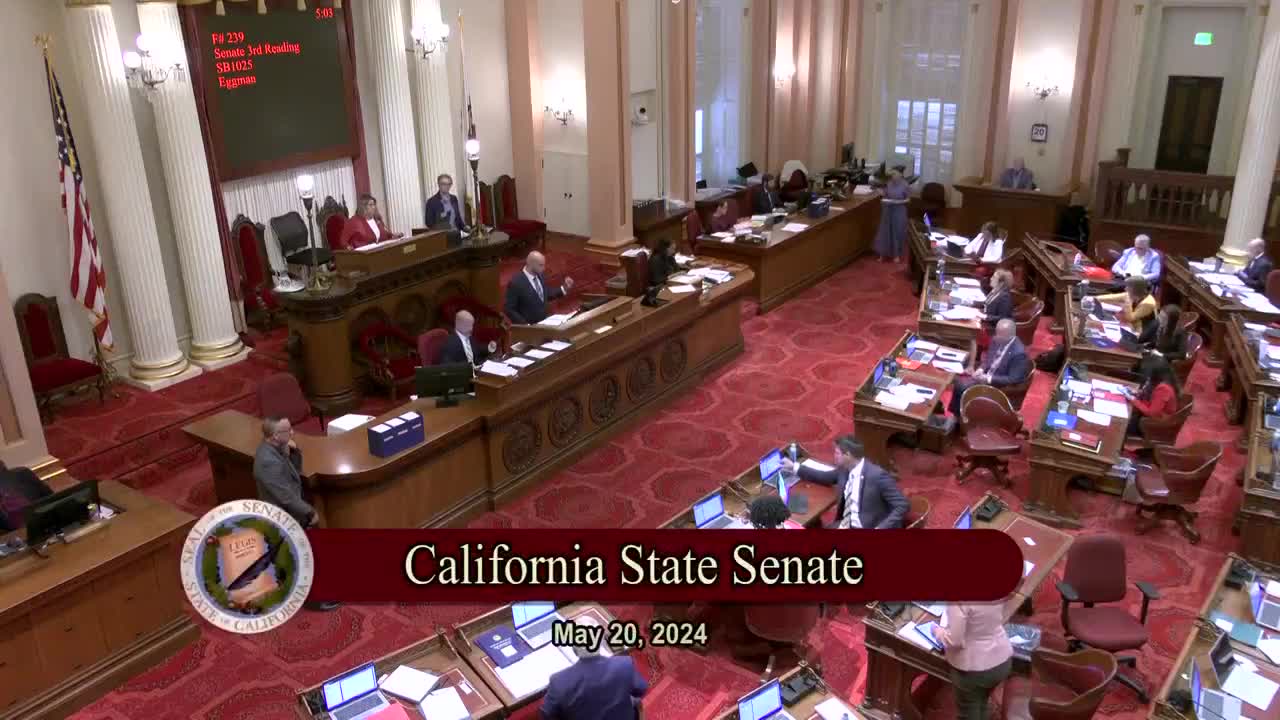 7MIN
Senate Floor
 52MIN
Senate Standing Committee on Energy, Utilities and Communications
 34SEC
Senate Standing Committee on Energy, Utilities and Communications
Bill Author


