SB 1384: Powered wheelchairs: repair.
- Session Year: 2023-2024
- House: Senate
- Latest Version Date: 2024-09-27
Current Status:
Passed
(2024-09-27: Chaptered by Secretary of State. Chapter 797, Statutes of 2024.)
Introduced
In Committee
First Chamber
In Committee
Second Chamber
Enacted
Existing law, the Sherman Food, Drug, and Cosmetic Law, regulates the packaging, labeling, and advertising of drugs and devices, and is administered by the State Department of Public Health. Among other things, existing law prohibits a person from conducting a home medical device retail facility business in this state unless the person has obtained a license from the department and sets forth standards for operating that facility.
Existing law authorizes the department to waive any licensing requirements for a home medical device retail facility when, in the opinion of the department, a high standard of patient safety, consistent with good patient care, can be provided by the licensure of a home medical device retail facility that does not meet all of the requirements for licensure.
This bill would, except as specified, require an original equipment manufacturer of a powered wheelchair, as those terms are defined, to provide documentation, parts, embedded software, firmware, and tools used to inspect, diagnose, maintain, and repair the wheelchair to an owner or an independent repair provider for the purposes of providing service on the equipment or specified parts in the state, on fair and reasonable terms and costs, as defined. The bill would also require an original equipment manufacturer, for a powered wheelchair that contains an electronic security lock or other security-related function, to provide documentation, parts, embedded software, firmware, or tools needed to reset the lock or function when disabled in the course of providing services, as specified. The bill would require an independent repair provider to provide a written notice to a customer before providing repair services, as specified.
This bill would, with certain exceptions, exempt trade secret information from these requirements. The bill would subject an original equipment manufacturer who knowingly violates, or who should have reasonably known that they violated, these provisions to specified civil penalties. The bill would, in the case of a first violation, give an original equipment manufacturer who did not knowingly violate these provisions a 3-day right to cure the violation before a civil penalty is imposed. The bill would authorize a person injured by a violation of these provisions and the Attorney General or a district attorney to bring a civil action for this purpose, as specified. If the action is brought by the Attorney General or district attorney, the bill would require the penalty to be paid to specified entities or individuals, as provided.
Existing law, the Sherman Food, Drug, and Cosmetic Law, regulates the packaging, labeling, and advertising of drugs and devices, and is administered by the State Department of Public Health. Among other things, existing law prohibits a person from conducting a home medical device retail facility business in this state unless the person has obtained a license from the department and sets forth standards for operating that facility.
Existing law authorizes the department to waive any licensing requirements for a home medical device retail facility when, in the opinion of the department, a high standard of patient safety, consistent with good patient care, can be provided by the licensure of a home medical device retail facility that does not meet all of the requirements for licensure.
This bill would, except as specified, require an original equipment manufacturer of a powered wheelchair, as those terms are defined, to provide documentation, parts, embedded software, firmware, and tools used to inspect, diagnose, maintain, and repair the wheelchair to an owner or an independent repair provider for the purposes of providing service on the equipment or specified parts in the state, on fair and reasonable terms and costs, as defined. The bill would also require an original equipment manufacturer, for a powered wheelchair that contains an electronic security lock or other security-related function, to provide any documentation, parts, embedded software, firmware, or tools needed to reset the lock or function when disabled in the course of providing services, as specified. The bill would require an independent repair provider to provide a written notice to a customer before providing repair services, as specified.
This bill would, with certain exceptions, exempt trade secret information from these requirements. The bill would subject an original equipment manufacturer who knowingly violates, or who should have reasonably known that they violated, these provisions to specified civil penalties. The bill would, in the case of a first violation, give an original equipment manufacturer who did not knowingly violate these provisions a 3-day right to cure the violation before a civil penalty is imposed. The bill would authorize a person injured by a violation of these provisions and the Attorney General or a district attorney to bring a civil action for this purpose, as specified. If the action is brought by the Attorney General or district attorney, the bill would require the penalty to be paid to specified entities or individuals, as provided.
Existing law, the Sherman Food, Drug, and Cosmetic Law, regulates the packaging, labeling, and advertising of drugs and devices, and is administered by the State Department of Public Health. Among other things, existing law prohibits a person from conducting a home medical device retail facility business in this state unless the person has obtained a license from the department and sets forth standards for operating that facility.
Existing law authorizes the department to waive any licensing requirements for a home medical device retail facility when, in the opinion of the department, a high standard of patient safety, consistent with good patient care, can be provided by the licensure of a home medical device retail facility that does not meet all of the requirements for licensure.
This bill would, except as specified, require an original equipment manufacturer of a powered wheelchair, as those terms are defined, to provide documentation, parts, embedded software, firmware, and tools used to inspect, diagnose, maintain, and repair the wheelchair to an owner or an independent repair provider for the purposes of providing service on the equipment in the state, on fair and reasonable terms and costs, as defined. The bill would also require an original equipment manufacturer, for a powered wheelchair that contains an electronic security lock or other security-related function, to provide any documentation, parts, embedded software, firmware, or tools needed to reset the lock or function when disabled in the course of providing services, as specified. The bill would require an independent repair provider to provide a written notice to a customer before providing repair services, as specified.
This bill would, with certain exceptions, exempt trade secret information from these requirements. The bill would subject an original equipment manufacturer who knowingly violates, or who should have reasonably known that they violated, these provisions to specified civil penalties. The bill would, in the case of a first violation, give an original equipment manufacturer who did not knowingly violate these provisions a 3-day right to cure the violation before a civil penalty is imposed. The bill would authorize a person injured by a violation of these provisions and the Attorney General or a district attorney to bring a civil action for this purpose, as specified. If the action is brought by the Attorney General or district attorney, the bill would require the penalty to be paid to specified entities or individuals, as provided.
For the purposes of this chapter, the following definitions apply:
(a)Authorized repair provider means an individual or business who is unaffiliated with an original equipment manufacturer and who has an arrangement with the original equipment manufacturer, for a definite or indefinite period, under which the original equipment manufacturer grants to the individual or business a license to use a trade name, service mark, or other proprietary identifier for the purposes of offering the services of inspection, diagnosis, maintenance, or repair of powered wheelchairs under the name of the original equipment manufacturer, or other arrangement with the original equipment manufacturer to offer those services on behalf of the original equipment manufacturer. An original equipment manufacturer who offers the services of inspection, diagnosis, maintenance, or repair of its own powered wheelchairs, and who does not have an arrangement described in this subdivision with an unaffiliated individual or business, shall be considered an authorized repair provider with respect to that equipment.
(b)Documentation means any manual, diagram, reporting output, service code description, schematic, or other guidance or information used in effecting the services of inspection, diagnosis, maintenance, or repair of powered wheelchairs.
(c)Embedded software means any programmable instructions provided on firmware delivered with an electronic component of equipment, or with a part for that equipment, for purposes of equipment operation, including all relevant patches and fixes made by the manufacturer of the equipment or part for these purposes.
(d)Equipment means a powered wheelchair.
(e)(1)Fair and reasonable terms and costs, with respect to obtaining documentation, parts, embedded software, firmware, or tools from a manufacturer to provide services, means terms that are equivalent to the most favorable terms that the manufacturer offers to an authorized repair provider and costs that are no greater than the manufacturers suggested retail price.
(2)For documentation, including any relevant updates, fair and reasonable terms also means at no charge, except that, when the documentation is requested in physical printed form, a charge may be included for the reasonable actual costs of preparing and sending the copy.
(3)For software tools, fair and reasonable terms also means all of the following:
(A)Provided at no charge and without requiring authorization or internet access.
(B)Without imposing impediments to access or use, in the course of effecting the diagnosis, maintenance, or repair and without impairing the efficient and cost-effective performance of the diagnosis, maintenance, or repair.
(C)Enables full functionality.
(4)If an original equipment manufacturer does not utilize an authorized repair provider, fair and reasonable terms means an equitable price in consideration of the actual cost to the original equipment manufacturer to prepare and distribute the part, tool, service access method, or documentation, exclusive of any research and development costs incurred.
(f)Firmware means a software program or set of instructions programmed on equipment, or on a part for that equipment, to allow the equipment or part to communicate within itself or with other computer hardware.
(g)Independent repair provider means an individual or business, other than the manufacturer, that is engaged in the services of inspection, diagnosis, maintenance, or repair of equipment for purposes of returning it to the safety and performance specifications established by the manufacturer and to meet its original intended use.
(h)Original equipment manufacturer means a business engaged in the business of selling, leasing, or otherwise supplying new equipment or parts manufactured by, or on behalf of, itself, to any individual or business.
(i)Part means any replacement part, either new or used, made available by an original equipment manufacturer for purposes of effecting the services of inspection, diagnosis, maintenance, or repair of powered wheelchairs manufactured by, or on behalf of, sold, or otherwise supplied by the original equipment manufacturer.
(j)Powered wheelchair means a motorized wheeled device designed for use by a person with a physical disability.
(k)Tools means any software program, hardware implement, or other apparatus used in inspection, diagnosis, maintenance, or repair of powered wheelchairs, including software or other mechanisms that provision, program, or pair a new part, calibrate functionality, or perform any other function required to bring the product back to fully functional condition.
(l)Trade secret has the same meaning as in subdivision (d) of Section 3426.1 of the Civil Code.
21301.(a)For the purpose of providing services for equipment in the state, an original equipment manufacturer shall, with fair and reasonable terms and costs, make available to an independent repair provider or owner of the manufacturers equipment, documentation, parts, embedded software, firmware, or tools that are intended for use with the equipment or any part listed in subdivision (c), including updates to documentation, parts, embedded software, firmware, or tools.
(b)Regarding subdivision (c), with respect to equipment that contains an electronic security lock or other security-related function, an original equipment manufacturer shall, with fair and reasonable terms and costs, make available to independent repair providers and owners documentation, parts, embedded software, firmware, or tools needed to reset the lock or function when disabled in the course of providing services. The manufacturer may make the documentation, parts, embedded software, firmware, or tools available to independent repair providers and owners through appropriate secure release systems.
(c)For powered wheelchairs subject to Section 14132.8 of the Welfare and Institutions Code, this section shall not apply to any part that would require programmability, calibration, or clinical involvement to ensure appropriate patient seating and positioning. Items included in this section for powered wheelchairs subject to Section 14132.8 of the Welfare and Institutions Code shall include:
(1)Batteries.
(2)Battery chargers.
(3)Nonprogrammable joysticks.
(4)Joystick housings or brackets.
(5)Wheel assembly.
(6)Nonpositioning accessories.
(7)Antitip devices.
(8)Armrests, excluding positioning components designed for adjustment by a therapist or assistive technology professional.
(9)Caster spheres.
(10)Cosmetic shrouding.
(11)Floor mats.
(12)Floor plates.
(13)Nonpowered leg lowerers.
21302.(a)(1)An original equipment manufacturer who knowingly violates any provision of this chapter, or who reasonably should have known that they violated any provision of this chapter, shall be liable for a civil penalty of up to two thousand five hundred dollars ($2,500) per powered wheelchair, not exceeding two hundred fifty thousand dollars ($250,000), for a first violation.
(2)In the case of a first violation, an original equipment manufacturer who does not knowingly violate this chapter may be provided a three-day right to cure the violation before a civil penalty is imposed.
(3)An original equipment manufacturer who commits a second or subsequent violation of this chapter shall be liable for a civil penalty of up to ten thousand dollars ($10,000) per powered wheelchair, not exceeding two hundred fifty thousand dollars ($250,000) for each series of related violations.
(4)An original equipment manufacturer who fails to provide a part because it is out of stock and they are unable to obtain the part shall not be subject to the fines described in this subdivision if the original equipment manufacturer does both of the following:
(A)They inform the customer or independent repair provider that the part is out of stock, and, consequently, they are unable to obtain the part.
(B)They make the part available to the consumer or independent repair provider within three business days of when that part becomes available.
(b)An original equipment manufacturer who violates a court order or injunction issued pursuant to this chapter shall be liable for a civil penalty not to exceed ten thousand dollars ($10,000) per violation.
(c)(1)Any person injured by violation of this chapter may bring a civil action for damages or other appropriate relief.
(2)The Attorney General or district attorney may bring a civil action in the name of the state for violation of this chapter.
(3)An action brought pursuant to this chapter shall be commenced within three years from the date of the alleged violation.
(d)If the action is brought by the Attorney General, the penalty collected shall be paid to the Office of the Attorney General to offset the reasonable expenses incurred in conducting that action, and any remainder thereafter shall be paid to the State Treasurer. If brought by a district attorney, the entire amount of penalty collected shall be paid to the treasurer of the county in which the judgment was entered.
21303.An independent repair provider that is not an authorized repair provider shall provide a written notice to any customer before providing repairs that contains the following information:
(a)The independent repair provider is not an authorized repair provider for the product.
(b)The consumer may wish to review the terms and conditions of any warranty for the equipment, as repairs not performed by a designated authorized repair provider could potentially affect the warranty.
(c)Warranties for consumer products are governed by the federal Magnuson-Moss Warranty Act (Chapter 50 (commencing with Section 2301) of Title 15 of the United States Code), which gives consumers rights and protections that apply over any conflicting provisions in the warranty.
(d)Under Magnuson-Moss, a warranty cannot generally require that maintenance repairs be performed only by an authorized repair provider, unless the Federal Trade Commission waives this prohibition, or the repair is provided free of charge, pursuant to that warranty.
(e)Under Magnuson-Moss, if damage to equipment is shown to be caused by faulty nonbrand equipment or by faulty repair by a nonauthorized repair provider, that damage may not be covered by the warranty, but the warranty may otherwise remain in effect.
(f)Under Section 14019.4 of the Welfare and Institutions Code, an independent repair provider that is a Medi-Cal enrolled provider is prohibited from seeking reimbursement or attempting to obtain payment for the cost of covered services from a Medi-Cal applicant or recipient, unless the beneficiary owes a share of the cost, as described in subdivision (g) of that section.
21304.(a)This chapter does not require an original equipment manufacturer to divulge a trade secret, except as necessary to provide documentation, parts, tools, service access methods, and training courses and materials on fair and reasonable terms.
(1)An original equipment manufacturer may redact documentation to remove trade secrets from the documentation before providing access to the documentation if the usability of the redacted documentation for the purpose of providing services is not diminished.
(2)An original equipment manufacturer may withhold information regarding a component of, design of, functionality of, or process of developing a part, embedded software, firmware, or a tool if the information is a trade secret and the usability of the part, embedded software, firmware, or tool for the purpose of providing services is not diminished.
(b)This chapter does not require an original equipment manufacturer to make available a part if the part is no longer available to the original equipment manufacturer.
(c)An original equipment manufacturer is not liable for faulty or otherwise improper repairs provided by independent repair providers or owners, including faulty or otherwise improper repairs that cause any of the following:
(1)Damage to a powered wheelchair that occurs during the repairs.
(2)Any indirect, incidental, or consequential damages.
(3)An inability to use, or a reduced functionality of, a powered wheelchair resulting from faulty or otherwise improper repair.
(d)This chapter shall not be construed to alter the terms of any arrangement described in subdivision (a) of Section 21300 in force between an authorized repair provider and an original equipment manufacturer, including, but not limited to, the performance or provision of warranty or recall repair work by an authorized repair provider on behalf of an original equipment manufacturer pursuant to an arrangement described in subdivision (a) of Section 21300, except that any provision that purports to waive, avoid, restrict, or limit the original equipment manufacturers obligations to comply with this chapter shall be void and unenforceable.
(e)This chapter shall not be construed to exempt an original equipment manufacturer from a products liability claim that is otherwise authorized by law.
21305.This chapter applies with respect to equipment sold or in use on or after January 1, 2025.
For the purposes of this chapter, the following definitions apply:
(a)Authorized repair provider means an individual or business who is unaffiliated with an original equipment manufacturer and who has an arrangement with the original equipment manufacturer, for a definite or indefinite period, under which the original equipment manufacturer grants to the individual or business a license to use a trade name, service mark, or other proprietary identifier for the purposes of offering the services of inspection, diagnosis, maintenance, or repair of powered wheelchairs under the name of the original equipment manufacturer, or other arrangement with the original equipment manufacturer to offer those services on behalf of the original equipment manufacturer. An original equipment manufacturer who offers the services of inspection, diagnosis, maintenance, or repair of its own powered wheelchairs, and who does not have an arrangement described in this subdivision with an unaffiliated individual or business, shall be considered an authorized repair provider with respect to that equipment.
(b)Documentation means any manual, diagram, reporting output, service code description, schematic, or other guidance or information used in effecting the services of inspection, diagnosis, maintenance, or repair of powered wheelchairs.
(c)Embedded software means any programmable instructions provided on firmware delivered with an electronic component of equipment, or with a part for that equipment, for purposes of equipment operation, including all relevant patches and fixes made by the manufacturer of the equipment or part for these purposes.
(d)Equipment means a powered wheelchair.
(e)(1)Fair and reasonable terms and costs, with respect to obtaining documentation, parts, embedded software, firmware, or tools from a manufacturer to provide services, means terms that are equivalent to the most favorable terms that the manufacturer offers to an authorized repair provider and costs that are no greater than the manufacturers suggested retail price.
(2)For documentation, including any relevant updates, fair and reasonable terms also means at no charge, except that, when the documentation is requested in physical printed form, a charge may be included for the reasonable actual costs of preparing and sending the copy.
(3)For software tools, fair and reasonable terms also means all of the following:
(A)Provided at no charge and without requiring authorization or internet access.
(B)Without imposing impediments to access or use, in the course of effecting the diagnosis, maintenance, or repair and without impairing the efficient and cost-effective performance of the diagnosis, maintenance, or repair.
(C)Enables full functionality.
(4)If an original equipment manufacturer does not utilize an authorized repair provider, fair and reasonable terms means an equitable price in consideration of the actual cost to the original equipment manufacturer to prepare and distribute the part, tool, service access method, or documentation, exclusive of any research and development costs incurred.
(f)Firmware means a software program or set of instructions programmed on equipment, or on a part for that equipment, to allow the equipment or part to communicate within itself or with other computer hardware.
(g)Independent repair provider means an individual or business, other than the manufacturer, that is engaged in the services of inspection, diagnosis, maintenance, or repair of equipment for purposes of returning it to the safety and performance specifications established by the manufacturer and to meet its original intended use.
(h)Original equipment manufacturer means a business engaged in the business of selling, leasing, or otherwise supplying new equipment or parts manufactured by, or on behalf of, itself, to any individual or business.
(i)Part means any replacement part, either new or used, made available by an original equipment manufacturer for purposes of effecting the services of inspection, diagnosis, maintenance, or repair of powered wheelchairs manufactured by, or on behalf of, sold, or otherwise supplied by the original equipment manufacturer.
(j)Powered wheelchair means a motorized wheeled device designed for use by a person with a physical disability.
(k)Tools means any software program, hardware implement, or other apparatus used in inspection, diagnosis, maintenance, or repair of powered wheelchairs, including software or other mechanisms that provision, program, or pair a new part, calibrate functionality, or perform any other function required to bring the product back to fully functional condition.
(l)Trade secret has the same meaning as in subdivision (d) of Section 3426.1 of the Civil Code.
21301.(a)For the purpose of providing services for equipment in the state, an original equipment manufacturer shall, with fair and reasonable terms and costs, make available to an independent repair provider or owner of the manufacturers equipment, any documentation, parts, embedded software, firmware, or tools that are intended for use with the equipment or any part, part listed in subdivision (c), including updates to documentation, parts, embedded software, firmware, or tools.
(b)With Regarding subdivision (c), with respect to equipment that contains an electronic security lock or other security-related function, an original equipment manufacturer shall, with fair and reasonable terms and costs, make available to independent repair providers and owners any documentation, parts, embedded software, firmware, or tools needed to reset the lock or function when disabled in the course of providing services. The manufacturer may make the documentation, parts, embedded software, firmware, or tools available to independent repair providers and owners through appropriate secure release systems.
(c)For powered wheelchairs subject to Section 14132.8 of the Welfare and Institutions Code, this section shall not apply to any part that would require programmability, calibration, or clinical involvement to ensure appropriate patient seating and positioning. Items included in this section for powered wheelchairs subject to Section 14132.8 of the Welfare and Institutions Code shall include:
(1)Batteries.
(2)Battery chargers.
(3)Nonprogrammable joysticks.
(4)Joystick housings or brackets.
(5)Wheel assembly.
(6)Nonpositioning accessories.
(7)Antitip devices.
(8)Armrests, excluding positioning components designed for adjustment by a therapist or assistive technology professional.
(9)Caster spheres.
(10)Cosmetic shrouding.
(11)Floor mats.
(12)Floor plates.
(13)Nonpowered leg lowerers.
21302.(a)(1)An original equipment manufacturer who knowingly violates any provision of this chapter, or who reasonably should have known that they violated any provision of this chapter, shall be liable for a civil penalty of up to two thousand five hundred dollars ($2,500) per powered wheelchair, not exceeding two hundred fifty thousand dollars ($250,000), for a first violation.
(2)In the case of a first violation, an original equipment manufacturer who does not knowingly violate this chapter may be provided a three-day right to cure the violation before a civil penalty is imposed.
(3)An original equipment manufacturer who commits a second or subsequent violation of this chapter shall be liable for a civil penalty of up to ten thousand dollars ($10,000) per powered wheelchair, not exceeding two hundred fifty thousand dollars ($250,000) for each series of related violations.
(4)An original equipment manufacturer who fails to provide a part because it is out of stock and they are unable to obtain the part shall not be subject to the fines described in this subdivision if the original equipment manufacturer does both of the following:
(A)They inform the customer or independent repair provider that the part is out of stock, and, consequently, they are unable to obtain the part.
(B)They make the part available to the consumer or independent repair provider within three business days of when that part becomes available.
(b)An original equipment manufacturer who violates a court order or injunction issued pursuant to this chapter shall be liable for a civil penalty not to exceed ten thousand dollars ($10,000) per violation.
(c)(1)Any person injured by violation of this chapter may bring a civil action for damages or other appropriate relief.
(2)The Attorney General or district attorney may bring a civil action in the name of the state for violation of this chapter.
(3)An action brought pursuant to this chapter shall be commenced within three years from the date of the alleged violation.
(d)If the action is brought by the Attorney General, the penalty collected shall be paid to the Office of the Attorney General to offset the reasonable expenses incurred in conducting that action, and any remainder thereafter shall be paid to the State Treasurer. If brought by a district attorney, the entire amount of penalty collected shall be paid to the treasurer of the county in which the judgment was entered.
21303.An independent repair provider that is not an authorized repair provider shall provide a written notice to any customer before providing repairs that contains the following information:
(a)The independent repair provider is not an authorized repair provider for the product.
(b)The consumer may wish to review the terms and conditions of any warranty for the equipment, as repairs not performed by a designated authorized repair provider could potentially affect the warranty.
(c)Warranties for consumer products are governed by the federal Magnuson-Moss Warranty Act (Chapter 50 (commencing with Section 2301) of Title 15 of the United States Code), which gives consumers rights and protections that apply over any conflicting provisions in the warranty.
(d)Under Magnuson-Moss, a warranty cannot generally require that maintenance repairs be performed only by an authorized repair provider, unless the Federal Trade Commission waives this prohibition, or the repair is provided free of charge, pursuant to that warranty.
(e)Under Magnuson-Moss, if damage to equipment is shown to be caused by faulty nonbrand equipment or by faulty repair by a nonauthorized repair provider, that damage may not be covered by the warranty, but the warranty may otherwise remain in effect.
(f)Under Section 14019.4 of the Welfare and Institutions Code, an independent repair provider that is a Medi-Cal enrolled provider is prohibited from seeking reimbursement or attempting to obtain payment for the cost of covered services from a Medi-Cal applicant or recipient, unless the beneficiary owes a share of the cost, as described in subdivision (g) of that section.
21304.(a)This chapter does not require an original equipment manufacturer to divulge a trade secret, except as necessary to provide documentation, parts, tools, service access methods, and training courses and materials on fair and reasonable terms.
(1)An original equipment manufacturer may redact documentation to remove trade secrets from the documentation before providing access to the documentation if the usability of the redacted documentation for the purpose of providing services is not diminished.
(2)An original equipment manufacturer may withhold information regarding a component of, design of, functionality of, or process of developing a part, embedded software, firmware, or a tool if the information is a trade secret and the usability of the part, embedded software, firmware, or tool for the purpose of providing services is not diminished.
(b)This chapter does not require an original equipment manufacturer to make available a part if the part is no longer available to the original equipment manufacturer.
(c)An original equipment manufacturer is not liable for faulty or otherwise improper repairs provided by independent repair providers or owners, including faulty or otherwise improper repairs that cause any of the following:
(1)Damage to a powered wheelchair that occurs during the repairs.
(2)Any indirect, incidental, or consequential damages.
(3)An inability to use, or a reduced functionality of, a powered wheelchair resulting from faulty or otherwise improper repair.
(d)This chapter shall not be construed to alter the terms of any arrangement described in subdivision (a) of Section 21300 in force between an authorized repair provider and an original equipment manufacturer, including, but not limited to, the performance or provision of warranty or recall repair work by an authorized repair provider on behalf of an original equipment manufacturer pursuant to an arrangement described in subdivision (a) of Section 21300, except that any provision that purports to waive, avoid, restrict, or limit the original equipment manufacturers obligations to comply with this chapter shall be void and unenforceable.
(e)This chapter shall not be construed to exempt an original equipment manufacturer from a products liability claim that is otherwise authorized by law.
21305.This chapter applies with respect to equipment sold or in use on or after January 1, 2025.
For the purposes of this chapter, the following definitions apply:
(a)Authorized repair provider means an individual or business who is unaffiliated with an original equipment manufacturer and who has an arrangement with the original equipment manufacturer, for a definite or indefinite period, under which the original equipment manufacturer grants to the individual or business a license to use a trade name, service mark, or other proprietary identifier for the purposes of offering the services of inspection, diagnosis, maintenance, or repair of powered wheelchairs under the name of the original equipment manufacturer, or other arrangement with the original equipment manufacturer to offer those services on behalf of the original equipment manufacturer. An original equipment manufacturer who offers the services of inspection, diagnosis, maintenance, or repair of its own powered wheelchairs, and who does not have an arrangement described in this subdivision with an unaffiliated individual or business, shall be considered an authorized repair provider with respect to that equipment.
(b)Documentation means any manual, diagram, reporting output, service code description, schematic, or other guidance or information used in effecting the services of inspection, diagnosis, maintenance, or repair of powered wheelchairs.
(c)Embedded software means any programmable instructions provided on firmware delivered with an electronic component of equipment, or with a part for that equipment, for purposes of equipment operation, including all relevant patches and fixes made by the manufacturer of the equipment or part for these purposes.
(d)Equipment means a powered wheelchair.
(e)(1)Fair and reasonable terms and costs, with respect to obtaining documentation, parts, embedded software, firmware, or tools from a manufacturer to provide services, means terms that are equivalent to the most favorable terms that the manufacturer offers to an authorized repair provider and costs that are no greater than the manufacturers suggested retail price.
(2)For documentation, including any relevant updates, fair and reasonable terms also means at no charge, except that, when the documentation is requested in physical printed form, a charge may be included for the reasonable actual costs of preparing and sending the copy.
(3)For software tools, fair and reasonable terms also means all of the following:
(A)Provided at no charge and without requiring authorization or internet access.
(B)Without imposing impediments to access or use, in the course of effecting the diagnosis, maintenance, or repair and without impairing the efficient and cost-effective performance of the diagnosis, maintenance, or repair.
(C)Enables full functionality.
(4)If an original equipment manufacturer does not utilize an authorized repair provider, fair and reasonable terms means an equitable price in consideration of the actual cost to the original equipment manufacturer to prepare and distribute the part, tool, service access method, or documentation, exclusive of any research and development costs incurred.
(f)Firmware means a software program or set of instructions programmed on equipment, or on a part for that equipment, to allow the equipment or part to communicate within itself or with other computer hardware.
(g)Independent repair provider means an individual or business, other than the manufacturer, that is engaged in the services of inspection, diagnosis, maintenance, or repair of equipment for purposes of returning it to the safety and performance specifications established by the manufacturer and to meet its original intended use.
(h)Original equipment manufacturer means a business engaged in the business of selling, leasing, or otherwise supplying new equipment or parts manufactured by, or on behalf of, itself, to any individual or business.
(i)Part means any replacement part, either new or used, made available by an original equipment manufacturer for purposes of effecting the services of inspection, diagnosis, maintenance, or repair of powered wheelchairs manufactured by, or on behalf of, sold, or otherwise supplied by the original equipment manufacturer.
(j)Powered wheelchair means a motorized wheeled device designed for use by a person with a physical disability.
(k)Tools means any software program, hardware implement, or other apparatus used in inspection, diagnosis, maintenance, or repair of powered wheelchairs, including software or other mechanisms that provision, program, or pair a new part, calibrate functionality, or perform any other function required to bring the product back to fully functional condition.
(l)Trade secret has the same meaning as in subdivision (d) of Section 3426.1 of the Civil Code.
21301.(a)For the purpose of providing services for equipment in the state, an original equipment manufacturer shall, with fair and reasonable terms and costs, make available to an independent repair provider or owner of the manufacturers equipment, any documentation, parts, embedded software, firmware, or tools that are intended for use with the equipment or any part, including updates to documentation, parts, embedded software, firmware, or tools.
(b)With respect to equipment that contains an electronic security lock or other security-related function, an original equipment manufacturer shall, with fair and reasonable terms and costs, make available to independent repair providers and owners any documentation, parts, embedded software, firmware, or tools needed to reset the lock or function when disabled in the course of providing services. The manufacturer may make the documentation, parts, embedded software, firmware, or tools available to independent repair providers and owners through appropriate secure release systems.
(c)For powered wheelchairs subject to Section 14132.8 of the Welfare and Institutions Code, this section shall not apply to any part that would require programmability, calibration, or clinical involvement to ensure appropriate patient seating and positioning. Items included in this section for powered wheelchairs subject to Section 14132.8 of the Welfare and Institutions Code shall include:
(1)Batteries.
(2)Battery chargers.
(3)Nonprogrammable joysticks.
(4)Joystick housings or brackets.
(5)Wheel assembly.
(6)Nonpositioning accessories.
(7)Antitip devices.
(8)Armrests, excluding positioning components designed for adjustment by a therapist or assistive technology professional.
(9)Caster spheres.
(10)Cosmetic shrouding.
(11)Floor mats.
(12)Floor plates.
(13)Nonpowered leg lowerers.
21302.(a)(1)An original equipment manufacturer who knowingly violates any provision of this chapter, or who reasonably should have known that they violated any provision of this chapter, shall be liable for a civil penalty of up to two thousand five hundred dollars ($2,500) per powered wheelchair, not exceeding two hundred fifty thousand dollars ($250,000), for a first violation.
(2)In the case of a first violation, an original equipment manufacturer who does not knowingly violate this chapter may be provided a three-day right to cure the violation before a civil penalty is imposed.
(3)An original equipment manufacturer who commits a second or subsequent violation of this chapter shall be liable for a civil penalty of up to ten thousand dollars ($10,000) per powered wheelchair, not exceeding two hundred fifty thousand dollars ($250,000) for each series of related violations.
(4)An original equipment manufacturer who fails to provide a part because it is out of stock and they are unable to obtain the part shall not be subject to the fines described in this subdivision if the original equipment manufacturer does both of the following:
(A)They inform the customer or independent repair provider that the part is out of stock, and, consequently, they are unable to obtain the part.
(B)They make the part available to the consumer or independent repair provider within three business days of when that part becomes available.
(b)An original equipment manufacturer who violates a court order or injunction issued pursuant to this chapter shall be liable for a civil penalty not to exceed ten thousand dollars ($10,000) per violation.
(c)(1)Any person injured by violation of this chapter may bring a civil action for damages or other appropriate relief.
(2)The Attorney General or district attorney may bring a civil action in the name of the state for violation of this chapter.
(3)An action brought pursuant to this chapter shall be commenced within three years from the date of the alleged violation.
(d)If the action is brought by the Attorney General, the penalty collected shall be paid to the Office of the Attorney General to offset the reasonable expenses incurred in conducting that action, and any remainder thereafter shall be paid to the State Treasurer. If brought by a district attorney, the entire amount of penalty collected shall be paid to the treasurer of the county in which the judgment was entered.
21303.An independent repair provider that is not an authorized repair provider shall provide a written notice to any customer before providing repairs that contains the following information:
(a)The independent repair provider is not an authorized repair provider for the product.
(b)The consumer may wish to review the terms and conditions of any warranty for the equipment, as repairs not performed by a designated authorized repair provider could potentially affect the warranty.
(c)Warranties for consumer products are governed by the federal Magnuson-Moss Warranty Act (Chapter 50 (commencing with Section 2301) of Title 15 of the United States Code), which gives consumers rights and protections that apply over any conflicting provisions in the warranty.
(d)Under Magnuson-Moss, a warranty cannot generally require that maintenance repairs be performed only by an authorized repair provider, unless the Federal Trade Commission waives this prohibition, or the repair is provided free of charge, pursuant to that warranty.
(e)Under Magnuson-Moss, if damage to equipment is shown to be caused by faulty nonbrand equipment or by faulty repair by a nonauthorized repair provider, that damage may not be covered by the warranty, but the warranty may otherwise remain in effect.
(f)Under Section 14019.4 of the Welfare and Institutions Code, an independent repair provider that is a Medi-Cal enrolled provider is prohibited from seeking reimbursement or attempting to obtain payment for the cost of covered services from a Medi-Cal applicant or recipient, unless the beneficiary owes a share of the cost, as described in subdivision (g) of that section.
21304.(a)This chapter does not require an original equipment manufacturer to divulge a trade secret, except as necessary to provide documentation, parts, tools, service access methods, and training courses and materials on fair and reasonable terms.
(1)An original equipment manufacturer may redact documentation to remove trade secrets from the documentation before providing access to the documentation if the usability of the redacted documentation for the purpose of providing services is not diminished.
(2)An original equipment manufacturer may withhold information regarding a component of, design of, functionality of, or process of developing a part, embedded software, firmware, or a tool if the information is a trade secret and the usability of the part, embedded software, firmware, or tool for the purpose of providing services is not diminished.
(b)This chapter does not require an original equipment manufacturer to make available a part if the part is no longer available to the original equipment manufacturer.
(c)An original equipment manufacturer is not liable for faulty or otherwise improper repairs provided by independent repair providers or owners, including faulty or otherwise improper repairs that cause any of the following:
(1)Damage to a powered wheelchair that occurs during the repairs.
(2)Any indirect, incidental, or consequential damages.
(3)An inability to use, or a reduced functionality of, a powered wheelchair resulting from faulty or otherwise improper repair.
(d)This chapter shall not be construed to alter the terms of any arrangement described in subdivision (a) of Section 21300 in force between an authorized repair provider and an original equipment manufacturer, including, but not limited to, the performance or provision of warranty or recall repair work by an authorized repair provider on behalf of an original equipment manufacturer pursuant to an arrangement described in subdivision (a) of Section 21300, except that any provision that purports to waive, avoid, restrict, or limit the original equipment manufacturers obligations to comply with this chapter shall be void and unenforceable.
(e)This chapter shall not be construed to exempt an original equipment manufacturer from a products liability claim that is otherwise authorized by law.
21305.This chapter applies with respect to equipment sold or in use on or after January 1, 2025.
|
Date
|
Status
|
|---|---|
| Sep 27, 2024 | Chaptered by Secretary of State. Chapter 797, Statutes of 2024. |
| Sep 27, 2024 | Approved by the Governor. |
| Sep 3, 2024 | Enrolled and presented to the Governor at 3 p.m. |
| Aug 26, 2024 | In Senate. Ordered to engrossing and enrolling. |
| Aug 26, 2024 | Read third time. Passed. (Ayes 77. Noes 0. Page 6535.) Ordered to the Senate. |
| Aug 19, 2024 | Read second time. Ordered to third reading. |
| Aug 15, 2024 | From committee: Do pass. (Ayes 14. Noes 0.) (August 15). |
| Jul 2, 2024 | July 2 set for first hearing. Placed on suspense file. |
| Jun 25, 2024 | From committee: Do pass and re-refer to Com. on APPR. with recommendation: To consent calendar. (Ayes 11. Noes 0.) (June 25). Re-referred to Com. on APPR. |
| Jun 19, 2024 | From committee: Do pass and re-refer to Com. on JUD. with recommendation: To consent calendar. (Ayes 11. Noes 0.) (June 18). Re-referred to Com. on JUD. |
| Jun 3, 2024 | Referred to Coms. on P. & C.P. and JUD. |
| May 24, 2024 | In Assembly. Read first time. Held at Desk. |
| May 23, 2024 | Read third time. Passed. (Ayes 37. Noes 0. Page 4182.) Ordered to the Assembly. |
| May 20, 2024 | Ordered to special consent calendar. |
| May 16, 2024 | Read second time. Ordered to third reading. |
| May 16, 2024 | From committee: Do pass. (Ayes 7. Noes 0. Page 3981.) (May 16). |
| May 10, 2024 | Set for hearing May 16. |
| Apr 15, 2024 | April 15 hearing: Placed on APPR suspense file. |
| Apr 5, 2024 | Set for hearing April 15. |
| Apr 3, 2024 | From committee: Do pass and re-refer to Com. on APPR with recommendation: To consent calendar. (Ayes 11. Noes 0. Page 3448.) (April 2). Re-referred to Com. on APPR. |
| Mar 21, 2024 | From committee with author's amendments. Read second time and amended. Re-referred to Com. on JUD. |
| Mar 19, 2024 | Set for hearing April 2. |
| Mar 18, 2024 | From committee: Do pass and re-refer to Com. on JUD. (Ayes 12. Noes 0. Page 3332.) (March 18). Re-referred to Com. on JUD. |
| Mar 14, 2024 | Set for hearing March 18. |
| Feb 29, 2024 | Referred to Coms. on B., P. & E. D. and JUD. |
| Feb 20, 2024 | From printer. May be acted upon on or after March 18. |
| Feb 16, 2024 | Introduced. Read first time. To Com. on RLS. for assignment. To print. |
|
Date
|
Description
|
Location
|
Votes
|
|
|---|---|---|---|---|
| Aug 26, 2024 | SB 1384 Dodd Senate Third Reading By Alanis | Assembly Floor |
Passed |
|
| Aug 15, 2024 | Do pass. | Assembly Standing Committee on Appropriations |
Passed |
|
| Jun 25, 2024 | Do pass and be re-referred to the Committee on [Appropriations] with recommendation: To Consent Calendar | Assembly Standing Committee on Judiciary |
Passed |
|
| Jun 18, 2024 | Do pass and be re-referred to the Committee on [Judiciary] with recommendation: To Consent Calendar | Assembly Standing Committee on Privacy and Consumer Protection |
Passed |
|
| May 23, 2024 | Special Consent SB1384 Dodd et al. | Senate Floor |
Passed |
|
| May 16, 2024 | Do pass | Senate Standing Committee on Appropriations |
Passed |
|
| Apr 15, 2024 | Placed on suspense file | Senate Standing Committee on Appropriations |
Passed |
|
| Apr 2, 2024 | Do pass, but first be re-referred to the Committee on [Appropriations] with the recommendation: To Consent Calendar | Senate Standing Committee on Judiciary |
Passed |
|
| Mar 18, 2024 | Do pass, but first be re-referred to the Committee on [Judiciary] | Senate Standing Committee on Business, Professions and Economic Development |
Passed |
This list shows positions taken on this bill by organizations on the date displayed, which is linked to the original source.
Positions by individuals are not included.
|
Organization
|
Position
|
Date
|
|---|---|---|
| Association Of Regional Center Agencies | ** Support | |
| California Foundation For Independent Living Centers | ** Support | |
| California Long Term Care Ombudsman Association | ** Support | |
| Californians Against Waste | ** Support | |
| CALPIRG, California Public Interest Research Group | ** Support | |
| County Health Executives Association Of California | ** Support | |
| Disability Rights California | ** Support | |
| Ifixit | ** Support | |
| LeadingAge California | ** Support | |
| National Multiple Sclerosis Society, Mscan | ** Support | |
| Recyclesmart | ** Support | |
| Scdd | ** Support | |
| Yolo County In-home Supportive Services Advisory Committee | ** Support | |
| Yolo County Voting Accessibility Advisory Committee | ** Support |
SENATE THIRD READING
STR Bill Id:SB 1384
Author:(Dodd)
As Amended Ver:March 21, 2024
Majority vote
SUMMARY
Requires a manufacturer of powered wheelchairs designed for use by people with physical disabilities to make available to independent repair providers and wheelchair owners, on fair and reasonable terms, the documentation, parts, and tools needed to repair those wheelchairs.
Major Provisions
- Requires an original equipment manufacturer (OEM) of a powered wheelchair to, with fair and reasonable terms and costs, make available to an independent repair provider or owner of the manufacturer's equipment, any documentation, parts, embedded software, firmware, or tools that are intended for use with the equipment or part, including updates to these items.
- Requires an OEM to, with fair and reasonable terms and costs, with respect to equipment that contains an electronic security lock or other security-related function, make available to independent repair providers and owners any documentation, parts, embedded software, firmware, or tools needed to reset the lock or function when disabled in the course of providing services.
- Requires an independent repair provider that is not an authorized repair provider, before providing repairs, to provide a written notice to the customer containing various relevant information.
- Permits the Attorney General or a district attorney to bring a civil action in the name of the state for violation of this bill.
- Permits a person injured by a violation of this bill to bring a civil action for damages or other appropriate relief.
COMMENTS
Background. Powered wheelchairs are complicated, expensive, and critically important to thousands of Californians with mobility disabilities. Wheelchair manufacturers have limited capacity to make repairs in-house, and there are few certified complex rehabilitation technology (CRT) providers in the state. Over the past five years, the number of CRT providers in California has declined by 50%, further exacerbating repair wait times for powered wheelchair users. As a result, during the often-lengthy waiting periods for repairs, wheelchair users may find themselves confined to their beds, which, beyond significantly diminishing the quality of their daily lives, heightens their susceptibility to medical complications that may lead to hospitalization.
What this bill would do. This bill rests on a number of highly-technical and nuanced definitions of terms such as "fair and reasonable terms and costs," "parts," and "tools." But at its core, the bill would work as follows:
- It would apply to powered wheelchairs, as defined: motorized wheeled devices designed for use by people with physical disabilities. To be covered by this bill, a wheelchair must have been sold or in use on or after January 1, 2025.
- The original manufacturer would have to make available to independent repair providers and to owners, any documentation, parts, embedded software, firmware, or tools intended for use with the powered wheelchair.
- The manufacturer would have to make the documentation, parts, embedded software, firmware, and tools available on "fair and reasonable terms": essentially, on the most favorable terms under which the manufacturer makes these things available to one of its authorized repair providers; and at costs no greater than the manufacturer's suggested retail price. (If the manufacturer does not use authorized service providers, then at the actual cost to the manufacturer for these things.)
- If an independent repair provider is not a manufacturer's authorized repair provider, then the independent provider would have to provide customers with a written notice i) informing them of this fact, ii) warning to consult the wheelchair's warranty, and that damage caused by a faulty repair or faulty equipment may not be covered under the warranty, and iii) providing information regarding Medi-Cal reimbursement requirements.
- The bill may be enforced by the Attorney General or by a district attorney, with civil penalties assessed for violations. Manufacturers that commit a first-time, unknowing violation of the bill would be granted three-day right to cure the violation before civil penalties are imposed.
Analysis. This bill is meant to address a longstanding problem for people whose mobility is impaired due to physical disability: how to obtain timely repairs for their powered wheelchairs. Manufacturers of powered wheelchairs are not currently required to provide owners or independent repair shops with the parts, documentation, and tools needed for repairs. But wheelchair manufacturers have limited capacity to make repairs in-house, and there are few certified complex rehabilitation technology (CRT) providers in the state. According to information provided by the author, over the past five years, the number of CRT providers in California has declined by 50%, further exacerbating repair wait times for powered wheelchair users. As a result, during the often-lengthy waiting periods for repairs, wheelchair users may find themselves confined to their beds, which, beyond significantly diminishing the quality of their daily lives, heightens their susceptibility to medical complications that may lead to hospitalization.
This bill seeks to address the lack of wheelchair repair services by creating a "right to repair" for powered wheelchairs. If enacted, it would establish a comprehensive statutory framework for wheelchair users and independent repair providers to access the necessary parts, tools, and documentation for the repair of powered wheelchairs.
The bill is also part of a broader national "right to repair" movement, at both the state and federal level, that seeks to give product owners increased access to timely, affordable repairs for a number of products, including consumer electronics, household appliances, and agricultural equipment.
Ultimately, this bill could significantly improve the quality of life for thousands of people with mobility disabilities, providing them independence and saving them precious weeks or months when they might otherwise be bedridden.
SB 271 (Dodd, 2023) was substantially similar to this bill, but additionally included a prohibition on the Department of Health Care Services from requiring prior authorization for the repair of a powered wheelchair under Medi-Cal or a treatment authorization request. SB 271 was ultimately vetoed by the governor, and the bill's veto message specifically called out aforementioned prohibition as being the basis for the veto:
While I appreciate the author's efforts to increase accessibility and affordability for CRT wheelchair users, prior authorization is a key safeguard for cost containment and prevention of abuse in the Medi-Cal program. Further, setting a monetary threshold for prior authorization in statute creates an additional barrier, should the amount need adjustment in the future.
A prohibition of this nature does not appear in the current bill.
According to the Author
SB 1384, Consumer Wheelchair Right to Repair, offers a comprehensive framework for empowering consumers and independent repair providers to access the necessary parts, tools, and documentation for the maintenance and repair of powered wheelchairs. This bill would increase accessibility and affordability for wheelchair users, making it easier for consumers to maintain their devices and keep them in good working condition. Additionally, this bill requires independent repair shops to provide consumers with a written notice of their warranty rights before any repairs take place, and places reasonable guardrails on the type of repairs that independent repair shops can undertake to ensure safety concerns are addressed. This bill would positively influence the lives of people who use wheelchairs in California by giving them greater control over the repair and maintenance of their devices. Additionally, it reflects a commitment to treating all members of society with dignity and respect, particularly those with disabilities who rely on powered wheelchairs.
Arguments in Support
Disability Rights California summarizes California's need for a right-to-repair law covering powered wheelchairs:
For those who rely on powered wheelchairs, the ability to move freely and independently is not just a convenience; it is a matter of dignity and quality of life. Yet, the current reality for too many people who use wheelchairs is one that is restricted due to the lack of access to parts, tools, and information needed to fix their wheelchairs when something breaks.
SB 1384 will require manufacturers of power wheelchairs to provide access to items necessary to facilitate repairs on equipment owned by a consumer, therefore, making it easier for wheelchair owners and smaller shops to fill the repair need.
This bill will not only increase accessibility and affordability for wheelchair users by making it easier for consumers to maintain their wheelchairs and keep them in good working condition, it affirms the dignity and quality of life for those who rely on powered wheelchairs.
Arguments in Opposition
None.
FISCAL COMMENTS
- Cost pressures (Trial Court Trust Fund, General Fund) of an unknown but potentially significant amount to the courts to adjudicate cases filed under the new cause of action created by this bill. Actual costs will depend on the number of cases filed and the amount of court time needed to resolve each case. It generally costs approximately $1,000 to operate a courtroom for one hour. Although courts are not funded on the basis of workload, increased pressure on the Trial Court Trust Fund may create a need for increased funding for courts from the General Fund. The 2024-25 budget provides $37.27 million ongoing General Fund to backfill declining revenue to the Trial Court Trust Fund.
- Costs (General Fund) to the Department of Justice (DOJ) of an unknown but potentially significant amount if the Attorney General brings civil enforcement actions as authorized by this bill. Actual costs will depend on the discretion of the Attorney General and the amount of workload needed to resolve any cases filed by DOJ.
According to the Legislative Analyst's Office, the General Fund faces a structural deficit in the tens of billions of dollars over the next several fiscal years.
VOTES
SENATE FLOOR: 37-0-3
YES: Alvarado-Gil, Ashby, Atkins, Becker, Blakespear, Bradford, Caballero, Cortese, Dahle, Dodd, Durazo, Eggman, Glazer, Gonzalez, Grove, Hurtado, Jones, Laird, Limón, McGuire, Menjivar, Min, Nguyen, Niello, Ochoa Bogh, Padilla, Portantino, Roth, Rubio, Seyarto, Skinner, Smallwood-Cuevas, Stern, Umberg, Wahab, Wiener, Wilk
ABS, ABST OR NV: Allen, Archuleta, Newman
ASM PRIVACY AND CONSUMER PROTECTION: 11-0-0
YES: Bauer-Kahan, Joe Patterson, Bryan, Dixon, Hoover, Irwin, Lowenthal, Ortega, Ward, Wicks, Wilson
ASM JUDICIARY: 11-0-1
YES: Kalra, Dixon, Bauer-Kahan, Bryan, Connolly, Haney, Maienschein, McKinnor, Pacheco, Reyes, Sanchez
ABS, ABST OR NV: Joe Patterson
ASM APPROPRIATIONS: 14-0-1
YES: Wicks, Sanchez, Arambula, Bryan, Calderon, Wendy Carrillo, Dixon, Mike Fong, Grayson, Haney, Hart, Pellerin, Ta, Villapudua
ABS, ABST OR NV: Jim Patterson
UPDATED
VERSION: March 21, 2024
CONSULTANT: Slater Sharp / P. & C.P. / (916) 319-2200 FN: 0004032
Date of Hearing: July 2, 2024
ASSEMBLY COMMITTEE ON APPROPRIATIONS
Buffy Wicks, Chair
SBPCA Bill Id:SB 1384
Author:(Dodd) – As Amended Ver:March 21, 2024
Policy Committee: | Privacy and Consumer Protection | Vote: | 11 - 0 |
Judiciary | 11 - 0 | ||
|
|
Urgency: No State Mandated Local Program: No Reimbursable: No
SUMMARY:
This bill establishes a right to repair for specified powered wheelchairs, allowing powered wheelchair owners and independent repair providers to obtain from manufacturers, on fair and reasonable terms, the documentation, parts, software, and tools needed to repair the wheelchairs.
The bill makes an original equipment manufacturer who knowingly violates these provisions liable for specified civil penalties and authorizes the Attorney General, a district attorney, and any person injured by a violation to file a civil lawsuit to enforce a violation.
FISCAL EFFECT:
- Cost pressures (Trial Court Trust Fund, General Fund) of an unknown but potentially significant amount to the courts to adjudicate cases filed under the new cause of action created by this bill. Actual costs will depend on the number of cases filed and the amount of court time needed to resolve each case. It generally costs approximately $1,000 to operate a courtroom for one hour. Although courts are not funded on the basis of workload, increased pressure on the Trial Court Trust Fund may create a need for increased funding for courts from the General Fund. The 2024-25 budget provides $37.27 million ongoing General Fund to backfill declining revenue to the Trial Court Trust Fund.
- Costs (General Fund) to the Department of Justice (DOJ) of an unknown but potentially significant amount if the Attorney General brings civil enforcement actions as authorized by this bill. Actual costs will depend on the discretion of the Attorney General and the amount of workload needed to resolve any cases filed by DOJ.
According to the Legislative Analyst’s Office, the General Fund faces a structural deficit in the tens of billions of dollars over the next several fiscal years.
COMMENTS:
- Purpose. This bill is sponsored by the California Foundation for Independent Living Centers. According to the author:
SB 1384, Consumer Wheelchair Right to Repair, offers a comprehensive framework for empowering consumers and independent repair providers to access the necessary parts, tools, and documentation for the maintenance and repair of powered wheelchairs. This bill would increase accessibility and affordability for wheelchair users, making it easier for consumers to maintain their devices and keep them in good working condition.
- Background. Many products have become more difficult for consumers to repair, particularly products that require special tools, scarce parts, or proprietary diagnostic software or instructional information to fix. When these products break, consumers have very few options for obtaining repairs and must turn to manufacturers or a limited number of certified repair providers who are authorized by the manufacturers. As a result, consumers are at the mercy of manufacturers and face lengthy waits and expensive repairs, or are forced to purchase new products because they cannot repair their existing goods. In response, there is a growing “right to repair” movement, which seeks to provide consumers the legal right to access timely, affordable repairs for products like household appliances, cars, agricultural equipment, cellphones, and other consumer electronics.
This bill creates a right to repair for specified powered wheelchairs purchased on or after January 1, 2025. The bill requires original manufacturers of powered wheelchairs to make available to independent repair providers and wheelchair owners information, parts, software, or tools needed to repair and use the wheelchair. These items must be provided on “fair and reasonable terms.” Violations of the bill’s provisions may be enforced through civil lawsuits filed by the Attorney General, a district attorney, or a private individual who has been harmed by a violation.
- Prior Legislation. SB 271 (Dodd), of this legislative session, was substantially similar to this bill but also included a provision that prohibited the Department of Health Care Services from requiring prior authorization for certain low-cost powered wheelchair repairs. Governor Newsom vetoed SB 271, writing:
While I appreciate the author’s efforts to increase accessibility and affordability for CRT wheelchair users, prior authorization is a key safeguard for cost containment and prevention of abuse in the Medi-Cal program. Further, setting a monetary threshold for prior authorization in statute creates an additional barrier, should the amount need adjustment in the future.
SB 1384 does not include the prior authorization provision cited in the Governor’s veto message for SB 271.
Analysis Prepared by: Annika Carlson / APPR. / (916) 319-2081
Date of Hearing: June 25, 2024
ASSEMBLY COMMITTEE ON JUDICIARY
Ash Kalra, Chair
SBPCA Bill Id:SB 1384
Author:(Dodd) – As Amended Ver:March 21, 2024
PROPOSED CONSENT
SENATE VOTE: 37-0
SUBJECT: Powered wheelchairs: repair
KEY ISSUE: SHOULD THE LEGISLATURE ADOPT A ‘RIGHT TO REPAIR’ FOR OWNERS OF POWERED WHEELCHAIRS, ENABLING THEM AND INDEPENDENT REPAIR PROVIDERS TO ACCESS THE TOOLS, PARTS, AND DOCUMENTATION TO MAKE SUCH REPAIRS?
SYNOPSIS
When you rely on your powered wheelchair to get around, any delay in repair is not only a quality-of-life issue, but also a matter of life and death. Yet a constrained market for wheelchair service and repair makes delays for repair of weeks or even months common. A skewed market for wheelchair repairs often results in even simple, mechanical repairs taking weeks or months to complete. To address this problem, last year, the author brought a substantially similar measure (SB 271 (Dodd)), which would have established a “right to repair” for owners of powered wheelchairs. In his message vetoing the bill, the Governor expressed support for the substance of the measure, but explained that SB 271’s provision that would have eliminated certain onerous Medi-Cal authorization requirements and set a monetary threshold for any prior authorization was the reason for the veto.
This measure adopts the same substance as the vetoed bill, but removes the offending MediCal authorization requirements. Under SB 1384, powered wheelchair owners and independent repair providers would be able to obtain, on fair and reasonable terms, the documentation, parts, software, and tools from manufacturers necessary to repair those wheelchairs. The measure would shield original manufacturers from liability for improper repairs by independent repair providers or owners, while maintaining strict products liability for a defective design or manufacturing flaw that existed prior to, or independent from, the repair. The bill has a strong likelihood of improving the lives of California’s powered wheelchair-bound community by reducing the delay, friction, and cost of repairing their essential devices. The bill would apply to wheelchairs sold or in use on or after January 1, 2025.
The bill is sponsored by the California Foundation for Independent Living Centers, and is supported by a broad range of disability rights organizations, including Disability Rights California and the National Multiple Sclerosis Society, public interest organizations such as CALPIRG, and environmental organizations. This bill recently passed the Committee on Privacy & Consumer Protection on consent.
SUMMARY: Requires a manufacturer of powered wheelchairs designed for use by people with physical disabilities to make available to independent repair providers and wheelchair owners, on fair and reasonable terms, the documentation, parts, and tools needed to repair those wheelchairs. Specifically, this bill:
- Defines “powered wheelchair” as a motorized wheeled device designed for use by a person with a physical disability.
- Defines “equipment” as a powered wheelchair.
- Applies only to equipment sold or in use on or after January 1, 2025.
- Defines “original equipment manufacturer” (OEM) as a business engaged in the business of selling, leasing, or otherwise supplying new equipment or parts manufactured by, or on behalf of, itself, to any individual or business.
- Requires an OEM to, with fair and reasonable terms and costs, make available to an independent repair provider or owner of the manufacturer’s equipment, any documentation, parts, embedded software, firmware, or tools that are intended for use with the equipment or part, including updates to these items.
- Requires an OEM to, with fair and reasonable terms and costs, with respect to equipment that contains an electronic security lock or other security-related function, make available to independent repair providers and owners any documentation, parts, embedded software, firmware, or tools needed to reset the lock or function when disabled in the course of providing services.
- Exempts from the requirements in 5) and 6) any part for powered wheelchairs that would require programmability, calibration, or clinical involvement to ensure appropriate patient seating and positioning—provided the powered wheelchair is subject to Welfare and Institutions Code Section 14132.8, which addresses Medi-Cal rehabilitative services for stroke patients who are physically or cognitively impaired, and certain patients who have brain injuries.
The parts in question include: a) batteries; b) battery chargers; c) nonprogrammable joysticks; d) joystick housings or brackets; e) wheel assembly; f) nonpositioning accessories; g) antitip devices; h) armrests, excluding positioning components designed for adjustment by a therapist or assistive technology professional; i) caster spheres; j) cosmetic shrouding; k) floor mats; l) floor plates; and m) nonpowered leg lowerers.
- Defines “independent repair provider” as an individual or business, other than the manufacturer, that is engaged in the services of inspection, diagnosis, maintenance, or repair of equipment for purposes of returning it to the safety and performance specifications established by the manufacturer and to meet its original intended use.
- Defines “authorized repair provider” as an individual or business that is unaffiliated with an OEM and that has an arrangement with the OEM, for a definite or indefinite period, under which the OEM grants to the individual or business a license to use a trade name, service mark, or other proprietary identifier for the purposes of offering the services of inspection, diagnosis, maintenance, or repair of powered wheelchairs. The definition applies whether the services are offered under a) the name of the OEM or b) another arrangement with the OEM to offer such services on behalf of the OEM.
- Clarifies that a product manufacturer is itself considered an “authorized repair provider” with respect to its own electronic or appliance products if it offers diagnostic, maintenance, or repair services for these products—but only if the manufacturer does not have an arrangement, as described in 9), with an unaffiliated individual or business.
- Requires an independent repair provider that is not an authorized repair provider, before providing repairs, to provide a written notice to the customer containing the following information:
- The independent repair provider is not an authorized repair provider for the product.
- The consumer may wish to review the terms and conditions of any warranty for the equipment, as repairs not performed by a designated authorized repair provider could potentially affect the warranty.
- Warranties for consumer products are governed by the federal Magnuson-Moss Warranty Act, which gives consumers rights and protections that apply over any conflicting provisions in the warranty. Under Magnuson-Moss:
- A warranty cannot generally require that maintenance repairs be performed only by an authorized repair provider, unless the Federal Trade Commission waives this prohibition, or the repair is provided free of charge, pursuant to that warranty.
- If damage to equipment is shown to be caused by faulty nonbrand equipment or by faulty repair by a nonauthorized repair provider, that damage may not be covered by the warranty, but the warranty may otherwise remain in effect.
- Under Welfare and Institutions Code Section 14019.4, an independent repair provider that is a Medi-Cal enrolled provider is prohibited from seeking reimbursement or attempting to obtain payment for the cost of covered services from a Medi-Cal applicant or recipient, unless the beneficiary owes a share of the cost.
- Defines “fair and reasonable terms and costs” to mean the following:
- For obtaining documentation, parts, embedded software, firmware, or tools from a manufacturer to provide services: on terms that are equivalent to the most favorable terms that the manufacturer offers to an authorized repair provider and costs that are no greater than the manufacturer’s suggested retail price.
- For documentation, including any relevant updates: at no charge, except that, when the documentation is requested in physical printed form, a charge may be included for the reasonable actual costs of preparing and sending the copy.
- For software tools:
- At no charge and without requiring authorization or internet access.
- Without imposing impediments to access or use in effecting the diagnosis, maintenance, or repair, or to the efficient and cost-effective performance of these acts.
- Enabling full functionality.
- If a manufacturer does not use an authorized service dealer for a given repair, at a price that reflects the actual cost to the manufacturer to prepare and deliver the part, tool, or documentation, exclusive of any research and development costs incurred.
- Defines “part” as any replacement part, either new or used, made available by an OEM for purposes of effecting the services of inspection, diagnosis, maintenance, or repair of powered wheelchairs manufactured by, or on behalf of, sold, or otherwise supplied by the OEM.
- Defines “tools” as any software program, hardware implement, or other apparatus used in inspection, diagnosis, maintenance, or repair of powered wheelchairs, including software or other mechanisms that provision, program, or pair a new part, calibrate functionality, or perform any other function required to bring the product back to fully functional condition.
- Clarifies the following:
- An OEM is not required to divulge a trade secret, except as necessary to provide documentation, parts, tools, service access methods, and training courses and materials on fair and reasonable terms.
- An OEM may redact documentation to remove trade secrets before providing access, if the usability of the redacted documentation for the purpose of providing services is not diminished.
- An OEM may withhold information regarding a component of, design of, functionality of, or process of developing a part, embedded software, firmware, or a tool if the information is a trade secret and the usability of the part, embedded software, firmware, or tool for the purpose of providing services is not diminished.
- An OEM is not required to make available a part if the part is no longer available to the original equipment manufacturer.
- An OEM is not liable for faulty or otherwise improper repairs provided by independent repair providers or owners, including faulty or otherwise improper repairs that cause any of the following:
- Damage to a powered wheelchair that occurs during the repairs.
- Any indirect, incidental, or consequential damages.
- An inability to use, or a reduced functionality of, a powered wheelchair resulting from faulty or otherwise improper repair.
- The bill is not to be construed to alter the terms of any arrangement between an authorized repair provider and an OEM, including, but not limited to, performance or provision of warranty or recall repair work. However, any provision of such an arrangement that purports to waive, avoid, restrict, or limit the OEM’s obligations to comply with this bill are void and unenforceable.
- The bill is not to be construed to exempt an OEM from a products liability claim that is otherwise authorized by law.
- Permits the Attorney General or a district attorney to bring a civil action in the name of the state for violation of this bill.
- Provides for the following civil penalties:
- An OEM that knowingly violates, or reasonably should have known that they violated, any provision of this bill, may be liable for a civil penalty of up to two thousand five hundred dollars ($2,500) per powered wheelchair, not to exceed two hundred fifty thousand dollars ($250,000), for a first violation.
- An OEM that commits a first violation of this bill, but does not do so knowingly, may be provided a three-day right to cure the violation before a civil penalty is imposed.
- An OEM that commits a second or subsequent violation of this bill shall be liable for a civil penalty of up to ten thousand dollars ($10,000) per powered wheelchair, not to exceed two hundred fifty thousand dollars ($250,000) for each series of related violations.
- An OEM that violates a court order or injunction issued pursuant to this bill is liable for a civil penalty not to exceed ten thousand dollars ($10,000) per violation.
- Exempts an OEM that fails to provide a part because it is out of stock and the OEM is unable to obtain the part from the penalties under 17) if the OEM does both of the following:
- The OEM informs the customer or independent repair provider that the part is out of stock, and, consequently, the OEM is unable to obtain the part.
- The OEM makes the part available to the consumer or independent repair provider within three business days of when that part becomes available.
- Provides the following regarding any action that results in civil penalties:
- If the action was brought by the Attorney General, then one-half of the penalty collected is to be paid to the treasurer of the county in which the judgment was entered, and one-half to the State Treasurer. Upon appropriation by the Legislature, the latter funds may be used by the Attorney General to enforce this chapter.
- If the action was brought by a district attorney, then the entire amount of the penalty collected is to be paid to the treasurer of the county in which the judgment was entered.
- Permits a person injured by a violation of this bill to bring a civil action for damages or other appropriate relief.
EXISTING LAW:
- Defines “trade secret” under the Uniform Trade Secrets Act as information, including a formula, pattern, compilation, program, device, method, technique, or process, that both:
- Derives independent economic value, actual or potential, from not being generally known to the public or to other persons who can obtain economic value from its disclosure or use; and
- Is the subject of efforts that are reasonable under the circumstances to maintain its secrecy. (Civil Code Section 3426.1 (d).)
- Permits the Department of Health Care Services to require prior authorization and/or an evaluation by a qualified health professional for complex rehabilitation technology under Medi-Cal. (Welfare and Institutions Code Section 14132.85.)
- Establishes the Electronic and Appliance Repair Dealer Registration Law (EAR Law) to regulate service dealers and service contracts that address the maintenance, replacement, or repair of consumer goods. (Business and Professions Code Sections 9800 et seq., 9810.)
- Establishes the Song-Beverly Consumer Warranty Act (Act), which sets forth standards for warranties that govern consumer goods, and outlines remedies available to purchasers. (Civil Code Section 1790 et seq.)
- Establishes the Sherman Food, Drug, and Cosmetic Law to regulate the manufacture, production, processing, and packing of any food, drug, device, or cosmetic, enforced by the California Department of Public Health (CDPH). (Health and Safety Code Section 109875 et seq.)
- Permits CDPH to establish performance standards for devices to provide reasonable assurances of safe and effective performance and, where appropriate, require the use and prescribe the form and content of labeling for the proper installation, maintenance, operation, or use of the device; however, where specified federal laws dictate device performance standards, that federal standard governs in California. (Health and Safety Code Section 111245.)
- Requires generally that persons cannot conduct a home medical device retail facility business in California unless they have obtained a license from CDPH. (Health and Safety Code Section 111656.)
- Authorizes CDPH to waive any licensing requirements for a medical device retail facility when, in the opinion of CDPH, a high standard of patient safety, consistent with good patient care, can be provided by the licensure of a home medical device retail facility that does not meet all of the requirements for licensure as a home medical device retail facility. (Health and Safety Code Section 111656.9.)
- Establishes the Medi-Cal program, administered by the Department of Health Care Services (DHCS), under which low-income individuals are eligible for medical coverage. (Welfare and Institutions Code Section 14000 et seq.)
- Authorizes the Food and Drug Administration (FDA) to regulate and impose performance standards on certain medical devices. (21 United States Code Sections 360c-360d.)
- Requires certain medical device manufacturers to provide certain information to the FDA relating to the devices they manufacture, including reports on adverse events involving a device and reports on repairs or removals of their devices initiated by the manufacturer. (See 21 Code of Federal Regulations Sections 803.10 & 806.10.)
- Requires owners and operators of certain medical devices to provide certain information relating to their devices, including reports on adverse events involving a device. (See 21 Code of Federal Regulations Section 830.30.)
FISCAL EFFECT: As currently in print this bill is keyed fiscal.
COMMENTS: When you rely on your powered wheelchair to get around, any delay in repair is not only a quality-of-life issue, but also a matter of life and death. Yet a constrained market for wheelchair service and repair makes delays for repair of weeks or even months common. A skewed market for wheelchair repairs often results in even simple, mechanical repairs taking weeks or months to complete.
To address this problem, last year, the author brought a substantially similar measure (SB 271 (Dodd)), which would have established a “right to repair” for owners of powered wheelchairs. In his message vetoing the bill, the Governor expressed support for the substance of the measure, but explained that SB 271’s provision that would have eliminated certain onerous Medi-Cal authorization requirements and set a monetary threshold for any prior authorization was the reason for the veto. This measure adopts the same substance as the vetoed bill, but removes the offending MediCal authorization requirements.
Under this bill, powered wheelchair owners and independent repair providers would be able to obtain, on fair and reasonable terms, the documentation, parts, software, and tools from manufacturers necessary to repair those wheelchairs. The measure would shield original manufacturers from liability for improper repairs by independent repair providers or owners, while maintaining strict products liability for a defective design or manufacturing flaw that existed prior to, or independent from, the repair. The bill has a strong likelihood of improving the lives of California’s powered wheelchair-bound community by reducing the delay, friction, and cost of repairing their essential devices. The bill would apply to wheelchairs sold or in use on or after January 1, 2025. According to the author:
SB 1384, Consumer Wheelchair Right to Repair, offers a comprehensive framework for empowering consumers and independent repair providers to access the necessary parts, tools, and documentation for the maintenance and repair of powered wheelchairs. This bill would increase accessibility and affordability for wheelchair users, making it easier for consumers to maintain their devices and keep them in good working condition. Additionally, this bill requires independent repair shops to provide consumers with a written notice of their warranty rights before any repairs take place, and places reasonable guardrails on the type of repairs that independent repair shops can undertake to ensure safety concerns are addressed. This bill would positively influence the lives of people who use wheelchairs in California by giving them greater control over the repair and maintenance of their devices. Additionally, it reflects a commitment to treating all members of society with dignity and respect, particularly those with disabilities who rely on powered wheelchairs.
Powered wheelchair repair delay poses a significant problem. An electric wheelchair, more commonly known as a powered wheelchair, gives the gift of mobility to people otherwise bound to their homes due to illness, stroke or injury. These devices usually have four to six wheels, which help with stability, and are powered by batteries that generally last around 10 miles before needing to be recharged. For people with disabilities, purchasing and maintaining a wheelchair is a necessity. However, high costs and insufficient insurance coverage can prevent wheelchair users from affording the devices they need to live their everyday lives. Delays in repairs further lead to decreased mobility, missed appointments, and even hospitalizations.
The ‘right to repair’ movement is a consumer rights movement that advocates for the right of consumers to repair and modify their own electronic devices, appliances (and in this case, wheelchairs) instead of being forced to rely on the manufacturer for repairs. Members of the movement argue that manufacturers are increasingly designing products that are difficult or impossible to repair, leading to more electronic waste and higher costs for consumers. The right to repair movement seeks to require manufacturers to provide consumers with access to repair information, tools, and parts, and to make the repair process more affordable and accessible.
According to an October 2020 article in the New York Times entitled “Fix, or Toss? The ‘Right to Repair’ Movement Gains Ground,” manufacturers of a wide range of products have made it increasingly difficult over the years to repair things, for instance by limiting availability of parts or by putting prohibitions on who gets to tinker with them. It affects not only game consoles or farm equipment, but also cellphones, military gear, refrigerators, automobiles and even hospital ventilators. The movement has gained momentum in recent years. In March 2023, the European Commission adopted a new proposal on common rules promoting the repair of goods. The proposal introduces a new ‘right to repair' for consumers, both within and beyond the legal guarantee. Within the legal guarantee, sellers will be required to offer repair except when it is more expensive than replacement. Beyond the legal guarantee, a new set of rights and tools will be available to consumers to make ‘repair' an easy and accessible option.
Last year, the Legislature adopted a broad “right to repair” measure that provides a right to repair any electronic or appliance product with a wholesale price to the retailer of $50 or more, excluding medical devices. (SB 244 (Eggman), Chap. 704, Stats. 2023.)
This bill. Much like the previous iteration of this bill (SB 271), this measure would work as follows:
- It would apply to powered wheelchairs, as defined: motorized wheeled devices designed for use by people with physical disabilities. To be covered by this bill, a wheelchair must have been sold or in use on or after January 1, 2025.
- The original manufacturer would have to make available to independent repair providers and to owners, any documentation, parts, embedded software, firmware, or tools intended for use with the powered wheelchair.
- The manufacturer would have to make the documentation, parts, embedded software, firmware, and tools available on “fair and reasonable terms”: essentially, on the most favorable terms under which the manufacturer makes these things available to one of its authorized repair providers; and at costs no greater than the manufacturer’s suggested retail price. (If the manufacturer does not use authorized service providers, then at the actual cost to the manufacturer for these things.)
- If an independent repair provider is not a manufacturer’s authorized repair provider, then the independent provider would have to provide customers with a written notice a) informing them of this fact, b) warning to consult the wheelchair’s warranty, and that damage caused by a faulty repair or faulty equipment may not be covered under the warranty, and c) providing information regarding Medi-Cal reimbursement requirements.
- Manufacturers that commit a first-time, unknowing violation of the bill would be granted three-day right to cure the violation before civil penalties are imposed. Also provides a private right of action for damages for any injured person.
How this bill will be enforced. This bill provides a private right of action, meaning any person who has been harmed by an original equipment manufacturer’s failure to comply with their right to repair can sue. It imposes an intent standard of knew or reasonably should have known, which ensures that manufacturers are not liable in the event they inadvertently failed to comply. To assuage concerns about unknowing failures to comply with a right to repair, the bill provides a three-day cure period before any liability may be triggered. This is consistent with other consumer remedies, including the Consumer Legal Remedies Act, which has a notice and opportunity to cure provision. (See Civil Code Section 1782 (b).) The bill may also be enforced by the Attorney General or by a district attorney, with civil penalties assessed for violations.
It strikes the right balance in clarifying that an original manufacturer is not liable for faulty or otherwise improper repairs provided by independent repair providers, but also expressly provides that nothing in the bill otherwise limits an original equipment manufacturer from a products liability claim that they would otherwise be subject to for a defective design or manufacturing flaw, prior to, or independent from, any repair.
How this bill differs from last year’s (vetoed) bill. SB 271, which was vetoed by the Governor, established that an independent repair provider would not have to obtain prior authorization through Medi-Cal before repairing a powered wheelchair if the wheelchair was previously approved for use by the patient seeking repairs. The author included that provision in hopes of removing certain onerous Medi-Cal authorization requirements that further exacerbate the delay issue faced by many wheelchair-bound individuals waiting for a repair. The author removed that provision of the bill in response to the Governor’s veto message, which explained that prior authorization is a key safeguard for cost containment and prevention of abuse in the Medi-Cal program.
ARGUMENTS IN SUPPORT: The California Foundation for Independent Living Centers, the sponsors of this measure, explain:
SB 1384 will require manufacturers of power wheelchairs to provide access to parts to facilitate repairs on equipment owned by a consumer, therefore, making it easier for wheelchair owners and smaller shops to fill the repair need. This requirement will improve consumer protection for people with disabilities.
CALPIRG explains why a “right to repair” is particularly important for those who rely on powered wheelchairs:
For decades, if something you owned broke, you could fix it yourself, take it to an independent repair shop or go back to the manufacturer. Unfortunately, as more of our stuff including blenders, phones, tractors, and medical equipment becomes digital, manufacturers are able to lock us out, undermining the repair marketplace and driving up costs and inconvenience for consumers.
This problem is particularly pronounced for powered wheelchairs. If a part breaks on someone’s wheelchair, it needs to be fixed quickly. Yet according to a U.S. PIRG survey of 141 manual and power wheelchair users, long wait times for wheelchair repairs are extremely common.s When survey respondents were asked to estimate the average time it takes from initial request to completed repair, 62% of them (87 of 141) said the average repair took 4 or more weeks. And 40% of respondents (56 of 141) estimated it takes 7 or more weeks on average to get a repair completed.
Going days or even weeks with a broken wheelchair can result in sores or injuries. For some, they have to remain stuck at home or even in their bed until the chair is fixed.
Many of the parts that break—a button, a wheel, a battery, a joystick—could be easily repaired. People should be able to try to fix these things themselves or take it to someone they trust. Especially when service delays can drag on for weeks or even months, wheelchair users should
be able to access the necessary parts, tools and information to get them moving again on their own.
REGISTERED SUPPORT / OPPOSITION:
Support
California Foundation for Independent Living Centers (sponsor)
California State Council on Developmental Disabilities (SCDD)
Californians Against Waste
CALPIRG, California Public Interest Research Group
County Health Executives Association of California (CHEAC)
Disability Rights California
Educate. Advocate.
iFixit
LeadingAge California
National Multiple Sclerosis Society, MS-CAN
Yolo County In-Home Supportive Services Advisory Committee
Yolo County Voting Accessibility Advisory Committee
Yolo Healthy Aging Alliance
Opposition
None on file
Analysis Prepared by: Shiran Zohar / JUD. / (916) 319-2334
Date of Hearing: June 18, 2024
ASSEMBLY COMMITTEE ON PRIVACY AND CONSUMER PROTECTION
Rebecca Bauer-Kahan, Chair
SBPCA Bill Id:SB 1384
Author:(Dodd) – As Amended Ver:March 21, 2024
SENATE VOTE: 37-0
SUBJECT: Powered wheelchairs: repair
SYNOPSIS
Powered wheelchairs are complicated, expensive, and critically important to thousands of Californians with mobility disabilities. Under this bill, powered wheelchair owners and independent repair providers would be able to obtain, on fair and reasonable terms, the documentation, parts, software, and tools from manufacturers necessary to repair those wheelchairs. The bill would apply to wheelchairs sold or in use on or after January 1, 2025.
Wheelchair manufacturers have limited capacity to make repairs in-house, and there are few certified complex rehabilitation technology (CRT) providers in the state. Over the past five years, the number of CRT providers in California has declined by 50%, further exacerbating repair wait times for powered wheelchair users. As a result, during the often-lengthy waiting periods for repairs, wheelchair users may find themselves confined to their beds, which, beyond significantly diminishing the quality of their daily lives, heightens their susceptibility to medical complications that may lead to hospitalization.
The bill promises a number of benefits, including faster repairs at lower cost, leading to better health outcomes; reduced waste; increased competition in the wheelchair repair market; incentivizing of manufacturers to design powered wheelchairs that are more easily repairable; and increased safety and reliability of repaired devices, as repairs should no longer require counterfeit or “grey market” replacement parts. Ultimately, this bill could significantly improve the quality of life for thousands of people with mobility disabilities, providing them independence and saving them precious weeks or months when they might otherwise be bedridden.
This measure is sponsored by the California Foundation for Independent Living Centers. It previously passed out of the Senate Business, Professions, and Economic Development Committee on a 12-0 vote, as well as the Senate Judiciary Committee on consent. If passed by this Committee, the bill will next be heard by the Assembly Judiciary Committee.
SUMMARY: Requires a manufacturer of powered wheelchairs designed for use by people with physical disabilities to make available to independent repair providers and wheelchair owners, on fair and reasonable terms, the documentation, parts, and tools needed to repair those wheelchairs. Specifically, this bill:
- Defines “powered wheelchair” as a motorized wheeled device designed for use by a person with a physical disability.
- Defines “equipment” as a powered wheelchair.
- Applies only to equipment sold or in use on or after January 1, 2025.
- Defines “original equipment manufacturer” (OEM) as a business engaged in the business of selling, leasing, or otherwise supplying new equipment or parts manufactured by, or on behalf of, itself, to any individual or business.
- Requires an OEM to, with fair and reasonable terms and costs, make available to an independent repair provider or owner of the manufacturer’s equipment, any documentation, parts, embedded software, firmware, or tools that are intended for use with the equipment or part, including updates to these items.
- Requires an OEM to, with fair and reasonable terms and costs, with respect to equipment that contains an electronic security lock or other security-related function, make available to independent repair providers and owners any documentation, parts, embedded software, firmware, or tools needed to reset the lock or function when disabled in the course of providing services.
- Exempts from the requirements in 5) and 6) any part for powered wheelchairs that would require programmability, calibration, or clinical involvement to ensure appropriate patient seating and positioning—provided the powered wheelchair is subject to Welfare and Institutions Code § 14132.8, which addresses Medi-Cal rehabilitative services for stroke patients who are physically or cognitively impaired, and certain patients who have brain injuries.
The parts in question include: batteries; battery chargers; non-programmable joysticks; joystick housings or brackets; wheel assembly; non-positioning accessories; anti-tip devices; armrests, excluding positioning components designed for adjustment by a therapist or assistive technology professional; caster spheres; cosmetic shrouding; floor mats; floor plates; and non-powered leg lowerers.
- Defines “independent repair provider” as an individual or business, other than the manufacturer, that is engaged in the services of inspection, diagnosis, maintenance, or repair of equipment for purposes of returning it to the safety and performance specifications established by the manufacturer and to meet its original intended use.
- Defines “authorized repair provider” as an individual or business that is unaffiliated with an OEM and that has an arrangement with the OEM, for a definite or indefinite period, under which the OEM grants to the individual or business a license to use a trade name, service mark, or other proprietary identifier for the purposes of offering the services of inspection, diagnosis, maintenance, or repair of powered wheelchairs. The definition applies whether the services are offered under a) the name of the OEM or b) another arrangement with the OEM to offer such services on behalf of the OEM.
- Clarifies that a product manufacturer is itself considered an “authorized repair provider” with respect to its own electronic or appliance products if it offers diagnostic, maintenance, or repair services for these products—but only if the manufacturer does not have an arrangement, as described in 9), with an unaffiliated individual or business.
- Requires an independent repair provider that is not an authorized repair provider, before providing repairs, to provide a written notice to the customer containing the following information:
- The independent repair provider is not an authorized repair provider for the product.
- The consumer may wish to review the terms and conditions of any warranty for the equipment, as repairs not performed by a designated authorized repair provider could potentially affect the warranty.
- Warranties for consumer products are governed by the federal Magnuson-Moss Warranty Act, which gives consumers rights and protections that apply over any conflicting provisions in the warranty. Under Magnuson-Moss:
- A warranty cannot generally require that maintenance repairs be performed only by an authorized repair provider, unless the Federal Trade Commission waives this prohibition, or the repair is provided free of charge, pursuant to that warranty.
- If damage to equipment is shown to be caused by faulty nonbrand equipment or by faulty repair by a nonauthorized repair provider, that damage may not be covered by the warranty, but the warranty may otherwise remain in effect.
- Under Welfare and Institutions Code § 14109.4, an independent repair provider that is a Medi-Cal enrolled provider is prohibited from seeking reimbursement or attempting to obtain payment for the cost of covered services from a Medi-Cal applicant or recipient, unless the beneficiary owes a share of the cost.
- Defines “fair and reasonable terms and costs” to mean the following:
- For obtaining documentation, parts, embedded software, firmware, or tools from a manufacturer to provide services: on terms that are equivalent to the most favorable terms that the manufacturer offers to an authorized repair provider and costs that are no greater than the manufacturer’s suggested retail price.
- For documentation, including any relevant updates: at no charge, except that, when the documentation is requested in physical printed form, a charge may be included for the reasonable actual costs of preparing and sending the copy.
- For software tools:
- At no charge and without requiring authorization or internet access.
- Without imposing impediments to access or use in effecting the diagnosis, maintenance, or repair, or to the efficient and cost-effective performance of these acts.
- Enabling full functionality.
- If a manufacturer does not use an authorized service dealer for a given repair, at a price that reflects the actual cost to the manufacturer to prepare and deliver the part, tool, or documentation, exclusive of any research and development costs incurred.
- Defines “part” as any replacement part, either new or used, made available by an OEM for purposes of effecting the services of inspection, diagnosis, maintenance, or repair of powered wheelchairs manufactured by, or on behalf of, sold, or otherwise supplied by the OEM.
- Defines “tools” as any software program, hardware implement, or other apparatus used in inspection, diagnosis, maintenance, or repair of powered wheelchairs, including software or other mechanisms that provision, program, or pair a new part, calibrate functionality, or perform any other function required to bring the product back to fully functional condition.
- Clarifies the following:
- An OEM is not required to divulge a trade secret, except as necessary to provide documentation, parts, tools, service access methods, and training courses and materials on fair and reasonable terms.
- An OEM may redact documentation to remove trade secrets before providing access, if the usability of the redacted documentation for the purpose of providing services is not diminished.
- An OEM may withhold information regarding a component of, design of, functionality of, or process of developing a part, embedded software, firmware, or a tool if the information is a trade secret and the usability of the part, embedded software, firmware, or tool for the purpose of providing services is not diminished.
- An OEM is not required to make available a part if the part is no longer available to the original equipment manufacturer.
- An OEM is not liable for faulty or otherwise improper repairs provided by independent repair providers or owners, including faulty or otherwise improper repairs that cause any of the following:
- Damage to a powered wheelchair that occurs during the repairs.
- Any indirect, incidental, or consequential damages.
- An inability to use, or a reduced functionality of, a powered wheelchair resulting from faulty or otherwise improper repair.
- The bill is not to be construed to alter the terms of any arrangement between an authorized repair provider and an OEM, including, but not limited to, performance or provision of warranty or recall repair work. However, any provision of such an arrangement that purports to waive, avoid, restrict, or limit the OEM’s obligations to comply with this bill are void and unenforceable.
- The bill is not to be construed to exempt an OEM from a products liability claim that is otherwise authorized by law.
- Permits the Attorney General or a district attorney to bring a civil action in the name of the state for violation of this bill.
- Provides for the following civil penalties:
- An OEM that knowingly violates, or reasonably should have known that they violated, any provision of this bill, may be liable for a civil penalty of up to two thousand five hundred dollars ($2,500) per powered wheelchair, not to exceed two hundred fifty thousand dollars ($250,000), for a first violation.
- An OEM that commits a first violation of this bill, but does not do so knowingly, may be provided a three-day right to cure the violation before a civil penalty is imposed.
- An OEM that commits a second or subsequent violation of this bill shall be liable for a civil penalty of up to ten thousand dollars ($10,000) per powered wheelchair, not to exceed two hundred fifty thousand dollars ($250,000) for each series of related violations.
- An OEM that violates a court order or injunction issued pursuant to this bill is liable for a civil penalty not to exceed ten thousand dollars ($10,000) per violation.
- Exempts an OEM that fails to provide a part because it is out of stock and the OEM is unable to obtain the part from the penalties under 17) if the OEM does both of the following:
- The OEM informs the customer or independent repair provider that the part is out of stock, and, consequently, the OEM is unable to obtain the part.
- The OEM makes the part available to the consumer or independent repair provider within three business days of when that part becomes available.
- Provides the following regarding any action that results in civil penalties:
- If the action was brought by the Attorney General, the penalty collected shall be paid to the Office of the Attorney General to offset the reasonable expenses incurred in conducting that action, and any remainder thereafter shall be paid to the State Treasurer.
- If the action was brought by a district attorney, then the entire amount of the penalty collected is to be paid to the treasurer of the county in which the judgment was entered.
- Permits a person injured by a violation of this bill to bring a civil action for damages or other appropriate relief.
EXISTING LAW:
Existing Federal Law:
- Authorizes the Food and Drug Administration (FDA) to regulate and impose performance standards on certain medical devices. (21 U.S.C. §§ 360c-360d.)
- Requires certain medical device manufacturers to provide certain information to the FDA relating to the devices they manufacture, including reports on adverse events involving a device and reports on repairs or removals of their devices initiated by the manufacturer. (See 21 C.F.R. § 803.10 & 806.10.)
- Requires owners and operators of certain medical devices to provide certain information relating to their devices, including reports on adverse events involving a device. (See 21 C.F.R. § 830.30.)
Existing state law:
- Establishes the Sherman Food, Drug, and Cosmetic Law to regulate the manufacture, production, processing, and packing of any food, drug, device, or cosmetic, enforced by the California Department of Public Health (CDPH). (Health & Saf. Code § 109875 et seq.)
- Permits CDPH to establish performance standards for devices to provide reasonable assurances of safe and effective performance and, where appropriate, require the use and prescribe the form and content of labeling for the proper installation, maintenance, operation, or use of the device; however, where specified federal laws dictate device performance standards, that federal standard governs in California. (Health & Saf. Code § 111245)
- Requires generally that persons cannot conduct a home medical device retail facility business in California unless they have obtained a license from CDPH. (Health & Saf. Code § 111656)
- Authorizes CDPH to waive any licensing requirements for a medical device retail facility when, in the opinion of CDPH, a high standard of patient safety, consistent with good patient care, can be provided by the licensure of a home medical device retail facility that does not meet all of the requirements for licensure as a home medical device retail facility. (Health & Saf. Code § 111656.9)
- Establishes the Right to Repair Act, which requires manufacturers of an electronic or appliance product, as defined, with a wholesale price to the retailer of not less than $50 to make available, on fair and reasonable terms, sufficient service documentation and prescribed functional parts and tools to owners of the product, service and repair facilities, and service dealers for specified timeframes, as provided and with certain exceptions. (Pub. Res. Code § 42488 et seq.)
FISCAL EFFECT: As currently in print this bill is keyed fiscal.
COMMENTS:
- Background. This bill is meant to address a longstanding problem for people whose mobility is impaired due to physical disability: how to obtain timely repairs for their powered wheelchairs. Manufacturers of powered wheelchairs are not currently required to provide owners or independent repair shops with the parts, documentation, and tools needed for repairs. But wheelchair manufacturers have limited capacity to make repairs in-house, and there are few certified complex rehabilitation technology (CRT) providers in the state. According to information provided by the author, over the past five years, the number of CRT providers in California has declined by 50%, further exacerbating repair wait times for powered wheelchair users. As a result, during the often-lengthy waiting periods for repairs, wheelchair users may find themselves confined to their beds, which, beyond significantly diminishing the quality of their daily lives, heightens their susceptibility to medical complications that may lead to hospitalization.
This bill seeks to address the lack of wheelchair repair services by creating a “right to repair” for powered wheelchairs. If enacted, it would establish a comprehensive statutory framework for wheelchair users and independent repair providers to access the necessary parts, tools, and documentation for the repair of powered wheelchairs.
The bill is also part of a broader national “right to repair” movement, at both the state and federal level, that seeks to give product owners increased access to timely, affordable repairs for a number of products, including consumer electronics, household appliances, and agricultural equipment. Relevant recent developments include the following:
- In May 2021, the Federal Trade Commission (FTC) released a comprehensive report, in response to Congressional direction, identifying repair restrictions, assessing justifications for these restrictions, and exploring means of expanding consumers’ repair options.[1]
- In July 2021, President Biden signed an “Executive Order on Promoting Competition in the American Economy.” Among the initiatives therein is an order directing the FTC to “address persistent and recurrent practices that inhibit competition…such as unfair anticompetitive restrictions on third-party repair or self-repair of items[.]”[2] An accompanying White House fact sheet explains that the initiative will “[m]ake it easier and cheaper to repair items you own by limiting manufacturers from barring self-repairs or third-party repairs of their products.”[3]
- In June 2022, Colorado enacted HB22-103, legislation that requires, “[s]tarting January 1, 2023…a manufacturer to provide parts, embedded software, firmware, tools, or documentation, such as diagnostic, maintenance, or repair manuals, diagrams, or similar information, to independent repair providers and owners of the manufacturer’s powered wheelchairs to allow an independent repair provider or owner to conduct diagnostic, maintenance, or repair services on the owner’s powered wheelchair.”[4]
According to the FTC Report, “right to repair bills have been introduced in at least 20 state legislatures in the last few years.” Many aspects of the Colorado legislation mentioned above are mirrored in this bill.
- What this bill would do. This bill rests on a number of highly-technical and nuanced definitions of terms such as “fair and reasonable terms and costs,” “parts,” and “tools.” But at its core, the bill would work as follows:
- It would apply to powered wheelchairs, as defined: motorized wheeled devices designed for use by people with physical disabilities. To be covered by this bill, a wheelchair must have been sold or in use on or after January 1, 2025.
- The original manufacturer would have to make available to independent repair providers and to owners, any documentation, parts, embedded software, firmware, or tools intended for use with the powered wheelchair.
- The manufacturer would have to make the documentation, parts, embedded software, firmware, and tools available on “fair and reasonable terms”: essentially, on the most favorable terms under which the manufacturer makes these things available to one of its authorized repair providers; and at costs no greater than the manufacturer’s suggested retail price. (If the manufacturer does not use authorized service providers, then at the actual cost to the manufacturer for these things.)
- If an independent repair provider is not a manufacturer’s authorized repair provider, then the independent provider would have to provide customers with a written notice i) informing them of this fact, ii) warning to consult the wheelchair’s warranty, and that damage caused by a faulty repair or faulty equipment may not be covered under the warranty, and iii) providing information regarding Medi-Cal reimbursement requirements.
- The bill may be enforced by the Attorney General or by a district attorney, with civil penalties assessed for violations. Manufacturers that commit a first-time, unknowing violation of the bill would be granted three-day right to cure the violation before civil penalties are imposed.
- Author’s statement. According to the author:
SB 1384, Consumer Wheelchair Right to Repair, offers a comprehensive framework for empowering consumers and independent repair providers to access the necessary parts, tools, and documentation for the maintenance and repair of powered wheelchairs. This bill would increase accessibility and affordability for wheelchair users, making it easier for consumers to maintain their devices and keep them in good working condition. Additionally, this bill requires independent repair shops to provide consumers with a written notice of their warranty rights before any repairs take place, and places reasonable guardrails on the type of repairs that independent repair shops can undertake to ensure safety concerns are addressed. This bill would positively influence the lives of people who use wheelchairs in California by giving them greater control over the repair and maintenance of their devices. Additionally, it reflects a commitment to treating all members of society with dignity and respect, particularly those with disabilities who rely on powered wheelchairs.
- Analysis. This appears to be a well-thought-through bill that addresses a problem of the utmost importance for mobility-impaired individuals, a highly vulnerable population. If it works as intended, it ought to provide the following benefits:
- Faster repairs at lower cost, leading to better health outcomes for powered wheelchair users.
- Reduced waste, by facilitating repair rather than replacement.
- Allowing small businesses to provide independent repair services, thereby creating competition in the wheelchair repair market, leading to both lower costs and faster repair times.
- Incentivizing manufacturers to design powered wheelchairs that are more easily repairable, in order to more easily meet this bill’s requirements.
- Increased safety and reliability of repaired devices, as repairs will no longer require counterfeit or “grey market” replacement parts.
Ultimately, this bill could significantly improve the quality of life for thousands of people with mobility disabilities, providing them independence and saving them precious weeks or months when they might otherwise be bedridden.
SB 271 (Dodd, 2023) was substantially similar to this bill, but additionally included a prohibition on the Department of Health Care Services from requiring prior authorization for the repair of a powered wheelchair under Medi-Cal or a treatment authorization request. SB 271 was ultimately vetoed by the governor, and the bill’s veto message specifically called out aforementioned prohibition as being the basis for the veto:
While I appreciate the author’s efforts to increase accessibility and affordability for CRT wheelchair users, prior authorization is a key safeguard for cost containment and prevention of abuse in the Medi-Cal program. Further, setting a monetary threshold for prior authorization in statute creates an additional barrier, should the amount need adjustment in the future.[5]
A prohibition of this nature does not appear in the current bill.
- Related legislation. SB 244 (Eggman, Ch. 704, Stats. 2023) enacted right-to-repair legislation for consumer products, except as specified.
SB 271 (Dodd, 2023) was substantially similar to this bill but it also included a prohibition on the Department of Health Care Services from requiring prior authorization for the repair of a powered wheelchair under Medi-Cal or a treatment authorization request, as specified. SB 271 was vetoed by the Governor.
SB 983 (Eggman, 2022) was substantially similar to this bill. SB 983 died in the Senate Appropriations Committee.
SB 605 (Eggman, 2021) would have required manufacturers of powered medical devices to make the documentation, software, and parts necessary to maintain and repair such devices available to a hospital and an independent service organization engaged by the hospital, on fair and reasonable terms, so that the hospital or its engaged repair service can conduct its own maintenance and repairs. SB 605 died in the Senate Appropriations Committee.
AB 1163 (Eggman, 2019) would have required manufacturers of certain electronic or appliance products making an express warranty for products worth $50 or more to make available sufficient service literature and functional parts, on fair and reasonable terms to owners of the equipment or products, service and repair facilities, and service dealers. AB 1163 died in this Committee.
AB 2110 (Eggman, 2018) would have required certain original equipment manufacturers of certain electronic equipment or parts sold and used in the state to, among other things, provide to independent repair providers and owners of the equipment certain parts, tools, and information for the purpose of providing a fair marketplace for the repair of that equipment. AB 2210 died in this Committee.
ARGUMENTS IN SUPPORT:
Disability Rights California summarizes California’s need for a right-to-repair law covering powered wheelchairs:
For those who rely on powered wheelchairs, the ability to move freely and independently is not just a convenience; it is a matter of dignity and quality of life. Yet, the current reality for too many people who use wheelchairs is one that is restricted due to the lack of access to parts, tools, and information needed to fix their wheelchairs when something breaks.
SB 1384 will require manufacturers of power wheelchairs to provide access to items necessary to facilitate repairs on equipment owned by a consumer, therefore, making it easier for wheelchair owners and smaller shops to fill the repair need.
This bill will not only increase accessibility and affordability for wheelchair users by making it easier for consumers to maintain their wheelchairs and keep them in good working condition, it affirms the dignity and quality of life for those who rely on powered wheelchairs.
REGISTERED SUPPORT / OPPOSITION:
Support
California Foundation for Independent Living Centers (sponsor)
Association of Regional Center Agencies
California Commission on Aging
County Health Executives Association of California (CHEAC)
LeadingAge California
National Multiple Sclerosis Society, MS-can
State Council on Developmental Disabilities (SCDD)
Yolo County In-home Supportive Services Advisory Committee
Yolo County Registrar of Voters
Yolo County Voting Accessibility Advisory Committee
Yolo Healthy Aging Alliance
Opposition
None on file.
Analysis Prepared by: Slater Sharp / P. & C.P. / (916) 319-2200
FTC, “Nixing the Fix: An FTC Report to Congress on Repair Restrictions.” May 2021. https://www.ftc.gov/system/files/documents/reports/nixing-fix-ftc-report-congress-repair-restrictions/nixing_the_fix_report_final_5521_630pm-508_002.pdf. ↑
The White House, “Executive Order on Promoting Competition in the American Economy.” Jul. 9, 2021. https://www.whitehouse.gov/briefing-room/presidential-actions/2021/07/09/executive-order-on-promoting-competition-in-the-american-economy/. ↑
The White House, “FACT SHEET: Executive Order on Promoting Competition in the American Economy.” Jul. 9, 2021. https://www.whitehouse.gov/briefing-room/statements-releases/2021/07/09/fact-sheet-executive-order-on-promoting-competition-in-the-american-economy/. ↑
(C.O. Legis. Assemb. HB22-1031. Reg. Sess. 2022. https://leg.colorado.gov/bills/hb22-1031.) ↑
Office of the Governor. Oct. 7, 2023. https://www.gov.ca.gov/wp-content/uploads/2023/10/SB-271-Veto.pdf. ↑
SENATE RULES COMMITTEE Office of Senate Floor Analyses (916) 651-1520 Fax: (916) 327-4478 | SB 1384 |
THIRD READING
Bill No: SB 1384
Author: Dodd (D), et al.
Amended: 3/21/24
Vote: 21
SENATE BUS., PROF. & ECON. DEV. COMMITTEE: 12-0, 3/18/24
AYES: Ashby, Nguyen, Alvarado-Gil, Archuleta, Becker, Dodd, Eggman, Menjivar, Niello, Roth, Smallwood-Cuevas, Wilk
NO VOTE RECORDED: Glazer
SENATE JUDICIARY COMMITTEE: 11-0, 4/2/24
AYES: Umberg, Wilk, Allen, Ashby, Caballero, Durazo, Laird, Min, Niello, Stern, Wahab
SENATE APPROPRIATIONS COMMITTEE: 7-0, 5/16/24
AYES: Caballero, Jones, Ashby, Becker, Bradford, Seyarto, Wahab
SUBJECT: Powered wheelchairs: repair
SOURCE: Author
DIGEST:
This bill relates to powered wheelchair right to repair, seeks to give consumers and independent repair businesses the ability to repair powered wheelchairs. This bill would require manufacturers to provide information, tools, and replacement parts to an owner or an independent repair provider on fair and reasonable terms and costs. This bill would also ensure that wheelchair manufacturers are held accountable for the accessibility and availability of the necessary information and parts, and subject violators to civil penalties that can be enforced by the injured individual, the attorney general, or district attorney for products sold on or after January 1, 2025.
ANALYSIS:
Existing law:
- Establishes the Electronic and Appliance Repair Dealer Registration Law (EAR Law) to regulate service dealers and service contracts that address the maintenance, replacement, or repair of consumer goods. (Business and Professions Code (BPC) §§ 9800 et seq., 9810.)
- Establishes the Bureau of Household Goods and Services (Bureau or BHGS), within the Department of Consumer Affairs (DCA), which is responsible for oversight and regulation of the EAR Law. (BPC § 9810)
- Requires “electronic service dealers” to register with the Bureau to lawfully repair, service, or maintain any device that depends for its functioning, in whole or in part, on any digital electronic embedded or attached to the product and has a value over ten dollars ($10) and is normally used or sold for personal, family, household, or home office use (BPC § 9801 (f) and (h)).
- Establishes the Song-Beverly Consumer Warranty Act (Act), which sets forth standards for warranties that govern consumer goods, and outlines remedies available to purchasers. (Civil Code § 1790 et seq.)
- Establishes the Sherman Food, Drug, and Cosmetic Law to regulate the manufacture, production, processing, and packing of any food, drug, device, or cosmetic, enforced by the California Department of Public Health (CDPH). (Health & Safety Code (HSC), §§ 109875 et seq.)
- Permits CDPH to establish performance standards for devices to provide reasonable assurances of safe and effective performance and where appropriate, require the use and prescribe the form and content of labeling for the proper installation, maintenance, operation, or use of the device; however, where specified federal laws dictate device performance standards, that federal standard governs in California. (HSC § 111245)
- Requires generally that no person can conduct a home medical device retail facility business in California unless he or she has obtained a license from CDPH. (HSC § 111656)
- States that when CDPH recognizes a high standard of patient safety, consistent with good patient care, can be provided by the licensure of a home medical device retail facility that does not meet all of the requirements for licensure as a home medical device retail facility, CDPH may waive any licensing requirements for that medical device retail facility. (HSC § 111656.9)
Existing federal law:
- Authorizes the Food and Drug Administration (FDA) to regulate and impose performance standards on certain medical devices. (21 U.S.C. §§ 360c-360d.)
- Requires certain medical device manufacturers to provide certain information to the FDA relating to the devices they manufacture, including reports on adverse events involving a device and reports on repairs or removals of their devices initiated by the manufacturer (e.g., 21 C.F.R. §§ 803.10, 806.10.)
- Requires owners and operators of certain medical devices to provide certain information relating to their devices, including reports on adverse events involving a device (e.g., 21 C.F.R. § 830.30.)
This bill:
- Requires an original manufacturer of a powered wheelchair, as defined, to provide documentation, parts, embedded software, firmware, and tools used to inspect, diagnose, maintain, and repair the wheelchair to an owner or an independent repair provider for the purposes of providing service on the equipment in the state, on fair and reasonable terms and costs, as defined.
- Requires an original manufacturer, for a powered wheelchair that contains an electronic security lock or other security-related function, to provide any documentation, parts, embedded software, firmware, or tools needed to reset the lock or function when disabled in the course of providing services, as specified.
- Requires an independent repair provider to provide a written notice to a customer before providing repair services, as specified.
- Exempts from these requirements any trade secret information, as specified.
- Subjects an original equipment manufacturer who knowingly violates these provisions to specified civil penalties, and would authorize a person injured by a violation of these provisions and the Attorney General or a district attorney, county counsel, or city attorney to bring a civil action for this purpose.
- Defines “powered wheelchair” as a motorized wheeled device designed for use by a person with a physical disability.
7) Exempts manufacturers from providing any part that would require programmability, calibration, or clinical involvement to ensure appropriate patient seating and positioning, including: batteries, battery chargers, nonprogrammable joysticks, joystick housings or brackets, wheel assembly, non-positioning accessories, antitip devices, armrests, excluding positioning components designed for adjustment by a therapist or assistive technology professional, caster spheres, cosmetic shrouding, floor mats, floor plates, nonpowered leg lowers.
Background
BHGS, EAR, and the Song-Beverly Consumer Warranty Act. Bureau of Household Goods and Services (BHGS), within DCA, is responsible of the oversight and regulation of the EAR Law, the Home Furnishings and Thermal Insulation Act, and the Household Movers Act. Although the Bureau administers three practice acts, the Bureau’s regulatory structure is divided into four distinct areas of regulation: (1) home furnishings and thermal insulation; (2) electronic and appliance repair; (3) service contracts; and (4) household movers.
In 1994, service contracts for consumer electronic and home appliance products were added to the EAR regulatory program in response to concerns about companies selling or administering contracts without providing adequate financial backing or properly disclosing the terms and conditions as required by the Song-Beverly Consumer Warranty Act. Products covered under service contracts were expanded in 2004 to include furniture, jewelry, lawn and garden products, and other items used in homes for personal use. In 2014, service contract authority was expanded again to include optical products, such as eyeglasses. On January 1, 2020, the products covered under service contracts were expanded again to include all consumer goods.
The Song-Beverly Consumer Warranty Act sets forth standards for warranties that govern consumer goods, including motor vehicles, home appliances, and home electronic products. The act requires some implied warranties to be included in the sale of consumer goods, such as the implied warranties of merchantability and of fitness. The act also outlines remedies available to purchasers.
The Right To Repair Generally and Existing State Efforts. In the past few years, consumer rights advocates have pushed to allow consumers to repair products they own or to be able to choose a repair professional to assist them. For example, if an Apple iPhone needs a new battery, a consumer would have to take the iPhone to the Apple store for repair, rather than being able to replace the battery themselves. Regarding powered wheelchairs, according to the Author, “manufacturers of powered wheelchairs are not currently required to provide information or replacement parts directly to consumers or independent repair businesses for power wheelchairs.” This is a cause that has been taken up in 25 states, including New York in the summer of 2022 specifically to repair certain electronic products - and on the federal level with The Fair Repair Act. In early 2022, President Biden acknowledged this problem according to Reuters, stating that "if you own a product, from a smartphone to a tractor, you don’t have the freedom to choose how or where to repair that item you purchased."
More relevant to this bill, Colorado passed legislation in 2022 granting powered wheelchair owners the right to repair their own wheelchairs. Specifically, this law requires a manufacturer to provide parts, embedded software, firmware, tools, or documentation, such as diagnostic, maintenance, or repair manuals, diagrams, or similar information, to independent repair providers and owners of the manufacturer's powered wheelchairs to allow an independent repair provider or owner to conduct diagnostic, maintenance, or repair services on the owner's powered wheelchair. Additionally, this law states a manufacturer's failure to comply with the requirement is a deceptive trade practice.
Medical Devices and Safety Concerns. Wheelchairs are considered a medical devices under FDA standards. Depending on the complexity of the wheelchair, the device can be classified in Class I, II, or III. Class III requires the most rigorous approval in terms of safety and effectiveness on the part of manufacturers, while Class I require the least rigorous approval. According to the FDA, powered wheelchairs are most often in Class II of medical devices. When considering whether to grant FDA approval, most powered wheelchairs must demonstrate they are “substantially equivalent” to another device that has already been through FDA’s pre-market approval and pre-market notification processes. Companies themselves also subject powered wheelchairs to significant crash testing, etc. to ensure their safety for consumers. While some wheelchairs are generic and can fit most people’s needs, some are customized to a patient’s body and specific needs.
FISCAL EFFECT: Appropriation: No Fiscal Com.: Yes Local: No
According to the Senate Appropriations Committee, this bill will result in one-time cost of $21,000 in Fiscal Year (FY) 2024-25 and $43,000 in FY 2025-26 and ongoing to the Healthcare Rights & Access Section in the Department of Justice’s (DOJ) Public Rights Division for increased workload related to civil actions brought against original equipment manufacturers under this bill and the enforcement of any resulting civil penalties (General Fund). Administrative and enforcement costs to the DOJ may be offset to some extent through the collection of civil penalties. The bill will also result in unknown, potentially significant workload cost pressures to the courts to adjudicate alleged violations of this measure.
SUPPORT: (Verified 5/16/24)
Association of Regional Center Agencies
California Foundation for Independent Living Centers
California Long Term Care Ombudsman Association
Californians Against Waste
Calpirg, California Public Interest Research Group
County Health Executives Association of California
Disability Rights California
Ifixit
Leadingage California
National Multiple Sclerosis Society, Ms-can
Recyclesmart
Scdd
Yolo County In-home Supportive Services Advisory Committee
Yolo County Voting Accessibility Advisory Committee
OPPOSITION: (Verified 5/16/24)
None received
ARGUMENTS IN SUPPORT: Supporters generally state that requiring power wheelchair manufacturers to provide access to items necessary to facilitate repairs on equipment owned by a consumer will make it easier for wheelchair owners and smaller shops to fill the repair need.
Prepared by: Yeaphana La Marr / B., P. & E.D. /
5/17/24 10:09:35
**** END ****
SENATE COMMITTEE ON
Senator Anna Caballero, Chair
2023 - 2024 Regular Session
SB 1384 (Dodd) - Powered wheelchairs: repair
Version: | Policy Vote: |
Urgency: | Mandate: |
Hearing Date: | Consultant: |
Bill Summary:
SB 1384 establishes a consumer’s right to repair a powered wheelchair by requiring an original equipment manufacturer of a powered wheelchair to provide documentation, parts, embedded software, firmware, or tools and updates to a wheelchair owner or independent repair provider for the purpose of servicing a powered wheelchair or its specified parts.
Fiscal Impact:
- One-time cost of $21,000 in Fiscal Year (FY) 2024-25 and $43,000 in FY 2025-26 and ongoing to the Healthcare Rights & Access Section in the Department of Justice’s (DOJ) Public Rights Division for increased workload related to civil actions brought against original equipment manufacturers under this bill and the enforcement of any resulting civil penalties (General Fund). Administrative and enforcement costs to the DOJ may be offset to some extent through the collection of civil penalties.
- Unknown, potentially significant workload cost pressures to the courts to adjudicate alleged violations of this measure (Trial Court Trust Fund, General Fund).
Background:
The right to repair generally refers to the authorization for consumers to repair and modify products they own or be able to choose a repair professional to assist them. Barriers that deny consumers the ability to repair their own products require consumers to use only the original manufacturer’s offered services by restricting access to tools and components. This issue has notably come up in regards to electronic products, automotive devices, farm vehicles, and medical devices.
SB 244 (Eggman, Chapter 704, Statutes of 2023), enacted California’s Right to Repair Act. Among other things, SB 244 requires the manufacturer of specified electronic or appliance products to make available, on fair and reasonable terms, to product owners, service and repair facilities, and service dealers, the sufficient documentation and functional parts and tools to effect the diagnosis, maintenance, or repair of the product, as provided and as specified. SB 244 also authorizes a city, a county, a city and county, or the state to bring an action in superior court to impose civil penalties on a person or entity for violating the Right to Repair Act, as provided.
Wheelchairs are considered a medical device under the U.S. Food and Drug Administration standards and therefore are not considered electronic or appliance products for purposes of California’s Right to Repair Act. This bill establishes a consumer’s right to repair a powered wheelchair.
Proposed Law:
- Requires an original equipment manufacturer (OEM) to make, at fair and reasonable cost, documentation, parts, embedded software, firmware, or tools and updates available to an independent repair provider (IPR) or owner of the OEM’s equipment.
- With regard to equipment that contains an electronic security lock or other security related function, requires an OEM, at fair and reasonable cost, to make documentation parts, embedded software, firmware, or tools available to IPR and owners. Authorizes an OEM to make documentation, parts, embedded software, firmware, or tools available through appropriate secure release systems.
- Exempts OEMs from the above requirements for powered wheelchairs, as specified, that require programmability, calibration, or clinical involvement to ensure appropriate patient seating and positioning.
- Provides that an OEM who knowingly violates the provisions of this bill are liable for a civil penalty of up to $2,500 per powered wheelchair, not to exceed $250,000 for a first violation.
- Provides a three-day right to cure before a civil penalty is imposed for an OEM who does not knowingly violate the provisions of this bill.
- Provides that an OEM who has a second violation or subsequent violation is liable for a civil penalty up to $10,000 per powered wheelchair, not exceeding $250,000 for each series of related violations.
- Provides that an OEM who violates a court order or injunction is liable for a civil penalty up to $10,000 per violation.
- Provides that an OEM is not subject to the above fines for failure to provide a part because it is out of stock and they are unable to obtain that part if they inform the customer or IRP that the part is out of stock and the OEM makes the part available within three business days when that part becomes available.
- Authorizes the Attorney General or district attorney to bring a civil action for violations of this bill.
- Requires an IRP that is not an authorized repair provider to provide a written notice that contains specified information to a customer before providing repairs.
- Provides that an OEM is not required to divulge trade secrets, except as necessary.
- Authorizes an OEM to redact documentation to remove trade secrets or withhold information before providing access to IRPs and owners as long as the provision of services is not diminished.
- Provides that an OEM is not required to make parts available if that part is no longer available to the OEM.
- Provides an OEM is not liable for faulty or otherwise improper repairs provided by an IRP or owner.
- Provides that OEMs are not exempt from product liability claims otherwise authorized by current law.
- Provides that this bill applies to equipment sold or in use after January 1, 2025.
- Establishes definitions.
Related Legislation:
SB 271 (Dodd, 2023) was substantially similar to this bill and would have likewise required an original manufacturer, as defined, of a powered wheelchair to provide a wheelchair owner or independent repair provider the necessary parts and equipment used to inspect, diagnose, maintain, and repair the wheelchair. However unlike this bill, SB 271 would have also prohibited the Department of Health Care Services from requiring prior authorization for the repair of a powered wheelchair, among other things. SB 271 was vetoed.
Staff Comments:
The fiscal impact of this bill to the courts will depend on many unknown factors, including the numbers of violations alleged to have occurred, if parties are able to settle the matter before the filing of an action, and the factors unique to each case. It generally costs about $1,000 to operate a courtroom for one hour. Therefore, if actions are filed as a result of this bill that take 50 or more hours of court involvement, the cost pressures of this measure to the courts would surpass this committee’s Suspense File threshold. Although courts are not funded on the basis of workload, increased staff time and resources may create a need for increased funding for courts from the General Fund (GF) to perform existing duties. Numerous trial court operations are funded through the imposition and collection of criminal fines and fees. However, the Legislature has reduced and eliminated criminal fines and fees over the past decade.
-- END --
Senator Thomas Umberg, Chair
2023-2024 Regular Session
Bill No: SB 1384 (Author:Dodd)
Version: March 21, 2024
Hearing Date: April 2, 2024
Fiscal: Yes
Urgency: No
Consultant: AM
SUBJECT
Powered wheelchairs: repair
DIGEST
This bill requires an original equipment manufacturer (OEM) of a powered wheelchair to provide, on fair and reasonable terms and costs, documentation, parts, embedded software, firmware, and tools used to inspect, diagnose, maintain, and repair the wheelchair to an owner or an independent repair provider for the purposes of providing service on the equipment in this state, with certain exceptions. The bill provides enforcement through civil liability that can be enforced by an injured person or the Attorney General, district attorney, county counsel, city prosecutor, or city attorney in the name of the state.
EXECUTIVE SUMMARY
This bill aims to increase accessibility and affordability for wheelchair users by making it easier for consumers to maintain their devices and keep them in good working condition. The bill achieves this by requiring OEMs of powered wheelchairs to provide documentation and necessary tools or parts to consumers and independent repair shops for purposes of serving a powered wheelchair in this state. The bill specifies that a manufacturer is not required to divulge a trade secret, except as may be necessary to comply with the bill’s provisions and with other specified exceptions. Colorado enacted a similar law in 2022. This bill is substantially similar to SB 271 (Dodd, 2023) except that it does not include a prohibition on the Department of Health Care Services (DHCS) from requiring prior authorization for the repair of a powered wheelchair under Medi-Cal if the repair was not greater than $1,250. SB 271 passed this Committee, but was ultimately vetoed by the Governor citing his concerns with the prohibition on prior authorization. This bill passed the Senate Business, Professions and Economic Development Committee on a vote of 12 to 0. The bill is author sponsored and supported by various entities and organizations that advocate for those who may need the use of wheelchairs and IFixit, an organization that advocates for the right to repair. The Committee has received no timely opposition.
PROPOSED CHANGES TO THE LAW
Existing Federal Law:
- Authorizes the Food and Drug Administration (FDA) to regulate and impose performance standards on certain medical devices. (21 U.S.C. §§ 360c-360d.)
- Requires certain medical device manufacturers to provide certain information to the FDA relating to the devices they manufacture, including reports on adverse events involving a device and reports on repairs or removals of their devices initiated by the manufacturer. (See 21 C.F.R. § 803.10 & 806.10.)
- Requires owners and operators of certain medical devices to provide certain information relating to their devices, including reports on adverse events involving a device. (See 21 C.F.R. § 830.30.)
Existing state law:
- Establishes the Sherman Food, Drug, and Cosmetic Law to regulate the manufacture, production, processing, and packing of any food, drug, device, or cosmetic, enforced by the California Department of Public Health (CDPH). (Health & Saf. Code § 109875 et seq.)
- Permits CDPH to establish performance standards for devices to provide reasonable assurances of safe and effective performance and, where appropriate, require the use and prescribe the form and content of labeling for the proper installation, maintenance, operation, or use of the device; however, where specified federal laws dictate device performance standards, that federal standard governs in California. (Health & Saf. Code § 111245)
- Requires generally that persons cannot conduct a home medical device retail facility business in California unless they have obtained a license from CDPH. (Health & Saf. Code § 111656)
- Authorizes CDPH to waive any licensing requirements for a medical device retail facility when, in the opinion of CDPH, a high standard of patient safety, consistent with good patient care, can be provided by the licensure of a home medical device retail facility that does not meet all of the requirements for licensure as a home medical device retail facility. (Health & Saf. Code § 111656.9)
- Establishes the Right to Repair Act, which requires manufacturers of an electronic or appliance product, as defined, with a wholesale price to the retailer of not less than $50 to make available, on fair and reasonable terms, sufficient service documentation and prescribed functional parts and tools to owners of the product, service and repair facilities, and service dealers for specified timeframes, as provided and with certain exceptions.
- A violation of the Right to Repair Act subjects a person to civil liability that can be enforced by the Attorney General, a district attorney, county counsel, city prosecutor, or city attorney.
This bill:
- Requires an original equipment manufacturer (OEM) of a powered wheelchair, as defined, to make available documentation, parts, embedded software, firmware, and tools used to inspect, diagnose, maintain, and repair the wheelchair to an owner or an independent repair provider for the purposes of providing service on the equipment in the state, on fair and reasonable terms and costs, as defined.
- Requires an OEM for a powered wheelchair that contains an electronic security lock or other security-related function to make available any documentation, parts, embedded software, firmware, or tools needed to reset the lock or function when disabled in the course of providing services, as specified.
- Requires an independent repair provider to provide a written notice to a customer before providing repair services, as specified.
- Exempts from these requirements any trade secret information, as specified.
- Defines “powered wheelchair” as a motorized wheeled device designed for use by a person with a physical disability.
- Exempts an OEM from providing any part that would require programmability, calibration, or clinical involvement to ensure appropriate patient seating and positioning, including: batteries, battery chargers, nonprogrammable joysticks, joystick housings or brackets, wheel assembly, non-positioning accessories, antitip devices, armrests, excluding positioning components designed for adjustment by a therapist or assistive technology professional, caster spheres, cosmetic shrouding, floor mats, floor plates, nonpowered leg lowers.
- Provides an OEM is not required to make available a part if the part is no longer available to the OEM.
- Specifies that an OEM is not required to divulge a trade secret, except as necessary to provide documentation, parts, tools, service access methods, and training courses and materials on fair and reasonable terms.
- Authorizes an original equipment manufacturer to withhold information regarding a component of, design of, functionality of, or process of developing a part, embedded software, firmware, or a tool if the information is a trade secret and the usability of the part, embedded software, firmware, or tool for the purpose of providing services is not diminished.
- Provides that an OEM is not liable for faulty or otherwise improper repairs provided by independent repair providers or owners.
- Provides that an OEM who knowingly violates any of these provisions, or who reasonably should have known that they violated any provision, is be liable for a civil penalty of up to $2,500 per powered wheelchair, not to exceed $250,000 for a first violation.
- Provides a three-day right to cure in the case of a first violation before a civil penalty is imposed if an OEM did not knowingly violate these provisions.
- Any subsequent violation by an OEM subjects the OEM to liability in the amount of $10,000 per powered wheelchair, not to exceed $250,000 for each series of related violations.
- Provides an OEM is not subject to the above penalties if the OEM fails to provide a part because it is out of stock and unobtainable so long as the OEM does both of the following:
- informs the customer or independent repair provider that the part is out of stock, and, consequently, they are unable to obtain the part; and
- Makes the part available within three business days of that part becoming available.
- Authorizes a person injured by a violation of the above provisions to bring a civil action for damages or other relief, as provided.
- Authorizes the Attorney General, district attorney, county counsel, city prosecutor, or city attorney to bring a civil action in the name of the state for violation of these provisions, as provided.
- Provides that an OEM who violates a court order or injunction issued pursuant to this chapter is to be liable for a civil penalty not to exceed $10,000 per violation.
- Specifies that these provisions are not to be construed to exempt an original equipment manufacturer from a products liability claim that is otherwise authorized by law.
- Specifies that the above provisions only apply to powered wheelchairs sold or in use on or after January 1, 2025.
COMMENTS
- Stated need for the bill
The author writes:
The California Senate Bill 1384, relating to powered wheelchair right to repair, seeks to give consumers and independent repair businesses the ability to repair powered wheelchairs. The bill would require manufacturers to provide information, tools, and replacement parts to an owner or an independent repair provider on fair and reasonable terms and costs. This would increase accessibility and affordability for wheelchair users, making it easier for consumers to maintain their devices and keep them in good working condition. The bill would also ensure that the manufacturers of wheelchairs are held accountable for the accessibility and availability of the necessary information and parts, with violators subject to civil penalties that can be enforced either by the individual injured or by the attorney general or district attorney. The Consumer Wheelchair Right to Repair bill would positively influence the lives of people who use wheelchairs in California by giving them greater control over the repair and maintenance of their devices. By making it easier and more affordable to repair wheelchairs, this bill would reduce harmful e-waste and promote sustainability. This legislation reflects a commitment to treating all members of society with dignity and respect, particularly those with disabilities who rely on powered wheelchairs.
- Background: right-to-repair advocacy
Over the past decade a movement has arisen that advocates for a consumer’s rights to repair products they own or take those products to any repair professional of their choice. Right-to-repair legislation has been introduced in more than 25 states and most recently in Congress under The Fair Repair Act.[1] After several attempts, last year California enacted a Right to Repair Act for consumer products in SB 244 (Eggman, Ch. 704, Stats. 2023). In 2021, President Biden issued an executive order that allows farmers and motorists the right to repair their own vehicles without voiding warranty protections.[2] Massachusetts passed the Motor Vehicle Owners Right to Repair Act in 2012, which requires auto manufacturers to allow independent mechanics to access diagnostic tools in cars so consumers can have their cars serviced by mechanics of their choice.[3] In 2014, major national auto industry groups signed a memorandum of understanding that made the requirements of Massachusetts Automotive Right to Repair bill a national policy.[4] In 2022, New York passed and the Governor signed the Digital Fair Repair Act providing consumers with the right to repair certain electronic products.[5] Most pertinent to this bill, Colorado passed a bill in 2022 granting powered wheelchair owners the right to repair their own wheelchairs.[6] Connecticut introduced two somewhat similar bills in 2023, but they were not enacted.[7] Hawaii has a bill currently pending that would provide a right to repair for powered wheelchairs in that state.[8]
- Wheelchairs are medical devices
The Senate Business and Professions Committee analysis for SB 1384 (Dodd, 2024) notes:
Wheelchairs are considered a medical device under FDA standards. Depending on the complexity of the wheelchair, the device can be classified in Class I, II, or III. Class III requires the most rigorous approval in terms of safety and effectiveness on the part of manufacturers, while Class I require the least rigorous approval. According to the FDA, powered wheelchairs are most often in Class II of medical devices.[[9]] When considering whether to grant FDA approval, most powered wheelchairs must demonstrate they are “substantially equivalent” to another device that has already been through FDA’s pre-market approval and pre-market notification processes. Companies themselves also subject powered wheelchairs to significant crash testing, etc. to ensure their safety for consumers. While some wheelchairs are generic and can fit most people’s needs, some are customized to a patient’s body and specific needs.[10]
According to an article published on Harvard Health Blog, a survey of 533 wheelchair users with spinal cord injuries reported: out of pocket costs ranging from $50 to $620; experiencing adverse consequences from the breakdown ranging from two to 17 days; and that 27 percent reported being stranded in their homes, 12 percent were stuck in bed, and 9 percent were stranded outside their home.[11]
- This bill enacts a right to repair for powered wheelchairs
This bill is substantially similar to SB 271 from last year, except that it does not include the prohibition on prior authorization language. SB 271 was vetoed by Governor Newsom who stated:
This bill would outline right to repair requirements for businesses that repair complex rehabilitation technology (CRT) powered wheelchairs and would prohibit the Department of Health Care Services (DHCS) from requiring prior authorization for the repair of a CRT powered wheelchair if the cost of the repair does not exceed $1,250.
While I appreciate the author's efforts to increase accessibility and affordability for CRT wheelchair users, prior authorization is a key safeguard for cost containment and prevention of abuse in the Medi-Cal program. Further, setting a monetary threshold for prior authorization in statute creates an additional barrier, should the amount need adjustment in the future.
While I am unable to sign this bill, I am directing DHCS to review the current treatment authorization request policies for complex rehabilitative technology powered wheelchairs and make any necessary adjustments administratively.
This bill requires OEMs of a powered wheelchair (equipment) to make available to an independent repair provider or owner of a powered wheelchair, any documentation, parts, embedded software, firmware, or tools that are intended for use with the wheelchair or any part, including updates to documentation, parts, embedded software, firmware, or tools. If the equipment contains an electronic security lock or other security device the OEM must make any documentation, parts, embedded software, firmware, or tools needed to reset the lock or function when disabled to function, an original equipment manufacturer available to independent repair providers and owners of the equipment on fair and reasonable terms and cost. The bill requires these things to be provided on fair and reasonable terms and costs, i.e. in a similar manner to authorized repair providers. The bill provides that these requirements do not apply to powered wheelchairs subject to Medi-Cal provisions related to rehabilitative services for a physically or cognitively impaired patient that would require programmability, calibration, or clinical involvement to ensure appropriate patient seating and positioning. An OEM is not liable for faulty or otherwise improper repairs provided by independent repair providers or owners.
The bill provides enforcement through civil liability by making an OEM who knowingly violates any these provisions, or who reasonably should have known that they violated any of these provisions, liable for a civil penalty up to $2,500 per piece of equipment, not to exceed $250,000 for a first violation. For subsequent violations, an OEM may be liable or a civil penalty up to $10,000 per piece of equipment, not to exceed $250,000. The bill provides that an OEM who does not knowingly violate these provisions may be provided a three-day right to cure the violation before a civil penalty is imposed. If an OEM fails to provide a part because it is out of stock and unobtainable, the OEM is not subject to these penalties so long as the OEM: (1) informs the customer or independent repair provider that the part is out of stock; and (2) makes the part available within three business days of it becoming available. An OEM is also not required to make a part available if the part is no longer available to the OEM. The bill authorizes a person injured by a violation of these provisions to bring a civil action for damages or other relief or the Attorney General, district attorney, county counsel, city prosecutor, or city attorney to bring a civil action in the name of the state for any violation. The bill additionally provides that an OEM who violates a court order or injunction issued pursuant to this chapter is to be liable for a civil penalty not to exceed $10,000 per violation.
The bill’s requirements do implicate trade secrets as the bill requires a manufacturer to divulge a trade secret except as necessary to provide documentation, parts, tools, service access methods, and training courses and materials on fair and reasonable terms. The bill allows an OEM to redact trade secrets from the documentation before providing access to the documentation if the usability of the redacted documentation is not diminished. Additionally, an OEM can withhold information regarding a component of, design of, functionality of, or process of developing a part, embedded software, firmware, or a tool if the information is a trade secret and the usability of the part, embedded software, firmware, or tool for the purpose of providing services is not diminished. It is unclear how much of the information required to be divulged under the bill would be a trade secret. Moreover, the Legislature has the power to create exceptions to state trade secret law[12] and there is no federal preemption issue under the federal Defend Trade Secrets Act.[13] The public policy of allowing consumers the right to repair equipment they own or by repair facilities of their choosing may outweigh the potential and/or tangential effects on an OEM’s trade secrets.
- Statements in support
The California State Council on Developmental Disabilities (SCDD) writes in support stating:
Powered wheelchairs are crucial to the well-being and independence of many Californians with a wide variety of medical conditions and mobility issues. However, the shortage of licensed repair shops in the state and long wait times for repairs can cause serious difficulties for individuals who rely on their powered wheelchairs for most activities in their daily lives. Additionally, manufacturers are not currently required to provide information or replacement parts directly to consumers or independent repair businesses for power wheelchairs. Without access to a functioning chair, consumers are unable to attend health appointments, unable to travel to work or school, and overall, can negatively impact their quality of life.
SCDD’s mission is to advocate, promote and implement policies and practices that achieve self-determination, independence, productivity, and inclusion in all aspects of community life for Californians with developmental disabilities and their families. SB 1384 aligns with SCDD’s mission and ensures people have access to resources they need to preserve their independence and quality of life without facing any unnecessary obstacles or costs.
SUPPORT
Association of Regional Center Agencies
California Foundation for Independent Living Centers
California State Council on Developmental Disabilities
IFixit
LeadingAge California
National Multiple Sclerosis Society
Yolo County In-home Supportive Services Advisory Committee
OPPOSITION
None received
RELATED LEGISLATION
Pending Legislation: None known.
Prior Legislation:
SB 244 (Eggman, Ch. 704, Stats. 2023) enacted right-to-repair legislation for consumer products, except as specified.
SB 271 (Dodd, 2023) was substantially similar to this bill but it also included a prohibition on the Department of Health Care Services from requiring prior authorization for the repair of a powered wheelchair under Medi-Cal or a treatment authorization request, as specified. SB 271 was vetoed by the Governor. See Comment 4 for Governor’s veto statement.
SB 983 (Eggman, 2022) was substantially similar to this bill. SB 983 died in the Senate Appropriations Committee.
SB 605 (Eggman, 2021) would have required manufacturers of powered medical devices to make the documentation, software, and parts necessary to maintain and repair such devices available to a hospital and an independent service organization engaged by the hospital, on fair and reasonable terms, so that the hospital or its engaged repair service can conduct its own maintenance and repairs. SB 605 died in the Senate Appropriations Committee.
AB 1163 (Eggman, 2019) would have required manufacturers of certain electronic or appliance products making an express warranty for products worth $50 or more to make available sufficient service literature and functional parts, on fair and reasonable terms to owners of the equipment or products, service and repair facilities, and service dealers. AB 1163 died in the Assembly Privacy and Consumer Protection Committee.
AB 2110 (Eggman, 2018) would have required certain original equipment manufacturers of certain electronic equipment or parts sold and used in the state to, among other things, provide to independent repair providers and owners of the equipment certain parts, tools, and information for the purpose of providing a fair marketplace for the repair of that equipment. AB 2210 died in the Assembly Privacy and Consumer Protection Committee.
PRIOR VOTES
Senate Business, Professions and Economic Development Comittee (12 Ayes, 0 Noes)
**************
H.R. 4006 (2021-22). ↑
Exec. Order No. 14036, 86 FR 36987 (July 9, 2021), available at https://www.federalregister.gov/documents/2021/07/14/2021-15069/promoting-competition-in-the-american-economy. ↑
Mass. Gen. Laws Ch. 165 (2013). ↑
Industry trade groups sign R2R info agreement, Tire Business, (Jan. 23, 2014), available at https://www.tirebusiness.com/article/20140123/NEWS/140129947/industry-trade-groups-sign-r2r-info-agreement. ↑
NY Asm. Bill 7006B (2022). ↑
Colo. H.B. 22-1031 (2022). ↑
Conn. H 6702 (2023); Conn. H 6083 (2023). ↑
Hawaii SB 1172 (2023). ↑
Learn if a Medical Device Has Been Cleared by the FDA for Marketing, FDA, Dec. 29, 2017, https://www.fda.gov/medical-devices/consumers-medical-devices/learn-if-medical-device-has-been-cleared-fda-marketing#:~:text=Class%20II%20%E2%80%93%20Most%20medical%20devices%20are%20considered,43%25%20of%20medical%20devices%20fall%20under%20this%20category. ↑
Sen. Bus. & Prof. Comm. analysis SB 1384 (2023-24 reg. sess.) as introduced Feb. 16, 2024 p. 5. ↑
Lisa I. Iezzoni, MD, MSc, Millions rely on wheel chairs for mobility, but repair delays are hurting users, Harvard Health Publishing (July 21, 2022), available at https://www.health.harvard.edu/blog/millions-rely-on-wheelchairs-for-mobility-but-repair-delays-are-hurting-users-202207212785. ↑
See 38 Cal.2d. 396, 398 (court held that “[o]ne legislative body cannot limit or restrict its own power or that of subsequent legislatures and, therefore, the act of one legislature does not bind its successors.”). ↑
See 18 U.S.C. § 1838. ↑
SENATE COMMITTEE ON
BUSINESS, PROFESSIONS AND ECONOMIC DEVELOPMENT
Senator Angelique Ashby, Chair
2023 - 2024 Regular
Bill No: Hearing Date: March 18, 2024
Author: | |||
Version: | February 16, 2024 | ||
Urgency: | No | Fiscal: | Yes |
Consultant: | Yeaphana La Marr | ||
Subject:
SUMMARY:
This bill, relating to powered wheelchair right to repair, seeks to give consumers and independent repair businesses the ability to repair powered wheelchairs. The bill would require manufacturers to provide information, tools, and replacement parts to an owner or an independent repair provider on fair and reasonable terms and costs. The bill would also ensure that wheelchair manufacturers are held accountable for the accessibility and availability of the necessary information and parts, and subject violators to civil penalties that can be enforced by the injured individual, the attorney general, or district attorney for products sold on or after January 1, 2025.
NOTE:
This measure is double-referred to the Senate Committee on Judiciary, second.
Existing law:
Existing State Law:
- Establishes the Electronic and Appliance Repair Dealer Registration Law (EAR Law) to regulate service dealers and service contracts that address the maintenance, replacement, or repair of consumer goods. (Business and Professions Code (BPC) §§ 9800 et seq., 9810.)
- Establishes the Bureau of Household Goods and Services (Bureau or BHGS), within Department of Consumer Affairs (DCA), which is responsible of the oversight and regulation of the Electronic and Appliance Repair (EAR) Law. The EAR Law requires “electronic service dealers” to register with the Bureau to lawfully repair, service, or maintain any device that depends for its functioning, in whole or in part, on any digital electronic embedded or attached to the product and has a value over ten dollars ($10) and is normally used or sold for personal, family, household, or home office use (BPC § 9801 (f) and (h)).
- Establishes the Song-Beverly Consumer Warranty Act (Act), which sets forth standards for warranties that govern consumer goods, and outlines remedies available to purchasers. (Civil Code § 1790 et seq.)
- Establishes the Sherman Food, Drug, and Cosmetic Law to regulate the manufacture, production, processing, and packing of any food, drug, device, or cosmetic, enforced by the California Department of Public Health (CDPH). (Health & Safety Code (HSC), §§ 109875 et seq.)
- Permits CDPH to establish performance standards for devices to provide reasonable assurances of safe and effective performance and, where appropriate, require the use and prescribe the form and content of labeling for the proper installation, maintenance, operation, or use of the device; however, where specified federal laws dictate device performance standards, that federal standard governs in California. (HSC § 111245)
- Requires generally that no person can conduct a home medical device retail facility business in California unless he or she has obtained a license from CDPH. (HSC § 111656)
- States that when CDPH recognizes a high standard of patient safety, consistent with good patient care, can be provided by the licensure of a home medical device retail facility that does not meet all of the requirements for licensure as a home medical device retail facility, CDPH may waive any licensing requirements for that medical device retail facility. (HSC § 111656.9)
Existing Federal Law:
- Authorizes the Food and Drug Administration (FDA) to regulate and impose performance standards on certain medical devices. (21 U.S.C. §§ 360c-360d.)
- Requires certain medical device manufacturers to provide certain information to the FDA relating to the devices they manufacture, including reports on adverse events involving a device and reports on repairs or removals of their devices initiated by the manufacturer (e.g., 21 C.F.R. §§ 803.10, 806.10.)
- Requires owners and operators of certain medical devices to provide certain information relating to their devices, including reports on adverse events involving a device (e.g., 21 C.F.R. § 830.30.)
This bill:
- Requires an original manufacturer of a powered wheelchair, as defined, to provide documentation, parts, embedded software, firmware, and tools used to inspect, diagnose, maintain, and repair the wheelchair to an owner or an independent repair provider for the purposes of providing service on the equipment in the state, on fair and reasonable terms and costs, as defined.
- Requires an original manufacturer, for a powered wheelchair that contains an electronic security lock or other security-related function, to provide any documentation, parts, embedded software, firmware, or tools needed to reset the lock or function when disabled in the course of providing services, as specified.
- Requires an independent repair provider to provide a written notice to a customer before providing repair services, as specified.
- Exempts from these requirements any trade secret information, as specified.
- Subjects an original equipment manufacturer who knowingly violates these provisions to specified civil penalties, and would authorize a person injured by a violation of these provisions and the Attorney General or a district attorney, county counsel, or city attorney to bring a civil action for this purpose.
- Defines “powered wheelchair” as a motorized wheeled device designed for use by a person with a physical disability.
- Exempts manufacturers from providing any part that would require programmability, calibration, or clinical involvement to ensure appropriate patient seating and positioning, including: batteries, battery chargers, nonprogrammable joysticks, joystick housings or brackets, wheel assembly, non-positioning accessories, antitip devices, armrests, excluding positioning components designed for adjustment by a therapist or assistive technology professional, caster spheres, cosmetic shrouding, floor mats, floor plates, nonpowered leg lowers.
FISCAL EFFECT:
Unknown. This bill is keyed fiscal by Legislative Counsel.
COMMENTS:
- Purpose. The Author is the Sponsor of this bill. According to the Author, “SB 1384 would give consumers and independent repair businesses the ability to repair powered wheelchairs without voiding the warranty, by requiring manufacturers to provide information, tools, and replacement parts to an owner or an independent repair provider on fair and reasonable terms and costs.
This legislation mandates that independent repair shops must provide transparent written notices to consumers before conducting any repairs. This measure ensures full disclosure and enables consumers to make informed decisions regarding their devices.
Furthermore, SB 1384 establishes clear guidelines on which parts can and cannot be replaced, prioritizing consumer safety and equipment integrity. By setting these standards, the bill aims to maintain the reliability and safety of repaired wheelchairs.
The Powered Wheelchair Right to Repair bill would positively influence the lives of people who rely on wheelchairs in California, by giving them greater control over the repair and maintenance of their devices. This bill would make it easier and more affordable to repair wheelchairs and would also reduce harmful e-waste and promote sustainability. ”
- Background.
BHGS, EAR, and The Song-Beverly Consumer Warranty Act. BHGS, within DCA, is responsible of the oversight and regulation of the EAR Law, as well as two unrelated practice acts, the Home Furnishings and Thermal Insulation Act, and the Household Movers Act. Although the Bureau administers three practice acts, the Bureau’s regulatory structure is divided into four distinct areas of regulation: 1) home furnishings and thermal insulation, 2) electronic and appliance repair, 3) service contracts, and 4) household movers.
The original EAR program was established in 1963 to address fraudulent and negligent issues in the television repair industry. The jurisdiction of the Bureau’s EAR program greatly expanded over time to keep pace with changing technology and industry products.
In 1994, service contracts for consumer electronic and home appliance products were added to the EAR regulatory program in response to concerns about companies selling or administering contracts without providing adequate financial backing or properly disclosing the terms and conditions as required by the Song-Beverly Consumer Warranty Act. Products covered under service contracts were expanded in 2004 to include furniture, jewelry, lawn and garden products, and other items used in homes for personal use. In 2014, service contract authority was expanded again to include optical products, such as eyeglasses. On January 1, 2020, the products covered under service contracts were expanded again to include all consumer goods.
Today’s Bureau has oversight and regulatory authority of four separate and distinct business operations, including the EAR program by registering services dealers who, under their Bureau registration, may repair, service, or maintain electronic products, including televisions, microwave ovens, audio and video playback equipment, video cameras, video games, copiers, computer systems, smart phones, tablets, and any other device that depends for its functioning, in whole or in part, on any digital electronic embedded or attached to the product. The Bureau also regulates the sale and administration of service contracts for consumer items sold or used for personal, family or household use.
The Song-Beverly Consumer Warranty Act (Act) sets forth standards for warranties that govern consumer goods, including motor vehicles, home appliances, and home electronic products. The Act requires some implied warranties to be included in the sale of consumer goods, such as the implied warranties of merchantability and of fitness. The Act also outlines remedies available to purchasers.
The Right To Repair Generally and Existing State Efforts. In the past few years, consumer rights advocates have pushed to allow consumers to repair products they own or to be able to choose a repair professional to assist them. For example, if an Apple iPhone needs a new battery, a consumer would have to take the iPhone to the Apple store for repair, rather than being able to replace the battery themselves. On the powered wheelchair front, according to the Author, “Manufacturers are not currently required to provide information or replacement parts directly to consumers or independent repair businesses for power wheelchairs.” This is a cause that has been taken up in 25 states – including New York in the summer of 2022, specifically to repair certain electronic products – and on the federal level with The Fair Repair Act. In early 2022, President Biden acknowledged this problem according to Reuters, stating that "if you own a product, from a smartphone to a tractor, you don’t have the freedom to choose how or where to repair that item you purchased."
In 2023, Senator Eggman authored SB 244 (Chapter 704, Statutes of 2023), which enacted California’s Right to Repair Act. Among other things, this bill requires the manufacturer of specified electronic or appliance products to make available, on fair and reasonable terms, to product owners, service and repair facilities, and service dealers (Bureau registrants), the sufficient documentation and functional parts and tools to effect the diagnosis, maintenance, or repair of the product, as provided and as specified. The bill also authorizes a city, a county, a city and county, or the state to bring an action in superior court to impose civil penalties on a person or entity for violating the Right to Repair Act, as provided.
More relevant to this bill, Colorado passed legislation in 2022 granting powered wheelchair owners the right to repair their own wheelchairs. Specifically, this law requires a manufacturer to provide parts, embedded software, firmware, tools, or documentation, such as diagnostic, maintenance, or repair manuals, diagrams, or similar information, to independent repair providers and owners of the manufacturer's powered wheelchairs to allow an independent repair provider or owner to conduct diagnostic, maintenance, or repair services on the owner's powered wheelchair. Additionally, this law states a manufacturer's failure to comply with the requirement is a deceptive trade practice.
Medical Devices and Safety Concerns. Wheelchairs are considered a medical devices under FDA standards. Depending on the complexity of the wheelchair, the device can be classified in Class I, II, or III. Class III requires the most rigorous approval in terms of safety and effectiveness on the part of manufacturers, while Class I require the least rigorous approval. According to the FDA, powered wheelchairs are most often in Class II of medical devices. When considering whether to grant FDA approval, most powered wheelchairs must demonstrate they are “substantially equivalent” to another device that has already been through FDA’s pre-market approval and pre-market notification processes. Companies themselves also subject powered wheelchairs to significant crash testing, etc. to ensure their safety for consumers. While some wheelchairs are generic and can fit most people’s needs, some are customized to a patient’s body and specific needs.
Balancing Consumer Protection and Potential Patient Harm. This Committee often must balance the concerns of the consumer and consumer rights vs. business interests and free market operations. In this case, however, it is important to look at the balance between consumer choice and patient safety when it comes to repairing what can be intricate medical devices, such as these powered wheelchairs.
- Related Legislation. SB 271 (Dodd, 2023) would have required an original manufacturer, as defined, of a powered wheelchair to provide a wheelchair owner or independent repair provider the necessary parts and equipment used to inspect, diagnose, maintain, and repair the wheelchair. This bill would have subjected an original equipment manufacturer who knowingly violated these provisions to specified civil penalties, and authorize a person injured by a violation of these provisions and the Attorney General or a district attorney, county counsel, or city attorney to bring a civil action for this purpose. This bill would have prohibited the DHCS from requiring prior authorization for the repair of a powered wheelchair, among other things. (Status: This bill was vetoed by the Governor who cited concerns that prohibiting the DHCS from requiring prior authorization for the repair of a CRT powered wheelchair would remove a safeguard for cost containment and prevention of abuse in the Medi-Cal program.)
SB 244 (Eggman, Chapter 704, Statutes of 2023) requires the manufacturer of specified electronic or appliance product sold to others outside of direct retail sales, to make available, on fair and reasonable terms, to product owners, service and repair facilities, and service dealers, the means, as described, to effect the diagnosis, maintenance, or repair of the product, as provided and as specified. The bill also requires a service and repair facility or service dealer that is not an authorized facility or dealer of a manufacturer to provide a written notice of that fact to any customer seeking repair of an electronic or appliance product before the repair facility or service dealer repairs the product. The bill also authorizes a city, a county, a city and county, or the state to bring an action in superior court to impose civil penalties on a person or entity for violating the Right to Repair Act, as provided.
SB 605 (Eggman) of 2021 would have required manufacturers of powered medical devices to make the documentation, software, and parts necessary to maintain and repair such devices available to a hospital and an independent service organization engaged by the hospital, on fair and reasonable terms, so that the hospital or its engaged repair service can conduct its own maintenance and repairs. (Status: The measure was held under submission in the Senate Appropriations Committee.)
AB 1163 (Eggman) of 2019 would have required manufacturers of certain electronic or appliance products making an express warranty for products worth $50 or more to make available sufficient service literature and functional parts, on fair and reasonable terms to owners of the equipment or products, service and repair facilities, and service dealers. (Status: This bill failed passage in the Assembly Privacy and Consumer Protection Committee.)
AB 2110 (Eggman) of 2018 would have required certain original equipment manufacturers of certain electronic equipment or parts sold and used in the state to, among other things, provide to independent repair providers and owners of the equipment certain parts, tools, and information for the purpose of providing a fair marketplace for the repair of that equipment. (Status: This bill failed passage in the Assembly Privacy and Consumer Protection Committee.)
- Arguments in Support. The California Foundation for Independent Living Centers writes in co-sponsorship and support: “SB 1384 will require manufacturers of power wheelchairs to provide access to items necessary to facilitate repairs on equipment owned by a consumer, therefore, making it easier for wheelchair owners and smaller shops to fill the repair need. For these reasons, CFILC is proud to support SB 271.”
SUPPORT AND OPPOSITION:
Support:
California Foundation for Independent Living Centers
Opposition:
None received
-- END --
SENATE COMMITTEE ON
BUSINESS, PROFESSIONS AND ECONOMIC DEVELOPMENT
Senator Angelique Ashby, Chair
2023 - 2024 Regular
Bill No: SB 1384 Hearing Date: March 18, 2024
Author: | Dodd | ||
Version: |
| ||
Urgency: | Fiscal: | ||
Consultant: | |||
Subject: Powered wheelchairs: repair
SUMMARY:
This bill would, relating to powered wheelchair right to repair, seeks to give consumers and independent repair businesses the ability to repair powered wheelchairs. The bill would require manufacturers to provide information, tools, and replacement parts to an owner or an independent repair provider on fair and reasonable terms and costs. The bill would also ensure that wheelchair manufacturers are held accountable for the accessibility and availability of the necessary information and parts, and subject violators to civil penalties that can be enforced by the injured individual, the attorney general, or district attorney for products sold on or after January 1, 2025.
NOTE:
This measure is double-referred to the Senate Committee on Judiciary, second.
Existing law:
Existing State Law:
- Establishes the Electronic and Appliance Repair Dealer Registration Law (EAR Law) to regulate service dealers and service contracts that address the maintenance, replacement, or repair of consumer goods. (Business and Professions Code (BPC) §§ 9800 et seq., 9810.)
- Establishes the Bureau of Household Goods and Services (Bureau or BHGS), within Department of Consumer Affairs (DCA), which is responsible of the oversight and regulation of the Electronic and Appliance Repair (EAR) Law. The EAR Law requires “electronic service dealers” to register with the Bureau to lawfully repair, service, or maintain any device that depends for its functioning, in whole or in part, on any digital electronic embedded or attached to the product and has a value over ten dollars ($10) and is normally used or sold for personal, family, household, or home office use (BPC § 9801 (f) and (h)).
- Establishes the Song-Beverly Consumer Warranty Act (Act), which sets forth standards for warranties that govern consumer goods, and outlines remedies available to purchasers. (Civil Code § 1790 et seq.)
- Establishes the Sherman Food, Drug, and Cosmetic Law to regulate the manufacture, production, processing, and packing of any food, drug, device, or cosmetic, enforced by the California Department of Public Health (CDPH). (Health & Safety Code (HSC), §§ 109875 et seq.)
- Permits CDPH to establish performance standards for devices to provide reasonable assurances of safe and effective performance and, where appropriate, require the use and prescribe the form and content of labeling for the proper installation, maintenance, operation, or use of the device; however, where specified federal laws dictate device performance standards, that federal standard governs in California. (HSC § 111245)
- Requires generally that no person can conduct a home medical device retail facility business in California unless he or she has obtained a license from CDPH. (HSC § 111656)
- States that when CDPH recognizes a high standard of patient safety, consistent with good patient care, can be provided by the licensure of a home medical device retail facility that does not meet all of the requirements for licensure as a home medical device retail facility, CDPH may waive any licensing requirements for that medical device retail facility. (HSC § 111656.9)
Existing Federal Law:
- Authorizes the Food and Drug Administration (FDA) to regulate and impose performance standards on certain medical devices. (21 U.S.C. §§ 360c-360d.)
- Requires certain medical device manufacturers to provide certain information to the FDA relating to the devices they manufacture, including reports on adverse events involving a device and reports on repairs or removals of their devices initiated by the manufacturer (e.g., 21 C.F.R. §§ 803.10, 806.10.)
- Requires owners and operators of certain medical devices to provide certain information relating to their devices, including reports on adverse events involving a device (e.g., 21 C.F.R. § 830.30.)
This bill:
- Requires an original manufacturer of a powered wheelchair, as defined, to provide documentation, parts, embedded software, firmware, and tools used to inspect, diagnose, maintain, and repair the wheelchair to an owner or an independent repair provider for the purposes of providing service on the equipment in the state, on fair and reasonable terms and costs, as defined.
- Requires an original manufacturer, for a powered wheelchair that contains an electronic security lock or other security-related function, to provide any documentation, parts, embedded software, firmware, or tools needed to reset the lock or function when disabled in the course of providing services, as specified.
- Requires an independent repair provider to provide a written notice to a customer before providing repair services, as specified.
- Exempts from these requirements any trade secret information, as specified.
- Subjects an original equipment manufacturer who knowingly violates these provisions to specified civil penalties, and would authorize a person injured by a violation of these provisions and the Attorney General or a district attorney, county counsel, or city attorney to bring a civil action for this purpose.
- Defines “powered wheelchair” as a motorized wheeled device designed for use by a person with a physical disability.
- Prohibits DHCS from requiring prior authorization for the repair of a powered wheelchair.
- Prohibits a treatment authorization request for repair or replacement of a powered wheelchair from requiring a prescription or documentation of medical necessity from the treating practitioner requesting the repair or replacement if the powered wheelchair has already been approved for use by the patient, as specified.
- Exempts manufacturers from providing any part that would require programmability, calibration, or clinical involvement to ensure appropriate patient seating and positioning, including: batteries, battery chargers, nonprogrammable joysticks, joystick housings or brackets, wheel assembly, non-positioning accessories, antitip devices, armrests, excluding positioning components designed for adjustment by a therapist or assistive technology professional, caster spheres, cosmetic shrouding, floor mats, floor plates, nonpowered leg lowers.
FISCAL EFFECT:
Unknown. This bill is keyed fiscal by Legislative Counsel.
COMMENTS:
- Purpose. The Author is the Sponsor of this bill. According to the Author, “SB 1384 would give consumers and independent repair businesses the ability to repair powered wheelchairs without voiding the warranty, by requiring manufacturers to provide information, tools, and replacement parts to an owner or an independent repair provider on fair and reasonable terms and costs.
This legislation mandates that independent repair shops must provide transparent written notices to consumers before conducting any repairs. This measure ensures full disclosure and enables consumers to make informed decisions regarding their devices.
Furthermore, SB 1384 establishes clear guidelines on which parts can and cannot be replaced, prioritizing consumer safety and equipment integrity. By setting these standards, the bill aims to maintain the reliability and safety of repaired wheelchairs.
The Powered Wheelchair Right to Repair bill would positively influence the lives of people who rely on wheelchairs in California, by giving them greater control over the repair and maintenance of their devices. This bill would make it easier and more affordable to repair wheelchairs and would also reduce harmful e-waste and promote sustainability. ”
- Background.
BHGS, EAR, and The Song-Beverly Consumer Warranty Act. BHGS, within DCA, is responsible of the oversight and regulation of the EAR Law, as well as two unrelated practice acts, the Home Furnishings and Thermal Insulation Act, and the Household Movers Act. Although the Bureau administers three practice acts, the Bureau’s regulatory structure is divided into four distinct areas of regulation: 1) home furnishings and thermal insulation, 2) electronic and appliance repair, 3) service contracts, and 4) household movers.
The original EAR program was established in 1963 to address fraudulent and negligent issues in the television repair industry. The jurisdiction of the Bureau’s EAR program greatly expanded over time to keep pace with changing technology and industry products.
In 1994, service contracts for consumer electronic and home appliance products were added to the EAR regulatory program in response to concerns about companies selling or administering contracts without providing adequate financial backing or properly disclosing the terms and conditions as required by the Song-Beverly Consumer Warranty Act. Products covered under service contracts were expanded in 2004 to include furniture, jewelry, lawn and garden products, and other items used in homes for personal use. In 2014, service contract authority was expanded again to include optical products, such as eyeglasses. On January 1, 2020, the products covered under service contracts were expanded again to include all consumer goods.
Today’s Bureau has oversight and regulatory authority of four separate and distinct business operations, including the EAR program by registering services dealers who, under their Bureau registration, may repair, service, or maintain electronic products, including televisions, microwave ovens, audio and video playback equipment, video cameras, video games, copiers, computer systems, smart phones, tablets, and any other device that depends for its functioning, in whole or in part, on any digital electronic embedded or attached to the product. The Bureau also regulates the sale and administration of service contracts for consumer items sold or used for personal, family or household use.
The Song-Beverly Consumer Warranty Act (Act) sets forth standards for warranties that govern consumer goods, including motor vehicles, home appliances, and home electronic products. The Act requires some implied warranties to be included in the sale of consumer goods, such as the implied warranties of merchantability and of fitness. The Act also outlines remedies available to purchasers.
The Right To Repair Generally and Existing State Efforts. In the past few years, consumer rights advocates have pushed to allow consumers to repair products they own or to be able to choose a repair professional to assist them. For example, if an Apple iPhone needs a new battery, a consumer would have to take the iPhone to the Apple store for repair, rather than being able to replace the battery themselves. On the powered wheelchair front, according to the Author, “Manufacturers are not currently required to provide information or replacement parts directly to consumers or independent repair businesses for power wheelchairs.” This is a cause that has been taken up in 25 states – including New York in the summer of 2022, specifically to repair certain electronic products – and on the federal level with The Fair Repair Act. In early 2022, President Biden acknowledged this problem according to Reuters, stating that "if you own a product, from a smartphone to a tractor, you don’t have the freedom to choose how or where to repair that item you purchased."
In 2023, Senator Eggman authored SB 244 (Chapter 704, Statutes of 2023), which enacted California’s Right to Repair Act. Among other things, this bill requires the manufacturer of specified electronic or appliance products to make available, on fair and reasonable terms, to product owners, service and repair facilities, and service dealers (Bureau registrants), the sufficient documentation and functional parts and tools to effect the diagnosis, maintenance, or repair of the product, as provided and as specified. The bill also authorizes a city, a county, a city and county, or the state to bring an action in superior court to impose civil penalties on a person or entity for violating the Right to Repair Act, as provided.
More relevant to this bill, Colorado passed legislation in 2022 granting powered wheelchair owners the right to repair their own wheelchairs. Specifically, this law requires a manufacturer to provide parts, embedded software, firmware, tools, or documentation, such as diagnostic, maintenance, or repair manuals, diagrams, or similar information, to independent repair providers and owners of the manufacturer's powered wheelchairs to allow an independent repair provider or owner to conduct diagnostic, maintenance, or repair services on the owner's powered wheelchair. Additionally, this law states a manufacturer's failure to comply with the requirement is a deceptive trade practice.
Medical Devices and Safety Concerns. Wheelchairs are considered a medical devices under FDA standards. Depending on the complexity of the wheelchair, the device can be classified in Class I, II, or III. Class III requires the most rigorous approval in terms of safety and effectiveness on the part of manufacturers, while Class I require the least rigorous approval. According to the FDA, powered wheelchairs are most often in Class II of medical devices. When considering whether to grant FDA approval, most powered wheelchairs must demonstrate they are “substantially equivalent” to another device that has already been through FDA’s pre-market approval and pre-market notification processes. Companies themselves also subject powered wheelchairs to significant crash testing, etc. to ensure their safety for consumers. While some wheelchairs are generic and can fit most people’s needs, some are customized to a patient’s body and specific needs.
Balancing Consumer Protection and Potential Patient Harm. This Committee often must balance the concerns of the consumer and consumer rights vs. business interests and free market operations. In this case, however, it is important to look at the balance between consumer choice and patient safety when it comes to repairing what can be intricate medical devices, such as these powered wheelchairs.
- Related Legislation. SB 271 (Dodd, 2023) would have required an original manufacturer, as defined, of a powered wheelchair to provide a wheelchair owner or independent repair provider the necessary parts and equipment used to inspect, diagnose, maintain, and repair the wheelchair. This bill would have subjected an original equipment manufacturer who knowingly violated these provisions to specified civil penalties, and authorize a person injured by a violation of these provisions and the Attorney General or a district attorney, county counsel, or city attorney to bring a civil action for this purpose. This bill would have prohibited the DHCS from requiring prior authorization for the repair of a powered wheelchair, among other things. (Status: This bill was vetoed by the Governor who cited concerns that prohibiting the DHCS from requiring prior authorization for the repair of a CRT powered wheelchair would remove a safeguard for cost containment and prevention of abuse in the Medi-Cal program.)
SB 244 (Eggman, Chapter 704, Statutes of 2023) requires the manufacturer of specified electronic or appliance product sold to others outside of direct retail sales, to make available, on fair and reasonable terms, to product owners, service and repair facilities, and service dealers, the means, as described, to effect the diagnosis, maintenance, or repair of the product, as provided and as specified. The bill also requires a service and repair facility or service dealer that is not an authorized facility or dealer of a manufacturer to provide a written notice of that fact to any customer seeking repair of an electronic or appliance product before the repair facility or service dealer repairs the product. The bill also authorizes a city, a county, a city and county, or the state to bring an action in superior court to impose civil penalties on a person or entity for violating the Right to Repair Act, as provided.
SB 605 (Eggman) of 2021 would have required manufacturers of powered medical devices to make the documentation, software, and parts necessary to maintain and repair such devices available to a hospital and an independent service organization engaged by the hospital, on fair and reasonable terms, so that the hospital or its engaged repair service can conduct its own maintenance and repairs. (Status: The measure was held under submission in the Senate Appropriations Committee.)
AB 1163 (Eggman) of 2019 would have required manufacturers of certain electronic or appliance products making an express warranty for products worth $50 or more to make available sufficient service literature and functional parts, on fair and reasonable terms to owners of the equipment or products, service and repair facilities, and service dealers. (Status: This bill failed passage in the Assembly Privacy and Consumer Protection Committee.)
AB 2110 (Eggman) of 2018 would have required certain original equipment manufacturers of certain electronic equipment or parts sold and used in the state to, among other things, provide to independent repair providers and owners of the equipment certain parts, tools, and information for the purpose of providing a fair marketplace for the repair of that equipment. (Status: This bill failed passage in the Assembly Privacy and Consumer Protection Committee.)
- Arguments in Support. The California Foundation for Independent Living Centers writes in co-sponsorship and support: “SB 1384 will require manufacturers of power wheelchairs to provide access to items necessary to facilitate repairs on equipment owned by a consumer, therefore, making it easier for wheelchair owners and smaller shops to fill the repair need. For these reasons, CFILC is proud to support SB 271.”
SUPPORT AND OPPOSITION:
Support:
California Foundation for Independent Living Centers
Opposition:
None received
-- END --
Discussed in Hearing
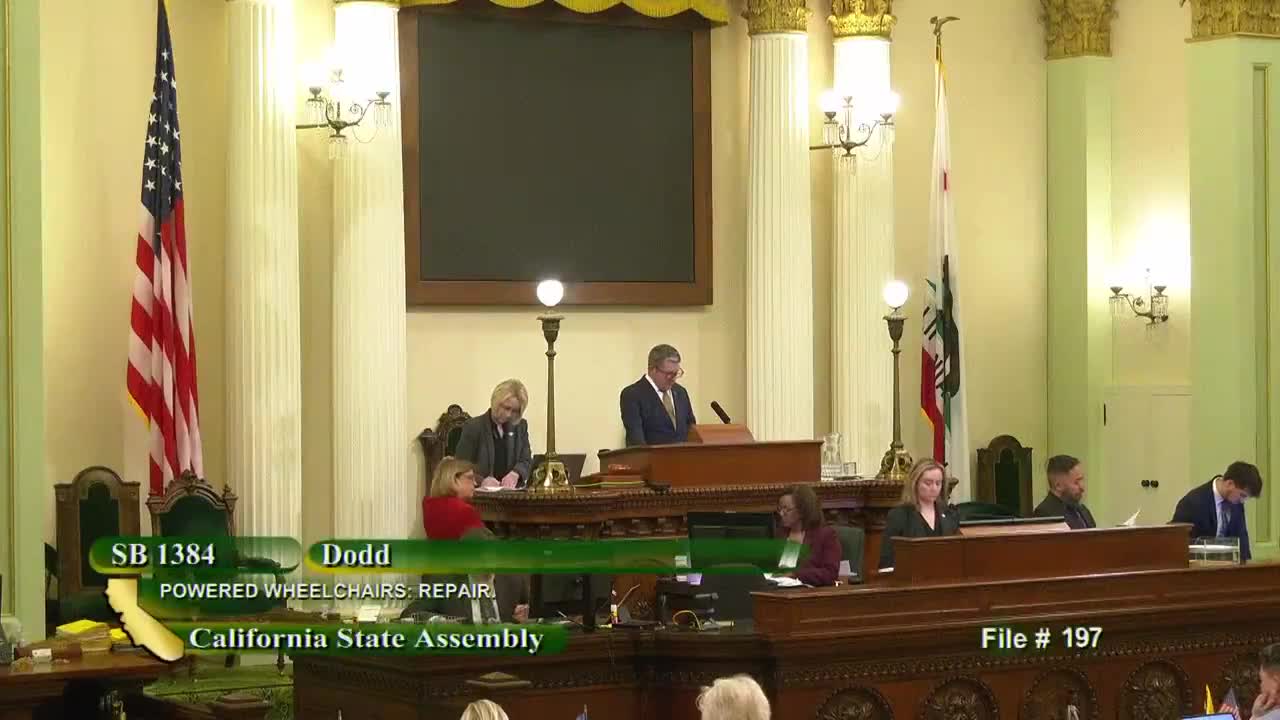 1MIN
Assembly Floor
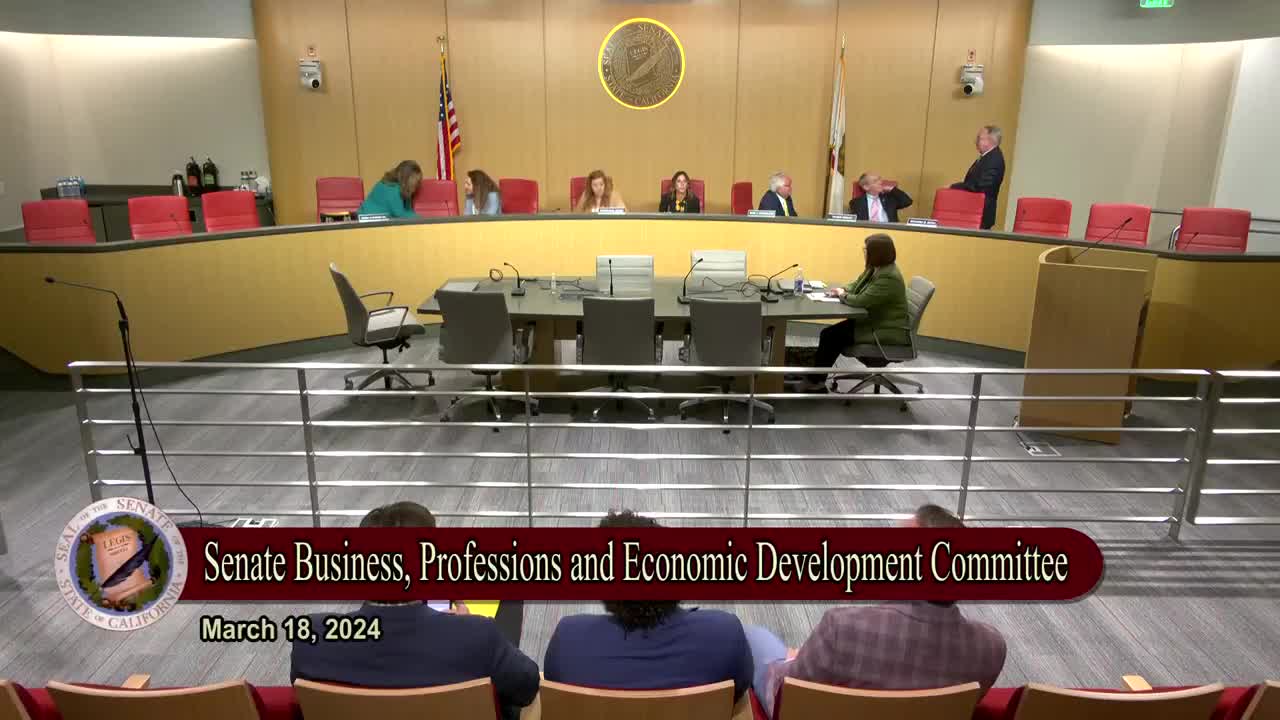 10MIN
Senate Standing Committee on Business, Professions and Economic Development
Bill Author




