SB 1404: Political Reform Act of 1974: audits.
- Session Year: 2023-2024
- House: Senate
- Latest Version Date: 2024-06-27
Current Status:
Failed
(2024-08-15: August 15 hearing: Held in committee and under submission.)
Introduced
In Committee
First Chamber
In Committee
Second Chamber
Enacted
The Political Reform Act of 1974 requires the Franchise Tax Board to conduct audits and field investigations regarding the reports filed by lobbyists. Existing law requires 25% of lobbyist employers and lobbying firms to be subject to a random audit and investigation every 2 years.
This bill would revise the provisions above relating to audits and field investigations. Until January 1, 2033, this bill would transfer the responsibility for conducting audits and field investigations of lobbying reports to the Fair Political Practices Commission. The During this period, the bill would require the Secretary of State to impose an additional fee, to be established by the commission, not to exceed $500 per year, to lobbying firms and lobbyist employers subject to audit to offset costs associated with conducting audits and field investigations. This fee would be deposited in a new fund that the bill would establish, the Field Audits and Investigations Fund, which would be continuously appropriated to the commission for these purposes. The From January 1, 2027 through January 1, 2033, the bill would require 60 lobbying firms and lobbyist employers who employ one or more lobbyists to be selected for audit, as specified. Additionally, this bill would require the commission to adopt regulations or policies that would ensure the operational independence of the commissions audit personnel from the commissions enforcement operations. Audits conducted by the commission would be required to be posted on the commissions internet website for 10 years following the conclusion of the audit and the commission would be required to annually report to the Legislature on the number and types of audits completed by the commission.
By creating the Field Audits and Investigations Fund, which would be continuously appropriated to the commission to offset costs associated with the above audits and investigations, the bill would make an appropriation.
Existing law makes a knowing or willful violation of the Political Reform Act of 1974 a misdemeanor and subjects offenders to criminal penalties. By expanding the scope of an existing crime, this bill would impose a state-mandated local program.
The California Constitution requires the state to reimburse local agencies and school districts for certain costs mandated by the state. Statutory provisions establish procedures for making that reimbursement.
This bill would provide that no reimbursement is required by this act for a specified reason.
The Political Reform Act of 1974, an initiative measure, provides that the Legislature may amend the act to further the acts purposes upon a 2/3 vote of each house of the Legislature and compliance with specified procedural requirements.
This bill would declare that it furthers the purposes of the act.
The Political Reform Act of 1974 requires the Franchise Tax Board to conduct audits and field investigations regarding the reports filed by lobbyists. Existing law requires 25% of lobbyist employers and lobbying firms to be subject to a random audit and investigation every 2 years.
This bill would transfer the responsibility for conducting audits and field investigations of lobbying reports to the Fair Political Practices Commission. The bill would require the Secretary of State to impose an additional fee, to be established by the commission, not to exceed $500 per year, to lobbying firms and lobbyist employers subject to audit to offset costs associated with conducting audits and field investigations. This fee would be deposited in a new fund that the bill would establish, the Field Audits and Investigations Fund, which would be continuously appropriated to the commission for these purposes. The bill would exclude lobbying firms and lobbyist employers with less than one dollar in payments or contributions and placement agents, lobbyist employers of placement agents, and lobbying firms with placement agents, as specified, from being selected for audit. The bill would require 60 lobbying firms and lobbyist employers who employ one or more lobbyists to be selected for audit, as specified. Additionally, this bill would require the commission to adopt regulations or policies that would ensure the operational independence of the commissions audit personnel from the commissions enforcement operations. Audits conducted by the commission would be required to be posted on the commissions internet website for 10 years following the conclusion of the audit and the commission would be required to annually report to the Legislature on the number and types of audits completed by the commission.
By creating the Field Audits and Investigations Fund, which would be continuously appropriated to the commission to offset costs associated with the above audits and investigations, the bill would make an appropriation.
Existing law makes a knowing or willful violation of the Political Reform Act of 1974 a misdemeanor and subjects offenders to criminal penalties. By expanding the scope of an existing crime, this bill would impose a state-mandated local program.
The California Constitution requires the state to reimburse local agencies and school districts for certain costs mandated by the state. Statutory provisions establish procedures for making that reimbursement.
This bill would provide that no reimbursement is required by this act for a specified reason.
The Political Reform Act of 1974, an initiative measure, provides that the Legislature may amend the act to further the acts purposes upon a 2/3 vote of each house of the Legislature and compliance with specified procedural requirements.
This bill would declare that it furthers the purposes of the act.
The Political Reform Act of 1974 requires the Franchise Tax Board to conduct audits and field investigations regarding the reports filed by lobbyists. Existing law requires 25% of lobbyist employers and lobbying firms to be subject to a random audit and investigation every 2 years.
This bill would transfer the responsibility for conducting audits and field investigations of lobbying reports to the Fair Political Practices Commission. The bill would require the Secretary of State to impose an additional fee, to be established by the commission, not to exceed $500 per year, to lobbying firms and lobbyist employers subject to audit to offset costs associated with conducting audits and field investigations. This fee would be deposited in a new fund that the bill would establish, the Field Audits and Investigations Fund, which would be continuously appropriated to the commission for these purposes. The bill would exclude lobbying firms and lobbyist employers with less than one dollar in payments or contributions and placement agents, lobbyist employers of placement agents, and lobbying firms with placement agents, as specified, from being selected for audit. Additionally, this bill would require the commission to adopt regulations or policies that would ensure the operational independence of the commissions audit personnel from the commissions enforcement operations. Audits conducted by the commission would be required to be posted on the commissions internet website for 10 years following the conclusion of the audit and the commission would be required to annually report to the Legislature on the number and types of audits completed by the commission.
By creating the Field Audits and Investigations Fund, which would be continuously appropriated to the commission to offset costs associated with the above audits and investigations, the bill would make an appropriation.
Existing law makes a knowing or willful violation of the Political Reform Act of 1974 a misdemeanor and subjects offenders to criminal penalties. By expanding the scope of an existing crime, this bill would impose a state-mandated local program.
The California Constitution requires the state to reimburse local agencies and school districts for certain costs mandated by the state. Statutory provisions establish procedures for making that reimbursement.
This bill would provide that no reimbursement is required by this act for a specified reason.
The Political Reform Act of 1974, an initiative measure, provides that the Legislature may amend the act to further the acts purposes upon a 2/3 vote of each house of the Legislature and compliance with specified procedural requirements.
This bill would declare that it furthers the purposes of the act.
The Political Reform Act of 1974 requires the Franchise Tax Board to conduct audits and field investigations regarding the reports filed by lobbyists. Existing law requires 25% of lobbyist employers and lobbying firms to be subject to a random audit and investigation every 2 years.
This bill would transfer the responsibility for conducting audits and field investigations of lobbying reports to the Fair Political Practices Commission. The bill would require the Secretary of State to increase the yearly fee currently charged per year for each lobbyist required to be listed on a lobbying firm or lobbyist employer registration statement, and it would further require the Secretary of State to impose an additional fee, to be established by the commission, not to exceed $500 per year, to lobbying firms and lobbyist employers subject to audit to offset costs associated with conducting audits and field investigations. A portion of the latter This fee would be deposited in a new fund that the bill would establish, the Field Audits and Investigations Fund, which would be continuously appropriated to the commission for these purposes. The bill would exclude lobbying firms and lobbyist employers with less than one dollar in payments or contributions and placement agents, lobbyist employers of placement agents, and lobbying firms with placement agents, as specified, from being selected for audit. Additionally, this bill would require the commission to adopt regulations or policies that would ensure the operational independence of the commissions audit personnel from the commissions enforcement operations. Audits conducted by the commission would be required to be posted on the commissions internet website for 10 years following the conclusion of the audit and the commission would be required to annually report to the Legislature on the number and types of audits completed by the commission.
By creating the Field Audits and Investigations Fund, which would be continuously appropriated to the commission to offset costs associated with the above audits and investigations, the bill would make an appropriation.
Existing law makes a knowing or willful violation of the Political Reform Act of 1974 a misdemeanor and subjects offenders to criminal penalties. By expanding the scope of an existing crime, this bill would impose a state-mandated local program.
The California Constitution requires the state to reimburse local agencies and school districts for certain costs mandated by the state. Statutory provisions establish procedures for making that reimbursement.
This bill would provide that no reimbursement is required by this act for a specified reason.
The Political Reform Act of 1974, an initiative measure, provides that the Legislature may amend the act to further the acts purposes upon a 2/3 vote of each house of the Legislature and compliance with specified procedural requirements.
This bill would declare that it furthers the purposes of the act.
The Political Reform Act of 1974 requires the Franchise Tax Board to conduct audits and field investigations regarding the reports filed by lobbyists. Existing law requires 25% of lobbyist employers and lobbying firms to be subject to a random audit and investigation every 2 years.
This bill would transfer the responsibility for conducting audits and field investigations of lobbying reports to the Fair Political Practices Commission. The bill would require the Secretary of State to charge an additional fee established by the commission increase the yearly fee currently charged per year for each lobbyist required to be listed on a lobbying firm or lobbyist employer registration statement, and it would further require the Secretary of State to impose an additional fee, to be established by the commission, to lobbying firms and lobbyist employers to offset costs associated with conducting audits and field investigations. This A portion of the latter fee would be deposited in a new fund that the bill would establish, the Field Audits and Investigations Fund, which would be continuously appropriated to the commission for these purposes. The bill would exclude lobbying firms and lobbyist employers with less than one dollar in payments or contributions and placement agents, lobbyist employers of placement agents, and lobbying firms with placement agents, as specified, from being selected for audit. Additionally, this bill would require the commission to adopt regulations or policies that would ensure the operational independence of the commissions audit personnel from the commissions enforcement operations. Audits conducted by the commission would be required to be posted on the commissions internet website for 10 years following the conclusion of the audit and the commission would be required to annually report to the Legislature on the number and types of audits completed by the commission.
By creating the Field Audits and Investigations Fund, which would be continuously appropriated to the commission to offset costs associated with the above audits and investigations, the bill would make an appropriation.
Existing law makes a knowing or willful violation of the Political Reform Act of 1974 a misdemeanor and subjects offenders to criminal penalties. By expanding the scope of an existing crime, this bill would impose a state-mandated local program.
The California Constitution requires the state to reimburse local agencies and school districts for certain costs mandated by the state. Statutory provisions establish procedures for making that reimbursement.
This bill would provide that no reimbursement is required by this act for a specified reason.
The Political Reform Act of 1974, an initiative measure, provides that the Legislature may amend the act to further the acts purposes upon a 2/3 vote of each house of the Legislature and compliance with specified procedural requirements.
This bill would declare that it furthers the purposes of the act.
The Political Reform Act of 1974 requires the Franchise Tax Board to conduct audits and field investigations regarding the reports filed by lobbyists. Existing law requires 25% of lobbyist employers and lobbying firms to be subject to a random audit and investigation every 2 years.
This bill would transfer the responsibility for conducting audits and field investigations of lobbying reports to the Fair Political Practices Commission. The bill would require the Secretary of State to charge an additional fee established by the commission to lobbying firms and lobbyist employers to offset costs associated with conducting audits and field investigations. This fee would be deposited in a new fund that the bill would establish, the Field Audits and Investigations Fund, which would be continuously appropriated to the commission for these purposes. The bill would exclude lobbying firms and lobbyist employers with less than one dollar in payments or contributions from being selected for audit. Additionally, this bill would require the commission to adopt regulations or policies that would ensure the operational independence of the commissions audit personnel from the commissions enforcement operations. Audits conducted by the commission would be required to be posted on the commissions internet website for 10 years following the conclusion of the audit and the commission would be required to annually report to the Legislature on the number and types of audits completed by the commission.
By creating the Field Audits and Investigations Fund, which would be continuously appropriated to the commission to offset costs associated with the above audits and investigations, the bill would make an appropriation.
Existing law makes a knowing or willful violation of the Political Reform Act of 1974 a misdemeanor and subjects offenders to criminal penalties. By expanding the scope of an existing crime, this bill would impose a state-mandated local program.
The California Constitution requires the state to reimburse local agencies and school districts for certain costs mandated by the state. Statutory provisions establish procedures for making that reimbursement.
This bill would provide that no reimbursement is required by this act for a specified reason.
The Political Reform Act of 1974, an initiative measure, provides that the Legislature may amend the act to further the acts purposes upon a 2/3 vote of each house of the Legislature and compliance with specified procedural requirements.
This bill would declare that it furthers the purposes of the act.
(a)The Political Disclosure, Accountability, Transparency, and Access Fund is hereby established in the State Treasury. Moneys collected pursuant to Section 84101.5 and one-half of the moneys collected pursuant to subdivision (a) of Section 86102 shall be deposited in the Political Disclosure, Accountability, Transparency, and Access Fund.
(b)(1)Moneys deposited in the Political Disclosure, Accountability, Transparency, and Access Fund are subject to appropriation by the Legislature and shall be expended for the maintenance, repair, and improvement of the online or electronic disclosure program implemented by the Secretary of State pursuant to this chapter.
(2)In addition to paragraph (1), the Secretary of State may also use moneys deposited in the Political Disclosure, Accountability, Transparency, and Access Fund for purposes of implementing Chapter 506 of the Statutes of 2012.
(c)Any expenditure of moneys from the Political Disclosure, Accountability, Transparency, and Access Fund for the purposes described in paragraph (1) of subdivision (b) is subject to the project approval and oversight process established by the California Technology Agency pursuant to Section 11546.
(d)This section shall remain in effect only until January 1, 2033, and as of that date is repealed.
SEC. 2.Section 84613 is added to the Government Code, to read:84613.(a)The Political Disclosure, Accountability, Transparency, and Access Fund is hereby established in the State Treasury. Moneys collected pursuant to Section 84101.5 and one-half of the moneys collected pursuant to Section 86102 shall be deposited in the Political Disclosure, Accountability, Transparency, and Access Fund.
(b)(1)Moneys deposited in the Political Disclosure, Accountability, Transparency, and Access Fund are subject to appropriation by the Legislature and shall be expended for the maintenance, repair, and improvement of the online or electronic disclosure program implemented by the Secretary of State pursuant to this chapter.
(2)In addition to paragraph (1), the Secretary of State may also use moneys deposited in the Political Disclosure, Accountability, Transparency, and Access Fund for purposes of implementing the act that added this section.
(c)Any expenditure of moneys from the Political Disclosure, Accountability, Transparency, and Access Fund for the purposes described in paragraph (1) of subdivision (b) is subject to the project approval and oversight process established by the California Technology Agency pursuant to Section 11546.
(d)This section shall become operative on January 1, 2033.
SEC. 2.SEC. 3.Section 84614 is added to the Government Code, to read:84614.(a)The Field Audits and Investigations Fund is hereby established in the State Treasury. Moneys collected pursuant to subdivision (b) of Section 86102 shall be deposited in the Field Audits and Investigations Fund.
(b)Notwithstanding Section 13340, moneys deposited in the Field Audits and Investigations Fund shall be continuously appropriated to the Commission to conduct the audits and field investigations required by subdivision (b) of Section 90006.
(c)This section shall remain in effect only until January 1, 2033, and as of that date is repealed.
SEC. 3.SEC. 4.Section 86102 of the Government Code is amended to read:86102.Except as specified in paragraph (2) of subdivision (b), the The Secretary of State shall charge each lobbying firm and lobbyist employer required to file a registration statement under this chapter both of the following fees:
(a)A fee of fifty dollars ($50) per year for each lobbyist required to be listed on its registration statement. Twenty-five dollars ($25) of this fee shall be deposited in the Political Disclosure, Accountability, Transparency, and Access Fund established pursuant to Section 84613, and twenty-five dollars ($25) of this fee shall be deposited in the General Fund.
(b)A fee established by the Commission, not exceeding five hundred dollars ($500) per year, to offset costs associated with conducting the required audits and field investigations pursuant to paragraph (2) of subdivision (b) of Section 90006 for each lobbyist required to be listed on its registration statement. Moneys collected from this fee shall be deposited in the Field Audits and Investigations Fund established pursuant to Section 84614.
(c)This section shall remain in effect only until January 1, 2033, and as of that date is repealed.
SEC. 5.Section 86102 is added to the Government Code, to read:86102.(a)The Secretary of State shall charge each lobbying firm and lobbyist employer required to file a registration statement under this chapter a fee of fifty dollars ($50) per year for each lobbyist required to be listed on its registration statement.
(b)One-half of the moneys collected pursuant to this section shall be deposited in the Political Disclosure, Accountability, Transparency, and Access Fund, and the other one-half of the moneys shall be deposited in the General Fund.
(c)This section shall become operative on January 1, 2033.
SEC. 4.SEC. 6.Section 90000 of the Government Code is amended to read:90000.Except as provided in Section 90006, the Franchise Tax Board shall make audits and field investigations with respect to the following:
(a)Reports and statements filed with the Secretary of State under Chapter 4 (commencing with Section 84100) and Chapter 5 (commencing with Section 85100).
(b)Local candidates and their controlled committees selected for audit pursuant to subdivision (i) of Section 90001.
(c)Reports and statements filed with the Secretary of State under Chapter 6 (commencing with Section 86100) that are selected for audit audit, up to and including the selection in February 2025, pursuant to subdivision (j) of Section 90001 in the years up to and including 2024. 90001.
(d)This section shall remain in effect only until January 1, 2033, and as of that date is repealed.
SEC. 7.Section 90000 is added to the Government Code, to read:90000.Except as provided in Section 90006, the Franchise Tax Board shall make audits and field investigations with respect to the following:
(a)Reports and statements filed with the Secretary of State under Chapter 4 (commencing with Section 84100), Chapter 5 (commencing with Section 85100), and Chapter 6 (commencing with Section 86100).
(b)Local candidates and their controlled committees selected for audit pursuant to subdivision (i) of Section 90001.
(c)This section shall become operative on January 1, 2033.
SEC. 5.Section 90001 of the Government Code is amended to read:90001.Audits and investigations conducted pursuant to Section 90000 and subdivision (b) of Section 90006 shall be made with respect to the reports and statements of:(a)Sixty lobbying firms and lobbyist employers who employ one or more lobbyists, who shall be selected for audit pursuant to the process described in subdivision (j).(1)Ten of the sixty audits shall be of lobbying firms or lobbyist employers that employ only placement agents. (2)At least twenty-five of the sixty audits shall be of lobbying firms or lobbyist employers with total reported payments that meet or exceed a monetary threshold set by the Commission. The Commission shall base this threshold on an approximation of the total reported payments of the top 100 lobbying firms and lobbyist employers.(3)When a lobbying firm or lobbyist employer is audited, the individual lobbyists who are employed by the lobbying firm or the lobbyist employer shall also be audited.(b)Each statewide, Supreme Court, court of appeal, or Board of Equalization candidate in a direct primary or general election for whom it is determined that twenty-five thousand dollars ($25,000) or more in contributions have been raised or twenty-five thousand dollars ($25,000) or more in expenditures have been made, whether by the candidate or by a committee or committees controlled by the candidate or whose participation in the direct primary or general election is primarily in support of the candidates candidacy. Each statewide candidate whose contributions and expenditures are less than twenty-five thousand dollars ($25,000) shall be subject to an audit on a random basis of 10 percent of the number of such candidates.(c)Each candidate for the Legislature or superior court judge in a direct primary or general election shall be subject to audit by random selection if it is determined that fifteen thousand dollars ($15,000) or more in contributions have been received or fifteen thousand dollars ($15,000) or more in expenditures have been made, whether by the candidate or by a committee or committees controlled by the candidate or primarily supporting the candidates candidacy. Random selection shall be made of 25 percent of the Senate districts, 25 percent of the Assembly districts, and 25 percent of the judicial offices contested in an election year.(d)Each candidate for the Legislature in a special primary or special runoff election for whom it is determined that fifteen thousand dollars ($15,000) or more in contributions have been raised or fifteen thousand dollars ($15,000) or more in expenditures have been made, whether by the candidate or by a committee or committees controlled by the candidate or primarily supporting the candidates candidacy.(e)Each controlled committee of any candidate who is being audited pursuant to subdivision (b), (c), or (d).(f)Each committee, other than a committee specified in subdivision (c) of Section 82013, primarily supporting or opposing a candidate who is being audited pursuant to subdivision (b), (c), or (d) if it is determined that the committee has expended more than ten thousand dollars ($10,000).(g)Each committee, other than a committee specified in subdivision (c) of Section 82013, whose participation is primarily in support of or in opposition to a state measure or state measures if it is determined that the committee has expended more than ten thousand dollars ($10,000) on such measure or measures.(h)Each committee, other than a committee defined in subdivision (c) of Section 82013, a controlled committee or a committee primarily supporting or opposing a state candidate or measure, if it is determined that the committee has raised or expended more than ten thousand dollars ($10,000) supporting or opposing state candidates or state measures during any calendar year, except that if the commission determines from an audit report that a committee is in substantial compliance with the provisions of the act, the committee thereafter shall be subject to an audit on a random basis with each such committee having a 25-percent chance of being audited.(i)(1)With respect to local candidates and their controlled committees, the commission shall promulgate regulations which provide a method of selection for these audits.(2)With respect to candidates for the Board of Administration of the Public Employees Retirement System, the commission shall promulgate regulations that provide a method for selection of these audits. The Public Employees Retirement System shall reimburse the commission for all reasonable expenses incurred pursuant to this section.(j)In accordance with subdivisions (a), (b), (c), and (h), the Commission shall select by lot the persons or districts to be audited on a random basis. For campaign audits the selection shall be made in public after the last date for filing the first report or statement following the general or special election for which the candidate ran, or following the election at which the measure was adopted or defeated. For lobbying firm and lobbyist employer audits, the selection shall be made in public in February of odd-numbered years.SEC. 8.Section 90001 of the Government Code is amended to read:90001.Audits and investigations shall be made pursuant to Section 90000 with respect to the reports and statements of:
(a)Each lobbying firm and each lobbyist employer who employs one or more lobbyists shall be subject to an audit on a random basis with these lobbying firms or lobbyist employers having a 25-percent chance of being audited. When a lobbying firm or lobbyist employer is audited, the individual lobbyists who are employed by the lobbying firm or the lobbyist employer shall also be audited.
(b)Each statewide, Supreme Court, court of appeal, or Board of Equalization candidate in a direct primary or general election for whom it is determined that twenty-five thousand dollars ($25,000) or more in contributions have been raised or twenty-five thousand dollars ($25,000) or more in expenditures have been made, whether by the candidate or by a committee or committees controlled by the candidate or whose participation in the direct primary or general election is primarily in support of the candidates candidacy. Each statewide candidate whose contributions and expenditures are less than twenty-five thousand dollars ($25,000) shall be subject to an audit on a random basis of 10 percent of the number of such candidates.
(c)Each candidate for the Legislature or superior court judge in a direct primary or general election shall be subject to audit by random selection if it is determined that fifteen thousand dollars ($15,000) or more in contributions have been received or fifteen thousand dollars ($15,000) or more in expenditures have been made, whether by the candidate or by a committee or committees controlled by the candidate or primarily supporting the candidates candidacy. Random selection shall be made of 25 percent of the Senate districts, 25 percent of the Assembly districts, and 25 percent of the judicial offices contested in an election year.
(d)Each candidate for the Legislature in a special primary or special runoff election for whom it is determined that fifteen thousand dollars ($15,000) or more in contributions have been raised or fifteen thousand dollars ($15,000) or more in expenditures have been made, whether by the candidate or by a committee or committees controlled by the candidate or primarily supporting the candidates candidacy.
(e)Each controlled committee of any candidate who is being audited pursuant to subdivision (b), (c), or (d).
(f)Each committee, other than a committee specified in subdivision (c) of Section 82013, primarily supporting or opposing a candidate who is being audited pursuant to subdivision (b), (c), or (d) if it is determined that the committee has expended more than ten thousand dollars ($10,000).
(g)Each committee, other than a committee specified in subdivision (c) of Section 82013, whose participation is primarily in support of or in opposition to a state measure or state measures if it is determined that the committee has expended more than ten thousand dollars ($10,000) on such measure or measures.
(h)Each committee, other than a committee defined in subdivision (c) of Section 82013, a controlled committee or a committee primarily supporting or opposing a state candidate or measure, if it is determined that the committee has raised or expended more than ten thousand dollars ($10,000) supporting or opposing state candidates or state measures during any calendar year, except that if the commission determines from an audit report that a committee is in substantial compliance with the provisions of the act, the committee thereafter shall be subject to an audit on a random basis with each such committee having a 25-percent chance of being audited.
(i)(1)With respect to local candidates and their controlled committees, the commission shall promulgate regulations which provide a method of selection for these audits.
(2)With respect to candidates for the Board of Administration of the Public Employees Retirement System, the commission shall promulgate regulations that provide a method for selection of these audits. The Public Employees Retirement System shall reimburse the commission for all reasonable expenses incurred pursuant to this section.
(j)In accordance with subdivisions (a), (b), (c), and (h), the Fair Political Practices Commission shall select by lot the persons or districts to be audited on a random basis. For campaign audits the selection shall be made in public after the last date for filing the first report or statement following the general or special election for which the candidate ran, or following the election at which the measure was adopted or defeated. For lobbying firm and lobbyist employer audits, the selection shall be made in public in February of odd-numbered years.
(k)This section shall remain in effect only until January 1, 2027, and as of that date is repealed.
SEC. 9.Section 90001 is added to the Government Code, to read:90001.Audits and investigations conducted pursuant to Section 90000 and subdivision (b) of Section 90006 shall be made with respect to the reports and statements of:
(a)Sixty lobbying firms and lobbyist employers who employ one or more lobbyists, who shall be selected for audit pursuant to the process described in subdivision (j).
(1)Ten of the sixty audits shall be of lobbying firms or lobbyist employers that employ only placement agents.
(2)At least twenty-five of the sixty audits shall be of lobbying firms or lobbyist employers with total reported payments that meet or exceed a monetary threshold set by the Commission. The Commission shall base this threshold on an approximation of the total reported payments of the top 100 lobbying firms and lobbyist employers.
(3)When a lobbying firm or lobbyist employer is audited, the individual lobbyists who are employed by the lobbying firm or the lobbyist employer shall also be audited.
(b)Each statewide, Supreme Court, court of appeal, or Board of Equalization candidate in a direct primary or general election for whom it is determined that twenty-five thousand dollars ($25,000) or more in contributions have been raised or twenty-five thousand dollars ($25,000) or more in expenditures have been made, whether by the candidate or by a committee or committees controlled by the candidate or whose participation in the direct primary or general election is primarily in support of the candidates candidacy. Each statewide candidate whose contributions and expenditures are less than twenty-five thousand dollars ($25,000) shall be subject to an audit on a random basis of 10 percent of the number of such candidates.
(c)Each candidate for the Legislature or superior court judge in a direct primary or general election shall be subject to audit by random selection if it is determined that fifteen thousand dollars ($15,000) or more in contributions have been received or fifteen thousand dollars ($15,000) or more in expenditures have been made, whether by the candidate or by a committee or committees controlled by the candidate or primarily supporting the candidates candidacy. Random selection shall be made of 25 percent of the Senate districts, 25 percent of the Assembly districts, and 25 percent of the judicial offices contested in an election year.
(d)Each candidate for the Legislature in a special primary or special runoff election for whom it is determined that fifteen thousand dollars ($15,000) or more in contributions have been raised or fifteen thousand dollars ($15,000) or more in expenditures have been made, whether by the candidate or by a committee or committees controlled by the candidate or primarily supporting the candidates candidacy.
(e)Each controlled committee of any candidate who is being audited pursuant to subdivision (b), (c), or (d).
(f)Each committee, other than a committee specified in subdivision (c) of Section 82013, primarily supporting or opposing a candidate who is being audited pursuant to subdivision (b), (c), or (d) if it is determined that the committee has expended more than ten thousand dollars ($10,000).
(g)Each committee, other than a committee specified in subdivision (c) of Section 82013, whose participation is primarily in support of or in opposition to a state measure or state measures if it is determined that the committee has expended more than ten thousand dollars ($10,000) on such measure or measures.
(h)Each committee, other than a committee defined in subdivision (c) of Section 82013, a controlled committee or a committee primarily supporting or opposing a state candidate or measure, if it is determined that the committee has raised or expended more than ten thousand dollars ($10,000) supporting or opposing state candidates or state measures during any calendar year, except that if the commission determines from an audit report that a committee is in substantial compliance with the provisions of the act, the committee thereafter shall be subject to an audit on a random basis with each such committee having a 25-percent chance of being audited.
(i)(1)With respect to local candidates and their controlled committees, the commission shall promulgate regulations which provide a method of selection for these audits.
(2)With respect to candidates for the Board of Administration of the Public Employees Retirement System, the commission shall promulgate regulations that provide a method for selection of these audits. The Public Employees Retirement System shall reimburse the commission for all reasonable expenses incurred pursuant to this section.
(j)In accordance with subdivisions (a), (b), (c), and (h), the Commission shall select by lot the persons or districts to be audited on a random basis. For campaign audits the selection shall be made in public after the last date for filing the first report or statement following the general or special election for which the candidate ran, or following the election at which the measure was adopted or defeated. For lobbying firm and lobbyist employer audits, the selection shall be made in public in February of odd-numbered years.
(k)This section shall become operative on January 1, 2027.
(l)This section shall remain in effect only until January 1, 2033, and as of that date is repealed.
SEC. 10.Section 90001 is added to the Government Code, to read:90001.Audits and investigations shall be made pursuant to Section 90000 with respect to the reports and statements of:
(a)Each lobbying firm and each lobbyist employer who employs one or more lobbyists shall be subject to an audit on a random basis with these lobbying firms or lobbyist employers having a 25-percent chance of being audited. When a lobbying firm or lobbyist employer is audited, the individual lobbyists who are employed by the lobbying firm or the lobbyist employer shall also be audited.
(b)Each statewide, Supreme Court, court of appeal, or Board of Equalization candidate in a direct primary or general election for whom it is determined that twenty-five thousand dollars ($25,000) or more in contributions have been raised or twenty-five thousand dollars ($25,000) or more in expenditures have been made, whether by the candidate or by a committee or committees controlled by the candidate or whose participation in the direct primary or general election is primarily in support of the candidates candidacy. Each statewide candidate whose contributions and expenditures are less than twenty-five thousand dollars ($25,000) shall be subject to an audit on a random basis of 10 percent of the number of such candidates.
(c)Each candidate for the Legislature or superior court judge in a direct primary or general election shall be subject to audit by random selection if it is determined that fifteen thousand dollars ($15,000) or more in contributions have been received or fifteen thousand dollars ($15,000) or more in expenditures have been made, whether by the candidate or by a committee or committees controlled by the candidate or primarily supporting the candidates candidacy. Random selection shall be made of 25 percent of the Senate districts, 25 percent of the Assembly districts, and 25 percent of the judicial offices contested in an election year.
(d)Each candidate for the Legislature in a special primary or special runoff election for whom it is determined that fifteen thousand dollars ($15,000) or more in contributions have been raised or fifteen thousand dollars ($15,000) or more in expenditures have been made, whether by the candidate or by a committee or committees controlled by the candidate or primarily supporting the candidates candidacy.
(e)Each controlled committee of any candidate who is being audited pursuant to subdivision (b), (c), or (d).
(f)Each committee, other than a committee specified in subdivision (c) of Section 82013, primarily supporting or opposing a candidate who is being audited pursuant to subdivision (b), (c), or (d) if it is determined that the committee has expended more than ten thousand dollars ($10,000).
(g)Each committee, other than a committee specified in subdivision (c) of Section 82013, whose participation is primarily in support of or in opposition to a state measure or state measures if it is determined that the committee has expended more than ten thousand dollars ($10,000) on such measure or measures.
(h)Each committee, other than a committee defined in subdivision (c) of Section 82013, a controlled committee or a committee primarily supporting or opposing a state candidate or measure, if it is determined that the committee has raised or expended more than ten thousand dollars ($10,000) supporting or opposing state candidates or state measures during any calendar year, except that if the commission determines from an audit report that a committee is in substantial compliance with the provisions of the act, the committee thereafter shall be subject to an audit on a random basis with each such committee having a 25-percent chance of being audited.
(i)(1)With respect to local candidates and their controlled committees, the commission shall promulgate regulations which provide a method of selection for these audits.
(2)With respect to candidates for the Board of Administration of the Public Employees Retirement System, the commission shall promulgate regulations that provide a method for selection of these audits. The Public Employees Retirement System shall reimburse the commission for all reasonable expenses incurred pursuant to this section.
(j)In accordance with subdivisions (a), (b), (c), and (h), the Fair Political Practices Commission shall select by lot the persons or districts to be audited on a random basis. For campaign audits the selection shall be made in public after the last date for filing the first report or statement following the general or special election for which the candidate ran, or following the election at which the measure was adopted or defeated. For lobbying firm and lobbyist employer audits, the selection shall be made in public in February of odd-numbered years.
(k)This section shall become operative on January 1, 2033.
SEC. 6.SEC. 11.Section 90006 of the Government Code is amended to read:90006.The Commission shall conduct audits and field investigations of the following:
(a)Candidates for Controller and member of the Board of Equalization and of committees supporting such candidates.
(b)(1)Reports and statements filed with the Secretary of State pursuant to Chapter 6 (commencing with Section 86100).
(2)The Commission shall conduct audits pursuant to paragraph (1) commencing with the audits selected in February 2027 pursuant to subdivision (j) of Section 90001.
(c)This section shall remain in effect only until January 1, 2033, and as of that date is repealed.
SEC. 12.Section 90006 is added to the Government Code, to read:90006.(a)Audits and field investigations of candidates for Controller and member of the Board of Equalization and of committees supporting such candidates shall be made by the Commission instead of the Franchise Tax Board.
(b)This section shall become operative on January 1, 2033.
SEC. 7.SEC. 13.Section 90010 is added to the Government Code, to read:90010.(a)An audit conducted by the Commission shall be publicly posted on the Commissions internet website for at least 10 years from the conclusion of the audit.
(b)The Commission shall annually report to the Legislature on the number and type of audits completed by the Commission.
(c)The Commission shall adopt regulations or policies to ensure the operational independence of audit personnel from enforcement operations under this title.
(d)This section shall remain in effect only until January 1, 2033, and as of that date is repealed.
SEC. 8.SEC. 14.No reimbursement is required by this act pursuant to Section 6 of Article XIIIB of the California Constitution because the only costs that may be incurred by a local agency or school district will be incurred because this act creates a new crime or infraction, eliminates a crime or infraction, or changes the penalty for a crime or infraction, within the meaning of Section 17556 of the Government Code, or changes the definition of a crime within the meaning of Section 6 of Article XIIIB of the California Constitution.
SEC. 9.SEC. 15.The Legislature finds and declares that this bill furthers the purposes of the Political Reform Act of 1974 within the meaning of subdivision (a) of Section 81012 of the Government Code.
(a)The Political Disclosure, Accountability, Transparency, and Access Fund is hereby established in the State Treasury. Moneys collected pursuant to Section 84101.5 and one-half of the moneys collected pursuant to subdivision (a) of Section 86102 shall be deposited in the Political Disclosure, Accountability, Transparency, and Access Fund.
(b)(1)Moneys deposited in the Political Disclosure, Accountability, Transparency, and Access Fund are subject to appropriation by the Legislature and shall be expended for the maintenance, repair, and improvement of the online or electronic disclosure program implemented by the Secretary of State pursuant to this chapter.
(2)In addition to paragraph (1), the Secretary of State may also use moneys deposited in the Political Disclosure, Accountability, Transparency, and Access Fund for purposes of implementing Chapter 506 of the Statutes of 2012.
(c)Any expenditure of moneys from the Political Disclosure, Accountability, Transparency, and Access Fund for the purposes described in paragraph (1) of subdivision (b) is subject to the project approval and oversight process established by the California Technology Agency pursuant to Section 11546.
SEC. 2.Section 84614 is added to the Government Code, to read:84614.(a)The Field Audits and Investigations Fund is hereby established in the State Treasury. Moneys collected pursuant to subdivision (b) of Section 86102 shall be deposited in the Field Audits and Investigations Fund.
(b)Notwithstanding Section 13340, moneys deposited in the Field Audits and Investigations Fund shall be continuously appropriated to the Commission to conduct the audits and field investigations required by subdivision (b) of Section 90006.
SEC. 3.Section 86102 of the Government Code is amended to read:86102.Except as specified in paragraph (2) of subdivision (b), the Secretary of State shall charge each lobbying firm and lobbyist employer required to file a registration statement under this chapter both of the following fees:
(a)A fee of fifty dollars ($50) per year for each lobbyist required to be listed on its registration statement. Twenty-five dollars ($25) of this fee shall be deposited in the Political Disclosure, Accountability, Transparency, and Access Fund established pursuant to Section 84613, and twenty-five dollars ($25) of this fee shall be deposited in the General Fund.
(b)(1)A fee established by the Commission, not exceeding five hundred dollars ($500) per year, to offset costs associated with conducting the required audits and field investigations pursuant to paragraph (2) of subdivision (b) of Section 90006 for each lobbyist required to be listed on its registration statement. Moneys collected from this fee shall be deposited in the Field Audits and Investigations Fund established pursuant to Section 84614.
(2)The Secretary of State shall not charge a lobbying firm or lobbyist employer the fee described in paragraph (1) if that firm or employer is exempt from audit pursuant to paragraph (1) or (3) of subdivision (a) of Section 90001.SEC. 4.Section 90000 of the Government Code is amended to read:90000.Except as provided in Section 90006, the Franchise Tax Board shall make audits and field investigations with respect to the following:
(a)Reports and statements filed with the Secretary of State under Chapter 4 (commencing with Section 84100) and Chapter 5 (commencing with Section 85100).
(b)Local candidates and their controlled committees selected for audit pursuant to subdivision (i) of Section 90001.
(c)Reports and statements filed with the Secretary of State under Chapter 6 (commencing with Section 86100) that are selected for audit pursuant to subdivision (j) of Section 90001 in the years up to and including 2024.
SEC. 5.Section 90001 of the Government Code is amended to read:90001.Audits and investigations conducted pursuant to Section 90000 and subdivision (b) of Section 90006 shall be made with respect to the reports and statements of:
(a)Twenty-five percent of the Sixty lobbying firms and twenty-five percent of the lobbyist employers who employ one or more lobbyists, who shall be selected for audit pursuant to the process described in subdivision (j).
(1)Lobbying firms and lobbyist employers with less than one dollar ($1) in payments or contributions shall be excluded from being selected for audit under this section. Ten of the sixty audits shall be of lobbying firms or lobbyist employers that employ only placement agents.
(2)At least twenty-five of the sixty audits shall be of lobbying firms or lobbyist employers with total reported payments that meet or exceed a monetary threshold set by the Commission. The Commission shall base this threshold on an approximation of the total reported payments of the top 100 lobbying firms and lobbyist employers.
(2)(3)When a lobbying firm or lobbyist employer is audited, the individual lobbyists who are employed by the lobbying firm or the lobbyist employer shall also be audited.
(3)Neither of the following shall be subject to the audits and investigations conducted pursuant to this section:(A)A placement agent, as defined in Section 82047.3, who qualifies as a lobbyist solely due to their actions as a placement agent.(B)A lobbying firm or lobbyist employer that qualifies as a lobbying firm or lobbyist employer solely due to their employment of a placement agent who would not otherwise be subject to the audits and investigations conducted pursuant to this section.(b)Each statewide, Supreme Court, court of appeal, or Board of Equalization candidate in a direct primary or general election for whom it is determined that twenty-five thousand dollars ($25,000) or more in contributions have been raised or twenty-five thousand dollars ($25,000) or more in expenditures have been made, whether by the candidate or by a committee or committees controlled by the candidate or whose participation in the direct primary or general election is primarily in support of the candidates candidacy. Each statewide candidate whose contributions and expenditures are less than twenty-five thousand dollars ($25,000) shall be subject to an audit on a random basis of 10 percent of the number of such candidates.
(c)Each candidate for the Legislature or superior court judge in a direct primary or general election shall be subject to audit by random selection if it is determined that fifteen thousand dollars ($15,000) or more in contributions have been received or fifteen thousand dollars ($15,000) or more in expenditures have been made, whether by the candidate or by a committee or committees controlled by the candidate or primarily supporting the candidates candidacy. Random selection shall be made of 25 percent of the Senate districts, 25 percent of the Assembly districts, and 25 percent of the judicial offices contested in an election year.
(d)Each candidate for the Legislature in a special primary or special runoff election for whom it is determined that fifteen thousand dollars ($15,000) or more in contributions have been raised or fifteen thousand dollars ($15,000) or more in expenditures have been made, whether by the candidate or by a committee or committees controlled by the candidate or primarily supporting the candidates candidacy.
(e)Each controlled committee of any candidate who is being audited pursuant to subdivision (b), (c), or (d).
(f)Each committee, other than a committee specified in subdivision (c) of Section 82013, primarily supporting or opposing a candidate who is being audited pursuant to subdivision (b), (c), or (d) if it is determined that the committee has expended more than ten thousand dollars ($10,000).
(g)Each committee, other than a committee specified in subdivision (c) of Section 82013, whose participation is primarily in support of or in opposition to a state measure or state measures if it is determined that the committee has expended more than ten thousand dollars ($10,000) on such measure or measures.
(h)Each committee, other than a committee defined in subdivision (c) of Section 82013, a controlled committee or a committee primarily supporting or opposing a state candidate or measure, if it is determined that the committee has raised or expended more than ten thousand dollars ($10,000) supporting or opposing state candidates or state measures during any calendar year, except that if the commission determines from an audit report that a committee is in substantial compliance with the provisions of the act, the committee thereafter shall be subject to an audit on a random basis with each such committee having a 25-percent chance of being audited.
(i)(1)With respect to local candidates and their controlled committees, the commission shall promulgate regulations which provide a method of selection for these audits.
(2)With respect to candidates for the Board of Administration of the Public Employees Retirement System, the commission shall promulgate regulations that provide a method for selection of these audits. The Public Employees Retirement System shall reimburse the commission for all reasonable expenses incurred pursuant to this section.
(j)In accordance with subdivisions (a), (b), (c), and (h), the Commission shall select by lot the persons or districts to be audited on a random basis. For campaign audits the selection shall be made in public after the last date for filing the first report or statement following the general or special election for which the candidate ran, or following the election at which the measure was adopted or defeated. For lobbying firm and lobbyist employer audits, the selection shall be made in public in February of odd-numbered years.
SEC. 6.Section 90006 of the Government Code is amended to read:90006.The Commission shall conduct audits and field investigations of the following:
(a)Candidates for Controller and member of the Board of Equalization and of committees supporting such candidates.
(b)(1)Reports and statements filed with the Secretary of State pursuant to Chapter 6 (commencing with Section 86100).
(2)The Commission shall conduct audits pursuant to paragraph (1) commencing with the audits selected in February 2027 pursuant to subdivision (j) of Section 90001.
SEC. 7.Section 90010 is added to the Government Code, to read:90010.(a)An audit conducted by the Commission shall be publicly posted on the Commissions internet website for at least 10 years from the conclusion of the audit.
(b)The Commission shall annually report to the Legislature on the number and type of audits completed by the Commission.
(c)The Commission shall adopt regulations or policies to ensure the operational independence of audit personnel from enforcement operations under this title.
SEC. 8.No reimbursement is required by this act pursuant to Section 6 of Article XIIIB of the California Constitution because the only costs that may be incurred by a local agency or school district will be incurred because this act creates a new crime or infraction, eliminates a crime or infraction, or changes the penalty for a crime or infraction, within the meaning of Section 17556 of the Government Code, or changes the definition of a crime within the meaning of Section 6 of Article XIIIB of the California Constitution.
SEC. 9.The Legislature finds and declares that this bill furthers the purposes of the Political Reform Act of 1974 within the meaning of subdivision (a) of Section 81012 of the Government Code.
(a)The Political Disclosure, Accountability, Transparency, and Access Fund is hereby established in the State Treasury. Moneys collected pursuant to Section 84101.5 and one-half of the moneys collected pursuant to subdivision (a) of Section 86102 shall be deposited in the Political Disclosure, Accountability, Transparency, and Access Fund.
(b)(1)Moneys deposited in the Political Disclosure, Accountability, Transparency, and Access Fund are subject to appropriation by the Legislature and shall be expended for the maintenance, repair, and improvement of the online or electronic disclosure program implemented by the Secretary of State pursuant to this chapter.
(2)In addition to paragraph (1), the Secretary of State may also use moneys deposited in the Political Disclosure, Accountability, Transparency, and Access Fund for purposes of implementing Chapter 506 of the Statutes of 2012.
(c)Any expenditure of moneys from the Political Disclosure, Accountability, Transparency, and Access Fund for the purposes described in paragraph (1) of subdivision (b) is subject to the project approval and oversight process established by the California Technology Agency pursuant to Section 11546.
SEC. 2.Section 84614 is added to the Government Code, to read:84614.(a)The Field Audits and Investigations Fund is hereby established in the State Treasury. Moneys collected pursuant to subdivision (b) of Section 86102 shall be deposited in the Field Audits and Investigations Fund.
(b)Notwithstanding Section 13340, moneys deposited in the Field Audits and Investigations Fund shall be continuously appropriated to the Commission to conduct the audits and field investigations required by subdivision (b) of Section 90006.
SEC. 3.Section 86102 of the Government Code is amended to read:86102.Except as specified in paragraph (2) of subdivision (b), the Secretary of State shall charge each lobbying firm and lobbyist employer required to file a registration statement under this chapter both of the following fees:
(a)A fee of fifty dollars ($50) per year for each lobbyist required to be listed on its registration statement. Twenty-five dollars ($25) of this fee shall be deposited in the Political Disclosure, Accountability, Transparency, and Access Fund established pursuant to Section 84613, and twenty-five dollars ($25) of this fee shall be deposited in the General Fund.
(b)(1)A fee established by the Commission, not exceeding five hundred dollars ($500) per year, to offset costs associated with conducting the required audits and field investigations pursuant to paragraph (2) of subdivision (b) of Section 90006 for each lobbyist required to be listed on its registration statement. Moneys collected from this fee shall be deposited in the Field Audits and Investigations Fund established pursuant to Section 84614.
(2)The Secretary of State shall not charge a lobbying firm or lobbyist employer the fee described in paragraph (1) if that firm or employer is exempt from audit pursuant to paragraph (1) or (3) of subdivision (a) of Section 90001.
SEC. 4.Section 90000 of the Government Code is amended to read:90000.Except as provided in Section 90006, the Franchise Tax Board shall make audits and field investigations with respect to the following:
(a)Reports and statements filed with the Secretary of State under Chapter 4 (commencing with Section 84100) and Chapter 5 (commencing with Section 85100).
(b)Local candidates and their controlled committees selected for audit pursuant to subdivision (i) of Section 90001.
(c)Reports and statements filed with the Secretary of State under Chapter 6 (commencing with Section 86100) that are selected for audit pursuant to subdivision (j) of Section 90001 in the years up to and including 2026. 2024.
SEC. 5.Section 90001 of the Government Code is amended to read:90001.Audits and investigations conducted pursuant to Section 90000 and subdivision (b) of Section 90006 shall be made with respect to the reports and statements of:
(a)Twenty-five percent of the lobbying firms and twenty-five percent of the lobbyist employers who employ one or more lobbyists, who shall be selected for audit pursuant to the process described in subdivision (j).
(1)Lobbying firms and lobbyist employers with less than one dollar ($1) in payments or contributions shall be excluded from being selected for audit under this section.
(2)When a lobbying firm or lobbyist employer is audited, the individual lobbyists who are employed by the lobbying firm or the lobbyist employer shall also be audited.
(3)Neither of the following shall be subject to the audits and investigations conducted pursuant to this section:
(A)A placement agent, as defined in Section 82047.3, who qualifies as a lobbyist solely due to their actions as a placement agent.
(B)A lobbying firm or lobbyist employer that qualifies as a lobbying firm or lobbyist employer solely due to their employment of a placement agent who would not otherwise be subject to the audits and investigations conducted pursuant to this section.
(b)Each statewide, Supreme Court, court of appeal, or Board of Equalization candidate in a direct primary or general election for whom it is determined that twenty-five thousand dollars ($25,000) or more in contributions have been raised or twenty-five thousand dollars ($25,000) or more in expenditures have been made, whether by the candidate or by a committee or committees controlled by the candidate or whose participation in the direct primary or general election is primarily in support of the candidates candidacy. Each statewide candidate whose contributions and expenditures are less than twenty-five thousand dollars ($25,000) shall be subject to an audit on a random basis of 10 percent of the number of such candidates.
(c)Each candidate for the Legislature or superior court judge in a direct primary or general election shall be subject to audit by random selection if it is determined that fifteen thousand dollars ($15,000) or more in contributions have been received or fifteen thousand dollars ($15,000) or more in expenditures have been made, whether by the candidate or by a committee or committees controlled by the candidate or primarily supporting the candidates candidacy. Random selection shall be made of 25 percent of the Senate districts, 25 percent of the Assembly districts, and 25 percent of the judicial offices contested in an election year.
(d)Each candidate for the Legislature in a special primary or special runoff election for whom it is determined that fifteen thousand dollars ($15,000) or more in contributions have been raised or fifteen thousand dollars ($15,000) or more in expenditures have been made, whether by the candidate or by a committee or committees controlled by the candidate or primarily supporting the candidates candidacy.
(e)Each controlled committee of any candidate who is being audited pursuant to subdivision (b), (c), or (d).
(f)Each committee, other than a committee specified in subdivision (c) of Section 82013, primarily supporting or opposing a candidate who is being audited pursuant to subdivision (b), (c), or (d) if it is determined that the committee has expended more than ten thousand dollars ($10,000).
(g)Each committee, other than a committee specified in subdivision (c) of Section 82013, whose participation is primarily in support of or in opposition to a state measure or state measures if it is determined that the committee has expended more than ten thousand dollars ($10,000) on such measure or measures.
(h)Each committee, other than a committee defined in subdivision (c) of Section 82013, a controlled committee or a committee primarily supporting or opposing a state candidate or measure, if it is determined that the committee has raised or expended more than ten thousand dollars ($10,000) supporting or opposing state candidates or state measures during any calendar year, except that if the commission determines from an audit report that a committee is in substantial compliance with the provisions of the act, the committee thereafter shall be subject to an audit on a random basis with each such committee having a 25-percent chance of being audited.
(i)(1)With respect to local candidates and their controlled committees, the commission shall promulgate regulations which provide a method of selection for these audits.
(2)With respect to candidates for the Board of Administration of the Public Employees Retirement System, the commission shall promulgate regulations that provide a method for selection of these audits. The Public Employees Retirement System shall reimburse the commission for all reasonable expenses incurred pursuant to this section.
(j)In accordance with subdivisions (a), (b), (c), and (h), the Commission shall select by lot the persons or districts to be audited on a random basis. For campaign audits the selection shall be made in public after the last date for filing the first report or statement following the general or special election for which the candidate ran, or following the election at which the measure was adopted or defeated. For lobbying firm and lobbyist employer audits, the selection shall be made in public in February of odd-numbered years.
SEC. 6.Section 90006 of the Government Code is amended to read:90006.The Commission shall conduct audits and field investigations of the following:
(a)Candidates for Controller and member of the Board of Equalization and of committees supporting such candidates.
(b)(1)Reports and statements filed with the Secretary of State pursuant to Chapter 6 (commencing with Section 86100).
(2)The Commission shall conduct audits pursuant to paragraph (1) commencing with the audits selected in February 2027 pursuant to subdivision (j) of Section 90001.
SEC. 7.Section 90010 is added to the Government Code, to read:90010.(a)An audit conducted by the Commission shall be publicly posted on the Commissions internet website for at least 10 years from the conclusion of the audit.
(b)The Commission shall annually report to the Legislature on the number and type of audits completed by the Commission.
(c)The Commission shall adopt regulations or policies to ensure the operational independence of audit personnel from enforcement operations under this title.
SEC. 8.No reimbursement is required by this act pursuant to Section 6 of Article XIIIB of the California Constitution because the only costs that may be incurred by a local agency or school district will be incurred because this act creates a new crime or infraction, eliminates a crime or infraction, or changes the penalty for a crime or infraction, within the meaning of Section 17556 of the Government Code, or changes the definition of a crime within the meaning of Section 6 of Article XIIIB of the California Constitution.
SEC. 9.The Legislature finds and declares that this bill furthers the purposes of the Political Reform Act of 1974 within the meaning of subdivision (a) of Section 81012 of the Government Code.
(a)The Political Disclosure, Accountability, Transparency, and Access Fund is hereby established in the State Treasury. Moneys collected pursuant to Section 84101.5 and one-half of the moneys collected pursuant to subdivision (a) of Section 86102 shall be deposited in the Political Disclosure, Accountability, Transparency, and Access Fund.
(b)(1)Moneys deposited in the Political Disclosure, Accountability, Transparency, and Access Fund are subject to appropriation by the Legislature and shall be expended for the maintenance, repair, and improvement of the online or electronic disclosure program implemented by the Secretary of State pursuant to this chapter.
(2)In addition to paragraph (1), the Secretary of State may also use moneys deposited in the Political Disclosure, Accountability, Transparency, and Access Fund for purposes of implementing the act that added this section. Chapter 506 of the Statutes of 2012.
(c)Any expenditure of moneys from the Political Disclosure, Accountability, Transparency, and Access Fund for the purposes described in paragraph (1) of subdivision (b) is subject to the project approval and oversight process established by the California Technology Agency pursuant to Section 11546.
SEC. 2.Section 84614 is added to the Government Code, to read:84614.(a)The Field Audits and Investigations Fund is hereby established in the State Treasury. Moneys collected pursuant to subdivision (b) of Section 86102 shall be deposited in the Field Audits and Investigations Fund.
(b)Notwithstanding Section 13340, moneys deposited in the Field Audits and Investigations Fund shall be continuously appropriated to the Commission to conduct the audits and field investigations required by subdivision (b) of Section 90006.
SEC. 3.Section 86102 of the Government Code is amended to read:86102.The Except as specified in paragraph (2) of subdivision (b), the Secretary of State shall charge each lobbying firm and lobbyist employer required to file a registration statement under this chapter both of the following fees:
(a)A fee of five hundred fifty dollars ($500) ($50) per year for each lobbyist required to be listed on its registration statement. Two hundred fifty Twenty-five dollars ($250) ($25) of this fee shall be deposited in the Political Disclosure, Accountability, Transparency, and Access Fund established pursuant to Section 84613, and two hundred fifty twenty-five dollars ($250) ($25) of this fee shall be deposited in the General Fund.
(b)(1)A fee established by the Commission Commission, not exceeding five hundred dollars ($500) per year, to offset costs associated with conducting the required audits and field investigations pursuant to paragraph (2) of subdivision (b) of Section 90006 for each lobbyist required to be listed on its registration statement. Moneys collected from this fee shall be deposited in the Field Audits and Investigations Fund established pursuant to Section 84614.
(2)The Secretary of State shall not charge a lobbying firm or lobbyist employer the fee described in paragraph (1) if that firm or employer is exempt from audit pursuant to paragraph (1) or (3) of subdivision (a) of Section 90001.
SEC. 4.Section 90000 of the Government Code is amended to read:90000.Except as provided in Section 90006, the Franchise Tax Board shall make audits and field investigations with respect to the following:
(a)Reports and statements filed with the Secretary of State under Chapter 4 (commencing with Section 84100) and Chapter 5 (commencing with Section 85100).
(b)Local candidates and their controlled committees selected for audit pursuant to subdivision (i) of Section 90001.
(c)Reports and statements filed with the Secretary of State under Chapter 6 (commencing with Section 86100) that are selected for audit pursuant to subdivision (j) of Section 90001 in the years up to and including 2026.
SEC. 5.Section 90001 of the Government Code is amended to read:90001.Audits and investigations conducted pursuant to Section 90000 and subdivision (b) of Section 90006 shall be made with respect to the reports and statements of:
(a)Twenty-five percent of the lobbying firms and twenty-five percent of the lobbyist employers who employ one or more lobbyists, who shall be selected for audit pursuant to the process described in subdivision (j).
(1)Lobbying firms and lobbyist employers with less than one dollar ($1) in payments or contributions shall be excluded from being selected for audit under this section.
(2)When a lobbying firm or lobbyist employer is audited, the individual lobbyists who are employed by the lobbying firm or the lobbyist employer shall also be audited.
(3)Neither of the following shall be subject to the audits and investigations conducted pursuant to this section:
(A)A placement agent, as defined in Section 82047.3, who qualifies as a lobbyist solely due to their actions as a placement agent.
(B)A lobbying firm or lobbyist employer that qualifies as a lobbying firm or lobbyist employer solely due to their employment of a placement agent who would not otherwise be subject to the audits and investigations conducted pursuant to this section.
(b)Each statewide, Supreme Court, court of appeal, or Board of Equalization candidate in a direct primary or general election for whom it is determined that twenty-five thousand dollars ($25,000) or more in contributions have been raised or twenty-five thousand dollars ($25,000) or more in expenditures have been made, whether by the candidate or by a committee or committees controlled by the candidate or whose participation in the direct primary or general election is primarily in support of the candidates candidacy. Each statewide candidate whose contributions and expenditures are less than twenty-five thousand dollars ($25,000) shall be subject to an audit on a random basis of 10 percent of the number of such candidates.
(c)Each candidate for the Legislature or superior court judge in a direct primary or general election shall be subject to audit by random selection if it is determined that fifteen thousand dollars ($15,000) or more in contributions have been received or fifteen thousand dollars ($15,000) or more in expenditures have been made, whether by the candidate or by a committee or committees controlled by the candidate or primarily supporting the candidates candidacy. Random selection shall be made of 25 percent of the Senate districts, 25 percent of the Assembly districts, and 25 percent of the judicial offices contested in an election year.
(d)Each candidate for the Legislature in a special primary or special runoff election for whom it is determined that fifteen thousand dollars ($15,000) or more in contributions have been raised or fifteen thousand dollars ($15,000) or more in expenditures have been made, whether by the candidate or by a committee or committees controlled by the candidate or primarily supporting the candidates candidacy.
(e)Each controlled committee of any candidate who is being audited pursuant to subdivision (b), (c), or (d).
(f)Each committee, other than a committee specified in subdivision (c) of Section 82013, primarily supporting or opposing a candidate who is being audited pursuant to subdivision (b), (c), or (d) if it is determined that the committee has expended more than ten thousand dollars ($10,000).
(g)Each committee, other than a committee specified in subdivision (c) of Section 82013, whose participation is primarily in support of or in opposition to a state measure or state measures if it is determined that the committee has expended more than ten thousand dollars ($10,000) on such measure or measures.
(h)Each committee, other than a committee defined in subdivision (c) of Section 82013, a controlled committee or a committee primarily supporting or opposing a state candidate or measure, if it is determined that the committee has raised or expended more than ten thousand dollars ($10,000) supporting or opposing state candidates or state measures during any calendar year, except that if the commission determines from an audit report that a committee is in substantial compliance with the provisions of the act, the committee thereafter shall be subject to an audit on a random basis with each such committee having a 25-percent chance of being audited.
(i)(1)With respect to local candidates and their controlled committees, the commission shall promulgate regulations which provide a method of selection for these audits.
(2)With respect to candidates for the Board of Administration of the Public Employees Retirement System, the commission shall promulgate regulations that provide a method for selection of these audits. The Public Employees Retirement System shall reimburse the commission for all reasonable expenses incurred pursuant to this section.
(j)In accordance with subdivisions (a), (b), (c), and (h), the Commission shall select by lot the persons or districts to be audited on a random basis. For campaign audits the selection shall be made in public after the last date for filing the first report or statement following the general or special election for which the candidate ran, or following the election at which the measure was adopted or defeated. For lobbying firm and lobbyist employer audits, the selection shall be made in public in February of odd-numbered years.
SEC. 6.Section 90006 of the Government Code is amended to read:90006.The Commission shall conduct audits and field investigations of the following:
(a)Candidates for Controller and member of the Board of Equalization and of committees supporting such candidates.
(b)(1)Reports and statements filed with the Secretary of State pursuant to Chapter 6 (commencing with Section 86100).
(2)The Commission shall conduct audits pursuant to paragraph (1) commencing with the audits selected in February 2027 pursuant to subdivision (j) of Section 90001.
SEC. 7.Section 90010 is added to the Government Code, to read:90010.(a)An audit conducted by the Commission shall be publicly posted on the Commissions internet website for at least 10 years from the conclusion of the audit.
(b)The Commission shall annually report to the Legislature on the number and type of audits completed by the Commission.
(c)The Commission shall adopt regulations or policies to ensure the operational independence of audit personnel from enforcement operations under this title.
SEC. 8.No reimbursement is required by this act pursuant to Section 6 of Article XIIIB of the California Constitution because the only costs that may be incurred by a local agency or school district will be incurred because this act creates a new crime or infraction, eliminates a crime or infraction, or changes the penalty for a crime or infraction, within the meaning of Section 17556 of the Government Code, or changes the definition of a crime within the meaning of Section 6 of Article XIIIB of the California Constitution.
SEC. 9.The Legislature finds and declares that this bill furthers the purposes of the Political Reform Act of 1974 within the meaning of subdivision (a) of Section 81012 of the Government Code.
(a)The Political Disclosure, Accountability, Transparency, and Access Fund is hereby established in the State Treasury. Moneys collected pursuant to Section 84101.5 and one-half of the moneys collected pursuant to subdivision (a) of Section 86102 shall be deposited in the Political Disclosure, Accountability, Transparency, and Access Fund.
(b)(1)Moneys deposited in the Political Disclosure, Accountability, Transparency, and Access Fund are subject to appropriation by the Legislature and shall be expended for the maintenance, repair, and improvement of the online or electronic disclosure program implemented by the Secretary of State pursuant to this chapter.
(2)In addition to paragraph (1), the Secretary of State may also use moneys deposited in the Political Disclosure, Accountability, Transparency, and Access Fund for purposes of implementing the act that added this section.
(c)Any expenditure of moneys from the Political Disclosure, Accountability, Transparency, and Access Fund for the purposes described in paragraph (1) of subdivision (b) is subject to the project approval and oversight process established by the California Technology Agency pursuant to Section 11546.
SEC. 2.Section 84614 is added to the Government Code, to read:84614.(a)The Field Audits and Investigations Fund is hereby established in the State Treasury. Moneys collected pursuant to subdivision (b) of Section 86102 shall be deposited in the Field Audits and Investigations Fund.
(b)Notwithstanding Section 13340, moneys deposited in the Field Audits and Investigations Fund shall be continuously appropriated to the Commission to conduct the audits and field investigations required by subdivision (b) of Section 90006.
SEC. 3.Section 86102 of the Government Code is amended to read:86102.The Secretary of State shall charge each lobbying firm and lobbyist employer required to file a registration statement under this chapter both of the following fees:
(a)A fee of fifty dollars ($50) five hundred dollars ($500) per year for each lobbyist required to be listed on its registration statement. Twenty-five dollars ($25) Two hundred fifty dollars ($250) of this fee shall be deposited in the Political Disclosure, Accountability, Transparency, and Access Fund established pursuant to Section 84613, and twenty-five dollars ($25) two hundred fifty dollars ($250) of this fee shall be deposited in the General Fund.
(b)A fee established by the Commission to offset costs associated with conducting the required audits and field investigations pursuant to paragraph (2) of subdivision (b) of Section 90006 for each lobbyist required to be listed on its registration statement. Moneys collected from this fee shall be deposited in the Field Audits and Investigations Fund established pursuant to Section 84614.
SEC. 4.Section 90000 of the Government Code is amended to read:90000.Except as provided in Section 90006, the Franchise Tax Board shall make audits and field investigations with respect to the following:
(a)Reports and statements filed with the Secretary of State under Chapter 4 (commencing with Section 84100) and Chapter 5 (commencing with Section 85100).
(b)Local candidates and their controlled committees selected for audit pursuant to subdivision (i) of Section 90001.
(c)Reports and statements filed with the Secretary of State under Chapter 6 (commencing with Section 86100) that are selected for audit pursuant to subdivision (j) of Section 90001 in the years up to and including 2024. 2026.
SEC. 5.Section 90001 of the Government Code is amended to read:90001.Audits and investigations conducted pursuant to Section 90000 and subdivision (b) of Section 90006 shall be made with respect to the reports and statements of:
(a)Twenty-five percent of the lobbying firms and twenty-five percent of the lobbyist employers who employ one or more lobbyists, who shall be selected for audit pursuant to the process described in subdivision (j).
(1)Lobbying firms and lobbyist employers with less than one dollar ($1) in payments or contributions shall be excluded from being selected for audit under this section.
(2)When a lobbying firm or lobbyist employer is audited, the individual lobbyists who are employed by the lobbying firm or the lobbyist employer shall also be audited.
(3)Neither of the following shall be subject to the audits and investigations conducted pursuant to this section:
(A)A placement agent, as defined in Section 82047.3, who qualifies as a lobbyist solely due to their actions as a placement agent.
(B)A lobbying firm or lobbyist employer that qualifies as a lobbying firm or lobbyist employer solely due to their employment of a placement agent who would not otherwise be subject to the audits and investigations conducted pursuant to this section.
(b)Each statewide, Supreme Court, court of appeal, or Board of Equalization candidate in a direct primary or general election for whom it is determined that twenty-five thousand dollars ($25,000) or more in contributions have been raised or twenty-five thousand dollars ($25,000) or more in expenditures have been made, whether by the candidate or by a committee or committees controlled by the candidate or whose participation in the direct primary or general election is primarily in support of the candidates candidacy. Each statewide candidate whose contributions and expenditures are less than twenty-five thousand dollars ($25,000) shall be subject to an audit on a random basis of 10 percent of the number of such candidates.
(c)Each candidate for the Legislature or superior court judge in a direct primary or general election shall be subject to audit by random selection if it is determined that fifteen thousand dollars ($15,000) or more in contributions have been received or fifteen thousand dollars ($15,000) or more in expenditures have been made, whether by the candidate or by a committee or committees controlled by the candidate or primarily supporting the candidates candidacy. Random selection shall be made of 25 percent of the Senate districts, 25 percent of the Assembly districts, and 25 percent of the judicial offices contested in an election year.
(d)Each candidate for the Legislature in a special primary or special runoff election for whom it is determined that fifteen thousand dollars ($15,000) or more in contributions have been raised or fifteen thousand dollars ($15,000) or more in expenditures have been made, whether by the candidate or by a committee or committees controlled by the candidate or primarily supporting the candidates candidacy.
(e)Each controlled committee of any candidate who is being audited pursuant to subdivision (b), (c), or (d).
(f)Each committee, other than a committee specified in subdivision (c) of Section 82013, primarily supporting or opposing a candidate who is being audited pursuant to subdivision (b), (c), or (d) if it is determined that the committee has expended more than ten thousand dollars ($10,000).
(g)Each committee, other than a committee specified in subdivision (c) of Section 82013, whose participation is primarily in support of or in opposition to a state measure or state measures if it is determined that the committee has expended more than ten thousand dollars ($10,000) on such measure or measures.
(h)Each committee, other than a committee defined in subdivision (c) of Section 82013, a controlled committee or a committee primarily supporting or opposing a state candidate or measure, if it is determined that the committee has raised or expended more than ten thousand dollars ($10,000) supporting or opposing state candidates or state measures during any calendar year, except that if the commission determines from an audit report that a committee is in substantial compliance with the provisions of the act, the committee thereafter shall be subject to an audit on a random basis with each such committee having a 25-percent chance of being audited.
(i)(1)With respect to local candidates and their controlled committees, the commission shall promulgate regulations which provide a method of selection for these audits.
(2)With respect to candidates for the Board of Administration of the Public Employees Retirement System, the commission shall promulgate regulations that provide a method for selection of these audits. The Public Employees Retirement System shall reimburse the commission for all reasonable expenses incurred pursuant to this section.
(j)In accordance with subdivisions (a), (b), (c), and (h), the Commission shall select by lot the persons or districts to be audited on a random basis. For campaign audits the selection shall be made in public after the last date for filing the first report or statement following the general or special election for which the candidate ran, or following the election at which the measure was adopted or defeated. For lobbying firm and lobbyist employer audits, the selection shall be made in public in February of odd-numbered years.
SEC. 6.Section 90006 of the Government Code is amended to read:90006.The Commission shall conduct audits and field investigations of the following:
(a)Candidates for Controller and member of the Board of Equalization and of committees supporting such candidates.
(b)(1)Reports and statements filed with the Secretary of State pursuant to Chapter 6 (commencing with Section 86100).
(2)The Commission shall conduct audits pursuant to paragraph (1) commencing with the audits selected in February 2025 2027 pursuant to subdivision (j) of Section 90001.
SEC. 7.Section 90010 is added to the Government Code, to read:90010.(a)An audit conducted by the Commission shall be publicly posted on the Commissions internet website for at least 10 years from the conclusion of the audit.
(b)The Commission shall annually report to the Legislature on the number and type of audits completed by the Commission.
(c)The Commission shall adopt regulations or policies to ensure the operational independence of audit personnel from enforcement operations under this title.
SEC. 8.No reimbursement is required by this act pursuant to Section 6 of Article XIIIB of the California Constitution because the only costs that may be incurred by a local agency or school district will be incurred because this act creates a new crime or infraction, eliminates a crime or infraction, or changes the penalty for a crime or infraction, within the meaning of Section 17556 of the Government Code, or changes the definition of a crime within the meaning of Section 6 of Article XIIIB of the California Constitution.
SEC. 9.The Legislature finds and declares that this bill furthers the purposes of the Political Reform Act of 1974 within the meaning of subdivision (a) of Section 81012 of the Government Code.
(a)The Political Disclosure, Accountability, Transparency, and Access Fund is hereby established in the State Treasury. Moneys collected pursuant to Section 84101.5 and one-half of the moneys collected pursuant to subdivision (a) of Section 86102 shall be deposited in the Political Disclosure, Accountability, Transparency, and Access Fund.
(b)(1)Moneys deposited in the Political Disclosure, Accountability, Transparency, and Access Fund are subject to appropriation by the Legislature and shall be expended for the maintenance, repair, and improvement of the online or electronic disclosure program implemented by the Secretary of State pursuant to this chapter.
(2)In addition to paragraph (1), the Secretary of State may also use moneys deposited in the Political Disclosure, Accountability, Transparency, and Access Fund for purposes of implementing the act that added this section.
(c)Any expenditure of moneys from the Political Disclosure, Accountability, Transparency, and Access Fund for the purposes described in paragraph (1) of subdivision (b) is subject to the project approval and oversight process established by the California Technology Agency pursuant to Section 11546.
SEC. 2.Section 84614 is added to the Government Code, to read:84614.(a)The Field Audits and Investigations Fund is hereby established in the State Treasury. Moneys collected pursuant to subdivision (b) of Section 86102 shall be deposited in the Field Audits and Investigations Fund.
(b)Notwithstanding Section 13340, moneys deposited in the Field Audits and Investigations Fund shall be continuously appropriated to the Commission to conduct the audits and field investigations required by subdivision (b) of Section 90006.
SEC. 3.Section 86102 of the Government Code is amended to read:86102.(a)The Secretary of State shall charge each lobbying firm and lobbyist employer required to file a registration statement under this chapter a both of the following fees:
(a)A fee of fifty dollars ($50) per year for each lobbyist required to be listed on its registration statement. Twenty-five dollars ($25) of this fee shall be deposited in the Political Disclosure, Accountability, Transparency, and Access Fund established pursuant to Section 84613, and twenty-five dollars ($25) of this fee shall be deposited in the General Fund.
(b)One-half of the moneys collected pursuant to this section shall be deposited in the Political Disclosure, Accountability, Transparency, and Access Fund, and the other one-half of the moneys shall be deposited in the General Fund.(b)A fee established by the Commission to offset costs associated with conducting the required audits and field investigations pursuant to paragraph (2) of subdivision (b) of Section 90006 for each lobbyist required to be listed on its registration statement. Moneys collected from this fee shall be deposited in the Field Audits and Investigations Fund established pursuant to Section 84614.
SEC. 4.Section 90000 of the Government Code is amended to read:90000.Except as provided in Section 90006, the Franchise Tax Board shall make audits and field investigations with respect to the following:
(a)Reports and statements filed with the Secretary of State under Chapter 4 (commencing with Section 84100), 84100) and Chapter 5 (commencing with Section 85100), and Chapter 6 (commencing with Section 86100). 85100).
(b)Local candidates and their controlled committees selected for audit pursuant to subdivision (i) of Section 90001.
(c)Reports and statements filed with the Secretary of State under Chapter 6 (commencing with Section 86100) that are selected for audit pursuant to subdivision (j) of Section 90001 in the years up to and including 2024.
SEC. 5.Section 90001 of the Government Code is amended to read:90001.Audits and investigations shall be made conducted pursuant to Section 90000 and subdivision (b) of Section 90006 shall be made with respect to the reports and statements of:
(a)Twenty-five percent of the lobbying firms and twenty-five percent of the lobbyist employers who employ one or more lobbyists, who shall be selected for audit pursuant to the process described in subdivision (j).
(1)Lobbying firms and lobbyist employers with less than one dollar ($1) in payments or contributions shall be excluded from being selected for audit under this section.
(a)Each lobbying firm and each lobbyist employer who employs one or more lobbyists shall be subject to an audit on a random basis with these lobbying firms or lobbyist employers having a 25-percent chance of being audited. When(2)When a lobbying firm or lobbyist employer is audited, the individual lobbyists who are employed by the lobbying firm or the lobbyist employer shall also be audited.
(b)Each statewide, Supreme Court, court of appeal, or Board of Equalization candidate in a direct primary or general election for whom it is determined that twenty-five thousand dollars ($25,000) or more in contributions have been raised or twenty-five thousand dollars ($25,000) or more in expenditures have been made, whether by the candidate or by a committee or committees controlled by the candidate or whose participation in the direct primary or general election is primarily in support of the candidates candidacy. Each statewide candidate whose contributions and expenditures are less than twenty-five thousand dollars ($25,000) shall be subject to an audit on a random basis of 10 percent of the number of such candidates.
(c)Each candidate for the Legislature or superior court judge in a direct primary or general election shall be subject to audit by random selection if it is determined that fifteen thousand dollars ($15,000) or more in contributions have been received or fifteen thousand dollars ($15,000) or more in expenditures have been made, whether by the candidate or by a committee or committees controlled by the candidate or primarily supporting the candidates candidacy. Random selection shall be made of 25 percent of the Senate districts, 25 percent of the Assembly districts, and 25 percent of the judicial offices contested in an election year.
(d)Each candidate for the Legislature in a special primary or special runoff election for whom it is determined that fifteen thousand dollars ($15,000) or more in contributions have been raised or fifteen thousand dollars ($15,000) or more in expenditures have been made, whether by the candidate or by a committee or committees controlled by the candidate or primarily supporting the candidates candidacy.
(e)Each controlled committee of any candidate who is being audited pursuant to subdivision (b), (c), or (d).
(f)Each committee, other than a committee specified in subdivision (c) of Section 82013, primarily supporting or opposing a candidate who is being audited pursuant to subdivision (b), (c), or (d) if it is determined that the committee has expended more than ten thousand dollars ($10,000).
(g)Each committee, other than a committee specified in subdivision (c) of Section 82013, whose participation is primarily in support of or in opposition to a state measure or state measures if it is determined that the committee has expended more than ten thousand dollars ($10,000) on such measure or measures.
(h)Each committee, other than a committee defined in subdivision (c) of Section 82013, a controlled committee or a committee primarily supporting or opposing a state candidate or measure, if it is determined that the committee has raised or expended more than ten thousand dollars ($10,000) supporting or opposing state candidates or state measures during any calendar year, except that if the commission determines from an audit report that a committee is in substantial compliance with the provisions of the act, the committee thereafter shall be subject to an audit on a random basis with each such committee having a 25-percent chance of being audited.
(i)(1)With respect to local candidates and their controlled committees, the commission shall promulgate regulations which provide a method of selection for these audits.
(2)With respect to candidates for the Board of Administration of the Public Employees Retirement System, the commission shall promulgate regulations that provide a method for selection of these audits. The Public Employees Retirement System shall reimburse the commission for all reasonable expenses incurred pursuant to this section.
(j)In accordance with subdivisions (a), (b), (c), and (h), the Fair Political Practices Commission Commission shall select by lot the persons or districts to be audited on a random basis. For campaign audits the selection shall be made in public after the last date for filing the first report or statement following the general or special election for which the candidate ran, or following the election at which the measure was adopted or defeated. For lobbying firm and lobbyist employer audits, the selection shall be made in public in February of odd-numbered years.
SEC. 6.Section 90006 of the Government Code is amended to read:90006.Audits and field investigations of candidates90006.The Commission shall conduct audits and field investigations of the following:
(a)Candidates for Controller and member of the Board of Equalization and of committees supporting such candidates shall be made by the Commission instead of the Franchise Tax Board. candidates.
(b)(1)Reports and statements filed with the Secretary of State pursuant to Chapter 6 (commencing with Section 86100).
(2)The Commission shall conduct audits pursuant to paragraph (1) commencing with the audits selected in February 2025 pursuant to subdivision (j) of Section 90001.
SEC. 7.Section 90010 is added to the Government Code, to read:90010.(a)An audit conducted by the Commission shall be publicly posted on the Commissions internet website for at least 10 years from the conclusion of the audit.
(b)The Commission shall annually report to the Legislature on the number and type of audits completed by the Commission.
(c)The Commission shall adopt regulations or policies to ensure the operational independence of audit personnel from enforcement operations under this title.
SEC. 8.No reimbursement is required by this act pursuant to Section 6 of Article XIIIB of the California Constitution because the only costs that may be incurred by a local agency or school district will be incurred because this act creates a new crime or infraction, eliminates a crime or infraction, or changes the penalty for a crime or infraction, within the meaning of Section 17556 of the Government Code, or changes the definition of a crime within the meaning of Section 6 of Article XIIIB of the California Constitution.
SEC. 9.The Legislature finds and declares that this bill furthers the purposes of the Political Reform Act of 1974 within the meaning of subdivision (a) of Section 81012 of the Government Code.
|
Date
|
Status
|
|---|---|
| Aug 15, 2024 | August 15 hearing: Held in committee and under submission. |
| Aug 7, 2024 | August 7 set for first hearing. Placed on suspense file. |
| Jun 27, 2024 | Read second time and amended. Re-referred to Com. on APPR. |
| Jun 26, 2024 | From committee: Do pass as amended and re-refer to Com. on APPR. (Ayes 6. Noes 0.) (June 26). |
| Jun 18, 2024 | From committee with author's amendments. Read second time and amended. Re-referred to Com. on ELECTIONS. |
| May 28, 2024 | Referred to Com. on ELECTIONS. |
| May 22, 2024 | In Assembly. Read first time. Held at Desk. |
| May 21, 2024 | Read third time. Passed. (Ayes 28. Noes 2. Page 4072.) Ordered to the Assembly. |
| May 16, 2024 | Read second time. Ordered to third reading. |
| May 16, 2024 | From committee: Do pass. (Ayes 5. Noes 1. Page 3982.) (May 16). |
| May 10, 2024 | Set for hearing May 16. |
| Apr 15, 2024 | April 15 hearing: Placed on APPR suspense file. |
| Apr 8, 2024 | From committee with author's amendments. Read second time and amended. Re-referred to Com. on APPR. |
| Apr 5, 2024 | Set for hearing April 15. |
| Apr 3, 2024 | Read second time and amended. Re-referred to Com. on APPR. |
| Apr 2, 2024 | From committee: Do pass as amended and re-refer to Com. on APPR. (Ayes 5. Noes 0. Page 3444.) (April 2). |
| Mar 21, 2024 | From committee with author's amendments. Read second time and amended. Re-referred to Com. on E. & C.A. |
| Mar 15, 2024 | Set for hearing April 2. |
| Feb 29, 2024 | Referred to Com. on E. & C.A. |
| Feb 20, 2024 | From printer. May be acted upon on or after March 18. |
| Feb 16, 2024 | Introduced. Read first time. To Com. on RLS. for assignment. To print. |
|
Date
|
Description
|
Location
|
Votes
|
|
|---|---|---|---|---|
| Jun 26, 2024 | Do pass as amended and be re-referred to the Committee on [Appropriations] | Assembly Standing Committee on Elections |
Passed |
|
| May 21, 2024 | Senate 3rd Reading SB1404 Glazer | Senate Floor |
Passed |
|
| May 16, 2024 | Do pass | Senate Standing Committee on Appropriations |
Passed |
|
| Apr 15, 2024 | Placed on suspense file | Senate Standing Committee on Appropriations |
Passed |
|
| Apr 2, 2024 | Do pass as amended, but first amend, and re-refer to the Committee on [Appropriations] | Senate Standing Committee on Elections and Constitutional Amendments |
Passed |
This list shows positions taken on this bill by organizations on the date displayed, which is linked to the original source.
Positions by individuals are not included.
|
Organization
|
Position
|
Date
|
|---|---|---|
| California Common Cause | ** Support | |
| California School Employees Association | ** Against | |
| California Taxpayers Association | ** Support | |
| Institute Of Governmental Advocates | ** Against | |
| League Of Women Voters Of California | ** Support |
Date of Hearing: August 7, 2024
ASSEMBLY COMMITTEE ON APPROPRIATIONS
Buffy Wicks, Chair
SBPCA Bill Id:SB 1404
Author:(Glazer) – As Amended Ver:June 27, 2024
Policy Committee: | Elections | Vote: | 6 - 0 |
|
| ||
|
|
Urgency: No State Mandated Local Program: Yes Reimbursable: No
SUMMARY:
This bill transfers responsibility for conducting audits and field investigations of lobbying reports from the Franchise Tax Board (FTB) to the Fair Political Practices Commission (FPPC).
Specifically, this bill:
- Transfers, until January 1, 2033, responsibility for conducting audits and field investigations of lobbying reports to the FPPC.
- Establishes the Field Audits and Investigations Fund (Fund) and requires the Secretary of State (SOS) to impose an additional fee on each registered lobbyist to offset audit and investigation costs, with fee revenue deposited into the Fund. The FPPC must establish the fee amount, which must not exceed $500 per year.
- Requires, from January 1, 2027, through January 1, 2033, 60 lobbying firms and lobbyist employers be randomly selected by the FPPC for audit each legislative session. At least 25 of the 60 audits must be of lobbying firms or lobbyist employers exceeding a monetary threshold set by the FPPC.
- Requires the FPPC to adopt regulations or policies to ensure the operational independence of audit personnel from enforcement operations.
- Requires the FPPC to post audits online for 10 years following the conclusion of the audit and annually report specified audit data to the Legislature.
FISCAL EFFECT:
- Costs of approximately of $1.1 million in the first year and $1 million annually thereafter to the FPPC for eight additional positions in the FPPC’s Audit Division (Fund). The FPPC estimates maximum annual revenue of approximately $1.2 million from the increased lobbyist fee, which would be sufficient to cover audit and investigation costs.
- Annual costs of approximately $24,000 to $48,000 to the SOS in merchant payment processing fees if the FPPC sets the increased lobbying fee amount at $500 (General Fund). The SOS notes that it may incur additional costs of an unknown amount to make related modifications to its new online filing and disclosure system (General Fund).
- No costs to FTB to relinquish audit responsibility.
COMMENTS:
- Purpose. According to the author, FTB “has essentially failed to comply with the law” requiring FTB to conduct audits and field investigations on lobbyist reports. The author continues:
Auditing is an important public accountability measure. The failure to hold more than 2,000 lobbying firms accountable has major implications for how legislators do their work…The FPPC has a successful track record in enforcing our campaign finance laws. They are more properly equipped to carry out the longstanding requirement to keep lobbyists and lobbyist employers accountable for honest reporting.
- Support and Opposition. This bill is supported by the FPPC, which argues, “The FPPC has unique and robust experience in the subject matter and would be well-suited to take on these audits given appropriate resources,” as audits “are the main and most consistent vehicles for monitoring compliance and discovering lobbying violations.” This bill is also supported by voter empowerment groups and the California Taxpayers Association.
This bill is opposed by the Institute of Governmental Advocates and industry associations that are lobbyist employers, with the former arguing past FTB audits show compliance with lobbying rules and “No valid reason exists to transfer this role to another agency and charge those subject to the duty so transferred to fund the new newly created division of the FPPC.”
- Background.
Political Reform Act (PRA) Audits. The PRA requires candidates, political committees, and lobbyists to prepare periodic reports disclosing their activities, which are audited by the FPPC and FTB. A 1979 report issued by the FPPC explained, “Mindful of the lessons of Watergate, the authors of the [PRA] assigned enforcement of the law to more than one agency, creating a system of ‘checks and balances’ to offset any potential political favoritism or unwillingness to take action.” Currently, audits related to candidates for State Controller or the Board of Equalization are conducted by the FPPC, with the remainder of audits conducted by FTB.
More Funding Needed to Meet Audit Requirements. The Senate Elections and Constitutional Amendments Committee held an oversight hearing on March 7, 2023, which revealed that FTB completed just four audits of lobbying firms and lobbyist employers for the two most recent legislative sessions for which the auditing period has closed. At the hearing, an FTB representative testified that the agency has never received sufficient resources to perform all the audits FTB is required to conduct under the PRA. As noted in the Assembly Elections Committee’s analysis of this bill, “the number of authorized positions in the Political Reform Audit unit of the FTB has not changed since the unit lost two authorized positions in the 2009-10 budget year, even though the number of audits required by the PRA has increased.”
This bill shifts responsibility for performing lobbying audits and investigations from FTB to the FPPC. The Governor’s May revision for the fiscal year 2021-22 state budget contained a similar proposal, but the proposal was rejected by the Assembly and Senate budget subcommittees, which instead voted to allocate additional funding to FTB to continue those audits. The final Budget Act of 2021, however, retained the status quo, as have subsequent budget acts, including the recently enacted Budget Act of 2024. However, this bill addresses resource constraints by imposing a new fee, at an amount of $500 or less to be set by the FPPC, on lobbying firms and lobbyist employers to fund audit workload. Although this shift would allow FTB to devote more PRA audit resources to campaign audits, additional resources are likely still needed for FTB to complete the number required under the PRA.
FPPC Audit Pilot Project. While FTB is responsible for conducting required lobbying audits, FTB and the FPPC have the discretion to conduct additional investigations and audits of any reports or statements required by the PRA. Utilizing that discretion, the FPPC recently undertook six lobbying audits as a pilot project. Material findings were noted in four of the five completed audits, with the most common findings related to required statements and reports not being filed, being filed late, or not being filed in the correct format. Additionally, two of the audits found lobbyists began lobbying before registering and other audits found overreporting or underreporting of expenses. According to FPPC staff, the Audit Division learned that the workload demand for conducting audits is higher than the FPPC previously believed.
This bill requires the FPPC to conduct 60 total lobbying audits in each two-year legislative session. By comparison, the PRA requires 25% of lobbying audits each session, representing approximately 300 audits. Although a question could be raised about whether the significant reduction in the number of lobbying audits furthers the purposes of the PRA, if the FPPC actually completes 60 audits in a two-year period, this bill would result in a substantial increase in the number of audits completed in comparison to the record set by FTB.
- Related Legislation. SB 569 (Glazer) is similar to this bill, but does not include the new fee on lobbying firms and lobbyist employers, nor establish a 60-audit schedule for the FPPC. SB 569 was held on this committee’s suspense file.
Analysis Prepared by: Jay Dickenson / APPR. / (916) 319-2081
Date of Hearing: June 26, 2024
ASSEMBLY COMMITTEE ON ELECTIONS
Gail Pellerin, Chair
SBPCA Bill Id:SB 1404
Author:(Glazer) – As Amended Ver:June 18, 2024
SENATE VOTE: 28-2
SUBJECT: Political Reform Act of 1974: audits.
SUMMARY: Transfers responsibility for conducting audits of lobbying disclosure reports and statements from the Franchise Tax Board (FTB) to the Fair Political Practices Commission (FPPC), and reduces the number of such audits required to be performed. Allows the FPPC to impose a fee on lobbying firms and lobbyist employers of up to $500 per year for each lobbyist representing those entities. Specifically, this bill:
- Allows the FPPC to establish a fee on lobbying firms and lobbyist employers of up to $500 per year per lobbyist listed on the registration statement of the firms and employers. Requires the Secretary of State (SOS) to charge that fee to lobbying firms and lobbyist employers. Creates the Field Audits and Investigations Fund (fund), requires the fee revenue to be deposited into the fund, and provides that moneys in the fund are continuously appropriated to the FPPC to conduct the audits and field investigations required by this bill.
- Repeals a requirement that the FTB make audits and field investigations with respect to reports and statements filed with the SOS related to lobbying disclosure laws, beginning with lobbying firms and lobbyist employers that are selected for audits after 2024. Requires the FPPC to make such audits and field investigations beginning with lobbying firms and lobbyist employers that are selected for audits in February 2027.
- Repeals a requirement that lobbying firms and lobbyist employers who employ one or more lobbyists be subject to an audit on a random basis with a 25% chance of being audited in each two-year period, and instead requires a total of 60 lobbying firms and lobbyist employers to be chosen for an audit on a random basis for each two-year period. Requires that 10 of the 60 audits be of lobbying firms or lobbyist employers that employ only placement agents. Requires that at least 25 of the 60 audits be of lobbying firms or lobbyist employers with total reported payments that approximate the total reported payments to the top 100 lobbying firms and lobbyist employers.
- Requires the FPPC to do all of the following:
- Publicly post any audit conducted by the FPPC on its website for at least 10 years following the conclusion of the audit;
- Report annually to the Legislature on the number and type of audits completed by the FPPC; and,
- Adopt regulations or policies to ensure operational independence of audit personnel from enforcement operations under the Political Reform Act (PRA).
- Makes technical and conforming changes.
EXISTING LAW:
- Creates the FPPC, and makes it responsible for the impartial, effective administration and implementation of the PRA. (Government Code §§83100, 83111)
- Requires audits and investigations to be made with respect to reports and statements required by the PRA of the following:
- Candidates for office, and their controlled committees, as follows:
- All candidates for statewide office, supreme court, court of appeal, and Board of Equalization (BOE) that raised or spent $25,000 or more in a primary or general election, as specified;
- 10% of statewide candidates who raised or spent less than $25,000 in a primary or general election, selected at random, as specified;
- All candidates in 25% of Senate districts, Assembly districts, and superior court offices, selected at random, who raised or spent $15,000 or more in a primary or general election, as specified; and,
- All candidates for the Legislature in a special primary or special runoff election who raised or spent $15,000 or more in the election, as specified;
- All candidates for statewide office, supreme court, court of appeal, and Board of Equalization (BOE) that raised or spent $25,000 or more in a primary or general election, as specified;
- All committees primarily supporting or opposing a candidate selected for audit and that spent more than $10,000 on the candidate’s race, except as specified;
- All committees primarily supporting or opposing a state ballot measure that spent more than $10,000 supporting or opposing that measure, as specified;
- State general purpose committees, except as specified, that raised or spent more than $10,000 as follows:
- All such committees that have not previously been audited, or that were audited and where the FPPC determined based on the audit that the committee was not in substantial compliance with the PRA; and,
- 25% of such committees that were previously audited and where the FPPC determined based on the audit that the committee was in substantial compliance with the PRA, selected at random;
- All such committees that have not previously been audited, or that were audited and where the FPPC determined based on the audit that the committee was not in substantial compliance with the PRA; and,
- Local candidates, their controlled committees, and candidates for the Board of Administration of the Public Employees’ Retirement System as determined pursuant to regulations adopted by the FPPC; and,
- 25% of lobbying firms and lobbyist employers, selected at random. Any lobbyist employed by a firm or employer that is selected for an audit is audited as part of the firm’s or employer’s audit. (Government Code §90001)
- Candidates for office, and their controlled committees, as follows:
- Requires the FTB to perform the audits and field investigations detailed above, except in the case of audits and investigations of candidates for Controller and member of the BOE, and committees primarily supporting or opposing those candidates, which are performed by the FPPC instead. (Government Code §§90000, 90006)
- Permits the FTB and the FPPC, in addition to the audits and investigations required by the PRA, to make investigations and audits of any other reports and statements required by the PRA. (Government Code §90003)
- Requires a person who acts as a placement agent, as defined, in connection with a potential investment made by a state public retirement system, to register as a lobbyist. (Government Code §§7513.8, 7513.86, 82002, 82039, 82047.3)
FISCAL EFFECT: Unknown. State-mandated local program; contains a crimes and infractions disclaimer.
COMMENTS:
- Purpose of the Bill: According to the author:
The Political Reform Act of 1974 (PRA) requires the Franchise Tax Board to conduct audits and field investigations on the reports filed by lobbyists to ensure honest reporting on money spent to influence legislators and legislation. Existing law requires 25% of lobbyist employers and lobbying firms to be subject to a random audit and investigation every 2 years.
Unfortunately, the Franchise Tax Board has essentially failed to comply with the law, as shown during an oversight hearing in March, 2023 of Senate Committee on Elections and Constitutional Amendments. From 2019 to 2022, there were only eight audits conducted, when more than 600 should have been performed. Two lobbying firms were audited for the 2019-20 session. No audits were conducted for the 2017-18 session.
Auditing is an important public accountability measure. The failure to hold more than 2,000 lobbying firms accountable has major implications for how legislators do their work. When dark money is allowed to operate unimpeded, corruption can follow. The media can’t thoroughly cover the activities of lobbyists if there is no audit trail. This results in the public remaining uninformed about who is influencing whom, eroding confidence in our public institutions.
Any political group that is allowed to operate without scrutiny on their activities can amass unfair power advantages. Audits are a way to check those power advantages.
This bill would transfer the duties of performing lobbying audits from the Franchise Tax Board to the Fair Political Practices Commission. It would establish the lobbyist and lobbyist employer registration fee at up to $500 to make this transfer revenue neutral on the state general fund. Importantly, audits can encourage compliance with the law, as individuals may be more likely to self-regulate if they know that they may be subject to an audit.
The FPPC has a successful track record in enforcing our campaign finance laws. They are more properly equipped to carry out the longstanding requirement to keep lobbyists and lobbyist employers accountable for honest reporting. The FPPC can bring a renewed and fresh outlook on the work required to apply sunshine to an area that has existed largely in the dark for too long.
- Political Reform Act Audits: In 1974, California voters passed an initiative, Proposition 9, that created the FPPC and codified significant restrictions and prohibitions on candidates, officeholders, and lobbyists. That initiative is commonly known as the PRA.
As part of its regulation of campaigns and lobbying, the PRA requires candidates, political committees, and lobbyists to prepare periodic reports disclosing their activities. These statements and reports are submitted to specified government agencies, where they are made available to the public. Additionally, the PRA requires these statements and reports to be audited, typically by the FTB.
A report issued by the FPPC in February 1979, titled California’s Fair Political Practices Commission: The First Four Years, explains that the PRA split enforcement and investigatory responsibilities among multiple agencies in an effort to ensure impartial and effective enforcement. The report states, “Mindful of the lessons of Watergate, the authors of the Political Reform Act assigned enforcement of the law to more than one agency, creating a system of ‘checks and balances’ to offset any potential political favoritism or unwillingness to take action.”
This idea of a system of “checks and balances” aligns with a provision in the PRA that assigns certain audits to an entity other than the FTB. Specifically, audits related to candidates for Controller and the BOE, as well as committees supporting or opposing those candidates, are entrusted to the FPPC. This arrangement protects against an appearance that the Controller and the Chair of the BOE, who are members of the FTB, could improperly seek to influence those audits.
When the PRA was enacted, it established two types of audits: mandatory audits and discretionary audits. The mandatory audits required by the PRA included audits of all lobbyists, all candidates who received more than 15% of the vote in a general or special election, all candidates who spent more than $25,000 and committees supporting such candidates, and other committees that spent more than $10,000 in a calendar year. In addition to these mandatory audits, the PRA permitted the FTB and the FPPC to conduct discretionary audits.
Four years after the PRA’s enactment, AB 3667 (McVittie), Chapter 1411, Statutes of 1978, created a third type of audits: random audits. These replaced mandatory audits for certain candidates and committees, and for lobbyists under certain situations. Unlike mandatory audits that require auditing all entities meeting certain criteria, random audits instead require auditing a specified percentage of entities that meet the selection criteria. The FPPC determines on a random basis the persons or political districts that must be audited.
AB 3667 was sponsored by the FPPC in response to an audit report prepared by Arthur Anderson & Co. and released by the Auditor General in August 1977. That report, titled Efficiencies and Economies of the Administration of the Political Reform Act of 1974, concluded that requiring the FTB to audit 100% of entities meeting the mandatory selection criteria “results in an unnecessarily high level of auditing” and that “[i]t is not necessary to audit every candidate, lobbyist, and committee to ensure compliance with the [PRA].” In a cover letter to the audit report, the Chair of the Joint Legislative Audit Committee indicated that the FTB’s costs for PRA audits alone exceeded $2.5 million, even though the proponents of the PRA had estimated that the total costs of the PRA would be approximately $1 million. Legislative records related to AB 3667 indicated that the bill was expected to save up to $1 million in FTB auditing costs per year. - Senate Oversight Hearing: According to the author, this bill was introduced in response to a March 7, 2023, oversight hearing by the Senate Elections & Constitutional Amendments Committee on the subject: Status of Lobbying Audits—Franchise Tax Board. Background materials prepared by the Committee for that hearing reveal that the FTB completed just four audits of lobbying firms and lobbyist employers for the two most recent legislative sessions for which the auditing period has ended—none for the 2017-18 session, and two lobbying firms and two lobbyist employers for the 2019-20 session. Based on the number of registered lobbying firms and lobbyist employers, the PRA required that more than 300 lobbying audits be conducted for each of those two legislative sessions. (The audit period for the 2021-22 session is ongoing; the FTB has not yet released any lobbying audits for that period.)
At the hearing, an FTB representative testified that it had never received sufficient resources to conduct all required PRA audits since the PRA was enacted. The representative further testified that FTB staff is responsible for PRA audits for 17 different workloads, and that in the last six fiscal years, FTB audits for those workloads generally had approached 10-50% of the levels required by the PRA. For lobbying audits, however, the FTB completed 3% or less of the required audits during that period. - FTB Budget and Positions for PRA Audits: At the oversight hearing described above, FTB staff indicated that the unit responsible for completing all of the PRA audits assigned to the FTB has 13 authorized positions—nine of whom conduct audits (the remaining staff serve in support roles). The Governor similarly proposed 13 authorized positions for that unit in the 2024-25 budget year, and the version of the state budget adopted by the Legislature on June 13 did not alter the proposed budget for that unit.
Based on a review of historical budget documents, it appears that the number of authorized positions in the Political Reform Audit unit of the FTB has not changed since the unit lost two authorized positions in the 2009-10 budget year, even though the number of audits required by the PRA has increased as a result of policy changes described in more detail below. For each budget year between 1999-2000 and 2008-09, the Political Reform Audit unit of the FTB had 15 authorized positions.
- Previous Legislation and Lobbying Audit Workloads: AB 1743 (Hernandez), Chapter 668, Statutes of 2010, requires a person who acts as a placement agent in connection with a potential investment made by a state public retirement system to register as a lobbyist pursuant to the PRA, among other provisions. AB 1743 took effect on January 1, 2011. The enactment of AB 1743 significantly increased the number of lobbying firms and lobbyist employers registered in California.
Under the PRA, lobbying registration is tied to two-year legislative sessions. In February of each odd-numbered year, the FPPC selects the lobbyist employers and lobbying firms to be audited for the preceding two-year session. For the 2009-10 Legislative Session (the last session before AB 1743 went into effect), 58 lobbyist employers and 91 lobbying firms were selected for audit, totaling 149 required lobbying audits. However, after AB 1743 went into effect, the number of lobbying audits required by the PRA increased substantially. For the 2011-12 Session, 238 lobbying audits were required (136 lobbyist employers and 102 lobbying firms), and for the 2013-14 Session, 304 lobbying audits were required (183 lobbyist employers and 121 lobbying firms). Since the 2013-14 Session, the required number of lobbying audits has remained steady at around 310 audits per two-year session. Since the implementation of AB 1743, the number of lobbying audits required by the PRA has more than doubled, with a corresponding increase in the FTB’s lobbying audit workload. - Activity Thresholds for Audits: Currently, the PRA requires random audits of lobbying firms and lobbyist employers that employ one or more lobbyists, regardless of their level of activity. On the other hand, candidates and campaign committees generally are subject to audits only if they meet specified monetary thresholds for contributions received or expenditures made. (The only exception is for statewide candidates. The PRA requires all such candidates that raised or spent $25,000 or more to be audited, and requires random audits of 10% of the candidates that raised and spent less than $25,000.)
The monetary thresholds that determine whether a campaign or committee is subject to audit selection have not been updated since they were first established in 1974 (when the PRA was adopted) and 1978 (when AB 3667 updated the auditing rules and established random audits). As a result, when accounting for inflation, the amount of campaign activity that triggers audits now represents only 16-22% of the activity level when those thresholds were initially set. - Prior Efforts to Shift Lobbying Audits: The Governor’s May revision for the proposed state budget for the 2021-22 fiscal year included a proposal to redirect the responsibility for performing lobbying audits and investigations from the FTB to the FPPC. At the time, the FPPC requested five positions and $637,000 in funding from the general fund in 2021-22, and $602,000 annually thereafter, to handle the required audits and investigations. The FPPC also sought trailer bill language to make necessary statutory changes for that transfer of responsibility. However, the relevant budget subcommittees in the Assembly and the Senate both rejected that request. Instead, the subcommittees voted to allocate the proposed funding to the FTB so that they could continue to conduct those audits. The final version of the budget for the 2021-22 fiscal year, however, did not include additional funding for the FTB, nor did it include the funding and authority for the FPPC to take over the responsibility for lobbying audits and investigations.
Last year this committee heard SB 569 (Glazer), which proposed transferring responsibility for lobbying audits from the FTB to the FPPC, similar to the policy proposed by this bill. Unlike this bill, however, SB 569 did not include the fee on lobbying firms and lobbyist employers to fund that audit workload, nor did SB 569 include changes to the required number of lobbying audits in each two year period. This committee approved SB 569 by a 7-0 vote, but it was held on the Assembly Appropriations Committee’s suspense file. - FPPC Audit Pilot: While the FTB currently has the responsibility for conducting the required lobbying audits, the FTB and the FPPC have the discretion to conduct additional investigations and audits with respect to any reports or statements required by the PRA. Using that discretion, the FPPC recently chose to conduct six lobbying audits as a pilot project. According to a report from the FPPC’s Audit Division that was presented to the FPPC at its May 2024 meeting, the FPPC Audit Team has completed five of those six audits, with the final audit still in progress. Material findings were noted in four of the five completed audits, including the following four categories:
- Lobbying Statements/Reports Not Filed, Not Timely Filed, or Not Filed in Paper and/or Electronically. The most common findings noted relate to required statements and reports not being filed, being filed late, or not being filed in all correct formats.
- Lobbying Prior to Registering. In two of the audits, lobbyists began lobbying before registering as a lobbyist.
- Over/underreporting of Payments Received or Expense Reimbursements Received. One audit found that the lobbying firm overstated payments and expense reimbursements received, and failed to report another expense reimbursement.
- Over/underreporting of Activity Expenses. One audit found that the lobbyist employer underreported the amount of an activity expense.
According to FPPC staff, the Audit Division learned from this pilot project that the workload demand for conducting audits is higher than the FPPC previously believed. Accordingly, while the FPPC previously estimated that they would need between five positions (in connection with the budget proposal detailed above for the 2021-22 fiscal year) and nine positions (in connection with last year’s SB 569) to assume responsibility for conducting lobbying audits, they now believe that more resources would be needed to complete all the lobbying audits required by the PRA. In light of that fact, the recent amendments to this bill propose adjustments to the required number of PRA lobbying audits based on the number of audits that the FPPC believes they can conduct with the resources that this bill provides.
- Reduction in Lobbying Audits and Limitations on Amending the Political Reform Act: Under this bill, the FPPC would be required to conduct 60 total lobbying audits in each two-year period. By comparison, the PRA currently requires 25% of lobbying firms and lobbyist employers to be audited in each two-year period. Based on the number of registered lobbying firms and lobbyist employers in recent legislative sessions, auditing 25% of lobbying firms and lobbyist employers would require that slightly more than 300 lobbying audits be conducted in each two-year period.
By requiring the FPPC to conduct 60 total lobbying audits in each two-year period, this bill likely would cut the number of required lobbing audits by more than 80% compared to the number that are required under existing law. Amendments to the PRA that are not submitted to the voters, such as those contained in this bill, must further the purposes of the initiative, among other conditions. The PRA’s stated purposes include that “[t]he activities of lobbyists should be regulated and their finances disclosed in order that improper influences will not be directed at public officials,” and that “[a]dequate enforcement mechanisms should be provided to public officials and private citizens in order that [the PRA] will be vigorously enforced.”
A question could be raised about whether the significant reduction in the number of lobbying audits proposed by this bill furthers the purposes of the PRA. By helping to uncover violations of the PRA, audits are a crucial tool for enforcing the state’s laws regulating lobbying. Furthermore, audits can encourage compliance with the law, as individuals may be more likely to self-regulate if they know that they may be subject to an audit. Reducing the number of required lobbying audits could undermine those goals.
On the other hand, this bill almost certainly would result in a substantial increase in the number of lobbying audits that are actually conducted, given that the FTB completed just four total lobbying audits for the 2017-18 and 2019-20 Legislative sessions combined. If the FPPC completed the required 60 lobbying audits in each two-year period, that would make it considerably more likely that violations of the PRA would be uncovered, and could help further promote voluntary compliance with the law. In light of that fact, the net effect of this bill likely would be greater regulation and scrutiny of lobbying firms and lobbyist employers, and more thorough enforcement of violations of the PRA’s lobbying rules. Such an effect would appear to be consistent with the stated purposes of the PRA. To the extent that there is a desire to conduct lobbying audits at the levels currently required by the PRA, additional resources likely would need to be provided for those audits beyond those proposed by this bill. - PRA Audit Options: As detailed above, both campaign and lobbying audits are not being conducted at the levels required by the PRA. While it appears that lobbying audits are being conducted at a lower level than most other audit workloads, the FTB testified that it has not been able to approach the required level of auditing in any of the PRA audit workloads. Notwithstanding the author’s concern that the low level of lobbying audits could undermine the state’s political reform laws, the approach proposed by this bill is unlikely to result in PRA audits being conducted at the required levels absent further legislative actions. In particular, campaign audits likely would continue to be conducted at levels considerably below those required by the PRA.
Based on information provided by the author and presented at the oversight hearing discussed above, and on research by committee staff, it appears that the PRA auditing program has been under-resourced for a large part the time that the PRA has been in effect. As described in more detail above, the PRA’s auditing requirements were adjusted in a cost-saving effort just four years after the PRA was adopted after an independent assessment determined that the number of required audits could be reduced without harming the goals of the law.
Given that resource constraints have been a major reason why PRA audits have not been conducted at levels envisioned in existing law, the state likely will need to devote additional resources to conduct all the required audits. This bill provides additional resources for lobbying audits through the fee that it imposes. Furthermore, by shifting that workload from the FTB to the FPPC, this bill should allow the FTB to devote its PRA auditing resources to campaign audits, thereby potentially increasing the number of campaign audits that can be conducted. However, unless additional auditing resources are provided to the FTB, it is unlikely that they will be able to complete all the campaign audits that the PRA requires.
In addition or as an alternative to allocating additional resources, there are several policy changes that the state could consider to address the lack of compliance with the PRA’s auditing requirements:
(1) Consider adjusting the percentage of entities subject to random audits.
(2) Reevaluate mandatory audit requirements and consider making those entities subject to random audits instead.
(3) Consider adjusting monetary thresholds for audit selection to account for inflation.
(4) Consider providing statutory direction about the PRA audits that should be prioritized if auditing resources are insufficient to complete all required audits.
(5) Conduct a comprehensive evaluation of the PRA’s auditing requirements to determine whether broader changes are justified. - FPPC Audit Division: In late 2021, the FPPC created an Audits and Assistance Division, with the responsibility for conducting mandatory and discretionary audits, and for selecting local candidates, controlled committees, and jurisdictions for audit by the FTB. Prior to the creation of that new division, the Audits and Assistance staff was housed within the FPPC’s Enforcement Division.
According to FPPC staff, the Audit Division was created, in part, to allay concerns that having audit staff housed within the Enforcement Division could interfere with the independence of audits performed by the FPPC. This bill requires the FPPC to adopt regulations or policies to ensure the operational independence of its audit staff from enforcement operations. - Amendment to Add a Sunset Date: Given the significant changes that this bill proposes to lobbying audits under the PRA, the author and the committee may want to consider amending this bill to add a sunset date. A sunset date of January 1, 2033, would allow the FPPC to perform lobbying audits for three full legislative sessions (2025-26; 2027-28; and 2029-30), and the audits for the first two of those legislative sessions would be complete before the Legislature needed to make a decision about whether to make this policy permanent, revert to current law, or to establish a different policy for conducting lobbying audits.
- Technical Amendments: As currently drafted, this bill is unclear about the entity responsible for lobbying audits for the 2023-24 legislative session, and for the rules that would apply for selecting the lobbying firms and lobbyist employers subject to audit for that two-year period. Committee staff recommends amendments to clarify the author’s intent that the existing lobbying audit rules and responsibilities will apply for any audits for the 2023-24 legislative session, and that the provisions of this bill will apply for lobbying audits for the 2025-26 session and beyond.
Additionally, recent amendments to this bill deleted language that exempted certain entities from the new fee imposed by this bill, but failed to remove a reference to that now-deleted provision. Accordingly, committee staff recommends that the language on page 3, lines 31-32 of the bill be amended as follows:Except as specified in paragraph (2) of subdivision (b), theThe Secretary of State shall charge each lobbying firm and lobbyist - Arguments in Support: In support of this bill, the Fair Political Practices Commission writes:
The PRA requires mandatory audits of lobbying firms and lobbyist employers following every 2-year election cycle. These audits are crucial tools for upholding transparency and accountability and are the main and most consistent vehicles for monitoring compliance and discovering lobbying violations. Potential violations found through audits can be serious and include failure to file lobbying reports, omitting expenses or payments on reports, and impermissibly giving gifts or contributions to officials or candidates.
The FPPC has unique and robust expertise in the subject matter and would be well-suited to take on these audits, given appropriate resources. SB 1404 would transfer the duty to conduct these audits from the Franchise Tax Board to the FPPC. The bill would establish a new funding mechanism for the lobbying audit program by imposing an additional fee on lobbyists, and would require the FPPC to conduct a minimum of 60 audits every audit period, consistent with the workload capacity supported by the new fee.
- Arguments in Opposition: A coalition of groups opposed to this bill, including the Institute of Governmental Advocates, wrote in opposition to a prior version of the bill:
[W]e support maintaining the FTB’s role over the existing audit program, as the Political Reform Act originally required. There is no justification or need to transfer this duty to the FPPC, create a new division in the FPPC, and then fund the NEW staffing needed. The bill acknowledges that housing the audit program at the FPPC requires the Commission to “adopt regulations or policies to ensure the operational independence of audit personnel from enforcement operations under the [Political Reform Act].” Leaving the audit function with FTB serves this important objective without the need for any regulation or policy.
Second, to fund the creation of an “independent audit” division within the FPPC, SB 1404 proposes to charge lobbying firms and lobbyist employers $500 per-registered lobbyist. This amount is in addition to the current registration fee ($50) and the current fee ($50) imposed for ethics training every two years. Thus, just for the privilege of engaging in constitutionally protected activity, the state will be charging a minimum of $600 (See, Cal. Const. Art. I, § 3)…
Since the PRA’s inception, mandatory audits of all candidates, committees, and others subject to the Act were part of the FTB’s annual budget appropriation. No valid reason exists to transfer this role to another agency and charge those subject to the duty so transferred to fund the new newly created division of the FPPC.
- Political Reform Act of 1974: California voters passed an initiative, Proposition 9, in 1974 that created the FPPC and codified significant restrictions and prohibitions on candidates, officeholders, and lobbyists. That initiative is commonly known as the PRA. Amendments to the PRA that are not submitted to the voters, such as those contained in this bill, must further the purposes of the initiative and require a two-thirds vote of both houses of the Legislature.
REGISTERED SUPPORT / OPPOSITION:
Support
California Common Cause (prior version)
California Taxpayers Association (prior version)
Fair Political Practices Commission
League of Women Voters of California
Opposition
California Association of Realtors (prior version)
California Building Industry Association (prior version)
California Business Properties Association (prior version)
California Chamber of Commerce (prior version)
California Retailers Association (prior version)
California School Employees Association (unless amended) (prior version)
Institute of Governmental Advocates (prior version)
Analysis Prepared by: Ethan Jones / ELECTIONS / (916) 319-2094
SENATE RULES COMMITTEE Office of Senate Floor Analyses (916) 651-1520 Fax: (916) 327-4478 | SB 1404 |
THIRD READING
Bill No: SB 1404
Author: Glazer (D)
Amended: 4/8/24
Vote: 27
SENATE ELECTIONS & C.A. COMMITTEE: 5-0, 4/2/24
AYES: Blakespear, Allen, Menjivar, Portantino, Umberg
NO VOTE RECORDED: Nguyen, Newman
SENATE APPROPRIATIONS COMMITTEE: 5-1, 5/16/24
AYES: Caballero, Ashby, Becker, Bradford, Wahab
NOES: Jones
NO VOTE RECORDED: Seyarto
SUBJECT: Political Reform Act of 1974: audits
SOURCE: Author
DIGEST:
This bill transfers the responsibility for conducting audits of lobbying disclosure reports and statements from the Franchise Tax Board (FTB) to the Fair Political Practices Commission (FPPC) and increases a fee to fund these audits.
ANALYSIS:
Existing law:
- Creates the FPPC, and makes it responsible for the impartial, effective administration and implementation of the Political Reform Act (PRA).
- Requires a fee of $50 per year to be charged to each lobbying firm and lobbyist employer required to file a registration statement. Provides that $25 be deposited to the General Fund and $25 be deposited to the Political Disclosure, Accountability, Transparency, and Access Fund. Provides that the Political Disclosure, Accountability, Transparency, and Access Fund is subject to appropriation by the Legislature and shall be expended for the maintenance, repair, and improvement of CAL-ACCESS, the Secretary of State’s online disclosure system, as specified.
- Requires audits and investigations to be made with respect to reports and statements required by the PRA of the following:
- Candidates for office, and their controlled committees, as follows:
- All candidates for statewide office, Supreme Court, court of appeal, and Board of Equalization (BOE) that raised or spent $25,000 or more in a primary or general election, as specified.
- 10% of statewide candidates who raised or spent less than $25,000 in a primary or general election, selected at random, as specified.
- All candidates in 25% of Senate districts, Assembly districts, and superior court offices, selected at random, who raised or spent $15,000 or more in a primary or general election, as specified.
- All candidates for the Legislature in a special primary or special runoff election who raised or spent $15,000 or more in the election, as specified.
- All committees primarily supporting or opposing a candidate selected for audit and spent more than $10,000 on the candidate’s race, except as specified.
- All committees primarily supporting or opposing a state ballot measure that spent more than $10,000 supporting or opposing that measure, as specified.
- State general purpose committees, except as specified, that raised or spent more than $10,000 as follows:
- All such committees that have not previously been audited, or that were audited and where the FPPC determined based on the audit that the committee was not in substantial compliance with the PRA.
- 25% of such committees that were previously audited and where the FPPC determined based on the audit that the committee was in substantial compliance with the PRA, selected at random.
- Local candidates, their controlled committees, and candidates for the Board of Administration of the Public Employees’ Retirement System as determined pursuant to regulations adopted by the FPPC.
- 25% of lobbying firms and lobbyist employers, selected at random. Any lobbyist employed by a firm or employer that is selected is audited as part of the firm’s or employer’s audit.
- Candidates for office, and their controlled committees, as follows:
- Requires the FTB to perform the audits and field investigations detailed above, except in the case of audits and investigations of candidates for Controller and member of the BOE, and committees primarily supporting or opposing those candidates, which are performed by the FPPC instead.
- Permits the FTB and the FPPC, in addition to the audits and investigations required by the PRA, to make investigations and audits of any other reports and statements required by the PRA.
- Requires a person who acts as a placement agent, as defined, in connection with a potential investment made by a state public retirement system, to register as a lobbyist.
This bill:
- Transfers the responsibility for conducting audits of lobbying disclosure reports and statements from the FTB to the FPPC and increases a fee to fund these audits, as specified. Requires the FPPC to begin conducting these audits starting with the audits selected in 2027, as specified.
- Provides that lobbying firms and lobbyist employers with less than one dollar in payments or contributions shall be excluded from being selected for audit under this section. Provides that placement agents who qualify as a lobbyist as well as a lobbying firm or lobbyist employer that qualifies as a lobbying firm or lobbyist employer solely due to their employment of a placement agent would not be subject to audits and investigations prescribed by this bill, as specified.
- Establishes the Field Audits and Investigations Fund within the State Treasury and requires the fund to be continuously appropriated to the FPPC to conduct lobbyist audits and field investigations, as specified.
- Permits the FPPC to establish a fee that does not exceed $500 per year to offset costs associated with conducting the required audits and field investigations for each lobbyist required to be listed on its registration statement, unless certain conditions are met and as specified. Requires that funds collected from this fee be deposited in the Field Audits and Investigations Fund.
- Requires an audit conducted by the FPPC be publicly posted on the FPPC’s website for at least 10 years from the conclusion of the audit. Requires the FPPC to annually report to the Legislature on the number and type of audits completed by the FPPC.
- Requires the FPPC to adopt regulations or policies to ensure the operational independence of audit personnel from enforcement operations.
Background
Political Reform Act of 1974 and Audits. In 1974, California voters passed Proposition 9, an initiative commonly known as the PRA. Proposition 9 created the FPPC and codified significant restrictions and prohibitions on candidates, officeholders, and lobbyists. The Legislature is permitted to amend the PRA, but the amendments must further the purposes of the PRA and requires a two-thirds vote of both houses of the Legislature.
As part of its regulation of campaigns and lobbying, the PRA requires candidates, political committees, and lobbyists to prepare periodic reports disclosing their activities. These statements and reports are submitted to specified government agencies, where they are made available to the public. Additionally, the PRA requires these statements and reports to be audited, typically by the FTB.
Lobbying Audit Workloads. Under the PRA, lobbying registration is tied to two-year legislative sessions. In February of each odd-numbered year, the FPPC selects the lobbyist employers and lobbying firms to be audited for the preceding two-year session. For the 2009-10 Legislative Session (the last session before AB 1743 went into effect), 58 lobbyist employers and 91 lobbying firms were selected for audit, totaling 149 required lobbying audits. However, after AB 1743 went into effect, the number of lobbying audits required by the PRA increased substantially. For the 2011-12 Session, 238 lobbying audits were required (136 lobbyist employers and 102 lobbying firms), and for the 2013-14 Session, 304 lobbying audits were required (183 lobbyist employers and 121 lobbying firms). Since the 2013-14 Session, the required number of lobbying audits has remained steady at around 310 audits per two-year session. Since the implementation of AB 1743, the number of lobbying audits required by the PRA has more than doubled, with a corresponding increase in the FTB’s lobbying audit workload.
Activity Thresholds for Audits. Currently, the PRA requires random audits of lobbying firms and lobbyist employers that employ one or more lobbyists, regardless of their level of activity. Candidates and campaign committees generally are subject to audits only if they meet specified monetary thresholds for contributions received or expenditures made. The only exception is for statewide candidates. The PRA requires all such candidates that raised or spent $25,000 or more to be audited, and requires random audits of 10% of the candidates that raised and spent less than $25,000.
Senate Oversight Hearing on Lobbyist Audits. On March 7, 2023, this committee held an oversight hearing on the subject: Status of Lobbying Audits—Franchise Tax Board. Background materials revealed that the FTB completed just four audits of lobbying firms and lobbyist employers for the two most recent legislative sessions for which the auditing period has ended—none for the 2017-18 session, and two lobbying firms and two lobbyist employers for the 2019-20 session. Based on the number of registered lobbying firms and lobbyist employers, the PRA required that more than 300 lobbying audits be conducted for each of those two legislative sessions.
At the hearing, an FTB representative testified that it had never received sufficient resources to conduct all PRA audits since the PRA was enacted in 1974. The representative further testified that FTB staff is responsible for PRA audits for 17 different workloads, and that in the last six fiscal years, FTB audits for those workloads generally had approached 10-50% of the levels required by the PRA. However, for lobbying audits the FTB completed 3% or less of the required audits during that period.
FTB Budget and Positions for PRA Audits. At the oversight hearing, FTB staff indicated that the unit responsible for completing all of the PRA audits assigned to the FTB has 13 authorized positions—nine of whom conduct audits (the remaining staff serve in support roles). The Governor similarly proposed 13 authorized positions for that unit in the 2023-24 budget year, and the adopted version of the state budget did not alter the proposed budget for that unit.
Based on a review of historical budget documents, it appears that the number of authorized positions in the Political Reform Audit unit of the FTB has not changed since the unit lost two authorized positions in the 2009-10 budget year, even though the number of audits required by the PRA has increased as a result of policy changes described in more detail below. For each budget year between 1999-2000 and 2008-09, the Political Reform Audit unit of the FTB had 15 authorized positions.
Prior Effort to Shift Lobbying Audits. The Governor’s May revision for the proposed state budget for the 2021-22 fiscal year included a proposal to redirect the responsibility for performing lobbying audits and investigations from the FTB to the FPPC. At the time, the FPPC requested five positions and $637,000 in funding from the general fund in 2021-22, and $602,000 annually thereafter, to handle the required audits and investigations. The FPPC also sought trailer bill language to make necessary statutory changes for this transfer of responsibility. However, the relevant budget subcommittees in the Assembly and the Senate both rejected that request. The subcommittees voted to allocate the proposed funding to the FTB so that they could continue to conduct those audits. However, the final version of the budget for the 2021-22 fiscal year did not include additional funding for the FTB, nor did it include the funding and authority for the FPPC to take over the responsibility for lobbying audits and investigations.
FPPC Audit Division. In late 2021, the FPPC created an Audits and Assistance Division, with the responsibility for conducting mandatory and discretionary audits, and for selecting local candidates, controlled committees, and jurisdictions for audit by the FTB. Prior to the creation of that new division, the Audits and Assistance staff was housed within the FPPC’s Enforcement Division.
Additionally, the FPPC initiated a discretionary audit program to complete six lobbying audits to enhance the FPPC’s understanding of the workload, analysis, and outcomes of such audits. Out of the six audits selected, the FPPC completed five. Material findings were noted in four of the five completed audits. The most common findings related to statements and reports not being filed, timely filed, nor filed in paper and/or electronically.
Comments
Author’s Statement. According, to the author: Auditing is an important public accountability measure. The failure to hold more than 2,000 lobbying firms accountable has major implications for how legislators do their work. When you allow dark money to operate unimpeded, corruption can follow. The media can’t thoroughly cover the activities of lobbyists if there is no audit trail. This results in the public remaining uninformed about who is influencing whom, eroding confidence in our public institutions.
Any political group that is allowed to operate without scrutiny on their activities can amass unfair power advantages. Audits are a way to check those power advantages.
This bill will transfer the duties of performing lobbying audits from the Franchise Tax Board to the Fair Political Practices Commission. It would raise the lobbyist and lobbyist employer registration fee from $50 to $500 to make this transfer revenue neutral on the state general fund. Importantly, audits can encourage compliance with the law, as individuals may be more likely to self-regulate if they know that they may be subject to an audit.
The FPPC has a successful track record in enforcing our campaign finance laws. They are more properly equipped to carry out the longstanding requirement to keep lobbyists and lobbyist employers accountable for honest reporting. The FPPC can bring a renewed and fresh outlook on the work required to apply sunshine to an area that has existed largely in the dark for too long.
Related/Prior Legislation
SB 569 (Glazer, 2023) would have transferred the responsibility for conducting audits of lobbying disclosure reports and statements from the FTB to the FPPC. SB 569 was held under submission in the Assembly Committee on Appropriations.
FISCAL EFFECT: Appropriation: Yes Fiscal Com.: Yes Local: Yes
SUPPORT: (Verified 5/16/24)
California Common Cause
League of Women Voters of California
OPPOSITION: (Verified 5/16/24)
California School Employees Association
ARGUMENTS IN SUPPORT: In letter supporting SB 1404, the League of Women Voters of California stated, in part, the following:
Audits of lobbyists are crucial to ensure transparency into who is giving gifts or contributions to officials and candidates, to promote accurate and timely reporting, and to detect and address violations and corrupt practices. The FPPC asserts that it has “unique and robust expertise in the subject matter and would be well-suited to take on these audits, given appropriate resources.”
The League of Women Voters’ experience is that the FPPC has the requisite experience and organizational capacity to manage an audit division, and that it makes sense to make a change in light of the FTB’s history of a failure to enforce the law.
ARGUMENTS IN OPPOSITION: In a letter opposing SB 1404, the California School Employees Association (CSEA) stated, in part, the following:
CSEA already spends substantial time and money to comply with disclosure and reporting requirements for a constitutionally protected activity. The Franchise Tax Board, which is currently charged with conducting audits of lobbyists and lobbyist employers, has been understaffed and underfunded for years, preventing them from complying with existing law. However, we do not believe that the solution to this problem is to charge not-for-profit organizations like CSEA additional fees to fund the staff for this division. Instead, adequate funding should be appropriated through the budget process to enforce the existing law. If our state government does not have funds available to enforce all the laws we establish, then we should consider measures to raise revenues overall, and those revenues must be subject to Proposition 98 to ensure that our local public schools receive their fair share of funding.
Prepared by: Scott Matsumoto / E. & C.A. / (916) 651-4106
5/17/24 14:02:30
**** END ****
SENATE COMMITTEE ON
Senator Anna Caballero, Chair
2023 - 2024 Regular Session
SB 1404 (Glazer) - Political Reform Act of 1974: audits
Version: | Policy Vote: |
Urgency: | Mandate: |
Hearing Date: | Consultant: |
Bill Summary:
SB 1404 would (1) transfer the responsibility for conducting audits of lobbying disclosure reports and statements from the Franchise Tax Board (FTB) to the Fair Political Practices Commission (FPPC), and (2) authorize a fee to provide funding.
Fiscal Impact:
- FPPC indicates that it would incur first-year costs of 840,000 to $956,000, and $798,000 to $907,000 annually thereafter, to implement the provisions of the bill.
- FPPC’s administrative costs would be partially offset by new fee revenue. Available data indicate that the number of registered lobbyists totals 1,322. Assuming the fee was set at $500 (the maximum amount allowed by the bill), the resulting annual increase in revenue would be $661,000.
- FTB indicates that it would incur minor and absorbable costs to relinquish audit responsibility. However, the bill would not result in budgetary savings. FTB notes that its Political Reform Audit Program is currently underfunded relative to its various mandated workloads. The department notes that if the lobbyist workloads were transferred, it would redirect staff to complete other Political Reform Audit workload.
Background:
The Political Reform Act (PRA) requires candidates, political committees, and lobbyists to prepare periodic reports disclosing their activities. These reports are audited by FPPC and FTB. The PRA split enforcement and investigatory responsibilities among multiple agencies to ensure impartial and effective enforcement. Currently, audits related to candidates for State Controller or the Board of Equalization are conducted by FPPC, while FTB conducts the remainder.
When the PRA was enacted in 1974, it established two types of audits: mandatory audits and discretionary audits. The mandatory audits required by the PRA included audits of all lobbyists, all candidates who received more than 15 percent of the vote in a general or special election, all candidates who spent more than $25,000 and committees supporting such candidates, and other committees that spent more than $10,000 in a calendar year. In addition to these mandatory audits, the PRA permitted FTB and FPPC to conduct discretionary audits.
Four years after the PRA’s enactment, AB 3667 (McVittie, 1978) created random audits as a third category. These replaced mandatory audits for certain candidates and committees, and for lobbyists under certain situations. Unlike mandatory audits that require auditing all entities meeting certain criteria, random audits require auditing a specified percentage of entities that meet the criteria. FPPC determines on a random basis the persons or political districts that must be audited.
AB 3667 was a response to a 1977 Auditor General report that concluded that requiring FTB to audit 100 percent of entities meeting the mandatory selection criteria was unnecessary and not cost-effective. In a cover letter to the report, the Chair of the Joint Legislative Audit Committee indicated that FTB’s costs for PRA audits alone exceeded $2.5 million, well above the original estimate of $1 million. AB 3667 was anticipated to save up to $1 million annually in FTB auditing costs.
In 2010, the Legislature enacted AB 1743 (Hernandez), which among other things required a person who acts as a placement agent in connection with a potential investment made by a state public retirement system to register as a lobbyist pursuant to the PRA. Beginning in 2011, AB 1743 significantly increased the number of lobbying firms and lobbyist employers registered in California.
Under the PRA, lobbying registration is tied to two-year legislative sessions. In February of each odd-numbered year, FPPC selects the lobbyist employers and lobbying firms to be audited for the preceding two-year session. For the 2009-10 Legislative Session (the last session before AB 1743 went into effect), 58 lobbyist employers and 91 lobbying firms were selected for audit, for a total of 149 required lobbying audits. After AB 1743 went into effect, however, the number of lobbying audits required by the PRA increased sharply. For the 2011-12 Session, 238 lobbying audits were required (136 lobbyist employers and 102 lobbying firms), and for the 2013-14 Session, 304 lobbying audits were required (183 lobbyist employers and 121 lobbying firms). Since the 2013-14 Session, the required number of lobbying audits has remained steady at around 310 audits per two-year session. Since the implementation of AB 1743, the number of lobbying audits required by the PRA has more than doubled, with a corresponding increase in the FTB’s lobbying audit workload.
Currently, the PRA requires random audits of lobbying firms and lobbyist employers that employ one or more lobbyists, regardless of their level of activity. Candidates and campaign committees generally are subject to audits only if they meet specified monetary thresholds for contributions received or expenditures made. The only exception is for statewide candidates. The PRA requires all such candidates that raised or spent $25,000 or more to be audited, and requires random audits of 10 percent of the candidates that raised and spent less than $25,000.
At a Senate Elections and Constitutional Amendments Committee oversight hearing in March, 2023, FTB revealed that it completed four audits of lobbying firms and lobbyists employers for the two most recent legislative sessions for which the auditing period has closed - zero for the 2017-18 session, and two lobbying firms and two lobbyist employers for the 2019-20 session. Based on the number of registered lobbying firms and lobbyist employers, the PRA required that more than 300 lobbying audits be conducted for each of those two legislative sessions. At the hearing, FTB indicated that it has never received sufficient resources to perform all the audits that the PRA requires it to conduct. FTB noted that it is responsible for PRA audits for 17 different workloads, and that in the last six fiscal years, FTB audits for those workloads generally had approached 10 to 50 percent of required levels. However, for lobbying audits FTB completed 3 percent or less of the required audits during that period. FTB further noted that its unit responsible for completing all of the PRA audit-workload has 13 authorized positions, including nine auditors and five support staff. Historical budget data indicate that the number of authorized positions in FTB’s PRA unit has not changed since it lost two authorized positions in the 2009-10, even though the number of PRA audits required by current law has increased as a result of the aforementioned policy changes. Between 1999-00 and 2008-09, the PRA unit had 15 authorized positions.
The Governor’s 2021-22 May Revision included a proposal to redirect the responsibility for performing lobbying audits and investigations from FTB to FPPC. FPPC requested five positions and $637,000 from the General Fund in 2021-22, and $602,000 annually thereafter, to handle the required audits and investigations. The 2021-22 enacted budget did not include the proposal.
Proposed Law:
This bill would, among other things, do the following:
- Transfer the responsibility for conducting audits and field investigations of lobbying reports from FTB to FPPC, as specified.
- Require the Secretary of State (SOS) to impose an additional fee, to be established by FPPC (not to exceed $500 annually), to lobbying firms and lobbyist employers subject to audit to offset costs associated with conducting audits and field investigations.
- Deposit this fee revenue into a state fund, the Field Audits and Investigations Fund, which would be continuously appropriated to FPPC to conduct lobbyist audits and field investigations, as specified.
- Exclude lobbying firms and lobbyist employers with less than one dollar in payments or contributions and placement agents, lobbyist employers of placement agents, and lobbying firms with placement agents, as specified, from being selected for audit.
- Require FPPC to adopt regulations or policies that would ensure the operational independence of its audit personnel from its enforcement operations.
- Require audits conducted by FPPC to be posted on its internet site for ten years following the conclusion of the audit.
- Require FPPC to annually report to the Legislature on the number and types of audits completed.
Related Legislation:
- SB 569 (Glazer, 2023) would have transferred the responsibility for conducting specified audits of lobbying disclosure reports and statements from FTB to FPPC. The bill was held under submission on the Suspense File of the Assembly Committee on Appropriations.
- AB 1743 (Hernandez, Chapter 668, Statutes of 2010), among other provisions, required a person who acts as a placement agent in connection with a potential investment made by a state public retirement system to register as a lobbyist pursuant to the PRA.
- SB 1001 (Yee, Chapter 506, Statutes of 2012), among other provisions, increased the filing fee for lobbyists from the existing fee of up to $25 per year to a fee of $50 per year and established the Political Disclosure, Accountability, Transparency, and Access Fund.
Staff Comments:
FPPC would require up to seven new auditor positions to conduct the bill’s requisite number of audits of lobbying entities every two years. The Commission indicates that it would require two fewer positions than would have been needed for SB 569, reflecting the narrower scope of this bill.
Any local government costs resulting from the mandate in this measure are not state-reimbursable because the mandate only involves the definition of a crime or the penalty for conviction of a crime.
-- END --
SENATE COMMITTEE ON
ELECTIONS AND CONSTITUTIONAL AMENDMENTS
Senator Catherine Blakespear, Chair
2023 - 2024 Regular
Bill No: 1404 Hearing Date: 4/2/24
Author: | Glazer | ||
Version: |
| ||
Urgency: | Fiscal: | ||
Consultant: | |||
Subject:
DIGEST
This bill transfers the responsibility for conducting audits of lobbying disclosure reports and statements from the Franchise Tax Board (FTB) to the Fair Political Practices Commission (FPPC) and increases a fee to fund these audits.
ANALYSIS
Existing law:
- Creates the FPPC, and makes it responsible for the impartial, effective administration and implementation of the PRA.
- Requires a fee of $50 per year to be charged to each lobbying firm and lobbyist employer required to file a registration statement. Provides that $25 be deposited to the General Fund and $25 be deposited to the Political Disclosure, Accountability, Transparency, and Access Fund. Provides that the Political Disclosure, Accountability, Transparency, and Access Fund is subject to appropriation by the Legislature and shall be expended for the maintenance, repair, and improvement of CAL-ACCESS, the Secretary of State’s online disclosure system, as specified.
- Requires audits and investigations to be made with respect to reports and statements required by the PRA of the following:
- Candidates for office, and their controlled committees, as follows:
- All candidates for statewide office, Supreme Court, court of appeal, and Board of Equalization (BOE) that raised or spent $25,000 or more in a primary or general election, as specified.
- 10% of statewide candidates who raised or spent less than $25,000 in a primary or general election, selected at random, as specified.
- All candidates in 25% of Senate districts, Assembly districts, and superior court offices, selected at random, who raised or spent $15,000 or more in a primary or general election, as specified.
- All candidates for the Legislature in a special primary or special runoff election who raised or spent $15,000 or more in the election, as specified.
- All committees primarily supporting or opposing a candidate selected for audit and spent more than $10,000 on the candidate’s race, except as specified.
- All committees primarily supporting or opposing a state ballot measure that spent more than $10,000 supporting or opposing that measure, as specified.
- State general purpose committees, except as specified, that raised or spent more than $10,000 as follows:
- All such committees that have not previously been audited, or that were audited and where the FPPC determined based on the audit that the committee was not in substantial compliance with the PRA.
- 25% of such committees that were previously audited and where the FPPC determined based on the audit that the committee was in substantial compliance with the PRA, selected at random.
- Local candidates, their controlled committees, and candidates for the Board of Administration of the Public Employees’ Retirement System as determined pursuant to regulations adopted by the FPPC.
- 25% of lobbying firms and lobbyist employers, selected at random. Any lobbyist employed by a firm or employer that is selected is audited as part of the firm’s or employer’s audit.
- Candidates for office, and their controlled committees, as follows:
- Requires the FTB to perform the audits and field investigations detailed above, except in the case of audits and investigations of candidates for Controller and member of the BOE, and committees primarily supporting or opposing those candidates, which are performed by the FPPC instead.
- Permits the FTB and the FPPC, in addition to the audits and investigations required by the PRA, to make investigations and audits of any other reports and statements required by the PRA.
- Requires a person who acts as a placement agent, as defined, in connection with a potential investment made by a state public retirement system, to register as a lobbyist.
This bill:
- Transfers the responsibility for conducting audits of lobbying disclosure reports and statements from the FTB to the FPPC and increases a fee to fund these audits, as specified. Requires the FPPC to begin conducting these audits starting with the audits selected in 2027, as specified.
- Provides that lobbying firms and lobbyist employers with less than one dollar in payments or contributions shall be excluded from being selected for audit under this section. Provides that placement agents who qualify as a lobbyist as well as a lobbying firm or lobbyist employer that qualifies as a lobbying firm or lobbyist employer solely due to their employment of a placement agent would not be subject to audits and investigations prescribed by this bill, as specified.
- Establishes the Field Audits and Investigations Fund within the State Treasury and requires the fund to be continuously appropriated to the FPPC to conduct lobbyist audits and field investigations, as specified.
- Raises the fee charged to each lobbying firm and lobbyist employer required to file a registration statement from $50 per year to $500 per year. Provides that $250 be deposited to the General Fund and $250 be deposited to the Political Disclosure, Accountability, Transparency, and Access Fund.
- Permits the FPPC to establish a fee to offset costs associated with conducting the required audits and field investigations for each lobbyist required to be listed on its registration statement, as specified. Requires that funds collected from this fee be deposited in the Field Audits and Investigations Fund.
- Requires an audit conducted by the FPPC be publicly posted on the FPPC’s website for at least 10 years from the conclusion of the audit. Requires the FPPC to annually report to the Legislature on the number and type of audits completed by the FPPC.
- Requires the FPPC to adopt regulations or policies to ensure the operational independence of audit personnel from enforcement operations.
BACKGROUND
Political Reform Act of 1974 and Audits. In 1974, California voters passed Proposition 9, an initiative commonly known as the PRA. Proposition 9 created the FPPC and codified significant restrictions and prohibitions on candidates, officeholders, and lobbyists. The Legislature is permitted to amend the PRA, but the amendments must further the purposes of the PRA and requires a two-thirds vote of both houses of the Legislature.
As part of its regulation of campaigns and lobbying, the PRA requires candidates, political committees, and lobbyists to prepare periodic reports disclosing their activities. These statements and reports are submitted to specified government agencies, where they are made available to the public. Additionally, the PRA requires these statements and reports to be audited, typically by the FTB.
A report issued by the FPPC in February 1979, titled California’s Fair Political Practices Commission: The First Four Years, explains that the PRA split enforcement and investigatory responsibilities among multiple agencies in an effort to ensure impartial and effective enforcement. The report states, “Mindful of the lessons of Watergate, the authors of the Political Reform Act assigned enforcement of the law to more than one agency, creating a system of ‘checks and balances’ to offset any potential political favoritism or unwillingness to take action.”
This idea of a system of “checks and balances” aligns with a provision in the PRA that assigns certain audits to an entity other than the FTB. Specifically, audits related to candidates for Controller and the BOE, as well as committees supporting or opposing those candidates, are entrusted to the FPPC. This arrangement protects against an appearance that the Controller and the Chair of the BOE, who are members of the FTB, could improperly seek to influence those audits.
When the PRA was enacted, it established two types of audits: mandatory audits and discretionary audits. The mandatory audits required by the PRA included audits of all lobbyists, all candidates who received more than 15% of the vote in a general or special election, all candidates who spent more than $25,000 and committees supporting such candidates, and other committees that spent more than $10,000 in a calendar year. In addition to these mandatory audits, the PRA permitted the FTB and the FPPC to conduct discretionary audits.
Four years after the PRA’s enactment, AB 3667 (McVittie), Chapter 1411, Statutes of 1978, created a third type of audits: random audits. These replaced mandatory audits for certain candidates and committees, and for lobbyists under certain situations. Unlike mandatory audits that require auditing all entities meeting certain criteria, random audits require auditing a specified percentage of entities that meet the selection criteria. The FPPC determines on a random basis the persons or political districts that must be audited.
AB 3667 was sponsored by the FPPC in response to an audit report prepared by Arthur Anderson & Co. and released by the Auditor General in August 1977. That report, titled Efficiencies and Economies of the Administration of the Political Reform Act of 1974, concluded that requiring the FTB to audit 100% of entities meeting the mandatory selection criteria “results in an unnecessarily high level of auditing” and that “[i]t is not necessary to audit every candidate, lobbyist, and committee to ensure compliance with the [PRA].” In a cover letter to the audit report, the Chair of the Joint Legislative Audit Committee indicated that the FTB’s costs for PRA audits alone exceeded $2.5 million, even though the proponents had estimated that the total costs of the PRA would be approximately $1 million. Legislative records related to AB 3667 indicated that the bill was expected to save up to $1 million in FTB auditing costs per year.
Previous Legislation and Lobbying Audit Workloads. In 2010, the Legislature passed and Governor Schwarzenegger signed AB 1743 (Hernandez), Chapter 668, Statutes of 2010. AB 1743 required a person who acts as a placement agent in connection with a potential investment made by a state public retirement system to register as a lobbyist pursuant to the PRA, among other provisions. Taking effect in 2011, the enactment of AB 1743 significantly increased the number of lobbying firms and lobbyist employers registered in California.
Under the PRA, lobbying registration is tied to two-year legislative sessions. In February of each odd-numbered year, the FPPC selects the lobbyist employers and lobbying firms to be audited for the preceding two-year session. For the 2009-10 Legislative Session (the last session before AB 1743 went into effect), 58 lobbyist employers and 91 lobbying firms were selected for audit, totaling 149 required lobbying audits. However, after AB 1743 went into effect, the number of lobbying audits required by the PRA increased substantially. For the 2011-12 Session, 238 lobbying audits were required (136 lobbyist employers and 102 lobbying firms), and for the 2013-14 Session, 304 lobbying audits were required (183 lobbyist employers and 121 lobbying firms). Since the 2013-14 Session, the required number of lobbying audits has remained steady at around 310 audits per two-year session. Since the implementation of AB 1743, the number of lobbying audits required by the PRA has more than doubled, with a corresponding increase in the FTB’s lobbying audit workload.
Activity Thresholds for Audits. Currently, the PRA requires random audits of lobbying firms and lobbyist employers that employ one or more lobbyists, regardless of their level of activity. Candidates and campaign committees generally are subject to audits only if they meet specified monetary thresholds for contributions received or expenditures made. The only exception is for statewide candidates. The PRA requires all such candidates that raised or spent $25,000 or more to be audited, and requires random audits of 10% of the candidates that raised and spent less than $25,000.
Senate Oversight Hearing on Lobbyist Audits. On March 7, 2023, this committee held an oversight hearing on the subject: Status of Lobbying Audits—Franchise Tax Board. Background materials revealed that the FTB completed just four audits of lobbying firms and lobbyist employers for the two most recent legislative sessions for which the auditing period has ended—none for the 2017-18 session, and two lobbying firms and two lobbyist employers for the 2019-20 session. Based on the number of registered lobbying firms and lobbyist employers, the PRA required that more than 300 lobbying audits be conducted for each of those two legislative sessions.
At the hearing, an FTB representative testified that it had never received sufficient resources to conduct all PRA audits since the PRA was enacted in 1974. The representative further testified that FTB staff is responsible for PRA audits for 17 different workloads, and that in the last six fiscal years, FTB audits for those workloads generally had approached 10-50% of the levels required by the PRA. However, for lobbying audits the FTB completed 3% or less of the required audits during that period.
FTB Budget and Positions for PRA Audits. At the oversight hearing, FTB staff indicated that the unit responsible for completing all of the PRA audits assigned to the FTB has 13 authorized positions—nine of whom conduct audits (the remaining staff serve in support roles). The Governor similarly proposed 13 authorized positions for that unit in the 2023-24 budget year, and the adopted version of the state budget did not alter the proposed budget for that unit.
Based on a review of historical budget documents, it appears that the number of authorized positions in the Political Reform Audit unit of the FTB has not changed since the unit lost two authorized positions in the 2009-10 budget year, even though the number of audits required by the PRA has increased as a result of policy changes described in more detail below. For each budget year between 1999-2000 and 2008-09, the Political Reform Audit unit of the FTB had 15 authorized positions.
Prior Effort to Shift Lobbying Audits. The Governor’s May revision for the proposed state budget for the 2021-22 fiscal year included a proposal to redirect the responsibility for performing lobbying audits and investigations from the FTB to the FPPC. At the time, the FPPC requested five positions and $637,000 in funding from the general fund in 2021-22, and $602,000 annually thereafter, to handle the required audits and investigations. The FPPC also sought trailer bill language to make necessary statutory changes for this transfer of responsibility. However, the relevant budget subcommittees in the Assembly and the Senate both rejected that request. The subcommittees voted to allocate the proposed funding to the FTB so that they could continue to conduct those audits. However, the final version of the budget for the 2021-22 fiscal year did not include additional funding for the FTB, nor did it include the funding and authority for the FPPC to take over the responsibility for lobbying audits and investigations.
FPPC Audit Division. In late 2021, the FPPC created an Audits and Assistance Division, with the responsibility for conducting mandatory and discretionary audits, and for selecting local candidates, controlled committees, and jurisdictions for audit by the FTB. Prior to the creation of that new division, the Audits and Assistance staff was housed within the FPPC’s Enforcement Division.
COMMENTS
- According to the author: Auditing is an important public accountability measure. The failure to hold more than 2,000 lobbying firms accountable has major implications for how legislators do their work. When you allow dark money to operate unimpeded, corruption can follow. The media can’t thoroughly cover the activities of lobbyists if there is no audit trail. This results in the public remaining uninformed about who is influencing whom, eroding confidence in our public institutions.
Any political group that is allowed to operate without scrutiny on their activities can amass unfair power advantages. Audits are a way to check those power advantages.
This bill will transfer the duties of performing lobbying audits from the Franchise Tax Board to the Fair Political Practices Commission. It would raise the lobbyist and lobbyist employer registration fee from $50 to $500 to make this transfer revenue neutral on the state general fund. Importantly, audits can encourage compliance with the law, as individuals may be more likely to self-regulate if they know that they may be subject to an audit.
The FPPC has a successful track record in enforcing our campaign finance laws. They are more properly equipped to carry out the longstanding requirement to keep lobbyists and lobbyist employers accountable for honest reporting. The FPPC can bring a renewed and fresh outlook on the work required to apply sunshine to an area that has existed largely in the dark for too long.
- Lobbyist Fees – Suggested Amendment. This bill increases the current $50 per year fee for lobbyists to $500 per year. This bill also permits the FPPC to establish an additional fee to offset costs associated with conducting the required audits and field investigations pursuant to this bill. This could be potentially two fees, an increased fee and a new fee. Committee staff recommends the bill be amended to revert the increased fee back to the original $50 per year and provide that the new fee established by the FPPC cannot exceed $500 per year. The fee established by the FPPC would only apply to those being audited by the FPPC. This was a drafting error and the author is accepting the amendments.
- Argument in Support. In letter supporting SB 1404, the FPPC stated, in part, the following:
The PRA mandates that 25% of lobbying firms and lobbyist employers be elected for audit following every 2-year election cycle. These audits are crucial tools for upholding transparency and accountability and are the main and most consistent vehicles for monitoring compliance and discovering lobbying violations. Potential violations found through audits can be serious and include failure to file lobbying reports, omitting expenses or payments on reports, and impermissibly giving gifts or contributions to officials or candidates.
SB 1404 would transfer the duty to conduct these audits from the Franchise Tax Board to the FPPC. The FPPC has unique and robust expertise in the subject matter and would be well-suited to take on these audits, given appropriate resources. The bill would also establish a new funding mechanism for the lobbying audit program by imposing an additional fee on lobbyists, set at an amount to offset the costs of the program.
- Argument in Opposition. In a letter opposing SB 1404, the Institute of Governmental Advocates (IGA) stated, in part, the following:
IGA cannot support SB 1404 for two reasons. First, IGA supports maintaining the FTB’s role over the existing audit program, as the Political Reform Act originally required. There is no justification or need to transfer this duty to the FPPC, create a new division in the FPPC, and then fund the NEW staffing needed. Even your bill acknowledges that housing the audit program at the FPPC requires the Commission to “adopt regulations or policies to ensure the operational independence of audit personnel from enforcement operations under the [Political Reform Act]”. Leaving the audit function with FTB serves this important objective without the need for any regulation or policy.
Second, in order to fund the creation of an “independent audit” division within the FPPC, SB 1404 proposes to change every lobbying firm and lobbyist employer an undetermined amount to “offset costs associated” with the new program. There is no cap on this charge and we believe, based on the estimate associated with your legislative effort last year, will exceed $1 million annually. This charge will be imposed on top of the existing biannual registration fee ($50) and biannual ethics fee ($50) charged for the privilege of engaging in constitutionally protected activity (See, Cal. Const. Art. I, § 3). Since the PRA’s inception, mandatory audits of all candidates, committees, and others subject to the Act were part of the FTB’s annual budget appropriation. No valid reason exists to transfer this role to another agency and charge those subject to the duty so transferred to fund the new newly created division of the FPPC.
RELATED/PRIOR LEGISLATION
SB 569 (Glazer) of 2023 would have transferred the responsibility for conducting audits of lobbying disclosure reports and statements from the FTB to the FPPC. SB 569 was held under submission in the Assembly Committee on Appropriations.
AB 1743 (Hernandez), Chapter 668, Statutes of 2010, required a person who acts as a placement agent in connection with a potential investment made by a state public retirement system to register as a lobbyist pursuant to the PRA, among other provisions.
SB 1001 (Yee), Chapter 506, Statutes of 2012, among other provisions, increased the filing fee for lobbyists from the existing fee of up to $25 per year to a fee of $50 per year and established the Political Disclosure, Accountability, Transparency, and Access Fund.
POSITIONS
Sponsor: Author
Support: California Common Cause
California Taxpayers Association
Oppose: Institute of Governmental Advocates
-- END --
Discussed in Hearing
 26MIN
Assembly Standing Committee on Elections
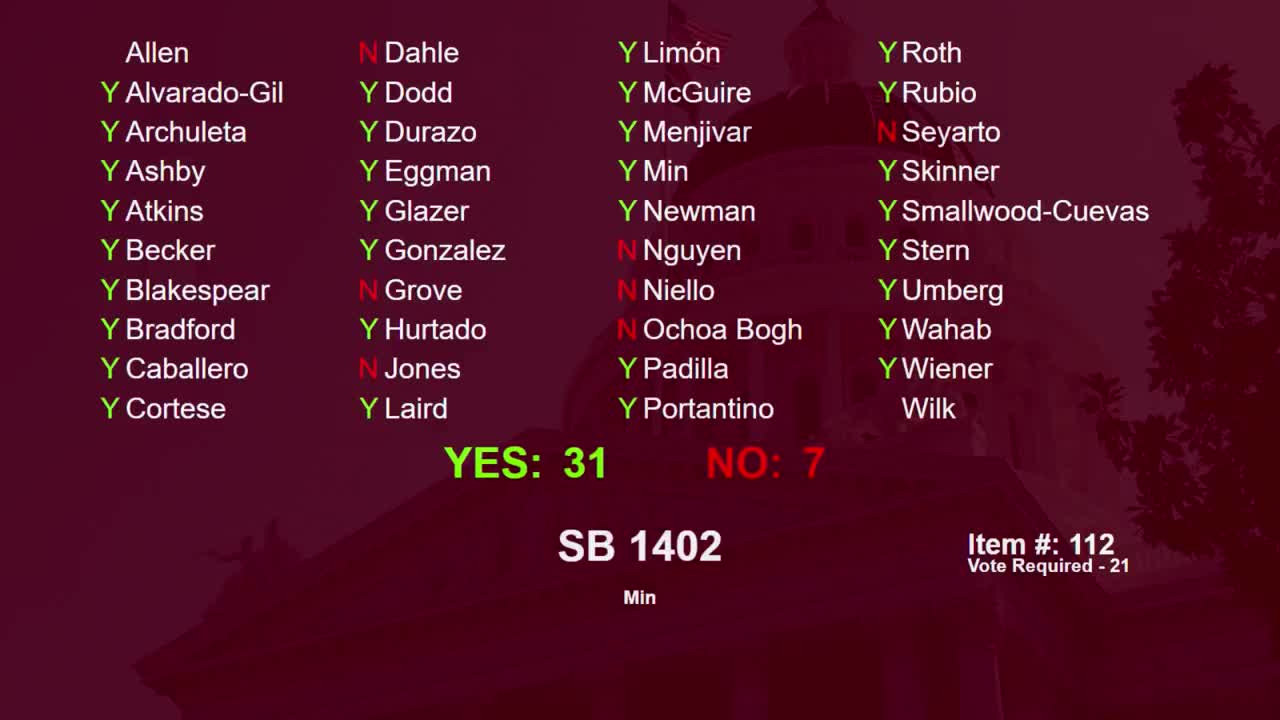 4MIN
Senate Floor
 28MIN
Senate Standing Committee on Elections and Constitutional Amendments
Bill Author

Bill Co-Author(s):