SB 1414: Crimes: solicitation of a minor.
- Session Year: 2023-2024
- House: Senate
- Latest Version Date: 2024-09-26
Current Status:
Passed
(2024-09-26: Chaptered by Secretary of State. Chapter 617, Statutes of 2024.)
Introduced
In Committee
First Chamber
In Committee
Second Chamber
Enacted
Under existing law, a person who solicits, or who agrees to engage in, or who engages in, any act of prostitution with the intent to receive compensation, money, or anything of value from another person is guilty of disorderly conduct, a misdemeanor.
Under existing law, if the person solicited was a minor, and the person who solicited the minor knew or reasonably should have known that the person solicited was a minor, the offense is punishable by imprisonment in the county jail for a mandatory minimum of 2 days and not to exceed one year, by a fine not to exceed $10,000, or by both such fine and imprisonment.
This bill would make this offense applicable only to a defendant who is 18 years of age or older at the time of the offense. The bill would, if the person solicited was under 16 years of age, or if the person solicited was under 18 years of age at the time of the offense and the person solicited was a victim of human trafficking, make the offense punishable as a wobbler by imprisonment in the county jail for not more than 1 year and a fine not to exceed $10,000 or by imprisonment in the county jail for 16 months or 2 or 3 years. For a 2nd or subsequent offense under those conditions, the bill would require that the offense be punishable as a felony by imprisonment in the county jail for 16 months or 2 or 3 years.
By changing the elements and increasing the punishment of a crime, this bill would impose a state-mandated local program.
Existing law requires persons convicted of certain specified crimes to annually register as a sex offender, as specified, for a term of 10, 20, or 30 years.
This bill would require a person who is 18 years of age or older, on or after January 1, 2025, is convicted of, and who has a prior conviction for, soliciting a minor, as specified, to annually register as a sex offender for a term of 10 years if, at the time of the offense, the person was more than 10 years older than the solicited minor.
This bill would incorporate additional changes to Section 647 of the Penal Code proposed by SB 926, AB 1874, and AB 1962, to be operative only if this bill and some or all of those other bills are enacted and this bill is enacted last.
The California Constitution requires the state to reimburse local agencies and school districts for certain costs mandated by the state. Statutory provisions establish procedures for making that reimbursement.
This bill would provide that no reimbursement is required by this act for a specified reason.
Under existing law, a person who solicits, or who agrees to engage in, or who engages in, any act of prostitution with the intent to receive compensation, money, or anything of value from another person is guilty of disorderly conduct, a misdemeanor.
Under existing law, if the person solicited was a minor, and the person who solicited the minor knew or reasonably should have known that the person solicited was a minor, the offense is punishable by imprisonment in the county jail for a mandatory minimum of 2 days and not to exceed one year, by a fine not to exceed $10,000 or by both such fine and imprisonment.
This bill would make this offense applicable only to a defendant who is 18 years of age or older at the time of the offense. The bill would, if the person solicited was under 16 years of age, age, or if the person solicited was under 18 years of age at the time of the offense and the person solicited was a victim of human trafficking, make the offense punishable as a wobbler by imprisonment in the county jail for not more than 1 year and a fine not to exceed $10,000 or by imprisonment in the county jail for 16 months or 2 or 3 years. For a 2nd or subsequent offense, if the person solicited was under 16 years of age, offense under those conditions, the bill would require that the offense be punishable as a felony by imprisonment in the county jail for 16 months or 2 or 3 years.
By changing the elements and increasing the punishment of a crime, this bill would impose a state-mandated local program.
Existing law requires persons convicted of certain specified crimes to annually register as a sex offender, as specified, for a term of 10, 20, or 30 years.
This bill would require a person who is 18 years of age or older, on or after January 1, 2025, is convicted of, and who has a prior conviction for, soliciting a minor, as specified, to annually register as a sex offender for a term of 10 years if, at the time of the offense, the person was more than 10 years older than the solicited minor.
The California Constitution requires the state to reimburse local agencies and school districts for certain costs mandated by the state. Statutory provisions establish procedures for making that reimbursement.
This bill would provide that no reimbursement is required by this act for a specified reason.
Under existing law, a person who solicits, or who agrees to engage in, or who engages in, any act of prostitution with the intent to receive compensation, money, or anything of value from another person is guilty of disorderly conduct, a misdemeanor.
Under existing law, if the person solicited was a minor, and the person who solicited the minor knew or reasonably should have known that the person solicited was a minor, the offense is punishable by imprisonment in the county jail for a mandatory minimum of 2 days and not to exceed one year, by a fine not to exceed $10,000 or by both such fine and imprisonment.
This bill would also require that the defendant who solicited the minor be 18 years of age or older. This bill would make this offense applicable only to a defendant who is 18 years of age or older at the time of the offense. The bill would, if the person solicited was under 16 years of age, make the offense punishable as a wobbler by imprisonment in the county jail for not more than 1 year and a fine not to exceed $10,000 or by imprisonment in the county jail for 16 months or 2 or 3 years. For a 2nd or subsequent offense, if the person solicited was under 16 years of age, the bill would require that the offense be punishable as a felony by imprisonment in the county jail for 16 months or 2 or 3 years.
By changing the elements and increasing the punishment of a crime, this bill would impose a state-mandated local program.
Existing law requires persons convicted of certain specified crimes to annually register as a sex offender, as specified, for a term of 10, 20, or 30 years.
This bill would require a person who is 18 years of age or older, on or after January 1, 2025, is convicted of, and who has a prior conviction for, soliciting a minor, as specified, to annually register as a sex offender for a term of 10 years if, at the time of the offense, the person was more than 10 years older than the solicited minor.
The California Constitution requires the state to reimburse local agencies and school districts for certain costs mandated by the state. Statutory provisions establish procedures for making that reimbursement.
This bill would provide that no reimbursement is required by this act for a specified reason.
Under existing law, a person who solicits, or who agrees to engage in, or who engages in, any act of prostitution with the intent to receive compensation, money, or anything of value from another person is guilty of disorderly conduct, a misdemeanor.
Under existing law, if the person solicited was a minor, and the person who solicited the minor knew or reasonably should have known that the person solicited was a minor, the offense is punishable by imprisonment in the county jail for a mandatory minimum of 2 days and not to exceed one year, by a fine not to exceed $10,000 or by both such fine and imprisonment.
This bill would instead, if the person solicited was a minor, regardless of whether or not the person knew or reasonably should have known that the person solicited was a minor, make the offense punishable by imprisonment in the state prison for 2, 3, or 4 years, and a fine not to exceed $25,000. also require that the defendant who solicited the minor be 18 years of age or older. The bill would, if the person solicited was under 16 years of age, make the offense punishable as a wobbler by imprisonment in the county jail for not more than 1 year and a fine not to exceed $10,000 or by imprisonment in the county jail for 16 months or 2 or 3 years. For a 2nd or subsequent offense, if the person solicited was under 16 years of age, the bill would require that the offense be punishable as a felony by imprisonment in the county jail for 16 months or 2 or 3 years.
By changing the elements and increasing the punishment of a crime, this bill would impose a state-mandated local program.
Existing law requires persons convicted of certain specified crimes to annually register as a sex offender, as specified, for a term of 10, 20, or 30 years.
This bill would require a person who, who is 18 years of age or older, on or after January 1, 2025, is convicted of of, and who has a prior conviction for, soliciting a minor, as specified, to annually register as a sex offender for a term of 10 years. years if, at the time of the offense, the person was more than 10 years older than the solicited minor.
The California Constitution requires the state to reimburse local agencies and school districts for certain costs mandated by the state. Statutory provisions establish procedures for making that reimbursement.
This bill would provide that no reimbursement is required by this act for a specified reason.
Under existing law, a person who solicits, or who agrees to engage in, or who engages in, any act of prostitution with the intent to receive compensation, money, or anything of value from another person is guilty of disorderly conduct, a misdemeanor.
Under existing law, if the person solicited was a minor, and the person who solicited the minor knew or reasonably should have known that the person solicited was a minor, the offense is punishable by imprisonment in the county jail for a mandatory minimum of 2 days and not to exceed one year, by a fine not to exceed $10,000 or by both such fine and imprisonment.
This bill would instead, if the person solicited was a minor, regardless of whether or not the person knew or reasonably should have known that the person solicited was a minor, make the offense punishable by imprisonment in the state prison for 2, 3, or 4 years, and a fine not to exceed $25,000.
By changing the elements and increasing the punishment of a crime, this bill would impose a state-mandated local program.
Existing law requires persons convicted of certain specified crimes to annually register as a sex offender, as specified, for a term of 10, 20, or 30 years.
This bill would require a person who, on or after January 1, 2025, is convicted of soliciting a minor, as specified, to annually register as a sex offender for a term of 10 years.
The California Constitution requires the state to reimburse local agencies and school districts for certain costs mandated by the state. Statutory provisions establish procedures for making that reimbursement.
This bill would provide that no reimbursement is required by this act for a specified reason.
(a)Sections 290 to 290.024, inclusive, shall be known, and may be cited, as the Sex Offender Registration Act. All references to the Act in those sections are to the Sex Offender Registration Act.
(b)Every person described in subdivision (c), for the period specified in subdivision (d) while residing in California, or while attending school or working in California, as described in Sections 290.002 and 290.01, shall register with the chief of police of the city in which the person is residing, or the sheriff of the county if the person is residing in an unincorporated area or city that has no police department, and, additionally, with the chief of police of a campus of the University of California, the California State University, or community college if the person is residing upon the campus or in any of its facilities, within five working days of coming into, or changing the persons residence within, any city, county, or city and county, or campus in which the person temporarily resides, and shall register thereafter in accordance with the Act, unless the duty to register is terminated pursuant to Section 290.5 or as otherwise provided by law.
(c)The following persons shall register:
(1)A person who, since July 1, 1944, has been or is hereafter convicted in any court in this state or in any federal or military court of a violation of Section 187 committed in the perpetration, or an attempt to perpetrate, rape, or any act punishable under Section 286, 287, 288, or 289 or former Section 288a, Section 207 or 209 committed with intent to violate Section 261, 286, 287, 288, or 289 or former Section 288a, Section 220, except assault to commit mayhem, subdivision (b) or (c) of Section 236.1, Section 243.4, Section 261, paragraph (1) of subdivision (a) of former Section 262 involving the use of force or violence for which the person is sentenced to the state prison, Section 264.1, 266, or 266c, subdivision (b) of Section 266h, subdivision (b) of Section 266i, Section 266j, 267, 269, 285, 286, 287, 288, 288.3, 288.4, 288.5, 288.7, 289, or 311.1, or former Section 288a, subdivision (b), (c), or (d) of Section 311.2, Section 311.3, 311.4, 311.10, 311.11, or 647.6, former Section 647a, subdivision (c) of Section 653f, subdivision 1 or 2 of Section 314, any offense involving lewd or lascivious conduct under Section 272, or any felony violation of Section 288.2; any statutory predecessor that includes all elements of one of the offenses described in this subdivision; or any person who since that date has been or is hereafter convicted of the attempt or conspiracy to commit any of the offenses described in this subdivision.
(2)(A)A person who is 18 years of age or older, is convicted on or after January 1, 2025, of a violation of paragraph (2) of subdivision (l) of Section 647, and has a prior conviction for a violation of subparagraph (A) of paragraph (2) of subdivision (l) of Section 647 shall register if, at the time of the offense, the person was more than 10 years older than the solicited minor, as measured from the minors date of birth to the persons date of birth, and the conviction is the only one requiring the person to register.
(B)This paragraph does not preclude the court from requiring a person to register pursuant to Section 290.006.
(3)Notwithstanding paragraph (1), a person convicted of a violation of subdivision (b) of Section 286, subdivision (b) of Section 287, or subdivision (h) or (i) of Section 289 shall not be required to register if, at the time of the offense, the person is not more than 10 years older than the minor, as measured from the minors date of birth to the persons date of birth, and the conviction is the only one requiring the person to register. This paragraph does not preclude the court from requiring a person to register pursuant to Section 290.006.
(d)A person described in subdivision (c), or who is otherwise required to register pursuant to the Act shall register for 10 years, 20 years, or life, following a conviction and release from incarceration, placement, commitment, or release on probation or other supervision, as follows:
(1)(A)A tier one offender is subject to registration for a minimum of 10 years. A person is a tier one offender if the person is required to register for conviction of a misdemeanor described in subdivision (c), or for conviction of a felony described in subdivision (c) that was not a serious or violent felony as described in subdivision (c) of Section 667.5 or subdivision (c) of Section 1192.7.
(B)This paragraph does not apply to a person who is subject to registration pursuant to paragraph (2) or (3).
(2)(A)A tier two offender is subject to registration for a minimum of 20 years. A person is a tier two offender if the person was convicted of an offense described in subdivision (c) that is also described in subdivision (c) of Section 667.5 or subdivision (c) of Section 1192.7, Section 285, subdivision (g) or (h) of Section 286, subdivision (g) or (h) of Section 287 or former Section 288a, subdivision (b) of Section 289, or Section 647.6 if it is a second or subsequent conviction for that offense that was brought and tried separately.
(B)This paragraph does not apply if the person is subject to lifetime registration as required in paragraph (3).
(3)A tier three offender is subject to registration for life. A person is a tier three offender if any one of the following applies:
(A)Following conviction of a registerable offense, the person was subsequently convicted in a separate proceeding of committing an offense described in subdivision (c) and the conviction is for commission of a violent felony described in subdivision (c) of Section 667.5, or the person was subsequently convicted of committing an offense for which the person was ordered to register pursuant to Section 290.006, and the conviction is for the commission of a violent felony described in subdivision (c) of Section 667.5.
(B)The person was committed to a state mental hospital as a sexually violent predator pursuant to Article 4 (commencing with Section 6600) of Chapter 2 of Part 2 of Division 6 of the Welfare and Institutions Code.
(C)The person was convicted of violating any of the following:
(i)Section 187 while attempting to commit or committing an act punishable under Section 261, 286, 287, 288, or 289 or former Section 288a.
(ii)Section 207 or 209 with intent to violate Section 261, 286, 287, 288, or 289 or former Section 288a.
(iii)Section 220.
(iv)Subdivision (b) of Section 266h.
(v)Subdivision (b) of Section 266i.
(vi)Section 266j.
(vii)Section 267.
(viii)Section 269.
(ix)Subdivision (b) or (c) of Section 288.
(x)Section 288.2.
(xi)Section 288.3, unless committed with the intent to commit a violation of subdivision (b) of Section 286, subdivision (b) of Section 287 or former Section 288a, or subdivision (h) or (i) of Section 289.
(xii)Section 288.4.
(xiii)Section 288.5.
(xiv)Section 288.7.
(xv)Subdivision (c) of Section 653f.
(xvi)Any offense for which the person is sentenced to a life term pursuant to Section 667.61.
(D)The persons risk level on the static risk assessment instrument for sex offenders (SARATSO), pursuant to Section 290.04, is well above average risk at the time of release on the index sex offense into the community, as defined in the Coding Rules for that instrument.
(E)The person is a habitual sex offender pursuant to Section 667.71.
(F)The person was convicted of violating subdivision (a) of Section 288 in two proceedings brought and tried separately.
(G)The person was sentenced to 15 to 25 years to life for an offense listed in Section 667.61.
(H)The person is required to register pursuant to Section 290.004.
(I)The person was convicted of a felony offense described in subdivision (b) or (c) of Section 236.1.
(J)The person was convicted of a felony offense described in subdivision (a), (c), or (d) of Section 243.4.
(K)The person was convicted of violating paragraph (2), (3), or (4) of subdivision (a) of Section 261 or was convicted of violating Section 261 and punished pursuant to paragraph (1) or (2) of subdivision (c) of Section 264.
(L)The person was convicted of violating paragraph (1) of subdivision (a) of former Section 262.
(M)The person was convicted of violating Section 264.1.
(N)The person was convicted of any offense involving lewd or lascivious conduct under Section 272.
(O)The person was convicted of violating paragraph (2) of subdivision (c) or subdivision (d), (f), or (i) of Section 286.
(P)The person was convicted of violating paragraph (2) of subdivision (c) or subdivision (d), (f), or (i) of Section 287 or former Section 288a.
(Q)The person was convicted of violating paragraph (1) of subdivision (a) or subdivision (d), (e), or (j) of Section 289.
(R)The person was convicted of a felony violation of Section 311.1 or 311.11 or of violating subdivision (b), (c), or (d) of Section 311.2, Section 311.3, 311.4, or 311.10.
(4)(A)A person who is required to register pursuant to Section 290.005 shall be placed in the appropriate tier if the offense is assessed as equivalent to a California registerable offense described in subdivision (c).
(B)If the persons duty to register pursuant to Section 290.005 is based solely on the requirement of registration in another jurisdiction, and there is no equivalent California registerable offense, the person shall be subject to registration as a tier two offender, except that the person is subject to registration as a tier three offender if one of the following applies:
(i)The persons risk level on the static risk assessment instrument (SARATSO), pursuant to Section 290.06, is well above average risk at the time of release on the index sex offense into the community, as defined in the Coding Rules for that instrument.
(ii)The person was subsequently convicted in a separate proceeding of an offense substantially similar to an offense listed in subdivision (c) which is also substantially similar to an offense described in subdivision (c) of Section 667.5, or is substantially similar to Section 269 or 288.7.
(iii)The person has ever been committed to a state mental hospital or mental health facility in a proceeding substantially similar to civil commitment as a sexually violent predator pursuant to Article 4 (commencing with Section 6600) of Chapter 2 of Part 2 of Division 6 of the Welfare and Institutions Code.
(5)(A)The Department of Justice may place a person described in subdivision (c), or who is otherwise required to register pursuant to the Act, in a tier-to-be-determined category if the appropriate tier designation described in this subdivision cannot be immediately ascertained. An individual placed in this tier-to-be-determined category shall continue to register in accordance with the Act. The individual shall be given credit toward the mandated minimum registration period for any period for which the individual registers.
(B)The Department of Justice shall ascertain an individuals appropriate tier designation as described in this subdivision within 24 months of the individuals placement in the tier-to-be-determined category.
(e)The minimum time period for the completion of the required registration period in tier one or two commences on the date of release from incarceration, placement, or commitment, including any related civil commitment on the registerable offense. The minimum time for the completion of the required registration period for a designated tier is tolled during any period of subsequent incarceration, placement, or commitment, including any subsequent civil commitment, except that arrests not resulting in conviction, adjudication, or revocation of probation or parole shall not toll the required registration period. The minimum time period shall be extended by one year for each misdemeanor conviction of failing to register under this act, and by three years for each felony conviction of failing to register under this act, without regard to the actual time served in custody for the conviction. If a registrant is subsequently convicted of another offense requiring registration pursuant to the Act, a new minimum time period for the completion of the registration requirement for the applicable tier shall commence upon that persons release from incarceration, placement, or commitment, including any related civil commitment. If the subsequent conviction requiring registration pursuant to the Act occurs prior to an order to terminate the registrant from the registry after completion of a tier associated with the first conviction for a registerable offense, the applicable tier shall be the highest tier associated with the convictions.
(f)This section does not require a ward of the juvenile court to register under the Act, except as provided in Section 290.008.
SEC. 2.Section 647 of the Penal Code is amended to read:647.Except as provided in paragraph (5) of subdivision (b) and in subdivision (l), every person who commits any of the following acts is guilty of disorderly conduct, a misdemeanor:
(a)An individual who solicits anyone to engage in or who engages in lewd or dissolute conduct in any public place or in any place open to the public or exposed to public view.
(b)(1)An individual who solicits, or who agrees to engage in, or who engages in, any act of prostitution with the intent to receive compensation, money, or anything of value from another person. An individual agrees to engage in an act of prostitution when, with specific intent to so engage, the individual manifests an acceptance of an offer or solicitation by another person to so engage, regardless of whether the offer or solicitation was made by a person who also possessed the specific intent to engage in an act of prostitution.
(2)An individual who solicits, or who agrees to engage in, or who engages in, any act of prostitution with another person who is 18 years of age or older in exchange for the individual providing compensation, money, or anything of value to the other person. An individual agrees to engage in an act of prostitution when, with specific intent to so engage, the individual manifests an acceptance of an offer or solicitation by another person who is 18 years of age or older to so engage, regardless of whether the offer or solicitation was made by a person who also possessed the specific intent to engage in an act of prostitution.
(3)An individual who solicits, or who agrees to engage in, or who engages in, any act of prostitution with another person who is a minor in exchange for the individual providing compensation, money, or anything of value to the minor. An individual agrees to engage in an act of prostitution when, with specific intent to so engage, the individual manifests an acceptance of an offer or solicitation by someone who is a minor to so engage, regardless of whether the offer or solicitation was made by a minor who also possessed the specific intent to engage in an act of prostitution.
(4)A manifestation of acceptance of an offer or solicitation to engage in an act of prostitution does not constitute a violation of this subdivision unless some act, in addition to the manifestation of acceptance, is done within this state in furtherance of the commission of the act of prostitution by the person manifesting an acceptance of an offer or solicitation to engage in that act. As used in this subdivision, prostitution includes any lewd act between persons for money or other consideration.
(5)Notwithstanding paragraphs (1) to (3), inclusive, this subdivision does not apply to a child under 18 years of age who is alleged to have engaged in conduct to receive money or other consideration that would, if committed by an adult, violate this subdivision. A commercially exploited child under this paragraph may be adjudged a dependent child of the court pursuant to paragraph (2) of subdivision (b) of Section 300 of the Welfare and Institutions Code and may be taken into temporary custody pursuant to subdivision (a) of Section 305 of the Welfare and Institutions Code, if the conditions allowing temporary custody without warrant are met.
(c)Who accosts other persons in any public place or in any place open to the public for the purpose of begging or soliciting alms.
(d)Who loiters in or about any toilet open to the public for the purpose of engaging in or soliciting any lewd or lascivious or any unlawful act.
(e)Who lodges in any building, structure, vehicle, or place, whether public or private, without the permission of the owner or person entitled to the possession or in control of it.
(f)Who is found in any public place under the influence of intoxicating liquor, any drug, controlled substance, toluene, or any combination of any intoxicating liquor, drug, controlled substance, or toluene, in a condition that they are unable to exercise care for their own safety or the safety of others, or by reason of being under the influence of intoxicating liquor, any drug, controlled substance, toluene, or any combination of any intoxicating liquor, drug, or toluene, interferes with or obstructs or prevents the free use of any street, sidewalk, or other public way.
(g)If a person has violated subdivision (f), a peace officer, if reasonably able to do so, shall place the person, or cause the person to be placed, in civil protective custody. The person shall be taken to a facility, designated pursuant to Section 5170 of the Welfare and Institutions Code, for the 72-hour treatment and evaluation of inebriates. A peace officer may place a person in civil protective custody with that kind and degree of force authorized to effect an arrest for a misdemeanor without a warrant. A person who has been placed in civil protective custody shall not thereafter be subject to any criminal prosecution or juvenile court proceeding based on the facts giving rise to this placement. This subdivision does not apply to the following persons:
(1)A person who is under the influence of any drug, or under the combined influence of intoxicating liquor and any drug.
(2)A person who a peace officer has probable cause to believe has committed any felony, or who has committed any misdemeanor in addition to subdivision (f).
(3)A person who a peace officer in good faith believes will attempt escape or will be unreasonably difficult for medical personnel to control.
(h)Who loiters, prowls, or wanders upon the private property of another, at any time, without visible or lawful business with the owner or occupant. As used in this subdivision, loiter means to delay or linger without a lawful purpose for being on the property and for the purpose of committing a crime as opportunity may be discovered.
(i)Who, while loitering, prowling, or wandering upon the private property of another, at any time, peeks in the door or window of any inhabited building or structure, without visible or lawful business with the owner or occupant.
(j)(1)A person who looks through a hole or opening, into, or otherwise views, by means of any instrumentality, including, but not limited to, a periscope, telescope, binoculars, camera, motion picture camera, camcorder, mobile phone, electronic device, or unmanned aircraft system, the interior of a bedroom, bathroom, changing room, fitting room, dressing room, or tanning booth, or the interior of any other area in which the occupant has a reasonable expectation of privacy, with the intent to invade the privacy of a person or persons inside. This subdivision does not apply to those areas of a private business used to count currency or other negotiable instruments.
(2)A person who uses a concealed camcorder, motion picture camera, or photographic camera of any type, to secretly videotape, film, photograph, or record by electronic means, another identifiable person under or through the clothing being worn by that other person, for the purpose of viewing the body of, or the undergarments worn by, that other person, without the consent or knowledge of that other person, with the intent to arouse, appeal to, or gratify the lust, passions, or sexual desires of that person and invade the privacy of that other person, under circumstances in which the other person has a reasonable expectation of privacy. For the purposes of this paragraph, identifiable means capable of identification, or capable of being recognized, meaning that someone, including the victim, could identify or recognize the victim. It does not require the victims identity to actually be established.
(3)(A)A person who uses a concealed camcorder, motion picture camera, or photographic camera of any type, to secretly videotape, film, photograph, or record by electronic means, another identifiable person who may be in a state of full or partial undress, for the purpose of viewing the body of, or the undergarments worn by, that other person, without the consent or knowledge of that other person, in the interior of a bedroom, bathroom, changing room, fitting room, dressing room, or tanning booth, or the interior of any other area in which that other person has a reasonable expectation of privacy, with the intent to invade the privacy of that other person. For the purposes of this paragraph, identifiable means capable of identification, or capable of being recognized, meaning that someone, including the victim, could identify or recognize the victim. It does not require the victims identity to actually be established.
(B)Neither of the following is a defense to the crime specified in this paragraph:
(i)The defendant was a cohabitant, landlord, tenant, cotenant, employer, employee, or business partner or associate of the victim, or an agent of any of these.
(ii)The victim was not in a state of full or partial undress.
(4)(A)A person who intentionally distributes or causes to be distributed the image of the intimate body part or parts of another identifiable person, or an image of the person depicted engaged in an act of sexual intercourse, sodomy, oral copulation, sexual penetration, or an image of masturbation by the person depicted or in which the person depicted participates, under circumstances in which the persons agree or understand that the image shall remain private, the person distributing the image knows or should know that distribution of the image will cause serious emotional distress, and the person depicted suffers that distress.
(B)(i)A person intentionally distributes an image described in subparagraph (A) when that person personally distributes the image.
(ii)A person intentionally causes an image described in subparagraph (A) to be distributed when that person arranges, specifically requests, or intentionally causes another person to distribute the image.
(C)As used in this paragraph, the following terms have the following meanings:
(i)Distribute includes exhibiting in public or giving possession.
(ii)Identifiable has the same meaning as in paragraphs (2) and (3).
(iii)Intimate body part means any portion of the genitals, the anus and, in the case of a female, also includes any portion of the breasts below the top of the areola, that is either uncovered or clearly visible through clothing.
(D)It shall not be a violation of this paragraph to distribute an image described in subparagraph (A) if any of the following applies:
(i)The distribution is made in the course of reporting an unlawful activity.
(ii)The distribution is made in compliance with a subpoena or other court order for use in a legal proceeding.
(iii)The distribution is made in the course of a lawful public proceeding.
(iv)The distribution is related to a matter of public concern or public interest. Distribution is not a matter of public concern or public interest solely because the depicted individual is a public figure.
(5)This subdivision does not preclude punishment under any section of law providing for greater punishment.
(k)(1)A second or subsequent violation of subdivision (j) is punishable by imprisonment in a county jail not exceeding one year, or by a fine not exceeding two thousand dollars ($2,000), or by both that fine and imprisonment.
(2)If the victim of a violation of subdivision (j) was a minor at the time of the offense, the violation is punishable by imprisonment in a county jail not exceeding one year, or by a fine not exceeding two thousand dollars ($2,000), or by both that fine and imprisonment.
(l)(1)(A)If a crime is committed in violation of subdivision (b) by a defendant who is 18 years of age or older, the person who was solicited was a minor at the time of the offense, and the defendant knew or should have known that the person who was solicited was a minor at the time of the offense, the violation is punishable by imprisonment in the county jail for not less than two days and not more than one year, or by a fine not exceeding ten thousand dollars ($10,000), or by both that fine and imprisonment, except as provided in paragraph (2).
(B)The court may, in unusual cases, when the interests of justice are best served, reduce or eliminate the mandatory two days of imprisonment in a county jail required by this paragraph. If the court reduces or eliminates the mandatory two days imprisonment, the court shall specify the reason on the record.
(2)(A)If the solicited minor was under 16 years of age at the time of the offense, or if the person solicited was under 18 years of age at the time of the offense and the person solicited was a victim of human trafficking under Section 236.1, the violation is punishable by either of the following:
(i)Imprisonment in the county jail not exceeding one year and a fine not to exceed ten thousand dollars ($10,000).
(ii)Imprisonment pursuant to subdivision (h) of Section 1170.
(B)A second or subsequent violation of this paragraph is punishable as a felony by imprisonment pursuant to subdivision (h) of Section 1170.
SEC. 2.1.Section 647 of the Penal Code is amended to read:647.Except as provided in paragraph (5) of subdivision (b) and in subdivisions (k) and (l), every person who commits any of the following acts is guilty of disorderly conduct, a misdemeanor:
(a)An individual who solicits anyone to engage in or who engages in lewd or dissolute conduct in any public place or in any place open to the public or exposed to public view.
(b)(1)An individual who solicits, or who agrees to engage in, or who engages in, any act of prostitution with the intent to receive compensation, money, or anything of value from another person. An individual agrees to engage in an act of prostitution when, with specific intent to so engage, the individual manifests an acceptance of an offer or solicitation by another person to so engage, regardless of whether the offer or solicitation was made by a person who also possessed the specific intent to engage in an act of prostitution.
(2)An individual who solicits, or who agrees to engage in, or who engages in, any act of prostitution with another person who is 18 years of age or older in exchange for the individual providing compensation, money, or anything of value to the other person. An individual agrees to engage in an act of prostitution when, with specific intent to so engage, the individual manifests an acceptance of an offer or solicitation by another person who is 18 years of age or older to so engage, regardless of whether the offer or solicitation was made by a person who also possessed the specific intent to engage in an act of prostitution.
(3)An individual who solicits, or who agrees to engage in, or who engages in, any act of prostitution with another person who is a minor in exchange for the individual providing compensation, money, or anything of value to the minor. An individual agrees to engage in an act of prostitution when, with specific intent to so engage, the individual manifests an acceptance of an offer or solicitation by someone who is a minor to so engage, regardless of whether the offer or solicitation was made by a minor who also possessed the specific intent to engage in an act of prostitution.
(4)A manifestation of acceptance of an offer or solicitation to engage in an act of prostitution does not constitute a violation of this subdivision unless some act, in addition to the manifestation of acceptance, is done within this state in furtherance of the commission of the act of prostitution by the person manifesting an acceptance of an offer or solicitation to engage in that act. As used in this subdivision, prostitution includes any lewd act between persons for money or other consideration.
(5)Notwithstanding paragraphs (1) to (3), inclusive, this subdivision does not apply to a child under 18 years of age who is alleged to have engaged in conduct to receive money or other consideration that would, if committed by an adult, violate this subdivision. A commercially exploited child under this paragraph may be adjudged a dependent child of the court pursuant to paragraph (2) of subdivision (b) of Section 300 of the Welfare and Institutions Code and may be taken into temporary custody pursuant to subdivision (a) of Section 305 of the Welfare and Institutions Code, if the conditions allowing temporary custody without warrant are met.
(c)Who accosts other persons in any public place or in any place open to the public for the purpose of begging or soliciting alms.
(d)Who loiters in or about any toilet open to the public for the purpose of engaging in or soliciting any lewd or lascivious or any unlawful act.
(e)Who lodges in any building, structure, vehicle, or place, whether public or private, without the permission of the owner or person entitled to the possession or in control of it.
(f)Who is found in any public place under the influence of intoxicating liquor, any drug, controlled substance, toluene, or any combination of any intoxicating liquor, drug, controlled substance, or toluene, in a condition that they are unable to exercise care for their own safety or the safety of others, or by reason of being under the influence of intoxicating liquor, any drug, controlled substance, toluene, or any combination of any intoxicating liquor, drug, or toluene, interferes with or obstructs or prevents the free use of any street, sidewalk, or other public way.
(g)If a person has violated subdivision (f), a peace officer, if reasonably able to do so, shall place the person, or cause the person to be placed, in civil protective custody. The person shall be taken to a facility, designated pursuant to Section 5170 of the Welfare and Institutions Code, for the 72-hour treatment and evaluation of inebriates. A peace officer may place a person in civil protective custody with that kind and degree of force authorized to effect an arrest for a misdemeanor without a warrant. A person who has been placed in civil protective custody shall not thereafter be subject to any criminal prosecution or juvenile court proceeding based on the facts giving rise to this placement. This subdivision does not apply to the following persons:
(1)A person who is under the influence of any drug, or under the combined influence of intoxicating liquor and any drug.
(2)A person who a peace officer has probable cause to believe has committed any felony, or who has committed any misdemeanor in addition to subdivision (f).
(3)A person who a peace officer in good faith believes will attempt escape or will be unreasonably difficult for medical personnel to control.
(h)Who loiters, prowls, or wanders upon the private property of another, at any time, without visible or lawful business with the owner or occupant. As used in this subdivision, loiter means to delay or linger without a lawful purpose for being on the property and for the purpose of committing a crime as opportunity may be discovered.
(i)Who, while loitering, prowling, or wandering upon the private property of another, at any time, peeks in the door or window of any inhabited building or structure, without visible or lawful business with the owner or occupant.
(j)(1)A person who looks through a hole or opening, into, or otherwise views, by means of any instrumentality, including, but not limited to, a periscope, telescope, binoculars, camera, motion picture camera, camcorder, mobile phone, electronic device, or unmanned aircraft system, the interior of a bedroom, bathroom, changing room, fitting room, dressing room, or tanning booth, or the interior of any other area in which the occupant has a reasonable expectation of privacy, with the intent to invade the privacy of a person or persons inside. This subdivision does not apply to those areas of a private business used to count currency or other negotiable instruments.
(2)A person who uses a concealed camcorder, motion picture camera, or photographic camera of any type, to secretly videotape, film, photograph, or record by electronic means, another identifiable person under or through the clothing being worn by that other person, for the purpose of viewing the body of, or the undergarments worn by, that other person, without the consent or knowledge of that other person, with the intent to arouse, appeal to, or gratify the lust, passions, or sexual desires of that person and invade the privacy of that other person, under circumstances in which the other person has a reasonable expectation of privacy. For the purposes of this paragraph, identifiable means capable of identification, or capable of being recognized, meaning that someone, including the victim, could identify or recognize the victim. It does not require the victims identity to actually be established.
(3)(A)A person who uses a concealed camcorder, motion picture camera, or photographic camera of any type, to secretly videotape, film, photograph, or record by electronic means, another identifiable person who may be in a state of full or partial undress, for the purpose of viewing the body of, or the undergarments worn by, that other person, without the consent or knowledge of that other person, in the interior of a bedroom, bathroom, changing room, fitting room, dressing room, or tanning booth, or the interior of any other area in which that other person has a reasonable expectation of privacy, with the intent to invade the privacy of that other person. For the purposes of this paragraph, identifiable means capable of identification, or capable of being recognized, meaning that someone, including the victim, could identify or recognize the victim. It does not require the victims identity to actually be established.
(B)Neither of the following is a defense to the crime specified in this paragraph:
(i)The defendant was a cohabitant, landlord, tenant, cotenant, employer, employee, or business partner or associate of the victim, or an agent of any of these.
(ii)The victim was not in a state of full or partial undress.
(4)(A)(i)A person who intentionally distributes or causes to be distributed the image of the intimate body part or parts of another identifiable person, or an image of the person depicted engaged in an act of sexual intercourse, sodomy, oral copulation, sexual penetration, or an image of masturbation by the person depicted or in which the person depicted participates, under circumstances in which the persons agree or understand that the image shall remain private, the person distributing the image knows or should know that distribution of the image will cause serious emotional distress, and the person depicted suffers that distress.
(ii)A person who intentionally creates and distributes or causes to be distributed any photo realistic image, digital image, electronic image, computer image, computer-generated image, or other pictorial representation of an intimate body part or parts of another identifiable person, or an image of the person depicted engaged in an act of sexual intercourse, sodomy, oral copulation, sexual penetration, or an image of masturbation by the person depicted or in which the person depicted participates that was created in a manner that would cause a reasonable person to believe the image is an authentic image of the person depicted, under circumstances in which the person distributing the image knows or should know that distribution of the image will cause serious emotional distress, and the person depicted suffers that distress. This clause shall not apply to a person who was under 18 years of age at the time the person committed the offense.
(B)(i)A person intentionally distributes an image described in subparagraph (A) when that person personally distributes the image.
(ii)A person intentionally causes an image described in subparagraph (A) to be distributed when that person arranges, specifically requests, or intentionally causes another person to distribute the image.
(C)As used in this paragraph, the following terms have the following meanings:
(i)Distribute includes exhibiting in public or giving possession.
(ii)Identifiable has the same meaning as in paragraphs (2) and (3).
(iii)Intimate body part means any portion of the genitals, the anus and, in the case of a female, also includes any portion of the breasts below the top of the areola, that is either uncovered or clearly visible through clothing.
(D)It shall not be a violation of this paragraph to distribute an image described in subparagraph (A) if any of the following applies:
(i)The distribution is made in the course of reporting an unlawful activity.
(ii)The distribution is made in compliance with a subpoena or other court order for use in a legal proceeding.
(iii)The distribution is made in the course of a lawful public proceeding.
(iv)The distribution is related to a matter of public concern or public interest. Distribution is not a matter of public concern or public interest solely because the depicted individual is a public figure.
(5)This subdivision does not preclude punishment under any section of law providing for greater punishment.
(k)(1)A second or subsequent violation of subdivision (j) is punishable by imprisonment in a county jail not exceeding one year, or by a fine not exceeding two thousand dollars ($2,000), or by both that fine and imprisonment.
(2)If the victim of a violation of subdivision (j) was a minor at the time of the offense, the violation is punishable by imprisonment in a county jail not exceeding one year, or by a fine not exceeding two thousand dollars ($2,000), or by both that fine and imprisonment.
(l)(1)(A)If a crime is committed in violation of subdivision (b) by a defendant who is 18 years of age or older, the person who was solicited was a minor at the time of the offense, and the defendant knew or should have known that the person who was solicited was a minor at the time of the offense, the violation is punishable by imprisonment in a county jail for not less than two days and not more than one year, or by a fine not exceeding ten thousand dollars ($10,000), or by both that fine and imprisonment, except as provided in paragraph (2).
(B)The court may, in unusual cases, when the interests of justice are best served, reduce or eliminate the mandatory two days of imprisonment in a county jail required by this paragraph. If the court reduces or eliminates the mandatory two days imprisonment, the court shall specify the reason on the record.
(2)(A)If the solicited minor was under 16 years of age at the time of the offense, or if the person solicited was under 18 years of age at the time of the offense and the person solicited was a victim of human trafficking under Section 236.1, the violation is punishable by either of the following:
(i)Imprisonment in the county jail not exceeding one year and a fine not to exceed ten thousand dollars ($10,000).
(ii)Imprisonment pursuant to subdivision (h) of Section 1170.
(B)A second or subsequent violation of this paragraph is punishable as a felony by imprisonment pursuant to subdivision (h) of Section 1170.
SEC. 2.2.Section 647 of the Penal Code is amended to read:647.Except as provided in paragraph (5) of subdivision (b) and in subdivisions (k) and (l), every person who commits any of the following acts is guilty of disorderly conduct, a misdemeanor:
(a)An individual who solicits anyone to engage in or who engages in lewd or dissolute conduct in a public place or in a place open to the public or exposed to public view.
(b)(1)An individual who solicits, or who agrees to engage in, or who engages in, an act of prostitution with the intent to receive compensation, money, or anything of value from another person. An individual agrees to engage in an act of prostitution when, with specific intent to so engage, the individual manifests an acceptance of an offer or solicitation by another person to so engage, regardless of whether the offer or solicitation was made by a person who also possessed the specific intent to engage in an act of prostitution.
(2)An individual who solicits, or who agrees to engage in, or who engages in, an act of prostitution with another person who is 18 years of age or older in exchange for the individual providing compensation, money, or anything of value to the other person. An individual agrees to engage in an act of prostitution when, with specific intent to so engage, the individual manifests an acceptance of an offer or solicitation by another person who is 18 years of age or older to so engage, regardless of whether the offer or solicitation was made by a person who also possessed the specific intent to engage in an act of prostitution.
(3)An individual who solicits, or who agrees to engage in, or who engages in, an act of prostitution with another person who is a minor in exchange for the individual providing compensation, money, or anything of value to the minor. An individual agrees to engage in an act of prostitution when, with specific intent to so engage, the individual manifests an acceptance of an offer or solicitation by someone who is a minor to so engage, regardless of whether the offer or solicitation was made by a minor who also possessed the specific intent to engage in an act of prostitution.
(4)A manifestation of acceptance of an offer or solicitation to engage in an act of prostitution does not constitute a violation of this subdivision unless some act, in addition to the manifestation of acceptance, is done within this state in furtherance of the commission of the act of prostitution by the person manifesting an acceptance of an offer or solicitation to engage in that act. As used in this subdivision, prostitution includes any lewd act between persons for money or other consideration.
(5)Notwithstanding paragraphs (1) to (3), inclusive, this subdivision does not apply to a child under 18 years of age who is alleged to have engaged in conduct to receive money or other consideration that would, if committed by an adult, violate this subdivision. A commercially exploited child under this paragraph may be adjudged a dependent child of the court pursuant to paragraph (2) of subdivision (b) of Section 300 of the Welfare and Institutions Code and may be taken into temporary custody pursuant to subdivision (a) of Section 305 of the Welfare and Institutions Code, if the conditions allowing temporary custody without warrant are met.
(c)Who accosts other persons in a public place or in a place open to the public for the purpose of begging or soliciting alms.
(d)Who loiters in or about a toilet open to the public for the purpose of engaging in or soliciting a lewd or lascivious or an unlawful act.
(e)Who lodges in a building, structure, vehicle, or place, whether public or private, without the permission of the owner or person entitled to the possession or in control of it.
(f)Who is found in a public place under the influence of intoxicating liquor, a drug, controlled substance, toluene, or a combination of an intoxicating liquor, drug, controlled substance, or toluene, in a condition that they are unable to exercise care for their own safety or the safety of others, or by reason of being under the influence of intoxicating liquor, drug, controlled substance, toluene, or a combination of an intoxicating liquor, drug, or toluene, interferes with or obstructs or prevents the free use of a street, sidewalk, or other public way.
(g)If a person has violated subdivision (f), a peace officer, if reasonably able to do so, shall place the person, or cause the person to be placed, in civil protective custody. The person shall be taken to a facility, designated pursuant to Section 5170 of the Welfare and Institutions Code, for the 72-hour treatment and evaluation of inebriates. A peace officer may place a person in civil protective custody with that kind and degree of force authorized to effect an arrest for a misdemeanor without a warrant. A person who has been placed in civil protective custody shall not thereafter be subject to criminal prosecution or juvenile court proceeding based on the facts giving rise to this placement. This subdivision does not apply to the following persons:
(1)A person who is under the influence of a drug or under the combined influence of intoxicating liquor and a drug.
(2)A person who a peace officer has probable cause to believe has committed a felony, or who has committed a misdemeanor in addition to subdivision (f).
(3)A person who a peace officer in good faith believes will attempt escape or will be unreasonably difficult for medical personnel to control.
(h)Who loiters, prowls, or wanders upon the private property of another, at any time, without visible or lawful business with the owner or occupant. As used in this subdivision, loiter means to delay or linger without a lawful purpose for being on the property and for the purpose of committing a crime as opportunity may be discovered.
(i)Who, while loitering, prowling, or wandering upon the private property of another, at any time, peeks in the door or window of an inhabited building or structure, without visible or lawful business with the owner or occupant.
(j)(1)A person who looks through a hole or opening, into, or otherwise views, by means of any instrumentality, including, but not limited to, a periscope, telescope, binoculars, camera, motion picture camera, camcorder, mobile phone, electronic device, or unmanned aircraft system, the interior of a bedroom, bathroom, changing room, fitting room, dressing room, or tanning booth, or the interior of any other area in which the occupant has a reasonable expectation of privacy, with the intent to invade the privacy of a person or persons inside. This subdivision does not apply to those areas of a private business used to count currency or other negotiable instruments.
(2)A person who uses a concealed camcorder, motion picture camera, or photographic camera of any type, to secretly videotape, film, photograph, or record by electronic means, another identifiable person under or through the clothing being worn by that other person, for the purpose of viewing the body of, or the undergarments worn by, that other person, without the consent or knowledge of that other person, with the intent to arouse, appeal to, or gratify the lust, passions, or sexual desires of that person and invade the privacy of that other person, under circumstances in which the other person has a reasonable expectation of privacy. For the purposes of this paragraph, identifiable means capable of identification, or capable of being recognized, meaning that someone, including the victim, could identify or recognize the victim. It does not require the victims identity to actually be established.
(3)(A)A person who uses a concealed camcorder, motion picture camera, or photographic camera of any type, to secretly videotape, film, photograph, or record by electronic means, another identifiable person who may be in a state of full or partial undress, for the purpose of viewing the body of, or the undergarments worn by, that other person, without the consent or knowledge of that other person, in the interior of a bedroom, bathroom, changing room, fitting room, dressing room, or tanning booth, or the interior of any other area in which that other person has a reasonable expectation of privacy, with the intent to invade the privacy of that other person. For the purposes of this paragraph, identifiable means capable of identification, or capable of being recognized, meaning that someone, including the victim, could identify or recognize the victim. It does not require the victims identity to actually be established.
(B)Neither of the following is a defense to the crime specified in this paragraph:
(i)The defendant was a cohabitant, landlord, tenant, cotenant, employer, employee, or business partner or associate of the victim, or an agent of any of these.
(ii)The victim was not in a state of full or partial undress.
(4)(A)A person who intentionally distributes or causes to be distributed the image of the intimate body part or parts of another identifiable person, or an image of the person depicted engaged in an act of sexual intercourse, sodomy, oral copulation, sexual penetration, or an image of masturbation by the person depicted or in which the person depicted participates, under circumstances in which the persons agree or understand that the image shall remain private, the person distributing the image knows or should know that distribution of the image will cause serious emotional distress, and the person depicted suffers that distress.
(B)(i)A person intentionally distributes an image described in subparagraph (A) when that person personally distributes the image.
(ii)A person intentionally causes an image described in subparagraph (A) to be distributed when that person arranges, specifically requests, or intentionally causes another person to distribute the image.
(C)As used in this paragraph, the following terms have the following meanings:
(i)Distribute includes exhibiting in public or giving possession.
(ii)Identifiable has the same meaning as in paragraphs (2) and (3).
(iii)Intimate body part means any portion of the genitals, the anus and, in the case of a female, also includes any portion of the breasts below the top of the areola, that is either uncovered or clearly visible through clothing.
(D)It shall not be a violation of this paragraph to distribute an image described in subparagraph (A) if any of the following applies:
(i)The distribution is made in the course of reporting an unlawful activity.
(ii)The distribution is made in compliance with a subpoena or other court order for use in a legal proceeding.
(iii)The distribution is made in the course of a lawful public proceeding.
(iv)The distribution is related to a matter of public concern or public interest. Distribution is not a matter of public concern or public interest solely because the depicted individual is a public figure.
(5)This subdivision does not preclude punishment under any section of law providing for greater punishment.
(k)(1)Except as provided in paragraph (3), a second or subsequent violation of subdivision (j) is punishable by imprisonment in a county jail not exceeding one year, or by a fine not exceeding two thousand dollars ($2,000), or by both that fine and imprisonment.
(2)Except as provided in paragraph (3), if the victim of a violation of subdivision (j) was a minor at the time of the offense, the violation is punishable by imprisonment in a county jail not exceeding one year, or by a fine not exceeding two thousand dollars ($2,000), or by both that fine and imprisonment.
(3)If the victim of a violation of paragraph (3) of subdivision (j) was a minor at the time of the offense, a second or subsequent violation of paragraph (3) of subdivision (j) is punishable by a fine not exceeding two thousand dollars ($2,000), or by imprisonment in county jail not exceeding one year, or by imprisonment pursuant to subdivision (h) of Section 1170, or by both a fine and imprisonment. This paragraph shall not apply to a person who was under 18 years of age at the time that they committed the offense.
(l)(1)(A)If a crime is committed in violation of subdivision (b) by a defendant who is 18 years of age or older, the person who was solicited was a minor at the time of the offense, and the defendant knew or should have known that the person who was solicited was a minor at the time of the offense, the violation is punishable by imprisonment in a county jail for not less than two days and not more than one year, or by a fine not exceeding ten thousand dollars ($10,000), or by both that fine and imprisonment, except as provided in paragraph (2).
(B)The court may, in unusual cases, when the interests of justice are best served, reduce or eliminate the mandatory two days of imprisonment in a county jail required by this paragraph. If the court reduces or eliminates the mandatory two days imprisonment, the court shall specify the reason on the record.
(2)(A)If the solicited minor was under 16 years of age at the time of the offense, or if the person solicited was under 18 years of age at the time of the offense and the person solicited was a victim of human trafficking under Section 236.1, the violation is punishable by either of the following:
(i)Imprisonment in the county jail not exceeding one year and a fine not to exceed ten thousand dollars ($10,000).
(ii)Imprisonment pursuant to subdivision (h) of Section 1170.
(B)A second or subsequent violation of this paragraph is punishable as a felony by imprisonment pursuant to subdivision (h) of Section 1170.
SEC. 2.3.Section 647 of the Penal Code is amended to read:647.Except as provided in paragraph (5) of subdivision (b) and in subdivisions (k) and (l), every person who commits any of the following acts is guilty of disorderly conduct, a misdemeanor:
(a)An individual who solicits anyone to engage in or who engages in lewd or dissolute conduct in any public place or in any place open to the public or exposed to public view.
(b)(1)An individual who solicits, or who agrees to engage in, or who engages in, any act of prostitution with the intent to receive compensation, money, or anything of value from another person. An individual agrees to engage in an act of prostitution when, with specific intent to so engage, the individual manifests an acceptance of an offer or solicitation by another person to so engage, regardless of whether the offer or solicitation was made by a person who also possessed the specific intent to engage in an act of prostitution.
(2)An individual who solicits, or who agrees to engage in, or who engages in, any act of prostitution with another person who is 18 years of age or older in exchange for the individual providing compensation, money, or anything of value to the other person. An individual agrees to engage in an act of prostitution when, with specific intent to so engage, the individual manifests an acceptance of an offer or solicitation by another person who is 18 years of age or older to so engage, regardless of whether the offer or solicitation was made by a person who also possessed the specific intent to engage in an act of prostitution.
(3)An individual who solicits, or who agrees to engage in, or who engages in, any act of prostitution with another person who is a minor in exchange for the individual providing compensation, money, or anything of value to the minor. An individual agrees to engage in an act of prostitution when, with specific intent to so engage, the individual manifests an acceptance of an offer or solicitation by someone who is a minor to so engage, regardless of whether the offer or solicitation was made by a minor who also possessed the specific intent to engage in an act of prostitution.
(4)A manifestation of acceptance of an offer or solicitation to engage in an act of prostitution does not constitute a violation of this subdivision unless some act, in addition to the manifestation of acceptance, is done within this state in furtherance of the commission of the act of prostitution by the person manifesting an acceptance of an offer or solicitation to engage in that act. As used in this subdivision, prostitution includes any lewd act between persons for money or other consideration.
(5)Notwithstanding paragraphs (1) to (3), inclusive, this subdivision does not apply to a child under 18 years of age who is alleged to have engaged in conduct to receive money or other consideration that would, if committed by an adult, violate this subdivision. A commercially exploited child under this paragraph may be adjudged a dependent child of the court pursuant to paragraph (2) of subdivision (b) of Section 300 of the Welfare and Institutions Code and may be taken into temporary custody pursuant to subdivision (a) of Section 305 of the Welfare and Institutions Code, if the conditions allowing temporary custody without warrant are met.
(c)Who accosts other persons in any public place or in any place open to the public for the purpose of begging or soliciting alms.
(d)Who loiters in or about any toilet open to the public for the purpose of engaging in or soliciting any lewd or lascivious or any unlawful act.
(e)Who lodges in any building, structure, vehicle, or place, whether public or private, without the permission of the owner or person entitled to the possession or in control of it.
(f)Who is found in any public place under the influence of intoxicating liquor, any drug, controlled substance, toluene, or any combination of any intoxicating liquor, drug, controlled substance, or toluene, in a condition that they are unable to exercise care for their own safety or the safety of others, or by reason of being under the influence of intoxicating liquor, any drug, controlled substance, toluene, or any combination of any intoxicating liquor, drug, or toluene, interferes with or obstructs or prevents the free use of any street, sidewalk, or other public way.
(g)If a person has violated subdivision (f), a peace officer, if reasonably able to do so, shall place the person, or cause the person to be placed, in civil protective custody. The person shall be taken to a facility, designated pursuant to Section 5170 of the Welfare and Institutions Code, for the 72-hour treatment and evaluation of inebriates. A peace officer may place a person in civil protective custody with that kind and degree of force authorized to effect an arrest for a misdemeanor without a warrant. A person who has been placed in civil protective custody shall not thereafter be subject to any criminal prosecution or juvenile court proceeding based on the facts giving rise to this placement. This subdivision does not apply to the following persons:
(1)A person who is under the influence of any drug, or under the combined influence of intoxicating liquor and any drug.
(2)A person who a peace officer has probable cause to believe has committed any felony, or who has committed any misdemeanor in addition to subdivision (f).
(3)A person who a peace officer in good faith believes will attempt escape or will be unreasonably difficult for medical personnel to control.
(h)Who loiters, prowls, or wanders upon the private property of another, at any time, without visible or lawful business with the owner or occupant. As used in this subdivision, loiter means to delay or linger without a lawful purpose for being on the property and for the purpose of committing a crime as opportunity may be discovered.
(i)Who, while loitering, prowling, or wandering upon the private property of another, at any time, peeks in the door or window of any inhabited building or structure, without visible or lawful business with the owner or occupant.
(j)(1)A person who looks through a hole or opening, into, or otherwise views, by means of any instrumentality, including, but not limited to, a periscope, telescope, binoculars, camera, motion picture camera, camcorder, mobile phone, electronic device, or unmanned aircraft system, the interior of a bedroom, bathroom, changing room, fitting room, dressing room, or tanning booth, or the interior of any other area in which the occupant has a reasonable expectation of privacy, with the intent to invade the privacy of a person or persons inside. This subdivision does not apply to those areas of a private business used to count currency or other negotiable instruments.
(2)A person who uses a concealed camcorder, motion picture camera, or photographic camera of any type, to secretly videotape, film, photograph, or record by electronic means, another identifiable person under or through the clothing being worn by that other person, for the purpose of viewing the body of, or the undergarments worn by, that other person, without the consent or knowledge of that other person, with the intent to arouse, appeal to, or gratify the lust, passions, or sexual desires of that person and invade the privacy of that other person, under circumstances in which the other person has a reasonable expectation of privacy. For the purposes of this paragraph, identifiable means capable of identification, or capable of being recognized, meaning that someone, including the victim, could identify or recognize the victim. It does not require the victims identity to actually be established.
(3)(A)A person who uses a concealed camcorder, motion picture camera, or photographic camera of any type, to secretly videotape, film, photograph, or record by electronic means, another identifiable person who may be in a state of full or partial undress, for the purpose of viewing the body of, or the undergarments worn by, that other person, without the consent or knowledge of that other person, in the interior of a bedroom, bathroom, changing room, fitting room, dressing room, or tanning booth, or the interior of any other area in which that other person has a reasonable expectation of privacy, with the intent to invade the privacy of that other person. For the purposes of this paragraph, identifiable means capable of identification, or capable of being recognized, meaning that someone, including the victim, could identify or recognize the victim. It does not require the victims identity to actually be established.
(B)Neither of the following is a defense to the crime specified in this paragraph:
(i)The defendant was a cohabitant, landlord, tenant, cotenant, employer, employee, or business partner or associate of the victim, or an agent of any of these.
(ii)The victim was not in a state of full or partial undress.
(4)(A)A person who intentionally distributes or causes to be distributed the image of the intimate body part or parts of another identifiable person, or an image of the person depicted engaged in an act of sexual intercourse, sodomy, oral copulation, sexual penetration, or an image of masturbation by the person depicted or in which the person depicted participates, when clauses (i) to (iii), inclusive, are all true:
(i)The person distributing the image knows or should know that the distribution of the image will cause serious emotional distress.
(ii)The person depicted suffers serious emotional distress.
(iii)One of the following has occurred:
(I)The person depicted in the image and the person distributing the image had agreed or had an understanding that the image shall remain private.
(II)The image was knowingly recorded, captured, or otherwise obtained by the person distributing the image without the authorization of the person depicted, and the image was recorded or captured under circumstances in which the person depicted had a reasonable expectation of privacy.
(III)The image is knowingly obtained by the person distributing the image by exceeding authorized access from the property, accounts, messages, files, or resources of the person depicted.
(B)(i)A person intentionally distributes an image described in subparagraph (A) when that person personally distributes the image.
(ii)A person intentionally causes an image described in subparagraph (A) to be distributed when that person arranges, specifically requests, or intentionally causes another person to distribute the image.
(C)As used in this paragraph, the following terms have the following meanings:
(i)Distribute includes exhibiting in public or giving possession.
(ii)Identifiable has the same meaning as in paragraphs (2) and (3).
(iii)Intimate body part means any portion of the genitals, the anus and, in the case of a female, also includes any portion of the breasts below the top of the areola, that is either uncovered or clearly visible through clothing.
(D)It shall not be a violation of this paragraph to distribute an image described in subparagraph (A) if any of the following applies:
(i)The distribution is made in the course of reporting an unlawful activity.
(ii)The distribution is made in compliance with a subpoena or other court order for use in a legal proceeding.
(iii)The distribution is made in the course of a lawful public proceeding.
(iv)The distribution is related to a matter of public concern or public interest. Distribution is not a matter of public concern or public interest solely because the depicted individual is a public figure.
(5)This subdivision does not preclude punishment under any section of law providing for greater punishment.
(6)A defendant shall not be punished for both a violation of paragraph (4) of subdivision (j) and paragraph (2) of subdivision (j) or Section 502 if that punishment would be barred under Section 654.
(k)(1)A second or subsequent violation of subdivision (j) is punishable by imprisonment in a county jail not exceeding one year, or by a fine not exceeding two thousand dollars ($2,000), or by both that fine and imprisonment.
(2)If the victim of a violation of subdivision (j) was a minor at the time of the offense, the violation is punishable by imprisonment in a county jail not exceeding one year, or by a fine not exceeding two thousand dollars ($2,000), or by both that fine and imprisonment.
(l)(1)(A)If a crime is committed in violation of subdivision (b) by a defendant who is 18 years of age or older, the person who was solicited was a minor at the time of the offense, and the defendant knew or should have known that the person who was solicited was a minor at the time of the offense, the violation is punishable by imprisonment in a county jail for not less than two days and not more than one year, or by a fine not exceeding ten thousand dollars ($10,000), or by both that fine and imprisonment, except as provided in paragraph (2).
(B)The court may, in unusual cases, when the interests of justice are best served, reduce or eliminate the mandatory two days of imprisonment in a county jail required by this paragraph. If the court reduces or eliminates the mandatory two days imprisonment, the court shall specify the reason on the record.
(2)(A)If the solicited minor was under 16 years of age at the time of the offense, or if the person solicited was under 18 years of age at the time of the offense and the person solicited was a victim of human trafficking under Section 236.1, the violation is punishable by either of the following:
(i)Imprisonment in the county jail not exceeding one year and a fine not to exceed ten thousand dollars ($10,000).
(ii)Imprisonment pursuant to subdivision (h) of Section 1170.
(B)A second or subsequent violation of this paragraph is punishable as a felony by imprisonment pursuant to subdivision (h) of Section 1170.
SEC. 2.4.Section 647 of the Penal Code is amended to read:647.Except as provided in paragraph (5) of subdivision (b) and in subdivisions (k) and (l), every person who commits any of the following acts is guilty of disorderly conduct, a misdemeanor:
(a)An individual who solicits anyone to engage in or who engages in lewd or dissolute conduct in a public place or in a place open to the public or exposed to public view.
(b)(1)An individual who solicits, or who agrees to engage in, or who engages in, an act of prostitution with the intent to receive compensation, money, or anything of value from another person. An individual agrees to engage in an act of prostitution when, with specific intent to so engage, the individual manifests an acceptance of an offer or solicitation by another person to so engage, regardless of whether the offer or solicitation was made by a person who also possessed the specific intent to engage in an act of prostitution.
(2)An individual who solicits, or who agrees to engage in, or who engages in, an act of prostitution with another person who is 18 years of age or older in exchange for the individual providing compensation, money, or anything of value to the other person. An individual agrees to engage in an act of prostitution when, with specific intent to so engage, the individual manifests an acceptance of an offer or solicitation by another person who is 18 years of age or older to so engage, regardless of whether the offer or solicitation was made by a person who also possessed the specific intent to engage in an act of prostitution.
(3)An individual who solicits, or who agrees to engage in, or who engages in, an act of prostitution with another person who is a minor in exchange for the individual providing compensation, money, or anything of value to the minor. An individual agrees to engage in an act of prostitution when, with specific intent to so engage, the individual manifests an acceptance of an offer or solicitation by someone who is a minor to so engage, regardless of whether the offer or solicitation was made by a minor who also possessed the specific intent to engage in an act of prostitution.
(4)A manifestation of acceptance of an offer or solicitation to engage in an act of prostitution does not constitute a violation of this subdivision unless some act, in addition to the manifestation of acceptance, is done within this state in furtherance of the commission of the act of prostitution by the person manifesting an acceptance of an offer or solicitation to engage in that act. As used in this subdivision, prostitution includes any lewd act between persons for money or other consideration.
(5)Notwithstanding paragraphs (1) to (3), inclusive, this subdivision does not apply to a child under 18 years of age who is alleged to have engaged in conduct to receive money or other consideration that would, if committed by an adult, violate this subdivision. A commercially exploited child under this paragraph may be adjudged a dependent child of the court pursuant to paragraph (2) of subdivision (b) of Section 300 of the Welfare and Institutions Code and may be taken into temporary custody pursuant to subdivision (a) of Section 305 of the Welfare and Institutions Code, if the conditions allowing temporary custody without warrant are met.
(c)Who accosts other persons in a public place or in a place open to the public for the purpose of begging or soliciting alms.
(d)Who loiters in or about a toilet open to the public for the purpose of engaging in or soliciting a lewd or lascivious or an unlawful act.
(e)Who lodges in a building, structure, vehicle, or place, whether public or private, without the permission of the owner or person entitled to the possession or in control of it.
(f)Who is found in a public place under the influence of intoxicating liquor, a drug, controlled substance, toluene, or a combination of an intoxicating liquor, drug, controlled substance, or toluene, in a condition that they are unable to exercise care for their own safety or the safety of others, or by reason of being under the influence of intoxicating liquor, drug, controlled substance, toluene, or a combination of an intoxicating liquor, drug, or toluene, interferes with or obstructs or prevents the free use of a street, sidewalk, or other public way.
(g)If a person has violated subdivision (f), a peace officer, if reasonably able to do so, shall place the person, or cause the person to be placed, in civil protective custody. The person shall be taken to a facility, designated pursuant to Section 5170 of the Welfare and Institutions Code, for the 72-hour treatment and evaluation of inebriates. A peace officer may place a person in civil protective custody with that kind and degree of force authorized to effect an arrest for a misdemeanor without a warrant. A person who has been placed in civil protective custody shall not thereafter be subject to criminal prosecution or juvenile court proceeding based on the facts giving rise to this placement. This subdivision does not apply to the following persons:
(1)A person who is under the influence of a drug or under the combined influence of intoxicating liquor and a drug.
(2)A person who a peace officer has probable cause to believe has committed a felony, or who has committed a misdemeanor in addition to subdivision (f).
(3)A person who a peace officer in good faith believes will attempt escape or will be unreasonably difficult for medical personnel to control.
(h)Who loiters, prowls, or wanders upon the private property of another, at any time, without visible or lawful business with the owner or occupant. As used in this subdivision, loiter means to delay or linger without a lawful purpose for being on the property and for the purpose of committing a crime as opportunity may be discovered.
(i)Who, while loitering, prowling, or wandering upon the private property of another, at any time, peeks in the door or window of an inhabited building or structure, without visible or lawful business with the owner or occupant.
(j)(1)A person who looks through a hole or opening, into, or otherwise views, by means of any instrumentality, including, but not limited to, a periscope, telescope, binoculars, camera, motion picture camera, camcorder, mobile phone, electronic device, or unmanned aircraft system, the interior of a bedroom, bathroom, changing room, fitting room, dressing room, or tanning booth, or the interior of any other area in which the occupant has a reasonable expectation of privacy, with the intent to invade the privacy of a person or persons inside. This subdivision does not apply to those areas of a private business used to count currency or other negotiable instruments.
(2)A person who uses a concealed camcorder, motion picture camera, or photographic camera of any type, to secretly videotape, film, photograph, or record by electronic means, another identifiable person under or through the clothing being worn by that other person, for the purpose of viewing the body of, or the undergarments worn by, that other person, without the consent or knowledge of that other person, with the intent to arouse, appeal to, or gratify the lust, passions, or sexual desires of that person and invade the privacy of that other person, under circumstances in which the other person has a reasonable expectation of privacy. For the purposes of this paragraph, identifiable means capable of identification, or capable of being recognized, meaning that someone, including the victim, could identify or recognize the victim. It does not require the victims identity to actually be established.
(3)(A)A person who uses a concealed camcorder, motion picture camera, or photographic camera of any type, to secretly videotape, film, photograph, or record by electronic means, another identifiable person who may be in a state of full or partial undress, for the purpose of viewing the body of, or the undergarments worn by, that other person, without the consent or knowledge of that other person, in the interior of a bedroom, bathroom, changing room, fitting room, dressing room, or tanning booth, or the interior of any other area in which that other person has a reasonable expectation of privacy, with the intent to invade the privacy of that other person. For the purposes of this paragraph, identifiable means capable of identification, or capable of being recognized, meaning that someone, including the victim, could identify or recognize the victim. It does not require the victims identity to actually be established.
(B)Neither of the following is a defense to the crime specified in this paragraph:
(i)The defendant was a cohabitant, landlord, tenant, cotenant, employer, employee, or business partner or associate of the victim, or an agent of any of these.
(ii)The victim was not in a state of full or partial undress.
(4)(A)(i)A person who intentionally distributes or causes to be distributed the image of the intimate body part or parts of another identifiable person, or an image of the person depicted engaged in an act of sexual intercourse, sodomy, oral copulation, sexual penetration, or an image of masturbation by the person depicted or in which the person depicted participates, under circumstances in which the persons agree or understand that the image shall remain private, the person distributing the image knows or should know that distribution of the image will cause serious emotional distress, and the person depicted suffers that distress.
(ii)A person who intentionally creates and distributes or causes to be distributed any photo realistic image, digital image, electronic image, computer image, computer-generated image, or other pictorial representation of an intimate body part or parts of another identifiable person, or an image of the person depicted engaged in an act of sexual intercourse, sodomy, oral copulation, sexual penetration, or an image of masturbation by the person depicted or in which the person depicted participates that was created in a manner that would cause a reasonable person to believe the image is an authentic image of the person depicted, under circumstances in which the person distributing the image knows or should know that distribution of the image will cause serious emotional distress, and the person depicted suffers that distress. This clause shall not apply to a person who was under 18 years of age at the time the person committed the offense.
(B)(i)A person intentionally distributes an image described in subparagraph (A) when that person personally distributes the image.
(ii)A person intentionally causes an image described in subparagraph (A) to be distributed when that person arranges, specifically requests, or intentionally causes another person to distribute the image.
(C)As used in this paragraph, the following terms have the following meanings:
(i)Distribute includes exhibiting in public or giving possession.
(ii)Identifiable has the same meaning as in paragraphs (2) and (3).
(iii)Intimate body part means any portion of the genitals, the anus and, in the case of a female, also includes any portion of the breasts below the top of the areola, that is either uncovered or clearly visible through clothing.
(D)It shall not be a violation of this paragraph to distribute an image described in subparagraph (A) if any of the following applies:
(i)The distribution is made in the course of reporting an unlawful activity.
(ii)The distribution is made in compliance with a subpoena or other court order for use in a legal proceeding.
(iii)The distribution is made in the course of a lawful public proceeding.
(iv)The distribution is related to a matter of public concern or public interest. Distribution is not a matter of public concern or public interest solely because the depicted individual is a public figure.
(5)This subdivision does not preclude punishment under any section of law providing for greater punishment.
(k)(1)Except as provided in paragraph (3), a second or subsequent violation of subdivision (j) is punishable by imprisonment in a county jail not exceeding one year, or by a fine not exceeding two thousand dollars ($2,000), or by both that fine and imprisonment.
(2)Except as provided in paragraph (3), if the victim of a violation of subdivision (j) was a minor at the time of the offense, the violation is punishable by imprisonment in a county jail not exceeding one year, or by a fine not exceeding two thousand dollars ($2,000), or by both that fine and imprisonment.
(3)If the victim of a violation of paragraph (3) of subdivision (j) was a minor at the time of the offense, a second or subsequent violation of paragraph (3) of subdivision (j) is punishable by a fine not exceeding two thousand dollars ($2,000), or by imprisonment in county jail not exceeding one year, or by imprisonment pursuant to subdivision (h) of Section 1170, or by both a fine and imprisonment. This paragraph shall not apply to a person who was under 18 years of age at the time that they committed the offense.
(l)(1)(A)If a crime is committed in violation of subdivision (b) by a defendant who is 18 years of age or older, the person who was solicited was a minor at the time of the offense, and the defendant knew or should have known that the person who was solicited was a minor at the time of the offense, the violation is punishable by imprisonment in a county jail for not less than two days and not more than one year, or by a fine not exceeding ten thousand dollars ($10,000), or by both that fine and imprisonment, except as provided in paragraph (2).
(B)The court may, in unusual cases, when the interests of justice are best served, reduce or eliminate the mandatory two days of imprisonment in a county jail required by this paragraph. If the court reduces or eliminates the mandatory two days imprisonment, the court shall specify the reason on the record.
(2)(A)If the solicited minor was under 16 years of age at the time of the offense, or if the person solicited was under 18 years of age at the time of the offense and the person solicited was a victim of human trafficking under Section 236.1, the violation is punishable by either of the following:
(i)Imprisonment in the county jail not exceeding one year and a fine not to exceed ten thousand dollars ($10,000).
(ii)Imprisonment pursuant to subdivision (h) of Section 1170.
(B)A second or subsequent violation of this paragraph is punishable as a felony by imprisonment pursuant to subdivision (h) of Section 1170.
SEC. 2.5.Section 647 of the Penal Code is amended to read:647.Except as provided in paragraph (5) of subdivision (b) and in subdivisions (k) and (l), every person who commits any of the following acts is guilty of disorderly conduct, a misdemeanor:
(a)An individual who solicits anyone to engage in or who engages in lewd or dissolute conduct in any public place or in any place open to the public or exposed to public view.
(b)(1)An individual who solicits, or who agrees to engage in, or who engages in, any act of prostitution with the intent to receive compensation, money, or anything of value from another person. An individual agrees to engage in an act of prostitution when, with specific intent to so engage, the individual manifests an acceptance of an offer or solicitation by another person to so engage, regardless of whether the offer or solicitation was made by a person who also possessed the specific intent to engage in an act of prostitution.
(2)An individual who solicits, or who agrees to engage in, or who engages in, any act of prostitution with another person who is 18 years of age or older in exchange for the individual providing compensation, money, or anything of value to the other person. An individual agrees to engage in an act of prostitution when, with specific intent to so engage, the individual manifests an acceptance of an offer or solicitation by another person who is 18 years of age or older to so engage, regardless of whether the offer or solicitation was made by a person who also possessed the specific intent to engage in an act of prostitution.
(3)An individual who solicits, or who agrees to engage in, or who engages in, any act of prostitution with another person who is a minor in exchange for the individual providing compensation, money, or anything of value to the minor. An individual agrees to engage in an act of prostitution when, with specific intent to so engage, the individual manifests an acceptance of an offer or solicitation by someone who is a minor to so engage, regardless of whether the offer or solicitation was made by a minor who also possessed the specific intent to engage in an act of prostitution.
(4)A manifestation of acceptance of an offer or solicitation to engage in an act of prostitution does not constitute a violation of this subdivision unless some act, in addition to the manifestation of acceptance, is done within this state in furtherance of the commission of the act of prostitution by the person manifesting an acceptance of an offer or solicitation to engage in that act. As used in this subdivision, prostitution includes any lewd act between persons for money or other consideration.
(5)Notwithstanding paragraphs (1) to (3), inclusive, this subdivision does not apply to a child under 18 years of age who is alleged to have engaged in conduct to receive money or other consideration that would, if committed by an adult, violate this subdivision. A commercially exploited child under this paragraph may be adjudged a dependent child of the court pursuant to paragraph (2) of subdivision (b) of Section 300 of the Welfare and Institutions Code and may be taken into temporary custody pursuant to subdivision (a) of Section 305 of the Welfare and Institutions Code, if the conditions allowing temporary custody without warrant are met.
(c)Who accosts other persons in any public place or in any place open to the public for the purpose of begging or soliciting alms.
(d)Who loiters in or about any toilet open to the public for the purpose of engaging in or soliciting any lewd or lascivious or any unlawful act.
(e)Who lodges in any building, structure, vehicle, or place, whether public or private, without the permission of the owner or person entitled to the possession or in control of it.
(f)Who is found in any public place under the influence of intoxicating liquor, any drug, controlled substance, toluene, or any combination of any intoxicating liquor, drug, controlled substance, or toluene, in a condition that they are unable to exercise care for their own safety or the safety of others, or by reason of being under the influence of intoxicating liquor, any drug, controlled substance, toluene, or any combination of any intoxicating liquor, drug, or toluene, interferes with or obstructs or prevents the free use of any street, sidewalk, or other public way.
(g)If a person has violated subdivision (f), a peace officer, if reasonably able to do so, shall place the person, or cause the person to be placed, in civil protective custody. The person shall be taken to a facility, designated pursuant to Section 5170 of the Welfare and Institutions Code, for the 72-hour treatment and evaluation of inebriates. A peace officer may place a person in civil protective custody with that kind and degree of force authorized to effect an arrest for a misdemeanor without a warrant. A person who has been placed in civil protective custody shall not thereafter be subject to any criminal prosecution or juvenile court proceeding based on the facts giving rise to this placement. This subdivision does not apply to the following persons:
(1)A person who is under the influence of any drug, or under the combined influence of intoxicating liquor and any drug.
(2)A person who a peace officer has probable cause to believe has committed any felony, or who has committed any misdemeanor in addition to subdivision (f).
(3)A person who a peace officer in good faith believes will attempt escape or will be unreasonably difficult for medical personnel to control.
(h)Who loiters, prowls, or wanders upon the private property of another, at any time, without visible or lawful business with the owner or occupant. As used in this subdivision, loiter means to delay or linger without a lawful purpose for being on the property and for the purpose of committing a crime as opportunity may be discovered.
(i)Who, while loitering, prowling, or wandering upon the private property of another, at any time, peeks in the door or window of any inhabited building or structure, without visible or lawful business with the owner or occupant.
(j)(1)A person who looks through a hole or opening, into, or otherwise views, by means of any instrumentality, including, but not limited to, a periscope, telescope, binoculars, camera, motion picture camera, camcorder, mobile phone, electronic device, or unmanned aircraft system, the interior of a bedroom, bathroom, changing room, fitting room, dressing room, or tanning booth, or the interior of any other area in which the occupant has a reasonable expectation of privacy, with the intent to invade the privacy of a person or persons inside. This subdivision does not apply to those areas of a private business used to count currency or other negotiable instruments.
(2)A person who uses a concealed camcorder, motion picture camera, or photographic camera of any type, to secretly videotape, film, photograph, or record by electronic means, another identifiable person under or through the clothing being worn by that other person, for the purpose of viewing the body of, or the undergarments worn by, that other person, without the consent or knowledge of that other person, with the intent to arouse, appeal to, or gratify the lust, passions, or sexual desires of that person and invade the privacy of that other person, under circumstances in which the other person has a reasonable expectation of privacy. For the purposes of this paragraph, identifiable means capable of identification, or capable of being recognized, meaning that someone, including the victim, could identify or recognize the victim. It does not require the victims identity to actually be established.
(3)(A)A person who uses a concealed camcorder, motion picture camera, or photographic camera of any type, to secretly videotape, film, photograph, or record by electronic means, another identifiable person who may be in a state of full or partial undress, for the purpose of viewing the body of, or the undergarments worn by, that other person, without the consent or knowledge of that other person, in the interior of a bedroom, bathroom, changing room, fitting room, dressing room, or tanning booth, or the interior of any other area in which that other person has a reasonable expectation of privacy, with the intent to invade the privacy of that other person. For the purposes of this paragraph, identifiable means capable of identification, or capable of being recognized, meaning that someone, including the victim, could identify or recognize the victim. It does not require the victims identity to actually be established.
(B)Neither of the following is a defense to the crime specified in this paragraph:
(i)The defendant was a cohabitant, landlord, tenant, cotenant, employer, employee, or business partner or associate of the victim, or an agent of any of these.
(ii)The victim was not in a state of full or partial undress.
(4)(A)(i)A person who intentionally distributes or causes to be distributed the image of the intimate body part or parts of another identifiable person, or an image of the person depicted engaged in an act of sexual intercourse, sodomy, oral copulation, sexual penetration, or an image of masturbation by the person depicted or in which the person depicted participates, when subclauses (I) to (III), inclusive, are all true:
(I)The person distributing the image knows or should know that the distribution of the image will cause serious emotional distress.
(II)The person depicted suffers serious emotional distress.
(III)One of the following has occurred:
(ia)The person depicted in the image and the person distributing the image had agreed or had an understanding that the image shall remain private.
(ib)The image was knowingly recorded, captured, or otherwise obtained by the person distributing the image without the authorization of the person depicted, and the image was recorded or captured under circumstances in which the person depicted had a reasonable expectation of privacy.
(ic)The image is knowingly obtained by the person distributing the image by exceeding authorized access from the property, accounts, messages, files, or resources of the person depicted.
(ii)A person who intentionally creates and distributes or causes to be distributed any photo realistic image, digital image, electronic image, computer image, computer-generated image, or other pictorial representation of an intimate body part or parts of another identifiable person, or an image of the person depicted engaged in an act of sexual intercourse, sodomy, oral copulation, sexual penetration, or an image of masturbation by the person depicted or in which the person depicted participates that was created in a manner that would cause a reasonable person to believe the image is an authentic image of the person depicted, under circumstances in which the person distributing the image knows or should know that distribution of the image will cause serious emotional distress, and the person depicted suffers that distress. This clause shall not apply to a person who was under 18 years of age at the time the person committed the offense.
(B)(i)A person intentionally distributes an image described in subparagraph (A) when that person personally distributes the image.
(ii)A person intentionally causes an image described in subparagraph (A) to be distributed when that person arranges, specifically requests, or intentionally causes another person to distribute the image.
(C)As used in this paragraph, the following terms have the following meanings:
(i)Distribute includes exhibiting in public or giving possession.
(ii)Identifiable has the same meaning as in paragraphs (2) and (3).
(iii)Intimate body part means any portion of the genitals, the anus and, in the case of a female, also includes any portion of the breasts below the top of the areola, that is either uncovered or clearly visible through clothing.
(D)It shall not be a violation of this paragraph to distribute an image described in subparagraph (A) if any of the following applies:
(i)The distribution is made in the course of reporting an unlawful activity.
(ii)The distribution is made in compliance with a subpoena or other court order for use in a legal proceeding.
(iii)The distribution is made in the course of a lawful public proceeding.
(iv)The distribution is related to a matter of public concern or public interest. Distribution is not a matter of public concern or public interest solely because the depicted individual is a public figure.
(5)This subdivision does not preclude punishment under any section of law providing for greater punishment.
(6)A defendant shall not be punished for both a violation of paragraph (4) of subdivision (j) and paragraph (2) of subdivision (j) or Section 502 if that punishment would be barred under Section 654.
(k)(1)A second or subsequent violation of subdivision (j) is punishable by imprisonment in a county jail not exceeding one year, or by a fine not exceeding two thousand dollars ($2,000), or by both that fine and imprisonment.
(2)If the victim of a violation of subdivision (j) was a minor at the time of the offense, the violation is punishable by imprisonment in a county jail not exceeding one year, or by a fine not exceeding two thousand dollars ($2,000), or by both that fine and imprisonment.
(l)(1)(A)If a crime is committed in violation of subdivision (b) by a defendant who is 18 years of age or older, the person who was solicited was a minor at the time of the offense, and the defendant knew or should have known that the person who was solicited was a minor at the time of the offense, the violation is punishable by imprisonment in a county jail for not less than two days and not more than one year, or by a fine not exceeding ten thousand dollars ($10,000), or by both that fine and imprisonment, except as provided in paragraph (2).
(B)The court may, in unusual cases, when the interests of justice are best served, reduce or eliminate the mandatory two days of imprisonment in a county jail required by this paragraph. If the court reduces or eliminates the mandatory two days imprisonment, the court shall specify the reason on the record.
(2)(A)If the solicited minor was under 16 years of age at the time of the offense, or if the person solicited was under 18 years of age at the time of the offense and the person solicited was a victim of human trafficking under Section 236.1, the violation is punishable by either of the following:
(i)Imprisonment in the county jail not exceeding one year and a fine not to exceed ten thousand dollars ($10,000).
(ii)Imprisonment pursuant to subdivision (h) of Section 1170.
(B)A second or subsequent violation of this paragraph is punishable as a felony by imprisonment pursuant to subdivision (h) of Section 1170.
SEC. 2.6.Section 647 of the Penal Code is amended to read:647.Except as provided in paragraph (5) of subdivision (b) and in subdivisions (k) and (l), every person who commits any of the following acts is guilty of disorderly conduct, a misdemeanor:
(a)An individual who solicits anyone to engage in or who engages in lewd or dissolute conduct in a public place or in a place open to the public or exposed to public view.
(b)(1)An individual who solicits, or who agrees to engage in, or who engages in, an act of prostitution with the intent to receive compensation, money, or anything of value from another person. An individual agrees to engage in an act of prostitution when, with specific intent to so engage, the individual manifests an acceptance of an offer or solicitation by another person to so engage, regardless of whether the offer or solicitation was made by a person who also possessed the specific intent to engage in an act of prostitution.
(2)An individual who solicits, or who agrees to engage in, or who engages in, an act of prostitution with another person who is 18 years of age or older in exchange for the individual providing compensation, money, or anything of value to the other person. An individual agrees to engage in an act of prostitution when, with specific intent to so engage, the individual manifests an acceptance of an offer or solicitation by another person who is 18 years of age or older to so engage, regardless of whether the offer or solicitation was made by a person who also possessed the specific intent to engage in an act of prostitution.
(3)An individual who solicits, or who agrees to engage in, or who engages in, an act of prostitution with another person who is a minor in exchange for the individual providing compensation, money, or anything of value to the minor. An individual agrees to engage in an act of prostitution when, with specific intent to so engage, the individual manifests an acceptance of an offer or solicitation by someone who is a minor to so engage, regardless of whether the offer or solicitation was made by a minor who also possessed the specific intent to engage in an act of prostitution.
(4)A manifestation of acceptance of an offer or solicitation to engage in an act of prostitution does not constitute a violation of this subdivision unless some act, in addition to the manifestation of acceptance, is done within this state in furtherance of the commission of the act of prostitution by the person manifesting an acceptance of an offer or solicitation to engage in that act. As used in this subdivision, prostitution includes any lewd act between persons for money or other consideration.
(5)Notwithstanding paragraphs (1) to (3), inclusive, this subdivision does not apply to a child under 18 years of age who is alleged to have engaged in conduct to receive money or other consideration that would, if committed by an adult, violate this subdivision. A commercially exploited child under this paragraph may be adjudged a dependent child of the court pursuant to paragraph (2) of subdivision (b) of Section 300 of the Welfare and Institutions Code and may be taken into temporary custody pursuant to subdivision (a) of Section 305 of the Welfare and Institutions Code, if the conditions allowing temporary custody without warrant are met.
(c)Who accosts other persons in a public place or in a place open to the public for the purpose of begging or soliciting alms.
(d)Who loiters in or about a toilet open to the public for the purpose of engaging in or soliciting a lewd or lascivious or an unlawful act.
(e)Who lodges in a building, structure, vehicle, or place, whether public or private, without the permission of the owner or person entitled to the possession or in control of it.
(f)Who is found in a public place under the influence of intoxicating liquor, a drug, controlled substance, toluene, or a combination of an intoxicating liquor, drug, controlled substance, or toluene, in a condition that they are unable to exercise care for their own safety or the safety of others, or by reason of being under the influence of intoxicating liquor, drug, controlled substance, toluene, or a combination of an intoxicating liquor, drug, or toluene, interferes with or obstructs or prevents the free use of a street, sidewalk, or other public way.
(g)If a person has violated subdivision (f), a peace officer, if reasonably able to do so, shall place the person, or cause the person to be placed, in civil protective custody. The person shall be taken to a facility, designated pursuant to Section 5170 of the Welfare and Institutions Code, for the 72-hour treatment and evaluation of inebriates. A peace officer may place a person in civil protective custody with that kind and degree of force authorized to effect an arrest for a misdemeanor without a warrant. A person who has been placed in civil protective custody shall not thereafter be subject to criminal prosecution or juvenile court proceeding based on the facts giving rise to this placement. This subdivision does not apply to the following persons:
(1)A person who is under the influence of a drug or under the combined influence of intoxicating liquor and a drug.
(2)A person who a peace officer has probable cause to believe has committed a felony, or who has committed a misdemeanor in addition to subdivision (f).
(3)A person who a peace officer in good faith believes will attempt escape or will be unreasonably difficult for medical personnel to control.
(h)Who loiters, prowls, or wanders upon the private property of another, at any time, without visible or lawful business with the owner or occupant. As used in this subdivision, loiter means to delay or linger without a lawful purpose for being on the property and for the purpose of committing a crime as opportunity may be discovered.
(i)Who, while loitering, prowling, or wandering upon the private property of another, at any time, peeks in the door or window of an inhabited building or structure, without visible or lawful business with the owner or occupant.
(j)(1)A person who looks through a hole or opening, into, or otherwise views, by means of any instrumentality, including, but not limited to, a periscope, telescope, binoculars, camera, motion picture camera, camcorder, mobile phone, electronic device, or unmanned aircraft system, the interior of a bedroom, bathroom, changing room, fitting room, dressing room, or tanning booth, or the interior of any other area in which the occupant has a reasonable expectation of privacy, with the intent to invade the privacy of a person or persons inside. This subdivision does not apply to those areas of a private business used to count currency or other negotiable instruments.
(2)A person who uses a concealed camcorder, motion picture camera, or photographic camera of any type, to secretly videotape, film, photograph, or record by electronic means, another identifiable person under or through the clothing being worn by that other person, for the purpose of viewing the body of, or the undergarments worn by, that other person, without the consent or knowledge of that other person, with the intent to arouse, appeal to, or gratify the lust, passions, or sexual desires of that person and invade the privacy of that other person, under circumstances in which the other person has a reasonable expectation of privacy. For the purposes of this paragraph, identifiable means capable of identification, or capable of being recognized, meaning that someone, including the victim, could identify or recognize the victim. It does not require the victims identity to actually be established.
(3)(A)A person who uses a concealed camcorder, motion picture camera, or photographic camera of any type, to secretly videotape, film, photograph, or record by electronic means, another identifiable person who may be in a state of full or partial undress, for the purpose of viewing the body of, or the undergarments worn by, that other person, without the consent or knowledge of that other person, in the interior of a bedroom, bathroom, changing room, fitting room, dressing room, or tanning booth, or the interior of any other area in which that other person has a reasonable expectation of privacy, with the intent to invade the privacy of that other person. For the purposes of this paragraph, identifiable means capable of identification, or capable of being recognized, meaning that someone, including the victim, could identify or recognize the victim. It does not require the victims identity to actually be established.
(B)Neither of the following is a defense to the crime specified in this paragraph:
(i)The defendant was a cohabitant, landlord, tenant, cotenant, employer, employee, or business partner or associate of the victim, or an agent of any of these.
(ii)The victim was not in a state of full or partial undress.
(4)(A)A person who intentionally distributes or causes to be distributed the image of the intimate body part or parts of another identifiable person, or an image of the person depicted engaged in an act of sexual intercourse, sodomy, oral copulation, sexual penetration, or an image of masturbation by the person depicted or in which the person depicted participates, when clauses (i) to (iii), inclusive, are all true:
(i)The person distributing the image knows or should know that the distribution of the image will cause serious emotional distress.
(ii)The person depicted suffers serious emotional distress.
(iii)One of the following has occurred:
(I)The person depicted in the image and the person distributing the image had agreed or had an understanding that the image shall remain private.
(II)The image was knowingly recorded, captured, or otherwise obtained by the person distributing the image without the authorization of the person depicted, and the image was recorded or captured under circumstances in which the person depicted had a reasonable expectation of privacy.
(III)The image is knowingly obtained by the person distributing the image by exceeding authorized access from the property, accounts, messages, files, or resources of the person depicted.
(B)(i)A person intentionally distributes an image described in subparagraph (A) when that person personally distributes the image.
(ii)A person intentionally causes an image described in subparagraph (A) to be distributed when that person arranges, specifically requests, or intentionally causes another person to distribute the image.
(C)As used in this paragraph, the following terms have the following meanings:
(i)Distribute includes exhibiting in public or giving possession.
(ii)Identifiable has the same meaning as in paragraphs (2) and (3).
(iii)Intimate body part means any portion of the genitals, the anus and, in the case of a female, also includes any portion of the breasts below the top of the areola, that is either uncovered or clearly visible through clothing.
(D)It shall not be a violation of this paragraph to distribute an image described in subparagraph (A) if any of the following applies:
(i)The distribution is made in the course of reporting an unlawful activity.
(ii)The distribution is made in compliance with a subpoena or other court order for use in a legal proceeding.
(iii)The distribution is made in the course of a lawful public proceeding.
(iv)The distribution is related to a matter of public concern or public interest. Distribution is not a matter of public concern or public interest solely because the depicted individual is a public figure.
(5)This subdivision does not preclude punishment under any section of law providing for greater punishment.
(6)A defendant shall not be punished for both a violation of paragraph (4) of subdivision (j) and paragraph (2) of subdivision (j) or Section 502 if that punishment would be barred under Section 654.
(k)(1)Except as provided in paragraph (3), a second or subsequent violation of subdivision (j) is punishable by imprisonment in a county jail not exceeding one year, or by a fine not exceeding two thousand dollars ($2,000), or by both that fine and imprisonment.
(2)Except as provided in paragraph (3), if the victim of a violation of subdivision (j) was a minor at the time of the offense, the violation is punishable by imprisonment in a county jail not exceeding one year, or by a fine not exceeding two thousand dollars ($2,000), or by both that fine and imprisonment.
(3)If the victim of a violation of paragraph (3) of subdivision (j) was a minor at the time of the offense, a second or subsequent violation of paragraph (3) of subdivision (j) is punishable by a fine not exceeding two thousand dollars ($2,000), or by imprisonment in county jail not exceeding one year, or by imprisonment pursuant to subdivision (h) of Section 1170, or by both a fine and imprisonment. This paragraph shall not apply to a person who was under 18 years of age at the time that they committed the offense.
(l)(1)(A)If a crime is committed in violation of subdivision (b) by a defendant who is 18 years of age or older, the person who was solicited was a minor at the time of the offense, and the defendant knew or should have known that the person who was solicited was a minor at the time of the offense, the violation is punishable by imprisonment in a county jail for not less than two days and not more than one year, or by a fine not exceeding ten thousand dollars ($10,000), or by both that fine and imprisonment, except as provided in paragraph (2).
(B)The court may, in unusual cases, when the interests of justice are best served, reduce or eliminate the mandatory two days of imprisonment in a county jail required by this paragraph. If the court reduces or eliminates the mandatory two days imprisonment, the court shall specify the reason on the record.
(2)(A)If the solicited minor was under 16 years of age at the time of the offense, or if the person solicited was under 18 years of age at the time of the offense and the person solicited was a victim of human trafficking under Section 236.1, the violation is punishable by either of the following:
(i)Imprisonment in the county jail not exceeding one year and a fine not to exceed ten thousand dollars ($10,000).
(ii)Imprisonment pursuant to subdivision (h) of Section 1170.
(B)A second or subsequent violation of this paragraph is punishable as a felony by imprisonment pursuant to subdivision (h) of Section 1170.
SEC. 2.7.Section 647 of the Penal Code is amended to read:647.Except as provided in paragraph (5) of subdivision (b) and in subdivisions (k) and (l), every person who commits any of the following acts is guilty of disorderly conduct, a misdemeanor:
(a)An individual who solicits anyone to engage in or who engages in lewd or dissolute conduct in a public place or in a place open to the public or exposed to public view.
(b)(1)An individual who solicits, or who agrees to engage in, or who engages in, an act of prostitution with the intent to receive compensation, money, or anything of value from another person. An individual agrees to engage in an act of prostitution when, with specific intent to so engage, the individual manifests an acceptance of an offer or solicitation by another person to so engage, regardless of whether the offer or solicitation was made by a person who also possessed the specific intent to engage in an act of prostitution.
(2)An individual who solicits, or who agrees to engage in, or who engages in, an act of prostitution with another person who is 18 years of age or older in exchange for the individual providing compensation, money, or anything of value to the other person. An individual agrees to engage in an act of prostitution when, with specific intent to so engage, the individual manifests an acceptance of an offer or solicitation by another person who is 18 years of age or older to so engage, regardless of whether the offer or solicitation was made by a person who also possessed the specific intent to engage in an act of prostitution.
(3)An individual who solicits, or who agrees to engage in, or who engages in, an act of prostitution with another person who is a minor in exchange for the individual providing compensation, money, or anything of value to the minor. An individual agrees to engage in an act of prostitution when, with specific intent to so engage, the individual manifests an acceptance of an offer or solicitation by someone who is a minor to so engage, regardless of whether the offer or solicitation was made by a minor who also possessed the specific intent to engage in an act of prostitution.
(4)A manifestation of acceptance of an offer or solicitation to engage in an act of prostitution does not constitute a violation of this subdivision unless some act, in addition to the manifestation of acceptance, is done within this state in furtherance of the commission of the act of prostitution by the person manifesting an acceptance of an offer or solicitation to engage in that act. As used in this subdivision, prostitution includes any lewd act between persons for money or other consideration.
(5)Notwithstanding paragraphs (1) to (3), inclusive, this subdivision does not apply to a child under 18 years of age who is alleged to have engaged in conduct to receive money or other consideration that would, if committed by an adult, violate this subdivision. A commercially exploited child under this paragraph may be adjudged a dependent child of the court pursuant to paragraph (2) of subdivision (b) of Section 300 of the Welfare and Institutions Code and may be taken into temporary custody pursuant to subdivision (a) of Section 305 of the Welfare and Institutions Code, if the conditions allowing temporary custody without warrant are met.
(c)Who accosts other persons in a public place or in a place open to the public for the purpose of begging or soliciting alms.
(d)Who loiters in or about a toilet open to the public for the purpose of engaging in or soliciting a lewd or lascivious or an unlawful act.
(e)Who lodges in a building, structure, vehicle, or place, whether public or private, without the permission of the owner or person entitled to the possession or in control of it.
(f)Who is found in a public place under the influence of intoxicating liquor, a drug, controlled substance, toluene, or a combination of an intoxicating liquor, drug, controlled substance, or toluene, in a condition that they are unable to exercise care for their own safety or the safety of others, or by reason of being under the influence of intoxicating liquor, drug, controlled substance, toluene, or a combination of an intoxicating liquor, drug, or toluene, interferes with or obstructs or prevents the free use of a street, sidewalk, or other public way.
(g)If a person has violated subdivision (f), a peace officer, if reasonably able to do so, shall place the person, or cause the person to be placed, in civil protective custody. The person shall be taken to a facility, designated pursuant to Section 5170 of the Welfare and Institutions Code, for the 72-hour treatment and evaluation of inebriates. A peace officer may place a person in civil protective custody with that kind and degree of force authorized to effect an arrest for a misdemeanor without a warrant. A person who has been placed in civil protective custody shall not thereafter be subject to criminal prosecution or juvenile court proceeding based on the facts giving rise to this placement. This subdivision does not apply to the following persons:
(1)A person who is under the influence of a drug or under the combined influence of intoxicating liquor and a drug.
(2)A person who a peace officer has probable cause to believe has committed a felony, or who has committed a misdemeanor in addition to subdivision (f).
(3)A person who a peace officer in good faith believes will attempt escape or will be unreasonably difficult for medical personnel to control.
(h)Who loiters, prowls, or wanders upon the private property of another, at any time, without visible or lawful business with the owner or occupant. As used in this subdivision, loiter means to delay or linger without a lawful purpose for being on the property and for the purpose of committing a crime as opportunity may be discovered.
(i)Who, while loitering, prowling, or wandering upon the private property of another, at any time, peeks in the door or window of an inhabited building or structure, without visible or lawful business with the owner or occupant.
(j)(1)A person who looks through a hole or opening, into, or otherwise views, by means of any instrumentality, including, but not limited to, a periscope, telescope, binoculars, camera, motion picture camera, camcorder, mobile phone, electronic device, or unmanned aircraft system, the interior of a bedroom, bathroom, changing room, fitting room, dressing room, or tanning booth, or the interior of any other area in which the occupant has a reasonable expectation of privacy, with the intent to invade the privacy of a person or persons inside. This subdivision does not apply to those areas of a private business used to count currency or other negotiable instruments.
(2)A person who uses a concealed camcorder, motion picture camera, or photographic camera of any type, to secretly videotape, film, photograph, or record by electronic means, another identifiable person under or through the clothing being worn by that other person, for the purpose of viewing the body of, or the undergarments worn by, that other person, without the consent or knowledge of that other person, with the intent to arouse, appeal to, or gratify the lust, passions, or sexual desires of that person and invade the privacy of that other person, under circumstances in which the other person has a reasonable expectation of privacy. For the purposes of this paragraph, identifiable means capable of identification, or capable of being recognized, meaning that someone, including the victim, could identify or recognize the victim. It does not require the victims identity to actually be established.
(3)(A)A person who uses a concealed camcorder, motion picture camera, or photographic camera of any type, to secretly videotape, film, photograph, or record by electronic means, another identifiable person who may be in a state of full or partial undress, for the purpose of viewing the body of, or the undergarments worn by, that other person, without the consent or knowledge of that other person, in the interior of a bedroom, bathroom, changing room, fitting room, dressing room, or tanning booth, or the interior of any other area in which that other person has a reasonable expectation of privacy, with the intent to invade the privacy of that other person. For the purposes of this paragraph, identifiable means capable of identification, or capable of being recognized, meaning that someone, including the victim, could identify or recognize the victim. It does not require the victims identity to actually be established.
(B)Neither of the following is a defense to the crime specified in this paragraph:
(i)The defendant was a cohabitant, landlord, tenant, cotenant, employer, employee, or business partner or associate of the victim, or an agent of any of these.
(ii)The victim was not in a state of full or partial undress.
(4)(A)(i)A person who intentionally distributes or causes to be distributed the image of the intimate body part or parts of another identifiable person, or an image of the person depicted engaged in an act of sexual intercourse, sodomy, oral copulation, sexual penetration, or an image of masturbation by the person depicted or in which the person depicted participates, when subclauses (I) to (III), inclusive, are all true:
(I)The person distributing the image knows or should know that the distribution of the image will cause serious emotional distress.
(II)The person depicted suffers serious emotional distress.
(III)One of the following has occurred:
(ia)The person depicted in the image and the person distributing the image had agreed or had an understanding that the image shall remain private.
(ib)The image was knowingly recorded, captured, or otherwise obtained by the person distributing the image without the authorization of the person depicted, and the image was recorded or captured under circumstances in which the person depicted had a reasonable expectation of privacy.
(ic)The image is knowingly obtained by the person distributing the image by exceeding authorized access from the property, accounts, messages, files, or resources of the person depicted.
(ii)A person who intentionally creates and distributes or causes to be distributed any photo realistic image, digital image, electronic image, computer image, computer-generated image, or other pictorial representation of an intimate body part or parts of another identifiable person, or an image of the person depicted engaged in an act of sexual intercourse, sodomy, oral copulation, sexual penetration, or an image of masturbation by the person depicted or in which the person depicted participates that was created in a manner that would cause a reasonable person to believe the image is an authentic image of the person depicted, under circumstances in which the person distributing the image knows or should know that distribution of the image will cause serious emotional distress, and the person depicted suffers that distress. This clause shall not apply to a person who was under 18 years of age at the time the person committed the offense.
(B)(i)A person intentionally distributes an image described in subparagraph (A) when that person personally distributes the image.
(ii)A person intentionally causes an image described in subparagraph (A) to be distributed when that person arranges, specifically requests, or intentionally causes another person to distribute the image.
(C)As used in this paragraph, the following terms have the following meanings:
(i)Distribute includes exhibiting in public or giving possession.
(ii)Identifiable has the same meaning as in paragraphs (2) and (3).
(iii)Intimate body part means any portion of the genitals, the anus and, in the case of a female, also includes any portion of the breasts below the top of the areola, that is either uncovered or clearly visible through clothing.
(D)It shall not be a violation of this paragraph to distribute an image described in subparagraph (A) if any of the following applies:
(i)The distribution is made in the course of reporting an unlawful activity.
(ii)The distribution is made in compliance with a subpoena or other court order for use in a legal proceeding.
(iii)The distribution is made in the course of a lawful public proceeding.
(iv)The distribution is related to a matter of public concern or public interest. Distribution is not a matter of public concern or public interest solely because the depicted individual is a public figure.
(5)This subdivision does not preclude punishment under any section of law providing for greater punishment.
(6)A defendant shall not be punished for both a violation of paragraph (4) of subdivision (j) and paragraph (2) of subdivision (j) or Section 502 if that punishment would be barred under Section 654.
(k)(1)Except as provided in paragraph (3), a second or subsequent violation of subdivision (j) is punishable by imprisonment in a county jail not exceeding one year, or by a fine not exceeding two thousand dollars ($2,000), or by both that fine and imprisonment.
(2)Except as provided in paragraph (3), if the victim of a violation of subdivision (j) was a minor at the time of the offense, the violation is punishable by imprisonment in a county jail not exceeding one year, or by a fine not exceeding two thousand dollars ($2,000), or by both that fine and imprisonment.
(3)If the victim of a violation of paragraph (3) of subdivision (j) was a minor at the time of the offense, a second or subsequent violation of paragraph (3) of subdivision (j) is punishable by a fine not exceeding two thousand dollars ($2,000), or by imprisonment in county jail not exceeding one year, or by imprisonment pursuant to subdivision (h) of Section 1170, or by both a fine and imprisonment. This paragraph shall not apply to a person who was under 18 years of age at the time that they committed the offense.
(l)(1)(A)If a crime is committed in violation of subdivision (b) by a defendant who is 18 years of age or older, the person who was solicited was a minor at the time of the offense, and the defendant knew or should have known that the person who was solicited was a minor at the time of the offense, the violation is punishable by imprisonment in a county jail for not less than two days and not more than one year, or by a fine not exceeding ten thousand dollars ($10,000), or by both that fine and imprisonment, except as provided in paragraph (2).
(B)The court may, in unusual cases, when the interests of justice are best served, reduce or eliminate the mandatory two days of imprisonment in a county jail required by this paragraph. If the court reduces or eliminates the mandatory two days imprisonment, the court shall specify the reason on the record.
(2)(A)If the solicited minor was under 16 years of age at the time of the offense, or if the person solicited was under 18 years of age at the time of the offense and the person solicited was a victim of human trafficking under Section 236.1, the violation is punishable by either of the following:
(i)Imprisonment in the county jail not exceeding one year and a fine not to exceed ten thousand dollars ($10,000).
(ii)Imprisonment pursuant to subdivision (h) of Section 1170.
(B)A second or subsequent violation of this paragraph is punishable as a felony by imprisonment pursuant to subdivision (h) of Section 1170.
SEC. 3.(a)Section 2.1 of this bill incorporates amendments to Section 647 of the Penal Code proposed by both this bill and Senate Bill 926. That section of this bill shall only become operative if (1) both bills are enacted and become effective on or before January 1, 2025, (2) each bill amends Section 647 of the Penal Code, (3) Assembly Bill 1874 and Assembly Bill 1962 are not enacted or as enacted do not amend that section, and (4) this bill is enacted after Senate Bill 926, in which case Sections 2, 2.2, 2.3, 2.4, 2.5, 2.6, and 2.7 of this bill shall not become operative.
(b)Section 2.2 of this bill incorporates amendments to Section 647 of the Penal Code proposed by both this bill and Assembly Bill 1874. That section of this bill shall only become operative if (1) both bills are enacted and become effective on or before January 1, 2025, (2) each bill amends Section 647 of the Penal Code, (3) Assembly Bill 1962 and Senate Bill 926 are not enacted or as enacted do not amend that section, and (4) this bill is enacted after Assembly Bill 1874, in which case Sections 2, 2.1, 2.3, 2.4, 2.5, 2.6, and 2.7 of this bill shall not become operative.
(c)Section 2.3 of this bill incorporates amendments to Section 647 of the Penal Code proposed by both this bill and Assembly Bill 1962. That section of this bill shall only become operative if (1) both bills are enacted and become effective on or before January 1, 2025, (2) each bill amends Section 647 of the Penal Code, (3) Assembly Bill 1874 and Senate Bill 926 are not enacted or as enacted do not amend that section, and (4) this bill is enacted after Assembly Bill 1962, in which case Sections 2, 2.1, 2.2, 2.4, 2.5, 2.6, and 2.7 of this bill shall not become operative.
(d)Section 2.4 of this bill incorporates amendments to Section 647 of the Penal Code proposed by this bill, Senate Bill 926, and Assembly Bill 1874. That section of this bill shall only become operative if (1) all three bills are enacted and become effective on or before January 1, 2025, (2) each bill amends Section 647 of the Penal Code, (3) Assembly Bill 1962 is not enacted or as enacted does not amend that section, and (4) this bill is enacted after Senate Bill 926 and Assembly Bill 1874, in which case Sections 2, 2.1, 2.2, 2.3, 2.5, 2.6, and 2.7 of this bill shall not become operative.
(e)Section 2.5 of this bill incorporates amendments to Section 647 of the Penal Code proposed by this bill, Senate Bill 926, and Assembly Bill 1962. That section of this bill shall only become operative if (1) all three bills are enacted and become effective on or before January 1, 2025, (2) each bill amends Section 647 of the Penal Code, (3) Assembly Bill 1874 is not enacted or as enacted does not amend that section, and (4) this bill is enacted after Senate Bill 926 and Assembly Bill 1962, in which case Sections 2, 2.1, 2.2, 2.3, 2.4, 2.6, and 2.7 of this bill shall not become operative.
(f)Section 2.6 of this bill incorporates amendments to Section 647 of the Penal Code proposed by this bill, Assembly Bill 1962, and Assembly Bill 1874. That section of this bill shall only become operative if (1) all three bills are enacted and become effective on or before January 1, 2025, (2) each bill amends Section 647 of the Penal Code, (3) Senate Bill 926 is not enacted or as enacted does not amend that section, and (4) this bill is enacted after Assembly Bill 1962 and Assembly Bill 1874, in which case Sections 2, 2.1, 2.2, 2.3, 2.4, 2.5, and 2.7 of this bill shall not become operative.
(g)Section 2.7 of this bill incorporates amendments to Section 647 of the Penal Code proposed by this bill, Senate Bill 926, Assembly Bill 1962, and Assembly Bill 1874. That section of this bill shall only become operative if (1) all four bills are enacted and become effective on or before January 1, 2025, (2) each bill amends Section 647 of the Penal Code, and (3) this bill is enacted after Senate Bill 926, Assembly Bill 1962, and Assembly Bill 1874, in which case Sections 2, 2.1, 2.2, 2.3, 2.4, 2.5, and 2.6 of this bill shall not become operative.
SEC. 4.No reimbursement is required by this act pursuant to Section 6 of Article XIIIB of the California Constitution because the only costs that may be incurred by a local agency or school district will be incurred because this act creates a new crime or infraction, eliminates a crime or infraction, or changes the penalty for a crime or infraction, within the meaning of Section 17556 of the Government Code, or changes the definition of a crime within the meaning of Section 6 of Article XIIIB of the California Constitution.
(a)Sections 290 to 290.024, inclusive, shall be known, and may be cited, as the Sex Offender Registration Act. All references to the Act in those sections are to the Sex Offender Registration Act.
(b)Every person described in subdivision (c), for the period specified in subdivision (d) while residing in California, or while attending school or working in California, as described in Sections 290.002 and 290.01, shall register with the chief of police of the city in which the person is residing, or the sheriff of the county if the person is residing in an unincorporated area or city that has no police department, and, additionally, with the chief of police of a campus of the University of California, the California State University, or community college if the person is residing upon the campus or in any of its facilities, within five working days of coming into, or changing the persons residence within, any city, county, or city and county, or campus in which the person temporarily resides, and shall register thereafter in accordance with the Act, unless the duty to register is terminated pursuant to Section 290.5 or as otherwise provided by law.
(c)The following persons shall register:
(1)A person who, since July 1, 1944, has been or is hereafter convicted in any court in this state or in any federal or military court of a violation of Section 187 committed in the perpetration, or an attempt to perpetrate, rape, or any act punishable under Section 286, 287, 288, or 289 or former Section 288a, Section 207 or 209 committed with intent to violate Section 261, 286, 287, 288, or 289 or former Section 288a, Section 220, except assault to commit mayhem, subdivision (b) or (c) of Section 236.1, Section 243.4, Section 261, paragraph (1) of subdivision (a) of former Section 262 involving the use of force or violence for which the person is sentenced to the state prison, Section 264.1, 266, or 266c, subdivision (b) of Section 266h, subdivision (b) of Section 266i, Section 266j, 267, 269, 285, 286, 287, 288, 288.3, 288.4, 288.5, 288.7, 289, or 311.1, or former Section 288a, subdivision (b), (c), or (d) of Section 311.2, Section 311.3, 311.4, 311.10, 311.11, or 647.6, former Section 647a, subdivision (c) of Section 653f, subdivision 1 or 2 of Section 314, any offense involving lewd or lascivious conduct under Section 272, or any felony violation of Section 288.2; any statutory predecessor that includes all elements of one of the offenses described in this subdivision; or any person who since that date has been or is hereafter convicted of the attempt or conspiracy to commit any of the offenses described in this subdivision.
(2)(A)A person who is 18 years of age or older, is convicted on or after January 1, 2025, of a violation of paragraph (2) of subdivision (l) of Section 647, and has a prior conviction for a violation of subparagraph (A) of paragraph (2) of subdivision (l) of Section 647 shall register if, at the time of the offense, the person was more than 10 years older than the solicited minor, as measured from the minors date of birth to the persons date of birth, and the conviction is the only one requiring the person to register.
(B)This paragraph does not preclude the court from requiring a person to register pursuant to Section 290.006.
(3)Notwithstanding paragraph (1), a person convicted of a violation of subdivision (b) of Section 286, subdivision (b) of Section 287, or subdivision (h) or (i) of Section 289 shall not be required to register if, at the time of the offense, the person is not more than 10 years older than the minor, as measured from the minors date of birth to the persons date of birth, and the conviction is the only one requiring the person to register. This paragraph does not preclude the court from requiring a person to register pursuant to Section 290.006.
(d)A person described in subdivision (c), or who is otherwise required to register pursuant to the Act shall register for 10 years, 20 years, or life, following a conviction and release from incarceration, placement, commitment, or release on probation or other supervision, as follows:
(1)(A)A tier one offender is subject to registration for a minimum of 10 years. A person is a tier one offender if the person is required to register for conviction of a misdemeanor described in subdivision (c), or for conviction of a felony described in subdivision (c) that was not a serious or violent felony as described in subdivision (c) of Section 667.5 or subdivision (c) of Section 1192.7.
(B)This paragraph does not apply to a person who is subject to registration pursuant to paragraph (2) or (3).
(2)(A)A tier two offender is subject to registration for a minimum of 20 years. A person is a tier two offender if the person was convicted of an offense described in subdivision (c) that is also described in subdivision (c) of Section 667.5 or subdivision (c) of Section 1192.7, Section 285, subdivision (g) or (h) of Section 286, subdivision (g) or (h) of Section 287 or former Section 288a, subdivision (b) of Section 289, or Section 647.6 if it is a second or subsequent conviction for that offense that was brought and tried separately.
(B)This paragraph does not apply if the person is subject to lifetime registration as required in paragraph (3).
(3)A tier three offender is subject to registration for life. A person is a tier three offender if any one of the following applies:
(A)Following conviction of a registerable offense, the person was subsequently convicted in a separate proceeding of committing an offense described in subdivision (c) and the conviction is for commission of a violent felony described in subdivision (c) of Section 667.5, or the person was subsequently convicted of committing an offense for which the person was ordered to register pursuant to Section 290.006, and the conviction is for the commission of a violent felony described in subdivision (c) of Section 667.5.
(B)The person was committed to a state mental hospital as a sexually violent predator pursuant to Article 4 (commencing with Section 6600) of Chapter 2 of Part 2 of Division 6 of the Welfare and Institutions Code.
(C)The person was convicted of violating any of the following:
(i)Section 187 while attempting to commit or committing an act punishable under Section 261, 286, 287, 288, or 289 or former Section 288a.
(ii)Section 207 or 209 with intent to violate Section 261, 286, 287, 288, or 289 or former Section 288a.
(iii)Section 220.
(iv)Subdivision (b) of Section 266h.
(v)Subdivision (b) of Section 266i.
(vi)Section 266j.
(vii)Section 267.
(viii)Section 269.
(ix)Subdivision (b) or (c) of Section 288.
(x)Section 288.2.
(xi)Section 288.3, unless committed with the intent to commit a violation of subdivision (b) of Section 286, subdivision (b) of Section 287 or former Section 288a, or subdivision (h) or (i) of Section 289.
(xii)Section 288.4.
(xiii)Section 288.5.
(xiv)Section 288.7.
(xv)Subdivision (c) of Section 653f.
(xvi)Any offense for which the person is sentenced to a life term pursuant to Section 667.61.
(D)The persons risk level on the static risk assessment instrument for sex offenders (SARATSO), pursuant to Section 290.04, is well above average risk at the time of release on the index sex offense into the community, as defined in the Coding Rules for that instrument.
(E)The person is a habitual sex offender pursuant to Section 667.71.
(F)The person was convicted of violating subdivision (a) of Section 288 in two proceedings brought and tried separately.
(G)The person was sentenced to 15 to 25 years to life for an offense listed in Section 667.61.
(H)The person is required to register pursuant to Section 290.004.
(I)The person was convicted of a felony offense described in subdivision (b) or (c) of Section 236.1.
(J)The person was convicted of a felony offense described in subdivision (a), (c), or (d) of Section 243.4.
(K)The person was convicted of violating paragraph (2), (3), or (4) of subdivision (a) of Section 261 or was convicted of violating Section 261 and punished pursuant to paragraph (1) or (2) of subdivision (c) of Section 264.
(L)The person was convicted of violating paragraph (1) of subdivision (a) of former Section 262.
(M)The person was convicted of violating Section 264.1.
(N)The person was convicted of any offense involving lewd or lascivious conduct under Section 272.
(O)The person was convicted of violating paragraph (2) of subdivision (c) or subdivision (d), (f), or (i) of Section 286.
(P)The person was convicted of violating paragraph (2) of subdivision (c) or subdivision (d), (f), or (i) of Section 287 or former Section 288a.
(Q)The person was convicted of violating paragraph (1) of subdivision (a) or subdivision (d), (e), or (j) of Section 289.
(R)The person was convicted of a felony violation of Section 311.1 or 311.11 or of violating subdivision (b), (c), or (d) of Section 311.2, Section 311.3, 311.4, or 311.10.
(4)(A)A person who is required to register pursuant to Section 290.005 shall be placed in the appropriate tier if the offense is assessed as equivalent to a California registerable offense described in subdivision (c).
(B)If the persons duty to register pursuant to Section 290.005 is based solely on the requirement of registration in another jurisdiction, and there is no equivalent California registerable offense, the person shall be subject to registration as a tier two offender, except that the person is subject to registration as a tier three offender if one of the following applies:
(i)The persons risk level on the static risk assessment instrument (SARATSO), pursuant to Section 290.06, is well above average risk at the time of release on the index sex offense into the community, as defined in the Coding Rules for that instrument.
(ii)The person was subsequently convicted in a separate proceeding of an offense substantially similar to an offense listed in subdivision (c) which is also substantially similar to an offense described in subdivision (c) of Section 667.5, or is substantially similar to Section 269 or 288.7.
(iii)The person has ever been committed to a state mental hospital or mental health facility in a proceeding substantially similar to civil commitment as a sexually violent predator pursuant to Article 4 (commencing with Section 6600) of Chapter 2 of Part 2 of Division 6 of the Welfare and Institutions Code.
(5)(A)The Department of Justice may place a person described in subdivision (c), or who is otherwise required to register pursuant to the Act, in a tier-to-be-determined category if the appropriate tier designation described in this subdivision cannot be immediately ascertained. An individual placed in this tier-to-be-determined category shall continue to register in accordance with the Act. The individual shall be given credit toward the mandated minimum registration period for any period for which the individual registers.
(B)The Department of Justice shall ascertain an individuals appropriate tier designation as described in this subdivision within 24 months of the individuals placement in the tier-to-be-determined category.
(e)The minimum time period for the completion of the required registration period in tier one or two commences on the date of release from incarceration, placement, or commitment, including any related civil commitment on the registerable offense. The minimum time for the completion of the required registration period for a designated tier is tolled during any period of subsequent incarceration, placement, or commitment, including any subsequent civil commitment, except that arrests not resulting in conviction, adjudication, or revocation of probation or parole shall not toll the required registration period. The minimum time period shall be extended by one year for each misdemeanor conviction of failing to register under this act, and by three years for each felony conviction of failing to register under this act, without regard to the actual time served in custody for the conviction. If a registrant is subsequently convicted of another offense requiring registration pursuant to the Act, a new minimum time period for the completion of the registration requirement for the applicable tier shall commence upon that persons release from incarceration, placement, or commitment, including any related civil commitment. If the subsequent conviction requiring registration pursuant to the Act occurs prior to an order to terminate the registrant from the registry after completion of a tier associated with the first conviction for a registerable offense, the applicable tier shall be the highest tier associated with the convictions.
(f)This section does not require a ward of the juvenile court to register under the Act, except as provided in Section 290.008.
SEC. 2.Section 647 of the Penal Code is amended to read:647.Except as provided in paragraph (5) of subdivision (b) and in subdivision (l), every person who commits any of the following acts is guilty of disorderly conduct, a misdemeanor:
(a)An individual who solicits anyone to engage in or who engages in lewd or dissolute conduct in any public place or in any place open to the public or exposed to public view.
(b)(1)An individual who solicits, or who agrees to engage in, or who engages in, any act of prostitution with the intent to receive compensation, money, or anything of value from another person. An individual agrees to engage in an act of prostitution when, with specific intent to so engage, the individual manifests an acceptance of an offer or solicitation by another person to so engage, regardless of whether the offer or solicitation was made by a person who also possessed the specific intent to engage in an act of prostitution.
(2)An individual who solicits, or who agrees to engage in, or who engages in, any act of prostitution with another person who is 18 years of age or older in exchange for the individual providing compensation, money, or anything of value to the other person. An individual agrees to engage in an act of prostitution when, with specific intent to so engage, the individual manifests an acceptance of an offer or solicitation by another person who is 18 years of age or older to so engage, regardless of whether the offer or solicitation was made by a person who also possessed the specific intent to engage in an act of prostitution.
(3)An individual who solicits, or who agrees to engage in, or who engages in, any act of prostitution with another person who is a minor in exchange for the individual providing compensation, money, or anything of value to the minor. An individual agrees to engage in an act of prostitution when, with specific intent to so engage, the individual manifests an acceptance of an offer or solicitation by someone who is a minor to so engage, regardless of whether the offer or solicitation was made by a minor who also possessed the specific intent to engage in an act of prostitution.
(4)A manifestation of acceptance of an offer or solicitation to engage in an act of prostitution does not constitute a violation of this subdivision unless some act, in addition to the manifestation of acceptance, is done within this state in furtherance of the commission of the act of prostitution by the person manifesting an acceptance of an offer or solicitation to engage in that act. As used in this subdivision, prostitution includes any lewd act between persons for money or other consideration.
(5)Notwithstanding paragraphs (1) to (3), inclusive, this subdivision does not apply to a child under 18 years of age who is alleged to have engaged in conduct to receive money or other consideration that would, if committed by an adult, violate this subdivision. A commercially exploited child under this paragraph may be adjudged a dependent child of the court pursuant to paragraph (2) of subdivision (b) of Section 300 of the Welfare and Institutions Code and may be taken into temporary custody pursuant to subdivision (a) of Section 305 of the Welfare and Institutions Code, if the conditions allowing temporary custody without warrant are met.
(c)Who accosts other persons in any public place or in any place open to the public for the purpose of begging or soliciting alms.
(d)Who loiters in or about any toilet open to the public for the purpose of engaging in or soliciting any lewd or lascivious or any unlawful act.
(e)Who lodges in any building, structure, vehicle, or place, whether public or private, without the permission of the owner or person entitled to the possession or in control of it.
(f)Who is found in any public place under the influence of intoxicating liquor, any drug, controlled substance, toluene, or any combination of any intoxicating liquor, drug, controlled substance, or toluene, in a condition that they are unable to exercise care for their own safety or the safety of others, or by reason of being under the influence of intoxicating liquor, any drug, controlled substance, toluene, or any combination of any intoxicating liquor, drug, or toluene, interferes with or obstructs or prevents the free use of any street, sidewalk, or other public way.
(g)If a person has violated subdivision (f), a peace officer, if reasonably able to do so, shall place the person, or cause the person to be placed, in civil protective custody. The person shall be taken to a facility, designated pursuant to Section 5170 of the Welfare and Institutions Code, for the 72-hour treatment and evaluation of inebriates. A peace officer may place a person in civil protective custody with that kind and degree of force authorized to effect an arrest for a misdemeanor without a warrant. A person who has been placed in civil protective custody shall not thereafter be subject to any criminal prosecution or juvenile court proceeding based on the facts giving rise to this placement. This subdivision does not apply to the following persons:
(1)A person who is under the influence of any drug, or under the combined influence of intoxicating liquor and any drug.
(2)A person who a peace officer has probable cause to believe has committed any felony, or who has committed any misdemeanor in addition to subdivision (f).
(3)A person who a peace officer in good faith believes will attempt escape or will be unreasonably difficult for medical personnel to control.
(h)Who loiters, prowls, or wanders upon the private property of another, at any time, without visible or lawful business with the owner or occupant. As used in this subdivision, loiter means to delay or linger without a lawful purpose for being on the property and for the purpose of committing a crime as opportunity may be discovered.
(i)Who, while loitering, prowling, or wandering upon the private property of another, at any time, peeks in the door or window of any inhabited building or structure, without visible or lawful business with the owner or occupant.
(j)(1)A person who looks through a hole or opening, into, or otherwise views, by means of any instrumentality, including, but not limited to, a periscope, telescope, binoculars, camera, motion picture camera, camcorder, mobile phone, electronic device, or unmanned aircraft system, the interior of a bedroom, bathroom, changing room, fitting room, dressing room, or tanning booth, or the interior of any other area in which the occupant has a reasonable expectation of privacy, with the intent to invade the privacy of a person or persons inside. This subdivision does not apply to those areas of a private business used to count currency or other negotiable instruments.
(2)A person who uses a concealed camcorder, motion picture camera, or photographic camera of any type, to secretly videotape, film, photograph, or record by electronic means, another identifiable person under or through the clothing being worn by that other person, for the purpose of viewing the body of, or the undergarments worn by, that other person, without the consent or knowledge of that other person, with the intent to arouse, appeal to, or gratify the lust, passions, or sexual desires of that person and invade the privacy of that other person, under circumstances in which the other person has a reasonable expectation of privacy. For the purposes of this paragraph, identifiable means capable of identification, or capable of being recognized, meaning that someone, including the victim, could identify or recognize the victim. It does not require the victims identity to actually be established.
(3)(A)A person who uses a concealed camcorder, motion picture camera, or photographic camera of any type, to secretly videotape, film, photograph, or record by electronic means, another identifiable person who may be in a state of full or partial undress, for the purpose of viewing the body of, or the undergarments worn by, that other person, without the consent or knowledge of that other person, in the interior of a bedroom, bathroom, changing room, fitting room, dressing room, or tanning booth, or the interior of any other area in which that other person has a reasonable expectation of privacy, with the intent to invade the privacy of that other person. For the purposes of this paragraph, identifiable means capable of identification, or capable of being recognized, meaning that someone, including the victim, could identify or recognize the victim. It does not require the victims identity to actually be established.
(B)Neither of the following is a defense to the crime specified in this paragraph:
(i)The defendant was a cohabitant, landlord, tenant, cotenant, employer, employee, or business partner or associate of the victim, or an agent of any of these.
(ii)The victim was not in a state of full or partial undress.
(4)(A)A person who intentionally distributes or causes to be distributed the image of the intimate body part or parts of another identifiable person, or an image of the person depicted engaged in an act of sexual intercourse, sodomy, oral copulation, sexual penetration, or an image of masturbation by the person depicted or in which the person depicted participates, under circumstances in which the persons agree or understand that the image shall remain private, the person distributing the image knows or should know that distribution of the image will cause serious emotional distress, and the person depicted suffers that distress.
(B)(i)A person intentionally distributes an image described in subparagraph (A) when that person personally distributes the image.
(ii)A person intentionally causes an image described in subparagraph (A) to be distributed when that person arranges, specifically requests, or intentionally causes another person to distribute the image.
(C)As used in this paragraph, the following terms have the following meanings:
(i)Distribute includes exhibiting in public or giving possession.
(ii)Identifiable has the same meaning as in paragraphs (2) and (3).
(iii)Intimate body part means any portion of the genitals, the anus and, in the case of a female, also includes any portion of the breasts below the top of the areola, that is either uncovered or clearly visible through clothing.
(D)It shall not be a violation of this paragraph to distribute an image described in subparagraph (A) if any of the following applies:
(i)The distribution is made in the course of reporting an unlawful activity.
(ii)The distribution is made in compliance with a subpoena or other court order for use in a legal proceeding.
(iii)The distribution is made in the course of a lawful public proceeding.
(iv)The distribution is related to a matter of public concern or public interest. Distribution is not a matter of public concern or public interest solely because the depicted individual is a public figure.
(5)This subdivision does not preclude punishment under any section of law providing for greater punishment.
(k)(1)A second or subsequent violation of subdivision (j) is punishable by imprisonment in a county jail not exceeding one year, or by a fine not exceeding two thousand dollars ($2,000), or by both that fine and imprisonment.
(2)If the victim of a violation of subdivision (j) was a minor at the time of the offense, the violation is punishable by imprisonment in a county jail not exceeding one year, or by a fine not exceeding two thousand dollars ($2,000), or by both that fine and imprisonment.
(l)(1)(A)If a crime is committed in violation of subdivision (b) by a defendant who is 18 years of age or older, the person who was solicited was a minor at the time of the offense, and the defendant knew or should have known that the person who was solicited was a minor at the time of the offense, the violation is punishable by imprisonment in the county jail for not less than two days and not more than one year, or by a fine not exceeding ten thousand dollars ($10,000), or by both that fine and imprisonment, except as provided in paragraph (2).
(B)The court may, in unusual cases, when the interests of justice are best served, reduce or eliminate the mandatory two days of imprisonment in a county jail required by this paragraph. If the court reduces or eliminates the mandatory two days imprisonment, the court shall specify the reason on the record.
(2)(A)If the solicited minor was under 16 years of age at the time of the offense, or if the person solicited was under 18 years of age at the time of the offense and the person solicited was a victim of human trafficking under Section 236.1, the violation is punishable by either of the following:
(i)Imprisonment in the county jail not exceeding one year and a fine not to exceed ten thousand dollars ($10,000).
(ii)Imprisonment pursuant to subdivision (h) of Section 1170.
(B)A second or subsequent violation of this paragraph is punishable as a felony by imprisonment pursuant to subdivision (h) of Section 1170.
SEC. 2.1.Section 647 of the Penal Code is amended to read:647.Except as provided in paragraph (5) of subdivision (b) and subdivision (k), in subdivisions (k) and (l), every person who commits any of the following acts is guilty of disorderly conduct, a misdemeanor:
(a)An individual who solicits anyone to engage in or who engages in lewd or dissolute conduct in any public place or in any place open to the public or exposed to public view.
(b)(1)An individual who solicits, or who agrees to engage in, or who engages in, any act of prostitution with the intent to receive compensation, money, or anything of value from another person. An individual agrees to engage in an act of prostitution when, with specific intent to so engage, the individual manifests an acceptance of an offer or solicitation by another person to so engage, regardless of whether the offer or solicitation was made by a person who also possessed the specific intent to engage in an act of prostitution.
(2)An individual who solicits, or who agrees to engage in, or who engages in, any act of prostitution with another person who is 18 years of age or older in exchange for the individual providing compensation, money, or anything of value to the other person. An individual agrees to engage in an act of prostitution when, with specific intent to so engage, the individual manifests an acceptance of an offer or solicitation by another person who is 18 years of age or older to so engage, regardless of whether the offer or solicitation was made by a person who also possessed the specific intent to engage in an act of prostitution.
(3)An individual who solicits, or who agrees to engage in, or who engages in, any act of prostitution with another person who is a minor in exchange for the individual providing compensation, money, or anything of value to the minor. An individual agrees to engage in an act of prostitution when, with specific intent to so engage, the individual manifests an acceptance of an offer or solicitation by someone who is a minor to so engage, regardless of whether the offer or solicitation was made by a minor who also possessed the specific intent to engage in an act of prostitution.
(4)A manifestation of acceptance of an offer or solicitation to engage in an act of prostitution does not constitute a violation of this subdivision unless some act, in addition to the manifestation of acceptance, is done within this state in furtherance of the commission of the act of prostitution by the person manifesting an acceptance of an offer or solicitation to engage in that act. As used in this subdivision, prostitution includes any lewd act between persons for money or other consideration.
(5)Notwithstanding paragraphs (1) to (3), inclusive, this subdivision does not apply to a child under 18 years of age who is alleged to have engaged in conduct to receive money or other consideration that would, if committed by an adult, violate this subdivision. A commercially exploited child under this paragraph may be adjudged a dependent child of the court pursuant to paragraph (2) of subdivision (b) of Section 300 of the Welfare and Institutions Code and may be taken into temporary custody pursuant to subdivision (a) of Section 305 of the Welfare and Institutions Code, if the conditions allowing temporary custody without warrant are met.
(c)Who accosts other persons in any public place or in any place open to the public for the purpose of begging or soliciting alms.
(d)Who loiters in or about any toilet open to the public for the purpose of engaging in or soliciting any lewd or lascivious or any unlawful act.
(e)Who lodges in any building, structure, vehicle, or place, whether public or private, without the permission of the owner or person entitled to the possession or in control of it.
(f)Who is found in any public place under the influence of intoxicating liquor, any drug, controlled substance, toluene, or any combination of any intoxicating liquor, drug, controlled substance, or toluene, in a condition that they are unable to exercise care for their own safety or the safety of others, or by reason of being under the influence of intoxicating liquor, any drug, controlled substance, toluene, or any combination of any intoxicating liquor, drug, or toluene, interferes with or obstructs or prevents the free use of any street, sidewalk, or other public way.
(g)If a person has violated subdivision (f), a peace officer, if reasonably able to do so, shall place the person, or cause the person to be placed, in civil protective custody. The person shall be taken to a facility, designated pursuant to Section 5170 of the Welfare and Institutions Code, for the 72-hour treatment and evaluation of inebriates. A peace officer may place a person in civil protective custody with that kind and degree of force authorized to effect an arrest for a misdemeanor without a warrant. A person who has been placed in civil protective custody shall not thereafter be subject to any criminal prosecution or juvenile court proceeding based on the facts giving rise to this placement. This subdivision does not apply to the following persons:
(1)A person who is under the influence of any drug, or under the combined influence of intoxicating liquor and any drug.
(2)A person who a peace officer has probable cause to believe has committed any felony, or who has committed any misdemeanor in addition to subdivision (f).
(3)A person who a peace officer in good faith believes will attempt escape or will be unreasonably difficult for medical personnel to control.
(h)Who loiters, prowls, or wanders upon the private property of another, at any time, without visible or lawful business with the owner or occupant. As used in this subdivision, loiter means to delay or linger without a lawful purpose for being on the property and for the purpose of committing a crime as opportunity may be discovered.
(i)Who, while loitering, prowling, or wandering upon the private property of another, at any time, peeks in the door or window of any inhabited building or structure, without visible or lawful business with the owner or occupant.
(j)(1)A person who looks through a hole or opening, into, or otherwise views, by means of any instrumentality, including, but not limited to, a periscope, telescope, binoculars, camera, motion picture camera, camcorder, mobile phone, electronic device, or unmanned aircraft system, the interior of a bedroom, bathroom, changing room, fitting room, dressing room, or tanning booth, or the interior of any other area in which the occupant has a reasonable expectation of privacy, with the intent to invade the privacy of a person or persons inside. This subdivision does not apply to those areas of a private business used to count currency or other negotiable instruments.
(2)A person who uses a concealed camcorder, motion picture camera, or photographic camera of any type, to secretly videotape, film, photograph, or record by electronic means, another identifiable person under or through the clothing being worn by that other person, for the purpose of viewing the body of, or the undergarments worn by, that other person, without the consent or knowledge of that other person, with the intent to arouse, appeal to, or gratify the lust, passions, or sexual desires of that person and invade the privacy of that other person, under circumstances in which the other person has a reasonable expectation of privacy. For the purposes of this paragraph, identifiable means capable of identification, or capable of being recognized, meaning that someone, including the victim, could identify or recognize the victim. It does not require the victims identity to actually be established.
(3)(A)A person who uses a concealed camcorder, motion picture camera, or photographic camera of any type, to secretly videotape, film, photograph, or record by electronic means, another identifiable person who may be in a state of full or partial undress, for the purpose of viewing the body of, or the undergarments worn by, that other person, without the consent or knowledge of that other person, in the interior of a bedroom, bathroom, changing room, fitting room, dressing room, or tanning booth, or the interior of any other area in which that other person has a reasonable expectation of privacy, with the intent to invade the privacy of that other person. For the purposes of this paragraph, identifiable means capable of identification, or capable of being recognized, meaning that someone, including the victim, could identify or recognize the victim. It does not require the victims identity to actually be established.
(B)Neither of the following is a defense to the crime specified in this paragraph:
(i)The defendant was a cohabitant, landlord, tenant, cotenant, employer, employee, or business partner or associate of the victim, or an agent of any of these.
(ii)The victim was not in a state of full or partial undress.
(4)(A)(i)A person who intentionally distributes or causes to be distributed the image of the intimate body part or parts of another identifiable person, or an image of the person depicted engaged in an act of sexual intercourse, sodomy, oral copulation, sexual penetration, or an image of masturbation by the person depicted or in which the person depicted participates, under circumstances in which the persons agree or understand that the image shall remain private, the person distributing the image knows or should know that distribution of the image will cause serious emotional distress, and the person depicted suffers that distress.
(ii)A person who intentionally creates and distributes or causes to be distributed any photo realistic image, digital image, electronic image, computer image, computer-generated image, or other pictorial representation of an intimate body part or parts of another identifiable person, or an image of the person depicted engaged in an act of sexual intercourse, sodomy, oral copulation, sexual penetration, or an image of masturbation by the person depicted or in which the person depicted participates that was created in a manner that would cause a reasonable person to believe the image is an authentic image of the person depicted, under circumstances in which the person distributing the image knows or should know that distribution of the image will cause serious emotional distress, and the person depicted suffers that distress. This clause shall not apply to a person who was under 18 years of age at the time the person committed the offense.
(B)(i)A person intentionally distributes an image described in subparagraph (A) when that person personally distributes the image.
(ii)A person intentionally causes an image described in subparagraph (A) to be distributed when that person arranges, specifically requests, or intentionally causes another person to distribute the image.
(C)As used in this paragraph, the following terms have the following meanings:
(i)Distribute includes exhibiting in public or giving possession.
(ii)Identifiable has the same meaning as in paragraphs (2) and (3).
(iii)Intimate body part means any portion of the genitals, the anus and, in the case of a female, also includes any portion of the breasts below the top of the areola, that is either uncovered or clearly visible through clothing.
(D)It shall not be a violation of this paragraph to distribute an image described in subparagraph (A) if any of the following applies:
(i)The distribution is made in the course of reporting an unlawful activity.
(ii)The distribution is made in compliance with a subpoena or other court order for use in a legal proceeding.
(iii)The distribution is made in the course of a lawful public proceeding.
(iv)The distribution is related to a matter of public concern or public interest. Distribution is not a matter of public concern or public interest solely because the depicted individual is a public figure.
(5)This subdivision does not preclude punishment under any section of law providing for greater punishment.
(k)(1)A second or subsequent violation of subdivision (j) is punishable by imprisonment in a county jail not exceeding one year, or by a fine not exceeding two thousand dollars ($2,000), or by both that fine and imprisonment.
(2)If the victim of a violation of subdivision (j) was a minor at the time of the offense, the violation is punishable by imprisonment in a county jail not exceeding one year, or by a fine not exceeding two thousand dollars ($2,000), or by both that fine and imprisonment.
(l)(1)(A)If a crime is committed in violation of subdivision (b) and by a defendant who is 18 years of age or older, the person who was solicited was a minor at the time of the offense, and if the defendant knew or should have known that the person who was solicited was a minor at the time of the offense, the violation is punishable by imprisonment in a county jail for not less than two days and not more than one year, or by a fine not exceeding ten thousand dollars ($10,000), or by both that fine and imprisonment. imprisonment, except as provided in paragraph (2).
(2)(B)The court may, in unusual cases, when the interests of justice are best served, reduce or eliminate the mandatory two days of imprisonment in a county jail required by this subdivision. paragraph. If the court reduces or eliminates the mandatory two days imprisonment, the court shall specify the reason on the record.
(2)(A)If the solicited minor was under 16 years of age at the time of the offense, or if the person solicited was under 18 years of age at the time of the offense and the person solicited was a victim of human trafficking under Section 236.1, the violation is punishable by either of the following:
(i)Imprisonment in the county jail not exceeding one year and a fine not to exceed ten thousand dollars ($10,000).
(ii)Imprisonment pursuant to subdivision (h) of Section 1170.
(B)A second or subsequent violation of this paragraph is punishable as a felony by imprisonment pursuant to subdivision (h) of Section 1170.
SEC. 2.2.Section 647 of the Penal Code is amended to read:647.Except as provided in paragraph (5) of subdivision (b) and subdivision (k), in subdivisions (k) and (l), every person who commits any of the following acts is guilty of disorderly conduct, a misdemeanor:
(a)An individual who solicits anyone to engage in or who engages in lewd or dissolute conduct in any a public place or in any a place open to the public or exposed to public view.
(b)(1)An individual who solicits, or who agrees to engage in, or who engages in, any an act of prostitution with the intent to receive compensation, money, or anything of value from another person. An individual agrees to engage in an act of prostitution when, with specific intent to so engage, the individual manifests an acceptance of an offer or solicitation by another person to so engage, regardless of whether the offer or solicitation was made by a person who also possessed the specific intent to engage in an act of prostitution.
(2)An individual who solicits, or who agrees to engage in, or who engages in, any an act of prostitution with another person who is 18 years of age or older in exchange for the individual providing compensation, money, or anything of value to the other person. An individual agrees to engage in an act of prostitution when, with specific intent to so engage, the individual manifests an acceptance of an offer or solicitation by another person who is 18 years of age or older to so engage, regardless of whether the offer or solicitation was made by a person who also possessed the specific intent to engage in an act of prostitution.
(3)An individual who solicits, or who agrees to engage in, or who engages in, any an act of prostitution with another person who is a minor in exchange for the individual providing compensation, money, or anything of value to the minor. An individual agrees to engage in an act of prostitution when, with specific intent to so engage, the individual manifests an acceptance of an offer or solicitation by someone who is a minor to so engage, regardless of whether the offer or solicitation was made by a minor who also possessed the specific intent to engage in an act of prostitution.
(4)A manifestation of acceptance of an offer or solicitation to engage in an act of prostitution does not constitute a violation of this subdivision unless some act, in addition to the manifestation of acceptance, is done within this state in furtherance of the commission of the act of prostitution by the person manifesting an acceptance of an offer or solicitation to engage in that act. As used in this subdivision, prostitution includes any lewd act between persons for money or other consideration.
(5)Notwithstanding paragraphs (1) to (3), inclusive, this subdivision does not apply to a child under 18 years of age who is alleged to have engaged in conduct to receive money or other consideration that would, if committed by an adult, violate this subdivision. A commercially exploited child under this paragraph may be adjudged a dependent child of the court pursuant to paragraph (2) of subdivision (b) of Section 300 of the Welfare and Institutions Code and may be taken into temporary custody pursuant to subdivision (a) of Section 305 of the Welfare and Institutions Code, if the conditions allowing temporary custody without warrant are met.
(c)Who accosts other persons in any a public place or in any a place open to the public for the purpose of begging or soliciting alms.
(d)Who loiters in or about any a toilet open to the public for the purpose of engaging in or soliciting any a lewd or lascivious or any an unlawful act.
(e)Who lodges in any a building, structure, vehicle, or place, whether public or private, without the permission of the owner or person entitled to the possession or in control of it.
(f)Who is found in any a public place under the influence of intoxicating liquor, any a drug, controlled substance, toluene, or any a combination of any an intoxicating liquor, drug, controlled substance, or toluene, in a condition that they are unable to exercise care for their own safety or the safety of others, or by reason of being under the influence of intoxicating liquor, any drug, controlled substance, toluene, or any a combination of any an intoxicating liquor, drug, or toluene, interferes with or obstructs or prevents the free use of any a street, sidewalk, or other public way.
(g)If a person has violated subdivision (f), a peace officer, if reasonably able to do so, shall place the person, or cause the person to be placed, in civil protective custody. The person shall be taken to a facility, designated pursuant to Section 5170 of the Welfare and Institutions Code, for the 72-hour treatment and evaluation of inebriates. A peace officer may place a person in civil protective custody with that kind and degree of force authorized to effect an arrest for a misdemeanor without a warrant. A person who has been placed in civil protective custody shall not thereafter be subject to any criminal prosecution or juvenile court proceeding based on the facts giving rise to this placement. This subdivision does not apply to the following persons:
(1)A person who is under the influence of any drug, a drug or under the combined influence of intoxicating liquor and any a drug.
(2)A person who a peace officer has probable cause to believe has committed any felony, a felony, or who has committed any a misdemeanor in addition to subdivision (f).
(3)A person who a peace officer in good faith believes will attempt escape or will be unreasonably difficult for medical personnel to control.
(h)Who loiters, prowls, or wanders upon the private property of another, at any time, without visible or lawful business with the owner or occupant. As used in this subdivision, loiter means to delay or linger without a lawful purpose for being on the property and for the purpose of committing a crime as opportunity may be discovered.
(i)Who, while loitering, prowling, or wandering upon the private property of another, at any time, peeks in the door or window of any an inhabited building or structure, without visible or lawful business with the owner or occupant.
(j)(1)A person who looks through a hole or opening, into, or otherwise views, by means of any instrumentality, including, but not limited to, a periscope, telescope, binoculars, camera, motion picture camera, camcorder, mobile phone, electronic device, or unmanned aircraft system, the interior of a bedroom, bathroom, changing room, fitting room, dressing room, or tanning booth, or the interior of any other area in which the occupant has a reasonable expectation of privacy, with the intent to invade the privacy of a person or persons inside. This subdivision does not apply to those areas of a private business used to count currency or other negotiable instruments.
(2)A person who uses a concealed camcorder, motion picture camera, or photographic camera of any type, to secretly videotape, film, photograph, or record by electronic means, another identifiable person under or through the clothing being worn by that other person, for the purpose of viewing the body of, or the undergarments worn by, that other person, without the consent or knowledge of that other person, with the intent to arouse, appeal to, or gratify the lust, passions, or sexual desires of that person and invade the privacy of that other person, under circumstances in which the other person has a reasonable expectation of privacy. For the purposes of this paragraph, identifiable means capable of identification, or capable of being recognized, meaning that someone, including the victim, could identify or recognize the victim. It does not require the victims identity to actually be established.
(3)(A)A person who uses a concealed camcorder, motion picture camera, or photographic camera of any type, to secretly videotape, film, photograph, or record by electronic means, another identifiable person who may be in a state of full or partial undress, for the purpose of viewing the body of, or the undergarments worn by, that other person, without the consent or knowledge of that other person, in the interior of a bedroom, bathroom, changing room, fitting room, dressing room, or tanning booth, or the interior of any other area in which that other person has a reasonable expectation of privacy, with the intent to invade the privacy of that other person. For the purposes of this paragraph, identifiable means capable of identification, or capable of being recognized, meaning that someone, including the victim, could identify or recognize the victim. It does not require the victims identity to actually be established.
(B)Neither of the following is a defense to the crime specified in this paragraph:
(i)The defendant was a cohabitant, landlord, tenant, cotenant, employer, employee, or business partner or associate of the victim, or an agent of any of these.
(ii)The victim was not in a state of full or partial undress.
(4)(A)A person who intentionally distributes or causes to be distributed the image of the intimate body part or parts of another identifiable person, or an image of the person depicted engaged in an act of sexual intercourse, sodomy, oral copulation, sexual penetration, or an image of masturbation by the person depicted or in which the person depicted participates, under circumstances in which the persons agree or understand that the image shall remain private, the person distributing the image knows or should know that distribution of the image will cause serious emotional distress, and the person depicted suffers that distress.
(B)(i)A person intentionally distributes an image described in subparagraph (A) when that person personally distributes the image.
(ii)A person intentionally causes an image described in subparagraph (A) to be distributed when that person arranges, specifically requests, or intentionally causes another person to distribute the image.
(C)As used in this paragraph, the following terms have the following meanings:
(i)Distribute includes exhibiting in public or giving possession.
(ii)Identifiable has the same meaning as in paragraphs (2) and (3).
(iii)Intimate body part means any portion of the genitals, the anus and, in the case of a female, also includes any portion of the breasts below the top of the areola, that is either uncovered or clearly visible through clothing.
(D)It shall not be a violation of this paragraph to distribute an image described in subparagraph (A) if any of the following applies:
(i)The distribution is made in the course of reporting an unlawful activity.
(ii)The distribution is made in compliance with a subpoena or other court order for use in a legal proceeding.
(iii)The distribution is made in the course of a lawful public proceeding.
(iv)The distribution is related to a matter of public concern or public interest. Distribution is not a matter of public concern or public interest solely because the depicted individual is a public figure.
(5)This subdivision does not preclude punishment under any section of law providing for greater punishment.
(k)(1)A Except as provided in paragraph (3), a second or subsequent violation of subdivision (j) is punishable by imprisonment in a county jail not exceeding one year, or by a fine not exceeding two thousand dollars ($2,000), or by both that fine and imprisonment.
(2)If Except as provided in paragraph (3), if the victim of a violation of subdivision (j) was a minor at the time of the offense, the violation is punishable by imprisonment in a county jail not exceeding one year, or by a fine not exceeding two thousand dollars ($2,000), or by both that fine and imprisonment.
(3)If the victim of a violation of paragraph (3) of subdivision (j) was a minor at the time of the offense, a second or subsequent violation of paragraph (3) of subdivision (j) is punishable by a fine not exceeding two thousand dollars ($2,000), or by imprisonment in county jail not exceeding one year, or by imprisonment pursuant to subdivision (h) of Section 1170, or by both a fine and imprisonment. This paragraph shall not apply to a person who was under 18 years of age at the time that they committed the offense.
(l)(1)(A)If a crime is committed in violation of subdivision (b) and by a defendant who is 18 years of age or older, the person who was solicited was a minor at the time of the offense, and if the defendant knew or should have known that the person who was solicited was a minor at the time of the offense, the violation is punishable by imprisonment in a county jail for not less than two days and not more than one year, or by a fine not exceeding ten thousand dollars ($10,000), or by both that fine and imprisonment. imprisonment, except as provided in paragraph (2).
(2)(B)The court may, in unusual cases, when the interests of justice are best served, reduce or eliminate the mandatory two days of imprisonment in a county jail required by this subdivision. paragraph. If the court reduces or eliminates the mandatory two days imprisonment, the court shall specify the reason on the record.
(2)(A)If the solicited minor was under 16 years of age at the time of the offense, or if the person solicited was under 18 years of age at the time of the offense and the person solicited was a victim of human trafficking under Section 236.1, the violation is punishable by either of the following:
(i)Imprisonment in the county jail not exceeding one year and a fine not to exceed ten thousand dollars ($10,000).
(ii)Imprisonment pursuant to subdivision (h) of Section 1170.
(B)A second or subsequent violation of this paragraph is punishable as a felony by imprisonment pursuant to subdivision (h) of Section 1170.
SEC. 2.3.Section 647 of the Penal Code is amended to read:647.Except as provided in paragraph (5) of subdivision (b) and subdivision (k), in subdivisions (k) and (l), every person who commits any of the following acts is guilty of disorderly conduct, a misdemeanor:
(a)An individual who solicits anyone to engage in or who engages in lewd or dissolute conduct in any public place or in any place open to the public or exposed to public view.
(b)(1)An individual who solicits, or who agrees to engage in, or who engages in, any act of prostitution with the intent to receive compensation, money, or anything of value from another person. An individual agrees to engage in an act of prostitution when, with specific intent to so engage, the individual manifests an acceptance of an offer or solicitation by another person to so engage, regardless of whether the offer or solicitation was made by a person who also possessed the specific intent to engage in an act of prostitution.
(2)An individual who solicits, or who agrees to engage in, or who engages in, any act of prostitution with another person who is 18 years of age or older in exchange for the individual providing compensation, money, or anything of value to the other person. An individual agrees to engage in an act of prostitution when, with specific intent to so engage, the individual manifests an acceptance of an offer or solicitation by another person who is 18 years of age or older to so engage, regardless of whether the offer or solicitation was made by a person who also possessed the specific intent to engage in an act of prostitution.
(3)An individual who solicits, or who agrees to engage in, or who engages in, any act of prostitution with another person who is a minor in exchange for the individual providing compensation, money, or anything of value to the minor. An individual agrees to engage in an act of prostitution when, with specific intent to so engage, the individual manifests an acceptance of an offer or solicitation by someone who is a minor to so engage, regardless of whether the offer or solicitation was made by a minor who also possessed the specific intent to engage in an act of prostitution.
(4)A manifestation of acceptance of an offer or solicitation to engage in an act of prostitution does not constitute a violation of this subdivision unless some act, in addition to the manifestation of acceptance, is done within this state in furtherance of the commission of the act of prostitution by the person manifesting an acceptance of an offer or solicitation to engage in that act. As used in this subdivision, prostitution includes any lewd act between persons for money or other consideration.
(5)Notwithstanding paragraphs (1) to (3), inclusive, this subdivision does not apply to a child under 18 years of age who is alleged to have engaged in conduct to receive money or other consideration that would, if committed by an adult, violate this subdivision. A commercially exploited child under this paragraph may be adjudged a dependent child of the court pursuant to paragraph (2) of subdivision (b) of Section 300 of the Welfare and Institutions Code and may be taken into temporary custody pursuant to subdivision (a) of Section 305 of the Welfare and Institutions Code, if the conditions allowing temporary custody without warrant are met.
(c)Who accosts other persons in any public place or in any place open to the public for the purpose of begging or soliciting alms.
(d)Who loiters in or about any toilet open to the public for the purpose of engaging in or soliciting any lewd or lascivious or any unlawful act.
(e)Who lodges in any building, structure, vehicle, or place, whether public or private, without the permission of the owner or person entitled to the possession or in control of it.
(f)Who is found in any public place under the influence of intoxicating liquor, any drug, controlled substance, toluene, or any combination of any intoxicating liquor, drug, controlled substance, or toluene, in a condition that they are unable to exercise care for their own safety or the safety of others, or by reason of being under the influence of intoxicating liquor, any drug, controlled substance, toluene, or any combination of any intoxicating liquor, drug, or toluene, interferes with or obstructs or prevents the free use of any street, sidewalk, or other public way.
(g)If a person has violated subdivision (f), a peace officer, if reasonably able to do so, shall place the person, or cause the person to be placed, in civil protective custody. The person shall be taken to a facility, designated pursuant to Section 5170 of the Welfare and Institutions Code, for the 72-hour treatment and evaluation of inebriates. A peace officer may place a person in civil protective custody with that kind and degree of force authorized to effect an arrest for a misdemeanor without a warrant. A person who has been placed in civil protective custody shall not thereafter be subject to any criminal prosecution or juvenile court proceeding based on the facts giving rise to this placement. This subdivision does not apply to the following persons:
(1)A person who is under the influence of any drug, or under the combined influence of intoxicating liquor and any drug.
(2)A person who a peace officer has probable cause to believe has committed any felony, or who has committed any misdemeanor in addition to subdivision (f).
(3)A person who a peace officer in good faith believes will attempt escape or will be unreasonably difficult for medical personnel to control.
(h)Who loiters, prowls, or wanders upon the private property of another, at any time, without visible or lawful business with the owner or occupant. As used in this subdivision, loiter means to delay or linger without a lawful purpose for being on the property and for the purpose of committing a crime as opportunity may be discovered.
(i)Who, while loitering, prowling, or wandering upon the private property of another, at any time, peeks in the door or window of any inhabited building or structure, without visible or lawful business with the owner or occupant.
(j)(1)A person who looks through a hole or opening, into, or otherwise views, by means of any instrumentality, including, but not limited to, a periscope, telescope, binoculars, camera, motion picture camera, camcorder, mobile phone, electronic device, or unmanned aircraft system, the interior of a bedroom, bathroom, changing room, fitting room, dressing room, or tanning booth, or the interior of any other area in which the occupant has a reasonable expectation of privacy, with the intent to invade the privacy of a person or persons inside. This subdivision does not apply to those areas of a private business used to count currency or other negotiable instruments.
(2)A person who uses a concealed camcorder, motion picture camera, or photographic camera of any type, to secretly videotape, film, photograph, or record by electronic means, another identifiable person under or through the clothing being worn by that other person, for the purpose of viewing the body of, or the undergarments worn by, that other person, without the consent or knowledge of that other person, with the intent to arouse, appeal to, or gratify the lust, passions, or sexual desires of that person and invade the privacy of that other person, under circumstances in which the other person has a reasonable expectation of privacy. For the purposes of this paragraph, identifiable means capable of identification, or capable of being recognized, meaning that someone, including the victim, could identify or recognize the victim. It does not require the victims identity to actually be established.
(3)(A)A person who uses a concealed camcorder, motion picture camera, or photographic camera of any type, to secretly videotape, film, photograph, or record by electronic means, another identifiable person who may be in a state of full or partial undress, for the purpose of viewing the body of, or the undergarments worn by, that other person, without the consent or knowledge of that other person, in the interior of a bedroom, bathroom, changing room, fitting room, dressing room, or tanning booth, or the interior of any other area in which that other person has a reasonable expectation of privacy, with the intent to invade the privacy of that other person. For the purposes of this paragraph, identifiable means capable of identification, or capable of being recognized, meaning that someone, including the victim, could identify or recognize the victim. It does not require the victims identity to actually be established.
(B)Neither of the following is a defense to the crime specified in this paragraph:
(i)The defendant was a cohabitant, landlord, tenant, cotenant, employer, employee, or business partner or associate of the victim, or an agent of any of these.
(ii)The victim was not in a state of full or partial undress.
(4)(A)A person who intentionally distributes or causes to be distributed the image of the intimate body part or parts of another identifiable person, or an image of the person depicted engaged in an act of sexual intercourse, sodomy, oral copulation, sexual penetration, or an image of masturbation by the person depicted or in which the person depicted participates, under circumstances in which the persons agree or understand that the image shall remain private, the person distributing the image knows or should know that distribution of the image will cause serious emotional distress, and the person depicted suffers that distress. when clauses (i) to (iii), inclusive, are all true:
(i)The person distributing the image knows or should know that the distribution of the image will cause serious emotional distress.
(ii)The person depicted suffers serious emotional distress.
(iii)One of the following has occurred:
(I)The person depicted in the image and the person distributing the image had agreed or had an understanding that the image shall remain private.
(II)The image was knowingly recorded, captured, or otherwise obtained by the person distributing the image without the authorization of the person depicted, and the image was recorded or captured under circumstances in which the person depicted had a reasonable expectation of privacy.
(III)The image is knowingly obtained by the person distributing the image by exceeding authorized access from the property, accounts, messages, files, or resources of the person depicted.
(B)(i)A person intentionally distributes an image described in subparagraph (A) when that person personally distributes the image.
(ii)A person intentionally causes an image described in subparagraph (A) to be distributed when that person arranges, specifically requests, or intentionally causes another person to distribute the image.
(C)As used in this paragraph, the following terms have the following meanings:
(i)Distribute includes exhibiting in public or giving possession.
(ii)Identifiable has the same meaning as in paragraphs (2) and (3).
(iii)Intimate body part means any portion of the genitals, the anus and, in the case of a female, also includes any portion of the breasts below the top of the areola, that is either uncovered or clearly visible through clothing.
(D)It shall not be a violation of this paragraph to distribute an image described in subparagraph (A) if any of the following applies:
(i)The distribution is made in the course of reporting an unlawful activity.
(ii)The distribution is made in compliance with a subpoena or other court order for use in a legal proceeding.
(iii)The distribution is made in the course of a lawful public proceeding.
(iv)The distribution is related to a matter of public concern or public interest. Distribution is not a matter of public concern or public interest solely because the depicted individual is a public figure.
(5)This subdivision does not preclude punishment under any section of law providing for greater punishment.
(6)A defendant shall not be punished for both a violation of paragraph (4) of subdivision (j) and paragraph (2) of subdivision (j) or Section 502 if that punishment would be barred under Section 654.
(k)(1)A second or subsequent violation of subdivision (j) is punishable by imprisonment in a county jail not exceeding one year, or by a fine not exceeding two thousand dollars ($2,000), or by both that fine and imprisonment.
(2)If the victim of a violation of subdivision (j) was a minor at the time of the offense, the violation is punishable by imprisonment in a county jail not exceeding one year, or by a fine not exceeding two thousand dollars ($2,000), or by both that fine and imprisonment.
(l)(1)(A)If a crime is committed in violation of subdivision (b) and by a defendant who is 18 years of age or older, the person who was solicited was a minor at the time of the offense, and if the defendant knew or should have known that the person who was solicited was a minor at the time of the offense, the violation is punishable by imprisonment in a county jail for not less than two days and not more than one year, or by a fine not exceeding ten thousand dollars ($10,000), or by both that fine and imprisonment. imprisonment, except as provided in paragraph (2).
(2)(B)The court may, in unusual cases, when the interests of justice are best served, reduce or eliminate the mandatory two days of imprisonment in a county jail required by this subdivision. paragraph. If the court reduces or eliminates the mandatory two days imprisonment, the court shall specify the reason on the record.
(2)(A)If the solicited minor was under 16 years of age at the time of the offense, or if the person solicited was under 18 years of age at the time of the offense and the person solicited was a victim of human trafficking under Section 236.1, the violation is punishable by either of the following:
(i)Imprisonment in the county jail not exceeding one year and a fine not to exceed ten thousand dollars ($10,000).
(ii)Imprisonment pursuant to subdivision (h) of Section 1170.
(B)A second or subsequent violation of this paragraph is punishable as a felony by imprisonment pursuant to subdivision (h) of Section 1170.
SEC. 2.4.Section 647 of the Penal Code is amended to read:647.Except as provided in paragraph (5) of subdivision (b) and subdivision (k), in subdivisions (k) and (l), every person who commits any of the following acts is guilty of disorderly conduct, a misdemeanor:
(a)An individual who solicits anyone to engage in or who engages in lewd or dissolute conduct in any a public place or in any a place open to the public or exposed to public view.
(b)(1)An individual who solicits, or who agrees to engage in, or who engages in, any an act of prostitution with the intent to receive compensation, money, or anything of value from another person. An individual agrees to engage in an act of prostitution when, with specific intent to so engage, the individual manifests an acceptance of an offer or solicitation by another person to so engage, regardless of whether the offer or solicitation was made by a person who also possessed the specific intent to engage in an act of prostitution.
(2)An individual who solicits, or who agrees to engage in, or who engages in, any an act of prostitution with another person who is 18 years of age or older in exchange for the individual providing compensation, money, or anything of value to the other person. An individual agrees to engage in an act of prostitution when, with specific intent to so engage, the individual manifests an acceptance of an offer or solicitation by another person who is 18 years of age or older to so engage, regardless of whether the offer or solicitation was made by a person who also possessed the specific intent to engage in an act of prostitution.
(3)An individual who solicits, or who agrees to engage in, or who engages in, any an act of prostitution with another person who is a minor in exchange for the individual providing compensation, money, or anything of value to the minor. An individual agrees to engage in an act of prostitution when, with specific intent to so engage, the individual manifests an acceptance of an offer or solicitation by someone who is a minor to so engage, regardless of whether the offer or solicitation was made by a minor who also possessed the specific intent to engage in an act of prostitution.
(4)A manifestation of acceptance of an offer or solicitation to engage in an act of prostitution does not constitute a violation of this subdivision unless some act, in addition to the manifestation of acceptance, is done within this state in furtherance of the commission of the act of prostitution by the person manifesting an acceptance of an offer or solicitation to engage in that act. As used in this subdivision, prostitution includes any lewd act between persons for money or other consideration.
(5)Notwithstanding paragraphs (1) to (3), inclusive, this subdivision does not apply to a child under 18 years of age who is alleged to have engaged in conduct to receive money or other consideration that would, if committed by an adult, violate this subdivision. A commercially exploited child under this paragraph may be adjudged a dependent child of the court pursuant to paragraph (2) of subdivision (b) of Section 300 of the Welfare and Institutions Code and may be taken into temporary custody pursuant to subdivision (a) of Section 305 of the Welfare and Institutions Code, if the conditions allowing temporary custody without warrant are met.
(c)Who accosts other persons in any a public place or in any a place open to the public for the purpose of begging or soliciting alms.
(d)Who loiters in or about any a toilet open to the public for the purpose of engaging in or soliciting any a lewd or lascivious or any an unlawful act.
(e)Who lodges in any a building, structure, vehicle, or place, whether public or private, without the permission of the owner or person entitled to the possession or in control of it.
(f)Who is found in any a public place under the influence of intoxicating liquor, any a drug, controlled substance, toluene, or any a combination of any an intoxicating liquor, drug, controlled substance, or toluene, in a condition that they are unable to exercise care for their own safety or the safety of others, or by reason of being under the influence of intoxicating liquor, any drug, controlled substance, toluene, or any a combination of any an intoxicating liquor, drug, or toluene, interferes with or obstructs or prevents the free use of any a street, sidewalk, or other public way.
(g)If a person has violated subdivision (f), a peace officer, if reasonably able to do so, shall place the person, or cause the person to be placed, in civil protective custody. The person shall be taken to a facility, designated pursuant to Section 5170 of the Welfare and Institutions Code, for the 72-hour treatment and evaluation of inebriates. A peace officer may place a person in civil protective custody with that kind and degree of force authorized to effect an arrest for a misdemeanor without a warrant. A person who has been placed in civil protective custody shall not thereafter be subject to any criminal prosecution or juvenile court proceeding based on the facts giving rise to this placement. This subdivision does not apply to the following persons:
(1)A person who is under the influence of any drug, a drug or under the combined influence of intoxicating liquor and any a drug.
(2)A person who a peace officer has probable cause to believe has committed any felony, a felony, or who has committed any a misdemeanor in addition to subdivision (f).
(3)A person who a peace officer in good faith believes will attempt escape or will be unreasonably difficult for medical personnel to control.
(h)Who loiters, prowls, or wanders upon the private property of another, at any time, without visible or lawful business with the owner or occupant. As used in this subdivision, loiter means to delay or linger without a lawful purpose for being on the property and for the purpose of committing a crime as opportunity may be discovered.
(i)Who, while loitering, prowling, or wandering upon the private property of another, at any time, peeks in the door or window of any an inhabited building or structure, without visible or lawful business with the owner or occupant.
(j)(1)A person who looks through a hole or opening, into, or otherwise views, by means of any instrumentality, including, but not limited to, a periscope, telescope, binoculars, camera, motion picture camera, camcorder, mobile phone, electronic device, or unmanned aircraft system, the interior of a bedroom, bathroom, changing room, fitting room, dressing room, or tanning booth, or the interior of any other area in which the occupant has a reasonable expectation of privacy, with the intent to invade the privacy of a person or persons inside. This subdivision does not apply to those areas of a private business used to count currency or other negotiable instruments.
(2)A person who uses a concealed camcorder, motion picture camera, or photographic camera of any type, to secretly videotape, film, photograph, or record by electronic means, another identifiable person under or through the clothing being worn by that other person, for the purpose of viewing the body of, or the undergarments worn by, that other person, without the consent or knowledge of that other person, with the intent to arouse, appeal to, or gratify the lust, passions, or sexual desires of that person and invade the privacy of that other person, under circumstances in which the other person has a reasonable expectation of privacy. For the purposes of this paragraph, identifiable means capable of identification, or capable of being recognized, meaning that someone, including the victim, could identify or recognize the victim. It does not require the victims identity to actually be established.
(3)(A)A person who uses a concealed camcorder, motion picture camera, or photographic camera of any type, to secretly videotape, film, photograph, or record by electronic means, another identifiable person who may be in a state of full or partial undress, for the purpose of viewing the body of, or the undergarments worn by, that other person, without the consent or knowledge of that other person, in the interior of a bedroom, bathroom, changing room, fitting room, dressing room, or tanning booth, or the interior of any other area in which that other person has a reasonable expectation of privacy, with the intent to invade the privacy of that other person. For the purposes of this paragraph, identifiable means capable of identification, or capable of being recognized, meaning that someone, including the victim, could identify or recognize the victim. It does not require the victims identity to actually be established.
(B)Neither of the following is a defense to the crime specified in this paragraph:
(i)The defendant was a cohabitant, landlord, tenant, cotenant, employer, employee, or business partner or associate of the victim, or an agent of any of these.
(ii)The victim was not in a state of full or partial undress.
(4)(A)(i)A person who intentionally distributes or causes to be distributed the image of the intimate body part or parts of another identifiable person, or an image of the person depicted engaged in an act of sexual intercourse, sodomy, oral copulation, sexual penetration, or an image of masturbation by the person depicted or in which the person depicted participates, under circumstances in which the persons agree or understand that the image shall remain private, the person distributing the image knows or should know that distribution of the image will cause serious emotional distress, and the person depicted suffers that distress.
(ii)A person who intentionally creates and distributes or causes to be distributed any photo realistic image, digital image, electronic image, computer image, computer-generated image, or other pictorial representation of an intimate body part or parts of another identifiable person, or an image of the person depicted engaged in an act of sexual intercourse, sodomy, oral copulation, sexual penetration, or an image of masturbation by the person depicted or in which the person depicted participates that was created in a manner that would cause a reasonable person to believe the image is an authentic image of the person depicted, under circumstances in which the person distributing the image knows or should know that distribution of the image will cause serious emotional distress, and the person depicted suffers that distress. This clause shall not apply to a person who was under 18 years of age at the time the person committed the offense.
(B)(i)A person intentionally distributes an image described in subparagraph (A) when that person personally distributes the image.
(ii)A person intentionally causes an image described in subparagraph (A) to be distributed when that person arranges, specifically requests, or intentionally causes another person to distribute the image.
(C)As used in this paragraph, the following terms have the following meanings:
(i)Distribute includes exhibiting in public or giving possession.
(ii)Identifiable has the same meaning as in paragraphs (2) and (3).
(iii)Intimate body part means any portion of the genitals, the anus and, in the case of a female, also includes any portion of the breasts below the top of the areola, that is either uncovered or clearly visible through clothing.
(D)It shall not be a violation of this paragraph to distribute an image described in subparagraph (A) if any of the following applies:
(i)The distribution is made in the course of reporting an unlawful activity.
(ii)The distribution is made in compliance with a subpoena or other court order for use in a legal proceeding.
(iii)The distribution is made in the course of a lawful public proceeding.
(iv)The distribution is related to a matter of public concern or public interest. Distribution is not a matter of public concern or public interest solely because the depicted individual is a public figure.
(5)This subdivision does not preclude punishment under any section of law providing for greater punishment.
(k)(1)A Except as provided in paragraph (3), a second or subsequent violation of subdivision (j) is punishable by imprisonment in a county jail not exceeding one year, or by a fine not exceeding two thousand dollars ($2,000), or by both that fine and imprisonment.
(2)If Except as provided in paragraph (3), if the victim of a violation of subdivision (j) was a minor at the time of the offense, the violation is punishable by imprisonment in a county jail not exceeding one year, or by a fine not exceeding two thousand dollars ($2,000), or by both that fine and imprisonment.
(3)If the victim of a violation of paragraph (3) of subdivision (j) was a minor at the time of the offense, a second or subsequent violation of paragraph (3) of subdivision (j) is punishable by a fine not exceeding two thousand dollars ($2,000), or by imprisonment in county jail not exceeding one year, or by imprisonment pursuant to subdivision (h) of Section 1170, or by both a fine and imprisonment. This paragraph shall not apply to a person who was under 18 years of age at the time that they committed the offense.
(l)(1)(A)If a crime is committed in violation of subdivision (b) and by a defendant who is 18 years of age or older, the person who was solicited was a minor at the time of the offense, and if the defendant knew or should have known that the person who was solicited was a minor at the time of the offense, the violation is punishable by imprisonment in a county jail for not less than two days and not more than one year, or by a fine not exceeding ten thousand dollars ($10,000), or by both that fine and imprisonment. imprisonment, except as provided in paragraph (2).
(2)(B)The court may, in unusual cases, when the interests of justice are best served, reduce or eliminate the mandatory two days of imprisonment in a county jail required by this subdivision. paragraph. If the court reduces or eliminates the mandatory two days imprisonment, the court shall specify the reason on the record.
(2)(A)If the solicited minor was under 16 years of age at the time of the offense, or if the person solicited was under 18 years of age at the time of the offense and the person solicited was a victim of human trafficking under Section 236.1, the violation is punishable by either of the following:
(i)Imprisonment in the county jail not exceeding one year and a fine not to exceed ten thousand dollars ($10,000).
(ii)Imprisonment pursuant to subdivision (h) of Section 1170.
(B)A second or subsequent violation of this paragraph is punishable as a felony by imprisonment pursuant to subdivision (h) of Section 1170.
SEC. 2.5.Section 647 of the Penal Code is amended to read:647.Except as provided in paragraph (5) of subdivision (b) and subdivision (k), in subdivisions (k) and (l), every person who commits any of the following acts is guilty of disorderly conduct, a misdemeanor:
(a)An individual who solicits anyone to engage in or who engages in lewd or dissolute conduct in any public place or in any place open to the public or exposed to public view.
(b)(1)An individual who solicits, or who agrees to engage in, or who engages in, any act of prostitution with the intent to receive compensation, money, or anything of value from another person. An individual agrees to engage in an act of prostitution when, with specific intent to so engage, the individual manifests an acceptance of an offer or solicitation by another person to so engage, regardless of whether the offer or solicitation was made by a person who also possessed the specific intent to engage in an act of prostitution.
(2)An individual who solicits, or who agrees to engage in, or who engages in, any act of prostitution with another person who is 18 years of age or older in exchange for the individual providing compensation, money, or anything of value to the other person. An individual agrees to engage in an act of prostitution when, with specific intent to so engage, the individual manifests an acceptance of an offer or solicitation by another person who is 18 years of age or older to so engage, regardless of whether the offer or solicitation was made by a person who also possessed the specific intent to engage in an act of prostitution.
(3)An individual who solicits, or who agrees to engage in, or who engages in, any act of prostitution with another person who is a minor in exchange for the individual providing compensation, money, or anything of value to the minor. An individual agrees to engage in an act of prostitution when, with specific intent to so engage, the individual manifests an acceptance of an offer or solicitation by someone who is a minor to so engage, regardless of whether the offer or solicitation was made by a minor who also possessed the specific intent to engage in an act of prostitution.
(4)A manifestation of acceptance of an offer or solicitation to engage in an act of prostitution does not constitute a violation of this subdivision unless some act, in addition to the manifestation of acceptance, is done within this state in furtherance of the commission of the act of prostitution by the person manifesting an acceptance of an offer or solicitation to engage in that act. As used in this subdivision, prostitution includes any lewd act between persons for money or other consideration.
(5)Notwithstanding paragraphs (1) to (3), inclusive, this subdivision does not apply to a child under 18 years of age who is alleged to have engaged in conduct to receive money or other consideration that would, if committed by an adult, violate this subdivision. A commercially exploited child under this paragraph may be adjudged a dependent child of the court pursuant to paragraph (2) of subdivision (b) of Section 300 of the Welfare and Institutions Code and may be taken into temporary custody pursuant to subdivision (a) of Section 305 of the Welfare and Institutions Code, if the conditions allowing temporary custody without warrant are met.
(c)Who accosts other persons in any public place or in any place open to the public for the purpose of begging or soliciting alms.
(d)Who loiters in or about any toilet open to the public for the purpose of engaging in or soliciting any lewd or lascivious or any unlawful act.
(e)Who lodges in any building, structure, vehicle, or place, whether public or private, without the permission of the owner or person entitled to the possession or in control of it.
(f)Who is found in any public place under the influence of intoxicating liquor, any drug, controlled substance, toluene, or any combination of any intoxicating liquor, drug, controlled substance, or toluene, in a condition that they are unable to exercise care for their own safety or the safety of others, or by reason of being under the influence of intoxicating liquor, any drug, controlled substance, toluene, or any combination of any intoxicating liquor, drug, or toluene, interferes with or obstructs or prevents the free use of any street, sidewalk, or other public way.
(g)If a person has violated subdivision (f), a peace officer, if reasonably able to do so, shall place the person, or cause the person to be placed, in civil protective custody. The person shall be taken to a facility, designated pursuant to Section 5170 of the Welfare and Institutions Code, for the 72-hour treatment and evaluation of inebriates. A peace officer may place a person in civil protective custody with that kind and degree of force authorized to effect an arrest for a misdemeanor without a warrant. A person who has been placed in civil protective custody shall not thereafter be subject to any criminal prosecution or juvenile court proceeding based on the facts giving rise to this placement. This subdivision does not apply to the following persons:
(1)A person who is under the influence of any drug, or under the combined influence of intoxicating liquor and any drug.
(2)A person who a peace officer has probable cause to believe has committed any felony, or who has committed any misdemeanor in addition to subdivision (f).
(3)A person who a peace officer in good faith believes will attempt escape or will be unreasonably difficult for medical personnel to control.
(h)Who loiters, prowls, or wanders upon the private property of another, at any time, without visible or lawful business with the owner or occupant. As used in this subdivision, loiter means to delay or linger without a lawful purpose for being on the property and for the purpose of committing a crime as opportunity may be discovered.
(i)Who, while loitering, prowling, or wandering upon the private property of another, at any time, peeks in the door or window of any inhabited building or structure, without visible or lawful business with the owner or occupant.
(j)(1)A person who looks through a hole or opening, into, or otherwise views, by means of any instrumentality, including, but not limited to, a periscope, telescope, binoculars, camera, motion picture camera, camcorder, mobile phone, electronic device, or unmanned aircraft system, the interior of a bedroom, bathroom, changing room, fitting room, dressing room, or tanning booth, or the interior of any other area in which the occupant has a reasonable expectation of privacy, with the intent to invade the privacy of a person or persons inside. This subdivision does not apply to those areas of a private business used to count currency or other negotiable instruments.
(2)A person who uses a concealed camcorder, motion picture camera, or photographic camera of any type, to secretly videotape, film, photograph, or record by electronic means, another identifiable person under or through the clothing being worn by that other person, for the purpose of viewing the body of, or the undergarments worn by, that other person, without the consent or knowledge of that other person, with the intent to arouse, appeal to, or gratify the lust, passions, or sexual desires of that person and invade the privacy of that other person, under circumstances in which the other person has a reasonable expectation of privacy. For the purposes of this paragraph, identifiable means capable of identification, or capable of being recognized, meaning that someone, including the victim, could identify or recognize the victim. It does not require the victims identity to actually be established.
(3)(A)A person who uses a concealed camcorder, motion picture camera, or photographic camera of any type, to secretly videotape, film, photograph, or record by electronic means, another identifiable person who may be in a state of full or partial undress, for the purpose of viewing the body of, or the undergarments worn by, that other person, without the consent or knowledge of that other person, in the interior of a bedroom, bathroom, changing room, fitting room, dressing room, or tanning booth, or the interior of any other area in which that other person has a reasonable expectation of privacy, with the intent to invade the privacy of that other person. For the purposes of this paragraph, identifiable means capable of identification, or capable of being recognized, meaning that someone, including the victim, could identify or recognize the victim. It does not require the victims identity to actually be established.
(B)Neither of the following is a defense to the crime specified in this paragraph:
(i)The defendant was a cohabitant, landlord, tenant, cotenant, employer, employee, or business partner or associate of the victim, or an agent of any of these.
(ii)The victim was not in a state of full or partial undress.
(4)(A)(i)A person who intentionally distributes or causes to be distributed the image of the intimate body part or parts of another identifiable person, or an image of the person depicted engaged in an act of sexual intercourse, sodomy, oral copulation, sexual penetration, or an image of masturbation by the person depicted or in which the person depicted participates, under circumstances in which the persons agree or understand that the image shall remain private, the person distributing the image knows or should know that distribution of the image will cause serious emotional distress, and the person depicted suffers that distress. when subclauses (I) to (III), inclusive, are all true:
(I)The person distributing the image knows or should know that the distribution of the image will cause serious emotional distress.
(II)The person depicted suffers serious emotional distress.
(III)One of the following has occurred:
(ia)The person depicted in the image and the person distributing the image had agreed or had an understanding that the image shall remain private.
(ib)The image was knowingly recorded, captured, or otherwise obtained by the person distributing the image without the authorization of the person depicted, and the image was recorded or captured under circumstances in which the person depicted had a reasonable expectation of privacy.
(ic)The image is knowingly obtained by the person distributing the image by exceeding authorized access from the property, accounts, messages, files, or resources of the person depicted.
(ii)A person who intentionally creates and distributes or causes to be distributed any photo realistic image, digital image, electronic image, computer image, computer-generated image, or other pictorial representation of an intimate body part or parts of another identifiable person, or an image of the person depicted engaged in an act of sexual intercourse, sodomy, oral copulation, sexual penetration, or an image of masturbation by the person depicted or in which the person depicted participates that was created in a manner that would cause a reasonable person to believe the image is an authentic image of the person depicted, under circumstances in which the person distributing the image knows or should know that distribution of the image will cause serious emotional distress, and the person depicted suffers that distress. This clause shall not apply to a person who was under 18 years of age at the time the person committed the offense.
(B)(i)A person intentionally distributes an image described in subparagraph (A) when that person personally distributes the image.
(ii)A person intentionally causes an image described in subparagraph (A) to be distributed when that person arranges, specifically requests, or intentionally causes another person to distribute the image.
(C)As used in this paragraph, the following terms have the following meanings:
(i)Distribute includes exhibiting in public or giving possession.
(ii)Identifiable has the same meaning as in paragraphs (2) and (3).
(iii)Intimate body part means any portion of the genitals, the anus and, in the case of a female, also includes any portion of the breasts below the top of the areola, that is either uncovered or clearly visible through clothing.
(D)It shall not be a violation of this paragraph to distribute an image described in subparagraph (A) if any of the following applies:
(i)The distribution is made in the course of reporting an unlawful activity.
(ii)The distribution is made in compliance with a subpoena or other court order for use in a legal proceeding.
(iii)The distribution is made in the course of a lawful public proceeding.
(iv)The distribution is related to a matter of public concern or public interest. Distribution is not a matter of public concern or public interest solely because the depicted individual is a public figure.
(5)This subdivision does not preclude punishment under any section of law providing for greater punishment.
(6)A defendant shall not be punished for both a violation of paragraph (4) of subdivision (j) and paragraph (2) of subdivision (j) or Section 502 if that punishment would be barred under Section 654.
(k)(1)A second or subsequent violation of subdivision (j) is punishable by imprisonment in a county jail not exceeding one year, or by a fine not exceeding two thousand dollars ($2,000), or by both that fine and imprisonment.
(2)If the victim of a violation of subdivision (j) was a minor at the time of the offense, the violation is punishable by imprisonment in a county jail not exceeding one year, or by a fine not exceeding two thousand dollars ($2,000), or by both that fine and imprisonment.
(l)(1)(A)If a crime is committed in violation of subdivision (b) and by a defendant who is 18 years of age or older, the person who was solicited was a minor at the time of the offense, and if the defendant knew or should have known that the person who was solicited was a minor at the time of the offense, the violation is punishable by imprisonment in a county jail for not less than two days and not more than one year, or by a fine not exceeding ten thousand dollars ($10,000), or by both that fine and imprisonment. imprisonment, except as provided in paragraph (2).
(2)(B)The court may, in unusual cases, when the interests of justice are best served, reduce or eliminate the mandatory two days of imprisonment in a county jail required by this subdivision. paragraph. If the court reduces or eliminates the mandatory two days imprisonment, the court shall specify the reason on the record.
(2)(A)If the solicited minor was under 16 years of age at the time of the offense, or if the person solicited was under 18 years of age at the time of the offense and the person solicited was a victim of human trafficking under Section 236.1, the violation is punishable by either of the following:
(i)Imprisonment in the county jail not exceeding one year and a fine not to exceed ten thousand dollars ($10,000).
(ii)Imprisonment pursuant to subdivision (h) of Section 1170.
(B)A second or subsequent violation of this paragraph is punishable as a felony by imprisonment pursuant to subdivision (h) of Section 1170.
SEC. 2.6.Section 647 of the Penal Code is amended to read:647.Except as provided in paragraph (5) of subdivision (b) and subdivision (k), in subdivisions (k) and (l), every person who commits any of the following acts is guilty of disorderly conduct, a misdemeanor:
(a)An individual who solicits anyone to engage in or who engages in lewd or dissolute conduct in any a public place or in any a place open to the public or exposed to public view.
(b)(1)An individual who solicits, or who agrees to engage in, or who engages in, any an act of prostitution with the intent to receive compensation, money, or anything of value from another person. An individual agrees to engage in an act of prostitution when, with specific intent to so engage, the individual manifests an acceptance of an offer or solicitation by another person to so engage, regardless of whether the offer or solicitation was made by a person who also possessed the specific intent to engage in an act of prostitution.
(2)An individual who solicits, or who agrees to engage in, or who engages in, any an act of prostitution with another person who is 18 years of age or older in exchange for the individual providing compensation, money, or anything of value to the other person. An individual agrees to engage in an act of prostitution when, with specific intent to so engage, the individual manifests an acceptance of an offer or solicitation by another person who is 18 years of age or older to so engage, regardless of whether the offer or solicitation was made by a person who also possessed the specific intent to engage in an act of prostitution.
(3)An individual who solicits, or who agrees to engage in, or who engages in, any an act of prostitution with another person who is a minor in exchange for the individual providing compensation, money, or anything of value to the minor. An individual agrees to engage in an act of prostitution when, with specific intent to so engage, the individual manifests an acceptance of an offer or solicitation by someone who is a minor to so engage, regardless of whether the offer or solicitation was made by a minor who also possessed the specific intent to engage in an act of prostitution.
(4)A manifestation of acceptance of an offer or solicitation to engage in an act of prostitution does not constitute a violation of this subdivision unless some act, in addition to the manifestation of acceptance, is done within this state in furtherance of the commission of the act of prostitution by the person manifesting an acceptance of an offer or solicitation to engage in that act. As used in this subdivision, prostitution includes any lewd act between persons for money or other consideration.
(5)Notwithstanding paragraphs (1) to (3), inclusive, this subdivision does not apply to a child under 18 years of age who is alleged to have engaged in conduct to receive money or other consideration that would, if committed by an adult, violate this subdivision. A commercially exploited child under this paragraph may be adjudged a dependent child of the court pursuant to paragraph (2) of subdivision (b) of Section 300 of the Welfare and Institutions Code and may be taken into temporary custody pursuant to subdivision (a) of Section 305 of the Welfare and Institutions Code, if the conditions allowing temporary custody without warrant are met.
(c)Who accosts other persons in any a public place or in any a place open to the public for the purpose of begging or soliciting alms.
(d)Who loiters in or about any a toilet open to the public for the purpose of engaging in or soliciting any a lewd or lascivious or any an unlawful act.
(e)Who lodges in any a building, structure, vehicle, or place, whether public or private, without the permission of the owner or person entitled to the possession or in control of it.
(f)Who is found in any a public place under the influence of intoxicating liquor, any a drug, controlled substance, toluene, or any a combination of any an intoxicating liquor, drug, controlled substance, or toluene, in a condition that they are unable to exercise care for their own safety or the safety of others, or by reason of being under the influence of intoxicating liquor, any drug, controlled substance, toluene, or any a combination of any an intoxicating liquor, drug, or toluene, interferes with or obstructs or prevents the free use of any a street, sidewalk, or other public way.
(g)If a person has violated subdivision (f), a peace officer, if reasonably able to do so, shall place the person, or cause the person to be placed, in civil protective custody. The person shall be taken to a facility, designated pursuant to Section 5170 of the Welfare and Institutions Code, for the 72-hour treatment and evaluation of inebriates. A peace officer may place a person in civil protective custody with that kind and degree of force authorized to effect an arrest for a misdemeanor without a warrant. A person who has been placed in civil protective custody shall not thereafter be subject to any criminal prosecution or juvenile court proceeding based on the facts giving rise to this placement. This subdivision does not apply to the following persons:
(1)A person who is under the influence of any drug, a drug or under the combined influence of intoxicating liquor and any a drug.
(2)A person who a peace officer has probable cause to believe has committed any felony, a felony, or who has committed any a misdemeanor in addition to subdivision (f).
(3)A person who a peace officer in good faith believes will attempt escape or will be unreasonably difficult for medical personnel to control.
(h)Who loiters, prowls, or wanders upon the private property of another, at any time, without visible or lawful business with the owner or occupant. As used in this subdivision, loiter means to delay or linger without a lawful purpose for being on the property and for the purpose of committing a crime as opportunity may be discovered.
(i)Who, while loitering, prowling, or wandering upon the private property of another, at any time, peeks in the door or window of any an inhabited building or structure, without visible or lawful business with the owner or occupant.
(j)(1)A person who looks through a hole or opening, into, or otherwise views, by means of any instrumentality, including, but not limited to, a periscope, telescope, binoculars, camera, motion picture camera, camcorder, mobile phone, electronic device, or unmanned aircraft system, the interior of a bedroom, bathroom, changing room, fitting room, dressing room, or tanning booth, or the interior of any other area in which the occupant has a reasonable expectation of privacy, with the intent to invade the privacy of a person or persons inside. This subdivision does not apply to those areas of a private business used to count currency or other negotiable instruments.
(2)A person who uses a concealed camcorder, motion picture camera, or photographic camera of any type, to secretly videotape, film, photograph, or record by electronic means, another identifiable person under or through the clothing being worn by that other person, for the purpose of viewing the body of, or the undergarments worn by, that other person, without the consent or knowledge of that other person, with the intent to arouse, appeal to, or gratify the lust, passions, or sexual desires of that person and invade the privacy of that other person, under circumstances in which the other person has a reasonable expectation of privacy. For the purposes of this paragraph, identifiable means capable of identification, or capable of being recognized, meaning that someone, including the victim, could identify or recognize the victim. It does not require the victims identity to actually be established.
(3)(A)A person who uses a concealed camcorder, motion picture camera, or photographic camera of any type, to secretly videotape, film, photograph, or record by electronic means, another identifiable person who may be in a state of full or partial undress, for the purpose of viewing the body of, or the undergarments worn by, that other person, without the consent or knowledge of that other person, in the interior of a bedroom, bathroom, changing room, fitting room, dressing room, or tanning booth, or the interior of any other area in which that other person has a reasonable expectation of privacy, with the intent to invade the privacy of that other person. For the purposes of this paragraph, identifiable means capable of identification, or capable of being recognized, meaning that someone, including the victim, could identify or recognize the victim. It does not require the victims identity to actually be established.
(B)Neither of the following is a defense to the crime specified in this paragraph:
(i)The defendant was a cohabitant, landlord, tenant, cotenant, employer, employee, or business partner or associate of the victim, or an agent of any of these.
(ii)The victim was not in a state of full or partial undress.
(4)(A)A person who intentionally distributes or causes to be distributed the image of the intimate body part or parts of another identifiable person, or an image of the person depicted engaged in an act of sexual intercourse, sodomy, oral copulation, sexual penetration, or an image of masturbation by the person depicted or in which the person depicted participates, under circumstances in which the persons agree or understand that the image shall remain private, the person distributing the image knows or should know that distribution of the image will cause serious emotional distress, and the person depicted suffers that distress. when clauses (i) to (iii), inclusive, are all true:
(i)The person distributing the image knows or should know that the distribution of the image will cause serious emotional distress.
(ii)The person depicted suffers serious emotional distress.
(iii)One of the following has occurred:
(I)The person depicted in the image and the person distributing the image had agreed or had an understanding that the image shall remain private.
(II)The image was knowingly recorded, captured, or otherwise obtained by the person distributing the image without the authorization of the person depicted, and the image was recorded or captured under circumstances in which the person depicted had a reasonable expectation of privacy.
(III)The image is knowingly obtained by the person distributing the image by exceeding authorized access from the property, accounts, messages, files, or resources of the person depicted.
(B)(i)A person intentionally distributes an image described in subparagraph (A) when that person personally distributes the image.
(ii)A person intentionally causes an image described in subparagraph (A) to be distributed when that person arranges, specifically requests, or intentionally causes another person to distribute the image.
(C)As used in this paragraph, the following terms have the following meanings:
(i)Distribute includes exhibiting in public or giving possession.
(ii)Identifiable has the same meaning as in paragraphs (2) and (3).
(iii)Intimate body part means any portion of the genitals, the anus and, in the case of a female, also includes any portion of the breasts below the top of the areola, that is either uncovered or clearly visible through clothing.
(D)It shall not be a violation of this paragraph to distribute an image described in subparagraph (A) if any of the following applies:
(i)The distribution is made in the course of reporting an unlawful activity.
(ii)The distribution is made in compliance with a subpoena or other court order for use in a legal proceeding.
(iii)The distribution is made in the course of a lawful public proceeding.
(iv)The distribution is related to a matter of public concern or public interest. Distribution is not a matter of public concern or public interest solely because the depicted individual is a public figure.
(5)This subdivision does not preclude punishment under any section of law providing for greater punishment.
(6)A defendant shall not be punished for both a violation of paragraph (4) of subdivision (j) and paragraph (2) of subdivision (j) or Section 502 if that punishment would be barred under Section 654.
(k)(1)A Except as provided in paragraph (3), a second or subsequent violation of subdivision (j) is punishable by imprisonment in a county jail not exceeding one year, or by a fine not exceeding two thousand dollars ($2,000), or by both that fine and imprisonment.
(2)If Except as provided in paragraph (3), if the victim of a violation of subdivision (j) was a minor at the time of the offense, the violation is punishable by imprisonment in a county jail not exceeding one year, or by a fine not exceeding two thousand dollars ($2,000), or by both that fine and imprisonment.
(3)If the victim of a violation of paragraph (3) of subdivision (j) was a minor at the time of the offense, a second or subsequent violation of paragraph (3) of subdivision (j) is punishable by a fine not exceeding two thousand dollars ($2,000), or by imprisonment in county jail not exceeding one year, or by imprisonment pursuant to subdivision (h) of Section 1170, or by both a fine and imprisonment. This paragraph shall not apply to a person who was under 18 years of age at the time that they committed the offense.
(l)(1)(A)If a crime is committed in violation of subdivision (b) and by a defendant who is 18 years of age or older, the person who was solicited was a minor at the time of the offense, and if the defendant knew or should have known that the person who was solicited was a minor at the time of the offense, the violation is punishable by imprisonment in a county jail for not less than two days and not more than one year, or by a fine not exceeding ten thousand dollars ($10,000), or by both that fine and imprisonment. imprisonment, except as provided in paragraph (2).
(2)(B)The court may, in unusual cases, when the interests of justice are best served, reduce or eliminate the mandatory two days of imprisonment in a county jail required by this subdivision. paragraph. If the court reduces or eliminates the mandatory two days imprisonment, the court shall specify the reason on the record.
(2)(A)If the solicited minor was under 16 years of age at the time of the offense, or if the person solicited was under 18 years of age at the time of the offense and the person solicited was a victim of human trafficking under Section 236.1, the violation is punishable by either of the following:
(i)Imprisonment in the county jail not exceeding one year and a fine not to exceed ten thousand dollars ($10,000).
(ii)Imprisonment pursuant to subdivision (h) of Section 1170.
(B)A second or subsequent violation of this paragraph is punishable as a felony by imprisonment pursuant to subdivision (h) of Section 1170.
SEC. 2.7.Section 647 of the Penal Code is amended to read:647.Except as provided in paragraph (5) of subdivision (b) and subdivision (k), in subdivisions (k) and (l), every person who commits any of the following acts is guilty of disorderly conduct, a misdemeanor:
(a)An individual who solicits anyone to engage in or who engages in lewd or dissolute conduct in any a public place or in any a place open to the public or exposed to public view.
(b)(1)An individual who solicits, or who agrees to engage in, or who engages in, any an act of prostitution with the intent to receive compensation, money, or anything of value from another person. An individual agrees to engage in an act of prostitution when, with specific intent to so engage, the individual manifests an acceptance of an offer or solicitation by another person to so engage, regardless of whether the offer or solicitation was made by a person who also possessed the specific intent to engage in an act of prostitution.
(2)An individual who solicits, or who agrees to engage in, or who engages in, any an act of prostitution with another person who is 18 years of age or older in exchange for the individual providing compensation, money, or anything of value to the other person. An individual agrees to engage in an act of prostitution when, with specific intent to so engage, the individual manifests an acceptance of an offer or solicitation by another person who is 18 years of age or older to so engage, regardless of whether the offer or solicitation was made by a person who also possessed the specific intent to engage in an act of prostitution.
(3)An individual who solicits, or who agrees to engage in, or who engages in, any an act of prostitution with another person who is a minor in exchange for the individual providing compensation, money, or anything of value to the minor. An individual agrees to engage in an act of prostitution when, with specific intent to so engage, the individual manifests an acceptance of an offer or solicitation by someone who is a minor to so engage, regardless of whether the offer or solicitation was made by a minor who also possessed the specific intent to engage in an act of prostitution.
(4)A manifestation of acceptance of an offer or solicitation to engage in an act of prostitution does not constitute a violation of this subdivision unless some act, in addition to the manifestation of acceptance, is done within this state in furtherance of the commission of the act of prostitution by the person manifesting an acceptance of an offer or solicitation to engage in that act. As used in this subdivision, prostitution includes any lewd act between persons for money or other consideration.
(5)Notwithstanding paragraphs (1) to (3), inclusive, this subdivision does not apply to a child under 18 years of age who is alleged to have engaged in conduct to receive money or other consideration that would, if committed by an adult, violate this subdivision. A commercially exploited child under this paragraph may be adjudged a dependent child of the court pursuant to paragraph (2) of subdivision (b) of Section 300 of the Welfare and Institutions Code and may be taken into temporary custody pursuant to subdivision (a) of Section 305 of the Welfare and Institutions Code, if the conditions allowing temporary custody without warrant are met.
(c)Who accosts other persons in any a public place or in any a place open to the public for the purpose of begging or soliciting alms.
(d)Who loiters in or about any a toilet open to the public for the purpose of engaging in or soliciting any a lewd or lascivious or any an unlawful act.
(e)Who lodges in any a building, structure, vehicle, or place, whether public or private, without the permission of the owner or person entitled to the possession or in control of it.
(f)Who is found in any a public place under the influence of intoxicating liquor, any a drug, controlled substance, toluene, or any a combination of any an intoxicating liquor, drug, controlled substance, or toluene, in a condition that they are unable to exercise care for their own safety or the safety of others, or by reason of being under the influence of intoxicating liquor, any drug, controlled substance, toluene, or any a combination of any an intoxicating liquor, drug, or toluene, interferes with or obstructs or prevents the free use of any a street, sidewalk, or other public way.
(g)If a person has violated subdivision (f), a peace officer, if reasonably able to do so, shall place the person, or cause the person to be placed, in civil protective custody. The person shall be taken to a facility, designated pursuant to Section 5170 of the Welfare and Institutions Code, for the 72-hour treatment and evaluation of inebriates. A peace officer may place a person in civil protective custody with that kind and degree of force authorized to effect an arrest for a misdemeanor without a warrant. A person who has been placed in civil protective custody shall not thereafter be subject to any criminal prosecution or juvenile court proceeding based on the facts giving rise to this placement. This subdivision does not apply to the following persons:
(1)A person who is under the influence of any drug, a drug or under the combined influence of intoxicating liquor and any a drug.
(2)A person who a peace officer has probable cause to believe has committed any felony, a felony, or who has committed any a misdemeanor in addition to subdivision (f).
(3)A person who a peace officer in good faith believes will attempt escape or will be unreasonably difficult for medical personnel to control.
(h)Who loiters, prowls, or wanders upon the private property of another, at any time, without visible or lawful business with the owner or occupant. As used in this subdivision, loiter means to delay or linger without a lawful purpose for being on the property and for the purpose of committing a crime as opportunity may be discovered.
(i)Who, while loitering, prowling, or wandering upon the private property of another, at any time, peeks in the door or window of any an inhabited building or structure, without visible or lawful business with the owner or occupant.
(j)(1)A person who looks through a hole or opening, into, or otherwise views, by means of any instrumentality, including, but not limited to, a periscope, telescope, binoculars, camera, motion picture camera, camcorder, mobile phone, electronic device, or unmanned aircraft system, the interior of a bedroom, bathroom, changing room, fitting room, dressing room, or tanning booth, or the interior of any other area in which the occupant has a reasonable expectation of privacy, with the intent to invade the privacy of a person or persons inside. This subdivision does not apply to those areas of a private business used to count currency or other negotiable instruments.
(2)A person who uses a concealed camcorder, motion picture camera, or photographic camera of any type, to secretly videotape, film, photograph, or record by electronic means, another identifiable person under or through the clothing being worn by that other person, for the purpose of viewing the body of, or the undergarments worn by, that other person, without the consent or knowledge of that other person, with the intent to arouse, appeal to, or gratify the lust, passions, or sexual desires of that person and invade the privacy of that other person, under circumstances in which the other person has a reasonable expectation of privacy. For the purposes of this paragraph, identifiable means capable of identification, or capable of being recognized, meaning that someone, including the victim, could identify or recognize the victim. It does not require the victims identity to actually be established.
(3)(A)A person who uses a concealed camcorder, motion picture camera, or photographic camera of any type, to secretly videotape, film, photograph, or record by electronic means, another identifiable person who may be in a state of full or partial undress, for the purpose of viewing the body of, or the undergarments worn by, that other person, without the consent or knowledge of that other person, in the interior of a bedroom, bathroom, changing room, fitting room, dressing room, or tanning booth, or the interior of any other area in which that other person has a reasonable expectation of privacy, with the intent to invade the privacy of that other person. For the purposes of this paragraph, identifiable means capable of identification, or capable of being recognized, meaning that someone, including the victim, could identify or recognize the victim. It does not require the victims identity to actually be established.
(B)Neither of the following is a defense to the crime specified in this paragraph:
(i)The defendant was a cohabitant, landlord, tenant, cotenant, employer, employee, or business partner or associate of the victim, or an agent of any of these.
(ii)The victim was not in a state of full or partial undress.
(4)(A)(i)A person who intentionally distributes or causes to be distributed the image of the intimate body part or parts of another identifiable person, or an image of the person depicted engaged in an act of sexual intercourse, sodomy, oral copulation, sexual penetration, or an image of masturbation by the person depicted or in which the person depicted participates, under circumstances in which the persons agree or understand that the image shall remain private, the person distributing the image knows or should know that distribution of the image will cause serious emotional distress, and the person depicted suffers that distress. when subclauses (I) to (III), inclusive, are all true:
(I)The person distributing the image knows or should know that the distribution of the image will cause serious emotional distress.
(II)The person depicted suffers serious emotional distress.
(III)One of the following has occurred:
(ia)The person depicted in the image and the person distributing the image had agreed or had an understanding that the image shall remain private.
(ib)The image was knowingly recorded, captured, or otherwise obtained by the person distributing the image without the authorization of the person depicted, and the image was recorded or captured under circumstances in which the person depicted had a reasonable expectation of privacy.
(ic)The image is knowingly obtained by the person distributing the image by exceeding authorized access from the property, accounts, messages, files, or resources of the person depicted.
(ii)A person who intentionally creates and distributes or causes to be distributed any photo realistic image, digital image, electronic image, computer image, computer-generated image, or other pictorial representation of an intimate body part or parts of another identifiable person, or an image of the person depicted engaged in an act of sexual intercourse, sodomy, oral copulation, sexual penetration, or an image of masturbation by the person depicted or in which the person depicted participates that was created in a manner that would cause a reasonable person to believe the image is an authentic image of the person depicted, under circumstances in which the person distributing the image knows or should know that distribution of the image will cause serious emotional distress, and the person depicted suffers that distress. This clause shall not apply to a person who was under 18 years of age at the time the person committed the offense.
(B)(i)A person intentionally distributes an image described in subparagraph (A) when that person personally distributes the image.
(ii)A person intentionally causes an image described in subparagraph (A) to be distributed when that person arranges, specifically requests, or intentionally causes another person to distribute the image.
(C)As used in this paragraph, the following terms have the following meanings:
(i)Distribute includes exhibiting in public or giving possession.
(ii)Identifiable has the same meaning as in paragraphs (2) and (3).
(iii)Intimate body part means any portion of the genitals, the anus and, in the case of a female, also includes any portion of the breasts below the top of the areola, that is either uncovered or clearly visible through clothing.
(D)It shall not be a violation of this paragraph to distribute an image described in subparagraph (A) if any of the following applies:
(i)The distribution is made in the course of reporting an unlawful activity.
(ii)The distribution is made in compliance with a subpoena or other court order for use in a legal proceeding.
(iii)The distribution is made in the course of a lawful public proceeding.
(iv)The distribution is related to a matter of public concern or public interest. Distribution is not a matter of public concern or public interest solely because the depicted individual is a public figure.
(5)This subdivision does not preclude punishment under any section of law providing for greater punishment.
(6)A defendant shall not be punished for both a violation of paragraph (4) of subdivision (j) and paragraph (2) of subdivision (j) or Section 502 if that punishment would be barred under Section 654.
(k)(1)A Except as provided in paragraph (3), a second or subsequent violation of subdivision (j) is punishable by imprisonment in a county jail not exceeding one year, or by a fine not exceeding two thousand dollars ($2,000), or by both that fine and imprisonment.
(2)If Except as provided in paragraph (3), if the victim of a violation of subdivision (j) was a minor at the time of the offense, the violation is punishable by imprisonment in a county jail not exceeding one year, or by a fine not exceeding two thousand dollars ($2,000), or by both that fine and imprisonment.
(3)If the victim of a violation of paragraph (3) of subdivision (j) was a minor at the time of the offense, a second or subsequent violation of paragraph (3) of subdivision (j) is punishable by a fine not exceeding two thousand dollars ($2,000), or by imprisonment in county jail not exceeding one year, or by imprisonment pursuant to subdivision (h) of Section 1170, or by both a fine and imprisonment. This paragraph shall not apply to a person who was under 18 years of age at the time that they committed the offense.
(l)(1)(A)If a crime is committed in violation of subdivision (b) and by a defendant who is 18 years of age or older, the person who was solicited was a minor at the time of the offense, and if the defendant knew or should have known that the person who was solicited was a minor at the time of the offense, the violation is punishable by imprisonment in a county jail for not less than two days and not more than one year, or by a fine not exceeding ten thousand dollars ($10,000), or by both that fine and imprisonment. imprisonment, except as provided in paragraph (2).
(2)(B)The court may, in unusual cases, when the interests of justice are best served, reduce or eliminate the mandatory two days of imprisonment in a county jail required by this subdivision. paragraph. If the court reduces or eliminates the mandatory two days imprisonment, the court shall specify the reason on the record.
(2)(A)If the solicited minor was under 16 years of age at the time of the offense, or if the person solicited was under 18 years of age at the time of the offense and the person solicited was a victim of human trafficking under Section 236.1, the violation is punishable by either of the following:
(i)Imprisonment in the county jail not exceeding one year and a fine not to exceed ten thousand dollars ($10,000).
(ii)Imprisonment pursuant to subdivision (h) of Section 1170.
(B)A second or subsequent violation of this paragraph is punishable as a felony by imprisonment pursuant to subdivision (h) of Section 1170.
SEC. 3.(a)Section 2.1 of this bill incorporates amendments to Section 647 of the Penal Code proposed by both this bill and Senate Bill 926. That section of this bill shall only become operative if (1) both bills are enacted and become effective on or before January 1, 2025, (2) each bill amends Section 647 of the Penal Code, (3) Assembly Bill 1874 and Assembly Bill 1962 are not enacted or as enacted do not amend that section, and (4) this bill is enacted after Senate Bill 926, in which case Sections 2, 2.2, 2.3, 2.4, 2.5, 2.6, and 2.7 of this bill shall not become operative.
(b)Section 2.2 of this bill incorporates amendments to Section 647 of the Penal Code proposed by both this bill and Assembly Bill 1874. That section of this bill shall only become operative if (1) both bills are enacted and become effective on or before January 1, 2025, (2) each bill amends Section 647 of the Penal Code, (3) Assembly Bill 1962 and Senate Bill 926 are not enacted or as enacted do not amend that section, and (4) this bill is enacted after Assembly Bill 1874, in which case Sections 2, 2.1, 2.3, 2.4, 2.5, 2.6, and 2.7 of this bill shall not become operative.
(c)Section 2.3 of this bill incorporates amendments to Section 647 of the Penal Code proposed by both this bill and Assembly Bill 1962. That section of this bill shall only become operative if (1) both bills are enacted and become effective on or before January 1, 2025, (2) each bill amends Section 647 of the Penal Code, (3) Assembly Bill 1874 and Senate Bill 926 are not enacted or as enacted do not amend that section, and (4) this bill is enacted after Assembly Bill 1962, in which case Sections 2, 2.1, 2.2, 2.4, 2.5, 2.6, and 2.7 of this bill shall not become operative.
(d)Section 2.4 of this bill incorporates amendments to Section 647 of the Penal Code proposed by this bill, Senate Bill 926, and Assembly Bill 1874. That section of this bill shall only become operative if (1) all three bills are enacted and become effective on or before January 1, 2025, (2) each bill amends Section 647 of the Penal Code, (3) Assembly Bill 1962 is not enacted or as enacted does not amend that section, and (4) this bill is enacted after Senate Bill 926 and Assembly Bill 1874, in which case Sections 2, 2.1, 2.2, 2.3, 2.5, 2.6, and 2.7 of this bill shall not become operative.
(e)Section 2.5 of this bill incorporates amendments to Section 647 of the Penal Code proposed by this bill, Senate Bill 926, and Assembly Bill 1962. That section of this bill shall only become operative if (1) all three bills are enacted and become effective on or before January 1, 2025, (2) each bill amends Section 647 of the Penal Code, (3) Assembly Bill 1874 is not enacted or as enacted does not amend that section, and (4) this bill is enacted after Senate Bill 926 and Assembly Bill 1962, in which case Sections 2, 2.1, 2.2, 2.3, 2.4, 2.6, and 2.7 of this bill shall not become operative.
(f)Section 2.6 of this bill incorporates amendments to Section 647 of the Penal Code proposed by this bill, Assembly Bill 1962, and Assembly Bill 1874. That section of this bill shall only become operative if (1) all three bills are enacted and become effective on or before January 1, 2025, (2) each bill amends Section 647 of the Penal Code, (3) Senate Bill 926 is not enacted or as enacted does not amend that section, and (4) this bill is enacted after Assembly Bill 1962 and Assembly Bill 1874, in which case Sections 2, 2.1, 2.2, 2.3, 2.4, 2.5, and 2.7 of this bill shall not become operative.
(g)Section 2.7 of this bill incorporates amendments to Section 647 of the Penal Code proposed by this bill, Senate Bill 926, Assembly Bill 1962, and Assembly Bill 1874. That section of this bill shall only become operative if (1) all four bills are enacted and become effective on or before January 1, 2025, (2) each bill amends Section 647 of the Penal Code, and (3) this bill is enacted after Senate Bill 926, Assembly Bill 1962, and Assembly Bill 1874, in which case Sections 2, 2.1, 2.2, 2.3, 2.4, 2.5, and 2.6 of this bill shall not become operative.
SEC. 3.SEC. 4.No reimbursement is required by this act pursuant to Section 6 of Article XIIIB of the California Constitution because the only costs that may be incurred by a local agency or school district will be incurred because this act creates a new crime or infraction, eliminates a crime or infraction, or changes the penalty for a crime or infraction, within the meaning of Section 17556 of the Government Code, or changes the definition of a crime within the meaning of Section 6 of Article XIIIB of the California Constitution.
(a)Sections 290 to 290.024, inclusive, shall be known, and may be cited, as the Sex Offender Registration Act. All references to the Act in those sections are to the Sex Offender Registration Act.
(b)Every person described in subdivision (c), for the period specified in subdivision (d) while residing in California, or while attending school or working in California, as described in Sections 290.002 and 290.01, shall register with the chief of police of the city in which the person is residing, or the sheriff of the county if the person is residing in an unincorporated area or city that has no police department, and, additionally, with the chief of police of a campus of the University of California, the California State University, or community college if the person is residing upon the campus or in any of its facilities, within five working days of coming into, or changing the persons residence within, any city, county, or city and county, or campus in which the person temporarily resides, and shall register thereafter in accordance with the Act, unless the duty to register is terminated pursuant to Section 290.5 or as otherwise provided by law.
(c)The following persons shall register:
(1)A person who, since July 1, 1944, has been or is hereafter convicted in any court in this state or in any federal or military court of a violation of Section 187 committed in the perpetration, or an attempt to perpetrate, rape, or any act punishable under Section 286, 287, 288, or 289 or former Section 288a, Section 207 or 209 committed with intent to violate Section 261, 286, 287, 288, or 289 or former Section 288a, Section 220, except assault to commit mayhem, subdivision (b) or (c) of Section 236.1, Section 243.4, Section 261, paragraph (1) of subdivision (a) of former Section 262 involving the use of force or violence for which the person is sentenced to the state prison, Section 264.1, 266, or 266c, subdivision (b) of Section 266h, subdivision (b) of Section 266i, Section 266j, 267, 269, 285, 286, 287, 288, 288.3, 288.4, 288.5, 288.7, 289, or 311.1, or former Section 288a, subdivision (b), (c), or (d) of Section 311.2, Section 311.3, 311.4, 311.10, 311.11, or 647.6, former Section 647a, subdivision (c) of Section 653f, subdivision 1 or 2 of Section 314, any offense involving lewd or lascivious conduct under Section 272, or any felony violation of Section 288.2; any statutory predecessor that includes all elements of one of the offenses described in this subdivision; or any person who since that date has been or is hereafter convicted of the attempt or conspiracy to commit any of the offenses described in this subdivision.
(2)(A)A person who is 18 years of age or older, is convicted on or after January 1, 2025, of a violation of paragraph (2) of subdivision (l) of Section 647, and has a prior conviction for a violation of subparagraph (A) of paragraph (2) of subdivision (l) of Section 647 shall register if, at the time of the offense, the person was more than 10 years older than the solicited minor, as measured from the minors date of birth to the persons date of birth, and the conviction is the only one requiring the person to register.
(B)This paragraph does not preclude the court from requiring a person to register pursuant to Section 290.006.
(3)Notwithstanding paragraph (1), a person convicted of a violation of subdivision (b) of Section 286, subdivision (b) of Section 287, or subdivision (h) or (i) of Section 289 shall not be required to register if, at the time of the offense, the person is not more than 10 years older than the minor, as measured from the minors date of birth to the persons date of birth, and the conviction is the only one requiring the person to register. This paragraph does not preclude the court from requiring a person to register pursuant to Section 290.006.
(d)A person described in subdivision (c), or who is otherwise required to register pursuant to the Act shall register for 10 years, 20 years, or life, following a conviction and release from incarceration, placement, commitment, or release on probation or other supervision, as follows:
(1)(A)A tier one offender is subject to registration for a minimum of 10 years. A person is a tier one offender if the person is required to register for conviction of a misdemeanor described in subdivision (c), or for conviction of a felony described in subdivision (c) that was not a serious or violent felony as described in subdivision (c) of Section 667.5 or subdivision (c) of Section 1192.7.
(B)This paragraph does not apply to a person who is subject to registration pursuant to paragraph (2) or (3).
(2)(A)A tier two offender is subject to registration for a minimum of 20 years. A person is a tier two offender if the person was convicted of an offense described in subdivision (c) that is also described in subdivision (c) of Section 667.5 or subdivision (c) of Section 1192.7, Section 285, subdivision (g) or (h) of Section 286, subdivision (g) or (h) of Section 287 or former Section 288a, subdivision (b) of Section 289, or Section 647.6 if it is a second or subsequent conviction for that offense that was brought and tried separately.
(B)This paragraph does not apply if the person is subject to lifetime registration as required in paragraph (3).
(3)A tier three offender is subject to registration for life. A person is a tier three offender if any one of the following applies:
(A)Following conviction of a registerable offense, the person was subsequently convicted in a separate proceeding of committing an offense described in subdivision (c) and the conviction is for commission of a violent felony described in subdivision (c) of Section 667.5, or the person was subsequently convicted of committing an offense for which the person was ordered to register pursuant to Section 290.006, and the conviction is for the commission of a violent felony described in subdivision (c) of Section 667.5.
(B)The person was committed to a state mental hospital as a sexually violent predator pursuant to Article 4 (commencing with Section 6600) of Chapter 2 of Part 2 of Division 6 of the Welfare and Institutions Code.
(C)The person was convicted of violating any of the following:
(i)Section 187 while attempting to commit or committing an act punishable under Section 261, 286, 287, 288, or 289 or former Section 288a.
(ii)Section 207 or 209 with intent to violate Section 261, 286, 287, 288, or 289 or former Section 288a.
(iii)Section 220.
(iv)Subdivision (b) of Section 266h.
(v)Subdivision (b) of Section 266i.
(vi)Section 266j.
(vii)Section 267.
(viii)Section 269.
(ix)Subdivision (b) or (c) of Section 288.
(x)Section 288.2.
(xi)Section 288.3, unless committed with the intent to commit a violation of subdivision (b) of Section 286, subdivision (b) of Section 287 or former Section 288a, or subdivision (h) or (i) of Section 289.
(xii)Section 288.4.
(xiii)Section 288.5.
(xiv)Section 288.7.
(xv)Subdivision (c) of Section 653f.
(xvi)Any offense for which the person is sentenced to a life term pursuant to Section 667.61.
(D)The persons risk level on the static risk assessment instrument for sex offenders (SARATSO), pursuant to Section 290.04, is well above average risk at the time of release on the index sex offense into the community, as defined in the Coding Rules for that instrument.
(E)The person is a habitual sex offender pursuant to Section 667.71.
(F)The person was convicted of violating subdivision (a) of Section 288 in two proceedings brought and tried separately.
(G)The person was sentenced to 15 to 25 years to life for an offense listed in Section 667.61.
(H)The person is required to register pursuant to Section 290.004.
(I)The person was convicted of a felony offense described in subdivision (b) or (c) of Section 236.1.
(J)The person was convicted of a felony offense described in subdivision (a), (c), or (d) of Section 243.4.
(K)The person was convicted of violating paragraph (2), (3), or (4) of subdivision (a) of Section 261 or was convicted of violating Section 261 and punished pursuant to paragraph (1) or (2) of subdivision (c) of Section 264.
(L)The person was convicted of violating paragraph (1) of subdivision (a) of former Section 262.
(M)The person was convicted of violating Section 264.1.
(N)The person was convicted of any offense involving lewd or lascivious conduct under Section 272.
(O)The person was convicted of violating paragraph (2) of subdivision (c) or subdivision (d), (f), or (i) of Section 286.
(P)The person was convicted of violating paragraph (2) of subdivision (c) or subdivision (d), (f), or (i) of Section 287 or former Section 288a.
(Q)The person was convicted of violating paragraph (1) of subdivision (a) or subdivision (d), (e), or (j) of Section 289.
(R)The person was convicted of a felony violation of Section 311.1 or 311.11 or of violating subdivision (b), (c), or (d) of Section 311.2, Section 311.3, 311.4, or 311.10.
(4)(A)A person who is required to register pursuant to Section 290.005 shall be placed in the appropriate tier if the offense is assessed as equivalent to a California registerable offense described in subdivision (c).
(B)If the persons duty to register pursuant to Section 290.005 is based solely on the requirement of registration in another jurisdiction, and there is no equivalent California registerable offense, the person shall be subject to registration as a tier two offender, except that the person is subject to registration as a tier three offender if one of the following applies:
(i)The persons risk level on the static risk assessment instrument (SARATSO), pursuant to Section 290.06, is well above average risk at the time of release on the index sex offense into the community, as defined in the Coding Rules for that instrument.
(ii)The person was subsequently convicted in a separate proceeding of an offense substantially similar to an offense listed in subdivision (c) which is also substantially similar to an offense described in subdivision (c) of Section 667.5, or is substantially similar to Section 269 or 288.7.
(iii)The person has ever been committed to a state mental hospital or mental health facility in a proceeding substantially similar to civil commitment as a sexually violent predator pursuant to Article 4 (commencing with Section 6600) of Chapter 2 of Part 2 of Division 6 of the Welfare and Institutions Code.
(5)(A)The Department of Justice may place a person described in subdivision (c), or who is otherwise required to register pursuant to the Act, in a tier-to-be-determined category if the appropriate tier designation described in this subdivision cannot be immediately ascertained. An individual placed in this tier-to-be-determined category shall continue to register in accordance with the Act. The individual shall be given credit toward the mandated minimum registration period for any period for which the individual registers.
(B)The Department of Justice shall ascertain an individuals appropriate tier designation as described in this subdivision within 24 months of the individuals placement in the tier-to-be-determined category.
(e)The minimum time period for the completion of the required registration period in tier one or two commences on the date of release from incarceration, placement, or commitment, including any related civil commitment on the registerable offense. The minimum time for the completion of the required registration period for a designated tier is tolled during any period of subsequent incarceration, placement, or commitment, including any subsequent civil commitment, except that arrests not resulting in conviction, adjudication, or revocation of probation or parole shall not toll the required registration period. The minimum time period shall be extended by one year for each misdemeanor conviction of failing to register under this act, and by three years for each felony conviction of failing to register under this act, without regard to the actual time served in custody for the conviction. If a registrant is subsequently convicted of another offense requiring registration pursuant to the Act, a new minimum time period for the completion of the registration requirement for the applicable tier shall commence upon that persons release from incarceration, placement, or commitment, including any related civil commitment. If the subsequent conviction requiring registration pursuant to the Act occurs prior to an order to terminate the registrant from the registry after completion of a tier associated with the first conviction for a registerable offense, the applicable tier shall be the highest tier associated with the convictions.
(f)This section does not require a ward of the juvenile court to register under the Act, except as provided in Section 290.008.
SEC. 2.Section 647 of the Penal Code is amended to read:647.Except as provided in paragraph (5) of subdivision (b) and in subdivision (l), every person who commits any of the following acts is guilty of disorderly conduct, a misdemeanor:
(a)An individual who solicits anyone to engage in or who engages in lewd or dissolute conduct in any public place or in any place open to the public or exposed to public view.
(b)(1)An individual who solicits, or who agrees to engage in, or who engages in, any act of prostitution with the intent to receive compensation, money, or anything of value from another person. An individual agrees to engage in an act of prostitution when, with specific intent to so engage, the individual manifests an acceptance of an offer or solicitation by another person to so engage, regardless of whether the offer or solicitation was made by a person who also possessed the specific intent to engage in an act of prostitution.
(2)An individual who solicits, or who agrees to engage in, or who engages in, any act of prostitution with another person who is 18 years of age or older in exchange for the individual providing compensation, money, or anything of value to the other person. An individual agrees to engage in an act of prostitution when, with specific intent to so engage, the individual manifests an acceptance of an offer or solicitation by another person who is 18 years of age or older to so engage, regardless of whether the offer or solicitation was made by a person who also possessed the specific intent to engage in an act of prostitution.
(3)An individual who solicits, or who agrees to engage in, or who engages in, any act of prostitution with another person who is a minor in exchange for the individual providing compensation, money, or anything of value to the minor. An individual agrees to engage in an act of prostitution when, with specific intent to so engage, the individual manifests an acceptance of an offer or solicitation by someone who is a minor to so engage, regardless of whether the offer or solicitation was made by a minor who also possessed the specific intent to engage in an act of prostitution.
(4)A manifestation of acceptance of an offer or solicitation to engage in an act of prostitution does not constitute a violation of this subdivision unless some act, in addition to the manifestation of acceptance, is done within this state in furtherance of the commission of the act of prostitution by the person manifesting an acceptance of an offer or solicitation to engage in that act. As used in this subdivision, prostitution includes any lewd act between persons for money or other consideration.
(5)Notwithstanding paragraphs (1) to (3), inclusive, this subdivision does not apply to a child under 18 years of age who is alleged to have engaged in conduct to receive money or other consideration that would, if committed by an adult, violate this subdivision. A commercially exploited child under this paragraph may be adjudged a dependent child of the court pursuant to paragraph (2) of subdivision (b) of Section 300 of the Welfare and Institutions Code and may be taken into temporary custody pursuant to subdivision (a) of Section 305 of the Welfare and Institutions Code, if the conditions allowing temporary custody without warrant are met.
(c)Who accosts other persons in any public place or in any place open to the public for the purpose of begging or soliciting alms.
(d)Who loiters in or about any toilet open to the public for the purpose of engaging in or soliciting any lewd or lascivious or any unlawful act.
(e)Who lodges in any building, structure, vehicle, or place, whether public or private, without the permission of the owner or person entitled to the possession or in control of it.
(f)Who is found in any public place under the influence of intoxicating liquor, any drug, controlled substance, toluene, or any combination of any intoxicating liquor, drug, controlled substance, or toluene, in a condition that they are unable to exercise care for their own safety or the safety of others, or by reason of being under the influence of intoxicating liquor, any drug, controlled substance, toluene, or any combination of any intoxicating liquor, drug, or toluene, interferes with or obstructs or prevents the free use of any street, sidewalk, or other public way.
(g)If a person has violated subdivision (f), a peace officer, if reasonably able to do so, shall place the person, or cause the person to be placed, in civil protective custody. The person shall be taken to a facility, designated pursuant to Section 5170 of the Welfare and Institutions Code, for the 72-hour treatment and evaluation of inebriates. A peace officer may place a person in civil protective custody with that kind and degree of force authorized to effect an arrest for a misdemeanor without a warrant. A person who has been placed in civil protective custody shall not thereafter be subject to any criminal prosecution or juvenile court proceeding based on the facts giving rise to this placement. This subdivision does not apply to the following persons:
(1)A person who is under the influence of any drug, or under the combined influence of intoxicating liquor and any drug.
(2)A person who a peace officer has probable cause to believe has committed any felony, or who has committed any misdemeanor in addition to subdivision (f).
(3)A person who a peace officer in good faith believes will attempt escape or will be unreasonably difficult for medical personnel to control.
(h)Who loiters, prowls, or wanders upon the private property of another, at any time, without visible or lawful business with the owner or occupant. As used in this subdivision, loiter means to delay or linger without a lawful purpose for being on the property and for the purpose of committing a crime as opportunity may be discovered.
(i)Who, while loitering, prowling, or wandering upon the private property of another, at any time, peeks in the door or window of any inhabited building or structure, without visible or lawful business with the owner or occupant.
(j)(1)A person who looks through a hole or opening, into, or otherwise views, by means of any instrumentality, including, but not limited to, a periscope, telescope, binoculars, camera, motion picture camera, camcorder, mobile phone, electronic device, or unmanned aircraft system, the interior of a bedroom, bathroom, changing room, fitting room, dressing room, or tanning booth, or the interior of any other area in which the occupant has a reasonable expectation of privacy, with the intent to invade the privacy of a person or persons inside. This subdivision does not apply to those areas of a private business used to count currency or other negotiable instruments.
(2)A person who uses a concealed camcorder, motion picture camera, or photographic camera of any type, to secretly videotape, film, photograph, or record by electronic means, another identifiable person under or through the clothing being worn by that other person, for the purpose of viewing the body of, or the undergarments worn by, that other person, without the consent or knowledge of that other person, with the intent to arouse, appeal to, or gratify the lust, passions, or sexual desires of that person and invade the privacy of that other person, under circumstances in which the other person has a reasonable expectation of privacy. For the purposes of this paragraph, identifiable means capable of identification, or capable of being recognized, meaning that someone, including the victim, could identify or recognize the victim. It does not require the victims identity to actually be established.
(3)(A)A person who uses a concealed camcorder, motion picture camera, or photographic camera of any type, to secretly videotape, film, photograph, or record by electronic means, another identifiable person who may be in a state of full or partial undress, for the purpose of viewing the body of, or the undergarments worn by, that other person, without the consent or knowledge of that other person, in the interior of a bedroom, bathroom, changing room, fitting room, dressing room, or tanning booth, or the interior of any other area in which that other person has a reasonable expectation of privacy, with the intent to invade the privacy of that other person. For the purposes of this paragraph, identifiable means capable of identification, or capable of being recognized, meaning that someone, including the victim, could identify or recognize the victim. It does not require the victims identity to actually be established.
(B)Neither of the following is a defense to the crime specified in this paragraph:
(i)The defendant was a cohabitant, landlord, tenant, cotenant, employer, employee, or business partner or associate of the victim, or an agent of any of these.
(ii)The victim was not in a state of full or partial undress.
(4)(A)A person who intentionally distributes or causes to be distributed the image of the intimate body part or parts of another identifiable person, or an image of the person depicted engaged in an act of sexual intercourse, sodomy, oral copulation, sexual penetration, or an image of masturbation by the person depicted or in which the person depicted participates, under circumstances in which the persons agree or understand that the image shall remain private, the person distributing the image knows or should know that distribution of the image will cause serious emotional distress, and the person depicted suffers that distress.
(B)(i)A person intentionally distributes an image described in subparagraph (A) when that person personally distributes the image.
(ii)A person intentionally causes an image described in subparagraph (A) to be distributed when that person arranges, specifically requests, or intentionally causes another person to distribute the image.
(C)As used in this paragraph, the following terms have the following meanings:
(i)Distribute includes exhibiting in public or giving possession.
(ii)Identifiable has the same meaning as in paragraphs (2) and (3).
(iii)Intimate body part means any portion of the genitals, the anus and, in the case of a female, also includes any portion of the breasts below the top of the areola, that is either uncovered or clearly visible through clothing.
(D)It shall not be a violation of this paragraph to distribute an image described in subparagraph (A) if any of the following applies:
(i)The distribution is made in the course of reporting an unlawful activity.
(ii)The distribution is made in compliance with a subpoena or other court order for use in a legal proceeding.
(iii)The distribution is made in the course of a lawful public proceeding.
(iv)The distribution is related to a matter of public concern or public interest. Distribution is not a matter of public concern or public interest solely because the depicted individual is a public figure.
(5)This subdivision does not preclude punishment under any section of law providing for greater punishment.
(k)(1)A second or subsequent violation of subdivision (j) is punishable by imprisonment in a county jail not exceeding one year, or by a fine not exceeding two thousand dollars ($2,000), or by both that fine and imprisonment.
(2)If the victim of a violation of subdivision (j) was a minor at the time of the offense, the violation is punishable by imprisonment in a county jail not exceeding one year, or by a fine not exceeding two thousand dollars ($2,000), or by both that fine and imprisonment.
(l)(1)(A)If a crime is committed in violation of subdivision (b) by a defendant who is 18 years of age or older, the person who was solicited was a minor at the time of the offense, and the defendant knew or should have known that the person who was solicited was a minor at the time of the offense, the violation is punishable by imprisonment in the county jail for not less than two days and not more than one year, or by a fine not exceeding ten thousand dollars ($10,000), or by both that fine and imprisonment, except as provided in paragraph (2).
(B)The court may, in unusual cases, when the interests of justice are best served, reduce or eliminate the mandatory two days of imprisonment in a county jail required by this paragraph. If the court reduces or eliminates the mandatory two days imprisonment, the court shall specify the reason on the record.
(2)(A)If the solicited minor was under 16 years of age at the time of the offense, or if the person solicited was under 18 years of age at the time of the offense and the person solicited was a victim of human trafficking under Section 236.1, the violation is punishable by either of the following:
(i)Imprisonment in the county jail not exceeding one year and a fine not to exceed ten thousand dollars ($10,000).
(ii)Imprisonment pursuant to subdivision (h) of Section 1170.
(B)A second or subsequent violation of this paragraph is punishable as a felony by imprisonment pursuant to subdivision (h) of Section 1170.
SEC. 3.No reimbursement is required by this act pursuant to Section 6 of Article XIIIB of the California Constitution because the only costs that may be incurred by a local agency or school district will be incurred because this act creates a new crime or infraction, eliminates a crime or infraction, or changes the penalty for a crime or infraction, within the meaning of Section 17556 of the Government Code, or changes the definition of a crime within the meaning of Section 6 of Article XIIIB of the California Constitution.
REVISIONS: HeadingLines 2 and 4.(a)Sections 290 to 290.024, inclusive, shall be known, and may be cited, as the Sex Offender Registration Act. All references to the Act in those sections are to the Sex Offender Registration Act.
(b)Every person described in subdivision (c), for the period specified in subdivision (d) while residing in California, or while attending school or working in California, as described in Sections 290.002 and 290.01, shall register with the chief of police of the city in which the person is residing, or the sheriff of the county if the person is residing in an unincorporated area or city that has no police department, and, additionally, with the chief of police of a campus of the University of California, the California State University, or community college if the person is residing upon the campus or in any of its facilities, within five working days of coming into, or changing the persons residence within, any city, county, or city and county, or campus in which the person temporarily resides, and shall register thereafter in accordance with the Act, unless the duty to register is terminated pursuant to Section 290.5 or as otherwise provided by law.
(c)(1)The following persons shall register:
Every
(1)A person who, since July 1, 1944, has been or is hereafter convicted in any court in this state or in any federal or military court of a violation of Section 187 committed in the perpetration, or an attempt to perpetrate, rape, or any act punishable under Section 286, 287, 288, or 289 or former Section 288a, Section 207 or 209 committed with intent to violate Section 261, 286, 287, 288, or 289 or former Section 288a, Section 220, except assault to commit mayhem, subdivision (b) or (c) of Section 236.1, Section 243.4, Section 261, paragraph (1) of subdivision (a) of former Section 262 involving the use of force or violence for which the person is sentenced to the state prison, Section 264.1, 266, or 266c, subdivision (b) of Section 266h, subdivision (b) of Section 266i, Section 266j, 267, 269, 285, 286, 287, 288, 288.3, 288.4, 288.5, 288.7, 289, or 311.1, or former Section 288a, subdivision (b), (c), or (d) of Section 311.2, Section 311.3, 311.4, 311.10, 311.11, or 647.6, former Section 647a, subdivision (c) of Section 653f, subdivision 1 or 2 of Section 314, any offense involving lewd or lascivious conduct under Section 272, or any felony violation of Section 288.2; any statutory predecessor that includes all elements of one of the offenses described in this subdivision; or any person who since that date has been or is hereafter convicted of the attempt or conspiracy to commit any of the offenses described in this subdivision.
(2)(A)A person who is 18 years of age or older, is convicted on or after January 1, 2025, of a violation of paragraph (2) of subdivision (l) of Section 647, and has a prior conviction for a violation of subparagraph (A) of paragraph (2) of subdivision (l) of Section 647 shall register if, at the time of the offense, the person was more than 10 years older than the solicited minor, as measured from the minors date of birth to the persons date of birth, and the conviction is the only one requiring the person to register.
(B)This paragraph does not preclude the court from requiring a person to register pursuant to Section 290.006.
(3)Notwithstanding paragraph (1), a person convicted of a violation of subdivision (b) of Section 286, subdivision (b) of Section 287, or subdivision (h) or (i) of Section 289 shall not be required to register if, at the time of the offense, the person is not more than 10 years older than the minor, as measured from the minors date of birth to the persons date of birth, and the conviction is the only one requiring the person to register. This paragraph does not preclude the court from requiring a person to register pursuant to Section 290.006.
(d)A person described in subdivision (c), or who is otherwise required to register pursuant to the Act shall register for 10 years, 20 years, or life, following a conviction and release from incarceration, placement, commitment, or release on probation or other supervision, as follows:
(1)(A)A tier one offender is subject to registration for a minimum of 10 years. A person is a tier one offender if the person is required to register for conviction of a misdemeanor described in subdivision (c), or for conviction of a felony described in subdivision (c) that was not a serious or violent felony as described in subdivision (c) of Section 667.5 or subdivision (c) of Section 1192.7.
(B)This paragraph does not apply to a person who is subject to registration pursuant to paragraph (2) or (3).
(2)(A)A tier two offender is subject to registration for a minimum of 20 years. A person is a tier two offender if the person was convicted of an offense described in subdivision (c) that is also described in subdivision (c) of Section 667.5 or subdivision (c) of Section 1192.7, Section 285, subdivision (g) or (h) of Section 286, subdivision (g) or (h) of Section 287 or former Section 288a, subdivision (b) of Section 289, or Section 647.6 if it is a second or subsequent conviction for that offense that was brought and tried separately.
(B)This paragraph does not apply if the person is subject to lifetime registration as required in paragraph (3).
(3)A tier three offender is subject to registration for life. A person is a tier three offender if any one of the following applies:
(A)Following conviction of a registerable offense, the person was subsequently convicted in a separate proceeding of committing an offense described in subdivision (c) and the conviction is for commission of a violent felony described in subdivision (c) of Section 667.5, or the person was subsequently convicted of committing an offense for which the person was ordered to register pursuant to Section 290.006, and the conviction is for the commission of a violent felony described in subdivision (c) of Section 667.5.
(B)The person was committed to a state mental hospital as a sexually violent predator pursuant to Article 4 (commencing with Section 6600) of Chapter 2 of Part 2 of Division 6 of the Welfare and Institutions Code.
(C)The person was convicted of violating any of the following:
(i)Section 187 while attempting to commit or committing an act punishable under Section 261, 286, 287, 288, or 289 or former Section 288a.
(ii)Section 207 or 209 with intent to violate Section 261, 286, 287, 288, or 289 or former Section 288a.
(iii)Section 220.
(iv)Subdivision (b) of Section 266h.
(v)Subdivision (b) of Section 266i.
(vi)Section 266j.
(vii)Section 267.
(viii)Section 269.
(ix)Subdivision (b) or (c) of Section 288.
(x)Section 288.2.
(xi)Section 288.3, unless committed with the intent to commit a violation of subdivision (b) of Section 286, subdivision (b) of Section 287 or former Section 288a, or subdivision (h) or (i) of Section 289.
(xii)Section 288.4.
(xiii)Section 288.5.
(xiv)Section 288.7.
(xv)Subdivision (c) of Section 653f.
(xvi)Any offense for which the person is sentenced to a life term pursuant to Section 667.61.
(D)The persons risk level on the static risk assessment instrument for sex offenders (SARATSO), pursuant to Section 290.04, is well above average risk at the time of release on the index sex offense into the community, as defined in the Coding Rules for that instrument.
(E)The person is a habitual sex offender pursuant to Section 667.71.
(F)The person was convicted of violating subdivision (a) of Section 288 in two proceedings brought and tried separately.
(G)The person was sentenced to 15 to 25 years to life for an offense listed in Section 667.61.
(H)The person is required to register pursuant to Section 290.004.
(I)The person was convicted of a felony offense described in subdivision (b) or (c) of Section 236.1.
(J)The person was convicted of a felony offense described in subdivision (a), (c), or (d) of Section 243.4.
(K)The person was convicted of violating paragraph (2), (3), or (4) of subdivision (a) of Section 261 or was convicted of violating Section 261 and punished pursuant to paragraph (1) or (2) of subdivision (c) of Section 264.
(L)The person was convicted of violating paragraph (1) of subdivision (a) of former Section 262.
(M)The person was convicted of violating Section 264.1.
(N)The person was convicted of any offense involving lewd or lascivious conduct under Section 272.
(O)The person was convicted of violating paragraph (2) of subdivision (c) or subdivision (d), (f), or (i) of Section 286.
(P)The person was convicted of violating paragraph (2) of subdivision (c) or subdivision (d), (f), or (i) of Section 287 or former Section 288a.
(Q)The person was convicted of violating paragraph (1) of subdivision (a) or subdivision (d), (e), or (j) of Section 289.
(R)The person was convicted of a felony violation of Section 311.1 or 311.11 or of violating subdivision (b), (c), or (d) of Section 311.2, Section 311.3, 311.4, or 311.10.
(4)(A)A person who is required to register pursuant to Section 290.005 shall be placed in the appropriate tier if the offense is assessed as equivalent to a California registerable offense described in subdivision (c).
(B)If the persons duty to register pursuant to Section 290.005 is based solely on the requirement of registration in another jurisdiction, and there is no equivalent California registerable offense, the person shall be subject to registration as a tier two offender, except that the person is subject to registration as a tier three offender if one of the following applies:
(i)The persons risk level on the static risk assessment instrument (SARATSO), pursuant to Section 290.06, is well above average risk at the time of release on the index sex offense into the community, as defined in the Coding Rules for that instrument.
(ii)The person was subsequently convicted in a separate proceeding of an offense substantially similar to an offense listed in subdivision (c) which is also substantially similar to an offense described in subdivision (c) of Section 667.5, or is substantially similar to Section 269 or 288.7.
(iii)The person has ever been committed to a state mental hospital or mental health facility in a proceeding substantially similar to civil commitment as a sexually violent predator pursuant to Article 4 (commencing with Section 6600) of Chapter 2 of Part 2 of Division 6 of the Welfare and Institutions Code.
(5)(A)The Department of Justice may place a person described in subdivision (c), or who is otherwise required to register pursuant to the Act, in a tier-to-be-determined category if the appropriate tier designation described in this subdivision cannot be immediately ascertained. An individual placed in this tier-to-be-determined category shall continue to register in accordance with the Act. The individual shall be given credit toward the mandated minimum registration period for any period for which the individual registers.
(B)The Department of Justice shall ascertain an individuals appropriate tier designation as described in this subdivision within 24 months of the individuals placement in the tier-to-be-determined category.
(e)The minimum time period for the completion of the required registration period in tier one or two commences on the date of release from incarceration, placement, or commitment, including any related civil commitment on the registerable offense. The minimum time for the completion of the required registration period for a designated tier is tolled during any period of subsequent incarceration, placement, or commitment, including any subsequent civil commitment, except that arrests not resulting in conviction, adjudication, or revocation of probation or parole shall not toll the required registration period. The minimum time period shall be extended by one year for each misdemeanor conviction of failing to register under this act, and by three years for each felony conviction of failing to register under this act, without regard to the actual time served in custody for the conviction. If a registrant is subsequently convicted of another offense requiring registration pursuant to the Act, a new minimum time period for the completion of the registration requirement for the applicable tier shall commence upon that persons release from incarceration, placement, or commitment, including any related civil commitment. If the subsequent conviction requiring registration pursuant to the Act occurs prior to an order to terminate the registrant from the registry after completion of a tier associated with the first conviction for a registerable offense, the applicable tier shall be the highest tier associated with the convictions.
(f)This section does not require a ward of the juvenile court to register under the Act, except as provided in Section 290.008.
SEC. 2.Section 647 of the Penal Code is amended to read:647.Except as provided in paragraph (5) of subdivision (b) and in subdivision (l), every person who commits any of the following acts is guilty of disorderly conduct, a misdemeanor:
(a)An individual who solicits anyone to engage in or who engages in lewd or dissolute conduct in any public place or in any place open to the public or exposed to public view.
(b)(1)An individual who solicits, or who agrees to engage in, or who engages in, any act of prostitution with the intent to receive compensation, money, or anything of value from another person. An individual agrees to engage in an act of prostitution when, with specific intent to so engage, the individual manifests an acceptance of an offer or solicitation by another person to so engage, regardless of whether the offer or solicitation was made by a person who also possessed the specific intent to engage in an act of prostitution.
(2)An individual who solicits, or who agrees to engage in, or who engages in, any act of prostitution with another person who is 18 years of age or older in exchange for the individual providing compensation, money, or anything of value to the other person. An individual agrees to engage in an act of prostitution when, with specific intent to so engage, the individual manifests an acceptance of an offer or solicitation by another person who is 18 years of age or older to so engage, regardless of whether the offer or solicitation was made by a person who also possessed the specific intent to engage in an act of prostitution.
(3)An individual who solicits, or who agrees to engage in, or who engages in, any act of prostitution with another person who is a minor in exchange for the individual providing compensation, money, or anything of value to the minor. An individual agrees to engage in an act of prostitution when, with specific intent to so engage, the individual manifests an acceptance of an offer or solicitation by someone who is a minor to so engage, regardless of whether the offer or solicitation was made by a minor who also possessed the specific intent to engage in an act of prostitution.
(4)A manifestation of acceptance of an offer or solicitation to engage in an act of prostitution does not constitute a violation of this subdivision unless some act, in addition to the manifestation of acceptance, is done within this state in furtherance of the commission of the act of prostitution by the person manifesting an acceptance of an offer or solicitation to engage in that act. As used in this subdivision, prostitution includes any lewd act between persons for money or other consideration.
(5)Notwithstanding paragraphs (1) to (3), inclusive, this subdivision does not apply to a child under 18 years of age who is alleged to have engaged in conduct to receive money or other consideration that would, if committed by an adult, violate this subdivision. A commercially exploited child under this paragraph may be adjudged a dependent child of the court pursuant to paragraph (2) of subdivision (b) of Section 300 of the Welfare and Institutions Code and may be taken into temporary custody pursuant to subdivision (a) of Section 305 of the Welfare and Institutions Code, if the conditions allowing temporary custody without warrant are met.
(c)Who accosts other persons in any public place or in any place open to the public for the purpose of begging or soliciting alms.
(d)Who loiters in or about any toilet open to the public for the purpose of engaging in or soliciting any lewd or lascivious or any unlawful act.
(e)Who lodges in any building, structure, vehicle, or place, whether public or private, without the permission of the owner or person entitled to the possession or in control of it.
(f)Who is found in any public place under the influence of intoxicating liquor, any drug, controlled substance, toluene, or any combination of any intoxicating liquor, drug, controlled substance, or toluene, in a condition that they are unable to exercise care for their own safety or the safety of others, or by reason of being under the influence of intoxicating liquor, any drug, controlled substance, toluene, or any combination of any intoxicating liquor, drug, or toluene, interferes with or obstructs or prevents the free use of any street, sidewalk, or other public way.
(g)If a person has violated subdivision (f), a peace officer, if reasonably able to do so, shall place the person, or cause the person to be placed, in civil protective custody. The person shall be taken to a facility, designated pursuant to Section 5170 of the Welfare and Institutions Code, for the 72-hour treatment and evaluation of inebriates. A peace officer may place a person in civil protective custody with that kind and degree of force authorized to effect an arrest for a misdemeanor without a warrant. A person who has been placed in civil protective custody shall not thereafter be subject to any criminal prosecution or juvenile court proceeding based on the facts giving rise to this placement. This subdivision does not apply to the following persons:
(1)A person who is under the influence of any drug, or under the combined influence of intoxicating liquor and any drug.
(2)A person who a peace officer has probable cause to believe has committed any felony, or who has committed any misdemeanor in addition to subdivision (f).
(3)A person who a peace officer in good faith believes will attempt escape or will be unreasonably difficult for medical personnel to control.
(h)Who loiters, prowls, or wanders upon the private property of another, at any time, without visible or lawful business with the owner or occupant. As used in this subdivision, loiter means to delay or linger without a lawful purpose for being on the property and for the purpose of committing a crime as opportunity may be discovered.
(i)Who, while loitering, prowling, or wandering upon the private property of another, at any time, peeks in the door or window of any inhabited building or structure, without visible or lawful business with the owner or occupant.
(j)(1)A person who looks through a hole or opening, into, or otherwise views, by means of any instrumentality, including, but not limited to, a periscope, telescope, binoculars, camera, motion picture camera, camcorder, mobile phone, electronic device, or unmanned aircraft system, the interior of a bedroom, bathroom, changing room, fitting room, dressing room, or tanning booth, or the interior of any other area in which the occupant has a reasonable expectation of privacy, with the intent to invade the privacy of a person or persons inside. This subdivision does not apply to those areas of a private business used to count currency or other negotiable instruments.
(2)A person who uses a concealed camcorder, motion picture camera, or photographic camera of any type, to secretly videotape, film, photograph, or record by electronic means, another identifiable person under or through the clothing being worn by that other person, for the purpose of viewing the body of, or the undergarments worn by, that other person, without the consent or knowledge of that other person, with the intent to arouse, appeal to, or gratify the lust, passions, or sexual desires of that person and invade the privacy of that other person, under circumstances in which the other person has a reasonable expectation of privacy. For the purposes of this paragraph, identifiable means capable of identification, or capable of being recognized, meaning that someone, including the victim, could identify or recognize the victim. It does not require the victims identity to actually be established.
(3)(A)A person who uses a concealed camcorder, motion picture camera, or photographic camera of any type, to secretly videotape, film, photograph, or record by electronic means, another identifiable person who may be in a state of full or partial undress, for the purpose of viewing the body of, or the undergarments worn by, that other person, without the consent or knowledge of that other person, in the interior of a bedroom, bathroom, changing room, fitting room, dressing room, or tanning booth, or the interior of any other area in which that other person has a reasonable expectation of privacy, with the intent to invade the privacy of that other person. For the purposes of this paragraph, identifiable means capable of identification, or capable of being recognized, meaning that someone, including the victim, could identify or recognize the victim. It does not require the victims identity to actually be established.
(B)Neither of the following is a defense to the crime specified in this paragraph:
(i)The defendant was a cohabitant, landlord, tenant, cotenant, employer, employee, or business partner or associate of the victim, or an agent of any of these.
(ii)The victim was not in a state of full or partial undress.
(4)(A)A person who intentionally distributes or causes to be distributed the image of the intimate body part or parts of another identifiable person, or an image of the person depicted engaged in an act of sexual intercourse, sodomy, oral copulation, sexual penetration, or an image of masturbation by the person depicted or in which the person depicted participates, under circumstances in which the persons agree or understand that the image shall remain private, the person distributing the image knows or should know that distribution of the image will cause serious emotional distress, and the person depicted suffers that distress.
(B)(i)A person intentionally distributes an image described in subparagraph (A) when that person personally distributes the image.
(ii)A person intentionally causes an image described in subparagraph (A) to be distributed when that person arranges, specifically requests, or intentionally causes another person to distribute the image.
(C)As used in this paragraph, the following terms have the following meanings:
(i)Distribute includes exhibiting in public or giving possession.
(ii)Identifiable has the same meaning as in paragraphs (2) and (3).
(iii)Intimate body part means any portion of the genitals, the anus and, in the case of a female, also includes any portion of the breasts below the top of the areola, that is either uncovered or clearly visible through clothing.
(D)It shall not be a violation of this paragraph to distribute an image described in subparagraph (A) if any of the following applies:
(i)The distribution is made in the course of reporting an unlawful activity.
(ii)The distribution is made in compliance with a subpoena or other court order for use in a legal proceeding.
(iii)The distribution is made in the course of a lawful public proceeding.
(iv)The distribution is related to a matter of public concern or public interest. Distribution is not a matter of public concern or public interest solely because the depicted individual is a public figure.
(5)This subdivision does not preclude punishment under any section of law providing for greater punishment.
(k)(1)A second or subsequent violation of subdivision (j) is punishable by imprisonment in a county jail not exceeding one year, or by a fine not exceeding two thousand dollars ($2,000), or by both that fine and imprisonment.
(2)If the victim of a violation of subdivision (j) was a minor at the time of the offense, the violation is punishable by imprisonment in a county jail not exceeding one year, or by a fine not exceeding two thousand dollars ($2,000), or by both that fine and imprisonment.
(l)(1)(A)If a crime is committed in violation of subdivision (b) by a defendant who is 18 years of age or older, the person who was solicited was a minor at the time of the offense, and the defendant knew or should have known that the person who was solicited was a minor at the time of the offense, the violation is punishable by imprisonment in the county jail for not less than two days and not more than one year, or by a fine not exceeding ten thousand dollars ($10,000), or by both that fine and imprisonment, except as provided in paragraph (2).
(B)The court may, in unusual cases, when the interests of justice are best served, reduce or eliminate the mandatory two days of imprisonment in a county jail required by this paragraph. If the court reduces or eliminates the mandatory two days imprisonment, the court shall specify the reason on the record.
(2)(A)If the solicited minor was under 16 years of age at the time of the offense, the violation is punishable by either of the following:
(i)Imprisonment in the county jail not exceeding one year and a fine not to exceed ten thousand dollars ($10,000).
(ii)Imprisonment pursuant to subdivision (h) of Section 1170.
(B)A second or subsequent violation of this paragraph is punishable as a felony by imprisonment pursuant to subdivision (h) of Section 1170.
SEC. 3.No reimbursement is required by this act pursuant to Section 6 of Article XIIIB of the California Constitution because the only costs that may be incurred by a local agency or school district will be incurred because this act creates a new crime or infraction, eliminates a crime or infraction, or changes the penalty for a crime or infraction, within the meaning of Section 17556 of the Government Code, or changes the definition of a crime within the meaning of Section 6 of Article XIIIB of the California Constitution.
(a)Sections 290 to 290.024, inclusive, shall be known, and may be cited, as the Sex Offender Registration Act. All references to the Act in those sections are to the Sex Offender Registration Act.
(b)Every person described in subdivision (c), for the period specified in subdivision (d) while residing in California, or while attending school or working in California, as described in Sections 290.002 and 290.01, shall register with the chief of police of the city in which the person is residing, or the sheriff of the county if the person is residing in an unincorporated area or city that has no police department, and, additionally, with the chief of police of a campus of the University of California, the California State University, or community college if the person is residing upon the campus or in any of its facilities, within five working days of coming into, or changing the persons residence within, any city, county, or city and county, or campus in which the person temporarily resides, and shall register thereafter in accordance with the Act, unless the duty to register is terminated pursuant to Section 290.5 or as otherwise provided by law.
(c)(1)The following persons shall register:
Every person who, since July 1, 1944, has been or is hereafter convicted in any court in this state or in any federal or military court of a violation of Section 187 committed in the perpetration, or an attempt to perpetrate, rape, or any act punishable under Section 286, 287, 288, or 289 or former Section 288a, Section 207 or 209 committed with intent to violate Section 261, 286, 287, 288, or 289 or former Section 288a, Section 220, except assault to commit mayhem, subdivision (b) or (c) of Section 236.1, Section 243.4, Section 261, paragraph (1) of subdivision (a) of former Section 262 involving the use of force or violence for which the person is sentenced to the state prison, Section 264.1, 266, or 266c, subdivision (b) of Section 266h, subdivision (b) of Section 266i, Section 266j, 267, 269, 285, 286, 287, 288, 288.3, 288.4, 288.5, 288.7, 289, or 311.1, or former Section 288a, subdivision (b), (c), or (d) of Section 311.2, Section 311.3, 311.4, 311.10, 311.11, or 647.6, former Section 647a, subdivision (c) of Section 653f, subdivision 1 or 2 of Section 314, any offense involving lewd or lascivious conduct under Section 272, or any felony violation of Section 288.2; any statutory predecessor that includes all elements of one of the offenses described in this subdivision; or any person who since that date has been or is hereafter convicted of the attempt or conspiracy to commit any of the offenses described in this subdivision.
(2)(A)Every person A person who is 18 years of age or older, is convicted on or after January 1, 2025, of a violation of paragraph (3) of subdivision (b) of, or of subdivision (l) of, Section 647 shall register. paragraph (2) of subdivision (l) of Section 647, and has a prior conviction for a violation of subparagraph (A) of paragraph (2) of subdivision (l) of Section 647 shall register if, at the time of the offense, the person was more than 10 years older than the solicited minor, as measured from the minors date of birth to the persons date of birth, and the conviction is the only one requiring the person to register.
(B)This paragraph does not preclude the court from requiring a person to register pursuant to Section 290.006.
(3)Notwithstanding paragraph (1), a person convicted of a violation of subdivision (b) of Section 286, subdivision (b) of Section 287, or subdivision (h) or (i) of Section 289 shall not be required to register if, at the time of the offense, the person is not more than 10 years older than the minor, as measured from the minors date of birth to the persons date of birth, and the conviction is the only one requiring the person to register. This paragraph does not preclude the court from requiring a person to register pursuant to Section 290.006.
(d)A person described in subdivision (c), or who is otherwise required to register pursuant to the Act shall register for 10 years, 20 years, or life, following a conviction and release from incarceration, placement, commitment, or release on probation or other supervision, as follows:
(1)(A)A tier one offender is subject to registration for a minimum of 10 years. A person is a tier one offender if the person is required to register for conviction of a misdemeanor described in subdivision (c), or for conviction of a felony described in subdivision (c) that was not a serious or violent felony as described in subdivision (c) of Section 667.5 or subdivision (c) of Section 1192.7.
(B)This paragraph does not apply to a person who is subject to registration pursuant to paragraph (2) or (3).
(2)(A)A tier two offender is subject to registration for a minimum of 20 years. A person is a tier two offender if the person was convicted of an offense described in subdivision (c) that is also described in subdivision (c) of Section 667.5 or subdivision (c) of Section 1192.7, Section 285, subdivision (g) or (h) of Section 286, subdivision (g) or (h) of Section 287 or former Section 288a, subdivision (b) of Section 289, or Section 647.6 if it is a second or subsequent conviction for that offense that was brought and tried separately.
(B)This paragraph does not apply if the person is subject to lifetime registration as required in paragraph (3).
(3)A tier three offender is subject to registration for life. A person is a tier three offender if any one of the following applies:
(A)Following conviction of a registerable offense, the person was subsequently convicted in a separate proceeding of committing an offense described in subdivision (c) and the conviction is for commission of a violent felony described in subdivision (c) of Section 667.5, or the person was subsequently convicted of committing an offense for which the person was ordered to register pursuant to Section 290.006, and the conviction is for the commission of a violent felony described in subdivision (c) of Section 667.5.
(B)The person was committed to a state mental hospital as a sexually violent predator pursuant to Article 4 (commencing with Section 6600) of Chapter 2 of Part 2 of Division 6 of the Welfare and Institutions Code.
(C)The person was convicted of violating any of the following:
(i)Section 187 while attempting to commit or committing an act punishable under Section 261, 286, 287, 288, or 289 or former Section 288a.
(ii)Section 207 or 209 with intent to violate Section 261, 286, 287, 288, or 289 or former Section 288a.
(iii)Section 220.
(iv)Subdivision (b) of Section 266h.
(v)Subdivision (b) of Section 266i.
(vi)Section 266j.
(vii)Section 267.
(viii)Section 269.
(ix)Subdivision (b) or (c) of Section 288.
(x)Section 288.2.
(xi)Section 288.3, unless committed with the intent to commit a violation of subdivision (b) of Section 286, subdivision (b) of Section 287 or former Section 288a, or subdivision (h) or (i) of Section 289.
(xii)Section 288.4.
(xiii)Section 288.5.
(xiv)Section 288.7.
(xv)Subdivision (c) of Section 653f.
(xvi)Any offense for which the person is sentenced to a life term pursuant to Section 667.61.
(D)The persons risk level on the static risk assessment instrument for sex offenders (SARATSO), pursuant to Section 290.04, is well above average risk at the time of release on the index sex offense into the community, as defined in the Coding Rules for that instrument.
(E)The person is a habitual sex offender pursuant to Section 667.71.
(F)The person was convicted of violating subdivision (a) of Section 288 in two proceedings brought and tried separately.
(G)The person was sentenced to 15 to 25 years to life for an offense listed in Section 667.61.
(H)The person is required to register pursuant to Section 290.004.
(I)The person was convicted of a felony offense described in subdivision (b) or (c) of Section 236.1.
(J)The person was convicted of a felony offense described in subdivision (a), (c), or (d) of Section 243.4.
(K)The person was convicted of violating paragraph (2), (3), or (4) of subdivision (a) of Section 261 or was convicted of violating Section 261 and punished pursuant to paragraph (1) or (2) of subdivision (c) of Section 264.
(L)The person was convicted of violating paragraph (1) of subdivision (a) of former Section 262.
(M)The person was convicted of violating Section 264.1.
(N)The person was convicted of any offense involving lewd or lascivious conduct under Section 272.
(O)The person was convicted of violating paragraph (2) of subdivision (c) or subdivision (d), (f), or (i) of Section 286.
(P)The person was convicted of violating paragraph (2) of subdivision (c) or subdivision (d), (f), or (i) of Section 287 or former Section 288a.
(Q)The person was convicted of violating paragraph (1) of subdivision (a) or subdivision (d), (e), or (j) of Section 289.
(R)The person was convicted of a felony violation of Section 311.1 or 311.11 or of violating subdivision (b), (c), or (d) of Section 311.2, Section 311.3, 311.4, or 311.10.
(4)(A)A person who is required to register pursuant to Section 290.005 shall be placed in the appropriate tier if the offense is assessed as equivalent to a California registerable offense described in subdivision (c).
(B)If the persons duty to register pursuant to Section 290.005 is based solely on the requirement of registration in another jurisdiction, and there is no equivalent California registerable offense, the person shall be subject to registration as a tier two offender, except that the person is subject to registration as a tier three offender if one of the following applies:
(i)The persons risk level on the static risk assessment instrument (SARATSO), pursuant to Section 290.06, is well above average risk at the time of release on the index sex offense into the community, as defined in the Coding Rules for that instrument.
(ii)The person was subsequently convicted in a separate proceeding of an offense substantially similar to an offense listed in subdivision (c) which is also substantially similar to an offense described in subdivision (c) of Section 667.5, or is substantially similar to Section 269 or 288.7.
(iii)The person has ever been committed to a state mental hospital or mental health facility in a proceeding substantially similar to civil commitment as a sexually violent predator pursuant to Article 4 (commencing with Section 6600) of Chapter 2 of Part 2 of Division 6 of the Welfare and Institutions Code.
(5)(A)The Department of Justice may place a person described in subdivision (c), or who is otherwise required to register pursuant to the Act, in a tier-to-be-determined category if the appropriate tier designation described in this subdivision cannot be immediately ascertained. An individual placed in this tier-to-be-determined category shall continue to register in accordance with the Act. The individual shall be given credit toward the mandated minimum registration period for any period for which the individual registers.
(B)The Department of Justice shall ascertain an individuals appropriate tier designation as described in this subdivision within 24 months of the individuals placement in the tier-to-be-determined category.
(e)The minimum time period for the completion of the required registration period in tier one or two commences on the date of release from incarceration, placement, or commitment, including any related civil commitment on the registerable offense. The minimum time for the completion of the required registration period for a designated tier is tolled during any period of subsequent incarceration, placement, or commitment, including any subsequent civil commitment, except that arrests not resulting in conviction, adjudication, or revocation of probation or parole shall not toll the required registration period. The minimum time period shall be extended by one year for each misdemeanor conviction of failing to register under this act, and by three years for each felony conviction of failing to register under this act, without regard to the actual time served in custody for the conviction. If a registrant is subsequently convicted of another offense requiring registration pursuant to the Act, a new minimum time period for the completion of the registration requirement for the applicable tier shall commence upon that persons release from incarceration, placement, or commitment, including any related civil commitment. If the subsequent conviction requiring registration pursuant to the Act occurs prior to an order to terminate the registrant from the registry after completion of a tier associated with the first conviction for a registerable offense, the applicable tier shall be the highest tier associated with the convictions.
(f)This section does not require a ward of the juvenile court to register under the Act, except as provided in Section 290.008.
SEC. 2.Section 647 of the Penal Code is amended to read:647.Except as provided in paragraphs (3) and paragraph (5) of subdivision (b) and in subdivision (l), every person who commits any of the following acts is guilty of disorderly conduct, a misdemeanor:
(a)An individual who solicits anyone to engage in or who engages in lewd or dissolute conduct in any public place or in any place open to the public or exposed to public view.
(b)(1)An individual who solicits, or who agrees to engage in, or who engages in, any act of prostitution with the intent to receive compensation, money, or anything of value from another person. An individual agrees to engage in an act of prostitution when, with specific intent to so engage, the individual manifests an acceptance of an offer or solicitation by another person to so engage, regardless of whether the offer or solicitation was made by a person who also possessed the specific intent to engage in an act of prostitution.
(2)An individual who solicits, or who agrees to engage in, or who engages in, any act of prostitution with another person who is 18 years of age or older in exchange for the individual providing compensation, money, or anything of value to the other person. An individual agrees to engage in an act of prostitution when, with specific intent to so engage, the individual manifests an acceptance of an offer or solicitation by another person who is 18 years of age or older to so engage, regardless of whether the offer or solicitation was made by a person who also possessed the specific intent to engage in an act of prostitution.
(3)An individual who solicits, or who agrees to engage in, or who engages in, any act of prostitution with another person who is a minor in exchange for the individual providing compensation, money, or anything of value to the minor. An individual agrees to engage in an act of prostitution when, with specific intent to so engage, the individual manifests an acceptance of an offer or solicitation by someone who is a minor to so engage, regardless of whether the offer or solicitation was made by a minor who also possessed the specific intent to engage in an act of prostitution.
(4)A manifestation of acceptance of an offer or solicitation to engage in an act of prostitution does not constitute a violation of this subdivision unless some act, in addition to the manifestation of acceptance, is done within this state in furtherance of the commission of the act of prostitution by the person manifesting an acceptance of an offer or solicitation to engage in that act. As used in this subdivision, prostitution includes any lewd act between persons for money or other consideration.
(5)Notwithstanding paragraphs (1) to (3), inclusive, this subdivision does not apply to a child under 18 years of age who is alleged to have engaged in conduct to receive money or other consideration that would, if committed by an adult, violate this subdivision. A commercially exploited child under this paragraph may be adjudged a dependent child of the court pursuant to paragraph (2) of subdivision (b) of Section 300 of the Welfare and Institutions Code and may be taken into temporary custody pursuant to subdivision (a) of Section 305 of the Welfare and Institutions Code, if the conditions allowing temporary custody without warrant are met.
(c)Who accosts other persons in any public place or in any place open to the public for the purpose of begging or soliciting alms.
(d)Who loiters in or about any toilet open to the public for the purpose of engaging in or soliciting any lewd or lascivious or any unlawful act.
(e)Who lodges in any building, structure, vehicle, or place, whether public or private, without the permission of the owner or person entitled to the possession or in control of it.
(f)Who is found in any public place under the influence of intoxicating liquor, any drug, controlled substance, toluene, or any combination of any intoxicating liquor, drug, controlled substance, or toluene, in a condition that they are unable to exercise care for their own safety or the safety of others, or by reason of being under the influence of intoxicating liquor, any drug, controlled substance, toluene, or any combination of any intoxicating liquor, drug, or toluene, interferes with or obstructs or prevents the free use of any street, sidewalk, or other public way.
(g)If a person has violated subdivision (f), a peace officer, if reasonably able to do so, shall place the person, or cause the person to be placed, in civil protective custody. The person shall be taken to a facility, designated pursuant to Section 5170 of the Welfare and Institutions Code, for the 72-hour treatment and evaluation of inebriates. A peace officer may place a person in civil protective custody with that kind and degree of force authorized to effect an arrest for a misdemeanor without a warrant. A person who has been placed in civil protective custody shall not thereafter be subject to any criminal prosecution or juvenile court proceeding based on the facts giving rise to this placement. This subdivision does not apply to the following persons:
(1)A person who is under the influence of any drug, or under the combined influence of intoxicating liquor and any drug.
(2)A person who a peace officer has probable cause to believe has committed any felony, or who has committed any misdemeanor in addition to subdivision (f).
(3)A person who a peace officer in good faith believes will attempt escape or will be unreasonably difficult for medical personnel to control.
(h)Who loiters, prowls, or wanders upon the private property of another, at any time, without visible or lawful business with the owner or occupant. As used in this subdivision, loiter means to delay or linger without a lawful purpose for being on the property and for the purpose of committing a crime as opportunity may be discovered.
(i)Who, while loitering, prowling, or wandering upon the private property of another, at any time, peeks in the door or window of any inhabited building or structure, without visible or lawful business with the owner or occupant.
(j)(1)A person who looks through a hole or opening, into, or otherwise views, by means of any instrumentality, including, but not limited to, a periscope, telescope, binoculars, camera, motion picture camera, camcorder, mobile phone, electronic device, or unmanned aircraft system, the interior of a bedroom, bathroom, changing room, fitting room, dressing room, or tanning booth, or the interior of any other area in which the occupant has a reasonable expectation of privacy, with the intent to invade the privacy of a person or persons inside. This subdivision does not apply to those areas of a private business used to count currency or other negotiable instruments.
(2)A person who uses a concealed camcorder, motion picture camera, or photographic camera of any type, to secretly videotape, film, photograph, or record by electronic means, another identifiable person under or through the clothing being worn by that other person, for the purpose of viewing the body of, or the undergarments worn by, that other person, without the consent or knowledge of that other person, with the intent to arouse, appeal to, or gratify the lust, passions, or sexual desires of that person and invade the privacy of that other person, under circumstances in which the other person has a reasonable expectation of privacy. For the purposes of this paragraph, identifiable means capable of identification, or capable of being recognized, meaning that someone, including the victim, could identify or recognize the victim. It does not require the victims identity to actually be established.
(3)(A)A person who uses a concealed camcorder, motion picture camera, or photographic camera of any type, to secretly videotape, film, photograph, or record by electronic means, another identifiable person who may be in a state of full or partial undress, for the purpose of viewing the body of, or the undergarments worn by, that other person, without the consent or knowledge of that other person, in the interior of a bedroom, bathroom, changing room, fitting room, dressing room, or tanning booth, or the interior of any other area in which that other person has a reasonable expectation of privacy, with the intent to invade the privacy of that other person. For the purposes of this paragraph, identifiable means capable of identification, or capable of being recognized, meaning that someone, including the victim, could identify or recognize the victim. It does not require the victims identity to actually be established.
(B)Neither of the following is a defense to the crime specified in this paragraph:
(i)The defendant was a cohabitant, landlord, tenant, cotenant, employer, employee, or business partner or associate of the victim, or an agent of any of these.
(ii)The victim was not in a state of full or partial undress.
(4)(A)A person who intentionally distributes or causes to be distributed the image of the intimate body part or parts of another identifiable person, or an image of the person depicted engaged in an act of sexual intercourse, sodomy, oral copulation, sexual penetration, or an image of masturbation by the person depicted or in which the person depicted participates, under circumstances in which the persons agree or understand that the image shall remain private, the person distributing the image knows or should know that distribution of the image will cause serious emotional distress, and the person depicted suffers that distress.
(B)(i)A person intentionally distributes an image described in subparagraph (A) when that person personally distributes the image.
(ii)A person intentionally causes an image described in subparagraph (A) to be distributed when that person arranges, specifically requests, or intentionally causes another person to distribute the image.
(C)As used in this paragraph, the following terms have the following meanings:
(i)Distribute includes exhibiting in public or giving possession.
(ii)Identifiable has the same meaning as in paragraphs (2) and (3).
(iii)Intimate body part means any portion of the genitals, the anus and, in the case of a female, also includes any portion of the breasts below the top of the areola, that is either uncovered or clearly visible through clothing.
(D)It shall not be a violation of this paragraph to distribute an image described in subparagraph (A) if any of the following applies:
(i)The distribution is made in the course of reporting an unlawful activity.
(ii)The distribution is made in compliance with a subpoena or other court order for use in a legal proceeding.
(iii)The distribution is made in the course of a lawful public proceeding.
(iv)The distribution is related to a matter of public concern or public interest. Distribution is not a matter of public concern or public interest solely because the depicted individual is a public figure.
(5)This subdivision does not preclude punishment under any section of law providing for greater punishment.
(k)(1)A second or subsequent violation of subdivision (j) is punishable by imprisonment in a county jail not exceeding one year, or by a fine not exceeding two thousand dollars ($2,000), or by both that fine and imprisonment.
(2)If the victim of a violation of subdivision (j) was a minor at the time of the offense, the violation is punishable by imprisonment in a county jail not exceeding one year, or by a fine not exceeding two thousand dollars ($2,000), or by both that fine and imprisonment.
(l)(1)(A)If a crime is committed in violation of subdivision (b) and by a defendant who is 18 years of age or older, the person who was solicited was a minor at the time of the offense, regardless of whether and the defendant knew or should have known that the person who was solicited was a minor at the time of the offense, the violation is punishable by imprisonment in the state prison for two, three, or four years, and by a fine not exceeding twenty-five thousand dollars ($25,000). in the county jail for not less than two days and not more than one year, or by a fine not exceeding ten thousand dollars ($10,000), or by both that fine and imprisonment, except as provided in paragraph (2).
(B)The court may, in unusual cases, when the interests of justice are best served, reduce or eliminate the mandatory two days of imprisonment in a county jail required by this paragraph. If the court reduces or eliminates the mandatory two days imprisonment, the court shall specify the reason on the record.
(2)(A)If the solicited minor was under 16 years of age at the time of the offense, the violation is punishable by either of the following:
(i)Imprisonment in the county jail not exceeding one year and a fine not to exceed ten thousand dollars ($10,000).
(ii)Imprisonment pursuant to subdivision (h) of Section 1170.
(B)A second or subsequent violation of this paragraph is punishable as a felony by imprisonment pursuant to subdivision (h) of Section 1170.
SEC. 3.No reimbursement is required by this act pursuant to Section 6 of Article XIIIB of the California Constitution because the only costs that may be incurred by a local agency or school district will be incurred because this act creates a new crime or infraction, eliminates a crime or infraction, or changes the penalty for a crime or infraction, within the meaning of Section 17556 of the Government Code, or changes the definition of a crime within the meaning of Section 6 of Article XIIIB of the California Constitution.
(a)Sections 290 to 290.024, inclusive, shall be known, and may be cited, as the Sex Offender Registration Act. All references to the Act in those sections are to the Sex Offender Registration Act.
(b)Every person described in subdivision (c), for the period specified in subdivision (d) while residing in California, or while attending school or working in California, as described in Sections 290.002 and 290.01, shall register with the chief of police of the city in which the person is residing, or the sheriff of the county if the person is residing in an unincorporated area or city that has no police department, and, additionally, with the chief of police of a campus of the University of California, the California State University, or community college if the person is residing upon the campus or in any of its facilities, within five working days of coming into, or changing the persons residence within, any city, county, or city and county, or campus in which the person temporarily resides, and shall register thereafter in accordance with the Act, unless the duty to register is terminated pursuant to Section 290.5 or as otherwise provided by law.
(c)(1)The following persons shall register:
Every person who, since July 1, 1944, has been or is hereafter convicted in any court in this state or in any federal or military court of a violation of Section 187 committed in the perpetration, or an attempt to perpetrate, rape, or any act punishable under Section 286, 287, 288, or 289 or former Section 288a, Section 207 or 209 committed with intent to violate Section 261, 286, 287, 288, or 289 or former Section 288a, Section 220, except assault to commit mayhem, subdivision (b) or (c) of Section 236.1, Section 243.4, Section 261, paragraph (1) of subdivision (a) of former Section 262 involving the use of force or violence for which the person is sentenced to the state prison, Section 264.1, 266, or 266c, subdivision (b) of Section 266h, subdivision (b) of Section 266i, Section 266j, 267, 269, 285, 286, 287, 288, 288.3, 288.4, 288.5, 288.7, 289, or 311.1, or former Section 288a, subdivision (b), (c), or (d) of Section 311.2, Section 311.3, 311.4, 311.10, 311.11, or 647.6, former Section 647a, subdivision (c) of Section 653f, subdivision 1 or 2 of Section 314, any offense involving lewd or lascivious conduct under Section 272, or any felony violation of Section 288.2; any statutory predecessor that includes all elements of one of the offenses described in this subdivision; or any person who since that date has been or is hereafter convicted of the attempt or conspiracy to commit any of the offenses described in this subdivision.
(2)Every person convicted on or after January 1, 2025, of a violation of paragraph (3) of subdivision (b) of, or of subdivision (l) of, Section 647 shall register.
(2)(3)Notwithstanding paragraph (1), a person convicted of a violation of subdivision (b) of Section 286, subdivision (b) of Section 287, or subdivision (h) or (i) of Section 289 shall not be required to register if, at the time of the offense, the person is not more than 10 years older than the minor, as measured from the minors date of birth to the persons date of birth, and the conviction is the only one requiring the person to register. This paragraph does not preclude the court from requiring a person to register pursuant to Section 290.006.
(d)A person described in subdivision (c), or who is otherwise required to register pursuant to the Act shall register for 10 years, 20 years, or life, following a conviction and release from incarceration, placement, commitment, or release on probation or other supervision, as follows:
(1)(A)A tier one offender is subject to registration for a minimum of 10 years. A person is a tier one offender if the person is required to register for conviction of a misdemeanor described in subdivision (c), or for conviction of a felony described in subdivision (c) that was not a serious or violent felony as described in subdivision (c) of Section 667.5 or subdivision (c) of Section 1192.7.
(B)This paragraph does not apply to a person who is subject to registration pursuant to paragraph (2) or (3).
(2)(A)A tier two offender is subject to registration for a minimum of 20 years. A person is a tier two offender if the person was convicted of an offense described in subdivision (c) that is also described in subdivision (c) of Section 667.5 or subdivision (c) of Section 1192.7, Section 285, subdivision (g) or (h) of Section 286, subdivision (g) or (h) of Section 287 or former Section 288a, subdivision (b) of Section 289, or Section 647.6 if it is a second or subsequent conviction for that offense that was brought and tried separately.
(B)This paragraph does not apply if the person is subject to lifetime registration as required in paragraph (3).
(3)A tier three offender is subject to registration for life. A person is a tier three offender if any one of the following applies:
(A)Following conviction of a registerable offense, the person was subsequently convicted in a separate proceeding of committing an offense described in subdivision (c) and the conviction is for commission of a violent felony described in subdivision (c) of Section 667.5, or the person was subsequently convicted of committing an offense for which the person was ordered to register pursuant to Section 290.006, and the conviction is for the commission of a violent felony described in subdivision (c) of Section 667.5.
(B)The person was committed to a state mental hospital as a sexually violent predator pursuant to Article 4 (commencing with Section 6600) of Chapter 2 of Part 2 of Division 6 of the Welfare and Institutions Code.
(C)The person was convicted of violating any of the following:
(i)Section 187 while attempting to commit or committing an act punishable under Section 261, 286, 287, 288, or 289 or former Section 288a.
(ii)Section 207 or 209 with intent to violate Section 261, 286, 287, 288, or 289 or former Section 288a.
(iii)Section 220.
(iv)Subdivision (b) of Section 266h.
(v)Subdivision (b) of Section 266i.
(vi)Section 266j.
(vii)Section 267.
(viii)Section 269.
(ix)Subdivision (b) or (c) of Section 288.
(x)Section 288.2.
(xi)Section 288.3, unless committed with the intent to commit a violation of subdivision (b) of Section 286, subdivision (b) of Section 287 or former Section 288a, or subdivision (h) or (i) of Section 289.
(xii)Section 288.4.
(xiii)Section 288.5.
(xiv)Section 288.7.
(xv)Subdivision (c) of Section 653f.
(xvi)Any offense for which the person is sentenced to a life term pursuant to Section 667.61.
(D)The persons risk level on the static risk assessment instrument for sex offenders (SARATSO), pursuant to Section 290.04, is well above average risk at the time of release on the index sex offense into the community, as defined in the Coding Rules for that instrument.
(E)The person is a habitual sex offender pursuant to Section 667.71.
(F)The person was convicted of violating subdivision (a) of Section 288 in two proceedings brought and tried separately.
(G)The person was sentenced to 15 to 25 years to life for an offense listed in Section 667.61.
(H)The person is required to register pursuant to Section 290.004.
(I)The person was convicted of a felony offense described in subdivision (b) or (c) of Section 236.1.
(J)The person was convicted of a felony offense described in subdivision (a), (c), or (d) of Section 243.4.
(K)The person was convicted of violating paragraph (2), (3), or (4) of subdivision (a) of Section 261 or was convicted of violating Section 261 and punished pursuant to paragraph (1) or (2) of subdivision (c) of Section 264.
(L)The person was convicted of violating paragraph (1) of subdivision (a) of former Section 262.
(M)The person was convicted of violating Section 264.1.
(N)The person was convicted of any offense involving lewd or lascivious conduct under Section 272.
(O)The person was convicted of violating paragraph (2) of subdivision (c) or subdivision (d), (f), or (i) of Section 286.
(P)The person was convicted of violating paragraph (2) of subdivision (c) or subdivision (d), (f), or (i) of Section 287 or former Section 288a.
(Q)The person was convicted of violating paragraph (1) of subdivision (a) or subdivision (d), (e), or (j) of Section 289.
(R)The person was convicted of a felony violation of Section 311.1 or 311.11 or of violating subdivision (b), (c), or (d) of Section 311.2, Section 311.3, 311.4, or 311.10.
(4)(A)A person who is required to register pursuant to Section 290.005 shall be placed in the appropriate tier if the offense is assessed as equivalent to a California registerable offense described in subdivision (c).
(B)If the persons duty to register pursuant to Section 290.005 is based solely on the requirement of registration in another jurisdiction, and there is no equivalent California registerable offense, the person shall be subject to registration as a tier two offender, except that the person is subject to registration as a tier three offender if one of the following applies:
(i)The persons risk level on the static risk assessment instrument (SARATSO), pursuant to Section 290.06, is well above average risk at the time of release on the index sex offense into the community, as defined in the Coding Rules for that instrument.
(ii)The person was subsequently convicted in a separate proceeding of an offense substantially similar to an offense listed in subdivision (c) which is also substantially similar to an offense described in subdivision (c) of Section 667.5, or is substantially similar to Section 269 or 288.7.
(iii)The person has ever been committed to a state mental hospital or mental health facility in a proceeding substantially similar to civil commitment as a sexually violent predator pursuant to Article 4 (commencing with Section 6600) of Chapter 2 of Part 2 of Division 6 of the Welfare and Institutions Code.
(5)(A)The Department of Justice may place a person described in subdivision (c), or who is otherwise required to register pursuant to the Act, in a tier-to-be-determined category if the appropriate tier designation described in this subdivision cannot be immediately ascertained. An individual placed in this tier-to-be-determined category shall continue to register in accordance with the Act. The individual shall be given credit toward the mandated minimum registration period for any period for which the individual registers.
(B)The Department of Justice shall ascertain an individuals appropriate tier designation as described in this subdivision within 24 months of the individuals placement in the tier-to-be-determined category.
(e)The minimum time period for the completion of the required registration period in tier one or two commences on the date of release from incarceration, placement, or commitment, including any related civil commitment on the registerable offense. The minimum time for the completion of the required registration period for a designated tier is tolled during any period of subsequent incarceration, placement, or commitment, including any subsequent civil commitment, except that arrests not resulting in conviction, adjudication, or revocation of probation or parole shall not toll the required registration period. The minimum time period shall be extended by one year for each misdemeanor conviction of failing to register under this act, and by three years for each felony conviction of failing to register under this act, without regard to the actual time served in custody for the conviction. If a registrant is subsequently convicted of another offense requiring registration pursuant to the Act, a new minimum time period for the completion of the registration requirement for the applicable tier shall commence upon that persons release from incarceration, placement, or commitment, including any related civil commitment. If the subsequent conviction requiring registration pursuant to the Act occurs prior to an order to terminate the registrant from the registry after completion of a tier associated with the first conviction for a registerable offense, the applicable tier shall be the highest tier associated with the convictions.
(f)This section does not require a ward of the juvenile court to register under the Act, except as provided in Section 290.008.
SEC. 2.Section 647 of the Penal Code is amended to read:647.Except as provided in paragraph paragraphs (3) and (5) of subdivision (b) and subdivision (k), in subdivision (l), every person who commits any of the following acts is guilty of disorderly conduct, a misdemeanor:
(a)An individual who solicits anyone to engage in or who engages in lewd or dissolute conduct in any public place or in any place open to the public or exposed to public view.
(b)(1)An individual who solicits, or who agrees to engage in, or who engages in, any act of prostitution with the intent to receive compensation, money, or anything of value from another person. An individual agrees to engage in an act of prostitution when, with specific intent to so engage, the individual manifests an acceptance of an offer or solicitation by another person to so engage, regardless of whether the offer or solicitation was made by a person who also possessed the specific intent to engage in an act of prostitution.
(2)An individual who solicits, or who agrees to engage in, or who engages in, any act of prostitution with another person who is 18 years of age or older in exchange for the individual providing compensation, money, or anything of value to the other person. An individual agrees to engage in an act of prostitution when, with specific intent to so engage, the individual manifests an acceptance of an offer or solicitation by another person who is 18 years of age or older to so engage, regardless of whether the offer or solicitation was made by a person who also possessed the specific intent to engage in an act of prostitution.
(3)An individual who solicits, or who agrees to engage in, or who engages in, any act of prostitution with another person who is a minor in exchange for the individual providing compensation, money, or anything of value to the minor. An individual agrees to engage in an act of prostitution when, with specific intent to so engage, the individual manifests an acceptance of an offer or solicitation by someone who is a minor to so engage, regardless of whether the offer or solicitation was made by a minor who also possessed the specific intent to engage in an act of prostitution.
(4)A manifestation of acceptance of an offer or solicitation to engage in an act of prostitution does not constitute a violation of this subdivision unless some act, in addition to the manifestation of acceptance, is done within this state in furtherance of the commission of the act of prostitution by the person manifesting an acceptance of an offer or solicitation to engage in that act. As used in this subdivision, prostitution includes any lewd act between persons for money or other consideration.
(5)Notwithstanding paragraphs (1) to (3), inclusive, this subdivision does not apply to a child under 18 years of age who is alleged to have engaged in conduct to receive money or other consideration that would, if committed by an adult, violate this subdivision. A commercially exploited child under this paragraph may be adjudged a dependent child of the court pursuant to paragraph (2) of subdivision (b) of Section 300 of the Welfare and Institutions Code and may be taken into temporary custody pursuant to subdivision (a) of Section 305 of the Welfare and Institutions Code, if the conditions allowing temporary custody without warrant are met.
(c)Who accosts other persons in any public place or in any place open to the public for the purpose of begging or soliciting alms.
(d)Who loiters in or about any toilet open to the public for the purpose of engaging in or soliciting any lewd or lascivious or any unlawful act.
(e)Who lodges in any building, structure, vehicle, or place, whether public or private, without the permission of the owner or person entitled to the possession or in control of it.
(f)Who is found in any public place under the influence of intoxicating liquor, any drug, controlled substance, toluene, or any combination of any intoxicating liquor, drug, controlled substance, or toluene, in a condition that they are unable to exercise care for their own safety or the safety of others, or by reason of being under the influence of intoxicating liquor, any drug, controlled substance, toluene, or any combination of any intoxicating liquor, drug, or toluene, interferes with or obstructs or prevents the free use of any street, sidewalk, or other public way.
(g)If a person has violated subdivision (f), a peace officer, if reasonably able to do so, shall place the person, or cause the person to be placed, in civil protective custody. The person shall be taken to a facility, designated pursuant to Section 5170 of the Welfare and Institutions Code, for the 72-hour treatment and evaluation of inebriates. A peace officer may place a person in civil protective custody with that kind and degree of force authorized to effect an arrest for a misdemeanor without a warrant. A person who has been placed in civil protective custody shall not thereafter be subject to any criminal prosecution or juvenile court proceeding based on the facts giving rise to this placement. This subdivision does not apply to the following persons:
(1)A person who is under the influence of any drug, or under the combined influence of intoxicating liquor and any drug.
(2)A person who a peace officer has probable cause to believe has committed any felony, or who has committed any misdemeanor in addition to subdivision (f).
(3)A person who a peace officer in good faith believes will attempt escape or will be unreasonably difficult for medical personnel to control.
(h)Who loiters, prowls, or wanders upon the private property of another, at any time, without visible or lawful business with the owner or occupant. As used in this subdivision, loiter means to delay or linger without a lawful purpose for being on the property and for the purpose of committing a crime as opportunity may be discovered.
(i)Who, while loitering, prowling, or wandering upon the private property of another, at any time, peeks in the door or window of any inhabited building or structure, without visible or lawful business with the owner or occupant.
(j)(1)A person who looks through a hole or opening, into, or otherwise views, by means of any instrumentality, including, but not limited to, a periscope, telescope, binoculars, camera, motion picture camera, camcorder, mobile phone, electronic device, or unmanned aircraft system, the interior of a bedroom, bathroom, changing room, fitting room, dressing room, or tanning booth, or the interior of any other area in which the occupant has a reasonable expectation of privacy, with the intent to invade the privacy of a person or persons inside. This subdivision does not apply to those areas of a private business used to count currency or other negotiable instruments.
(2)A person who uses a concealed camcorder, motion picture camera, or photographic camera of any type, to secretly videotape, film, photograph, or record by electronic means, another identifiable person under or through the clothing being worn by that other person, for the purpose of viewing the body of, or the undergarments worn by, that other person, without the consent or knowledge of that other person, with the intent to arouse, appeal to, or gratify the lust, passions, or sexual desires of that person and invade the privacy of that other person, under circumstances in which the other person has a reasonable expectation of privacy. For the purposes of this paragraph, identifiable means capable of identification, or capable of being recognized, meaning that someone, including the victim, could identify or recognize the victim. It does not require the victims identity to actually be established.
(3)(A)A person who uses a concealed camcorder, motion picture camera, or photographic camera of any type, to secretly videotape, film, photograph, or record by electronic means, another identifiable person who may be in a state of full or partial undress, for the purpose of viewing the body of, or the undergarments worn by, that other person, without the consent or knowledge of that other person, in the interior of a bedroom, bathroom, changing room, fitting room, dressing room, or tanning booth, or the interior of any other area in which that other person has a reasonable expectation of privacy, with the intent to invade the privacy of that other person. For the purposes of this paragraph, identifiable means capable of identification, or capable of being recognized, meaning that someone, including the victim, could identify or recognize the victim. It does not require the victims identity to actually be established.
(B)Neither of the following is a defense to the crime specified in this paragraph:
(i)The defendant was a cohabitant, landlord, tenant, cotenant, employer, employee, or business partner or associate of the victim, or an agent of any of these.
(ii)The victim was not in a state of full or partial undress.
(4)(A)A person who intentionally distributes or causes to be distributed the image of the intimate body part or parts of another identifiable person, or an image of the person depicted engaged in an act of sexual intercourse, sodomy, oral copulation, sexual penetration, or an image of masturbation by the person depicted or in which the person depicted participates, under circumstances in which the persons agree or understand that the image shall remain private, the person distributing the image knows or should know that distribution of the image will cause serious emotional distress, and the person depicted suffers that distress.
(B)(i)A person intentionally distributes an image described in subparagraph (A) when that person personally distributes the image.
(ii)A person intentionally causes an image described in subparagraph (A) to be distributed when that person arranges, specifically requests, or intentionally causes another person to distribute the image.
(C)As used in this paragraph, the following terms have the following meanings:
(i)Distribute includes exhibiting in public or giving possession.
(ii)Identifiable has the same meaning as in paragraphs (2) and (3).
(iii)Intimate body part means any portion of the genitals, the anus and, in the case of a female, also includes any portion of the breasts below the top of the areola, that is either uncovered or clearly visible through clothing.
(D)It shall not be a violation of this paragraph to distribute an image described in subparagraph (A) if any of the following applies:
(i)The distribution is made in the course of reporting an unlawful activity.
(ii)The distribution is made in compliance with a subpoena or other court order for use in a legal proceeding.
(iii)The distribution is made in the course of a lawful public proceeding.
(iv)The distribution is related to a matter of public concern or public interest. Distribution is not a matter of public concern or public interest solely because the depicted individual is a public figure.
(5)This subdivision does not preclude punishment under any section of law providing for greater punishment.
(k)(1)A second or subsequent violation of subdivision (j) is punishable by imprisonment in a county jail not exceeding one year, or by a fine not exceeding two thousand dollars ($2,000), or by both that fine and imprisonment.
(2)If the victim of a violation of subdivision (j) was a minor at the time of the offense, the violation is punishable by imprisonment in a county jail not exceeding one year, or by a fine not exceeding two thousand dollars ($2,000), or by both that fine and imprisonment.
(l)(1)If a crime is committed in violation of subdivision (b) and the person who was solicited was a minor at the time of the offense, and if the regardless of whether the defendant knew or should have known that the person who was solicited was a minor at the time of the offense, the violation is punishable by imprisonment in a county jail for not less than two days and not more than one year, or by imprisonment in the state prison for two, three, or four years, and by a fine not exceeding ten thousand dollars ($10,000), or by both that fine and imprisonment. twenty-five thousand dollars ($25,000).
(2)The court may, in unusual cases, when the interests of justice are best served, reduce or eliminate the mandatory two days of imprisonment in a county jail required by this subdivision. If the court reduces or eliminates the mandatory two days imprisonment, the court shall specify the reason on the record.SEC. 3.No reimbursement is required by this act pursuant to Section 6 of Article XIIIB of the California Constitution because the only costs that may be incurred by a local agency or school district will be incurred because this act creates a new crime or infraction, eliminates a crime or infraction, or changes the penalty for a crime or infraction, within the meaning of Section 17556 of the Government Code, or changes the definition of a crime within the meaning of Section 6 of Article XIIIB of the California Constitution.
|
Date
|
Status
|
|---|---|
| Sep 26, 2024 | Chaptered by Secretary of State. Chapter 617, Statutes of 2024. |
| Sep 26, 2024 | Approved by the Governor. |
| Sep 13, 2024 | Enrolled and presented to the Governor at 3 p.m. |
| Aug 31, 2024 | Assembly amendments concurred in. (Ayes 38. Noes 0. Page 5802.) Ordered to engrossing and enrolling. |
| Aug 31, 2024 | In Senate. Concurrence in Assembly amendments pending. |
| Aug 30, 2024 | Read third time. Passed. (Ayes 73. Noes 0. Page 7016.) Ordered to the Senate. |
| Aug 22, 2024 | Ordered to third reading. |
| Aug 22, 2024 | Read third time and amended. |
| Aug 19, 2024 | Read second time. Ordered to third reading. |
| Aug 15, 2024 | Coauthors revised. |
| Aug 15, 2024 | From committee: Do pass. (Ayes 14. Noes 0.) (August 15). |
| Aug 7, 2024 | August 7 set for first hearing. Placed on suspense file. |
| Jul 3, 2024 | Read second time and amended. Re-referred to Com. on APPR. |
| Jul 3, 2024 | From committee: Do pass as amended and re-refer to Com. on APPR. (Ayes 8. Noes 0.) (July 2). |
| Jun 3, 2024 | Referred to Com. on PUB. S. |
| May 24, 2024 | In Assembly. Read first time. Held at Desk. |
| May 23, 2024 | Read third time. Passed. (Ayes 36. Noes 0. Page 4190.) Ordered to the Assembly. |
| May 21, 2024 | Read second time. Ordered to third reading. |
| May 20, 2024 | Read second time and amended. Ordered to second reading. |
| May 20, 2024 | From committee: Do pass as amended. (Ayes 7. Noes 0. Page 3982.) (May 16). |
| May 14, 2024 | Set for hearing May 16. |
| May 13, 2024 | May 13 hearing: Placed on APPR suspense file. |
| May 3, 2024 | Set for hearing May 13. |
| Apr 22, 2024 | Read second time and amended. Re-referred to Com. on APPR. |
| Apr 18, 2024 | From committee: Do pass as amended and re-refer to Com. on APPR. (Ayes 4. Noes 0. Page 3638.) (April 16). |
| Mar 14, 2024 | Set for hearing April 16. |
| Feb 29, 2024 | Referred to Com. on PUB S. |
| Feb 20, 2024 | From printer. May be acted upon on or after March 18. |
| Feb 16, 2024 | Introduced. Read first time. To Com. on RLS. for assignment. To print. |
|
Date
|
Description
|
Location
|
Votes
|
|
|---|---|---|---|---|
| Aug 31, 2024 | Unfinished Business SB1414 Grove et al. Concurrence | Senate Floor |
Passed |
|
| Aug 30, 2024 | SB 1414 Grove Senate Third Reading By Stephanie Nguyen | Assembly Floor |
Passed |
|
| Aug 15, 2024 | Do pass. | Assembly Standing Committee on Appropriations |
Passed |
|
| Jul 2, 2024 | Do pass as amended and be re-referred to the Committee on [Appropriations] | Assembly Standing Committee on Public Safety |
Passed |
|
| May 23, 2024 | Senate 3rd Reading SB1414 Grove et al. | Senate Floor |
Passed |
|
| May 16, 2024 | Do pass as amended | Senate Standing Committee on Appropriations |
Passed |
|
| May 13, 2024 | Placed on suspense file | Senate Standing Committee on Appropriations |
Passed |
|
| Apr 16, 2024 | Do pass as amended, but first amend, and re-refer to the Committee on [Appropriations] | Senate Standing Committee on Public Safety |
Passed |
|
| Apr 16, 2024 | Amendments (Committee's) | Senate Standing Committee on Public Safety |
Passed |
This list shows positions taken on this bill by organizations on the date displayed, which is linked to the original source.
Positions by individuals are not included.
|
Organization
|
Position
|
Date
|
|---|---|---|
| Aclu California Action | ** Against | |
| Arcadia Police Officers' Association | ** Support | |
| Bakersfield Crisis Pregnancy Center, INC. | ** Support | |
| BCE Corporation PMC | ** Support | |
| bilateral safety corridor coalition | ** Support | |
| Breaking the Chains | ** Support | |
| Bridge Network | ** Support | |
| Burbank Police Officers' Association | ** Support | |
| California Association Of Highway Patrolmen | ** Support | |
| California Attorneys For Criminal Justice | ** Against | |
| California Baptist for Biblical Values | ** Support | |
| California Catholic Conference | ** Support | |
| California City Police | ** Support | |
| California Coalition of School Safety Professionals | ** Support | |
| California Commission on Sexual Exploitation | ** Support | |
| California District Attorneys Association | ** Support | |
| California Family Council | ** Support | |
| California Narcotic Officers' Association | ** Support | |
| Californians for Safety and Justice | ** Against | |
| Californians United for a Responsible Budget | ** Against | |
| California Police Chiefs Association | ** Support | |
| California Public Defenders Association | ** Against | |
| California Reserve Peace Officers Association | ** Support | |
| California State Sheriffs' Association | ** Support | |
| Chief Probation Officers Of California | ** Support | |
| Childhelp | ** Support | |
| Chino Police Department | ** Support | |
| Church Without Walls | ** Support | |
| City of Bakersfield | ** Support | |
| City of Porterville | ** Support | |
| City Of Taft | ** Support | |
| City of Taft Police Department | ** Support | |
| City Of Tehachapi | ** Support | |
| CLAREMONT POLICE OFFICERS ASSOCIATION | ** Support | |
| Community Action Partnership of Kern | ** Support | |
| Compadres Connect | ** Support | |
| Concerned Women for America | ** Support | |
| Connect 2 Change | ** Support | |
| Cooliage Triangle | ** Support | |
| Corona Police Officers Association | ** Support | |
| County Of Kern | ** Support | |
| County of San Luis Obispo | ** Support | |
| Crime Victims United Of California | ** Support | |
| Culver City Police Officers' Association | ** Support | |
| David G. Valadao, US Representative | ** Support | |
| Deputy Sheriffs Association of Monterey County | ** Support | |
| Ella Baker Center For Human Rights | ** Against | |
| Empowerment | ** Support | |
| Exodus Cry | ** Support | |
| Felony Murder Elimination Project | ** Against | |
| Fieldstead And Company, Inc. | ** Support | |
| Forgotten Children INC. | ** Support | |
| Fresno County District Attorney Lisa A. Smittcamp | ** Support | |
| Fresno Police Department | ** Support | |
| Fullerton Police Officers' Association | ** Support | |
| Garden Pathways | ** Support | |
| Global Hope 365 | ** Support | |
| Greater Bakersfield Chamber of Commerce | ** Support | |
| Greater Bakersfield Republican Assembly | ** Support | |
| Helping US | ** Support | |
| Individual | ** Support | |
| Initiate Justice | ** Against | |
| Initiate Justice Action | ** Against | |
| Institutional Child Abuse Prevention & Advocacy Network | ** Support | |
| Interfaithstatewide Coalition | ** Support | |
| Journey Out | ** Support | |
| Kern County Fire Chief | ** Support | |
| Kern County Probation Department | ** Support | |
| Kern County Sheriff's Office | ** Support | |
| Kern County Supervisor Jeff Flores | ** Support | |
| Kern High School District | ** Support | |
| Legal Services for Prisoners with Children | ** Against | |
| Lighthouse Baptist Church | ** Support | |
| Los Angeles School Police Management Association | ** Support | |
| los angeles school police officers association | ** Support | |
| Love Never Fails | ** Support | |
| Lucerne Valley Economic Development Association | ** Support | |
| Magdalene Hope, INC. | ** Support | |
| Multiple Individuals | ** Support | |
| Murrieta Police Officers' Association | ** Support | |
| My Friend's House Assembly of God Church | ** Support | |
| National Center on Sexual Exploitation | ** Support | |
| Newport Beach Police Association | ** Support | |
| Novato Police Officers Association | ** Support | |
| Orange County Sheriff's Department | ** Support | |
| Pacific Juvenile Defender Center | ** Against | |
| Palos Verdes Police Officers Association | ** Support | |
| Peace Officers Research Association Of California | ** Support | |
| People's Association of Justice Advocates | ** Support | |
| Perk Advocacy | ** Support | |
| PLACER COUNTY DEPUTY SHERIFFS ASSOCIATION | ** Support | |
| Pomona Police Officers' Association | ** Support | |
| Private Individual | ** Support | |
| Project Rescue | ** Support | |
| Pulse of The Central Coast | ** Support | |
| Quon Louey | ** Support | |
| Real Impact. | ** Support | |
| Real Impact Oceanside | ** Support | |
| Republican National Hispanic Assembly of California | ** Support | |
| RIVERSIDE POLICE OFFICERS ASSOCIATION | ** Support | |
| Riverside Sheriffs' Association | ** Support | |
| Rubicon Programs | ** Against | |
| Sacramento County Sheriff Jim Cooper | ** Support | |
| San Bernardino County | ** Support | |
| San Bernardino County Sheriff'S Department | ** Support | |
| San Diego City Attorney's Office | ** Support | |
| San Francisco Police Officers Association | ** Support | |
| San Francisco Public Defender | ** Against | |
| Santa Ana Police Officers Association | ** Support | |
| Santa Barbara County Human Trafficking Task Force | ** Support | |
| Santa Barbara Women's Political Committee | ** Support | |
| Santa Cruz Barrios Unidos | ** Against | |
| Smart Justice California, a project of Tides Advocacy | ** Support | |
| Soroptimist International of North San Diego | ** Support | |
| Sower Education Group - Rachel Thomas | ** Support | |
| Table Mountain Rancheria | ** Support | |
| The American Council for Evangelicals | ** Support | |
| The Foundation United | ** Support | |
| Tulare; County of | ** Support | |
| Tulare County Probation Department | ** Support | |
| Tulare County Sheriff | ** Support | |
| Tulare District Attorney | ** Support | |
| Upland Police Officers Association | ** Support | |
| Visalia Police Department | ** Support | |
| Visit Fresno County | ** Support | |
| Women's Center -High Desert, Inc. | ** Support | |
| Women'S Liberation Front | ** Support | |
| Young Women's Freedom Center | ** Against | |
| ZOE International | ** Support |
SENATE RULES COMMITTEE Office of Senate Floor Analyses (916) 651-1520 Fax: (916) 327-4478 | SB 1414 |
UNFINISHED BUSINESS
Bill No: SB 1414
Author: Grove (R), Caballero (D) and Rubio (D), et al.
Amended: 8/22/24
Vote: 21
SENATE PUBLIC SAFETY COMMITTEE: 4-0, 4/16/24
AYES: Wahab, Bradford, Skinner, Wiener
NO VOTE RECORDED: Seyarto
SENATE PUBLIC SAFETY COMMITTEE: 3-1, 4/16/24
AYES: Wahab, Skinner, Wiener
NOES: Seyarto
NO VOTE RECORDED: Bradford
SENATE APPROPRIATIONS COMMITTEE: 7-0, 5/16/24
AYES: Caballero, Jones, Ashby, Becker, Bradford, Seyarto, Wahab
SENATE FLOOR: 36-0, 5/23/24
AYES: Alvarado-Gil, Ashby, Atkins, Becker, Blakespear, Bradford, Caballero, Cortese, Dahle, Durazo, Eggman, Glazer, Gonzalez, Grove, Hurtado, Jones, Laird, Limón, McGuire, Menjivar, Min, Nguyen, Niello, Ochoa Bogh, Padilla, Portantino, Roth, Rubio, Seyarto, Skinner, Smallwood-Cuevas, Stern, Umberg, Wahab, Wiener, Wilk
NO VOTE RECORDED: Allen, Archuleta, Dodd, Newman
ASSEMBLY FLOOR: 73-0, 8/30/24 - See last page for vote
SUBJECT: Crimes: solicitation of a minor
SOURCE: Author
DIGEST:
This bill increases the punishment for the crime of solicitation (asking for a sex act in exchange for something of value) of a minor under the age of 16, or a minor under the age of 18 who is a victim of human trafficking, and requires a person convicted of soliciting a minor who has a prior conviction of soliciting a minor to register as a sex offender if the person was more than 10 years older than the minor at the time of the offense.
Assembly Amendments
:
- Additionally apply the increased punishment authorized by this bill when the person solicited is under 18 years old and a victim of human trafficking.
- Double-joint this bill with SB 926 (Wahab), AB 1874 (Sanchez) and AB 1962 (Berman) to avoid conflicts in chaptering.
ANALYSIS:
Existing law:
- States that it is a misdemeanor, punishable by a term of imprisonment of up to 6 months and/or a fine of up to $1,000, to solicit anyone to engage in or to engage in lewd or dissolute conduct in any public place or in any place open to the public or exposed to public view. (Pen. Code, § 647, subd. (a).)
- States that it is a misdemeanor, punishable by a term of imprisonment of up to 6 months and/or a fine of up to $1,000, to solicit, agree to engage in, or engage in any act of prostitution with the intent to receive compensation, money, or anything of value from another person. (Pen. Code, § 647, subd. (b)(1).)
- States that it is a misdemeanor, punishable by a term of imprisonment of up to 6 months and/or a fine of up to $1,000 to solicit, agree to engage in, or engage in, any act of prostitution with another person who is an adult in exchange for the individual providing compensation, money, or anything of value to the other person. (Pen. Code § 647, subd. (b)(2).)
- Provides that if a defendant solicited a minor and the defendant knew or should have known that the person solicited was a minor at the time of the offense, the violation is punishable by imprisonment in a county jail for a minimum of two days and not more than one year and/or by a fine not $10,000. (Pen. Code § 647, subd. (l).)
- States that in order to be found guilty of solicitation, the defendant must have asked another person to engage in prostitution, the defendant must have intended to engage in the act with the other person, and the other person must have received the communication. (CALCRIM No. 1154.)
- Requires defendants convicted of specified crimes to annually register as a sex offender for a minimum term of ten or twenty years, or life. (Pen. Code, § 290.)
- States that a defendant convicted of participating in a sex act with a minor when those acts were not accomplished against the will of the minor by force, threats, or while the minor was unconscious, is required to register annually as a sex offender if the defendant is more than 10 years older than the minor. (Pen. Code, § 290, subd. (c)(2).)
- Authorizes a court to require a person to register as a sex offender, even if the offense is not listed as an offense requiring mandatory sex offender registration, if the court finds at the time of conviction or sentencing that the person committed the offense as a result of sexual compulsion or for purposes of sexual gratification. (Pen. Code, § 290.006, subd. (a).)
This bill:
- Increases the punishment for solicitation of a minor under the age of 16, or a minor under the age of 18 who is a victim of human trafficking, when an adult defendant knew or should have known that the person solicited was a minor, from a misdemeanor to an alternate felony-misdemeanor on a first offense.
- Makes a second or subsequent offense of soliciting a minor under the age of 16, or a minor under the age of 18 who is a victim of human trafficking, by an adult defendant a straight felony.
- States that an adult defendant who is convicted on or after January 1, 2025, of soliciting a minor when the defendant knew or should have known the person solicited was a minor, and who has a prior conviction for a solicitation of a minor, shall be required to register as a sex offender if the adult defendant was more than 10 years older than the solicited minor.
- Clarifies that the above paragraph does not preclude a court from requiring a person to register pursuant to Penal Code section 290.006.
Background
The separate acts of prostitution and solicitation for prostitution are prohibited under Penal Code section 647. Prostitution is engaging in sexual intercourse or a lewd act in exchange for money or other compensation. Solicitation for prostitution is communicating a request for sexual intercourse or a lewd act in exchange for money or other compensation.
In order to be found guilty of solicitation, the defendant must have asked another person to engage in prostitution, the defendant must have intended to engage in the act with the other person, and the other person must have received the communication. (CALCRIM No. 1154.) An agreement is not necessary to find a person guilty of the crime of solicitation, nor is any physical contact with the solicited individual required.
A violation of offenses in Penal Code section 647 are misdemeanors, generally punishable by up to six months in county jail and/or a fine of up to $1,000. If the person solicited was a minor and if the defendant knew or should have known the person solicited was a minor, the offense is punishable by a minimum of two days in county jail and a maximum term of one year in county jail, and a fine of up to $10,000. (Pen. Code, § 647, subd. (l).)
This bill increases punishment by authorizing felony punishment for solicitation of a minor who is under the age of 16, or a minor under the age of 18 who is a victim of human trafficking, when the defendant knew or should have known the person was a minor. A first offense is punishable as an alternate felony-misdemeanor, commonly referred to as a “wobbler,” meaning the prosecutor would have discretion to charge the defendant with a misdemeanor or felony. A second or subsequent offense would be punishable as a straight felony.
Existing laws generally provide harsher punishment for sex offenses with younger-aged minors. Lewd acts with a minor under the age of 14 is punishable as a state prison felony. (Pen. Code, § 288, subd. (a).) For minors who are 14 or 15 years of age and when there is more than a 10 year age gap between the defendant and minor, the lewd act is punishable as a wobbler. (Pen. Code, § 288, subd. (c)(1).) Oral copulation, sexual penetration, or sodomy with a minor under the age of 14, or a minor under the age of 16 when the defendant is over 21 is punishable as a straight felony, whereas oral copulation with a minor who is under 18 is punishable as a wobbler. (Pen. Code, §§ 286, 287, and 289.) Statutory rape is generally punishable as a misdemeanor, but when there is more than a 3 year age gap or if the minor is under 16 years of age and the defendant is 21 years of age or older, the crime is punishable as a wobbler. (Pen. Code, § 261.5.)
Solicitation of a minor is one of several crimes that a prosecutor has discretion to charge a defendant with when there has not been any actual physical contact with the minor. Other crimes include arranging a meeting with a minor for lewd purposes which is punishable as a misdemeanor, or as a felony under some circumstances (Pen. Code, § 288.4) or “sexting” a minor which is a wobbler punishable as either a misdemeanor or felony (Pen. Code, § 288.2). When the crime involves actual sexual contact with a minor, the offenses mentioned in the paragraph above would be available to the prosecutor to choose from which carries higher penalties.
Currently, a person convicted of solicitation of a minor is not statutorily required to register as a sex offender pursuant to subdivision (c) of Penal Code section 290. However, courts are authorized to require registration of an offense not otherwise requiring mandatory registration if the court finds at the time of conviction or sentencing that the person committed the offense as a result of sexual compulsion or for purposes of sexual gratification. (Pen. Code, § 290.006, subd. (a).)
This bill requires a person who is convicted on or after January 1, 2025 of solicitation of a minor to register as a sex offender if at the time of the offense the person was more than 10 years older than the solicited minor and has a prior conviction for solicitation of a minor. The sex offender registry requires persons to register for a minimum of 10 years, 20 years or life depending on the offense. Solicitation of a minor under the above described circumstances would place a person on the sex offender registry for a minimum of 10 years.
FISCAL EFFECT: Appropriation: No Fiscal Com.: Yes Local: Yes
According to the Assembly Committee on Appropriations:
- Incarceration costs (local funds, General Fund) of an unknown but potentially significant amount to the counties and the California Department of Corrections and Rehabilitation. This bill increases the maximum jail sentences for solicitation of a minor and makes the offense punishable as a felony, which is punishable by a prison term if the defendant has certain prior convictions. Actual incarceration costs will depend on the number of convictions, the length of each sentence, and whether each sentence must be served in county jail or state prison. The average annual cost to incarcerate one person in county jail is approximately $29,000. The Legislative Analyst’s Office (LAO) estimates the average annual cost to incarcerate one person in state prison is $133,000. Although county incarceration costs are generally not considered reimbursable state mandates pursuant to Proposition 30 (2012), overcrowding in county jails creates cost pressure on the General Fund because the state has historically granted new funding to counties to offset overcrowding resulting from 2011 public safety realignment.
- Costs (General Fund) of an unknown but potentially significant amount to the Department of Justice to process additional sex offender registrations as a result of this bill’s new registration requirement.
- Likely non-reimbursable costs (local funds) of an unknown but potentially significant amount to local law enforcement agencies to fulfill sex offender registration requirements and provide supervision for additional people required to register as sex offenders under this bill. Although these duties are mandated by the state, the Commission on State Mandates has previously denied reimbursement for law enforcement duties relating to new sex offender registration requirements. The Commission determined that since the penalty for failure to register is a crime, a statute that adds a new registration requirement creates a new crime and therefore does not require state reimbursement.
According to the LAO, the General Fund faces a structural deficit in the tens of billions of dollars over the next several fiscal years.
SUPPORT: (Verified 8/27/2024)
Arcadia Police Officers' Association
Bakersfield Crisis Pregnancy Center, INC.
Bce Corporation Pmc
Bilateral Safety Corridor Coalition
Breaking the Chains
Bridge Network
Burbank Police Officers' Association
California City Police
California Association of Highway Patrolmen
California Baptist for Biblical Values
California Catholic Conference
California Coalition of School Safety Professionals
California Commission on Sexual Exploitation
California District Attorneys Association
California Family Council
California Narcotic Officers' Association
California Police Chiefs Association
California Reserve Peace Officers Association
California State Sheriffs' Association
Chief Probation Officers' of California (CPOC)
Childhelp
Chino Police Department
Church Without Walls
City of Bakersfield
City of Porterville
City of Taft
City of Taft Police Department
City of Tehachapi
Claremont Police Officers Association
Community Action Partnership of Kern
Compadres Connect
Concerned Women for America
Connect 2 Change
Cooliage Triangle
Corona Police Officers Association
County of Kern
County of San Luis Obispo
Crime Victims United of California
Culver City Police Officers' Association
Deputy Sheriffs' Association of Monterey County
Empowerment (dess Perkins Foundation)
Exodus Cry
Fieldstead and Company, INC.
Forgotten Children INC.
Fresno County District Attorney Lisa A. Smittcamp
Fresno Police Department
Fullerton Police Officers' Association
Garden Pathways
Global Hope 365
Greater Bakersfield Chamber of Commerce
Greater Bakersfield Republican Assembly
Helping US
Institutional Child Abuse Prevention & Advocacy Network
Interfaith Statewide Coalition
Journey Out
Kern County Fire Chief
Kern County Probation Department
Kern County Sheriff's Office
Kern County Supervisor Jeff Flores
Kern High School District
Lighthouse Baptist Church
Los Angeles School Police Management Association
Los Angeles School Police Officers Association
Love Never Fails
Lucerne Valley Economic Development Association (LVEDA)
Magdalene Hope, INC.
Multiple Individuals
Murrieta Police Officers' Association
National Center on Sexual Exploitation (NCOSE)
Newport Beach Police Association
Novato Police Officers Association
Orange County Sheriff's Department
Palos Verdes Police Officers Association
Peace Officers Research Association of California (PORAC)
People's Association of Justice Advocates
People’s Association of Justice Advocates
Perk Advocacy
Placer County Deputy Sheriffs' Association
Pomona Police Officers' Association
Project Rescue
Pulse of The Central Coast
Real Impact Oceanside
Real Impact.
Republican National Hispanic Assembly of California (RNHA Ca)
Riverside Police Officers Association
Riverside Sheriffs' Association
Sacramento County Sheriff Jim Cooper
San Bernardino County
San Bernardino County Sheriff's Department
San Diego City Attorney's Office
San Francisco Police Officers Association
Santa Ana Police Officers Association
Santa Barbara County Human Trafficking Task Force
Santa Barbara Women's Political Committee
Smart Justice California, a Project of Tides Advocacy
Soroptimist International of North San Diego
Sower Education Group - Rachel Thomas
Table Mountain Rancheria
The American Council for Evangelicals
The Foundation United
Tulare County Probation Department
Tulare County Sheriff
Tulare District Attorney
Tulare; County of
Upland Police Officers Association
Visalia Police Department
Visit Fresno County
Women's Center-high Desert, INC.
Women's Liberation Front
Zoe International
76 Individuals
OPPOSITION: (Verified 8/27/24)
ACLU California Action
California Attorneys for Criminal Justice
California Public Defenders Association
Californians for Safety and Justice
Californians United for A Responsible Budget
Ella Baker Center for Human Rights
Felony Murder Elimination Project
Initiate Justice
Initiate Justice Action
Legal Services for Prisoner With Children
Pacific Juvenile Defender Center
Rubicon Programs
San Francisco Public Defender
Santa Cruz Barrios Unidos
Young Women's Freedom Center
2 private individuals
ASSEMBLY FLOOR: 73-0, 8/30/24
AYES: Addis, Aguiar-Curry, Alanis, Alvarez, Arambula, Bains, Bauer-Kahan, Bennett, Berman, Boerner, Bryan, Calderon, Juan Carrillo, Wendy Carrillo, Chen, Connolly, Megan Dahle, Davies, Dixon, Essayli, Flora, Mike Fong, Friedman, Gabriel, Gallagher, Garcia, Gipson, Grayson, Haney, Hart, Holden, Hoover, Irwin, Jackson, Kalra, Lackey, Low, Lowenthal, Maienschein, Mathis, McCarty, Muratsuchi, Stephanie Nguyen, Pacheco, Papan, Jim Patterson, Joe Patterson, Pellerin, Petrie-Norris, Quirk-Silva, Ramos, Rendon, Reyes, Luz Rivas, Rodriguez, Blanca Rubio, Sanchez, Santiago, Schiavo, Soria, Ta, Ting, Valencia, Villapudua, Waldron, Wallis, Ward, Weber, Wicks, Wilson, Wood, Zbur, Robert Rivas
NO VOTE RECORDED: Bonta, Cervantes, Jones-Sawyer, Lee, McKinnor, Ortega
Click here to enter text.
Prepared by: Stella Choe / PUB. S. /
8/31/24 13:58:52
**** END ****
SENATE THIRD READING
STR Bill Id:SB 1414
Author:(Grove, et al.)
As Amended Ver:August 22, 2024
Majority vote
SUMMARY
Increases the punishment from a misdemeanor to a wobbler for solicitation of a minor where the person solicited was under 16 years of age at the time of the offense; and makes a second or subsequent offense a straight felony.
Major Provisions
- Provides that, if a crime of solicitation is committed by a defendant who is 18 years of age or older, the person who was solicited was a minor at the time of the offense, and the defendant knew or should have known that the person who was solicited was a minor at the time of the offense, the violation is punishable by imprisonment in the county jail for not less than two days and not more than one year, or by a fine not exceeding ten thousand dollars ($10,000), or by both that fine and imprisonment, except as specified.
- Provides that a first offense for solicitation of a minor who was under 16 years of age at the time of the offense is an alternate misdemeanor-felony punishable by up to one year in county jail or a fine of up $10,000, or imprisonment in county jail for 16 months, two years, or three years.
- Provides that a second or subsequent offense for solicitation of a minor who was under 16 years of age at the time of the offense is a felony punishable by 16 months, two years, or three years in county jail.
- Requires a person who is 18 years of age or older, is convicted on or after January 1, 2025, of solicitation of a minor who was under 16 years of age at the time offense, and who has a previous conviction for the same offense, to register as sex offender if the person was more than 10 years older than the solicited minor, as measured from the minor's date of birth to the person's date of birth, and the conviction is the only one requiring the person to register.
- Provides that the court is not precluded from requiring a person to register as a sex offender if the person is not otherwise required to register under the provision above.
- Double-joints this bill with AB 1874 (Sanchez), AB 1962 (Berman), and SB 926 (Wahab) to avoid chaptering issues.
COMMENTS
According to the Author
"California consistently ranks number one in the nation in the number of human trafficking cases reported to the National Human Trafficking Hotline.
"Children, tragically, are a large portion of sex trafficking victims in the United States and are undoubtedly one of the most vulnerable populations. Most trafficking victims are brought into this dark underworld as children and they grow-up in this abusive system. When it comes to the exploitation of children, the individuals purchasing sex from them are no less culpable than the trafficker who is selling them.
"The legislature clearly sent a message last year when we passed SB 14. We admitted that sex trafficking of children is a serious crime that is prevalent in California and deserves a serious punishment.
"We cannot address one side of the issue, while ignoring the other. It takes two criminals to commit the crime of human trafficking: a buyer and a seller.
"Under existing law, a person who solicits, or engages in commercial sex with a minor is guilty of a misdemeanor only, which means the punishment for purchasing a child for sex can be as minor as paying a fine. Individuals that purchase, or attempt to purchase sex from children should be charged with a felony and sent to prison. In order to stop the supply of children into sexual exploitation, we must stop the demand.
"We cannot sit idly by while children are bought and sold in California like pieces of meat in an underground grocery store. We must do everything in our power to stop the horrific abuses that are being perpetuated on our children every day. We must make it unpalatable to purchase sex from children in the state of California. Not one more child should have to suffer at the hands of those who seek to exploit and harm them."
Arguments in Support
According to Sacramento County Sheriff's Office, "I'm writing in support of SB 1414 (Grove) which increases the punishment for solicitation of a minor under the age of 16.
"Specifically, SB 1414 will increase the penalty when an adult knew or should have known that the person solicited was a minor, from a misdemeanor to a felony-misdemeanor wobbler on a first offense and makes a second or subsequent offense a straight felony. The bill will also ensure that an adult who is convicted on or after January 1, 2025, of soliciting a minor when the defendant knew or should have known the person solicited was a minor, and who has a prior conviction for a solicitation of a minor, shall be required to register as a sex offender if the adult defendant was more than 10 years older than the solicited minor.
"Human Trafficking has plagued our state and the Sacramento region for years. It is growing to unprecedented levels and is one of the fastest growing criminal enterprises. With the recent removal of Penal Code 653.22 it has been increasingly difficult to prosecute and investigate violations involving solicitation of a minor emboldening traffickers to traffic girls as young as 12 years old on our streets. Once these young girls enter the "life", their life expectancy is only 7-10 years. Just in the past year, there have been over 300,000 commercial sex ads in the Sacramento region alone. Additionally, with advanced technology and social media apps, law enforcement has been losing the battle in this arena. Human Traffickers religiously use their smart devices to further their criminal empire. This bill would give law enforcement a crucial tool to help investigate and stop these unspeakable acts.
"Protecting our children should be the Legislature's highest priority. SB 1414 does just that, it levels the playing field so that law enforcement can go after these evil predators."
Arguments in Opposition
According to the Ella Baker Center for Human Rights, "SB 1414 will provide for an alternative felony or misdemeanor, at the prosecutor's discretion, for a first conviction for soliciting a minor under the age of 16 for sex. The conviction is based on speech, the offer of anything of value in exchange for a sex act. A second conviction would be a felony, punishable by up to three years in jail.
"The bill does not require physical contact or sexual contact with the minor victim. There are already felony crimes associated with actual lewd or sexual contact with a minor.
"For the act of "solicitation," that is talking about sex in exchange for something of value, there are current penalties of up to six month in jail, with concomitant loss of employment and shaming by family and community. These are adequate to deter solicitation of any person, adult or minor, for sex in exchange for something of value, but only if the person believes they are likely to be caught and charged. A lack of enforcement of existing law is a more urgent policy problem than is the months or years in a jail or prison cell. Research has consistently shown that the threat or reality of longer sentences does not deter crime – only the fear of apprehension has a proven deterrent effect.
"Further, there is evidence that early childhood education, afterschool programs, and access to meaningful employment reduces the likelihood of any engagement in criminal behavior. Investments in safer communities and economic opportunity work to make us safer – stiff sentences and cold cells do not.
"Based in Oakland, the Ella Baker Center for Human Rights works to advance racial and economic justice to ensure dignity and opportunity for low-income people and people of color. The Ella Baker Center opposes SB 1414 because it stands against punitive measures that perpetuate systemic injustices, emphasizing instead the need for community-based solutions to ensure the safety and dignity of marginalized individuals, particularly those impacted by racial and economic disparities.
"While we share the goal of protecting minors from exploitation and abuse, we believe that SB 1414 takes an overly punitive approach that fails to address the root causes of these issues. By imposing harsher penalties, including felony sentences and longer periods of sex offender registration, this bill will disproportionately impact marginalized communities, particularly Black and Brown individuals who are already disproportionately targeted by the criminal justice system.
"Research has shown that punitive measures do little to prevent crime or protect communities. Instead, they perpetuate cycles of incarceration and marginalization, exacerbating the very problems they are meant to address. Rather than investing in punitive measures, we should be investing in community-based solutions that address the underlying systemic issues driving exploitation and support survivors in healing and rebuilding their lives.
"Furthermore, SB 1414 fails to take into account the complex realities of sex work and exploitation, including the fact that many individuals engaged in sex work are themselves survivors of exploitation, trafficking, or economic hardship. By criminalizing these individuals without addressing the structural inequalities that push them into vulnerable situations, this bill will only further marginalize and stigmatize already vulnerable populations."
FISCAL COMMENTS
According to the Assembly Appropriations Committee:
- Incarceration costs (local funds, General Fund) of an unknown but potentially significant amount to the counties and the California Department of Corrections and Rehabilitation. This bill increases the maximum jail sentences for solicitation of a minor and makes the offense punishable as a felony, which is punishable by a prison term if the defendant has certain prior convictions. Actual incarceration costs will depend on the number of convictions, the length of each sentence, and whether each sentence must be served in county jail or state prison. The average annual cost to incarcerate one person in county jail is approximately $29,000. The Legislative Analyst's Office (LAO) estimates the average annual cost to incarcerate one person in state prison is $133,000. Although county incarceration costs are generally not considered reimbursable state mandates pursuant to Proposition 30 (2012), overcrowding in county jails creates cost pressure on the General Fund because the state has historically granted new funding to counties to offset overcrowding resulting from 2011 public safety realignment.
- Costs (General Fund) of an unknown but potentially significant amount to the Department of Justice to process additional sex offender registrations as a result of this bill's new registration requirement.
- Likely non-reimbursable costs (local funds) of an unknown but potentially significant amount to local law enforcement agencies to fulfill sex offender registration requirements and provide supervision for additional people required to register as sex offenders under this bill. Although these duties are mandated by the state, the Commission on State Mandates has previously denied reimbursement for law enforcement duties relating to new sex offender registration requirements. The Commission determined that since the penalty for failure to register is a crime, a statute that adds a new registration requirement creates a new crime and therefore does not require state reimbursement.
According to the LAO, the General Fund faces a structural deficit in the tens of billions of dollars over the next several fiscal years.
VOTES
SENATE FLOOR: 36-0-4
YES: Alvarado-Gil, Ashby, Atkins, Becker, Blakespear, Bradford, Caballero, Cortese, Dahle, Durazo, Eggman, Glazer, Gonzalez, Grove, Hurtado, Jones, Laird, Limón, McGuire, Menjivar, Min, Nguyen, Niello, Ochoa Bogh, Padilla, Portantino, Roth, Rubio, Seyarto, Skinner, Smallwood-Cuevas, Stern, Umberg, Wahab, Wiener, Wilk
ABS, ABST OR NV: Allen, Archuleta, Dodd, Newman
ASM PUBLIC SAFETY: 8-0-0
YES: McCarty, Alanis, Lackey, Stephanie Nguyen, Reyes, Ting, Wilson, Zbur
ASM APPROPRIATIONS: 14-0-1
YES: Wicks, Sanchez, Arambula, Bryan, Calderon, Wendy Carrillo, Dixon, Mike Fong, Grayson, Haney, Hart, Pellerin, Ta, Villapudua
ABS, ABST OR NV: Jim Patterson
UPDATED
VERSION: August 22, 2024
CONSULTANT: Andrew Ironside / PUB. S. / (916) 319-3744 FN: 0004397
SENATE THIRD READING
STR Bill Id:SB 1414
Author:(Grove, et al.)
As Amended Ver:July 3, 2024
Majority vote
SUMMARY
Increases the punishment from a misdemeanor to a wobbler for solicitation of a minor where the person solicited was under 16 years of age at the time of the offense; and makes a second or subsequent offense a straight felony.
Major Provisions
- Provides that, if a crime of solicitation is committed by a defendant who is 18 years of age or older, the person who was solicited was a minor at the time of the offense, and the defendant knew or should have known that the person who was solicited was a minor at the time of the offense, the violation is punishable by imprisonment in the county jail for not less than two days and not more than one year, or by a fine not exceeding ten thousand dollars ($10,000), or by both that fine and imprisonment, except as specified.
- Provides that a first offense for solicitation of a minor who was under 16 years of age at the time of the offense is an alternate misdemeanor-felony punishable by up to one year in county jail or a fine of up $10,000, or imprisonment in county jail for 16 months, two years, or three years.
- Provides that a second or subsequent offense for solicitation of a minor who was under 16 years of age at the time of the offense is a felony punishable by 16 months, two years, or three years in county jail.
- Requires a person who is 18 years of age or older, is convicted on or after January 1, 2025, of solicitation of a minor who was under 16 years of age at the time offense, and who has a previous conviction for the same offense, to register as sex offender if the person was more than 10 years older than the solicited minor, as measured from the minor's date of birth to the person's date of birth, and the conviction is the only one requiring the person to register.
- Provides that the court is not precluded from requiring a person to register as a sex offender if the person is not otherwise required to register under the provision above.
COMMENTS
According to the Author
"California consistently ranks number one in the nation in the number of human trafficking cases reported to the National Human Trafficking Hotline.
"Children, tragically, are a large portion of sex trafficking victims in the United States and are undoubtedly one of the most vulnerable populations. Most trafficking victims are brought into this dark underworld as children and they grow-up in this abusive system. When it comes to the exploitation of children, the individuals purchasing sex from them are no less culpable than the trafficker who is selling them.
"The legislature clearly sent a message last year when we passed SB 14. We admitted that sex trafficking of children is a serious crime that is prevalent in California and deserves a serious punishment.
"We cannot address one side of the issue, while ignoring the other. It takes two criminals to commit the crime of human trafficking: a buyer and a seller.
"Under existing law, a person who solicits, or engages in commercial sex with a minor is guilty of a misdemeanor only, which means the punishment for purchasing a child for sex can be as minor as paying a fine. Individuals that purchase, or attempt to purchase sex from children should be charged with a felony and sent to prison. In order to stop the supply of children into sexual exploitation, we must stop the demand.
"We cannot sit idly by while children are bought and sold in California like pieces of meat in an underground grocery store. We must do everything in our power to stop the horrific abuses that are being perpetuated on our children every day. We must make it unpalatable to purchase sex from children in the state of California. Not one more child should have to suffer at the hands of those who seek to exploit and harm them."
Arguments in Support
According to Sacramento County Sheriff's Office, "I'm writing in support of SB 1414 (Grove) which increases the punishment for solicitation of a minor under the age of 16.
"Specifically, SB 1414 will increase the penalty when an adult knew or should have known that the person solicited was a minor, from a misdemeanor to a felony-misdemeanor wobbler on a first offense and makes a second or subsequent offense a straight felony. The bill will also ensure that an adult who is convicted on or after January 1, 2025, of soliciting a minor when the defendant knew or should have known the person solicited was a minor, and who has a prior conviction for a solicitation of a minor, shall be required to register as a sex offender if the adult defendant was more than 10 years older than the solicited minor.
"Human Trafficking has plagued our state and the Sacramento region for years. It is growing to unprecedented levels and is one of the fastest growing criminal enterprises. With the recent removal of Penal Code 653.22 it has been increasingly difficult to prosecute and investigate violations involving solicitation of a minor emboldening traffickers to traffic girls as young as 12 years old on our streets. Once these young girls enter the "life", their life expectancy is only 7-10 years. Just in the past year, there have been over 300,000 commercial sex ads in the Sacramento region alone. Additionally, with advanced technology and social media apps, law enforcement has been losing the battle in this arena. Human Traffickers religiously use their smart devices to further their criminal empire. This bill would give law enforcement a crucial tool to help investigate and stop these unspeakable acts.
"Protecting our children should be the Legislature's highest priority. SB 1414 does just that, it levels the playing field so that law enforcement can go after these evil predators."
Arguments in Opposition
According to the Ella Baker Center for Human Rights, "SB 1414 will provide for an alternative felony or misdemeanor, at the prosecutor's discretion, for a first conviction for soliciting a minor under the age of 16 for sex. The conviction is based on speech, the offer of anything of value in exchange for a sex act. A second conviction would be a felony, punishable by up to three years in jail.
"The bill does not require physical contact or sexual contact with the minor victim. There are already felony crimes associated with actual lewd or sexual contact with a minor.
"For the act of "solicitation," that is talking about sex in exchange for something of value, there are current penalties of up to six month in jail, with concomitant loss of employment and shaming by family and community. These are adequate to deter solicitation of any person, adult or minor, for sex in exchange for something of value, but only if the person believes they are likely to be caught and charged. A lack of enforcement of existing law is a more urgent policy problem than is the months or years in a jail or prison cell. Research has consistently shown that the threat or reality of longer sentences does not deter crime – only the fear of apprehension has a proven deterrent effect.
"Further, there is evidence that early childhood education, afterschool programs, and access to meaningful employment reduces the likelihood of any engagement in criminal behavior. Investments in safer communities and economic opportunity work to make us safer – stiff sentences and cold cells do not.
"Based in Oakland, the Ella Baker Center for Human Rights works to advance racial and economic justice to ensure dignity and opportunity for low-income people and people of color. The Ella Baker Center opposes SB 1414 because it stands against punitive measures that perpetuate systemic injustices, emphasizing instead the need for community-based solutions to ensure the safety and dignity of marginalized individuals, particularly those impacted by racial and economic disparities.
"While we share the goal of protecting minors from exploitation and abuse, we believe that SB 1414 takes an overly punitive approach that fails to address the root causes of these issues. By imposing harsher penalties, including felony sentences and longer periods of sex offender registration, this bill will disproportionately impact marginalized communities, particularly Black and Brown individuals who are already disproportionately targeted by the criminal justice system.
"Research has shown that punitive measures do little to prevent crime or protect communities. Instead, they perpetuate cycles of incarceration and marginalization, exacerbating the very problems they are meant to address. Rather than investing in punitive measures, we should be investing in community-based solutions that address the underlying systemic issues driving exploitation and support survivors in healing and rebuilding their lives.
"Furthermore, SB 1414 fails to take into account the complex realities of sex work and exploitation, including the fact that many individuals engaged in sex work are themselves survivors of exploitation, trafficking, or economic hardship. By criminalizing these individuals without addressing the structural inequalities that push them into vulnerable situations, this bill will only further marginalize and stigmatize already vulnerable populations."
FISCAL COMMENTS
According to the Assembly Appropriations Committee:
- Incarceration costs (local funds, General Fund) of an unknown but potentially significant amount to the counties and the California Department of Corrections and Rehabilitation. This bill increases the maximum jail sentences for solicitation of a minor and makes the offense punishable as a felony, which is punishable by a prison term if the defendant has certain prior convictions. Actual incarceration costs will depend on the number of convictions, the length of each sentence, and whether each sentence must be served in county jail or state prison. The average annual cost to incarcerate one person in county jail is approximately $29,000. The Legislative Analyst's Office (LAO) estimates the average annual cost to incarcerate one person in state prison is $133,000. Although county incarceration costs are generally not considered reimbursable state mandates pursuant to Proposition 30 (2012), overcrowding in county jails creates cost pressure on the General Fund because the state has historically granted new funding to counties to offset overcrowding resulting from 2011 public safety realignment.
- Costs (General Fund) of an unknown but potentially significant amount to the Department of Justice to process additional sex offender registrations as a result of this bill's new registration requirement.
- Likely non-reimbursable costs (local funds) of an unknown but potentially significant amount to local law enforcement agencies to fulfill sex offender registration requirements and provide supervision for additional people required to register as sex offenders under this bill. Although these duties are mandated by the state, the Commission on State Mandates has previously denied reimbursement for law enforcement duties relating to new sex offender registration requirements. The Commission determined that since the penalty for failure to register is a crime, a statute that adds a new registration requirement creates a new crime and therefore does not require state reimbursement.
According to the LAO, the General Fund faces a structural deficit in the tens of billions of dollars over the next several fiscal years.
VOTES
SENATE FLOOR: 36-0-4
YES: Alvarado-Gil, Ashby, Atkins, Becker, Blakespear, Bradford, Caballero, Cortese, Dahle, Durazo, Eggman, Glazer, Gonzalez, Grove, Hurtado, Jones, Laird, Limón, McGuire, Menjivar, Min, Nguyen, Niello, Ochoa Bogh, Padilla, Portantino, Roth, Rubio, Seyarto, Skinner, Smallwood-Cuevas, Stern, Umberg, Wahab, Wiener, Wilk
ABS, ABST OR NV: Allen, Archuleta, Dodd, Newman
ASM PUBLIC SAFETY: 8-0-0
YES: McCarty, Alanis, Lackey, Stephanie Nguyen, Reyes, Ting, Wilson, Zbur
ASM APPROPRIATIONS: 14-0-1
YES: Wicks, Sanchez, Arambula, Bryan, Calderon, Wendy Carrillo, Dixon, Mike Fong, Grayson, Haney, Hart, Pellerin, Ta, Villapudua
ABS, ABST OR NV: Jim Patterson
UPDATED
VERSION: July 3, 2024
CONSULTANT: Andrew Ironside / PUB. S. / (916) 319-3744 FN: 0003995
Date of Hearing: August 7, 2024
ASSEMBLY COMMITTEE ON APPROPRIATIONS
Buffy Wicks, Chair
SBPCA Bill Id:SB 1414
Author:(Grove) – As Amended Ver:July 3, 2024
Policy Committee: | Public Safety | Vote: | 8 - 0 |
|
| ||
|
|
Urgency: No State Mandated Local Program: Yes Reimbursable: No
SUMMARY:
This bill increases the criminal punishment for solicitation of a minor who was under 16 years of age at the time of the offense or was under 18 years of age and was a victim of human trafficking.
Specifically, under this bill, if a defendant solicits a minor who was under 16 at the time of the offense or solicits a minor who was under 18 years of age at the time of the offense and was a victim of human trafficking, the offense is punishable as follows:
- As a misdemeanor, by imprisonment in the county jail not exceeding one year and a fine up to $10,000.
- As a felony, by imprisonment in the county jail for 16 months, two years, or three years, or by a state prison term if the defendant has a qualifying prior conviction.
- A defendant’s second or subsequent conviction for a solicitation of a minor is a felony punishable by imprisonment in the county jail for 16 months, two years, or three years, or by a state prison term if the defendant has a qualifying prior conviction.
The bill also requires, beginning January 1, 2025, an adult defendant convicted of solicitation of a minor under 16 to register as a sex offender if the defendant has a prior conviction for solicitation of a minor under 16 and defendant was more than 10 years older than the minor they solicited.
FISCAL EFFECT:
- Incarceration costs (local funds, General Fund) of an unknown but potentially significant amount to the counties and the California Department of Corrections and Rehabilitation. This bill increases the maximum jail sentences for solicitation of a minor and makes the offense punishable as a felony, which is punishable by a prison term if the defendant has certain prior convictions. Actual incarceration costs will depend on the number of convictions, the length of each sentence, and whether each sentence must be served in county jail or state prison. The average annual cost to incarcerate one person in county jail is approximately $29,000. The Legislative Analyst’s Office (LAO) estimates the average annual cost to incarcerate one person in state prison is $133,000. Although county incarceration costs are generally not considered reimbursable state mandates pursuant to Proposition 30 (2012), overcrowding in county jails creates cost pressure on the General Fund because the state has historically granted new funding to counties to offset overcrowding resulting from 2011 public safety realignment.
- Costs (General Fund) of an unknown but potentially significant amount to the Department of Justice to process additional sex offender registrations as a result of this bill’s new registration requirement.
- Likely non-reimbursable costs (local funds) of an unknown but potentially significant amount to local law enforcement agencies to fulfill sex offender registration requirements and provide supervision for additional people required to register as sex offenders under this bill. Although these duties are mandated by the state, the Commission on State Mandates has previously denied reimbursement for law enforcement duties relating to new sex offender registration requirements. The Commission determined that since the penalty for failure to register is a crime, a statute that adds a new registration requirement creates a new crime and therefore does not require state reimbursement.
According to the LAO, the General Fund faces a structural deficit in the tens of billions of dollars over the next several fiscal years.
COMMENTS:
- Purpose. According to the author:
In order to stop the supply of children into sexual exploitation, we must stop the demand. We cannot sit idly by while children are bought and sold in California like pieces of meat in an underground grocery store. We must do everything in our power to stop the horrific abuses that are being perpetuated on our children every day. We must make it unpalatable to purchase sex from children in the state of California. Not one more child should have to suffer at the hands of those who seek to exploit and harm them.
- Background. Solicitation. In California, it is a criminal offense to accept compensation for sex or pay for the services of a sex worker. This offense is commonly known as “solicitation of prostitution” regardless of which part of the transaction the defendant participated in. Human trafficking offenses are distinct from solicitation of prostitution and are punished much more harshly under existing law. There are different criminal penalties for solicitation depending on the severity of the conduct involved. If the solicitation involved a defendant who knew or should have known the person they solicited was under the age of 18, the offense is a misdemeanor punishable by up to one year in county jail, a fine, or both. Where there is no showing that the defendant knew or should have known the person they solicited was a minor, the offense is punishable by up to six months in the county jail and a fine.
This bill makes solicitation of a minor a wobbler, meaning it may be charged as a misdemeanor or a felony, and increases the punishments for the offense. A defendant will face the bill’s increased penalties for soliciting a minor under the age of 16 or soliciting a minor under the age of 18 if the minor is a victim of human trafficking, as defined in the Penal Code.
Sex Offender Registration. The Penal Code requires a person convicted of certain offenses to register with state and local law enforcement agencies as a sex offender. The law also authorizes a court to order any defendant to register as a sex offender if the court finds at the time of conviction or sentencing that the defendant committed the offense as a result of sexual compulsion or for purposes of sexual gratification. As discussed in detail in the analysis of this bill by the Assembly Committee on Public Safety, people required to register as sex offenders are subject to monitoring by law enforcement and subject to many registration requirements.
The California Sex Offender Management Board (CASOMB) is a statewide advisory board made up of corrections officials, law enforcement representatives, county administrators, psychologists, and victims services representatives, among other members. Based on research on sex offender recidivism and in light of the significant cost of registrant management, over the years CASOMB has recommended changes to the state’s sex offender registration system to focus more resources and attention on offenders with the highest risk of reoffending. According to the CASOMB’s 2023 year-end report:
Research has also been conducted on the impact of registration on community safety and recidivism. Research does not support a link between registration and preventing recidivism or improving community safety. The cost of implementing registration for jurisdictions like Los Angeles County, is staggering.
This bill requires a qualifying defendant to register as a sex offender for a minimum of 10 years upon their second conviction of solicitation of a minor under 16.
Analysis Prepared by: Annika Carlson / APPR. / (916) 319-2081
Date of Hearing: July 2, 2024
Counsel: Andrew Ironside
ASSEMBLY COMMITTEE ON PUBLIC SAFETY
Kevin McCarty, Chair
SBPCA Bill Id:SB 1414
Author:(Grove) – As Amended Ver:May 20, 2024
SUMMARY: Increases the punishment from a misdemeanor to a wobbler for solicitation of a minor where the person solicited was under 16 years of age at the time of the offense; and makes a second or subsequent offense a straight felony. Specifically, this bill:
- Provides that, if a crime of solicitation is committed by a defendant who is 18 years of age or older, the person who was solicited was a minor at the time of the offense, and the defendant knew or should have known that the person who was solicited was a minor at the time of the offense, the violation is punishable by imprisonment in the county jail for not less than two days and not more than one year, or by a fine not exceeding ten thousand dollars ($10,000), or by both that fine and imprisonment, except as specified.
- Provides that a first offense for solicitation of a minor who was under 16 years of age at the time of the offense is an alternate misdemeanor-felony punishable by up to one year in county jail or a fine of up $10,000, or imprisonment in county jail for 16 months, 2 years, or 3 years.
- Provides that a second or subsequent offense for solicitation of a minor who was under 16 years of age at the time of the offense is a felony punishable by 16 months, 2 years, or 3 years in county jail.
- Requires a person who is 18 years of age or older, is convicted on or after January 1, 2025, of solicitation of a minor who was under 16 years of age at the time offense, and who has a previous conviction for the same offense, to register as sex offender if the person was more than 10 years older than the solicited minor, as measured from the minor’s date of birth to the person’s date of birth, and the conviction is the only one requiring the person to register.
- Provides that the court is not precluded from requiring a person to register as a sex offender if the person is not otherwise required to register under the provision above.
EXISTING LAW:
- Makes it a misdemeanor to solicit anyone to engage in or engage in lewd or dissolute conduct in any public place or in any place open to the public or exposed to public view. (Pen. Code, § 647, subd. (a).)
- Makes it a misdemeanor to solicit, agree to engage in, or engage in any act of prostitution with the intent to receive compensation, money, or anything of value from another person. This act is punishable by (Pen. Code, § 647, subd. (b)(1).)
- Makes it a misdemeanor to solicit, agree to engage in, or engage in, any act of prostitution with another person who is 18 years of age or older in exchange for the individual providing compensation, money, or anything of value to the other person. (Pen. Code § 647, subd. (b)(2).)
- Makes it a misdemeanor to solicit, or agree to engage in, or engage in, any act of prostitution with another person who is a minor in exchange for the individual providing compensation, money, or anything of value to the minor. (Pen. Code § 647, subd. (b)(3).)
- Provides that if the crime of solicitation of a minor is committed and the defendant knew or should have known that the person solicited was a minor at the time of the offense, the violation is punishable by imprisonment in a county jail for a minimum of two days and not more than one year, or by a fine not $10,000, or by both that fine and imprisonment. (Pen. Code § 647, subd. (l)(1).)
- Authorizes a court, in unusual cases, when the interests of justice are best served, to reduce or eliminate the mandatory two days of imprisonment in a county jail required under Penal Code section 647, subd. (l)(1). If the court reduces or eliminates the mandatory two days’ imprisonment, the court shall specify the reason on the record. (Pen. Code, § 647, subd. (l)(2).)
- Requires persons convicted of specified crimes to annually register as a sex offender for a minimum term of ten or twenty years, or life. (Pen. Code, § 290.)
FISCAL EFFECT: Unknown.
COMMENTS:
- Author's Statement: According to the author, “California consistently ranks number one in the nation in the number of human trafficking cases reported to the National Human Trafficking Hotline.
“Children, tragically, are a large portion of sex trafficking victims in the United States and are undoubtedly one of the most vulnerable populations. Most trafficking victims are brought into this dark underworld as children and they grow-up in this abusive system. When it comes to the exploitation of children, the individuals purchasing sex from them are no less culpable than the trafficker who is selling them.
“The legislature clearly sent a message last year when we passed SB 14. We admitted that sex trafficking of children is a serious crime that is prevalent in California and deserves a serious punishment.
“We cannot address one side of the issue, while ignoring the other. It takes two criminals to commit the crime of human trafficking: a buyer and a seller.
“Under existing law, a person who solicits, or engages in commercial sex with a minor is guilty of a misdemeanor only, which means the punishment for purchasing a child for sex can be as minor as paying a fine. Individuals that purchase, or attempt to purchase sex from children should be charged with a felony and sent to prison. In order to stop the supply of children into sexual exploitation, we must stop the demand.
“We cannot sit idly by while children are bought and sold in California like pieces of meat in an underground grocery store. We must do everything in our power to stop the horrific abuses that are being perpetuated on our children every day. We must make it unpalatable to purchase sex from children in the state of California. Not one more child should have to suffer at the hands of those who seek to exploit and harm them.> - Solicitation of a Minor: Existing law provides that the penalty for solicitation of a minor, who the person knew or should have known was a minor, is a minimum of two days imprisonment in county jail and up to one year in county jail and/or a fine of not more than $10,000. Existing law also provides that the court may, in unusual circumstance eliminate the mandatory two days in jail. (Pen. Code, § 647, subd. (l).) Where there is no showing that the defendant knew or should have known the person was a minor, the offense is punishable by up to six months in the county jail and/or a fine up to $1,000. (Pen. Code, § 647, subd. (b)(3).)
This bill would instead make solicitation of a minor a wobbler for a first offense when the solicited minor was under 16 years of age at the time of the offense—punishable by either a year in county jail and a fine of up to $10,000, or up to three years in county jail. A second offense would be a straight felony punishable by up to 3 years in county jail, except as discussed below.
A number of other crimes, including crimes with felony penalties, already exist relating to solicitation of a minor. Soliciting (arranging a meeting with) a minor for lewd purposes is punishable as a misdemeanor, or as a state prison felony under some circumstances (if the defendant goes to the arranged meeting or is required to register as a sex offender). (Pen. Code, § 288.4.) To be guilty of this offense the defendant must believe the person is a minor. (Ibid.) Contacting a minor with the intent to commit a specified sex offense is punishable in state prison. (Pen. Code, § 288.3.) To be guilty of this offense, the defendant must have known or should have known the person is a minor. (Ibid.) “Sexting” a minor is a wobbler punishable as a misdemeanor or state prison felony. (Pen. Code, § 288.2.) To be guilty of this offense, the defendant must have known, or should have known, or believed that the person is a minor. (Ibid.) Luring or attempting to lure a minor under the age of 14 is punishable as an infraction or misdemeanor. (Pen. Code, § 272, subd. (b)(1).) To be guilty of this offense, the defendant must have known or reasonably should have known that the minor is under 14 years of age. (Ibid.)
Statutory rape is punishable as a misdemeanor or a county jail felony depending on the difference in age between the defendant and the victim. (Pen. Code, § 261.5.) Good faith reasonable belief that that minor was an adult is a defense to the crime. (People v. Hernandez (1964) 61 Cal. 2d 529.) Lewd acts with a minor 14 or 15 years of age and under is punishable as a misdemeanor in some circumstances or a state prison felony. (Pen. Code, § 288.) Due to the younger age of the intended victims in this offense, mistake of fact regarding the minor’s age is not a defense. (People v. Paz (2000) 80 Cal. App. 4th 293.) - History of Sex Offender Registration: California was the first state to require sex offender registration in 1947. The stated purpose for sex offender registration is to deter offenders from committing future crimes, provide law enforcement with an additional investigative tool, and increase public protection. [Wright vs. Superior Court (1997) 15 Cal.4th 521, 526; Alissa Pleau (2007) Review of Selected 2007 California Legislation: Closing a Loophole in California's Sex Offender Registration Laws, 38 McGeorge L. Rev. 276, 277; Hatton vs. Bonner (2004) 365 F. 3rd 955, 961.] California’s sex offender registration law historically required lifetime registration by persons convicted of specified sex crimes. (Pen. Code, § 290 subd. (a).)
In 1996, California enacted "Megan's Law" allowing the public to access an address list of registered sex offenders. Before 2003, members of the public could only obtain the information on the Megan's Law list by calling a "900" number or visiting certain designated law enforcement agencies and reviewing a CD-ROM. However, in 2003, California required the Department of Justice (DOJ) to put the Megan's Law list of offenders on a public access website with the offender's address, photo and list of offenses. (See Pen. Code, § 290.46, subd. (a).) For some offenders with less serious offenses, only their ZIP code is listed. Now, a citizen can enter their address and see if there are registered sex offenders living in the community or even next door.
In 2017, California modified its sex registry to a three-tiered registration system based on seriousness of the crime, risk of sexual reoffending, and criminal history. (SB 384 (Wiener), chapter 541, statutes of 2017.) The recommendation to move to a tiered system came from the California Sex Offender Management Board’s 2010 recommendations report. (See https://casomb.org/docs/CASOMB%20Report%20Jan%202010_Final%20Report.pdf (Jan. 2010), p. 50 [as of Apr. 8, 2024].) According to the committee’s analysis for the bill which started off as SB 421 (Wiener) of that same year:
Based on a survey of several municipal law enforcement agencies in California, it is estimated that local law enforcement agencies spend between 60-66% of their resources dedicated for sex offender supervision on monthly or annual registration paperwork because of the large numbers of registered sex offenders on our registry. If we can remove low risk offenders from the registry it will free up law enforcement officers to monitor the high risk offenders living in our communities. Law enforcement cannot protect the community effectively when they are in the office doing monthly or annual paperwork for low risk offenders, when they could be out in the community monitoring high risk offenders. Furthermore, the public is overwhelmed by the number of offenders displayed online in each neighborhood and do not know which offenders are considered low risk and which offenders are considered high risk and therefore truly dangerous.
(Sen. Com. on Public Safety, Analysis of Senate Bill No. 421 (2017-18 Reg. Sess.) as amended Apr. 17, 2017, p. 9.) A tier one offender is someone who is required to register for a misdemeanor sex offense or a felony conviction that is not a serious or violent felony. Tier one requires a person to register for a minimum of 10 years. (Pen. Code, § 290, subd. (d)(1).) A tier two offender is a person who is required to register for a felony that is defined as a serious or violent felony or other specified sex offenses, unless the person is otherwise required to register under tier three. Tier two requires a person to register for a minimum of 20 years. (Pen. Code, § 290, subd. (d)(2).) A tier three offender is a person who is convicted a specified offense or under the one-strike sex law, or is designated as a sexually violent predator or habitual sex offender, in addition to other qualifying offenses and circumstances. (Pen. Code, § 290, subd. (d)(3).)
Sex offenders are required to register annually within five working days of their birthday. (Pen. Code, § 290 subd. (b).) If the offender has no fixed address, they are required to register every 30 days. (Pen. Code, § 290.011 subd. (a).) A person is also required to notify law enforcement of any change of address within five days of moving. (Pen. Code, § 290.013.) A person who fails to register as a sex offender within the period required by law is guilty of a felony punishable by 16 months, 2 or 3 years. (Pen. Code, § 290.018 subd. (b).) A person who changes their name is required to inform law enforcement within 5 working days. (Pen. Code, § 290.14, subd. (a).) A person who is required to register their Internet identifiers who adds or changes an Internet identifier is required to report this change within 30 working days of the change. (Pen. Code, § 290.14, subd. (b).)
The minimum time period for completion of the required registration period in tier one or tier two begins on the date of the person’s release from incarceration or other commitment on the registerable offense. The time period is tolled during any period of subsequent incarceration or commitment, except that arrests not resulting in conviction, adjudication or revocation of supervision shall not toll the registration period. The minimum time period shall be extended by one year for each misdemeanor conviction of failing to register under this act, and by three years for each felony conviction of failing to register under this act, without regard to the actual time served in custody for the conviction (Pen. Code, § 290, subd. (e).)
The registration statute requires all persons convicted of a listed crime to register annually within five days of their birthday. (Pen. Code, § 290.012 subd. (a).) Although most registerable offenses are felonies, there some alternate felony/misdemeanor penalties and a few straight misdemeanors. (See (Pen. Code, § 243.4 (sexual battery); (Pen. Code, § 266c (obtaining sexual consent by fraud); (Pen. Code, §§ 311.1, 311.2, subd. (c), 311.4, 311.11 (child pornography); (Pen. Code § 647.6 (annoying or molesting a child); and, (Pen. Code, § 314, (1)(2) (indecent exposure).) Certain offenses where the act was engaged in voluntarily, albeit without consent because minors cannot legally consent, only require sex offender registration when there is more than a 10-year age gap between the defendant and the minor. (Pen. Code, § 290, subd. (c)(2).)
A court may also order a person not otherwise required to register as a sex offender if they find that the person committed the offense as a result of sexual compulsion or for the purposes of sexual gratification. (Pen. Code, § 290.006.)
This bill requires a person who is 18 years of age or older who is convicted of solicitation of a minor who was under 16 years of age at the time offense, and who has a previous conviction for the same offense, to register as sex offender if the person was more than 10 years older than the solicited minor. This bill also provides that a second or subsequent offense for solicitation of a minor who was under 16 years of age at the time of the offense is punishable as a felony by imprisonment pursuant to subdivision (h) of Section 1170. That section provides for a punishment of 16 months, 2 years, or 3 years in county jail (Pen. Code, § 1170, subd. (h)(2)), except that the term is served in state prison if the felony requires sex offender registration (Pen. Code, § 1170, subd. (h)(3)). Thus, a person who is required to register as a sex offender for second or subsequent conviction for solicitation of a minor where the minor was under 16 years old at the time of the offense, and where the defendant was more than 10 years older than the solicited minor, would serve the term of incarceration in state prison.
- Argument in Support: According to Sacramento County Sheriff’s Office, “I’m writing in support of SB 1414 (Grove) which increases the punishment for solicitation of a minor under the age of 16.
“Specifically, SB 1414 will increase the penalty when an adult knew or should have known that the person solicited was a minor, from a misdemeanor to a felony-misdemeanor wobbler on a first offense and makes a second or subsequent offense a straight felony. The bill will also ensure that an adult who is convicted on or after January 1, 2025, of soliciting a minor when the defendant knew or should have known the person solicited was a minor, and who has a prior conviction for a solicitation of a minor, shall be required to register as a sex offender if the adult defendant was more than 10 years older than the solicited minor.
“Human Trafficking has plagued our state and the Sacramento region for years. It is growing to unprecedented levels and is one of the fastest growing criminal enterprises. With the recent removal of Penal Code 653.22 it has been increasingly difficult to prosecute and investigate violations involving solicitation of a minor emboldening traffickers to traffic girls as young as 12 years old on our streets. Once these young girls enter the “life”, their life expectancy is only 7-10 years. Just in the past year, there have been over 300,000 commercial sex ads in the Sacramento region alone. Additionally, with advanced technology and social media apps, law enforcement has been losing the battle in this arena. Human Traffickers religiously use their smart devices to further their criminal empire. This bill would give law enforcement a crucial tool to help investigate and stop these unspeakable acts.
“Protecting our children should be the Legislature’s highest priority. SB 1414 does just that, it levels the playing field so that law enforcement can go after these evil predators.” - Argument in Opposition: According to the Ella Baker Center for Human Rights, “SB 1414 will provide for an alternative felony or misdemeanor, at the prosecutor’s discretion, for a first conviction for soliciting a minor under the age of 16 for sex. The conviction is based on speech, the offer of anything of value in exchange for a sex act. A second conviction would be a felony, punishable by up to three years in jail.
“The bill does not require physical contact or sexual contact with the minor victim. There are already felony crimes associated with actual lewd or sexual contact with a minor.
“For the act of “solicitation,” that is talking about sex in exchange for something of value, there are current penalties of up to six month in jail, with concomitant loss of employment and shaming by family and community. These are adequate to deter solicitation of any person, adult or minor, for sex in exchange for something of value, but only if the person believes they are likely to be caught and charged. A lack of enforcement of existing law is a more urgent policy problem than is the months or years in a jail or prison cell. Research has consistently shown that the threat or reality of longer sentences does not deter crime – only the fear of apprehension has a proven deterrent effect.
“Further, there is evidence that early childhood education, afterschool programs, and access to meaningful employment reduces the likelihood of any engagement in criminal behavior. Investments in safer communities and economic opportunity work to make us safer – stiff sentences and cold cells do not.
“Based in Oakland, the Ella Baker Center for Human Rights works to advance racial and economic justice to ensure dignity and opportunity for low-income people and people of color. The Ella Baker Center opposes SB 1414 because it stands against punitive measures that perpetuate systemic injustices, emphasizing instead the need for community-based solutions to ensure the safety and dignity of marginalized individuals, particularly those impacted by racial and economic disparities.
“While we share the goal of protecting minors from exploitation and abuse, we believe that SB 1414 takes an overly punitive approach that fails to address the root causes of these issues. By imposing harsher penalties, including felony sentences and longer periods of sex offender registration, this bill will disproportionately impact marginalized communities, particularly Black and Brown individuals who are already disproportionately targeted by the criminal justice system.
“Research has shown that punitive measures do little to prevent crime or protect communities. Instead, they perpetuate cycles of incarceration and marginalization, exacerbating the very problems they are meant to address. Rather than investing in punitive measures, we should be investing in community-based solutions that address the underlying systemic issues driving exploitation and support survivors in healing and rebuilding their lives.
“Furthermore, SB 1414 fails to take into account the complex realities of sex work and exploitation, including the fact that many individuals engaged in sex work are themselves survivors of exploitation, trafficking, or economic hardship. By criminalizing these individuals without addressing the structural inequalities that push them into vulnerable situations, this bill will only further marginalize and stigmatize already vulnerable populations.”
- Related Legislation:
- AB 2034 (Rodriguez), would re-enact, with some changes, the crime of loitering for the purpose of engaging in a prostitution offense which, before it was repealed, criminalized standing or loitering in public in order to engage in sex for compensation. AB 2034 is pending hearing in this committee. AB 2034 was held in committee.
- AB 2382 (B. Rubio), would increase the punishment for a second or subsequent conviction for soliciting a minor to engage in prostitution from a misdemeanor to a felony punishable in county jail for 16 months, 2 years, or 3 years. AB 2382 was held in suspense in the Assembly Appropriations Committee.
- AB 2419 (Gipson), would the grounds upon which a search warrant may be issued to include when the property or things to be seized consist of evidence that tend to show that sex trafficking of a person under 18 years of age, as specified, has occurred or is occurring. AB 2419 will be heard today in the Senate Public Safety Committee.
- AB 2924 (Petrie-Norris) would repeal the authorization for a person under 18 years of age to be issued a marriage license or to establish a domestic partnership, thereby prohibiting a person under 18 years of age from being issued a marriage license or from establishing a domestic partnership. The hearing on AB 2924 was canceled at the request of the author.
- SB 1128 (Portantino), would require sex offender registration if the defendant is 18 or older, engages in an act of unlawful sexual intercourse with a minor, and the minor is more than three years younger than the defendant; or if the defendant is 21 or older, engages in an act of unlawful sexual intercourse with a minor, and the minor is under 16; but that a person is not required to register, if, at the time of the offense, they are not more than 10 years older than the minor. SB 1128 will be heard in this committee today.
- SB 1219 (Seyarto), would make it a misdemeanor for an individual to operate a motor vehicle in any public place and repeatedly beckon to, contact, or attempt to contact or stop pedestrians or other motorists, or impede traffic, with the intent to solicit prostitution. SB 1219 was held in suspense in the Senate Appropriations Committee.
- AB 2034 (Rodriguez), would re-enact, with some changes, the crime of loitering for the purpose of engaging in a prostitution offense which, before it was repealed, criminalized standing or loitering in public in order to engage in sex for compensation. AB 2034 is pending hearing in this committee. AB 2034 was held in committee.
- Prior Legislation:
- AB 1970 (Boerner Horvath), of the 2021-2022 Legislative Session, would have increased the penalty for misdemeanor solicitation of a minor, making it alternatively punishable as a felony by 16 months, two, or three years in the state prison regardless of whether the defendant knew or should have known the person was a minor. AB 1970 was held in this committee.
- AB 1193 (B. Rubio), of the 2021-2022 Legislative Session, was substantially similar to AB 1970. The hearing on AB 1193 was cancelled by the author.
- AB 892 (Choi), of the 2021-2022 Legislative Session, would have required a person convicted of misdemeanor solicitation of a minor for prostitution to register as a sex offender if the defendant knew or should have known that the person who was solicited was a minor at the time of the offense. AB 892 failed passage in this committee.
- AB 2862 (B. Rubio), of the 2019-2020 Legislative Session, was substantially similar to AB 1970. AB 2862 was held in this committee.
- AB 663 (Cunningham), of the 2019-2020 Legislative Session, would have increased the maximum fine for solicitation of an adult for purposes of prostitution from a maximum of $1,000 to a maximum of $2,000. AB 663 was held in suspense in the Senate Appropriations Committee.
- SB 303 (Morrell), of the 2017-2018 Legislative Session, would have increased the penalty solicitation of a minor from a misdemeanor to an alternate misdemeanor-felony. SB 303 was held in the Senate Public Safety Committee.
- SB 982 (Huff), of the 2013-2014 Legislative Session, would have provided that soliciting an act of prostitution from a minor, or engaging in an act of prostitution with a minor, is an alternate felony-misdemeanor for a first conviction and a straight felony for a repeated conviction. SB 982 was held in suspense in the Senate Appropriations Committee.
- AB 1970 (Boerner Horvath), of the 2021-2022 Legislative Session, would have increased the penalty for misdemeanor solicitation of a minor, making it alternatively punishable as a felony by 16 months, two, or three years in the state prison regardless of whether the defendant knew or should have known the person was a minor. AB 1970 was held in this committee.
REGISTERED SUPPORT / OPPOSITION:
Support
Arcadia Police Officers' Association
Bakersfield Crisis Pregnancy Center, INC.
Bilateral Safety Corridor Coalition
Breaking the Chains
Bridge Network
Burbank Police Officers' Association
Califonia City Police
California Association of Highway Patrolmen
California Baptist for Biblical Values
California Catholic Conference
California Coalition of School Safety Professionals
California Commission on Sexual Exploitation
California District Attorneys Association
California Family Council
California Narcotic Officers' Association
California Police Chiefs Association
California Reserve Peace Officers Association
California State Sheriffs' Association
Chief Probation Officers' of California (CPOC)
Childhelp
Church Without Walls
City of Porterville
City of Taft
City of Taft Police Department
City of Tehachapi
Claremont Police Officers Association
Community Action Partnership of Kern
Compadres Connect
Concerned Women for America
Connect 2 Change
Cooliage Triangle
Corona Police Officers Association
County of Kern
County of San Luis Obispo
Crime Victims United of California
Culver City Police Officers' Association
David G. Valadao, US Representative
Deputy Sheriffs' Association of Monterey County
Empowerment (dess Perkins Foundation)
Exodus Cry
Fieldstead and Company, INC.
Forgotten Children INC.
Fresno County District Attorney Lisa A. Smittcamp
Fresno Police Department
Fullerton Police Officers' Association
Garden Pathways
Global Hope 365
Greater Bakersfield Chamber of Commerce
Greater Bakersfield Republican Assembly
Helping US
Individual
Interfaith Statewide Coalition
Journey Out
Kern County Fire Chief
Kern County Probation Department
Kern County Sheriff's Office
Kern County Supervisor Jeff Flores
Kern High School District
Lighthouse Baptist Church
Los Angeles School Police Management Association
Los Angeles School Police Officers Association
Love Never Fails
Lucerne Valley Economic Development Association (LVEDA)
Magdalene Hope, INC.
Multiple Individuals
Murrieta Police Officers' Association
My Friend's House Assembly of God Church
National Center on Sexual Exploitation (NCOSE)
Newport Beach Police Association
Novato Police Officers Association
Orange County Sheriff's Department
Palos Verdes Police Officers Association
Peace Officers Research Association of California (PORAC)
People's Association of Justice Advocates
People’s Association of Justice Advocates
Perk Advocacy
Placer County Deputy Sheriffs' Assocation
Pomona Police Officers' Association
Private Individual
Project Rescue
Pulse of The Central Coast
Quon Louey
Real Impact Oceanside
Real Impact.
Republican National Hispanic Assembly of California (rnha Ca)
Riverside Police Officers Association
Riverside Sheriffs' Association
Sacramento County Sheriff Jim Cooper
San Bernardino County
San Bernardino County Sheriff's Department
San Diego City Attorney's Office
San Francisco Police Officers Association
Santa Ana Police Officers Association
Santa Barbara Women's Political Committee
Smart Justice California, a Project of Tides Advocacy
Soroptimist International of North San Diego
Sower Education Group - Rachel Thomas
Table Mountain Rancheria
The American Council for Evangelicals
The Foundation United
Tulare County Probation Department
Tulare County Sheriff
Tulare District Attorney
Tulare; County of
Upland Police Officers Association
Visalia Police Department
Visit Fresno County
Women's Center-high Desert, INC.
Women's Liberation Front
Zoe International
6 Private Individuals
Opposition
ACLU California Action
California Attorneys for Criminal Justice
California Public Defenders Association
Californians for Safety and Justice
Californians United for A Responsible Budget
Ella Baker Center for Human Rights
Felony Murder Elimination Project
Initiate Justice
Initiate Justice Action
Legal Services for Prisoner With Children
Pacific Juvenile Defender Center
Rubicon Programs
San Francisco Public Defender
Santa Cruz Barrios Unidos
Young Women's Freedom Center
1 Private Individual
Analysis Prepared by: Andrew Ironside / PUB. S. / (916) 319-3744
SENATE RULES COMMITTEE Office of Senate Floor Analyses (916) 651-1520 Fax: (916) 327-4478 | SB 1414 |
THIRD READING
Bill No: SB 1414
Author: Grove (R), Caballero (D) and Rubio (D), et al.
Amended: 5/20/24
Vote: 21
SENATE PUBLIC SAFETY COMMITTEE: 4-0, 4/16/24
AYES: Wahab, Bradford, Skinner, Wiener
NO VOTE RECORDED: Seyarto
SENATE APPROPRIATIONS COMMITTEE: 7-0, 5/16/24
AYES: Caballero, Jones, Ashby, Becker, Bradford, Seyarto, Wahab
SUBJECT: Crimes: solicitation of a minor
SOURCE: Author
DIGEST:
This bill increases the punishment for the crime of solicitation (asking for a sex act in exchange for something of value) of a minor under the age of 16 and requires a person convicted of soliciting a minor who has a prior conviction of soliciting a minor to register as a sex offender if the person was more than 10 years older than the minor at the time of the offense.
ANALYSIS:
Existing law:
- States that it is a misdemeanor, punishable by a term of imprisonment of up to 6 months and/or a fine of up to $1,000, to solicit anyone to engage in or to engage in lewd or dissolute conduct in any public place or in any place open to the public or exposed to public view. (Pen. Code, § 647, subd. (a).)
- States that it is a misdemeanor, punishable by a term of imprisonment of up to 6 months and/or a fine of up to $1,000, to solicit, agree to engage in, or engage in any act of prostitution with the intent to receive compensation, money, or anything of value from another person. (Pen. Code, § 647, subd. (b)(1).)
- States that it is a misdemeanor, punishable by a term of imprisonment of up to 6 months and/or a fine of up to $1,000 to solicit, agree to engage in, or engage in, any act of prostitution with another person who is an adult in exchange for the individual providing compensation, money, or anything of value to the other person. (Pen. Code § 647, subd. (b)(2).)
- Provides that if a defendant solicited a minor and the defendant knew or should have known that the person solicited was a minor at the time of the offense, the violation is punishable by imprisonment in a county jail for a minimum of two days and not more than one year and/or by a fine not $10,000. (Pen. Code § 647, subd. (l).)
- States that in order to be found guilty of solicitation, the defendant must have asked another person to engage in prostitution, the defendant must have intended to engage in the act with the other person, and the other person must have received the communication. (CALCRIM No. 1154.)
- Requires defendants convicted of specified crimes to annually register as a sex offender for a minimum term of ten or twenty years, or life. (Pen. Code, § 290.)
- States that a defendant convicted of participating in a sex act with a minor when those acts were not accomplished against the will of the minor by force, threats, or while the minor was unconscious, is required to register annually as a sex offender if the defendant is more than 10 years older than the minor. (Pen. Code, § 290, subd. (c)(2).)
- Authorizes a court to require a person to register as a sex offender, even if the offense is not listed as an offense requiring mandatory sex offender registration, if the court finds at the time of conviction or sentencing that the person committed the offense as a result of sexual compulsion or for purposes of sexual gratification. (Pen. Code, § 290.006, subd. (a).)
This bill:
- Increases the punishment for solicitation of a minor under the age of 16 when the adult defendant knew or should have known that the person solicited was a minor from a misdemeanor to an alternate felony-misdemeanor on a first offense.
- Makes a second or subsequent offense of soliciting a minor under the age of 16 a straight felony.
- States that an adult defendant who is convicted on or after January 1, 2025, of soliciting a minor when the defendant knew or should have known the person solicited was a minor, and who has a prior conviction for a solicitation of a minor, shall be required to register as a sex offender if the adult defendant was more than 10 years older than the solicited minor.
- Clarifies that the above paragraph does not preclude a court from requiring a person to register pursuant to Penal Code section 290.006.
Background
The acts of prostitution and solicitation for prostitution are prohibited under Penal Code section 647. Prostitution is engaging in sexual intercourse or a lewd act in exchange for money or other compensation. Solicitation for prostitution is communicating a request for sex intercourse or a lewd act in exchange for money or other compensation.
In order to be found guilty of solicitation, the defendant must have asked another person to engage in prostitution, the defendant must have intended to engage in the act with the other person, and the other person must have received the communication. (CALCRIM No. 1154.) An agreement is not necessary to find a person guilty of the crime of solicitation, nor is any physical contact with the solicited individual required.
A violation of offenses in Penal Code section 647 are misdemeanors, generally punishable by up to six months in county jail and/or a fine of up to $1,000. If the person solicited was a minor and if the defendant knew or should have known the person solicited was a minor, the offense is punishable by a minimum of two days in county jail and a maximum term of one year in county jail, and a fine of up to $10,000. (Pen. Code, § 647, subd. (l).)
This bill increases punishment by authorizing felony punishment for solicitation of a minor who is under the age of 16 when the defendant knew or should have known the person was a minor. A first offense is punishable as an alternate felony-misdemeanor, commonly referred to as a “wobbler,” meaning the prosecutor would have discretion to charge the defendant with a misdemeanor or felony. A second or subsequent offense would be punishable as a straight felony.
Existing laws generally provide harsher punishment for sex offenses with younger-aged minors. Lewd acts with a minor under the age of 14 is punishable as a state prison felony. (Pen. Code, § 288, subd. (a).) For minors who are 14 or 15 years of age and when there is more than a 10 year age gap between the defendant and minor, the lewd act is punishable as a wobbler. (Pen. Code, § 288, subd. (c)(1).) Oral copulation, sexual penetration, or sodomy with a minor under the age of 14, or a minor under the age of 16 when the defendant is over 21 is punishable as a straight felony, whereas oral copulation with a minor who is under 18 is punishable as a wobbler. (Pen. Code, §§ 286, 287, and 289.) Statutory rape is generally punishable as a misdemeanor, but when there is more than a 3 year age gap or if the minor is under 16 years of age and the defendant is 21 years of age or older, the crime is punishable as a wobbler. (Pen. Code, § 261.5.)
Solicitation of a minor is one of several crimes that a prosecutor has discretion to charge a defendant with when there has not been any actual physical contact with the minor. Other crimes include arranging a meeting with a minor for lewd purposes which is punishable as a misdemeanor, or as a felony under some circumstances (Pen. Code, § 288.4) or “sexting” a minor which is a wobbler punishable as either a misdemeanor or felony (Pen. Code, § 288.2). When the crime involves actual sexual contact with a minor, the offenses mentioned in the paragraph above would be available to the prosecutor to choose from which carries higher penalties.
Currently, a person convicted of solicitation of a minor is not statutorily required to register as a sex offender pursuant to subdivision (c) of Penal Code section 290. However, courts are authorized to require registration of an offense not otherwise requiring mandatory registration if the court finds at the time of conviction or sentencing that the person committed the offense as a result of sexual compulsion or for purposes of sexual gratification. (Pen. Code, § 290.006, subd. (a).)
This bill requires a person who is convicted on or after January 1, 2025 of solicitation of a minor to register as a sex offender if at the time of the offense the person was more than 10 years older than the solicited minor and has a prior conviction for solicitation of a minor. The sex offender registry requires persons to register for a minimum of 10 years, 20 years or life depending on the offense. Solicitation of a minor under the above described circumstances would place a person on the sex offender registry for a minimum of 10 years.
FISCAL EFFECT: Appropriation: No Fiscal Com.: Yes Local: Yes
According to the Senate Appropriations Committee:
- Unknown, potentially significant reimbursable annual costs (General Fund, local funds) to counties in the hundreds of thousands of dollars to low millions of dollars to counties for increased incarceration costs.
- Unknown, potentially significant cost pressure (local funds, General funds) to local law enforcement for increased sex offender registrations and to dedicate resources for sex offender supervision. (See Staff Comments.)
- Unknown, potentially significant cost pressure to the state funded trial court system (Trial Court Trust Fund, General Fund).
- Unknown, potentially significant incarceration costs (General Fund) annually to the California Department of Corrections and Rehabilitation (CDCR).
SUPPORT: (Verified 5/16/24)
Arcadia Police Officers' Association
Bakersfield Crisis Pregnancy Center, INC.
Bilateral Safety Corridor Coalition
Breaking the Chains
Bridge Network
Burbank Police Officers' Association
California City Police
California Association of Highway Patrolmen
California Baptist for Biblical Values
California Catholic Conference
California Coalition of School Safety Professionals
California Commission on Sexual Exploitation
California Family Council
California Narcotic Officers' Association
California Police Chiefs Association
California Reserve Peace Officers Association
California State Sheriffs' Association
Childhelp
Church Without Walls
City of Taft
City of Taft Police Department
City of Tehachapi
Claremont Police Officers Association
Community Action Partnership of Kern
Compadres Connect
Concerned Women for America
Connect 2 Change
Cooliage Triangle
Corona Police Officers Association
County of Kern
County of San Luis Obispo
Crime Victims United of California
Culver City Police Officers' Association
Deputy Sheriffs' Association of Monterey County
Empowerment (dess Perkins Foundation)
Exodus Cry
Forgotten Children INC.
Fresno County District Attorney Lisa A. Smittcamp
Fresno Police Department
Fullerton Police Officers' Association
Garden Pathways
Global Hope 365
Greater Bakersfield Chamber of Commerce
Greater Bakersfield Republican Assembly
Helping US
Interfaith Statewide Coalition
Journey Out
Kern County Fire Chief
Kern County Probation Department
Kern County Sheriff's Office
Kern County Supervisor Jeff Flores
Kern High School District
Lighthouse Baptist Church
Los Angeles School Police Management Association
Los Angeles School Police Officers Association
Love Never Fails
Lucerne Valley Economic Development Association (LVEDA)
Magdalene Hope, INC.
Multiple Individuals
Murrieta Police Officers' Association
National Center on Sexual Exploitation (NCOSE)
Newport Beach Police Association
Novato Police Officers Association
Orange County Sheriff's Department
Palos Verdes Police Officers Association
Peace Officers Research Association of California (PORAC)
People's Association of Justice Advocates
People’s Association of Justice Advocates
Placer County Deputy Sheriffs' Association
Pomona Police Officers' Association
Project Rescue
Pulse of The Central Coast
Real Impact Oceanside
Real Impact.
Republican National Hispanic Assembly of California (RNHA CA)
Riverside Police Officers Association
Riverside Sheriffs' Association
San Bernardino County Sheriff's Department
San Diego City Attorney's Office
San Francisco Police Officers Association
Santa Ana Police Officers Association
Santa Barbara Women's Political Committee
Smart Justice California
Soroptimist International of North San Diego
Sower Education Group - Rachel Thomas
Table Mountain Rancheria
The American Council for Evangelicals
The Foundation United
Tulare County Probation Department
Tulare County Sheriff
Tulare District Attorney
Tulare; County of
Upland Police Officers Association
Visalia Police Department
Visit Fresno County
Women's Center-high Desert, INC.
Women's Liberation Front
Zoe International
75 private individuals
OPPOSITION: (Verified 5/16/24)
ACLU California Action
California Public Defenders Association
Californians for Safety and Justice
Californians United for a Responsible Budget
Ella Baker Center for Human Rights
Initiate Justice
Initiate Justice Action
Pacific Juvenile Defender
Rubicon Programs
San Francisco Public Defender
Santa Cruz Barrios Unidos
Prepared by: Stella Choe / PUB. S. /
5/21/24 18:07:49
**** END ****
SENATE COMMITTEE ON
Senator Anna Caballero, Chair
2023 - 2024 Regular Session
SB 1414 (Grove) - Crimes: solicitation of a minor
Version: | Policy Vote: |
Urgency: | Mandate: |
Hearing Date: | Consultant: |
Bill Summary:
SB 1414 increases the punishment for solicitation of a minor and requires a person convicted of the offense to register as a sex offender.
*********** ANALYSIS ADDENDUM – SUSPENSE FILE ***********
The following information is revised to reflect amendments
adopted by the committee on May 16, 2024
Fiscal Impact:
-
- Unknown, potentially significant reimbursable annual costs (General Fund, local funds) to counties in the hundreds of thousands of dollars to low millions of dollars to counties for increased incarceration costs.
- Unknown, potentially significant cost pressure (local funds, General funds) to local law enforcement for increased sex offender registrations and to dedicate resources for sex offender supervision. (See Staff Comments.)
- Unknown, potentially significant cost pressure to the state funded trial court system (Trial Court Trust Fund, General Fund).
- Unknown, potentially significant incarceration costs (General Fund) annually to the California Department of Corrections and Rehabilitation (CDCR).
Author Amendments:
Add coauthors.
Committee Amendments:
Make a non-substantive, technical change.
-- END --
SENATE COMMITTEE ON
Senator Anna Caballero, Chair
2023 - 2024 Regular Session
SB 1414 (Grove) - Crimes: solicitation of a minor
Version: | Policy Vote: |
Urgency: | Mandate: |
Hearing Date: | Consultant: |
Bill Summary: SB 1414 increases the punishment for solicitation of a minor and requires a person convicted of the offense to register as a sex offender.
Fiscal Impact:
- Unknown, potentially significant reimbursable annual costs (General Fund, local funds) to counties in the hundreds of thousands of dollars to low millions of dollars to counties for increased incarceration costs. The average annual cost to incarcerate a defendant in county jail is approximately $29,000. If 10 defendants statewide are sentenced annually to an average of six months in county jail for solicitation, the total cost to counties would be $145,000. California county jails are increasingly overcrowded – particularly since the enactment of the Realignment Act in 2011. (See Staff Comments.)
- Unknown, potentially significant cost pressure (local funds, General funds) to local law enforcement for increased sex offender registrations and to dedicate resources for sex offender supervision. (See Staff Comments.)
- Unknown, potentially significant cost pressure to the state funded trial court system (Trial Court Trust Fund, General Fund) to adjudicate the felony created by this bill. Certain rights to the defendants are attached to criminal proceedings, including the right to a jury trial and the right to counsel (at public expense if the defendants are unable to afford the costs of representation) and creating new felonies, with increased penalties, could lead to lengthier and more complex court proceedings with attendant workload and resource costs to the court. An eight hour court day costs approximately $8,000 in staff in workload. If the bill results in 12 or more days spent in court, trial court costs could be in the hundreds of thousands of dollars. While the courts are not funded on a workload basis, an increase in workload could result in delayed court services and would put pressure on the General Fund to fund additional staff and resources. For example, the 2021‑22 budget included $90 million one‑time General Fund to address case backlogs—with $30 million specifically for certain criminal case backlogs and $60 million for backlogs across all case types. The Governor’s 2024-25 state budget proposes $83.1 million ongoing General Fund to continue to backfill the Trial Court Trust Fund for expected revenue declines.
- Unknown, potentially significant incarceration costs (General Fund) annually to the California Department of Corrections and Rehabilitation (CDCR). Total costs will depend on the number individuals convicted of this offense who have a qualifying prior conviction requiring them to serve their sentence in state prison and the number of individuals who are convicted of a felony and fail to register as a sex offender. The Legislative Analyst’s Office (LAO) estimates that the average annual cost to incarcerate one person in CDCR is $133,000. If CDCR admits 25 additional offenders who each must serve a two-year sentence under this bill, the total cost of their incarceration resulting from this bill will be approximately $6.65 million over two years. (See Staff Comments.)
Background:
Solicitation of a Minor: Existing law provides that the penalty for solicitation of a minor, who the person knew or should have known was a minor, is a minimum of two days imprisonment in county jail and up to one year in county jail and/or a fine of not more than $10,000. Where there is no showing that the defendant knew or should have known the person was a minor, the offense is punishable by up to six months in the county jail and/or a fine up to $1,000.
Several other laws call for increased penalties for this conduct. Soliciting (arranging a meeting with) a minor for lewd purposes can be punished as a state prison felony. To be guilty of this offense the defendant must believe the person is a minor. Contacting a minor with the intent to commit a specified sex offense is a felony punishable in state prison. To be guilty of this offense, the defendant must have known or should have known the person is a minor. “Sexting” a minor is a wobbler punishable as a misdemeanor or state prison felony. Statutory rape is punishable as felony depending on the difference in age between the defendant and the victim. Lewd acts with a minor 14 or 15 years of age and under can be punished as a state prison felony.
Sex Offender Registration: Under Penal Code 290, people convicted of certain sex offenses are required to register as sex offenders. Some of these offenses include enticing a child into a house of prostitution, solicitation of a minor for lewd purposes, annoying a child, child pornography, indecent exposure, rape, lewd acts with a minor under 14, contacting a minor with intent to commit a specified felony, sex trafficking a minor, pimping and pandering a minor, transporting a child under 16 for lewd purposes, aggravated sexual assault of a child, contributing to the delinquency of a minor, lewd acts with a minor under 14, sending harmful material to seduce a minor, continuous sexual assault of a minor, sex acts against a child 10 or younger, and solicitation of forcible sex crimes. Individuals required to register as a sex offender are subject to stringent rules. For example, they can be prohibited from working or volunteering for certain positions are subject to residency restrictions, and can be prohibited from owning firearms.
Penal Code section 290.006 additionally authorizes the court to order any person to register as a sex offender, if the court finds at the time of conviction or sentencing that the person committed the offense as a result of sexual compulsion or for purposes of sexual gratification.
Proposed Law: This bill would increase the punishment for solicitation of a minor, as follows:
- If the defendant is 18 or older, and the solicited minor was under 16 at the time of the offense, and the defendant knew or should have known that the person who was solicited was a minor at the time of the offense, the violation is punishable as follows:
- As a misdemeanor, punishable by imprisonment in the county jail not exceeding one year and a fine up to $10,000;
- As a wobbler, punishable either as a misdemeanor, by imprisonment in the county jail for not more than one year, and/or a fine not to exceed $10,000, or as a felony, by imprisonment in the county jail for 16 months or 2 or 3 years. If a person has a qualifying prior conviction, this sentence would be served in state prison; and,
- A second or subsequent violation is a felony, punishable by imprisonment in the county jail for 16 months or 2 or 3 years. If a person has a qualifying prior conviction, this sentence would be served in state prison.
- As a misdemeanor, punishable by imprisonment in the county jail not exceeding one year and a fine up to $10,000;
- Requires a person convicted of the above-described offense, who has a prior conviction for soliciting a minor, to register as a sex offender for a term of 10 years, if at the time of the offense, the person was more than 10 years older than the solicited minor.
Related Legislation: SB 1128 (Portantino) person to register as a sex offender if they engages in an act of unlawful sexual intercourse with a minor, as specified. SB 1128 is pending in this Committee.
Staff Comments: The fiscal impact of this bill cannot be known with certainty, as the actual impact will be dependent on numerous factors, including, but not limited to, judicial and prosecutorial discretion, and the factors unique to each case. It is unknown what percentage of cases would involve minors that could potentially be impacted by this measure However, this bill could substantially impact the General Fund. This is significant given that increased sentences do not deter crime,[1] and according to the LAO, the General Fund faces a structural deficit in the tens of billions of dollars over the next several fiscal years.
Increasing the number of individuals who have to register as a sex offender is a cost pressure for both the state and counties for the administrative maintenance of registry and notification. Local police departments and sheriff’s offices are charged with managing the registration process. Registered sex offenders must re-register annually on their birthdays as well as every time they have a change of address. Transient sex offenders re-register every 30 days. Registration information collected by law enforcement is sent to the DOJ and stored in the statewide registry. Based on a survey of several municipal law enforcement agencies in California, it is estimated that local law enforcement agencies spend between 60-66% of their resources dedicated for sex offender supervision on monthly or annual registration paperwork because of the large numbers of registered sex offenders on our registry. The California Sex Offender Management Board recommends removing low risk offenders from the registry in order to free up law enforcement officers to monitor the high risk offenders living in our communities. Law enforcement cannot protect the community effectively when they are in the office doing monthly or annual paperwork for low risk offenders, when they could be out in the community monitoring high risk offenders. Furthermore, the public is overwhelmed by the number of offenders displayed online in each neighborhood and do not know which offenders are considered low risk and which offenders are considered high risk and therefore truly dangerous.[2] Considering that courts already have discretion to order a person to register for this offense under existing law, if it is so warranted, this bill would increase cost pressures without the attendant benefit to public safety.
As discussed above, this bill would increase incarceration costs to county jails. Under existing law, this offense is a misdemeanor, and as such, no costs were provided to local agencies under 2011 Realignment Legislation for this crime. Pursuant to Proposition 30 (2012), legislation enacted after September 30, 2012, that has an overall effect of increasing the costs already borne by a local agency for programs or levels of service mandated by the 2011 Realignment Legislation apply to local agencies only to the extent that the state provides annual funding for the cost increase. Although Proposition 30 specifies that legislation defining a new crime or changing the definition of an existing crime is not subject to this provision, changing the penalty for a crime is not specifically exempted and could potentially require a subvention of funds from the state. In addition, overcrowding in county jails creates cost pressure on the General Fund because the state has historically granted new funding to counties to offset overcrowding caused by the Realignment Act. This bill would not only add incarceration cost pressures due to increasing the penalties for solicitation, but also due to increased incarceration of individuals who fail to register as a sex offender. A person who fails to register as a sex offender for a misdemeanor, within the period required by law, is guilty of a misdemeanor punishable by incarceration in a county jail for up to six months.
Individuals with specified prior convictions would serve their sentence in state prison. According to the Legislative Analyst’s Office (LAO), the state saves roughly $15,000 per year each time one fewer person needs to be housed in a prison. When taking into account the total costs of incarceration, including fixed costs for staffing and infrastructure in addition to the marginal cost of each inmate, the average annual per capita cost to confine a person in state prison is over $133,000. That’s because there are many other types of costs—including most staffing costs—that are only saved when capacity is reduced. Specifically, when a whole prison is deactivated, the state can save several tens of thousands of dollars per capita annually in addition to the population driven savings. Since 2021, the administration has deactivated several prisons and yards. CDCR estimates that these deactivations resulted in ongoing General Fund savings totaling about $620 million annually. The administration currently plans to deactivate additional prisons. The Governor’s 2024-25 budget proposes a $493 million decrease in CDCR funding, largely as a result of previous capacity reductions and the planned deactivation of a prison in March 2025. The LAO believes the state could deactivate around five additional prisons that collectively cost nearly $1 billion should they continue operating. As such, the LAO has recommended that the Legislature direct CDCR to begin planning to reduce capacity by deactivating prisons. Longer state prison sentences, like those proposed by this bill, would delay prison closures and the cost savings associated with them. This bill would add additional cost pressures on prison incarceration because a person who fails to register for a felony sex offense, is guilty of a felony and shall and shall be punished by imprisonment in the state prison for 16 months, or two or three years.
-- END --
Long-Term Sentences: Time to Reconsider the Scale of Punishment, 87 UMKC L. Rev., 1 (Nov. 5, 2018); National Institute of Justice, Five Things about Deterrence, Available at: https://www.ojp.gov/pdffiles1/nij/247350.pdf; National Research Council of the National Academies of Sciences, Engineering, and Medicine, The Growth of Incarceration in the United States: Exploring Causes and Consequences, (April 2014) at pp. 130 -15 Available at: https://academicworks.cuny.edu/cgi/viewcontent.cgi?article=1026&context=jj_pubs. ↑
See, California Sex Offender Management Board’s 2010 Recommendations Report. https://casomb.org/docs/CASOMB%20Report%20Jan%202010_Final%20Report.pdf (Jan. 2010), p. 50; Sen. Com. on Public Safety, Analysis of Senate Bill No. 421 (2017-18 Reg. Sess.) as amended Apr. 17, 2017, p. 9.; and Justice Policy Institute, [Registries and notification have not been proven to protect communities from sexual offenses, and may even distract from more effective approaches. https://www.njjn.org/uploads/digital-library/resource_840.pdf.) ↑
SENATE COMMITTEE ON PUBLIC SAFETY
Senator Aisha Wahab, Chair
2023 - 2024 Regular
Bill No: SB 1414 Hearing Date: April 16, 2024
Author: | Grove | ||
Version: | February 16, 2024 | ||
Urgency: | No | Fiscal: | Yes |
Consultant: | SC | ||
Subject: Crimes: solicitation of a minor
HISTORY
Source: Author
Prior Legislation: AB 1970 (Boerner Horvath), held in Assem. Public Safety Comm., 2022
AB 1173 (Rubio), failed passage Assem. Public Safety Comm., 2021
AB 892 (Choi), failed passage Assem. Public Safety Comm., 2021
AB 2862 (Rubio), held in Assem. Public Safety Comm., 2020
AB 663 (Cunningham), held in Sen. Approps., 2019
SB 303 (Morrell), held in Sen. Public Safety Comm., 2017
SB 982 (Huff), held in Sen. Approps., 2014
Support: Bakersfield Crisis Pregnancy Center, INC.; Bilateral Safety Corridor Coalition; Breaking the Chains; California City Police; California Association of Highway Patrolmen; California Baptist for Biblical Values; California Catholic Conference; California Commission on Sexual Exploitation; California Family Council; California Police Chiefs Association; California State Sheriffs’ Association; Childhelp; Church Without Walls; City of Taft; City of Taft Police Department; City of Tehachapi; Compadres Connect; Concerned Women for America; Cooliage Triangle; County of Kern; County of San Luis Obispo; Empowerment (Dess Perkins Foundation); Exodus Cry; Forgotten Children INC.; Fresno County District Attorney Lisa A. Smittcamp; Fresno Police Department; Garden Pathways; Global Hope 365; Greater Bakersfield Chamber of Commerce; Greater Bakersfield Republican Assembly; Helping US; Interfaith Statewide Coalition; Journey Out; Kern County Fire Chief; Kern County Probation Department; Kern County Sheriff's Office; Kern County Supervisor Jeff Flores; Kern High School District; Lighthouse Baptist Church; Love Never Fails; Lucerne Valley Economic Development Association (LVEDA); Magdalene Hope, INC.; National Center on Sexual Exploitation (NCOSE); People's Association of Justice Advocates; Project Rescue; Real Impact; Republican National Hispanic Assembly of California (RNHA Ca); San Bernardino County Sheriff's Department; San Diego City Attorney’s Office; Santa Barbara Women's Political Committee; Sower Education Group - Rachel Thomas; The American Council for Evangelicals; The Foundation United; Tulare County Probation Department; Tulare County Sheriff; Tulare District Attorney; Tulare County; US Representative, David G. Valadao; Visalia Police Department; Women's Center-high Desert, INC.; Zoe International; 6 private individuals
Opposition: California Public Defenders Association; Californians for Safety and Justice; Californians United for a Responsible Budget; Ella Baker Center for Human Rights; Initiate Justice; Initiate Justice Action; Rubicon Programs; Santa Cruz Barrios Unidos; Smart Justice; Young Women’s Freedom Center
PURPOSE
The purpose of this bill is to: 1) remove the requirement that a person who solicited a minor for an act of solicitation knew or should have known that the person solicited was a minor, 2) increase the penalty for solicitation of minor punishable in state prison for 2, 3, or 4 years, and 3) require a person convicted of soliciting a minor, on or after January 1, 2025, to register as a sex offender.
Existing law makes it a misdemeanor to solicit anyone to engage in or engage in lewd or dissolute conduct in any public place or in any place open to the public or exposed to public view. (Pen. Code, § 647, subd. (a).)
Existing law makes it a misdemeanor to solicit, agree to engage in, or engage in any act of prostitution with the intent to receive compensation, money, or anything of value from another person. This act is punishable by (Pen. Code, § 647, subd. (b)(1).)
Existing law makes it a misdemeanor to solicit, agree to engage in, or engage in, any act of prostitution with another person who is 18 years of age or older in exchange for the individual providing compensation, money, or anything of value to the other person. (Pen. Code § 647, subd. (b)(2).)
Existing law makes it a misdemeanor to solicit, or agree to engage in, or engage in, any act of prostitution with another person who is a minor in exchange for the individual providing compensation, money, or anything of value to the minor. (Pen. Code § 647, subd. (b)(3).)
Existing law provides that if the crime of solicitation of a minor is committed and the defendant knew or should have known that the person solicited was a minor at the time of the offense, the violation is punishable by imprisonment in a county jail for a minimum of two days and not more than one year, or by a fine not $10,000, or by both that fine and imprisonment. (Pen. Code § 647, subd. (l)(1).)
This bill removes the requirement that the person soliciting prostitution knew or should have known that the person being solicited was a minor at the time of the offense in order to be guilty of the heightened misdemeanor penalty in subdivision (l) of Penal Code Section 647.
Existing law authorizes a court, in unusual cases, when the interests of justice are best served, to reduce or eliminate the mandatory two days of imprisonment in a county jail required under Penal Code section 647, subd. (l)(1). If the court reduces or eliminates the mandatory two days’ imprisonment, the court shall specify the reason on the record. (Pen. Code, § 647, subd. (l)(2).)
This bill deletes the above provision.
This bill increases the punishment for a person convicted of soliciting a minor from a misdemeanor punishable by imprisonment for a minimum of two days and a maximum of one year and/or a maximum fine of $10,000 to a felony punishable by 2, 3, or 4 years in state prison and/or a maximum fine of $25,000.
Existing law requires persons convicted of specified crimes to annually register as a sex offender for a minimum term of ten or twenty years, or life. (Pen. Code, § 290.)
This bill requires a person who is convicted of soliciting a minor, on or after January 1, 2025, to annually register as a sex offender for a minimum of ten years.
COMMENTS
- Need for This Bill
According to the author of this bill:
SB 1414 states that any individual who solicits, agrees to engage in, or engages in any act of commercial sex with a minor will face felony charges. If passed, this law will hold these offenders accountable under strict liability (meaning buyers can’t just claim they thought the child was of age) and they will face imprisonment in the state prison, along with fines up to $25,000 and mandatory registration as a sex offender. We must continue to shed light on the darkness of human trafficking, bring justice and protection to those who are most vulnerable. We are sending a clear message with SB 1414– Not one more child should have to suffer at the hands of those who seek to exploit and harm them.
- Solicitation of a Minor
Existing law provides that the penalty for solicitation of a minor, who the person knew or should have known was a minor, is a minimum of two days imprisonment in county jail and up to one year in county jail and/or a fine of not more than $10,000. Existing law also provides that the court may, in unusual circumstance eliminate the mandatory two days in jail. (Pen. Code, § 647, subd. (l).) Where there is no showing that the defendant knew or should have known the person was a minor, the offense is punishable by up to six months in the county jail and/or a fine up to $1,000. (Pen. Code, § 647, subd. (b)(3).)
This bill would instead make all solicitation of a minor a state prison felony offense with a penalty of two, three or four years in state prison, and/or a fine not exceeding $25,000, regardless of whether the defendant knew or should have known the person was a minor. In doing so, this bill lowers the bar as to what must be proven to obtain a criminal conviction while at the same time increasing the punishment under the statute to a state prison felony.
A number of other crimes, including crimes with felony penalties, already exist relating to solicitation of a minor. Soliciting (arranging a meeting with) a minor for lewd purposes is punishable as a misdemeanor, or as a state prison felony under some circumstances (if the defendant goes to the arranged meeting or is required to register as a sex offender). (Pen. Code, § 288.4.) To be guilty of this offense the defendant must believe the person is a minor. (Ibid.) Contacting a minor with the intent to commit a specified sex offense is punishable in state prison. (Pen. Code, § 288.3.) To be guilty of this offense, the defendant must have known or should have known the person is a minor. (Ibid.) “Sexting” a minor is a wobbler punishable as a misdemeanor or state prison felony. (Pen. Code, § 288.2.) To be guilty of this offense, the defendant must have known, or should have known, or believed that the person is a minor. (Ibid.) Luring or attempting to lure a minor under the age of 14 is punishable as an infraction or misdemeanor. (Pen. Code, § 272, subd. (b)(1).) To be guilty of this offense, the defendant must have known or reasonably should have known that the minor is under 14 years of age. (Ibid.)
Statutory rape is punishable as a misdemeanor or a county jail felony depending on the difference in age between the defendant and the victim. (Pen. Code, § 261.5.) Good faith reasonable belief that that minor was an adult is a defense to the crime. (People v. Hernandez (1964) 61 Cal. 2d 529.) Lewd acts with a minor 14 or 15 years of age and under is punishable as a misdemeanor in some circumstances or a state prison felony. (Pen. Code, § 288.) Due to the younger age of the intended victims in this offense, mistake of fact regarding the minor’s age is not a defense. (People v. Paz (2000) 80 Cal. App. 4th 293.)
- History of Sex Offender Registration
California was the first state to require sex offender registration in 1947. The stated purpose for sex offender registration is to deter offenders from committing future crimes, provide law enforcement with an additional investigative tool, and increase public protection. [Wright vs. Superior Court (1997) 15 Cal.4th 521, 526; Alissa Pleau (2007) Review of Selected 2007 California Legislation: Closing a Loophole in California's Sex Offender Registration Laws, 38 McGeorge L. Rev. 276, 277; Hatton vs. Bonner (2004) 365 F. 3rd 955, 961.] California’s sex offender registration law historically required lifetime registration by persons convicted of specified sex crimes. (Pen. Code, § 290 subd. (a).)
In 1996, California enacted "Megan's Law" allowing the public to access an address list of registered sex offenders. Before 2003, members of the public could only obtain the information on the Megan's Law list by calling a "900" number or visiting certain designated law enforcement agencies and reviewing a CD-ROM. However, in 2003, California required the Department of Justice (DOJ) to put the Megan's Law list of offenders on a public access website with the offender's address, photo and list of offenses. (See Pen. Code, § 290.46, subd. (a).) For some offenders with less serious offenses, only their ZIP code is listed. Now, a citizen can enter their address and see if there are registered sex offenders living in the community or even next door.
In 2017, California modified its sex registry to a three-tiered registration system based on seriousness of the crime, risk of sexual reoffending, and criminal history. (SB 384 (Wiener), chapter 541, statutes of 2017.) The recommendation to move to a tiered system came from the California Sex Offender Management Board’s 2010 recommendations report. (See https://casomb.org/docs/CASOMB%20Report%20Jan%202010_Final%20Report.pdf (Jan. 2010), p. 50 [as of Apr. 8, 2024].) According to the committee’s analysis for the bill which started off as SB 421 (Wiener) of that same year:
Based on a survey of several municipal law enforcement agencies in California, it is estimated that local law enforcement agencies spend between 60-66% of their resources dedicated for sex offender supervision on monthly or annual registration paperwork because of the large numbers of registered sex offenders on our registry. If we can remove low risk offenders from the registry it will free up law enforcement officers to monitor the high risk offenders living in our communities. Law enforcement cannot protect the community effectively when they are in the office doing monthly or annual paperwork for low risk offenders, when they could be out in the community monitoring high risk offenders. Furthermore, the public is overwhelmed by the number of offenders displayed online in each neighborhood and do not know which offenders are considered low risk and which offenders are considered high risk and therefore truly dangerous.
(Sen. Com. on Public Safety, Analysis of Senate Bill No. 421 (2017-18 Reg. Sess.) as amended Apr. 17, 2017, p. 9.) A tier one offender is someone who is required to register for a misdemeanor sex offense or a felony conviction that is not a serious or violent felony. Tier one requires a person to register for a minimum of 10 years. (Pen. Code, § 290, subd. (d)(1).) A tier two offender is a person who is required to register for a felony that is defined as a serious or violent felony or other specified sex offenses, unless the person is otherwise required to register under tier three. Tier two requires a person to register for a minimum of 20 years. (Pen. Code, § 290, subd. (d)(2).) A tier three offender is a person who is convicted a specified offense or under the one-strike sex law, or is designated as a sexually violent predator or habitual sex offender, in addition to other qualifying offenses and circumstances. (Pen. Code, § 290, subd. (d)(3).)
Sex offenders are required to register annually within five working days of their birthday. (Pen. Code, § 290 subd. (b).) If the offender has no fixed address, they are required to register every 30 days. (Pen. Code, § 290.011 subd. (a).) A person is also required to notify law enforcement of any change of address within five days of moving. (Pen. Code, § 290.013.) A person who fails to register as a sex offender within the period required by law is guilty of a felony punishable by 16 months, 2 or 3 years. (Pen. Code, § 290.018 subd. (b).) A person who changes their name is required to inform law enforcement within 5 working days. (Pen. Code, § 290.14, subd. (a).) A person who is required to register their Internet identifiers who adds or changes an Internet identifier is required to report this change within 30 working days of the change. (Pen. Code, § 290.14, subd. (b).)
The minimum time period for completion of the required registration period in tier one or tier two begins on the date of the person’s release from incarceration or other commitment on the registerable offense. The time period is tolled during any period of subsequent incarceration or commitment, except that arrests not resulting in conviction, adjudication or revocation of supervision shall not toll the registration period. The minimum time period shall be extended by one year for each misdemeanor conviction of failing to register under this act, and by three years for each felony conviction of failing to register under this act, without regard to the actual time served in custody for the conviction (Pen. Code, § 290, subd. (e).)
The registration statute requires all persons convicted of a listed crime to register annually within five days of their birthday. (Pen. Code, § 290.012 subd. (a).) Although most registerable offenses are felonies, there some alternate felony/misdemeanor penalties and a few straight misdemeanors. (See (Pen. Code, § 243.4 (sexual battery); (Pen. Code, § 266c (obtaining sexual consent by fraud); (Pen. Code, §§ 311.1, 311.2, subd. (c), 311.4, 311.11 (child pornography); (Pen. Code § 647.6 (annoying or molesting a child); and, (Pen. Code, § 314, (1)(2) (indecent exposure).) Certain offenses where the act was engaged in voluntarily, albeit without consent because minors cannot legally consent, only require sex offender registration when there is more than a 10-year age gap between the defendant and the minor. (Pen. Code, § 290, subd. (c)(2).)
A court may also order a person not otherwise required to register as a sex offender if they find that the person committed the offense as a result of sexual compulsion or for the purposes of sexual gratification. (Pen. Code, § 290.006.)
This bill adds solicitation of a minor to the list of offenses that require mandatory sex offender registration under tier one which is registration for a minimum period of 10 years.
- Creation of New State Prison Felony
In January 2010, a three-judge panel issued a ruling ordering the State of California to reduce its prison population to 137.5% of design capacity because overcrowding was the primary reason that CDCR was unable to provide inmates with constitutionally adequate healthcare. (Coleman/Plata vs. Schwarzenegger (2010) No. Civ S-90-0520 LKK JFM P/NO. C01-1351 THE.) The United State Supreme Court upheld the decision, declaring that “without a reduction in overcrowding, there will be no efficacious remedy for the unconstitutional care of the sick and mentally ill” inmates in California’s prisons. (Brown v. Plata (2011) 131 S. Ct. 1910, 1939; 179 L.Ed.2d 969, 999.)
After continued litigation, on February 10, 2014, the federal court ordered California to reduce its in-state adult institution population to 137.5% of design capacity by February 28, 2016, as follows: 143% of design bed capacity by June 30, 2014; 141.5% of design bed capacity by February 28, 2015; and, 137.5% of design bed capacity by February 28, 2016.
CDCR’s March 2024 monthly report on the prison population notes that the state prison population is at 119.6% of design capacity. (https://www.cdcr.ca.gov/3-judge-court-update/ [as of April 8, 2024].) The monthly report also notes CDCR’s population reduction efforts and evidence of durable compliance with the 137.5% benchmark ordered by the court.
While CDCR is currently in compliance with the three-judge panel’s order on the prison population, the state needs to maintain a “durable solution” to prison overcrowding “consistently demanded” by the court. (Opinion Re: Order Granting in Part and Denying in Part Defendants’ Request For Extension of December 31, 2013 Deadline, NO. 2:90-cv-0520 LKK DAD (PC), 3-Judge Court, Coleman v. Brown, Plata v. Brown (2-10-14).)
This bill increases the punishment for solicitation of a minor from a misdemeanor to a state prison felony. Creating a new state prison felony is inconsistent with the goal of finding a durable solution to prison overcrowding.
- Argument in Support
According to the Tulare County District Attorney:
California is a hot bed for human trafficking and consistently ranks number one in cases reported to the National Human Trafficking Hotline. Human trafficking is among the world's fastest growing criminal enterprises and is estimated to be a $150 billion-a-year global industry. It is a form of modern slavery that profits from the exploitation of our most vulnerable populations. There is no such thing as a child receiving money from a grown adult and saying its consensual sex. The reality is that these children, who are unable to consent to their own exploitation, are victims of sex trafficking.
SB 1414 will give a voice to the children who have suffered from this horrific abuse. California has failed to make the actions of the buyer of sex with a child a serious crime. It takes two criminals to commit the crime of child sex trafficking, a buyer and a seller. Buying sex from a child is a serious crime and should be a felony.
- Argument in Opposition
According to the California Public Defenders Association:
Existing law criminalizing soliciting a minor for an act of prostitution requires that the person knew or should have known that the person solicited was a minor at the time of the offense. A fundamental tenet of criminal law is that the punishment should fit the crime and that persons who commit more serious crimes are punished more seriously. Existing law does exactly that – punishes those who intentionally seek out minors for prostitution more harshly than those who solicit adult prostitutes by doubling the punishment for soliciting minors. This bill, however, punishes some defendants more harshly – felony punishment and sex offender registration – even when those persons do not have the intent to have sex with a minor. This change will unfortunately lump some defendants into the category of “sex offender” with lifelong consequences for them and their families even though the intent is completely lacking.
. . .
Although the age of consent in California is 18 years old, in most of the 50 states, 30-31 states, the age of consent is 16 years old. For example, in 30 states ranging from Alabama, Ohio, Pennsylvania to Washington the age of consent is 16 years old. Several states set the age of consent at 17 years old and only 9 other states besides California require an individual to be 18 years old before they can legally consent to have sex. (https://aspe.hhs.gov/reports/statutory-rape-guide-state-laws-reporting-requirements-1,) It is misguided to require individuals to register for 10 years on the Sex Offender Registry when they are engaging in an activity that would be legal in 80% of the country.
-- END –
Discussed in Hearing
 44SEC
Senate Floor
 36MIN
Assembly Floor
 9MIN
Assembly Standing Committee on Appropriations
 42MIN
Assembly Standing Committee on Public Safety
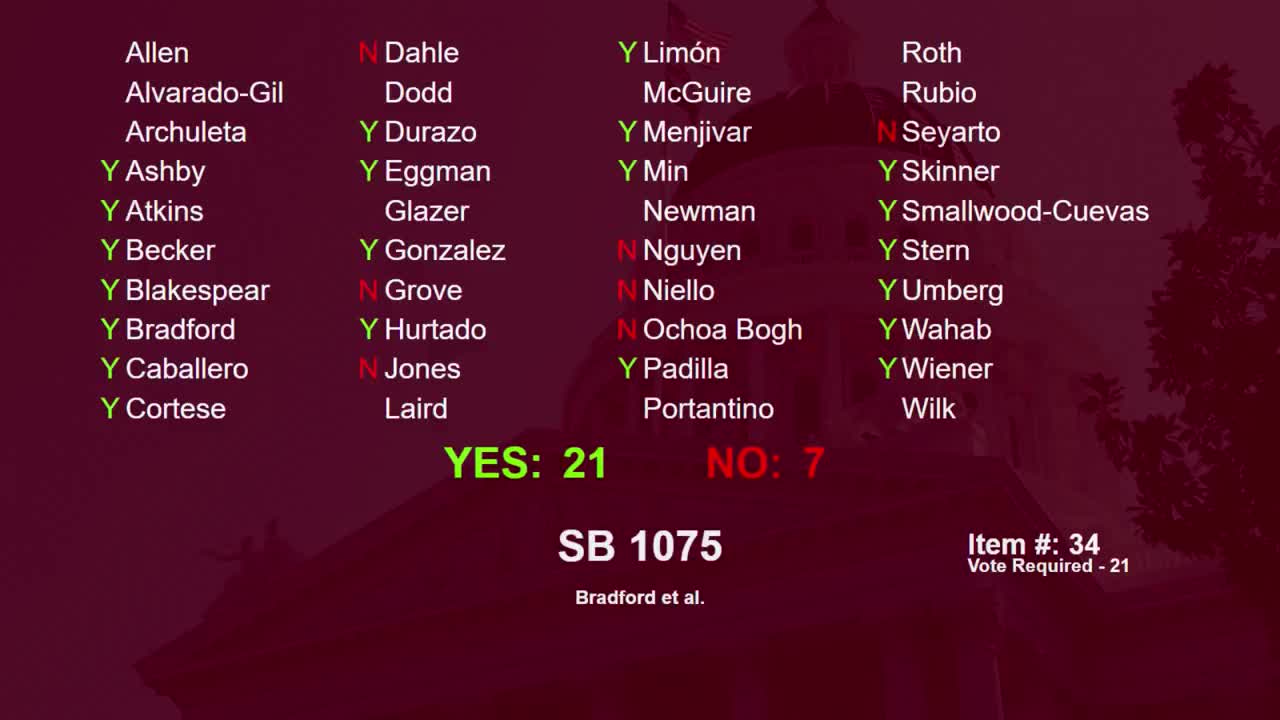 34MIN
Senate Floor
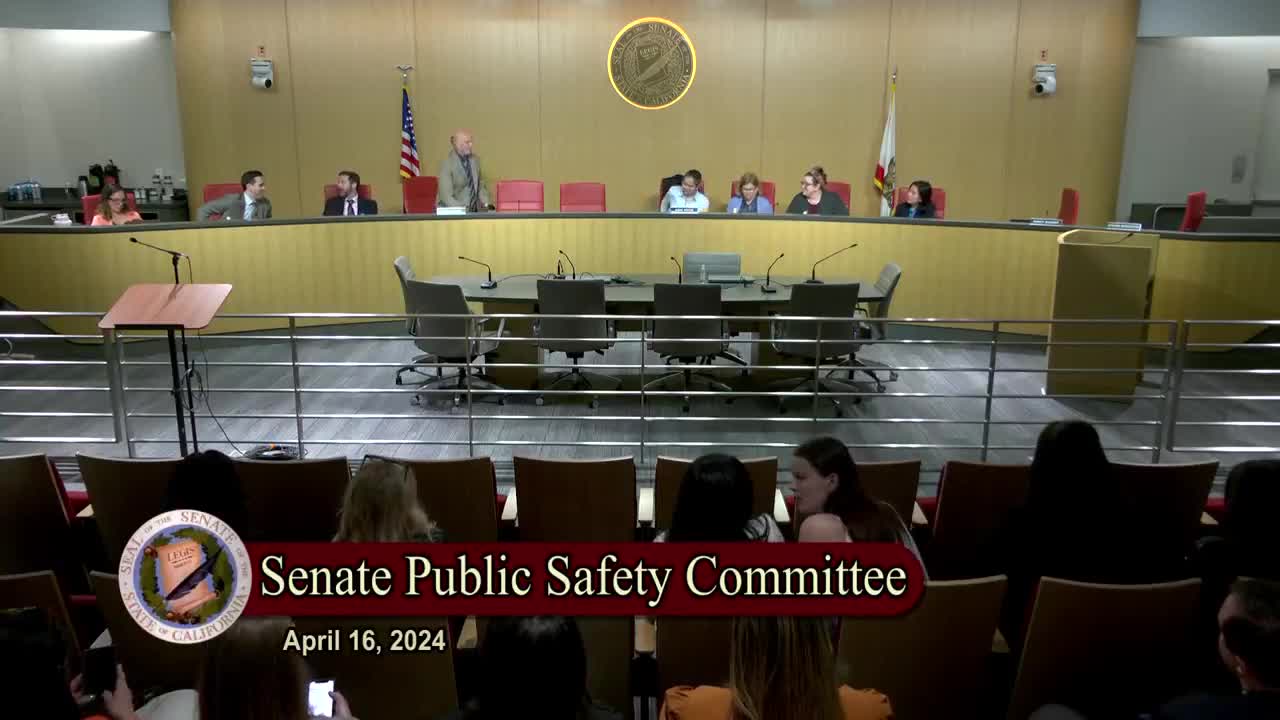 53MIN
Senate Standing Committee on Public Safety



Bill Co-Author(s):