SB 1450: Elections.
- Session Year: 2023-2024
- House: Senate
- Latest Version Date: 2024-09-22
Current Status:
Passed
(2024-09-22: Chaptered by Secretary of State. Chapter 480, Statutes of 2024.)
Introduced
In Committee
First Chamber
In Committee
Second Chamber
Enacted
Prior law, the California Voters Choice Act, required the Secretary of State to establish a taskforce that included certain individuals to review all-mailed ballot or vote center elections and to provide comments and recommendations to the Legislature within 6 months of each all-mailed ballot election or vote center election. The act was repealed by its own provisions on January 1, 2022.
This bill would reestablish this taskforce.
Existing law requires any county conducting an all-mailed ballot election to meet specified conditions, including that each vote center provide language assistance, that a county elections official establish a language accessibility advisory committee, and that the county elections official develop a draft plan for the administration of elections in consultation with the public. Under existing law, a voter education and outreach plan is required to include at least two direct contacts with voters to inform them of the upcoming election and to promote the toll-free voter assistance hotline. Existing law authorizes the county elections official to adopt a final plan for the administration of elections following a 14-day review and comment period. Existing law requires the Secretary of State to submit a report to the Legislature containing information about, among other things, voter turnout, voter registration, and ballot rejection rates, by specified categories. Existing law requires a county elections official to post on the officials internet website a report that compares the cost of an all-mailed ballot election to the cost of previous elections, as specified.
This bill would require each vote center to post information regarding the availability of language assistance services, including language assistance hotlines provided by the county or Secretary of State. The bill would require a language accessibility advisory committee and a voting accessibility advisory committee to hold their first meetings before a public meeting required as part of the development of a draft plan for the administration of elections, and it would also require a county elections official, in a county with more than 500,000 registered voters, to establish a voter education and outreach advisory committee. The bill would repeal the requirement for a voter outreach and advisory committee on December 31, 2029. The bill would, after the first 6 statewide all-mailed ballot elections, authorize a county elections official to make only one direct contact with voters if the county elections official revises the plan for the administration of elections, as specified, and spends at least half the funds saved by not making a second direct contact on targeted outreach to historically underrepresented voters. The bill would require the county elections official to adopt a final plan for the administration of elections no later than 120 days before the election and following the 14-day review and comment period. The bill would require the Secretary of State to submit a final report to the Legislature containing specified information. The bill would require a county elections official to post a report within 9 months of the certification of the results of the election that compares the cost of an all-mailed ballot election with the costs of previous elections, as specified. By increasing the duties of local elections officials, this bill would impose a state-mandated local program.
This bill would incorporate additional changes to Section 4005 of the Elections Code proposed by AB 884 to be operative only if this bill and AB 884 are enacted and this bill is enacted last.
The California Constitution requires the state to reimburse local agencies and school districts for certain costs mandated by the state. Statutory provisions establish procedures for making that reimbursement.
This bill would provide that, if the Commission on State Mandates determines that the bill contains costs mandated by the state, reimbursement for those costs shall be made pursuant to the statutory provisions noted above.
Prior law, the California Voters Choice Act, required the Secretary of State to establish a taskforce that included certain individuals to review all-mailed ballot or vote center elections and to provide comments and recommendations to the Legislature within 6 months of each all-mailed ballot election or vote center election. The act was repealed by its own provisions on January 1, 2022.
This bill would reestablish this taskforce.
Existing law requires any county conducting an all-mailed ballot election to meet specified conditions, including that each vote center provide language assistance, that a county elections official establish a language accessibility advisory committee, and that the county elections official develop a draft plan for the administration of elections in consultation with the public. Under existing law, a voter education and outreach plan is required to include at least two direct contacts with voters to inform them of the upcoming election and to promote the toll-free voter assistance hotline. Existing law authorizes the county elections official to adopt a final plan for the administration of elections following a 14-day review and comment period. Existing law requires the Secretary of State to submit a report to the Legislature containing information about, among other things, voter turnout, voter registration, and ballot rejection rates, by specified categories. Existing law requires a county elections official to post on the officials internet website a report that compares the cost of an all-mailed ballot election to the cost of previous elections, as specified.
This bill would require each vote center to post information regarding the availability of language assistance services, including a language assistance hotline, provided by the Secretary of State. language assistance hotlines provided by the county or Secretary of State. The bill would require a language accessibility advisory committee and a voting accessibility advisory committee to hold their first meetings before a public meeting required as part of the development of a draft plan for the administration of elections, and it would also require a county elections official official, in a county with more than 500,000 registered voters, to establish a voter education and outreach advisory committee. The bill would require that the direct contacts with voters occur during the first 8 all-mail elections with at least one direct contact thereafter, as specified. The bill would repeal the requirement for a voter outreach and advisory committee on December 31, 2029. The bill would, after the first 6 statewide all-mailed ballot elections, authorize a county elections official to make only one direct contact with voters if the county elections official revises the plan for the administration of elections, as specified, and spends at least half the funds saved by not making a second direct contact on targeted outreach to historically underrepresented voters. The bill would require the county elections official to adopt a final plan for the administration of elections no later than 180 120 days before the election and following the 14-day review and comment period. The bill would require the Secretary of State to submit a final report to the Legislature containing specified information. The bill would require a county elections official to post a report within 6 9 months of the certification of the results of the election that compares the cost of an all-mailed ballot election with the costs of previous elections, as specified. By increasing the duties of local elections officials, this bill would impose a state-mandated local program.
This bill would incorporate additional changes to Section 4005 of the Elections Code proposed by AB 884 to be operative only if this bill and AB 884 are enacted and this bill is enacted last.
The California Constitution requires the state to reimburse local agencies and school districts for certain costs mandated by the state. Statutory provisions establish procedures for making that reimbursement.
This bill would provide that, if the Commission on State Mandates determines that the bill contains costs mandated by the state, reimbursement for those costs shall be made pursuant to the statutory provisions noted above.
Prior law, the California Voters Choice Act, required the Secretary of State to establish a taskforce that included certain individuals to review all-mailed ballot or vote center elections and to provide comments and recommendations to the Legislature within 6 months of each all-mailed ballot election or vote center election. The act was repealed by its own provisions on January 1, 2022.
This bill would reestablish this taskforce.
Existing law requires any county conducting an all-mailed ballot election to meet specified conditions, including that each vote center provide language assistance, that a county elections official establish a language accessibility advisory committee, and that the county elections official develop a draft plan for the administration of elections in consultation with the public. Under existing law, a voter education and outreach plan is required to include at least two direct contacts with voters to inform them of the upcoming election and to promote the toll-free voter assistance hotline. Existing law authorizes the county elections official to adopt a final plan for the administration of elections following a 14-day review and comment period. Existing law requires the Secretary of State to submit a report to the Legislature containing information about, among other things, voter turnout, voter registration, and ballot rejection rates, by specified categories. Existing law requires a county elections official to post on the officials internet website a report that compares the cost of an all-mailed ballot election to the cost of previous elections, as specified.
This bill would require each vote center to post information regarding the availability of language assistance services, including a language assistance hotline, provided by the Secretary of State. The bill would require a language accessibility advisory committee and a voting accessibility advisory committee to hold their first meetings before a public meeting required as part of the development of a draft plan for the administration of elections, and it would also require a county elections official to establish a voter education and outreach advisory committee. The bill would require that the direct contacts with voters occur during the first 8 all-mail elections with at least one direct contact thereafter, as specified. The bill would require the county elections official to adopt a final plan for the administration of elections no later than 180 days before the election and following the 14-day review and comment period. The bill would require the Secretary of State to submit a final report to the Legislature containing specified information. The bill would require a county elections official to post a report within 6 months of the election that compares the cost of an all-mailed ballot election with the costs of previous elections, as specified. By increasing the duties of local elections officials, this bill would impose a state-mandated local program.
The California Constitution requires the state to reimburse local agencies and school districts for certain costs mandated by the state. Statutory provisions establish procedures for making that reimbursement.
This bill would provide that, if the Commission on State Mandates determines that the bill contains costs mandated by the state, reimbursement for those costs shall be made pursuant to the statutory provisions noted above.
Prior law, the California Voters Choice Act, required the Secretary of State to establish a taskforce that included certain individuals to review all-mailed ballot or vote center elections and to provide comments and recommendations to the Legislature within 6 months of each all-mailed ballot election or vote center election. The act was repealed by its own provisions on January 1, 2022.
This bill would reestablish this taskforce.
(a)Notwithstanding Section 4000 or any other law, any county may conduct any election as an all-mailed ballot election if all of the following apply:
(1)(A)At least two ballot dropoff locations are provided within the jurisdiction where the election is held or the number of ballot dropoff locations are fixed in a manner so that there is at least one ballot dropoff location provided for every 15,000 registered voters within the jurisdiction where the election is held, as determined on the 88th day before the day of the election, whichever results in more ballot dropoff locations. For purposes of this subparagraph, a vote center that includes an exterior ballot drop box counts only as a single ballot dropoff location. Ballot dropoff locations shall comply with the regulations adopted pursuant to subdivision (b) of Section 3025.
(B)A ballot dropoff location provided for under this section consists of a secure, accessible, and locked ballot box located as near as possible to established public transportation routes and that is able to receive voted ballots. All ballot dropoff locations shall be open at least during regular business hours beginning not less than 28 days before the day of the election, and on the day of the election. At least one ballot dropoff location shall be an accessible, secured, exterior drop box that is available for a minimum of 12 hours per day including regular business hours.
(2)(A)The county elections official permits a voter residing in the county to do any of the following at a vote center:
(i)Return, or vote and return, the voters vote by mail ballot.
(ii)Register to vote, update the voters voter registration, and vote pursuant to Section 2170.
(iii)Receive and vote a provisional ballot pursuant to Section 3016 or Article 5 (commencing with Section 14310) of Chapter 3 of Division 14.
(iv)Receive a replacement ballot upon verification that a ballot for the same election has not been received from the voter by the county elections official. If the county elections official is unable to determine if a ballot for the same election has been received from the voter, the county elections official may issue a provisional ballot.
(v)Vote a regular, provisional, or replacement ballot using accessible voting equipment that provides for a private and independent voting experience.
(B)Each vote center shall have at least three voting machines that are accessible to voters with disabilities.
(3)(A)On the day of the election, from 7 a.m. to 8 p.m., inclusive, and on each of the three days before the election, for a minimum of eight hours per day, at least one vote center is provided for every 10,000 registered voters within the jurisdiction where the election is held, as determined on the 88th day before the day of the election. At least 90 percent of the number of vote centers required by this subparagraph shall be open for all four days during the required times. Up to 10 percent of the number of vote centers required by this subparagraph may be open for less than four days if at least one vote center is provided for every 10,000 registered voters on each day.
(B)Notwithstanding subparagraph (A), for a jurisdiction with fewer than 20,000 registered voters, a minimum of two vote centers are provided on the day of the election and on each of the three days before the election within the jurisdiction where the election is held.
(4)(A)Beginning 10 days before the day of the election and continuing daily up to and including the fourth day before the election, for a minimum of eight hours per day, at least one vote center is provided for every 50,000 registered voters within the jurisdiction where the election is held, as determined on the 88th day before the day of the election.
(B)Notwithstanding subparagraph (A), for a jurisdiction with fewer than 50,000 registered voters, a minimum of two vote centers are provided within the jurisdiction where the election is held.
(C)The vote centers provided under this section are established in accordance with the accessibility requirements described in Article 5 (commencing with Section 12280) of Chapter 3 of Division 12, the federal Americans with Disabilities Act of 1990 (42 U.S.C. Sec. 12101 et seq.), the federal Help America Vote Act of 2002 (52 U.S.C. Sec. 20901 et seq.), and the federal Voting Rights Act of 1965 (52 U.S.C. Sec. 10101 et seq.).
(D)The vote centers provided under this section are equitably distributed across the county so as to afford maximally convenient options for voters and are established at accessible locations as near as possible to established public transportation routes. The vote centers shall be equipped with voting units or systems that are accessible to individuals with disabilities and that provide the same opportunity for access and participation as is provided to voters who are not disabled, including the ability to vote privately and independently in accordance with Sections 12280 and 19240.
(E)(i)The vote centers provided under this section have an electronic mechanism for the county elections official to immediately access, at a minimum, all of the following voter registration data:
(I)Name.
(II)Address.
(III)Date of birth.
(IV)Language preference.
(V)Party preference.
(VI)Precinct.
(VII)Whether or not the voter has been issued a vote by mail ballot and whether or not a ballot has been received by the county elections official.
(ii)The electronic mechanism used to access voter registration data shall not be connected in any way to a voting system.
(5)A method is available for voters with disabilities to request and receive a blank vote by mail ballot and, if a replacement ballot is necessary, a blank replacement ballot that voters with disabilities can read and mark privately and independently pursuant to the federal Help America Vote Act of 2002 (52 U.S.C. Sec. 20901 et seq.).
(6)(A)Except as otherwise provided for in this section, election boards for the vote centers established under this section meet the requirements for eligibility and composition pursuant to Article 1 (commencing with Section 12300) of Chapter 4 of Division 12.
(B)Each vote center provides language assistance in all languages required in the jurisdiction under subdivision (c) of Section 12303 or Section 203 of the federal Voting Rights Act of 1965 (52 U.S.C. Sec. 10101 et seq.) in a manner that enables voters of the applicable language minority groups to participate effectively in the electoral process. Each vote center shall post information regarding the availability of language assistance in English and all other languages for which language assistance is required to be provided in the jurisdiction under subdivision (c) of Section 12303 or Section 203 of the federal Voting Rights Act of 1965 (52 U.S.C. Sec. 10101 et seq.).
(i)If a vote center is located in, or adjacent to, a precinct, census tract, or other defined geographical subsection required to establish language requirements under subdivision (c) of Section 12303 or Section 203 of the federal Voting Rights Act of 1965 (52 U.S.C. Sec. 10101 et seq.), or if it is identified as needing language assistance through the public input process described in clause (ii), the county elections official shall ensure that the vote center is staffed by election board members who speak the required language. If the county elections official is unable to recruit election board members who speak the required language, alternative methods of effective language assistance shall be provided by the county elections official.
(ii)The county elections official shall solicit public input regarding which vote centers should be staffed by election board members who are fluent in a language in addition to English pursuant to subdivision (c) of Section 12303 and Section 203 of the federal Voting Rights Act of 1965 (52 U.S.C. Sec. 10101 et seq.).
(iii)The county elections official shall provide notice in the sample ballot, in vote by mail materials, and on the officials internet website of the specific language services available at each vote center.
(iv)Each vote center shall post information regarding the availability of language assistance services, including any language assistance hotlines provided by the county or Secretary of State.
(C)Each vote center provides election materials translated in all languages required in the jurisdiction under subdivision (a) of Section 14201 and Section 203 of the federal Voting Rights Act of 1965 (52 U.S.C. Sec. 10101 et seq.).
(D)Each vote center provides reasonable modifications and auxiliary aids and services as required by the federal Americans with Disabilities Act of 1990 (42 U.S.C. Sec. 12101 et seq.) and the federal Rehabilitation Act of 1973 (29 U.S.C. Sec. 701 et seq.).
(7)(A)Beginning 10 days before the election, the county elections official maintains, in an electronic format, an index of voters who have done any of the following at one of the vote centers established pursuant to this section:
(i)Registered to vote or updated the voters voter registration.
(ii)Received and voted a provisional ballot or replacement ballot.
(iii)Voted a ballot using equipment at the vote center.
(B)The index required by subparagraph (A) includes the same information for each voter as is required to be included on copies of the roster that are posted pursuant to Section 14294. The index required by subparagraph (A) shall be updated continuously during any time that a vote center is open in the jurisdiction.
(8)(A)No later than 29 days before the day of the election, the county elections official begins mailing to registered voters a vote by mail ballot packet that includes a return envelope with instructions for the use and return of the vote by mail ballot. The county elections official shall have five days to mail a ballot to each person who is registered to vote on the 29th day before the day of the election and five days for each subsequent registered voter. The county elections official shall not discriminate against any region or precinct in the county in choosing which ballots to mail first within the prescribed five-day mailing period.
(B)The county elections official delivers to each voter, with either the sample ballot sent pursuant to Section 13303 or with the vote by mail ballot packet, all of the following:
(i)A notice, translated in all languages required under subdivision (a) of Section 14201 and Section 203 of the federal Voting Rights Act of 1965 (52 U.S.C. Sec. 10101 et seq.), that informs voters of all of the following:
(I)An all-mailed ballot election is being conducted and each eligible voter will be issued a vote by mail ballot by mail.
(II)The voter may cast a vote by mail ballot in person at a vote center during the times and days specified in subparagraph (A) of paragraph (4) or on election day.
(III)No later than seven days before the day of the election, the voter may request the county elections official to send a vote by mail ballot in a language other than English pursuant to Section 203 of the federal Voting Rights Act of 1965 (52 U.S.C. Sec. 10101 et seq.) or a facsimile copy of the ballot printed in a language other than English pursuant to Section 14201.
(IV)No later than seven days before the day of the election, the voter may request the county elections official to send or deliver a ballot that voters with disabilities can read and mark privately and independently pursuant to the federal Help America Vote Act of 2002 (52 U.S.C. Sec. 20901 et seq.).
(V)Language assistance hotlines provided by the county or Secretary of State.
(ii)A list of the ballot dropoff locations and vote centers established pursuant to this section, including the dates and hours they are open. The list shall also be posted on the internet website of the county elections official in a format that is accessible for people with disabilities pursuant to Section 11135 of the Government Code.
(iii)A postage-paid postcard that the voter may return to the county elections official for the purpose of requesting a vote by mail ballot in a language other than English or for the purpose of requesting a vote by mail ballot in an accessible format.
(C)Upon request, the county elections official provides written voting materials to voters with disabilities in an accessible format, as required by the federal Americans with Disabilities Act of 1990 (42 U.S.C. Sec. 12101 et seq.) and the federal Rehabilitation Act of 1973 (29 U.S.C. Sec. 701 et seq.).
(9)(A)The county elections official establishes a language accessibility advisory committee that is comprised of representatives of language minority communities. The committee shall be established and hold its first meeting before the public meeting required by clause (i) of subparagraph (A) of paragraph (10).
(B)The county elections official establishes a voting accessibility advisory committee that is comprised of voters with disabilities. The committee shall be established and hold its first meeting before the public meeting required by clause (ii) of subparagraph (A) of paragraph (10).
(C)In a county with more than 500,000 registered voters, the county elections official establishes a voter education and outreach advisory committee that is comprised of voter engagement, education, and community outreach advocates. The committee shall be established and hold its first meeting before the public meeting required by clause (iii) of subparagraph (A) of paragraph (10).
(D)A county with fewer than 50,000 registered voters may establish a joint advisory committee for language minority communities and voters with disabilities.
(10)(A)The county elections official develops a draft plan for the administration of elections conducted pursuant to this section in consultation with the public, including all of the following:
(i)One meeting, publicly noticed at least 10 days in advance of the meeting and held prior to the noticing of the draft plan pursuant to subparagraph (C), that includes representatives, advocates, and other stakeholders representing each community for which the county is required to provide voting materials and assistance in a language other than English under subdivision (a) of Section 14201 and the federal Voting Rights Act of 1965 (52 U.S.C. Sec. 10101 et seq.).
(ii)One meeting, publicly noticed at least 10 days in advance of the meeting and held prior to the noticing of the draft plan pursuant to subparagraph (C), that includes representatives from the disability community and community organizations and individuals that advocate on behalf of, or provide services to, individuals with disabilities.
(iii)In a county with more than 500,000 registered voters, one meeting, publicly noticed at least 10 days in advance of the meeting and held prior to the noticing of the draft plan pursuant to subparagraph (C), that includes voter education and outreach advocates.
(B)The county elections official, when developing the draft plan for the administration of elections conducted pursuant to this section, considers, at a minimum, all of the following:
(i)Vote center and ballot dropoff location proximity to public transportation.
(ii)Vote center and ballot dropoff location proximity to communities with historically low vote by mail usage.
(iii)Vote center and ballot dropoff location proximity to population centers.
(iv)Vote center and ballot dropoff location proximity to language minority communities.
(v)Vote center and ballot dropoff location proximity to voters with disabilities.
(vi)Vote center and ballot dropoff location proximity to communities with low rates of household vehicle ownership.
(vii)Vote center and ballot dropoff location proximity to low-income communities.
(viii)Vote center and ballot dropoff location proximity to communities of eligible voters who are not registered to vote and may need access to same day voter registration.
(ix)Vote center and ballot dropoff location proximity to geographically isolated populations, including Native American reservations.
(x)Access to accessible and free parking at vote centers and ballot dropoff locations.
(xi)The distance and time a voter must travel by car or public transportation to a vote center and ballot dropoff location.
(xii)The need for alternate methods for voters with disabilities for whom vote by mail ballots are not accessible to cast a ballot.
(xiii)Traffic patterns near vote centers and ballot dropoff locations.
(xiv)The need for mobile vote centers in addition to the number of vote centers established pursuant to this section.
(xv)Vote center location on a public or private university or college campus.
(C)The county elections official publicly notices the draft plan for the administration of elections conducted pursuant to this section and accepts public comments on the draft plan for at least 14 days before the public hearing held pursuant to subparagraph (D).
(D)(i)Following the 14-day review period required by subparagraph (C), the county elections official holds a public hearing to consider the draft plan for the administration of elections conducted pursuant to this section and to accept public comments. The meeting shall be publicly noticed at least 10 days in advance of the meeting on the internet websites of the clerk of the county board of supervisors and the county elections official, or, if neither the clerk of the county board of supervisors nor the county elections official maintain an internet website, in the office of the county elections official.
(ii)After the public hearing to consider the draft plan for the administration of elections conducted pursuant to this section and to accept public comments, the county elections official shall consider any public comments the official receives from the public and shall amend the draft plan in response to the public comments to the extent the official deems appropriate. The county elections official shall publicly notice the amended draft plan and shall accept public comments on the amended draft plan for at least 14 days before the county elections official may adopt the amended draft plan pursuant to subparagraph (E).
(E)(i)No later than 120 days before the election and following the 14-day review and comment period required by clause (ii) of subparagraph (D), the county elections official shall adopt a final plan for the administration of elections conducted pursuant to this section. The county elections official shall submit the voter education and outreach plan that is required by clause (i) of subparagraph (I) to the Secretary of State for approval.
(ii)The Secretary of State shall approve, approve with modifications, or reject a voter education and outreach plan submitted pursuant to clause (i) of subparagraph (I) within 14 days after the plan is submitted by the county elections official.
(iii)The draft plan, the amended draft plan, and the adopted final plan for the administration of elections conducted pursuant to this section shall be posted on the internet website of the county elections official in each language in which the county is required to provide voting materials and assistance under subdivision (a) of Section 14201 and the federal Voting Rights Act of 1965 (52 U.S.C. Sec. 10101 et seq.), and the Secretary of States internet website in a format that is accessible for people with disabilities pursuant to Section 11135 of the Government Code.
(F)Public meetings held pursuant to this paragraph shall, upon request, provide auxiliary aids and services to ensure effective communication with people with disabilities.
(G)Within two years of the adoption of the first plan for the administration of elections conducted pursuant to this section, the county elections official shall hold public meetings in accordance with the procedures described in subparagraphs (C) to (F), inclusive, to consider revising the first plan for the administration of elections conducted pursuant to this section. Every four years thereafter, the county elections official shall hold public meetings in accordance with the procedures described in subparagraphs (C) to (F), inclusive, to consider revising the plan for the administration of elections conducted pursuant to this section.
(H)(i)With reasonable public notification, a county elections official may amend a plan for the administration of elections conducted pursuant to this section no more than 120 days before the date of an election held pursuant to this section.
(ii)With reasonable public notification, a county elections official may amend a plan for the administration of elections conducted pursuant to this section more than 120 days before the date of an election held pursuant to this section if the official provides at least 30 days to accept public comments on the amended plan.
(I)The plan for the administration of elections conducted pursuant to this section, includes all of the following:
(i)A voter education and outreach plan that is approved by the Secretary of State and that includes all of the following:
(I)A description of how the county elections official will use the media, including social media, newspapers, radio, and television that serve language minority communities for purposes of informing voters of the upcoming election and promoting the toll-free voter assistance hotline.
(II)A description of how the county elections official will use the media, including social media, newspapers, radio, and television for purposes of informing voters of the availability of a vote by mail ballot in an accessible format and the process for requesting such a ballot.
(III)A description of how the county elections official will have a community presence to educate voters regarding the provisions of this section.
(IV)A description of the accessible information that will be publicly available on the accessible internet website of the county elections official.
(V)A description of the method used by the county elections official to identify language minority voters.
(VI)A description of how the county elections official will educate and communicate the provisions of this section to the public, including:
(ia)Communities for which the county is required to provide voting materials and assistance in a language other than English under subdivision (a) of Section 14201 and the federal Voting Rights Act of 1965 (52 U.S.C. Sec. 10101 et seq.). The county elections official shall hold at least one bilingual voter education workshop for each language in which the county is required to provide voting materials and assistance in a language other than English under subdivision (a) of Section 14201 and the federal Voting Rights Act of 1965 (52 U.S.C. Sec. 10101 et seq.).
(ib)The disability community, including organizations and individuals that advocate on behalf of, or provide services to, individuals with disabilities. The county elections official shall hold at least one voter education workshop to increase accessibility and participation of eligible voters with disabilities.
(VII)A description of how the county will spend the necessary resources on voter education and outreach to ensure that voters are fully informed about the election. This description shall include information about the amount of money the county plans to spend on voter education and outreach activities under the plan, and how that compares to the amount of money spent on voter education and outreach in recent similar elections in the same jurisdiction.
(VIII)At least one public service announcement in the media, including newspapers, radio, and television, that serve English-speaking citizens for purposes of informing voters of the upcoming election and promoting the toll-free voter assistance hotline. Outreach made under this subclause shall include access for voters who are deaf or hard of hearing and voters who are blind or visually impaired.
(IX)At least one public service announcement in the media, including newspapers, radio, and television, that serve non-English-speaking citizens for each language in which the county is required to provide voting materials and assistance under subdivision (a) of Section 14201 and the federal Voting Rights Act of 1965 (52 U.S.C. Sec. 10101 et seq.) for purposes of informing voters of the upcoming election and promoting the toll-free voter assistance hotline.
(X)At least two direct contacts with voters for purposes of informing voters of the upcoming election and promoting the toll-free voter assistance hotline. The two direct contacts are in addition to any other required contacts, including, but not limited to, sample ballots and the delivery of vote by mail ballots.
(ia)After the first six statewide elections conducted pursuant to this section, a county elections official may make one direct contact if the county elections official does both of the following:
(Ia)Revises the plan for the administration of elections pursuant to subparagraph (G) to explain how at least half of the funds saved from not making a second direct contact will be used on targeted outreach to historically underrepresented voters.
(Ib)Spends at least half of the funds saved from not making a second direct contact on targeted outreach to historically underrepresented voters.
(ib)If direct contact is made by mail, the county elections official must mail at least one copy of each direct contact to voters with the same surname and postal address, in each language requested.
(ic)At least one direct contact shall be made with voters during an election that is conducted either in a jurisdiction with fewer than 30,000 registered voters or conducted pursuant to subdivision (b) within 30 days of a regularly scheduled statewide election.
(id)Notwithstanding sub-subclause (ia), a county elections official shall make at least two direct contacts with a voter for the first six statewide elections that the voter is registered to vote in the county.
(ii)A description of how a voter with disabilities may request and receive a blank vote by mail ballot and, if a replacement ballot is necessary, a blank replacement ballot that a voter with disabilities can mark privately and independently.
(iii)A description of how the county elections official will address significant disparities in voter accessibility and participation identified in the report required by subdivision (g).
(iv)A description of the methods and standards that the county elections official will use to ensure the security of voting conducted at vote centers.
(v)Information about estimated short-term and long-term costs and savings from conducting elections pursuant to this section as compared to recent similar elections in the same jurisdiction that were not conducted pursuant to this section.
(vi)To the extent available at the time of publication, information on all of the following:
(I)The total number of vote centers to be established.
(II)The total number of ballot dropoff locations to be established.
(III)The location of each vote center.
(IV)The location of each ballot dropoff location and whether it is inside or outside.
(V)A map of the locations of each vote center and ballot dropoff location.
(VI)The hours of operation for each vote center.
(VII)The hours of operation for each ballot dropoff location.
(VIII)The security and contingency plans that would be implemented by the county elections official to do both of the following:
(ia)Prevent a disruption of the vote center process.
(ib)Ensure that the election is properly conducted if a disruption occurs.
(IX)The number of election board members and the number of bilingual election board members and the languages spoken.
(X)The services provided to voters with disabilities, including, but not limited to, the type and number of accessible voting machines and reasonable modifications at each vote center.
(XI)The design, layout, and placement of equipment inside each vote center that protects each voters right to cast a private and independent ballot.
(vii)A toll-free voter assistance hotline that is accessible to voters who are deaf or hard of hearing, and that is maintained by the county elections official that is operational no later than 29 days before the day of the election until 5 p.m. on the day after the election. The toll-free voter assistance hotline shall provide assistance to voters in all languages in which the county is required to provide voting materials and assistance under subdivision (a) of Section 14201 and the federal Voting Rights Act of 1965 (52 U.S.C. Sec. 10101 et seq.).
(J)The plan for the administration of elections conducted pursuant to this section is posted in a format that is accessible to persons with disabilities on the internet website of the Secretary of State and on the internet website of the county elections official.
(b)Notwithstanding Section 4000 or any other law, any county may conduct a special election as an all-mailed ballot election under this section if all of the following apply:
(1)The county elections official has done either of the following:
(A)Previously conducted an election as an all-mailed ballot election in accordance with subdivision (a).
(B)Adopted a final plan for the administration of elections pursuant to clause (i) of subparagraph (E) of paragraph (10) of subdivision (a), in which case the county elections official shall complete all activities provided for in the voter education and outreach plan that is required by clause (i) of subparagraph (I) of paragraph (10) of subdivision (a) before the day of the special election.
(2)(A)On the day of the election, from 7 a.m. to 8 p.m., inclusive, at least one vote center is provided for every 30,000 registered voters. If the jurisdiction is not wholly contained within the county, the county elections official shall make a reasonable effort to establish a vote center within the jurisdiction where the special election is held.
(B)Notwithstanding subparagraph (A), for a jurisdiction with fewer than 30,000 registered voters, the county elections official makes a reasonable effort to establish a vote center.
(3)(A)Not less than 10 days before the day of the election, for a minimum of eight hours per day, at least one vote center is provided for every 60,000 registered voters. If the jurisdiction is not wholly contained within the county, the county elections official shall make a reasonable effort to establish a vote center within the jurisdiction where the special election is held.
(B)Notwithstanding subparagraph (A), for a jurisdiction with fewer than 30,000 registered voters, the county elections official makes a reasonable effort to establish a vote center.
(4)(A)At least one ballot dropoff location is provided for every 15,000 registered voters. At least one ballot dropoff location shall be located within the jurisdiction where the special election is held. All ballot dropoff locations shall be open at least during regular business hours beginning not less than 28 days before the day of the election, and on the day of the election.
(B)Notwithstanding subparagraph (A), for a jurisdiction with fewer than 15,000 registered voters, at least one ballot dropoff location shall be provided.
(c)Except as otherwise provided in this section, the election day procedures shall be conducted in accordance with Division 14 (commencing with Section 14000).
(d)The county elections official may provide, at the officials discretion, additional ballot dropoff locations and vote centers for purposes of this section.
(e)The return of voted vote by mail ballots is subject to Sections 3017 and 3020.
(f)For the sole purpose of reporting the results of an election conducted pursuant to this section, upon completion of the ballot count, the county elections official shall divide the jurisdiction into precincts pursuant to Article 2 (commencing with Section 12220) of Chapter 3 of Division 12 and shall prepare a statement of the results of the election in accordance with Sections 15373 and 15374.
(g)(1)(A)Within six months of each election conducted pursuant to this section, the Secretary of State shall submit a final report to the Legislature on all of the following information by categories of race, ethnicity, language preference, age, gender, disability, permanent vote by mail status, historical polling place voters, political party affiliation, and language minorities as it relates to the languages required under subdivision (a) of Section 14201 and Section 203 of the federal Voting Rights Act of 1965 (52 U.S.C. Sec. 10101 et seq.):
(i)Voter turnout.
(ii)Voter registration.
(iii)Ballot rejection rates.
(iv)Reasons for ballot rejection.
(v)Provisional ballot use.
(vi)Accessible vote by mail ballot use.
(vii)The number of votes cast at each vote center.
(viii)The number of ballots returned at ballot dropoff locations.
(ix)The number of ballots returned by mail.
(x)The number of persons who registered to vote at a vote center.
(xi)Instances of voter fraud.
(xii)Any other problems that became known to the county elections official or the Secretary of State during the election or canvass.
(B)The report required by subparagraph (A) shall be posted on the internet website of the Secretary of State in a format that is accessible for people with disabilities pursuant to Section 11135 of the Government Code.
(C)The report required by subparagraph (A) shall be submitted to the Legislature in compliance with Section 9795 of the Government Code.
(D)If an election is conducted pursuant to this section, the county shall submit, to the extent possible, to the Secretary of State the information needed for the Secretary of State to prepare the report required by subparagraph (A).
(E)The Secretary of State may contract with any qualified person or organization for purposes of preparing the report required by subparagraph (A).
(2)Within nine months of the certification of the results of each election conducted pursuant to this section, the county elections official shall post on the officials internet website a report that compares the cost of elections conducted pursuant to this section to the costs of previous elections. The report shall be posted in a format that is accessible for people with disabilities pursuant to Section 11135 of the Government Code.
(h)The Secretary of State shall enforce the provisions of this section pursuant to Section 12172.5 of the Government Code.
(i)For purposes of this section, disability has the same meaning as defined in subdivisions (j), (m), and (n) of Section 12926 of the Government Code.
(j)This section shall remain in effect until December 31, 2029, and as of that date is repealed.
SEC. 1.5.Section 4005 of the Elections Code is amended to read:4005.(a)Notwithstanding Section 4000 or any other law, any county may conduct any election as an all-mailed ballot election if all of the following apply:
(1)(A)At least two ballot dropoff locations are provided within the jurisdiction where the election is held or the number of ballot dropoff locations are fixed in a manner so that there is at least one ballot dropoff location provided for every 15,000 registered voters within the jurisdiction where the election is held, as determined on the 88th day before the day of the election, whichever results in more ballot dropoff locations. For purposes of this subparagraph, a vote center that includes an exterior ballot drop box counts only as a single ballot dropoff location. Ballot dropoff locations shall comply with the regulations adopted pursuant to subdivision (b) of Section 3025.
(B)A ballot dropoff location provided for under this section consists of a secure, accessible, and locked ballot box located as near as possible to established public transportation routes and that is able to receive voted ballots. All ballot dropoff locations shall be open at least during regular business hours beginning not less than 28 days before the day of the election, and on the day of the election. At least one ballot dropoff location shall be an accessible, secured, exterior drop box that is available for a minimum of 12 hours per day including regular business hours.
(2)(A)The county elections official permits a voter residing in the county to do any of the following at a vote center:
(i)Return, or vote and return, the voters vote by mail ballot.
(ii)Register to vote, update the voters voter registration, and vote pursuant to Section 2170.
(iii)Receive and vote a provisional ballot pursuant to Section 3016 or Article 5 (commencing with Section 14310) of Chapter 3 of Division 14.
(iv)Receive a replacement ballot upon verification that a ballot for the same election has not been received from the voter by the county elections official. If the county elections official is unable to determine if a ballot for the same election has been received from the voter, the county elections official may issue a provisional ballot.
(v)Vote a regular, provisional, or replacement ballot using accessible voting equipment that provides for a private and independent voting experience.
(B)Each vote center shall have at least three voting machines that are accessible to voters with disabilities.
(3)(A)On the day of the election, from 7 a.m. to 8 p.m., inclusive, and on each of the three days before the election, for a minimum of eight hours per day, at least one vote center is provided for every 10,000 registered voters within the jurisdiction where the election is held, as determined on the 88th day before the day of the election. At least 90 percent of the number of vote centers required by this subparagraph shall be open for all four days during the required times. Up to 10 percent of the number of vote centers required by this subparagraph may be open for less than four days if at least one vote center is provided for every 10,000 registered voters on each day.
(B)Notwithstanding subparagraph (A), for a jurisdiction with fewer than 20,000 registered voters, a minimum of two vote centers are provided on the day of the election and on each of the three days before the election within the jurisdiction where the election is held.
(4)(A)Beginning 10 days before the day of the election and continuing daily up to and including the fourth day before the election, for a minimum of eight hours per day, at least one vote center is provided for every 50,000 registered voters within the jurisdiction where the election is held, as determined on the 88th day before the day of the election.
(B)Notwithstanding subparagraph (A), for a jurisdiction with fewer than 50,000 registered voters, a minimum of two vote centers are provided within the jurisdiction where the election is held.
(C)The vote centers provided under this section are established in accordance with the accessibility requirements described in Article 5 (commencing with Section 12280) of Chapter 3 of Division 12, the federal Americans with Disabilities Act of 1990 (42 U.S.C. Sec. 12101 et seq.), the federal Help America Vote Act of 2002 (52 U.S.C. Sec. 20901 et seq.), and the federal Voting Rights Act of 1965 (52 U.S.C. Sec. 10101 et seq.).
(D)The vote centers provided under this section are equitably distributed across the county so as to afford maximally convenient options for voters and are established at accessible locations as near as possible to established public transportation routes. The vote centers shall be equipped with voting units or systems that are accessible to individuals with disabilities and that provide the same opportunity for access and participation as is provided to voters who are not disabled, including the ability to vote privately and independently in accordance with Sections 12280 and 19240.
(E)(i)The vote centers provided under this section have an electronic mechanism for the county elections official to immediately access, at a minimum, all of the following voter registration data:
(I)Name.
(II)Address.
(III)Date of birth.
(IV)Language preference.
(V)Party preference.
(VI)Precinct.
(VII)Whether or not the voter has been issued a vote by mail ballot and whether or not a ballot has been received by the county elections official.
(ii)The electronic mechanism used to access voter registration data shall not be connected in any way to a voting system.
(5)A method is available for voters with disabilities to request and receive a blank vote by mail ballot and, if a replacement ballot is necessary, a blank replacement ballot that voters with disabilities can read and mark privately and independently pursuant to the federal Help America Vote Act of 2002 (52 U.S.C. Sec. 20901 et seq.).
(6)(A)Except as otherwise provided for in this section, election boards for the vote centers established under this section meet the requirements for eligibility and composition pursuant to Article 1 (commencing with Section 12300) of Chapter 4 of Division 12.
(B)Each vote center provides language assistance in all languages required in the jurisdiction under Section 2601 and subdivision (c) of Section 12303 or Section 203 of the federal Voting Rights Act of 1965 (52 U.S.C. Sec. 10101 et seq.) in a manner that enables voters of the applicable language minority groups to participate effectively in the electoral process. Each vote center shall post information regarding the availability of language assistance in English and all other languages for which language assistance is required to be provided in the jurisdiction under Section 2601 and subdivision (c) of Section 12303 or Section 203 of the federal Voting Rights Act of 1965 (52 U.S.C. Sec. 10101 et seq.).
(i)If a vote center is located in, or adjacent to, a precinct, census tract, or other defined geographical subsection required to establish language requirements under Section 2601 or subdivision (c) of Section 12303 or Section 203 of the federal Voting Rights Act of 1965 (52 U.S.C. Sec. 10101 et seq.), or if it is identified as needing language assistance through the public input process described in clause (ii), the county elections official shall ensure that the vote center is staffed by election board members who speak the required language. If the county elections official is unable to recruit election board members who speak the required language, alternative methods of effective language assistance shall be provided by the county elections official.
(ii)The county elections official shall solicit public input regarding which vote centers should be staffed by election board members who are fluent in a language in addition to English pursuant to Section 2601 and subdivision (c) of Section 12303 and Section 203 of the federal Voting Rights Act of 1965 (52 U.S.C. Sec. 10101 et seq.).
(iii)The county elections official shall provide notice in the sample ballot, in vote by mail materials, and on the officials internet website of the specific language services available at each vote center.
(iv)Each vote center shall post information regarding the availability of language assistance services, including any language assistance hotlines provided by the county or Secretary of State.
(C)Each vote center provides election materials translated in all languages required in the jurisdiction under subdivision (a) of Section 14201, subdivision (b) or (c) of Section 2601, and Section 203 of the federal Voting Rights Act of 1965 (52 U.S.C. Sec. 10101 et seq.).
(D)Each vote center provides reasonable modifications and auxiliary aids and services as required by the federal Americans with Disabilities Act of 1990 (42 U.S.C. Sec. 12101 et seq.) and the federal Rehabilitation Act of 1973 (29 U.S.C. Sec. 701 et seq.).
(7)(A)Beginning 10 days before the election, the county elections official maintains, in an electronic format, an index of voters who have done any of the following at one of the vote centers established pursuant to this section:
(i)Registered to vote or updated the voters voter registration.
(ii)Received and voted a provisional ballot or replacement ballot.
(iii)Voted a ballot using equipment at the vote center.
(B)The index required by subparagraph (A) includes the same information for each voter as is required to be included on copies of the roster that are posted pursuant to Section 14294. The index required by subparagraph (A) shall be updated continuously during any time that a vote center is open in the jurisdiction.
(8)(A)No later than 29 days before the day of the election, the county elections official begins mailing to registered voters a vote by mail ballot packet that includes a return envelope with instructions for the use and return of the vote by mail ballot. The county elections official shall have five days to mail a ballot to each person who is registered to vote on the 29th day before the day of the election and five days for each subsequent registered voter. The county elections official shall not discriminate against any region or precinct in the county in choosing which ballots to mail first within the prescribed five-day mailing period.
(B)The county elections official delivers to each voter, with either the sample ballot sent pursuant to Section 13303 or with the vote by mail ballot packet, all of the following:
(i)A notice, translated in all languages identified pursuant to Section 2601 in its county as well as languages required under subdivision (a) of Section 14201 and Section 203 of the federal Voting Rights Act of 1965 (52 U.S.C. Sec. 10101 et seq.), that informs voters of all of the following:
(I)An all-mailed ballot election is being conducted and each eligible voter will be issued a vote by mail ballot by mail.
(II)The voter may cast a vote by mail ballot in person at a vote center during the times and days specified in subparagraph (A) of paragraph (4) or on election day.
(III)No later than seven days before the day of the election, the voter may request the county elections official to send a vote by mail ballot in a language other than English pursuant to Section 203 of the federal Voting Rights Act of 1965 (52 U.S.C. Sec. 10101 et seq.), Section 2601, or Section 14201.
(IV)No later than seven days before the day of the election, the voter may request the county elections official to send or deliver a ballot that voters with disabilities can read and mark privately and independently pursuant to the federal Help America Vote Act of 2002 (52 U.S.C. Sec. 20901 et seq.).
(V)Language assistance hotlines provided by the county or Secretary of State.
(ii)A list of the ballot dropoff locations and vote centers established pursuant to this section, including the dates and hours they are open. The list shall also be posted on the internet website of the county elections official in a format that is accessible for people with disabilities pursuant to Section 11135 of the Government Code.
(iii)A postage-paid postcard that the voter may return to the county elections official for the purpose of requesting a vote by mail ballot in a language other than English or for the purpose of requesting a vote by mail ballot in an accessible format.
(C)Upon request, the county elections official provides written voting materials to voters with disabilities in an accessible format, as required by the federal Americans with Disabilities Act of 1990 (42 U.S.C. Sec. 12101 et seq.) and the federal Rehabilitation Act of 1973 (29 U.S.C. Sec. 701 et seq.).
(9)(A)The county elections official establishes a language accessibility advisory committee that is comprised of representatives of language minority communities. The committee shall be established and hold its first meeting before the public meeting required by clause (i) of subparagraph (A) of paragraph (10).
(B)The county elections official establishes a voting accessibility advisory committee that is comprised of voters with disabilities. The committee shall be established and hold its first meeting before the public meeting required by clause (ii) of subparagraph (A) of paragraph (10).
(C)In a county with more than 500,000 registered voters, the county elections official establishes a voter education and outreach advisory committee that is comprised of voter engagement, education, and community outreach advocates. The committee shall be established and hold its first meeting before the public meeting required by clause (iii) of subparagraph (A) of paragraph (10).
(D)A county with fewer than 50,000 registered voters may establish a joint advisory committee for language minority communities and voters with disabilities.
(10)(A)The county elections official develops a draft plan for the administration of elections conducted pursuant to this section in consultation with the public, including all of the following:
(i)One meeting, publicly noticed at least 10 days in advance of the meeting and held prior to the noticing of the draft plan pursuant to subparagraph (C), that includes representatives, advocates, and other stakeholders representing each community for which the county is required to provide voting materials and assistance in a language other than English under Section 2601, subdivision (a) of Section 14201, and the federal Voting Rights Act of 1965 (52 U.S.C. Sec. 10101 et seq.).
(ii)One meeting, publicly noticed at least 10 days in advance of the meeting and held prior to the noticing of the draft plan pursuant to subparagraph (C), that includes representatives from the disability community and community organizations and individuals that advocate on behalf of, or provide services to, individuals with disabilities.
(iii)In a county with more than 500,000 registered voters, one meeting, publicly noticed at least 10 days in advance of the meeting and held prior to the noticing of the draft plan pursuant to subparagraph (C), that includes voter education and outreach advocates.
(B)The county elections official, when developing the draft plan for the administration of elections conducted pursuant to this section, considers, at a minimum, all of the following:
(i)Vote center and ballot dropoff location proximity to public transportation.
(ii)Vote center and ballot dropoff location proximity to communities with historically low vote by mail usage.
(iii)Vote center and ballot dropoff location proximity to population centers.
(iv)Vote center and ballot dropoff location proximity to language minority communities.
(v)Vote center and ballot dropoff location proximity to voters with disabilities.
(vi)Vote center and ballot dropoff location proximity to communities with low rates of household vehicle ownership.
(vii)Vote center and ballot dropoff location proximity to low-income communities.
(viii)Vote center and ballot dropoff location proximity to communities of eligible voters who are not registered to vote and may need access to same day voter registration.
(ix)Vote center and ballot dropoff location proximity to geographically isolated populations, including Native American reservations.
(x)Access to accessible and free parking at vote centers and ballot dropoff locations.
(xi)The distance and time a voter must travel by car or public transportation to a vote center and ballot dropoff location.
(xii)The need for alternate methods for voters with disabilities for whom vote by mail ballots are not accessible to cast a ballot.
(xiii)Traffic patterns near vote centers and ballot dropoff locations.
(xiv)The need for mobile vote centers in addition to the number of vote centers established pursuant to this section.
(xv)Vote center location on a public or private university or college campus.
(C)The county elections official publicly notices the draft plan for the administration of elections conducted pursuant to this section and accepts public comments on the draft plan for at least 14 days before the public hearing held pursuant to subparagraph (D).
(D)(i)Following the 14-day review period required by subparagraph (C), the county elections official holds a public hearing to consider the draft plan for the administration of elections conducted pursuant to this section and to accept public comments. The meeting shall be publicly noticed at least 10 days in advance of the meeting on the internet websites of the clerk of the county board of supervisors and the county elections official, or, if neither the clerk of the county board of supervisors nor the county elections official maintain an internet website, in the office of the county elections official.
(ii)After the public hearing to consider the draft plan for the administration of elections conducted pursuant to this section and to accept public comments, the county elections official shall consider any public comments the official receives from the public and shall amend the draft plan in response to the public comments to the extent the official deems appropriate. The county elections official shall publicly notice the amended draft plan and shall accept public comments on the amended draft plan for at least 14 days before the county elections official may adopt the amended draft plan pursuant to subparagraph (E).
(E)(i)No later than 120 days before the election and following the 14-day review and comment period required by clause (ii) of subparagraph (D), the county elections official shall adopt a final plan for the administration of elections conducted pursuant to this section. The county elections official shall submit the voter education and outreach plan that is required by clause (i) of subparagraph (I) to the Secretary of State for approval.
(ii)The Secretary of State shall approve, approve with modifications, or reject a voter education and outreach plan submitted pursuant to clause (i) of subparagraph (I) within 14 days after the plan is submitted by the county elections official.
(iii)The draft plan, the amended draft plan, and the adopted final plan for the administration of elections conducted pursuant to this section shall be posted on the internet website of the county elections official in each language in which the county is required to provide voting materials and assistance under Section 2601, subdivision (a) of Section 14201, and the federal Voting Rights Act of 1965 (52 U.S.C. Sec. 10101 et seq.), and the Secretary of States internet website in a format that is accessible for people with disabilities pursuant to Section 11135 of the Government Code.
(F)Public meetings held pursuant to this paragraph shall, upon request, provide auxiliary aids and services to ensure effective communication with people with disabilities.
(G)Within two years of the adoption of the first plan for the administration of elections conducted pursuant to this section, the county elections official shall hold public meetings in accordance with the procedures described in subparagraphs (C) to (F), inclusive, to consider revising the first plan for the administration of elections conducted pursuant to this section. Every four years thereafter, the county elections official shall hold public meetings in accordance with the procedures described in subparagraphs (C) to (F), inclusive, to consider revising the plan for the administration of elections conducted pursuant to this section.
(H)(i)With reasonable public notification, a county elections official may amend a plan for the administration of elections conducted pursuant to this section no more than 120 days before the date of an election held pursuant to this section.
(ii)With reasonable public notification, a county elections official may amend a plan for the administration of elections conducted pursuant to this section more than 120 days before the date of an election held pursuant to this section if the official provides at least 30 days to accept public comments on the amended plan.
(I)The plan for the administration of elections conducted pursuant to this section, includes all of the following:
(i)A voter education and outreach plan that is approved by the Secretary of State and that includes all of the following:
(I)A description of how the county elections official will use the media, including social media, newspapers, radio, and television that serve language minority communities for purposes of informing voters of the upcoming election and promoting the toll-free voter assistance hotline.
(II)A description of how the county elections official will use the media, including social media, newspapers, radio, and television for purposes of informing voters of the availability of a vote by mail ballot in an accessible format and the process for requesting such a ballot.
(III)A description of how the county elections official will have a community presence to educate voters regarding the provisions of this section.
(IV)A description of the accessible information that will be publicly available on the accessible internet website of the county elections official.
(V)A description of the method used by the county elections official to identify language minority voters.
(VI)A description of how the county elections official will educate and communicate the provisions of this section to the public, including:
(ia)Communities for which the county is required to provide voting materials and assistance in a language other than English under Section 2601 or subdivision (a) of Section 14201 and the federal Voting Rights Act of 1965 (52 U.S.C. Sec. 10101 et seq.). The county elections official shall hold at least one bilingual voter education workshop for each language in which the county is required to provide voting materials and assistance in a language other than English under Section 2601, Section 14201, and the federal Voting Rights Act of 1965 (52 U.S.C. Sec. 10101 et seq.).
(ib)The disability community, including organizations and individuals that advocate on behalf of, or provide services to, individuals with disabilities. The county elections official shall hold at least one voter education workshop to increase accessibility and participation of eligible voters with disabilities.
(VII)A description of how the county will spend the necessary resources on voter education and outreach to ensure that voters are fully informed about the election. This description shall include information about the amount of money the county plans to spend on voter education and outreach activities under the plan, and how that compares to the amount of money spent on voter education and outreach in recent similar elections in the same jurisdiction.
(VIII)At least one public service announcement in the media, including newspapers, radio, and television, that serve English-speaking citizens for purposes of informing voters of the upcoming election and promoting the toll-free voter assistance hotline. Outreach made under this subclause shall include access for voters who are deaf or hard of hearing and voters who are blind or visually impaired.
(IX)At least one public service announcement in the media, including newspapers, radio, and television, that serve non-English-speaking citizens for each language in which the county is required to provide voting materials and assistance under Section 2601, subdivision (a) of Section 14201, and the federal Voting Rights Act of 1965 (52 U.S.C. Sec. 10101 et seq.) for purposes of informing voters of the upcoming election and promoting the toll-free voter assistance hotline.
(X)At least two direct contacts with voters for purposes of informing voters of the upcoming election and promoting the toll-free voter assistance hotline. The two direct contacts are in addition to any other required contacts, including, but not limited to, sample ballots and the delivery of vote by mail ballots.
(ia) After the first six statewide elections conducted pursuant to this section, a county elections official may make one direct contact if the county elections official does both of the following:
(Ia)Revises the plan for the administration of elections pursuant to subparagraph (G) to explain how at least half of the funds saved from not making a second direct contact will be used on targeted outreach to historically underrepresented voters.
(Ib)Spends at least half of the funds saved from not making a second direct contact on targeted outreach to historically underrepresented voters.
(ib)If direct contact is made by mail, the county elections official must mail at least one copy of each direct contact to voters with the same surname and postal address, in each language requested.
(ic)At least one direct contact shall be made with voters during an election that is conducted either in a jurisdiction with fewer than 30,000 registered voters or conducted pursuant to subdivision (b) within 30 days of a regularly scheduled statewide election.
(id)Notwithstanding sub-subclause (ia), a county elections official shall make at least two direct contacts with a voter for the first six statewide elections that the voter is registered to vote in the county.
(ii)A description of how a voter with disabilities may request and receive a blank vote by mail ballot and, if a replacement ballot is necessary, a blank replacement ballot that a voter with disabilities can mark privately and independently.
(iii)A description of how the county elections official will address significant disparities in voter accessibility and participation identified in the report required by subdivision (g).
(iv)A description of the methods and standards that the county elections official will use to ensure the security of voting conducted at vote centers.
(v)Information about estimated short-term and long-term costs and savings from conducting elections pursuant to this section as compared to recent similar elections in the same jurisdiction that were not conducted pursuant to this section.
(vi)To the extent available at the time of publication, information on all of the following:
(I)The total number of vote centers to be established.
(II)The total number of ballot dropoff locations to be established.
(III)The location of each vote center.
(IV)The location of each ballot dropoff location and whether it is inside or outside.
(V)A map of the locations of each vote center and ballot dropoff location.
(VI)The hours of operation for each vote center.
(VII)The hours of operation for each ballot dropoff location.
(VIII)The security and contingency plans that would be implemented by the county elections official to do both of the following:
(ia)Prevent a disruption of the vote center process.
(ib)Ensure that the election is properly conducted if a disruption occurs.
(IX)The number of election board members and the number of bilingual election board members and the languages spoken.
(X)The services provided to voters with disabilities, including, but not limited to, the type and number of accessible voting machines and reasonable modifications at each vote center.
(XI)The design, layout, and placement of equipment inside each vote center that protects each voters right to cast a private and independent ballot.
(vii)A toll-free voter assistance hotline that is accessible to voters who are deaf or hard of hearing, and that is maintained by the county elections official that is operational no later than 29 days before the day of the election until 5 p.m. on the day after the election. The toll-free voter assistance hotline shall provide assistance to voters in all languages in which the county is required to provide voting materials and assistance under Section 2601, subdivision (a) of Section 14201, and the federal Voting Rights Act of 1965 (52 U.S.C. Sec. 10101 et seq.).
(J)The plan for the administration of elections conducted pursuant to this section is posted in a format that is accessible to persons with disabilities on the internet website of the Secretary of State and on the internet website of the county elections official.
(b)Notwithstanding Section 4000 or any other law, any county may conduct a special election as an all-mailed ballot election under this section if all of the following apply:
(1)The county elections official has done either of the following:
(A)Previously conducted an election as an all-mailed ballot election in accordance with subdivision (a).
(B)Adopted a final plan for the administration of elections pursuant to clause (i) of subparagraph (E) of paragraph (10) of subdivision (a), in which case the county elections official shall complete all activities provided for in the voter education and outreach plan that is required by clause (i) of subparagraph (I) of paragraph (10) of subdivision (a) before the day of the special election.
(2)(A)On the day of the election, from 7 a.m. to 8 p.m., inclusive, at least one vote center is provided for every 30,000 registered voters. If the jurisdiction is not wholly contained within the county, the county elections official shall make a reasonable effort to establish a vote center within the jurisdiction where the special election is held.
(B)Notwithstanding subparagraph (A), for a jurisdiction with fewer than 30,000 registered voters, the county elections official makes a reasonable effort to establish a vote center.
(3)(A)Not less than 10 days before the day of the election, for a minimum of eight hours per day, at least one vote center is provided for every 60,000 registered voters. If the jurisdiction is not wholly contained within the county, the county elections official shall make a reasonable effort to establish a vote center within the jurisdiction where the special election is held.
(B)Notwithstanding subparagraph (A), for a jurisdiction with fewer than 30,000 registered voters, the county elections official makes a reasonable effort to establish a vote center.
(4)(A)At least one ballot dropoff location is provided for every 15,000 registered voters. At least one ballot dropoff location shall be located within the jurisdiction where the special election is held. All ballot dropoff locations shall be open at least during regular business hours beginning not less than 28 days before the day of the election, and on the day of the election.
(B)Notwithstanding subparagraph (A), for a jurisdiction with fewer than 15,000 registered voters, at least one ballot dropoff location shall be provided.
(c)Except as otherwise provided in this section, the election day procedures shall be conducted in accordance with Division 14 (commencing with Section 14000).
(d)The county elections official may provide, at the officials discretion, additional ballot dropoff locations and vote centers for purposes of this section.
(e)The return of voted vote by mail ballots is subject to Sections 3017 and 3020.
(f)For the sole purpose of reporting the results of an election conducted pursuant to this section, upon completion of the ballot count, the county elections official shall divide the jurisdiction into precincts pursuant to Article 2 (commencing with Section 12220) of Chapter 3 of Division 12 and shall prepare a statement of the results of the election in accordance with Sections 15373 and 15374.
(g)(1)(A)Within six months of each election conducted pursuant to this section, the Secretary of State shall submit a final report to the Legislature on all of the following information by categories of race, ethnicity, language preference, age, gender, disability, permanent vote by mail status, historical polling place voters, political party affiliation, and language minorities as it relates to the languages required under Section 2601, subdivision (a) of Section 14201, and Section 203 of the federal Voting Rights Act of 1965 (52 U.S.C. Sec. 10101 et seq.):
(i)Voter turnout.
(ii)Voter registration.
(iii)Ballot rejection rates.
(iv)Reasons for ballot rejection.
(v)Provisional ballot use.
(vi)Accessible vote by mail ballot use.
(vii)The number of votes cast at each vote center.
(viii)The number of ballots returned at ballot dropoff locations.
(ix)The number of ballots returned by mail.
(x)The number of persons who registered to vote at a vote center.
(xi)Instances of voter fraud.
(xii)Any other problems that became known to the county elections official or the Secretary of State during the election or canvass.
(B)The report required by subparagraph (A) shall be posted on the internet website of the Secretary of State in a format that is accessible for people with disabilities pursuant to Section 11135 of the Government Code.
(C)The report required by subparagraph (A) shall be submitted to the Legislature in compliance with Section 9795 of the Government Code.
(D)If an election is conducted pursuant to this section, the county shall submit, to the extent possible, to the Secretary of State the information needed for the Secretary of State to prepare the report required by subparagraph (A).
(E)The Secretary of State may contract with any qualified person or organization for purposes of preparing the report required by subparagraph (A).
(2)Within nine months of the certification of the results of each election conducted pursuant to this section, the county elections official shall post on the officials internet website a report that compares the cost of elections conducted pursuant to this section to the costs of previous elections. The report shall be posted in a format that is accessible for people with disabilities pursuant to Section 11135 of the Government Code.
(h)The Secretary of State shall enforce the provisions of this section pursuant to Section 12172.5 of the Government Code.
(i)For purposes of this section, disability has the same meaning as defined in subdivisions (j), (m), and (n) of Section 12926 of the Government Code.
(j)This section shall remain in effect until December 31, 2029, and as of that date is repealed.
SEC. 2.Section 4005 is added to the Elections Code, to read:4005.(a)Notwithstanding Section 4000 or any other law, any county may conduct any election as an all-mailed ballot election if all of the following apply:
(1)(A)At least two ballot dropoff locations are provided within the jurisdiction where the election is held or the number of ballot dropoff locations are fixed in a manner so that there is at least one ballot dropoff location provided for every 15,000 registered voters within the jurisdiction where the election is held, as determined on the 88th day before the day of the election, whichever results in more ballot dropoff locations. For purposes of this subparagraph, a vote center that includes an exterior ballot drop box counts only as a single ballot dropoff location. Ballot dropoff locations shall comply with the regulations adopted pursuant to subdivision (b) of Section 3025.
(B)A ballot dropoff location provided for under this section consists of a secure, accessible, and locked ballot box located as near as possible to established public transportation routes and that is able to receive voted ballots. All ballot dropoff locations shall be open at least during regular business hours beginning not less than 28 days before the day of the election, and on the day of the election. At least one ballot dropoff location shall be an accessible, secured, exterior drop box that is available for a minimum of 12 hours per day including regular business hours.
(2)(A)The county elections official permits a voter residing in the county to do any of the following at a vote center:
(i)Return, or vote and return, the voters vote by mail ballot.
(ii)Register to vote, update the voters voter registration, and vote pursuant to Section 2170.
(iii)Receive and vote a provisional ballot pursuant to Section 3016 or Article 5 (commencing with Section 14310) of Chapter 3 of Division 14.
(iv)Receive a replacement ballot upon verification that a ballot for the same election has not been received from the voter by the county elections official. If the county elections official is unable to determine if a ballot for the same election has been received from the voter, the county elections official may issue a provisional ballot.
(v)Vote a regular, provisional, or replacement ballot using accessible voting equipment that provides for a private and independent voting experience.
(B)Each vote center shall have at least three voting machines that are accessible to voters with disabilities.
(3)(A)On the day of the election, from 7 a.m. to 8 p.m., inclusive, and on each of the three days before the election, for a minimum of eight hours per day, at least one vote center is provided for every 10,000 registered voters within the jurisdiction where the election is held, as determined on the 88th day before the day of the election. At least 90 percent of the number of vote centers required by this subparagraph shall be open for all four days during the required times. Up to 10 percent of the number of vote centers required by this subparagraph may be open for less than four days if at least one vote center is provided for every 10,000 registered voters on each day.
(B)Notwithstanding subparagraph (A), for a jurisdiction with fewer than 20,000 registered voters, a minimum of two vote centers are provided on the day of the election and on each of the three days before the election within the jurisdiction where the election is held.
(4)(A)Beginning 10 days before the day of the election and continuing daily up to and including the fourth day before the election, for a minimum of eight hours per day, at least one vote center is provided for every 50,000 registered voters within the jurisdiction where the election is held, as determined on the 88th day before the day of the election.
(B)Notwithstanding subparagraph (A), for a jurisdiction with fewer than 50,000 registered voters, a minimum of two vote centers are provided within the jurisdiction where the election is held.
(C)The vote centers provided under this section are established in accordance with the accessibility requirements described in Article 5 (commencing with Section 12280) of Chapter 3 of Division 12, the federal Americans with Disabilities Act of 1990 (42 U.S.C. Sec. 12101 et seq.), the federal Help America Vote Act of 2002 (52 U.S.C. Sec. 20901 et seq.), and the federal Voting Rights Act of 1965 (52 U.S.C. Sec. 10101 et seq.).
(D)The vote centers provided under this section are equitably distributed across the county so as to afford maximally convenient options for voters and are established at accessible locations as near as possible to established public transportation routes. The vote centers shall be equipped with voting units or systems that are accessible to individuals with disabilities and that provide the same opportunity for access and participation as is provided to voters who are not disabled, including the ability to vote privately and independently in accordance with Sections 12280 and 19240.
(E)(i)The vote centers provided under this section have an electronic mechanism for the county elections official to immediately access, at a minimum, all of the following voter registration data:
(I)Name.
(II)Address.
(III)Date of birth.
(IV)Language preference.
(V)Party preference.
(VI)Precinct.
(VII)Whether or not the voter has been issued a vote by mail ballot and whether or not a ballot has been received by the county elections official.
(ii)The electronic mechanism used to access voter registration data shall not be connected in any way to a voting system.
(5)A method is available for voters with disabilities to request and receive a blank vote by mail ballot and, if a replacement ballot is necessary, a blank replacement ballot that voters with disabilities can read and mark privately and independently pursuant to the federal Help America Vote Act of 2002 (52 U.S.C. Sec. 20901 et seq.).
(6)(A)Except as otherwise provided for in this section, election boards for the vote centers established under this section meet the requirements for eligibility and composition pursuant to Article 1 (commencing with Section 12300) of Chapter 4 of Division 12.
(B)Each vote center provides language assistance in all languages required in the jurisdiction under subdivision (c) of Section 12303 or Section 203 of the federal Voting Rights Act of 1965 (52 U.S.C. Sec. 10101 et seq.) in a manner that enables voters of the applicable language minority groups to participate effectively in the electoral process. Each vote center shall post information regarding the availability of language assistance in English and all other languages for which language assistance is required to be provided in the jurisdiction under subdivision (c) of Section 12303 or Section 203 of the federal Voting Rights Act of 1965 (52 U.S.C. Sec. 10101 et seq.).
(i)If a vote center is located in, or adjacent to, a precinct, census tract, or other defined geographical subsection required to establish language requirements under subdivision (c) of Section 12303 or Section 203 of the federal Voting Rights Act of 1965 (52 U.S.C. Sec. 10101 et seq.), or if it is identified as needing language assistance through the public input process described in clause (ii), the county elections official shall ensure that the vote center is staffed by election board members who speak the required language. If the county elections official is unable to recruit election board members who speak the required language, alternative methods of effective language assistance shall be provided by the county elections official.
(ii)The county elections official shall solicit public input regarding which vote centers should be staffed by election board members who are fluent in a language in addition to English pursuant to subdivision (c) of Section 12303 and Section 203 of the federal Voting Rights Act of 1965 (52 U.S.C. Sec. 10101 et seq.).
(iii)The county elections official shall provide notice in the sample ballot, in vote by mail materials, and on the officials internet website of the specific language services available at each vote center.
(iv)Each vote center shall post information regarding the availability of language assistance services, including any language assistance hotlines provided by the county or Secretary of State.
(C)Each vote center provides election materials translated in all languages required in the jurisdiction under subdivision (a) of Section 14201 and Section 203 of the federal Voting Rights Act of 1965 (52 U.S.C. Sec. 10101 et seq.).
(D)Each vote center provides reasonable modifications and auxiliary aids and services as required by the federal Americans with Disabilities Act of 1990 (42 U.S.C. Sec. 12101 et seq.) and the federal Rehabilitation Act of 1973 (29 U.S.C. Sec. 701 et seq.).
(7)(A)Beginning 10 days before the election, the county elections official maintains, in an electronic format, an index of voters who have done any of the following at one of the vote centers established pursuant to this section:
(i)Registered to vote or updated the voters voter registration.
(ii)Received and voted a provisional ballot or replacement ballot.
(iii)Voted a ballot using equipment at the vote center.
(B)The index required by subparagraph (A) includes the same information for each voter as is required to be included on copies of the roster that are posted pursuant to Section 14294. The index required by subparagraph (A) shall be updated continuously during any time that a vote center is open in the jurisdiction.
(8)(A)No later than 29 days before the day of the election, the county elections official begins mailing to registered voters a vote by mail ballot packet that includes a return envelope with instructions for the use and return of the vote by mail ballot. The county elections official shall have five days to mail a ballot to each person who is registered to vote on the 29th day before the day of the election and five days for each subsequent registered voter. The county elections official shall not discriminate against any region or precinct in the county in choosing which ballots to mail first within the prescribed five-day mailing period.
(B)The county elections official delivers to each voter, with either the sample ballot sent pursuant to Section 13303 or with the vote by mail ballot packet, all of the following:
(i)A notice, translated in all languages required under subdivision (a) of Section 14201 and Section 203 of the federal Voting Rights Act of 1965 (52 U.S.C. Sec. 10101 et seq.), that informs voters of all of the following:
(I)An all-mailed ballot election is being conducted and each eligible voter will be issued a vote by mail ballot by mail.
(II)The voter may cast a vote by mail ballot in person at a vote center during the times and days specified in subparagraph (A) of paragraph (4) or on election day.
(III)No later than seven days before the day of the election, the voter may request the county elections official to send a vote by mail ballot in a language other than English pursuant to Section 203 of the federal Voting Rights Act of 1965 (52 U.S.C. Sec. 10101 et seq.) or a facsimile copy of the ballot printed in a language other than English pursuant to Section 14201.
(IV)No later than seven days before the day of the election, the voter may request the county elections official to send or deliver a ballot that voters with disabilities can read and mark privately and independently pursuant to the federal Help America Vote Act of 2002 (52 U.S.C. Sec. 20901 et seq.).
(V)Language assistance hotlines provided by the county or Secretary of State.
(ii)A list of the ballot dropoff locations and vote centers established pursuant to this section, including the dates and hours they are open. The list shall also be posted on the internet website of the county elections official in a format that is accessible for people with disabilities pursuant to Section 11135 of the Government Code.
(iii)A postage-paid postcard that the voter may return to the county elections official for the purpose of requesting a vote by mail ballot in a language other than English or for the purpose of requesting a vote by mail ballot in an accessible format.
(C)Upon request, the county elections official provides written voting materials to voters with disabilities in an accessible format, as required by the federal Americans with Disabilities Act of 1990 (42 U.S.C. Sec. 12101 et seq.) and the federal Rehabilitation Act of 1973 (29 U.S.C. Sec. 701 et seq.).
(9)(A)The county elections official establishes a language accessibility advisory committee that is comprised of representatives of language minority communities. The committee shall be established and hold its first meeting before the public meeting required by clause (i) of subparagraph (A) of paragraph (10).
(B)The county elections official establishes a voting accessibility advisory committee that is comprised of voters with disabilities. The committee shall be established and hold its first meeting before the public meeting required by clause (ii) of subparagraph (A) of paragraph (10).
(C)A county with fewer than 50,000 registered voters may establish a joint advisory committee for language minority communities and voters with disabilities.
(10)(A)The county elections official develops a draft plan for the administration of elections conducted pursuant to this section in consultation with the public, including both of the following:
(i)One meeting, publicly noticed at least 10 days in advance of the meeting and held prior to the noticing of the draft plan pursuant to subparagraph (C), that includes representatives, advocates, and other stakeholders representing each community for which the county is required to provide voting materials and assistance in a language other than English under subdivision (a) of Section 14201 and the federal Voting Rights Act of 1965 (52 U.S.C. Sec. 10101 et seq.).
(ii)One meeting, publicly noticed at least 10 days in advance of the meeting and held prior to the noticing of the draft plan pursuant to subparagraph (C), that includes representatives from the disability community and community organizations and individuals that advocate on behalf of, or provide services to, individuals with disabilities.
(B)The county elections official, when developing the draft plan for the administration of elections conducted pursuant to this section, considers, at a minimum, all of the following:
(i)Vote center and ballot dropoff location proximity to public transportation.
(ii)Vote center and ballot dropoff location proximity to communities with historically low vote by mail usage.
(iii)Vote center and ballot dropoff location proximity to population centers.
(iv)Vote center and ballot dropoff location proximity to language minority communities.
(v)Vote center and ballot dropoff location proximity to voters with disabilities.
(vi)Vote center and ballot dropoff location proximity to communities with low rates of household vehicle ownership.
(vii)Vote center and ballot dropoff location proximity to low-income communities.
(viii)Vote center and ballot dropoff location proximity to communities of eligible voters who are not registered to vote and may need access to same day voter registration.
(ix)Vote center and ballot dropoff location proximity to geographically isolated populations, including Native American reservations.
(x)Access to accessible and free parking at vote centers and ballot dropoff locations.
(xi)The distance and time a voter must travel by car or public transportation to a vote center and ballot dropoff location.
(xii)The need for alternate methods for voters with disabilities for whom vote by mail ballots are not accessible to cast a ballot.
(xiii)Traffic patterns near vote centers and ballot dropoff locations.
(xiv)The need for mobile vote centers in addition to the number of vote centers established pursuant to this section.
(xv)Vote center location on a public or private university or college campus.
(C)The county elections official publicly notices the draft plan for the administration of elections conducted pursuant to this section and accepts public comments on the draft plan for at least 14 days before the public hearing held pursuant to subparagraph (D).
(D)(i)Following the 14-day review period required by subparagraph (C), the county elections official holds a public hearing to consider the draft plan for the administration of elections conducted pursuant to this section and to accept public comments. The meeting shall be publicly noticed at least 10 days in advance of the meeting on the internet websites of the clerk of the county board of supervisors and the county elections official, or, if neither the clerk of the county board of supervisors nor the county elections official maintain an internet website, in the office of the county elections official.
(ii)After the public hearing to consider the draft plan for the administration of elections conducted pursuant to this section and to accept public comments, the county elections official shall consider any public comments the official receives from the public and shall amend the draft plan in response to the public comments to the extent the official deems appropriate. The county elections official shall publicly notice the amended draft plan and shall accept public comments on the amended draft plan for at least 14 days before the county elections official may adopt the amended draft plan pursuant to subparagraph (E).
(E)(i)No later than 120 days before the election and following the 14-day review and comment period required by clause (ii) of subparagraph (D), the county elections official shall adopt a final plan for the administration of elections conducted pursuant to this section. The county elections official shall submit the voter education and outreach plan that is required by clause (i) of subparagraph (I) to the Secretary of State for approval.
(ii)The Secretary of State shall approve, approve with modifications, or reject a voter education and outreach plan submitted pursuant to clause (i) of subparagraph (I) within 14 days after the plan is submitted by the county elections official.
(iii)The draft plan, the amended draft plan, and the adopted final plan for the administration of elections conducted pursuant to this section shall be posted on the internet website of the county elections official in each language in which the county is required to provide voting materials and assistance under subdivision (a) of Section 14201 and the federal Voting Rights Act of 1965 (52 U.S.C. Sec. 10101 et seq.), and the Secretary of States internet website in a format that is accessible for people with disabilities pursuant to Section 11135 of the Government Code.
(F)Public meetings held pursuant to this paragraph shall, upon request, provide auxiliary aids and services to ensure effective communication with people with disabilities.
(G)Within two years of the adoption of the first plan for the administration of elections conducted pursuant to this section, the county elections official shall hold public meetings in accordance with the procedures described in subparagraphs (C) to (F), inclusive, to consider revising the first plan for the administration of elections conducted pursuant to this section. Every four years thereafter, the county elections official shall hold public meetings in accordance with the procedures described in subparagraphs (C) to (F), inclusive, to consider revising the plan for the administration of elections conducted pursuant to this section.
(H)(i)With reasonable public notification, a county elections official may amend a plan for the administration of elections conducted pursuant to this section no more than 120 days before the date of an election held pursuant to this section.
(ii)With reasonable public notification, a county elections official may amend a plan for the administration of elections conducted pursuant to this section more than 120 days before the date of an election held pursuant to this section if the official provides at least 30 days to accept public comments on the amended plan.
(I)The plan for the administration of elections conducted pursuant to this section, includes all of the following:
(i)A voter education and outreach plan that is approved by the Secretary of State and that includes all of the following:
(I)A description of how the county elections official will use the media, including social media, newspapers, radio, and television that serve language minority communities for purposes of informing voters of the upcoming election and promoting the toll-free voter assistance hotline.
(II)A description of how the county elections official will use the media, including social media, newspapers, radio, and television for purposes of informing voters of the availability of a vote by mail ballot in an accessible format and the process for requesting such a ballot.
(III)A description of how the county elections official will have a community presence to educate voters regarding the provisions of this section.
(IV)A description of the accessible information that will be publicly available on the accessible internet website of the county elections official.
(V)A description of the method used by the county elections official to identify language minority voters.
(VI)A description of how the county elections official will educate and communicate the provisions of this section to the public, including:
(ia)Communities for which the county is required to provide voting materials and assistance in a language other than English under subdivision (a) of Section 14201 and the federal Voting Rights Act of 1965 (52 U.S.C. Sec. 10101 et seq.). The county elections official shall hold at least one bilingual voter education workshop for each language in which the county is required to provide voting materials and assistance in a language other than English under subdivision (a) of Section 14201 and the federal Voting Rights Act of 1965 (52 U.S.C. Sec. 10101 et seq.).
(ib)The disability community, including organizations and individuals that advocate on behalf of, or provide services to, individuals with disabilities. The county elections official shall hold at least one voter education workshop to increase accessibility and participation of eligible voters with disabilities.
(VII)A description of how the county will spend the necessary resources on voter education and outreach to ensure that voters are fully informed about the election. This description shall include information about the amount of money the county plans to spend on voter education and outreach activities under the plan, and how that compares to the amount of money spent on voter education and outreach in recent similar elections in the same jurisdiction.
(VIII)At least one public service announcement in the media, including newspapers, radio, and television, that serve English-speaking citizens for purposes of informing voters of the upcoming election and promoting the toll-free voter assistance hotline. Outreach made under this subclause shall include access for voters who are deaf or hard of hearing and voters who are blind or visually impaired.
(IX)At least one public service announcement in the media, including newspapers, radio, and television, that serve non-English-speaking citizens for each language in which the county is required to provide voting materials and assistance under subdivision (a) of Section 14201 and the federal Voting Rights Act of 1965 (52 U.S.C. Sec. 10101 et seq.) for purposes of informing voters of the upcoming election and promoting the toll-free voter assistance hotline.
(X)At least two direct contacts with voters for purposes of informing voters of the upcoming election and promoting the toll-free voter assistance hotline. The two direct contacts are in addition to any other required contacts, including, but not limited to, sample ballots and the delivery of vote by mail ballots.
(ia)After the first six statewide elections conducted pursuant to this section, a county elections official may make one direct contact if the county elections official does both of the following:
(Ia)Revises the plan for the administration of elections pursuant to subparagraph (G) to explain how at least half of the funds saved from not making a second direct contact will be used on targeted outreach to historically underrepresented voters.
(Ib)Spends at least half of the funds saved from not making a second direct contact on targeted outreach to historically underrepresented voters.
(ib)If direct contact is made by mail, the county elections official must mail at least one copy of each direct contact to voters with the same surname and postal address, in each language requested.
(ic)At least one direct contact shall be made with voters during an election that is conducted either in a jurisdiction with fewer than 30,000 registered voters or conducted pursuant to subdivision (b) within 30 days of a regularly scheduled statewide election.
(id)Notwithstanding sub-subclause (ia), a county elections official shall make at least two direct contacts with a voter for the first six statewide elections that the voter is registered to vote in the county.
(ii)A description of how a voter with disabilities may request and receive a blank vote by mail ballot and, if a replacement ballot is necessary, a blank replacement ballot that a voter with disabilities can mark privately and independently.
(iii)A description of how the county elections official will address significant disparities in voter accessibility and participation identified in the report required by subdivision (g).
(iv)A description of the methods and standards that the county elections official will use to ensure the security of voting conducted at vote centers.
(v)Information about estimated short-term and long-term costs and savings from conducting elections pursuant to this section as compared to recent similar elections in the same jurisdiction that were not conducted pursuant to this section.
(vi)To the extent available at the time of publication, information on all of the following:
(I)The total number of vote centers to be established.
(II)The total number of ballot dropoff locations to be established.
(III)The location of each vote center.
(IV)The location of each ballot dropoff location and whether it is inside or outside.
(V)A map of the locations of each vote center and ballot dropoff location.
(VI)The hours of operation for each vote center.
(VII)The hours of operation for each ballot dropoff location.
(VIII)The security and contingency plans that would be implemented by the county elections official to do both of the following:
(ia)Prevent a disruption of the vote center process.
(ib)Ensure that the election is properly conducted if a disruption occurs.
(IX)The number of election board members and the number of bilingual election board members and the languages spoken.
(X)The services provided to voters with disabilities, including, but not limited to, the type and number of accessible voting machines and reasonable modifications at each vote center.
(XI)The design, layout, and placement of equipment inside each vote center that protects each voters right to cast a private and independent ballot.
(vii)A toll-free voter assistance hotline that is accessible to voters who are deaf or hard of hearing, and that is maintained by the county elections official that is operational no later than 29 days before the day of the election until 5 p.m. on the day after the election. The toll-free voter assistance hotline shall provide assistance to voters in all languages in which the county is required to provide voting materials and assistance under subdivision (a) of Section 14201 and the federal Voting Rights Act of 1965 (52 U.S.C. Sec. 10101 et seq.).
(J)The plan for the administration of elections conducted pursuant to this section is posted in a format that is accessible to persons with disabilities on the internet website of the Secretary of State and on the internet website of the county elections official.
(b)Notwithstanding Section 4000 or any other law, any county may conduct a special election as an all-mailed ballot election under this section if all of the following apply:
(1)The county elections official has done either of the following:
(A)Previously conducted an election as an all-mailed ballot election in accordance with subdivision (a).
(B)Adopted a final plan for the administration of elections pursuant to clause (i) of subparagraph (E) of paragraph (10) of subdivision (a), in which case the county elections official shall complete all activities provided for in the voter education and outreach plan that is required by clause (i) of subparagraph (I) of paragraph (10) of subdivision (a) before the day of the special election.
(2)(A)On the day of the election, from 7 a.m. to 8 p.m., inclusive, at least one vote center is provided for every 30,000 registered voters. If the jurisdiction is not wholly contained within the county, the county elections official shall make a reasonable effort to establish a vote center within the jurisdiction where the special election is held.
(B)Notwithstanding subparagraph (A), for a jurisdiction with fewer than 30,000 registered voters, the county elections official makes a reasonable effort to establish a vote center.
(3)(A)Not less than 10 days before the day of the election, for a minimum of eight hours per day, at least one vote center is provided for every 60,000 registered voters. If the jurisdiction is not wholly contained within the county, the county elections official shall make a reasonable effort to establish a vote center within the jurisdiction where the special election is held.
(B)Notwithstanding subparagraph (A), for a jurisdiction with fewer than 30,000 registered voters, the county elections official makes a reasonable effort to establish a vote center.
(4)(A)At least one ballot dropoff location is provided for every 15,000 registered voters. At least one ballot dropoff location shall be located within the jurisdiction where the special election is held. All ballot dropoff locations shall be open at least during regular business hours beginning not less than 28 days before the day of the election, and on the day of the election.
(B)Notwithstanding subparagraph (A), for a jurisdiction with fewer than 15,000 registered voters, at least one ballot dropoff location shall be provided.
(c)Except as otherwise provided in this section, the election day procedures shall be conducted in accordance with Division 14 (commencing with Section 14000).
(d)The county elections official may provide, at the officials discretion, additional ballot dropoff locations and vote centers for purposes of this section.
(e)The return of voted vote by mail ballots is subject to Sections 3017 and 3020.
(f)For the sole purpose of reporting the results of an election conducted pursuant to this section, upon completion of the ballot count, the county elections official shall divide the jurisdiction into precincts pursuant to Article 2 (commencing with Section 12220) of Chapter 3 of Division 12 and shall prepare a statement of the results of the election in accordance with Sections 15373 and 15374.
(g)(1)(A)Within six months of each election conducted pursuant to this section, the Secretary of State shall submit a final report to the Legislature on all of the following information by categories of race, ethnicity, language preference, age, gender, disability, permanent vote by mail status, historical polling place voters, political party affiliation, and language minorities as it relates to the languages required under subdivision (a) of Section 14201 and Section 203 of the federal Voting Rights Act of 1965 (52 U.S.C. Sec. 10101 et seq.):
(i)Voter turnout.
(ii)Voter registration.
(iii)Ballot rejection rates.
(iv)Reasons for ballot rejection.
(v)Provisional ballot use.
(vi)Accessible vote by mail ballot use.
(vii)The number of votes cast at each vote center.
(viii)The number of ballots returned at ballot dropoff locations.
(ix)The number of ballots returned by mail.
(x)The number of persons who registered to vote at a vote center.
(xi)Instances of voter fraud.
(xii)Any other problems that became known to the county elections official or the Secretary of State during the election or canvass.
(B)The report required by subparagraph (A) shall be posted on the internet website of the Secretary of State in a format that is accessible for people with disabilities pursuant to Section 11135 of the Government Code.
(C)The report required by subparagraph (A) shall be submitted to the Legislature in compliance with Section 9795 of the Government Code.
(D)If an election is conducted pursuant to this section, the county shall submit, to the extent possible, to the Secretary of State the information needed for the Secretary of State to prepare the report required by subparagraph (A).
(E)The Secretary of State may contract with any qualified person or organization for purposes of preparing the report required by subparagraph (A).
(2)Within nine months of the certification of the results of each election conducted pursuant to this section, the county elections official shall post on the officials internet website a report that compares the cost of elections conducted pursuant to this section to the costs of previous elections. The report shall be posted in a format that is accessible for people with disabilities pursuant to Section 11135 of the Government Code.
(h)The Secretary of State shall enforce the provisions of this section pursuant to Section 12172.5 of the Government Code.
(i)For purposes of this section, disability has the same meaning as defined in subdivisions (j), (m), and (n) of Section 12926 of the Government Code.
(j)This section shall become operative on January 1, 2030.
SEC. 2.5.Section 4005 is added to the Elections Code, to read:4005.(a)Notwithstanding Section 4000 or any other law, any county may conduct any election as an all-mailed ballot election if all of the following apply:
(1)(A)At least two ballot dropoff locations are provided within the jurisdiction where the election is held or the number of ballot dropoff locations are fixed in a manner so that there is at least one ballot dropoff location provided for every 15,000 registered voters within the jurisdiction where the election is held, as determined on the 88th day before the day of the election, whichever results in more ballot dropoff locations. For purposes of this subparagraph, a vote center that includes an exterior ballot drop box counts only as a single ballot dropoff location. Ballot dropoff locations shall comply with the regulations adopted pursuant to subdivision (b) of Section 3025.
(B)A ballot dropoff location provided for under this section consists of a secure, accessible, and locked ballot box located as near as possible to established public transportation routes and that is able to receive voted ballots. All ballot dropoff locations shall be open at least during regular business hours beginning not less than 28 days before the day of the election, and on the day of the election. At least one ballot dropoff location shall be an accessible, secured, exterior drop box that is available for a minimum of 12 hours per day including regular business hours.
(2)(A)The county elections official permits a voter residing in the county to do any of the following at a vote center:
(i)Return, or vote and return, the voters vote by mail ballot.
(ii)Register to vote, update the voters voter registration, and vote pursuant to Section 2170.
(iii)Receive and vote a provisional ballot pursuant to Section 3016 or Article 5 (commencing with Section 14310) of Chapter 3 of Division 14.
(iv)Receive a replacement ballot upon verification that a ballot for the same election has not been received from the voter by the county elections official. If the county elections official is unable to determine if a ballot for the same election has been received from the voter, the county elections official may issue a provisional ballot.
(v)Vote a regular, provisional, or replacement ballot using accessible voting equipment that provides for a private and independent voting experience.
(B)Each vote center shall have at least three voting machines that are accessible to voters with disabilities.
(3)(A)On the day of the election, from 7 a.m. to 8 p.m., inclusive, and on each of the three days before the election, for a minimum of eight hours per day, at least one vote center is provided for every 10,000 registered voters within the jurisdiction where the election is held, as determined on the 88th day before the day of the election. At least 90 percent of the number of vote centers required by this subparagraph shall be open for all four days during the required times. Up to 10 percent of the number of vote centers required by this subparagraph may be open for less than four days if at least one vote center is provided for every 10,000 registered voters on each day.
(B)Notwithstanding subparagraph (A), for a jurisdiction with fewer than 20,000 registered voters, a minimum of two vote centers are provided on the day of the election and on each of the three days before the election within the jurisdiction where the election is held.
(4)(A)Beginning 10 days before the day of the election and continuing daily up to and including the fourth day before the election, for a minimum of eight hours per day, at least one vote center is provided for every 50,000 registered voters within the jurisdiction where the election is held, as determined on the 88th day before the day of the election.
(B)Notwithstanding subparagraph (A), for a jurisdiction with fewer than 50,000 registered voters, a minimum of two vote centers are provided within the jurisdiction where the election is held.
(C)The vote centers provided under this section are established in accordance with the accessibility requirements described in Article 5 (commencing with Section 12280) of Chapter 3 of Division 12, the federal Americans with Disabilities Act of 1990 (42 U.S.C. Sec. 12101 et seq.), the federal Help America Vote Act of 2002 (52 U.S.C. Sec. 20901 et seq.), and the federal Voting Rights Act of 1965 (52 U.S.C. Sec. 10101 et seq.).
(D)The vote centers provided under this section are equitably distributed across the county so as to afford maximally convenient options for voters and are established at accessible locations as near as possible to established public transportation routes. The vote centers shall be equipped with voting units or systems that are accessible to individuals with disabilities and that provide the same opportunity for access and participation as is provided to voters who are not disabled, including the ability to vote privately and independently in accordance with Sections 12280 and 19240.
(E)(i)The vote centers provided under this section have an electronic mechanism for the county elections official to immediately access, at a minimum, all of the following voter registration data:
(I)Name.
(II)Address.
(III)Date of birth.
(IV)Language preference.
(V)Party preference.
(VI)Precinct.
(VII)Whether or not the voter has been issued a vote by mail ballot and whether or not a ballot has been received by the county elections official.
(ii)The electronic mechanism used to access voter registration data shall not be connected in any way to a voting system.
(5)A method is available for voters with disabilities to request and receive a blank vote by mail ballot and, if a replacement ballot is necessary, a blank replacement ballot that voters with disabilities can read and mark privately and independently pursuant to the federal Help America Vote Act of 2002 (52 U.S.C. Sec. 20901 et seq.).
(6)(A)Except as otherwise provided for in this section, election boards for the vote centers established under this section meet the requirements for eligibility and composition pursuant to Article 1 (commencing with Section 12300) of Chapter 4 of Division 12.
(B)Each vote center provides language assistance in all languages required in the jurisdiction under Section 2601 and subdivision (c) of Section 12303 or Section 203 of the federal Voting Rights Act of 1965 (52 U.S.C. Sec. 10101 et seq.) in a manner that enables voters of the applicable language minority groups to participate effectively in the electoral process. Each vote center shall post information regarding the availability of language assistance in English and all other languages for which language assistance is required to be provided in the jurisdiction under Section 2601 and subdivision (c) of Section 12303 or Section 203 of the federal Voting Rights Act of 1965 (52 U.S.C. Sec. 10101 et seq.).
(i)If a vote center is located in, or adjacent to, a precinct, census tract, or other defined geographical subsection required to establish language requirements under Section 2601 or subdivision (c) of Section 12303 or Section 203 of the federal Voting Rights Act of 1965 (52 U.S.C. Sec. 10101 et seq.), or if it is identified as needing language assistance through the public input process described in clause (ii), the county elections official shall ensure that the vote center is staffed by election board members who speak the required language. If the county elections official is unable to recruit election board members who speak the required language, alternative methods of effective language assistance shall be provided by the county elections official.
(ii)The county elections official shall solicit public input regarding which vote centers should be staffed by election board members who are fluent in a language in addition to English pursuant to Section 2601 and subdivision (c) of Section 12303 and Section 203 of the federal Voting Rights Act of 1965 (52 U.S.C. Sec. 10101 et seq.).
(iii)The county elections official shall provide notice in the sample ballot, in vote by mail materials, and on the officials internet website of the specific language services available at each vote center.
(iv)Each vote center shall post information regarding the availability of language assistance services, including any language assistance hotlines provided by the county or Secretary of State.
(C)Each vote center provides election materials translated in all languages required in the jurisdiction under subdivision (a) of Section 14201, subdivision (b) or (c) of Section 2601, and Section 203 of the federal Voting Rights Act of 1965 (52 U.S.C. Sec. 10101 et seq.).
(D)Each vote center provides reasonable modifications and auxiliary aids and services as required by the federal Americans with Disabilities Act of 1990 (42 U.S.C. Sec. 12101 et seq.) and the federal Rehabilitation Act of 1973 (29 U.S.C. Sec. 701 et seq.).
(7)(A)Beginning 10 days before the election, the county elections official maintains, in an electronic format, an index of voters who have done any of the following at one of the vote centers established pursuant to this section:
(i)Registered to vote or updated the voters voter registration.
(ii)Received and voted a provisional ballot or replacement ballot.
(iii)Voted a ballot using equipment at the vote center.
(B)The index required by subparagraph (A) includes the same information for each voter as is required to be included on copies of the roster that are posted pursuant to Section 14294. The index required by subparagraph (A) shall be updated continuously during any time that a vote center is open in the jurisdiction.
(8)(A)No later than 29 days before the day of the election, the county elections official begins mailing to registered voters a vote by mail ballot packet that includes a return envelope with instructions for the use and return of the vote by mail ballot. The county elections official shall have five days to mail a ballot to each person who is registered to vote on the 29th day before the day of the election and five days for each subsequent registered voter. The county elections official shall not discriminate against any region or precinct in the county in choosing which ballots to mail first within the prescribed five-day mailing period.
(B)The county elections official delivers to each voter, with either the sample ballot sent pursuant to Section 13303 or with the vote by mail ballot packet, all of the following:
(i)A notice, translated in all languages identified pursuant to Section 2601 in its county as well as languages required under subdivision (a) of Section 14201 and Section 203 of the federal Voting Rights Act of 1965 (52 U.S.C. Sec. 10101 et seq.), that informs voters of all of the following:
(I)An all-mailed ballot election is being conducted and each eligible voter will be issued a vote by mail ballot by mail.
(II)The voter may cast a vote by mail ballot in person at a vote center during the times and days specified in subparagraph (A) of paragraph (4) or on election day.
(III)No later than seven days before the day of the election, the voter may request the county elections official to send a vote by mail ballot in a language other than English pursuant to Section 203 of the federal Voting Rights Act of 1965 (52 U.S.C. Sec. 10101 et seq.), Section 2601, or Section 14201.
(IV)No later than seven days before the day of the election, the voter may request the county elections official to send or deliver a ballot that voters with disabilities can read and mark privately and independently pursuant to the federal Help America Vote Act of 2002 (52 U.S.C. Sec. 20901 et seq.).
(V)Language assistance hotlines provided by the county or Secretary of State.
(ii)A list of the ballot dropoff locations and vote centers established pursuant to this section, including the dates and hours they are open. The list shall also be posted on the internet website of the county elections official in a format that is accessible for people with disabilities pursuant to Section 11135 of the Government Code.
(iii)A postage-paid postcard that the voter may return to the county elections official for the purpose of requesting a vote by mail ballot in a language other than English or for the purpose of requesting a vote by mail ballot in an accessible format.
(C)Upon request, the county elections official provides written voting materials to voters with disabilities in an accessible format, as required by the federal Americans with Disabilities Act of 1990 (42 U.S.C. Sec. 12101 et seq.) and the federal Rehabilitation Act of 1973 (29 U.S.C. Sec. 701 et seq.).
(9)(A)The county elections official establishes a language accessibility advisory committee that is comprised of representatives of language minority communities. The committee shall be established and hold its first meeting before the public meeting required by clause (i) of subparagraph (A) of paragraph (10).
(B)The county elections official establishes a voting accessibility advisory committee that is comprised of voters with disabilities. The committee shall be established and hold its first meeting before the public meeting required by clause (ii) of subparagraph (A) of paragraph (10).
(C)A county with fewer than 50,000 registered voters may establish a joint advisory committee for language minority communities and voters with disabilities.
(10)(A)The county elections official develops a draft plan for the administration of elections conducted pursuant to this section in consultation with the public, including both of the following:
(i)One meeting, publicly noticed at least 10 days in advance of the meeting and held prior to the noticing of the draft plan pursuant to subparagraph (C), that includes representatives, advocates, and other stakeholders representing each community for which the county is required to provide voting materials and assistance in a language other than English under Section 2601, subdivision (a) of Section 14201, and the federal Voting Rights Act of 1965 (52 U.S.C. Sec. 10101 et seq.).
(ii)One meeting, publicly noticed at least 10 days in advance of the meeting and held prior to the noticing of the draft plan pursuant to subparagraph (C), that includes representatives from the disability community and community organizations and individuals that advocate on behalf of, or provide services to, individuals with disabilities.
(B)The county elections official, when developing the draft plan for the administration of elections conducted pursuant to this section, considers, at a minimum, all of the following:
(i)Vote center and ballot dropoff location proximity to public transportation.
(ii)Vote center and ballot dropoff location proximity to communities with historically low vote by mail usage.
(iii)Vote center and ballot dropoff location proximity to population centers.
(iv)Vote center and ballot dropoff location proximity to language minority communities.
(v)Vote center and ballot dropoff location proximity to voters with disabilities.
(vi)Vote center and ballot dropoff location proximity to communities with low rates of household vehicle ownership.
(vii)Vote center and ballot dropoff location proximity to low-income communities.
(viii)Vote center and ballot dropoff location proximity to communities of eligible voters who are not registered to vote and may need access to same day voter registration.
(ix)Vote center and ballot dropoff location proximity to geographically isolated populations, including Native American reservations.
(x)Access to accessible and free parking at vote centers and ballot dropoff locations.
(xi)The distance and time a voter must travel by car or public transportation to a vote center and ballot dropoff location.
(xii)The need for alternate methods for voters with disabilities for whom vote by mail ballots are not accessible to cast a ballot.
(xiii)Traffic patterns near vote centers and ballot dropoff locations.
(xiv)The need for mobile vote centers in addition to the number of vote centers established pursuant to this section.
(xv)Vote center location on a public or private university or college campus.
(C)The county elections official publicly notices the draft plan for the administration of elections conducted pursuant to this section and accepts public comments on the draft plan for at least 14 days before the public hearing held pursuant to subparagraph (D).
(D)(i)Following the 14-day review period required by subparagraph (C), the county elections official holds a public hearing to consider the draft plan for the administration of elections conducted pursuant to this section and to accept public comments. The meeting shall be publicly noticed at least 10 days in advance of the meeting on the internet websites of the clerk of the county board of supervisors and the county elections official, or, if neither the clerk of the county board of supervisors nor the county elections official maintain an internet website, in the office of the county elections official.
(ii)After the public hearing to consider the draft plan for the administration of elections conducted pursuant to this section and to accept public comments, the county elections official shall consider any public comments the official receives from the public and shall amend the draft plan in response to the public comments to the extent the official deems appropriate. The county elections official shall publicly notice the amended draft plan and shall accept public comments on the amended draft plan for at least 14 days before the county elections official may adopt the amended draft plan pursuant to subparagraph (E).
(E)(i)No later than 120 days before the election and following the 14-day review and comment period required by clause (ii) of subparagraph (D), the county elections official shall adopt a final plan for the administration of elections conducted pursuant to this section. The county elections official shall submit the voter education and outreach plan that is required by clause (i) of subparagraph (I) to the Secretary of State for approval.
(ii)The Secretary of State shall approve, approve with modifications, or reject a voter education and outreach plan submitted pursuant to clause (i) of subparagraph (I) within 14 days after the plan is submitted by the county elections official.
(iii)The draft plan, the amended draft plan, and the adopted final plan for the administration of elections conducted pursuant to this section shall be posted on the internet website of the county elections official in each language in which the county is required to provide voting materials and assistance under Section 2601, subdivision (a) of Section 14201, and the federal Voting Rights Act of 1965 (52 U.S.C. Sec. 10101 et seq.), and the Secretary of States internet website in a format that is accessible for people with disabilities pursuant to Section 11135 of the Government Code.
(F)Public meetings held pursuant to this paragraph shall, upon request, provide auxiliary aids and services to ensure effective communication with people with disabilities.
(G)Within two years of the adoption of the first plan for the administration of elections conducted pursuant to this section, the county elections official shall hold public meetings in accordance with the procedures described in subparagraphs (C) to (F), inclusive, to consider revising the first plan for the administration of elections conducted pursuant to this section. Every four years thereafter, the county elections official shall hold public meetings in accordance with the procedures described in subparagraphs (C) to (F), inclusive, to consider revising the plan for the administration of elections conducted pursuant to this section.
(H)(i)With reasonable public notification, a county elections official may amend a plan for the administration of elections conducted pursuant to this section no more than 120 days before the date of an election held pursuant to this section.
(ii)With reasonable public notification, a county elections official may amend a plan for the administration of elections conducted pursuant to this section more than 120 days before the date of an election held pursuant to this section if the official provides at least 30 days to accept public comments on the amended plan.
(I)The plan for the administration of elections conducted pursuant to this section, includes all of the following:
(i)A voter education and outreach plan that is approved by the Secretary of State and that includes all of the following:
(I)A description of how the county elections official will use the media, including social media, newspapers, radio, and television that serve language minority communities for purposes of informing voters of the upcoming election and promoting the toll-free voter assistance hotline.
(II)A description of how the county elections official will use the media, including social media, newspapers, radio, and television for purposes of informing voters of the availability of a vote by mail ballot in an accessible format and the process for requesting such a ballot.
(III)A description of how the county elections official will have a community presence to educate voters regarding the provisions of this section.
(IV)A description of the accessible information that will be publicly available on the accessible internet website of the county elections official.
(V)A description of the method used by the county elections official to identify language minority voters.
(VI)A description of how the county elections official will educate and communicate the provisions of this section to the public, including:
(ia)Communities for which the county is required to provide voting materials and assistance in a language other than English under Section 2601 or subdivision (a) of Section 14201 and the federal Voting Rights Act of 1965 (52 U.S.C. Sec. 10101 et seq.). The county elections official shall hold at least one bilingual voter education workshop for each language in which the county is required to provide voting materials and assistance in a language other than English under Section 2601, Section 14201, and the federal Voting Rights Act of 1965 (52 U.S.C. Sec. 10101 et seq.).
(ib)The disability community, including organizations and individuals that advocate on behalf of, or provide services to, individuals with disabilities. The county elections official shall hold at least one voter education workshop to increase accessibility and participation of eligible voters with disabilities.
(VII)A description of how the county will spend the necessary resources on voter education and outreach to ensure that voters are fully informed about the election. This description shall include information about the amount of money the county plans to spend on voter education and outreach activities under the plan, and how that compares to the amount of money spent on voter education and outreach in recent similar elections in the same jurisdiction.
(VIII)At least one public service announcement in the media, including newspapers, radio, and television, that serve English-speaking citizens for purposes of informing voters of the upcoming election and promoting the toll-free voter assistance hotline. Outreach made under this subclause shall include access for voters who are deaf or hard of hearing and voters who are blind or visually impaired.
(IX)At least one public service announcement in the media, including newspapers, radio, and television, that serve non-English-speaking citizens for each language in which the county is required to provide voting materials and assistance under Section 2601, subdivision (a) of Section 14201, and the federal Voting Rights Act of 1965 (52 U.S.C. Sec. 10101 et seq.) for purposes of informing voters of the upcoming election and promoting the toll-free voter assistance hotline.
(X)At least two direct contacts with voters for purposes of informing voters of the upcoming election and promoting the toll-free voter assistance hotline. The two direct contacts are in addition to any other required contacts, including, but not limited to, sample ballots and the delivery of vote by mail ballots.
(ia)After the first six statewide elections conducted pursuant to this section, a county elections official may make one direct contact if the county elections official does both of the following:
(Ia)Revises the plan for the administration of elections pursuant to subparagraph (G) to explain how at least half of the funds saved from not making a second direct contact will be used on targeted outreach to historically underrepresented voters.
(Ib)Spends at least half of the funds saved from not making a second direct contact on targeted outreach to historically underrepresented voters.
(ib)If direct contact is made by mail, the county elections official must mail at least one copy of each direct contact to voters with the same surname and postal address, in each language requested.
(ic)At least one direct contact shall be made with voters during an election that is conducted either in a jurisdiction with fewer than 30,000 registered voters or conducted pursuant to subdivision (b) within 30 days of a regularly scheduled statewide election.
(id)Notwithstanding sub-subclause (ia), a county elections official shall make at least two direct contacts with a voter for the first six statewide elections that the voter is registered to vote in the county.
(ii)A description of how a voter with disabilities may request and receive a blank vote by mail ballot and, if a replacement ballot is necessary, a blank replacement ballot that a voter with disabilities can mark privately and independently.
(iii)A description of how the county elections official will address significant disparities in voter accessibility and participation identified in the report required by subdivision (g).
(iv)A description of the methods and standards that the county elections official will use to ensure the security of voting conducted at vote centers.
(v)Information about estimated short-term and long-term costs and savings from conducting elections pursuant to this section as compared to recent similar elections in the same jurisdiction that were not conducted pursuant to this section.
(vi)To the extent available at the time of publication, information on all of the following:
(I)The total number of vote centers to be established.
(II)The total number of ballot dropoff locations to be established.
(III)The location of each vote center.
(IV)The location of each ballot dropoff location and whether it is inside or outside.
(V)A map of the locations of each vote center and ballot dropoff location.
(VI)The hours of operation for each vote center.
(VII)The hours of operation for each ballot dropoff location.
(VIII)The security and contingency plans that would be implemented by the county elections official to do both of the following:
(ia)Prevent a disruption of the vote center process.
(ib)Ensure that the election is properly conducted if a disruption occurs.
(IX)The number of election board members and the number of bilingual election board members and the languages spoken.
(X)The services provided to voters with disabilities, including, but not limited to, the type and number of accessible voting machines and reasonable modifications at each vote center.
(XI)The design, layout, and placement of equipment inside each vote center that protects each voters right to cast a private and independent ballot.
(vii)A toll-free voter assistance hotline that is accessible to voters who are deaf or hard of hearing, and that is maintained by the county elections official that is operational no later than 29 days before the day of the election until 5 p.m. on the day after the election. The toll-free voter assistance hotline shall provide assistance to voters in all languages in which the county is required to provide voting materials and assistance under Section 2601, subdivision (a) of Section 14201, and the federal Voting Rights Act of 1965 (52 U.S.C. Sec. 10101 et seq.).
(J)The plan for the administration of elections conducted pursuant to this section is posted in a format that is accessible to persons with disabilities on the internet website of the Secretary of State and on the internet website of the county elections official.
(b)Notwithstanding Section 4000 or any other law, any county may conduct a special election as an all-mailed ballot election under this section if all of the following apply:
(1)The county elections official has done either of the following:
(A)Previously conducted an election as an all-mailed ballot election in accordance with subdivision (a).
(B)Adopted a final plan for the administration of elections pursuant to clause (i) of subparagraph (E) of paragraph (10) of subdivision (a), in which case the county elections official shall complete all activities provided for in the voter education and outreach plan that is required by clause (i) of subparagraph (I) of paragraph (10) of subdivision (a) before the day of the special election.
(2)(A)On the day of the election, from 7 a.m. to 8 p.m., inclusive, at least one vote center is provided for every 30,000 registered voters. If the jurisdiction is not wholly contained within the county, the county elections official shall make a reasonable effort to establish a vote center within the jurisdiction where the special election is held.
(B)Notwithstanding subparagraph (A), for a jurisdiction with fewer than 30,000 registered voters, the county elections official makes a reasonable effort to establish a vote center.
(3)(A)Not less than 10 days before the day of the election, for a minimum of eight hours per day, at least one vote center is provided for every 60,000 registered voters. If the jurisdiction is not wholly contained within the county, the county elections official shall make a reasonable effort to establish a vote center within the jurisdiction where the special election is held.
(B)Notwithstanding subparagraph (A), for a jurisdiction with fewer than 30,000 registered voters, the county elections official makes a reasonable effort to establish a vote center.
(4)(A)At least one ballot dropoff location is provided for every 15,000 registered voters. At least one ballot dropoff location shall be located within the jurisdiction where the special election is held. All ballot dropoff locations shall be open at least during regular business hours beginning not less than 28 days before the day of the election, and on the day of the election.
(B)Notwithstanding subparagraph (A), for a jurisdiction with fewer than 15,000 registered voters, at least one ballot dropoff location shall be provided.
(c)Except as otherwise provided in this section, the election day procedures shall be conducted in accordance with Division 14 (commencing with Section 14000).
(d)The county elections official may provide, at the officials discretion, additional ballot dropoff locations and vote centers for purposes of this section.
(e)The return of voted vote by mail ballots is subject to Sections 3017 and 3020.
(f)For the sole purpose of reporting the results of an election conducted pursuant to this section, upon completion of the ballot count, the county elections official shall divide the jurisdiction into precincts pursuant to Article 2 (commencing with Section 12220) of Chapter 3 of Division 12 and shall prepare a statement of the results of the election in accordance with Sections 15373 and 15374.
(g)(1)(A)Within six months of each election conducted pursuant to this section, the Secretary of State shall submit a final report to the Legislature on all of the following information by categories of race, ethnicity, language preference, age, gender, disability, permanent vote by mail status, historical polling place voters, political party affiliation, and language minorities as it relates to the languages required under Section 2601, subdivision (a) of Section 14201, and Section 203 of the federal Voting Rights Act of 1965 (52 U.S.C. Sec. 10101 et seq.):
(i)Voter turnout.
(ii)Voter registration.
(iii)Ballot rejection rates.
(iv)Reasons for ballot rejection.
(v)Provisional ballot use.
(vi)Accessible vote by mail ballot use.
(vii)The number of votes cast at each vote center.
(viii)The number of ballots returned at ballot dropoff locations.
(ix)The number of ballots returned by mail.
(x)The number of persons who registered to vote at a vote center.
(xi)Instances of voter fraud.
(xii)Any other problems that became known to the county elections official or the Secretary of State during the election or canvass.
(B)The report required by subparagraph (A) shall be posted on the internet website of the Secretary of State in a format that is accessible for people with disabilities pursuant to Section 11135 of the Government Code.
(C)The report required by subparagraph (A) shall be submitted to the Legislature in compliance with Section 9795 of the Government Code.
(D)If an election is conducted pursuant to this section, the county shall submit, to the extent possible, to the Secretary of State the information needed for the Secretary of State to prepare the report required by subparagraph (A).
(E)The Secretary of State may contract with any qualified person or organization for purposes of preparing the report required by subparagraph (A).
(2)Within nine months of the certification of the results of each election conducted pursuant to this section, the county elections official shall post on the officials internet website a report that compares the cost of elections conducted pursuant to this section to the costs of previous elections. The report shall be posted in a format that is accessible for people with disabilities pursuant to Section 11135 of the Government Code.
(h)The Secretary of State shall enforce the provisions of this section pursuant to Section 12172.5 of the Government Code.
(i)For purposes of this section, disability has the same meaning as defined in subdivisions (j), (m), and (n) of Section 12926 of the Government Code.
(j)This section shall become operative on January 1, 2030.
SEC. 3.Section 4008 is added to the Elections Code, to read:4008.(a)The Secretary of State shall establish a taskforce that includes representatives of all of the following:
(1)County elections officials.
(2)Individuals with demonstrated language accessibility experience for languages covered under the federal Voting Rights Act of 1965 (52 U.S.C. Sec. 10101 et seq.).
(3)The disability community and community organizations and individuals that advocate on behalf of, or provide services to, individuals with disabilities.
(4)Experts with demonstrated experience in the field of elections.
(b)The taskforce shall review elections conducted pursuant to Section 4005 and provide comments and recommendations to the Legislature within six months of each election conducted pursuant to Section 4005. The report required by this subdivision shall be submitted in compliance with Section 9795 of the Government Code.
SEC. 4.Sections 1.5 and 2.5 of this bill incorporate amendments to Section 4005 of the Elections Code proposed by both this bill and Assembly Bill 884. Those sections of this bill shall only become operative if (1) both bills are enacted and become effective on or before January 1, 2025, (2) each bill amends Section 4005 of the Elections Code, and (3) this bill is enacted after Assembly Bill 884, in which case Sections 1 and 2 of this bill shall not become operative.
SEC. 5.If the Commission on State Mandates determines that this act contains costs mandated by the state, reimbursement to local agencies and school districts for those costs shall be made pursuant to Part 7 (commencing with Section 17500) of Division 4 of Title 2 of the Government Code.
(a)Notwithstanding Section 4000 or any other law, any county may conduct any election as an all-mailed ballot election if all of the following apply:
(1)(A)At least two ballot dropoff locations are provided within the jurisdiction where the election is held or the number of ballot dropoff locations are fixed in a manner so that there is at least one ballot dropoff location provided for every 15,000 registered voters within the jurisdiction where the election is held, as determined on the 88th day before the day of the election, whichever results in more ballot dropoff locations. For purposes of this subparagraph, a vote center that includes an exterior ballot drop box counts only as a single ballot dropoff location. Ballot dropoff locations shall comply with the regulations adopted pursuant to subdivision (b) of Section 3025.
(B)A ballot dropoff location provided for under this section consists of a secure, accessible, and locked ballot box located as near as possible to established public transportation routes and that is able to receive voted ballots. All ballot dropoff locations shall be open at least during regular business hours beginning not less than 28 days before the day of the election, and on the day of the election. At least one ballot dropoff location shall be an accessible, secured, exterior drop box that is available for a minimum of 12 hours per day including regular business hours.
(2)(A)The county elections official permits a voter residing in the county to do any of the following at a vote center:
(i)Return, or vote and return, the voters vote by mail ballot.
(ii)Register to vote, update the voters voter registration, and vote pursuant to Section 2170.
(iii)Receive and vote a provisional ballot pursuant to Section 3016 or Article 5 (commencing with Section 14310) of Chapter 3 of Division 14.
(iv)Receive a replacement ballot upon verification that a ballot for the same election has not been received from the voter by the county elections official. If the county elections official is unable to determine if a ballot for the same election has been received from the voter, the county elections official may issue a provisional ballot.
(v)Vote a regular, provisional, or replacement ballot using accessible voting equipment that provides for a private and independent voting experience.
(B)Each vote center shall have at least three voting machines that are accessible to voters with disabilities.
(3)(A)On the day of the election, from 7 a.m. to 8 p.m., inclusive, and on each of the three days before the election, for a minimum of eight hours per day, at least one vote center is provided for every 10,000 registered voters within the jurisdiction where the election is held, as determined on the 88th day before the day of the election. At least 90 percent of the number of vote centers required by this subparagraph shall be open for all four days during the required times. Up to 10 percent of the number of vote centers required by this subparagraph may be open for less than four days if at least one vote center is provided for every 10,000 registered voters on each day.
(B)Notwithstanding subparagraph (A), for a jurisdiction with fewer than 20,000 registered voters, a minimum of two vote centers are provided on the day of the election and on each of the three days before the election within the jurisdiction where the election is held.
(4)(A)Beginning 10 days before the day of the election and continuing daily up to and including the fourth day before the election, for a minimum of eight hours per day, at least one vote center is provided for every 50,000 registered voters within the jurisdiction where the election is held, as determined on the 88th day before the day of the election.
(B)Notwithstanding subparagraph (A), for a jurisdiction with fewer than 50,000 registered voters, a minimum of two vote centers are provided within the jurisdiction where the election is held.
(C)The vote centers provided under this section are established in accordance with the accessibility requirements described in Article 5 (commencing with Section 12280) of Chapter 3 of Division 12, the federal Americans with Disabilities Act of 1990 (42 U.S.C. Sec. 12101 et seq.), the federal Help America Vote Act of 2002 (52 U.S.C. Sec. 20901 et seq.), and the federal Voting Rights Act of 1965 (52 U.S.C. Sec. 10101 et seq.).
(D)The vote centers provided under this section are equitably distributed across the county so as to afford maximally convenient options for voters and are established at accessible locations as near as possible to established public transportation routes. The vote centers shall be equipped with voting units or systems that are accessible to individuals with disabilities and that provide the same opportunity for access and participation as is provided to voters who are not disabled, including the ability to vote privately and independently in accordance with Sections 12280 and 19240.
(E)(i)The vote centers provided under this section have an electronic mechanism for the county elections official to immediately access, at a minimum, all of the following voter registration data:
(I)Name.
(II)Address.
(III)Date of birth.
(IV)Language preference.
(V)Party preference.
(VI)Precinct.
(VII)Whether or not the voter has been issued a vote by mail ballot and whether or not a ballot has been received by the county elections official.
(ii)The electronic mechanism used to access voter registration data shall not be connected in any way to a voting system.
(5)A method is available for voters with disabilities to request and receive a blank vote by mail ballot and, if a replacement ballot is necessary, a blank replacement ballot that voters with disabilities can read and mark privately and independently pursuant to the federal Help America Vote Act of 2002 (52 U.S.C. Sec. 20901 et seq.).
(6)(A)Except as otherwise provided for in this section, election boards for the vote centers established under this section meet the requirements for eligibility and composition pursuant to Article 1 (commencing with Section 12300) of Chapter 4 of Division 12.
(B)Each vote center provides language assistance in all languages required in the jurisdiction under subdivision (c) of Section 12303 or Section 203 of the federal Voting Rights Act of 1965 (52 U.S.C. Sec. 10101 et seq.) in a manner that enables voters of the applicable language minority groups to participate effectively in the electoral process. Each vote center shall post information regarding the availability of language assistance in English and all other languages for which language assistance is required to be provided in the jurisdiction under subdivision (c) of Section 12303 or Section 203 of the federal Voting Rights Act of 1965 (52 U.S.C. Sec. 10101 et seq.).
(i)If a vote center is located in, or adjacent to, a precinct, census tract, or other defined geographical subsection required to establish language requirements under subdivision (c) of Section 12303 or Section 203 of the federal Voting Rights Act of 1965 (52 U.S.C. Sec. 10101 et seq.), or if it is identified as needing language assistance through the public input process described in clause (ii), the county elections official shall ensure that the vote center is staffed by election board members who speak the required language. If the county elections official is unable to recruit election board members who speak the required language, alternative methods of effective language assistance shall be provided by the county elections official.
(ii)The county elections official shall solicit public input regarding which vote centers should be staffed by election board members who are fluent in a language in addition to English pursuant to subdivision (c) of Section 12303 and Section 203 of the federal Voting Rights Act of 1965 (52 U.S.C. Sec. 10101 et seq.).
(iii)The county elections official shall provide notice in the sample ballot, in vote by mail materials, and on the officials internet website of the specific language services available at each vote center.
(iv)Each vote center shall post information regarding the availability of language assistance services, including a any language assistance hotline, hotlines provided by the county or Secretary of State.
(C)Each vote center provides election materials translated in all languages required in the jurisdiction under subdivision (a) of Section 14201 and Section 203 of the federal Voting Rights Act of 1965 (52 U.S.C. Sec. 10101 et seq.).
(D)Each vote center provides reasonable modifications and auxiliary aids and services as required by the federal Americans with Disabilities Act of 1990 (42 U.S.C. Sec. 12101 et seq.) and the federal Rehabilitation Act of 1973 (29 U.S.C. Sec. 701 et seq.).
(7)(A)Beginning 10 days before the election, the county elections official maintains, in an electronic format, an index of voters who have done any of the following at one of the vote centers established pursuant to this section:
(i)Registered to vote or updated the voters voter registration.
(ii)Received and voted a provisional ballot or replacement ballot.
(iii)Voted a ballot using equipment at the vote center.
(B)The index required by subparagraph (A) includes the same information for each voter as is required to be included on copies of the roster that are posted pursuant to Section 14294. The index required by subparagraph (A) shall be updated continuously during any time that a vote center is open in the jurisdiction.
(8)(A)No later than 29 days before the day of the election, the county elections official begins mailing to registered voters a vote by mail ballot packet that includes a return envelope with instructions for the use and return of the vote by mail ballot. The county elections official shall have five days to mail a ballot to each person who is registered to vote on the 29th day before the day of the election and five days for each subsequent registered voter. The county elections official shall not discriminate against any region or precinct in the county in choosing which ballots to mail first within the prescribed five-day mailing period.
(B)The county elections official delivers to each voter, with either the sample ballot sent pursuant to Section 13303 or with the vote by mail ballot packet, all of the following:
(i)A notice, translated in all languages required under subdivision (a) of Section 14201 and Section 203 of the federal Voting Rights Act of 1965 (52 U.S.C. Sec. 10101 et seq.), that informs voters of all of the following:
(I)An all-mailed ballot election is being conducted and each eligible voter will be issued a vote by mail ballot by mail.
(II)The voter may cast a vote by mail ballot in person at a vote center during the times and days specified in subparagraph (A) of paragraph (4) or on election day.
(III)No later than seven days before the day of the election, the voter may request the county elections official to send a vote by mail ballot in a language other than English pursuant to Section 203 of the federal Voting Rights Act of 1965 (52 U.S.C. Sec. 10101 et seq.) or a facsimile copy of the ballot printed in a language other than English pursuant to Section 14201.
(IV)No later than seven days before the day of the election, the voter may request the county elections official to send or deliver a ballot that voters with disabilities can read and mark privately and independently pursuant to the federal Help America Vote Act of 2002 (52 U.S.C. Sec. 20901 et seq.).
(V)Language assistance hotlines provided by the county or Secretary of State.
(ii)A list of the ballot dropoff locations and vote centers established pursuant to this section, including the dates and hours they are open. The list shall also be posted on the internet website of the county elections official in a format that is accessible for people with disabilities pursuant to Section 11135 of the Government Code.
(iii)A postage-paid postcard that the voter may return to the county elections official for the purpose of requesting a vote by mail ballot in a language other than English or for the purpose of requesting a vote by mail ballot in an accessible format.
(C)Upon request, the county elections official provides written voting materials to voters with disabilities in an accessible format, as required by the federal Americans with Disabilities Act of 1990 (42 U.S.C. Sec. 12101 et seq.) and the federal Rehabilitation Act of 1973 (29 U.S.C. Sec. 701 et seq.).
(9)(A)The county elections official establishes a language accessibility advisory committee that is comprised of representatives of language minority communities. The committee shall be established and hold its first meeting before the public meeting required by clause (i) of subparagraph (A) of paragraph (10).
(B)The county elections official establishes a voting accessibility advisory committee that is comprised of voters with disabilities. The committee shall be established and hold its first meeting before the public meeting required by clause (ii) of subparagraph (A) of paragraph (10).
(C)The In a county with more than 500,000 registered voters, the county elections official establishes a voter education and outreach advisory committee that is comprised of voter engagement, education, and community outreach advocates. The committee shall be established and hold its first meeting before the public meeting required by clause (iii) of subparagraph (A) of paragraph (10).
(D)A county with fewer than 50,000 registered voters may establish a joint advisory committee for language minority communities, voters with disabilities, and voter education and outreach advocates. communities and voters with disabilities.
(10)(A)The county elections official develops a draft plan for the administration of elections conducted pursuant to this section in consultation with the public, including both all of the following:
(i)One meeting, publicly noticed at least 10 days in advance of the meeting, meeting and held prior to the noticing of the draft plan pursuant to subparagraph (C), that includes representatives, advocates, and other stakeholders representing each community for which the county is required to provide voting materials and assistance in a language other than English under subdivision (a) of Section 14201 and the federal Voting Rights Act of 1965 (52 U.S.C. Sec. 10101 et seq.).
(ii)One meeting, publicly noticed at least 10 days in advance of the meeting, meeting and held prior to the noticing of the draft plan pursuant to subparagraph (C), that includes representatives from the disability community and community organizations and individuals that advocate on behalf of, or provide services to, individuals with disabilities.
(iii)One In a county with more than 500,000 registered voters, one meeting, publicly noticed at least 10 days in advance of the meeting, meeting and held prior to the noticing of the draft plan pursuant to subparagraph (C), that includes experts on voter education and outreach. outreach advocates.
(B)The county elections official, when developing the draft plan for the administration of elections conducted pursuant to this section, considers, at a minimum, all of the following:
(i)Vote center and ballot dropoff location proximity to public transportation.
(ii)Vote center and ballot dropoff location proximity to communities with historically low vote by mail usage.
(iii)Vote center and ballot dropoff location proximity to population centers.
(iv)Vote center and ballot dropoff location proximity to language minority communities.
(v)Vote center and ballot dropoff location proximity to voters with disabilities.
(vi)Vote center and ballot dropoff location proximity to communities with low rates of household vehicle ownership.
(vii)Vote center and ballot dropoff location proximity to low-income communities.
(viii)Vote center and ballot dropoff location proximity to communities of eligible voters who are not registered to vote and may need access to same day voter registration.
(ix)Vote center and ballot dropoff location proximity to geographically isolated populations, including Native American reservations.
(x)Access to accessible and free parking at vote centers and ballot dropoff locations.
(xi)The distance and time a voter must travel by car or public transportation to a vote center and ballot dropoff location.
(xii)The need for alternate methods for voters with disabilities for whom vote by mail ballots are not accessible to cast a ballot.
(xiii)Traffic patterns near vote centers and ballot dropoff locations.
(xiv)The need for mobile vote centers in addition to the number of vote centers established pursuant to this section.
(xv)Vote center location on a public or private university or college campus.
(C)The county elections official publicly notices the draft plan for the administration of elections conducted pursuant to this section and accepts public comments on the draft plan for at least 14 days before the public hearing held pursuant to subparagraph (D).
(D)(i)Following the 14-day review period required by subparagraph (C), the county elections official holds a public hearing to consider the draft plan for the administration of elections conducted pursuant to this section and to accept public comments. The meeting shall be publicly noticed at least 10 days in advance of the meeting on the internet websites of the clerk of the county board of supervisors and the county elections official, or, if neither the clerk of the county board of supervisors nor the county elections official maintain an internet website, in the office of the county elections official.
(ii)After the public hearing to consider the draft plan for the administration of elections conducted pursuant to this section and to accept public comments, the county elections official shall consider any public comments the official receives from the public and shall amend the draft plan in response to the public comments to the extent the official deems appropriate. The county elections official shall publicly notice the amended draft plan and shall accept public comments on the amended draft plan for at least 14 days before the county elections official may adopt the amended draft plan pursuant to subparagraph (E).
(E)(i)No later than 180 120 days before the election and following the 14-day review and comment period required by clause (ii) of subparagraph (D), the county elections official shall adopt a final plan for the administration of elections conducted pursuant to this section. The county elections official shall submit the voter education and outreach plan that is required by clause (i) of subparagraph (I) to the Secretary of State for approval.
(ii)The Secretary of State shall approve, approve with modifications, or reject a voter education and outreach plan submitted pursuant to clause (i) of subparagraph (I) within 14 days after the plan is submitted by the county elections official.
(iii)The draft plan, the amended draft plan, and the adopted final plan for the administration of elections conducted pursuant to this section shall be posted on the internet website of the county elections official in each language in which the county is required to provide voting materials and assistance under subdivision (a) of Section 14201 and the federal Voting Rights Act of 1965 (52 U.S.C. Sec. 10101 et seq.), and the Secretary of States internet website in a format that is accessible for people with disabilities pursuant to Section 11135 of the Government Code.
(F)Public meetings held pursuant to this paragraph shall, upon request, provide auxiliary aids and services to ensure effective communication with people with disabilities.
(G)Within two years of the adoption of the first plan for the administration of elections conducted pursuant to this section, the county elections official shall hold public meetings in accordance with the procedures described in subparagraphs (C) to (F), inclusive, to consider revising the first plan for the administration of elections conducted pursuant to this section. Every four years thereafter, the county elections official shall hold public meetings in accordance with the procedures described in subparagraphs (C) to (F), inclusive, to consider revising the plan for the administration of elections conducted pursuant to this section.
(H)(i)With reasonable public notification, a county elections official may amend a plan for the administration of elections conducted pursuant to this section no more than 120 days before the date of an election held pursuant to this section.
(ii)With reasonable public notification, a county elections official may amend a plan for the administration of elections conducted pursuant to this section more than 120 days before the date of an election held pursuant to this section if the official provides at least 30 days to accept public comments on the amended plan.
(I)The plan for the administration of elections conducted pursuant to this section, includes all of the following:
(i)A voter education and outreach plan that is approved by the Secretary of State and that includes all of the following:
(I)A description of how the county elections official will use the media, including social media, newspapers, radio, and television that serve language minority communities for purposes of informing voters of the upcoming election and promoting the toll-free voter assistance hotline.
(II)A description of how the county elections official will use the media, including social media, newspapers, radio, and television for purposes of informing voters of the availability of a vote by mail ballot in an accessible format and the process for requesting such a ballot.
(III)A description of how the county elections official will have a community presence to educate voters regarding the provisions of this section.
(IV)A description of the accessible information that will be publicly available on the accessible internet website of the county elections official.
(V)A description of the method used by the county elections official to identify language minority voters.
(VI)A description of how the county elections official will educate and communicate the provisions of this section to the public, including:
(ia)Communities for which the county is required to provide voting materials and assistance in a language other than English under subdivision (a) of Section 14201 and the federal Voting Rights Act of 1965 (52 U.S.C. Sec. 10101 et seq.). The county elections official shall hold at least one bilingual voter education workshop for each language in which the county is required to provide voting materials and assistance in a language other than English under subdivision (a) of Section 14201 and the federal Voting Rights Act of 1965 (52 U.S.C. Sec. 10101 et seq.).
(ib)The disability community, including organizations and individuals that advocate on behalf of, or provide services to, individuals with disabilities. The county elections official shall hold at least one voter education workshop to increase accessibility and participation of eligible voters with disabilities.
(VII)A description of how the county will spend the necessary resources on voter education and outreach to ensure that voters are fully informed about the election. This description shall include information about the amount of money the county plans to spend on voter education and outreach activities under the plan, and how that compares to the amount of money spent on voter education and outreach in recent similar elections in the same jurisdiction.
(VIII)At least one public service announcement in the media, including newspapers, radio, and television, that serve English-speaking citizens for purposes of informing voters of the upcoming election and promoting the toll-free voter assistance hotline. Outreach made under this subclause shall include access for voters who are deaf or hard of hearing and voters who are blind or visually impaired.
(IX)At least one public service announcement in the media, including newspapers, radio, and television, that serve non-English-speaking citizens for each language in which the county is required to provide voting materials and assistance under subdivision (a) of Section 14201 and the federal Voting Rights Act of 1965 (52 U.S.C. Sec. 10101 et seq.) for purposes of informing voters of the upcoming election and promoting the toll-free voter assistance hotline.
(X)At least two direct contacts with voters during the first eight elections conducted pursuant to this section and thereafter at least one direct contact. The direct contacts are for purposes of informing voters of the upcoming election and promoting the toll-free voter assistance hotline and hotline. The two direct contacts are in addition to any other required contacts, including, but not limited to, sample ballots and the delivery of vote by mail ballots.
(ia)If two or more registered voters have the same surname and the same postal address, only one copy of each direct contact may be mailed to that postal address.(ia)After the first six statewide elections conducted pursuant to this section, a county elections official may make one direct contact if the county elections official does both of the following:
(Ia)Revises the plan for the administration of elections pursuant to subparagraph (G) to explain how at least half of the funds saved from not making a second direct contact will be used on targeted outreach to historically underrepresented voters.
(Ib)Spends at least half of the funds saved from not making a second direct contact on targeted outreach to historically underrepresented voters.
(ib)If direct contact is made by mail, the county elections official must mail at least one copy of each direct contact to voters with the same surname and postal address, in each language requested.
(ib)(ic)One At least one direct contact shall be made with voters may be made for an during an election that is conducted either in a jurisdiction with fewer than 30,000 registered voters or conducted pursuant to subdivision (b) within 30 days of a regularly scheduled statewide election.
(id)Notwithstanding sub-subclause (ia), a county elections official shall make at least two direct contacts with a voter for the first six statewide elections that the voter is registered to vote in the county.
(ii)A description of how a voter with disabilities may request and receive a blank vote by mail ballot and, if a replacement ballot is necessary, a blank replacement ballot that a voter with disabilities can mark privately and independently.
(iii)A description of how the county elections official will address significant disparities in voter accessibility and participation identified in the report required by subdivision (g).
(iv)A description of the methods and standards that the county elections official will use to ensure the security of voting conducted at vote centers.
(v)Information about estimated short-term and long-term costs and savings from conducting elections pursuant to this section as compared to recent similar elections in the same jurisdiction that were not conducted pursuant to this section.
(vi)To the extent available at the time of publication, information on all of the following:
(I)The total number of vote centers to be established.
(II)The total number of ballot dropoff locations to be established.
(III)The location of each vote center.
(IV)The location of each ballot dropoff location and whether it is inside or outside.
(V)A map of the locations of each vote center and ballot dropoff location.
(VI)The hours of operation for each vote center.
(VII)The hours of operation for each ballot dropoff location.
(VIII)The security and contingency plans that would be implemented by the county elections official to do both of the following:
(ia)Prevent a disruption of the vote center process.
(ib)Ensure that the election is properly conducted if a disruption occurs.
(IX)The number of election board members and the number of bilingual election board members and the languages spoken.
(X)The services provided to voters with disabilities, including, but not limited to, the type and number of accessible voting machines and reasonable modifications at each vote center.
(XI)The design, layout, and placement of equipment inside each vote center that protects each voters right to cast a private and independent ballot.
(vii)A toll-free voter assistance hotline that is accessible to voters who are deaf or hard of hearing, and that is maintained by the county elections official that is operational no later than 29 days before the day of the election until 5 p.m. on the day after the election. The toll-free voter assistance hotline shall provide assistance to voters in all languages in which the county is required to provide voting materials and assistance under subdivision (a) of Section 14201 and the federal Voting Rights Act of 1965 (52 U.S.C. Sec. 10101 et seq.).
(J)The plan for the administration of elections conducted pursuant to this section is posted in a format that is accessible to persons with disabilities on the internet website of the Secretary of State and on the internet website of the county elections official.
(b)Notwithstanding Section 4000 or any other law, any county may conduct a special election as an all-mailed ballot election under this section if all of the following apply:
(1)The county elections official has done either of the following:
(A)Previously conducted an election as an all-mailed ballot election in accordance with subdivision (a).
(B)Adopted a final plan for the administration of elections pursuant to clause (i) of subparagraph (E) of paragraph (10) of subdivision (a), in which case the county elections official shall complete all activities provided for in the voter education and outreach plan that is required by clause (i) of subparagraph (I) of paragraph (10) of subdivision (a) before the day of the special election.
(2)(A)On the day of the election, from 7 a.m. to 8 p.m., inclusive, at least one vote center is provided for every 30,000 registered voters. If the jurisdiction is not wholly contained within the county, the county elections official shall make a reasonable effort to establish a vote center within the jurisdiction where the special election is held.
(B)Notwithstanding subparagraph (A), for a jurisdiction with fewer than 30,000 registered voters, the county elections official makes a reasonable effort to establish a vote center.
(3)(A)Not less than 10 days before the day of the election, for a minimum of eight hours per day, at least one vote center is provided for every 60,000 registered voters. If the jurisdiction is not wholly contained within the county, the county elections official shall make a reasonable effort to establish a vote center within the jurisdiction where the special election is held.
(B)Notwithstanding subparagraph (A), for a jurisdiction with fewer than 30,000 registered voters, the county elections official makes a reasonable effort to establish a vote center.
(4)(A)At least one ballot dropoff location is provided for every 15,000 registered voters. At least one ballot dropoff location shall be located within the jurisdiction where the special election is held. All ballot dropoff locations shall be open at least during regular business hours beginning not less than 28 days before the day of the election, and on the day of the election.
(B)Notwithstanding subparagraph (A), for a jurisdiction with fewer than 15,000 registered voters, at least one ballot dropoff location shall be provided.
(c)Except as otherwise provided in this section, the election day procedures shall be conducted in accordance with Division 14 (commencing with Section 14000).
(d)The county elections official may provide, at the officials discretion, additional ballot dropoff locations and vote centers for purposes of this section.
(e)The return of voted vote by mail ballots is subject to Sections 3017 and 3020.
(f)For the sole purpose of reporting the results of an election conducted pursuant to this section, upon completion of the ballot count, the county elections official shall divide the jurisdiction into precincts pursuant to Article 2 (commencing with Section 12220) of Chapter 3 of Division 12 and shall prepare a statement of the results of the election in accordance with Sections 15373 and 15374.
(g)(1)(A)Within six months of each election conducted pursuant to this section, the Secretary of State shall submit a final report to the Legislature on all of the following information by categories of race, ethnicity, language preference, age, gender, disability, permanent vote by mail status, historical polling place voters, political party affiliation, and language minorities as it relates to the languages required under subdivision (a) of Section 14201 and Section 203 of the federal Voting Rights Act of 1965 (52 U.S.C. Sec. 10101 et seq.):
(i)Voter turnout.
(ii)Voter registration.
(iii)Ballot rejection rates.
(iv)Reasons for ballot rejection.
(v)Provisional ballot use.
(vi)Accessible vote by mail ballot use.
(vii)The number of votes cast at each vote center.
(viii)The number of ballots returned at ballot dropoff locations.
(ix)The number of ballots returned by mail.
(x)The number of persons who registered to vote at a vote center.
(xi)Instances of voter fraud.
(xii)Any other problems that became known to the county elections official or the Secretary of State during the election or canvass.
(B)The report required by subparagraph (A) shall be posted on the internet website of the Secretary of State in a format that is accessible for people with disabilities pursuant to Section 11135 of the Government Code.
(C)The report required by subparagraph (A) shall be submitted to the Legislature in compliance with Section 9795 of the Government Code.
(D)If an election is conducted pursuant to this section, the county shall submit, to the extent possible, to the Secretary of State the information needed for the Secretary of State to prepare the report required by subparagraph (A).
(E)The Secretary of State may contract with any qualified person or organization for purposes of preparing the report required by subparagraph (A).
(2)Within six nine months of the certification of the results of each election conducted pursuant to this section, the county elections official shall post on the officials internet website a report that compares the cost of elections conducted pursuant to this section to the costs of previous elections. The report shall be posted in a format that is accessible for people with disabilities pursuant to Section 11135 of the Government Code.
(h)The Secretary of State shall enforce the provisions of this section pursuant to Section 12172.5 of the Government Code.
(i)For purposes of this section, disability has the same meaning as defined in subdivisions (j), (m), and (n) of Section 12926 of the Government Code.
(j)This section shall remain in effect until December 31, 2029, and as of that date is repealed.
SEC. 1.5.Section 4005 of the Elections Code is amended to read:4005.(a)Notwithstanding Section 4000 or any other law, any county may conduct any election as an all-mailed ballot election if all of the following apply:
(1)(A)At least two ballot dropoff locations are provided within the jurisdiction where the election is held or the number of ballot dropoff locations are fixed in a manner so that there is at least one ballot dropoff location provided for every 15,000 registered voters within the jurisdiction where the election is held, as determined on the 88th day before the day of the election, whichever results in more ballot dropoff locations. For purposes of this subparagraph, a vote center that includes an exterior ballot drop box counts only as a single ballot dropoff location. Ballot dropoff locations shall comply with the regulations adopted pursuant to subdivision (b) of Section 3025.
(B)A ballot dropoff location provided for under this section consists of a secure, accessible, and locked ballot box located as near as possible to established public transportation routes and that is able to receive voted ballots. All ballot dropoff locations shall be open at least during regular business hours beginning not less than 28 days before the day of the election, and on the day of the election. At least one ballot dropoff location shall be an accessible, secured, exterior drop box that is available for a minimum of 12 hours per day including regular business hours.
(2)(A)The county elections official permits a voter residing in the county to do any of the following at a vote center:
(i)Return, or vote and return, the voters vote by mail ballot.
(ii)Register to vote, update the voters voter registration, and vote pursuant to Section 2170.
(iii)Receive and vote a provisional ballot pursuant to Section 3016 or Article 5 (commencing with Section 14310) of Chapter 3 of Division 14.
(iv)Receive a replacement ballot upon verification that a ballot for the same election has not been received from the voter by the county elections official. If the county elections official is unable to determine if a ballot for the same election has been received from the voter, the county elections official may issue a provisional ballot.
(v)Vote a regular, provisional, or replacement ballot using accessible voting equipment that provides for a private and independent voting experience.
(B)Each vote center shall have at least three voting machines that are accessible to voters with disabilities.
(3)(A)On the day of the election, from 7 a.m. to 8 p.m., inclusive, and on each of the three days before the election, for a minimum of eight hours per day, at least one vote center is provided for every 10,000 registered voters within the jurisdiction where the election is held, as determined on the 88th day before the day of the election. At least 90 percent of the number of vote centers required by this subparagraph shall be open for all four days during the required times. Up to 10 percent of the number of vote centers required by this subparagraph may be open for less than four days if at least one vote center is provided for every 10,000 registered voters on each day.
(B)Notwithstanding subparagraph (A), for a jurisdiction with fewer than 20,000 registered voters, a minimum of two vote centers are provided on the day of the election and on each of the three days before the election within the jurisdiction where the election is held.
(4)(A)Beginning 10 days before the day of the election and continuing daily up to and including the fourth day before the election, for a minimum of eight hours per day, at least one vote center is provided for every 50,000 registered voters within the jurisdiction where the election is held, as determined on the 88th day before the day of the election.
(B)Notwithstanding subparagraph (A), for a jurisdiction with fewer than 50,000 registered voters, a minimum of two vote centers are provided within the jurisdiction where the election is held.
(C)The vote centers provided under this section are established in accordance with the accessibility requirements described in Article 5 (commencing with Section 12280) of Chapter 3 of Division 12, the federal Americans with Disabilities Act of 1990 (42 U.S.C. Sec. 12101 et seq.), the federal Help America Vote Act of 2002 (52 U.S.C. Sec. 20901 et seq.), and the federal Voting Rights Act of 1965 (52 U.S.C. Sec. 10101 et seq.).
(D)The vote centers provided under this section are equitably distributed across the county so as to afford maximally convenient options for voters and are established at accessible locations as near as possible to established public transportation routes. The vote centers shall be equipped with voting units or systems that are accessible to individuals with disabilities and that provide the same opportunity for access and participation as is provided to voters who are not disabled, including the ability to vote privately and independently in accordance with Sections 12280 and 19240.
(E)(i)The vote centers provided under this section have an electronic mechanism for the county elections official to immediately access, at a minimum, all of the following voter registration data:
(I)Name.
(II)Address.
(III)Date of birth.
(IV)Language preference.
(V)Party preference.
(VI)Precinct.
(VII)Whether or not the voter has been issued a vote by mail ballot and whether or not a ballot has been received by the county elections official.
(ii)The electronic mechanism used to access voter registration data shall not be connected in any way to a voting system.
(5)A method is available for voters with disabilities to request and receive a blank vote by mail ballot and, if a replacement ballot is necessary, a blank replacement ballot that voters with disabilities can read and mark privately and independently pursuant to the federal Help America Vote Act of 2002 (52 U.S.C. Sec. 20901 et seq.).
(6)(A)Except as otherwise provided for in this section, election boards for the vote centers established under this section meet the requirements for eligibility and composition pursuant to Article 1 (commencing with Section 12300) of Chapter 4 of Division 12.
(B)Each vote center provides language assistance in all languages required in the jurisdiction under Section 2601 and subdivision (c) of Section 12303 or Section 203 of the federal Voting Rights Act of 1965 (52 U.S.C. Sec. 10101 et seq.) in a manner that enables voters of the applicable language minority groups to participate effectively in the electoral process. Each vote center shall post information regarding the availability of language assistance in English and all other languages for which language assistance is required to be provided in the jurisdiction under Section 2601 and subdivision (c) of Section 12303 or Section 203 of the federal Voting Rights Act of 1965 (52 U.S.C. Sec. 10101 et seq.).
(i)If a vote center is located in, or adjacent to, a precinct, census tract, or other defined geographical subsection required to establish language requirements under Section 2601 or subdivision (c) of Section 12303 or Section 203 of the federal Voting Rights Act of 1965 (52 U.S.C. Sec. 10101 et seq.), or if it is identified as needing language assistance through the public input process described in clause (ii), the county elections official shall ensure that the vote center is staffed by election board members who speak the required language. If the county elections official is unable to recruit election board members who speak the required language, alternative methods of effective language assistance shall be provided by the county elections official.
(ii)The county elections official shall solicit public input regarding which vote centers should be staffed by election board members who are fluent in a language in addition to English pursuant to Section 2601 and subdivision (c) of Section 12303 and Section 203 of the federal Voting Rights Act of 1965 (52 U.S.C. Sec. 10101 et seq.).
(iii)The county elections official shall provide notice in the sample ballot, in vote by mail materials, and on the officials internet website of the specific language services available at each vote center.
(iv)Each vote center shall post information regarding the availability of language assistance services, including any language assistance hotlines provided by the county or Secretary of State.
(C)Each vote center provides election materials translated in all languages required in the jurisdiction under subdivision (a) of Section 14201 14201, subdivision (b) or (c) of Section 2601, and Section 203 of the federal Voting Rights Act of 1965 (52 U.S.C. Sec. 10101 et seq.).
(D)Each vote center provides reasonable modifications and auxiliary aids and services as required by the federal Americans with Disabilities Act of 1990 (42 U.S.C. Sec. 12101 et seq.) and the federal Rehabilitation Act of 1973 (29 U.S.C. Sec. 701 et seq.).
(7)(A)Beginning 10 days before the election, the county elections official maintains, in an electronic format, an index of voters who have done any of the following at one of the vote centers established pursuant to this section:
(i)Registered to vote or updated the voters voter registration.
(ii)Received and voted a provisional ballot or replacement ballot.
(iii)Voted a ballot using equipment at the vote center.
(B)The index required by subparagraph (A) includes the same information for each voter as is required to be included on copies of the roster that are posted pursuant to Section 14294. The index required by subparagraph (A) shall be updated continuously during any time that a vote center is open in the jurisdiction.
(8)(A)No later than 29 days before the day of the election, the county elections official begins mailing to registered voters a vote by mail ballot packet that includes a return envelope with instructions for the use and return of the vote by mail ballot. The county elections official shall have five days to mail a ballot to each person who is registered to vote on the 29th day before the day of the election and five days for each subsequent registered voter. The county elections official shall not discriminate against any region or precinct in the county in choosing which ballots to mail first within the prescribed five-day mailing period.
(B)The county elections official delivers to each voter, with either the sample ballot sent pursuant to Section 13303 or with the vote by mail ballot packet, all of the following:
(i)A notice, translated in all languages identified pursuant to Section 2601 in its county as well as languages required under subdivision (a) of Section 14201 and Section 203 of the federal Voting Rights Act of 1965 (52 U.S.C. Sec. 10101 et seq.), that informs voters of all of the following:
(I)An all-mailed ballot election is being conducted and each eligible voter will be issued a vote by mail ballot by mail.
(II)The voter may cast a vote by mail ballot in person at a vote center during the times and days specified in subparagraph (A) of paragraph (4) or on election day.
(III)No later than seven days before the day of the election, the voter may request the county elections official to send a vote by mail ballot in a language other than English pursuant to Section 203 of the federal Voting Rights Act of 1965 (52 U.S.C. Sec. 10101 et seq.) or a facsimile copy of the ballot printed in a language other than English pursuant to seq.), Section 2601, or Section 14201.
(IV)No later than seven days before the day of the election, the voter may request the county elections official to send or deliver a ballot that voters with disabilities can read and mark privately and independently pursuant to the federal Help America Vote Act of 2002 (52 U.S.C. Sec. 20901 et seq.).
(V)Language assistance hotlines provided by the county or Secretary of State.
(ii)A list of the ballot dropoff locations and vote centers established pursuant to this section, including the dates and hours they are open. The list shall also be posted on the internet website of the county elections official in a format that is accessible for people with disabilities pursuant to Section 11135 of the Government Code.
(iii)A postage-paid postcard that the voter may return to the county elections official for the purpose of requesting a vote by mail ballot in a language other than English or for the purpose of requesting a vote by mail ballot in an accessible format.
(C)Upon request, the county elections official provides written voting materials to voters with disabilities in an accessible format, as required by the federal Americans with Disabilities Act of 1990 (42 U.S.C. Sec. 12101 et seq.) and the federal Rehabilitation Act of 1973 (29 U.S.C. Sec. 701 et seq.).
(9)(A)The county elections official establishes a language accessibility advisory committee that is comprised of representatives of language minority communities. The committee shall be established no later than October 1 of the year before the first election conducted pursuant to this section. The committee shall and hold its first meeting no later than April 1 of the year in which the first election is conducted pursuant to this section. before the public meeting required by clause (i) of subparagraph (A) of paragraph (10).
(B)The county elections official establishes a voting accessibility advisory committee that is comprised of voters with disabilities. The committee shall be established no later than October 1 of the year before the first election conducted pursuant to this section. The committee shall and hold its first meeting no later than April 1 of the year in which the first election is conducted pursuant to this section. before the public meeting required by clause (ii) of subparagraph (A) of paragraph (10).
(C)In a county with more than 500,000 registered voters, the county elections official establishes a voter education and outreach advisory committee that is comprised of voter engagement, education, and community outreach advocates. The committee shall be established and hold its first meeting before the public meeting required by clause (iii) of subparagraph (A) of paragraph (10).
(C)(D)A county with fewer than 50,000 registered voters may establish a joint advisory committee for language minority communities and voters with disabilities.
(10)(A)The county elections official develops a draft plan for the administration of elections conducted pursuant to this section in consultation with the public, including both all of the following:
(i)One meeting, publicly noticed at least 10 days in advance of the meeting, meeting and held prior to the noticing of the draft plan pursuant to subparagraph (C), that includes representatives, advocates, and other stakeholders representing each community for which the county is required to provide voting materials and assistance in a language other than English under Section 2601, subdivision (a) of Section 14201 14201, and the federal Voting Rights Act of 1965 (52 U.S.C. Sec. 10101 et seq.).
(ii)One meeting, publicly noticed at least 10 days in advance of the meeting, meeting and held prior to the noticing of the draft plan pursuant to subparagraph (C), that includes representatives from the disability community and community organizations and individuals that advocate on behalf of, or provide services to, individuals with disabilities.
(iii)In a county with more than 500,000 registered voters, one meeting, publicly noticed at least 10 days in advance of the meeting and held prior to the noticing of the draft plan pursuant to subparagraph (C), that includes voter education and outreach advocates.
(B)The county elections official, when developing the draft plan for the administration of elections conducted pursuant to this section, considers, at a minimum, all of the following:
(i)Vote center and ballot dropoff location proximity to public transportation.
(ii)Vote center and ballot dropoff location proximity to communities with historically low vote by mail usage.
(iii)Vote center and ballot dropoff location proximity to population centers.
(iv)Vote center and ballot dropoff location proximity to language minority communities.
(v)Vote center and ballot dropoff location proximity to voters with disabilities.
(vi)Vote center and ballot dropoff location proximity to communities with low rates of household vehicle ownership.
(vii)Vote center and ballot dropoff location proximity to low-income communities.
(viii)Vote center and ballot dropoff location proximity to communities of eligible voters who are not registered to vote and may need access to same day voter registration.
(ix)Vote center and ballot dropoff location proximity to geographically isolated populations, including Native American reservations.
(x)Access to accessible and free parking at vote centers and ballot dropoff locations.
(xi)The distance and time a voter must travel by car or public transportation to a vote center and ballot dropoff location.
(xii)The need for alternate methods for voters with disabilities for whom vote by mail ballots are not accessible to cast a ballot.
(xiii)Traffic patterns near vote centers and ballot dropoff locations.
(xiv)The need for mobile vote centers in addition to the number of vote centers established pursuant to this section.
(xv)Vote center location on a public or private university or college campus.
(C)The county elections official publicly notices the draft plan for the administration of elections conducted pursuant to this section and accepts public comments on the draft plan for at least 14 days before the public hearing held pursuant to subparagraph (D).
(D)(i)Following the 14-day review period required by subparagraph (C), the county elections official holds a public meeting hearing to consider the draft plan for the administration of elections conducted pursuant to this section and to accept public comments. The meeting shall be publicly noticed at least 10 days in advance of the meeting on the internet websites of the clerk of the county board of supervisors and the county elections official, or, if neither the clerk of the county board of supervisors nor the county elections official maintain an internet website, in the office of the county elections official.
(ii)After the public hearing to consider the draft plan for the administration of elections conducted pursuant to this section and to accept public comments, the county elections official shall consider any public comments the official receives from the public and shall amend the draft plan in response to the public comments to the extent the official deems appropriate. The county elections official shall publicly notice the amended draft plan and shall accept public comments on the amended draft plan for at least 14 days before the county elections official may adopt the amended draft plan pursuant to subparagraph (E).
(E)(i)Following the No later than 120 days before the election and following the 14-day review and comment period required by clause (ii) of subparagraph (D), the county elections official may shall adopt a final plan for the administration of elections conducted pursuant to this section, and section. The county elections official shall submit the voter education and outreach plan that is required by clause (i) of subparagraph (I) to the Secretary of State for approval.
(ii)The Secretary of State shall approve, approve with modifications, or reject a voter education and outreach plan submitted pursuant to clause (i) of subparagraph (I) within 14 days after the plan is submitted by the county elections official.
(iii)The draft plan, the amended draft plan, and the adopted final plan for the administration of elections conducted pursuant to this section shall be posted on the internet website of the county elections official in each language in which the county is required to provide voting materials and assistance under Section 2601, subdivision (a) of Section 14201 14201, and the federal Voting Rights Act of 1965 (52 U.S.C. Sec. 10101 et seq.), and the Secretary of States internet website in a format that is accessible for people with disabilities pursuant to Section 11135 of the Government Code.
(F)Public meetings held pursuant to this paragraph shall, upon request, provide auxiliary aids and services to ensure effective communication with people with disabilities.
(G)Within two years of the adoption of the first plan for the administration of elections conducted pursuant to this section, the county elections official shall hold public meetings in accordance with the procedures described in subparagraphs (C) to (F), inclusive, to consider revising the first plan for the administration of elections conducted pursuant to this section. Every four years thereafter, the county elections official shall hold public meetings in accordance with the procedures described in subparagraphs (C) to (F), inclusive, to consider revising the plan for the administration of elections conducted pursuant to this section.
(H)(i)With reasonable public notification, a county elections official may amend a plan for the administration of elections conducted pursuant to this section no more than 120 days before the date of an election held pursuant to this section.
(ii)With reasonable public notification, a county elections official may amend a plan for the administration of elections conducted pursuant to this section more than 120 days before the date of an election held pursuant to this section if the official provides at least 30 days to accept public comments on the amended plan.
(I)The plan for the administration of elections conducted pursuant to this section, includes all of the following:
(i)A voter education and outreach plan that is approved by the Secretary of State and that includes all of the following:
(I)A description of how the county elections official will use the media, including social media, newspapers, radio, and television that serve language minority communities for purposes of informing voters of the upcoming election and promoting the toll-free voter assistance hotline.
(II)A description of how the county elections official will use the media, including social media, newspapers, radio, and television for purposes of informing voters of the availability of a vote by mail ballot in an accessible format and the process for requesting such a ballot.
(III)A description of how the county elections official will have a community presence to educate voters regarding the provisions of this section.
(IV)A description of the accessible information that will be publicly available on the accessible internet website of the county elections official.
(V)A description of the method used by the county elections official to identify language minority voters.
(VI)A description of how the county elections official will educate and communicate the provisions of this section to the public, including:
(ia)Communities for which the county is required to provide voting materials and assistance in a language other than English under Section 2601 or subdivision (a) of Section 14201 and the federal Voting Rights Act of 1965 (52 U.S.C. Sec. 10101 et seq.). The county elections official shall hold at least one bilingual voter education workshop for each language in which the county is required to provide voting materials and assistance in a language other than English under subdivision (a) of Section 14201 Section 2601, Section 14201, and the federal Voting Rights Act of 1965 (52 U.S.C. Sec. 10101 et seq.).
(ib)The disability community, including organizations and individuals that advocate on behalf of, or provide services to, individuals with disabilities. The county elections official shall hold at least one voter education workshop to increase accessibility and participation of eligible voters with disabilities.
(VII)A description of how the county will spend the necessary resources on voter education and outreach to ensure that voters are fully informed about the election. This description shall include information about the amount of money the county plans to spend on voter education and outreach activities under the plan, and how that compares to the amount of money spent on voter education and outreach in recent similar elections in the same jurisdiction that were not conducted pursuant to this section. jurisdiction.
(VIII)At least one public service announcement in the media, including newspapers, radio, and television, that serve English-speaking citizens for purposes of informing voters of the upcoming election and promoting the toll-free voter assistance hotline. Outreach made under this subclause shall include access for voters who are deaf or hard of hearing and voters who are blind or visually impaired.
(IX)At least one public service announcement in the media, including newspapers, radio, and television, that serve non-English-speaking citizens for each language in which the county is required to provide voting materials and assistance under Section 2601, subdivision (a) of Section 14201 14201, and the federal Voting Rights Act of 1965 (52 U.S.C. Sec. 10101 et seq.) for purposes of informing voters of the upcoming election and promoting the toll-free voter assistance hotline.
(X)At least two direct contacts with voters for purposes of informing voters of the upcoming election and promoting the toll-free voter assistance hotline. The two direct contacts are in addition to any other required contacts, including, but not limited to, sample ballots and the delivery of vote by mail ballots.
(ia) After the first six statewide elections conducted pursuant to this section, a county elections official may make one direct contact if the county elections official does both of the following:
(Ia)Revises the plan for the administration of elections pursuant to subparagraph (G) to explain how at least half of the funds saved from not making a second direct contact will be used on targeted outreach to historically underrepresented voters.
(Ib)Spends at least half of the funds saved from not making a second direct contact on targeted outreach to historically underrepresented voters.
(ib)If direct contact is made by mail, the county elections official must mail at least one copy of each direct contact to voters with the same surname and postal address, in each language requested.
(ic)At least one direct contact shall be made with voters during an election that is conducted either in a jurisdiction with fewer than 30,000 registered voters or conducted pursuant to subdivision (b) within 30 days of a regularly scheduled statewide election.
(id)Notwithstanding sub-subclause (ia), a county elections official shall make at least two direct contacts with a voter for the first six statewide elections that the voter is registered to vote in the county.
(ii)A description of how a voter with disabilities may request and receive a blank vote by mail ballot and, if a replacement ballot is necessary, a blank replacement ballot that a voter with disabilities can mark privately and independently.
(iii)A description of how the county elections official will address significant disparities in voter accessibility and participation identified in the report required by subdivision (g).
(iv)A description of the methods and standards that the county elections official will use to ensure the security of voting conducted at vote centers.
(v)Information about estimated short-term and long-term costs and savings from conducting elections pursuant to this section as compared to recent similar elections in the same jurisdiction that were not conducted pursuant to this section.
(vi)To the extent available at the time of publication, information on all of the following:
(I)The total number of vote centers to be established.
(II)The total number of ballot dropoff locations to be established.
(III)The location of each vote center.
(IV)The location of each ballot dropoff location and whether it is inside or outside.
(V)A map of the locations of each vote center and ballot dropoff location.
(VI)The hours of operation for each vote center.
(VII)The hours of operation for each ballot dropoff location.
(VIII)The security and contingency plans that would be implemented by the county elections official to do both of the following:
(ia)Prevent a disruption of the vote center process.
(ib)Ensure that the election is properly conducted if a disruption occurs.
(IX)The number of election board members and the number of bilingual election board members and the languages spoken.
(X)The services provided to voters with disabilities, including, but not limited to, the type and number of accessible voting machines and reasonable modifications at each vote center.
(XI)The design, layout, and placement of equipment inside each vote center that protects each voters right to cast a private and independent ballot.
(vii)A toll-free voter assistance hotline that is accessible to voters who are deaf or hard of hearing, and that is maintained by the county elections official that is operational no later than 29 days before the day of the election until 5 p.m. on the day after the election. The toll-free voter assistance hotline shall provide assistance to voters in all languages in which the county is required to provide voting materials and assistance under Section 2601, subdivision (a) of Section 14201 14201, and the federal Voting Rights Act of 1965 (52 U.S.C. Sec. 10101 et seq.).
(J)The plan for the administration of elections conducted pursuant to this section is posted in a format that is accessible to persons with disabilities on the internet website of the Secretary of State and on the internet website of the county elections official.
(b)Notwithstanding Section 4000 or any other law, any county may conduct a special election as an all-mailed ballot election under this section if all of the following apply:
(1)The county elections official has done either of the following:
(A)Previously conducted an election as an all-mailed ballot election in accordance with subdivision (a).
(B)Adopted a final plan for the administration of elections pursuant to clause (i) of subparagraph (E) of paragraph (10) of subdivision (a), in which case the county elections official shall complete all activities provided for in the voter education and outreach plan that is required by clause (i) of subparagraph (I) of paragraph (10) of subdivision (a) before the day of the special election.
(2)(A)On the day of the election, from 7 a.m. to 8 p.m., inclusive, at least one vote center is provided for every 30,000 registered voters. If the jurisdiction is not wholly contained within the county, the county elections official shall make a reasonable effort to establish a vote center within the jurisdiction where the special election is held.
(B)Notwithstanding subparagraph (A), for a jurisdiction with fewer than 30,000 registered voters, the county elections official makes a reasonable effort to establish a vote center.
(3)(A)Not less than 10 days before the day of the election, for a minimum of eight hours per day, at least one vote center is provided for every 60,000 registered voters. If the jurisdiction is not wholly contained within the county, the county elections official shall make a reasonable effort to establish a vote center within the jurisdiction where the special election is held.
(B)Notwithstanding subparagraph (A), for a jurisdiction with fewer than 30,000 registered voters, the county elections official makes a reasonable effort to establish a vote center.
(4)(A)At least one ballot dropoff location is provided for every 15,000 registered voters. At least one ballot dropoff location shall be located within the jurisdiction where the special election is held. All ballot dropoff locations shall be open at least during regular business hours beginning not less than 28 days before the day of the election, and on the day of the election.
(B)Notwithstanding subparagraph (A), for a jurisdiction with fewer than 15,000 registered voters, at least one ballot dropoff location shall be provided.
(c)Except as otherwise provided in this section, the election day procedures shall be conducted in accordance with Division 14 (commencing with Section 14000).
(d)The county elections official may provide, at the officials discretion, additional ballot dropoff locations and vote centers for purposes of this section.
(e)The return of voted vote by mail ballots is subject to Sections 3017 and 3020.
(f)For the sole purpose of reporting the results of an election conducted pursuant to this section, upon completion of the ballot count, the county elections official shall divide the jurisdiction into precincts pursuant to Article 2 (commencing with Section 12220) of Chapter 3 of Division 12 and shall prepare a statement of the results of the election in accordance with Sections 15373 and 15374.
(g)(1)(A)Within six months of each election conducted pursuant to this section, the Secretary of State shall submit a final report to the Legislature, to the extent possible, Legislature on all of the following information by categories of race, ethnicity, language preference, age, gender, disability, permanent vote by mail status, historical polling place voters, political party affiliation, and language minorities as it relates to the languages required under Section 2601, subdivision (a) of Section 14201 14201, and Section 203 of the federal Voting Rights Act of 1965 (52 U.S.C. Sec. 10101 et seq.):
(i)Voter turnout.
(ii)Voter registration.
(iii)Ballot rejection rates.
(iv)Reasons for ballot rejection.
(v)Provisional ballot use.
(vi)Accessible vote by mail ballot use.
(vii)The number of votes cast at each vote center.
(viii)The number of ballots returned at ballot dropoff locations.
(ix)The number of ballots returned by mail.
(x)The number of persons who registered to vote at a vote center.
(xi)Instances of voter fraud.
(xii)Any other problems that became known to the county elections official or the Secretary of State during the election or canvass.
(B)The report required by subparagraph (A) shall be posted on the internet website of the Secretary of State in a format that is accessible for people with disabilities pursuant to Section 11135 of the Government Code.
(C)The report required by subparagraph (A) shall be submitted to the Legislature in compliance with Section 9795 of the Government Code.
(D)If an election is conducted pursuant to this section, the county shall submit, to the extent possible, to the Secretary of State the information needed for the Secretary of State to prepare the report required by subparagraph (A).
(E)The Secretary of State may contract with any qualified person or organization for purposes of preparing the report required by subparagraph (A).
(2)The Within nine months of the certification of the results of each election conducted pursuant to this section, the county elections official shall post on the officials internet website a report that compares the cost of elections conducted pursuant to this section to the costs of previous elections. The report shall be posted in a format that is accessible for people with disabilities pursuant to Section 11135 of the Government Code.
(h)The Secretary of State shall enforce the provisions of this section pursuant to Section 12172.5 of the Government Code.
(i)For purposes of this section, disability has the same meaning as defined in subdivisions (j), (m), and (n) of Section 12926 of the Government Code.
(j)This section shall remain in effect until December 31, 2029, and as of that date is repealed.
SEC. 2.Section 4005 is added to the Elections Code, to read:4005.(a)Notwithstanding Section 4000 or any other law, any county may conduct any election as an all-mailed ballot election if all of the following apply:
(1)(A)At least two ballot dropoff locations are provided within the jurisdiction where the election is held or the number of ballot dropoff locations are fixed in a manner so that there is at least one ballot dropoff location provided for every 15,000 registered voters within the jurisdiction where the election is held, as determined on the 88th day before the day of the election, whichever results in more ballot dropoff locations. For purposes of this subparagraph, a vote center that includes an exterior ballot drop box counts only as a single ballot dropoff location. Ballot dropoff locations shall comply with the regulations adopted pursuant to subdivision (b) of Section 3025.
(B)A ballot dropoff location provided for under this section consists of a secure, accessible, and locked ballot box located as near as possible to established public transportation routes and that is able to receive voted ballots. All ballot dropoff locations shall be open at least during regular business hours beginning not less than 28 days before the day of the election, and on the day of the election. At least one ballot dropoff location shall be an accessible, secured, exterior drop box that is available for a minimum of 12 hours per day including regular business hours.
(2)(A)The county elections official permits a voter residing in the county to do any of the following at a vote center:
(i)Return, or vote and return, the voters vote by mail ballot.
(ii)Register to vote, update the voters voter registration, and vote pursuant to Section 2170.
(iii)Receive and vote a provisional ballot pursuant to Section 3016 or Article 5 (commencing with Section 14310) of Chapter 3 of Division 14.
(iv)Receive a replacement ballot upon verification that a ballot for the same election has not been received from the voter by the county elections official. If the county elections official is unable to determine if a ballot for the same election has been received from the voter, the county elections official may issue a provisional ballot.
(v)Vote a regular, provisional, or replacement ballot using accessible voting equipment that provides for a private and independent voting experience.
(B)Each vote center shall have at least three voting machines that are accessible to voters with disabilities.
(3)(A)On the day of the election, from 7 a.m. to 8 p.m., inclusive, and on each of the three days before the election, for a minimum of eight hours per day, at least one vote center is provided for every 10,000 registered voters within the jurisdiction where the election is held, as determined on the 88th day before the day of the election. At least 90 percent of the number of vote centers required by this subparagraph shall be open for all four days during the required times. Up to 10 percent of the number of vote centers required by this subparagraph may be open for less than four days if at least one vote center is provided for every 10,000 registered voters on each day.
(B)Notwithstanding subparagraph (A), for a jurisdiction with fewer than 20,000 registered voters, a minimum of two vote centers are provided on the day of the election and on each of the three days before the election within the jurisdiction where the election is held.
(4)(A)Beginning 10 days before the day of the election and continuing daily up to and including the fourth day before the election, for a minimum of eight hours per day, at least one vote center is provided for every 50,000 registered voters within the jurisdiction where the election is held, as determined on the 88th day before the day of the election.
(B)Notwithstanding subparagraph (A), for a jurisdiction with fewer than 50,000 registered voters, a minimum of two vote centers are provided within the jurisdiction where the election is held.
(C)The vote centers provided under this section are established in accordance with the accessibility requirements described in Article 5 (commencing with Section 12280) of Chapter 3 of Division 12, the federal Americans with Disabilities Act of 1990 (42 U.S.C. Sec. 12101 et seq.), the federal Help America Vote Act of 2002 (52 U.S.C. Sec. 20901 et seq.), and the federal Voting Rights Act of 1965 (52 U.S.C. Sec. 10101 et seq.).
(D)The vote centers provided under this section are equitably distributed across the county so as to afford maximally convenient options for voters and are established at accessible locations as near as possible to established public transportation routes. The vote centers shall be equipped with voting units or systems that are accessible to individuals with disabilities and that provide the same opportunity for access and participation as is provided to voters who are not disabled, including the ability to vote privately and independently in accordance with Sections 12280 and 19240.
(E)(i)The vote centers provided under this section have an electronic mechanism for the county elections official to immediately access, at a minimum, all of the following voter registration data:
(I)Name.
(II)Address.
(III)Date of birth.
(IV)Language preference.
(V)Party preference.
(VI)Precinct.
(VII)Whether or not the voter has been issued a vote by mail ballot and whether or not a ballot has been received by the county elections official.
(ii)The electronic mechanism used to access voter registration data shall not be connected in any way to a voting system.
(5)A method is available for voters with disabilities to request and receive a blank vote by mail ballot and, if a replacement ballot is necessary, a blank replacement ballot that voters with disabilities can read and mark privately and independently pursuant to the federal Help America Vote Act of 2002 (52 U.S.C. Sec. 20901 et seq.).
(6)(A)Except as otherwise provided for in this section, election boards for the vote centers established under this section meet the requirements for eligibility and composition pursuant to Article 1 (commencing with Section 12300) of Chapter 4 of Division 12.
(B)Each vote center provides language assistance in all languages required in the jurisdiction under subdivision (c) of Section 12303 or Section 203 of the federal Voting Rights Act of 1965 (52 U.S.C. Sec. 10101 et seq.) in a manner that enables voters of the applicable language minority groups to participate effectively in the electoral process. Each vote center shall post information regarding the availability of language assistance in English and all other languages for which language assistance is required to be provided in the jurisdiction under subdivision (c) of Section 12303 or Section 203 of the federal Voting Rights Act of 1965 (52 U.S.C. Sec. 10101 et seq.).
(i)If a vote center is located in, or adjacent to, a precinct, census tract, or other defined geographical subsection required to establish language requirements under subdivision (c) of Section 12303 or Section 203 of the federal Voting Rights Act of 1965 (52 U.S.C. Sec. 10101 et seq.), or if it is identified as needing language assistance through the public input process described in clause (ii), the county elections official shall ensure that the vote center is staffed by election board members who speak the required language. If the county elections official is unable to recruit election board members who speak the required language, alternative methods of effective language assistance shall be provided by the county elections official.
(ii)The county elections official shall solicit public input regarding which vote centers should be staffed by election board members who are fluent in a language in addition to English pursuant to subdivision (c) of Section 12303 and Section 203 of the federal Voting Rights Act of 1965 (52 U.S.C. Sec. 10101 et seq.).
(iii)The county elections official shall provide notice in the sample ballot, in vote by mail materials, and on the officials internet website of the specific language services available at each vote center.
(iv)Each vote center shall post information regarding the availability of language assistance services, including any language assistance hotlines provided by the county or Secretary of State.
(C)Each vote center provides election materials translated in all languages required in the jurisdiction under subdivision (a) of Section 14201 and Section 203 of the federal Voting Rights Act of 1965 (52 U.S.C. Sec. 10101 et seq.).
(D)Each vote center provides reasonable modifications and auxiliary aids and services as required by the federal Americans with Disabilities Act of 1990 (42 U.S.C. Sec. 12101 et seq.) and the federal Rehabilitation Act of 1973 (29 U.S.C. Sec. 701 et seq.).
(7)(A)Beginning 10 days before the election, the county elections official maintains, in an electronic format, an index of voters who have done any of the following at one of the vote centers established pursuant to this section:
(i)Registered to vote or updated the voters voter registration.
(ii)Received and voted a provisional ballot or replacement ballot.
(iii)Voted a ballot using equipment at the vote center.
(B)The index required by subparagraph (A) includes the same information for each voter as is required to be included on copies of the roster that are posted pursuant to Section 14294. The index required by subparagraph (A) shall be updated continuously during any time that a vote center is open in the jurisdiction.
(8)(A)No later than 29 days before the day of the election, the county elections official begins mailing to registered voters a vote by mail ballot packet that includes a return envelope with instructions for the use and return of the vote by mail ballot. The county elections official shall have five days to mail a ballot to each person who is registered to vote on the 29th day before the day of the election and five days for each subsequent registered voter. The county elections official shall not discriminate against any region or precinct in the county in choosing which ballots to mail first within the prescribed five-day mailing period.
(B)The county elections official delivers to each voter, with either the sample ballot sent pursuant to Section 13303 or with the vote by mail ballot packet, all of the following:
(i)A notice, translated in all languages required under subdivision (a) of Section 14201 and Section 203 of the federal Voting Rights Act of 1965 (52 U.S.C. Sec. 10101 et seq.), that informs voters of all of the following:
(I)An all-mailed ballot election is being conducted and each eligible voter will be issued a vote by mail ballot by mail.
(II)The voter may cast a vote by mail ballot in person at a vote center during the times and days specified in subparagraph (A) of paragraph (4) or on election day.
(III)No later than seven days before the day of the election, the voter may request the county elections official to send a vote by mail ballot in a language other than English pursuant to Section 203 of the federal Voting Rights Act of 1965 (52 U.S.C. Sec. 10101 et seq.) or a facsimile copy of the ballot printed in a language other than English pursuant to Section 14201.
(IV)No later than seven days before the day of the election, the voter may request the county elections official to send or deliver a ballot that voters with disabilities can read and mark privately and independently pursuant to the federal Help America Vote Act of 2002 (52 U.S.C. Sec. 20901 et seq.).
(V)Language assistance hotlines provided by the county or Secretary of State.
(ii)A list of the ballot dropoff locations and vote centers established pursuant to this section, including the dates and hours they are open. The list shall also be posted on the internet website of the county elections official in a format that is accessible for people with disabilities pursuant to Section 11135 of the Government Code.
(iii)A postage-paid postcard that the voter may return to the county elections official for the purpose of requesting a vote by mail ballot in a language other than English or for the purpose of requesting a vote by mail ballot in an accessible format.
(C)Upon request, the county elections official provides written voting materials to voters with disabilities in an accessible format, as required by the federal Americans with Disabilities Act of 1990 (42 U.S.C. Sec. 12101 et seq.) and the federal Rehabilitation Act of 1973 (29 U.S.C. Sec. 701 et seq.).
(9)(A)The county elections official establishes a language accessibility advisory committee that is comprised of representatives of language minority communities. The committee shall be established and hold its first meeting before the public meeting required by clause (i) of subparagraph (A) of paragraph (10).
(B)The county elections official establishes a voting accessibility advisory committee that is comprised of voters with disabilities. The committee shall be established and hold its first meeting before the public meeting required by clause (ii) of subparagraph (A) of paragraph (10).
(C)A county with fewer than 50,000 registered voters may establish a joint advisory committee for language minority communities and voters with disabilities.
(10)(A)The county elections official develops a draft plan for the administration of elections conducted pursuant to this section in consultation with the public, including both of the following:
(i)One meeting, publicly noticed at least 10 days in advance of the meeting and held prior to the noticing of the draft plan pursuant to subparagraph (C), that includes representatives, advocates, and other stakeholders representing each community for which the county is required to provide voting materials and assistance in a language other than English under subdivision (a) of Section 14201 and the federal Voting Rights Act of 1965 (52 U.S.C. Sec. 10101 et seq.).
(ii)One meeting, publicly noticed at least 10 days in advance of the meeting and held prior to the noticing of the draft plan pursuant to subparagraph (C), that includes representatives from the disability community and community organizations and individuals that advocate on behalf of, or provide services to, individuals with disabilities.
(B)The county elections official, when developing the draft plan for the administration of elections conducted pursuant to this section, considers, at a minimum, all of the following:
(i)Vote center and ballot dropoff location proximity to public transportation.
(ii)Vote center and ballot dropoff location proximity to communities with historically low vote by mail usage.
(iii)Vote center and ballot dropoff location proximity to population centers.
(iv)Vote center and ballot dropoff location proximity to language minority communities.
(v)Vote center and ballot dropoff location proximity to voters with disabilities.
(vi)Vote center and ballot dropoff location proximity to communities with low rates of household vehicle ownership.
(vii)Vote center and ballot dropoff location proximity to low-income communities.
(viii)Vote center and ballot dropoff location proximity to communities of eligible voters who are not registered to vote and may need access to same day voter registration.
(ix)Vote center and ballot dropoff location proximity to geographically isolated populations, including Native American reservations.
(x)Access to accessible and free parking at vote centers and ballot dropoff locations.
(xi)The distance and time a voter must travel by car or public transportation to a vote center and ballot dropoff location.
(xii)The need for alternate methods for voters with disabilities for whom vote by mail ballots are not accessible to cast a ballot.
(xiii)Traffic patterns near vote centers and ballot dropoff locations.
(xiv)The need for mobile vote centers in addition to the number of vote centers established pursuant to this section.
(xv)Vote center location on a public or private university or college campus.
(C)The county elections official publicly notices the draft plan for the administration of elections conducted pursuant to this section and accepts public comments on the draft plan for at least 14 days before the public hearing held pursuant to subparagraph (D).
(D)(i)Following the 14-day review period required by subparagraph (C), the county elections official holds a public hearing to consider the draft plan for the administration of elections conducted pursuant to this section and to accept public comments. The meeting shall be publicly noticed at least 10 days in advance of the meeting on the internet websites of the clerk of the county board of supervisors and the county elections official, or, if neither the clerk of the county board of supervisors nor the county elections official maintain an internet website, in the office of the county elections official.
(ii)After the public hearing to consider the draft plan for the administration of elections conducted pursuant to this section and to accept public comments, the county elections official shall consider any public comments the official receives from the public and shall amend the draft plan in response to the public comments to the extent the official deems appropriate. The county elections official shall publicly notice the amended draft plan and shall accept public comments on the amended draft plan for at least 14 days before the county elections official may adopt the amended draft plan pursuant to subparagraph (E).
(E)(i)No later than 120 days before the election and following the 14-day review and comment period required by clause (ii) of subparagraph (D), the county elections official shall adopt a final plan for the administration of elections conducted pursuant to this section. The county elections official shall submit the voter education and outreach plan that is required by clause (i) of subparagraph (I) to the Secretary of State for approval.
(ii)The Secretary of State shall approve, approve with modifications, or reject a voter education and outreach plan submitted pursuant to clause (i) of subparagraph (I) within 14 days after the plan is submitted by the county elections official.
(iii)The draft plan, the amended draft plan, and the adopted final plan for the administration of elections conducted pursuant to this section shall be posted on the internet website of the county elections official in each language in which the county is required to provide voting materials and assistance under subdivision (a) of Section 14201 and the federal Voting Rights Act of 1965 (52 U.S.C. Sec. 10101 et seq.), and the Secretary of States internet website in a format that is accessible for people with disabilities pursuant to Section 11135 of the Government Code.
(F)Public meetings held pursuant to this paragraph shall, upon request, provide auxiliary aids and services to ensure effective communication with people with disabilities.
(G)Within two years of the adoption of the first plan for the administration of elections conducted pursuant to this section, the county elections official shall hold public meetings in accordance with the procedures described in subparagraphs (C) to (F), inclusive, to consider revising the first plan for the administration of elections conducted pursuant to this section. Every four years thereafter, the county elections official shall hold public meetings in accordance with the procedures described in subparagraphs (C) to (F), inclusive, to consider revising the plan for the administration of elections conducted pursuant to this section.
(H)(i)With reasonable public notification, a county elections official may amend a plan for the administration of elections conducted pursuant to this section no more than 120 days before the date of an election held pursuant to this section.
(ii)With reasonable public notification, a county elections official may amend a plan for the administration of elections conducted pursuant to this section more than 120 days before the date of an election held pursuant to this section if the official provides at least 30 days to accept public comments on the amended plan.
(I)The plan for the administration of elections conducted pursuant to this section, includes all of the following:
(i)A voter education and outreach plan that is approved by the Secretary of State and that includes all of the following:
(I)A description of how the county elections official will use the media, including social media, newspapers, radio, and television that serve language minority communities for purposes of informing voters of the upcoming election and promoting the toll-free voter assistance hotline.
(II)A description of how the county elections official will use the media, including social media, newspapers, radio, and television for purposes of informing voters of the availability of a vote by mail ballot in an accessible format and the process for requesting such a ballot.
(III)A description of how the county elections official will have a community presence to educate voters regarding the provisions of this section.
(IV)A description of the accessible information that will be publicly available on the accessible internet website of the county elections official.
(V)A description of the method used by the county elections official to identify language minority voters.
(VI)A description of how the county elections official will educate and communicate the provisions of this section to the public, including:
(ia)Communities for which the county is required to provide voting materials and assistance in a language other than English under subdivision (a) of Section 14201 and the federal Voting Rights Act of 1965 (52 U.S.C. Sec. 10101 et seq.). The county elections official shall hold at least one bilingual voter education workshop for each language in which the county is required to provide voting materials and assistance in a language other than English under subdivision (a) of Section 14201 and the federal Voting Rights Act of 1965 (52 U.S.C. Sec. 10101 et seq.).
(ib)The disability community, including organizations and individuals that advocate on behalf of, or provide services to, individuals with disabilities. The county elections official shall hold at least one voter education workshop to increase accessibility and participation of eligible voters with disabilities.
(VII)A description of how the county will spend the necessary resources on voter education and outreach to ensure that voters are fully informed about the election. This description shall include information about the amount of money the county plans to spend on voter education and outreach activities under the plan, and how that compares to the amount of money spent on voter education and outreach in recent similar elections in the same jurisdiction.
(VIII)At least one public service announcement in the media, including newspapers, radio, and television, that serve English-speaking citizens for purposes of informing voters of the upcoming election and promoting the toll-free voter assistance hotline. Outreach made under this subclause shall include access for voters who are deaf or hard of hearing and voters who are blind or visually impaired.
(IX)At least one public service announcement in the media, including newspapers, radio, and television, that serve non-English-speaking citizens for each language in which the county is required to provide voting materials and assistance under subdivision (a) of Section 14201 and the federal Voting Rights Act of 1965 (52 U.S.C. Sec. 10101 et seq.) for purposes of informing voters of the upcoming election and promoting the toll-free voter assistance hotline.
(X)At least two direct contacts with voters for purposes of informing voters of the upcoming election and promoting the toll-free voter assistance hotline. The two direct contacts are in addition to any other required contacts, including, but not limited to, sample ballots and the delivery of vote by mail ballots.
(ia)After the first six statewide elections conducted pursuant to this section, a county elections official may make one direct contact if the county elections official does both of the following:
(Ia)Revises the plan for the administration of elections pursuant to subparagraph (G) to explain how at least half of the funds saved from not making a second direct contact will be used on targeted outreach to historically underrepresented voters.
(Ib)Spends at least half of the funds saved from not making a second direct contact on targeted outreach to historically underrepresented voters.
(ib)If direct contact is made by mail, the county elections official must mail at least one copy of each direct contact to voters with the same surname and postal address, in each language requested.
(ic)At least one direct contact shall be made with voters during an election that is conducted either in a jurisdiction with fewer than 30,000 registered voters or conducted pursuant to subdivision (b) within 30 days of a regularly scheduled statewide election.
(id)Notwithstanding sub-subclause (ia), a county elections official shall make at least two direct contacts with a voter for the first six statewide elections that the voter is registered to vote in the county.
(ii)A description of how a voter with disabilities may request and receive a blank vote by mail ballot and, if a replacement ballot is necessary, a blank replacement ballot that a voter with disabilities can mark privately and independently.
(iii)A description of how the county elections official will address significant disparities in voter accessibility and participation identified in the report required by subdivision (g).
(iv)A description of the methods and standards that the county elections official will use to ensure the security of voting conducted at vote centers.
(v)Information about estimated short-term and long-term costs and savings from conducting elections pursuant to this section as compared to recent similar elections in the same jurisdiction that were not conducted pursuant to this section.
(vi)To the extent available at the time of publication, information on all of the following:
(I)The total number of vote centers to be established.
(II)The total number of ballot dropoff locations to be established.
(III)The location of each vote center.
(IV)The location of each ballot dropoff location and whether it is inside or outside.
(V)A map of the locations of each vote center and ballot dropoff location.
(VI)The hours of operation for each vote center.
(VII)The hours of operation for each ballot dropoff location.
(VIII)The security and contingency plans that would be implemented by the county elections official to do both of the following:
(ia)Prevent a disruption of the vote center process.
(ib)Ensure that the election is properly conducted if a disruption occurs.
(IX)The number of election board members and the number of bilingual election board members and the languages spoken.
(X)The services provided to voters with disabilities, including, but not limited to, the type and number of accessible voting machines and reasonable modifications at each vote center.
(XI)The design, layout, and placement of equipment inside each vote center that protects each voters right to cast a private and independent ballot.
(vii)A toll-free voter assistance hotline that is accessible to voters who are deaf or hard of hearing, and that is maintained by the county elections official that is operational no later than 29 days before the day of the election until 5 p.m. on the day after the election. The toll-free voter assistance hotline shall provide assistance to voters in all languages in which the county is required to provide voting materials and assistance under subdivision (a) of Section 14201 and the federal Voting Rights Act of 1965 (52 U.S.C. Sec. 10101 et seq.).
(J)The plan for the administration of elections conducted pursuant to this section is posted in a format that is accessible to persons with disabilities on the internet website of the Secretary of State and on the internet website of the county elections official.
(b)Notwithstanding Section 4000 or any other law, any county may conduct a special election as an all-mailed ballot election under this section if all of the following apply:
(1)The county elections official has done either of the following:
(A)Previously conducted an election as an all-mailed ballot election in accordance with subdivision (a).
(B)Adopted a final plan for the administration of elections pursuant to clause (i) of subparagraph (E) of paragraph (10) of subdivision (a), in which case the county elections official shall complete all activities provided for in the voter education and outreach plan that is required by clause (i) of subparagraph (I) of paragraph (10) of subdivision (a) before the day of the special election.
(2)(A)On the day of the election, from 7 a.m. to 8 p.m., inclusive, at least one vote center is provided for every 30,000 registered voters. If the jurisdiction is not wholly contained within the county, the county elections official shall make a reasonable effort to establish a vote center within the jurisdiction where the special election is held.
(B)Notwithstanding subparagraph (A), for a jurisdiction with fewer than 30,000 registered voters, the county elections official makes a reasonable effort to establish a vote center.
(3)(A)Not less than 10 days before the day of the election, for a minimum of eight hours per day, at least one vote center is provided for every 60,000 registered voters. If the jurisdiction is not wholly contained within the county, the county elections official shall make a reasonable effort to establish a vote center within the jurisdiction where the special election is held.
(B)Notwithstanding subparagraph (A), for a jurisdiction with fewer than 30,000 registered voters, the county elections official makes a reasonable effort to establish a vote center.
(4)(A)At least one ballot dropoff location is provided for every 15,000 registered voters. At least one ballot dropoff location shall be located within the jurisdiction where the special election is held. All ballot dropoff locations shall be open at least during regular business hours beginning not less than 28 days before the day of the election, and on the day of the election.
(B)Notwithstanding subparagraph (A), for a jurisdiction with fewer than 15,000 registered voters, at least one ballot dropoff location shall be provided.
(c)Except as otherwise provided in this section, the election day procedures shall be conducted in accordance with Division 14 (commencing with Section 14000).
(d)The county elections official may provide, at the officials discretion, additional ballot dropoff locations and vote centers for purposes of this section.
(e)The return of voted vote by mail ballots is subject to Sections 3017 and 3020.
(f)For the sole purpose of reporting the results of an election conducted pursuant to this section, upon completion of the ballot count, the county elections official shall divide the jurisdiction into precincts pursuant to Article 2 (commencing with Section 12220) of Chapter 3 of Division 12 and shall prepare a statement of the results of the election in accordance with Sections 15373 and 15374.
(g)(1)(A)Within six months of each election conducted pursuant to this section, the Secretary of State shall submit a final report to the Legislature on all of the following information by categories of race, ethnicity, language preference, age, gender, disability, permanent vote by mail status, historical polling place voters, political party affiliation, and language minorities as it relates to the languages required under subdivision (a) of Section 14201 and Section 203 of the federal Voting Rights Act of 1965 (52 U.S.C. Sec. 10101 et seq.):
(i)Voter turnout.
(ii)Voter registration.
(iii)Ballot rejection rates.
(iv)Reasons for ballot rejection.
(v)Provisional ballot use.
(vi)Accessible vote by mail ballot use.
(vii)The number of votes cast at each vote center.
(viii)The number of ballots returned at ballot dropoff locations.
(ix)The number of ballots returned by mail.
(x)The number of persons who registered to vote at a vote center.
(xi)Instances of voter fraud.
(xii)Any other problems that became known to the county elections official or the Secretary of State during the election or canvass.
(B)The report required by subparagraph (A) shall be posted on the internet website of the Secretary of State in a format that is accessible for people with disabilities pursuant to Section 11135 of the Government Code.
(C)The report required by subparagraph (A) shall be submitted to the Legislature in compliance with Section 9795 of the Government Code.
(D)If an election is conducted pursuant to this section, the county shall submit, to the extent possible, to the Secretary of State the information needed for the Secretary of State to prepare the report required by subparagraph (A).
(E)The Secretary of State may contract with any qualified person or organization for purposes of preparing the report required by subparagraph (A).
(2)Within nine months of the certification of the results of each election conducted pursuant to this section, the county elections official shall post on the officials internet website a report that compares the cost of elections conducted pursuant to this section to the costs of previous elections. The report shall be posted in a format that is accessible for people with disabilities pursuant to Section 11135 of the Government Code.
(h)The Secretary of State shall enforce the provisions of this section pursuant to Section 12172.5 of the Government Code.
(i)For purposes of this section, disability has the same meaning as defined in subdivisions (j), (m), and (n) of Section 12926 of the Government Code.
(j)This section shall become operative on January 1, 2030.
SEC. 2.5.Section 4005 is added to the Elections Code, to read:4005.(a)Notwithstanding Section 4000 or any other law, any county may conduct any election as an all-mailed ballot election if all of the following apply:
(1)(A)At least two ballot dropoff locations are provided within the jurisdiction where the election is held or the number of ballot dropoff locations are fixed in a manner so that there is at least one ballot dropoff location provided for every 15,000 registered voters within the jurisdiction where the election is held, as determined on the 88th day before the day of the election, whichever results in more ballot dropoff locations. For purposes of this subparagraph, a vote center that includes an exterior ballot drop box counts only as a single ballot dropoff location. Ballot dropoff locations shall comply with the regulations adopted pursuant to subdivision (b) of Section 3025.
(B)A ballot dropoff location provided for under this section consists of a secure, accessible, and locked ballot box located as near as possible to established public transportation routes and that is able to receive voted ballots. All ballot dropoff locations shall be open at least during regular business hours beginning not less than 28 days before the day of the election, and on the day of the election. At least one ballot dropoff location shall be an accessible, secured, exterior drop box that is available for a minimum of 12 hours per day including regular business hours.
(2)(A)The county elections official permits a voter residing in the county to do any of the following at a vote center:
(i)Return, or vote and return, the voters vote by mail ballot.
(ii)Register to vote, update the voters voter registration, and vote pursuant to Section 2170.
(iii)Receive and vote a provisional ballot pursuant to Section 3016 or Article 5 (commencing with Section 14310) of Chapter 3 of Division 14.
(iv)Receive a replacement ballot upon verification that a ballot for the same election has not been received from the voter by the county elections official. If the county elections official is unable to determine if a ballot for the same election has been received from the voter, the county elections official may issue a provisional ballot.
(v)Vote a regular, provisional, or replacement ballot using accessible voting equipment that provides for a private and independent voting experience.
(B)Each vote center shall have at least three voting machines that are accessible to voters with disabilities.
(3)(A)On the day of the election, from 7 a.m. to 8 p.m., inclusive, and on each of the three days before the election, for a minimum of eight hours per day, at least one vote center is provided for every 10,000 registered voters within the jurisdiction where the election is held, as determined on the 88th day before the day of the election. At least 90 percent of the number of vote centers required by this subparagraph shall be open for all four days during the required times. Up to 10 percent of the number of vote centers required by this subparagraph may be open for less than four days if at least one vote center is provided for every 10,000 registered voters on each day.
(B)Notwithstanding subparagraph (A), for a jurisdiction with fewer than 20,000 registered voters, a minimum of two vote centers are provided on the day of the election and on each of the three days before the election within the jurisdiction where the election is held.
(4)(A)Beginning 10 days before the day of the election and continuing daily up to and including the fourth day before the election, for a minimum of eight hours per day, at least one vote center is provided for every 50,000 registered voters within the jurisdiction where the election is held, as determined on the 88th day before the day of the election.
(B)Notwithstanding subparagraph (A), for a jurisdiction with fewer than 50,000 registered voters, a minimum of two vote centers are provided within the jurisdiction where the election is held.
(C)The vote centers provided under this section are established in accordance with the accessibility requirements described in Article 5 (commencing with Section 12280) of Chapter 3 of Division 12, the federal Americans with Disabilities Act of 1990 (42 U.S.C. Sec. 12101 et seq.), the federal Help America Vote Act of 2002 (52 U.S.C. Sec. 20901 et seq.), and the federal Voting Rights Act of 1965 (52 U.S.C. Sec. 10101 et seq.).
(D)The vote centers provided under this section are equitably distributed across the county so as to afford maximally convenient options for voters and are established at accessible locations as near as possible to established public transportation routes. The vote centers shall be equipped with voting units or systems that are accessible to individuals with disabilities and that provide the same opportunity for access and participation as is provided to voters who are not disabled, including the ability to vote privately and independently in accordance with Sections 12280 and 19240.
(E)(i)The vote centers provided under this section have an electronic mechanism for the county elections official to immediately access, at a minimum, all of the following voter registration data:
(I)Name.
(II)Address.
(III)Date of birth.
(IV)Language preference.
(V)Party preference.
(VI)Precinct.
(VII)Whether or not the voter has been issued a vote by mail ballot and whether or not a ballot has been received by the county elections official.
(ii)The electronic mechanism used to access voter registration data shall not be connected in any way to a voting system.
(5)A method is available for voters with disabilities to request and receive a blank vote by mail ballot and, if a replacement ballot is necessary, a blank replacement ballot that voters with disabilities can read and mark privately and independently pursuant to the federal Help America Vote Act of 2002 (52 U.S.C. Sec. 20901 et seq.).
(6)(A)Except as otherwise provided for in this section, election boards for the vote centers established under this section meet the requirements for eligibility and composition pursuant to Article 1 (commencing with Section 12300) of Chapter 4 of Division 12.
(B)Each vote center provides language assistance in all languages required in the jurisdiction under Section 2601 and subdivision (c) of Section 12303 or Section 203 of the federal Voting Rights Act of 1965 (52 U.S.C. Sec. 10101 et seq.) in a manner that enables voters of the applicable language minority groups to participate effectively in the electoral process. Each vote center shall post information regarding the availability of language assistance in English and all other languages for which language assistance is required to be provided in the jurisdiction under Section 2601 and subdivision (c) of Section 12303 or Section 203 of the federal Voting Rights Act of 1965 (52 U.S.C. Sec. 10101 et seq.).
(i)If a vote center is located in, or adjacent to, a precinct, census tract, or other defined geographical subsection required to establish language requirements under Section 2601 or subdivision (c) of Section 12303 or Section 203 of the federal Voting Rights Act of 1965 (52 U.S.C. Sec. 10101 et seq.), or if it is identified as needing language assistance through the public input process described in clause (ii), the county elections official shall ensure that the vote center is staffed by election board members who speak the required language. If the county elections official is unable to recruit election board members who speak the required language, alternative methods of effective language assistance shall be provided by the county elections official.
(ii)The county elections official shall solicit public input regarding which vote centers should be staffed by election board members who are fluent in a language in addition to English pursuant to Section 2601 and subdivision (c) of Section 12303 and Section 203 of the federal Voting Rights Act of 1965 (52 U.S.C. Sec. 10101 et seq.).
(iii)The county elections official shall provide notice in the sample ballot, in vote by mail materials, and on the officials internet website of the specific language services available at each vote center.
(iv)Each vote center shall post information regarding the availability of language assistance services, including any language assistance hotlines provided by the county or Secretary of State.
(C)Each vote center provides election materials translated in all languages required in the jurisdiction under subdivision (a) of Section 14201, subdivision (b) or (c) of Section 2601, and Section 203 of the federal Voting Rights Act of 1965 (52 U.S.C. Sec. 10101 et seq.).
(D)Each vote center provides reasonable modifications and auxiliary aids and services as required by the federal Americans with Disabilities Act of 1990 (42 U.S.C. Sec. 12101 et seq.) and the federal Rehabilitation Act of 1973 (29 U.S.C. Sec. 701 et seq.).
(7)(A)Beginning 10 days before the election, the county elections official maintains, in an electronic format, an index of voters who have done any of the following at one of the vote centers established pursuant to this section:
(i)Registered to vote or updated the voters voter registration.
(ii)Received and voted a provisional ballot or replacement ballot.
(iii)Voted a ballot using equipment at the vote center.
(B)The index required by subparagraph (A) includes the same information for each voter as is required to be included on copies of the roster that are posted pursuant to Section 14294. The index required by subparagraph (A) shall be updated continuously during any time that a vote center is open in the jurisdiction.
(8)(A)No later than 29 days before the day of the election, the county elections official begins mailing to registered voters a vote by mail ballot packet that includes a return envelope with instructions for the use and return of the vote by mail ballot. The county elections official shall have five days to mail a ballot to each person who is registered to vote on the 29th day before the day of the election and five days for each subsequent registered voter. The county elections official shall not discriminate against any region or precinct in the county in choosing which ballots to mail first within the prescribed five-day mailing period.
(B)The county elections official delivers to each voter, with either the sample ballot sent pursuant to Section 13303 or with the vote by mail ballot packet, all of the following:
(i)A notice, translated in all languages identified pursuant to Section 2601 in its county as well as languages required under subdivision (a) of Section 14201 and Section 203 of the federal Voting Rights Act of 1965 (52 U.S.C. Sec. 10101 et seq.), that informs voters of all of the following:
(I)An all-mailed ballot election is being conducted and each eligible voter will be issued a vote by mail ballot by mail.
(II)The voter may cast a vote by mail ballot in person at a vote center during the times and days specified in subparagraph (A) of paragraph (4) or on election day.
(III)No later than seven days before the day of the election, the voter may request the county elections official to send a vote by mail ballot in a language other than English pursuant to Section 203 of the federal Voting Rights Act of 1965 (52 U.S.C. Sec. 10101 et seq.), Section 2601, or Section 14201.
(IV)No later than seven days before the day of the election, the voter may request the county elections official to send or deliver a ballot that voters with disabilities can read and mark privately and independently pursuant to the federal Help America Vote Act of 2002 (52 U.S.C. Sec. 20901 et seq.).
(V)Language assistance hotlines provided by the county or Secretary of State.
(ii)A list of the ballot dropoff locations and vote centers established pursuant to this section, including the dates and hours they are open. The list shall also be posted on the internet website of the county elections official in a format that is accessible for people with disabilities pursuant to Section 11135 of the Government Code.
(iii)A postage-paid postcard that the voter may return to the county elections official for the purpose of requesting a vote by mail ballot in a language other than English or for the purpose of requesting a vote by mail ballot in an accessible format.
(C)Upon request, the county elections official provides written voting materials to voters with disabilities in an accessible format, as required by the federal Americans with Disabilities Act of 1990 (42 U.S.C. Sec. 12101 et seq.) and the federal Rehabilitation Act of 1973 (29 U.S.C. Sec. 701 et seq.).
(9)(A)The county elections official establishes a language accessibility advisory committee that is comprised of representatives of language minority communities. The committee shall be established and hold its first meeting before the public meeting required by clause (i) of subparagraph (A) of paragraph (10).
(B)The county elections official establishes a voting accessibility advisory committee that is comprised of voters with disabilities. The committee shall be established and hold its first meeting before the public meeting required by clause (ii) of subparagraph (A) of paragraph (10).
(C)A county with fewer than 50,000 registered voters may establish a joint advisory committee for language minority communities and voters with disabilities.
(10)(A)The county elections official develops a draft plan for the administration of elections conducted pursuant to this section in consultation with the public, including both of the following:
(i)One meeting, publicly noticed at least 10 days in advance of the meeting and held prior to the noticing of the draft plan pursuant to subparagraph (C), that includes representatives, advocates, and other stakeholders representing each community for which the county is required to provide voting materials and assistance in a language other than English under Section 2601, subdivision (a) of Section 14201, and the federal Voting Rights Act of 1965 (52 U.S.C. Sec. 10101 et seq.).
(ii)One meeting, publicly noticed at least 10 days in advance of the meeting and held prior to the noticing of the draft plan pursuant to subparagraph (C), that includes representatives from the disability community and community organizations and individuals that advocate on behalf of, or provide services to, individuals with disabilities.
(B)The county elections official, when developing the draft plan for the administration of elections conducted pursuant to this section, considers, at a minimum, all of the following:
(i)Vote center and ballot dropoff location proximity to public transportation.
(ii)Vote center and ballot dropoff location proximity to communities with historically low vote by mail usage.
(iii)Vote center and ballot dropoff location proximity to population centers.
(iv)Vote center and ballot dropoff location proximity to language minority communities.
(v)Vote center and ballot dropoff location proximity to voters with disabilities.
(vi)Vote center and ballot dropoff location proximity to communities with low rates of household vehicle ownership.
(vii)Vote center and ballot dropoff location proximity to low-income communities.
(viii)Vote center and ballot dropoff location proximity to communities of eligible voters who are not registered to vote and may need access to same day voter registration.
(ix)Vote center and ballot dropoff location proximity to geographically isolated populations, including Native American reservations.
(x)Access to accessible and free parking at vote centers and ballot dropoff locations.
(xi)The distance and time a voter must travel by car or public transportation to a vote center and ballot dropoff location.
(xii)The need for alternate methods for voters with disabilities for whom vote by mail ballots are not accessible to cast a ballot.
(xiii)Traffic patterns near vote centers and ballot dropoff locations.
(xiv)The need for mobile vote centers in addition to the number of vote centers established pursuant to this section.
(xv)Vote center location on a public or private university or college campus.
(C)The county elections official publicly notices the draft plan for the administration of elections conducted pursuant to this section and accepts public comments on the draft plan for at least 14 days before the public hearing held pursuant to subparagraph (D).
(D)(i)Following the 14-day review period required by subparagraph (C), the county elections official holds a public hearing to consider the draft plan for the administration of elections conducted pursuant to this section and to accept public comments. The meeting shall be publicly noticed at least 10 days in advance of the meeting on the internet websites of the clerk of the county board of supervisors and the county elections official, or, if neither the clerk of the county board of supervisors nor the county elections official maintain an internet website, in the office of the county elections official.
(ii)After the public hearing to consider the draft plan for the administration of elections conducted pursuant to this section and to accept public comments, the county elections official shall consider any public comments the official receives from the public and shall amend the draft plan in response to the public comments to the extent the official deems appropriate. The county elections official shall publicly notice the amended draft plan and shall accept public comments on the amended draft plan for at least 14 days before the county elections official may adopt the amended draft plan pursuant to subparagraph (E).
(E)(i)No later than 120 days before the election and following the 14-day review and comment period required by clause (ii) of subparagraph (D), the county elections official shall adopt a final plan for the administration of elections conducted pursuant to this section. The county elections official shall submit the voter education and outreach plan that is required by clause (i) of subparagraph (I) to the Secretary of State for approval.
(ii)The Secretary of State shall approve, approve with modifications, or reject a voter education and outreach plan submitted pursuant to clause (i) of subparagraph (I) within 14 days after the plan is submitted by the county elections official.
(iii)The draft plan, the amended draft plan, and the adopted final plan for the administration of elections conducted pursuant to this section shall be posted on the internet website of the county elections official in each language in which the county is required to provide voting materials and assistance under Section 2601, subdivision (a) of Section 14201, and the federal Voting Rights Act of 1965 (52 U.S.C. Sec. 10101 et seq.), and the Secretary of States internet website in a format that is accessible for people with disabilities pursuant to Section 11135 of the Government Code.
(F)Public meetings held pursuant to this paragraph shall, upon request, provide auxiliary aids and services to ensure effective communication with people with disabilities.
(G)Within two years of the adoption of the first plan for the administration of elections conducted pursuant to this section, the county elections official shall hold public meetings in accordance with the procedures described in subparagraphs (C) to (F), inclusive, to consider revising the first plan for the administration of elections conducted pursuant to this section. Every four years thereafter, the county elections official shall hold public meetings in accordance with the procedures described in subparagraphs (C) to (F), inclusive, to consider revising the plan for the administration of elections conducted pursuant to this section.
(H)(i)With reasonable public notification, a county elections official may amend a plan for the administration of elections conducted pursuant to this section no more than 120 days before the date of an election held pursuant to this section.
(ii)With reasonable public notification, a county elections official may amend a plan for the administration of elections conducted pursuant to this section more than 120 days before the date of an election held pursuant to this section if the official provides at least 30 days to accept public comments on the amended plan.
(I)The plan for the administration of elections conducted pursuant to this section, includes all of the following:
(i)A voter education and outreach plan that is approved by the Secretary of State and that includes all of the following:
(I)A description of how the county elections official will use the media, including social media, newspapers, radio, and television that serve language minority communities for purposes of informing voters of the upcoming election and promoting the toll-free voter assistance hotline.
(II)A description of how the county elections official will use the media, including social media, newspapers, radio, and television for purposes of informing voters of the availability of a vote by mail ballot in an accessible format and the process for requesting such a ballot.
(III)A description of how the county elections official will have a community presence to educate voters regarding the provisions of this section.
(IV)A description of the accessible information that will be publicly available on the accessible internet website of the county elections official.
(V)A description of the method used by the county elections official to identify language minority voters.
(VI)A description of how the county elections official will educate and communicate the provisions of this section to the public, including:
(ia)Communities for which the county is required to provide voting materials and assistance in a language other than English under Section 2601 or subdivision (a) of Section 14201 and the federal Voting Rights Act of 1965 (52 U.S.C. Sec. 10101 et seq.). The county elections official shall hold at least one bilingual voter education workshop for each language in which the county is required to provide voting materials and assistance in a language other than English under Section 2601, Section 14201, and the federal Voting Rights Act of 1965 (52 U.S.C. Sec. 10101 et seq.).
(ib)The disability community, including organizations and individuals that advocate on behalf of, or provide services to, individuals with disabilities. The county elections official shall hold at least one voter education workshop to increase accessibility and participation of eligible voters with disabilities.
(VII)A description of how the county will spend the necessary resources on voter education and outreach to ensure that voters are fully informed about the election. This description shall include information about the amount of money the county plans to spend on voter education and outreach activities under the plan, and how that compares to the amount of money spent on voter education and outreach in recent similar elections in the same jurisdiction.
(VIII)At least one public service announcement in the media, including newspapers, radio, and television, that serve English-speaking citizens for purposes of informing voters of the upcoming election and promoting the toll-free voter assistance hotline. Outreach made under this subclause shall include access for voters who are deaf or hard of hearing and voters who are blind or visually impaired.
(IX)At least one public service announcement in the media, including newspapers, radio, and television, that serve non-English-speaking citizens for each language in which the county is required to provide voting materials and assistance under Section 2601, subdivision (a) of Section 14201, and the federal Voting Rights Act of 1965 (52 U.S.C. Sec. 10101 et seq.) for purposes of informing voters of the upcoming election and promoting the toll-free voter assistance hotline.
(X)At least two direct contacts with voters for purposes of informing voters of the upcoming election and promoting the toll-free voter assistance hotline. The two direct contacts are in addition to any other required contacts, including, but not limited to, sample ballots and the delivery of vote by mail ballots.
(ia)After the first six statewide elections conducted pursuant to this section, a county elections official may make one direct contact if the county elections official does both of the following:
(Ia)Revises the plan for the administration of elections pursuant to subparagraph (G) to explain how at least half of the funds saved from not making a second direct contact will be used on targeted outreach to historically underrepresented voters.
(Ib)Spends at least half of the funds saved from not making a second direct contact on targeted outreach to historically underrepresented voters.
(ib)If direct contact is made by mail, the county elections official must mail at least one copy of each direct contact to voters with the same surname and postal address, in each language requested.
(ic)At least one direct contact shall be made with voters during an election that is conducted either in a jurisdiction with fewer than 30,000 registered voters or conducted pursuant to subdivision (b) within 30 days of a regularly scheduled statewide election.
(id)Notwithstanding sub-subclause (ia), a county elections official shall make at least two direct contacts with a voter for the first six statewide elections that the voter is registered to vote in the county.
(ii)A description of how a voter with disabilities may request and receive a blank vote by mail ballot and, if a replacement ballot is necessary, a blank replacement ballot that a voter with disabilities can mark privately and independently.
(iii)A description of how the county elections official will address significant disparities in voter accessibility and participation identified in the report required by subdivision (g).
(iv)A description of the methods and standards that the county elections official will use to ensure the security of voting conducted at vote centers.
(v)Information about estimated short-term and long-term costs and savings from conducting elections pursuant to this section as compared to recent similar elections in the same jurisdiction that were not conducted pursuant to this section.
(vi)To the extent available at the time of publication, information on all of the following:
(I)The total number of vote centers to be established.
(II)The total number of ballot dropoff locations to be established.
(III)The location of each vote center.
(IV)The location of each ballot dropoff location and whether it is inside or outside.
(V)A map of the locations of each vote center and ballot dropoff location.
(VI)The hours of operation for each vote center.
(VII)The hours of operation for each ballot dropoff location.
(VIII)The security and contingency plans that would be implemented by the county elections official to do both of the following:
(ia)Prevent a disruption of the vote center process.
(ib)Ensure that the election is properly conducted if a disruption occurs.
(IX)The number of election board members and the number of bilingual election board members and the languages spoken.
(X)The services provided to voters with disabilities, including, but not limited to, the type and number of accessible voting machines and reasonable modifications at each vote center.
(XI)The design, layout, and placement of equipment inside each vote center that protects each voters right to cast a private and independent ballot.
(vii)A toll-free voter assistance hotline that is accessible to voters who are deaf or hard of hearing, and that is maintained by the county elections official that is operational no later than 29 days before the day of the election until 5 p.m. on the day after the election. The toll-free voter assistance hotline shall provide assistance to voters in all languages in which the county is required to provide voting materials and assistance under Section 2601, subdivision (a) of Section 14201, and the federal Voting Rights Act of 1965 (52 U.S.C. Sec. 10101 et seq.).
(J)The plan for the administration of elections conducted pursuant to this section is posted in a format that is accessible to persons with disabilities on the internet website of the Secretary of State and on the internet website of the county elections official.
(b)Notwithstanding Section 4000 or any other law, any county may conduct a special election as an all-mailed ballot election under this section if all of the following apply:
(1)The county elections official has done either of the following:
(A)Previously conducted an election as an all-mailed ballot election in accordance with subdivision (a).
(B)Adopted a final plan for the administration of elections pursuant to clause (i) of subparagraph (E) of paragraph (10) of subdivision (a), in which case the county elections official shall complete all activities provided for in the voter education and outreach plan that is required by clause (i) of subparagraph (I) of paragraph (10) of subdivision (a) before the day of the special election.
(2)(A)On the day of the election, from 7 a.m. to 8 p.m., inclusive, at least one vote center is provided for every 30,000 registered voters. If the jurisdiction is not wholly contained within the county, the county elections official shall make a reasonable effort to establish a vote center within the jurisdiction where the special election is held.
(B)Notwithstanding subparagraph (A), for a jurisdiction with fewer than 30,000 registered voters, the county elections official makes a reasonable effort to establish a vote center.
(3)(A)Not less than 10 days before the day of the election, for a minimum of eight hours per day, at least one vote center is provided for every 60,000 registered voters. If the jurisdiction is not wholly contained within the county, the county elections official shall make a reasonable effort to establish a vote center within the jurisdiction where the special election is held.
(B)Notwithstanding subparagraph (A), for a jurisdiction with fewer than 30,000 registered voters, the county elections official makes a reasonable effort to establish a vote center.
(4)(A)At least one ballot dropoff location is provided for every 15,000 registered voters. At least one ballot dropoff location shall be located within the jurisdiction where the special election is held. All ballot dropoff locations shall be open at least during regular business hours beginning not less than 28 days before the day of the election, and on the day of the election.
(B)Notwithstanding subparagraph (A), for a jurisdiction with fewer than 15,000 registered voters, at least one ballot dropoff location shall be provided.
(c)Except as otherwise provided in this section, the election day procedures shall be conducted in accordance with Division 14 (commencing with Section 14000).
(d)The county elections official may provide, at the officials discretion, additional ballot dropoff locations and vote centers for purposes of this section.
(e)The return of voted vote by mail ballots is subject to Sections 3017 and 3020.
(f)For the sole purpose of reporting the results of an election conducted pursuant to this section, upon completion of the ballot count, the county elections official shall divide the jurisdiction into precincts pursuant to Article 2 (commencing with Section 12220) of Chapter 3 of Division 12 and shall prepare a statement of the results of the election in accordance with Sections 15373 and 15374.
(g)(1)(A)Within six months of each election conducted pursuant to this section, the Secretary of State shall submit a final report to the Legislature on all of the following information by categories of race, ethnicity, language preference, age, gender, disability, permanent vote by mail status, historical polling place voters, political party affiliation, and language minorities as it relates to the languages required under Section 2601, subdivision (a) of Section 14201, and Section 203 of the federal Voting Rights Act of 1965 (52 U.S.C. Sec. 10101 et seq.):
(i)Voter turnout.
(ii)Voter registration.
(iii)Ballot rejection rates.
(iv)Reasons for ballot rejection.
(v)Provisional ballot use.
(vi)Accessible vote by mail ballot use.
(vii)The number of votes cast at each vote center.
(viii)The number of ballots returned at ballot dropoff locations.
(ix)The number of ballots returned by mail.
(x)The number of persons who registered to vote at a vote center.
(xi)Instances of voter fraud.
(xii)Any other problems that became known to the county elections official or the Secretary of State during the election or canvass.
(B)The report required by subparagraph (A) shall be posted on the internet website of the Secretary of State in a format that is accessible for people with disabilities pursuant to Section 11135 of the Government Code.
(C)The report required by subparagraph (A) shall be submitted to the Legislature in compliance with Section 9795 of the Government Code.
(D)If an election is conducted pursuant to this section, the county shall submit, to the extent possible, to the Secretary of State the information needed for the Secretary of State to prepare the report required by subparagraph (A).
(E)The Secretary of State may contract with any qualified person or organization for purposes of preparing the report required by subparagraph (A).
(2)Within nine months of the certification of the results of each election conducted pursuant to this section, the county elections official shall post on the officials internet website a report that compares the cost of elections conducted pursuant to this section to the costs of previous elections. The report shall be posted in a format that is accessible for people with disabilities pursuant to Section 11135 of the Government Code.
(h)The Secretary of State shall enforce the provisions of this section pursuant to Section 12172.5 of the Government Code.
(i)For purposes of this section, disability has the same meaning as defined in subdivisions (j), (m), and (n) of Section 12926 of the Government Code.
(j)This section shall become operative on January 1, 2030.
SEC. 2. 3.Section 4008 is added to the Elections Code, to read:4008.(a)The Secretary of State shall establish a taskforce that includes representatives of all of the following:
(1)County elections officials.
(2)Individuals with demonstrated language accessibility experience for languages covered under the federal Voting Rights Act of 1965 (52 U.S.C. Sec. 10101 et seq.).
(3)The disability community and community organizations and individuals that advocate on behalf of, or provide services to, individuals with disabilities.
(4)Experts with demonstrated experience in the field of elections.
(b)The taskforce shall review elections conducted pursuant to Section 4005 and provide comments and recommendations to the Legislature within six months of each election conducted pursuant to Section 4005. The report required by this subdivision shall be submitted in compliance with Section 9795 of the Government Code.
SEC. 4.Sections 1.5 and 2.5 of this bill incorporate amendments to Section 4005 of the Elections Code proposed by both this bill and Assembly Bill 884. Those sections of this bill shall only become operative if (1) both bills are enacted and become effective on or before January 1, 2025, (2) each bill amends Section 4005 of the Elections Code, and (3) this bill is enacted after Assembly Bill 884, in which case Sections 1 and 2 of this bill shall not become operative.
SEC. 3. 5.If the Commission on State Mandates determines that this act contains costs mandated by the state, reimbursement to local agencies and school districts for those costs shall be made pursuant to Part 7 (commencing with Section 17500) of Division 4 of Title 2 of the Government Code.
(a)Notwithstanding Section 4000 or any other law, any county may conduct any election as an all-mailed ballot election if all of the following apply:
(1)(A)At least two ballot dropoff locations are provided within the jurisdiction where the election is held or the number of ballot dropoff locations are fixed in a manner so that there is at least one ballot dropoff location provided for every 15,000 registered voters within the jurisdiction where the election is held, as determined on the 88th day before the day of the election, whichever results in more ballot dropoff locations. For purposes of this subparagraph, a vote center that includes an exterior ballot drop box counts only as a single ballot dropoff location. Ballot dropoff locations shall comply with the regulations adopted pursuant to subdivision (b) of Section 3025.
(B)A ballot dropoff location provided for under this section consists of a secure, accessible, and locked ballot box located as near as possible to established public transportation routes and that is able to receive voted ballots. All ballot dropoff locations shall be open at least during regular business hours beginning not less than 28 days before the day of the election, and on the day of the election. At least one ballot dropoff location shall be an accessible, secured, exterior drop box that is available for a minimum of 12 hours per day including regular business hours.
(2)(A)The county elections official permits a voter residing in the county to do any of the following at a vote center:
(i)Return, or vote and return, the voters vote by mail ballot.
(ii)Register to vote, update the voters voter registration, and vote pursuant to Section 2170.
(iii)Receive and vote a provisional ballot pursuant to Section 3016 or Article 5 (commencing with Section 14310) of Chapter 3 of Division 14.
(iv)Receive a replacement ballot upon verification that a ballot for the same election has not been received from the voter by the county elections official. If the county elections official is unable to determine if a ballot for the same election has been received from the voter, the county elections official may issue a provisional ballot.
(v)Vote a regular, provisional, or replacement ballot using accessible voting equipment that provides for a private and independent voting experience.
(B)Each vote center shall have at least three voting machines that are accessible to voters with disabilities.
(3)(A)On the day of the election, from 7 a.m. to 8 p.m., inclusive, and on each of the three days before the election, for a minimum of eight hours per day, at least one vote center is provided for every 10,000 registered voters within the jurisdiction where the election is held, as determined on the 88th day before the day of the election. At least 90 percent of the number of vote centers required by this subparagraph shall be open for all four days during the required times. Up to 10 percent of the number of vote centers required by this subparagraph may be open for less than four days if at least one vote center is provided for every 10,000 registered voters on each day.
(B)Notwithstanding subparagraph (A), for a jurisdiction with fewer than 20,000 registered voters, a minimum of two vote centers are provided on the day of the election and on each of the three days before the election within the jurisdiction where the election is held.
(4)(A)Beginning 10 days before the day of the election and continuing daily up to and including the fourth day before the election, for a minimum of eight hours per day, at least one vote center is provided for every 50,000 registered voters within the jurisdiction where the election is held, as determined on the 88th day before the day of the election.
(B)Notwithstanding subparagraph (A), for a jurisdiction with fewer than 50,000 registered voters, a minimum of two vote centers are provided within the jurisdiction where the election is held.
(C)The vote centers provided under this section are established in accordance with the accessibility requirements described in Article 5 (commencing with Section 12280) of Chapter 3 of Division 12, the federal Americans with Disabilities Act of 1990 (42 U.S.C. Sec. 12101 et seq.), the federal Help America Vote Act of 2002 (52 U.S.C. Sec. 20901 et seq.), and the federal Voting Rights Act of 1965 (52 U.S.C. Sec. 10101 et seq.).
(D)The vote centers provided under this section are equitably distributed across the county so as to afford maximally convenient options for voters and are established at accessible locations as near as possible to established public transportation routes. The vote centers shall be equipped with voting units or systems that are accessible to individuals with disabilities and that provide the same opportunity for access and participation as is provided to voters who are not disabled, including the ability to vote privately and independently in accordance with Sections 12280 and 19240.
(E)(i)The vote centers provided under this section have an electronic mechanism for the county elections official to immediately access, at a minimum, all of the following voter registration data:
(I)Name.
(II)Address.
(III)Date of birth.
(IV)Language preference.
(V)Party preference.
(VI)Precinct.
(VII)Whether or not the voter has been issued a vote by mail ballot and whether or not a ballot has been received by the county elections official.
(ii)The electronic mechanism used to access voter registration data shall not be connected in any way to a voting system.
(5)A method is available for voters with disabilities to request and receive a blank vote by mail ballot and, if a replacement ballot is necessary, a blank replacement ballot that voters with disabilities can read and mark privately and independently pursuant to the federal Help America Vote Act of 2002 (52 U.S.C. Sec. 20901 et seq.).
(6)(A)Except as otherwise provided for in this section, election boards for the vote centers established under this section meet the requirements for eligibility and composition pursuant to Article 1 (commencing with Section 12300) of Chapter 4 of Division 12.
(B)Each vote center provides language assistance in all languages required in the jurisdiction under subdivision (c) of Section 12303 or Section 203 of the federal Voting Rights Act of 1965 (52 U.S.C. Sec. 10101 et seq.) in a manner that enables voters of the applicable language minority groups to participate effectively in the electoral process. Each vote center shall post information regarding the availability of language assistance in English and all other languages for which language assistance is required to be provided in the jurisdiction under subdivision (c) of Section 12303 or Section 203 of the federal Voting Rights Act of 1965 (52 U.S.C. Sec. 10101 et seq.).
(i)If a vote center is located in, or adjacent to, a precinct, census tract, or other defined geographical subsection required to establish language requirements under subdivision (c) of Section 12303 or Section 203 of the federal Voting Rights Act of 1965 (52 U.S.C. Sec. 10101 et seq.), or if it is identified as needing language assistance through the public input process described in clause (ii), the county elections official shall ensure that the vote center is staffed by election board members who speak the required language. If the county elections official is unable to recruit election board members who speak the required language, alternative methods of effective language assistance shall be provided by the county elections official.
(ii)The county elections official shall solicit public input regarding which vote centers should be staffed by election board members who are fluent in a language in addition to English pursuant to subdivision (c) of Section 12303 and Section 203 of the federal Voting Rights Act of 1965 (52 U.S.C. Sec. 10101 et seq.).
(iii)The county elections official shall provide notice in the sample ballot, in vote by mail materials, and on the officials internet website of the specific language services available at each vote center.
(iv)Each vote center shall post information regarding the availability of language assistance services, including a language assistance hotline, provided by the Secretary of State.
(C)Each vote center provides election materials translated in all languages required in the jurisdiction under subdivision (a) of Section 14201 and Section 203 of the federal Voting Rights Act of 1965 (52 U.S.C. Sec. 10101 et seq.).
(D)Each vote center provides reasonable modifications and auxiliary aids and services as required by the federal Americans with Disabilities Act of 1990 (42 U.S.C. Sec. 12101 et seq.) and the federal Rehabilitation Act of 1973 (29 U.S.C. Sec. 701 et seq.).
(7)(A)Beginning 10 days before the election, the county elections official maintains, in an electronic format, an index of voters who have done any of the following at one of the vote centers established pursuant to this section:
(i)Registered to vote or updated the voters voter registration.
(ii)Received and voted a provisional ballot or replacement ballot.
(iii)Voted a ballot using equipment at the vote center.
(B)The index required by subparagraph (A) includes the same information for each voter as is required to be included on copies of the roster that are posted pursuant to Section 14294. The index required by subparagraph (A) shall be updated continuously during any time that a vote center is open in the jurisdiction.
(8)(A)No later than 29 days before the day of the election, the county elections official begins mailing to registered voters a vote by mail ballot packet that includes a return envelope with instructions for the use and return of the vote by mail ballot. The county elections official shall have five days to mail a ballot to each person who is registered to vote on the 29th day before the day of the election and five days for each subsequent registered voter. The county elections official shall not discriminate against any region or precinct in the county in choosing which ballots to mail first within the prescribed five-day mailing period.
(B)The county elections official delivers to each voter, with either the sample ballot sent pursuant to Section 13303 or with the vote by mail ballot packet, all of the following:
(i)A notice, translated in all languages required under subdivision (a) of Section 14201 and Section 203 of the federal Voting Rights Act of 1965 (52 U.S.C. Sec. 10101 et seq.), that informs voters of all of the following:
(I)An all-mailed ballot election is being conducted and each eligible voter will be issued a vote by mail ballot by mail.
(II)The voter may cast a vote by mail ballot in person at a vote center during the times and days specified in subparagraph (A) of paragraph (4) or on election day.
(III)No later than seven days before the day of the election, the voter may request the county elections official to send a vote by mail ballot in a language other than English pursuant to Section 203 of the federal Voting Rights Act of 1965 (52 U.S.C. Sec. 10101 et seq.) or a facsimile copy of the ballot printed in a language other than English pursuant to Section 14201.
(IV)No later than seven days before the day of the election, the voter may request the county elections official to send or deliver a ballot that voters with disabilities can read and mark privately and independently pursuant to the federal Help America Vote Act of 2002 (52 U.S.C. Sec. 20901 et seq.).
(ii)A list of the ballot dropoff locations and vote centers established pursuant to this section, including the dates and hours they are open. The list shall also be posted on the internet website of the county elections official in a format that is accessible for people with disabilities pursuant to Section 11135 of the Government Code.
(iii)A postage-paid postcard that the voter may return to the county elections official for the purpose of requesting a vote by mail ballot in a language other than English or for the purpose of requesting a vote by mail ballot in an accessible format.
(C)Upon request, the county elections official provides written voting materials to voters with disabilities in an accessible format, as required by the federal Americans with Disabilities Act of 1990 (42 U.S.C. Sec. 12101 et seq.) and the federal Rehabilitation Act of 1973 (29 U.S.C. Sec. 701 et seq.).
(9)(A)The county elections official establishes a language accessibility advisory committee that is comprised of representatives of language minority communities. The committee shall be established no later than October 1 of the year before the first election conducted pursuant to this section. The committee shall hold its first meeting no later than April 1 of the year in which the first election is conducted pursuant to this section. and hold its first meeting before the public meeting required by clause (i) of subparagraph (A) of paragraph (10).
(B)The county elections official establishes a voting accessibility advisory committee that is comprised of voters with disabilities. The committee shall be established no later than October 1 of the year before the first election conducted pursuant to this section. The committee shall hold its first meeting no later than April 1 of the year in which the first election is conducted pursuant to this section. and hold its first meeting before the public meeting required by clause (ii) of subparagraph (A) of paragraph (10).
(C)The county elections official establishes a voter education and outreach advisory committee that is comprised of voter engagement, education, and community outreach advocates. The committee shall be established and hold its first meeting before the public meeting required by clause (iii) of subparagraph (A) of paragraph (10).
(C)(D)A county with fewer than 50,000 registered voters may establish a joint advisory committee for language minority communities and voters with disabilities. communities, voters with disabilities, and voter education and outreach advocates.
(10)(A)The county elections official develops a draft plan for the administration of elections conducted pursuant to this section in consultation with the public, including both of the following:
(i)One meeting, publicly noticed at least 10 days in advance of the meeting, that includes representatives, advocates, and other stakeholders representing each community for which the county is required to provide voting materials and assistance in a language other than English under subdivision (a) of Section 14201 and the federal Voting Rights Act of 1965 (52 U.S.C. Sec. 10101 et seq.).
(ii)One meeting, publicly noticed at least 10 days in advance of the meeting, that includes representatives from the disability community and community organizations and individuals that advocate on behalf of, or provide services to, individuals with disabilities.
(iii)One meeting, publicly noticed at least 10 days in advance of the meeting, that includes experts on voter education and outreach.
(B)The county elections official, when developing the draft plan for the administration of elections conducted pursuant to this section, considers, at a minimum, all of the following:
(i)Vote center and ballot dropoff location proximity to public transportation.
(ii)Vote center and ballot dropoff location proximity to communities with historically low vote by mail usage.
(iii)Vote center and ballot dropoff location proximity to population centers.
(iv)Vote center and ballot dropoff location proximity to language minority communities.
(v)Vote center and ballot dropoff location proximity to voters with disabilities.
(vi)Vote center and ballot dropoff location proximity to communities with low rates of household vehicle ownership.
(vii)Vote center and ballot dropoff location proximity to low-income communities.
(viii)Vote center and ballot dropoff location proximity to communities of eligible voters who are not registered to vote and may need access to same day voter registration.
(ix)Vote center and ballot dropoff location proximity to geographically isolated populations, including Native American reservations.
(x)Access to accessible and free parking at vote centers and ballot dropoff locations.
(xi)The distance and time a voter must travel by car or public transportation to a vote center and ballot dropoff location.
(xii)The need for alternate methods for voters with disabilities for whom vote by mail ballots are not accessible to cast a ballot.
(xiii)Traffic patterns near vote centers and ballot dropoff locations.
(xiv)The need for mobile vote centers in addition to the number of vote centers established pursuant to this section.
(xv)Vote center location on a public or private university or college campus.
(C)The county elections official publicly notices the draft plan for the administration of elections conducted pursuant to this section and accepts public comments on the draft plan for at least 14 days before the public hearing held pursuant to subparagraph (D).
(D)(i)Following the 14-day review period required by subparagraph (C), the county elections official holds a public meeting hearing to consider the draft plan for the administration of elections conducted pursuant to this section and to accept public comments. The meeting shall be publicly noticed at least 10 days in advance of the meeting on the internet websites of the clerk of the county board of supervisors and the county elections official, or, if neither the clerk of the county board of supervisors nor the county elections official maintain an internet website, in the office of the county elections official.
(ii)After the public hearing to consider the draft plan for the administration of elections conducted pursuant to this section and to accept public comments, the county elections official shall consider any public comments the official receives from the public and shall amend the draft plan in response to the public comments to the extent the official deems appropriate. The county elections official shall publicly notice the amended draft plan and shall accept public comments on the amended draft plan for at least 14 days before the county elections official may adopt the amended draft plan pursuant to subparagraph (E).
(E)(i)Following No later than 180 days before the election and following the 14-day review and comment period required by clause (ii) of subparagraph (D), the county elections official may shall adopt a final plan for the administration of elections conducted pursuant to this section, and section. The county elections official shall submit the voter education and outreach plan that is required by clause (i) of subparagraph (I) to the Secretary of State for approval.
(ii)The Secretary of State shall approve, approve with modifications, or reject a voter education and outreach plan submitted pursuant to clause (i) of subparagraph (I) within 14 days after the plan is submitted by the county elections official.
(iii)The draft plan, the amended draft plan, and the adopted final plan for the administration of elections conducted pursuant to this section shall be posted on the internet website of the county elections official in each language in which the county is required to provide voting materials and assistance under subdivision (a) of Section 14201 and the federal Voting Rights Act of 1965 (52 U.S.C. Sec. 10101 et seq.), and the Secretary of States internet website in a format that is accessible for people with disabilities pursuant to Section 11135 of the Government Code.
(F)Public meetings held pursuant to this paragraph shall, upon request, provide auxiliary aids and services to ensure effective communication with people with disabilities.
(G)Within two years of the adoption of the first plan for the administration of elections conducted pursuant to this section, the county elections official shall hold public meetings in accordance with the procedures described in subparagraphs (C) to (F), inclusive, to consider revising the first plan for the administration of elections conducted pursuant to this section. Every four years thereafter, the county elections official shall hold public meetings in accordance with the procedures described in subparagraphs (C) to (F), inclusive, to consider revising the plan for the administration of elections conducted pursuant to this section.
(H)(i)With reasonable public notification, a county elections official may amend a plan for the administration of elections conducted pursuant to this section no more than 120 days before the date of an election held pursuant to this section.
(ii)With reasonable public notification, a county elections official may amend a plan for the administration of elections conducted pursuant to this section more than 120 days before the date of an election held pursuant to this section if the official provides at least 30 days to accept public comments on the amended plan.
(I)The plan for the administration of elections conducted pursuant to this section, includes all of the following:
(i)A voter education and outreach plan that is approved by the Secretary of State and that includes all of the following:
(I)A description of how the county elections official will use the media, including social media, newspapers, radio, and television that serve language minority communities for purposes of informing voters of the upcoming election and promoting the toll-free voter assistance hotline.
(II)A description of how the county elections official will use the media, including social media, newspapers, radio, and television for purposes of informing voters of the availability of a vote by mail ballot in an accessible format and the process for requesting such a ballot.
(III)A description of how the county elections official will have a community presence to educate voters regarding the provisions of this section.
(IV)A description of the accessible information that will be publicly available on the accessible internet website of the county elections official.
(V)A description of the method used by the county elections official to identify language minority voters.
(VI)A description of how the county elections official will educate and communicate the provisions of this section to the public, including:
(ia)Communities for which the county is required to provide voting materials and assistance in a language other than English under subdivision (a) of Section 14201 and the federal Voting Rights Act of 1965 (52 U.S.C. Sec. 10101 et seq.). The county elections official shall hold at least one bilingual voter education workshop for each language in which the county is required to provide voting materials and assistance in a language other than English under subdivision (a) of Section 14201 and the federal Voting Rights Act of 1965 (52 U.S.C. Sec. 10101 et seq.).
(ib)The disability community, including organizations and individuals that advocate on behalf of, or provide services to, individuals with disabilities. The county elections official shall hold at least one voter education workshop to increase accessibility and participation of eligible voters with disabilities.
(VII)A description of how the county will spend the necessary resources on voter education and outreach to ensure that voters are fully informed about the election. This description shall include information about the amount of money the county plans to spend on voter education and outreach activities under the plan, and how that compares to the amount of money spent on voter education and outreach in recent similar elections in the same jurisdiction that were not conducted pursuant to this section. jurisdiction.
(VIII)At least one public service announcement in the media, including newspapers, radio, and television, that serve English-speaking citizens for purposes of informing voters of the upcoming election and promoting the toll-free voter assistance hotline. Outreach made under this subclause shall include access for voters who are deaf or hard of hearing and voters who are blind or visually impaired.
(IX)At least one public service announcement in the media, including newspapers, radio, and television, that serve non-English-speaking citizens for each language in which the county is required to provide voting materials and assistance under subdivision (a) of Section 14201 and the federal Voting Rights Act of 1965 (52 U.S.C. Sec. 10101 et seq.) for purposes of informing voters of the upcoming election and promoting the toll-free voter assistance hotline.
(X)At least two direct contacts with voters during the first eight elections conducted pursuant to this section and thereafter at least one direct contact. The direct contacts are for purposes of informing voters of the upcoming election and promoting the toll-free voter assistance hotline. The two direct contacts hotline and are in addition to any other required contacts, including, but not limited to, sample ballots and the delivery of vote by mail ballots.
(ia)If two or more registered voters have the same surname and the same postal address, only one copy of each direct contact may be mailed to that postal address.
(ib)One direct contact with voters may be made for an election that is conducted either in a jurisdiction with fewer than 30,000 registered voters or conducted pursuant to subdivision (b) within 30 days of a regularly scheduled statewide election.
(ii)A description of how a voter with disabilities may request and receive a blank vote by mail ballot and, if a replacement ballot is necessary, a blank replacement ballot that a voter with disabilities can mark privately and independently.
(iii)A description of how the county elections official will address significant disparities in voter accessibility and participation identified in the report required by subdivision (g).
(iv)A description of the methods and standards that the county elections official will use to ensure the security of voting conducted at vote centers.
(v)Information about estimated short-term and long-term costs and savings from conducting elections pursuant to this section as compared to recent similar elections in the same jurisdiction that were not conducted pursuant to this section.
(vi)To the extent available at the time of publication, information on all of the following:
(I)The total number of vote centers to be established.
(II)The total number of ballot dropoff locations to be established.
(III)The location of each vote center.
(IV)The location of each ballot dropoff location and whether it is inside or outside.
(V)A map of the locations of each vote center and ballot dropoff location.
(VI)The hours of operation for each vote center.
(VII)The hours of operation for each ballot dropoff location.
(VIII)The security and contingency plans that would be implemented by the county elections official to do both of the following:
(ia)Prevent a disruption of the vote center process.
(ib)Ensure that the election is properly conducted if a disruption occurs.
(IX)The number of election board members and the number of bilingual election board members and the languages spoken.
(X)The services provided to voters with disabilities, including, but not limited to, the type and number of accessible voting machines and reasonable modifications at each vote center.
(XI)The design, layout, and placement of equipment inside each vote center that protects each voters right to cast a private and independent ballot.
(vii)A toll-free voter assistance hotline that is accessible to voters who are deaf or hard of hearing, and that is maintained by the county elections official that is operational no later than 29 days before the day of the election until 5 p.m. on the day after the election. The toll-free voter assistance hotline shall provide assistance to voters in all languages in which the county is required to provide voting materials and assistance under subdivision (a) of Section 14201 and the federal Voting Rights Act of 1965 (52 U.S.C. Sec. 10101 et seq.).
(J)The plan for the administration of elections conducted pursuant to this section is posted in a format that is accessible to persons with disabilities on the internet website of the Secretary of State and on the internet website of the county elections official.
(b)Notwithstanding Section 4000 or any other law, any county may conduct a special election as an all-mailed ballot election under this section if all of the following apply:
(1)The county elections official has done either of the following:
(A)Previously conducted an election as an all-mailed ballot election in accordance with subdivision (a).
(B)Adopted a final plan for the administration of elections pursuant to clause (i) of subparagraph (E) of paragraph (10) of subdivision (a), in which case the county elections official shall complete all activities provided for in the voter education and outreach plan that is required by clause (i) of subparagraph (I) of paragraph (10) of subdivision (a) before the day of the special election.
(2)(A)On the day of the election, from 7 a.m. to 8 p.m., inclusive, at least one vote center is provided for every 30,000 registered voters. If the jurisdiction is not wholly contained within the county, the county elections official shall make a reasonable effort to establish a vote center within the jurisdiction where the special election is held.
(B)Notwithstanding subparagraph (A), for a jurisdiction with fewer than 30,000 registered voters, the county elections official makes a reasonable effort to establish a vote center.
(3)(A)Not less than 10 days before the day of the election, for a minimum of eight hours per day, at least one vote center is provided for every 60,000 registered voters. If the jurisdiction is not wholly contained within the county, the county elections official shall make a reasonable effort to establish a vote center within the jurisdiction where the special election is held.
(B)Notwithstanding subparagraph (A), for a jurisdiction with fewer than 30,000 registered voters, the county elections official makes a reasonable effort to establish a vote center.
(4)(A)At least one ballot dropoff location is provided for every 15,000 registered voters. At least one ballot dropoff location shall be located within the jurisdiction where the special election is held. All ballot dropoff locations shall be open at least during regular business hours beginning not less than 28 days before the day of the election, and on the day of the election.
(B)Notwithstanding subparagraph (A), for a jurisdiction with fewer than 15,000 registered voters, at least one ballot dropoff location shall be provided.
(c)Except as otherwise provided in this section, the election day procedures shall be conducted in accordance with Division 14 (commencing with Section 14000).
(d)The county elections official may provide, at the officials discretion, additional ballot dropoff locations and vote centers for purposes of this section.
(e)The return of voted vote by mail ballots is subject to Sections 3017 and 3020.
(f)For the sole purpose of reporting the results of an election conducted pursuant to this section, upon completion of the ballot count, the county elections official shall divide the jurisdiction into precincts pursuant to Article 2 (commencing with Section 12220) of Chapter 3 of Division 12 and shall prepare a statement of the results of the election in accordance with Sections 15373 and 15374.
(g)(1)(A)Within six months of each election conducted pursuant to this section, the Secretary of State shall submit a final report to the Legislature, to the extent possible, Legislature on all of the following information by categories of race, ethnicity, language preference, age, gender, disability, permanent vote by mail status, historical polling place voters, political party affiliation, and language minorities as it relates to the languages required under subdivision (a) of Section 14201 and Section 203 of the federal Voting Rights Act of 1965 (52 U.S.C. Sec. 10101 et seq.):
(i)Voter turnout.
(ii)Voter registration.
(iii)Ballot rejection rates.
(iv)Reasons for ballot rejection.
(v)Provisional ballot use.
(vi)Accessible vote by mail ballot use.
(vii)The number of votes cast at each vote center.
(viii)The number of ballots returned at ballot dropoff locations.
(ix)The number of ballots returned by mail.
(x)The number of persons who registered to vote at a vote center.
(xi)Instances of voter fraud.
(xii)Any other problems that became known to the county elections official or the Secretary of State during the election or canvass.
(B)The report required by subparagraph (A) shall be posted on the internet website of the Secretary of State in a format that is accessible for people with disabilities pursuant to Section 11135 of the Government Code.
(C)The report required by subparagraph (A) shall be submitted to the Legislature in compliance with Section 9795 of the Government Code.
(D)If an election is conducted pursuant to this section, the county shall submit, to the extent possible, to the Secretary of State the information needed for the Secretary of State to prepare the report required by subparagraph (A).
(E)The Secretary of State may contract with any qualified person or organization for purposes of preparing the report required by subparagraph (A).
(2)TheWithin six months of each election conducted pursuant to this section, the county elections official shall post on the officials internet website a report that compares the cost of elections conducted pursuant to this section to the costs of previous elections. The report shall be posted in a format that is accessible for people with disabilities pursuant to Section 11135 of the Government Code.
(h)The Secretary of State shall enforce the provisions of this section pursuant to Section 12172.5 of the Government Code.
(i)For purposes of this section, disability has the same meaning as defined in subdivisions (j), (m), and (n) of Section 12926 of the Government Code.
SECTION 1.SEC. 2.Section 4008 is added to the Elections Code, to read:4008.(a)The Secretary of State shall establish a taskforce that includes representatives of all of the following:
(1)County elections officials.
(2)Individuals with demonstrated language accessibility experience for languages covered under the federal Voting Rights Act of 1965 (52 U.S.C. Sec. 10101 et seq.).
(3)The disability community and community organizations and individuals that advocate on behalf of, or provide services to, individuals with disabilities.
(4)Experts with demonstrated experience in the field of elections.
(b)The taskforce shall review elections conducted pursuant to Section 4005 and provide comments and recommendations to the Legislature within six months of each election conducted pursuant to Section 4005. The report required by this subdivision shall be submitted in compliance with Section 9795 of the Government Code.
SEC. 3.If the Commission on State Mandates determines that this act contains costs mandated by the state, reimbursement to local agencies and school districts for those costs shall be made pursuant to Part 7 (commencing with Section 17500) of Division 4 of Title 2 of the Government Code.
(a)The Secretary of State shall establish a taskforce that includes representatives of all of the following:
(1)County elections officials.
(2)Individuals with demonstrated language accessibility experience for languages covered under the federal Voting Rights Act of 1965 (52 U.S.C. Sec. 10101 et seq.).
(3)The disability community and community organizations and individuals that advocate on behalf of, or provide services to, individuals with disabilities.
(4)Experts with demonstrated experience in the field of elections.
(b)The taskforce shall review elections conducted pursuant to Section 4005 and provide comments and recommendations to the Legislature within six months of each election conducted pursuant to Section 4005. The report required by this subdivision shall be submitted in compliance with Section 9795 of the Government Code.
|
Date
|
Status
|
|---|---|
| Sep 22, 2024 | Chaptered by Secretary of State. Chapter 480, Statutes of 2024. |
| Sep 22, 2024 | Approved by the Governor. |
| Sep 12, 2024 | Enrolled and presented to the Governor at 3 p.m. |
| Aug 31, 2024 | Assembly amendments concurred in. (Ayes 33. Noes 0. Page 5782.) Ordered to engrossing and enrolling. |
| Aug 31, 2024 | In Senate. Concurrence in Assembly amendments pending. |
| Aug 31, 2024 | Read third time. Passed. (Ayes 67. Noes 0. Page 7042.) Ordered to the Senate. |
| Aug 23, 2024 | Ordered to third reading. |
| Aug 23, 2024 | Read third time and amended. |
| Aug 19, 2024 | Read second time. Ordered to third reading. |
| Aug 15, 2024 | From committee: Do pass. (Ayes 11. Noes 0.) (August 15). |
| Aug 7, 2024 | August 7 set for first hearing. Placed on suspense file. |
| Jun 26, 2024 | From committee: Do pass and re-refer to Com. on APPR. (Ayes 6. Noes 0.) (June 26). Re-referred to Com. on APPR. |
| May 28, 2024 | Referred to Com. on ELECTIONS. |
| May 21, 2024 | In Assembly. Read first time. Held at Desk. |
| May 20, 2024 | Read third time. Passed. (Ayes 32. Noes 0. Page 4027.) Ordered to the Assembly. |
| May 16, 2024 | Read second time. Ordered to third reading. |
| May 16, 2024 | From committee: Do pass. (Ayes 5. Noes 0. Page 3984.) (May 16). |
| May 16, 2024 | May 16 set for first hearing. Reconsideration of favorable vote granted. |
| May 10, 2024 | Set for hearing May 16. |
| Apr 29, 2024 | April 29 hearing: Placed on APPR suspense file. |
| Apr 22, 2024 | Set for hearing April 29. |
| Apr 16, 2024 | From committee: Do pass and re-refer to Com. on APPR. (Ayes 6. Noes 0. Page 3631.) (April 16). Re-referred to Com. on APPR. |
| Apr 9, 2024 | From committee with author's amendments. Read second time and amended. Re-referred to Com. on E. & C.A. |
| Apr 5, 2024 | Set for hearing April 16. |
| Feb 29, 2024 | Referred to Com. on E. & C.A. |
| Feb 20, 2024 | From printer. May be acted upon on or after March 18. |
| Feb 16, 2024 | Introduced. Read first time. To Com. on RLS. for assignment. To print. |
|
Date
|
Description
|
Location
|
Votes
|
|
|---|---|---|---|---|
| Aug 31, 2024 | Unfinished Business SB1450 Allen et al. Concurrence | Senate Floor |
Passed |
|
| Aug 31, 2024 | SB 1450 Allen Senate Third Reading By Berman | Assembly Floor |
Passed |
|
| Aug 15, 2024 | Do pass. | Assembly Standing Committee on Appropriations |
Passed |
|
| Jun 26, 2024 | Do pass and be re-referred to the Committee on [Appropriations] | Assembly Standing Committee on Elections |
Passed |
|
| May 20, 2024 | Senate 3rd Reading SB1450 Allen | Senate Floor |
Passed |
|
| May 16, 2024 | Do pass | Senate Standing Committee on Appropriations |
Passed |
|
| May 16, 2024 | [05-16-2024] set for [First] hearing: Reconsideration of favorable vote granted | Senate Standing Committee on Appropriations |
Passed |
|
| May 16, 2024 | Do pass | Senate Standing Committee on Appropriations |
Passed |
|
| Apr 29, 2024 | Placed on suspense file | Senate Standing Committee on Appropriations |
Passed |
|
| Apr 16, 2024 | Do pass, but first be re-referred to the Committee on [Appropriations] | Senate Standing Committee on Elections and Constitutional Amendments |
Passed |
This list shows positions taken on this bill by organizations on the date displayed, which is linked to the original source.
Positions by individuals are not included.
SENATE RULES COMMITTEE Office of Senate Floor Analyses (916) 651-1520 Fax: (916) 327-4478 | SB 1450 |
UNFINISHED BUSINESS
Bill No: SB 1450
Author: Allen (D), et al.
Amended: 8/23/24
Vote: 21
SENATE ELECTIONS & C.A. COMMITTEE: 6-0, 4/16/24
AYES: Blakespear, Allen, Menjivar, Newman, Portantino, Umberg
NO VOTE RECORDED: Nguyen
SENATE APPROPRIATIONS COMMITTEE: 5-0, 5/16/24
AYES: Caballero, Ashby, Becker, Bradford, Wahab
NO VOTE RECORDED: Jones, Seyarto
SENATE FLOOR: 32-0, 5/20/24
AYES: Allen, Alvarado-Gil, Archuleta, Ashby, Atkins, Becker, Blakespear, Bradford, Caballero, Cortese, Dodd, Durazo, Eggman, Glazer, Gonzalez, Hurtado, Laird, Limón, McGuire, Menjivar, Newman, Padilla, Portantino, Roth, Rubio, Skinner, Smallwood-Cuevas, Stern, Umberg, Wahab, Wiener, Wilk
NO VOTE RECORDED: Dahle, Grove, Jones, Min, Nguyen, Niello, Ochoa Bogh, Seyarto
ASSEMBLY FLOOR: 47-0, 8/31/24 – Roll call not available
SUBJECT: Elections
SOURCE: Author
DIGEST:
This bill makes various changes to the California Voter’s Choice Act (VCA).
Assembly Amendments
made additional changes and specificity to the VCA’s requirements. Assembly amendments also addressed chaptering issues between this bill and AB 884 (Low, 2024).
ANALYSIS:
Existing law.
- Establishes the VCA and permits counties to conduct elections with using vote centers and ballot drop-off locations available prior to and on Election Day. Provides a number of planning and outreach requirements for counties adopting and conducting elections pursuant to the VCA, as specified.
- Requires every active registered voter to receive a vote by mail (VBM) ballot.
- Requires a county that does not conduct an election pursuant to the VCA to provide at least two VBM ballot drop-off locations within the jurisdiction where the election is held or at least one VBM ballot drop-off location for every 30,000 registered voters within the jurisdiction where the election is held, whichever results in more VBM ballot drop-off locations, unless certain conditions are met.
This bill:
- Makes the following changes for counties conducting their elections pursuant to the VCA:
- Requires the county elections official to post information at each vote center regarding the availability of language assistance services provided by the county or Secretary of State (SOS), including a language assistance hotline.
- Requires each county with more than 500,000 registered voters to establish a voter education and outreach advisory committee, as specified. Requires the county elections official, in a county with more than 500,000 registered voters, to hold one public meeting on the development of a draft election administration plan that includes advocates on voter education and outreach, as specified. Provides for these provisions to sunset on December 31, 2029.
- Revises the timeline for when various election advisory committees must meet.
- Requires a county elections official to adopt a final election administration plan no later than 120 days before an election.
- Modifies the requirement to contact voters under a county's voter education and outreach plan to permit a county to make only one direct contact after the first six statewide elections conducted pursuant to the VCA, instead of the two contacts required by existing law, if the county elections official does the following:
- Revises the plan for the administration of elections to explain how at least half of the funds saved from not making a second direct contact will be used on targeted outreach to historically underrepresented voters; and,
- Spends at least half of the funds saved from not making a second direct contact on targeted outreach to historically underrepresented voters.
- Requires a county elections official, if direct contact is made by mail, to mail at least one copy of each direct contact to voters with the same surname and postal address, in each language requested.
- Permits a county elections official to make only one direct contact with voters, instead of the two contacts required by existing law, if the election is conducted in a jurisdiction with fewer than 30,000 registered voters, or is a special election that is conducted within 30 days of a regularly scheduled statewide election.
- Establishes a deadline of nine months from the certification of the results of each election conducted by the VCA model for a county elections official to post a required report on the costs of the election on their website, as specified.
- Specifies the SOS is required to submit to the Legislature within six months of each election conducted pursuant to the VCA a final report.
- Requires the SOS to establish a taskforce to review elections conducted pursuant to the VCA and provide comments and recommendations to the Legislature within six months of each election, as specified.
- Makes various minor, clarifying, and technical changes.
- Addresses chaptering issues between this bill and AB 884 (Low, 2024).
Background
Senate Bill 450 (Allen). In 2016, the Legislature passed and Governor Brown signed SB 450 (Allen, Chapter 832, Statutes of 2016). SB 450 enacted the VCA and provided a new model for counties to administer elections. This election model was based off of a Colorado election model where every registered voter is mailed a VBM ballot and may visit any voting location, known as vote centers, within the voter’s county prior to and on Election Day to vote or seek assistance with voting.
Election Administration Plans. When determining the placement of vote centers and VBM drop-off locations, county elections officials are required to develop a plan for election administration under the VCA. When developing the draft election administration plan, county elections officials are required to consider, at a minimum, all of the following: vote center and ballot drop-off location proximity to public transportation, to communities with historically low VBM usage, to population centers, to language minority communities, to voters with disabilities, to communities with low rates of household vehicle ownership, to low-income communities, to communities of eligible voters who are not registered to vote and may need access to same day voter registration, and to geographically isolated populations. Additionally, elections officials must also consider access to accessible and free parking at vote centers and ballot drop-off locations, the distance and time a voter must travel by car or public transportation to a vote center and ballot drop-off location, traffic patterns near vote centers and ballot drop-off locations, the need for alternate methods for voters with disabilities for whom VBM ballots are not accessible to cast a ballot, the need for mobile vote centers in addition to the number of vote centers established pursuant to the VCA, and vote center locations on a public or private university or college campus.
These election administration plans are also drafted in publicly noticed meetings. One meeting is required to include representatives, advocates, and other stakeholders representing each community for which the county is required to provide voting materials and assistance in a language other than English. Another meeting is required to include representatives from the disability community and community organizations and individuals that advocate on behalf of, or provide services to, individuals with disabilities. Both meetings need to be publicly noticed at least 10 days in advance of the meeting.
Following the public meeting, the county elections official is required to consider any public comments the official receives from the public and amend the draft plan in response to the public comments to the extent the official deems appropriate. Following this step, the amended draft plan is publicly noticed and additional public comments are accepted for at least 14 days before the county elections official may adopt the amended draft plan. After the public review period, the elections official may adopt a final election administration plan.
The county elections official is also required to create and submit to the SOS a voter education and outreach plan for approval. The SOS is required to approve, approve with modifications, or reject the voter outreach and education plan within 14 days after the plan is submitted by the county elections official. The draft plan, the amended draft plan, and the adopted final plan for the administration of elections is required to be posted on the website of the county elections official in each language in which the county is required to provide voting materials and assistance under state and federal law and the SOS’s website in a format that is accessible for people with disabilities.
Outreach Efforts. Counties using the VCA are also required to create two committees under the county elections official: a language accessibility advisory committee (LAAC) and a voter accessibility advisory committee (VAAC). A local LAAC is comprised of representatives of language minority communities. A local VAAC is comprised of voters with disabilities. This is similar to the statewide LAAC and VAAC. These local committees provide the elections official with input and feedback when creating election administration plans.
Of note, San Mateo County established a voter education and outreach advisory committee (VEOAC). The VEOAC was created in 2018, San Mateo County’s first election using the VCA. This committee, though not required by state law, advises and assists the San Mateo County elections official on matters relating to education and outreach by providing expertise and advice on voter education and outreach issues, gather feedback from local communities on voter education and outreach issues, propose recommendations on how to better assist voters, and monitor new laws and regulations on elections voter education and outreach issues.
VCA Reports. Within six months of each election, the SOS is required to report to the Legislature data about voter turnout and other election-specific information. The report is required to be posted on the SOS’s website in a format accessible for people with disabilities.
These reports seek to provide information in order to improve aspects of election administration using the VCA in a timely manner. However, the March 3, 2020 Primary Election and the November 3, 2020 General Election reports were received on May 6, 2022. This was approximately 26 months following the March 2020 primary election and approximately 18 months following the November 2020 general election.
The initial reports from the 2021 gubernatorial recall election, the 2022 primary election, and the 2022 general election were received in June 2023. A supplemental report with additional data for the 2021 gubernatorial recall election and the 2022 primary election were received in November 2023. For the 2021 gubernatorial recall election, this was approximately two years from that election. For the 2022 primary election, this was approximately 17 months from that election. The SOS has not posted the supplemental report for the 2022 general election.
Additionally, county elections officials are required to post on the official’s website a report that compares the cost of elections conducted pursuant to the VCA to the costs of previous elections. These reports are required to be posted in a format that is accessible for people with disabilities.
Senate Oversight Hearing on VCA. On December 18, 2023, this committee held an oversight hearing on the VCA. The hearing’s goal was to learn what is working, what could be improved, and how to move forward. The committee heard from the SOS’s office, county election officials, community organizations, and the Center for Inclusive Democracy on all aspects of the VCA. Topics discussed ranged from the roles of each entity under the VCA, early voting time periods, reviving the VCA taskforce, and outreach operations.
Comments
- According to the author: The VCA offered counties a new way to conduct elections that increases access and convenience for voters. Under the VCA, counties can choose to switch from traditional neighborhood polling places to a vote center model that offers ten days of early voting, vote-by-mail for all voters, same-day voter registration, accessible voting machines for voters with disabilities, additional language support services, and the ability for voters to vote at any location in the county.
A 2023 report published by the Center for Inclusive Democracy noted that, while turnout gaps still exist, there are beneficial aspects of the VCA including increased transparency, accountability, and community engagement with election planning. Additionally, there are fewer reported Election Day problems at vote centers, more access to bilingual poll workers, and more voting machines for voters with disabilities. However, a Senate Committee on Elections and Constitutional Amendments oversight hearing reviewing VCA implementation revealed potential improvements to reduce costs for county elections officials and enhance voter outreach strategies.
This bill proposes changes to streamline administration and reduce costs of conducting elections under the VCA. The bill will require mailings to be sent to each household, rather than to every registered voter, and addresses situations where irregularly scheduled special elections and overlapping special districts result in duplicative and potentially confusing informational mailers. To improve election management, the bill also establishes a deadline for counties to finalize election administration plans and requires advisory committees to provide expertise on voter education and community outreach strategies. SB 1450 will maintain vital voter accessibility provisions while reducing costs and administrative barriers for counties to more efficiently and effectively conduct elections under the VCA model.
- Early Voting Period and Timeliness. One topic that was brought up in the committee’s oversight hearing that this bill does not address is the early voting period and the number of required vote centers. It was clear from the oversight hearing that finding a workable solution that balances voter access with the need to be fiscally responsible is paramount. All entities, including the SOS’s office, should continue discussing the issue, but a viable solution is needed sooner rather than later in order for counties to adequately prepare for the 2026 elections.
FISCAL EFFECT: Appropriation: No Fiscal Com.: Yes Local: Yes
According to the Assembly Appropriations Committee:
- Costs of approximately $670,000 in the first year and $655,000 annually thereafter to the SOS for three new positions ($470,000 in the first year and $455,000 annually thereafter) and other operational expenses ($200,000 annually) to establish the taskforce and produce the associated reports (General Fund (GF)).
- By requiring a county election official to establish a new advisory committee, hold an additional public meeting, and meet shorter reporting deadlines, this bill may create a state-mandated local program. If the Commission on State Mandates determines the provisions of this bill create a new program or impose a higher level of service for which the state must reimburse local costs, counties could seek reimbursement from the state (GF). The magnitude of costs is unknown, but likely in the millions of dollars annually.
However, this bill will also result in potentially offsetting cost savings to counties due to reduced mailing costs from streamlined direct contact requirements (GF). The magnitude of savings is unknown, but likely in the millions of dollars per election. Data indicates that the state has 22.1 million registered voters across 13.3 million households. By allowing one copy of a direct contact be sent to each household, instead of each registered voter, this bill could result in several million fewer mailings.
According to the Legislative Analyst’s Office, the GF faces a structural deficit in the tens of billions of dollars over the next several fiscal years.
SUPPORT: (Verified 8/26/24)
None received
OPPOSITION: (Verified 8/26/24)
None received
Prepared by: Scott Matsumoto / E. & C.A. / (916) 651-4106
8/31/24 18:12:12
**** END ****
SENATE THIRD READING
STR Bill Id:SB 1450
Author:(Allen)
As Amended Ver:August 23, 2024
Majority vote
SUMMARY
Makes various changes to the California Voter's Choice Act (VCA).
Major Provisions
Makes the following changes to rules governing elections conducted pursuant to the VCA:
- Requires the county elections official to post information at each vote center regarding the availability of language assistance services provided by the county or Secretary of State (SOS), including a language assistance hotline.
- Requires each county with more than 500,000 registered voters to establish a voter education and outreach advisory committee, as specified. Requires the county elections official, in a county with more than 500,000 registered voters, to hold one public meeting on the development of a draft election administration plan that includes advocates on voter education and outreach, as specified. Provides for these provisions to sunset on December 31, 2029.
- Revises the timeline for when various election advisory committees must meet.
- Requires a county elections official to adopt a final election administration plan no later than 120 days before an election.
- Modifies the direct contact requirement under a county's voter education and outreach plan to permit a county to make only one direct contact after the first six statewide elections conducted pursuant to the VCA, instead of the two contacts required by existing law, if the county elections official does both of the following:
- Revises the plan for the administration of elections to explain how at least half of the funds saved from not making a second direct contact will be used on targeted outreach to historically underrepresented voters; and,
- Spends at least half of the funds saved from not making a second direct contact on targeted outreach to historically underrepresented voters.
- Requires a county elections official, if direct contact is made by mail, to mail at least one copy of each direct contact to voters with the same surname and postal address, in each language requested.
- Permits a county elections official to make only one direct contact with voters, instead of the two contacts required by existing law, if the election is conducted in a jurisdiction with fewer than 30,000 registered voters, or is a special election that is conducted within 30 days of a regularly scheduled statewide election.
- Establishes a deadline of nine months from the certification of the results of each election conducted by the VCA model for a county elections official to post a required report on the costs of the election on their website, as specified.
- Specifies that a report that the SOS is required to submit to the Legislature within six months of each election conducted pursuant to the VCA must be a final report.
- Requires the SOS to establish a taskforce to review elections conducted pursuant to the VCA and provide comments and recommendations to the Legislature within six months of each election, as specified.
- Contains double-jointing language to avoid chaptering problems with AB 884 (Low).
COMMENTS
SB 450 (Allen), Chapter 832, Statutes of 2016, established the VCA and provided a new model for counties to administer elections that authorizes a county to conduct elections in which every registered voter is mailed a ballot and vote centers and ballot drop-off locations are available prior to and on election day, in lieu of operating polling places for the election, subject to certain conditions. Counties that seek to conduct elections pursuant to the VCA must comply with specified planning and outreach requirements. Following the enactment of SB 450, five counties elected to change their election model to the VCA for the 2018 elections. In 2020, 10 counties made the switch and in 2022, 12 more counties opted to conduct their elections using the VCA model. For the March 5, 2024 statewide presidential primary, 29 counties conducted their elections using the VCA model.
County election officials are required to develop a plan for election administration under the VCA to determine the placement of vote centers and ballot drop-off locations, which must consider proximity to public transportation, voters with disabilities, language minority communities, and other factors. A county must establish specified advisory committees and hold a minimum number of meetings with certain populations to ensure plans are drafted in consultation with the public. SB 450 also required the SOS to establish a VCA taskforce, which sunset at the end of 2021, to review elections conducted via the VCA model and provide recommendations within six months of each election.
Please see the policy committee analysis for a full discussion of this bill.
According to the Author
"A 2023 report published by the Center for Inclusive Democracy noted that, while turnout gaps still exist, there are beneficial aspects of the VCA including increased transparency, accountability, and community engagement with election planning. Additionally, there are fewer reported Election Day problems at vote centers, more access to bilingual poll workers, and more voting machines for voters with disabilities. However, a Senate Committee on Elections and Constitutional Amendments informational hearing reviewing VCA implementation revealed potential improvements to reduce costs for county elections officials and enhance voter outreach strategies.
"SB 1450 proposes changes to streamline administration and reduce costs of conducting elections under the VCA. The bill will require mailings to be sent to each household, rather than to every registered voter, and addresses situations where irregularly scheduled special elections and overlapping special districts result in duplicative and potentially confusing informational mailers. To improve election management, the bill also establishes a deadline for counties to finalize election administration plans and requires advisory committees to provide expertise on voter education and community outreach strategies. SB 1450 will maintain vital voter accessibility provisions while reducing costs and administrative barriers for counties to more efficiently and effectively conduct elections under the VCA model."
Arguments in Support
None received.
Arguments in Opposition
None received.
FISCAL COMMENTS
According to the Assembly Appropriations Committee:
- Costs of approximately $670,000 in the first year and $655,000 annually thereafter to the SOS for three new positions ($470,000 in the first year and $455,000 annually thereafter) and other operational expenses ($200,000 annually) to establish the taskforce and produce the associated reports (General Fund (GF)).
- By requiring a county election official to establish a new advisory committee, hold an additional public meeting, and meet shorter reporting deadlines, this bill may create a state-mandated local program. If the Commission on State Mandates determines the provisions of this bill create a new program or impose a higher level of service for which the state must reimburse local costs, counties could seek reimbursement from the state (GF). The magnitude of costs is unknown, but likely in the millions of dollars annually.
However, this bill will also result in potentially offsetting cost savings to counties due to reduced mailing costs from streamlined direct contact requirements (GF). The magnitude of savings is unknown, but likely in the millions of dollars per election. Data indicates that the state has 22.1 million registered voters across 13.3 million households. By allowing one copy of a direct contact be sent to each household, instead of each registered voter, this bill could result in several million fewer mailings.
According to the Legislative Analyst's Office, the GF faces a structural deficit in the tens of billions of dollars over the next several fiscal years.
VOTES
SENATE FLOOR: 32-0-8
YES: Allen, Alvarado-Gil, Archuleta, Ashby, Atkins, Becker, Blakespear, Bradford, Caballero, Cortese, Dodd, Durazo, Eggman, Glazer, Gonzalez, Hurtado, Laird, Limón, McGuire, Menjivar, Newman, Padilla, Portantino, Roth, Rubio, Skinner, Smallwood-Cuevas, Stern, Umberg, Wahab, Wiener, Wilk
ABS, ABST OR NV: Dahle, Grove, Jones, Min, Nguyen, Niello, Ochoa Bogh, Seyarto
ASM ELECTIONS: 6-0-2
YES: Pellerin, Bennett, Berman, Cervantes, Low, Weber
ABS, ABST OR NV: Lackey, Essayli
ASM APPROPRIATIONS: 11-0-4
YES: Wicks, Arambula, Bryan, Calderon, Wendy Carrillo, Mike Fong, Grayson, Haney, Hart, Pellerin, Villapudua
ABS, ABST OR NV: Sanchez, Dixon, Jim Patterson, Ta
UPDATED
VERSION: August 23, 2024
CONSULTANT: Nichole Becker / ELECTIONS / (916) 319-2094 FN: 0004566
SENATE THIRD READING
STR Bill Id:SB 1450
Author:(Allen)
As Amended Ver:April 9, 2024
Majority vote
SUMMARY
Makes various changes to the California Voter's Choice Act (VCA).
Major Provisions
Makes the following changes to rules governing elections conducted pursuant to the VCA:
- Requires the county elections official to post information at each vote center regarding the availability of language assistance services provided by the Secretary of State (SOS), including a language assistance hotline.
- Requires each county to establish a voter education and outreach advisory committee, as specified, and revises the timeline for when various advisory committees must meet.
- Requires the county elections official to hold one public meeting on the development of a draft election administration plan that includes experts on voter education and outreach, as specified.
- Requires a county elections official to adopt a final election administration plan no later than 180 days before an election.
- Modifies the direct contact requirement under a county's voter education and outreach plan to require two direct contacts during each of the first eight elections conducted pursuant to the VCA, only one direct contact during subsequent elections, and provides additional circumstances when only one direct contact is required instead of two.
- Specifies that a report that the SOS is required to submit to the Legislature within six months of each election conducted pursuant to the VCA must be a final report, and requires a county election official to post their cost comparison report online within six months of each VCA election.
- Requires the SOS to establish a taskforce to review elections conducted pursuant to the VCA and provide comments and recommendations to the Legislature within six months of each election, as specified.
COMMENTS
SB 450 (Allen), Chapter 832, Statutes of 2016, established the VCA and provided a new model for counties to administer elections that authorizes a county to conduct elections in which every registered voter is mailed a ballot and vote centers and ballot drop-off locations are available prior to and on election day, in lieu of operating polling places for the election, subject to certain conditions. Counties that seek to conduct elections pursuant to the VCA must comply with specified planning and outreach requirements. Following the enactment of SB 450, five counties elected to change their election model to the VCA for the 2018 elections. In 2020, 10 counties made the switch and in 2022, 12 more counties opted to conduct their elections using the VCA model. For the March 5, 2024 statewide presidential primary, 29 counties conducted their elections using the VCA model.
County election officials are required to develop a plan for election administration under the VCA to determine the placement of vote centers and ballot drop-off locations, which must consider proximity to public transportation, voters with disabilities, language minority communities, and other factors. A county must establish specified advisory committees and hold a minimum number of meetings with certain populations to ensure plans are drafted in consultation with the public. SB 450 also required the SOS to establish a VCA taskforce, which sunset at the end of 2021, to review elections conducted via the VCA model and provide recommendations within six months of each election.
Please see the policy committee analysis for a full discussion of this bill.
According to the Author
"A 2023 report published by the Center for Inclusive Democracy noted that, while turnout gaps still exist, there are beneficial aspects of the VCA including increased transparency, accountability, and community engagement with election planning. Additionally, there are fewer reported Election Day problems at vote centers, more access to bilingual poll workers, and more voting machines for voters with disabilities. However, a Senate Committee on Elections and Constitutional Amendments informational hearing reviewing VCA implementation revealed potential improvements to reduce costs for county elections officials and enhance voter outreach strategies.
"SB 1450 proposes changes to streamline administration and reduce costs of conducting elections under the VCA. The bill will require mailings to be sent to each household, rather than to every registered voter, and addresses situations where irregularly scheduled special elections and overlapping special districts result in duplicative and potentially confusing informational mailers. To improve election management, the bill also establishes a deadline for counties to finalize election administration plans and requires advisory committees to provide expertise on voter education and community outreach strategies. SB 1450 will maintain vital voter accessibility provisions while reducing costs and administrative barriers for counties to more efficiently and effectively conduct elections under the VCA model."
Arguments in Support
None received.
Arguments in Opposition
None received.
FISCAL COMMENTS
According to the Assembly Appropriations Committee:
- Costs of approximately $670,000 in the first year and $655,000 annually thereafter to the SOS for three new positions ($470,000 in the first year and $455,000 annually thereafter) and other operational expenses ($200,000 annually) to establish the taskforce and produce the associated reports (General Fund (GF)).
- By requiring a county election official to establish a new advisory committee, hold an additional public meeting, and meet shorter reporting deadlines, this bill may create a state-mandated local program. If the Commission on State Mandates determines the provisions of this bill create a new program or impose a higher level of service for which the state must reimburse local costs, counties could seek reimbursement from the state (GF). The magnitude of costs is unknown, but likely in the millions of dollars annually.
However, this bill will also result in potentially offsetting cost savings to counties due to reduced mailing costs from streamlined direct contact requirements (GF). The magnitude of savings is unknown, but likely in the millions of dollars per election. Data indicates that the state has 22.1 million registered voters across 13.3 million households. By allowing one copy of a direct contact be sent to each household, instead of each registered voter, this bill could result in several million fewer mailings.
According to the Legislative Analyst's Office, the GF faces a structural deficit in the tens of billions of dollars over the next several fiscal years.
VOTES
SENATE FLOOR: 32-0-8
YES: Allen, Alvarado-Gil, Archuleta, Ashby, Atkins, Becker, Blakespear, Bradford, Caballero, Cortese, Dodd, Durazo, Eggman, Glazer, Gonzalez, Hurtado, Laird, Limón, McGuire, Menjivar, Newman, Padilla, Portantino, Roth, Rubio, Skinner, Smallwood-Cuevas, Stern, Umberg, Wahab, Wiener, Wilk
ABS, ABST OR NV: Dahle, Grove, Jones, Min, Nguyen, Niello, Ochoa Bogh, Seyarto
ASM ELECTIONS: 6-0-2
YES: Pellerin, Bennett, Berman, Cervantes, Low, Weber
ABS, ABST OR NV: Lackey, Essayli
ASM APPROPRIATIONS: 11-0-4
YES: Wicks, Arambula, Bryan, Calderon, Wendy Carrillo, Mike Fong, Grayson, Haney, Hart, Pellerin, Villapudua
ABS, ABST OR NV: Sanchez, Dixon, Jim Patterson, Ta
UPDATED
VERSION: April 9, 2024
CONSULTANT: Nichole Becker / ELECTIONS / (916) 319-2094 FN: 0004047
Date of Hearing: August 7, 2024
ASSEMBLY COMMITTEE ON APPROPRIATIONS
Buffy Wicks, Chair
SBPCA Bill Id:SB 1450
Author:(Allen) – As Amended Ver:April 9, 2024
Policy Committee: | Elections | Vote: | 6 - 0 |
|
| ||
|
|
Urgency: No State Mandated Local Program: Yes Reimbursable: Yes
SUMMARY:
This bill makes various changes to how a county must conduct an election pursuant to the California Voter’s Choice Act (VCA).
Specifically, this bill:
- Requires each vote center to post information regarding the availability of language assistance services provided by the Secretary of State (SOS).
- Requires a county election official to establish a voter education and outreach advisory committee, and revises the timeline for when various advisory committees must meet.
- Requires a county election official to hold one publicly noticed meeting with experts on voter education and outreach prior to developing the draft plan for elections administration.
- Requires the final plan for elections administration be adopted no later than 180 days before the election.
- Streamlines the direct contact requirement under a county’s voter education and outreach plan to require two direct contacts during each of the first eight elections conducted pursuant to the VCA, but only one direct contact during subsequent elections, and provides additional circumstances when only one direct contact is required instead of two.
- Provides that the SOS’s detailed report required within six months of each VCA election must be a final report, and requires a county election official to post their cost comparison report online within six months of each VCA election.
- Requires the SOS to establish a taskforce, comprised of county election officials, individuals with demonstrated language accessibility experience, and representatives of the disability community, to review elections conducted pursuant to the VCA and report recommendations to the Legislature within six months of each VCA election.
FISCAL EFFECT:
- Costs of approximately $670,000 in the first year and $655,000 annually thereafter to the SOS for three new positions ($470,000 in the first year and $455,000 annually thereafter) and other operational expenses ($200,000 annually) to establish the taskforce and produce the associated reports (General Fund (GF)).
- By requiring a county election official to establish a new advisory committee, hold an additional public meeting, and meet shorter reporting deadlines, this bill may create a state-mandated local program. If the Commission on State Mandates determines the provisions of this bill create a new program or impose a higher level of service for which the state must reimburse local costs, counties could seek reimbursement from the state (GF). The magnitude of costs is unknown, but likely in the millions of dollars annually.
However, this bill will also result in potentially offsetting cost savings to counties due to reduced mailing costs from streamlined direct contact requirements (GF). The magnitude of savings is unknown, but likely in the millions of dollars per election. Data indicates that the state has 22.1 million registered voters across 13.3 million households. By allowing one copy of a direct contact be sent to each household, instead of each registered voter, this bill could result in several million fewer mailings.
According to the Legislative Analyst’s Office, the GF faces a structural deficit in the tens of billions of dollars over the next several fiscal years.
COMMENTS:
- Purpose. The author cites a 2023 report published by the Center for Inclusive Democracy finding that while voter turnout gaps still exist, the VCA has led to increased transparency, accountability, and community engagement with election planning. However, the author notes a Senate Elections and Constitutional Amendments Committee informational hearing reviewing VCA implementation revealed “potential improvements to reduce costs for county elections officials and enhance voter outreach strategies.” According to the author, this bill “will maintain vital voter accessibility provisions while reducing costs and administrative barriers for counties to more efficiently and effectively conduct elections under the VCA model.”
- Support and Opposition. There is no registered support or opposition on file for this bill. However, a coalition of voter empowerment and civil rights groups have a “support if amended” position and provide recommendations to bolster VCA accountability and oversight, such as requiring a minimum number of meetings per year for the various advisory committees. The coalition also notes, “Reducing contacts is particularly concerning when there has been evidence that voters do not know or are unsure about where to find information about in-person voting locations, and the largest percentages who did not know or were unsure…were youth, Asian American, Latino and Black Californians.”
- VCA. SB 450 (Allen), Chapter 832, Statutes of 2016, established the VCA, a model for elections administration where every registered voter is mailed a ballot and may visit any vote center or ballot drop-off location within the county, not just one assigned polling place, prior to and on Election Day to vote or seek assistance with voting. County election officials are required to develop a plan for election administration under the VCA to determine the placement of vote centers and ballot drop-off locations, which must consider proximity to public transportation, voters with disabilities, language minority communities, and other factors. A county must establish specified advisory committees and hold a minimum number of meetings with certain populations to ensure plans are drafted in consultation with the public. SB 450 also required the SOS to establish a VCA taskforce, which sunset at the end of 2021, to review elections conducted via the VCA model and provide recommendations within six months of each election. For the March 5, 2024, statewide presidential primary, 29 counties conducted elections using the VCA model.
This bill requires a county election official to additionally establish an advisory committee and hold one public meeting prior to drafting the election administration plan that seeks input from experts on voter education and outreach. This bill also reestablishes the expired VCA taskforce and accelerates performance report due dates by county election officials and the SOS. Additionally, this bill reduces the number of mailings required under the VCA to account for multiple registered voters at the same address and certain small district and special elections.
Analysis Prepared by: Irene Ho / APPR. / (916) 319-2081
Date of Hearing: June 26, 2024
ASSEMBLY COMMITTEE ON ELECTIONS
Gail Pellerin, Chair
SBPCA Bill Id:SB 1450
Author:(Allen) – As Amended Ver:April 9, 2024
SENATE VOTE: 32-0
SUBJECT: Elections
SUMMARY: Makes various changes to the California Voter’s Choice Act (VCA). Specifically, this bill:
- Makes the following changes to counties that are conducting their elections pursuant to the VCA:
- Requires each vote center to post information regarding the availability of language assistance services provided by the Secretary of State (SOS), including a language assistance hotline.
- Requires each county to establish a voter education and outreach advisory committee (VEOAC) that is comprised of voter engagement, education, and community outreach advocates, as specified.
- Requires the county’s language accessibility advisory committee (LAAC), voting accessibility advisory committee (VAAC), and VEOAC to hold their first meetings before the county elections official holds required meetings on the development of a draft election administration plan with stakeholders of the communities represented on those committees.
- Permits a county with fewer than 50,000 registered voters to establish a joint advisory committee for language minority communities, voters with disabilities, and voter education and outreach advocates.
- Requires the county elections official to hold one public meeting on the development of a draft election administration plan that includes experts on voter education and outreach, as specified.
- Requires a county elections official to adopt a final election administration plan no later than 180 days before an election conducted using the VCA model.
- Modifies existing requirements that county elections officials make at least two direct contacts informing voters of an upcoming election that will be conducted using the VCA, and instead requires at least two direct contacts with voters during the first eight elections conducted by the VCA model, and requires at least one direct contact thereafter.
- Provides that if two or more registered voters have the same surname and the same postal address, only one copy of each direct contact may be mailed to that postal address.
- Allows county elections officials to make just one direct contact with voters for an election that is conducted either in a jurisdiction with fewer than 30,000 registered voters, or if a special election is conducted within 30 days of a regularly scheduled statewide election, as specified.
- Specifies that a report that the SOS is required to submit to the Legislature within six months of each election conducted pursuant to the VCA must be a final report, and deletes language that specifies that certain report information must be provided only to the extent possible.
- Establishes a deadline of six months after each election conducted by the VCA model for a county elections official to post a required report on the costs of the election on their website, as specified.
- Requires the SOS to establish a taskforce to review elections conducted pursuant to the VCA and provide comments and recommendations to the Legislature within six months of each election, as specified. Requires the task force to include representatives of all of the following:
- County elections officials.
- Individuals with demonstrated language accessibility experience for languages covered under the federal Voting Rights Act of 1965.
- The disability community and community organizations and individuals that advocate on behalf of, or provide services to, individuals with disabilities.
- Experts with demonstrated experience in the field of elections.
- Requires each vote center to post information regarding the availability of language assistance services provided by the Secretary of State (SOS), including a language assistance hotline.
- Makes various clarifying, conforming, and technical changes.
EXISTING LAW authorizes any county, pursuant to the VCA, to conduct elections in which every registered voter is mailed a ballot and vote centers and ballot drop-off locations are available prior to and on election day, in lieu of operating polling places for the election, subject to certain conditions. Provides a number of planning and outreach requirements for counties adopting and conducting elections pursuant to the VCA, as specified. (Elections Code §4005)
FISCAL EFFECT: According to the Senate Appropriations Committee:
- The SOS indicates that it would require three positions to perform the workload required by this bill, resulting in first-year costs of $459,000, and $444,000 annually thereafter (General Fund). In addition, SOS would incur annual costs of $200,000 to complete the post-election reports and related activity.
- This bill would result in reduced mailing costs. Specifically, it would require mailings be sent to each household, rather than to every registered voter, as specified. The magnitude of the savings could potentially reach the millions of dollars per election.
- By making specified changes to the way in which counties conduct elections, this bill creates a state-mandated local program. To the extent the Commission on State Mandates determines that provisions of this bill create a new program or impose a higher level of service on local agencies, local agencies could claim reimbursement of those costs (General Fund). The magnitude is unknown, would likely be, at a minimum, in the millions of dollars annually.
COMMENTS:
- Purpose of the Bill: According to the author:
The Voter’s Choice Act (VCA), created by the passage of SB 450 (Allen, Chapter 832, Statues of 2016), offered counties a new way to conduct elections that increases access and convenience for voters. Under the VCA, counties can choose to switch from traditional neighborhood polling places to a vote center model that offers ten days of early voting, vote-by-mail for all voters, same-day voter registration, accessible voting machines for voters with disabilities, additional language support services, and the ability for voters to vote at any location in the county.
A 2023 report published by the Center for Inclusive Democracy noted that, while turnout gaps still exist, there are beneficial aspects of the VCA including increased transparency, accountability, and community engagement with election planning. Additionally, there are fewer reported Election Day problems at vote centers, more access to bilingual poll workers, and more voting machines for voters with disabilities. However, a Senate Committee on Elections and Constitutional Amendments informational hearing reviewing VCA implementation revealed potential improvements to reduce costs for county elections officials and enhance voter outreach strategies.
SB 1450 proposes changes to streamline administration and reduce costs of conducting elections under the VCA. The bill will require mailings to be sent to each household, rather than to every registered voter, and addresses situations where irregularly scheduled special elections and overlapping special districts result in duplicative and potentially confusing informational mailers. To improve election management, the bill also establishes a deadline for counties to finalize election administration plans and requires advisory committees to provide expertise on voter education and community outreach strategies. SB 1450 will maintain vital voter accessibility provisions while reducing costs and administrative barriers for counties to more efficiently and effectively conduct elections under the VCA model.
- Voter’s Choice Act and Previous Legislation: In 2016, the Legislature passed and Governor Brown signed SB 450 (Allen), Chapter 832, Statutes of 2016, which established the VCA and provided a new model for counties to administer elections. This election model was based off of a Colorado election model where every registered voter is mailed a ballot and may visit any voting location, known as a vote center, within the voter’s county prior to and on Election Day to vote or seek assistance with voting.
The VCA requires counties to mail a ballot to all active registered voters and replaced polling places with vote centers and ballot drop-off locations. For regularly scheduled elections, one vote center is required for every 50,000 registered voters open from the 10th day to the 4th day prior to the election, and one vote center for every 10,000 registered voters from the 3rd day prior to the election through election day, with no fewer than two vote centers. Voters could visit any vote center in the voter’s county to return their ballot, register to vote, and vote. Vote centers are required to be accessible to voters with disabilities and provide language assistance in a way consistent with current state and federal law. Additionally, a VCA county is required to provide a ballot drop-off locations for every 15,000 registered voters and make them available from the 28th day before the election through election day.
Additionally, SB 450 required the SOS to establish a VCA taskforce to review elections conducted via the VCA model and provide comments and recommendations to the Legislature within six months of each election. The VCA taskforce sunset January 2022. - Counties under the VCA: Following the enactment of SB 450, five counties elected to change their election model to the VCA for the 2018 elections. In 2020, 10 counties made the switch and in 2022, 12 more counties opted to conduct their elections using the VCA model. For the March 5, 2024 statewide presidential primary, 29 counties conducted their elections using the VCA model.
According to data from the SOS’s Report of Registration, as of February 20, 2024, there were 26,638,018 eligible voters with 22,077,333 registered voters in California. There were 20,583,056 eligible voters with 17,236,233 registered voters in counties using the VCA as an election model. This equates to 77.27 percent of California’s eligible voters and 78.07 percent of registered voters.
- Election Administration Plans: When determining the placement of vote centers and VBM drop-off locations, county elections officials are required to develop a plan for election administration under the VCA. When developing the draft election administration plan, elections officials are required to consider, at a minimum, all of the following: vote center and ballot drop-off location proximity to public transportation, to communities with historically low VBM usage, to population centers, to language minority communities, to voters with disabilities, to communities with low rates of household vehicle ownership, to low-income communities, to communities of eligible voters who are not registered to vote and may need access to same day voter registration, and to geographically isolated populations.
Additionally, elections officials are required to consider access to accessible and free parking at vote centers and ballot drop-off locations, the distance and time a voter must travel by car or public transportation to a vote center and ballot drop-off location, traffic patterns near vote centers and ballot drop-off locations, the need for alternate methods for voters with disabilities for whom VBM ballots are not accessible to cast a ballot, the need for mobile vote centers in addition to the number of vote centers established pursuant to the VCA, and vote center locations on a public or private university or college campus.
These election administration plans are also drafted in consultation with the public through meetings publicly noticed in advance of the meeting. One meeting is required to include representatives, advocates, and other stakeholders representing each community for which the county is required to provide voting materials and assistance in a language other than English. Another meeting is required to include representatives from the disability community and community organizations and individuals that advocate on behalf of, or provide services to, individuals with disabilities. Both meetings need to be publicly noticed at least 10 days in advance of the meeting.
This bill requires a county elections official to additionally hold one public meeting that includes experts on voter education and outreach.
- Outreach Efforts: Counties conducing their elections using the VCA model are required to create two outreach committees, a LAAC and a VAAC, to provide an elections official with input and feedback when developing election administration plans. A local LAAC is comprised of representatives of language minority communities and a local VAAC is comprised of voters with disabilities. This is similar to the statewide LAAC and VAAC.
San Mateo County was one of the first counties to conduct elections using the VCA model. In 2018, San Mateo County created a VEOAC which advises and assists the San Mateo County elections official on matters relating to education and outreach. A VCA county is not required to create a VEOAC. The VEOAC provides expertise and advice on voter education and outreach issues, gathers feedback from local communities, proposes recommendations on how to better assist voters, and monitors new laws and regulations on elections voter education and outreach issues.
This bill requires the county elections official in a county that is conducting elections pursuant to the VCA to establish a VEOAC that is comprised of voter engagement, education, and community outreach advocates.
- VCA Reports: Within six months of each election, the SOS is required report to the Legislature, to the extent possible, all of the following information in specified categories: voter turnout, voter registration, ballot rejection rates, reasons for ballot rejection, provisional ballot use, accessible VBM ballot use, the number of votes cast at each vote center, the number of ballots returned at ballot drop-off locations, the number of ballots returned by mail, the number of persons who registered to vote at a vote center, instances of voter fraud, and any other problems that became known to the county elections official or the SOS during the election or canvass. The report is required to be posted on the SOS’s website in a format accessible for people with disabilities.
The reports seek to provide information in order to improve aspects of election administration using the VCA in a timely manner. However, the March 3, 2020 Primary Election and the November 3, 2020 General Election reports were received on May 6, 2022. This was approximately 26 months following the March 2020 primary election and approximately 18 months following the November 2020 general election.
The initial reports from the 2021 gubernatorial recall election, the 2022 primary election, and the 2022 general election were received in June 2023. A supplemental report with additional data for the 2021 gubernatorial recall election and the 2022 primary election were received in November 2023. For the 2021 gubernatorial recall election, this was approximately two years from that election. For the 2022 primary election, this was approximately 17 months from that election. The SOS has not posted the supplemental report for the 2022 general election.
This bill specifies that a final report is required to be submitted by the SOS to the Legislature within six months of each election conducted pursuant to the VCA. Notwithstanding the value to various stakeholders, the Legislature, and the public to having these VCA reports completed and submitted in a timelier manner, it is unclear whether the six month timeline envisioned by this bill is realistic in light of the prior delays in completing and submitting those reports. As of the time that this analysis was prepared, the office of the SOS had not taken a position on this bill or provided feedback on whether it will be able to comply with this bill’s requirements.
- VCA Analysis: A 2023 a report entitled, “The Voters Choice Act, Impact Analysis and Recommendations,” examined the impact of the VCA on California’s voter participation gap and explored how the VCA could be used to increase voter turnout. The project was sponsored by the Evelyn and Walter Haas, Jr. Fund and the Silicon Valley Community Foundation. According to the report, a participation gap exists across elections in both VCA and non-VCA counties (traditional polling place counties). For example, the report shows that eligible voter turnout gaps between Latino and Asian American voters and the general voter population were slightly wider in VCA counties when compared to non-VCA counties in the 2022 general election. The report notes that this is in contrast to turnout increases in the first five VCA counties in the 2018 elections and the 2020 elections. While the report did not provide a rationale for why this participation gap continues to exist, the report made various recommendations for statewide leadership and counties. Notable statewide recommendations include:
- The SOS and the Legislature should work together to secure more funding in the Governor’s 2024 budget for voter outreach and education and to ensure robust election administration planning and implementation.
- The SOS should revive the VCA Taskforce that was allowed to sunset on January 1, 2022. The re-establishment of the VCA Taskforce would be the best avenue for the SOS to intentionally and formally convene elections officials, voter engagement experts, and legislative stakeholders. The Taskforce would play an important role in reviewing VCA election planning, spending, and outreach efforts, and in formally reporting their analysis – and suggestions for how gaps can be narrowed – to the Legislature.
- The Legislature should turn a closer eye to the voter participation crisis, including a joint elections committee informational hearing to review the SOS’s 2022 VCA election reports and other reports and research from the elections field that could inform recommendations for elections funding in the Governor’s 2024 budget, as well as steps the Legislature might take in the future to address participation gaps.
This bill requires the SOS to establish a VCA taskforce to review elections conducted pursuant to the VCA and provide comments and recommendations to the Legislature within six months of each election, as specified.
- Senate Oversight Hearing on VCA: Last December, the Senate Elections & Constitutional Amendments Committee held an oversight hearing on the VCA. The hearing’s goal was to learn what is working, what could be improved, and how to move forward. The committee heard from the SOS’s office, county election officials, community organizations, and the Center for Inclusive Democracy on all aspects of the VCA. Topics discussed ranged from the roles of each entity under the VCA, early voting time periods, reviving the VCA taskforce, and outreach operations.
- Amendments Sought: The coalition of organizations listed below as having a “support if amended” position suggests the following amendments to this bill:
Findings and Purposes: We recommend adding a findings and purposes section to the Voters Choice Act to highlight that part of the purpose of the legislation is to address disparities in voter accessibility and participation, and to urge California’s Secretary of State and county election officials to focus voter education and outreach on the goals of decreasing voter registration and participation gaps and improving awareness of voting opportunities among underrepresented voter groups.
Secretary of State Taskforce: We suggest adding language to specifically reference taskforce responsibilities to review county Election Administration Plans (EAPs), with particular emphasis on the requirement that counties provide “a description of how the county elections official will address significant disparities in voter accessibility and participation identified in the [Secretary of State’s] report.
Language Access: Because some counties may provide their own hotline and other language services, we recommend the information posted include both the SOS and county services, including the availability of American Sign Language services. The Voters Choice Act requires counties to provide notice in the voter guide, in vote by mail materials, and on their website of the specific language services available at each vote center. We recommend an amendment to require that the language assistance hotline that the SOS provides during elections be advertised in these same places. A county should also advertise their own hotline in these places if it exists.
Public Consultation Meetings: There should be a requirement for a minimum number of meetings per year for the VAAC, LAAC and the proposed Voter Education and Outreach Advisory Committee (VEOAC). We suggest quarterly meetings as the floor. We have often seen counties going up to a year or more without holding a meeting.
Voter Education and Outreach Advisory Committee (VEOAC): We recommend more expansive wording as to who should join the VEOAC similar to the VAAC and LAAC provisions. The VEOAC does not need to be limited to "experts." It is important to include Community Based Organizations that have strong relationships with and deep familiarity with the needs of underrepresented communities, are trusted messengers, and can provide culturally competent voter education and outreach advice to the elections office.
- Previous Legislation: AB 37 (Berman), Chapter 312, Statutes of 2021, requires county elections officials to mail a ballot to every active registered voter for all elections. Additionally, AB 37 requires a county that does not conduct an election pursuant to the VCA to provide at least two VBM ballot drop-off locations within the jurisdiction where the election is held or at least one VBM ballot drop-off location for every 30,000 registered voters within the jurisdiction where the election is held, whichever results in more VBM ballot drop-off locations, unless certain conditions are met.
REGISTERED SUPPORT / OPPOSITION:
Support
ACLU California Action (if amended)
Asian Americans Advancing Justice - Asian Law Caucus (if amended)
California Common Cause (if amended)
Disability Rights California (if amended)
League of Women Voters of California (if amended)
Inland Empire United (if amended)
National Association of Latino Elected and Appointed Officials (NALEO) Educational Fund (if
amended)
Opposition
None on file.
Analysis Prepared by: Nichole Becker / ELECTIONS / (916) 319-2094
SENATE RULES COMMITTEE Office of Senate Floor Analyses (916) 651-1520 Fax: (916) 327-4478 | SB 1450 |
THIRD READING
Bill No: SB 1450
Author: Allen (D)
Amended: 4/9/24
Vote: 21
SENATE ELECTIONS & C.A. COMMITTEE: 6-0, 4/16/24
AYES: Blakespear, Allen, Menjivar, Newman, Portantino, Umberg
NO VOTE RECORDED: Nguyen
SENATE APPROPRIATIONS COMMITTEE: 5-0, 5/16/24
AYES: Caballero, Ashby, Becker, Bradford, Wahab
NO VOTE RECORDED: Jones, Seyarto
SUBJECT: Elections
SOURCE: Author
DIGEST:
This bill makes various changes to the California Voter’s Choice Act (VCA).
ANALYSIS:
Existing law.
- Establishes the VCA and permits counties to conduct elections with using vote centers and ballot drop-off locations available prior to and on Election Day. Provides a number of planning and outreach requirements for counties adopting and conducting elections pursuant to the VCA, as specified.
- Requires every active registered voter to receive a vote by mail (VBM) ballot.
- Requires a county that does not conduct an election pursuant to the VCA to provide at least two VBM ballot drop-off locations within the jurisdiction where the election is held or at least one VBM ballot drop-off location for every 30,000 registered voters within the jurisdiction where the election is held, whichever results in more VBM ballot drop-off locations, unless certain conditions are met.
This bill:
- Makes the following changes for counties conducting their elections pursuant to the VCA:
- Requires each vote center to post information regarding the availability of language assistance services provided by the Secretary of State (SOS).
- Requires the establishment of a voter education and outreach advisory committee that is comprised of voter engagement, education, and community outreach advocates.
- Requires, when the county elections official develops a draft plan of administration, to hold a public meeting that includes experts on voter education and outreach, as specified.
- Specifies when the existing language accessibility advisory committee (LAAC), the existing voting accessibility advisory committee (VAAC), and the voter education and outreach advisory committee (VEOAC) to hold their first meetings, as specified.
- Permits a county with fewer than 50,000 registered voters to establish a joint advisory committee for language minority community, voters with disabilities, and voter education and outreach advocates.
- Creates a deadline and requires the county election official to adopt a final election administration plan no later than 180 days before the election conducted using the VCA model.
- Modifies the mailing requirements for two direct contacts with voters to requiring at least one direct contact after eight elections are conducted pursuant to the VCA. Provides that if two or more registered voters have the same surname and the same postal address, only one copy of each direct contact may be mailed to that postal address. Provides that one direct contact with voters may be made for an election that is conducted either in a jurisdiction with fewer than 30,000 registered voters or if a special election is conducted within 30 days a regularly scheduled statewide election, as specified.
- Establishes a deadline of six months after each election for the county election official to post reports on the costs of the election on their website.
- Specifies that a final report is required to be submitted by the SOS to the Legislature within six months of each election conducted pursuant to the VCA.
- Requires the SOS to establish a taskforce to review elections conducted pursuant to the VCA and provide comments as well as recommendations to the Legislature within six months of election, as specified.
- Makes various minor, clarifying, and technical changes.
Background
Senate Bill 450 (Allen). In 2016, the Legislature passed and Governor Brown signed SB 450 (Allen, Chapter 832, Statutes of 2016). SB 450 enacted the VCA and provided a new model for counties to administer elections. This election model was based off of a Colorado election model where every registered voter is mailed a VBM ballot and may visit any voting location, known as vote centers, within the voter’s county prior to and on Election Day to vote or seek assistance with voting.
Election Administration Plans. When determining the placement of vote centers and VBM drop-off locations, county elections officials are required to develop a plan for election administration under the VCA. The county elections official, when developing the draft election administration plan, are required to consider, at a minimum, all of the following: vote center and ballot drop-off location proximity to public transportation, to communities with historically low VBM usage, to population centers, to language minority communities, to voters with disabilities, to communities with low rates of household vehicle ownership, to low-income communities, to communities of eligible voters who are not registered to vote and may need access to same day voter registration, and to geographically isolated populations. Additionally, elections officials must also consider access to accessible and free parking at vote centers and ballot drop-off locations, the distance and time a voter must travel by car or public transportation to a vote center and ballot drop-off location, traffic patterns near vote centers and ballot drop-off locations, the need for alternate methods for voters with disabilities for whom VBM ballots are not accessible to cast a ballot, the need for mobile vote centers in addition to the number of vote centers established pursuant to the VCA, and vote center locations on a public or private university or college campus.
These election administration plans are also drafted in consultation with the public through meetings publicly noticed in advance of the meeting. One meeting is required to include representatives, advocates, and other stakeholders representing each community for which the county is required to provide voting materials and assistance in a language other than English. Another meeting is required to include representatives from the disability community and community organizations and individuals that advocate on behalf of, or provide services to, individuals with disabilities. Both meetings need to be publicly noticed at least 10 days in advance of the meeting.
Following the public meeting, the county elections official is required to consider any public comments the official receives from the public and amend the draft plan in response to the public comments to the extent the official deems appropriate. Following this step, the amended draft plan is publicly noticed and additional public comments are accepted for at least 14 days before the county elections official may adopt the amended draft plan. After the public review period, the elections official may adopt a final election administration plan.
The county elections official is also required to create and submit to the SOS a voter education and outreach plan for approval. The SOS is required to approve, approve with modifications, or reject the voter outreach and education plan within 14 days after the plan is submitted by the county elections official. The draft plan, the amended draft plan, and the adopted final plan for the administration of elections is required to be posted on the website of the county elections official in each language in which the county is required to provide voting materials and assistance under state and federal law and the SOS’s website in a format that is accessible for people with disabilities.
Outreach Efforts. Counties using the VCA are also required to create two committees under the county elections official: a LAAC and a VAAC. A local LAAC is comprised of representatives of language minority communities. A local VAAC is comprised of voters with disabilities. This is similar to the statewide LAAC and VAAC. These local committees provide the elections official with input and feedback when creating election administration plans.
Of note, San Mateo County established a VEOAC. The VEOAC was created in 2018, San Mateo County’s first election using the VCA. This committee, though not required by state law, advises and assists the San Mateo County elections official on matters relating to education and outreach by providing expertise and advice on voter education and outreach issues, gather feedback from local communities on voter education and outreach issues, propose recommendations on how to better assist voters, and monitor new laws and regulations on elections voter education and outreach issues.
VCA Reports. Within six months of each election, the SOS is required to report to the Legislature data about voter turnout and other election-specific information. The report is required to be posted on the SOS’s website in a format accessible for people with disabilities.
These reports seek to provide information in order to improve aspects of election administration using the VCA in a timely manner. However, the March 3, 2020 Primary Election and the November 3, 2020 General Election reports were received on May 6, 2022. This was approximately 26 months following the March 2020 primary election and approximately 18 months following the November 2020 general election.
The initial reports from the 2021 gubernatorial recall election, the 2022 primary election, and the 2022 general election were received in June 2023. A supplemental report with additional data for the 2021 gubernatorial recall election and the 2022 primary election were received in November 2023. For the 2021 gubernatorial recall election, this was approximately two years from that election. For the 2022 primary election, this was approximately 17 months from that election. The SOS has not posted the supplemental report for the 2022 general election.
Additionally, county elections officials are required to post on the official’s website a report that compares the cost of elections conducted pursuant to the VCA to the costs of previous elections. These reports are required to be posted in a format that is accessible for people with disabilities.
VCA Analysis. In October 2023, a report was published to examine the impact of the VCA on California’s voter participation gap and explored how the VCA could be used to increase voter turnout. The project was sponsored by the Evelyn and Walter Haas, Jr. Fund and the Silicon Valley Community Foundation. Dr. Mindy Romero, founder and director of the Center for Include Democracy at the University of Southern California, was the principal researcher and advisor for this project. Lori Shellenberger, an election policy consultant, facilitated the project and drafted the report.
The report found that a participation gap exists across elections in both VCA and non-VCA counties and provided a number of recommendations for state and local officials.
Senate Oversight Hearing on VCA. On December 18, 2023, this committee held an oversight hearing on the VCA. The hearing’s goal was to learn what is working, what could be improved, and how to move forward. The committee heard from the SOS’s office, county election officials, community organizations, and the Center for Inclusive Democracy on all aspects of the VCA. Topics discussed ranged from the roles of each entity under the VCA, early voting time periods, reviving the VCA taskforce, and outreach operations.
Comments
- According to the author:
The VCA offered counties a new way to conduct elections that increases access and convenience for voters. Under the VCA, counties can choose to switch from traditional neighborhood polling places to a vote center model that offers ten days of early voting, vote-by-mail for all voters, same-day voter registration, accessible voting machines for voters with disabilities, additional language support services, and the ability for voters to vote at any location in the county.
A 2023 report published by the Center for Inclusive Democracy noted that, while turnout gaps still exist, there are beneficial aspects of the VCA including increased transparency, accountability, and community engagement with election planning. Additionally, there are fewer reported Election Day problems at vote centers, more access to bilingual poll workers, and more voting machines for voters with disabilities. However, a Senate Committee on Elections and Constitutional Amendments oversight hearing reviewing VCA implementation revealed potential improvements to reduce costs for county elections officials and enhance voter outreach strategies.
SB 1450 proposes changes to streamline administration and reduce costs of conducting elections under the VCA. The bill will require mailings to be sent to each household, rather than to every registered voter, and addresses situations where irregularly scheduled special elections and overlapping special districts result in duplicative and potentially confusing informational mailers. To improve election management, the bill also establishes a deadline for counties to finalize election administration plans and requires advisory committees to provide expertise on voter education and community outreach strategies. SB 1450 will maintain vital voter accessibility provisions while reducing costs and administrative barriers for counties to more efficiently and effectively conduct elections under the VCA model.
- Early Voting Period and Timeliness. One topic that was brought up in the committee’s oversight hearing that this bill does not address is the early voting period and the number of required vote centers. It was clear from the oversight hearing that finding a workable solution that balances voter access with the need to be fiscally responsible is paramount. All entities, including the SOS’s office, should continue discussing the issue, but a viable solution is needed sooner rather than later in order for counties to adequately prepare for the 2026 elections.
FISCAL EFFECT: Appropriation: No Fiscal Com.: Yes Local: Yes
According to the Senate Appropriations Committee:
The Secretary of State (SOS) indicates that it would require three positions to perform the workload required by this bill, resulting in first-year costs of $459,000, and $444,000 annually thereafter (General Fund). In addition, SOS would incur annual costs of $200,000 complete the post-election reports and related activity.
This bill would result in reduced mailing costs. Specifically, it would require mailings be sent to each household, rather than to every registered voter, as specified. The magnitude of the savings could potentially reach the millions of dollars per election.
By making specified changes to the way in which counties conduct elections, this bill creates a state-mandated local program. To the extent the Commission on State Mandates determines that provisions of this bill create a new program or impose a higher level of service on local agencies, local agencies could claim reimbursement of those costs (General Fund). The magnitude is unknown, would likely be, at a minimum, in the millions of dollars annually
.
SUPPORT: (Verified 5/16/24)
None received
OPPOSITION: (Verified 5/16/24)
Prepared by: Scott Matsumoto / E. & C.A. / (916) 651-4106
5/17/24 17:19:30
**** END ****
SENATE COMMITTEE ON APPROPRIATIONS
Senator Anna Caballero, Chair
2023 - 2024 Regular Session
SB 1450 (Allen) - Elections
Version: April 9, 2024 | Policy Vote: E. & C.A. 6 - 0 |
Urgency: No | Mandate: Yes |
Hearing Date: April 29, 2024 | Consultant: Robert Ingenito |
Bill Summary:
SB 1450 would make specified changes to the California Voter’s Choice Act (VCA).
Fiscal Impact:
- The Secretary of State (SOS) indicates that it would require three positions to perform the workload required by this bill, resulting in first-year costs of $459,000, and $444,000 annually thereafter (General Fund). In addition, SOS would incur annual costs of $200,000 complete the post-election reports and related activity.
- This bill would result in reduced mailing costs. Specifically, it would require mailings be sent to each household, rather than to every registered voter, as specified. The magnitude of the savings could potentially reach the millions of dollars per election (See Staff Comments).
- By making specified changes to the way in which counties conduct elections, this bill creates a state-mandated local program. To the extent the Commission on State Mandates determines that provisions of this bill create a new program or impose a higher level of service on local agencies, local agencies could claim reimbursement of those costs (General Fund). The magnitude is unknown, would likely be, at a minimum, in the millions of dollars annually (See Staff Comments).
Background:
Prior to 2016, California counties the State generally had two options to administer elections. First, jurisdictions under a specific number of registered voters were able to conduct their election by mail. Second, and more common, counties provided polling places where voters voted at an assigned location. Voters were divided into precincts of no more than 1,000 voters and assigned a polling place.
In 2016, SB 450 (Allen) enacted the VCA, which provided a new model for counties to administer elections. Under VCA, every registered voter is mailed a vote-by mail (VBM) ballot and may visit any voting location, known as vote centers, within the voter’s county prior to and on Election Day to vote or seek assistance with voting. Five counties elected to change their election model to the VCA for the 2018 elections. Six years later, the number of counties making the switch for the 2024 primary election increased to 29. SOS data indicate that 77 percent of California voters reside in counties using the VCA.
When determining the placement of vote centers and VBM drop-off locations, a county elections official is required to develop and draft a plan for election administration under the VCA. The plan must consider vote center and ballot drop-off location proximity to (1) public transportation, (2) communities with historically low VBM usage, (3) population centers, (4) language minority communities, (5) voters with disabilities, (6) communities with low rates of household vehicle ownership, (7) low-income communities, (8) communities of eligible voters who are not registered to vote and may need access to same day voter registration, and (9) geographically isolated populations. Additionally, elections officials must also consider access to accessible and free parking at vote centers and ballot drop-off locations, the distance and time a voter must travel by car or public transportation to a vote center and ballot drop-off location, traffic patterns near vote centers and ballot drop-off locations, the need for alternate methods for voters with disabilities for whom VBM ballots are not accessible to cast a ballot, the need for mobile vote centers in addition to the number of vote centers established pursuant to the VCA, and vote center locations on a public or private university or college campus. Following public meetings and comment, elections official may adopt a final election administration plan. The county elections official is also required to create and submit to SOS a voter education and outreach plan for approval.
Counties using the VCA are also required to create two committees under the county elections official: a language accessibility advisory committee (LAAC), and a voting accessibility advisory committee (VAAC). A local LAAC is comprised of representatives of language minority communities. A local VAAC is comprised of voters with disabilities. This is similar to the statewide LAAC and VAAC. These local committees provide the elections official with input and feedback when creating election administration plans.
Within six months of each election, SOS is required report to the Legislature, to the extent possible, all of the following information by categories of race, ethnicity, language preference, age, gender, disability, permanent VBM status, historical polling place voters, political party affiliation, and language minorities as it relates to the languages required under state and federal law: voter turnout, voter registration, ballot rejection rates, reasons for ballot rejection, provisional ballot use, accessible VBM ballot use, the number of votes cast at each vote center, the number of ballots returned at ballot drop-off locations, the number of ballots returned by mail, the number of persons who registered to vote at a vote center, instances of voter fraud, and any other problems that became known to the county elections official or the SOS during the election or canvass.
The reports seek to provide information in order to improve aspects of election administration using the VCA in a timely manner. However, the March 3, 2020 Primary Election and the November 3, 2020 General Election reports were received on May 6, 2022, 26 months and 18 months late, respectively. The initial reports from the 2021 gubernatorial recall election, the 2022 primary election, and the 2022 general election were received in June 2023. A supplemental report with additional data for the 2021 gubernatorial recall election and the 2022 primary election were received in November 2023. For the 2021 gubernatorial recall election, this was approximately two years from that election. For the 2022 primary election, this was approximately 17 months from that election. SOS has not posted the supplemental report for the 2022 general election.
Additionally, county elections officials are required to post on the official’s website a report that compares the cost of elections conducted pursuant to the VCA to the costs of previous elections. These reports are required to be posted in a format that is accessible for people with disabilities.
A 2023 report published by the Center for Inclusive Democracy noted that, while turnout gaps still exist, there are beneficial aspects of the VCA including increased transparency, accountability, and community engagement with election planning. Additionally, there are fewer reported Election Day problems at vote centers, more access to bilingual poll workers, and more voting machines for voters with disabilities. However, a Senate Committee on Elections and Constitutional Amendments oversight hearing reviewing VCA implementation revealed potential improvements to reduce costs for county elections officials and enhance voter outreach strategies.
Proposed Law:
This bill would, among other thing do the following:
- Make the following changes for counties conducting their elections pursuant to the VCA:
- Require each vote center to post information regarding the availability of language assistance services provided by SOS.
- Require the establishment of a voter education and outreach advisory committee that is comprised of voter engagement, education, and community outreach advocates.
- Require, when the county elections official develops a draft plan of administration, to hold a public meeting that includes experts on voter education and outreach, as specified.
- Specify when the existing LAAC, the existing VAAC, and the voter education and outreach advisory committee (VEOAC) to hold their first meetings, as specified.
- Permit a county with fewer than 50,000 registered voters to establish a joint advisory committee for language minority community, voters with disabilities, and voter education and outreach advocates.
- Create a deadline and requires the county election official to adopt a final election administration plan no later than 180 days before the election conducted using the VCA model.
- Modify the mailing requirements for two direct contacts with voters to requiring at least one direct contact after eight elections are conducted pursuant to the VCA. Provide that if two or more registered voters have the same surname and the same postal address, only one copy of each direct contact may be mailed to that postal address. Provide that one direct contact with voters may be made for an election that is conducted either in a jurisdiction with fewer than 30,000 registered voters or if a special election is conducted within 30 days a regularly scheduled statewide election, as specified.
- Establish a deadline of six months after each election for the county election official to post reports on the costs of the election on their website.
- Specify that a final report is required to be submitted by SOS to the Legislature within six months of each election conducted pursuant to the VCA.
- Require SOS to establish a taskforce, as specified, to review elections conducted pursuant to the VCA and provide comments as well as recommendations to the Legislature within six months of election, also as specified.
Related Legislation:
- SB 450 (Allen, Chapter 832, Statutes of 2016) established the VCA and permitted counties to conduct elections in which every voter is mailed a ballot with vote centers and ballot drop-off locations available prior to and on Election Day, in lieu of operating polling places for the election, subject to certain conditions and as specified.
- AB 37 (Berman, Chapter 312, Statutes of 2021) required county elections officials to mail a ballot to every active registered voter for all elections. Additionally, AB 37 required a county that does not conduct an election pursuant to the VCA to provide at least two VBM ballot drop-off locations within the jurisdiction where the election is held or at least one VBM ballot drop-off location for every 30,000 registered voters within the jurisdiction where the election is held, whichever results in more VBM ballot drop-off locations, unless certain conditions are met.
- AB 1762 (Committee on Elections, Chapter 479, Statutes of 2023), among other provisions, deleted the VCA provisions specific to Los Angeles County permitting them to use the VCA model that applies to all the counties that opt for the VCA.
Staff Comments:
SOS indicates that, currently, there is no ongoing funding in place for VCA duties for either itself or the counties. SOS notes that its standard operating costs for the administration, oversight, education, and outreach of the VCA program and taskforce total $14 annually. SOS also estimates that costs to counties for outreach, direct contacts, reporting to SOS, development of specified plans to SOS, and additional community committees reach $32 million annually.
Savings resulting from reduced mailing costs would likely be, at most, in the low millions of dollars per election. Current data indicate that the State has 22.1 million registered voters, and 13.3 million households. Thus, this bill could result in several million fewer ballots being returned in the mail. The actual savings could grow over time and would depend on (1) the number of voters who return a VBM ballot through the United States Postal Service (USPS) as opposed to dropping it off at a vote center, (2) the length of the ballot (longer ballots will be heavier and require more postage, thus resulting in increased savings under this bill), and (3) USPS postage rates.
-- END --
SENATE COMMITTEE ON
ELECTIONS AND CONSTITUTIONAL AMENDMENTS
Senator Catherine Blakespear, Chair
2023 - 2024 Regular
Bill No: 1450 Hearing Date: 4/16/24
Author: | Allen | ||
Version: |
| ||
Urgency: | Fiscal: | ||
Consultant: | |||
Subject:
DIGEST
This bill makes various changes to the California Voter’s Choice Act (VCA).
ANALYSIS
Existing law.
- Establishes the VCA and permitted counties to conduct elections in which every voter is mailed a ballot with vote centers and ballot drop-off locations available prior to and on Election Day. Provides a number of planning and outreach requirements for counties adopting and conducting elections pursuant to the VCA, as specified.
- Requires every active registered voter to receive a vote by mail (VBM) ballot. Requires a county that does not conduct an election pursuant to the VCA to provide at least two VBM ballot drop-off locations within the jurisdiction where the election is held or at least one VBM ballot drop-off location for every 30,000 registered voters within the jurisdiction where the election is held, whichever results in more VBM ballot drop-off locations, unless certain conditions are met.
This bill:
- Makes the following changes for counties conducting their elections pursuant to the VCA:
- Requires each vote center to post information regarding the availability of language assistance services provided by the Secretary of State (SOS).
- Requires the establishment of a voter education and outreach advisory committee that is comprised of voter engagement, education, and community outreach advocates.
- Requires, when the county elections official develops a draft plan of administration, to hold a public meeting that includes experts on voter education and outreach, as specified.
- Specifies when the existing language accessibility advisory committee (LAAC), the existing voting accessibility advisory committee (VAAC), and the voter education and outreach advisory committee (VEOAC) to hold their first meetings, as specified.
- Permits a county with fewer than 50,000 registered voters to establish a joint advisory committee for language minority community, voters with disabilities, and voter education and outreach advocates.
- Creates a deadline and requires the county election official to adopt a final election administration plan no later than 180 days before the election conducted using the VCA model.
- Modifies the mailing requirements for two direct contacts with voters to requiring at least one direct contact after eight elections are conducted pursuant to the VCA. Provides that if two or more registered voters have the same surname and the same postal address, only one copy of each direct contact may be mailed to that postal address. Provides that one direct contact with voters may be made for an election that is conducted either in a jurisdiction with fewer than 30,000 registered voters or if a special election is conducted within 30 days a regularly scheduled statewide election, as specified.
- Establishes a deadline of six months after each election for the county election official to post reports on the costs of the election on their website.
- Specifies that a final report is required to be submitted by the SOS to the Legislature within six months of each election conducted pursuant to the VCA.
- Requires the SOS to establish a taskforce to review elections conducted pursuant to the VCA and provide comments as well as recommendations to the Legislature within six months of election, as specified. Provides the representatives of the taskforce include all of the following:
- County elections officials.
- Individuals with demonstrated language accessibility experience for languages covered under the federal Voting Rights Act of 1965 (52 U.S.C. Sec. 10101 et seq.).
- The disability community and community organizations and individuals that advocate on behalf of, or provide services to, individuals with disabilities.
- Experts with demonstrated experience in the field of elections.
- Makes various minor, clarifying, and technical changes.
BACKGROUND
Senate Bill 450 (Allen). In 2016, the Legislature passed and Governor Brown signed SB 450 (Allen), Chapter 832, Statutes of 2016. SB 450 enacted the VCA and provided a new model for counties to administer elections. This election model was based off of a Colorado election model where every registered voter is mailed a VBM ballot and may visit any voting location, known as vote centers, within the voter’s county prior to and on Election Day to vote or seek assistance with voting.
While there was some variation in California, prior to SB 450, jurisdictions had two options to administer elections. First, jurisdictions under a specific number of registered voters were able to conduct their election by mail. Second, and more common, jurisdictions provided polling places where voters voted at an assigned polling place. Voters were divided into precincts of no more than 1,000 voters and assigned a polling place. Counties using this method are sometimes referred to as “traditional polling place” counties.
The VCA requires counties to mail a VBM ballot to all active registered voters and replaced polling places with vote centers and ballot drop-off locations. For regularly scheduled elections, one vote center is required for every 50,000 registered voters open from the 10th day to the 4th day prior to the election, and one vote center for every 10,000 registered voters from the 3rd day prior to the election through Election Day, with no fewer than two vote centers. For special elections, one vote center is required for every 60,000 registered voters from the 10th day to the day prior to the election, and one vote center for every 30,000 registered voters on Election Day. Voters could visit any vote center in the voter’s county to return a VBM ballot, register to vote, and vote. Vote centers also need to be accessible to voters with disabilities and provide language assistance in a way consistent with current state and federal law. Finally, a ballot drop-off location was required for every 15,000 registered voters and available from the 28th day before the election through Election Day.
Counties under the VCA. Following the enactment of SB 450, five counties elected to change their election model to the VCA for the 2018 elections. In 2020, 10 counties made the switch. In 2022, 12 more counties opted for the VCA. For the March 5, 2024 statewide presidential primary, 29 counties conducted their elections using the VCA model.
Using data from the SOS’s Report of Registration, as of February 20, 2024, there were 26,638,018 eligible voters with 22,077,333 registered voters in California. There were 20,583,056 eligible voters with 17,236,233 registered voters in counties using the VCA as an election model. This equates to 77.27 percent of California’s eligible voters and 78.07 percent of registered voters.
Election Administration Plans. When determining the placement of vote centers and VBM drop-off locations, county elections officials are required to develop a plan for election administration under the VCA. The county elections official, when developing the draft election administration plan, are required to consider, at a minimum, all of the following: vote center and ballot drop-off location proximity to public transportation, to communities with historically low VBM usage, to population centers, to language minority communities, to voters with disabilities, to communities with low rates of household vehicle ownership, to low-income communities, to communities of eligible voters who are not registered to vote and may need access to same day voter registration, and to geographically isolated populations. Additionally, elections officials must also consider access to accessible and free parking at vote centers and ballot drop-off locations, the distance and time a voter must travel by car or public transportation to a vote center and ballot drop-off location, traffic patterns near vote centers and ballot drop-off locations, the need for alternate methods for voters with disabilities for whom VBM ballots are not accessible to cast a ballot, the need for mobile vote centers in addition to the number of vote centers established pursuant to the VCA, and vote center locations on a public or private university or college campus.
These election administration plans are also drafted in consultation with the public through meetings publicly noticed in advance of the meeting. One meeting is required to include representatives, advocates, and other stakeholders representing each community for which the county is required to provide voting materials and assistance in a language other than English. Another meeting is required to include representatives from the disability community and community organizations and individuals that advocate on behalf of, or provide services to, individuals with disabilities. Both meetings need to be publicly noticed at least 10 days in advance of the meeting.
Following the public meeting, the county elections official is required to consider any public comments the official receives from the public and amend the draft plan in response to the public comments to the extent the official deems appropriate. Following this step, the amended draft plan is publicly noticed and additional public comments are accepted for at least 14 days before the county elections official may adopt the amended draft plan. After the public review period, the elections official may adopt a final election administration plan.
The county elections official is also required to create and submit to the SOS a voter education and outreach plan for approval. The SOS is required to approve, approve with modifications, or reject the voter outreach and education plan within 14 days after the plan is submitted by the county elections official. The draft plan, the amended draft plan, and the adopted final plan for the administration of elections is required to be posted on the website of the county elections official in each language in which the county is required to provide voting materials and assistance under state and federal law and the SOS’s website in a format that is accessible for people with disabilities.
Outreach Efforts. Counties using the VCA are also required to create two committees under the county elections official: a LAAC and a VAAC. A local LAAC is comprised of representatives of language minority communities. A local VAAC is comprised of voters with disabilities. This is similar to the statewide LAAC and VAAC. These local committees provide the elections official with input and feedback when creating election administration plans.
Of note, San Mateo County established a VEOAC. The VEOAC was created in 2018, San Mateo County’s first election using the VCA. This committee, though not required by state law, advises and assists the San Mateo County elections official on matters relating to education and outreach by providing expertise and advice on voter education and outreach issues, gather feedback from local communities on voter education and outreach issues, propose recommendations on how to better assist voters, and monitor new laws and regulations on elections voter education and outreach issues.
The SOS also provides outreach specifically related to the VCA. For example, in 2021, the state budget included $5.8 million from the General Fund to support VCA counties in preparation for the 2022 primary and general elections. This funding provided local assistance to counties that adopted the VCA model and funded statutory elections research and reporting requirements. In 2022, the SOS received $452,000 from the General Fund and $437,000 annually thereafter to support three positions for the continued administration of VCA mandates.
Additionally, the SOS also launched the VCA Ambassador Program to promote awareness about increased voting options. This program assists the SOS’s office in building partnerships with organizations and connecting these organizations with VCA counties to help close voter participation gaps. According to the SOS’s website, these ambassadors seek to amplify the “More Days, More Ways to Vote” voter education and outreach message to ensure voters in VCA counties are informed about the available voting options under the VCA election model.
VCA Reports. Within six months of each election, the SOS is required report to the Legislature, to the extent possible, all of the following information by categories of race, ethnicity, language preference, age, gender, disability, permanent VBM status, historical polling place voters, political party affiliation, and language minorities as it relates to the languages required under state and federal law: voter turnout, voter registration, ballot rejection rates, reasons for ballot rejection, provisional ballot use, accessible VBM ballot use, the number of votes cast at each vote center, the number of ballots returned at ballot drop-off locations, the number of ballots returned by mail, the number of persons who registered to vote at a vote center, instances of voter fraud, and any other problems that became known to the county elections official or the SOS during the election or canvass. The report is required to be posted on the SOS’s website in a format accessible for people with disabilities.
The reports seek to provide information in order to improve aspects of election administration using the VCA in a timely manner. However, the March 3, 2020 Primary Election and the November 3, 2020 General Election reports were received on May 6, 2022. This was approximately 26 months following the March 2020 primary election and approximately 18 months following the November 2020 general election.
The initial reports from the 2021 gubernatorial recall election, the 2022 primary election, and the 2022 general election were received in June 2023. A supplemental report with additional data for the 2021 gubernatorial recall election and the 2022 primary election were received in November 2023. For the 2021 gubernatorial recall election, this was approximately two years from that election. For the 2022 primary election, this was approximately 17 months from that election. The SOS has not posted the supplemental report for the 2022 general election.
Additionally, county elections officials are required to post on the official’s website a report that compares the cost of elections conducted pursuant to the VCA to the costs of previous elections. These reports are required to be posted in a format that is accessible for people with disabilities.
VCA Analysis. In October 2023, a report was published to examine the impact of the VCA on California’s voter participation gap and explored how the VCA could be used to increase voter turnout. The project was sponsored by the Evelyn and Walter Haas, Jr. Fund and the Silicon Valley Community Foundation. Dr. Mindy Romero, founder and director of the Center for Include Democracy at the University of Southern California, was the principal researcher and advisor for this project. Lori Shellenberger, an election policy consultant, facilitated the project and drafted the report.
The report found that a participation gap exists across elections in both VCA and non-VCA counties. For example, the report shows that eligible voter turnout gaps between Latino and Asian American voters and the general voter population were slightly wider in VCA counties when compared to non-VCA counties in the 2022 general election. The report notes that this is in contrast to turnout increases in the first five VCA counties in the 2018 elections and the 2020 elections. While there was not a single provision as to why this participation gap continues to exist, the report makes the following recommendations for statewide leadership and counties:
Statewide:
- The SOS and the Legislature should work together to secure more funding in the Governor’s 2024 budget for voter outreach and education and to ensure robust election administration planning and implementation.
- The SOS should revive the VCA Taskforce that was allowed to sunset on January 1, 2022. The re-establishment of the VCA Taskforce would be the best avenue for the SOS to intentionally and formally convene elections officials, voter engagement experts, and legislative stakeholders. The Taskforce would play an important role in reviewing VCA election planning, spending, and outreach efforts, and in formally reporting their analysis – and suggestions for how gaps can be narrowed – to the Legislature.
- The Legislature should turn a closer eye to the voter participation crisis, including a joint elections committee informational hearing to review the SOS’s 2022 VCA election reports and other reports and research from the elections field that could inform recommendations for elections funding in the Governor’s 2024 budget, as well as steps the Legislature might take in the future to address participation gaps.
Counties:
- County elections officials should post the required VCA election cost analysis, including detailed information on the dollars spent to reach marginalized voters and the methods used to reach those voters in the 2022 election, and should continue to make that information available, as required, following subsequent elections.
- Each county elections official should host a debrief of the 2024 primary election with voter engagement organizations in their county and the county’s language and accessibility advisory committees, share data on primary election turnout and vote center and drop box usage, explore ways to better reach marginalized voters, and share details of 2024 general election voter outreach plans. This practice should be utilized after all elections moving forward.
- County elections officials should seek additional outreach funding from their Boards of Supervisors and consider ways to get those funds to trusted messengers.
Senate Oversight Hearing on VCA. On December 18, 2023, this committee held an oversight hearing on the VCA. The hearing’s goal was to learn what is working, what could be improved, and how to move forward. The committee heard from the SOS’s office, county election officials, community organizations, and the Center for Inclusive Democracy on all aspects of the VCA. Topics discussed ranged from the roles of each entity under the VCA, early voting time periods, reviving the VCA taskforce, and outreach operations.
COMMENTS
- According to the author: The VCA offered counties a new way to conduct elections that increases access and convenience for voters. Under the VCA, counties can choose to switch from traditional neighborhood polling places to a vote center model that offers ten days of early voting, vote-by-mail for all voters, same-day voter registration, accessible voting machines for voters with disabilities, additional language support services, and the ability for voters to vote at any location in the county.
A 2023 report published by the Center for Inclusive Democracy noted that, while turnout gaps still exist, there are beneficial aspects of the VCA including increased transparency, accountability, and community engagement with election planning. Additionally, there are fewer reported Election Day problems at vote centers, more access to bilingual poll workers, and more voting machines for voters with disabilities. However, a Senate Committee on Elections and Constitutional Amendments oversight hearing reviewing VCA implementation revealed potential improvements to reduce costs for county elections officials and enhance voter outreach strategies.
SB 1450 proposes changes to streamline administration and reduce costs of conducting elections under the VCA. The bill will require mailings to be sent to each household, rather than to every registered voter, and addresses situations where irregularly scheduled special elections and overlapping special districts result in duplicative and potentially confusing informational mailers. To improve election management, the bill also establishes a deadline for counties to finalize election administration plans and requires advisory committees to provide expertise on voter education and community outreach strategies. SB 1450 will maintain vital voter accessibility provisions while reducing costs and administrative barriers for counties to more efficiently and effectively conduct elections under the VCA model.
- Early Voting Period and Timeliness. One topic that was brought up in the committee’s oversight hearing that this bill does not address is the early voting period and the number of required vote centers. It was clear from the oversight hearing that finding a workable solution that balances voter access with the need to be fiscally responsible is paramount. All entities, including the SOS’s office, should continue discussing the issue, but a viable solution is needed sooner rather than later in order for counties to adequately prepare for the 2026 elections.
RELATED/PRIOR LEGISLATION
SB 450 (Allen), Chapter 832, Statutes of 2016, established the VCA and permitted counties to conduct elections in which every voter is mailed a ballot with vote centers and ballot drop-off locations available prior to and on Election Day, in lieu of operating polling places for the election, subject to certain conditions and as specified.
AB 37 (Berman), Chapter 312, Statutes of 2021, required county elections officials to mail a ballot to every active registered voter for all elections. Additionally, AB 37 required a county that does not conduct an election pursuant to the VCA to provide at least two VBM ballot drop-off locations within the jurisdiction where the election is held or at least one VBM ballot drop-off location for every 30,000 registered voters within the jurisdiction where the election is held, whichever results in more VBM ballot drop-off locations, unless certain conditions are met.
AB 1762 (Committee on Elections), Chapter 479, Statutes of 2023, among other provisions, deleted the VCA provisions specific to Los Angeles County permitting them to use the VCA model that applies to all the counties that opt for the VCA.
POSITIONS
Sponsor: Author
Support: None received
Oppose: None received
-- END --
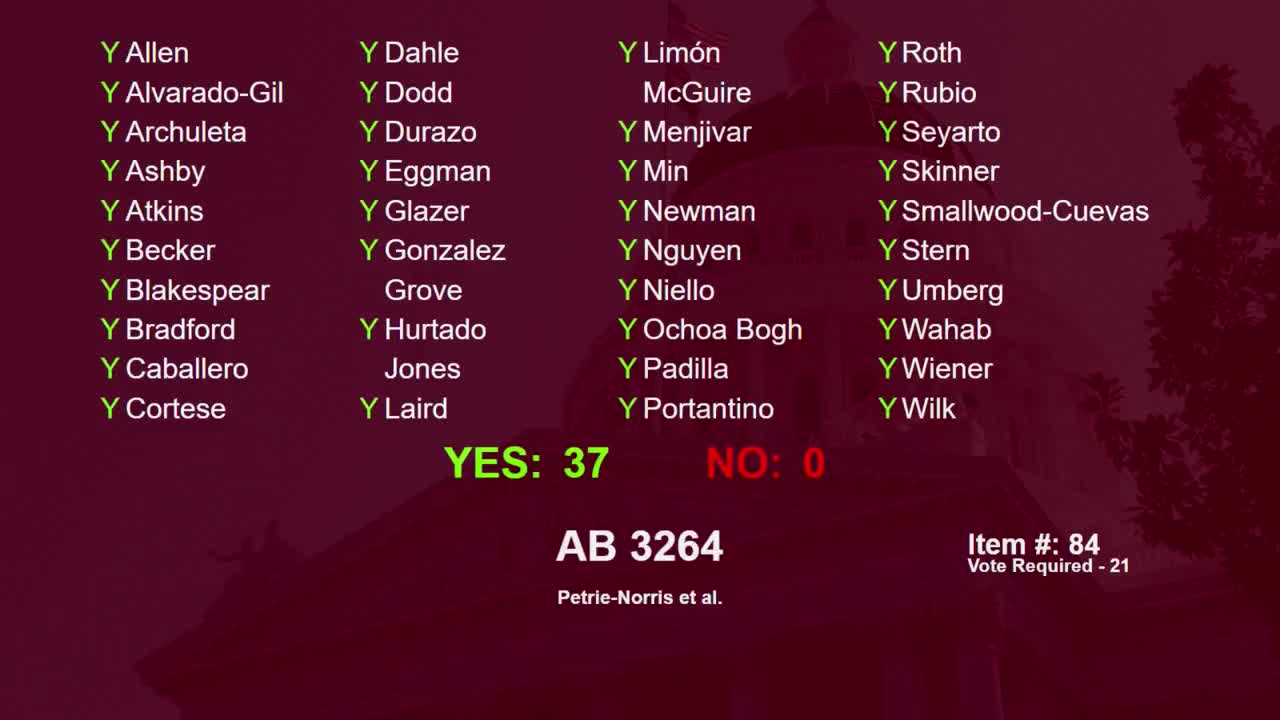
Bill Author

Bill Co-Author(s):
