SB 1482: Commercial financing.
- Session Year: 2023-2024
- House: Senate
- Latest Version Date: 2024-08-19
Current Status:
Failed
(2024-08-26: Ordered to inactive file on request of Assembly Member Grayson.)
Introduced
In Committee
First Chamber
In Committee
Second Chamber
Enacted
Existing law, the California Consumer Financial Protection Law (CCFPL), establishes certain consumer protections relating to consumer financial products, practices, and services, including, among others, making it unlawful for covered persons or service providers, as defined, to, among other acts, engage in unlawful, unfair, deceptive, or abusive acts or practices with respect to consumer financial products or services. Existing law establishes that the purpose of the CCFPL is to promote consumer welfare, fair competition, and wealth creation in this state by promoting, among other things, nondiscriminatory access to consumer financial products and services that are understandable and not unfair, deceptive, or abusive. Existing law authorizes the Department of Financial Protection and Innovation, under the direction of the Commissioner of Financial Protection and Innovation, to prescribe rules regarding registration requirements applicable to a covered person in the business of offering or providing a consumer financial product or service, as defined, and rules requiring the payment of registration fees.
This bill would expand the purposes of the CCFPL to include the protection of small businesses from abusive financial practices, as specified. The bill would prohibit a person from engaging in the business of offering to provide or providing commercial financing transactions or brokerage services to recipients without first registering with the commissioner, as specified. The bill would impose various requirements related to registration for this purpose, including, among others, imposing an application fee of $350. The bill would require a registrant to pay an annual registration fee of $100 plus an assessment equal to the registrants pro rata share of all costs and expenses associated with the administration of the CCFPL, as specified. The bill would require a registrant to submit an annual report to the commissioner, as specified. Under the bill, a registration would be effective until it is revoked by the commissioner or surrendered by the registrant. The bill would impose various duties on commercial financing providers and brokers, including, among other things, prohibiting the taking of a confession of judgment or power of attorney at any time before a default, as specified.
Existing law, the California Consumer Financial Protection Law (CCFPL), establishes certain consumer protections relating to consumer financial products, practices, and services, including, among others, making it unlawful for covered persons or service providers, as defined, to, among other acts, engage in unlawful, unfair, deceptive, or abusive acts or practices with respect to consumer financial products or services. Existing law establishes that the purpose of the CCFPL is to promote consumer welfare, fair competition, and wealth creation in this state by promoting, among other things, nondiscriminatory access to consumer financial products and services that are understandable and not unfair, deceptive, or abusive. Existing law authorizes the Department of Financial Protection and Innovation, under the direction of the Commissioner of Financial Protection and Innovation, to prescribe rules regarding registration requirements applicable to a covered person in the business of offering or providing a consumer financial product or service, as defined, and rules requiring the payment of registration fees.
This bill would expand the purposes of the CCFPL to include the protection of small businesses from abusive financial practices, as specified. The bill would prohibit a person from engaging in the business of offering to provide or providing commercial financing transactions or brokerage services to California residents recipients without first registering with the commissioner, as specified. The bill would impose various requirements related to registration for this purpose, including, among others, imposing an application fee of $350. The bill would require a registrant to pay an annual registration fee of $100 plus an assessment equal to the registrants pro rata share of all costs and expenses associated with the administration of the CCFPL, as specified. The bill would require a registrant to submit an annual report to the commissioner, as specified. Under the bill, a registration would be effective until it is revoked by the commissioner or surrendered by the registrant. The bill would impose various duties on commercial financing providers and brokers, including, among other things, prohibiting the taking of a confession of judgment or power of attorney at any time before a default, as specified.
Existing law, the California Consumer Financial Protection Law (CCFPL), establishes certain consumer protections relating to consumer financial products, practices, and services, including, among others, making it unlawful for covered persons or service providers, as defined, to, among other acts, engage in unlawful, unfair, deceptive, or abusive acts or practices with respect to consumer financial products or services. Existing law establishes that the purpose of the CCFPL is to promote consumer welfare, fair competition, and wealth creation in this state by promoting, among other things, nondiscriminatory access to consumer financial products and services that are understandable and not unfair, deceptive, or abusive. Existing law authorizes the Department of Financial Protection and Innovation, under the direction of the Commissioner of Financial Protection and Innovation, to prescribe rules regarding registration requirements applicable to a covered person in the business of offering or providing a consumer financial product or service, as defined, and rules requiring the payment of registration fees.
This bill would expand the purposes of the CCFPL to include the protection of small businesses from abusive financial practices, as specified. The bill would prohibit a person from engaging in the business of offering to provide or providing commercial financing transactions or brokerage services to California residents without first registering with the commissioner, as specified. The bill would impose various requirements related to registration for this purpose, including, among others, imposing an application fee of $350. The bill would require a registrant to pay an annual registration fee of $100 plus an assessment equal to the registrants pro rata share of all costs and expenses associated with the administration of the CCFPL, as specified. The bill would require a registrant to submit an annual report to the commissioner, as specified. Under the bill, a registration would be effective until it is revoked by the commissioner or surrendered by the registrant. The bill would impose various duties on commercial financing providers and brokers, including, among other things, prohibiting the taking of a confession of judgment or power of attorney at any time before a default, as specified.
The California Financing Law (CFL) provides for the licensure and regulation of finance lenders and brokers by the Commissioner of Financial Protection and Innovation, including by regulating the provision of commercial loans, as defined. A willful violation of the CFL is a crime, except as specified.This bill would, beginning January 1, 2026, generally provide for the regulation under the CFL of commercial financing, which the bill would define to mean an accounts receivable purchase transaction, including factoring, asset-based lending transaction, commercial loan, commercial open-end credit plan, or lease financing, intended by the recipient for use primarily for a purpose other than a personal, family, or household purpose, as specified. The bill would prohibit a person from engaging in the business of a commercial financing provider, as defined, or commercial financing broker, as defined, without obtaining a license from the commissioner. The bill would prohibit a commercial financing provider or a commercial financing broker from, among other things, taking an instrument in which blanks are left to be filled in after execution. The bill would require a licensed commercial financing provider to do certain things, including permitting payment to be made in advance in any amount on any commercial financing transaction at any time. The bill would require a licensed commercial financing broker to do certain things, including delivering to the recipient at the time the final negotiation or arrangement is made a statement showing in clear and distinct terms the name, address, and license number of the commercial financing broker and the commercial financing provider, as prescribed. By expanding the scope of the crime of willfully violating the CFL, this bill would impose a state-mandated local program. The bill would make various conforming changes to the CFL.The California Constitution requires the state to reimburse local agencies and school districts for certain costs mandated by the state. Statutory provisions establish procedures for making that reimbursement.This bill would provide that no reimbursement is required by this act for a specified reason.The California Financing Law (CFL) provides for the licensure and regulation of finance lenders and brokers by the Commissioner of Financial Protection and Innovation, including by regulating the provision of commercial loans, as defined. A willful violation of the CFL is a crime, except as specified.
This bill would, beginning January 1, 2026, generally provide for the regulation under the CFL of commercial financing, which the bill would define to mean an accounts receivable purchase transaction, including factoring, asset-based lending transaction, commercial loan, commercial open-end credit plan, or lease financing, intended by the recipient for use primarily for a purpose other than a personal, family, or household purpose, as specified. The bill would prohibit a person from engaging in the business of a commercial financing provider, as defined, or commercial financing broker, as defined, without obtaining a license from the commissioner. The bill would prohibit a commercial financing provider or a commercial financing broker from, among other things, taking an instrument in which blanks are left to be filled in after execution. The bill would require a licensed commercial financing provider to do certain things, including permitting payment to be made in advance in any amount on any commercial financing transaction at any time. The bill would require a licensed commercial financing broker to do certain things, including delivering to the recipient at the time the final negotiation or arrangement is made a statement showing in clear and distinct terms the name, address, and license number of the commercial financing broker and the commercial financing provider, as prescribed. By expanding the scope of the crime of willfully violating the CFL, this bill would impose a state-mandated local program. The bill would make various conforming changes to the CFL.
The California Constitution requires the state to reimburse local agencies and school districts for certain costs mandated by the state. Statutory provisions establish procedures for making that reimbursement.
This bill would provide that no reimbursement is required by this act for a specified reason.
The California Financing Law (CFL) provides for the licensure and regulation of finance lenders and brokers by the Commissioner of Financial Protection and Innovation, including by regulating the provision of commercial loans, as defined. A willful violation of the CFL is a crime, except as specified.
This bill would, beginning January 1, 2026, generally provide for the regulation under the CFL of commercial financing, which the bill would define to mean an accounts receivable purchase transaction, including factoring, asset-based lending transaction, commercial loan, commercial open-end credit plan, or lease financing, intended by the recipient for use primarily for a purpose other than a personal, family, or household purpose, as specified. The bill would prohibit a person from engaging in the business of a commercial financing provider, as defined, or commercial financing broker, as defined, without obtaining a license from the commissioner. The bill would prohibit a commercial financing provider or a commercial financing broker from, among other things, taking an instrument in which blanks are left to be filled in after execution. The bill would require a licensed commercial financing provider to do certain things, including permitting payment to be made in advance in any amount on any commercial financing transaction at any time. The bill would require a licensed commercial financing broker to do certain things, including delivering to the recipient at the time the final negotiation or arrangement is made a statement showing in clear and distinct terms the name, address, and license number of the commercial financing broker and the commercial financing provider, as prescribed. By expanding the scope of the crime of willfully violating the CFL, this bill would impose a state-mandated local program. The bill would make various conforming changes to the CFL.
The California Constitution requires the state to reimburse local agencies and school districts for certain costs mandated by the state. Statutory provisions establish procedures for making that reimbursement.
This bill would provide that no reimbursement is required by this act for a specified reason.
(a)The Legislature finds and declares all of the following:
(1)California consumers are vulnerable to abuse if the state lacks a dedicated financial services regulator with broad authority over providers of financial products and services. The lack of such a regulator has left consumers vulnerable to abuse and forced California businesses to compete with unscrupulous providers. The financial victimization of economically vulnerable consumers, including individuals who lack a safety net, not only harms the individual but also has a broader social and economic cost on all of California, and could lead to increased caseloads for social safety net programs. These problems become even more acute in times of crisis, including the global COVID-19 pandemic and economic fallout. Consequently, where feasible, the Legislature should enact statutory measures to protect California residents from financial abuses in the marketplace for financial products and services.
(2)Robust consumer protections enable wealth building and promote a vibrant economy. They are especially important among various populations, including, but not limited to, military service members, seniors, students, and new Californians. Unfair, deceptive, or abusive practices in the provision of financial products and services undermine the public confidence that is essential to the continued functioning of the financial system and sound extensions of credit to consumers.
(3)Technological innovation offers great promise to the more effective and efficient provision of consumer financial products and services to the population of California and also poses risks to consumers and challenges to law enforcement in addressing those risks.
(4)Small business owners are often similarly situated as consumers with regards to their sophistication and bargaining power relative to providers of financial services and products. Many of the rationales supporting legal protections for consumers apply also to small business owners. Small businesses have a better chance to survive and grow if they are able to access safe and effective financial products and are protected from unfair, deceptive, or abusive practices when accessing financial products and services.
(5)It is the intent of the Legislature to enact the California Consumer Financial Protection Law to strengthen consumer protections by expanding the ability of the Department of Financial Protection and Innovation to improve accountability and transparency in the California financial system, provide consumer financial education, and protect consumers and small businesses from abusive financial practices, while prioritizing the prevention of unethical businesses from harming the most vulnerable populations including military service members, seniors, students, low- and moderate-income individuals, and new Californians.
(b)The purpose of the California Consumer Financial Protection Law shall be to promote consumer welfare, fair competition, and wealth creation in this state by doing all of the following:
(1)Promoting nondiscriminatory access to responsible, affordable credit on terms that reasonably reflect consumers ability to repay.
(2)Promoting nondiscriminatory access to consumer financial products and services that are understandable and not unfair, deceptive, or abusive.
(3)Protecting consumers from discrimination and unfair, deceptive, and abusive acts and practices in connection with financial practices and services.
(4)Promoting nondiscriminatory consumer-protective innovation in consumer financial products and services.
(5)Promoting the interests of small businesses and protecting them from harm in connection with financial practices and services, in manners similar to those undertaken for consumers.
SEC. 2.Chapter 11 (commencing with Section 90020) is added to Division 24 of the Financial Code, to read:11.Registration of Covered Persons1.General Provisions90020.It is the intent of the Legislature to require covered persons specified by this chapter to be registered pursuant to this division. The purpose of this chapter is to supplement any registration requirements prescribed by the department pursuant to Section 90009. The limitations imposed by Section 90009.5 on registration requirements prescribed by the department pursuant to Section 90009 do not apply to the registration requirements of this chapter.90021.For purposes of this chapter, the following definitions shall apply except as otherwise provided in this chapter or if the context clearly indicates otherwise:(a)Applicant means any person who applies for registration under this division.(b)Branch office means a location of the applicant other than the applicants principal place of business identified in a registration application or an amended application where the applicant offers or provides financial products or services to California residents.(c)California resident has the same meaning as resident as that term is defined in Section 17014 of the Revenue and Taxation Code.(d)Commercial financing has the same meaning as that term is defined in Section 22800.(e)(1)Commercial financing brokerage services means the following acts in connection with a commercial financing transaction:(A)Transmitting sensitive data about a prospective recipient to a commercial financing provider with the expectation of compensation in connection with making a referral.(B)Making a referral to a commercial financing provider under an agreement with the commercial financing provider that a prospective recipient referred by the person to the commercial financing provider meets certain criteria involving sensitive data.(C)Participating in a commercial financing negotiation between a commercial financing provider and prospective recipient.(D)Counseling, advising, or making recommendations to a prospective recipient about a commercial financing transaction based on the prospective recipients sensitive data.(E)(i)Participating in the preparation of commercial financing documents, including commercial financing applications, other than providing a prospective recipient blank copies of commercial financing documents.(ii)Transmitting information that is not sensitive data to a commercial financing provider at the request of a prospective recipient shall not, by itself, constitute participation in the preparation of commercial financing documents within the meaning of this subparagraph.(F)Communicating to a prospective recipient a commercial financing providers commercial financing approval decisions.(G)Charging a fee to a prospective recipient for services related to a prospective recipients application for a commercial financing transaction from a commercial financing provider.(2)Notwithstanding paragraph (1), the following acts in connection with a commercial financing transaction do not constitute commercial financing brokerage services:(A)Performing support tasks, including, but not limited to, typing, word processing, data entry, filing, billing, answering telephone calls, taking and receiving messages, and scheduling, in support of the performance by a broker of any of the activities described in subparagraphs (E) to (G), inclusive, of paragraph (1).(B)Furnishing a consumer report to a covered entity by a consumer reporting agency in accordance with subsection (a) or (c) of Section 1681b of Title 15 of the United States Code.(C)Furnishing a consumer credit report, as defined in Section 1785.3 of the Civil Code, to a covered entity by a consumer credit reporting agency in accordance with subdivision (a) or paragraph (1) of subdivision (b) of Section 1785.11 of the Civil Code.(D)Furnishing a prequalifying report, as defined in Section 1785.3 of the Civil Code, to a covered entity by a consumer credit reporting agency in accordance with paragraph (2) of subdivision (b) of Section 1785.11 of the Civil Code.(E)Distributing or disseminating to a prospective recipient of a providers marketing materials or factual information about the provider, its lending activities, or its loan products, including, but not limited to, the providers interest rates, the providers minimum or maximum loan amounts or loan periods, or a general description of the providers underwriting criteria.(3)For purposes of this subdivision, sensitive data means any of the following:(A)A bank account number.(B)A bank statement.(C)A credit or debit card account number.(D)A credit score, as defined in Section 1785.15.1 of the Civil Code.(4)For purposes of this subdivision, referral means the introduction of a prospective recipient to a commercial financing provider, or the delivery of a prospective recipients contact information to a commercial financing provider, for the purposes of making an introduction.(f)Commercial financing transaction means a consummated commercial financing transaction for which a disclosure is required in accordance with subsection (a) of Section 920 of Title 10 of the California Code of Regulations.(g)Control as used in subdivision (i) of this section and paragraph (13) of subdivision (a) of Section 90029 means possession, direct or indirect, of the power to direct or cause the direction of the management and policies of a person with respect to the offering or provision of subject products, whether through the ownership of voting securities, by contract, or otherwise.(h)Form MU1 means the uniform licensing form, entitled NMLS Company Form developed by the Nationwide Multistate Licensing System and Registry and used to provide information on a company or sole proprietor registration applicant.(i)Form MU2 means the uniform licensing form, entitled NMLS Individual Form developed by the Nationwide Multistate Licensing System and Registry and used to provide information on an individual who directly or indirectly owns or controls the activities of the applicant, including principal officers, directors, and other individuals specified on Form MU1.(j)Individual means a natural person.(k)NMLS means the Nationwide Multistate Licensing System and Registry.(l)Principal officers means the individuals performing the functions of the president, chief executive officer, treasurer, chief financial officer, and the chief operating officer, and the officer primarily responsible for the conduct of the applicants activities with respect to subject products in California.(m)(1)Recipient means a small business whose activities are principally directed or managed from California.(2)For purposes of determining whether activities are principally directed or managed from California a registrant may rely on any relevant written representation by the small business, nonprofit, or family farm, including a business address provided in any application or agreement for commercial financing or other financial product or service.(n)Registrant means any person who is registered under this division.(o)(1)Small business means a business entity organized for profit with annual gross receipts of no more than sixteen million dollars ($16,000,000) or the annual gross receipt level as biennially adjusted by the Department of General Services in accordance with Section 14837 of the Government Code, whichever is greater.(2)For purposes of determining a business entitys annual gross receipts, a covered provider may rely on any relevant written representation by the business entity, including information provided in any application or agreement for commercial financing.(p)Subject product means either of the following products or services:(1)Commercial financing transactions as defined in this section.(2)Commercial financing brokerage services as defined in this section.90023.This division does not apply to any of the following:(a)A provider that is a depository institution.(b)A provider that is a lender regulated under the federal Farm Credit Act (12 U.S.C. Sec. 2001 et seq.).(c)A commercial financing transaction secured by real property.(d)A commercial financing transaction in which the recipient is a dealer, as defined by Section 285 of the Vehicle Code, or an affiliate of such a dealer, or a vehicle rental company, or an affiliate of such a company, pursuant to a specific commercial financing offer or commercial open-end credit plan of at least fifty thousand dollars ($50,000), including any commercial loan made pursuant to such a commercial financing transaction.(e)Any person who makes no more than one commercial financing transaction in California in a 12-month period or any person who makes five or fewer commercial financing transactions in California in a 12-month period that are incidental to the business of the person relying upon the exemption.2.Registration90025.(a)A person shall not engage in the business of offering to provide or providing subject products to recipients without first registering with the commissioner pursuant to this chapter. A person seeking to offer or provide more than one subject product shall list in its application for registration all of the subject products it seeks to offer or provide under its registration.(b)Notwithstanding subdivision (a), an applicant for registration who has filed Forms MU1 and MU2 and paid all required registration fees before January 1, 2025, may offer and provide the subject product for which the applicant has sought registration until their application is approved or abandoned.90026.(a)A determination by the commissioner that a person engaged in the business of offering or providing a subject product must register with the commissioner does not constitute a determination that other laws, including other licensing laws under the jurisdiction of the commissioner, do not apply to that person.(b)The act of granting registration to an applicant does not constitute a determination that the applicants acts, practices, or business model comply with any law or regulation.90027.(a)It is a deceptive practice under this division for a registrant to represent, directly or indirectly, that the registrants acts, practices, or business have been approved by the commissioner or the Department of Financial Protection and Innovation.(b)If a registrant operates a website that describes its subject products, the registrant shall disclose on that website that the registrant is registered with the California Department of Financial Protection and Innovation, which may be abbreviated as DFPI, under the California Consumer Financial Protection Law, which may be abbreviated as CCFPL, and provide the registrants department registration number.90028.(a)Except as provided in Section 90035, NMLS shall be used to receive and store filings and collect related fees and assessments from applicants and registrants on behalf of the commissioner.(b)All applications, amendments, notices, related filings, supporting documents, renewals, authorizations, assessments, and fees required to be filed with the commissioner shall be filed electronically with and transmitted through NMLS, except as otherwise indicated in this chapter. The following conditions relate to electronic filings:(1)When a signature or signatures are required by the instructions of any filing, including any attestation to be made through NMLS, a duly authorized officer or proper delegate of the applicant or the applicant, if the applicant is an individual, as required, shall affix their electronic signature to the filing by typing their name in the appropriate field and submitting the filing to the commissioner through NMLS. Submission of a filing in this manner shall constitute irrefutable evidence of legal signature by any individual making the filing.(2)Solely for purposes of a filing made through NMLS, unless otherwise specified by regulation, a document is considered filed with the commissioner when all fees are received by NMLS and the filing is transmitted by NMLS to the commissioner.(3)Any document required to be filed with the commissioner that is not permitted to be filed with or cannot be filed with NMLS shall be filed directly with the commissioner.90029.Except as provided in Section 90035, an applicant for registration pursuant to this chapter shall do all of the following:(a)An applicant shall complete and file Form MU1 in accordance with the instructions of NMLS and this chapter for transmission to the commissioner. Unless otherwise specified in this section, an applicant shall complete all sections of Form MU1. All exhibits and supporting documents related to the application or amendment required by NMLS or identified in this section shall also be filed with NMLS, unless otherwise specified, in accordance with the instructions of NMLS and this chapter for transmission to the commissioner. An applicant shall provide the following information, exhibits, and documentation in accordance with this section.(1)Applicants are not required to complete Item Number 9 (Approvals and Designations), Item Number 10 (Bank Account Information), or Item Number 17 (Qualifying Individuals) of Form MU1.(2)On Item Number 1 of Form MU1 (Business Activities), an applicant shall indicate that it will offer or provide commercial financing activities by selecting Commercial Financing (Lending/Brokering) under the Consumer Finance section of the form.(3)An applicant shall provide all identifying information on Item Number 2 of Form MU1, including, the entitys name, IRS employee identification number or social security number, legal name amendment, main address, not including a post office box, business telephone number, toll-free number for consumers, fax line, email address, mailing address, and a statement as to whether the entity conducts business with California residents through branch offices or other business locations.(4)An applicant shall provide all fictitious business names on Item Number 3 of Form MU1. An applicant and registrant shall comply with the laws governing the filing of a fictitious business name set forth in Chapter 5 (commencing with Section 17900) of Part 3 of Division 7 of the Business and Professions Code.(5)An applicant shall list the contact information for its agent for service of process on Item Number 4 of Form MU1.(6)An applicant shall list the full web addresses and any separate website addresses for fictitious business names it uses to offer or provide consumer financial products and services to California residents and indicate whether the applicant transacts business through the websites on Item Number 5 of Form MU1.(7)An applicant shall provide the name, title, physical address, email address, and telephone and fax number of the contact employee to serve as the primary contact for compliance and licensing matters and the contact employee for consumer complaints (regulator) on Item Number 6 of Form MU1. The applicant may add additional contact employees for licensing and consumer complaints (regulator) on Item Number 7 of Form MU1.(8)An applicant shall provide the name, address, telephone number, fax number, and email address of the custodian of records for the entity on Item Number 8 of Form MU1. This address may be the same as the entitys main address.(9)An applicant shall provide information on its legal status on Item Number 11 of Form MU1, including the entitys fiscal year end, the date and place the entity obtained its legal status, stock symbol if the entity is publicly traded, and the entitys legal status.(10)An applicant shall provide information on each entity under common ownership (affiliates) and each entity under the applicants control (subsidiaries) that provides consumer financial products or services to California residents on Item Number 12 of Form MU1, including the name, address, and description of each affiliate and subsidiary and an organization chart or document describing the relationship and percentage of ownership.(11)An applicant shall provide information on whether it is controlled by certain financial institutions on Item Number 13 of Form MU1, including, the name, address, and the type of institution, and relationship of the institution to the applicant.(12)An applicant shall disclose and provide complete information on its criminal history, regulatory actions, civil actions, and financial history, including complete details where the applicant answers YES to any disclosure question listed on Item Number 14 of Form MU1.(13)(A)An applicant shall provide the name and title, percentage of ownership of the applicant, NMLS identification number, and federal identification number or social security number of the following individuals on Item Numbers 15 and 16 of Form MU1:(i)Applicant, if an individual.(ii)Principal officers.(iii)Directors.(iv)Managing members, if the applicant is a limited liability company.(v)General and managing partners, if the applicant is a partnership.(vi)Trustees, if the applicant is a trust.(vii)Any other individual who, directly or indirectly, owns, manages, holds with the power to vote, or holds proxies representing, 10 percent or more of the outstanding voting securities issued by the applicant and controls that applicant.(viii)Any individual primarily responsible for the applicants offering or provision of subject products in California.(B)For each individual, the applicant shall complete Form MU2 in accordance with the instructions of NMLS and this chapter for transmission to the commissioner. The applicant shall complete Form MU2 except for J and K of Item Number 1 (Passport Issuing Country and Passport Number), Item Number 7 (Fingerprint Information), and Item Number 8 (Credit Report). The applicant shall disclose and provide complete details where the applicant answers YES to any disclosure question listed on the individuals criminal history, regulatory actions, civil actions, and financial history in Item Number 6.(14)An applicant shall file with NMLS a management chart identifying the following individuals by name and title:(A)Directors.(B)Principal officers.(C)Any individual primarily responsible for the applicants offering or provision of a subject product in California.(D)General and managing partners.(E)Managing members.(F)Trustees.(15)An applicant shall file with NMLS a detailed description of the applicants business activities relating to the offering or provision of subject products in California that includes the following information:(A)A description of all products or services offered or provided to California residents including, but not limited to, subject products.(B)A detailed schedule of the charges associated with the products and services provided to California residents including, but not limited to, subject products. Where charges vary based upon the type of the transaction or other factors, the applicant shall provide a description of how charges are set or determined.(C)A description of how the applicant markets to California residents who may be consumers of subject products, including identifying any websites, social media accounts, and third-party brokers or lead generators that the applicant uses to acquire potential California consumers for its products or services.(D)Whether the applicant offers or provides subject products to California residents through a mobile application.(16)The individual attesting to the filing of the Form MU1 must be a duly authorized individual who has submitted a Form MU2 or has been delegated to attest to the filing by an individual who has submitted a Form MU2.(b)An applicant shall pay a nonrefundable application fee of three hundred fifty dollars ($350) through NMLS for transmission to the commissioner.(c)An application for registration shall be deemed complete when all required fees and all information required by this section are received by the commissioner. The filing of Forms MU1 and MU2 with NMLS does not constitute automatic approval of a registration. Within 30 days of an applicant filing Forms MU1 and MU2 and other information, and paying all required fees, the commissioner shall do either of the following:(1)Inform the applicant in writing that the registration application has been approved.(2)Inform the applicant in writing that the applicant has not fully completed parts of the application, identify the part or parts that have not been fully completed, and state that the application will be considered abandoned if the applicant does not respond within 60 days.(d)Except as provided in subdivision (f), if an applicant submits additional information after receiving a notice of deficiency under paragraph (2) of subdivision (c) or paragraph (2), the commissioner shall, within 30 days, do either of the following:(1)Inform the applicant in writing that the registration application has been approved.(2)Inform the applicant in writing that the applicant has not fully completed parts of the application, identify the part or parts that have not been fully completed, and state that the application will be considered abandoned if the applicant does not respond within 60 days.(e)If an applicant fails to respond to the notice of deficiency provided under paragraph (2) of subdivision (c) or paragraph (2) of subdivision (d) within 60 days, the commissioner shall deem the application for registration abandoned.(f)If the applicant fails to submit a complete application within 60 days after the third notice of deficiency under paragraph (2) of subdivision (c) or paragraph (2) of subdivision (d) of this section, the commissioner shall deem the application for registration abandoned.(g)An application fee paid in connection with an abandoned application shall not be refunded. Abandonment of an application does not preclude the applicant from submitting a new application and fee for a registration.(h)Any reference to the terms license and licensee on Forms MU1 and MU2 or other NMLS information means registration and registrant for purposes of this chapter.90030.An applicant for registration shall, as part of the registration application, submit directly to the commissioner, either by email at [email protected] or other method specified by the department, the following information:(a)Images documenting the standard enrollment or application process California residents use to request or receive the subject product from the applicant through any mobile applications and websites.(b)Any documentation of the standard enrollment or application process California residents use to request or receive the subject product from the applicant over the telephone.(c)Any standard enrollment materials or applications the applicant provides to California residents in connection with the offer or sale of the subject product.(d)Copies of representative contracts and disclosures used by the applicant to provide subject products to California residents.(e)A list of addresses of all branch locations, if any, from which the applicant will offer or provide subject products to California residents.(f)The applicants gross income for the prior calendar year from subject products provided to California residents.90031.Within five days of receiving a registration application approval under Section 90029, a registrant shall establish a designated email address by registering for a Department of Financial Protection and Innovation Self-Service Portal Account through the departments internet website. By registering the designated email address, the registrant consents to receive information from the commissioner at that email address. A registrant is responsible for ensuring that its designated email address is current and functional.90032.The commissioner may provide any notice required by state law or regulation, including, but not limited to, the assessment notice required by Section 90040, by emailing a copy of the notice to the designated email address provided pursuant to Section 90031 or by sending a copy of the notice to the registrant through NMLS.90033.An applicant or registrant shall not make or cause to be made in any application or any report filed with the commissioner under state law or regulation, or in any proceeding before the commissioner, any statement which is at the time and in the light of the circumstances under which it is made false or misleading with respect to any material fact, or omit to state in the application or report any material fact which is required to be stated in the application or report.90034.(a)A registrant shall, upon any change to the application information contained in Form MU1, Item Numbers 2, 4, and 6, file the changed information with the commissioner. The registrant shall file this information within 30 days of the date of the occurrence of the event that results in the information becoming inaccurate or incomplete.(b)Between December 1 and December 31 of each calendar year, a registrant shall file with the commissioner any changes to its application information that occurred since October 31 of the prior calendar year contained in Forms MU1, other than Item Numbers 2, 4, and 6, and MU2 and any other exhibits and supporting documents submitted with its application.90035.The department may adopt regulations revising the requirements of this chapter, as necessary, to accommodate any changes made to Form MU1, Form MU2, or the NMLS generally.3.Annual Assessment and Reporting90040.(a)A registrant shall pay to the commissioner an annual registration fee of one hundred dollars ($100) plus an assessment equal to its pro rata share of all costs and expenses, including the costs and expenses associated with registration, reasonably incurred in the administration of this division as it relates to registrants, as estimated by the commissioner, for the ensuing year and any deficit actually incurred or anticipated in the administration of the program in the year in which the assessment is made. The pro rata share shall be the proportion that a registrants gross income from subject products provided to California residents bears to the aggregate gross income from subject products provided to California residents by all registrants as shown by the annual reports to the commissioner.(b)A registrant who reports in its annual report no gross income from subject products during the year or whose reported gross income from subject products results in an assessment amount of less than five hundred dollars ($500) as calculated under subdivision (a) shall pay an assessment of five hundred dollars ($500) for that year.(c)On or before November 30, 2025, and each November 30 thereafter, the commissioner shall notify each registrant of the amount assessed and levied against it and that amount shall be paid by December 31 of that year. Except as provided pursuant to Section 90035, a registrant shall pay the amount assessed to the commissioner through NMLS.(d)If a registrant fails to pay the assessment on or before December 31, the commissioner may by order summarily revoke the registration. If, after an order is made, a request for a hearing is filed in writing within 30 days of the date of the order and a hearing is not held within 60 days of the date of the order, the order is deemed rescinded as of its effective date. The proceedings under this section shall be conducted in accordance with Chapter 5 (commencing with Section 11500) of Part 1 of Division 3 of Title 2 of the Government Code, and in all cases the commissioner has all powers granted therein. During any period when its registration is revoked, a former registrant shall not offer or provide a subject product to California residents except as may be permitted by order of the commissioner.90041.(a)Commencing March 15, 2026, and each March 15 thereafter, a registrant who is registered as of December 31 of the prior year shall file with the commissioner an annual report containing the information set forth in this section. An annual report is required each year even if the registrant did not provide any subject products or did not engage in any activities under the registration in the calendar year.(b)A registrant shall provide its gross income for the prior calendar year from subject products provided to California residents.(c)The commissioner may by order summarily revoke the registration of any registrant if the registrant fails to file the report required by this section within 10 days after notice by the commissioner that the report is due and not filed. If, after an order is issued, a request for hearing is filed in writing within 30 days of the date of the order and the hearing is not held within 60 days of the date of the order, the order is deemed rescinded as of its effective date. The proceedings under this section shall be conducted in accordance with Chapter 5 (commencing with Section 11500) of Part 1 of Division 3 of Title 2 of the Government Code, and in all cases the commissioner has all powers granted therein. During any period when its registration is revoked, a former registrant shall not offer or provide a subject product to California residents except as may be permitted by order of the commissioner.4.Revocation and Surrender90045.(a)The commissioner shall rescind a summary revocation order issued under Section 90040 or 90041 if the former registrant submits a written request for reinstatement to the commissioner, either by email at [email protected] or another method specified by the department, no later than 180 days after the date of revocation, pays any annual assessment required by Section 90040, files any report required by Section 90041, including reports that would have become due if the registration had not been revoked, and pays the following administrative fine:(1)One hundred dollars ($100) if the reinstatement request is received by the commissioner within the first 14 days after the date of revocation.(2)Two hundred dollars ($200) if the reinstatement request is received by the commissioner between 15 and 30 days after the date of revocation.(3)Four hundred dollars ($400) if the reinstatement request is received by the commissioner between 31 and 60 days after the date of revocation.(4)Six hundred dollars ($600) if the reinstatement request is received by the commissioner between 61 and 90 days after the date of revocation.(5)Six hundred dollars ($600) plus ten dollars ($10) per day if the reinstatement request is received by the commissioner between 91 and 180 days after the date of revocation.(b)Rescission of the summary revocation order under subdivision (a) shall be effective as of the date of revocation, such that there will be no lapse in the registration required by Section 90025, provided that reinstatement was not used by the registrant to evade the registration requirements.(c)This section does not preclude the commissioner from bringing an action under Chapter 8 (commencing with Section 90011) against a person for failure to maintain a registration as required by Section 90025.90046.A registration issued under this chapter is effective until it is revoked by the commissioner or it is surrendered by the registrant pursuant to Section 90047.90047.(a)An application to surrender a registration shall be filed on Form MU1 with NMLS in accordance with the procedures for transmission to the commissioner.(b)Surrender of a registration becomes effective when the commissioner approves the application for surrender.(c)Surrender of a registration does not affect a registrants liability for acts committed prior to the surrender.(d)Surrender of a registration does not relieve a registrant of any obligation to pay a fee, fine, or other amount due to the commissioner or to file any required report.90048.A proceeding to revoke a registration shall be conducted pursuant to Section 90015. During any period when its registration is revoked, a former registrant shall not offer or provide a subject product to California residents except as may be permitted by order of the commissioner.5.Obligations Related to Subject Products90050.(a)A commercial financing provider or a commercial financing broker shall not take a confession of judgment or any power of attorney at any time before a default by a recipient under the terms of a commercial financing transaction agreement or contract.(b)A commercial financing provider or a commercial financing broker shall not include a provision in a commercial financing transaction agreement or contract that authorizes a commercial financing provider or commercial financing broker to attach or garnish any of a recipients money held in an account in a depository institution.(c)A commercial financing transaction found to be unconscionable pursuant to Section 1670.5 of the Civil Code shall be deemed to be in violation of this division and subject to the remedies specified in this division.(d)A commercial financing provider or a commercial financing broker shall not include a provision in a contract or agreement with a recipient that limits or restricts the recipient from disclosing information that the recipient gains from the recipients business activities with the registrant, including, but not limited to, terms or conditions of a product or service offered by the registrant.SEC. 2.Section 90004.1 is added to the Financial Code, to read:90004.1.(a)A commercial financing provider or a commercial financing broker shall not take a confession of judgment or any power of attorney at any time before a default by a recipient under the terms of a commercial financing transaction agreement or contract.
(b)A commercial financing provider or a commercial financing broker shall not include a provision in a commercial financing transaction agreement or contract that authorizes a commercial financing provider or commercial financing broker to attach or garnish any of a recipients money held in an account in a depository institution.
(c)A commercial financing transaction found to be unconscionable pursuant to Section 1670.5 of the Civil Code shall be deemed to be in violation of this division and subject to the remedies specified in this division.
(d)A commercial financing provider or a commercial financing broker shall not include a provision in a contract or agreement with a recipient that limits or restricts the recipient from disclosing information that the recipient gains from the recipients business activities with the registrant, including, but not limited to, terms or conditions of a product or service offered by the registrant.
(a)The Legislature finds and declares all of the following:
(1)California consumers are vulnerable to abuse if the state lacks a dedicated financial services regulator with broad authority over providers of financial products and services. The lack of such a regulator has left consumers vulnerable to abuse and forced California businesses to compete with unscrupulous providers. The financial victimization of economically vulnerable consumers, including individuals who lack a safety net, not only harms the individual but also has a broader social and economic cost on all of California, and could lead to increased caseloads for social safety net programs. These problems become even more acute in times of crisis, including the global COVID-19 pandemic and economic fallout. Consequently, where feasible, the Legislature should enact statutory measures to protect California residents from financial abuses in the marketplace for financial products and services.
(2)Robust consumer protections enable wealth building and promote a vibrant economy. They are especially important among various populations, including, but not limited to, military service members, seniors, students, and new Californians. Unfair, deceptive, or abusive practices in the provision of financial products and services undermine the public confidence that is essential to the continued functioning of the financial system and sound extensions of credit to consumers.
(3)Technological innovation offers great promise to the more effective and efficient provision of consumer financial products and services to the population of California and also poses risks to consumers and challenges to law enforcement in addressing those risks.
(4)Small business owners are often similarly situated as consumers with regards to their sophistication and bargaining power relative to providers of financial services and products. Many of the rationales supporting legal protections for consumers apply also to small business owners. Small businesses have a better chance to survive and grow if they are able to access safe and effective financial products and are protected from unfair, deceptive, or abusive practices when accessing financial products and services.
(5)It is the intent of the Legislature to enact the California Consumer Financial Protection Law to strengthen consumer protections by expanding the ability of the Department of Financial Protection and Innovation to improve accountability and transparency in the California financial system, provide consumer financial education, and protect consumers and small businesses from abusive financial practices, while prioritizing the prevention of unethical businesses from harming the most vulnerable populations including military service members, seniors, students, low- and moderate-income individuals, and new Californians.
(b)The purpose of the California Consumer Financial Protection Law shall be to promote consumer welfare, fair competition, and wealth creation in this state by doing all of the following:
(1)Promoting nondiscriminatory access to responsible, affordable credit on terms that reasonably reflect consumers ability to repay.
(2)Promoting nondiscriminatory access to consumer financial products and services that are understandable and not unfair, deceptive, or abusive.
(3)Protecting consumers from discrimination and unfair, deceptive, and abusive acts and practices in connection with financial practices and services.
(4)Promoting nondiscriminatory consumer-protective innovation in consumer financial products and services.
(5)Promoting the interests of small businesses and protecting them from harm in connection with financial practices and services, in manners similar to those undertaken for consumers.
SEC. 2.Chapter 11 (commencing with Section 90020) is added to Division 24 of the Financial Code, to read:11.Registration of Covered Persons1.General Provisions90020.It is the intent of the Legislature to require covered persons specified by this chapter to be registered pursuant to this division. The purpose of this chapter is to supplement any registration requirements prescribed by the department pursuant to Section 90009. The limitations imposed by Section 90009.5 on registration requirements prescribed by the department pursuant to Section 90009 do not apply to the registration requirements of this chapter.
90021.For purposes of this chapter, the following definitions shall apply except as otherwise provided in this chapter or if the context clearly indicates otherwise:
(a)Applicant means any person who applies for registration under this division.
(b)Branch office means a location of the applicant other than the applicants principal place of business identified in a registration application or an amended application where the applicant offers or provides financial products or services to California residents.
(c)California resident has the same meaning as resident as that term is defined in Section 17014 of the Revenue and Taxation Code.
(d)Commercial financing has the same meaning as that term is defined in Section 22800.
(e)(1)Commercial financing brokerage services means the following acts in connection with a commercial financing transaction:
(A)Transmitting sensitive data about a prospective recipient to a commercial financing provider with the expectation of compensation in connection with making a referral.
(B)Making a referral to a commercial financing provider under an agreement with the commercial financing provider that a prospective recipient referred by the person to the commercial financing provider meets certain criteria involving sensitive data.
(C)Participating in a commercial financing negotiation between a commercial financing provider and prospective recipient.
(D)Counseling, advising, or making recommendations to a prospective recipient about a commercial financing transaction based on the prospective recipients sensitive data.
(E)(i)Participating in the preparation of commercial financing documents, including commercial financing applications, other than providing a prospective recipient blank copies of commercial financing documents.
(ii)Transmitting information that is not sensitive data to a commercial financing provider at the request of a prospective recipient shall not, by itself, constitute participation in the preparation of commercial financing documents within the meaning of this subparagraph.
(F)Communicating to a prospective recipient a commercial financing providers commercial financing approval decisions.
(G)Charging a fee to a prospective recipient for services related to a prospective recipients application for a commercial financing transaction from a commercial financing provider.
(2)Notwithstanding paragraph (1), the following acts in connection with a commercial financing transaction do not constitute commercial financing brokerage services:
(A)Performing support tasks, including, but not limited to, typing, word processing, data entry, filing, billing, answering telephone calls, taking and receiving messages, and scheduling, in support of the performance by a broker of any of the activities described in subparagraphs (E) to (G), inclusive, of paragraph (1).
(B)Furnishing a consumer report to a covered entity by a consumer reporting agency in accordance with subsection (a) or (c) of Section 1681b of Title 15 of the United States Code.
(C)Furnishing a consumer credit report, as defined in Section 1785.3 of the Civil Code, to a covered entity by a consumer credit reporting agency in accordance with subdivision (a) or paragraph (1) of subdivision (b) of Section 1785.11 of the Civil Code.
(D)Furnishing a prequalifying report, as defined in Section 1785.3 of the Civil Code, to a covered entity by a consumer credit reporting agency in accordance with paragraph (2) of subdivision (b) of Section 1785.11 of the Civil Code.
(E)Distributing or disseminating to a prospective recipient of a providers marketing materials or factual information about the provider, its lending activities, or its loan products, including, but not limited to, the providers interest rates, the providers minimum or maximum loan amounts or loan periods, or a general description of the providers underwriting criteria.
(3)For purposes of this subdivision, sensitive data means any of the following:
(A)A bank account number.
(B)A bank statement.
(C)A credit or debit card account number.
(D)A credit score, as defined in Section 1785.15.1 of the Civil Code.
(4)For purposes of this subdivision, referral means the introduction of a prospective recipient to a commercial financing provider, or the delivery of a prospective recipients contact information to a commercial financing provider, for the purposes of making an introduction.
(f)Commercial financing transaction means a consummated commercial financing transaction for which a disclosure is provided required in accordance with subsection (a) of Section 920 of Title 10 of the California Code of Regulations.
(g)Control as used in subdivision (i) of this section and paragraph (13) of subdivision (a) of Section 90029 means possession, direct or indirect, of the power to direct or cause the direction of the management and policies of a person with respect to the offering or provision of subject products, whether through the ownership of voting securities, by contract, or otherwise.
(h)Form MU1 means the uniform licensing form, entitled NMLS Company Form developed by the Nationwide Multistate Licensing System and Registry and used to provide information on a company or sole proprietor registration applicant.
(i)Form MU2 means the uniform licensing form, entitled NMLS Individual Form developed by the Nationwide Multistate Licensing System and Registry and used to provide information on an individual who directly or indirectly owns or controls the activities of the applicant, including principal officers, directors, and other individuals specified on Form MU1.
(j)Individual means a natural person.
(k)NMLS means the Nationwide Multistate Licensing System and Registry.
(l)Principal officers means the individuals performing the functions of the president, chief executive officer, treasurer, chief financial officer, and the chief operating officer, and the officer primarily responsible for the conduct of the applicants activities with respect to subject products in California.
(m)(1)Recipient means a small business whose activities are principally directed or managed from California.
(2)For purposes of determining whether activities are principally directed or managed from California a registrant may rely on any relevant written representation by the small business, nonprofit, or family farm, including a business address provided in any application or agreement for commercial financing or other financial product or service.
(n)Registrant means any person who is registered under this division.
(o)(1)Small business means a business entity organized for profit with annual gross receipts of no more than sixteen million dollars ($16,000,000) or the annual gross receipt level as biennially adjusted by the Department of General Services in accordance with Section 14837 of the Government Code, whichever is greater.
(2)For purposes of determining a business entitys annual gross receipts, a covered provider may rely on any relevant written representation by the business entity, including information provided in any application or agreement for commercial financing.
(p)Subject product means either of the following products or services:
(1)Commercial financing transactions as defined in this section.
(2)Commercial financing brokerage services as defined in this section.
90023.This division does not apply to any of the following:
(a)A provider that is a depository institution.
(b)A provider that is a lender regulated under the federal Farm Credit Act (12 U.S.C. Sec. 2001 et seq.).
(c)A commercial financing transaction secured by real property.
(d)A commercial financing transaction in which the recipient is a dealer, as defined by Section 285 of the Vehicle Code, or an affiliate of such a dealer, or a vehicle rental company, or an affiliate of such a company, pursuant to a specific commercial financing offer or commercial open-end credit plan of at least fifty thousand dollars ($50,000), including any commercial loan made pursuant to such a commercial financing transaction.
(e)Any person who makes no more than one commercial financing transaction in California in a 12-month period or any person who makes five or fewer commercial financing transactions in California in a 12-month period that are incidental to the business of the person relying upon the exemption.
2.Registration90025.(a)A person shall not engage in the business of offering to provide or providing subject products to California residents recipients without first registering with the commissioner pursuant to this chapter. A person seeking to offer or provide more than one subject product shall obtain a separate registration for each subject product. list in its application for registration all of the subject products it seeks to offer or provide under its registration.
(b)Notwithstanding subdivision (a), an applicant for registration who has filed Forms MU1 and MU2 and paid all required registration fees before January 1, 2025, may offer and provide the subject product for which the applicant has sought registration until their application is approved or abandoned.
90026.(a)A determination by the commissioner that a person engaged in the business of offering or providing a subject product must register with the commissioner does not constitute a determination that other laws, including other licensing laws under the jurisdiction of the commissioner, do not apply to that person.
(b)The act of granting registration to an applicant does not constitute a determination that the applicants acts, practices, or business model comply with any law or regulation.
90027.(a)It is a deceptive practice under this division for a registrant to represent, directly or indirectly, that the registrants acts, practices, or business have been approved by the commissioner or the Department of Financial Protection and Innovation.
(b)If a registrant operates a website that describes its subject products, the registrant shall disclose on that website that the registrant is registered with the California Department of Financial Protection and Innovation, which may be abbreviated as DFPI, under the California Consumer Financial Protection Law, which may be abbreviated as CCFPL, and provide the registrants department registration number.
90028.(a)Except as provided in Section 90035, NMLS shall be used to receive and store filings and collect related fees and assessments from applicants and registrants on behalf of the commissioner.
(b)All applications, amendments, notices, related filings, supporting documents, renewals, authorizations, assessments assessments, and fees required to be filed with the commissioner shall be filed electronically with and transmitted through NMLS, except as otherwise indicated in this chapter. The following conditions relate to electronic filings:
(1)When a signature or signatures are required by the instructions of any filing, including any attestation to be made through NMLS, a duly authorized officer or proper delegate of the applicant or the applicant, if the applicant is an individual, as required, shall affix their electronic signature to the filing by typing their name in the appropriate field and submitting the filing to the commissioner through NMLS. Submission of a filing in this manner shall constitute irrefutable evidence of legal signature by any individual making the filing.
(2)Solely for purposes of a filing made through NMLS, unless otherwise specified by regulation, a document is considered filed with the commissioner when all fees are received by NMLS and the filing is transmitted by NMLS to the commissioner.
(3)Any document required to be filed with the commissioner that is not permitted to be filed with or cannot be filed with NMLS shall be filed directly with the commissioner.
90029.Except as provided in Section 90035, an applicant for registration pursuant to this chapter shall do all of the following:
(a)An applicant shall complete and file Form MU1 in accordance with the instructions of NMLS and this chapter for transmission to the commissioner. Unless otherwise specified in this section, an applicant shall complete all sections of Form MU1. All exhibits and supporting documents related to the application or amendment required by NMLS or identified in this section shall also be filed with NMLS, unless otherwise specified, in accordance with the instructions of NMLS and this chapter for transmission to the commissioner. An applicant shall provide the following information, exhibits, and documentation in accordance with this section.
(1)Applicants are not required to complete Item Number 9 (Approvals and Designations), Item Number 10 (Bank Account Information), or Item Number 17 (Qualifying Individuals) of Form MU1.
(2)On Item Number 1 of Form MU1 (Business Activities), an applicant shall indicate that it will offer or provide commercial financing activities by selecting Commercial Financing (Lending/Brokering) under the Consumer Finance section of the form.
(3)An applicant shall provide all identifying information on Item Number 2 of Form MU1, including, the entitys name, IRS employee identification number or social security number, legal name amendment, main address, not including a post office box, business telephone number, toll-free number for consumers, fax line, email address, mailing address, and a statement as to whether the entity conducts business with California residents through branch offices or other business locations.
(4)An applicant shall provide all fictitious business names on Item Number 3 of Form MU1. An applicant and registrant shall comply with the laws governing the filing of a fictitious business name set forth in Chapter 5 (commencing with Section 17900) of Part 3 of Division 7 of the Business and Professions Code.
(5)An applicant shall list the contact information for its agent for service of process on Item Number 4 of Form MU1.
(6)An applicant shall list the full web addresses and any separate website addresses for fictitious business names it uses to offer or provide consumer financial products and services to California residents and indicate whether the applicant transacts business through the websites on Item Number 5 of Form MU1.
(7)An applicant shall provide the name, title, physical address, email address, and telephone and fax number of the contact employee to serve as the primary contact for compliance and licensing matters and the contact employee for consumer complaints (regulator) on Item Number 6 of Form MU1. The applicant may add additional contact employees for licensing and consumer complaints (regulator) on Item Number 7 of Form MU1.
(8)An applicant shall provide the name, address, telephone number, fax number, and email address of the custodian of records for the entity on Item Number 8 of Form MU1. This address may be the same as the entitys main address.
(9)An applicant shall provide information on its legal status on Item Number 11 of Form MU1, including the entitys fiscal year end, the date and place the entity obtained its legal status, stock symbol if the entity is publicly traded, and the entitys legal status.
(10)An applicant shall provide information on each entity under common ownership (affiliates) and each entity under the applicants control (subsidiaries) that provides consumer financial products or services to California residents on Item Number 12 of Form MU1, including the name, address, and description of each affiliate and subsidiary and an organization chart or document describing the relationship and percentage of ownership.
(11)An applicant shall provide information on whether it is controlled by certain financial institutions on Item Number 13 of Form MU1, including, the name, address, and the type of institution, and relationship of the institution to the applicant.
(12)An applicant shall disclose and provide complete information on its criminal history, regulatory actions, civil actions, and financial history, including complete details where the applicant answers YES to any disclosure question listed on Item Number 14 of Form MU1.
(13)(A)An applicant shall provide the name and title, percentage of ownership of the applicant, NMLS identification number, and federal identification number or social security number of the following individuals on Item Numbers 15 and 16 of Form MU1:
(i)Applicant, if an individual.
(ii)Principal officers.
(iii)Directors.
(iv)Managing members, if the applicant is a limited liability company.
(v)General and managing partners, if the applicant is a partnership.
(vi)Trustees, if the applicant is a trust.
(vii)Any other individual who, directly or indirectly, owns, manages, holds with the power to vote, or holds proxies representing, 10 percent or more of the outstanding voting securities issued by the applicant and controls that applicant.
(viii)Any individual primarily responsible for the applicants offering or provision of subject products in California.
(B)For each individual, the applicant shall complete Form MU2 in accordance with the instructions of NMLS and this chapter for transmission to the commissioner. The applicant shall complete Form MU2 except for J and K of Item Number 1 (Passport Issuing Country and Passport Number), Item Number 7 (Fingerprint Information), and Item Number 8 (Credit Report). The applicant shall disclose and provide complete details where the applicant answers YES to any disclosure question listed on the individuals criminal history, regulatory actions, civil actions, and financial history in Item Number 6.
(14)An applicant shall file with NMLS a management chart identifying the following individuals by name and title:
(A)Directors.
(B)Principal officers.
(C)Any individual primarily responsible for the applicants offering or provision of a subject product in California.
(D)General and managing partners.
(E)Managing members.
(F)Trustees.
(15)An applicant shall file with NMLS a detailed description of the applicants business activities relating to the offering or provision of subject products in California that includes the following information:
(A)A description of all products or services offered or provided to California residents including, but not limited to, subject products.
(B)A detailed schedule of the charges associated with the products and services provided to California residents including, but not limited to, subject products. Where charges vary based upon the type of the transaction or other factors, the applicant shall provide a description of how charges are set or determined.
(C)A description of how the applicant markets to California residents who may be consumers of subject products, including identifying any websites, social media accounts, and third-party brokers or lead generators that the applicant uses to acquire potential California consumers for its products or services.
(D)Whether the applicant offers or provides subject products to California residents through a mobile application.
(16)The individual attesting to the filing of the Form MU1 must be a duly authorized individual who has submitted a Form MU2 or has been delegated to attest to the filing by an individual who has submitted a Form MU2.
(b)An applicant shall pay a nonrefundable application fee of three hundred fifty dollars ($350) through NMLS for transmission to the commissioner.
(c)An application for registration shall be deemed complete when all required fees and all information required by this section are received by the commissioner. The filing of Forms MU1 and MU2 with NMLS does not constitute automatic approval of a registration. Within 30 days of an applicant filing Forms MU1 and MU2 and other information, and paying all required fees, the commissioner shall do either of the following:
(1)Inform the applicant in writing that the registration application has been approved.
(2)Inform the applicant in writing that the applicant has not fully completed parts of the application, identify the part or parts that have not been fully completed, and state that the application will be considered abandoned if the applicant does not respond within 60 days.
(d)Except as provided in subdivision (f), if an applicant submits additional information after receiving a notice of deficiency under paragraph (2) of subdivision (c) or paragraph (2), the commissioner shall, within 30 days, do either of the following:
(1)Inform the applicant in writing that the registration application has been approved.
(2)Inform the applicant in writing that the applicant has not fully completed parts of the application, identify the part or parts that have not been fully completed, and state that the application will be considered abandoned if the applicant does not respond within 60 days.
(e)If an applicant fails to respond to the notice of deficiency provided under paragraph (2) of subdivision (c) or paragraph (2) of subdivision (d) within 60 days, the commissioner shall deem the application for registration abandoned.
(f)If the applicant fails to submit a complete application within 60 days after the third notice of deficiency under paragraph (2) of subdivision (c) or paragraph (2) of subdivision (d) of this section, the commissioner shall deem the application for registration abandoned.
(g)An application fee paid in connection with an abandoned application shall not be refunded. Abandonment of an application does not preclude the applicant from submitting a new application and fee for a registration.
(h)Any reference to the terms license and licensee on Forms MU1 and MU2 or other NMLS information means registration and registrant for purposes of this chapter.
90030.An applicant for registration shall, as part of the registration application, submit directly to the commissioner, either by email at [email protected] or other method specified by the department, the following information:
(a)Images documenting the standard enrollment or application process California residents use to request or receive the subject product from the applicant through any mobile applications and websites.
(b)Any documentation of the standard enrollment or application process California residents use to request or receive the subject product from the applicant over the telephone.
(c)Any standard enrollment materials or applications the applicant provides to California residents in connection with the offer or sale of the subject product.
(d)Copies of representative contracts and disclosures used by the applicant to provide subject products to California residents.
(e)A list of addresses of all branch locations, if any, from which the applicant will offer or provide subject products to California residents.
(f)The applicants gross income for the prior calendar year from subject products provided to California residents.
90031.Within five days of receiving a registration application approval under Section 90029, a registrant shall establish a designated email address by registering for a Department of Financial Protection and Innovation Self-Service Portal Account through the departments internet website. By registering the designated email address, the registrant consents to receive information from the commissioner at that email address. A registrant is responsible for ensuring that its designated email address is current and functional.
90032.The commissioner may provide any notice required by state law or regulation, including, but not limited to, the assessment notice required by Section 90040, by emailing a copy of the notice to the designated email address provided pursuant to Section 90031 or by sending a copy of the notice to the registrant through NMLS.
90033.An applicant or registrant shall not make or cause to be made in any application or any report filed with the commissioner under state law or regulation, or in any proceeding before the commissioner, any statement which is at the time and in the light of the circumstances under which it is made false or misleading with respect to any material fact, or omit to state in the application or report any material fact which is required to be stated in the application or report.
90034.(a)A registrant shall, upon any change to the application information contained in Form MU1, Item Numbers 2, 4, and 6, file the changed information with the commissioner. The registrant shall file this information within 30 days of the date of the occurrence of the event that results in the information becoming inaccurate or incomplete.
(b)Between December 1 and December 31 of each calendar year, a registrant shall file with the commissioner any changes to its application information that occurred since October 31 of the prior calendar year contained in Forms MU1, other than Item Numbers 2, 4, and 6, and MU2 and any other exhibits and supporting documents submitted with its application.
90035.The department may adopt regulations revising the requirements of this chapter, as necessary, to accommodate any changes made to Form MU1, Form MU2, or the NMLS generally.
3.Annual Assessment and Reporting90040.(a)A registrant shall pay to the commissioner an annual registration fee of one hundred dollars ($100) plus an assessment equal to its pro rata share of all costs and expenses, including the costs and expenses associated with registration, reasonably incurred in the administration of this division as it relates to registrants, as estimated by the commissioner, for the ensuing year and any deficit actually incurred or anticipated in the administration of the program in the year in which the assessment is made. The pro rata share shall be the proportion that a registrants gross income from subject products provided to California residents bears to the aggregate gross income from subject products provided to California residents by all registrants as shown by the annual reports to the commissioner.
(b)A registrant who reports in its annual report no gross income from subject products during the year or whose reported gross income from subject products results in an assessment amount of less than five hundred dollars ($500) as calculated under subdivision (a) shall pay an assessment of five hundred dollars ($500) for that year.
(c)On or before November 30, 2025, and each November 30 thereafter, the commissioner shall notify each registrant of the amount assessed and levied against it and that amount shall be paid by December 31 of that year. Except as provided pursuant to Section 90035, a registrant shall pay the amount assessed to the commissioner through NMLS.
(d)If a registrant fails to pay the assessment on or before December 31, the commissioner may by order summarily revoke the registration. If, after an order is made, a request for a hearing is filed in writing within 30 days of the date of the order and a hearing is not held within 60 days of the date of the order, the order is deemed rescinded as of its effective date. The proceedings under this section shall be conducted in accordance with Chapter 5 (commencing with Section 11500) of Part 1 of Division 3 of Title 2 of the Government Code, and in all cases the commissioner has all powers granted therein. During any period when its registration is revoked, a former registrant shall not offer or provide a subject product to California residents except as may be permitted by order of the commissioner.
90041.(a)Commencing March 15, 2026, and each March 15 thereafter, a registrant who is registered as of December 31 of the prior year shall file with the commissioner an annual report containing the information set forth in this section. An annual report is required each year even if the registrant did not provide any subject products or did not engage in any activities under the registration in the calendar year.
(b)A registrant shall provide its gross income for the prior calendar year from subject products provided to California residents.
(c)The commissioner may by order summarily revoke the registration of any registrant if the registrant fails to file the report required by this section within 10 days after notice by the commissioner that the report is due and not filed. If, after an order is issued, a request for hearing is filed in writing within 30 days of the date of the order and the hearing is not held within 60 days of the date of the order, the order is deemed rescinded as of its effective date. The proceedings under this section shall be conducted in accordance with Chapter 5 (commencing with Section 11500) of Part 1 of Division 3 of Title 2 of the Government Code, and in all cases the commissioner has all powers granted therein. During any period when its registration is revoked, a former registrant shall not offer or provide a subject product to California residents except as may be permitted by order of the commissioner.
4.Revocation and Surrender90045.(a)The commissioner shall rescind a summary revocation order issued under Section 90040 or 90041 if the former registrant submits a written request for reinstatement to the commissioner, either by email at [email protected] or another method specified by the department, no later than 180 days after the date of revocation, pays any annual assessment required by Section 90040, files any report required by Section 90041, including reports that would have become due if the registration had not been revoked, and pays the following administrative fine:
(1)One hundred dollars ($100) if the reinstatement request is received by the commissioner within the first 14 days after the date of revocation.
(2)Two hundred dollars ($200) if the reinstatement request is received by the commissioner between 15 and 30 days after the date of revocation.
(3)Four hundred dollars ($400) if the reinstatement request is received by the commissioner between 31 and 60 days after the date of revocation.
(4)Six hundred dollars ($600) if the reinstatement request is received by the commissioner between 61 and 90 days after the date of revocation.
(5)Six hundred dollars ($600) plus ten dollars ($10) per day if the reinstatement request is received by the commissioner between 91 and 180 days after the date of revocation.
(b)Rescission of the summary revocation order under subdivision (a) shall be effective as of the date of revocation, such that there will be no lapse in the registration required by Section 90025, provided that reinstatement was not used by the registrant to evade the registration requirements.
(c)This section does not preclude the commissioner from bringing an action under Chapter 8 (commencing with section Section 90011) against a person for failure to maintain a registration as required by Section 90025.
90046.A registration issued under this chapter is effective until it is revoked by the commissioner or it is surrendered by the registrant pursuant to Section 90047.
90047.(a)An application to surrender a registration shall be filed on Form MU1 with NMLS in accordance with the procedures for transmission to the commissioner.
(b)Surrender of a registration becomes effective when the commissioner approves the application for surrender.
(c)Surrender of a registration does not affect a registrants liability for acts committed prior to the surrender.
(d)Surrender of a registration does not relieve a registrant of any obligation to pay a fee, fine, or other amount due to the commissioner or to file any required report.
90048.A proceeding to revoke a registration shall be conducted pursuant to Section 90015. During any period when its registration is revoked, a former registrant shall not offer or provide a subject product to California residents except as may be permitted by order of the commissioner.
5.Obligations Related to Subject Products90050.(a)A commercial financing provider or a commercial financing broker shall not take a confession of judgment or any power of attorney at any time before a default by a recipient under the terms of a commercial financing transaction agreement or contract.
(b)A commercial financing provider or a commercial financing broker shall not include a provision in a commercial financing transaction agreement or contract that authorizes a commercial financing provider or commercial financing broker to attach or garnish any of a recipients money held in an account in a depository institution.
(c)A commercial financing transaction found to be unconscionable pursuant to Section 1670.5 of the Civil Code shall be deemed to be in violation of this division and subject to the remedies specified in this division.
(d)A commercial financing provider or a commercial financing broker shall not include a provision in a contract or agreement with a recipient that limits or restricts the recipient from disclosing information that the recipient gains from the recipients business activities with the registrant, including, but not limited to, terms or conditions of a product or service offered by the registrant.
(a)The Legislature finds and declares all of the following:
(1)California consumers are vulnerable to abuse if the state lacks a dedicated financial services regulator with broad authority over providers of financial products and services. The lack of such a regulator has left consumers vulnerable to abuse and forced California businesses to compete with unscrupulous providers. The financial victimization of economically vulnerable consumers, including individuals who lack a safety net, not only harms the individual but also has a broader social and economic cost on all of California, and could lead to increased caseloads for social safety net programs. These problems become even more acute in times of crisis, including the global Covid-19 COVID-19 pandemic and economic fallout. Consequently, where feasible, the Legislature should enact statutory measures to protect California residents from financial abuses in the marketplace for financial products and services.
(2)Robust consumer protections enable wealth building and promote a vibrant economy. They are especially important among various populations, including, but not limited to, military service members, seniors, students, and new Californians. Unfair, deceptive, or abusive practices in the provision of financial products and services undermine the public confidence that is essential to the continued functioning of the financial system and sound extensions of credit to consumers.
(3)Technological innovation offers great promise to the more effective and efficient provision of consumer financial products and services to the population of California and also poses risks to consumers and challenges to law enforcement in addressing those risks.
(4)Small business owners are often similarly situated as consumers with regards to their sophistication and bargaining power relative to providers of financial services and products. Many of the rationales supporting legal protections for consumers apply also to small business owners. Small businesses have a better chance to survive and grow if they are able to access safe and effective financial products and are protected from unfair, deceptive, or abusive practices when accessing financial products and services.
(4)(5)It is the intent of the Legislature to enact the California Consumer Financial Protection Law to strengthen consumer protections by expanding the ability of the Department of Financial Protection and Innovation to improve accountability and transparency in the California financial system, provide consumer financial education, and protect consumers and small businesses from abusive financial practices, while prioritizing the prevention of unethical businesses from harming the most vulnerable populations including military service members, seniors, students, low- and moderate-income individuals, and new Californians.
(b)The purpose of the California Consumer Financial Protection Law shall be to promote consumer welfare, fair competition, and wealth creation in this state by doing all of the following:
(1)Promoting nondiscriminatory access to responsible, affordable credit on terms that reasonably reflect consumers ability to repay.
(2)Promoting nondiscriminatory access to consumer financial products and services that are understandable and not unfair, deceptive, or abusive.
(3)Protecting consumers from discrimination and unfair, deceptive, and abusive acts and practices in connection with financial practices and services.
(4)Promoting nondiscriminatory consumer-protective innovation in consumer financial products and services.
(5)Promoting the interests of small businesses and protecting them from harm in connection with financial practices and services, in manners similar to those undertaken for consumers.
SEC. 2.Chapter 11 (commencing with Section 90020) is added to Division 24 of the Financial Code, to read:11.Registration of Covered Persons1.General Provisions90020.It is the intent of the Legislature to require covered persons specified by this chapter to be registered pursuant to this division. The purpose of this chapter is to supplement any registration requirements prescribed by the department pursuant to Section 90009. The limitations imposed by Section 90009.5 on registration requirements prescribed by the department pursuant to Section 90009 do not apply to the registration requirements of this chapter.
90021.For purposes of this chapter, the following definitions shall apply except as otherwise provided in this chapter or if the context clearly indicates otherwise:
(a)Applicant means any person who applies for registration under this division.
(b)Branch office means a location of the applicant other than the applicants principal place of business identified in a registration application or an amended application where the applicant offers or provides financial products or services to California residents.
(c)California resident has the same meaning as resident as that term is defined in Section 17014 of the Revenue and Taxation Code.
(d)Commercial financing has the same meaning as that term is defined in Section 22800.
(e)(1)Commercial financing brokerage services means the following acts in connection with a commercial financing transaction:
(A)Transmitting sensitive data about a prospective recipient to a commercial financing provider with the expectation of compensation in connection with making a referral.
(B)Making a referral to a commercial financing provider under an agreement with the commercial financing provider that a prospective recipient referred by the person to the commercial financing provider meets certain criteria involving sensitive data.
(C)Participating in a commercial financing negotiation between a commercial financing provider and prospective recipient.
(D)Counseling, advising, or making recommendations to a prospective recipient about a commercial financing transaction based on the prospective recipients sensitive data.
(E)(i)Participating in the preparation of commercial financing documents, including commercial financing applications, other than providing a prospective recipient blank copies of commercial financing documents.
(ii)Transmitting information that is not sensitive data to a commercial financing provider at the request of a prospective recipient shall not, by itself, constitute participation in the preparation of commercial financing documents within the meaning of this subparagraph.
(F)Communicating to a prospective recipient a commercial financing providers commercial financing approval decisions.
(G)Charging a fee to a prospective recipient for services related to a prospective recipients application for a commercial financing transaction from a commercial financing provider.
(2)Notwithstanding paragraph (1), the following acts in connection with a commercial financing transaction do not constitute commercial financing brokerage services:
(A)Performing support tasks, including, but not limited to, typing, word processing, data entry, filing, billing, answering telephone calls, taking and receiving messages, and scheduling, in support of the performance by a broker of any of the activities described in subparagraphs (E) to (G), inclusive, of paragraph (1).
(B)Furnishing a consumer report to a covered entity by a consumer reporting agency in accordance with subsection (a) or (c) of Section 1681b of Title 15 of the United States Code.
(C)Furnishing a consumer credit report, as defined in Section 1785.3 of the Civil Code, to a covered entity by a consumer credit reporting agency in accordance with subdivision (a) or paragraph (1) of subdivision (b) of Section 1785.11 of the Civil Code.
(D)Furnishing a prequalifying report, as defined in Section 1785.3 of the Civil Code, to a covered entity by a consumer credit reporting agency in accordance with paragraph (2) of subdivision (b) of Section 1785.11 of the Civil Code.
(E)Distributing or disseminating to a prospective recipient of a providers marketing materials or factual information about the provider, its lending activities, or its loan products, including, but not limited to, the providers interest rates, the providers minimum or maximum loan amounts or loan periods, or a general description of the providers underwriting criteria.
(3)For purposes of this subdivision, sensitive data means any of the following:
(A)A bank account number.
(B)A bank statement.
(C)A credit or debit card account number.
(D)A credit score, as defined in Section 1785.15.1 of the Civil Code.
(4)For purposes of this subdivision, referral means the introduction of a prospective recipient to a commercial financing provider, or the delivery of a prospective recipients contact information to a commercial financing provider, for the purposes of making an introduction.
(f)Commercial financing transaction means a consummated commercial financing transaction for which a disclosure is provided in accordance with subsection (a) of Section 920 of Title 10 of the California Code of Regulations.
(g)Control as used in subdivision (i) of this section and paragraph (13) of subdivision (a) of Section 90029 means possession, direct or indirect, of the power to direct or cause the direction of the management and policies of a person with respect to the offering or provision of subject products, whether through the ownership of voting securities, by contract, or otherwise.
(h)Form MU1 means the uniform licensing form, entitled NMLS Company Form developed by the Nationwide Multistate Licensing System and Registry and used to provide information on a company or sole proprietor registration applicant.
(i)Form MU2 means the uniform licensing form, entitled NMLS Individual Form developed by the Nationwide Multistate Licensing System and Registry and used to provide information on an individual who directly or indirectly owns or controls the activities of the applicant, including principal officers, directors, and other individuals specified on Form MU1.
(j)Individual means a natural person.
(k)NMLS means the Nationwide Multistate Licensing System and Registry.
(l)Principal officers means the individuals performing the functions of the president, chief executive officer, treasurer, chief financial officer, and the chief operating officer, and the officer primarily responsible for the conduct of the applicants activities with respect to subject products in California.
(m)(1)Recipient means a small business whose activities are principally directed or managed from California.
(2)For purposes of determining whether activities are principally directed or managed from California a registrant may rely on any relevant written representation by the small business, nonprofit, or family farm, including a business address provided in any application or agreement for commercial financing or other financial product or service.
(n)Registrant means any person who is registered under this division.
(o)(1)Small business means a business entity organized for profit with annual gross receipts of no more than sixteen million dollars ($16,000,000) or the annual gross receipt level as biennially adjusted by the Department of General Services in accordance with Section 14837 of the Government Code, whichever is greater.
(2)For purposes of determining a business entitys annual gross receipts, a covered provider may rely on any relevant written representation by the business entity, including information provided in any application or agreement for commercial financing.
(p)Subject product means either of the following products or services:
(1)Commercial financing transactions as defined in this section.
(2)Commercial financing brokerage services as defined in this section.
2.Registration90025.(a)A person shall not engage in the business of offering to provide or providing subject products to California residents without first registering with the commissioner pursuant to this chapter. A person seeking to offer or provide more than one subject product shall obtain a separate registration for each subject product.
(b)Notwithstanding subdivision (a), an applicant for registration who has filed Forms MU1 and MU2 and paid all required registration fees before January 1, 2025, may offer and provide the subject product for which the applicant has sought registration until their application is approved or abandoned.
90026.(a)A determination by the commissioner that a person engaged in the business of offering or providing a subject product must register with the commissioner does not constitute a determination that other laws, including other licensing laws under the jurisdiction of the commissioner, do not apply to that person.
(b)The act of granting registration to an applicant does not constitute a determination that the applicants acts, practices, or business model comply with any law or regulation.
90027.(a)It is a deceptive practice under this division for a registrant to represent, directly or indirectly, that the registrants acts, practices, or business have been approved by the commissioner or the Department of Financial Protection and Innovation.
(b)If a registrant operates a website that describes its subject products, the registrant shall disclose on that website that the registrant is registered with the California Department of Financial Protection and Innovation, which may be abbreviated as DFPI, under the California Consumer Financial Protection Law, which may be abbreviated as CCFPL, and provide the registrants department registration number.
90028.(a)Except as provided in Section 90035, NMLS shall be used to receive and store filings and collect related fees and assessments from applicants and registrants on behalf of the commissioner.
(b)All applications, amendments, notices, related filings, supporting documents, renewals, authorizations, assessments and fees required to be filed with the commissioner shall be filed electronically with and transmitted through NMLS, except as otherwise indicated in this chapter. The following conditions relate to electronic filings:
(1)When a signature or signatures are required by the instructions of any filing, including any attestation to be made through NMLS, a duly authorized officer or proper delegate of the applicant or the applicant, if the applicant is an individual, as required, shall affix their electronic signature to the filing by typing their name in the appropriate field and submitting the filing to the commissioner through NMLS. Submission of a filing in this manner shall constitute irrefutable evidence of legal signature by any individual making the filing.
(2)Solely for purposes of a filing made through NMLS, unless otherwise specified by regulation, a document is considered filed with the commissioner when all fees are received by NMLS and the filing is transmitted by NMLS to the commissioner.
(3)Any document required to be filed with the commissioner that is not permitted to be filed with or cannot be filed with NMLS shall be filed directly with the commissioner.
90029.Except as provided in Section 90035, an applicant for registration pursuant to this chapter shall do all of the following:
(a)An applicant shall complete and file Form MU1 in accordance with the instructions of NMLS and this chapter for transmission to the commissioner. Unless otherwise specified in this section, an applicant shall complete all sections of Form MU1. All exhibits and supporting documents related to the application or amendment required by NMLS or identified in this section shall also be filed with NMLS, unless otherwise specified, in accordance with the instructions of NMLS and this chapter for transmission to the commissioner. An applicant shall provide the following information, exhibits, and documentation in accordance with this section.
(1)Applicants are not required to complete Item Number 9 (Approvals and Designations), Item Number 10 (Bank Account Information), or Item Number 17 (Qualifying Individuals) of Form MU1.
(2)On Item Number 1 of Form MU1 (Business Activities), an applicant shall indicate that it will offer or provide commercial financing activities by selecting Commercial Financing (Lending/Brokering) under the Consumer Finance section of the form.
(3)An applicant shall provide all identifying information on Item Number 2 of Form MU1, including, the entitys name, IRS employee identification number or social security number, legal name amendment, main address, not including a post office box, business telephone number, toll-free number for consumers, fax line, email address, mailing address, and a statement as to whether the entity conducts business with California residents through branch offices or other business locations.
(4)An applicant shall provide all fictitious business names on Item Number 3 of Form MU1. An applicant and registrant shall comply with the laws governing the filing of a fictitious business name set forth in Chapter 5 (commencing with Section 17900) of Part 3 of Division 7 of the Business and Professions Code.
(5)An applicant shall list the contact information for its agent for service of process on Item Number 4 of Form MU1.
(6)An applicant shall list the full web addresses and any separate website addresses for fictitious business names it uses to offer or provide consumer financial products and services to California residents and indicate whether the applicant transacts business through the websites on Item Number 5 of Form MU1.
(7)An applicant shall provide the name, title, physical address, email address, and telephone and fax number of the contact employee to serve as the primary contact for compliance and licensing matters and the contact employee for consumer complaints (regulator) on Item Number 6 of Form MU1. The applicant may add additional contact employees for licensing and consumer complaints (regulator) on Item Number 7 of Form MU1.
(8)An applicant shall provide the name, address, telephone number, fax number, and email address of the custodian of records for the entity on Item Number 8 of Form MU1. This address may be the same as the entitys main address.
(9)An applicant shall provide information on its legal status on Item Number 11 of Form MU1, including the entitys fiscal year end, the date and place the entity obtained its legal status, stock symbol if the entity is publicly traded, and the entitys legal status.
(10)An applicant shall provide information on each entity under common ownership (affiliates) and each entity under the applicants control (subsidiaries) that provides consumer financial products or services to California residents on Item Number 12 of Form MU1, including the name, address, and description of each affiliate and subsidiary and an organization chart or document describing the relationship and percentage of ownership.
(11)An applicant shall provide information on whether it is controlled by certain financial institutions on Item Number 13 of Form MU1, including, the name, address, and the type of institution, and relationship of the institution to the applicant.
(12)An applicant shall disclose and provide complete information on its criminal history, regulatory actions, civil actions, and financial history, including complete details where the applicant answers YES to any disclosure question listed on Item Number 14 of Form MU1.
(13)(A)An applicant shall provide the name and title, percentage of ownership of the applicant, NMLS identification number, and federal identification number or social security number of the following individuals on Item Numbers 15 and 16 of Form MU1:
(i)Applicant, if an individual.
(ii)Principal officers.
(iii)Directors.
(iv)Managing members, if the applicant is a limited liability company.
(v)General and managing partners, if the applicant is a partnership.
(vi)Trustees, if the applicant is a trust.
(vii)Any other individual who, directly or indirectly, owns, manages, holds with the power to vote, or holds proxies representing, 10 percent or more of the outstanding voting securities issued by the applicant and controls that applicant.
(viii)Any individual primarily responsible for the applicants offering or provision of subject products in California.
(B)For each individual, the applicant shall complete Form MU2 in accordance with the instructions of NMLS and this chapter for transmission to the commissioner. The applicant shall complete Form MU2 except for J and K of Item Number 1 (Passport Issuing Country and Passport Number), Item Number 7 (Fingerprint Information), and Item Number 8 (Credit Report). The applicant shall disclose and provide complete details where the applicant answers YES to any disclosure question listed on the individuals criminal history, regulatory actions, civil actions, and financial history in Item Number 6.
(14)An applicant shall file with NMLS a management chart identifying the following individuals by name and title:
(A)Directors.
(B)Principal officers.
(C)Any individual primarily responsible for the applicants offering or provision of a subject product in California.
(D)General and managing partners.
(E)Managing members.
(F)Trustees.
(15)An applicant shall file with NMLS a detailed description of the applicants business activities relating to the offering or provision of subject products in California that includes the following information:
(A)A description of all products or services offered or provided to California residents including, but not limited to, subject products.
(B)A detailed schedule of the charges associated with the products and services provided to California residents including, but not limited to, subject products. Where charges vary based upon the type of the transaction or other factors, the applicant shall provide a description of how charges are set or determined.
(C)A description of how the applicant markets to California residents who may be consumers of subject products, including identifying any websites, social media accounts, and third-party brokers or lead generators that the applicant uses to acquire potential California consumers for its products or services.
(D)Whether the applicant offers or provides subject products to California residents through a mobile application.
(16)The individual attesting to the filing of the Form MU1 must be a duly authorized individual who has submitted a Form MU2 or has been delegated to attest to the filing by an individual who has submitted a Form MU2.
(b)An applicant shall pay a nonrefundable application fee of three hundred fifty dollars ($350) through NMLS for transmission to the commissioner.
(c)An application for registration shall be deemed complete when all required fees and all information required by this section are received by the commissioner. The filing of Forms MU1 and MU2 with NMLS does not constitute automatic approval of a registration. Within 30 days of an applicant filing Forms MU1 and MU2 and other information, and paying all required fees, the commissioner shall do either of the following:
(1)Inform the applicant in writing that the registration application has been approved.
(2)Inform the applicant in writing that the applicant has not fully completed parts of the application, identify the part or parts that have not been fully completed, and state that the application will be considered abandoned if the applicant does not respond within 60 days.
(d)Except as provided in subdivision (f), if an applicant submits additional information after receiving a notice of deficiency under paragraph (2) of subdivision (c) or paragraph (2), the commissioner shall, within 30 days, do either of the following:
(1)Inform the applicant in writing that the registration application has been approved.
(2)Inform the applicant in writing that the applicant has not fully completed parts of the application, identify the part or parts that have not been fully completed, and state that the application will be considered abandoned if the applicant does not respond within 60 days.
(e)If an applicant fails to respond to the notice of deficiency provided under paragraph (2) of subdivision (c) or paragraph (2) of subdivision (d) within 60 days, the commissioner shall deem the application for registration abandoned.
(f)If the applicant fails to submit a complete application within 60 days after the third notice of deficiency under paragraph (2) of subdivision (c) or paragraph (2) of subdivision (d) of this section, the commissioner shall deem the application for registration abandoned.
(g)An application fee paid in connection with an abandoned application shall not be refunded. Abandonment of an application does not preclude the applicant from submitting a new application and fee for a registration.
(h)Any reference to the terms license and licensee on Forms MU1 and MU2 or other NMLS information means registration and registrant for purposes of this chapter.
90030.An applicant for registration shall, as part of the registration application, submit directly to the commissioner, either by email at [email protected] or other method specified by the department, the following information:
(a)Images documenting the standard enrollment or application process California residents use to request or receive the subject product from the applicant through any mobile applications and websites.
(b)Any documentation of the standard enrollment or application process California residents use to request or receive the subject product from the applicant over the telephone.
(c)Any standard enrollment materials or applications the applicant provides to California residents in connection with the offer or sale of the subject product.
(d)Copies of representative contracts and disclosures used by the applicant to provide subject products to California residents.
(e)A list of addresses of all branch locations, if any, from which the applicant will offer or provide subject products to California residents.
(f)The applicants gross income for the prior calendar year from subject products provided to California residents.
90031.Within five days of receiving a registration application approval under Section 90029, a registrant shall establish a designated email address by registering for a Department of Financial Protection and Innovation Self-Service Portal Account through the departments internet website. By registering the designated email address, the registrant consents to receive information from the commissioner at that email address. A registrant is responsible for ensuring that its designated email address is current and functional.
90032.The commissioner may provide any notice required by state law or regulation, including, but not limited to, the assessment notice required by Section 90040, by emailing a copy of the notice to the designated email address provided pursuant to Section 90031 or by sending a copy of the notice to the registrant through NMLS.
90033.An applicant or registrant shall not make or cause to be made in any application or any report filed with the commissioner under state law or regulation, or in any proceeding before the commissioner, any statement which is at the time and in the light of the circumstances under which it is made false or misleading with respect to any material fact, or omit to state in the application or report any material fact which is required to be stated in the application or report.
90034.(a)A registrant shall, upon any change to the application information contained in Form MU1, Item Numbers 2, 4, and 6, file the changed information with the commissioner. The registrant shall file this information within 30 days of the date of the occurrence of the event that results in the information becoming inaccurate or incomplete.
(b)Between December 1 and December 31 of each calendar year, a registrant shall file with the commissioner any changes to its application information that occurred since October 31 of the prior calendar year contained in Forms MU1, other than Item Numbers 2, 4, and 6, and MU2 and any other exhibits and supporting documents submitted with its application.
90035.The department may adopt regulations revising the requirements of this chapter, as necessary, to accommodate any changes made to Form MU1, Form MU2, or the NMLS generally.
3.Annual Assessment and Reporting90040.(a)A registrant shall pay to the commissioner an annual registration fee of one hundred dollars ($100) plus an assessment equal to its pro rata share of all costs and expenses, including the costs and expenses associated with registration, reasonably incurred in the administration of this division as it relates to registrants, as estimated by the commissioner, for the ensuing year and any deficit actually incurred or anticipated in the administration of the program in the year in which the assessment is made. The pro rata share shall be the proportion that a registrants gross income from subject products provided to California residents bears to the aggregate gross income from subject products provided to California residents by all registrants as shown by the annual reports to the commissioner.
(b)A registrant who reports in its annual report no gross income from subject products during the year or whose reported gross income from subject products results in an assessment amount of less than five hundred dollars ($500) as calculated under subdivision (a) shall pay an assessment of five hundred dollars ($500) for that year.
(c)On or before November 30, 2025, and each November 30 thereafter, the commissioner shall notify each registrant of the amount assessed and levied against it and that amount shall be paid by December 31 of that year. Except as provided pursuant to Section 90035, a registrant shall pay the amount assessed to the commissioner through NMLS.
(d)If a registrant fails to pay the assessment on or before December 31, the commissioner may by order summarily revoke the registration. If, after an order is made, a request for a hearing is filed in writing within 30 days of the date of the order and a hearing is not held within 60 days of the date of the order, the order is deemed rescinded as of its effective date. The proceedings under this section shall be conducted in accordance with Chapter 5 (commencing with Section 11500) of Part 1 of Division 3 of Title 2 of the Government Code, and in all cases the commissioner has all powers granted therein. During any period when its registration is revoked, a former registrant shall not offer or provide a subject product to California residents except as may be permitted by order of the commissioner.
90041.(a)Commencing March 15, 2026, and each March 15 thereafter, a registrant who is registered as of December 31 of the prior year shall file with the commissioner an annual report containing the information set forth in this section. An annual report is required each year even if the registrant did not provide any subject products or did not engage in any activities under the registration in the calendar year.
(b)A registrant shall provide its gross income for the prior calendar year from subject products provided to California residents.
(c)The commissioner may by order summarily revoke the registration of any registrant if the registrant fails to file the report required by this section within 10 days after notice by the commissioner that the report is due and not filed. If, after an order is issued, a request for hearing is filed in writing within 30 days of the date of the order and the hearing is not held within 60 days of the date of the order, the order is deemed rescinded as of its effective date. The proceedings under this section shall be conducted in accordance with Chapter 5 (commencing with Section 11500) of Part 1 of Division 3 of Title 2 of the Government Code, and in all cases the commissioner has all powers granted therein. During any period when its registration is revoked, a former registrant shall not offer or provide a subject product to California residents except as may be permitted by order of the commissioner.
4.Revocation and Surrender90045.(a)The commissioner shall rescind a summary revocation order issued under Section 90040 or 90041 if the former registrant submits a written request for reinstatement to the commissioner, either by email at [email protected] or another method specified by the department, no later than 180 days after the date of revocation, pays any annual assessment required by Section 90040, files any report required by Section 90041, including reports that would have become due if the registration had not been revoked, and pays the following administrative fine:
(1)One hundred dollars ($100) if the reinstatement request is received by the commissioner within the first 14 days after the date of revocation.
(2)Two hundred dollars ($200) if the reinstatement request is received by the commissioner between 15 and 30 days after the date of revocation.
(3)Four hundred dollars ($400) if the reinstatement request is received by the commissioner between 31 and 60 days after the date of revocation.
(4)Six hundred dollars ($600) if the reinstatement request is received by the commissioner between 61 and 90 days after the date of revocation.
(5)Six hundred dollars ($600) plus ten dollars ($10) per day if the reinstatement request is received by the commissioner between 91 and 180 days after the date of revocation.
(b)Rescission of the summary revocation order under subdivision (a) shall be effective as of the date of revocation, such that there will be no lapse in the registration required by Section 90025, provided that reinstatement was not used by the registrant to evade the registration requirements.
(c)This section does not preclude the commissioner from bringing an action under Chapter 8 (commencing with section 90011) against a person for failure to maintain a registration as required by Section 90025.
90046.A registration issued under this chapter is effective until it is revoked by the commissioner or it is surrendered by the registrant pursuant to Section 90047.
90047.(a)An application to surrender a registration shall be filed on Form MU1 with NMLS in accordance with the procedures for transmission to the commissioner.
(b)Surrender of a registration becomes effective when the commissioner approves the application for surrender.
(c)Surrender of a registration does not affect a registrants liability for acts committed prior to the surrender.
(d)Surrender of a registration does not relieve a registrant of any obligation to pay a fee, fine, or other amount due to the commissioner or to file any required report.
90048.A proceeding to revoke a registration shall be conducted pursuant to Section 90015. During any period when its registration is revoked, a former registrant shall not offer or provide a subject product to California residents except as may be permitted by order of the commissioner.
5.Obligations Related to Subject Products90050.(a)A commercial financing provider or a commercial financing broker shall not take a confession of judgment or any power of attorney at any time before a default by a recipient under the terms of a commercial financing transaction agreement or contract.
(b)A commercial financing provider or a commercial financing broker shall not include a provision in a commercial financing transaction agreement or contract that authorizes a commercial financing provider or commercial financing broker to attach or garnish any of a recipients money held in an account in a depository institution.
(c)A commercial financing transaction found to be unconscionable pursuant to Section 1670.5 of the Civil Code shall be deemed to be in violation of this division and subject to the remedies specified in this division.
(d)A commercial financing provider or a commercial financing broker shall not include a provision in a contract or agreement with a recipient that limits or restricts the recipient from disclosing information that the recipient gains from the recipients business activities with the registrant, including, but not limited to, terms or conditions of a product or service offered by the registrant.
All matter omitted in this version of the bill appears in the bill as amended in the Senate, April 9, 2024. (JR11)(a)This division shall be liberally construed and applied to promote its underlying purposes and policies, which are:
(1)To ensure an adequate supply of credit to borrowers in this state.
(2)To simplify, clarify, and modernize the law governing loans made by finance lenders.
(3)To foster competition among finance lenders.
(4)To protect borrowers against unfair practices by some lenders, having due regard for the interests of legitimate and scrupulous lenders.
(5)To permit and encourage the development of fair and economically sound lending practices.
(6)To encourage and foster a sound economic climate in this state.
(7)To protect property owners from deceptive and misleading practices that threaten the efficacy and viability of property assessed clean energy financing programs.
(8)To protect small businesses against unfair practices by some commercial financing providers, having due regard for the interest of legitimate and scrupulous commercial financing providers.
(b)Consumer loans, as defined in Sections 22203 and 22204, are subject to this chapter, Chapter 2 (commencing with Section 22200), Article 1 (commencing with Section 22700) of Chapter 4, and Article 2 (commencing with Section 22750) of Chapter 4.
(c)Commercial loans, as defined in Section 22502, are subject to this chapter, Chapter 3 (commencing with Section 22500), Article 1 (commencing with Section 22700) of Chapter 4, and Article 3 (commencing with Section 22780) of Chapter 4.
(d)A program administrator, as defined in Section 22018, is subject to this chapter, Chapter 3.5 (commencing with Section 22680), and Article 1 (commencing with Section 22700) of Chapter 4.
(e)Commercial financing, as defined in Section 22655, is subject to this chapter, Chapter 3.1 (commencing with Section 22655), and Article 1 (commencing with Section 22700) and Article 3 (commencing with Section 22780) of Chapter 4.
(f)The amendments made to this section by the act adding this subdivision shall become operative on January 1, 2026.
SEC. 2.Section 22007 of the Financial Code is amended to read:22007.(a)Licensee means any finance lender, broker, commercial financing provider, commercial financing broker, or program administrator who receives a license in accordance with this division.
(b)The amendments made to this section by the act adding this subdivision shall become operative on January 1, 2026.
SEC. 3.Section 22010 of the Financial Code is amended to read:22010.(a)Finance lender, broker, commercial financing provider, commercial financing broker, and program administrator do not include employees regularly employed at the location specified in the license of the finance lender, broker, commercial financing provider, commercial financing broker, or program administrator, except that an employee, when acting within the scope of the employees employment, shall be exempt from any other law from which the employees employer is exempt.
(b)The amendments made to this section by the act adding this subdivision shall become operative on January 1, 2026.
SEC. 4.Section 22021 is added to the Financial Code, to read:22021.(a)Except in Section 22064, recipient has the same meaning as defined in Section 22655.
(b)This section shall become operative on January 1, 2026.
SEC. 5.Section 22022 is added to the Financial Code, to read:22022.(a)Commercial financing, commercial financing provider, and commercial financing broker have the same meanings as defined in Section 22655.
(b)This section shall become operative on January 1, 2026.
SEC. 6.Section 22100.6 is added to the Financial Code, to read:22100.6.(a)A person shall not engage in the business of a commercial financing provider or commercial financing broker without obtaining a license from the commissioner.
(b)This section shall become operative on January 1, 2026.
SEC. 7.Section 22101 of the Financial Code is amended to read:22101.(a)An application for a license as a finance lender, broker, commercial financing provider, commercial financing broker, or program administrator under this division shall be in the form and contain the information that the commissioner may by rule or order require and shall be filed upon payment of the fee specified in Section 22103.
(b)Notwithstanding any other law, an applicant who does not currently hold a license as a finance lender, broker, commercial financing provider, commercial financing broker, or program administrator under this division shall furnish, with their application, a full set of fingerprints and related information for purposes of the commissioner conducting a criminal history record check. The commissioner shall obtain and receive criminal history information from the Department of Justice and the Federal Bureau of Investigation pursuant to Section 22101.5.
(c)This section does not prevent a licensee from engaging in the business of a finance lender or program administrator through a subsidiary corporation if the subsidiary corporation is licensed pursuant to this division.
(d)For purposes of this section, subsidiary corporation means a corporation that is wholly owned by a licensee.
(e)A new application shall not be required for a change in the address of an existing location previously licensed under this division. However, the licensee shall comply with the requirements of Section 22153.
(f)Notwithstanding subdivisions (a) to (e), inclusive, the commissioner may by rule require an application to be made through the Nationwide Mortgage Licensing System and Registry, and may require fees, fingerprints, financial statements, supporting documents, changes of address, and any other information, and amendments or modifications thereto, to be submitted in the same manner.
(g)Notwithstanding any other law, the commissioner may by rule or order prescribe circumstances under which to accept electronic records or electronic signatures. This section does not require the commissioner to accept electronic records or electronic signatures.
(h)For purposes of this section, the following terms have the following meanings:
(1)Electronic record means an initial license application, or material modification of that license application, and any other record created, generated, sent, communicated, received, or stored by electronic means. Electronic records also includes, but is not limited to, all of the following:
(A)An application, amendment, supplement, and exhibit, filed for any license, consent, or other authority.
(B)A financial statement, a report, or advertising.
(C)An order, license, consent, or other authority.
(D)A notice of public hearing, accusation, and statement of issues in connection with any application, license, consent, or other authority.
(E)A proposed decision of a hearing officer and a decision of the commissioner.
(F)The transcripts of a hearing and correspondence between a party and the commissioner directly relating to the record.
(G)A release, newsletter, interpretive opinion, determination, or specific ruling.
(H)Correspondence between a party and the commissioner directly relating to any document listed in subparagraphs (A) to (G), inclusive.
(2)Electronic signature means an electronic sound, symbol, or process attached to or logically associated with an electronic record and executed or adopted by a person with the intent to sign the electronic record.
(i)The Legislature finds and declares that the Department of Financial Protection and Innovation has continuously implemented methods to accept records filed electronically, and is encouraged to continue to expand its use of electronic filings to the extent feasible, as budget, resources, and equipment are made available to accomplish that goal.
(j)The amendments made to this section by the act adding this subdivision shall become operative on January 1, 2026.
SEC. 8.Section 22101.5 of the Financial Code is amended to read:22101.5.(a)The commissioner shall submit to the Department of Justice fingerprint images and related information required by the Department of Justice of all finance lender, broker, commercial financing provider, commercial financing broker, or program administrator license candidates, as defined by subdivision (a) of Section 22101, for purposes of obtaining information as to the existence and content of a record of state or federal convictions, state or federal arrests, and information as to the existence and content of a record of state or federal arrests for which the Department of Justice establishes that the person is free on bail or on the persons own recognizance pending trial or appeal.
(b)When received, the Department of Justice shall forward to the Federal Bureau of Investigation requests for federal summary criminal history information received pursuant to this section. The Department of Justice shall review the information returned from the Federal Bureau of Investigation and compile and disseminate a response to the commissioner.
(c)The Department of Justice shall provide a response to the commissioner pursuant to paragraph (1) of subdivision (p) of Section 11105 of the Penal Code.
(d)The commissioner shall request from the Department of Justice subsequent arrest notification service, as provided pursuant to Section 11105.2 of the Penal Code, for license candidates described in subdivision (a).
(e)The Department of Justice shall charge a fee sufficient to cover the costs of processing the requests pursuant to this section.
(f)Notwithstanding subdivisions (a) to (e), inclusive, the commissioner may by rule require fingerprints submitted by an applicant to be submitted to the Nationwide Mortgage Licensing System and Registry in addition to the Department of Justice.
(g)The amendments made to this section by the act adding this subdivision shall become operative on January 1, 2026.
SEC. 9.Section 22102 of the Financial Code is amended to read:22102.(a)A finance lender, broker, commercial financing provider, commercial financing broker, or program administrator licensee seeking to engage in business at a new location shall submit an application for a branch office license to the commissioner at least 10 days before engaging in business at a new location and pay the fee required by Section 22103. The commissioner may require an applicant seeking to engage in business at a new location to submit its application, or parts thereof, through the Nationwide Mortgage Licensing System and Registry.
(b)The licensee may engage in business at the new location 10 days after the date of submission of a branch office application.
(c)(1)The commissioner shall approve or deny the person responsible for the lending or financing activity at the new location in accordance with Section 22109, and shall notify the licensee of this decision within 90 days of the date of receipt of the application.
(2)If the commissioner denies the application, the licensee shall, within 10 days of the date of receipt of notification of the commissioners denial, submit a new application to the commissioner designating a different person responsible for the lending or financing activity at the new location. The commissioner shall approve or deny the different person as provided in paragraph (1).
(d)A licensee shall not engage in business at a new location in a name other than a name approved by the commissioner.
(e)The commissioner may adopt regulations to implement the requirements of this section.
(f)A branch office license to engage in business at a new location shall be issued in accordance with this section. A change of street address of a place of business designated in a license shall be made in accordance with Section 22153 and shall not constitute a new location subject to the requirements of this section.
(g)The amendments made to this section by the act adding this subdivision shall become operative on January 1, 2026.
SEC. 10.Section 22103 of the Financial Code is amended to read:22103.(a)At the time of filing the application for a finance lender, broker, commercial financing provider, commercial financing broker, program administrator, or branch office license, the applicant shall pay to the commissioner the sum of one hundred dollars ($100) as a fee for investigating the application, plus the cost of fingerprint processing and the criminal history record check under Section 22101.5, and two hundred dollars ($200) as an application fee. The investigation fee, including the amount for the criminal history record check, and the application fee are not refundable if an application is denied or withdrawn.
(b)The amendments made to this section by the act adding this subdivision shall become operative on January 1, 2026.
SEC. 11.Section 22104 of the Financial Code is amended to read:22104.(a)The applicant shall file with the application for a finance lender, broker, commercial financing provider, commercial financing broker, or program administrator license financial statements prepared in accordance with generally accepted accounting principles and acceptable to the commissioner that indicate a net worth of at least twenty-five thousand dollars ($25,000). Except as provided in subdivisions (b) and (c), a licensee shall maintain a net worth of at least twenty-five thousand dollars ($25,000) at all times.
(b)A licensed finance lender or broker, that employs one or more mortgage loan originators and that makes residential mortgage loans, shall continuously maintain a minimum net worth of at least two hundred fifty thousand dollars ($250,000).
(c)A licensed finance broker, that employs one or more mortgage loan originators and that arranges, but does not make, residential mortgage loans, shall continuously maintain a minimum net worth of at least fifty thousand dollars ($50,000).
(d)The commissioner may promulgate rules or regulations with respect to the requirements for minimum net worth, as are necessary to accomplish the purposes of this division and comply with the SAFE Act.
(e)The amendments made to this section by the act adding this subdivision shall become operative on January 1, 2026.
SEC. 12.Section 22105 of the Financial Code is amended to read:22105.(a)Upon the filing of an application pursuant to Section 22101 and the payment of the fees, the commissioner shall investigate the applicant and its general partners and persons owning or controlling, directly or indirectly, 10 percent or more of the outstanding interests or any person responsible for the conduct of the applicants lending, financing, or program administration activities in this state, if the applicant is a partnership. If the applicant is a corporation, trust, limited liability company, or association, including an unincorporated organization, the commissioner shall investigate the applicant, its principal officers, directors, managing members, and persons owning or controlling, directly or indirectly, 10 percent or more of the outstanding equity securities or any person responsible for the conduct of the applicants lending or financing activities or for administering PACE programs for the applicant in this state. Upon the filing of an application pursuant to Section 22102 and the payment of the fees, the commissioner shall investigate the person responsible for the lending or financing activity of the licensee, or for administering one or more PACE programs for the licensee, at the new location described in the application. The investigation may be limited to information that was not included in prior applications filed pursuant to this division. If the commissioner determines that the applicant has satisfied this division and does not find facts constituting reasons for denial under Section 22109, the commissioner shall issue and deliver a license to the applicant.
(b)For the purposes of this section, principal officers shall mean president, chief executive officer, treasurer, and chief financial officer, as may be applicable, and any other officer with direct responsibility for the conduct of the applicants lending or financing activities or for PACE program administration for the applicant within the state.
(c)The amendments made to this section by the act adding this subdivision shall become operative on January 1, 2026.
SEC. 13.Section 22106 of the Financial Code is amended to read:22106.(a)The finance lender, broker, commercial financing provider, commercial financing broker, or program administrator license shall state the name of the licensee, and if the licensee is a partnership, the names of its general partners, and if a corporation or an association, the date and place of its incorporation or organization, and the address of the licensees principal business location. On the approval and licensing of a location pursuant to Section 22101 or 22102, the commissioner shall issue an original license endorsed to show the address of the authorized location and, if applicable, the name of the subsidiary corporation licensed to operate the location. The license shall state whether the licensee is licensed as a finance lender, broker, commercial financing provider, commercial financing broker, or program administrator.
(b)(1)An application for a license for a business location outside this state shall constitute an agreement by the applicant to do all of the following:
(A)Make the licensees books, accounts, papers, records, and files available to the commissioner or the commissioners representatives in this state.
(B)Pay the reasonable expenses for travel, meals, and lodging of the commissioner or the commissioners representatives incurred during any investigation or examination made at the licensees location outside this state.
(2)A licensee located outside this state is not required to maintain books and records regarding licensed loans or licensed commercial financing transactions separate from those for other loans or other commercial financing transactions if the licensed loans or licensed commercial financing transactions can be readily identified.
(c)The amendments made to this section by the act adding this subdivision shall become operative on January 1, 2026.
SEC. 14.Section 22107 of the Financial Code is amended to read:22107.(a)Each finance lender, broker, commercial financing provider, commercial financing broker, or program administrator licensee shall pay to the commissioner its pro rata share of all costs and expenses, including the costs and expenses associated with the licensing of mortgage loan originators it employs, reasonably incurred in the administration of this division, as estimated by the commissioner, for the ensuing year and any deficit actually incurred or anticipated in the administration of the program in the year in which the assessment is made. The pro rata share shall be the proportion that a licensees gross income bears to the aggregate gross income of all licensees as shown by the annual financial reports to the commissioner, for the costs and expenses remaining after the amount assessed pursuant to subdivision (c).
(b)On or before September 30 in each year, the commissioner shall notify each licensee of the amount assessed and levied against it and that amount shall be paid by October 31. If payment is not made by October 31, the commissioner shall assess and collect a penalty, in addition to the assessment, of 1 percent of the assessment for each month or part of a month that the payment is delayed or withheld.
(c)In the levying and collection of the assessment, a licensee shall neither be assessed for nor be permitted to pay less than two hundred fifty dollars ($250) per licensed location per year.
(d)If a licensee fails to pay the assessment on or before the October 31, the commissioner may by order summarily suspend or revoke the certificate issued to the licensee. If, after an order is made, a request for a hearing is filed in writing within 30 days, and a hearing is not held within 60 days thereafter, the order is deemed rescinded as of its effective date. During any period when its certificate is revoked or suspended, a finance lender, broker, commercial financing provider, commercial financing broker, or program administrator licensee and any mortgage loan originator licensee employed by the finance lender or broker shall not conduct business pursuant to this division except as may be permitted by order of the commissioner. However, the revocation, suspension, or surrender of a certificate shall not affect the powers of the commissioner as provided in this division.
(e)The commissioner shall, by rule, establish the timelines, fees, and assessments applicable to applicants for original mortgage loan originator licenses, license renewals, and license changes under this division.
(f)Notwithstanding subdivisions (a) to (e), inclusive, the commissioner may by rule require licensees to pay assessments through the Nationwide Mortgage Licensing System and Registry.
(g)The amendments made to this section by the act adding this subdivision shall become operative on January 1, 2026.
SEC. 15.Section 22109 of the Financial Code is amended to read:22109.(a)Upon reasonable notice and opportunity to be heard, the commissioner may deny the application for a finance lender, broker, commercial financing provider, commercial financing broker, or program administrator license for any of the following reasons:
(1)A false statement of a material fact has been made in the application.
(2)The applicant or an officer, director, general partner, person responsible for the applicants lending or financing activities or administering PACE programs for the applicant in this state, or person owning or controlling, directly or indirectly, 10 percent or more of the outstanding interests or equity securities of the applicant has, within the last 10 years, been convicted of or pleaded nolo contendere to a crime, or committed an act involving dishonesty, fraud, or deceit, if the crime or act is substantially related to the qualifications, functions, or duties of a person engaged in business in accordance with this division.
(3)The applicant or an officer, director, general partner, person responsible for the applicants lending or financing activities or administering PACE programs for the applicant in this state, or person owning or controlling, directly or indirectly, 10 percent or more of the outstanding interests or equity securities of the applicant has violated any provision of this division or the rules thereunder or any similar regulatory scheme of the State of California or a foreign jurisdiction.
(4)The applicant employs a mortgage loan originator who is not licensed, or has not initiated an application to become licensed, pursuant to this division.
(b)The application shall be considered withdrawn within the meaning of this section if the applicant fails to respond to a written notification of a deficiency in the application within 90 days of the date of the notification.
(c)The commissioner shall, within 60 days from the filing of a full and complete application for a license with the fees, either issue a license or file a statement of issues prepared in accordance with Chapter 5 (commencing with Section 11500) of Part 1 of Division 3 of Title 2 of the Government Code.
(d)The amendments made to this section by the act adding this subdivision shall become operative on January 1, 2026.
SEC. 16.Section 22112 of the Financial Code is amended to read:22112.(a)A licensee shall maintain a surety bond in accordance with this subdivision in a minimum amount of twenty-five thousand dollars ($25,000). The bond shall be payable to the commissioner and issued by an insurer authorized to do business in this state. An original surety bond, including any and all riders and endorsements executed subsequent to the effective date of the bond, shall be filed with the commissioner within 10 days of execution. For licensees with multiple licensed locations, only one surety bond is required. The bond shall be used for the recovery of expenses, fines, and fees levied by the commissioner in accordance with this division or for losses or damages incurred by borrowers, recipients, or consumers as the result of a licensees noncompliance with the requirements of this division.
(b)When an action is commenced on a licensees bond, the commissioner may require the filing of a new bond. Immediately upon recovery of any action on the bond, the licensee shall file a new bond. Failure to file a new bond within 10 days of the recovery on a bond, or within 10 days after notification by the commissioner that a new bond is required, constitutes sufficient grounds for the suspension or revocation of the license.
(c)The commissioner may by rule require a higher bond amount for a licensee who employs one or more mortgage loan originators and who makes or arranges residential mortgage loans, based on the dollar amount of residential mortgage loans originated by that licensee and any mortgage loan originators employed by that licensee. Every mortgage loan originator employed by the licensee shall be covered by the surety bond.
(d)The amendments made to this section by the act adding this subdivision shall become operative on January 1, 2026.
SEC. 17.Section 22151 of the Financial Code is amended to read:22151.(a)A finance lender license, broker license, commercial financing provider license, commercial financing broker license, program administrator license, and the license of every mortgage loan originator employed by a lender or finance broker, along with any currently effective order of the commissioner approving a different name pursuant to Section 22155, shall be conspicuously posted in the place of business authorized by the license.
(b)A license is not transferable or assignable. A license issued to a partnership or a limited partnership is not transferred or assigned within the meaning of this section by the death, withdrawal, or admission of a partner, general partner, or limited partner, unless the death, withdrawal, or admission dissolves the partnership to which the license was issued.
(c)The amendments made to this section by the act adding this subdivision shall become operative on January 1, 2026.
SEC. 18.Section 22152 of the Financial Code is amended to read:22152.(a)A finance lender, broker, commercial financing provider, commercial financing broker, or program administrator licensee shall maintain only one place of business under a duplicate or original license issued pursuant to Section 22101 or 22102. The commissioner may issue more than one license to the same licensee upon compliance with all the provisions of this division governing an original issuance of a license.
(b)The amendments made to this section by the act adding this subdivision shall become operative on January 1, 2026.
SEC. 19.Section 22153 of the Financial Code is amended to read:22153.(a)If a finance lender, broker, commercial financing provider, commercial financing broker, or program administrator licensee seeks to change its place of business to a street address other than that designated in its license, the licensee shall provide notice to the commissioner at least 10 days before the change. The commissioner shall notify the licensee within 10 days if the commissioner disapproves the change, and if the commissioner does not notify the licensee of disapproval within 10 days, the change in address shall be deemed approved. The commissioner may require an applicant to submit its application to change its place of business through the Nationwide Mortgage Licensing System and Registry.
(b)If notice is not given at least 10 days before the change of a street address of a place of business, as required by subdivision (a), or notice is not given at least 10 days before engaging in business at a new location, as required by Section 22102, the commissioner may assess a civil or administrative penalty on the licensee not to exceed five hundred dollars ($500).
(c)The amendments made to this section by the act adding this subdivision shall become operative on January 1, 2026.
SEC. 20.Section 22154 of the Financial Code is amended to read:22154.(a)Subject to Section 22157.1, a licensee shall not conduct the business of making loans or commercial financing transactions or administering a PACE program under this division within any office, room, or place of business in which any other business is solicited or engaged in, or in association or conjunction therewith, except as is authorized in writing by the commissioner upon the commissioners finding that the character of the other business is such that the granting of the authority would not facilitate evasions of this division or of the rules and regulations made pursuant to this division. An authorization, once granted, remains in effect until revoked by the commissioner. The commissioner may authorize the other business through the Nationwide Mortgage Licensing System and Registry.
(b)The products or services of an affiliated corporation of the licensee that is a supervised financial institution, or a parent or subsidiary of a supervised financial institution that is an affiliate of the licensee, may be provided, offered, or sold at the licensed location of the licensee without authorization by the commissioner pursuant to subdivision (a) if both of the following are met:
(1)The activity is not prohibited by, or in violation of, the laws applicable to the affiliate or supervised financial institution.
(2)The products and services are not offered and sold in a manner that restricts the ability of the borrower, recipient, or customer to individually select or reject a product or service that is offered.
(c)The following definitions govern the construction of this section:
(1)Affiliated or affiliate means the following: A corporation is an affiliate of, or a corporation is affiliated with, another specified corporation if it directly, or indirectly through one or more intermediaries, controls, is controlled by, or is under common control with, the other specified corporation.
(2)Supervised financial institution means any commercial bank, industrial bank, credit card bank, trust company, savings and loan association, savings bank, credit union, California finance lender, residential mortgage lender or servicer, or insurer, provided that the institution is subject to supervision by an official or agency of this state or of the United States.
(d)The amendments made to this section by the act adding this subdivision shall become operative on January 1, 2026.
SEC. 21.Section 22155 of the Financial Code is amended to read:22155.(a)Subject to Section 22157.1, a finance lender, broker, commercial financing provider, commercial financing broker, mortgage loan originator, or program administrator licensee shall not transact the business licensed or make any loan or commercial financing transaction or administer any PACE program provided for by this division under any other name or at any other place of business than that named in the license except pursuant to a currently effective written order of the commissioner authorizing the other name or other place of business. The commissioners order, while effective, shall be deemed to amend the original license issued pursuant to Section 22105 or 22109.1.
(b)Notwithstanding subdivision (a), a finance lender, program administrator, broker, commercial financing provider, commercial financing broker, or mortgage loan originator licensee may make any loan or commercial financing transaction and engage in any other business provided for by this division, other than the business described in subdivision (b) of Section 22154, at a place other than the licensed location under either of the following conditions:
(1)The borrower or recipient requests, either orally or in writing, that a loan or commercial financing transaction be initiated or made at a location other than the licensees licensed location. The use by the licensee of a preprinted solicitation form returned to the licensee by the borrower or recipient shall not constitute a request by the borrower or recipient that a loan or commercial financing transaction be initiated or made at a location other than the licensees licensed location.
(2)The licensee makes a solicitation or advertises for, or makes an offer of, a loan, commercial financing transaction, or assessment contract displayed on home pages or similar methods by the licensee on the internet, the World Wide Web, or similar proprietary or common carrier electronic systems, and the prospective borrower, recipient, or property owner may transmit information over these electronic systems to the licensee in connection with the licensees offer to make a loan, commercial financing transaction, or assessment contract.
(c)The amendments made to this section by the act adding this subdivision shall become operative on January 1, 2026.
SEC. 22.Section 22156 of the Financial Code is amended to read:22156.(a)Finance lender, broker, commercial financing provider, commercial financing broker, program administrator, and mortgage loan originator licensees shall keep and use in their business, books, accounts, and records which will enable the commissioner to determine if the licensee is complying with the provisions of this division and with the rules and regulations made by the commissioner. On any loan secured by real property in which loan proceeds were disbursed to an independent escrowholder, the licensee shall retain records and documents as set forth by rules of the commissioner adopted pursuant to Section 22150. Upon request of the commissioner, licensees shall file an authorization for disclosure to the commissioner of financial records of the licensed business pursuant to Section 7473 of the Government Code.
(b)The amendments made to this section by the act adding this subdivision shall become operative on January 1, 2026.
SEC. 23.Section 22157 of the Financial Code is amended to read:22157.(a)Finance lender, broker, commercial financing provider, commercial financing broker, and mortgage loan originator licensees shall preserve their books, accounts, and records, if any, for at least three years after making the final entry on any loan or commercial financing transaction recorded therein.
(b)Except as otherwise specified by applicable law, including paragraph (3) of subdivision (b) of Section 5913 of the Streets and Highways Code, program administrator licensees shall preserve their books, accounts, and records for at least three years after the extinguishment of a PACE assessment is recorded therein.
(c)The amendments made to this section by the act adding this subdivision shall become operative on January 1, 2026.
SEC. 24.Section 22157.1 of the Financial Code is amended to read:22157.1.(a)For purposes of this section:
(1)Encrypted has the same meaning as provided in paragraph (4) of subdivision (i) of Section 1798.82 of the Civil Code.
(2)Remote location means a personal residence or a temporary, nonpublic location not owned or leased by the licensee or an affiliate of the licensee that is not simultaneously accessible by anyone other than a single employee and individuals who maintain a common household with the employee.
(b)A licensee may designate an employee, when acting within the scope of employment, to perform work on the licensees behalf at a remote location if the licensee does all of the following:
(1)Prohibits in-person consumer interactions, including the physical receipt of cash or other monetary value or the disbursement of loan or commercial financing transaction proceeds, at a remote location and does not designate a remote location to the public as a business location.
(2)Prohibits records required pursuant to Section 22156 from being physically mailed to, shipped to, or stored at a remote location except for storage on an encrypted device or encrypted media.
(3)Prohibits the physical receipt of mail related to the licensees licensed business at a remote location.
(4)Prohibits a consumers personal information from being physically stored at a remote location except for storage on an encrypted device or encrypted media.
(5)Provides an employee working at a remote location with appropriate equipment, which may include encrypted devices, virtual private networks, and similar technology, to perform work and safeguard licensee records and consumer personal information.
(6)Adopts and adheres to appropriate, as determined by the department, written policies and procedures to supervise and maintain appropriate control over the work of employees at remote locations and safeguard the licensees records and consumer personal information in connection with work at a remote location, including, but not limited to, all of the following elements:
(A)Employee data security training.
(B)Maintenance of security logs of remote logins.
(C)Procedures designed to detect suspicious logins or attempted logins and to suspend access by potentially compromised accounts or equipment.
(D)Data breach response procedures.
(7)(A)Records telephone calls with consumers conducted from a remote location to the same extent as telephone calls with consumers conducted from licensed locations.
(B)This paragraph does not require telephone call recording if the licensee does not do so in the normal course of business for the employee or business in question.
(8)All books, records, and persons that the commissioner is entitled to examine, inspect, or interview shall be made available to the commissioner at a licensed location.
(c)The amendments made to this section by the act adding this subdivision shall become operative on January 1, 2026.
SEC. 25.Section 22159 of the Financial Code is amended to read:22159.(a)(1)Each finance lender, broker, commercial financing provider, commercial financing broker, and program administrator licensee shall file an annual report with the commissioner, on or before March 15th, giving the relevant information that the commissioner reasonably requires concerning the business and operations conducted by the licensee or authorized by the program administrator licensee within the state during the preceding calendar year for each licensed place of business. The individual annual reports filed pursuant to this section shall be made available to the public for inspection except, upon request in the annual report to the commissioner, the balance sheet contained in the annual report of a sole proprietor or any other nonpublicly traded person. The report shall be made under oath and in the form prescribed by the commissioner.
(2)As used in this subdivision, nonpublicly traded person means a person with securities owned by 35 or fewer individuals.
(b)A licensee shall make other special reports required by the commissioner.
(c)The commissioner may require a licensee that employs one or more mortgage loan originators to submit to the Nationwide Mortgage Licensing System and Registry reports of condition, which shall be in the form and shall contain the information as the Nationwide Mortgage Licensing System and Registry may require.
(d)The commissioner may by rule or order require a mortgage loan originator to submit reports of condition to the Nationwide Mortgage Licensing System and Registry, in lieu of the reports of condition required of the mortgage loan originators employer pursuant to subdivision (c).
(e)The amendments made to this section by the act adding this subdivision shall become operative on January 1, 2026.
SEC. 26.Section 22161 of the Financial Code is amended to read:22161.(a)A person subject to this division shall not do any of the following:
(1)Make a materially false or misleading statement or representation to a borrower or recipient about the terms or conditions of that borrowers loan or that recipients commercial financing transaction when making or brokering the loan or commercial financing transaction.
(2)Make a materially false or misleading statement or representation to a property owner about the terms or conditions of an assessment contract.
(3)Advertise, print, display, publish, distribute, or broadcast, or cause or permit to be advertised, printed, displayed, published, distributed, or broadcast in any manner, any statement or representation with regard to the business subject to the provisions of this division, including the rates, terms, or conditions for making or negotiating loans, making or negotiating commercial financing transactions, or for making or negotiating assessment contracts, that is false, misleading, or deceptive, or that omits material information that is necessary to make the statements not false, misleading, or deceptive, or in the case of a licensee, that refers to the supervision of the business by the state or any department or official of the state.
(4)Commit an act in violation of Section 1695.13 of the Civil Code.
(5)Engage in any act in violation of Section 17200 of the Business and Professions Code.
(6)Knowingly misrepresent, circumvent, or conceal, through subterfuge or device, any material aspect or information regarding a transaction to which the person is a party.
(7)Commit an act that constitutes fraud or dishonest dealings.
(b)The amendments made to this section by the act adding this subdivision shall become operative on January 1, 2026.
SEC. 27.Section 22162 of the Financial Code is amended to read:22162.(a)A finance lender, broker, commercial financing provider, commercial financing broker, or mortgage loan originator licensee shall not place an advertisement disseminated primarily in this state for a loan or commercial financing transaction unless the licensee discloses in the printed text of the advertisement, or in the oral text in the case of a radio or television advertisement, the license under which the loan or commercial financing transaction would be made or arranged.
(b)A program administrator licensee shall not place an advertisement disseminated primarily in this state for an assessment contract unless the licensee discloses in the printed text of the advertisement, or in the oral text in the case of a radio or television advertisement, the license under which the assessment contract would be administered.
(c)The amendments made to this section by the act adding this subdivision shall become operative on January 1, 2026.
SEC. 28.Section 22163 of the Financial Code is amended to read:22163.(a)The commissioner may require that rates of charge, if stated by a licensee, be stated fully and clearly in the manner that the commissioner deems necessary to prevent misunderstanding by prospective borrowers, recipients, or property owners.
(b)The amendments made to this section by the act adding this subdivision shall become operative on January 1, 2026.
SEC. 29.Section 22164 of the Financial Code is amended to read:22164.(a)If any person engaged in the business regulated by this division refers in any advertising to rates of interest, charges, or cost of loans, commercial financing transactions, or assessment contracts, the commissioner shall require that the rates, charges, or costs are stated fully and clearly in the manner that the commissioner deems necessary to give adequate information to prospective borrowers or property owners. If the rates or costs advertised do not apply to loans or assessment contracts of all classes made or negotiated by the person, this fact shall be clearly indicated in the advertisement.
(b)The amendments made to this section by the act adding this subdivision shall become operative on January 1, 2026.
SEC. 30.Section 22167.5 is added to the Financial Code, to read:22167.5.(a)A licensed commercial financing provider may act as a commercial financing broker, as defined in Section 22655, at its licensed place of business without obtaining an additional license as a commercial financing broker under this division only if the licensee has notified the commissioner of the action in writing.
(b)This section shall become operative on January 1, 2026.
SEC. 31.Section 22168 of the Financial Code is amended to read:22168.(a)The commissioner may, after appropriate notice and opportunity for hearing, suspend for a period not to exceed 12 months or bar a person from any position of employment with a licensee if the commissioner finds that the person has willfully used or claimed without authority a designation or certification of special education, practice, or skill that the person has not attained, or willfully held out to the public a confusingly similar designation or certification for the purpose of misleading the public regarding the persons qualifications or experience.
(b)Within 15 days from the date of a notice of intention to issue an order pursuant to subdivision (a), the person may request a hearing under the Administrative Procedure Act (Chapter 5 (commencing with Section 11500) of Part 1 of Division 3 of Title 2 of the Government Code). Upon receiving a request, the matter shall be set for hearing to commence within 30 days after receipt unless the person subject to this division consents to a later date. If no hearing is requested within 15 days after the mailing or service of the notice and none is ordered by the commissioner, the failure to request a hearing shall constitute a waiver of the right to a hearing.
(c)Upon receipt of a notice of intention to issue an order pursuant to subdivision (a), the person who is the subject of the proposed order is immediately prohibited from engaging in any activities subject to licensure under this division.
(d)Persons suspended or barred under this section are prohibited from participating in any business activity of a licensed finance lender, broker, commercial financing provider, commercial financing broker, program administrator, or mortgage loan originator, and from engaging in any business activity on the premises where a licensed finance lender, broker, commercial financing provider, commercial financing broker, program administrator, or mortgage loan originator is conducting its business. This subdivision does not prohibit suspended or barred persons from having their personal transactions processed by a licensed finance lender, broker, commercial financing provider, commercial financing broker, mortgage loan originator, or program administrator.
(e)The amendments made to this section by the act adding this subdivision shall become operative on January 1, 2026.
SEC. 32.Section 22169 of the Financial Code is amended to read:22169.(a)The commissioner may, after appropriate notice and opportunity for hearing, by order, censure or suspend for a period not exceeding 12 months, or bar a person, including a mortgage loan originator, from any position of employment with, or management or control of, any finance lender, broker, commercial financing provider, commercial financing broker, program administrator, or any other person, if the commissioner finds either of the following:
(1)That the censure, suspension, or bar is in the public interest and that the person has committed or caused a violation of this division or rule or order of the commissioner, which violation was either known or should have been known by the person committing or causing it or has caused material damage to the finance lender, broker, commercial financing provider, commercial financing broker, program administrator, or mortgage loan originator, or to the public.
(2)That the person has been convicted of or pleaded nolo contendere to any crime, or has been held liable in any civil action by final judgment, or any administrative judgment by any public agency, if that crime or civil or administrative judgment involved any offense involving dishonesty, fraud, or deceit, or any other offense reasonably related to the qualifications, functions, or duties of a person engaged in the business in accordance with the provisions of this division.
(b)Within 15 days from the date of a notice of intention to issue an order pursuant to subdivision (a), the person may request a hearing under the Administrative Procedure Act (Chapter 4.5 (commencing with Section 11400) of Part 1 of Division 3 of Title 2 of the Government Code). Upon receipt of a request, the matter shall be set for hearing to commence within 30 days after such receipt unless the person subject to this division consents to a later date. If no hearing is requested within 15 days after the mailing or service of such notice and none is ordered by the commissioner, the failure to request a hearing shall constitute a waiver of the right to a hearing.
(c)Upon receipt of a notice of intention to issue an order pursuant to this section, the person who is the subject of the proposed order is immediately prohibited from engaging in any activities subject to licensure under the law.
(d)Persons suspended or barred under this section are prohibited from participating in any business activity of a finance lender, broker, commercial financing provider, commercial financing broker, program administrator, or mortgage loan originator, and from engaging in any business activity on the premises where a finance lender, broker, program administrator, or mortgage loan originator is conducting business.
(e)The amendments made to this section by the act adding this subdivision shall become operative on January 1, 2026.
SEC. 33.Chapter 3.1 (commencing with Section 22655) is added to Division 9 of the Financial Code, to read:3.1.Commercial Financing for Small Businesses1.Definitions22655.As used in this chapter:
(a)Accounts receivable purchase transaction has the same meaning as defined in Section 22800.
(b)Annual percentage rate or APR means an annualized rate calculated pursuant to Subchapter 3 (commencing with Section 900) of Chapter 3 of Title 10 of the California Code of Regulations.
(c)Asset-based lending transaction has the same meaning as defined in Section 22800.
(d)(1)Charge includes the aggregate interest, fees, bonuses, commissions, brokerage, discounts, expenses, and other forms of costs charged, contracted for, or received by a licensee or any other person in connection with the investigating, arranging, negotiating, procuring, guaranteeing, making, servicing, collecting, and enforcing of a commercial financing transaction or forbearance of money, credit, goods, or things in action, or any other service rendered.
(2)Charge includes a profit or advantage of any kind that a licensee may contract for, collect, receive, or obtain by a collateral sale, purchase, or agreement, in connection with negotiating, arranging, making, or otherwise in connection with any commercial financing transaction.
(e)(1)Commercial financing means an accounts receivable purchase transaction, including factoring, asset-based lending transaction, commercial loan, commercial open-end credit plan, or lease financing, intended by the recipient for use primarily for a purpose other than a personal, family, or household purpose.
(2)For purposes of determining the primary purpose of the financing within the meaning of this subdivision, the provider may rely on any written statement of intended purposes signed by the recipient. The statement may be a separate statement signed by the recipient or may be contained in a loan application or other document signed by the recipient. The provider is not required to ascertain that the proceeds of the financing are used in accordance with the statement of intended purposes.
(f)(1)Commercial financing broker means a person who is engaged in the business of performing any of the following acts in connection with commercial financing made by a commercial financing provider:
(A)Transmitting sensitive data about a prospective recipient to a commercial financing provider with the expectation of compensation in connection with making a referral.
(B)Making a referral to a commercial financing provider under an agreement with the commercial financing provider that a prospective recipient referred by the person to the commercial financing provider meets certain criteria involving sensitive data.
(C)Participating in a commercial financing negotiation between a commercial financing provider and prospective recipient.
(D)Counseling, advising, or making recommendations to a prospective recipient about a commercial financing transaction based on the prospective recipients sensitive data.
(E)(i)Participating in the preparation of commercial financing documents, including commercial financing applications, other than providing a prospective recipient blank copies of commercial financing documents.
(ii)Transmitting information that is not sensitive data to a commercial financing provider at the request of a prospective recipient shall not, by itself, constitute participation in the preparation of commercial financing documents within the meaning of this paragraph.
(F)Communicating to a prospective recipient a commercial financing providers commercial financing approval decisions.
(G)Charging a fee to a prospective recipient for services related to a prospective recipients application for a commercial financing transaction from a commercial financing provider.
(2)Notwithstanding paragraph (1), a person is not a commercial financing broker solely because they take any of the following actions:
(A)Perform support tasks, including, but not limited to, typing, word processing, data entry, filing, billing, answering telephone calls, taking and receiving messages, and scheduling, in support of the performance by a broker of any of the activities described in subparagraphs (E) to (G), inclusive, of paragraph (1).
(B)Furnish a consumer report to a covered entity by a consumer reporting agency in accordance with subsection (a) or (c) of Section 1681b of Title 15 of the United States Code.
(C)Furnish a consumer credit report, as defined in Section 1785.3 of the Civil Code, to a covered entity by a consumer credit reporting agency in accordance with subdivision (a) or paragraph (1) of subdivision (b) of Section 1785.11 of the Civil Code.
(D)Furnish a prequalifying report, as defined in Section 1785.3 of the Civil Code, to a covered entity by a consumer credit reporting agency in accordance with paragraph (2) of subdivision (b) of Section 1785.11 of the Civil Code.
(E)Distribute or disseminate to a prospective recipient of a providers marketing materials or factual information about the provider, its lending activities, or its loan products, including, but not limited to, the providers interest rates, the providers minimum or maximum loan amounts or loan periods, or a general description of the providers underwriting criteria.
(g)Commercial financing provider means a person who extends a specific offer of commercial financing to a recipient, including, but not limited to, a nondepository institution that enters into a written agreement with a depository institution to arrange for the extension of commercial financing by the depository institution to a recipient via an online lending platform administered by the nondepository institution.
The fact that a commercial financing provider extended a specific offer of commercial financing on behalf of a depository institution shall not be construed to mean that the commercial financing provider engaged in, or originated, that financing.
(h)Commercial loan has the same meaning as defined in Section 22502.
(i)Commercial open-end credit plan has the same meaning as defined in Section 22800.
(j)Factoring has the same meaning as defined in Section 22800.
(k)Lease financing has the same meaning as defined in Section 22800.
(l)Recipient means a small business or small business owner who is presented a specific commercial financing offer by a commercial financing provider that is equal to or less than five hundred thousand dollars ($500,000).
(m)Referral means the introduction of a prospective recipient to a commercial financing provider, or the delivery of a prospective recipients contact information to a commercial financing provider, for the purpose of making an introduction.
(n)Sensitive data means any of the following:
(1)A bank account number.
(2)A bank statement.
(3)A credit or debit card account number.
(4)A credit score, as defined in Section 1785.15.1 of the Civil Code.
(5)All of, or a portion of, a social security number.
(6)Personal or business income information, including information self-reported by the person.
(7)A taxpayer or employer identification number.
(o)Small business means an independently owned and operated business that is not dominant in its field of operation and meets all of the following criteria:
(1)The principal office of the business is located in California.
(2)The officers of the business are domiciled in California.
(3)The business, together with its affiliates, has 100 or fewer employees.
(4)The business had average annual gross receipts of fifteen million dollars ($15,000,000) or less over the previous three years.
2.Exemptions22656.This chapter does not apply to any of the following:
(a)A commercial financing provider that is a lender regulated under Chapter 23 (commencing with Section 2001) of Title 12 of the United States Code.
(b)A commercial financing transaction secured by real property.
(c)A commercial financing transaction in which the recipient is either of the following:
(1)A dealer, as defined in Section 285 of the Vehicle Code, or an affiliate of a dealer.
(2)A vehicle rental company, or an affiliate of a vehicle rental company, pursuant to a specific commercial financing offer or commercial open-end credit plan of at least fifty thousand dollars ($50,000), including a commercial loan made pursuant to that commercial financing transaction.
(d)A person who makes one or fewer commercial financing transactions in the state in a 12-month period.
(e)A person who makes five or fewer commercial financing transactions in the state in a 12-month period that are incidental to the business of the person relying upon the exemption.
3.Regulations22657.(a)Section 1670.5 of the Civil Code applies to the provisions of a commercial financing contract that is subject to this chapter.
(b)A commercial financing transaction found to be unconscionable pursuant to Section 1670.5 of the Civil Code shall be deemed to be in violation of this division and subject to the remedies specified in this division.
22658.A person who, in this state, contracts for or negotiates a commercial financing transaction with a recipient domiciled in this state to be made outside the state for the purpose of evading or avoiding this division is subject to this division.
22659.(a)A commercial financing provider or a commercial financing broker shall not take a confession of judgment or any power of attorney at any time before a default by a recipient under the terms of a commercial financing transaction agreement or contract.
(b)A commercial financing provider or a commercial financing broker shall not include a provision in a commercial financing transaction agreement or contract that authorizes a commercial financing provider or commercial financing broker to attach or garnish any of a recipients money held in an account in a depository institution.
22660.A commercial financing provider or a commercial financing broker shall not do any of the following:
(a)Take an instrument in which blanks are left to be filled in after execution.
(b)Include a provision in a contract or agreement with a recipient that limits or restricts the recipient from disclosing information that the recipient gains from the recipients business activities with the licensee, including, but not limited to, terms or conditions of a product or service offered by the licensee.
(c)Violate Title 1.90 (commencing with 1799.300) of Part 4 of Division 3 of the Civil Code.
(d)Collect a charge based on the identity of the person paying for the repayment of a commercial financing transaction.
22661.A licensed commercial financing provider shall do all of the following:
(a)Comply with the requirements of Division 9.5 (commencing with Section 22800).
(b)(1)(A)Obtain from the recipient a signed statement as to whether a person has performed an act as a commercial financing broker in connection with the making of the commercial financing transaction.
(B)If the statement described in subparagraph (A) discloses that a commercial financing broker or other person has participated, then the commercial financing provider shall obtain a full statement of all sums paid or payable to the commercial financing broker or other person.
(2)The commercial financing provider shall keep any statement made pursuant to paragraph (1) for three years from the date the commercial financing transaction was paid in full, or matured according to its terms, or was charged off.
(c)Permit payment to be made in advance in any amount on any commercial financing transaction at any time.
(d)(1)Subject to paragraph (2), upon repayment in full of a commercial financing transaction, release any security for the commercial financing transaction, endorse and return any certificate of ownership, and cancel or plainly mark paid and return to the recipient or person making final payment any note, mortgage, security agreement, trust deed, assignment, or order signed by the recipient, except a document that is a part of the court record in an action, or that has been delivered to a third person for the purpose of carrying out its terms, or a security agreement that secures any other indebtedness or obligations of a borrower to the licensee, or original documents otherwise required by law.
(2)(A)For the purpose of meeting the requirements of subparagraph (A), a commercial financing provider or a commercial financing broker may return to the recipient or person making final payment an optical image reproduction of any note, mortgage, security agreement, trust deed, assignment, or order signed by the recipient.
(B)For purposes of this paragraph, an optical image reproduction shall meet all of the following requirements:
(i)The optical image storage media used to store the document shall be nonerasable write once, read many (WORM) optical image media that does not allow changes to the stored document.
(ii)The optical image reproduction shall be made consistent with the minimum standards of quality approved by either the National Institute of Standards and Technology or the Association for Information and Image Management.
(iii)Written authentication identifying the optical image reproduction as an exact unaltered copy of the note, trust deed, mortgage, security agreement, assignment, or order shall be stamped or printed on the optical image reproduction.
(e)Deliver, or cause to be delivered, to the potential recipient at the time a specific offer is extended a statement showing in clear and distinct terms the name, address, and license number of the commercial financing provider and any commercial financing broker.
(f)(1)Upon a request in writing from a recipient, deliver, or cause to be delivered, to the recipient an accurate statement of the total outstanding balance that would be required to pay the recipients obligation in full as of a certain date.
(2)The statement required by paragraph (1) shall be sent on or before the third business day after receiving the written request from the recipient or any person acting on behalf of the recipient.
(3)The statement required by paragraph (1) shall include a time period, which shall not be less than three days after the recipient receives the statement, during which full payment by the recipient shall be deemed to fully satisfy the recipients obligations to the commercial financing provider.
(g)(1)Provide to a commercial financing broker the following information for each commercial financing transaction for which the commercial financing broker made a referral to the commercial financing provider:
(A)The name of the recipient.
(B)The total amount of funds provided.
(C)The total dollar cost of the financing.
(D)The annual percentage rate.
(2)The information required to be provided in paragraph (1) shall be provided at least annually, by December 31 of each year, for the purpose of the commercial financing broker meeting the requirements of Section 22663.
22662.In connection with any of the acts described in subparagraphs (C) to (G), inclusive, of paragraph (1) of subdivision (f) of Section 22655, a licensed commercial financing broker shall do all of the following:
(a)(1)Deliver to the recipient at the time the final negotiation or arrangement is made, a statement showing in clear and distinct terms the name, address, and license number of the commercial financing broker and the commercial financing provider.
(2)The statement described in paragraph (1) shall show the date, amount, and terms of the agreement with the commercial financing broker and all amounts paid, or to be paid, to the commercial financing broker and to any person other than the commercial financing provider.
(b)Deliver to the commercial financing provider making the commercial financing transaction a copy of the statement described in subdivision (a).
(c)Deliver to the person making a payment to the commercial financing broker to be retained by the commercial financing broker a plain and complete receipt for each payment made, at the time it is made, showing the total amount received and identifying the brokerage agreement and the commercial financing transaction agreement or contract upon which the payment is applied. If the payment is made by a person other than the commercial financing provider, a copy of the receipt shall be delivered to the commercial financing provider.
(d)Deliver to any potential recipient, at the time the licensee first requires or accepts a signed instrument or the payment of a fee, a statement showing in clear and distinct terms the name, address, and license number of the commercial financing broker and commercial financing provider.
22663.(a)(1)(A)A commercial financing broker shall disclose to a prospective recipient the average, minimum, and maximum combined APRs and estimated APRs disclosed to recipients for consummated commercial financing transactions that were referred by the commercial financing broker to commercial financing providers in the previous calendar year on or after February 1.
(B)(2)A commercial financing broker shall ensure that the information disclosed pursuant to this paragraph subdivision appears clearly and conspicuously on any internet website of the commercial financing broker.
(2)(b)A commercial financing broker shall not engage in further brokering services with a potential recipient who has received the disclosure required by paragraph (1) subdivision (a) before the potential recipient acknowledges that disclosure in writing.
(b)When presenting a specific offer to a potential recipient, a commercial financing broker shall clearly and conspicuously disclose to the potential recipient the lowest approximate annual percentage rate for any commercial financing that the commercial financing broker reasonably believes the potential recipient could qualify for based on the commercial financing brokers industry knowledge and expertise.22664.(a)A commercial financing provider shall not use the underwriting method described in Section 931 of Title 10 of the California Code of Regulations unless the commercial financing provider participates in a review process pursuant to subdivision (b).
(b)(1)A provider that uses the underwriting method described in Section 931 of Title 10 of the California Code of Regulations shall, on an annual basis, report data to the commissioner regarding estimated annual percentage rates disclosed to recipients and actual retrospective annual percentage rates of completed transactions.
(2)The report required by paragraph (1) shall contain information as the commissioner, by rule, prescribes as necessary or appropriate for the purpose of making a determination of whether the deviation between estimated annual percentage rates and actual retrospective annual percentage rates of completed transactions was reasonable.
(c)(1)The commissioner shall establish the method of reporting required by subdivision (b) and may, upon finding that the use of projected sales volume by the commercial financing provider has resulted in an unacceptable deviation between estimated and actual annual percentage rate, require the commercial financing provider to use the historical method pursuant to Section 930 of Title 10 of the California Code of Regulations.
(2)The commissioner may consider unusual and extraordinary circumstances impacting the commercial financing providers deviation between estimated and actual annual percentage rate in determining whether the use of projected sales volume by the commercial financing provider has resulted in an unacceptable deviation between estimated and actual annual percentage rate.
22665.(a)A commercial financing provider shall not use the term interest to describe a percentage rate unless that rate is an annual percentage rate calculated pursuant to Section 940 of Title 10 of the California Code of Regulations.
(b)A commercial financing provider shall not use the term rate to describe a metric of financing cost presented or disclosed during an application process for a commercial financing transaction unless that rate is an annual percentage rate calculated pursuant to Section 940 of Title 10 of the California Code of Regulations.
(c)After extending a specific offer to a potential recipient, whenever a commercial financing provider states a rate of finance charge or a financing amount to the potential recipient during an application process for commercial financing, the provider shall also state the rate as an annual percentage rate by using that term or the acronym APR.
22666.If, as a condition of obtaining commercial financing, a commercial financing provider requires a recipient to pay off the balance of an existing commercial financing transaction from the same commercial financing provider, the commercial financing provider shall disclose the amount of the new commercial financing transaction that is used to pay off the portion of the existing commercial financing transaction that consists of prepayment charges required to be paid and any unpaid interest expense that was not forgiven at the time of renewal. For financing for which the total repayment amount is calculated as a fixed amount, the prepayment charge is equal to the original finance charge multiplied by the amount of the renewal used to pay off existing financing as a percentage of the total repayment amount, minus any portion of the total repayment amount forgiven by the provider at the time of prepayment.
22667.This chapter shall become operative on January 1, 2026.
SEC. 34.Section 22700 of the Financial Code is amended to read:22700.(a)Finance lender, broker, commercial financing provider, commercial financing broker, and program administrator licenses issued under this division shall remain in effect until they are surrendered, revoked, or suspended.
(b)Mortgage loan originator licenses issued under this division shall be renewed annually upon the payment of an annual assessment, and, if renewed by the licensee, shall remain in effect until they are surrendered, revoked, or suspended.
(c)Surrender of a license becomes effective 30 days after receipt of an application to surrender the license or within a shorter period of time that the commissioner may determine, unless a revocation or suspension proceeding is pending when the application is filed or a proceeding to revoke or suspend or to impose conditions upon the surrender is instituted within 30 days after the application is filed. If a proceeding is pending or instituted, surrender of a license becomes effective at the time and upon the conditions that the commissioner determines.
(d)The amendments made to this section by the act adding this subdivision shall become operative on January 1, 2026.
SEC. 35.Section 22701 of the Financial Code is amended to read:22701.(a)For the purpose of discovering violations of this division or securing information required by the commissioner in the administration and enforcement of this division, the commissioner may at any time investigate the loans, commercial financing transactions, assessment contracts, and business, and examine the books, accounts, records, and files used in the business, of every person engaged in the business of a finance lender, broker, commercial financing provider, commercial financing broker, or program administrator, whether the person acts or claims to act as principal or agent, or under or without the authority of this division. For the purpose of examination, the commissioner and the commissioners representatives shall have free access to the offices and places of business, books, accounts, papers, records, files, safes, and vaults of all these persons.
(b)The amendments made to this section by the act adding this subdivision shall become operative on January 1, 2026.
SEC. 36.Section 22712 of the Financial Code is amended to read:22712.(a)(1)Whenever, in the opinion of the commissioner, any person is engaged or has engaged in business as a finance lender, broker, commercial financing provider, commercial financing broker, program administrator, or mortgage loan originator, as defined in this division, without a license from the commissioner, or any licensee is violating or has violated any provision of this division, any provision of an order, or any regulation adopted pursuant to this division, the commissioner may order that person or licensee to desist and to refrain from engaging in the business or further continuing that violation. In addition, the commissioner may include a claim for ancillary relief. The ancillary relief may include, but not be limited to, refunds, restitution or disgorgement, or damages on behalf of the persons injured by the act or practice constituting the subject matter of the action. If, within 30 days after the order is served, a written request for a hearing is filed and no hearing is held within 30 days thereafter, the order is rescinded.
(2)For purposes of this subdivision, licensee includes a mortgage loan originator.
(b)Notwithstanding subdivision (a), if, after an investigation, the commissioner has reasonable grounds to believe that a person is conducting or has conducted business in an unsafe or injurious manner, the commissioner shall, by written order addressed to that person, direct the discontinuance of the unsafe or injurious practices. The order shall be effective immediately but shall not become final except in accordance with the provisions of Section 22717.
(c)The amendments made to this section by the act adding this subdivision shall become operative on January 1, 2026.
SEC. 37.Section 22714 of the Financial Code is amended to read:22714.(a)The commissioner shall suspend or revoke any license, upon notice and reasonable opportunity to be heard, if the commissioner finds any of the following:
(1)The licensee has failed to comply with any demand, ruling, or requirement of the commissioner made pursuant to and within the authority of this division.
(2)The licensee has violated any provision of this division or any rule or regulation made by the commissioner under and within the authority of this division.
(3)A fact or condition exists that, if it had existed at the time of the original application for the license, reasonably would have warranted the commissioner in refusing to issue the license originally.
(4)There has been repeated failure by the finance lender, when making or negotiating loans, to take into consideration in determining the size and duration of loans, the financial ability of the borrower to repay the loan in the time and manner provided in the loan contract, or to refinance the loan at maturity.
(5)There has been repeated failure by the program administrator, when administering assessment contracts, to take into consideration in determining the size and duration of the assessment contracts, the property owners ability to meet the annual PACE obligations in the time and manner provided in the contract.
(6)There has been repeated failure by the commercial financing provider, when making or negotiating commercial financing transactions, to take into consideration in determining the size, duration, and repayment features, the financial ability of the recipient to repay the commercial financing transaction in the time and manner provided in the commercial financing agreement or contract or to refinance the commercial financing transaction at maturity.
(b)A master license shall not be suspended or revoked pursuant to this section as a result of any action or failure to act by a subsidiary licensee unless grounds exist for the suspension or revocation of the master license pursuant to this section. An order suspending or revoking a license or imposing sanctions against a licensee shall not affect other licensed locations unless expressly stated in the order.
(c)The amendments made to this section by the act adding this subdivision shall become operative on January 1, 2026.
SEC. 38.No reimbursement is required by this act pursuant to Section 6 of Article XIIIB of the California Constitution because the only costs that may be incurred by a local agency or school district will be incurred because this act creates a new crime or infraction, eliminates a crime or infraction, or changes the penalty for a crime or infraction, within the meaning of Section 17556 of the Government Code, or changes the definition of a crime within the meaning of Section 6 of Article XIIIB of the California Constitution.
(a)This division shall be liberally construed and applied to promote its underlying purposes and policies, which are:
(1)To ensure an adequate supply of credit to borrowers in this state.
(2)To simplify, clarify, and modernize the law governing loans made by finance lenders.
(3)To foster competition among finance lenders.
(4)To protect borrowers against unfair practices by some lenders, having due regard for the interests of legitimate and scrupulous lenders.
(5)To permit and encourage the development of fair and economically sound lending practices.
(6)To encourage and foster a sound economic climate in this state.
(7)To protect property owners from deceptive and misleading practices that threaten the efficacy and viability of property assessed clean energy financing programs.
(8)To protect small businesses against unfair practices by some commercial financing providers, having due regard for the interest of legitimate and scrupulous commercial financing providers.
(b)Consumer loans, as defined in Sections 22203 and 22204, are subject to this chapter, Chapter 2 (commencing with Section 22200), Article 1 (commencing with Section 22700) of Chapter 4, and Article 2 (commencing with Section 22750) of Chapter 4.
(c)Commercial loans, as defined in Section 22502, are subject to this chapter, Chapter 3 (commencing with Section 22500), Article 1 (commencing with Section 22700) of Chapter 4, and Article 3 (commencing with Section 22780) of Chapter 4.
(d)A program administrator, as defined in Section 22018, is subject to this chapter, Chapter 3.5 (commencing with Section 22680), and Article 1 (commencing with Section 22700) of Chapter 4.
(e)Commercial financing, as defined in Section 22655, is subject to this chapter, Chapter 3.1 (commencing with Section 22655), and Article 1 (commencing with Section 22700) and Article 3 (commencing with Section 22780) of Chapter 4.
(e)This(f)The amendments made to this section by the act adding this subdivision shall become operative on January 1, 2019. 2026.
SEC. 2.Section 22007 of the Financial Code is amended to read:22007.(a)Licensee means any finance lender, broker, commercial financing provider, commercial financing broker, or program administrator who receives a license in accordance with this division.
(b)This The amendments made to this section by the act adding this subdivision shall become operative on January 1, 2019. 2026.
SEC. 3.Section 22010 of the Financial Code is amended to read:22010.(a)Finance lender, broker, commercial financing provider, commercial financing broker, and program administrator do not include employees regularly employed at the location specified in the license of the finance lender, broker, commercial financing provider, commercial financing broker, or program administrator, except that an employee, when acting within the scope of his or her the employees employment, shall be exempt from any other law from which his or her the employees employer is exempt.
(b)This The amendments made to this section by the act adding this subdivision shall become operative on January 1, 2019. 2026.
SEC. 4.Section 22021 is added to the Financial Code, to read:22021.(a)Except in Section 22064, recipient has the same meaning as defined in Section 22655.
(b)This section shall become operative on January 1, 2026.
SEC. 5.Section 22022 is added to the Financial Code, to read:22022.(a)Commercial financing, commercial financing provider, and commercial financing broker have the same meanings as defined in Section 22655.
(b)This section shall become operative on January 1, 2026.
SEC. 6.Section 22100.6 is added to the Financial Code, to read:22100.6.(a)A person shall not engage in the business of a commercial financing provider or commercial financing broker without obtaining a license from the commissioner.
(b)This section shall become operative on January 1, 2026.
SEC. 7.Section 22101 of the Financial Code is amended to read:22101.(a)An application for a license as a finance lender, broker, commercial financing provider, commercial financing broker, or program administrator under this division shall be in the form and contain the information that the commissioner may by rule or order require and shall be filed upon payment of the fee specified in Section 22103.
(b)Notwithstanding any other law, an applicant who does not currently hold a license as a finance lender, broker, commercial financing provider, commercial financing broker, or program administrator under this division shall furnish, with their application, a full set of fingerprints and related information for purposes of the commissioner conducting a criminal history record check. The commissioner shall obtain and receive criminal history information from the Department of Justice and the Federal Bureau of Investigation pursuant to Section 22101.5.
(c)This section does not prevent a licensee from engaging in the business of a finance lender or program administrator through a subsidiary corporation if the subsidiary corporation is licensed pursuant to this division.
(d)For purposes of this section, subsidiary corporation means a corporation that is wholly owned by a licensee.
(e)A new application shall not be required for a change in the address of an existing location previously licensed under this division. However, the licensee shall comply with the requirements of Section 22153.
(f)Notwithstanding subdivisions (a) to (e), inclusive, the commissioner may by rule require an application to be made through the Nationwide Mortgage Licensing System and Registry, and may require fees, fingerprints, financial statements, supporting documents, changes of address, and any other information, and amendments or modifications thereto, to be submitted in the same manner.
(g)Notwithstanding any other law, the commissioner may by rule or order prescribe circumstances under which to accept electronic records or electronic signatures. This section does not require the commissioner to accept electronic records or electronic signatures.
(h)For purposes of this section, the following terms have the following meanings:
(1)Electronic record means an initial license application, or material modification of that license application, and any other record created, generated, sent, communicated, received, or stored by electronic means. Electronic records also includes, but is not limited to, all of the following:
(A)An application, amendment, supplement, and exhibit, filed for any license, consent, or other authority.
(B)A financial statement, a report, or advertising.
(C)An order, license, consent, or other authority.
(D)A notice of public hearing, accusation, and statement of issues in connection with any application, license, consent, or other authority.
(E)A proposed decision of a hearing officer and a decision of the commissioner.
(F)The transcripts of a hearing and correspondence between a party and the commissioner directly relating to the record.
(G)A release, newsletter, interpretive opinion, determination, or specific ruling.
(H)Correspondence between a party and the commissioner directly relating to any document listed in subparagraphs (A) to (G), inclusive.
(2)Electronic signature means an electronic sound, symbol, or process attached to or logically associated with an electronic record and executed or adopted by a person with the intent to sign the electronic record.
(i)The Legislature finds and declares that the Department of Financial Protection and Innovation has continuously implemented methods to accept records filed electronically, and is encouraged to continue to expand its use of electronic filings to the extent feasible, as budget, resources, and equipment are made available to accomplish that goal.
(j)This The amendments made to this section by the act adding this subdivision shall become operative on January 1, 2019. 2026.
SEC. 8.Section 22101.5 of the Financial Code is amended to read:22101.5.(a)The commissioner shall submit to the Department of Justice fingerprint images and related information required by the Department of Justice of all finance lender, broker, commercial financing provider, commercial financing broker, or program administrator license candidates, as defined by subdivision (a) of Section 22101, for purposes of obtaining information as to the existence and content of a record of state or federal convictions, state or federal arrests, and information as to the existence and content of a record of state or federal arrests for which the Department of Justice establishes that the person is free on bail or on his or her the persons own recognizance pending trial or appeal.
(b)When received, the Department of Justice shall forward to the Federal Bureau of Investigation requests for federal summary criminal history information received pursuant to this section. The Department of Justice shall review the information returned from the Federal Bureau of Investigation and compile and disseminate a response to the commissioner.
(c)The Department of Justice shall provide a response to the commissioner pursuant to paragraph (1) of subdivision (p) of Section 11105 of the Penal Code.
(d)The commissioner shall request from the Department of Justice subsequent arrest notification service, as provided pursuant to Section 11105.2 of the Penal Code, for license candidates described in subdivision (a).
(e)The Department of Justice shall charge a fee sufficient to cover the costs of processing the requests pursuant to this section.
(f)Notwithstanding subdivisions (a) to (e), inclusive, the commissioner may by rule require fingerprints submitted by an applicant to be submitted to the Nationwide Mortgage Licensing System and Registry in addition to the Department of Justice.
(g)This The amendments made to this section by the act adding this subdivision shall become operative on January 1, 2019. 2026.
SEC. 9.Section 22102 of the Financial Code is amended to read:22102.(a)A finance lender, broker, commercial financing provider, commercial financing broker, or program administrator licensee seeking to engage in business at a new location shall submit an application for a branch office license to the commissioner at least 10 days before engaging in business at a new location and pay the fee required by Section 22103. The commissioner may require an applicant seeking to engage in business at a new location to submit its application, or parts thereof, through the Nationwide Mortgage Licensing System and Registry.
(b)The licensee may engage in business at the new location 10 days after the date of submission of a branch office application.
(c)(1)The commissioner shall approve or deny the person responsible for the lending or financing activity at the new location in accordance with Section 22109, and shall notify the licensee of this decision within 90 days of the date of receipt of the application.
(2)If the commissioner denies the application, the licensee shall, within 10 days of the date of receipt of notification of the commissioners denial, submit a new application to the commissioner designating a different person responsible for the lending or financing activity at the new location. The commissioner shall approve or deny the different person as provided in paragraph (1).
(d)A licensee shall not engage in business at a new location in a name other than a name approved by the commissioner.
(e)The commissioner may adopt regulations to implement the requirements of this section.
(f)A branch office license to engage in business at a new location shall be issued in accordance with this section. A change of street address of a place of business designated in a license shall be made in accordance with Section 22153 and shall not constitute a new location subject to the requirements of this section.
(g)This The amendments made to this section by the act adding this subdivision shall become operative on January 1, 2019. 2026.
SEC. 10.Section 22103 of the Financial Code is amended to read:22103.(a)At the time of filing the application for a finance lender, broker, commercial financing provider, commercial financing broker, program administrator, or branch office license, the applicant shall pay to the commissioner the sum of one hundred dollars ($100) as a fee for investigating the application, plus the cost of fingerprint processing and the criminal history record check under Section 22101.5, and two hundred dollars ($200) as an application fee. The investigation fee, including the amount for the criminal history record check, and the application fee are not refundable if an application is denied or withdrawn.
(b)This The amendments made to this section by the act adding this subdivision shall become operative on January 1, 2019. 2026.
SEC. 11.Section 22104 of the Financial Code is amended to read:22104.(a)The applicant shall file with the application for a finance lender, broker, commercial financing provider, commercial financing broker, or program administrator license financial statements prepared in accordance with generally accepted accounting principles and acceptable to the commissioner that indicate a net worth of at least twenty-five thousand dollars ($25,000). Except as provided in subdivisions (b) and (c), a licensee shall maintain a net worth of at least twenty-five thousand dollars ($25,000) at all times.
(b)A licensed finance lender or broker, that employs one or more mortgage loan originators and that makes residential mortgage loans, shall continuously maintain a minimum net worth of at least two hundred fifty thousand dollars ($250,000).
(c)A licensed finance broker, that employs one or more mortgage loan originators and that arranges, but does not make, residential mortgage loans, shall continuously maintain a minimum net worth of at least fifty thousand dollars ($50,000).
(d)The commissioner may promulgate rules or regulations with respect to the requirements for minimum net worth, as are necessary to accomplish the purposes of this division and comply with the SAFE Act.
(e)This The amendments made to this section by the act adding this subdivision shall become operative on January 1, 2019. 2026.
SEC. 12.Section 22105 of the Financial Code is amended to read:22105.(a)Upon the filing of an application pursuant to Section 22101 and the payment of the fees, the commissioner shall investigate the applicant and its general partners and persons owning or controlling, directly or indirectly, 10 percent or more of the outstanding interests or any person responsible for the conduct of the applicants lending lending, financing, or program administration activities in this state, if the applicant is a partnership. If the applicant is a corporation, trust, limited liability company, or association, including an unincorporated organization, the commissioner shall investigate the applicant, its principal officers, directors, managing members, and persons owning or controlling, directly or indirectly, 10 percent or more of the outstanding equity securities or any person responsible for the conduct of the applicants lending or financing activities or for administering PACE programs for the applicant in this state. Upon the filing of an application pursuant to Section 22102 and the payment of the fees, the commissioner shall investigate the person responsible for the lending or financing activity of the licensee, or for administering one or more PACE programs for the licensee, at the new location described in the application. The investigation may be limited to information that was not included in prior applications filed pursuant to this division. If the commissioner determines that the applicant has satisfied this division and does not find facts constituting reasons for denial under Section 22109, the commissioner shall issue and deliver a license to the applicant.
(b)For the purposes of this section, principal officers shall mean president, chief executive officer, treasurer, and chief financial officer, as may be applicable, and any other officer with direct responsibility for the conduct of the applicants lending or financing activities or for PACE program administration for the applicant within the state.
(c)This The amendments made to this section by the act adding this subdivision shall become operative on January 1, 2019. 2026.
SEC. 13.Section 22106 of the Financial Code is amended to read:22106.(a)The finance lender, broker, commercial financing provider, commercial financing broker, or program administrator license shall state the name of the licensee, and if the licensee is a partnership, the names of its general partners, and if a corporation or an association, the date and place of its incorporation or organization, and the address of the licensees principal business location. On the approval and licensing of a location pursuant to Section 22101 or 22102, the commissioner shall issue an original license endorsed to show the address of the authorized location and, if applicable, the name of the subsidiary corporation licensed to operate the location. The license shall state whether the licensee is licensed as a finance lender, broker, commercial financing provider, commercial financing broker, or program administrator.
(b)(1)An application for a license for a business location outside this state shall constitute an agreement by the applicant to do all of the following:
(A)Make the licensees books, accounts, papers, records, and files available to the commissioner or the commissioners representatives in this state.
(B)Pay the reasonable expenses for travel, meals, and lodging of the commissioner or the commissioners representatives incurred during any investigation or examination made at the licensees location outside this state.
(2)A licensee located outside this state is not required to maintain books and records regarding licensed loans or licensed commercial financing transactions separate from those for other loans or other commercial financing transactions if the licensed loans or licensed commercial financing transactions can be readily identified.
(c)This The amendments made to this section by the act adding this subdivision shall become operative on January 1, 2019. 2026.
SEC. 14.Section 22107 of the Financial Code is amended to read:22107.(a)Each finance lender, broker, commercial financing provider, commercial financing broker, or program administrator licensee shall pay to the commissioner its pro rata share of all costs and expenses, including the costs and expenses associated with the licensing of mortgage loan originators it employs, reasonably incurred in the administration of this division, as estimated by the commissioner, for the ensuing year and any deficit actually incurred or anticipated in the administration of the program in the year in which the assessment is made. The pro rata share shall be the proportion that a licensees gross income bears to the aggregate gross income of all licensees as shown by the annual financial reports to the commissioner, for the costs and expenses remaining after the amount assessed pursuant to subdivision (c).
(b)On or before September 30th 30 in each year, the commissioner shall notify each licensee of the amount assessed and levied against it and that amount shall be paid by October 31. If payment is not made by October 31, the commissioner shall assess and collect a penalty, in addition to the assessment, of 1 percent of the assessment for each month or part of a month that the payment is delayed or withheld.
(c)In the levying and collection of the assessment, a licensee shall neither be assessed for nor be permitted to pay less than two hundred fifty dollars ($250) per licensed location per year.
(d)If a licensee fails to pay the assessment on or before the October 31st, 31, the commissioner may by order summarily suspend or revoke the certificate issued to the licensee. If, after an order is made, a request for a hearing is filed in writing within 30 days, and a hearing is not held within 60 days thereafter, the order is deemed rescinded as of its effective date. During any period when its certificate is revoked or suspended, a finance lender, broker, commercial financing provider, commercial financing broker, or program administrator licensee and any mortgage loan originator licensee employed by the finance lender or broker shall not conduct business pursuant to this division except as may be permitted by order of the commissioner. However, the revocation, suspension, or surrender of a certificate shall not affect the powers of the commissioner as provided in this division.
(e)The commissioner shall, by rule, establish the timelines, fees, and assessments applicable to applicants for original mortgage loan originator licenses, license renewals, and license changes under this division.
(f)Notwithstanding subdivisions (a) to (e), inclusive, the commissioner may by rule require licensees to pay assessments through the Nationwide Mortgage Licensing System and Registry.
(g)This The amendments made to this section by the act adding this subdivision shall become operative on January 1, 2019. 2026.
SEC. 15.Section 22109 of the Financial Code is amended to read:22109.(a)Upon reasonable notice and opportunity to be heard, the commissioner may deny the application for a finance lender, broker, commercial financing provider, commercial financing broker, or program administrator license for any of the following reasons:
(1)A false statement of a material fact has been made in the application.
(2)The applicant or an officer, director, general partner, person responsible for the applicants lending or financing activities or administering PACE programs for the applicant in this state, or person owning or controlling, directly or indirectly, 10 percent or more of the outstanding interests or equity securities of the applicant has, within the last 10 years, been convicted of or pleaded nolo contendere to a crime, or committed an act involving dishonesty, fraud, or deceit, if the crime or act is substantially related to the qualifications, functions, or duties of a person engaged in business in accordance with this division.
(3)The applicant or an officer, director, general partner, person responsible for the applicants lending or financing activities or administering PACE programs for the applicant in this state, or person owning or controlling, directly or indirectly, 10 percent or more of the outstanding interests or equity securities of the applicant has violated any provision of this division or the rules thereunder or any similar regulatory scheme of the State of California or a foreign jurisdiction.
(4)The applicant employs a mortgage loan originator who is not licensed, or has not initiated an application to become licensed, pursuant to this division.
(b)The application shall be considered withdrawn within the meaning of this section if the applicant fails to respond to a written notification of a deficiency in the application within 90 days of the date of the notification.
(c)The commissioner shall, within 60 days from the filing of a full and complete application for a license with the fees, either issue a license or file a statement of issues prepared in accordance with Chapter 5 (commencing with Section 11500) of Part 1 of Division 3 of Title 2 of the Government Code.
(d)This The amendments made to this section by the act adding this subdivision shall become operative on January 1, 2019. 2026.
SEC. 16.Section 22112 of the Financial Code is amended to read:22112.(a)A licensee shall maintain a surety bond in accordance with this subdivision in a minimum amount of twenty-five thousand dollars ($25,000). The bond shall be payable to the commissioner and issued by an insurer authorized to do business in this state. An original surety bond, including any and all riders and endorsements executed subsequent to the effective date of the bond, shall be filed with the commissioner within 10 days of execution. For licensees with multiple licensed locations, only one surety bond is required. The bond shall be used for the recovery of expenses, fines, and fees levied by the commissioner in accordance with this division or for losses or damages incurred by borrowers borrowers, recipients, or consumers as the result of a licensees noncompliance with the requirements of this division.
(b)When an action is commenced on a licensees bond, the commissioner may require the filing of a new bond. Immediately upon recovery of any action on the bond, the licensee shall file a new bond. Failure to file a new bond within 10 days of the recovery on a bond, or within 10 days after notification by the commissioner that a new bond is required, constitutes sufficient grounds for the suspension or revocation of the license.
(c)The commissioner may by rule require a higher bond amount for a licensee who employs one or more mortgage loan originators and who makes or arranges residential mortgage loans, based on the dollar amount of residential mortgage loans originated by that licensee and any mortgage loan originators employed by that licensee. Every mortgage loan originator employed by the licensee shall be covered by the surety bond.
(d)The amendments made to this section by the act adding this subdivision shall become operative on January 1, 2026.
SEC. 17.Section 22151 of the Financial Code is amended to read:22151.(a)A finance lender license, broker license, commercial financing provider license, commercial financing broker license, program administrator license, and the license of every mortgage loan originator employed by a lender or finance broker, along with any currently effective order of the commissioner approving a different name pursuant to Section 22155, shall be conspicuously posted in the place of business authorized by the license.
(b)A license is not transferable or assignable. A license issued to a partnership or a limited partnership is not transferred or assigned within the meaning of this section by the death, withdrawal, or admission of a partner, general partner, or limited partner, unless the death, withdrawal, or admission dissolves the partnership to which the license was issued.
(c)This The amendments made to this section by the act adding this subdivision shall become operative on January 1, 2019. 2026.
SEC. 18.Section 22152 of the Financial Code is amended to read:22152.(a)A finance lender, broker, commercial financing provider, commercial financing broker, or program administrator licensee shall maintain only one place of business under a duplicate or original license issued pursuant to Section 22101 or 22102. The commissioner may issue more than one license to the same licensee upon compliance with all the provisions of this division governing an original issuance of a license.
(b)This The amendments made to this section by the act adding this subdivision shall become operative on January 1, 2019. 2026.
SEC. 19.Section 22153 of the Financial Code is amended to read:22153.(a)If a finance lender, broker, commercial financing provider, commercial financing broker, or program administrator licensee seeks to change its place of business to a street address other than that designated in its license, the licensee shall provide notice to the commissioner at least 10 days before the change. The commissioner shall notify the licensee within 10 days if the commissioner disapproves the change, and if the commissioner does not notify the licensee of disapproval within 10 days, the change in address shall be deemed approved. The commissioner may require an applicant to submit its application to change its place of business through the Nationwide Mortgage Licensing System and Registry.
(b)If notice is not given at least 10 days before the change of a street address of a place of business, as required by subdivision (a), or notice is not given at least 10 days before engaging in business at a new location, as required by Section 22102, the commissioner may assess a civil or administrative penalty on the licensee not to exceed five hundred dollars ($500).
(c)This The amendments made to this section by the act adding this subdivision shall become operative on January 1, 2019. 2026.
SEC. 20.Section 22154 of the Financial Code is amended to read:22154.(a)Subject to Section 22157.1, a licensee shall not conduct the business of making loans or commercial financing transactions or administering a PACE program under this division within any office, room, or place of business in which any other business is solicited or engaged in, or in association or conjunction therewith, except as is authorized in writing by the commissioner upon the commissioners finding that the character of the other business is such that the granting of the authority would not facilitate evasions of this division or of the rules and regulations made pursuant to this division. An authorization, once granted, remains in effect until revoked by the commissioner. The commissioner may authorize the other business through the Nationwide Mortgage Licensing System and Registry.
(b)The products or services of an affiliated corporation of the licensee that is a supervised financial institution, or a parent or subsidiary of a supervised financial institution that is an affiliate of the licensee, may be provided, offered, or sold at the licensed location of the licensee without authorization by the commissioner pursuant to subdivision (a) if both of the following are met:
(1)The activity is not prohibited by, or in violation of, the laws applicable to the affiliate or supervised financial institution.
(2)The products and services are not offered and sold in a manner that restricts the ability of the borrower borrower, recipient, or customer to individually select or reject a product or service that is offered.
(c)The following definitions govern the construction of this section:
(1)Affiliated or affiliate means the following: A corporation is an affiliate of, or a corporation is affiliated with, another specified corporation if it directly, or indirectly through one or more intermediaries, controls, is controlled by, or is under common control with, the other specified corporation.
(2)Supervised financial institution means any commercial bank, industrial bank, credit card bank, trust company, savings and loan association, savings bank, credit union, California finance lender, residential mortgage lender or servicer, or insurer, provided that the institution is subject to supervision by an official or agency of this state or of the United States.
(d)The amendments made to this section by the act adding this subdivision shall become operative on January 1, 2026.
SEC. 21.Section 22155 of the Financial Code is amended to read:22155.(a)Subject to Section 22157.1, a finance lender, broker, commercial financing provider, commercial financing broker, mortgage loan originator, or program administrator licensee shall not transact the business licensed or make any loan or commercial financing transaction or administer any PACE program provided for by this division under any other name or at any other place of business than that named in the license except pursuant to a currently effective written order of the commissioner authorizing the other name or other place of business. The commissioners order, while effective, shall be deemed to amend the original license issued pursuant to Section 22105 or 22109.1. Notwithstanding any provision of this section, a finance lender, program administrator, broker, or mortgage loan originator licensee may make any loan and engage in any other business provided for by this division, other than the business described in subdivision (b) of Section 22154, at a place other than the licensed location under either of the following conditions:
(b)Notwithstanding subdivision (a), a finance lender, program administrator, broker, commercial financing provider, commercial financing broker, or mortgage loan originator licensee may make any loan or commercial financing transaction and engage in any other business provided for by this division, other than the business described in subdivision (b) of Section 22154, at a place other than the licensed location under either of the following conditions:
(a)(1)The borrower or recipient requests, either orally or in writing, that a loan or commercial financing transaction be initiated or made at a location other than the licensees licensed location. The use by the licensee of a preprinted solicitation form returned to the licensee by the borrower or recipient shall not constitute a request by the borrower or recipient that a loan or commercial financing transaction be initiated or made at a location other than the licensees licensed location.
(b)(2)The licensee makes a solicitation or advertises for, or makes an offer of, a loan loan, commercial financing transaction, or assessment contract displayed on home pages or similar methods by the licensee on the internet, the World Wide Web, or similar proprietary or common carrier electronic systems, and the prospective borrower borrower, recipient, or property owner may transmit information over these electronic systems to the licensee in connection with the licensees offer to make a loan loan, commercial financing transaction, or assessment contract.
(c)The amendments made to this section by the act adding this subdivision shall become operative on January 1, 2026.
SEC. 22.Section 22156 of the Financial Code is amended to read:22156.(a)Finance lender, broker, commercial financing provider, commercial financing broker, program administrator, and mortgage loan originator licensees shall keep and use in their business, books, accounts, and records which will enable the commissioner to determine if the licensee is complying with the provisions of this division and with the rules and regulations made by the commissioner. On any loan secured by real property in which loan proceeds were disbursed to an independent escrowholder, the licensee shall retain records and documents as set forth by rules of the commissioner adopted pursuant to Section 22150. Upon request of the commissioner, licensees shall file an authorization for disclosure to the commissioner of financial records of the licensed business pursuant to Section 7473 of the Government Code.
(b)This The amendments made to this section by the act adding this subdivision shall become operative on January 1, 2019. 2026.
SEC. 23.Section 22157 of the Financial Code is amended to read:22157.(a)Finance lender, broker, commercial financing provider, commercial financing broker, and mortgage loan originator licensees shall preserve their books, accounts, and records, if any, for at least three years after making the final entry on any loan or commercial financing transaction recorded therein.
(b)Except as otherwise specified by applicable law, including paragraph (3) of subdivision (b) of Section 5913 of the Streets and Highways Code, program administrator licensees shall preserve their books, accounts, and records for at least three years after the extinguishment of a PACE assessment is recorded therein.
(c)This The amendments made to this section by the act adding this subdivision shall become operative on January 1, 2019. 2026.
SEC. 24.Section 22157.1 of the Financial Code is amended to read:22157.1.(a)For purposes of this section:
(1)Encrypted has the same meaning as provided in paragraph (4) of subdivision (i) of Section 1798.82 of the Civil Code.
(2)Remote location means a personal residence or a temporary, nonpublic location not owned or leased by the licensee or an affiliate of the licensee that is not simultaneously accessible by anyone other than a single employee and individuals who maintain a common household with the employee.
(b)A licensee may designate an employee, when acting within the scope of employment, to perform work on the licensees behalf at a remote location if the licensee does all of the following:
(1)Prohibits in-person consumer interactions, including the physical receipt of cash or other monetary value or the disbursement of loan or commercial financing transaction proceeds, at a remote location and does not designate a remote location to the public as a business location.
(2)Prohibits records required pursuant to Section 22156 from being physically mailed to, shipped to, or stored at a remote location except for storage on an encrypted device or encrypted media.
(3)Prohibits the physical receipt of mail related to the licensees licensed business at a remote location.
(4)Prohibits a consumers personal information from being physically stored at a remote location except for storage on an encrypted device or encrypted media.
(5)Provides an employee working at a remote location with appropriate equipment, which may include encrypted devices, virtual private networks, and similar technology, to perform work and safeguard licensee records and consumer personal information.
(6)Adopts and adheres to appropriate, as determined by the department, written policies and procedures to supervise and maintain appropriate control over the work of employees at remote locations and safeguard the licensees records and consumer personal information in connection with work at a remote location, including, but not limited to, all of the following elements:
(A)Employee data security training.
(B)Maintenance of security logs of remote logins.
(C)Procedures designed to detect suspicious logins or attempted logins and to suspend access by potentially compromised accounts or equipment.
(D)Data breach response procedures.
(7)(A)Records telephone calls with consumers conducted from a remote location to the same extent as telephone calls with consumers conducted from licensed locations.
(B)This paragraph does not require telephone call recording if the licensee does not do so in the normal course of business for the employee or business in question.
(8)All books, records, and persons that the commissioner is entitled to examine, inspect, or interview shall be made available to the commissioner at a licensed location.
(c)The amendments made to this section by the act adding this subdivision shall become operative on January 1, 2026.
SEC. 25.Section 22159 of the Financial Code is amended to read:22159.(a)(1)Each finance lender, broker, commercial financing provider, commercial financing broker, and program administrator licensee shall file an annual report with the commissioner, on or before March 15th, giving the relevant information that the commissioner reasonably requires concerning the business and operations conducted by the licensee or authorized by the program administrator licensee within the state during the preceding calendar year for each licensed place of business. The individual annual reports filed pursuant to this section shall be made available to the public for inspection except, upon request in the annual report to the commissioner, the balance sheet contained in the annual report of a sole proprietor or any other nonpublicly traded person. Nonpublicly traded person for purposes of this section means persons with securities owned by 35 or fewer individuals. The report shall be made under oath and in the form prescribed by the commissioner.
(2)As used in this subdivision, nonpublicly traded person means a person with securities owned by 35 or fewer individuals.
(b)A licensee shall make other special reports that may be required by the commissioner.
(c)The commissioner may require a licensee that employs one or more mortgage loan originators to submit to the Nationwide Mortgage Licensing System and Registry reports of condition, which shall be in the form and shall contain the information as the Nationwide Mortgage Licensing System and Registry may require.
(d)The commissioner may by rule or order require a mortgage loan originator to submit reports of condition to the Nationwide Mortgage Licensing System and Registry, in lieu of the reports of condition required of his or her the mortgage loan originators employer pursuant to subdivision (c).
(e)This The amendments made to this section by the act adding this subdivision shall become operative on January 1, 2019. 2026.
SEC. 26.Section 22161 of the Financial Code is amended to read:22161.(a)A person subject to this division shall not do any of the following:
(1)Make a materially false or misleading statement or representation to a borrower or recipient about the terms or conditions of that borrowers loan, loan or that recipients commercial financing transaction when making or brokering the loan. loan or commercial financing transaction.
(2)Make a materially false or misleading statement or representation to a property owner about the terms or conditions of an assessment contract.
(3)Advertise, print, display, publish, distribute, or broadcast, or cause or permit to be advertised, printed, displayed, published, distributed, or broadcast in any manner, any statement or representation with regard to the business subject to the provisions of this division, including the rates, terms, or conditions for making or negotiating loans, making or negotiating commercial financing transactions, or for making or negotiating assessment contracts, that is false, misleading, or deceptive, or that omits material information that is necessary to make the statements not false, misleading, or deceptive, or in the case of a licensee, that refers to the supervision of the business by the state or any department or official of the state.
(4)Commit an act in violation of Section 1695.13 of the Civil Code.
(5)Engage in any act in violation of Section 17200 of the Business and Professions Code.
(6)Knowingly misrepresent, circumvent, or conceal, through subterfuge or device, any material aspect or information regarding a transaction to which the person is a party.
(7)Commit an act that constitutes fraud or dishonest dealings.
(b)This The amendments made to this section by the act adding this subdivision shall become operative on January 1, 2019. 2026.
SEC. 27.Section 22162 of the Financial Code is amended to read:22162.(a)A finance lender, broker, commercial financing provider, commercial financing broker, or mortgage loan originator licensee shall not place an advertisement disseminated primarily in this state for a loan or commercial financing transaction unless the licensee discloses in the printed text of the advertisement, or in the oral text in the case of a radio or television advertisement, the license under which the loan or commercial financing transaction would be made or arranged.
(b)A program administrator licensee shall not place an advertisement disseminated primarily in this state for an assessment contract unless the licensee discloses in the printed text of the advertisement, or in the oral text in the case of a radio or television advertisement, the license under which the assessment contract would be administered.
(c)This The amendments made to this section by the act adding this subdivision shall become operative on January 1, 2019. 2026.
SEC. 28.Section 22163 of the Financial Code is amended to read:22163.(a)The commissioner may require that rates of charge, if stated by a licensee, be stated fully and clearly in the manner that the commissioner deems necessary to prevent misunderstanding by prospective borrowers borrowers, recipients, or property owners.
(b)This The amendments made to this section by the act adding this subdivision shall become operative on January 1, 2019. 2026.
SEC. 29.Section 22164 of the Financial Code is amended to read:22164.(a)If any person engaged in the business regulated by this division refers in any advertising to rates of interest, charges, or cost of loans loans, commercial financing transactions, or assessment contracts, the commissioner shall require that the rates, charges, or costs are stated fully and clearly in the manner that he or she the commissioner deems necessary to give adequate information to prospective borrowers or property owners. If the rates or costs advertised do not apply to loans or assessment contracts of all classes made or negotiated by the person, this fact shall be clearly indicated in the advertisement.
(b)This The amendments made to this section by the act adding this subdivision shall become operative on January 1, 2019. 2026.
SEC. 30.Section 22167.5 is added to the Financial Code, to read:22167.5.(a)A licensed commercial financing provider may act as a commercial financing broker, as defined in Section 22655, at its licensed place of business without obtaining an additional license as a commercial financing broker under this division only if the licensee has notified the commissioner of the action in writing.
(b)This section shall become operative on January 1, 2026.
SEC. 31.Section 22168 of the Financial Code is amended to read:22168.(a)The commissioner may, after appropriate notice and opportunity for hearing, suspend for a period not to exceed 12 months or bar a person from any position of employment with a licensee if the commissioner finds that the person has willfully used or claimed without authority a designation or certification of special education, practice, or skill that the person has not attained, or willfully held out to the public a confusingly similar designation or certification for the purpose of misleading the public regarding his or her the persons qualifications or experience.
(b)Within 15 days from the date of a notice of intention to issue an order pursuant to subdivision (a), the person may request a hearing under the Administrative Procedure Act (Chapter 5 (commencing with Section 11500) of Part 1 of Division 3 of Title 2 of the Government Code). Upon receiving a request, the matter shall be set for hearing to commence within 30 days after receipt unless the person subject to this division consents to a later date. If no hearing is requested within 15 days after the mailing or service of the notice and none is ordered by the commissioner, the failure to request a hearing shall constitute a waiver of the right to a hearing.
(c)Upon receipt of a notice of intention to issue an order pursuant to subdivision (a), the person who is the subject of the proposed order is immediately prohibited from engaging in any activities subject to licensure under this division.
(d)Persons suspended or barred under this section are prohibited from participating in any business activity of a licensed finance lender, broker, commercial financing provider, commercial financing broker, program administrator, or mortgage loan originator, and from engaging in any business activity on the premises where a licensed finance lender, broker, commercial financing provider, commercial financing broker, program administrator, or mortgage loan originator is conducting its business. This subdivision does not prohibit suspended or barred persons from having their personal transactions processed by a licensed finance lender, broker, commercial financing provider, commercial financing broker, mortgage loan originator, or program administrator.
(e)This The amendments made to this section by the act adding this subdivision shall become operative on January 1, 2019. 2026.
SEC. 32.Section 22169 of the Financial Code is amended to read:22169.(a)The commissioner may, after appropriate notice and opportunity for hearing, by order, censure or suspend for a period not exceeding 12 months, or bar a person, including a mortgage loan originator, from any position of employment with, or management or control of, any finance lender, broker, commercial financing provider, commercial financing broker, program administrator, or any other person, if the commissioner finds either of the following:
(1)That the censure, suspension, or bar is in the public interest and that the person has committed or caused a violation of this division or rule or order of the commissioner, which violation was either known or should have been known by the person committing or causing it or has caused material damage to the finance lender, broker, commercial financing provider, commercial financing broker, program administrator, or mortgage loan originator, or to the public.
(2)That the person has been convicted of or pleaded nolo contendere to any crime, or has been held liable in any civil action by final judgment, or any administrative judgment by any public agency, if that crime or civil or administrative judgment involved any offense involving dishonesty, fraud, or deceit, or any other offense reasonably related to the qualifications, functions, or duties of a person engaged in the business in accordance with the provisions of this division.
(b)Within 15 days from the date of a notice of intention to issue an order pursuant to subdivision (a), the person may request a hearing under the Administrative Procedure Act (Chapter 4.5 (commencing with Section 11400) of Part 1 of Division 3 of Title 2 of the Government Code). Upon receipt of a request, the matter shall be set for hearing to commence within 30 days after such receipt unless the person subject to this division consents to a later date. If no hearing is requested within 15 days after the mailing or service of such notice and none is ordered by the commissioner, the failure to request a hearing shall constitute a waiver of the right to a hearing.
(c)Upon receipt of a notice of intention to issue an order pursuant to this section, the person who is the subject of the proposed order is immediately prohibited from engaging in any activities subject to licensure under the law.
(d)Persons suspended or barred under this section are prohibited from participating in any business activity of a finance lender, broker, commercial financing provider, commercial financing broker, program administrator, or mortgage loan originator, and from engaging in any business activity on the premises where a finance lender, broker, program administrator, or mortgage loan originator is conducting business.
(e)This The amendments made to this section by the act adding this subdivision shall become operative on January 1, 2019. 2026.
SEC. 33.Chapter 3.1 (commencing with Section 22655) is added to Division 9 of the Financial Code, to read:3.1.Commercial Financing for Small Businesses1.Definitions22655.As used in this chapter:
(a)Accounts receivable purchase transaction has the same meaning as defined in Section 22800.
(b)Annual percentage rate or APR means an annualized rate calculated pursuant to Subchapter 3 (commencing with Section 900) of Chapter 3 of Title 10 of the California Code of Regulations.
(c)Asset-based lending transaction has the same meaning as defined in Section 22800.
(d)(1)Charge includes the aggregate interest, fees, bonuses, commissions, brokerage, discounts, expenses, and other forms of costs charged, contracted for, or received by a licensee or any other person in connection with the investigating, arranging, negotiating, procuring, guaranteeing, making, servicing, collecting, and enforcing of a commercial financing transaction or forbearance of money, credit, goods, or things in action, or any other service rendered.
(2)Charge includes a profit or advantage of any kind that a licensee may contract for, collect, receive, or obtain by a collateral sale, purchase, or agreement, in connection with negotiating, arranging, making, or otherwise in connection with any commercial financing transaction.
(e)(1)Commercial financing means an accounts receivable purchase transaction, including factoring, asset-based lending transaction, commercial loan, commercial open-end credit plan, or lease financing, intended by the recipient for use primarily for a purpose other than a personal, family, or household purpose.
(2)For purposes of determining the primary purpose of the financing within the meaning of this subdivision, the provider may rely on any written statement of intended purposes signed by the recipient. The statement may be a separate statement signed by the recipient or may be contained in a loan application or other document signed by the recipient. The provider is not required to ascertain that the proceeds of the financing are used in accordance with the statement of intended purposes.
(f)(1)Commercial financing broker means a person who is engaged in the business of performing any of the following acts in connection with commercial financing made by a commercial financing provider:
(A)Transmitting sensitive data about a prospective recipient to a commercial financing provider with the expectation of compensation in connection with making a referral.
(B)Making a referral to a commercial financing provider under an agreement with the commercial financing provider that a prospective recipient referred by the person to the commercial financing provider meets certain criteria involving sensitive data.
(C)Participating in a commercial financing negotiation between a commercial financing provider and prospective recipient.
(D)Counseling, advising, or making recommendations to a prospective recipient about a commercial financing transaction based on the prospective recipients sensitive data.
(E)(i)Participating in the preparation of commercial financing documents, including commercial financing applications, other than providing a prospective recipient blank copies of commercial financing documents.
(ii)Transmitting information that is not sensitive data to a commercial financing provider at the request of a prospective recipient shall not, by itself, constitute participation in the preparation of commercial financing documents within the meaning of this paragraph.
(F)Communicating to a prospective recipient a commercial financing providers commercial financing approval decisions.
(G)Charging a fee to a prospective recipient for services related to a prospective recipients application for a commercial financing transaction from a commercial financing provider.
(2)Notwithstanding paragraph (1), a person is not a commercial financing broker solely because they take any of the following actions:
(A)Perform support tasks, including, but not limited to, typing, word processing, data entry, filing, billing, answering telephone calls, taking and receiving messages, and scheduling, in support of the performance by a broker of any of the activities described in subparagraphs (E) to (G), inclusive, of paragraph (1).
(B)Furnish a consumer report to a covered entity by a consumer reporting agency in accordance with subsection (a) or (c) of Section 1681b of Title 15 of the United States Code.
(C)Furnish a consumer credit report, as defined in Section 1785.3 of the Civil Code, to a covered entity by a consumer credit reporting agency in accordance with subdivision (a) or paragraph (1) of subdivision (b) of Section 1785.11 of the Civil Code.
(D)Furnish a prequalifying report, as defined in Section 1785.3 of the Civil Code, to a covered entity by a consumer credit reporting agency in accordance with paragraph (2) of subdivision (b) of Section 1785.11 of the Civil Code.
(E)Distribute or disseminate to a prospective recipient of a providers marketing materials or factual information about the provider, its lending activities, or its loan products, including, but not limited to, the providers interest rates, the providers minimum or maximum loan amounts or loan periods, or a general description of the providers underwriting criteria.
(g)Commercial financing provider means a person who extends a specific offer of commercial financing to a recipient, including, but not limited to, a nondepository institution that enters into a written agreement with a depository institution to arrange for the extension of commercial financing by the depository institution to a recipient via an online lending platform administered by the nondepository institution.
The fact that a commercial financing provider extended a specific offer of commercial financing on behalf of a depository institution shall not be construed to mean that the commercial financing provider engaged in, or originated, that financing.
(h)Commercial loan has the same meaning as defined in Section 22502.
(i)Commercial open-end credit plan has the same meaning as defined in Section 22800.
(j)Factoring has the same meaning as defined in Section 22800.
(k)Lease financing has the same meaning as defined in Section 22800.
(l)Recipient means a small business or small business owner who is presented a specific commercial financing offer by a commercial financing provider that is equal to or less than five hundred thousand dollars ($500,000).
(m)Referral means the introduction of a prospective recipient to a commercial financing provider, or the delivery of a prospective recipients contact information to a commercial financing provider, for the purpose of making an introduction.
(n)Sensitive data means any of the following:
(1)A bank account number.
(2)A bank statement.
(3)A credit or debit card account number.
(4)A credit score, as defined in Section 1785.15.1 of the Civil Code.
(5)All of, or a portion of, a social security number.
(6)Personal or business income information, including information self-reported by the person.
(7)A taxpayer or employer identification number.
(o)Small business means an independently owned and operated business that is not dominant in its field of operation and meets all of the following criteria:
(1)The principal office of the business is located in California.
(2)The officers of the business are domiciled in California.
(3)The business, together with its affiliates, has 100 or fewer employees.
(4)The business had average annual gross receipts of fifteen million dollars ($15,000,000) or less over the previous three years.
2.Exemptions22656.This chapter does not apply to any of the following:
(a)A commercial financing provider that is a lender regulated under Chapter 23 (commencing with Section 2001) of Title 12 of the United States Code.
(b)A commercial financing transaction secured by real property.
(c)A commercial financing transaction in which the recipient is either of the following:
(1)A dealer, as defined in Section 285 of the Vehicle Code, or an affiliate of a dealer.
(2)A vehicle rental company, or an affiliate of a vehicle rental company, pursuant to a specific commercial financing offer or commercial open-end credit plan of at least fifty thousand dollars ($50,000), including a commercial loan made pursuant to that commercial financing transaction.
(d)A person who makes one or fewer commercial financing transactions in the state in a 12-month period.
(e)A person who makes five or fewer commercial financing transactions in the state in a 12-month period that are incidental to the business of the person relying upon the exemption.
3.Regulations22657.(a)Section 1670.5 of the Civil Code applies to the provisions of a commercial financing contract that is subject to this chapter.
(b)A commercial financing transaction found to be unconscionable pursuant to Section 1670.5 of the Civil Code shall be deemed to be in violation of this division and subject to the remedies specified in this division.
22658.A person who, in this state, contracts for or negotiates a commercial financing transaction with a recipient domiciled in this state to be made outside the state for the purpose of evading or avoiding this division is subject to this division.
22659.(a)A commercial financing provider or a commercial financing broker shall not take a confession of judgment or any power of attorney at any time before a default by a recipient under the terms of a commercial financing transaction agreement or contract.
(b)A commercial financing provider or a commercial financing broker shall not include a provision in a commercial financing transaction agreement or contract that authorizes a commercial financing provider or commercial financing broker to attach or garnish any of a recipients money held in an account in a depository institution.
22660.A commercial financing provider or a commercial financing broker shall not do any of the following:
(a)Take an instrument in which blanks are left to be filled in after execution.
(b)Include a provision in a contract or agreement with a recipient that limits or restricts the recipient from disclosing information that the recipient gains from the recipients business activities with the licensee, including, but not limited to, terms or conditions of a product or service offered by the licensee.
(c)Violate Title 1.90 (commencing with 1799.300) of Part 4 of Division 3 of the Civil Code.
(d)Collect a charge based on the identity of the person paying for the repayment of a commercial financing transaction.
22661.A licensed commercial financing provider shall do all of the following:
(a)Comply with the requirements of Division 9.5 (commencing with Section 22800).
(b)(1)(A)Obtain from the recipient a signed statement as to whether a person has performed an act as a commercial financing broker in connection with the making of the commercial financing transaction.
(B)If the statement described in subparagraph (A) discloses that a commercial financing broker or other person has participated, then the commercial financing provider shall obtain a full statement of all sums paid or payable to the commercial financing broker or other person.
(2)The commercial financing provider shall keep any statement made pursuant to paragraph (1) for three years from the date the commercial financing transaction was paid in full, or matured according to its terms, or was charged off.
(c)Permit payment to be made in advance in any amount on any commercial financing transaction at any time.
(d)(1)Subject to paragraph (2), upon repayment in full of a commercial financing transaction, release any security for the commercial financing transaction, endorse and return any certificate of ownership, and cancel or plainly mark paid and return to the recipient or person making final payment any note, mortgage, security agreement, trust deed, assignment, or order signed by the recipient, except a document that is a part of the court record in an action, or that has been delivered to a third person for the purpose of carrying out its terms, or a security agreement that secures any other indebtedness or obligations of a borrower to the licensee, or original documents otherwise required by law.
(2)(A)For the purpose of meeting the requirements of subparagraph (A), a commercial financing provider or a commercial financing broker may return to the recipient or person making final payment an optical image reproduction of any note, mortgage, security agreement, trust deed, assignment, or order signed by the recipient.
(B)For purposes of this paragraph, an optical image reproduction shall meet all of the following requirements:
(i)The optical image storage media used to store the document shall be nonerasable write once, read many (WORM) optical image media that does not allow changes to the stored document.
(ii)The optical image reproduction shall be made consistent with the minimum standards of quality approved by either the National Institute of Standards and Technology or the Association for Information and Image Management.
(iii)Written authentication identifying the optical image reproduction as an exact unaltered copy of the note, trust deed, mortgage, security agreement, assignment, or order shall be stamped or printed on the optical image reproduction.
(e)Deliver, or cause to be delivered, to the potential recipient at the time a specific offer is extended a statement showing in clear and distinct terms the name, address, and license number of the commercial financing provider and any commercial financing broker.
(f)(1)Upon a request in writing from a recipient, deliver, or cause to be delivered, to the recipient an accurate statement of the total outstanding balance that would be required to pay the recipients obligation in full as of a certain date.
(2)The statement required by paragraph (1) shall be sent on or before the third business day after receiving the written request from the recipient or any person acting on behalf of the recipient.
(3)The statement required by paragraph (1) shall include a time period, which shall not be less than three days after the recipient receives the statement, during which full payment by the recipient shall be deemed to fully satisfy the recipients obligations to the commercial financing provider.
(g)(1)Provide to a commercial financing broker the following information for each commercial financing transaction for which the commercial financing broker made a referral to the commercial financing provider:
(A)The name of the recipient.
(B)The total amount of funds provided.
(C)The total dollar cost of the financing.
(D)The annual percentage rate.
(2)The information required to be provided in paragraph (1) shall be provided at least annually, by December 31 of each year, for the purpose of the commercial financing broker meeting the requirements of Section 22663.
22662.In connection with any of the acts described in subparagraphs (C) to (G), inclusive, of paragraph (1) of subdivision (f) of Section 22655, a licensed commercial financing broker shall do all of the following:
(a)(1)Deliver to the recipient at the time the final negotiation or arrangement is made, a statement showing in clear and distinct terms the name, address, and license number of the commercial financing broker and the commercial financing provider.
(2)The statement described in paragraph (1) shall show the date, amount, and terms of the agreement with the commercial financing broker and all amounts paid, or to be paid, to the commercial financing broker and to any person other than the commercial financing provider.
(b)Deliver to the commercial financing provider making the commercial financing transaction a copy of the statement described in subdivision (a).
(c)Deliver to the person making a payment to the commercial financing broker to be retained by the commercial financing broker a plain and complete receipt for each payment made, at the time it is made, showing the total amount received and identifying the brokerage agreement and the commercial financing transaction agreement or contract upon which the payment is applied. If the payment is made by a person other than the commercial financing provider, a copy of the receipt shall be delivered to the commercial financing provider.
(d)Deliver to any potential recipient, at the time the licensee first requires or accepts a signed instrument or the payment of a fee, a statement showing in clear and distinct terms the name, address, and license number of the commercial financing broker and commercial financing provider.
22663.(a)(1)(A)A commercial financing broker shall disclose to a prospective recipient the average, minimum, and maximum combined APRs and estimated APRs disclosed to recipients for consummated commercial financing transactions that were referred by the commercial financing broker to commercial financing providers in the previous calendar year on or after February 1.
(B)A commercial financing broker shall ensure that the information disclosed pursuant to this paragraph appears clearly and conspicuously on any internet website of the commercial financing broker.
(2)A commercial financing broker shall not engage in further brokering services with a potential recipient who has received the disclosure required by paragraph (1) before the potential recipient acknowledges that disclosure in writing.
(b)When presenting a specific offer to a potential recipient, a commercial financing broker shall clearly and conspicuously disclose to the potential recipient the lowest approximate annual percentage rate for any commercial financing that the commercial financing broker reasonably believes the potential recipient could qualify for based on the commercial financing brokers industry knowledge and expertise.
22664.(a)A commercial financing provider shall not use the underwriting method described in Section 931 of Title 10 of the California Code of Regulations unless the commercial financing provider participates in a review process pursuant to subdivision (b).
(b)(1)A provider that uses the underwriting method described in Section 931 of Title 10 of the California Code of Regulations shall, on an annual basis, report data to the commissioner regarding estimated annual percentage rates disclosed to recipients and actual retrospective annual percentage rates of completed transactions.
(2)The report required by paragraph (1) shall contain information as the commissioner, by rule, prescribes as necessary or appropriate for the purpose of making a determination of whether the deviation between estimated annual percentage rates and actual retrospective annual percentage rates of completed transactions was reasonable.
(c)(1)The commissioner shall establish the method of reporting required by subdivision (b) and may, upon finding that the use of projected sales volume by the commercial financing provider has resulted in an unacceptable deviation between estimated and actual annual percentage rate, require the commercial financing provider to use the historical method pursuant to Section 930 of Title 10 of the California Code of Regulations.
(2)The commissioner may consider unusual and extraordinary circumstances impacting the commercial financing providers deviation between estimated and actual annual percentage rate in determining whether the use of projected sales volume by the commercial financing provider has resulted in an unacceptable deviation between estimated and actual annual percentage rate.
22665.(a)A commercial financing provider shall not use the term interest to describe a percentage rate unless that rate is an annual percentage rate calculated pursuant to Section 940 of Title 10 of the California Code of Regulations.
(b)A commercial financing provider shall not use the term rate to describe a metric of financing cost presented or disclosed during an application process for a commercial financing transaction unless that rate is an annual percentage rate calculated pursuant to Section 940 of Title 10 of the California Code of Regulations.
(c)After extending a specific offer to a potential recipient, whenever a commercial financing provider states a rate of finance charge or a financing amount to the potential recipient during an application process for commercial financing, the provider shall also state the rate as an annual percentage rate by using that term or the acronym APR.
22666.If, as a condition of obtaining commercial financing, a commercial financing provider requires a recipient to pay off the balance of an existing commercial financing transaction from the same commercial financing provider, the commercial financing provider shall disclose the amount of the new commercial financing transaction that is used to pay off the portion of the existing commercial financing transaction that consists of prepayment charges required to be paid and any unpaid interest expense that was not forgiven at the time of renewal. For financing for which the total repayment amount is calculated as a fixed amount, the prepayment charge is equal to the original finance charge multiplied by the amount of the renewal used to pay off existing financing as a percentage of the total repayment amount, minus any portion of the total repayment amount forgiven by the provider at the time of prepayment.
22667.This chapter shall become operative on January 1, 2026.
SEC. 34.Section 22700 of the Financial Code is amended to read:22700.(a)Finance lender, broker, commercial financing provider, commercial financing broker, and program administrator licenses issued under this division shall remain in effect until they are surrendered, revoked, or suspended.
(b)Mortgage loan originator licenses issued under this division shall be renewed annually upon the payment of an annual assessment, and, if renewed by the licensee, shall remain in effect until they are surrendered, revoked, or suspended.
(c)Surrender of a license becomes effective 30 days after receipt of an application to surrender the license or within a shorter period of time that the commissioner may determine, unless a revocation or suspension proceeding is pending when the application is filed or a proceeding to revoke or suspend or to impose conditions upon the surrender is instituted within 30 days after the application is filed. If a proceeding is pending or instituted, surrender of a license becomes effective at the time and upon the conditions that the commissioner determines.
(d)This The amendments made to this section by the act adding this subdivision shall become operative on January 1, 2019. 2026.
SEC. 35.Section 22701 of the Financial Code is amended to read:22701.(a)For the purpose of discovering violations of this division or securing information required by him or her the commissioner in the administration and enforcement of this division, the commissioner may at any time investigate the loans, commercial financing transactions, assessment contracts, and business, and examine the books, accounts, records, and files used in the business, of every person engaged in the business of a finance lender, broker, commercial financing provider, commercial financing broker, or program administrator, whether the person acts or claims to act as principal or agent, or under or without the authority of this division. For the purpose of examination, the commissioner and his or her the commissioners representatives shall have free access to the offices and places of business, books, accounts, papers, records, files, safes, and vaults of all these persons.
(b)This The amendments made to this section by the act adding this subdivision shall become operative on January 1, 2019. 2026.
SEC. 36.Section 22712 of the Financial Code is amended to read:22712.(a)(1)Whenever, in the opinion of the commissioner, any person is engaged or has engaged in business as a finance lender, broker, commercial financing provider, commercial financing broker, program administrator, or mortgage loan originator, as defined in this division, without a license from the commissioner, or any licensee is violating or has violated any provision of this division, any provision of an order, or any regulation adopted pursuant to this division, the commissioner may order that person or licensee to desist and to refrain from engaging in the business or further continuing that violation. In addition, the commissioner may include a claim for ancillary relief. The ancillary relief may include, but not be limited to, refunds, restitution or disgorgement, or damages on behalf of the persons injured by the act or practice constituting the subject matter of the action. If, within 30 days after the order is served, a written request for a hearing is filed and no hearing is held within 30 days thereafter, the order is rescinded. For purposes of this section, licensee includes a mortgage loan originator.
(2)For purposes of this subdivision, licensee includes a mortgage loan originator.
(b)Notwithstanding subdivision (a), if, after an investigation, the commissioner has reasonable grounds to believe that a person is conducting or has conducted business in an unsafe or injurious manner, the commissioner shall, by written order addressed to that person, direct the discontinuance of the unsafe or injurious practices. The order shall be effective immediately, immediately but shall not become final except in accordance with the provisions of Section 22717.
(c)The amendments made to this section by the act adding this subdivision shall become operative on January 1, 2026.
SEC. 37.Section 22714 of the Financial Code is amended to read:22714.(a)The commissioner shall suspend or revoke any license, upon notice and reasonable opportunity to be heard, if the commissioner finds any of the following:
(1)The licensee has failed to comply with any demand, ruling, or requirement of the commissioner made pursuant to and within the authority of this division.
(2)The licensee has violated any provision of this division or any rule or regulation made by the commissioner under and within the authority of this division.
(3)A fact or condition exists that, if it had existed at the time of the original application for the license, reasonably would have warranted the commissioner in refusing to issue the license originally.
(4)There has been repeated failure by the finance lender, when making or negotiating loans, to take into consideration in determining the size and duration of loans, the financial ability of the borrower to repay the loan in the time and manner provided in the loan contract, or to refinance the loan at maturity.
(5)There has been repeated failure by the program administrator, when administering assessment contracts, to take into consideration in determining the size and duration of the assessment contracts, the property owners ability to meet the annual PACE obligations in the time and manner provided in the contract.
(6)There has been repeated failure by the commercial financing provider, when making or negotiating commercial financing transactions, to take into consideration in determining the size, duration, and repayment features, the financial ability of the recipient to repay the commercial financing transaction in the time and manner provided in the commercial financing agreement or contract or to refinance the commercial financing transaction at maturity.
(b)A master license shall not be suspended or revoked pursuant to this section as a result of any action or failure to act by a subsidiary licensee unless grounds exist for the suspension or revocation of the master license pursuant to this section. An order suspending or revoking a license or imposing sanctions against a licensee shall not affect other licensed locations unless expressly stated in the order.
(c)This The amendments made to this section by the act adding this subdivision shall become operative on January 1, 2019. 2026.
SEC. 38.No reimbursement is required by this act pursuant to Section 6 of Article XIIIB of the California Constitution because the only costs that may be incurred by a local agency or school district will be incurred because this act creates a new crime or infraction, eliminates a crime or infraction, or changes the penalty for a crime or infraction, within the meaning of Section 17556 of the Government Code, or changes the definition of a crime within the meaning of Section 6 of Article XIIIB of the California Constitution.
|
Date
|
Status
|
|---|---|
| Aug 26, 2024 | Ordered to inactive file on request of Assembly Member Grayson. |
| Aug 20, 2024 | Read second time. Ordered to third reading. |
| Aug 19, 2024 | Read second time and amended. Ordered to second reading. |
| Aug 15, 2024 | From committee: Do pass as amended. (Ayes 11. Noes 0.) (August 15). |
| Aug 7, 2024 | August 7 set for first hearing. Placed on suspense file. |
| Jul 2, 2024 | From committee: Do pass and re-refer to Com. on APPR. (Ayes 9. Noes 0.) (July 1). Re-referred to Com. on APPR. |
| Jun 25, 2024 | From committee with author's amendments. Read second time and amended. Re-referred to Com. on B. & F. |
| Jun 3, 2024 | Referred to Com. on B. & F. |
| May 22, 2024 | In Assembly. Read first time. Held at Desk. |
| May 21, 2024 | Read third time. Passed. (Ayes 39. Noes 0. Page 4072.) Ordered to the Assembly. |
| May 20, 2024 | Read second time. Ordered to third reading. |
| May 16, 2024 | Read second time and amended. Ordered to second reading. |
| May 16, 2024 | From committee: Do pass as amended. (Ayes 6. Noes 1. Page 3985.) (May 16). |
| May 10, 2024 | Set for hearing May 16. |
| May 6, 2024 | May 6 hearing: Placed on APPR suspense file. |
| Apr 26, 2024 | Set for hearing May 6. |
| Apr 24, 2024 | From committee: Do pass and re-refer to Com. on APPR. (Ayes 10. Noes 1. Page 3727.) (April 23). Re-referred to Com. on APPR. |
| Apr 17, 2024 | From committee: Do pass and re-refer to Com. on JUD. (Ayes 6. Noes 0. Page 3659.) (April 17). Re-referred to Com. on JUD. |
| Apr 9, 2024 | From committee with author's amendments. Read second time and amended. Re-referred to Com. on B. & F.I. |
| Apr 9, 2024 | Set for hearing April 23 in JUD. pending receipt. |
| Apr 5, 2024 | Set for hearing April 17. |
| Apr 2, 2024 | April 3 set for first hearing canceled at the request of author. |
| Mar 20, 2024 | Set for hearing April 3. |
| Feb 29, 2024 | Referred to Coms. on B. & F.I. and JUD. |
| Feb 20, 2024 | From printer. May be acted upon on or after March 18. |
| Feb 16, 2024 | Introduced. Read first time. To Com. on RLS. for assignment. To print. |
|
Date
|
Description
|
Location
|
Votes
|
|
|---|---|---|---|---|
| Aug 15, 2024 | Do pass as amended. | Assembly Standing Committee on Appropriations |
Passed |
|
| Jul 1, 2024 | Do pass and be re-referred to the Committee on [Appropriations] | Assembly Standing Committee on Banking and Finance |
Passed |
|
| May 21, 2024 | Senate 3rd Reading SB1482 Glazer et al. | Senate Floor |
Passed |
|
| May 16, 2024 | Do pass as amended | Senate Standing Committee on Appropriations |
Passed |
|
| May 6, 2024 | Placed on suspense file | Senate Standing Committee on Appropriations |
Passed |
|
| Apr 23, 2024 | Do pass, but first be re-referred to the Committee on [Appropriations] | Senate Standing Committee on Judiciary |
Passed |
|
| Apr 17, 2024 | Do pass, but first be re-referred to the Committee on [Judiciary] | Senate Standing Committee on Banking and Financial Institutions |
Passed |
This list shows positions taken on this bill by organizations on the date displayed, which is linked to the original source.
Positions by individuals are not included.
|
Organization
|
Position
|
Date
|
|---|---|---|
| Access Plus Capital | ** Support | |
| ASiAN, Inc. | ** Support | |
| California Coalition for Community Investment | ** Support | |
| California Low-Income Consumer Coalition | ** Support | |
| Cameo - California Association for Micro Enterprise Opportunity | ** Support | |
| Consumer Federation Of California | ** Support | |
| Electronic Transactions Association | ** Against | |
| El Pajaro Community Development Corporation | ** Support | |
| Forward Financing | ** Against | |
| Forward Financing, LLC | ** Against | |
| Kapitus | ** Against | |
| Lendistry | ** Support | |
| MicroEnterprise Collaborative of Inland Southern California | ** Support | |
| National Community Reinvestment Coalition | ** Support | |
| National Reinvestment Coalition | ** Support | |
| Pacific Community Ventures | ** Support | |
| Public Counsel | ** Support | |
| Rapid Finance | ** Against | |
| Renaissance Entrepreneurship Center | ** Support | |
| Responsible Business Lending Coalition | ** Support | |
| Revenue Based Finance Coalition | ** Against | |
| Rise Economy | ** Support | |
| Sacramento Hispanic Chamber of Commerce | ** Support | |
| Small Business Finance Association | ** Against | |
| Small Business Majority | ** Support | |
| The Greenlining Institute | ** Support | |
| The Responsible Business Lending Coalition | ** Support | |
| UC Berkeley Law - New Business Community Law Clinic | ** Support | |
| Uptima Entrepreneur Cooperative | ** Support |
SENATE THIRD READING
STR Bill Id:SB 1482
Author:(Glazer and Limón)
As Amended Ver:August 19, 2024
Majority vote
SUMMARY
Prohibits a commercial financing provider or commercial financing broker from engaging in specified activity when doing business with commercial financing recipients.
Major Provisions
- Prohibits a commercial financing provider or a commercial financing broker from engaging in the following activity:
- Taking a confession of judgment or any power of attorney at any time before a default by a recipient under the terms of a commercial financing transaction agreement or contract.
- Including a provision in a commercial financing transaction agreement or contract that authorizes a commercial financing provider or commercial financing broker to attach or garnish any of the recipient's money held in an account in a depository institution.
- Including a provision in a contract or agreement with a recipient that limits or restricts the recipient from disclosing information that the recipient gains from the recipient's business activities with the registrant, including, but not limited to, terms or conditions of a product or service offered by the registrant.
- States that a commercial financing transaction found to be unconscionable pursuant to specified Civil Code provisions shall be deemed to be in violation of the California Consumer Financial Protection Law (CCFPL) and subject to the CCFPL's remedies.
COMMENTS
- How are commercial financing providers regulated in California?
Commercial financing providers can be bank or nonbank companies offering a range of products, including loans covered by existing licensing programs. For example, the CFL requires licensure of companies offering either consumer or commercial loans. However, in practice the CFL does not apply to much of the commercial financing available today: the CFL does not apply to banks, credit unions, or other depository institutions, and a nonbank company exclusively offering non-loan products such as merchant cash advance may not need to obtain a CFL license.
Because much of the innovation in the commercial financing space has occurred outside the scope of DFPI’s authority, policymakers traditionally have not focused on small business lending issues. But, in the mid-to-late 2010s, the surge of new companies offering online commercial loans or other forms of credit led to news reports and testimonials on the mistreatment of small business borrowers. Advocacy groups representing small businesses and "responsible lenders" developed materials such as a Small Business Bill of Rights, which outlines the rights that business owners seeking financing deserve, such as transparent pricing, non-abusive products, responsible underwriting, and fair treatment from brokers.
In response to the above-mentioned concerns, the Legislature passed SB 1235 (Glazer), Chapter 1011, Statues of 2018, to require standardized commercial financing disclosures as well as SB 666 (Min), Chapter 881, Statutes of 2023, to eliminate certain junk fees from commercial financing transactions. These legislative efforts, which apply to both unlicensed companies and CFL licensees, aim to help small business borrowers compare and evaluate financing options and avoid unnecessary or surprise fees and expenses.
- Background: Commercial financing brokers
This bill contemplates the role of brokers in the small business financing market. Individual brokers help locate businesses in need of funds and connect them to financiers. For alternative financing products like merchant cash advances, brokering can be lucrative. According to a 2014 Bloomberg article, these activities can retrieve commissions as high as 17% on the financed amount, far higher than the commissions earned on traditional small business loans backed by the Small Business Administration.
Brokers can play an essential role in connecting lenders to potential customers, and vice versa. However, loan brokers are often scrutinized for steering borrowers into financing that works for the broker's commission but not the business. Brokers can also be aggressive and use harassment to push business owners into ill-fitting or costly financing agreements. For instance, Federal Trade Commission enforcement actions against merchant cash advance providers highlight how certain providers use a large network of brokers who engage in deceptive and unfair practices.
- What does SB 1482 do?
SB 1482 was substantially amended in Assembly Appropriations Committee to eliminate many of the bill's substantive provisions. The previous version of the bill proposed a registration program under the CCFPL for commercial financial services providers and commercial financing brokers. Under that program, companies would have needed to register for these services and provide specified information to DFPI. Following the removal of those provisions, what remains of SB 1482 are a number of standalone provisions in the CCFPL meant to prevent certain harmful behavior identified by SB 1482's sponsors. Those provisions are:
- A prohibition on a commercial finance provider or broker taking a confession of judgment or any power of attorney at any time before a default by a recipient under the terms of a commercial financing transaction agreement or contract. According to the author's office, some small financing providers employ abusive practices such as a "confession of judgment" clause that allows them to take any amount of money they feel entitled to without going through a legal process to assess a just quantity.
- A prohibition on including a provision in a commercial financing transaction agreement or contract that authorizes a commercial financing provider or commercial financing broker to attach or garnish any of a recipient’s money held in an account in a depository institution.
- A prohibition on including a provision in a contract or agreement with a recipient that limits or restricts the recipient from disclosing information that the recipient gains from the recipient's business activities with the registrant, including, but not limited to, terms or conditions of a product or service offered by the registrants. The author's office notes that some financing contracts try to prevent small business owners from telling outside parties about the costs of the financing through "confidentiality clauses," and SB 1482 would prohibit such clauses.
According to the Author
"Small business borrowers are increasingly seeking out alternative forms of financing to start or grow their businesses. These alternative forms of financing operate with very little oversight and regulation, exposing small business borrowers to exploitation from providers as well as brokers. Though these new forms of financing are important tools for those who need them, the lack of regulation limits borrower protections against unethical practices."
Arguments in Support
None on file.
Arguments in Opposition
None on file.
FISCAL COMMENTS
According to the Assembly Appropriations Committee:
Annual costs of an unknown amount to DFPI to provide specified oversight of commercial financing providers. Under the CCFPL, DFPI has regulatory powers to oversee currently unlicensed financial industries, including such providers.
VOTES
SENATE FLOOR: 39-0-1
YES: Alvarado-Gil, Archuleta, Ashby, Atkins, Becker, Blakespear, Bradford, Caballero, Cortese, Dahle, Dodd, Durazo, Eggman, Glazer, Gonzalez, Grove, Hurtado, Jones, Laird, Limón, McGuire, Menjivar, Min, Newman, Nguyen, Niello, Ochoa Bogh, Padilla, Portantino, Roth, Rubio, Seyarto, Skinner, Smallwood-Cuevas, Stern, Umberg, Wahab, Wiener, Wilk
ABS, ABST OR NV: Allen
ASM BANKING AND FINANCE: 9-0-0
YES: Grayson, Chen, Kalra, Dixon, Mike Fong, Maienschein, Petrie-Norris, Blanca Rubio, Soria
ASM APPROPRIATIONS: 11-0-4
YES: Wicks, Arambula, Bryan, Calderon, Wendy Carrillo, Mike Fong, Grayson, Haney, Hart, Pellerin, Villapudua
ABS, ABST OR NV: Sanchez, Dixon, Jim Patterson, Ta
UPDATED
VERSION: August 19, 2024
CONSULTANT: Luke Reidenbach / B. & F. / (916) 319-3081 FN: 0004029
Date of Hearing: August 7, 2024
ASSEMBLY COMMITTEE ON APPROPRIATIONS
Buffy Wicks, Chair
SBPCA Bill Id:SB 1482
Author:(Glazer) – As Amended Ver:June 25, 2024
Policy Committee: | Banking and Finance | Vote: | 9 - 0 |
|
| ||
|
|
Urgency: No State Mandated Local Program: No Reimbursable: No
SUMMARY:
This bill requires entities offering certain commercial financing services that are not loans to register with the Department of Financial Protection and Innovation (DFPI).
Specifically, this bill:
- Expands the purpose of the California Consumer Financial Protection Law (CCFPL) to include the protection of small businesses from abusive financial practices.
- Prohibits a person from offering or providing certain commercial financing transactions or brokerage services to California recipients without first registering with DFPI.
- Requires an applicant for registration to submit detailed information to DFPI and pay a $350 application fee, and imposes an annual $100 registration fee in addition to an assessment equal to the registrant’s pro rata share of all administrative costs and expenses associated with registration. DFPI must notify each registrant of its assessed amount by November 30, 2025, and annually thereafter.
- Establishes other procedures for approving and revoking registration.
- Prohibits certain actions by a commercial financing provider or broker, regardless of registration status, such as taking a confession of judgment before a recipient’s default.
FISCAL EFFECT:
Annual costs of a few million dollars to DFPI for additional attorney, examiner, and support staff and information technology resources to implement the registration program (Financial Protection Fund).
Although fees and assessments from registrants may help offset ongoing administration and enforcement costs, revenues will depend on the number of entities registering to engage in covered activities. A General Fund (GF) loan may be necessary, especially in the initial years, to the extent revenues are unlikely to fully cover costs.
According to the Legislative Analyst’s Office, the GF faces a structural deficit in the tens of billions of dollars over the next several fiscal years.
COMMENTS:
- Purpose. According to the author:
Small business borrowers are increasingly seeking out alternative forms of financing to start or grow their businesses. These alternative forms of financing operate with very little oversight and regulation, exposing small business borrowers to exploitation from providers as well as brokers. Though these new forms of financing are important tools for those who need them, the lack of regulation limits borrower protections against unethical practices.
- Support and Opposition. This bill is supported by a coalition of for-profit financing companies and non-profit consumer groups, such as Lendistry and Consumer Federation of California, which argues this bill “plugs holes in California’s legal framework that are allowing some brokers and financing companies to take advantage of small businesses.”
This bill is opposed by other financial services companies and associations, with the Electronic Transactions Association arguing “the requirement for registration and the depth of the information required may discourage certain providers/brokers from offering their services in California.”
- Background.
Commercial Financing Providers and Brokers. Because state oversight of the financial industry generally relies on licensing programs built around strict definitions of products or services, new or emerging financial products may not fit into one of DFPI’s many existing programs. For example, the California Financing Law (CFL) requires licensure of companies offering consumer or commercial loans, but does not generally apply to commercial financing providers offering non-loan products, such as sales-based financing or factoring, many of which are utilized by small businesses unable to obtain traditional loans. Brokers, which help connect businesses in need of funds to financiers in exchange for a commission, also operate outside the CFL.
CCFPL. AB 1864 (Limon), Chapter 157, Statutes of 2020, established the CCFPL to fill these consumer gaps and empower DFPI to oversee unlicensed providers of consumer financial products or services. For example, the CCFPL allows DFPI to promulgate regulations to establish a registration requirement for the providers of identified consumer financial products or services. The registration requirement may last four years, after which the Legislature may extend the requirement, let the requirement lapse, or use registration data collected by DFPI to modify the requirement. DFPI’s first proposals under the CCFPL would require the registration of earned wage access, private postsecondary education financing, debt settlement, and student debt relief providers. The proposals are currently pending with the Office of Administrative Law for final approval.
This bill originally would have required commercial financing providers and brokers to obtain CFL licensure, but has been scaled back to instead require CCFPL registration. This bill also enacts standalone obligations on providers and brokers outside the regulation program. As noted in the Assembly Banking and Finance Committee’s analysis of this bill:
The murkiness around how commercial financing is regulated under the CFL may require DFPI to add more specificity about which products are under the CFL and which are not, and this may need to be done before moving forward with registration. This may mean that DFPI would still need to promulgate regulations to implement SB 1482, which would delay implementation.
- Related Legislation. SB 869 (Glazer) requires, under the CFL, entities offering certain commercial financing services to obtain licensure from DFPI. SB 869 was held on the Senate Appropriations Committee’s suspense file.
Analysis Prepared by: Irene Ho / APPR. / (916) 319-2081
Date of Hearing: July 1, 2024
ASSEMBLY COMMITTEE ON BANKING AND FINANCE
Timothy Grayson, Chair
SBPCA Bill Id:SB 1482
Author:(Glazer) – As Amended Ver:June 25, 2024
SENATE VOTE: 39-0
SUBJECT: Commercial financing
SUMMARY: Establishes a registration program under the California Consumer Financial Protection Law (CCFPL) for persons offering commercial financing or commercial financing brokerage services to California residents.
Specifically, this bill:
- Makes the following definitions:
- “Applicant” means any person who applies for registration under the CCFPL.
- “Commercial financing” has the same meaning as defined in Financial Code Section 22800
- “Commercial financing transaction” means a consummated commercial financing transaction for which a disclosure is provided in accordance with subsection (a) of Section 920 of Title 10 of the California Code of Regulations.
- “Recipient” means a small business whose activities are principally directed or managed in California.
- “Small business” means a business entity organized for profit with annual gross receipts of no more than $16 million or the level as biennially adjusted by the Department of General Services, as specified.
- Prohibits a person from engaging in the business of offering to provide or providing commercial financing transactions or commercial financing brokerage services without first registering with the Department of Financial Protection and Innovation (DFPI).
- Provides highly specified processes and procedures related to how DFPI shall administer the registration program and related requirements for applicants and registrants, including specified information that applicants must provide in the application for registration and how that information shall be provided.
- Requires an applicant to provide a detailed description of the applicant’s business activities, including a description of all products or services offered or provided to California residents; a detailed schedule of charges associated with the products and services provided to California residents; and a description of how the applicant markets to California residents.
- Requires a registrant to pay an initial application fee of $350 and an annual registration fee of $100 plus an assessment equal to its pro rata share of all costs and expenses reasonably incurred in the administration of the CCFPL, as specified.
- Authorizes DFPI to revoke a registration if a registrant fails to pay a required assessment or fails to file a required annual report.
- Prohibits a commercial financing provider or commercial financing broker from the following:
- Taking a confession of judgment or any power of attorney at any time before a default by a recipient under the terms of a commercial financing transaction agreement or contract.
- Including a provision in a commercial financing transaction agreement or contract that authorizes a commercial financing provider or commercial financing broker to attach or garnish any of a recipient’s money held in an account in a depository institution.
EXISTING LAW:
- Pursuant to the California Financing Law (CFL), requires the licensure and oversight by DFPI of businesses that provide commercial loans in the state. (Division 9 of the Financial Code, Section 22000 et seq.)
- Pursuant to Division 9.5 of the Financial Code, commencing with Section 22800:
- Requires specified disclosures related to commercial financing, which includes, among other things, a requirement to disclose the annualized rate for a commercial financing offer presented to a recipient. (Financial Code Section 22802 and 22803)
- Defines “commercial financing” to mean an accounts receivable purchase transaction, including factoring, asset-based lending transaction, commercial loan, commercial open-end credit plan, or lease financing transaction intended by the recipient for use primarily for other than personal, family, or household purposes. (Financial Code Section 22800(d))
- Pursuant to the CCFPL and its implementing regulations:
- Authorizes DFPI to prescribe rules regarding registration requirements applicable to a covered person engaged in the business of offering or providing a consumer financial product or service, as specified. (Financial Code Section 90009(a))
- Authorizes DFPI to promulgate regulations that define unfair, deceptive, and abusive acts and practices in connection with the offering or provision of commercial financing to small business recipients, nonprofits, and family farms. (Financial Code Section 90009(e))
- Pursuant to (b), provides rules governing commercial financing products and services, including the following:
- Defines “covered entity” to mean a small business, nonprofit, or family farm whose activities are principally directed or managed from California. (Title 10 California Code of Regulations, Section 1060(d))
- Defines “covered provider” to mean any person engaged in the business of offering or providing commercial financing or another financial product or service to a covered entity, unless that person is exempt from the CCFPL pursuant to Financial Code Section 90002. (Title 10 California Code of Regulations, Section 1060(e))
- Defines “small business” to mean a business entity organized for profit with annual gross receipts of no more than $16,000,000 or the annual gross receipt level as biennially adjusted by the Department of General Services in accordance with Government Code section 14837, subdivision (d)(3), whichever is greater. (Title 10 California Code of Regulations, Section 1060 (i))
- Provides that is unlawful for a covered provider to engage or have engaged in any unfair, deceptive, or abusive act or practice in connection with the offering or provision of commercial financing or another financial product or service to a covered entity. (Title 10 California Code of Regulations, Section 1061(a))
- Authorizes DFPI to conduct examinations on a periodic basis of a registrant for the purposes of assessing compliance with consumer financial laws, obtaining information about the activities and compliance systems or procedures of the registrant, and detecting and assessing risks to consumers, small business, and to markets for consumer financial products and services. (Financial Code Section 90010)
FISCAL EFFECT: Unknown. This bill is keyed Fiscal by Legislative Counsel.
COMMENTS:
- Purpose.
According to the author:
Small business borrowers are increasingly seeking out alternative forms of financing to start or grow their businesses. These alternative forms of financing operate with very little oversight and regulation, exposing small business borrowers to exploitation from providers as well as brokers. Though these new forms of financing are important tools for those who need them, the lack of regulation limits borrower protections against unethical practices.
Additionally, financial providers may sign small business borrowers into egregious contracts with clauses like a confession of judgment. This allows providers to take money from a small business without recourse or due process. Some commercial finance brokers engage in steering practices where they exclusively refer small business borrowers to high-risk-high-cost providers that pay the broker up to 15% commission, over lower-cost financing that pay brokers less.
SB 1482 will curve exploitative actions by requiring commercial finance providers and brokers to register with the Department of Financial Protection and Innovation. Registration will give the Department the ability to know who is providing their services to small business borrowers, eliminating the black hole that currently exists in the commercial financing space. The bill will provide small business borrowers with protections such as prohibiting confessions of judgment and confidentiality clauses. SB 1482 is crucial in setting the foundation for much needed protections to prevent the abuse and exploitation of small businesses.
- Background: Commercial financing
Small businesses must navigate a highly complex, fragmented, and quickly-evolving lending market. For even savvy borrowers, understanding available options can be time-consuming and confusing, made more difficult because commercial financing is not covered by long-established federal statutes such as the Truth in Lending Act. Some – but not all – options now include:
- Closed-end transaction means a transaction in which credit is extended only once over a specific term and is repaid (a) in regular predetermined payments of a specified amount over a fixed period of time or, (b) in the case of sales-based financing, in payments calculated as a percentage of sales or income, but with a minimum required payment or payments such that the recipient is eventually required to repay the amount advanced regardless of the sales or income the recipient collects.
- Sales-based financing means a commercial financing transaction that is repaid by a recipient to the financer as a percentage of sales or income, in which the payment amount increases and decreases according to the volume of sales made or income received by the recipient.
- Asset-based lending means a transaction in which advances are made from time to time contingent on a recipient forwarding payments received from one or more third parties for goods the recipient has supplied or services the recipient has rendered to that third party or parties.
- Open-end credit plan means a provider’s plan for making open-end loans pursuant to a loan agreement that sets forth the terms and conditions governing the use of the open-end credit program, similar to a revolving credit card.
- Factoring means an accounts receivable purchase transaction that includes an agreement to purchase, transfer, or sell a legally enforceable claim for payment held by a recipient for goods the recipient has supplied or services the recipient has rendered that have been ordered but for which payment has not yet been made.
- Lease financing means providing a lease for goods if the lease includes a purchase option that creates a security interest in the goods leased.
- How are commercial financing providers regulated in California?
Commercial financing providers can be bank or nonbank companies offering a range of products, including loans covered by existing licensing programs. For example, the CFL requires licensure of companies offering either consumer or commercial loans. However, in practice the CFL does not apply to much of the commercial financing available today: the CFL does not apply to banks, credit unions, or other depository institutions, and a nonbank company exclusively offering non-loan products such as merchant cash advance may not need to obtain a CFL license.
Because much of the innovation in the commercial financing space has occurred outside the scope of DFPI’s authority, policymakers traditionally have not focused on small business lending issues. But, in the mid-to-late 2010s, the surge of new companies offering online commercial loans or other forms of credit led to news reports and testimonials on the mistreatment of small business borrowers. Advocacy groups representing small businesses and “responsible lenders” developed materials such as a Small Business Bill of Rights, which outlines the rights that business owners seeking financing deserve, such as transparent pricing, non-abusive products, responsible underwriting, and fair treatment from brokers.[1]
In response to the above-mentioned concerns, the Legislature passed SB 1235 (Glazer), Chapter 1011, Statues of 2018, to require standardized commercial financing disclosures as well as SB 666 (Min), Chapter 881, Statutes of 2023, to eliminate certain junk fees from commercial financing transactions. These legislative efforts, which apply to both unlicensed companies and CFL licensees, aim to help small business borrowers compare and evaluate financing options and avoid unnecessary or surprise fees and expenses.
- Background: Commercial financing brokers
This bill, among its many provisions, contemplates the role of brokers in the small business financing market. Individual brokers help locate businesses in need of funds and connect them to financiers. For alternative financing products like merchant cash advances, brokering can be lucrative. According to a 2014 Bloomberg article, these activities can retrieve commissions as high as 17% on the financed amount, far higher than the commissions earned on traditional small business loans backed by the Small Business Administration.[2]
Brokers can play an essential role in connecting lenders to potential customers, and vice versa. However, loan brokers are often scrutinized for steering borrowers into financing that works for the broker’s commission but not the business. Brokers can also be aggressive and use harassment to push business owners into ill-fitting or costly financing agreements. For instance, Federal Trade Commission enforcement actions against merchant cash advance providers highlight how certain providers use a large network of brokers who engage in deceptive and unfair practices.[3]
It is also unclear the depth of financing providers’ broker networks and whether the providers have a firm understanding of who is working on their behalf. Committee staff was unable to find good data about the number of brokers or their commission structures, though news articles and enforcement actions, like the ones mentioned above, suggest that the market is varied and chaotic. For instance, some “good actor” brokers offer a variety of financing options that can be tailored to the small business owner’s needs, while other brokers exclusively push merchant cash advances and high-rate financing.
- Background: The CCFPL registration process.
In 2020, the Legislature passed AB 1864 (Limón), Chapter 157, which established the California Consumer Financial Protection Law (CCFPL) to identify and fill gaps in consumer protection. Because state oversight of financial services generally relies on licensing programs built around strict definitions of products or services, new or emerging financial products may not fit neatly into one of DFPI’s many existing programs. The CCFPL is meant to act as a type of wraparound authority that DFPI can use to oversee unlicensed providers of consumer financial products or services.
The CCFPL registration process is the primary tool that DFPI will use to carry out its new consumer protection authority. The registration process works like this: DFPI first identifies a consumer financial product or service that merits registration, and then DFPI promulgates regulations to establish that registration requirement, the details of which are guided by information DFPI received from an initial Invitation for Comment. Another unique feature of the CCFPL registration process is that any required registration lasts only four years following the year it begins. After that, the Legislature can extend the registration, let it lapse, or use the data and information collected by DFPI to inform changes to state law.
DFPI has yet to finalize its first round of registrations. That first round, proposed in 2023 and currently pending with the Office of Administrative Law (OAL) for final approval, would register providers of earned wage access, private postsecondary education financing, debt settlement, and student debt relief.
Though DFPI has not yet started a CCFPL registration program, it has finalized other regulations related to its enforcement authority over certain commercial financing providers. This package of regulations is meant to empower DFPI to protect businesses against unlawful, unfair, deceptive, or abusive acts and practices and clarifies what such practices would be in connection with small business financing. The rule also requires small business financing providers to annually report to DFPI about their activities.
- What does SB 1482 do?
SB 1482, as amended on May 16, 2024, is much different than prior iterations of the bill. As originally introduced, SB 1482 would have required commercial financing providers and brokers to obtain a CFL license and would have established a range of new protections for small business financing recipients. Because the CFL does not cover all forms of business financing, SB 1482 would have been a significant expansion of the program.
The author’s original approach was reasonable, but it also presented operational and cost challenges for DFPI. As the Senate Appropriations Committee noted in its analysis, SB 1482’s expansion of the CFL to cover non-loan commercial financing as well as brokers would have led to possibly hundreds of new applications, resulting in significant costs to the department related to application processing and ongoing examinations.
SB 1482 was amended by the Senate Appropriations Committee with author amendments that replaced the original CFL licensure requirements with a CCFPL registration requirement. Many of SB 1482’s provisions match the details of the regulations described in Comment #5. In effect, SB 1482 would jumpstart DFPI’s normal (and lengthy) CCFPL registration process by statutorily requiring these companies to register with the department.
There are four main components to SB 1482:
- Registration requirement: Commercial financing providers and brokers must register with DFPI for their “subject products,” which includes either commercial financing transactions or commercial financing brokerage services that meet certain criteria. For example, a commercial financing transaction is a “subject product” if it is $500,000 or less and the recipient is a small business located in California with less than $16 million of annual revenue.
- Program administration: SB 1482 incorporates many of the administrative requirements specified in pending DFPI registration rules, including the use of the National Mortgage License System (NMLS) application process and other details, such as the email address applicants must use to apply for registration.
- Information collection: Registrants must provide DFPI specified information during the application process, such as the key individuals running the company and a description of all products or services offered to California residents and their associated charges. Moreover, as part of an annual report, a registrant must report the gross income from the “subject products.”
- Standalone obligations on providers. In provisions set outside the registration program, SB 1482 contains the following:
- A prohibition on a commercial finance provider or broker taking a confession of judgment or any power of attorney at any time before a default by a recipient under the terms of a commercial financing transaction agreement or contract. According to the author’s office, some small financing providers employ abusive practices such as a “confession of judgment” clause that allows them to take any amount of money they feel entitled to without going through a legal process to assess a just quantity.
- Including a provision in a commercial financing transaction agreement or contract that authorizes a commercial financing provider or commercial financing broker to attach or garnish any of a recipient’s money held in an account in a depository institution.
- A prohibition against including a provision in a contract or agreement with a recipient that limits or restricts the recipient from disclosing information that the recipient gains from the recipient’s business activities with the registrant, including, but not limited to, terms or conditions of a product or service offered by the registrants. The author’s office note that some financing contracts try to prevent small business owners from telling outside parties about the costs of the financing through “confidentiality clauses,” and SB 1482 would prohibit such clauses.
- Recent author amendments.
The author recently amended SB 1482 in response to requests from industry stakeholders. Amendments include an additional bill section that incorporates the exemptions from the CFL, including for depository institutions, floor plan lenders, and those making a de minimum number of commercial financing transactions, as well as clarifying amendments suggested by the Revenue Based Finance Coalition.
- Staff comments and remaining questions.
SB 1482 would undoubtedly help California oversee the small business lending sector and inform future policymaking related to commercial financing and brokering. Legislative efforts to rein in unscrupulous small business lenders have not been driven by white papers, academic reviews, or market analyses. Instead, these efforts have been driven by advocacy coalitions comprised of small businesses that interface with these companies, use their financing products, and experience firsthand the harm coming from an unregulated financing industry. Despite all the work in this area in California and other states, the “alternative” small business lending market remains a bit mysterious, and SB 1482 would demystify these financing products and use the CCFPL registration process as it was intended.
Some of SB 1482’s reporting requirements are likely to be burdensome for applicants, but this is due in large part to the complexity of the industry. For example, SB 1482 requires a registrant to report a “detailed schedule of the charges associated with the products and services provided to California residents including, but not limited to, subject products. Where charges vary based upon the type of the transaction or other factors, the applicant shall provide a description of how charges are set or determined.” Industry stakeholders have noted this reporting would be cumbersome and time-consuming because of the many combinations of specific financing products and the calculation of fees and charges. However, just because a product is complicated, it does not mean the state of California should not understand how it works. The complexity of some of these financing products is itself a source of harm, and it is fair to ask companies to explain how they work, how they make money, and what their customers pay.
However, there remain serious and unanswered questions about the implementation of SB 1482 and DFPI’s workload. The author’s office has indicated that it is seeking input and technical assistance from DFPI about some of SB 1482’s provisions and the impact on DFPI’s workload. If the bill moves forward, the author’s office has committed to informing the committee of the outcome of those discussions. Remaining concerns include:
- Will DFPI need to add more specificity about who must register? The murkiness around how commercial financing is regulated under the CFL may require DFPI to add more specificity about which products are under the CFL and which are not, and this may need to be done before moving forward with registration. This may mean that DFPI would still need to promulgate regulations to implement SB 1482, which would delay implementation.
- What will be DFPI’s workload? While the current version of this bill is a much lighter lift than the earlier version’s proposed licensing, SB 1482 would still be a large undertaking. The full scope of affected companies is unknown, as is the impact on DFPI’s bandwidth.
- Should the registration program sunset? Unlike CCFPL registration initiated by the department, SB 1482’s program does not have an end date or sunset. At a certain point, the information gathering from CCFPL registration stops being helpful, and SB 1482 may eventually settle into a program consisting of mostly a lot of paperwork for all parties involved. The author may wish to consider adding a sunset to align this registration with how the CCFPL typically works, so that the Legislature must come back and incorporate the registration program’s findings into an existing or new law.
- Support
A coalition of organizations representing for-profit financing companies and nonprofit advocates for economic advocates write in support of SB 1482. Their letter states:
Over the last fifteen years, practices from the pre-crisis subprime mortgage market have become common in small business financing. SB 1482 plugs holes in California’s legal framework that are allowing some brokers and financing companies to take advantage of small businesses. While these activities are currently unregulated, it would require brokers and non-loan small business financing providers to register with DFPI. We urge you to pass this bill to create a fair financial marketplace where good actors compete fairly, and small businesses thrive.
SB 1482 will help address two problems:
- The “wild west” of small business brokering – Small businesses today are routinely “steered” by brokers into financing that pays the broker the highest fee while charging the small business an unnecessarily high rate. This behavior by brokers echoes one of the causes of the subprime mortgage crisis. In fact, investigative reports have shown that many subprime mortgage brokers who lost their mortgage licenses simply moved over to the unregulated “wild west” of small business financing.1
SB 1482 provides a basic level of oversight over small business brokers by establishing a registration framework. Once DFPI is given information about what brokers are operating in California, it will be able to provide some protection to small businesses who are mistreated.
- Unfair financing practices in the shadows - While small business lenders are subject to licensing and oversight by DFPI, similar products that purport not to be loans evade these requirements and operate in the shadows. Additionally, CA’s 2022 ban on “confessions of judgement” (SB 688) is being circumvented by functionally equivalent legal devices used to take money straight from small businesses bank accounts without legal recourse. And “confidentially clauses” are being used to bully small businesses into keeping silent after they are victimized.
SB 1482 will catalyze good lending to small businesses by preventing bad-actor financing companies from taking unfair advantage of their competition, and of small business customers
- Oppose
The Revenue Based Finance Coalition writes in opposition, arguing:
Our concerns stem from the practical application from (1) an overbroad paperwork collection and submission process on the part of the provider that exceeds the registration requirements of any other state and (2) a costly document review process by DFPI for nearly all unlicensed non-bank providers of commercial financing in the state of California. The scope of the proposed registration requirement is vast including equipment leasing, sales-based financing, and invoice factoring. As written, the amount of information that DFPI will receive from the ecosystem of registered providers in the state will be staggering. Reducing the complexity of registration will reduce costs to the state of California.
REGISTERED SUPPORT / OPPOSITION:
Support
Access Plus Capital
Asian, INC.
California Coalition for Community Investment
California Low-income Consumer Coalition
Cameo - California Association for Micro Enterprise Opportunity
Consumer Federation of California
El Pajaro Community Development Corporation
Lendistry
Microenterprise Collaborative of Inland Southern California
National Community Reinvestment Coalition
Pacific Community Ventures
Public Counsel
Renaissance Entrepreneurship Center
Rise Economy
Sacramento Hispanic Chamber of Commerce
Small Business Majority
The Greenlining Institute
The Responsible Business Lending Coalition
UC Berkeley Law - New Business Community Law Clinic
Uptima Entrepreneur Cooperative
Oppose Unless Amended
Electronic Transactions Association
Forward Financing, LLC
Revenue Based Finance Coalition
Analysis Prepared by: Luke Reidenbach / B. & F. / (916) 319-3081
SENATE RULES COMMITTEE Office of Senate Floor Analyses (916) 651-1520 Fax: (916) 327-4478 | SB 1482 |
THIRD READING
Bill No: SB 1482
Author: Glazer (D) and Limón (D), et al.
Amended: 5/16/24
Vote: 21
SENATE BANKING & F.I. COMMITTEE: 6-0, 4/17/24
AYES: Limón, Niello, Bradford, Caballero, Min, Portantino
NO VOTE RECORDED: Nguyen
SENATE JUDICIARY COMMITTEE: 10-1, 4/23/24
AYES: Umberg, Allen, Ashby, Caballero, Durazo, Gonzalez, Laird, Min, Niello, Wahab
NOES: Wilk
SENATE APPROPRIATIONS COMMITTEE: 6-1, 5/16/24
AYES: Caballero, Ashby, Becker, Bradford, Seyarto, Wahab
NOES: Jones
SUBJECT: Commercial financing
SOURCE: Author
DIGEST:
This bill provides a registration program under the California Consumer Financial Protection Law for persons offering commercial financing or commercial financing brokerage services to California residents.
ANALYSIS:
Existing law:
- Pursuant to the California Financing Law (CFL), requires the licensure and oversight by the Department of Financial Protection and Innovation (DFPI) of businesses that provide commercial loans in the state. (Division 9 of the Financial Code, Section 22000 et seq.)
- Pursuant to Division 9.5 of the Financial Code, commencing with Section 22800:
- Requires specified disclosures related to commercial financing, which includes, among other things, a requirement to disclose the annualized rate for a commercial financing offer presented to a recipient. (Financial Code Section 22802 and 22803)
- Defines “commercial financing” to mean an accounts receivable purchase transaction, including factoring, asset-based lending transaction, commercial loan, commercial open-end credit plan, or lease financing transaction intended by the recipient for use primarily for other than personal, family, or household purposes. (Financial Code Section 22800(d))
- Pursuant to the California Consumer Financial Protection Law (CCFPL) and its implementing regulations:
- Authorizes DFPI to prescribe rules regarding registration requirements applicable to a covered person engaged in the business of offering or providing a consumer financial product or service, as specified. (Financial Code Section 90009(a))
- Authorizes DFPI to promulgate regulations that define unfair, deceptive, and abusive acts and practices in connection with the offering or provision of commercial financing to small business recipients, nonprofits, and family farms. (Financial Code Section 90009(e))
- Pursuant to (b), provides rules governing commercial financing products and services, including the following:
- Defines “covered entity” to mean a small business, nonprofit, or family farm whose activities are principally directed or managed from California. (Title 10 California Code of Regulations, Section 1060(d))
- Defines “covered provider” to mean any person engaged in the business of offering or providing commercial financing or another financial product or service to a covered entity, unless that person is exempt from the CCFPL pursuant to Financial Code Section 90002. (Title 10 California Code of Regulations, Section 1060(e))
- Defines “small business” to mean a business entity organized for profit with annual gross receipts of no more than $16,000,000 or the annual gross receipt level as biennially adjusted by the Department of General Services in accordance with Government Code section 14837, subdivision (d)(3), whichever is greater. (Title 10 California Code of Regulations, Section 1060 (i))
- Provides that is unlawful for a covered provider to engage or have engaged in any unfair, deceptive, or abusive act or practice in connection with the offering or provision of commercial financing or another financial product or service to a covered entity. (Title 10 California Code of Regulations, Section 1061(a))
- Authorizes DFPI to conduct examinations on a periodic basis of a registrant for the purposes of assessing compliance with consumer financial laws, obtaining information about the activities and compliance systems or procedures of the registrant, and detecting and assessing risks to consumers, small business, and to markets for consumer financial products and services. (Financial Code Section 90010)
This bill:
- Finds and declares that small business owners are similarly situated as consumers with regards to their sophistication and bargaining power related to providers of financial services and products, and that protecting small businesses is aligned with the purpose of the California Consumer Financial Protection Law (CCFPL).
- Adds a new chapter to the CCFPL related to the registration of covered persons and defines the following terms, among others, for the purposes of the chapter:
- “Applicant” means any person who applies for registration under the CCFPL.
- “Commercial financing” has the same meaning as defined in Financial Code Section 22800 (see #2(b) in Existing Law above).
- “Commercial financing transaction” means a consummated commercial financing transaction for which a disclosure is provided in accordance with subsection (a) of Section 920 of Title 10 of the California Code of Regulations.
- “Recipient” means a small business whose activities are principally directed or managed in California.
- “Small business” means a business entity organized for profit with annual gross receipts of no more than $16 million or the level as biennially adjusted by the Department of General Services, as specified.
- Prohibits a person form engaging in the business of offering to provide or providing commercial financing transactions or commercial financing brokerage services without first registering with the Department of Financial Protection and Innovation (DFPI).
- Provides highly specified processes and procedures related to how DFPI shall administer the registration program and related requirements for applicants and registrants, including specified information that applicants must provide in the application for registration and how that information shall be provided.
- Requires an applicant to provide a detailed description of the applicant’s business activities, including a description of all products or services offered or provided to California residents; a detailed schedule of charges associated with the products and services provided to California residents; and a description of how the applicant markets to California residents.
- Requires an applicant to pay an initial application fee of $350.
- Requires a registrant to pay an annual registration fee of $100 plus an assessment equal to its pro rata share of all costs and expenses reasonably incurred in the administration of the CCFPL, as specified.
- Authorizes DFPI to revoke a registration if a registrant fails to pay a required assessment or fails to file a required annual report.
- Prohibits a commercial financing provider or commercial financing broker from the following:
- Taking a confession of judgment or any power of attorney at any time before a default by a recipient under the terms of a commercial financing transaction agreement or contract.
- Including a provision in a commercial financing transaction agreement or contract that authorizes a commercial financing provider or commercial financing broker to attach or garnish any of a recipient’s money held in an account in a depository institution.
- Including a provision in a contract or agreement with a recipient that limits or restricts the recipient from disclosing information that the recipient gains from the recipient’s business activities with the registrant, including, but not limited to, terms or conditions of a product or service offered by the registrant.
Comments
Purpose of the bill. According to the author,
Small business borrowers are increasingly seeking out alternative forms of financing to start or grow their businesses. These alternative forms of financing operate with very little oversight and regulation, exposing small business borrowers to exploitation from providers as well as brokers. Though these new forms of financing are important tools for those who need them, the lack of regulation limits borrower protections against unethical practices…
SB 1482 will curve exploitative actions by requiring commercial finance providers and brokers to register with the Department of Financial Protection and Innovation. Registration will give the Department the ability to know who is providing their services to small business borrowers, eliminating the black hole that currently exists in the commercial financing space. The bill will provide small business borrowers with protections such as prohibiting confessions of judgment and confidentiality clause. SB 1482 is crucial in setting the foundation for much needed protections to prevent the abuse and exploitation of small businesses.
Background
The markets for commercial financing offer a variety of products that have different structures and terms, and the regulatory treatment of such products varies significantly under existing California law. Generally, there are financing products that fit neatly under legal definitions and interpretations as “commercial loans,” and there are financing products that may not be considered “loans” but that serve a similar basic function – providing a business with funds (or some other asset) that may be repaid in the future, along with interest or other finance charges. In most cases, non-bank providers of commercial loans are required to be licensed by the Department of Financial Protection and Innovation (DFPI) and subject to oversight by the department pursuant to the California Financing Law (CFL). Commercial financing products that are not technically loans, however, may be provided without a license and with significantly less oversight from DFPI.
The California Consumer Financial Protection Law (CCFPL) provides baseline legal protections for small businesses in financing markets. In 2020 the Legislature passed AB 1864 (Limón, Chapter 157, Statutes of 2020), enacting the CCFPL, which includes a provision authorizing DFPI to issue regulations that define unfair, deceptive, and abusive acts and practices (UDAAPs) in connection with the offering or provision of commercial financing to small business recipients, nonprofits, and family farms. DFPI finalized that rule in August 2023, providing the department with authority to take enforcement actions related to UDAAPs in small business financing markets.
In addition to the small business UDAAP provision, the CCFPL provides authority to DFPI to require registration of covered persons providing consumer financial products or services in the state. As discussed in the next comment, this bill builds on the CCFPL by establishing in statute a highly specified registration framework. While this bill requires only providers of commercial financing transactions and related brokering services to be registered, the registration framework established by the bill would facilitate future additions of other categories of financial products and services by the Legislature.
Recent Amendments. This bill was gut-and-amended on May 17, 2024, replacing the previous version that proposed an expansion of the CFL to cover non-loan commercial financing products with the current version that requires providers and brokers of commercial financing transactions to register with DFPI pursuant to the CCFPL. Overall, the current version is less burdensome on DFPI to implement and less restrictive on the activities of commercial financing providers and brokers than the previous version of the bill. The primary purpose of the amendments is to reduce the fiscal effect on DFPI related to implementation.
The language in the current version of the bill was largely copied from an existing DFPI rulemaking that would require registration under the CCFPL of providers of debt settlement services, student debt relief services, education financing, and income-based advances. The rule was initially proposed in April 2023, open for multiple rounds of public comment, and underwent two modifications before DFPI submitted the final text to the Office of Administrative Law (OAL) in March 2024. In April 2024, OAL disapproved the text on technical grounds, related to the Administrative Procedures Act, and DFPI is expected to rewrite the rule to address deficiencies and resubmit to OAL by August 2024. As this bill continues in the legislative process, the author may seek technical assistance from DFPI to address any areas in the bill that can be clarified and to harmonize the language of this bill with the language of the resubmitted rule.
Registration vs. Licensure. Previous versions of this bill expanded the scope of the licensure program under the CFL to cover non-loan commercial financing products. Rather than licensure, recent amendments require registration for providers of this same category of product under the CCFPL. The substantive differences between registration and licensure include:
- Less upfront vetting. The CFL provides DFPI with authority to deny an application for licensure, including in circumstances where a key officer of an applicant has engaged in fraud or certain unlawful acts. An application for registration, however, is more of a ministerial act, requiring DFPI to approve the application so long as the required information has been provided and the application fee has been paid. This means that, relative to licensure, DFPI will spend less time and resources analyzing applications for registration upfront, which also means that the process may weed out fewer bad actors. The registration process proposed by this bill, however, requires applicants to provide extensive information about their products and services and how they market to Californians, which may provide a sufficient deterrent effect to keep bad actors away. Additionally, a registration requirement is a material step up compared to the status quo which provides no upfront vetting of commercial financing providers by DFPI.
- Potentially fewer ongoing exams. The DFPI typically examines CFL licensees once every three or four years. The CCFPL authorizes DFPI to examine registrants, but DFPI is still in the early stages of building out its CCFPL division. Given resource constraints and a broad mandate to oversee a range of financial products and services, DFPI may not have the capacity to examine every CCFPL registrant as often as it examines licensees under other laws. Fewer exams may mean that more unlawful behavior goes undetected, compared to programs that have resources to conduct more routine exams.
FISCAL EFFECT: Appropriation: No Fiscal Com.: Yes Local: No
According to the Senate Appropriations Committee, unknown ongoing additional workload for the Department of Financial Protection and Innovation (DFPI) to administer the registration program (Financial Protection Fund). Fees and assessments from registrants may offset the DFPI’s ongoing administration and enforcement costs.
SUPPORT: (Verified 5/16/24)
Access Plus Capital
California Coalition for Community Investment
California Low-income Consumer Coalition
Cameo - California Association for Micro Enterprise Opportunity
Consumer Federation of California
Microenterprise Collaborative of Inland Southern California
National Community Reinvestment Coalition
Pacific Community Ventures
Public Counsel
Renaissance Entrepreneurship Center
Rise Economy
Small Business Majority
The Responsible Business Lending Coalition
Uptima Entrepreneur Cooperative
OPPOSITION: (Verified 5/16/24)
Forward Financing, LLC
Kapitus
Rapid Finance
Small Business Finance Association
ARGUMENTS IN SUPPORT: The Responsible Business Lending Coalition writes in support:
SB 1482 addresses several loopholes and gaps in California law that allow small businesses to be victimized. To highlight three of them:
First, SB 1482 brings some small oversight to the Wild West of small business financing brokering. Irresponsible small business lending is now being fueled by unregulated brokers who steer small businesses into unaffordable financing that costs the borrower more but pays the broker higher fees. This broker steering problem was one of the causes of the 2008 subprime mortgage crisis. In fact, press reports document that some subprime mortgage brokers who lost their licenses for predatory behavior in mortgage lending have simply moved over to the small business lending market, where no standards or oversight exist. Without the registration framework established by SB 1482, bad actor brokers are able to avoid accountability while good brokers struggle to compete.
Second, the bill closes a loophole in California's ban of abusive "confessions of judgement." In 2022, California joined several other states in prohibiting the use of a legal device called a “confession of judgment," the subject of Bloomberg Businessweek expose titled, “Sign Here to Lose Everything: The Predatory Lending Machine Crushing Small Businesses Across America.” Unfortunately, the merchant cash advance industry has found loopholes around 2022's SB 688 by employing legal tools functionally similar to a confession of judgement, to the same harmful effect, such as a legal tool now referred to as the “Connecticut Clause.” SB 1482 prohibits legal devices that are confessions of judgement by another name.
Third, SB 1482 prohibits so-called "confidentially clauses" that lenders use to bully victimized borrowers into silence. Standard language in high-cost financing contracts threatens small business owners with lawsuits and legal fees if they tell an outside party the outrageous prices and terms they are being charged. SB 1482 clarifies borrower's free speech rights here.
Prepared by: Michael Burdick / B. & F.I. /
5/18/24 14:06:53
**** END ****
SENATE COMMITTEE ON
Senator Anna Caballero, Chair
2023 - 2024 Regular Session
SB 1482 (Glazer) - Commercial financing
Version: | Policy Vote: |
Urgency: | Mandate: |
Hearing Date: | Consultant: |
Bill Summary:
SB 1482 expands the scope of the California Financing Law (CFL) to cover specified commercial financing transactions offered to small businesses and establishes requirements and prohibitions on commercial financing providers and brokers engaged in such transactions.
*********** ANALYSIS ADDENDUM – SUSPENSE FILE ***********
The following information is revised to reflect amendments
adopted by the committee on May 16, 2024
Fiscal Impact:
Unknown ongoing additional workload for the Department of Financial Protection and Innovation (DFPI) to administer the registration program (Financial Protection Fund). Fees and assessments from registrants may offset the DFPI’s ongoing administration and enforcement costs.
Author Amendments:
- Delete the contents of the bill that amend the CFL and replace them with a registration program under the California Consumer Financial Protection Law (CCFPL) for providers of commercial financing transactions and commercial financing brokerage services.
- Prohibit a person from engaging in the business of offering to provide or providing commercial financing transactions or commercial financing brokerage services without first registering with the DFPI.
- Provide highly specified processes and procedures related to how DFPI shall administer the registration program and related requirements for applicants and registrants, including:
- Specified information that applicants must provide in the application for registration and how that information shall be provided,
- Payment of an initial application fee of $350, an annual registration fee of $100, and an assessment equal to a registrant’s pro rata share, as specified, of all costs and expenses reasonably incurred in the administration of the CCFPL as it relates to registrants, and
- Authority for DFPI to revoke a registration if a registrant fails to pay a required assessment or fails to file a required annual report.
- Prohibits a commercial financing provider or commercial financing broker from the following:
- Taking a confession of judgment or any power of attorney at any time before a default by a recipient under the terms of a commercial financing transaction agreement or contract.
- Including a provision in a commercial financing transaction agreement or contract that authorizes a commercial financing provider or commercial financing broker to attach or garnish any of a recipient’s money held in an account in a depository institution.
- Including a provision in a contract or agreement with a recipient that limits or restricts the recipient from disclosing information that the recipient gains from the recipient’s business activities with the registrant, including, but not limited to, terms or conditions of a product or service offered by the registrant.
-- END --
SENATE COMMITTEE ON APPROPRIATIONS
Senator Anna Caballero, Chair
2023 - 2024 Regular Session
SB 1482 (Glazer) - Commercial financing
Version: April 9, 2024 | Policy Vote: B. & F.I. 6 - 0, JUD. 10 - 1 |
Urgency: No | Mandate: Yes |
Hearing Date: May 6, 2024 | Consultant: Janelle Miyashiro |
Bill Summary:
SB 1482 expands the scope of the California Financing Law (CFL) to cover specified commercial financing transactions offered to small businesses and establishes requirements and prohibitions on commercial financing providers and brokers engaged in such transactions.
Fiscal Impact:
- Unknown, potentially significant one-time and ongoing costs ranging in the millions of dollars for the Department of Financial Protection and Innovation (DFPI) to stand-up the program and for continued administrative and enforcement workload (Financial Protection Fund). Fees and assessments from applicants and licensees may offset the DFPI’s ongoing costs to some extent.
Background:
The CFL regulates commercial and consumer loans in California. Its primary goals are to ensure an adequate supply of lending to borrowers in California, while protecting borrowers against unfair business practices. Currently, however, the CFL does not apply to non-loan financing products, which may include asset-based lending, accounts receivable purchase transactions, and open-ended credit plans. These forms of financing are often offered to businesses, particularly small businesses that may not qualify for a traditional loan. This bill takes the significant step of expanding the CFL to apply to providers and brokers who engage in all types commercial financing transactions with small businesses—not just loans.
Proposed Law:
- Beginning January 1, 2026, prohibits a person from engaging in the business of a commercial financing provider or commercial financing broker without obtaining a license from DFPI pursuant to the CFL.
- Subjects commercial financing providers and commercial financing brokers to the administrative and enforcement authorities of DFPI that are provided by the CFL.
- Establishes definitions.
- Provides specified exemptions to the proposed regulations of commercial financing transactions, including but not limited to, transactions secured by real property.
- Adopts specified provisions that currently apply to consumer loans under the CFL and makes them applicable to commercial financing transactions.
- Prohibits a commercial financing provider or broker from:
- Taking a confession of judgment or any power of attorney at any time before a default by a recipient.
- Including a provision in a commercial financing transaction agreement or contract that authorizes the commercial financing provider or commercial financing broker to attach or garnish any of a recipient’s money held in an account in a depository institution.
- Taking an instrument in which blanks are left to be filled in after execution.
- Including a provision in an agreement or contract that limits or restricts a recipient from disclosing information that the recipient gains from the recipient’s business activities with the licensee, including, but not limited to, terms or conditions of a product or service offered by the licensee.
- Violating Title 1.90 of Part 4 of Division 3 of the Civil Code, which prohibits the collection of specified fees related to commercial financing.
- Collecting a charge based on the source of funds for the repayment of a commercial financing transaction.
- Requires a licensed commercial financing provider to do the following:
- Comply with the requirements of Division 9.5 of the Financial Code, which is related to mandatory disclosures that a commercial financing provider must provide to a recipient.
- Obtain a signed statement from a recipient as to whether a person has performed an act as a commercial financing broker in connection with a commercial financing transaction, as specified.
- Permit payment to be made in advance in any amount on any commercial financing transaction at any time.
- Upon repayment in full of a commercial financing transaction, release any security for the commercial financing transaction, endorse and return any certificate of ownership, and cancel or plainly mark “paid” and return to the recipient or person making final payment any note, mortgage, security agreement, trust deed, assignment, or order signed by the recipient, except as otherwise specified.
- Provide specified information for each commercial financing transaction for which the broker made a referral to the provider.
- Requires a commercial financing broker to disclose to a prospective recipient the average, minimum, and maximum combined Annual Percentage Rates (APRs) and estimated APRs disclosed to recipients for consummated commercial financing transactions that were referred by the commercial financing broker in the previous calendar year, as specified; to disclose that information clearly and conspicuously on its website; and to refrain from engaging in further brokering services with a potential recipient until the potential recipient has acknowledged the disclosure in writing.
- Provides a review process to be conducted by DFPI of commercial financing providers that use a specified method for calculating an estimated APR pursuant to existing commercial financing disclosure requirements and authorizes DFPI to require a commercial financing provider to use a different method if DFPI finds an unacceptable deviation between estimated and actual APRs, as specified.
- Prohibits a commercial financing provider from:
- Using the term “interest” to describe a percentage rate unless that rate is an annual percentage rate calculated in accordance with specified existing laws.
- Using the term “rate” to describe a metric of financing cost unless that rate is an annual percentage rate calculated in accordance with specified existing laws.
- Requires a commercial financing provider, after extending a specific offer to a potential recipient and whenever stating a rate of finance charge or a financing amount to the potential recipient during an application process, to state the rate as “annual percentage rate” by using that term or the acronym “APR.”
- Requires a commercial financing provider to disclose the amount of a new commercial financing transaction that is used to pay off the portion of an existing commercial financing transaction that consists of prepayment charges required to be paid and any unpaid interest expense that was not forgiven at the time of renewal, if, as a condition of obtaining commercial financing, a commercial financing provider requires the recipient to pay off the balance of the existing commercial financing transaction from the same commercial financing provider.
- Makes conforming changes to various general administrative and enforcement provisions within the CFL to reflect the addition of commercial financing transactions to the scope of the licensing law.
Related Legislation:
SB 869 (Glazer, 2024) was substantially similar to this bill, but contained a provision requiring a commercial financing broker, when presenting a specific offer to a potential recipient, to clearly and conspicuously disclose to the recipient the lowest approximate annual percentage rate for any commercial financing that the commercial financing broker reasonably believes the potential recipient could qualify for based on the commercial financing broker’s industry knowledge and expertise. SB 869 was held on the Suspense File in this committee.
Staff Comments:
Generally, when the DFPI establishes a new regulatory program it will cover those start-up costs through the Financial Protection Fund. Once the program is fully operational, the DFPI will recoup those costs through that program’s licensing fees, fines, penalties, settlements, or judgements. While this bill does not propose a brand new licensing law, the expansion of the CFL to cover non-loan commercial financing will likely lead to hundreds of new licensure applications from companies seeking to become licensed providers or brokers. The DFPI will likely need additional resources to meet this bill’s mandates as the DFPI’s responsibilities and workload have increased in recent years with the enactment of the commercial financing disclosure rules (2018), the California Consumer Financial Protection Law (2020), the Debt Collector Licensing Act (2020), and the Digital Financial Assets Law (2023).
For context, DFPI has submitted two Budget Change Proposals this year—one for an increase in expenditure authority of $11.75 million Financial Protection Fund in 2024-25 and 2025-26 to support 51.0 positions pursuant to the Debt Collector Licensing Act (DCLA) and another for an increase in expenditure authority of $14.0 million Financial Protection Fund in 2024-25 and in 2025-26 to continue funding for 55.0 positions for the implementation of the California Consumer Financial Protection Law (CCFPL). While the expansion of the CFL as proposed by this bill may not necessitate the same augmentation of resources as those required to fulfill the DFPI’s regulatory responsibilities pursuant to the DCLA or CCFPL, the DFPI would likely require additional resources for its expanded oversight role over non-loan commercial financing. Actual costs to the DFPI will depend on, among other things, the number of entities seeking licensure.
-- END --
Senator Thomas Umberg, Chair
2023-2024 Regular Session
Bill No: SB 1482 (Author:Glazer)
Version: April 9, 2024
Hearing Date: April 23, 2024
Fiscal: Yes
Urgency: No
Consultant: AWM
SUBJECT
Commercial financing
DIGEST
This bill expands the California Financing Law (CFL) to include all types of commercial financing offered to small businesses; and adds new requirements for commercial financing providers and commercial financing brokers in commercial financing transactions with small businesses, as defined. These provisions will take effect January 1, 2026.
EXECUTIVE SUMMARY
The CFL regulates commercial and consumer loans in California. Its primary goals are to ensure an adequate supply of lending to borrowers in California, while protecting borrowers against unfair business practices. Currently, however, the CFL does not apply to non-loan financing products, which may include asset-based lending, accounts receivable purchase transactions, and open-ended credit plans. These forms of financing are often offered to businesses, particularly small businesses, that may not qualify for a traditional loan and which may be less financially sophisticated. The Legislature has taken steps in the last year to add disclosure requirements for, and eliminate “junk fees” charged in, all commercial financing transactions.[1]
This bill takes the significant step of expanding the CFL to apply to providers and brokers who engage in all types commercial financing transactions with small businesses—not just loans. First, the bill expands the CFL’s existing licensing and enforcement provisions to cover commercial financing providers and commercial financing brokers who transact with small businesses. Second, the bill adds to the CFL specific additional requirements for the commercial financing providers and brokers when engaging in commercial financing transactions with small businesses; these added requirements are intended to ensure that the small businesses who are engaging in financial transactions have the information they need to make sound financing decisions. The bill’s new requirements will take effect January 1, 2026.
This bill is substantially similar to SB 869 (Glazer, 2023), which this Committee passed in January 2024. SB 869 was held in the Senate Appropriations Committee. Since introducing this bill, in response to concerns from the opposition, the author has also removed the requirement that a commercial financing broker provide their best estimate of the best APR for which a small business applicant could qualify.
This bill is sponsored by the author and is supported by Access Plus Capital, the California Coalition for Community Investment, CAMEO, the Consumer Federation of California, the Micro Enterprise Collaborative of Inland Southern California, the National Reinvestment Coalition, Pacific Community Ventures, Public Counsel, the Renaissance Entrepreneurship Center, the Responsible Business Lending Coalition, RISE Economy, Small Business Majority, and the Uptima Entrepreneur Cooperative. This bill is opposed by Forward Financing, Kapitus, Rapid Finance, the Revenue Based Finance Coalition, and the Small Business Finance Association. The Senate Banking and Financial Institutions Committee passed this bill with a vote of 6-0.
PROPOSED CHANGES TO THE LAW
Existing law:
- Establishes the CFL, which regulates consumer and commercial loans with the goals of ensuring an adequate supply of credit to borrowers in the state and protecting borrowers against unfair lending practices. (Fin. Code, div. 9, §§ 22000 et seq.)[2]
- Defines terms within the CFL, including:
- “Broker,” which includes any person who is engaged in the business of negotiating or performing any act as a broker in connection with loans made by a finance lender. (Fin. Code, § 22204.)
- “Finance lender,” which includes any person who is engaged in the business of making consumer or commercial loans; the business of making consumer or commercial loans may include lending money and taking, in the name of the lender, or in any other name, in whole or in part, as security for a loan, any contract or obligation involving the forfeiture of rights in or to personal property, the use and possession of which property is retained by other than the mortgagee or lender, or any lien on, assignment of, or power of attorney relative to wages, salary, earnings, income, or commission. This definition includes a personal property broker. (Fin. Code, § 22209.)
- “Charges,” for purposes of a commercial loan, include the aggregate interest, fees, bonuses, commissions, brokerage, discounts, expenses, and other forms of costs charged, contracted for, or received by a licensee or any other person in connection with the investigating, arranging, negotiating, procuring, guaranteeing, making, servicing, collecting, and enforcing of a loan or forbearance of money, credit, goods, or things in action, or any other service rendered; “charges” excludes commissions received by a licensed insurance agent or broker. (Fin. Code, §§ 22500, 22501.)
- “Commercial loan” means a loan of a principal amount of $5,000 or more, or any loan under an open-end credit program, whether secured by either real or personal property, or both, or unsecured, the proceeds of which are intended by the borrower for use primarily for other than personal, family, or household purposes. For purposes of determining whether a loan is a commercial loan, the lender may rely on any written statement of intended purposes signed by the borrower. The statement may be a separate statement signed by the borrower or may be contained in a loan application or other document signed by the borrower. The lender shall not be required to ascertain that the proceeds of the loan are used in accordance with the statement of intended purposes. (Fin. Code, § 22502.)
- Provides that no person shall engage in the business of a finance lender or broker without obtaining a license from the Commissioner of the DFPI. (Fin. Code, § 22100.)
- Establishes requirements for a covered entity to apply for, and for the DFPI to issue, a license pursuant to 3). (Fin. Code, §§ 22101-22112.)
- Authorizes the Commissioner of the DFPI to make general rules and regulations and specific rulings for the enforcement of the CFL, and sets forth various actions that are prohibited, or mandated, by a licensee. (Fin. Code, §§ 22151-22171.)
- Commercial lenders are exempt from certain requirements involving the lender’s name and place of business, provided that the lender’s activity is not for purposes of evading the CFL. (Fin. Code, § 22550.)
- Authorizes the Commissioner of the DFPI to take various actions in response to a licensee in violation of the CFL, including taking action to deny, suspend, revoke, or decline to renew a license; imposing fines on a licensee; issuing corrective orders; or imposing a civil penalty after a hearing on the record in which the licensee was provided the opportunity to be heard. (Fin. Code, § 22172.)
- Establishes specific regulations for commercial lenders and loans covered by the CFL, including the sale of promissory notes, payments made to unlicensed persons who make referrals to lenders, and open-ended credit programs. (Fin. Code, div. 9, ch. 3, arts. 3-4, §§ 22600-22650.)
- In addition to the CFL, requires the providers of commercial financing—defined to include all commercial financing products, not just loans—to make specified disclosures in connection with commercial financing offers, including the total amount of funds provided, the total dollar cost of the financing, the term or estimated term, and the total cost of financing expressed as an annualized rate. (Fin. Code, div. 9.5, §§ 22800 et seq.)
- Prohibits a broker or provider of commercial financing from charging specified fees in a commercial financing transaction with a small business, as defined, including:
- A fee for accepting or processing a payment required by the terms of the commercial financing contract as an automated clearinghouse transfer debit, except where the transfer fails due to insufficient funds in the transferor’s account.
- A fee for providing a small business with certain documentation regarding the amount due on the loan.
- A fee in addition to an origination fee that does not have a clear corresponding service for the fee.
- A fee for monitoring the small business’s collateral, unless the underlying transaction is delinquent for more than 60 days.
- A fee for filing or terminating a lien filed in accordance with the provisions of the Uniform Commercial Code against the business’s assets that exceeds 150 percent of the cost of the filing or termination. (Civ. Code, div. 3, pt. 4, tit. 1.90, §§ 179.300 et seq.)
This bill:
- Requires commercial financing providers and commercial financing brokers that provide commercial financing to small businesses (collectively, CF providers and brokers) to be licensed under, and subject to, the CFL.
- Defines, pursuant to 1):
- “Commercial financing” as an accounts receivable purchase transaction, including factoring, asset-based lending transaction, commercial loan, commercial open-ended credit plan, or lease financing, intended by the recipient for use primarily for a purpose other than a personal, family, or household purpose. For purposes of determining the primary purpose of the financing, the provider may rely on any written statement of intended purposes signed by the recipient (either separate from or included with the loan application); the provider need not ascertain that the proceeds are financed in accordance with the statement of intended purposes.
- A “commercial financing broker” as a person who is engaged in the business of performing enumerated acts in connection with commercial financing made by a commercial financing provider, including relating to commercial financing referrals and participating in commercial financing negotiations, as specified. A person is not a commercial financing broker solely because they engage in any of the following actions:
- Perform support tasks, including, but not limited to, typing, word processing, data entry, filing, billing, answering telephone calls, taking and receiving messages, and scheduling, in support of a broker.
- Furnish a consumer report, consumer credit report, or prequalifying report to a covered entity by a consumer reporting agency in accordance with specified federal laws.
- Distribute or disseminate to a prospective recipient of a provider’s marketing materials or factual information about the provider, its lending activities, or its loan products, including, but not limited to, the provider’s interest rates, the provider’s minimum or maximum loan amounts or loan periods, or a general description of the provider’s underwriting criteria.
- A “commercial financing provider” is a person who extends a specific offer of commercial financing to a recipient, including, but not limited to, a nondepository institution that enters into a written agreement with a depository institution to arrange for the extension of commercial financing by the depository institution to a recipient via an online lending platform administered by the nondepository institution. The fact that a commercial financing provider extended a specific offer of commercial financing on behalf of a depository institution shall not be construed to mean that the commercial financing provider engaged in, or originated, that financing.
- A “recipient” is a small business or small business owner who is presented with a specific commercial financing offer by a commercial financing provider that is equal to or less than $500,000.
- Adds, within the CFL, requirements for commercial financing made or offered to small businesses, including the below and 4)-13):
- A CF provider or broker shall not take a confession of judgment or any power of attorney at any time before a default by a small business recipient under the terms of the commercial financing transaction agreement or contract.
- A CF provider or broker shall not include a provision in a commercial financing transaction agreement or contract with a small business recipient that authorizes a CF provider or broker to attach or garnish any of a recipient’s money held in an account in a depository institution.
- Provides that a CF provider or broker shall not do any of the following:
- Take an instrument in which blanks are left to be filled in after execution.
- Include a provision in a contract or agreement with a recipient that limits or restricts the recipient from disclosing information that the recipient gains from the recipient’s business activities with the CFL licensee.
- Violate existing prohibitions on charging certain fees in connection with a commercial financing transaction with a small business, as set forth in Title 1.90 of Part 4 of Division 3 of the Civil Code.
- Collect a charge based on the identity of the person paying for the repayment of a commercial financing transaction.
- Provides that a commercial financing provider providing commercial financing to a small business recipient must:
- Comply with the existing disclosure requirements for commercial financing set forth in Title 9.5 of the Commercial Code.
- Obtain from the small business recipient a signed statement regarding whether a broker or other person participated in the commercial financing transaction, and if so, obtain a full statement of all sums paid or payable to the broker or other person.
- Permit payment to be made in advance in any amount on any commercial financing transaction at any time.
- Upon repayment in full of a commercial financing transaction, release any security for the transaction, endorse and return any certificate of ownership, and cancel or plainly mark “paid” and return any note, mortgage, security agreement, trust deed, assignment, or order signed by the recipient, as specified and subject to certain conditions.
- Deliver to a recipient a statement showing in clear terms the name, address, and license number of the CF provider or broker (if any), at the time a specific offer is extended.
- Upon a written request from a recipient, deliver, or cause to be delivered, an accurate statement of the total outstanding payment that would be required to pay the obligation in full, as specified.
- Provide to a commercial financing broker, at least annually by December 31 of each year, the following information for each commercial financing transaction for which the commercial financing broker made a referral to the commercial financing provider:
- The name of the recipient.
- The total amount of funds provided.
- The total cost of the financing.
- The annual percentage rate.
- Provides that a commercial financing broker engaging in specified activities with a small business recipient must:
- At the time the final negotiation or arrangement is made, deliver to the recipient and the commercial financing provider a statement showing in clear terms the CF provider’s and broker’s name, address, and license numbers, as specified.
- Deliver to the person making a payment to the broker a receipt for each payment made, at the time it is made, including specified information.
- Deliver to any potential recipient, at the time the broker first requires or accepts a signed instrument or the payment of a fee, a statement showing in clear and distinct terms the CF provider’s and broker’s name, address, and license number.
- Requires a commercial financing broker to disclose to a prospective small business recipient information concerning the commercial financing transactions referred by the broker in the previous calendar year on or after February 1, including the average, minimum, and maximum combined APRs and estimated APRs disclosed to recipients for consummated commercial financing transactions.
- A broker must ensure that this information appears clearly and conspicuously on the broker’s website.
- A broker shall not engage in further brokering services with a potential recipient who has received this information before the recipient acknowledges the disclosure in writing.
- Provides that a commercial financing provider may use the underwriting method, as defined, unless the provider participates in a review process, and permits the Commissioner of the DFPI to establish the methods of reporting required for the review process.
- Restricts a commercial financing provider’s use of the terms “interest,” “rate,” and “APR” to certain contexts.
- Provides that if, as a condition of obtaining commercial financing, a commercial financing provider requires a recipient to pay off the balance of an existing commercial financing transaction from the same provider, the provider shall disclose the amount of the new commercial financing transaction that is used to pay off the existing transaction that consists of prepayment charges required to be paid and any unpaid interest expense that was not forgiven at the time of the renewal, as specified.
- Provides that a person who, in this state, contracts for or negotiates a commercial financing transaction with a recipient domiciled in this state to be made outside the state for purposes of evading or avoiding 3)-10) is subject to those provisions.
- Defines the following additional terms, in connection with 3)-11):
- “Accounts receivable purchase transaction” has the same meaning as defined in Finance Code section 22800: a transaction as part of an agreement requiring a recipient to forward or otherwise sell to the provider all or a portion of accounts, payment intangibles, or cash receipts that are owed to the recipient or are collected by the recipient during a specified period or in a specified amount.
- “Annual percentage rate” or “APR” is an annualized rate calculated pursuant to Subchapter 3 of Chapter 3 of Title 10 of the California Code of Regulations.
- “Asset-based lending transaction” has the same meaning as defined in Finance Code section 22800: a transaction in which advances are made from time to time contingent on a recipient forwarding payments received from one or more third parties for goods the recipient has supplied or services the recipient has rendered to that third party or parties.
- “Charge” includes a profit or advantage of any kind that a licensee may contract for, collect, receive, or obtain by a collateral sale, purchase, or agreement, in connection with negotiating, arranging, making, or otherwise in connection with any commercial financing transaction.
- “Referral” is the introduction of a prospective recipient to a commercial financing provider, or the delivery of a prospective recipient’s contact information to a commercial financing provider, for the purpose of making an introduction.
- “Sensitive data” is any of: a bank account number, a bank statement, a credit or debit card account number, a credit score, all or a portion of a social security number, personal or business income information, or a taxpayer identification number.
- “Small business” is an independently owned and operated business that is not dominant in its field of operation and meets all of the following criteria:
- The principal office of the business is located in California.
- The officers of the business are domiciled in California.
- The business, together with its affiliates, has 100 or fewer employees.
- The business had average annual gross receipts of $15 million or less over the previous three years.
- Expands the enforcement authority of the DFPI to authorize the DFPI to take licensure action against a commercial financing provider who has repeatedly failed, when making or negotiating commercial financing transactions, to take into consideration the recipient’s ability to repay the transaction in determining the size, duration, and repayment features of the commercial financing agreement or contract.
- Provides that 1)-13) take effect on January 1, 2026.
COMMENTS
- Author’s comment
According to the author:
As the need for capital continues to grow, new forms of financing have developed to help entrepreneurial Californians receive the monetary means of starting or improving their businesses. These new forms of financing include products like merchant cash advances and factoring. Unfortunately, these new forms of financing exist and operate within the gaps of California’s commercial financing law, because they are not considered loans. The gaps in California’s commercial financing law allows commercial finance providers and brokers to operate with little to no oversight, exposing small business borrowers to exploitation and manipulation. Currently, the state has no means of protecting its small business borrowers from falling prey to broker steering [and] exploitation. SB 1482 requires the state to license commercial financing providers and individuals who provide brokerage services in commercial financing. It also prohibits practices such as broker steering, confessions of judgment, and confidentiality clauses. SB 1482 also requires brokers to disclose the average APRs of their previous clients. SB 1482 will allow California to protect its small businesses. It will improve access to capital and innovation in small business financing by establishing a level playing field of competition and transparency.
2. California’s commercial financing regulations and the gap in the CFL
Consumer protection in the banking and finance sector is a priority for this state. The CFL sets forth a comprehensive regulatory framework for consumer and commercial loans issued by specified financial institutions.[3] The CFL’s goals include permitting and encouraging the development of economically sound lending practices and protecting borrowers against unfair practices by some lenders, and its provisions should be liberally construed to promote its purposes and policies.[4]
With the advent of different types of commercial financing, however, not all commercial financing entities are covered by the CFL. These alternative financing products include sales-based financing, like merchant advances, lease financing, and factoring – all of which are structured in ways that do not make them “loans” from a legal perspective, though each product serves the same basic function of providing a small business with funds that are paid back over time to the financing provider.
While businesses with steady track records and healthy financial situations may be able to access transparent and low-cost options from banks, such as installment loans or lines of credit, small businesses are more likely to be relegated to these newer, sometimes more confusing, financing options. In particular, newer businesses or those with varying cash flows or high debt burdens may not be able to qualify for bank loans and instead may seek out financing from alternative providers.
In response, the Legislature enacted SB 1235 (Glazer, Ch. 1011, Stats. 2018), which established disclosure requirements for specified entities extending commercial financing offers of less than $500,000. SB 1235 deliberately placed its disclosure requirements outside of the CFL to ensure that it covered all commercial lenders, except those already covered by other specified disclosure laws.[5] Last year, the Legislature enacted SB 33 (Glazer, Ch. 376, Stats. 2023), which removed the sunset clause on one of the disclosures required for non-lender commercial finance providers: the requirement that they disclose the total cost of the financing as expressed in an annualized rate, in a format implemented by the DFPI through regulation.
Additionally, last year the Legislature enacted SB 666 (Min, Ch. 881, Stats. 2023), which limited or banned the types of fees that a commercial financing provider may charge to a small business. The bill was specifically aimed at fees that were not covered by SB 1235 and which the author deemed “junk fees,” i.e., fees charged without real notice to the recipient and without a meaningful connection to any service provided. The analysis of the Senate Banking and Financial Institutions, which is incorporated here by reference, discusses these measures and other recent measures in greater detail.
3. This bill expands the scope of the CFL to include non-loan commercial financing products offered to small businesses and adds additional protections for small business commercial financing
This bill is intended to ensure that all types of commercial financing instruments offered to small businesses, not just loans, are covered by the CFL. To accomplish this goal, the bill adds definitions for “commercial financing,” “commercial financing provider,” and “commercial financing broker” to the CFL and includes commercial financing providers and commercial financing brokers to the list of entities that must be licensed under, and are regulated by, the CFL. These definitions are tied to another new definition: a “recipient,” which is defined as a small business or small business owner who is presented with a specific commercial financing offer by a commercial financing provider that is equal to or less than $500,000. Accordingly, the bill’s extension applies only to small business commercial financing and does not unduly interfere in financing negotiations with larger, more sophisticated businesses.
The bill also adds to the CFL requirements specific to the commercial financing providers and brokers who engage in commercial financing transactions with small businesses. These requirements include prohibiting certain questionable contracting practices, such as taking an instrument with blanks to be filled in; taking a confession of judgment or power of attorney before a default by a recipient; and limiting or restricting the recipient from disclosing information the recipient gains from their business activities with the provider or broker. The bill also adds affirmative obligations for commercial financing providers and brokers engaging with small businesses, which are intended to provide small businesses with information that will help them make prudent financing decisions and avoid surprises once a commercial financing transaction is executed.
This Committee heard a substantially similar version of this bill in January 2024.[6] At that time, the author agreed to take several amendments to the bill in response to concerns from the opposition. Those amendments were incorporated into the bill when it was reintroduced by the author. The author has also subsequently amended the bill to delete the provision requiring a commercial financing broker to disclose to a potential small business recipient the broker’s best estimate of the lowest APR for which the small business could qualify. Opponents of the bill argue that the bill is still more onerous than necessary to protect small businesses.
4. Arguments in support
According to a coalition of supporters:
SB 1482 fixes three problems:
1) The “wild west” of small business brokering. Small businesses today are routinely “steered” by brokers into financing that pays the broker the highest fee while charging the small business an unnecessarily high rate, echoing one of the causes of the subprime mortgage crisis. In fact, investigative reports have shown that many subprime mortgage brokers who lost their mortgage licenses simply moved over to the unregulated “wild west” of small business financing.
SB 1482 empowers small businesses to make informed decisions in work with brokers and report bad actors, by establishing a licensing framework and transparency about the broker’s offerings.
2) Unfair practices in the financing shadows. While small business lenders are subject to licensing and oversight by DFPI, similar products that purport not to be loans evade these requirements and operate in the shadows. Additionally, CA’s 2022 ban on “confessions of judgement” (SB 688) is being circumvented by similar legal devices used to take money straight from small businesses bank accounts without legal recourse. And “confidentially clauses” are being used to bully small businesses into keeping silent about their victimization.
SB 1482 will catalyze good lending to small businesses by preventing bad-actor financing companies from taking unfair advantage of their competition and of small business customers.
3) Loopholes in our price disclosure regulations ask bad actors to slap their own wrists. The unanimous passage of SB 33 last session made permanent California’s transparent price disclosure framework for small business financing. However, that disclosure framework remains hobbled by several loopholes. It may allow merchant cash advance companies to make up unreasonably low prices to disclose, without DFPI ever knowing. The current regulations ask these merchant cash advance companies to police themselves for honesty and slap their own wrists if they catch themselves cheating.
DFPI acknowledged the need to correct this problem five times in its Statement of Reasons for the disclosure rulemaking. SB 1482 would address this needed fix, and several other loopholes that New York State closed when it passed its own disclosure law that was inspired by California’s.
5. Arguments in opposition
According to the Revenue Based Finance Coalition:
The RBFC respectfully submits that these recently enacted laws effectively ensure that small business financing is provided in a safe and ethical manner. And as noted in the January 12, 2024, Senate Appropriations Committee’s Bill Analysis for SB 869 (which was a prior version of SB 1482), expanding CFL licensing would require another expansion of the DFPI’s budget, coming on the heels of recent significant DFPI budget increases to implement the CCFPL among other laws. This raises the question of whether requiring licensing is worth the additional cost to California taxpayers.
The RFBC believes that a better option is registration through the NMLS system. Registration would assist the DFPI’s efforts to monitor financing providers who do not originate loans, and would greatly reduce the costs associated with applications for, investigating and maintaining licenses. Two states (Virginia and Utah) have successfully implemented registration requirements for providers of non-loan commercial financing, and Connecticut will require registration starting on July 1, 2024. Notably, Utah uses NMLS for commercial financing provider registration, which also could be used for California.
SUPPORT
Access Plus Capital
California Coalition for Community Investment
CAMEO
Consumer Federation of California
Micro Enterprise Collaborative of Inland Southern California
National Reinvestment Coalition
Pacific Community Ventures
Public Counsel
Renaissance Entrepreneurship Center
Responsible Business Lending Coalition
RISE Economy
Small Business Majority
Uptima Entrepreneur Cooperative
OPPOSITION
Forward Financing
Kapitus
Rapid Finance
Revenue Based Finance Coalition
Small Business Finance Association
RELATED LEGISLATION
Pending Legislation:
SB 1521 (Senate Banking and Financial Institutions Committee, 2024) permits a commercial financing provider or broker to charge a fee for monitoring a small business’s collateral in a small business commercial financing transaction when (1) the commercial financing transaction is asset-based loan or factoring and specified conditions are met, or (2) the fee is expressed as a dollar amount or a percentage of an identifiable base, and the fee is deemed a finance charge, as defined. SB 1521 is pending before the Senate Judiciary Committee and is set to be heard on the same day as this bill.
SB 1466 (Min, 2024) permits a commercial financing provider or broker to charge a fee for monitoring a small business’s collateral in a small business commercial financing transaction if the fee is charged to compensate the entity for certain services. SB 1466 is pending before the Senate Banking and Financial Institutions Committee.
Prior Legislation:
SB 869 (Glazer, 2023) was substantially similar to this bill. SB 869 died in the Senate Appropriations Committee.
SB 666 (Min, Ch. 881, Stats. 2023) restricted specified fees charged to small businesses by commercial financing providers and brokers in connection with commercial financing transactions.
SB 33 (Glazer, Ch. 376, Stats. 2023) removed the sunset provision put in place by SB 1235 (Glazer, Ch. 1011, Stats. 2018) on a specific disclosure term required for entities offering commercial financing products not covered by the CFL.
SB 1235 (Glazer, Ch. 1011, Stats. 2018) established disclosure requirements for specified entities extending commercial financing offers of less than $500,000, including entities offering commercial financing in forms not covered by the CFL.
PRIOR VOTES:
Senate Banking and Financial Institutions Committee (Ayes 6, Noes 0)
**************
See SB 33 (Glazer, Stats. 2023); SB 666 (Min, Ch. 881, Stats. 2023). ↑
The CFL and other financial regulations set forth herein exclude from their ambit institutions regulated other existing law, including depository institutions, institutions subject to certain federal regulations, and institutions that make only a small number of commercial financial transactions in the state each year. (E.g., Fin. Code, §§ 22050, 22050.5, 22801; Civ. Code, § 1799.301.) ↑
Fin. Code, div. 9, §§ 22000 et seq. ↑
Id., § 22001. ↑
Sen. Comm. on Banking & Financial Institutions on Sen. Bill No. 1235 (2017-2018 Reg. Sess.) Aug. 31, 2018, p. 7; Fin. Code, § 228801. ↑
See SB 869 (Glazer, 2023). The bill died in the Senate Appropriations Committee. ↑
SENATE COMMITTEE ON
BANKING AND FINANCIAL INSTITUTIONS
Senator Monique Limón, Chair
2023 - 2024 Regular
Bill No: SB 1482 Hearing Date: April 17, 2024
Author: | Glazer | ||
Version: | April 9, 2024 Amended | ||
Urgency: | No | Fiscal: | Yes |
Consultant: | Michael Burdick | ||
Subject: Commercial financing
SUMMARY
This bill expands the scope of the California Financing Law to cover specified commercial financing transactions offered to small businesses and establishes requirements and prohibitions on commercial financing providers and brokers engaged in such transactions.
EXISTING LAW
- Pursuant to the California Financing Law (CFL):
- Requires the licensure and oversight by the Department of Financial Protection and Innovation (DFPI) of businesses that provide commercial loans in the state. (Division 9 of the Financial Code, Section 22000 et seq.)
- Defines “commercial loan” as a loan of a principal amount of $5,000 or more, or any loan under an open-end credit program, the proceeds of which are intended by the borrower for use primarily for other than personal, family, or household purposes. (Financial Code Section 22502)
- Pursuant to Division 9.5 of the Financial Code, commencing with Section 22800:
- Requires specified disclosures related to commercial financing, which includes, among other things, a requirement to disclose the annualized rate for a commercial financing offer presented to a recipient. (Financial Code Section 22802 and 22803)
- Defines the following terms, among others:
- “Commercial financing” means an accounts receivable purchase transaction, including factoring, asset-based lending transaction, commercial loan, commercial open-end credit plan, or lease financing transaction intended by the recipient for use primarily for other than personal, family, or household purposes. (Financial Code Section 22800(d))
- “Recipient” means a person who is presented a specific commercial financing offer by a provider that is equal to or less than five hundred thousand dollars ($500,000). (Financial Code Section 22800(n))
- Subjects providers licensed under the CFL to examination and enforcement by DFPI for any violation of the disclosure requirements. (Financial Code Section 22805)
- Pursuant to the California Consumer Financial Protection Law (CCFPL) and its implementing regulations:
- Authorizes DFPI to promulgate regulations that define unfair, deceptive, and abusive acts and practices in connection with the offering or provision of commercial financing to small business recipients, nonprofits, and family farms. The rulemaking may also include data collection and reporting on the provision of commercial financing or other financial products and services. (Financial Code Section 90009(e))
- Pursuant to (a), provides rules governing commercial financing products and services, including the following:
- Defines “covered entity” to mean a small business, nonprofit, or family farm whose activities are principally directed or managed from California. (Title 10 California Code of Regulations, Section 1060(d))
- Defines “covered provider” to mean any person engaged in the business of offering or providing commercial financing or another financial product or service to a covered entity, unless that person is exempt from the CCFPL pursuant to Financial Code Section 90002. (Title 10 California Code of Regulations, Section 1060(e))
- Defines “small business” to mean a business entity organized for profit with annual gross receipts of no more than $16,000,000 or the annual gross receipt level as biennially adjusted by the Department of General Services in accordance with Government Code section 14837, subdivision (d)(3), whichever is greater. (Title 10 California Code of Regulations, Section 1060 (i))
- Provides that is unlawful for a covered provider to engage or have engaged in any unfair, deceptive, or abusive act or practice in connection with the offering or provision of commercial financing or another financial product or service to a covered entity. (Title 10 California Code of Regulations, Section 1061(a))
- Provides that an act or practice is unfair if either:
- The act or practice causes or is likely to cause substantial injury to the covered entity, the injury is not reasonably avoidable by the covered entity, and the injury is not outweighted by countervailing benefits, or
- The act or practice is unfair under the California Unfair Competition Law and related case law. (Title 10 California Code of Regulations, Section 1061(b))
- Provides that an act or practice, including a representation or omission, is deceptive if either:
- The act or practice misleads or is likely to mislead the covered entity, the covered entity’s interpretation of the act or practice is reasonable under the circumstances, and the act or practice is material.
- The act or practice is deceptive under the California Unfair Competition Law and related case law. (Title 10 California Code of Regulations, Section 1061(c))
- Provides that an act or practice is abusive if either:
- The act or practice materially interferes with the ability of a covered entity to understand a term or condition of commercial financing or another financial product or service.
- The act or practice takes unreasonable advantage of:
- A lack of understanding on the part of the covered entity of the material risks, costs, or conditions of the commercial financing or other financial product or service;
- The inability of the covered entity to protect its interests in selecting or using commercial financing or another financial product or service; or
- The reasonable reliance by the covered entity on a covered provider to act in the interests of the covered entity. (Title 10 California Code of Regulations, Section 1061(d))
- Restricts specified fees charged to small businesses by commercial financing providers and brokers in connection with commercial financing transactions. (Title 1.90 of Part 4 of Division 3 of the Civil Code, commencing with Section 1799.300)
THIS BILL
The provisions of this bill are operative on January 1, 2026.
- Prohibits a person from engaging in the business of a commercial financing provider or commercial financing broker without obtaining a license from DFPI pursuant to the California Financing Law (CFL).
- Subjects commercial financing providers and commercial financing brokers to the administrative and enforcement authorities of DFPI that are provided by the CFL.
- Defines the following terms, among others:
- “Commercial financing” means an accounts receivable purchase transaction, including factoring, asset-based lending transaction, commercial loan, commercial open-end credit plan, or lease financing, intended by the recipient for use primarily for a purpose other than a personal, family, or household purpose.
- “Commercial financing broker” means a person who is engaged in the business of performing any of the following acts in connection with commercial financing made by a commercial financing provider:
- Transmitting sensitive data about a prospective recipient to a commercial financing provider with the expectation of compensation in connection with making a referral.
- Making a referral to a commercial financing provider under an agreement with the commercial financing provider that a prospective recipient referred by the person to the commercial financing provider meets certain criteria involving sensitive data.
- Participating in a commercial financing negotiation between a commercial financing provider and prospective recipient.
- Counseling, advising, or making recommendations to a prospective recipient about a commercial financing transaction based on the prospective recipient’s sensitive data.
- Participating in the preparation of commercial financing documents, including commercial financing applications, other than providing a prospective recipient blank copies of commercial financing documents. Provides that transmitting information that is not sensitive data to a commercial financing provider at the request of a prospective recipient shall not, by itself, constitute participation in the preparation of commercial financing documents.
- Communicating to a prospective recipient a commercial financing provider’s commercial financing approval decisions.
- Charging a fee to a prospective recipient for services related to a prospective recipient’s application for a commercial financing transaction from a commercial financing provider.
- “Commercial financing provider” means a person who extends a specific offer of commercial financing to a recipient, including, but not limited to, a nondepository institution that enters into a written agreement with a depository institution to arrange for the extension of commercial financing by the depository institution to a recipient via an online lending platform administered by the nondepository institution.
- “Recipient” means a small business or small business owner who is presented a specific commercial financing offer by a commercial financing provider that is equal to or less than $500,000.
- “Referral” means the introduction of a prospective recipient to a commercial financing provider, or the delivery of a prospective recipient’s contact information to a commercial financing provider, for the purpose of making an introduction.
- “Small business” means an independently owned and operated business that is not dominant in its field of operation and meets all of the following criteria:
- The principal office of the business is located in California.
- The officers of the business are domiciled in California.
- The business, together with its affiliates, has 100 or fewer employees.
- The business had average annual gross receipts of fifteen million dollars ($15,000,000) or less over the previous three years.
- Provides specified exemptions to the proposed regulations of commercial financing transactions, including but not limited to, transactions secured by real property.
- Adopts the following provisions that currently apply to consumer loans under the CFL and makes them applicable to commercial financing transactions:
- Provides that unconscionable contract terms are a violation of the CFL and subject to remedies provided by the CFL.
- Prohibits a commercial financing provider or commercial financing broker from taking an instrument in which blanks are left to be filled in after execution.
- Provides specified requirements of licensed commercial financing providers, including, but not limited to:
- Obtain specified information related to whether a person has performed an act as a commercial financing broker in connection with the making of the commercial financing transaction and any sums paid or payable to the commercial financing broker or other person.
- Permit payment to be made in advance in any amount on any commercial financing transaction at any time.
- Provides specified requirements of licensed commercial financing brokers, including, but not limited to:
- Deliver to the recipient a statement showing specified information about the commercial financing broker and the date, amount, and terms of the agreement with the commercial financing broker and all amounts paid, or to be paid, to the commercial financing broker and to any person other than the commercial financing provider.
- Deliver and retain a copy of a receipt for any payment made to the commercial financing broker, as specified, which shall also be delivered to the commercial financing provider if the payment is made by a person other than the commercial financing provider.
- Prohibits a commercial financing provider or commercial financing broker from the following acts:
- Taking a confession of judgment or any power of attorney at any time before a default by a recipient.
- Including a provision in a commercial financing transaction agreement or contract that does either of the following:
- Authorizes the commercial financing provider or commercial financing broker to attach or garnish any of a recipient’s money held in an account in a depository institution.
- Limits or restricts a recipient from disclosing information that the recipient gains from the recipient’s business activities with the licensee, including, but not limited to, terms or conditions of a product or service offered by the licensee.
- Violating Title 1.90 of Part 4 of Division 3 of the Civil Code, which prohibits the collection of specified fees related to commercial financing.
- Collecting a charge based on the person paying funds for the repayment of a commercial financing transaction.
- Requires a licensed commercial financing provider to do the following:
- Comply with the requirements of Division 9.5 of the Financial Code, which is related to mandatory disclosures that a commercial financing provider must provide to a recipient.
- Upon a request in writing from a recipient, deliver an accurate statement of the total outstanding balance that would be required to pay the recipient’s obligation in full as of a certain date, as specified.
- Provide to a commercial financing broker specified information related to commercial financing transactions for which the commercial financing broker made a referral, including the annual percentage rate of those transactions.
- Requires a commercial financing broker to disclose to a prospective recipient the average, minimum, and maximum combined APRs and estimated APRs disclosed to recipients for consummated commercial financing transactions that were referred by the commercial financing broker in the previous calendar year, as specified; to disclose that information clearly and conspicuously on its website; and to refrain from engaging in further brokering services with a potential recipient until the potential recipient has acknowledged the disclosure in writing.
- Provides a review process to be conducted by DFPI of commercial financing providers that use a specified method for calculating an estimated APR pursuant to existing commercial financing disclosure requirements and authorizes DFPI to require a commercial financing provider to use a different method if DFPI finds an unacceptable deviation between estimated and actual APRs, as specified.
- Prohibits a commercial financing provider from the following:
- Using the term “interest” to describe a percentage rate unless that rate is an annual percentage rate calculated in accordance with specified existing laws.
- Using the term “rate” to describe a metric of financing cost unless that rate is an annual percentage rate calculated in accordance with specified existing laws.
- Requires a commercial financing provider, after extending a specific offer to a potential recipient and whenever stating a rate of finance charge or a financing amount to the potential recipient during an application process, to state the rate as “annual percentage rate” by using that term or the acronym “APR.”
- Requires a commercial financing provider to disclose the amount of a new commercial financing transaction that is used to pay off the portion of an existing commercial financing transaction that consists of prepayment charges required to be paid and any unpaid interest expense that was not forgiven at the time of renewal, if, as a condition of obtaining commercial financing, a commercial financing provider requires the recipient to pay off the balance of the existing commercial financing transaction from the same commercial financing provider.
- Makes conforming changes to various general administrative and enforcement provisions within the CFL to reflect the addition of commercial financing transactions to the scope of the licensing law.
COMMENTS
- PURPOSE
According to the author:
Small business borrowers are increasingly seeking out alternative forms of financing to start or grow their businesses. These alternative forms of financing operate with very little oversight and regulation, exposing small business borrowers to exploitation from providers as well as brokers. Though these new forms of financing are important tools for those who need them, the lack of regulation limits borrower protections against unethical practices.
Additionally, financial providers may sign small business borrowers into egregious contracts with clauses like a confession of judgment. This allows providers to take money from a small business without recourse or due process. Some commercial finance brokers engage in steering practices where they exclusively refer small business borrowers to high-risk-high-cost providers that pay the broker up to 15% commission, over lower-cost financing that pay brokers less.
SB 1482 will prevent exploitative actions by creating a licensing structure for brokers and providers who evade regulation. The licensing structure will give the Department of Financial Protection and Innovation the ability to protect small business by giving it enforcement abilities over providers and brokers. The bill will provide small business borrowers with protections such as prohibiting confessions of judgment and steering practices, as well as, requiring brokers to disclose the average, minimum, and maximum APRs for the financing they placed clients into over the past year(s). SB 1482 is crucial in closing loops holes in CA commercial financing law that leave small business borrowers exposed to exploitation.
- BACKGROUND
This bill is identical to SB 869 (Glazer) of this legislative session, as the bill was proposed to be amended by this committee. SB 869 passed this committee in January of this year with a unanimous 6-0 vote and the Senate Judiciary Committee on a 10-0 vote, but subsequently was held by the Senate Appropriations Committee.
The markets for commercial financing offer a variety of products that have different structures and terms, and the regulatory treatment of such products varies significantly under existing California law. Generally, there are financing products that fit neatly under legal definitions and interpretations as “commercial loans,” and there are financing products that may not be considered “loans” but that serve a similar basic function – providing a business with funds (or some other asset) that may be repaid in the future, along with interest or other finance charges. In most cases, providers of commercial loans are required to be licensed by the Department of Financial Protection and Innovation (DFPI) and subject to oversight by the department pursuant to the California Financing Law (CFL), unless the provider is exempt from the CFL, such as is the case for banks that are subject to different licensing or chartering laws. Non-loan commercial financing products, however, may be provided without a license and with significantly less oversight from DFPI.
Commercial financing providers are less regulated than financing providers that serve consumers, likely based on the assumption that commercial transactions occur between parties that have higher levels of sophistication and knowledge than those involved in consumer transactions. But in the case of small business owners, is this assumption valid? It seems likely that many small business owners have a similar level of financial literacy, legal knowledge, and bargaining power as a typical consumer, which would support a similar policy approach that establishes baseline rules and oversight of providers of commercial financing to small businesses.
This bill is a continuation of the author’s efforts to strengthen protections in small business financing markets. In 2018 the author worked to establish a first-in-the-nation disclosure framework that applies to a variety of financing products offered to small business borrowers through the enactment of SB 1235 (Glazer, Chapter 1011, Statutes of 2018). After a lengthy rulemaking process conducted by DFPI, the disclosure requirements became effective on December 9, 2022, and the Legislature codified the annualized rate disclosure requirement on an indefinite basis, replacing a previously enacted sunset date, with the passage of SB 33 (Glazer, Chapter 376, Statutes of 2023). The disclosure requirements enacted by SB 1235 and SB 33 apply to both loan and non-loan commercial financing products provided to small businesses, though enforcement of the requirements varies based on whether the provider is licensed under the CFL. This bill would not only make more uniform the enforcement of SB 1235/SB 33 requirements, but the bill also proposes a set of new rules governing commercial financing products provided to small businesses in California, whether those products are loans or other forms of financing.
In addition to measures from this author, there are two other relevant, existing laws that provide legal protections for small businesses in financing markets. In 2020 the Legislature passed AB 1864 (Limón, Chapter 157, Statutes of 2020), enacting the California Consumer Financial Protection Law, which includes a provision authorizing DFPI to promulgate regulations that define unfair, deceptive, and abusive acts and practices (UDAAPs) in connection with the offering or provision of commercial financing to small business recipients, nonprofits, and family farms. DFPI finalized that rule in August 2023, providing the department with authority to take enforcement actions related to UDAAPs in small business financing markets. While this law does not provide the gatekeeping and examination authorities of a licensing law, it offers a baseline safety net for the department to go after bad actors who harm small business borrowers and to provide remedies for those borrowers. Additionally, the Legislature last year passed SB 666 (Min, Chapter 881, Statutes of 2023), enacting restrictions on certain types of so-called “junk fees” found in some commercial financing products offered to small businesses.
Taken together, the disclosures required by SB 1235/SB 33, the restriction on “junk fees,” and the UDAAP authority provided to DFPI inarguably improve the legal protections for California small businesses, relative to those that existed prior to 2022. The author and supporters of this bill argue that those protections are not sufficient. As stated by the author, this bill intends to close gaps that remain in state law by proposing an expansion of the California Financing Law (CFL) to cover non-loan commercial financing products and proposing new regulations within the CFL for commercial financing products offered to small business recipients.
- SCOPE OF TRANSACTIONS COVERED BY THIS BILL
This bill proposes new regulations on a subset of commercial financing transactions that meet all of the following criteria:
- Product: accounts receivable purchase transaction, including factoring, asset-based lending transaction, commercial loan, or lease financing
- Amount of financing: $500,000 or less
- Borrower characteristics: Must be a small business located in California with 100 or fewer employees and less than $15 million of annual revenue.
- Non-exempt provider: Certain entities and transactions are exempt due to the structure of existing law[1] or exemptions proposed by this bill.[2]
Given this scope, the new regulations proposed by this bill should affect few transactions between relatively sophisticated parties. The maximum transaction amount of $500,000 acknowledges that even if a borrower is considered a small business, that borrower is more likely to retain financial and legal advice, if necessary, to navigate larger and more complex transactions than the small business may be able to handle in-house. Additionally, the requirement that a borrower must be considered a “small business” in order for the regulations to apply means that small transactions between financing providers and larger business borrowers will not be subject to the new regulations. While the transaction amount and revenue threshold to be deemed a “small business” are arbitrary, the proposed amounts appear reasonably tailored to protect small business borrowers without adding unnecessary burdens to transactions between relatively sophisticated parties.
- PROBLEMS AND PROPOSED SOLUTIONS
The author’s office, working with responsible lending and small business advocates, identifies the following problems within commercial financing markets and how this bill seeks to address those problems.
Problem | Proposed Solution |
|---|---|
No oversight over small business financing brokers - Irresponsible small business lending is fueled by brokers who earn higher fees for steering small businesses into costlier, more dangerous financing. Without a licensing framework, bad actor brokers are able to avoid accountability while good brokers struggle to compete. | Establish a licensing requirement for brokers of small business financing, so that bad actors can be monitored by DFPI and small businesses are able to seek accountability if mistreated. (Fin. Code §22100.6) |
Broker market opacity - While small business financing brokers generally appear similar to their potential clients, important distinctions exist. Some brokers offer the full range of financing options customers expect, while other brokers are “merchant cash advance mills” that focus on placing applicants into high-rate financing. | Require brokers to clearly disclose and identify on their websites the average, min, and max APRs for the financing they placed clients into in the previous calendar year. (Fin. Code §22663(a)) |
Licensing loophole for non-loan financing products -Products like merchant cash advances and factoring are not included within CA’s licensing law, despite being associated with higher risks for small business borrowers. This exemption from licensing puts these products at an advantage compared to traditional financing products and shields them from appropriate oversight by DFPI. | Extend CA’s financing licensing framework to providers of non-loan products including merchant cash advances, factoring, lease financing that works like a loan, and asset-based lending. (Fin. Code §22100.6) |
Taking small businesses’ money without recourse or due process – Some financing providers are evading a state law prohibiting the use of a legal device called a “confession of judgment.” This formerly obscure legal document allows financing companies to take all money they feel they are owed in a default straight from a small business’s bank account, without regular legal process with a court. | Extend the prohibition on confessions of judgment California passed in 2022 to similar legal devices that are being used which are circumventing the prohibition. (Fin. Code §22659) |
Confidentiality clauses - Standard language in high-cost financing contracts threatens small business owners with lawsuits and legal fees if they tell an outside party the outrageous prices and terms they are being charged. | Prohibit these “confidentiality clauses.” (Fin. Code §22660(b)) |
Slow-walking refinances to keep borrowers trapped - When a small business tries to refinance to lower their costs, they often need their current lender to provide a payoff letter naming the amount to be paid off on a given day. If the lender withholds that letter or does not provide it promptly, it can prevent the borrower from refinancing. | Require refinance information be provided within three business days after written request. (Fin. Code §22661(g)) |
Anti-competitive charges for refinancing - Some financing providers require a higher cost to pay them off if the payoff funds are coming through a refinance. This penalizes borrowers for finding a more affordable option and prevents competition between financing providers. | Establish that the payoff amount should not differ based on the party paying off the owed funds. (Fin. Code §22660(d)) |
Problem | Proposed Solution |
|---|---|
Transparent pricing getting lost in the “fine print” - California’s small business truth in lending law was groundbreaking, establishing transparency standards for small business financing. CA SB 1235 requires a pricing disclosure form that small businesses see when a financing offer is first presented. However, that single disclosure form may be the only time small business owners see their pricing described transparently. | Require that APR or Estimated APR be stated whenever a commercial financing provider states a rate of finance charge or a financing amount during an application process. This is already required in New York. (Fin. Code §22666(c)) |
Loophole in disclosure accountability - California’s truth in lending regulations may allow merchant cash advance companies to make up unreasonably low Estimated Payment amounts, Estimated Terms, and Estimated APRs, without DFPI ever knowing. The current regulations ask merchant cash advance companies to police themselves for honesty in deriving their estimates and slap their own wrists if they catch themselves cheating. | Require merchant cash advance companies to report to DFPI on the accuracy of those estimates and for DFPI to examine whether any financing company abused the regulation’s flexibility by manipulating the pricing disclosure to appear unreasonably low. (Fin. Code §22665) |
Misleading pricing metrics – Some financing providers describe their pricing using “novel” metrics that look and feel like interest rates but are generally a lower number than the actual interest rate. For example, Federal Reserve researchers show that a loan with “9% simple interest” may have an effective annual interest rate or APR of 46%, but that this metric misguided small businesses into believing the loan was less expensive than a credit card with a 22% interest rate. | Adopt prohibitions, already in law in New York, to ensure that terms that look and feel like the interest rate or APR are used only to describe an actual interest rate or APR. (Fin. Code §22666) |
Double charging fees while renewing a borrower’s financing - High-cost financing providers sometimes use a reviled practice called “double dipping” to double-charge small businesses renewing their financing. This can happen frequently because short-term, high-cost financing is often refinanced repeatedly, similar to a consumer payday loan. | Require a disclosure at the time a loan or merchant cash advance is being refinanced or renewed, of the excess finance charges that would be double charged. This is already required in New York law. (Fin. Code §22667) |
- IMPLEMENTATION CONSIDERATIONS
This bill raises issues related to implementation that the author may consider addressing if this bill is passed by the Committee.
- Harmonizing definitions
First, the definitions of “recipient” and “small business” proposed by this bill are not fully aligned with existing law, which itself is not free of conflict. If this bill is enacted, there will be four distinct sets of law intended to protect small business borrowers, each of which would be enforceable by DFPI. The populations of transactions covered by each of the three existing laws differ due to variances in key definitions. This bill mostly follows the definitions found in SB 666, which vary from those found in SB 1235/SB 33 and the CCFPL UDAAP rule, as shown in the table below.
Recommendation: The author may consult with DFPI, responsible small business lending advocates, and commercial financing providers to evaluate the merits of harmonizing definitions across the four laws. Committee staff sees merit in adopting the definition of “small business” found in the CCFPL UDAAP rule across the other three laws for two reasons. First, the CCFPL UDAAP definition avoids the potentially unintended constraint created by the requirement that the business’ officers must be domiciled in California, as there may be businesses that allow one or more officers to live outside of the state while still maintaining a principal office and conducting nearly all business activities within the state. Second, the CCFPL UDAAP definition contains a gross receipts threshold that can be adjusted for inflation without requiring statutory changes. Committee staff also recommends that the author consider amending the commercial financing disclosure law to require that a “recipient” be a small business, so that relatively small transactions made to larger businesses do not trigger the disclosure requirement.
b) DFPI capacity
The Legislature has enacted several laws in recent years that have expanded the scope of responsibility and workload placed on DFPI: namely, the commercial financing disclosure rules (2018), the California Consumer Financial Protection Law (2020), the Debt Collector Licensing Act (2020), and the Digital Financial Assets Law (2023). While this bill does not propose a brand new licensing law, the expansion of the CFL to cover non-loan commercial financing will likely lead to hundreds of new licensure applications from companies seeking to become licensed providers or brokers.
Recommendation: The author may consider alternative regulatory frameworks that are less costly than expanding the CFL and requiring DFPI to promulgate complicated rules related to regulated activity of commercial financing providers and brokers. The author may also seek technical assistance from DFPI to identify opportunities to add sufficient specificity to avoid extensive and costly rulemaking responsibilities.
- ARGUMENTS IN SUPPORT
A broad coalition representing over 500 for-profit financing companies and nonprofit advocates for economic opportunity, as well as thousands of small business owners, writes in support of the bill. The coalition argues:
SB 1482 empowers small businesses to make informed decisions in work with brokers and report bad actors, by establishing a licensing framework and transparency about the broker’s offerings…
SB 1482 will catalyze good lending to small businesses by preventing bad-actor financing companies from taking unfair advantage of their competition and of small business customers…
Loopholes in our price disclosure regulations ask bad actors to slap their own wrists… DFPI acknowledged the need to correct this problem five times in its Statement of Reasons for the disclosure rulemaking. SB 1482 would address this needed fix, and several other loopholes that New York State closed when it passed its own disclosure law that was inspired by California’s.
- ARGUMENTS IN OPPOSITION
Forward Financing (“Forward”), a provider of merchant cash advance products, writes in opposition. Forward argues that California has advanced significant legislative and regulatory activity in the commercial financing space and recommends “time to adjust to the newly enacted law before imposing additional burdensome and complicated obligations.” Forward argues that using the California Financing Law as the framework through which to regulate non-loan commercial financing providers will be “cumbersome and difficult.”
- DOUBLE-REFERRAL
This bill is double-referred to the Committee on Judiciary.
LIST OF REGISTERED SUPPORT/OPPOSITION
Support
Access Plus Capital
California Coalition for Community Investment
California Low-income Consumer Coalition
Cameo - California Association for Micro Enterprise Opportunity
Consumer Federation of California
Microenterprise Collaborative of Inland Southern California
National Community Reinvestment Coalition
Pacific Community Ventures
Public Counsel
Renaissance Entrepreneurship Center
Rise Economy
Small Business Majority
The Responsible Business Lending Coalition
Uptima Entrepreneur Cooperative
Opposition
Forward Financing, LLC
Kapitus
Rapid Finance
Revenue Based Finance Coalition
Small Business Finance Association
-- END --
See Article 2 of Chapter 1 of Division 9 of the Financial Code (commencing with Section 22050) for exemptions to the California Financing Law (CFL). Prominent examples of persons exempted from the CFL include banks, credit unions, and de minimis lenders (makes 5 or fewer loans per year). ↑
See proposed Financial Code Section 22656 in this bill. ↑
SENATE COMMITTEE ON
BANKING AND FINANCIAL INSTITUTIONS
Senator Monique Limón, Chair
2023 - 2024 Regular
Bill No: SB 1482 Hearing Date: April 3, 2024
Author: | Glazer | ||
Version: | February 16, 2024 Introduced | ||
Urgency: | No | Fiscal: | Yes |
Consultant: | Michael Burdick | ||
Subject: Commercial financing
SUMMARY
This bill expands the scope of the California Licensing Law to cover specified commercial financing transactions offered to small businesses and establishes requirements and prohibitions on commercial financing providers and brokers engaged in such transactions.
EXISTING LAW
- Pursuant to the California Financing Law (CFL):
- Requires the licensure and oversight by the Department of Financial Protection and Innovation (DFPI) of businesses that provide commercial loans in the state. (Division 9 of the Financial Code, Section 22000 et seq.)
- Defines “commercial loan” as a loan of a principal amount of $5,000 or more, or any loan under an open-end credit program, the proceeds of which are intended by the borrower for use primarily for other than personal, family, or household purposes. (Financial Code Section 22502)
- Pursuant to Division 9.5 of the Financial Code, commencing with Section 22800:
- Requires specified disclosures related to commercial financing, which includes, among other things, a requirement to disclose the annualized rate for a commercial financing offer presented to a recipient. (Financial Code Section 22802 and 22803)
- Defines the following terms, among others:
- “Commercial financing” means an accounts receivable purchase transaction, including factoring, asset-based lending transaction, commercial loan, commercial open-end credit plan, or lease financing transaction intended by the recipient for use primarily for other than personal, family, or household purposes. (Financial Code Section 22800(d))
- “Recipient” means a person who is presented a specific commercial financing offer by a provider that is equal to or less than five hundred thousand dollars ($500,000). (Financial Code Section 22800(n))
- Subjects providers licensed under the CFL to examination and enforcement by DFPI for any violation of the disclosure requirements. (Financial Code Section 22805)
- Pursuant to the California Consumer Financial Protection Law (CCFPL) and its implementing regulations:
- Authorizes DFPI to promulgate regulations that define unfair, deceptive, and abusive acts and practices in connection with the offering or provision of commercial financing to small business recipients, nonprofits, and family farms. The rulemaking may also include data collection and reporting on the provision of commercial financing or other financial products and services. (Financial Code Section 90009(e))
- Pursuant to (a), provides rules governing commercial financing products and services, including the following:
- Defines “covered entity” to mean a small business, nonprofit, or family farm whose activities are principally directed or managed from California. (Title 10 California Code of Regulations, Section 1060(d))
- Defines “covered provider” to mean any person engaged in the business of offering or providing commercial financing or another financial product or service to a covered entity, unless that person is exempt from the CCFPL pursuant to Financial Code Section 90002. (Title 10 California Code of Regulations, Section 1060(e))
- Defines “small business” to mean a business entity organized for profit with annual gross receipts of no more than $16,000,000 or the annual gross receipt level as biennially adjusted by the Department of General Services in accordance with Government Code section 14837, subdivision (d)(3), whichever is greater. (Title 10 California Code of Regulations, Section 1060 (i))
- Provides that is unlawful for a covered provider to engage or have engaged in any unfair, deceptive, or abusive act or practice in connection with the offering or provision of commercial financing or another financial product or service to a covered entity. (Title 10 California Code of Regulations, Section 1061(a))
- Provides that an act or practice is unfair if either:
- The act or practice causes or is likely to cause substantial injury to the covered entity, the injury is not reasonably avoidable by the covered entity, and the injury is not outweighted by countervailing benefits, or
- The act or practice is unfair under the California Unfair Competition Law and related case law. (Title 10 California Code of Regulations, Section 1061(b))
- Provides that an act or practice, including a representation or omission, is deceptive if either:
- The act or practice misleads or is likely to mislead the covered entity, the covered entity’s interpretation of the act or practice is reasonable under the circumstances, and the act or practice is material.
- The act or practice is deceptive under the California Unfair Competition Law and related case law. (Title 10 California Code of Regulations, Section 1061(c))
- Provides that an act or practice is abusive if either:
- The act or practice materially interferes with the ability of a covered entity to understand a term or condition of commercial financing or another financial product or service.
- The act or practice takes unreasonable advantage of:
- A lack of understanding on the part of the covered entity of the material risks, costs, or conditions of the commercial financing or other financial product or service;
- The inability of the covered entity to protect its interests in selecting or using commercial financing or another financial product or service; or
- The reasonable reliance by the covered entity on a covered provider to act in the interests of the covered entity. (Title 10 California Code of Regulations, Section 1061(d))
- Restricts specified fees charged to small businesses by commercial financing providers and brokers in connection with commercial financing transactions. (Title 1.90 of Part 4 of Division 3 of the Civil Code, commencing with Section 1799.300)
THIS BILL
The provisions of this bill are operative on January 1, 2026.
- Prohibits a person from engaging in the business of a commercial financing provider or commercial financing broker without obtaining a license from DFPI pursuant to the California Financing Law (CFL).
- Subjects commercial financing providers and commercial financing brokers to the administrative and enforcement authorities of DFPI that are provided by the CFL.
- Defines the following terms, among others:
- “Commercial financing” means an accounts receivable purchase transaction, including factoring, asset-based lending transaction, commercial loan, commercial open-end credit plan, or lease financing, intended by the recipient for use primarily for a purpose other than a personal, family, or household purpose.
- “Commercial financing broker” means a person who is engaged in the business of performing any of the following acts in connection with commercial financing made by a commercial financing provider:
- Transmitting sensitive data about a prospective recipient to a commercial financing provider with the expectation of compensation in connection with making a referral.
- Making a referral to a commercial financing provider under an agreement with the commercial financing provider that a prospective recipient referred by the person to the commercial financing provider meets certain criteria involving sensitive data.
- Participating in a commercial financing negotiation between a commercial financing provider and prospective recipient.
- Counseling, advising, or making recommendations to a prospective recipient about a commercial financing transaction based on the prospective recipient’s sensitive data.
- Participating in the preparation of commercial financing documents, including commercial financing applications, other than providing a prospective recipient blank copies of commercial financing documents. Provides that transmitting information that is not sensitive data to a commercial financing provider at the request of a prospective recipient shall not, by itself, constitute participation in the preparation of commercial financing documents.
- Communicating to a prospective recipient a commercial financing provider’s commercial financing approval decisions.
- Charging a fee to a prospective recipient for services related to a prospective recipient’s application for a commercial financing transaction from a commercial financing provider.
- “Commercial financing provider” means a person who extends a specific offer of commercial financing to a recipient, including, but not limited to, a nondepository institution that enters into a written agreement with a depository institution to arrange for the extension of commercial financing by the depository institution to a recipient via an online lending platform administered by the nondepository institution.
- “Recipient” means a small business or small business owner who is presented a specific commercial financing offer by a commercial financing provider that is equal to or less than $500,000.
- “Referral” means the introduction of a prospective recipient to a commercial financing provider, or the delivery of a prospective recipient’s contact information to a commercial financing provider, for the purpose of making an introduction.
- “Small business” means an independently owned and operated business that is not dominant in its field of operation and meets all of the following criteria:
- The principal office of the business is located in California.
- The officers of the business are domiciled in California.
- The business, together with its affiliates, has 100 or fewer employees.
- The business had average annual gross receipts of fifteen million dollars ($15,000,000) or less over the previous three years.
- Provides specified exemptions to the proposed regulations of commercial financing transactions, including but not limited to, transactions secured by real property.
- Adopts the following provisions that currently apply to consumer loans under the CFL and makes them applicable to commercial financing transactions:
- Provides that unconscionable contract terms are a violation of the CFL and subject to remedies provided by the CFL.
- Prohibits a commercial financing provider or commercial financing broker from taking an instrument in which blanks are left to be filled in after execution.
- Provides specified requirements of licensed commercial financing providers, including, but not limited to:
- Obtain specified information related to whether a person has performed an act as a commercial financing broker in connection with the making of the commercial financing transaction and any sums paid or payable to the commercial financing broker or other person.
- Permit payment to be made in advance in any amount on any commercial financing transaction at any time.
- Provides specified requirements of licensed commercial financing brokers, including, but not limited to:
- Deliver to the recipient a statement showing specified information about the commercial financing broker and the date, amount, and terms of the agreement with the commercial financing broker and all amounts paid, or to be paid, to the commercial financing broker and to any person other than the commercial financing provider.
- Deliver and retain a copy of a receipt for any payment made to the commercial financing broker, as specified, which shall also be delivered to the commercial financing provider if the payment is made by a person other than the commercial financing provider.
- Prohibits a commercial financing provider or commercial financing broker from the following acts:
- Taking a confession of judgment or any power of attorney at any time before a default by a recipient.
- Including a provision in a commercial financing transaction agreement or contract that does either of the following:
- Authorizes the commercial financing provider or commercial financing broker to attach or garnish any of a recipient’s money held in an account in a depository institution.
- Limits or restricts a recipient from disclosing information that the recipient gains from the recipient’s business activities with the licensee, including, but not limited to, terms or conditions of a product or service offered by the licensee.
- Violating Title 1.90 of Part 4 of Division 3 of the Civil Code, which prohibits the collection of specified fees related to commercial financing.
- Collecting a charge based on the person paying funds for the repayment of a commercial financing transaction.
- Requires a licensed commercial financing provider to do the following:
- Comply with the requirements of Division 9.5 of the Financial Code, which is related to mandatory disclosures that a commercial financing provider must provide to a recipient.
- Upon a request in writing from a recipient, deliver an accurate statement of the total outstanding balance that would be required to pay the recipient’s obligation in full as of a certain date, as specified.
- Provide to a commercial financing broker specified information related to commercial financing transactions for which the commercial financing broker made a referral, including the annual percentage rate of those transactions.
- Requires a commercial financing broker to disclose to a prospective recipient the average, minimum, and maximum combined APRs and estimated APRs disclosed to recipients for consummated commercial financing transactions that were referred by the commercial financing broker in the previous calendar year, as specified; to disclose that information clearly and conspicuously on its website; and to refrain from engaging in further brokering services with a potential recipient until the potential recipient has acknowledged the disclosure in writing.
- Requires a commercial financing broker, when presenting a specific offer to a potential recipient, to clearly and conspicuously disclose to the recipient the lowest approximate annual percentage rate for any commercial financing that the commercial financing broker reasonably believes the potential recipient could qualify for based on the commercial financing broker’s industry knowledge and expertise.
- Provides a review process to be conducted by DFPI of commercial financing providers that use a specified method for calculating an estimated APR pursuant to existing commercial financing disclosure requirements and authorizes DFPI to require a commercial financing provider to use a different method if DFPI finds an unacceptable deviation between estimated and actual APRs, as specified.
- Prohibits a commercial financing provider from the following:
- Using the term “interest” to describe a percentage rate unless that rate is an annual percentage rate calculated in accordance with specified existing laws.
- Using the term “rate” to describe a metric of financing cost unless that rate is an annual percentage rate calculated in accordance with specified existing laws.
- Requires a commercial financing provider, after extending a specific offer to a potential recipient and whenever stating a rate of finance charge or a financing amount to the potential recipient during an application process, to state the rate as “annual percentage rate” by using that term or the acronym “APR.”
- Requires a commercial financing provider to disclose the amount of a new commercial financing transaction that is used to pay off the portion of an existing commercial financing transaction that consists of prepayment charges required to be paid and any unpaid interest expense that was not forgiven at the time of renewal, if, as a condition of obtaining commercial financing, a commercial financing provider requires the recipient to pay off the balance of the existing commercial financing transaction from the same commercial financing provider.
- Makes conforming changes to various general administrative and enforcement provisions within the CFL to reflect the addition of commercial financing transactions to the scope of the licensing law.
COMMENTS
- PURPOSE
According to the author:
Small business borrowers are increasingly seeking out alternative forms of financing to start or grow their businesses. These alternative forms of financing operate with very little oversight and regulation, exposing small business borrowers to exploitation from providers as well as brokers. Though these new forms of financing are important tools for those who need them, the lack of regulation limits borrower protections against unethical practices.
Additionally, financial providers may sign small business borrowers into egregious contracts with clauses like a confession of judgment. This allows providers to take money from a small business without recourse or due process. Some commercial finance brokers engage in steering practices where they exclusively refer small business borrowers to high-risk-high-cost providers that pay the broker up to 15% commission, over lower-cost financing that pay brokers less.
SB 1482 will prevent exploitative actions by creating a licensing structure for brokers and providers who evade regulation. The licensing structure will give the Department of Financial Protection and Innovation the ability to protect small business by giving it enforcement abilities over providers and brokers. The bill will provide small business borrowers with protections such as prohibiting confessions of judgment and steering practices, as well as, requiring brokers to disclose the average, minimum, and maximum APRs for the financing they placed clients into over the past year(s). SB 1482 is crucial in closing loops holes in CA commercial financing law that leave small business borrowers exposed to exploitation.
- BACKGROUND
This bill is identical to SB 869 (Glazer) of this legislative session, as the bill was proposed to be amended by this committee. SB 869 passed this committee in January of this year with a unanimous 6-0 vote and the Senate Judiciary Committee on a 10-0 vote, but subsequently was held by the Senate Appropriations Committee.
The markets for commercial financing offer a variety of products that have different structures and terms, and the regulatory treatment of such products varies significantly under existing California law. Generally, there are financing products that fit neatly under legal definitions and interpretations as “commercial loans,” and there are financing products that may not be considered “loans” but that serve a similar basic function – providing a business with funds (or some other asset) that may be repaid in the future, along with interest or other finance charges. In most cases, providers of commercial loans are required to be licensed by the Department of Financial Protection and Innovation (DFPI) and subject to oversight by the department pursuant to the California Financing Law (CFL), unless the provider is exempt from the CFL, such as is the case for banks that are subject to different licensing or chartering laws. Non-loan commercial financing products, however, may be provided without a license and with significantly less oversight from DFPI.
Commercial financing providers are less regulated than financing providers that serve consumers, likely based on the assumption that commercial transactions occur between parties that have higher levels of sophistication and knowledge than those involved in consumer transactions. But in the case of small business owners, is this assumption valid? It seems likely that many small business owners have a similar level of financial literacy, legal knowledge, and bargaining power as a typical consumer, which would support a similar policy approach that establishes baseline rules and oversight of providers of commercial financing to small businesses.
This bill is a continuation of the author’s efforts to strengthen protections in small business financing markets. In 2018 the author worked to establish a first-in-the-nation disclosure framework that applies to a variety of financing products offered to small business borrowers through the enactment of SB 1235 (Glazer, Chapter 1011, Statutes of 2018). After a lengthy rulemaking process conducted by DFPI, the disclosure requirements became effective on December 9, 2022, and the Legislature codified the annualized rate disclosure requirement on an indefinite basis, replacing a previously enacted sunset date, with the passage of SB 33 (Glazer, Chapter 376, Statutes of 2023). The disclosure requirements enacted by SB 1235 and SB 33 apply to both loan and non-loan commercial financing products provided to small businesses, though enforcement of the requirements varies based on whether the provider is licensed under the CFL. This bill would not only make more uniform the enforcement of SB 1235/SB 33 requirements, but the bill also proposes a set of new rules governing commercial financing products provided to small businesses in California, whether those products are loans or other forms of financing.
In addition to measures from this author, there are two other relevant, existing laws that provide legal protections for small businesses in financing markets. In 2020 the Legislature passed AB 1864 (Limón, Chapter 157, Statutes of 2020), enacting the California Consumer Financial Protection Law, which includes a provision authorizing DFPI to promulgate regulations that define unfair, deceptive, and abusive acts and practices (UDAAPs) in connection with the offering or provision of commercial financing to small business recipients, nonprofits, and family farms. DFPI finalized that rule in August 2023, providing the department with authority to take enforcement actions related to UDAAPs in small business financing markets. While this law does not provide the gatekeeping and examination authorities of a licensing law, it offers a baseline safety net for the department to go after bad actors who harm small business borrowers and to provide remedies for those borrowers. Additionally, the Legislature last year passed SB 666 (Min, Chapter 881, Statutes of 2023), enacting restrictions on certain types of so-called “junk fees” found in some commercial financing products offered to small businesses.
Taken together, the disclosures required by SB 1235/SB 33, the restriction on “junk fees,” and the UDAAP authority provided to DFPI inarguably improve the legal protections for California small businesses, relative to those that existed prior to 2022. The author and supporters of this bill argue that those protections are not sufficient. As stated by the author, this bill intends to close gaps that remain in state law by proposing an expansion of the California Financing Law (CFL) to cover non-loan commercial financing products and proposing new regulations within the CFL for commercial financing products offered to small business recipients.
- SCOPE OF TRANSACTIONS COVERED BY THIS BILL
This bill proposes new regulations on a subset of commercial financing transactions that meet all of the following criteria:
- Product: accounts receivable purchase transaction, including factoring, asset-based lending transaction, commercial loan, or lease financing
- Amount of financing: $500,000 or less
- Borrower characteristics: Must be a small business located in California with 100 or fewer employees and less than $15 million of annual revenue.
- Non-exempt provider: Certain entities and transactions are exempt due to the structure of existing law[1] or exemptions proposed by this bill.[2]
Given this scope, the new regulations proposed by this bill should affect few transactions between relatively sophisticated parties. The maximum transaction amount of $500,000 acknowledges that even if a borrower is considered a small business, that borrower is more likely to retain financial and legal advice, if necessary, to navigate larger and more complex transactions than the small business may be able to handle in-house. Additionally, the requirement that a borrower must be considered a “small business” in order for the regulations to apply means that small transactions between financing providers and larger business borrowers will not be subject to the new regulations. While the transaction amount and revenue threshold to be deemed a “small business” are arbitrary, the proposed amounts appear reasonably tailored to protect small business borrowers without adding unnecessary burdens to transactions between relatively sophisticated parties.
- PROBLEMS AND PROPOSED SOLUTIONS
The author’s office, working with responsible lending and small business advocates, identifies the following problems within commercial financing markets and how this bill seeks to address those problems.
Problem | Proposed Solution |
|---|---|
No oversight over small business financing brokers - Irresponsible small business lending is fueled by brokers who earn higher fees for steering small businesses into costlier, more dangerous financing. Without a licensing framework, bad actor brokers are able to avoid accountability while good brokers struggle to compete. | Establish a licensing requirement for brokers of small business financing, so that bad actors can be monitored by DFPI and small businesses are able to seek accountability if mistreated. (Fin. Code §22100.6) |
Broker steering - Small business financing brokers are often paid fees of up to 15% of the financing amount to place small business into high-priced financing. In contrast, a broker may earn 1% for placing a small business into a low-cost SBA loan. A broker's financial incentives are thus often to “steer” applicants into financing that costs the borrower more but pays the broker higher fees. | Require brokers to disclose the lowest approximate APR for commercial financing that they believe the borrower could reasonably obtain, based on their industry knowledge. (Fin. Code §22663(b)) |
Broker market opacity - While small business financing brokers generally appear similar to their potential clients, important distinctions exist. Some brokers offer the full range of financing options customers expect, while other brokers are “merchant cash advance mills” that focus on placing applicants into high-rate financing. | Require brokers to clearly disclose and identify on their websites the average, min, and max APRs for the financing they placed clients into in the previous calendar year. (Fin. Code §22663(a)) |
Licensing loophole for non-loan financing products -Products like merchant cash advances and factoring are not included within CA’s licensing law, despite being associated with higher risks for small business borrowers. This exemption from licensing puts these products at an advantage compared to traditional financing products and shields them from appropriate oversight by DFPI. | Extend CA’s financing licensing framework to providers of non-loan products including merchant cash advances, factoring, lease financing that works like a loan, and asset-based lending. (Fin. Code §22100.6) |
Taking small businesses’ money without recourse or due process – Some financing providers are evading a state law prohibiting the use of a legal device called a “confession of judgment.” This formerly obscure legal document allows financing companies to take all money they feel they are owed in a default straight from a small business’s bank account, without regular legal process with a court. | Extend the prohibition on confessions of judgment California passed in 2022 to similar legal devices that are being used which are circumventing the prohibition. (Fin. Code §22659) |
Confidentiality clauses - Standard language in high-cost financing contracts threatens small business owners with lawsuits and legal fees if they tell an outside party the outrageous prices and terms they are being charged. | Prohibit these “confidentiality clauses.” (Fin. Code §22660(b)) |
Slow-walking refinances to keep borrowers trapped - When a small business tries to refinance to lower their costs, they often need their current lender to provide a payoff letter naming the amount to be paid off on a given day. If the lender withholds that letter or does not provide it promptly, it can prevent the borrower from refinancing. | Require refinance information be provided within three business days after written request. (Fin. Code §22661(g)) |
Anti-competitive charges for refinancing - Some financing providers require a higher cost to pay them off if the payoff funds are coming through a refinance. This penalizes borrowers for finding a more affordable option and prevents competition between financing providers. | Establish that the payoff amount should not differ based on the party paying off the owed funds. (Fin. Code §22660(d)) |
Transparent pricing getting lost in the “fine print” - California’s small business truth in lending law was groundbreaking, establishing transparency standards for small business financing. CA SB 1235 requires a pricing disclosure form that small businesses see when a financing offer is first presented. However, that single disclosure form may be the only time small business owners see their pricing described transparently. | Require that APR or Estimated APR be stated whenever a commercial financing provider states a rate of finance charge or a financing amount during an application process. This is already required in New York. (Fin. Code §22666(c)) |
Loophole in disclosure accountability - California’s truth in lending regulations may allow merchant cash advance companies to make up unreasonably low Estimated Payment amounts, Estimated Terms, and Estimated APRs, without DFPI ever knowing. The current regulations ask merchant cash advance companies to police themselves for honesty in deriving their estimates and slap their own wrists if they catch themselves cheating. | Require merchant cash advance companies to report to DFPI on the accuracy of those estimates and for DFPI to examine whether any financing company abused the regulation’s flexibility by manipulating the pricing disclosure to appear unreasonably low. (Fin. Code §22665) |
Misleading pricing metrics – Some financing providers describe their pricing using “novel” metrics that look and feel like interest rates but are generally a lower number than the actual interest rate. For example, Federal Reserve researchers show that a loan with “9% simple interest” may have an effective annual interest rate or APR of 46%, but that this metric misguided small businesses into believing the loan was less expensive than a credit card with a 22% interest rate. | Adopt prohibitions, already in law in New York, to ensure that terms that look and feel like the interest rate or APR are used only to describe an actual interest rate or APR. (Fin. Code §22666) |
Double charging fees while renewing a borrower’s financing - High-cost financing providers sometimes use a reviled practice called “double dipping” to double-charge small businesses renewing their financing. This can happen frequently because short-term, high-cost financing is often refinanced repeatedly, similar to a consumer payday loan. | Require a disclosure at the time a loan or merchant cash advance is being refinanced or renewed, of the excess finance charges that would be double charged. This is already required in New York law. (Fin. Code §22667) |
- IMPLEMENTATION CONSIDERATIONS
This bill raises several issues related to implementation that the author may consider addressing if this bill is passed by the Committee.
- Harmonizing definitions
First, the definitions of “recipient” and “small business” proposed by this bill are not fully aligned with existing law, which itself is not free of conflict. If this bill is enacted, there will be four distinct sets of law intended to protect small business borrowers, each of which would be enforceable by DFPI. The populations of transactions covered by each of the three existing laws differ due to variances in key definitions. This bill mostly follows the definitions found in SB 666, which vary from those found in SB 1235/SB 33 and the CCFPL UDAAP rule, as shown in the table below.
Recommendation: The author may consult with DFPI, responsible small business lending advocates, and commercial financing providers to evaluate the merits of harmonizing definitions across the four laws. Committee staff sees merit in adopting the definition of “small business” found in the CCFPL UDAAP rule across the other three laws for two reasons. First, the CCFPL UDAAP definition avoids the potentially unintended constraint created by the requirement that the business’ officers must be domiciled in California, as there may be businesses that allow one or more officers to live outside of the state while still maintaining a principal office and conducting nearly all business activities within the state. Second, the CCFPL UDAAP definition contains a gross receipts threshold that can be adjusted for inflation without requiring statutory changes. Committee staff also recommends that the author consider amending the commercial financing disclosure law to require that a “recipient” be a small business, so that relatively small transactions made to larger businesses do not trigger the disclosure requirement.
b) DFPI capacity
The Legislature has enacted several laws in recent years that have expanded the scope of responsibility and workload placed on DFPI: namely, the commercial financing disclosure rules (2018), the California Consumer Financial Protection Law (2020), the Debt Collector Licensing Act (2020), and the Digital Financial Assets Law (2023). While this bill does not propose a brand new licensing law, the expansion of the CFL to cover non-loan commercial financing will likely lead to hundreds of new licensure applications from companies seeking to become licensed providers or brokers.
Recommendation: The author may consider alternative regulatory frameworks that are less costly than expanding the CFL and requiring DFPI to promulgate complicated rules related to regulated activity of commercial financing providers and brokers. The author may also seek technical assistance from DFPI to identify opportunities to add sufficient specificity to avoid extensive and costly rulemaking responsibilities.
c) Lowest APR disclosure
This bill contains a provision requiring a commercial financing broker to disclose to a potential recipient “the lowest approximate annual percentage rate” that the broker believes the potential recipient could qualify for. The intent of this provision is understandable – small businesses would benefit from knowing the best rate they could receive, especially if a provider has presented them with a significantly higher rate. This provision, however, would be difficult for brokers to comply with, as the provision assumes brokers have a fairly comprehensive knowledge about the underwriting and pricing decisions of a diverse set of commercial financing providers and that the broker has enough knowledge about a given potential recipient to know how those providers would evaluate the potential recipient’s credit risk. In reality, many brokers work with a relatively small subset of the population of commercial financing providers, and the brokers often have only a limited perspective on those providers’ underwriting and pricing decisions, making a “lowest APR” difficult to determine.
Recommendation: Remove this provision from the bill.
- ARGUMENTS IN SUPPORT
A broad coalition representing over 500 for-profit financing companies and nonprofit advocates for economic opportunity, as well as thousands of small business owners, writes in support of the bill. The coalition argues:
SB 1482 empowers small businesses to make informed decisions in work with brokers and report bad actors, by establishing a licensing framework and transparency about the broker’s offerings…
SB 1482 will catalyze good lending to small businesses by preventing bad-actor financing companies from taking unfair advantage of their competition and of small business customers…
Loopholes in our price disclosure regulations ask bad actors to slap their own wrists… DFPI acknowledged the need to correct this problem five times in its Statement of Reasons for the disclosure rulemaking. SB 1482 would address this needed fix, and several other loopholes that New York State closed when it passed its own disclosure law that was inspired by California’s.
- ARGUMENTS IN OPPOSITION
Forward Financing (“Forward”), a provider of merchant cash advance products, writes in opposition. Forward argues that California has advanced significant legislative and regulatory activity in the commercial financing space and recommends “time to adjust to the newly enacted law before imposing additional burdensome and complicated obligations.” Forward opposes the lowest APR disclosure requirement and argues that brokers cannot comply given that many brokers only work with a small network of providers. Forward also argues that using the California Financing Law as the framework through which to regulate non-loan commercial financing providers will be “cumbersome and difficult.”
- AMENDMENTS
Committee staff recommends the deletion of subdivision (b) of Section 22663, which requires a commercial financing broker to disclose the lowest APR the broker reasonably believes the potential recipient could qualify for.
- DOUBLE-REFERRAL
This bill is double-referred to the Committee on Judiciary.
LIST OF REGISTERED SUPPORT/OPPOSITION
Support
Access Plus Capital
Cameo - California Association for Micro Enterprise Opportunity
Consumer Federation of California
Microenterprise Collaborative of Inland Southern California
National Community Reinvestment Coalition
Pacific Community Ventures
Public Counsel
Renaissance Entrepreneurship Center
Rise Economy
Small Business Majority
The Responsible Business Lending Coalition
Uptima Entrepreneur Cooperative
Opposition
Forward Financing, LLC
Kapitus
Rapid Finance
Small Business Finance Association
-- END --
See Article 2 of Chapter 1 of Division 9 of the Financial Code (commencing with Section 22050) for exemptions to the California Financing Law (CFL). Prominent examples of persons exempted from the CFL include banks, credit unions, and de minimis lenders (makes 5 or fewer loans per year). ↑
See proposed Financial Code Section 22656 in this bill. ↑
Discussed in Hearing
 14MIN
Assembly Standing Committee on Banking and Finance
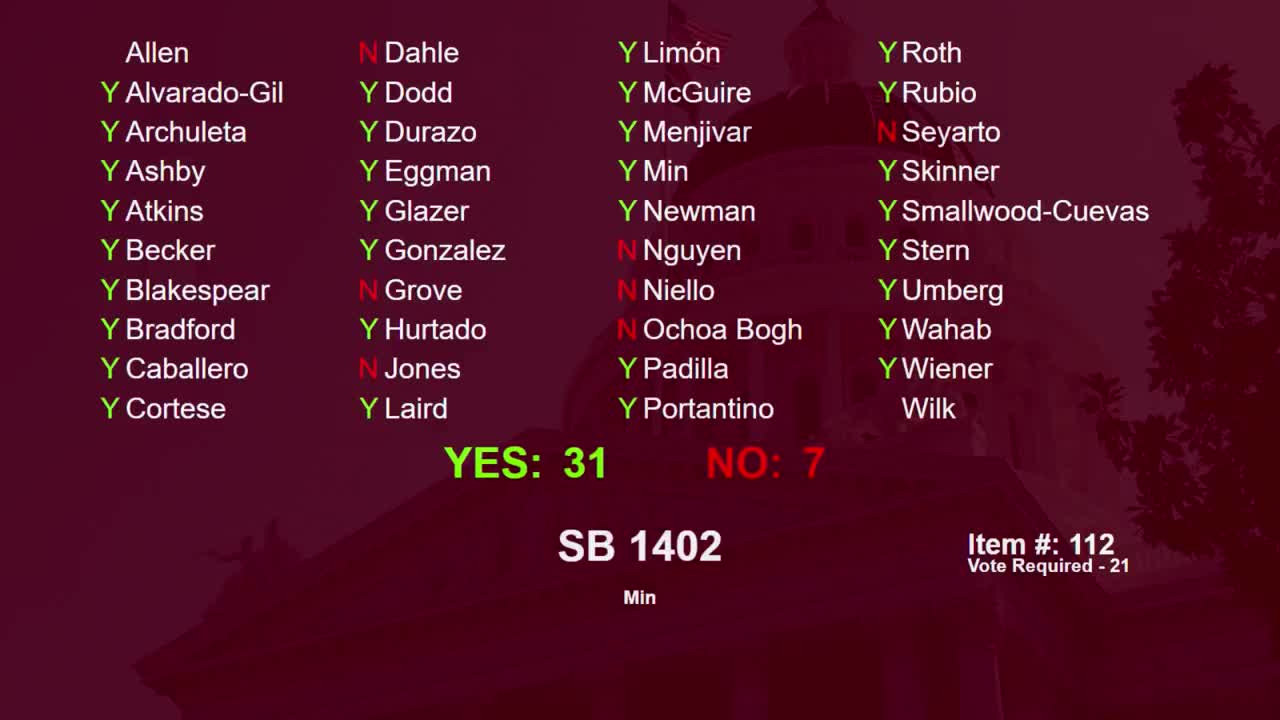 4MIN
Senate Floor
 8MIN
Senate Standing Committee on Judiciary
 48SEC
Senate Standing Committee on Judiciary
51SEC
Senate Standing Committee on Judiciary
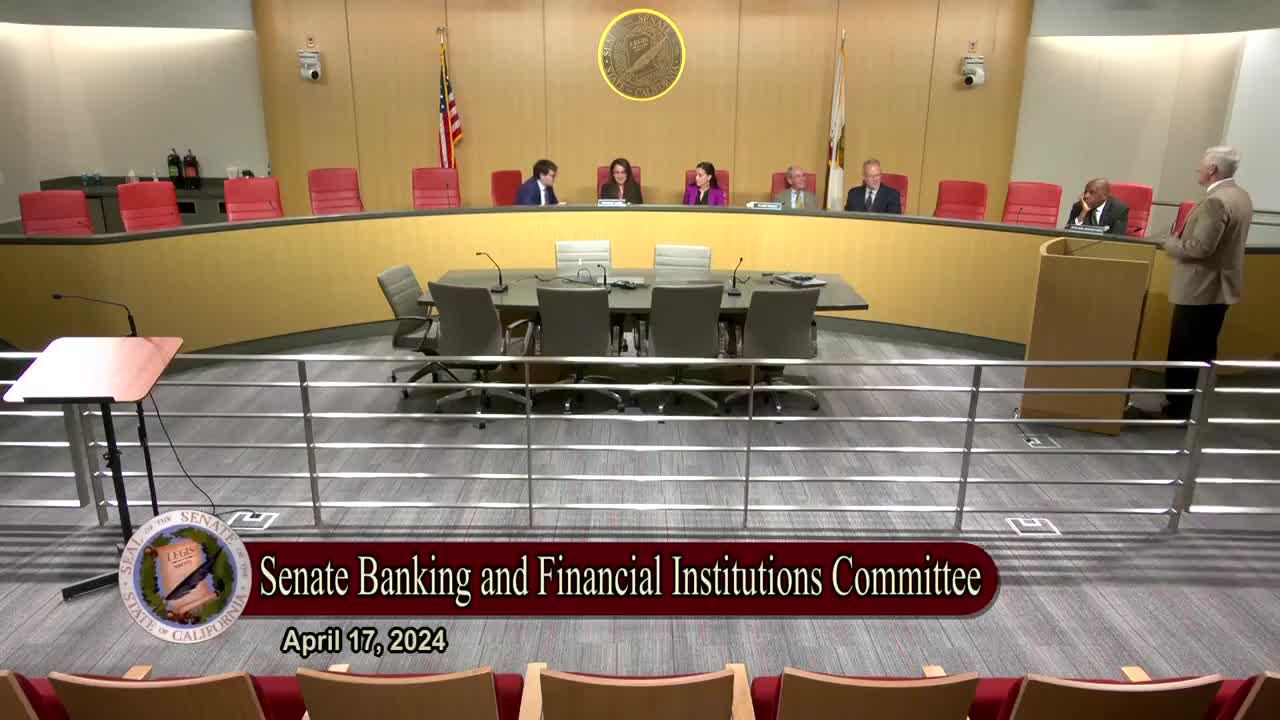 20MIN
Senate Standing Committee on Banking and Financial Institutions


Bill Co-Author(s):