SB 1497: Polluters Pay Climate Cost Recovery Act of 2024.
- Session Year: 2023-2024
- House: Senate
- Latest Version Date: 2024-04-25
Current Status:
Failed
(2024-05-22: Ordered to inactive file on request of Senator Menjivar.)
Introduced
In Committee
First Chamber
In Committee
Second Chamber
Enacted
The California Global Warming Solutions Act of 2006, until January 1, 2031, authorizes the State Air Resources Board to adopt a regulation establishing a system of market-based declining aggregate emissions limits for sources or categories of sources that emit greenhouse gases (market-based compliance mechanism) that meets certain requirements. Existing law establishes the Greenhouse Gas Reduction Fund and requires all moneys, except for fines and penalties, collected by the state board from the auction or sales of allowance as a part of a market-based compliance mechanism to be deposited into the fund and requires the Legislature to appropriate moneys in the fund for the purpose of reducing greenhouse gas emissions in the state, as provided.
Existing law, the California Climate Crisis Act, declares that it is the policy of the state both to achieve net-zero greenhouse gas emissions as soon as possible, but no later than 2045, and achieve and maintain net-negative greenhouse gas emissions thereafter, and to ensure that by 2045, statewide anthropogenic greenhouse gas emissions are reduced to at least 85% below the 1990 levels.
This bill would enact the Polluters Pay Climate Cost Recovery Act of 2024 and would establish the Polluters Pay Climate Cost Recovery Program to be administered by the California Environmental Protection Agency to require fossil fuel polluters to pay their fair share of the damage caused by the sale of their products during the covered period, which the bill would define as the time period between the 2000 and 2020 calendar years, inclusive, to relieve a portion of the burden from climate harms that is borne by California taxpayers. The bill would require the agency, within 90 days of the effective date of the act, to determine and publish a list of responsible parties, which the bill would define as an entity with a majority ownership interest in a business engaged in extracting or refining fossil fuel that, during the covered period, did business in the state or otherwise had sufficient contact with the state and is determined by the agency to be responsible for more than 1,000,000,000 metric tons of covered fossil fuel emissions, as defined, in aggregate, globally during the covered period.
This bill would require the agency, within one year of the effective date of the act, to conduct a climate cost study to, at a minimum, quantify the total damage amount, which the bill would define as all past and future climate harms and damages to the state through December 31, 2045. The bill would require the agency to update the climate cost study, not less frequently than every 2 years, through January 1, 2046. The bill would require the agency, within 60 days of the completion of the climate cost study, to determine and assess, as provided, a cost recovery demand for each responsible party listed, which represents the responsible partys proportionate share of the total damage amount that is fairly and reasonably attributable to the covered fossil fuel emissions of the responsible party. The bill would require responsible parties to pay their cost recovery demand, as provided. The bill would require the collected cost recovery demands to be deposited in the Polluters Pay Climate Fund, which the bill would create in the State Treasury. The bill would continuously appropriate moneys in the fund to the agency would, upon appropriation by the Legislature, require moneys in the fund be expended for, among other things, qualifying expenditures, which the bill would define as expenditures for projects and programs to mitigate, adapt, or respond to the damages and costs caused to the state from climate change, thereby making an appropriation. change. The bill would require the agency to determine the initial implementation costs for the act, as provided, and would require the agency to assess an amount allocated equitably among responsible parties to cover those costs.
This bill would declare that it is to take effect immediately as an urgency statute.
The California Global Warming Solutions Act of 2006, until January 1, 2031, authorizes the State Air Resources Board to adopt a regulation establishing a system of market-based declining aggregate emissions limits for sources or categories of sources that emit greenhouse gases (market-based compliance mechanism) that meets certain requirements. Existing law establishes the Greenhouse Gas Reduction Fund and requires all moneys, except for fines and penalties, collected by the state board from the auction or sales of allowance as a part of a market-based compliance mechanism to be deposited into the fund and requires the Legislature to appropriate moneys in the fund for the purpose of reducing greenhouse gas emissions in the state, as provided.
Existing law, the California Climate Crisis Act, declares that it is the policy of the state both to achieve net-zero greenhouse gas emissions as soon as possible, but no later than 2045, and achieve and maintain net-negative greenhouse gas emissions thereafter, and to ensure that by 2045, statewide anthropogenic greenhouse gas emissions are reduced to at least 85% below the 1990 levels.
This bill would state the intent of the Legislature to enact subsequent legislation relating to addressing the fossil fuel-driven climate crisis. enact the Polluters Pay Climate Cost Recovery Act of 2024 and would establish the Polluters Pay Climate Cost Recovery Program to be administered by the California Environmental Protection Agency to require fossil fuel polluters to pay their fair share of the damage caused by the sale of their products during the covered period, which the bill would define as the time period between the 2000 and 2020 calendar years, inclusive, to relieve a portion of the burden from climate harms that is borne by California taxpayers. The bill would require the agency, within 90 days of the effective date of the act, to determine and publish a list of responsible parties, which the bill would define as an entity that, during the covered period, did business in the state or otherwise had sufficient contact with the state and is determined by the agency to be responsible for more than 1,000,000,000 metric tons of covered fossil fuel emissions, as defined, in aggregate, globally during the covered period.
This bill would require the agency, within one year of the effective date of the act, to conduct a climate cost study to, at a minimum, quantify the total damage amount, which the bill would define as all past and future climate harms and damages to the state through December 31, 2045. The bill would require the agency to update the climate cost study, not less frequently than every 2 years, through January 1, 2046. The bill would require the agency, within 60 days of the completion of the climate cost study, to determine and assess, as provided, a cost recovery demand for each responsible party listed, which represents the responsible partys proportionate share of the total damage amount that is fairly and reasonably attributable to the covered fossil fuel emissions of the responsible party. The bill would require responsible parties to pay their cost recovery demand, as provided. The bill would require the collected cost recovery demands to be deposited in the Polluters Pay Climate Fund, which the bill would create in the State Treasury. The bill would continuously appropriate moneys in the fund to the agency for, among other things, qualifying expenditures, which the bill would define as expenditures for projects and programs to mitigate, adapt, or respond to the damages and costs caused to the state from climate change, thereby making an appropriation. The bill would require the agency to determine the initial implementation costs for the act, as provided, and would require the agency to assess an amount allocated equitably among responsible parties to cover those costs.
This bill would declare that it is to take effect immediately as an urgency statute.
Existing law, the California Climate Crisis Act, declares that it is the policy of the state both to achieve net-zero greenhouse gas emissions as soon as possible, but no later than 2045, and achieve and maintain net-negative greenhouse gas emissions thereafter, and to ensure that by 2045, statewide anthropogenic greenhouse gas emissions are reduced to at least 85% below the 1990 levels.
This bill would state the intent of the Legislature to enact subsequent legislation relating to addressing the fossil fuel-driven climate crisis.
This act shall be known, and may be cited, as the Polluters Pay Climate Cost Recovery Act of 2024.
SEC. 2.(a)The Legislature finds and declares all of the following:
(1)Climate change, resulting primarily from the combustion of fossil fuels, is an immediate and grave threat to the communities, environment, natural resources, and economy of the state.
(2)Severe consequences of climate change, including rising sea levels, increasing temperatures, extreme weather events, flooding, heat waves, loss of biodiversity, and other climate change-driven ecosystem threats, have already materialized and constitute an emergency for the state, which must now take urgent action to prevent further damage, protect communities, and transition to clean renewable energy.
(3)Californias most vulnerable populations, including low-income communities and communities of color, children, and the elderly, are disproportionately harmed by the climate emergency.
(4)The state must develop and implement protective measures to counteract the adverse effects of climate change.
(5)Protective measures necessary to mitigate the adverse effects of climate change and help expedite the transition away from fossil fuels will require significant new investment.
(6)Peer-reviewed research has determined with great accuracy the share of carbon dioxide and methane released into the atmosphere by the operations and products of specific fossil fuel companies.
(7)The fossil fuel industry should now contribute its fair share to government expenditures to protect the state from climate disaster.
(b)In enacting this act, it is not the intent of the Legislature to do either of the following:
(1)For this act to be a determination of fault.
(2)For this act to have any impact on the ability of any person or entity to hold polluters accountable for harms caused.
SEC. 3.Part 4.8 (commencing with Section 71370) is added to Division 34 of the Public Resources Code, to read:4.8.Polluters Pay Climate Cost Recovery Act of 20241.Definitions71370.For purposes of this part, the following definitions apply:
(a)Agency means the California Environmental Protection Agency.
(b)Annual payment date means the date, as determined by the agency, not later than September 30 of the calendar year, by which a responsible party is to pay its cost recovery demand.
(c)Climate cost study means a study conducted pursuant to Section 71371.3 to establish the quantifiable costs to the state from climate change.
(d)Cost recovery demand means a charge assessed against a responsible party for compensatory cost recovery payment, as determined pursuant to Section 71371.4.
(e)Covered fossil fuel emissions means the quantity of greenhouse gases released into the atmosphere during the covered period, expressed in metric tons of carbon dioxide equivalent, resulting from the extraction, production, refining, or sale sale, or combustion of fossil fuels or petroleum products.
(f)Covered period means the time period between January 1, 2000, and December 31, 2020, inclusive.
(g)Covered period damage amount means the portion of the total damage amount fairly and reasonably attributable to covered fossil fuel emissions, as determined by the agency pursuant to Section 71371.4.
(h)Fossil fuel means coal, crude oil, petroleum products, or fuel gases. gases, or their byproducts.
(i)Fuel gas includes, but is not limited to, methane, natural gas, liquefied natural gas, and manufactured fuel gas.
(j)Fund means the Polluters Pay Climate Fund established pursuant to Section 71372.
(k)Greenhouse gas means a chemical or physical substance that is emitted into the air and that the agency may reasonably anticipate is causing or contributing to climate change, including, but not limited to, carbon dioxide, methane, nitrous oxide, hydrofluorocarbons, perfluorocarbons, or sulfur hexafluoride. has the same meaning as set forth in Section 38505 of the Health and Safety Code.
(l)Notice of cost recovery demand means a written communication informing a responsible party of the amount of cost recovery demand payable to the fund.
(m)Petroleum products means a liquid hydrocarbon at atmospheric temperature and pressure that is the product of the fractionation, distillation, or other refining or processing of crude oil and that is used as, usable as, or may be refined as, a fuel or fuel blendstock, including, but not limited to, gasoline, diesel fuel, aviation fuel, bunker fuel, and renewable fuels containing more than 5 percent of petroleum products.
(n)Program means the Polluters Pay Climate Cost Recovery Program established pursuant to Section 71371.
(o)(1)Qualifying expenditures means expenditures for projects and programs to mitigate, adapt, or respond to the damages and costs caused to the state from climate change, as well as ongoing operation and maintenance for those projects or programs that satisfy the regulations adopted pursuant to Section 71373.1.
(2)Qualifying expenditures include all reasonable costs incurred by the agency and other public agencies for administering and implementing projects or programs financed by the fund.
(p)Responsible party means an entity, including, but not limited to, an individual, trustee, agent, partnership, association, corporation, or other legal organization that holds or held a majority ownership interest in a fossil fuel business during the covered period, or a successor in interest to the entity, that, during any part of the covered period, did business in the state or otherwise had sufficient contact with the state to satisfy the due process requirements of the United States Constitution and is determined by the agency to be responsible for more than one billion metric tons of covered fossil fuel emissions, in aggregate globally, during the covered period.(p)Responsible party means an entity, including, but not limited to, an individual, trustee, agent, partnership, association, corporation, or other legal organization, that satisfies all of the following conditions:
(1)The entity holds or held a majority ownership interest in a business engaged in extracting or refining fossil fuel during the covered period, or is a successor in interest to the entity.
(2)During any part of the covered period, the entity did business in the state or otherwise had sufficient contacts with the state to give the state jurisdiction over the entity pursuant to Section 410.10 of the Code of Civil Procedure.
(3)The agency determines that the entity is responsible for more than one billion metric tons of covered fossil fuel emissions, in aggregate globally, during the covered period.
(q)Total damage amount means the monetary amount determined by the agency in its climate cost study that quantifies all past and future climate harms and damages to the state through December 31, 2045.
2.Polluters Pay Climate Cost Recovery Program71371.(a)There is hereby established the Polluters Pay Climate Cost Recovery Program to be administered by the agency.
(b)The purpose of the program is to require fossil fuel polluters to pay their fair share of the damage caused by the sale of their products during the covered period, thereby relieving a portion of the burden from climate harms that is currently borne by California taxpayers.
71371.1.(a)A responsible party shall be liable for a cost recovery demand, as determined by the agency pursuant to Section 71371.4, as a compensatory payment to remedy damages to the state caused by the responsible partys covered fossil fuel emissions.
(b)Beginning January 1, 2025, a responsible party shall pay to the agency the cost recovery demand pursuant to Section 71371.4.
71371.2.Within 90 days of the effective date of this part, the agency shall determine and publish a list of responsible parties that are subject to this part on its internet website. The agency may update the list from time to time, as necessary.
71371.3.(a)Within one year of the effective date of this part, the agency shall conduct and submit to the Legislature a climate cost study to quantify the costs incurred by the state as a result of climate change. The climate cost study, at a minimum, shall include an assessment of the total damage amount. The climate cost study shall also include an assessment of potential qualifying expenditures to mitigate the effects of, or to adapt to, climate changes caused by covered fossil fuel emissions through December 31, 2045.
(b)The agency shall periodically update the climate cost study not less frequently than every two years, through January 1, 2046.
(c)The agency shall, in accordance with Section 9795 of the Government Code, submit to the Legislature the climate cost study and update.
71371.4.(a)Within 60 days of the completion of the climate cost study, the agency shall determine and assess a cost recovery demand for each responsible party listed pursuant to Section 71371.2 by doing all of the following:
(1)Quantify covered fossil fuel emissions attributable to each responsible party based on publicly reported data on the operations and production of the fossil fuel industry and the best available and most up-to-date United States Environmental Protection Agency emissions factors for greenhouse gas inventories.
(2)Establish the proportionate share percentage of each responsible party as equal to the ratio of the responsible partys covered fossil fuel emissions to all covered fossil fuel emissions.
(3)Determine the portion of the total damage amount, as determined by the climate cost study, that is fairly and reasonably allocated to the covered period. In making this determination, the agency shall consider the ratio of covered fossil fuel emissions to all anthropogenic emissions of greenhouse gases through December 31, 2020, using the best available science and methodology and considering shall consider other factors as may be necessary to determine a fair and reasonable allocation.
(4)Establish a cost recovery demand for each responsible party in an amount equal to the proportionate share percentage of the responsible party as determined pursuant to paragraph (2) multiplied by the amount as determined pursuant to paragraph (3).
(b)(1)Within 60 days of the completion of the initial climate cost study, the agency shall issue a written notice of cost recovery demand notifying each responsible party listed pursuant to Section 71371.2 of its cost recovery demand established pursuant to paragraph (4) of subdivision (a).
(2)Within 60 days of an update of the climate cost study, the agency shall update and adjust, as necessary, the quantification and determination made pursuant to subdivision (a).
(c)(1)The notice of cost recovery demand shall inform the responsible party of its obligation to remit the cost recovery demand, or any adjustment to the cost recovery demand, in full, on or before the annual payment date of the calendar year in which the notice is issued or the next calendar year if the notice if is issued after the annual payment date.
(2)(A)A responsible party may elect to pay its cost recovery demand in 20 installments by providing written notice of its election and submission of at least 10 percent of the cost recovery demand on or before the annual payment date of the calendar year in which the initial notice is issued, or the next calendar year if the notice is issued after the annual payment date. The remaining balance shall be paid in equal installments that are due on or before the annual payment date of each calendar year after the initial payment.
(B)If an update to the climate cost study results in an adjustment of that responsible partys cost recovery demand, the agency shall issue a revised written notice of cost recovery demand notifying the responsible party of the adjusted payment.
71371.5.(a)The agency shall establish procedures for an entity to challenge its designation as a responsible party or its cost recovery demand established pursuant to Section 71371.4.
(b)The agency shall adjust a responsible partys cost recovery demand if the responsible party establishes, to the satisfaction of the agency, that its covered fossil fuel emissions or a portion of those emissions, as determined by the agency, is attributable to another responsible party.
71371.6.The agency shall establish funding criteria and guidelines in accordance with the climate cost study for programs and projects to mitigate the effects of, or to adapt to, climate change that are eligible as qualifying expenditures for financial assistance from moneys collected pursuant to this chapter.
3.Polluters Pay Climate Fund71372.(a)There is hereby established the Polluters Pay Climate Fund in the State Treasury. Notwithstanding Section 13340 of the Government Code, moneys Moneys in the fund are hereby continuously appropriated to the agency shall, upon appropriation by the Legislature, be used to implement the program pursuant to Chapter 2 (commencing with Section 71371), including qualifying expenditures, and to reimburse any outstanding loans made from other funds used to finance the initial costs of the agencys activities in implementing this part. Moneys in the fund shall not be expended for any purposes not specified in this part.
(b)Moneys collected pursuant to Chapter 2 (commencing with Section 71371) or Chapter 4 (commencing with Section 71373) shall be deposited into the fund.
71372.1.Moneys in the fund shall be expended on qualifying expenditures in accordance with the findings of the climate cost study such that:
(a)Not less than 40 percent of the moneys are expended for projects and programs that directly benefit environmental justice populations, disadvantaged communities, as defined by the agency, facing climate impacts.
(b)Programs and projects funded by the fund include the assessment and implementation of strategies to increase employment opportunities and improve job quality.
(c)Programs and projects funded by the fund are designed to avoid, mitigate, repair, or adapt to negative impacts caused by climate change.
4.Miscellaneous Provisions71373.To facilitate the use of the best available science and data, in implementing this part, the agency shall conduct regular consultations with the State Air Resources Board, the State Water Resources Control Board, the Natural Resources Agency, the State Energy Resources Conservation and Development Commission, the Office of Emergency Services, the Strategic Growth Council, the State Department of Public Health, the Office of Environmental Health Hazard Assessment, and other appropriate public agencies and nongovernmental entities.
71373.1.(a)Within 180 days of the effective date of this part, the agency shall adopt all regulations, including those establishing requirements for projects and programs eligible for funding from the fund, necessary to carry out this part.
(b)The agency may prescribe, adopt, and enforce any emergency regulations as necessary to implement, administer, and enforce its duties under this part. Emergency regulations prescribed, adopted, or enforced pursuant to this part shall be adopted in accordance with Chapter 3.5 (commencing with Section 11340) of Part 1 of Division 3 of Title 2 of the Government Code, and, for purposes of that chapter, including Section 11349.6 of the Government Code, the adoption of the regulation is an emergency and shall be considered by the Office of Administrative Law as necessary for the immediate preservation of the public peace, health and safety, and general welfare. Notwithstanding any other law, the emergency regulations adopted by the California Environmental Protection Agency may remain in effect for two years from adoption.
71373.2.(a)Within 120 days of the effective date of this part, the agency shall determine the initial implementation costs, including the costs of the initial climate cost study, the development and adoption of regulations to implement this part, and other appropriate initial program implementation costs.
(b)The agency shall assess the amount determined pursuant to subdivision (a) equitably among entities listed as responsible parties pursuant to Section 71371.2.
(c)Within 180 days of the effective date of this part, each responsible party shall remit the assessment determined pursuant to subdivision (b) to the agency for deposit into the fund.
71373.3.The agency and the Attorney General shall have the authority to enforce the requirements of this part and to assess penalties for late payment of the cost recovery demands pursuant to Chapter 2 (commencing with Section 71371) or the assessment required under Section 71373.2. The late penalty shall accrue daily, assessed at the rate of 10 percent per annum on the amount remaining due.
71373.4.(a)This part does not do either of the following:
(1)Relieve the liability of an entity for damages resulting from climate change, as provided by law.
(2)Preempt, displace, or restrict any rights or remedy remedies of a person, the state, units of local government, or tribal government under law relating to a past, present, or future allegation of any of the following:
(A)Deception concerning the effects of fossil fuels on climate change.
(B)Damage or injury resulting from the role of fossil fuels in contributing to climate change.
(C)Failure to avoid damage or injury related to climate change, including claims for nuisance, trespass, design defect, negligence, failure to warn, or deceptive or unfair practices and claims for injunctive, declaratory, monetary, or other relief.
(b)This part does not preempt or supersede any state law or local ordinances, regulations, policies, or programs ordinance, regulation, policy, or program that does any of the following:
(1)Limit, set, or enforce standards for emissions of greenhouse gases.
(2)Monitor, report, or keep records of emissions of greenhouse gases.
(3)Collect revenue through fees or levy taxes.
(4)Conduct or support investigations.
71374.The provisions of this part are severable. If any provision of this part or its application is held invalid, that invalidity shall not affect other provisions or applications that can be given effect without the invalid provision or application.
SEC. 4.This act is an urgency statute necessary for the immediate preservation of the public peace, health, or safety within the meaning of Article IV of the California Constitution and shall go into immediate effect. The facts constituting the necessity are:
To fund and implement measures to address the immediate and ongoing threats to the public safety, health, and welfare of the people and environment of the State of California from climate change, it is necessary for this act to take effect immediately.
This act shall be known, and may be cited, as the Polluters Pay Climate Cost Recovery Act of 2024.
SEC. 2.(a)The Legislature finds and declares all of the following:
(1)Climate change, resulting primarily from the combustion of fossil fuels, is an immediate and grave threat to the communities, environment, natural resources, and economy of the state.
(2)Severe consequences of climate change, including rising sea levels, increasing temperatures, extreme weather events, flooding, heat waves, loss of biodiversity, and other climate change-driven ecosystem threats, have already materialized and constitute an emergency for the state, which must now take urgent action to prevent further damage, protect communities, and transition to clean renewable energy.
(3)Californias most vulnerable populations, including low-income communities and communities of color, children, and the elderly, are disproportionately harmed by the climate emergency.
(4)The state must develop and implement protective measures to counteract the adverse effects of climate change.
(5)Protective measures necessary to mitigate the adverse effects of climate change and help expedite the transition away from fossil fuels will require significant new investment.
(6)Peer-reviewed research has determined with great accuracy the share of carbon dioxide and methane released into the atmosphere by the operations and products of specific fossil fuel companies.
(7)The fossil fuel industry should now contribute its fair share to government expenditures to protect the state from climate disaster.
(b)In enacting this act, it is not the intent of the Legislature to do either of the following:
(1)For this act to be a determination of fault.
(2)For this act to have any impact on the ability of any person or entity to hold polluters accountable for harms caused.
SEC. 3.Part 4.8 (commencing with Section 71370) is added to Division 34 of the Public Resources Code, to read:4.8.Polluters Pay Climate Cost Recovery Act of 20241.Definitions71370.For purposes of this part, the following definitions apply:
(a)Agency means the California Environmental Protection Agency.
(b)Annual payment date means the date, as determined by the agency, not later than September 30 of the calendar year, by which a responsible party is to pay its cost recovery demand.
(c)Climate cost study means a study conducted pursuant to Section 71371.3 to establish the quantifiable costs to the state from climate change.
(d)Cost recovery demand means a charge assessed against a responsible party for compensatory cost recovery payment, as determined pursuant to Section 71371.4.
(e)Covered fossil fuel emissions means the quantity of greenhouse gases released into the atmosphere during the covered period, expressed in metric tons of carbon dioxide equivalent, resulting from the extraction, production, refining, or sale of fossil fuels or petroleum products.
(f)Covered period means the time period between January 1, 2000, and December 31, 2020, inclusive.
(g)Covered period damage amount means the portion of the total damage amount fairly and reasonably attributable to covered fossil fuel emissions, as determined by the agency pursuant to Section 71371.4.
(h)Fossil fuel means coal, crude oil, petroleum products, or fuel gases.
(i)Fuel gas includes, but is not limited to, methane, natural gas, liquefied natural gas, and manufactured fuel gas.
(j)Fund means the Polluters Pay Climate Fund established pursuant to Section 71372.
(k)Greenhouse gas means a chemical or physical substance that is emitted into the air and that the agency may reasonably anticipate is causing or contributing to climate change, including, but not limited to, carbon dioxide, methane, nitrous oxide, hydrofluorocarbons, perfluorocarbons, or sulfur hexafluoride.
(l)Notice of cost recovery demand means a written communication informing a responsible party of the amount of cost recovery demand payable to the fund.
(m)Petroleum products means a liquid hydrocarbon at atmospheric temperature and pressure that is the product of the fractionation, distillation, or other refining or processing of crude oil and that is used as, usable as, or may be refined as, a fuel or fuel blendstock, including, but not limited to, gasoline, diesel fuel, aviation fuel, bunker fuel, and renewable fuels containing more than 5 percent of petroleum products.
(n)Program means the Polluters Pay Climate Cost Recovery Program established pursuant to Section 71371.
(o)(1)Qualifying expenditures means expenditures for projects and programs to mitigate, adapt, or respond to the damages and costs caused to the state from climate change, as well as ongoing operation and maintenance for those projects or programs that satisfy the regulations adopted pursuant to Section 71373.1.
(2)Qualifying expenditures include all reasonable costs incurred by the agency and other public agencies for administering and implementing projects or programs financed by the fund.
(p)Responsible party means an entity, including, but not limited to, an individual, trustee, agent, partnership, association, corporation, or other legal organization that holds or held a majority ownership interest in a fossil fuel business during the covered period, or a successor in interest to the entity, that, during any part of the covered period, did business in the state or otherwise had sufficient contact with the state to satisfy the due process requirements of the United States Constitution and is determined by the agency to be responsible for more than one billion metric tons of covered fossil fuel emissions, in aggregate globally, during the covered period.
(q)Total damage amount means the monetary amount determined by the agency in its climate cost study that quantifies all past and future climate harms and damages to the state through December 31, 2045.
2.Polluters Pay Climate Cost Recovery Program71371.(a)There is hereby established the Polluters Pay Climate Cost Recovery Program to be administered by the agency.
(b)The purpose of the program is to require fossil fuel polluters to pay their fair share of the damage caused by the sale of their products during the covered period, thereby relieving a portion of the burden from climate harms that is currently borne by California taxpayers.
71371.1.(a)A responsible party shall be liable for a cost recovery demand, as determined by the agency pursuant to Section 71371.4, as a compensatory payment to remedy damages to the state caused by the responsible partys covered fossil fuel emissions.
(b)Beginning January 1, 2025, a responsible party shall pay to the agency the cost recovery demand pursuant to Section 71371.4.
71371.2.Within 90 days of the effective date of this part, the agency shall determine and publish a list of responsible parties that are subject to this part on its internet website. The agency may update the list from time to time, as necessary.
71371.3.(a)Within one year of the effective date of this part, the agency shall conduct and submit to the Legislature a climate cost study to quantify the costs incurred by the state as a result of climate change. The climate cost study, at a minimum, shall include an assessment of the total damage amount.
(b)The agency shall periodically update the climate cost study not less frequently than every two years, through January 1, 2046.
(c)The agency shall, in accordance with Section 9795 of the Government Code, submit to the Legislature the climate cost study and update.
71371.4.(a)Within 60 days of the completion of the climate cost study, the agency shall determine and assess a cost recovery demand for each responsible party listed pursuant to Section 71371.2 by doing all of the following:
(1)Quantify covered fossil fuel emissions attributable to each responsible party based on publicly reported data on the operations and production of the fossil fuel industry and the best available and most up-to-date United States Environmental Protection Agency emissions factors for greenhouse gas inventories.
(2)Establish the proportionate share percentage of each responsible party as equal to the ratio of the responsible partys covered fossil fuel emissions to all covered fossil fuel emissions.
(3)Determine the portion of the total damage amount, as determined by the climate cost study, that is fairly and reasonably allocated to the covered period. In making this determination, the agency shall consider the ratio of covered fossil fuel emissions to all anthropogenic emissions of greenhouse gases through December 31, 2020, using the best available science and methodology and considering other factors as may be necessary to determine a fair and reasonable allocation.
(4)Establish a cost recovery demand for each responsible party in an amount equal to the proportionate share percentage of the responsible party as determined pursuant to paragraph (2) multiplied by the amount as determined pursuant to paragraph (3).
(b)(1)Within 60 days of the completion of the initial climate cost study, the agency shall issue a written notice of cost recovery demand notifying each responsible party listed pursuant to Section 71371.2 of its cost recovery demand established pursuant to paragraph (4) of subdivision (a).
(2)Within 60 days of an update of the climate cost study, the agency shall update and adjust, as necessary, the quantification and determination made pursuant to subdivision (a).
(c)(1)The notice of cost recovery demand shall inform the responsible party of its obligation to remit the cost recovery demand, or any adjustment to the cost recovery demand, in full, on or before the annual payment date of the calendar year in which the notice is issued or the next calendar year if the notice if issued after the annual payment date.
(2)(A)A responsible party may elect to pay its cost recovery demand in 20 installments by providing written notice of its election and submission of at least 10 percent of the cost recovery demand on or before the annual payment date of the calendar year in which the initial notice is issued, or the next calendar year if the notice is issued after the annual payment date. The remaining balance shall be paid in equal installments that are due on or before the annual payment date of each calendar year after the initial payment.
(B)If an update to the climate cost study results in an adjustment of that responsible partys cost recovery demand, the agency shall issue a revised written notice of cost recovery demand notifying the responsible party of the adjusted payment.
71371.5.(a)The agency shall establish procedures for an entity to challenge its designation as a responsible party or its cost recovery demand established pursuant to Section 71371.4.
(b)The agency shall adjust a responsible partys cost recovery demand if the responsible party establishes, to the satisfaction of the agency, that its covered fossil fuel emissions or a portion of those emissions, as determined by the agency, is attributable to another responsible party.
71371.6.The agency shall establish funding criteria and guidelines for programs and projects to mitigate the effects of, or to adapt to, climate change that are eligible as qualifying expenditures for financial assistance from moneys collected pursuant to this chapter.
3.Polluters Pay Climate Fund71372.(a)There is hereby established the Polluters Pay Climate Fund in the State Treasury. Notwithstanding Section 13340 of the Government Code, moneys in the fund are hereby continuously appropriated to the agency to implement the program pursuant to Chapter 2 (commencing with Section 71371), including qualifying expenditures, and to reimburse any outstanding loans made from other funds used to finance the initial costs of the agencys activities in implementing this part. Moneys in the fund shall not be expended for any purposes not specified in this part.
(b)Moneys collected pursuant to Chapter 2 (commencing with Section 71371) or Chapter 4 (commencing with Section 71373) shall be deposited into the fund.
71372.1.Moneys in fund shall be expended such that:
(a)Not less than 40 percent of the moneys are expended for projects and programs that directly benefit environmental justice populations, as defined by the agency, facing climate impacts.
(b)Programs and projects funded by the fund include the assessment and implementation of strategies to increase employment opportunities and improve job quality.
4.Miscellaneous Provisions71373.To facilitate the use of the best available science and data, in implementing this part, the agency shall conduct regular consultations with the State Air Resources Board, the State Water Resources Control Board, the Natural Resources Agency, the State Energy Resources Conservation and Development Commission, the Office of Emergency Services, the Strategic Growth Council, the State Department of Public Health, the Office of Environmental Health Hazard Assessment, and other appropriate public agencies and nongovernmental entities.
71373.1.(a)Within 180 days of the effective date of this part, the agency shall adopt all regulations, including those establishing requirements for projects and programs eligible for funding from the fund, necessary to carry out this part.
(b)The agency may prescribe, adopt, and enforce any emergency regulations as necessary to implement, administer, and enforce its duties under this part. Emergency regulations prescribed, adopted, or enforced pursuant to this part shall be adopted in accordance with Chapter 3.5 (commencing with Section 11340) of Part 1 of Division 3 of Title 2 of the Government Code, and, for purposes of that chapter, including Section 11349.6 of the Government Code, the adoption of the regulation is an emergency and shall be considered by the Office of Administrative Law as necessary for the immediate preservation of the public peace, health and safety, and general welfare. Notwithstanding any other law, the emergency regulations adopted by the California Environmental Protection Agency may remain in effect for two years from adoption.
71373.2.(a)Within 120 days of the effective date of this part, the agency shall determine the initial implementation costs, including the costs of the initial climate cost study, the development and adoption of regulations to implement this part, and other appropriate initial program implementation costs.
(b)The agency shall assess the amount determined pursuant to subdivision (a) equitably among entities listed as responsible parties pursuant to Section 71371.2.
(c)Within 180 days of the effective date of this part, each responsible party shall remit the assessment determined pursuant to subdivision (b) to the agency for deposit into the fund.
71373.3.The agency and the Attorney General shall have the authority to enforce the requirements of this part and to assess penalties for late payment of the cost recovery demands pursuant to Chapter 2 (commencing with Section 71371) or the assessment required under Section 71373.2. The late penalty shall accrue daily, assessed at the rate of 10 percent per annum on the amount remaining due.
71373.4.(a)This part does not do either of the following:
(1)Relieve the liability of an entity for damages resulting from climate change, as provided by law.
(2)Preempt, displace, or restrict any rights or remedy of a person, the state, units of local government, or tribal government under law relating to a past, present, or future allegation of any of the following:
(A)Deception concerning the effects of fossil fuels on climate change.
(B)Damage or injury resulting from the role of fossil fuels in contributing to climate change.
(C)Failure to avoid damage or injury related to climate change, including claims for nuisance, trespass, design defect, negligence, failure to warn, or deceptive or unfair practices and claims for injunctive, declaratory, monetary, or other relief.
(b)This part does not preempt or supersede any state law or local ordinances, regulations, policies, or programs that does any of the following:
(1)Limit, set, or enforce standards for emissions of greenhouse gases.
(2)Monitor, report, or keep records of emissions of greenhouse gases.
(3)Collect revenue through fees or levy taxes.
(4)Conduct or support investigations.
71374.The provisions of this part are severable. If any provision of this part or its application is held invalid, that invalidity shall not affect other provisions or applications that can be given effect without the invalid provision or application.
SEC. 4.This act is an urgency statute necessary for the immediate preservation of the public peace, health, or safety within the meaning of Article IV of the California Constitution and shall go into immediate effect. The facts constituting the necessity are:
To fund and implement measures to address the immediate and ongoing threats to the public safety, health, and welfare of the people and environment of the State of California from climate change, it is necessary for this act to take effect immediately.
SECTION 1.It is the intent of the Legislature to enact subsequent legislation relating to addressing the fossil fuel-driven climate crisis.It is the intent of the Legislature to enact subsequent legislation relating to addressing the fossil fuel-driven climate crisis.
|
Date
|
Status
|
|---|---|
| May 22, 2024 | Ordered to inactive file on request of Senator Menjivar. |
| May 16, 2024 | Read second time. Ordered to third reading. |
| May 16, 2024 | From committee: Do pass. (Ayes 5. Noes 2. Page 3985.) (May 16). |
| May 14, 2024 | Set for hearing May 16. |
| May 13, 2024 | May 13 hearing: Placed on APPR suspense file. |
| May 3, 2024 | Set for hearing May 13. |
| Apr 25, 2024 | Read second time and amended. Re-referred to Com. on APPR. |
| Apr 24, 2024 | From committee: Do pass as amended and re-refer to Com. on APPR. (Ayes 7. Noes 2. Page 3727.) (April 23). |
| Apr 17, 2024 | From committee: Do pass and re-refer to Com. on JUD. (Ayes 5. Noes 2. Page 3661.) (April 17). Re-referred to Com. on JUD. |
| Apr 9, 2024 | Set for hearing April 23 in JUD. pending receipt. |
| Apr 5, 2024 | Set for hearing April 17. |
| Apr 3, 2024 | Re-referred to Coms. on E.Q. and JUD. |
| Mar 20, 2024 | From committee with author's amendments. Read second time and amended. Re-referred to Com. on RLS. |
| Feb 29, 2024 | Referred to Com. on RLS. |
| Feb 20, 2024 | From printer. May be acted upon on or after March 18. |
| Feb 16, 2024 | Introduced. Read first time. To Com. on RLS. for assignment. To print. |
|
Date
|
Description
|
Location
|
Votes
|
|
|---|---|---|---|---|
| May 16, 2024 | Do pass | Senate Standing Committee on Appropriations |
Passed |
|
| May 13, 2024 | Placed on suspense file | Senate Standing Committee on Appropriations |
Passed |
|
| Apr 23, 2024 | Do pass as amended, but first amend, and re-refer to the Committee on [Appropriations] | Senate Standing Committee on Judiciary |
Passed |
|
| Apr 17, 2024 | Do pass, but first be re-referred to the Committee on [Judiciary] | Senate Standing Committee on Environmental Quality |
Passed |
This list shows positions taken on this bill by organizations on the date displayed, which is linked to the original source.
Positions by individuals are not included.
|
Organization
|
Position
|
Date
|
|---|---|---|
| 1000 Grandmothers for Future Generations | ** Support | |
| 350 Bay Area Action | ** Support | |
| 350 Conejo / San Fernando Valley | ** Support | |
| 350 Sacramento | ** Support | |
| 350 Ventura County Climate Hub | ** Support | |
| Acterra: Action for A Healthy Planet | ** Support | |
| Active San Gabriel Valley | ** Support | |
| Alameda County Democratic Central Committee | ** Support | |
| Alliance of Nurses for Healthy Environments | ** Support | |
| Asian Pacific Environmental Network | ** Support | |
| Azul | ** Support | |
| Bay Area-System Change Not Climate Change | ** Support | |
| Benicians for a Safe and Healthy Community | ** Support | |
| Breast Cancer Action | ** Support | |
| California Business Properties Association | ** Against | |
| California Cement Manufacturers Environmental Coalition | ** Against | |
| California Chamber Of Commerce | ** Against | |
| California Climate Voters | ** Support | |
| California Environmental Justice Alliance Action | ** Support | |
| California Environmental Voters | ** Support | |
| California Fuels And Convenience Alliance | ** Against | |
| California Independent Petroleum Association | ** Against | |
| California League of Food Producers | ** Against | |
| California Nurses for Environmental Health and Justice | ** Support | |
| California Sustainable Cement Manufacturing & Environment | ** Against | |
| California Taxpayers Association | ** Against | |
| California Youth Versus Big Oil | ** Support | |
| Center For Biological Diversity | ** Support | |
| Center for Climate Change and Health | ** Support | |
| Center for Community Action and Environmental Justice | ** Support | |
| Center on Race, Poverty, & the Environment | ** Support | |
| Central California Asthma Collaborative | ** Support | |
| Central California Environmental Justice Network | ** Support | |
| Central Coast Environmental Voters | ** Support | |
| Central Valley Air Quality Coalition | ** Support | |
| CERBAT | ** Support | |
| Citizens' Climate Lobby Santa Cruz | ** Support | |
| City of Encinitas | ** Support | |
| cleanearth4kids.org | ** Support | |
| Climate Action California | ** Support | |
| Climate Brunch | ** Support | |
| Climate First: Replacing Oil & Gas | ** Support | |
| Climate Hawks Vote | ** Support | |
| Climate Health Now | ** Support | |
| Climate Reality Project, California Coalition | ** Support | |
| Climate Reality Project, Los Angeles Chapter | ** Support | |
| Climate Reality Project, Monterey Bay Chapter | ** Support | |
| Climate Reality Project: San Fernando Valley Chapter | ** Support | |
| Coalition For Clean Air | ** Support | |
| Communities for a Better Environment | ** Support | |
| Community Environmental Council | ** Support | |
| Community Water Center | ** Support | |
| Consumer Watchdog | ** Support | |
| Corporate Ethics International | ** Support | |
| Courage California | ** Support | |
| Earthworks | ** Support | |
| EcoEquity | ** Support | |
| Elders Climate Action, Northern California Chapter | ** Support | |
| Elders Climate Action, Southern California Chapter | ** Support | |
| Elected Officials to Protect America Code Blue | ** Support | |
| Endangered Habitats League | ** Support | |
| Environmental Protection Information Center | ** Support | |
| Environmental Working Group | ** Support | |
| Families Advocating for Chemical and Toxics Safety | ** Support | |
| Food & Water Watch | ** Support | |
| Fossil Free California | ** Support | |
| Fractracker | ** Support | |
| Friends Of The Earth | ** Support | |
| Glendale Environmental Coalition | ** Support | |
| Good Neighbor Steering Committee of Benicia | ** Support | |
| Greenpeace Usa | ** Support | |
| Human Impact Partners | ** Support | |
| Indivisible Marin | ** Support | |
| International Brotherhood of Boilermakers | ** Against | |
| International Brotherhood of Boilermakers, Iron Ship Builders, Blacksmiths, Forgers and Helpers | ** Against | |
| International Brotherhood Of Boilermakers Western States Section | ** Against | |
| Labor Rise Climate Jobs Action | ** Support | |
| Lutheran Office Of Public Policy - California | ** Support | |
| Mothers Out Front | ** Support | |
| NAIOP of California | ** Against | |
| NAOIP of California | ** Against | |
| Natural Resources Defense Council | ** Support | |
| NextGen California | ** Support | |
| Northern California Elders Climate Action | ** Support | |
| Northridge Indivisible | ** Support | |
| Oil Change International | ** Support | |
| Oil & Gas Action Network | ** Support | |
| Pacific Environment | ** Support | |
| Pelican Media | ** Support | |
| Physicians for Social Responsibility, Los Angeles | ** Support | |
| Physicians for Social Responsibility - Sacramento Chapter | ** Support | |
| Presente.org | ** Support | |
| Protect Playa Now! | ** Support | |
| Redeemer Community Partnership | ** Support | |
| Rising Sun Center for Opportunity | ** Support | |
| RootsAction.org | ** Support | |
| San Francisco Baykeeper | ** Support | |
| San Francisco Bay Physicians for Social Responsibility | ** Support | |
| San Joaquin Valley Democratic Club | ** Support | |
| Santa Barbara Standing Rock Coalition | ** Support | |
| Santa Cruz Climate Action Network | ** Support | |
| sequoia forestkeeper | ** Support | |
| Sierra Club California | ** Support | |
| Stand.earth | ** Support | |
| State Building & Construction Trades Council Of California | ** Against | |
| Strategic Concepts in Organizing and Policy Education | ** Support | |
| Sunflower Alliance | ** Support | |
| Sustainable Mill Valley | ** Support | |
| The Climate Center | ** Support | |
| Union Of Concerned Scientists | ** Support | |
| Voices for Progress | ** Support | |
| Vote Solar | ** Support | |
| West Berkeley Alliance for Clean Air and Safe Jobs | ** Support | |
| West LA Democratic Club | ** Support | |
| Youth for Earth | ** Support | |
| Youth Vs. Oil | ** Support |
SENATE RULES COMMITTEE Office of Senate Floor Analyses (916) 651-1520 Fax: (916) 327-4478 | SB 1497 |
THIRD READING
Bill No: SB 1497
Author: Menjivar (D), et al.
Amended: 4/25/24
Vote: 27 - Urgency
SENATE ENVIRONMENTAL QUALITY COMMITTEE: 5-2, 4/17/24
AYES: Allen, Archuleta, Gonzalez, Menjivar, Skinner
NOES: Dahle, Nguyen
SENATE JUDICIARY COMMITTEE: 7-2, 4/23/24
AYES: Umberg, Allen, Ashby, Durazo, Gonzalez, Laird, Wahab
NOES: Wilk, Niello
NO VOTE RECORDED: Caballero, Min
SUBJECT: Polluters Pay Climate Cost Recovery Act of 2024
SOURCE: Center for Biological Diversity
DIGEST:
This bill requires certain fossil fuel companies to pay for the costs that California has or will incur as a result of climate change, as specified.
ANALYSIS:
Existing law:
- Requires the California Air Resources Board (CARB) to approve a statewide greenhouse gas (GHG) emissions limit equivalent to the statewide GHG emissions level in 1990 to be achieved by 2020 (AB 32, 2006) and to ensure that statewide GHGs are reduced to at least 40% below the 1990 level by 2030 (SB 32, 2016).
- States, under the California Climate Crisis Act—AB 1279 (Muratsuchi, Chapter 337, Statutes of 2022), that it is the policy of the state to achieve net zero GHG emissions no later than 2045, and to ensure that by 2045 statewide GHG emissions are reduced to at least 85% below the 1990 level.
This bill:
- Defines pertinent terms for the purposes of the Act, including but not limited to: “Climate cost study,” “Covered fossil fuel emissions,” “Covered period damage amount,” “Responsible party,” and “Total damage amount.”
- Establishes the Polluters Pay Climate Cost Recovery Program (“Program”) to be administered by CalEPA.
- States that a responsible party shall be liable for a cost recovery demand to remedy damages caused to the state by their fossil fuel emissions 2000-2020, and begin paying the cost recovery demand beginning January 1, 2025.
- Requires CalEPA to, among other things:
- Determine and publish a list of responsible parties.
- Complete a climate cost study, as specified, to quantify the costs incurred by the state as a result of climate change, including but not limited to a determination of the total damage amount.
- Within 60 days of the completion of the cost study, determine and assess a cost recovery demand for each responsible party, as specified.
- Establishes the Polluters Pay Climate Fund (“Fund”) to be appropriated annually by the Legislature to implement the Program, including but not limited to, funding qualifying expenditures, and reimbursing any outstanding loans used to finance the initial costs of implementing the Program.
- Includes a number of other miscellaneous provisions regarding agency consultations, severability, cost recovery allocations, and other considerations.
Background
- Climate change in California. California is already experiencing the harmful effects of climate change, including an increase in extreme heat events, drought, floods, wildfire, sea level rise, and more. According to the most recent California Climate Change Assessment, by 2100, the average annual maximum daily temperature is projected to increase by 3.1 - 4.9°C (5.6 - 8.8°F), water supply from snowpack is projected to decline by two-thirds, the average area burned in wildfires could increase by 77%, and 31-67% of Southern California beaches may completely erode without large-scale human intervention, all under business-as-usual and moderate GHG reduction pathways.
- The cost of climate change. The consequences of climate change come with a huge price tag that is only increasing. In 2020, wildfires in California amounted to economic losses of over $19 billion. In 2018, a record-setting year for fire-related economic losses, some estimates place than number as high as $148.5 billion considering indirect effects such as health impacts.
On sea level rise, recent study by researchers from the U.S. Geological Survey (USGS) estimated that by 2100, roughly six feet of SLR and recurring annual storms could impact over 480,000 California residents (based on 2010 census data) and $119 billion in property value (in 2010 dollars). When adding the potential impacts of a 100-year storm, these estimates increase to 600,000 people and over $150 billion of property value.
Professor Kevin Anderson, a British petrochemical engineer turned climate scientist, is attributed for this description of potential outlooks: “We face an unavoidably radical future. We either continue with rising emissions and reap the radical repercussions of severe climate change, or we acknowledge that we no longer have a choice and pursue radical emission reductions: no longer is there a non-radical option.” - The “Carbon Majors” report. First published in 2014, the Carbon Majors report describes the GHG contributions attributable to major fossil fuel companies. Using publicly available fossil fuel production data, the report provides a comprehensive description of which companies’ actions led to what share of the total contribution of anthropogenic GHGs to the atmosphere. The author erred towards making conservative assumptions in cases of uncertainty.
Ultimately, the report found that just 90 fossil fuel-producing entities (the so-called “carbon majors”) were responsible for 63.4% of global industrial GHG emissions between 1751 and 2010. It merits clarification that those 90 companies did not directly burn the fuels that led to those emissions; the majority are from end users who purchased resources from the carbon majors. - Attribution science: linking emissions and disasters. Today, as extreme weather events happen more frequently, people are routinely asking if they are caused by climate change. Developments in recent years in a new type of research called attribution science can determine not if climate change caused an event, but if climate change made some extreme events more severe and more likely to occur, and if so, by how much. There have always been extreme weather events caused by numerous natural factors, but climate change is increasing the number and strength of these events. Now, it is possible to quantify climate change’s relative influence more precisely, even if it does not cause the event per se.
As an example, if the extreme event occurs twice as often in today’s climate model as it does in the counterfactual climate model, then climate change is determined to have made the event twice as likely as it would otherwise have been in a world without human-induced emissions. Such claims have become a hallmark of climate journalism in recent years. - Other proposed Climate Superfunds. This legislation is one of several recent efforts that have been undertaken to follow the Superfund model for collecting climate damage payments from fossil fuel companies. A federal effort was started in the U.S. Senate in 2021. Two years ago, New York became the first state to propose their own approach. Since then, Massachusetts, Vermont, and Maryland have introduced their own measures as well. While none of these efforts have been signed into law, the bill before the committee is not the first (nor likely to be the last) bill that attempts to codify recompense from fossil fuel companies to cover the cost of climate damages. As of writing, the Vermont Climate Superfund bill passed their state legislature; it is currently awaiting the governor’s final action.
Comments
- Purpose of Bill. According to the author, “Fossil fuels account for nearly 90% of all CO2 emissions and 75% of global GHG emissions. Published, peer-reviewed research of polluters’ own self-reported data demonstrates that about 2/3 of human-caused CO2 and methane emissions were caused by the world’s 90 largest fossil fuel emitters. These polluters have profited by producing and selling fossil fuels while externalizing their pollution costs upon California families who have paid the price for the damage their products caused.
“Californians face billions in climate crisis-related costs in the years ahead. The 2021-22 budget alone included $9.3B for climate-related responses. A comprehensive study is needed to quantify the staggering burden fossil fuel polluters have imposed on the public. Polluters must share in that burden and pay for the damages their pollution has caused. As the state faces a multibillion-dollar deficit and possible cuts to critical climate programs, this action is just, timely, and necessary to keep the state on track to meet climate targets and protect our communities against the ravages of the climate crisis. SB 1497 establishes a program in CalEPA to assess fees on the largest fossil fuel polluters in the state, to pay their fair share of the damage their products have inflicted on California. The assessments would initially pay for a cost study to quantify climate impacts to the state, and then to help pay for the damages. Without this bill, California taxpayers will continue to pay for climate damages that should be borne by the polluters who raked in massive profits by causing them.” - Who pays for California’s climate damages? With or without this bill, the costs of climate disaster recovery, adaptation, and mitigation will climb and must be paid. This bill prompts members of the Legislature to answer the question, “Paid by whom?” SB 1497 asserts that the most appropriate payers for these damages are those who profited the most by selling fossil fuels. Otherwise, the state will likely be left footing the bill and in turn the Californian taxpayers.
Some facts about the situation are incontrovertible. Fossil fuels have been extracted, processed, sold, and burned. GHGs have been released into the atmosphere. Their impact on the atmosphere has led to (and is projected to lead to even more) massive, costly, deadly damages. From these facts, a tough question emerges; should those costs be borne by the companies most directly implicated in the production and sale of fossil fuels, or by the Californians unlucky enough to live through the disasters caused by them? - How much money are we talking about? The cost study CalEPA is tasked with by SB 1497 would be the most comprehensive effort to quantify the costs of climate change in California. Projected impacts across California and other western states are on the order of hundreds of billions of dollars already, though these estimates vary considerably given disparate assumptions and limitations between different sources. For reference, the 2023-2024 California Budget was $208.7B, GGRF has received $24.3B since its inception, Exxon Mobil and Chevron reported $36B and $21.3B profits in 2023 respectively, and the Camp Fire caused an estimated $16.5B in damages.
- How many polluters are we talking about? Under SB 1497, CalEPA would be required to list the responsible parties within 90 days of the enactment of the legislation. Responsible parties must determined by CalEPA to be responsible for—on a worldwide basis—more than one billion metric tons of emissions between 2000 and 2020. That is a tremendous volume of emissions, and on that basis alone, nearly any company that is not a major fossil fuel producer would likely be unaffected by the Act. According to information from the sponsors, obvious inclusion is only apparent for 41 companies.
- Aren’t these companies already paying? While major fossil fuel companies have not, to date, been forced to pay damages under a climate Superfund-type model, nor have they gotten off scot-free. California has imposed a number of regulations on these same companies, some of which have already led to moneys flowing to the state.
The cost recovery demand contemplated by the Act is different than existing programs that affect operating costs (such as cap-and-trade and the Low-Carbon Fuel Standard). The cost recovery is a one-time retroactive recompense, being based only on emissions released from 2000-2020, so it should have no impact on operating costs going forward. The cost recovery also is only imposed on certain fossil fuel companies above a certain threshold. This means some fossil fuel providers selling their products in the state will be affected by the cost recovery demand, and some will not. As a result, those affected will be unable to pass the expense through to their customers; they would no longer be able to compete against companies who did not do so.
The intended effect of this legislation, rather, seems to be to have the cost recovery demand cut into the responsible parties’ profit margins. Those profit margins have, for many fossil fuel companies, climbed to record levels in recent years. It seems fossil fuel companies may have become some of the most profitable enterprises in human history in part by avoiding the externality of dealing with catastrophic global climate change. Given that, perhaps reclaiming a portion of those profits to do so is a desirable outcome.
FISCAL EFFECT: Appropriation: No Fiscal Com.: Yes Local: No
According to the Senate Appropriations Committee:
- CalEPA indicates it would largely rely on CARB to implement this bill. CARB estimates ongoing costs of about $3.4 million annually and one-time costs of about $1.3 million (General Fund or Polluters Pay Climate Fund (PPCF)) to manage responsible parties interaction, quantify emissions attributable to each party, quantify and determine total damages to the state as specified, determine “cost recovery demand” for each responsible party as determined by the cost study, implement activities for reporting requirements, manage challenges, establish funding criteria and guidelines, contract for the Cost Study, manage data, develop databases, and perform administrative and support functions, among other things.
- The State Water Resources Control Board (State Water Board) anticipates unknown but potentially significant costs (General Fund or PPCF) to assist CalEPA in the implementation of this bill to assist in quantifying the costs incurred by the state, related to water, due to climate change.
- The California Energy Commission (CEC) estimates ongoing costs of about $225,000 annually (General Fund or PPCF) to support its consulting role.
- The California Natural Resources Agency (CNRA) estimates ongoing costs of about $376,000 (General Fund or PPCF) to implement the provisions of this bill.
- The Strategic Growth Council (SGC) estimates ongoing costs of approximately $100,500 per year (General Fund or PPCF) to account for the additional workload for the Climate Change Research program at the SGC to fulfill the consultation role as specified in the bill.
- Most or all of the above costs would be incurred from the General Fund but would be eligible for reimbursement upon an appropriation from the Legislature through the PPCF that would be created by this bill.
- To the extent that the state collects climate change cost recovery payments from responsible parties as a result of this bill, unknown but likely significant ongoing revenues (PPCF). California climate change costs are very significant, and the amount with potential to be collected under this bill could be in the billions or even tens of billions of dollars. (See staff comments.)
- Commensurate cost pressures (PPCF) to expend monies remaining after covering the above costs on qualifying expenditures in line with the findings of the climate cost study.
- The Department of Justice anticipates this bill would impose unquantifiable but potentially significant costs (Legal Services Revolving Fund).
- To the extent that this bill results in accelerated climate adaptation activities or marginal reductions in GHGs, unknown but likely very significant state cost savings due to lowered risk of loss or damage to state resources, mitigation of potential negative impacts on the state economy, and avoidance of some disaster response spending (General Fund, special fund, and bond funds).
SUPPORT: (Verified 5/16/24)
Center for Biological Diversity (source)
1000 Grandmothers for Future Generations
350 Bay Area Action
350 Conejo / San Fernando Valley
350 Sacramento
350 Ventura County Climate Hub
Acterra: Action for A Healthy Planet
Active San Gabriel Valley
Alameda County Democratic Central Committee
Alliance of Nurses for Healthy Environments
Asian Pacific Environmental Network (APEN)
Azul
Bay Area-system Change Not Climate Change
Benicians for A Safe and Healthy Community
Breast Cancer Action
California Climate Voters
California Environmental Justice Alliance (CEJA) Action
California Environmental Voters
California Environmental Voters (formerly Clcv)
California Nurses for Environmental Health and Justice
California Youth Versus Big Oil
Center for Climate Change and Health
Center for Community Action and Environmental Justice
Center on Race, Poverty, & the Environment
Central California Asthma Collaborative
Central California Environmental Justice Network
Central Coast Environmental Voters (CCEV)
Central Valley Air Quality Coalition (CVAQ)
Cerbat
Citizens' Climate Lobby Santa Cruz
Cleanearth4kids.org
Climate Action California
Climate Brunch
Climate First: Replacing Oil & Gas (CFROG)
Climate Hawks Vote
Climate Health Now
Climate Reality Project San Fernando Valley Chapter
Climate Reality Project, California Coalition
Climate Reality Project, Los Angeles Chapter
Climate Reality Project, Monterey Bay Chapter
Coalition for Clean Air
Communities for A Better Environment
Community Environmental Council
Community Water Center
Consumer Watchdog
Corporate Ethics International
Courage California
Earthworks
Ecoequity
Elders Climate Action Northern California Chapter
Elders Climate Action Southern California Chapter
Elected Officials to Protect America - Code Blue
Endangered Habitats League
Environmental Protection Information Center
Environmental Working Group
Families Advocating for Chemical and Toxics Safety
Food & Water Watch
Fossil Free California
Fractracker
Friends of The Earth
Glendale Environmental Coalition
Good Neighbor Steering Committee of Benicia
Greenpeace USA
Human Impact Partners
Indivisible Marin
Labor Rise Climate Jobs Action
Lutheran Office of Public Policy - California
Mothers Out Front
Natural Resources Defense Council (NRDC)
Nextgen California
Northern California Elders Climate Action
Northridge Indivisible
Oil & Gas Action Network
Oil Change International
Pacific Environment
Pelican Media
Physicians for Social Responsibility - Sacramento Chapter
Physicians for Social Responsibility, Los Angeles
Presente.org
Protect Playa Now!
Redeemer Community Partnership
Rising Sun Center for Opportunity
Rootsaction.org
San Francisco Bay Physicians for Social Responsibility
San Francisco Baykeeper
San Joaquin Valley Democratic Club
Santa Barbara Standing Rock Coalition
Santa Cruz Climate Action Network
Sequoia Forestkeeper
Sierra Club California
Stand.earth
Strategic Concepts in Organizing and Policy Education
Sunflower Alliance
Sustainable Mill Valley
The Climate Center
Union of Concerned Scientists
Voices for Progress
Vote Solar
West Berkeley Alliance for Clean Air and Safe Jobs
West LA Democratic Club
Youth for Earth
Youth Vs. Oil
7 Individuals
OPPOSITION: (Verified 05/16/2024)
California Business Properties Association
California Cement Manufacturers Environmental Coalition
California Chamber of Commerce
California Fuels and Convenience Alliance
California Independent Petroleum Association (CIPA)
California League of Food Producers
California Sustainable Cement Manufacturing & Environment (CSCME)
California Taxpayers Association
International Brotherhood of Boilermakers
International Brotherhood of Boilermakers, Iron Ship Builders, Blacksmiths, Forgers and Helpers
International Brotherhood of Boilermakers, Western States Section
Naiop of California
State Building & Construction Trades Council of California
ARGUMENTS IN SUPPORT: According to a coalition of over 100 organizations, including the sponsors, “The extraction, refining and burning of fossil fuels is the primary cause of the climate crisis, and is an immediate, grave threat to California. For decades, the fossil fuel industry externalized their pollution costs upon the public while profiting from their polluting products. As a result, taxpayers and the state have been saddled with the massive bill to respond to increasingly severe climate harms, including rising sea levels, increasing temperatures, extreme weather events, flooding, heat waves, biodiversity loss, and other ecosystem threats…
“SB 1497 is separate and distinct from important climate accountability lawsuits brought by California local governments, the state of California, and other entities to hold polluters accountable for lying about climate change and violating statutory and common law. This bill does not preempt or impede ongoing or future litigation, but is instead an important complement to those actions. Without this bill, taxpayers continue to be on the hook for the fossil fuel industry’s damage. It is time for polluters to pay.”
ARGUMENTS IN OPPOSITION: According to a coalition including the California Chamber of Commerce and other business groups, “This measure will increase operational costs for businesses here in California. Those added costs will be passed on to the consumer… Imposing what amounts to a tax on businesses that are simply fulfilling demand for a commodity such as petroleum is impractical. SB 1497 will lead to job losses and economic instability, and these added costs will only discourage further investment in the state’s economy…
“Rather than imposing punitive measures, the Legislature should look to real solutions that will drive down emissions. Incenting clean technologies and investing in innovation that can foster economic growth here in the state. California has very ambitious climate targets. Achieving those targets is going to require leveraging every resource available. Furthermore, entities are already paying for their GHG emissions under the cap-and-trade program. This bill would essentially make fossil fuel companies pay twice for their GHG emissions. Simply put, SB 1497 will not help the state achieve those ambitious targets, but rather
reduce available resources at a time when they are needed most.
Prepared by: Eric Walters / E.Q. / (916) 651-4108
5/17/24 18:49:08
**** END ****
SENATE COMMITTEE ON
Senator Anna Caballero, Chair
2023 - 2024 Regular Session
SB 1497 (Menjivar) - Polluters Pay Climate Cost Recovery Act of 2024
Version: | Policy Vote: |
Urgency: | Mandate: |
Hearing Date: | Consultant: |
Bill Summary:
This bill would require certain fossil fuel companies to pay for the costs that California has or will incur as a result of climate change, as specified.
Fiscal Impact:
- The California Environmental Protection Agency indicates it would largely rely on the California Air Resources Board (ARB) to implement this bill. ARB estimates ongoing costs of about $3.4 million annually and one-time costs of about $1.3 million (General Fund or Polluters Pay Climate Fund) to manage responsible parties interaction, quantify emissions attributable to each party, quantify and determine total damages to the state as specified, determine “cost recovery demand” for each responsible party as determined by the cost study, implement activities for reporting requirements, manage challenges, establish funding criteria and guidelines, contract for the Cost Study, manage data, develop databases, and perform administrative and support functions, among other things.
- The State Water Resources Control Board (State Water Board) anticipates unknown but potentially significant costs (General Fund or Polluters Pay Climate Fund) to assist CalEPA in the implementation of this bill to assist in quantifying the costs incurred by the state, related to water, due to climate change.
- The California Energy Commission (CEC) estimates ongoing costs of about $225,000 annually (General Fund or Polluters Pay Climate Fund) to support its consulting role.
- The California Natural Resources Agency (CNRA) estimates ongoing costs of about $376,000 (General Fund or Polluters Pay Climate Fund) to implement the provisions of this bill.
- The Strategic Growth Council (SGC) estimates ongoing costs of approximately $100,500 per year (General Fund or Polluters Pay Climate Fund) to account for the additional work load for the Climate Change Research program at the SGC to fulfill the consultation role as specified in the bill.
- Most or all of the above costs would be incurred from the General Fund but would be eligible for reimbursement upon an appropriation from the Legislature through the Polluters Pay Climate Fund that would be created by this bill.
- To the extent that the state collects climate change cost recovery payments from responsible parties as a result of this bill, unknown but likely significant ongoing revenues (Polluters Pay Climate Fund). California climate change costs are very significant, and the amount with potential to be collected under this bill could be in the billions or even tens of billions of dollars. (See staff comments.)
- Commensurate cost pressures (Polluters Pay Climate Fund) to expend monies remaining after covering the above costs on qualifying expenditures in line with the findings of the climate cost study.
- The Department of Justice anticipates this bill would impose unquantifiable but potentially significant costs (Legal Services Revolving Fund).
- To the extent that this bill results in accelerated climate adaptation activities or marginal reductions in Greenhouse Gas Emissions (GHGs), unknown but likely very significant state cost savings due to lowered risk of loss or damage to state resources, mitigation of potential negative impacts on the state economy, and avoidance of some disaster response spending (General Fund, special fund, and bond funds).
Background:
California is already experiencing the harmful effects of climate change, including an increase in extreme heat events, drought, floods, wildfire, sea level rise, and more. According to the most recent California Climate Change Assessment, by 2100, the average annual maximum daily temperature is projected to increase by 3.1 - 4.9°C (5.6 - 8.8°F), water supply from snowpack is projected to decline by two-thirds, the average area burned in wildfires could increase by 77%, and 31-67% of Southern California beaches may completely erode without large-scale human intervention, all under business-as-usual and moderate GHG reduction pathways. The state had experienced a degree of wildfire activity by 2020 that California’s Fourth Climate Change Assessment initially forecasted to not occur until 2050. 2020 and 2021 saw more area burned than the previous seven years combined. We can expect effects such as these as well as extreme weather events to increase over time until global GHG emissions are significantly reduced.
The costs of climate change. The consequences of climate change come with a huge price tag that is only increasing. In 2020, wildfires in California amounted to economic losses of over $19 billion. In 2018, a record-setting year for fire-related economic losses, some estimates place than number as high as $148.5 billion considering indirect effects such as health impacts.
The Natural Resources Defense Council (NRDC) estimates that under a business-as-usual scenario, between the years 2025 and 2100, the cost of providing water to the western states in the U.S. will increase from $200 billion to $950 billion per year, nearly an estimated 1% of the United States' gross domestic product.
On sea level rise, a 2015 economic assessment by the Risky Business Project estimated that if current global GHG emission trends continue, between $8 billion and $10 billion of existing property in California is likely to be underwater by 2050, with an additional $6 billion to $10 billion at risk during high tide. Moreover, a recent study by researchers from the U.S. Geological Survey (USGS) estimated that by 2100, roughly six feet of [sea level rise] and recurring annual storms could impact over 480,000 California residents (based on 2010 census data) and $119 billion in property value (in 2010 dollars). When adding the potential impacts of a 100‑year storm—a storm with a one‑in‑100 likelihood of occurring in a given year—these estimates increase to 600,000 people and over $150 billion of property value.
There is a human cost to climate change as well. In addition to capital losses, climate change affects physical health, mental health, food security, and more. It results in population migrations as it displaces people from their homes. The dollar amounts of these human costs are difficult to quantify. Taking action to mitigate climate change damage – by reducing emissions, protecting vulnerable communities, and limiting warming – of course also cost money. However, it is important that those costs be compared to the monumental costs of inaction.
Professor Kevin Anderson, a British petrochemical engineer turned climate scientist, is attributed for this description of potential outlooks: “We face an unavoidably radical future. We either continue with rising emissions and reap the radical repercussions of severe climate change, or we acknowledge that we no longer have a choice and pursue radical emission reductions: no longer is there a non-radical option.”
State costs of carbon. Carbon and GHG emissions are associated with significant and widespread costs on individuals, businesses, economies, governments, and the global community. These costs are driven by things like increases in adverse health impacts, lowered economic productivity, agricultural losses, damages to property and infrastructure, lower standards of living, and climate adaptation efforts, among other things. Many state programs are likely to incur increasing carbon costs in future years if not already. Some of these costs would likely be the result of complex chains of events—such as health declines, heat stress, and other climate-related conditions contributing to lost labor productivity, which in turn would lower economic output and result in a state tax revenue decrease—and these costs are difficult to pin-point and even harder to predict.
Other costs are more clear-cut. For example, carbon emissions can lead to higher healthcare spending through Medi-Cal, California’s Medicaid program that provides health coverage. Air pollution has been linked to increased risk for numerous adverse health impacts, including cardiovascular and respiratory illness, lung disease, cancerous tumors, birth defects, premature births, developmental disorders, central nervous system damage, intellectual disability, persistent memory impairments, epilepsy, dementia, and premature death. The costs to treat and manage these conditions in patients covered by Medi-Cal are largely paid for by the state.
GHGs and the economy. A recent study by Deloitte found that maintaining the status quo would be costlier than taking action to further reduce GHG emissions now. According to Deloitte, unchecked climate change could cost the global economy $178 trillion in net present value terms from 2021-2070. The human costs would be far greater: a lack of food and water, a loss of jobs, worsening health and well-being, and reduced standard of living. On the other hand, acting to achieve net-zero emissions by midcentury could lead to stronger economic growth by 2070, according to Deloitte’s analysis.
The Comprehensive Environmental Response, Compensation, and Liability Act (CERCLA). CERCLA, or Superfund, provides a Federal "Superfund" to clean up uncontrolled or abandoned hazardous waste sites as well as accidents, spills, and other emergency releases of pollutants and contaminants into the environment. Through CERCLA, the U.S. EPA was given authority to seek out those parties responsible for any release and assure their cooperation in the cleanup.
Superfund liability is retroactive (Parties may be held liable for acts that happened before Superfund's enactment in 1980), joint and several (any one potentially responsible party (PRP) may be held liable for the entire cleanup of the site when the harm caused by multiple parties cannot be separated), and strict (A PRP cannot simply say that it was not negligent or that it was operating according to industry standards; if a PRP sent some amount of the hazardous waste found at the site, that party is liable).
Under Superfund, A PRP is potentially liable for government cleanup costs, damages to natural resources, the costs of certain health assessments, and injunctive relief (i.e., performing a cleanup) where a site may present an imminent and substantial endangerment. Though not directly applicable to the situation of anthropogenic GHGs being increasingly released into the atmosphere, there are apparent similarities in the consideration of damages and liabilities.
Attribution science: linking emissions and disasters. Today, as extreme weather events happen more frequently, people are routinely asking if they are caused by climate change. Developments in recent years in a new type of research called attribution science can determine not if climate change caused an event, but if climate change made some extreme events more severe and more likely to occur, and if so, by how much. There have always been extreme weather events caused by numerous natural factors, but climate change is increasing the number and strength of these events. Now, it is possible to quantify climate change’s relative influence more precisely, even if it does not cause the event per se.
When there is an extreme weather event, scientists first determine how frequently an event of that magnitude might occur based on historical and observational data. Attribution studies then run identical climate models under two scenarios. In the first, GHG concentrations are kept constant at some level from the past before humans started burning fossil fuels, and the climate model is run over, say, a 150-year period. For the second scenario, the climate model goes back in time again, plugging in the actual GHG concentrations for each year as they increased over time. By comparing the results from the two modeled scenarios, scientists can estimate how much human emissions from fossil fuel activity have shifted the odds. Statistical methods are then used to quantify the differences in severity and frequency of the event.
As an example, if the extreme event occurs twice as often in today’s climate model as it does in the counterfactual climate model, then climate change is determined to have made the event twice as likely as it would otherwise have been in a world without human-induced emissions. Such claims have become a hallmark of climate journalism in recent years.
Proposed Law:
This bill would require certain fossil fuel companies to pay for the costs that California has or will incur as a result of climate change. It would task CalEPA with preparing a climate cost study to quantify the cost to the state of all impacts of climate change through 2045; assessing the portion of that cost attributable to GHG emissions between the years of 2000 and 2020; prorating that cost proportionally across responsible parties, as defined, whose products led to GHG emissions during that range; collecting climate cost recovery payments from responsible parties; and administering a fund comprised of those payments to be used, upon appropriation, for qualifying expenses related to responding to climate change. Specifically, this bill would:
- Establish the Polluters Pay Climate Cost Recovery Act of 2024 (the Act).
- Establish the Polluters Pay Climate Cost Recovery Program, to be administered by CalEPA.
- Provide that a responsible party shall be liable for a cost recovery demand, as determined by CalEPA, as specified, as a compensatory payment to remedy damages to the state caused by the responsible party’s covered fossil fuel emissions.
- Provide that, beginning January 1, 2025, a responsible party shall pay to the agency the cost recovery demand, as specified.
- Require CalEPA, within 90 days of the effective date of the Act, to determine and publish a list of responsible parties that are subject to the Act on its website. CalEPA may update the list from time to time, as necessary.
- Require CalEPA, within one year of the effective date of the bill, to conduct and submit to the Legislature a climate cost study to quantify the costs incurred by the state as a result of climate change. The climate cost study must include an assessment of the total damage amount and an assessment of potential qualifying expenditures that the State needs to adopt to mitigate the effects of, or to adapt to, climate challenges caused by fossil fuel emissions through December 31, 2045.
- CalEPA shall update the climate cost study not less frequently than every two years, through January 1, 2046.
- CalEPA shall submit the climate cost study and updates to the Legislature, as specified.
- Require CalEPA, within 60 days of the completion of the climate cost study, to determine and assess a cost recovery demand for each responsible party listed, as specified, by doing all of the following:
- Quantify covered fossil fuel emissions attributable to each responsible party based on publicly reported data on the operations and production of the fossil fuel industry and the best available and most up-to-date United States Environmental Protection Agency (U.S. EPA) emissions factors for GHG inventories.
- Establish the proportionate share percentage of each responsible party as equal to the ratio of the responsible party’s covered fossil fuel emissions to all covered fossil fuel emissions.
- Determine the portion of the total damage amount, as determined by the climate cost study, that is fairly and reasonably allocated to the covered period.
- Establish a cost recovery demand for each responsible party as specified.
- Require CalEPA, within 60 days of the completion of the initial climate cost study, to issue a written notice of cost recovery demand notifying each responsible party of its cost recovery demand established as provided.
- Require CalEPA to establish procedures for an entity to challenge its designation as a responsible party or its cost recovery demand.
- Require CalEPA to establish funding criteria and guidelines in accordance with the cost study for programs and projects to mitigate the effects of, or to adapt to, climate change that are eligible as qualifying expenditures for financial assistance from moneys collected pursuant to the Act.
- Establish the Polluters Pay Climate Fund in the State Treasury.
- Specify that moneys in the fund shall, upon appropriation by the Legislature, be used to implement the program, including qualifying expenditures, and to reimburse any outstanding loans made from other funds used to finance the initial costs of CalEPA’s activities in implementing the Act.
- Provide that moneys in the fund shall be expended on qualifying expenditures in line with the findings of the climate cost study, such that:
- Not less than 40 percent of the moneys are expended for projects and programs that directly benefit disadvantaged communities, as defined by CalEPA, facing climate impacts.
- Programs and projects funded by the fund include the assessment and implementation of strategies to increase employment opportunities and improve job quality.
- Programs and projects funded by the fund are designed to avoid, mitigate, repair, or adapt to negative impacts caused by climate change.
- Require CalEPA, to facilitate the use of the best available science and data in implementing the Act, to conduct regular consultations with the CARB, the State Water Resources Board, the Natural Resources Agency, the State Energy Resources Conservation and Development Commission, the Office of Emergency Services, the Strategic Growth Council, the State Department of Public Health, the Office of Environmental Health Hazard Assessment, and other appropriate public agencies and nongovernmental entities.
- Require CalEPA, within 180 days of the effective date of the Act, to adopt all regulations, including those establishing requirements for projects and programs eligible for funding from the fund, necessary to carry out this part.
- Permit CalEPA to prescribe, adopt, and enforce any emergency regulations as necessary to implement, administer, and enforce its duties under the Act. The emergency regulations must be in accordance with the Administrative Procedure Act, as specified, and may remain in effect for two years from adoption.
- Require CalEPA, within 120 days of the effective date of the Act, to determine the initial implementation costs, including the costs of the initial climate cost study, the development and adoption of regulations to implement the Act, and other appropriate initial program implementation costs.
- Require CalEPA to assess the amount determined equitably among entities listed as responsible parties. Each responsible party shall remit the assessment to CalEPA for deposit into the fund within 180 days of the effective date of the Act.
- Provide that CalEPA and the Attorney General have the authority to enforce the requirements of the Act and to assess penalties for late payment of the cost recovery demand. The late penalty shall accrue daily, assessed at the rate of 10 percent per annum on the amount remaining due.
- Provide that the Act does not do either of the following:
- Relieve the liability of an entity for damages resulting from climate change, as provided by law.
- Preempt, displace, or restrict any rights or remedy of a person, the state, units of local government, or tribal government under law relating to past, present, or future allegation of any of the following:
- Deception concerning the effects of fossil fuels on climate change.
- Damage or injury resulting from the role of fossil fuels in contributing to climate change.
- Failure to avoid damage or injury related to climate change, including claims for nuisance, trespass, design defect, negligence, failure to warn, or deceptive or unfair practices and claims for injunctive, declaratory, monetary, or other relief.
- Provide that the Act does not preempt or supersede any state law or local ordinances, regulations, policies, or programs that do any of the following:
- Limit, set, or enforce standards for emissions of greenhouse gases.
- Monitor, report, or keep records of emissions of greenhouse gases.
- Collect revenue through fees or levy taxes.
- Conduct or support investigations.
- Provide that the provisions of the Act are severable, and if any provision of the Act or its application is held invalid, the invalidity shall not affect other protections or applications that can be given effect without the invalid provision or application.
- Include an urgency clause, and states that the necessity arises from the need to fund and implement measures to address the immediate and ongoing threats to public safety, health, and welfare of the people and environment of the State of California from climate change.
Related Legislation:
SB 252 (Gonzalez, 2023) prohibits the Public Employees’ Retirement System and the State Teachers’ Retirement System from making new investments in a fossil fuel company, as defined, and to liquidate investments in a fossil fuel company on or before July 1, 2031.
AB 3230 (Petrie-Norris, 2024) requires state agencies to prioritize strategies to reduce methane emissions, including from imported natural gas, where feasible and cost effective.
AB 2870 (Muratsuchi, 2024) prohibits CARB from including avoided methane emissions on its calculation of carbon intensity for purposes of CARB’s evaluation or revaluation of a fuel pathway, as specified.
SB 253 (Wiener, Ch. 382, Stats. 2023) required any partnership, corporation, limited liability company, or other U.S. business entity with total annual revenues in excess of $1 billion and that does business in California to publicly report their annual GHG emissions, as specified by CARB, beginning January 1, 2026.
SB 260 (Wiener, 2021) would have required CARB to develop regulations to require a reporting entity—defined as a business entity with total annual revenues over one billion dollars that does business in California—to report to an emissions registry, as defined, their Scope 1, Scope 2, and Scope 3 emissions, as defined. The bill also would have required CARB to prepare a report by January 1, 2026, on those disclosures, and it would have required the emissions registry to establish a public data platform to view the disclosures. SB 260 died on the Assembly Floor.
SB 775 (Wieckowski, 2017) would have imposed legislatively mandated requirements for the State’s emissions cap-and-trade program adopted by CARB under the California Global Warming Solutions Act of 2006 and created several funds to accomplish climate-change-related goals. SB 775 was held in the Senate Environmental Quality Committee.
AB 1516 (Cunningham, Ch. 561, Stats. 2017) required CARB to adopt regulations requiring the monitoring and reporting of GHG emissions within the state, including accounting for GHG emissions from all electricity sources within the state.
AB 617 (Cristina Garcia, Ch. 136, Stats. 2017) required CARB to establish a uniform, statewide system for stationary sources to report their emissions of pollutants and toxic air contaminants; created an expedited schedule for certain facilities covered under the state’s cap-and-trade program to implement best achievable retrofit control technology for criteria pollutants and toxic air contaminants; required CARB to establish a clearinghouse of information on best achievable control technology and best achievable retrofit control technology; increased civil and criminal penalties for certain types of emissions; and created community emissions reduction programs for communities with a heavy exposure to criteria pollutants and toxic air contaminants.
AB 398 (Eduardo Garcia, Ch. 135, Stats. 2017) set legislatively mandated requirements for the State’s emissions cap-and-trade program adopted by CARB under the California Global Warming Solutions Act of 2006 and extended certain tax relief to businesses to help offset the costs of complying with reduced emissions requirements.
Staff Comments:
The cost study CalEPA is tasked with by SB 1497 would be the most comprehensive effort to quantify the costs of climate change in California. As described in the background, projected impacts across California and other western states are on the order of hundreds of billions of dollars already, though these estimates vary considerably given disparate assumptions and limitations between different sources.
To get a sense of potential damages considered elsewhere, the proposed federal climate Superfund would be estimated to collect $500 billion. Estimates for damages collected under New York’s proposed climate Superfund law range from $30 to $75 billion. The exact cost for California, as estimated by the climate cost study required by SB 1497, is impossible to predict here. But, it seems safe to say it would likely in the range of tens, if not hundreds, of billions of dollars. This would flow to the state through, at most, the 20 years over which SB 1497 allows responsible parties to make payments.
Such a large number can be difficult conceptualize without points of comparison. Total California General Fund spending in the 2023-2024 Budget was $208.7 billion. GGRF, from cap-and-trade’s inception to July 2023, has received $24.3 billion from the auction of allowances. Exxon Mobil and Chevron reported $36 and $21.3 billion in profits in 2023, respectively. The Camp Fire in 2018 caused an estimated $16.5 billion in damages to Paradise, California and its environs.
Any amount of revenues raised as a result of collecting these costs from responsible parties, after covering the state administration and implementation costs, would result in commensurate cost pressures to expend Fund monies on qualifying expenditures in line with the findings of the climate cost study. The bulk of SB 1497 is focused on the calculation and collection of costs to cover climate damages; very little is specified about where monies in the Fund would go. So-called “qualifying expenses” include actions taken to mitigate, adapt, or respond to climate change, which could encompass a dizzying scope of work. The Act requires at least 40% of the moneys expended for projects and programs must be for ones that directly benefit environmental justice populations (as defined by CalEPA) facing climate impacts.
-- END --
Senator Thomas Umberg, Chair
2023-2024 Regular Session
Bill No: SB 1497 (Author:Menjivar)
Version: March 20, 2024
Hearing Date: April 23, 2024
Fiscal: Yes
Urgency: Yes
Consultant: AWM
SUBJECT
Polluters Pay Climate Cost Recovery Act of 2024
DIGEST
This bill requires certain fossil fuel companies to pay for the costs that California has or will incur as a result of climate change, as specified.
EXECUTIVE SUMMARY
The release of greenhouse gases (GHG) into the atmosphere is the primary cause of climate change. As a result of climate change, California has experienced rising temperatures, extreme heat events, floods, wildfires, and rising sea levels, which will only get more severe as time goes on. The State has already incurred billions of dollars to pay for damage already caused by climate change and adapt against future climate change. How the State will pay for the costs of climate change, particularly in light of its budget shortfall, is a looming question.
This bill posits that the answer is, at least in part, to have fossil fuel companies pay. This bill implements the Polluters Pay Climate Cost Recovery Act of 2024, which tasks the California Environmental Protection Agency (CalEPA) with calculating the State’s costs incurred, or that will be incurred, as a result of climate change through 2045, and requires certain very large fossil fuel companies to pay for the harms that CalEPA determines were caused by fossil fuels extracted or sold by those companies between 2000 and 2020. The funds obtained from the covered fossil fuel companies will be deposited into the newly created Polluters Pay Climate Cost Recovery Fund, the funds from which will be used to pay for programs that will address the damages caused by, and the costs of adapting to, climate change.
This bill is sponsored by the Center for Biological Diversity and is supported by the Alameda County Democratic Party, California Environmental Voters, the City of Encinitas, CleanEarth4Kids.org, the Climate Reality Project - California Coalition, and 15 individuals. This bill is opposed by the California Business Properties Association, California Cement Manufacturers - Environmental Coalition, the California Chamber of Commerce, the California Fuels & Convenience Alliance, the California League of Food Producers, the California Independent Petroleum Association, California Sustainable Cement Manufacturing & Environment, the California Taxpayers Association, the International Brotherhood of Boilermakers, Iron Ship Builders, Blacksmiths, Forgers & Helpers, NAOIP of California, and the State Building and Trades Council of California.
The Senate Environmental Quality Committee passed this bill with a vote of 5-2.
PROPOSED CHANGES TO THE LAW
Existing constitutional law:
- Prohibits a state from passing any bill of attainder or ex post facto law. (U.S. Const., art. I, § 10, cl. 4& 5.)
- Provides that no person shall be deprived of life, liberty, or property without due process of law. (U.S. Const., 5th & 14th amends.; Cal. Const., art. I, § 7.)
- Limits the taking of private property for public use as follows:
- Under the United States Constitution, private property shall not be taken for public use without just compensation. (U.S. Const., 5th & 14th Amends.)
- Under the California Constitution, private property may be taken or damaged for a public use only when just compensation, ascertained by a jury unless waived, has first been paid to, or into court for, the owner. (Cal. Const., art. I, § 19.)
Existing federal law:
- Establishes the Comprehensive Environmental Response, Compensation, and Liability Act (CERCLA), which provides for the cleanup of hazardous substances, as defined, and establishes a process for obtaining contribution for parties liable for the release or threatened release of those substances. (42 U.S.C., ch. 85, §§ 9601 et seq.)
- Provides that the potentially liable parties set forth in 3) are liable for:
- All costs of removal or remedial action incurred by the United States Government or a State or an Indian tribe not inconsistent with the national contingency plan, as defined.
- Any other necessary costs of response incurred by any other person consistent with the national contingency plan.
- Damages for injury to, destruction of, or loss of natural resources, including the reasonable costs of assessing such injury, destruction, or loss resulting from such a release.
- The costs of any health assessment or health effects study carried out, as specified. (42 U.S.C. § 9607.)
- Provides that the following may be a potentially responsible party under 2), when there is a release, or threatened release which causes the incurrence of response costs, of a hazardous substance:
- The owner and operator of a vessel or a facility from which there is a release or threatened release.
- Any person who at the time of disposal of any hazardous substance owned or operated any facility at which such hazardous substances were disposed of.
- Any person who by contract, agreement, or otherwise arranged for disposal or treatment, or arranged with a transporter for transport or disposal or treatment, of hazardous substances owned or possessed by such person, by any other party or entity, at any facility or incineration vessel owned or operated by another party or entity and containing such hazardous substances.
- Any person who accepts or accepted any hazardous substances for transport to disposal or treatment facilities, incineration vessels or sites selected by such person. (42 U.S.C. § 9607(a).)
- Authorizes the Environmental Protection Agency (EPA) to seek the costs of the cleanup from a potentially responsible party in 3), on a strict liability basis, through an administrative order or a civil action filed in a district court. If the potentially responsible party disagrees with the order, it may refuse to comply, in which case the EPA may file a civil action to enforce compliance and for the imposition of penalties, or it may pay the amount and seek contribution from the federal Superfund. (42 U.S.C. § 9606(b).)
- Permits a potentially liable party, or a party found liable for cleanup costs, to seek contribution from other potentially liable parties through a civil action brought pursuant to the Federal Rules of Civil Procedure and governed by federal law. (42 U.S.C. § 9613(f).)
Existing state law:
- Establishes the California Environmental Protection Agency within the state government. (Gov. Code, § 12800.)
- Establishes the California Air Resources Board (CARB) as the air pollution control agency in California and requires the CARB, among other things, to control emissions from a wide array of mobile sources and coordinate, encourage, and review the efforts of all levels of government as they affect air quality. (Health and Saf. Code, div. 26, part 2, §§ 39500 et seq.)
- Establishes the California Global Warming Solutions Act of 2006 (AB 32 (Nuñez, Ch. 488, Stats. 2006)), which declares that global warming poses a serious threat to the economic well-being, public health, natural resources, and the environment of California, and that action taken by California to reduce emissions of greenhouse gases will have far-reaching effects by encouraging other states, the federal government, and other countries to act. (Health & Saf. Code, div. 25.5, §§ 38500 et seq.)
- Defines “greenhouse gas” or “greenhouse gases” to include carbon dioxide, methane, nitrous oxide, hydrofluorocarbons, perfluorocarbons, sulfur hexafluoride, and nitrogen trifluoride. (Health & Saf. Code, § 38505.)
- Requires, as part of the California Global Warming Solutions Act of 2006, CARB to determine the 1990 statewide GHG emissions level and approve a statewide GHG emissions limit that is equivalent to that level to be achieved by 2020. (Health & Saf. Code, § 38550.)
- Requires CARB to ensure that statewide GHG emissions are reduced to at least 40 percent below the 1990 level by December 31, 2030, and allows CARB, until December 31, 2030, to adopt regulations that utilize market-based compliance mechanisms (i.e., the cap-and-trade program) to reduce GHG emissions. (Health & Saf. Code, §§ 38562, 38566.)
- Requires the CARB to adopt regulations that, among other things, require monitoring and annual reporting of GHG emissions from GHG emission sources within the state, beginning with the sources or categories of sources that contribute the most to statewide emissions; and provides that, for the cap-and-trade program, entities that voluntarily participated in the California Climate Action Registry prior to December 31, 2006, and had developed a GHG emission reporting program would not be required to significantly alter their reporting or verification program except as necessary for compliance. (Health & Saf. Code, § 38530.)
- Requires the CARB to make available, and update annually, the emissions of GHGs, criteria pollutants, and toxic air contaminants from each facility that reports to the statute pursuant to AB 32. (Health & Saf. Code, § 38531.)
- Requires the CARB to monitor compliance with and enforce the requirements of the California Global Warming Solutions Act of 2006, and deems any violation to result in an emission of an air contaminant that may result in criminal and civil penalties. (Health & Saf. Code, § 38580.)
- Permits a court in this state to exercise jurisdiction on any basis not inconsistent with the Constitution of this state or of the United States. (Code Civ. Proc., § 410.10.)
This bill, as to be amended with amendments from the Senate Environmental Quality Committee:[1]
- Establishes the Polluters Pay Climate Cost Recovery Act of 2024 (the Act).
- Finds and declares all of the following:
- Climate change, resulting primarily from the combustion of fossil fuels, is an immediate and grave threat to the communities, environment, natural resources, and economy of the state.
- Severe consequences of climate change, including rising sea levels, increasing temperatures, extreme weather events, flooding, heat waves, loss of biodiversity, and other climate change-driven ecosystem threats, have already materialized and constitute an emergency for the state, which must now take urgent action to prevent further damage, protect communities, and transition to clean renewable energy.
- California’s most vulnerable populations, including low-income communities and communities of color, children, and the elderly, are disproportionately harmed by the climate emergency.
- The state must develop and implement protective measures to counteract the adverse effects of climate change.
- Protective measures necessary to mitigate the adverse effects of climate change and help expedite the transition away from fossil fuels require significant new investment.
- Peer-reviewed research has determined with great accuracy the share of carbon dioxide and methane released into the atmosphere by the operations and products of specific fossil fuel companies.
- The fossil fuel industry should now contribute its fair share to government expenditures to protect the state from climate disaster.
- States that in enacting this Act, it is not the intent of the Legislature to do either of the following:
- For this to be a determination of fault.
- For this act to have any impact on the ability of any person or entity to hold polluters accountable for harms caused.
- Defines the following terms for the Act:
- “Agency” means CalEPA.
- “Annual payment date” means the date, as determined by CalEPA, not later than September 30 of the calendar year, by which a responsible party is to pay its cost recovery demand.
- “Climate cost study” means a study conducted pursuant to 10) to establish the quantifiable costs to the state for climate change.
- “Cost recovery demand” means a charge assessed against a responsible party for compensatory cost recovery payment, as determined pursuant to 11).
- “Covered fossil fuel emissions” means the quantity of greenhouse gases released into the atmosphere during the covered period, expressed in metric tons of carbon dioxide equivalent, resulting from the extraction, production, refining, sale, or combustion of fossil fuels or petroleum products.
- “Covered period” means the time period between January 1, 2000, and December 31, 2020, inclusive.
- “Covered period damage amount” means the portion of the total damage amount fairly and reasonably attributable to covered fossil fuel emissions, as determined by CalEPA pursuant to 11).
- “Fossil fuel” means coal, crude oil, petroleum products, or fuel gases, or their byproducts.
- “Fuel gas” includes, but is not limited to, methane, natural gas, liquefied natural gas, and manufactured fuel gas.
- “Fund” means the Polluters Pay Climate Fund established pursuant to 15).
- “Greenhouse gas” has the same meaning as in Health and Safety Code section 38505.
- “Notice of cost recovery demand” means a written communication informing a responsible party of the amount of the cost recovery demand payable to the fund.
- “Petroleum products” means a liquid hydrocarbon at atmospheric temperature and pressure that is the product of the fractionation, distillation, or other refining or processing of crude oil and that is used as, useable as, or may be refined as, a fuel or fuel blendstock, including, but not limited to, gasoline, diesel fuel, aviation fuel, bunker fuel, and renewable fuels containing more than 5 percent of petroleum products.
- “Program” means the Polluters Pay Climate Cost Recovery Program established pursuant to 5).
- “Qualifying expenditures” means expenditures for projects and programs to mitigate, adapt, or respond to the damages and costs to the state from climate change, as well as ongoing operation and maintenance for those projects or programs that satisfy the regulations adopted pursuant to 18).
- “Responsible party” means an entity, including, but not limited to, an individual, trustee, agent, partnership, association, corporation, or other legal organization, that satisfies all of the following conditions:
- The entity holds or held a majority ownership interest in a business engaged in extracting or refining fossil fuel during the covered period, or is a successor in interest to the entity.
- During any part of the covered period, the entity did business in the state or otherwise has sufficient contacts with the state to give the state jurisdiction over the entity pursuant to Code of Civil Procedure section 410.10.
- The CalEPA determines that the entity is responsible for more than one billion metric tons of covered fossil fuel emissions, in aggregate globally, during the covered period.
- “Total damage amount” means the monetary amount determined by the Agency in its climate cost study that quantifies all past and future harms and damages to the state through December 31, 2045.
- Establishes the Polluters Pay Climate Cost Recovery Program, to be administered by CalEPA.
- States that the purpose of the program in 5) is to require fossil fuel polluters to pay their fair share of the damage caused by the sale of their products during the covered period, thereby relieving a portion of the burden from climate harms that is currently borne by California taxpayers.
- Provides that a responsible party shall be liable for a cost recovery demand, as determined by CalEPA pursuant to 11), as a compensatory payment to remedy damages to the state caused by the responsible party’s covered fossil fuel emissions.
- Provides that, beginning January 1, 2025, a responsible party shall pay to the agency the cost recovery demand pursuant to 12).
- Requires CalEPA, within 90 days of the effective date of the Act, to determine and publish a list of responsible parties that are subject to the Act on its website. CalEPA may update the list from time to time, as necessary.
- Requires CalEPA, within one year of the effective date of the bill, to conduct and submit to the Legislature a climate cost study to quantify the costs incurred by the state as a result of climate change. The climate cost study must include an assessment of the total damage amount and an assessment of potential qualifying expenditures that the State needs to adopt to mitigate the effects of, or to adapt to, climate challenges caused by fossil fuel emissions through December 31, 2045.
- CalEPA shall update the climate cost study not less frequently than every two years, through January 1, 2046.
- CalEPA shall submit the climate cost study and updates to the Legislature, as specified.
- Requires CalEPA, within 60 days of the completion of the climate cost study, to determine and assess a cost recovery demand for each responsible party listed pursuant to 9) by doing all of the following:
- Quantify covered fossil fuel emissions attributable to each responsible party based on publicly reported data on the operations and production of the fossil fuel industry and the best available and most up-to-date United States Environmental Protection Agency (EPA) emissions factors for GHG inventories.
- Establish the proportionate share percentage of each responsible party as equal to the ratio of the responsible party’s covered fossil fuel emissions to all covered fossil fuel emissions.
- Determine the portion of the total damage amount, as determined by the climate cost study, that is fairly and reasonably allocated to the covered period. In making this determination, CalEPA shall consider (1) the ratio of covered fossil fuel emissions to all anthropogenic emissions of GHGs through December 31, 2020, using the best available science and methodology, and (2) other factors as may be necessary to determine a fair and reasonable allocation.
- Establish a cost recovery demand for each responsible party in an amount equal to the proportionate share percentage of the responsible party as determined by the responsible party’s share in (b) multiplied by the total damage amount in (c).
- Requires CalEPA, within 60 days of the completion of the initial climate cost study, to issue a written notice of cost recovery demand notifying each responsible party of its cost recovery demand established under 11)(d).
- The notice of cost recovery demand shall inform the responsible party of its obligation to remit the cost recovery demand, or any adjustment to the cost recovery demand, in full, on or before the annual payment date of the calendar year in which the notice is issued or the next calendar year if the notice is issued after the annual payment date.
- A responsible party may elect to pay its cost recovery demand in 20 installments by providing written notice of its election and submission of at least 10 percent of the cost recovery demand on or before the annual payment date of the calendar year in which the initial notice is issued, or the next calendar year if the notice is issued after the annual payment date. The remaining balance shall be paid in equal installments that are due on or before the annual payment date of each calendar year after the initial payment.
- If an update to the climate cost study results in an adjustment of that party’s cost recovery demand, the agency shall issue a revised written notice of cost recovery demand notifying the responsible agency of the adjusted payment.
- Requires CalEPA to establish procedures for an entity to challenge its designation as a responsible party or its cost recovery demand established pursuant to 11). CalEPA shall adjust a responsible party’s cost recovery demand if the responsible party establishes, to CalEPA’s satisfaction, that its covered fossil fuel emissions or a portion of those emissions, as determined by CalEPA, is attributable to another party.
- Requires CalEPA to establish funding criteria and guidelines in accordance with the cost study prepared pursuant to 10) for programs and projects to mitigate the effects of, or to adapt to, climate change that are eligible as qualifying expenditures for financial assistance from moneys collected pursuant to the Act.
- Establishes the Polluters Pay Climate Fund in the State Treasury.
- Moneys in the fund shall, upon appropriation by the Legislature, be used implement the program in 5), including qualifying expenditures, and to reimburse any outstanding loans made from other funds used to finance the initial costs of CalEPA’s activities in implementing the Act.
- Moneys in the fund shall not be expended for any purposes not expended in the Act.
- Moneys collected pursuant to 12) or 21) shall be deposited into the fund.
- Provides that moneys in the fund shall be expended on qualifying expenditures in line with the findings of the climate cost study prepared pursuant to 10), such that:
- Not less than 40 percent of the moneys are expended for projects and programs that directly benefit disadvantaged communities, as defined by CalEPA, facing climate impacts.
- Programs and projects funded by the fund include the assessment and implementation of strategies to increase employment opportunities and improve job quality.
- Programs and projects funded by the fund are designed to avoid, mitigate, repair, or adapt to negative impacts caused by climate change.
- Requires CalEPA, to facilitate the use of the best available science and data in implementing the Act, to conduct regular consultations with the CARB, the State Water Resources Board, the Natural Resources Agency, the State Energy Resources Conservation and Development Commission, the Office of Emergency Services, the Strategic Growth Council, the State Department of Public Health, the Office of Environmental Health Hazard Assessment, and other appropriate public agencies and nongovernmental entities.
- Requires CalEPA, within 180 days of the effective date of the Act, to adopt all regulations, including those establishing requirements for projects and programs eligible for funding from the fund, necessary to carry out this part.
- Permits CalEPA to prescribe, adopt, and enforce any emergency regulations as necessary to implement, administer, and enforce its duties under the Act. The emergency regulations must be in accordance with the Administrative Procedure Act, as specified, and may remain in effect for two years from adoption.
- Requires CalEPA, within 120 days of the effective date of the Act, to determine the initial implementation costs, including the costs of the initial climate cost study, the development and adoption of regulations to implement the Act, and other appropriate initial program implementation costs.
- Requires CalEPA to assess the amount determined pursuant to 20) equitably among entities listed as responsible parties pursuant to 9). Each responsible party shall remit the assessment to CalEPA for deposit into the fund within 180 days of the effective date of the Act.
- Provides that CalEPA and the Attorney General have the authority to enforce the requirements of the Act and to assess penalties for late payment of the cost recovery demand pursuant to 12) or the assessment required in 21). The late penalty shall accrue daily, assessed at the rate of 10 percent per annum on the amount remaining due.
- Provides that the Act does not do either of the following:
- Relieve the liability of an entity for damages resulting from climate change, as provided by law.
- Preempt, displace, or restrict any rights or remedy of a person, the state, units of local government, or tribal government under law relating to past, present, or future allegation of any of the following:
- Deception concerning the effects of fossil fuels on climate change.
- Damage or injury resulting from the role of fossil fuels in contributing to climate change.
- Failure to avoid damage or injury related to climate change, including claims for nuisance, trespass, design defect, negligence, failure to warn, or deceptive or unfair practices and claims for injunctive, declaratory, monetary, or other relief.
- Provides that the Act does not preempt or supersede any state law or local ordinances, regulations, policies, or programs that do any of the following:
- Limit, set, or enforce standards for emissions of greenhouse gases.
- Monitor, report, or keep records of emissions of greenhouse gases.
- Collect revenue through fees or levy taxes.
- Conduct or support investigations.
- Provides that the provisions of the Act are severable, and if any provision of the Act or its application is held invalid, the invalidity shall not affect other protections or applications that can be given effect without the invalid provision or application.
- Includes an urgency clause, and states that the necessity arises from the need to fund and implement measures to address the immediate and ongoing threats to public safety, health, and welfare of the people and environment of the State of California from climate change.
COMMENTS
- Author’s comment
According to the author:
Fossil fuels account for nearly 90% of all CO2 emissions and more than 75% of global greenhouse gas (GHG) emissions. Published, peer-reviewed research of polluters’ own self-reported data demonstrates that about 2/3 of human-caused CO2 and methane emissions were caused by the world’s 90 largest fossil fuel emitters. These polluters have profited by producing and selling fossil fuels while externalizing their pollution costs upon California families who have paid the price for the damage their products caused.
Californians face billions in climate crisis related costs in the years ahead. The 2021-22 budget alone included $9.3B for climate-related responses. A comprehensive study is needed to quantify the staggering burden fossil fuel polluters have imposed on the public. Polluters must share in that burden and pay for the damages their pollution has caused. As the state faces a multibillion-dollar deficit, and possible cuts to critical climate programs, this action is just, timely, and necessary to keep the state on track to meet climate targets and protect our communities against the ravages of the climate crisis.
SB 1497 establishes a program in California’s Environmental Protection Agency (CalEPA) to assess fees on the largest fossil fuel polluters in the state, to pay their fair share of the damage their products have inflicted on California. The assessments would initially pay for a cost study to quantify climate impacts to the state, and then to help pay for the damages. Without this bill, California taxpayers will continue to pay for climate damages that should be borne by the polluters who raked in massive profits by causing them.
2. Background on climate change and its costs to California
As explained by the Senate Environmental Quality Committee’s analysis:
California is already experiencing the harmful effects of climate change, including an increase in extreme heat events, drought, floods, wildfire, sea level rise, and more. According to the most recent California Climate Change Assessment, by 2100, the average annual maximum daily temperature is projected to increase by 3.1 - 4.9°C (5.6 - 8.8°F), water supply from snowpack is projected to decline by two-thirds, the average area burned in wildfires could increase by 77%, and 31-67% of Southern California beaches may completely erode without large-scale human intervention, all under business-as-usual and moderate GHG reduction pathways. The state had experienced a degree of wildfire activity by 2020 that California’s Fourth Climate Change Assessment initially forecasted to not occur until 2050. 2020 and 2021 saw more area burned than the previous seven years combined. We can expect effects such as these as well as extreme weather events to increase over time until global GHG emissions are significantly reduced.
The consequences of climate change come with a huge price tag that is only increasing. In 2020, wildfires in California amounted to economic losses of over $19 billion. In 2018, a record-setting year for fire-related economic losses, some estimates place than number as high as $148.5 billion considering indirect effects such as health impacts.
The Natural Resources Defense Council (NRDC) estimates that under a business-as-usual scenario, between the years 2025 and 2100, the cost of providing water to the western states in the U.S. will increase from $200 billion to $950 billion per year, nearly an estimated 1% of the United States' gross domestic product.
On sea level rise, a 2015 economic assessment by the Risky Business Project estimated that if current global GHG emission trends continue, between $8 billion and $10 billion of existing property in California is likely to be underwater by 2050, with an additional $6 billion to $10 billion at risk during high tide. Moreover, a recent study by researchers from the U.S. Geological Survey (USGS) estimated that by 2100, roughly six feet of [sea level rise] and recurring annual storms could impact over 480,000 California residents (based on 2010 census data) and $119 billion in property value (in 2010 dollars). When adding the potential impacts of a 100‑year storm—a storm with a one‑in‑100 likelihood of occurring in a given year—these estimates increase to 600,000 people and over $150 billion of property value.
There is a human cost to climate change as well. In addition to capital losses, climate change affects physical health, mental health, food security, and more. It results in population migrations as it displaces people from their homes. The dollar amounts of these human costs are difficult to quantify. Taking action to mitigate climate change damage – by reducing emissions, protecting vulnerable communities, and limiting warming – of course also cost money. However, it is important that those costs be compared to the monumental costs of inaction.
Professor Kevin Anderson, a British petrochemical engineer turned climate scientist, is attributed for this description of potential outlooks: “We face an unavoidably radical future. We either continue with rising emissions and reap the radical repercussions of severe climate change, or we acknowledge that we no longer have a choice and pursue radical emission reductions: no longer is there a non-radical option.”
3. This bill, as to be amended with amendments from the Senate Environmental Quality Committee, requires specified fossil fuel companies to pay for a portion of California’s past and future costs incurred as a result of climate change
This bill, including amendments that the author accepted in the Senate Environmental Quality Committee and that will be taken in this Committee, establishes the Polluters Pay Climate Cost Recovery Act of 2024. This bill requires very large fossil fuel companies—companies that extracted or refined fossil fuels that were ultimately combusted to result in at least one billion metric tons of covered fossil fuel emissions globally between 2000 and 2020—to pay into a fund to cover California’s costs incurred as a result of climate change.
The process established under this bill requires CalEPA to make a number of findings, starting with:
- Which fossil fuel companies meet the one-billion-ton emissions threshold, as well as whether each fossil fuel company has sufficient minimum contacts with the State to subject it to the State’s jurisdiction. A fossil fuel company that meets all of these elements is a “responsible party.”
- The costs incurred by the State as a result of climate change, which must include, at a minimum, the monetary amount of all past and future harms to the State as a result of climate change through December 31, 2045. (This is referred to as the “climate cost study,” and the overall damage figure is the “total damage amount.”)
Once CalEPA has made these predicate determinations, CalEPA will send an invoice to fossil fuel companies for their share of the overall costs (known as the “cost demand”). The bill sets forth a formula for determining how much each fossil fuel company would owe:
- Determine the quantity of covered GHG emissions attributable to each fossil fuel company (which means the fossil fuel emissions the company directly emitted, as well as the emissions emitted by third parties that bought the fossil fuels produced or extracted by the fossil fuel company).
- Establish each responsible party’s proportionate share of the overall worldwide fossil fuel emissions, as a ratio of the responsible party’s fossil fuel emissions to all fossil fuel emissions (e.g., if 25 pounds of GHG is attributable to Chevron out of a total of 100 pounds of GHG, Chevron would have a 25 percent share).
- Multiply the total damage amount from the climate cost study by the party’s proportionate share in (2). (E.g., if Chevron had a 25 percent share and the total damage amount was $100 billion, Chevron would owe $25 billion.)
The fossil fuel company may pay directly, or make a 10 percent down payment and pay the remainder over 20 years. A fossil fuel company may challenge its designation as a responsible party (meaning whether it met the criteria of being a fossil fuel company or met the billion-ton threshold), or the calculation of its proportional share under (2), but it may not challenge CalEPA’s findings in the climate cost study.
The moneys paid by fossil fuel companies in response to cost demands will be paid into the Polluters Pay Climate Fund, which will be used to pay for programs that will mitigate the costs of, and adapt the State to, climate change. Every two years, CalEPA must update its climate cost study; to the extent that the updated climate cost study results in a different total damage amount, CalEPA must send updated demands to the covered fossil fuel companies, who must adjust their payments to the state accordingly.
As noted above, only companies who extracted or sold fossil fuels that led to at least one billion metric tons of GHG between 2000 and 2020 will be covered by this bill. According to the Senate Environmental Quality Committee, this is an extremely high threshold and will cover only roughly 69 companies, around 40 of which conduct business in California. In other words, only the very largest fossil fuel companies will be required to make payments under this bill.
4. Externalities, causation, and notice
As noted above, this bill establishes the Polluters Pay Climate Cost Recovery Act of 2024. That’s a bit of a misnomer: the bill holds fossil fuel companies responsible for the GHG emissions “attributable” to the fossil fuel company; “attributable” GHG emissions include those emitted by the fossil fuel company itself, as well as all of the emissions caused by third parties who purchased and combusted fossil fuels extracted or sold by the fossil fuel company.
There is no question that emitters writ large have not paid their fair share of the costs of climate change. Emitting GHG into the atmosphere is “the quintessential example of a negative externality,”[2] meaning polluters do not have to incorporate the costs of climate change into their business model. Without any sort of mechanism to account for the cost of emissions, polluters have had a free ride, and later generations—those who have to deal with the catastrophic effects of climate change—have been left holding the bag. Various proposals to internalize the costs of climate change (i.e., make the emitters pay for the harms caused by their GHG emissions) have been suggested, such as carbon taxes.[3]
This bill instead adopts the theory that emissions should be analyzed “in terms of the fossil fuels produced by incorporated entities—such as investor-owned or state-owned companies”[4] So when the author states that 90 international entities “caused” approximately two-thirds of global CO2 emissions, that does not mean that those 90 companies did the emitting; it means that these entities produced and sold, and profited from the sale of, the fossil fuels and other materials that were ultimately used by other businesses or consumers.[5] Under this approach, if Chevron sold fuel to Southwest Airlines that Southwest then burned to power a flight, those GHG emissions would be attributable to Chevron and Chevron would be charged with the cost of remediating the harm from Southwest’s emissions.
It’s probably not controversial to suggest that “some degree of responsibility for both cause and remedy for climate change rests with those entities that have extracted, refined, and marketed the preponderance of the historic carbon fuels.”[6] It’s also probably not controversial to say that, by now, fossil fuel companies are on notice of the harm and should be expecting some degree of liability. This bill, however, goes further, and holds fossil fuel companies responsible for virtually all of the harms of global warming—even where emissions were caused by third parties, and even where emissions were indisputably necessary for society to function.[7] It is unclear whether fossil fuel companies have reasonably been on notice that they could be responsible with basically the full cost of global warming in California.
Without a doubt, global warming poses an existential threat to humanity. The State faces extraordinary cost pressures to clean up after the damages caused by climate change and to adapt to the new climate reality.[8] After decades of inaction, it is entirely understandable that the State is being urged to take decisive, dramatic steps to curb the most extreme effects of climate change; it’s already too late to halt it entirely.[9] As set forth in Parts 6 and 7 of the analysis, however, there are questions as to whether the bill’s mechanisms are workable within our existing legal framework.
5. Comparison to the federal Superfund law
According to the author, this bill is modeled after the federal Comprehensive Environmental Response, Compensation, and Liability Act (CERCLA),[10] which creates the Superfund program. CERCLA “was designed to promote the timely cleanup of hazardous waste sites and to ensure that the costs of such cleanup efforts were borne by those responsible for the contamination.”[11] CERCLA imposes strict liability when four elements are met: (1) the waste disposal site is a “facility”; (2) a release or threatened release of any hazardous substance from the facility has occurred; (3) the release or threatened release has caused the plaintiff (who could be the U.S. government, having spent cleanup funds from the Superfund) to incur response costs, and (4) the defendant falls within one of four classes of persons who can be held liable.[12] Those classes of persons are:
- The owner and operator of a vessel or facility where the hazardous substances were located.
- Any person who, at the time of disposal of any hazardous substance, owned or operated a facility at which such hazardous substances were disposed of.
- Any person who, by agreement, arranged for the disposal or treatment of hazardous substance owned by another party.
- Any person who accepted any hazardous substances for transport to disposal or treatment facilities.[13]
In essence, every party that ever had control over a hazardous substance at a facility has an absolute duty to prevent the substance from being released into the environment and can be jointly and severally liable for the cost of cleaning up the mess.[14] “The traditional tort concept of causation plays little or no role in the liability scheme”—to establish liability, it is not necessary to establish that the party’s specific waste caused the need for cleanup costs.[15] The only defenses to liability are an act of war, an act of God, or if the release was due to the act of a third party and the first party exercised due care and took precautions against foreseeable acts or omissions of the third party.[16]
Courts have held that CERCLA applies retroactively to acts committed before its effective date.[17] These courts have determined that retroactive application does not violate the Due Process Clause because “CERCLA operates remedially to spread the costs of responding to improper waste disposal among all parties that played a role in the hazardous conditions” and, even if the conduct in question was “technically ‘legal’ prior to CERCLA’s enactment, it was certainly foreseeable that improper disposal could cause enormous damage to the environment.”[18]
This bill differs from CERCLA in a couple of key ways.
First, CERCLA permits a potentially liable party, or a party found liable for cleanup costs, to seek contribution from other potentially liable parties through a civil action brought pursuant to the Federal Rules of Civil Procedure and governed by federal law.[19] At the contribution stage, the parties’ relative responsibility for the cleanup costs is sorted out according to equitable factors deemed appropriate by the court.[20] This provision recognizes that a party tagged with CERCLA liability “should be able to recoup that portion of expenditures which exceeds its fair share of the overall liability.”[21] This bill, however, has only a partial contribution mechanism. This bill permits a fossil fuel company to challenge the volume of emissions attributed to it by establishing that a different fossil fuel company was responsible for some of those attributed emissions—thereby lowering its overall monetary liability by increasing the monetary liability of another fossil fuel company. But this bill does not permit a fossil fuel company to seek contribution from other polluters, e.g., the airline that purchased the fuel and actually emitted the GHG. The bill is thus more stringent than CERCLA, insofar as it limits liability to only fossil fuel companies, not everyone in the chain of events that led to the GHG emissions that caused the injuries.
Second, CERCLA applies both retrospectively and prospectively—it is now the governing statutory regime for the release or threatened release of hazardous materials, and persons handling hazardous materials are on notice of their potential liability going forward. This bill, however, is retrospective only.
Third, CERCLA provides an express process for a covered party to challenge an administrative order from the EPA finding them liable for costs.[22] This bill provides a right of appeal to CalEPA on select issues, but does not establish a process for a full appeal or review by a superior court. This issue is discussed further in Part 6.b.
6. Due process
The United States and California Constitutions provide that the state cannot deprive any person of “life, liberty, or property without due process of law.”[23] This act seeks to force fossil fuel companies to pay moneys to the state, thereby depriving them of their property,[24] so the question for this analysis is whether the bill provides the fossil fuel companies with adequate procedural protections.
a. Jurisdiction
“The Fourteenth Amendment’s Due Process Clause limits a state court’s power to exercise jurisdiction over a defendant.”[25] A state may exercise general jurisdiction (also called all-purpose jurisdiction) over a defendant that is “ ‘essentially at home’ ” in the State.[26] Where a defendant is located elsewhere, a state may exercise specific jurisdiction over the defendant when the defendant has “take[n] some act by which it purposefully avails itself of the privilege of conducting activities within the forum State.”[27] That act must be “the defendant’s own choice and not random, isolated, or fortuitous,” showing that the defendant “deliberately reached beyond its home—for example, by exploiting a market in the forum state or entering a contractual relationship centered there.”[28] Moreover, the plaintiff’s claim “ ‘must arise out of or relate to the defendant’s contacts.’ ”[29]
The Ninth Circuit Court of Appeals has applied the three-part test from Calder v. Jones,[30] a.k.a. the “Calder test,” to determine whether a U.S. court has jurisdiction over an entity located in another country alleged to have caused natural resources damages in the U.S.[31] The Calder test imposes three requirements for jurisdiction to be present: “the defendant allegedly must have (1) committed an intentional act, (2) expressly aimed at the forum state, (3) causing harm that the defendant knows is likely to be suffered in the forum state.”[32] An “expressly aimed” act must be “something more than a foreign act with foreseeable effects in the forum state.”[33]
The bill is expressly drafted to apply only to those fossil fuel companies that satisfy the Due Process Clause’s jurisdictional requirements. Many of the fossil fuel companies covered by this bill easily meet that test. Exxon Mobile, Shell, and Chevron are three of the top ten largest oil companies in the world,[34] and their gas stations are ubiquitous throughout the state. By contrast, however, the world’s largest oil company, the Saudi Arabian Oil Co. (Saudi Aramco) is not traded in the U.S.[35] and does not appear to have offices or subsidiaries located in California.[36] There is also an argument that, under the Calder test as applied by the Ninth Circuit, there is an argument that the state should have jurisdiction over any emitter whose emissions made their way into the state. The harms caused by GHG emissions have been known for decades now, and one could argue that, like the company who dumped waste into a river knowing it would flow downstream, a company that emitted GHGs knowing they would flow into the atmosphere is subject to jurisdiction in any state where those gasses ended up. To be sure, this interpretation could dramatically expand personal jurisdiction over emitters on a global basis; but nothing in the Due Process Clause suggests that an actor can escape jurisdiction by committing truly massive harms.
b. Process for determining liability
General statutes that apply broadly, such as the imposition of a tax on property, do not require any procedural protections beyond those inherent in the legislative process.[37] But when a state legislature, “instead of fixing the tax itself, commits to some subordinate body the duty of determining whether, in what amount, and upon whom it should be levied, and of making its assessment and apportionment, due process of law requires that, at some stage of the proceedings, before the tax becomes irrevocably fixed, the taxpayer shall have an opportunity to be heard, of which he must have notice.”[38] These two principles have been applied outside the tax context to establish a general rule that very little process is due in rulemaking-type procedures, but greater procedural protections are required when a state agency adjudicates specific facts.[39]
This bill requires CalEPA to make several factual determinations, including:
- Which fossil fuel companies, or successors to fossil fuel companies, qualify as “responsible parties.”
- The costs incurred by the state as a result of climate change, including a quantification of all past and future climate harms and damages to the state through December 31, 2045.
- The quantity of fossil fuel emissions attributable to each fossil fuel company from 2000 through 2020, i.e., the quantity of emissions that resulted from the fossil fuels sold by the company, relying on publicly reported data and data from the EPA.
- The portion of the total damage amount attributable to each fossil fuel company.
On the basis of these determinations, the bill authorizes CalEPA to send a bill to fossil fuel companies for their share of the total damage amount. Given the scope of climate change-related damages, cost recovery demands could easily be in the billions of dollars.[40]
The bill does not require CalEPA to provide notice or hold hearings prior to making any of the foundational determinations listed above. The bill does provide a fossil fuel company determined to be a responsible party to challenge two of CalEPA’s determinations: (1) whether the fossil fuel company is, in fact, a responsible party, and (2) its cost recovery demand. The text is not entirely clear on what is included within the scope of a challenge to the cost recovery demand, but the sponsor has clarified that the challenge procedure is not intended to give a fossil fuel company the right to challenge the underlying total damage amount that is the basis for their share of the liability. Under this approach, the company can challenge only whether it meets the threshold to qualify as a responsible party and whether CalEPA properly divided up the shares of liability between responsible parties; it cannot challenge the underlying overall assessment of liability.
The total cost demand is the foundation of the liability established by this bill. In order to calculate the total cost demand, CalEPA will have to make countless judgment calls about what past costs are attributable to climate change and the costs the State will incur as a result of climate change through 2045. The total cost demand is, realistically, the brunt of CalEPA’s actual inquiry; once the overall cost is determined, the remaining questions—which fossil fuel companies sold which volume of fossil fuels—is less likely to be controversial. Given that this bill does not provide fossil fuel companies with the opportunity to fully challenge the liability imposed on them, it is unclear whether this bill will satisfy the requirements of the Due Process Clause.
c. The nature of the evidence relied upon by CalEPA
CalEPA’s finding under this bill rely almost entirely on publicly available data and scientific projections. This is not inherently problematic: it is standard practice for liability to include projections of future harm using the best methods available, and scientific projection methods are routinely relied upon by agencies and courts. For example, under regulations adopted pursuant to CERCLA, the EPA is permitted to use computer modeling to determine the type and extent of injuries in minor releases of hazardous materials.[41] CERCLA even creates a rebuttable presumption that the damage assessment produced by the model is correct, but any party may challenge the conclusions of the assessment.[42]
As noted above, this bill does not allow a fossil fuel company to challenge CalEPA’s evidence, to the extent that evidence is the basis for the total damage amount. As such, CalEPA’s reliance on modeling and projection, without providing fossil fuel companies with the opportunity to be heard and challenge CalEPA’s conclusions, may give rise to Due Process concerns.
d. Retroactive liability for third-party emissions
It is “well established that legislative Acts adjusting the burdens and benefits of economic life come to the Court with a presumption of constitutionality, and that the burden is on one complaining of a due process violation to establish that the legislature has acted in an arbitrary and irrational way.”[43] That deference “is no less applicable” to legislation in the field of economic policy “when that legislation is applied retroactively.”[44] “This is true even though the effect of the legislation is to impose a new duty or liability based on past acts.”[45] To satisfy the demands of due process, the retroactive application of the legislation must be “justified by a rational legislative purpose.”[46] Under this approach, the Court upheld a federal statute requiring mine operators to compensate coal miners who were employees and contracted black lung disease in the mines before the enactment of the statute.[47] The Court found “that the imposition of liability for the effects of disabilities bred in the past is justified as a rational measure to spread the costs of the employees’ disabilities to those who have profited from the fruits of their labor[:] the operators and the coal consumers.”[48]
The Federal Circuit, after reviewing the case law on retroactivity, articulated the test as follows:
[W]e perceive that the imposition of even severe retroactive obligations for past acts will be found rational and will be held constitutional under the Due Process Clause if two conditions are satisfied: (1) Congress reasonably concluded that the party subjected to retroactive obligations benefited from activity that contributed to a societal problem, and liability is not disproportionately imposed on that party; and (2) the imposition of retroactive liability would not be contrary to that party's reasonable expectations.[49]
Applying those conditions here, the Legislature could easily conclude that fossil fuel companies benefitted from the activity that contributed to the climate crisis. It’s also probably fair to say that fossil fuels should have a reasonable expectation of being required to contribute something to help states cover the massive public debts incurred cleaning up after the climate crisis. Less clear, however, is whether holding fossil fuel companies liable for the full cost of the GHG emissions caused by fuel bought and burned by third parties is (1) proportionate, or (2) contrary to a fossil fuel company’s reasonable expectations.
It is worth noting that the state has not adopted, on a prospective basis, regulations that absolutely prohibit emissions or require emitters to cover all of the environmental harms resulting from their emissions. The situation is thus distinct from most retroactivity challenges, which involves a law that imposes retroactive and prospective liability at the same time (such as CERCLA). It may be that this bill’s imposition of a form of derivative strict liability on fossil fuel companies for emissions from 2000-2020, while still allowing emitters to purchase and burn fossil fuels, will be a factor in a retroactivity analysis.
7. Other legal considerations
a. The Ex Post Facto Clause
The United States Constitution prohibits a state from passing any ex post facto law, which is a law that imposes punishment for conduct that was legal when the conduct was done.[50] The Ex Post Facto Clause is primarily targeted at criminal laws; however, that categorization may be overridden when a civil regulatory regime “is so punitive either in purpose or effect as to negate the State’s intention to deem it ‘civil’ ”[51] A court will defer to the legislature’s stated intent unless the “clearest proof” establishes that a so-called civil remedy is actually a criminal penalty.[52]
On its face, this bill is clearly civil. Its provisions would be placed in the Public Resources Code and it does not purport to establish criminal penalties. And the theory of the bill is remedial, not punitive: the bill seeks to have fossil fuel companies pay for the environmental harms caused by the fossil fuels they produced and sold. But there’s the rub—the bill charges fossil fuel companies for the damage caused by third parties’ GHG emissions. It is possible, though far from certain, that a court could find that forcing producers to pay for third-party emissions, which were generally legal at the time they were emitted, is punitive or “excessive in relation to the…purpose assigned” to the bill.[53]
b. Regulatory taking
“The Takings Clause of the Fifth Amendment provides that private property shall not ‘be taken for public use without just compensation.’ ”[54] California’s Takings “[C]lause ‘protects a somewhat broader range of property values’ than does the corresponding federal provision,” but otherwise the state and federal takings clauses have been construed “congruently.”[55] Although real property is at the core of the Takings Clause, the Takings Clause has been applied to a range of property interests, including the interest in an interest-bearing account.[56]
The Supreme Court has considered whether another retroactive liability scheme constitutes a taking; the answer is no, with an asterisk. In Eastern Enterprises v. Apfel (Apfel),[57] five justices of the Supreme Court held that the retroactive portions of another coal mining health care regime—the Coal Act—were unconstitutional.[58] There was not, however, a consensus on the source of the unconstitutionality. A four-justice plurality agreed with the company that the retroactive liability of the Coal Act constituted a regulatory taking in light of the heavy financial burden imposed, the retroactive imposition of the liability, and the disproportionality between the burden imposed and the company’s role in causing the harm.[59] The fifth justice concurred in the judgment and opined that the retroactive liability violated the Due Process Clause;[60] the same justice explicitly rejected the plurality’s takings analysis and agreed with the dissent that the Takings Clause is limited to interests in specific property, not fungible sums of money.[61] Four justices rejected both the Takings Clause and Due Process Clause arguments and would have upheld the law.[62]
Since its publication, Apfel has been cited in dissent for the proposition that “the government may impose ordinary financial obligations without triggering the Takings Clause.”[63] The majority in that case distinguished the facts before it from those in Apfel without meaningfully engaging with the cobbled-together five votes on the scope of the Takings Clause.[64] The only justice remaining from the Apfel decision is Justice Thomas, who was in the plurality.[65] Given the shifts on the Court since then, it is difficult to predict how Apfel would play into a regulatory taking challenge to this bill.
8. Arguments in support
According to California Environmental Voters:
The climate emergency and the costly disasters that come with it are hammering communities across California. The extraction, refining and burning of fossil fuels is the primary cause of this crisis. For decades, the fossil fuel industry externalized their pollution costs upon the public while profiting from their polluting products. As a result, taxpayers and the state have been saddled with the massive bill to respond to increasingly severe climate harms, including deadly heat waves, destructive wildfires, flooding, drought, and rising sea levels.
This legislation calls for a comprehensive statewide cost study to quantify climate damages to California. It directs CalEPA to identify the largest fossil fuel polluters, who emitted more than one billion metric tons of GHGs between 2000 and 2020, and to assess and collect fees in proportion to their emissions during that time period. The fees will be paid into the Polluters Pay Climate Fund established by the bill, and will also cover the costs of the study and program implementation. CalEPA will disburse monies from the Polluters Pay Climate Fund to pay for climate projects and programs across the state, prioritizing low income and communities of color who are disproportionately harmed by the climate emergency, and ensuring appropriate labor standards and worker protections during the transition to 100% clean, renewable energy.
SB 1497 is separate and distinct from important climate accountability lawsuits brought by California local governments, the state of California, and other entities to hold polluters accountable for lying about climate change and violating statutory and common law. This bill does not preempt or impede ongoing or future litigation, but is instead an important complement to those actions.
9. Arguments in opposition
According to a coalition of nine of the bill’s opponents:
This measure will increase operational costs for businesses here in California. Those added costs will be passed on to the consumer. While California is transitioning to Zero Emission Vehicles, there is still significant demand for petroleum products, and that demand was even greater during the covered periods of SB 1497 – 2000 to 2020. According to the Energy Information Administration (EIA), California consumed over 500,000 barrels of petroleum in 20221 and that figure exceeded 600,000 barrels in 2019, which is within the covered period. Imposing what amounts to a tax on businesses that are simply fulfilling demand for a commodity such as petroleum is impractical. SB 1497 will lead to job losses and economic instability, and these added costs will only discourage further investment in the state’s economy…
The cost recovery demands are based on costs that are “fairly and reasonably allocated to the covered period.” To our knowledge, there is no scientific way to tie a GHG emission from 2019 to an event that happens in 2024. Therefore, the only logical way to determine the costs associated with this period is to allocate a percentage based on total GHG emissions over a longer period of time. It’s not clear whether the Responsible Party’s allocable share is based on global emissions or in-state emissions. Climate change is a global issue, but California has jurisdiction over in-state business. Percentage shares should be based on global emissions, but California would be limited to recovering only from fossil fuel companies doing business in the state.
SUPPORT
Center for Biological Diversity (sponsor)
Alameda County Democratic Party
California Environmental Voters
City of Encinitas
CleanEarth4Kids.org
Climate Reality Project, California Coalition
15 individuals
OPPOSITION
California Business Properties Association
California Cement Manufacturers, Environmental Coalition
California Chamber of Commerce
California Fuels & Convenience Alliance
California League of Food Producers
California Independent Petroleum Association
California Sustainable Cement Manufacturing & Environment
California Taxpayers Association
International Brotherhood of Boilermakers, Iron Ship Builders, Blacksmiths, Forgers & Helpers
NAOIP of California
State Building and Trades Council of California
RELATED LEGISLATION
Pending Legislation:
SB 252 (Gonzalez, 2023) prohibits the Public Employees’ Retirement System and the State Teachers’ Retirement System from making new investments in a fossil fuel company, as defined, and to liquidate investments in a fossil fuel company on or before July 1, 2031. SB 252 is pending before the Assembly Public Employment and Retirement Committee.
AB 3230 (Petrie-Norris, 2024) requires state agencies to prioritize strategies to reduce methane emissions, including from imported natural gas, where feasible and cost effective. AB 3230 is pending before the Assembly Natural Resources Committee.
AB 2870 (Muratsuchi, 2024) prohibits CARB from including avoided methane emissions on its calculation of carbon intensity for purposes of CARB’s evaluation or revaluation of a fuel pathway, as specified. AB 2870 is pending before the Assembly Natural Resources Committee.
Prior Legislation:
SB 253 (Wiener, Ch. 382, Stats. 2023) required any partnership, corporation, limited liability company, or other U.S. business entity with total annual revenues in excess of $1 billion and that does business in California to publicly report their annual GHG emissions, as specified by CARB, beginning January 1, 2026.
SB 260 (Wiener, 2021) would have required CARB to develop regulations to require a reporting entity—defined as a business entity with total annual revenues over one billion dollars that does business in California—to report to an emissions registry, as defined, their Scope 1, Scope 2, and Scope 3 emissions, as defined. The bill also would have required CARB to prepare a report by January 1, 2026, on those disclosures, and it would have required the emissions registry to establish a public data platform to view the disclosures. SB 260 died on the Assembly Floor.
SB 775 (Wieckowski, 2017) would have imposed legislatively mandated requirements for the State’s emissions cap-and-trade program adopted by CARB under the California Global Warming Solutions Act of 2006 and created several funds to accomplish climate-change-related goals. SB 775 was held in the Senate Environmental Quality Committee.
AB 1516 (Cunningham, Ch. 561, Stats. 2017) required CARB to adopt regulations requiring the monitoring and reporting of GHG emissions within the state, including accounting for GHG emissions from all electricity sources within the state.
AB 617 (Cristina Garcia, Ch. 136, Stats. 2017) required CARB to establish a uniform, statewide system for stationary sources to report their emissions of pollutants and toxic air contaminants; created an expedited schedule for certain facilities covered under the state’s cap-and-trade program to implement best achievable retrofit control technology for criteria pollutants and toxic air contaminants; required CARB to establish a clearinghouse of information on best achievable control technology and best achievable retrofit control technology; increased civil and criminal penalties for certain types of emissions; and created community emissions reduction programs for communities with a heavy exposure to criteria pollutants and toxic air contaminants.
AB 398 (Eduardo Garcia, Ch. 135, Stats. 2017) set legislatively mandated requirements for the State’s emissions cap-and-trade program adopted by CARB under the California Global Warming Solutions Act of 2006 and extended certain tax relief to businesses to help offset the costs of complying with reduced emissions requirements.
PRIOR VOTES
Senate Environmental Quality Committee (Ayes 5, Noes 2)
**************
The Senate Environmental Quality Committee did not hear the bill until April 17, 2024, so there was not time to cross their amendments prior to this Committee’s April 23, 2024, hearing, which is the last hearing before the fiscal deadline. ↑
Logue, Coordinating Sanctions in Tort (2010) 31 Cardozo L. Rev. 2313, 2315. ↑
Id. at pp. 2315-2316. ↑
Heede, Tracing anthropogenic carbon dioxide and methane emissions to fossil fuel and cement producers, 1854-2010 (2014) Climate Change 122:229-241, p. 231, available at https://link.springer.com/article/10.1007/s10584-013-0986-y. All links in this analysis are current as of April 18, 2024. ↑
Ibid. ↑
Ibid. (emphasis added). ↑
To this day, we remain incredibly reliant on fossil fuels for our basic needs. (E.g., U.S. Energy Information Administration, FAQ: What is U.S. electricity generation by source? (Feb. 2024), https://www.eia.gov/tools/faqs/faq.php?id=427&t=3 (as of 2023, 60 percent of U.S. utility-scale energy generation came from fossil fuels).) ↑
California’s Fourth Climate Change Assessment, Statewide Summary Report (Jan. 16, 2019), p. 42. ↑
E.g., Intergovernmental Panel on Climate Change, Report, Climate Change 2022: Mitigation of Climate Change, Summary for Policymakers (2022), pp. 14-16. ↑
42 U.S.C. §§ 9601 et seq. ↑
Burlington Northern and Santa Fe Ry. Co. v. U.S. (2009) 556 U.S. 599, 602 (internal quotation marks omitted). ↑
42 U.S.C. § 9607. ↑
Ibid. ↑
Burlington Northern, supra, 556 U.S. at p. 609. ↑
Niagara Mohawk Power Corp. v. Chevron U.S.A., Inc. (2d Cir. 2010) 596 F.3d 112, 130-131; see also A & W Smelter and Refiners, Inc. v. Clinton (9th Cir. 1998) 146 F.3d 1107, 1110 (CERCLA applies to parties that release any amount of hazardous substance, with no exception for de minimis releases). ↑
42 U.S.C. § 9607. ↑
E.g., U.S. v. Northeastern Pharmaceutical and Chem. Co. Inc. (8th Cir. 1986) 810 F.2d 726, 732. ↑
U.S. v. Monsanto Co. (4th Cir. 1988) 858 F.2d 160, 174. Courts have also held that the retroactive obligation to pay for one’s own hazardous waste mess does not “convert CERCLA into a bill of attainder or an ex post facto law,” because “CERCLA does not extract punishment. Rather it creates a reimbursement obligation on any person judicially determined responsible for the costs of remedying hazardous conditions at a waste disposal facility.” (Id. at pp. 174-175.) ↑
42 U.S.C. § 9613(f). ↑
Ibid.; Niagara Mohawk Power Corp., supra 596 F.3d at p. 131. ↑
New Castle County v. Halliburton NUS Corp. (3d Cir. 1997) 111 F.3d 1116, 1122. ↑
See 42 U.S.C. § 9606. ↑
U.S. Const., 14th amend.; Cal. Const., art. I, § 7. ↑
See, e.g., Nelson v. Colorado (2017) 581 U.S. 128, 139 (state’s failure to automatically return moneys taken from convicted defendants to pay for court fees, when the defendants were subsequently exonerated, failed due process measurement). ↑
Ford Motor Co. v. Montana Eighth Judicial District Court (2021) 592 U.S. 351, 358. ↑
Ibid. ↑
Id. at p. 359 (cleaned up). ↑
Ibid. (cleaned up). ↑
Ibid. ↑
(1984) 465 U.S. 783. ↑
See Pakootas v. Teck Cominco Metals, Ltd. (Patookas II) (9th Cir. 2018) 905 F.3d 565, 577. ↑
Ibid. (internal quotation marks omitted). ↑
Ibid. (internal quotation marks omitted). ↑
Reiff, 10 Biggest Oil Companies, Investopedia (updated Dec. 13, 2023), available at https://www.investopedia.com/articles/personal-finance/010715/worlds-top-10-oil-companies.asp. ↑
Ibid. ↑
Aramco, About: Our parent company & affiliates, https://americas.aramco.com/en/who-we-are/about/our-parent-company-and-affiliates. Saudi Aramco and other state-owned fuel companies might also be immune from liability under principles of sovereign immunity, unless they fit into an existing exception for “act outside the territory of the United States in connection with a commercial activity of the foreign state elsewhere and that causes a direct effect in the United States.” (28 U.S.C. §§ 1604, 1605.) ↑
Bi-Metallic Inv. Co. v. State Bd. of Equalization (1915) 239 U.S. 441, 445. ↑
Londoner v. City and County of Denver (1908) 210 U.S. 373, 385-386. ↑
E.g., U.S. v. Florida East Coast Ry. Co. (1973) 410 U.S. 224, 245.) ↑
A similar bill pending in the New York State Legislature skips the step of having an agency calculate the total harm to the state from climate change and instead establishes a $75 billion assessment on the fossil fuel industry, which it calculates is less than half of the state’s costs through 2050 to adapt to climate change. (See N.Y. S2129-A/A3351-A (2023-2024 Reg.Sess.).) ↑
See National Ass’n of Mfrs. v. U.S. Dept. of Interior (D.C.Cir. 1998) 134 F.3d 1095, 1098. ↑
Id.; 42 U.S.C. § 9607. ↑
Pension Ben. Guar. Corp. v. R.A. Gray & Co. (1984) 467 U.S. 717, 729. ↑
Ibid. ↑
Id. at p. 730. ↑
Ibid. ↑
Usery v. Turner Elkhorn Mining Co. (1976) 428 U.S. 1, 6. ↑
Id. at p. 18. ↑
Commonwealth Edison Co. v. U.S. (Fed. Cir. 2001) 271 F.3d 1327, 1346. ↑
U.S. Const., art. I, § 10, cl. 5. ↑
Smith v. Doe (2003) 538 U.S. 84, 92 (cleaned up). ↑
Ibid. (internal quotation marks omitted). ↑
See Kennedy v. Mendoza-Martinez (1963) 372 U.S. 144, 168 (listing the factors applied to determine whether legislation if penal or regulatory in character); cf. U.S. v. Halper (1989) 490 U.S. 435, 448 (“A civil sanction that cannot be said to solely serve a remedial purpose, but rather can only explained as also serving either retributive or deterrent purposes, is punishment, as we have come to understand the term” for purposes of a Double Jeopardy analysis). This same issue—whether the funds collected by this bill are so extreme as to constitute a punishment—could also be relevant in analysis of whether this bill is an unconstitutional bill of attainder. (See U.S. Const., art. I, § 9, cl. 4.) The Bill of Attainder Clause reflects “the Framers’ belief that the Legislative Branch is not so well suited as politically independent judges and juries to the task of ruling upon the blameworthiness of, and levying appropriate punishment upon, specific persons.” (SeaRiver Maritime Financial Holdings, Inc. v. Mineta (9th Cir. 2002) 309 F.3d 662, 669.) The bill satisfies the first element of a bill of attainder, by singling out easily ascertainable members of a group (i.e., very large fossil fuel companies); so again, the question is whether the liability established is so significant as to constitute a punishment. The fact that the bill applies retroactive, but not prospective, liability might also be a factor in this analysis. (See Communist Party of U.S. v. Subversive Activities Control Bd. (1961) 367 U.S. 1, 88 (“So long as the incidence of legislation is such that the persons who engage in the regulated conduct, be they many or few, can escape regulation merely by altering the course of their own present activities, there can be no complaint of an attainder.”).) Even if fossil fuel companies should have expected to be regulated or to pay compensation, this bill—which looks exclusively backwards—imposes liability for conduct it is too late to change, while leaving liability for future conduct an open question. ↑
Murr v. Wisconsin (2017) 582 U.S. 383, 393; see also Cal. Const., art. I, § 19 (“Private property may be taken or damaged for a public use and only when just compensation, ascertained by a jury unless waived, has first been paid to, or into court for, the owner.”) ↑
San Remo Hotel L.P. v. City and County of San Francisco (2002) 27 Cal.4th 643, 664. ↑
Phillips v. Washington Legal Foundation (1998) 524 U.S. 156, 171. ↑
(1998) 524 U.S. 498. ↑
Eastern Enterprises v. Apfel (1998) 524 U.S. 498, 535-536 (plur. opn. of O’Connor, J.); id., 524 U.S. at 547 (conc. & dis. opn. of Kennedy, J.). ↑
Id at pp. 530-537 (plur. opn. of O’Connor, J.). ↑
Id. at p. 547 (conc. & dis. opn. of Kennedy, J.). ↑
Id. at p. 543 (conc. & dis. opn. of Kennedy, J.). ↑
Id. at p. 553 (dis. opn. of Stevens, J.). ↑
Koontz v. St. Johns River Management Dist. (2013) 570 U.S. 595, 620 (dis. opn. of Kagan, J.). ↑
Id. at p. 612-613 (maj. opn.). ↑
Apfel, supra, 524 U.S. at p. 503 (plur. opn. of O’Connor, J.). Relevant to this analysis, Justice Thomas also wrote separately to state that he would hold that the Coal Act violated the Ex Post Facto Clause of the U.S. Constitution. (Id. at pp. 538-539 (conc. opn. of Thomas. J.).) ↑
SENATE COMMITTEE ON ENVIRONMENTAL QUALITY
Senator Allen, Chair
2023 - 2024 Regular
Bill No. | SB 1497 | Hearing Date: | 4/17/2024 |
Author: | Menjivar | ||
Version: | 3/20/2024 | ||
Urgency: | Yes | Fiscal: | Yes |
Consultant: | Eric Walters | ||
SUBJECT: Polluters Pay Climate Cost Recovery Act of 2024
DIGEST: This bill would task the California Environmental Protection Agency with preparing a climate cost study to quantify the cost to the state of all impacts of climate change through 2045; assessing the portion of that cost attributable to greenhouse gas (GHG) emissions between the years of 2000 and 2020; prorating that cost proportionally across responsible parties, as defined, whose products led to GHG emissions during that range; collecting climate cost recovery payments from responsible parties; and administering a fund comprised of those payments to be used for qualifying expenses related to responding to climate change.
ANALYSIS:
Existing federal law:
- Creates, under the Comprehensive Environmental Response, Compensation, and Liability Act (CERCLA), a Federal "Superfund" to clean up uncontrolled or abandoned hazardous waste sites, as well as accidents, spills, and other emergency releases of pollutants and contaminants into the environment. Provides the United States Environmental Protection Agency (US EPA) with the authority to seek out those parties responsible for any release and assure their cooperation in the cleanup. (42 United States Code (USC) § 9601 et seq.)
Existing state law:
- Requires the California Air Resources Board (CARB) to approve a statewide greenhouse gas (GHG) emissions limit equivalent to the statewide GHG emissions level in 1990 to be achieved by 2020 (AB 32, 2006) and to ensure that statewide GHGs are reduced to at least 40% below the 1990 level by 2030 (SB 32, 2016).
- States, under the California Climate Crisis Act—AB 1279 (Muratsuchi, Chapter 337, Statutes of 2022), that it is the policy of the state to achieve net zero GHG emissions no later than 2045, and to ensure that by 2045 statewide anthropogenic GHG emissions are reduced to at least 85% below the 1990 level.
- Defines “greenhouse gas” to include carbon dioxide, methane, nitrous oxide, hydrofluorocarbons, perfluorocarbons, sulfur hexafluoride, and nitrogen triflouride. (Health and Safety Code (HSC) § 38505)
- Establishes the Greenhouse Gas Reduction Fund (GGRF) to receive the moneys raised through the auction of allowances under cap-and-trade, and to be appropriated annually by the Legislature for the purpose of reducing GHG emissions in the state. (HSC § 39719)
This bill, the Polluters Pay Climate Cost Recovery Act of 2024:
- Defines pertinent terms for the purposes of the Act, including but not limited to:
- “Climate cost study” to mean a study conducted pursuant to Section 71371.3 to establish the quantifiable costs to the state from climate change;
- “Covered fossil fuel emissions” to mean the quantity of GHGs released into the atmosphere during the covered period (2000-2020), expressed in metric tons of carbon dioxide equivalent (MTCO2e), resulting from the extraction, production, refining, or sale of fossil fuels or petroleum products;
- “Covered period damage amount” to mean the portion of the total damage amount fairly and reasonably attributable to covered fossil fuel emissions;
- “Greenhouse gas” to mean a chemical or physical substance that is emitted into the air and that the agency may reasonably anticipate is causing or contributing to climate change, including, but not limited to, carbon dioxide, methane, nitrous oxide, hydrofluorocarbons, perfluorocarbons, or sulfur hexafluoride;
- “Responsible party” to mean an entity, including, but not limited to, an individual, trustee, agent, partnership, association, corporation, or other legal organization that holds or held a majority ownership interest in a fossil fuel business during the covered period, or a successor in interest to the entity, that, during any part of the covered period, did business in the state or otherwise had sufficient contact with the state to satisfy the due process requirements of the United States Constitution and is determined by the agency to be responsible for more than one billion metric tons of covered fossil fuel emissions, in aggregate globally, during the covered period; and
- “Total damage amount” to mean the monetary amount determined by California
- Environmental Protection Agency (CalEPA) in its climate cost study that quantifies all past and future climate harms and damages to the state through December 31, 2045.
- Establishes the Polluters Pay Climate Cost Recovery Program (“Program”) to be administered by CalEPA.
- States that a responsible party shall be liable for a cost recovery demand to remedy damages caused to the state by their fossil fuel emissions 2000-2020, and beginning paying the cost recovery demand beginning January 1, 2025.
- Requires CalEPA to:
- Within 90 days of the effective date of the legislation, determine and publish a list of responsible parties.
- Within one year or the effective date of the legislation, complete a climate cost study, as specified, to quantify the costs incurred by the state as a result of climate change, including but not limited to a determination of the total damage amount.
- Within 60 days of the completion of the cost study, determine and assess a cost recovery demand for each responsible party, and stipulates that the cost recovery demand be calculated by:
- Quantifying the fossil fuel emissions of each responsible party;
- Establishing the proportionate share percentage of each responsible party by dividing its GHG emissions by worldwide total GHG emissions for years 2000-2020;
- Determining the portion of the total damage amount that is attributable to worldwide 2000-2020 GHG emissions; and
- Multiplying the portion of total emissions contributed by a responsible party by the damage amount attributable to 2000-2020 emissions to arrive at a proportional cost recovery demand for each responsible party.
- Within 60 days of the completion of the cost study, notify responsible parties of their cost recovery demand, and permits responsible parties to pay that demand in 20 installments, as specified.
- Establish procedures for responsible parties to challenge their designation as such or their cost recovery demand.
- Adjust a responsible party’s cost recovery demand if it shows its attributed emissions are attributable to another responsible party.
- Within 90 days of the effective date of the legislation, determine and publish a list of responsible parties.
- Establishes the Polluters Pay Climate Fund (“Fund”) and continuously appropriates it to CalEPA to implement the Program, including qualifying expenditures, and to reimburse any outstanding loans used to finance the initial costs of implementing the Program.
- States that moneys in the Fund:
- Shall not be expended for any purposes not specified in this part;
- Must be no less than 40% expended for projects and programs that directly benefit environmental justice populations, as defined by CalEPA, facing climate impacts; and
- Insofar as they are used to fund projects and programs, include the assessment and implementation of strategies to increase employment opportunities and improve job quality.
- Includes a number of other miscellaneous provisions, briefly that:
- CalEPA must conduct regular consultations with a number of other specified agencies;
- CalEPA must adopt all regulations necessary to carry out this part within 180 days of the effective date of the legislation;
- CalEPA must project the costs of implementing the act and assess that cost equitably across responsible parties, who must then pay their share within 180 days of the effective date of the legislation;
- CalEPA and the Attorney General have authority to enforce the requirements and assess late penalties, which accrue as specified;
- The legislation does not relieve, preempt, displace, or restrict any entity’s certain other liabilities, rights, or other specified responsibilities;
- The legislation does not supersede any state or local actions on GHGs, collecting taxes and fees, or conducting or supporting investigations; and
- The provisions of the legislation are severable.
Background
- Climate change in California. California is already experiencing the harmful effects of climate change, including an increase in extreme heat events, drought, floods, wildfire, sea level rise, and more. According to the most recent California Climate Change Assessment, by 2100, the average annual maximum daily temperature is projected to increase by 3.1 - 4.9°C (5.6 - 8.8°F), water supply from snowpack is projected to decline by two-thirds, the average area burned in wildfires could increase by 77%, and 31-67% of Southern California beaches may completely erode without large-scale human intervention, all under business-as-usual and moderate GHG reduction pathways. The state had experienced a degree of wildfire activity by 2020 that California’s Fourth Climate Change Assessment initially forecasted to not occur until 2050. 2020 and 2021 saw more area burned than the previous seven years combined. We can expect effects such as these as well as extreme weather events to increase over time until global GHG emissions are significantly reduced.
- The cost of climate change. The consequences of climate change come with a huge price tag that is only increasing. In 2020, wildfires in California amounted to economic losses of over $19 billion. In 2018, a record-setting year for fire-related economic losses, some estimates place than number as high as $148.5 billion considering indirect effects such as health impacts.
The Natural Resources Defense Council (NRDC) estimates that under a business-as-usual scenario, between the years 2025 and 2100, the cost of providing water to the western states in the U.S. will increase from $200 billion to $950 billion per year, nearly an estimated 1% of the United States' gross domestic product.
On sea level rise, a 2015 economic assessment by the Risky Business Project estimated that if current global GHG emission trends continue, between $8 billion and $10 billion of existing property in California is likely to be underwater by 2050, with an additional $6 billion to $10 billion at risk during high tide. Moreover, a recent study by researchers from the U.S. Geological Survey (USGS) estimated that by 2100, roughly six feet of SLR and recurring annual storms could impact over 480,000 California residents (based on 2010 census data) and $119 billion in property value (in 2010 dollars). When adding the potential impacts of a 100‑year storm—a storm with a one‑in‑100 likelihood of occurring in a given year—these estimates increase to 600,000 people and over $150 billion of property value.
There is a human cost to climate change as well. In addition to capital losses, climate change affects physical health, mental health, food security, and more. It results in population migrations as it displaces people from their homes. The dollar amounts of these human costs are difficult to quantify. Taking action to mitigate climate change damage – by reducing emissions, protecting vulnerable communities, and limiting warming – of course also cost money. However, it is important that those costs be compared to the monumental costs of inaction.
Professor Kevin Anderson, a British petrochemical engineer turned climate scientist, is attributed for this description of potential outlooks: “We face an unavoidably radical future. We either continue with rising emissions and reap the radical repercussions of severe climate change, or we acknowledge that we no longer have a choice and pursue radical emission reductions: no longer is there a non-radical option.” - The Comprehensive Environmental Response, Compensation, and Liability Act (CERCLA): CERCLA, or Superfund, provides a Federal "Superfund" to clean up uncontrolled or abandoned hazardous waste sites as well as accidents, spills, and other emergency releases of pollutants and contaminants into the environment. Through CERCLA, the U.S. EPA was given authority to seek out those parties responsible for any release and assure their cooperation in the cleanup.
Superfund liability is retroactive (Parties may be held liable for acts that happened before Superfund's enactment in 1980), joint and several (any one potentially responsible party (PRP) may be held liable for the entire cleanup of the site when the harm caused by multiple parties cannot be separated), and strict (A PRP cannot simply say that it was not negligent or that it was operating according to industry standards; if a PRP sent some amount of the hazardous waste found at the site, that party is liable).
Under Superfund, A PRP is potentially liable for government cleanup costs, damages to natural resources, the costs of certain health assessments, and injunctive relief (i.e., performing a cleanup) where a site may present an imminent and substantial endangerment. Though not directly applicable to the situation of anthropogenic GHGs being increasingly released into the atmosphere, there are apparent similarities in the consideration of damages and liabilities. - The “Carbon Majors” report. Published in 2014 by Richard Heede, the Carbon Majors report describes the GHG contributions attributable to major fossil fuel companies. To quote the report:
“This project was undertaken to trace the origin of anthropogenic CO2 and methane to the world’s largest extant producers of carbon fuels and cement. The primary driver of climate change is not current emissions, but cumulative (historic) emissions. This project quantifies and traces for the first time the lion’s share of cumulative global CO2 and methane emissions since the industrial revolution began to the largest multinational and state-owned producers of crude oil, natural gas, coal, and cement. These fuels, used as intended by billions of consumers, have led to the most rapid increase in atmospheric CO2 of the last 3 million years and the highest concentration of CO2 of the last 800,000 years.”
The report represents a methodical effort to assess publicly-available fossil fuel production data; apply fuel-specific emission factors to account for energy content, pollution profile, and other use profiles; and track culpability across decades of mergers and acquisitions. The result is a comprehensive description of which companies’ actions led to what share of the total contribution of anthropogenic GHGs to the atmosphere. The author erred on the side of caution and applied conservative assumptions in cases of uncertainty.
Ultimately, the report found that just 90 fossil fuel-producing entities (the so-called “carbon majors”) were responsible for 63.4% of global industrial GHG emissions between 1751 and 2010. It merits clarification that those 90 companies did not directly burn the fuels that led to those emissions; the majority are from end users who purchased resources from the carbon majors.
- Attribution science: linking emissions and disasters. Today, as extreme weather events happen more frequently, people are routinely asking if they are caused by climate change. Developments in recent years in a new type of research called attribution science can determine not if climate change caused an event, but if climate change made some extreme events more severe and more likely to occur, and if so, by how much. There have always been extreme weather events caused by numerous natural factors, but climate change is increasing the number and strength of these events. Now, it is possible to quantify climate change’s relative influence more precisely, even if it does not cause the event per se.
When there is an extreme weather event, scientists first determine how frequently an event of that magnitude might occur based on historical and observational data. Attribution studies then run identical climate models under two scenarios. In the first, GHG concentrations are kept constant at some level from the past before humans started burning fossil fuels, and the climate model is run over, say, a 150-year period. For the second scenario, the climate model goes back in time again, plugging in the actual GHG concentrations for each year as they increased over time. By comparing the results from the two modeled scenarios, scientists can estimate how much human emissions from fossil fuel activity have shifted the odds. Statistical methods are then used to quantify the differences in severity and frequency of the event.
As an example, if the extreme event occurs twice as often in today’s climate model as it does in the counterfactual climate model, then climate change is determined to have made the event twice as likely as it would otherwise have been in a world without human-induced emissions. Such claims have become a hallmark of climate journalism in recent years. - Other proposed Climate Superfunds. This legislation is one of several recent efforts that have been undertaken to follow the Superfund model for collecting climate damage payments from fossil fuel companies. A federal effort was started in the U.S. Senate in 2021. Two years ago, New York became the first state to propose their own approach. Since then, Massachusetts, Vermont, and Maryland have introduced their own measures as well. While none of these efforts have made it through the entire legislative process in their states, the bill before the committee is not the first (nor likely to be the last) bill that attempts to codify recompense from fossil fuel companies to cover the cost of climate damages.
Comments
- Purpose of Bill. According to the author, “Fossil fuels account for nearly 90% of all CO2 emissions and more than 75% of global greenhouse gas (GHG) emissions. Published, peer-reviewed research of polluters’ own self-reported data demonstrates that about 2/3 of human-caused CO2 and methane emissions were caused by the world’s 90 largest fossil fuel emitters. These polluters have profited by producing and selling fossil fuels while externalizing their pollution costs upon California families who have paid the price for the damage their products caused.
“Californians face billions in climate crisis related costs in the years ahead. The 2021-22 budget alone included $9.3B for climate-related responses. A comprehensive study is needed to quantify the staggering burden fossil fuel polluters have imposed on the public. Polluters must share in that burden and pay for the damages their pollution has caused. As the state faces a multibillion-dollar deficit, and possible cuts to critical climate programs, this action is just, timely, and necessary to keep the state on track to meet climate targets and protect our communities against the ravages of the climate crisis. SB 1497 establishes a program in California’s Environmental Protection Agency (CalEPA) to assess fees on the largest fossil fuel polluters in the state, to pay their fair share of the damage their products have inflicted on California. The assessments would initially pay for a cost study to quantify climate impacts to the state, and then to help pay for the damages. Without this bill, California taxpayers will continue to pay for climate damages that should be borne by the polluters who raked in massive profits by causing them.” - Who pays for California’s climate damages? The stated purpose of the Program is to “[relieve] a portion of the burden from climate harms that is currently borne by California taxpayers.” This makes an important point: With or without this bill, the costs of climate disaster recovery, adaptation, and mitigation will climb and must be paid. This bill prompts members of the Legislature to answer the question, “Paid by whom?” SB 1497 asserts that the most appropriate payers for these damages are the companies who contributed the most through extracting, processing, and selling fossil fuels. Absent such a directive, the state will likely be left footing the bill, and in turn the Californian taxpayers.
The Act’s approach can be likened to the Superfund law, established by the CERCLA, which imposes liability on parties responsible for, in whole or in part, the presence of hazardous substances at a site. Superfund liability is retroactive (Parties may be held liable for acts that happened before Superfund's enactment in 1980) and strict (a potentially responsible party (PRP) cannot simply say that it was not negligent or that it was operating according to industry standards. If a PRP sent some amount of the hazardous waste found at the site, that party is liable).
Both of those features of Superfund liability are germane to this bill. The covered period is the entirety of 2000-2020, and so the Act is calling for the assessment of the costs of damage caused by GHGs that have already been emitted. Importantly, under the strict liability standard, there is no determination of fault, accusation of malicious intent, or anything like that. Rather, certain companies were unquestionably responsible for extracting, processing, and selling the fossil fuels that contributed the glut of GHGs in the atmosphere today that are in turn inducing catastrophic warming. This does not necessarily mean they were acting negligently, but under the Act they would be liable for a portion of the cleanup costs given their role in turning buried fossil fuels into atmospheric GHGs all the same. In much the same way that the responsible parties for a Superfund site are liable for paying cleanup costs even if the activity at the site provided public benefit, so too would fossil fuel companies under the Act, irrespective of the demand from—and benefits to—broader society.
Some facts about the situation are incontrovertible. Fossil fuels have been extracted, processed, sold, and burned. GHGs have been released to the atmosphere. Their impact on the atmosphere has led to (and is projected to lead to even more) massive, costly, deadly damages. From these facts, a tough question emerges; should those costs be borne by the companies most directly implicated in the production and sale of fossil fuels, or by the Californians unlucky enough to live through the disasters caused by them? - How much money are we talking about? The cost study CalEPA is tasked with by SB 1497 would be the most comprehensive effort to quantify the costs of climate change in California. As described in the background, projected impacts across California and other western states are on the order of hundreds of billions of dollars already, though these estimates vary considerably given disparate assumptions and limitations between different sources.
To get a sense of potential damages considered elsewhere, the proposed federal climate Superfund would be estimated to collect $500 billion. Estimates for damages collected under New York’s proposed climate Superfund law range from $30 to $75 billion. The exact cost for California, as estimated by the climate cost study required by SB 1497, is impossible to predict here. But, it seems safe to say it would likely in the range of tens, if not hundreds, of billions of dollars. This would flow to the state through, at most, the 20 years over which SB 1497 allows responsible parties to make payments.
Such a large number can be difficult conceptualize without points of comparison. Total California General Fund spending in the 2023-2024 Budget was $208.7 billion. GGRF, from cap-and-trade’s inception to July 2023, has received $24.3 billion from the auction of allowances. Exxon Mobil and Chevron reported $36 and $21.3 billion in profits in 2023, respectively. The Camp Fire in 2018 caused an estimated $16.5 billion in damages to Paradise, California and its environs. - How many polluters are we talking about? Under SB 1497, CalEPA would be required to list the responsible parties within 90 days of the enactment of the legislation. Responsible parties are those that hold or held majority ownership interest in a fossil fuel business 2000-2020 that did business in California (or otherwise had sufficient contact with the state to satisfy the due process requirements of the United States Constitution), and that is determined by CalEPA to be responsible for—on a worldwide basis—more than one billion metric tons of emissions between 2000 and 2020. A billion tons is a tremendous volume of emissions, and on that basis alone, nearly any company that is not a major fossil fuel producer would likely be unaffected by the Act.
While the specific list of responsible parties and emissions has not yet been determined, some rough estimates can be made. According to information provided by the sponsor, an analysis of publicly available information suggests that only the roughly 69 most-emitting companies in the world meet or exceed the one billion metric ton of GHGs standard. Furthermore, “doing business in California,” is only readily apparent for 41 of those companies. In other words, while imprecise until considered by CalEPA under the Act, the number of companies who may be liable to pay here is likely quite small. While the impact on any company covered by the Act will be substantial, the billion-ton threshold ensures only major companies are targeted.
Ultimately, the question of which companies would or would not be covered by the Act will be an important question for implementation and damage cost collection. The committee may wish to clarify the definition of “responsible party” to reference Section 410.10 of the Code of Civil Procedure to reflect entities California may have jurisdiction over, as well as specifying that the one billion metric ton covered fossil fuel emission threshold applies to the global aggregate emissions. - Which emissions are we talking about? “Covered fossil fuel emissions” is defined by SB 1497 to mean, “the quantity of GHGs released into the atmosphere during the covered period, expressed in metric tons of carbon dioxide equivalent, resulting from the extraction, production, refining, or sale of fossil fuels or petroleum products.” It is notable that the definition specifically includes only the, “extraction, production, refining, or sale.”
The author’s intent with this legislation is to capture the full breadth of fossil fuel-related emissions put into the atmosphere in the covered period. However, one reasonable interpretation of the current definition in the bill is that it covered GHG emissions associated with the extraction, production, refining, and sale of fossil fuels, but not their various end uses. This merits clarification, since the extent of the emissions covered has a tremendous impact on the scope of the Program. The committee may wish to consider adding combustion to the list of activities resulting in GHG emissions encompassed by the Act.
It should also be noted that SB 1497 includes a seemingly novel definition of GHGs, including any, “…chemical or physical substance that is emitted into the air and that the agency may reasonably anticipate is causing or contributing to climate change including, but not limited to, carbon dioxide, methane, nitrous oxide, hydrofluorocarbons, perfluorocarbons, or sulfur hexafluoride” The benefit of this expansive definition is not clear. The six specific GHGs listed (as well as nitrogen trifluouride) are codified in HSC § 38505(g). Referencing this definition, rather than codifying a separate one, would make the scope of the cost study more defined, and would avoid a situation where different portions of the Health and Safety Code contain conflicting lists of GHGs. The committee may wish to consider defining “greenhouse gas” through a reference to HSC § 38505(g). - Aren’t these companies already paying? While major fossil fuel companies have not, to date, been forced to pay damages under a climate Superfund-type model, nor have they gotten off scot-free. California has imposed a number of regulations on these same companies, some of which have already led to moneys flowing to the state.
Cap-and-trade requires covered entities (some of whom would be responsible parties under the Act) to obtain one allowance per ton of CO2-equivalent emissions released in the state. In practice, this increases the operating costs of covered entities and results in GGRF moneys that can be appropriated by the Legislature. The Low-Carbon Fuel Standard (LCFS) requires gasoline and diesel producers to procure LCFS credits, which are generated by lower-carbon alternative fuels. In practice, this too increases the operating costs of fossil fuel producers in the state and results in additional revenue for the producers of lower-carbon alternative fuels. In affecting the operating expenses for fossil fuel providers in California, both of those programs also ultimately impact the costs end users of fossil fuels encounter as well. While those are two of many in an unclear array of factors affecting fuel costs, Californians are notably and understandably sensitive to these impacts nonetheless.
The cost recovery demand contemplated by the Act is different. The cost recovery is a one-time retroactive recompense, being based only on emissions released 2000-2020, so it should have no impact on operating costs going forward. The cost recovery also is only imposed on certain fossil fuel companies above a certain threshold. This means some fossil fuel providers selling their products in the state will be affected by the cost recovery demand, and some will not. As a result, those affected will be unable to pass the expense through to their customers; they would no longer be able to compete against companies who did not do so.
The intended effect of this legislation, rather, seems to be to have the cost recovery demand cut into the responsible parties’ profit margins. Those profit margins have, for many fossil fuel companies, climbed to record levels in recent years. From an economic perspective, those profits themselves are the result of major environmental costs that were never reflected in the price of fossil fuels. It seems fossil fuel companies were able to become some of the most profitable enterprises in human history in part by avoiding the externality of dealing with catastrophic global climate change. Given that, perhaps reclaiming a portion of those profits to do so is a desirable outcome. - Where does the money go? The bulk of SB 1497 is focused on the calculation and collection of costs to cover climate damages; very little is specified about where the (likely) tens or hundreds of billions of dollars in the Fund would go.
So-called “qualifying expenses” include actions taken to mitigate, adapt, or respond to climate change, which could encompass a dizzying scope of work. The Act requires at least 40% of the moneys expended for projects and programs must be for ones that directly benefit environmental justice populations (as defined by CalEPA) facing climate impacts. While laudable, that direction does still leave many questions unanswered.
This could be huge. The redistribution of tens-to-hundreds of billions of dollars from the world’s largest fossil fuel polluters to projects and programs in the state represents an unprecedented opportunity to right some of the wrongs caused by global climate change and make a difference in Californians’ day-to-day lives.
What are the most appropriate, impactful, just, and effective uses of the Fund? Should it be used to cover the cost of climate-related natural disasters? Should it be used to harden homes, restore wetlands, install air conditioning, and shore up flood control infrastructure? Should it be used to make direct payments to Californians to defray the costs of decarbonizing the state’s economy? Should it be used to invest in pre-commercial technologies needed to mitigate climate change for the public interest, despite being unprofitable? Should it be used to support and train the very Californians whose careers depend on the fossil fuel industry today? There is no shortage of worthy projects that could help California thrive in a climate-changed world. Considering the well-documented prevalence of fossil fuel companies obstructing the truth around fossil fuels causing climate change in order to maximize and prolong their profitability, there is a certain poetic justice to appropriating those same profits to respond to the situation they exacerbated.
Given the magnitude of funds that could flow through the state via the Fund and the variety of eligible uses, it seems apparent that any decisions about where the moneys should go should be made in a public, transparent way. Consider GGRF. Although the auction of cap-and-trade allowances is carried out by CARB, the moneys in the fund are ultimately appropriated through the annual budget process. This enables input from a range of stakeholders and accountability for decision makers. The committee may wish to amend the Act to have the Fund be appropriated annually by the Legislature through the budget process, similar to how GGRF is appropriated today. This would provide an opportunity to better assure certain additional requirements, priorities, and cobenefits can be assessed, similarly to HSC § 39712(b) for GGRF. - Technical and clarifying amendments. Several nonsubstantial ambiguities and drafting issues were discovered since the bill’s introduction and merit clarification. The committee may wish to make a number of minor amendments to ensure the intent, scope, and impacts of the legislation are entirely clear.
- Committee amendments. Committee staff recommends the adoption of the bolded amendments described in comments 4, 5, 7, and 8 above.
Due to timing constraints, these changes must be amended into the bill as part of the actions taken by the next committee. Should the author commit to taking these amendments, the motion in this committee will be “do pass” with that understanding.
In summary, the amendments proposed in committee today are:- Add “combustion” to the activities covered under the definition of covered fossil fuel emissions;
- Redefine “greenhouse gas” to have the same meaning as HSC 38505(g);
- Redefine “responsible party” to include reference to Code of Civil Procedure § 410.10, and clarify the billion metric ton limit applies to aggregate global emissions;
- Have the Fund be appropriated annually by the Legislature through the Budget process for purposes in line with the climate cost study; and
- Make the three minor and technical amendments.
DOUBLE REFERRAL:
If this measure is approved by the Senate Environmental Quality Committee, the do pass motion must include the action to re-refer the bill to the Senate Judiciary Committee.
Related/Prior Legislation
SOURCE:
Center for Biological Diversity
SUPPORT:
1000 Grandmothers for Future Generations
350 Bay Area Action
350 Conejo / San Fernando Valley
350 Sacramento
350 Ventura County Climate Hub
Acterra: Action for A Healthy Planet
Active San Gabriel Valley
Alliance of Nurses for Healthy Environments
Asian Pacific Environmental Network (APEN)
Azul
Bay Area-system Change Not Climate Change
Benicians for A Safe and Healthy Community
Breast Cancer Action
California Climate Voters
California Environmental Justice Alliance (CEJA) Action
California Environmental Voters (formerly Clcv)
California Nurses for Environmental Health and Justice
California Youth Versus Big Oil
Center for Biological Diversity
Center for Climate Change and Health
Center for Community Action and Environmental Justice
Center on Race, Poverty, & the Environment
Central California Asthma Collaborative
Central California Environmental Justice Network
Central Coast Environmental Voters (CCEV)
Central Valley Air Quality Coalition (CVAQ)
Cerbat
Citizens' Climate Lobby Santa Cruz
Cleanearth4kids.org
Climate Action California
Climate Brunch
Climate First: Replacing Oil & Gas (CFROG)
Climate Hawks Vote
Climate Health Now
Climate Reality Project San Fernando Valley Chapter
Climate Reality Project, California Coalition
Climate Reality Project, Los Angeles Chapter
Climate Reality Project, Monterey Bay Chapter
Coalition for Clean Air
Communities for A Better Environment
Community Environmental Council
Community Water Center
Consumer Watchdog
Corporate Ethics International
Courage California
Earthworks
Ecoequity
Elders Climate Action Northern California Chapter
Elders Climate Action Southern California Chapter
Elected Officials to Protect America - Code Blue
Endangered Habitats League
Environmental Protection Information Center
Environmental Working Group
Families Advocating for Chemical and Toxics Safety
Food & Water Watch
Fossil Free California
Fractracker
Friends of The Earth
Glendale Environmental Coalition
Good Neighbor Steering Committee of Benicia
Greenpeace USA
Human Impact Partners
Indivisible Marin
Labor Rise Climate Jobs Action
Lutheran Office of Public Policy - California
Mothers Out Front
Natural Resources Defense Council (NRDC)
Nextgen California
Northern California Elders Climate Action
Northridge Indivisible
Oil & Gas Action Network
Oil Change International
Pacific Environment
Pelican Media
Physicians for Social Responsibility - Sacramento Chapter
Physicians for Social Responsibility, Los Angeles
Presente.org
Protect Playa Now!
Redeemer Community Partnership
Rising Sun Center for Opportunity
Rootsaction.org
San Francisco Bay Physicians for Social Responsibility
San Francisco Baykeeper
San Joaquin Valley Democratic Club
Santa Barbara Standing Rock Coalition
Santa Cruz Climate Action Network
Sequoia Forestkeeper
Sierra Club California
Stand.earth
Strategic Concepts in Organizing and Policy Education
Sunflower Alliance
Sustainable Mill Valley
The Climate Center
Union of Concerned Scientists
Voices for Progress
Vote Solar
West Berkeley Alliance for Clean Air and Safe Jobs
West LA Democratic Club
Youth for Earth
Youth Vs. Oil
OPPOSITION:
California Business Properties Association
California Cement Manufacturers Environmental Coalition
California Chamber of Commerce
California Fuels and Convenience Alliance
California Independent Petroleum Association (CIPA)
California League of Food Producers
California Sustainable Cement Manufacturing & Environment (CSCME)
California Taxpayers Association
International Brotherhood of Boilermakers
International Brotherhood of Boilermakers, Iron Ship Builders, Blacksmiths, Forgers and Helpers
International Brotherhood of Boilermakers, Western States Section
Naiop of California
State Building & Construction Trades Council of California
ARGUMENTS IN SUPPORT:
According to a coalition of over 100 organization, including the sponsors, “…The climate emergency and the costly disasters that come with it are hammering communities across California. Our groups represent hundreds of thousands of Californians experiencing these escalating climate harms firsthand. This bill would protect people in California by shifting a portion of the financial burden polluting industries impose on taxpayers to the companies that caused the problem and profited from it.
“The extraction, refining and burning of fossil fuels is the primary cause of the climate crisis, and is an immediate, grave threat to California. For decades, the fossil fuel industry externalized their pollution costs upon the public while profiting from their polluting products. As a result, taxpayers and the state have been saddled with the massive bill to respond to increasingly severe climate harms, including rising sea levels, increasing temperatures, extreme weather events, flooding, heat waves, biodiversity loss, and other ecosystem threats…
“SB 1497 is separate and distinct from important climate accountability lawsuits brought by California local governments, the state of California, and other entities to hold polluters accountable for lying about climate change and violating statutory and common law. This bill does not preempt or impede ongoing or future litigation, but is instead an important complement to those actions.
Without this bill, taxpayers continue to be on the hook for the fossil fuel industry’s damage. It is time for polluters to pay.”
ARGUMENTS IN OPPOSITION:
According to a coalition including the California Chamber of Commerce and other business groups, “This measure will increase operational costs for businesses here in California. Those added costs will be passed on to the consumer… Imposing what amounts to a tax on businesses that are simply fulfilling demand for a commodity such as petroleum is impractical. SB 1497 will lead to job losses and economic instability, and these added costs will only discourage further investment in the state’s economy…
“SB 1497 includes a very broad definition of “responsible party”, meaning that there are several entities that would be subject to this proposed tax. For example, load-serving entities that deliver energy through natural gas power plants would likely meet the definition. This means that the costs associated with this measure would effectively be passed on to the ratepayer.
“The cost recovery demands are based on costs that are “fairly and reasonably allocated to the covered period.” To our knowledge, there is no scientific way to tie a GHG emission from 2019 to an event that happens in 2024. Therefore, the only logical way to determine the costs associated with this period is to allocate a percentage based on total GHG emissions over a longer period of time.
“Rather than imposing punitive measures, the Legislature should look to real solutions that will drive down emissions. Incenting clean technologies and investing in innovation that can foster economic growth here in the state. California has very ambitious climate targets. Achieving those targets is going to require leveraging every resource available. Furthermore, entities are already paying for their GHG emissions under the cap-and-trade program. This bill would essentially make fossil fuel companies pay twice for their GHG emissions. Simply put, SB 1497 will not help the state achieve those ambitious targets, but rather reduce available resources at a time when they are needed most.
-- END --
Discussed in Hearing
 11MIN
Senate Standing Committee on Judiciary
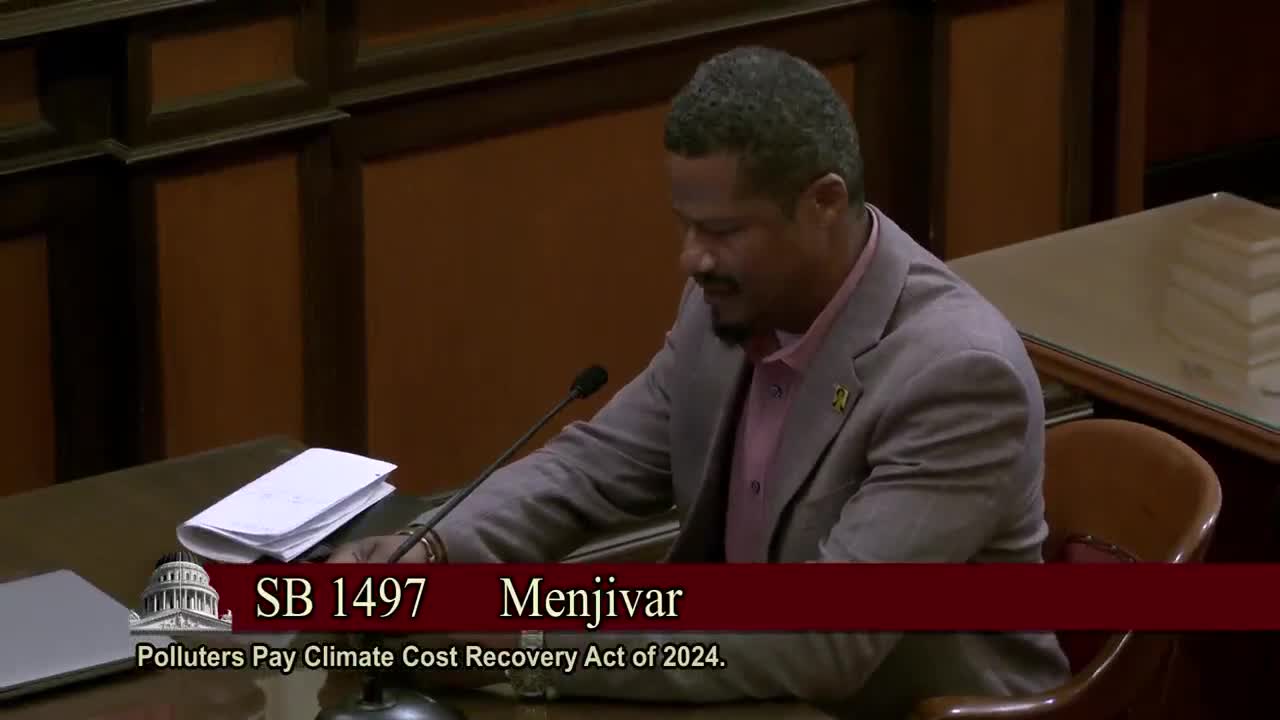 43MIN
Senate Standing Committee on Judiciary
 40SEC
Senate Standing Committee on Judiciary
 27MIN
Senate Standing Committee on Environmental Quality
Bill Author




