SB 1526: Consumer affairs.
- Session Year: 2023-2024
- House: Senate
- Latest Version Date: 2024-09-22
Current Status:
Passed
(2024-09-22: Chaptered by Secretary of State. Chapter 497, Statutes of 2024.)
Introduced
In Committee
First Chamber
In Committee
Second Chamber
Enacted
(1)Existing law establishes the Department of Consumer Affairs in the Business, Consumer Services, and Housing Agency. Existing law establishes various entities within the department for the licensure, regulation, and discipline of various professions and vocations.
Existing law establishes the Professions and Vocations Fund in the State Treasury, which consists of specified special funds and accounts. Other existing law, the Naturopathic Doctors Act, establishes the Naturopathic Doctors Fund in the State Treasury.
This bill would include the Naturopathic Doctors Fund in those special funds and accounts in the Professions and Vocations Fund.
(2)Existing law, the Dental Practice Act, provides for the licensure and regulation of dental hygienists by the Dental Hygiene Board of California. Existing law defines dental hygiene board to mean the Dental Hygiene Board of California and dental board to mean the Dental Board of California.
This bill would correct references to these boards.
(3)Existing law, the Speech-Language Pathologists and Audiologists and Hearing Aid Dispensers Licensure Act, provides for the licensure and regulation by the Speech-Language Pathology and Audiology and Hearing Aid Dispensers Board of, among others, speech-language pathology assistants, hearing aid dispensers, and dispensing audiologists.
Existing law requires a person applying for approval as a speech-language pathology assistant to have graduated from a speech-language pathology assistant associate of arts degree program, or equivalent course of study, approved by the board.
This bill would require graduation from a speech-language pathology assistant associate degree program, or equivalent course of study, approved by the board.
Existing law, as it relates to hearing aid dispensers and dispensing audiologists, refers to a hearing aid dispensers license.
This bill would instead refer to a hearing aid dispenser license.
(4)Existing law, the Nursing Practice Act, establishes the Board of Registered Nursing to license and regulate the practice of nursing.
Existing law requires an applicant for licensure as a registered nurse to comply with prescribed requirements, including a requirement to have successfully completed the courses of instruction prescribed by the board for licensure, in a program in this state accredited by the board for training registered nurses, or to have successfully completed courses of instruction in a school of nursing outside of this state that, in the opinion of the board at the time the application is filed, are equivalent to the minimum requirements of the board for licensure established for an accredited program in this state.
This bill would replace references to an accredited program with approved program.
Existing law prohibits an individual from holding themselves out as a public health nurse or using a title that includes the term public health nurse unless that individual is in possession of a valid California public health nurse certificate. Existing law establishes minimum and maximum amounts for a fee for an evaluation of qualifications to use the title public health nurse, a fee for an application for renewal of the certificate to practice as a public health nurse, and a penalty fee for failure to renew a certificate to practice as a public health nurse within the prescribed time.This bill would delete the minimum amounts for those public health nurse fees.(5)Existing law, the Physician Assistant Practice Act, provides for the licensure and regulation of physician assistants by the Physician Assistant Board.
This bill would make nonsubstantive changes in that act.
(6)Existing law, the Naturopathic Doctors Act, establishes the California Board of Naturopathic Medicine. Existing law changed the name of the former Naturopathic Medicine Committee to the board and former law changed the name of the Bureau of Naturopathic Medicine to the committee. Existing law specifies that any reference in any law or regulation to the bureau or the committee refers to the board.
This bill would update numerous outdated references to the bureau or the committee to instead refer to the board.
Existing law requires the board to adopt regulations in order to carry out the purposes of the Naturopathic Doctors Act and, unless contrary to the Naturopathic Doctors Act, applies regulations adopted by the bureau to the board and its licensees.
This bill, unless contrary to the Naturopathic Doctors Act, would also apply regulations adopted by the committee to the board and its licensees.
(7)Existing law, the Veterinary Medicine Practice Act, establishes the Veterinary Medical Board for the licensure and regulation of veterinarians and the practice of veterinary medicine. Under existing law, revenues of specified fees and fines are deposited in the Veterinary Medical Board Contingent Fund (veterinary fund), an account in the Professions and Vocations Fund subject to appropriation by the Legislature.
This bill would rename the board and the veterinary fund, respectively, the California Veterinary Medical Board and the California Veterinary Medical Board Contingent Fund.
(8)Existing law establishes the Board of Behavioral Sciences and requires the board to license and regulate various registrants and licensees under existing law, including licensees and registrants under the Licensed Marriage and Family Therapist Act. A violation of the act is a crime. Existing law prohibits the board from renewing any registration as an associate marriage and family therapist unless the registrant certifies under penalty of perjury to the board, and on a form prescribed by the board, that they have completed not less than 3 hours of continuing education on the subject of California law and ethics during the preceding year. Existing law requires the continuing education to be obtained from one of prescribed sources, including an accredited school or state-approved school that meets specified requirements.
This bill would instead authorize a school, college, or university that is accredited or approved, as defined, to be a continuing education source.
(9)Existing law, the Automotive Repair Act, provides for the registration and regulation of automotive repair dealers by the Bureau of Automotive Repair. Existing law requires an automotive repair dealer to pay a required fee for each place of business operated by the dealer in this state and to register with the director upon forms prescribed by the director, as prescribed. Existing law requires the forms to include any applicable nationally recognized and industry-accepted educational certifications and any bureau-approved educational certifications.
This bill would revise bureau-approved educational certifications to bureau-accepted educational certifications.
(10)Existing law requires every person who regularly transacts business in this state for profit under a fictitious business name to file a fictitious business name statement, as prescribed, not later than 40 days from the time the registrant commences to transact business, to file a new statement after any change in the facts, and to file a new statement when refiling a fictitious business name statement. Existing law requires the fictitious business name statement to contain specified information and to be substantially in a specified form, including prescribed notice of existing law governing the expiration of a statement.
This bill would conform the notice language to existing law governing the expiration of a statement.
(11)Existing law, the California Private Postsecondary Education Act of 2009 (the act), until January 1, 2027, provides for student protections and regulatory oversight of private postsecondary institutions in the state. The act is enforced by the Bureau for Private Postsecondary Education. The act imposes various requirements and creates certain exemptions that are based, in part, on the total charges, which the act defines as the sum of institutional and noninstitutional charges. The act further defines noninstitutional charges to mean charges for an educational program paid to an entity other than an institution that are specifically required for participation in an educational program.
This bill would narrow the definition of noninstitutional charges to include only those specified charges that are paid to such an entity directly.
Existing law prohibits an enrollment agreement from containing a provision that requires a student to invoke an internal institutional dispute procedure before enforcing any contractual or other legal rights or remedies.
This bill would instead prohibit an institution from imposing such a requirement.
Existing law requires a private postsecondary educational institution that maintains an internet website to provide on that website specific documents relating to the institution and a link to the bureaus internet website.
This bill would require that those documents and that link be the current version.
Existing law generally prohibits certain institutions approved to participate in veterans financial aid programs pursuant to specified federal law from being exempt from the act. Existing law, as an exception to that prohibition, authorizes an institution that satisfies certain requirements to claim an exemption from the act.
This bill would delete that exception.
(12)Existing law, the Psychology Licensing Law, provides for the licensure and regulation of psychologists and registered psychological associates.
This bill would correct various references in other laws to a psychological assistant to instead refer to a registered psychological associate, and would delete an outdated reference to the category of registered psychologist.
(13)The bill would make technical and other nonsubstantive changes, including changes relating to obsolete provisions and references and the elimination of gendered pronouns.
(14)This bill would incorporate additional changes to Section 4980.54 of the Business and Professions Code proposed by AB 2270 and AB 2581 to be operative only if this bill and either or both AB 2270 and AB 2581 are enacted and this bill is enacted last.
This bill would incorporate additional changes to Section 2816 of the Business and Professions Code proposed by AB 2471 to be operative only if this bill and AB 2471 are enacted and this bill is enacted last.
(1)Existing law establishes the Department of Consumer Affairs in the Business, Consumer Services, and Housing Agency. Existing law establishes various entities within the department for the licensure, regulation, and discipline of various professions and vocations.
Existing law establishes the Professions and Vocations Fund in the State Treasury, which consists of specified special funds and accounts. Other existing law, the Naturopathic Doctors Act, establishes the Naturopathic Doctors Fund in the State Treasury.
This bill would include the Naturopathic Doctors Fund in those special funds and accounts in the Professions and Vocations Fund.
(2)Existing law, the Dental Practice Act, provides for the licensure and regulation of dental hygienists by the Dental Hygiene Board of California. Existing law defines dental hygiene board to mean the Dental Hygiene Board of California and dental board to mean the Dental Board of California.
This bill would correct references to these boards.
(3)Existing law, the Speech-Language Pathologists and Audiologists and Hearing Aid Dispensers Licensure Act, provides for the licensure and regulation by the Speech-Language Pathology and Audiology and Hearing Aid Dispensers Board of, among others, speech-language pathology assistants, hearing aid dispensers, and dispensing audiologists.
Existing law requires a person applying for approval as a speech-language pathology assistant to have graduated from a speech-language pathology assistant associate of arts degree program, or equivalent course of study, approved by the board.
This bill would require graduation from a speech-language pathology assistant associate degree program, or equivalent course of study, approved by the board.
Existing law, as it relates to hearing aid dispensers and dispensing audiologists, refers to a hearing aid dispensers license.
This bill would instead refer to a hearing aid dispenser license.
(4)Existing law, the Nursing Practice Act, establishes the Board of Registered Nursing to license and regulate the practice of nursing.
Existing law requires an applicant for licensure as a registered nurse to comply with prescribed requirements, including a requirement to have successfully completed the courses of instruction prescribed by the board for licensure, in a program in this state accredited by the board for training registered nurses, or to have successfully completed courses of instruction in a school of nursing outside of this state that, in the opinion of the board at the time the application is filed, are equivalent to the minimum requirements of the board for licensure established for an accredited program in this state.
This bill would replace references to an accredited program with approved program.
Existing law prohibits an individual from holding themselves out as a public health nurse or using a title that includes the term public health nurse unless that individual is in possession of a valid California public health nurse certificate. Existing law establishes minimum and maximum amounts for a fee for an evaluation of qualifications to use the title public health nurse, a fee for an application for renewal of the certificate to practice as a public health nurse, and a penalty fee for failure to renew a certificate to practice as a public health nurse within the prescribed time.
This bill would delete the minimum amounts for those public health nurse fees.
(5)Existing law, the Physician Assistant Practice Act, provides for the licensure and regulation of physician assistants by the Physician Assistant Board.
This bill would make nonsubstantive changes in that act.
(6)Existing law, the Naturopathic Doctors Act, establishes the California Board of Naturopathic Medicine. Existing law changed the name of the former Naturopathic Medicine Committee to the board and former law changed the name of the Bureau of Naturopathic Medicine to the committee. Existing law specifies that any reference in any law or regulation to the bureau or the committee refers to the board.
This bill would update numerous outdated references to the bureau or the committee to instead refer to the board.
Existing law requires the board to adopt regulations in order to carry out the purposes of the Naturopathic Doctors Act and, unless contrary to the Naturopathic Doctors Act, applies regulations adopted by the bureau to the board and its licensees.
This bill, unless contrary to the Naturopathic Doctors Act, would also apply regulations adopted by the committee to the board and its licensees.
(7)Existing law, the Veterinary Medicine Practice Act, establishes the Veterinary Medical Board for the licensure and regulation of veterinarians and the practice of veterinary medicine. Under existing law, revenues of specified fees and fines are deposited in the Veterinary Medical Board Contingent Fund (veterinary fund), an account in the Professions and Vocations Fund subject to appropriation by the Legislature.
This bill would rename the board and the veterinary fund, respectively, the California Veterinary Medical Board and the California Veterinary Medical Board Contingent Fund.
(8)Existing law establishes the Board of Behavioral Sciences and requires the board to license and regulate various registrants and licensees under existing law, including licensees and registrants under the Licensed Marriage and Family Therapist Act. A violation of the act is a crime. Existing law prohibits the board from renewing any registration as an associate marriage and family therapist unless the registrant certifies under penalty of perjury to the board, and on a form prescribed by the board, that they have completed not less than 3 hours of continuing education on the subject of California law and ethics during the preceding year. Existing law requires the continuing education to be obtained from one of prescribed sources, including an accredited school or state-approved school that meets specified requirements.
This bill would instead authorize a school, college, or university that is accredited or approved, as defined, to be a continuing education source.
(9)Existing law, the Automotive Repair Act, provides for the registration and regulation of automotive repair dealers by the Bureau of Automotive Repair. Existing law requires an automotive repair dealer to pay a required fee for each place of business operated by the dealer in this state and to register with the director upon forms prescribed by the director, as prescribed. Existing law requires the forms to include any applicable nationally recognized and industry-accepted educational certifications and any bureau-approved educational certifications.
This bill would revise bureau-approved educational certifications to bureau-accepted educational certifications.
(10)Existing law requires every person who regularly transacts business in this state for profit under a fictitious business name to file a fictitious business name statement, as prescribed, not later than 40 days from the time the registrant commences to transact business, to file a new statement after any change in the facts, and to file a new statement when refiling a fictitious business name statement. Existing law requires the fictitious business name statement to contain specified information and to be substantially in a specified form, including prescribed notice of existing law governing the expiration of a statement.
This bill would conform the notice language to existing law governing the expiration of a statement.
(11)Existing law, the California Private Postsecondary Education Act of 2009 (the act), until January 1, 2027, provides for student protections and regulatory oversight of private postsecondary institutions in the state. The act is enforced by the Bureau for Private Postsecondary Education. The act imposes various requirements and creates certain exemptions that are based, in part, on the total charges, which the act defines as the sum of institutional and noninstitutional charges. The act further defines noninstitutional charges to mean charges for an educational program paid to an entity other than an institution that are specifically required for participation in an educational program.
This bill would narrow the definition of noninstitutional charges to include only those specified charges that are paid to such an entity directly.
Existing law prohibits an enrollment agreement from containing a provision that requires a student to invoke an internal institutional dispute procedure before enforcing any contractual or other legal rights or remedies.
This bill would instead prohibit an institution from imposing such a requirement.
Existing law requires a private postsecondary educational institution that maintains an internet website to provide on that website specific documents relating to the institution and a link to the bureaus internet website.
This bill would require that those documents and that link be the current version.
Existing law generally prohibits certain institutions approved to participate in veterans financial aid programs pursuant to specified federal law from being exempt from the act. Existing law, as an exception to that prohibition, authorizes an institution that satisfies certain requirements to claim an exemption from the act.
This bill would delete that exception.
(12)Existing law, the Psychology Licensing Law, provides for the licensure and regulation of psychologists and registered psychological associates.
This bill would correct various references in other laws to a psychological assistant to instead refer to a registered psychological associate, and would delete an outdated reference to the category of registered psychologist.
(13)The bill would make technical and other nonsubstantive changes, including changes relating to obsolete provisions and references and the elimination of gendered pronouns.
(14)This bill would incorporate additional changes to Section 4980.54 of the Business and Professions Code proposed by AB 2270 and AB 2581 to be operative only if this bill and either or both AB 2270 and AB 2581 are enacted and this bill is enacted last.
(1)Existing law establishes the Department of Consumer Affairs in the Business, Consumer Services, and Housing Agency. Existing law establishes various entities within the department for the licensure, regulation, and discipline of various professions and vocations.
Existing law establishes the Professions and Vocations Fund in the State Treasury, which consists of specified special funds and accounts. Other existing law, the Naturopathic Doctors Act, establishes the Naturopathic Doctors Fund in the State Treasury.
This bill would include the Naturopathic Doctors Fund in those special funds and accounts in the Professions and Vocations Fund.
(2)Existing law, the Dental Practice Act, provides for the licensure and regulation of dental hygienists by the Dental Hygiene Board of California. Existing law defines dental hygiene board to mean the Dental Hygiene Board of California and dental board to mean the Dental Board of California.
This bill would correct references to these boards.
(3)Existing law, the Speech-Language Pathologists and Audiologists and Hearing Aid Dispensers Licensure Act, provides for the licensure and regulation by the Speech-Language Pathology and Audiology and Hearing Aid Dispensers Board of, among others, speech-language pathology assistants, hearing aid dispensers, and dispensing audiologists.
Existing law requires a person applying for approval as a speech-language pathology assistant to have graduated from a speech-language pathology assistant associate of arts degree program, or equivalent course of study, approved by the board.
This bill would require graduation from a speech-language pathology assistant associate degree program, or equivalent course of study, approved by the board.
Existing law, as it relates to hearing aid dispensers and dispensing audiologists, refers to a hearing aid dispensers license.
This bill would instead refer to a hearing aid dispenser license.
(4)Existing law, the Nursing Practice Act, establishes the Board of Registered Nursing to license and regulate the practice of nursing.
Existing law requires an applicant for licensure as a registered nurse to comply with prescribed requirements, including a requirement to have successfully completed the courses of instruction prescribed by the board for licensure, in a program in this state accredited by the board for training registered nurses, or to have successfully completed courses of instruction in a school of nursing outside of this state that, in the opinion of the board at the time the application is filed, are equivalent to the minimum requirements of the board for licensure established for an accredited program in this state.
This bill would replace references to an accredited program with approved program.
Existing law prohibits an individual from holding themselves out as a public health nurse or using a title that includes the term public health nurse unless that individual is in possession of a valid California public health nurse certificate. Existing law establishes minimum and maximum amounts for a fee for an evaluation of qualifications to use the title public health nurse, a fee for an application for renewal of the certificate to practice as a public health nurse, and a penalty fee for failure to renew a certificate to practice as a public health nurse within the prescribed time.
This bill would delete the minimum amounts for those public health nurse fees.
(5)Existing law, the Physician Assistant Practice Act, provides for the licensure and regulation of physician assistants by the Physician Assistant Board.
This bill would make nonsubstantive changes in that act.
(6)Existing law, the Naturopathic Doctors Act, establishes the California Board of Naturopathic Medicine. Existing law changed the name of the former Naturopathic Medicine Committee to the board and former law changed the name of the Bureau of Naturopathic Medicine to the committee. Existing law specifies that any reference in any law or regulation to the bureau or the committee refers to the board.
This bill would update numerous outdated references to the bureau or the committee to instead refer to the board.
Existing law requires the board to adopt regulations in order to carry out the purposes of the Naturopathic Doctors Act and, unless contrary to the Naturopathic Doctors Act, applies regulations adopted by the bureau to the board and its licensees.
This bill, unless contrary to the Naturopathic Doctors Act, would also apply regulations adopted by the committee to the board and its licensees.
(7)Existing law, the Veterinary Medicine Practice Act, establishes the Veterinary Medical Board for the licensure and regulation of veterinarians and the practice of veterinary medicine. Under existing law, revenues of specified fees and fines are deposited in the Veterinary Medical Board Contingent Fund (veterinary fund), an account in the Professions and Vocations Fund subject to appropriation by the Legislature.
This bill would rename the act, the board, board and the veterinary fund, respectively, the California Veterinary Medicine Practice Act, the California Veterinary Medical Board, Board and the California Veterinary Medical Board Contingent Fund.
(8)Existing law establishes the Board of Behavioral Sciences and requires the board to license and regulate various registrants and licensees under existing law, including licensees and registrants under the Licensed Marriage and Family Therapist Act. A violation of the act is a crime. Existing law prohibits the board from renewing any registration as an associate marriage and family therapist unless the registrant certifies under penalty of perjury to the board, and on a form prescribed by the board, that they have completed not less than 3 hours of continuing education on the subject of California law and ethics during the preceding year. Existing law requires the continuing education to be obtained from one of prescribed sources, including an accredited school or state-approved school that meets specified requirements.
This bill would instead authorize a school, college, or university that is accredited or approved, as defined, to be a continuing education source.
(9)Existing law, the Automotive Repair Act, provides for the registration and regulation of automotive repair dealers by the Bureau of Automotive Repair. Existing law requires an automotive repair dealer to pay a required fee for each place of business operated by the dealer in this state and to register with the director upon forms prescribed by the director, as prescribed. Existing law requires the forms to include any applicable nationally recognized and industry-accepted educational certifications and any bureau-approved educational certifications.
This bill would revise bureau-approved educational certifications to bureau-accepted educational certifications.
(10)Existing law requires every person who regularly transacts business in this state for profit under a fictitious business name to file a fictitious business name statement, as prescribed, not later than 40 days from the time the registrant commences to transact business, to file a new statement after any change in the facts, and to file a new statement when refiling a fictitious business name statement. Existing law requires the fictitious business name statement to contain specified information and to be substantially in a specified form, including prescribed notice of existing law governing the expiration of a statement.
This bill would conform the notice language to existing law governing the expiration of a statement.
(11)Existing law, the California Private Postsecondary Education Act of 2009 (the act), until January 1, 2027, provides for student protections and regulatory oversight of private postsecondary institutions in the state. The act is enforced by the Bureau for Private Postsecondary Education. The act imposes various requirements and creates certain exemptions that are based, in part, on the total charges, which the act defines as the sum of institutional and noninstitutional charges. The act further defines noninstitutional charges to mean charges for an educational program paid to an entity other than an institution that are specifically required for participation in an educational program.
This bill would narrow the definition of noninstitutional charges to include only those specified charges that are paid to such an entity directly.
Existing law prohibits an enrollment agreement from containing a provision that requires a student to invoke an internal institutional dispute procedure before enforcing any contractual or other legal rights or remedies.
This bill would instead prohibit an institution from imposing such a requirement.
Existing law requires a private postsecondary educational institution that maintains an internet website to provide on that website specific documents relating to the institution and a link to the bureaus internet website.
This bill would require that those documents and that link be the current version.
Existing law generally prohibits certain institutions approved to participate in veterans financial aid programs pursuant to specified federal law from being exempt from the act. Existing law, as an exception to that prohibition, authorizes an institution that satisfies certain requirements to claim an exemption from the act.
This bill would delete that exception.
(12)Existing law, the Psychology Licensing Law, provides for the licensure and regulation of psychologists and registered psychological associates.
This bill would correct various references in other laws to a psychological assistant to instead refer to a registered psychological associate, and would delete an outdated reference to the category of registered psychologist.
(13)The bill would make technical and other nonsubstantive changes, including changes relating to obsolete provisions and references and the elimination of gendered pronouns.
(1)Existing law establishes the Department of Consumer Affairs in the Business, Consumer Services, and Housing Agency. Existing law establishes various entities within the department for the licensure, regulation, and discipline of various professions and vocations.
Existing law establishes the Professions and Vocations Fund in the State Treasury, which consists of specified special funds and accounts. Other existing law, the Naturopathic Doctors Act, establishes the Naturopathic Doctors Fund in the State Treasury.
This bill would include the Naturopathic Doctors Fund in those special funds and accounts in the Professions and Vocations Fund.
(2)Existing law, the Dental Practice Act, provides for the licensure and regulation of dental hygienists by the Dental Hygiene Board of California. Existing law defines dental hygiene board to mean the Dental Hygiene Board of California and dental board to mean the Dental Board of California.
This bill would correct references to these boards.
(3)Existing law, the Speech-Language Pathologists and Audiologists and Hearing Aid Dispensers Licensure Act, provides for the licensure and regulation by the Speech-Language Pathology and Audiology and Hearing Aid Dispensers Board of, among others, speech-language pathology assistants, hearing aid dispensers, and dispensing audiologists.
Existing law requires a person applying for approval as a speech-language pathology assistant to have graduated from a speech-language pathology assistant associate of arts degree program, or equivalent course of study, approved by the board.
This bill would require graduation from a speech-language pathology assistant associate degree program, or equivalent course of study, approved by the board.
Existing law, as it relates to hearing aid dispensers and dispensing audiologists, refers to a hearing aid dispensers license.
This bill would instead refer to a hearing aid dispenser license.
(4)Existing law, the Nursing Practice Act, establishes the Board of Registered Nursing to license and regulate the practice of nursing.
Existing law requires an applicant for licensure as a registered nurse to comply with prescribed requirements, including a requirement to have successfully completed the courses of instruction prescribed by the board for licensure, in a program in this state accredited by the board for training registered nurses, or to have successfully completed courses of instruction in a school of nursing outside of this state that, in the opinion of the board at the time the application is filed, are equivalent to the minimum requirements of the board for licensure established for an accredited program in this state.
This bill would replace references to an accredited program with approved program.
Existing law prohibits an individual from holding themselves out as a public health nurse or using a title that includes the term public health nurse unless that individual is in possession of a valid California public health nurse certificate. Existing law establishes minimum and maximum amounts for a fee for an evaluation of qualifications to use the title public health nurse, a fee for an application for renewal of the certificate to practice as a public health nurse, and a penalty fee for failure to renew a certificate to practice as a public health nurse within the prescribed time.
This bill would delete the minimum amounts for those public health nurse fees.
(5)Existing law, the Physician Assistant Practice Act, provides for the licensure and regulation of physician assistants by the Physician Assistant Board.
This bill would make nonsubstantive changes in that act.
(6)Existing law, the Naturopathic Doctors Act, establishes the California Board of Naturopathic Medicine. Existing law changed the name of the former Naturopathic Medicine Committee to the board and former law changed the name of the Bureau of Naturopathic Medicine to the committee. Existing law specifies that any reference in any law or regulation to the bureau or the committee refers to the board.
This bill would update numerous outdated references to the bureau or the committee to instead refer to the board.
Existing law requires the board to adopt regulations in order to carry out the purposes of the Naturopathic Doctors Act and, unless contrary to the Naturopathic Doctors Act, applies regulations adopted by the bureau to the board and its licensees.
This bill, unless contrary to the Naturopathic Doctors Act, would also apply regulations adopted by the committee to the board and its licensees.
(7)Existing law, the Veterinary Medicine Practice Act, establishes the Veterinary Medical Board for the licensure and regulation of veterinarians and the practice of veterinary medicine. Under existing law, revenues of specified fees and fines are deposited in the Veterinary Medical Board Contingent Fund (veterinary fund), an account in the Professions and Vocations Fund subject to appropriation by the Legislature.
This bill would rename the act, the board, and the veterinary fund, respectively, the California Veterinary Medicine Practice Act, the California Veterinary Medical Board, and the California Veterinary Medical Board Contingent Fund.
(8)Existing law establishes the Board of Behavioral Sciences and requires the board to license and regulate various registrants and licensees under existing law, including licensees and registrants under the Licensed Marriage and Family Therapist Act. A violation of the act is a crime. Existing law prohibits the board from renewing any registration as an associate marriage and family therapist unless the registrant certifies under penalty of perjury to the board, and on a form prescribed by the board, that they have completed not less than 3 hours of continuing education on the subject of California law and ethics during the preceding year. Existing law requires the continuing education to be obtained from one of prescribed sources, including an accredited school or state-approved school that meets specified requirements.
This bill would instead authorize a school, college, or university that is accredited or approved, as defined, to be a continuing education source.
(9)Existing law, the Automotive Repair Act, provides for the registration and regulation of automotive repair dealers by the Bureau of Automotive Repair. Existing law requires an automotive repair dealer to pay a required fee for each place of business operated by the dealer in this state and to register with the director upon forms prescribed by the director, as prescribed. Existing law requires the forms to include any applicable nationally recognized and industry-accepted educational certifications and any bureau-approved educational certifications.
This bill would revise bureau-approved educational certifications to bureau-accepted educational certifications.
(10)Existing law requires every person who regularly transacts business in this state for profit under a fictitious business name to file a fictitious business name statement, as prescribed, not later than 40 days from the time the registrant commences to transact business, to file a new statement after any change in the facts, and to file a new statement when refiling a fictitious business name statement. Existing law requires the fictitious business name statement to contain specified information and to be substantially in a specified form, including prescribed notice of existing law governing the expiration of a statement.
This bill would conform the notice language to existing law governing the expiration of a statement.
(11)Existing law, the California Private Postsecondary Education Act of 2009 (the act), until January 1, 2027, provides for student protections and regulatory oversight of private postsecondary institutions in the state. The act is enforced by the Bureau for Private Postsecondary Education. The act imposes various requirements and creates certain exemptions that are based, in part, on the total charges, which the act defines as the sum of institutional and noninstitutional charges. The act further defines noninstitutional charges to mean charges for an educational program paid to an entity other than an institution that are specifically required for participation in an educational program.
This bill would narrow the definition of noninstitutional charges to include only those specified charges that are paid to such an entity directly.
Existing law prohibits an enrollment agreement from containing a provision that requires a student to invoke an internal institutional dispute procedure before enforcing any contractual or other legal rights or remedies.
This bill would instead prohibit an institution from imposing such a requirement.
Existing law requires a private postsecondary educational institution that maintains an internet website to provide on that website specific documents relating to the institution and a link to the bureaus internet website.
This bill would require that those documents and that link be an up-to-date the current version.
Existing law generally prohibits certain institutions approved to participate in veterans financial aid programs pursuant to specified federal law from being exempt from the act. Existing law, as an exception to that prohibition, authorizes an institution that satisfies certain requirements to claim an exemption from the act.
This bill would delete that exception.
(12)Existing law, the Psychology Licensing Law, provides for the licensure and regulation of psychologists and registered psychological associates.
This bill would correct various references in other laws to a psychological assistant to instead refer to a registered psychological associate, and would delete an outdated reference to the category of registered psychologist.
(13)The bill would make technical and other nonsubstantive changes, including changes relating to obsolete provisions and references and the elimination of gendered pronouns.
(1)Existing law establishes the Department of Consumer Affairs in the Business, Consumer Services, and Housing Agency. Existing law establishes various entities within the department for the licensure, regulation, and discipline of various professions and vocations.
Existing law establishes the Professions and Vocations Fund in the State Treasury, which consists of specified special funds and accounts. Other existing law, the Naturopathic Doctors Act, establishes the Naturopathic Doctors Fund in the State Treasury.
This bill would include the Naturopathic Doctors Fund in those special funds and accounts in the Professions and Vocations Fund.
(2)Existing law, the Dental Practice Act, provides for the licensure and regulation of dental hygienists by the Dental Hygiene Board of California. Existing law defines dental hygiene board to mean the Dental Hygiene Board of California and dental board to mean the Dental Board of California.
This bill would correct references to these boards.
(3)Existing law, the Speech-Language Pathologists and Audiologists and Hearing Aid Dispensers Licensure Act, provides for the licensure and regulation by the Speech-Language Pathology and Audiology and Hearing Aid Dispensers Board of, among others, speech-language pathology assistants, hearing aid dispensers, and dispensing audiologists.
Existing law requires a person applying for approval as a speech-language pathology assistant to have graduated from a speech-language pathology assistant associate of arts degree program, or equivalent course of study, approved by the board.
This bill would require graduation from a speech-language pathology assistant associate degree program, or equivalent course of study, approved by the board.
Existing law, as it relates to hearing aid dispensers and dispensing audiologists, refers to a hearing aid dispensers license.
This bill would instead refer to a hearing aid dispenser license.
(4)Existing law, the Nursing Practice Act, establishes the Board of Registered Nursing to license and regulate the practice of nursing.
Existing law requires an applicant for licensure as a registered nurse to comply with prescribed requirements, including a requirement to have successfully completed the courses of instruction prescribed by the board for licensure, in a program in this state accredited by the board for training registered nurses, or to have successfully completed courses of instruction in a school of nursing outside of this state that, in the opinion of the board at the time the application is filed, are equivalent to the minimum requirements of the board for licensure established for an accredited program in this state.
This bill would replace references to an accredited program with approved program.
Existing law prohibits an individual from holding themselves out as a public health nurse or using a title that includes the term public health nurse unless that individual is in possession of a valid California public health nurse certificate. Existing law establishes minimum and maximum amounts for a fee for an evaluation of qualifications to use the title public health nurse, a fee for an application for renewal of the certificate to practice as a public health nurse, and a penalty fee for failure to renew a certificate to practice as a public health nurse within the prescribed time.
This bill would delete the minimum amounts for those public health nurse fees.
(5)Existing law, the Physician Assistant Practice Act, provides for the licensure and regulation of physician assistants by the Physician Assistant Board.
This bill would make nonsubstantive changes in that act.
(6)Existing law, the Naturopathic Doctors Act, establishes the California Board of Naturopathic Medicine. Existing law changed the name of the former Naturopathic Medicine Committee to the board and former law changed the name of the Bureau of Naturopathic Medicine to the committee. Existing law specifies that any reference in any law or regulation to the bureau or the committee refers to the board.
This bill would update numerous outdated references to the bureau or the committee to instead refer to the board.
Existing law requires the board to adopt regulations in order to carry out the purposes of the Naturopathic Doctors Act and, unless contrary to the Naturopathic Doctors Act, applies regulations adopted by the bureau to the board and its licensees.
This bill, unless contrary to the Naturopathic Doctors Act, would also apply regulations adopted by the committee to the board and its licensees.
(7)Existing law, the Veterinary Medicine Practice Act, establishes the Veterinary Medical Board for the licensure and regulation of veterinarians and the practice of veterinary medicine. Under existing law, revenues of specified fees and fines are deposited in the Veterinary Medical Board Contingent Fund (veterinary fund), an account in the Professions and Vocations Fund subject to appropriation by the Legislature.
This bill would rename the act, the board, and the veterinary fund, respectively, the California Veterinary Medicine Practice Act, the California Veterinary Medical Board, and the California Veterinary Medical Board Contingent Fund.
(8)Existing law establishes the Board of Behavioral Sciences and requires the board to license and regulate various registrants and licensees under existing law, including licensees and registrants under the Licensed Marriage and Family Therapist Act. A violation of the act is a crime. Existing law prohibits the board from renewing any registration as an associate marriage and family therapist unless the registrant certifies under penalty of perjury to the board, and on a form prescribed by the board, that they have completed not less than 3 hours of continuing education on the subject of California law and ethics during the preceding year. Existing law requires the continuing education to be obtained from one of prescribed sources, including an accredited school or state-approved school that meets specified requirements.
This bill would instead authorize a school, college, or university that is accredited or approved, as defined, to be a continuing education source.
(9)Existing law, the Automotive Repair Act, provides for the registration and regulation of automotive repair dealers by the Bureau of Automotive Repair. Existing law requires an automotive repair dealer to pay a required fee for each place of business operated by the dealer in this state and to register with the director upon forms prescribed by the director, as prescribed. Existing law requires the forms to include any applicable nationally recognized and industry-accepted educational certifications and any bureau-approved educational certifications.
This bill would revise bureau-approved educational certifications to bureau-accepted educational certifications.
(10)Existing law requires every person who regularly transacts business in this state for profit under a fictitious business name to file a fictitious business name statement, as prescribed, not later than 40 days from the time the registrant commences to transact business, to file a new statement after any change in the facts, and to file a new statement when refiling a fictitious business name statement. Existing law requires the fictitious business name statement to contain specified information and to be substantially in a specified form, including prescribed notice of existing law governing the expiration of a statement.
This bill would conform the notice language to existing law governing the expiration of a statement.
(11)Existing law, the California Private Postsecondary Education Act of 2009 (the act), provides for student protections and regulatory oversight of private postsecondary institutions in the state. The act is enforced by the Bureau for Private Postsecondary Education. The act imposes various requirements and creates certain exemptions that are based, in part, on the total charges, which the act defines as the sum of institutional and noninstitutional charges. The act further defines noninstitutional charges to mean charges for an educational program paid to an entity other than an institution that are specifically required for participation in an educational program.
This bill would narrow the definition of noninstitutional charges to include only those specified charges that are paid to such an entity directly.
Existing law requires a private postsecondary educational institution that maintains an internet website to provide on that website specific documents relating to the institution and a link to the bureaus internet website.
This bill would require that those documents and that link be an up-to-date version.
(12)Existing law relating to mental health services for minors defines terms for its purposes, including defining mental health treatment or counseling services to mean the provision of outpatient mental health treatment or counseling by a professional person. Existing law further defines professional person to include, among others, a registered psychologist and a registered psychological assistant, as defined.This bill would delete the outdated category of registered psychologist and update the category registered psychological assistant to registered psychological associate.(12)Existing law, the Psychology Licensing Law, provides for the licensure and regulation of psychologists and registered psychological associates.
This bill would correct various references in other laws to a psychological assistant to instead refer to a registered psychological associate, and would delete an outdated reference to the category of registered psychologist.
(13)The bill would make technical and other nonsubstantive changes, including changes relating to obsolete provisions and references and the elimination of gendered pronouns.
(1)Existing law establishes the Department of Consumer Affairs in the Business, Consumer Services, and Housing Agency. Existing law establishes various entities within the department for the licensure, regulation, and discipline of various professions and vocations.
Existing law establishes the Professions and Vocations Fund in the State Treasury, which consists of specified special funds and accounts. Other existing law, the Naturopathic Doctors Act, establishes the Naturopathic Doctors Fund in the State Treasury.
This bill would include the Naturopathic Doctors Fund in those special funds and accounts in the Professions and Vocations Fund.
(2)Existing law, the Dental Practice Act, provides for the licensure and regulation of dental hygienists by the Dental Hygiene Board of California. Existing law defines dental hygiene board to mean the Dental Hygiene Board of California and dental board to mean the Dental Board of California.
This bill would correct references to these boards.
(3)Existing law, the Speech-Language Pathologists and Audiologists and Hearing Aid Dispensers Licensure Act, provides for the licensure and regulation by the Speech-Language Pathology and Audiology and Hearing Aid Dispensers Board of, among others, speech-language pathology assistants, hearing aid dispensers, and dispensing audiologists.
Existing law requires a person applying for approval as a speech-language pathology assistant to have graduated from a speech-language pathology assistant associate of arts degree program, or equivalent course of study, approved by the board.
This bill would require graduation from a speech-language pathology assistant associate degree program, or equivalent course of study, approved by the board.
Existing law, as it relates to hearing aid dispensers and dispensing audiologists, refers to a hearing aid dispensers license.
This bill would instead refer to a hearing aid dispenser license.
(4)Existing law, the Nursing Practice Act, establishes the Board of Registered Nursing to license and regulate the practice of nursing.
Existing law requires an applicant for licensure as a registered nurse to comply with prescribed requirements, including a requirement to have successfully completed the courses of instruction prescribed by the board for licensure, in a program in this state accredited by the board for training registered nurses, or to have successfully completed courses of instruction in a school of nursing outside of this state that, in the opinion of the board at the time the application is filed, are equivalent to the minimum requirements of the board for licensure established for an accredited program in this state.
This bill would replace references to an accredited program with approved program.
Existing law prohibits an individual from holding themselves out as a public health nurse or using a title that includes the term public health nurse unless that individual is in possession of a valid California public health nurse certificate. Existing law establishes minimum and maximum amounts for a fee for an evaluation of qualifications to use the title public health nurse, a fee for an application for renewal of the certificate to practice as a public health nurse, and a penalty fee for failure to renew a certificate to practice as a public health nurse within the prescribed time.
This bill would delete the minimum amounts for those public health nurse fees.
(5)Existing law, the Physician Assistant Practice Act, provides for the licensure and regulation of physician assistants by the Physician Assistant Board.
This bill would make nonsubstantive changes in that act.
(6)Existing law, the Naturopathic Doctors Act, establishes the California Board of Naturopathic Medicine. Existing law changed the name of the former Naturopathic Medicine Committee to the board and former law changed the name of the Bureau of Naturopathic Medicine to the committee. Existing law specifies that any reference in any law or regulation to the bureau or the committee refers to the board.
This bill would update numerous outdated references to the bureau or the committee to instead refer to the board.
Existing law requires the board to adopt regulations in order to carry out the purposes of the Naturopathic Doctors Act and, unless contrary to the Naturopathic Doctors Act, applies regulations adopted by the bureau to the board and its licensees.
This bill, unless contrary to the Naturopathic Doctors Act, would also apply regulations adopted by the committee to the board and its licensees.
(7)Existing law, the Veterinary Medicine Practice Act, establishes the Veterinary Medical Board for the licensure and regulation of veterinarians and the practice of veterinary medicine. Under existing law, revenues of specified fees and fines are deposited in the Veterinary Medical Board Contingent Fund (veterinary fund), an account in the Professions and Vocations Fund subject to appropriation by the Legislature.
This bill would rename the act, the board, and the veterinary fund, respectively, the California Veterinary Medicine Practice Act, the California Veterinary Medical Board, and the California Veterinary Medical Board Contingent Fund.
(8)Existing law establishes the Board of Behavioral Sciences and requires the board to license and regulate various registrants and licensees under existing law, including licensees and registrants under the Licensed Marriage and Family Therapist Act. A violation of the act is a crime. Existing law prohibits the board from renewing any registration as an associate marriage and family therapist unless the registrant certifies under penalty of perjury to the board, and on a form prescribed by the board, that they have completed not less than 3 hours of continuing education on the subject of California law and ethics during the preceding year. Existing law requires the continuing education to be obtained from one of prescribed sources, including an accredited school or state-approved school that meets specified requirements.
This bill would instead authorize a school, college, or university that is accredited or approved, as defined, to be a continuing education source.
(9)Existing law, the Automotive Repair Act, provides for the registration and regulation of automotive repair dealers by the Bureau of Automotive Repair. Existing law requires an automotive repair dealer to pay a required fee for each place of business operated by the dealer in this state and to register with the director upon forms prescribed by the director, as prescribed. Existing law requires the forms to include any applicable nationally recognized and industry-accepted educational certifications and any bureau-approved educational certifications.
This bill would revise bureau-approved educational certifications to bureau-accepted educational certifications.
(10)Existing law requires every person who regularly transacts business in this state for profit under a fictitious business name to file a fictitious business name statement, as prescribed, not later than 40 days from the time the registrant commences to transact business, to file a new statement after any change in the facts, and to file a new statement when refiling a fictitious business name statement. Existing law requires the fictitious business name statement to contain specified information and to be substantially in a specified form, including prescribed notice of existing law governing the expiration of a statement.
This bill would conform the notice language to existing law governing the expiration of a statement.
(11)Existing law, the California Private Postsecondary Education Act of 2009 (the act), provides for student protections and regulatory oversight of private postsecondary institutions in the state. The act is enforced by the Bureau for Private Postsecondary Education. The act imposes various requirements and creates certain exemptions that are based, in part, on the total charges, which the act defines as the sum of institutional and noninstitutional charges. The act further defines noninstitutional charges to mean charges for an educational program paid to an entity other than an institution that are specifically required for participation in an educational program.
This bill would narrow the definition of noninstitutional charges to include only those specified charges that are paid to such an entity directly.
Existing law requires a private postsecondary educational institution that maintains an internet website to provide on that website specific documents relating to the institution and a link to the bureaus internet website.
This bill would require that those documents and that link be an up-to-date version.
(12)Existing law relating to mental health services for minors defines terms for its purposes, including defining mental health treatment or counseling services to mean the provision of outpatient mental health treatment or counseling by a professional person. Existing law further defines professional person to include, among others, a registered psychologist and a registered psychological assistant, as defined.
This bill would delete the outdated category of registered psychologist and update the category registered psychological assistant to registered psychological associate.
(13)The bill would make technical and other nonsubstantive changes, including changes relating to obsolete provisions and references and the elimination of gendered pronouns.
(a)Notwithstanding any other law, an agency designated in subdivision (b) shall require an applicant to furnish to the agency a full set of fingerprints for purposes of conducting criminal history record checks. Any agency designated in subdivision (b) may obtain and receive, at its discretion, criminal history information from the Department of Justice and the United States Federal Bureau of Investigation.
(b)Subdivision (a) applies to the following:
(1)California Board of Accountancy.
(2)State Athletic Commission.
(3)Board of Behavioral Sciences.
(4)Court Reporters Board of California.
(5)Dental Board of California.
(6)California State Board of Pharmacy.
(7)Board of Registered Nursing.
(8)California Veterinary Medical Board.
(9)Board of Vocational Nursing and Psychiatric Technicians of the State of California.
(10)Respiratory Care Board of California.
(11)Physical Therapy Board of California.
(12)Physician Assistant Board.
(13)Speech-Language Pathology and Audiology and Hearing Aid Dispensers Board.
(14)Medical Board of California.
(15)California State Board of Optometry.
(16)Acupuncture Board.
(17)Cemetery and Funeral Bureau.
(18)Bureau of Security and Investigative Services.
(19)Division of Investigation.
(20)Board of Psychology.
(21)California Board of Occupational Therapy.
(22)Structural Pest Control Board.
(23)Contractors State License Board.
(24)California Board of Naturopathic Medicine.
(25)Professional Fiduciaries Bureau.
(26)Board for Professional Engineers, Land Surveyors, and Geologists.
(27)Podiatric Medical Board of California.
(28)Osteopathic Medical Board of California.
(29)California Architects Board, beginning January 1, 2021.
(30)Landscape Architects Technical Committee, beginning January 1, 2022.
(31)Bureau of Household Goods and Services with respect to household movers as described in Chapter 3.1 (commencing with Section 19225) of Division 8.
(c)For purposes of paragraph (26) of subdivision (b), the term applicant shall be limited to an initial applicant who has never been registered or licensed by the board or to an applicant for a new licensure or registration category.
SEC. 2.Section 205 of the Business and Professions Code, as amended by Section 1 of Chapter 508 of the Statutes of 2023, is amended to read:205.(a)There is in the State Treasury the Professions and Vocations Fund. The fund shall consist of the following special funds:
(1)Accountancy Fund.
(2)California Architects Board Fund.
(3)Athletic Commission Fund.
(4)Barbering and Cosmetology Contingent Fund.
(5)Cemetery and Funeral Fund.
(6)Contractors License Fund.
(7)State Dentistry Fund.
(8)Home Furnishings and Thermal Insulation Fund.
(9)California Architects Board-Landscape Architects Fund.
(10)Contingent Fund of the Medical Board of California.
(11)Optometry Fund.
(12)Pharmacy Board Contingent Fund.
(13)Physical Therapy Fund.
(14)Private Security Services Fund.
(15)Professional Engineers, Land Surveyors, and Geologists Fund.
(16)Consumer Affairs Fund.
(17)Behavioral Sciences Fund.
(18)Licensed Midwifery Fund.
(19)Court Reporters Fund.
(20)California Veterinary Medical Board Contingent Fund.
(21)Vocational Nursing and Psychiatric Technicians Fund.
(22)Electronic and Appliance Repair Fund.
(23)Acupuncture Fund.
(24)Physician Assistant Fund.
(25)Board of Podiatric Medicine Fund.
(26)Psychology Fund.
(27)Respiratory Care Fund.
(28)Speech-Language Pathology and Audiology and Hearing Aid Dispensers Fund.
(29)Board of Registered Nursing Fund.
(30)Animal Health Technician Examining Committee Fund.
(31)State Dental Hygiene Fund.
(32)Structural Pest Control Fund.
(33)Structural Pest Control Education and Enforcement Fund.
(34)Structural Pest Control Research Fund.
(35)Household Movers Fund.
(36)Household Goods and Services Fund.
(37)Naturopathic Doctors Fund.
(b)For accounting and recordkeeping purposes, the Professions and Vocations Fund shall be deemed to be a single special fund, and each of the several special funds therein shall constitute and be deemed to be a separate account in the Professions and Vocations Fund. Each account or fund shall be available for expenditure only for the purposes as are now or may hereafter be provided by law.
(c)This section shall remain in effect only until July 1, 2026, and as of that date is repealed.
SEC. 3.Section 205 of the Business and Professions Code, as added by Section 2 of Chapter 508 of the Statutes of 2023, is amended to read:205.(a)There is in the State Treasury the Professions and Vocations Fund. The fund shall consist of the following special funds:
(1)Accountancy Fund.
(2)California Architects Board Fund.
(3)Athletic Commission Fund.
(4)Barbering and Cosmetology Contingent Fund.
(5)Cemetery and Funeral Fund.
(6)Contractors License Fund.
(7)State Dentistry Fund.
(8)California Architects Board-Landscape Architects Fund.
(9)Contingent Fund of the Medical Board of California.
(10)Optometry Fund.
(11)Pharmacy Board Contingent Fund.
(12)Physical Therapy Fund.
(13)Private Security Services Fund.
(14)Professional Engineers, Land Surveyors, and Geologists Fund.
(15)Consumer Affairs Fund.
(16)Behavioral Sciences Fund.
(17)Licensed Midwifery Fund.
(18)Court Reporters Fund.
(19)California Veterinary Medical Board Contingent Fund.
(20)Vocational Nursing and Psychiatric Technicians Fund.
(21)Acupuncture Fund.
(22)Physician Assistant Fund.
(23)Board of Podiatric Medicine Fund.
(24)Psychology Fund.
(25)Respiratory Care Fund.
(26)Speech-Language Pathology and Audiology and Hearing Aid Dispensers Fund.
(27)Board of Registered Nursing Fund.
(28)Animal Health Technician Examining Committee Fund.
(29)State Dental Hygiene Fund.
(30)Structural Pest Control Fund.
(31)Structural Pest Control Education and Enforcement Fund.
(32)Structural Pest Control Research Fund.
(33)Household Goods and Services Fund.
(34)Naturopathic Doctors Fund.
(b)For accounting and recordkeeping purposes, the Professions and Vocations Fund shall be deemed to be a single special fund, and each of the several special funds therein shall constitute and be deemed to be a separate account in the Professions and Vocations Fund. Each account or fund shall be available for expenditure only for the purposes as are now or may hereafter be provided by law.
(c)This section shall become operative on July 1, 2026.
SEC. 4.Section 208 of the Business and Professions Code, as amended by Section 2 of Chapter 41 of the Statutes of 2024, is amended to read:208.(a)Beginning April 1, 2023, a Controlled Substance Utilization Review and Evaluation System (CURES) fee of nine dollars ($9) shall be assessed annually on each of the licensees specified in subdivision (b) to pay the reasonable costs associated with operating and maintaining CURES for the purpose of regulating those licensees. The fee assessed pursuant to this subdivision shall be billed and collected by the regulating agency of each licensee at the time of the licensees license renewal. If the reasonable regulatory cost of operating and maintaining CURES is less than nine dollars ($9) per licensee, the Department of Consumer Affairs, by regulation, may reduce the fee established by this section to the reasonable regulatory cost.
(b)(1)Licensees authorized pursuant to Section 11150 of the Health and Safety Code to prescribe, order, administer, furnish, or dispense Schedule II, Schedule III, or Schedule IV controlled substances or pharmacists licensed pursuant to Chapter 9 (commencing with Section 4000) of Division 2.
(2)Licensees issued a license that has been placed in a retired or inactive status pursuant to a statute or regulation are exempt from the CURES fee requirement in subdivision (a). This exemption shall not apply to licensees whose license has been placed in a retired or inactive status if the licensee is at any time authorized to prescribe, order, administer, furnish, or dispense Schedule II, Schedule III, or Schedule IV controlled substances.
(3)Wholesalers, third-party logistics providers, nonresident wholesalers, and nonresident third-party logistics providers of dangerous drugs licensed pursuant to Article 11 (commencing with Section 4160) of Chapter 9 of Division 2.
(4)Nongovernmental clinics licensed pursuant to Article 13 (commencing with Section 4180) and Article 14 (commencing with Section 4190) of Chapter 9 of Division 2.
(5)Nongovernmental pharmacies licensed pursuant to Article 7 (commencing with Section 4110) of Chapter 9 of Division 2.
(c)The funds collected pursuant to subdivision (a) shall be deposited in the CURES Fund, which is hereby created within the State Treasury. Moneys in the CURES Fund, upon appropriation by the Legislature, shall be available to the Department of Consumer Affairs to reimburse the Department of Justice for costs to operate and maintain CURES for the purposes of regulating the licensees specified in subdivision (b).
(d)The Department of Consumer Affairs shall contract with the Department of Justice on behalf of the Medical Board of California, the Dental Board of California, the California State Board of Pharmacy, the Veterinary Medical Board, the Board of Registered Nursing, the Physician Assistant Board, the Osteopathic Medical Board of California, the California Board of Naturopathic Medicine, the State Board of Optometry, and the Podiatric Medical Board of California to operate and maintain CURES for the purposes of regulating the licensees specified in subdivision (b).
(e)This section shall become operative on April 1, 2023.
(f)This section shall become inoperative on April 1, 2025, and, as of January 1, 2026, is repealed.
SEC. 5.Section 208 of the Business and Professions Code, as added by Section 3 of Chapter 41 of the Statutes of 2024, is amended to read:208.(a)Beginning April 1, 2025, a Controlled Substance Utilization Review and Evaluation System (CURES) fee of fifteen dollars ($15) shall be assessed annually on each of the licensees specified in subdivision (b) to pay the reasonable costs associated with operating and maintaining CURES for the purpose of regulating those licensees. The fee assessed pursuant to this subdivision shall be billed and collected by the regulating agency of each licensee at the time of the licensees license renewal. If the reasonable regulatory cost of operating and maintaining CURES is less than fifteen dollars ($15) per licensee, the Department of Consumer Affairs, by regulation, may reduce the fee established by this section to the reasonable regulatory cost.
(b)(1)Licensees authorized pursuant to Section 11150 of the Health and Safety Code to prescribe, order, administer, furnish, or dispense Schedule II, Schedule III, or Schedule IV controlled substances or pharmacists licensed pursuant to Chapter 9 (commencing with Section 4000) of Division 2.
(2)Licensees issued a license that has been placed in a retired or inactive status pursuant to a statute or regulation are exempt from the CURES fee requirement in subdivision (a). This exemption shall not apply to licensees whose license has been placed in a retired or inactive status if the licensee is at any time authorized to prescribe, order, administer, furnish, or dispense Schedule II, Schedule III, or Schedule IV controlled substances.
(3)Wholesalers, third-party logistics providers, nonresident wholesalers, and nonresident third-party logistics providers of dangerous drugs licensed pursuant to Article 11 (commencing with Section 4160) of Chapter 9 of Division 2.
(4)Nongovernmental clinics licensed pursuant to Article 13 (commencing with Section 4180) and Article 14 (commencing with Section 4190) of Chapter 9 of Division 2.
(5)Nongovernmental pharmacies licensed pursuant to Article 7 (commencing with Section 4110) of Chapter 9 of Division 2.
(c)The funds collected pursuant to subdivision (a) shall be deposited in the CURES Fund, which is hereby created within the State Treasury. Moneys in the CURES Fund, upon appropriation by the Legislature, shall be available to the Department of Consumer Affairs to reimburse the Department of Justice for costs to operate and maintain CURES for the purposes of regulating the licensees specified in subdivision (b).
(d)The Department of Consumer Affairs shall contract with the Department of Justice on behalf of the Medical Board of California, the Dental Board of California, the California State Board of Pharmacy, the Veterinary Medical Board, the Board of Registered Nursing, the Physician Assistant Board, the Osteopathic Medical Board of California, the California Board of Naturopathic Medicine, the State Board of Optometry, and the Podiatric Medical Board of California to operate and maintain CURES for the purposes of regulating the licensees specified in subdivision (b).
(e)This section shall become operative on April 1, 2025.
SEC. 6.Section 1903 of the Business and Professions Code is amended to read:1903.(a)(1)The dental hygiene board shall consist of nine members as follows:
(A)Seven members appointed by the Governor as follows:
(i)Two members shall be public members.
(ii)One member shall be a practicing general or public health dentist who holds a current license in California.
(iii)Four members shall be registered dental hygienists who hold current licenses in California. Of the registered dental hygienist members, one shall be licensed either in alternative practice or in extended functions, one shall be a dental hygiene educator, and two shall be registered dental hygienists. No public member shall have been licensed under this chapter within five years of the date of their appointment or have any current financial interest in a dental-related business.
(B)One public member appointed by the Senate Committee on Rules.
(C)One public member appointed by the Speaker of the Assembly.
(2)(A)The first appointment by the Senate Committee on Rules or the Speaker of the Assembly pursuant to this subdivision shall be made upon the expiration of the term of a public member that is scheduled to occur, or otherwise occurs, on or after January 1, 2019.
(B)It is the intent of the Legislature that committee members appointed prior to January 1, 2019, remain as dental hygiene board members until their term expires or except as otherwise provided in law, whichever occurs first.
(3)For purposes of this subdivision, a public health dentist is a dentist whose primary employer or place of employment is in any of the following:
(A)A primary care clinic licensed under subdivision (a) of Section 1204 of the Health and Safety Code.
(B)A primary care clinic exempt from licensure pursuant to subdivision (c) of Section 1206 of the Health and Safety Code.
(C)A clinic owned or operated by a public hospital or health system.
(D)A clinic owned and operated by a hospital that maintains the primary contract with a county government to fill the countys role under Section 17000 of the Welfare and Institutions Code.
(b)(1)Except as specified in paragraph (2), members of the dental hygiene board shall be appointed for a term of four years. Each member shall hold office until the appointment and qualification of the members successor or until one year shall have lapsed since the expiration of the term for which the member was appointed, whichever comes first.
(2)For the term commencing on January 1, 2012, two of the public members, the general or public health dentist member, and two of the registered dental hygienist members, other than the dental hygiene educator member or the registered dental hygienist member licensed in alternative practice or in extended functions, shall each serve a term of two years, expiring January 1, 2014.
(c)Notwithstanding any other provision of law and subject to subdivision (e), the Governor may appoint to the dental hygiene board a person who previously served as a member of the former committee or dental hygiene board even if the persons previous term expired.
(d)The dental hygiene board shall elect a president, a vice president, and a secretary from its membership.
(e)No person shall serve as a member of the dental hygiene board for more than two consecutive terms.
(f)A vacancy in the dental hygiene board shall be filled by appointment to the unexpired term.
(g)Each member of the dental hygiene board shall receive a per diem and expenses as provided in Section 103.
(h)Each appointing authority shall have the power to remove from office at any time any member of the board appointed by that authority pursuant to Section 106.
(i)The dental hygiene board, with the approval of the director, may appoint a person exempt from civil service who shall be designated as an executive officer and who shall exercise the powers and perform the duties delegated by the dental hygiene board and vested in the executive officer by this article.
(j)This section shall remain in effect only until January 1, 2028, and as of that date is repealed.
SEC. 7.Section 1910.5 of the Business and Professions Code is amended to read:1910.5.(a)In addition to the duties specified in Section 1910, a registered dental hygienist is authorized to perform the following additional duties, as specified:
(1)Determine which radiographs to perform on a patient who has not received an initial examination by the supervising dentist for the specific purpose of the dentist making a diagnosis and treatment plan for the patient. In these circumstances, the dental hygienist shall follow protocols established by the supervising dentist. This paragraph only applies in the following settings:
(A)In a dental office setting.
(B)In a public health setting, using telehealth, as defined by Section 2290.5, for the purpose of communication with the supervising dentist, including, but not limited to, schools, head start and preschool programs, and community clinics.
(2)Place protective restorations, which for this purpose are identified as interim therapeutic restorations, and defined as a direct provisional restoration placed to stabilize the tooth until a licensed dentist diagnoses the need for further definitive treatment. An interim therapeutic restoration consists of the removal of soft material from the tooth using only hand instrumentation, without the use of rotary instrumentation, and subsequent placement of an adhesive restorative material. Local anesthesia shall not be necessary for interim therapeutic restoration placement. Interim therapeutic restorations shall be placed only in accordance with both of the following:
(A)In either of the following settings:
(i)In a dental office setting.
(ii)In a public health setting, using telehealth, as defined by Section 2290.5, for the purpose of communication with the supervising dentist, including, but not limited to, schools, head start and preschool programs, and community clinics.
(B)After the diagnosis, treatment plan, and instruction to perform the procedure provided by a dentist.
(b)The functions described in subdivision (a) may be performed by a registered dental hygienist only after completion of a program that includes training in performing those functions, or after providing evidence, satisfactory to the dental hygiene board, of having completed a dental hygiene board-approved course in those functions.
(c)No later than January 1, 2018, the dental hygiene board shall adopt regulations to establish requirements for courses of instruction for the procedures authorized to be performed by a registered dental hygienist and registered dental hygienist in alternative practice pursuant to Sections 1910.5 and 1926.05, using the competency-based training protocols established by the Health Workforce Pilot Project (HWPP) No. 172 through the Department of Health Care Access and Information. The dental hygiene board shall use the curriculum submitted by the dental board pursuant to Section 1753.55 to adopt regulatory language for approval of courses of instruction for the interim therapeutic restoration. Any subsequent amendments to the regulations for the interim therapeutic restoration curriculum that are promulgated by the dental hygiene board shall be agreed upon by the dental board and the dental hygiene board.
(d)This section shall become operative on January 1, 2018.
SEC. 8.Section 1944 of the Business and Professions Code is amended to read:1944.(a)The dental hygiene board shall establish by resolution the amount of the fees that relate to the licensing of a registered dental hygienist, a registered dental hygienist in alternative practice, and a registered dental hygienist in extended functions. The fees established by dental hygiene board resolution in effect on June 30, 2009, as they relate to the licensure of registered dental hygienists, registered dental hygienists in alternative practice, and registered dental hygienists in extended functions, shall remain in effect until modified by the dental hygiene board. The fees are subject to the following limitations:
(1)The application fee for an original license and the fee for issuance of an original license shall not exceed two hundred fifty dollars ($250).
(2)The fee for examination for licensure as a registered dental hygienist shall not exceed the actual cost of the examination.
(3)The fee for examination for licensure as a registered dental hygienist in extended functions shall not exceed the actual cost of the examination.
(4)The fee for examination for licensure as a registered dental hygienist in alternative practice shall not exceed the actual cost of administering the examination.
(5)The biennial renewal fee shall not exceed five hundred dollars ($500).
(6)The delinquency fee shall not exceed one-half of the renewal fee. Any delinquent license may be restored only upon payment of all fees, including the delinquency fee, and compliance with all other applicable requirements of this article.
(7)The fee for issuance of a duplicate license to replace one that is lost or destroyed, or in the event of a name change, shall not exceed twenty-five dollars ($25) or one-half of the renewal fee, whichever is greater.
(8)The fee for certification of licensure shall not exceed one-half of the renewal fee.
(9)The fee for each curriculum review and feasibility study review for educational programs for dental hygienists who are not accredited by a dental hygiene board-approved agency shall not exceed two thousand one hundred dollars ($2,100).
(10)The fee for each review or approval of course requirements for licensure or procedures that require additional training shall not exceed seven hundred fifty dollars ($750).
(11)The initial application and biennial fee for a provider of continuing education shall not exceed five hundred dollars ($500).
(12)The amount of fees payable in connection with permits issued under Section 1962 is as follows:
(A)The initial permit fee is an amount equal to the renewal fee for the applicants license to practice dental hygiene in effect on the last regular renewal date before the date on which the permit is issued.
(B)If the permit will expire less than one year after its issuance, then the initial permit fee is an amount equal to 50 percent of the renewal fee in effect on the last regular renewal date before the date on which the permit is issued.
(13)The fee for the dental hygiene board to conduct a site visit to educational programs for a registered dental hygienist, a registered dental hygienist in alternative practice, or a registered dental hygienist in extended functions to ensure compliance of educational program requirements shall not exceed the actual cost incurred by the dental hygiene board for cost recovery of site visit expenditures.
(14)The fee for a retired license shall not exceed one-half of the current license renewal fee.
(b)The renewal and delinquency fees shall be fixed by the dental hygiene board by resolution at not more than the current amount of the renewal fee for a license to practice under this article nor less than five dollars ($5).
(c)Fees fixed by the dental hygiene board by resolution pursuant to this section shall not be subject to the approval of the Office of Administrative Law.
(d)Fees collected pursuant to this section shall be collected by the dental hygiene board and deposited into the State Dental Hygiene Fund, which is hereby created. All money in this fund, upon appropriation by the Legislature in the annual Budget Act, shall be used to implement this article.
(e)No fees or charges other than those listed in this section shall be levied by the dental hygiene board in connection with the licensure of registered dental hygienists, registered dental hygienists in alternative practice, or registered dental hygienists in extended functions.
(f)The fee for registration of an extramural dental facility shall not exceed two hundred fifty dollars ($250).
(g)The fee for registration of a mobile dental hygiene unit shall not exceed one hundred fifty dollars ($150).
(h)The biennial renewal fee for a mobile dental hygiene unit shall not exceed two hundred fifty dollars ($250).
(i)The fee for an additional office permit shall not exceed two hundred fifty dollars ($250).
(j)The biennial renewal fee for an additional office as described in Section 1926.4 shall not exceed two hundred fifty dollars ($250).
(k)The initial application and biennial special permit fee is an amount equal to the biennial renewal fee specified in paragraph (6) of subdivision (a).
(l)The fees in this section shall not exceed an amount sufficient to cover the reasonable regulatory cost of carrying out this article.
SEC. 9.Section 2538.3 of the Business and Professions Code is amended to read:2538.3.A person applying for approval as a speech-language pathology assistant shall have graduated from a speech-language pathology assistant associate degree program, or equivalent course of study, approved by the board. A person who has successfully graduated from a board-approved bachelors degree program in speech-language pathology or communication disorders shall be deemed to have satisfied an equivalent course of study.
SEC. 10.Section 2538.10 of the Business and Professions Code is amended to read:2538.10.For the purposes of this article, the following definitions shall apply:
(a)Advertise and its variants include the use of a newspaper, magazine, or other publication, book, notice, circular, pamphlet, letter, handbill, poster, bill, sign, placard, card, label, tag, window display, store sign, radio, or television announcement, or any other means or methods now or hereafter employed to bring to the attention of the public the practice of fitting or selling of hearing aids.
(b)License means a hearing aid dispenser license issued pursuant to this article and includes a temporary or trainee license.
(c)Licensee means a person holding a license.
(d)Hearing aid means any wearable instrument or device designed for, or offered for the purpose of, aiding or compensating for impaired human hearing.
(e)Fund means the Speech-Language Pathology and Audiology and Hearing Aid Dispensers Fund.
SEC. 11.Section 2538.25 of the Business and Professions Code is amended to read:2538.25.(a)The board shall prepare, approve, grade, and conduct examinations of applicants for a hearing aid dispenser license. The board may provide that the preparation and grading of the examination be conducted by a competent person or organization other than the board, provided, however, that the board shall establish the guidelines for the examination and shall approve the actual examination.
(b)Each applicant shall take and pass a written examination and a practical examination compiled at the direction of the board covering the critical tasks involved in the practice of fitting and selling hearing aids and the knowledge, skills, and abilities needed to perform those tasks safely and competently.
SEC. 12.Section 2538.27 of the Business and Professions Code is amended to read:2538.27.(a)An applicant who has fulfilled the requirements of Section 2538.24 and has made application therefor, may have a temporary license issued to them upon satisfactory proof to the board that the applicant holds a hearing aid dispenser license in another state, that the licensee has not been subject to formal disciplinary action by another licensing authority, and that the applicant has been engaged in the fitting and sale of hearing aids for the two years immediately prior to application.
(b)A temporary license issued pursuant to this section shall be valid for one year from date of issuance and is not renewable. A temporary license shall automatically terminate upon issuance of a license prior to expiration of the one-year period.
(c)The holder of a temporary license issued pursuant to this section who fails either license examination shall be subject to and shall comply with the supervision requirements of Section 2538.28 and any regulations adopted pursuant thereto.
SEC. 13.Section 2539.1 of the Business and Professions Code is amended to read:2539.1.(a)(1)On and after January 1, 2010, in addition to satisfying the licensure and examination requirements described in Sections 2532, 2532.2, and 2532.25, no licensed audiologist shall sell hearing aids unless they complete an application for a dispensing audiology license, pay all applicable fees, and pass an examination, approved by the board, relating to selling hearing aids.
(2)The board shall issue a dispensing audiology license to a licensed audiologist who meets the requirements of paragraph (1).
(b)(1)On and after January 1, 2010, a licensed audiologist with an unexpired license to sell hearing aids pursuant to Article 8 (commencing with Section 2538.10) may continue to sell hearing aids pursuant to that license until that license expires pursuant to Section 2538.53, and upon that expiration the licensee shall be deemed to have satisfied the requirements described in subdivision (a) and may continue to sell hearing aids pursuant to their audiology license subject to this chapter. Upon the expiration of the audiologists license to sell hearing aids, the board shall issue them a dispensing audiology license pursuant to paragraph (2) of subdivision (a). This paragraph shall not prevent an audiologist who also has a hearing aid dispenser license from maintaining dual or separate licenses if they choose to do so.
(2)A licensed audiologist whose license to sell hearing aids, issued pursuant to Article 8 (commencing with Section 2538.10), is suspended, surrendered, or revoked shall not be authorized to sell hearing aids pursuant to this subdivision and they shall be subject to the requirements described in subdivision (a) and the other provisions of this chapter.
(c)A licensed hearing aid dispenser who meets the qualifications for licensure as an audiologist shall be deemed to have satisfied the requirements of paragraph (1) of subdivision (a) for the purposes of obtaining a dispensing audiology license.
(d)For purposes of subdivision (a), the board shall provide the hearing aid dispenser examination provided by the former Hearing Aid Dispensers Bureau until the next examination validation and occupational analysis is completed by the Department of Consumer Affairs pursuant to Section 139 and a determination is made that a different examination is to be administered.
SEC. 14.Section 2736 of the Business and Professions Code is amended to read:2736.(a)An applicant for licensure as a registered nurse shall comply with each of the following:
(1)Have completed general preliminary education requirements as shall be determined by the board.
(2)Have successfully completed the courses of instruction prescribed by the board for licensure, in a program in this state approved by the board for training registered nurses, or have successfully completed courses of instruction in a school of nursing outside of this state that, in the opinion of the board at the time the application is filed with the board, are equivalent to the minimum requirements of the board for licensure established for an approved program in this state.
(3)Not be subject to denial of licensure under Section 480.
(b)An applicant who has received their training from a school of nursing in a country outside the United States and who has complied with subdivision (a), or has completed training equivalent to that required by subdivision (a), shall qualify for licensure by successfully passing the examination prescribed by the board.
SEC. 15.Section 2761 of the Business and Professions Code is amended to read:2761.The board may take disciplinary action against a certified or licensed nurse or deny an application for a certificate or license for any of the following:
(a)Unprofessional conduct, which includes, but is not limited to, the following:
(1)Incompetence or gross negligence in carrying out usual certified or licensed nursing functions.
(2)A conviction of practicing medicine without a license in violation of Chapter 5 (commencing with Section 2000), in which event the record of conviction shall be conclusive evidence thereof.
(3)The use of advertising relating to nursing that violates Section 17500.
(4)Denial of licensure, revocation, suspension, restriction, or any other disciplinary action against a health care professional license or certificate by another state or territory of the United States, by any other government agency, or by another California health care professional licensing board. A certified copy of the decision or judgment shall be conclusive evidence of that action.
(b)Procuring their certificate or license by fraud, misrepresentation, or mistake.
(c)Procuring, or aiding, or abetting, or attempting, or agreeing, or offering to procure or assist at a criminal abortion.
(d)Violating or attempting to violate, directly or indirectly, or assisting in or abetting the violating of, or conspiring to violate any provision or term of this chapter or regulations adopted pursuant to it.
(e)Making or giving any false statement or information in connection with the application for issuance of a certificate or license.
(f)Conviction of a felony or of any offense substantially related to the qualifications, functions, and duties of a registered nurse, in which event the record of the conviction shall be conclusive evidence thereof.
(g)Impersonating any applicant or acting as proxy for an applicant in any examination required under this chapter for the issuance of a certificate or license.
(h)Impersonating another certified or licensed practitioner, or permitting or allowing another person to use their certificate or license for the purpose of nursing the sick or afflicted.
(i)Aiding or assisting, or agreeing to aid or assist any person or persons, whether a licensed physician or not, in the performance of, or arranging for, a violation of any of the provisions of Article 12 (commencing with Section 2220) of Chapter 5.
(j)Holding oneself out to the public or to any practitioner of the healing arts as a nurse practitioner or as meeting the standards established by the board for a nurse practitioner unless meeting the standards established by the board pursuant to Article 8 (commencing with Section 2834) or holding oneself out to the public as being certified by the board as a nurse anesthetist, nurse midwife, clinical nurse specialist, or public health nurse unless the person is at the time certified by the board.
(k)(1)Except for good cause, the knowing failure to protect patients by failing to follow infection control guidelines of the board, thereby risking transmission of blood-borne infectious diseases from licensed or certified nurse to patient, from patient to patient, and from patient to licensed or certified nurse. In administering this subdivision, the board shall consider referencing the standards, regulations, and guidelines of the State Department of Public Health developed pursuant to Section 1250.11 of the Health and Safety Code and the standards, guidelines, and regulations pursuant to the California Occupational Safety and Health Act of 1973 (Part 1 (commencing with Section 6300) of Division 5 of the Labor Code) for preventing the transmission of HIV, hepatitis B, and other blood-borne pathogens in health care settings. As necessary, the board shall consult with the Medical Board of California, the Podiatric Medical Board of California, the Dental Board of California, and the Board of Vocational Nursing and Psychiatric Technicians, to encourage appropriate consistency in the implementation of this subdivision.
(2)The board shall seek to ensure that licentiates and others regulated by the board are informed of the responsibility of licentiates to minimize the risk of transmission of blood-borne infectious diseases from health care provider to patient, from patient to patient, and from patient to health care provider, and of the most recent scientifically recognized safeguards for minimizing the risks of transmission.
SEC. 16.Section 2816 of the Business and Professions Code is amended to read:2816.The nonrefundable fee to be paid by a registered nurse for an evaluation of their qualifications to use the title public health nurse shall not be more than one thousand dollars ($1,000). The fee to be paid upon the application for renewal of the certificate to practice as a public health nurse shall not be more than five hundred dollars ($500). The penalty fee for failure to renew a certificate to practice as a public health nurse within the prescribed time shall be 50 percent of the renewal fee in effect on the date of renewal of the certificate, but not more than two hundred fifty dollars ($250). All fees payable under this section shall be collected by and paid to the Board of Registered Nursing Fund. It is the intention of the Legislature that the costs of carrying out the purposes of this article shall be covered by the revenue collected pursuant to this section. The board shall refund any registered nurse who paid more than three hundred dollars ($300) for an evaluation of their qualifications to use the title public health nurse between April 5, 2018, and December 31, 2018.SEC. 16.5.Section 2816 of the Business and Professions Code is amended to read:2816.(a)The nonrefundable fee to be paid by a registered nurse for an evaluation of their qualifications to use the title public health nurse shall not be more than one thousand dollars ($1,000). All fees payable under this section shall be collected by and paid to the Board of Registered Nursing Fund. It is the intention of the Legislature that the costs of carrying out the purposes of this article shall be covered by the revenue collected pursuant to this section. The board shall refund any registered nurse who paid more than three hundred dollars ($300) for an evaluation of their qualifications to use the title public health nurse between April 5, 2018, and December 31, 2018.
(b)A public health nurse certificate is not subject to renewal.
SEC. 17.Section 3503 of the Business and Professions Code is amended to read:3503.No person other than one who has been licensed to practice as a physician assistant shall practice as a physician assistant or in a similar capacity to a physician and surgeon or podiatrist or hold themselves out as a physician assistant, or shall use any other term indicating or implying that they are a physician assistant.
SEC. 18.Section 3526 of the Business and Professions Code is amended to read:3526.A person who fails to renew their license or approval within five years after its expiration may not renew it, and it may not be reissued, reinstated, or restored after that time has elapsed, but that person may apply for and obtain a new license or approval if they:
(a)Have not committed any acts or crimes constituting grounds for denial of licensure under Division 1.5 (commencing with Section 475).
(b)Take and pass the examination, if any, that would be required of them if application for licensure was being made for the first time, or otherwise establishes to the satisfaction of the board that, with due regard for the public interest, they are qualified to practice as a physician assistant.
(c)Pay all of the fees that would be required as if application for licensure was being made for the first time.
SEC. 19.Section 3531 of the Business and Professions Code is amended to read:3531.A plea or verdict of guilty or a conviction following a plea of nolo contendere made to a charge of a felony or of any offense that is substantially related to the qualifications, functions, or duties of the business or profession to which the license was issued is deemed to be a conviction within the meaning of this chapter. The board may order the license suspended or revoked, or shall decline to issue a license when the time for appeal has elapsed, or the judgment of conviction has been affirmed on appeal or when an order granting probation is made suspending the imposition of sentence, irrespective of a subsequent order under Section 1203.4 of the Penal Code allowing that person to withdraw their plea of guilty and to enter a plea of not guilty, or setting aside the verdict of guilty, or dismissing the accusation, information, or indictment.
SEC. 20.Section 3534.4 of the Business and Professions Code is amended to read:3534.4.(a)Criteria for acceptance into the diversion program shall include all of the following:
(1)The applicant shall be licensed as a physician assistant by the board and shall be a resident of California.
(2)The applicant shall be found to abuse dangerous drugs or alcoholic beverages in a manner that may affect their ability to practice medicine safely or competently.
(3)The applicant shall have voluntarily requested admission to the program or shall be accepted into the program in accordance with terms and conditions resulting from a disciplinary action.
(4)The applicant shall agree to undertake any medical or psychiatric examination ordered to evaluate the applicant for participation in the program.
(5)The applicant shall cooperate with the program by providing medical information, disclosure authorizations, and releases of liability as may be necessary for participation in the program.
(6)The applicant shall agree in writing to cooperate with all elements of the treatment program designed for them.
(b)An applicant may be denied participation in the program if the board, the program manager, or a committee determines that the applicant will not substantially benefit from participation in the program or that the applicants participation in the program creates too great a risk to the public health, safety, or welfare.
SEC. 21.Section 3534.5 of the Business and Professions Code is amended to read:3534.5.(a)A participant may be terminated from the program for any of the following reasons:
(1)The participant has successfully completed the treatment program.
(2)The participant has failed to comply with the treatment program designated for them.
(3)The participant fails to meet any of the criteria set forth in paragraph (4).
(4)It is determined that the participant has not substantially benefited from participation in the program or that their continued participation in the program creates too great a risk to the public health, safety, or welfare.
(b)Whenever an applicant is denied participation in the program or a participant is terminated from the program for any reason other than the successful completion of the program, and it is determined that the continued practice of medicine by that individual creates too great a risk to the public health and safety, that fact shall be reported to the executive officer of the board and all documents and information pertaining to and supporting that conclusion shall be provided to the executive officer. The matter may be referred for investigation and disciplinary action by the board.
(c)Each physician assistant who requests participation in a diversion program shall agree to cooperate with the recovery program designed for them. Any failure to comply with that program may result in termination of participation in the program.
(d)The board shall inform each participant in the program of the procedures followed in the program, of the rights and responsibilities of a physician assistant in the program, and the possible results of noncompliance with the program.
SEC. 22.Section 3545 of the Business and Professions Code is amended to read:3545.The income of a physician assistant corporation attributable to professional services rendered while a shareholder is a disqualified person, as defined in Section 13401 of the Corporations Code, shall not in any manner accrue to the benefit of the shareholder or their shares in the physician assistant corporation.
SEC. 23.Section 3620 of the Business and Professions Code is amended to read:3620.The board shall enforce and administer this chapter and shall be solely responsible for the implementation of this chapter.
SEC. 24.Section 3620.1 of the Business and Professions Code is amended to read:3620.1.Protection of the public shall be the highest priority for the board in exercising its licensing, regulatory, and disciplinary functions. Whenever the protection of the public is inconsistent with other interests sought to be promoted, the protection of the public shall be paramount.
SEC. 25.Section 3621.5 of the Business and Professions Code is amended to read:3621.5.The board shall meet at least two times each calendar year and shall conduct additional meetings in appropriate locations that are necessary to transact its business.
SEC. 26.Section 3622 of the Business and Professions Code is amended to read:3622.(a)The board shall adopt regulations in order to carry out the purposes of this chapter.
(b)Unless contrary to this chapter, regulations adopted by the Bureau of Naturopathic Medicine and the Naturopathic Medicine Committee shall continue to apply to the board and its licensees.
SEC. 27.Section 3623 of the Business and Professions Code is amended to read:3623.(a)The board shall approve a naturopathic medical education program accredited by the Council on Naturopathic Medical Education or an equivalent federally recognized accrediting body for the naturopathic medical profession that has the following minimum requirements:
(1)Admission requirements that include a minimum of three-quarters of the credits required for a bachelors degree from a regionally accredited or preaccredited college or university or the equivalency, as determined by the council.
(2)Program requirements for its degree or diploma of a minimum of 4,100 total hours in basic and clinical sciences, naturopathic philosophy, naturopathic modalities, and naturopathic medicine. Of the total requisite hours, not less than 2,500 hours shall consist of academic instruction, and not less than 1,200 hours shall consist of supervised clinical training approved by the naturopathic medical school.
(b)A naturopathic medical education program in the United States shall offer graduate-level full-time studies and training leading to the degree of Doctor of Naturopathy or Doctor of Naturopathic Medicine. The program shall be an institution, or part of an institution of, higher education that is either accredited or is a candidate for accreditation by a regional institutional accrediting agency recognized by the United States Secretary of Education and the Council on Naturopathic Medical Education, or an equivalent federally recognized accrediting body for naturopathic doctor education.
(c)To qualify as an approved naturopathic medical school, a naturopathic medical program located in Canada or the United States shall offer a full-time, doctoral-level, naturopathic medical education program with its graduates being eligible to apply to the board for licensure and to the North American Board of Naturopathic Examiners that administers the naturopathic licensing examination.
(d)The naturopathic medical program shall evaluate an applicants education, training, and experience obtained in the armed services, pursuant to Section 35, and provide course credit where applicable.
SEC. 28.Section 3624 of the Business and Professions Code is amended to read:3624.(a)The board may grant a certificate of registration to practice naturopathic medicine to a person who does not hold a naturopathic doctors license under this chapter and is offered a faculty position by the dean of a naturopathic medical education program approved by the board, if all of the following requirements are met to the satisfaction of the board:
(1)The applicant submits an application on a form prescribed by the board.
(2)The dean of the naturopathic medical education program demonstrates that the applicant has the requisite qualifications to assume the position to which they are to be appointed.
(3)The dean of the naturopathic medical education program certifies in writing to the board that the applicant will be under their direction and will not be permitted to practice naturopathic medicine unless incident to and a necessary part of the applicants duties as approved by the board.
(b)The holder of a certificate of registration issued under this section shall not receive compensation for, or practice, naturopathic medicine unless it is incidental to and a necessary part of the applicants duties in connection with the holders faculty position.
(c)A certificate of registration issued under this section is valid for two years.
SEC. 29.Section 3627 of the Business and Professions Code is amended to read:3627.(a)The board shall establish a naturopathic formulary advisory subcommittee to determine a naturopathic formulary based upon a review of naturopathic medical education and training.
(b)The naturopathic formulary advisory subcommittee shall be composed of an equal number of representatives from the clinical and academic settings of physicians and surgeons, pharmacists, and naturopathic doctors.
(c)The naturopathic formulary advisory subcommittee shall review naturopathic education, training, and practice and make specific recommendations regarding the prescribing, ordering, and furnishing authority of a naturopathic doctor and the required supervision and protocols for those functions.
SEC. 30.Section 3630 of the Business and Professions Code is amended to read:3630.An applicant for a license as a naturopathic doctor shall file an application with the board on a form provided by the board that shows, to the boards satisfaction, compliance with all of the following requirements:
(a)The applicant has not committed an act or crime that constitutes grounds for denial of a license under Section 480 and has complied with the requirements of Section 144.
(b)The applicant has received a degree in naturopathic medicine from an approved naturopathic medical school where the degree substantially meets the educational requirements in paragraph (2) of subdivision (a) of Section 3623.
SEC. 31.Section 3633 of the Business and Professions Code is amended to read:3633.The board may grant a license to an applicant who is licensed and in good standing as a naturopathic doctor in another state, jurisdiction, or territory in the United States, if the applicant has met the requirements of Sections 3630 and 3631.
SEC. 32.Section 3633.1 of the Business and Professions Code is amended to read:3633.1.The board may grant a license to an applicant who meets the requirements of Section 3630, but who graduated before 1986, before the Naturopathic Physicians Licensing Examinations, or NPLEX, and passed a state or Canadian Province naturopathic licensing examination. Applications under this section shall be received no later than December 31, 2007.
SEC. 33.Section 3634 of the Business and Professions Code is amended to read:3634.A license issued under this chapter shall be subject to renewal biennially, as prescribed by the board, and shall expire unless renewed in that manner. The board may provide by regulation for the late renewal of a license.
SEC. 34.Section 3636 of the Business and Professions Code is amended to read:3636.(a)Upon a written request, the board may grant inactive status to a naturopathic doctor who is in good standing and who meets the requirements of Section 462.
(b)A person whose license is in inactive status may not engage in any activity for which a license is required under this chapter.
(c)A person whose license is in inactive status shall be exempt from continuing education requirements while their license is in that status.
(d)To restore a license to active status, a person whose license is in inactive status shall fulfill continuing education requirements for the two-year period before reactivation and be current with all licensing fees as determined by the board.
SEC. 35.Section 3640 of the Business and Professions Code is amended to read:3640.(a)A naturopathic doctor may order and perform physical and laboratory examinations for diagnostic purposes, including, but not limited to, phlebotomy, clinical laboratory tests, speculum examinations, orificial examinations, and physiological function tests.
(b)A naturopathic doctor may order diagnostic imaging studies, including X-ray, ultrasound, mammogram, bone densitometry, and others, consistent with naturopathic training as determined by the board, but shall refer the studies to an appropriately licensed health care professional to conduct the study and interpret the results.
(c)A naturopathic doctor may dispense, administer, order, prescribe, and furnish or perform the following:
(1)Food, extracts of food, nutraceuticals, vitamins, amino acids, minerals, enzymes, botanicals and their extracts, botanical medicines, homeopathic medicines, all dietary supplements, and nonprescription drugs as defined by the Federal Food, Drug, and Cosmetic Act (21 U.S.C. Sec. 301 et seq.) consistent with the routes of administration identified in subdivision (d).
(2)Hot or cold hydrotherapy; naturopathic physical medicine inclusive of the manual use of massage, stretching, resistance, or joint play examination but exclusive of small amplitude movement at or beyond the end range of normal joint motion; electromagnetic energy; colon hydrotherapy; and therapeutic exercise.
(3)Devices, including, but not limited to, therapeutic devices, barrier contraception, and durable medical equipment.
(4)Health education and health counseling.
(5)Repair and care incidental to superficial lacerations and abrasions, except suturing.
(6)Removal of foreign bodies located in the superficial tissues.
(d)A naturopathic doctor may utilize routes of administration that include oral, nasal, auricular, ocular, rectal, vaginal, transdermal, intradermal, subcutaneous, intravenous, and intramuscular.
(e)The board may establish regulations regarding ocular or intravenous routes of administration that are consistent with the education and training of a naturopathic doctor.
(f)Nothing in this section shall exempt a naturopathic doctor from meeting applicable licensure requirements for the performance of clinical laboratory tests, including the requirements imposed under Chapter 3 (commencing with Section 1200).
SEC. 36.Section 3640.2 of the Business and Professions Code is amended to read:3640.2.Notwithstanding any other provision of law, a naturopathic assistant may do all of the following:
(a)Administer medication only by intradermal, subcutaneous, or intramuscular injections and perform skin tests and additional technical support services upon the specific authorization and supervision of a licensed naturopathic doctor. A naturopathic assistant may also perform all these tasks and services in a clinic licensed pursuant to subdivision (a) of Section 1204 of the Health and Safety Code upon the specific authorization of a naturopathic doctor.
(b)Perform venipuncture or skin puncture for the purposes of withdrawing blood upon specific authorization and under the supervision of a licensed naturopathic doctor if prior thereto the naturopathic assistant has met the educational and training requirements for medical assistants as established in Section 2070. A copy of any related certificates shall be retained as a record by each employer of the assistant.
(c)Perform the following naturopathic technical support services:
(1)Administer medications orally, sublingually, topically, vaginally, or rectally, or by providing a single dose to a patient for immediate self-administration. Administer medication by inhalation if the medications are patient-specific and have been or will be repetitively administered to the patient. In every instance, prior to administration of medication by the naturopathic assistant, the naturopathic doctor shall verify the correct medication and dosage.
(2)Apply and remove bandages.
(3)Collect by noninvasive techniques and preserve specimens for testing, including urine, sputum, semen, and stool.
(4)Assist patients to and from a patient examination room or examination table.
(5)As authorized by the naturopathic doctor, provide patient information and instructions.
(6)Collect and record patient data, including height, weight, temperature, pulse, respiration rate, and blood pressure, and basic information about the presenting and previous conditions.
(7)Perform simple laboratory and screening tests customarily performed in a medical office.
(d)Perform additional naturopathic technical support services under the regulations and standards established by the board. The board, before the adoption of any regulations, shall request recommendations regarding these standards from appropriate public agencies, including, but not limited to, the Osteopathic Medical Board of California, the Medical Board of California, the Board of Registered Nursing, the Board of Vocational Nursing and Psychiatric Technicians of the State of California, the Laboratory Field Services division of the State Department of Public Health, and the Physical Therapy Board of California. The California Board of Naturopathic Medicine shall also request recommendations regarding these standards from associations of medical assistants, physicians, and others, as appropriate, including, but not limited to, the Osteopathic Physicians and Surgeons of California, the California Medical Association, the California Society of Medical Assistants, and the California Medical Assistants Association. Nothing in this subdivision shall be construed to supersede or modify that portion of the Administrative Procedure Act that relates to the procedure for the adoption of regulations set forth in Article 5 (commencing with Section 11346) of Chapter 3.5 of Part 1 of Division 3 of Title 2 of the Government Code.
SEC. 37.Section 3640.3 of the Business and Professions Code is amended to read:3640.3.(a)Nothing in this chapter shall be construed as authorizing the licensure of naturopathic assistants. Nothing in this chapter shall be construed as authorizing the administration of local anesthetic agents by a naturopathic assistant. Nothing in this chapter shall be construed as authorizing the California Board of Naturopathic Medicine to adopt any regulations that violate the prohibitions on diagnosis or treatment in Section 2052.
(b)Nothing in this chapter shall be construed as authorizing a naturopathic assistant to perform any clinical laboratory test or examination for which they are not authorized under Chapter 3 (commencing with Section 1200).
(c)Notwithstanding any other law, a naturopathic assistant may not be employed for inpatient care in a licensed general acute care hospital, as defined in subdivision (a) of Section 1250 of the Health and Safety Code.
SEC. 38.Section 3640.5 of the Business and Professions Code is amended to read:3640.5.Nothing in this chapter or any other law shall be construed to prohibit a naturopathic doctor from furnishing or ordering drugs when all of the following apply:
(a)The drugs are furnished or ordered by a naturopathic doctor in accordance with standardized procedures or protocols developed by the naturopathic doctor and their supervising physician and surgeon.
(b)The naturopathic doctor is functioning pursuant to standardized procedure, as defined by subdivisions (a), (b), (d), (e), (h), and (i) of Section 2836.1 and paragraph (1) of subdivision (c) of Section 2836.1, or protocol. The standardized procedure or protocol shall be developed and approved by the supervising physician and surgeon, the naturopathic doctor, and, where applicable, the facility administrator or their designee.
(c)The standardized procedure or protocol covering the furnishing of drugs shall specify which naturopathic doctors may furnish or order drugs, which drugs may be furnished or ordered under what circumstances, the extent of physician and surgeon supervision, the method of periodic review of the naturopathic doctors competence, including peer review, and review of the standardized procedure.
(d)The furnishing or ordering of drugs by a naturopathic doctor occurs under physician and surgeon supervision. Physician and surgeon supervision shall not be construed to require the physical presence of the physician, but does include all of the following:
(1)Collaboration on the development of the standardized procedure.
(2)Approval of the standardized procedure.
(3)Availability by telephonic contact at the time of patient examination by the naturopathic doctor.
(e)For purposes of this section, a physician and surgeon shall not supervise more than four naturopathic doctors at one time.
(f)Drugs furnished or ordered by a naturopathic doctor may include Schedule III through Schedule V controlled substances under the California Uniform Controlled Substances Act (Division 10 (commencing with Section 11000) of the Health and Safety Code) and shall be further limited to those drugs agreed upon by the naturopathic doctor and physician and surgeon as specified in the standardized procedure. When Schedule III controlled substances, as defined in Section 11056 of the Health and Safety Code, are furnished or ordered by a naturopathic doctor, the controlled substances shall be furnished or ordered in accordance with a patient-specific protocol approved by the treating or supervising physician. A copy of the section of the naturopathic doctors standardized procedure relating to controlled substances shall be provided upon request, to a licensed pharmacist who dispenses drugs, when there is uncertainty about the naturopathic doctor furnishing the order.
(g)The board has certified that the naturopathic doctor has satisfactorily completed adequate coursework in pharmacology covering the drugs to be furnished or ordered under this section. The board shall establish the requirements for satisfactory completion of this subdivision.
(h)Use of the term furnishing in this section, in health facilities defined in subdivisions (b), (c), (d), (e), and (i) of Section 1250 of the Health and Safety Code, shall include both of the following:
(1)Ordering a drug in accordance with the standardized procedure.
(2)Transmitting an order of a supervising physician and surgeon.
(i)For purposes of this section, drug order or order means an order for medication which is dispensed to or for an ultimate user, issued by a naturopathic doctor as an individual practitioner, within the meaning of Section 1306.02 of Title 21 of the Code of Federal Regulations.
(j)Notwithstanding any other law, the following apply:
(1)A drug order issued pursuant to this section shall be treated in the same manner as a prescription of the supervising physician.
(2)All references to prescription in this code and the Health and Safety Code shall include drug orders issued by naturopathic doctors.
(3)The signature of a naturopathic doctor on a drug order issued in accordance with this section shall be deemed to be the signature of a prescriber for purposes of this code and the Health and Safety Code.
SEC. 39.Section 3640.8 of the Business and Professions Code is amended to read:3640.8.(a)To qualify to administer intravenous (IV) therapy in their practice pursuant to Section 3640.7, a naturopathic doctor shall demonstrate that they have complied with both of the following requirements:
(1)Have a current naturopathic doctors license in this state.
(2)Have completed a qualifying course on IV therapy from a course provider approved by the board.
(b)The qualifying course shall consist of a minimum of 25 classroom hours on IV administration through injection of applicable naturopathic formulary substances, of which at least 14 classroom hours shall be identified as practicum. At a minimum, the qualifying course shall have covered all of the following topics:
(1)Evaluation of laboratory results, including, but not limited to, the fluid status, cardiovascular status, and kidney function of the patient.
(2)The use of IV fluids, including, but not limited to, osmolarity calculations, diluents, and admixtures pertinent to IV therapeutics.
(3)Sterile techniques and admixing.
(4)Vein and site selection, site preparation, and insertion techniques.
(5)Complications with therapies, nutrient and drug interactions, errors and adverse reactions, reporting errors to appropriate agencies, error prevention, and followup with patient complications.
(6)Emergency protocols, management, and referral.
(7)Pharmacology, indications, preparation, and IV administration of vitamins, minerals, amino acids, glutathione, botanicals and their extracts, homeopathic medicines, electrolytes, sugars, and diluents.
(8)Practicum, including, but not limited to, the following:
(A)Observation of at least 10 IV setups, including administration and management.
(B)Successful completion of at least 10 IV setups, including administration and management.
(9)Successful completion of an examination with 70 percent or greater correct answers to a minimum of 50 questions, where 10 percent or more of the questions have direct content to the California formulary.
(c)For the purposes of the qualifying course required by this section, one classroom hour is defined as 50 minutes out of each 60-minute segment and may include time devoted to examinations. No credit shall be granted for distance education, including, but not limited to, correspondence courses, internet courses, or video or remote television offerings.
(d)Pursuant to subdivision (e) of Section 3640, the board may establish regulations regarding IV administration that are consistent with the education and training of a naturopathic doctor.
SEC. 40.Section 3641 of the Business and Professions Code is amended to read:3641.(a)A naturopathic doctor shall document their observations, diagnosis, and summary of treatment in the patient record. Patient records shall be maintained for a period of not less than seven years following the discharge of the patient. The records of an unemancipated minor shall be maintained until at least one year after the minor has reached 18 years of age or seven years following the discharge of the minor, whichever is longer.
(b)A naturopathic doctor shall have the same authority and responsibility as a licensed physician and surgeon with regard to public health laws, including laws governing reportable diseases and conditions, communicable disease control and prevention, recording vital statistics, and performing health and physical examinations consistent with their education and training.
SEC. 41.Section 3644 of the Business and Professions Code is amended to read:3644.This chapter does not prevent or restrict the practice, services, or activities of any of the following:
(a)A person licensed, certified, or otherwise recognized in this state by any other law or regulation if that person is engaged in the profession or occupation for which they are licensed, certified, or otherwise recognized.
(b)A person employed by the federal government in the practice of naturopathic medicine while the person is engaged in the performance of duties prescribed by laws and regulations of the United States.
(c)A person rendering aid to a family member or in an emergency, if no fee or other consideration for the service is charged, received, expected, or contemplated.
(d)(1)A person who makes recommendations regarding or is engaged in the sale of food, extracts of food, nutraceuticals, vitamins, amino acids, minerals, enzymes, botanicals and their extracts, botanical medicines, homeopathic medicines, dietary supplements, and nonprescription drugs or other products of nature, the sale of which is not otherwise prohibited under state or federal law.
(2)An unlicensed person described in this subdivision may represent that they practice naturopathy if they comply with Section 2053.6. However, an unlicensed person may not use the title naturopathic doctor unless they have been issued a license by the board.
(e)A person engaged in good faith in the practice of the religious tenets of any church or religious belief without using prescription drugs.
(f)A person acting in good faith for religious reasons as a matter of conscience or based on a personal belief, while obtaining or providing information regarding health care and the use of any product described in subdivision (d).
(g)A person who provides the following recommendations regarding the human body and its function:
(1)Nonprescription products.
(2)Natural elements such as air, heat, water, and light.
(3)Class I or class II nonprescription, approved medical devices, as defined in Section 360c of Title 21 of the United States Code.
(4)Vitamins, minerals, herbs, homeopathics, natural food products and their extracts, and nutritional supplements.
(h)A person who is licensed in another state, territory, or the District of Columbia to practice naturopathic medicine if the person is incidentally called into this state for consultation with a naturopathic doctor.
(i)A student enrolled in an approved naturopathic medical program whose services are performed pursuant to a course of instruction under the supervision of a naturopathic doctor.
SEC. 42.Section 3650 of the Business and Professions Code is amended to read:3650.A naturopathic doctor may perform naturopathic childbirth attendance if they have completed additional training and have been granted a certificate of specialty practice by the board.
SEC. 43.Section 3651.5 of the Business and Professions Code is amended to read:3651.5.A naturopathic doctor certified for the specialty practice of naturopathic childbirth attendance shall do both of the following:
(a)Maintain current certification in neonatal resuscitation and cardiopulmonary resuscitation.
(b)File with the board a written plan for the following:
(1)Consultation with other health care providers.
(2)Supervision by a licensed physician and surgeon who has current practice or training in obstetrics to assist a woman in childbirth so long as progress meets criteria accepted as normal. The plan shall provide that all complications shall be referred to a physician and surgeon immediately.
(3)Emergency transfer and transport of an infant or a maternity patient, or both, to an appropriate health care facility, and access to neonatal intensive care units and obstetrical units or other patient care areas.
SEC. 44.Section 3652 of the Business and Professions Code is amended to read:3652.(a)A certificate of specialty practice in naturopathic childbirth attendance shall expire concurrently with the licensees naturopathic doctors license.
(b)The certificate may be renewed upon submission of the renewal fee set by the board and evidence, to the boards satisfaction, of the completion of 30 hours of continuing education credits in naturopathic childbirth, midwifery, or obstetrics. Fifteen hours may be applied to the 60 hours of continuing education required for naturopathic doctors.
(c)Licensing or disciplinary action by the board or a judicial authority shall be deemed to have an equal effect upon the specialty certificate to practice naturopathic childbirth issued to a licensee, unless otherwise specified in the licensing or disciplinary action. When the subject of a licensing or disciplinary action relates specifically to the practice of naturopathic childbirth by a licensee holding a specialty certificate, the action may, instead of affecting the entire scope of the licensees practice, suspend, revoke, condition, or restrict only the licensees authority under the specialty certificate.
SEC. 45.Section 3660 of the Business and Professions Code is amended to read:3660.Except as provided in subdivision (h) of Section 3644, a person shall have a valid, unrevoked, or unsuspended license issued under this chapter to do any of the following:
(a)To claim to be a naturopathic doctor, licensed naturopathic doctor, doctor of naturopathic medicine, doctor of naturopathy, or naturopathic medical doctor.
(b)To use the professional designation N.D. or other titles, words, letters, or symbols with the intent to represent that they practice, are authorized to practice, or are able to practice naturopathic medicine as a naturopathic doctor.
SEC. 46.Section 3661 of the Business and Professions Code is amended to read:3661.A naturopathic doctor who uses the term or designation Dr. shall further identify themselves as Naturopathic Doctor, Licensed Naturopathic Doctor, Doctor of Naturopathic Medicine, or Doctor of Naturopathy and shall not use any term or designation that would tend to indicate the practice of medicine, other than naturopathic medicine, unless otherwise licensed as a physician and surgeon, osteopathic doctor, or doctor of chiropractic.
SEC. 47.Section 3663 of the Business and Professions Code is amended to read:3663.(a)The board shall have the responsibility for reviewing the quality of the practice of naturopathic medicine carried out by persons licensed as naturopathic doctors pursuant to this chapter.
(b)The board may discipline a naturopathic doctor for unprofessional conduct. After a hearing conducted in accordance with the Administrative Procedure Act (Chapter 5 (commencing with Section 11500) of Part 1 of Division 3 of Title 2 of the Government Code), the board may deny, suspend, revoke, or place on probation the license of, or reprimand, censure, or otherwise discipline a naturopathic doctor in accordance with Division 1.5 (commencing with Section 475).
SEC. 48.Section 3663.5 of the Business and Professions Code is amended to read:3663.5.(a)On and after July 1, 2019, except as otherwise provided in subdivision (c), the board shall require a licensee to provide a separate disclosure that includes the licensees probation status, the length of the probation, the probation end date, all practice restrictions placed on the licensee by the board, the boards telephone number, and an explanation of how the patient can find further information on the licensees probation on the licensees profile page on the boards online license information internet website, to a patient or the patients guardian or health care surrogate before the patients first visit following the probationary order while the licensee is on probation pursuant to a probationary order made on and after July 1, 2019.
(b)A licensee required to provide a disclosure pursuant to subdivision (a) shall obtain from the patient, or the patients guardian or health care surrogate, a separate, signed copy of that disclosure.
(c)A licensee shall not be required to provide a disclosure pursuant to subdivision (a) if any of the following applies:
(1)The patient is unconscious or otherwise unable to comprehend the disclosure and sign the copy of the disclosure pursuant to subdivision (b) and a guardian or health care surrogate is unavailable to comprehend the disclosure and sign the copy.
(2)The visit occurs in an emergency room or an urgent care facility or the visit is unscheduled, including consultations in inpatient facilities.
(3)The licensee who will be treating the patient during the visit is not known to the patient until immediately prior to the start of the visit.
(4)The licensee does not have a direct treatment relationship with the patient.
(d)On and after July 1, 2019, the board shall provide the following information, with respect to licensees on probation and licensees practicing under probationary licenses, in plain view on the licensees profile page on the boards online license information internet website.
(1)For probation imposed pursuant to a stipulated settlement, the causes alleged in the operative accusation along with a designation identifying those causes by which the licensee has expressly admitted guilt and a statement that acceptance of the settlement is not an admission of guilt.
(2)For probation imposed by an adjudicated decision of the board, the causes for probation stated in the final probationary order.
(3)For a licensee granted a probationary license, the causes by which the probationary license was imposed.
(4)The length of the probation and end date.
(5)All practice restrictions placed on the license by the board.
(e)A violation of this section shall not be punishable as a crime.
SEC. 49.Section 3670 of the Business and Professions Code is amended to read:3670.A naturopathic corporation is a corporation that is authorized to render professional services, as defined in Section 13401 of the Corporations Code, if the corporation and its shareholders, officers, directors, and employees rendering professional services who are naturopathic doctors are in compliance with the Moscone-Knox Professional Corporation Act (Part 4 (commencing with Section 13400) of Division 3 of Title 1 of the Corporations Code), this chapter, and all other statutes and regulations now or hereafter enacted or adopted pertaining to that corporation and the conduct of its affairs. With respect to a naturopathic corporation, the governmental agency referred to in the Moscone-Knox Professional Corporation Act is the board.
SEC. 50.Section 3672 of the Business and Professions Code is amended to read:3672.The income of a naturopathic corporation attributable to professional services rendered while a shareholder is a disqualified person, as defined in Section 13401 of the Corporations Code, shall not in any manner accrue to the benefit of the shareholder or their shares in the naturopathic corporation.
SEC. 51.Section 3675 of the Business and Professions Code is amended to read:3675.The board may adopt and enforce regulations to carry out the purposes and objectives of this article, including, but not limited to, regulations requiring the following:
(a)That the bylaws of a naturopathic corporation include a provision whereby the capital stock of the corporation owned by a disqualified person, as defined in Section 13401 of the Corporations Code, or a deceased person, shall be sold to the corporation or to the remaining shareholders of the corporation within any time as the regulations may provide.
(b)That a naturopathic corporation shall provide adequate security by insurance or otherwise for claims against it by its patients arising out of the rendering of professional services.
SEC. 52.Section 3681 of the Business and Professions Code is amended to read:3681.All fees collected by the board shall be paid into the State Treasury and shall be credited to the Naturopathic Doctors Fund which is hereby created in the State Treasury. The money in the fund shall be available to the board for expenditure for the purposes of this chapter only upon appropriation by the Legislature.
SEC. 53.Section 3685 of the Business and Professions Code is amended to read:3685.Notwithstanding any other law, the repeal of this chapter renders the board subject to review by the appropriate policy committees of the Legislature.
SEC. 54.Section 4175 of the Business and Professions Code is amended to read:4175.(a)The California State Board of Pharmacy shall promptly forward to the appropriate licensing entity, including the Medical Board of California, the California Veterinary Medical Board, the Dental Board of California, the California State Board of Optometry, the Podiatric Medical Board of California, the Osteopathic Medical Board of California, the Board of Registered Nursing, the California Board of Naturopathic Medicine, or the Physician Assistant Board, all complaints received related to dangerous drugs or dangerous devices dispensed by a prescriber, certified nurse-midwife, nurse practitioner, naturopathic doctor, or physician assistant pursuant to Section 4170.
(b)All complaints involving serious bodily injury due to dangerous drugs or dangerous devices dispensed by prescribers, certified nurse-midwives, nurse practitioners, naturopathic doctors, or physician assistants pursuant to Section 4170 shall be handled by the Medical Board of California, the Dental Board of California, the California State Board of Optometry, the Podiatric Medical Board of California, the Osteopathic Medical Board of California, the California Board of Naturopathic Medicine, the Board of Registered Nursing, the California Veterinary Medical Board, or the Physician Assistant Board as a case of greatest potential harm to a patient.
SEC. 55.Section 4800 of the Business and Professions Code is amended to read:4800.(a)There is in the Department of Consumer Affairs a California Veterinary Medical Board in which the administration of this chapter is vested. The board shall consist of the following eight members:
(1)Four licensed veterinarians.
(2)One registered veterinary technician.
(3)Three public members.
(b)This section shall remain in effect only until January 1, 2026, and as of that date is repealed.
(c)Notwithstanding any other law, the repeal of this section renders the board subject to review by the appropriate policy committees of the Legislature. However, the review of the board shall be limited to those issues identified by the appropriate policy committees of the Legislature and shall involve the preparation or submission of a sunset review document or evaluative questionnaire.
SEC. 56.Section 4800.1 of the Business and Professions Code is amended to read:4800.1.Protection of the public shall be the highest priority for the California Veterinary Medical Board in exercising its licensing, regulatory, and disciplinary functions. Whenever the protection of the public is inconsistent with other interests sought to be promoted, the protection of the public shall be paramount.
SEC. 57.Section 4809.6 of the Business and Professions Code is amended to read:4809.6.The enforcement of Sections 4809.5 and 4854 of this chapter is a function exclusively reserved to the California Veterinary Medical Board and the state has preempted and occupied this field of enforcing the cleanliness and sanitary requirements of this chapter.
SEC. 58.Section 4810 of the Business and Professions Code is amended to read:4810.As used in this chapter:
(a)Board means the California Veterinary Medical Board.
(b)Multidisciplinary committee means the Veterinary Medicine Multidisciplinary Advisory Committee established pursuant to Section 4809.8.
(c)Regulations means the rules and regulations set forth in Division 20 (commencing with Section 2000) of Title 16 of the California Code of Regulations.
SEC. 59.Section 4826.7 of the Business and Professions Code is amended to read:4826.7.(a)For purposes of this section, veterinarian means a California licensed veterinarian.
(b)A veterinarian may authorize a registered veterinary technician to act as an agent of the veterinarian for the purpose of establishing the veterinarian-client-patient relationship to administer preventive or prophylactic vaccines or medications for the control or eradication of apparent or anticipated internal or external parasites if all of the following conditions are met:
(1)The registered veterinary technician administers preventive or prophylactic vaccines or medications for the control or eradication of apparent or anticipated internal or external parasites in a registered veterinary premises when the veterinarian is physically present at the registered veterinary premises.
(2)If working at a location other than a registered veterinary premises, the registered veterinary technician administers preventive or prophylactic vaccines or medications for the control or eradication of apparent or anticipated internal or external parasites when the veterinarian is in the general vicinity or available by telephone and is quickly and easily available. At this location, the registered veterinary technician shall have equipment and drugs necessary to provide immediate emergency care at a level commensurate with the provision of preventive or prophylactic vaccines or medications for the control or eradication of apparent or anticipated internal or external parasites.
(3)The registered veterinary technician examines the animal patient and administers preventive or prophylactic vaccines or medications for the control or eradication of apparent or anticipated internal or external parasites in accordance with written protocols and procedures established by the veterinarian, which shall include, at a minimum, all of the following:
(A)Obtaining the animal patients history from the client in order to reasonably ensure that the administration of preventive or prophylactic vaccines or medications for the control or eradication of apparent or anticipated internal or external parasites is appropriate.
(B)Data that must be collected by physical examination of the animal patient in order to reasonably ensure that the administration of preventive or prophylactic vaccines or medications for the control or eradication of apparent or anticipated internal or external parasites is appropriate.
(C)Information in the patient history or physical examination results that would preclude the administration of preventive or prophylactic vaccines or medications for the control or eradication of apparent or anticipated internal or external parasites.
(D)Criteria that would disqualify the animal patient from receiving the preventive or prophylactic vaccines or medications for the control or eradication of apparent or anticipated internal or external parasites.
(E)Vaccination protocols for each animal species for which preventive or prophylactic vaccines are administered, that include, at a minimum, handling and administration of vaccines in accordance with manufacturer label recommendations and what to do in the event of an adverse reaction or other emergency.
(F)Preventative procedures for parasite control for each animal species for which medications for the control or eradication of apparent or anticipated internal or external parasites are being administered, which shall include, at a minimum, handling and administration of medications in accordance with manufacturer label recommendations and what to do in the event of an adverse reaction or other emergency.
(G)Documentation of all of the following animal patient information:
(i)Name or initials of the person responsible for entries.
(ii)Name, address, and phone number of the client.
(iii)Name or identity of the animal, herd, or flock.
(iv)Except for herds or flocks, age, sex, breed, species, and color of the animal.
(v)Beginning and ending dates of custody of the animal, if applicable.
(vi)A history or pertinent information as it pertains to each animal, herd, or flocks medical status.
(vii)Data, including that obtained by instrumentation, from the physical examination.
(viii)Treatment and intended treatment plan, including medications, dosages, route of administration, and frequency of use.
(ix)Diagnosis or assessment before performing a treatment or procedure.
(x)If relevant, a prognosis of the animals condition.
(xi)All medications and treatments prescribed and dispensed, including strength, dosage, route of administration, quantity, and frequency of use.
(4)The veterinarian and the registered veterinary technician sign and date a statement containing an assumption of risk by the veterinarian for all acts of the registered veterinary technician related to examining the animal patient and administering preventive or prophylactic vaccines or medications for the control or eradication of apparent or anticipated internal or external parasite, short of willful acts of animal cruelty, gross negligence, or gross unprofessional conduct on behalf of the registered veterinary technician.
(5)The veterinarian and the registered veterinary technician sign and date a statement containing authorization for the registered veterinary technician to act as the agent of the veterinarian only to establish the veterinarian-client-patient relationship for purposes of administering preventive or prophylactic vaccines or medications for the control or eradication of apparent or anticipated internal or external parasites when acting in compliance with the protocols and procedures specified in paragraph (3), and only until the date the veterinarian terminates authorization for the registered veterinary technician to act as the agent of the veterinarian.
(6)(A)Before the registered veterinary technician examines or administers any preventive or prophylactic vaccines or medications for the control or eradication of apparent or anticipated internal or external parasites to the animal patient, the registered veterinary technician informs the client verbally or in writing that the registered veterinary technician is acting as an agent of the veterinarian for purposes of administering to the animal patient preventive or prophylactic vaccines or medications, as applicable, and provides the veterinarians name and license number to the client.
(B)After providing the disclosure specified in subparagraph (A), the registered veterinary technician records in the animal patients medical record the verbal or written authorization of the client to proceed with the registered veterinary technicians examination of the animal patient and administration of the specified vaccine or medication.
(c)(1)Documentation relating to satisfaction of the requirements of paragraphs (4) and (5) of subdivision (b) shall be retained by the veterinarian for the duration of the registered veterinary technicians work as an agent of that veterinarian and until three years from the date of the termination of the veterinarians relationship with the registered veterinary technician.
(2)Documentation relating to satisfaction of subparagraph (G) of paragraph (3) of subdivision (b) shall be retained by the veterinarian for a minimum of three years after the animal patients last visit.
SEC. 60.Section 4836.1 of the Business and Professions Code is amended to read:4836.1.(a)Notwithstanding any other law, a registered veterinary technician or a veterinary assistant may administer a drug, including, but not limited to, a drug that is a controlled substance, under the direct or indirect supervision of a licensed veterinarian when done pursuant to the order, control, and full professional responsibility of a licensed veterinarian. However, no person, other than a licensed veterinarian, may induce anesthesia unless authorized by regulation of the California Veterinary Medical Board.
(b)A veterinary assistant may obtain or administer a controlled substance pursuant to the order, control, and full professional responsibility of a licensed veterinarian, only if they meet both of the following conditions:
(1)Is designated by a licensed veterinarian to obtain or administer controlled substances.
(2)Holds a valid veterinary assistant controlled substance permit issued pursuant to Section 4836.2.
(c)Notwithstanding subdivision (b), if the California Veterinary Medical Board, in consultation with the California State Board of Pharmacy, identifies a dangerous drug, as defined in Section 4022, as a drug that has an established pattern of being diverted, the California Veterinary Medical Board may restrict access to that drug by veterinary assistants.
(d)For purposes of this section, the following definitions apply:
(1)Controlled substance has the same meaning as that term is defined in Section 11007 of the Health and Safety Code.
(2)Direct supervision has the same meaning as that term is defined in subdivision (e) of Section 2034 of Title 16 of the California Code of Regulations.
(3)Drug has the same meaning as that term is defined in Section 11014 of the Health and Safety Code.
(4)Indirect supervision has the same meaning as that term is defined in subdivision (f) of Section 2034 of Title 16 of the California Code of Regulations.
(e)This section shall become operative on the date Section 4836.2 becomes operative.
SEC. 61.Section 4842.2 of the Business and Professions Code is amended to read:4842.2.All funds collected by the board under this article shall be deposited in the California Veterinary Medical Board Contingent Fund.
SEC. 62.Section 4846 of the Business and Professions Code is amended to read:4846.(a)In order to obtain a license to practice veterinary medicine in California, an individual shall meet the following requirements:
(1)Graduate from a veterinary college recognized by the board or receive a certificate from the Educational Commission for Foreign Veterinary Graduates (ECFVG) or the Program for the Assessment of Veterinary Education Equivalence (PAVE). Proof of graduation shall be directly submitted to the board by the veterinary college or from the American Association of Veterinary State Boards (AAVSB). Proof of certificate shall be directly submitted to the board by ECFVG or PAVE.
(2)Complete a board-approved license application.
(3)Pay the applicable fees specified in Section 4905.
(4)As directed by the board pursuant to Section 144, submit a full set of fingerprints for the purpose of conducting a criminal history record check and undergo a state and federal criminal offender record information search conducted through the Department of Justice, pursuant to subdivision (u) of Section 11105 of the Penal Code. The Department of Justice shall provide a state or federal response to the board pursuant to paragraph (1) of subdivision (p) of Section 11105 of the Penal Code.
(5)Pass an examination consisting of the following:
(A)A licensing examination that is administered on a national basis. If the applicant passed the national licensing examination over five years from the date of submitting the California veterinarian license application, the applicant shall satisfy one of the following:
(i)Retake and pass the national licensing examination.
(ii)Submit proof of having practiced clinical veterinary medicine for a minimum of two years and completed a minimum of 2,500 hours of clinical practice in another state, Canadian province, or United States territory within the three years immediately preceding filing an application for licensure in this state.
(iii)Complete the minimum continuing education requirements of Section 4846.5 for the current and preceding year.
(B)A veterinary law examination administered by the board concerning the statutes and regulations of this chapter. The examination may be administered by regular mail, email, or by other electronic means. The applicant shall certify that the applicant personally completed the examination. Any false statement is a violation subject to Section 4831. Every applicant who obtains a score of at least 80 percent on the veterinary law examination shall be deemed to have passed. University of California and Western University of Health Sciences veterinary medical students who have successfully completed a board-approved course on veterinary law and ethics covering this chapter shall be exempt from this subparagraph.
(b)The applicant shall disclose each state, Canadian province, or United States territory in which the applicant currently holds or has ever held a license to practice veterinary medicine. License verification, including any disciplinary or enforcement history, shall be confirmed through electronic means or direct submission from each state, Canadian province, or United States territory in which the applicant has identified the applicant holds or has ever held a license to practice veterinary medicine.
(c)A veterinarian license application shall be subject to denial pursuant to Sections 480, 4875, and 4883.
SEC. 63.Section 4848.1 of the Business and Professions Code is amended to read:4848.1.(a)A veterinarian engaged in the practice of veterinary medicine, as defined in Section 4826, employed by the University of California and engaged in the performance of duties in connection with the School of Veterinary Medicine or employed by the Western University of Health Sciences and engaged in the performance of duties in connection with the College of Veterinary Medicine shall be issued a university license pursuant to this section or hold a license to practice veterinary medicine in this state.
(b)An individual may apply for and be issued a university license if all of the following are satisfied:
(1)The applicant is currently employed by the University of California or Western University of Health Sciences, as defined in subdivision (a).
(2)The applicant passes an examination concerning the statutes and regulations of this chapter, administered by the board, pursuant to subparagraph (C) of paragraph (2) of subdivision (a) of Section 4848.
(3)The applicant completes and submits the application specified by the board and pays the application and the initial license fee, pursuant to Section 4905.
(c)A university license:
(1)Shall automatically cease to be valid upon termination or cessation of employment by the University of California or by the Western University of Health Sciences.
(2)Shall be subject to the license renewal provisions in Section 4900 and the payment of the renewal fee pursuant to subdivision (g) of Section 4905.
(3)Shall be subject to denial, revocation, or suspension pursuant to Sections 480, 4875, and 4883.
(4)Authorizes the holder to practice veterinary medicine only at an educational institution described in subdivision (a) and any locations formally affiliated with those institutions.
(d)An individual who holds a university license is exempt from satisfying the license renewal requirements of Section 4846.5.
SEC. 64.Section 4857 of the Business and Professions Code is amended to read:4857.(a)A veterinarian licensed under this chapter shall not disclose any information concerning an animal patient receiving veterinary services, the client responsible for the animal patient receiving veterinary services, or the veterinary care provided to an animal patient, except under any one of the following circumstances:
(1)Upon written or witnessed verbal authorization by knowing and informed consent of the client.
(2)Upon authorization received by electronic transmission when originated by the client.
(3)In response to a valid court order or subpoena.
(4)As may be required to ensure compliance with any federal, state, county, or city law or regulation, including, but not limited to, the California Public Records Act (Division 10 (commencing with Section 7920.000) of Title 1 of the Government Code).
(5)If the care or service was for a horse that has participated in the previous year, or is intended to participate, in a licensed horse race. In these situations, the entire medical record for the horse shall be made available upon request to anyone responsible for the direct medical care of the horse, including the owner, trainer, or veterinarian, the California Horse Racing Board or any other state or local governmental entity, and the racing association or fair conducting the licensed horse race.
(6)As otherwise provided in this section.
(b)This section shall not apply to the extent that the client responsible for an animal patient or an authorized agent of the client responsible for the animal patient has filed or caused to be filed a civil or criminal complaint that places the veterinarians care and treatment of the animal patient or the nature and extent of the injuries to the animal patient at issue, or when the veterinarian is acting to comply with federal, state, county, or city laws or regulations.
(c)A veterinarian shall be subject to the criminal penalties set forth in Section 4831 or any other provision of this code for a violation of this section. In addition, any veterinarian who negligently releases confidential information shall be liable in a civil action for any damages caused by the release of that information.
(d)Nothing in this section is intended to prevent the sharing of veterinary medical information between veterinarians and peace officers, humane society officers, or animal control officers who are acting to protect the welfare of animals.
(e)Nothing in this section is intended to prevent the sharing of veterinary medical information between veterinarians and facilities for the purpose of diagnosis or treatment of the animal patient that is the subject of the medical records.
SEC. 65.Section 4860 of the Business and Professions Code is amended to read:4860.It is the intent of the Legislature that the board seek ways and means to identify and rehabilitate veterinarians and registered veterinary technicians with impairment due to abuse of dangerous drugs or alcohol, affecting competency so that veterinarians and registered veterinary technicians so afflicted may be treated and returned to the practice of veterinary medicine in a manner that will not endanger the public health and safety.
SEC. 66.Section 4875 of the Business and Professions Code is amended to read:4875.The board may revoke or suspend for a certain time the license or registration of any person to practice veterinary medicine or any branch of veterinary medicine in this state after notice and hearing for any of the causes provided in this article. In addition to its authority to suspend or revoke a license or registration, the board shall have the authority to assess a fine not in excess of five thousand dollars ($5,000) against a licensee or registrant for any of the causes specified in Section 4883. A fine may be assessed in lieu of or in addition to a suspension or revocation. The proceedings under this article shall be conducted in accordance with Chapter 5 (commencing with Section 11500) of Part 1 of Division 3 of Title 2 of the Government Code, and the board shall have all the powers granted in that chapter. Notwithstanding Section 4903, all fines collected pursuant to this section shall be deposited to the credit of the California Veterinary Medical Board Contingent Fund.
SEC. 67.Section 4886 of the Business and Professions Code is amended to read:4886.In reinstating a license or registration that has been revoked or suspended under Section 4883, the board may impose terms and conditions to be followed by the licensee or registrant after the license or registration has been reinstated. The authority of the board to impose terms and conditions includes, but is not limited to, the following:
(a)Requiring the licensee or registrant to obtain additional professional training and to pass an examination upon completion of the training.
(b)Requiring the licensee or registrant to pass a verbal, written, practical, or clinical examination, or any combination of those examinations, to determine their present fitness to engage in the practice of veterinary medicine or to practice as a veterinary technician.
(c)Requiring the licensee or registrant to submit to a complete diagnostic examination by one or more physicians appointed by the board. If the board requires the licensee or registrant to submit to that examination, the board shall receive and consider any other report of a complete diagnostic examination given by one or more physicians of the licensees or registrants choice.
(d)Restricting or limiting the extent, scope, or type of practice of the licensee or registrant.
SEC. 68.Section 4903 of the Business and Professions Code is amended to read:4903.Of all fines or forfeitures of bail in any case where a person is charged with a violation of this chapter, 50 percent shall be paid upon collection by the proper officer of the court to the State Treasurer, to be deposited to the credit of the California Veterinary Medical Board Contingent Fund. The other 50 percent shall be paid as provided by law, for the payment of fines or forfeitures of bail in misdemeanor cases.
SEC. 69.Section 4904 of the Business and Professions Code is amended to read:4904.All fees collected on behalf of the board and all receipts of every kind and nature shall be reported each month for the month preceding to the Controller and at the same time the entire amount shall be paid into the State Treasury and shall be credited to the California Veterinary Medical Board Contingent Fund. The California Veterinary Medical Board Contingent Fund shall be available, upon appropriation by the Legislature, for the use of the board.
SEC. 70.Section 4905 of the Business and Professions Code is amended to read:4905.The following fees shall be collected by the board and shall be credited to the California Veterinary Medical Board Contingent Fund:
(a)The veterinarian license application fee shall be three hundred fifty dollars ($350).
(b)The California Veterinary Medicine Practice Act course fee shall be set by the board in an amount it determines reasonably necessary to provide sufficient funds to carry out the purpose of this chapter, not to exceed one hundred dollars ($100).
(c) The initial veterinarian license fee shall be set by the board not to exceed five hundred dollars ($500).
(d)The biennial veterinarian license renewal fee shall be five hundred dollars ($500).
(e)The university licensee application fee shall be three hundred fifty dollars ($350).
(f)The initial university license fee shall be five hundred dollars ($500).
(g)The biennial university licensee renewal fee shall be five hundred dollars ($500).
(h)The delinquency fee shall be fifty dollars ($50).
(i)The fee for issuance of a duplicate license, registration, or permit shall be twenty-five dollars ($25).
(j)Any charge made for duplication or other services shall be set at the cost of rendering the service, except as specified in subdivision (i).
(k)The fee for failure to report a change in the mailing address shall be twenty-five dollars ($25).
(l)The initial veterinary premises registration fee shall be five hundred dollars ($500) annually.
(m)The annual veterinary premises registration renewal fee shall be five hundred twenty-five dollars ($525).
(n)The registered veterinary technician application fee shall be two hundred twenty-five dollars ($225).
(o)The initial registered veterinary technician registration fee shall be two hundred twenty-five dollars ($225).
(p)The biennial registered veterinary technician renewal fee shall be two hundred twenty-five dollars ($225).
(q)The veterinary assistant controlled substance permit application fee shall be one hundred dollars ($100).
(r)The veterinary assistant controlled substance permit fee shall be one hundred dollars ($100).
(s)The biennial veterinary assistant controlled substance permit renewal fee shall be one hundred dollars ($100).
(t)The veterinary assistant controlled substance permit delinquency fee shall be 50 percent of the renewal fee for such permit in effect on the date of the renewal of the permit, but shall not be less than twenty-five dollars ($25) nor more than one hundred fifty dollars ($150).
(u)The fee for filing an application for approval of a school or institution offering a curriculum for training registered veterinary technicians pursuant to Section 4843 shall be set by the board at an amount not to exceed three hundred dollars ($300). The school or institution shall also pay for the reasonable regulatory costs incident to an onsite inspection conducted by the board pursuant to Section 2065.6 of Title 16 of the California Code of Regulations.
(v)If the money transferred from the California Veterinary Medical Board Contingent Fund to the General Fund pursuant to the Budget Act of 1991 is redeposited into the California Veterinary Medical Board Contingent Fund, the fees assessed by the board shall be reduced correspondingly. However, the reduction shall not be so great as to cause the California Veterinary Medical Board Contingent Fund to have a reserve of less than three months of annual authorized board expenditures. The fees set by the board shall not result in a California Veterinary Medical Board Contingent Fund reserve of more than 10 months of annual authorized board expenditures.
SEC. 71.Section 4910 of the Business and Professions Code is amended to read:4910.A veterinary corporation is a corporation that is authorized to render professional services, as defined in Section 13401 of the Corporations Code, so long as that corporation and its shareholders, officers, directors, and employees rendering professional services who are licensed veterinarians are in compliance with the Moscone-Knox Professional Corporation Act (Part 4 (commencing with Section 13400) of Division 3 of Title 1 of the Corporations Code), this article, and all other statutes and regulations pertaining to the corporation and the conduct of its affairs. With respect to a veterinary corporation, the governmental agency referred to in the Moscone-Knox Professional Corporation Act is the board.
SEC. 72.Section 4920.2 of the Business and Professions Code is amended to read:4920.2.Each veterinarian who is licensed in California and engages in the production of animal blood and blood component products solely for use in their own practice or for a community blood bank operating under this article shall meet all of the following conditions:
(a)Follow current and best practices on community animal blood banking, which may include those developed pursuant to Section 9255 of the Food and Agricultural Code.
(b)Operate under conditions, and use methods of production, that are consistent with current standards of care and practice for the field of veterinary transfusion medicine to ensure that the animal blood and blood component products will not be contaminated, dangerous, or harmful.
(c)Ensure that the production of blood and blood component products is safe and not injurious to the donor animals health.
(d)Follow, to the extent possible, the latest blood banking standards, which may include the latest published edition of the American Association of Blood Banks standards, and maintain responsibility over all veterinary and technical policies and procedures that relate to the safety of staff members and donor animals.
(e)Utilize bloodborne pathogen testing for all canine and feline blood donors in accordance with the best clinical practices in the veterinary field, which may include the most recent Consensus Statement on blood donor infectious disease screening by the American College of Veterinary Internal Medicine.
(f)Ensure that the production of animal blood and blood component products complies with all applicable federal laws and regulations, including, but not limited to, Chapter 5 (commencing with Section 151) of Title 21 of the United States Code.
(g)Maintain onsite records available for inspection by the board, including information documenting any history of blood draws or use of anesthesia on the animal, the number and date of donations collected, the estimated milliliters of blood collected per donation based on weight in grams, any adverse events, and any complaints from owners regarding animals who donate blood or blood component products.
(h)Obtain the informed written consent of the owner of the animal blood donor and keep a record of that consent.
SEC. 73.Section 4920.4 of the Business and Professions Code is amended to read:4920.4.The board may establish a community blood bank registration fee and annual renewal fee to be paid by community blood banks to cover costs associated with oversight and inspection of the premises. The fee shall not exceed the reasonable regulatory costs of administering, implementing, and enforcing this article.
SEC. 74.Section 4920.8 of the Business and Professions Code is amended to read:4920.8.A violation of this article by a community blood bank shall constitute a cause for corrective action, suspension, restriction, or the nonrenewal or revocation of a license or registration by the board pursuant to Article 4 (commencing with Section 4875).
SEC. 75.Section 4980.54 of the Business and Professions Code is amended to read:4980.54.(a)The Legislature recognizes that the education and experience requirements in this chapter constitute only minimal requirements to ensure that an applicant is prepared and qualified to take the licensure examinations as specified in subdivision (d) of Section 4980.40 and, if an applicant passes those examinations, to begin practice.
(b)In order to continuously improve the competence of licensed and registered marriage and family therapists and as a model for all psychotherapeutic professions, the Legislature encourages all licensees and registrants to regularly engage in continuing education related to the profession or scope of practice as defined in this chapter.
(c)(1)Except as provided in subdivision (e), the board shall not renew any license pursuant to this chapter unless the applicant certifies to the board, on a form prescribed by the board, that the applicant has completed not less than 36 hours of approved continuing education in or relevant to the field of marriage and family therapy in the preceding two years, as determined by the board.
(2)The board shall not renew any registration pursuant to this chapter unless the registrant certifies under penalty of perjury to the board, and on a form prescribed by the board, that they have completed not less than three hours of continuing education on the subject of California law and ethics during the preceding year.
(d)The board shall have the right to audit the records of any applicant to verify the completion of the continuing education requirement. Applicants shall maintain records of completion of required continuing education coursework for a minimum of two years and shall make these records available to the board for auditing purposes upon request.
(e)The board may establish exceptions from the continuing education requirements of this section for good cause, as defined by the board.
(f)The continuing education shall be obtained from one of the following sources:
(1) A school, college, or university that is accredited or approved, as defined in Section 4980.03. Nothing in this paragraph shall be construed as requiring coursework to be offered as part of a regular degree program.
(2)Other continuing education providers, as specified by the board by regulation.
(g)The board shall establish, by regulation, a procedure for identifying acceptable providers of continuing education courses, and all providers of continuing education, as described in paragraphs (1) and (2) of subdivision (f), shall adhere to procedures established by the board. The board may revoke or deny the right of a provider to offer continuing education coursework pursuant to this section for failure to comply with this section or any regulation adopted pursuant to this section.
(h)Training, education, and coursework by approved providers shall incorporate one or more of the following:
(1)Aspects of the discipline that are fundamental to the understanding or the practice of marriage and family therapy.
(2)Aspects of the discipline of marriage and family therapy in which significant recent developments have occurred.
(3)Aspects of other disciplines that enhance the understanding or the practice of marriage and family therapy.
(i)A system of continuing education for licensed marriage and family therapists shall include courses directly related to the diagnosis, assessment, and treatment of the client population being served.
(j)The continuing education requirements of this section shall comply fully with the guidelines for mandatory continuing education established by the Department of Consumer Affairs pursuant to Section 166.
SEC. 75.1.Section 4980.54 of the Business and Professions Code is amended to read:4980.54.(a)The Legislature recognizes that the education and experience requirements in this chapter constitute only minimal requirements to ensure that an applicant is prepared and qualified to take the licensure examinations as specified in subdivision (d) of Section 4980.40 and, if an applicant passes those examinations, to begin practice.
(b)In order to continuously improve the competence of licensed and registered marriage and family therapists and as a model for all psychotherapeutic professions, the Legislature encourages all licensees and registrants to regularly engage in continuing education related to the profession or scope of practice as defined in this chapter.
(c)(1)Except as provided in subdivision (f), the board shall not renew any license pursuant to this chapter unless the applicant certifies to the board, on a form prescribed by the board, that the applicant has completed not less than 36 hours of approved continuing education in or relevant to the field of marriage and family therapy in the preceding two years, as determined by the board.
(2)The board shall not renew any registration pursuant to this chapter unless the registrant certifies under penalty of perjury to the board, and on a form prescribed by the board, that they have completed not less than three hours of continuing education on the subject of California law and ethics during the preceding year.
(d)The board shall have the right to audit the records of any applicant to verify the completion of the continuing education requirement. Applicants shall maintain records of completion of required continuing education coursework for a minimum of two years and shall make these records available to the board for auditing purposes upon request.
(e)In determining its continuing education requirements, the board shall consider including a course in menopausal mental health.
(f)The board may establish exceptions from the continuing education requirements of this section for good cause, as defined by the board.
(g)The continuing education shall be obtained from one of the following sources:
(1)A school, college, or university that is accredited or approved, as defined in Section 4980.03. Nothing in this paragraph shall be construed as requiring coursework to be offered as part of a regular degree program.
(2)Other continuing education providers, as specified by the board by regulation.
(h)The board shall establish, by regulation, a procedure for identifying acceptable providers of continuing education courses, and all providers of continuing education, as described in paragraphs (1) and (2) of subdivision (g) shall adhere to procedures established by the board. The board may revoke or deny the right of a provider to offer continuing education coursework pursuant to this section for failure to comply with this section or any regulation adopted pursuant to this section.
(i)Training, education, and coursework by approved providers shall incorporate one or more of the following:
(1)Aspects of the discipline that are fundamental to the understanding or the practice of marriage and family therapy.
(2)Aspects of the discipline of marriage and family therapy in which significant recent developments have occurred.
(3)Aspects of other disciplines that enhance the understanding or the practice of marriage and family therapy.
(j)A system of continuing education for licensed marriage and family therapists shall include courses directly related to the diagnosis, assessment, and treatment of the client population being served.
(k)The continuing education requirements of this section shall comply fully with the guidelines for mandatory continuing education established by the Department of Consumer Affairs pursuant to Section 166.
SEC. 75.2.Section 4980.54 of the Business and Professions Code is amended to read:4980.54.(a)The Legislature recognizes that the education and experience requirements in this chapter constitute only minimal requirements to ensure that an applicant is prepared and qualified to take the licensure examinations as specified in subdivision (d) of Section 4980.40 and, if an applicant passes those examinations, to begin practice.
(b)In order to continuously improve the competence of licensed and registered marriage and family therapists and as a model for all psychotherapeutic professions, the Legislature encourages all licensees and registrants to regularly engage in continuing education related to the profession or scope of practice as defined in this chapter.
(c)(1)Except as provided in subdivision (f), the board shall not renew any license pursuant to this chapter unless the applicant certifies to the board, on a form prescribed by the board, that the applicant has completed not less than 36 hours of approved continuing education in or relevant to the field of marriage and family therapy in the preceding two years, as determined by the board.
(2)The board shall not renew any registration pursuant to this chapter unless the registrant certifies under penalty of perjury to the board, and on a form prescribed by the board, that they have completed not less than three hours of continuing education on the subject of California law and ethics during the preceding year.
(d)The board shall have the right to audit the records of any applicant to verify the completion of the continuing education requirement. Applicants shall maintain records of completion of required continuing education coursework for a minimum of two years and shall make these records available to the board for auditing purposes upon request.
(e)In determining its continuing education requirements, the board shall consider including a course in maternal mental health.
(f)The board may establish exceptions from the continuing education requirements of this section for good cause, as defined by the board.
(g)The continuing education shall be obtained from one of the following sources:
(1)A school, college, or university that is accredited or approved, as defined in Section 4980.03. Nothing in this paragraph shall be construed as requiring coursework to be offered as part of a regular degree program.
(2)Other continuing education providers, as specified by the board by regulation.
(h)The board shall establish, by regulation, a procedure for identifying acceptable providers of continuing education courses, and all providers of continuing education, as described in paragraphs (1) and (2) of subdivision (g) shall adhere to procedures established by the board. The board may revoke or deny the right of a provider to offer continuing education coursework pursuant to this section for failure to comply with this section or any regulation adopted pursuant to this section.
(i)Training, education, and coursework by approved providers shall incorporate one or more of the following:
(1)Aspects of the discipline that are fundamental to the understanding or the practice of marriage and family therapy.
(2)Aspects of the discipline of marriage and family therapy in which significant recent developments have occurred.
(3)Aspects of other disciplines that enhance the understanding or the practice of marriage and family therapy.
(j)A system of continuing education for licensed marriage and family therapists shall include courses directly related to the diagnosis, assessment, and treatment of the client population being served.
(k)The continuing education requirements of this section shall comply fully with the guidelines for mandatory continuing education established by the Department of Consumer Affairs pursuant to Section 166.
SEC. 75.3.Section 4980.54 of the Business and Professions Code is amended to read:4980.54.(a)The Legislature recognizes that the education and experience requirements in this chapter constitute only minimal requirements to ensure that an applicant is prepared and qualified to take the licensure examinations as specified in subdivision (d) of Section 4980.40 and, if an applicant passes those examinations, to begin practice.
(b)In order to continuously improve the competence of licensed and registered marriage and family therapists and as a model for all psychotherapeutic professions, the Legislature encourages all licensees and registrants to regularly engage in continuing education related to the profession or scope of practice as defined in this chapter.
(c)(1)Except as provided in subdivision (f), the board shall not renew any license pursuant to this chapter unless the applicant certifies to the board, on a form prescribed by the board, that the applicant has completed not less than 36 hours of approved continuing education in or relevant to the field of marriage and family therapy in the preceding two years, as determined by the board.
(2)The board shall not renew any registration pursuant to this chapter unless the registrant certifies under penalty of perjury to the board, and on a form prescribed by the board, that they have completed not less than three hours of continuing education on the subject of California law and ethics during the preceding year.
(d)The board shall have the right to audit the records of any applicant to verify the completion of the continuing education requirement. Applicants shall maintain records of completion of required continuing education coursework for a minimum of two years and shall make these records available to the board for auditing purposes upon request.
(e)(1)In determining its continuing education requirements, the board shall consider including a course in menopausal mental health.
(2)In determining its continuing education requirements, the board shall consider including a course in maternal mental health.
(f)The board may establish exceptions from the continuing education requirements of this section for good cause, as defined by the board.
(g)The continuing education shall be obtained from one of the following sources:
(1)A school, college, or university that is accredited or approved, as defined in Section 4980.03. Nothing in this paragraph shall be construed as requiring coursework to be offered as part of a regular degree program.
(2)Other continuing education providers, as specified by the board by regulation.
(h)The board shall establish, by regulation, a procedure for identifying acceptable providers of continuing education courses, and all providers of continuing education, as described in paragraphs (1) and (2) of subdivision (g) shall adhere to procedures established by the board. The board may revoke or deny the right of a provider to offer continuing education coursework pursuant to this section for failure to comply with this section or any regulation adopted pursuant to this section.
(i)Training, education, and coursework by approved providers shall incorporate one or more of the following:
(1)Aspects of the discipline that are fundamental to the understanding or the practice of marriage and family therapy.
(2)Aspects of the discipline of marriage and family therapy in which significant recent developments have occurred.
(3)Aspects of other disciplines that enhance the understanding or the practice of marriage and family therapy.
(j)A system of continuing education for licensed marriage and family therapists shall include courses directly related to the diagnosis, assessment, and treatment of the client population being served.
(k)The continuing education requirements of this section shall comply fully with the guidelines for mandatory continuing education established by the Department of Consumer Affairs pursuant to Section 166.
SEC. 76.Section 9884 of the Business and Professions Code is amended to read:9884.(a)An automotive repair dealer shall pay the fee required by this chapter for each place of business operated by the dealer in this state and shall register with the director upon forms prescribed by the director.
(b)(1)The forms shall contain sufficient information to identify the automotive repair dealer, including all of the following:
(A)Name.
(B)Telephone number.
(C)Email address.
(D)Address of each location.
(E)A statement by the dealer that each location is in an area that, pursuant to local zoning ordinances, permits the operation of a facility for the repair of motor vehicles.
(F)The dealers retail sellers permit number, if a permit is required under the Sales and Use Tax Law (Part 1 (commencing with Section 6001) of Division 2 of the Revenue and Taxation Code).
(G)Motor vehicle license plate number, if engaged in mobile automotive repairs.
(H)Other identifying data that are prescribed by the director.
(2)If the business is to be carried on under a fictitious name, the fictitious name shall be stated.
(3)To the extent prescribed by the director, an automotive repair dealer shall identify the owners, directors, officers, partners, members, trustees, managers, and any other persons who directly or indirectly control or conduct the business.
(4)The forms shall include any applicable nationally recognized and industry-accepted educational certifications and any bureau-accepted educational certifications.
(5)The forms shall include a statement signed by the dealer under penalty of perjury that the information provided is true.
(c)A state agency is not authorized or required by this section to enforce a city, county, regional, air pollution control district, or air quality management district rule or regulation regarding the site or operation of a facility that repairs motor vehicles.
SEC. 77.Section 17913 of the Business and Professions Code is amended to read:17913.(a)The fictitious business name statement shall contain all of the information required by this subdivision and shall be substantially in the following form:
FICTITIOUS BUSINESS NAME STATEMENT | |
The following person (persons) is (are) doing business as | |
* | |
at ** : | |
*** | |
This business is conducted by **** | |
The registrant commenced to transact business under the fictitious business name or names listed above on | |
***** | |
I declare that all information in this statement is true and correct. (A registrant who declares as true any material matter pursuant to Section 17913 of the Business and Professions Code that the registrant knows to be false is guilty of a misdemeanor punishable by a fine not to exceed one thousand dollars ($1,000).) | |
Registrant signature | |
Statement filed with the County Clerk of ____ County on | |
NOTICEIN ACCORDANCE WITH SUBDIVISION (a) OF SECTION 17920, A FICTITIOUS NAME STATEMENT GENERALLY EXPIRES AT THE END OF FIVE YEARS FROM THE DATE ON WHICH IT WAS FILED IN THE OFFICE OF THE COUNTY CLERK, EXCEPT, AS PROVIDED IN SUBDIVISION (b) OF SECTION 17920, WHERE IT EXPIRES 40 DAYS AFTER ANY CHANGE IN THE FACTS SET FORTH IN THE STATEMENT PURSUANT TO SECTION 17913. A NEW FICTITIOUS BUSINESS NAME STATEMENT MUST BE FILED BEFORE THE EXPIRATION.
THE FILING OF THIS STATEMENT DOES NOT OF ITSELF AUTHORIZE THE USE IN THIS STATE OF A FICTITIOUS BUSINESS NAME IN VIOLATION OF THE RIGHTS OF ANOTHER UNDER FEDERAL, STATE, OR COMMON LAW (SEE SECTION 14411 ET SEQ., BUSINESS AND PROFESSIONS CODE).
(b)The fictitious business name statement shall contain the following information set forth in the manner indicated in the form provided by subdivision (a):
(1)Where the asterisk (*) appears in the form, insert the fictitious business name or names. Only those businesses operated at the same address and under the same ownership may be listed on one fictitious business name statement.
(2)Where the two asterisks (**) appear in the form: If the registrant has a place of business in this state, insert the street address, and county, of the registrants principal place of business in this state. If the registrant has no place of business in this state, insert the street address, and county, of the registrants principal place of business outside this state.
(3)Where the three asterisks (***) appear in the form: If the registrant is an individual, insert the registrants full name and business mailing address if it differs from the business address. If the registrants are a married couple, insert the full name and business mailing address of both parties to the marriage if it differs from the business address. If the registrant is a general partnership, copartnership, joint venture, or limited liability partnership, insert the full name and business mailing address of each general partner if it differs from the business address. If the registrant is a limited partnership, insert the full name and business mailing address of each general partner. If the registrant is a limited liability company, insert the name and business mailing address of the limited liability company, as set out in its articles of organization on file with the California Secretary of State, and the state of organization. If the registrant is a trust, insert the full name and business mailing address of each trustee. If the registrant is a corporation, insert the name and address of the corporation, as set out in its articles of incorporation on file with the California Secretary of State, and the state of incorporation. If the registrants are state or local registered domestic partners, insert the full name and business mailing address of each domestic partner if it differs from the business address. If the registrant is an unincorporated association other than a partnership, insert the name of each person who is interested in the business of the association and whose liability with respect to the association is substantially the same as that of a general partner.
(4)Where the four asterisks (****) appear in the form, insert whichever of the following best describes the nature of the business: (i) an individual, (ii) a general partnership, (iii) a limited partnership, (iv) a limited liability company, (v) an unincorporated association other than a partnership, (vi) a corporation, (vii) a trust, (viii) copartners, (ix) a married couple, (x) joint venture, (xi) state or local registered domestic partners, or (xii) a limited liability partnership.
(5)Where the five asterisks (*****) appear in the form, insert the date on which the registrant first commenced to transact business under the fictitious business name or names listed, if already transacting business under that name or names. If the registrant has not yet commenced to transact business under the fictitious business name or names listed, insert the statement, Not applicable.
(c)The registrant shall declare that all of the information in the fictitious business name statement is true and correct. A registrant who declares as true any material matter pursuant to this section that the registrant knows to be false is guilty of a misdemeanor punishable by a fine not to exceed one thousand dollars ($1,000).
(d)(1)At the time of filing of the fictitious business name statement, the registrant filing on behalf of the registrant shall present personal identification in the form of a California drivers license or other government identification acceptable to the county clerk to adequately determine the identity of the registrant filing on behalf of the registrant as provided in subdivision (e) and the county clerk may require the registrant to complete and sign an affidavit of identity.
(2)In the case of a registrant utilizing an agent for submission of the registrants fictitious business name statement for filing, at the time of filing of the fictitious business name statement, the agent filing on behalf of the registrant shall present personal identification in the form of a California drivers license or other government identification acceptable to the county clerk to adequately determine the identity of the agent filing on behalf of the registrant as provided in subdivision (e). The county clerk may also require the agent to submit a notarized statement signed by the registrant declaring the registrant has authorized the agent to submit the filing on behalf of the registrant.
(e)If the registrant is a corporation, a limited liability company, a limited partnership, or a limited liability partnership, the county clerk may require documentary evidence issued by the California Secretary of State and deemed acceptable by the county clerk, indicating the current existence and good standing of that business entity to be attached to a completed and notarized affidavit of identity, for purposes of subdivision (d).
(f)(1)The county clerk may require a registrant that mails a fictitious business name statement to a county clerks office for filing to submit a completed and notarized affidavit of identity. A registrant that is a corporation, limited liability company, limited partnership, or limited liability partnership, if required by the county clerk to submit an affidavit of identity, shall also submit documentary evidence issued by the California Secretary of State indicating the current existence and good standing of that business entity.
(2)The county clerk may accept an electronic acknowledgment verifying the identity of the registrant using a remote identity proofing process ensuring the registrants identification. The identity proofing process shall follow, to the extent reasonable, the federal guidelines for security and privacy and shall include dynamic knowledge-based authentication or an identity proofing method consistent with, at least, level 3 identity assurance, as described in the electronic authentication guidelines of the National Institute of Standards and Technology.
(g)A county clerk that chooses to establish procedures pursuant to this section shall prescribe the form of affidavit of identity for filing by a registrant in that county.
SEC. 78.Section 94816 of the Education Code is amended to read:94816.Applicant means a person, as defined in Section 94855, who has submitted an application to the bureau for an approval to operate or for a renewal of an approval to operate. An approval to operate shall be issued only to an applicant.
SEC. 79.Section 94850 of the Education Code is amended to read:94850.Noninstitutional charges means charges for an educational program paid directly to an entity other than an institution that are specifically required for participation in an educational program.
SEC. 80.Section 94856 of the Education Code is amended to read:94856.Person in control means a person who, by the authority or conduct of their position, directs the management of an institution.
SEC. 81.Section 94876 of the Education Code is amended to read:94876.(a)The powers and duties set forth in this chapter are vested in the Director of Consumer Affairs, who may delegate them to a bureau chief, subject to this section. The bureau chief shall work in collaboration with the director. The director is responsible for the implementation of this chapter and they shall ensure that the protection of the public is the bureaus highest priority.
(b)The bureau chief shall be appointed by the Governor, subject to confirmation by the Senate, and is exempt from the State Civil Service Act pursuant to Part 2 (commencing with Section 18500) of Division 5 of Title 2 of the Government Code.
(c)Each power granted to, or duty imposed upon, the bureau under this chapter shall be exercised and performed in the name of the bureau, subject to any conditions and limitations the director may prescribe. The bureau chief may delegate any powers or duties to a designee.
(d)As may be necessary to carry out this chapter, the director, in accordance with the State Civil Service Act, may appoint and fix the compensation of personnel.
SEC. 82.Section 94883 of the Education Code is amended to read:94883.(a)Any individual serving on a visiting committee who provides information to the bureau, or its staff, in the course of evaluating any institution, or who testifies in any administrative hearing arising under this chapter, is entitled to a defense and indemnification in any action arising out of the information or testimony provided as if they were a public employee.
(b)Any defense and indemnification shall be solely with respect to the action pursuant to Article 4 (commencing with Section 825) of Chapter 1 of Part 2 of, and Part 7 (commencing with Section 995) of, Division 3.6 of Title 1 of the Government Code.
SEC. 83.Section 94897 of the Education Code is amended to read:94897.An institution shall not do any of the following:
(a)Use, or allow the use of, any reproduction or facsimile of the Great Seal of the State of California on a diploma.
(b)Promise or guarantee employment, or otherwise overstate the availability of jobs upon graduation.
(c)Advertise concerning job availability, degree of skill, or length of time required to learn a trade or skill unless the information is accurate and not misleading.
(d)Advertise, or indicate in promotional material, without including the fact that the educational programs are delivered by means of distance education if the educational programs are so delivered.
(e)Advertise, or indicate in promotional material, that the institution is accredited, unless the institution has been accredited by an accrediting agency.
(f)Solicit students for enrollment by causing an advertisement to be published in help wanted columns in a magazine, newspaper, or publication, or use blind advertising that fails to identify the institution.
(g)Offer to compensate a student to act as an agent of the institution with regard to the solicitation, referral, or recruitment of any person for enrollment in the institution, except that an institution may award a token gift to a student for referring an individual, provided that the gift is not in the form of money, no more than one gift is provided annually to a student, and the gifts cost is not more than one hundred dollars ($100).
(h)Pay any consideration to a person to induce that person to sign an enrollment agreement for an educational program.
(i)Use a name in any manner improperly implying any of the following:
(1)The institution is affiliated with any government agency, public or private corporation, agency, or association if it is not, in fact, thus affiliated.
(2)The institution is a public institution.
(3)The institution grants degrees, if the institution does not grant degrees.
(j)In any manner make an untrue or misleading change in, or untrue or misleading statement related to: a test score, grade or record of grades, attendance record, record indicating student completion, placement, employment, salaries, or financial information; a financial report filed with the bureau; information or records relating to the students eligibility for student financial aid at the institution; or any other record or document required by this chapter or by the bureau.
(k)Willfully falsify, destroy, or conceal any document of record while that document of record is required to be maintained by this chapter.
(l)Use the terms approval, approved, approval to operate, or approved to operate without stating clearly and conspicuously that approval to operate means compliance with state standards as set forth in this chapter. An institution may not state or imply either of the following:
(1)The institution or its educational programs are endorsed or recommended by the state or by the bureau.
(2)The approval to operate indicates that the institution exceeds minimum state standards as set forth in this chapter.
(m)Direct any individual to perform an act that violates this chapter, to refrain from reporting unlawful conduct to the bureau or another government agency, or to engage in any unfair act to persuade a student not to complain to the bureau or another government agency.
(n)Compensate an employee involved in recruitment, enrollment, admissions, student attendance, or sales of educational materials to students on the basis of a commission, commission draw, bonus, quota, or other similar method related to the recruitment, enrollment, admissions, student attendance, or sales of educational materials to students, except as provided in paragraph (1) or (2):
(1)If the educational program is scheduled to be completed in 90 days or less, the institution shall pay compensation related to a particular student only if that student completes the educational program.
(2)For institutions participating in the federal student financial aid programs, this subdivision shall not prevent the payment of compensation to those involved in recruitment, admissions, or the award of financial aid if those payments are in conformity with federal regulations governing an institutions participation in the federal student financial aid programs.
(o)Require a prospective student to provide personal contact information in order to obtain, from the institutions internet website, educational program information that is required to be contained in the school catalog or any information required pursuant to the consumer information requirements of Title IV of the federal Higher Education Act of 1965, and any amendments thereto.
(p)Offer an associate, baccalaureate, masters, or doctoral degree without disclosing to prospective students before enrollment whether the institution or the degree program is unaccredited and any known limitation of the degree, including, but not limited to, all of the following:
(1)Whether a graduate of the degree program will be eligible to sit for the applicable licensure exam in California and other states.
(2)A statement that reads: A degree program that is unaccredited or a degree from an unaccredited institution is not recognized for some employment positions, including, but not limited to, positions with the State of California.
(3)That a student enrolled in an unaccredited institution is not eligible for federal financial aid programs.
(q)In any manner commit fraud against, or make a material untrue or misleading statement to, a student or prospective student under the institutions authority or the pretense or appearance of the institutions authority.
(r)Charge or collect any payment for institutional charges that are not authorized by an executed enrollment agreement.
(s)Violate Section 1788.93 of the Civil Code.
(t)Require a prospective, current, or former student or employee to sign a nondisclosure agreement pertaining to their relationship to, or experience with, the institution, except that an institution may use a nondisclosure agreement to protect the institutions intellectual property and trade secrets. Any nondisclosure agreement in violation of this section is void and not enforceable at law or in equity.
(u)Fail to maintain policies related to compliance with this chapter or adhere to the institutions stated policies.
SEC. 84.Section 94899.5 of the Education Code is amended to read:94899.5.(a)Institutions that offer short-term programs designed to be completed in one term or four months, whichever is less, may require payment of all tuition and fees on the first day of instruction.
(b)For those programs designed to be greater than four months, an institution shall not require more than one term or four months of advance payment of tuition at a time. When 50 percent of the program has been offered, the institution may require full payment.
(c)The limitations in this section shall not apply to any funds received by an institution through federal and state student financial aid grant and loan programs, or through any other federal or state programs.
(d)An institution that provides private institutional loan funding to a student shall ensure that the student is not obligated for indebtedness that exceeds the total charges for the current period of attendance.
(e)At the students option, an institution may accept payment in full for tuition and fees, including any funds received through institutional loans, after the student has been accepted and enrolled and the date of the first class session is disclosed on the enrollment agreement.
SEC. 85.Section 94901 of the Education Code is amended to read:94901.(a)An institutions recruiters shall be employees.
(b)(1)An institution shall issue identification to each recruiter identifying the recruiter and the institution.
(2)The recruiter shall have the issued identification with them while recruiting.
SEC. 86.Section 94906 of the Education Code is amended to read:94906.(a)An enrollment agreement shall be written in language that is easily understood. If English is not the students primary language, and the student is unable to understand the terms and conditions of the enrollment agreement, the student shall have the right to obtain a clear explanation of the terms and conditions and all cancellation and refund policies in their primary language.
(b)If the recruitment leading to enrollment was conducted in a language other than English, the enrollment agreement, disclosures, and statements shall be in that language.
SEC. 87.Section 94907 of the Education Code is amended to read:94907.An institution shall not require a student to invoke an internal institutional dispute procedure before enforcing any contractual or other legal rights or remedies.
SEC. 88.Section 94913 of the Education Code is amended to read:94913.(a)An institution that maintains an internet website shall provide on that internet website the current version of all of the following:
(1)The school catalog.
(2)A School Performance Fact Sheet for each educational program offered by the institution.
(3)Student brochures offered by the institution.
(4)A link to the bureaus internet website.
(5)The institutions most recent annual report submitted to the bureau.
(b)An institution shall include information concerning where students may access the bureaus internet website anywhere the institution identifies itself as being approved by the bureau.
SEC. 89.Section 94947 of the Education Code is repealed.SEC. 90.Section 94949.71 of the Education Code is amended to read:94949.71.(a)The duties of the office shall be vested in a chief, who shall be appointed by the director. The chief, and each staff employee of the office, shall have experience and expertise, commensurate with their position, advocating on behalf of students and consumers and shall have knowledge in the state and federal laws governing student protection, student financial aid and loan programs, and the policies and practices of private postsecondary educational institutions.
(b)For purposes of this article, office means the Office of Student Assistance and Relief.
SEC. 91.Section 1374.72 of the Health and Safety Code is amended to read:1374.72.(a)(1)Every health care service plan contract issued, amended, or renewed on or after January 1, 2021, that provides hospital, medical, or surgical coverage shall provide coverage for medically necessary treatment of mental health and substance use disorders, under the same terms and conditions applied to other medical conditions as specified in subdivision (c).
(2)For purposes of this section, mental health and substance use disorders means a mental health condition or substance use disorder that falls under any of the diagnostic categories listed in the mental and behavioral disorders chapter of the most recent edition of the International Classification of Diseases or that is listed in the most recent version of the Diagnostic and Statistical Manual of Mental Disorders. Changes in terminology, organization, or classification of mental health and substance use disorders in future versions of the American Psychiatric Associations Diagnostic and Statistical Manual of Mental Disorders or the World Health Organizations International Statistical Classification of Diseases and Related Health Problems shall not affect the conditions covered by this section as long as a condition is commonly understood to be a mental health or substance use disorder by health care providers practicing in relevant clinical specialties.
(3)(A)For purposes of this section, medically necessary treatment of a mental health or substance use disorder means a service or product addressing the specific needs of that patient, for the purpose of preventing, diagnosing, or treating an illness, injury, condition, or its symptoms, including minimizing the progression of that illness, injury, condition, or its symptoms, in a manner that is all of the following:
(i)In accordance with the generally accepted standards of mental health and substance use disorder care.
(ii)Clinically appropriate in terms of type, frequency, extent, site, and duration.
(iii)Not primarily for the economic benefit of the health care service plan and subscribers or for the convenience of the patient, treating physician, or other health care provider.
(B)This paragraph does not limit in any way the independent medical review rights of an enrollee or subscriber under this chapter.
(4)For purposes of this section, health care provider means any of the following:
(A)A person who is licensed under Division 2 (commencing with Section 500) of the Business and Professions Code.
(B)An associate marriage and family therapist or marriage and family therapist trainee functioning pursuant to Section 4980.43.3 of the Business and Professions Code.
(C)A qualified autism service provider or qualified autism service professional certified by a national entity pursuant to Section 10144.51 of the Insurance Code and Section 1374.73.
(D)An associate clinical social worker functioning pursuant to Section 4996.23.2 of the Business and Professions Code.
(E)An associate professional clinical counselor or professional clinical counselor trainee functioning pursuant to Section 4999.46.3 of the Business and Professions Code.
(F)A registered psychologist, as described in Section 2909.5 of the Business and Professions Code.
(G)A registered psychological associate, as described in Section 2913 of the Business and Professions Code.
(H)A psychology trainee or person supervised as set forth in Section 2910 or 2911 of, or subdivision (d) of Section 2914 of, the Business and Professions Code.
(5)For purposes of this section, generally accepted standards of mental health and substance use disorder care has the same meaning as defined in paragraph (1) of subdivision (f) of Section 1374.721.
(6)A health care service plan shall not limit benefits or coverage for mental health and substance use disorders to short-term or acute treatment.
(7)All medical necessity determinations by the health care service plan concerning service intensity, level of care placement, continued stay, and transfer or discharge of enrollees diagnosed with mental health and substance use disorders shall be conducted in accordance with the requirements of Section 1374.721. This paragraph does not deprive an enrollee of the other protections of this chapter, including, but not limited to, grievances, appeals, independent medical review, discharge, transfer, and continuity of care.
(8)A health care service plan that authorizes a specific type of treatment by a provider pursuant to this section shall not rescind or modify the authorization after the provider renders the health care service in good faith and pursuant to this authorization for any reason, including, but not limited to, the plans subsequent rescission, cancellation, or modification of the enrollees or subscribers contract, or the plans subsequent determination that it did not make an accurate determination of the enrollees or subscribers eligibility. This section shall not be construed to expand or alter the benefits available to the enrollee or subscriber under a plan.
(b)The benefits that shall be covered pursuant to this section shall include, but not be limited to, the following:
(1)Basic health care services, as defined in subdivision (b) of Section 1345.
(2)Intermediate services, including the full range of levels of care, including, but not limited to, residential treatment, partial hospitalization, and intensive outpatient treatment.
(3)Prescription drugs, if the plan contract includes coverage for prescription drugs.
(c)The terms and conditions applied to the benefits required by this section, that shall be applied equally to all benefits under the plan contract, shall include, but not be limited to, all of the following patient financial responsibilities:
(1)Maximum annual and lifetime benefits, if not prohibited by applicable law.
(2)Copayments and coinsurance.
(3)Individual and family deductibles.
(4)Out-of-pocket maximums.
(d)If services for the medically necessary treatment of a mental health or substance use disorder are not available in network within the geographic and timely access standards set by law or regulation, the health care service plan shall arrange coverage to ensure the delivery of medically necessary out-of-network services and any medically necessary followup services that, to the maximum extent possible, meet those geographic and timely access standards. As used in this subdivision, to arrange coverage to ensure the delivery of medically necessary out-of-network services includes, but is not limited to, providing services to secure medically necessary out-of-network options that are available to the enrollee within geographic and timely access standards. The enrollee shall pay no more than the same cost sharing that the enrollee would pay for the same covered services received from an in-network provider.
(e)This section shall not apply to contracts entered into pursuant to Chapter 7 (commencing with Section 14000) or Chapter 8 (commencing with Section 14200) of Part 3 of Division 9 of the Welfare and Institutions Code, between the State Department of Health Care Services and a health care service plan for enrolled Medi-Cal beneficiaries.
(f)(1)For the purpose of compliance with this section, a health care service plan may provide coverage for all or part of the mental health and substance use disorder services required by this section through a separate specialized health care service plan or mental health plan, and shall not be required to obtain an additional or specialized license for this purpose.
(2)A health care service plan shall provide the mental health and substance use disorder coverage required by this section in its entire service area and in emergency situations as may be required by applicable laws and regulations. For purposes of this section, health care service plan contracts that provide benefits to enrollees through preferred provider contracting arrangements are not precluded from requiring enrollees who reside or work in geographic areas served by specialized health care service plans or mental health plans to secure all or part of their mental health services within those geographic areas served by specialized health care service plans or mental health plans, provided that all appropriate mental health or substance use disorder services are actually available within those geographic service areas within timeliness standards.
(3)Notwithstanding any other law, in the provision of benefits required by this section, a health care service plan may utilize case management, network providers, utilization review techniques, prior authorization, copayments, or other cost sharing, provided that these practices are consistent with Section 1374.76 of this code, and Section 2052 of the Business and Professions Code.
(g)This section shall not be construed to deny or restrict in any way the departments authority to ensure plan compliance with this chapter.
(h)A health care service plan shall not limit benefits or coverage for medically necessary services on the basis that those services should be or could be covered by a public entitlement program, including, but not limited to, special education or an individualized education program, Medicaid, Medicare, Supplemental Security Income, or Social Security Disability Insurance, and shall not include or enforce a contract term that excludes otherwise covered benefits on the basis that those services should be or could be covered by a public entitlement program.
(i)A health care service plan shall not adopt, impose, or enforce terms in its plan contracts or provider agreements, in writing or in operation, that undermine, alter, or conflict with the requirements of this section.
SEC. 92.Section 124260 of the Health and Safety Code is amended to read:124260.(a)As used in this section:
(1)Mental health treatment or counseling services means the provision of outpatient mental health treatment or counseling by a professional person, as defined in paragraph (2).
(2)Professional person means any of the following:
(A)A person designated as a mental health professional in Sections 622 to 626, inclusive, of Title 9 of the California Code of Regulations.
(B)A marriage and family therapist, as defined in Chapter 13 (commencing with Section 4980) of Division 2 of the Business and Professions Code.
(C)A licensed educational psychologist, as defined in Chapter 13.5 (commencing with Section 4989.10) of Division 2 of the Business and Professions Code.
(D)A credentialed school psychologist, as described in Section 49424 of the Education Code.
(E)A clinical psychologist licensed under Chapter 6.6 (commencing with Section 2900) of Division 2 of the Business and Professions Code.
(F)Either of the following persons, while working under the supervision of a licensed professional specified in Section 2902 of the Business and Professions Code:
(i)A registered psychological associate, as defined in Section 2913 of the Business and Professions Code.
(ii)A psychology trainee, as defined in Section 1387 of Title 16 of the California Code of Regulations.
(G)A licensed clinical social worker, as defined in Chapter 14 (commencing with Section 4991) of Division 2 of the Business and Professions Code.
(H)An associate clinical social worker, or a social work intern, as defined in Chapter 14 (commencing with Section 4991) of Division 2 of the Business and Professions Code, while working under the supervision of a licensed professional specified in Section 4996.20 of the Business and Professions Code.
(I)A person registered as an associate marriage and family therapist or a marriage and family therapist trainee, as defined in Chapter 13 (commencing with Section 4980) of Division 2 of the Business and Professions Code, while working under the supervision of a licensed professional specified in subdivision (g) of Section 4980.03 of the Business and Professions Code.
(J)A board certified, or board eligible, psychiatrist.
(K)A licensed professional clinical counselor, as defined in Chapter 16 (commencing with Section 4999.10) of Division 2 of the Business and Professions Code.
(L)A person registered as an associate professional clinical counselor or a clinical counselor trainee, as defined in Chapter 16 (commencing with Section 4999.10) of Division 2 of the Business and Professions Code, while working under the supervision of a licensed professional specified in subdivision (h) of Section 4999.12 of the Business and Professions Code.
(b)(1)Notwithstanding any law to the contrary, a minor who is 12 years of age or older may consent to mental health treatment or counseling services if, in the opinion of the attending professional person, the minor is mature enough to participate intelligently in the mental health treatment or counseling services.
(2)A marriage and family therapist trainee, a clinical counselor trainee, a psychology trainee, or a social work intern, as specified in paragraph (2) of subdivision (a), shall notify their supervisor or, if the supervisor is unavailable, an on-call supervisor at the site where the trainee or intern volunteers or is employed within 24 hours of treating or counseling a minor pursuant to paragraph (1). If, upon the initial assessment of the minor, the trainee or intern believes that the minor is a danger to self or to others, the trainee or intern shall notify the supervisor or, if the supervisor is unavailable, the on-call supervisor immediately after the treatment or counseling session.
(3)Nothing in paragraph (2) is intended to supplant, alter, expand, or remove any other reporting responsibilities required of trainees or interns under law.
(c)Notwithstanding any law to the contrary, the mental health treatment or counseling of a minor authorized by this section shall include involvement of the minors parent or guardian, unless the professional person who is treating or counseling the minor, after consulting with the minor, determines that the involvement would be inappropriate. The professional person who is treating or counseling the minor shall state in the client record whether and when the person attempted to contact the minors parent or guardian, and whether the attempt to contact was successful or unsuccessful, or the reason why, in the professional persons opinion, it would be inappropriate to contact the minors parent or guardian.
(d)The minors parent or guardian is not liable for payment for mental health treatment or counseling services provided pursuant to this section unless the parent or guardian participates in the mental health treatment or counseling, and then only for services rendered with the participation of the parent or guardian.
(e)This section does not authorize a minor to receive convulsive treatment or psychosurgery, as defined in subdivisions (f) and (g) of Section 5325 of the Welfare and Institutions Code, or psychotropic drugs without the consent of the minors parent or guardian.
SEC. 93.Section 128454 of the Health and Safety Code is amended to read:128454.(a)There is hereby created the Licensed Mental Health Service Provider Education Program within the Department of Health Care Access and Information.
(b)For purposes of this article, the following definitions shall apply:
(1)Licensed mental health service provider means a psychologist licensed by the Board of Psychology, registered psychologist, registered psychological associate, postdoctoral psychology trainee employed in an exempt setting pursuant to Section 2910 of the Business and Professions Code or employed pursuant to a State Department of Health Care Services waiver pursuant to Section 5751.2 of the Welfare and Institutions Code, marriage and family therapist, associate marriage and family therapist, licensed clinical social worker, associate clinical social worker, licensed professional clinical counselor, and associate professional clinical counselor.
(2)Mental health professional shortage area means an area designated as such by the Health Resources and Services Administration (HRSA) of the United States Department of Health and Human Services.
(c)Commencing January 1, 2005, any licensed mental health service provider, including a mental health service provider who is employed at a publicly funded mental health facility or a public or nonprofit private mental health facility that contracts with a county mental health entity or facility to provide mental health services, who provides direct patient care in a publicly funded facility or a mental health professional shortage area may apply for grants under the program to reimburse their educational loans related to a career as a licensed mental health service provider.
(d)The department shall adopt all of the following:
(1)A standard contractual agreement to be signed by the director and any licensed mental health service provider who is serving in a publicly funded facility or a mental health professional shortage area that would require the licensed mental health service provider who receives a grant under the program to work in the publicly funded facility or a mental health professional shortage area for at least one year.
(2)The maximum allowable total grant amount per individual licensed mental health service provider.
(3)The maximum allowable annual grant amount per individual licensed mental health service provider.
(e)The department shall develop the program, which shall comply with all of the following requirements:
(1)The total amount of grants under the program per individual licensed mental health service provider shall not exceed the amount of educational loans related to a career as a licensed mental health service provider incurred by that provider.
(2)The program shall keep the fees from the different licensed providers separate to ensure that all grants are funded by those fees collected from the corresponding licensed provider groups.
(3)A loan forgiveness grant may be provided in installments proportionate to the amount of the service obligation that has been completed.
(4)The number of persons who may be considered for the program shall be limited by the funds made available pursuant to Section 128458.
(f)This section shall become operative on July 1, 2018.
SEC. 94.(a)Section 75.1 of this bill incorporates amendments to Section 4980.54 of the Business and Professions Code proposed by both this bill and Assembly Bill 2270. That section of this bill shall only become operative if (1) both bills are enacted and become effective on or before January 1, 2025, (2) each bill amends Section 4980.54 of the Business and Professions Code, (3) Assembly Bill 2581 is not enacted or as enacted does not amend that section, and (4) this bill is enacted after Assembly Bill 2270, in which case Sections 75, 75.2, and 75.3 of this bill shall not become operative.
(b)Section 75.2 of this bill incorporates amendments to Section 4980.54 of the Business and Professions Code proposed by both this bill and Assembly Bill 2581. That section of this bill shall only become operative if (1) both bills are enacted and become effective on or before January 1, 2025, (2) each bill amends Section 4980.54 of the Business and Professions Code, (3) Assembly Bill 2270 is not enacted or as enacted does not amend that section, and (4) this bill is enacted after Assembly Bill 2581 in which case Sections 75, 75.1, and 75.3 of this bill shall not become operative.
(c)Section 75.3 of this bill incorporates amendments to Section 4980.54 of the Business and Professions Code proposed by this bill, Assembly Bill 2270, and Assembly Bill 2581. That section of this bill shall only become operative if (1) all three bills are enacted and become effective on or before January 1, 2025, (2) all three bills amend Section 4980.54 of the Business and Professions Code, and (3) this bill is enacted after Assembly Bill 2270 and Assembly Bill 2581, in which case Sections 75, 75.1, and 75.2 of this bill shall not become operative.
SEC. 95.Section 16.5 of this bill incorporates amendments to Section 2816 of the Business and Professions Code proposed by both this bill and Assembly Bill 2471. That section of this bill shall only become operative if (1) both bills are enacted and become effective on or before January 1, 2025, (2) each bill amends Section 2816 of the Business and Professions Code, and (3) this bill is enacted after Assembly Bill 2471, in which case Section 16 of this bill shall not become operative.
(a)Notwithstanding any other law, an agency designated in subdivision (b) shall require an applicant to furnish to the agency a full set of fingerprints for purposes of conducting criminal history record checks. Any agency designated in subdivision (b) may obtain and receive, at its discretion, criminal history information from the Department of Justice and the United States Federal Bureau of Investigation.
(b)Subdivision (a) applies to the following:
(1)California Board of Accountancy.
(2)State Athletic Commission.
(3)Board of Behavioral Sciences.
(4)Court Reporters Board of California.
(5)Dental Board of California.
(6)California State Board of Pharmacy.
(7)Board of Registered Nursing.
(8)California Veterinary Medical Board.
(9)Board of Vocational Nursing and Psychiatric Technicians of the State of California.
(10)Respiratory Care Board of California.
(11)Physical Therapy Board of California.
(12)Physician Assistant Board.
(13)Speech-Language Pathology and Audiology and Hearing Aid Dispensers Board.
(14)Medical Board of California.
(15)California State Board of Optometry.
(16)Acupuncture Board.
(17)Cemetery and Funeral Bureau.
(18)Bureau of Security and Investigative Services.
(19)Division of Investigation.
(20)Board of Psychology.
(21)California Board of Occupational Therapy.
(22)Structural Pest Control Board.
(23)Contractors State License Board.
(24)California Board of Naturopathic Medicine.
(25)Professional Fiduciaries Bureau.
(26)Board for Professional Engineers, Land Surveyors, and Geologists.
(27)Podiatric Medical Board of California.
(28)Osteopathic Medical Board of California.
(29)California Architects Board, beginning January 1, 2021.
(30)Landscape Architects Technical Committee, beginning January 1, 2022.
(31)Bureau of Household Goods and Services with respect to household movers as described in Chapter 3.1 (commencing with Section 19225) of Division 8.
(c)For purposes of paragraph (26) of subdivision (b), the term applicant shall be limited to an initial applicant who has never been registered or licensed by the board or to an applicant for a new licensure or registration category.
SEC. 2.Section 205 of the Business and Professions Code, as amended by Section 1 of Chapter 508 of the Statutes of 2023, is amended to read:205.(a)There is in the State Treasury the Professions and Vocations Fund. The fund shall consist of the following special funds:
(1)Accountancy Fund.
(2)California Architects Board Fund.
(3)Athletic Commission Fund.
(4)Barbering and Cosmetology Contingent Fund.
(5)Cemetery and Funeral Fund.
(6)Contractors License Fund.
(7)State Dentistry Fund.
(8)Home Furnishings and Thermal Insulation Fund.
(9)California Architects Board-Landscape Architects Fund.
(10)Contingent Fund of the Medical Board of California.
(11)Optometry Fund.
(12)Pharmacy Board Contingent Fund.
(13)Physical Therapy Fund.
(14)Private Security Services Fund.
(15)Professional Engineers, Land Surveyors, and Geologists Fund.
(16)Consumer Affairs Fund.
(17)Behavioral Sciences Fund.
(18)Licensed Midwifery Fund.
(19)Court Reporters Fund.
(20)California Veterinary Medical Board Contingent Fund.
(21)Vocational Nursing and Psychiatric Technicians Fund.
(22)Electronic and Appliance Repair Fund.
(23)Acupuncture Fund.
(24)Physician Assistant Fund.
(25)Board of Podiatric Medicine Fund.
(26)Psychology Fund.
(27)Respiratory Care Fund.
(28)Speech-Language Pathology and Audiology and Hearing Aid Dispensers Fund.
(29)Board of Registered Nursing Fund.
(30)Animal Health Technician Examining Committee Fund.
(31)State Dental Hygiene Fund.
(32)Structural Pest Control Fund.
(33)Structural Pest Control Education and Enforcement Fund.
(34)Structural Pest Control Research Fund.
(35)Household Movers Fund.
(36)Household Goods and Services Fund.
(37)Naturopathic Doctors Fund.
(b)For accounting and recordkeeping purposes, the Professions and Vocations Fund shall be deemed to be a single special fund, and each of the several special funds therein shall constitute and be deemed to be a separate account in the Professions and Vocations Fund. Each account or fund shall be available for expenditure only for the purposes as are now or may hereafter be provided by law.
(c)This section shall remain in effect only until July 1, 2026, and as of that date is repealed.
SEC. 3.Section 205 of the Business and Professions Code, as added by Section 2 of Chapter 508 of the Statutes of 2023, is amended to read:205.(a)There is in the State Treasury the Professions and Vocations Fund. The fund shall consist of the following special funds:
(1)Accountancy Fund.
(2)California Architects Board Fund.
(3)Athletic Commission Fund.
(4)Barbering and Cosmetology Contingent Fund.
(5)Cemetery and Funeral Fund.
(6)Contractors License Fund.
(7)State Dentistry Fund.
(8)California Architects Board-Landscape Architects Fund.
(9)Contingent Fund of the Medical Board of California.
(10)Optometry Fund.
(11)Pharmacy Board Contingent Fund.
(12)Physical Therapy Fund.
(13)Private Security Services Fund.
(14)Professional Engineers, Land Surveyors, and Geologists Fund.
(15)Consumer Affairs Fund.
(16)Behavioral Sciences Fund.
(17)Licensed Midwifery Fund.
(18)Court Reporters Fund.
(19)California Veterinary Medical Board Contingent Fund.
(20)Vocational Nursing and Psychiatric Technicians Fund.
(21)Acupuncture Fund.
(22)Physician Assistant Fund.
(23)Board of Podiatric Medicine Fund.
(24)Psychology Fund.
(25)Respiratory Care Fund.
(26)Speech-Language Pathology and Audiology and Hearing Aid Dispensers Fund.
(27)Board of Registered Nursing Fund.
(28)Animal Health Technician Examining Committee Fund.
(29)State Dental Hygiene Fund.
(30)Structural Pest Control Fund.
(31)Structural Pest Control Education and Enforcement Fund.
(32)Structural Pest Control Research Fund.
(33)Household Goods and Services Fund.
(34)Naturopathic Doctors Fund.
(b)For accounting and recordkeeping purposes, the Professions and Vocations Fund shall be deemed to be a single special fund, and each of the several special funds therein shall constitute and be deemed to be a separate account in the Professions and Vocations Fund. Each account or fund shall be available for expenditure only for the purposes as are now or may hereafter be provided by law.
(c)This section shall become operative on July 1, 2026.
SEC. 4.Section 208 of the Business and Professions Code, as amended by Section 2 of Chapter 41 of the Statutes of 2024, is amended to read:208.(a)Beginning April 1, 2023, a Controlled Substance Utilization Review and Evaluation System (CURES) fee of nine dollars ($9) shall be assessed annually on each of the licensees specified in subdivision (b) to pay the reasonable costs associated with operating and maintaining CURES for the purpose of regulating those licensees. The fee assessed pursuant to this subdivision shall be billed and collected by the regulating agency of each licensee at the time of the licensees license renewal. If the reasonable regulatory cost of operating and maintaining CURES is less than nine dollars ($9) per licensee, the Department of Consumer Affairs, by regulation, may reduce the fee established by this section to the reasonable regulatory cost.
(b)(1)Licensees authorized pursuant to Section 11150 of the Health and Safety Code to prescribe, order, administer, furnish, or dispense Schedule II, Schedule III, or Schedule IV controlled substances or pharmacists licensed pursuant to Chapter 9 (commencing with Section 4000) of Division 2.
(2)Licensees issued a license that has been placed in a retired or inactive status pursuant to a statute or regulation are exempt from the CURES fee requirement in subdivision (a). This exemption shall not apply to licensees whose license has been placed in a retired or inactive status if the licensee is at any time authorized to prescribe, order, administer, furnish, or dispense Schedule II, Schedule III, or Schedule IV controlled substances.
(3)Wholesalers, third-party logistics providers, nonresident wholesalers, and nonresident third-party logistics providers of dangerous drugs licensed pursuant to Article 11 (commencing with Section 4160) of Chapter 9 of Division 2.
(4)Nongovernmental clinics licensed pursuant to Article 13 (commencing with Section 4180) and Article 14 (commencing with Section 4190) of Chapter 9 of Division 2.
(5)Nongovernmental pharmacies licensed pursuant to Article 7 (commencing with Section 4110) of Chapter 9 of Division 2.
(c)The funds collected pursuant to subdivision (a) shall be deposited in the CURES Fund, which is hereby created within the State Treasury. Moneys in the CURES Fund, upon appropriation by the Legislature, shall be available to the Department of Consumer Affairs to reimburse the Department of Justice for costs to operate and maintain CURES for the purposes of regulating the licensees specified in subdivision (b).
(d)The Department of Consumer Affairs shall contract with the Department of Justice on behalf of the Medical Board of California, the Dental Board of California, the California State Board of Pharmacy, the Veterinary Medical Board, the Board of Registered Nursing, the Physician Assistant Board, the Osteopathic Medical Board of California, the California Board of Naturopathic Medicine, the State Board of Optometry, and the Podiatric Medical Board of California to operate and maintain CURES for the purposes of regulating the licensees specified in subdivision (b).
(e)This section shall become operative on April 1, 2023.
(f)This section shall become inoperative on April 1, 2025, and, as of January 1, 2026, is repealed.
SEC. 5.Section 208 of the Business and Professions Code, as added by Section 3 of Chapter 41 of the Statutes of 2024, is amended to read:208.(a)Beginning April 1, 2025, a Controlled Substance Utilization Review and Evaluation System (CURES) fee of fifteen dollars ($15) shall be assessed annually on each of the licensees specified in subdivision (b) to pay the reasonable costs associated with operating and maintaining CURES for the purpose of regulating those licensees. The fee assessed pursuant to this subdivision shall be billed and collected by the regulating agency of each licensee at the time of the licensees license renewal. If the reasonable regulatory cost of operating and maintaining CURES is less than fifteen dollars ($15) per licensee, the Department of Consumer Affairs, by regulation, may reduce the fee established by this section to the reasonable regulatory cost.
(b)(1)Licensees authorized pursuant to Section 11150 of the Health and Safety Code to prescribe, order, administer, furnish, or dispense Schedule II, Schedule III, or Schedule IV controlled substances or pharmacists licensed pursuant to Chapter 9 (commencing with Section 4000) of Division 2.
(2)Licensees issued a license that has been placed in a retired or inactive status pursuant to a statute or regulation are exempt from the CURES fee requirement in subdivision (a). This exemption shall not apply to licensees whose license has been placed in a retired or inactive status if the licensee is at any time authorized to prescribe, order, administer, furnish, or dispense Schedule II, Schedule III, or Schedule IV controlled substances.
(3)Wholesalers, third-party logistics providers, nonresident wholesalers, and nonresident third-party logistics providers of dangerous drugs licensed pursuant to Article 11 (commencing with Section 4160) of Chapter 9 of Division 2.
(4)Nongovernmental clinics licensed pursuant to Article 13 (commencing with Section 4180) and Article 14 (commencing with Section 4190) of Chapter 9 of Division 2.
(5)Nongovernmental pharmacies licensed pursuant to Article 7 (commencing with Section 4110) of Chapter 9 of Division 2.
(c)The funds collected pursuant to subdivision (a) shall be deposited in the CURES Fund, which is hereby created within the State Treasury. Moneys in the CURES Fund, upon appropriation by the Legislature, shall be available to the Department of Consumer Affairs to reimburse the Department of Justice for costs to operate and maintain CURES for the purposes of regulating the licensees specified in subdivision (b).
(d)The Department of Consumer Affairs shall contract with the Department of Justice on behalf of the Medical Board of California, the Dental Board of California, the California State Board of Pharmacy, the Veterinary Medical Board, the Board of Registered Nursing, the Physician Assistant Board, the Osteopathic Medical Board of California, the California Board of Naturopathic Medicine, the State Board of Optometry, and the Podiatric Medical Board of California to operate and maintain CURES for the purposes of regulating the licensees specified in subdivision (b).
(e)This section shall become operative on April 1, 2025.
SEC. 6.Section 1903 of the Business and Professions Code is amended to read:1903.(a)(1)The dental hygiene board shall consist of nine members as follows:
(A)Seven members appointed by the Governor as follows:
(i)Two members shall be public members.
(ii)One member shall be a practicing general or public health dentist who holds a current license in California.
(iii)Four members shall be registered dental hygienists who hold current licenses in California. Of the registered dental hygienist members, one shall be licensed either in alternative practice or in extended functions, one shall be a dental hygiene educator, and two shall be registered dental hygienists. No public member shall have been licensed under this chapter within five years of the date of their appointment or have any current financial interest in a dental-related business.
(B)One public member appointed by the Senate Committee on Rules.
(C)One public member appointed by the Speaker of the Assembly.
(2)(A)The first appointment by the Senate Committee on Rules or the Speaker of the Assembly pursuant to this subdivision shall be made upon the expiration of the term of a public member that is scheduled to occur, or otherwise occurs, on or after January 1, 2019.
(B)It is the intent of the Legislature that committee members appointed prior to January 1, 2019, remain as dental hygiene board members until their term expires or except as otherwise provided in law, whichever occurs first.
(3)For purposes of this subdivision, a public health dentist is a dentist whose primary employer or place of employment is in any of the following:
(A)A primary care clinic licensed under subdivision (a) of Section 1204 of the Health and Safety Code.
(B)A primary care clinic exempt from licensure pursuant to subdivision (c) of Section 1206 of the Health and Safety Code.
(C)A clinic owned or operated by a public hospital or health system.
(D)A clinic owned and operated by a hospital that maintains the primary contract with a county government to fill the countys role under Section 17000 of the Welfare and Institutions Code.
(b)(1)Except as specified in paragraph (2), members of the dental hygiene board shall be appointed for a term of four years. Each member shall hold office until the appointment and qualification of the members successor or until one year shall have lapsed since the expiration of the term for which the member was appointed, whichever comes first.
(2)For the term commencing on January 1, 2012, two of the public members, the general or public health dentist member, and two of the registered dental hygienist members, other than the dental hygiene educator member or the registered dental hygienist member licensed in alternative practice or in extended functions, shall each serve a term of two years, expiring January 1, 2014.
(c)Notwithstanding any other provision of law and subject to subdivision (e), the Governor may appoint to the dental hygiene board a person who previously served as a member of the former committee or dental hygiene board even if the persons previous term expired.
(d)The dental hygiene board shall elect a president, a vice president, and a secretary from its membership.
(e)No person shall serve as a member of the dental hygiene board for more than two consecutive terms.
(f)A vacancy in the dental hygiene board shall be filled by appointment to the unexpired term.
(g)Each member of the dental hygiene board shall receive a per diem and expenses as provided in Section 103.
(h)Each appointing authority shall have the power to remove from office at any time any member of the board appointed by that authority pursuant to Section 106.
(i)The dental hygiene board, with the approval of the director, may appoint a person exempt from civil service who shall be designated as an executive officer and who shall exercise the powers and perform the duties delegated by the dental hygiene board and vested in the executive officer by this article.
(j)This section shall remain in effect only until January 1, 2028, and as of that date is repealed.
SEC. 7.Section 1905.2 of the Business and Professions Code is amended to read:1905.2.Recommendations by the dental hygiene board regarding scope of practice issues, as specified in paragraph (8) of subdivision (a) of Section 1905, shall be approved, modified, or rejected by the dental board within 90 days of submission of the recommendation to the dental board. If the dental board rejects or significantly modifies the intent or scope of the recommendation, the dental hygiene board may request that the dental board provide its reasons in writing for rejecting or significantly modifying the recommendation, which shall be provided by the dental board within 30 days of the request.SEC. 8.SEC. 7.Section 1910.5 of the Business and Professions Code is amended to read:1910.5.(a)In addition to the duties specified in Section 1910, a registered dental hygienist is authorized to perform the following additional duties, as specified:
(1)Determine which radiographs to perform on a patient who has not received an initial examination by the supervising dentist for the specific purpose of the dentist making a diagnosis and treatment plan for the patient. In these circumstances, the dental hygienist shall follow protocols established by the supervising dentist. This paragraph only applies in the following settings:
(A)In a dental office setting.
(B)In a public health setting, using telehealth, as defined by Section 2290.5, for the purpose of communication with the supervising dentist, including, but not limited to, schools, head start and preschool programs, and community clinics.
(2)Place protective restorations, which for this purpose are identified as interim therapeutic restorations, and defined as a direct provisional restoration placed to stabilize the tooth until a licensed dentist diagnoses the need for further definitive treatment. An interim therapeutic restoration consists of the removal of soft material from the tooth using only hand instrumentation, without the use of rotary instrumentation, and subsequent placement of an adhesive restorative material. Local anesthesia shall not be necessary for interim therapeutic restoration placement. Interim therapeutic restorations shall be placed only in accordance with both of the following:
(A)In either of the following settings:
(i)In a dental office setting.
(ii)In a public health setting, using telehealth, as defined by Section 2290.5, for the purpose of communication with the supervising dentist, including, but not limited to, schools, head start and preschool programs, and community clinics.
(B)After the diagnosis, treatment plan, and instruction to perform the procedure provided by a dentist.
(b)The functions described in subdivision (a) may be performed by a registered dental hygienist only after completion of a program that includes training in performing those functions, or after providing evidence, satisfactory to the dental hygiene board, of having completed a dental hygiene board-approved course in those functions.
(c)No later than January 1, 2018, the dental hygiene board shall adopt regulations to establish requirements for courses of instruction for the procedures authorized to be performed by a registered dental hygienist and registered dental hygienist in alternative practice pursuant to Sections 1910.5 and 1926.05, using the competency-based training protocols established by the Health Workforce Pilot Project (HWPP) No. 172 through the Department of Health Care Access and Information. The dental hygiene board shall use the curriculum submitted by the dental board pursuant to Section 1753.55 to adopt regulatory language for approval of courses of instruction for the interim therapeutic restoration. Any subsequent amendments to the regulations for the interim therapeutic restoration curriculum that are promulgated by the dental hygiene board shall be agreed upon by the dental board and the dental hygiene board.
(d)This section shall become operative on January 1, 2018.
SEC. 9.SEC. 8.Section 1944 of the Business and Professions Code is amended to read:1944.(a)The dental hygiene board shall establish by resolution the amount of the fees that relate to the licensing of a registered dental hygienist, a registered dental hygienist in alternative practice, and a registered dental hygienist in extended functions. The fees established by dental hygiene board resolution in effect on June 30, 2009, as they relate to the licensure of registered dental hygienists, registered dental hygienists in alternative practice, and registered dental hygienists in extended functions, shall remain in effect until modified by the dental hygiene board. The fees are subject to the following limitations:
(1)The application fee for an original license and the fee for issuance of an original license shall not exceed two hundred fifty dollars ($250).
(2)The fee for examination for licensure as a registered dental hygienist shall not exceed the actual cost of the examination.
(3)The fee for examination for licensure as a registered dental hygienist in extended functions shall not exceed the actual cost of the examination.
(4)The fee for examination for licensure as a registered dental hygienist in alternative practice shall not exceed the actual cost of administering the examination.
(5)The biennial renewal fee shall not exceed five hundred dollars ($500).
(6)The delinquency fee shall not exceed one-half of the renewal fee. Any delinquent license may be restored only upon payment of all fees, including the delinquency fee, and compliance with all other applicable requirements of this article.
(7)The fee for issuance of a duplicate license to replace one that is lost or destroyed, or in the event of a name change, shall not exceed twenty-five dollars ($25) or one-half of the renewal fee, whichever is greater.
(8)The fee for certification of licensure shall not exceed one-half of the renewal fee.
(9)The fee for each curriculum review and feasibility study review for educational programs for dental hygienists who are not accredited by a dental hygiene board-approved agency shall not exceed two thousand one hundred dollars ($2,100).
(10)The fee for each review or approval of course requirements for licensure or procedures that require additional training shall not exceed seven hundred fifty dollars ($750).
(11)The initial application and biennial fee for a provider of continuing education shall not exceed five hundred dollars ($500).
(12)The amount of fees payable in connection with permits issued under Section 1962 is as follows:
(A)The initial permit fee is an amount equal to the renewal fee for the applicants license to practice dental hygiene in effect on the last regular renewal date before the date on which the permit is issued.
(B)If the permit will expire less than one year after its issuance, then the initial permit fee is an amount equal to 50 percent of the renewal fee in effect on the last regular renewal date before the date on which the permit is issued.
(13)The fee for the dental hygiene board to conduct a site visit to educational programs for a registered dental hygienist, a registered dental hygienist in alternative practice, or a registered dental hygienist in extended functions to ensure compliance of educational program requirements shall not exceed the actual cost incurred by the dental hygiene board for cost recovery of site visit expenditures.
(14)The fee for a retired license shall not exceed one-half of the current license renewal fee.
(b)The renewal and delinquency fees shall be fixed by the dental hygiene board by resolution at not more than the current amount of the renewal fee for a license to practice under this article nor less than five dollars ($5).
(c)Fees fixed by the dental hygiene board by resolution pursuant to this section shall not be subject to the approval of the Office of Administrative Law.
(d)Fees collected pursuant to this section shall be collected by the dental hygiene board and deposited into the State Dental Hygiene Fund, which is hereby created. All money in this fund, upon appropriation by the Legislature in the annual Budget Act, shall be used to implement this article.
(e)No fees or charges other than those listed in this section shall be levied by the dental hygiene board in connection with the licensure of registered dental hygienists, registered dental hygienists in alternative practice, or registered dental hygienists in extended functions.
(f)The fee for registration of an extramural dental facility shall not exceed two hundred fifty dollars ($250).
(g)The fee for registration of a mobile dental hygiene unit shall not exceed one hundred fifty dollars ($150).
(h)The biennial renewal fee for a mobile dental hygiene unit shall not exceed two hundred fifty dollars ($250).
(i)The fee for an additional office permit shall not exceed two hundred fifty dollars ($250).
(j)The biennial renewal fee for an additional office as described in Section 1926.4 shall not exceed two hundred fifty dollars ($250).
(k)The initial application and biennial special permit fee is an amount equal to the biennial renewal fee specified in paragraph (6) of subdivision (a).
(l)The fees in this section shall not exceed an amount sufficient to cover the reasonable regulatory cost of carrying out this article.
SEC. 10.SEC. 9.Section 2538.3 of the Business and Professions Code is amended to read:2538.3.A person applying for approval as a speech-language pathology assistant shall have graduated from a speech-language pathology assistant associate degree program, or equivalent course of study, approved by the board. A person who has successfully graduated from a board-approved bachelors degree program in speech-language pathology or communication disorders shall be deemed to have satisfied an equivalent course of study.
SEC. 11.SEC. 10.Section 2538.10 of the Business and Professions Code is amended to read:2538.10.For the purposes of this article, the following definitions shall apply:
(a)Advertise and its variants include the use of a newspaper, magazine, or other publication, book, notice, circular, pamphlet, letter, handbill, poster, bill, sign, placard, card, label, tag, window display, store sign, radio, or television announcement, or any other means or methods now or hereafter employed to bring to the attention of the public the practice of fitting or selling of hearing aids.
(b)License means a hearing aid dispenser license issued pursuant to this article and includes a temporary or trainee license.
(c)Licensee means a person holding a license.
(d)Hearing aid means any wearable instrument or device designed for, or offered for the purpose of, aiding or compensating for impaired human hearing.
(e)Fund means the Speech-Language Pathology and Audiology and Hearing Aid Dispensers Fund.
SEC. 12.SEC. 11.Section 2538.25 of the Business and Professions Code is amended to read:2538.25.(a)The board shall prepare, approve, grade, and conduct examinations of applicants for a hearing aid dispenser license. The board may provide that the preparation and grading of the examination be conducted by a competent person or organization other than the board, provided, however, that the board shall establish the guidelines for the examination and shall approve the actual examination.
(b)Each applicant shall take and pass a written examination and a practical examination compiled at the direction of the board covering the critical tasks involved in the practice of fitting and selling hearing aids and the knowledge, skills, and abilities needed to perform those tasks safely and competently.
SEC. 13.SEC. 12.Section 2538.27 of the Business and Professions Code is amended to read:2538.27.(a)An applicant who has fulfilled the requirements of Section 2538.24 and has made application therefor, may have a temporary license issued to them upon satisfactory proof to the board that the applicant holds a hearing aid dispenser license in another state, that the licensee has not been subject to formal disciplinary action by another licensing authority, and that the applicant has been engaged in the fitting and sale of hearing aids for the two years immediately prior to application.
(b)A temporary license issued pursuant to this section shall be valid for one year from date of issuance and is not renewable. A temporary license shall automatically terminate upon issuance of a license prior to expiration of the one-year period.
(c)The holder of a temporary license issued pursuant to this section who fails either license examination shall be subject to and shall comply with the supervision requirements of Section 2538.28 and any regulations adopted pursuant thereto.
SEC. 14.SEC. 13.Section 2539.1 of the Business and Professions Code is amended to read:2539.1.(a)(1)On and after January 1, 2010, in addition to satisfying the licensure and examination requirements described in Sections 2532, 2532.2, and 2532.25, no licensed audiologist shall sell hearing aids unless they complete an application for a dispensing audiology license, pay all applicable fees, and pass an examination, approved by the board, relating to selling hearing aids.
(2)The board shall issue a dispensing audiology license to a licensed audiologist who meets the requirements of paragraph (1).
(b)(1)On and after January 1, 2010, a licensed audiologist with an unexpired license to sell hearing aids pursuant to Article 8 (commencing with Section 2538.10) may continue to sell hearing aids pursuant to that license until that license expires pursuant to Section 2538.53, and upon that expiration the licensee shall be deemed to have satisfied the requirements described in subdivision (a) and may continue to sell hearing aids pursuant to their audiology license subject to this chapter. Upon the expiration of the audiologists license to sell hearing aids, the board shall issue them a dispensing audiology license pursuant to paragraph (2) of subdivision (a). This paragraph shall not prevent an audiologist who also has a hearing aid dispenser license from maintaining dual or separate licenses if they choose to do so.
(2)A licensed audiologist whose license to sell hearing aids, issued pursuant to Article 8 (commencing with Section 2538.10), is suspended, surrendered, or revoked shall not be authorized to sell hearing aids pursuant to this subdivision and they shall be subject to the requirements described in subdivision (a) and the other provisions of this chapter.
(c)A licensed hearing aid dispenser who meets the qualifications for licensure as an audiologist shall be deemed to have satisfied the requirements of paragraph (1) of subdivision (a) for the purposes of obtaining a dispensing audiology license.
(d)For purposes of subdivision (a), the board shall provide the hearing aid dispenser examination provided by the former Hearing Aid Dispensers Bureau until the next examination validation and occupational analysis is completed by the Department of Consumer Affairs pursuant to Section 139 and a determination is made that a different examination is to be administered.
SEC. 15.SEC. 14.Section 2736 of the Business and Professions Code is amended to read:2736.(a)An applicant for licensure as a registered nurse shall comply with each of the following:
(1)Have completed general preliminary education requirements as shall be determined by the board.
(2)Have successfully completed the courses of instruction prescribed by the board for licensure, in a program in this state approved by the board for training registered nurses, or have successfully completed courses of instruction in a school of nursing outside of this state that, in the opinion of the board at the time the application is filed with the board, are equivalent to the minimum requirements of the board for licensure established for an approved program in this state.
(3)Not be subject to denial of licensure under Section 480.
(b)An applicant who has received their training from a school of nursing in a country outside the United States and who has complied with subdivision (a), or has completed training equivalent to that required by subdivision (a), shall qualify for licensure by successfully passing the examination prescribed by the board.
SEC. 16.SEC. 15.Section 2761 of the Business and Professions Code is amended to read:2761.The board may take disciplinary action against a certified or licensed nurse or deny an application for a certificate or license for any of the following:
(a)Unprofessional conduct, which includes, but is not limited to, the following:
(1)Incompetence or gross negligence in carrying out usual certified or licensed nursing functions.
(2)A conviction of practicing medicine without a license in violation of Chapter 5 (commencing with Section 2000), in which event the record of conviction shall be conclusive evidence thereof.
(3)The use of advertising relating to nursing that violates Section 17500.
(4)Denial of licensure, revocation, suspension, restriction, or any other disciplinary action against a health care professional license or certificate by another state or territory of the United States, by any other government agency, or by another California health care professional licensing board. A certified copy of the decision or judgment shall be conclusive evidence of that action.
(b)Procuring their certificate or license by fraud, misrepresentation, or mistake.
(c)Procuring, or aiding, or abetting, or attempting, or agreeing, or offering to procure or assist at a criminal abortion.
(d)Violating or attempting to violate, directly or indirectly, or assisting in or abetting the violating of, or conspiring to violate any provision or term of this chapter or regulations adopted pursuant to it.
(e)Making or giving any false statement or information in connection with the application for issuance of a certificate or license.
(f)Conviction of a felony or of any offense substantially related to the qualifications, functions, and duties of a registered nurse, in which event the record of the conviction shall be conclusive evidence thereof.
(g)Impersonating any applicant or acting as proxy for an applicant in any examination required under this chapter for the issuance of a certificate or license.
(h)Impersonating another certified or licensed practitioner, or permitting or allowing another person to use their certificate or license for the purpose of nursing the sick or afflicted.
(i)Aiding or assisting, or agreeing to aid or assist any person or persons, whether a licensed physician or not, in the performance of, or arranging for, a violation of any of the provisions of Article 12 (commencing with Section 2220) of Chapter 5.
(j)Holding oneself out to the public or to any practitioner of the healing arts as a nurse practitioner or as meeting the standards established by the board for a nurse practitioner unless meeting the standards established by the board pursuant to Article 8 (commencing with Section 2834) or holding oneself out to the public as being certified by the board as a nurse anesthetist, nurse midwife, clinical nurse specialist, or public health nurse unless the person is at the time certified by the board.
(k)(1)Except for good cause, the knowing failure to protect patients by failing to follow infection control guidelines of the board, thereby risking transmission of blood-borne infectious diseases from licensed or certified nurse to patient, from patient to patient, and from patient to licensed or certified nurse. In administering this subdivision, the board shall consider referencing the standards, regulations, and guidelines of the State Department of Public Health developed pursuant to Section 1250.11 of the Health and Safety Code and the standards, guidelines, and regulations pursuant to the California Occupational Safety and Health Act of 1973 (Part 1 (commencing with Section 6300) of Division 5 of the Labor Code) for preventing the transmission of HIV, hepatitis B, and other blood-borne pathogens in health care settings. As necessary, the board shall consult with the Medical Board of California, the Podiatric Medical Board of California, the Dental Board of California, and the Board of Vocational Nursing and Psychiatric Technicians, to encourage appropriate consistency in the implementation of this subdivision.
(2)The board shall seek to ensure that licentiates and others regulated by the board are informed of the responsibility of licentiates to minimize the risk of transmission of blood-borne infectious diseases from health care provider to patient, from patient to patient, and from patient to health care provider, and of the most recent scientifically recognized safeguards for minimizing the risks of transmission.
SEC. 17.SEC. 16.Section 2816 of the Business and Professions Code is amended to read:2816.The nonrefundable fee to be paid by a registered nurse for an evaluation of their qualifications to use the title public health nurse shall not be more than one thousand dollars ($1,000). The fee to be paid upon the application for renewal of the certificate to practice as a public health nurse shall not be more than five hundred dollars ($500). The penalty fee for failure to renew a certificate to practice as a public health nurse within the prescribed time shall be 50 percent of the renewal fee in effect on the date of renewal of the certificate, but not more than two hundred fifty dollars ($250). All fees payable under this section shall be collected by and paid to the Board of Registered Nursing Fund. It is the intention of the Legislature that the costs of carrying out the purposes of this article shall be covered by the revenue collected pursuant to this section. The board shall refund any registered nurse who paid more than three hundred dollars ($300) for an evaluation of their qualifications to use the title public health nurse between April 5, 2018, and December 31, 2018.SEC. 16.5.Section 2816 of the Business and Professions Code is amended to read:2816.(a)The nonrefundable fee to be paid by a registered nurse for an evaluation of their qualifications to use the title public health nurse shall not be less than three hundred dollars ($300) or more than one thousand dollars ($1,000). The fee to be paid upon the application for renewal of the certificate to practice as a public health nurse shall not be less than one hundred twenty-five dollars ($125) and not more than five hundred dollars ($500). The penalty fee for failure to renew a certificate to practice as a public health nurse within the prescribed time shall be 50 percent of the renewal fee in effect on the date of renewal of the certificate, but not less than sixty-two dollars and fifty cents ($62.50), and not more than two hundred fifty dollars ($250). All fees payable under this section shall be collected by and paid to the Board of Registered Nursing Fund. It is the intention of the Legislature that the costs of carrying out the purposes of this article shall be covered by the revenue collected pursuant to this section. The board shall refund any registered nurse who paid more than three hundred dollars ($300) for an evaluation of their qualifications to use the title public health nurse between April 5, 2018, and December 31, 2018.
(b)A public health nurse certificate is not subject to renewal.
SEC. 18.SEC. 17.Section 3503 of the Business and Professions Code is amended to read:3503.No person other than one who has been licensed to practice as a physician assistant shall practice as a physician assistant or in a similar capacity to a physician and surgeon or podiatrist or hold themselves out as a physician assistant, or shall use any other term indicating or implying that they are a physician assistant.
SEC. 19.SEC. 18.Section 3526 of the Business and Professions Code is amended to read:3526.A person who fails to renew their license or approval within five years after its expiration may not renew it, and it may not be reissued, reinstated, or restored after that time has elapsed, but that person may apply for and obtain a new license or approval if they:
(a)Have not committed any acts or crimes constituting grounds for denial of licensure under Division 1.5 (commencing with Section 475).
(b)Take and pass the examination, if any, that would be required of them if application for licensure was being made for the first time, or otherwise establishes to the satisfaction of the board that, with due regard for the public interest, they are qualified to practice as a physician assistant.
(c)Pay all of the fees that would be required as if application for licensure was being made for the first time.
SEC. 20.SEC. 19.Section 3531 of the Business and Professions Code is amended to read:3531.A plea or verdict of guilty or a conviction following a plea of nolo contendere made to a charge of a felony or of any offense that is substantially related to the qualifications, functions, or duties of the business or profession to which the license was issued is deemed to be a conviction within the meaning of this chapter. The board may order the license suspended or revoked, or shall decline to issue a license when the time for appeal has elapsed, or the judgment of conviction has been affirmed on appeal or when an order granting probation is made suspending the imposition of sentence, irrespective of a subsequent order under Section 1203.4 of the Penal Code allowing that person to withdraw their plea of guilty and to enter a plea of not guilty, or setting aside the verdict of guilty, or dismissing the accusation, information, or indictment.
SEC. 21.SEC. 20.Section 3534.4 of the Business and Professions Code is amended to read:3534.4.(a)Criteria for acceptance into the diversion program shall include all of the following:
(1)The applicant shall be licensed as a physician assistant by the board and shall be a resident of California.
(2)The applicant shall be found to abuse dangerous drugs or alcoholic beverages in a manner that may affect their ability to practice medicine safely or competently.
(3)The applicant shall have voluntarily requested admission to the program or shall be accepted into the program in accordance with terms and conditions resulting from a disciplinary action.
(4)The applicant shall agree to undertake any medical or psychiatric examination ordered to evaluate the applicant for participation in the program.
(5)The applicant shall cooperate with the program by providing medical information, disclosure authorizations, and releases of liability as may be necessary for participation in the program.
(6)The applicant shall agree in writing to cooperate with all elements of the treatment program designed for them.
(b)An applicant may be denied participation in the program if the board, the program manager, or a committee determines that the applicant will not substantially benefit from participation in the program or that the applicants participation in the program creates too great a risk to the public health, safety, or welfare.
SEC. 22.SEC. 21.Section 3534.5 of the Business and Professions Code is amended to read:3534.5.(a)A participant may be terminated from the program for any of the following reasons:
(1)The participant has successfully completed the treatment program.
(2)The participant has failed to comply with the treatment program designated for them.
(3)The participant fails to meet any of the criteria set forth in paragraph (4).
(4)It is determined that the participant has not substantially benefited from participation in the program or that their continued participation in the program creates too great a risk to the public health, safety, or welfare.
(b)Whenever an applicant is denied participation in the program or a participant is terminated from the program for any reason other than the successful completion of the program, and it is determined that the continued practice of medicine by that individual creates too great a risk to the public health and safety, that fact shall be reported to the executive officer of the board and all documents and information pertaining to and supporting that conclusion shall be provided to the executive officer. The matter may be referred for investigation and disciplinary action by the board.
(c)Each physician assistant who requests participation in a diversion program shall agree to cooperate with the recovery program designed for them. Any failure to comply with that program may result in termination of participation in the program.
(d)The board shall inform each participant in the program of the procedures followed in the program, of the rights and responsibilities of a physician assistant in the program, and the possible results of noncompliance with the program.
SEC. 23.SEC. 22.Section 3545 of the Business and Professions Code is amended to read:3545.The income of a physician assistant corporation attributable to professional services rendered while a shareholder is a disqualified person, as defined in Section 13401 of the Corporations Code, shall not in any manner accrue to the benefit of the shareholder or their shares in the physician assistant corporation.
SEC. 24.SEC. 23.Section 3620 of the Business and Professions Code is amended to read:3620.The board shall enforce and administer this chapter and shall be solely responsible for the implementation of this chapter.
SEC. 25.SEC. 24.Section 3620.1 of the Business and Professions Code is amended to read:3620.1.Protection of the public shall be the highest priority for the board in exercising its licensing, regulatory, and disciplinary functions. Whenever the protection of the public is inconsistent with other interests sought to be promoted, the protection of the public shall be paramount.
SEC. 26.SEC. 25.Section 3621.5 of the Business and Professions Code is amended to read:3621.5.The board shall meet at least two times each calendar year and shall conduct additional meetings in appropriate locations that are necessary to transact its business.
SEC. 27.SEC. 26.Section 3622 of the Business and Professions Code is amended to read:3622.(a)The board shall adopt regulations in order to carry out the purposes of this chapter.
(b)Unless contrary to this chapter, regulations adopted by the Bureau of Naturopathic Medicine and the Naturopathic Medicine Committee shall continue to apply to the board and its licensees.
SEC. 28.SEC. 27.Section 3623 of the Business and Professions Code is amended to read:3623.(a)The board shall approve a naturopathic medical education program accredited by the Council on Naturopathic Medical Education or an equivalent federally recognized accrediting body for the naturopathic medical profession that has the following minimum requirements:
(1)Admission requirements that include a minimum of three-quarters of the credits required for a bachelors degree from a regionally accredited or preaccredited college or university or the equivalency, as determined by the council.
(2)Program requirements for its degree or diploma of a minimum of 4,100 total hours in basic and clinical sciences, naturopathic philosophy, naturopathic modalities, and naturopathic medicine. Of the total requisite hours, not less than 2,500 hours shall consist of academic instruction, and not less than 1,200 hours shall consist of supervised clinical training approved by the naturopathic medical school.
(b)A naturopathic medical education program in the United States shall offer graduate-level full-time studies and training leading to the degree of Doctor of Naturopathy or Doctor of Naturopathic Medicine. The program shall be an institution, or part of an institution of, higher education that is either accredited or is a candidate for accreditation by a regional institutional accrediting agency recognized by the United States Secretary of Education and the Council on Naturopathic Medical Education, or an equivalent federally recognized accrediting body for naturopathic doctor education.
(c)To qualify as an approved naturopathic medical school, a naturopathic medical program located in Canada or the United States shall offer a full-time, doctoral-level, naturopathic medical education program with its graduates being eligible to apply to the board for licensure and to the North American Board of Naturopathic Examiners that administers the naturopathic licensing examination.
(d)The naturopathic medical program shall evaluate an applicants education, training, and experience obtained in the armed services, pursuant to Section 35, and provide course credit where applicable.
SEC. 29.SEC. 28.Section 3624 of the Business and Professions Code is amended to read:3624.(a)The board may grant a certificate of registration to practice naturopathic medicine to a person who does not hold a naturopathic doctors license under this chapter and is offered a faculty position by the dean of a naturopathic medical education program approved by the board, if all of the following requirements are met to the satisfaction of the board:
(1)The applicant submits an application on a form prescribed by the board.
(2)The dean of the naturopathic medical education program demonstrates that the applicant has the requisite qualifications to assume the position to which they are to be appointed.
(3)The dean of the naturopathic medical education program certifies in writing to the board that the applicant will be under their direction and will not be permitted to practice naturopathic medicine unless incident to and a necessary part of the applicants duties as approved by the board.
(b)The holder of a certificate of registration issued under this section shall not receive compensation for, or practice, naturopathic medicine unless it is incidental to and a necessary part of the applicants duties in connection with the holders faculty position.
(c)A certificate of registration issued under this section is valid for two years.
SEC. 30.SEC. 29.Section 3627 of the Business and Professions Code is amended to read:3627.(a)The board shall establish a naturopathic formulary advisory subcommittee to determine a naturopathic formulary based upon a review of naturopathic medical education and training.
(b)The naturopathic formulary advisory subcommittee shall be composed of an equal number of representatives from the clinical and academic settings of physicians and surgeons, pharmacists, and naturopathic doctors.
(c)The naturopathic formulary advisory subcommittee shall review naturopathic education, training, and practice and make specific recommendations regarding the prescribing, ordering, and furnishing authority of a naturopathic doctor and the required supervision and protocols for those functions.
SEC. 31.SEC. 30.Section 3630 of the Business and Professions Code is amended to read:3630.An applicant for a license as a naturopathic doctor shall file an application with the board on a form provided by the board that shows, to the boards satisfaction, compliance with all of the following requirements:
(a)The applicant has not committed an act or crime that constitutes grounds for denial of a license under Section 480 and has complied with the requirements of Section 144.
(b)The applicant has received a degree in naturopathic medicine from an approved naturopathic medical school where the degree substantially meets the educational requirements in paragraph (2) of subdivision (a) of Section 3623.
SEC. 32.SEC. 31.Section 3633 of the Business and Professions Code is amended to read:3633.The board may grant a license to an applicant who is licensed and in good standing as a naturopathic doctor in another state, jurisdiction, or territory in the United States, if the applicant has met the requirements of Sections 3630 and 3631.
SEC. 33.SEC. 32.Section 3633.1 of the Business and Professions Code is amended to read:3633.1.The board may grant a license to an applicant who meets the requirements of Section 3630, but who graduated before 1986, before the Naturopathic Physicians Licensing Examinations, or NPLEX, and passed a state or Canadian Province naturopathic licensing examination. Applications under this section shall be received no later than December 31, 2007.
SEC. 34.SEC. 33.Section 3634 of the Business and Professions Code is amended to read:3634.A license issued under this chapter shall be subject to renewal biennially, as prescribed by the board, and shall expire unless renewed in that manner. The board may provide by regulation for the late renewal of a license.
SEC. 35.SEC. 34.Section 3636 of the Business and Professions Code is amended to read:3636.(a)Upon a written request, the board may grant inactive status to a naturopathic doctor who is in good standing and who meets the requirements of Section 462.
(b)A person whose license is in inactive status may not engage in any activity for which a license is required under this chapter.
(c)A person whose license is in inactive status shall be exempt from continuing education requirements while their license is in that status.
(d)To restore a license to active status, a person whose license is in inactive status shall fulfill continuing education requirements for the two-year period before reactivation and be current with all licensing fees as determined by the board.
SEC. 36.SEC. 35.Section 3640 of the Business and Professions Code is amended to read:3640.(a)A naturopathic doctor may order and perform physical and laboratory examinations for diagnostic purposes, including, but not limited to, phlebotomy, clinical laboratory tests, speculum examinations, orificial examinations, and physiological function tests.
(b)A naturopathic doctor may order diagnostic imaging studies, including X-ray, ultrasound, mammogram, bone densitometry, and others, consistent with naturopathic training as determined by the board, but shall refer the studies to an appropriately licensed health care professional to conduct the study and interpret the results.
(c)A naturopathic doctor may dispense, administer, order, prescribe, and furnish or perform the following:
(1)Food, extracts of food, nutraceuticals, vitamins, amino acids, minerals, enzymes, botanicals and their extracts, botanical medicines, homeopathic medicines, all dietary supplements, and nonprescription drugs as defined by the Federal Food, Drug, and Cosmetic Act (21 U.S.C. Sec. 301 et seq.) consistent with the routes of administration identified in subdivision (d).
(2)Hot or cold hydrotherapy; naturopathic physical medicine inclusive of the manual use of massage, stretching, resistance, or joint play examination but exclusive of small amplitude movement at or beyond the end range of normal joint motion; electromagnetic energy; colon hydrotherapy; and therapeutic exercise.
(3)Devices, including, but not limited to, therapeutic devices, barrier contraception, and durable medical equipment.
(4)Health education and health counseling.
(5)Repair and care incidental to superficial lacerations and abrasions, except suturing.
(6)Removal of foreign bodies located in the superficial tissues.
(d)A naturopathic doctor may utilize routes of administration that include oral, nasal, auricular, ocular, rectal, vaginal, transdermal, intradermal, subcutaneous, intravenous, and intramuscular.
(e)The board may establish regulations regarding ocular or intravenous routes of administration that are consistent with the education and training of a naturopathic doctor.
(f)Nothing in this section shall exempt a naturopathic doctor from meeting applicable licensure requirements for the performance of clinical laboratory tests, including the requirements imposed under Chapter 3 (commencing with Section 1200).
SEC. 37.SEC. 36.Section 3640.2 of the Business and Professions Code is amended to read:3640.2.Notwithstanding any other provision of law, a naturopathic assistant may do all of the following:
(a)Administer medication only by intradermal, subcutaneous, or intramuscular injections and perform skin tests and additional technical support services upon the specific authorization and supervision of a licensed naturopathic doctor. A naturopathic assistant may also perform all these tasks and services in a clinic licensed pursuant to subdivision (a) of Section 1204 of the Health and Safety Code upon the specific authorization of a naturopathic doctor.
(b)Perform venipuncture or skin puncture for the purposes of withdrawing blood upon specific authorization and under the supervision of a licensed naturopathic doctor if prior thereto the naturopathic assistant has met the educational and training requirements for medical assistants as established in Section 2070. A copy of any related certificates shall be retained as a record by each employer of the assistant.
(c)Perform the following naturopathic technical support services:
(1)Administer medications orally, sublingually, topically, vaginally, or rectally, or by providing a single dose to a patient for immediate self-administration. Administer medication by inhalation if the medications are patient-specific and have been or will be repetitively administered to the patient. In every instance, prior to administration of medication by the naturopathic assistant, the naturopathic doctor shall verify the correct medication and dosage.
(2)Apply and remove bandages.
(3)Collect by noninvasive techniques and preserve specimens for testing, including urine, sputum, semen, and stool.
(4)Assist patients to and from a patient examination room or examination table.
(5)As authorized by the naturopathic doctor, provide patient information and instructions.
(6)Collect and record patient data, including height, weight, temperature, pulse, respiration rate, and blood pressure, and basic information about the presenting and previous conditions.
(7)Perform simple laboratory and screening tests customarily performed in a medical office.
(d)Perform additional naturopathic technical support services under the regulations and standards established by the board. The board, before the adoption of any regulations, shall request recommendations regarding these standards from appropriate public agencies, including, but not limited to, the Osteopathic Medical Board of California, the Medical Board of California, the Board of Registered Nursing, the Board of Vocational Nursing and Psychiatric Technicians of the State of California, the Laboratory Field Services division of the State Department of Public Health, and the Physical Therapy Board of California. The California Board of Naturopathic Medicine shall also request recommendations regarding these standards from associations of medical assistants, physicians, and others, as appropriate, including, but not limited to, the Osteopathic Physicians and Surgeons of California, the California Medical Association, the California Society of Medical Assistants, and the California Medical Assistants Association. Nothing in this subdivision shall be construed to supersede or modify that portion of the Administrative Procedure Act that relates to the procedure for the adoption of regulations set forth in Article 5 (commencing with Section 11346) of Chapter 3.5 of Part 1 of Division 3 of Title 2 of the Government Code.
SEC. 38.SEC. 37.Section 3640.3 of the Business and Professions Code is amended to read:3640.3.(a)Nothing in this chapter shall be construed as authorizing the licensure of naturopathic assistants. Nothing in this chapter shall be construed as authorizing the administration of local anesthetic agents by a naturopathic assistant. Nothing in this chapter shall be construed as authorizing the California Board of Naturopathic Medicine to adopt any regulations that violate the prohibitions on diagnosis or treatment in Section 2052.
(b)Nothing in this chapter shall be construed as authorizing a naturopathic assistant to perform any clinical laboratory test or examination for which they are not authorized under Chapter 3 (commencing with Section 1200).
(c)Notwithstanding any other law, a naturopathic assistant may not be employed for inpatient care in a licensed general acute care hospital, as defined in subdivision (a) of Section 1250 of the Health and Safety Code.
SEC. 39.SEC. 38.Section 3640.5 of the Business and Professions Code is amended to read:3640.5.Nothing in this chapter or any other law shall be construed to prohibit a naturopathic doctor from furnishing or ordering drugs when all of the following apply:
(a)The drugs are furnished or ordered by a naturopathic doctor in accordance with standardized procedures or protocols developed by the naturopathic doctor and their supervising physician and surgeon.
(b)The naturopathic doctor is functioning pursuant to standardized procedure, as defined by subdivisions (a), (b), (d), (e), (h), and (i) of Section 2836.1 and paragraph (1) of subdivision (c) of Section 2836.1, or protocol. The standardized procedure or protocol shall be developed and approved by the supervising physician and surgeon, the naturopathic doctor, and, where applicable, the facility administrator or their designee.
(c)The standardized procedure or protocol covering the furnishing of drugs shall specify which naturopathic doctors may furnish or order drugs, which drugs may be furnished or ordered under what circumstances, the extent of physician and surgeon supervision, the method of periodic review of the naturopathic doctors competence, including peer review, and review of the standardized procedure.
(d)The furnishing or ordering of drugs by a naturopathic doctor occurs under physician and surgeon supervision. Physician and surgeon supervision shall not be construed to require the physical presence of the physician, but does include all of the following:
(1)Collaboration on the development of the standardized procedure.
(2)Approval of the standardized procedure.
(3)Availability by telephonic contact at the time of patient examination by the naturopathic doctor.
(e)For purposes of this section, a physician and surgeon shall not supervise more than four naturopathic doctors at one time.
(f)Drugs furnished or ordered by a naturopathic doctor may include Schedule III through Schedule V controlled substances under the California Uniform Controlled Substances Act (Division 10 (commencing with Section 11000) of the Health and Safety Code) and shall be further limited to those drugs agreed upon by the naturopathic doctor and physician and surgeon as specified in the standardized procedure. When Schedule III controlled substances, as defined in Section 11056 of the Health and Safety Code, are furnished or ordered by a naturopathic doctor, the controlled substances shall be furnished or ordered in accordance with a patient-specific protocol approved by the treating or supervising physician. A copy of the section of the naturopathic doctors standardized procedure relating to controlled substances shall be provided upon request, to a licensed pharmacist who dispenses drugs, when there is uncertainty about the naturopathic doctor furnishing the order.
(g)The board has certified that the naturopathic doctor has satisfactorily completed adequate coursework in pharmacology covering the drugs to be furnished or ordered under this section. The board shall establish the requirements for satisfactory completion of this subdivision.
(h)Use of the term furnishing in this section, in health facilities defined in subdivisions (b), (c), (d), (e), and (i) of Section 1250 of the Health and Safety Code, shall include both of the following:
(1)Ordering a drug in accordance with the standardized procedure.
(2)Transmitting an order of a supervising physician and surgeon.
(i)For purposes of this section, drug order or order means an order for medication which is dispensed to or for an ultimate user, issued by a naturopathic doctor as an individual practitioner, within the meaning of Section 1306.02 of Title 21 of the Code of Federal Regulations.
(j)Notwithstanding any other law, the following apply:
(1)A drug order issued pursuant to this section shall be treated in the same manner as a prescription of the supervising physician.
(2)All references to prescription in this code and the Health and Safety Code shall include drug orders issued by naturopathic doctors.
(3)The signature of a naturopathic doctor on a drug order issued in accordance with this section shall be deemed to be the signature of a prescriber for purposes of this code and the Health and Safety Code.
SEC. 40.SEC. 39.Section 3640.8 of the Business and Professions Code is amended to read:3640.8.(a)To qualify to administer intravenous (IV) therapy in their practice pursuant to Section 3640.7, a naturopathic doctor shall demonstrate that they have complied with both of the following requirements:
(1)Have a current naturopathic doctors license in this state.
(2)Have completed a qualifying course on IV therapy from a course provider approved by the board.
(b)The qualifying course shall consist of a minimum of 25 classroom hours on IV administration through injection of applicable naturopathic formulary substances, of which at least 14 classroom hours shall be identified as practicum. At a minimum, the qualifying course shall have covered all of the following topics:
(1)Evaluation of laboratory results, including, but not limited to, the fluid status, cardiovascular status, and kidney function of the patient.
(2)The use of IV fluids, including, but not limited to, osmolarity calculations, diluents, and admixtures pertinent to IV therapeutics.
(3)Sterile techniques and admixing.
(4)Vein and site selection, site preparation, and insertion techniques.
(5)Complications with therapies, nutrient and drug interactions, errors and adverse reactions, reporting errors to appropriate agencies, error prevention, and followup with patient complications.
(6)Emergency protocols, management, and referral.
(7)Pharmacology, indications, preparation, and IV administration of vitamins, minerals, amino acids, glutathione, botanicals and their extracts, homeopathic medicines, electrolytes, sugars, and diluents.
(8)Practicum, including, but not limited to, the following:
(A)Observation of at least 10 IV setups, including administration and management.
(B)Successful completion of at least 10 IV setups, including administration and management.
(9)Successful completion of an examination with 70 percent or greater correct answers to a minimum of 50 questions, where 10 percent or more of the questions have direct content to the California formulary.
(c)For the purposes of the qualifying course required by this section, one classroom hour is defined as 50 minutes out of each 60-minute segment and may include time devoted to examinations. No credit shall be granted for distance education, including, but not limited to, correspondence courses, internet courses, or video or remote television offerings.
(d)Pursuant to subdivision (e) of Section 3640, the board may establish regulations regarding IV administration that are consistent with the education and training of a naturopathic doctor.
SEC. 41.SEC. 40.Section 3641 of the Business and Professions Code is amended to read:3641.(a)A naturopathic doctor shall document their observations, diagnosis, and summary of treatment in the patient record. Patient records shall be maintained for a period of not less than seven years following the discharge of the patient. The records of an unemancipated minor shall be maintained until at least one year after the minor has reached 18 years of age or seven years following the discharge of the minor, whichever is longer.
(b)A naturopathic doctor shall have the same authority and responsibility as a licensed physician and surgeon with regard to public health laws, including laws governing reportable diseases and conditions, communicable disease control and prevention, recording vital statistics, and performing health and physical examinations consistent with their education and training.
SEC. 42.SEC. 41.Section 3644 of the Business and Professions Code is amended to read:3644.This chapter does not prevent or restrict the practice, services, or activities of any of the following:
(a)A person licensed, certified, or otherwise recognized in this state by any other law or regulation if that person is engaged in the profession or occupation for which they are licensed, certified, or otherwise recognized.
(b)A person employed by the federal government in the practice of naturopathic medicine while the person is engaged in the performance of duties prescribed by laws and regulations of the United States.
(c)A person rendering aid to a family member or in an emergency, if no fee or other consideration for the service is charged, received, expected, or contemplated.
(d)(1)A person who makes recommendations regarding or is engaged in the sale of food, extracts of food, nutraceuticals, vitamins, amino acids, minerals, enzymes, botanicals and their extracts, botanical medicines, homeopathic medicines, dietary supplements, and nonprescription drugs or other products of nature, the sale of which is not otherwise prohibited under state or federal law.
(2)An unlicensed person described in this subdivision may represent that they practice naturopathy if they comply with Section 2053.6. However, an unlicensed person may not use the title naturopathic doctor unless they have been issued a license by the board.
(e)A person engaged in good faith in the practice of the religious tenets of any church or religious belief without using prescription drugs.
(f)A person acting in good faith for religious reasons as a matter of conscience or based on a personal belief, while obtaining or providing information regarding health care and the use of any product described in subdivision (d).
(g)A person who provides the following recommendations regarding the human body and its function:
(1)Nonprescription products.
(2)Natural elements such as air, heat, water, and light.
(3)Class I or class II nonprescription, approved medical devices, as defined in Section 360c of Title 21 of the United States Code.
(4)Vitamins, minerals, herbs, homeopathics, natural food products and their extracts, and nutritional supplements.
(h)A person who is licensed in another state, territory, or the District of Columbia to practice naturopathic medicine if the person is incidentally called into this state for consultation with a naturopathic doctor.
(i)A student enrolled in an approved naturopathic medical program whose services are performed pursuant to a course of instruction under the supervision of a naturopathic doctor.
SEC. 43.SEC. 42.Section 3650 of the Business and Professions Code is amended to read:3650.A naturopathic doctor may perform naturopathic childbirth attendance if they have completed additional training and have been granted a certificate of specialty practice by the board.
SEC. 44.SEC. 43.Section 3651.5 of the Business and Professions Code is amended to read:3651.5.A naturopathic doctor certified for the specialty practice of naturopathic childbirth attendance shall do both of the following:
(a)Maintain current certification in neonatal resuscitation and cardiopulmonary resuscitation.
(b)File with the board a written plan for the following:
(1)Consultation with other health care providers.
(2)Supervision by a licensed physician and surgeon who has current practice or training in obstetrics to assist a woman in childbirth so long as progress meets criteria accepted as normal. The plan shall provide that all complications shall be referred to a physician and surgeon immediately.
(3)Emergency transfer and transport of an infant or a maternity patient, or both, to an appropriate health care facility, and access to neonatal intensive care units and obstetrical units or other patient care areas.
SEC. 45.SEC. 44.Section 3652 of the Business and Professions Code is amended to read:3652.(a)A certificate of specialty practice in naturopathic childbirth attendance shall expire concurrently with the licensees naturopathic doctors license.
(b)The certificate may be renewed upon submission of the renewal fee set by the board and evidence, to the boards satisfaction, of the completion of 30 hours of continuing education credits in naturopathic childbirth, midwifery, or obstetrics. Fifteen hours may be applied to the 60 hours of continuing education required for naturopathic doctors.
(c)Licensing or disciplinary action by the board or a judicial authority shall be deemed to have an equal effect upon the specialty certificate to practice naturopathic childbirth issued to a licensee, unless otherwise specified in the licensing or disciplinary action. When the subject of a licensing or disciplinary action relates specifically to the practice of naturopathic childbirth by a licensee holding a specialty certificate, the action may, instead of affecting the entire scope of the licensees practice, suspend, revoke, condition, or restrict only the licensees authority under the specialty certificate.
SEC. 46.SEC. 45.Section 3660 of the Business and Professions Code is amended to read:3660.Except as provided in subdivision (h) of Section 3644, a person shall have a valid, unrevoked, or unsuspended license issued under this chapter to do any of the following:
(a)To claim to be a naturopathic doctor, licensed naturopathic doctor, doctor of naturopathic medicine, doctor of naturopathy, or naturopathic medical doctor.
(b)To use the professional designation N.D. or other titles, words, letters, or symbols with the intent to represent that they practice, are authorized to practice, or are able to practice naturopathic medicine as a naturopathic doctor.
SEC. 47.SEC. 46.Section 3661 of the Business and Professions Code is amended to read:3661.A naturopathic doctor who uses the term or designation Dr. shall further identify themselves as Naturopathic Doctor, Licensed Naturopathic Doctor, Doctor of Naturopathic Medicine, or Doctor of Naturopathy and shall not use any term or designation that would tend to indicate the practice of medicine, other than naturopathic medicine, unless otherwise licensed as a physician and surgeon, osteopathic doctor, or doctor of chiropractic.
SEC. 48.SEC. 47.Section 3663 of the Business and Professions Code is amended to read:3663.(a)The board shall have the responsibility for reviewing the quality of the practice of naturopathic medicine carried out by persons licensed as naturopathic doctors pursuant to this chapter.
(b)The board may discipline a naturopathic doctor for unprofessional conduct. After a hearing conducted in accordance with the Administrative Procedure Act (Chapter 5 (commencing with Section 11500) of Part 1 of Division 3 of Title 2 of the Government Code), the board may deny, suspend, revoke, or place on probation the license of, or reprimand, censure, or otherwise discipline a naturopathic doctor in accordance with Division 1.5 (commencing with Section 475).
SEC. 49.SEC. 48.Section 3663.5 of the Business and Professions Code is amended to read:3663.5.(a)On and after July 1, 2019, except as otherwise provided in subdivision (c), the board shall require a licensee to provide a separate disclosure that includes the licensees probation status, the length of the probation, the probation end date, all practice restrictions placed on the licensee by the board, the boards telephone number, and an explanation of how the patient can find further information on the licensees probation on the licensees profile page on the boards online license information internet website, to a patient or the patients guardian or health care surrogate before the patients first visit following the probationary order while the licensee is on probation pursuant to a probationary order made on and after July 1, 2019.
(b)A licensee required to provide a disclosure pursuant to subdivision (a) shall obtain from the patient, or the patients guardian or health care surrogate, a separate, signed copy of that disclosure.
(c)A licensee shall not be required to provide a disclosure pursuant to subdivision (a) if any of the following applies:
(1)The patient is unconscious or otherwise unable to comprehend the disclosure and sign the copy of the disclosure pursuant to subdivision (b) and a guardian or health care surrogate is unavailable to comprehend the disclosure and sign the copy.
(2)The visit occurs in an emergency room or an urgent care facility or the visit is unscheduled, including consultations in inpatient facilities.
(3)The licensee who will be treating the patient during the visit is not known to the patient until immediately prior to the start of the visit.
(4)The licensee does not have a direct treatment relationship with the patient.
(d)On and after July 1, 2019, the board shall provide the following information, with respect to licensees on probation and licensees practicing under probationary licenses, in plain view on the licensees profile page on the boards online license information internet website.
(1)For probation imposed pursuant to a stipulated settlement, the causes alleged in the operative accusation along with a designation identifying those causes by which the licensee has expressly admitted guilt and a statement that acceptance of the settlement is not an admission of guilt.
(2)For probation imposed by an adjudicated decision of the board, the causes for probation stated in the final probationary order.
(3)For a licensee granted a probationary license, the causes by which the probationary license was imposed.
(4)The length of the probation and end date.
(5)All practice restrictions placed on the license by the board.
(e)A violation of this section shall not be punishable as a crime.
SEC. 50.SEC. 49.Section 3670 of the Business and Professions Code is amended to read:3670.A naturopathic corporation is a corporation that is authorized to render professional services, as defined in Section 13401 of the Corporations Code, if the corporation and its shareholders, officers, directors, and employees rendering professional services who are naturopathic doctors are in compliance with the Moscone-Knox Professional Corporation Act (Part 4 (commencing with Section 13400) of Division 3 of Title 1 of the Corporations Code), this chapter, and all other statutes and regulations now or hereafter enacted or adopted pertaining to that corporation and the conduct of its affairs. With respect to a naturopathic corporation, the governmental agency referred to in the Moscone-Knox Professional Corporation Act is the board.
SEC. 51.SEC. 50.Section 3672 of the Business and Professions Code is amended to read:3672.The income of a naturopathic corporation attributable to professional services rendered while a shareholder is a disqualified person, as defined in Section 13401 of the Corporations Code, shall not in any manner accrue to the benefit of the shareholder or their shares in the naturopathic corporation.
SEC. 52.SEC. 51.Section 3675 of the Business and Professions Code is amended to read:3675.The board may adopt and enforce regulations to carry out the purposes and objectives of this article, including, but not limited to, regulations requiring the following:
(a)That the bylaws of a naturopathic corporation include a provision whereby the capital stock of the corporation owned by a disqualified person, as defined in Section 13401 of the Corporations Code, or a deceased person, shall be sold to the corporation or to the remaining shareholders of the corporation within any time as the regulations may provide.
(b)That a naturopathic corporation shall provide adequate security by insurance or otherwise for claims against it by its patients arising out of the rendering of professional services.
SEC. 53.SEC. 52.Section 3681 of the Business and Professions Code is amended to read:3681.All fees collected by the board shall be paid into the State Treasury and shall be credited to the Naturopathic Doctors Fund which is hereby created in the State Treasury. The money in the fund shall be available to the board for expenditure for the purposes of this chapter only upon appropriation by the Legislature.
SEC. 54.SEC. 53.Section 3685 of the Business and Professions Code is amended to read:3685.Notwithstanding any other law, the repeal of this chapter renders the board subject to review by the appropriate policy committees of the Legislature.
SEC. 55.SEC. 54.Section 4175 of the Business and Professions Code is amended to read:4175.(a)The California State Board of Pharmacy shall promptly forward to the appropriate licensing entity, including the Medical Board of California, the California Veterinary Medical Board, the Dental Board of California, the California State Board of Optometry, the Podiatric Medical Board of California, the Osteopathic Medical Board of California, the Board of Registered Nursing, the California Board of Naturopathic Medicine, or the Physician Assistant Board, all complaints received related to dangerous drugs or dangerous devices dispensed by a prescriber, certified nurse-midwife, nurse practitioner, naturopathic doctor, or physician assistant pursuant to Section 4170.
(b)All complaints involving serious bodily injury due to dangerous drugs or dangerous devices dispensed by prescribers, certified nurse-midwives, nurse practitioners, naturopathic doctors, or physician assistants pursuant to Section 4170 shall be handled by the Medical Board of California, the Dental Board of California, the California State Board of Optometry, the Podiatric Medical Board of California, the Osteopathic Medical Board of California, the California Board of Naturopathic Medicine, the Board of Registered Nursing, the California Veterinary Medical Board, or the Physician Assistant Board as a case of greatest potential harm to a patient.
SEC. 56.SEC. 55.Section 4800 of the Business and Professions Code is amended to read:4800.(a)There is in the Department of Consumer Affairs a California Veterinary Medical Board in which the administration of this chapter is vested. The board shall consist of the following eight members:
(1)Four licensed veterinarians.
(2)One registered veterinary technician.
(3)Three public members.
(b)This section shall remain in effect only until January 1, 2026, and as of that date is repealed.
(c)Notwithstanding any other law, the repeal of this section renders the board subject to review by the appropriate policy committees of the Legislature. However, the review of the board shall be limited to those issues identified by the appropriate policy committees of the Legislature and shall involve the preparation or submission of a sunset review document or evaluative questionnaire.
SEC. 57.SEC. 56.Section 4800.1 of the Business and Professions Code is amended to read:4800.1.Protection of the public shall be the highest priority for the California Veterinary Medical Board in exercising its licensing, regulatory, and disciplinary functions. Whenever the protection of the public is inconsistent with other interests sought to be promoted, the protection of the public shall be paramount.
SEC. 58.SEC. 57.Section 4809.6 of the Business and Professions Code is amended to read:4809.6.The enforcement of Sections 4809.5 and 4854 of this chapter is a function exclusively reserved to the California Veterinary Medical Board and the state has preempted and occupied this field of enforcing the cleanliness and sanitary requirements of this chapter.
SEC. 59.SEC. 58.Section 4810 of the Business and Professions Code is amended to read:4810.As used in this chapter:
(a)Board means the California Veterinary Medical Board.
(b)Multidisciplinary committee means the Veterinary Medicine Multidisciplinary Advisory Committee established pursuant to Section 4809.8.
(c)Regulations means the rules and regulations set forth in Division 20 (commencing with Section 2000) of Title 16 of the California Code of Regulations.
SEC. 60.SEC. 59.Section 4826.7 of the Business and Professions Code is amended to read:4826.7.(a)For purposes of this section, veterinarian means a California licensed veterinarian.
(b)A veterinarian may authorize a registered veterinary technician to act as an agent of the veterinarian for the purpose of establishing the veterinarian-client-patient relationship to administer preventive or prophylactic vaccines or medications for the control or eradication of apparent or anticipated internal or external parasites if all of the following conditions are met:
(1)The registered veterinary technician administers preventive or prophylactic vaccines or medications for the control or eradication of apparent or anticipated internal or external parasites in a registered veterinary premises when the veterinarian is physically present at the registered veterinary premises.
(2)If working at a location other than a registered veterinary premises, the registered veterinary technician administers preventive or prophylactic vaccines or medications for the control or eradication of apparent or anticipated internal or external parasites when the veterinarian is in the general vicinity or available by telephone and is quickly and easily available. At this location, the registered veterinary technician shall have equipment and drugs necessary to provide immediate emergency care at a level commensurate with the provision of preventive or prophylactic vaccines or medications for the control or eradication of apparent or anticipated internal or external parasites.
(3)The registered veterinary technician examines the animal patient and administers preventive or prophylactic vaccines or medications for the control or eradication of apparent or anticipated internal or external parasites in accordance with written protocols and procedures established by the veterinarian, which shall include, at a minimum, all of the following:
(A)Obtaining the animal patients history from the client in order to reasonably ensure that the administration of preventive or prophylactic vaccines or medications for the control or eradication of apparent or anticipated internal or external parasites is appropriate.
(B)Data that must be collected by physical examination of the animal patient in order to reasonably ensure that the administration of preventive or prophylactic vaccines or medications for the control or eradication of apparent or anticipated internal or external parasites is appropriate.
(C)Information in the patient history or physical examination results that would preclude the administration of preventive or prophylactic vaccines or medications for the control or eradication of apparent or anticipated internal or external parasites.
(D)Criteria that would disqualify the animal patient from receiving the preventive or prophylactic vaccines or medications for the control or eradication of apparent or anticipated internal or external parasites.
(E)Vaccination protocols for each animal species for which preventive or prophylactic vaccines are administered, that include, at a minimum, handling and administration of vaccines in accordance with manufacturer label recommendations and what to do in the event of an adverse reaction or other emergency.
(F)Preventative procedures for parasite control for each animal species for which medications for the control or eradication of apparent or anticipated internal or external parasites are being administered, which shall include, at a minimum, handling and administration of medications in accordance with manufacturer label recommendations and what to do in the event of an adverse reaction or other emergency.
(G)Documentation of all of the following animal patient information:
(i)Name or initials of the person responsible for entries.
(ii)Name, address, and phone number of the client.
(iii)Name or identity of the animal, herd, or flock.
(iv)Except for herds or flocks, age, sex, breed, species, and color of the animal.
(v)Beginning and ending dates of custody of the animal, if applicable.
(vi)A history or pertinent information as it pertains to each animal, herd, or flocks medical status.
(vii)Data, including that obtained by instrumentation, from the physical examination.
(viii)Treatment and intended treatment plan, including medications, dosages, route of administration, and frequency of use.
(ix)Diagnosis or assessment before performing a treatment or procedure.
(x)If relevant, a prognosis of the animals condition.
(xi)All medications and treatments prescribed and dispensed, including strength, dosage, route of administration, quantity, and frequency of use.
(4)The veterinarian and the registered veterinary technician sign and date a statement containing an assumption of risk by the veterinarian for all acts of the registered veterinary technician related to examining the animal patient and administering preventive or prophylactic vaccines or medications for the control or eradication of apparent or anticipated internal or external parasite, short of willful acts of animal cruelty, gross negligence, or gross unprofessional conduct on behalf of the registered veterinary technician.
(5)The veterinarian and the registered veterinary technician sign and date a statement containing authorization for the registered veterinary technician to act as the agent of the veterinarian only to establish the veterinarian-client-patient relationship for purposes of administering preventive or prophylactic vaccines or medications for the control or eradication of apparent or anticipated internal or external parasites when acting in compliance with the protocols and procedures specified in paragraph (3), and only until the date the veterinarian terminates authorization for the registered veterinary technician to act as the agent of the veterinarian.
(6)(A)Before the registered veterinary technician examines or administers any preventive or prophylactic vaccines or medications for the control or eradication of apparent or anticipated internal or external parasites to the animal patient, the registered veterinary technician informs the client verbally or in writing that the registered veterinary technician is acting as an agent of the veterinarian for purposes of administering to the animal patient preventive or prophylactic vaccines or medications, as applicable, and provides the veterinarians name and license number to the client.
(B)After providing the disclosure specified in subparagraph (A), the registered veterinary technician records in the animal patients medical record the verbal or written authorization of the client to proceed with the registered veterinary technicians examination of the animal patient and administration of the specified vaccine or medication.
(c)(1)Documentation relating to satisfaction of the requirements of paragraphs (4) and (5) of subdivision (b) shall be retained by the veterinarian for the duration of the registered veterinary technicians work as an agent of that veterinarian and until three years from the date of the termination of the veterinarians relationship with the registered veterinary technician.
(2)Documentation relating to satisfaction of subparagraph (G) of paragraph (3) of subdivision (b) shall be retained by the veterinarian for a minimum of three years after the animal patients last visit.
SEC. 61.SEC. 60.Section 4836.1 of the Business and Professions Code is amended to read:4836.1.(a)Notwithstanding any other law, a registered veterinary technician or a veterinary assistant may administer a drug, including, but not limited to, a drug that is a controlled substance, under the direct or indirect supervision of a licensed veterinarian when done pursuant to the order, control, and full professional responsibility of a licensed veterinarian. However, no person, other than a licensed veterinarian, may induce anesthesia unless authorized by regulation of the California Veterinary Medical Board.
(b)A veterinary assistant may obtain or administer a controlled substance pursuant to the order, control, and full professional responsibility of a licensed veterinarian, only if they meet both of the following conditions:
(1)Is designated by a licensed veterinarian to obtain or administer controlled substances.
(2)Holds a valid veterinary assistant controlled substance permit issued pursuant to Section 4836.2.
(c)Notwithstanding subdivision (b), if the California Veterinary Medical Board, in consultation with the California State Board of Pharmacy, identifies a dangerous drug, as defined in Section 4022, as a drug that has an established pattern of being diverted, the California Veterinary Medical Board may restrict access to that drug by veterinary assistants.
(d)For purposes of this section, the following definitions apply:
(1)Controlled substance has the same meaning as that term is defined in Section 11007 of the Health and Safety Code.
(2)Direct supervision has the same meaning as that term is defined in subdivision (e) of Section 2034 of Title 16 of the California Code of Regulations.
(3)Drug has the same meaning as that term is defined in Section 11014 of the Health and Safety Code.
(4)Indirect supervision has the same meaning as that term is defined in subdivision (f) of Section 2034 of Title 16 of the California Code of Regulations.
(e)This section shall become operative on the date Section 4836.2 becomes operative.
SEC. 62.SEC. 61.Section 4842.2 of the Business and Professions Code is amended to read:4842.2.All funds collected by the board under this article shall be deposited in the California Veterinary Medical Board Contingent Fund.
SEC. 63.SEC. 62.Section 4846 of the Business and Professions Code is amended to read:4846.(a)In order to obtain a license to practice veterinary medicine in California, an individual shall meet the following requirements:
(1)Graduate from a veterinary college recognized by the board or receive a certificate from the Educational Commission for Foreign Veterinary Graduates (ECFVG) or the Program for the Assessment of Veterinary Education Equivalence (PAVE). Proof of graduation shall be directly submitted to the board by the veterinary college or from the American Association of Veterinary State Boards (AAVSB). Proof of certificate shall be directly submitted to the board by ECFVG or PAVE.
(2)Complete a board-approved license application.
(3)Pay the applicable fees specified in Section 4905.
(4)As directed by the board pursuant to Section 144, submit a full set of fingerprints for the purpose of conducting a criminal history record check and undergo a state and federal criminal offender record information search conducted through the Department of Justice, pursuant to subdivision (u) of Section 11105 of the Penal Code. The Department of Justice shall provide a state or federal response to the board pursuant to paragraph (1) of subdivision (p) of Section 11105 of the Penal Code.
(5)Pass an examination consisting of the following:
(A)A licensing examination that is administered on a national basis. If the applicant passed the national licensing examination over five years from the date of submitting the California veterinarian license application, the applicant shall satisfy one of the following:
(i)Retake and pass the national licensing examination.
(ii)Submit proof of having practiced clinical veterinary medicine for a minimum of two years and completed a minimum of 2,500 hours of clinical practice in another state, Canadian province, or United States territory within the three years immediately preceding filing an application for licensure in this state.
(iii)Complete the minimum continuing education requirements of Section 4846.5 for the current and preceding year.
(B)A veterinary law examination administered by the board concerning the statutes and regulations of this chapter. The examination may be administered by regular mail, email, or by other electronic means. The applicant shall certify that the applicant personally completed the examination. Any false statement is a violation subject to Section 4831. Every applicant who obtains a score of at least 80 percent on the veterinary law examination shall be deemed to have passed. University of California and Western University of Health Sciences veterinary medical students who have successfully completed a board-approved course on veterinary law and ethics covering this chapter shall be exempt from this subparagraph.
(b)The applicant shall disclose each state, Canadian province, or United States territory in which the applicant currently holds or has ever held a license to practice veterinary medicine. License verification, including any disciplinary or enforcement history, shall be confirmed through electronic means or direct submission from each state, Canadian province, or United States territory in which the applicant has identified the applicant holds or has ever held a license to practice veterinary medicine.
(c)A veterinarian license application shall be subject to denial pursuant to Sections 480, 4875, and 4883.
SEC. 64.SEC. 63.Section 4848.1 of the Business and Professions Code is amended to read:4848.1.(a)A veterinarian engaged in the practice of veterinary medicine, as defined in Section 4826, employed by the University of California and engaged in the performance of duties in connection with the School of Veterinary Medicine or employed by the Western University of Health Sciences and engaged in the performance of duties in connection with the College of Veterinary Medicine shall be issued a university license pursuant to this section or hold a license to practice veterinary medicine in this state.
(b)An individual may apply for and be issued a university license if all of the following are satisfied:
(1)The applicant is currently employed by the University of California or Western University of Health Sciences, as defined in subdivision (a).
(2)The applicant passes an examination concerning the statutes and regulations of this chapter, administered by the board, pursuant to subparagraph (C) of paragraph (2) of subdivision (a) of Section 4848.
(3)The applicant completes and submits the application specified by the board and pays the application and the initial license fee, pursuant to Section 4905.
(c)A university license:
(1)Shall automatically cease to be valid upon termination or cessation of employment by the University of California or by the Western University of Health Sciences.
(2)Shall be subject to the license renewal provisions in Section 4900 and the payment of the renewal fee pursuant to subdivision (g) of Section 4905.
(3)Shall be subject to denial, revocation, or suspension pursuant to Sections 480, 4875, and 4883.
(4)Authorizes the holder to practice veterinary medicine only at an educational institution described in subdivision (a) and any locations formally affiliated with those institutions.
(d)An individual who holds a university license is exempt from satisfying the license renewal requirements of Section 4846.5.
SEC. 65.SEC. 64.Section 4857 of the Business and Professions Code is amended to read:4857.(a)A veterinarian licensed under this chapter shall not disclose any information concerning an animal patient receiving veterinary services, the client responsible for the animal patient receiving veterinary services, or the veterinary care provided to an animal patient, except under any one of the following circumstances:
(1)Upon written or witnessed verbal authorization by knowing and informed consent of the client.
(2)Upon authorization received by electronic transmission when originated by the client.
(3)In response to a valid court order or subpoena.
(4)As may be required to ensure compliance with any federal, state, county, or city law or regulation, including, but not limited to, the California Public Records Act (Division 10 (commencing with Section 7920.000) of Title 1 of the Government Code).
(5)If the care or service was for a horse that has participated in the previous year, or is intended to participate, in a licensed horse race. In these situations, the entire medical record for the horse shall be made available upon request to anyone responsible for the direct medical care of the horse, including the owner, trainer, or veterinarian, the California Horse Racing Board or any other state or local governmental entity, and the racing association or fair conducting the licensed horse race.
(6)As otherwise provided in this section.
(b)This section shall not apply to the extent that the client responsible for an animal patient or an authorized agent of the client responsible for the animal patient has filed or caused to be filed a civil or criminal complaint that places the veterinarians care and treatment of the animal patient or the nature and extent of the injuries to the animal patient at issue, or when the veterinarian is acting to comply with federal, state, county, or city laws or regulations.
(c)A veterinarian shall be subject to the criminal penalties set forth in Section 4831 or any other provision of this code for a violation of this section. In addition, any veterinarian who negligently releases confidential information shall be liable in a civil action for any damages caused by the release of that information.
(d)Nothing in this section is intended to prevent the sharing of veterinary medical information between veterinarians and peace officers, humane society officers, or animal control officers who are acting to protect the welfare of animals.
(e)Nothing in this section is intended to prevent the sharing of veterinary medical information between veterinarians and facilities for the purpose of diagnosis or treatment of the animal patient that is the subject of the medical records.
SEC. 66.SEC. 65.Section 4860 of the Business and Professions Code is amended to read:4860.It is the intent of the Legislature that the board seek ways and means to identify and rehabilitate veterinarians and registered veterinary technicians with impairment due to abuse of dangerous drugs or alcohol, affecting competency so that veterinarians and registered veterinary technicians so afflicted may be treated and returned to the practice of veterinary medicine in a manner that will not endanger the public health and safety.
SEC. 67.SEC. 66.Section 4875 of the Business and Professions Code is amended to read:4875.The board may revoke or suspend for a certain time the license or registration of any person to practice veterinary medicine or any branch of veterinary medicine in this state after notice and hearing for any of the causes provided in this article. In addition to its authority to suspend or revoke a license or registration, the board shall have the authority to assess a fine not in excess of five thousand dollars ($5,000) against a licensee or registrant for any of the causes specified in Section 4883. A fine may be assessed in lieu of or in addition to a suspension or revocation. The proceedings under this article shall be conducted in accordance with Chapter 5 (commencing with Section 11500) of Part 1 of Division 3 of Title 2 of the Government Code, and the board shall have all the powers granted in that chapter. Notwithstanding Section 4903, all fines collected pursuant to this section shall be deposited to the credit of the California Veterinary Medical Board Contingent Fund.
SEC. 68.SEC. 67.Section 4886 of the Business and Professions Code is amended to read:4886.In reinstating a license or registration that has been revoked or suspended under Section 4883, the board may impose terms and conditions to be followed by the licensee or registrant after the license or registration has been reinstated. The authority of the board to impose terms and conditions includes, but is not limited to, the following:
(a)Requiring the licensee or registrant to obtain additional professional training and to pass an examination upon completion of the training.
(b)Requiring the licensee or registrant to pass a verbal, written, practical, or clinical examination, or any combination of those examinations, to determine their present fitness to engage in the practice of veterinary medicine or to practice as a veterinary technician.
(c)Requiring the licensee or registrant to submit to a complete diagnostic examination by one or more physicians appointed by the board. If the board requires the licensee or registrant to submit to that examination, the board shall receive and consider any other report of a complete diagnostic examination given by one or more physicians of the licensees or registrants choice.
(d)Restricting or limiting the extent, scope, or type of practice of the licensee or registrant.
SEC. 69.SEC. 68.Section 4903 of the Business and Professions Code is amended to read:4903.Of all fines or forfeitures of bail in any case where a person is charged with a violation of this chapter, 50 percent shall be paid upon collection by the proper officer of the court to the State Treasurer, to be deposited to the credit of the California Veterinary Medical Board Contingent Fund. The other 50 percent shall be paid as provided by law, for the payment of fines or forfeitures of bail in misdemeanor cases.
SEC. 70.SEC. 69.Section 4904 of the Business and Professions Code is amended to read:4904.All fees collected on behalf of the board and all receipts of every kind and nature shall be reported each month for the month preceding to the Controller and at the same time the entire amount shall be paid into the State Treasury and shall be credited to the California Veterinary Medical Board Contingent Fund. The California Veterinary Medical Board Contingent Fund shall be available, upon appropriation by the Legislature, for the use of the board.
SEC. 71.SEC. 70.Section 4905 of the Business and Professions Code is amended to read:4905.The following fees shall be collected by the board and shall be credited to the California Veterinary Medical Board Contingent Fund:
(a)The veterinarian license application fee shall be three hundred fifty dollars ($350).
(b)The California Veterinary Medicine Practice Act course fee shall be set by the board in an amount it determines reasonably necessary to provide sufficient funds to carry out the purpose of this chapter, not to exceed one hundred dollars ($100).
(c) The initial veterinarian license fee shall be set by the board not to exceed five hundred dollars ($500).
(d)The biennial veterinarian license renewal fee shall be five hundred dollars ($500).
(e)The university licensee application fee shall be three hundred fifty dollars ($350).
(f)The initial university license fee shall be five hundred dollars ($500).
(g)The biennial university licensee renewal fee shall be five hundred dollars ($500).
(h)The delinquency fee shall be fifty dollars ($50).
(i)The fee for issuance of a duplicate license, registration, or permit shall be twenty-five dollars ($25).
(j)Any charge made for duplication or other services shall be set at the cost of rendering the service, except as specified in subdivision (i).
(k)The fee for failure to report a change in the mailing address shall be twenty-five dollars ($25).
(l)The initial veterinary premises registration fee shall be five hundred dollars ($500) annually.
(m)The annual veterinary premises registration renewal fee shall be five hundred twenty-five dollars ($525).
(n)The registered veterinary technician application fee shall be two hundred twenty-five dollars ($225).
(o)The initial registered veterinary technician registration fee shall be two hundred twenty-five dollars ($225).
(p)The biennial registered veterinary technician renewal fee shall be two hundred twenty-five dollars ($225).
(q)The veterinary assistant controlled substance permit application fee shall be one hundred dollars ($100).
(r)The veterinary assistant controlled substance permit fee shall be one hundred dollars ($100).
(s)The biennial veterinary assistant controlled substance permit renewal fee shall be one hundred dollars ($100).
(t)The veterinary assistant controlled substance permit delinquency fee shall be 50 percent of the renewal fee for such permit in effect on the date of the renewal of the permit, but shall not be less than twenty-five dollars ($25) nor more than one hundred fifty dollars ($150).
(u)The fee for filing an application for approval of a school or institution offering a curriculum for training registered veterinary technicians pursuant to Section 4843 shall be set by the board at an amount not to exceed three hundred dollars ($300). The school or institution shall also pay for the reasonable regulatory costs incident to an onsite inspection conducted by the board pursuant to Section 2065.6 of Title 16 of the California Code of Regulations.
(v)If the money transferred from the California Veterinary Medical Board Contingent Fund to the General Fund pursuant to the Budget Act of 1991 is redeposited into the California Veterinary Medical Board Contingent Fund, the fees assessed by the board shall be reduced correspondingly. However, the reduction shall not be so great as to cause the California Veterinary Medical Board Contingent Fund to have a reserve of less than three months of annual authorized board expenditures. The fees set by the board shall not result in a California Veterinary Medical Board Contingent Fund reserve of more than 10 months of annual authorized board expenditures.
SEC. 72.SEC. 71.Section 4910 of the Business and Professions Code is amended to read:4910.A veterinary corporation is a corporation that is authorized to render professional services, as defined in Section 13401 of the Corporations Code, so long as that corporation and its shareholders, officers, directors, and employees rendering professional services who are licensed veterinarians are in compliance with the Moscone-Knox Professional Corporation Act (Part 4 (commencing with Section 13400) of Division 3 of Title 1 of the Corporations Code), this article, and all other statutes and regulations pertaining to the corporation and the conduct of its affairs. With respect to a veterinary corporation, the governmental agency referred to in the Moscone-Knox Professional Corporation Act is the board.
SEC. 73.SEC. 72.Section 4920.2 of the Business and Professions Code is amended to read:4920.2.Each veterinarian who is licensed in California and engages in the production of animal blood and blood component products solely for use in their own practice or for a community blood bank operating under this article shall meet all of the following conditions:
(a)Follow current and best practices on community animal blood banking, which may include those developed pursuant to Section 9255 of the Food and Agricultural Code.
(b)Operate under conditions, and use methods of production, that are consistent with current standards of care and practice for the field of veterinary transfusion medicine to ensure that the animal blood and blood component products will not be contaminated, dangerous, or harmful.
(c)Ensure that the production of blood and blood component products is safe and not injurious to the donor animals health.
(d)Follow, to the extent possible, the latest blood banking standards, which may include the latest published edition of the American Association of Blood Banks standards, and maintain responsibility over all veterinary and technical policies and procedures that relate to the safety of staff members and donor animals.
(e)Utilize bloodborne pathogen testing for all canine and feline blood donors in accordance with the best clinical practices in the veterinary field, which may include the most recent Consensus Statement on blood donor infectious disease screening by the American College of Veterinary Internal Medicine.
(f)Ensure that the production of animal blood and blood component products complies with all applicable federal laws and regulations, including, but not limited to, Chapter 5 (commencing with Section 151) of Title 21 of the United States Code.
(g)Maintain onsite records available for inspection by the board, including information documenting any history of blood draws or use of anesthesia on the animal, the number and date of donations collected, the estimated milliliters of blood collected per donation based on weight in grams, any adverse events, and any complaints from owners regarding animals who donate blood or blood component products.
(h)Obtain the informed written consent of the owner of the animal blood donor and keep a record of that consent.
SEC. 74.SEC. 73.Section 4920.4 of the Business and Professions Code is amended to read:4920.4.The board may establish a community blood bank registration fee and annual renewal fee to be paid by community blood banks to cover costs associated with oversight and inspection of the premises. The fee shall not exceed the reasonable regulatory costs of administering, implementing, and enforcing this article.
SEC. 75.SEC. 74.Section 4920.8 of the Business and Professions Code is amended to read:4920.8.A violation of this article by a community blood bank shall constitute a cause for corrective action, suspension, restriction, or the nonrenewal or revocation of a license or registration by the board pursuant to Article 4 (commencing with Section 4875).
SEC. 76.SEC. 75.Section 4980.54 of the Business and Professions Code is amended to read:4980.54.(a)The Legislature recognizes that the education and experience requirements in this chapter constitute only minimal requirements to ensure that an applicant is prepared and qualified to take the licensure examinations as specified in subdivision (d) of Section 4980.40 and, if an applicant passes those examinations, to begin practice.
(b)In order to continuously improve the competence of licensed and registered marriage and family therapists and as a model for all psychotherapeutic professions, the Legislature encourages all licensees and registrants to regularly engage in continuing education related to the profession or scope of practice as defined in this chapter.
(c)(1)Except as provided in subdivision (e), the board shall not renew any license pursuant to this chapter unless the applicant certifies to the board, on a form prescribed by the board, that the applicant has completed not less than 36 hours of approved continuing education in or relevant to the field of marriage and family therapy in the preceding two years, as determined by the board.
(2)The board shall not renew any registration pursuant to this chapter unless the registrant certifies under penalty of perjury to the board, and on a form prescribed by the board, that they have completed not less than three hours of continuing education on the subject of California law and ethics during the preceding year.
(d)The board shall have the right to audit the records of any applicant to verify the completion of the continuing education requirement. Applicants shall maintain records of completion of required continuing education coursework for a minimum of two years and shall make these records available to the board for auditing purposes upon request.
(e)The board may establish exceptions from the continuing education requirements of this section for good cause, as defined by the board.
(f)The continuing education shall be obtained from one of the following sources:
(1) A school, college, or university that is accredited or approved, as defined in Section 4980.03. Nothing in this paragraph shall be construed as requiring coursework to be offered as part of a regular degree program.
(2)Other continuing education providers, as specified by the board by regulation.
(g)The board shall establish, by regulation, a procedure for identifying acceptable providers of continuing education courses, and all providers of continuing education, as described in paragraphs (1) and (2) of subdivision (f), shall adhere to procedures established by the board. The board may revoke or deny the right of a provider to offer continuing education coursework pursuant to this section for failure to comply with this section or any regulation adopted pursuant to this section.
(h)Training, education, and coursework by approved providers shall incorporate one or more of the following:
(1)Aspects of the discipline that are fundamental to the understanding or the practice of marriage and family therapy.
(2)Aspects of the discipline of marriage and family therapy in which significant recent developments have occurred.
(3)Aspects of other disciplines that enhance the understanding or the practice of marriage and family therapy.
(i)A system of continuing education for licensed marriage and family therapists shall include courses directly related to the diagnosis, assessment, and treatment of the client population being served.
(j)The continuing education requirements of this section shall comply fully with the guidelines for mandatory continuing education established by the Department of Consumer Affairs pursuant to Section 166.
SEC. 76.1.SEC. 75.1.Section 4980.54 of the Business and Professions Code is amended to read:4980.54.(a)The Legislature recognizes that the education and experience requirements in this chapter constitute only minimal requirements to ensure that an applicant is prepared and qualified to take the licensure examinations as specified in subdivision (d) of Section 4980.40 and, if an applicant passes those examinations, to begin practice.
(b)In order to continuously improve the competence of licensed and registered marriage and family therapists and as a model for all psychotherapeutic professions, the Legislature encourages all licensees and registrants to regularly engage in continuing education related to the profession or scope of practice as defined in this chapter.
(c)(1)Except as provided in subdivision (f), the board shall not renew any license pursuant to this chapter unless the applicant certifies to the board, on a form prescribed by the board, that the applicant has completed not less than 36 hours of approved continuing education in or relevant to the field of marriage and family therapy in the preceding two years, as determined by the board.
(2)The board shall not renew any registration pursuant to this chapter unless the registrant certifies under penalty of perjury to the board, and on a form prescribed by the board, that they have completed not less than three hours of continuing education on the subject of California law and ethics during the preceding year.
(d)The board shall have the right to audit the records of any applicant to verify the completion of the continuing education requirement. Applicants shall maintain records of completion of required continuing education coursework for a minimum of two years and shall make these records available to the board for auditing purposes upon request.
(e)In determining its continuing education requirements, the board shall consider including a course in menopausal mental health.
(f)The board may establish exceptions from the continuing education requirements of this section for good cause, as defined by the board.
(g)The continuing education shall be obtained from one of the following sources:
(1)A school, college, or university that is accredited or approved, as defined in Section 4980.03. Nothing in this paragraph shall be construed as requiring coursework to be offered as part of a regular degree program.
(2)Other continuing education providers, as specified by the board by regulation.
(h)The board shall establish, by regulation, a procedure for identifying acceptable providers of continuing education courses, and all providers of continuing education, as described in paragraphs (1) and (2) of subdivision (g) shall adhere to procedures established by the board. The board may revoke or deny the right of a provider to offer continuing education coursework pursuant to this section for failure to comply with this section or any regulation adopted pursuant to this section.
(i)Training, education, and coursework by approved providers shall incorporate one or more of the following:
(1)Aspects of the discipline that are fundamental to the understanding or the practice of marriage and family therapy.
(2)Aspects of the discipline of marriage and family therapy in which significant recent developments have occurred.
(3)Aspects of other disciplines that enhance the understanding or the practice of marriage and family therapy.
(j)A system of continuing education for licensed marriage and family therapists shall include courses directly related to the diagnosis, assessment, and treatment of the client population being served.
(k)The continuing education requirements of this section shall comply fully with the guidelines for mandatory continuing education established by the Department of Consumer Affairs pursuant to Section 166.
SEC. 76.2.SEC. 75.2.Section 4980.54 of the Business and Professions Code is amended to read:4980.54.(a)The Legislature recognizes that the education and experience requirements in this chapter constitute only minimal requirements to ensure that an applicant is prepared and qualified to take the licensure examinations as specified in subdivision (d) of Section 4980.40 and, if an applicant passes those examinations, to begin practice.
(b)In order to continuously improve the competence of licensed and registered marriage and family therapists and as a model for all psychotherapeutic professions, the Legislature encourages all licensees and registrants to regularly engage in continuing education related to the profession or scope of practice as defined in this chapter.
(c)(1)Except as provided in subdivision (f), the board shall not renew any license pursuant to this chapter unless the applicant certifies to the board, on a form prescribed by the board, that the applicant has completed not less than 36 hours of approved continuing education in or relevant to the field of marriage and family therapy in the preceding two years, as determined by the board.
(2)The board shall not renew any registration pursuant to this chapter unless the registrant certifies under penalty of perjury to the board, and on a form prescribed by the board, that they have completed not less than three hours of continuing education on the subject of California law and ethics during the preceding year.
(d)The board shall have the right to audit the records of any applicant to verify the completion of the continuing education requirement. Applicants shall maintain records of completion of required continuing education coursework for a minimum of two years and shall make these records available to the board for auditing purposes upon request.
(e)In determining its continuing education requirements, the board shall consider including a course in maternal mental health.
(f)The board may establish exceptions from the continuing education requirements of this section for good cause, as defined by the board.
(g)The continuing education shall be obtained from one of the following sources:
(1)A school, college, or university that is accredited or approved, as defined in Section 4980.03. Nothing in this paragraph shall be construed as requiring coursework to be offered as part of a regular degree program.
(2)Other continuing education providers, as specified by the board by regulation.
(h)The board shall establish, by regulation, a procedure for identifying acceptable providers of continuing education courses, and all providers of continuing education, as described in paragraphs (1) and (2) of subdivision (g) shall adhere to procedures established by the board. The board may revoke or deny the right of a provider to offer continuing education coursework pursuant to this section for failure to comply with this section or any regulation adopted pursuant to this section.
(i)Training, education, and coursework by approved providers shall incorporate one or more of the following:
(1)Aspects of the discipline that are fundamental to the understanding or the practice of marriage and family therapy.
(2)Aspects of the discipline of marriage and family therapy in which significant recent developments have occurred.
(3)Aspects of other disciplines that enhance the understanding or the practice of marriage and family therapy.
(j)A system of continuing education for licensed marriage and family therapists shall include courses directly related to the diagnosis, assessment, and treatment of the client population being served.
(k)The continuing education requirements of this section shall comply fully with the guidelines for mandatory continuing education established by the Department of Consumer Affairs pursuant to Section 166.
SEC. 76.3SEC. 75.3.Section 4980.54 of the Business and Professions Code is amended to read:4980.54.(a)The Legislature recognizes that the education and experience requirements in this chapter constitute only minimal requirements to ensure that an applicant is prepared and qualified to take the licensure examinations as specified in subdivision (d) of Section 4980.40 and, if an applicant passes those examinations, to begin practice.
(b)In order to continuously improve the competence of licensed and registered marriage and family therapists and as a model for all psychotherapeutic professions, the Legislature encourages all licensees and registrants to regularly engage in continuing education related to the profession or scope of practice as defined in this chapter.
(c)(1)Except as provided in subdivision (f), the board shall not renew any license pursuant to this chapter unless the applicant certifies to the board, on a form prescribed by the board, that the applicant has completed not less than 36 hours of approved continuing education in or relevant to the field of marriage and family therapy in the preceding two years, as determined by the board.
(2)The board shall not renew any registration pursuant to this chapter unless the registrant certifies under penalty of perjury to the board, and on a form prescribed by the board, that they have completed not less than three hours of continuing education on the subject of California law and ethics during the preceding year.
(d)The board shall have the right to audit the records of any applicant to verify the completion of the continuing education requirement. Applicants shall maintain records of completion of required continuing education coursework for a minimum of two years and shall make these records available to the board for auditing purposes upon request.
(e)(1)In determining its continuing education requirements, the board shall consider including a course in menopausal mental health.
(2)In determining its continuing education requirements, the board shall consider including a course in maternal mental health.
(f)The board may establish exceptions from the continuing education requirements of this section for good cause, as defined by the board.
(g)The continuing education shall be obtained from one of the following sources:
(1)A school, college, or university that is accredited or approved, as defined in Section 4980.03. Nothing in this paragraph shall be construed as requiring coursework to be offered as part of a regular degree program.
(2)Other continuing education providers, as specified by the board by regulation.
(h)The board shall establish, by regulation, a procedure for identifying acceptable providers of continuing education courses, and all providers of continuing education, as described in paragraphs (1) and (2) of subdivision (g) shall adhere to procedures established by the board. The board may revoke or deny the right of a provider to offer continuing education coursework pursuant to this section for failure to comply with this section or any regulation adopted pursuant to this section.
(i)Training, education, and coursework by approved providers shall incorporate one or more of the following:
(1)Aspects of the discipline that are fundamental to the understanding or the practice of marriage and family therapy.
(2)Aspects of the discipline of marriage and family therapy in which significant recent developments have occurred.
(3)Aspects of other disciplines that enhance the understanding or the practice of marriage and family therapy.
(j)A system of continuing education for licensed marriage and family therapists shall include courses directly related to the diagnosis, assessment, and treatment of the client population being served.
(k)The continuing education requirements of this section shall comply fully with the guidelines for mandatory continuing education established by the Department of Consumer Affairs pursuant to Section 166.
SEC. 77.SEC. 76.Section 9884 of the Business and Professions Code is amended to read:9884.(a)An automotive repair dealer shall pay the fee required by this chapter for each place of business operated by the dealer in this state and shall register with the director upon forms prescribed by the director.
(b)(1)The forms shall contain sufficient information to identify the automotive repair dealer, including all of the following:
(A)Name.
(B)Telephone number.
(C)Email address.
(D)Address of each location.
(E)A statement by the dealer that each location is in an area that, pursuant to local zoning ordinances, permits the operation of a facility for the repair of motor vehicles.
(F)The dealers retail sellers permit number, if a permit is required under the Sales and Use Tax Law (Part 1 (commencing with Section 6001) of Division 2 of the Revenue and Taxation Code).
(G)Motor vehicle license plate number, if engaged in mobile automotive repairs.
(H)Other identifying data that are prescribed by the director.
(2)If the business is to be carried on under a fictitious name, the fictitious name shall be stated.
(3)To the extent prescribed by the director, an automotive repair dealer shall identify the owners, directors, officers, partners, members, trustees, managers, and any other persons who directly or indirectly control or conduct the business.
(4)The forms shall include any applicable nationally recognized and industry-accepted educational certifications and any bureau-accepted educational certifications.
(5)The forms shall include a statement signed by the dealer under penalty of perjury that the information provided is true.
(c)A state agency is not authorized or required by this section to enforce a city, county, regional, air pollution control district, or air quality management district rule or regulation regarding the site or operation of a facility that repairs motor vehicles.
SEC. 78.SEC. 77.Section 17913 of the Business and Professions Code is amended to read:17913.(a)The fictitious business name statement shall contain all of the information required by this subdivision and shall be substantially in the following form:
FICTITIOUS BUSINESS NAME STATEMENT | |
The following person (persons) is (are) doing business as | |
* | |
at ** : | |
*** | |
This business is conducted by **** | |
The registrant commenced to transact business under the fictitious business name or names listed above on | |
***** | |
I declare that all information in this statement is true and correct. (A registrant who declares as true any material matter pursuant to Section 17913 of the Business and Professions Code that the registrant knows to be false is guilty of a misdemeanor punishable by a fine not to exceed one thousand dollars ($1,000).) | |
Registrant signature | |
Statement filed with the County Clerk of ____ County on | |
NOTICEIN ACCORDANCE WITH SUBDIVISION (a) OF SECTION 17920, A FICTITIOUS NAME STATEMENT GENERALLY EXPIRES AT THE END OF FIVE YEARS FROM THE DATE ON WHICH IT WAS FILED IN THE OFFICE OF THE COUNTY CLERK, EXCEPT, AS PROVIDED IN SUBDIVISION (b) OF SECTION 17920, WHERE IT EXPIRES 40 DAYS AFTER ANY CHANGE IN THE FACTS SET FORTH IN THE STATEMENT PURSUANT TO SECTION 17913. A NEW FICTITIOUS BUSINESS NAME STATEMENT MUST BE FILED BEFORE THE EXPIRATION.
THE FILING OF THIS STATEMENT DOES NOT OF ITSELF AUTHORIZE THE USE IN THIS STATE OF A FICTITIOUS BUSINESS NAME IN VIOLATION OF THE RIGHTS OF ANOTHER UNDER FEDERAL, STATE, OR COMMON LAW (SEE SECTION 14411 ET SEQ., BUSINESS AND PROFESSIONS CODE).
(b)The fictitious business name statement shall contain the following information set forth in the manner indicated in the form provided by subdivision (a):
(1)Where the asterisk (*) appears in the form, insert the fictitious business name or names. Only those businesses operated at the same address and under the same ownership may be listed on one fictitious business name statement.
(2)Where the two asterisks (**) appear in the form: If the registrant has a place of business in this state, insert the street address, and county, of the registrants principal place of business in this state. If the registrant has no place of business in this state, insert the street address, and county, of the registrants principal place of business outside this state.
(3)Where the three asterisks (***) appear in the form: If the registrant is an individual, insert the registrants full name and business mailing address if it differs from the business address. If the registrants are a married couple, insert the full name and business mailing address of both parties to the marriage if it differs from the business address. If the registrant is a general partnership, copartnership, joint venture, or limited liability partnership, insert the full name and business mailing address of each general partner if it differs from the business address. If the registrant is a limited partnership, insert the full name and business mailing address of each general partner. If the registrant is a limited liability company, insert the name and business mailing address of the limited liability company, as set out in its articles of organization on file with the California Secretary of State, and the state of organization. If the registrant is a trust, insert the full name and business mailing address of each trustee. If the registrant is a corporation, insert the name and address of the corporation, as set out in its articles of incorporation on file with the California Secretary of State, and the state of incorporation. If the registrants are state or local registered domestic partners, insert the full name and business mailing address of each domestic partner if it differs from the business address. If the registrant is an unincorporated association other than a partnership, insert the name of each person who is interested in the business of the association and whose liability with respect to the association is substantially the same as that of a general partner.
(4)Where the four asterisks (****) appear in the form, insert whichever of the following best describes the nature of the business: (i) an individual, (ii) a general partnership, (iii) a limited partnership, (iv) a limited liability company, (v) an unincorporated association other than a partnership, (vi) a corporation, (vii) a trust, (viii) copartners, (ix) a married couple, (x) joint venture, (xi) state or local registered domestic partners, or (xii) a limited liability partnership.
(5)Where the five asterisks (*****) appear in the form, insert the date on which the registrant first commenced to transact business under the fictitious business name or names listed, if already transacting business under that name or names. If the registrant has not yet commenced to transact business under the fictitious business name or names listed, insert the statement, Not applicable.
(c)The registrant shall declare that all of the information in the fictitious business name statement is true and correct. A registrant who declares as true any material matter pursuant to this section that the registrant knows to be false is guilty of a misdemeanor punishable by a fine not to exceed one thousand dollars ($1,000).
(d)(1)At the time of filing of the fictitious business name statement, the registrant filing on behalf of the registrant shall present personal identification in the form of a California drivers license or other government identification acceptable to the county clerk to adequately determine the identity of the registrant filing on behalf of the registrant as provided in subdivision (e) and the county clerk may require the registrant to complete and sign an affidavit of identity.
(2)In the case of a registrant utilizing an agent for submission of the registrants fictitious business name statement for filing, at the time of filing of the fictitious business name statement, the agent filing on behalf of the registrant shall present personal identification in the form of a California drivers license or other government identification acceptable to the county clerk to adequately determine the identity of the agent filing on behalf of the registrant as provided in subdivision (e). The county clerk may also require the agent to submit a notarized statement signed by the registrant declaring the registrant has authorized the agent to submit the filing on behalf of the registrant.
(e)If the registrant is a corporation, a limited liability company, a limited partnership, or a limited liability partnership, the county clerk may require documentary evidence issued by the California Secretary of State and deemed acceptable by the county clerk, indicating the current existence and good standing of that business entity to be attached to a completed and notarized affidavit of identity, for purposes of subdivision (d).
(f)(1)The county clerk may require a registrant that mails a fictitious business name statement to a county clerks office for filing to submit a completed and notarized affidavit of identity. A registrant that is a corporation, limited liability company, limited partnership, or limited liability partnership, if required by the county clerk to submit an affidavit of identity, shall also submit documentary evidence issued by the California Secretary of State indicating the current existence and good standing of that business entity.
(2)The county clerk may accept an electronic acknowledgment verifying the identity of the registrant using a remote identity proofing process ensuring the registrants identification. The identity proofing process shall follow, to the extent reasonable, the federal guidelines for security and privacy and shall include dynamic knowledge-based authentication or an identity proofing method consistent with, at least, level 3 identity assurance, as described in the electronic authentication guidelines of the National Institute of Standards and Technology.
(g)A county clerk that chooses to establish procedures pursuant to this section shall prescribe the form of affidavit of identity for filing by a registrant in that county.
SEC. 79.SEC. 78.Section 94816 of the Education Code is amended to read:94816.Applicant means a person, as defined in Section 94855, who has submitted an application to the bureau for an approval to operate or for a renewal of an approval to operate. An approval to operate shall be issued only to an applicant.
SEC. 80.SEC. 79.Section 94850 of the Education Code is amended to read:94850.Noninstitutional charges means charges for an educational program paid directly to an entity other than an institution that are specifically required for participation in an educational program.
SEC. 81.SEC. 80.Section 94856 of the Education Code is amended to read:94856.Person in control means a person who, by the authority or conduct of their position, directs the management of an institution.
SEC. 82.SEC. 81.Section 94876 of the Education Code is amended to read:94876.(a)The powers and duties set forth in this chapter are vested in the Director of Consumer Affairs, who may delegate them to a bureau chief, subject to this section. The bureau chief shall work in collaboration with the director. The director is responsible for the implementation of this chapter and they shall ensure that the protection of the public is the bureaus highest priority.
(b)The bureau chief shall be appointed by the Governor, subject to confirmation by the Senate, and is exempt from the State Civil Service Act pursuant to Part 2 (commencing with Section 18500) of Division 5 of Title 2 of the Government Code.
(c)Each power granted to, or duty imposed upon, the bureau under this chapter shall be exercised and performed in the name of the bureau, subject to any conditions and limitations the director may prescribe. The bureau chief may delegate any powers or duties to a designee.
(d)As may be necessary to carry out this chapter, the director, in accordance with the State Civil Service Act, may appoint and fix the compensation of personnel.
SEC. 83.SEC. 82.Section 94883 of the Education Code is amended to read:94883.(a)Any individual serving on a visiting committee who provides information to the bureau, or its staff, in the course of evaluating any institution, or who testifies in any administrative hearing arising under this chapter, is entitled to a defense and indemnification in any action arising out of the information or testimony provided as if they were a public employee.
(b)Any defense and indemnification shall be solely with respect to the action pursuant to Article 4 (commencing with Section 825) of Chapter 1 of Part 2 of, and Part 7 (commencing with Section 995) of, Division 3.6 of Title 1 of the Government Code.
SEC. 84.SEC. 83.Section 94897 of the Education Code is amended to read:94897.An institution shall not do any of the following:
(a)Use, or allow the use of, any reproduction or facsimile of the Great Seal of the State of California on a diploma.
(b)Promise or guarantee employment, or otherwise overstate the availability of jobs upon graduation.
(c)Advertise concerning job availability, degree of skill, or length of time required to learn a trade or skill unless the information is accurate and not misleading.
(d)Advertise, or indicate in promotional material, without including the fact that the educational programs are delivered by means of distance education if the educational programs are so delivered.
(e)Advertise, or indicate in promotional material, that the institution is accredited, unless the institution has been accredited by an accrediting agency.
(f)Solicit students for enrollment by causing an advertisement to be published in help wanted columns in a magazine, newspaper, or publication, or use blind advertising that fails to identify the institution.
(g)Offer to compensate a student to act as an agent of the institution with regard to the solicitation, referral, or recruitment of any person for enrollment in the institution, except that an institution may award a token gift to a student for referring an individual, provided that the gift is not in the form of money, no more than one gift is provided annually to a student, and the gifts cost is not more than one hundred dollars ($100).
(h)Pay any consideration to a person to induce that person to sign an enrollment agreement for an educational program.
(i)Use a name in any manner improperly implying any of the following:
(1)The institution is affiliated with any government agency, public or private corporation, agency, or association if it is not, in fact, thus affiliated.
(2)The institution is a public institution.
(3)The institution grants degrees, if the institution does not grant degrees.
(j)In any manner make an untrue or misleading change in, or untrue or misleading statement related to: a test score, grade or record of grades, attendance record, record indicating student completion, placement, employment, salaries, or financial information; a financial report filed with the bureau; information or records relating to the students eligibility for student financial aid at the institution; or any other record or document required by this chapter or by the bureau.
(k)Willfully falsify, destroy, or conceal any document of record while that document of record is required to be maintained by this chapter.
(l)Use the terms approval, approved, approval to operate, or approved to operate without stating clearly and conspicuously that approval to operate means compliance with state standards as set forth in this chapter. An institution may not state or imply either of the following:
(1)The institution or its educational programs are endorsed or recommended by the state or by the bureau.
(2)The approval to operate indicates that the institution exceeds minimum state standards as set forth in this chapter.
(m)Direct any individual to perform an act that violates this chapter, to refrain from reporting unlawful conduct to the bureau or another government agency, or to engage in any unfair act to persuade a student not to complain to the bureau or another government agency.
(n)Compensate an employee involved in recruitment, enrollment, admissions, student attendance, or sales of educational materials to students on the basis of a commission, commission draw, bonus, quota, or other similar method related to the recruitment, enrollment, admissions, student attendance, or sales of educational materials to students, except as provided in paragraph (1) or (2):
(1)If the educational program is scheduled to be completed in 90 days or less, the institution shall pay compensation related to a particular student only if that student completes the educational program.
(2)For institutions participating in the federal student financial aid programs, this subdivision shall not prevent the payment of compensation to those involved in recruitment, admissions, or the award of financial aid if those payments are in conformity with federal regulations governing an institutions participation in the federal student financial aid programs.
(o)Require a prospective student to provide personal contact information in order to obtain, from the institutions internet website, educational program information that is required to be contained in the school catalog or any information required pursuant to the consumer information requirements of Title IV of the federal Higher Education Act of 1965, and any amendments thereto.
(p)Offer an associate, baccalaureate, masters, or doctoral degree without disclosing to prospective students before enrollment whether the institution or the degree program is unaccredited and any known limitation of the degree, including, but not limited to, all of the following:
(1)Whether a graduate of the degree program will be eligible to sit for the applicable licensure exam in California and other states.
(2)A statement that reads: A degree program that is unaccredited or a degree from an unaccredited institution is not recognized for some employment positions, including, but not limited to, positions with the State of California.
(3)That a student enrolled in an unaccredited institution is not eligible for federal financial aid programs.
(q)In any manner commit fraud against, or make a material untrue or misleading statement to, a student or prospective student under the institutions authority or the pretense or appearance of the institutions authority.
(r)Charge or collect any payment for institutional charges that are not authorized by an executed enrollment agreement.
(s)Violate Section 1788.93 of the Civil Code.
(t)Require a prospective, current, or former student or employee to sign a nondisclosure agreement pertaining to their relationship to, or experience with, the institution, except that an institution may use a nondisclosure agreement to protect the institutions intellectual property and trade secrets. Any nondisclosure agreement in violation of this section is void and not enforceable at law or in equity.
(u)Fail to maintain policies related to compliance with this chapter or adhere to the institutions stated policies.
SEC. 85.SEC. 84.Section 94899.5 of the Education Code is amended to read:94899.5.(a)Institutions that offer short-term programs designed to be completed in one term or four months, whichever is less, may require payment of all tuition and fees on the first day of instruction.
(b)For those programs designed to be greater than four months, an institution shall not require more than one term or four months of advance payment of tuition at a time. When 50 percent of the program has been offered, the institution may require full payment.
(c)The limitations in this section shall not apply to any funds received by an institution through federal and state student financial aid grant and loan programs, or through any other federal or state programs.
(d)An institution that provides private institutional loan funding to a student shall ensure that the student is not obligated for indebtedness that exceeds the total charges for the current period of attendance.
(e)At the students option, an institution may accept payment in full for tuition and fees, including any funds received through institutional loans, after the student has been accepted and enrolled and the date of the first class session is disclosed on the enrollment agreement.
SEC. 86.SEC. 85.Section 94901 of the Education Code is amended to read:94901.(a)An institutions recruiters shall be employees.
(b)(1)An institution shall issue identification to each recruiter identifying the recruiter and the institution.
(2)The recruiter shall have the issued identification with them while recruiting.
SEC. 87.SEC. 86.Section 94906 of the Education Code is amended to read:94906.(a)An enrollment agreement shall be written in language that is easily understood. If English is not the students primary language, and the student is unable to understand the terms and conditions of the enrollment agreement, the student shall have the right to obtain a clear explanation of the terms and conditions and all cancellation and refund policies in their primary language.
(b)If the recruitment leading to enrollment was conducted in a language other than English, the enrollment agreement, disclosures, and statements shall be in that language.
SEC. 88.SEC. 87.Section 94907 of the Education Code is amended to read:94907.An institution shall not require a student to invoke an internal institutional dispute procedure before enforcing any contractual or other legal rights or remedies.
SEC. 89.SEC. 88.Section 94913 of the Education Code is amended to read:94913.(a)An institution that maintains an internet website shall provide on that internet website the current version of all of the following:
(1)The school catalog.
(2)A School Performance Fact Sheet for each educational program offered by the institution.
(3)Student brochures offered by the institution.
(4)A link to the bureaus internet website.
(5)The institutions most recent annual report submitted to the bureau.
(b)An institution shall include information concerning where students may access the bureaus internet website anywhere the institution identifies itself as being approved by the bureau.
SEC. 90.SEC. 89.Section 94947 of the Education Code is repealed.SEC. 91.SEC. 90.Section 94949.71 of the Education Code is amended to read:94949.71.(a)The duties of the office shall be vested in a chief, who shall be appointed by the director. The chief, and each staff employee of the office, shall have experience and expertise, commensurate with their position, advocating on behalf of students and consumers and shall have knowledge in the state and federal laws governing student protection, student financial aid and loan programs, and the policies and practices of private postsecondary educational institutions.
(b)For purposes of this article, office means the Office of Student Assistance and Relief.
SEC. 92.SEC. 91.Section 1374.72 of the Health and Safety Code is amended to read:1374.72.(a)(1)Every health care service plan contract issued, amended, or renewed on or after January 1, 2021, that provides hospital, medical, or surgical coverage shall provide coverage for medically necessary treatment of mental health and substance use disorders, under the same terms and conditions applied to other medical conditions as specified in subdivision (c).
(2)For purposes of this section, mental health and substance use disorders means a mental health condition or substance use disorder that falls under any of the diagnostic categories listed in the mental and behavioral disorders chapter of the most recent edition of the International Classification of Diseases or that is listed in the most recent version of the Diagnostic and Statistical Manual of Mental Disorders. Changes in terminology, organization, or classification of mental health and substance use disorders in future versions of the American Psychiatric Associations Diagnostic and Statistical Manual of Mental Disorders or the World Health Organizations International Statistical Classification of Diseases and Related Health Problems shall not affect the conditions covered by this section as long as a condition is commonly understood to be a mental health or substance use disorder by health care providers practicing in relevant clinical specialties.
(3)(A)For purposes of this section, medically necessary treatment of a mental health or substance use disorder means a service or product addressing the specific needs of that patient, for the purpose of preventing, diagnosing, or treating an illness, injury, condition, or its symptoms, including minimizing the progression of that illness, injury, condition, or its symptoms, in a manner that is all of the following:
(i)In accordance with the generally accepted standards of mental health and substance use disorder care.
(ii)Clinically appropriate in terms of type, frequency, extent, site, and duration.
(iii)Not primarily for the economic benefit of the health care service plan and subscribers or for the convenience of the patient, treating physician, or other health care provider.
(B)This paragraph does not limit in any way the independent medical review rights of an enrollee or subscriber under this chapter.
(4)For purposes of this section, health care provider means any of the following:
(A)A person who is licensed under Division 2 (commencing with Section 500) of the Business and Professions Code.
(B)An associate marriage and family therapist or marriage and family therapist trainee functioning pursuant to Section 4980.43.3 of the Business and Professions Code.
(C)A qualified autism service provider or qualified autism service professional certified by a national entity pursuant to Section 10144.51 of the Insurance Code and Section 1374.73.
(D)An associate clinical social worker functioning pursuant to Section 4996.23.2 of the Business and Professions Code.
(E)An associate professional clinical counselor or professional clinical counselor trainee functioning pursuant to Section 4999.46.3 of the Business and Professions Code.
(F)A registered psychologist, as described in Section 2909.5 of the Business and Professions Code.
(G)A registered psychological associate, as described in Section 2913 of the Business and Professions Code.
(H)A psychology trainee or person supervised as set forth in Section 2910 or 2911 of, or subdivision (d) of Section 2914 of, the Business and Professions Code.
(5)For purposes of this section, generally accepted standards of mental health and substance use disorder care has the same meaning as defined in paragraph (1) of subdivision (f) of Section 1374.721.
(6)A health care service plan shall not limit benefits or coverage for mental health and substance use disorders to short-term or acute treatment.
(7)All medical necessity determinations by the health care service plan concerning service intensity, level of care placement, continued stay, and transfer or discharge of enrollees diagnosed with mental health and substance use disorders shall be conducted in accordance with the requirements of Section 1374.721. This paragraph does not deprive an enrollee of the other protections of this chapter, including, but not limited to, grievances, appeals, independent medical review, discharge, transfer, and continuity of care.
(8)A health care service plan that authorizes a specific type of treatment by a provider pursuant to this section shall not rescind or modify the authorization after the provider renders the health care service in good faith and pursuant to this authorization for any reason, including, but not limited to, the plans subsequent rescission, cancellation, or modification of the enrollees or subscribers contract, or the plans subsequent determination that it did not make an accurate determination of the enrollees or subscribers eligibility. This section shall not be construed to expand or alter the benefits available to the enrollee or subscriber under a plan.
(b)The benefits that shall be covered pursuant to this section shall include, but not be limited to, the following:
(1)Basic health care services, as defined in subdivision (b) of Section 1345.
(2)Intermediate services, including the full range of levels of care, including, but not limited to, residential treatment, partial hospitalization, and intensive outpatient treatment.
(3)Prescription drugs, if the plan contract includes coverage for prescription drugs.
(c)The terms and conditions applied to the benefits required by this section, that shall be applied equally to all benefits under the plan contract, shall include, but not be limited to, all of the following patient financial responsibilities:
(1)Maximum annual and lifetime benefits, if not prohibited by applicable law.
(2)Copayments and coinsurance.
(3)Individual and family deductibles.
(4)Out-of-pocket maximums.
(d)If services for the medically necessary treatment of a mental health or substance use disorder are not available in network within the geographic and timely access standards set by law or regulation, the health care service plan shall arrange coverage to ensure the delivery of medically necessary out-of-network services and any medically necessary followup services that, to the maximum extent possible, meet those geographic and timely access standards. As used in this subdivision, to arrange coverage to ensure the delivery of medically necessary out-of-network services includes, but is not limited to, providing services to secure medically necessary out-of-network options that are available to the enrollee within geographic and timely access standards. The enrollee shall pay no more than the same cost sharing that the enrollee would pay for the same covered services received from an in-network provider.
(e)This section shall not apply to contracts entered into pursuant to Chapter 7 (commencing with Section 14000) or Chapter 8 (commencing with Section 14200) of Part 3 of Division 9 of the Welfare and Institutions Code, between the State Department of Health Care Services and a health care service plan for enrolled Medi-Cal beneficiaries.
(f)(1)For the purpose of compliance with this section, a health care service plan may provide coverage for all or part of the mental health and substance use disorder services required by this section through a separate specialized health care service plan or mental health plan, and shall not be required to obtain an additional or specialized license for this purpose.
(2)A health care service plan shall provide the mental health and substance use disorder coverage required by this section in its entire service area and in emergency situations as may be required by applicable laws and regulations. For purposes of this section, health care service plan contracts that provide benefits to enrollees through preferred provider contracting arrangements are not precluded from requiring enrollees who reside or work in geographic areas served by specialized health care service plans or mental health plans to secure all or part of their mental health services within those geographic areas served by specialized health care service plans or mental health plans, provided that all appropriate mental health or substance use disorder services are actually available within those geographic service areas within timeliness standards.
(3)Notwithstanding any other law, in the provision of benefits required by this section, a health care service plan may utilize case management, network providers, utilization review techniques, prior authorization, copayments, or other cost sharing, provided that these practices are consistent with Section 1374.76 of this code, and Section 2052 of the Business and Professions Code.
(g)This section shall not be construed to deny or restrict in any way the departments authority to ensure plan compliance with this chapter.
(h)A health care service plan shall not limit benefits or coverage for medically necessary services on the basis that those services should be or could be covered by a public entitlement program, including, but not limited to, special education or an individualized education program, Medicaid, Medicare, Supplemental Security Income, or Social Security Disability Insurance, and shall not include or enforce a contract term that excludes otherwise covered benefits on the basis that those services should be or could be covered by a public entitlement program.
(i)A health care service plan shall not adopt, impose, or enforce terms in its plan contracts or provider agreements, in writing or in operation, that undermine, alter, or conflict with the requirements of this section.
SEC. 93.SEC. 92.Section 124260 of the Health and Safety Code is amended to read:124260.(a)As used in this section:
(1)Mental health treatment or counseling services means the provision of outpatient mental health treatment or counseling by a professional person, as defined in paragraph (2).
(2)Professional person means any of the following:
(A)A person designated as a mental health professional in Sections 622 to 626, inclusive, of Title 9 of the California Code of Regulations.
(B)A marriage and family therapist, as defined in Chapter 13 (commencing with Section 4980) of Division 2 of the Business and Professions Code.
(C)A licensed educational psychologist, as defined in Chapter 13.5 (commencing with Section 4989.10) of Division 2 of the Business and Professions Code.
(D)A credentialed school psychologist, as described in Section 49424 of the Education Code.
(E)A clinical psychologist licensed under Chapter 6.6 (commencing with Section 2900) of Division 2 of the Business and Professions Code.
(F)Either of the following persons, while working under the supervision of a licensed professional specified in Section 2902 of the Business and Professions Code:
(i)A registered psychological associate, as defined in Section 2913 of the Business and Professions Code.
(ii)A psychology trainee, as defined in Section 1387 of Title 16 of the California Code of Regulations.
(G)A licensed clinical social worker, as defined in Chapter 14 (commencing with Section 4991) of Division 2 of the Business and Professions Code.
(H)An associate clinical social worker, or a social work intern, as defined in Chapter 14 (commencing with Section 4991) of Division 2 of the Business and Professions Code, while working under the supervision of a licensed professional specified in Section 4996.20 of the Business and Professions Code.
(I)A person registered as an associate marriage and family therapist or a marriage and family therapist trainee, as defined in Chapter 13 (commencing with Section 4980) of Division 2 of the Business and Professions Code, while working under the supervision of a licensed professional specified in subdivision (g) of Section 4980.03 of the Business and Professions Code.
(J)A board certified, or board eligible, psychiatrist.
(K)A licensed professional clinical counselor, as defined in Chapter 16 (commencing with Section 4999.10) of Division 2 of the Business and Professions Code.
(L)A person registered as an associate professional clinical counselor or a clinical counselor trainee, as defined in Chapter 16 (commencing with Section 4999.10) of Division 2 of the Business and Professions Code, while working under the supervision of a licensed professional specified in subdivision (h) of Section 4999.12 of the Business and Professions Code.
(b)(1)Notwithstanding any law to the contrary, a minor who is 12 years of age or older may consent to mental health treatment or counseling services if, in the opinion of the attending professional person, the minor is mature enough to participate intelligently in the mental health treatment or counseling services.
(2)A marriage and family therapist trainee, a clinical counselor trainee, a psychology trainee, or a social work intern, as specified in paragraph (2) of subdivision (a), shall notify their supervisor or, if the supervisor is unavailable, an on-call supervisor at the site where the trainee or intern volunteers or is employed within 24 hours of treating or counseling a minor pursuant to paragraph (1). If, upon the initial assessment of the minor, the trainee or intern believes that the minor is a danger to self or to others, the trainee or intern shall notify the supervisor or, if the supervisor is unavailable, the on-call supervisor immediately after the treatment or counseling session.
(3)Nothing in paragraph (2) is intended to supplant, alter, expand, or remove any other reporting responsibilities required of trainees or interns under law.
(c)Notwithstanding any law to the contrary, the mental health treatment or counseling of a minor authorized by this section shall include involvement of the minors parent or guardian, unless the professional person who is treating or counseling the minor, after consulting with the minor, determines that the involvement would be inappropriate. The professional person who is treating or counseling the minor shall state in the client record whether and when the person attempted to contact the minors parent or guardian, and whether the attempt to contact was successful or unsuccessful, or the reason why, in the professional persons opinion, it would be inappropriate to contact the minors parent or guardian.
(d)The minors parent or guardian is not liable for payment for mental health treatment or counseling services provided pursuant to this section unless the parent or guardian participates in the mental health treatment or counseling, and then only for services rendered with the participation of the parent or guardian.
(e)This section does not authorize a minor to receive convulsive treatment or psychosurgery, as defined in subdivisions (f) and (g) of Section 5325 of the Welfare and Institutions Code, or psychotropic drugs without the consent of the minors parent or guardian.
SEC. 94.SEC. 93.Section 128454 of the Health and Safety Code is amended to read:128454.(a)There is hereby created the Licensed Mental Health Service Provider Education Program within the Department of Health Care Access and Information.
(b)For purposes of this article, the following definitions shall apply:
(1)Licensed mental health service provider means a psychologist licensed by the Board of Psychology, registered psychologist, registered psychological associate, postdoctoral psychology trainee employed in an exempt setting pursuant to Section 2910 of the Business and Professions Code or employed pursuant to a State Department of Health Care Services waiver pursuant to Section 5751.2 of the Welfare and Institutions Code, marriage and family therapist, associate marriage and family therapist, licensed clinical social worker, associate clinical social worker, licensed professional clinical counselor, and associate professional clinical counselor.
(2)Mental health professional shortage area means an area designated as such by the Health Resources and Services Administration (HRSA) of the United States Department of Health and Human Services.
(c)Commencing January 1, 2005, any licensed mental health service provider, including a mental health service provider who is employed at a publicly funded mental health facility or a public or nonprofit private mental health facility that contracts with a county mental health entity or facility to provide mental health services, who provides direct patient care in a publicly funded facility or a mental health professional shortage area may apply for grants under the program to reimburse their educational loans related to a career as a licensed mental health service provider.
(d)The department shall adopt all of the following:
(1)A standard contractual agreement to be signed by the director and any licensed mental health service provider who is serving in a publicly funded facility or a mental health professional shortage area that would require the licensed mental health service provider who receives a grant under the program to work in the publicly funded facility or a mental health professional shortage area for at least one year.
(2)The maximum allowable total grant amount per individual licensed mental health service provider.
(3)The maximum allowable annual grant amount per individual licensed mental health service provider.
(e)The department shall develop the program, which shall comply with all of the following requirements:
(1)The total amount of grants under the program per individual licensed mental health service provider shall not exceed the amount of educational loans related to a career as a licensed mental health service provider incurred by that provider.
(2)The program shall keep the fees from the different licensed providers separate to ensure that all grants are funded by those fees collected from the corresponding licensed provider groups.
(3)A loan forgiveness grant may be provided in installments proportionate to the amount of the service obligation that has been completed.
(4)The number of persons who may be considered for the program shall be limited by the funds made available pursuant to Section 128458.
(f)This section shall become operative on July 1, 2018.
SEC. 95.SEC. 94.(a)Section 76.1 75.1 of this bill incorporates amendments to Section 4980.54 of the Business and Professions Code proposed by both this bill and Assembly Bill 2270. That section of this bill shall only become operative if (1) both bills are enacted and become effective on or before January 1, 2025, (2) each bill amends Section 4980.54 of the Business and Professions Code, (3) Assembly Bill 2581 is not enacted or as enacted does not amend that section, and (4) this bill is enacted after Assembly Bill 2270, in which case Sections 76, 76.2, and 76.3 75, 75.2, and 75.3 of this bill shall not become operative.
(b)Section 76.2 75.2 of this bill incorporates amendments to Section 4980.54 of the Business and Professions Code proposed by both this bill and Assembly Bill 2581. That section of this bill shall only become operative if (1) both bills are enacted and become effective on or before January 1, 2025, (2) each bill amends Section 4980.54 of the Business and Professions Code, (3) Assembly Bill 2270 is not enacted or as enacted does not amend that section, and (4) this bill is enacted after Assembly Bill 2581 in which case Sections 76, 76.1, and 76.3 75, 75.1, and 75.3 of this bill shall not become operative.
(c)Section 76.3 75.3 of this bill incorporates amendments to Section 4980.54 of the Business and Professions Code proposed by this bill, Assembly Bill 2270, and Assembly Bill 2581. That section of this bill shall only become operative if (1) all three bills are enacted and become effective on or before January 1, 2025, (2) all three bills amend Section 4980.54 of the Business and Professions Code, and (3) this bill is enacted after Assembly Bill 2270 and Assembly Bill 2581, in which case Sections 76, 76.1, and 76.2 75, 75.1, and 75.2 of this bill shall not become operative.
SEC. 95.Section 16.5 of this bill incorporates amendments to Section 2816 of the Business and Professions Code proposed by both this bill and Assembly Bill 2471. That section of this bill shall only become operative if (1) both bills are enacted and become effective on or before January 1, 2025, (2) each bill amends Section 2816 of the Business and Professions Code, and (3) this bill is enacted after Assembly Bill 2471, in which case Section 16 of this bill shall not become operative.
(a)Notwithstanding any other law, an agency designated in subdivision (b) shall require an applicant to furnish to the agency a full set of fingerprints for purposes of conducting criminal history record checks. Any agency designated in subdivision (b) may obtain and receive, at its discretion, criminal history information from the Department of Justice and the United States Federal Bureau of Investigation.
(b)Subdivision (a) applies to the following:
(1)California Board of Accountancy.
(2)State Athletic Commission.
(3)Board of Behavioral Sciences.
(4)Court Reporters Board of California.
(5)Dental Board of California.
(6)California State Board of Pharmacy.
(7)Board of Registered Nursing.
(8)California Veterinary Medical Board.
(9)Board of Vocational Nursing and Psychiatric Technicians of the State of California.
(10)Respiratory Care Board of California.
(11)Physical Therapy Board of California.
(12)Physician Assistant Board.
(13)Speech-Language Pathology and Audiology and Hearing Aid Dispensers Board.
(14)Medical Board of California.
(15)California State Board of Optometry.
(16)Acupuncture Board.
(17)Cemetery and Funeral Bureau.
(18)Bureau of Security and Investigative Services.
(19)Division of Investigation.
(20)Board of Psychology.
(21)California Board of Occupational Therapy.
(22)Structural Pest Control Board.
(23)Contractors State License Board.
(24)California Board of Naturopathic Medicine.
(25)Professional Fiduciaries Bureau.
(26)Board for Professional Engineers, Land Surveyors, and Geologists.
(27)Podiatric Medical Board of California.
(28)Osteopathic Medical Board of California.
(29)California Architects Board, beginning January 1, 2021.
(30)Landscape Architects Technical Committee, beginning January 1, 2022.
(31)Bureau of Household Goods and Services with respect to household movers as described in Chapter 3.1 (commencing with Section 19225) of Division 8.
(c)For purposes of paragraph (26) of subdivision (b), the term applicant shall be limited to an initial applicant who has never been registered or licensed by the board or to an applicant for a new licensure or registration category.
SEC. 2.Section 205 of the Business and Professions Code, as amended by Section 1 of Chapter 508 of the Statutes of 2023, is amended to read:205.(a)There is in the State Treasury the Professions and Vocations Fund. The fund shall consist of the following special funds:
(1)Accountancy Fund.
(2)California Architects Board Fund.
(3)Athletic Commission Fund.
(4)Barbering and Cosmetology Contingent Fund.
(5)Cemetery and Funeral Fund.
(6)Contractors License Fund.
(7)State Dentistry Fund.
(8)Home Furnishings and Thermal Insulation Fund.
(9)California Architects Board-Landscape Architects Fund.
(10)Contingent Fund of the Medical Board of California.
(11)Optometry Fund.
(12)Pharmacy Board Contingent Fund.
(13)Physical Therapy Fund.
(14)Private Security Services Fund.
(15)Professional Engineers, Land Surveyors, and Geologists Fund.
(16)Consumer Affairs Fund.
(17)Behavioral Sciences Fund.
(18)Licensed Midwifery Fund.
(19)Court Reporters Fund.
(20)California Veterinary Medical Board Contingent Fund.
(21)Vocational Nursing and Psychiatric Technicians Fund.
(22)Electronic and Appliance Repair Fund.
(23)Acupuncture Fund.
(24)Physician Assistant Fund.
(25)Board of Podiatric Medicine Fund.
(26)Psychology Fund.
(27)Respiratory Care Fund.
(28)Speech-Language Pathology and Audiology and Hearing Aid Dispensers Fund.
(29)Board of Registered Nursing Fund.
(30)Animal Health Technician Examining Committee Fund.
(31)State Dental Hygiene Fund.
(32)Structural Pest Control Fund.
(33)Structural Pest Control Education and Enforcement Fund.
(34)Structural Pest Control Research Fund.
(35)Household Movers Fund.
(36)Household Goods and Services Fund.
(37)Naturopathic Doctors Fund.
(b)For accounting and recordkeeping purposes, the Professions and Vocations Fund shall be deemed to be a single special fund, and each of the several special funds therein shall constitute and be deemed to be a separate account in the Professions and Vocations Fund. Each account or fund shall be available for expenditure only for the purposes as are now or may hereafter be provided by law.
(c)This section shall remain in effect only until July 1, 2026, and as of that date is repealed.
SEC. 3.Section 205 of the Business and Professions Code, as added by Section 2 of Chapter 508 of the Statutes of 2023, is amended to read:205.(a)There is in the State Treasury the Professions and Vocations Fund. The fund shall consist of the following special funds:
(1)Accountancy Fund.
(2)California Architects Board Fund.
(3)Athletic Commission Fund.
(4)Barbering and Cosmetology Contingent Fund.
(5)Cemetery and Funeral Fund.
(6)Contractors License Fund.
(7)State Dentistry Fund.
(8)California Architects Board-Landscape Architects Fund.
(9)Contingent Fund of the Medical Board of California.
(10)Optometry Fund.
(11)Pharmacy Board Contingent Fund.
(12)Physical Therapy Fund.
(13)Private Security Services Fund.
(14)Professional Engineers, Land Surveyors, and Geologists Fund.
(15)Consumer Affairs Fund.
(16)Behavioral Sciences Fund.
(17)Licensed Midwifery Fund.
(18)Court Reporters Fund.
(19)California Veterinary Medical Board Contingent Fund.
(20)Vocational Nursing and Psychiatric Technicians Fund.
(21)Acupuncture Fund.
(22)Physician Assistant Fund.
(23)Board of Podiatric Medicine Fund.
(24)Psychology Fund.
(25)Respiratory Care Fund.
(26)Speech-Language Pathology and Audiology and Hearing Aid Dispensers Fund.
(27)Board of Registered Nursing Fund.
(28)Animal Health Technician Examining Committee Fund.
(29)State Dental Hygiene Fund.
(30)Structural Pest Control Fund.
(31)Structural Pest Control Education and Enforcement Fund.
(32)Structural Pest Control Research Fund.
(33)Household Goods and Services Fund.
(34)Naturopathic Doctors Fund.
(b)For accounting and recordkeeping purposes, the Professions and Vocations Fund shall be deemed to be a single special fund, and each of the several special funds therein shall constitute and be deemed to be a separate account in the Professions and Vocations Fund. Each account or fund shall be available for expenditure only for the purposes as are now or may hereafter be provided by law.
(c)This section shall become operative on July 1, 2026.
SEC. 4.Section 208 of the Business and Professions Code is amended to read:208.(a)Beginning April 1, 2023, a Controlled Substance Utilization Review and Evaluation System (CURES) fee of nine dollars ($9) shall be assessed annually on each of the licensees specified in subdivision (b) to pay the reasonable costs associated with operating and maintaining CURES for the purpose of regulating those licensees. The fee assessed pursuant to this subdivision shall be billed and collected by the regulating agency of each licensee at the time of the licensees license renewal. If the reasonable regulatory cost of operating and maintaining CURES is less than nine dollars ($9) per licensee, the Department of Consumer Affairs, by regulation, may reduce the fee established by this section to the reasonable regulatory cost.(b)(1)Licensees authorized pursuant to Section 11150 of the Health and Safety Code to prescribe, order, administer, furnish, or dispense Schedule II, Schedule III, or Schedule IV controlled substances or pharmacists licensed pursuant to Chapter 9 (commencing with Section 4000) of Division 2.(2)Licensees issued a license that has been placed in a retired or inactive status pursuant to a statute or regulation are exempt from the CURES fee requirement in subdivision (a). This exemption shall not apply to licensees whose license has been placed in a retired or inactive status if the licensee is at any time authorized to prescribe, order, administer, furnish, or dispense Schedule II, Schedule III, or Schedule IV controlled substances.(3)Wholesalers, third-party logistics providers, nonresident wholesalers, and nonresident third-party logistics providers of dangerous drugs licensed pursuant to Article 11 (commencing with Section 4160) of Chapter 9 of Division 2.(4)Nongovernmental clinics licensed pursuant to Article 13 (commencing with Section 4180) and Article 14 (commencing with Section 4190) of Chapter 9 of Division 2.(5)Nongovernmental pharmacies licensed pursuant to Article 7 (commencing with Section 4110) of Chapter 9 of Division 2.(c)The funds collected pursuant to subdivision (a) shall be deposited in the CURES Fund, which is hereby created within the State Treasury. Moneys in the CURES Fund, upon appropriation by the Legislature, shall be available to the Department of Consumer Affairs to reimburse the Department of Justice for costs to operate and maintain CURES for the purposes of regulating the licensees specified in subdivision (b).(d)The Department of Consumer Affairs shall contract with the Department of Justice on behalf of the Medical Board of California, the Dental Board of California, the California State Board of Pharmacy, the California Veterinary Medical Board, the Board of Registered Nursing, the Physician Assistant Board, the Osteopathic Medical Board of California, the California Board of Naturopathic Medicine, the California State Board of Optometry, and the Podiatric Medical Board of California to operate and maintain CURES for the purposes of regulating the licensees specified in subdivision (b).(e)This section shall become operative on April 1, 2023.SEC. 4.Section 208 of the Business and Professions Code, as amended by Section 2 of Chapter 41 of the Statutes of 2024, is amended to read:208.(a)Beginning April 1, 2023, a Controlled Substance Utilization Review and Evaluation System (CURES) fee of nine dollars ($9) shall be assessed annually on each of the licensees specified in subdivision (b) to pay the reasonable costs associated with operating and maintaining CURES for the purpose of regulating those licensees. The fee assessed pursuant to this subdivision shall be billed and collected by the regulating agency of each licensee at the time of the licensees license renewal. If the reasonable regulatory cost of operating and maintaining CURES is less than nine dollars ($9) per licensee, the Department of Consumer Affairs may, Affairs, by regulation, may reduce the fee established by this section to the reasonable regulatory cost.
(b)(1)Licensees authorized pursuant to Section 11150 of the Health and Safety Code to prescribe, order, administer, furnish, or dispense Schedule II, Schedule III, or Schedule IV controlled substances or pharmacists licensed pursuant to Chapter 9 (commencing with Section 4000) of Division 2.
(2)Licensees issued a license that has been placed in a retired or inactive status pursuant to a statute or regulation are exempt from the CURES fee requirement in subdivision (a). This exemption shall not apply to licensees whose license has been placed in a retired or inactive status if the licensee is at any time authorized to prescribe, order, administer, furnish, or dispense Schedule II, Schedule III, or Schedule IV controlled substances.
(3)Wholesalers, third-party logistics providers, nonresident wholesalers, and nonresident third-party logistics providers of dangerous drugs licensed pursuant to Article 11 (commencing with Section 4160) of Chapter 9 of Division 2.
(4)Nongovernmental clinics licensed pursuant to Article 13 (commencing with Section 4180) and Article 14 (commencing with Section 4190) of Chapter 9 of Division 2.
(5)Nongovernmental pharmacies licensed pursuant to Article 7 (commencing with Section 4110) of Chapter 9 of Division 2.
(c)The funds collected pursuant to subdivision (a) shall be deposited in the CURES Fund, which is hereby created within the State Treasury. Moneys in the CURES Fund shall, Fund, upon appropriation by the Legislature, shall be available to the Department of Consumer Affairs to reimburse the Department of Justice for costs to operate and maintain CURES for the purposes of regulating the licensees specified in subdivision (b).
(d)The Department of Consumer Affairs shall contract with the Department of Justice on behalf of the Medical Board of California, the Dental Board of California, the California State Board of Pharmacy, the Veterinary Medical Board, the Board of Registered Nursing, the Physician Assistant Board, the Osteopathic Medical Board of California, the California Board of Naturopathic Medicine Committee of the Osteopathic Medical Board, Medicine, the State Board of Optometry, and the Podiatric Medical Board of California to operate and maintain CURES for the purposes of regulating the licensees specified in subdivision (b).
(e)This section shall become operative on April 1, 2023.
(f)This section shall become inoperative on April 1, 2025, and, as of January 1, 2026, is repealed.
SEC. 5.Section 208 of the Business and Professions Code, as added by Section 3 of Chapter 41 of the Statutes of 2024, is amended to read:208.(a)Beginning April 1, 2025, a Controlled Substance Utilization Review and Evaluation System (CURES) fee of fifteen dollars ($15) shall be assessed annually on each of the licensees specified in subdivision (b) to pay the reasonable costs associated with operating and maintaining CURES for the purpose of regulating those licensees. The fee assessed pursuant to this subdivision shall be billed and collected by the regulating agency of each licensee at the time of the licensees license renewal. If the reasonable regulatory cost of operating and maintaining CURES is less than fifteen dollars ($15) per licensee, the Department of Consumer Affairs may, Affairs, by regulation, may reduce the fee established by this section to the reasonable regulatory cost.
(b)(1)Licensees authorized pursuant to Section 11150 of the Health and Safety Code to prescribe, order, administer, furnish, or dispense Schedule II, Schedule III, or Schedule IV controlled substances or pharmacists licensed pursuant to Chapter 9 (commencing with Section 4000) of Division 2.
(2)Licensees issued a license that has been placed in a retired or inactive status pursuant to a statute or regulation are exempt from the CURES fee requirement in subdivision (a). This exemption shall not apply to licensees whose license has been placed in a retired or inactive status if the licensee is at any time authorized to prescribe, order, administer, furnish, or dispense Schedule II, Schedule III, or Schedule IV controlled substances.
(3)Wholesalers, third-party logistics providers, nonresident wholesalers, and nonresident third-party logistics providers of dangerous drugs licensed pursuant to Article 11 (commencing with Section 4160) of Chapter 9 of Division 2.
(4)Nongovernmental clinics licensed pursuant to Article 13 (commencing with Section 4180) and Article 14 (commencing with Section 4190) of Chapter 9 of Division 2.
(5)Nongovernmental pharmacies licensed pursuant to Article 7 (commencing with Section 4110) of Chapter 9 of Division 2.
(c)The funds collected pursuant to subdivision (a) shall be deposited in the CURES Fund, which is hereby created within the State Treasury. Moneys in the CURES Fund shall, Fund, upon appropriation by the Legislature, shall be available to the Department of Consumer Affairs to reimburse the Department of Justice for costs to operate and maintain CURES for the purposes of regulating the licensees specified in subdivision (b).
(d)The Department of Consumer Affairs shall contract with the Department of Justice on behalf of the Medical Board of California, the Dental Board of California, the California State Board of Pharmacy, the Veterinary Medical Board, the Board of Registered Nursing, the Physician Assistant Board, the Osteopathic Medical Board of California, the California Board of Naturopathic Medicine Committee of the Osteopathic Medical Board, Medicine, the State Board of Optometry, and the Podiatric Medical Board of California to operate and maintain CURES for the purposes of regulating the licensees specified in subdivision (b).
(e)This section shall become operative on April 1, 2025.
SEC. 5.SEC. 6.Section 1903 of the Business and Professions Code is amended to read:1903.(a)(1)The dental hygiene board shall consist of nine members as follows:
(A)Seven members appointed by the Governor as follows:
(i)Two members shall be public members.
(ii)One member shall be a practicing general or public health dentist who holds a current license in California.
(iii)Four members shall be registered dental hygienists who hold current licenses in California. Of the registered dental hygienist members, one shall be licensed either in alternative practice or in extended functions, one shall be a dental hygiene educator, and two shall be registered dental hygienists. No public member shall have been licensed under this chapter within five years of the date of their appointment or have any current financial interest in a dental-related business.
(B)One public member appointed by the Senate Committee on Rules.
(C)One public member appointed by the Speaker of the Assembly.
(2)(A)The first appointment by the Senate Committee on Rules or the Speaker of the Assembly pursuant to this subdivision shall be made upon the expiration of the term of a public member that is scheduled to occur, or otherwise occurs, on or after January 1, 2019.
(B)It is the intent of the Legislature that committee members appointed prior to January 1, 2019, remain as dental hygiene board members until their term expires or except as otherwise provided in law, whichever occurs first.
(3)For purposes of this subdivision, a public health dentist is a dentist whose primary employer or place of employment is in any of the following:
(A)A primary care clinic licensed under subdivision (a) of Section 1204 of the Health and Safety Code.
(B)A primary care clinic exempt from licensure pursuant to subdivision (c) of Section 1206 of the Health and Safety Code.
(C)A clinic owned or operated by a public hospital or health system.
(D)A clinic owned and operated by a hospital that maintains the primary contract with a county government to fill the countys role under Section 17000 of the Welfare and Institutions Code.
(b)(1)Except as specified in paragraph (2), members of the dental hygiene board shall be appointed for a term of four years. Each member shall hold office until the appointment and qualification of the members successor or until one year shall have lapsed since the expiration of the term for which the member was appointed, whichever comes first.
(2)For the term commencing on January 1, 2012, two of the public members, the general or public health dentist member, and two of the registered dental hygienist members, other than the dental hygiene educator member or the registered dental hygienist member licensed in alternative practice or in extended functions, shall each serve a term of two years, expiring January 1, 2014.
(c)Notwithstanding any other provision of law and subject to subdivision (e), the Governor may appoint to the dental hygiene board a person who previously served as a member of the former committee or dental hygiene board even if the persons previous term expired.
(d)The dental hygiene board shall elect a president, a vice president, and a secretary from its membership.
(e)No person shall serve as a member of the dental hygiene board for more than two consecutive terms.
(f)A vacancy in the dental hygiene board shall be filled by appointment to the unexpired term.
(g)Each member of the dental hygiene board shall receive a per diem and expenses as provided in Section 103.
(h)Each appointing authority shall have the power to remove from office at any time any member of the board appointed by that authority pursuant to Section 106.
(i)The dental hygiene board, with the approval of the director, may appoint a person exempt from civil service who shall be designated as an executive officer and who shall exercise the powers and perform the duties delegated by the dental hygiene board and vested in the executive officer by this article.
(j)This section shall remain in effect only until January 1, 2028, and as of that date is repealed.
SEC. 6.SEC. 7.Section 1905.2 of the Business and Professions Code is amended to read:1905.2.Recommendations by the dental hygiene board regarding scope of practice issues, as specified in paragraph (8) of subdivision (a) of Section 1905, shall be approved, modified, or rejected by the dental board within 90 days of submission of the recommendation to the dental board. If the dental board rejects or significantly modifies the intent or scope of the recommendation, the dental hygiene board may request that the dental board provide its reasons in writing for rejecting or significantly modifying the recommendation, which shall be provided by the dental board within 30 days of the request.
SEC. 7.SEC. 8.Section 1910.5 of the Business and Professions Code is amended to read:1910.5.(a)In addition to the duties specified in Section 1910, a registered dental hygienist is authorized to perform the following additional duties, as specified:
(1)Determine which radiographs to perform on a patient who has not received an initial examination by the supervising dentist for the specific purpose of the dentist making a diagnosis and treatment plan for the patient. In these circumstances, the dental hygienist shall follow protocols established by the supervising dentist. This paragraph only applies in the following settings:
(A)In a dental office setting.
(B)In a public health setting, using telehealth, as defined by Section 2290.5, for the purpose of communication with the supervising dentist, including, but not limited to, schools, head start and preschool programs, and community clinics.
(2)Place protective restorations, which for this purpose are identified as interim therapeutic restorations, and defined as a direct provisional restoration placed to stabilize the tooth until a licensed dentist diagnoses the need for further definitive treatment. An interim therapeutic restoration consists of the removal of soft material from the tooth using only hand instrumentation, without the use of rotary instrumentation, and subsequent placement of an adhesive restorative material. Local anesthesia shall not be necessary for interim therapeutic restoration placement. Interim therapeutic restorations shall be placed only in accordance with both of the following:
(A)In either of the following settings:
(i)In a dental office setting.
(ii)In a public health setting, using telehealth, as defined by Section 2290.5, for the purpose of communication with the supervising dentist, including, but not limited to, schools, head start and preschool programs, and community clinics.
(B)After the diagnosis, treatment plan, and instruction to perform the procedure provided by a dentist.
(b)The functions described in subdivision (a) may be performed by a registered dental hygienist only after completion of a program that includes training in performing those functions, or after providing evidence, satisfactory to the dental hygiene board, of having completed a dental hygiene board-approved course in those functions.
(c)No later than January 1, 2018, the dental hygiene board shall adopt regulations to establish requirements for courses of instruction for the procedures authorized to be performed by a registered dental hygienist and registered dental hygienist in alternative practice pursuant to Sections 1910.5 and 1926.05, using the competency-based training protocols established by the Health Workforce Pilot Project (HWPP) No. 172 through the Department of Health Care Access and Information. The dental hygiene board shall use the curriculum submitted by the dental board pursuant to Section 1753.55 to adopt regulatory language for approval of courses of instruction for the interim therapeutic restoration. Any subsequent amendments to the regulations for the interim therapeutic restoration curriculum that are promulgated by the dental hygiene board shall be agreed upon by the dental board and the dental hygiene board.
(d)This section shall become operative on January 1, 2018.
SEC. 8.SEC. 9.Section 1944 of the Business and Professions Code is amended to read:1944.(a)The dental hygiene board shall establish by resolution the amount of the fees that relate to the licensing of a registered dental hygienist, a registered dental hygienist in alternative practice, and a registered dental hygienist in extended functions. The fees established by dental hygiene board resolution in effect on June 30, 2009, as they relate to the licensure of registered dental hygienists, registered dental hygienists in alternative practice, and registered dental hygienists in extended functions, shall remain in effect until modified by the dental hygiene board. The fees are subject to the following limitations:
(1)The application fee for an original license and the fee for issuance of an original license shall not exceed two hundred fifty dollars ($250).
(2)The fee for examination for licensure as a registered dental hygienist shall not exceed the actual cost of the examination.
(3)The fee for examination for licensure as a registered dental hygienist in extended functions shall not exceed the actual cost of the examination.
(4)The fee for examination for licensure as a registered dental hygienist in alternative practice shall not exceed the actual cost of administering the examination.
(5)The biennial renewal fee shall not exceed five hundred dollars ($500).
(6)The delinquency fee shall not exceed one-half of the renewal fee. Any delinquent license may be restored only upon payment of all fees, including the delinquency fee, and compliance with all other applicable requirements of this article.
(7)The fee for issuance of a duplicate license to replace one that is lost or destroyed, or in the event of a name change, shall not exceed twenty-five dollars ($25) or one-half of the renewal fee, whichever is greater.
(8)The fee for certification of licensure shall not exceed one-half of the renewal fee.
(9)The fee for each curriculum review and feasibility study review for educational programs for dental hygienists who are not accredited by a dental hygiene board-approved agency shall not exceed two thousand one hundred dollars ($2,100).
(10)The fee for each review or approval of course requirements for licensure or procedures that require additional training shall not exceed seven hundred fifty dollars ($750).
(11)The initial application and biennial fee for a provider of continuing education shall not exceed five hundred dollars ($500).
(12)The amount of fees payable in connection with permits issued under Section 1962 is as follows:
(A)The initial permit fee is an amount equal to the renewal fee for the applicants license to practice dental hygiene in effect on the last regular renewal date before the date on which the permit is issued.
(B)If the permit will expire less than one year after its issuance, then the initial permit fee is an amount equal to 50 percent of the renewal fee in effect on the last regular renewal date before the date on which the permit is issued.
(13)The fee for the dental hygiene board to conduct a site visit to educational programs for a registered dental hygienist, a registered dental hygienist in alternative practice, or a registered dental hygienist in extended functions to ensure compliance of educational program requirements shall not exceed the actual cost incurred by the dental hygiene board for cost recovery of site visit expenditures.
(14)The fee for a retired license shall not exceed one-half of the current license renewal fee.
(b)The renewal and delinquency fees shall be fixed by the dental hygiene board by resolution at not more than the current amount of the renewal fee for a license to practice under this article nor less than five dollars ($5).
(c)Fees fixed by the dental hygiene board by resolution pursuant to this section shall not be subject to the approval of the Office of Administrative Law.
(d)Fees collected pursuant to this section shall be collected by the dental hygiene board and deposited into the State Dental Hygiene Fund, which is hereby created. All money in this fund, upon appropriation by the Legislature in the annual Budget Act, shall be used to implement this article.
(e)No fees or charges other than those listed in this section shall be levied by the dental hygiene board in connection with the licensure of registered dental hygienists, registered dental hygienists in alternative practice, or registered dental hygienists in extended functions.
(f)The fee for registration of an extramural dental facility shall not exceed two hundred fifty dollars ($250).
(g)The fee for registration of a mobile dental hygiene unit shall not exceed one hundred fifty dollars ($150).
(h)The biennial renewal fee for a mobile dental hygiene unit shall not exceed two hundred fifty dollars ($250).
(i)The fee for an additional office permit shall not exceed two hundred fifty dollars ($250).
(j)The biennial renewal fee for an additional office as described in Section 1926.4 shall not exceed two hundred fifty dollars ($250).
(k)The initial application and biennial special permit fee is an amount equal to the biennial renewal fee specified in paragraph (6) of subdivision (a).
(l)The fees in this section shall not exceed an amount sufficient to cover the reasonable regulatory cost of carrying out this article.
SEC. 9.SEC. 10.Section 2538.3 of the Business and Professions Code is amended to read:2538.3.A person applying for approval as a speech-language pathology assistant shall have graduated from a speech-language pathology assistant associate degree program, or equivalent course of study, approved by the board. A person who has successfully graduated from a board-approved bachelors degree program in speech-language pathology or communication disorders shall be deemed to have satisfied an equivalent course of study.
SEC. 10.SEC. 11.Section 2538.10 of the Business and Professions Code is amended to read:2538.10.For the purposes of this article, the following definitions shall apply:
(a)Advertise and its variants include the use of a newspaper, magazine, or other publication, book, notice, circular, pamphlet, letter, handbill, poster, bill, sign, placard, card, label, tag, window display, store sign, radio, or television announcement, or any other means or methods now or hereafter employed to bring to the attention of the public the practice of fitting or selling of hearing aids.
(b)License means a hearing aid dispenser license issued pursuant to this article and includes a temporary or trainee license.
(c)Licensee means a person holding a license.
(d)Hearing aid means any wearable instrument or device designed for, or offered for the purpose of, aiding or compensating for impaired human hearing.
(e)Fund means the Speech-Language Pathology and Audiology and Hearing Aid Dispensers Fund.
SEC. 11.SEC. 12.Section 2538.25 of the Business and Professions Code is amended to read:2538.25.(a)The board shall prepare, approve, grade, and conduct examinations of applicants for a hearing aid dispenser license. The board may provide that the preparation and grading of the examination be conducted by a competent person or organization other than the board, provided, however, that the board shall establish the guidelines for the examination and shall approve the actual examination.
(b)Each applicant shall take and pass a written examination and a practical examination compiled at the direction of the board covering the critical tasks involved in the practice of fitting and selling hearing aids and the knowledge, skills, and abilities needed to perform those tasks safely and competently.
SEC. 12.SEC. 13.Section 2538.27 of the Business and Professions Code is amended to read:2538.27.(a)An applicant who has fulfilled the requirements of Section 2538.24 and has made application therefor, may have a temporary license issued to them upon satisfactory proof to the board that the applicant holds a hearing aid dispenser license in another state, that the licensee has not been subject to formal disciplinary action by another licensing authority, and that the applicant has been engaged in the fitting and sale of hearing aids for the two years immediately prior to application.
(b)A temporary license issued pursuant to this section shall be valid for one year from date of issuance and is not renewable. A temporary license shall automatically terminate upon issuance of a license prior to expiration of the one-year period.
(c)The holder of a temporary license issued pursuant to this section who fails either license examination shall be subject to and shall comply with the supervision requirements of Section 2538.28 and any regulations adopted pursuant thereto.
SEC. 13.SEC. 14.Section 2539.1 of the Business and Professions Code is amended to read:2539.1.(a)(1)On and after January 1, 2010, in addition to satisfying the licensure and examination requirements described in Sections 2532, 2532.2, and 2532.25, no licensed audiologist shall sell hearing aids unless they complete an application for a dispensing audiology license, pay all applicable fees, and pass an examination, approved by the board, relating to selling hearing aids.
(2)The board shall issue a dispensing audiology license to a licensed audiologist who meets the requirements of paragraph (1).
(b)(1)On and after January 1, 2010, a licensed audiologist with an unexpired license to sell hearing aids pursuant to Article 8 (commencing with Section 2538.10) may continue to sell hearing aids pursuant to that license until that license expires pursuant to Section 2538.53, and upon that expiration the licensee shall be deemed to have satisfied the requirements described in subdivision (a) and may continue to sell hearing aids pursuant to their audiology license subject to this chapter. Upon the expiration of the audiologists license to sell hearing aids, the board shall issue them a dispensing audiology license pursuant to paragraph (2) of subdivision (a). This paragraph shall not prevent an audiologist who also has a hearing aid dispenser license from maintaining dual or separate licenses if they choose to do so.
(2)A licensed audiologist whose license to sell hearing aids, issued pursuant to Article 8 (commencing with Section 2538.10), is suspended, surrendered, or revoked shall not be authorized to sell hearing aids pursuant to this subdivision and they shall be subject to the requirements described in subdivision (a) and the other provisions of this chapter.
(c)A licensed hearing aid dispenser who meets the qualifications for licensure as an audiologist shall be deemed to have satisfied the requirements of paragraph (1) of subdivision (a) for the purposes of obtaining a dispensing audiology license.
(d)For purposes of subdivision (a), the board shall provide the hearing aid dispenser examination provided by the former Hearing Aid Dispensers Bureau until the next examination validation and occupational analysis is completed by the Department of Consumer Affairs pursuant to Section 139 and a determination is made that a different examination is to be administered.
SEC. 14.SEC. 15.Section 2736 of the Business and Professions Code is amended to read:2736.(a)An applicant for licensure as a registered nurse shall comply with each of the following:
(1)Have completed general preliminary education requirements as shall be determined by the board.
(2)Have successfully completed the courses of instruction prescribed by the board for licensure, in a program in this state approved by the board for training registered nurses, or have successfully completed courses of instruction in a school of nursing outside of this state that, in the opinion of the board at the time the application is filed with the board, are equivalent to the minimum requirements of the board for licensure established for an approved program in this state.
(3)Not be subject to denial of licensure under Section 480.
(b)An applicant who has received their training from a school of nursing in a country outside the United States and who has complied with subdivision (a), or has completed training equivalent to that required by subdivision (a), shall qualify for licensure by successfully passing the examination prescribed by the board.
SEC. 15.SEC. 16.Section 2761 of the Business and Professions Code is amended to read:2761.The board may take disciplinary action against a certified or licensed nurse or deny an application for a certificate or license for any of the following:
(a)Unprofessional conduct, which includes, but is not limited to, the following:
(1)Incompetence or gross negligence in carrying out usual certified or licensed nursing functions.
(2)A conviction of practicing medicine without a license in violation of Chapter 5 (commencing with Section 2000), in which event the record of conviction shall be conclusive evidence thereof.
(3)The use of advertising relating to nursing that violates Section 17500.
(4)Denial of licensure, revocation, suspension, restriction, or any other disciplinary action against a health care professional license or certificate by another state or territory of the United States, by any other government agency, or by another California health care professional licensing board. A certified copy of the decision or judgment shall be conclusive evidence of that action.
(b)Procuring their certificate or license by fraud, misrepresentation, or mistake.
(c)Procuring, or aiding, or abetting, or attempting, or agreeing, or offering to procure or assist at a criminal abortion.
(d)Violating or attempting to violate, directly or indirectly, or assisting in or abetting the violating of, or conspiring to violate any provision or term of this chapter or regulations adopted pursuant to it.
(e)Making or giving any false statement or information in connection with the application for issuance of a certificate or license.
(f)Conviction of a felony or of any offense substantially related to the qualifications, functions, and duties of a registered nurse, in which event the record of the conviction shall be conclusive evidence thereof.
(g)Impersonating any applicant or acting as proxy for an applicant in any examination required under this chapter for the issuance of a certificate or license.
(h)Impersonating another certified or licensed practitioner, or permitting or allowing another person to use their certificate or license for the purpose of nursing the sick or afflicted.
(i)Aiding or assisting, or agreeing to aid or assist any person or persons, whether a licensed physician or not, in the performance of, or arranging for, a violation of any of the provisions of Article 12 (commencing with Section 2220) of Chapter 5.
(j)Holding oneself out to the public or to any practitioner of the healing arts as a nurse practitioner or as meeting the standards established by the board for a nurse practitioner unless meeting the standards established by the board pursuant to Article 8 (commencing with Section 2834) or holding oneself out to the public as being certified by the board as a nurse anesthetist, nurse midwife, clinical nurse specialist, or public health nurse unless the person is at the time certified by the board.
(k)(1)Except for good cause, the knowing failure to protect patients by failing to follow infection control guidelines of the board, thereby risking transmission of blood-borne infectious diseases from licensed or certified nurse to patient, from patient to patient, and from patient to licensed or certified nurse. In administering this subdivision, the board shall consider referencing the standards, regulations, and guidelines of the State Department of Public Health developed pursuant to Section 1250.11 of the Health and Safety Code and the standards, guidelines, and regulations pursuant to the California Occupational Safety and Health Act of 1973 (Part 1 (commencing with Section 6300) of Division 5 of the Labor Code) for preventing the transmission of HIV, hepatitis B, and other blood-borne pathogens in health care settings. As necessary, the board shall consult with the Medical Board of California, the Podiatric Medical Board of California, the Dental Board of California, and the Board of Vocational Nursing and Psychiatric Technicians, to encourage appropriate consistency in the implementation of this subdivision.
(2)The board shall seek to ensure that licentiates and others regulated by the board are informed of the responsibility of licentiates to minimize the risk of transmission of blood-borne infectious diseases from health care provider to patient, from patient to patient, and from patient to health care provider, and of the most recent scientifically recognized safeguards for minimizing the risks of transmission.
SEC. 16.SEC. 17.Section 2816 of the Business and Professions Code is amended to read:2816.The nonrefundable fee to be paid by a registered nurse for an evaluation of their qualifications to use the title public health nurse shall not be more than one thousand dollars ($1,000). The fee to be paid upon the application for renewal of the certificate to practice as a public health nurse shall not be more than five hundred dollars ($500). The penalty fee for failure to renew a certificate to practice as a public health nurse within the prescribed time shall be 50 percent of the renewal fee in effect on the date of renewal of the certificate, but not more than two hundred fifty dollars ($250). All fees payable under this section shall be collected by and paid to the Board of Registered Nursing Fund. It is the intention of the Legislature that the costs of carrying out the purposes of this article shall be covered by the revenue collected pursuant to this section. The board shall refund any registered nurse who paid more than three hundred dollars ($300) for an evaluation of their qualifications to use the title public health nurse between April 5, 2018, and December 31, 2018.
SEC. 17.SEC. 18.Section 3503 of the Business and Professions Code is amended to read:3503.No person other than one who has been licensed to practice as a physician assistant shall practice as a physician assistant or in a similar capacity to a physician and surgeon or podiatrist or hold themselves out as a physician assistant, or shall use any other term indicating or implying that they are a physician assistant.
SEC. 18.SEC. 19.Section 3526 of the Business and Professions Code is amended to read:3526.A person who fails to renew their license or approval within five years after its expiration may not renew it, and it may not be reissued, reinstated, or restored after that time has elapsed, but that person may apply for and obtain a new license or approval if they:
(a)Have not committed any acts or crimes constituting grounds for denial of licensure under Division 1.5 (commencing with Section 475).
(b)Take and pass the examination, if any, that would be required of them if application for licensure was being made for the first time, or otherwise establishes to the satisfaction of the board that, with due regard for the public interest, they are qualified to practice as a physician assistant.
(c)Pay all of the fees that would be required as if application for licensure was being made for the first time.
SEC. 19.SEC. 20.Section 3531 of the Business and Professions Code is amended to read:3531.A plea or verdict of guilty or a conviction following a plea of nolo contendere made to a charge of a felony or of any offense that is substantially related to the qualifications, functions, or duties of the business or profession to which the license was issued is deemed to be a conviction within the meaning of this chapter. The board may order the license suspended or revoked, or shall decline to issue a license when the time for appeal has elapsed, or the judgment of conviction has been affirmed on appeal or when an order granting probation is made suspending the imposition of sentence, irrespective of a subsequent order under Section 1203.4 of the Penal Code allowing that person to withdraw their plea of guilty and to enter a plea of not guilty, or setting aside the verdict of guilty, or dismissing the accusation, information, or indictment.
SEC. 20.SEC. 21.Section 3534.4 of the Business and Professions Code is amended to read:3534.4.(a)Criteria for acceptance into the diversion program shall include all of the following:
(1)The applicant shall be licensed as a physician assistant by the board and shall be a resident of California.
(2)The applicant shall be found to abuse dangerous drugs or alcoholic beverages in a manner that may affect their ability to practice medicine safely or competently.
(3)The applicant shall have voluntarily requested admission to the program or shall be accepted into the program in accordance with terms and conditions resulting from a disciplinary action.
(4)The applicant shall agree to undertake any medical or psychiatric examination ordered to evaluate the applicant for participation in the program.
(5)The applicant shall cooperate with the program by providing medical information, disclosure authorizations, and releases of liability as may be necessary for participation in the program.
(6)The applicant shall agree in writing to cooperate with all elements of the treatment program designed for them.
(b)An applicant may be denied participation in the program if the board, the program manager, or a committee determines that the applicant will not substantially benefit from participation in the program or that the applicants participation in the program creates too great a risk to the public health, safety, or welfare.
SEC. 21.SEC. 22.Section 3534.5 of the Business and Professions Code is amended to read:3534.5.(a)A participant may be terminated from the program for any of the following reasons:
(1)The participant has successfully completed the treatment program.
(2)The participant has failed to comply with the treatment program designated for them.
(3)The participant fails to meet any of the criteria set forth in paragraph (4).
(4)It is determined that the participant has not substantially benefited from participation in the program or that their continued participation in the program creates too great a risk to the public health, safety, or welfare.
(b)Whenever an applicant is denied participation in the program or a participant is terminated from the program for any reason other than the successful completion of the program, and it is determined that the continued practice of medicine by that individual creates too great a risk to the public health and safety, that fact shall be reported to the executive officer of the board and all documents and information pertaining to and supporting that conclusion shall be provided to the executive officer. The matter may be referred for investigation and disciplinary action by the board.
(c)Each physician assistant who requests participation in a diversion program shall agree to cooperate with the recovery program designed for them. Any failure to comply with that program may result in termination of participation in the program.
(d)The board shall inform each participant in the program of the procedures followed in the program, of the rights and responsibilities of a physician assistant in the program, and the possible results of noncompliance with the program.
SEC. 22.SEC. 23.Section 3545 of the Business and Professions Code is amended to read:3545.The income of a physician assistant corporation attributable to professional services rendered while a shareholder is a disqualified person, as defined in Section 13401 of the Corporations Code, shall not in any manner accrue to the benefit of the shareholder or their shares in the physician assistant corporation.
SEC. 23.SEC. 24.Section 3620 of the Business and Professions Code is amended to read:3620.The board shall enforce and administer this chapter and shall be solely responsible for the implementation of this chapter.
SEC. 24.SEC. 25.Section 3620.1 of the Business and Professions Code is amended to read:3620.1.Protection of the public shall be the highest priority for the board in exercising its licensing, regulatory, and disciplinary functions. Whenever the protection of the public is inconsistent with other interests sought to be promoted, the protection of the public shall be paramount.
SEC. 25.SEC. 26.Section 3621.5 of the Business and Professions Code is amended to read:3621.5.The board shall meet at least two times each calendar year and shall conduct additional meetings in appropriate locations that are necessary to transact its business.
SEC. 26.SEC. 27.Section 3622 of the Business and Professions Code is amended to read:3622.(a)The board shall adopt regulations in order to carry out the purposes of this chapter.
(b)Unless contrary to this chapter, regulations adopted by the Bureau of Naturopathic Medicine and the Naturopathic Medicine Committee shall continue to apply to the board and its licensees.
SEC. 27.SEC. 28.Section 3623 of the Business and Professions Code is amended to read:3623.(a)The board shall approve a naturopathic medical education program accredited by the Council on Naturopathic Medical Education or an equivalent federally recognized accrediting body for the naturopathic medical profession that has the following minimum requirements:
(1)Admission requirements that include a minimum of three-quarters of the credits required for a bachelors degree from a regionally accredited or preaccredited college or university or the equivalency, as determined by the council.
(2)Program requirements for its degree or diploma of a minimum of 4,100 total hours in basic and clinical sciences, naturopathic philosophy, naturopathic modalities, and naturopathic medicine. Of the total requisite hours, not less than 2,500 hours shall consist of academic instruction, and not less than 1,200 hours shall consist of supervised clinical training approved by the naturopathic medical school.
(b)A naturopathic medical education program in the United States shall offer graduate-level full-time studies and training leading to the degree of Doctor of Naturopathy or Doctor of Naturopathic Medicine. The program shall be an institution, or part of an institution of, higher education that is either accredited or is a candidate for accreditation by a regional institutional accrediting agency recognized by the United States Secretary of Education and the Council on Naturopathic Medical Education, or an equivalent federally recognized accrediting body for naturopathic doctor education.
(c)To qualify as an approved naturopathic medical school, a naturopathic medical program located in Canada or the United States shall offer a full-time, doctoral-level, naturopathic medical education program with its graduates being eligible to apply to the board for licensure and to the North American Board of Naturopathic Examiners that administers the naturopathic licensing examination.
(d)The naturopathic medical program shall evaluate an applicants education, training, and experience obtained in the armed services, pursuant to Section 35, and provide course credit where applicable.
SEC. 28.SEC. 29.Section 3624 of the Business and Professions Code is amended to read:3624.(a)The board may grant a certificate of registration to practice naturopathic medicine to a person who does not hold a naturopathic doctors license under this chapter and is offered a faculty position by the dean of a naturopathic medical education program approved by the board, if all of the following requirements are met to the satisfaction of the board:
(1)The applicant submits an application on a form prescribed by the board.
(2)The dean of the naturopathic medical education program demonstrates that the applicant has the requisite qualifications to assume the position to which they are to be appointed.
(3)The dean of the naturopathic medical education program certifies in writing to the board that the applicant will be under their direction and will not be permitted to practice naturopathic medicine unless incident to and a necessary part of the applicants duties as approved by the board.
(b)The holder of a certificate of registration issued under this section shall not receive compensation for, or practice, naturopathic medicine unless it is incidental to and a necessary part of the applicants duties in connection with the holders faculty position.
(c)A certificate of registration issued under this section is valid for two years.
SEC. 29.SEC. 30.Section 3627 of the Business and Professions Code is amended to read:3627.(a)The board shall establish a naturopathic formulary advisory subcommittee to determine a naturopathic formulary based upon a review of naturopathic medical education and training.
(b)The naturopathic formulary advisory subcommittee shall be composed of an equal number of representatives from the clinical and academic settings of physicians and surgeons, pharmacists, and naturopathic doctors.
(c)The naturopathic formulary advisory subcommittee shall review naturopathic education, training, and practice and make specific recommendations regarding the prescribing, ordering, and furnishing authority of a naturopathic doctor and the required supervision and protocols for those functions.
SEC. 30.SEC. 31.Section 3630 of the Business and Professions Code is amended to read:3630.An applicant for a license as a naturopathic doctor shall file an application with the board on a form provided by the board that shows, to the boards satisfaction, compliance with all of the following requirements:
(a)The applicant has not committed an act or crime that constitutes grounds for denial of a license under Section 480 and has complied with the requirements of Section 144.
(b)The applicant has received a degree in naturopathic medicine from an approved naturopathic medical school where the degree substantially meets the educational requirements in paragraph (2) of subdivision (a) of Section 3623.
SEC. 31.SEC. 32.Section 3633 of the Business and Professions Code is amended to read:3633.The board may grant a license to an applicant who is licensed and in good standing as a naturopathic doctor in another state, jurisdiction, or territory in the United States, if the applicant has met the requirements of Sections 3630 and 3631.
SEC. 32.SEC. 33.Section 3633.1 of the Business and Professions Code is amended to read:3633.1.The board may grant a license to an applicant who meets the requirements of Section 3630, but who graduated before 1986, before the Naturopathic Physicians Licensing Examinations, or NPLEX, and passed a state or Canadian Province naturopathic licensing examination. Applications under this section shall be received no later than December 31, 2007.
SEC. 33.SEC. 34.Section 3634 of the Business and Professions Code is amended to read:3634.A license issued under this chapter shall be subject to renewal biennially, as prescribed by the board, and shall expire unless renewed in that manner. The board may provide by regulation for the late renewal of a license.
SEC. 34.SEC. 35.Section 3636 of the Business and Professions Code is amended to read:3636.(a)Upon a written request, the board may grant inactive status to a naturopathic doctor who is in good standing and who meets the requirements of Section 462.
(b)A person whose license is in inactive status may not engage in any activity for which a license is required under this chapter.
(c)A person whose license is in inactive status shall be exempt from continuing education requirements while their license is in that status.
(d)To restore a license to active status, a person whose license is in inactive status shall fulfill continuing education requirements for the two-year period before reactivation and be current with all licensing fees as determined by the board.
SEC. 35.SEC. 36.Section 3640 of the Business and Professions Code is amended to read:3640.(a)A naturopathic doctor may order and perform physical and laboratory examinations for diagnostic purposes, including, but not limited to, phlebotomy, clinical laboratory tests, speculum examinations, orificial examinations, and physiological function tests.
(b)A naturopathic doctor may order diagnostic imaging studies, including X-ray, ultrasound, mammogram, bone densitometry, and others, consistent with naturopathic training as determined by the board, but shall refer the studies to an appropriately licensed health care professional to conduct the study and interpret the results.
(c)A naturopathic doctor may dispense, administer, order, prescribe, and furnish or perform the following:
(1)Food, extracts of food, nutraceuticals, vitamins, amino acids, minerals, enzymes, botanicals and their extracts, botanical medicines, homeopathic medicines, all dietary supplements, and nonprescription drugs as defined by the Federal Food, Drug, and Cosmetic Act (21 U.S.C. Sec. 301 et seq.) consistent with the routes of administration identified in subdivision (d).
(2)Hot or cold hydrotherapy; naturopathic physical medicine inclusive of the manual use of massage, stretching, resistance, or joint play examination but exclusive of small amplitude movement at or beyond the end range of normal joint motion; electromagnetic energy; colon hydrotherapy; and therapeutic exercise.
(3)Devices, including, but not limited to, therapeutic devices, barrier contraception, and durable medical equipment.
(4)Health education and health counseling.
(5)Repair and care incidental to superficial lacerations and abrasions, except suturing.
(6)Removal of foreign bodies located in the superficial tissues.
(d)A naturopathic doctor may utilize routes of administration that include oral, nasal, auricular, ocular, rectal, vaginal, transdermal, intradermal, subcutaneous, intravenous, and intramuscular.
(e)The board may establish regulations regarding ocular or intravenous routes of administration that are consistent with the education and training of a naturopathic doctor.
(f)Nothing in this section shall exempt a naturopathic doctor from meeting applicable licensure requirements for the performance of clinical laboratory tests, including the requirements imposed under Chapter 3 (commencing with Section 1200).
SEC. 36.SEC. 37.Section 3640.2 of the Business and Professions Code is amended to read:3640.2.Notwithstanding any other provision of law, a naturopathic assistant may do all of the following:
(a)Administer medication only by intradermal, subcutaneous, or intramuscular injections and perform skin tests and additional technical support services upon the specific authorization and supervision of a licensed naturopathic doctor. A naturopathic assistant may also perform all these tasks and services in a clinic licensed pursuant to subdivision (a) of Section 1204 of the Health and Safety Code upon the specific authorization of a naturopathic doctor.
(b)Perform venipuncture or skin puncture for the purposes of withdrawing blood upon specific authorization and under the supervision of a licensed naturopathic doctor if prior thereto the naturopathic assistant has met the educational and training requirements for medical assistants as established in Section 2070. A copy of any related certificates shall be retained as a record by each employer of the assistant.
(c)Perform the following naturopathic technical support services:
(1)Administer medications orally, sublingually, topically, vaginally, or rectally, or by providing a single dose to a patient for immediate self-administration. Administer medication by inhalation if the medications are patient-specific and have been or will be repetitively administered to the patient. In every instance, prior to administration of medication by the naturopathic assistant, the naturopathic doctor shall verify the correct medication and dosage.
(2)Apply and remove bandages.
(3)Collect by noninvasive techniques and preserve specimens for testing, including urine, sputum, semen, and stool.
(4)Assist patients to and from a patient examination room or examination table.
(5)As authorized by the naturopathic doctor, provide patient information and instructions.
(6)Collect and record patient data, including height, weight, temperature, pulse, respiration rate, and blood pressure, and basic information about the presenting and previous conditions.
(7)Perform simple laboratory and screening tests customarily performed in a medical office.
(d)Perform additional naturopathic technical support services under the regulations and standards established by the board. The board, before the adoption of any regulations, shall request recommendations regarding these standards from appropriate public agencies, including, but not limited to, the Osteopathic Medical Board of California, the Medical Board of California, the Board of Registered Nursing, the Board of Vocational Nursing and Psychiatric Technicians of the State of California, the Laboratory Field Services division of the State Department of Public Health, and the Physical Therapy Board of California. The California Board of Naturopathic Medicine shall also request recommendations regarding these standards from associations of medical assistants, physicians, and others, as appropriate, including, but not limited to, the Osteopathic Physicians and Surgeons of California, the California Medical Association, the California Society of Medical Assistants, and the California Medical Assistants Association. Nothing in this subdivision shall be construed to supersede or modify that portion of the Administrative Procedure Act that relates to the procedure for the adoption of regulations set forth in Article 5 (commencing with Section 11346) of Chapter 3.5 of Part 1 of Division 3 of Title 2 of the Government Code.
SEC. 37.SEC. 38.Section 3640.3 of the Business and Professions Code is amended to read:3640.3.(a)Nothing in this chapter shall be construed as authorizing the licensure of naturopathic assistants. Nothing in this chapter shall be construed as authorizing the administration of local anesthetic agents by a naturopathic assistant. Nothing in this chapter shall be construed as authorizing the California Board of Naturopathic Medicine to adopt any regulations that violate the prohibitions on diagnosis or treatment in Section 2052.
(b)Nothing in this chapter shall be construed as authorizing a naturopathic assistant to perform any clinical laboratory test or examination for which they are not authorized under Chapter 3 (commencing with Section 1200).
(c)Notwithstanding any other law, a naturopathic assistant may not be employed for inpatient care in a licensed general acute care hospital, as defined in subdivision (a) of Section 1250 of the Health and Safety Code.
SEC. 38.SEC. 39.Section 3640.5 of the Business and Professions Code is amended to read:3640.5.Nothing in this chapter or any other law shall be construed to prohibit a naturopathic doctor from furnishing or ordering drugs when all of the following apply:
(a)The drugs are furnished or ordered by a naturopathic doctor in accordance with standardized procedures or protocols developed by the naturopathic doctor and their supervising physician and surgeon.
(b)The naturopathic doctor is functioning pursuant to standardized procedure, as defined by subdivisions (a), (b), (d), (e), (h), and (i) of Section 2836.1 and paragraph (1) of subdivision (c) of Section 2836.1, or protocol. The standardized procedure or protocol shall be developed and approved by the supervising physician and surgeon, the naturopathic doctor, and, where applicable, the facility administrator or their designee.
(c)The standardized procedure or protocol covering the furnishing of drugs shall specify which naturopathic doctors may furnish or order drugs, which drugs may be furnished or ordered under what circumstances, the extent of physician and surgeon supervision, the method of periodic review of the naturopathic doctors competence, including peer review, and review of the standardized procedure.
(d)The furnishing or ordering of drugs by a naturopathic doctor occurs under physician and surgeon supervision. Physician and surgeon supervision shall not be construed to require the physical presence of the physician, but does include all of the following:
(1)Collaboration on the development of the standardized procedure.
(2)Approval of the standardized procedure.
(3)Availability by telephonic contact at the time of patient examination by the naturopathic doctor.
(e)For purposes of this section, a physician and surgeon shall not supervise more than four naturopathic doctors at one time.
(f)Drugs furnished or ordered by a naturopathic doctor may include Schedule III through Schedule V controlled substances under the California Uniform Controlled Substances Act (Division 10 (commencing with Section 11000) of the Health and Safety Code) and shall be further limited to those drugs agreed upon by the naturopathic doctor and physician and surgeon as specified in the standardized procedure. When Schedule III controlled substances, as defined in Section 11056 of the Health and Safety Code, are furnished or ordered by a naturopathic doctor, the controlled substances shall be furnished or ordered in accordance with a patient-specific protocol approved by the treating or supervising physician. A copy of the section of the naturopathic doctors standardized procedure relating to controlled substances shall be provided upon request, to a licensed pharmacist who dispenses drugs, when there is uncertainty about the naturopathic doctor furnishing the order.
(g)The board has certified that the naturopathic doctor has satisfactorily completed adequate coursework in pharmacology covering the drugs to be furnished or ordered under this section. The board shall establish the requirements for satisfactory completion of this subdivision.
(h)Use of the term furnishing in this section, in health facilities defined in subdivisions (b), (c), (d), (e), and (i) of Section 1250 of the Health and Safety Code, shall include both of the following:
(1)Ordering a drug in accordance with the standardized procedure.
(2)Transmitting an order of a supervising physician and surgeon.
(i)For purposes of this section, drug order or order means an order for medication which is dispensed to or for an ultimate user, issued by a naturopathic doctor as an individual practitioner, within the meaning of Section 1306.02 of Title 21 of the Code of Federal Regulations.
(j)Notwithstanding any other law, the following apply:
(1)A drug order issued pursuant to this section shall be treated in the same manner as a prescription of the supervising physician.
(2)All references to prescription in this code and the Health and Safety Code shall include drug orders issued by naturopathic doctors.
(3)The signature of a naturopathic doctor on a drug order issued in accordance with this section shall be deemed to be the signature of a prescriber for purposes of this code and the Health and Safety Code.
SEC. 39.SEC. 40.Section 3640.8 of the Business and Professions Code is amended to read:3640.8.(a)To qualify to administer intravenous (IV) therapy in their practice pursuant to Section 3640.7, a naturopathic doctor shall demonstrate that they have complied with both of the following requirements:
(1)Have a current naturopathic doctors license in this state.
(2)Have completed a qualifying course on IV therapy from a course provider approved by the board.
(b)The qualifying course shall consist of a minimum of 25 classroom hours on IV administration through injection of applicable naturopathic formulary substances, of which at least 14 classroom hours shall be identified as practicum. At a minimum, the qualifying course shall have covered all of the following topics:
(1)Evaluation of laboratory results, including, but not limited to, the fluid status, cardiovascular status, and kidney function of the patient.
(2)The use of IV fluids, including, but not limited to, osmolarity calculations, diluents, and admixtures pertinent to IV therapeutics.
(3)Sterile techniques and admixing.
(4)Vein and site selection, site preparation, and insertion techniques.
(5)Complications with therapies, nutrient and drug interactions, errors and adverse reactions, reporting errors to appropriate agencies, error prevention, and followup with patient complications.
(6)Emergency protocols, management, and referral.
(7)Pharmacology, indications, preparation, and IV administration of vitamins, minerals, amino acids, glutathione, botanicals and their extracts, homeopathic medicines, electrolytes, sugars, and diluents.
(8)Practicum, including, but not limited to, the following:
(A)Observation of at least 10 IV setups, including administration and management.
(B)Successful completion of at least 10 IV setups, including administration and management.
(9)Successful completion of an examination with 70 percent or greater correct answers to a minimum of 50 questions, where 10 percent or more of the questions have direct content to the California formulary.
(c)For the purposes of the qualifying course required by this section, one classroom hour is defined as 50 minutes out of each 60-minute segment and may include time devoted to examinations. No credit shall be granted for distance education, including, but not limited to, correspondence courses, internet courses, or video or remote television offerings.
(d)Pursuant to subdivision (e) of Section 3640, the board may establish regulations regarding IV administration that are consistent with the education and training of a naturopathic doctor.
SEC. 40.SEC. 41.Section 3641 of the Business and Professions Code is amended to read:3641.(a)A naturopathic doctor shall document their observations, diagnosis, and summary of treatment in the patient record. Patient records shall be maintained for a period of not less than seven years following the discharge of the patient. The records of an unemancipated minor shall be maintained until at least one year after the minor has reached 18 years of age or seven years following the discharge of the minor, whichever is longer.
(b)A naturopathic doctor shall have the same authority and responsibility as a licensed physician and surgeon with regard to public health laws, including laws governing reportable diseases and conditions, communicable disease control and prevention, recording vital statistics, and performing health and physical examinations consistent with their education and training.
SEC. 41.SEC. 42.Section 3644 of the Business and Professions Code is amended to read:3644.This chapter does not prevent or restrict the practice, services, or activities of any of the following:
(a)A person licensed, certified, or otherwise recognized in this state by any other law or regulation if that person is engaged in the profession or occupation for which they are licensed, certified, or otherwise recognized.
(b)A person employed by the federal government in the practice of naturopathic medicine while the person is engaged in the performance of duties prescribed by laws and regulations of the United States.
(c)A person rendering aid to a family member or in an emergency, if no fee or other consideration for the service is charged, received, expected, or contemplated.
(d)(1)A person who makes recommendations regarding or is engaged in the sale of food, extracts of food, nutraceuticals, vitamins, amino acids, minerals, enzymes, botanicals and their extracts, botanical medicines, homeopathic medicines, dietary supplements, and nonprescription drugs or other products of nature, the sale of which is not otherwise prohibited under state or federal law.
(2)An unlicensed person described in this subdivision may represent that they practice naturopathy if they comply with Section 2053.6. However, an unlicensed person may not use the title naturopathic doctor unless they have been issued a license by the board.
(e)A person engaged in good faith in the practice of the religious tenets of any church or religious belief without using prescription drugs.
(f)A person acting in good faith for religious reasons as a matter of conscience or based on a personal belief, while obtaining or providing information regarding health care and the use of any product described in subdivision (d).
(g)A person who provides the following recommendations regarding the human body and its function:
(1)Nonprescription products.
(2)Natural elements such as air, heat, water, and light.
(3)Class I or class II nonprescription, approved medical devices, as defined in Section 360c of Title 21 of the United States Code.
(4)Vitamins, minerals, herbs, homeopathics, natural food products and their extracts, and nutritional supplements.
(h)A person who is licensed in another state, territory, or the District of Columbia to practice naturopathic medicine if the person is incidentally called into this state for consultation with a naturopathic doctor.
(i)A student enrolled in an approved naturopathic medical program whose services are performed pursuant to a course of instruction under the supervision of a naturopathic doctor.
SEC. 42.SEC. 43.Section 3650 of the Business and Professions Code is amended to read:3650.A naturopathic doctor may perform naturopathic childbirth attendance if they have completed additional training and have been granted a certificate of specialty practice by the board.
SEC. 43.SEC. 44.Section 3651.5 of the Business and Professions Code is amended to read:3651.5.A naturopathic doctor certified for the specialty practice of naturopathic childbirth attendance shall do both of the following:
(a)Maintain current certification in neonatal resuscitation and cardiopulmonary resuscitation.
(b)File with the board a written plan for the following:
(1)Consultation with other health care providers.
(2)Supervision by a licensed physician and surgeon who has current practice or training in obstetrics to assist a woman in childbirth so long as progress meets criteria accepted as normal. The plan shall provide that all complications shall be referred to a physician and surgeon immediately.
(3)Emergency transfer and transport of an infant or a maternity patient, or both, to an appropriate health care facility, and access to neonatal intensive care units and obstetrical units or other patient care areas.
SEC. 44.SEC. 45.Section 3652 of the Business and Professions Code is amended to read:3652.(a)A certificate of specialty practice in naturopathic childbirth attendance shall expire concurrently with the licensees naturopathic doctors license.
(b)The certificate may be renewed upon submission of the renewal fee set by the board and evidence, to the boards satisfaction, of the completion of 30 hours of continuing education credits in naturopathic childbirth, midwifery, or obstetrics. Fifteen hours may be applied to the 60 hours of continuing education required for naturopathic doctors.
(c)Licensing or disciplinary action by the board or a judicial authority shall be deemed to have an equal effect upon the specialty certificate to practice naturopathic childbirth issued to a licensee, unless otherwise specified in the licensing or disciplinary action. When the subject of a licensing or disciplinary action relates specifically to the practice of naturopathic childbirth by a licensee holding a specialty certificate, the action may, instead of affecting the entire scope of the licensees practice, suspend, revoke, condition, or restrict only the licensees authority under the specialty certificate.
SEC. 45.SEC. 46.Section 3660 of the Business and Professions Code is amended to read:3660.Except as provided in subdivision (h) of Section 3644, a person shall have a valid, unrevoked, or unsuspended license issued under this chapter to do any of the following:
(a)To claim to be a naturopathic doctor, licensed naturopathic doctor, doctor of naturopathic medicine, doctor of naturopathy, or naturopathic medical doctor.
(b)To use the professional designation N.D. or other titles, words, letters, or symbols with the intent to represent that they practice, are authorized to practice, or are able to practice naturopathic medicine as a naturopathic doctor.
SEC. 46.SEC. 47.Section 3661 of the Business and Professions Code is amended to read:3661.A naturopathic doctor who uses the term or designation Dr. shall further identify themselves as Naturopathic Doctor, Licensed Naturopathic Doctor, Doctor of Naturopathic Medicine, or Doctor of Naturopathy and shall not use any term or designation that would tend to indicate the practice of medicine, other than naturopathic medicine, unless otherwise licensed as a physician and surgeon, osteopathic doctor, or doctor of chiropractic.
SEC. 47.SEC. 48.Section 3663 of the Business and Professions Code is amended to read:3663.(a)The board shall have the responsibility for reviewing the quality of the practice of naturopathic medicine carried out by persons licensed as naturopathic doctors pursuant to this chapter.
(b)The board may discipline a naturopathic doctor for unprofessional conduct. After a hearing conducted in accordance with the Administrative Procedure Act (Chapter 5 (commencing with Section 11500) of Part 1 of Division 3 of Title 2 of the Government Code), the board may deny, suspend, revoke, or place on probation the license of, or reprimand, censure, or otherwise discipline a naturopathic doctor in accordance with Division 1.5 (commencing with Section 475).
SEC. 48.SEC. 49.Section 3663.5 of the Business and Professions Code is amended to read:3663.5.(a)On and after July 1, 2019, except as otherwise provided in subdivision (c), the board shall require a licensee to provide a separate disclosure that includes the licensees probation status, the length of the probation, the probation end date, all practice restrictions placed on the licensee by the board, the boards telephone number, and an explanation of how the patient can find further information on the licensees probation on the licensees profile page on the boards online license information internet website, to a patient or the patients guardian or health care surrogate before the patients first visit following the probationary order while the licensee is on probation pursuant to a probationary order made on and after July 1, 2019.
(b)A licensee required to provide a disclosure pursuant to subdivision (a) shall obtain from the patient, or the patients guardian or health care surrogate, a separate, signed copy of that disclosure.
(c)A licensee shall not be required to provide a disclosure pursuant to subdivision (a) if any of the following applies:
(1)The patient is unconscious or otherwise unable to comprehend the disclosure and sign the copy of the disclosure pursuant to subdivision (b) and a guardian or health care surrogate is unavailable to comprehend the disclosure and sign the copy.
(2)The visit occurs in an emergency room or an urgent care facility or the visit is unscheduled, including consultations in inpatient facilities.
(3)The licensee who will be treating the patient during the visit is not known to the patient until immediately prior to the start of the visit.
(4)The licensee does not have a direct treatment relationship with the patient.
(d)On and after July 1, 2019, the board shall provide the following information, with respect to licensees on probation and licensees practicing under probationary licenses, in plain view on the licensees profile page on the boards online license information internet website.
(1)For probation imposed pursuant to a stipulated settlement, the causes alleged in the operative accusation along with a designation identifying those causes by which the licensee has expressly admitted guilt and a statement that acceptance of the settlement is not an admission of guilt.
(2)For probation imposed by an adjudicated decision of the board, the causes for probation stated in the final probationary order.
(3)For a licensee granted a probationary license, the causes by which the probationary license was imposed.
(4)The length of the probation and end date.
(5)All practice restrictions placed on the license by the board.
(e)A violation of this section shall not be punishable as a crime.
SEC. 49.SEC. 50.Section 3670 of the Business and Professions Code is amended to read:3670.A naturopathic corporation is a corporation that is authorized to render professional services, as defined in Section 13401 of the Corporations Code, if the corporation and its shareholders, officers, directors, and employees rendering professional services who are naturopathic doctors are in compliance with the Moscone-Knox Professional Corporation Act (Part 4 (commencing with Section 13400) of Division 3 of Title 1 of the Corporations Code), this chapter, and all other statutes and regulations now or hereafter enacted or adopted pertaining to that corporation and the conduct of its affairs. With respect to a naturopathic corporation, the governmental agency referred to in the Moscone-Knox Professional Corporation Act is the board.
SEC. 50.SEC. 51.Section 3672 of the Business and Professions Code is amended to read:3672.The income of a naturopathic corporation attributable to professional services rendered while a shareholder is a disqualified person, as defined in Section 13401 of the Corporations Code, shall not in any manner accrue to the benefit of the shareholder or their shares in the naturopathic corporation.
SEC. 51.SEC. 52.Section 3675 of the Business and Professions Code is amended to read:3675.The board may adopt and enforce regulations to carry out the purposes and objectives of this article, including, but not limited to, regulations requiring the following:
(a)That the bylaws of a naturopathic corporation include a provision whereby the capital stock of the corporation owned by a disqualified person, as defined in Section 13401 of the Corporations Code, or a deceased person, shall be sold to the corporation or to the remaining shareholders of the corporation within any time as the regulations may provide.
(b)That a naturopathic corporation shall provide adequate security by insurance or otherwise for claims against it by its patients arising out of the rendering of professional services.
SEC. 52.SEC. 53.Section 3681 of the Business and Professions Code is amended to read:3681.All fees collected by the board shall be paid into the State Treasury and shall be credited to the Naturopathic Doctors Fund which is hereby created in the State Treasury. The money in the fund shall be available to the board for expenditure for the purposes of this chapter only upon appropriation by the Legislature.
SEC. 53.SEC. 54.Section 3685 of the Business and Professions Code is amended to read:3685.Notwithstanding any other law, the repeal of this chapter renders the board subject to review by the appropriate policy committees of the Legislature.
SEC. 54.SEC. 55.Section 4175 of the Business and Professions Code is amended to read:4175.(a)The California State Board of Pharmacy shall promptly forward to the appropriate licensing entity, including the Medical Board of California, the California Veterinary Medical Board, the Dental Board of California, the California State Board of Optometry, the Podiatric Medical Board of California, the Osteopathic Medical Board of California, the Board of Registered Nursing, the California Board of Naturopathic Medicine, or the Physician Assistant Board, all complaints received related to dangerous drugs or dangerous devices dispensed by a prescriber, certified nurse-midwife, nurse practitioner, naturopathic doctor, or physician assistant pursuant to Section 4170.
(b)All complaints involving serious bodily injury due to dangerous drugs or dangerous devices dispensed by prescribers, certified nurse-midwives, nurse practitioners, naturopathic doctors, or physician assistants pursuant to Section 4170 shall be handled by the Medical Board of California, the Dental Board of California, the California State Board of Optometry, the Podiatric Medical Board of California, the Osteopathic Medical Board of California, the California Board of Naturopathic Medicine, the Board of Registered Nursing, the California Veterinary Medical Board, or the Physician Assistant Board as a case of greatest potential harm to a patient.
SEC. 55.SEC. 56.Section 4800 of the Business and Professions Code is amended to read:4800.(a)There is in the Department of Consumer Affairs a California Veterinary Medical Board in which the administration of this chapter is vested. The board shall consist of the following eight members:
(1)Four licensed veterinarians.
(2)One registered veterinary technician.
(3)Three public members.
(b)This section shall remain in effect only until January 1, 2026, and as of that date is repealed.
(c)Notwithstanding any other law, the repeal of this section renders the board subject to review by the appropriate policy committees of the Legislature. However, the review of the board shall be limited to those issues identified by the appropriate policy committees of the Legislature and shall involve the preparation or submission of a sunset review document or evaluative questionnaire.
SEC. 56.SEC. 57.Section 4800.1 of the Business and Professions Code is amended to read:4800.1.Protection of the public shall be the highest priority for the California Veterinary Medical Board in exercising its licensing, regulatory, and disciplinary functions. Whenever the protection of the public is inconsistent with other interests sought to be promoted, the protection of the public shall be paramount.
SEC. 57.SEC. 58.Section 4809.6 of the Business and Professions Code is amended to read:4809.6.The enforcement of Sections 4809.5 and 4854 of this chapter is a function exclusively reserved to the California Veterinary Medical Board and the state has preempted and occupied this field of enforcing the cleanliness and sanitary requirements of this chapter.
SEC. 58.SEC. 59.Section 4810 of the Business and Professions Code is amended to read:4810.As used in this chapter:
(a)Board means the California Veterinary Medical Board.
(b)Multidisciplinary committee means the Veterinary Medicine Multidisciplinary Advisory Committee established pursuant to Section 4809.8.
(c)Regulations means the rules and regulations set forth in Division 20 (commencing with Section 2000) of Title 16 of the California Code of Regulations.
SEC. 59.SEC. 60.Section 4826.7 of the Business and Professions Code is amended to read:4826.7.(a)For purposes of this section, veterinarian means a California licensed veterinarian.
(b)A veterinarian may authorize a registered veterinary technician to act as an agent of the veterinarian for the purpose of establishing the veterinarian-client-patient relationship to administer preventive or prophylactic vaccines or medications for the control or eradication of apparent or anticipated internal or external parasites if all of the following conditions are met:
(1)The registered veterinary technician administers preventive or prophylactic vaccines or medications for the control or eradication of apparent or anticipated internal or external parasites in a registered veterinary premises when the veterinarian is physically present at the registered veterinary premises.
(2)If working at a location other than a registered veterinary premises, the registered veterinary technician administers preventive or prophylactic vaccines or medications for the control or eradication of apparent or anticipated internal or external parasites when the veterinarian is in the general vicinity or available by telephone and is quickly and easily available. At this location, the registered veterinary technician shall have equipment and drugs necessary to provide immediate emergency care at a level commensurate with the provision of preventive or prophylactic vaccines or medications for the control or eradication of apparent or anticipated internal or external parasites.
(3)The registered veterinary technician examines the animal patient and administers preventive or prophylactic vaccines or medications for the control or eradication of apparent or anticipated internal or external parasites in accordance with written protocols and procedures established by the veterinarian, which shall include, at a minimum, all of the following:
(A)Obtaining the animal patients history from the client in order to reasonably ensure that the administration of preventive or prophylactic vaccines or medications for the control or eradication of apparent or anticipated internal or external parasites is appropriate.
(B)Data that must be collected by physical examination of the animal patient in order to reasonably ensure that the administration of preventive or prophylactic vaccines or medications for the control or eradication of apparent or anticipated internal or external parasites is appropriate.
(C)Information in the patient history or physical examination results that would preclude the administration of preventive or prophylactic vaccines or medications for the control or eradication of apparent or anticipated internal or external parasites.
(D)Criteria that would disqualify the animal patient from receiving the preventive or prophylactic vaccines or medications for the control or eradication of apparent or anticipated internal or external parasites.
(E)Vaccination protocols for each animal species for which preventive or prophylactic vaccines are administered, that include, at a minimum, handling and administration of vaccines in accordance with manufacturer label recommendations and what to do in the event of an adverse reaction or other emergency.
(F)Preventative procedures for parasite control for each animal species for which medications for the control or eradication of apparent or anticipated internal or external parasites are being administered, which shall include, at a minimum, handling and administration of medications in accordance with manufacturer label recommendations and what to do in the event of an adverse reaction or other emergency.
(G)Documentation of all of the following animal patient information:
(i)Name or initials of the person responsible for entries.
(ii)Name, address, and phone number of the client.
(iii)Name or identity of the animal, herd, or flock.
(iv)Except for herds or flocks, age, sex, breed, species, and color of the animal.
(v)Beginning and ending dates of custody of the animal, if applicable.
(vi)A history or pertinent information as it pertains to each animal, herd, or flocks medical status.
(vii)Data, including that obtained by instrumentation, from the physical examination.
(viii)Treatment and intended treatment plan, including medications, dosages, route of administration, and frequency of use.
(ix)Diagnosis or assessment before performing a treatment or procedure.
(x)If relevant, a prognosis of the animals condition.
(xi)All medications and treatments prescribed and dispensed, including strength, dosage, route of administration, quantity, and frequency of use.
(4)The veterinarian and the registered veterinary technician sign and date a statement containing an assumption of risk by the veterinarian for all acts of the registered veterinary technician related to examining the animal patient and administering preventive or prophylactic vaccines or medications for the control or eradication of apparent or anticipated internal or external parasite, short of willful acts of animal cruelty, gross negligence, or gross unprofessional conduct on behalf of the registered veterinary technician.
(5)The veterinarian and the registered veterinary technician sign and date a statement containing authorization for the registered veterinary technician to act as the agent of the veterinarian only to establish the veterinarian-client-patient relationship for purposes of administering preventive or prophylactic vaccines or medications for the control or eradication of apparent or anticipated internal or external parasites when acting in compliance with the protocols and procedures specified in paragraph (3), and only until the date the veterinarian terminates authorization for the registered veterinary technician to act as the agent of the veterinarian.
(6)(A)Before the registered veterinary technician examines or administers any preventive or prophylactic vaccines or medications for the control or eradication of apparent or anticipated internal or external parasites to the animal patient, the registered veterinary technician informs the client verbally or in writing that the registered veterinary technician is acting as an agent of the veterinarian for purposes of administering to the animal patient preventive or prophylactic vaccines or medications, as applicable, and provides the veterinarians name and license number to the client.
(B)After providing the disclosure specified in subparagraph (A), the registered veterinary technician records in the animal patients medical record the verbal or written authorization of the client to proceed with the registered veterinary technicians examination of the animal patient and administration of the specified vaccine or medication.
(c)(1)Documentation relating to satisfaction of the requirements of paragraphs (4) and (5) of subdivision (b) shall be retained by the veterinarian for the duration of the registered veterinary technicians work as an agent of that veterinarian and until three years from the date of the termination of the veterinarians relationship with the registered veterinary technician.
(2)Documentation relating to satisfaction of subparagraph (G) of paragraph (3) of subdivision (b) shall be retained by the veterinarian for a minimum of three years after the animal patients last visit.
SEC. 60.SEC. 61.Section 4836.1 of the Business and Professions Code is amended to read:4836.1.(a)Notwithstanding any other law, a registered veterinary technician or a veterinary assistant may administer a drug, including, but not limited to, a drug that is a controlled substance, under the direct or indirect supervision of a licensed veterinarian when done pursuant to the order, control, and full professional responsibility of a licensed veterinarian. However, no person, other than a licensed veterinarian, may induce anesthesia unless authorized by regulation of the California Veterinary Medical Board.
(b)A veterinary assistant may obtain or administer a controlled substance pursuant to the order, control, and full professional responsibility of a licensed veterinarian, only if they meet both of the following conditions:
(1)Is designated by a licensed veterinarian to obtain or administer controlled substances.
(2)Holds a valid veterinary assistant controlled substance permit issued pursuant to Section 4836.2.
(c)Notwithstanding subdivision (b), if the California Veterinary Medical Board, in consultation with the California State Board of Pharmacy, identifies a dangerous drug, as defined in Section 4022, as a drug that has an established pattern of being diverted, the California Veterinary Medical Board may restrict access to that drug by veterinary assistants.
(d)For purposes of this section, the following definitions apply:
(1)Controlled substance has the same meaning as that term is defined in Section 11007 of the Health and Safety Code.
(2)Direct supervision has the same meaning as that term is defined in subdivision (e) of Section 2034 of Title 16 of the California Code of Regulations.
(3)Drug has the same meaning as that term is defined in Section 11014 of the Health and Safety Code.
(4)Indirect supervision has the same meaning as that term is defined in subdivision (f) of Section 2034 of Title 16 of the California Code of Regulations.
(e)This section shall become operative on the date Section 4836.2 becomes operative.
SEC. 61.SEC. 62.Section 4842.2 of the Business and Professions Code is amended to read:4842.2.All funds collected by the board under this article shall be deposited in the California Veterinary Medical Board Contingent Fund.
SEC. 62.SEC. 63.Section 4846 of the Business and Professions Code is amended to read:4846.(a)In order to obtain a license to practice veterinary medicine in California, an individual shall meet the following requirements:
(1)Graduate from a veterinary college recognized by the board or receive a certificate from the Educational Commission for Foreign Veterinary Graduates (ECFVG) or the Program for the Assessment of Veterinary Education Equivalence (PAVE). Proof of graduation shall be directly submitted to the board by the veterinary college or from the American Association of Veterinary State Boards (AAVSB). Proof of certificate shall be directly submitted to the board by ECFVG or PAVE.
(2)Complete a board-approved license application.
(3)Pay the applicable fees specified in Section 4905.
(4)As directed by the board pursuant to Section 144, submit a full set of fingerprints for the purpose of conducting a criminal history record check and undergo a state and federal criminal offender record information search conducted through the Department of Justice, pursuant to subdivision (u) of Section 11105 of the Penal Code. The Department of Justice shall provide a state or federal response to the board pursuant to paragraph (1) of subdivision (p) of Section 11105 of the Penal Code.
(5)Pass an examination consisting of the following:
(A)A licensing examination that is administered on a national basis. If the applicant passed the national licensing examination over five years from the date of submitting the California veterinarian license application, the applicant shall satisfy one of the following:
(i)Retake and pass the national licensing examination.
(ii)Submit proof of having practiced clinical veterinary medicine for a minimum of two years and completed a minimum of 2,500 hours of clinical practice in another state, Canadian province, or United States territory within the three years immediately preceding filing an application for licensure in this state.
(iii)Complete the minimum continuing education requirements of Section 4846.5 for the current and preceding year.
(B)A veterinary law examination administered by the board concerning the statutes and regulations of this chapter. The examination may be administered by regular mail, email, or by other electronic means. The applicant shall certify that the applicant personally completed the examination. Any false statement is a violation subject to Section 4831. Every applicant who obtains a score of at least 80 percent on the veterinary law examination shall be deemed to have passed. University of California and Western University of Health Sciences veterinary medical students who have successfully completed a board-approved course on veterinary law and ethics covering this chapter shall be exempt from this subparagraph.
(b)The applicant shall disclose each state, Canadian province, or United States territory in which the applicant currently holds or has ever held a license to practice veterinary medicine. License verification, including any disciplinary or enforcement history, shall be confirmed through electronic means or direct submission from each state, Canadian province, or United States territory in which the applicant has identified the applicant holds or has ever held a license to practice veterinary medicine.
(c)A veterinarian license application shall be subject to denial pursuant to Sections 480, 4875, and 4883.
SEC. 63.SEC. 64.Section 4848.1 of the Business and Professions Code is amended to read:4848.1.(a)A veterinarian engaged in the practice of veterinary medicine, as defined in Section 4826, employed by the University of California and engaged in the performance of duties in connection with the School of Veterinary Medicine or employed by the Western University of Health Sciences and engaged in the performance of duties in connection with the College of Veterinary Medicine shall be issued a university license pursuant to this section or hold a license to practice veterinary medicine in this state.
(b)An individual may apply for and be issued a university license if all of the following are satisfied:
(1)The applicant is currently employed by the University of California or Western University of Health Sciences, as defined in subdivision (a).
(2)The applicant passes an examination concerning the statutes and regulations of this chapter, administered by the board, pursuant to subparagraph (C) of paragraph (2) of subdivision (a) of Section 4848.
(3)The applicant completes and submits the application specified by the board and pays the application and the initial license fee, pursuant to Section 4905.
(c)A university license:
(1)Shall automatically cease to be valid upon termination or cessation of employment by the University of California or by the Western University of Health Sciences.
(2)Shall be subject to the license renewal provisions in Section 4900 and the payment of the renewal fee pursuant to subdivision (g) of Section 4905.
(3)Shall be subject to denial, revocation, or suspension pursuant to Sections 480, 4875, and 4883.
(4)Authorizes the holder to practice veterinary medicine only at an educational institution described in subdivision (a) and any locations formally affiliated with those institutions.
(d)An individual who holds a university license is exempt from satisfying the license renewal requirements of Section 4846.5.
SEC. 64.SEC. 65.Section 4857 of the Business and Professions Code is amended to read:4857.(a)A veterinarian licensed under this chapter shall not disclose any information concerning an animal patient receiving veterinary services, the client responsible for the animal patient receiving veterinary services, or the veterinary care provided to an animal patient, except under any one of the following circumstances:
(1)Upon written or witnessed verbal authorization by knowing and informed consent of the client.
(2)Upon authorization received by electronic transmission when originated by the client.
(3)In response to a valid court order or subpoena.
(4)As may be required to ensure compliance with any federal, state, county, or city law or regulation, including, but not limited to, the California Public Records Act (Division 10 (commencing with Section 7920.000) of Title 1 of the Government Code).
(5)If the care or service was for a horse that has participated in the previous year, or is intended to participate, in a licensed horse race. In these situations, the entire medical record for the horse shall be made available upon request to anyone responsible for the direct medical care of the horse, including the owner, trainer, or veterinarian, the California Horse Racing Board or any other state or local governmental entity, and the racing association or fair conducting the licensed horse race.
(6)As otherwise provided in this section.
(b)This section shall not apply to the extent that the client responsible for an animal patient or an authorized agent of the client responsible for the animal patient has filed or caused to be filed a civil or criminal complaint that places the veterinarians care and treatment of the animal patient or the nature and extent of the injuries to the animal patient at issue, or when the veterinarian is acting to comply with federal, state, county, or city laws or regulations.
(c)A veterinarian shall be subject to the criminal penalties set forth in Section 4831 or any other provision of this code for a violation of this section. In addition, any veterinarian who negligently releases confidential information shall be liable in a civil action for any damages caused by the release of that information.
(d)Nothing in this section is intended to prevent the sharing of veterinary medical information between veterinarians and peace officers, humane society officers, or animal control officers who are acting to protect the welfare of animals.
(e)Nothing in this section is intended to prevent the sharing of veterinary medical information between veterinarians and facilities for the purpose of diagnosis or treatment of the animal patient that is the subject of the medical records.
SEC. 65.SEC. 66.Section 4860 of the Business and Professions Code is amended to read:4860.It is the intent of the Legislature that the board seek ways and means to identify and rehabilitate veterinarians and registered veterinary technicians with impairment due to abuse of dangerous drugs or alcohol, affecting competency so that veterinarians and registered veterinary technicians so afflicted may be treated and returned to the practice of veterinary medicine in a manner that will not endanger the public health and safety.
SEC. 66.SEC. 67.Section 4875 of the Business and Professions Code is amended to read:4875.The board may revoke or suspend for a certain time the license or registration of any person to practice veterinary medicine or any branch of veterinary medicine in this state after notice and hearing for any of the causes provided in this article. In addition to its authority to suspend or revoke a license or registration, the board shall have the authority to assess a fine not in excess of five thousand dollars ($5,000) against a licensee or registrant for any of the causes specified in Section 4883. A fine may be assessed in lieu of or in addition to a suspension or revocation. The proceedings under this article shall be conducted in accordance with Chapter 5 (commencing with Section 11500) of Part 1 of Division 3 of Title 2 of the Government Code, and the board shall have all the powers granted in that chapter. Notwithstanding Section 4903, all fines collected pursuant to this section shall be deposited to the credit of the California Veterinary Medical Board Contingent Fund.
SEC. 67.SEC. 68.Section 4886 of the Business and Professions Code is amended to read:4886.In reinstating a license or registration that has been revoked or suspended under Section 4883, the board may impose terms and conditions to be followed by the licensee or registrant after the license or registration has been reinstated. The authority of the board to impose terms and conditions includes, but is not limited to, the following:
(a)Requiring the licensee or registrant to obtain additional professional training and to pass an examination upon completion of the training.
(b)Requiring the licensee or registrant to pass a verbal, written, practical, or clinical examination, or any combination of those examinations, to determine their present fitness to engage in the practice of veterinary medicine or to practice as a veterinary technician.
(c)Requiring the licensee or registrant to submit to a complete diagnostic examination by one or more physicians appointed by the board. If the board requires the licensee or registrant to submit to that examination, the board shall receive and consider any other report of a complete diagnostic examination given by one or more physicians of the licensees or registrants choice.
(d)Restricting or limiting the extent, scope, or type of practice of the licensee or registrant.
SEC. 68.SEC. 69.Section 4903 of the Business and Professions Code is amended to read:4903.Of all fines or forfeitures of bail in any case where a person is charged with a violation of this chapter, 50 percent shall be paid upon collection by the proper officer of the court to the State Treasurer, to be deposited to the credit of the California Veterinary Medical Board Contingent Fund. The other 50 percent shall be paid as provided by law, for the payment of fines or forfeitures of bail in misdemeanor cases.
SEC. 69.SEC. 70.Section 4904 of the Business and Professions Code is amended to read:4904.All fees collected on behalf of the board and all receipts of every kind and nature shall be reported each month for the month preceding to the Controller and at the same time the entire amount shall be paid into the State Treasury and shall be credited to the California Veterinary Medical Board Contingent Fund. The California Veterinary Medical Board Contingent Fund shall be available, upon appropriation by the Legislature, for the use of the board.
SEC. 70.SEC. 71.Section 4905 of the Business and Professions Code is amended to read:4905.The following fees shall be collected by the board and shall be credited to the California Veterinary Medical Board Contingent Fund:
(a)The veterinarian license application fee shall be three hundred fifty dollars ($350).
(b)The California Veterinary Medicine Practice Act course fee shall be set by the board in an amount it determines reasonably necessary to provide sufficient funds to carry out the purpose of this chapter, not to exceed one hundred dollars ($100).
(c) The initial veterinarian license fee shall be set by the board not to exceed five hundred dollars ($500).
(d)The biennial veterinarian license renewal fee shall be five hundred dollars ($500).
(e)The university licensee application fee shall be three hundred fifty dollars ($350).
(f)The initial university license fee shall be five hundred dollars ($500).
(g)The biennial university licensee renewal fee shall be five hundred dollars ($500).
(h)The delinquency fee shall be fifty dollars ($50).
(i)The fee for issuance of a duplicate license, registration, or permit shall be twenty-five dollars ($25).
(j)Any charge made for duplication or other services shall be set at the cost of rendering the service, except as specified in subdivision (i).
(k)The fee for failure to report a change in the mailing address shall be twenty-five dollars ($25).
(l)The initial veterinary premises registration fee shall be five hundred dollars ($500) annually.
(m)The annual veterinary premises registration renewal fee shall be five hundred twenty-five dollars ($525).
(n)The registered veterinary technician application fee shall be two hundred twenty-five dollars ($225).
(o)The initial registered veterinary technician registration fee shall be two hundred twenty-five dollars ($225).
(p)The biennial registered veterinary technician renewal fee shall be two hundred twenty-five dollars ($225).
(q)The veterinary assistant controlled substance permit application fee shall be one hundred dollars ($100).
(r)The veterinary assistant controlled substance permit fee shall be one hundred dollars ($100).
(s)The biennial veterinary assistant controlled substance permit renewal fee shall be one hundred dollars ($100).
(t)The veterinary assistant controlled substance permit delinquency fee shall be 50 percent of the renewal fee for such permit in effect on the date of the renewal of the permit, but shall not be less than twenty-five dollars ($25) nor more than one hundred fifty dollars ($150).
(u)The fee for filing an application for approval of a school or institution offering a curriculum for training registered veterinary technicians pursuant to Section 4843 shall be set by the board at an amount not to exceed three hundred dollars ($300). The school or institution shall also pay for the reasonable regulatory costs incident to an onsite inspection conducted by the board pursuant to Section 2065.6 of Title 16 of the California Code of Regulations.
(v)If the money transferred from the California Veterinary Medical Board Contingent Fund to the General Fund pursuant to the Budget Act of 1991 is redeposited into the California Veterinary Medical Board Contingent Fund, the fees assessed by the board shall be reduced correspondingly. However, the reduction shall not be so great as to cause the California Veterinary Medical Board Contingent Fund to have a reserve of less than three months of annual authorized board expenditures. The fees set by the board shall not result in a California Veterinary Medical Board Contingent Fund reserve of more than 10 months of annual authorized board expenditures.
SEC. 71.SEC. 72.Section 4910 of the Business and Professions Code is amended to read:4910.A veterinary corporation is a corporation that is authorized to render professional services, as defined in Section 13401 of the Corporations Code, so long as that corporation and its shareholders, officers, directors, and employees rendering professional services who are licensed veterinarians are in compliance with the Moscone-Knox Professional Corporation Act (Part 4 (commencing with Section 13400) of Division 3 of Title 1 of the Corporations Code), this article, and all other statutes and regulations pertaining to the corporation and the conduct of its affairs. With respect to a veterinary corporation, the governmental agency referred to in the Moscone-Knox Professional Corporation Act is the board.
SEC. 72.SEC. 73.Section 4920.2 of the Business and Professions Code is amended to read:4920.2.Each veterinarian who is licensed in California and engages in the production of animal blood and blood component products solely for use in their own practice or for a community blood bank operating under this article shall meet all of the following conditions:
(a)Follow current and best practices on community animal blood banking, which may include those developed pursuant to Section 9255 of the Food and Agricultural Code.
(b)Operate under conditions, and use methods of production, that are consistent with current standards of care and practice for the field of veterinary transfusion medicine to ensure that the animal blood and blood component products will not be contaminated, dangerous, or harmful.
(c)Ensure that the production of blood and blood component products is safe and not injurious to the donor animals health.
(d)Follow, to the extent possible, the latest blood banking standards, which may include the latest published edition of the American Association of Blood Banks standards, and maintain responsibility over all veterinary and technical policies and procedures that relate to the safety of staff members and donor animals.
(e)Utilize bloodborne pathogen testing for all canine and feline blood donors in accordance with the best clinical practices in the veterinary field, which may include the most recent Consensus Statement on blood donor infectious disease screening by the American College of Veterinary Internal Medicine.
(f)Ensure that the production of animal blood and blood component products complies with all applicable federal laws and regulations, including, but not limited to, Chapter 5 (commencing with Section 151) of Title 21 of the United States Code.
(g)Maintain onsite records available for inspection by the board, including information documenting any history of blood draws or use of anesthesia on the animal, the number and date of donations collected, the estimated milliliters of blood collected per donation based on weight in grams, any adverse events, and any complaints from owners regarding animals who donate blood or blood component products.
(h)Obtain the informed written consent of the owner of the animal blood donor and keep a record of that consent.
SEC. 73.SEC. 74.Section 4920.4 of the Business and Professions Code is amended to read:4920.4.The board may establish a community blood bank registration fee and annual renewal fee to be paid by community blood banks to cover costs associated with oversight and inspection of the premises. The fee shall not exceed the reasonable regulatory costs of administering, implementing, and enforcing this article.
SEC. 74.SEC. 75.Section 4920.8 of the Business and Professions Code is amended to read:4920.8.A violation of this article by a community blood bank shall constitute a cause for corrective action, suspension, restriction, or the nonrenewal or revocation of a license or registration by the board pursuant to Article 4 (commencing with Section 4875).
SEC. 75.SEC. 76.Section 4980.54 of the Business and Professions Code is amended to read:4980.54.(a)The Legislature recognizes that the education and experience requirements in this chapter constitute only minimal requirements to ensure that an applicant is prepared and qualified to take the licensure examinations as specified in subdivision (d) of Section 4980.40 and, if an applicant passes those examinations, to begin practice.
(b)In order to continuously improve the competence of licensed and registered marriage and family therapists and as a model for all psychotherapeutic professions, the Legislature encourages all licensees and registrants to regularly engage in continuing education related to the profession or scope of practice as defined in this chapter.
(c)(1)Except as provided in subdivision (e), the board shall not renew any license pursuant to this chapter unless the applicant certifies to the board, on a form prescribed by the board, that the applicant has completed not less than 36 hours of approved continuing education in or relevant to the field of marriage and family therapy in the preceding two years, as determined by the board.
(2)The board shall not renew any registration pursuant to this chapter unless the registrant certifies under penalty of perjury to the board, and on a form prescribed by the board, that they have completed not less than three hours of continuing education on the subject of California law and ethics during the preceding year.
(d)The board shall have the right to audit the records of any applicant to verify the completion of the continuing education requirement. Applicants shall maintain records of completion of required continuing education coursework for a minimum of two years and shall make these records available to the board for auditing purposes upon request.
(e)The board may establish exceptions from the continuing education requirements of this section for good cause, as defined by the board.
(f)The continuing education shall be obtained from one of the following sources:
(1) A school, college, or university that is accredited or approved, as defined in Section 4980.03. Nothing in this paragraph shall be construed as requiring coursework to be offered as part of a regular degree program.
(2)Other continuing education providers, as specified by the board by regulation.
(g)The board shall establish, by regulation, a procedure for identifying acceptable providers of continuing education courses, and all providers of continuing education, as described in paragraphs (1) and (2) of subdivision (f), shall adhere to procedures established by the board. The board may revoke or deny the right of a provider to offer continuing education coursework pursuant to this section for failure to comply with this section or any regulation adopted pursuant to this section.
(h)Training, education, and coursework by approved providers shall incorporate one or more of the following:
(1)Aspects of the discipline that are fundamental to the understanding or the practice of marriage and family therapy.
(2)Aspects of the discipline of marriage and family therapy in which significant recent developments have occurred.
(3)Aspects of other disciplines that enhance the understanding or the practice of marriage and family therapy.
(i)A system of continuing education for licensed marriage and family therapists shall include courses directly related to the diagnosis, assessment, and treatment of the client population being served.
(j)The continuing education requirements of this section shall comply fully with the guidelines for mandatory continuing education established by the Department of Consumer Affairs pursuant to Section 166.
SEC. 76.1.Section 4980.54 of the Business and Professions Code is amended to read:4980.54.(a)The Legislature recognizes that the education and experience requirements in this chapter constitute only minimal requirements to ensure that an applicant is prepared and qualified to take the licensure examinations as specified in subdivision (d) of Section 4980.40 and, if an applicant passes those examinations, to begin practice.
(b)In order to continuously improve the competence of licensed and registered marriage and family therapists and as a model for all psychotherapeutic professions, the Legislature encourages all licensees and registrants to regularly engage in continuing education related to the profession or scope of practice as defined in this chapter.
(c)(1)Except as provided in subdivision (e), (f), the board shall not renew any license pursuant to this chapter unless the applicant certifies to the board, on a form prescribed by the board, that the applicant has completed not less than 36 hours of approved continuing education in or relevant to the field of marriage and family therapy in the preceding two years, as determined by the board.
(2)The board shall not renew any registration pursuant to this chapter unless the registrant certifies under penalty of perjury to the board, and on a form prescribed by the board, that they have completed not less than three hours of continuing education on the subject of California law and ethics during the preceding year.
(d)The board shall have the right to audit the records of any applicant to verify the completion of the continuing education requirement. Applicants shall maintain records of completion of required continuing education coursework for a minimum of two years and shall make these records available to the board for auditing purposes upon request.
(e)In determining its continuing education requirements, the board shall consider including a course in menopausal mental health.
(e)(f)The board may establish exceptions from the continuing education requirements of this section for good cause, as defined by the board.
(f)(g)The continuing education shall be obtained from one of the following sources:
(1)An accredited school or state-approved school that meets the requirements set forth in Section 4980.36 or 4980.37. A school, college, or university that is accredited or approved, as defined in Section 4980.03. Nothing in this paragraph shall be construed as requiring coursework to be offered as part of a regular degree program.
(2)Other continuing education providers, as specified by the board by regulation.
(g)(h)The board shall establish, by regulation, a procedure for identifying acceptable providers of continuing education courses, and all providers of continuing education, as described in paragraphs (1) and (2) of subdivision (f), (g) shall adhere to procedures established by the board. The board may revoke or deny the right of a provider to offer continuing education coursework pursuant to this section for failure to comply with this section or any regulation adopted pursuant to this section.
(h)(i)Training, education, and coursework by approved providers shall incorporate one or more of the following:
(1)Aspects of the discipline that are fundamental to the understanding or the practice of marriage and family therapy.
(2)Aspects of the discipline of marriage and family therapy in which significant recent developments have occurred.
(3)Aspects of other disciplines that enhance the understanding or the practice of marriage and family therapy.
(i)(j)A system of continuing education for licensed marriage and family therapists shall include courses directly related to the diagnosis, assessment, and treatment of the client population being served.
(j)(k)The continuing education requirements of this section shall comply fully with the guidelines for mandatory continuing education established by the Department of Consumer Affairs pursuant to Section 166.
SEC. 76.2.Section 4980.54 of the Business and Professions Code is amended to read:4980.54.(a)The Legislature recognizes that the education and experience requirements in this chapter constitute only minimal requirements to ensure that an applicant is prepared and qualified to take the licensure examinations as specified in subdivision (d) of Section 4980.40 and, if an applicant passes those examinations, to begin practice.
(b)In order to continuously improve the competence of licensed and registered marriage and family therapists and as a model for all psychotherapeutic professions, the Legislature encourages all licensees and registrants to regularly engage in continuing education related to the profession or scope of practice as defined in this chapter.
(c)(1)Except as provided in subdivision (e), (f), the board shall not renew any license pursuant to this chapter unless the applicant certifies to the board, on a form prescribed by the board, that the applicant has completed not less than 36 hours of approved continuing education in or relevant to the field of marriage and family therapy in the preceding two years, as determined by the board.
(2)The board shall not renew any registration pursuant to this chapter unless the registrant certifies under penalty of perjury to the board, and on a form prescribed by the board, that they have completed not less than three hours of continuing education on the subject of California law and ethics during the preceding year.
(d)The board shall have the right to audit the records of any applicant to verify the completion of the continuing education requirement. Applicants shall maintain records of completion of required continuing education coursework for a minimum of two years and shall make these records available to the board for auditing purposes upon request.
(e)In determining its continuing education requirements, the board shall consider including a course in maternal mental health.
(e)(f)The board may establish exceptions from the continuing education requirements of this section for good cause, as defined by the board.
(f)(g)The continuing education shall be obtained from one of the following sources:
(1)An accredited school or state-approved school that meets the requirements set forth in Section 4980.36 or 4980.37. A school, college, or university that is accredited or approved, as defined in Section 4980.03. Nothing in this paragraph shall be construed as requiring coursework to be offered as part of a regular degree program.
(2)Other continuing education providers, as specified by the board by regulation.
(g)(h)The board shall establish, by regulation, a procedure for identifying acceptable providers of continuing education courses, and all providers of continuing education, as described in paragraphs (1) and (2) of subdivision (f), (g) shall adhere to procedures established by the board. The board may revoke or deny the right of a provider to offer continuing education coursework pursuant to this section for failure to comply with this section or any regulation adopted pursuant to this section.
(h)(i)Training, education, and coursework by approved providers shall incorporate one or more of the following:
(1)Aspects of the discipline that are fundamental to the understanding or the practice of marriage and family therapy.
(2)Aspects of the discipline of marriage and family therapy in which significant recent developments have occurred.
(3)Aspects of other disciplines that enhance the understanding or the practice of marriage and family therapy.
(i)(j)A system of continuing education for licensed marriage and family therapists shall include courses directly related to the diagnosis, assessment, and treatment of the client population being served.
(j)(k)The continuing education requirements of this section shall comply fully with the guidelines for mandatory continuing education established by the Department of Consumer Affairs pursuant to Section 166.
SEC. 76.3Section 4980.54 of the Business and Professions Code is amended to read:4980.54.(a)The Legislature recognizes that the education and experience requirements in this chapter constitute only minimal requirements to ensure that an applicant is prepared and qualified to take the licensure examinations as specified in subdivision (d) of Section 4980.40 and, if an applicant passes those examinations, to begin practice.
(b)In order to continuously improve the competence of licensed and registered marriage and family therapists and as a model for all psychotherapeutic professions, the Legislature encourages all licensees and registrants to regularly engage in continuing education related to the profession or scope of practice as defined in this chapter.
(c)(1)Except as provided in subdivision (e), (f), the board shall not renew any license pursuant to this chapter unless the applicant certifies to the board, on a form prescribed by the board, that the applicant has completed not less than 36 hours of approved continuing education in or relevant to the field of marriage and family therapy in the preceding two years, as determined by the board.
(2)The board shall not renew any registration pursuant to this chapter unless the registrant certifies under penalty of perjury to the board, and on a form prescribed by the board, that they have completed not less than three hours of continuing education on the subject of California law and ethics during the preceding year.
(d)The board shall have the right to audit the records of any applicant to verify the completion of the continuing education requirement. Applicants shall maintain records of completion of required continuing education coursework for a minimum of two years and shall make these records available to the board for auditing purposes upon request.
(e)(1)In determining its continuing education requirements, the board shall consider including a course in menopausal mental health.
(2)In determining its continuing education requirements, the board shall consider including a course in maternal mental health.
(e)(f)The board may establish exceptions from the continuing education requirements of this section for good cause, as defined by the board.
(f)(g)The continuing education shall be obtained from one of the following sources:
(1)An accredited school or state-approved school that meets the requirements set forth in Section 4980.36 or 4980.37. A school, college, or university that is accredited or approved, as defined in Section 4980.03. Nothing in this paragraph shall be construed as requiring coursework to be offered as part of a regular degree program.
(2)Other continuing education providers, as specified by the board by regulation.
(g)(h)The board shall establish, by regulation, a procedure for identifying acceptable providers of continuing education courses, and all providers of continuing education, as described in paragraphs (1) and (2) of subdivision (f), (g) shall adhere to procedures established by the board. The board may revoke or deny the right of a provider to offer continuing education coursework pursuant to this section for failure to comply with this section or any regulation adopted pursuant to this section.
(h)(i)Training, education, and coursework by approved providers shall incorporate one or more of the following:
(1)Aspects of the discipline that are fundamental to the understanding or the practice of marriage and family therapy.
(2)Aspects of the discipline of marriage and family therapy in which significant recent developments have occurred.
(3)Aspects of other disciplines that enhance the understanding or the practice of marriage and family therapy.
(i)(j)A system of continuing education for licensed marriage and family therapists shall include courses directly related to the diagnosis, assessment, and treatment of the client population being served.
(j)(k)The continuing education requirements of this section shall comply fully with the guidelines for mandatory continuing education established by the Department of Consumer Affairs pursuant to Section 166.
SEC. 76.SEC. 77.Section 9884 of the Business and Professions Code is amended to read:9884.(a)An automotive repair dealer shall pay the fee required by this chapter for each place of business operated by the dealer in this state and shall register with the director upon forms prescribed by the director.
(b)(1)The forms shall contain sufficient information to identify the automotive repair dealer, including all of the following:
(A)Name.
(B)Telephone number.
(C)Email address.
(D)Address of each location.
(E)A statement by the dealer that each location is in an area that, pursuant to local zoning ordinances, permits the operation of a facility for the repair of motor vehicles.
(F)The dealers retail sellers permit number, if a permit is required under the Sales and Use Tax Law (Part 1 (commencing with Section 6001) of Division 2 of the Revenue and Taxation Code).
(G)Motor vehicle license plate number, if engaged in mobile automotive repairs.
(H)Other identifying data that are prescribed by the director.
(2)If the business is to be carried on under a fictitious name, the fictitious name shall be stated.
(3)To the extent prescribed by the director, an automotive repair dealer shall identify the owners, directors, officers, partners, members, trustees, managers, and any other persons who directly or indirectly control or conduct the business.
(4)The forms shall include any applicable nationally recognized and industry-accepted educational certifications and any bureau-accepted educational certifications.
(5)The forms shall include a statement signed by the dealer under penalty of perjury that the information provided is true.
(c)A state agency is not authorized or required by this section to enforce a city, county, regional, air pollution control district, or air quality management district rule or regulation regarding the site or operation of a facility that repairs motor vehicles.
SEC. 77.SEC. 78.Section 17913 of the Business and Professions Code is amended to read:17913.(a)The fictitious business name statement shall contain all of the information required by this subdivision and shall be substantially in the following form:
FICTITIOUS BUSINESS NAME STATEMENT | |
The following person (persons) is (are) doing business as | |
* | |
at ** : | |
*** | |
This business is conducted by **** | |
The registrant commenced to transact business under the fictitious business name or names listed above on | |
***** | |
I declare that all information in this statement is true and correct. (A registrant who declares as true any material matter pursuant to Section 17913 of the Business and Professions Code that the registrant knows to be false is guilty of a misdemeanor punishable by a fine not to exceed one thousand dollars ($1,000).) | |
Registrant signature | |
Statement filed with the County Clerk of ____ County on | |
NOTICEIN ACCORDANCE WITH SUBDIVISION (a) OF SECTION 17920, A FICTITIOUS NAME STATEMENT GENERALLY EXPIRES AT THE END OF FIVE YEARS FROM THE DATE ON WHICH IT WAS FILED IN THE OFFICE OF THE COUNTY CLERK, EXCEPT, AS PROVIDED IN SUBDIVISION (b) OF SECTION 17920, WHERE IT EXPIRES 40 DAYS AFTER ANY CHANGE IN THE FACTS SET FORTH IN THE STATEMENT PURSUANT TO SECTION 17913. A NEW FICTITIOUS BUSINESS NAME STATEMENT MUST BE FILED BEFORE THE EXPIRATION.
THE FILING OF THIS STATEMENT DOES NOT OF ITSELF AUTHORIZE THE USE IN THIS STATE OF A FICTITIOUS BUSINESS NAME IN VIOLATION OF THE RIGHTS OF ANOTHER UNDER FEDERAL, STATE, OR COMMON LAW (SEE SECTION 14411 ET SEQ., BUSINESS AND PROFESSIONS CODE).
(b)The fictitious business name statement shall contain the following information set forth in the manner indicated in the form provided by subdivision (a):
(1)Where the asterisk (*) appears in the form, insert the fictitious business name or names. Only those businesses operated at the same address and under the same ownership may be listed on one fictitious business name statement.
(2)Where the two asterisks (**) appear in the form: If the registrant has a place of business in this state, insert the street address, and county, of the registrants principal place of business in this state. If the registrant has no place of business in this state, insert the street address, and county, of the registrants principal place of business outside this state.
(3)Where the three asterisks (***) appear in the form: If the registrant is an individual, insert the registrants full name and business mailing address if it differs from the business address. If the registrants are a married couple, insert the full name and business mailing address of both parties to the marriage if it differs from the business address. If the registrant is a general partnership, copartnership, joint venture, or limited liability partnership, insert the full name and business mailing address of each general partner if it differs from the business address. If the registrant is a limited partnership, insert the full name and business mailing address of each general partner. If the registrant is a limited liability company, insert the name and business mailing address of the limited liability company, as set out in its articles of organization on file with the California Secretary of State, and the state of organization. If the registrant is a trust, insert the full name and business mailing address of each trustee. If the registrant is a corporation, insert the name and address of the corporation, as set out in its articles of incorporation on file with the California Secretary of State, and the state of incorporation. If the registrants are state or local registered domestic partners, insert the full name and business mailing address of each domestic partner if it differs from the business address. If the registrant is an unincorporated association other than a partnership, insert the name of each person who is interested in the business of the association and whose liability with respect to the association is substantially the same as that of a general partner.
(4)Where the four asterisks (****) appear in the form, insert whichever of the following best describes the nature of the business: (i) an individual, (ii) a general partnership, (iii) a limited partnership, (iv) a limited liability company, (v) an unincorporated association other than a partnership, (vi) a corporation, (vii) a trust, (viii) copartners, (ix) a married couple, (x) joint venture, (xi) state or local registered domestic partners, or (xii) a limited liability partnership.
(5)Where the five asterisks (*****) appear in the form, insert the date on which the registrant first commenced to transact business under the fictitious business name or names listed, if already transacting business under that name or names. If the registrant has not yet commenced to transact business under the fictitious business name or names listed, insert the statement, Not applicable.
(c)The registrant shall declare that all of the information in the fictitious business name statement is true and correct. A registrant who declares as true any material matter pursuant to this section that the registrant knows to be false is guilty of a misdemeanor punishable by a fine not to exceed one thousand dollars ($1,000).
(d)(1)At the time of filing of the fictitious business name statement, the registrant filing on behalf of the registrant shall present personal identification in the form of a California drivers license or other government identification acceptable to the county clerk to adequately determine the identity of the registrant filing on behalf of the registrant as provided in subdivision (e) and the county clerk may require the registrant to complete and sign an affidavit of identity.
(2)In the case of a registrant utilizing an agent for submission of the registrants fictitious business name statement for filing, at the time of filing of the fictitious business name statement, the agent filing on behalf of the registrant shall present personal identification in the form of a California drivers license or other government identification acceptable to the county clerk to adequately determine the identity of the agent filing on behalf of the registrant as provided in subdivision (e). The county clerk may also require the agent to submit a notarized statement signed by the registrant declaring the registrant has authorized the agent to submit the filing on behalf of the registrant.
(e)If the registrant is a corporation, a limited liability company, a limited partnership, or a limited liability partnership, the county clerk may require documentary evidence issued by the California Secretary of State and deemed acceptable by the county clerk, indicating the current existence and good standing of that business entity to be attached to a completed and notarized affidavit of identity, for purposes of subdivision (d).
(f)(1)The county clerk may require a registrant that mails a fictitious business name statement to a county clerks office for filing to submit a completed and notarized affidavit of identity. A registrant that is a corporation, limited liability company, limited partnership, or limited liability partnership, if required by the county clerk to submit an affidavit of identity, shall also submit documentary evidence issued by the California Secretary of State indicating the current existence and good standing of that business entity.
(2)The county clerk may accept an electronic acknowledgment verifying the identity of the registrant using a remote identity proofing process ensuring the registrants identification. The identity proofing process shall follow, to the extent reasonable, the federal guidelines for security and privacy and shall include dynamic knowledge-based authentication or an identity proofing method consistent with, at least, level 3 identity assurance, as described in the electronic authentication guidelines of the National Institute of Standards and Technology.
(g)A county clerk that chooses to establish procedures pursuant to this section shall prescribe the form of affidavit of identity for filing by a registrant in that county.
SEC. 78.SEC. 79.Section 94816 of the Education Code is amended to read:94816.Applicant means a person, as defined in Section 94855, who has submitted an application to the bureau for an approval to operate or for a renewal of an approval to operate. An approval to operate shall be issued only to an applicant.
SEC. 79.SEC. 80.Section 94850 of the Education Code is amended to read:94850.Noninstitutional charges means charges for an educational program paid directly to an entity other than an institution that are specifically required for participation in an educational program.
SEC. 80.SEC. 81.Section 94856 of the Education Code is amended to read:94856.Person in control means a person who, by the authority or conduct of their position, directs the management of an institution.
SEC. 81.SEC. 82.Section 94876 of the Education Code is amended to read:94876.(a)The powers and duties set forth in this chapter are vested in the Director of Consumer Affairs, who may delegate them to a bureau chief, subject to this section. The bureau chief shall work in collaboration with the director. The director is responsible for the implementation of this chapter and they shall ensure that the protection of the public is the bureaus highest priority.
(b)The bureau chief shall be appointed by the Governor, subject to confirmation by the Senate, and is exempt from the State Civil Service Act pursuant to Part 2 (commencing with Section 18500) of Division 5 of Title 2 of the Government Code.
(c)Each power granted to, or duty imposed upon, the bureau under this chapter shall be exercised and performed in the name of the bureau, subject to any conditions and limitations the director may prescribe. The bureau chief may delegate any powers or duties to a designee.
(d)As may be necessary to carry out this chapter, the director, in accordance with the State Civil Service Act, may appoint and fix the compensation of personnel.
SEC. 82.SEC. 83.Section 94883 of the Education Code is amended to read:94883.(a)Any individual serving on a visiting committee who provides information to the bureau, or its staff, in the course of evaluating any institution, or who testifies in any administrative hearing arising under this chapter, is entitled to a defense and indemnification in any action arising out of the information or testimony provided as if they were a public employee.
(b)Any defense and indemnification shall be solely with respect to the action pursuant to Article 4 (commencing with Section 825) of Chapter 1 of Part 2 of, and Part 7 (commencing with Section 995) of, Division 3.6 of Title 1 of the Government Code.
SEC. 83.SEC. 84.Section 94897 of the Education Code is amended to read:94897.An institution shall not do any of the following:
(a)Use, or allow the use of, any reproduction or facsimile of the Great Seal of the State of California on a diploma.
(b)Promise or guarantee employment, or otherwise overstate the availability of jobs upon graduation.
(c)Advertise concerning job availability, degree of skill, or length of time required to learn a trade or skill unless the information is accurate and not misleading.
(d)Advertise, or indicate in promotional material, without including the fact that the educational programs are delivered by means of distance education if the educational programs are so delivered.
(e)Advertise, or indicate in promotional material, that the institution is accredited, unless the institution has been accredited by an accrediting agency.
(f)Solicit students for enrollment by causing an advertisement to be published in help wanted columns in a magazine, newspaper, or publication, or use blind advertising that fails to identify the institution.
(g)Offer to compensate a student to act as an agent of the institution with regard to the solicitation, referral, or recruitment of any person for enrollment in the institution, except that an institution may award a token gift to a student for referring an individual, provided that the gift is not in the form of money, no more than one gift is provided annually to a student, and the gifts cost is not more than one hundred dollars ($100).
(h)Pay any consideration to a person to induce that person to sign an enrollment agreement for an educational program.
(i)Use a name in any manner improperly implying any of the following:
(1)The institution is affiliated with any government agency, public or private corporation, agency, or association if it is not, in fact, thus affiliated.
(2)The institution is a public institution.
(3)The institution grants degrees, if the institution does not grant degrees.
(j)In any manner make an untrue or misleading change in, or untrue or misleading statement related to: a test score, grade or record of grades, attendance record, record indicating student completion, placement, employment, salaries, or financial information; a financial report filed with the bureau; information or records relating to the students eligibility for student financial aid at the institution; or any other record or document required by this chapter or by the bureau.
(k)Willfully falsify, destroy, or conceal any document of record while that document of record is required to be maintained by this chapter.
(l)Use the terms approval, approved, approval to operate, or approved to operate without stating clearly and conspicuously that approval to operate means compliance with state standards as set forth in this chapter. An institution may not state or imply either of the following:
(1)The institution or its educational programs are endorsed or recommended by the state or by the bureau.
(2)The approval to operate indicates that the institution exceeds minimum state standards as set forth in this chapter.
(m)Direct any individual to perform an act that violates this chapter, to refrain from reporting unlawful conduct to the bureau or another government agency, or to engage in any unfair act to persuade a student not to complain to the bureau or another government agency.
(n)Compensate an employee involved in recruitment, enrollment, admissions, student attendance, or sales of educational materials to students on the basis of a commission, commission draw, bonus, quota, or other similar method related to the recruitment, enrollment, admissions, student attendance, or sales of educational materials to students, except as provided in paragraph (1) or (2):
(1)If the educational program is scheduled to be completed in 90 days or less, the institution shall pay compensation related to a particular student only if that student completes the educational program.
(2)For institutions participating in the federal student financial aid programs, this subdivision shall not prevent the payment of compensation to those involved in recruitment, admissions, or the award of financial aid if those payments are in conformity with federal regulations governing an institutions participation in the federal student financial aid programs.
(o)Require a prospective student to provide personal contact information in order to obtain, from the institutions internet website, educational program information that is required to be contained in the school catalog or any information required pursuant to the consumer information requirements of Title IV of the federal Higher Education Act of 1965, and any amendments thereto.
(p)Offer an associate, baccalaureate, masters, or doctoral degree without disclosing to prospective students before enrollment whether the institution or the degree program is unaccredited and any known limitation of the degree, including, but not limited to, all of the following:
(1)Whether a graduate of the degree program will be eligible to sit for the applicable licensure exam in California and other states.
(2)A statement that reads: A degree program that is unaccredited or a degree from an unaccredited institution is not recognized for some employment positions, including, but not limited to, positions with the State of California.
(3)That a student enrolled in an unaccredited institution is not eligible for federal financial aid programs.
(q)In any manner commit fraud against, or make a material untrue or misleading statement to, a student or prospective student under the institutions authority or the pretense or appearance of the institutions authority.
(r)Charge or collect any payment for institutional charges that are not authorized by an executed enrollment agreement.
(s)Violate Section 1788.93 of the Civil Code.
(t)Require a prospective, current, or former student or employee to sign a nondisclosure agreement pertaining to their relationship to, or experience with, the institution, except that an institution may use a nondisclosure agreement to protect the institutions intellectual property and trade secrets. Any nondisclosure agreement in violation of this section is void and not enforceable at law or in equity.
(u)Fail to maintain policies related to compliance with this chapter or adhere to the institutions stated policies.
SEC. 84.SEC. 85.Section 94899.5 of the Education Code is amended to read:94899.5.(a)Institutions that offer short-term programs designed to be completed in one term or four months, whichever is less, may require payment of all tuition and fees on the first day of instruction.
(b)For those programs designed to be greater than four months, an institution shall not require more than one term or four months of advance payment of tuition at a time. When 50 percent of the program has been offered, the institution may require full payment.
(c)The limitations in this section shall not apply to any funds received by an institution through federal and state student financial aid grant and loan programs, or through any other federal or state programs.
(d)An institution that provides private institutional loan funding to a student shall ensure that the student is not obligated for indebtedness that exceeds the total charges for the current period of attendance.
(e)At the students option, an institution may accept payment in full for tuition and fees, including any funds received through institutional loans, after the student has been accepted and enrolled and the date of the first class session is disclosed on the enrollment agreement.
SEC. 85.SEC. 86.Section 94901 of the Education Code is amended to read:94901.(a)An institutions recruiters shall be employees.
(b)(1)An institution shall issue identification to each recruiter identifying the recruiter and the institution.
(2)The recruiter shall have the issued identification with them while recruiting.
SEC. 86.SEC. 87.Section 94906 of the Education Code is amended to read:94906.(a)An enrollment agreement shall be written in language that is easily understood. If English is not the students primary language, and the student is unable to understand the terms and conditions of the enrollment agreement, the student shall have the right to obtain a clear explanation of the terms and conditions and all cancellation and refund policies in their primary language.
(b)If the recruitment leading to enrollment was conducted in a language other than English, the enrollment agreement, disclosures, and statements shall be in that language.
SEC. 87.SEC. 88.Section 94907 of the Education Code is amended to read:94907.An institution shall not require a student to invoke an internal institutional dispute procedure before enforcing any contractual or other legal rights or remedies.
SEC. 88.SEC. 89.Section 94913 of the Education Code is amended to read:94913.(a)An institution that maintains an internet website shall provide on that internet website the current version of all of the following:
(1)The school catalog.
(2)A School Performance Fact Sheet for each educational program offered by the institution.
(3)Student brochures offered by the institution.
(4)A link to the bureaus internet website.
(5)The institutions most recent annual report submitted to the bureau.
(b)An institution shall include information concerning where students may access the bureaus internet website anywhere the institution identifies itself as being approved by the bureau.
SEC. 89.SEC. 90.Section 94947 of the Education Code is repealed.SEC. 90.SEC. 91.Section 94949.71 of the Education Code is amended to read:94949.71.(a)The duties of the office shall be vested in a chief, who shall be appointed by the director. The chief, and each staff employee of the office, shall have experience and expertise, commensurate with their position, advocating on behalf of students and consumers and shall have knowledge in the state and federal laws governing student protection, student financial aid and loan programs, and the policies and practices of private postsecondary educational institutions.
(b)For purposes of this article, office means the Office of Student Assistance and Relief.
SEC. 91.SEC. 92.Section 1374.72 of the Health and Safety Code is amended to read:1374.72.(a)(1)Every health care service plan contract issued, amended, or renewed on or after January 1, 2021, that provides hospital, medical, or surgical coverage shall provide coverage for medically necessary treatment of mental health and substance use disorders, under the same terms and conditions applied to other medical conditions as specified in subdivision (c).
(2)For purposes of this section, mental health and substance use disorders means a mental health condition or substance use disorder that falls under any of the diagnostic categories listed in the mental and behavioral disorders chapter of the most recent edition of the International Classification of Diseases or that is listed in the most recent version of the Diagnostic and Statistical Manual of Mental Disorders. Changes in terminology, organization, or classification of mental health and substance use disorders in future versions of the American Psychiatric Associations Diagnostic and Statistical Manual of Mental Disorders or the World Health Organizations International Statistical Classification of Diseases and Related Health Problems shall not affect the conditions covered by this section as long as a condition is commonly understood to be a mental health or substance use disorder by health care providers practicing in relevant clinical specialties.
(3)(A)For purposes of this section, medically necessary treatment of a mental health or substance use disorder means a service or product addressing the specific needs of that patient, for the purpose of preventing, diagnosing, or treating an illness, injury, condition, or its symptoms, including minimizing the progression of that illness, injury, condition, or its symptoms, in a manner that is all of the following:
(i)In accordance with the generally accepted standards of mental health and substance use disorder care.
(ii)Clinically appropriate in terms of type, frequency, extent, site, and duration.
(iii)Not primarily for the economic benefit of the health care service plan and subscribers or for the convenience of the patient, treating physician, or other health care provider.
(B)This paragraph does not limit in any way the independent medical review rights of an enrollee or subscriber under this chapter.
(4)For purposes of this section, health care provider means any of the following:
(A)A person who is licensed under Division 2 (commencing with Section 500) of the Business and Professions Code.
(B)An associate marriage and family therapist or marriage and family therapist trainee functioning pursuant to Section 4980.43.3 of the Business and Professions Code.
(C)A qualified autism service provider or qualified autism service professional certified by a national entity pursuant to Section 10144.51 of the Insurance Code and Section 1374.73.
(D)An associate clinical social worker functioning pursuant to Section 4996.23.2 of the Business and Professions Code.
(E)An associate professional clinical counselor or professional clinical counselor trainee functioning pursuant to Section 4999.46.3 of the Business and Professions Code.
(F)A registered psychologist, as described in Section 2909.5 of the Business and Professions Code.
(G)A registered psychological associate, as described in Section 2913 of the Business and Professions Code.
(H)A psychology trainee or person supervised as set forth in Section 2910 or 2911 of, or subdivision (d) of Section 2914 of, the Business and Professions Code.
(5)For purposes of this section, generally accepted standards of mental health and substance use disorder care has the same meaning as defined in paragraph (1) of subdivision (f) of Section 1374.721.
(6)A health care service plan shall not limit benefits or coverage for mental health and substance use disorders to short-term or acute treatment.
(7)All medical necessity determinations by the health care service plan concerning service intensity, level of care placement, continued stay, and transfer or discharge of enrollees diagnosed with mental health and substance use disorders shall be conducted in accordance with the requirements of Section 1374.721. This paragraph does not deprive an enrollee of the other protections of this chapter, including, but not limited to, grievances, appeals, independent medical review, discharge, transfer, and continuity of care.
(8)A health care service plan that authorizes a specific type of treatment by a provider pursuant to this section shall not rescind or modify the authorization after the provider renders the health care service in good faith and pursuant to this authorization for any reason, including, but not limited to, the plans subsequent rescission, cancellation, or modification of the enrollees or subscribers contract, or the plans subsequent determination that it did not make an accurate determination of the enrollees or subscribers eligibility. This section shall not be construed to expand or alter the benefits available to the enrollee or subscriber under a plan.
(b)The benefits that shall be covered pursuant to this section shall include, but not be limited to, the following:
(1)Basic health care services, as defined in subdivision (b) of Section 1345.
(2)Intermediate services, including the full range of levels of care, including, but not limited to, residential treatment, partial hospitalization, and intensive outpatient treatment.
(3)Prescription drugs, if the plan contract includes coverage for prescription drugs.
(c)The terms and conditions applied to the benefits required by this section, that shall be applied equally to all benefits under the plan contract, shall include, but not be limited to, all of the following patient financial responsibilities:
(1)Maximum annual and lifetime benefits, if not prohibited by applicable law.
(2)Copayments and coinsurance.
(3)Individual and family deductibles.
(4)Out-of-pocket maximums.
(d)If services for the medically necessary treatment of a mental health or substance use disorder are not available in network within the geographic and timely access standards set by law or regulation, the health care service plan shall arrange coverage to ensure the delivery of medically necessary out-of-network services and any medically necessary followup services that, to the maximum extent possible, meet those geographic and timely access standards. As used in this subdivision, to arrange coverage to ensure the delivery of medically necessary out-of-network services includes, but is not limited to, providing services to secure medically necessary out-of-network options that are available to the enrollee within geographic and timely access standards. The enrollee shall pay no more than the same cost sharing that the enrollee would pay for the same covered services received from an in-network provider.
(e)This section shall not apply to contracts entered into pursuant to Chapter 7 (commencing with Section 14000) or Chapter 8 (commencing with Section 14200) of Part 3 of Division 9 of the Welfare and Institutions Code, between the State Department of Health Care Services and a health care service plan for enrolled Medi-Cal beneficiaries.
(f)(1)For the purpose of compliance with this section, a health care service plan may provide coverage for all or part of the mental health and substance use disorder services required by this section through a separate specialized health care service plan or mental health plan, and shall not be required to obtain an additional or specialized license for this purpose.
(2)A health care service plan shall provide the mental health and substance use disorder coverage required by this section in its entire service area and in emergency situations as may be required by applicable laws and regulations. For purposes of this section, health care service plan contracts that provide benefits to enrollees through preferred provider contracting arrangements are not precluded from requiring enrollees who reside or work in geographic areas served by specialized health care service plans or mental health plans to secure all or part of their mental health services within those geographic areas served by specialized health care service plans or mental health plans, provided that all appropriate mental health or substance use disorder services are actually available within those geographic service areas within timeliness standards.
(3)Notwithstanding any other law, in the provision of benefits required by this section, a health care service plan may utilize case management, network providers, utilization review techniques, prior authorization, copayments, or other cost sharing, provided that these practices are consistent with Section 1374.76 of this code, and Section 2052 of the Business and Professions Code.
(g)This section shall not be construed to deny or restrict in any way the departments authority to ensure plan compliance with this chapter.
(h)A health care service plan shall not limit benefits or coverage for medically necessary services on the basis that those services should be or could be covered by a public entitlement program, including, but not limited to, special education or an individualized education program, Medicaid, Medicare, Supplemental Security Income, or Social Security Disability Insurance, and shall not include or enforce a contract term that excludes otherwise covered benefits on the basis that those services should be or could be covered by a public entitlement program.
(i)A health care service plan shall not adopt, impose, or enforce terms in its plan contracts or provider agreements, in writing or in operation, that undermine, alter, or conflict with the requirements of this section.
SEC. 92.SEC. 93.Section 124260 of the Health and Safety Code is amended to read:124260.(a)As used in this section:
(1)Mental health treatment or counseling services means the provision of outpatient mental health treatment or counseling by a professional person, as defined in paragraph (2).
(2)Professional person means any of the following:
(A)A person designated as a mental health professional in Sections 622 to 626, inclusive, of Title 9 of the California Code of Regulations.
(B)A marriage and family therapist, as defined in Chapter 13 (commencing with Section 4980) of Division 2 of the Business and Professions Code.
(C)A licensed educational psychologist, as defined in Chapter 13.5 (commencing with Section 4989.10) of Division 2 of the Business and Professions Code.
(D)A credentialed school psychologist, as described in Section 49424 of the Education Code.
(E)A clinical psychologist licensed under Chapter 6.6 (commencing with Section 2900) of Division 2 of the Business and Professions Code.
(F)Either of the following persons, while working under the supervision of a licensed professional specified in Section 2902 of the Business and Professions Code:
(i)A registered psychological associate, as defined in Section 2913 of the Business and Professions Code.
(ii)A psychology trainee, as defined in Section 1387 of Title 16 of the California Code of Regulations.
(G)A licensed clinical social worker, as defined in Chapter 14 (commencing with Section 4991) of Division 2 of the Business and Professions Code.
(H)An associate clinical social worker, or a social work intern, as defined in Chapter 14 (commencing with Section 4991) of Division 2 of the Business and Professions Code, while working under the supervision of a licensed professional specified in Section 4996.20 of the Business and Professions Code.
(I)A person registered as an associate marriage and family therapist or a marriage and family therapist trainee, as defined in Chapter 13 (commencing with Section 4980) of Division 2 of the Business and Professions Code, while working under the supervision of a licensed professional specified in subdivision (g) of Section 4980.03 of the Business and Professions Code.
(J)A board certified, or board eligible, psychiatrist.
(K)A licensed professional clinical counselor, as defined in Chapter 16 (commencing with Section 4999.10) of Division 2 of the Business and Professions Code.
(L)A person registered as an associate professional clinical counselor or a clinical counselor trainee, as defined in Chapter 16 (commencing with Section 4999.10) of Division 2 of the Business and Professions Code, while working under the supervision of a licensed professional specified in subdivision (h) of Section 4999.12 of the Business and Professions Code.
(b)(1)Notwithstanding any law to the contrary, a minor who is 12 years of age or older may consent to mental health treatment or counseling services if, in the opinion of the attending professional person, the minor is mature enough to participate intelligently in the mental health treatment or counseling services.
(2)A marriage and family therapist trainee, a clinical counselor trainee, a psychology trainee, or a social work intern, as specified in paragraph (2) of subdivision (a), shall notify their supervisor or, if the supervisor is unavailable, an on-call supervisor at the site where the trainee or intern volunteers or is employed within 24 hours of treating or counseling a minor pursuant to paragraph (1). If, upon the initial assessment of the minor, the trainee or intern believes that the minor is a danger to self or to others, the trainee or intern shall notify the supervisor or, if the supervisor is unavailable, the on-call supervisor immediately after the treatment or counseling session.
(3)Nothing in paragraph (2) is intended to supplant, alter, expand, or remove any other reporting responsibilities required of trainees or interns under law.
(c)Notwithstanding any law to the contrary, the mental health treatment or counseling of a minor authorized by this section shall include involvement of the minors parent or guardian, unless the professional person who is treating or counseling the minor, after consulting with the minor, determines that the involvement would be inappropriate. The professional person who is treating or counseling the minor shall state in the client record whether and when the person attempted to contact the minors parent or guardian, and whether the attempt to contact was successful or unsuccessful, or the reason why, in the professional persons opinion, it would be inappropriate to contact the minors parent or guardian.
(d)The minors parent or guardian is not liable for payment for mental health treatment or counseling services provided pursuant to this section unless the parent or guardian participates in the mental health treatment or counseling, and then only for services rendered with the participation of the parent or guardian.
(e)This section does not authorize a minor to receive convulsive treatment or psychosurgery, as defined in subdivisions (f) and (g) of Section 5325 of the Welfare and Institutions Code, or psychotropic drugs without the consent of the minors parent or guardian.
SEC. 93.SEC. 94.Section 128454 of the Health and Safety Code is amended to read:128454.(a)There is hereby created the Licensed Mental Health Service Provider Education Program within the Department of Health Care Access and Information.
(b)For purposes of this article, the following definitions shall apply:
(1)Licensed mental health service provider means a psychologist licensed by the Board of Psychology, registered psychologist, registered psychological associate, postdoctoral psychology trainee employed in an exempt setting pursuant to Section 2910 of the Business and Professions Code or employed pursuant to a State Department of Health Care Services waiver pursuant to Section 5751.2 of the Welfare and Institutions Code, marriage and family therapist, associate marriage and family therapist, licensed clinical social worker, associate clinical social worker, licensed professional clinical counselor, and associate professional clinical counselor.
(2)Mental health professional shortage area means an area designated as such by the Health Resources and Services Administration (HRSA) of the United States Department of Health and Human Services.
(c)Commencing January 1, 2005, any licensed mental health service provider, including a mental health service provider who is employed at a publicly funded mental health facility or a public or nonprofit private mental health facility that contracts with a county mental health entity or facility to provide mental health services, who provides direct patient care in a publicly funded facility or a mental health professional shortage area may apply for grants under the program to reimburse their educational loans related to a career as a licensed mental health service provider.
(d)The department shall adopt all of the following:
(1)A standard contractual agreement to be signed by the director and any licensed mental health service provider who is serving in a publicly funded facility or a mental health professional shortage area that would require the licensed mental health service provider who receives a grant under the program to work in the publicly funded facility or a mental health professional shortage area for at least one year.
(2)The maximum allowable total grant amount per individual licensed mental health service provider.
(3)The maximum allowable annual grant amount per individual licensed mental health service provider.
(e)The department shall develop the program, which shall comply with all of the following requirements:
(1)The total amount of grants under the program per individual licensed mental health service provider shall not exceed the amount of educational loans related to a career as a licensed mental health service provider incurred by that provider.
(2)The program shall keep the fees from the different licensed providers separate to ensure that all grants are funded by those fees collected from the corresponding licensed provider groups.
(3)A loan forgiveness grant may be provided in installments proportionate to the amount of the service obligation that has been completed.
(4)The number of persons who may be considered for the program shall be limited by the funds made available pursuant to Section 128458.
(f)This section shall become operative on July 1, 2018.
SEC. 95.(a)Section 76.1 of this bill incorporates amendments to Section 4980.54 of the Business and Professions Code proposed by both this bill and Assembly Bill 2270. That section of this bill shall only become operative if (1) both bills are enacted and become effective on or before January 1, 2025, (2) each bill amends Section 4980.54 of the Business and Professions Code, (3) Assembly Bill 2581 is not enacted or as enacted does not amend that section, and (4) this bill is enacted after Assembly Bill 2270, in which case Sections 76, 76.2, and 76.3 of this bill shall not become operative.
(b)Section 76.2 of this bill incorporates amendments to Section 4980.54 of the Business and Professions Code proposed by both this bill and Assembly Bill 2581. That section of this bill shall only become operative if (1) both bills are enacted and become effective on or before January 1, 2025, (2) each bill amends Section 4980.54 of the Business and Professions Code, (3) Assembly Bill 2270 is not enacted or as enacted does not amend that section, and (4) this bill is enacted after Assembly Bill 2581 in which case Sections 76, 76.1, and 76.3 of this bill shall not become operative.
(c)Section 76.3 of this bill incorporates amendments to Section 4980.54 of the Business and Professions Code proposed by this bill, Assembly Bill 2270, and Assembly Bill 2581. That section of this bill shall only become operative if (1) all three bills are enacted and become effective on or before January 1, 2025, (2) all three bills amend Section 4980.54 of the Business and Professions Code, and (3) this bill is enacted after Assembly Bill 2270 and Assembly Bill 2581, in which case Sections 76, 76.1, and 76.2 of this bill shall not become operative.
(a)Notwithstanding any other law, an agency designated in subdivision (b) shall require an applicant to furnish to the agency a full set of fingerprints for purposes of conducting criminal history record checks. Any agency designated in subdivision (b) may obtain and receive, at its discretion, criminal history information from the Department of Justice and the United States Federal Bureau of Investigation.
(b)Subdivision (a) applies to the following:
(1)California Board of Accountancy.
(2)State Athletic Commission.
(3)Board of Behavioral Sciences.
(4)Court Reporters Board of California.
(5)Dental Board of California.
(6)California State Board of Pharmacy.
(7)Board of Registered Nursing.
(8)California Veterinary Medical Board.
(9)Board of Vocational Nursing and Psychiatric Technicians of the State of California.
(10)Respiratory Care Board of California.
(11)Physical Therapy Board of California.
(12)Physician Assistant Board.
(13)Speech-Language Pathology and Audiology and Hearing Aid Dispensers Board.
(14)Medical Board of California.
(15)California State Board of Optometry.
(16)Acupuncture Board.
(17)Cemetery and Funeral Bureau.
(18)Bureau of Security and Investigative Services.
(19)Division of Investigation.
(20)Board of Psychology.
(21)California Board of Occupational Therapy.
(22)Structural Pest Control Board.
(23)Contractors State License Board.
(24)California Board of Naturopathic Medicine.
(25)Professional Fiduciaries Bureau.
(26)Board for Professional Engineers, Land Surveyors, and Geologists.
(27)Podiatric Medical Board of California.
(28)Osteopathic Medical Board of California.
(29)California Architects Board, beginning January 1, 2021.
(30)Landscape Architects Technical Committee, beginning January 1, 2022.
(31)Bureau of Household Goods and Services with respect to household movers as described in Chapter 3.1 (commencing with Section 19225) of Division 8.
(c)For purposes of paragraph (26) of subdivision (b), the term applicant shall be limited to an initial applicant who has never been registered or licensed by the board or to an applicant for a new licensure or registration category.
SEC. 2.Section 205 of the Business and Professions Code, as amended by Section 1 of Chapter 508 of the Statutes of 2023, is amended to read:205.(a)There is in the State Treasury the Professions and Vocations Fund. The fund shall consist of the following special funds:
(1)Accountancy Fund.
(2)California Architects Board Fund.
(3)Athletic Commission Fund.
(4)Barbering and Cosmetology Contingent Fund.
(5)Cemetery and Funeral Fund.
(6)Contractors License Fund.
(7)State Dentistry Fund.
(8)Home Furnishings and Thermal Insulation Fund.
(9)California Architects Board-Landscape Architects Fund.
(10)Contingent Fund of the Medical Board of California.
(11)Optometry Fund.
(12)Pharmacy Board Contingent Fund.
(13)Physical Therapy Fund.
(14)Private Security Services Fund.
(15)Professional Engineers, Land Surveyors, and Geologists Fund.
(16)Consumer Affairs Fund.
(17)Behavioral Sciences Fund.
(18)Licensed Midwifery Fund.
(19)Court Reporters Fund.
(20)California Veterinary Medical Board Contingent Fund.
(21)Vocational Nursing and Psychiatric Technicians Fund.
(22)Electronic and Appliance Repair Fund.
(23)Acupuncture Fund.
(24)Physician Assistant Fund.
(25)Board of Podiatric Medicine Fund.
(26)Psychology Fund.
(27)Respiratory Care Fund.
(28)Speech-Language Pathology and Audiology and Hearing Aid Dispensers Fund.
(29)Board of Registered Nursing Fund.
(30)Animal Health Technician Examining Committee Fund.
(31)State Dental Hygiene Fund.
(32)Structural Pest Control Fund.
(33)Structural Pest Control Education and Enforcement Fund.
(34)Structural Pest Control Research Fund.
(35)Household Movers Fund.
(36)Household Goods and Services Fund.
(37)Naturopathic Doctors Fund.
(b)For accounting and recordkeeping purposes, the Professions and Vocations Fund shall be deemed to be a single special fund, and each of the several special funds therein shall constitute and be deemed to be a separate account in the Professions and Vocations Fund. Each account or fund shall be available for expenditure only for the purposes as are now or may hereafter be provided by law.
(c)This section shall remain in effect only until July 1, 2026, and as of that date is repealed.
SEC. 3.Section 205 of the Business and Professions Code, as added by Section 2 of Chapter 508 of the Statutes of 2023, is amended to read:205.(a)There is in the State Treasury the Professions and Vocations Fund. The fund shall consist of the following special funds:
(1)Accountancy Fund.
(2)California Architects Board Fund.
(3)Athletic Commission Fund.
(4)Barbering and Cosmetology Contingent Fund.
(5)Cemetery and Funeral Fund.
(6)Contractors License Fund.
(7)State Dentistry Fund.
(8)California Architects Board-Landscape Architects Fund.
(9)Contingent Fund of the Medical Board of California.
(10)Optometry Fund.
(11)Pharmacy Board Contingent Fund.
(12)Physical Therapy Fund.
(13)Private Security Services Fund.
(14)Professional Engineers, Land Surveyors, and Geologists Fund.
(15)Consumer Affairs Fund.
(16)Behavioral Sciences Fund.
(17)Licensed Midwifery Fund.
(18)Court Reporters Fund.
(19)California Veterinary Medical Board Contingent Fund.
(20)Vocational Nursing and Psychiatric Technicians Fund.
(21)Acupuncture Fund.
(22)Physician Assistant Fund.
(23)Board of Podiatric Medicine Fund.
(24)Psychology Fund.
(25)Respiratory Care Fund.
(26)Speech-Language Pathology and Audiology and Hearing Aid Dispensers Fund.
(27)Board of Registered Nursing Fund.
(28)Animal Health Technician Examining Committee Fund.
(29)State Dental Hygiene Fund.
(30)Structural Pest Control Fund.
(31)Structural Pest Control Education and Enforcement Fund.
(32)Structural Pest Control Research Fund.
(33)Household Goods and Services Fund.
(34)Naturopathic Doctors Fund.
(b)For accounting and recordkeeping purposes, the Professions and Vocations Fund shall be deemed to be a single special fund, and each of the several special funds therein shall constitute and be deemed to be a separate account in the Professions and Vocations Fund. Each account or fund shall be available for expenditure only for the purposes as are now or may hereafter be provided by law.
(c)This section shall become operative on July 1, 2026.
SEC. 4.Section 208 of the Business and Professions Code is amended to read:208.(a)Beginning April 1, 2023, a Controlled Substance Utilization Review and Evaluation System (CURES) fee of nine dollars ($9) shall be assessed annually on each of the licensees specified in subdivision (b) to pay the reasonable costs associated with operating and maintaining CURES for the purpose of regulating those licensees. The fee assessed pursuant to this subdivision shall be billed and collected by the regulating agency of each licensee at the time of the licensees license renewal. If the reasonable regulatory cost of operating and maintaining CURES is less than nine dollars ($9) per licensee, the Department of Consumer Affairs, by regulation, may reduce the fee established by this section to the reasonable regulatory cost.
(b)(1)Licensees authorized pursuant to Section 11150 of the Health and Safety Code to prescribe, order, administer, furnish, or dispense Schedule II, Schedule III, or Schedule IV controlled substances or pharmacists licensed pursuant to Chapter 9 (commencing with Section 4000) of Division 2.
(2)Licensees issued a license that has been placed in a retired or inactive status pursuant to a statute or regulation are exempt from the CURES fee requirement in subdivision (a). This exemption shall not apply to licensees whose license has been placed in a retired or inactive status if the licensee is at any time authorized to prescribe, order, administer, furnish, or dispense Schedule II, Schedule III, or Schedule IV controlled substances.
(3)Wholesalers, third-party logistics providers, nonresident wholesalers, and nonresident third-party logistics providers of dangerous drugs licensed pursuant to Article 11 (commencing with Section 4160) of Chapter 9 of Division 2.
(4)Nongovernmental clinics licensed pursuant to Article 13 (commencing with Section 4180) and Article 14 (commencing with Section 4190) of Chapter 9 of Division 2.
(5)Nongovernmental pharmacies licensed pursuant to Article 7 (commencing with Section 4110) of Chapter 9 of Division 2.
(c)The funds collected pursuant to subdivision (a) shall be deposited in the CURES Fund, which is hereby created within the State Treasury. Moneys in the CURES Fund, upon appropriation by the Legislature, shall be available to the Department of Consumer Affairs to reimburse the Department of Justice for costs to operate and maintain CURES for the purposes of regulating the licensees specified in subdivision (b).
(d)The Department of Consumer Affairs shall contract with the Department of Justice on behalf of the Medical Board of California, the Dental Board of California, the California State Board of Pharmacy, the California Veterinary Medical Board, the Board of Registered Nursing, the Physician Assistant Board, the Osteopathic Medical Board of California, the California Board of Naturopathic Medicine, the California State Board of Optometry, and the Podiatric Medical Board of California to operate and maintain CURES for the purposes of regulating the licensees specified in subdivision (b).
(e)This section shall become operative on April 1, 2023.
SEC. 5.Section 1903 of the Business and Professions Code is amended to read:1903.(a)(1)The dental hygiene board shall consist of nine members as follows:
(A)Seven members appointed by the Governor as follows:
(i)Two members shall be public members.
(ii)One member shall be a practicing general or public health dentist who holds a current license in California.
(iii)Four members shall be registered dental hygienists who hold current licenses in California. Of the registered dental hygienist members, one shall be licensed either in alternative practice or in extended functions, one shall be a dental hygiene educator, and two shall be registered dental hygienists. No public member shall have been licensed under this chapter within five years of the date of their appointment or have any current financial interest in a dental-related business.
(B)One public member appointed by the Senate Committee on Rules.
(C)One public member appointed by the Speaker of the Assembly.
(2)(A)The first appointment by the Senate Committee on Rules or the Speaker of the Assembly pursuant to this subdivision shall be made upon the expiration of the term of a public member that is scheduled to occur, or otherwise occurs, on or after January 1, 2019.
(B)It is the intent of the Legislature that committee members appointed prior to January 1, 2019, remain as dental hygiene board members until their term expires or except as otherwise provided in law, whichever occurs first.
(3)For purposes of this subdivision, a public health dentist is a dentist whose primary employer or place of employment is in any of the following:
(A)A primary care clinic licensed under subdivision (a) of Section 1204 of the Health and Safety Code.
(B)A primary care clinic exempt from licensure pursuant to subdivision (c) of Section 1206 of the Health and Safety Code.
(C)A clinic owned or operated by a public hospital or health system.
(D)A clinic owned and operated by a hospital that maintains the primary contract with a county government to fill the countys role under Section 17000 of the Welfare and Institutions Code.
(b)(1)Except as specified in paragraph (2), members of the dental hygiene board shall be appointed for a term of four years. Each member shall hold office until the appointment and qualification of the members successor or until one year shall have lapsed since the expiration of the term for which the member was appointed, whichever comes first.
(2)For the term commencing on January 1, 2012, two of the public members, the general or public health dentist member, and two of the registered dental hygienist members, other than the dental hygiene educator member or the registered dental hygienist member licensed in alternative practice or in extended functions, shall each serve a term of two years, expiring January 1, 2014.
(c)Notwithstanding any other provision of law and subject to subdivision (e), the Governor may appoint to the dental hygiene board a person who previously served as a member of the former committee or dental hygiene board even if the persons previous term expired.
(d)The dental hygiene board shall elect a president, a vice president, and a secretary from its membership.
(e)No person shall serve as a member of the dental hygiene board for more than two consecutive terms.
(f)A vacancy in the dental hygiene board shall be filled by appointment to the unexpired term.
(g)Each member of the dental hygiene board shall receive a per diem and expenses as provided in Section 103.
(h)Each appointing authority shall have the power to remove from office at any time any member of the board appointed by that authority pursuant to Section 106.
(i)The dental hygiene board, with the approval of the director, may appoint a person exempt from civil service who shall be designated as an executive officer and who shall exercise the powers and perform the duties delegated by the dental hygiene board and vested in the executive officer by this article.
(j)This section shall remain in effect only until January 1, 2028, and as of that date is repealed.
SEC. 6.Section 1905.2 of the Business and Professions Code is amended to read:1905.2.Recommendations by the dental hygiene board regarding scope of practice issues, as specified in paragraph (8) of subdivision (a) of Section 1905, shall be approved, modified, or rejected by the dental board within 90 days of submission of the recommendation to the dental board. If the dental board rejects or significantly modifies the intent or scope of the recommendation, the dental hygiene board may request that the dental board provide its reasons in writing for rejecting or significantly modifying the recommendation, which shall be provided by the dental board within 30 days of the request.
SEC. 7.Section 1910.5 of the Business and Professions Code is amended to read:1910.5.(a)In addition to the duties specified in Section 1910, a registered dental hygienist is authorized to perform the following additional duties, as specified:
(1)Determine which radiographs to perform on a patient who has not received an initial examination by the supervising dentist for the specific purpose of the dentist making a diagnosis and treatment plan for the patient. In these circumstances, the dental hygienist shall follow protocols established by the supervising dentist. This paragraph only applies in the following settings:
(A)In a dental office setting.
(B)In a public health setting, using telehealth, as defined by Section 2290.5, for the purpose of communication with the supervising dentist, including, but not limited to, schools, head start and preschool programs, and community clinics.
(2)Place protective restorations, which for this purpose are identified as interim therapeutic restorations, and defined as a direct provisional restoration placed to stabilize the tooth until a licensed dentist diagnoses the need for further definitive treatment. An interim therapeutic restoration consists of the removal of soft material from the tooth using only hand instrumentation, without the use of rotary instrumentation, and subsequent placement of an adhesive restorative material. Local anesthesia shall not be necessary for interim therapeutic restoration placement. Interim therapeutic restorations shall be placed only in accordance with both of the following:
(A)In either of the following settings:
(i)In a dental office setting.
(ii)In a public health setting, using telehealth, as defined by Section 2290.5, for the purpose of communication with the supervising dentist, including, but not limited to, schools, head start and preschool programs, and community clinics.
(B)After the diagnosis, treatment plan, and instruction to perform the procedure provided by a dentist.
(b)The functions described in subdivision (a) may be performed by a registered dental hygienist only after completion of a program that includes training in performing those functions, or after providing evidence, satisfactory to the dental hygiene board, of having completed a dental hygiene board-approved course in those functions.
(c)No later than January 1, 2018, the dental hygiene board shall adopt regulations to establish requirements for courses of instruction for the procedures authorized to be performed by a registered dental hygienist and registered dental hygienist in alternative practice pursuant to Sections 1910.5 and 1926.05, using the competency-based training protocols established by the Health Workforce Pilot Project (HWPP) No. 172 through the Department of Health Care Access and Information. The dental hygiene board shall use the curriculum submitted by the dental board pursuant to Section 1753.55 to adopt regulatory language for approval of courses of instruction for the interim therapeutic restoration. Any subsequent amendments to the regulations for the interim therapeutic restoration curriculum that are promulgated by the dental hygiene board shall be agreed upon by the dental board and the dental hygiene board.
(d)This section shall become operative on January 1, 2018.
SEC. 8.Section 1944 of the Business and Professions Code is amended to read:1944.(a)The dental hygiene board shall establish by resolution the amount of the fees that relate to the licensing of a registered dental hygienist, a registered dental hygienist in alternative practice, and a registered dental hygienist in extended functions. The fees established by dental hygiene board resolution in effect on June 30, 2009, as they relate to the licensure of registered dental hygienists, registered dental hygienists in alternative practice, and registered dental hygienists in extended functions, shall remain in effect until modified by the dental hygiene board. The fees are subject to the following limitations:
(1)The application fee for an original license and the fee for issuance of an original license shall not exceed two hundred fifty dollars ($250).
(2)The fee for examination for licensure as a registered dental hygienist shall not exceed the actual cost of the examination.
(3)The fee for examination for licensure as a registered dental hygienist in extended functions shall not exceed the actual cost of the examination.
(4)The fee for examination for licensure as a registered dental hygienist in alternative practice shall not exceed the actual cost of administering the examination.
(5)The biennial renewal fee shall not exceed five hundred dollars ($500).
(6)The delinquency fee shall not exceed one-half of the renewal fee. Any delinquent license may be restored only upon payment of all fees, including the delinquency fee, and compliance with all other applicable requirements of this article.
(7)The fee for issuance of a duplicate license to replace one that is lost or destroyed, or in the event of a name change, shall not exceed twenty-five dollars ($25) or one-half of the renewal fee, whichever is greater.
(8)The fee for certification of licensure shall not exceed one-half of the renewal fee.
(9)The fee for each curriculum review and feasibility study review for educational programs for dental hygienists who are not accredited by a dental hygiene board-approved agency shall not exceed two thousand one hundred dollars ($2,100).
(10)The fee for each review or approval of course requirements for licensure or procedures that require additional training shall not exceed seven hundred fifty dollars ($750).
(11)The initial application and biennial fee for a provider of continuing education shall not exceed five hundred dollars ($500).
(12)The amount of fees payable in connection with permits issued under Section 1962 is as follows:
(A)The initial permit fee is an amount equal to the renewal fee for the applicants license to practice dental hygiene in effect on the last regular renewal date before the date on which the permit is issued.
(B)If the permit will expire less than one year after its issuance, then the initial permit fee is an amount equal to 50 percent of the renewal fee in effect on the last regular renewal date before the date on which the permit is issued.
(13)The fee for the dental hygiene board to conduct a site visit to educational programs for a registered dental hygienist, a registered dental hygienist in alternative practice, or a registered dental hygienist in extended functions to ensure compliance of educational program requirements shall not exceed the actual cost incurred by the dental hygiene board for cost recovery of site visit expenditures.
(14)The fee for a retired license shall not exceed one-half of the current license renewal fee.
(b)The renewal and delinquency fees shall be fixed by the dental hygiene board by resolution at not more than the current amount of the renewal fee for a license to practice under this article nor less than five dollars ($5).
(c)Fees fixed by the dental hygiene board by resolution pursuant to this section shall not be subject to the approval of the Office of Administrative Law.
(d)Fees collected pursuant to this section shall be collected by the dental hygiene board and deposited into the State Dental Hygiene Fund, which is hereby created. All money in this fund, upon appropriation by the Legislature in the annual Budget Act, shall be used to implement this article.
(e)No fees or charges other than those listed in this section shall be levied by the dental hygiene board in connection with the licensure of registered dental hygienists, registered dental hygienists in alternative practice, or registered dental hygienists in extended functions.
(f)The fee for registration of an extramural dental facility shall not exceed two hundred fifty dollars ($250).
(g)The fee for registration of a mobile dental hygiene unit shall not exceed one hundred fifty dollars ($150).
(h)The biennial renewal fee for a mobile dental hygiene unit shall not exceed two hundred fifty dollars ($250).
(i)The fee for an additional office permit shall not exceed two hundred fifty dollars ($250).
(j)The biennial renewal fee for an additional office as described in Section 1926.4 shall not exceed two hundred fifty dollars ($250).
(k)The initial application and biennial special permit fee is an amount equal to the biennial renewal fee specified in paragraph (6) of subdivision (a).
(l)The fees in this section shall not exceed an amount sufficient to cover the reasonable regulatory cost of carrying out this article.
SEC. 9.Section 2538.3 of the Business and Professions Code is amended to read:2538.3.A person applying for approval as a speech-language pathology assistant shall have graduated from a speech-language pathology assistant associate degree program, or equivalent course of study, approved by the board. A person who has successfully graduated from a board-approved bachelors degree program in speech-language pathology or communication disorders shall be deemed to have satisfied an equivalent course of study.
SEC. 10.Section 2538.10 of the Business and Professions Code is amended to read:2538.10.For the purposes of this article, the following definitions shall apply:
(a)Advertise and its variants include the use of a newspaper, magazine, or other publication, book, notice, circular, pamphlet, letter, handbill, poster, bill, sign, placard, card, label, tag, window display, store sign, radio, or television announcement, or any other means or methods now or hereafter employed to bring to the attention of the public the practice of fitting or selling of hearing aids.
(b)License means a hearing aid dispenser license issued pursuant to this article and includes a temporary or trainee license.
(c)Licensee means a person holding a license.
(d)Hearing aid means any wearable instrument or device designed for, or offered for the purpose of, aiding or compensating for impaired human hearing.
(e)Fund means the Speech-Language Pathology and Audiology and Hearing Aid Dispensers Fund.
SEC. 11.Section 2538.25 of the Business and Professions Code is amended to read:2538.25.(a)The board shall prepare, approve, grade, and conduct examinations of applicants for a hearing aid dispenser license. The board may provide that the preparation and grading of the examination be conducted by a competent person or organization other than the board, provided, however, that the board shall establish the guidelines for the examination and shall approve the actual examination.
(b)Each applicant shall take and pass a written examination and a practical examination compiled at the direction of the board covering the critical tasks involved in the practice of fitting and selling hearing aids and the knowledge, skills, and abilities needed to perform those tasks safely and competently.
SEC. 12.Section 2538.27 of the Business and Professions Code is amended to read:2538.27.(a)An applicant who has fulfilled the requirements of Section 2538.24 and has made application therefor, may have a temporary license issued to them upon satisfactory proof to the board that the applicant holds a hearing aid dispenser license in another state, that the licensee has not been subject to formal disciplinary action by another licensing authority, and that the applicant has been engaged in the fitting and sale of hearing aids for the two years immediately prior to application.
(b)A temporary license issued pursuant to this section shall be valid for one year from date of issuance and is not renewable. A temporary license shall automatically terminate upon issuance of a license prior to expiration of the one-year period.
(c)The holder of a temporary license issued pursuant to this section who fails either license examination shall be subject to and shall comply with the supervision requirements of Section 2538.28 and any regulations adopted pursuant thereto.
SEC. 13.Section 2539.1 of the Business and Professions Code is amended to read:2539.1.(a)(1)On and after January 1, 2010, in addition to satisfying the licensure and examination requirements described in Sections 2532, 2532.2, and 2532.25, no licensed audiologist shall sell hearing aids unless they complete an application for a dispensing audiology license, pay all applicable fees, and pass an examination, approved by the board, relating to selling hearing aids.
(2)The board shall issue a dispensing audiology license to a licensed audiologist who meets the requirements of paragraph (1).
(b)(1)On and after January 1, 2010, a licensed audiologist with an unexpired license to sell hearing aids pursuant to Article 8 (commencing with Section 2538.10) may continue to sell hearing aids pursuant to that license until that license expires pursuant to Section 2538.53, and upon that expiration the licensee shall be deemed to have satisfied the requirements described in subdivision (a) and may continue to sell hearing aids pursuant to their audiology license subject to this chapter. Upon the expiration of the audiologists license to sell hearing aids, the board shall issue them a dispensing audiology license pursuant to paragraph (2) of subdivision (a). This paragraph shall not prevent an audiologist who also has a hearing aid dispenser license from maintaining dual or separate licenses if they choose to do so.
(2)A licensed audiologist whose license to sell hearing aids, issued pursuant to Article 8 (commencing with Section 2538.10), is suspended, surrendered, or revoked shall not be authorized to sell hearing aids pursuant to this subdivision and they shall be subject to the requirements described in subdivision (a) and the other provisions of this chapter.
(c)A licensed hearing aid dispenser who meets the qualifications for licensure as an audiologist shall be deemed to have satisfied the requirements of paragraph (1) of subdivision (a) for the purposes of obtaining a dispensing audiology license.
(d)For purposes of subdivision (a), the board shall provide the hearing aid dispenser examination provided by the former Hearing Aid Dispensers Bureau until the next examination validation and occupational analysis is completed by the Department of Consumer Affairs pursuant to Section 139 and a determination is made that a different examination is to be administered.
SEC. 14.Section 2736 of the Business and Professions Code is amended to read:2736.(a)An applicant for licensure as a registered nurse shall comply with each of the following:
(1)Have completed general preliminary education requirements as shall be determined by the board.
(2)Have successfully completed the courses of instruction prescribed by the board for licensure, in a program in this state approved by the board for training registered nurses, or have successfully completed courses of instruction in a school of nursing outside of this state that, in the opinion of the board at the time the application is filed with the board, are equivalent to the minimum requirements of the board for licensure established for an approved program in this state.
(3)Not be subject to denial of licensure under Section 480.
(b)An applicant who has received their training from a school of nursing in a country outside the United States and who has complied with subdivision (a), or has completed training equivalent to that required by subdivision (a), shall qualify for licensure by successfully passing the examination prescribed by the board.
SEC. 15.Section 2761 of the Business and Professions Code is amended to read:2761.The board may take disciplinary action against a certified or licensed nurse or deny an application for a certificate or license for any of the following:
(a)Unprofessional conduct, which includes, but is not limited to, the following:
(1)Incompetence or gross negligence in carrying out usual certified or licensed nursing functions.
(2)A conviction of practicing medicine without a license in violation of Chapter 5 (commencing with Section 2000), in which event the record of conviction shall be conclusive evidence thereof.
(3)The use of advertising relating to nursing that violates Section 17500.
(4)Denial of licensure, revocation, suspension, restriction, or any other disciplinary action against a health care professional license or certificate by another state or territory of the United States, by any other government agency, or by another California health care professional licensing board. A certified copy of the decision or judgment shall be conclusive evidence of that action.
(b)Procuring their certificate or license by fraud, misrepresentation, or mistake.
(c)Procuring, or aiding, or abetting, or attempting, or agreeing, or offering to procure or assist at a criminal abortion.
(d)Violating or attempting to violate, directly or indirectly, or assisting in or abetting the violating of, or conspiring to violate any provision or term of this chapter or regulations adopted pursuant to it.
(e)Making or giving any false statement or information in connection with the application for issuance of a certificate or license.
(f)Conviction of a felony or of any offense substantially related to the qualifications, functions, and duties of a registered nurse, in which event the record of the conviction shall be conclusive evidence thereof.
(g)Impersonating any applicant or acting as proxy for an applicant in any examination required under this chapter for the issuance of a certificate or license.
(h)Impersonating another certified or licensed practitioner, or permitting or allowing another person to use their certificate or license for the purpose of nursing the sick or afflicted.
(i)Aiding or assisting, or agreeing to aid or assist any person or persons, whether a licensed physician or not, in the performance of, or arranging for, a violation of any of the provisions of Article 12 (commencing with Section 2220) of Chapter 5.
(j)Holding oneself out to the public or to any practitioner of the healing arts as a nurse practitioner or as meeting the standards established by the board for a nurse practitioner unless meeting the standards established by the board pursuant to Article 8 (commencing with Section 2834) or holding oneself out to the public as being certified by the board as a nurse anesthetist, nurse midwife, clinical nurse specialist, or public health nurse unless the person is at the time certified by the board.
(k)(1)Except for good cause, the knowing failure to protect patients by failing to follow infection control guidelines of the board, thereby risking transmission of blood-borne infectious diseases from licensed or certified nurse to patient, from patient to patient, and from patient to licensed or certified nurse. In administering this subdivision, the board shall consider referencing the standards, regulations, and guidelines of the State Department of Health Services Public Health developed pursuant to Section 1250.11 of the Health and Safety Code and the standards, guidelines, and regulations pursuant to the California Occupational Safety and Health Act of 1973 (Part 1 (commencing with Section 6300) of Division 5 of the Labor Code) for preventing the transmission of HIV, hepatitis B, and other blood-borne pathogens in health care settings. As necessary, the board shall consult with the Medical Board of California, the Board of Podiatric Medicine, Podiatric Medical Board of California, the Dental Board of California, and the Board of Vocational Nursing and Psychiatric Technicians, to encourage appropriate consistency in the implementation of this subdivision.
(2)The board shall seek to ensure that licentiates and others regulated by the board are informed of the responsibility of licentiates to minimize the risk of transmission of blood-borne infectious diseases from health care provider to patient, from patient to patient, and from patient to health care provider, and of the most recent scientifically recognized safeguards for minimizing the risks of transmission.
SEC. 16.Section 2816 of the Business and Professions Code is amended to read:2816.The nonrefundable fee to be paid by a registered nurse for an evaluation of their qualifications to use the title public health nurse shall not be more than one thousand dollars ($1,000). The fee to be paid upon the application for renewal of the certificate to practice as a public health nurse shall not be more than five hundred dollars ($500). The penalty fee for failure to renew a certificate to practice as a public health nurse within the prescribed time shall be 50 percent of the renewal fee in effect on the date of renewal of the certificate, but not more than two hundred fifty dollars ($250). All fees payable under this section shall be collected by and paid to the Board of Registered Nursing Fund. It is the intention of the Legislature that the costs of carrying out the purposes of this article shall be covered by the revenue collected pursuant to this section. The board shall refund any registered nurse who paid more than three hundred dollars ($300) for an evaluation of their qualifications to use the title public health nurse between April 5, 2018, and December 31, 2018.
SEC. 17.Section 3503 of the Business and Professions Code is amended to read:3503.No person other than one who has been licensed to practice as a physician assistant shall practice as a physician assistant or in a similar capacity to a physician and surgeon or podiatrist or hold themselves out as a physician assistant, or shall use any other term indicating or implying that they are a physician assistant.
SEC. 18.Section 3526 of the Business and Professions Code is amended to read:3526.A person who fails to renew their license or approval within five years after its expiration may not renew it, and it may not be reissued, reinstated, or restored after that time has elapsed, but that person may apply for and obtain a new license or approval if they:
(a)Have not committed any acts or crimes constituting grounds for denial of licensure under Division 1.5 (commencing with Section 475).
(b)Take and pass the examination, if any, that would be required of them if application for licensure was being made for the first time, or otherwise establishes to the satisfaction of the board that, with due regard for the public interest, they are qualified to practice as a physician assistant.
(c)Pay all of the fees that would be required as if application for licensure was being made for the first time.
SEC. 19.Section 3531 of the Business and Professions Code is amended to read:3531.A plea or verdict of guilty or a conviction following a plea of nolo contendere made to a charge of a felony or of any offense that is substantially related to the qualifications, functions, or duties of the business or profession to which the license was issued is deemed to be a conviction within the meaning of this chapter. The board may order the license suspended or revoked, or shall decline to issue a license when the time for appeal has elapsed, or the judgment of conviction has been affirmed on appeal or when an order granting probation is made suspending the imposition of sentence, irrespective of a subsequent order under Section 1203.4 of the Penal Code allowing that person to withdraw their plea of guilty and to enter a plea of not guilty, or setting aside the verdict of guilty, or dismissing the accusation, information, or indictment.
SEC. 20.Section 3534.4 of the Business and Professions Code is amended to read:3534.4.(a)Criteria for acceptance into the diversion program shall include all of the following:
(1)The applicant shall be licensed as a physician assistant by the board and shall be a resident of California.
(2)The applicant shall be found to abuse dangerous drugs or alcoholic beverages in a manner that may affect their ability to practice medicine safely or competently.
(3)The applicant shall have voluntarily requested admission to the program or shall be accepted into the program in accordance with terms and conditions resulting from a disciplinary action.
(4)The applicant shall agree to undertake any medical or psychiatric examination ordered to evaluate the applicant for participation in the program.
(5)The applicant shall cooperate with the program by providing medical information, disclosure authorizations, and releases of liability as may be necessary for participation in the program.
(6)The applicant shall agree in writing to cooperate with all elements of the treatment program designed for them.
(b)An applicant may be denied participation in the program if the board, the program manager, or a committee determines that the applicant will not substantially benefit from participation in the program or that the applicants participation in the program creates too great a risk to the public health, safety, or welfare.
SEC. 21.Section 3534.5 of the Business and Professions Code is amended to read:3534.5.(a)A participant may be terminated from the program for any of the following reasons:
(1)The participant has successfully completed the treatment program.
(2)The participant has failed to comply with the treatment program designated for them.
(3)The participant fails to meet any of the criteria set forth in paragraph (4).
(4)It is determined that the participant has not substantially benefited from participation in the program or that their continued participation in the program creates too great a risk to the public health, safety, or welfare.
(b)Whenever an applicant is denied participation in the program or a participant is terminated from the program for any reason other than the successful completion of the program, and it is determined that the continued practice of medicine by that individual creates too great a risk to the public health and safety, that fact shall be reported to the executive officer of the board and all documents and information pertaining to and supporting that conclusion shall be provided to the executive officer. The matter may be referred for investigation and disciplinary action by the board.
(c)Each physician assistant who requests participation in a diversion program shall agree to cooperate with the recovery program designed for them. Any failure to comply with that program may result in termination of participation in the program.
(d)The board shall inform each participant in the program of the procedures followed in the program, of the rights and responsibilities of a physician assistant in the program, and the possible results of noncompliance with the program.
SEC. 22.Section 3545 of the Business and Professions Code is amended to read:3545.The income of a physician assistant corporation attributable to professional services rendered while a shareholder is a disqualified person, as defined in Section 13401 of the Corporations Code, shall not in any manner accrue to the benefit of the shareholder or their shares in the physician assistant corporation.
SEC. 23.Section 3620 of the Business and Professions Code is amended to read:3620.The board shall enforce and administer this chapter and shall be solely responsible for the implementation of this chapter.
SEC. 24.Section 3620.1 of the Business and Professions Code is amended to read:3620.1.Protection of the public shall be the highest priority for the board in exercising its licensing, regulatory, and disciplinary functions. Whenever the protection of the public is inconsistent with other interests sought to be promoted, the protection of the public shall be paramount.
SEC. 25.Section 3621.5 of the Business and Professions Code is amended to read:3621.5.The board shall meet at least two times each calendar year and shall conduct additional meetings in appropriate locations that are necessary to transact its business.
SEC. 26.Section 3622 of the Business and Professions Code is amended to read:3622.(a)The board shall adopt regulations in order to carry out the purposes of this chapter.
(b)Unless contrary to this chapter, regulations adopted by the Bureau of Naturopathic Medicine and the Naturopathic Medicine Committee shall continue to apply to the board and its licensees.
SEC. 27.Section 3623 of the Business and Professions Code is amended to read:3623.(a)The board shall approve a naturopathic medical education program accredited by the Council on Naturopathic Medical Education or an equivalent federally recognized accrediting body for the naturopathic medical profession that has the following minimum requirements:
(1)Admission requirements that include a minimum of three-quarters of the credits required for a bachelors degree from a regionally accredited or preaccredited college or university or the equivalency, as determined by the council.
(2)Program requirements for its degree or diploma of a minimum of 4,100 total hours in basic and clinical sciences, naturopathic philosophy, naturopathic modalities, and naturopathic medicine. Of the total requisite hours, not less than 2,500 hours shall consist of academic instruction, and not less than 1,200 hours shall consist of supervised clinical training approved by the naturopathic medical school.
(b)A naturopathic medical education program in the United States shall offer graduate-level full-time studies and training leading to the degree of Doctor of Naturopathy or Doctor of Naturopathic Medicine. The program shall be an institution, or part of an institution of, higher education that is either accredited or is a candidate for accreditation by a regional institutional accrediting agency recognized by the United States Secretary of Education and the Council on Naturopathic Medical Education, or an equivalent federally recognized accrediting body for naturopathic doctor education.
(c)To qualify as an approved naturopathic medical school, a naturopathic medical program located in Canada or the United States shall offer a full-time, doctoral-level, naturopathic medical education program with its graduates being eligible to apply to the board for licensure and to the North American Board of Naturopathic Examiners that administers the naturopathic licensing examination.
(d)The naturopathic medical program shall evaluate an applicants education, training, and experience obtained in the armed services, pursuant to Section 35, and provide course credit where applicable.
SEC. 28.Section 3624 of the Business and Professions Code is amended to read:3624.(a)The board may grant a certificate of registration to practice naturopathic medicine to a person who does not hold a naturopathic doctors license under this chapter and is offered a faculty position by the dean of a naturopathic medical education program approved by the board, if all of the following requirements are met to the satisfaction of the board:
(1)The applicant submits an application on a form prescribed by the board.
(2)The dean of the naturopathic medical education program demonstrates that the applicant has the requisite qualifications to assume the position to which they are to be appointed.
(3)The dean of the naturopathic medical education program certifies in writing to the board that the applicant will be under their direction and will not be permitted to practice naturopathic medicine unless incident to and a necessary part of the applicants duties as approved by the board.
(b)The holder of a certificate of registration issued under this section shall not receive compensation for, or practice, naturopathic medicine unless it is incidental to and a necessary part of the applicants duties in connection with the holders faculty position.
(c)A certificate of registration issued under this section is valid for two years.
SEC. 29.Section 3627 of the Business and Professions Code is amended to read:3627.(a)The board shall establish a naturopathic formulary advisory subcommittee to determine a naturopathic formulary based upon a review of naturopathic medical education and training.
(b)The naturopathic formulary advisory subcommittee shall be composed of an equal number of representatives from the clinical and academic settings of physicians and surgeons, pharmacists, and naturopathic doctors.
(c)The naturopathic formulary advisory subcommittee shall review naturopathic education, training, and practice and make specific recommendations regarding the prescribing, ordering, and furnishing authority of a naturopathic doctor and the required supervision and protocols for those functions.
SEC. 30.Section 3630 of the Business and Professions Code is amended to read:3630.An applicant for a license as a naturopathic doctor shall file an application with the board on a form provided by the board that shows, to the boards satisfaction, compliance with all of the following requirements:
(a)The applicant has not committed an act or crime that constitutes grounds for denial of a license under Section 480 and has complied with the requirements of Section 144.
(b)The applicant has received a degree in naturopathic medicine from an approved naturopathic medical school where the degree substantially meets the educational requirements in paragraph (2) of subdivision (a) of Section 3623.
SEC. 31.Section 3633 of the Business and Professions Code is amended to read:3633.The board may grant a license to an applicant who is licensed and in good standing as a naturopathic doctor in another state, jurisdiction, or territory in the United States, if the applicant has met the requirements of Sections 3630 and 3631.
SEC. 32.Section 3633.1 of the Business and Professions Code is amended to read:3633.1.The board may grant a license to an applicant who meets the requirements of Section 3630, but who graduated before 1986, before the Naturopathic Physicians Licensing Examinations, or NPLEX, and passed a state or Canadian Province naturopathic licensing examination. Applications under this section shall be received no later than December 31, 2007.
SEC. 33.Section 3634 of the Business and Professions Code is amended to read:3634.A license issued under this chapter shall be subject to renewal biennially, as prescribed by the board, and shall expire unless renewed in that manner. The board may provide by regulation for the late renewal of a license.
SEC. 34.Section 3636 of the Business and Professions Code is amended to read:3636.(a)Upon a written request, the board may grant inactive status to a naturopathic doctor who is in good standing and who meets the requirements of Section 462.
(b)A person whose license is in inactive status may not engage in any activity for which a license is required under this chapter.
(c)A person whose license is in inactive status shall be exempt from continuing education requirements while their license is in that status.
(d)To restore a license to active status, a person whose license is in inactive status shall fulfill continuing education requirements for the two-year period before reactivation and be current with all licensing fees as determined by the board.
SEC. 35.Section 3640 of the Business and Professions Code is amended to read:3640.(a)A naturopathic doctor may order and perform physical and laboratory examinations for diagnostic purposes, including, but not limited to, phlebotomy, clinical laboratory tests, speculum examinations, orificial examinations, and physiological function tests.
(b)A naturopathic doctor may order diagnostic imaging studies, including X-ray, ultrasound, mammogram, bone densitometry, and others, consistent with naturopathic training as determined by the board, but shall refer the studies to an appropriately licensed health care professional to conduct the study and interpret the results.
(c)A naturopathic doctor may dispense, administer, order, prescribe, and furnish or perform the following:
(1)Food, extracts of food, nutraceuticals, vitamins, amino acids, minerals, enzymes, botanicals and their extracts, botanical medicines, homeopathic medicines, all dietary supplements, and nonprescription drugs as defined by the Federal Food, Drug, and Cosmetic Act (21 U.S.C. Sec. 301 et seq.) consistent with the routes of administration identified in subdivision (d).
(2)Hot or cold hydrotherapy; naturopathic physical medicine inclusive of the manual use of massage, stretching, resistance, or joint play examination but exclusive of small amplitude movement at or beyond the end range of normal joint motion; electromagnetic energy; colon hydrotherapy; and therapeutic exercise.
(3)Devices, including, but not limited to, therapeutic devices, barrier contraception, and durable medical equipment.
(4)Health education and health counseling.
(5)Repair and care incidental to superficial lacerations and abrasions, except suturing.
(6)Removal of foreign bodies located in the superficial tissues.
(d)A naturopathic doctor may utilize routes of administration that include oral, nasal, auricular, ocular, rectal, vaginal, transdermal, intradermal, subcutaneous, intravenous, and intramuscular.
(e)The board may establish regulations regarding ocular or intravenous routes of administration that are consistent with the education and training of a naturopathic doctor.
(f)Nothing in this section shall exempt a naturopathic doctor from meeting applicable licensure requirements for the performance of clinical laboratory tests, including the requirements imposed under Chapter 3 (commencing with Section 1200).
SEC. 36.Section 3640.2 of the Business and Professions Code is amended to read:3640.2.Notwithstanding any other provision of law, a naturopathic assistant may do all of the following:
(a)Administer medication only by intradermal, subcutaneous, or intramuscular injections and perform skin tests and additional technical support services upon the specific authorization and supervision of a licensed naturopathic doctor. A naturopathic assistant may also perform all these tasks and services in a clinic licensed pursuant to subdivision (a) of Section 1204 of the Health and Safety Code upon the specific authorization of a naturopathic doctor.
(b)Perform venipuncture or skin puncture for the purposes of withdrawing blood upon specific authorization and under the supervision of a licensed naturopathic doctor if prior thereto the naturopathic assistant has met the educational and training requirements for medical assistants as established in Section 2070. A copy of any related certificates shall be retained as a record by each employer of the assistant.
(c)Perform the following naturopathic technical support services:
(1)Administer medications orally, sublingually, topically, vaginally, or rectally, or by providing a single dose to a patient for immediate self-administration. Administer medication by inhalation if the medications are patient-specific and have been or will be repetitively administered to the patient. In every instance, prior to administration of medication by the naturopathic assistant, the naturopathic doctor shall verify the correct medication and dosage.
(2)Apply and remove bandages.
(3)Collect by noninvasive techniques and preserve specimens for testing, including urine, sputum, semen, and stool.
(4)Assist patients to and from a patient examination room or examination table.
(5)As authorized by the naturopathic doctor, provide patient information and instructions.
(6)Collect and record patient data, including height, weight, temperature, pulse, respiration rate, and blood pressure, and basic information about the presenting and previous conditions.
(7)Perform simple laboratory and screening tests customarily performed in a medical office.
(d)Perform additional naturopathic technical support services under the regulations and standards established by the board. The board, before the adoption of any regulations, shall request recommendations regarding these standards from appropriate public agencies, including, but not limited to, the Osteopathic Medical Board of California, the Medical Board of California, the Board of Registered Nursing, the Board of Vocational Nursing and Psychiatric Technicians of the State of California, the Laboratory Field Services division of the State Department of Public Health, and the Physical Therapy Board of California. The California Board of Naturopathic Medicine shall also request recommendations regarding these standards from associations of medical assistants, physicians, and others, as appropriate, including, but not limited to, the Osteopathic Physicians and Surgeons of California, the California Medical Association, the California Society of Medical Assistants, and the California Medical Assistants Association. Nothing in this subdivision shall be construed to supersede or modify that portion of the Administrative Procedure Act that relates to the procedure for the adoption of regulations set forth in Article 5 (commencing with Section 11346) of Chapter 3.5 of Part 1 of Division 3 of Title 2 of the Government Code.
SEC. 37.Section 3640.3 of the Business and Professions Code is amended to read:3640.3.(a)Nothing in this chapter shall be construed as authorizing the licensure of naturopathic assistants. Nothing in this chapter shall be construed as authorizing the administration of local anesthetic agents by a naturopathic assistant. Nothing in this chapter shall be construed as authorizing the California Board of Naturopathic Medicine to adopt any regulations that violate the prohibitions on diagnosis or treatment in Section 2052.
(b)Nothing in this chapter shall be construed as authorizing a naturopathic assistant to perform any clinical laboratory test or examination for which they are not authorized under Chapter 3 (commencing with Section 1200).
(c)Notwithstanding any other law, a naturopathic assistant may not be employed for inpatient care in a licensed general acute care hospital, as defined in subdivision (a) of Section 1250 of the Health and Safety Code.
SEC. 38.Section 3640.5 of the Business and Professions Code is amended to read:3640.5.Nothing in this chapter or any other law shall be construed to prohibit a naturopathic doctor from furnishing or ordering drugs when all of the following apply:
(a)The drugs are furnished or ordered by a naturopathic doctor in accordance with standardized procedures or protocols developed by the naturopathic doctor and their supervising physician and surgeon.
(b)The naturopathic doctor is functioning pursuant to standardized procedure, as defined by subdivisions (a), (b), (d), (e), (h), and (i) of Section 2836.1 and paragraph (1) of subdivision (c) of Section 2836.1, or protocol. The standardized procedure or protocol shall be developed and approved by the supervising physician and surgeon, the naturopathic doctor, and, where applicable, the facility administrator or their designee.
(c)The standardized procedure or protocol covering the furnishing of drugs shall specify which naturopathic doctors may furnish or order drugs, which drugs may be furnished or ordered under what circumstances, the extent of physician and surgeon supervision, the method of periodic review of the naturopathic doctors competence, including peer review, and review of the standardized procedure.
(d)The furnishing or ordering of drugs by a naturopathic doctor occurs under physician and surgeon supervision. Physician and surgeon supervision shall not be construed to require the physical presence of the physician, but does include all of the following:
(1)Collaboration on the development of the standardized procedure.
(2)Approval of the standardized procedure.
(3)Availability by telephonic contact at the time of patient examination by the naturopathic doctor.
(e)For purposes of this section, a physician and surgeon shall not supervise more than four naturopathic doctors at one time.
(f)Drugs furnished or ordered by a naturopathic doctor may include Schedule III through Schedule V controlled substances under the California Uniform Controlled Substances Act (Division 10 (commencing with Section 11000) of the Health and Safety Code) and shall be further limited to those drugs agreed upon by the naturopathic doctor and physician and surgeon as specified in the standardized procedure. When Schedule III controlled substances, as defined in Section 11056 of the Health and Safety Code, are furnished or ordered by a naturopathic doctor, the controlled substances shall be furnished or ordered in accordance with a patient-specific protocol approved by the treating or supervising physician. A copy of the section of the naturopathic doctors standardized procedure relating to controlled substances shall be provided upon request, to a licensed pharmacist who dispenses drugs, when there is uncertainty about the naturopathic doctor furnishing the order.
(g)The board has certified that the naturopathic doctor has satisfactorily completed adequate coursework in pharmacology covering the drugs to be furnished or ordered under this section. The board shall establish the requirements for satisfactory completion of this subdivision.
(h)Use of the term furnishing in this section, in health facilities defined in subdivisions (b), (c), (d), (e), and (i) of Section 1250 of the Health and Safety Code, shall include both of the following:
(1)Ordering a drug in accordance with the standardized procedure.
(2)Transmitting an order of a supervising physician and surgeon.
(i)For purposes of this section, drug order or order means an order for medication which is dispensed to or for an ultimate user, issued by a naturopathic doctor as an individual practitioner, within the meaning of Section 1306.02 of Title 21 of the Code of Federal Regulations.
(j)Notwithstanding any other law, the following apply:
(1)A drug order issued pursuant to this section shall be treated in the same manner as a prescription of the supervising physician.
(2)All references to prescription in this code and the Health and Safety Code shall include drug orders issued by naturopathic doctors.
(3)The signature of a naturopathic doctor on a drug order issued in accordance with this section shall be deemed to be the signature of a prescriber for purposes of this code and the Health and Safety Code.
SEC. 39.Section 3640.8 of the Business and Professions Code is amended to read:3640.8.(a)To qualify to administer intravenous (IV) therapy in their practice pursuant to Section 3640.7, a naturopathic doctor shall demonstrate that they have complied with both of the following requirements:
(1)Have a current naturopathic doctors license in this state.
(2)Have completed a qualifying course on IV therapy from a course provider approved by the board.
(b)The qualifying course shall consist of a minimum of 25 classroom hours on IV administration through injection of applicable naturopathic formulary substances, of which at least 14 classroom hours shall be identified as practicum. At a minimum, the qualifying course shall have covered all of the following topics:
(1)Evaluation of laboratory results, including, but not limited to, the fluid status, cardiovascular status, and kidney function of the patient.
(2)The use of IV fluids, including, but not limited to, osmolarity calculations, diluents, and admixtures pertinent to IV therapeutics.
(3)Sterile techniques and admixing.
(4)Vein and site selection, site preparation, and insertion techniques.
(5)Complications with therapies, nutrient and drug interactions, errors and adverse reactions, reporting errors to appropriate agencies, error prevention, and followup with patient complications.
(6)Emergency protocols, management, and referral.
(7)Pharmacology, indications, preparation, and IV administration of vitamins, minerals, amino acids, glutathione, botanicals and their extracts, homeopathic medicines, electrolytes, sugars, and diluents.
(8)Practicum, including, but not limited to, the following:
(A)Observation of at least 10 IV setups, including administration and management.
(B)Successful completion of at least 10 IV setups, including administration and management.
(9)Successful completion of an examination with 70 percent or greater correct answers to a minimum of 50 questions, where 10 percent or more of the questions have direct content to the California formulary.
(c)For the purposes of the qualifying course required by this section, one classroom hour is defined as 50 minutes out of each 60-minute segment and may include time devoted to examinations. No credit shall be granted for distance education, including, but not limited to, correspondence courses, internet courses, or video or remote television offerings.
(d)Pursuant to subdivision (e) of Section 3640, the board may establish regulations regarding IV administration that are consistent with the education and training of a naturopathic doctor.
SEC. 40.Section 3641 of the Business and Professions Code is amended to read:3641.(a)A naturopathic doctor shall document their observations, diagnosis, and summary of treatment in the patient record. Patient records shall be maintained for a period of not less than seven years following the discharge of the patient. The records of an unemancipated minor shall be maintained until at least one year after the minor has reached 18 years of age or seven years following the discharge of the minor, whichever is longer.
(b)A naturopathic doctor shall have the same authority and responsibility as a licensed physician and surgeon with regard to public health laws, including laws governing reportable diseases and conditions, communicable disease control and prevention, recording vital statistics, and performing health and physical examinations consistent with their education and training.
SEC. 41.Section 3644 of the Business and Professions Code is amended to read:3644.This chapter does not prevent or restrict the practice, services, or activities of any of the following:
(a)A person licensed, certified, or otherwise recognized in this state by any other law or regulation if that person is engaged in the profession or occupation for which they are licensed, certified, or otherwise recognized.
(b)A person employed by the federal government in the practice of naturopathic medicine while the person is engaged in the performance of duties prescribed by laws and regulations of the United States.
(c)A person rendering aid to a family member or in an emergency, if no fee or other consideration for the service is charged, received, expected, or contemplated.
(d)(1)A person who makes recommendations regarding or is engaged in the sale of food, extracts of food, nutraceuticals, vitamins, amino acids, minerals, enzymes, botanicals and their extracts, botanical medicines, homeopathic medicines, dietary supplements, and nonprescription drugs or other products of nature, the sale of which is not otherwise prohibited under state or federal law.
(2)An unlicensed person described in this subdivision may represent that they practice naturopathy if they comply with Section 2053.6. However, an unlicensed person may not use the title naturopathic doctor unless they have been issued a license by the board.
(e)A person engaged in good faith in the practice of the religious tenets of any church or religious belief without using prescription drugs.
(f)A person acting in good faith for religious reasons as a matter of conscience or based on a personal belief, while obtaining or providing information regarding health care and the use of any product described in subdivision (d).
(g)A person who provides the following recommendations regarding the human body and its function:
(1)Nonprescription products.
(2)Natural elements such as air, heat, water, and light.
(3)Class I or class II nonprescription, approved medical devices, as defined in Section 360c of Title 21 of the United States Code.
(4)Vitamins, minerals, herbs, homeopathics, natural food products and their extracts, and nutritional supplements.
(h)A person who is licensed in another state, territory, or the District of Columbia to practice naturopathic medicine if the person is incidentally called into this state for consultation with a naturopathic doctor.
(i)A student enrolled in an approved naturopathic medical program whose services are performed pursuant to a course of instruction under the supervision of a naturopathic doctor.
SEC. 42.Section 3650 of the Business and Professions Code is amended to read:3650.A naturopathic doctor may perform naturopathic childbirth attendance if they have completed additional training and have been granted a certificate of specialty practice by the board.
SEC. 43.Section 3651.5 of the Business and Professions Code is amended to read:3651.5.A naturopathic doctor certified for the specialty practice of naturopathic childbirth attendance shall do both of the following:
(a)Maintain current certification in neonatal resuscitation and cardiopulmonary resuscitation.
(b)File with the board a written plan for the following:
(1)Consultation with other health care providers.
(2)Supervision by a licensed physician and surgeon who has current practice or training in obstetrics to assist a woman in childbirth so long as progress meets criteria accepted as normal. The plan shall provide that all complications shall be referred to a physician and surgeon immediately.
(3)Emergency transfer and transport of an infant or a maternity patient, or both, to an appropriate health care facility, and access to neonatal intensive care units and obstetrical units or other patient care areas.
SEC. 44.Section 3652 of the Business and Professions Code is amended to read:3652.(a)A certificate of specialty practice in naturopathic childbirth attendance shall expire concurrently with the licensees naturopathic doctors license.
(b)The certificate may be renewed upon submission of the renewal fee set by the board and evidence, to the boards satisfaction, of the completion of 30 hours of continuing education credits in naturopathic childbirth, midwifery, or obstetrics. Fifteen hours may be applied to the 60 hours of continuing education required for naturopathic doctors.
(c)Licensing or disciplinary action by the board or a judicial authority shall be deemed to have an equal effect upon the specialty certificate to practice naturopathic childbirth issued to a licensee, unless otherwise specified in the licensing or disciplinary action. When the subject of a licensing or disciplinary action relates specifically to the practice of naturopathic childbirth by a licensee holding a specialty certificate, the action may, instead of affecting the entire scope of the licensees practice, suspend, revoke, condition, or restrict only the licensees authority under the specialty certificate.
SEC. 45.Section 3660 of the Business and Professions Code is amended to read:3660.Except as provided in subdivision (h) of Section 3644, a person shall have a valid, unrevoked, or unsuspended license issued under this chapter to do any of the following:
(a)To claim to be a naturopathic doctor, licensed naturopathic doctor, doctor of naturopathic medicine, doctor of naturopathy, or naturopathic medical doctor.
(b)To use the professional designation N.D. or other titles, words, letters, or symbols with the intent to represent that they practice, are authorized to practice, or are able to practice naturopathic medicine as a naturopathic doctor.
SEC. 46.Section 3661 of the Business and Professions Code is amended to read:3661.A naturopathic doctor who uses the term or designation Dr. shall further identify themselves as Naturopathic Doctor, Licensed Naturopathic Doctor, Doctor of Naturopathic Medicine, or Doctor of Naturopathy and shall not use any term or designation that would tend to indicate the practice of medicine, other than naturopathic medicine, unless otherwise licensed as a physician and surgeon, osteopathic doctor, or doctor of chiropractic.
SEC. 47.Section 3663 of the Business and Professions Code is amended to read:3663.(a)The board shall have the responsibility for reviewing the quality of the practice of naturopathic medicine carried out by persons licensed as naturopathic doctors pursuant to this chapter.
(b)The board may discipline a naturopathic doctor for unprofessional conduct. After a hearing conducted in accordance with the Administrative Procedure Act (Chapter 5 (commencing with Section 11500) of Part 1 of Division 3 of Title 2 of the Government Code), the board may deny, suspend, revoke, or place on probation the license of, or reprimand, censure, or otherwise discipline a naturopathic doctor in accordance with Division 1.5 (commencing with Section 475).
SEC. 48.Section 3663.5 of the Business and Professions Code is amended to read:3663.5.(a)On and after July 1, 2019, except as otherwise provided in subdivision (c), the board shall require a licensee to provide a separate disclosure that includes the licensees probation status, the length of the probation, the probation end date, all practice restrictions placed on the licensee by the board, the boards telephone number, and an explanation of how the patient can find further information on the licensees probation on the licensees profile page on the boards online license information internet website, to a patient or the patients guardian or health care surrogate before the patients first visit following the probationary order while the licensee is on probation pursuant to a probationary order made on and after July 1, 2019.
(b)A licensee required to provide a disclosure pursuant to subdivision (a) shall obtain from the patient, or the patients guardian or health care surrogate, a separate, signed copy of that disclosure.
(c)A licensee shall not be required to provide a disclosure pursuant to subdivision (a) if any of the following applies:
(1)The patient is unconscious or otherwise unable to comprehend the disclosure and sign the copy of the disclosure pursuant to subdivision (b) and a guardian or health care surrogate is unavailable to comprehend the disclosure and sign the copy.
(2)The visit occurs in an emergency room or an urgent care facility or the visit is unscheduled, including consultations in inpatient facilities.
(3)The licensee who will be treating the patient during the visit is not known to the patient until immediately prior to the start of the visit.
(4)The licensee does not have a direct treatment relationship with the patient.
(d)On and after July 1, 2019, the board shall provide the following information, with respect to licensees on probation and licensees practicing under probationary licenses, in plain view on the licensees profile page on the boards online license information internet website.
(1)For probation imposed pursuant to a stipulated settlement, the causes alleged in the operative accusation along with a designation identifying those causes by which the licensee has expressly admitted guilt and a statement that acceptance of the settlement is not an admission of guilt.
(2)For probation imposed by an adjudicated decision of the board, the causes for probation stated in the final probationary order.
(3)For a licensee granted a probationary license, the causes by which the probationary license was imposed.
(4)The length of the probation and end date.
(5)All practice restrictions placed on the license by the board.
(e)A violation of this section shall not be punishable as a crime.
SEC. 49.Section 3670 of the Business and Professions Code is amended to read:3670.A naturopathic corporation is a corporation that is authorized to render professional services, as defined in Section 13401 of the Corporations Code, if the corporation and its shareholders, officers, directors, and employees rendering professional services who are naturopathic doctors are in compliance with the Moscone-Knox Professional Corporation Act (Part 4 (commencing with Section 13400) of Division 3 of Title 1 of the Corporations Code), this chapter, and all other statutes and regulations now or hereafter enacted or adopted pertaining to that corporation and the conduct of its affairs. With respect to a naturopathic corporation, the governmental agency referred to in the Moscone-Knox Professional Corporation Act is the board.
SEC. 50.Section 3672 of the Business and Professions Code is amended to read:3672.The income of a naturopathic corporation attributable to professional services rendered while a shareholder is a disqualified person, as defined in Section 13401 of the Corporations Code, shall not in any manner accrue to the benefit of the shareholder or their shares in the naturopathic corporation.
SEC. 51.Section 3675 of the Business and Professions Code is amended to read:3675.The board may adopt and enforce regulations to carry out the purposes and objectives of this article, including, but not limited to, regulations requiring the following:
(a)That the bylaws of a naturopathic corporation include a provision whereby the capital stock of the corporation owned by a disqualified person, as defined in Section 13401 of the Corporations Code, or a deceased person, shall be sold to the corporation or to the remaining shareholders of the corporation within any time as the regulations may provide.
(b)That a naturopathic corporation shall provide adequate security by insurance or otherwise for claims against it by its patients arising out of the rendering of professional services.
SEC. 52.Section 3681 of the Business and Professions Code is amended to read:3681.All fees collected by the board shall be paid into the State Treasury and shall be credited to the Naturopathic Doctors Fund which is hereby created in the State Treasury. The money in the fund shall be available to the board for expenditure for the purposes of this chapter only upon appropriation by the Legislature.
SEC. 53.Section 3685 of the Business and Professions Code is amended to read:3685.Notwithstanding any other law, the repeal of this chapter renders the board subject to review by the appropriate policy committees of the Legislature.
SEC. 54.Section 4175 of the Business and Professions Code is amended to read:4175.(a)The California State Board of Pharmacy shall promptly forward to the appropriate licensing entity, including the Medical Board of California, the California Veterinary Medical Board, the Dental Board of California, the California State Board of Optometry, the Podiatric Medical Board of California, the Osteopathic Medical Board of California, the Board of Registered Nursing, the California Board of Naturopathic Medicine, or the Physician Assistant Board, all complaints received related to dangerous drugs or dangerous devices dispensed by a prescriber, certified nurse-midwife, nurse practitioner, naturopathic doctor, or physician assistant pursuant to Section 4170.
(b)All complaints involving serious bodily injury due to dangerous drugs or dangerous devices dispensed by prescribers, certified nurse-midwives, nurse practitioners, naturopathic doctors, or physician assistants pursuant to Section 4170 shall be handled by the Medical Board of California, the Dental Board of California, the California State Board of Optometry, the Podiatric Medical Board of California, the Osteopathic Medical Board of California, the California Board of Naturopathic Medicine, the Board of Registered Nursing, the California Veterinary Medical Board, or the Physician Assistant Board as a case of greatest potential harm to a patient.
SEC. 55.Section 4800 of the Business and Professions Code is amended to read:4800.(a)There is in the Department of Consumer Affairs a California Veterinary Medical Board in which the administration of this chapter is vested. The board shall consist of the following eight members:
(1)Four licensed veterinarians.
(2)One registered veterinary technician.
(3)Three public members.
(b)This section shall remain in effect only until January 1, 2026, and as of that date is repealed.
(c)Notwithstanding any other law, the repeal of this section renders the board subject to review by the appropriate policy committees of the Legislature. However, the review of the board shall be limited to those issues identified by the appropriate policy committees of the Legislature and shall involve the preparation or submission of a sunset review document or evaluative questionnaire.
SEC. 56.Section 4800.1 of the Business and Professions Code is amended to read:4800.1.Protection of the public shall be the highest priority for the California Veterinary Medical Board in exercising its licensing, regulatory, and disciplinary functions. Whenever the protection of the public is inconsistent with other interests sought to be promoted, the protection of the public shall be paramount.
SEC. 57.Section 4809.6 of the Business and Professions Code is amended to read:4809.6.The enforcement of Sections 4809.5 and 4854 of this chapter is a function exclusively reserved to the California Veterinary Medical Board and the state has preempted and occupied this field of enforcing the cleanliness and sanitary requirements of this chapter.
SEC. 58.Section 4810 of the Business and Professions Code is amended to read:4810.As used in this chapter:
(a)Board means the California Veterinary Medical Board.
(b)Multidisciplinary committee means the Veterinary Medicine Multidisciplinary Advisory Committee established pursuant to Section 4809.8.
(c)Regulations means the rules and regulations set forth in Division 20 (commencing with Section 2000) of Title 16 of the California Code of Regulations.
SEC. 59.Section 4811 of the Business and Professions Code is amended to read:4811.This chapter shall be known and may be cited as the California Veterinary Medicine Practice Act.SEC. 60.SEC. 59.Section 4826.7 of the Business and Professions Code is amended to read:4826.7.(a)For purposes of this section, veterinarian means a California licensed veterinarian.
(b)A veterinarian may authorize a registered veterinary technician to act as an agent of the veterinarian for the purpose of establishing the veterinarian-client-patient relationship to administer preventive or prophylactic vaccines or medications for the control or eradication of apparent or anticipated internal or external parasites if all of the following conditions are met:
(1)The registered veterinary technician administers preventive or prophylactic vaccines or medications for the control or eradication of apparent or anticipated internal or external parasites in a registered veterinary premises when the veterinarian is physically present at the registered veterinary premises.
(2)If working at a location other than a registered veterinary premises, the registered veterinary technician administers preventive or prophylactic vaccines or medications for the control or eradication of apparent or anticipated internal or external parasites when the veterinarian is in the general vicinity or available by telephone and is quickly and easily available. At this location, the registered veterinary technician shall have equipment and drugs necessary to provide immediate emergency care at a level commensurate with the provision of preventive or prophylactic vaccines or medications for the control or eradication of apparent or anticipated internal or external parasites.
(3)The registered veterinary technician examines the animal patient and administers preventive or prophylactic vaccines or medications for the control or eradication of apparent or anticipated internal or external parasites in accordance with written protocols and procedures established by the veterinarian, which shall include, at a minimum, all of the following:
(A)Obtaining the animal patients history from the client in order to reasonably ensure that the administration of preventive or prophylactic vaccines or medications for the control or eradication of apparent or anticipated internal or external parasites is appropriate.
(B)Data that must be collected by physical examination of the animal patient in order to reasonably ensure that the administration of preventive or prophylactic vaccines or medications for the control or eradication of apparent or anticipated internal or external parasites is appropriate.
(C)Information in the patient history or physical examination results that would preclude the administration of preventive or prophylactic vaccines or medications for the control or eradication of apparent or anticipated internal or external parasites.
(D)Criteria that would disqualify the animal patient from receiving the preventive or prophylactic vaccines or medications for the control or eradication of apparent or anticipated internal or external parasites.
(E)Vaccination protocols for each animal species for which preventive or prophylactic vaccines are administered, that include, at a minimum, handling and administration of vaccines in accordance with manufacturer label recommendations and what to do in the event of an adverse reaction or other emergency.
(F)Preventative procedures for parasite control for each animal species for which medications for the control or eradication of apparent or anticipated internal or external parasites are being administered, which shall include, at a minimum, handling and administration of medications in accordance with manufacturer label recommendations and what to do in the event of an adverse reaction or other emergency.
(G)Documentation of all of the following animal patient information:
(i)Name or initials of the person responsible for entries.
(ii)Name, address, and phone number of the client.
(iii)Name or identity of the animal, herd, or flock.
(iv)Except for herds or flocks, age, sex, breed, species, and color of the animal.
(v)Beginning and ending dates of custody of the animal, if applicable.
(vi)A history or pertinent information as it pertains to each animal, herd, or flocks medical status.
(vii)Data, including that obtained by instrumentation, from the physical examination.
(viii)Treatment and intended treatment plan, including medications, dosages, route of administration, and frequency of use.
(ix)Diagnosis or assessment before performing a treatment or procedure.
(x)If relevant, a prognosis of the animals condition.
(xi)All medications and treatments prescribed and dispensed, including strength, dosage, route of administration, quantity, and frequency of use.
(4)The veterinarian and the registered veterinary technician sign and date a statement containing an assumption of risk by the veterinarian for all acts of the registered veterinary technician related to examining the animal patient and administering preventive or prophylactic vaccines or medications for the control or eradication of apparent or anticipated internal or external parasite, short of willful acts of animal cruelty, gross negligence, or gross unprofessional conduct on behalf of the registered veterinary technician.
(5)The veterinarian and the registered veterinary technician sign and date a statement containing authorization for the registered veterinary technician to act as the agent of the veterinarian only to establish the veterinarian-client-patient relationship for purposes of administering preventive or prophylactic vaccines or medications for the control or eradication of apparent or anticipated internal or external parasites when acting in compliance with the protocols and procedures specified in paragraph (3), and only until the date the veterinarian terminates authorization for the registered veterinary technician to act as the agent of the veterinarian.
(6)(A)Before the registered veterinary technician examines or administers any preventive or prophylactic vaccines or medications for the control or eradication of apparent or anticipated internal or external parasites to the animal patient, the registered veterinary technician informs the client verbally or in writing that the registered veterinary technician is acting as an agent of the veterinarian for purposes of administering to the animal patient preventive or prophylactic vaccines or medications, as applicable, and provides the veterinarians name and license number to the client.
(B)After providing the disclosure specified in subparagraph (A), the registered veterinary technician records in the animal patients medical record the verbal or written authorization of the client to proceed with the registered veterinary technicians examination of the animal patient and administration of the specified vaccine or medication.
(c)(1)Documentation relating to satisfaction of the requirements of paragraphs (4) and (5) of subdivision (b) shall be retained by the veterinarian for the duration of the registered veterinary technicians work as an agent of that veterinarian and until three years from the date of the termination of the veterinarians relationship with the registered veterinary technician.
(2)Documentation relating to satisfaction of subparagraph (G) of paragraph (3) of subdivision (b) shall be retained by the veterinarian for a minimum of three years after the animal patients last visit.
SEC. 61.SEC. 60.Section 4836.1 of the Business and Professions Code is amended to read:4836.1.(a)Notwithstanding any other law, a registered veterinary technician or a veterinary assistant may administer a drug, including, but not limited to, a drug that is a controlled substance, under the direct or indirect supervision of a licensed veterinarian when done pursuant to the order, control, and full professional responsibility of a licensed veterinarian. However, no person, other than a licensed veterinarian, may induce anesthesia unless authorized by regulation of the California Veterinary Medical Board.
(b)A veterinary assistant may obtain or administer a controlled substance pursuant to the order, control, and full professional responsibility of a licensed veterinarian, only if they meet both of the following conditions:
(1)Is designated by a licensed veterinarian to obtain or administer controlled substances.
(2)Holds a valid veterinary assistant controlled substance permit issued pursuant to Section 4836.2.
(c)Notwithstanding subdivision (b), if the California Veterinary Medical Board, in consultation with the California State Board of Pharmacy, identifies a dangerous drug, as defined in Section 4022, as a drug that has an established pattern of being diverted, the California Veterinary Medical Board may restrict access to that drug by veterinary assistants.
(d)For purposes of this section, the following definitions apply:
(1)Controlled substance has the same meaning as that term is defined in Section 11007 of the Health and Safety Code.
(2)Direct supervision has the same meaning as that term is defined in subdivision (e) of Section 2034 of Title 16 of the California Code of Regulations.
(3)Drug has the same meaning as that term is defined in Section 11014 of the Health and Safety Code.
(4)Indirect supervision has the same meaning as that term is defined in subdivision (f) of Section 2034 of Title 16 of the California Code of Regulations.
(e)This section shall become operative on the date Section 4836.2 becomes operative.
SEC. 62.SEC. 61.Section 4842.2 of the Business and Professions Code is amended to read:4842.2.All funds collected by the board under this article shall be deposited in the California Veterinary Medical Board Contingent Fund.
SEC. 63.SEC. 62.Section 4846 of the Business and Professions Code is amended to read:4846.(a)In order to obtain a license to practice veterinary medicine in California, an individual shall meet the following requirements:
(1)Graduate from a veterinary college recognized by the board or receive a certificate from the Educational Commission for Foreign Veterinary Graduates (ECFVG) or the Program for the Assessment of Veterinary Education Equivalence (PAVE). Proof of graduation shall be directly submitted to the board by the veterinary college or from the American Association of Veterinary State Boards (AAVSB). Proof of certificate shall be directly submitted to the board by ECFVG or PAVE.
(2)Complete a board-approved license application.
(3)Pay the applicable fees specified in Section 4905.
(4)As directed by the board pursuant to Section 144, submit a full set of fingerprints for the purpose of conducting a criminal history record check and undergo a state and federal criminal offender record information search conducted through the Department of Justice, pursuant to subdivision (u) of Section 11105 of the Penal Code. The Department of Justice shall provide a state or federal response to the board pursuant to paragraph (1) of subdivision (p) of Section 11105 of the Penal Code.
(5)Pass an examination consisting of the following:
(A)A licensing examination that is administered on a national basis. If the applicant passed the national licensing examination over five years from the date of submitting the California veterinarian license application, the applicant shall satisfy one of the following:
(i)Retake and pass the national licensing examination.
(ii)Submit proof of having practiced clinical veterinary medicine for a minimum of two years and completed a minimum of 2,500 hours of clinical practice in another state, Canadian province, or United States territory within the three years immediately preceding filing an application for licensure in this state.
(iii)Complete the minimum continuing education requirements of Section 4846.5 for the current and preceding year.
(B)A veterinary law examination administered by the board concerning the statutes and regulations of this chapter. The examination may be administered by regular mail, email, or by other electronic means. The applicant shall certify that the applicant personally completed the examination. Any false statement is a violation subject to Section 4831. Every applicant who obtains a score of at least 80 percent on the veterinary law examination shall be deemed to have passed. University of California and Western University of Health Sciences veterinary medical students who have successfully completed a board-approved course on veterinary law and ethics covering this chapter shall be exempt from this subparagraph.
(b)The applicant shall disclose each state, Canadian province, or United States territory in which the applicant currently holds or has ever held a license to practice veterinary medicine. License verification, including any disciplinary or enforcement history, shall be confirmed through electronic means or direct submission from each state, Canadian province, or United States territory in which the applicant has identified the applicant holds or has ever held a license to practice veterinary medicine.
(c)A veterinarian license application shall be subject to denial pursuant to Sections 480, 4875, and 4883.
SEC. 64.SEC. 63.Section 4848.1 of the Business and Professions Code is amended to read:4848.1.(a)A veterinarian engaged in the practice of veterinary medicine, as defined in Section 4826, employed by the University of California and engaged in the performance of duties in connection with the School of Veterinary Medicine or employed by the Western University of Health Sciences and engaged in the performance of duties in connection with the College of Veterinary Medicine shall be issued a university license pursuant to this section or hold a license to practice veterinary medicine in this state.
(b)An individual may apply for and be issued a university license if all of the following are satisfied:
(1)The applicant is currently employed by the University of California or Western University of Health Sciences, as defined in subdivision (a).
(2)The applicant passes an examination concerning the statutes and regulations of this chapter, administered by the board, pursuant to subparagraph (C) of paragraph (2) of subdivision (a) of Section 4848.
(3)The applicant completes and submits the application specified by the board and pays the application and the initial license fee, pursuant to Section 4905.
(c)A university license:
(1)Shall automatically cease to be valid upon termination or cessation of employment by the University of California or by the Western University of Health Sciences.
(2)Shall be subject to the license renewal provisions in Section 4900 and the payment of the renewal fee pursuant to subdivision (g) of Section 4905.
(3)Shall be subject to denial, revocation, or suspension pursuant to Sections 480, 4875, and 4883.
(4)Authorizes the holder to practice veterinary medicine only at an educational institution described in subdivision (a) and any locations formally affiliated with those institutions.
(d)An individual who holds a university license is exempt from satisfying the license renewal requirements of Section 4846.5.
SEC. 65.SEC. 64.Section 4857 of the Business and Professions Code is amended to read:4857.(a)A veterinarian licensed under this chapter shall not disclose any information concerning an animal patient receiving veterinary services, the client responsible for the animal patient receiving veterinary services, or the veterinary care provided to an animal patient, except under any one of the following circumstances:
(1)Upon written or witnessed verbal authorization by knowing and informed consent of the client.
(2)Upon authorization received by electronic transmission when originated by the client.
(3)In response to a valid court order or subpoena.
(4)As may be required to ensure compliance with any federal, state, county, or city law or regulation, including, but not limited to, the California Public Records Act (Division 10 (commencing with Section 7920.000) of Title 1 of the Government Code).
(5)If the care or service was for a horse that has participated in the previous year, or is intended to participate, in a licensed horse race. In these situations, the entire medical record for the horse shall be made available upon request to anyone responsible for the direct medical care of the horse, including the owner, trainer, or veterinarian, the California Horse Racing Board or any other state or local governmental entity, and the racing association or fair conducting the licensed horse race.
(6)As otherwise provided in this section.
(b)This section shall not apply to the extent that the client responsible for an animal patient or an authorized agent of the client responsible for the animal patient has filed or caused to be filed a civil or criminal complaint that places the veterinarians care and treatment of the animal patient or the nature and extent of the injuries to the animal patient at issue, or when the veterinarian is acting to comply with federal, state, county, or city laws or regulations.
(c)A veterinarian shall be subject to the criminal penalties set forth in Section 4831 or any other provision of this code for a violation of this section. In addition, any veterinarian who negligently releases confidential information shall be liable in a civil action for any damages caused by the release of that information.
(d)Nothing in this section is intended to prevent the sharing of veterinary medical information between veterinarians and peace officers, humane society officers, or animal control officers who are acting to protect the welfare of animals.
(e)Nothing in this section is intended to prevent the sharing of veterinary medical information between veterinarians and facilities for the purpose of diagnosis or treatment of the animal patient that is the subject of the medical records.
SEC. 66.SEC. 65.Section 4860 of the Business and Professions Code is amended to read:4860.It is the intent of the Legislature that the board seek ways and means to identify and rehabilitate veterinarians and registered veterinary technicians with impairment due to abuse of dangerous drugs or alcohol, affecting competency so that veterinarians and registered veterinary technicians so afflicted may be treated and returned to the practice of veterinary medicine in a manner that will not endanger the public health and safety.
SEC. 67.SEC. 66.Section 4875 of the Business and Professions Code is amended to read:4875.The board may revoke or suspend for a certain time the license or registration of any person to practice veterinary medicine or any branch of veterinary medicine in this state after notice and hearing for any of the causes provided in this article. In addition to its authority to suspend or revoke a license or registration, the board shall have the authority to assess a fine not in excess of five thousand dollars ($5,000) against a licensee or registrant for any of the causes specified in Section 4883. A fine may be assessed in lieu of or in addition to a suspension or revocation. The proceedings under this article shall be conducted in accordance with Chapter 5 (commencing with Section 11500) of Part 1 of Division 3 of Title 2 of the Government Code, and the board shall have all the powers granted in that chapter. Notwithstanding Section 4903, all fines collected pursuant to this section shall be deposited to the credit of the California Veterinary Medical Board Contingent Fund.
SEC. 68.SEC. 67.Section 4886 of the Business and Professions Code is amended to read:4886.In reinstating a license or registration that has been revoked or suspended under Section 4883, the board may impose terms and conditions to be followed by the licensee or registrant after the license or registration has been reinstated. The authority of the board to impose terms and conditions includes, but is not limited to, the following:
(a)Requiring the licensee or registrant to obtain additional professional training and to pass an examination upon completion of the training.
(b)Requiring the licensee or registrant to pass a verbal, written, practical, or clinical examination, or any combination of those examinations, to determine their present fitness to engage in the practice of veterinary medicine or to practice as a veterinary technician.
(c)Requiring the licensee or registrant to submit to a complete diagnostic examination by one or more physicians appointed by the board. If the board requires the licensee or registrant to submit to that examination, the board shall receive and consider any other report of a complete diagnostic examination given by one or more physicians of the licensees or registrants choice.
(d)Restricting or limiting the extent, scope, or type of practice of the licensee or registrant.
SEC. 69.SEC. 68.Section 4903 of the Business and Professions Code is amended to read:4903.Of all fines or forfeitures of bail in any case where a person is charged with a violation of this chapter, 50 percent shall be paid upon collection by the proper officer of the court to the State Treasurer, to be deposited to the credit of the California Veterinary Medical Board Contingent Fund. The other 50 percent shall be paid as provided by law, for the payment of fines or forfeitures of bail in misdemeanor cases.
SEC. 70.SEC. 69.Section 4904 of the Business and Professions Code is amended to read:4904.All fees collected on behalf of the board and all receipts of every kind and nature shall be reported each month for the month preceding to the Controller and at the same time the entire amount shall be paid into the State Treasury and shall be credited to the California Veterinary Medical Board Contingent Fund. The California Veterinary Medical Board Contingent Fund shall be available, upon appropriation by the Legislature, for the use of the board.
SEC. 71.SEC. 70.Section 4905 of the Business and Professions Code is amended to read:4905.The following fees shall be collected by the board and shall be credited to the California Veterinary Medical Board Contingent Fund:
(a)The veterinarian license application fee shall be three hundred fifty dollars ($350).
(b)The California Veterinary Medicine Practice Act course fee shall be set by the board in an amount it determines reasonably necessary to provide sufficient funds to carry out the purpose of this chapter, not to exceed one hundred dollars ($100).
(c) The initial veterinarian license fee shall be set by the board not to exceed five hundred dollars ($500).
(d)The biennial veterinarian license renewal fee shall be five hundred dollars ($500).
(e)The university licensee application fee shall be three hundred fifty dollars ($350).
(f)The initial university license fee shall be five hundred dollars ($500).
(g)The biennial university licensee renewal fee shall be five hundred dollars ($500).
(h)The delinquency fee shall be fifty dollars ($50).
(i)The fee for issuance of a duplicate license, registration, or permit shall be twenty-five dollars ($25).
(j)Any charge made for duplication or other services shall be set at the cost of rendering the service, except as specified in subdivision (i).
(k)The fee for failure to report a change in the mailing address shall be twenty-five dollars ($25).
(l)The initial veterinary premises registration fee shall be five hundred dollars ($500) annually.
(m)The annual veterinary premises registration renewal fee shall be five hundred twenty-five dollars ($525).
(n)The registered veterinary technician application fee shall be two hundred twenty-five dollars ($225).
(o)The initial registered veterinary technician registration fee shall be two hundred twenty-five dollars ($225).
(p)The biennial registered veterinary technician renewal fee shall be two hundred twenty-five dollars ($225).
(q)The veterinary assistant controlled substance permit application fee shall be one hundred dollars ($100).
(r)The veterinary assistant controlled substance permit fee shall be one hundred dollars ($100).
(s)The biennial veterinary assistant controlled substance permit renewal fee shall be one hundred dollars ($100).
(t)The veterinary assistant controlled substance permit delinquency fee shall be 50 percent of the renewal fee for such permit in effect on the date of the renewal of the permit, but shall not be less than twenty-five dollars ($25) nor more than one hundred fifty dollars ($150).
(u)The fee for filing an application for approval of a school or institution offering a curriculum for training registered veterinary technicians pursuant to Section 4843 shall be set by the board at an amount not to exceed three hundred dollars ($300). The school or institution shall also pay for the reasonable regulatory costs incident to an onsite inspection conducted by the board pursuant to Section 2065.6 of Title 16 of the California Code of Regulations.
(v)If the money transferred from the California Veterinary Medical Board Contingent Fund to the General Fund pursuant to the Budget Act of 1991 is redeposited into the California Veterinary Medical Board Contingent Fund, the fees assessed by the board shall be reduced correspondingly. However, the reduction shall not be so great as to cause the California Veterinary Medical Board Contingent Fund to have a reserve of less than three months of annual authorized board expenditures. The fees set by the board shall not result in a California Veterinary Medical Board Contingent Fund reserve of more than 10 months of annual authorized board expenditures.
SEC. 72.SEC. 71.Section 4910 of the Business and Professions Code is amended to read:4910.A veterinary corporation is a corporation that is authorized to render professional services, as defined in Section 13401 of the Corporations Code, so long as that corporation and its shareholders, officers, directors, and employees rendering professional services who are licensed veterinarians are in compliance with the Moscone-Knox Professional Corporation Act (Part 4 (commencing with Section 13400) of Division 3 of Title 1 of the Corporations Code), this article, and all other statutes and regulations pertaining to the corporation and the conduct of its affairs. With respect to a veterinary corporation, the governmental agency referred to in the Moscone-Knox Professional Corporation Act is the board.
SEC. 73.SEC. 72.Section 4920.2 of the Business and Professions Code is amended to read:4920.2.Each veterinarian who is licensed in California and engages in the production of animal blood and blood component products solely for use in their own practice or for a community blood bank operating under this article shall meet all of the following conditions:
(a)Follow current and best practices on community animal blood banking, which may include those developed pursuant to Section 9255 of the Food and Agricultural Code.
(b)Operate under conditions, and use methods of production, that are consistent with current standards of care and practice for the field of veterinary transfusion medicine to ensure that the animal blood and blood component products will not be contaminated, dangerous, or harmful.
(c)Ensure that the production of blood and blood component products is safe and not injurious to the donor animals health.
(d)Follow, to the extent possible, the latest blood banking standards, which may include the latest published edition of the American Association of Blood Banks standards, and maintain responsibility over all veterinary and technical policies and procedures that relate to the safety of staff members and donor animals.
(e)Utilize bloodborne pathogen testing for all canine and feline blood donors in accordance with the best clinical practices in the veterinary field, which may include the most recent Consensus Statement on blood donor infectious disease screening by the American College of Veterinary Internal Medicine.
(f)Ensure that the production of animal blood and blood component products complies with all applicable federal laws and regulations, including, but not limited to, Chapter 5 (commencing with Section 151) of Title 21 of the United States Code.
(g)Maintain onsite records available for inspection by the board, including information documenting any history of blood draws or use of anesthesia on the animal, the number and date of donations collected, the estimated milliliters of blood collected per donation based on weight in grams, any adverse events, and any complaints from owners regarding animals who donate blood or blood component products.
(h)Obtain the informed written consent of the owner of the animal blood donor and keep a record of that consent.
SEC. 74.SEC. 73.Section 4920.4 of the Business and Professions Code is amended to read:4920.4.The board may establish a community blood bank registration fee and annual renewal fee to be paid by community blood banks to cover costs associated with oversight and inspection of the premises. The fee shall not exceed the reasonable regulatory costs of administering, implementing, and enforcing this article.
SEC. 75.SEC. 74.Section 4920.8 of the Business and Professions Code is amended to read:4920.8.A violation of this article by a community blood bank shall constitute a cause for corrective action, suspension, restriction, or the nonrenewal or revocation of a license or registration by the board pursuant to Article 4 (commencing with Section 4875).
SEC. 76.SEC. 75.Section 4980.54 of the Business and Professions Code is amended to read:4980.54.(a)The Legislature recognizes that the education and experience requirements in this chapter constitute only minimal requirements to ensure that an applicant is prepared and qualified to take the licensure examinations as specified in subdivision (d) of Section 4980.40 and, if an applicant passes those examinations, to begin practice.
(b)In order to continuously improve the competence of licensed and registered marriage and family therapists and as a model for all psychotherapeutic professions, the Legislature encourages all licensees and registrants to regularly engage in continuing education related to the profession or scope of practice as defined in this chapter.
(c)(1)Except as provided in subdivision (e), the board shall not renew any license pursuant to this chapter unless the applicant certifies to the board, on a form prescribed by the board, that the applicant has completed not less than 36 hours of approved continuing education in or relevant to the field of marriage and family therapy in the preceding two years, as determined by the board.
(2)The board shall not renew any registration pursuant to this chapter unless the registrant certifies under penalty of perjury to the board, and on a form prescribed by the board, that they have completed not less than three hours of continuing education on the subject of California law and ethics during the preceding year.
(d)The board shall have the right to audit the records of any applicant to verify the completion of the continuing education requirement. Applicants shall maintain records of completion of required continuing education coursework for a minimum of two years and shall make these records available to the board for auditing purposes upon request.
(e)The board may establish exceptions from the continuing education requirements of this section for good cause, as defined by the board.
(f)The continuing education shall be obtained from one of the following sources:
(1) A school, college, or university that is accredited or approved, as defined in Section 4980.03. Nothing in this paragraph shall be construed as requiring coursework to be offered as part of a regular degree program.
(2)Other continuing education providers, as specified by the board by regulation.
(g)The board shall establish, by regulation, a procedure for identifying acceptable providers of continuing education courses, and all providers of continuing education, as described in paragraphs (1) and (2) of subdivision (f), shall adhere to procedures established by the board. The board may revoke or deny the right of a provider to offer continuing education coursework pursuant to this section for failure to comply with this section or any regulation adopted pursuant to this section.
(h)Training, education, and coursework by approved providers shall incorporate one or more of the following:
(1)Aspects of the discipline that are fundamental to the understanding or the practice of marriage and family therapy.
(2)Aspects of the discipline of marriage and family therapy in which significant recent developments have occurred.
(3)Aspects of other disciplines that enhance the understanding or the practice of marriage and family therapy.
(i)A system of continuing education for licensed marriage and family therapists shall include courses directly related to the diagnosis, assessment, and treatment of the client population being served.
(j)The continuing education requirements of this section shall comply fully with the guidelines for mandatory continuing education established by the Department of Consumer Affairs pursuant to Section 166.
SEC. 77.SEC. 76.Section 9884 of the Business and Professions Code is amended to read:9884.(a)An automotive repair dealer shall pay the fee required by this chapter for each place of business operated by the dealer in this state and shall register with the director upon forms prescribed by the director.
(b)(1)The forms shall contain sufficient information to identify the automotive repair dealer, including all of the following:
(A)Name.
(B)Telephone number.
(C)Email address.
(D)Address of each location.
(E)A statement by the dealer that each location is in an area that, pursuant to local zoning ordinances, permits the operation of a facility for the repair of motor vehicles.
(F)The dealers retail sellers permit number, if a permit is required under the Sales and Use Tax Law (Part 1 (commencing with Section 6001) of Division 2 of the Revenue and Taxation Code).
(G)Motor vehicle license plate number, if engaged in mobile automotive repairs.
(H)Other identifying data that are prescribed by the director.
(2)If the business is to be carried on under a fictitious name, the fictitious name shall be stated.
(3)To the extent prescribed by the director, an automotive repair dealer shall identify the owners, directors, officers, partners, members, trustees, managers, and any other persons who directly or indirectly control or conduct the business.
(4)The forms shall include any applicable nationally recognized and industry-accepted educational certifications and any bureau-accepted educational certifications.
(5)The forms shall include a statement signed by the dealer under penalty of perjury that the information provided is true.
(c)A state agency is not authorized or required by this section to enforce a city, county, regional, air pollution control district, or air quality management district rule or regulation regarding the site or operation of a facility that repairs motor vehicles.
SEC. 78.SEC. 77.Section 17913 of the Business and Professions Code is amended to read:17913.(a)The fictitious business name statement shall contain all of the information required by this subdivision and shall be substantially in the following form:
FICTITIOUS BUSINESS NAME STATEMENT | |
The following person (persons) is (are) doing business as | |
* | |
at ** : | |
*** | |
This business is conducted by **** | |
The registrant commenced to transact business under the fictitious business name or names listed above on | |
***** | |
I declare that all information in this statement is true and correct. (A registrant who declares as true any material matter pursuant to Section 17913 of the Business and Professions Code that the registrant knows to be false is guilty of a misdemeanor punishable by a fine not to exceed one thousand dollars ($1,000).) | |
Registrant signature | |
Statement filed with the County Clerk of ____ County on | |
NOTICEIN ACCORDANCE WITH SUBDIVISION (a) OF SECTION 17920, A FICTITIOUS NAME STATEMENT GENERALLY EXPIRES AT THE END OF FIVE YEARS FROM THE DATE ON WHICH IT WAS FILED IN THE OFFICE OF THE COUNTY CLERK, EXCEPT, AS PROVIDED IN SUBDIVISION (b) OF SECTION 17920, WHERE IT EXPIRES 40 DAYS AFTER ANY CHANGE IN THE FACTS SET FORTH IN THE STATEMENT PURSUANT TO SECTION 17913. A NEW FICTITIOUS BUSINESS NAME STATEMENT MUST BE FILED BEFORE THE EXPIRATION.
THE FILING OF THIS STATEMENT DOES NOT OF ITSELF AUTHORIZE THE USE IN THIS STATE OF A FICTITIOUS BUSINESS NAME IN VIOLATION OF THE RIGHTS OF ANOTHER UNDER FEDERAL, STATE, OR COMMON LAW (SEE SECTION 14411 ET SEQ., BUSINESS AND PROFESSIONS CODE).
(b)The fictitious business name statement shall contain the following information set forth in the manner indicated in the form provided by subdivision (a):
(1)Where the asterisk (*) appears in the form, insert the fictitious business name or names. Only those businesses operated at the same address and under the same ownership may be listed on one fictitious business name statement.
(2)Where the two asterisks (**) appear in the form: If the registrant has a place of business in this state, insert the street address, and county, of the registrants principal place of business in this state. If the registrant has no place of business in this state, insert the street address, and county, of the registrants principal place of business outside this state.
(3)Where the three asterisks (***) appear in the form: If the registrant is an individual, insert the registrants full name and business mailing address if it differs from the business address. If the registrants are a married couple, insert the full name and business mailing address of both parties to the marriage if it differs from the business address. If the registrant is a general partnership, copartnership, joint venture, or limited liability partnership, insert the full name and business mailing address of each general partner if it differs from the business address. If the registrant is a limited partnership, insert the full name and business mailing address of each general partner. If the registrant is a limited liability company, insert the name and business mailing address of the limited liability company, as set out in its articles of organization on file with the California Secretary of State, and the state of organization. If the registrant is a trust, insert the full name and business mailing address of each trustee. If the registrant is a corporation, insert the name and address of the corporation, as set out in its articles of incorporation on file with the California Secretary of State, and the state of incorporation. If the registrants are state or local registered domestic partners, insert the full name and business mailing address of each domestic partner if it differs from the business address. If the registrant is an unincorporated association other than a partnership, insert the name of each person who is interested in the business of the association and whose liability with respect to the association is substantially the same as that of a general partner.
(4)Where the four asterisks (****) appear in the form, insert whichever of the following best describes the nature of the business: (i) an individual, (ii) a general partnership, (iii) a limited partnership, (iv) a limited liability company, (v) an unincorporated association other than a partnership, (vi) a corporation, (vii) a trust, (viii) copartners, (ix) a married couple, (x) joint venture, (xi) state or local registered domestic partners, or (xii) a limited liability partnership.
(5)Where the five asterisks (*****) appear in the form, insert the date on which the registrant first commenced to transact business under the fictitious business name or names listed, if already transacting business under that name or names. If the registrant has not yet commenced to transact business under the fictitious business name or names listed, insert the statement, Not applicable.
(c)The registrant shall declare that all of the information in the fictitious business name statement is true and correct. A registrant who declares as true any material matter pursuant to this section that the registrant knows to be false is guilty of a misdemeanor punishable by a fine not to exceed one thousand dollars ($1,000).
(d)(1)At the time of filing of the fictitious business name statement, the registrant filing on behalf of the registrant shall present personal identification in the form of a California drivers license or other government identification acceptable to the county clerk to adequately determine the identity of the registrant filing on behalf of the registrant as provided in subdivision (e) and the county clerk may require the registrant to complete and sign an affidavit of identity.
(2)In the case of a registrant utilizing an agent for submission of the registrants fictitious business name statement for filing, at the time of filing of the fictitious business name statement, the agent filing on behalf of the registrant shall present personal identification in the form of a California drivers license or other government identification acceptable to the county clerk to adequately determine the identity of the agent filing on behalf of the registrant as provided in subdivision (e). The county clerk may also require the agent to submit a notarized statement signed by the registrant declaring the registrant has authorized the agent to submit the filing on behalf of the registrant.
(e)If the registrant is a corporation, a limited liability company, a limited partnership, or a limited liability partnership, the county clerk may require documentary evidence issued by the California Secretary of State and deemed acceptable by the county clerk, indicating the current existence and good standing of that business entity to be attached to a completed and notarized affidavit of identity, for purposes of subdivision (d).
(f)(1)The county clerk may require a registrant that mails a fictitious business name statement to a county clerks office for filing to submit a completed and notarized affidavit of identity. A registrant that is a corporation, limited liability company, limited partnership, or limited liability partnership, if required by the county clerk to submit an affidavit of identity, shall also submit documentary evidence issued by the California Secretary of State indicating the current existence and good standing of that business entity.
(2)The county clerk may accept an electronic acknowledgment verifying the identity of the registrant using a remote identity proofing process ensuring the registrants identification. The identity proofing process shall follow, to the extent reasonable, the federal guidelines for security and privacy and shall include dynamic knowledge-based authentication or an identity proofing method consistent with, at least, level 3 identity assurance, as described in the electronic authentication guidelines of the National Institute of Standards and Technology.
(g)A county clerk that chooses to establish procedures pursuant to this section shall prescribe the form of affidavit of identity for filing by a registrant in that county.
SEC. 79.SEC. 78.Section 94816 of the Education Code is amended to read:94816.Applicant means a person, as defined in Section 94855, who has submitted an application to the bureau for an approval to operate or for a renewal of an approval to operate. An approval to operate shall be issued only to an applicant.
SEC. 80.SEC. 79.Section 94850 of the Education Code is amended to read:94850.Noninstitutional charges means charges for an educational program paid directly to an entity other than an institution that are specifically required for participation in an educational program.
SEC. 81.SEC. 80.Section 94856 of the Education Code is amended to read:94856.Person in control means a person who, by the authority or conduct of their position, directs the management of an institution.
SEC. 82.SEC. 81.Section 94876 of the Education Code is amended to read:94876.(a)The powers and duties set forth in this chapter are vested in the Director of Consumer Affairs, who may delegate them to a bureau chief, subject to this section. The bureau chief shall work in collaboration with the director. The director is responsible for the implementation of this chapter and they shall ensure that the protection of the public is the bureaus highest priority.
(b)The bureau chief shall be appointed by the Governor, subject to confirmation by the Senate, and is exempt from the State Civil Service Act pursuant to Part 2 (commencing with Section 18500) of Division 5 of Title 2 of the Government Code.
(c)Each power granted to, or duty imposed upon, the bureau under this chapter shall be exercised and performed in the name of the bureau, subject to any conditions and limitations the director may prescribe. The bureau chief may delegate any powers or duties to a designee.
(d)As may be necessary to carry out this chapter, the director, in accordance with the State Civil Service Act, may appoint and fix the compensation of personnel.
SEC. 83.SEC. 82.Section 94883 of the Education Code is amended to read:94883.(a)Any individual serving on a visiting committee who provides information to the bureau, or its staff, in the course of evaluating any institution, or who testifies in any administrative hearing arising under this chapter, is entitled to a defense and indemnification in any action arising out of the information or testimony provided as if they were a public employee.
(b)Any defense and indemnification shall be solely with respect to the action pursuant to Article 4 (commencing with Section 825) of Chapter 1 of Part 2 of, and Part 7 (commencing with Section 995) of, Division 3.6 of Title 1 of the Government Code.
SEC. 84.SEC. 83.Section 94897 of the Education Code is amended to read:94897.An institution shall not do any of the following:
(a)Use, or allow the use of, any reproduction or facsimile of the Great Seal of the State of California on a diploma.
(b)Promise or guarantee employment, or otherwise overstate the availability of jobs upon graduation.
(c)Advertise concerning job availability, degree of skill, or length of time required to learn a trade or skill unless the information is accurate and not misleading.
(d)Advertise, or indicate in promotional material, without including the fact that the educational programs are delivered by means of distance education if the educational programs are so delivered.
(e)Advertise, or indicate in promotional material, that the institution is accredited, unless the institution has been accredited by an accrediting agency.
(f)Solicit students for enrollment by causing an advertisement to be published in help wanted columns in a magazine, newspaper, or publication, or use blind advertising that fails to identify the institution.
(g)Offer to compensate a student to act as an agent of the institution with regard to the solicitation, referral, or recruitment of any person for enrollment in the institution, except that an institution may award a token gift to a student for referring an individual, provided that the gift is not in the form of money, no more than one gift is provided annually to a student, and the gifts cost is not more than one hundred dollars ($100).
(h)Pay any consideration to a person to induce that person to sign an enrollment agreement for an educational program.
(i)Use a name in any manner improperly implying any of the following:
(1)The institution is affiliated with any government agency, public or private corporation, agency, or association if it is not, in fact, thus affiliated.
(2)The institution is a public institution.
(3)The institution grants degrees, if the institution does not grant degrees.
(j)In any manner make an untrue or misleading change in, or untrue or misleading statement related to, to: a test score, grade or record of grades, attendance record, record indicating student completion, placement, employment, salaries, or financial information; a financial report filed with the bureau; information or records relating to the students eligibility for student financial aid at the institution; or any other record or document required by this chapter or by the bureau.
(k)Willfully falsify, destroy, or conceal any document of record while that document of record is required to be maintained by this chapter.
(l)Use the terms approval, approved, approval to operate, or approved to operate without stating clearly and conspicuously that approval to operate means compliance with state standards as set forth in this chapter. An institution may not state or imply either of the following:
(1)The institution or its educational programs are endorsed or recommended by the state or by the bureau.
(2)The approval to operate indicates that the institution exceeds minimum state standards as set forth in this chapter.
(m)Direct any individual to perform an act that violates this chapter, to refrain from reporting unlawful conduct to the bureau or another government agency, or to engage in any unfair act to persuade a student not to complain to the bureau or another government agency.
(n)Compensate an employee involved in recruitment, enrollment, admissions, student attendance, or sales of educational materials to students on the basis of a commission, commission draw, bonus, quota, or other similar method related to the recruitment, enrollment, admissions, student attendance, or sales of educational materials to students, except as provided in paragraph (1) or (2):
(1)If the educational program is scheduled to be completed in 90 days or less, the institution shall pay compensation related to a particular student only if that student completes the educational program.
(2)For institutions participating in the federal student financial aid programs, this subdivision shall not prevent the payment of compensation to those involved in recruitment, admissions, or the award of financial aid if those payments are in conformity with federal regulations governing an institutions participation in the federal student financial aid programs.
(o)Require a prospective student to provide personal contact information in order to obtain, from the institutions internet website, educational program information that is required to be contained in the school catalog or any information required pursuant to the consumer information requirements of Title IV of the federal Higher Education Act of 1965, and any amendments thereto.
(p)Offer an associate, baccalaureate, masters, or doctoral degree without disclosing to prospective students before enrollment whether the institution or the degree program is unaccredited and any known limitation of the degree, including, but not limited to, all of the following:
(1)Whether a graduate of the degree program will be eligible to sit for the applicable licensure exam in California and other states.
(2)A statement that reads: A degree program that is unaccredited or a degree from an unaccredited institution is not recognized for some employment positions, including, but not limited to, positions with the State of California.
(3)That a student enrolled in an unaccredited institution is not eligible for federal financial aid programs.
(q)In any manner commit fraud against, or make a material untrue or misleading statement to, a student or prospective student under the institutions authority or the pretense or appearance of the institutions authority.
(r)Charge or collect any payment for institutional charges that are not authorized by an executed enrollment agreement.
(s)Violate Section 1788.93 of the Civil Code.
(t)Require a prospective, current, or former student or employee to sign a nondisclosure agreement pertaining to their relationship to, or experience with, the institution, except that an institution may use a nondisclosure agreement to protect the institutions intellectual property and trade secrets. Any nondisclosure agreement in violation of this section is void and not enforceable at law or in equity.
(u)Fail to maintain policies related to compliance with this chapter or adhere to the institutions stated policies.
SEC. 85.SEC. 84.Section 94899.5 of the Education Code is amended to read:94899.5.(a)Institutions that offer short-term programs designed to be completed in one term or four months, whichever is less, may require payment of all tuition and fees on the first day of instruction.
(b)For those programs designed to be greater than four months, an institution shall not require more than one term or four months of advance payment of tuition at a time. When 50 percent of the program has been offered, the institution may require full payment.
(c)The limitations in this section shall not apply to any funds received by an institution through federal and state student financial aid grant and loan programs, or through any other federal or state programs.
(d)An institution that provides private institutional loan funding to a student shall ensure that the student is not obligated for indebtedness that exceeds the total charges for the current period of attendance.
(e)At the students option, an institution may accept payment in full for tuition and fees, including any funds received through institutional loans, after the student has been accepted and enrolled and the date of the first class session is disclosed on the enrollment agreement.
SEC. 86.SEC. 85.Section 94901 of the Education Code is amended to read:94901.(a)An institutions recruiters shall be employees.
(b)(1)An institution shall issue identification to each recruiter identifying the recruiter and the institution.
(2)The recruiter shall have the issued identification with them while recruiting.
SEC. 87.SEC. 86.Section 94906 of the Education Code is amended to read:94906.(a)An enrollment agreement shall be written in language that is easily understood. If English is not the students primary language, and the student is unable to understand the terms and conditions of the enrollment agreement, the student shall have the right to obtain a clear explanation of the terms and conditions and all cancellation and refund policies in their primary language.
(b)If the recruitment leading to enrollment was conducted in a language other than English, the enrollment agreement, disclosures, and statements shall be in that language.
SEC. 88.SEC. 87.Section 94907 of the Education Code is amended to read:94907.An institution shall not require a student to invoke an internal institutional dispute procedure before enforcing any contractual or other legal rights or remedies.
SEC. 89.SEC. 88.Section 94913 of the Education Code is amended to read:94913.(a)An institution that maintains an internet website shall provide on that internet website the current version of all of the following:
(1)The school catalog.
(2)A School Performance Fact Sheet for each educational program offered by the institution.
(3)Student brochures offered by the institution.
(4)A link to the bureaus internet website.
(5)The institutions most recent annual report submitted to the bureau.
(b)An institution shall include information concerning where students may access the bureaus internet website anywhere the institution identifies itself as being approved by the bureau.
SEC. 90.SEC. 89.Section 94947 of the Education Code is repealed.SEC. 91.SEC. 90.Section 94949.71 of the Education Code is amended to read:94949.71.(a)The duties of the office shall be vested in a chief, who shall be appointed by the director. The chief, and each staff employee of the office, shall have experience and expertise, commensurate with their position, advocating on behalf of students and consumers and shall have knowledge in the state and federal laws governing student protection, student financial aid and loan programs, and the policies and practices of private postsecondary educational institutions.
(b)For purposes of this article, office means the Office of Student Assistance and Relief.
SEC. 92.SEC. 91.Section 1374.72 of the Health and Safety Code is amended to read:1374.72.(a)(1)Every health care service plan contract issued, amended, or renewed on or after January 1, 2021, that provides hospital, medical, or surgical coverage shall provide coverage for medically necessary treatment of mental health and substance use disorders, under the same terms and conditions applied to other medical conditions as specified in subdivision (c).
(2)For purposes of this section, mental health and substance use disorders means a mental health condition or substance use disorder that falls under any of the diagnostic categories listed in the mental and behavioral disorders chapter of the most recent edition of the International Classification of Diseases or that is listed in the most recent version of the Diagnostic and Statistical Manual of Mental Disorders. Changes in terminology, organization, or classification of mental health and substance use disorders in future versions of the American Psychiatric Associations Diagnostic and Statistical Manual of Mental Disorders or the World Health Organizations International Statistical Classification of Diseases and Related Health Problems shall not affect the conditions covered by this section as long as a condition is commonly understood to be a mental health or substance use disorder by health care providers practicing in relevant clinical specialties.
(3)(A)For purposes of this section, medically necessary treatment of a mental health or substance use disorder means a service or product addressing the specific needs of that patient, for the purpose of preventing, diagnosing, or treating an illness, injury, condition, or its symptoms, including minimizing the progression of that illness, injury, condition, or its symptoms, in a manner that is all of the following:
(i)In accordance with the generally accepted standards of mental health and substance use disorder care.
(ii)Clinically appropriate in terms of type, frequency, extent, site, and duration.
(iii)Not primarily for the economic benefit of the health care service plan and subscribers or for the convenience of the patient, treating physician, or other health care provider.
(B)This paragraph does not limit in any way the independent medical review rights of an enrollee or subscriber under this chapter.
(4)For purposes of this section, health care provider means any of the following:
(A)A person who is licensed under Division 2 (commencing with Section 500) of the Business and Professions Code.
(B)An associate marriage and family therapist or marriage and family therapist trainee functioning pursuant to Section 4980.43.3 of the Business and Professions Code.
(C)A qualified autism service provider or qualified autism service professional certified by a national entity pursuant to Section 10144.51 of the Insurance Code and Section 1374.73.
(D)An associate clinical social worker functioning pursuant to Section 4996.23.2 of the Business and Professions Code.
(E)An associate professional clinical counselor or professional clinical counselor trainee functioning pursuant to Section 4999.46.3 of the Business and Professions Code.
(F)A registered psychologist, as described in Section 2909.5 of the Business and Professions Code.
(G)A registered psychological associate, as described in Section 2913 of the Business and Professions Code.
(H)A psychology trainee or person supervised as set forth in Section 2910 or 2911 of, or subdivision (d) of Section 2914 of, the Business and Professions Code.
(5)For purposes of this section, generally accepted standards of mental health and substance use disorder care has the same meaning as defined in paragraph (1) of subdivision (f) of Section 1374.721.
(6)A health care service plan shall not limit benefits or coverage for mental health and substance use disorders to short-term or acute treatment.
(7)All medical necessity determinations by the health care service plan concerning service intensity, level of care placement, continued stay, and transfer or discharge of enrollees diagnosed with mental health and substance use disorders shall be conducted in accordance with the requirements of Section 1374.721. This paragraph does not deprive an enrollee of the other protections of this chapter, including, but not limited to, grievances, appeals, independent medical review, discharge, transfer, and continuity of care.
(8)A health care service plan that authorizes a specific type of treatment by a provider pursuant to this section shall not rescind or modify the authorization after the provider renders the health care service in good faith and pursuant to this authorization for any reason, including, but not limited to, the plans subsequent rescission, cancellation, or modification of the enrollees or subscribers contract, or the plans subsequent determination that it did not make an accurate determination of the enrollees or subscribers eligibility. This section shall not be construed to expand or alter the benefits available to the enrollee or subscriber under a plan.
(b)The benefits that shall be covered pursuant to this section shall include, but not be limited to, the following:
(1)Basic health care services, as defined in subdivision (b) of Section 1345.
(2)Intermediate services, including the full range of levels of care, including, but not limited to, residential treatment, partial hospitalization, and intensive outpatient treatment.
(3)Prescription drugs, if the plan contract includes coverage for prescription drugs.
(c)The terms and conditions applied to the benefits required by this section, that shall be applied equally to all benefits under the plan contract, shall include, but not be limited to, all of the following patient financial responsibilities:
(1)Maximum annual and lifetime benefits, if not prohibited by applicable law.
(2)Copayments and coinsurance.
(3)Individual and family deductibles.
(4)Out-of-pocket maximums.
(d)If services for the medically necessary treatment of a mental health or substance use disorder are not available in network within the geographic and timely access standards set by law or regulation, the health care service plan shall arrange coverage to ensure the delivery of medically necessary out-of-network services and any medically necessary followup services that, to the maximum extent possible, meet those geographic and timely access standards. As used in this subdivision, to arrange coverage to ensure the delivery of medically necessary out-of-network services includes, but is not limited to, providing services to secure medically necessary out-of-network options that are available to the enrollee within geographic and timely access standards. The enrollee shall pay no more than the same cost sharing that the enrollee would pay for the same covered services received from an in-network provider.
(e)This section shall not apply to contracts entered into pursuant to Chapter 7 (commencing with Section 14000) or Chapter 8 (commencing with Section 14200) of Part 3 of Division 9 of the Welfare and Institutions Code, between the State Department of Health Care Services and a health care service plan for enrolled Medi-Cal beneficiaries.
(f)(1)For the purpose of compliance with this section, a health care service plan may provide coverage for all or part of the mental health and substance use disorder services required by this section through a separate specialized health care service plan or mental health plan, and shall not be required to obtain an additional or specialized license for this purpose.
(2)A health care service plan shall provide the mental health and substance use disorder coverage required by this section in its entire service area and in emergency situations as may be required by applicable laws and regulations. For purposes of this section, health care service plan contracts that provide benefits to enrollees through preferred provider contracting arrangements are not precluded from requiring enrollees who reside or work in geographic areas served by specialized health care service plans or mental health plans to secure all or part of their mental health services within those geographic areas served by specialized health care service plans or mental health plans, provided that all appropriate mental health or substance use disorder services are actually available within those geographic service areas within timeliness standards.
(3)Notwithstanding any other law, in the provision of benefits required by this section, a health care service plan may utilize case management, network providers, utilization review techniques, prior authorization, copayments, or other cost sharing, provided that these practices are consistent with Section 1374.76 of this code, and Section 2052 of the Business and Professions Code.
(g)This section shall not be construed to deny or restrict in any way the departments authority to ensure plan compliance with this chapter.
(h)A health care service plan shall not limit benefits or coverage for medically necessary services on the basis that those services should be or could be covered by a public entitlement program, including, but not limited to, special education or an individualized education program, Medicaid, Medicare, Supplemental Security Income, or Social Security Disability Insurance, and shall not include or enforce a contract term that excludes otherwise covered benefits on the basis that those services should be or could be covered by a public entitlement program.
(i)A health care service plan shall not adopt, impose, or enforce terms in its plan contracts or provider agreements, in writing or in operation, that undermine, alter, or conflict with the requirements of this section.
SEC. 93.SEC. 92.Section 124260 of the Health and Safety Code is amended to read:124260.(a)As used in this section:
(1)Mental health treatment or counseling services means the provision of outpatient mental health treatment or counseling by a professional person, as defined in paragraph (2).
(2)Professional person means any of the following:
(A)A person designated as a mental health professional in Sections 622 to 626, inclusive, of Title 9 of the California Code of Regulations.
(B)A marriage and family therapist, as defined in Chapter 13 (commencing with Section 4980) of Division 2 of the Business and Professions Code.
(C)A licensed educational psychologist, as defined in Chapter 13.5 (commencing with Section 4989.10) of Division 2 of the Business and Professions Code.
(D)A credentialed school psychologist, as described in Section 49424 of the Education Code.
(E)A clinical psychologist licensed under Chapter 6.6 (commencing with Section 2900) of Division 2 of the Business and Professions Code.
(F)Either of the following persons, while working under the supervision of a licensed professional specified in Section 2902 of the Business and Professions Code:
(i)A registered psychological associate, as defined in Section 2913 of the Business and Professions Code.
(ii)A psychology trainee, as defined in Section 1387 of Title 16 of the California Code of Regulations.
(G)A licensed clinical social worker, as defined in Chapter 14 (commencing with Section 4991) of Division 2 of the Business and Professions Code.
(H)An associate clinical social worker, or a social work intern, as defined in Chapter 14 (commencing with Section 4991) of Division 2 of the Business and Professions Code, while working under the supervision of a licensed professional specified in Section 4996.20 of the Business and Professions Code.
(I)A person registered as an associate marriage and family therapist or a marriage and family therapist trainee, as defined in Chapter 13 (commencing with Section 4980) of Division 2 of the Business and Professions Code, while working under the supervision of a licensed professional specified in subdivision (g) of Section 4980.03 of the Business and Professions Code.
(J)A board certified, or board eligible, psychiatrist.
(K)A licensed professional clinical counselor, as defined in Chapter 16 (commencing with Section 4999.10) of Division 2 of the Business and Professions Code.
(L)A person registered as an associate professional clinical counselor or a clinical counselor trainee, as defined in Chapter 16 (commencing with Section 4999.10) of Division 2 of the Business and Professions Code, while working under the supervision of a licensed professional specified in subdivision (h) of Section 4999.12 of the Business and Professions Code.
(b)(1)Notwithstanding any law to the contrary, a minor who is 12 years of age or older may consent to mental health treatment or counseling services if, in the opinion of the attending professional person, the minor is mature enough to participate intelligently in the mental health treatment or counseling services.
(2)A marriage and family therapist trainee, a clinical counselor trainee, a psychology trainee, or a social work intern, as specified in paragraph (2) of subdivision (a), shall notify their supervisor or, if the supervisor is unavailable, an on-call supervisor at the site where the trainee or intern volunteers or is employed within 24 hours of treating or counseling a minor pursuant to paragraph (1). If, upon the initial assessment of the minor, the trainee or intern believes that the minor is a danger to self or to others, the trainee or intern shall notify the supervisor or, if the supervisor is unavailable, the on-call supervisor immediately after the treatment or counseling session.
(3)Nothing in paragraph (2) is intended to supplant, alter, expand, or remove any other reporting responsibilities required of trainees or interns under law.
(c)Notwithstanding any law to the contrary, the mental health treatment or counseling of a minor authorized by this section shall include involvement of the minors parent or guardian, unless the professional person who is treating or counseling the minor, after consulting with the minor, determines that the involvement would be inappropriate. The professional person who is treating or counseling the minor shall state in the client record whether and when the person attempted to contact the minors parent or guardian, and whether the attempt to contact was successful or unsuccessful, or the reason why, in the professional persons opinion, it would be inappropriate to contact the minors parent or guardian.
(d)The minors parent or guardian is not liable for payment for mental health treatment or counseling services provided pursuant to this section unless the parent or guardian participates in the mental health treatment or counseling, and then only for services rendered with the participation of the parent or guardian.
(e)This section does not authorize a minor to receive convulsive treatment or psychosurgery, as defined in subdivisions (f) and (g) of Section 5325 of the Welfare and Institutions Code, or psychotropic drugs without the consent of the minors parent or guardian.
SEC. 94.SEC. 93.Section 128454 of the Health and Safety Code is amended to read:128454.(a)There is hereby created the Licensed Mental Health Service Provider Education Program within the Department of Health Care Access and Information.
(b)For purposes of this article, the following definitions shall apply:
(1)Licensed mental health service provider means a psychologist licensed by the Board of Psychology, registered psychologist, registered psychological associate, postdoctoral psychology trainee employed in an exempt setting pursuant to Section 2910 of the Business and Professions Code or employed pursuant to a State Department of Health Care Services waiver pursuant to Section 5751.2 of the Welfare and Institutions Code, marriage and family therapist, associate marriage and family therapist, licensed clinical social worker, associate clinical social worker, licensed professional clinical counselor, and associate professional clinical counselor.
(2)Mental health professional shortage area means an area designated as such by the Health Resources and Services Administration (HRSA) of the United States Department of Health and Human Services.
(c)Commencing January 1, 2005, any licensed mental health service provider, including a mental health service provider who is employed at a publicly funded mental health facility or a public or nonprofit private mental health facility that contracts with a county mental health entity or facility to provide mental health services, who provides direct patient care in a publicly funded facility or a mental health professional shortage area may apply for grants under the program to reimburse their educational loans related to a career as a licensed mental health service provider.
(d)The department shall adopt all of the following:
(1)A standard contractual agreement to be signed by the director and any licensed mental health service provider who is serving in a publicly funded facility or a mental health professional shortage area that would require the licensed mental health service provider who receives a grant under the program to work in the publicly funded facility or a mental health professional shortage area for at least one year.
(2)The maximum allowable total grant amount per individual licensed mental health service provider.
(3)The maximum allowable annual grant amount per individual licensed mental health service provider.
(e)The department shall develop the program, which shall comply with all of the following requirements:
(1)The total amount of grants under the program per individual licensed mental health service provider shall not exceed the amount of educational loans related to a career as a licensed mental health service provider incurred by that provider.
(2)The program shall keep the fees from the different licensed providers separate to ensure that all grants are funded by those fees collected from the corresponding licensed provider groups.
(3)A loan forgiveness grant may be provided in installments proportionate to the amount of the service obligation that has been completed.
(4)The number of persons who may be considered for the program shall be limited by the funds made available pursuant to Section 128458.
(f)This section shall become operative on July 1, 2018.
(a)Notwithstanding any other law, an agency designated in subdivision (b) shall require an applicant to furnish to the agency a full set of fingerprints for purposes of conducting criminal history record checks. Any agency designated in subdivision (b) may obtain and receive, at its discretion, criminal history information from the Department of Justice and the United States Federal Bureau of Investigation.
(b)Subdivision (a) applies to the following:
(1)California Board of Accountancy.
(2)State Athletic Commission.
(3)Board of Behavioral Sciences.
(4)Court Reporters Board of California.
(5)Dental Board of California.
(6)California State Board of Pharmacy.
(7)Board of Registered Nursing.
(8)California Veterinary Medical Board.
(9)Board of Vocational Nursing and Psychiatric Technicians of the State of California.
(10)Respiratory Care Board of California.
(11)Physical Therapy Board of California.
(12)Physician Assistant Board.
(13)Speech-Language Pathology and Audiology and Hearing Aid Dispensers Board.
(14)Medical Board of California.
(15)California State Board of Optometry.
(16)Acupuncture Board.
(17)Cemetery and Funeral Bureau.
(18)Bureau of Security and Investigative Services.
(19)Division of Investigation.
(20)Board of Psychology.
(21)California Board of Occupational Therapy.
(22)Structural Pest Control Board.
(23)Contractors State License Board.
(24)California Board of Naturopathic Medicine.
(25)Professional Fiduciaries Bureau.
(26)Board for Professional Engineers, Land Surveyors, and Geologists.
(27)Podiatric Medical Board of California.
(28)Osteopathic Medical Board of California.
(29)California Architects Board, beginning January 1, 2021.
(30)Landscape Architects Technical Committee, beginning January 1, 2022.
(31)Bureau of Household Goods and Services with respect to household movers as described in Chapter 3.1 (commencing with Section 19225) of Division 8.
(c)For purposes of paragraph (26) of subdivision (b), the term applicant shall be limited to an initial applicant who has never been registered or licensed by the board or to an applicant for a new licensure or registration category.
SEC. 2.Section 205 of the Business and Professions Code, as amended by Section 1 of Chapter 508 of the Statutes of 2023, is amended to read:205.(a)There is in the State Treasury the Professions and Vocations Fund. The fund shall consist of the following special funds:
(1)Accountancy Fund.
(2)California Architects Board Fund.
(3)Athletic Commission Fund.
(4)Barbering and Cosmetology Contingent Fund.
(5)Cemetery and Funeral Fund.
(6)Contractors License Fund.
(7)State Dentistry Fund.
(8)Home Furnishings and Thermal Insulation Fund.
(9)California Architects Board-Landscape Architects Fund.
(10)Contingent Fund of the Medical Board of California.
(11)Optometry Fund.
(12)Pharmacy Board Contingent Fund.
(13)Physical Therapy Fund.
(14)Private Security Services Fund.
(15)Professional Engineers, Land Surveyors, and Geologists Fund.
(16)Consumer Affairs Fund.
(17)Behavioral Sciences Fund.
(18)Licensed Midwifery Fund.
(19)Court Reporters Fund.
(20)California Veterinary Medical Board Contingent Fund.
(21)Vocational Nursing and Psychiatric Technicians Fund.
(22)Electronic and Appliance Repair Fund.
(23)Acupuncture Fund.
(24)Physician Assistant Fund.
(25)Board of Podiatric Medicine Fund.
(26)Psychology Fund.
(27)Respiratory Care Fund.
(28)Speech-Language Pathology and Audiology and Hearing Aid Dispensers Fund.
(29)Board of Registered Nursing Fund.
(30)Animal Health Technician Examining Committee Fund.
(31)State Dental Hygiene Fund.
(32)Structural Pest Control Fund.
(33)Structural Pest Control Education and Enforcement Fund.
(34)Structural Pest Control Research Fund.
(35)Household Movers Fund.
(36)Household Goods and Services Fund.
(37)Naturopathic Doctors Fund.
(b)For accounting and recordkeeping purposes, the Professions and Vocations Fund shall be deemed to be a single special fund, and each of the several special funds therein shall constitute and be deemed to be a separate account in the Professions and Vocations Fund. Each account or fund shall be available for expenditure only for the purposes as are now or may hereafter be provided by law.
(c)This section shall remain in effect only until July 1, 2026, and as of that date is repealed.
SEC. 3.Section 205 of the Business and Professions Code, as added by Section 2 of Chapter 508 of the Statutes of 2023, is amended to read:205.(a)There is in the State Treasury the Professions and Vocations Fund. The fund shall consist of the following special funds:
(1)Accountancy Fund.
(2)California Architects Board Fund.
(3)Athletic Commission Fund.
(4)Barbering and Cosmetology Contingent Fund.
(5)Cemetery and Funeral Fund.
(6)Contractors License Fund.
(7)State Dentistry Fund.
(8)California Architects Board-Landscape Architects Fund.
(9)Contingent Fund of the Medical Board of California.
(10)Optometry Fund.
(11)Pharmacy Board Contingent Fund.
(12)Physical Therapy Fund.
(13)Private Security Services Fund.
(14)Professional Engineers, Land Surveyors, and Geologists Fund.
(15)Consumer Affairs Fund.
(16)Behavioral Sciences Fund.
(17)Licensed Midwifery Fund.
(18)Court Reporters Fund.
(19)California Veterinary Medical Board Contingent Fund.
(20)Vocational Nursing and Psychiatric Technicians Fund.
(21)Acupuncture Fund.
(22)Physician Assistant Fund.
(23)Board of Podiatric Medicine Fund.
(24)Psychology Fund.
(25)Respiratory Care Fund.
(26)Speech-Language Pathology and Audiology and Hearing Aid Dispensers Fund.
(27)Board of Registered Nursing Fund.
(28)Animal Health Technician Examining Committee Fund.
(29)State Dental Hygiene Fund.
(30)Structural Pest Control Fund.
(31)Structural Pest Control Education and Enforcement Fund.
(32)Structural Pest Control Research Fund.
(33)Household Goods and Services Fund.
(34)Naturopathic Doctors Fund.
(b)For accounting and recordkeeping purposes, the Professions and Vocations Fund shall be deemed to be a single special fund, and each of the several special funds therein shall constitute and be deemed to be a separate account in the Professions and Vocations Fund. Each account or fund shall be available for expenditure only for the purposes as are now or may hereafter be provided by law.
(c)This section shall become operative on July 1, 2026.
SEC. 4.Section 208 of the Business and Professions Code is amended to read:208.(a)Beginning April 1, 2023, a Controlled Substance Utilization Review and Evaluation System (CURES) fee of nine dollars ($9) shall be assessed annually on each of the licensees specified in subdivision (b) to pay the reasonable costs associated with operating and maintaining CURES for the purpose of regulating those licensees. The fee assessed pursuant to this subdivision shall be billed and collected by the regulating agency of each licensee at the time of the licensees license renewal. If the reasonable regulatory cost of operating and maintaining CURES is less than nine dollars ($9) per licensee, the Department of Consumer Affairs, by regulation, may reduce the fee established by this section to the reasonable regulatory cost.
(b)(1)Licensees authorized pursuant to Section 11150 of the Health and Safety Code to prescribe, order, administer, furnish, or dispense Schedule II, Schedule III, or Schedule IV controlled substances or pharmacists licensed pursuant to Chapter 9 (commencing with Section 4000) of Division 2.
(2)Licensees issued a license that has been placed in a retired or inactive status pursuant to a statute or regulation are exempt from the CURES fee requirement in subdivision (a). This exemption shall not apply to licensees whose license has been placed in a retired or inactive status if the licensee is at any time authorized to prescribe, order, administer, furnish, or dispense Schedule II, Schedule III, or Schedule IV controlled substances.
(3)Wholesalers, third-party logistics providers, nonresident wholesalers, and nonresident third-party logistics providers of dangerous drugs licensed pursuant to Article 11 (commencing with Section 4160) of Chapter 9 of Division 2.
(4)Nongovernmental clinics licensed pursuant to Article 13 (commencing with Section 4180) and Article 14 (commencing with Section 4190) of Chapter 9 of Division 2.
(5)Nongovernmental pharmacies licensed pursuant to Article 7 (commencing with Section 4110) of Chapter 9 of Division 2.
(c)The funds collected pursuant to subdivision (a) shall be deposited in the CURES Fund, which is hereby created within the State Treasury. Moneys in the CURES Fund, upon appropriation by the Legislature, shall be available to the Department of Consumer Affairs to reimburse the Department of Justice for costs to operate and maintain CURES for the purposes of regulating the licensees specified in subdivision (b).
(d)The Department of Consumer Affairs shall contract with the Department of Justice on behalf of the Medical Board of California, the Dental Board of California, the California State Board of Pharmacy, the California Veterinary Medical Board, the Board of Registered Nursing, the Physician Assistant Board, the Osteopathic Medical Board of California, the California Board of Naturopathic Medicine, the California State Board of Optometry, and the Podiatric Medical Board of California to operate and maintain CURES for the purposes of regulating the licensees specified in subdivision (b).
(e)This section shall become operative on April 1, 2023.
SEC. 5.Section 1903 of the Business and Professions Code is amended to read:1903.(a)(1)The dental hygiene board shall consist of nine members as follows:
(A)Seven members appointed by the Governor as follows:
(i)Two members shall be public members.
(ii)One member shall be a practicing general or public health dentist who holds a current license in California.
(iii)Four members shall be registered dental hygienists who hold current licenses in California. Of the registered dental hygienist members, one shall be licensed either in alternative practice or in extended functions, one shall be a dental hygiene educator, and two shall be registered dental hygienists. No public member shall have been licensed under this chapter within five years of the date of their appointment or have any current financial interest in a dental-related business.
(B)One public member appointed by the Senate Committee on Rules.
(C)One public member appointed by the Speaker of the Assembly.
(2)(A)The first appointment by the Senate Committee on Rules or the Speaker of the Assembly pursuant to this subdivision shall be made upon the expiration of the term of a public member that is scheduled to occur, or otherwise occurs, on or after January 1, 2019.
(B)It is the intent of the Legislature that committee members appointed prior to January 1, 2019, remain as dental hygiene board members until their term expires or except as otherwise provided in law, whichever occurs first.
(3)For purposes of this subdivision, a public health dentist is a dentist whose primary employer or place of employment is in any of the following:
(A)A primary care clinic licensed under subdivision (a) of Section 1204 of the Health and Safety Code.
(B)A primary care clinic exempt from licensure pursuant to subdivision (c) of Section 1206 of the Health and Safety Code.
(C)A clinic owned or operated by a public hospital or health system.
(D)A clinic owned and operated by a hospital that maintains the primary contract with a county government to fill the countys role under Section 17000 of the Welfare and Institutions Code.
(b)(1)Except as specified in paragraph (2), members of the dental hygiene board shall be appointed for a term of four years. Each member shall hold office until the appointment and qualification of the members successor or until one year shall have lapsed since the expiration of the term for which the member was appointed, whichever comes first.
(2)For the term commencing on January 1, 2012, two of the public members, the general or public health dentist member, and two of the registered dental hygienist members, other than the dental hygiene educator member or the registered dental hygienist member licensed in alternative practice or in extended functions, shall each serve a term of two years, expiring January 1, 2014.
(c)Notwithstanding any other provision of law and subject to subdivision (e), the Governor may appoint to the dental hygiene board a person who previously served as a member of the former committee or dental hygiene board even if the persons previous term expired.
(d)The dental hygiene board shall elect a president, a vice president, and a secretary from its membership.
(e)No person shall serve as a member of the dental hygiene board for more than two consecutive terms.
(f)A vacancy in the dental hygiene board shall be filled by appointment to the unexpired term.
(g)Each member of the dental hygiene board shall receive a per diem and expenses as provided in Section 103.
(h)Each appointing authority shall have the power to remove from office at any time any member of the board appointed by that authority pursuant to Section 106.
(i)The dental hygiene board, with the approval of the director, may appoint a person exempt from civil service who shall be designated as an executive officer and who shall exercise the powers and perform the duties delegated by the dental hygiene board and vested in the executive officer by this article.
(j)This section shall remain in effect only until January 1, 2028, and as of that date is repealed.
SEC. 6.Section 1905.2 of the Business and Professions Code is amended to read:1905.2.Recommendations by the dental hygiene board regarding scope of practice issues, as specified in paragraph (8) of subdivision (a) of Section 1905, shall be approved, modified, or rejected by the dental board within 90 days of submission of the recommendation to the dental board. If the dental board rejects or significantly modifies the intent or scope of the recommendation, the dental hygiene board may request that the dental board provide its reasons in writing for rejecting or significantly modifying the recommendation, which shall be provided by the dental board within 30 days of the request.
SEC. 7.Section 1910.5 of the Business and Professions Code is amended to read:1910.5.(a)In addition to the duties specified in Section 1910, a registered dental hygienist is authorized to perform the following additional duties, as specified:
(1)Determine which radiographs to perform on a patient who has not received an initial examination by the supervising dentist for the specific purpose of the dentist making a diagnosis and treatment plan for the patient. In these circumstances, the dental hygienist shall follow protocols established by the supervising dentist. This paragraph only applies in the following settings:
(A)In a dental office setting.
(B)In a public health setting, using telehealth, as defined by Section 2290.5, for the purpose of communication with the supervising dentist, including, but not limited to, schools, head start and preschool programs, and community clinics.
(2)Place protective restorations, which for this purpose are identified as interim therapeutic restorations, and defined as a direct provisional restoration placed to stabilize the tooth until a licensed dentist diagnoses the need for further definitive treatment. An interim therapeutic restoration consists of the removal of soft material from the tooth using only hand instrumentation, without the use of rotary instrumentation, and subsequent placement of an adhesive restorative material. Local anesthesia shall not be necessary for interim therapeutic restoration placement. Interim therapeutic restorations shall be placed only in accordance with both of the following:
(A)In either of the following settings:
(i)In a dental office setting.
(ii)In a public health setting, using telehealth, as defined by Section 2290.5, for the purpose of communication with the supervising dentist, including, but not limited to, schools, head start and preschool programs, and community clinics.
(B)After the diagnosis, treatment plan, and instruction to perform the procedure provided by a dentist.
(b)The functions described in subdivision (a) may be performed by a registered dental hygienist only after completion of a program that includes training in performing those functions, or after providing evidence, satisfactory to the dental hygiene board, of having completed a dental hygiene board-approved course in those functions.
(c)No later than January 1, 2018, the dental hygiene board shall adopt regulations to establish requirements for courses of instruction for the procedures authorized to be performed by a registered dental hygienist and registered dental hygienist in alternative practice pursuant to Sections 1910.5 and 1926.05, using the competency-based training protocols established by the Health Workforce Pilot Project (HWPP) No. 172 through the Department of Health Care Access and Information. The dental hygiene board shall use the curriculum submitted by the dental board pursuant to Section 1753.55 to adopt regulatory language for approval of courses of instruction for the interim therapeutic restoration. Any subsequent amendments to the regulations for the interim therapeutic restoration curriculum that are promulgated by the dental hygiene board shall be agreed upon by the dental board and the dental hygiene board.
(d)This section shall become operative on January 1, 2018.
SEC. 8.Section 1944 of the Business and Professions Code is amended to read:1944.(a)The dental hygiene board shall establish by resolution the amount of the fees that relate to the licensing of a registered dental hygienist, a registered dental hygienist in alternative practice, and a registered dental hygienist in extended functions. The fees established by dental hygiene board resolution in effect on June 30, 2009, as they relate to the licensure of registered dental hygienists, registered dental hygienists in alternative practice, and registered dental hygienists in extended functions, shall remain in effect until modified by the dental hygiene board. The fees are subject to the following limitations:
(1)The application fee for an original license and the fee for issuance of an original license shall not exceed two hundred fifty dollars ($250).
(2)The fee for examination for licensure as a registered dental hygienist shall not exceed the actual cost of the examination.
(3)The fee for examination for licensure as a registered dental hygienist in extended functions shall not exceed the actual cost of the examination.
(4)The fee for examination for licensure as a registered dental hygienist in alternative practice shall not exceed the actual cost of administering the examination.
(5)The biennial renewal fee shall not exceed five hundred dollars ($500).
(6)The delinquency fee shall not exceed one-half of the renewal fee. Any delinquent license may be restored only upon payment of all fees, including the delinquency fee, and compliance with all other applicable requirements of this article.
(7)The fee for issuance of a duplicate license to replace one that is lost or destroyed, or in the event of a name change, shall not exceed twenty-five dollars ($25) or one-half of the renewal fee, whichever is greater.
(8)The fee for certification of licensure shall not exceed one-half of the renewal fee.
(9)The fee for each curriculum review and feasibility study review for educational programs for dental hygienists who are not accredited by a dental hygiene board-approved agency shall not exceed two thousand one hundred dollars ($2,100).
(10)The fee for each review or approval of course requirements for licensure or procedures that require additional training shall not exceed seven hundred fifty dollars ($750).
(11)The initial application and biennial fee for a provider of continuing education shall not exceed five hundred dollars ($500).
(12)The amount of fees payable in connection with permits issued under Section 1962 is as follows:
(A)The initial permit fee is an amount equal to the renewal fee for the applicants license to practice dental hygiene in effect on the last regular renewal date before the date on which the permit is issued.
(B)If the permit will expire less than one year after its issuance, then the initial permit fee is an amount equal to 50 percent of the renewal fee in effect on the last regular renewal date before the date on which the permit is issued.
(13)The fee for the dental hygiene board to conduct a site visit to educational programs for a registered dental hygienist, a registered dental hygienist in alternative practice, or a registered dental hygienist in extended functions to ensure compliance of educational program requirements shall not exceed the actual cost incurred by the dental hygiene board for cost recovery of site visit expenditures.
(14)The fee for a retired license shall not exceed one-half of the current license renewal fee.
(b)The renewal and delinquency fees shall be fixed by the dental hygiene board by resolution at not more than the current amount of the renewal fee for a license to practice under this article nor less than five dollars ($5).
(c)Fees fixed by the dental hygiene board by resolution pursuant to this section shall not be subject to the approval of the Office of Administrative Law.
(d)Fees collected pursuant to this section shall be collected by the dental hygiene board and deposited into the State Dental Hygiene Fund, which is hereby created. All money in this fund, upon appropriation by the Legislature in the annual Budget Act, shall be used to implement this article.
(e)No fees or charges other than those listed in this section shall be levied by the dental hygiene board in connection with the licensure of registered dental hygienists, registered dental hygienists in alternative practice, or registered dental hygienists in extended functions.
(f)The fee for registration of an extramural dental facility shall not exceed two hundred fifty dollars ($250).
(g)The fee for registration of a mobile dental hygiene unit shall not exceed one hundred fifty dollars ($150).
(h)The biennial renewal fee for a mobile dental hygiene unit shall not exceed two hundred fifty dollars ($250).
(i)The fee for an additional office permit shall not exceed two hundred fifty dollars ($250).
(j)The biennial renewal fee for an additional office as described in Section 1926.4 shall not exceed two hundred fifty dollars ($250).
(k)The initial application and biennial special permit fee is an amount equal to the biennial renewal fee specified in paragraph (6) of subdivision (a).
(l)The fees in this section shall not exceed an amount sufficient to cover the reasonable regulatory cost of carrying out this article.
SEC. 9.Section 2538.3 of the Business and Professions Code is amended to read:2538.3.A person applying for approval as a speech-language pathology assistant shall have graduated from a speech-language pathology assistant associate degree program, or equivalent course of study, approved by the board. A person who has successfully graduated from a board-approved bachelors degree program in speech-language pathology or communication disorders shall be deemed to have satisfied an equivalent course of study.
SEC. 10.Section 2538.10 of the Business and Professions Code is amended to read:2538.10.For the purposes of this article, the following definitions shall apply:
(a)Advertise and its variants include the use of a newspaper, magazine, or other publication, book, notice, circular, pamphlet, letter, handbill, poster, bill, sign, placard, card, label, tag, window display, store sign, radio, or television announcement, or any other means or methods now or hereafter employed to bring to the attention of the public the practice of fitting or selling of hearing aids.
(b)License means a hearing aid dispenser license issued pursuant to this article and includes a temporary or trainee license.
(c)Licensee means a person holding a license.
(d)Hearing aid means any wearable instrument or device designed for, or offered for the purpose of, aiding or compensating for impaired human hearing.
(e)Fund means the Speech-Language Pathology and Audiology and Hearing Aid Dispensers Fund.
SEC. 11.Section 2538.25 of the Business and Professions Code is amended to read:2538.25.(a)The board shall prepare, approve, grade, and conduct examinations of applicants for a hearing aid dispenser license. The board may provide that the preparation and grading of the examination be conducted by a competent person or organization other than the board, provided, however, that the board shall establish the guidelines for the examination and shall approve the actual examination.
(b)Each applicant shall take and pass a written examination and a practical examination compiled at the direction of the board covering the critical tasks involved in the practice of fitting and selling hearing aids and the knowledge, skills, and abilities needed to perform those tasks safely and competently.
SEC. 12.Section 2538.27 of the Business and Professions Code is amended to read:2538.27.(a)An applicant who has fulfilled the requirements of Section 2538.24 and has made application therefor, may have a temporary license issued to them upon satisfactory proof to the board that the applicant holds a hearing aid dispenser license in another state, that the licensee has not been subject to formal disciplinary action by another licensing authority, and that the applicant has been engaged in the fitting and sale of hearing aids for the two years immediately prior to application.
(b)A temporary license issued pursuant to this section shall be valid for one year from date of issuance and is not renewable. A temporary license shall automatically terminate upon issuance of a license prior to expiration of the one-year period.
(c)The holder of a temporary license issued pursuant to this section who fails either license examination shall be subject to and shall comply with the supervision requirements of Section 2538.28 and any regulations adopted pursuant thereto.
SEC. 13.Section 2539.1 of the Business and Professions Code is amended to read:2539.1.(a)(1)On and after January 1, 2010, in addition to satisfying the licensure and examination requirements described in Sections 2532, 2532.2, and 2532.25, no licensed audiologist shall sell hearing aids unless they complete an application for a dispensing audiology license, pay all applicable fees, and pass an examination, approved by the board, relating to selling hearing aids.
(2)The board shall issue a dispensing audiology license to a licensed audiologist who meets the requirements of paragraph (1).
(b)(1)On and after January 1, 2010, a licensed audiologist with an unexpired license to sell hearing aids pursuant to Article 8 (commencing with Section 2538.10) may continue to sell hearing aids pursuant to that license until that license expires pursuant to Section 2538.53, and upon that expiration the licensee shall be deemed to have satisfied the requirements described in subdivision (a) and may continue to sell hearing aids pursuant to their audiology license subject to this chapter. Upon the expiration of the audiologists license to sell hearing aids, the board shall issue them a dispensing audiology license pursuant to paragraph (2) of subdivision (a). This paragraph shall not prevent an audiologist who also has a hearing aid dispenser license from maintaining dual or separate licenses if they choose to do so.
(2)A licensed audiologist whose license to sell hearing aids, issued pursuant to Article 8 (commencing with Section 2538.10), is suspended, surrendered, or revoked shall not be authorized to sell hearing aids pursuant to this subdivision and they shall be subject to the requirements described in subdivision (a) and the other provisions of this chapter.
(c)A licensed hearing aid dispenser who meets the qualifications for licensure as an audiologist shall be deemed to have satisfied the requirements of paragraph (1) of subdivision (a) for the purposes of obtaining a dispensing audiology license.
(d)For purposes of subdivision (a), the board shall provide the hearing aid dispenser examination provided by the former Hearing Aid Dispensers Bureau until the next examination validation and occupational analysis is completed by the Department of Consumer Affairs pursuant to Section 139 and a determination is made that a different examination is to be administered.
SEC. 14.Section 2736 of the Business and Professions Code is amended to read:2736.(a)An applicant for licensure as a registered nurse shall comply with each of the following:
(1)Have completed general preliminary education requirements as shall be determined by the board.
(2)Have successfully completed the courses of instruction prescribed by the board for licensure, in a program in this state approved by the board for training registered nurses, or have successfully completed courses of instruction in a school of nursing outside of this state that, in the opinion of the board at the time the application is filed with the board, are equivalent to the minimum requirements of the board for licensure established for an approved program in this state.
(3)Not be subject to denial of licensure under Section 480.
(b)An applicant who has received their training from a school of nursing in a country outside the United States and who has complied with subdivision (a), or has completed training equivalent to that required by subdivision (a), shall qualify for licensure by successfully passing the examination prescribed by the board.
SEC. 15.Section 2761 of the Business and Professions Code is amended to read:2761.(a)The board may take disciplinary action against a certified or licensed nurse or deny an application for a certificate or license for any of the following:
(1)(a)Unprofessional conduct, which includes, but is not limited to, the following:
(2)(1)Incompetence or gross negligence in carrying out usual certified or licensed nursing functions.
(A)(2)A conviction of practicing medicine without a license in violation of Chapter 5 (commencing with Section 2000), in which event the record of conviction shall be conclusive evidence thereof.
(B)(3)The use of advertising relating to nursing that violates Section 17500.
(C)(4)Denial of licensure, revocation, suspension, restriction, or any other disciplinary action against a health care professional license or certificate by another state or territory of the United States, by any other government agency, or by another California health care professional licensing board. A certified copy of the decision or judgment shall be conclusive evidence of that action.
(3)(b)Procuring their certificate or license by fraud, misrepresentation, or mistake.
(4)(c)Procuring, or aiding, or abetting, or attempting, or agreeing, or offering to procure or assist at a criminal abortion.
(5)(d)Violating or attempting to violate, directly or indirectly, or assisting in or abetting the violating of, or conspiring to violate any provision or term of this chapter or regulations adopted pursuant to it.
(6)(e)Making or giving any false statement or information in connection with the application for issuance of a certificate or license.
(7)(f)Conviction of a felony or of any offense substantially related to the qualifications, functions, and duties of a registered nurse, in which event the record of the conviction shall be conclusive evidence thereof.
(8)(g)Impersonating any applicant or acting as proxy for an applicant in any examination required under this chapter for the issuance of a certificate or license.
(9)(h)Impersonating another certified or licensed practitioner, or permitting or allowing another person to use their certificate or license for the purpose of nursing the sick or afflicted.
(10)(i)Aiding or assisting, or agreeing to aid or assist any person or persons, whether a licensed physician or not, in the performance of, or arranging for, a violation of any of the provisions of Article 12 (commencing with Section 2220) of Chapter 5.
(11)(j)Holding oneself out to the public or to any practitioner of the healing arts as a nurse practitioner or as meeting the standards established by the board for a nurse practitioner unless meeting the standards established by the board pursuant to Article 8 (commencing with Section 2834) or holding oneself out to the public as being certified by the board as a nurse anesthetist, nurse midwife, clinical nurse specialist, or public health nurse unless the person is at the time certified by the board.
(12)(k)(1)Except for good cause, the knowing failure to protect patients by failing to follow infection control guidelines of the board, thereby risking transmission of blood-borne infectious diseases from licensed or certified nurse to patient, from patient to patient, and from patient to licensed or certified nurse. In administering this subdivision, the board shall consider referencing the standards, regulations, and guidelines of the State Department of Health Services developed pursuant to Section 1250.11 of the Health and Safety Code and the standards, guidelines, and regulations pursuant to the California Occupational Safety and Health Act of 1973 (Part 1 (commencing with Section 6300) of Division 5 of the Labor Code) for preventing the transmission of HIV, hepatitis B, and other blood-borne pathogens in health care settings. As necessary, the board shall consult with the Medical Board of California, the Board of Podiatric Medicine, the Dental Board of California, and the Board of Vocational Nursing and Psychiatric Technicians, to encourage appropriate consistency in the implementation of this subdivision.
(b)(2)The board shall seek to ensure that licentiates and others regulated by the board are informed of the responsibility of licentiates to minimize the risk of transmission of blood-borne infectious diseases from health care provider to patient, from patient to patient, and from patient to health care provider, and of the most recent scientifically recognized safeguards for minimizing the risks of transmission.
SEC. 15.SEC. 16.Section 2816 of the Business and Professions Code is amended to read:2816.The nonrefundable fee to be paid by a registered nurse for an evaluation of their qualifications to use the title public health nurse shall not be more than one thousand dollars ($1,000). The fee to be paid upon the application for renewal of the certificate to practice as a public health nurse shall not be more than five hundred dollars ($500). The penalty fee for failure to renew a certificate to practice as a public health nurse within the prescribed time shall be 50 percent of the renewal fee in effect on the date of renewal of the certificate, but not more than two hundred fifty dollars ($250). All fees payable under this section shall be collected by and paid to the Board of Registered Nursing Fund. It is the intention of the Legislature that the costs of carrying out the purposes of this article shall be covered by the revenue collected pursuant to this section. The board shall refund any registered nurse who paid more than three hundred dollars ($300) for an evaluation of their qualifications to use the title public health nurse between April 5, 2018, and December 31, 2018.
SEC. 16.SEC. 17.Section 3503 of the Business and Professions Code is amended to read:3503.No person other than one who has been licensed to practice as a physician assistant shall practice as a physician assistant or in a similar capacity to a physician and surgeon or podiatrist or hold themselves out as a physician assistant, or shall use any other term indicating or implying that they are a physician assistant.
SEC. 17.SEC. 18.Section 3526 of the Business and Professions Code is amended to read:3526.A person who fails to renew their license or approval within five years after its expiration may not renew it, and it may not be reissued, reinstated, or restored after that time has elapsed, but that person may apply for and obtain a new license or approval if they:
(a)Have not committed any acts or crimes constituting grounds for denial of licensure under Division 1.5 (commencing with Section 475).
(b)Take and pass the examination, if any, that would be required of them if application for licensure was being made for the first time, or otherwise establishes to the satisfaction of the board that, with due regard for the public interest, they are qualified to practice as a physician assistant.
(c)Pay all of the fees that would be required as if application for licensure was being made for the first time.
SEC. 18.SEC. 19.Section 3531 of the Business and Professions Code is amended to read:3531.A plea or verdict of guilty or a conviction following a plea of nolo contendere made to a charge of a felony or of any offense that is substantially related to the qualifications, functions, or duties of the business or profession to which the license was issued is deemed to be a conviction within the meaning of this chapter. The board may order the license suspended or revoked, or shall decline to issue a license when the time for appeal has elapsed, or the judgment of conviction has been affirmed on appeal or when an order granting probation is made suspending the imposition of sentence, irrespective of a subsequent order under Section 1203.4 of the Penal Code allowing that person to withdraw their plea of guilty and to enter a plea of not guilty, or setting aside the verdict of guilty, or dismissing the accusation, information, or indictment.
SEC. 19.SEC. 20.Section 3534.4 of the Business and Professions Code is amended to read:3534.4.(a)Criteria for acceptance into the diversion program shall include all of the following:
(1)The applicant shall be licensed as a physician assistant by the board and shall be a resident of California.
(2)The applicant shall be found to abuse dangerous drugs or alcoholic beverages in a manner that may affect their ability to practice medicine safely or competently.
(3)The applicant shall have voluntarily requested admission to the program or shall be accepted into the program in accordance with terms and conditions resulting from a disciplinary action.
(4)The applicant shall agree to undertake any medical or psychiatric examination ordered to evaluate the applicant for participation in the program.
(5)The applicant shall cooperate with the program by providing medical information, disclosure authorizations, and releases of liability as may be necessary for participation in the program.
(6)The applicant shall agree in writing to cooperate with all elements of the treatment program designed for them.
(b)An applicant may be denied participation in the program if the board, the program manager, or a committee determines that the applicant will not substantially benefit from participation in the program or that the applicants participation in the program creates too great a risk to the public health, safety, or welfare.
SEC. 20.SEC. 21.Section 3534.5 of the Business and Professions Code is amended to read:3534.5.(a)A participant may be terminated from the program for any of the following reasons:
(1)The participant has successfully completed the treatment program.
(2)The participant has failed to comply with the treatment program designated for them.
(3)The participant fails to meet any of the criteria set forth in paragraph (4).
(4)It is determined that the participant has not substantially benefited from participation in the program or that their continued participation in the program creates too great a risk to the public health, safety, or welfare.
(b)Whenever an applicant is denied participation in the program or a participant is terminated from the program for any reason other than the successful completion of the program, and it is determined that the continued practice of medicine by that individual creates too great a risk to the public health and safety, that fact shall be reported to the executive officer of the board and all documents and information pertaining to and supporting that conclusion shall be provided to the executive officer. The matter may be referred for investigation and disciplinary action by the board.
(c)Each physician assistant who requests participation in a diversion program shall agree to cooperate with the recovery program designed for them. Any failure to comply with that program may result in termination of participation in the program.
(d)The board shall inform each participant in the program of the procedures followed in the program, of the rights and responsibilities of a physician assistant in the program, and the possible results of noncompliance with the program.
SEC. 21.SEC. 22.Section 3545 of the Business and Professions Code is amended to read:3545.The income of a physician assistant corporation attributable to professional services rendered while a shareholder is a disqualified person, as defined in Section 13401 of the Corporations Code, shall not in any manner accrue to the benefit of the shareholder or their shares in the physician assistant corporation.
SEC. 22.SEC. 23.Section 3620 of the Business and Professions Code is amended to read:3620.The board shall enforce and administer this chapter and shall be solely responsible for the implementation of this chapter.
SEC. 23.SEC. 24.Section 3620.1 of the Business and Professions Code is amended to read:3620.1.Protection of the public shall be the highest priority for the board in exercising its licensing, regulatory, and disciplinary functions. Whenever the protection of the public is inconsistent with other interests sought to be promoted, the protection of the public shall be paramount.
SEC. 24.SEC. 25.Section 3621.5 of the Business and Professions Code is amended to read:3621.5.The board shall meet at least two times each calendar year and shall conduct additional meetings in appropriate locations that are necessary to transact its business.
SEC. 25.SEC. 26.Section 3622 of the Business and Professions Code is amended to read:3622.(a)The board shall adopt regulations in order to carry out the purposes of this chapter.
(b)Unless contrary to this chapter, regulations adopted by the Bureau of Naturopathic Medicine and the Naturopathic Medicine Committee shall continue to apply to the board and its licensees.
SEC. 26.SEC. 27.Section 3623 of the Business and Professions Code is amended to read:3623.(a)The board shall approve a naturopathic medical education program accredited by the Council on Naturopathic Medical Education or an equivalent federally recognized accrediting body for the naturopathic medical profession that has the following minimum requirements:
(1)Admission requirements that include a minimum of three-quarters of the credits required for a bachelors degree from a regionally accredited or preaccredited college or university or the equivalency, as determined by the council.
(2)Program requirements for its degree or diploma of a minimum of 4,100 total hours in basic and clinical sciences, naturopathic philosophy, naturopathic modalities, and naturopathic medicine. Of the total requisite hours, not less than 2,500 hours shall consist of academic instruction, and not less than 1,200 hours shall consist of supervised clinical training approved by the naturopathic medical school.
(b)A naturopathic medical education program in the United States shall offer graduate-level full-time studies and training leading to the degree of Doctor of Naturopathy or Doctor of Naturopathic Medicine. The program shall be an institution, or part of an institution of, higher education that is either accredited or is a candidate for accreditation by a regional institutional accrediting agency recognized by the United States Secretary of Education and the Council on Naturopathic Medical Education, or an equivalent federally recognized accrediting body for naturopathic doctor education.
(c)To qualify as an approved naturopathic medical school, a naturopathic medical program located in Canada or the United States shall offer a full-time, doctoral-level, naturopathic medical education program with its graduates being eligible to apply to the board for licensure and to the North American Board of Naturopathic Examiners that administers the naturopathic licensing examination.
(d)The naturopathic medical program shall evaluate an applicants education, training, and experience obtained in the armed services, pursuant to Section 35, and provide course credit where applicable.
SEC. 27.SEC. 28.Section 3624 of the Business and Professions Code is amended to read:3624.(a)The board may grant a certificate of registration to practice naturopathic medicine to a person who does not hold a naturopathic doctors license under this chapter and is offered a faculty position by the dean of a naturopathic medical education program approved by the board, if all of the following requirements are met to the satisfaction of the board:
(1)The applicant submits an application on a form prescribed by the board.
(2)The dean of the naturopathic medical education program demonstrates that the applicant has the requisite qualifications to assume the position to which they are to be appointed.
(3)The dean of the naturopathic medical education program certifies in writing to the board that the applicant will be under their direction and will not be permitted to practice naturopathic medicine unless incident to and a necessary part of the applicants duties as approved by the board.
(b)The holder of a certificate of registration issued under this section shall not receive compensation for, or practice, naturopathic medicine unless it is incidental to and a necessary part of the applicants duties in connection with the holders faculty position.
(c)A certificate of registration issued under this section is valid for two years.
SEC. 28.SEC. 29.Section 3627 of the Business and Professions Code is amended to read:3627.(a)The board shall establish a naturopathic formulary advisory subcommittee to determine a naturopathic formulary based upon a review of naturopathic medical education and training.
(b)The naturopathic formulary advisory subcommittee shall be composed of an equal number of representatives from the clinical and academic settings of physicians and surgeons, pharmacists, and naturopathic doctors.
(c)The naturopathic formulary advisory subcommittee shall review naturopathic education, training, and practice and make specific recommendations regarding the prescribing, ordering, and furnishing authority of a naturopathic doctor and the required supervision and protocols for those functions.
SEC. 29.SEC. 30.Section 3630 of the Business and Professions Code is amended to read:3630.An applicant for a license as a naturopathic doctor shall file an application with the board on a form provided by the board that shows, to the boards satisfaction, compliance with all of the following requirements:
(a)The applicant has not committed an act or crime that constitutes grounds for denial of a license under Section 480 and has complied with the requirements of Section 144.
(b)The applicant has received a degree in naturopathic medicine from an approved naturopathic medical school where the degree substantially meets the educational requirements in paragraph (2) of subdivision (a) of Section 3623.
SEC. 30.SEC. 31.Section 3633 of the Business and Professions Code is amended to read:3633.The board may grant a license to an applicant who is licensed and in good standing as a naturopathic doctor in another state, jurisdiction, or territory in the United States, if the applicant has met the requirements of Sections 3630 and 3631.
SEC. 31.SEC. 32.Section 3633.1 of the Business and Professions Code is amended to read:3633.1.The board may grant a license to an applicant who meets the requirements of Section 3630, but who graduated before 1986, before the Naturopathic Physicians Licensing Examinations, or NPLEX, and passed a state or Canadian Province naturopathic licensing examination. Applications under this section shall be received no later than December 31, 2007.
SEC. 32.SEC. 33.Section 3634 of the Business and Professions Code is amended to read:3634.A license issued under this chapter shall be subject to renewal biennially, as prescribed by the board, and shall expire unless renewed in that manner. The board may provide by regulation for the late renewal of a license.
SEC. 33.SEC. 34.Section 3636 of the Business and Professions Code is amended to read:3636.(a)Upon a written request, the board may grant inactive status to a naturopathic doctor who is in good standing and who meets the requirements of Section 462.
(b)A person whose license is in inactive status may not engage in any activity for which a license is required under this chapter.
(c)A person whose license is in inactive status shall be exempt from continuing education requirements while their license is in that status.
(d)To restore a license to active status, a person whose license is in inactive status shall fulfill continuing education requirements for the two-year period before reactivation and be current with all licensing fees as determined by the board.
SEC. 34.SEC. 35.Section 3640 of the Business and Professions Code is amended to read:3640.(a)A naturopathic doctor may order and perform physical and laboratory examinations for diagnostic purposes, including, but not limited to, phlebotomy, clinical laboratory tests, speculum examinations, orificial examinations, and physiological function tests.
(b)A naturopathic doctor may order diagnostic imaging studies, including X-ray, ultrasound, mammogram, bone densitometry, and others, consistent with naturopathic training as determined by the board, but shall refer the studies to an appropriately licensed health care professional to conduct the study and interpret the results.
(c)A naturopathic doctor may dispense, administer, order, prescribe, and furnish or perform the following:
(1)Food, extracts of food, nutraceuticals, vitamins, amino acids, minerals, enzymes, botanicals and their extracts, botanical medicines, homeopathic medicines, all dietary supplements supplements, and nonprescription drugs as defined by the federal Federal Food, Drug, and Cosmetic Act, Act (21 U.S.C. Sec. 301 et seq.) consistent with the routes of administration identified in subdivision (d).
(2)Hot or cold hydrotherapy; naturopathic physical medicine inclusive of the manual use of massage, stretching, resistance, or joint play examination but exclusive of small amplitude movement at or beyond the end range of normal joint motion; electromagnetic energy; colon hydrotherapy; and therapeutic exercise.
(3)Devices, including, but not limited to, therapeutic devices, barrier contraception, and durable medical equipment.
(4)Health education and health counseling.
(5)Repair and care incidental to superficial lacerations and abrasions, except suturing.
(6)Removal of foreign bodies located in the superficial tissues.
(d)A naturopathic doctor may utilize routes of administration that include oral, nasal, auricular, ocular, rectal, vaginal, transdermal, intradermal, subcutaneous, intravenous, and intramuscular.
(e)The board may establish regulations regarding ocular or intravenous routes of administration that are consistent with the education and training of a naturopathic doctor.
(f)Nothing in this section shall exempt a naturopathic doctor from meeting applicable licensure requirements for the performance of clinical laboratory tests, including the requirements imposed under Chapter 3 (commencing with Section 1200).
SEC. 35.SEC. 36.Section 3640.2 of the Business and Professions Code is amended to read:3640.2.Notwithstanding any other provision of law, a naturopathic assistant may do all of the following:
(a)Administer medication only by intradermal, subcutaneous, or intramuscular injections and perform skin tests and additional technical support services upon the specific authorization and supervision of a licensed naturopathic doctor. A naturopathic assistant may also perform all these tasks and services in a clinic licensed pursuant to subdivision (a) of Section 1204 of the Health and Safety Code upon the specific authorization of a naturopathic doctor.
(b)Perform venipuncture or skin puncture for the purposes of withdrawing blood upon specific authorization and under the supervision of a licensed naturopathic doctor if prior thereto the naturopathic assistant has met the educational and training requirements for medical assistants as established in Section 2070. A copy of any related certificates shall be retained as a record by each employer of the assistant.
(c)Perform the following naturopathic technical support services:
(1)Administer medications orally, sublingually, topically, vaginally, or rectally, or by providing a single dose to a patient for immediate self-administration. Administer medication by inhalation if the medications are patient-specific and have been or will be repetitively administered to the patient. In every instance, prior to administration of medication by the naturopathic assistant, the naturopathic doctor shall verify the correct medication and dosage.
(2)Apply and remove bandages.
(3)Collect by noninvasive techniques and preserve specimens for testing, including urine, sputum, semen, and stool.
(4)Assist patients to and from a patient examination room or examination table.
(5)As authorized by the naturopathic doctor, provide patient information and instructions.
(6)Collect and record patient data, including height, weight, temperature, pulse, respiration rate, and blood pressure, and basic information about the presenting and previous conditions.
(7)Perform simple laboratory and screening tests customarily performed in a medical office.
(d)Perform additional naturopathic technical support services under the regulations and standards established by the board. The board, before the adoption of any regulations, shall request recommendations regarding these standards from appropriate public agencies, including, but not limited to, the Osteopathic Medical Board of California, the Medical Board of California, the Board of Registered Nursing, the Board of Vocational Nursing and Psychiatric Technicians of the State of California, the Laboratory Field Services division of the State Department of Public Health, and the Physical Therapy Board of California. The California Board of Naturopathic Medicine shall also request recommendations regarding these standards from associations of medical assistants, physicians, and others, as appropriate, including, but not limited to, the Osteopathic Physicians and Surgeons of California, the California Medical Association, the California Society of Medical Assistants, and the California Medical Assistants Association. Nothing in this subdivision shall be construed to supersede or modify that portion of the Administrative Procedure Act that relates to the procedure for the adoption of regulations set forth in Article 5 (commencing with Section 11346) of Chapter 3.5 of Part 1 of Division 3 of Title 2 of the Government Code.
SEC. 36.SEC. 37.Section 3640.3 of the Business and Professions Code is amended to read:3640.3.(a)Nothing in this chapter shall be construed as authorizing the licensure of naturopathic assistants. Nothing in this chapter shall be construed as authorizing the administration of local anesthetic agents by a naturopathic assistant. Nothing in this chapter shall be construed as authorizing the California Board of Naturopathic Medicine to adopt any regulations that violate the prohibitions on diagnosis or treatment in Section 2052.
(b)Nothing in this chapter shall be construed as authorizing a naturopathic assistant to perform any clinical laboratory test or examination for which they are not authorized under Chapter 3 (commencing with Section 1200).
(c)Notwithstanding any other law, a naturopathic assistant may not be employed for inpatient care in a licensed general acute care hospital, as defined in subdivision (a) of Section 1250 of the Health and Safety Code.
SEC. 37.SEC. 38.Section 3640.5 of the Business and Professions Code is amended to read:3640.5.Nothing in this chapter or any other law shall be construed to prohibit a naturopathic doctor from furnishing or ordering drugs when all of the following apply:
(a)The drugs are furnished or ordered by a naturopathic doctor in accordance with standardized procedures or protocols developed by the naturopathic doctor and their supervising physician and surgeon.
(b)The naturopathic doctor is functioning pursuant to standardized procedure, as defined by subdivisions (a), (b), (d), (e), (h), and (i) of Section 2836.1 and paragraph (1) of subdivision (c) of Section 2836.1, or protocol. The standardized procedure or protocol shall be developed and approved by the supervising physician and surgeon, the naturopathic doctor, and, where applicable, the facility administrator or their designee.
(c)The standardized procedure or protocol covering the furnishing of drugs shall specify which naturopathic doctors may furnish or order drugs, which drugs may be furnished or ordered under what circumstances, the extent of physician and surgeon supervision, the method of periodic review of the naturopathic doctors competence, including peer review, and review of the standardized procedure.
(d)The furnishing or ordering of drugs by a naturopathic doctor occurs under physician and surgeon supervision. Physician and surgeon supervision shall not be construed to require the physical presence of the physician, but does include all of the following:
(1)Collaboration on the development of the standardized procedure.
(2)Approval of the standardized procedure.
(3)Availability by telephonic contact at the time of patient examination by the naturopathic doctor.
(e)For purposes of this section, a physician and surgeon shall not supervise more than four naturopathic doctors at one time.
(f)Drugs furnished or ordered by a naturopathic doctor may include Schedule III through Schedule V controlled substances under the California Uniform Controlled Substances Act (Division 10 (commencing with Section 11000) of the Health and Safety Code) and shall be further limited to those drugs agreed upon by the naturopathic doctor and physician and surgeon as specified in the standardized procedure. When Schedule III controlled substances, as defined in Section 11056 of the Health and Safety Code, are furnished or ordered by a naturopathic doctor, the controlled substances shall be furnished or ordered in accordance with a patient-specific protocol approved by the treating or supervising physician. A copy of the section of the naturopathic doctors standardized procedure relating to controlled substances shall be provided upon request, to a licensed pharmacist who dispenses drugs, when there is uncertainty about the naturopathic doctor furnishing the order.
(g)The board has certified that the naturopathic doctor has satisfactorily completed adequate coursework in pharmacology covering the drugs to be furnished or ordered under this section. The board shall establish the requirements for satisfactory completion of this subdivision.
(h)Use of the term furnishing in this section, in health facilities defined in subdivisions (b), (c), (d), (e), and (i) of Section 1250 of the Health and Safety Code, shall include both of the following:
(1)Ordering a drug in accordance with the standardized procedure.
(2)Transmitting an order of a supervising physician and surgeon.
(i)For purposes of this section, drug order or order means an order for medication which is dispensed to or for an ultimate user, issued by a naturopathic doctor as an individual practitioner, within the meaning of Section 1306.02 of Title 21 of the Code of Federal Regulations.
(j)Notwithstanding any other law, the following apply:
(1)A drug order issued pursuant to this section shall be treated in the same manner as a prescription of the supervising physician.
(2)All references to prescription in this code and the Health and Safety Code shall include drug orders issued by naturopathic doctors.
(3)The signature of a naturopathic doctor on a drug order issued in accordance with this section shall be deemed to be the signature of a prescriber for purposes of this code and the Health and Safety Code.
SEC. 38.SEC. 39.Section 3640.8 of the Business and Professions Code is amended to read:3640.8.(a)To qualify to administer intravenous (IV) therapy in their practice pursuant to Section 3640.7, a naturopathic doctor shall demonstrate that they have complied with both of the following requirements:
(1)Have a current naturopathic doctors license in this state.
(2)Have completed a qualifying course on IV therapy from a course provider approved by the board.
(b)The qualifying course shall consist of a minimum of 25 classroom hours on IV administration through injection of applicable naturopathic formulary substances, of which at least 14 classroom hours shall be identified as practicum. At a minimum, the qualifying course shall have covered all of the following topics:
(1)Evaluation of laboratory results, including, but not limited to, the fluid status, cardiovascular status, and kidney function of the patient.
(2)The use of IV fluids, including, but not limited to, osmolarity calculations, diluents, and admixtures pertinent to IV therapeutics.
(3)Sterile techniques and admixing.
(4)Vein and site selection, site preparation, and insertion techniques.
(5)Complications with therapies, nutrient and drug interactions, errors and adverse reactions, reporting errors to appropriate agencies, error prevention, and followup with patient complications.
(6)Emergency protocols, management, and referral.
(7)Pharmacology, indications, preparation, and IV administration of vitamins, minerals, amino acids, glutathione, botanicals and their extracts, homeopathic medicines, electrolytes, sugars, and diluents.
(8)Practicum, including, but not limited to, the following:
(A)Observation of at least 10 IV setups, including administration and management.
(B)Successful completion of at least 10 IV setups, including administration and management.
(9)Successful completion of an examination with 70 percent or greater correct answers to a minimum of 50 questions, where 10 percent or more of the questions have direct content to the California formulary.
(c)For the purposes of the qualifying course required by this section, one classroom hour is defined as 50 minutes out of each 60-minute segment and may include time devoted to examinations. No credit shall be granted for distance education, including, but not limited to, correspondence courses, internet courses, or video or remote television offerings.
(d)Pursuant to subdivision (e) of Section 3640, the board may establish regulations regarding IV administration that are consistent with the education and training of a naturopathic doctor.
SEC. 39.SEC. 40.Section 3641 of the Business and Professions Code is amended to read:3641.(a)A naturopathic doctor shall document their observations, diagnosis, and summary of treatment in the patient record. Patient records shall be maintained for a period of not less than seven years following the discharge of the patient. The records of an unemancipated minor shall be maintained until at least one year after the minor has reached 18 years of age or seven years following the discharge of the minor, whichever is longer.
(b)A naturopathic doctor shall have the same authority and responsibility as a licensed physician and surgeon with regard to public health laws, including laws governing reportable diseases and conditions, communicable disease control and prevention, recording vital statistics, and performing health and physical examinations consistent with their education and training.
SEC. 40.SEC. 41.Section 3644 of the Business and Professions Code is amended to read:3644.This chapter does not prevent or restrict the practice, services, or activities of any of the following:
(a)A person licensed, certified, or otherwise recognized in this state by any other law or regulation if that person is engaged in the profession or occupation for which they are licensed, certified, or otherwise recognized.
(b)A person employed by the federal government in the practice of naturopathic medicine while the person is engaged in the performance of duties prescribed by laws and regulations of the United States.
(c)A person rendering aid to a family member or in an emergency, if no fee or other consideration for the service is charged, received, expected, or contemplated.
(d)(1)A person who makes recommendations regarding or is engaged in the sale of food, extracts of food, nutraceuticals, vitamins, amino acids, minerals, enzymes, botanicals and their extracts, botanical medicines, homeopathic medicines, dietary supplements, and nonprescription drugs or other products of nature, the sale of which is not otherwise prohibited under state or federal law.
(2)An unlicensed person described in this subdivision may represent that they practice naturopathy if they comply with Section 2053.6. However, an unlicensed person may not use the title naturopathic doctor unless they have been issued a license by the board.
(e)A person engaged in good faith in the practice of the religious tenets of any church or religious belief without using prescription drugs.
(f)A person acting in good faith for religious reasons as a matter of conscience or based on a personal belief, while obtaining or providing information regarding health care and the use of any product described in subdivision (d).
(g)A person who provides the following recommendations regarding the human body and its function:
(1)Nonprescription products.
(2)Natural elements such as air, heat, water, and light.
(3)Class I or class II nonprescription, approved medical devices, as defined in Section 360c of Title 21 of the United States Code.
(4)Vitamins, minerals, herbs, homeopathics, natural food products and their extracts, and nutritional supplements.
(h)A person who is licensed in another state, territory, or the District of Columbia to practice naturopathic medicine if the person is incidentally called into this state for consultation with a naturopathic doctor.
(i)A student enrolled in an approved naturopathic medical program whose services are performed pursuant to a course of instruction under the supervision of a naturopathic doctor.
SEC. 41.SEC. 42.Section 3650 of the Business and Professions Code is amended to read:3650.A naturopathic doctor may perform naturopathic childbirth attendance if they have completed additional training and have been granted a certificate of specialty practice by the board.
SEC. 42.SEC. 43.Section 3651.5 of the Business and Professions Code is amended to read:3651.5.A naturopathic doctor certified for the specialty practice of naturopathic childbirth attendance shall do both of the following:
(a)Maintain current certification in neonatal resuscitation and cardiopulmonary resuscitation.
(b)File with the board a written plan for the following:
(1)Consultation with other health care providers.
(2)Supervision by a licensed physician and surgeon who has current practice or training in obstetrics to assist a woman in childbirth so long as progress meets criteria accepted as normal. The plan shall provide that all complications shall be referred to a physician and surgeon immediately.
(3)Emergency transfer and transport of an infant or a maternity patient, or both, to an appropriate health care facility, and access to neonatal intensive care units and obstetrical units or other patient care areas.
SEC. 43.SEC. 44.Section 3652 of the Business and Professions Code is amended to read:3652.(a)A certificate of specialty practice in naturopathic childbirth attendance shall expire concurrently with the licensees naturopathic doctors license.
(b)The certificate may be renewed upon submission of the renewal fee set by the board and evidence, to the boards satisfaction, of the completion of 30 hours of continuing education credits in naturopathic childbirth, midwifery, or obstetrics. Fifteen hours may be applied to the 60 hours of continuing education required for naturopathic doctors.
(c)Licensing or disciplinary action by the board or a judicial authority shall be deemed to have an equal effect upon the specialty certificate to practice naturopathic childbirth issued to a licensee, unless otherwise specified in the licensing or disciplinary action. When the subject of a licensing or disciplinary action relates specifically to the practice of naturopathic childbirth by a licensee holding a specialty certificate, the action may, instead of affecting the entire scope of the licensees practice, suspend, revoke, condition, or restrict only the licensees authority under the specialty certificate.
SEC. 44.SEC. 45.Section 3660 of the Business and Professions Code is amended to read:3660.Except as provided in subdivision (h) of Section 3644, a person shall have a valid, unrevoked, or unsuspended license issued under this chapter to do any of the following:
(a)To claim to be a naturopathic doctor, licensed naturopathic doctor, doctor of naturopathic medicine, doctor of naturopathy, or naturopathic medical doctor.
(b)To use the professional designation N.D. or other titles, words, letters, or symbols with the intent to represent that they practice, are authorized to practice, or are able to practice naturopathic medicine as a naturopathic doctor.
SEC. 45.SEC. 46.Section 3661 of the Business and Professions Code is amended to read:3661.A naturopathic doctor who uses the term or designation Dr. shall further identify themselves as Naturopathic Doctor, Licensed Naturopathic Doctor, Doctor of Naturopathic Medicine, or Doctor of Naturopathy and shall not use any term or designation that would tend to indicate the practice of medicine, other than naturopathic medicine, unless otherwise licensed as a physician and surgeon, osteopathic doctor, or doctor of chiropractic.
SEC. 46.SEC. 47.Section 3663 of the Business and Professions Code is amended to read:3663.(a)The board shall have the responsibility for reviewing the quality of the practice of naturopathic medicine carried out by persons licensed as naturopathic doctors pursuant to this chapter.
(b)The board may discipline a naturopathic doctor for unprofessional conduct. After a hearing conducted in accordance with the Administrative Procedure Act (Chapter 5 (commencing with Section 11500) of Part 1 of Division 3 of Title 2 of the Government Code), the board may deny, suspend, revoke, or place on probation the license of, or reprimand, censure, or otherwise discipline a naturopathic doctor in accordance with Division 1.5 (commencing with Section 475).
SEC. 47.SEC. 48.Section 3663.5 of the Business and Professions Code is amended to read:3663.5.(a)On and after July 1, 2019, except as otherwise provided in subdivision (c), the board shall require a licensee to provide a separate disclosure that includes the licensees probation status, the length of the probation, the probation end date, all practice restrictions placed on the licensee by the board, the boards telephone number, and an explanation of how the patient can find further information on the licensees probation on the licensees profile page on the boards online license information internet website, to a patient or the patients guardian or health care surrogate before the patients first visit following the probationary order while the licensee is on probation pursuant to a probationary order made on and after July 1, 2019.
(b)A licensee required to provide a disclosure pursuant to subdivision (a) shall obtain from the patient, or the patients guardian or health care surrogate, a separate, signed copy of that disclosure.
(c)A licensee shall not be required to provide a disclosure pursuant to subdivision (a) if any of the following applies:
(1)The patient is unconscious or otherwise unable to comprehend the disclosure and sign the copy of the disclosure pursuant to subdivision (b) and a guardian or health care surrogate is unavailable to comprehend the disclosure and sign the copy.
(2)The visit occurs in an emergency room or an urgent care facility or the visit is unscheduled, including consultations in inpatient facilities.
(3)The licensee who will be treating the patient during the visit is not known to the patient until immediately prior to the start of the visit.
(4)The licensee does not have a direct treatment relationship with the patient.
(d)On and after July 1, 2019, the board shall provide the following information, with respect to licensees on probation and licensees practicing under probationary licenses, in plain view on the licensees profile page on the boards online license information internet website.
(1)For probation imposed pursuant to a stipulated settlement, the causes alleged in the operative accusation along with a designation identifying those causes by which the licensee has expressly admitted guilt and a statement that acceptance of the settlement is not an admission of guilt.
(2)For probation imposed by an adjudicated decision of the board, the causes for probation stated in the final probationary order.
(3)For a licensee granted a probationary license, the causes by which the probationary license was imposed.
(4)The length of the probation and end date.
(5)All practice restrictions placed on the license by the board.
(e)A violation of this section shall not be punishable as a crime.
SEC. 48.SEC. 49.Section 3670 of the Business and Professions Code is amended to read:3670.A naturopathic corporation is a corporation that is authorized to render professional services, as defined in Section 13401 of the Corporations Code, if the corporation and its shareholders, officers, directors, and employees rendering professional services who are naturopathic doctors are in compliance with the Moscone-Knox Professional Corporation Act (Part 4 (commencing with Section 13400) of Division 3 of Title 1 of the Corporations Code), this chapter, and all other statutes and regulations now or hereafter enacted or adopted pertaining to that corporation and the conduct of its affairs. With respect to a naturopathic corporation, the governmental agency referred to in the Moscone-Knox Professional Corporation Act is the board.
SEC. 49.SEC. 50.Section 3672 of the Business and Professions Code is amended to read:3672.The income of a naturopathic corporation attributable to professional services rendered while a shareholder is a disqualified person, as defined in Section 13401 of the Corporations Code, shall not in any manner accrue to the benefit of the shareholder or their shares in the naturopathic corporation.
SEC. 50.SEC. 51.Section 3675 of the Business and Professions Code is amended to read:3675.The board may adopt and enforce regulations to carry out the purposes and objectives of this article, including, but not limited to, regulations requiring the following:
(a)That the bylaws of a naturopathic corporation include a provision whereby the capital stock of the corporation owned by a disqualified person, as defined in Section 13401 of the Corporations Code, or a deceased person, shall be sold to the corporation or to the remaining shareholders of the corporation within any time as the regulations may provide.
(b)That a naturopathic corporation shall provide adequate security by insurance or otherwise for claims against it by its patients arising out of the rendering of professional services.
SEC. 51.SEC. 52.Section 3681 of the Business and Professions Code is amended to read:3681.All fees collected by the board shall be paid into the State Treasury and shall be credited to the Naturopathic Doctors Fund which is hereby created in the State Treasury. The money in the fund shall be available to the board for expenditure for the purposes of this chapter only upon appropriation by the Legislature.
SEC. 52.SEC. 53.Section 3685 of the Business and Professions Code is amended to read:3685.Notwithstanding any other law, the repeal of this chapter renders the board subject to review by the appropriate policy committees of the Legislature.
SEC. 53.SEC. 54.Section 4175 of the Business and Professions Code is amended to read:4175.(a)The California State Board of Pharmacy shall promptly forward to the appropriate licensing entity, including the Medical Board of California, the California Veterinary Medical Board, the Dental Board of California, the California State Board of Optometry, the Podiatric Medical Board of California, the Osteopathic Medical Board of California, the Board of Registered Nursing, the California Board of Naturopathic Medicine, or the Physician Assistant Board, all complaints received related to dangerous drugs or dangerous devices dispensed by a prescriber, certified nurse-midwife, nurse practitioner, naturopathic doctor, or physician assistant pursuant to Section 4170.
(b)All complaints involving serious bodily injury due to dangerous drugs or dangerous devices dispensed by prescribers, certified nurse-midwives, nurse practitioners, naturopathic doctors, or physician assistants pursuant to Section 4170 shall be handled by the Medical Board of California, the Dental Board of California, the California State Board of Optometry, the Podiatric Medical Board of California, the Osteopathic Medical Board of California, the California Board of Naturopathic Medicine, the Board of Registered Nursing, the California Veterinary Medical Board, or the Physician Assistant Board as a case of greatest potential harm to a patient.
SEC. 54.SEC. 55.Section 4800 of the Business and Professions Code is amended to read:4800.(a)There is in the Department of Consumer Affairs a California Veterinary Medical Board in which the administration of this chapter is vested. The board shall consist of the following eight members:
(1)Four licensed veterinarians.
(2)One registered veterinary technician.
(3)Three public members.
(b)This section shall remain in effect only until January 1, 2026, and as of that date is repealed.
(c)Notwithstanding any other law, the repeal of this section renders the board subject to review by the appropriate policy committees of the Legislature. However, the review of the board shall be limited to those issues identified by the appropriate policy committees of the Legislature and shall involve the preparation or submission of a sunset review document or evaluative questionnaire.
SEC. 55.SEC. 56.Section 4800.1 of the Business and Professions Code is amended to read:4800.1.Protection of the public shall be the highest priority for the California Veterinary Medical Board in exercising its licensing, regulatory, and disciplinary functions. Whenever the protection of the public is inconsistent with other interests sought to be promoted, the protection of the public shall be paramount.
SEC. 56.SEC. 57.Section 4809.6 of the Business and Professions Code is amended to read:4809.6.The enforcement of Sections 4809.5 and 4854 of this chapter is a function exclusively reserved to the California Veterinary Medical Board and the state has preempted and occupied this field of enforcing the cleanliness and sanitary requirements of this chapter.
SEC. 57.SEC. 58.Section 4810 of the Business and Professions Code is amended to read:4810.As used in this chapter:
(a)Board means the California Veterinary Medical Board.
(b)Multidisciplinary committee means the Veterinary Medicine Multidisciplinary Advisory Committee established pursuant to Section 4809.8.
(c)Regulations means the rules and regulations set forth in Division 20 (commencing with Section 2000) of Title 16 of the California Code of Regulations.
SEC. 58.SEC. 59.Section 4811 of the Business and Professions Code is amended to read:4811.This chapter shall be known and may be cited as the California Veterinary Medicine Practice Act.
SEC. 59.SEC. 60.Section 4826.7 of the Business and Professions Code is amended to read:4826.7.(a)For purposes of this section, veterinarian means a California licensed veterinarian.
(b)A veterinarian may authorize a registered veterinary technician to act as an agent of the veterinarian for the purpose of establishing the veterinarian-client-patient relationship to administer preventive or prophylactic vaccines or medications for the control or eradication of apparent or anticipated internal or external parasites if all of the following conditions are met:
(1)The registered veterinary technician administers preventive or prophylactic vaccines or medications for the control or eradication of apparent or anticipated internal or external parasites in a registered veterinary premises when the veterinarian is physically present at the registered veterinary premises.
(2)If working at a location other than a registered veterinary premises, the registered veterinary technician administers preventive or prophylactic vaccines or medications for the control or eradication of apparent or anticipated internal or external parasites when the veterinarian is in the general vicinity or available by telephone and is quickly and easily available. At this location, the registered veterinary technician shall have equipment and drugs necessary to provide immediate emergency care at a level commensurate with the provision of preventive or prophylactic vaccines or medications for the control or eradication of apparent or anticipated internal or external parasites.
(3)The registered veterinary technician examines the animal patient and administers preventive or prophylactic vaccines or medications for the control or eradication of apparent or anticipated internal or external parasites in accordance with written protocols and procedures established by the veterinarian, which shall include, at a minimum, all of the following:
(A)Obtaining the animal patients history from the client in order to reasonably ensure that the administration of preventive or prophylactic vaccines or medications for the control or eradication of apparent or anticipated internal or external parasites is appropriate.
(B)Data that must be collected by physical examination of the animal patient in order to reasonably ensure that the administration of preventive or prophylactic vaccines or medications for the control or eradication of apparent or anticipated internal or external parasites is appropriate.
(C)Information in the patient history or physical examination results that would preclude the administration of preventive or prophylactic vaccines or medications for the control or eradication of apparent or anticipated internal or external parasites.
(D)Criteria that would disqualify the animal patient from receiving the preventive or prophylactic vaccines or medications for the control or eradication of apparent or anticipated internal or external parasites.
(E)Vaccination protocols for each animal species for which preventive or prophylactic vaccines are administered, that include, at a minimum, handling and administration of vaccines in accordance with manufacturer label recommendations and what to do in the event of an adverse reaction or other emergency.
(F)Preventative procedures for parasite control for each animal species for which medications for the control or eradication of apparent or anticipated internal or external parasites are being administered, which shall include, at a minimum, handling and administration of medications in accordance with manufacturer label recommendations and what to do in the event of an adverse reaction or other emergency.
(G)Documentation of all of the following animal patient information:
(i)Name or initials of the person responsible for entries.
(ii)Name, address, and phone number of the client.
(iii)Name or identity of the animal, herd, or flock.
(iv)Except for herds or flocks, age, sex, breed, species, and color of the animal.
(v)Beginning and ending dates of custody of the animal, if applicable.
(vi)A history or pertinent information as it pertains to each animal, herd, or flocks medical status.
(vii)Data, including that obtained by instrumentation, from the physical examination.
(viii)Treatment and intended treatment plan, including medications, dosages, route of administration, and frequency of use.
(ix)Diagnosis or assessment before performing a treatment or procedure.
(x)If relevant, a prognosis of the animals condition.
(xi)All medications and treatments prescribed and dispensed, including strength, dosage, route of administration, quantity, and frequency of use.
(4)The veterinarian and the registered veterinary technician sign and date a statement containing an assumption of risk by the veterinarian for all acts of the registered veterinary technician related to examining the animal patient and administering preventive or prophylactic vaccines or medications for the control or eradication of apparent or anticipated internal or external parasite, short of willful acts of animal cruelty, gross negligence, or gross unprofessional conduct on behalf of the registered veterinary technician.
(5)The veterinarian and the registered veterinary technician sign and date a statement containing authorization for the registered veterinary technician to act as the agent of the veterinarian only to establish the veterinarian-client-patient relationship for purposes of administering preventive or prophylactic vaccines or medications for the control or eradication of apparent or anticipated internal or external parasites when acting in compliance with the protocols and procedures specified in paragraph (3), and only until the date the veterinarian terminates authorization for the registered veterinary technician to act as the agent of the veterinarian.
(6)(A)Before the registered veterinary technician examines or administers any preventive or prophylactic vaccines or medications for the control or eradication of apparent or anticipated internal or external parasites to the animal patient, the registered veterinary technician informs the client verbally or in writing that the registered veterinary technician is acting as an agent of the veterinarian for purposes of administering to the animal patient preventive or prophylactic vaccines or medications, as applicable, and provides the veterinarians name and license number to the client.
(B)After providing the disclosure specified in subparagraph (A), the registered veterinary technician records in the animal patients medical record the verbal or written authorization of the client to proceed with the registered veterinary technicians examination of the animal patient and administration of the specified vaccine or medication.
(c)(1)Documentation relating to satisfaction of the requirements of paragraphs (4) and (5) of subdivision (b) shall be retained by the veterinarian for the duration of the registered veterinary technicians work as an agent of that veterinarian and until three years from the date of the termination of the veterinarians relationship with the registered veterinary technician.
(2)Documentation relating to satisfaction of subparagraph (G) of paragraph (3) of subdivision (b) shall be retained by the veterinarian for a minimum of three years after the animal patients last visit.
SEC. 60.SEC. 61.Section 4836.1 of the Business and Professions Code is amended to read:4836.1.(a)Notwithstanding any other law, a registered veterinary technician or a veterinary assistant may administer a drug, including, but not limited to, a drug that is a controlled substance, under the direct or indirect supervision of a licensed veterinarian when done pursuant to the order, control, and full professional responsibility of a licensed veterinarian. However, no person, other than a licensed veterinarian, may induce anesthesia unless authorized by regulation of the California Veterinary Medical Board.
(b)A veterinary assistant may obtain or administer a controlled substance pursuant to the order, control, and full professional responsibility of a licensed veterinarian, only if they meet both of the following conditions:
(1)Is designated by a licensed veterinarian to obtain or administer controlled substances.
(2)Holds a valid veterinary assistant controlled substance permit issued pursuant to Section 4836.2.
(c)Notwithstanding subdivision (b), if the California Veterinary Medical Board, in consultation with the California State Board of Pharmacy, identifies a dangerous drug, as defined in Section 4022, as a drug that has an established pattern of being diverted, the California Veterinary Medical Board may restrict access to that drug by veterinary assistants.
(d)For purposes of this section, the following definitions apply:
(1)Controlled substance has the same meaning as that term is defined in Section 11007 of the Health and Safety Code.
(2)Direct supervision has the same meaning as that term is defined in subdivision (e) of Section 2034 of Title 16 of the California Code of Regulations.
(3)Drug has the same meaning as that term is defined in Section 11014 of the Health and Safety Code.
(4)Indirect supervision has the same meaning as that term is defined in subdivision (f) of Section 2034 of Title 16 of the California Code of Regulations.
(e)This section shall become operative on the date Section 4836.2 becomes operative.
SEC. 61.SEC. 62.Section 4842.2 of the Business and Professions Code is amended to read:4842.2.All funds collected by the board under this article shall be deposited in the California Veterinary Medical Board Contingent Fund.
SEC. 62.SEC. 63.Section 4846 of the Business and Professions Code is amended to read:4846.(a)In order to obtain a license to practice veterinary medicine in California, an individual shall meet the following requirements:
(1)Graduate from a veterinary college recognized by the board or receive a certificate from the Educational Commission for Foreign Veterinary Graduates (ECFVG) or the Program for the Assessment of Veterinary Education Equivalence (PAVE). Proof of graduation shall be directly submitted to the board by the veterinary college or from the American Association of Veterinary State Boards (AAVSB). Proof of certificate shall be directly submitted to the board by ECFVG or PAVE.
(2)Complete a board-approved license application.
(3)Pay the applicable fees specified in Section 4905.
(4)As directed by the board pursuant to Section 144, submit a full set of fingerprints for the purpose of conducting a criminal history record check and undergo a state and federal criminal offender record information search conducted through the Department of Justice, pursuant to subdivision (u) of Section 11105 of the Penal Code. The Department of Justice shall provide a state or federal response to the board pursuant to paragraph (1) of subdivision (p) of Section 11105 of the Penal Code.
(5)Pass an examination consisting of the following:
(A)A licensing examination that is administered on a national basis. If the applicant passed the national licensing examination over five years from the date of submitting the California veterinarian license application, the applicant shall satisfy one of the following:
(i)Retake and pass the national licensing examination.
(ii)Submit proof of having practiced clinical veterinary medicine for a minimum of two years and completed a minimum of 2,500 hours of clinical practice in another state, Canadian province, or United States territory within the three years immediately preceding filing an application for licensure in this state.
(iii)Complete the minimum continuing education requirements of Section 4846.5 for the current and preceding year.
(B)A veterinary law examination administered by the board concerning the statutes and regulations of this chapter. The examination may be administered by regular mail, email, or by other electronic means. The applicant shall certify that the applicant personally completed the examination. Any false statement is a violation subject to Section 4831. Every applicant who obtains a score of at least 80 percent on the veterinary law examination shall be deemed to have passed. University of California and Western University of Health Sciences veterinary medical students who have successfully completed a board-approved course on veterinary law and ethics covering this chapter shall be exempt from this subparagraph.
(b)The applicant shall disclose each state, Canadian province, or United States territory in which the applicant currently holds or has ever held a license to practice veterinary medicine. License verification, including any disciplinary or enforcement history, shall be confirmed through electronic means or direct submission from each state, Canadian province, or United States territory in which the applicant has identified the applicant holds or has ever held a license to practice veterinary medicine.
(c)A veterinarian license application shall be subject to denial pursuant to Sections 480, 4875, and 4883.
SEC. 63.SEC. 64.Section 4848.1 of the Business and Professions Code is amended to read:4848.1.(a)A veterinarian engaged in the practice of veterinary medicine, as defined in Section 4826, employed by the University of California and engaged in the performance of duties in connection with the School of Veterinary Medicine or employed by the Western University of Health Sciences and engaged in the performance of duties in connection with the College of Veterinary Medicine shall be issued a university license pursuant to this section or hold a license to practice veterinary medicine in this state.
(b)An individual may apply for and be issued a university license if all of the following are satisfied:
(1)The applicant is currently employed by the University of California or Western University of Health Sciences, as defined in subdivision (a).
(2)The applicant passes an examination concerning the statutes and regulations of this chapter, administered by the board, pursuant to subparagraph (C) of paragraph (2) of subdivision (a) of Section 4848.
(3)The applicant completes and submits the application specified by the board and pays the application and the initial license fee, pursuant to Section 4905.
(c)A university license:
(1)Shall automatically cease to be valid upon termination or cessation of employment by the University of California or by the Western University of Health Sciences.
(2)Shall be subject to the license renewal provisions in Section 4900 and the payment of the renewal fee pursuant to subdivision (g) of Section 4905.
(3)Shall be subject to denial, revocation, or suspension pursuant to Sections 480, 4875, and 4883.
(4)Authorizes the holder to practice veterinary medicine only at an educational institution described in subdivision (a) and any locations formally affiliated with those institutions.
(d)An individual who holds a university license is exempt from satisfying the license renewal requirements of Section 4846.5.
SEC. 64.SEC. 65.Section 4857 of the Business and Professions Code is amended to read:4857.(a)A veterinarian licensed under this chapter shall not disclose any information concerning an animal patient receiving veterinary services, the client responsible for the animal patient receiving veterinary services, or the veterinary care provided to an animal patient, except under any one of the following circumstances:
(1)Upon written or witnessed verbal authorization by knowing and informed consent of the client.
(2)Upon authorization received by electronic transmission when originated by the client.
(3)In response to a valid court order or subpoena.
(4)As may be required to ensure compliance with any federal, state, county, or city law or regulation, including, but not limited to, the California Public Records Act (Division 10 (commencing with Section 7920.000) of Title 1 of the Government Code).
(5)If the care or service was for a horse that has participated in the previous year, or is intended to participate, in a licensed horse race. In these situations, the entire medical record for the horse shall be made available upon request to anyone responsible for the direct medical care of the horse, including the owner, trainer, or veterinarian, the California Horse Racing Board or any other state or local governmental entity, and the racing association or fair conducting the licensed horse race.
(6)As otherwise provided in this section.
(b)This section shall not apply to the extent that the client responsible for an animal patient or an authorized agent of the client responsible for the animal patient has filed or caused to be filed a civil or criminal complaint that places the veterinarians care and treatment of the animal patient or the nature and extent of the injuries to the animal patient at issue, or when the veterinarian is acting to comply with federal, state, county, or city laws or regulations.
(c)A veterinarian shall be subject to the criminal penalties set forth in Section 4831 or any other provision of this code for a violation of this section. In addition, any veterinarian who negligently releases confidential information shall be liable in a civil action for any damages caused by the release of that information.
(d)Nothing in this section is intended to prevent the sharing of veterinary medical information between veterinarians and peace officers, humane society officers, or animal control officers who are acting to protect the welfare of animals.
(e)Nothing in this section is intended to prevent the sharing of veterinary medical information between veterinarians and facilities for the purpose of diagnosis or treatment of the animal patient that is the subject of the medical records.
SEC. 65.SEC. 66.Section 4860 of the Business and Professions Code is amended to read:4860.It is the intent of the Legislature that the board seek ways and means to identify and rehabilitate veterinarians and registered veterinary technicians with impairment due to abuse of dangerous drugs or alcohol, affecting competency so that veterinarians and registered veterinary technicians so afflicted may be treated and returned to the practice of veterinary medicine in a manner that will not endanger the public health and safety.
SEC. 66.SEC. 67.Section 4875 of the Business and Professions Code is amended to read:4875.The board may revoke or suspend for a certain time the license or registration of any person to practice veterinary medicine or any branch of veterinary medicine in this state after notice and hearing for any of the causes provided in this article. In addition to its authority to suspend or revoke a license or registration, the board shall have the authority to assess a fine not in excess of five thousand dollars ($5,000) against a licensee or registrant for any of the causes specified in Section 4883. A fine may be assessed in lieu of or in addition to a suspension or revocation. The proceedings under this article shall be conducted in accordance with Chapter 5 (commencing with Section 11500) of Part 1 of Division 3 of Title 2 of the Government Code, and the board shall have all the powers granted in that chapter. Notwithstanding Section 4903, all fines collected pursuant to this section shall be deposited to the credit of the California Veterinary Medical Board Contingent Fund.
SEC. 67.SEC. 68.Section 4886 of the Business and Professions Code is amended to read:4886.In reinstating a license or registration that has been revoked or suspended under Section 4883, the board may impose terms and conditions to be followed by the licensee or registrant after the license or registration has been reinstated. The authority of the board to impose terms and conditions includes, but is not limited to, the following:
(a)Requiring the licensee or registrant to obtain additional professional training and to pass an examination upon completion of the training.
(b)Requiring the licensee or registrant to pass a verbal, written, practical, or clinical examination, or any combination of those examinations, to determine their present fitness to engage in the practice of veterinary medicine or to practice as a veterinary technician.
(c)Requiring the licensee or registrant to submit to a complete diagnostic examination by one or more physicians appointed by the board. If the board requires the licensee or registrant to submit to that examination, the board shall receive and consider any other report of a complete diagnostic examination given by one or more physicians of the licensees or registrants choice.
(d)Restricting or limiting the extent, scope, or type of practice of the licensee or registrant.
SEC. 68.SEC. 69.Section 4903 of the Business and Professions Code is amended to read:4903.Of all fines or forfeitures of bail in any case where a person is charged with a violation of this chapter, 50 percent shall be paid upon collection by the proper officer of the court to the State Treasurer, to be deposited to the credit of the California Veterinary Medical Board Contingent Fund. The other 50 percent shall be paid as provided by law, for the payment of fines or forfeitures of bail in misdemeanor cases.
SEC. 69.SEC. 70.Section 4904 of the Business and Professions Code is amended to read:4904.All fees collected on behalf of the board and all receipts of every kind and nature shall be reported each month for the month preceding to the Controller and at the same time the entire amount shall be paid into the State Treasury and shall be credited to the California Veterinary Medical Board Contingent Fund. The California Veterinary Medical Board Contingent Fund shall be available, upon appropriation by the Legislature, for the use of the board.
SEC. 70.SEC. 71.Section 4905 of the Business and Professions Code is amended to read:4905.The following fees shall be collected by the board and shall be credited to the California Veterinary Medical Board Contingent Fund:
(a)The veterinarian license application fee shall be three hundred fifty dollars ($350).
(b)The California Veterinary Medicine Practice Act course fee shall be set by the board in an amount it determines reasonably necessary to provide sufficient funds to carry out the purpose of this chapter, not to exceed one hundred dollars ($100).
(c) The initial veterinarian license fee shall be set by the board not to exceed five hundred dollars ($500).
(d)The biennial veterinarian license renewal fee shall be five hundred dollars ($500).
(e)The university licensee application fee shall be three hundred fifty dollars ($350).
(f)The initial university license fee shall be five hundred dollars ($500).
(g)The biennial university licensee renewal fee shall be five hundred dollars ($500).
(h)The delinquency fee shall be fifty dollars ($50).
(i)The fee for issuance of a duplicate license, registration, or permit shall be twenty-five dollars ($25).
(j)Any charge made for duplication or other services shall be set at the cost of rendering the service, except as specified in subdivision (i).
(k)The fee for failure to report a change in the mailing address shall be twenty-five dollars ($25).
(l)The initial veterinary premises registration fee shall be five hundred dollars ($500) annually.
(m)The annual veterinary premises registration renewal fee shall be five hundred twenty-five dollars ($525).
(n)The registered veterinary technician application fee shall be two hundred twenty-five dollars ($225).
(o)The initial registered veterinary technician registration fee shall be two hundred twenty-five dollars ($225).
(p)The biennial registered veterinary technician renewal fee shall be two hundred twenty-five dollars ($225).
(q)The veterinary assistant controlled substance permit application fee shall be one hundred dollars ($100).
(r)The veterinary assistant controlled substance permit fee shall be one hundred dollars ($100).
(s)The biennial veterinary assistant controlled substance permit renewal fee shall be one hundred dollars ($100).
(t)The veterinary assistant controlled substance permit delinquency fee shall be 50 percent of the renewal fee for such permit in effect on the date of the renewal of the permit, but shall not be less than twenty-five dollars ($25) nor more than one hundred fifty dollars ($150).
(u)The fee for filing an application for approval of a school or institution offering a curriculum for training registered veterinary technicians pursuant to Section 4843 shall be set by the board at an amount not to exceed three hundred dollars ($300). The school or institution shall also pay for the reasonable regulatory costs incident to an onsite inspection conducted by the board pursuant to Section 2065.6 of Title 16 of the California Code of Regulations.
(v)If the money transferred from the California Veterinary Medical Board Contingent Fund to the General Fund pursuant to the Budget Act of 1991 is redeposited into the California Veterinary Medical Board Contingent Fund, the fees assessed by the board shall be reduced correspondingly. However, the reduction shall not be so great as to cause the California Veterinary Medical Board Contingent Fund to have a reserve of less than three months of annual authorized board expenditures. The fees set by the board shall not result in a California Veterinary Medical Board Contingent Fund reserve of more than 10 months of annual authorized board expenditures.
SEC. 71.SEC. 72.Section 4910 of the Business and Professions Code is amended to read:4910.A veterinary corporation is a corporation that is authorized to render professional services, as defined in Section 13401 of the Corporations Code, so long as that corporation and its shareholders, officers, directors, and employees rendering professional services who are licensed veterinarians are in compliance with the Moscone-Knox Professional Corporation Act (Part 4 (commencing with Section 13400) of Division 3 of Title 1 of the Corporations Code), this article, and all other statutes and regulations pertaining to the corporation and the conduct of its affairs. With respect to a veterinary corporation, the governmental agency referred to in the Moscone-Knox Professional Corporation Act is the board.
SEC. 72.SEC. 73.Section 4920.2 of the Business and Professions Code is amended to read:4920.2.Each veterinarian who is licensed in California and engages in the production of animal blood and blood component products solely for use in their own practice or for a community blood bank operating under this article shall meet all of the following conditions:
(a)Follow current and best practices on community animal blood banking, which may include those developed pursuant to Section 9255 of the Food and Agricultural Code.
(b)Operate under conditions, and use methods of production, that are consistent with current standards of care and practice for the field of veterinary transfusion medicine to ensure that the animal blood and blood component products will not be contaminated, dangerous, or harmful.
(c)Ensure that the production of blood and blood component products is safe and not injurious to the donor animals health.
(d)Follow, to the extent possible, the latest blood banking standards, which may include the latest published edition of the American Association of Blood Banks standards, and maintain responsibility over all veterinary and technical policies and procedures that relate to the safety of staff members and donor animals.
(e)Utilize bloodborne pathogen testing for all canine and feline blood donors in accordance with the best clinical practices in the veterinary field, which may include the most recent Consensus Statement on blood donor infectious disease screening by the American College of Veterinary Internal Medicine.
(f)Ensure that the production of animal blood and blood component products complies with all applicable federal laws and regulations, including, but not limited to, Chapter 5 (commencing with Section 151) of Title 21 of the United States Code.
(g)Maintain onsite records available for inspection by the board, including information documenting any history of blood draws or use of anesthesia on the animal, the number and date of donations collected, the estimated milliliters of blood collected per donation based on weight in grams, any adverse events, and any complaints from owners regarding animals who donate blood or blood component products.
(h)Obtain the informed written consent of the owner of the animal blood donor and keep a record of that consent.
SEC. 73.SEC. 74.Section 4920.4 of the Business and Professions Code is amended to read:4920.4.The board may establish a community blood bank registration fee and annual renewal fee to be paid by community blood banks to cover costs associated with oversight and inspection of the premises. The fee shall not exceed the reasonable regulatory costs of administering, implementing, and enforcing this article.
SEC. 74.SEC. 75.Section 4920.8 of the Business and Professions Code is amended to read:4920.8.A violation of this article by a community blood bank shall constitute a cause for corrective action, suspension, restriction, or the nonrenewal or revocation of a license or registration by the board pursuant to Article 4 (commencing with Section 4875).
SEC. 75.SEC. 76.Section 4980.54 of the Business and Professions Code is amended to read:4980.54.(a)The Legislature recognizes that the education and experience requirements in this chapter constitute only minimal requirements to ensure that an applicant is prepared and qualified to take the licensure examinations as specified in subdivision (d) of Section 4980.40 and, if an applicant passes those examinations, to begin practice.
(b)In order to continuously improve the competence of licensed and registered marriage and family therapists and as a model for all psychotherapeutic professions, the Legislature encourages all licensees and registrants to regularly engage in continuing education related to the profession or scope of practice as defined in this chapter.
(c)(1)Except as provided in subdivision (e), the board shall not renew any license pursuant to this chapter unless the applicant certifies to the board, on a form prescribed by the board, that the applicant has completed not less than 36 hours of approved continuing education in or relevant to the field of marriage and family therapy in the preceding two years, as determined by the board.
(2)The board shall not renew any registration pursuant to this chapter unless the registrant certifies under penalty of perjury to the board, and on a form prescribed by the board, that they have completed not less than three hours of continuing education on the subject of California law and ethics during the preceding year.
(d)The board shall have the right to audit the records of any applicant to verify the completion of the continuing education requirement. Applicants shall maintain records of completion of required continuing education coursework for a minimum of two years and shall make these records available to the board for auditing purposes upon request.
(e)The board may establish exceptions from the continuing education requirements of this section for good cause, as defined by the board.
(f)The continuing education shall be obtained from one of the following sources:
(1) A school, college, or university that is accredited or approved, as defined in Section 4980.03. Nothing in this paragraph shall be construed as requiring coursework to be offered as part of a regular degree program.
(2)Other continuing education providers, as specified by the board by regulation.
(g)The board shall establish, by regulation, a procedure for identifying acceptable providers of continuing education courses, and all providers of continuing education, as described in paragraphs (1) and (2) of subdivision (f), shall adhere to procedures established by the board. The board may revoke or deny the right of a provider to offer continuing education coursework pursuant to this section for failure to comply with this section or any regulation adopted pursuant to this section.
(h)Training, education, and coursework by approved providers shall incorporate one or more of the following:
(1)Aspects of the discipline that are fundamental to the understanding or the practice of marriage and family therapy.
(2)Aspects of the discipline of marriage and family therapy in which significant recent developments have occurred.
(3)Aspects of other disciplines that enhance the understanding or the practice of marriage and family therapy.
(i)A system of continuing education for licensed marriage and family therapists shall include courses directly related to the diagnosis, assessment, and treatment of the client population being served.
(j)The continuing education requirements of this section shall comply fully with the guidelines for mandatory continuing education established by the Department of Consumer Affairs pursuant to Section 166.
SEC. 76.SEC. 77.Section 9884 of the Business and Professions Code is amended to read:9884.(a)An automotive repair dealer shall pay the fee required by this chapter for each place of business operated by the dealer in this state and shall register with the director upon forms prescribed by the director.
(b)(1)The forms shall contain sufficient information to identify the automotive repair dealer, including all of the following:
(A)Name.
(B)Telephone number.
(C)Email address.
(D)Address of each location.
(E)A statement by the dealer that each location is in an area that, pursuant to local zoning ordinances, permits the operation of a facility for the repair of motor vehicles.
(F)The dealers retail sellers permit number, if a permit is required under the Sales and Use Tax Law (Part 1 (commencing with Section 6001) of Division 2 of the Revenue and Taxation Code).
(G)Motor vehicle license plate number, if engaged in mobile automotive repairs.
(H)Other identifying data that are prescribed by the director.
(2)If the business is to be carried on under a fictitious name, the fictitious name shall be stated.
(3)To the extent prescribed by the director, an automotive repair dealer shall identify the owners, directors, officers, partners, members, trustees, managers, and any other persons who directly or indirectly control or conduct the business.
(4)The forms shall include any applicable nationally recognized and industry-accepted educational certifications and any bureau-accepted educational certifications.
(5)The forms shall include a statement signed by the dealer under penalty of perjury that the information provided is true.
(c)A state agency is not authorized or required by this section to enforce a city, county, regional, air pollution control district, or air quality management district rule or regulation regarding the site or operation of a facility that repairs motor vehicles.
SEC. 77.SEC. 78.Section 17913 of the Business and Professions Code is amended to read:17913.(a)The fictitious business name statement shall contain all of the information required by this subdivision and shall be substantially in the following form:
FICTITIOUS BUSINESS NAME STATEMENT | |
The following person (persons) is (are) doing business as | |
* | |
at ** : | |
*** | |
This business is conducted by **** | |
The registrant commenced to transact business under the fictitious business name or names listed above on | |
***** | |
I declare that all information in this statement is true and correct. (A registrant who declares as true any material matter pursuant to Section 17913 of the Business and Professions Code that the registrant knows to be false is guilty of a misdemeanor punishable by a fine not to exceed one thousand dollars ($1,000).) | |
Registrant signature | |
Statement filed with the County Clerk of ____ County on | |
NOTICEIN ACCORDANCE WITH SUBDIVISION (a) OF SECTION 17920, A FICTITIOUS NAME STATEMENT GENERALLY EXPIRES AT THE END OF FIVE YEARS FROM THE DATE ON WHICH IT WAS FILED IN THE OFFICE OF THE COUNTY CLERK, EXCEPT, AS PROVIDED IN SUBDIVISION (b) OF SECTION 17920, WHERE IT EXPIRES 40 DAYS AFTER ANY CHANGE IN THE FACTS SET FORTH IN THE STATEMENT PURSUANT TO SECTION 17913. A NEW FICTITIOUS BUSINESS NAME STATEMENT MUST BE FILED BEFORE THE EXPIRATION.
THE FILING OF THIS STATEMENT DOES NOT OF ITSELF AUTHORIZE THE USE IN THIS STATE OF A FICTITIOUS BUSINESS NAME IN VIOLATION OF THE RIGHTS OF ANOTHER UNDER FEDERAL, STATE, OR COMMON LAW (SEE SECTION 14411 ET SEQ., BUSINESS AND PROFESSIONS CODE).
(b)The fictitious business name statement shall contain the following information set forth in the manner indicated in the form provided by subdivision (a):
(1)Where the asterisk (*) appears in the form, insert the fictitious business name or names. Only those businesses operated at the same address and under the same ownership may be listed on one fictitious business name statement.
(2)Where the two asterisks (**) appear in the form: If the registrant has a place of business in this state, insert the street address, and county, of the registrants principal place of business in this state. If the registrant has no place of business in this state, insert the street address, and county, of the registrants principal place of business outside this state.
(3)Where the three asterisks (***) appear in the form: If the registrant is an individual, insert the registrants full name and business mailing address if it differs from the business address. If the registrants are a married couple, insert the full name and business mailing address of both parties to the marriage if it differs from the business address. If the registrant is a general partnership, copartnership, joint venture, or limited liability partnership, insert the full name and business mailing address of each general partner if it differs from the business address. If the registrant is a limited partnership, insert the full name and business mailing address of each general partner. If the registrant is a limited liability company, insert the name and business mailing address of the limited liability company, as set out in its articles of organization on file with the California Secretary of State, and the state of organization. If the registrant is a trust, insert the full name and business mailing address of each trustee. If the registrant is a corporation, insert the name and address of the corporation, as set out in its articles of incorporation on file with the California Secretary of State, and the state of incorporation. If the registrants are state or local registered domestic partners, insert the full name and business mailing address of each domestic partner if it differs from the business address. If the registrant is an unincorporated association other than a partnership, insert the name of each person who is interested in the business of the association and whose liability with respect to the association is substantially the same as that of a general partner.
(4)Where the four asterisks (****) appear in the form, insert whichever of the following best describes the nature of the business: (i) an individual, (ii) a general partnership, (iii) a limited partnership, (iv) a limited liability company, (v) an unincorporated association other than a partnership, (vi) a corporation, (vii) a trust, (viii) copartners, (ix) a married couple, (x) joint venture, (xi) state or local registered domestic partners, or (xii) a limited liability partnership.
(5)Where the five asterisks (*****) appear in the form, insert the date on which the registrant first commenced to transact business under the fictitious business name or names listed, if already transacting business under that name or names. If the registrant has not yet commenced to transact business under the fictitious business name or names listed, insert the statement, Not applicable.
(c)The registrant shall declare that all of the information in the fictitious business name statement is true and correct. A registrant who declares as true any material matter pursuant to this section that the registrant knows to be false is guilty of a misdemeanor punishable by a fine not to exceed one thousand dollars ($1,000).
(d)(1)At the time of filing of the fictitious business name statement, the registrant filing on behalf of the registrant shall present personal identification in the form of a California drivers license or other government identification acceptable to the county clerk to adequately determine the identity of the registrant filing on behalf of the registrant as provided in subdivision (e) and the county clerk may require the registrant to complete and sign an affidavit of identity.
(2)In the case of a registrant utilizing an agent for submission of the registrants fictitious business name statement for filing, at the time of filing of the fictitious business name statement, the agent filing on behalf of the registrant shall present personal identification in the form of a California drivers license or other government identification acceptable to the county clerk to adequately determine the identity of the agent filing on behalf of the registrant as provided in subdivision (e). The county clerk may also require the agent to submit a notarized statement signed by the registrant declaring the registrant has authorized the agent to submit the filing on behalf of the registrant.
(e)If the registrant is a corporation, a limited liability company, a limited partnership, or a limited liability partnership, the county clerk may require documentary evidence issued by the California Secretary of State and deemed acceptable by the county clerk, indicating the current existence and good standing of that business entity to be attached to a completed and notarized affidavit of identity, for purposes of subdivision (d).
(f)(1)The county clerk may require a registrant that mails a fictitious business name statement to a county clerks office for filing to submit a completed and notarized affidavit of identity. A registrant that is a corporation, limited liability company, limited partnership, or limited liability partnership, if required by the county clerk to submit an affidavit of identity, shall also submit documentary evidence issued by the California Secretary of State indicating the current existence and good standing of that business entity.
(2)The county clerk may accept an electronic acknowledgment verifying the identity of the registrant using a remote identity proofing process ensuring the registrants identification. The identity proofing process shall follow, to the extent reasonable, the federal guidelines for security and privacy and shall include dynamic knowledge-based authentication or an identity proofing method consistent with, at least, level 3 identity assurance, as described in the electronic authentication guidelines of the National Institute of Standards and Technology.
(g)A county clerk that chooses to establish procedures pursuant to this section shall prescribe the form of affidavit of identity for filing by a registrant in that county.
SEC. 78.SEC. 79.Section 94816 of the Education Code is amended to read:94816.Applicant means a person, as defined in Section 94855, who has submitted an application to the bureau for an approval to operate or for a renewal of an approval to operate. An approval to operate shall be issued only to an applicant.
SEC. 79.SEC. 80.Section 94850 of the Education Code is amended to read:94850.Noninstitutional charges means charges for an educational program paid directly to an entity other than an institution that are specifically required for participation in an educational program.
SEC. 80.SEC. 81.Section 94856 of the Education Code is amended to read:94856.Person in control means a person who, by the authority or conduct of their position, directs the management of an institution.
SEC. 81.SEC. 82.Section 94876 of the Education Code is amended to read:94876.(a)The powers and duties set forth in this chapter are vested in the Director of Consumer Affairs, who may delegate them to a bureau chief, subject to this section. The bureau chief shall work in collaboration with the director. The director is responsible for the implementation of this chapter and they shall ensure that the protection of the public is the bureaus highest priority.
(b)The bureau chief shall be appointed by the Governor, subject to confirmation by the Senate, and is exempt from the State Civil Service Act pursuant to Part 2 (commencing with Section 18500) of Division 5 of Title 2 of the Government Code.
(c)Each power granted to, or duty imposed upon, the bureau under this chapter shall be exercised and performed in the name of the bureau, subject to any conditions and limitations the director may prescribe. The bureau chief may delegate any powers or duties to a designee.
(d)As may be necessary to carry out this chapter, the director, in accordance with the State Civil Service Act, may appoint and fix the compensation of personnel.
SEC. 82.SEC. 83.Section 94883 of the Education Code is amended to read:94883.(a)Any individual serving on a visiting committee who provides information to the bureau, or its staff, in the course of evaluating any institution, or who testifies in any administrative hearing arising under this chapter, is entitled to a defense and indemnification in any action arising out of the information or testimony provided as if they were a public employee.
(b)Any defense and indemnification shall be solely with respect to the action pursuant to Article 4 (commencing with Section 825) of Chapter 1 of Part 2 of, and Part 7 (commencing with Section 995) of, Division 3.6 of Title 1 of the Government Code.
SEC. 84.Section 94897 of the Education Code is amended to read:94897.An institution shall not do any of the following:
(a)Use, or allow the use of, any reproduction or facsimile of the Great Seal of the State of California on a diploma.
(b)Promise or guarantee employment, or otherwise overstate the availability of jobs upon graduation.
(c)Advertise concerning job availability, degree of skill, or length of time required to learn a trade or skill unless the information is accurate and not misleading.
(d)Advertise, or indicate in promotional material, without including the fact that the educational programs are delivered by means of distance education if the educational programs are so delivered.
(e)Advertise, or indicate in promotional material, that the institution is accredited, unless the institution has been accredited by an accrediting agency.
(f)Solicit students for enrollment by causing an advertisement to be published in help wanted columns in a magazine, newspaper, or publication, or use blind advertising that fails to identify the institution.
(g)Offer to compensate a student to act as an agent of the institution with regard to the solicitation, referral, or recruitment of any person for enrollment in the institution, except that an institution may award a token gift to a student for referring an individual, provided that the gift is not in the form of money, no more than one gift is provided annually to a student, and the gifts cost is not more than one hundred dollars ($100).
(h)Pay any consideration to a person to induce that person to sign an enrollment agreement for an educational program.
(i)Use a name in any manner improperly implying any of the following:
(1)The institution is affiliated with any government agency, public or private corporation, agency, or association if it is not, in fact, thus affiliated.
(2)The institution is a public institution.
(3)The institution grants degrees, if the institution does not grant degrees.
(j)In any manner make an untrue or misleading change in, or untrue or misleading statement related to, a test score, grade or record of grades, attendance record, record indicating student completion, placement, employment, salaries, or financial information, including any of the following: information; a financial report filed with the bureau; information or records relating to the students eligibility for student financial aid at the institution; or any other record or document required by this chapter or by the bureau.
(1)A financial report filed with the bureau.(2)Information or records relating to the students eligibility for student financial aid at the institution.(3)Any other record or document required by this chapter or by the bureau.(k)Willfully falsify, destroy, or conceal any document of record while that document of record is required to be maintained by this chapter.
(l)Use the terms approval, approved, approval to operate, or approved to operate without stating clearly and conspicuously that approval to operate means compliance with state standards as set forth in this chapter. An institution may not state or imply either of the following:
(1)The institution or its educational programs are endorsed or recommended by the state or by the bureau.
(2)The approval to operate indicates that the institution exceeds minimum state standards as set forth in this chapter.
(m)Direct any individual to perform an act that violates this chapter, to refrain from reporting unlawful conduct to the bureau or another government agency, or to engage in any unfair act to persuade a student not to complain to the bureau or another government agency.
(n)Compensate an employee involved in recruitment, enrollment, admissions, student attendance, or sales of educational materials to students on the basis of a commission, commission draw, bonus, quota, or other similar method related to the recruitment, enrollment, admissions, student attendance, or sales of educational materials to students, except as provided in paragraph (1) or (2):
(1)If the educational program is scheduled to be completed in 90 days or less, the institution shall pay compensation related to a particular student only if that student completes the educational program.
(2)For institutions participating in the federal student financial aid programs, this subdivision shall not prevent the payment of compensation to those involved in recruitment, admissions, or the award of financial aid if those payments are in conformity with federal regulations governing an institutions participation in the federal student financial aid programs.
(o)Require a prospective student to provide personal contact information in order to obtain, from the institutions internet website, educational program information that is required to be contained in the school catalog or any information required pursuant to the consumer information requirements of Title IV of the federal Higher Education Act of 1965, and any amendments thereto.
(p)Offer an associate, baccalaureate, masters, or doctoral degree without disclosing to prospective students before enrollment whether the institution or the degree program is unaccredited and any known limitation of the degree, including, but not limited to, all of the following:
(1)Whether a graduate of the degree program will be eligible to sit for the applicable licensure exam in California and other states.
(2)A statement that reads: A degree program that is unaccredited or a degree from an unaccredited institution is not recognized for some employment positions, including, but not limited to, positions with the State of California.
(3)That a student enrolled in an unaccredited institution is not eligible for federal financial aid programs.
(q)In any manner commit fraud against, or make a material untrue or misleading statement to, a student or prospective student under the institutions authority or the pretense or appearance of the institutions authority.
(r)Charge or collect any payment for institutional charges that are not authorized by an executed enrollment agreement.
(s)Violate Section 1788.93 of the Civil Code.
(t)Require a prospective, current, or former student or employee to sign a nondisclosure agreement pertaining to their relationship to, or experience with, the institution, except that an institution may use a nondisclosure agreement to protect the institutions intellectual property and trade secrets. Any nondisclosure agreement in violation of this section is void and not enforceable at law or in equity.
(u)Fail to maintain policies related to compliance with this chapter or adhere to the institutions stated policies.
SEC. 83.SEC. 85.Section 94899.5 of the Education Code is amended to read:94899.5.(a)Institutions that offer short-term programs designed to be completed in one term or four months, whichever is less, may require payment of all tuition and fees on the first day of instruction.
(b)For those programs designed to be greater than four months, an institution shall not require more than one term or four months of advance payment of tuition at a time. When 50 percent of the program has been offered, the institution may require full payment.
(c)The limitations in this section shall not apply to any funds received by an institution through federal and state student financial aid grant and loan programs, or through any other federal or state programs.
(d)An institution that provides private institutional loan funding to a student shall ensure that the student is not obligated for indebtedness that exceeds the total charges for the current period of attendance.
(e)At the students option, an institution may accept payment in full for tuition and fees, including any funds received through institutional loans, after the student has been accepted and enrolled and the date of the first class session is disclosed on the enrollment agreement.
SEC. 84.SEC. 86.Section 94901 of the Education Code is amended to read:94901.(a)An institutions recruiters shall be employees.
(b)(1)An institution shall issue identification to each recruiter identifying the recruiter and the institution.
(2)The recruiter shall have the issued identification with them while recruiting.
SEC. 85.SEC. 87.Section 94906 of the Education Code is amended to read:94906.(a)An enrollment agreement shall be written in language that is easily understood. If English is not the students primary language, and the student is unable to understand the terms and conditions of the enrollment agreement, the student shall have the right to obtain a clear explanation of the terms and conditions and all cancellation and refund policies in their primary language.
(b)If the recruitment leading to enrollment was conducted in a language other than English, the enrollment agreement, disclosures, and statements shall be in that language.
SEC. 88.Section 94907 of the Education Code is amended to read:94907.An enrollment agreement institution shall not contain a provision that requires require a student to invoke an internal institutional dispute procedure before enforcing any contractual or other legal rights or remedies.
SEC. 86.SEC. 89.Section 94913 of the Education Code is amended to read:94913.(a)An institution that maintains an internet website shall provide on that internet website up-to-date versions the current version of all of the following:
(1)The school catalog.
(2)A School Performance Fact Sheet for each educational program offered by the institution.
(3)Student brochures offered by the institution.
(4)A link to the bureaus internet website.
(5)The institutions most recent annual report submitted to the bureau.
(b)An institution shall include information concerning where students may access the bureaus internet website anywhere the institution identifies itself as being approved by the bureau.
SEC. 90.Section 94947 of the Education Code is repealed.94947.(a)Notwithstanding Section 94874.2, an institution described in subdivision (i) of Section 94874 that satisfies all of the following requirements may claim an exemption from this chapter:(1)The institution has been accredited by an accrediting agency recognized by the United States Department of Education for at least 10 years, and has not been placed on probation or on a greater level than standard monitoring, or sanctioned, by its accrediting agency.(2)The institution is headquartered in California and has operated continuously in this state for at least 25 years.(3)The institution is privately held and prior to its current exemption, the institution was granted an approval to operate by the Bureau for Private Postsecondary Education, or its predecessor agency and has experienced no change of ownership since the institution was last approved.(4)During its existence, the institution has not filed for bankruptcy protection.(5)The institution maintains an equity ratio composite score of at least 1.5 based on the current financial stability test.(6)At least 12.5 percent of the institutions revenues are derived from sources other than financial aid. For purposes of this requirement, financial aid includes all forms of state or federal student assistance, including, but not limited to, financial aid provided to veterans and financial aid through the Cal Grant Program.(7)The institutions cohort default rate does not exceed 13 percent for the most recent three years, as published by the United States Department of Education.(8)The institution has a graduation rate that exceeds 60 percent, as reported to the Integrated Postsecondary Education Data System.(9)The institution has not been subject to any legal or regulatory actions by a state attorney general for a violation of consumer protection laws that resulted in monetary settlement, fines, or other documented violations.(10)The institution provides a pro rata refund of unearned institutional charges to students who complete 75 percent or less of the period of attendance.(11)The institution provides to all students the right to cancel the enrollment agreement and obtain a refund of charges paid through attendance at the second class session, or the 14th day after enrollment, whichever is later.(12)The institution complies with all other reasonable criteria, necessary to ensure educational quality and protection of veterans, established by the California State Approving Agency for Veterans Education.(13)The institution verifies its exemption pursuant to Section 94874.7.(b)An institution exempt from this chapter pursuant to this section may apply to the bureau for an approval to operate pursuant to Section 94874.8.(c)It is the intent of the Legislature that if the exemption provided in this section is declared by a court to be invalid for any reason, the requirements of this chapter shall apply to an institution that would otherwise be subject to receive this exemption.SEC. 87.SEC. 91.Section 94949.71 of the Education Code is amended to read:94949.71.(a)The duties of the office shall be vested in a chief, who shall be appointed by the director. The chief, and each staff employee of the office, shall have experience and expertise, commensurate with their position, advocating on behalf of students and consumers and shall have knowledge in the state and federal laws governing student protection, student financial aid and loan programs, and the policies and practices of private postsecondary educational institutions.
(b)For purposes of this article, office means the Office of Student Assistance and Relief.
SEC. 88.SEC. 92.Section 1374.72 of the Health and Safety Code is amended to read:1374.72.(a)(1)Every health care service plan contract issued, amended, or renewed on or after January 1, 2021, that provides hospital, medical, or surgical coverage shall provide coverage for medically necessary treatment of mental health and substance use disorders, under the same terms and conditions applied to other medical conditions as specified in subdivision (c).
(2)For purposes of this section, mental health and substance use disorders means a mental health condition or substance use disorder that falls under any of the diagnostic categories listed in the mental and behavioral disorders chapter of the most recent edition of the International Classification of Diseases or that is listed in the most recent version of the Diagnostic and Statistical Manual of Mental Disorders. Changes in terminology, organization, or classification of mental health and substance use disorders in future versions of the American Psychiatric Associations Diagnostic and Statistical Manual of Mental Disorders or the World Health Organizations International Statistical Classification of Diseases and Related Health Problems shall not affect the conditions covered by this section as long as a condition is commonly understood to be a mental health or substance use disorder by health care providers practicing in relevant clinical specialties.
(3)(A)For purposes of this section, medically necessary treatment of a mental health or substance use disorder means a service or product addressing the specific needs of that patient, for the purpose of preventing, diagnosing, or treating an illness, injury, condition, or its symptoms, including minimizing the progression of that illness, injury, condition, or its symptoms, in a manner that is all of the following:
(i)In accordance with the generally accepted standards of mental health and substance use disorder care.
(ii)Clinically appropriate in terms of type, frequency, extent, site, and duration.
(iii)Not primarily for the economic benefit of the health care service plan and subscribers or for the convenience of the patient, treating physician, or other health care provider.
(B)This paragraph does not limit in any way the independent medical review rights of an enrollee or subscriber under this chapter.
(4)For purposes of this section, health care provider means any of the following:
(A)A person who is licensed under Division 2 (commencing with Section 500) of the Business and Professions Code.
(B)An associate marriage and family therapist or marriage and family therapist trainee functioning pursuant to Section 4980.43.3 of the Business and Professions Code.
(C)A qualified autism service provider or qualified autism service professional certified by a national entity pursuant to Section 10144.51 of the Insurance Code and Section 1374.73.
(D)An associate clinical social worker functioning pursuant to Section 4996.23.2 of the Business and Professions Code.
(E)An associate professional clinical counselor or professional clinical counselor trainee functioning pursuant to Section 4999.46.3 of the Business and Professions Code.
(F)A registered psychologist, as described in Section 2909.5 of the Business and Professions Code.
(G)A registered psychological associate, as described in Section 2913 of the Business and Professions Code.
(H)A psychology trainee or person supervised as set forth in Section 2910 or 2911 of, or subdivision (d) of Section 2914 of, the Business and Professions Code.
(5)For purposes of this section, generally accepted standards of mental health and substance use disorder care has the same meaning as defined in paragraph (1) of subdivision (f) of Section 1374.721.
(6)A health care service plan shall not limit benefits or coverage for mental health and substance use disorders to short-term or acute treatment.
(7)All medical necessity determinations by the health care service plan concerning service intensity, level of care placement, continued stay, and transfer or discharge of enrollees diagnosed with mental health and substance use disorders shall be conducted in accordance with the requirements of Section 1374.721. This paragraph does not deprive an enrollee of the other protections of this chapter, including, but not limited to, grievances, appeals, independent medical review, discharge, transfer, and continuity of care.
(8)A health care service plan that authorizes a specific type of treatment by a provider pursuant to this section shall not rescind or modify the authorization after the provider renders the health care service in good faith and pursuant to this authorization for any reason, including, but not limited to, the plans subsequent rescission, cancellation, or modification of the enrollees or subscribers contract, or the plans subsequent determination that it did not make an accurate determination of the enrollees or subscribers eligibility. This section shall not be construed to expand or alter the benefits available to the enrollee or subscriber under a plan.
(b)The benefits that shall be covered pursuant to this section shall include, but not be limited to, the following:
(1)Basic health care services, as defined in subdivision (b) of Section 1345.
(2)Intermediate services, including the full range of levels of care, including, but not limited to, residential treatment, partial hospitalization, and intensive outpatient treatment.
(3)Prescription drugs, if the plan contract includes coverage for prescription drugs.
(c)The terms and conditions applied to the benefits required by this section, that shall be applied equally to all benefits under the plan contract, shall include, but not be limited to, all of the following patient financial responsibilities:
(1)Maximum annual and lifetime benefits, if not prohibited by applicable law.
(2)Copayments and coinsurance.
(3)Individual and family deductibles.
(4)Out-of-pocket maximums.
(d)If services for the medically necessary treatment of a mental health or substance use disorder are not available in network within the geographic and timely access standards set by law or regulation, the health care service plan shall arrange coverage to ensure the delivery of medically necessary out-of-network services and any medically necessary followup services that, to the maximum extent possible, meet those geographic and timely access standards. As used in this subdivision, to arrange coverage to ensure the delivery of medically necessary out-of-network services includes, but is not limited to, providing services to secure medically necessary out-of-network options that are available to the enrollee within geographic and timely access standards. The enrollee shall pay no more than the same cost sharing that the enrollee would pay for the same covered services received from an in-network provider.
(e)This section shall not apply to contracts entered into pursuant to Chapter 7 (commencing with Section 14000) or Chapter 8 (commencing with Section 14200) of Part 3 of Division 9 of the Welfare and Institutions Code, between the State Department of Health Care Services and a health care service plan for enrolled Medi-Cal beneficiaries.
(f)(1)For the purpose of compliance with this section, a health care service plan may provide coverage for all or part of the mental health and substance use disorder services required by this section through a separate specialized health care service plan or mental health plan, and shall not be required to obtain an additional or specialized license for this purpose.
(2)A health care service plan shall provide the mental health and substance use disorder coverage required by this section in its entire service area and in emergency situations as may be required by applicable laws and regulations. For purposes of this section, health care service plan contracts that provide benefits to enrollees through preferred provider contracting arrangements are not precluded from requiring enrollees who reside or work in geographic areas served by specialized health care service plans or mental health plans to secure all or part of their mental health services within those geographic areas served by specialized health care service plans or mental health plans, provided that all appropriate mental health or substance use disorder services are actually available within those geographic service areas within timeliness standards.
(3)Notwithstanding any other law, in the provision of benefits required by this section, a health care service plan may utilize case management, network providers, utilization review techniques, prior authorization, copayments, or other cost sharing, provided that these practices are consistent with Section 1374.76 of this code, and Section 2052 of the Business and Professions Code.
(g)This section shall not be construed to deny or restrict in any way the departments authority to ensure plan compliance with this chapter.
(h)A health care service plan shall not limit benefits or coverage for medically necessary services on the basis that those services should be or could be covered by a public entitlement program, including, but not limited to, special education or an individualized education program, Medicaid, Medicare, Supplemental Security Income, or Social Security Disability Insurance, and shall not include or enforce a contract term that excludes otherwise covered benefits on the basis that those services should be or could be covered by a public entitlement program.
(i)A health care service plan shall not adopt, impose, or enforce terms in its plan contracts or provider agreements, in writing or in operation, that undermine, alter, or conflict with the requirements of this section.
SEC. 89.SEC. 93.Section 124260 of the Health and Safety Code is amended to read:124260.(a)As used in this section:
(1)Mental health treatment or counseling services means the provision of outpatient mental health treatment or counseling by a professional person, as defined in paragraph (2).
(2)Professional person means any of the following:
(A)A person designated as a mental health professional in Sections 622 to 626, inclusive, of Title 9 of the California Code of Regulations.
(B)A marriage and family therapist, as defined in Chapter 13 (commencing with Section 4980) of Division 2 of the Business and Professions Code.
(C)A licensed educational psychologist, as defined in Chapter 13.5 (commencing with Section 4989.10) of Division 2 of the Business and Professions Code.
(D)A credentialed school psychologist, as described in Section 49424 of the Education Code.
(E)A clinical psychologist licensed under Chapter 6.6 (commencing with Section 2900) of Division 2 of the Business and Professions Code.
(F)Either of the following persons, while working under the supervision of a licensed professional specified in Section 2902 of the Business and Professions Code:
(i)A registered psychological associate, as defined in Section 2913 of the Business and Professions Code.
(ii)A psychology trainee, as defined in Section 1387 of Title 16 of the California Code of Regulations.
(G)A licensed clinical social worker, as defined in Chapter 14 (commencing with Section 4991) of Division 2 of the Business and Professions Code.
(H)An associate clinical social worker, or a social work intern, as defined in Chapter 14 (commencing with Section 4991) of Division 2 of the Business and Professions Code, while working under the supervision of a licensed professional specified in Section 4996.20 of the Business and Professions Code.
(I)A person registered as an associate marriage and family therapist or a marriage and family therapist trainee, as defined in Chapter 13 (commencing with Section 4980) of Division 2 of the Business and Professions Code, while working under the supervision of a licensed professional specified in subdivision (g) of Section 4980.03 of the Business and Professions Code.
(J)A board certified, or board eligible, psychiatrist.
(K)A licensed professional clinical counselor, as defined in Chapter 16 (commencing with Section 4999.10) of Division 2 of the Business and Professions Code.
(L)A person registered as an associate professional clinical counselor or a clinical counselor trainee, as defined in Chapter 16 (commencing with Section 4999.10) of Division 2 of the Business and Professions Code, while working under the supervision of a licensed professional specified in subdivision (h) of Section 4999.12 of the Business and Professions Code.
(b)(1)Notwithstanding any law to the contrary, a minor who is 12 years of age or older may consent to mental health treatment or counseling services if, in the opinion of the attending professional person, the minor is mature enough to participate intelligently in the mental health treatment or counseling services.
(2)A marriage and family therapist trainee, a clinical counselor trainee, a psychology trainee, or a social work intern, as specified in paragraph (2) of subdivision (a), shall notify their supervisor or, if the supervisor is unavailable, an on-call supervisor at the site where the trainee or intern volunteers or is employed within 24 hours of treating or counseling a minor pursuant to paragraph (1). If, upon the initial assessment of the minor, the trainee or intern believes that the minor is a danger to self or to others, the trainee or intern shall notify the supervisor or, if the supervisor is unavailable, the on-call supervisor immediately after the treatment or counseling session.
(3)Nothing in paragraph (2) is intended to supplant, alter, expand, or remove any other reporting responsibilities required of trainees or interns under law.
(c)Notwithstanding any law to the contrary, the mental health treatment or counseling of a minor authorized by this section shall include involvement of the minors parent or guardian, unless the professional person who is treating or counseling the minor, after consulting with the minor, determines that the involvement would be inappropriate. The professional person who is treating or counseling the minor shall state in the client record whether and when the person attempted to contact the minors parent or guardian, and whether the attempt to contact was successful or unsuccessful, or the reason why, in the professional persons opinion, it would be inappropriate to contact the minors parent or guardian.
(d)The minors parent or guardian is not liable for payment for mental health treatment or counseling services provided pursuant to this section unless the parent or guardian participates in the mental health treatment or counseling, and then only for services rendered with the participation of the parent or guardian.
(e)This section does not authorize a minor to receive convulsive treatment or psychosurgery, as defined in subdivisions (f) and (g) of Section 5325 of the Welfare and Institutions Code, or psychotropic drugs without the consent of the minors parent or guardian.
SEC. 90.SEC. 94.Section 128454 of the Health and Safety Code is amended to read:128454.(a)There is hereby created the Licensed Mental Health Service Provider Education Program within the Department of Health Care Access and Information.
(b)For purposes of this article, the following definitions shall apply:
(1)Licensed mental health service provider means a psychologist licensed by the Board of Psychology, registered psychologist, registered psychological associate, postdoctoral psychology trainee employed in an exempt setting pursuant to Section 2910 of the Business and Professions Code or employed pursuant to a State Department of Health Care Services waiver pursuant to Section 5751.2 of the Welfare and Institutions Code, marriage and family therapist, associate marriage and family therapist, licensed clinical social worker, associate clinical social worker, licensed professional clinical counselor, and associate professional clinical counselor.
(2)Mental health professional shortage area means an area designated as such by the Health Resources and Services Administration (HRSA) of the United States Department of Health and Human Services.
(c)Commencing January 1, 2005, any licensed mental health service provider, including a mental health service provider who is employed at a publicly funded mental health facility or a public or nonprofit private mental health facility that contracts with a county mental health entity or facility to provide mental health services, who provides direct patient care in a publicly funded facility or a mental health professional shortage area may apply for grants under the program to reimburse their educational loans related to a career as a licensed mental health service provider.
(d)The department shall adopt all of the following:
(1)A standard contractual agreement to be signed by the director and any licensed mental health service provider who is serving in a publicly funded facility or a mental health professional shortage area that would require the licensed mental health service provider who receives a grant under the program to work in the publicly funded facility or a mental health professional shortage area for at least one year.
(2)The maximum allowable total grant amount per individual licensed mental health service provider.
(3)The maximum allowable annual grant amount per individual licensed mental health service provider.
(e)The department shall develop the program, which shall comply with all of the following requirements:
(1)The total amount of grants under the program per individual licensed mental health service provider shall not exceed the amount of educational loans related to a career as a licensed mental health service provider incurred by that provider.
(2)The program shall keep the fees from the different licensed providers separate to ensure that all grants are funded by those fees collected from the corresponding licensed provider groups.
(3)A loan forgiveness grant may be provided in installments proportionate to the amount of the service obligation that has been completed.
(4)The number of persons who may be considered for the program shall be limited by the funds made available pursuant to Section 128458.
(f)This section shall become operative on July 1, 2018.
(a)Notwithstanding any other law, an agency designated in subdivision (b) shall require an applicant to furnish to the agency a full set of fingerprints for purposes of conducting criminal history record checks. Any agency designated in subdivision (b) may obtain and receive, at its discretion, criminal history information from the Department of Justice and the United States Federal Bureau of Investigation.
(b)Subdivision (a) applies to the following:
(1)California Board of Accountancy.
(2)State Athletic Commission.
(3)Board of Behavioral Sciences.
(4)Court Reporters Board of California.
(5)Dental Board of California.
(6)California State Board of Pharmacy.
(7)Board of Registered Nursing.
(8)California Veterinary Medical Board.
(9)Board of Vocational Nursing and Psychiatric Technicians of the State of California.
(10)Respiratory Care Board of California.
(11)Physical Therapy Board of California.
(12)Physician Assistant Board.
(13)Speech-Language Pathology and Audiology and Hearing Aid Dispensers Board.
(14)Medical Board of California.
(15)California State Board of Optometry.
(16)Acupuncture Board.
(17)Cemetery and Funeral Bureau.
(18)Bureau of Security and Investigative Services.
(19)Division of Investigation.
(20)Board of Psychology.
(21)California Board of Occupational Therapy.
(22)Structural Pest Control Board.
(23)Contractors State License Board.
(24)California Board of Naturopathic Medicine.
(25)Professional Fiduciaries Bureau.
(26)Board for Professional Engineers, Land Surveyors, and Geologists.
(27)Podiatric Medical Board of California.
(28)Osteopathic Medical Board of California.
(29)California Architects Board, beginning January 1, 2021.
(30)Landscape Architects Technical Committee, beginning January 1, 2022.
(31)Bureau of Household Goods and Services with respect to household movers as described in Chapter 3.1 (commencing with Section 19225) of Division 8.
(c)For purposes of paragraph (26) of subdivision (b), the term applicant shall be limited to an initial applicant who has never been registered or licensed by the board or to an applicant for a new licensure or registration category.
SEC. 2.Section 205 of the Business and Professions Code, as amended by Section 1 of Chapter 508 of the Statutes of 2023, is amended to read:205.(a)There is in the State Treasury the Professions and Vocations Fund. The fund shall consist of the following special funds:
(1)Accountancy Fund.
(2)California Architects Board Fund.
(3)Athletic Commission Fund.
(4)Barbering and Cosmetology Contingent Fund.
(5)Cemetery and Funeral Fund.
(6)Contractors License Fund.
(7)State Dentistry Fund.
(8)Home Furnishings and Thermal Insulation Fund.
(9)California Architects Board-Landscape Architects Fund.
(10)Contingent Fund of the Medical Board of California.
(11)Optometry Fund.
(12)Pharmacy Board Contingent Fund.
(13)Physical Therapy Fund.
(14)Private Security Services Fund.
(15)Professional Engineers, Land Surveyors, and Geologists Fund.
(16)Consumer Affairs Fund.
(17)Behavioral Sciences Fund.
(18)Licensed Midwifery Fund.
(19)Court Reporters Fund.
(20)California Veterinary Medical Board Contingent Fund.
(21)Vocational Nursing and Psychiatric Technicians Fund.
(22)Electronic and Appliance Repair Fund.
(23)Acupuncture Fund.
(24)Physician Assistant Fund.
(25)Board of Podiatric Medicine Fund.
(26)Psychology Fund.
(27)Respiratory Care Fund.
(28)Speech-Language Pathology and Audiology and Hearing Aid Dispensers Fund.
(29)Board of Registered Nursing Fund.
(30)Animal Health Technician Examining Committee Fund.
(31)State Dental Hygiene Fund.
(32)Structural Pest Control Fund.
(33)Structural Pest Control Education and Enforcement Fund.
(34)Structural Pest Control Research Fund.
(35)Household Movers Fund.
(36)Household Goods and Services Fund.
(37)Naturopathic Doctors Fund.
(b)For accounting and recordkeeping purposes, the Professions and Vocations Fund shall be deemed to be a single special fund, and each of the several special funds therein shall constitute and be deemed to be a separate account in the Professions and Vocations Fund. Each account or fund shall be available for expenditure only for the purposes as are now or may hereafter be provided by law.
(c)This section shall remain in effect only until July 1, 2026, and as of that date is repealed.
SEC. 3.Section 205 of the Business and Professions Code, as added by Section 2 of Chapter 508 of the Statutes of 2023, is amended to read:205.(a)There is in the State Treasury the Professions and Vocations Fund. The fund shall consist of the following special funds:
(1)Accountancy Fund.
(2)California Architects Board Fund.
(3)Athletic Commission Fund.
(4)Barbering and Cosmetology Contingent Fund.
(5)Cemetery and Funeral Fund.
(6)Contractors License Fund.
(7)State Dentistry Fund.
(8)California Architects Board-Landscape Architects Fund.
(9)Contingent Fund of the Medical Board of California.
(10)Optometry Fund.
(11)Pharmacy Board Contingent Fund.
(12)Physical Therapy Fund.
(13)Private Security Services Fund.
(14)Professional Engineers, Land Surveyors, and Geologists Fund.
(15)Consumer Affairs Fund.
(16)Behavioral Sciences Fund.
(17)Licensed Midwifery Fund.
(18)Court Reporters Fund.
(19)California Veterinary Medical Board Contingent Fund.
(20)Vocational Nursing and Psychiatric Technicians Fund.
(21)Acupuncture Fund.
(22)Physician Assistant Fund.
(23)Board of Podiatric Medicine Fund.
(24)Psychology Fund.
(25)Respiratory Care Fund.
(26)Speech-Language Pathology and Audiology and Hearing Aid Dispensers Fund.
(27)Board of Registered Nursing Fund.
(28)Animal Health Technician Examining Committee Fund.
(29)State Dental Hygiene Fund.
(30)Structural Pest Control Fund.
(31)Structural Pest Control Education and Enforcement Fund.
(32)Structural Pest Control Research Fund.
(33)Household Goods and Services Fund.
(34)Naturopathic Doctors Fund.
(b)For accounting and recordkeeping purposes, the Professions and Vocations Fund shall be deemed to be a single special fund, and each of the several special funds therein shall constitute and be deemed to be a separate account in the Professions and Vocations Fund. Each account or fund shall be available for expenditure only for the purposes as are now or may hereafter be provided by law.
(c)This section shall become operative on July 1, 2026.
SEC. 4.Section 208 of the Business and Professions Code is amended to read:208.(a)Beginning April 1, 2023, a Controlled Substance Utilization Review and Evaluation System (CURES) fee of nine dollars ($9) shall be assessed annually on each of the licensees specified in subdivision (b) to pay the reasonable costs associated with operating and maintaining CURES for the purpose of regulating those licensees. The fee assessed pursuant to this subdivision shall be billed and collected by the regulating agency of each licensee at the time of the licensees license renewal. If the reasonable regulatory cost of operating and maintaining CURES is less than nine dollars ($9) per licensee, the Department of Consumer Affairs, by regulation, may reduce the fee established by this section to the reasonable regulatory cost.
(b)(1)Licensees authorized pursuant to Section 11150 of the Health and Safety Code to prescribe, order, administer, furnish, or dispense Schedule II, Schedule III, or Schedule IV controlled substances or pharmacists licensed pursuant to Chapter 9 (commencing with Section 4000) of Division 2.
(2)Licensees issued a license that has been placed in a retired or inactive status pursuant to a statute or regulation are exempt from the CURES fee requirement in subdivision (a). This exemption shall not apply to licensees whose license has been placed in a retired or inactive status if the licensee is at any time authorized to prescribe, order, administer, furnish, or dispense Schedule II, Schedule III, or Schedule IV controlled substances.
(3)Wholesalers, third-party logistics providers, nonresident wholesalers, and nonresident third-party logistics providers of dangerous drugs licensed pursuant to Article 11 (commencing with Section 4160) of Chapter 9 of Division 2.
(4)Nongovernmental clinics licensed pursuant to Article 13 (commencing with Section 4180) and Article 14 (commencing with Section 4190) of Chapter 9 of Division 2.
(5)Nongovernmental pharmacies licensed pursuant to Article 7 (commencing with Section 4110) of Chapter 9 of Division 2.
(c)The funds collected pursuant to subdivision (a) shall be deposited in the CURES Fund, which is hereby created within the State Treasury. Moneys in the CURES Fund, upon appropriation by the Legislature, shall be available to the Department of Consumer Affairs to reimburse the Department of Justice for costs to operate and maintain CURES for the purposes of regulating the licensees specified in subdivision (b).
(d)The Department of Consumer Affairs shall contract with the Department of Justice on behalf of the Medical Board of California, the Dental Board of California, the California State Board of Pharmacy, the California Veterinary Medical Board, the Board of Registered Nursing, the Physician Assistant Board, the Osteopathic Medical Board of California, the California Board of Naturopathic Medicine, the California State Board of Optometry, and the Podiatric Medical Board of California to operate and maintain CURES for the purposes of regulating the licensees specified in subdivision (b).
(e)This section shall become operative on April 1, 2023.
SEC. 5.Section 1903 of the Business and Professions Code is amended to read:1903.(a)(1)The dental hygiene board shall consist of nine members as follows:
(A)Seven members appointed by the Governor as follows:
(i)Two members shall be public members.
(ii)One member shall be a practicing general or public health dentist who holds a current license in California.
(iii)Four members shall be registered dental hygienists who hold current licenses in California. Of the registered dental hygienist members, one shall be licensed either in alternative practice or in extended functions, one shall be a dental hygiene educator, and two shall be registered dental hygienists. No public member shall have been licensed under this chapter within five years of the date of their appointment or have any current financial interest in a dental-related business.
(B)One public member appointed by the Senate Committee on Rules.
(C)One public member appointed by the Speaker of the Assembly.
(2)(A)The first appointment by the Senate Committee on Rules or the Speaker of the Assembly pursuant to this subdivision shall be made upon the expiration of the term of a public member that is scheduled to occur, or otherwise occurs, on or after January 1, 2019.
(B)It is the intent of the Legislature that committee members appointed prior to January 1, 2019, remain as dental hygiene board members until their term expires or except as otherwise provided in law, whichever occurs first.
(3)For purposes of this subdivision, a public health dentist is a dentist whose primary employer or place of employment is in any of the following:
(A)A primary care clinic licensed under subdivision (a) of Section 1204 of the Health and Safety Code.
(B)A primary care clinic exempt from licensure pursuant to subdivision (c) of Section 1206 of the Health and Safety Code.
(C)A clinic owned or operated by a public hospital or health system.
(D)A clinic owned and operated by a hospital that maintains the primary contract with a county government to fill the countys role under Section 17000 of the Welfare and Institutions Code.
(b)(1)Except as specified in paragraph (2), members of the dental hygiene board shall be appointed for a term of four years. Each member shall hold office until the appointment and qualification of the members successor or until one year shall have lapsed since the expiration of the term for which the member was appointed, whichever comes first.
(2)For the term commencing on January 1, 2012, two of the public members, the general or public health dentist member, and two of the registered dental hygienist members, other than the dental hygiene educator member or the registered dental hygienist member licensed in alternative practice or in extended functions, shall each serve a term of two years, expiring January 1, 2014.
(c)Notwithstanding any other provision of law and subject to subdivision (e), the Governor may appoint to the dental hygiene board a person who previously served as a member of the former committee or dental hygiene board even if the persons previous term expired.
(d)The dental hygiene board shall elect a president, a vice president, and a secretary from its membership.
(e)No person shall serve as a member of the dental hygiene board for more than two consecutive terms.
(f)A vacancy in the dental hygiene board shall be filled by appointment to the unexpired term.
(g)Each member of the dental hygiene board shall receive a per diem and expenses as provided in Section 103.
(h)Each appointing authority shall have the power to remove from office at any time any member of the board appointed by that authority pursuant to Section 106.
(i)The dental hygiene board, with the approval of the director, may appoint a person exempt from civil service who shall be designated as an executive officer and who shall exercise the powers and perform the duties delegated by the dental hygiene board and vested in the executive officer by this article.
(j)This section shall remain in effect only until January 1, 2028, and as of that date is repealed.
SEC. 6.Section 1905.2 of the Business and Professions Code is amended to read:1905.2.Recommendations by the dental hygiene board regarding scope of practice issues, as specified in paragraph (8) of subdivision (a) of Section 1905, shall be approved, modified, or rejected by the dental board within 90 days of submission of the recommendation to the dental board. If the dental board rejects or significantly modifies the intent or scope of the recommendation, the dental hygiene board may request that the dental board provide its reasons in writing for rejecting or significantly modifying the recommendation, which shall be provided by the dental board within 30 days of the request.
SEC. 7.Section 1910.5 of the Business and Professions Code is amended to read:1910.5.(a)In addition to the duties specified in Section 1910, a registered dental hygienist is authorized to perform the following additional duties, as specified:
(1)Determine which radiographs to perform on a patient who has not received an initial examination by the supervising dentist for the specific purpose of the dentist making a diagnosis and treatment plan for the patient. In these circumstances, the dental hygienist shall follow protocols established by the supervising dentist. This paragraph only applies in the following settings:
(A)In a dental office setting.
(B)In a public health setting, using telehealth, as defined by Section 2290.5, for the purpose of communication with the supervising dentist, including, but not limited to, schools, head start and preschool programs, and community clinics.
(2)Place protective restorations, which for this purpose are identified as interim therapeutic restorations, and defined as a direct provisional restoration placed to stabilize the tooth until a licensed dentist diagnoses the need for further definitive treatment. An interim therapeutic restoration consists of the removal of soft material from the tooth using only hand instrumentation, without the use of rotary instrumentation, and subsequent placement of an adhesive restorative material. Local anesthesia shall not be necessary for interim therapeutic restoration placement. Interim therapeutic restorations shall be placed only in accordance with both of the following:
(A)In either of the following settings:
(i)In a dental office setting.
(ii)In a public health setting, using telehealth, as defined by Section 2290.5, for the purpose of communication with the supervising dentist, including, but not limited to, schools, head start and preschool programs, and community clinics.
(B)After the diagnosis, treatment plan, and instruction to perform the procedure provided by a dentist.
(b)The functions described in subdivision (a) may be performed by a registered dental hygienist only after completion of a program that includes training in performing those functions, or after providing evidence, satisfactory to the dental hygiene board, of having completed a dental hygiene board-approved course in those functions.
(c)No later than January 1, 2018, the dental hygiene board shall adopt regulations to establish requirements for courses of instruction for the procedures authorized to be performed by a registered dental hygienist and registered dental hygienist in alternative practice pursuant to Sections 1910.5 and 1926.05, using the competency-based training protocols established by the Health Workforce Pilot Project (HWPP) No. 172 through the Department of Health Care Access and Information. The dental hygiene board shall use the curriculum submitted by the dental board pursuant to Section 1753.55 to adopt regulatory language for approval of courses of instruction for the interim therapeutic restoration. Any subsequent amendments to the regulations for the interim therapeutic restoration curriculum that are promulgated by the dental hygiene board shall be agreed upon by the dental board and the dental hygiene board.
(d)This section shall become operative on January 1, 2018.
SEC. 8.Section 1944 of the Business and Professions Code is amended to read:1944.(a)The dental hygiene board shall establish by resolution the amount of the fees that relate to the licensing of a registered dental hygienist, a registered dental hygienist in alternative practice, and a registered dental hygienist in extended functions. The fees established by dental hygiene board resolution in effect on June 30, 2009, as they relate to the licensure of registered dental hygienists, registered dental hygienists in alternative practice, and registered dental hygienists in extended functions, shall remain in effect until modified by the dental hygiene board. The fees are subject to the following limitations:
(1)The application fee for an original license and the fee for issuance of an original license shall not exceed two hundred fifty dollars ($250).
(2)The fee for examination for licensure as a registered dental hygienist shall not exceed the actual cost of the examination.
(3)The fee for examination for licensure as a registered dental hygienist in extended functions shall not exceed the actual cost of the examination.
(4)The fee for examination for licensure as a registered dental hygienist in alternative practice shall not exceed the actual cost of administering the examination.
(5)The biennial renewal fee shall not exceed five hundred dollars ($500).
(6)The delinquency fee shall not exceed one-half of the renewal fee. Any delinquent license may be restored only upon payment of all fees, including the delinquency fee, and compliance with all other applicable requirements of this article.
(7)The fee for issuance of a duplicate license to replace one that is lost or destroyed, or in the event of a name change, shall not exceed twenty-five dollars ($25) or one-half of the renewal fee, whichever is greater.
(8)The fee for certification of licensure shall not exceed one-half of the renewal fee.
(9)The fee for each curriculum review and feasibility study review for educational programs for dental hygienists who are not accredited by a dental hygiene board-approved agency shall not exceed two thousand one hundred dollars ($2,100).
(10)The fee for each review or approval of course requirements for licensure or procedures that require additional training shall not exceed seven hundred fifty dollars ($750).
(11)The initial application and biennial fee for a provider of continuing education shall not exceed five hundred dollars ($500).
(12)The amount of fees payable in connection with permits issued under Section 1962 is as follows:
(A)The initial permit fee is an amount equal to the renewal fee for the applicants license to practice dental hygiene in effect on the last regular renewal date before the date on which the permit is issued.
(B)If the permit will expire less than one year after its issuance, then the initial permit fee is an amount equal to 50 percent of the renewal fee in effect on the last regular renewal date before the date on which the permit is issued.
(13)The fee for the dental hygiene board to conduct a site visit to educational programs for a registered dental hygienist, a registered dental hygienist in alternative practice, or a registered dental hygienist in extended functions to ensure compliance of educational program requirements shall not exceed the actual cost incurred by the dental hygiene board for cost recovery of site visit expenditures.
(14)The fee for a retired license shall not exceed one-half of the current license renewal fee.
(b)The renewal and delinquency fees shall be fixed by the dental hygiene board by resolution at not more than the current amount of the renewal fee for a license to practice under this article nor less than five dollars ($5).
(c)Fees fixed by the dental hygiene board by resolution pursuant to this section shall not be subject to the approval of the Office of Administrative Law.
(d)Fees collected pursuant to this section shall be collected by the dental hygiene board and deposited into the State Dental Hygiene Fund, which is hereby created. All money in this fund, upon appropriation by the Legislature in the annual Budget Act, shall be used to implement this article.
(e)No fees or charges other than those listed in this section shall be levied by the dental hygiene board in connection with the licensure of registered dental hygienists, registered dental hygienists in alternative practice, or registered dental hygienists in extended functions.
(f)The fee for registration of an extramural dental facility shall not exceed two hundred fifty dollars ($250).
(g)The fee for registration of a mobile dental hygiene unit shall not exceed one hundred fifty dollars ($150).
(h)The biennial renewal fee for a mobile dental hygiene unit shall not exceed two hundred fifty dollars ($250).
(i)The fee for an additional office permit shall not exceed two hundred fifty dollars ($250).
(j)The biennial renewal fee for an additional office as described in Section 1926.4 shall not exceed two hundred fifty dollars ($250).
(k)The initial application and biennial special permit fee is an amount equal to the biennial renewal fee specified in paragraph (6) of subdivision (a).
(l)The fees in this section shall not exceed an amount sufficient to cover the reasonable regulatory cost of carrying out this article.
SEC. 9.Section 2538.3 of the Business and Professions Code is amended to read:2538.3.A person applying for approval as a speech-language pathology assistant shall have graduated from a speech-language pathology assistant associate degree program, or equivalent course of study, approved by the board. A person who has successfully graduated from a board-approved bachelors degree program in speech-language pathology or communication disorders shall be deemed to have satisfied an equivalent course of study.
SEC. 10.Section 2538.10 of the Business and Professions Code is amended to read:2538.10.For the purposes of this article, the following definitions shall apply:
(a)Advertise and its variants include the use of a newspaper, magazine, or other publication, book, notice, circular, pamphlet, letter, handbill, poster, bill, sign, placard, card, label, tag, window display, store sign, radio, or television announcement, or any other means or methods now or hereafter employed to bring to the attention of the public the practice of fitting or selling of hearing aids.
(b)License means a hearing aid dispenser license issued pursuant to this article and includes a temporary or trainee license.
(c)Licensee means a person holding a license.
(d)Hearing aid means any wearable instrument or device designed for, or offered for the purpose of, aiding or compensating for impaired human hearing.
(e)Fund means the Speech-Language Pathology and Audiology and Hearing Aid Dispensers Fund.
SEC. 11.Section 2538.25 of the Business and Professions Code is amended to read:2538.25.(a)The board shall prepare, approve, grade, and conduct examinations of applicants for a hearing aid dispenser license. The board may provide that the preparation and grading of the examination be conducted by a competent person or organization other than the board, provided, however, that the board shall establish the guidelines for the examination and shall approve the actual examination.
(b)Each applicant shall take and pass a written examination and a practical examination compiled at the direction of the board covering the critical tasks involved in the practice of fitting and selling hearing aids and the knowledge, skills, and abilities needed to perform those tasks safely and competently.
SEC. 12.Section 2538.27 of the Business and Professions Code is amended to read:2538.27.(a)An applicant who has fulfilled the requirements of Section 2538.24 and has made application therefor, may have a temporary license issued to them upon satisfactory proof to the board that the applicant holds a hearing aid dispenser license in another state, that the licensee has not been subject to formal disciplinary action by another licensing authority, and that the applicant has been engaged in the fitting and sale of hearing aids for the two years immediately prior to application.
(b)A temporary license issued pursuant to this section shall be valid for one year from date of issuance and is not renewable. A temporary license shall automatically terminate upon issuance of a license prior to expiration of the one-year period.
(c)The holder of a temporary license issued pursuant to this section who fails either license examination shall be subject to and shall comply with the supervision requirements of Section 2538.28 and any regulations adopted pursuant thereto.
SEC. 13.Section 2539.1 of the Business and Professions Code is amended to read:2539.1.(a)(1)On and after January 1, 2010, in addition to satisfying the licensure and examination requirements described in Sections 2532, 2532.2, and 2532.25, no licensed audiologist shall sell hearing aids unless they complete an application for a dispensing audiology license, pay all applicable fees, and pass an examination, approved by the board, relating to selling hearing aids.
(2)The board shall issue a dispensing audiology license to a licensed audiologist who meets the requirements of paragraph (1).
(b)(1)On and after January 1, 2010, a licensed audiologist with an unexpired license to sell hearing aids pursuant to Article 8 (commencing with Section 2538.10) may continue to sell hearing aids pursuant to that license until that license expires pursuant to Section 2538.53, and upon that expiration the licensee shall be deemed to have satisfied the requirements described in subdivision (a) and may continue to sell hearing aids pursuant to their audiology license subject to this chapter. Upon the expiration of the audiologists license to sell hearing aids, the board shall issue them a dispensing audiology license pursuant to paragraph (2) of subdivision (a). This paragraph shall not prevent an audiologist who also has a hearing aid dispenser license from maintaining dual or separate licenses if they choose to do so.
(2)A licensed audiologist whose license to sell hearing aids, issued pursuant to Article 8 (commencing with Section 2538.10), is suspended, surrendered, or revoked shall not be authorized to sell hearing aids pursuant to this subdivision and they shall be subject to the requirements described in subdivision (a) and the other provisions of this chapter.
(c)A licensed hearing aid dispenser who meets the qualifications for licensure as an audiologist shall be deemed to have satisfied the requirements of paragraph (1) of subdivision (a) for the purposes of obtaining a dispensing audiology license.
(d)For purposes of subdivision (a), the board shall provide the hearing aid dispenser examination provided by the former Hearing Aid Dispensers Bureau until the next examination validation and occupational analysis is completed by the Department of Consumer Affairs pursuant to Section 139 and a determination is made that a different examination is to be administered.
SEC. 14.Section 2736 of the Business and Professions Code is amended to read:2736.(a)An applicant for licensure as a registered nurse shall comply with each of the following:
(1)Have completed general preliminary education requirements as shall be determined by the board.
(2)Have successfully completed the courses of instruction prescribed by the board for licensure, in a program in this state approved by the board for training registered nurses, or have successfully completed courses of instruction in a school of nursing outside of this state that, in the opinion of the board at the time the application is filed with the board, are equivalent to the minimum requirements of the board for licensure established for an approved program in this state.
(3)Not be subject to denial of licensure under Section 480.
(b)An applicant who has received their training from a school of nursing in a country outside the United States and who has complied with subdivision (a), or has completed training equivalent to that required by subdivision (a), shall qualify for licensure by successfully passing the examination prescribed by the board.
SEC. 15.Section 2816 of the Business and Professions Code is amended to read:2816.The nonrefundable fee to be paid by a registered nurse for an evaluation of their qualifications to use the title public health nurse shall not be more than one thousand dollars ($1,000). The fee to be paid upon the application for renewal of the certificate to practice as a public health nurse shall not be more than five hundred dollars ($500). The penalty fee for failure to renew a certificate to practice as a public health nurse within the prescribed time shall be 50 percent of the renewal fee in effect on the date of renewal of the certificate, but not more than two hundred fifty dollars ($250). All fees payable under this section shall be collected by and paid to the Board of Registered Nursing Fund. It is the intention of the Legislature that the costs of carrying out the purposes of this article shall be covered by the revenue collected pursuant to this section. The board shall refund any registered nurse who paid more than three hundred dollars ($300) for an evaluation of their qualifications to use the title public health nurse between April 5, 2018, and December 31, 2018.
SEC. 16.Section 3503 of the Business and Professions Code is amended to read:3503.No person other than one who has been licensed to practice as a physician assistant shall practice as a physician assistant or in a similar capacity to a physician and surgeon or podiatrist or hold themselves out as a physician assistant, or shall use any other term indicating or implying that they are a physician assistant.
SEC. 17.Section 3526 of the Business and Professions Code is amended to read:3526.A person who fails to renew their license or approval within five years after its expiration may not renew it, and it may not be reissued, reinstated, or restored after that time has elapsed, but that person may apply for and obtain a new license or approval if they:
(a)Have not committed any acts or crimes constituting grounds for denial of licensure under Division 1.5 (commencing with Section 475).
(b)Take and pass the examination, if any, that would be required of them if application for licensure was being made for the first time, or otherwise establishes to the satisfaction of the board that, with due regard for the public interest, they are qualified to practice as a physician assistant.
(c)Pay all of the fees that would be required as if application for licensure was being made for the first time.
SEC. 18.Section 3531 of the Business and Professions Code is amended to read:3531.A plea or verdict of guilty or a conviction following a plea of nolo contendere made to a charge of a felony or of any offense that is substantially related to the qualifications, functions, or duties of the business or profession to which the license was issued is deemed to be a conviction within the meaning of this chapter. The board may order the license suspended or revoked, or shall decline to issue a license when the time for appeal has elapsed, or the judgment of conviction has been affirmed on appeal or when an order granting probation is made suspending the imposition of sentence, irrespective of a subsequent order under Section 1203.4 of the Penal Code allowing that person to withdraw their plea of guilty and to enter a plea of not guilty, or setting aside the verdict of guilty, or dismissing the accusation, information, or indictment.
SEC. 19.Section 3534.4 of the Business and Professions Code is amended to read:3534.4.(a)Criteria for acceptance into the diversion program shall include all of the following:
(1)The applicant shall be licensed as a physician assistant by the board and shall be a resident of California.
(2)The applicant shall be found to abuse dangerous drugs or alcoholic beverages in a manner that may affect their ability to practice medicine safely or competently.
(3)The applicant shall have voluntarily requested admission to the program or shall be accepted into the program in accordance with terms and conditions resulting from a disciplinary action.
(4)The applicant shall agree to undertake any medical or psychiatric examination ordered to evaluate the applicant for participation in the program.
(5)The applicant shall cooperate with the program by providing medical information, disclosure authorizations, and releases of liability as may be necessary for participation in the program.
(6)The applicant shall agree in writing to cooperate with all elements of the treatment program designed for them.
(b)An applicant may be denied participation in the program if the board, the program manager, or a committee determines that the applicant will not substantially benefit from participation in the program or that the applicants participation in the program creates too great a risk to the public health, safety, or welfare.
SEC. 20.Section 3534.5 of the Business and Professions Code is amended to read:3534.5.(a)A participant may be terminated from the program for any of the following reasons:
(1)The participant has successfully completed the treatment program.
(2)The participant has failed to comply with the treatment program designated for them.
(3)The participant fails to meet any of the criteria set forth in paragraph (4).
(4)It is determined that the participant has not substantially benefited from participation in the program or that their continued participation in the program creates too great a risk to the public health, safety, or welfare.
(b)Whenever an applicant is denied participation in the program or a participant is terminated from the program for any reason other than the successful completion of the program, and it is determined that the continued practice of medicine by that individual creates too great a risk to the public health and safety, that fact shall be reported to the executive officer of the board and all documents and information pertaining to and supporting that conclusion shall be provided to the executive officer. The matter may be referred for investigation and disciplinary action by the board.
(c)Each physician assistant who requests participation in a diversion program shall agree to cooperate with the recovery program designed for them. Any failure to comply with that program may result in termination of participation in the program.
(d)The board shall inform each participant in the program of the procedures followed in the program, of the rights and responsibilities of a physician assistant in the program, and the possible results of noncompliance with the program.
SEC. 21.Section 3545 of the Business and Professions Code is amended to read:3545.The income of a physician assistant corporation attributable to professional services rendered while a shareholder is a disqualified person, as defined in Section 13401 of the Corporations Code, shall not in any manner accrue to the benefit of the shareholder or their shares in the physician assistant corporation.
SEC. 22.Section 3620 of the Business and Professions Code is amended to read:3620.The board shall enforce and administer this chapter and shall be solely responsible for the implementation of this chapter.
SEC. 23.Section 3620.1 of the Business and Professions Code is amended to read:3620.1.Protection of the public shall be the highest priority for the board in exercising its licensing, regulatory, and disciplinary functions. Whenever the protection of the public is inconsistent with other interests sought to be promoted, the protection of the public shall be paramount.
SEC. 24.Section 3621.5 of the Business and Professions Code is amended to read:3621.5.The board shall meet at least two times each calendar year and shall conduct additional meetings in appropriate locations that are necessary to transact its business.
SEC. 25.Section 3622 of the Business and Professions Code is amended to read:3622.(a)The board shall adopt regulations in order to carry out the purposes of this chapter.
(b)Unless contrary to this chapter, regulations adopted by the Bureau of Naturopathic Medicine and the Naturopathic Medicine Committee shall continue to apply to the board and its licensees.
SEC. 26.Section 3623 of the Business and Professions Code is amended to read:3623.(a)The board shall approve a naturopathic medical education program accredited by the Council on Naturopathic Medical Education or an equivalent federally recognized accrediting body for the naturopathic medical profession that has the following minimum requirements:
(1)Admission requirements that include a minimum of three-quarters of the credits required for a bachelors degree from a regionally accredited or preaccredited college or university or the equivalency, as determined by the council.
(2)Program requirements for its degree or diploma of a minimum of 4,100 total hours in basic and clinical sciences, naturopathic philosophy, naturopathic modalities, and naturopathic medicine. Of the total requisite hours, not less than 2,500 hours shall consist of academic instruction, and not less than 1,200 hours shall consist of supervised clinical training approved by the naturopathic medical school.
(b)A naturopathic medical education program in the United States shall offer graduate-level full-time studies and training leading to the degree of Doctor of Naturopathy or Doctor of Naturopathic Medicine. The program shall be an institution, or part of an institution of, higher education that is either accredited or is a candidate for accreditation by a regional institutional accrediting agency recognized by the United States Secretary of Education and the Council on Naturopathic Medical Education, or an equivalent federally recognized accrediting body for naturopathic doctor education.
(c)To qualify as an approved naturopathic medical school, a naturopathic medical program located in Canada or the United States shall offer a full-time, doctoral-level, naturopathic medical education program with its graduates being eligible to apply to the board for licensure and to the North American Board of Naturopathic Examiners that administers the naturopathic licensing examination.
(d)The naturopathic medical program shall evaluate an applicants education, training, and experience obtained in the armed services, pursuant to Section 35, and provide course credit where applicable.
SEC. 27.Section 3624 of the Business and Professions Code is amended to read:3624.(a)The board may grant a certificate of registration to practice naturopathic medicine to a person who does not hold a naturopathic doctors license under this chapter and is offered a faculty position by the dean of a naturopathic medical education program approved by the board, if all of the following requirements are met to the satisfaction of the board:
(1)The applicant submits an application on a form prescribed by the board.
(2)The dean of the naturopathic medical education program demonstrates that the applicant has the requisite qualifications to assume the position to which they are to be appointed.
(3)The dean of the naturopathic medical education program certifies in writing to the board that the applicant will be under their direction and will not be permitted to practice naturopathic medicine unless incident to and a necessary part of the applicants duties as approved by the board.
(b)The holder of a certificate of registration issued under this section shall not receive compensation for, or practice, naturopathic medicine unless it is incidental to and a necessary part of the applicants duties in connection with the holders faculty position.
(c)A certificate of registration issued under this section is valid for two years.
SEC. 28.Section 3627 of the Business and Professions Code is amended to read:3627.(a)The board shall establish a naturopathic formulary advisory subcommittee to determine a naturopathic formulary based upon a review of naturopathic medical education and training.
(b)The naturopathic formulary advisory subcommittee shall be composed of an equal number of representatives from the clinical and academic settings of physicians and surgeons, pharmacists, and naturopathic doctors.
(c)The naturopathic formulary advisory subcommittee shall review naturopathic education, training, and practice and make specific recommendations regarding the prescribing, ordering, and furnishing authority of a naturopathic doctor and the required supervision and protocols for those functions.
SEC. 29.Section 3630 of the Business and Professions Code is amended to read:3630.An applicant for a license as a naturopathic doctor shall file an application with the board on a form provided by the board that shows, to the boards satisfaction, compliance with all of the following requirements:
(a)The applicant has not committed an act or crime that constitutes grounds for denial of a license under Section 480 and has complied with the requirements of Section 144.
(b)The applicant has received a degree in naturopathic medicine from an approved naturopathic medical school where the degree substantially meets the educational requirements in paragraph (2) of subdivision (a) of Section 3623.
SEC. 30.Section 3633 of the Business and Professions Code is amended to read:3633.The board may grant a license to an applicant who is licensed and in good standing as a naturopathic doctor in another state, jurisdiction, or territory in the United States, if the applicant has met the requirements of Sections 3630 and 3631.
SEC. 31.Section 3633.1 of the Business and Professions Code is amended to read:3633.1.The board may grant a license to an applicant who meets the requirements of Section 3630, but who graduated before 1986, before the Naturopathic Physicians Licensing Examinations, or NPLEX, and passed a state or Canadian Province naturopathic licensing examination. Applications under this section shall be received no later than December 31, 2007.
SEC. 32.Section 3634 of the Business and Professions Code is amended to read:3634.A license issued under this chapter shall be subject to renewal biennially, as prescribed by the board, and shall expire unless renewed in that manner. The board may provide by regulation for the late renewal of a license.
SEC. 33.Section 3636 of the Business and Professions Code is amended to read:3636.(a)Upon a written request, the board may grant inactive status to a naturopathic doctor who is in good standing and who meets the requirements of Section 462.
(b)A person whose license is in inactive status may not engage in any activity for which a license is required under this chapter.
(c)A person whose license is in inactive status shall be exempt from continuing education requirements while their license is in that status.
(d)To restore a license to active status, a person whose license is in inactive status shall fulfill continuing education requirements for the two-year period before reactivation and be current with all licensing fees as determined by the board.
SEC. 34.Section 3640 of the Business and Professions Code is amended to read:3640.(a)A naturopathic doctor may order and perform physical and laboratory examinations for diagnostic purposes, including, but not limited to, phlebotomy, clinical laboratory tests, speculum examinations, orificial examinations, and physiological function tests.
(b)A naturopathic doctor may order diagnostic imaging studies, including X-ray, ultrasound, mammogram, bone densitometry, and others, consistent with naturopathic training as determined by the board, but shall refer the studies to an appropriately licensed health care professional to conduct the study and interpret the results.
(c)A naturopathic doctor may dispense, administer, order, prescribe, and furnish or perform the following:
(1)Food, extracts of food, nutraceuticals, vitamins, amino acids, minerals, enzymes, botanicals and their extracts, botanical medicines, homeopathic medicines, all dietary supplements and nonprescription drugs as defined by the federal Food, Drug, and Cosmetic Act, consistent with the routes of administration identified in subdivision (d).
(2)Hot or cold hydrotherapy; naturopathic physical medicine inclusive of the manual use of massage, stretching, resistance, or joint play examination but exclusive of small amplitude movement at or beyond the end range of normal joint motion; electromagnetic energy; colon hydrotherapy; and therapeutic exercise.
(3)Devices, including, but not limited to, therapeutic devices, barrier contraception, and durable medical equipment.
(4)Health education and health counseling.
(5)Repair and care incidental to superficial lacerations and abrasions, except suturing.
(6)Removal of foreign bodies located in the superficial tissues.
(d)A naturopathic doctor may utilize routes of administration that include oral, nasal, auricular, ocular, rectal, vaginal, transdermal, intradermal, subcutaneous, intravenous, and intramuscular.
(e)The board may establish regulations regarding ocular or intravenous routes of administration that are consistent with the education and training of a naturopathic doctor.
(f)Nothing in this section shall exempt a naturopathic doctor from meeting applicable licensure requirements for the performance of clinical laboratory tests, including the requirements imposed under Chapter 3 (commencing with Section 1200).
SEC. 35.Section 3640.2 of the Business and Professions Code is amended to read:3640.2.Notwithstanding any other provision of law, a naturopathic assistant may do all of the following:
(a)Administer medication only by intradermal, subcutaneous, or intramuscular injections and perform skin tests and additional technical support services upon the specific authorization and supervision of a licensed naturopathic doctor. A naturopathic assistant may also perform all these tasks and services in a clinic licensed pursuant to subdivision (a) of Section 1204 of the Health and Safety Code upon the specific authorization of a naturopathic doctor.
(b)Perform venipuncture or skin puncture for the purposes of withdrawing blood upon specific authorization and under the supervision of a licensed naturopathic doctor if prior thereto the naturopathic assistant has met the educational and training requirements for medical assistants as established in Section 2070. A copy of any related certificates shall be retained as a record by each employer of the assistant.
(c)Perform the following naturopathic technical support services:
(1)Administer medications orally, sublingually, topically, vaginally, or rectally, or by providing a single dose to a patient for immediate self-administration. Administer medication by inhalation if the medications are patient-specific and have been or will be repetitively administered to the patient. In every instance, prior to administration of medication by the naturopathic assistant, the naturopathic doctor shall verify the correct medication and dosage.
(2)Apply and remove bandages.
(3)Collect by noninvasive techniques and preserve specimens for testing, including urine, sputum, semen, and stool.
(4)Assist patients to and from a patient examination room or examination table.
(5)As authorized by the naturopathic doctor, provide patient information and instructions.
(6)Collect and record patient data, including height, weight, temperature, pulse, respiration rate, and blood pressure, and basic information about the presenting and previous conditions.
(7)Perform simple laboratory and screening tests customarily performed in a medical office.
(d)Perform additional naturopathic technical support services under the regulations and standards established by the board. The board, before the adoption of any regulations, shall request recommendations regarding these standards from appropriate public agencies, including, but not limited to, the Osteopathic Medical Board of California, the Medical Board of California, the Board of Registered Nursing, the Board of Vocational Nursing and Psychiatric Technicians of the State of California, the Laboratory Field Services division of the State Department of Public Health, and the Physical Therapy Board of California. The California Board of Naturopathic Medicine shall also request recommendations regarding these standards from associations of medical assistants, physicians, and others, as appropriate, including, but not limited to, the Osteopathic Physicians and Surgeons of California, the California Medical Association, the California Society of Medical Assistants, and the California Medical Assistants Association. Nothing in this subdivision shall be construed to supersede or modify that portion of the Administrative Procedure Act that relates to the procedure for the adoption of regulations set forth in Article 5 (commencing with Section 11346) of Chapter 3.5 of Part 1 of Division 3 of Title 2 of the Government Code.
SEC. 36.Section 3640.3 of the Business and Professions Code is amended to read:3640.3.(a)Nothing in this chapter shall be construed as authorizing the licensure of naturopathic assistants. Nothing in this chapter shall be construed as authorizing the administration of local anesthetic agents by a naturopathic assistant. Nothing in this chapter shall be construed as authorizing the California Board of Naturopathic Medicine to adopt any regulations that violate the prohibitions on diagnosis or treatment in Section 2052.
(b)Nothing in this chapter shall be construed as authorizing a naturopathic assistant to perform any clinical laboratory test or examination for which they are not authorized under Chapter 3 (commencing with Section 1200).
(c)Notwithstanding any other law, a naturopathic assistant may not be employed for inpatient care in a licensed general acute care hospital, as defined in subdivision (a) of Section 1250 of the Health and Safety Code.
SEC. 37.Section 3640.5 of the Business and Professions Code is amended to read:3640.5.Nothing in this chapter or any other law shall be construed to prohibit a naturopathic doctor from furnishing or ordering drugs when all of the following apply:
(a)The drugs are furnished or ordered by a naturopathic doctor in accordance with standardized procedures or protocols developed by the naturopathic doctor and their supervising physician and surgeon.
(b)The naturopathic doctor is functioning pursuant to standardized procedure, as defined by subdivisions (a), (b), (d), (e), (h), and (i) of Section 2836.1 and paragraph (1) of subdivision (c) of Section 2836.1, or protocol. The standardized procedure or protocol shall be developed and approved by the supervising physician and surgeon, the naturopathic doctor, and, where applicable, the facility administrator or their designee.
(c)The standardized procedure or protocol covering the furnishing of drugs shall specify which naturopathic doctors may furnish or order drugs, which drugs may be furnished or ordered under what circumstances, the extent of physician and surgeon supervision, the method of periodic review of the naturopathic doctors competence, including peer review, and review of the standardized procedure.
(d)The furnishing or ordering of drugs by a naturopathic doctor occurs under physician and surgeon supervision. Physician and surgeon supervision shall not be construed to require the physical presence of the physician, but does include all of the following:
(1)Collaboration on the development of the standardized procedure.
(2)Approval of the standardized procedure.
(3)Availability by telephonic contact at the time of patient examination by the naturopathic doctor.
(e)For purposes of this section, a physician and surgeon shall not supervise more than four naturopathic doctors at one time.
(f)Drugs furnished or ordered by a naturopathic doctor may include Schedule III through Schedule V controlled substances under the California Uniform Controlled Substances Act (Division 10 (commencing with Section 11000) of the Health and Safety Code) and shall be further limited to those drugs agreed upon by the naturopathic doctor and physician and surgeon as specified in the standardized procedure. When Schedule III controlled substances, as defined in Section 11056 of the Health and Safety Code, are furnished or ordered by a naturopathic doctor, the controlled substances shall be furnished or ordered in accordance with a patient-specific protocol approved by the treating or supervising physician. A copy of the section of the naturopathic doctors standardized procedure relating to controlled substances shall be provided upon request, to a licensed pharmacist who dispenses drugs, when there is uncertainty about the naturopathic doctor furnishing the order.
(g)The board has certified that the naturopathic doctor has satisfactorily completed adequate coursework in pharmacology covering the drugs to be furnished or ordered under this section. The board shall establish the requirements for satisfactory completion of this subdivision.
(h)Use of the term furnishing in this section, in health facilities defined in subdivisions (b), (c), (d), (e), and (i) of Section 1250 of the Health and Safety Code, shall include both of the following:
(1)Ordering a drug in accordance with the standardized procedure.
(2)Transmitting an order of a supervising physician and surgeon.
(i)For purposes of this section, drug order or order means an order for medication which is dispensed to or for an ultimate user, issued by a naturopathic doctor as an individual practitioner, within the meaning of Section 1306.02 of Title 21 of the Code of Federal Regulations.
(j)Notwithstanding any other law, the following apply:
(1)A drug order issued pursuant to this section shall be treated in the same manner as a prescription of the supervising physician.
(2)All references to prescription in this code and the Health and Safety Code shall include drug orders issued by naturopathic doctors.
(3)The signature of a naturopathic doctor on a drug order issued in accordance with this section shall be deemed to be the signature of a prescriber for purposes of this code and the Health and Safety Code.
SEC. 38.Section 3640.8 of the Business and Professions Code is amended to read:3640.8.(a)To qualify to administer intravenous (IV) therapy in their practice pursuant to Section 3640.7, a naturopathic doctor shall demonstrate that they have complied with both of the following requirements:
(1)Have a current naturopathic doctors license in this state.
(2)Have completed a qualifying course on IV therapy from a course provider approved by the board.
(b)The qualifying course shall consist of a minimum of 25 classroom hours on IV administration through injection of applicable naturopathic formulary substances, of which at least 14 classroom hours shall be identified as practicum. At a minimum, the qualifying course shall have covered all of the following topics:
(1)Evaluation of laboratory results, including, but not limited to, the fluid status, cardiovascular status, and kidney function of the patient.
(2)The use of IV fluids, including, but not limited to, osmolarity calculations, diluents, and admixtures pertinent to IV therapeutics.
(3)Sterile techniques and admixing.
(4)Vein and site selection, site preparation, and insertion techniques.
(5)Complications with therapies, nutrient and drug interactions, errors and adverse reactions, reporting errors to appropriate agencies, error prevention, and followup with patient complications.
(6)Emergency protocols, management, and referral.
(7)Pharmacology, indications, preparation, and IV administration of vitamins, minerals, amino acids, glutathione, botanicals and their extracts, homeopathic medicines, electrolytes, sugars, and diluents.
(8)Practicum, including, but not limited to, the following:
(A)Observation of at least 10 IV setups, including administration and management.
(B)Successful completion of at least 10 IV setups, including administration and management.
(9)Successful completion of an examination with 70 percent or greater correct answers to a minimum of 50 questions, where 10 percent or more of the questions have direct content to the California formulary.
(c)For the purposes of the qualifying course required by this section, one classroom hour is defined as 50 minutes out of each 60-minute segment and may include time devoted to examinations. No credit shall be granted for distance education, including, but not limited to, correspondence courses, internet courses, or video or remote television offerings.
(d)Pursuant to subdivision (e) of Section 3640, the board may establish regulations regarding IV administration that are consistent with the education and training of a naturopathic doctor.
SEC. 39.Section 3641 of the Business and Professions Code is amended to read:3641.(a)A naturopathic doctor shall document their observations, diagnosis, and summary of treatment in the patient record. Patient records shall be maintained for a period of not less than seven years following the discharge of the patient. The records of an unemancipated minor shall be maintained until at least one year after the minor has reached 18 years of age or seven years following the discharge of the minor, whichever is longer.
(b)A naturopathic doctor shall have the same authority and responsibility as a licensed physician and surgeon with regard to public health laws, including laws governing reportable diseases and conditions, communicable disease control and prevention, recording vital statistics, and performing health and physical examinations consistent with their education and training.
SEC. 40.Section 3644 of the Business and Professions Code is amended to read:3644.This chapter does not prevent or restrict the practice, services, or activities of any of the following:
(a)A person licensed, certified, or otherwise recognized in this state by any other law or regulation if that person is engaged in the profession or occupation for which they are licensed, certified, or otherwise recognized.
(b)A person employed by the federal government in the practice of naturopathic medicine while the person is engaged in the performance of duties prescribed by laws and regulations of the United States.
(c)A person rendering aid to a family member or in an emergency, if no fee or other consideration for the service is charged, received, expected, or contemplated.
(d)(1)A person who makes recommendations regarding or is engaged in the sale of food, extracts of food, nutraceuticals, vitamins, amino acids, minerals, enzymes, botanicals and their extracts, botanical medicines, homeopathic medicines, dietary supplements, and nonprescription drugs or other products of nature, the sale of which is not otherwise prohibited under state or federal law.
(2)An unlicensed person described in this subdivision may represent that they practice naturopathy if they comply with Section 2053.6. However, an unlicensed person may not use the title naturopathic doctor unless they have been issued a license by the board.
(e)A person engaged in good faith in the practice of the religious tenets of any church or religious belief without using prescription drugs.
(f)A person acting in good faith for religious reasons as a matter of conscience or based on a personal belief, while obtaining or providing information regarding health care and the use of any product described in subdivision (d).
(g)A person who provides the following recommendations regarding the human body and its function:
(1)Nonprescription products.
(2)Natural elements such as air, heat, water, and light.
(3)Class I or class II nonprescription, approved medical devices, as defined in Section 360c of Title 21 of the United States Code.
(4)Vitamins, minerals, herbs, homeopathics, natural food products and their extracts, and nutritional supplements.
(h)A person who is licensed in another state, territory, or the District of Columbia to practice naturopathic medicine if the person is incidentally called into this state for consultation with a naturopathic doctor.
(i)A student enrolled in an approved naturopathic medical program whose services are performed pursuant to a course of instruction under the supervision of a naturopathic doctor.
SEC. 41.Section 3650 of the Business and Professions Code is amended to read:3650.A naturopathic doctor may perform naturopathic childbirth attendance if they have completed additional training and have been granted a certificate of specialty practice by the board.
SEC. 42.Section 3651.5 of the Business and Professions Code is amended to read:3651.5.A naturopathic doctor certified for the specialty practice of naturopathic childbirth attendance shall do both of the following:
(a)Maintain current certification in neonatal resuscitation and cardiopulmonary resuscitation.
(b)File with the board a written plan for the following:
(1)Consultation with other health care providers.
(2)Supervision by a licensed physician and surgeon who has current practice or training in obstetrics to assist a woman in childbirth so long as progress meets criteria accepted as normal. The plan shall provide that all complications shall be referred to a physician and surgeon immediately.
(3)Emergency transfer and transport of an infant or a maternity patient, or both, to an appropriate health care facility, and access to neonatal intensive care units and obstetrical units or other patient care areas.
SEC. 43.Section 3652 of the Business and Professions Code is amended to read:3652.(a)A certificate of specialty practice in naturopathic childbirth attendance shall expire concurrently with the licensees naturopathic doctors license.
(b)The certificate may be renewed upon submission of the renewal fee set by the board and evidence, to the boards satisfaction, of the completion of 30 hours of continuing education credits in naturopathic childbirth, midwifery, or obstetrics. Fifteen hours may be applied to the 60 hours of continuing education required for naturopathic doctors.
(c)Licensing or disciplinary action by the board or a judicial authority shall be deemed to have an equal effect upon the specialty certificate to practice naturopathic childbirth issued to a licensee, unless otherwise specified in the licensing or disciplinary action. When the subject of a licensing or disciplinary action relates specifically to the practice of naturopathic childbirth by a licensee holding a specialty certificate, the action may, instead of affecting the entire scope of the licensees practice, suspend, revoke, condition, or restrict only the licensees authority under the specialty certificate.
SEC. 44.Section 3660 of the Business and Professions Code is amended to read:3660.Except as provided in subdivision (h) of Section 3644, a person shall have a valid, unrevoked, or unsuspended license issued under this chapter to do any of the following:
(a)To claim to be a naturopathic doctor, licensed naturopathic doctor, doctor of naturopathic medicine, doctor of naturopathy, or naturopathic medical doctor.
(b)To use the professional designation N.D. or other titles, words, letters, or symbols with the intent to represent that they practice, are authorized to practice, or are able to practice naturopathic medicine as a naturopathic doctor.
SEC. 45.Section 3661 of the Business and Professions Code is amended to read:3661.A naturopathic doctor who uses the term or designation Dr. shall further identify themselves as Naturopathic Doctor, Licensed Naturopathic Doctor, Doctor of Naturopathic Medicine, or Doctor of Naturopathy and shall not use any term or designation that would tend to indicate the practice of medicine, other than naturopathic medicine, unless otherwise licensed as a physician and surgeon, osteopathic doctor, or doctor of chiropractic.
SEC. 46.Section 3663 of the Business and Professions Code is amended to read:3663.(a)The board shall have the responsibility for reviewing the quality of the practice of naturopathic medicine carried out by persons licensed as naturopathic doctors pursuant to this chapter.
(b)The board may discipline a naturopathic doctor for unprofessional conduct. After a hearing conducted in accordance with the Administrative Procedure Act (Chapter 5 (commencing with Section 11500) of Part 1 of Division 3 of Title 2 of the Government Code), the board may deny, suspend, revoke, or place on probation the license of, or reprimand, censure, or otherwise discipline a naturopathic doctor in accordance with Division 1.5 (commencing with Section 475).
SEC. 47.Section 3663.5 of the Business and Professions Code is amended to read:3663.5.(a)On and after July 1, 2019, except as otherwise provided in subdivision (c), the board shall require a licensee to provide a separate disclosure that includes the licensees probation status, the length of the probation, the probation end date, all practice restrictions placed on the licensee by the board, the boards telephone number, and an explanation of how the patient can find further information on the licensees probation on the licensees profile page on the boards online license information internet website, to a patient or the patients guardian or health care surrogate before the patients first visit following the probationary order while the licensee is on probation pursuant to a probationary order made on and after July 1, 2019.
(b)A licensee required to provide a disclosure pursuant to subdivision (a) shall obtain from the patient, or the patients guardian or health care surrogate, a separate, signed copy of that disclosure.
(c)A licensee shall not be required to provide a disclosure pursuant to subdivision (a) if any of the following applies:
(1)The patient is unconscious or otherwise unable to comprehend the disclosure and sign the copy of the disclosure pursuant to subdivision (b) and a guardian or health care surrogate is unavailable to comprehend the disclosure and sign the copy.
(2)The visit occurs in an emergency room or an urgent care facility or the visit is unscheduled, including consultations in inpatient facilities.
(3)The licensee who will be treating the patient during the visit is not known to the patient until immediately prior to the start of the visit.
(4)The licensee does not have a direct treatment relationship with the patient.
(d)On and after July 1, 2019, the board shall provide the following information, with respect to licensees on probation and licensees practicing under probationary licenses, in plain view on the licensees profile page on the boards online license information internet website.
(1)For probation imposed pursuant to a stipulated settlement, the causes alleged in the operative accusation along with a designation identifying those causes by which the licensee has expressly admitted guilt and a statement that acceptance of the settlement is not an admission of guilt.
(2)For probation imposed by an adjudicated decision of the board, the causes for probation stated in the final probationary order.
(3)For a licensee granted a probationary license, the causes by which the probationary license was imposed.
(4)The length of the probation and end date.
(5)All practice restrictions placed on the license by the board.
(e)A violation of this section shall not be punishable as a crime.
SEC. 48.Section 3670 of the Business and Professions Code is amended to read:3670.A naturopathic corporation is a corporation that is authorized to render professional services, as defined in Section 13401 of the Corporations Code, if the corporation and its shareholders, officers, directors, and employees rendering professional services who are naturopathic doctors are in compliance with the Moscone-Knox Professional Corporation Act (Part 4 (commencing with Section 13400) of Division 3 of Title 1 of the Corporations Code), this chapter, and all other statutes and regulations now or hereafter enacted or adopted pertaining to that corporation and the conduct of its affairs. With respect to a naturopathic corporation, the governmental agency referred to in the Moscone-Knox Professional Corporation Act is the board.
SEC. 49.Section 3672 of the Business and Professions Code is amended to read:3672.The income of a naturopathic corporation attributable to professional services rendered while a shareholder is a disqualified person, as defined in Section 13401 of the Corporations Code, shall not in any manner accrue to the benefit of the shareholder or their shares in the naturopathic corporation.
SEC. 50.Section 3675 of the Business and Professions Code is amended to read:3675.The board may adopt and enforce regulations to carry out the purposes and objectives of this article, including, but not limited to, regulations requiring the following:
(a)That the bylaws of a naturopathic corporation include a provision whereby the capital stock of the corporation owned by a disqualified person, as defined in Section 13401 of the Corporations Code, or a deceased person, shall be sold to the corporation or to the remaining shareholders of the corporation within any time as the regulations may provide.
(b)That a naturopathic corporation shall provide adequate security by insurance or otherwise for claims against it by its patients arising out of the rendering of professional services.
SEC. 51.Section 3681 of the Business and Professions Code is amended to read:3681.All fees collected by the board shall be paid into the State Treasury and shall be credited to the Naturopathic Doctors Fund which is hereby created in the State Treasury. The money in the fund shall be available to the board for expenditure for the purposes of this chapter only upon appropriation by the Legislature.
SEC. 52.Section 3685 of the Business and Professions Code is amended to read:3685.Notwithstanding any other law, the repeal of this chapter renders the board subject to review by the appropriate policy committees of the Legislature.
SEC. 53.Section 4175 of the Business and Professions Code is amended to read:4175.(a)The California State Board of Pharmacy shall promptly forward to the appropriate licensing entity, including the Medical Board of California, the California Veterinary Medical Board, the Dental Board of California, the California State Board of Optometry, the Podiatric Medical Board of California, the Osteopathic Medical Board of California, the Board of Registered Nursing, the California Board of Naturopathic Medicine, or the Physician Assistant Board, all complaints received related to dangerous drugs or dangerous devices dispensed by a prescriber, certified nurse-midwife, nurse practitioner, naturopathic doctor, or physician assistant pursuant to Section 4170.
(b)All complaints involving serious bodily injury due to dangerous drugs or dangerous devices dispensed by prescribers, certified nurse-midwives, nurse practitioners, naturopathic doctors, or physician assistants pursuant to Section 4170 shall be handled by the Medical Board of California, the Dental Board of California, the California State Board of Optometry, the Podiatric Medical Board of California, the Osteopathic Medical Board of California, the California Board of Naturopathic Medicine, the Board of Registered Nursing, the California Veterinary Medical Board, or the Physician Assistant Board as a case of greatest potential harm to a patient.
SEC. 54.Section 4800 of the Business and Professions Code is amended to read:4800.(a)There is in the Department of Consumer Affairs a California Veterinary Medical Board in which the administration of this chapter is vested. The board shall consist of the following eight members:
(1)Four licensed veterinarians.
(2)One registered veterinary technician.
(3)Three public members.
(b)This section shall remain in effect only until January 1, 2026, and as of that date is repealed.
(c)Notwithstanding any other law, the repeal of this section renders the board subject to review by the appropriate policy committees of the Legislature. However, the review of the board shall be limited to those issues identified by the appropriate policy committees of the Legislature and shall involve the preparation or submission of a sunset review document or evaluative questionnaire.
SEC. 55.Section 4800.1 of the Business and Professions Code is amended to read:4800.1.Protection of the public shall be the highest priority for the California Veterinary Medical Board in exercising its licensing, regulatory, and disciplinary functions. Whenever the protection of the public is inconsistent with other interests sought to be promoted, the protection of the public shall be paramount.
SEC. 56.Section 4809.6 of the Business and Professions Code is amended to read:4809.6.The enforcement of Sections 4809.5 and 4854 of this chapter is a function exclusively reserved to the California Veterinary Medical Board and the state has preempted and occupied this field of enforcing the cleanliness and sanitary requirements of this chapter.
SEC. 57.Section 4810 of the Business and Professions Code is amended to read:4810.As used in this chapter:
(a)Board means the California Veterinary Medical Board.
(b)Multidisciplinary committee means the Veterinary Medicine Multidisciplinary Advisory Committee established pursuant to Section 4809.8.
(c)Regulations means the rules and regulations set forth in Division 20 (commencing with Section 2000) of Title 16 of the California Code of Regulations.
SEC. 58.Section 4811 of the Business and Professions Code is amended to read:4811.This chapter shall be known and may be cited as the California Veterinary Medicine Practice Act.
SEC. 59.Section 4826.7 of the Business and Professions Code is amended to read:4826.7.(a)For purposes of this section, veterinarian means a California licensed veterinarian.
(b)A veterinarian may authorize a registered veterinary technician to act as an agent of the veterinarian for the purpose of establishing the veterinarian-client-patient relationship to administer preventive or prophylactic vaccines or medications for the control or eradication of apparent or anticipated internal or external parasites if all of the following conditions are met:
(1)The registered veterinary technician administers preventive or prophylactic vaccines or medications for the control or eradication of apparent or anticipated internal or external parasites in a registered veterinary premises when the veterinarian is physically present at the registered veterinary premises.
(2)If working at a location other than a registered veterinary premises, the registered veterinary technician administers preventive or prophylactic vaccines or medications for the control or eradication of apparent or anticipated internal or external parasites when the veterinarian is in the general vicinity or available by telephone and is quickly and easily available. At this location, the registered veterinary technician shall have equipment and drugs necessary to provide immediate emergency care at a level commensurate with the provision of preventive or prophylactic vaccines or medications for the control or eradication of apparent or anticipated internal or external parasites.
(3)The registered veterinary technician examines the animal patient and administers preventive or prophylactic vaccines or medications for the control or eradication of apparent or anticipated internal or external parasites in accordance with written protocols and procedures established by the veterinarian, which shall include, at a minimum, all of the following:
(A)Obtaining the animal patients history from the client in order to reasonably ensure that the administration of preventive or prophylactic vaccines or medications for the control or eradication of apparent or anticipated internal or external parasites is appropriate.
(B)Data that must be collected by physical examination of the animal patient in order to reasonably ensure that the administration of preventive or prophylactic vaccines or medications for the control or eradication of apparent or anticipated internal or external parasites is appropriate.
(C)Information in the patient history or physical examination results that would preclude the administration of preventive or prophylactic vaccines or medications for the control or eradication of apparent or anticipated internal or external parasites.
(D)Criteria that would disqualify the animal patient from receiving the preventive or prophylactic vaccines or medications for the control or eradication of apparent or anticipated internal or external parasites.
(E)Vaccination protocols for each animal species for which preventive or prophylactic vaccines are administered, that include, at a minimum, handling and administration of vaccines in accordance with manufacturer label recommendations and what to do in the event of an adverse reaction or other emergency.
(F)Preventative procedures for parasite control for each animal species for which medications for the control or eradication of apparent or anticipated internal or external parasites are being administered, which shall include, at a minimum, handling and administration of medications in accordance with manufacturer label recommendations and what to do in the event of an adverse reaction or other emergency.
(G)Documentation of all of the following animal patient information:
(i)Name or initials of the person responsible for entries.
(ii)Name, address, and phone number of the client.
(iii)Name or identity of the animal, herd, or flock.
(iv)Except for herds or flocks, age, sex, breed, species, and color of the animal.
(v)Beginning and ending dates of custody of the animal, if applicable.
(vi)A history or pertinent information as it pertains to each animal, herd, or flocks medical status.
(vii)Data, including that obtained by instrumentation, from the physical examination.
(viii)Treatment and intended treatment plan, including medications, dosages, route of administration, and frequency of use.
(ix)Diagnosis or assessment before performing a treatment or procedure.
(x)If relevant, a prognosis of the animals condition.
(xi)All medications and treatments prescribed and dispensed, including strength, dosage, route of administration, quantity, and frequency of use.
(4)The veterinarian and the registered veterinary technician sign and date a statement containing an assumption of risk by the veterinarian for all acts of the registered veterinary technician related to examining the animal patient and administering preventive or prophylactic vaccines or medications for the control or eradication of apparent or anticipated internal or external parasite, short of willful acts of animal cruelty, gross negligence, or gross unprofessional conduct on behalf of the registered veterinary technician.
(5)The veterinarian and the registered veterinary technician sign and date a statement containing authorization for the registered veterinary technician to act as the agent of the veterinarian only to establish the veterinarian-client-patient relationship for purposes of administering preventive or prophylactic vaccines or medications for the control or eradication of apparent or anticipated internal or external parasites when acting in compliance with the protocols and procedures specified in paragraph (3), and only until the date the veterinarian terminates authorization for the registered veterinary technician to act as the agent of the veterinarian.
(6)(A)Before the registered veterinary technician examines or administers any preventive or prophylactic vaccines or medications for the control or eradication of apparent or anticipated internal or external parasites to the animal patient, the registered veterinary technician informs the client orally verbally or in writing that the registered veterinary technician is acting as an agent of the veterinarian for purposes of administering to the animal patient preventive or prophylactic vaccines or medications, as applicable, and provides the veterinarians name and license number to the client.
(B)After providing the disclosure specified in subparagraph (A), the registered veterinary technician records in the animal patients medical record the oral verbal or written authorization of the client to proceed with the registered veterinary technicians examination of the animal patient and administration of the specified vaccine or medication.
(c)(1)Documentation relating to satisfaction of the requirements of paragraphs (4) and (5) of subdivision (b) shall be retained by the veterinarian for the duration of the registered veterinary technicians work as an agent of that veterinarian and until three years from the date of the termination of the veterinarians relationship with the registered veterinary technician.
(2)Documentation relating to satisfaction of subparagraph (G) of paragraph (3) of subdivision (b) shall be retained by the veterinarian for a minimum of three years after the animal patients last visit.
SEC. 59.SEC. 60.Section 4836.1 of the Business and Professions Code is amended to read:4836.1.(a)Notwithstanding any other law, a registered veterinary technician or a veterinary assistant may administer a drug, including, but not limited to, a drug that is a controlled substance, under the direct or indirect supervision of a licensed veterinarian when done pursuant to the order, control, and full professional responsibility of a licensed veterinarian. However, no person, other than a licensed veterinarian, may induce anesthesia unless authorized by regulation of the California Veterinary Medical Board.
(b)A veterinary assistant may obtain or administer a controlled substance pursuant to the order, control, and full professional responsibility of a licensed veterinarian, only if they meet both of the following conditions:
(1)Is designated by a licensed veterinarian to obtain or administer controlled substances.
(2)Holds a valid veterinary assistant controlled substance permit issued pursuant to Section 4836.2.
(c)Notwithstanding subdivision (b), if the California Veterinary Medical Board, in consultation with the California State Board of Pharmacy, identifies a dangerous drug, as defined in Section 4022, as a drug that has an established pattern of being diverted, the California Veterinary Medical Board may restrict access to that drug by veterinary assistants.
(d)For purposes of this section, the following definitions apply:
(1)Controlled substance has the same meaning as that term is defined in Section 11007 of the Health and Safety Code.
(2)Direct supervision has the same meaning as that term is defined in subdivision (e) of Section 2034 of Title 16 of the California Code of Regulations.
(3)Drug has the same meaning as that term is defined in Section 11014 of the Health and Safety Code.
(4)Indirect supervision has the same meaning as that term is defined in subdivision (f) of Section 2034 of Title 16 of the California Code of Regulations.
(e)This section shall become operative on the date Section 4836.2 becomes operative.
SEC. 60.SEC. 61.Section 4842.2 of the Business and Professions Code is amended to read:4842.2.All funds collected by the board under this article shall be deposited in the California Veterinary Medical Board Contingent Fund.
SEC. 61.SEC. 62.Section 4846 of the Business and Professions Code is amended to read:4846.(a)In order to obtain a license to practice veterinary medicine in California, an individual shall meet the following requirements:
(1)Graduate from a veterinary college recognized by the board or receive a certificate from the Educational Commission for Foreign Veterinary Graduates (ECFVG) or the Program for the Assessment of Veterinary Education Equivalence (PAVE). Proof of graduation shall be directly submitted to the board by the veterinary college or from the American Association of Veterinary State Boards (AAVSB). Proof of certificate shall be directly submitted to the board by ECFVG or PAVE.
(2)Complete a board-approved license application.
(3)Pay the applicable fees specified in Section 4905.
(4)As directed by the board pursuant to Section 144, submit a full set of fingerprints for the purpose of conducting a criminal history record check and undergo a state and federal criminal offender record information search conducted through the Department of Justice, pursuant to subdivision (u) of Section 11105 of the Penal Code. The Department of Justice shall provide a state or federal response to the board pursuant to paragraph (1) of subdivision (p) of Section 11105 of the Penal Code.
(5)Pass an examination consisting of the following:
(A)A licensing examination that is administered on a national basis. If the applicant passed the national licensing examination over five years from the date of submitting the California veterinarian license application, the applicant shall satisfy one of the following:
(i)Retake and pass the national licensing examination.
(ii)Submit proof of having practiced clinical veterinary medicine for a minimum of two years and completed a minimum of 2,500 hours of clinical practice in another state, Canadian province, or United States territory within the three years immediately preceding filing an application for licensure in this state.
(iii)Complete the minimum continuing education requirements of Section 4846.5 for the current and preceding year.
(B)A veterinary law examination administered by the board concerning the statutes and regulations of this chapter. The examination may be administered by regular mail, email, or by other electronic means. The applicant shall certify that the applicant personally completed the examination. Any false statement is a violation subject to Section 4831. Every applicant who obtains a score of at least 80 percent on the veterinary law examination shall be deemed to have passed. University of California and Western University of Health Sciences veterinary medical students who have successfully completed a board-approved course on veterinary law and ethics covering this chapter shall be exempt from this subparagraph.
(b)The applicant shall disclose each state, Canadian province, or United States territory in which the applicant currently holds or has ever held a license to practice veterinary medicine. License verification, including any disciplinary or enforcement history, shall be confirmed through electronic means or direct submission from each state, Canadian province, or United States territory in which the applicant has identified the applicant holds or has ever held a license to practice veterinary medicine.
(c)A veterinarian license application shall be subject to denial pursuant to Sections 480, 4875, and 4883.
SEC. 62.SEC. 63.Section 4848.1 of the Business and Professions Code is amended to read:4848.1.(a)A veterinarian engaged in the practice of veterinary medicine, as defined in Section 4826, employed by the University of California and engaged in the performance of duties in connection with the School of Veterinary Medicine or employed by the Western University of Health Sciences and engaged in the performance of duties in connection with the College of Veterinary Medicine shall be issued a university license pursuant to this section or hold a license to practice veterinary medicine in this state.
(b)An individual may apply for and be issued a university license if all of the following are satisfied:
(1)The applicant is currently employed by the University of California or Western University of Health Sciences, as defined in subdivision (a).
(2)The applicant passes an examination concerning the statutes and regulations of this chapter, administered by the board, pursuant to subparagraph (C) of paragraph (2) of subdivision (a) of Section 4848.
(3)The applicant completes and submits the application specified by the board and pays the application and the initial license fee, pursuant to Section 4905.
(c)A university license:
(1)Shall automatically cease to be valid upon termination or cessation of employment by the University of California or by the Western University of Health Sciences.
(2)Shall be subject to the license renewal provisions in Section 4900 and the payment of the renewal fee pursuant to subdivision (g) of Section 4905.
(3)Shall be subject to denial, revocation, or suspension pursuant to Sections 480, 4875, and 4883.
(4)Authorizes the holder to practice veterinary medicine only at an educational institution described in subdivision (a) and any locations formally affiliated with those institutions.
(d)An individual who holds a university license is exempt from satisfying the license renewal requirements of Section 4846.5.
SEC. 63.SEC. 64.Section 4857 of the Business and Professions Code is amended to read:4857.(a)A veterinarian licensed under this chapter shall not disclose any information concerning an animal patient receiving veterinary services, the client responsible for the animal patient receiving veterinary services, or the veterinary care provided to an animal patient, except under any one of the following circumstances:
(1)Upon written or witnessed verbal authorization by knowing and informed consent of the client.
(2)Upon authorization received by electronic transmission when originated by the client.
(3)In response to a valid court order or subpoena.
(4)As may be required to ensure compliance with any federal, state, county, or city law or regulation, including, but not limited to, the California Public Records Act (Division 10 (commencing with Section 7920.000) of Title 1 of the Government Code).
(5)If the care or service was for a horse that has participated in the previous year, or is intended to participate, in a licensed horse race. In these situations, the entire medical record for the horse shall be made available upon request to anyone responsible for the direct medical care of the horse, including the owner, trainer, or veterinarian, the California Horse Racing Board or any other state or local governmental entity, and the racing association or fair conducting the licensed horse race.
(6)As otherwise provided in this section.
(b)This section shall not apply to the extent that the client responsible for an animal patient or an authorized agent of the client responsible for the animal patient has filed or caused to be filed a civil or criminal complaint that places the veterinarians care and treatment of the animal patient or the nature and extent of the injuries to the animal patient at issue, or when the veterinarian is acting to comply with federal, state, county, or city laws or regulations.
(c)A veterinarian shall be subject to the criminal penalties set forth in Section 4831 or any other provision of this code for a violation of this section. In addition, any veterinarian who negligently releases confidential information shall be liable in a civil action for any damages caused by the release of that information.
(d)Nothing in this section is intended to prevent the sharing of veterinary medical information between veterinarians and peace officers, humane society officers, or animal control officers who are acting to protect the welfare of animals.
(e)Nothing in this section is intended to prevent the sharing of veterinary medical information between veterinarians and facilities for the purpose of diagnosis or treatment of the animal patient that is the subject of the medical records.
SEC. 64.SEC. 65.Section 4860 of the Business and Professions Code is amended to read:4860.It is the intent of the Legislature that the board seek ways and means to identify and rehabilitate veterinarians and registered veterinary technicians with impairment due to abuse of dangerous drugs or alcohol, affecting competency so that veterinarians and registered veterinary technicians so afflicted may be treated and returned to the practice of veterinary medicine in a manner that will not endanger the public health and safety.
SEC. 65.SEC. 66.Section 4875 of the Business and Professions Code is amended to read:4875.The board may revoke or suspend for a certain time the license or registration of any person to practice veterinary medicine or any branch of veterinary medicine in this state after notice and hearing for any of the causes provided in this article. In addition to its authority to suspend or revoke a license or registration, the board shall have the authority to assess a fine not in excess of five thousand dollars ($5,000) against a licensee or registrant for any of the causes specified in Section 4883. A fine may be assessed in lieu of or in addition to a suspension or revocation. The proceedings under this article shall be conducted in accordance with Chapter 5 (commencing with Section 11500) of Part 1 of Division 3 of Title 2 of the Government Code, and the board shall have all the powers granted in that chapter. Notwithstanding Section 4903, all fines collected pursuant to this section shall be deposited to the credit of the California Veterinary Medical Board Contingent Fund.
SEC. 66.SEC. 67.Section 4886 of the Business and Professions Code is amended to read:4886.In reinstating a license or registration that has been revoked or suspended under Section 4883, the board may impose terms and conditions to be followed by the licensee or registrant after the license or registration has been reinstated. The authority of the board to impose terms and conditions includes, but is not limited to, the following:
(a)Requiring the licensee or registrant to obtain additional professional training and to pass an examination upon completion of the training.
(b)Requiring the licensee or registrant to pass a verbal, written, practical, or clinical examination, or any combination of those examinations, to determine their present fitness to engage in the practice of veterinary medicine or to practice as a veterinary technician.
(c)Requiring the licensee or registrant to submit to a complete diagnostic examination by one or more physicians appointed by the board. If the board requires the licensee or registrant to submit to that examination, the board shall receive and consider any other report of a complete diagnostic examination given by one or more physicians of the licensees or registrants choice.
(d)Restricting or limiting the extent, scope, or type of practice of the licensee or registrant.
SEC. 67.SEC. 68.Section 4903 of the Business and Professions Code is amended to read:4903.Of all fines or forfeitures of bail in any case where a person is charged with a violation of this chapter, 50 percent shall be paid upon collection by the proper officer of the court to the State Treasurer, to be deposited to the credit of the California Veterinary Medical Board Contingent Fund. The other 50 percent shall be paid as provided by law, for the payment of fines or forfeitures of bail in misdemeanor cases.
SEC. 68.SEC. 69.Section 4904 of the Business and Professions Code is amended to read:4904.All fees collected on behalf of the board and all receipts of every kind and nature shall be reported each month for the month preceding to the Controller and at the same time the entire amount shall be paid into the State Treasury and shall be credited to the California Veterinary Medical Board Contingent Fund. The California Veterinary Medical Board Contingent Fund shall be available, upon appropriation by the Legislature, for the use of the board.
SEC. 69.SEC. 70.Section 4905 of the Business and Professions Code is amended to read:4905.The following fees shall be collected by the board and shall be credited to the California Veterinary Medical Board Contingent Fund:
(a)The veterinarian license application fee shall be three hundred fifty dollars ($350).
(b)The California Veterinary Medicine Practice Act course fee shall be set by the board in an amount it determines reasonably necessary to provide sufficient funds to carry out the purpose of this chapter, not to exceed one hundred dollars ($100).
(c) The initial veterinarian license fee shall be set by the board not to exceed five hundred dollars ($500).
(d)The biennial veterinarian license renewal fee shall be five hundred dollars ($500).
(e)The university licensee application fee shall be three hundred fifty dollars ($350).
(f)The initial university license fee shall be five hundred dollars ($500).
(g)The biennial university licensee renewal fee shall be five hundred dollars ($500).
(h)The delinquency fee shall be fifty dollars ($50).
(i)The fee for issuance of a duplicate license, registration, or permit shall be twenty-five dollars ($25).
(j)Any charge made for duplication or other services shall be set at the cost of rendering the service, except as specified in subdivision (i).
(k)The fee for failure to report a change in the mailing address shall be twenty-five dollars ($25).
(l)The initial veterinary premises registration fee shall be five hundred dollars ($500) annually.
(m)The annual veterinary premises registration renewal fee shall be five hundred twenty-five dollars ($525).
(n)The registered veterinary technician application fee shall be two hundred twenty-five dollars ($225).
(o)The initial registered veterinary technician registration fee shall be two hundred twenty-five dollars ($225).
(p)The biennial registered veterinary technician renewal fee shall be two hundred twenty-five dollars ($225).
(q)The veterinary assistant controlled substance permit application fee shall be one hundred dollars ($100).
(r)The veterinary assistant controlled substance permit fee shall be one hundred dollars ($100).
(s)The biennial veterinary assistant controlled substance permit renewal fee shall be one hundred dollars ($100).
(t)The veterinary assistant controlled substance permit delinquency fee shall be 50 percent of the renewal fee for such permit in effect on the date of the renewal of the permit, but shall not be less than twenty-five dollars ($25) nor more than one hundred fifty dollars ($150).
(u)The fee for filing an application for approval of a school or institution offering a curriculum for training registered veterinary technicians pursuant to Section 4843 shall be set by the board at an amount not to exceed three hundred dollars ($300). The school or institution shall also pay for the reasonable regulatory costs incident to an onsite inspection conducted by the board pursuant to Section 2065.6 of Title 16 of the California Code of Regulations.
(v)If the money transferred from the California Veterinary Medical Board Contingent Fund to the General Fund pursuant to the Budget Act of 1991 is redeposited into the California Veterinary Medical Board Contingent Fund, the fees assessed by the board shall be reduced correspondingly. However, the reduction shall not be so great as to cause the California Veterinary Medical Board Contingent Fund to have a reserve of less than three months of annual authorized board expenditures. The fees set by the board shall not result in a California Veterinary Medical Board Contingent Fund reserve of more than 10 months of annual authorized board expenditures.
SEC. 70.SEC. 71.Section 4910 of the Business and Professions Code is amended to read:4910.A veterinary corporation is a corporation that is authorized to render professional services, as defined in Section 13401 of the Corporations Code, so long as that corporation and its shareholders, officers, directors, and employees rendering professional services who are licensed veterinarians are in compliance with the Moscone-Knox Professional Corporation Act (Part 4 (commencing with Section 13400) of Division 3 of Title 1 of the Corporations Code), this article, and all other statutes and regulations pertaining to the corporation and the conduct of its affairs. With respect to a veterinary corporation, the governmental agency referred to in the Moscone-Knox Professional Corporation Act is the board.
SEC. 71.SEC. 72.Section 4920.2 of the Business and Professions Code is amended to read:4920.2.Each veterinarian who is licensed in California and engages in the production of animal blood and blood component products solely for use in their own practice or for a community blood bank operating under this article shall meet all of the following conditions:
(a)Follow current and best practices on community animal blood banking, which may include those developed pursuant to Section 9255 of the Food and Agricultural Code.
(b)Operate under conditions, and use methods of production, that are consistent with current standards of care and practice for the field of veterinary transfusion medicine to ensure that the animal blood and blood component products will not be contaminated, dangerous, or harmful.
(c)Ensure that the production of blood and blood component products is safe and not injurious to the donor animals health.
(d)Follow, to the extent possible, the latest blood banking standards, which may include the latest published edition of the American Association of Blood Banks standards, and maintain responsibility over all veterinary and technical policies and procedures that relate to the safety of staff members and donor animals.
(e)Utilize bloodborne pathogen testing for all canine and feline blood donors in accordance with the best clinical practices in the veterinary field, which may include the most recent Consensus Statement on blood donor infectious disease screening by the American College of Veterinary Internal Medicine.
(f)Ensure that the production of animal blood and blood component products complies with all applicable federal laws and regulations, including, but not limited to, Chapter 5 (commencing with Section 151) of Title 21 of the United States Code.
(g)Maintain onsite records available for inspection by the board, including information documenting any history of blood draws or use of anesthesia on the animal, the number and date of donations collected, the estimated milliliters of blood collected per donation based on weight in grams, any adverse events, and any complaints from owners regarding animals who donate blood or blood component products.
(h)Obtain the informed written consent of the owner of the animal blood donor and keep a record of that consent.
SEC. 72.SEC. 73.Section 4920.4 of the Business and Professions Code is amended to read:4920.4.The board may establish a community blood bank registration fee and annual renewal fee to be paid by community blood banks to cover costs associated with oversight and inspection of the premises. The fee shall not exceed the reasonable regulatory costs of administering, implementing, and enforcing this article.
SEC. 73.SEC. 74.Section 4920.8 of the Business and Professions Code is amended to read:4920.8.A violation of this article by a community blood bank shall constitute a cause for corrective action, suspension, restriction, or the nonrenewal or revocation of a license or registration by the board pursuant to Article 4 (commencing with Section 4875).
SEC. 74.SEC. 75.Section 4980.54 of the Business and Professions Code is amended to read:4980.54.(a)The Legislature recognizes that the education and experience requirements in this chapter constitute only minimal requirements to ensure that an applicant is prepared and qualified to take the licensure examinations as specified in subdivision (d) of Section 4980.40 and, if an applicant passes those examinations, to begin practice.
(b)In order to continuously improve the competence of licensed and registered marriage and family therapists and as a model for all psychotherapeutic professions, the Legislature encourages all licensees and registrants to regularly engage in continuing education related to the profession or scope of practice as defined in this chapter.
(c)(1)Except as provided in subdivision (e), the board shall not renew any license pursuant to this chapter unless the applicant certifies to the board, on a form prescribed by the board, that the applicant has completed not less than 36 hours of approved continuing education in or relevant to the field of marriage and family therapy in the preceding two years, as determined by the board.
(2)The board shall not renew any registration pursuant to this chapter unless the registrant certifies under penalty of perjury to the board, and on a form prescribed by the board, that they have completed not less than three hours of continuing education on the subject of California law and ethics during the preceding year.
(d)The board shall have the right to audit the records of any applicant to verify the completion of the continuing education requirement. Applicants shall maintain records of completion of required continuing education coursework for a minimum of two years and shall make these records available to the board for auditing purposes upon request.
(e)The board may establish exceptions from the continuing education requirements of this section for good cause, as defined by the board.
(f)The continuing education shall be obtained from one of the following sources:
(1) A school, college, or university that is accredited or approved, as defined in Section 4980.03. Nothing in this paragraph shall be construed as requiring coursework to be offered as part of a regular degree program.
(2)Other continuing education providers, as specified by the board by regulation.
(g)The board shall establish, by regulation, a procedure for identifying acceptable providers of continuing education courses, and all providers of continuing education, as described in paragraphs (1) and (2) of subdivision (f), shall adhere to procedures established by the board. The board may revoke or deny the right of a provider to offer continuing education coursework pursuant to this section for failure to comply with this section or any regulation adopted pursuant to this section.
(h)Training, education, and coursework by approved providers shall incorporate one or more of the following:
(1)Aspects of the discipline that are fundamental to the understanding or the practice of marriage and family therapy.
(2)Aspects of the discipline of marriage and family therapy in which significant recent developments have occurred.
(3)Aspects of other disciplines that enhance the understanding or the practice of marriage and family therapy.
(i)A system of continuing education for licensed marriage and family therapists shall include courses directly related to the diagnosis, assessment, and treatment of the client population being served.
(j)The continuing education requirements of this section shall comply fully with the guidelines for mandatory continuing education established by the Department of Consumer Affairs pursuant to Section 166.
SEC. 75.SEC. 76.Section 9884 of the Business and Professions Code is amended to read:9884.(a)An automotive repair dealer shall pay the fee required by this chapter for each place of business operated by the dealer in this state and shall register with the director upon forms prescribed by the director.
(b)(1)The forms shall contain sufficient information to identify the automotive repair dealer, including all of the following:
(A)Name.
(B)Telephone number.
(C)Email address.
(D)Address of each location.
(E)A statement by the dealer that each location is in an area that, pursuant to local zoning ordinances, permits the operation of a facility for the repair of motor vehicles.
(F)The dealers retail sellers permit number, if a permit is required under the Sales and Use Tax Law (Part 1 (commencing with Section 6001) of Division 2 of the Revenue and Taxation Code).
(G)Motor vehicle license plate number, if engaged in mobile automotive repairs.
(H)Other identifying data that are prescribed by the director.
(2)If the business is to be carried on under a fictitious name, the fictitious name shall be stated.
(3)To the extent prescribed by the director, an automotive repair dealer shall identify the owners, directors, officers, partners, members, trustees, managers, and any other persons who directly or indirectly control or conduct the business.
(4)The forms shall include any applicable nationally recognized and industry-accepted educational certifications and any bureau-accepted educational certifications.
(5)The forms shall include a statement signed by the dealer under penalty of perjury that the information provided is true.
(c)A state agency is not authorized or required by this section to enforce a city, county, regional, air pollution control district, or air quality management district rule or regulation regarding the site or operation of a facility that repairs motor vehicles.
SEC. 76.SEC. 77.Section 17913 of the Business and Professions Code is amended to read:17913.(a)The fictitious business name statement shall contain all of the information required by this subdivision and shall be substantially in the following form:
FICTITIOUS BUSINESS NAME STATEMENT | |
The following person (persons) is (are) doing business as | |
* | |
at ** : | |
*** | |
This business is conducted by **** | |
The registrant commenced to transact business under the fictitious business name or names listed above on | |
***** | |
I declare that all information in this statement is true and correct. (A registrant who declares as true any material matter pursuant to Section 17913 of the Business and Professions Code that the registrant knows to be false is guilty of a misdemeanor punishable by a fine not to exceed one thousand dollars ($1,000).) | |
Registrant signature | |
Statement filed with the County Clerk of ____ County on | |
NOTICEIN ACCORDANCE WITH SUBDIVISION (a) OF SECTION 17920, A FICTITIOUS NAME STATEMENT GENERALLY EXPIRES AT THE END OF FIVE YEARS FROM THE DATE ON WHICH IT WAS FILED IN THE OFFICE OF THE COUNTY CLERK, EXCEPT, AS PROVIDED IN SUBDIVISION (b) OF SECTION 17920, WHERE IT EXPIRES 40 DAYS AFTER ANY CHANGE IN THE FACTS SET FORTH IN THE STATEMENT PURSUANT TO SECTION 17913. A NEW FICTITIOUS BUSINESS NAME STATEMENT MUST BE FILED BEFORE THE EXPIRATION.
THE FILING OF THIS STATEMENT DOES NOT OF ITSELF AUTHORIZE THE USE IN THIS STATE OF A FICTITIOUS BUSINESS NAME IN VIOLATION OF THE RIGHTS OF ANOTHER UNDER FEDERAL, STATE, OR COMMON LAW (SEE SECTION 14411 ET SEQ., BUSINESS AND PROFESSIONS CODE).
(b)The fictitious business name statement shall contain the following information set forth in the manner indicated in the form provided by subdivision (a):
(1)Where the asterisk (*) appears in the form, insert the fictitious business name or names. Only those businesses operated at the same address and under the same ownership may be listed on one fictitious business name statement.
(2)Where the two asterisks (**) appear in the form: If the registrant has a place of business in this state, insert the street address, and county, of the registrants principal place of business in this state. If the registrant has no place of business in this state, insert the street address, and county, of the registrants principal place of business outside this state.
(3)Where the three asterisks (***) appear in the form: If the registrant is an individual, insert the registrants full name and business mailing address if it differs from the business address. If the registrants are a married couple, insert the full name and business mailing address of both parties to the marriage if it differs from the business address. If the registrant is a general partnership, copartnership, joint venture, or limited liability partnership, insert the full name and business mailing address of each general partner if it differs from the business address. If the registrant is a limited partnership, insert the full name and business mailing address of each general partner. If the registrant is a limited liability company, insert the name and business mailing address of the limited liability company, as set out in its articles of organization on file with the California Secretary of State, and the state of organization. If the registrant is a trust, insert the full name and business mailing address of each trustee. If the registrant is a corporation, insert the name and address of the corporation, as set out in its articles of incorporation on file with the California Secretary of State, and the state of incorporation. If the registrants are state or local registered domestic partners, insert the full name and business mailing address of each domestic partner if it differs from the business address. If the registrant is an unincorporated association other than a partnership, insert the name of each person who is interested in the business of the association and whose liability with respect to the association is substantially the same as that of a general partner.
(4)Where the four asterisks (****) appear in the form, insert whichever of the following best describes the nature of the business: (i) an individual, (ii) a general partnership, (iii) a limited partnership, (iv) a limited liability company, (v) an unincorporated association other than a partnership, (vi) a corporation, (vii) a trust, (viii) copartners, (ix) a married couple, (x) joint venture, (xi) state or local registered domestic partners, or (xii) a limited liability partnership.
(5)Where the five asterisks (*****) appear in the form, insert the date on which the registrant first commenced to transact business under the fictitious business name or names listed, if already transacting business under that name or names. If the registrant has not yet commenced to transact business under the fictitious business name or names listed, insert the statement, Not applicable.
(c)The registrant shall declare that all of the information in the fictitious business name statement is true and correct. A registrant who declares as true any material matter pursuant to this section that the registrant knows to be false is guilty of a misdemeanor punishable by a fine not to exceed one thousand dollars ($1,000).
(d)(1)At the time of filing of the fictitious business name statement, the registrant filing on behalf of the registrant shall present personal identification in the form of a California drivers license or other government identification acceptable to the county clerk to adequately determine the identity of the registrant filing on behalf of the registrant as provided in subdivision (e) and the county clerk may require the registrant to complete and sign an affidavit of identity.
(2)In the case of a registrant utilizing an agent for submission of the registrants fictitious business name statement for filing, at the time of filing of the fictitious business name statement, the agent filing on behalf of the registrant shall present personal identification in the form of a California drivers license or other government identification acceptable to the county clerk to adequately determine the identity of the agent filing on behalf of the registrant as provided in subdivision (e). The county clerk may also require the agent to submit a notarized statement signed by the registrant declaring the registrant has authorized the agent to submit the filing on behalf of the registrant.
(e)If the registrant is a corporation, a limited liability company, a limited partnership, or a limited liability partnership, the county clerk may require documentary evidence issued by the California Secretary of State and deemed acceptable by the county clerk, indicating the current existence and good standing of that business entity to be attached to a completed and notarized affidavit of identity, for purposes of subdivision (d).
(f)(1)The county clerk may require a registrant that mails a fictitious business name statement to a county clerks office for filing to submit a completed and notarized affidavit of identity. A registrant that is a corporation, limited liability company, limited partnership, or limited liability partnership, if required by the county clerk to submit an affidavit of identity, shall also submit documentary evidence issued by the California Secretary of State indicating the current existence and good standing of that business entity.
(2)The county clerk may accept an electronic acknowledgment verifying the identity of the registrant using a remote identity proofing process ensuring the registrants identification. The identity proofing process shall follow, to the extent reasonable, the federal guidelines for security and privacy and shall include dynamic knowledge-based authentication or an identity proofing method consistent with, at least, level 3 identity assurance, as described in the electronic authentication guidelines of the National Institute of Standards and Technology.
(g)A county clerk that chooses to establish procedures pursuant to this section shall prescribe the form of affidavit of identity for filing by a registrant in that county.
SEC. 77.SEC. 78.Section 94816 of the Education Code is amended to read:94816.Applicant means a person, as defined in Section 94855, who has submitted an application to the bureau for an approval to operate or for a renewal of an approval to operate. An approval to operate shall be issued only to an applicant.
SEC. 78.SEC. 79.Section 94850 of the Education Code is amended to read:94850.Noninstitutional charges means charges for an educational program paid directly to an entity other than an institution that are specifically required for participation in an educational program.
SEC. 79.SEC. 80.Section 94856 of the Education Code is amended to read:94856.Person in control means a person who, by the authority or conduct of their position, directs the management of an institution.
SEC. 80.SEC. 81.Section 94876 of the Education Code is amended to read:94876.(a)The powers and duties set forth in this chapter are vested in the Director of Consumer Affairs, who may delegate them to a bureau chief, subject to this section. The bureau chief shall work in collaboration with the director. The director is responsible for the implementation of this chapter and they shall ensure that the protection of the public is the bureaus highest priority.
(b)The bureau chief shall be appointed by the Governor, subject to confirmation by the Senate, and is exempt from the State Civil Service Act pursuant to Part 2 (commencing with Section 18500) of Division 5 of Title 2 of the Government Code.
(c)Each power granted to, or duty imposed upon, the bureau under this chapter shall be exercised and performed in the name of the bureau, subject to any conditions and limitations the director may prescribe. The bureau chief may delegate any powers or duties to a designee.
(d)As may be necessary to carry out this chapter, the director, in accordance with the State Civil Service Act, may appoint and fix the compensation of personnel.
SEC. 81.SEC. 82.Section 94883 of the Education Code is amended to read:94883.(a)Any individual serving on a visiting committee who provides information to the bureau, or its staff, in the course of evaluating any institution, or who testifies in any administrative hearing arising under this chapter, is entitled to a defense and indemnification in any action arising out of the information or testimony provided as if they were a public employee.
(b)Any defense and indemnification shall be solely with respect to the action pursuant to Article 4 (commencing with Section 825) of Chapter 1 of Part 2 of, and Part 7 (commencing with Section 995) of, Division 3.6 of Title 1 of the Government Code.
SEC. 82.SEC. 83.Section 94899.5 of the Education Code is amended to read:94899.5.(a)Institutions that offer short-term programs designed to be completed in one term or four months, whichever is less, may require payment of all tuition and fees on the first day of instruction.
(b)For those programs designed to be greater than four months, an institution shall not require more than one term or four months of advance payment of tuition at a time. When 50 percent of the program has been offered, the institution may require full payment.
(c)The limitations in this section shall not apply to any funds received by an institution through federal and state student financial aid grant and loan programs, or through any other federal or state programs.
(d)An institution that provides private institutional loan funding to a student shall ensure that the student is not obligated for indebtedness that exceeds the total charges for the current period of attendance.
(e)At the students option, an institution may accept payment in full for tuition and fees, including any funds received through institutional loans, after the student has been accepted and enrolled and the date of the first class session is disclosed on the enrollment agreement.
SEC. 83.SEC. 84.Section 94901 of the Education Code is amended to read:94901.(a)An institutions recruiters shall be employees.
(b)(1)An institution shall issue identification to each recruiter identifying the recruiter and the institution.
(2)The recruiter shall have the issued identification with them while recruiting.
SEC. 84.SEC. 85.Section 94906 of the Education Code is amended to read:94906.(a)An enrollment agreement shall be written in language that is easily understood. If English is not the students primary language, and the student is unable to understand the terms and conditions of the enrollment agreement, the student shall have the right to obtain a clear explanation of the terms and conditions and all cancellation and refund policies in their primary language.
(b)If the recruitment leading to enrollment was conducted in a language other than English, the enrollment agreement, disclosures, and statements shall be in that language.
SEC. 85.SEC. 86.Section 94913 of the Education Code is amended to read:94913.(a)An institution that maintains an internet website shall provide on that internet website up-to-date versions of all of the following:
(1)The school catalog.
(2)A School Performance Fact Sheet for each educational program offered by the institution.
(3)Student brochures offered by the institution.
(4)A link to the bureaus internet website.
(5)The institutions most recent annual report submitted to the bureau.
(b)An institution shall include information concerning where students may access the bureaus internet website anywhere the institution identifies itself as being approved by the bureau.
SEC. 86.SEC. 87.Section 94949.71 of the Education Code is amended to read:94949.71.(a)The duties of the office shall be vested in a chief, who shall be appointed by the director. The chief, and each staff employee of the office, shall have experience and expertise, commensurate with their position, advocating on behalf of students and consumers and shall have knowledge in the state and federal laws governing student protection, student financial aid and loan programs, and the policies and practices of private postsecondary educational institutions.
(b)For purposes of this article, office means the Office of Student Assistance and Relief.
SEC. 88.Section 1374.72 of the Health and Safety Code is amended to read:1374.72.(a)(1)Every health care service plan contract issued, amended, or renewed on or after January 1, 2021, that provides hospital, medical, or surgical coverage shall provide coverage for medically necessary treatment of mental health and substance use disorders, under the same terms and conditions applied to other medical conditions as specified in subdivision (c).
(2)For purposes of this section, mental health and substance use disorders means a mental health condition or substance use disorder that falls under any of the diagnostic categories listed in the mental and behavioral disorders chapter of the most recent edition of the International Classification of Diseases or that is listed in the most recent version of the Diagnostic and Statistical Manual of Mental Disorders. Changes in terminology, organization, or classification of mental health and substance use disorders in future versions of the American Psychiatric Associations Diagnostic and Statistical Manual of Mental Disorders or the World Health Organizations International Statistical Classification of Diseases and Related Health Problems shall not affect the conditions covered by this section as long as a condition is commonly understood to be a mental health or substance use disorder by health care providers practicing in relevant clinical specialties.
(3)(A)For purposes of this section, medically necessary treatment of a mental health or substance use disorder means a service or product addressing the specific needs of that patient, for the purpose of preventing, diagnosing, or treating an illness, injury, condition, or its symptoms, including minimizing the progression of that illness, injury, condition, or its symptoms, in a manner that is all of the following:
(i)In accordance with the generally accepted standards of mental health and substance use disorder care.
(ii)Clinically appropriate in terms of type, frequency, extent, site, and duration.
(iii)Not primarily for the economic benefit of the health care service plan and subscribers or for the convenience of the patient, treating physician, or other health care provider.
(B)This paragraph does not limit in any way the independent medical review rights of an enrollee or subscriber under this chapter.
(4)For purposes of this section, health care provider means any of the following:
(A)A person who is licensed under Division 2 (commencing with Section 500) of the Business and Professions Code.
(B)An associate marriage and family therapist or marriage and family therapist trainee functioning pursuant to Section 4980.43.3 of the Business and Professions Code.
(C)A qualified autism service provider or qualified autism service professional certified by a national entity pursuant to Section 10144.51 of the Insurance Code and Section 1374.73.
(D)An associate clinical social worker functioning pursuant to Section 4996.23.2 of the Business and Professions Code.
(E)An associate professional clinical counselor or professional clinical counselor trainee functioning pursuant to Section 4999.46.3 of the Business and Professions Code.
(F)A registered psychologist, as described in Section 2909.5 of the Business and Professions Code.
(G)A registered psychological assistant, associate, as described in Section 2913 of the Business and Professions Code.
(H)A psychology trainee or person supervised as set forth in Section 2910 or 2911 of, or subdivision (d) of Section 2914 of, the Business and Professions Code.
(5)For purposes of this section, generally accepted standards of mental health and substance use disorder care has the same meaning as defined in paragraph (1) of subdivision (f) of Section 1374.721.
(6)A health care service plan shall not limit benefits or coverage for mental health and substance use disorders to short-term or acute treatment.
(7)All medical necessity determinations by the health care service plan concerning service intensity, level of care placement, continued stay, and transfer or discharge of enrollees diagnosed with mental health and substance use disorders shall be conducted in accordance with the requirements of Section 1374.721. This paragraph does not deprive an enrollee of the other protections of this chapter, including, but not limited to, grievances, appeals, independent medical review, discharge, transfer, and continuity of care.
(8)A health care service plan that authorizes a specific type of treatment by a provider pursuant to this section shall not rescind or modify the authorization after the provider renders the health care service in good faith and pursuant to this authorization for any reason, including, but not limited to, the plans subsequent rescission, cancellation, or modification of the enrollees or subscribers contract, or the plans subsequent determination that it did not make an accurate determination of the enrollees or subscribers eligibility. This section shall not be construed to expand or alter the benefits available to the enrollee or subscriber under a plan.
(b)The benefits that shall be covered pursuant to this section shall include, but not be limited to, the following:
(1)Basic health care services, as defined in subdivision (b) of Section 1345.
(2)Intermediate services, including the full range of levels of care, including, but not limited to, residential treatment, partial hospitalization, and intensive outpatient treatment.
(3)Prescription drugs, if the plan contract includes coverage for prescription drugs.
(c)The terms and conditions applied to the benefits required by this section, that shall be applied equally to all benefits under the plan contract, shall include, but not be limited to, all of the following patient financial responsibilities:
(1)Maximum annual and lifetime benefits, if not prohibited by applicable law.
(2)Copayments and coinsurance.
(3)Individual and family deductibles.
(4)Out-of-pocket maximums.
(d)If services for the medically necessary treatment of a mental health or substance use disorder are not available in network within the geographic and timely access standards set by law or regulation, the health care service plan shall arrange coverage to ensure the delivery of medically necessary out-of-network services and any medically necessary followup services that, to the maximum extent possible, meet those geographic and timely access standards. As used in this subdivision, to arrange coverage to ensure the delivery of medically necessary out-of-network services includes, but is not limited to, providing services to secure medically necessary out-of-network options that are available to the enrollee within geographic and timely access standards. The enrollee shall pay no more than the same cost sharing that the enrollee would pay for the same covered services received from an in-network provider.
(e)This section shall not apply to contracts entered into pursuant to Chapter 7 (commencing with Section 14000) or Chapter 8 (commencing with Section 14200) of Part 3 of Division 9 of the Welfare and Institutions Code, between the State Department of Health Care Services and a health care service plan for enrolled Medi-Cal beneficiaries.
(f)(1)For the purpose of compliance with this section, a health care service plan may provide coverage for all or part of the mental health and substance use disorder services required by this section through a separate specialized health care service plan or mental health plan, and shall not be required to obtain an additional or specialized license for this purpose.
(2)A health care service plan shall provide the mental health and substance use disorder coverage required by this section in its entire service area and in emergency situations as may be required by applicable laws and regulations. For purposes of this section, health care service plan contracts that provide benefits to enrollees through preferred provider contracting arrangements are not precluded from requiring enrollees who reside or work in geographic areas served by specialized health care service plans or mental health plans to secure all or part of their mental health services within those geographic areas served by specialized health care service plans or mental health plans, provided that all appropriate mental health or substance use disorder services are actually available within those geographic service areas within timeliness standards.
(3)Notwithstanding any other law, in the provision of benefits required by this section, a health care service plan may utilize case management, network providers, utilization review techniques, prior authorization, copayments, or other cost sharing, provided that these practices are consistent with Section 1374.76 of this code, and Section 2052 of the Business and Professions Code.
(g)This section shall not be construed to deny or restrict in any way the departments authority to ensure plan compliance with this chapter.
(h)A health care service plan shall not limit benefits or coverage for medically necessary services on the basis that those services should be or could be covered by a public entitlement program, including, but not limited to, special education or an individualized education program, Medicaid, Medicare, Supplemental Security Income, or Social Security Disability Insurance, and shall not include or enforce a contract term that excludes otherwise covered benefits on the basis that those services should be or could be covered by a public entitlement program.
(i)A health care service plan shall not adopt, impose, or enforce terms in its plan contracts or provider agreements, in writing or in operation, that undermine, alter, or conflict with the requirements of this section.
SEC. 87.SEC. 89.Section 124260 of the Health and Safety Code is amended to read:124260.(a)As used in this section:
(1)Mental health treatment or counseling services means the provision of outpatient mental health treatment or counseling by a professional person, as defined in paragraph (2).
(2)Professional person means any of the following:
(A)A person designated as a mental health professional in Sections 622 to 626, inclusive, of Title 9 of the California Code of Regulations.
(B)A marriage and family therapist, as defined in Chapter 13 (commencing with Section 4980) of Division 2 of the Business and Professions Code.
(C)A licensed educational psychologist, as defined in Chapter 13.5 (commencing with Section 4989.10) of Division 2 of the Business and Professions Code.
(D)A credentialed school psychologist, as described in Section 49424 of the Education Code.
(E)A clinical psychologist licensed under Chapter 6.6 (commencing with Section 2900) of Division 2 of the Business and Professions Code.
(F)Either of the following persons, while working under the supervision of a licensed professional specified in Section 2902 of the Business and Professions Code:
(i)A registered psychological associate, as defined in Section 2913 of the Business and Professions Code.
(ii)A psychology trainee, as defined in Section 1387 of Title 16 of the California Code of Regulations.
(G)A licensed clinical social worker, as defined in Chapter 14 (commencing with Section 4991) of Division 2 of the Business and Professions Code.
(H)An associate clinical social worker, or a social work intern, as defined in Chapter 14 (commencing with Section 4991) of Division 2 of the Business and Professions Code, while working under the supervision of a licensed professional specified in Section 4996.20 of the Business and Professions Code.
(I)A person registered as an associate marriage and family therapist or a marriage and family therapist trainee, as defined in Chapter 13 (commencing with Section 4980) of Division 2 of the Business and Professions Code, while working under the supervision of a licensed professional specified in subdivision (g) of Section 4980.03 of the Business and Professions Code.
(J)A board certified, or board eligible, psychiatrist.
(K)A licensed professional clinical counselor, as defined in Chapter 16 (commencing with Section 4999.10) of Division 2 of the Business and Professions Code.
(L)A person registered as an associate professional clinical counselor or a clinical counselor trainee, as defined in Chapter 16 (commencing with Section 4999.10) of Division 2 of the Business and Professions Code, while working under the supervision of a licensed professional specified in subdivision (h) of Section 4999.12 of the Business and Professions Code.
(b)(1)Notwithstanding any law to the contrary, a minor who is 12 years of age or older may consent to mental health treatment or counseling services if, in the opinion of the attending professional person, the minor is mature enough to participate intelligently in the mental health treatment or counseling services.
(2)A marriage and family therapist trainee, a clinical counselor trainee, a psychology trainee, or a social work intern, as specified in paragraph (2) of subdivision (a), shall notify their supervisor or, if the supervisor is unavailable, an on-call supervisor at the site where the trainee or intern volunteers or is employed within 24 hours of treating or counseling a minor pursuant to paragraph (1). If, upon the initial assessment of the minor, the trainee or intern believes that the minor is a danger to self or to others, the trainee or intern shall notify the supervisor or, if the supervisor is unavailable, the on-call supervisor immediately after the treatment or counseling session.
(3)Nothing in paragraph (2) is intended to supplant, alter, expand, or remove any other reporting responsibilities required of trainees or interns under law.
(c)Notwithstanding any law to the contrary, the mental health treatment or counseling of a minor authorized by this section shall include involvement of the minors parent or guardian, unless the professional person who is treating or counseling the minor, after consulting with the minor, determines that the involvement would be inappropriate. The professional person who is treating or counseling the minor shall state in the client record whether and when the person attempted to contact the minors parent or guardian, and whether the attempt to contact was successful or unsuccessful, or the reason why, in the professional persons opinion, it would be inappropriate to contact the minors parent or guardian.
(d)The minors parent or guardian is not liable for payment for mental health treatment or counseling services provided pursuant to this section unless the parent or guardian participates in the mental health treatment or counseling, and then only for services rendered with the participation of the parent or guardian.
(e)This section does not authorize a minor to receive convulsive treatment or psychosurgery, as defined in subdivisions (f) and (g) of Section 5325 of the Welfare and Institutions Code, or psychotropic drugs without the consent of the minors parent or guardian.
SEC. 90.Section 128454 of the Health and Safety Code is amended to read:128454.(a)There is hereby created the Licensed Mental Health Service Provider Education Program within the Department of Health Care Access and Information.
(b)For purposes of this article, the following definitions shall apply:
(1)Licensed mental health service provider means a psychologist licensed by the Board of Psychology, registered psychologist, postdoctoral psychological assistant, registered psychological associate, postdoctoral psychology trainee employed in an exempt setting pursuant to Section 2910 of the Business and Professions Code or employed pursuant to a State Department of Health Care Services waiver pursuant to Section 5751.2 of the Welfare and Institutions Code, marriage and family therapist, associate marriage and family therapist, licensed clinical social worker, associate clinical social worker, licensed professional clinical counselor, and associate professional clinical counselor.
(2)Mental health professional shortage area means an area designated as such by the Health Resources and Services Administration (HRSA) of the United States Department of Health and Human Services.
(c)Commencing January 1, 2005, any licensed mental health service provider, including a mental health service provider who is employed at a publicly funded mental health facility or a public or nonprofit private mental health facility that contracts with a county mental health entity or facility to provide mental health services, who provides direct patient care in a publicly funded facility or a mental health professional shortage area may apply for grants under the program to reimburse their educational loans related to a career as a licensed mental health service provider.
(d)The department shall adopt all of the following:
(1)A standard contractual agreement to be signed by the director and any licensed mental health service provider who is serving in a publicly funded facility or a mental health professional shortage area that would require the licensed mental health service provider who receives a grant under the program to work in the publicly funded facility or a mental health professional shortage area for at least one year.
(2)The maximum allowable total grant amount per individual licensed mental health service provider.
(3)The maximum allowable annual grant amount per individual licensed mental health service provider.
(e)The department shall develop the program, which shall comply with all of the following requirements:
(1)The total amount of grants under the program per individual licensed mental health service provider shall not exceed the amount of educational loans related to a career as a licensed mental health service provider incurred by that provider.
(2)The program shall keep the fees from the different licensed providers separate to ensure that all grants are funded by those fees collected from the corresponding licensed provider groups.
(3)A loan forgiveness grant may be provided in installments proportionate to the amount of the service obligation that has been completed.
(4)The number of persons who may be considered for the program shall be limited by the funds made available pursuant to Section 128458.
(f)This section shall become operative on July 1, 2018.
(a)Notwithstanding any other law, an agency designated in subdivision (b) shall require an applicant to furnish to the agency a full set of fingerprints for purposes of conducting criminal history record checks. Any agency designated in subdivision (b) may obtain and receive, at its discretion, criminal history information from the Department of Justice and the United States Federal Bureau of Investigation.
(b)Subdivision (a) applies to the following:
(1)California Board of Accountancy.
(2)State Athletic Commission.
(3)Board of Behavioral Sciences.
(4)Court Reporters Board of California.
(5)Dental Board of California.
(6)California State Board of Pharmacy.
(7)Board of Registered Nursing.
(8)California Veterinary Medical Board.
(9)Board of Vocational Nursing and Psychiatric Technicians of the State of California.
(10)Respiratory Care Board of California.
(11)Physical Therapy Board of California.
(12)Physician Assistant Board.
(13)Speech-Language Pathology and Audiology and Hearing Aid Dispensers Board.
(14)Medical Board of California.
(15)California State Board of Optometry.
(16)Acupuncture Board.
(17)Cemetery and Funeral Bureau.
(18)Bureau of Security and Investigative Services.
(19)Division of Investigation.
(20)Board of Psychology.
(21)California Board of Occupational Therapy.
(22)Structural Pest Control Board.
(23)Contractors State License Board.
(24)California Board of Naturopathic Medicine Committee. Medicine.
(25)Professional Fiduciaries Bureau.
(26)Board for Professional Engineers, Land Surveyors, and Geologists.
(27)Podiatric Medical Board of California.
(28)Osteopathic Medical Board of California.
(29)California Architects Board, beginning January 1, 2021.
(30)Landscape Architects Technical Committee, beginning January 1, 2022.
(31)Bureau of Household Goods and Services with respect to household movers as described in Chapter 3.1 (commencing with Section 19225) of Division 8.
(c)For purposes of paragraph (26) of subdivision (b), the term applicant shall be limited to an initial applicant who has never been registered or licensed by the board or to an applicant for a new licensure or registration category.
SEC. 2.Section 205 of the Business and Professions Code, as amended by Section 1 of Chapter 508 of the Statutes of 2023, is amended to read:205.(a)There is in the State Treasury the Professions and Vocations Fund. The fund shall consist of the following special funds:
(1)Accountancy Fund.
(2)California Architects Board Fund.
(3)Athletic Commission Fund.
(4)Barbering and Cosmetology Contingent Fund.
(5)Cemetery and Funeral Fund.
(6)Contractors License Fund.
(7)State Dentistry Fund.
(8)Home Furnishings and Thermal Insulation Fund.
(9)California Architects Board-Landscape Architects Fund.
(10)Contingent Fund of the Medical Board of California.
(11)Optometry Fund.
(12)Pharmacy Board Contingent Fund.
(13)Physical Therapy Fund.
(14)Private Security Services Fund.
(15)Professional Engineers, Land Surveyors, and Geologists Fund.
(16)Consumer Affairs Fund.
(17)Behavioral Sciences Fund.
(18)Licensed Midwifery Fund.
(19)Court Reporters Fund.
(20)California Veterinary Medical Board Contingent Fund.
(21)Vocational Nursing and Psychiatric Technicians Fund.
(22)Electronic and Appliance Repair Fund.
(23)Acupuncture Fund.
(24)Physician Assistant Fund.
(25)Board of Podiatric Medicine Fund.
(26)Psychology Fund.
(27)Respiratory Care Fund.
(28)Speech-Language Pathology and Audiology and Hearing Aid Dispensers Fund.
(29)Board of Registered Nursing Fund.
(30)Animal Health Technician Examining Committee Fund.
(31)State Dental Hygiene Fund.
(32)Structural Pest Control Fund.
(33)Structural Pest Control Education and Enforcement Fund.
(34)Structural Pest Control Research Fund.
(35)Household Movers Fund.
(36)Household Goods and Services Fund.
(37)Naturopathic Doctors Fund.
(b)For accounting and recordkeeping purposes, the Professions and Vocations Fund shall be deemed to be a single special fund, and each of the several special funds therein shall constitute and be deemed to be a separate account in the Professions and Vocations Fund. Each account or fund shall be available for expenditure only for the purposes as are now or may hereafter be provided by law.
(c)This section shall remain in effect only until July 1, 2026, and as of that date is repealed.
SEC. 3.Section 205 of the Business and Professions Code, as added by Section 2 of Chapter 508 of the Statutes of 2023, is amended to read:205.(a)There is in the State Treasury the Professions and Vocations Fund. The fund shall consist of the following special funds:
(1)Accountancy Fund.
(2)California Architects Board Fund.
(3)Athletic Commission Fund.
(4)Barbering and Cosmetology Contingent Fund.
(5)Cemetery and Funeral Fund.
(6)Contractors License Fund.
(7)State Dentistry Fund.
(8)California Architects Board-Landscape Architects Fund.
(9)Contingent Fund of the Medical Board of California.
(10)Optometry Fund.
(11)Pharmacy Board Contingent Fund.
(12)Physical Therapy Fund.
(13)Private Security Services Fund.
(14)Professional Engineers, Land Surveyors, and Geologists Fund.
(15)Consumer Affairs Fund.
(16)Behavioral Sciences Fund.
(17)Licensed Midwifery Fund.
(18)Court Reporters Fund.
(19)California Veterinary Medical Board Contingent Fund.
(20)Vocational Nursing and Psychiatric Technicians Fund.
(21)Acupuncture Fund.
(22)Physician Assistant Fund.
(23)Board of Podiatric Medicine Fund.
(24)Psychology Fund.
(25)Respiratory Care Fund.
(26)Speech-Language Pathology and Audiology and Hearing Aid Dispensers Fund.
(27)Board of Registered Nursing Fund.
(28)Animal Health Technician Examining Committee Fund.
(29)State Dental Hygiene Fund.
(30)Structural Pest Control Fund.
(31)Structural Pest Control Education and Enforcement Fund.
(32)Structural Pest Control Research Fund.
(33)Household Goods and Services Fund.
(34)Naturopathic Doctors Fund.
(b)For accounting and recordkeeping purposes, the Professions and Vocations Fund shall be deemed to be a single special fund, and each of the several special funds therein shall constitute and be deemed to be a separate account in the Professions and Vocations Fund. Each account or fund shall be available for expenditure only for the purposes as are now or may hereafter be provided by law.
(c)This section shall become operative on July 1, 2026.
SEC. 4.Section 208 of the Business and Professions Code is amended to read:208.(a)Beginning April 1, 2023, a Controlled Substance Utilization Review and Evaluation System (CURES) fee of nine dollars ($9) shall be assessed annually on each of the licensees specified in subdivision (b) to pay the reasonable costs associated with operating and maintaining CURES for the purpose of regulating those licensees. The fee assessed pursuant to this subdivision shall be billed and collected by the regulating agency of each licensee at the time of the licensees license renewal. If the reasonable regulatory cost of operating and maintaining CURES is less than nine dollars ($9) per licensee, the Department of Consumer Affairs may, Affairs, by regulation, may reduce the fee established by this section to the reasonable regulatory cost.
(b)(1)Licensees authorized pursuant to Section 11150 of the Health and Safety Code to prescribe, order, administer, furnish, or dispense Schedule II, Schedule III, or Schedule IV controlled substances or pharmacists licensed pursuant to Chapter 9 (commencing with Section 4000) of Division 2.
(2)Licensees issued a license that has been placed in a retired or inactive status pursuant to a statute or regulation are exempt from the CURES fee requirement in subdivision (a). This exemption shall not apply to licensees whose license has been placed in a retired or inactive status if the licensee is at any time authorized to prescribe, order, administer, furnish, or dispense Schedule II, Schedule III, or Schedule IV controlled substances.
(3)Wholesalers, third-party logistics providers, nonresident wholesalers, and nonresident third-party logistics providers of dangerous drugs licensed pursuant to Article 11 (commencing with Section 4160) of Chapter 9 of Division 2.
(4)Nongovernmental clinics licensed pursuant to Article 13 (commencing with Section 4180) and Article 14 (commencing with Section 4190) of Chapter 9 of Division 2.
(5)Nongovernmental pharmacies licensed pursuant to Article 7 (commencing with Section 4110) of Chapter 9 of Division 2.
(c)The funds collected pursuant to subdivision (a) shall be deposited in the CURES Fund, which is hereby created within the State Treasury. Moneys in the CURES Fund shall, Fund, upon appropriation by the Legislature, shall be available to the Department of Consumer Affairs to reimburse the Department of Justice for costs to operate and maintain CURES for the purposes of regulating the licensees specified in subdivision (b).
(d)The Department of Consumer Affairs shall contract with the Department of Justice on behalf of the Medical Board of California, the Dental Board of California, the California State Board of Pharmacy, the California Veterinary Medical Board, the Board of Registered Nursing, the Physician Assistant Board, the Osteopathic Medical Board of California, the California Board of Naturopathic Medicine Committee of the Osteopathic Medical Board, Medicine, the California State Board of Optometry, and the Podiatric Medical Board of California to operate and maintain CURES for the purposes of regulating the licensees specified in subdivision (b).
(e)This section shall become operative on April 1, 2023.
SEC. 5.Section 1903 of the Business and Professions Code is amended to read:1903.(a)(1)The dental hygiene board shall consist of nine members as follows:
(A)Seven members appointed by the Governor as follows:
(i)Two members shall be public members.
(ii)One member shall be a practicing general or public health dentist who holds a current license in California.
(iii)Four members shall be registered dental hygienists who hold current licenses in California. Of the registered dental hygienist members, one shall be licensed either in alternative practice or in extended functions, one shall be a dental hygiene educator, and two shall be registered dental hygienists. No public member shall have been licensed under this chapter within five years of the date of their appointment or have any current financial interest in a dental-related business.
(B)One public member appointed by the Senate Committee on Rules.
(C)One public member appointed by the Speaker of the Assembly.
(2)(A)The first appointment by the Senate Committee on Rules or the Speaker of the Assembly pursuant to this subdivision shall be made upon the expiration of the term of a public member that is scheduled to occur, or otherwise occurs, on or after January 1, 2019.
(B)It is the intent of the Legislature that committee members appointed prior to January 1, 2019, remain as dental hygiene board members until their term expires or except as otherwise provided in law, whichever occurs first.
(3)For purposes of this subdivision, a public health dentist is a dentist whose primary employer or place of employment is in any of the following:
(A)A primary care clinic licensed under subdivision (a) of Section 1204 of the Health and Safety Code.
(B)A primary care clinic exempt from licensure pursuant to subdivision (c) of Section 1206 of the Health and Safety Code.
(C)A clinic owned or operated by a public hospital or health system.
(D)A clinic owned and operated by a hospital that maintains the primary contract with a county government to fill the countys role under Section 17000 of the Welfare and Institutions Code.
(b)(1)Except as specified in paragraph (2), members of the dental hygiene board shall be appointed for a term of four years. Each member shall hold office until the appointment and qualification of the members successor or until one year shall have lapsed since the expiration of the term for which the member was appointed, whichever comes first.
(2)For the term commencing on January 1, 2012, two of the public members, the general or public health dentist member, and two of the registered dental hygienist members, other than the dental hygiene educator member or the registered dental hygienist member licensed in alternative practice or in extended functions, shall each serve a term of two years, expiring January 1, 2014.
(c)Notwithstanding any other provision of law and subject to subdivision (e), the Governor may appoint to the dental hygiene board a person who previously served as a member of the former committee or dental hygiene board even if the persons previous term expired.
(d)The dental hygiene board shall elect a president, a vice president, and a secretary from its membership.
(e)No person shall serve as a member of the dental hygiene board for more than two consecutive terms.
(f)A vacancy in the dental hygiene board shall be filled by appointment to the unexpired term.
(g)Each member of the dental hygiene board shall receive a per diem and expenses as provided in Section 103.
(h)Each appointing authority shall have the power to remove from office at any time any member of the board appointed by that authority pursuant to Section 106.
(i)The dental hygiene board, with the approval of the director, may appoint a person exempt from civil service who shall be designated as an executive officer and who shall exercise the powers and perform the duties delegated by the dental hygiene board and vested in the executive officer by this article.
(j)This section shall remain in effect only until January 1, 2028, and as of that date is repealed.
SEC. 6.Section 1905.2 of the Business and Professions Code is amended to read:1905.2.Recommendations by the dental hygiene board regarding scope of practice issues, as specified in paragraph (8) of subdivision (a) of Section 1905, shall be approved, modified, or rejected by the dental board within 90 days of submission of the recommendation to the dental board. If the dental board rejects or significantly modifies the intent or scope of the recommendation, the dental hygiene board may request that the dental board provide its reasons in writing for rejecting or significantly modifying the recommendation, which shall be provided by the dental board within 30 days of the request.
SEC. 7.Section 1910.5 of the Business and Professions Code is amended to read:1910.5.(a)In addition to the duties specified in Section 1910, a registered dental hygienist is authorized to perform the following additional duties, as specified:
(1)Determine which radiographs to perform on a patient who has not received an initial examination by the supervising dentist for the specific purpose of the dentist making a diagnosis and treatment plan for the patient. In these circumstances, the dental hygienist shall follow protocols established by the supervising dentist. This paragraph only applies in the following settings:
(A)In a dental office setting.
(B)In a public health setting, using telehealth, as defined by Section 2290.5, for the purpose of communication with the supervising dentist, including, but not limited to, schools, head start and preschool programs, and community clinics.
(2)Place protective restorations, which for this purpose are identified as interim therapeutic restorations, and defined as a direct provisional restoration placed to stabilize the tooth until a licensed dentist diagnoses the need for further definitive treatment. An interim therapeutic restoration consists of the removal of soft material from the tooth using only hand instrumentation, without the use of rotary instrumentation, and subsequent placement of an adhesive restorative material. Local anesthesia shall not be necessary for interim therapeutic restoration placement. Interim therapeutic restorations shall be placed only in accordance with both of the following:
(A)In either of the following settings:
(i)In a dental office setting.
(ii)In a public health setting, using telehealth, as defined by Section 2290.5, for the purpose of communication with the supervising dentist, including, but not limited to, schools, head start and preschool programs, and community clinics.
(B)After the diagnosis, treatment plan, and instruction to perform the procedure provided by a dentist.
(b)The functions described in subdivision (a) may be performed by a registered dental hygienist only after completion of a program that includes training in performing those functions, or after providing evidence, satisfactory to the dental hygiene board, of having completed a dental hygiene board-approved course in those functions.
(c)No later than January 1, 2018, the dental hygiene board shall adopt regulations to establish requirements for courses of instruction for the procedures authorized to be performed by a registered dental hygienist and registered dental hygienist in alternative practice pursuant to Sections 1910.5 and 1926.05, using the competency-based training protocols established by the Health Workforce Pilot Project (HWPP) No. 172 through the Department of Health Care Access and Information. The dental hygiene board shall use the curriculum submitted by the dental board pursuant to Section 1753.55 to adopt regulatory language for approval of courses of instruction for the interim therapeutic restoration. Any subsequent amendments to the regulations for the interim therapeutic restoration curriculum that are promulgated by the dental hygiene board shall be agreed upon by the dental board and the dental hygiene board.
(d)This section shall become operative on January 1, 2018.
SEC. 8.Section 1944 of the Business and Professions Code is amended to read:1944.(a)The dental hygiene board shall establish by resolution the amount of the fees that relate to the licensing of a registered dental hygienist, a registered dental hygienist in alternative practice, and a registered dental hygienist in extended functions. The fees established by dental hygiene board resolution in effect on June 30, 2009, as they relate to the licensure of registered dental hygienists, registered dental hygienists in alternative practice, and registered dental hygienists in extended functions, shall remain in effect until modified by the dental hygiene board. The fees are subject to the following limitations:
(1)The application fee for an original license and the fee for issuance of an original license shall not exceed two hundred fifty dollars ($250).
(2)The fee for examination for licensure as a registered dental hygienist shall not exceed the actual cost of the examination.
(3)The fee for examination for licensure as a registered dental hygienist in extended functions shall not exceed the actual cost of the examination.
(4)The fee for examination for licensure as a registered dental hygienist in alternative practice shall not exceed the actual cost of administering the examination.
(5)The biennial renewal fee shall not exceed five hundred dollars ($500).
(6)The delinquency fee shall not exceed one-half of the renewal fee. Any delinquent license may be restored only upon payment of all fees, including the delinquency fee, and compliance with all other applicable requirements of this article.
(7)The fee for issuance of a duplicate license to replace one that is lost or destroyed, or in the event of a name change, shall not exceed twenty-five dollars ($25) or one-half of the renewal fee, whichever is greater.
(8)The fee for certification of licensure shall not exceed one-half of the renewal fee.
(9)The fee for each curriculum review and feasibility study review for educational programs for dental hygienists who are not accredited by a dental hygiene board-approved agency shall not exceed two thousand one hundred dollars ($2,100).
(10)The fee for each review or approval of course requirements for licensure or procedures that require additional training shall not exceed seven hundred fifty dollars ($750).
(11)The initial application and biennial fee for a provider of continuing education shall not exceed five hundred dollars ($500).
(12)The amount of fees payable in connection with permits issued under Section 1962 is as follows:
(A)The initial permit fee is an amount equal to the renewal fee for the applicants license to practice dental hygiene in effect on the last regular renewal date before the date on which the permit is issued.
(B)If the permit will expire less than one year after its issuance, then the initial permit fee is an amount equal to 50 percent of the renewal fee in effect on the last regular renewal date before the date on which the permit is issued.
(13)The fee for the dental hygiene board to conduct a site visit to educational programs for a registered dental hygienist, a registered dental hygienist in alternative practice, or a registered dental hygienist in extended functions to ensure compliance of educational program requirements shall not exceed the actual cost incurred by the dental hygiene board for cost recovery of site visit expenditures.
(14)The fee for a retired license shall not exceed one-half of the current license renewal fee.
(b)The renewal and delinquency fees shall be fixed by the dental hygiene board by resolution at not more than the current amount of the renewal fee for a license to practice under this article nor less than five dollars ($5).
(c)Fees fixed by the dental hygiene board by resolution pursuant to this section shall not be subject to the approval of the Office of Administrative Law.
(d)Fees collected pursuant to this section shall be collected by the dental hygiene board and deposited into the State Dental Hygiene Fund, which is hereby created. All money in this fund shall, fund, upon appropriation by the Legislature in the annual Budget Act, shall be used to implement this article.
(e)No fees or charges other than those listed in this section shall be levied by the dental hygiene board in connection with the licensure of registered dental hygienists, registered dental hygienists in alternative practice, or registered dental hygienists in extended functions.
(f)The fee for registration of an extramural dental facility shall not exceed two hundred fifty dollars ($250).
(g)The fee for registration of a mobile dental hygiene unit shall not exceed one hundred fifty dollars ($150).
(h)The biennial renewal fee for a mobile dental hygiene unit shall not exceed two hundred fifty dollars ($250).
(i)The fee for an additional office permit shall not exceed two hundred fifty dollars ($250).
(j)The biennial renewal fee for an additional office as described in Section 1926.4 shall not exceed two hundred fifty dollars ($250).
(k)The initial application and biennial special permit fee is an amount equal to the biennial renewal fee specified in paragraph (6) of subdivision (a).
(l)The fees in this section shall not exceed an amount sufficient to cover the reasonable regulatory cost of carrying out this article.
SEC. 9.Section 2538.3 of the Business and Professions Code is amended to read:2538.3.A person applying for approval as a speech-language pathology assistant shall have graduated from a speech-language pathology assistant associate of arts degree program, or equivalent course of study, approved by the board. A person who has successfully graduated from a board-approved bachelors degree program in speech-language pathology or communication disorders shall be deemed to have satisfied an equivalent course of study.
SEC. 10.Section 2538.10 of the Business and Professions Code is amended to read:2538.10.For the purposes of this article, the following definitions shall apply:
(a)Advertise and its variants include the use of a newspaper, magazine, or other publication, book, notice, circular, pamphlet, letter, handbill, poster, bill, sign, placard, card, label, tag, window display, store sign, radio, or television announcement, or any other means or methods now or hereafter employed to bring to the attention of the public the practice of fitting or selling of hearing aids.
(b)License means a hearing aid dispensers dispenser license issued pursuant to this article and includes a temporary or trainee license.
(c)Licensee means a person holding a license.
(d)Hearing aid means any wearable instrument or device designed for, or offered for the purpose of, aiding or compensating for impaired human hearing.
(e)Fund means the Speech-Language Pathology and Audiology and Hearing Aid Dispensers Fund.
SEC. 11.Section 2538.25 of the Business and Professions Code is amended to read:2538.25.(a)The board shall prepare, approve, grade, and conduct examinations of applicants for a hearing aid dispensers dispenser license. The board may provide that the preparation and grading of the examination be conducted by a competent person or organization other than the board, provided, however, that the board shall establish the guidelines for the examination and shall approve the actual examination.
(b)Each applicant shall take and pass a written examination and a practical examination compiled at the direction of the board covering the critical tasks involved in the practice of fitting and selling hearing aids and the knowledge, skills, and abilities needed to perform those tasks safely and competently.
SEC. 12.Section 2538.27 of the Business and Professions Code is amended to read:2538.27.(a)An applicant who has fulfilled the requirements of Section 2538.24 and has made application therefor, may have a temporary license issued to them upon satisfactory proof to the board that the applicant holds a hearing aid dispensers dispenser license in another state, that the licensee has not been subject to formal disciplinary action by another licensing authority, and that the applicant has been engaged in the fitting and sale of hearing aids for the two years immediately prior to application.
(b)A temporary license issued pursuant to this section shall be valid for one year from date of issuance and is not renewable. A temporary license shall automatically terminate upon issuance of a license prior to expiration of the one-year period.
(c)The holder of a temporary license issued pursuant to this section who fails either license examination shall be subject to and shall comply with the supervision requirements of Section 2538.28 and any regulations adopted pursuant thereto.
SEC. 13.Section 2539.1 of the Business and Professions Code is amended to read:2539.1.(a)(1)On and after January 1, 2010, in addition to satisfying the licensure and examination requirements described in Sections 2532, 2532.2, and 2532.25, no licensed audiologist shall sell hearing aids unless they complete an application for a dispensing audiology license, pay all applicable fees, and pass an examination, approved by the board, relating to selling hearing aids.
(2)The board shall issue a dispensing audiology license to a licensed audiologist who meets the requirements of paragraph (1).
(b)(1)On and after January 1, 2010, a licensed audiologist with an unexpired license to sell hearing aids pursuant to Article 8 (commencing with Section 2538.10) may continue to sell hearing aids pursuant to that license until that license expires pursuant to Section 2538.53, and upon that expiration the licensee shall be deemed to have satisfied the requirements described in subdivision (a) and may continue to sell hearing aids pursuant to their audiology license subject to the provisions of this chapter. Upon the expiration of the audiologists license to sell hearing aids, the board shall issue them a dispensing audiology license pursuant to paragraph (2) of subdivision (a). This paragraph shall not prevent an audiologist who also has a hearing aid dispensers dispenser license from maintaining dual or separate licenses if they choose to do so.
(2)A licensed audiologist whose license to sell hearing aids, issued pursuant to Article 8 (commencing with Section 2538.10), is suspended, surrendered, or revoked shall not be authorized to sell hearing aids pursuant to this subdivision and they shall be subject to the requirements described in subdivision (a) as well as and the other provisions of this chapter.
(c)A licensed hearing aid dispenser who meets the qualifications for licensure as an audiologist shall be deemed to have satisfied the requirements of paragraph (1) of subdivision (a) for the purposes of obtaining a dispensing audiology license.
(d)For purposes of subdivision (a), the board shall provide the hearing aid dispensers dispenser examination provided by the former Hearing Aid Dispensers Bureau until such time as the next examination validation and occupational analysis is completed by the Department of Consumer Affairs pursuant to Section 139 and a determination is made that a different examination is to be administered.
SEC. 14.Section 2736 of the Business and Professions Code is amended to read:2736.(a)An applicant for licensure as a registered nurse shall comply with each of the following:
(1)Have completed such general preliminary education requirements as shall be determined by the board.
(2)Have successfully completed the courses of instruction prescribed by the board for licensure, in a program in this state accredited approved by the board for training registered nurses, or have successfully completed courses of instruction in a school of nursing outside of this state which, that, in the opinion of the board at the time the application is filed with the Board of Registered Nursing, board, are equivalent to the minimum requirements of the board for licensure established for an accredited approved program in this state.
(3)Not be subject to denial of licensure under Section 480.
(b)An applicant who has received their training from a school of nursing in a country outside the United States and who has complied with the provisions of subdivision (a), or has completed training equivalent to that required by subdivision (a), shall qualify for licensure by successfully passing the examination prescribed by the board.
SEC. 15.Section 2816 of the Business and Professions Code is amended to read:2816.The nonrefundable fee to be paid by a registered nurse for an evaluation of their qualifications to use the title public health nurse shall not be less than three hundred dollars ($300) or more than one thousand dollars ($1,000). The fee to be paid upon the application for renewal of the certificate to practice as a public health nurse shall not be less than one hundred twenty-five dollars ($125) and not more than five hundred dollars ($500). The penalty fee for failure to renew a certificate to practice as a public health nurse within the prescribed time shall be 50 percent of the renewal fee in effect on the date of renewal of the certificate, but not less than sixty-two dollars and fifty cents ($62.50), and not more than two hundred fifty dollars ($250). All fees payable under this section shall be collected by and paid to the Board of Registered Nursing Fund. It is the intention of the Legislature that the costs of carrying out the purposes of this article shall be covered by the revenue collected pursuant to this section. The board shall refund any registered nurse who paid more than three hundred dollars ($300) for an evaluation of their qualifications to use the title public health nurse between April 5, 2018, and December 31, 2018.
SEC. 16.Section 3503 of the Business and Professions Code is amended to read:3503.No person other than one who has been licensed to practice as a physician assistant shall practice as a physician assistant or in a similar capacity to a physician and surgeon or podiatrist or hold himself or herself themselves out as a physician assistant, or shall use any other term indicating or implying that he or she is they are a physician assistant.
SEC. 17.Section 3526 of the Business and Professions Code is amended to read:3526.A person who fails to renew his or her their license or approval within five years after its expiration may not renew it, and it may not be reissued, reinstated, or restored thereafter, after that time has elapsed, but that person may apply for and obtain a new license or approval if he or she: they:
(a)Has Have not committed any acts or crimes constituting grounds for denial of licensure under Division 1.5 (commencing with Section 475).
(b)Takes and passes Take and pass the examination, if any, which that would be required of him or her them if application for licensure was being made for the first time, or otherwise establishes to the satisfaction of the board that, with due regard for the public interest, he or she is they are qualified to practice as a physician assistant.
(c)Pays Pay all of the fees that would be required as if application for licensure was being made for the first time.
SEC. 18.Section 3531 of the Business and Professions Code is amended to read:3531.A plea or verdict of guilty or a conviction following a plea of nolo contendere made to a charge of a felony or of any offense which that is substantially related to the qualifications, functions, or duties of the business or profession to which the license was issued is deemed to be a conviction within the meaning of this chapter. The board may order the license suspended or revoked, or shall decline to issue a license when the time for appeal has elapsed, or the judgment of conviction has been affirmed on appeal or when an order granting probation is made suspending the imposition of sentence, irrespective of a subsequent order under the provisions of Section 1203.4 of the Penal Code allowing such that person to withdraw his or her their plea of guilty and to enter a plea of not guilty, or setting aside the verdict of guilty, or dismissing the accusation, information, or indictment.
SEC. 19.Section 3534.4 of the Business and Professions Code is amended to read:3534.4.(a)Criteria for acceptance into the diversion program shall include all of the following: (a) the applicant shall be licensed as a physician assistant by the board and shall be a resident of California; (b) the applicant shall be found to abuse dangerous drugs or alcoholic beverages in a manner which may affect his or her ability to practice medicine safely or competently; (c) the applicant shall have voluntarily requested admission to the program or shall be accepted into the program in accordance with terms and conditions resulting from a disciplinary action; (d) the applicant shall agree to undertake any medical or psychiatric examination ordered to evaluate the applicant for participation in the program; (e) the applicant shall cooperate with the program by providing medical information, disclosure authorizations, and releases of liability as may be necessary for participation in the program; and (f) the applicant shall agree in writing to cooperate with all elements of the treatment program designed for him or her.
(1)The applicant shall be licensed as a physician assistant by the board and shall be a resident of California.
(2)The applicant shall be found to abuse dangerous drugs or alcoholic beverages in a manner that may affect their ability to practice medicine safely or competently.
(3)The applicant shall have voluntarily requested admission to the program or shall be accepted into the program in accordance with terms and conditions resulting from a disciplinary action.
(4)The applicant shall agree to undertake any medical or psychiatric examination ordered to evaluate the applicant for participation in the program.
(5)The applicant shall cooperate with the program by providing medical information, disclosure authorizations, and releases of liability as may be necessary for participation in the program.
(6)The applicant shall agree in writing to cooperate with all elements of the treatment program designed for them.
An(b)An applicant may be denied participation in the program if the board, the program manager, or a committee determines that the applicant will not substantially benefit from participation in the program or that the applicants participation in the program creates too great a risk to the public health, safety, or welfare.
SEC. 20.Section 3534.5 of the Business and Professions Code is amended to read:3534.5.(a)A participant may be terminated from the program for any of the following reasons: (a) the participant has successfully completed the treatment program; (b) the participant has failed to comply with the treatment program designated for him or her; (c) the participant fails to meet any of the criteria set forth in subdivision (d); or (d) it is determined that the participant has not substantially benefited from participation in the program or that his or her continued participation in the program creates too great a risk to the public health, safety, or welfare. Whenever an applicant is denied participation in the program or a participant is terminated from the program for any reason other than the successful completion of the program, and it is determined that the continued practice of medicine by that individual creates too great a risk to the public health and safety, that fact shall be reported to the executive officer of the board and all documents and information pertaining to and supporting that conclusion shall be provided to the executive officer. The matter may be referred for investigation and disciplinary action by the board. Each physician assistant who requests participation in a diversion program shall agree to cooperate with the recovery program designed for him or her. Any failure to comply with that program may result in termination of participation in the program.
(1)The participant has successfully completed the treatment program.
(2)The participant has failed to comply with the treatment program designated for them.
(3)The participant fails to meet any of the criteria set forth in paragraph (4).
(4)It is determined that the participant has not substantially benefited from participation in the program or that their continued participation in the program creates too great a risk to the public health, safety, or welfare.
(b)Whenever an applicant is denied participation in the program or a participant is terminated from the program for any reason other than the successful completion of the program, and it is determined that the continued practice of medicine by that individual creates too great a risk to the public health and safety, that fact shall be reported to the executive officer of the board and all documents and information pertaining to and supporting that conclusion shall be provided to the executive officer. The matter may be referred for investigation and disciplinary action by the board.
(c)Each physician assistant who requests participation in a diversion program shall agree to cooperate with the recovery program designed for them. Any failure to comply with that program may result in termination of participation in the program.
The(d)The board shall inform each participant in the program of the procedures followed in the program, of the rights and responsibilities of a physician assistant in the program, and the possible results of noncompliance with the program.
SEC. 21.Section 3545 of the Business and Professions Code is amended to read:3545.The income of a physician assistant corporation attributable to professional services rendered while a shareholder is a disqualified person, as defined in Section 13401 of the Corporations Code, shall not in any manner accrue to the benefit of the shareholder or his or her their shares in the physician assistant corporation.
SEC. 22.Section 3620 of the Business and Professions Code is amended to read:3620.The committee board shall enforce and administer the provisions of this chapter and shall be solely responsible for the implementation of this chapter.
SEC. 23.Section 3620.1 of the Business and Professions Code is amended to read:3620.1.Protection of the public shall be the highest priority for the committee board in exercising its licensing, regulatory, and disciplinary functions. Whenever the protection of the public is inconsistent with other interests sought to be promoted, the protection of the public shall be paramount.
SEC. 24.Section 3621.5 of the Business and Professions Code is amended to read:3621.5.The committee board shall meet at least two times each calendar year and shall conduct additional meetings in appropriate locations that are necessary to transact its business.
SEC. 25.Section 3622 of the Business and Professions Code is amended to read:3622.(a)The committee board shall adopt regulations in order to carry out the purposes of this chapter.
(b)Unless contrary to the provisions of this chapter, regulations adopted by the Bureau of Naturopathic Medicine and the Naturopathic Medicine Committee shall continue to apply to the committee board and its licensees.
SEC. 26.Section 3623 of the Business and Professions Code is amended to read:3623.(a)The committee board shall approve a naturopathic medical education program accredited by the Council on Naturopathic Medical Education or an equivalent federally recognized accrediting body for the naturopathic medical profession that has the following minimum requirements:
(1)Admission requirements that include a minimum of three-quarters of the credits required for a bachelors degree from a regionally accredited or preaccredited college or university or the equivalency, as determined by the council.
(2)Program requirements for its degree or diploma of a minimum of 4,100 total hours in basic and clinical sciences, naturopathic philosophy, naturopathic modalities, and naturopathic medicine. Of the total requisite hours, not less than 2,500 hours shall consist of academic instruction, and not less than 1,200 hours shall consist of supervised clinical training approved by the naturopathic medical school.
(b)A naturopathic medical education program in the United States shall offer graduate-level full-time studies and training leading to the degree of Doctor of Naturopathy or Doctor of Naturopathic Medicine. The program shall be an institution, or part of an institution of, higher education that is either accredited or is a candidate for accreditation by a regional institutional accrediting agency recognized by the United States Secretary of Education and the Council on Naturopathic Medical Education, or an equivalent federally recognized accrediting body for naturopathic doctor education.
(c)To qualify as an approved naturopathic medical school, a naturopathic medical program located in Canada or the United States shall offer a full-time, doctoral-level, naturopathic medical education program with its graduates being eligible to apply to the committee board for licensure and to the North American Board of Naturopathic Examiners that administers the naturopathic licensing examination.
(d)The naturopathic medical program shall evaluate an applicants education, training, and experience obtained in the armed services, pursuant to Section 35, and provide course credit where applicable.
SEC. 27.Section 3624 of the Business and Professions Code is amended to read:3624.(a)The committee board may grant a certificate of registration to practice naturopathic medicine to a person who does not hold a naturopathic doctors license under this chapter and is offered a faculty position by the dean of a naturopathic medical education program approved by the committee, board, if all of the following requirements are met to the satisfaction of the committee: board:
(1)The applicant submits an application on a form prescribed by the committee. board.
(2)The dean of the naturopathic medical education program demonstrates that the applicant has the requisite qualifications to assume the position to which he or she is they are to be appointed.
(3)The dean of the naturopathic medical education program certifies in writing to the committee board that the applicant will be under his or her their direction and will not be permitted to practice naturopathic medicine unless incident to and a necessary part of the applicants duties as approved by the committee. board.
(b)The holder of a certificate of registration issued under this section shall not receive compensation for or practice for, or practice, naturopathic medicine unless it is incidental to and a necessary part of the applicants duties in connection with the holders faculty position.
(c)A certificate of registration issued under this section is valid for two years.
SEC. 28.Section 3627 of the Business and Professions Code is amended to read:3627.(a)The committee board shall establish a naturopathic formulary advisory subcommittee to determine a naturopathic formulary based upon a review of naturopathic medical education and training.
(b)The naturopathic formulary advisory subcommittee shall be composed of an equal number of representatives from the clinical and academic settings of physicians and surgeons, pharmacists, and naturopathic doctors.
(c)The naturopathic formulary advisory subcommittee shall review naturopathic education, training, and practice and make specific recommendations regarding the prescribing, ordering, and furnishing authority of a naturopathic doctor and the required supervision and protocols for those functions.
SEC. 29.Section 3630 of the Business and Professions Code is amended to read:3630.An applicant for a license as a naturopathic doctor shall file an application with the committee board on a form provided by the committee board that shows, to the committees boards satisfaction, compliance with all of the following requirements:
(a)The applicant has not committed an act or crime that constitutes grounds for denial of a license under Section 480, 480 and has complied with the requirements of Section 144.
(b)The applicant has received a degree in naturopathic medicine from an approved naturopathic medical school where the degree substantially meets the educational requirements in paragraph (2) of subdivision (a) of Section 3623.
SEC. 30.Section 3633 of the Business and Professions Code is amended to read:3633.The committee board may grant a license to an applicant who is licensed and in good standing as a naturopathic doctor in another state, jurisdiction, or territory in the United States, provided if the applicant has met the requirements of Sections 3630 and 3631.
SEC. 31.Section 3633.1 of the Business and Professions Code is amended to read:3633.1.The committee board may grant a license to an applicant who meets the requirements of Section 3630, but who graduated prior to before 1986, pre-NPLEX, before the Naturopathic Physicians Licensing Examinations, or NPLEX, and passed a state or Canadian Province naturopathic licensing examination. Applications under this section shall be received no later than December 31, 2007.
SEC. 32.Section 3634 of the Business and Professions Code is amended to read:3634.A license issued under this chapter shall be subject to renewal biennially biennially, as prescribed by the committee board, and shall expire unless renewed in that manner. The committee board may provide by regulation for the late renewal of a license.
SEC. 33.Section 3636 of the Business and Professions Code is amended to read:3636.(a)Upon a written request, the committee board may grant inactive status to a naturopathic doctor who is in good standing and who meets the requirements of Section 462.
(b)A person whose license is in inactive status may not engage in any activity for which a license is required under this chapter.
(c)A person whose license is in inactive status shall be exempt from continuing education requirements while his or her their license is in that status.
(d)To restore a license to active status, a person whose license is in inactive status must shall fulfill continuing education requirements for the two-year period prior to reactivation, before reactivation and be current with all licensing fees as determined by the committee. board.
SEC. 34.Section 3640 of the Business and Professions Code is amended to read:3640.(a)A naturopathic doctor may order and perform physical and laboratory examinations for diagnostic purposes, including, but not limited to, phlebotomy, clinical laboratory tests, speculum examinations, orificial examinations, and physiological function tests.
(b)A naturopathic doctor may order diagnostic imaging studies, including X-ray, ultrasound, mammogram, bone densitometry, and others, consistent with naturopathic training as determined by the committee, board, but shall refer the studies to an appropriately licensed health care professional to conduct the study and interpret the results.
(c)A naturopathic doctor may dispense, administer, order, prescribe, and furnish or perform the following:
(1)Food, extracts of food, nutraceuticals, vitamins, amino acids, minerals, enzymes, botanicals and their extracts, botanical medicines, homeopathic medicines, all dietary supplements and nonprescription drugs as defined by the federal Food, Drug, and Cosmetic Act, consistent with the routes of administration identified in subdivision (d).
(2)Hot or cold hydrotherapy; naturopathic physical medicine inclusive of the manual use of massage, stretching, resistance, or joint play examination but exclusive of small amplitude movement at or beyond the end range of normal joint motion; electromagnetic energy; colon hydrotherapy; and therapeutic exercise.
(3)Devices, including, but not limited to, therapeutic devices, barrier contraception, and durable medical equipment.
(4)Health education and health counseling.
(5)Repair and care incidental to superficial lacerations and abrasions, except suturing.
(6)Removal of foreign bodies located in the superficial tissues.
(d)A naturopathic doctor may utilize routes of administration that include oral, nasal, auricular, ocular, rectal, vaginal, transdermal, intradermal, subcutaneous, intravenous, and intramuscular.
(e)The committee board may establish regulations regarding ocular or intravenous routes of administration that are consistent with the education and training of a naturopathic doctor.
(f)Nothing in this section shall exempt a naturopathic doctor from meeting applicable licensure requirements for the performance of clinical laboratory tests, including the requirements imposed under Chapter 3 (commencing with Section 1200).
SEC. 35.Section 3640.2 of the Business and Professions Code is amended to read:3640.2.Notwithstanding any other provision of law, a naturopathic assistant may do all of the following:
(a)Administer medication only by intradermal, subcutaneous, or intramuscular injections and perform skin tests and additional technical support services upon the specific authorization and supervision of a licensed naturopathic doctor. A naturopathic assistant may also perform all these tasks and services in a clinic licensed pursuant to subdivision (a) of Section 1204 of the Health and Safety Code upon the specific authorization of a naturopathic doctor.
(b)Perform venipuncture or skin puncture for the purposes of withdrawing blood upon specific authorization and under the supervision of a licensed naturopathic doctor if prior thereto the naturopathic assistant has met the educational and training requirements for medical assistants as established in Section 2070. A copy of any related certificates shall be retained as a record by each employer of the assistant.
(c)Perform the following naturopathic technical support services:
(1)Administer medications orally, sublingually, topically, vaginally, or rectally, or by providing a single dose to a patient for immediate self-administration. Administer medication by inhalation if the medications are patient-specific and have been or will be repetitively administered to the patient. In every instance, prior to administration of medication by the naturopathic assistant, the naturopathic doctor shall verify the correct medication and dosage.
(2)Apply and remove bandages.
(3)Collect by noninvasive techniques and preserve specimens for testing, including urine, sputum, semen, and stool.
(4)Assist patients to and from a patient examination room or examination table.
(5)As authorized by the naturopathic doctor, provide patient information and instructions.
(6)Collect and record patient data, including height, weight, temperature, pulse, respiration rate, and blood pressure, and basic information about the presenting and previous conditions.
(7)Perform simple laboratory and screening tests customarily performed in a medical office.
(d)Perform additional naturopathic technical support services under the regulations and standards established by the committee. board. The committee shall, prior to board, before the adoption of any regulations, shall request recommendations regarding these standards from appropriate public agencies, including, but not limited to, the Osteopathic Medical Board of California, the Medical Board of California, the Board of Registered Nursing, the Board of Vocational Nursing and Psychiatric Technicians of the State of California, the Laboratory Field Services division of the State Department of Public Health, and the Physical Therapy Examining Committee. Board of California. The California Board of Naturopathic Medicine Committee shall also request recommendations regarding these standards from associations of medical assistants, physicians, and others, as appropriate, including, but not limited to, the Osteopathic Physicians and Surgeons of California, the California Medical Association, the California Society of Medical Assistants, and the California Medical Assistants Association. Nothing in this subdivision shall be construed to supersede or modify that portion of the Administrative Procedure Act that relates to the procedure for the adoption of regulations set forth in Article 5 (commencing with Section 11346) of Chapter 3.5 of Part 1 of Division 3 of Title 2 of the Government Code.
SEC. 36.Section 3640.3 of the Business and Professions Code is amended to read:3640.3.(a)Nothing in this chapter shall be construed as authorizing the licensure of naturopathic assistants. Nothing in this chapter shall be construed as authorizing the administration of local anesthetic agents by a naturopathic assistant. Nothing in this chapter shall be construed as authorizing the California Board of Naturopathic Medicine Committee to adopt any regulations that violate the prohibitions on diagnosis or treatment in Section 2052.
(b)Nothing in this chapter shall be construed as authorizing a naturopathic assistant to perform any clinical laboratory test or examination for which he or she is they are not authorized under Chapter 3 (commencing with Section 1200).
(c)Notwithstanding any other provision of law, a naturopathic assistant may not be employed for inpatient care in a licensed general acute care hospital hospital, as defined in subdivision (a) of Section 1250 of the Health and Safety Code.
SEC. 37.Section 3640.5 of the Business and Professions Code is amended to read:3640.5.Nothing in this chapter or any other provision of law shall be construed to prohibit a naturopathic doctor from furnishing or ordering drugs when all of the following apply:
(a)The drugs are furnished or ordered by a naturopathic doctor in accordance with standardized procedures or protocols developed by the naturopathic doctor and his or her their supervising physician and surgeon.
(b)The naturopathic doctor is functioning pursuant to standardized procedure, as defined by subdivisions (a), (b), (d), (e), (h), and (i) of Section 2836.1 and paragraph (1) of subdivision (c) of Section 2836.1, or protocol. The standardized procedure or protocol shall be developed and approved by the supervising physician and surgeon, the naturopathic doctor, and, where applicable, the facility administrator or his or her their designee.
(c)The standardized procedure or protocol covering the furnishing of drugs shall specify which naturopathic doctors may furnish or order drugs, which drugs may be furnished or ordered under what circumstances, the extent of physician and surgeon supervision, the method of periodic review of the naturopathic doctors competence, including peer review, and review of the provisions of the standardized procedure.
(d)The furnishing or ordering of drugs by a naturopathic doctor occurs under physician and surgeon supervision. Physician and surgeon supervision shall not be construed to require the physical presence of the physician, but does include all of the following:
(1)Collaboration on the development of the standardized procedure.
(2)Approval of the standardized procedure.
(3)Availability by telephonic contact at the time of patient examination by the naturopathic doctor.
(e)For purposes of this section, a physician and surgeon shall not supervise more than four naturopathic doctors at one time.
(f)Drugs furnished or ordered by a naturopathic doctor may include Schedule III through Schedule V controlled substances under the California Uniform Controlled Substances Act (Division 10 (commencing with Section 11000) of the Health and Safety Code) and shall be further limited to those drugs agreed upon by the naturopathic doctor and physician and surgeon as specified in the standardized procedure. When Schedule III controlled substances, as defined in Section 11056 of the Health and Safety Code, are furnished or ordered by a naturopathic doctor, the controlled substances shall be furnished or ordered in accordance with a patient-specific protocol approved by the treating or supervising physician. A copy of the section of the naturopathic doctors standardized procedure relating to controlled substances shall be provided upon request, to a licensed pharmacist who dispenses drugs, when there is uncertainty about the naturopathic doctor furnishing the order.
(g)The committee board has certified that the naturopathic doctor has satisfactorily completed adequate coursework in pharmacology covering the drugs to be furnished or ordered under this section. The committee board shall establish the requirements for satisfactory completion of this subdivision.
(h)Use of the term furnishing in this section, in health facilities defined in subdivisions (b), (c), (d), (e), and (i) of Section 1250 of the Health and Safety Code, shall include both of the following:
(1)Ordering a drug in accordance with the standardized procedure.
(2)Transmitting an order of a supervising physician and surgeon.
(i)For purposes of this section, drug order or order means an order for medication which is dispensed to or for an ultimate user, issued by a naturopathic doctor as an individual practitioner, within the meaning of Section 1306.02 of Title 21 of the Code of Federal Regulations.
(j)Notwithstanding any other provision of law, the following apply:
(1)A drug order issued pursuant to this section shall be treated in the same manner as a prescription of the supervising physician.
(2)All references to prescription in this code and the Health and Safety Code shall include drug orders issued by naturopathic doctors.
(3)The signature of a naturopathic doctor on a drug order issued in accordance with this section shall be deemed to be the signature of a prescriber for purposes of this code and the Health and Safety Code.
SEC. 38.Section 3640.8 of the Business and Professions Code is amended to read:3640.8.(a)To qualify to administer intravenous (IV) therapy in his or her their practice pursuant to Section 3640.7, a naturopathic doctor shall demonstrate that he or she has they have complied with both of the following requirements:
(1)Has Have a current naturopathic doctors license in this state.
(2)Has Have completed a qualifying course on IV therapy from a course provider approved by the committee. board.
(b)The qualifying course shall consist of a minimum of 25 classroom hours on IV administration through injection of applicable naturopathic formulary substances, of which at least 14 classroom hours shall be identified as practicum. At a minimum, the qualifying course shall have covered all of the following topics:
(1)Evaluation of laboratory results, including, but not limited to, the fluid status, cardiovascular status, and kidney function of the patient.
(2)The use of IV fluids, including, but not limited to, osmolarity calculations, diluents, and admixtures pertinent to IV therapeutics.
(3)Sterile techniques and admixing.
(4)Vein and site selection, site preparation, and insertion techniques.
(5)Complications with therapies, nutrient and drug interactions, errors and adverse reactions, reporting errors to appropriate agencies, error prevention, and followup with patient complications.
(6)Emergency protocols, management, and referral.
(7)Pharmacology, indications, preparation, and IV administration of vitamins, minerals, amino acids, glutathione, botanicals and their extracts, homeopathic medicines, electrolytes, sugars, and diluents.
(8)Practicum, including, but not limited to, the following:
(A)Observation of at least 10 IV setups, including administration and management.
(B)Successful completion of at least 10 IV setups, including administration and management.
(9)Successful completion of an examination with 70 percent or greater correct answers to a minimum of 50 questions, where 10 percent or more of the questions have direct content to the California formulary.
(c)For the purposes of the qualifying course required by this section, one classroom hour is defined as 50 minutes out of each 60-minute segment and may include time devoted to examinations. No credit shall be granted for distance education, including, but not limited to, correspondence courses, Internet internet courses, or video or remote television offerings.
(d)Pursuant to subdivision (e) of Section 3640, the committee board may establish regulations regarding IV administration that are consistent with the education and training of a naturopathic doctor.
SEC. 39.Section 3641 of the Business and Professions Code is amended to read:3641.(a)A naturopathic doctor shall document his or her their observations, diagnosis, and summary of treatment in the patient record. Patient records shall be maintained for a period of not less than seven years following the discharge of the patient. The records of an unemancipated minor shall be maintained until at least one year after the minor has reached 18 years of age or seven years following the discharge of the minor, whichever is longer.
(b)A naturopathic doctor shall have the same authority and responsibility as a licensed physician and surgeon with regard to public health laws, including laws governing reportable diseases and conditions, communicable disease control and prevention, recording vital statistics, and performing health and physical examinations consistent with his or her their education and training.
SEC. 40.Section 3644 of the Business and Professions Code is amended to read:3644.This chapter does not prevent or restrict the practice, services, or activities of any of the following:
(a)A person licensed, certified, or otherwise recognized in this state by any other law or regulation if that person is engaged in the profession or occupation for which he or she is they are licensed, certified, or otherwise recognized.
(b)A person employed by the federal government in the practice of naturopathic medicine while the person is engaged in the performance of duties prescribed by laws and regulations of the United States.
(c)A person rendering aid to a family member or in an emergency, if no fee or other consideration for the service is charged, received, expected, or contemplated.
(d)(1)A person who makes recommendations regarding or is engaged in the sale of food, extracts of food, nutraceuticals, vitamins, amino acids, minerals, enzymes, botanicals and their extracts, botanical medicines, homeopathic medicines, dietary supplements, and nonprescription drugs or other products of nature, the sale of which is not otherwise prohibited under state or federal law.
(2)An unlicensed person described in this subdivision may represent that he or she practices they practice naturopathy if he or she complies they comply with Section 2053.6. However, an unlicensed person may not use the title naturopathic doctor unless he or she has they have been issued a license by the committee. board.
(e)A person engaged in good faith in the practice of the religious tenets of any church or religious belief without using prescription drugs.
(f)A person acting in good faith for religious reasons as a matter of conscience or based on a personal belief, while obtaining or providing information regarding health care and the use of any product described in subdivision (d).
(g)A person who provides the following recommendations regarding the human body and its function:
(1)Nonprescription products.
(2)Natural elements such as air, heat, water, and light.
(3)Class I or class II nonprescription, approved medical devices, as defined in Section 360c of Title 21 of the United States Code.
(4)Vitamins, minerals, herbs, homeopathics, natural food products and their extracts, and nutritional supplements.
(h)A person who is licensed in another state, territory, or the District of Columbia to practice naturopathic medicine if the person is incidentally called into this state for consultation with a naturopathic doctor.
(i)A student enrolled in an approved naturopathic medical program whose services are performed pursuant to a course of instruction under the supervision of a naturopathic doctor.
SEC. 41.Section 3650 of the Business and Professions Code is amended to read:3650.A naturopathic doctor may perform naturopathic childbirth attendance if he or she has they have completed additional training and has have been granted a certificate of specialty practice by the committee. board.
SEC. 42.Section 3651.5 of the Business and Professions Code is amended to read:3651.5.A naturopathic doctor certified for the specialty practice of naturopathic childbirth attendance shall do both of the following:
(a)Maintain current certification in neonatal resuscitation and cardiopulmonary resuscitation.
(b)File with the committee board a written plan for the following:
(1)Consultation with other health care providers.
(2)Supervision by a licensed physician and surgeon who has current practice or training in obstetrics to assist a woman in childbirth so long as progress meets criteria accepted as normal. The plan shall provide that all complications shall be referred to a physician and surgeon immediately.
(3)Emergency transfer and transport of an infant or a maternity patient, or both, to an appropriate health care facility, and access to neonatal intensive care units and obstetrical units or other patient care areas.
SEC. 43.Section 3652 of the Business and Professions Code is amended to read:3652.(a)A certificate of specialty practice in naturopathic childbirth attendance shall expire concurrently with the licensees naturopathic doctors license.
(b)The certificate may be renewed upon submission of the renewal fee set by the committee board and evidence, to the committees boards satisfaction, of the completion of 30 hours of continuing education credits in naturopathic childbirth, midwifery, or obstetrics. Fifteen hours may be applied to the 60 hours of continuing education required for naturopathic doctors.
(c)Licensing or disciplinary action by the committee board or a judicial authority shall be deemed to have an equal effect upon the specialty certificate to practice naturopathic childbirth issued to a licensee, unless otherwise specified in the licensing or disciplinary action. When the subject of a licensing or disciplinary action relates specifically to the practice of naturopathic childbirth by a licensee holding a specialty certificate, the action may, instead of affecting the entire scope of the licensees practice, suspend, revoke, condition, or restrict only the licensees authority under the specialty certificate.
SEC. 44.Section 3660 of the Business and Professions Code is amended to read:3660.Except as provided in subdivision (h) of Section 3644, a person shall have a valid, unrevoked, or unsuspended license issued under this chapter to do any of the following:
(a)To claim to be a naturopathic doctor, licensed naturopathic doctor, doctor of naturopathic medicine, doctor of naturopathy, or naturopathic medical doctor.
(b)To use the professional designation N.D. or other titles, words, letters, or symbols with the intent to represent that he or she practices, is they practice, are authorized to practice, or is are able to practice naturopathic medicine as a naturopathic doctor.
SEC. 45.Section 3661 of the Business and Professions Code is amended to read:3661.A naturopathic doctor who uses the term or designation Dr. shall further identify himself or herself themselves as Naturopathic Doctor, Licensed Naturopathic Doctor, Doctor of Naturopathic Medicine, or Doctor of Naturopathy and shall not use any term or designation that would tend to indicate the practice of medicine, other than naturopathic medicine, unless otherwise licensed as a physician and surgeon, osteopathic doctor, or doctor of chiropractic.
SEC. 46.Section 3663 of the Business and Professions Code is amended to read:3663.(a)The committee board shall have the responsibility for reviewing the quality of the practice of naturopathic medicine carried out by persons licensed as naturopathic doctors pursuant to this chapter.
(b)The committee board may discipline a naturopathic doctor for unprofessional conduct. After a hearing conducted in accordance with the Administrative Procedure Act (Chapter 5 (commencing with Section 11500) of Part 1 of Division 3 of Title 2 of the Government Code), the committee board may deny, suspend, revoke, or place on probation the license of, or reprimand, censure, or otherwise discipline a naturopathic doctor in accordance with Division 1.5 (commencing with Section 475).
SEC. 47.Section 3663.5 of the Business and Professions Code is amended to read:3663.5.(a)On and after July 1, 2019, except as otherwise provided in subdivision (c), the committee board shall require a licensee to provide a separate disclosure that includes the licensees probation status, the length of the probation, the probation end date, all practice restrictions placed on the licensee by the committee, board, the committees boards telephone number, and an explanation of how the patient can find further information on the licensees probation on the licensees profile page on the committees boards online license information Internet Web site, internet website, to a patient or the patients guardian or health care surrogate before the patients first visit following the probationary order while the licensee is on probation pursuant to a probationary order made on and after July 1, 2019.
(b)A licensee required to provide a disclosure pursuant to subdivision (a) shall obtain from the patient, or the patients guardian or health care surrogate, a separate, signed copy of that disclosure.
(c)A licensee shall not be required to provide a disclosure pursuant to subdivision (a) if any of the following applies:
(1)The patient is unconscious or otherwise unable to comprehend the disclosure and sign the copy of the disclosure pursuant to subdivision (b) and a guardian or health care surrogate is unavailable to comprehend the disclosure and sign the copy.
(2)The visit occurs in an emergency room or an urgent care facility or the visit is unscheduled, including consultations in inpatient facilities.
(3)The licensee who will be treating the patient during the visit is not known to the patient until immediately prior to the start of the visit.
(4)The licensee does not have a direct treatment relationship with the patient.
(d)On and after July 1, 2019, the committee board shall provide the following information, with respect to licensees on probation and licensees practicing under probationary licenses, in plain view on the licensees profile page on the committees boards online license information Internet Web site. internet website.
(1)For probation imposed pursuant to a stipulated settlement, the causes alleged in the operative accusation along with a designation identifying those causes by which the licensee has expressly admitted guilt and a statement that acceptance of the settlement is not an admission of guilt.
(2)For probation imposed by an adjudicated decision of the committee, board, the causes for probation stated in the final probationary order.
(3)For a licensee granted a probationary license, the causes by which the probationary license was imposed.
(4)The length of the probation and end date.
(5)All practice restrictions placed on the license by the committee. board.
(e)A violation of this section shall not be punishable as a crime.
SEC. 48.Section 3670 of the Business and Professions Code is amended to read:3670.A naturopathic corporation is a corporation that is authorized to render professional services, as defined in Section 13401 of the Corporations Code, if the corporation and its shareholders, officers, directors, and employees rendering professional services who are naturopathic doctors are in compliance with the Moscone-Knox Professional Corporation Act (Part 4 (commencing with Section 13400) of Division 3 of Title 1 of the Corporations Code), this chapter, and all other statutes and regulations now or hereafter enacted or adopted pertaining to that corporation and the conduct of its affairs. With respect to a naturopathic corporation, the governmental agency referred to in the Moscone-Knox Professional Corporation Act is the committee. board.
SEC. 49.Section 3672 of the Business and Professions Code is amended to read:3672.The income of a naturopathic corporation attributable to professional services rendered while a shareholder is a disqualified person, as defined in Section 13401 of the Corporations Code, shall not in any manner accrue to the benefit of the shareholder or his or her their shares in the naturopathic corporation.
SEC. 50.Section 3675 of the Business and Professions Code is amended to read:3675.The committee board may adopt and enforce regulations to carry out the purposes and objectives of this article, including, but not limited to, regulations requiring the following:
(a)That the bylaws of a naturopathic corporation include a provision whereby the capital stock of the corporation owned by a disqualified person, as defined in Section 13401 of the Corporations Code, or a deceased person, shall be sold to the corporation or to the remaining shareholders of the corporation within any time as the regulations may provide.
(b)That a naturopathic corporation shall provide adequate security by insurance or otherwise for claims against it by its patients arising out of the rendering of professional services.
SEC. 51.Section 3681 of the Business and Professions Code is amended to read:3681.(a)All fees collected by the committee board shall be paid into the State Treasury and shall be credited to the Naturopathic Doctors Fund which is hereby created in the State Treasury. The money in the fund shall be available to the committee board for expenditure for the purposes of this chapter only upon appropriation by the Legislature.
(b)Notwithstanding subdivision (a), all money other than revenue described in Section 207 received and credited to the Naturopathic Doctors Fund in the 200304 fiscal year is hereby appropriated to the committee for the purpose of implementing this chapter.SEC. 52.Section 3685 of the Business and Professions Code is amended to read:3685.Notwithstanding any other law, the repeal of this chapter renders the committee board subject to review by the appropriate policy committees of the Legislature.
SEC. 53.Section 4175 of the Business and Professions Code is amended to read:4175.(a)The California State Board of Pharmacy shall promptly forward to the appropriate licensing entity, including the Medical Board of California, the California Veterinary Medical Board, the Dental Board of California, the California State Board of Optometry, the California Board of Podiatric Medicine, Podiatric Medical Board of California, the Osteopathic Medical Board of California, the Board of Registered Nursing, the Bureau California Board of Naturopathic Medicine, or the Physician Assistant Board, all complaints received related to dangerous drugs or dangerous devices dispensed by a prescriber, certified nurse-midwife, nurse practitioner, naturopathic doctor, or physician assistant pursuant to Section 4170.
(b)All complaints involving serious bodily injury due to dangerous drugs or dangerous devices dispensed by prescribers, certified nurse-midwives, nurse practitioners, naturopathic doctors, or physician assistants pursuant to Section 4170 shall be handled by the Medical Board of California, the Dental Board of California, the California State Board of Optometry, the California Board of Podiatric Medicine, Podiatric Medical Board of California, the Osteopathic Medical Board of California, the Bureau California Board of Naturopathic Medicine, the Board of Registered Nursing, the California Veterinary Medical Board, or the Physician Assistant Committee Board as a case of greatest potential harm to a patient.
SEC. 54.Section 4800 of the Business and Professions Code is amended to read:4800.(a)There is in the Department of Consumer Affairs a California Veterinary Medical Board in which the administration of this chapter is vested. The board shall consist of the following eight members:
(1)Four licensed veterinarians.
(2)One registered veterinary technician.
(3)Three public members.
(b)This section shall remain in effect only until January 1, 2026, and as of that date is repealed.
(c)Notwithstanding any other law, the repeal of this section renders the board subject to review by the appropriate policy committees of the Legislature. However, the review of the board shall be limited to those issues identified by the appropriate policy committees of the Legislature and shall involve the preparation or submission of a sunset review document or evaluative questionnaire.
SEC. 55.Section 4800.1 of the Business and Professions Code is amended to read:4800.1.Protection of the public shall be the highest priority for the California Veterinary Medical Board in exercising its licensing, regulatory, and disciplinary functions. Whenever the protection of the public is inconsistent with other interests sought to be promoted, the protection of the public shall be paramount.
SEC. 56.Section 4809.6 of the Business and Professions Code is amended to read:4809.6.The enforcement of Sections 4809.5 and 4854 of this chapter is a function exclusively reserved to the California Veterinary Medical Board and the state has preempted and occupied this field of enforcing the cleanliness and sanitary requirements of this chapter.
SEC. 57.Section 4810 of the Business and Professions Code is amended to read:4810.(a)As used in this chapter:
(1)(a)Board means the California Veterinary Medical Board.
(2)(b)Multidisciplinary committee means the Veterinary Medicine Multidisciplinary Advisory Committee established pursuant to Section 4809.8.
(3)(c)Regulations means the rules and regulations set forth in Division 20 (commencing with Section 2000) of Title 16 of the California Code of Regulations.
(b)This section shall become operative on the July 1 following the initial appointment of a registered veterinary technician to the board.SEC. 58.Section 4811 of the Business and Professions Code is amended to read:4811.This chapter shall be known and may be cited as the Veterinary California Veterinary Medicine Practice Act.
SEC. 59.Section 4836.1 of the Business and Professions Code is amended to read:4836.1.(a)Notwithstanding any other law, a registered veterinary technician or a veterinary assistant may administer a drug, including, but not limited to, a drug that is a controlled substance, under the direct or indirect supervision of a licensed veterinarian when done pursuant to the order, control, and full professional responsibility of a licensed veterinarian. However, no person, other than a licensed veterinarian, may induce anesthesia unless authorized by regulation of the board. California Veterinary Medical Board.
(b)A veterinary assistant may obtain or administer a controlled substance pursuant to the order, control, and full professional responsibility of a licensed veterinarian, only if he or she meets they meet both of the following conditions:
(1)Is designated by a licensed veterinarian to obtain or administer controlled substances.
(2)Holds a valid veterinary assistant controlled substance permit issued pursuant to Section 4836.2.
(c)Notwithstanding subdivision (b), if the California Veterinary Medical Board, in consultation with the California State Board of Pharmacy, identifies a dangerous drug, as defined in Section 4022, as a drug that has an established pattern of being diverted, the California Veterinary Medical Board may restrict access to that drug by veterinary assistants.
(d)For purposes of this section, the following definitions apply:
(1)Controlled substance has the same meaning as that term is defined in Section 11007 of the Health and Safety Code.
(2)Direct supervision has the same meaning as that term is defined in subdivision (e) of Section 2034 of Title 16 of the California Code of Regulations.
(3)Drug has the same meaning as that term is defined in Section 11014 of the Health and Safety Code.
(4)Indirect supervision has the same meaning as that term is defined in subdivision (f) of Section 2034 of Title 16 of the California Code of Regulations.
(e)This section shall become operative on the date Section 4836.2 becomes operative.
SEC. 60.Section 4842.2 of the Business and Professions Code is amended to read:4842.2.All funds collected by the board under this article shall be deposited in the California Veterinary Medical Board Contingent Fund.
SEC. 61.Section 4846 of the Business and Professions Code is amended to read:4846.(a)In order to obtain a license to practice veterinary medicine in California, an individual shall meet the following requirements:
(1)Graduate from a veterinary college recognized by the board or receive a certificate from the Educational Commission for Foreign Veterinary Graduates (ECFVG) or the Program for the Assessment of Veterinary Education Equivalence (PAVE). Proof of graduation must shall be directly submitted to the board by the veterinary college or from the American Association of Veterinary State Boards (AAVSB). Proof of certificate must shall be directly submitted to the board by ECFVG or PAVE.
(2)Complete a board-approved license application.
(3)Pay the applicable fees specified in Section 4905.
(4)As directed by the board pursuant to Section 144, submit a full set of fingerprints for the purpose of conducting a criminal history record check and undergo a state and federal criminal offender record information search conducted through the Department of Justice, pursuant to subdivision (u) of Section 11105 of the Penal Code. The Department of Justice shall provide a state or federal response to the board pursuant to paragraph (1) of subdivision (p) of Section 11105 of the Penal Code.
(5)Pass an examination consisting of the following:
(A)A licensing examination that is administered on a national basis. If the applicant passed the national licensing examination over five years from the date of submitting the California veterinarian license application, the applicant shall satisfy one of the following:
(i)Retake and pass the national licensing examination.
(ii)Submit proof of having practiced clinical veterinary medicine for a minimum of two years and completed a minimum of 2,500 hours of clinical practice in another state, Canadian province, or United States territory within the three years immediately preceding filing an application for licensure in this state.
(iii)Complete the minimum continuing education requirements of Section 4846.5 for the current and preceding year.
(B)A veterinary law examination administered by the board concerning the Veterinary Medicine Practice Act statutes and regulations. statutes and regulations of this chapter. The examination may be administered by regular mail, email, or by other electronic means. The applicant shall certify that the applicant personally completed the examination. Any false statement is a violation subject to Section 4831. Every applicant who obtains a score of at least 80 percent on the veterinary law examination shall be deemed to have passed. University of California and Western University of Health Sciences veterinary medical students who have successfully completed a board-approved course on veterinary law and ethics covering the Veterinary Medicine Practice Act this chapter shall be exempt from this subparagraph.
(b)The applicant shall disclose each state, Canadian province, or United States territory in which the applicant currently holds or has ever held a license to practice veterinary medicine. License verification, including any disciplinary or enforcement history, shall be confirmed through electronic means or direct submission from each state, Canadian province, or United States territory in which the applicant has identified the applicant holds or has ever held a license to practice veterinary medicine.
(c)A veterinarian license application shall be subject to denial pursuant to Sections 480, 4875, and 4883.
SEC. 62.Section 4848.1 of the Business and Professions Code is amended to read:4848.1.(a)A veterinarian engaged in the practice of veterinary medicine, as defined in Section 4826, employed by the University of California and engaged in the performance of duties in connection with the School of Veterinary Medicine or employed by the Western University of Health Sciences and engaged in the performance of duties in connection with the College of Veterinary Medicine shall be issued a university license pursuant to this section or hold a license to practice veterinary medicine in this state.
(b)An individual may apply for and be issued a university license if all of the following are satisfied:
(1)The applicant is currently employed by the University of California or Western University of Health Sciences, as defined in subdivision (a).
(2)The applicant passes an examination concerning the statutes and regulations of the Veterinary Medicine Practice Act, this chapter, administered by the board, pursuant to subparagraph (C) of paragraph (2) of subdivision (a) of Section 4848.
(3)The applicant completes and submits the application specified by the board and pays the application and the initial license fee, pursuant to Section 4905.
(c)A university license:
(1)Shall automatically cease to be valid upon termination or cessation of employment by the University of California or by the Western University of Health Sciences.
(2)Shall be subject to the license renewal provisions in Section 4900 and the payment of the renewal fee pursuant to subdivision (g) of Section 4905.
(3)Shall be subject to denial, revocation, or suspension pursuant to Sections 480, 4875, and 4883.
(4)Authorizes the holder to practice veterinary medicine only at an educational institution described in subdivision (a) and any locations formally affiliated with those institutions.
(d)An individual who holds a university license is exempt from satisfying the license renewal requirements of Section 4846.5.
SEC. 63.Section 4857 of the Business and Professions Code is amended to read:4857.(a)A veterinarian licensed under this chapter shall not disclose any information concerning an animal patient receiving veterinary services, the client responsible for the animal patient receiving veterinary services, or the veterinary care provided to an animal patient, except under any one of the following circumstances:
(1)Upon written or witnessed oral verbal authorization by knowing and informed consent of the client.
(2)Upon authorization received by electronic transmission when originated by the client.
(3)In response to a valid court order or subpoena.
(4)As may be required to ensure compliance with any federal, state, county, or city law or regulation, including, but not limited to, the California Public Records Act (Division 10 (commencing with Section 7920.000) of Title 1 of the Government Code).
(5)If the care or service was for a horse that has participated in the previous year, or is intended to participate, in a licensed horse race. In these situations, the entire medical record for the horse shall be made available upon request to anyone responsible for the direct medical care of the horse, including the owner, trainer, or veterinarian, the California Horse Racing Board or any other state or local governmental entity, and the racing association or fair conducting the licensed horse race.
(6)As otherwise provided in this section.
(b)This section shall not apply to the extent that the client responsible for an animal patient or an authorized agent of the client responsible for the animal patient has filed or caused to be filed a civil or criminal complaint that places the veterinarians care and treatment of the animal patient or the nature and extent of the injuries to the animal patient at issue, or when the veterinarian is acting to comply with federal, state, county, or city laws or regulations.
(c)A veterinarian shall be subject to the criminal penalties set forth in Section 4831 or any other provision of this code for a violation of this section. In addition, any veterinarian who negligently releases confidential information shall be liable in a civil action for any damages caused by the release of that information.
(d)Nothing in this section is intended to prevent the sharing of veterinary medical information between veterinarians and peace officers, humane society officers, or animal control officers who are acting to protect the welfare of animals.
(e)Nothing in this section is intended to prevent the sharing of veterinary medical information between veterinarians and facilities for the purpose of diagnosis or treatment of the animal patient that is the subject of the medical records.
SEC. 64.Section 4860 of the Business and Professions Code is amended to read:4860.It is the intent of the Legislature that the Veterinary Medical Board board seek ways and means to identify and rehabilitate veterinarians and registered veterinary technicians with impairment due to abuse of dangerous drugs or alcohol, affecting competency so that veterinarians and registered veterinary technicians so afflicted may be treated and returned to the practice of veterinary medicine in a manner that will not endanger the public health and safety.
SEC. 65.Section 4875 of the Business and Professions Code is amended to read:4875.The board may revoke or suspend for a certain time the license or registration of any person to practice veterinary medicine or any branch thereof of veterinary medicine in this state after notice and hearing for any of the causes provided in this article. In addition to its authority to suspend or revoke a license or registration, the board shall have the authority to assess a fine not in excess of five thousand dollars ($5,000) against a licensee or registrant for any of the causes specified in Section 4883. A fine may be assessed in lieu of or in addition to a suspension or revocation. The proceedings under this article shall be conducted in accordance with Chapter 5 (commencing with Section 11500) of Part 1 of Division 3 of Title 2 of the Government Code, and the board shall have all the powers granted therein. in that chapter. Notwithstanding the provisions of Section 4903, all fines collected pursuant to this section shall be deposited to the credit of the California Veterinary Medical Board Contingent Fund.
SEC. 66.Section 4886 of the Business and Professions Code is amended to read:4886.In reinstating a license or registration that has been revoked or suspended under Section 4883, the board may impose terms and conditions to be followed by the licensee or registrant after the license or registration has been reinstated. The authority of the board to impose terms and conditions includes, but is not limited to, the following:
(a)Requiring the licensee or registrant to obtain additional professional training and to pass an examination upon completion of the training.
(b)Requiring the licensee or registrant to pass an oral, a verbal, written, practical, or clinical examination, or any combination thereof of those examinations, to determine his or her their present fitness to engage in the practice of veterinary medicine or to practice as a veterinary technician.
(c)Requiring the licensee or registrant to submit to a complete diagnostic examination by one or more physicians appointed by the board. If the board requires the licensee or registrant to submit to that examination, the board shall receive and consider any other report of a complete diagnostic examination given by one or more physicians of the licensees or registrants choice.
(d)Restricting or limiting the extent, scope, or type of practice of the licensee or registrant.
SEC. 67.Section 4903 of the Business and Professions Code is amended to read:4903.Of all fines or forfeitures of bail in any case wherein any where a person is charged with a violation of any of the provisions of this act, chapter, 50 percent shall be paid upon collection by the proper officer of the court to the State Treasurer, to be deposited to the credit of the California Veterinary Medical Board Contingent Fund. The other 50 percent shall be paid as provided by law, for the payment of fines or forfeitures of bail in misdemeanor cases.
SEC. 68.Section 4904 of the Business and Professions Code is amended to read:4904.All fees collected on behalf of the board and all receipts of every kind and nature shall be reported each month for the month preceding to the Controller and at the same time the entire amount shall be paid into the State Treasury and shall be credited to the California Veterinary Medical Board Contingent Fund. This contingent fund The California Veterinary Medical Board Contingent Fund shall be available, upon appropriation by the Legislature, for the use of the Veterinary Medical Board. board.
SEC. 69.Section 4905 of the Business and Professions Code is amended to read:4905.The following fees shall be collected by the board and shall be credited to the California Veterinary Medical Board Contingent Fund:
(a)The veterinarian license application fee shall be three hundred fifty dollars ($350).
(b)The California Veterinary Medicine Practice Act course fee shall be set by the board in an amount it determines reasonably necessary to provide sufficient funds to carry out the purpose of this chapter, not to exceed one hundred dollars ($100).
(c) The initial veterinarian license fee shall be set by the board not to exceed five hundred dollars ($500).
(d)The biennial veterinarian license renewal fee shall be five hundred dollars ($500).
(e)The university licensee application fee shall be three hundred fifty dollars ($350).
(f)The initial university license fee shall be five hundred dollars ($500).
(g)The biennial university licensee renewal fee shall be five hundred dollars ($500).
(h)The delinquency fee shall be fifty dollars ($50).
(i)The fee for issuance of a duplicate license, registration, or permit shall be twenty-five dollars ($25).
(j)Any charge made for duplication or other services shall be set at the cost of rendering the service, except as specified in subdivision (i).
(k)The fee for failure to report a change in the mailing address shall be twenty-five dollars ($25).
(l)The initial veterinary premises registration fee shall be five hundred dollars ($500) annually.
(m)The annual veterinary premises registration renewal fee shall be five hundred twenty-five dollars ($525).
(n)The registered veterinary technician application fee shall be two hundred twenty-five dollars ($225).
(o)The initial registered veterinary technician registration fee shall be two hundred twenty-five dollars ($225).
(p)The biennial registered veterinary technician renewal fee shall be two hundred twenty-five dollars ($225).
(q)The veterinary assistant controlled substance permit application fee shall be one hundred dollars ($100).
(r)The veterinary assistant controlled substance permit fee shall be one hundred dollars ($100).
(s)The biennial veterinary assistant controlled substance permit renewal fee shall be one hundred dollars ($100).
(t)The veterinary assistant controlled substance permit delinquency fee shall be 50 percent of the renewal fee for such permit in effect on the date of the renewal of the permit, but shall not be less than twenty-five dollars ($25) nor more than one hundred fifty dollars ($150).
(u)The fee for filing an application for approval of a school or institution offering a curriculum for training registered veterinary technicians pursuant to Section 4843 shall be set by the board at an amount not to exceed three hundred dollars ($300). The school or institution shall also pay for the reasonable regulatory costs incident to an onsite inspection conducted by the board pursuant to Section 2065.6 of Title 16 of the California Code of Regulations.
(v)If the money transferred from the California Veterinary Medical Board Contingent Fund to the General Fund pursuant to the Budget Act of 1991 is redeposited into the California Veterinary Medical Board Contingent Fund, the fees assessed by the board shall be reduced correspondingly. However, the reduction shall not be so great as to cause the California Veterinary Medical Board Contingent Fund to have a reserve of less than three months of annual authorized board expenditures. The fees set by the board shall not result in a California Veterinary Medical Board Contingent Fund reserve of more than 10 months of annual authorized board expenditures.
SEC. 70.Section 4910 of the Business and Professions Code is amended to read:4910.A veterinary corporation is a corporation which that is authorized to render professional services, as defined in Section 13401 of the Corporations Code, so long as that corporation and its shareholders, officers, directors, and employees rendering professional services who are licensed veterinarians are in compliance with the Moscone-Knox Professional Corporation Act (Part 4 (commencing with Section 13400) of Division 3 of Title 1 of the Corporations Code), this article, and all other statutes and regulations pertaining to the corporation and the conduct of its affairs. With respect to a veterinary corporation, the governmental agency referred to in the Moscone-Knox Professional Corporation Act (Part 4 (commencing with Section 13400) of Division 3 of Title 1 of the Corporations Code) is the Veterinary Medical Board. board.
SEC. 71.Section 4920.2 of the Business and Professions Code is amended to read:4920.2.Each veterinarian who is licensed in California and engages in the production of animal blood and blood component products solely for use in their own practice or for a community blood bank operating under this article shall meet all of the following conditions:
(a)Follow current and best practices on community animal blood banking, which may include those developed pursuant to Section 9255 of the Food and Agricultural Code.
(b)Operate under conditions, and use methods of production, that are consistent with current standards of care and practice for the field of veterinary transfusion medicine to ensure that the animal blood and blood component products will not be contaminated, dangerous, or harmful.
(c)Ensure that the production of blood and blood component products is safe and not injurious to the donor animals health.
(d)Follow, to the extent possible, the latest blood banking standards, which may include the latest published edition of the American Association of Blood Banks standards, and maintain responsibility over all veterinary and technical policies and procedures that relate to the safety of staff members and donor animals.
(e)Utilize bloodborne pathogen testing for all canine and feline blood donors in accordance with the best clinical practices in the veterinary field, which may include the most recent Consensus Statement on blood donor infectious disease screening by the American College of Veterinary Internal Medicine.
(f)Ensure that the production of animal blood and blood component products complies with all applicable federal laws and regulations, including, but not limited to, Chapter 5 (commencing with Section 151) of Title 21 of the United States Code.
(g)Maintain onsite records available for inspection by the Veterinary Medical Board board, including information documenting any history of blood draws or use of anesthesia on the animal, the number and date of donations collected, the estimated milliliters of blood collected per donation based on weight in grams, any adverse events, and any complaints from owners regarding animals who donate blood or blood component products.
(h)Obtain the informed written consent of the owner of the animal blood donor and keep a record of that consent.
SEC. 72.Section 4920.4 of the Business and Professions Code is amended to read:4920.4.The Veterinary Medical Board board may establish a community blood bank registration fee and annual renewal fee to be paid by community blood banks to cover costs associated with oversight and inspection of the premises. The fee shall not exceed the reasonable regulatory costs of administering, implementing, and enforcing the provisions of this article.
SEC. 73.Section 4920.8 of the Business and Professions Code is amended to read:4920.8.A violation of this article by a community blood bank shall constitute a cause for corrective action, suspension, restriction, or the nonrenewal or revocation of a license or registration by the Veterinary Medical Board board pursuant to Article 4 (commencing with Section 4875).
SEC. 74.Section 4980.54 of the Business and Professions Code is amended to read:4980.54.(a)The Legislature recognizes that the education and experience requirements in this chapter constitute only minimal requirements to ensure that an applicant is prepared and qualified to take the licensure examinations as specified in subdivision (d) of Section 4980.40 and, if an applicant passes those examinations, to begin practice.
(b)In order to continuously improve the competence of licensed and registered marriage and family therapists and as a model for all psychotherapeutic professions, the Legislature encourages all licensees and registrants to regularly engage in continuing education related to the profession or scope of practice as defined in this chapter.
(c)(1)Except as provided in subdivision (e), the board shall not renew any license pursuant to this chapter unless the applicant certifies to the board, on a form prescribed by the board, that the applicant has completed not less than 36 hours of approved continuing education in or relevant to the field of marriage and family therapy in the preceding two years, as determined by the board.
(2)The board shall not renew any registration pursuant to this chapter unless the registrant certifies under penalty of perjury to the board, and on a form prescribed by the board, that they have completed not less than three hours of continuing education on the subject of California law and ethics during the preceding year.
(d)The board shall have the right to audit the records of any applicant to verify the completion of the continuing education requirement. Applicants shall maintain records of completion of required continuing education coursework for a minimum of two years and shall make these records available to the board for auditing purposes upon request.
(e)The board may establish exceptions from the continuing education requirements of this section for good cause, as defined by the board.
(f)The continuing education shall be obtained from one of the following sources:
(1)An accredited school or state-approved school that meets the requirements set forth in Section 4980.36 or 4980.37. A school, college, or university that is accredited or approved, as defined in Section 4980.03. Nothing in this paragraph shall be construed as requiring coursework to be offered as part of a regular degree program.
(2)Other continuing education providers, as specified by the board by regulation.
(g)The board shall establish, by regulation, a procedure for identifying acceptable providers of continuing education courses, and all providers of continuing education, as described in paragraphs (1) and (2) of subdivision (f), shall adhere to procedures established by the board. The board may revoke or deny the right of a provider to offer continuing education coursework pursuant to this section for failure to comply with this section or any regulation adopted pursuant to this section.
(h)Training, education, and coursework by approved providers shall incorporate one or more of the following:
(1)Aspects of the discipline that are fundamental to the understanding or the practice of marriage and family therapy.
(2)Aspects of the discipline of marriage and family therapy in which significant recent developments have occurred.
(3)Aspects of other disciplines that enhance the understanding or the practice of marriage and family therapy.
(i)A system of continuing education for licensed marriage and family therapists shall include courses directly related to the diagnosis, assessment, and treatment of the client population being served.
(j)The continuing education requirements of this section shall comply fully with the guidelines for mandatory continuing education established by the Department of Consumer Affairs pursuant to Section 166.
SEC. 75.Section 9884 of the Business and Professions Code is amended to read:9884.(a)An automotive repair dealer shall pay the fee required by this chapter for each place of business operated by the dealer in this state and shall register with the director upon forms prescribed by the director.
(b)(1)The forms shall contain sufficient information to identify the automotive repair dealer, including all of the following:
(A)Name.
(B)Telephone number.
(C)Email address.
(D)Address of each location.
(E)A statement by the dealer that each location is in an area that, pursuant to local zoning ordinances, permits the operation of a facility for the repair of motor vehicles.
(F)The dealers retail sellers permit number, if a permit is required under the Sales and Use Tax Law (Part 1 (commencing with Section 6001) of Division 2 of the Revenue and Taxation Code).
(G)Motor vehicle license plate number, if engaged in mobile automotive repairs.
(H)Other identifying data that are prescribed by the director.
(2)If the business is to be carried on under a fictitious name, the fictitious name shall be stated.
(3)To the extent prescribed by the director, an automotive repair dealer shall identify the owners, directors, officers, partners, members, trustees, managers, and any other persons who directly or indirectly control or conduct the business.
(4)The forms shall include any applicable nationally recognized and industry-accepted educational certifications and any bureau-approved bureau-accepted educational certifications.
(5)The forms shall include a statement signed by the dealer under penalty of perjury that the information provided is true.
(c)A state agency is not authorized or required by this section to enforce a city, county, regional, air pollution control district, or air quality management district rule or regulation regarding the site or operation of a facility that repairs motor vehicles.
SEC. 76.Section 17913 of the Business and Professions Code is amended to read:17913.(a)The fictitious business name statement shall contain all of the information required by this subdivision and shall be substantially in the following form:
FICTITIOUS BUSINESS NAME STATEMENT | |
The following person (persons) is (are) doing business as | |
* | |
at ** : | |
*** | |
This business is conducted by **** | |
The registrant commenced to transact business under the fictitious business name or names listed above on | |
***** | |
I declare that all information in this statement is true and correct. (A registrant who declares as true any material matter pursuant to Section 17913 of the Business and Professions Code that the registrant knows to be false is guilty of a misdemeanor punishable by a fine not to exceed one thousand dollars ($1,000).) | |
Registrant signature | |
Statement filed with the County Clerk of ____ County on | |
NOTICEIN ACCORDANCE WITH SUBDIVISION (a) OF SECTION 17920, A FICTITIOUS NAME STATEMENT GENERALLY EXPIRES AT THE END OF FIVE YEARS FROM THE DATE ON WHICH IT WAS FILED IN THE OFFICE OF THE COUNTY CLERK, EXCEPT, AS PROVIDED IN SUBDIVISION (b) OF SECTION 17920, WHERE IT EXPIRES 40 DAYS AFTER ANY CHANGE IN THE FACTS SET FORTH IN THE STATEMENT PURSUANT TO SECTION 17913 OTHER THAN A CHANGE IN THE RESIDENCE ADDRESS OF A REGISTERED OWNER. 17913. A NEW FICTITIOUS BUSINESS NAME STATEMENT MUST BE FILED BEFORE THE EXPIRATION.
THE FILING OF THIS STATEMENT DOES NOT OF ITSELF AUTHORIZE THE USE IN THIS STATE OF A FICTITIOUS BUSINESS NAME IN VIOLATION OF THE RIGHTS OF ANOTHER UNDER FEDERAL, STATE, OR COMMON LAW (SEE SECTION 14411 ET SEQ., BUSINESS AND PROFESSIONS CODE).
(b)The fictitious business name statement shall contain the following information set forth in the manner indicated in the form provided by subdivision (a):
(1)Where the asterisk (*) appears in the form, insert the fictitious business name or names. Only those businesses operated at the same address and under the same ownership may be listed on one fictitious business name statement.
(2)Where the two asterisks (**) appear in the form: If the registrant has a place of business in this state, insert the street address, and county, of the registrants principal place of business in this state. If the registrant has no place of business in this state, insert the street address, and county, of the registrants principal place of business outside this state.
(3)Where the three asterisks (***) appear in the form: If the registrant is an individual, insert the registrants full name and business mailing address if it differs from the business address. If the registrants are a married couple, insert the full name and business mailing address of both parties to the marriage if it differs from the business address. If the registrant is a general partnership, copartnership, joint venture, or limited liability partnership, insert the full name and business mailing address of each general partner if it differs from the business address. If the registrant is a limited partnership, insert the full name and business mailing address of each general partner. If the registrant is a limited liability company, insert the name and business mailing address of the limited liability company, as set out in its articles of organization on file with the California Secretary of State, and the state of organization. If the registrant is a trust, insert the full name and business mailing address of each trustee. If the registrant is a corporation, insert the name and address of the corporation, as set out in its articles of incorporation on file with the California Secretary of State, and the state of incorporation. If the registrants are state or local registered domestic partners, insert the full name and business mailing address of each domestic partner if it differs from the business address. If the registrant is an unincorporated association other than a partnership, insert the name of each person who is interested in the business of the association and whose liability with respect to the association is substantially the same as that of a general partner.
(4)Where the four asterisks (****) appear in the form, insert whichever of the following best describes the nature of the business: (i) an individual, (ii) a general partnership, (iii) a limited partnership, (iv) a limited liability company, (v) an unincorporated association other than a partnership, (vi) a corporation, (vii) a trust, (viii) copartners, (ix) a married couple, (x) joint venture, (xi) state or local registered domestic partners, or (xii) a limited liability partnership.
(5)Where the five asterisks (*****) appear in the form, insert the date on which the registrant first commenced to transact business under the fictitious business name or names listed, if already transacting business under that name or names. If the registrant has not yet commenced to transact business under the fictitious business name or names listed, insert the statement, Not applicable.
(c)The registrant shall declare that all of the information in the fictitious business name statement is true and correct. A registrant who declares as true any material matter pursuant to this section that the registrant knows to be false is guilty of a misdemeanor punishable by a fine not to exceed one thousand dollars ($1,000).
(d)(1)At the time of filing of the fictitious business name statement, the registrant filing on behalf of the registrant shall present personal identification in the form of a California drivers license or other government identification acceptable to the county clerk to adequately determine the identity of the registrant filing on behalf of the registrant as provided in subdivision (e) and the county clerk may require the registrant to complete and sign an affidavit of identity.
(2)In the case of a registrant utilizing an agent for submission of the registrants fictitious business name statement for filing, at the time of filing of the fictitious business name statement, the agent filing on behalf of the registrant shall present personal identification in the form of a California drivers license or other government identification acceptable to the county clerk to adequately determine the identity of the agent filing on behalf of the registrant as provided in subdivision (e). The county clerk may also require the agent to submit a notarized statement signed by the registrant declaring the registrant has authorized the agent to submit the filing on behalf of the registrant.
(e)If the registrant is a corporation, a limited liability company, a limited partnership, or a limited liability partnership, the county clerk may require documentary evidence issued by the California Secretary of State and deemed acceptable by the county clerk, indicating the current existence and good standing of that business entity to be attached to a completed and notarized affidavit of identity, for purposes of subdivision (d).
(f)(1)The county clerk may require a registrant that mails a fictitious business name statement to a county clerks office for filing to submit a completed and notarized affidavit of identity. A registrant that is a corporation, limited liability company, limited partnership, or limited liability partnership, if required by the county clerk to submit an affidavit of identity, shall also submit documentary evidence issued by the California Secretary of State indicating the current existence and good standing of that business entity.
(2)The county clerk may accept an electronic acknowledgment verifying the identity of the registrant using a remote identity proofing process ensuring the registrants identification. The identity proofing process shall follow, to the extent reasonable, the federal guidelines for security and privacy and shall include dynamic knowledge-based authentication or an identity proofing method consistent with, at least, level 3 identity assurance, as described in the electronic authentication guidelines of the National Institute of Standards and Technology.
(g)A county clerk that chooses to establish procedures pursuant to this section shall prescribe the form of affidavit of identity for filing by a registrant in that county.
SEC. 77.Section 94816 of the Education Code is amended to read:94816.Applicant means a person, as defined in Section 94855, who has submitted an application to the board bureau for an approval to operate or for a renewal of an approval to operate. An approval to operate shall be issued only to an applicant.
SEC. 78.Section 94850 of the Education Code is amended to read:94850.Noninstitutional charges means charges for an educational program paid directly to an entity other than an institution that are specifically required for participation in an educational program.
SEC. 79.Section 94856 of the Education Code is amended to read:94856.Person in control means a person who, by his or her positions authority or conduct, by the authority or conduct of their position, directs the management of an institution.
SEC. 80.Section 94876 of the Education Code is amended to read:94876.(a)The powers and duties set forth in this chapter are vested in the Director of Consumer Affairs, who may delegate them to a bureau chief, subject to the provisions of this section. The bureau chief shall work in collaboration with the director. The director is responsible for the implementation of this chapter and he or she they shall ensure that the protection of the public is the bureaus highest priority.
(b)The bureau chief shall be appointed by the Governor, subject to confirmation by the Senate, and is exempt from the State Civil Service Act pursuant to Part 2 (commencing with Section 18500) of Division 5 of Title 2 of the Government Code.
(c)Each power granted to, or duty imposed upon, the bureau under this chapter shall be exercised and performed in the name of the bureau, subject to any conditions and limitations the director may prescribe. The bureau chief may delegate any powers or duties to a designee.
(d)As may be necessary to carry out this chapter, the director, in accordance with the State Civil Service Act, may appoint and fix the compensation of personnel.
SEC. 81.Section 94883 of the Education Code is amended to read:94883.(a)Any individual serving on a visiting committee who provides information to the bureau, or its staff, in the course of evaluating any institution, or who testifies in any administrative hearing arising under this chapter, is entitled to a defense and indemnification in any action arising out of the information or testimony provided as if he or she they were a public employee.
(b)Any defense and indemnification shall be solely with respect to the action pursuant to Article 4 (commencing with Section 825) of Chapter 1 of Part 2 of, and Part 7 (commencing with Section 995) of of, Division 3.6 of Title 1 of, of the Government Code.
SEC. 82.Section 94899.5 of the Education Code is amended to read:94899.5.(a)Institutions that offer short-term programs designed to be completed in one term or four months, whichever is less, may require payment of all tuition and fees on the first day of instruction.
(b)For those programs designed to be greater than four months or longer, months, an institution shall not require more than one term or four months of advance payment of tuition at a time. When 50 percent of the program has been offered, the institution may require full payment.
(c)The limitations in this section shall not apply to any funds received by an institution through federal and state student financial aid grant and loan programs, or through any other federal or state programs.
(d)An institution that provides private institutional loan funding to a student shall ensure that the student is not obligated for indebtedness that exceeds the total charges for the current period of attendance.
(e)At the students option, an institution may accept payment in full for tuition and fees, including any funds received through institutional loans, after the student has been accepted and enrolled and the date of the first class session is disclosed on the enrollment agreement.
SEC. 83.Section 94901 of the Education Code is amended to read:94901.(a)An institutions recruiters shall be employees.
(b)(1)An institution shall issue identification to each recruiter identifying the recruiter and the institution.
(2)The recruiter shall have the issued identification with him or her them while recruiting.
SEC. 84.Section 94906 of the Education Code is amended to read:94906.(a)An enrollment agreement shall be written in language that is easily understood. If English is not the students primary language, and the student is unable to understand the terms and conditions of the enrollment agreement, the student shall have the right to obtain a clear explanation of the terms and conditions and all cancellation and refund policies in his or her their primary language.
(b)If the recruitment leading to enrollment was conducted in a language other than English, the enrollment agreement, disclosures, and statements shall be in that language.
SEC. 85.Section 94913 of the Education Code is amended to read:94913.(a)An institution that maintains an internet website shall provide on that internet website up-to-date versions of all of the following:
(1)The school catalog.
(2)A School Performance Fact Sheet for each educational program offered by the institution.
(3)Student brochures offered by the institution.
(4)A link to the bureaus internet website.
(5)The institutions most recent annual report submitted to the bureau.
(b)An institution shall include information concerning where students may access the bureaus internet website anywhere the institution identifies itself as being approved by the bureau.
SEC. 86.Section 94949.71 of the Education Code is amended to read:94949.71.(a)The duties of the office shall be vested in a chief, who shall be appointed by the director. The chief, and each staff employee of the office, shall have experience and expertise, commensurate with his or her their position, advocating on behalf of students and consumers and shall have knowledge in the state and federal laws governing student protection, student financial aid and loan programs, and the policies and practices of private postsecondary educational institutions.
(b)For purposes of this article, office means the Office of Student Assistance and Relief.
SEC. 87.Section 124260 of the Health and Safety Code is amended to read:124260.(a)As used in this section:
(1)Mental health treatment or counseling services means the provision of outpatient mental health treatment or counseling by a professional person, as defined in paragraph (2).
(2)Professional person means any of the following:
(A)A person designated as a mental health professional in Sections 622 to 626, inclusive, of Title 9 of the California Code of Regulations.
(B)A marriage and family therapist, as defined in Chapter 13 (commencing with Section 4980) of Division 2 of the Business and Professions Code.
(C)A licensed educational psychologist, as defined in Chapter 13.5 (commencing with Section 4989.10) of Division 2 of the Business and Professions Code.
(D)A credentialed school psychologist, as described in Section 49424 of the Education Code.
(E)A clinical psychologist licensed under Chapter 6.6 (commencing with Section 2900) of Division 2 of the Business and Professions Code.
(F)Any Either of the following persons, while working under the supervision of a licensed professional specified in Section 2902 of the Business and Professions Code:
(i)A registered psychologist, as defined in Section 2909.5 of the Business and Professions Code.(ii)(i)A registered psychological assistant, associate, as defined in Section 2913 of the Business and Professions Code.
(iii)(ii)A psychology trainee, as defined in Section 1387 of Title 16 of the California Code of Regulations.
(G)A licensed clinical social worker, as defined in Chapter 14 (commencing with Section 4991) of Division 2 of the Business and Professions Code.
(H)An associate clinical social worker, or a social work intern, as defined in Chapter 14 (commencing with Section 4991) of Division 2 of the Business and Professions Code, while working under the supervision of a licensed professional specified in Section 4996.20 of the Business and Professions Code.
(I)A person registered as an associate marriage and family therapist or a marriage and family therapist trainee, as defined in Chapter 13 (commencing with Section 4980) of Division 2 of the Business and Professions Code, while working under the supervision of a licensed professional specified in subdivision (g) of Section 4980.03 of the Business and Professions Code.
(J)A board certified, or board eligible, psychiatrist.
(K)A licensed professional clinical counselor, as defined in Chapter 16 (commencing with Section 4999.10) of Division 2 of the Business and Professions Code.
(L)A person registered as an associate professional clinical counselor or a clinical counselor trainee, as defined in Chapter 16 (commencing with Section 4999.10) of Division 2 of the Business and Professions Code, while working under the supervision of a licensed professional specified in subdivision (h) of Section 4999.12 of the Business and Professions Code.
(b)(1)Notwithstanding any provision of law to the contrary, a minor who is 12 years of age or older may consent to mental health treatment or counseling services if, in the opinion of the attending professional person, the minor is mature enough to participate intelligently in the mental health treatment or counseling services.
(2)A marriage and family therapist trainee, a clinical counselor trainee, a psychology trainee, or a social work intern, as specified in paragraph (2) of subdivision (a), shall notify his or her their supervisor or, if the supervisor is unavailable, an on-call supervisor at the site where the trainee or intern volunteers or is employed within 24 hours of treating or counseling a minor pursuant to paragraph (1). If If, upon the initial assessment of the minor minor, the trainee or intern believes that the minor is a danger to self or to others, the trainee or intern shall notify the supervisor or, if the supervisor is unavailable, the on-call supervisor immediately after the treatment or counseling session.
(3)Nothing in paragraph (2) is intended to supplant, alter, expand, or remove any other reporting responsibilities required of trainees or interns under law.
(c)Notwithstanding any provision of law to the contrary, the mental health treatment or counseling of a minor authorized by this section shall include involvement of the minors parent or guardian, unless the professional person who is treating or counseling the minor, after consulting with the minor, determines that the involvement would be inappropriate. The professional person who is treating or counseling the minor shall state in the client record whether and when the person attempted to contact the minors parent or guardian, and whether the attempt to contact was successful or unsuccessful, or the reason why, in the professional persons opinion, it would be inappropriate to contact the minors parent or guardian.
(d)The minors parent or guardian is not liable for payment for mental health treatment or counseling services provided pursuant to this section unless the parent or guardian participates in the mental health treatment or counseling, and then only for services rendered with the participation of the parent or guardian.
(e)This section does not authorize a minor to receive convulsive treatment or psychosurgery, as defined in subdivisions (f) and (g) of Section 5325 of the Welfare and Institutions Code, or psychotropic drugs without the consent of the minors parent or guardian.
|
Date
|
Status
|
|---|---|
| Sep 22, 2024 | Chaptered by Secretary of State. Chapter 497, Statutes of 2024. |
| Sep 22, 2024 | Approved by the Governor. |
| Sep 13, 2024 | Enrolled and presented to the Governor at 3 p.m. |
| Aug 31, 2024 | Assembly amendments concurred in. (Ayes 40. Noes 0. Page 5782.) Ordered to engrossing and enrolling. |
| Aug 31, 2024 | In Senate. Concurrence in Assembly amendments pending. |
| Aug 31, 2024 | Read third time. Passed. (Ayes 77. Noes 0. Page 7041.) Ordered to the Senate. |
| Aug 27, 2024 | Ordered to third reading. |
| Aug 27, 2024 | Read third time and amended. |
| Aug 27, 2024 | Joint Rule 61(b)(16) suspended. (Ayes 63. Noes 0. Page 6657.) |
| Aug 19, 2024 | Ordered to third reading. |
| Aug 19, 2024 | Read third time and amended. |
| Jul 3, 2024 | Ordered to third reading. |
| Jul 3, 2024 | From consent calendar on motion of Assembly Member Santiago. |
| Jul 3, 2024 | Read second time. Ordered to consent calendar. |
| Jul 2, 2024 | From committee: Do pass. Ordered to consent calendar. (Ayes 15. Noes 0.) (July 2). |
| Jun 26, 2024 | Read second time and amended. Re-referred to Com. on APPR. |
| Jun 25, 2024 | From committee: Do pass as amended and re-refer to Com. on APPR. with recommendation: To consent calendar. (Ayes 18. Noes 0.) (June 25). |
| Jun 11, 2024 | From committee with author's amendments. Read second time and amended. Re-referred to Com. on B. & P. |
| May 20, 2024 | Referred to Com. on B. & P. |
| May 9, 2024 | In Assembly. Read first time. Held at Desk. |
| May 9, 2024 | Read third time. Passed. (Ayes 37. Noes 0. Page 3875.) Ordered to the Assembly. |
| May 7, 2024 | Read second time. Ordered to consent calendar. |
| May 6, 2024 | From committee: Be ordered to second reading pursuant to Senate Rule 28.8 and ordered to consent calendar. |
| Apr 26, 2024 | Set for hearing May 6. |
| Apr 22, 2024 | From committee: Do pass and re-refer to Com. on APPR with recommendation: To consent calendar. (Ayes 12. Noes 0. Page 3699.) (April 22). Re-referred to Com. on APPR. |
| Apr 17, 2024 | From committee with author's amendments. Read second time and amended. Re-referred to Com. on B., P. & E. D. |
| Apr 5, 2024 | Set for hearing April 22. |
| Apr 3, 2024 | Referred to Com. on B., P. & E. D. |
| Mar 19, 2024 | From printer. May be acted upon on or after April 18. |
| Mar 18, 2024 | Introduced. Read first time. To Com. on RLS. for assignment. To print. |
|
Date
|
Description
|
Location
|
Votes
|
|
|---|---|---|---|---|
| Aug 31, 2024 | Unfinished Business SB1526 B., P. & E.D. (Ashby) Concurrence | Senate Floor |
Passed |
|
| Aug 31, 2024 | SB 1526 Business, Professions an Senate Third Reading By BERMAN | Assembly Floor |
Passed |
|
| Jul 2, 2024 | Do pass. To Consent Calendar. | Assembly Standing Committee on Appropriations |
Passed |
|
| Jun 25, 2024 | Do pass as amended, and be re-referred to the Committee on [Appropriations] with recommendation: To Consent Calendar | Assembly Standing Committee on Business and Professions |
Passed |
|
| May 9, 2024 | Consent Calendar 2nd SB1526 B., P. & E.D. (Ashby) | Senate Floor |
Passed |
|
| Apr 22, 2024 | Do pass, but first be re-referred to the Committee on [Appropriations] with the recommendation: To Consent Calendar | Senate Standing Committee on Business, Professions and Economic Development |
Passed |
This list shows positions taken on this bill by organizations on the date displayed, which is linked to the original source.
Positions by individuals are not included.
|
Organization
|
Position
|
Date
|
|---|---|---|
| The Board of Psychology | ** Support |
SENATE RULES COMMITTEE Office of Senate Floor Analyses (916) 651-1520 Fax: (916) 327-4478 | SB 1526 |
UNFINISHED BUSINESS
Bill No: SB 1526
Author: Committee on Business, Professions and Economic Development
Amended: 8/27/24
Vote: 21
SENATE BUS., PROF. & ECON. DEV. COMMITTEE: 12-0, 4/22/24
AYES: Ashby, Nguyen, Alvarado-Gil, Archuleta, Becker, Dodd, Eggman, Glazer, Niello, Roth, Smallwood-Cuevas, Wilk
NO VOTE RECORDED: Menjivar
SENATE APPROPRIATIONS COMMITTEE: Senate Rule 28.8
SENATE FLOOR: 37-0, 5/9/24 (Consent)
AYES: Allen, Alvarado-Gil, Archuleta, Ashby, Atkins, Becker, Blakespear, Bradford, Caballero, Cortese, Dahle, Dodd, Durazo, Eggman, Glazer, Gonzalez, Hurtado, Jones, Laird, Limón, McGuire, Menjivar, Newman, Nguyen, Niello, Ochoa Bogh, Portantino, Roth, Rubio, Seyarto, Skinner, Smallwood-Cuevas, Stern, Umberg, Wahab, Wiener, Wilk
NO VOTE RECORDED: Grove, Min, Padilla
ASSEMBLY FLOOR: 57-0, 8/31/24 – Roll call vote not available
SUBJECT: Consumer affairs
SOURCE: Author
DIGEST:
This bill makes numerous technical and clarifying provisions related to programs within the Department of Consumer Affairs (DCA) and makes a conforming change related to fictitious name statement.
Assembly Amendments
add language to address chaptering issues, clarify that an institution may not require internal dispute procedures; delete outdated qualifications for exempting accredited institutions from BPPE approval; clarify that required website information must be current; and make other technical changes.
ANALYSIS:
Existing law:
- Provides for the licensing and regulation of various professions and businesses by the 36 entities within DCA established by various licensing acts within the Business and Professions Code (BPC).
- Establishes the Board of Behavioral Sciences (BBS) to administer the Marriage and Family Therapy Practice Act, the Licensed Educational Psychologist Practice Act, the Licensed Clinical Social Worker Practice Act, and the Licensed Professional Clinical Counselor Practice Act. (Business and Professions Code (BPC) §§ 4980-4989, §§ 4989.10-4989.70, §§ 4991-4988.5, §§ 4999.10-4999.14)
- Establishes the Board of Psychology (BOP) to license and regulate psychologists. (BPC §§ 2900 et seq.)
- Establishes the Board of Registered Nursing (BRN) to provide for the licensure and regulation of the practice of nursing. (BPC §§ 2700 et seq.)
- Establishes the Veterinary Medical Board (VMB), responsible for licensing and regulating veterinarians, registered veterinary technicians (RVTs), veterinary assistant substance controlled permit holders, and veterinary premises. (BPC §§ 4800 et seq.)
- Establishes the Physician Assistant Board (PAB) for the licensure and regulation of physician assistants (PA). (BPC §§ 3500 et. seq.)
- Establishes the Naturopathic Medical Board (NMB) for the licensure and regulation of Naturopathic Doctors (ND) and to enforce the Naturopathic Doctors Act. (BPC §§ 3610 et. seq.)
- Establishes the Dental Hygiene Board (DHB) for the licensure and regulation of dental hygienists, as specified. (BPC §§ 1900 et. seq.)
- Establishes the Speech, Language, Pathology, and Audiology and Hearing Aid Dispensers Board (SPPAHD) for the licensure and regulation of speech language pathologist, audiologists, and hearing aid dispensers, as specified. (BPC §§ 2530 et. set.)
- Requires an automotive repair dealer (ARD) to pay a fee for each place of business operated by the ARD and register with the Director, as specified. (BPC § 9884)
- Requires a fictitious business name statement to contain specified information, including the following:
- The fictitious business name or names, street address and county of the registrant’s principal place of business.
- The business address of the individual, if the registrant is an individual; both parties to the marriage, if the registrants are a married couple; each general partner, if the registrant is a general partnership, copartnership, joint venture, or limited liability partnership; each trustee, if the registrant is a trust; each domestic partner if the registrants are state or local registered domestic partners.
- The nature of the business, and date on which the registrant first commenced to transact business under the fictitious business name or names listed. (BPC § 17913(a) and (b))
- Establishes the Bureau of Private Postsecondary Education (BPPE) to regulate private postsecondary educational institutions, and in exercising its powers, and performing its duties, the protection of the public shall be the bureau’s highest priority. If protection of the public is inconsistent with other interests sought to be promoted, the protection of the public shall be paramount. (Education Code Section §§ 94800 et. seq.)
This bill:
- Deletes the current fee floor of $300 and $62.50 for an evaluation of a public health nurse application and renewal application, respectively.
- Replaces the term “accredited” by the BRN with “approved” by the BRN to better reflect that the BRN does not accredit programs, but instead approves.
- Updates the statutory construct for acceptance into the diversion program for physician assistants.
- Replaces and updates references to the “Naturopathic Medicine Committee” with the “Naturopathic Medicine Board”.
- Removes the requirement that an applicant for a speech-language pathology assistant complete an associate of arts degree and replaces it with an associate degree.
- Deletes an outdated provision stating that any money received, other than revenue, credited in Fiscal Year 2003-04, is appropriated to the Naturopathic Medicine Committee for the purpose of implementing the naturopathic doctor practice act.
- Replaces the term “California Podiatric Board” with “Podiatric Medical Board of California.”
- Replaces outdated references to the Physician Assistant Committee” with “Physician Assistant Board”.
- Clarifies the name “Veterinary Medical Board”.
- Replaces a term “bureau-approved” with “bureau-accepted” to reflect that the Bureau of Automotive Repair (BAR) does not approve industry-accepted educational programs.
- Strikes a reference to a requirement that the fictitious business name statement contain a residential address.
- Clarifies that an applicant for purposes of BPPE oversight submits the application to the “bureau” instead of the “board’.
- Requires an institution approved by the BPPE to provide “up-to-date” versions of specified information including, school catalog, school performance fact sheet, student brochure, a link to BPPE’s website, and the institution’s most recent annual report to the BPPE.
- Replaces the reference to “psychological assistant” with the “psychological assistant”.
- Clarifies that an institution may not require internal dispute procedures; deletes limiting qualifications for exempting accredited institutions from BPPE approval; clarifies that required website information must be current; and makes other technical changes to the California Private Postsecondary Act of 2009.
- Makes numerous other technical, conforming and clarifying changes.
- Adds language to address chaptering issues.
Background
All four of the BBS’s licensee and registrant categories provide some form of mental health services to a variety of clients in many different settings. In order to renew a license, a Licensed Marriage and Family Therapist (LMFT) must complete 36 hours of Continuing Education (CE) every two years as specified in BPC Section 4980.54. Further, it requires that the CE be obtained from a CE provider accepted by the BBS or from an accredited school that meets the requirements specified in BPC Section 4980.36 or 4980.37, which reference the specific degree requirements for LMFTs for licensure purposes. By referencing programs in this manor may imply that a licensee can only obtain CE from an institution that offers a qualifying degree. This bill clarifies that CE coursework for LMFTs does not have to be from a school that only offers a degree in marriage and family therapy.
The BOP regulates licensed psychologists, and psychological associates through the Psychology Practice Act. This bill deletes an obsolete reference to a “registered psychologist assistant” in the Health and Safety Code and in the BPC to conform with recent legislative changes. The current language in Health and Safety Code (HSC) 124260 references the registration categories for “registered psychologist” and “psychological assistant.” The registration category for “registered psychologist” was eliminated, and the title of “psychological assistant” was amended to “psychological associate”. These changes were effective January 1, 2022, as a result of SB 801 (Archuleta, Chaptered 647, Statutes of 2021). This bill replaces outdated references to “psychological associate”.
The BRN is responsible for the licensure and regulation of registered nurses, advanced practice registered nurses, and the approval of nurse educational programs. Current law sets a fee floor for the evaluation of an application for a public health nurse to be not less than $300 and no more than $1,000 (BPC §2816). This bill simply removes the fee floor from the public health nurse licensure to allow the BRN to reduce the fee to less than the current statutorily set fee. In addition, this bill replaces the term “accredited” with “approved” to more appropriately align with the BRN’s current administrative oversight.
This SLPAHD licenses and regulates Speech-Language Pathologists, Audiologists, and Hearing Aid Dispensers. This bill simply corrects a grammatical error and removes a reference to a single degree to appropriately reflect the type of degrees accepted for purposes of licensure as a speech language pathologist.
For consistency purposes, the VMB requested the statute update all instances of “oral” and replace with “verbal.” This bill simply replaces the term “oral” with “verbal” to appropriately reflect the flow of communication between a patient and veterinarian, and designates the full name of the California Veterinary Medical Board in statute, consistently.
The DHB maintains authority over all aspects of licensure, enforcement, and investigation of California dental hygienists and is responsible for approving the state’s dental hygiene educational programs. This bill simply clarifies in statute the full name of the dental hygiene board to reflect the change from Dental Hygiene Committee to a board as a result of SB 1482 (Hill, Chapter 858, Statutes of 2018).
The BPPE has oversight of private postsecondary educational institutions operating with a physical presence in California. BPPE actively investigates and combats unlicensed activity, administers the Student Tuition Recovery Fund. This bill makes a number of technical changes to the California Private Postsecondary Education Act, including adding language to clarify that an institution may not require internal dispute procedures; delete an outdated provision for exempting accredited institutions from BPPE approval; and specify that information required to be provided on an institution’s website must be current.
The BAR regulates the automotive repair industry in California and mandates, among other things, that automotive repair dealers be registered by the BAR and subject to specific requirements such as providing customers with written estimates that must be authorized by the customer prior to performing any work on the vehicle and invoices for the repairs performed. Current law requires an automotive repair dealer to pay a required fee for each place of business operated by an ARD in this state and register with the BAR upon forms prescribed by the BAR. As part of the requirements for what is to be included on this form, includes information related to any applicable nationally recognized and industry-accepted educational certifications and any bureau-approved educational certifications. However, BAR does not approve these certifications and instead simply accepts certain certifications. As a result, this bill simply replaces the phrase “bureau-approved” with “bureau-accepted”.
In California, a business entity must file a Fictitious Business Name statement, when the business does not include the owner’s last name, with the Registrar-Recorder/County Clerk’s Office in business’s county. Last year, the Legislature passed and the Governor Chaptered into law, AB 878 (Pellerin, Chapter 20, Statutes of 2023) which removed references to "residential address" from the fictitious business name process. Inadvertently, a code section with this reference was not updated. This bill makes a conforming change by striking an obsolete reference to “residence address”.
FISCAL EFFECT: Appropriation: No Fiscal Com.: Yes Local: No
According to the Assembly Committee on Appropriations, after surveying the impacted boards and bureaus, DCA concludes this bill would have negligible costs.
SUPPORT: (Verified 8/27/24)
The Board of Psychology
OPPOSITION: (Verified 8/27/24)
None received
ARGUMENTS IN SUPPORT: The Board of Psychology notes, “By amending HSC 124260, the Board believes any confusion or errors on what qualifies as a “professional person” will be avoided under the specific code.”
Click here to enter text.
Prepared by: Elissa Silva / B., P. & E.D. / 916-651-4104
8/31/24 19:35:03
**** END ****
SENATE THIRD READING
STR Bill Id:SB 1526
Author:(Committee on Business, Professions and Economic Development)
As Amended Ver:August 27, 2024
Majority vote
SUMMARY
Makes numerous technical and clarifying provisions related to programs within the Department of Consumer Affairs (DCA) and makes a conforming change related to fictitious name statements.
Major Provisions
- Make technical changes to the Dental Practice Act related to dental hygienists.
- Delete the limitation that an applicant for speech-language pathology assistant complete an associate of arts degree and instead allows any associate degree and makes other technical changes to Speech-Language Pathologists and Audiologists and Hearing Aid Dispensers Licensure Act.
- Replace the term "accredited" with "approved" when referring to nursing education approved by the BRN, deletes the mandatory minimum fees for public health nurse certification and renewal, and makes other technical changes to the Nursing Practice Act.
- Renumber the provisions related to the diversion program for PAs, replaces references to the "Physician Assistant Committee" with "Physician Assistant Board," and makes other technical changes to the PA Practice Act.
- Replace references to the "Naturopathic Medicine Committee" with "California Board of Naturopathic Medicine," deletes an outdated provision for Fiscal Year 2003-04, and makes other technical changes to the Naturopathic Doctors Act.
- Replace reference to "California Podiatric Board" with "Podiatric Medical Board of California" in the Pharmacy Law.
- Insert "California" before "Veterinary Medical Board" and makes conforming and other technical changes to the Veterinary Medicine Practice Act.
- Clarify that licensed marriage and family therapists may obtain continuing education from any accredited or BPPE-approved school, college, or university.
- Clarify that automotive repair dealer registrations must include any educational certifications accepted by BAR, not those approved by BAR.
- Delete a reference to a deleted exemption for residential addresses from the 40-day expiration rule for changes in facts set forth in filed fictitious business name statements.
- Limit the definition of "noninstitutional charges" to charges paid directly to a non-institution, rather than by any means; clarifies that short-term programs are longer than four months; clarifies that an institution may not ever require internal dispute procedures; deletes limiting qualifications for exempting accredited institutions from BPPE approval; clarifies that required website information must be current; and makes other technical changes to the California Private Postsecondary Act of 2009.
- Replace the references to "registered psychological assistant" with "registered psychological associate" in various HSC definitions for mental health providers and makes other technical changes in those code sections.
- Address chaptering out issues.
COMMENTS
This bill is a committee "omnibus" bill that contains changes requested by various boards and bureaus under the jurisdiction of the DCA that have been identified by those entities as technical, non-substantive changes that will update or clarify provisions of the various practice acts. This bill also replaces various terms with gender-neutral variants throughout.
Dental Hygiene Board of California (DHBC). The DHBC is the regulatory agency responsible for licensing registered dental hygienists and enforcing the relevant portions of the Dental Practice Act. This bill adds the terms "dental," "hygiene," or "dental hygiene," in front of the word "board" in various parts of the act.
Speech-Language, Pathology, Audiology and Hearing Aid Dispensers Board (SLPAHDB). The SLPAHDB is the regulatory agency responsible for licensing speech-language pathologists, audiologists, and hearing aid dispensers and enforcing the Speech-Language Pathologists and Audiologists and Hearing Aid Dispensers Licensure Act. This bill deletes the limitation that speech-language pathology assistant applicants complete an associate of arts degree to reflect the variety of associate degrees offered for a speech-language degree and makes other technical changes to the act.
Board of Registered Nursing (BRN). The BRN is the regulatory agency responsible for licensing registered nurses and enforcing the Nursing Practice Act. The BRN is also one of the few licensing boards that actively approve and regulate educational programs that offer the degrees necessary for licensure.
Although the BRN approval process is similar to accreditation by an accrediting body, the purpose of approval is to ensure the programs meet the minimum legal educational requirements established under the Nursing Practice Act and by the BRN. On the other hand, the purpose of accreditation is to ensure that education provided by institutions or programs of higher education meets acceptable levels of quality. This bill replaces the term "accredited" with "approved" to reflect that the Board of Registered Nursing approves education programs and does not accredit such programs.
This bill also deletes the minimum fee for public health nurse applications and renewals, to allow the Board of Registered Nursing to reduce licensure fees for a public health nurse when necessary.
The Physician Assistant Board (PAB). The PAB is the regulatory agency responsible for licensing PAs and enforcing the PA Practice Act. Before 2012, the PAB was a "committee" under the Medical Board of California. SB 1236 (Price), Chapter 332, Statutes of 2012, renamed the committee to a board. This bill updates a section where that change was not reflected.
California Board of Naturopathic Medicine (CBNM). The CBNM is the regulatory agency responsible for licensing naturopathic medical doctors and enforcing the Naturopathic Doctors Act. Before 2022, the NMC was a "committee" under the Osteopathic Medical Board of California. AB 2685 (Committee on Business and Professions), Chapter 414, Statutes of 2022, renamed the committee to a board. This bill updates various sections where that change was not reflected.
Podiatric Medical Board of California (PMBC). The PMBC is the regulatory agency responsible for licensing DPMs and enforcing the podiatry provisions of the Medical Practice Act. Before July 1, 2019, the PMBC was named the California Board of Podiatric Medicine. AB 2457 (Irwin), Chapter 102, Statutes of 2018, renamed the board to PMBC. This bill updates a section of the Pharmacy Law where that change was not reflected.
Veterinary Medical Board (VMB). The VMB is the regulatory agency responsible for licensing veterinarians and enforcing the Veterinary Medicine Practice Act. The VMB believes adding "California" to its name will make it easier to identify itself to entities out of state, therefore this bill changes the VMB's name to the "California Veterinary Medical Board." This bill also makes other technical changes to the act.
Board of Behavioral Sciences (BBS). The BBS is the regulatory agency responsible for licensing licensed marriage and family therapists (LMFTs) under the Licensed Marriage and Family Therapist Act, educational psychologists (LEPs) under the Educational Psychologist Practice Act, clinical social workers (LCSWs) under the Clinical Social Worker Practice Act, and professional clinical counselors (LPCCs) under the Licensed Professional Clinical Counselor Act. The BBS seeks to clarify that continuing education for LMFTs must be obtained from a school that is approved or accredited, as defined, but that the coursework does not have to be solely from a school that offers a degree in marriage and family therapy.
Bureau of Automotive Repair (BAR). The BAR is the regulatory agency responsible for registering automotive repair dealers (ARDs) and enforcing the Automotive Repair Act. This bill clarifies that the BAR does not "approve" educational courses that have to be included in ARD registration forms.
Fictitious Business Names (FBNs). FBNs are business names that do not coincide with the identities of business owners. This bill deletes a reference to the residential address exemption to the 40-day expiration rule for changes made to FBN filings that was deleted in AB 878 (Pellerin), Chapter 878, Statutes of 2023.
Bureau for Private Postsecondary Education (BPPE). The BPPE is the regulatory agency responsible for approving private postsecondary schools and enforcing the California Private Postsecondary Act of 2009. This bill clarifies that specified information schools must post on their websites must be "current"; replaces a reference to "board" with "bureau"; clarifies that non-institutional charges are those that are paid directly to an entity that is not an educational institution, which excludes charges that may end up going to other entities after being paid directly to an institution; deletes an obsolete list of requirements for an exemption from BPPE approval; and makes other technical changes to the act.
On the list, the BPPE writes, "an obsolete exemption exists in statute that is no longer utilized yet creates administrative issues for the Bureau. Education Code section 94947 states that an institution approved for federal Veterans Administration benefits may be exempt if it meets 13 separate established criteria designed to support long-standing, family-owned institutions. The only institution known to have been granted exemption under this section no longer qualifies for exemption, rendering the provision unused. However, the continued existence of this exemption creates issues for the Bureau in designing its form for applying verification of exempt status. Institutions may apply to the Bureau to request verification of exempt status whereby the Bureau will confirm that the institution is exempt from most Bureau regulation. The application form must cover all current exemptions, including the unused section 94947 exemption. Education Code section 94947 creates difficulties for the Bureau and does not create any benefit for private postsecondary institutions."
Board of Psychology (BOP). The BOP is the regulatory entity agency responsible for licensing psychologists and enforcing the Psychology Licensing Law. The BOP also licenses "registered psychological associates," who are psychologists in training who perform psychological functions under the supervision of a licensed psychologist. Before 2022, registered psychological associates were called "registered psychological assistants." SB 801 (Archuleta), Chapter 647, Statutes of 2021, renamed the assistants to associates. This bill updates various provisions of the HSC where that change was not reflected.
According to the Author
"This bill is the annual 'committee bill' authored by the Business, Professions, and Economic Development Committee, which is intended to consolidate a number of non-controversial provisions related to various regulatory programs and professions governed by the BPC. Consolidating the provisions in one bill aims to relieve the various licensing boards, bureaus, professions, and other regulatory agencies from the necessity and burden of having separate measures for a number of non-controversial revisions. Many of the provisions of this bill are minor, technical, and updating changes."
Arguments in Support
The California Board of Psychology writes in support, "This bill would amend Health and Safety Codes (HSC) 1374.72, 124260, and 128454 by removing the outdated registration category for 'registered psychologist' and amend the registration title 'psychological assistant' by replacing the category with the current title of 'psychological associate.' By amending these HSC's, the Board believes any confusion or errors on what qualifies as a 'professional person' will be avoided under the specific code."
Arguments in Opposition
No opposition on file.
FISCAL COMMENTS
According to the Assembly Appropriations Committee, after surveying the impacted boards and bureaus, DCA concludes this bill would have negligible costs.
VOTES
SENATE FLOOR: 37-0-3
YES: Allen, Alvarado-Gil, Archuleta, Ashby, Atkins, Becker, Blakespear, Bradford, Caballero, Cortese, Dahle, Dodd, Durazo, Eggman, Glazer, Gonzalez, Hurtado, Jones, Laird, Limón, McGuire, Menjivar, Newman, Nguyen, Niello, Ochoa Bogh, Portantino, Roth, Rubio, Seyarto, Skinner, Smallwood-Cuevas, Stern, Umberg, Wahab, Wiener, Wilk
ABS, ABST OR NV: Grove, Min, Padilla
ASM BUSINESS AND PROFESSIONS: 18-0-0
YES: Berman, Flora, Alanis, Bains, Juan Carrillo, Chen, Dixon, Grayson, Irwin, Jackson, Low, Lowenthal, McKinnor, Stephanie Nguyen, Pellerin, Sanchez, Soria, Zbur
ASM APPROPRIATIONS: 15-0-0
YES: Wicks, Sanchez, Arambula, Bryan, Calderon, Wendy Carrillo, Dixon, Mike Fong, Grayson, Haney, Hart, Jim Patterson, Pellerin, Ta, Villapudua
UPDATED
VERSION: August 27, 2024
CONSULTANT: Vincent Chee / B. & P. / (916) 319-3301 FN: 0004665
SENATE THIRD READING
STR Bill Id:SB 1526
Author:(Committee on Business, Professions and Economic Development)
As Amended Ver:August 19, 2024
Majority vote
SUMMARY
Makes numerous technical and clarifying provisions related to programs within the Department of Consumer Affairs (DCA) and makes a conforming change related to fictitious name statements.
Major Provisions
- Makes technical changes to the Dental Practice Act related to dental hygienists.
- Deletes the limitation that an applicant for speech-language pathology assistant complete an associate of arts degree and instead allows any associate degree and makes other technical changes to Speech-Language Pathologists and Audiologists and Hearing Aid Dispensers Licensure Act.
- Replaces the term "accredited" with "approved" when referring to nursing education approved by the BRN, deletes the mandatory minimum fees for public health nurse certification and renewal, and makes other technical changes to the Nursing Practice Act.
- Renumbers the provisions related to the diversion program for PAs, replaces references to the "Physician Assistant Committee" with "Physician Assistant Board," and makes other technical changes to the PA Practice Act.
- Replaces references to the "Naturopathic Medicine Committee" with "California Board of Naturopathic Medicine," deletes an outdated provision for Fiscal Year 2003-04, and makes other technical changes to the Naturopathic Doctors Act.
- Replaces reference to "California Podiatric Board" with "Podiatric Medical Board of California" in the Pharmacy Law.
- Inserts "California" before "Veterinary Medical Board" and makes conforming and other technical changes to the Veterinary Medicine Practice Act.
- Clarifies that licensed marriage and family therapists may obtain continuing education from any accredited or BPPE-approved school, college, or university.
- Clarifies that automotive repair dealer registrations must include any educational certifications accepted by BAR, not those approved by BAR.
- Deletes a reference to a deleted exemption for residential addresses from the 40-day expiration rule for changes in facts set forth in filed fictitious business name statements.
- Limits the definition of "noninstitutional charges" to charges paid directly to a non-institution, rather than by any means; clarifies that short-term programs are longer than four months; clarifies that an institution may not ever require internal dispute procedures; deletes limiting qualifications for exempting accredited institutions from BPPE approval; clarifies that required website information must be current; and makes other technical changes to the California Private Postsecondary Act of 2009.
- Replaces the references to "registered psychological assistant" with "registered psychological associate" in various HSC definitions for mental health providers and makes other technical changes in those code sections.
- Address chaptering out issues.
COMMENTS
This bill is a committee "omnibus" bill that contains changes requested by various boards and bureaus under the jurisdiction of the DCA that have been identified by those entities as technical, non-substantive changes that will update or clarify provisions of the various practice acts. This bill also replaces various terms with gender-neutral variants throughout.
Dental Hygiene Board of California (DHBC). The DHBC is the regulatory agency responsible for licensing registered dental hygienists and enforcing the relevant portions of the Dental Practice Act. This bill adds the terms "dental," "hygiene," or "dental hygiene," in front of the word "board" in various parts of the act.
Speech-Language, Pathology, Audiology and Hearing Aid Dispensers Board (SLPAHDB). The SLPAHDB is the regulatory agency responsible for licensing speech-language pathologists, audiologists, and hearing aid dispensers and enforcing the Speech-Language Pathologists and Audiologists and Hearing Aid Dispensers Licensure Act. This bill deletes the limitation that speech-language pathology assistant applicants complete an associate of arts degree to reflect the variety of associate degrees offered for a speech-language degree and makes other technical changes to the act.
Board of Registered Nursing (BRN). The BRN is the regulatory agency responsible for licensing registered nurses and enforcing the Nursing Practice Act. The BRN is also one of the few licensing boards that actively approve and regulate educational programs that offer the degrees necessary for licensure.
Although the BRN approval process is similar to accreditation by an accrediting body, the purpose of approval is to ensure the programs meet the minimum legal educational requirements established under the Nursing Practice Act and by the BRN. On the other hand, the purpose of accreditation is to ensure that education provided by institutions or programs of higher education meets acceptable levels of quality. This bill replaces the term "accredited" with "approved" to reflect that the Board of Registered Nursing approves education programs and does not accredit such programs.
This bill also deletes the minimum fee for public health nurse applications and renewals, to allow the Board of Registered Nursing to reduce licensure fees for a public health nurse when necessary.
The Physician Assistant Board (PAB). The PAB is the regulatory agency responsible for licensing PAs and enforcing the PA Practice Act. Before 2012, the PAB was a "committee" under the Medical Board of California. SB 1236 (Price), Chapter 332, Statutes of 2012, renamed the committee to a board. This bill updates a section where that change was not reflected.
California Board of Naturopathic Medicine (CBNM). The CBNM is the regulatory agency responsible for licensing naturopathic medical doctors and enforcing the Naturopathic Doctors Act. Before 2022, the NMC was a “committee” under the Osteopathic Medical Board of California. AB 2685 (Committee on Business and Professions), Chapter 414, Statutes of 2022, renamed the committee to a board. This bill updates various sections where that change was not reflected.
Podiatric Medical Board of California (PMBC). The PMBC is the regulatory agency responsible for licensing DPMs and enforcing the podiatry provisions of the Medical Practice Act. Before July 1, 2019, the PMBC was named the California Board of Podiatric Medicine. AB 2457 (Irwin), Chapter 102, Statutes of 2018, renamed the board to PMBC. This bill updates a section of the Pharmacy Law where that change was not reflected.
Veterinary Medical Board (VMB). The VMB is the regulatory agency responsible for licensing veterinarians and enforcing the Veterinary Medicine Practice Act. The VMB believes adding "California" to its name will make it easier to identify itself to entities out of state, therefore this bill changes the VMB's name to the "California Veterinary Medical Board." This bill also makes other technical changes to the act.
Board of Behavioral Sciences (BBS). The BBS is the regulatory agency responsible for licensing licensed marriage and family therapists (LMFTs) under the Licensed Marriage and Family Therapist Act, educational psychologists (LEPs) under the Educational Psychologist Practice Act, clinical social workers (LCSWs) under the Clinical Social Worker Practice Act, and professional clinical counselors (LPCCs) under the Licensed Professional Clinical Counselor Act. The BBS seeks to clarify that continuing education for LMFTs must be obtained from a school that is approved or accredited, as defined, but that the coursework does not have to be solely from a school that offers a degree in marriage and family therapy.
Bureau of Automotive Repair (BAR). The BAR is the regulatory agency responsible for registering automotive repair dealers (ARDs) and enforcing the Automotive Repair Act. This bill clarifies that the BAR does not "approve" educational courses that have to be included in ARD registration forms.
Fictitious Business Names (FBNs). FBNs are business names that do not coincide with the identities of business owners. This bill deletes a reference to the residential address exemption to the 40-day expiration rule for changes made to FBN filings that was deleted in AB 878 (Pellerin), Chapter 878, Statutes of 2023.
Bureau for Private Postsecondary Education (BPPE). The BPPE is the regulatory agency responsible for approving private postsecondary schools and enforcing the California Private Postsecondary Act of 2009. This bill clarifies that specified information schools must post on their websites must be "current"; replaces a reference to "board" with "bureau"; clarifies that non-institutional charges are those that are paid directly to an entity that is not an educational institution, which excludes charges that may end up going to other entities after being paid directly to an institution; deletes an obsolete list of requirements for an exemption from BPPE approval; and makes other technical changes to the act.
On the list, the BPPE writes, "an obsolete exemption exists in statute that is no longer utilized yet creates administrative issues for the Bureau. Education Code section 94947 states that an institution approved for federal Veterans Administration benefits may be exempt if it meets 13 separate established criteria designed to support long-standing, family-owned institutions. The only institution known to have been granted exemption under this section no longer qualifies for exemption, rendering the provision unused. However, the continued existence of this exemption creates issues for the Bureau in designing its form for applying verification of exempt status. Institutions may apply to the Bureau to request verification of exempt status whereby the Bureau will confirm that the institution is exempt from most Bureau regulation. The application form must cover all current exemptions, including the unused section 94947 exemption. Education Code section 94947 creates difficulties for the Bureau and does not create any benefit for private postsecondary institutions."
Board of Psychology (BOP). The BOP is the regulatory entity agency responsible for licensing psychologists and enforcing the Psychology Licensing Law. The BOP also licenses “registered psychological associates,” who are psychologists in training who perform psychological functions under the supervision of a licensed psychologist. Before 2022, registered psychological associates were called "registered psychological assistants." SB 801 (Archuleta), Chapter 647, Statutes of 2021, renamed the assistants to associates. This bill updates various provisions of the HSC where that change was not reflected.
According to the Author
"This bill is the annual 'committee bill' authored by the Business, Professions, and Economic Development Committee, which is intended to consolidate a number of non-controversial provisions related to various regulatory programs and professions governed by the BPC. Consolidating the provisions in one bill aims to relieve the various licensing boards, bureaus, professions, and other regulatory agencies from the necessity and burden of having separate measures for a number of non-controversial revisions. Many of the provisions of this bill are minor, technical, and updating changes.”
Arguments in Support
The California Board of Psychology writes in support, "This bill would amend Health and Safety Codes (HSC) 1374.72, 124260, and 128454 by removing the outdated registration category for 'registered psychologist' and amend the registration title 'psychological assistant' by replacing the category with the current title of 'psychological associate.' By amending these HSC's, the Board believes any confusion or errors on what qualifies as a 'professional person' will be avoided under the specific code."
Arguments in Opposition
No opposition on file.
FISCAL COMMENTS
According to the Assembly Appropriations Committee, after surveying the impacted boards and bureaus, DCA concludes this bill would have negligible costs.
VOTES
SENATE FLOOR: 37-0-3
YES: Allen, Alvarado-Gil, Archuleta, Ashby, Atkins, Becker, Blakespear, Bradford, Caballero, Cortese, Dahle, Dodd, Durazo, Eggman, Glazer, Gonzalez, Hurtado, Jones, Laird, Limón, McGuire, Menjivar, Newman, Nguyen, Niello, Ochoa Bogh, Portantino, Roth, Rubio, Seyarto, Skinner, Smallwood-Cuevas, Stern, Umberg, Wahab, Wiener, Wilk
ABS, ABST OR NV: Grove, Min, Padilla
ASM BUSINESS AND PROFESSIONS: 18-0-0
YES: Berman, Flora, Alanis, Bains, Juan Carrillo, Chen, Dixon, Grayson, Irwin, Jackson, Low, Lowenthal, McKinnor, Stephanie Nguyen, Pellerin, Sanchez, Soria, Zbur
ASM APPROPRIATIONS: 15-0-0
YES: Wicks, Sanchez, Arambula, Bryan, Calderon, Wendy Carrillo, Dixon, Mike Fong, Grayson, Haney, Hart, Jim Patterson, Pellerin, Ta, Villapudua
UPDATED
VERSION: August 19, 2024
CONSULTANT: Vincent Chee / B. & P. / (916) 319-3301 FN: 0003896
SENATE THIRD READING
STR Bill Id:SB 1526
Author:(Committee on Business, Professions and Economic Development)
As Amended Ver:June 26, 2024
Majority vote
SUMMARY
Makes numerous technical and clarifying provisions related to programs within the Department of Consumer Affairs (DCA) and makes a conforming change related to fictitious name statements.
Major Provisions
- Makes technical changes to the Dental Practice Act related to dental hygienists.
- Deletes the limitation that an applicant for speech-language pathology assistant complete an associate of arts degree and instead allows any associate degree and makes other technical changes to Speech-Language Pathologists and Audiologists and Hearing Aid Dispensers Licensure Act.
- Replaces the term "accredited" with "approved" when referring to nursing education approved by the BRN, deletes the mandatory minimum fees for public health nurse certification and renewal, and makes other technical changes to the Nursing Practice Act.
- Renumbers the provisions related to the diversion program for PAs, replaces references to the "Physician Assistant Committee" with "Physician Assistant Board," and makes other technical changes to the PA Practice Act.
- Replaces references to the "Naturopathic Medicine Committee" with "California Board of Naturopathic Medicine," deletes an outdated provision for Fiscal Year 2003-04, and makes other technical changes to the Naturopathic Doctors Act.
- Replaces reference to "California Podiatric Board" with "Podiatric Medical Board of California" in the Pharmacy Law.
- Inserts "California" before "Veterinary Medical Board" and makes conforming and other technical changes to the Veterinary Medicine Practice Act.
- Clarifies that licensed marriage and family therapists may obtain continuing education from any accredited or BPPE-approved school, college, or university.
- Clarifies that automotive repair dealer registrations must include any educational certifications accepted by BAR, not those approved by BAR.
- Deletes a reference to a deleted exemption for residential addresses from the 40-day expiration rule for changes in facts set forth in filed fictitious business name statements.
- Limits the definition of "noninstitutional charges" to charges paid directly to a non-institution, rather than by any means; clarifies that short-term programs are longer than four months; clarifies that an institution may not ever require internal dispute procedures; deletes limiting qualifications for exempting accredited institutions from BPPE approval; clarifies that required website information must be current; and makes other technical changes to the California Private Postsecondary Act of 2009.
- Replaces the references to "registered psychological assistant" with "registered psychological associate" in various HSC definitions for mental health providers and makes other technical changes in those code sections.
COMMENTS
This bill is a committee "omnibus" bill that contains changes requested by various boards and bureaus under the jurisdiction of the DCA that have been identified by those entities as technical, non-substantive changes that will update or clarify provisions of the various practice acts. This bill also replaces various terms with gender-neutral variants throughout.
Dental Hygiene Board of California (DHBC). The DHBC is the regulatory agency responsible for licensing registered dental hygienists and enforcing the relevant portions of the Dental Practice Act. This bill adds the terms "dental," "hygiene," or "dental hygiene," in front of the word "board" in various parts of the act.
Speech-Language, Pathology, Audiology and Hearing Aid Dispensers Board (SLPAHDB). The SLPAHDB is the regulatory agency responsible for licensing speech-language pathologists, audiologists, and hearing aid dispensers and enforcing the Speech-Language Pathologists and Audiologists and Hearing Aid Dispensers Licensure Act. This bill deletes the limitation that speech-language pathology assistant applicants complete an associate of arts degree to reflect the variety of associate degrees offered for a speech-language degree and makes other technical changes to the act.
Board of Registered Nursing (BRN). The BRN is the regulatory agency responsible for licensing registered nurses and enforcing the Nursing Practice Act. The BRN is also one of the few licensing boards that actively approve and regulate educational programs that offer the degrees necessary for licensure.
Although the BRN approval process is similar to accreditation by an accrediting body, the purpose of approval is to ensure the programs meet the minimum legal educational requirements established under the Nursing Practice Act and by the BRN. On the other hand, the purpose of accreditation is to ensure that education provided by institutions or programs of higher education meets acceptable levels of quality. This bill replaces the term "accredited" with "approved" to reflect that the Board of Registered Nursing approves education programs and does not accredit such programs.
This bill also deletes the minimum fee for public health nurse applications and renewals, to allow the Board of Registered Nursing to reduce licensure fees for a public health nurse when necessary.
The Physician Assistant Board (PAB). The PAB is the regulatory agency responsible for licensing PAs and enforcing the PA Practice Act. Before 2012, the PAB was a "committee" under the Medical Board of California. SB 1236 (Price), Chapter 332, Statutes of 2012, renamed the committee to a board. This bill updates a section where that change was not reflected.
California Board of Naturopathic Medicine (CBNM). The CBNM is the regulatory agency responsible for licensing naturopathic medical doctors and enforcing the Naturopathic Doctors Act. Before 2022, the NMC was a “committee” under the Osteopathic Medical Board of California. AB 2685 (Committee on Business and Professions), Chapter 414, Statutes of 2022, renamed the committee to a board. This bill updates various sections where that change was not reflected.
Podiatric Medical Board of California (PMBC). The PMBC is the regulatory agency responsible for licensing DPMs and enforcing the podiatry provisions of the Medical Practice Act. Before July 1, 2019, the PMBC was named the California Board of Podiatric Medicine. AB 2457 (Irwin), Chapter 102, Statutes of 2018, renamed the board to PMBC. This bill updates a section of the Pharmacy Law where that change was not reflected.
Veterinary Medical Board (VMB). The VMB is the regulatory agency responsible for licensing veterinarians and enforcing the Veterinary Medicine Practice Act. The VMB believes adding "California" to its name will make it easier to identify itself to entities out of state, therefore this bill changes the VMB's name to the "California Veterinary Medical Board." This bill also makes other technical changes to the act.
Board of Behavioral Sciences (BBS). The BBS is the regulatory agency responsible for licensing licensed marriage and family therapists (LMFTs) under the Licensed Marriage and Family Therapist Act, educational psychologists (LEPs) under the Educational Psychologist Practice Act, clinical social workers (LCSWs) under the Clinical Social Worker Practice Act, and professional clinical counselors (LPCCs) under the Licensed Professional Clinical Counselor Act. The BBS seeks to clarify that continuing education for LMFTs must be obtained from a school that is approved or accredited, as defined, but that the coursework does not have to be solely from a school that offers a degree in marriage and family therapy.
Bureau of Automotive Repair (BAR). The BAR is the regulatory agency responsible for registering automotive repair dealers (ARDs) and enforcing the Automotive Repair Act. This bill clarifies that the BAR does not "approve" educational courses that have to be included in ARD registration forms.
Fictitious Business Names (FBNs). FBNs are business names that do not coincide with the identities of business owners. This bill deletes a reference to the residential address exemption to the 40-day expiration rule for changes made to FBN filings that was deleted in AB 878 (Pellerin), Chapter 878, Statutes of 2023.
Bureau for Private Postsecondary Education (BPPE). The BPPE is the regulatory agency responsible for approving private postsecondary schools and enforcing the California Private Postsecondary Act of 2009. This bill clarifies that specified information schools must post on their websites must be "current"; replaces a reference to "board" with "bureau"; clarifies that non-institutional charges are those that are paid directly to an entity that is not an educational institution, which excludes charges that may end up going to other entities after being paid directly to an institution; deletes an obsolete list of requirements for an exemption from BPPE approval; and makes other technical changes to the act.
On the list, the BPPE writes, "an obsolete exemption exists in statute that is no longer utilized yet creates administrative issues for the Bureau. Education Code section 94947 states that an institution approved for federal Veterans Administration benefits may be exempt if it meets 13 separate established criteria designed to support long-standing, family-owned institutions. The only institution known to have been granted exemption under this section no longer qualifies for exemption, rendering the provision unused. However, the continued existence of this exemption creates issues for the Bureau in designing its form for applying verification of exempt status. Institutions may apply to the Bureau to request verification of exempt status whereby the Bureau will confirm that the institution is exempt from most Bureau regulation. The application form must cover all current exemptions, including the unused section 94947 exemption. Education Code section 94947 creates difficulties for the Bureau and does not create any benefit for private postsecondary institutions."
Board of Psychology (BOP). The BOP is the regulatory entity agency responsible for licensing psychologists and enforcing the Psychology Licensing Law. The BOP also licenses “registered psychological associates,” who are psychologists in training who perform psychological functions under the supervision of a licensed psychologist. Before 2022, registered psychological associates were called "registered psychological assistants." SB 801 (Archuleta), Chapter 647, Statutes of 2021, renamed the assistants to associates. This bill updates various provisions of the HSC where that change was not reflected.
According to the Author
"This bill is the annual 'committee bill' authored by the Business, Professions, and Economic Development Committee, which is intended to consolidate a number of non-controversial provisions related to various regulatory programs and professions governed by the BPC. Consolidating the provisions in one bill aims to relieve the various licensing boards, bureaus, professions, and other regulatory agencies from the necessity and burden of having separate measures for a number of non-controversial revisions. Many of the provisions of this bill are minor, technical, and updating changes."
Arguments in Support
The California Board of Psychology writes in support, "This bill would amend Health and Safety Codes (HSC) 1374.72, 124260, and 128454 by removing the outdated registration category for 'registered psychologist' and amend the registration title 'psychological assistant' by replacing the category with the current title of 'psychological associate.' By amending these HSC's, the Board believes any confusion or errors on what qualifies as a 'professional person' will be avoided under the specific code."
Arguments in Opposition
None on file
FISCAL COMMENTS
According to the Assembly Appropriations Committee, after surveying the impacted boards and bureaus, DCA concludes this bill would have negligible costs.
VOTES
SENATE FLOOR: 37-0-3
YES: Allen, Alvarado-Gil, Archuleta, Ashby, Atkins, Becker, Blakespear, Bradford, Caballero, Cortese, Dahle, Dodd, Durazo, Eggman, Glazer, Gonzalez, Hurtado, Jones, Laird, Limón, McGuire, Menjivar, Newman, Nguyen, Niello, Ochoa Bogh, Portantino, Roth, Rubio, Seyarto, Skinner, Smallwood-Cuevas, Stern, Umberg, Wahab, Wiener, Wilk
ABS, ABST OR NV: Grove, Min, Padilla
ASM BUSINESS AND PROFESSIONS: 18-0-0
YES: Berman, Flora, Alanis, Bains, Juan Carrillo, Chen, Dixon, Grayson, Irwin, Jackson, Low, Lowenthal, McKinnor, Stephanie Nguyen, Pellerin, Sanchez, Soria, Zbur
ASM APPROPRIATIONS: 15-0-0
YES: Wicks, Sanchez, Arambula, Bryan, Calderon, Wendy Carrillo, Dixon, Mike Fong, Grayson, Haney, Hart, Jim Patterson, Pellerin, Ta, Villapudua
UPDATED
VERSION: June 26, 2024
CONSULTANT: Vincent Chee / B. & P. / (916) 319-3301 FN: 0003708
Date of Hearing: July 2, 2024
ASSEMBLY COMMITTEE ON APPROPRIATIONS
Buffy Wicks, Chair
SBPCA Bill Id:SB 1526
Author:(Committee on Business, Professions and Economic Development) – As Amended Ver:June 26, 2024
Policy Committee: | Business and Professions | Vote: | 18 - 0 |
|
| ||
|
|
Urgency: No State Mandated Local Program: No Reimbursable: No
SUMMARY:
This bill makes numerous technical and clarifying changes to provisions of law in the Business and Professions Code governing and the boards, bureaus, and programs within the Department of Consumer Affairs (DCA) and makes a conforming change related to fictitious name statements.
For a detailed summary of the changes, see the Assembly Business and Professions Committee analysis.
FISCAL EFFECT:
After surveying the impacted boards and bureaus, DCA concludes this bill would have negligible costs.
COMMENTS:
- Purpose. This bill is the annual omnibus bill authored by the Senate Business, Professions, and Economic Development Committee, intended to consolidate a number of non-controversial provisions related to various regulatory programs and professions governed by the Business and Professions Code. Consolidating the provisions in one bill aims to relieve the various licensing boards, bureaus, professions and other regulatory agencies from the necessity and burden of having separate measures for a number of non-controversial, primarily technical and clarifying, revisions.
The changes in this bill have been requested by various boards and bureaus under the jurisdiction of the DCA and have been identified by those entities as technical, non-substantive changes that will update or clarify provisions of the various practice acts. This bill also replaces various terms with gender-neutral variants throughout.
- Prior Legislation. SB 887 (Committee on Business, Professions and Economic Development), Chapter 510, Statutes of 2023, last year’s omnibus bill, made numerous technical and clarifying changes to programs within DCA, and made a minor change related to the Department of Real Estate.
Analysis Prepared by: Jennifer Swenson / APPR. / (916) 319-2081
Date of Hearing: June 25, 2024
ASSEMBLY COMMITTEE ON BUSINESS AND PROFESSIONS
Marc Berman, Chair
SBPCA Bill Id:SB 1526
Author:(Committee on Business, Professions and Economic Development) – As Amended Ver:June 11, 2024
SENATE VOTE: 37-0
SUBJECT: Consumer affairs
SUMMARY: Makes numerous technical and clarifying provisions related to programs within the Department of Consumer Affairs (DCA) and makes a conforming change related to fictitious name statements.
EXISTING LAW:
- Establishes the DCA within the Business, Consumer Services, and Housing Agency, which is comprised of 26 licensing and regulatory entities that administer and enforce various licensing and practice acts within the Business and Professions Code (BPC) and the Education Code (EDC). (BPC §§ 100-472.5)
- Regulates the practice of dental hygiene under the Dental Practice Act and establishes the Dental Hygiene Board of California (DHBC) to license registered dental hygienists and administer and enforce the provisions of the Dental Practice Act related to dental hygienists. (BPC §§ 1900-1966.6)
- Regulates the practices of speech-language pathology, audiology, and hearing aid dispensing under the Speech-Language Pathologists and Audiologists and Hearing Aid Dispensers Licensure Act and establishes the Speech-Language Pathology and Audiology and Hearing Aid Dispensers Board (SLPAHADB) to license speech-language pathologists, audiologists, and hearing aid dispensers and administer and enforce the act. (BPC §§ 2530-2539.14)
- Regulates the practice of nursing under the Nursing Practice Act and establishes the Board of Registered Nursing (BRN) to license registered nurses (RNs) and administer and enforce the act. (BPC §§ 2700-2838.4)
- Requires an applicant for licensure as an RN to complete the education requirements established by the BRN in a program in this state accredited by the BRN or in a school of nursing outside of this state which, in the opinion of the BRN, offers an education that meets the BRN’s requirements. (BPC § 2736)
- Prohibits the use of the title “public health nurse” without a public health nurse certificate issued by the BRN. (BPC § 2818(c))
- Requires the BRN to set the application fee for the public health nurse certificate between $300 and $1,000 and the renewal fee between $125 and $500. (BPC § 2816)
- Regulates and licenses Physician Assistants (PAs) under the Physician Assistant Practice Act and establishes the Physician Assistant Board (PAB) to administer and enforce the act. (BPC §§ 3500-3546)
- Regulates the practice of naturopathic medicine under the Naturopathic Doctors Act and establishes the California Board of Naturopathic Medicine (CBNM) to license naturopathic medical doctors and administer and enforce the act. (BPC §§ 3610-3686)
- Regulates the practice of pharmacy under the Pharmacy Law and establishes the California State Board of Pharmacy (CSBOP) to license pharmacists and administer and enforce the Pharmacy Law. (BPC §§ 4000-4427.8)
- Regulates the practice of podiatric medicine under the Medical Practice Act and establishes the Podiatric Medical Board of California (PMBC) to license doctors of podiatric medicine (DPMs) and administer and enforce the article of the Medical Practice Act regulating the practice of podiatry. (BPC §§ 2460-2499.8)
- Regulates the practice of veterinary medicine under the Veterinary Medicine Practice Act and establishes the Veterinary Medical Board (VMB) to license veterinarians and administer and enforce the act. (BPC §§ 4800-4920.8)
- Regulates the practice of marriage and family therapy under the Licensed Marriage and Family Therapist Act and establishes the Board of Behavioral Sciences (BBS) to, among other things, license marriage and family therapists and administer and enforce the act. (BPC §§ 4980-4989; 4990-4990.42)
- Regulates the practice of automotive repair under the Automotive Repair Act and establishes the Bureau of Automotive Repair (BAR) to register automotive repair dealers and administer and enforce the act. (BPC §§ 9880-9889.68)
- Regulates the use of fictitious business names and requires every person who regularly transacts business in this state for profit under a fictitious business name to, among other things, file a fictitious business name statement that includes specified disclosures with the clerk of the county no later than 40 days from the time the registrant commences business. (BPC §§ 17900-17930)
- Regulates private postsecondary schools under the California Private Postsecondary Act of 2009 and establishes the Bureau for Private Postsecondary Education (BPPE) to approve schools and administer and enforce the act. (EDC §§ 94800-94950)
- Regulates the practice of psychology under the Psychology Licensing Law and establishes the Board of Psychology (BOP) to license psychologists and administer and enforce the Psychology Licensing Law. (BPC §§ 2900-2999.105)
- Includes “registered psychological assistant” in various definitions of mental health providers under the Health and Safety Code (HSC). (HSC §§ 1374.72, 124260, 128454)
THIS BILL:
- Makes technical changes to the Dental Practice Act related to dental hygienists.
- Deletes the limitation that an applicant for speech-language pathology assistant complete an associate of arts degree and instead allows any associate degree and makes other technical changes to Speech-Language Pathologists and Audiologists and Hearing Aid Dispensers Licensure Act.
- Replaces the term “accredited” with “approved” when referring to nursing education approved by the BRN, deletes the mandatory minimum fees for public health nurse certification and renewal, and makes other technical changes to the Nursing Practice Act.
- Renumbers the provisions related to the diversion program for PAs, replaces references to the “Physician Assistant Committee” with “Physician Assistant Board,” and makes other technical changes to the PA Practice Act.
- Replaces references to the “Naturopathic Medicine Committee” with “California Board of Naturopathic Medicine,” deletes an outdated provision for Fiscal Year 2003-04, and makes other technical changes to the Naturopathic Doctors Act.
- Replaces reference to “California Podiatric Board” with “Podiatric Medical Board of California” in the Pharmacy Law.
- Inserts “California” before “Veterinary Medicine Practice Act” and “Veterinary Medical Board” and makes conforming and other technical changes to the Veterinary Medicine Practice Act.
- Clarifies that licensed marriage and family therapists may obtain continuing education from any accredited or BPPE-approved school, college, or university.
- Clarifies that automotive repair dealer registrations must include any educational certifications accepted by BAR, not those approved by BAR.
- Deletes a reference to a deleted exemption for residential addresses from the 40-day expiration rule for changes in facts set forth in filed fictitious business name statements.
- Limits the definition of “noninstitutional charges” to charges paid directly to a non-institution, rather than by any means; clarifies that short-term programs are longer than four months; clarifies that an institution may not ever require internal dispute procedures; deletes limiting qualifications for exempting accredited institutions from BPPE approval; clarifies that required website information must be current; and makes other technical changes to the California Private Postsecondary Act of 2009.
- Replaces the references to “registered psychological assistant” with “registered psychological associate” in various HSC definitions for mental health providers and makes other technical changes in those code sections.
FISCAL EFFECT: According to the Senate Appropriations Committee, pursuant to Senate Rule 28.8, no significant state costs anticipated.
COMMENTS:
Purpose. This bill is sponsored by the author. According to the author, “This bill is the annual ‘committee bill’ authored by the Business, Professions, and Economic Development Committee, which is intended to consolidate a number of non-controversial provisions related to various regulatory programs and professions governed by the BPC. Consolidating the provisions in one bill aims to relieve the various licensing boards, bureaus, professions, and other regulatory agencies from the necessity and burden of having separate measures for a number of non-controversial revisions. Many of the provisions of this bill are minor, technical, and updating changes.”
Background. This bill is a committee “omnibus” bill that contains changes requested by various boards and bureaus under the jurisdiction of the DCA that have been identified by those entities as technical, non-substantive changes that will update or clarify provisions of the various practice acts. This bill also replaces various terms with gender-neutral variants throughout.
Dental Hygiene Board of California (DHBC). The DHBC is the regulatory agency responsible for licensing registered dental hygienists and enforcing the relevant portions of the Dental Practice Act. This bill adds the terms “dental,” “hygiene,” or “dental hygiene,” in front of the word “board” in various parts of the act.
Speech-Language, Pathology, Audiology and Hearing Aid Dispensers Board (SLPAHDB). The SLPAHDB is the regulatory agency responsible for licensing speech-language pathologists, audiologists, and hearing aid dispensers and enforcing the Speech-Language Pathologists and Audiologists and Hearing Aid Dispensers Licensure Act. This bill deletes the limitation that speech-language pathology assistant applicants complete an associate of arts degree to reflect the variety of associate degrees offered for a speech-language degree and makes other technical changes to the act.
Board of Registered Nursing (BRN). The BRN is the regulatory agency responsible for licensing registered nurses and enforcing the Nursing Practice Act. The BRN is also one of the few licensing boards that actively approve and regulate educational programs that offer the degrees necessary for licensure.
Although the BRN approval process is similar to accreditation by an accrediting body, the purpose of approval is to ensure the programs meet the minimum legal educational requirements established under the Nursing Practice Act and by the BRN. On the other hand, the purpose of accreditation is to ensure that education provided by institutions or programs of higher education meets acceptable levels of quality. This bill replaces the term “accredited” with “approved” to reflect that the Board of Registered Nursing approves education programs and does not accredit such programs.
This bill also deletes the minimum fee for public health nurse applications and renewals, to allow the Board of Registered Nursing to reduce licensure fees for a public health nurse when necessary.
The Physician Assistant Board (PAB). The PAB is the regulatory agency responsible for licensing PAs and enforcing the PA Practice Act. Before 2012, the PAB was a “committee” under the Medical Board of California. SB 1236 (Price), Chapter 332, Statutes of 2012, renamed the committee to a board. This bill updates a section where that change was not reflected.
California Board of Naturopathic Medicine (CBNM). The CBNM is the regulatory agency responsible for licensing naturopathic medical doctors and enforcing the Naturopathic Doctors Act. Before 2022, the NMC was a “committee” under the Osteopathic Medical Board of California. AB 2685 (Committee on Business and Professions), Chapter 414, Statutes of 2022, renamed the committee to a board. This bill updates various sections where that change was not reflected.
Podiatric Medical Board of California (PMBC). The PMBC is the regulatory agency responsible for licensing DPMs and enforcing the podiatry provisions of the Medical Practice Act. Before July 1, 2019, the PMBC was named the California Board of Podiatric Medicine. AB 2457 (Irwin), Chapter 102, Statutes of 2018, renamed the board to PMBC. This bill updates a section of the Pharmacy Law where that change was not reflected.
Veterinary Medical Board (VMB). The VMB is the regulatory agency responsible for licensing veterinarians and enforcing the Veterinary Medicine Practice Act. The VMB believes adding “California” to its name will make it easier to identify itself to entities out of state, therefore this bill changes the VMB’s name to the “California Veterinary Medical Board.” This bill also makes other technical changes to the act.
Board of Behavioral Sciences (BBS). The BBS is the regulatory agency responsible for licensing licensed marriage and family therapists (LMFTs) under the Licensed Marriage and Family Therapist Act, educational psychologists (LEPs) under the Educational Psychologist Practice Act, clinical social workers (LCSWs) under the Clinical Social Worker Practice Act, and professional clinical counselors (LPCCs) under the Licensed Professional Clinical Counselor Act. The BBS seeks to clarify that continuing education for LMFTs must be obtained from a school that is approved or accredited, as defined, but that the coursework does not have to be solely from a school that offers a degree in marriage and family therapy.
Bureau of Automotive Repair (BAR). The BAR is the regulatory agency responsible for registering automotive repair dealers (ARDs) and enforcing the Automotive Repair Act. This bill clarifies that the BAR does not “approve” educational courses that have to be included in ARD registration forms.
Fictitious Business Names (FBNs). FBNs are business names that do not coincide with the identities of business owners. This bill deletes a reference to the residential address exemption to the 40-day expiration rule for changes made to FBN filings that was deleted in AB 878 (Pellerin), Chapter 878, Statutes of 2023.
Bureau for Private Postsecondary Education (BPPE). The BPPE is the regulatory agency responsible for approving private postsecondary schools and enforcing the California Private Postsecondary Act of 2009. This bill clarifies that specified information schools must post on their websites must be “current”; replaces a reference to “board” with “bureau”; clarifies that non-institutional charges are those that are paid directly to an entity that is not an educational institution, which excludes charges that may end up going to other entities after being paid directly to an institution; deletes an obsolete list of requirements for an exemption from BPPE approval; and makes other technical changes to the act.
On the list, the BPPE writes, “an obsolete exemption exists in statute that is no longer utilized yet creates administrative issues for the Bureau. Education Code section 94947 states that an institution approved for federal Veterans Administration benefits may be exempt if it meets 13 separate established criteria designed to support long-standing, family-owned institutions. The only institution known to have been granted exemption under this section no longer qualifies for exemption, rendering the provision unused. However, the continued existence of this exemption creates issues for the Bureau in designing its form for applying verification of exempt status. Institutions may apply to the Bureau to request verification of exempt status whereby the Bureau will confirm that the institution is exempt from most Bureau regulation. The application form must cover all current exemptions, including the unused section 94947 exemption. Education Code section 94947 creates difficulties for the Bureau and does not create any benefit for private postsecondary institutions.”
Board of Psychology (BOP). The BOP is the regulatory entity agency responsible for licensing psychologists and enforcing the Psychology Licensing Law. The BOP also licenses “registered psychological associates,” who are psychologists in training who perform psychological functions under the supervision of a licensed psychologist. Before 2022, registered psychological associates were called “registered psychological assistants.” SB 801 (Archuleta), Chapter 647, Statutes of 2021, renamed the assistants to associates. This bill updates various provisions of the HSC where that change was not reflected.
Current Related Legislation. AB 2471 (Jim Patterson), which is pending in the Senate, would delete the requirement for public health nurses to renew their public health certification with the BRN.
Prior Related Legislation. SB-887 (Committee on Business, Professions and Economic Development), Chapter 510, Statutes of 2023, was the committee’s 2023 omnibus bill.
SB-1495 (Committee on Business, Professions and Economic Development), Chapter 511, Statutes of 2022, was the committee’s 2022 omnibus bill.
SB-826 (Committee on Business, Professions and Economic Development), Chapter 188, Statutes of 2021, was the committee’s 2021 omnibus bill.
SB-1474 (Committee on Business, Professions and Economic Development), Chapter 312, Statutes of 2020, was the committee’s 2020 omnibus bill.
SB-786 (Committee on Business, Professions and Economic Development ), Chapter 456, Statutes of 2019, was the committee’s 2019 omnibus bill.
SB-1492 (Committee on Business, Professions and Economic Development), Chapter 422, Statutes of 2018, was the committee’s 2018 non-healing arts omnibus bill.
SB-1491 (Committee on Business, Professions and Economic Development), Chapter 703, Statutes of 2018, was the committee’s 2018 healing arts omnibus bill.
SB-800 (Committee on Business, Professions and Economic Development), Chapter 573, Statutes of 2017, was the committee’s 2017 omnibus bill.
SB-1479 (Committee on Business, Professions and Economic Development), Chapter 634, Statutes of 2016, was the committee’s 2016 non-healing arts omnibus bill.
SB-1478 (Committee on Business, Professions and Economic Development), Chapter 489, Statutes of 2016, was the committee’s 2016 healing arts omnibus bill.
SB-800 (Committee on Business, Professions and Economic Development), Chapter 426, Statutes of 2015, was the committee’s 2015 omnibus bill.
ARGUMENTS IN SUPPORT:
The California Board of Psychology writes in support, “This bill would amend Health and Safety Codes (HSC) 1374.72, 124260, and 128454 by removing the outdated registration category for ‘registered psychologist’ and amend the registration title ‘psychological assistant’ by replacing the category with the current title of ‘psychological associate.’ By amending these HSC’s, the Board believes any confusion or errors on what qualifies as a ‘professional person’ will be avoided under the specific code.”
ARGUMENTS IN OPPOSITION:
None on file
IMPLEMENTATION ISSUES:
- “California” Practice Acts. This bill adds “California” before “Veterinary Medicine Practice Act.” While including “California” in the legal name of a board can assist in communication with national entities or other states, it is unclear what benefit this provides for the name of a chapter of the California Code. Some practice acts are not named at all. Of the practice acts in the BPC that do have statutory names, this would be the only act with “California” in it.
- Typographical Error. This bill clarifies that the prohibition against untrue or misleading changes and statements to the BPPE applies to specified records and information, but appears to be missing a colon.
- Chaptering Conflict. This bill deletes the fee floor for the renewal of public health nurse certificates under the BRN, but AB 2471 (Jim Patterson), which is pending in the Senate, deletes the renewal requirement altogether. If this bill passes this committee, the authors of both bills may wish to reconcile the differences to avoid chaptering out issues.
AMENDMENTS:
- To address the concern regarding the addition of “California” before “Veterinary Medicine Practice Act”:
On page 44 of the bill, strike lines 33-36:
SEC. 59. Section 4811 of the Business and Professions Code is amended to read:
4811. This chapter shall be known and may be cited as the “California Veterinary Medicine Practice Act.”
- To address the typographical error related to BPPE:
Page 67, lines 13-21:
(j) In any manner make an untrue or misleading change in, or untrue or misleading statement related to, to: a test score, grade or record of grades, attendance record, record indicating student completion, placement, employment, salaries, or financial information; a financial report filed with the bureau; information or records relating to the student’s eligibility for student financial aid at the institution; or any other record or document required by this chapter or by the bureau.
REGISTERED SUPPORT:
California Board of Psychology
REGISTERED OPPOSITION:
None on file
Analysis Prepared by: Vincent Chee / B. & P. / (916) 319-3301
SENATE COMMITTEE ON
BUSINESS, PROFESSIONS AND ECONOMIC DEVELOPMENT
Senator Angelique Ashby, Chair
2023 - 2024 Regular
Bill No: SB 1526 Hearing Date: April 22, 2024
Author: | Business, Professions and Economic Development | ||
Version: |
| ||
Urgency: | Fiscal: | ||
Consultant: | |||
Subject: Consumer affairs
SUMMARY:
Makes numerous technical and clarifying provisions related to programs within the Department of Consumer Affairs (DCA) and makes a conforming change related to fictitious name statement.
Existing law:
- Provides for the licensing and regulation of various professions and businesses by the 36 entities within DCA established by various licensing acts within the Business and Professions Code (BPC).
- Establishes the Board of Behavioral Sciences (BBS) to administer the Marriage and Family Therapy Practice Act, the Licensed Educational Psychologist Practice Act, the Licensed Clinical Social Worker Practice Act, and the Licensed Professional Clinical Counselor Practice Act. (BPC §§ 4980-4989, , §§ 4989.10-4989.70, §§ 4991-4988.5, §§ 4999.10-4999.14)
- Establishes the Board of Psychology (BOP) to license and regulate psychologists, psychologist assistants, and registered psychologists. (BPC §§ 2900 et seq.)
- Establishes the BRN to provide for the licensure and regulation of the practice of nursing. (BPC §§ 2700 et seq.)
- Establishes the Veterinary Medical Board (VMB), responsible for licensing and regulating veterinarians, registered veterinary technicians (RVTs), veterinary assistant substance controlled permit holders, and veterinary premises. (BPC §§ 4800 et seq.)
- Establishes the Physician Assistant Board (PAB) for the licensure and regulation of physician assistants (PA). (BPC §§ 3500 et. seq.)
- Establishes the Naturopathic Medical Board (NMB) for the licensure and regulation of Naturopathic Doctors (ND) and to enforce the Naturopathic Doctors Act. (BPC §§ 3610 et. seq.)
- Establishes the Dental Hygiene Board (DHB) for the licensure and regulation of dental hygienists, as specified. (BPC §§ 1900 et. seq.)
- Establishes the Speech, Language, Pathology, and Audiology and Hearing Aid Dispensers Board for the licensure and regulation of speech language pathologist, audiologists, and hearing aid dispensers, as specified. (BPC §§ 2530 et. set.)
- Requires an automotive repair dealer (ARD) to pay a fee for each place of business and operated by the ARD and register with the Director on forms prescribed by the Directors, as specified. (BPC § 9884)
- Requires a fictitious business name statement to contain specified information, including the following:
- The fictitious business name or names,
- The street address and county of the registrant’s principal place of business,
- The business address of the individual, if the registrant is an individual; both parties to the marriage, if the registrants are a married couple; each general partner, if the registrant is a general partnership, copartnership, joint venture, or limited liability partnership; each trustee, if the registrant is a trust; each domestic partner if the registrants are state or local registered domestic partners.
- The nature of the business, and
- The date on which the registrant first commenced to transact business under the fictitious business name or names listed. (BPC § 17913(a) and (b))
- Establishes the Bureau of Private Postsecondary Education (BPPE) to regulate private postsecondary educational institutions, and in exercising its powers, and performing its duties, the protection of the public shall be the bureau’s highest priority. If protection of the public is inconsistent with other interests sought to be promoted, the protection of the public shall be paramount. (Education Code Section §§ 94800 et. seq.)
This bill:
- Deletes the current fee floor of $300 and $62.50 for an evaluation of a public health nurse application and renewal application, respectively.
- Replaces the term “accredited” by the BRN with “approved” by the BRN to better reflect that the BRN does not accredit programs, but instead approves.
- Updates the statutory construct for acceptance into the diversion program for physician assistants.
- Replaces and updates references to the “Naturopathic Medicine Committee” with the “Naturopathic Medicine Board”.
- Removes the requirement that an applicant for a speech-language pathology assistant complete an associate of arts degree and replaces it with an associate degree.
- Deletes an outdated provision stating that any money received, other than revenue, credited in Fiscal Year 2003-04, is appropriated to the Naturopathic Medicine Committee for the purpose of implementing the naturopathic doctor practice act.
- Replaces the term “California Podiatric Board” with “Podiatric Medical Board of California.”
- Replaces outdated references to the Physician Assistant Committee” with “Physician Assistant Board”.
- Clarifies the name “Veterinary Medical Board”.
- Replaces a term “bureau-approved” with “bureau-accepted” to reflect that the BAR does not approve industry-accepted educational programs.
- Strikes a reference to a requirement that the fictitious business name statement contain a residential address.
- Clarifies that an applicant for purposes of BPPE oversight submits the application to the “bureau” instead of the “board’.
- Requires an institution approved by the BPPE to provide “up-to-date” versions of specified information including, school catalog, school performance fact sheet, student brochure, a link to BPPE’s website, and the institution’s most recent annual report to the BPPE.
- Replaces the reference to “psychological assistant” with the “psychological assistant”.
- Makes numerous other technical and clarifying changes.
FISCAL EFFECT:
Unknown. This bill is keyed fiscal by Legislative Counsel.
COMMENTS:
- Purpose. This bill is the annual “committee bill” authored by the Business, Professions, and Economic Development Committee, which is intended to consolidate a number of non-controversial provisions related to various regulatory programs and professions governed by the BPC. Consolidating the provisions in one bill aims to relieve the various licensing boards, bureaus, professions, and other regulatory agencies from the necessity and burden of having separate measures for a number of non-controversial revisions. Many of the provisions of this bill are minor, technical, and updating changes.
- Background.
Board of Behavioral Sciences (BBS). The BBS is responsible for the licensing and regulation of Licensed Marriage and Family Therapists (LMFT), Licensed Clinical Social Workers, Licensed Professional Clinical Counselors, and Licensed Educational Psychologists). Each profession has its own scope of practice, entry-level requirements, and professional settings with some overlap in areas. All four of the BBS’s licensee and registrant categories provide some form of mental health services to a variety of clients in many different settings. In order to renew a license an applicant for a LMFT must complete 36 hours of CE every two years as specified in BPC § 4980.54. Further, it requires that the CE must be obtained from a CE provider accepted by the BBS or from an accredited school that meets the requirements specified in BPC §§ 4980.36 or 4980.37, which reference the specific degree requirements for LMFTs for licensure purposes. By referencing programs in this manor may imply that a licensee can only obtain CE from an institution that offers a qualifying degree. This bill would clarify that continuing education coursework for LMFTs does not have to be from a school that only offers a degree in marriage and family therapy.
Board of Psychology (BOP). The BOP regulates licensed psychologists, and psychological associates through the Psychology Practice Act. This bill deletes an obsolete reference to a “registered psychologist assistant” in the Health and Safety Code and in the BPC to conform with recent legislative changes. The current language in Health and Safety Code (HSC) 124260 references the registration categories for “registered psychologist” and “psychological assistant.” The registration category for “registered psychologist” was eliminated, and the title of “psychological assistant” was amended to “psychological associate”. These changes were effective January 1, 2022, as a result of SB 801 (Archuleta, Chaptered 647, Statutes of 2021). This bill replaces outdated references to “psychological associate”.
Board of Registered Nursing (BRN). The BRN is responsible for the licensure and regulation of registered nurses, advanced practice registered nurses, and for approving nurse educational programs. Current law sets a fee floor for the evaluation of an application for a public health nurse to be not less than $300 and no more than $1,000 (BPC §2816). This bill simply removes the fee floor from the public health nurse licensure review to allow the BRN to reduce the fee to less than the current statutorily set fee. In addition, this bill replaces the term “accredited” with “approved” to more appropriately align with the BRN’s current administrative oversight.
Board of Speech Language, Pathology, Audiology and Hearing Aid Dispensers (SLPAHD). This SLPAHD licenses and regulates Speech-Language Pathologists, Audiologists, and Hearing Aid Dispensers. This bill simply corrects a grammatical error and removes a reference to a single degree to more accurately reflect the types of degrees accepted for purposes of licensure as a speech language pathologist.
Veterinary Medical Board (VMB). The VMB is responsible for the licensure and regulation of veterinarians, registered veterinary technicians, and veterinary premises. The VMB also oversees the veterinary assistant controlled substance program. For consistency purposes, the VMB requested the statutes update all instances of “oral” and replace with “verbal.” This bill simply replaces the term “oral” with “verbal” to appropriately reflect the flow of communication between a patient and veterinarian, and designates the full name of the California Veterinary Medical Board in statute, consistently.
Dental Hygiene Board (DHB). The DHB maintains authority over all aspects of licensure, enforcement, and investigation of California dental hygienists and is responsible for approving the state’s dental hygiene educational programs. This bill simply clarifies the full name of the dental hygiene board in statute to reflect the change from Dental Hygiene Committee to a board which as a result of SB 1482 (Chapter 858, Statutes of 2018).
Bureau for Private Postsecondary Education (BPPE). The BPPE has oversight of private postsecondary educational institutions operating with a physical presence in California. BPPE actively investigates and combats unlicensed activity, administers the Student Tuition Recovery Fund. This bill makes a number of technical changes to the California Private Postsecondary Education Act.
Bureau of Automotive Repair (BAR). The BAR regulates the automotive repair industry in California and mandates, among other things, that automotive repair dealers be registered by the BAR and subject to specific requirements such as providing customers with written estimates that must be authorized by the customer prior to performing any work on the vehicle and invoices for the repairs performed. Current law requires an automotive repair dealer to pay a required fee for each place of business operated by an ARD in this state and register with the BAR upon forms prescribed by the BAR. As part of the requirements for what is to be included on this form, includes information related to any applicable nationally recognized and industry-accepted educational certifications and any bureau-approved educational certifications. However, BAR does not approve these certifications and instead simply accepts certain certifications. As a result, this bill simply replaces the phrase “bureau-approved” with “bureau-accepted”.
Fictitious Business Name (FBN) Statement. In California, a business entity must file an FBN statement, when the business does not include the owner’s last name, with the Registrar-Recorder/County Clerk’s Office in business’s county. Last year, the Legislature passed and the Governor Chaptered into law, AB 878 (Pellerin, Chapter 20, Statutes of 2023) which removed references to "residential address" from the fictitious business name process. Inadvertently, a code section with this reference was not updated. This bill makes a conforming change by striking an obsolete reference to “residence address”.
- Arguments in Support. The Board of Psychology writes in support and notes, “By amending HSC 124260, the Board believes any confusion or errors on what qualifies as a “professional person” will be avoided under the specific code.”
SUPPORT AND OPPOSITION:
Support:
The Board of Psychology
Opposition:
None received.
-- END --
SENATE RULES COMMITTEE Office of Senate Floor Analyses (916) 651-1520 Fax: (916) 327-4478 | SB 1526 |
CONSENT
Bill No: SB 1526
Author: Committee on Business, Professions and Economic Development
Amended: 4/17/24
Vote: 21
SENATE BUS., PROF. & ECON. DEV. COMMITTEE: 12-0, 4/22/24
AYES: Ashby, Nguyen, Alvarado-Gil, Archuleta, Becker, Dodd, Eggman, Glazer, Niello, Roth, Smallwood-Cuevas, Wilk
NO VOTE RECORDED: Menjivar
SENATE APPROPRIATIONS COMMITTEE: Senate Rule 28.8
SUBJECT: Consumer affairs
SOURCE: Author
DIGEST:
This bill makes numerous technical and clarifying provisions related to programs within the Department of Consumer Affairs (DCA) and makes a conforming change related to fictitious name statement.
ANALYSIS:
Existing law:
- Provides for the licensing and regulation of various professions and businesses by the 36 entities within DCA established by various licensing acts within the Business and Professions Code (BPC).
- Establishes the Board of Behavioral Sciences (BBS) to administer the Marriage and Family Therapy Practice Act, the Licensed Educational Psychologist Practice Act, the Licensed Clinical Social Worker Practice Act, and the Licensed Professional Clinical Counselor Practice Act. (Business and Professions Code (BPC) §§ 4980-4989, §§ 4989.10-4989.70, §§ 4991-4988.5, §§ 4999.10-4999.14)
- Establishes the Board of Psychology (BOP) to license and regulate psychologists. (BPC §§ 2900 et seq.)
- Establishes the Board of Registered Nursing (BRN) to provide for the licensure and regulation of the practice of nursing. (BPC §§ 2700 et seq.)
- Establishes the Veterinary Medical Board (VMB), responsible for licensing and regulating veterinarians, registered veterinary technicians (RVTs), veterinary assistant substance controlled permit holders, and veterinary premises. (BPC §§ 4800 et seq.)
- Establishes the Physician Assistant Board (PAB) for the licensure and regulation of physician assistants (PA). (BPC §§ 3500 et. seq.)
- Establishes the Naturopathic Medical Board (NMB) for the licensure and regulation of Naturopathic Doctors (ND) and to enforce the Naturopathic Doctors Act. (BPC §§ 3610 et. seq.)
- Establishes the Dental Hygiene Board (DHB) for the licensure and regulation of dental hygienists, as specified. (BPC §§ 1900 et. seq.)
- Establishes the Speech, Language, Pathology, and Audiology and Hearing Aid Dispensers Board (SPPAHD) for the licensure and regulation of speech language pathologist, audiologists, and hearing aid dispensers, as specified. (BPC §§ 2530 et. set.)
- Requires an automotive repair dealer (ARD) to pay a fee for each place of business operated by the ARD and register with the Director, as specified. (BPC § 9884)
- Requires a fictitious business name statement to contain specified information, including the following:
- The fictitious business name or names, street address and county of the registrant’s principal place of business.
- The business address of the individual, if the registrant is an individual; both parties to the marriage, if the registrants are a married couple; each general partner, if the registrant is a general partnership, copartnership, joint venture, or limited liability partnership; each trustee, if the registrant is a trust; each domestic partner if the registrants are state or local registered domestic partners.
- The nature of the business, and date on which the registrant first commenced to transact business under the fictitious business name or names listed. (BPC § 17913(a) and (b))
- Establishes the Bureau of Private Postsecondary Education (BPPE) to regulate private postsecondary educational institutions, and in exercising its powers, and performing its duties, the protection of the public shall be the bureau’s highest priority. If protection of the public is inconsistent with other interests sought to be promoted, the protection of the public shall be paramount. (Education Code Section §§ 94800 et. seq.)
This bill:
- Deletes the current fee floor of $300 and $62.50 for an evaluation of a public health nurse application and renewal application, respectively.
- Replaces the term “accredited” by the BRN with “approved” by the BRN to better reflect that the BRN does not accredit programs, but instead approves.
- Updates the statutory construct for acceptance into the diversion program for physician assistants.
- Replaces and updates references to the “Naturopathic Medicine Committee” with the “Naturopathic Medicine Board”.
- Removes the requirement that an applicant for a speech-language pathology assistant complete an associate of arts degree and replaces it with an associate degree.
- Deletes an outdated provision stating that any money received, other than revenue, credited in Fiscal Year 2003-04, is appropriated to the Naturopathic Medicine Committee for the purpose of implementing the naturopathic doctor practice act.
- Replaces the term “California Podiatric Board” with “Podiatric Medical Board of California.”
- Replaces outdated references to the Physician Assistant Committee” with “Physician Assistant Board”.
- Clarifies the name “Veterinary Medical Board”.
- Replaces a term “bureau-approved” with “bureau-accepted” to reflect that the Bureau of Automotive Repair (BAR) does not approve industry-accepted educational programs.
- Strikes a reference to a requirement that the fictitious business name statement contain a residential address.
- Clarifies that an applicant for purposes of BPPE oversight submits the application to the “bureau” instead of the “board’.
- Requires an institution approved by the BPPE to provide “up-to-date” versions of specified information including, school catalog, school performance fact sheet, student brochure, a link to BPPE’s website, and the institution’s most recent annual report to the BPPE.
- Replaces the reference to “psychological assistant” with the “psychological assistant”.
- Makes numerous other technical and clarifying changes.
Background
All four of the BBS’s licensee and registrant categories provide some form of mental health services to a variety of clients in many different settings. In order to renew a license, a Licensed Marriage and Family Therapist (LMFT) must complete 36 hours of Continuing Education (CE) every two years as specified in BPC Section 4980.54. Further, it requires that the CE be obtained from a CE provider accepted by the BBS or from an accredited school that meets the requirements specified in BPC Section 4980.36 or 4980.37, which reference the specific degree requirements for LMFTs for licensure purposes. By referencing programs in this manor may imply that a licensee can only obtain CE from an institution that offers a qualifying degree. This bill clarifies that CE coursework for LMFTs does not have to be from a school that only offers a degree in marriage and family therapy.
The BOP regulates licensed psychologists, and psychological associates through the Psychology Practice Act. This bill deletes an obsolete reference to a “registered psychologist assistant” in the Health and Safety Code and in the BPC to conform with recent legislative changes. The current language in Health and Safety Code (HSC) 124260 references the registration categories for “registered psychologist” and “psychological assistant.” The registration category for “registered psychologist” was eliminated, and the title of “psychological assistant” was amended to “psychological associate”. These changes were effective January 1, 2022, as a result of SB 801 (Archuleta, Chaptered 647, Statutes of 2021). This bill replaces outdated references to “psychological associate”.
The BRN is responsible for the licensure and regulation of registered nurses, advanced practice registered nurses, and the approval of nurse educational programs. Current law sets a fee floor for the evaluation of an application for a public health nurse to be not less than $300 and no more than $1,000 (BPC §2816). This bill simply removes the fee floor from the public health nurse licensure to allow the BRN to reduce the fee to less than the current statutorily set fee. In addition, this bill replaces the term “accredited” with “approved” to more appropriately align with the BRN’s current administrative oversight.
This SLPAHD licenses and regulates Speech-Language Pathologists, Audiologists, and Hearing Aid Dispensers. This bill simply corrects a grammatical error and removes a reference to a single degree to appropriately reflect the type of degrees accepted for purposes of licensure as a speech language pathologist.
For consistency purposes, the VMB requested the statute update all instances of “oral” and replace with “verbal.” This bill simply replaces the term “oral” with “verbal” to appropriately reflect the flow of communication between a patient and veterinarian, and designates the full name of the California Veterinary Medical Board in statute, consistently.
The DHB maintains authority over all aspects of licensure, enforcement, and investigation of California dental hygienists and is responsible for approving the state’s dental hygiene educational programs. This bill simply clarifies in statute the full name of the dental hygiene board to reflect the change from Dental Hygiene Committee to a board as a result of SB 1482 (Hill, Chapter 858, Statutes of 2018).
The BPPE has oversight of private postsecondary educational institutions operating with a physical presence in California. BPPE actively investigates and combats unlicensed activity, administers the Student Tuition Recovery Fund. This bill makes a number of technical changes to the California Private Postsecondary Education Act.
The BAR regulates the automotive repair industry in California and mandates, among other things, that automotive repair dealers be registered by the BAR and subject to specific requirements such as providing customers with written estimates that must be authorized by the customer prior to performing any work on the vehicle and invoices for the repairs performed. Current law requires an automotive repair dealer to pay a required fee for each place of business operated by an ARD in this state and register with the BAR upon forms prescribed by the BAR. As part of the requirements for what is to be included on this form, includes information related to any applicable nationally recognized and industry-accepted educational certifications and any bureau-approved educational certifications. However, BAR does not approve these certifications and instead simply accepts certain certifications. As a result, this bill simply replaces the phrase “bureau-approved” with “bureau-accepted”.
In California, a business entity must file a Fictitious Business Name statement, when the business does not include the owner’s last name, with the Registrar-Recorder/County Clerk’s Office in business’s county. Last year, the Legislature passed and the Governor Chaptered into law, AB 878 (Pellerin, Chapter 20, Statutes of 2023) which removed references to "residential address" from the fictitious business name process. Inadvertently, a code section with this reference was not updated. This bill makes a conforming change by striking an obsolete reference to “residence address”.
FISCAL EFFECT: Appropriation: No Fiscal Com.: Yes Local: No
SUPPORT: (Verified 5/6/24)
Board of Psychology
OPPOSITION: (Verified 5/6/24)
None received
ARGUMENTS IN SUPPORT: The Board of Psychology writes in support and notes, “By amending HSC 124260, the Board believes any confusion or errors on
what qualifies as a “professional person” will be avoided under the specific code.”
Prepared by: Elissa Silva / B., P. & E.D. / 916-651-4104
5/7/24 14:10:17
SENATE COMMITTEE ON
BUSINESS, PROFESSIONS AND ECONOMIC DEVELOPMENT
Senator Angelique Ashby, Chair
2023 - 2024 Regular
Bill No: Hearing Date: April 22, 2024
Author: | |||
Version: | April 17, 2024 | ||
Urgency: | No | Fiscal: | Yes |
Consultant: | Elissa Silva | ||
Subject:
SUMMARY:
Makes numerous technical and clarifying provisions related to programs within the Department of Consumer Affairs (DCA), makes a technical change related to the
Existing law:
- Provides for the licensing and regulation of various professions and businesses by the 36 entities within DCA established by various licensing acts within the Business and Professions Code (BPC).
- Establishes the Board of Behavioral Sciences (BBS) to administer the Marriage and Family Therapy Practice Act, the Licensed Educational Psychologist Practice Act, the Licensed Clinical Social Worker Practice Act, and the Licensed Professional Clinical Counselor Practice Act. (BPC §§ 4980-4989, , §§ 4989.10-4989.70, §§ 4991-4988.5, §§ 4999.10-4999.14)
- Establishes the Board of Psychology (BOP) to license and regulate psychologists, psychologist assistants, and registered psychologists. (BPC §§ 2900 et seq.)
- Establishes the BRN to provide for the licensure and regulation of the practice of nursing. (BPC §§ 2700 et seq.)
- Establishes the Veterinary Medical Board (VMB), responsible for licensing and regulating veterinarians, registered veterinary technicians (RVTs), veterinary assistant substance controlled permit holders, and veterinary premises. (BPC §§ 4800 et seq.)
- Establishes the Physician Assistant Board (PAB) for the licensure and regulation of physician assistants (PA). (BPC §§ 3500 et. seq.)
- Establishes the Naturopathic Medical Board (NMB) for the licensure and regulation of Naturopathic Doctors (ND) and to enforce the Naturopathic Doctors Act. (BPC §§ 3610 et. seq.)
- Establishes the Dental Hygiene Board (DHB) for the licensure and regulation of dental hygienists, as specified. (BPC §§ 1900 et. seq.)
- Establishes the Speech, Language, Pathology, and Audiology and Hearing Aid Dispensers Board for the licensure and regulation of speech language pathologist, audiologists, and hearing aid dispensers, as specified. (BPC §§ 2530 et. set.)
- Requires an automotive repair dealer (ARD) to pay a fee for each place of business and operated by the ARD and register with the Director on forms prescribed by the Directors, as specified. (BPC § 9884)
- Requires a fictitious business name statement to contain specified information, including the following:
- The fictitious business name or names,
- The street address and county of the registrant’s principal place of business,
- The business address of the individual, if the registrant is an individual; both parties to the marriage, if the registrants are a married couple; each general partner, if the registrant is a general partnership, copartnership, joint venture, or limited liability partnership; each trustee, if the registrant is a trust; each domestic partner if the registrants are state or local registered domestic partners.
- The nature of the business, and
- The date on which the registrant first commenced to transact business under the fictitious business name or names listed. (BPC § 17913(a) and (b))
- Establishes the Bureau of Private Postsecondary Education (BPPE) to regulate private postsecondary educational institutions, and in exercising its powers, and performing its duties, the protection of the public shall be the bureau’s highest priority. If protection of the public is inconsistent with other interests sought to be promoted, the protection of the public shall be paramount. (Education Code Section §§ 94800 et. seq.)
This bill:
- Deletes the current fee floor of $300 and $62.50 for an evaluation of a public health nurse application and renewal application, respectively.
- Replaces the term “accredited” by the BRN with “approved” by the BRN to better reflect that the BRN does not accredit programs, but instead approves.
- Updates the statutory construct for acceptance into the diversion program for physician assistants.
- Replaces and updates references to the “Naturopathic Medicine Committee” with the “Naturopathic Medicine Board”.
- Removes the requirement that an applicant for a speech-language pathology assistant complete an associate of arts degree and replaces it with an associate degree.
- Deletes an outdated provision stating that any money received, other than revenue, credited in Fiscal Year 2003-04, is appropriated to the Naturopathic Medicine Committee for the purpose of implementing the naturopathic doctor practice act.
- Replaces the term “California Podiatric Board” with “Podiatric Medical Board of California.”
- Replaces outdated references to the Physician Assistant Committee” with “Physician Assistant Board”.
- Clarifies the name “Veterinary Medical Board”.
- Replaces a term “bureau-approved” with “bureau-accepted” to reflect that the BAR does not approve industry-accepted educational programs.
- Strikes a reference to a requirement that the fictitious business name statement contain a residential address.
- Clarifies that an applicant for purposes of BPPE oversight submits the application to the “bureau” instead of the “board’.
- Requires an institution approved by the BPPE to provide “up-to-date” versions of specified information including, school catalog, school performance fact sheet, student brochure, a link to BPPE’s website, and the institution’s most recent annual report to the BPPE.
- Replaces the reference to “psychological assistant” with the “psychological assistant”.
- Makes numerous other technical and clarifying changes.
FISCAL EFFECT:
Unknown. This bill is keyed fiscal by Legislative Counsel.
COMMENTS:
- Purpose. This bill is the annual “committee bill” authored by the Business, Professions, and Economic Development Committee, which is intended to consolidate a number of non-controversial provisions related to various regulatory programs and professions governed by the BPC. Consolidating the provisions in one bill aims to relieve the various licensing boards, bureaus, professions, and other regulatory agencies from the necessity and burden of having separate measures for a number of non-controversial revisions. Many of the provisions of this bill are minor, technical, and updating changes.
- Background.
Board of Behavioral Sciences (BBS). The BBS is responsible for the licensing and regulation of Licensed Marriage and Family Therapists (LMFT), Licensed Clinical Social Workers, Licensed Professional Clinical Counselors, and Licensed Educational Psychologists). Each profession has its own scope of practice, entry-level requirements, and professional settings with some overlap in areas. All four of the BBS’s licensee and registrant categories provide some form of mental health services to a variety of clients in many different settings. In order to renew a license an applicant for a LMFT must complete 36 hours of CE every two years as specified in BPC § 4980.54. Further, it requires that the CE must be obtained from a CE provider accepted by the BBS or from an accredited school that meets the requirements specified in BPC §§ 4980.36 or 4980.37, which reference the specific degree requirements for LMFTs for licensure purposes. By referencing programs in this manor may imply that a licensee can only obtain CE from an institution that offers a qualifying degree. This bill would clarify that continuing education coursework for LMFTs does not have to be from a school that only offers a degree in marriage and family therapy.
Board of Psychology (BOP). The BOP regulates licensed psychologists, and psychological associates through the Psychology Practice Act. This bill deletes an obsolete reference to a “registered psychologist assistant” in the Health and Safety Code and in the BPC to conform with recent legislative changes. The current language in Health and Safety Code (HSC) 124260 references the registration categories for “registered psychologist” and “psychological assistant.” The registration category for “registered psychologist” was eliminated, and the title of “psychological assistant” was amended to “psychological associate”. These changes were effective January 1, 2022, as a result of SB 801 (Archuleta, Chaptered 647, Statutes of 2021). This bill replaces outdated references to “psychological associate”.
Board of Registered Nursing (BRN). The BRN is responsible for the licensure and regulation of registered nurses, advanced practice registered nurses, and for approving nurse educational programs. Current law sets a fee floor for the evaluation of an application for a public health nurse to be not less than $300 and no more than $1,000 (BPC §2816). This bill simply removes the fee floor from the public health nurse licensure review to allow the BRN to reduce the fee to less than the current statutorily set fee. In addition, this bill replaces the term “accredited” with “approved” to more appropriately align with the BRN’s current administrative oversight.
Board of Speech Language, Pathology, Audiology and Hearing Aid Dispensers (SLPAHD). This SLPAHD licenses and regulates Speech-Language Pathologists, Audiologists, and Hearing Aid Dispensers. This bill simply corrects a grammatical error and removes a reference to a single degree to more accurately reflect the types of degrees accepted for purposes of licensure as a speech language pathologist.
Veterinary Medical Board (VMB). The VMB is responsible for the licensure and regulation of veterinarians, registered veterinary technicians, and veterinary premises. The VMB also oversees the veterinary assistant controlled substance program. For consistency purposes, the VMB requested the statutes update all instances of “oral” and replace with “verbal.” This bill simply replaces the term “oral” with “verbal” to appropriately reflect the flow of communication between a patient and veterinarian, and designates the full name of the California Veterinary Medical Board in statute, consistently.
Dental Hygiene Board (DHB). The DHB maintains authority over all aspects of licensure, enforcement, and investigation of California dental hygienists and is responsible for approving the state’s dental hygiene educational programs. This bill simply clarifies the full name of the dental hygiene board in statute to reflect the change from Dental Hygiene Committee to a board which as a result of SB 1482 (Chapter 858, Statutes of 2018).
Bureau for Private Postsecondary Education (BPPE). The BPPE has oversight of private postsecondary educational institutions operating with a physical presence in California. BPPE actively investigates and combats unlicensed activity, administers the Student Tuition Recovery Fund. This bill makes a number of technical changes to the California Private Postsecondary Education Act.
Bureau of Automotive Repair (BAR). The BAR regulates the automotive repair industry in California and mandates, among other things, that automotive repair dealers be registered by the BAR and subject to specific requirements such as providing customers with written estimates that must be authorized by the customer prior to performing any work on the vehicle and invoices for the repairs performed. Current law requires an automotive repair dealer to pay a required fee for each place of business operated by an ARD in this state and register with the BAR upon forms prescribed by the BAR. As part of the requirements for what is to be included on this form, includes information related to any applicable nationally recognized and industry-accepted educational certifications and any bureau-approved educational certifications. However, BAR does not approve these certifications and instead simply accepts certain certifications. As a result, this bill simply replaces the phrase “bureau-approved” with “bureau-accepted”.
Fictitious Business Name (FBN) Statement. In California, a business entity must file an FBN statement, when the business does not include the owner’s last name, with the Registrar-Recorder/County Clerk’s Office in business’s county. Last year, the Legislature passed and the Governor Chaptered into law, AB 878 (Pellerin, Chapter 20, Statutes of 2023) which removed references to "residential address" from the fictitious business name process. Inadvertently, a code section with this reference was not updated. This bill makes a conforming change by striking an obsolete reference to “residence address”.
- Arguments in Support. The Board of Psychology writes in support and notes, “By amending HSC 124260, the Board believes any confusion or errors on what qualifies as a “professional person” will be avoided under the specific code.”
SUPPORT AND OPPOSITION:
Support:
The Board of Psychology
Opposition:
None received.
-- END --
Discussed in Hearing
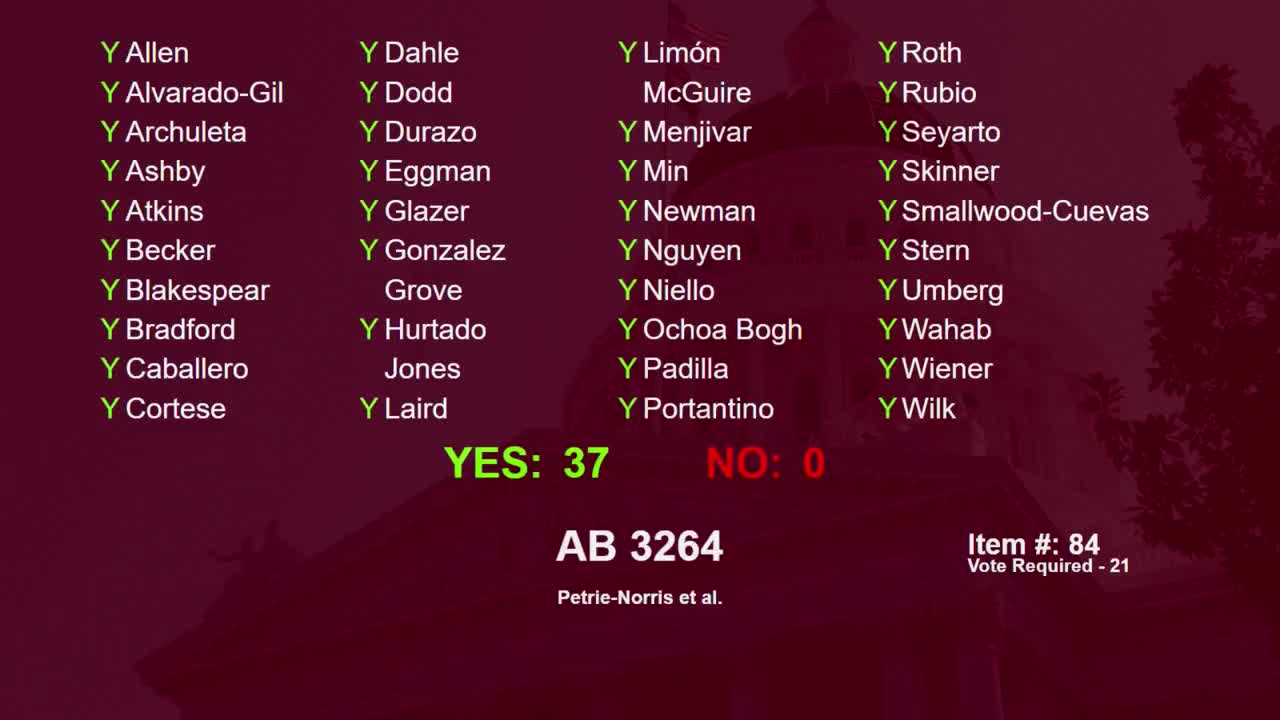 1MIN
Senate Floor
 1MIN
Assembly Floor
 1MIN
Assembly Floor
 58SEC
Assembly Floor
 53SEC
Senate Standing Committee on Business, Professions and Economic Development
1MIN
Senate Standing Committee on Business, Professions and Economic Development
29SEC
Senate Standing Committee on Business, Professions and Economic Development
Bill Author
Bill Co-Author(s):