SB 2: Firearms.
- Session Year: 2023-2024
- House: Senate
- Latest Version Date: 2023-09-26
Current Status:
Passed
(2023-09-26: Chaptered by Secretary of State. Chapter 249, Statutes of 2023.)
Introduced
In Committee
First Chamber
In Committee
Second Chamber
Enacted
Existing law prohibits a person from carrying a concealed firearm or carrying a loaded firearm in public. Existing law authorizes a licensing authority, as specified, if good cause exists for the issuance, and subject to certain other criteria including, among other things, the applicant is of good moral character and has completed a specified course of training, to issue a license to carry a concealed handgun or to carry a loaded and exposed handgun, as specified. Under existing law, the required course of training for an applicant is no more than 16 hours and covers firearm safety and laws regarding the permissible use of a firearm.
This bill would require the licensing authority to issue or renew a license if the applicant is not a disqualified person for the license and the applicant is at least 21 years of age. The bill would remove the good character and good cause requirements from the issuance criteria. Under the bill, the applicant would be a disqualified person if they, among other things, are reasonably likely to be a danger to self, others, or the community at large, as specified. This bill would add the requirement that the applicant be the recorded owner, with the Department of Justice, of the pistol, revolver, or other firearm capable of being concealed upon the person. This bill would change the training requirement to be no less than 16 hours in length and would add additional subjects to the course including, among other things, the safe storage and legal transportation of firearms. The bill would require an issuing authority, prior to that issuance, renewal, or amendment to a license, if it has direct access to the designated department system to determine if the applicant is the recorded owner of the pistol, revolver, or other firearm. The bill would require an issuing authority without access to that system to confirm the ownership with the sheriff of the county in which the agency is located. By requiring local agencies to issue licenses for concealed firearms, this bill would create a state-mandated local program.
The bill would require a licensing authority to provide the applicant notice if a new license or license renewal is denied or revoked. If an application is denied or a license is revoked based on a determination that the applicant is a disqualified person, the bill would permit the applicant to request a hearing to challenge the license denial or revocation, and require the licensing authority to inform the applicant of the ability to seek a hearing. If a new license or license renewal is denied or revoked for any other reason, the bill would authorize the applicant to seek a writ of mandate from a superior court within 30 days of receipt of notice of denial or revocation, and require the licensing authority to inform the applicant of the ability to seek a writ of mandate. By imposing new duties on local licensing authorities, this bill would create a state-mandated local program.
Existing law requires an agency issuing a license described above to set forth specified information on the license, including, among other things, the licensees name, occupation, and reason for desiring a license to carry the weapon.
This bill would revise that information to include, among other things, the licensees drivers license or identification number, fingerprints, and information relating to the date of expiration of the license, and would remove the requirement that the license detail the reason for desiring a license to carry the weapon.
Existing law requires an applicant for a license described above to provide fingerprints, as specified. Existing law exempts an applicant from this requirement if they have previously applied to the same licensing authority and the applicants fingerprints have previously been forwarded to the department, as specified, and instead requires that authority to note data that would provide positive identification in the files of the department, on the copy of any subsequent license submitted to the department.
This bill would require the licensing authority to submit fingerprint images and related information to the department for each applicant applying for a new or renewal license. The bill would require the department to notify the licensing authority if the department is unable to ascertain, among other things, the final disposition of an arrest or criminal charge under state or federal law that would prohibit the person from possessing, receiving, owning, or purchasing a firearm. This bill would prohibit a license from being issued or renewed unless the department reports to a licensing authority that the applicant is eligible to possess, receive, own, or purchase a firearm.
Existing law requires a licensing authority to charge an additional fee in an amount equal to reasonable processing costs for a new license. Existing law also prohibits a licensing authority from imposing, among other things, a requirement or condition that an applicant pay additional funds or obtain liability insurance.
This bill would authorize a licensing authority to charge the additional processing cost fee for a license renewal and would permit the licensing authority to collect the first 50% of the fee upon filing of the application. The bill also removes the prohibition on licensing authority requirements for additional fees or liability insurance.
Existing law requires that licenses and applications for licenses be uniform throughout the state, and to be submitted upon forms prescribed by the Attorney General. When revising the standard application form for licenses, existing law requires the Attorney General to convene a committee to review and revise the existing application form. Existing law requires the Attorney General to develop a uniform license that may be used as indicia of proof of licensure throughout the state. Existing law also requires the committee to convene to review and revise the design standard for a uniform license.
This bill would authorize the Attorney General to revise the standard form for licenses and the design standard if the committee does not revise the form or issue a design standard within a specified time period.
Under existing law, it is a crime to bring a firearm into a state or local building, and makes it a crime to bring a loaded firearm into, or upon the grounds of, any residence of the Governor, any other constitutional officer, or Member of the Legislature. Existing law exempts a licensee from that prohibition if, among other things, the licensee has a valid license to carry the firearm.
This bill would remove those exemptions, except as specified. The bill would make it a crime to bring an unloaded firearm into, or upon the grounds of, any residence of the Governor, any other constitutional officer, or Member of the Legislature. The bill would also prohibit a licensee from carrying a firearm to specified locations, including, among other places, a building designated for a court proceeding and a place of worship, as defined, with specific exceptions. By expanding the scope of an existing crime, the bill would impose a state-mandated local program.
Existing law prohibits a person from knowingly possessing a firearm in a sterile area of an airport, passenger vessel terminal, or public transit facility, as defined.
This bill would additionally prohibit a person from knowingly possessing a firearm in any building, real property, or parking area under the control of an airport or passenger vessel terminal, as specified. By expanding the scope of an existing crime, the bill would impose a state-mandated local program.
Existing law, the Gun-Free School Zone Act of 1995, makes it a crime to possess a firearm in a place that the person knows, or reasonably should know, is a school zone. Existing law defines a school zone as an area in, or on the grounds of, a public or private school providing instruction in kindergarten or grades 1 to 12, inclusive, or within a distance of 1,000 feet from the grounds of the public or private school. Existing law provides exceptions to that crime, including if a person with a valid concealed carry license who is carrying the firearm described in the license in an area that is not in, or on the grounds of, a public or private school and when a firearm is an unloaded pistol, revolver, or other firearm capable of being concealed on the person and is in a locked container or within the locked trunk of a motor vehicle.
This bill would revise the exception for a person who has a valid concealed carry license to permit them to carry a specified firearm in an area that is not within any building, real property, or parking area under the control of a public or private school, or on a street or sidewalk immediately adjacent to a building, real property, or parking area under the control of that public or private school, as specified.
Existing law requires a licensing authority to revoke a license to carry a firearm if the licensing authority is notified by the department or the licensing authority determines that a licensee is prohibited from possessing, receiving, owning, or purchasing a firearm under state or federal law.
This bill would also require a licensing authority to revoke a license if, among other things, a licensee has provided inaccurate or incomplete information on their application for a new license or license renewal.
Existing law authorizes a licensing authority to impose reasonable restrictions on the time, place, manner, and circumstances when a licensee may carry a firearm capable of being concealed.
While carrying a firearm, this bill would prohibit a licensee from, among other things, consuming an alcoholic beverage or controlled substance and from falsely representing that the licensee is a peace officer.
The bill would authorize the department to adopt emergency regulations to implement the concealed firearm licensing system, as specified.
This bill would make conforming changes.
The bill would additionally make various findings and declarations of the Legislature.
The bill would state that its provisions are severable.
This bill would incorporate additional changes to Section 29805 of the Penal Code proposed by SB 368 to be operative only if this bill and SB 368 are enacted and this bill is enacted last. This bill would also incorporate additional changes to Section 30370 of the Penal Code proposed by AB 135 and SB 135 to be operative only if this bill and either of those bills are enacted and this bill is enacted last.
The California Constitution requires the state to reimburse local agencies and school districts for certain costs mandated by the state. Statutory provisions establish procedures for making that reimbursement.
This bill would provide that with regard to certain mandates no reimbursement is required by this act for a specified reason.
With regard to any other mandates, this bill would provide that, if the Commission on State Mandates determines that the bill contains costs so mandated by the state, reimbursement for those costs shall be made pursuant to the statutory provisions noted above.
Existing law prohibits a person from carrying a concealed firearm or carrying a loaded firearm in public. Existing law authorizes a licensing authority, as specified, if good cause exists for the issuance, and subject to certain other criteria including, among other things, the applicant is of good moral character and has completed a specified course of training, to issue a license to carry a concealed handgun or to carry a loaded and exposed handgun, as specified. Under existing law, the required course of training for an applicant is no more than 16 hours and covers firearm safety and laws regarding the permissible use of a firearm.
This bill would require the licensing authority to issue or renew a license if the applicant is not a disqualified person for the license and the applicant is at least 21 years of age. The bill would remove the good character and good cause requirements from the issuance criteria. Under the bill, the applicant would be a disqualified person if they, among other things, are reasonably likely to be a danger to self, others, or the community at large, as specified. This bill would add the requirement that the applicant be the recorded owner, with the Department of Justice, of the pistol, revolver, or other firearm capable of being concealed upon the person. This bill would change the training requirement to be no less than 16 hours in length and would add additional subjects to the course including, among other things, the safe storage and legal transportation of firearms. The bill would require an issuing authority, prior to that issuance, renewal, or amendment to a license, if it has direct access to the designated department system to determine if the applicant is the recorded owner of the pistol, revolver, or other firearm. The bill would require an issuing authority without access to that system to confirm the ownership with the sheriff of the county in which the agency is located. By requiring local agencies to issue licenses for concealed firearms, this bill would create a state-mandated local program.
The bill would require a licensing authority to provide the applicant notice if a new license or license renewal is denied or revoked. If an application is denied or a license is revoked based on a determination that the applicant is a disqualified person, the bill would permit the applicant to request a hearing to challenge the license denial or revocation, and require the licensing authority to inform the applicant of the ability to seek a hearing. If a new license or license renewal is denied or revoked for any other reason, the bill would authorize the applicant to seek a writ of mandate from a superior court within 30 days of receipt of notice of denial or revocation, and require the licensing authority to inform the applicant of the ability to seek a writ of mandate. By imposing new duties on local licensing authorities, this bill would create a state-mandated local program.
Existing law requires an agency issuing a license described above to set forth specified information on the license, including, among other things, the licensees name, occupation, and reason for desiring a license to carry the weapon.
This bill would revise that information to include, among other things, the licensees drivers license or identification number, fingerprints, and information relating to the date of expiration of the license, and would remove the requirement that the license detail the reason for desiring a license to carry the weapon.
Existing law requires an applicant for a license described above to provide fingerprints, as specified. Existing law exempts an applicant from this requirement if they have previously applied to the same licensing authority and the applicants fingerprints have previously been forwarded to the department, as specified, and instead requires that authority to note data that would provide positive identification in the files of the department, on the copy of any subsequent license submitted to the department.
This bill would require the licensing authority to submit fingerprint images and related information to the department for each applicant applying for a new or renewal license. The bill would require the department to notify the licensing authority if the department is unable to ascertain, among other things, the final disposition of an arrest or criminal charge under state or federal law that would prohibit the person from possessing, receiving, owning, or purchasing a firearm. The bill would require the licensing authority to instead collect the applicants fingerprint that would provide that positive identification in the files of the department, as specified. This bill would prohibit a license from being issued or renewed unless the department reports to a licensing authority that the applicant is eligible to possess, receive, own, or purchase a firearm.
Existing law requires a licensing authority to charge an additional fee in an amount equal to reasonable processing costs for a new license. Existing law also prohibits a licensing authority from imposing, among other things, a requirement or condition that an applicant pay additional funds or obtain liability insurance.
This bill would authorize a licensing authority to charge the additional processing cost fee for a license renewal and would permit the licensing authority to collect the first 50% of the fee upon filing of the application. The bill also removes the prohibition on licensing authority requirements for additional fees or liability insurance.
Existing law requires that licenses and applications for licenses be uniform throughout the state, and to be submitted upon forms prescribed by the Attorney General. When revising the standard application form for licenses, existing law requires the Attorney General to convene a committee to review and revise the existing application form. Existing law requires the Attorney General to develop a uniform license that may be used as indicia of proof of licensure throughout the state. Existing law also requires the committee to convene to review and revise the design standard for a uniform license.
This bill would authorize the Attorney General to revise the standard form for licenses and the design standard if the committee does not revise the form or issue a design standard within a specified time period.
Under existing law, it is a crime to bring a firearm into a state or local building, and makes it a crime to bring a loaded firearm into, or upon the grounds of, any residence of the Governor, any other constitutional officer, or Member of the Legislature. Existing law exempts a licensee from that prohibition if, among other things, the licensee has a valid license to carry the firearm.
This bill would remove those exemptions, except as specified. The bill would make it a crime to bring an unloaded firearm into, or upon the grounds of, any residence of the Governor, any other constitutional officer, or Member of the Legislature. The bill would also prohibit a licensee from carrying a firearm to specified locations, including, among other places, a building designated for a court proceeding and a place of worship, as defined, with specific exceptions. By expanding the scope of an existing crime, the bill would impose a state-mandated local program.
Existing law prohibits a person from knowingly possessing a firearm in a sterile area of an airport, passenger vessel terminal, or public transit facility, as defined.
This bill would additionally prohibit a person from knowingly possessing a firearm in any building, real property, or parking area under the control of an airport or passenger vessel terminal, as specified. By expanding the scope of an existing crime, the bill would impose a state-mandated local program.
Existing law, the Gun-Free School Zone Act of 1995, makes it a crime to possess a firearm in a place that the person knows, or reasonably should know, is a school zone. Existing law defines a school zone as an area in, or on the grounds of, a public or private school providing instruction in kindergarten or grades 1 to 12, inclusive, or within a distance of 1,000 feet from the grounds of the public or private school. Existing law provides exceptions to that crime, including if a person with a valid concealed carry license who is carrying the firearm described in the license in an area that is not in, or on the grounds of, a public or private school and when a firearm is an unloaded pistol, revolver, or other firearm capable of being concealed on the person and is in a locked container or within the locked trunk of a motor vehicle.
This bill would revise the exception for a person who has a valid concealed carry license to permit them to carry a specified firearm in an area that is not within any building, real property, or parking area under the control of a public or private school, or on a street or sidewalk immediately adjacent to a building, real property, or parking area under the control of that public or private school, as specified.
Existing law requires a licensing authority to revoke a license to carry a firearm if the licensing authority is notified by the department or the licensing authority determines that a licensee is prohibited from possessing, receiving, owning, or purchasing a firearm under state or federal law.
This bill would also require a licensing authority to revoke a license if, among other things, a licensee has provided inaccurate or incomplete information on their application for a new license or license renewal.
Existing law authorizes a licensing authority to impose reasonable restrictions on the time, place, manner, and circumstances when a licensee may carry a firearm capable of being concealed.
While carrying a firearm, this bill would prohibit a licensee from, among other things, consuming an alcoholic beverage or controlled substance and from falsely representing that the licensee is a peace officer.
The bill would authorize the department to adopt emergency regulations to implement the concealed firearm licensing system, as specified.
This bill would make conforming changes.
The bill would additionally make various findings and declarations of the Legislature.
The bill would state that its provisions are severable.
This bill would incorporate additional changes to Section 29805 of the Penal Code proposed by SB 368 to be operative only if this bill and SB 368 are enacted and this bill is enacted last. This bill would also incorporate additional changes to Section 30370 of the Penal Code proposed by AB 135 and SB 135 to be operative only if this bill and either of those bills are enacted and this bill is enacted last.
The California Constitution requires the state to reimburse local agencies and school districts for certain costs mandated by the state. Statutory provisions establish procedures for making that reimbursement.
This bill would provide that with regard to certain mandates no reimbursement is required by this act for a specified reason.
With regard to any other mandates, this bill would provide that, if the Commission on State Mandates determines that the bill contains costs so mandated by the state, reimbursement for those costs shall be made pursuant to the statutory provisions noted above.
Existing law prohibits a person from carrying a concealed firearm or carrying a loaded firearm in public. Existing law authorizes a licensing authority, as specified, if good cause exists for the issuance, and subject to certain other criteria including, among other things, the applicant is of good moral character and has completed a specified course of training, to issue a license to carry a concealed handgun or to carry a loaded and exposed handgun, as specified. Under existing law, the required course of training for an applicant is no more than 16 hours and covers firearm safety and laws regarding the permissible use of a firearm.
This bill would require the licensing authority to issue or renew a license if the applicant is not a disqualified person for the license and the applicant is at least 21 years of age. The bill would remove the good character and good cause requirements from the issuance criteria. Under the bill, the applicant would be a disqualified person if they, among other things, are reasonably likely to be a danger to self, others, or the community at large, as specified. This bill would add the requirement that the applicant be the recorded owner, with the Department of Justice, of the pistol, revolver, or other firearm capable of being concealed upon the person. This bill would change the training requirement to be no less than 16 hours in length and would add additional subjects to the course including, among other things, the safe storage and legal transportation of firearms. The bill would require an issuing authority, prior to that issuance, renewal, or amendment to a license, if it has direct access to the designated department system to determine if the applicant is the recorded owner of the pistol, revolver, or other firearm. The bill would require an issuing authority without access to that system to confirm the ownership with the sheriff of the county in which the agency is located. By requiring local agencies to issue licenses for concealed firearms, this bill would create a state-mandated local program.
The bill would require a licensing authority to provide the applicant notice if a new license or license renewal is denied or revoked. If an application is denied or a license is revoked based on a determination that the applicant is a disqualified person, the bill would permit the applicant to request a hearing to challenge the license denial or revocation, and require the licensing authority to inform the applicant of the ability to seek a hearing. If a new license or license renewal is denied or revoked for any other reason, the bill would authorize the applicant to seek a writ of mandate from a superior court within 30 days of receipt of notice of denial or revocation, and require the licensing authority to inform the applicant of the ability to seek a writ of mandate. By imposing new duties on local licensing authorities, this bill would create a state-mandated local program.
Existing law requires an agency issuing a license described above to set forth specified information on the license, including, among other things, the licensees name, occupation, and reason for desiring a license to carry the weapon.
This bill would revise that information to include, among other things, the licensees drivers license or identification number, fingerprints, and information relating to the date of expiration of the license, and would remove the requirement that the license detail the reason for desiring a license to carry the weapon.
Existing law requires an applicant for a license described above to provide fingerprints, as specified. Existing law exempts an applicant from this requirement if they have previously applied to the same licensing authority and the applicants fingerprints have previously been forwarded to the department, as specified, and instead requires that authority to note data that would provide positive identification in the files of the department, on the copy of any subsequent license submitted to the department.
This bill would require the department to notify the licensing authority if the department is unable to ascertain, among other things, the final disposition of an arrest or criminal charge under state or federal law that would prohibit the person from possessing, receiving, owning, or purchasing a firearm. The bill would require the licensing authority to instead collect the applicants fingerprint that would provide that positive identification in the files of the department, as specified. This bill would prohibit a license from being issued or renewed unless the department reports to a licensing authority that the applicant is eligible to possess, receive, own, or purchase a firearm.
Existing law requires a licensing authority to charge an additional fee in an amount equal to reasonable processing costs for a new license. Existing law also prohibits a licensing authority from imposing, among other things, a requirement or condition that an applicant pay additional funds or obtain liability insurance.
This bill would authorize a licensing authority to charge the additional processing cost fee for a license renewal and would permit the licensing authority to collect the first 50% of the fee upon filing of the application. The bill also removes the prohibition on licensing authority requirements for additional fees or liability insurance.
Existing law requires that licenses and applications for licenses be uniform throughout the state, and to be submitted upon forms prescribed by the Attorney General. When revising the standard application form for licenses, existing law requires the Attorney General to convene a committee to review and revise the existing application form. Existing law requires the Attorney General to develop a uniform license that may be used as indicia of proof of licensure throughout the state. Existing law also requires the committee to convene to review and revise the design standard for a uniform license.
This bill would authorize the Attorney General to revise the standard form for licenses and the design standard if the committee does not revise the form or issue a design standard within a specified time period.
Under existing law, it is a crime to bring a firearm into a state or local building, and makes it a crime to bring a loaded firearm into, or upon the grounds of, any residence of the Governor, any other constitutional officer, or Member of the Legislature. Existing law exempts a licensee from that prohibition if, among other things, the licensee has a valid license to carry the firearm.
This bill would remove those exemptions, except as specified. The bill would make it a crime to bring an unloaded firearm into, or upon the grounds of, any residence of the Governor, any other constitutional officer, or Member of the Legislature. The bill would also prohibit a licensee from carrying a firearm to specified locations, including, among other places, a building designated for a court proceeding and a place of worship, as defined, with specific exceptions. By expanding the scope of an existing crime, the bill would impose a state-mandated local program.
Existing law prohibits a person from knowingly possessing a firearm in a sterile area of an airport, passenger vessel terminal, or public transit facility, as defined.
This bill would additionally prohibit a person from knowingly possessing a firearm in any building, real property, or parking area under the control of an airport or passenger vessel terminal, as specified. By expanding the scope of an existing crime, the bill would impose a state-mandated local program.
Existing law, the Gun-Free School Zone Act of 1995, makes it a crime to possess a firearm in a place that the person knows, or reasonably should know, is a school zone. Existing law defines a school zone as an area in, or on the grounds of, a public or private school providing instruction in kindergarten or grades 1 to 12, inclusive, or within a distance of 1,000 feet from the grounds of the public or private school. Existing law provides exceptions to that crime, including if a person with a valid concealed carry license who is carrying the firearm described in the license in an area that is not in, or on the grounds of, a public or private school and when a firearm is an unloaded pistol, revolver, or other firearm capable of being concealed on the person and is in a locked container or within the locked trunk of a motor vehicle.
This bill would revise the exception for a person who has a valid concealed carry license to permit them to carry a specified firearm in an area that is not within any building, real property, or parking area under the control of a public or private school, or on a street or sidewalk immediately adjacent to a building, real property, or parking area under the control of that public or private school, as specified.
Existing law requires a licensing authority to revoke a license to carry a firearm if the licensing authority is notified by the department or the licensing authority determines that a licensee is prohibited from possessing, receiving, owning, or purchasing a firearm under state or federal law.
This bill would also require a licensing authority to revoke a license if, among other things, a licensee has provided inaccurate or incomplete information on their application for a new license or license renewal.
Existing law authorizes a licensing authority to impose reasonable restrictions on the time, place, manner, and circumstances when a licensee may carry a firearm capable of being concealed.
While carrying a firearm, this bill would prohibit a licensee from, among other things, consuming an alcoholic beverage or controlled substance and from falsely representing that the licensee is a peace officer.
The bill would authorize the department to adopt emergency regulations to implement the concealed firearm licensing system, as specified.
This bill would make conforming changes.
The bill would additionally make various findings and declarations of the Legislature.
The bill would state that its provisions are severable.
The California Constitution requires the state to reimburse local agencies and school districts for certain costs mandated by the state. Statutory provisions establish procedures for making that reimbursement.
This bill would provide that with regard to certain mandates no reimbursement is required by this act for a specified reason.
With regard to any other mandates, this bill would provide that, if the Commission on State Mandates determines that the bill contains costs so mandated by the state, reimbursement for those costs shall be made pursuant to the statutory provisions noted above.
Existing law prohibits a person from carrying a concealed firearm or carrying a loaded firearm in public. Existing law authorizes a licensing authority, as specified, if good cause exists for the issuance, and subject to certain other criteria including, among other things, the applicant is of good moral character and has completed a specified course of training, to issue a license to carry a concealed handgun or to carry a loaded and exposed handgun, as specified. This bill would state the intent of the Legislature to enact legislation to address the United States Supreme Courts decision in New York State Rifle & Pistol Assn, Inc. v. Bruen (2022).Existing law prohibits a person from carrying a concealed firearm or carrying a loaded firearm in public. Existing law authorizes a licensing authority, as specified, if good cause exists for the issuance, and subject to certain other criteria including, among other things, the applicant is of good moral character and has completed a specified course of training, to issue a license to carry a concealed handgun or to carry a loaded and exposed handgun, as specified.
This bill would state the intent of the Legislature to enact legislation to address the United States Supreme Courts decision in New York State Rifle & Pistol Assn, Inc. v. Bruen (2022).
The Legislature finds and declares all of the following:
(a)The Legislature has compelling interests in protecting both individual rights and public safety. The Legislatures intent and purpose in clarifying Californias requirements governing the issuance of carry concealed weapons (CCW) licenses, and clarifying Dealers Record of Sale cross-references, is to protect its residents rights to keep and bear arms while also protecting the publics health and safety in the state by reducing the number of people killed, injured, and traumatized by gun violence; protecting the exercise of other fundamental rights, including the right to worship, attain an education, vote, and peaceably assemble and demonstrate; ensuring that law enforcement is able to effectively do its job; and combating terrorism.
(b)While the United States Supreme Court has made clear that the Second Amendment to the United States Constitution imposes some restrictions on states ability to regulate firearms, it has recognized that the Second Amendment to the United States Constitution is not a regulatory straightjacket. N.Y. State Rifle & Pistol Assn v. Bruen (2022), 142 S. Ct. 2111, 2133. Indeed, the Second Amendment allows States to adopt a variety of gun regulations. N.Y. State Rifle & Pistol Assn (2022), 142 S. Ct. 2111, 2162 (conc. opn. of Kavanaugh, J.). And when it comes to restrictions on carrying firearms in public, the United States Supreme Court has recognized three times that states may restrict the carrying of firearms in sensitive places. N.Y. State Rifle & Pistol Assn v. Bruen (2022), 142 S. Ct. 2111, 2133; see also McDonald v. City of Chicago (2010) 561 U.S. 742, 786 (plur. opn. of Alito, J.); District of Columbia v. Heller (2008) 554 U.S. 570, 626. It has also recognized that states may prohibit individuals who are not law-abiding, responsible citizens from carrying firearms in public. N.Y. State Rifle & Pistol Assn v. Bruen (2022), 142 S. Ct. 2111, 2138 fn.9.
(c)Indeed, the United States Supreme Court has affirmed the validity of shall-issue concealed carry licensing standards enacted in 43 states that include qualification standards that are designed to ensure only that those bearing arms in the jurisdiction are, in fact, law-abiding responsible citizens, N.Y. State Rifle & Pistol Assn v. Bruen (2022) 142 S. Ct. 2111, 2138 fn.9. The laws of at least 21 of these states authorize officials to deny concealed carry licenses to otherwise eligible applicants who are found not to be law-abiding or responsible based on a determination that the applicant lacks the character or temperament to carry firearms in public spaces or otherwise presents a danger to self, others, or the community at large. (See Ala. Code 13A-11-75(a)(1)(a); Ark. Code Ann. 5-73-308(b)(1); Colo. Rev. Stat. 18-12-203(2); Conn. Gen. Stat. 29-28(b); Del. Code, Tit. 11, 1441; Ga. Code 16-11-129(d)(4); 430 Ill. Comp. Stat. 66/15; Ind. Code 35-47-2-3(g); Iowa Code 724.8(3); Me. Rev. Stat. Ann., Tit. 25, 2003; Minn. Stat. 624.714; Mo. Rev. Stat. 571.101.2(7); Mont. Code 45-8-321(2); N.D. Cent. Code 62.1-04-03(1)(e); Or. Rev. Stat. 166.293(2); 18 Pa. Cons. Stat. 6109(e)(1)(i); R.I. Gen. Laws 11-47-11; S.D. Codified Laws 23-7-7.1; Utah Code 53-5-704(3)(a); Va. Code 18.2-308.09(13); Wyo. Stat. 6-8-104(g)). The United States Supreme Court repeatedly affirmed the validity of these states standards, including specifically and approvingly citing the standards adopted in Connecticut, which, the Court noted, validly preclude an otherwise eligible applicant from qualifying for a concealed carry license if the licensing official determines the applicants conduct has shown them to be lacking the essential character of temperament necessary to be entrusted with a weapon. N.Y. State Rifle & Pistol Assn v. Bruen (2022) 142 S. Ct. 2111, 2123 fn.1.
(d)Over the past several years, a wealth of empirical studies have shown that crime is higher when more people carry firearms in public places. While California and other states have decided to limit the places and conditions under which residents may carry firearms, over the past several decades other states have decided to allow most people to carry firearms in most public places. Those later states have seen markedly higher crime rates. According to one study, in the 33 states that adopted these right-to-carry laws, violent crime was substantially higher13 to 15 percent higher10 years after the laws were adopted than it would have been, had those states not adopted those laws. See Donohue, et al., Right-to-Carry Laws and Violent Crime: A Comprehensive Assessment Using Panel Data and a State-Level Synthetic Control Analysis (2019) 16 J. Empirical Legal Stud. 198. That same study acknowledged that crime had dropped in both right-to-carry states and other states over the past several decades, but concluded that the violent crime reduction in states that did not adopt right-to-carry laws was an order of magnitude higher than those that dida 42.3 percent drop in violent crime for those states that did not adopt right-to-carry laws compared to just a 4.3 percent drop for those that did.
(e)Broadly allowing individuals to carry firearms in most public areas increases the number of people wounded and killed by gun violence. Among other things, pervasive carrying increases the lethality of otherwise mundane situations, as we have seen shots fired in connection with road rage, talking on a phone in a theater, playing loud music at a gas station, a dispute over snow shoveling, and a dispute over the use of a disabled parking spot. Importantly, in many of these incidents, the shooters held permits that allowed them to carry firearms in public, meaning that they met the criteria necessary to secure a permit, which often include a requirement that the person not previously have been convicted of a serious crime.
(f)Another study concluded that states that changed from prohibiting concealed carry of guns to a regime where the state must issue a CCW permit to any qualified applicant who requests onea transition to a shall issue jurisdictionexperienced a 12.3 percent increase in gun-related murder rates, and a 4.9 increase in overall murder rates. Gius, Using the Synthetic Control Method to Determine the Effects of Concealed Carry Laws on State-Level Murder Rates (2019) 57 Intl Rev. L. & Econ. 1. Two other studies concluded that states with shall-issue laws had higher overall homicide rates, higher firearm homicide rates, and higher handgun homicide rates as compared to the may-issue regimes in place in California and other states. Siegel, et al., Easiness of Legal Access to Concealed Firearm Permits and Homicide Rates in the United States (2017) 107 Am. J. Pub. Health 1923; Siegel, et al., The Impact of State Firearm Laws on Homicide and Suicide Deaths in the USA, 1991 2016: A Panel Study (2019) 34 J. Gen. Internal Med. 2021. Several other studies reached similar results. Anita Knopov et al., The Impact of State Firearm Laws on Homicide Rates among Black and White Populations in the United States, 19912016 (2019) 44 Health & Soc. Work 232; John J. Donohue, Laws Facilitating Gun Carrying and Homicide (2017) 107 Am. J. Pub. Health 1864; Emma E. Fridel, Comparing the Impact of Household Gun Ownership and Concealed Carry Legislation on the Frequency of Mass Shootings and Firearms Homicide (2021) 38 Just. Q. 892; Cassandra K. Crifasi, Correction to: Association between Firearm Laws and Homicide in Urban Counties (2018) 95 J. Urban Health 773; Paul R. Zimmerman, The Deterrence of Crime Through Private Security Efforts: Theory and Evidence (2014) 37 Intl Rev. L. & Econ. 66.
(g)States with permissive right-to-carry laws also witness higher rates of firearm workplace homicides than those that did not have those laws. One study concluded that states with right-to-carry laws experienced 29 percent greater rates of firearm workplace homicides between 1992 and 2017 than those that did not. Mitchell L. Doucette et al., Right-to-Carry Laws and Firearm Workplace Homicides: A Longitudinal Analysis (19922017) (2019) 109 Am. J. Pub. Health 1747, 1751. Another peer-reviewed study found that restricting the ability to carry concealed weapons was associated with a 5.79 percent reduction in workplace homicide rates. Erika L. Sabbath et al., State-Level Changes in Firearm Laws and Workplace Homicide Rates: United States, 2011 to 2017 (2020) 110 Am. J. Pub. Health 230.
(h)While several studies from the late 1990s and early 2000s purported to conclude that increases in right-to-carry laws either decreased or had no effect on crime, many other early studies concluded that it increased crime. In 2005, the National Research Council issued a report evaluating the then-current literature about the impact of right-to-carry laws on crime, and concluded that it was impossible to draw strong conclusions from the existing literature on the causal impact of right-to-carry laws on violent crime and property crime in general and rape, aggravated assault, auto theft, burglary, and larceny in particular, and that the existing data and methods were likely insufficient to resolve the question, and that new analytical approaches and data were needed if further headway is to be made. Natl Research Council, Firearms and Violence: A Critical Review (2005) 272, 275.
(i)Since that time a number of social scientists have taken up the National Research Councils call. Those studies overwhelmingly support the conclusion that more carrying of firearms in public leads to an increase in crime: of the 35 social science studies looking at this issue since the National Research Council issued its report in 2005, 23 found an increase in crime, 7 found no effect, and 5 found a decrease in crime. A 2014 study from the Harvard Injury Control Research Center concluded that a sizable majority of firearms researchers disagree with the statement that the change in state level concealed carry laws in the United States over the past few decades from more restrictive to more permissive has reduced crime rates.
(j)Widespread carrying of firearms also impedes the exercise of other fundamental rights. When firearms are present in public spaces, it makes those places less safe, which discourages people from attending protests, going to school, peacefully worshiping, voting in person, and enjoying other activities.
(1)(A)While the net effect of policies that allow most people to carry firearms in most places have negatively impacted public safety broadly, their effects are likely to be far more deleterious when extended to college campuses. Risks of violence, suicide attempts, alcohol abuse, and other risky behavior are greatly elevated among college-aged, youth and in the campus environment, and the presence of firearms greatly increases the risk of lethal and near-lethal outcomes from these behaviors and in this context. Daniel W. Webster et al., Firearms on College Campuses: Research Evidence and Policy Implications, Johns Hopkins Bloomberg Sch. of Pub. Health (Oct. 15, 2016). Moreover, once Georgia passed a law allowing firearms to be carried on college campuses, campus members reported a statistically significant increase in perceptions of the campus as unsafe, fear of crime on campus, and lack of confidence in campus police; and a statistically significantly increase in the proportion of campus members who reported experiencing fearful conflicts on campus. Jennifer McMahon-Howard et al., Examining the Effects of Passing a Campus Carry Law: Comparing Campus Safety Before and After Georgias New Campus Carry Law, 20 J. of Sch. Violence (2021) 430.
(B)Widespread carrying can also affect the ability to learn in primary and secondary schools. One study concluded that students exposed to school shootings have an increased absence rate, are more likely to be chronically absent and repeat a grade in the two years following the event, and suffer negative long-term impacts on high school graduation rates, college enrollment and graduation, and future employment and earnings. Marika Cabral et al., Trauma at School: The Impacts of Shootings on Students Human Capital and Economic Outcomes, Natl Bureau of Econ. Research (Dec. 2020). Another study looked at longer term consequences of school shootings, finding that exposure to shootings at schools resulted in lower test scores, increased absenteeism, and increased subsequent mortality for those students, and particularly boys, who are exposed to the highest-victimization school shootings. Phillip Levine and Robin McKnight, Exposure to a School Shooting and Subsequent Well-Being, Natl Bureau of Econ. Research (Dec. 2020).
(2)Widespread public carry also intimidates those who hope to peacefully worship. Places of worship already experience serious incidents or threats of violence. According to one study, the percentage of mass shootings motivated by religious hate escalated from 1 percent between 1966 and 2000 to 9 percent during 20002014 to 18 percent during 2018-February 2020. Richard R. Johnson, Serious Violence at Places of Worship in the U.S.Looking at the Numbers, Dolan Consulting Grp. (Sept. 2019). A review of the Federal Investigation Bureaus National Incident-Based Reporting System datawhich covers only 20 percent of the countrys populationfrom 2000 through 2016 found that 1,652 incidents of serious violence occurred at places of worship, including aggravated assaults, shootings, stabbings, and bombings, with 57 percent involving the use of a firearm. Extrapolating those figures to the entire country would suggest that there are about 480 incidents of serious violence at places of worship in the United States each year. Allowing more people to carry in places of worship threatens to make these incidents more likely.
(3)Carrying firearms impedes the exercise of other rights of the First Amendment to the United States Constitution, including the right to protest and vote. In a nationally representative survey, 60 percent responded that they would be very unlikely to attend a protest if guns were present, whereas only 7 percent said they would be very likely to attend such a protest. Alexandra Filindra, Americans Do Not Want Guns at Protests, this Research Shows, Wash. Post (Nov. 21, 2021). Another study concluded that 16 percent of demonstrations where firearms were present turned violent, as compared to less than 3 percent of demonstrations where firearms were not present. Everytown for Gun Safety & Armed Conflict Locations & Event Data Project, Armed Assembly: Guns, Demonstrations, and Political Violence in America (2021).
(k)An individual does not need to carry several firearms at any one time in order to effectively defend themselves. Studies have shown that, on average, individuals fire approximately two rounds when using a firearm in self-defense inside or outside of the home, including approximately 27 percent of incidents in which no shots are fired and the mere brandishing of the firearm is sufficient for self-defense. Limiting an individual to carrying no more than two firearms in public at any given time will not impair the ability of law-abiding, responsible individuals to engage in effective self-defense with a firearm.
(l)Laws requiring an assessment of dangerousness in connection with obtaining firearms have saved lives. One study concluded that since Californias gun violence restraining order processwhich allows family members and law enforcement to petition a court for an order temporarily prohibiting a person from purchasing or possessing firearms, if a court finds that the person is a danger to themselves or otherstook effect in January 2016, there have been 21 instances in which the statute was used to prevent a mass shooting. Wintemute, et al., Extreme Risk Protection Orders Intended to Prevent Mass Shootings, 171 Annals of Internal Med. (2019) 655, 655-658. According to another study, 56 percent of mass shooters exhibited warning signs that they posed a risk to themselves or others before they carried out the shooting. Everytown for Gun Safety Support Fund, Mass Shootings in America, (Nov. 2020). One hundred percent of perpetrators of school violence showed concerning behaviors before committing their acts, according to a study by the United States Secret Service and the United States Department of Education. U.S. Secret Serv., Natl Threat Assessment Ctr., Protecting Americas Schools: A U.S. Secret Service Analysis of Targeted School Violence 43 (2019).
(m)Broad public carry laws also impede the ability of law enforcement to ensure the publics safety. For example, laws allowing open carry of firearms imperil law enforcement officers on the front lines by making it much more difficult for an officer to discern if a person is a threat, and when there is an active shooter situation, makes it harder to determine the source of the threat.
SEC. 2.Section 171b of the Penal Code is amended to read:171b.(a)Any person who brings or possesses within any state or local public building or at any meeting required to be open to the public pursuant to Chapter 9 (commencing with Section 54950) of Part 1 of Division 2 of Title 5 of, or Article 9 (commencing with Section 11120) of Chapter 1 of Part 1 of Division 3 of Title 2 of, the Government Code, any of the following is guilty of a public offense punishable by imprisonment in a county jail for not more than one year, or in the state prison:
(1)Any firearm.
(2)Any deadly weapon described in Section 17235 or in any provision listed in Section 16590.
(3)Any knife with a blade length in excess of four inches, the blade of which is fixed or is capable of being fixed in an unguarded position by the use of one or two hands.
(4)Any unauthorized tear gas weapon.
(5)Any taser or stun gun as defined in Section 244.5.
(6)Any instrument that expels a metallic projectile, such as a BB or pellet, through the force of air pressure, CO2 pressure, or spring action, or any spot marker gun or paint gun.
(b)Subdivision (a) shall not apply to, or affect, any of the following:
(1)A person who possesses weapons in, or transports weapons into, a court of law to be used as evidence.
(2)(A)A duly appointed peace officer as defined in Chapter 4.5 (commencing with Section 830) of Title 3 of Part 2, a retired peace officer with authorization to carry concealed weapons as described in Article 2 (commencing with Section 25450) of Chapter 2 of Division 5 of Title 4 of Part 6, a full-time paid peace officer of another state or the federal government who is carrying out official duties while in California, or any person summoned by any of these officers to assist in making arrests or preserving the peace while they are actually engaged in assisting the officer.
(B)Notwithstanding subparagraph (A), subdivision (a) shall apply to any person who brings or possesses any weapon specified therein within any courtroom if they are a party to an action pending before the court.
(3)A person holding a valid license to carry the firearm pursuant to Chapter 4 (commencing with Section 26150) of Division 5 of Title 4 of Part 6 who possesses the firearm within a building designated for a court proceeding, including matters before a superior court, district court of appeal, or the California Supreme Court, and is a justice, judge, or commissioner of the court.
(4)A person who has permission to possess that weapon granted in writing by a duly authorized official who is in charge of the security of the state or local government building.
(5)A person who lawfully resides in, lawfully owns, or is in lawful possession of, that building with respect to those portions of the building that are not owned or leased by the state or local government.
(6)A person licensed or registered in accordance with, and acting within the course and scope of, Chapter 11.5 (commencing with Section 7512) or Chapter 11.6 (commencing with Section 7590) of Division 3 of the Business and Professions Code who has been hired by the owner or manager of the building if the person has permission pursuant to paragraph (5).
(7)(A)A person who, for the purpose of sale or trade, brings any weapon that may otherwise be lawfully transferred, into a gun show conducted pursuant to Article 1 (commencing with Section 27200) and Article 2 (commencing with Section 27300) of Chapter 3 of Division 6 of Title 4 of Part 6.
(B)A person who, for purposes of an authorized public exhibition, brings any weapon that may otherwise be lawfully possessed, into a gun show conducted pursuant to Article 1 (commencing with Section 27200) and Article 2 (commencing with Section 27300) of Chapter 3 of Division 6 of Title 4 of Part 6.
(c)As used in this section, state or local public building means a building that meets all of the following criteria:
(1)It is a building or part of a building owned or leased by the state or local government, if state or local public employees are regularly present for the purposes of performing their official duties. A state or local public building includes, but is not limited to, a building that contains a courtroom.
(2)It is not a building or facility, or a part thereof, that is referred to in Section 171c, 171d, 626.9, 626.95, or 626.10 of this code, or in Section 18544 of the Elections Code.
(3)It is a building not regularly used, and not intended to be used, by state or local employees as a place of residence.
SEC. 3.Section 171d of the Penal Code is amended to read:171d.Any person, except a duly appointed peace officer as defined in Chapter 4.5 (commencing with Section 830) of Title 3 of Part 2, a full-time paid peace officer of another state or the federal government who is carrying out official duties while in California, any person summoned by that officer to assist in making arrests or preserving the peace while they are actually engaged in assisting the officer, a member of the military forces of this state or of the United States engaged in the performance of their duties, the Governor or a member of their immediate family or a person acting with their permission with respect to the Governors Mansion or any other residence of the Governor, any other constitutional officer or a member of their immediate family or a person acting with their permission with respect to the officers residence, or a Member of the Legislature or a member of their immediate family or a person acting with their permission with respect to the Members residence, shall be punished by imprisonment in a county jail for not more than one year, by a fine of not more than one thousand dollars ($1,000), or by both the fine and imprisonment, or by imprisonment pursuant to subdivision (h) of Section 1170, if they do either of the following:
(a)Bring a firearm into, or possess a firearm within, the Governors Mansion, or any other residence of the Governor, the residence of any other constitutional officer, or the residence of any Member of the Legislature.
(b)Bring a firearm upon, or possess a firearm upon, the grounds of the Governors Mansion or any other residence of the Governor, the residence of any other constitutional officer, or the residence of any Member of the Legislature.
SEC. 4.Section 171.5 of the Penal Code is amended to read:171.5.(a)For purposes of this section:
(1)Airport means an airport, with a secured area, that regularly serves an air carrier holding a certificate issued by the United States Secretary of Transportation.
(2)Passenger vessel terminal means only that portion of a harbor or port facility, as described in Section 105.105(a)(2) of Title 33 of the Code of Federal Regulations, with a secured area that regularly serves scheduled commuter or passenger operations.
(3)Sterile area means a portion of an airport defined in the airport security program to which access generally is controlled through the screening of persons and property, as specified in Section 1540.5 of Title 49 of the Code of Federal Regulations, or a portion of any passenger vessel terminal to which, pursuant to the requirements set forth in Sections 105.255 and 105.260(a) of Title 33 of the Code of Federal Regulations, access is generally controlled in a manner consistent with the passenger vessel terminals security plan and the maritime security level in effect at the time.
(b)It is unlawful for any person to knowingly possess any firearm in any building, real property, or parking area under the control of an airport, except as provided for in subdivision (b), (c), or (e) of Section 26230.
(c)It is unlawful for any person to knowingly possess, within any sterile area of an airport or a passenger vessel terminal, any of the following items:
(1)Any knife with a blade length in excess of four inches, the blade of which is fixed, or is capable of being fixed, in an unguarded position by the use of one or two hands.
(2)Any box cutter or straight razor.
(3)Any metal military practice hand grenade.
(4)Any metal replica hand grenade.
(5)Any plastic replica hand grenade.
(6)Any imitation firearm as defined in Section 417.4.
(7)Any frame, receiver, barrel, or magazine of a firearm.
(8)Any unauthorized tear gas weapon.
(9)Any taser or stun gun as defined in Section 244.5.
(10)Any instrument that expels a metallic projectile, such as a BB or pellet, through the force of air pressure, CO2 pressure, or spring action, or any spot marker gun or paint gun.
(11)Any ammunition as defined in Section 16150.
(d)Subdivisions (b) and (c) shall not apply to, or affect, any of the following:
(1)A duly appointed peace officer as defined in Chapter 4.5 (commencing with Section 830) of Title 3 of Part 2, a retired peace officer with authorization to carry concealed weapons as described in Article 2 (commencing with Section 25450) of Chapter 2 of Division 5 of Title 4 of Part 6, a full-time paid peace officer of another state or the federal government who is carrying out official duties while in California, or any person summoned by any of these officers to assist in making arrests or preserving the peace while they are actually engaged in assisting the officer.
(2)A person who has authorization to possess a weapon specified in subdivision (c), granted in writing by an airport security coordinator who is designated as specified in Section 1542.3 of Title 49 of the Code of Federal Regulations, and who is responsible for the security of the airport.
(3)A person, including an employee of a licensed contract guard service, who has authorization to possess a weapon specified in subdivision (c) granted in writing by a person discharging the duties of Facility Security Officer or Company Security Officer pursuant to an approved United States Coast Guard facility security plan, and who is responsible for the security of the passenger vessel terminal.
(e)Subdivision (b) shall not apply to, or affect, any person possessing an unloaded firearm being transported in accordance with Sections 1540.111(c)(2)(iii) and 1540.111(c)(2)(iv) of Title 49 of the Code of Federal Regulations, which require a hard-sided, locked container, so long as the person is not within any sterile area of an airport or a passenger vessel terminal.
(f)A violation of this section is punishable by imprisonment in a county jail for a period not exceeding six months, or by a fine not exceeding one thousand dollars ($1,000), or by both that fine and imprisonment.
(g)The provisions of this section are cumulative, and shall not be construed as restricting the application of any other law. However, an act or omission that is punishable in different ways by this and any other provision of law shall not be punished under more than one provision.
(h)Nothing in this section is intended to affect existing state or federal law regarding the transportation of firearms on airplanes in checked luggage or the possession of the items listed in subdivision (c) in areas that are not sterile areas.
SEC. 5.Section 171.7 of the Penal Code is amended to read:171.7.(a)For purposes of this section:
(1)Public transit facility means any land, building, or equipment, or any interest therein, including any station on a public transportation route, to which access is controlled in a manner consistent with the public transit authoritys security plan, whether or not the operation thereof produces revenue, that has as its primary purpose the operation of a public transit system or the providing of services to the passengers of a public transit system. A public transit system includes the vehicles used in the system, including, but not limited to, motor vehicles, streetcars, trackless trolleys, buses, light rail systems, rapid transit systems, subways, trains, or jitneys, that transport members of the public for hire.
(2)Firearm has the same meaning as specified in subdivisions (a) and (b) of Section 16520.
(b)It is unlawful for any person to knowingly possess any of the following in a public transit facility:
(1)Any firearm.
(2)Any imitation firearm as defined in Section 417.4.
(3)Any instrument that expels a metallic projectile, such as a BB or pellet, through the force of air pressure, CO2 pressure, or spring action, or any spot marker gun or paint gun.
(4)Any metal military practice hand grenade.
(5)Any metal replica hand grenade.
(6)Any plastic replica hand grenade.
(7)Any unauthorized tear gas weapon.
(8)Any undetectable knife, as described in Section 17290.
(9)Any undetectable firearm, as described in Section 17280.
(c)(1)Subdivision (b) shall not apply to, or affect, any of the following:
(A)A duly appointed peace officer as defined in Chapter 4.5 (commencing with Section 830) of Title 3 of Part 2.
(B)A retired peace officer with authorization to carry concealed weapons as described in Article 2 (commencing with Section 25450) of Chapter 2 of Division 5 of Title 4 of Part 6.
(C)A full-time paid peace officer of another state or the federal government who is carrying out official duties while in California.
(D)A qualified law enforcement officer of another state or the federal government, as permitted under the Law Enforcement Officers Safety Act pursuant to Section 926B or 926C of Title 18 of the United States Code.
(E)Any person summoned by any of the officers listed in subparagraphs (A) to (C), inclusive, to assist in making arrests or preserving the peace while they are actually engaged in assisting the officer.
(F)A person who is responsible for the security of the public transit system and who has been authorized by the public transit authoritys security coordinator, in writing, to possess a weapon specified in subdivision (b).
(G)A person possessing an unloaded firearm while traveling on a public transit system that offers checked baggage services, so long as the firearm is stored in accordance with the public transit systems checked baggage policies.
(2)Paragraph (7) of subdivision (b) shall not apply to or affect the possession of a tear gas weapon when possession is permitted pursuant to Division 11 (commencing with Section 22810) of Title 3 of Part 6.
(d)A violation of this section is punishable by imprisonment in a county jail for a period not exceeding six months, or by a fine not exceeding one thousand dollars ($1,000), or by both that fine and imprisonment.
(e)The provisions of this section are cumulative, and shall not be construed as restricting the application of any other law. However, an act or omission that is punishable in different ways by this and any other provision of law shall not be punished under more than one provision.
(f)This section does not prevent prosecution under any other provision of law that may provide a greater punishment.
(g)This section shall be interpreted so as to be consistent with Section 926A of Title 18 of the United States Code.
SEC. 6.Section 626.9 of the Penal Code is amended to read:626.9.(a)This section shall be known, and may be cited, as the Gun-Free School Zone Act of 1995.
(b)Any person who possesses a firearm in a place that the person knows, or reasonably should know, is a school zone as defined in paragraph (4) of subdivision (e), shall be punished as specified in subdivision (f).
(c)Subdivision (b) does not apply to the possession of a firearm under any of the following circumstances:
(1)Within a place of residence or place of business or on private property, if the place of residence, place of business, or private property is not part of the school grounds and the possession of the firearm is otherwise lawful.
(2)(A)When the firearm is an unloaded pistol, revolver, or other firearm capable of being concealed on the person is within a locked container in a motor vehicle or is within the locked trunk of a motor vehicle at all times.
(B)This section does not prohibit or limit the otherwise lawful transportation of any other firearm, other than a pistol, revolver, or other firearm capable of being concealed on the person, in accordance with state law.
(3)When the person possessing the firearm reasonably believes that they are in grave danger because of circumstances forming the basis of a current restraining order issued by a court against another person or persons who has or have been found to pose a threat to their life or safety. This subdivision does not apply when the circumstances involve a mutual restraining order issued pursuant to Division 10 (commencing with Section 6200) of the Family Code absent a factual finding of a specific threat to the persons life or safety. Upon a trial for violating subdivision (b), the trier of a fact shall determine whether the defendant was acting out of a reasonable belief that they were in grave danger.
(4)When the person is exempt from the prohibition against carrying a concealed firearm pursuant to Section 25615, 25625, 25630, or 25645.
(5)When the person holds a valid license to carry the firearm pursuant to Chapter 4 (commencing with Section 26150) of Division 5 of Title 4 of Part 6, who is carrying that firearm in an area that is within a distance of 1,000 feet from the grounds of the public or private school, but is not within any building, real property, or parking area under the control of a public or private school providing instruction in kindergarten or grades 1 to 12, inclusive, or on a street or sidewalk immediately adjacent to a building, real property, or parking area under the control of that public or private school. Nothing in this paragraph shall prohibit a person holding a valid license to carry the firearm pursuant to Chapter 4 (commencing with Section 26150) of Division 5 of Title 4 of Part 6 from carrying a firearm in accordance with that license as provided in subdivisions (b), (c), or (e) of Section 26230.
(d)Except as provided in subdivision (b), it shall be unlawful for any person, with reckless disregard for the safety of another, to discharge, or attempt to discharge, a firearm in a school zone as defined in paragraph (4) of subdivision (e).
The prohibition contained in this subdivision does not apply to the discharge of a firearm to the extent that the conditions of paragraph (1) of subdivision (c) are satisfied.
(e)As used in this section, the following definitions shall apply:
(1)Concealed firearm has the same meaning as that term is given in Sections 25400 and 25610.
(2)Firearm has the same meaning as that term is given in subdivisions (a) to (d), inclusive, of Section 16520.
(3)Locked container has the same meaning as that term is given in Section 16850.
(4)School zone means an area in, or on the grounds of, a public or private school providing instruction in kindergarten or grades 1 to 12, inclusive, or within a distance of 1,000 feet from the grounds of the public or private school.
(f)(1)A person who violates subdivision (b) by possessing a firearm in, or on the grounds of, a public or private school providing instruction in kindergarten or grades 1 to 12, inclusive, shall be punished by imprisonment pursuant to subdivision (h) of Section 1170 for two, three, or five years.
(2)A person who violates subdivision (b) by possessing a firearm within a distance of 1,000 feet from the grounds of a public or private school providing instruction in kindergarten or grades 1 to 12, inclusive, shall be punished as follows:
(A)By imprisonment pursuant to subdivision (h) of Section 1170 for two, three, or five years, if any of the following circumstances apply:
(i)If the person previously has been convicted of any felony, or of any crime made punishable by any provision listed in Section 16580.
(ii)If the person is within a class of persons prohibited from possessing or acquiring a firearm pursuant to Chapter 2 (commencing with Section 29800) or Chapter 3 (commencing with Section 29900) of Division 9 of Title 4 of Part 6 of this code or Section 8100 or 8103 of the Welfare and Institutions Code.
(iii)If the firearm is any pistol, revolver, or other firearm capable of being concealed upon the person and the offense is punished as a felony pursuant to Section 25400.
(B)By imprisonment in a county jail for not more than one year or by imprisonment pursuant to subdivision (h) of Section 1170 for two, three, or five years, in all cases other than those specified in subparagraph (A).
(3)A person who violates subdivision (d) shall be punished by imprisonment pursuant to subdivision (h) of Section 1170 for three, five, or seven years.
(g)(1)A person convicted under this section for a misdemeanor violation of subdivision (b) who has been convicted previously of a misdemeanor offense enumerated in Section 23515 shall be punished by imprisonment in a county jail for not less than three months, or if probation is granted or if the execution or imposition of sentence is suspended, it shall be a condition thereof that they be imprisoned in a county jail for not less than three months.
(2)A person convicted under this section of a felony violation of subdivision (b) or (d) who has been convicted previously of a misdemeanor offense enumerated in Section 23515, if probation is granted or if the execution of sentence is suspended, it shall be a condition thereof that they be imprisoned in a county jail for not less than three months.
(3)A person convicted under this section for a felony violation of subdivision (b) or (d) who has been convicted previously of any felony, or of any crime made punishable by any provision listed in Section 16580, if probation is granted or if the execution or imposition of sentence is suspended, it shall be a condition thereof that they be imprisoned in a county jail for not less than three months.
(4)The court shall apply the three-month minimum sentence specified in this subdivision, except in unusual cases where the interests of justice would best be served by granting probation or suspending the execution or imposition of sentence without the minimum imprisonment required in this subdivision or by granting probation or suspending the execution or imposition of sentence with conditions other than those set forth in this subdivision, in which case the court shall specify on the record and shall enter on the minutes the circumstances indicating that the interests of justice would best be served by this disposition.
(h)Notwithstanding Section 25605, any person who brings or possesses a loaded firearm upon the grounds of a campus of, or buildings owned or operated for student housing, teaching, research, or administration by, a public or private university or college, that are contiguous or are clearly marked university property, unless it is with the written permission of the university or college president, their designee, or equivalent university or college authority, shall be punished by imprisonment pursuant to subdivision (h) of Section 1170 for two, three, or four years. Notwithstanding subdivision (k), a university or college shall post a prominent notice at primary entrances on noncontiguous property stating that firearms are prohibited on that property pursuant to this subdivision.
(i)Notwithstanding Section 25605, any person who brings or possesses a firearm upon the grounds of a campus of, or buildings owned or operated for student housing, teaching, research, or administration by, a public or private university or college, that are contiguous or are clearly marked university property, unless it is with the written permission of the university or college president, their designee, or equivalent university or college authority, shall be punished by imprisonment pursuant to subdivision (h) of Section 1170 for one, two, or three years. Notwithstanding subdivision (k), a university or college shall post a prominent notice at primary entrances on noncontiguous property stating that firearms are prohibited on that property pursuant to this subdivision.
(j)For purposes of this section, a firearm shall be deemed to be loaded when there is an unexpended cartridge or shell, consisting of a case that holds a charge of powder and a bullet or shot, in, or attached in any manner to, the firearm, including, but not limited to, in the firing chamber, magazine, or clip thereof attached to the firearm. A muzzle-loader firearm shall be deemed to be loaded when it is capped or primed and has a powder charge and ball or shot in the barrel or cylinder.
(k)This section does not require that notice be posted regarding the proscribed conduct.
(l)This section does not apply to a duly appointed peace officer as defined in Chapter 4.5 (commencing with Section 830) of Title 3 of Part 2, a full-time paid peace officer of another state or the federal government who is carrying out official duties while in California, any person summoned by any of these officers to assist in making arrests or preserving the peace while they are actually engaged in assisting the officer, a member of the military forces of this state or of the United States who is engaged in the performance of their duties, or an armored vehicle guard, engaged in the performance of their duties as defined in subdivision (d) of Section 7582.1 of the Business and Professions Code.
(m)This section does not apply to a security guard authorized to carry a loaded firearm pursuant to Article 4 (commencing with Section 26000) of Chapter 3 of Division 5 of Title 4 of Part 6.
(n)This section does not apply to an existing shooting range at a public or private school or university or college campus.
(o)This section does not apply to an honorably retired peace officer authorized to carry a concealed or loaded firearm pursuant to any of the following:
(1)Article 2 (commencing with Section 25450) of Chapter 2 of Division 5 of Title 4 of Part 6.
(2)Section 25650.
(3)Sections 25900 to 25910, inclusive.
(4)Section 26020.
(5)Paragraph (2) of subdivision (c) of Section 26300.
(p)This section does not apply to a peace officer appointed pursuant to Section 830.6 who is authorized to carry a firearm by the appointing agency.
(q)(1)This section does not apply to the activities of a program involving shooting sports or activities, including, but not limited to, trap shooting, skeet shooting, sporting clays, and pistol shooting, that are sanctioned by a school, school district, college, university, or other governing body of the institution, that occur on the grounds of a public or private school or university or college campus.
(2)This section does not apply to the activities of a state-certified hunter education program pursuant to Section 3051 of the Fish and Game Code if all firearms are unloaded and participants do not possess live ammunition in a school building.
SEC. 7.Section 25350 is added to the Penal Code, to read:25350.(a)If any section, subdivision, paragraph, subparagraph, sentence, clause, or phrase of any provision in this division is for any reason held unconstitutional, that decision does not affect the validity of any other provision in the division. The Legislature hereby declares that it would have passed the provisions listed in this division and each chapter, section, subdivision, paragraph, subparagraph, sentence, clause, and phrase of those provisions irrespective of the fact that any one or more other sections, subdivisions, paragraphs, subparagraphs, sentences, clauses, or phrases be declared unconstitutional.
(b)If any application of any provision in this division to any person, group of persons, or circumstances is found by a court to be invalid or unconstitutional, the remaining applications of that provision to all other persons and circumstances shall be severed and shall not be affected. All constitutionally valid applications of this division shall be severed from any applications that a court finds to be invalid, leaving the valid applications in force, because it is the Legislatures intent and priority that the valid applications be allowed to stand alone. Even if a reviewing court finds a provision of this division to impose an unconstitutional burden in a large or substantial fraction of relevant cases, the applications that do not present an unconstitutional burden shall be severed from the remaining applications and shall remain in force, and shall be treated as if the Legislature had enacted a statute limited to the persons, group of persons, or circumstances for which the statutes application does not present an unconstitutional burden. If any court declares or finds a provision of this division facially unconstitutional, when discrete applications of that provision can be enforced against a person, group of persons, or circumstances without violating the United States Constitution and the California Constitution, those applications shall be severed from all remaining applications of the provision, and the provision shall be interpreted as if the Legislature had enacted a provision limited to the persons, group of persons, or circumstances for which the provisions application will not violate the United States Constitution and the California Constitution.
SEC. 8.Section 25610 of the Penal Code is amended to read:25610.Section 25400 shall not be construed to prohibit any citizen of the United States over 18 years of age who resides or is temporarily within this state, and who is not prohibited by state or federal law from possessing, receiving, owning, or purchasing a firearm, from transporting or carrying any pistol, revolver, or other firearm capable of being concealed upon the person for any purpose specified in Sections 25510 to 25595, inclusive, provided that either of the following applies to the firearm:
(a)The firearm is unloaded, within a motor vehicle, and locked in the vehicles trunk or in a locked container in the vehicle.
(b)The firearm is unloaded, carried by the person directly to or from any motor vehicle, and, while carrying the firearm, the firearm is contained within a locked container.
SEC. 9.Section 25850 of the Penal Code is amended to read:25850.(a)A person is guilty of carrying a loaded firearm when the person carries a loaded firearm on the person or in a vehicle while in any public place or on any public street in an incorporated city, city and county, or in any public place or on any public street in a prohibited area of an unincorporated area of a county or city and county.
(b)In order to determine whether or not a firearm is loaded for the purpose of enforcing this section, peace officers are authorized to examine any firearm carried by anyone on the person or in a vehicle while in any public place or on any public street in an incorporated city or prohibited area of an unincorporated territory. Refusal to allow a peace officer to inspect a firearm pursuant to this section constitutes probable cause for arrest for violation of this section.
(c)Carrying a loaded firearm in violation of this section is punishable, as follows:
(1)Where the person previously has been convicted of any felony, or of any crime made punishable by a provision listed in Section 16580, as a felony.
(2)Where the firearm is stolen and the person knew or had reasonable cause to believe that it was stolen, as a felony.
(3)Where the person is an active participant in a criminal street gang, as defined in subdivision (a) of Section 186.22, under the California Street Terrorism Enforcement and Prevention Act (Chapter 11 (commencing with Section 186.20) of Title 7 of Part 1), as a felony.
(4)Where the person is not in lawful possession of the firearm, or is within a class of persons prohibited from possessing or acquiring a firearm pursuant to Chapter 2 (commencing with Section 29800) or Chapter 3 (commencing with Section 29900) of Division 9 of this title, or Section 8100 or 8103 of the Welfare and Institutions Code, as a felony.
(5)Where the person has been convicted of a crime against a person or property, or of a narcotics or dangerous drug violation, by imprisonment pursuant to subdivision (h) of Section 1170, or by imprisonment in a county jail not to exceed one year, by a fine not to exceed one thousand dollars ($1,000), or by both that imprisonment and fine.
(6)Where the person is not listed with the Department of Justice pursuant to Section 11106 as the recorded owner of the handgun, by imprisonment pursuant to subdivision (h) of Section 1170, or by imprisonment in a county jail not to exceed one year, or by a fine not to exceed one thousand dollars ($1,000), or by both that fine and imprisonment.
(7)In all cases other than those specified in paragraphs (1) to (6), inclusive, as a misdemeanor, punishable by imprisonment in a county jail not to exceed one year, by a fine not to exceed one thousand dollars ($1,000), or by both that imprisonment and fine.
(d)(1)Every person convicted under this section who has previously been convicted of an offense enumerated in Section 23515, or of any crime made punishable under a provision listed in Section 16580, shall serve a term of at least three months in a county jail, or, if granted probation or if the execution or imposition of sentence is suspended, it shall be a condition thereof that the person be imprisoned for a period of at least three months.
(2)The court shall apply the three-month minimum sentence except in unusual cases where the interests of justice would best be served by granting probation or suspending the imposition or execution of sentence without the minimum imprisonment required in this section or by granting probation or suspending the imposition or execution of sentence with conditions other than those set forth in this section, in which case, the court shall specify on the record and shall enter on the minutes the circumstances indicating that the interests of justice would best be served by that disposition.
(e)A violation of this section that is punished by imprisonment in a county jail not exceeding one year shall not constitute a conviction of a crime punishable by imprisonment for a term exceeding one year for the purposes of determining federal firearms eligibility under Section 922(g)(1) of Title 18 of the United States Code.
(f)Nothing in this section, or in Article 3 (commencing with Section 25900) or Article 4 (commencing with Section 26000), shall preclude prosecution under Chapter 2 (commencing with Section 29800) or Chapter 3 (commencing with Section 29900) of Division 9 of this title, Section 8100 or 8103 of the Welfare and Institutions Code, or any other law with a greater penalty than this section.
(g)Notwithstanding paragraphs (2) and (3) of subdivision (a) of Section 836, a peace officer may make an arrest without a warrant:
(1)When the person arrested has violated this section, although not in the officers presence.
(2)Whenever the officer has reasonable cause to believe that the person to be arrested has violated this section, whether or not this section has, in fact, been violated.
(h)A peace officer may arrest a person for a violation of paragraph (6) of subdivision (c), if the peace officer has probable cause to believe that the person is carrying a handgun in violation of this section and that person is not listed with the Department of Justice pursuant to paragraph (1) of subdivision (c) of Section 11106 as the recorded owner of that handgun.
SEC. 10.Section 26150 of the Penal Code is amended to read:26150.(a)When a person applies for a new license or license renewal to carry a pistol, revolver, or other firearm capable of being concealed upon the person, the sheriff of a county shall issue or renew a license to that person upon proof of all of the following:
(1)The applicant is not a disqualified person to receive such a license, as determined in accordance with the standards set forth in Section 26202.
(2)The applicant is at least 21 years of age, and presents clear evidence of the persons identity and age, as defined in Section 16400.
(3)The applicant is a resident of the county or a city within the county, or the applicants principal place of employment or business is in the county or a city within the county and the applicant spends a substantial period of time in that place of employment or business. Prima facie evidence of residency within the county or a city within the county includes, but is not limited to, the address where the applicant is registered to vote, the applicants filing of a homeowners property tax exemption, and other acts, occurrences, or events that indicate presence in the county or a city within the county is more than temporary or transient. The presumption of residency in the county or city within the county may be rebutted by satisfactory evidence that the applicants primary residence is in another county or city within the county.
(4)The applicant has completed a course of training as described in Section 26165.
(5)The applicant is the recorded owner, with the Department of Justice, of the pistol, revolver, or other firearm for which the license will be issued.
(b)The sheriff shall issue or renew a license under subdivision (a) in either of the following formats:
(1)A license to carry concealed a pistol, revolver, or other firearm capable of being concealed upon the person.
(2)Where the population of the county is less than 200,000 persons according to the most recent federal decennial census, a license to carry loaded and exposed in only that county a pistol, revolver, or other firearm capable of being concealed upon the person.
(c)(1)Nothing in this chapter shall preclude the sheriff of the county from entering into an agreement with the chief or other head of a municipal police department of a city to process all applications for licenses, renewals of licenses, or amendments to licenses pursuant to this chapter, in lieu of the sheriff.
(2)This subdivision shall only apply to applicants who reside within the city in which the chief or other head of the municipal police department has agreed to process applications for licenses, renewals of licenses, and amendments to licenses, pursuant to this chapter.
SEC. 11.Section 26155 of the Penal Code is amended to read:26155.(a)When a person applies for a new license or license renewal to carry a pistol, revolver, or other firearm capable of being concealed upon the person, the chief or other head of a municipal police department of any city or city and county shall issue or renew a license to that person upon proof of all of the following:
(1)The applicant is not a disqualified person to receive such a license, as determined in accordance with the standards set forth in Section 26202.
(2)The applicant is at least 21 years of age, and presents clear evidence of the persons identity and age, as defined in Section 16400.
(3)The applicant is a resident of that city or city and county. Prima facie evidence of residency within the county or a city within the county includes, but is not limited to, the address where the applicant is registered to vote, the applicants filing of a homeowners property tax exemption, and other acts, occurrences, or events that indicate presence in the county or a city within the county is more than temporary or transient. The presumption of residency in the county or city within the county may be rebutted by satisfactory evidence that the applicants primary residence is in another county or city within the county.
(4)The applicant has completed a course of training as described in Section 26165.
(5)The applicant is the recorded owner, with the Department of Justice, of the pistol, revolver, or other firearm for which the license will be issued.
(b)The chief or other head of a municipal police department shall issue or renew a license under subdivision (a) in either of the following formats:
(1)A license to carry concealed a pistol, revolver, or other firearm capable of being concealed upon the person.
(2)Where the population of the county in which the city is located is less than 200,000 persons according to the most recent federal decennial census, a license to carry loaded and exposed in only that county a pistol, revolver, or other firearm capable of being concealed upon the person.
(c)Nothing in this chapter shall preclude the chief or other head of a municipal police department of any city from entering an agreement with the sheriff of the county in which the city is located for the sheriff to process all applications for licenses, renewals of licenses, and amendments to licenses, pursuant to this chapter.
SEC. 12.Section 26162 is added to the Penal Code, to read:26162.(a)Prior to the issuance of a license, renewal of a license, or amendment to a license, each licensing authority with direct access to the designated Department of Justice system shall determine if the applicant is the recorded owner of the particular pistol, revolver, or other firearm capable of being concealed upon the person reported in the application for a license or the application for the amendment to a license under this chapter.
(b)An agency with direct access to the designated Department of Justice system shall confirm the applicants information with firearm ownership maintained in the system. An agency without access to the system shall confirm this information with the sheriff of the county in which the agency is located.
SEC. 13.Section 26165 of the Penal Code is amended to read:26165.(a)For new license applicants, the course of training for issuance of a license under Section 26150 or 26155 may be any course acceptable to the licensing authority that meets all of the following minimum criteria:
(1)The course shall be no less than 16 hours in length.
(2)The course shall include instruction on firearm safety, firearm handling, shooting technique, safe storage, legal methods to transport firearms and securing firearms in vehicles, laws governing where permitholders may carry firearms, laws regarding the permissible use of a firearm, and laws regarding the permissible use of lethal force in self-defense.
(3)The course shall include a component, no less than one hour in length, on mental health and mental health resources.
(4)Except for the component on mental health and mental health resources, the course shall be taught and supervised by firearms instructors certified by the Department of Justice pursuant to Section 31635, or in a manner to be prescribed by regulation.
(5)The course shall require students to pass a written examination to demonstrate their understanding of the covered topics.
(6)The course shall include live-fire shooting exercises on a firing range and shall include a demonstration by the applicant of safe handling of, and shooting proficiency with, each firearm that the applicant is applying to be licensed to carry.
(b)A licensing authority shall establish, and make available to the public, the standards it uses when issuing licenses with regards to the required live-fire shooting exercises, including, but not limited to, a minimum number of rounds to be fired and minimum passing scores from specified firing distances.
(c)Notwithstanding subdivision (a), the licensing authority may require a community college course certified by the Commission on Peace Officer Standards and Training, up to a maximum of 24 hours, but only if required uniformly of all license applicants without exception.
(d)For license renewal applicants, the course of training may be any course acceptable to the licensing authority, shall be no less than eight hours, and shall satisfy the requirements of paragraphs (2) to (6), inclusive, of subdivision (a). No course of training shall be required for any person certified by the licensing authority as a trainer for purposes of this section, in order for that person to renew a license issued pursuant to this chapter.
(e)The applicant shall not be required to pay for any training courses prior to the initial determination of whether the applicant is a disqualified person pursuant to paragraph (1) of subdivision (d) of Section 26202.
SEC. 14.Section 26170 of the Penal Code is amended to read:26170.(a)Upon proof of all of the following, the sheriff of a county, or the chief or other head of a municipal police department of any city or city and county, shall issue to an applicant a new license or license renewal to carry concealed a pistol, revolver, or other firearm capable of being concealed upon the person:
(1)The applicant is not a disqualified person to receive such a license, as determined in accordance with the standards set forth in Section 26202.
(2)The applicant is at least 21 years of age, and presents clear evidence of the persons identity and age, as defined in Section 16400.
(3)The applicant has been deputized or appointed as a peace officer pursuant to subdivision (a) or (b) of Section 830.6 by that sheriff or that chief of police or other head of a municipal police department.
(4)The applicant is the recorded owner, with the Department of Justice, of the pistol, revolver, or other firearm for which the license will be issued, or, the applicant is authorized to carry a firearm that is registered to the agency for which the licensee has been deputized or appointed to serve as a peace officer.
(b)Direct or indirect fees for the issuance of a license pursuant to this section may be waived.
(c)The fact that an applicant for a license to carry a pistol, revolver, or other firearm capable of being concealed upon the person has been deputized or appointed as a peace officer pursuant to subdivision (a) or (b) of Section 830.6 shall be considered only for the purpose of issuing a license pursuant to this section, and shall not be considered for the purpose of issuing a license pursuant to Section 26150 or 26155.
SEC. 15.Section 26175 of the Penal Code is amended to read:26175.(a)(1)(A)Applications for licenses and applications for amendments to licenses under this chapter shall be uniform throughout the state, upon forms to be prescribed by the Attorney General.
(B)Upon the effective date of the act that added this subparagraph, the Attorney General may issue forms to be used for applications for licenses and applications for amendments to licenses under this chapter, in conformance with the act that added this subparagraph, to be used until 60 days after the effective date of the act that added this subparagraph.
(2)The Attorney General shall convene a committee composed of one representative of the California State Sheriffs Association, one representative of the California Police Chiefs Association, and one representative of the Department of Justice to review, and, as deemed appropriate, revise the standard application form for licenses prescribed by the Attorney General pursuant to paragraph (1). If the committee does not release a revised application form by 60 days after the effective date of the act that added subparagraph (B) of paragraph (1), the Attorney General has the sole authority to revise the standard application form for licenses. After the initial revised application is issued, if one of the committees members concludes that further revisions are necessary, that member shall notify the other members of the committee, and the committee shall revise the application within three months of the notification. If the committee fails to release a revised application within that time, the Attorney General has the sole authority to revise the standard application form for licenses.
(3)(A)The Attorney General shall develop a uniform license that may be used as indicia of proof of licensure throughout the state.
(B)The Attorney General shall approve the use of licenses issued by local agencies that contain all the information required in subdivision (i), including a recent photograph of the applicant, and are deemed to be in substantial compliance with standards developed by the committee described in subparagraph (C), if developed, as they relate to the physical dimensions and general appearance of the licenses. The Attorney General shall retain exemplars of approved licenses and shall maintain a list of agencies issuing local licenses. Approved licenses may be used as indicia of proof of licensure under this chapter in lieu of the uniform license developed by the Attorney General.
(C)A committee composed of two representatives of the California State Sheriffs Association, two representatives of the California Police Chiefs Association, and one representative of the Department of Justice shall convene to review and revise, as the committee deems appropriate, the design standard for licenses issued by local agencies that may be used as indicia of proof of licensure throughout the state, provided that the design standard meets the requirements of subparagraph (B). If the committee does not issue a design standard by 60 days after the effective date of the act that added subparagraph (B) of paragraph (1), the Attorney General has the sole authority to set the design standard for licenses issued by local agencies that may be used as indicia of proof of licensure throughout the state, provided that the design standard meets the requirements of subparagraph (B). After the initial design standard is issued, if one of the committees members concludes that further revisions are necessary, that member shall notify the other members of the committee, and the committee shall revise the design standard within three months of the notification. If the committee fails to release a design standard within that time, the Attorney General has the sole authority to revise the design standard for licenses issued by local agencies that may be used as indicia of proof of licensure throughout the state.
(b)The application shall include a section summarizing the requirements of state law that result in the automatic denial of a license.
(c)(1)The standard application form for licenses described in subdivision (a) shall require information from the applicant, including, but not limited to, the name, occupation, residence, and business address of the applicant, the applicants age, height, weight, color of eyes and hair, the applicants prior detentions, arrests, and criminal convictions, whether the applicant has been the subject of an order listed in paragraph (3) of subdivision (a) of Section 26202 or a valid restraining, protective, or stay-away order issued by an out-of-state jurisdiction pursuant to laws concerning domestic violence, family law, protection of children or elderly persons, stalking, harassment, witness intimidation, or firearm possession, whether the applicant has previously been taken into custody as a danger to self or others under Section 5150 or Part 1.5 (commencing with Section 5585) of Division 5 of the Welfare and Institutions Code, assessed under Section 5151 of the Welfare and Institutions Code, admitted to a mental health facility under Section 5151 or 5152 of the Welfare and Institutions Code, or certified under Section 5250, 5260, or 5270.15 of the Welfare and Institutions Code, whether any licensing authority in this state or elsewhere has previously denied the applicant a license to carry a firearm or revoked such a license for any reason, the names and contact information of three persons willing to serve as references for the applicant, at least one of whom must be a person described in subdivision (b) of Section 273.5, if applicable, and at least one of whom must be the applicants cohabitant, if applicable, and other information sufficient to make a determination of whether the applicant is a disqualified person pursuant to Section 26202.
(2)In lieu of residence or business addresses, an applicant who participates in the program described in Chapter 3.1 (commencing with Section 6205) of Division 7 of Title 1 of the Government Code may provide the address designated to the applicant by the Secretary of State.
(3)In lieu of a residence, an applicant who falls within the categories described in subdivision (c) of Section 26220 may provide a business address or an alternative mailing address, such as a post office box.
(d)Completed applications for licenses shall be filed in writing and signed by the applicant, and contain all information required by the application, as determined by the licensing authority.
(e)Applications for amendments to licenses shall be filed in writing and signed by the applicant, and shall state what type of amendment is sought pursuant to Section 26215 and the reason for desiring the amendment.
(f)The forms shall contain a provision whereby the applicant attests to the truth of statements contained in the application.
(g)An applicant shall not be required to complete any additional application or form for a license, except to clarify or interpret information provided by the applicant on the standard application form.
(h)The standard application form described in subdivision (a) is deemed to be a local form expressly exempt from the requirements of the Administrative Procedure Act (Chapter 3.5 (commencing with Section 11340) of Part 1 of Division 3 of Title 2 of the Government Code).
(i)(1)As of 60 days after the effective date of the act that added subparagraph (B) of paragraph (1) of subdivision (a), a license issued upon the application shall set forth the licensees full name, drivers license or identification number, Criminal Identification and Information number, occupation, residence and business address, the licensees date of birth, height, weight, and color of eyes and hair, and indicate the type of license issued as it relates to Section 26220, including license issuance and expiration date, and shall, in addition, contain the licensees fingerprints, a picture of the licensee, and a description of the weapon or weapons authorized to be carried, detailing the name of the manufacturer, the model, the serial number, and the caliber. The license issued to the licensee may be laminated. Prior to 60 days after the effective date of the act that added subparagraph (B) of paragraph (1) of subdivision (a), any license issued upon the application shall take the form of the uniform license developed by the Attorney General and used as indicia of proof of licensure throughout the state immediately prior to the effective date of the act that added this paragraph.
(2)In lieu of residence or business addresses, a licensee who participates in the program described in Chapter 3.1 (commencing with Section 6205) of Division 7 of Title 1 of the Government Code may provide the address designated to the applicant by the Secretary of State. Upon termination from the program described in Chapter 3.1 (commencing with Section 6205) of Division 7 of Title 1 of the Government Code, the licensee shall comply with Section 26210.
(3)In lieu of a residence address, a licensee who falls within the categories described in subdivision (c) of Section 26220 may provide a business address or an alternative mailing address, such as a post office box. Upon termination from the category described in subdivision (c) of Section 26220, the licensee shall comply with Section 26210.
SEC. 16.Section 26185 of the Penal Code is amended to read:26185.(a)(1)Upon issuance of the notice described in paragraph (1) of subdivision (d) of Section 26202, the licensing authority shall submit to the Department of Justice fingerprint images and related information required by the Department of Justice for each applicant applying for a new license to carry a pistol, revolver, or other firearm capable of being concealed upon the person, pursuant to subdivision (u) of Section 11105. The Department of Justice shall provide a state or federal response to the licensing authority, pursuant to subdivision (l) of Section 11105 of the Penal Code.
(2)Upon receipt of the fingerprints of an applicant for a new license, as well as the fee as prescribed in Section 26190, the department shall promptly furnish the forwarding licensing authority information as to whether the person is prohibited by state or federal law from possessing, receiving, owning, or purchasing a firearm. The department shall make this determination in a manner to be prescribed through regulations. If the department is unable to ascertain the final disposition of an arrest or criminal charge, the outcome of the mental health treatment or evaluation, or the applicants eligibility to possess, receive, own, or purchase a firearm, the department shall notify the forwarding licensing authority. For each applicant for a new license, the department shall also promptly furnish the forwarding licensing authority a criminal history report pertaining to the applicant.
(3)No new license shall be issued by any licensing authority unless the report described in paragraph (2) confirms the applicants eligibility to possess, receive, own, or purchase a firearm.
(b)(1)For each applicant for a renewal license, upon issuance of the notice described in paragraph (1) of subdivision (d) of Section 26202, the licensing authority shall submit to the department the renewal notification described in paragraph (1) of subdivision (d) of Section 26202, in a manner and format prescribed by the department.
(2)For each renewal notification submitted to the department in accordance with paragraph (1) on or after September 1, 2026, the licensing authority shall also submit to the department fingerprint images and related information required by the department for each applicant applying for a renewal license to carry a pistol, revolver, or other firearm capable of being concealed upon the person, pursuant to subdivision (u) of Section 11105. The department shall then provide a state or federal response to the licensing authority, pursuant to subdivision (l) of Section 11105.
(c)(1)For each applicant for a renewal license, upon receipt by the department of the renewal notification as prescribed in subdivision (b), as well as the fee as prescribed in Section 26190, the department shall determine whether the applicant is prohibited by state or federal law from possessing, receiving, owning, or purchasing a firearm.
(2)For each applicant for a renewal license whose renewal notification is submitted to the department prior to September 1, 2026, the department shall determine whether the applicant is prohibited by state or federal law from possessing, receiving, owning, or purchasing a firearm and notify the forwarding licensing agency in a manner to be prescribed through regulations.
(3)For each applicant for a renewal license whose renewal notification is submitted to the department on or after September 1, 2026, upon receipt of the applicants fingerprints, the department shall promptly furnish the forwarding licensing authority information as to whether the person is prohibited by state or federal law from possessing, receiving, owning, or purchasing a firearm. The department shall make this determination in a manner to be prescribed through regulations. If the department is unable to ascertain the final disposition of an arrest or criminal charge, the outcome of the mental health treatment or evaluation, or the applicants eligibility to possess, receive, own, or purchase a firearm, the department shall notify the forwarding licensing authority. For each applicant for a renewal license, the department shall also promptly furnish the forwarding licensing authority a criminal history report pertaining to the applicant.
(d)For any renewal license applicant referred to the department prior to the effective date of the act that added this subdivision, the department may use any method authorized through regulations implementing this section to determine if the applicant is prohibited by state or federal law from possessing, receiving, owning, or purchasing a firearm.
(e)As used in this section, licensing authority means a sheriff of a county, or the chief or other head of a municipal police department of any city or city and county.
SEC. 17.Section 26190 of the Penal Code is amended to read:26190.(a)(1)An applicant for a new license or for the renewal of a license shall pay at the time of filing the application a fee determined by the Department of Justice. The fee shall not exceed the application processing costs of the Department of Justice for the direct costs of furnishing the information and report required by Section 26185.
(2)After the department establishes fees sufficient to reimburse the department for processing costs, fees charged shall increase at a rate not to exceed the legislatively approved annual cost-of-living adjustments for the departments budget.
(3)The officer receiving the application and the fee shall transmit the fee, with the fingerprints, if required, to the Department of Justice in accordance with Section 26185.
(b)(1)The licensing authority of any city, city and county, or county shall charge an additional fee in an amount equal to the reasonable costs for processing the application for a new license or a license renewal, issuing the license, and enforcing the license, including any required notices, excluding fingerprint and training costs, and shall transmit the additional fee, if any, to the city, city and county, or county treasury.
(2)The first 50 percent of this additional local fee may be collected upon filing of the initial or renewal application. The balance of the fee shall be collected only upon issuance of the license.
(c)These local fees may be increased to reflect increases in the licensing authoritys reasonable costs, as described in paragraph (1) of subdivision (b). In no case shall the local fees exceed the reasonable costs to the licensing authority, as described in paragraph (1) of subdivision (b).
(d)(1)In the case of an amended license pursuant to Section 26215, the licensing authority of any city, city and county, or county may charge a fee in an amount not to exceed the reasonable costs to process the amended license. In no case shall the amount charged to the applicant for the amended license exceed the reasonable costs to the licensing authority.
(2)This fee may be increased at a rate to reflect increases in the licensing authoritys reasonable costs, as described in paragraph (1) of subdivision (d). In no case shall this fee exceed the reasonable costs to the licensing authority, as described in paragraph (1).
(3)The licensing authority shall transmit the fee to the city, city and county, or county treasury.
(e)(1)If a psychological assessment on the initial application is required by the licensing authority, the license applicant shall be referred to a licensed psychologist acceptable to the licensing authority. The applicant may be charged for the actual cost of the assessment. In no case shall the amount charged to the applicant for the psychological assessment exceed the reasonable costs to the licensing authority.
(2)Additional psychological assessment of an applicant seeking license renewal shall be required only if there is compelling evidence of a public safety concern to indicate that an assessment is necessary. The applicant may be charged for the actual cost of the assessment. In no case shall the cost of psychological assessment exceed the reasonable costs to the licensing authority.
SEC. 18.Section 26195 of the Penal Code is amended to read:26195.(a)A license under this chapter shall not be issued if the Department of Justice determines that the person is prohibited by state or federal law from possessing, receiving, owning, or purchasing a firearm.
(b)(1)A license under this chapter shall be revoked by the local licensing authority if at any time either the local licensing authority determines or is notified by the Department of Justice of any of the following:
(A)A licensee is prohibited by state or federal law from owning or purchasing a firearm.
(B)A licensee has breached any of the conditions or restrictions set forth in or imposed in accordance with Section 26200.
(C)Any information provided by a licensee in connection with an application for a new license or a license renewal is inaccurate or incomplete.
(D)A licensee has become a disqualified person and cannot receive such a license, as determined in accordance with the standards set forth in Section 26202.
(2)If at any time the Department of Justice determines that a licensee is prohibited by state or federal law from possessing, receiving, owning, or purchasing a firearm, the department shall immediately notify the local licensing authority of the determination.
(3)If the local licensing authority revokes the license, the Department of Justice shall be notified of the revocation pursuant to Section 26225. The licensee shall also be immediately notified of the revocation in writing.
SEC. 19.Section 26200 of the Penal Code is amended to read:26200.(a)While carrying a firearm as authorized by a license issued pursuant to this chapter, a licensee shall not do any of the following:
(1)Consume an alcoholic beverage or controlled substance as described in Sections 11053 to 11058, inclusive, of the Health and Safety Code.
(2)Be in a place having a primary purpose of dispensing alcoholic beverages for onsite consumption.
(3)Be under the influence of any alcoholic beverage, medication, or controlled substance as described in Sections 11053 to 11058, inclusive, of the Health and Safety Code.
(4)Carry a firearm not listed on the license or a firearm for which they are not the recorded owner. This paragraph does not apply to a licensee who was issued a license pursuant to Section 26170, in which case they may carry a firearm that is registered to the agency for which the licensee has been deputized or appointed to serve as a peace officer, and the licensee carries the firearm consistent with that agencys policies.
(5)Falsely represent to a person that the licensee is a peace officer.
(6)Engage in an unjustified display of a deadly weapon.
(7)Fail to carry the license on their person.
(8)Impede a peace officer in the conduct of their activities.
(9)Refuse to display the license or to provide the firearm to a peace officer upon demand for purposes of inspecting the firearm.
(10)Violate any federal, state, or local criminal law.
(b)In addition to the restrictions and conditions listed in subdivision (a), a license issued pursuant to this chapter may also include any reasonable restrictions or conditions that the licensing authority deems warranted, including restrictions as to the time, place, manner, and circumstances under which a licensee may carry a pistol, revolver, or other firearm capable of being concealed upon the person.
(c)Any restrictions imposed pursuant to subdivision (b) shall be indicated on any license issued.
(d)A licensee authorized to carry a firearm pursuant to this chapter shall not carry more than two firearms under the licensees control at one time.
SEC. 20.Section 26202 of the Penal Code is repealed.SEC. 21.Section 26202 is added to the Penal Code, to read:26202.(a)Unless a court makes a contrary determination pursuant to Section 26206, an applicant shall be deemed to be a disqualified person and cannot receive or renew a license pursuant to Section 26150, 26155, or 26170 if the applicant:
(1)Is reasonably likely to be a danger to self, others, or the community at large, as demonstrated by anything in the application for a license or through the investigation described in subdivision (b), or as shown by the results of any psychological assessment, including, but not limited to, the assessment described in subdivision (e) of Section 26190.
(2)Has been convicted of contempt of court under Section 166.
(3)Has been subject to any restraining order, protective order, or other type of court order issued pursuant to the following statutory provisions, unless that order expired or was vacated or otherwise canceled more than five years prior to the licensing authority receiving the completed application:
(A)Section 646.91 or Part 3 (commencing with Section 6240) of Division 10 of the Family Code.
(B)Part 4 (commencing with Section 6300) of Division 10 of the Family Code.
(C)Sections 136.2 and 18100.
(D)Section 527.6, 527.8, or 527.85 of the Code of Civil Procedure.
(E)Section 213.5, 304, 362.4, 726.5, or 15657.03 of the Welfare and Institutions Code.
(4)In the 10 years prior to the licensing authority receiving the completed application for a new license or a license renewal, has been convicted of an offense listed in Section 422.6, 422.7, 422.75, or 29805.
(5)Has engaged in an unlawful or reckless use, display, or brandishing of a firearm.
(6)In the 10 years prior to the licensing authority receiving the completed application for a new license or a license renewal, has been charged with any offense listed in Section 290, 667.5, 1192.7, 1192.8, or 29805 that was dismissed pursuant to a plea or dismissed with a waiver pursuant to People v. Harvey (1979) 25 Cal.3d 754.
(7)In the five years prior to the licensing authority receiving the completed application for a new license or a license renewal, has been committed to or incarcerated in county jail or state prison for, or on probation, parole, postrelease community supervision, or mandatory supervision as a result of, a conviction of an offense, an element of which involves controlled substances, as described in Sections 11053 to 11058, inclusive, of the Health and Safety Code, or alcohol.
(8)Is currently abusing controlled substances, as described in Sections 11053 to 11058, inclusive, of the Health and Safety Code, or alcohol.
(9)In the 10 years prior to the licensing authority receiving the completed application for a new license or a license renewal, has experienced the loss or theft of multiple firearms due to the applicants lack of compliance with federal, state, or local law regarding storing, transporting, or securing the firearm. For purposes of this paragraph, multiple firearms includes a loss of more than one firearm on the same occasion, or the loss of a single firearm on more than one occasion.
(10)Failed to report a loss of a firearm as required by Section 25250 or any other state, federal, or local law requiring the reporting of the loss of a firearm.
(b)In determining whether an applicant is a disqualified person and cannot receive or renew a license in accordance with subdivision (a) of this section, the licensing authority shall conduct an investigation that meets all of the following minimum requirements:
(1)An in-person interview with the applicant. For renewal applications, the licensing authority may elect to forgo this requirement.
(2)In-person, virtual, or telephonic interviews with at least three character references, at least one of whom must be a person described in subdivision (b) of Section 273.5, if applicable, and at least one of whom must be the applicants cohabitant, if applicable. For renewal applications, the licensing authority may elect to forgo this requirement.
(3)A review of publicly available information about the applicant, including publicly available statements published or posted by the applicant.
(4)A review of all information provided in the application for a license.
(5)A review of all information provided by the Department of Justice in accordance with subdivision (a) of, paragraph (2) of subdivision (b) of, and paragraph (3) of subdivision (c) of Section 26185, as well as firearms eligibility notices or any other information subsequently provided to the licensing authority regarding the applicant.
(6)A review of the information in the California Restraining and Protective Order System accessible through the California Law Enforcement Telecommunications System.
(c)In determining whether an applicant is a disqualified person and cannot receive or renew a license in accordance with subdivision (a), nothing in this section precludes the licensing authority from engaging in investigative efforts in addition to those listed in subdivision (b).
(d)Within 90 days of receiving the completed application for a new license or a license renewal, the licensing authority shall give written notice to the applicant of the licensing authoritys initial determination, based on its investigation thus far, of whether an applicant is a disqualified person pursuant to Section 26150, 26155, or 26170 as follows:
(1)If the licensing authority makes an initial determination that, based on its investigation thus far, the applicant is not a disqualified person, the notice shall inform the applicant to proceed with the training requirements specified in Section 26165. The licensing authority shall then submit the applicants fingerprints or the renewal notification to the Department of Justice in accordance with Section 26185.
(2)If, within 90 days of receiving the completed application for a new license or a license renewal, the licensing authority determines that the applicant is a disqualified person, the notice shall inform the applicant that the request for a license has been denied, state the reason as to why the determination was made, and inform the applicant that they may request a hearing from a court, as outlined in Section 26206. A licensing authority providing notice under this paragraph informing the applicant that the request for a license has been denied satisfies the requirement to provide notice of a denial of a license pursuant to Section 26205.
(e)The prohibitions listed in subdivision (a) shall apply whether or not the relevant conduct, order, conviction, charge, commitment, or other relevant action took place or was issued or entered before the effective date of the act that added this subdivision.
SEC. 22.Section 26205 of the Penal Code is amended to read:26205.(a)Unless otherwise specified in subdivision (b), the licensing authority shall give written notice to the applicant indicating if the license under this chapter is approved or denied. The licensing authority shall give this notice within 120 days of receiving the completed application for a new license, or 30 days after receipt of the information and report from the Department of Justice described in paragraph (2) of subdivision (a) of Section 26185, whichever is later. The licensing authority shall give this notice within 120 days of receiving the completed application for a license renewal.
(b)In determining whether to approve or deny an application for a new license or a license renewal the licensing authority shall apply the statutory requirements in effect as of the date the licensing authority received the completed application for a new license or a license renewal, except for the requirements in former paragraph (2) of subdivision (a) of Sections 26150, 26155, and 26170. For applications for a new license submitted prior to the effective date of the act that added this subdivision, the licensing authority shall give written notice to the applicant indicating if the license under this chapter is approved or denied within 120 days of receiving the completed application, or 30 days after receipt of the information and report from the Department of Justice described in paragraph (2) of subdivision (a) of Section 26185, whichever is later.
(c)If the license is denied, the notice shall state which requirement was not satisfied.
SEC. 23.Section 26206 is added to the Penal Code, to read:26206.(a)If a new license or license renewal pursuant to Section 26150, 26155, or 26170 is denied or revoked based on a determination that the applicant is a disqualified person for such a license, as set forth in Section 26202, the licensing authority shall provide the applicant with the notice of this determination as required under subdivision (d) of Section 26202, Section 26205, or paragraph (3) of subdivision (b) of Section 26195. The notice shall state the reason as to why the determination was made and also inform the applicant that they may request a hearing from a court, as provided in this section, to review the denial or revocation. The licensing authority shall provide the applicant with a copy of the most recent Request for Hearing to Challenge Disqualified Person Determination form prescribed by the Department of Justice under this section.
(b)The department shall develop a Request for Hearing to Challenge Disqualified Person Determination form for use throughout the state. The form shall include an authorization for the release of the applicants criminal history records to the appropriate court solely for use in the hearing conducted pursuant to this section. The Request for Hearing to Challenge Disqualified Person Determination form is deemed to be a local form expressly exempt from the requirements of the Administrative Procedure Act (Chapter 3.5 (commencing with Section 11340) of Part 1 of Division 3 of Title 2 of the Government Code).
(c)Except as specified in paragraph (2), an applicant shall have 30 days after the receipt of the notice of denial described in subdivision (a) to request a hearing to review the denial or revocation from the superior court of their county of residence. The request for hearing shall be made on the Request for Hearing to Challenge Disqualified Person Determination form prescribed by the department.
(1)Nothing in this section prevents a licensing authority from requiring an applicant to use and exhaust any process for appealing a denial or revocation that may be offered by the licensing authority prior to 30 days after the receipt of the notice of denial described in subdivision (a) before the applicant may request a hearing as described in this subdivision. Licensing authorities that require applicants to use such a process shall resolve any appeal within 60 days of when the appeal is filed.
(2)If an applicant uses and exhausts any process for appealing a denial or revocation that is offered by the licensing authority as described in paragraph (1), an applicant shall have 30 days after receiving notice of an unsuccessful appeal to request a hearing to review the denial or revocation from the superior court of their county of residence. The request for hearing shall be made on the Request for Hearing to Challenge Disqualified Person Determination form prescribed by the department.
(d)(1)An applicant who has requested a hearing under this section shall be given a hearing. The clerk of the court shall set a hearing date and notify the person, the licensing authority, the department, and the district attorney. The people of the State of California shall be the plaintiff in the proceeding and shall be represented by the district attorney. Within 14 days after receiving from the clerk of the court the request for a hearing, the department shall file copies of the applicants criminal history report described in this section with the superior court under seal, and the licensing authority shall file any records or reports on which it relied in denying or revoking the license at issue with the superior court. The licensing authority may also, or instead, file a declaration that summarizes the information it relied upon in denying or revoking the license at issue. The reports filed by the department and the licensing authority shall be disclosed to the person and to the district attorney upon request. The court, upon motion of the applicant establishing that confidential information is likely to be discussed during the hearing that would cause harm to the person, shall conduct the hearing in camera, with only the relevant parties present, unless the court finds that the public interest would be better served by conducting the hearing in public.
(2)The court shall set the hearing within 60 days of receipt of the request for a hearing. Upon showing good cause, the district attorney shall be entitled to a continuance not to exceed 30 days after the district attorney was notified of the hearing date by the clerk of the court. If additional continuances are granted, the total length of time for continuances shall not exceed 60 days.
(3)Notwithstanding any other law, declarations, police reports, including criminal history information, and any other material and relevant evidence that is not excluded under Section 352 of the Evidence Code shall be admissible at the hearing under this section.
(e)The people shall bear the burden of showing by a preponderance of the evidence that the applicant is a disqualified person in accordance with Section 26202.
(f)If the court finds at the hearing that the people have not met their burden, or if the district attorney declines or fails to go forward in the hearing, the court shall order as follows:
(1)If the applicant was denied a new license or license renewal, the court shall order that the person shall not be deemed a disqualified person to receive a new license or license renewal pursuant to Section 26150, 26155, or 26170, and that the licensing authority issue notice to proceed with the training requirements and submit the applicants fingerprints or the renewal notification in accordance with paragraph (1) of subdivision (d) of Section 26202. The Department of Justice shall then confirm the applicants eligibility to possess, receive, own, or purchase a firearm in a manner prescribed through regulations. A copy of the order shall be submitted to the Department of Justice.
(2)If the applicants license was revoked, the court shall order that the persons license be reinstated with the original expiration date extended by the length of time between the date of the revocation notice provided under paragraph (3) of subdivision (b) of Section 26195 and the date of the courts order so long as the Department of Justice confirms the applicants eligibility to possess, receive, own, or purchase a firearm in a manner prescribed through regulation. A copy of the order shall be submitted to the Department of Justice.
(g)If the court finds that the people have met their burden to show by a preponderance of the evidence that the applicant is a disqualified person in accordance with Section 26202, the court shall inform the person of their right to file a subsequent application for a license no sooner than two years from the date of the hearing.
(h)If an applicant has been denied a license or had a license revoked based on any ground outlined in Section 26202 two or more times in a 10-year period, which determination was either not challenged or upheld at a hearing under this section, any subsequent hearings under this section for the applicant shall be conducted as described in this section, with the exception that the burden of proof shall be on the applicant to establish by a preponderance of the evidence that the applicant is not a disqualified person in accordance with Section 26202.
(i)If a new license or license renewal pursuant to Section 26150, 26155, or 26170 is denied or revoked based on the applicants failure to satisfy paragraph (2), (3), (4), or (5) of subdivision (a) of Section 26150, paragraph (2), (3), (4), or (5) of subdivision (a) of Section 26155, or paragraph (2), (3), or (4) of subdivision (a) of Section 26170, the licensing authority shall provide the applicant with the notice required under Section 26205 or paragraph (3) of subdivision (b) of Section 26195, as applicable, and inform the applicant that they may apply to the superior court of the county in which they reside for a writ of mandate pursuant to Section 1085 of the Code of Civil Procedure. Except as specified in paragraph (2), the application for writ of mandate shall be made within 30 days after the receipt of the notice of denial or the notice of revocation.
(1)Nothing in this section prevents a licensing authority from requiring an applicant to use and exhaust any process for appealing a denial or revocation that may be offered by the licensing authority prior to 30 days after the receipt of the notice of denial described in subdivision (a). Licensing authorities that require applicants to use such a process shall resolve any appeal within 60 days of when the appeal is filed.
(2)If an applicant uses and exhausts any process for appealing a denial or revocation that is offered by the licensing authority as described in paragraph (1), an applicant shall have 30 days after receiving notice of an unsuccessful appeal to file the application for writ of mandate described in this subdivision.
SEC. 24.Section 26210 of the Penal Code is amended to read:26210.(a)When a licensee under this chapter has a change of address, the license shall be amended to reflect the new address and a new license shall be issued pursuant to subdivision (b) of Section 26215.
(b)The licensee shall notify the licensing authority in writing within 10 days of any change in the licensees place of residence, and within 10 days of receiving that notice, the licensing authority shall notify the Department of Justice of the change in a licensees place of residence.
(c)If both of the following conditions are satisfied, a license to carry a concealed handgun may not be revoked solely because the licensees place of residence has changed to another county:
(1)The licensee has not breached any of the conditions or restrictions set forth in the license or imposed in accordance with Section 26200.
(2)The licensee has not become prohibited by state or federal law from possessing, receiving, owning, or purchasing a firearm.
(d)Notwithstanding subdivision (c), if a licensees place of residence was the basis for issuance of a license, any license issued pursuant to Section 26150 or 26155 shall expire 90 days after the licensee moves from the county of issuance.
(e)If the license is one to carry loaded and exposed a pistol, revolver, or other firearm capable of being concealed upon the person, the license shall be revoked immediately upon a change of the licensees place of residence to another county.
SEC. 25.Section 26220 of the Penal Code is amended to read:26220.(a)Except as otherwise provided in this section and in subdivision (c) of Section 26210, a license issued pursuant to Section 26150 or 26155 is valid for any period of time not to exceed two years from the date of the license.
(b)If the licensees place of employment or business was the basis for issuance of a license pursuant to Section 26150, the license is valid for any period of time not to exceed 90 days from the date of the license, unless the license was issued pursuant to subdivision (d). The license shall be valid only in the county in which the license was originally issued. The licensee shall give a copy of this license to the licensing authority of the city, county, or city and county in which the licensee resides. The licensing authority that originally issued the license shall inform the licensee verbally and in writing in at least 16-point type of this obligation to give a copy of the license to the licensing authority of the city, county, or city and county of residence. Any application to renew or extend the validity of, or reissue, the license may be granted only upon the concurrence of the licensing authority that originally issued the license and the licensing authority of the city, county, or city and county in which the licensee resides.
(c)A license issued pursuant to Section 26150 or 26155 is valid for any period of time not to exceed three years from the date of the license if the license is issued to any of the following individuals:
(1)A judge of a California court of record.
(2)A full-time court commissioner of a California court of record.
(3)A judge of a federal court.
(4)A magistrate of a federal court.
(d)A license issued pursuant to Section 26150 or 26155 is valid for any period of time not to exceed four years from the date of the license if the license is issued to a custodial officer who is an employee of the sheriff as provided in Section 831.5, except that the license shall be invalid upon the conclusion of the persons employment pursuant to Section 831.5 if the four-year period has not otherwise expired or any other condition imposed pursuant to this article does not limit the validity of the license to a shorter time period.
(e)A license issued pursuant to Section 26170 to a peace officer appointed pursuant to Section 830.6 is valid for any period of time not to exceed four years from the date of the license, except that the license shall be invalid upon the conclusion of the persons appointment pursuant to Section 830.6 if the four-year period has not otherwise expired or any other condition imposed pursuant to this article does not limit the validity of the license to a shorter time period.
SEC. 26.Section 26225 of the Penal Code is amended to read:26225.(a)A record of the following shall be maintained in the office of the licensing authority:
(1)The denial of a license.
(2)The denial of an amendment to a license.
(3)The issuance of a license.
(4)The amendment of a license.
(5)The revocation of a license.
(b)Copies of each of the following shall be filed immediately by the licensing authority with the Department of Justice, in a manner as prescribed by the Attorney General:
(1)The denial of a license.
(2)The denial of an amendment to a license.
(3)The issuance of a license.
(4)The amendment of a license.
(5)The revocation of a license.
(c)(1)Commencing on or before January 1, 2000, and annually thereafter, each licensing authority shall submit to the Attorney General the total number of licenses issued to peace officers pursuant to Section 26170, and to judges pursuant to Section 26150 or 26155.
(2)The Attorney General shall collect and record the information submitted pursuant to this subdivision by county and licensing authority.
(d)The Department of Justice may adopt emergency regulations for the purpose of implementing Sections 26150 to 26230, inclusive, Section 29805, and Section 31635. The adoption of emergency regulations shall be deemed to be an emergency and necessary for the immediate preservation of the public peace, health and safety, or general welfare for purposes of Sections 11346.1 and 11349.6 of the Government Code. Emergency regulations adopted pursuant to this section shall be exempt from review by the Office of Administrative Law. The emergency regulations authorized by this section shall be submitted to the Office of Administrative Law for filing with the Secretary of State and shall remain in effect no later than two years after the effective date of the act that added this subdivision.
SEC. 27.Section 26230 is added to the Penal Code, to read:26230.(a)A person granted a license to carry a pistol, revolver, or other firearm capable of being concealed upon the person pursuant to Section 26150, 26155, or 26170 shall not carry a firearm on or into any of the following:
(1)A place prohibited by Section 626.9.
(2)A building, real property, or parking area under the control of a preschool or childcare facility, including a room or portion of a building under the control of a preschool or childcare facility. Nothing in this paragraph shall prevent the operator of a childcare facility in a family home from owning or possessing a firearm in the home if no child under child care at the home is present in the home or the firearm in the home is unloaded, stored in a locked container, and stored separately from ammunition when a child under child care at the home is present in the home so long as the childcare provider notifies clients that there is a firearm in the home.
(3)A building, parking area, or portion of a building under the control of an officer of the executive or legislative branch of the state government, except as allowed pursuant to paragraph (2) of subdivision (b) of Section 171c.
(4)A building designated for a court proceeding, including matters before a superior court, district court of appeal, or the California Supreme Court, parking area under the control of the owner or operator of that building, or a building or portion of a building under the control of the Supreme Court, unless the person is a justice, judge, or commissioner of that court.
(5)A building, parking area, or portion of a building under the control of a unit of local government, unless the firearm is being carried for purposes of training pursuant to Section 26165.
(6)A building, real property, and parking area under the control of an adult or juvenile detention or correctional institution, prison, or jail.
(7)A building, real property, and parking area under the control of a public or private hospital or hospital affiliate, mental health facility, nursing home, medical office, urgent care facility, or other place at which medical services are customarily provided.
(8)A bus, train, or other form of transportation paid for in whole or in part with public funds, and a building, real property, or parking area under the control of a transportation authority supported in whole or in part with public funds.
(9)A building, real property, and parking area under the control of a vendor or an establishment where intoxicating liquor is sold for consumption on the premises.
(10)A public gathering or special event conducted on property open to the public that requires the issuance of a permit from a federal, state, or local government and sidewalk or street immediately adjacent to the public gathering or special event but is not more than 1,000 feet from the event or gathering, provided this prohibition shall not apply to a licensee who must walk through a public gathering in order to access their residence, place of business, or vehicle.
(11)A playground or public or private youth center, as defined in Section 626.95, and a street or sidewalk immediately adjacent to the playground or youth center.
(12)A park, athletic area, or athletic facility that is open to the public and a street or sidewalk immediately adjacent to those areas, provided this prohibition shall not apply to a licensee who must walk through such a place in order to access their residence, place of business, or vehicle.
(13)Real property under the control of the Department of Parks and Recreation or Department of Fish and Wildlife, except those areas designated for hunting pursuant to Section 5003.1 of the Public Resources Code, Section 4501 of Title 14 of the California Code of Regulations, or any other designated public hunting area, public shooting ground, or building where firearm possession is permitted by applicable law.
(14)Any area under the control of a public or private community college, college, or university, including, but not limited to, buildings, classrooms, laboratories, medical clinics, hospitals, artistic venues, athletic fields or venues, entertainment venues, officially recognized university-related organization properties, whether owned or leased, and any real property, including parking areas, sidewalks, and common areas.
(15)A building, real property, or parking area that is or would be used for gambling or gaming of any kind whatsoever, including, but not limited to, casinos, gambling establishments, gaming clubs, bingo operations, facilities licensed by the California Horse Racing Board, or a facility wherein banked or percentage games, any form of gambling device, or lotteries, other than the California State Lottery, are or will be played.
(16)A stadium, arena, or the real property or parking area under the control of a stadium, arena, or a collegiate or professional sporting or eSporting event.
(17)A building, real property, or parking area under the control of a public library.
(18)A building, real property, or parking area under the control of an airport or passenger vessel terminal, as those terms are defined in subdivision (a) of Section 171.5.
(19)A building, real property, or parking area under the control of an amusement park.
(20)A building, real property, or parking area under the control of a zoo or museum.
(21)A street, driveway, parking area, property, building, or facility, owned, leased, controlled, or used by a nuclear energy, storage, weapons, or development site or facility regulated by the federal Nuclear Regulatory Commission.
(22)A church, synagogue, mosque, or other place of worship, including in any parking area immediately adjacent thereto, unless the operator of the place of worship clearly and conspicuously posts a sign at the entrance of the building or on the premises indicating that licenseholders are permitted to carry firearms on the property. Signs shall be of a uniform design as prescribed by the Department of Justice and shall be at least four inches by six inches in size.
(23)A financial institution or parking area under the control of a financial institution.
(24)A police, sheriff, or highway patrol station or parking area under control of a law enforcement agency.
(25)A polling place, voting center, precinct, or other area or location where votes are being cast or cast ballots are being returned or counted, or the streets or sidewalks immediately adjacent to any of these places.
(26)Any other privately owned commercial establishment that is open to the public, unless the operator of the establishment clearly and conspicuously posts a sign at the entrance of the building or on the premises indicating that licenseholders are permitted to carry firearms on the property. Signs shall be of a uniform design as prescribed by the Department of Justice and shall be at least four inches by six inches in size.
(27)Any other place or area prohibited by other provisions of state law.
(28)Any other place or area prohibited by federal law.
(29)Any other place or area prohibited by local law.
(b)Notwithstanding subdivision (a), except under paragraph (21) or (28) of subdivision (a), a licensee may transport a firearm and ammunition within their vehicle so long as the firearm is locked in a lock box, as defined in subdivision (y) of Section 4082 and subdivision (b) of Section 4094 of Title 11 of the California Code of Regulations, and the lock box is a firearm safety device, as defined in Section 16540, that is listed on the departments Roster of Firearm Safety Devices Certified for Sale pursuant to Sections 23650 and 23655. Nothing in this subdivision is intended to preempt local laws placing more restrictive requirements upon the storage of firearms in vehicles.
(c)Notwithstanding subdivision (a), except under paragraph (21) or (28) of subdivision (a), a licensee prohibited from carrying a concealed firearm into the parking area of a prohibited location specified in subdivision (a) shall be allowed to:
(1)Transport a concealed firearm or ammunition within a vehicle into or out of the parking area so long as the firearm is locked in a lock box.
(2)Store ammunition or a firearm within a locked lock box and out of plain view within the vehicle in the parking area. Nothing in this paragraph is intended to preempt local laws placing more restrictive requirements upon the storage of firearms in vehicles.
(3)Transport a concealed firearm in the immediate area surrounding their vehicle within a prohibited parking lot area only for the limited purpose of storing or retrieving a firearm within a locked lock box in the vehicles trunk or other place inside the vehicle that is out of plain view.
(d)For purposes of subdivision (c), a lock box is an item as defined in subdivision (b) of Section 4082 and subdivision (y) of Section 4094 of Title 11 of the California Code of Regulations, which is a firearm safety device, as defined in Section 16540, that is listed on the Departments Roster of Firearm Safety Devices Certified for Sale pursuant to Sections 23650 and 23655.
(e)Except in the places specified in paragraph (14) of subdivision (a), a licensee shall not be in violation of this section while they are traveling along a public right-of-way that touches or crosses any of the premises identified in subdivision (a) if the concealed firearm is carried on their person in accordance with the provisions of this act or is being transported in a vehicle by the licensee in accordance with all other applicable provisions of law. Nothing in this section allows a person to loiter or remain in a place longer than necessary to complete their travel.
(f)Nothing in this section shall prohibit the carrying of a firearm where it is otherwise expressly authorized by law.
SEC. 28.Section 26235 is added to the Penal Code, to read:26235.(a)For purposes of implementing this chapter, the Department of Justice may enter into exclusive or nonexclusive contracts, or amend existing contracts, on a bid or negotiated basis, including contracts to implement new or change existing information technology systems.
(b)Notwithstanding any other law, contracts entered into or amended, or changes to existing information technology systems made pursuant to this section shall be exempt from Chapter 6 (commencing with Section 14825) of Part 5.5 of Division 3 of Title 2 of the Government Code, Chapter 5 (commencing with Section 19130) of Part 2 of Division 5 of Title 2 of the Government Code, Part 2 (commencing with Section 12100) of Division 2 of the Public Contract Code, the Statewide Information Management Manual, and the State Administrative Manual and shall be exempt from the review or approval of any division of the Department of General Services or the Department of Technology.
SEC. 29.Section 29805 of the Penal Code is amended to read:29805.(a)(1)Except as provided in Section 29855, subdivision (a) of Section 29800, or subdivision (b), any person who has been convicted of a misdemeanor violation of Section 71, 76, 136.1, 136.5, or 140, subdivision (d) of Section 148, subdivision (f) of Section 148.5, Section 171b, paragraph (1) of subdivision (a) of Section 171c, Section 171d, 186.28, 240, 241, 242, 243, 243.4, 244.5, 245, 245.5, 246.3, 247, 273.5, 273.6, 417, 417.6, 422, 422.6, 626.9, 646.9, 830.95, 17500, 17510, 25300, 25800, 30315, or 32625, subdivision (b) or (d) of Section 26100, or Section 27510, or Section 8100, 8101, or 8103 of the Welfare and Institutions Code, any firearm-related offense pursuant to Sections 871.5 and 1001.5 of the Welfare and Institutions Code, Section 487 if the property taken was a firearm, or of the conduct punished in subdivision (c) of Section 27590, and who, within 10 years of the conviction, owns, purchases, receives, or has in possession or under custody or control, any firearm is guilty of a public offense, punishable by imprisonment in a county jail not exceeding one year or in the state prison, by a fine not exceeding one thousand dollars ($1,000), or by both that imprisonment and fine.
(2)Any person who has an outstanding warrant for any misdemeanor offense described in this subdivision, and who has knowledge of the outstanding warrant, and who owns, purchases, receives, or has in possession or under custody or control any firearm is guilty of a public offense, punishable by imprisonment in a county jail not exceeding one year or in the state prison, by a fine not exceeding one thousand dollars ($1,000), or by both that imprisonment and fine.
(b)Any person who is convicted, on or after January 1, 2019, of a misdemeanor violation of Section 273.5, and who subsequently owns, purchases, receives, or has in possession or under custody or control, any firearm is guilty of a public offense, punishable by imprisonment in a county jail not exceeding one year or in the state prison, by a fine not exceeding one thousand dollars ($1,000), or by both that imprisonment and fine.
(c)Any person who is convicted on or after January 1, 2020, of a misdemeanor violation of Section 25100, 25135, or 25200, and who, within 10 years of the conviction owns, purchases, receives, or has in possession or under custody or control, any firearm is guilty of a public offense, punishable by imprisonment in a county jail not exceeding one year or in the state prison, by a fine not exceeding one thousand dollars ($1,000), or by both that fine and imprisonment.
(d)Any person who is convicted on or after January 1, 2023, of a misdemeanor violation of Section 273a, subdivision (b) or (c) of Section 368, or subdivision (e) or (f) of Section 29180, and who, within 10 years of the conviction owns, purchases, receives, or has in possession or under custody or control, any firearm is guilty of a public offense, punishable by imprisonment in a county jail not exceeding one year or in the state prison, by a fine not exceeding one thousand dollars ($1,000), or by both that fine and imprisonment.
(e)Any person who is convicted on or after January 1, 2024, of a misdemeanor violation of paragraph (5), (6), or (7) of subdivision (c) of Section 25400, paragraph (5), (6), or (7) of subdivision (c) of Section 25850, subdivision (a) of Section 26350, or subdivision (a) of Section 26400, and who, within 10 years of the conviction owns, purchases, receives, or has in possession or under custody or control, any firearm is guilty of a public offense, punishable by imprisonment in a county jail not exceeding one year or in the state prison, by a fine not exceeding one thousand dollars ($1,000), or by both that fine and imprisonment.
(f)The court, on forms prescribed by the Department of Justice, shall notify the department of persons subject to this section. However, the prohibition in this section may be reduced, eliminated, or conditioned as provided in Section 29855 or 29860.
SEC. 29.5.Section 29805 of the Penal Code is amended to read:29805.(a)(1)Except as provided in Section 29855, subdivision (a) of Section 29800, or subdivision (b), any person who has been convicted of a misdemeanor violation of Section 71, 76, 136.1, 136.5, or 140, subdivision (d) of Section 148, subdivision (f) of Section 148.5, Section 171b, paragraph (1) of subdivision (a) of Section 171c, Section 171d, 186.28, 240, 241, 242, 243, 243.4, 244.5, 245, 245.5, 246.3, 247, 273.5, 273.6, 417, 417.6, 422, 422.6, 626.9, 646.9, 830.95, 17500, 17510, 25300, 25800, 30315, or 32625, subdivision (b) or (d) of Section 26100, or Section 27510, or Section 8100, 8101, or 8103 of the Welfare and Institutions Code, any firearm-related offense pursuant to Sections 871.5 and 1001.5 of the Welfare and Institutions Code, Section 487 if the property taken was a firearm, or of the conduct punished in subdivision (c) of Section 27590, and who, within 10 years of the conviction, owns, purchases, receives, or has in possession or under custody or control, any firearm is guilty of a public offense, punishable by imprisonment in a county jail not exceeding one year or in the state prison, by a fine not exceeding one thousand dollars ($1,000), or by both that imprisonment and fine.
(2)Any person who has an outstanding warrant for any misdemeanor offense described in this subdivision, and who has knowledge of the outstanding warrant, and who owns, purchases, receives, or has in possession or under custody or control any firearm is guilty of a public offense, punishable by imprisonment in a county jail not exceeding one year or in the state prison, by a fine not exceeding one thousand dollars ($1,000), or by both that imprisonment and fine.
(b)Any person who is convicted, on or after January 1, 2019, of a misdemeanor violation of Section 273.5, and who subsequently owns, purchases, receives, or has in possession or under custody or control, any firearm is guilty of a public offense, punishable by imprisonment in a county jail not exceeding one year or in the state prison, by a fine not exceeding one thousand dollars ($1,000), or by both that imprisonment and fine.
(c)Any person who is convicted on or after January 1, 2020, of a misdemeanor violation of Section 25100, 25135, or 25200, and who, within 10 years of the conviction owns, purchases, receives, or has in possession or under custody or control, any firearm is guilty of a public offense, punishable by imprisonment in a county jail not exceeding one year or in the state prison, by a fine not exceeding one thousand dollars ($1,000), or by both that fine and imprisonment.
(d)Any person who is convicted on or after January 1, 2023, of a misdemeanor violation of Section 273a, subdivision (b) or (c) of Section 368, or subdivision (e) or (f) of Section 29180, and who, within 10 years of the conviction owns, purchases, receives, or has in possession or under custody or control, any firearm is guilty of a public offense, punishable by imprisonment in a county jail not exceeding one year or in the state prison, by a fine not exceeding one thousand dollars ($1,000), or by both that fine and imprisonment.
(e)Any person who is convicted on or after January 1, 2024, of a misdemeanor violation of paragraph (5), (6), or (7) of subdivision (c) of Section 25400, paragraph (5), (6), or (7) of subdivision (c) of Section 25850, subdivision (a) of Section 26350, or subdivision (a) of Section 26400, and who, within 10 years of the conviction owns, purchases, receives, or has in possession or under custody or control, any firearm is guilty of a public offense, punishable by imprisonment in a county jail not exceeding one year or in the state prison, by a fine not exceeding one thousand dollars ($1,000), or by both that fine and imprisonment.
(f)Except as provided in Section 29855 or subdivision (a) of Section 29800, any person who is convicted on or after January 1, 2024, of a misdemeanor violation of this section, and who, within 10 years of the conviction owns, purchases, receives, or has in possession or under custody or control, any firearm is guilty of a public offense, punishable by imprisonment in a county jail not exceeding one year or in the state prison, by a fine not exceeding one thousand dollars ($1,000), or by both that fine and imprisonment.
(g)The court, on forms prescribed by the Department of Justice, shall notify the department of persons subject to this section. However, the prohibition in this section may be reduced, eliminated, or conditioned as provided in Section 29855 or 29860.
SEC. 30.Section 30370 of the Penal Code is amended to read:30370.(a)Commencing July 1, 2019, the department shall electronically approve the purchase or transfer of ammunition through a vendor, as defined in Section 16151, except as otherwise specified. This approval shall occur at the time of purchase or transfer, prior to the purchaser or transferee taking possession of the ammunition. Pursuant to the authorization specified in paragraph (1) of subdivision (c) of Section 30352, the following persons are authorized to purchase ammunition:
(1)A purchaser or transferee whose information matches an entry in the Automated Firearms System (AFS) and who is eligible to possess ammunition as specified in subdivision (b).
(2)A purchaser or transferee who has a current certificate of eligibility issued by the department pursuant to Section 26710.
(3)A purchaser or transferee who is not prohibited from purchasing or possessing ammunition in a single ammunition transaction or purchase made pursuant to the procedure developed pursuant to subdivision (c).
(b)To determine if the purchaser or transferee is eligible to purchase or possess ammunition pursuant to paragraph (1) of subdivision (a), the department shall cross-reference the ammunition purchasers or transferees name, date of birth, current address, and drivers license or other government identification number, as described in Section 28180, with the information maintained in the AFS. If the purchasers or transferees information does not match an AFS entry, the transaction shall be denied. If the purchasers or transferees information matches an AFS entry, the department shall determine if the purchaser or transferee falls within a class of persons who are prohibited from owning or possessing ammunition by cross-referencing with the Prohibited Armed Persons File. If the purchaser or transferee is prohibited from owning or possessing a firearm, the transaction shall be denied.
(c)The department shall develop a procedure in which a person who is not prohibited from purchasing or possessing ammunition may be approved for a single ammunition transaction or purchase. The department shall recover the cost of processing and regulatory and enforcement activities related to this section by charging the ammunition transaction or purchase applicant a fee not to exceed the fee charged for the departments Dealers Record of Sale (DROS) process, as described in Section 28225, as it read on December 31, 2019, and not to exceed the departments reasonable costs.
(d)A vendor is prohibited from providing a purchaser or transferee ammunition without department approval. If a vendor cannot electronically verify a persons eligibility to purchase or possess ammunition via an Internet connection, the department shall provide a telephone line to verify eligibility. This option is available to ammunition vendors who can demonstrate legitimate geographical and telecommunications limitations in submitting the information electronically and who are approved by the department to use the telephone line verification.
(e)The department shall recover the reasonable cost of regulatory and enforcement activities related to this article by charging ammunition purchasers and transferees a per transaction fee not to exceed one dollar ($1), provided, however, that the fee may be increased at a rate not to exceed any increases in the California Consumer Price Index as compiled and reported by the Department of Industrial Relations, not to exceed the reasonable regulatory and enforcement costs.
(f)A fund to be known as the Ammunition Safety and Enforcement Special Fund is hereby created within the State Treasury. All fees received pursuant to this section shall be deposited into the Ammunition Safety and Enforcement Special Fund and, notwithstanding Section 13340 of the Government Code, are continuously appropriated for purposes of implementing, operating, and enforcing the ammunition authorization program provided for in this section and Section 30352 and for repaying the start-up loan provided for in Section 30371.
(g)The Department of Justice is authorized to adopt regulations to implement this section.
SEC. 30.5.Section 30370 of the Penal Code is amended to read:30370.(a)Commencing July 1, 2019, the department shall electronically approve the purchase or transfer of ammunition through a vendor, as defined in Section 16151, except as otherwise specified. This approval shall occur at the time of purchase or transfer, prior to the purchaser or transferee taking possession of the ammunition. Pursuant to the authorization specified in paragraph (1) of subdivision (c) of Section 30352, the following persons are authorized to purchase ammunition:
(1)A purchaser or transferee whose information matches an entry in the Automated Firearms System (AFS) and who is eligible to possess ammunition as specified in subdivision (b).
(2)A purchaser or transferee who has a current certificate of eligibility issued by the department pursuant to Section 26710.
(3)A purchaser or transferee who is not prohibited from purchasing or possessing ammunition in a single ammunition transaction or purchase made pursuant to the procedure developed pursuant to subdivision (c).
(b)To determine if the purchaser or transferee is eligible to purchase or possess ammunition pursuant to paragraph (1) of subdivision (a), the department shall cross-reference the ammunition purchasers or transferees name, date of birth, current address, and drivers license or other government identification number, as described in Section 28180, with the information maintained in the AFS. If the purchasers or transferees information does not match an AFS entry, the transaction shall be denied. If the purchasers or transferees information matches an AFS entry, the department shall determine if the purchaser or transferee falls within a class of persons who are prohibited from owning or possessing ammunition by cross-referencing with the Prohibited Armed Persons File. If the purchaser or transferee is prohibited from owning or possessing a firearm, the transaction shall be denied.
(c)The department shall develop a procedure in which a person who is not prohibited from purchasing or possessing ammunition may be approved for a single ammunition transaction or purchase. The department shall recover the cost of processing and regulatory and enforcement activities related to this section by charging the ammunition transaction or purchase applicant a fee not to exceed the fee charged for the departments Dealers Record of Sale (DROS) process, as described in Section 28225, as it read on December 31, 2019, and not to exceed the departments reasonable costs.
(d)A vendor is prohibited from providing a purchaser or transferee ammunition without department approval. If a vendor cannot electronically verify a persons eligibility to purchase or possess ammunition via an internet connection, the department shall provide a telephone line to verify eligibility. This option is available to ammunition vendors who can demonstrate legitimate geographical and telecommunications limitations in submitting the information electronically and who are approved by the department to use the telephone line verification.
(e)The department shall recover the reasonable cost of regulatory and enforcement activities related to this article by charging ammunition purchasers and transferees a per transaction fee not to exceed one dollar ($1), provided, however, that the Attorney General may adjust the fee as needed pursuant to this section, not to exceed the reasonable regulatory and enforcement costs for operating the program related to this article.
(f)A fund to be known as the Ammunition Safety and Enforcement Special Fund is hereby created within the State Treasury. All fees received pursuant to this section shall be deposited into the Ammunition Safety and Enforcement Special Fund and, notwithstanding Section 13340 of the Government Code, are continuously appropriated for purposes of implementing, operating, and enforcing the ammunition authorization program provided for in this section and Section 30352 and for repaying the start-up loan provided for in Section 30371.
(g)The Department of Justice is authorized to adopt regulations to implement this section.
SEC. 31.The provisions of this act are severable. If any provision of this act or its application is held invalid, that invalidity shall not affect other provisions or applications that can be given effect without the invalid provision or application.
SEC. 32.(a)Section 29.5 of this bill incorporates amendments to Section 29805 of the Penal Code proposed by both this bill and Senate Bill 368. That section of this bill shall only become operative if (1) both bills are enacted and become effective on or before January 1, 2024, (2) each bill amends Section 29805 of the Penal Code, and (3) this bill is enacted after Senate Bill 368, in which case Section 29805 of this bill shall not become operative.
(b)Section 30.5 of this bill incorporates amendments to Section 30370 of the Penal Code proposed by this bill and Assembly Bill 135. That section of this bill shall only become operative if (1) both bills are enacted and become effective on or before January 1, 2024, (2) each bill amends Section 30370 of the Penal Code, and (3) this bill is enacted after Assembly Bill 135, in which case Section 30370 of the Penal Code, as amended by Assembly Bill 135, shall remain operative only until the operative date of this bill, at which time Section 30.5 of this bill shall become operative, and Section 30 of this bill shall not become operative.
(c)Section 30.5 of this bill incorporates amendments to Section 30370 of the Penal Code proposed by this bill and Senate Bill 135. That section of this bill shall only become operative if (1) both bills are enacted and become effective on or before January 1, 2024, (2) each bill amends Section 30370 of the Penal Code, and (3) this bill is enacted after Senate Bill 135, in which case Section 30370 of the Penal Code, as amended by Assembly Bill 135, shall remain operative only until the operative date of this bill, at which time Section 30.5 of this bill shall become operative, and Section 30 of this bill shall not become operative.
SEC. 33.No reimbursement is required by this act pursuant to Section 6 of Article XIIIB of the California Constitution for certain costs that may be incurred by a local agency or school district because, in that regard, this act creates a new crime or infraction, eliminates a crime or infraction, or changes the penalty for a crime or infraction, within the meaning of Section 17556 of the Government Code, or changes the definition of a crime within the meaning of Section 6 of Article XIIIB of the California Constitution.
However, if the Commission on State Mandates determines that this act contains other costs mandated by the state, reimbursement to local agencies and school districts for those costs shall be made pursuant to Part 7 (commencing with Section 17500) of Division 4 of Title 2 of the Government Code.
The Legislature finds and declares all of the following:
(a)The Legislature has compelling interests in protecting both individual rights and public safety. The Legislatures intent and purpose in clarifying Californias requirements governing the issuance of carry concealed weapons (CCW) licenses, and clarifying Dealers Record of Sale cross-references, is to protect its residents rights to keep and bear arms while also protecting the publics health and safety in the state by reducing the number of people killed, injured, and traumatized by gun violence; protecting the exercise of other fundamental rights, including the right to worship, attain an education, vote, and peaceably assemble and demonstrate; ensuring that law enforcement is able to effectively do its job; and combating terrorism.
(b)While the United States Supreme Court has made clear that the Second Amendment to the United States Constitution imposes some restrictions on states ability to regulate firearms, it has recognized that the Second Amendment to the United States Constitution is not a regulatory straightjacket. N.Y. State Rifle & Pistol Assn v. Bruen (2022), 142 S. Ct. 2111, 2133. Indeed, the Second Amendment allows States to adopt a variety of gun regulations. N.Y. State Rifle & Pistol Assn (2022), 142 S. Ct. 2111, 2162 (conc. opn. of Kavanaugh, J.). And when it comes to restrictions on carrying firearms in public, the United States Supreme Court has recognized three times that states may restrict the carrying of firearms in sensitive places. N.Y. State Rifle & Pistol Assn v. Bruen (2022), 142 S. Ct. 2111, 2133; see also McDonald v. City of Chicago (2010) 561 U.S. 742, 786 (plur. opn. of Alito, J.); District of Columbia v. Heller (2008) 554 U.S. 570, 626. It has also recognized that states may prohibit individuals who are not law-abiding, responsible citizens from carrying firearms in public. N.Y. State Rifle & Pistol Assn v. Bruen (2022), 142 S. Ct. 2111, 2138 fn.9.
(c)Indeed, the United States Supreme Court has affirmed the validity of shall-issue concealed carry licensing standards enacted in 43 states that include qualification standards that are designed to ensure only that those bearing arms in the jurisdiction are, in fact, law-abiding responsible citizens, N.Y. State Rifle & Pistol Assn v. Bruen (2022) 142 S. Ct. 2111, 2138 fn.9. The laws of at least 21 of these states authorize officials to deny concealed carry licenses to otherwise eligible applicants who are found not to be law-abiding or responsible based on a determination that the applicant lacks the character or temperament to carry firearms in public spaces or otherwise presents a danger to self, others, or the community at large. (See Ala. Code 13A-11-75(a)(1)(a); Ark. Code Ann. 5-73-308(b)(1); Colo. Rev. Stat. 18-12-203(2); Conn. Gen. Stat. 29-28(b); Del. Code, Tit. 11, 1441; Ga. Code 16-11-129(d)(4); 430 Ill. Comp. Stat. 66/15; Ind. Code 35-47-2-3(g); Iowa Code 724.8(3); Me. Rev. Stat. Ann., Tit. 25, 2003; Minn. Stat. 624.714; Mo. Rev. Stat. 571.101.2(7); Mont. Code 45-8-321(2); N.D. Cent. Code 62.1-04-03(1)(e); Or. Rev. Stat. 166.293(2); 18 Pa. Cons. Stat. 6109(e)(1)(i); R.I. Gen. Laws 11-47-11; S.D. Codified Laws 23-7-7.1; Utah Code 53-5-704(3)(a); Va. Code 18.2-308.09(13); Wyo. Stat. 6-8-104(g)). The United States Supreme Court repeatedly affirmed the validity of these states standards, including specifically and approvingly citing the standards adopted in Connecticut, which, the Court noted, validly preclude an otherwise eligible applicant from qualifying for a concealed carry license if the licensing official determines the applicants conduct has shown them to be lacking the essential character of temperament necessary to be entrusted with a weapon. N.Y. State Rifle & Pistol Assn v. Bruen (2022) 142 S. Ct. 2111, 2123 fn.1.
(d)Over the past several years, a wealth of empirical studies have shown that crime is higher when more people carry firearms in public places. While California and other states have decided to limit the places and conditions under which residents may carry firearms, over the past several decades other states have decided to allow most people to carry firearms in most public places. Those later states have seen markedly higher crime rates. According to one study, in the 33 states that adopted these right-to-carry laws, violent crime was substantially higher13 to 15 percent higher10 years after the laws were adopted than it would have been, had those states not adopted those laws. See Donohue, et al., Right-to-Carry Laws and Violent Crime: A Comprehensive Assessment Using Panel Data and a State-Level Synthetic Control Analysis (2019) 16 J. Empirical Legal Stud. 198. That same study acknowledged that crime had dropped in both right-to-carry states and other states over the past several decades, but concluded that the violent crime reduction in states that did not adopt right-to-carry laws was an order of magnitude higher than those that dida 42.3 percent drop in violent crime for those states that did not adopt right-to-carry laws compared to just a 4.3 percent drop for those that did.
(e)Broadly allowing individuals to carry firearms in most public areas increases the number of people wounded and killed by gun violence. Among other things, pervasive carrying increases the lethality of otherwise mundane situations, as we have seen shots fired in connection with road rage, talking on a phone in a theater, playing loud music at a gas station, a dispute over snow shoveling, and a dispute over the use of a disabled parking spot. Importantly, in many of these incidents, the shooters held permits that allowed them to carry firearms in public, meaning that they met the criteria necessary to secure a permit, which often include a requirement that the person not previously have been convicted of a serious crime.
(f)Another study concluded that states that changed from prohibiting concealed carry of guns to a regime where the state must issue a CCW permit to any qualified applicant who requests onea transition to a shall issue jurisdictionexperienced a 12.3 percent increase in gun-related murder rates, and a 4.9 increase in overall murder rates. Gius, Using the Synthetic Control Method to Determine the Effects of Concealed Carry Laws on State-Level Murder Rates (2019) 57 Intl Rev. L. & Econ. 1. Two other studies concluded that states with shall-issue laws had higher overall homicide rates, higher firearm homicide rates, and higher handgun homicide rates as compared to the may-issue regimes in place in California and other states. Siegel, et al., Easiness of Legal Access to Concealed Firearm Permits and Homicide Rates in the United States (2017) 107 Am. J. Pub. Health 1923; Siegel, et al., The Impact of State Firearm Laws on Homicide and Suicide Deaths in the USA, 1991 2016: A Panel Study (2019) 34 J. Gen. Internal Med. 2021. Several other studies reached similar results. Anita Knopov et al., The Impact of State Firearm Laws on Homicide Rates among Black and White Populations in the United States, 19912016 (2019) 44 Health & Soc. Work 232; John J. Donohue, Laws Facilitating Gun Carrying and Homicide (2017) 107 Am. J. Pub. Health 1864; Emma E. Fridel, Comparing the Impact of Household Gun Ownership and Concealed Carry Legislation on the Frequency of Mass Shootings and Firearms Homicide (2021) 38 Just. Q. 892; Cassandra K. Crifasi, Correction to: Association between Firearm Laws and Homicide in Urban Counties (2018) 95 J. Urban Health 773; Paul R. Zimmerman, The Deterrence of Crime Through Private Security Efforts: Theory and Evidence (2014) 37 Intl Rev. L. & Econ. 66.
(g)States with permissive right-to-carry laws also witness higher rates of firearm workplace homicides than those that did not have those laws. One study concluded that states with right-to-carry laws experienced 29 percent greater rates of firearm workplace homicides between 1992 and 2017 than those that did not. Mitchell L. Doucette et al., Right-to-Carry Laws and Firearm Workplace Homicides: A Longitudinal Analysis (19922017) (2019) 109 Am. J. Pub. Health 1747, 1751. Another peer-reviewed study found that restricting the ability to carry concealed weapons was associated with a 5.79 percent reduction in workplace homicide rates. Erika L. Sabbath et al., State-Level Changes in Firearm Laws and Workplace Homicide Rates: United States, 2011 to 2017 (2020) 110 Am. J. Pub. Health 230.
(h)While several studies from the late 1990s and early 2000s purported to conclude that increases in right-to-carry laws either decreased or had no effect on crime, many other early studies concluded that it increased crime. In 2005, the National Research Council issued a report evaluating the then-current literature about the impact of right-to-carry laws on crime, and concluded that it was impossible to draw strong conclusions from the existing literature on the causal impact of right-to-carry laws on violent crime and property crime in general and rape, aggravated assault, auto theft, burglary, and larceny in particular, and that the existing data and methods were likely insufficient to resolve the question, and that new analytical approaches and data were needed if further headway is to be made. Natl Research Council, Firearms and Violence: A Critical Review (2005) 272, 275.
(i)Since that time a number of social scientists have taken up the National Research Councils call. Those studies overwhelmingly support the conclusion that more carrying of firearms in public leads to an increase in crime: of the 35 social science studies looking at this issue since the National Research Council issued its report in 2005, 23 found an increase in crime, 7 found no effect, and 5 found a decrease in crime. A 2014 study from the Harvard Injury Control Research Center concluded that a sizable majority of firearms researchers disagree with the statement that the change in state level concealed carry laws in the United States over the past few decades from more restrictive to more permissive has reduced crime rates.
(j)Widespread carrying of firearms also impedes the exercise of other fundamental rights. When firearms are present in public spaces, it makes those places less safe, which discourages people from attending protests, going to school, peacefully worshiping, voting in person, and enjoying other activities.
(1)(A)While the net effect of policies that allow most people to carry firearms in most places have negatively impacted public safety broadly, their effects are likely to be far more deleterious when extended to college campuses. Risks of violence, suicide attempts, alcohol abuse, and other risky behavior are greatly elevated among college-aged, youth and in the campus environment, and the presence of firearms greatly increases the risk of lethal and near-lethal outcomes from these behaviors and in this context. Daniel W. Webster et al., Firearms on College Campuses: Research Evidence and Policy Implications, Johns Hopkins Bloomberg Sch. of Pub. Health (Oct. 15, 2016). Moreover, once Georgia passed a law allowing firearms to be carried on college campuses, campus members reported a statistically significant increase in perceptions of the campus as unsafe, fear of crime on campus, and lack of confidence in campus police; and a statistically significantly increase in the proportion of campus members who reported experiencing fearful conflicts on campus. Jennifer McMahon-Howard et al., Examining the Effects of Passing a Campus Carry Law: Comparing Campus Safety Before and After Georgias New Campus Carry Law, 20 J. of Sch. Violence (2021) 430.
(B)Widespread carrying can also affect the ability to learn in primary and secondary schools. One study concluded that students exposed to school shootings have an increased absence rate, are more likely to be chronically absent and repeat a grade in the two years following the event, and suffer negative long-term impacts on high school graduation rates, college enrollment and graduation, and future employment and earnings. Marika Cabral et al., Trauma at School: The Impacts of Shootings on Students Human Capital and Economic Outcomes, Natl Bureau of Econ. Research (Dec. 2020). Another study looked at longer term consequences of school shootings, finding that exposure to shootings at schools resulted in lower test scores, increased absenteeism, and increased subsequent mortality for those students, and particularly boys, who are exposed to the highest-victimization school shootings. Phillip Levine and Robin McKnight, Exposure to a School Shooting and Subsequent Well-Being, Natl Bureau of Econ. Research (Dec. 2020).
(2)Widespread public carry also intimidates those who hope to peacefully worship. Places of worship already experience serious incidents or threats of violence. According to one study, the percentage of mass shootings motivated by religious hate escalated from 1 percent between 1966 and 2000 to 9 percent during 20002014 to 18 percent during 2018-February 2020. Richard R. Johnson, Serious Violence at Places of Worship in the U.S.Looking at the Numbers, Dolan Consulting Grp. (Sept. 2019). A review of the Federal Investigation Bureaus National Incident-Based Reporting System datawhich covers only 20 percent of the countrys populationfrom 2000 through 2016 found that 1,652 incidents of serious violence occurred at places of worship, including aggravated assaults, shootings, stabbings, and bombings, with 57 percent involving the use of a firearm. Extrapolating those figures to the entire country would suggest that there are about 480 incidents of serious violence at places of worship in the United States each year. Allowing more people to carry in places of worship threatens to make these incidents more likely.
(3)Carrying firearms impedes the exercise of other rights of the First Amendment to the United States Constitution, including the right to protest and vote. In a nationally representative survey, 60 percent responded that they would be very unlikely to attend a protest if guns were present, whereas only 7 percent said they would be very likely to attend such a protest. Alexandra Filindra, Americans Do Not Want Guns at Protests, this Research Shows, Wash. Post (Nov. 21, 2021). Another study concluded that 16 percent of demonstrations where firearms were present turned violent, as compared to less than 3 percent of demonstrations where firearms were not present. Everytown for Gun Safety & Armed Conflict Locations & Event Data Project, Armed Assembly: Guns, Demonstrations, and Political Violence in America (2021).
(k)An individual does not need to carry several firearms at any one time in order to effectively defend themselves. Studies have shown that, on average, individuals fire approximately two rounds when using a firearm in self-defense inside or outside of the home, including approximately 27 percent of incidents in which no shots are fired and the mere brandishing of the firearm is sufficient for self-defense. Limiting an individual to carrying no more than two firearms in public at any given time will not impair the ability of law-abiding, responsible individuals to engage in effective self-defense with a firearm.
(l)Laws requiring an assessment of dangerousness in connection with obtaining firearms have saved lives. One study concluded that since Californias gun violence restraining order processwhich allows family members and law enforcement to petition a court for an order temporarily prohibiting a person from purchasing or possessing firearms, if a court finds that the person is a danger to themselves or otherstook effect in January 2016, there have been 21 instances in which the statute was used to prevent a mass shooting. Wintemute, et al., Extreme Risk Protection Orders Intended to Prevent Mass Shootings, 171 Annals of Internal Med. (2019) 655, 655-658. According to another study, 56 percent of mass shooters exhibited warning signs that they posed a risk to themselves or others before they carried out the shooting. Everytown for Gun Safety Support Fund, Mass Shootings in America, (Nov. 2020). One hundred percent of perpetrators of school violence showed concerning behaviors before committing their acts, according to a study by the United States Secret Service and the United States Department of Education. U.S. Secret Serv., Natl Threat Assessment Ctr., Protecting Americas Schools: A U.S. Secret Service Analysis of Targeted School Violence 43 (2019).
(m)Broad public carry laws also impede the ability of law enforcement to ensure the publics safety. For example, laws allowing open carry of firearms imperil law enforcement officers on the front lines by making it much more difficult for an officer to discern if a person is a threat, and when there is an active shooter situation, makes it harder to determine the source of the threat.
SEC. 2.Section 171b of the Penal Code is amended to read:171b.(a)Any person who brings or possesses within any state or local public building or at any meeting required to be open to the public pursuant to Chapter 9 (commencing with Section 54950) of Part 1 of Division 2 of Title 5 of, or Article 9 (commencing with Section 11120) of Chapter 1 of Part 1 of Division 3 of Title 2 of, the Government Code, any of the following is guilty of a public offense punishable by imprisonment in a county jail for not more than one year, or in the state prison:
(1)Any firearm.
(2)Any deadly weapon described in Section 17235 or in any provision listed in Section 16590.
(3)Any knife with a blade length in excess of four inches, the blade of which is fixed or is capable of being fixed in an unguarded position by the use of one or two hands.
(4)Any unauthorized tear gas weapon.
(5)Any taser or stun gun as defined in Section 244.5.
(6)Any instrument that expels a metallic projectile, such as a BB or pellet, through the force of air pressure, CO2 pressure, or spring action, or any spot marker gun or paint gun.
(b)Subdivision (a) shall not apply to, or affect, any of the following:
(1)A person who possesses weapons in, or transports weapons into, a court of law to be used as evidence.
(2)(A)A duly appointed peace officer as defined in Chapter 4.5 (commencing with Section 830) of Title 3 of Part 2, a retired peace officer with authorization to carry concealed weapons as described in Article 2 (commencing with Section 25450) of Chapter 2 of Division 5 of Title 4 of Part 6, a full-time paid peace officer of another state or the federal government who is carrying out official duties while in California, or any person summoned by any of these officers to assist in making arrests or preserving the peace while they are actually engaged in assisting the officer.
(B)Notwithstanding subparagraph (A), subdivision (a) shall apply to any person who brings or possesses any weapon specified therein within any courtroom if they are a party to an action pending before the court.
(3)A person holding a valid license to carry the firearm pursuant to Chapter 4 (commencing with Section 26150) of Division 5 of Title 4 of Part 6 who possesses the firearm within a building designated for a court proceeding, including matters before a superior court, district court of appeal, or the California Supreme Court, and is a justice, judge, or commissioner of the court.
(4)A person who has permission to possess that weapon granted in writing by a duly authorized official who is in charge of the security of the state or local government building.
(5)A person who lawfully resides in, lawfully owns, or is in lawful possession of, that building with respect to those portions of the building that are not owned or leased by the state or local government.
(6)A person licensed or registered in accordance with, and acting within the course and scope of, Chapter 11.5 (commencing with Section 7512) or Chapter 11.6 (commencing with Section 7590) of Division 3 of the Business and Professions Code who has been hired by the owner or manager of the building if the person has permission pursuant to paragraph (5).
(7)(A)A person who, for the purpose of sale or trade, brings any weapon that may otherwise be lawfully transferred, into a gun show conducted pursuant to Article 1 (commencing with Section 27200) and Article 2 (commencing with Section 27300) of Chapter 3 of Division 6 of Title 4 of Part 6.
(B)A person who, for purposes of an authorized public exhibition, brings any weapon that may otherwise be lawfully possessed, into a gun show conducted pursuant to Article 1 (commencing with Section 27200) and Article 2 (commencing with Section 27300) of Chapter 3 of Division 6 of Title 4 of Part 6.
(c)As used in this section, state or local public building means a building that meets all of the following criteria:
(1)It is a building or part of a building owned or leased by the state or local government, if state or local public employees are regularly present for the purposes of performing their official duties. A state or local public building includes, but is not limited to, a building that contains a courtroom.
(2)It is not a building or facility, or a part thereof, that is referred to in Section 171c, 171d, 626.9, 626.95, or 626.10 of this code, or in Section 18544 of the Elections Code.
(3)It is a building not regularly used, and not intended to be used, by state or local employees as a place of residence.
SEC. 3.Section 171d of the Penal Code is amended to read:171d.Any person, except a duly appointed peace officer as defined in Chapter 4.5 (commencing with Section 830) of Title 3 of Part 2, a full-time paid peace officer of another state or the federal government who is carrying out official duties while in California, any person summoned by that officer to assist in making arrests or preserving the peace while they are actually engaged in assisting the officer, a member of the military forces of this state or of the United States engaged in the performance of their duties, the Governor or a member of their immediate family or a person acting with their permission with respect to the Governors Mansion or any other residence of the Governor, any other constitutional officer or a member of their immediate family or a person acting with their permission with respect to the officers residence, or a Member of the Legislature or a member of their immediate family or a person acting with their permission with respect to the Members residence, shall be punished by imprisonment in a county jail for not more than one year, by a fine of not more than one thousand dollars ($1,000), or by both the fine and imprisonment, or by imprisonment pursuant to subdivision (h) of Section 1170, if they do either of the following:
(a)Bring a firearm into, or possess a firearm within, the Governors Mansion, or any other residence of the Governor, the residence of any other constitutional officer, or the residence of any Member of the Legislature.
(b)Bring a firearm upon, or possess a firearm upon, the grounds of the Governors Mansion or any other residence of the Governor, the residence of any other constitutional officer, or the residence of any Member of the Legislature.
SEC. 4.Section 171.5 of the Penal Code is amended to read:171.5.(a)For purposes of this section:
(1)Airport means an airport, with a secured area, that regularly serves an air carrier holding a certificate issued by the United States Secretary of Transportation.
(2)Passenger vessel terminal means only that portion of a harbor or port facility, as described in Section 105.105(a)(2) of Title 33 of the Code of Federal Regulations, with a secured area that regularly serves scheduled commuter or passenger operations.
(3)Sterile area means a portion of an airport defined in the airport security program to which access generally is controlled through the screening of persons and property, as specified in Section 1540.5 of Title 49 of the Code of Federal Regulations, or a portion of any passenger vessel terminal to which, pursuant to the requirements set forth in Sections 105.255 and 105.260(a) of Title 33 of the Code of Federal Regulations, access is generally controlled in a manner consistent with the passenger vessel terminals security plan and the maritime security level in effect at the time.
(b)It is unlawful for any person to knowingly possess any firearm in any building, real property, or parking area under the control of an airport, except as provided for in subdivision (b), (c), or (e) of Section 26230.
(c)It is unlawful for any person to knowingly possess, within any sterile area of an airport or a passenger vessel terminal, any of the following items:
(1)Any knife with a blade length in excess of four inches, the blade of which is fixed, or is capable of being fixed, in an unguarded position by the use of one or two hands.
(2)Any box cutter or straight razor.
(3)Any metal military practice hand grenade.
(4)Any metal replica hand grenade.
(5)Any plastic replica hand grenade.
(6)Any imitation firearm as defined in Section 417.4.
(7)Any frame, receiver, barrel, or magazine of a firearm.
(8)Any unauthorized tear gas weapon.
(9)Any taser or stun gun as defined in Section 244.5.
(10)Any instrument that expels a metallic projectile, such as a BB or pellet, through the force of air pressure, CO2 pressure, or spring action, or any spot marker gun or paint gun.
(11)Any ammunition as defined in Section 16150.
(d)Subdivisions (b) and (c) shall not apply to, or affect, any of the following:
(1)A duly appointed peace officer as defined in Chapter 4.5 (commencing with Section 830) of Title 3 of Part 2, a retired peace officer with authorization to carry concealed weapons as described in Article 2 (commencing with Section 25450) of Chapter 2 of Division 5 of Title 4 of Part 6, a full-time paid peace officer of another state or the federal government who is carrying out official duties while in California, or any person summoned by any of these officers to assist in making arrests or preserving the peace while they are actually engaged in assisting the officer.
(2)A person who has authorization to possess a weapon specified in subdivision (c), granted in writing by an airport security coordinator who is designated as specified in Section 1542.3 of Title 49 of the Code of Federal Regulations, and who is responsible for the security of the airport.
(3)A person, including an employee of a licensed contract guard service, who has authorization to possess a weapon specified in subdivision (c) granted in writing by a person discharging the duties of Facility Security Officer or Company Security Officer pursuant to an approved United States Coast Guard facility security plan, and who is responsible for the security of the passenger vessel terminal.
(e)Subdivision (b) shall not apply to, or affect, any person possessing an unloaded firearm being transported in accordance with Sections 1540.111(c)(2)(iii) and 1540.111(c)(2)(iv) of Title 49 of the Code of Federal Regulations, which require a hard-sided, locked container, so long as the person is not within any sterile area of an airport or a passenger vessel terminal.
(f)A violation of this section is punishable by imprisonment in a county jail for a period not exceeding six months, or by a fine not exceeding one thousand dollars ($1,000), or by both that fine and imprisonment.
(g)The provisions of this section are cumulative, and shall not be construed as restricting the application of any other law. However, an act or omission that is punishable in different ways by this and any other provision of law shall not be punished under more than one provision.
(h)Nothing in this section is intended to affect existing state or federal law regarding the transportation of firearms on airplanes in checked luggage or the possession of the items listed in subdivision (c) in areas that are not sterile areas.
SEC. 5.Section 171.7 of the Penal Code is amended to read:171.7.(a)For purposes of this section:
(1)Public transit facility means any land, building, or equipment, or any interest therein, including any station on a public transportation route, to which access is controlled in a manner consistent with the public transit authoritys security plan, whether or not the operation thereof produces revenue, that has as its primary purpose the operation of a public transit system or the providing of services to the passengers of a public transit system. A public transit system includes the vehicles used in the system, including, but not limited to, motor vehicles, streetcars, trackless trolleys, buses, light rail systems, rapid transit systems, subways, trains, or jitneys, that transport members of the public for hire.
(2)Firearm has the same meaning as specified in subdivisions (a) and (b) of Section 16520.
(b)It is unlawful for any person to knowingly possess any of the following in a public transit facility:
(1)Any firearm.
(2)Any imitation firearm as defined in Section 417.4.
(3)Any instrument that expels a metallic projectile, such as a BB or pellet, through the force of air pressure, CO2 pressure, or spring action, or any spot marker gun or paint gun.
(4)Any metal military practice hand grenade.
(5)Any metal replica hand grenade.
(6)Any plastic replica hand grenade.
(7)Any unauthorized tear gas weapon.
(8)Any undetectable knife, as described in Section 17290.
(9)Any undetectable firearm, as described in Section 17280.
(c)(1)Subdivision (b) shall not apply to, or affect, any of the following:
(A)A duly appointed peace officer as defined in Chapter 4.5 (commencing with Section 830) of Title 3 of Part 2.
(B)A retired peace officer with authorization to carry concealed weapons as described in Article 2 (commencing with Section 25450) of Chapter 2 of Division 5 of Title 4 of Part 6.
(C)A full-time paid peace officer of another state or the federal government who is carrying out official duties while in California.
(D)A qualified law enforcement officer of another state or the federal government, as permitted under the Law Enforcement Officers Safety Act pursuant to Section 926B or 926C of Title 18 of the United States Code.
(E)Any person summoned by any of the officers listed in subparagraphs (A) to (C), inclusive, to assist in making arrests or preserving the peace while they are actually engaged in assisting the officer.
(F)A person who is responsible for the security of the public transit system and who has been authorized by the public transit authoritys security coordinator, in writing, to possess a weapon specified in subdivision (b).
(G)A person possessing an unloaded firearm while traveling on a public transit system that offers checked baggage services, so long as the firearm is stored in accordance with the public transit systems checked baggage policies.
(2)Paragraph (7) of subdivision (b) shall not apply to or affect the possession of a tear gas weapon when possession is permitted pursuant to Division 11 (commencing with Section 22810) of Title 3 of Part 6.
(d)A violation of this section is punishable by imprisonment in a county jail for a period not exceeding six months, or by a fine not exceeding one thousand dollars ($1,000), or by both that fine and imprisonment.
(e)The provisions of this section are cumulative, and shall not be construed as restricting the application of any other law. However, an act or omission that is punishable in different ways by this and any other provision of law shall not be punished under more than one provision.
(f)This section does not prevent prosecution under any other provision of law that may provide a greater punishment.
(g)This section shall be interpreted so as to be consistent with Section 926A of Title 18 of the United States Code.
SEC. 6.Section 626.9 of the Penal Code is amended to read:626.9.(a)This section shall be known, and may be cited, as the Gun-Free School Zone Act of 1995.
(b)Any person who possesses a firearm in a place that the person knows, or reasonably should know, is a school zone as defined in paragraph (4) of subdivision (e), shall be punished as specified in subdivision (f).
(c)Subdivision (b) does not apply to the possession of a firearm under any of the following circumstances:
(1)Within a place of residence or place of business or on private property, if the place of residence, place of business, or private property is not part of the school grounds and the possession of the firearm is otherwise lawful.
(2)(A)When the firearm is an unloaded pistol, revolver, or other firearm capable of being concealed on the person is within a locked container in a motor vehicle or is within the locked trunk of a motor vehicle at all times.
(B)This section does not prohibit or limit the otherwise lawful transportation of any other firearm, other than a pistol, revolver, or other firearm capable of being concealed on the person, in accordance with state law.
(3)When the person possessing the firearm reasonably believes that they are in grave danger because of circumstances forming the basis of a current restraining order issued by a court against another person or persons who has or have been found to pose a threat to their life or safety. This subdivision does not apply when the circumstances involve a mutual restraining order issued pursuant to Division 10 (commencing with Section 6200) of the Family Code absent a factual finding of a specific threat to the persons life or safety. Upon a trial for violating subdivision (b), the trier of a fact shall determine whether the defendant was acting out of a reasonable belief that they were in grave danger.
(4)When the person is exempt from the prohibition against carrying a concealed firearm pursuant to Section 25615, 25625, 25630, or 25645.
(5)When the person holds a valid license to carry the firearm pursuant to Chapter 4 (commencing with Section 26150) of Division 5 of Title 4 of Part 6, who is carrying that firearm in an area that is within a distance of 1,000 feet from the grounds of the public or private school, but is not within any building, real property, or parking area under the control of a public or private school providing instruction in kindergarten or grades 1 to 12, inclusive, or on a street or sidewalk immediately adjacent to a building, real property, or parking area under the control of that public or private school. Nothing in this paragraph shall prohibit a person holding a valid license to carry the firearm pursuant to Chapter 4 (commencing with Section 26150) of Division 5 of Title 4 of Part 6 from carrying a firearm in accordance with that license as provided in subdivisions (b), (c), or (e) of Section 26230.
(d)Except as provided in subdivision (b), it shall be unlawful for any person, with reckless disregard for the safety of another, to discharge, or attempt to discharge, a firearm in a school zone as defined in paragraph (4) of subdivision (e).
The prohibition contained in this subdivision does not apply to the discharge of a firearm to the extent that the conditions of paragraph (1) of subdivision (c) are satisfied.
(e)As used in this section, the following definitions shall apply:
(1)Concealed firearm has the same meaning as that term is given in Sections 25400 and 25610.
(2)Firearm has the same meaning as that term is given in subdivisions (a) to (d), inclusive, of Section 16520.
(3)Locked container has the same meaning as that term is given in Section 16850.
(4)School zone means an area in, or on the grounds of, a public or private school providing instruction in kindergarten or grades 1 to 12, inclusive, or within a distance of 1,000 feet from the grounds of the public or private school.
(f)(1)A person who violates subdivision (b) by possessing a firearm in, or on the grounds of, a public or private school providing instruction in kindergarten or grades 1 to 12, inclusive, shall be punished by imprisonment pursuant to subdivision (h) of Section 1170 for two, three, or five years.
(2)A person who violates subdivision (b) by possessing a firearm within a distance of 1,000 feet from the grounds of a public or private school providing instruction in kindergarten or grades 1 to 12, inclusive, shall be punished as follows:
(A)By imprisonment pursuant to subdivision (h) of Section 1170 for two, three, or five years, if any of the following circumstances apply:
(i)If the person previously has been convicted of any felony, or of any crime made punishable by any provision listed in Section 16580.
(ii)If the person is within a class of persons prohibited from possessing or acquiring a firearm pursuant to Chapter 2 (commencing with Section 29800) or Chapter 3 (commencing with Section 29900) of Division 9 of Title 4 of Part 6 of this code or Section 8100 or 8103 of the Welfare and Institutions Code.
(iii)If the firearm is any pistol, revolver, or other firearm capable of being concealed upon the person and the offense is punished as a felony pursuant to Section 25400.
(B)By imprisonment in a county jail for not more than one year or by imprisonment pursuant to subdivision (h) of Section 1170 for two, three, or five years, in all cases other than those specified in subparagraph (A).
(3)A person who violates subdivision (d) shall be punished by imprisonment pursuant to subdivision (h) of Section 1170 for three, five, or seven years.
(g)(1)A person convicted under this section for a misdemeanor violation of subdivision (b) who has been convicted previously of a misdemeanor offense enumerated in Section 23515 shall be punished by imprisonment in a county jail for not less than three months, or if probation is granted or if the execution or imposition of sentence is suspended, it shall be a condition thereof that they be imprisoned in a county jail for not less than three months.
(2)A person convicted under this section of a felony violation of subdivision (b) or (d) who has been convicted previously of a misdemeanor offense enumerated in Section 23515, if probation is granted or if the execution of sentence is suspended, it shall be a condition thereof that they be imprisoned in a county jail for not less than three months.
(3)A person convicted under this section for a felony violation of subdivision (b) or (d) who has been convicted previously of any felony, or of any crime made punishable by any provision listed in Section 16580, if probation is granted or if the execution or imposition of sentence is suspended, it shall be a condition thereof that they be imprisoned in a county jail for not less than three months.
(4)The court shall apply the three-month minimum sentence specified in this subdivision, except in unusual cases where the interests of justice would best be served by granting probation or suspending the execution or imposition of sentence without the minimum imprisonment required in this subdivision or by granting probation or suspending the execution or imposition of sentence with conditions other than those set forth in this subdivision, in which case the court shall specify on the record and shall enter on the minutes the circumstances indicating that the interests of justice would best be served by this disposition.
(h)Notwithstanding Section 25605, any person who brings or possesses a loaded firearm upon the grounds of a campus of, or buildings owned or operated for student housing, teaching, research, or administration by, a public or private university or college, that are contiguous or are clearly marked university property, unless it is with the written permission of the university or college president, their designee, or equivalent university or college authority, shall be punished by imprisonment pursuant to subdivision (h) of Section 1170 for two, three, or four years. Notwithstanding subdivision (k), a university or college shall post a prominent notice at primary entrances on noncontiguous property stating that firearms are prohibited on that property pursuant to this subdivision.
(i)Notwithstanding Section 25605, any person who brings or possesses a firearm upon the grounds of a campus of, or buildings owned or operated for student housing, teaching, research, or administration by, a public or private university or college, that are contiguous or are clearly marked university property, unless it is with the written permission of the university or college president, their designee, or equivalent university or college authority, shall be punished by imprisonment pursuant to subdivision (h) of Section 1170 for one, two, or three years. Notwithstanding subdivision (k), a university or college shall post a prominent notice at primary entrances on noncontiguous property stating that firearms are prohibited on that property pursuant to this subdivision.
(j)For purposes of this section, a firearm shall be deemed to be loaded when there is an unexpended cartridge or shell, consisting of a case that holds a charge of powder and a bullet or shot, in, or attached in any manner to, the firearm, including, but not limited to, in the firing chamber, magazine, or clip thereof attached to the firearm. A muzzle-loader firearm shall be deemed to be loaded when it is capped or primed and has a powder charge and ball or shot in the barrel or cylinder.
(k)This section does not require that notice be posted regarding the proscribed conduct.
(l)This section does not apply to a duly appointed peace officer as defined in Chapter 4.5 (commencing with Section 830) of Title 3 of Part 2, a full-time paid peace officer of another state or the federal government who is carrying out official duties while in California, any person summoned by any of these officers to assist in making arrests or preserving the peace while they are actually engaged in assisting the officer, a member of the military forces of this state or of the United States who is engaged in the performance of their duties, or an armored vehicle guard, engaged in the performance of their duties as defined in subdivision (d) of Section 7582.1 of the Business and Professions Code.
(m)This section does not apply to a security guard authorized to carry a loaded firearm pursuant to Article 4 (commencing with Section 26000) of Chapter 3 of Division 5 of Title 4 of Part 6.
(n)This section does not apply to an existing shooting range at a public or private school or university or college campus.
(o)This section does not apply to an honorably retired peace officer authorized to carry a concealed or loaded firearm pursuant to any of the following:
(1)Article 2 (commencing with Section 25450) of Chapter 2 of Division 5 of Title 4 of Part 6.
(2)Section 25650.
(3)Sections 25900 to 25910, inclusive.
(4)Section 26020.
(5)Paragraph (2) of subdivision (c) of Section 26300.
(p)This section does not apply to a peace officer appointed pursuant to Section 830.6 who is authorized to carry a firearm by the appointing agency.
(q)(1)This section does not apply to the activities of a program involving shooting sports or activities, including, but not limited to, trap shooting, skeet shooting, sporting clays, and pistol shooting, that are sanctioned by a school, school district, college, university, or other governing body of the institution, that occur on the grounds of a public or private school or university or college campus.
(2)This section does not apply to the activities of a state-certified hunter education program pursuant to Section 3051 of the Fish and Game Code if all firearms are unloaded and participants do not possess live ammunition in a school building.
SEC. 7.Section 25350 is added to the Penal Code, to read:25350.(a)If any section, subdivision, paragraph, subparagraph, sentence, clause, or phrase of any provision in this division is for any reason held unconstitutional, that decision does not affect the validity of any other provision in the division. The Legislature hereby declares that it would have passed the provisions listed in this division and each chapter, section, subdivision, paragraph, subparagraph, sentence, clause, and phrase of those provisions irrespective of the fact that any one or more other sections, subdivisions, paragraphs, subparagraphs, sentences, clauses, or phrases be declared unconstitutional.
(b)If any application of any provision in this division to any person, group of persons, or circumstances is found by a court to be invalid or unconstitutional, the remaining applications of that provision to all other persons and circumstances shall be severed and shall not be affected. All constitutionally valid applications of this division shall be severed from any applications that a court finds to be invalid, leaving the valid applications in force, because it is the Legislatures intent and priority that the valid applications be allowed to stand alone. Even if a reviewing court finds a provision of this division to impose an unconstitutional burden in a large or substantial fraction of relevant cases, the applications that do not present an unconstitutional burden shall be severed from the remaining applications and shall remain in force, and shall be treated as if the Legislature had enacted a statute limited to the persons, group of persons, or circumstances for which the statutes application does not present an unconstitutional burden. If any court declares or finds a provision of this division facially unconstitutional, when discrete applications of that provision can be enforced against a person, group of persons, or circumstances without violating the United States Constitution and the California Constitution, those applications shall be severed from all remaining applications of the provision, and the provision shall be interpreted as if the Legislature had enacted a provision limited to the persons, group of persons, or circumstances for which the provisions application will not violate the United States Constitution and the California Constitution.
SEC. 8.Section 25610 of the Penal Code is amended to read:25610.Section 25400 shall not be construed to prohibit any citizen of the United States over 18 years of age who resides or is temporarily within this state, and who is not prohibited by state or federal law from possessing, receiving, owning, or purchasing a firearm, from transporting or carrying any pistol, revolver, or other firearm capable of being concealed upon the person for any purpose specified in Sections 25510 to 25595, inclusive, provided that either of the following applies to the firearm:
(a)The firearm is unloaded, within a motor vehicle, and locked in the vehicles trunk or in a locked container in the vehicle.
(b)The firearm is unloaded, carried by the person directly to or from any motor vehicle, and, while carrying the firearm, the firearm is contained within a locked container.
SEC. 9.Section 25850 of the Penal Code is amended to read:25850.(a)A person is guilty of carrying a loaded firearm when the person carries a loaded firearm on the person or in a vehicle while in any public place or on any public street in an incorporated city, city and county, or in any public place or on any public street in a prohibited area of an unincorporated area of a county or city and county.
(b)In order to determine whether or not a firearm is loaded for the purpose of enforcing this section, peace officers are authorized to examine any firearm carried by anyone on the person or in a vehicle while in any public place or on any public street in an incorporated city or prohibited area of an unincorporated territory. Refusal to allow a peace officer to inspect a firearm pursuant to this section constitutes probable cause for arrest for violation of this section.
(c)Carrying a loaded firearm in violation of this section is punishable, as follows:
(1)Where the person previously has been convicted of any felony, or of any crime made punishable by a provision listed in Section 16580, as a felony.
(2)Where the firearm is stolen and the person knew or had reasonable cause to believe that it was stolen, as a felony.
(3)Where the person is an active participant in a criminal street gang, as defined in subdivision (a) of Section 186.22, under the California Street Terrorism Enforcement and Prevention Act (Chapter 11 (commencing with Section 186.20) of Title 7 of Part 1), as a felony.
(4)Where the person is not in lawful possession of the firearm, or is within a class of persons prohibited from possessing or acquiring a firearm pursuant to Chapter 2 (commencing with Section 29800) or Chapter 3 (commencing with Section 29900) of Division 9 of this title, or Section 8100 or 8103 of the Welfare and Institutions Code, as a felony.
(5)Where the person has been convicted of a crime against a person or property, or of a narcotics or dangerous drug violation, by imprisonment pursuant to subdivision (h) of Section 1170, or by imprisonment in a county jail not to exceed one year, by a fine not to exceed one thousand dollars ($1,000), or by both that imprisonment and fine.
(6)Where the person is not listed with the Department of Justice pursuant to Section 11106 as the recorded owner of the handgun, by imprisonment pursuant to subdivision (h) of Section 1170, or by imprisonment in a county jail not to exceed one year, or by a fine not to exceed one thousand dollars ($1,000), or by both that fine and imprisonment.
(7)In all cases other than those specified in paragraphs (1) to (6), inclusive, as a misdemeanor, punishable by imprisonment in a county jail not to exceed one year, by a fine not to exceed one thousand dollars ($1,000), or by both that imprisonment and fine.
(d)(1)Every person convicted under this section who has previously been convicted of an offense enumerated in Section 23515, or of any crime made punishable under a provision listed in Section 16580, shall serve a term of at least three months in a county jail, or, if granted probation or if the execution or imposition of sentence is suspended, it shall be a condition thereof that the person be imprisoned for a period of at least three months.
(2)The court shall apply the three-month minimum sentence except in unusual cases where the interests of justice would best be served by granting probation or suspending the imposition or execution of sentence without the minimum imprisonment required in this section or by granting probation or suspending the imposition or execution of sentence with conditions other than those set forth in this section, in which case, the court shall specify on the record and shall enter on the minutes the circumstances indicating that the interests of justice would best be served by that disposition.
(e)A violation of this section that is punished by imprisonment in a county jail not exceeding one year shall not constitute a conviction of a crime punishable by imprisonment for a term exceeding one year for the purposes of determining federal firearms eligibility under Section 922(g)(1) of Title 18 of the United States Code.
(f)Nothing in this section, or in Article 3 (commencing with Section 25900) or Article 4 (commencing with Section 26000), shall preclude prosecution under Chapter 2 (commencing with Section 29800) or Chapter 3 (commencing with Section 29900) of Division 9 of this title, Section 8100 or 8103 of the Welfare and Institutions Code, or any other law with a greater penalty than this section.
(g)Notwithstanding paragraphs (2) and (3) of subdivision (a) of Section 836, a peace officer may make an arrest without a warrant:
(1)When the person arrested has violated this section, although not in the officers presence.
(2)Whenever the officer has reasonable cause to believe that the person to be arrested has violated this section, whether or not this section has, in fact, been violated.
(h)A peace officer may arrest a person for a violation of paragraph (6) of subdivision (c), if the peace officer has probable cause to believe that the person is carrying a handgun in violation of this section and that person is not listed with the Department of Justice pursuant to paragraph (1) of subdivision (c) of Section 11106 as the recorded owner of that handgun.
SEC. 10.Section 26150 of the Penal Code is amended to read:26150.(a)When a person applies for a new license or license renewal to carry a pistol, revolver, or other firearm capable of being concealed upon the person, the sheriff of a county shall issue or renew a license to that person upon proof of all of the following:
(1)The applicant is not a disqualified person to receive such a license, as determined in accordance with the standards set forth in Section 26202.
(2)The applicant is at least 21 years of age, and presents clear evidence of the persons identity and age, as defined in Section 16400.
(3)The applicant is a resident of the county or a city within the county, or the applicants principal place of employment or business is in the county or a city within the county and the applicant spends a substantial period of time in that place of employment or business. Prima facie evidence of residency within the county or a city within the county includes, but is not limited to, the address where the applicant is registered to vote, the applicants filing of a homeowners property tax exemption, and other acts, occurrences, or events that indicate presence in the county or a city within the county is more than temporary or transient. The presumption of residency in the county or city within the county may be rebutted by satisfactory evidence that the applicants primary residence is in another county or city within the county.
(4)The applicant has completed a course of training as described in Section 26165.
(5)The applicant is the recorded owner, with the Department of Justice, of the pistol, revolver, or other firearm for which the license will be issued.
(b)The sheriff shall issue or renew a license under subdivision (a) in either of the following formats:
(1)A license to carry concealed a pistol, revolver, or other firearm capable of being concealed upon the person.
(2)Where the population of the county is less than 200,000 persons according to the most recent federal decennial census, a license to carry loaded and exposed in only that county a pistol, revolver, or other firearm capable of being concealed upon the person.
(c)(1)Nothing in this chapter shall preclude the sheriff of the county from entering into an agreement with the chief or other head of a municipal police department of a city to process all applications for licenses, renewals of licenses, or amendments to licenses pursuant to this chapter, in lieu of the sheriff.
(2)This subdivision shall only apply to applicants who reside within the city in which the chief or other head of the municipal police department has agreed to process applications for licenses, renewals of licenses, and amendments to licenses, pursuant to this chapter.
SEC. 11.Section 26155 of the Penal Code is amended to read:26155.(a)When a person applies for a new license or license renewal to carry a pistol, revolver, or other firearm capable of being concealed upon the person, the chief or other head of a municipal police department of any city or city and county shall issue or renew a license to that person upon proof of all of the following:
(1)The applicant is not a disqualified person to receive such a license, as determined in accordance with the standards set forth in Section 26202.
(2)The applicant is at least 21 years of age, and presents clear evidence of the persons identity and age, as defined in Section 16400.
(3)The applicant is a resident of that city or city and county. Prima facie evidence of residency within the county or a city within the county includes, but is not limited to, the address where the applicant is registered to vote, the applicants filing of a homeowners property tax exemption, and other acts, occurrences, or events that indicate presence in the county or a city within the county is more than temporary or transient. The presumption of residency in the county or city within the county may be rebutted by satisfactory evidence that the applicants primary residence is in another county or city within the county.
(4)The applicant has completed a course of training as described in Section 26165.
(5)The applicant is the recorded owner, with the Department of Justice, of the pistol, revolver, or other firearm for which the license will be issued.
(b)The chief or other head of a municipal police department shall issue or renew a license under subdivision (a) in either of the following formats:
(1)A license to carry concealed a pistol, revolver, or other firearm capable of being concealed upon the person.
(2)Where the population of the county in which the city is located is less than 200,000 persons according to the most recent federal decennial census, a license to carry loaded and exposed in only that county a pistol, revolver, or other firearm capable of being concealed upon the person.
(c)Nothing in this chapter shall preclude the chief or other head of a municipal police department of any city from entering an agreement with the sheriff of the county in which the city is located for the sheriff to process all applications for licenses, renewals of licenses, and amendments to licenses, pursuant to this chapter.
SEC. 12.Section 26162 is added to the Penal Code, to read:26162.(a)Prior to the issuance of a license, renewal of a license, or amendment to a license, each licensing authority with direct access to the designated Department of Justice system shall determine if the applicant is the recorded owner of the particular pistol, revolver, or other firearm capable of being concealed upon the person reported in the application for a license or the application for the amendment to a license under this chapter.
(b)An agency with direct access to the designated Department of Justice system shall confirm the applicants information with firearm ownership maintained in the system. An agency without access to the system shall confirm this information with the sheriff of the county in which the agency is located.
SEC. 13.Section 26165 of the Penal Code is amended to read:26165.(a)For new license applicants, the course of training for issuance of a license under Section 26150 or 26155 may be any course acceptable to the licensing authority that meets all of the following minimum criteria:
(1)The course shall be no less than 16 hours in length.
(2)The course shall include instruction on firearm safety, firearm handling, shooting technique, safe storage, legal methods to transport firearms and securing firearms in vehicles, laws governing where permitholders may carry firearms, laws regarding the permissible use of a firearm, and laws regarding the permissible use of lethal force in self-defense.
(3)The course shall include a component, no less than one hour in length, on mental health and mental health resources.
(4)Except for the component on mental health and mental health resources, the course shall be taught and supervised by firearms instructors certified by the Department of Justice pursuant to Section 31635. 31635, or in a manner to be prescribed by regulation.
(5)The course shall require students to pass a written examination to demonstrate their understanding of the covered topics.
(6)The course shall include live-fire shooting exercises on a firing range and shall include a demonstration by the applicant of safe handling of, and shooting proficiency with, each firearm that the applicant is applying to be licensed to carry.
(b)A licensing authority shall establish, and make available to the public, the standards it uses when issuing licenses with regards to the required live-fire shooting exercises, including, but not limited to, a minimum number of rounds to be fired and minimum passing scores from specified firing distances.
(c)Notwithstanding subdivision (a), the licensing authority may require a community college course certified by the Commission on Peace Officer Standards and Training, up to a maximum of 24 hours, but only if required uniformly of all license applicants without exception.
(d)For license renewal applicants, the course of training may be any course acceptable to the licensing authority, shall be no less than eight hours, and shall satisfy the requirements of paragraphs (2) to (6), inclusive, of subdivision (a). No course of training shall be required for any person certified by the licensing authority as a trainer for purposes of this section, in order for that person to renew a license issued pursuant to this chapter.
(e)The applicant shall not be required to pay for any training courses prior to the initial determination of whether the applicant is a disqualified person pursuant to paragraph (1) of subdivision (d) of Section 26202.
SEC. 14.Section 26170 of the Penal Code is amended to read:26170.(a)Upon proof of all of the following, the sheriff of a county, or the chief or other head of a municipal police department of any city or city and county, shall issue to an applicant a new license or license renewal to carry concealed a pistol, revolver, or other firearm capable of being concealed upon the person:
(1)The applicant is not a disqualified person to receive such a license, as determined in accordance with the standards set forth in Section 26202.
(2)The applicant is at least 21 years of age, and presents clear evidence of the persons identity and age, as defined in Section 16400.
(3)The applicant has been deputized or appointed as a peace officer pursuant to subdivision (a) or (b) of Section 830.6 by that sheriff or that chief of police or other head of a municipal police department.
(4)The applicant is the recorded owner, with the Department of Justice, of the pistol, revolver, or other firearm for which the license will be issued, or, the applicant is authorized to carry a firearm that is registered to the agency for which the licensee has been deputized or appointed to serve as a peace officer.
(b)Direct or indirect fees for the issuance of a license pursuant to this section may be waived.
(c)The fact that an applicant for a license to carry a pistol, revolver, or other firearm capable of being concealed upon the person has been deputized or appointed as a peace officer pursuant to subdivision (a) or (b) of Section 830.6 shall be considered only for the purpose of issuing a license pursuant to this section, and shall not be considered for the purpose of issuing a license pursuant to Section 26150 or 26155.
SEC. 15.Section 26175 of the Penal Code is amended to read:26175.(a)(1)(A)Applications for licenses and applications for amendments to licenses under this chapter shall be uniform throughout the state, upon forms to be prescribed by the Attorney General.
(B)Upon the effective date of the act that added this subparagraph, the Attorney General may issue forms to be used for applications for licenses and applications for amendments to licenses under this chapter, in conformance with the act that added this subparagraph, to be used until 60 days after the effective date of the act that added this subparagraph.
(2)The Attorney General shall convene a committee composed of one representative of the California State Sheriffs Association, one representative of the California Police Chiefs Association, and one representative of the Department of Justice to review, and, as deemed appropriate, revise the standard application form for licenses prescribed by the Attorney General pursuant to paragraph (1). If the committee does not release a revised application form by 60 days after the effective date of the act that added subparagraph (B) of paragraph (1), the Attorney General has the sole authority to revise the standard application form for licenses. After the initial revised application is issued, if one of the committees members concludes that further revisions are necessary, that member shall notify the other members of the committee, and the committee shall revise the application within three months of the notification. If the committee fails to release a revised application within that time, the Attorney General has the sole authority to revise the standard application form for licenses.
(3)(A)The Attorney General shall develop a uniform license that may be used as indicia of proof of licensure throughout the state.
(B)The Attorney General shall approve the use of licenses issued by local agencies that contain all the information required in subdivision (i), including a recent photograph of the applicant, and are deemed to be in substantial compliance with standards developed by the committee described in subparagraph (C), if developed, as they relate to the physical dimensions and general appearance of the licenses. The Attorney General shall retain exemplars of approved licenses and shall maintain a list of agencies issuing local licenses. Approved licenses may be used as indicia of proof of licensure under this chapter in lieu of the uniform license developed by the Attorney General.
(C)A committee composed of two representatives of the California State Sheriffs Association, two representatives of the California Police Chiefs Association, and one representative of the Department of Justice shall convene to review and revise, as the committee deems appropriate, the design standard for licenses issued by local agencies that may be used as indicia of proof of licensure throughout the state, provided that the design standard meets the requirements of subparagraph (B). If the committee does not issue a design standard by 60 days after the effective date of the act that added subparagraph (B) of paragraph (1), the Attorney General has the sole authority to set the design standard for licenses issued by local agencies that may be used as indicia of proof of licensure throughout the state, provided that the design standard meets the requirements of subparagraph (B). After the initial design standard is issued, if one of the committees members concludes that further revisions are necessary, that member shall notify the other members of the committee, and the committee shall revise the design standard within three months of the notification. If the committee fails to release a design standard within that time, the Attorney General has the sole authority to revise the design standard for licenses issued by local agencies that may be used as indicia of proof of licensure throughout the state.
(b)The application shall include a section summarizing the requirements of state law that result in the automatic denial of a license.
(c)(1)The standard application form for licenses described in subdivision (a) shall require information from the applicant, including, but not limited to, the name, occupation, residence, and business address of the applicant, the applicants age, height, weight, color of eyes and hair, the applicants prior detentions, arrests, and criminal convictions, whether the applicant has been the subject of an order listed in paragraph (3) of subdivision (a) of Section 26202 or a valid restraining, protective, or stay-away order issued by an out-of-state jurisdiction pursuant to laws concerning domestic violence, family law, protection of children or elderly persons, stalking, harassment, witness intimidation, or firearm possession, whether the applicant has previously been taken into custody as a danger to self or others under Section 5150 or Part 1.5 (commencing with Section 5585) of Division 5 of the Welfare and Institutions Code, assessed under Section 5151 of the Welfare and Institutions Code, admitted to a mental health facility under Section 5151 or 5152 of the Welfare and Institutions Code, or certified under Section 5250, 5260, or 5270.15 of the Welfare and Institutions Code, whether any licensing authority in this state or elsewhere has previously denied the applicant a license to carry a firearm or revoked such a license for any reason, the names and contact information of three persons willing to serve as references for the applicant, at least one of whom must be a person described in subdivision (b) of Section 273.5, if applicable, and at least one of whom must be the applicants cohabitant, if applicable, and other information sufficient to make a determination of whether the applicant is a disqualified person pursuant to Section 26202.
(2)In lieu of residence or business addresses, an applicant who participates in the program described in Chapter 3.1 (commencing with Section 6205) of Division 7 of Title 1 of the Government Code may provide the address designated to the applicant by the Secretary of State.
(3)In lieu of a residence, an applicant who falls within the categories described in subdivision (c) of Section 26220 may provide a business address or an alternative mailing address, such as a post office box.
(d)Completed applications for licenses shall be filed in writing and signed by the applicant, and contain all information required by the application, as determined by the licensing authority.
(e)Applications for amendments to licenses shall be filed in writing and signed by the applicant, and shall state what type of amendment is sought pursuant to Section 26215 and the reason for desiring the amendment.
(f)The forms shall contain a provision whereby the applicant attests to the truth of statements contained in the application.
(g)An applicant shall not be required to complete any additional application or form for a license, except to clarify or interpret information provided by the applicant on the standard application form.
(h)The standard application form described in subdivision (a) is deemed to be a local form expressly exempt from the requirements of the Administrative Procedure Act (Chapter 3.5 (commencing with Section 11340) of Part 1 of Division 3 of Title 2 of the Government Code).
(i)(1)As of 60 days after the effective date of the act that added subparagraph (B) of paragraph (1) of subdivision (a), a license issued upon the application shall set forth the licensees full name, drivers license or identification number, Criminal Identification and Information number, occupation, residence and business address, the licensees date of birth, height, weight, and color of eyes and hair, and indicate the type of license issued as it relates to Section 26220, including license issuance and expiration date, and shall, in addition, contain the licensees fingerprints, a picture of the licensee, and a description of the weapon or weapons authorized to be carried, detailing the name of the manufacturer, the model, the serial number, and the caliber. The license issued to the licensee may be laminated. Prior to 60 days after the effective date of the act that added subparagraph (B) of paragraph (1) of subdivision (a), any license issued upon the application shall take the form of the uniform license developed by the Attorney General and used as indicia of proof of licensure throughout the state immediately prior to the effective date of the act that added this paragraph.
(2)In lieu of residence or business addresses, a licensee who participates in the program described in Chapter 3.1 (commencing with Section 6205) of Division 7 of Title 1 of the Government Code may provide the address designated to the applicant by the Secretary of State. Upon termination from the program described in Chapter 3.1 (commencing with Section 6205) of Division 7 of Title 1 of the Government Code, the licensee shall comply with Section 26210.
(3)In lieu of a residence address, a licensee who falls within the categories described in subdivision (c) of Section 26220 may provide a business address or an alternative mailing address, such as a post office box. Upon termination from the category described in subdivision (c) of Section 26220, the licensee shall comply with Section 26210.
SEC. 16.Section 26185 of the Penal Code is amended to read:26185.(a)(1)Upon issuance of the notice described in paragraph (1) of subdivision (d) of Section 26202, the licensing authority shall submit to the Department of Justice fingerprint images and related information required by the Department of Justice for each applicant applying for a new license to carry a pistol, revolver, or other firearm capable of being concealed upon the person, pursuant to subdivision (u) of Section 11105. The Department of Justice shall provide a state or federal response to the licensing authority, pursuant to subdivision (l) of Section 11105 of the Penal Code. For each applicant for a renewal license, upon issuance of the notice described in paragraph (1) of subdivision (d) of Section 26202, the licensing authority shall submit the renewal notification to the department in a manner prescribed by the department.
(2)Upon receipt of the fingerprints of an applicant for a new license or the notice for a renewal license as prescribed in paragraph (1), license, as well as the fee as prescribed in Section 26190, the department shall promptly furnish the forwarding licensing authority information as to whether the person is prohibited by state or federal law from possessing, receiving, owning, or purchasing a firearm. The department shall make this determination in a manner to be prescribed through regulations. If the department is unable to ascertain the final disposition of an arrest or criminal charge, the outcome of the mental health treatment or evaluation, or the applicants eligibility to possess, receive, own, or purchase a firearm, the department shall notify the forwarding licensing authority. For each applicant for a new license, the department shall also promptly furnish the forwarding licensing authority a criminal history report pertaining to the applicant.
(3)No new license or license renewal shall be issued by any licensing authority unless the report described in paragraph (2) confirms the applicants eligibility to possess, receive, own, or purchase a firearm.
(b)Notwithstanding subdivision (a), if the license applicant has previously applied to the same licensing authority for a license to carry firearms pursuant to this chapter, the licensing authority shall collect the applicants fingerprint that would provide positive identification in the files of the Department of Justice on the copy of any subsequent license submitted to the department in conformance with Section 26225.(c)If the license applicant has a license issued pursuant to this chapter and the applicants fingerprints have been previously forwarded to the Department of Justice, as provided in this section, the licensing authority shall collect the applicants fingerprint that would provide positive identification in the files of the Department of Justice on the copy of any subsequent license submitted to the department in conformance with Section 26225.(b)(1)For each applicant for a renewal license, upon issuance of the notice described in paragraph (1) of subdivision (d) of Section 26202, the licensing authority shall submit to the department the renewal notification described in paragraph (1) of subdivision (d) of Section 26202, in a manner and format prescribed by the department.
(2)For each renewal notification submitted to the department in accordance with paragraph (1) on or after September 1, 2026, the licensing authority shall also submit to the department fingerprint images and related information required by the department for each applicant applying for a renewal license to carry a pistol, revolver, or other firearm capable of being concealed upon the person, pursuant to subdivision (u) of Section 11105. The department shall then provide a state or federal response to the licensing authority, pursuant to subdivision (l) of Section 11105.
(c)(1)For each applicant for a renewal license, upon receipt by the department of the renewal notification as prescribed in subdivision (b), as well as the fee as prescribed in Section 26190, the department shall determine whether the applicant is prohibited by state or federal law from possessing, receiving, owning, or purchasing a firearm.
(2)For each applicant for a renewal license whose renewal notification is submitted to the department prior to September 1, 2026, the department shall determine whether the applicant is prohibited by state or federal law from possessing, receiving, owning, or purchasing a firearm and notify the forwarding licensing agency in a manner to be prescribed through regulations.
(3)For each applicant for a renewal license whose renewal notification is submitted to the department on or after September 1, 2026, upon receipt of the applicants fingerprints, the department shall promptly furnish the forwarding licensing authority information as to whether the person is prohibited by state or federal law from possessing, receiving, owning, or purchasing a firearm. The department shall make this determination in a manner to be prescribed through regulations. If the department is unable to ascertain the final disposition of an arrest or criminal charge, the outcome of the mental health treatment or evaluation, or the applicants eligibility to possess, receive, own, or purchase a firearm, the department shall notify the forwarding licensing authority. For each applicant for a renewal license, the department shall also promptly furnish the forwarding licensing authority a criminal history report pertaining to the applicant.
(d)For any renewal license applicant referred to the department prior to the effective date of the act that added this subdivision, the department may use any method authorized through regulations implementing paragraph (2) of subdivision (a) this section to determine if the applicant is prohibited by state or federal law from possessing, receiving, owning, or purchasing a firearm.
(e)As used in this section, licensing authority means a sheriff of a county, or the chief or other head of a municipal police department of any city or city and county.
SEC. 17.Section 26190 of the Penal Code is amended to read:26190.(a)(1)An applicant for a new license or for the renewal of a license shall pay at the time of filing the application a fee determined by the Department of Justice. The fee shall not exceed the application processing costs of the Department of Justice for the direct costs of furnishing the information and report required by Section 26185.
(2)After the department establishes fees sufficient to reimburse the department for processing costs, fees charged shall increase at a rate not to exceed the legislatively approved annual cost-of-living adjustments for the departments budget.
(3)The officer receiving the application and the fee shall transmit the fee fee, with the fingerprints, if required, to the Department of Justice. For applicants for a new license, fingerprints shall be transmitted to the department in accordance with subdivision (a) of Section 26185. For applicants for a renewal license, notice to the department shall be transmitted to the department in accordance with subdivision (a) of Section Justice in accordance with Section 26185.
(b)(1)The licensing authority of any city, city and county, or county shall charge an additional fee in an amount equal to the reasonable costs for processing the application for a new license or a license renewal, issuing the license, and enforcing the license, including any required notices, excluding fingerprint and training costs, and shall transmit the additional fee, if any, to the city, city and county, or county treasury.
(2)The first 50 percent of this additional local fee may be collected upon filing of the initial or renewal application. The balance of the fee shall be collected only upon issuance of the license.
(c)These local fees may be increased to reflect increases in the licensing authoritys reasonable costs, as described in paragraph (1) of subdivision (b). In no case shall the local fees exceed the reasonable costs to the licensing authority, as described in paragraph (1) of subdivision (b).
(d)(1)In the case of an amended license pursuant to Section 26215, the licensing authority of any city, city and county, or county may charge a fee in an amount not to exceed the reasonable costs to process the amended license. In no case shall the amount charged to the applicant for the amended license exceed the reasonable costs to the licensing authority.
(2)This fee may be increased at a rate to reflect increases in the licensing authoritys reasonable costs, as described in paragraph (1) of subdivision (d). In no case shall this fee exceed the reasonable costs to the licensing authority, as described in paragraph (1).
(3)The licensing authority shall transmit the fee to the city, city and county, or county treasury.
(e)(1)If a psychological assessment on the initial application is required by the licensing authority, the license applicant shall be referred to a licensed psychologist acceptable to the licensing authority. The applicant may be charged for the actual cost of the assessment. In no case shall the amount charged to the applicant for the psychological assessment exceed the reasonable costs to the licensing authority.
(2)Additional psychological assessment of an applicant seeking license renewal shall be required only if there is compelling evidence of a public safety concern to indicate that an assessment is necessary. The applicant may be charged for the actual cost of the assessment. In no case shall the cost of psychological assessment exceed the reasonable costs to the licensing authority.
SEC. 18.Section 26195 of the Penal Code is amended to read:26195.(a)A license under this chapter shall not be issued if the Department of Justice determines that the person is prohibited by state or federal law from possessing, receiving, owning, or purchasing a firearm.
(b)(1)A license under this chapter shall be revoked by the local licensing authority if at any time either the local licensing authority determines or is notified by the Department of Justice of any of the following:
(A)A licensee is prohibited by state or federal law from owning or purchasing a firearm.
(B)A licensee has breached any of the conditions or restrictions set forth in or imposed in accordance with Section 26200.
(C)Any information provided by a licensee in connection with an application for a new license or a license renewal is inaccurate or incomplete.
(D)A licensee has become a disqualified person and cannot receive such a license, as determined in accordance with the standards set forth in Section 26202.
(2)If at any time the Department of Justice determines that a licensee is prohibited by state or federal law from possessing, receiving, owning, or purchasing a firearm, the department shall immediately notify the local licensing authority of the determination.
(3)If the local licensing authority revokes the license, the Department of Justice shall be notified of the revocation pursuant to Section 26225. The licensee shall also be immediately notified of the revocation in writing.
SEC. 19.Section 26200 of the Penal Code is amended to read:26200.(a)While carrying a firearm as authorized by a license issued pursuant to this chapter, a licensee shall not do any of the following:
(1)Consume an alcoholic beverage or controlled substance as described in Sections 11053 to 11058, inclusive, of the Health and Safety Code.
(2)Be in a place having a primary purpose of dispensing alcoholic beverages for onsite consumption.
(3)Be under the influence of any alcoholic beverage, medication, or controlled substance as described in Sections 11053 to 11058, inclusive, of the Health and Safety Code.
(4)Carry a firearm not listed on the license or a firearm for which they are not the recorded owner. This paragraph does not apply to a licensee who was issued a license pursuant to Section 26170, in which case they may carry a firearm that is registered to the agency for which the licensee has been deputized or appointed to serve as a peace officer, and the licensee carries the firearm consistent with that agencys policies.
(5)Falsely represent to a person that the licensee is a peace officer.
(6)Engage in an unjustified display of a deadly weapon.
(7)Fail to carry the license on their person.
(8)Impede a peace officer in the conduct of their activities.
(9)Refuse to display the license or to provide the firearm to a peace officer upon demand for purposes of inspecting the firearm.
(10)Violate any federal, state, or local criminal law.
(b)In addition to the restrictions and conditions listed in subdivision (a), a license issued pursuant to this chapter may also include any reasonable restrictions or conditions that the licensing authority deems warranted, including restrictions as to the time, place, manner, and circumstances under which a licensee may carry a pistol, revolver, or other firearm capable of being concealed upon the person.
(c)Any restrictions imposed pursuant to subdivision (b) shall be indicated on any license issued.
(d)A licensee authorized to carry a firearm pursuant to this chapter shall not carry more than two firearms under the licensees control at one time.
SEC. 20.Section 26202 of the Penal Code is repealed.SEC. 21.Section 26202 is added to the Penal Code, to read:26202.(a)Unless a court makes a contrary determination pursuant to Section 26206, an applicant shall be deemed to be a disqualified person and cannot receive or renew a license pursuant to Section 26150, 26155, or 26170 if the applicant:
(1)Is reasonably likely to be a danger to self, others, or the community at large, as demonstrated by anything in the application for a license or through the investigation described in subdivision (b), or as shown by the results of any psychological assessment, including, but not limited to, the assessment described in subdivision (e) of Section 26190.
(2)Has been convicted of contempt of court under Section 166.
(3)Has been subject to any restraining order, protective order, or other type of court order issued pursuant to the following statutory provisions, unless that order expired or was vacated or otherwise canceled more than five years prior to the licensing authority receiving the completed application:
(A)Section 646.91 or Part 3 (commencing with Section 6240) of Division 10 of the Family Code.
(B)Part 4 (commencing with Section 6300) of Division 10 of the Family Code.
(C)Sections 136.2 and 18100.
(D)Section 527.6, 527.8, or 527.85 of the Code of Civil Procedure.
(E)Section 213.5, 304, 362.4, 726.5, or 15657.03 of the Welfare and Institutions Code.
(4)In the 10 years prior to the licensing authority receiving the completed application for a new license or a license renewal, has been convicted of an offense listed in Section 422.6, 422.7, 422.75, or 29805.
(5)Has engaged in an unlawful or reckless use, display, or brandishing of a firearm.
(6)In the 10 years prior to the licensing authority receiving the completed application for a new license or a license renewal, has been charged with any offense listed in Section 290, 667.5, 1192.7, 1192.8, or 29805 that was dismissed pursuant to a plea or dismissed with a waiver pursuant to People v. Harvey (1979) 25 Cal.3d 754.
(7)In the five years prior to the licensing authority receiving the completed application for a new license or a license renewal, has been committed to or incarcerated in county jail or state prison for, or on probation, parole, postrelease community supervision, or mandatory supervision as a result of, a conviction of an offense, an element of which involves controlled substances, as described in Sections 11053 to 11058, inclusive, of the Health and Safety Code, or alcohol.
(8)Is currently abusing controlled substances, as described in Sections 11053 to 11058, inclusive, of the Health and Safety Code, or alcohol.
(9)In the 10 years prior to the licensing authority receiving the completed application for a new license or a license renewal, has experienced the loss or theft of multiple firearms due to the applicants lack of compliance with federal, state, or local law regarding storing, transporting, or securing the firearm. For purposes of this paragraph, multiple firearms includes a loss of more than one firearm on the same occasion, or the loss of a single firearm on more than one occasion.
(10)Failed to report a loss of a firearm as required by Section 25250 or any other state, federal, or local law requiring the reporting of the loss of a firearm.
(b)In determining whether an applicant is a disqualified person and cannot receive or renew a license in accordance with subdivision (a) of this section, the licensing authority shall conduct an investigation that meets all of the following minimum requirements:
(1)An in-person interview with the applicant. For renewal applications, the licensing authority may elect to forgo this requirement.
(2)In-person, virtual, or telephonic interviews with at least three character references, at least one of whom must be a person described in subdivision (b) of Section 273.5, if applicable, and at least one of whom must be the applicants cohabitant, if applicable. For renewal applications, the licensing authority may elect to forgo this requirement.
(3)A review of publicly available information about the applicant, including publicly available statements published or posted by the applicant.
(4)A review of all information provided in the application for a license.
(5)A review of all information provided by the Department of Justice in accordance with subdivision (a) of, paragraph (2) of subdivision (b) of, and paragraph (3) of subdivision (c) of Section 26185, as well as firearms eligibility notices or any other information subsequently provided to the licensing authority regarding the applicant.
(6)A review of the information in the California Restraining and Protective Order System accessible through the California Law Enforcement Telecommunications System.
(c)In determining whether an applicant is a disqualified person and cannot receive or renew a license in accordance with subdivision (a), nothing in this section precludes the licensing authority from engaging in investigative efforts in addition to those listed in subdivision (b).
(d)Within 90 days of receiving the completed application for a new license or a license renewal, the licensing authority shall give written notice to the applicant of the licensing authoritys initial determination, based on its investigation thus far, of whether an applicant is a disqualified person pursuant to Section 26150, 26155, or 26170 as follows:
(1)If the licensing authority makes an initial determination that, based on its investigation thus far, the applicant is not a disqualified person, the notice shall inform the applicant to proceed with the training requirements specified in Section 26165. The licensing authority shall then submit the applicants fingerprints or the renewal notification to the Department of Justice in accordance with subdivision (a) of Section 26185.
(2)If, within 90 days of receiving the completed application for a new license or a license renewal, the licensing authority determines that the applicant is not a qualified a disqualified person, the notice shall inform the applicant that the request for a license has been denied, state the reason as to why the determination was made, and inform the applicant that they may request a hearing from a court, as outlined in Section 26206. A licensing authority providing notice under this paragraph informing the applicant that the request for a license has been denied satisfies the requirement to provide notice of a denial of a license pursuant to Section 26205.
(e)The prohibitions listed in subdivision (a) shall apply whether or not the relevant conduct, order, conviction, charge, commitment, or other relevant action took place or was issued or entered before the effective date of the act that added this subdivision.
SEC. 22.Section 26205 of the Penal Code is amended to read:26205.(a)Unless otherwise specified in subdivision (b), the licensing authority shall give written notice to the applicant indicating if the license under this chapter is approved or denied. The licensing authority shall give this notice within 120 days of receiving the completed application for a new license or a license renewal, license, or 30 days after receipt of the information and report from the Department of Justice described in paragraph (2) of subdivision (a) of Section 26185, whichever is later. The licensing authority shall give this notice within 120 days of receiving the completed application for a license renewal.
(b)In determining whether to approve or deny an application for a new license or a license renewal the licensing authority shall apply the statutory requirements in effect as of the date the licensing authority received the completed application for a new license or a license renewal, except for the requirements in former paragraph (2) of subdivision (a) of Sections 26150, 26155, and 26170. For applications for a new license submitted prior to the effective date of the act that added this subdivision, the licensing authority shall give written notice to the applicant indicating if the license under this chapter is approved or denied within 120 days of receiving the completed application, or 30 days after receipt of the information and report from the Department of Justice described in paragraph (2) of subdivision (a) of Section 26185, whichever is later.
(c)If the license is denied, the notice shall state which requirement was not satisfied.
SEC. 23.Section 26206 is added to the Penal Code, to read:26206.(a)If a new license or license renewal pursuant to Section 26150, 26155, or 26170 is denied or revoked based on a determination that the applicant is a disqualified person for such a license, as set forth in Section 26202, the licensing authority shall provide the applicant with the notice of this determination as required under subdivision (d) of Section 26202, Section 26205, or paragraph (3) of subdivision (b) of Section 26195. The notice shall state the reason as to why the determination was made and also inform the applicant that they may request a hearing from a court, as provided in this section, to review the denial or revocation. The licensing authority shall provide the applicant with a copy of the most recent Request for Hearing to Challenge Disqualified Person Determination form prescribed by the Department of Justice under this section.
(b)The department shall develop a Request for Hearing to Challenge Disqualified Person Determination form for use throughout the state. The form shall include an authorization for the release of the applicants criminal history records to the appropriate court solely for use in the hearing conducted pursuant to this section. The Request for Hearing to Challenge Disqualified Person Determination form is deemed to be a local form expressly exempt from the requirements of the Administrative Procedure Act (Chapter 3.5 (commencing with Section 11340) of Part 1 of Division 3 of Title 2 of the Government Code).
(c)Except as specified in paragraph (2), an applicant shall have 30 days after the receipt of the notice of denial described in subdivision (a) to request a hearing to review the denial or revocation from the superior court of their county of residence. The request for hearing shall be made on the Request for Hearing to Challenge Disqualified Person Determination form prescribed by the department.
(1)Nothing in this section prevents a licensing authority from requiring an applicant to use and exhaust any process for appealing a denial or revocation that may be offered by the licensing authority prior to 30 days after the receipt of the notice of denial described in subdivision (a) before the applicant may request a hearing as described in this subdivision. Licensing authorities that require applicants to use such a process shall resolve any appeal within 60 days of when the appeal is filed.
(2)If an applicant uses and exhausts any process for appealing a denial or revocation that is offered by the licensing authority as described in paragraph (1), an applicant shall have 30 days after receiving notice of an unsuccessful appeal to request a hearing to review the denial or revocation from the superior court of their county of residence. The request for hearing shall be made on the Request for Hearing to Challenge Disqualified Person Determination form prescribed by the department.
(d)(1)An applicant who has requested a hearing under this section shall be given a hearing. The clerk of the court shall set a hearing date and notify the person, the licensing authority, the department, and the district attorney. The people of the State of California shall be the plaintiff in the proceeding and shall be represented by the district attorney. Within 14 days after receiving from the clerk of the court the request for a hearing, the department shall file copies of the applicants criminal history report described in this section with the superior court under seal, and the licensing authority shall file any records or reports on which it relied in denying or revoking the license at issue with the superior court. The licensing authority may also, or instead, file a declaration that summarizes the information it relied upon in denying or revoking the license at issue. The reports filed by the department and the licensing authority shall be disclosed to the person and to the district attorney upon request. The court, upon motion of the applicant establishing that confidential information is likely to be discussed during the hearing that would cause harm to the person, shall conduct the hearing in camera, with only the relevant parties present, unless the court finds that the public interest would be better served by conducting the hearing in public.
(2)The court shall set the hearing within 60 days of receipt of the request for a hearing. Upon showing good cause, the district attorney shall be entitled to a continuance not to exceed 30 days after the district attorney was notified of the hearing date by the clerk of the court. If additional continuances are granted, the total length of time for continuances shall not exceed 60 days.
(3)Notwithstanding any other law, declarations, police reports, including criminal history information, and any other material and relevant evidence that is not excluded under Section 352 of the Evidence Code shall be admissible at the hearing under this section.
(e)The people shall bear the burden of showing by a preponderance of the evidence that the applicant is a disqualified person in accordance with Section 26202.
(f)If the court finds at the hearing that the people have not met their burden, or if the district attorney declines or fails to go forward in the hearing, the court shall order as follows:
(1)If the applicant was denied a new license or license renewal, the court shall order that the person shall not be deemed a disqualified person to receive a new license or license renewal pursuant to Section 26150, 26155, or 26170, and that the licensing authority issue notice to proceed with the training requirements and submit the applicants fingerprints or the renewal notification in accordance with paragraph (1) of subdivision (d) of Section 26202. The Department of Justice shall then confirm the applicants eligibility to possess, receive, own, or purchase a firearm under Section 26185. in a manner prescribed through regulations. A copy of the order shall be submitted to the Department of Justice.
(2)If the applicants license was revoked, the court shall order that the persons license be reinstated with the original expiration date extended by the length of time between the date of the revocation notice provided under paragraph (3) of subdivision (b) of Section 26195 and the date of the courts order so long as the Department of Justice confirms the applicants eligibility to possess, receive, own, or purchase a firearm in a manner prescribed through regulation. A copy of the order shall be submitted to the Department of Justice.
(g)If the court finds that the people have met their burden to show by a preponderance of the evidence that the applicant is a disqualified person in accordance with Section 26202, the court shall inform the person of their right to file a subsequent application for a license no sooner than two years from the date of the hearing.
(h)If an applicant has been denied a license or had a license revoked based on any ground outlined in Section 26202 two or more times in a 10-year period, which determination was either not challenged or upheld at a hearing under this section, any subsequent hearings under this section for the applicant shall be conducted as described in this section, with the exception that the burden of proof shall be on the applicant to establish by a preponderance of the evidence that the applicant is not a disqualified person in accordance with Section 26202.
(i)If a new license or license renewal pursuant to Section 26150, 26155, or 26170 is denied or revoked based on the applicants failure to satisfy paragraph (2), (3), (4), or (5) of subdivision (a) of Section 26150, paragraph (2), (3), (4), or (5) of subdivision (a) of Section 26155, or paragraph (2), (3), or (4) of subdivision (a) of Section 26170, the licensing authority shall provide the applicant with the notice required under Section 26205 or paragraph (3) of subdivision (b) of Section 26195, as applicable, and inform the applicant that they may apply to the superior court of the county in which they reside for a writ of mandate pursuant to Section 1085 of the Code of Civil Procedure. Except as specified in paragraph (2), the application for writ of mandate shall be made within 30 days after the receipt of the notice of denial or the notice of revocation.
(1)Nothing in this section prevents a licensing authority from requiring an applicant to use and exhaust any process for appealing a denial or revocation that may be offered by the licensing authority prior to 30 days after the receipt of the notice of denial described in subdivision (a). Licensing authorities that require applicants to use such a process shall resolve any appeal within 60 days of when the appeal is filed.
(2)If an applicant uses and exhausts any process for appealing a denial or revocation that is offered by the licensing authority as described in paragraph (1), an applicant shall have 30 days after receiving notice of an unsuccessful appeal to file the application for writ of mandate described in this subdivision.
SEC. 24.Section 26210 of the Penal Code is amended to read:26210.(a)When a licensee under this chapter has a change of address, the license shall be amended to reflect the new address and a new license shall be issued pursuant to subdivision (b) of Section 26215.
(b)The licensee shall notify the licensing authority in writing within 10 days of any change in the licensees place of residence, and within 10 days of receiving that notice, the licensing authority shall notify the Department of Justice of the change in a licensees place of residence.
(c)If both of the following conditions are satisfied, a license to carry a concealed handgun may not be revoked solely because the licensees place of residence has changed to another county:
(1)The licensee has not breached any of the conditions or restrictions set forth in the license or imposed in accordance with Section 26200.
(2)The licensee has not become prohibited by state or federal law from possessing, receiving, owning, or purchasing a firearm.
(d)Notwithstanding subdivision (c), if a licensees place of residence was the basis for issuance of a license, any license issued pursuant to Section 26150 or 26155 shall expire 90 days after the licensee moves from the county of issuance.
(e)If the license is one to carry loaded and exposed a pistol, revolver, or other firearm capable of being concealed upon the person, the license shall be revoked immediately upon a change of the licensees place of residence to another county.
SEC. 25.Section 26220 of the Penal Code is amended to read:26220.(a)Except as otherwise provided in this section and in subdivision (c) of Section 26210, a license issued pursuant to Section 26150 or 26155 is valid for any period of time not to exceed two years from the date of the license.
(b)If the licensees place of employment or business was the basis for issuance of a license pursuant to Section 26150, the license is valid for any period of time not to exceed 90 days from the date of the license, unless the license was issued pursuant to subdivision (d). The license shall be valid only in the county in which the license was originally issued. The licensee shall give a copy of this license to the licensing authority of the city, county, or city and county in which the licensee resides. The licensing authority that originally issued the license shall inform the licensee verbally and in writing in at least 16-point type of this obligation to give a copy of the license to the licensing authority of the city, county, or city and county of residence. Any application to renew or extend the validity of, or reissue, the license may be granted only upon the concurrence of the licensing authority that originally issued the license and the licensing authority of the city, county, or city and county in which the licensee resides.
(c)A license issued pursuant to Section 26150 or 26155 is valid for any period of time not to exceed three years from the date of the license if the license is issued to any of the following individuals:
(1)A judge of a California court of record.
(2)A full-time court commissioner of a California court of record.
(3)A judge of a federal court.
(4)A magistrate of a federal court.
(d)A license issued pursuant to Section 26150 or 26155 is valid for any period of time not to exceed four years from the date of the license if the license is issued to a custodial officer who is an employee of the sheriff as provided in Section 831.5, except that the license shall be invalid upon the conclusion of the persons employment pursuant to Section 831.5 if the four-year period has not otherwise expired or any other condition imposed pursuant to this article does not limit the validity of the license to a shorter time period.
(e)A license issued pursuant to Section 26170 to a peace officer appointed pursuant to Section 830.6 is valid for any period of time not to exceed four years from the date of the license, except that the license shall be invalid upon the conclusion of the persons appointment pursuant to Section 830.6 if the four-year period has not otherwise expired or any other condition imposed pursuant to this article does not limit the validity of the license to a shorter time period.
SEC. 26.Section 26225 of the Penal Code is amended to read:26225.(a)A record of the following shall be maintained in the office of the licensing authority:
(1)The denial of a license.
(2)The denial of an amendment to a license.
(3)The issuance of a license.
(4)The amendment of a license.
(5)The revocation of a license.
(b)Copies of each of the following shall be filed immediately by the licensing authority with the Department of Justice, in a manner as prescribed by the Attorney General:
(1)The denial of a license.
(2)The denial of an amendment to a license.
(3)The issuance of a license.
(4)The amendment of a license.
(5)The revocation of a license.
(c)(1)Commencing on or before January 1, 2000, and annually thereafter, each licensing authority shall submit to the Attorney General the total number of licenses issued to peace officers pursuant to Section 26170, and to judges pursuant to Section 26150 or 26155.
(2)The Attorney General shall collect and record the information submitted pursuant to this subdivision by county and licensing authority.
(d)The Department of Justice may adopt emergency regulations for the purpose of implementing Sections 26150 to 26230, inclusive, Section 29805, and Section 31635. The adoption of emergency regulations shall be deemed to be an emergency and necessary for the immediate preservation of the public peace, health and safety, or general welfare for purposes of Sections 11346.1 and 11349.6 of the Government Code. Emergency regulations adopted pursuant to this section shall be exempt from review by the Office of Administrative Law. The emergency regulations authorized by this section shall be submitted to the Office of Administrative Law for filing with the Secretary of State and shall remain in effect no later than two years after the effective date of the act that added this subdivision.
SEC. 27.Section 26230 is added to the Penal Code, to read:26230.(a)A person granted a license to carry a pistol, revolver, or other firearm capable of being concealed upon the person pursuant to Section 26150, 26155, or 26170 shall not carry a firearm on or into any of the following:
(1)A place prohibited by Section 626.9.
(2)A building, real property, or parking area under the control of a preschool or childcare facility, including a room or portion of a building under the control of a preschool or childcare facility. Nothing in this paragraph shall prevent the operator of a childcare facility in a family home from owning or possessing a firearm in the home if no child under child care at the home is present in the home or the firearm in the home is unloaded, stored in a locked container, and stored separately from ammunition when a child under child care at the home is present in the home so long as the childcare provider notifies clients that there is a firearm in the home.
(3)A building, parking area, or portion of a building under the control of an officer of the executive or legislative branch of the state government, except as allowed pursuant to paragraph (2) of subdivision (b) of Section 171c.
(4)A building designated for a court proceeding, including matters before a superior court, district court of appeal, or the California Supreme Court, parking area under the control of the owner or operator of that building, or a building or portion of a building under the control of the Supreme Court, unless the person is a justice, judge, or commissioner of that court.
(5)A building, parking area, or portion of a building under the control of a unit of local government, unless the firearm is being carried for purposes of training pursuant to Section 26165.
(6)A building, real property, and parking area under the control of an adult or juvenile detention or correctional institution, prison, or jail.
(7)A building, real property, and parking area under the control of a public or private hospital or hospital affiliate, mental health facility, nursing home, medical office, urgent care facility, or other place at which medical services are customarily provided.
(8)A bus, train, or other form of transportation paid for in whole or in part with public funds, and a building, real property, or parking area under the control of a transportation authority supported in whole or in part with public funds.
(9)A building, real property, and parking area under the control of a vendor or an establishment where intoxicating liquor is sold for consumption on the premises.
(10)A public gathering or special event conducted on property open to the public that requires the issuance of a permit from a federal, state, or local government and sidewalk or street immediately adjacent to the public gathering or special event but is not more than 1,000 feet from the event or gathering, provided this prohibition shall not apply to a licensee who must walk through a public gathering in order to access their residence, place of business, or vehicle.
(11)A playground or public or private youth center, as defined in Section 626.95, and a street or sidewalk immediately adjacent to the playground or youth center.
(12)A park, athletic area, or athletic facility that is open to the public and a street or sidewalk immediately adjacent to those areas, provided this prohibition shall not apply to a licensee who must walk through such a place in order to access their residence, place of business, or vehicle.
(13)Real property under the control of the Department of Parks and Recreation or Department of Fish and Wildlife, except those areas designated for hunting pursuant to Section 5003.1 of the Public Resources Code, Section 4501 of Title 14 of the California Code of Regulations, or any other designated public hunting area, public shooting ground, or building where firearm possession is permitted by applicable law.
(14)Any area under the control of a public or private community college, college, or university, including, but not limited to, buildings, classrooms, laboratories, medical clinics, hospitals, artistic venues, athletic fields or venues, entertainment venues, officially recognized university-related organization properties, whether owned or leased, and any real property, including parking areas, sidewalks, and common areas.
(15)A building, real property, or parking area that is or would be used for gambling or gaming of any kind whatsoever, including, but not limited to, casinos, gambling establishments, gaming clubs, bingo operations, facilities licensed by the California Horse Racing Board, or a facility wherein banked or percentage games, any form of gambling device, or lotteries, other than the California State Lottery, are or will be played.
(16)A stadium, arena, or the real property or parking area under the control of a stadium, arena, or a collegiate or professional sporting or eSporting event.
(17)A building, real property, or parking area under the control of a public library.
(18)A building, real property, or parking area under the control of an airport or passenger vessel terminal, as those terms are defined in subdivision (a) of Section 171.5.
(19)A building, real property, or parking area under the control of an amusement park.
(20)A building, real property, or parking area under the control of a zoo or museum.
(21)A street, driveway, parking area, property, building, or facility, owned, leased, controlled, or used by a nuclear energy, storage, weapons, or development site or facility regulated by the federal Nuclear Regulatory Commission.
(22)A church, synagogue, mosque, or other place of worship, including in any parking area immediately adjacent thereto, unless the operator of the place of worship clearly and conspicuously posts a sign at the entrance of the building or on the premises indicating that licenseholders are permitted to carry firearms on the property. Signs shall be of a uniform design as prescribed by the Department of Justice and shall be at least four inches by six inches in size.
(23)A financial institution or parking area under the control of a financial institution.
(24)A police, sheriff, or highway patrol station or parking area under control of a law enforcement agency.
(25)A polling place, voting center, precinct, or other area or location where votes are being cast or cast ballots are being returned or counted, or the streets or sidewalks immediately adjacent to any of these places.
(26)Any other privately owned commercial establishment that is open to the public, unless the operator of the establishment clearly and conspicuously posts a sign at the entrance of the building or on the premises indicating that licenseholders are permitted to carry firearms on the property. Signs shall be of a uniform design as prescribed by the Department of Justice and shall be at least four inches by six inches in size.
(27)Any other place or area prohibited by other provisions of state law.
(28)Any other place or area prohibited by federal law.
(29)Any other place or area prohibited by local law.
(b)Notwithstanding subdivision (a), except under paragraph (21) or (28) of subdivision (a), a licensee may transport a firearm and ammunition within their vehicle so long as the firearm is locked in a lock box, as defined in subdivision (y) of Section 4082 and subdivision (b) of Section 4094 of Title 11 of the California Code of Regulations, and the lock box is a firearm safety device, as defined in Section 16540, that is listed on the departments Roster of Firearm Safety Devices Certified for Sale pursuant to Sections 23650 and 23655. Nothing in this subdivision is intended to preempt local laws placing more restrictive requirements upon the storage of firearms in vehicles.
(c)Notwithstanding subdivision (a), except under paragraph (21) or (28) of subdivision (a), a licensee prohibited from carrying a concealed firearm into the parking area of a prohibited location specified in subdivision (a) shall be allowed to:
(1)Transport a concealed firearm or ammunition within a vehicle into or out of the parking area so long as the firearm is locked in a lock box.
(2)Store ammunition or a firearm within a locked lock box and out of plain view within the vehicle in the parking area. Nothing in this paragraph is intended to preempt local laws placing more restrictive requirements upon the storage of firearms in vehicles.
(3)Transport a concealed firearm in the immediate area surrounding their vehicle within a prohibited parking lot area only for the limited purpose of storing or retrieving a firearm within a locked lock box in the vehicles trunk or other place inside the vehicle that is out of plain view.
(d)For purposes of subdivision (c), a lock box is an item as defined in subdivision (b) of Section 4082 and subdivision (y) of Section 4094 of Title 11 of the California Code of Regulations, which is a firearm safety device, as defined in Section 16540, that is listed on the Departments Roster of Firearm Safety Devices Certified for Sale pursuant to Sections 23650 and 23655.
(e)Except in the places specified in paragraph (14) of subdivision (a), a licensee shall not be in violation of this section while they are traveling along a public right-of-way that touches or crosses any of the premises identified in subdivision (a) if the concealed firearm is carried on their person in accordance with the provisions of this act or is being transported in a vehicle by the licensee in accordance with all other applicable provisions of law. Nothing in this section allows a person to loiter or remain in a place longer than necessary to complete their travel.
(f)Nothing in this section shall prohibit the carrying of a firearm where it is otherwise expressly authorized by law.
SEC. 28.Section 26235 is added to the Penal Code, to read:26235.(a)For purposes of implementing this chapter, the Department of Justice may enter into exclusive or nonexclusive contracts, or amend existing contracts, on a bid or negotiated basis, including contracts to implement new or change existing information technology systems.
(b)Notwithstanding any other law, contracts entered into or amended, or changes to existing information technology systems made pursuant to this section shall be exempt from Chapter 6 (commencing with Section 14825) of Part 5.5 of Division 3 of Title 2 of the Government Code, Chapter 5 (commencing with Section 19130) of Part 2 of Division 5 of Title 2 of the Government Code, Part 2 (commencing with Section 12100) of Division 2 of the Public Contract Code, the Statewide Information Management Manual, and the State Administrative Manual and shall be exempt from the review or approval of any division of the Department of General Services or the Department of Technology.
SEC. 28.SEC. 29.Section 29805 of the Penal Code is amended to read:29805.(a)(1)Except as provided in Section 29855, subdivision (a) of Section 29800, or subdivision (b), any person who has been convicted of a misdemeanor violation of Section 71, 76, 136.1, 136.5, or 140, subdivision (d) of Section 148, subdivision (f) of Section 148.5, Section 171b, paragraph (1) of subdivision (a) of Section 171c, Section 171d, 186.28, 240, 241, 242, 243, 243.4, 244.5, 245, 245.5, 246.3, 247, 273.5, 273.6, 417, 417.6, 422, 422.6, 626.9, 646.9, 830.95, 17500, 17510, 25300, 25800, 30315, or 32625, subdivision (b) or (d) of Section 26100, or Section 27510, or Section 8100, 8101, or 8103 of the Welfare and Institutions Code, any firearm-related offense pursuant to Sections 871.5 and 1001.5 of the Welfare and Institutions Code, Section 487 if the property taken was a firearm, or of the conduct punished in subdivision (c) of Section 27590, and who, within 10 years of the conviction, owns, purchases, receives, or has in possession or under custody or control, any firearm is guilty of a public offense, punishable by imprisonment in a county jail not exceeding one year or in the state prison, by a fine not exceeding one thousand dollars ($1,000), or by both that imprisonment and fine.
(2)Any person who has an outstanding warrant for any misdemeanor offense described in this subdivision, and who has knowledge of the outstanding warrant, and who owns, purchases, receives, or has in possession or under custody or control any firearm is guilty of a public offense, punishable by imprisonment in a county jail not exceeding one year or in the state prison, by a fine not exceeding one thousand dollars ($1,000), or by both that imprisonment and fine.
(b)Any person who is convicted, on or after January 1, 2019, of a misdemeanor violation of Section 273.5, and who subsequently owns, purchases, receives, or has in possession or under custody or control, any firearm is guilty of a public offense, punishable by imprisonment in a county jail not exceeding one year or in the state prison, by a fine not exceeding one thousand dollars ($1,000), or by both that imprisonment and fine.
(c)Any person who is convicted on or after January 1, 2020, of a misdemeanor violation of Section 25100, 25135, or 25200, and who, within 10 years of the conviction owns, purchases, receives, or has in possession or under custody or control, any firearm is guilty of a public offense, punishable by imprisonment in a county jail not exceeding one year or in the state prison, by a fine not exceeding one thousand dollars ($1,000), or by both that fine and imprisonment.
(d)Any person who is convicted on or after January 1, 2023, of a misdemeanor violation of Section 273a, subdivision (b), (c), or (f) (b) or (c) of Section 368, or subdivision (e) or (f) of Section 29180, and who, within 10 years of the conviction owns, purchases, receives, or has in possession or under custody or control, any firearm is guilty of a public offense, punishable by imprisonment in a county jail not exceeding one year or in the state prison, by a fine not exceeding one thousand dollars ($1,000), or by both that fine and imprisonment.
(e)Any person who is convicted on or after January 1, 2024, of a misdemeanor violation of paragraph (5), (6), or (7) of subdivision (c) of Section 25400, paragraph (5), (6), or (7) of subdivision (c) of Section 25850, subdivision (a) of Section 26350, or subdivision (a) of Section 26400, and who, within 10 years of the conviction owns, purchases, receives, or has in possession or under custody or control, any firearm is guilty of a public offense, punishable by imprisonment in a county jail not exceeding one year or in the state prison, by a fine not exceeding one thousand dollars ($1,000), or by both that fine and imprisonment.
(f)The court, on forms prescribed by the Department of Justice, shall notify the department of persons subject to this section. However, the prohibition in this section may be reduced, eliminated, or conditioned as provided in Section 29855 or 29860.
SEC. 29.5.Section 29805 of the Penal Code is amended to read:29805.(a)(1)Except as provided in Section 29855, subdivision (a) of Section 29800, or subdivision (b), any person who has been convicted of a misdemeanor violation of Section 71, 76, 136.1, 136.5, or 140, subdivision (d) of Section 148, subdivision (f) of Section 148.5, Section 171b, paragraph (1) of subdivision (a) of Section 171c, Section 171d, 186.28, 240, 241, 242, 243, 243.4, 244.5, 245, 245.5, 246.3, 247, 273.5, 273.6, 417, 417.6, 422, 422.6, 626.9, 646.9, 830.95, 17500, 17510, 25300, 25800, 30315, or 32625, subdivision (b) or (d) of Section 26100, or Section 27510, or Section 8100, 8101, or 8103 of the Welfare and Institutions Code, any firearm-related offense pursuant to Sections 871.5 and 1001.5 of the Welfare and Institutions Code, Section 487 if the property taken was a firearm, or of the conduct punished in subdivision (c) of Section 27590, and who, within 10 years of the conviction, owns, purchases, receives, or has in possession or under custody or control, any firearm is guilty of a public offense, punishable by imprisonment in a county jail not exceeding one year or in the state prison, by a fine not exceeding one thousand dollars ($1,000), or by both that imprisonment and fine.
(2)Any person who has an outstanding warrant for any misdemeanor offense described in this subdivision, and who has knowledge of the outstanding warrant, and who owns, purchases, receives, or has in possession or under custody or control any firearm is guilty of a public offense, punishable by imprisonment in a county jail not exceeding one year or in the state prison, by a fine not exceeding one thousand dollars ($1,000), or by both that imprisonment and fine.
(b)Any person who is convicted, on or after January 1, 2019, of a misdemeanor violation of Section 273.5, and who subsequently owns, purchases, receives, or has in possession or under custody or control, any firearm is guilty of a public offense, punishable by imprisonment in a county jail not exceeding one year or in the state prison, by a fine not exceeding one thousand dollars ($1,000), or by both that imprisonment and fine.
(c)Any person who is convicted on or after January 1, 2020, of a misdemeanor violation of Section 25100, 25135, or 25200, and who, within 10 years of the conviction owns, purchases, receives, or has in possession or under custody or control, any firearm is guilty of a public offense, punishable by imprisonment in a county jail not exceeding one year or in the state prison, by a fine not exceeding one thousand dollars ($1,000), or by both that fine and imprisonment.
(d)Any person who is convicted on or after January 1, 2023, of a misdemeanor violation of Section 273a, subdivision (b), (c), or (f) (b) or (c) of Section 368, or subdivision (e) or (f) of Section 29180, and who, within 10 years of the conviction owns, purchases, receives, or has in possession or under custody or control, any firearm is guilty of a public offense, punishable by imprisonment in a county jail not exceeding one year or in the state prison, by a fine not exceeding one thousand dollars ($1,000), or by both that fine and imprisonment.
(e)Any person who is convicted on or after January 1, 2024, of a misdemeanor violation of paragraph (5), (6), or (7) of subdivision (c) of Section 25400, paragraph (5), (6), or (7) of subdivision (c) of Section 25850, subdivision (a) of Section 26350, or subdivision (a) of Section 26400, and who, within 10 years of the conviction owns, purchases, receives, or has in possession or under custody or control, any firearm is guilty of a public offense, punishable by imprisonment in a county jail not exceeding one year or in the state prison, by a fine not exceeding one thousand dollars ($1,000), or by both that fine and imprisonment.
(f)Except as provided in Section 29855 or subdivision (a) of Section 29800, any person who is convicted on or after January 1, 2024, of a misdemeanor violation of this section, and who, within 10 years of the conviction owns, purchases, receives, or has in possession or under custody or control, any firearm is guilty of a public offense, punishable by imprisonment in a county jail not exceeding one year or in the state prison, by a fine not exceeding one thousand dollars ($1,000), or by both that fine and imprisonment.
(e)(g)The court, on forms prescribed by the Department of Justice, shall notify the department of persons subject to this section. However, the prohibition in this section may be reduced, eliminated, or conditioned as provided in Section 29855 or 29860.
SEC. 29.SEC. 30.Section 30370 of the Penal Code is amended to read:30370.(a)Commencing July 1, 2019, the department shall electronically approve the purchase or transfer of ammunition through a vendor, as defined in Section 16151, except as otherwise specified. This approval shall occur at the time of purchase or transfer, prior to the purchaser or transferee taking possession of the ammunition. Pursuant to the authorization specified in paragraph (1) of subdivision (c) of Section 30352, the following persons are authorized to purchase ammunition:
(1)A purchaser or transferee whose information matches an entry in the Automated Firearms System (AFS) and who is eligible to possess ammunition as specified in subdivision (b).
(2)A purchaser or transferee who has a current certificate of eligibility issued by the department pursuant to Section 26710.
(3)A purchaser or transferee who is not prohibited from purchasing or possessing ammunition in a single ammunition transaction or purchase made pursuant to the procedure developed pursuant to subdivision (c).
(b)To determine if the purchaser or transferee is eligible to purchase or possess ammunition pursuant to paragraph (1) of subdivision (a), the department shall cross-reference the ammunition purchasers or transferees name, date of birth, current address, and drivers license or other government identification number, as described in Section 28180, with the information maintained in the AFS. If the purchasers or transferees information does not match an AFS entry, the transaction shall be denied. If the purchasers or transferees information matches an AFS entry, the department shall determine if the purchaser or transferee falls within a class of persons who are prohibited from owning or possessing ammunition by cross-referencing with the Prohibited Armed Persons File. If the purchaser or transferee is prohibited from owning or possessing a firearm, the transaction shall be denied.
(c)The department shall develop a procedure in which a person who is not prohibited from purchasing or possessing ammunition may be approved for a single ammunition transaction or purchase. The department shall recover the cost of processing and regulatory and enforcement activities related to this section by charging the ammunition transaction or purchase applicant a fee not to exceed the fee charged for the departments Dealers Record of Sale (DROS) process, as described in Section 28225, as it read on December 31, 2019, and not to exceed the departments reasonable costs.
(d)A vendor is prohibited from providing a purchaser or transferee ammunition without department approval. If a vendor cannot electronically verify a persons eligibility to purchase or possess ammunition via an Internet connection, the department shall provide a telephone line to verify eligibility. This option is available to ammunition vendors who can demonstrate legitimate geographical and telecommunications limitations in submitting the information electronically and who are approved by the department to use the telephone line verification.
(e)The department shall recover the reasonable cost of regulatory and enforcement activities related to this article by charging ammunition purchasers and transferees a per transaction fee not to exceed one dollar ($1), provided, however, that the fee may be increased at a rate not to exceed any increases in the California Consumer Price Index as compiled and reported by the Department of Industrial Relations, not to exceed the reasonable regulatory and enforcement costs.
(f)A fund to be known as the Ammunition Safety and Enforcement Special Fund is hereby created within the State Treasury. All fees received pursuant to this section shall be deposited into the Ammunition Safety and Enforcement Special Fund and, notwithstanding Section 13340 of the Government Code, are continuously appropriated for purposes of implementing, operating, and enforcing the ammunition authorization program provided for in this section and Section 30352 and for repaying the start-up loan provided for in Section 30371.
(g)The Department of Justice is authorized to adopt regulations to implement this section.
SEC. 30.5.Section 30370 of the Penal Code is amended to read:30370.(a)Commencing July 1, 2019, the department shall electronically approve the purchase or transfer of ammunition through a vendor, as defined in Section 16151, except as otherwise specified. This approval shall occur at the time of purchase or transfer, prior to the purchaser or transferee taking possession of the ammunition. Pursuant to the authorization specified in paragraph (1) of subdivision (c) of Section 30352, the following persons are authorized to purchase ammunition:
(1)A purchaser or transferee whose information matches an entry in the Automated Firearms System (AFS) and who is eligible to possess ammunition as specified in subdivision (b).
(2)A purchaser or transferee who has a current certificate of eligibility issued by the department pursuant to Section 26710.
(3)A purchaser or transferee who is not prohibited from purchasing or possessing ammunition in a single ammunition transaction or purchase made pursuant to the procedure developed pursuant to subdivision (c).
(b)To determine if the purchaser or transferee is eligible to purchase or possess ammunition pursuant to paragraph (1) of subdivision (a), the department shall cross-reference the ammunition purchasers or transferees name, date of birth, current address, and drivers license or other government identification number, as described in Section 28180, with the information maintained in the AFS. If the purchasers or transferees information does not match an AFS entry, the transaction shall be denied. If the purchasers or transferees information matches an AFS entry, the department shall determine if the purchaser or transferee falls within a class of persons who are prohibited from owning or possessing ammunition by cross-referencing with the Prohibited Armed Persons File. If the purchaser or transferee is prohibited from owning or possessing a firearm, the transaction shall be denied.
(c)The department shall develop a procedure in which a person who is not prohibited from purchasing or possessing ammunition may be approved for a single ammunition transaction or purchase. The department shall recover the cost of processing and regulatory and enforcement activities related to this section by charging the ammunition transaction or purchase applicant a fee not to exceed the fee charged for the departments Dealers Record of Sale (DROS) process, as described in Section 28225 28225, as it read on December 31, 2019, and not to exceed the departments reasonable costs.
(d)A vendor is prohibited from providing a purchaser or transferee ammunition without department approval. If a vendor cannot electronically verify a persons eligibility to purchase or possess ammunition via an Internet internet connection, the department shall provide a telephone line to verify eligibility. This option is available to ammunition vendors who can demonstrate legitimate geographical and telecommunications limitations in submitting the information electronically and who are approved by the department to use the telephone line verification.
(e)The department shall recover the reasonable cost of regulatory and enforcement activities related to this article by charging ammunition purchasers and transferees a per transaction fee not to exceed one dollar ($1), provided, however, that the fee may be increased at a rate not to exceed any increases in the California Consumer Price Index as compiled and reported by the Department of Industrial Relations, not to exceed the reasonable regulatory and enforcement costs. Attorney General may adjust the fee as needed pursuant to this section, not to exceed the reasonable regulatory and enforcement costs for operating the program related to this article.
(f)A fund to be known as the Ammunition Safety and Enforcement Special Fund is hereby created within the State Treasury. All fees received pursuant to this section shall be deposited into the Ammunition Safety and Enforcement Special Fund and, notwithstanding Section 13340 of the Government Code, are continuously appropriated for purposes of implementing, operating, and enforcing the ammunition authorization program provided for in this section and Section 30352 and for repaying the start-up loan provided for in Section 30371.
(g)The Department of Justice is authorized to adopt regulations to implement this section.
SEC. 30.SEC. 31.The provisions of this act are severable. If any provision of this act or its application is held invalid, that invalidity shall not affect other provisions or applications that can be given effect without the invalid provision or application.
SEC. 32.(a)Section 29.5 of this bill incorporates amendments to Section 29805 of the Penal Code proposed by both this bill and Senate Bill 368. That section of this bill shall only become operative if (1) both bills are enacted and become effective on or before January 1, 2024, (2) each bill amends Section 29805 of the Penal Code, and (3) this bill is enacted after Senate Bill 368, in which case Section 29805 of this bill shall not become operative.
(b)Section 30.5 of this bill incorporates amendments to Section 30370 of the Penal Code proposed by this bill and Assembly Bill 135. That section of this bill shall only become operative if (1) both bills are enacted and become effective on or before January 1, 2024, (2) each bill amends Section 30370 of the Penal Code, and (3) this bill is enacted after Assembly Bill 135, in which case Section 30370 of the Penal Code, as amended by Assembly Bill 135, shall remain operative only until the operative date of this bill, at which time Section 30.5 of this bill shall become operative, and Section 30 of this bill shall not become operative.
(c)Section 30.5 of this bill incorporates amendments to Section 30370 of the Penal Code proposed by this bill and Senate Bill 135. That section of this bill shall only become operative if (1) both bills are enacted and become effective on or before January 1, 2024, (2) each bill amends Section 30370 of the Penal Code, and (3) this bill is enacted after Senate Bill 135, in which case Section 30370 of the Penal Code, as amended by Assembly Bill 135, shall remain operative only until the operative date of this bill, at which time Section 30.5 of this bill shall become operative, and Section 30 of this bill shall not become operative.
SEC. 31.SEC. 33.No reimbursement is required by this act pursuant to Section 6 of Article XIIIB of the California Constitution for certain costs that may be incurred by a local agency or school district because, in that regard, this act creates a new crime or infraction, eliminates a crime or infraction, or changes the penalty for a crime or infraction, within the meaning of Section 17556 of the Government Code, or changes the definition of a crime within the meaning of Section 6 of Article XIIIB of the California Constitution.
However, if the Commission on State Mandates determines that this act contains other costs mandated by the state, reimbursement to local agencies and school districts for those costs shall be made pursuant to Part 7 (commencing with Section 17500) of Division 4 of Title 2 of the Government Code.
The Legislature finds and declares all of the following:
(a)The Legislature has compelling interests in protecting both individual rights and public safety. The Legislatures intent and purpose in clarifying Californias requirements governing the issuance of carry concealed weapons (CCW) licenses, and clarifying Dealers Record of Sale cross-references, is to protect its residents rights to keep and bear arms while also protecting the publics health and safety in the state by reducing the number of people killed, injured, and traumatized by gun violence; protecting the exercise of other fundamental rights, including the right to worship, attain an education, vote, and peaceably assemble and demonstrate; ensuring that law enforcement is able to effectively do its job; and combating terrorism.
(b)While the United States Supreme Court has made clear that the Second Amendment to the United States Constitution imposes some restrictions on states ability to regulate firearms, it has recognized that the Second Amendment to the United States Constitution is not a regulatory straightjacket. N.Y. State Rifle & Pistol Assn v. Bruen (2022), 142 S. Ct. 2111, 2133. Indeed, the Second Amendment allows States to adopt a variety of gun regulations. N.Y. State Rifle & Pistol Assn (2022), 142 S. Ct. 2111, 2162 (conc. opn. of Kavanaugh, J.). And when it comes to restrictions on carrying firearms in public, the United States Supreme Court has recognized three times that states may restrict the carrying of firearms in sensitive places. N.Y. State Rifle & Pistol Assn v. Bruen (2022), 142 S. Ct. 2111, 2133; see also McDonald v. City of Chicago (2010) 561 U.S. 742, 786 (plur. opn. of Alito, J.); District of Columbia v. Heller (2008) 554 U.S. 570, 626. It has also recognized that states may prohibit individuals who are not law-abiding, responsible citizens from carrying firearms in public. N.Y. State Rifle & Pistol Assn v. Bruen (2022), 142 S. Ct. 2111, 2138 fn.9.
(c)Indeed, the United States Supreme Court has affirmed the validity of shall-issue concealed carry licensing standards enacted in 43 states that include qualification standards that are designed to ensure only that those bearing arms in the jurisdiction are, in fact, law-abiding responsible citizens, N.Y. State Rifle & Pistol Assn v. Bruen (2022) 142 S. Ct. 2111, 2138 fn.9. The laws of at least 21 of these states authorize officials to deny concealed carry licenses to otherwise eligible applicants who are found not to be law-abiding or responsible based on a determination that the applicant lacks the character or temperament to carry firearms in public spaces or otherwise presents a danger to self, others, or the community at large. (See Ala. Code 13A-11-75(a)(1)(a); Ark. Code Ann. 5-73-308(b)(1); Colo. Rev. Stat. 18-12-203(2); Conn. Gen. Stat. 29-28(b); Del. Code, Tit. 11, 1441; Ga. Code 16-11-129(d)(4); 430 Ill. Comp. Stat. 66/15; Ind. Code 35-47-2-3(g); Iowa Code 724.8(3); Me. Rev. Stat. Ann., Tit. 25, 2003; Minn. Stat. 624.714; Mo. Rev. Stat. 571.101.2(7); Mont. Code 45-8-321(2); N.D. Cent. Code 62.1-04-03(1)(e); Or. Rev. Stat. 166.293(2); 18 Pa. Cons. Stat. 6109(e)(1)(i); R.I. Gen. Laws 11-47-11; S.D. Codified Laws 23-7-7.1; Utah Code 53-5-704(3)(a); Va. Code 18.2-308.09(13); Wyo. Stat. 6-8-104(g)). The United States Supreme Court repeatedly affirmed the validity of these states standards, including specifically and approvingly citing the standards adopted in Connecticut, which, the Court noted, validly preclude an otherwise eligible applicant from qualifying for a concealed carry license if the licensing official determines the applicants conduct has shown them to be lacking the essential character of temperament necessary to be entrusted with a weapon. N.Y. State Rifle & Pistol Assn v. Bruen (2022) 142 S. Ct. 2111, 2123 fn.1.
(d)Over the past several years, a wealth of empirical studies have shown that crime is higher when more people carry firearms in public places. While California and other states have decided to limit the places and conditions under which residents may carry firearms, over the past several decades other states have decided to allow most people to carry firearms in most public places. Those later states have seen markedly higher crime rates. According to one study, in the 33 states that adopted these right-to-carry laws, violent crime was substantially higher13 to 15 percent higher10 years after the laws were adopted than it would have been, had those states not adopted those laws. See Donohue, et al., Right-to-Carry Laws and Violent Crime: A Comprehensive Assessment Using Panel Data and a State-Level Synthetic Control Analysis (2019) 16 J. Empirical Legal Stud. 198. That same study acknowledged that crime had dropped in both right-to-carry states and other states over the past several decades, but concluded that the violent crime reduction in states that did not adopt right-to-carry laws was an order of magnitude higher than those that dida 42.3 percent drop in violent crime for those states that did not adopt Right-to-Carry right-to-carry laws compared to just a 4.3 percent drop for those that did.
(e)Broadly allowing individuals to carry firearms in most public areas increases the number of people wounded and killed by gun violence. Among other things, pervasive carrying increases the lethality of otherwise mundane situations, as we have seen shots fired in connection with road rage, talking on a phone in a theater, playing loud music at a gas station, a dispute over snow shoveling, and a dispute over the use of a disabled parking spot. Importantly, in many of these incidents, the shooters held permits that allowed them to carry firearms in public, meaning that they met the criteria necessary to secure a permit, which often include a requirement that the person not previously have been convicted of a serious crime.
(f)Another study concluded that states that changed from prohibiting concealed carry of guns to a regime where the state must issue a CCW permit to any qualified applicant who requests onea transition to a shall issue jurisdictionexperienced a 12.3 percent increase in gun-related murder rates, and a 4.9 increase in overall murder rates. Gius, Using the Synthetic Control Method to Determine the Effects of Concealed Carry Laws on State-Level Murder Rates (2019) 57 Intl Rev. L. & Econ. 1. Two other studies concluded that states with shall-issue laws had higher overall homicide rates, higher firearm homicide rates, and higher handgun homicide rates as compared to the may-issue regimes in place in California and other states. Siegel, et al., Easiness of Legal Access to Concealed Firearm Permits and Homicide Rates in the United States (2017) 107 Am. J. Pub. Health 1923; Siegel, et al., The Impact of State Firearm Laws on Homicide and Suicide Deaths in the USA, 1991 2016: A Panel Study (2019) 34 J. Gen. Internal Med. 2021. Several other studies reached similar results. Anita Knopov et al., The Impact of State Firearm Laws on Homicide Rates among Black and White Populations in the United States, 19912016 (2019) 44 Health & Soc. Work 232; John J. Donohue, Laws Facilitating Gun Carrying and Homicide (2017) 107 Am. J. Pub. Health 1864; Emma E. Fridel, Comparing the Impact of Household Gun Ownership and Concealed Carry Legislation on the Frequency of Mass Shootings and Firearms Homicide (2021) 38 Just. Q. 892; Cassandra K. Crifasi, Correction to: Association between Firearm Laws and Homicide in Urban Counties (2018) 95 J. Urban Health 773; Paul R. Zimmerman, The Deterrence of Crime Through Private Security Efforts: Theory and Evidence (2014) 37 Intl Rev. L. & Econ. 66.
(g)States with permissive right-to-carry laws also witness higher rates of firearm workplace homicides than those that did not have those laws. One study concluded that states with right-to-carry laws experienced 29 percent greater rates of firearm workplace homicides between 1992 and 2017 than those that did not. Mitchell L. Doucette et al., Right-to-Carry Laws and Firearm Workplace Homicides: A Longitudinal Analysis (19922017) (2019) 109 Am. J. Pub. Health 1747, 1751. Another peer-reviewed study found that restricting the ability to carry concealed weapons was associated with a 5.79 percent reduction in workplace homicide rates. Erika L. Sabbath et al., State-Level Changes in Firearm Laws and Workplace Homicide Rates: United States, 2011 to 2017 (2020) 110 Am. J. Pub. Health 230.
(h)While several studies from the late 1990s and early 2000s purported to conclude that increases in right-to-carry laws either decreased or had no effect on crime, many other early studies concluded that it increased crime. In 2005, the National Research Council issued a report evaluating the then-current literature about the impact of right-to-carry laws on crime, and concluded that it was impossible to draw strong conclusions from the existing literature on the causal impact of right-to-carry laws on violent crime and property crime in general and rape, aggravated assault, auto theft, burglary, and larceny in particular, and that the existing data and methods were likely insufficient to resolve the question, and that new analytical approaches and data were needed if further headway is to be made. Natl Research Council, Firearms and Violence: A Critical Review (2005) 272, 275.
(i)Since that time a number of social scientists have taken up the National Research Councils call. Those studies overwhelmingly support the conclusion that more carrying of firearms in public leads to an increase in crime: of the 35 social science studies looking at this issue since the National Research Council issued its report in 2005, 23 found an increase in crime, 7 found no effect, and 5 found a decrease in crime. A 2014 study from the Harvard Injury Control Research Center concluded that a sizable majority of firearms researchers disagree with the statement that the change in state level concealed carry laws in the United States over the past few decades from more restrictive to more permissive has reduced crime rates.
(j)Widespread carrying of firearms also impedes the exercise of other fundamental rights. When firearms are present in public spaces, it makes those places less safe, which discourages people from attending protests, going to school, peacefully worshiping, voting in person, and enjoying other activities.
(1)(A)While the net effect of policies that allow most people to carry firearms in most places have negatively impacted public safety broadly, their effects are likely to be far more deleterious when extended to college campuses. Risks of violence, suicide attempts, alcohol abuse, and other risky behavior are greatly elevated among college-aged, youth and in the campus environment, and the presence of firearms greatly increases the risk of lethal and near-lethal outcomes from these behaviors and in this context. Daniel W. Webster et al., Firearms on College Campuses: Research Evidence and Policy Implications, Johns Hopkins Bloomberg Sch. of Pub. Health (Oct. 15, 2016). Moreover, once Georgia passed a law allowing firearms to be carried on college campuses, campus members reported a statistically significant increase in perceptions of the campus as unsafe, fear of crime on campus, and lack of confidence in campus police; and a statistically significantly increase in the proportion of campus members who reported experiencing fearful conflicts on campus. Jennifer McMahon-Howard et al., Examining the Effects of Passing a Campus Carry Law: Comparing Campus Safety Before and After Georgias New Campus Carry Law, 20 J. of Sch. Violence (2021) 430.
(B)Widespread carrying can also affect the ability to learn in primary and secondary schools. One study concluded that students exposed to school shootings have an increased absence rate, are more likely to be chronically absent and repeat a grade in the two years following the event, and suffer negative long-term impacts on high school graduation rates, college enrollment and graduation, and future employment and earnings. Marika Cabral et al., Trauma at School: The Impacts of Shootings on Students Human Capital and Economic Outcomes, Natl Bureau of Econ. Research (Dec. 2020). Another study looked at longer term consequences of school shootings, finding that exposure to shootings at schools resulted in lower test scores, increased absenteeism, and increased subsequent mortality for those students, and particularly boys, who are exposed to the highest-victimization school shootings. Phillip Levine and Robin McKnight, Exposure to a School Shooting and Subsequent Well-Being, Natl Bureau of Econ. Research (Dec. 2020).
(2)Widespread public carry also intimidates those who hope to peacefully worship. Places of worship already experience serious incidents or threats of violence. According to one study, the percentage of mass shootings motivated by religious hate escalated from 1 percent between 1966 and 2000 to 9 percent during 20002014 to 18 percent during 2018-February 2020. Richard R. Johnson, Serious Violence at Places of Worship in the U.S.Looking at the Numbers, Dolan Consulting Grp. (Sept. 2019). A review of the Federal Investigation Bureaus National Incident-Based Reporting System datawhich covers only 20 percent of the countrys populationfrom 2000 through 2016 found that 1,652 incidents of serious violence occurred at places of worship, including aggravated assaults, shootings, stabbings, and bombings, with 57 percent involving the use of a firearm. Extrapolating those figures to the entire country would suggest that there are about 480 incidents of serious violence at places of worship in the United States each year. Allowing more people to carry in places of worship threatens to make these incidents more likely.
(3)Carrying firearms impedes the exercise of other rights of the First Amendment to the United States Constitution, including the right to protest and vote. In a nationally representative survey, 60 percent responded that they would be very unlikely to attend a protest if guns were present, whereas only 7 percent said they would be very likely to attend such a protest. Alexandra Filindra, Americans Do Not Want Guns at Protests, this Research Shows, Wash. Post (Nov. 21, 2021). Another study concluded that 16 percent of demonstrations where firearms were present turned violent, as compared to less than 3 percent of demonstrations where firearms were not present. Everytown for Gun Safety & Armed Conflict Locations & Event Data Project, Armed Assembly: Guns, Demonstrations, and Political Violence in America (2021).
(k)An individual does not need to carry several firearms at any one time in order to effectively defend themselves. Studies have shown that, on average, individuals fire approximately two rounds when using a firearm in self-defense inside or outside of the home, including approximately 27 percent of incidents in which no shots are fired and the mere brandishing of the firearm is sufficient for self-defense. Limiting an individual to carrying no more than two firearms in public at any given time will not impair the ability of law-abiding, responsible individuals to engage in effective self-defense with a firearm.
(l)Laws requiring an assessment of dangerousness in connection with obtaining firearms have saved lives. One study concluded that since Californias gun violence restraining order processwhich allows family members and law enforcement to petition a court for an order temporarily prohibiting a person from purchasing or possessing firearms, if a court finds that the person is a danger to themselves or otherstook effect in January 2016, there have been 21 instances in which the statute was used to prevent a mass shooting. Wintemute, et al., Extreme Risk Protection Orders Intended to Prevent Mass Shootings, 171 Annals of Internal Med. (2019) 655, 655-658. According to another study, 56 percent of mass shooters exhibited warning signs that they posed a risk to themselves or others before they carried out the shooting. Everytown for Gun Safety Support Fund, Mass Shootings in America, (Nov. 2020). One hundred percent of perpetrators of school violence showed concerning behaviors before committing their acts, according to a study by the United States Secret Service and the United States Department of Education. U.S. Secret Serv., Natl Threat Assessment Ctr., Protecting Americas Schools: A U.S. Secret Service Analysis of Targeted School Violence 43 (2019).
(m)Broad public carry laws also impede the ability of law enforcement to ensure the publics safety. For example, laws allowing open carry of firearms imperil law enforcement officers on the front lines by making it much more difficult for an officer to discern if a person is a threat, and when there is an active shooter situation, makes it harder to determine the source of the threat.
SEC. 2.Section 171b of the Penal Code is amended to read:171b.(a)Any person who brings or possesses within any state or local public building or at any meeting required to be open to the public pursuant to Chapter 9 (commencing with Section 54950) of Part 1 of Division 2 of Title 5 of, or Article 9 (commencing with Section 11120) of Chapter 1 of Part 1 of Division 3 of Title 2 of, the Government Code, any of the following is guilty of a public offense punishable by imprisonment in a county jail for not more than one year, or in the state prison:
(1)Any firearm.
(2)Any deadly weapon described in Section 17235 or in any provision listed in Section 16590.
(3)Any knife with a blade length in excess of four inches, the blade of which is fixed or is capable of being fixed in an unguarded position by the use of one or two hands.
(4)Any unauthorized tear gas weapon.
(5)Any taser or stun gun as defined in Section 244.5.
(6)Any instrument that expels a metallic projectile, such as a BB or pellet, through the force of air pressure, CO2 pressure, or spring action, or any spot marker gun or paint gun.
(b)Subdivision (a) shall not apply to, or affect, any of the following:
(1)A person who possesses weapons in, or transports weapons into, a court of law to be used as evidence.
(2)(A)A duly appointed peace officer as defined in Chapter 4.5 (commencing with Section 830) of Title 3 of Part 2, a retired peace officer with authorization to carry concealed weapons as described in Article 2 (commencing with Section 25450) of Chapter 2 of Division 5 of Title 4 of Part 6, a full-time paid peace officer of another state or the federal government who is carrying out official duties while in California, or any person summoned by any of these officers to assist in making arrests or preserving the peace while they are actually engaged in assisting the officer.
(B)Notwithstanding subparagraph (A), subdivision (a) shall apply to any person who brings or possesses any weapon specified therein within any courtroom if they are a party to an action pending before the court.
(3)A person holding a valid license to carry the firearm pursuant to Chapter 4 (commencing with Section 26150) of Division 5 of Title 4 of Part 6 who possesses the firearm within a building designated for a court proceeding, including matters before a superior court, district court of appeal, or the California Supreme Court, and is a justice, judge, or commissioner of the court.
(4)A person who has permission to possess that weapon granted in writing by a duly authorized official who is in charge of the security of the state or local government building.
(5)A person who lawfully resides in, lawfully owns, or is in lawful possession of, that building with respect to those portions of the building that are not owned or leased by the state or local government.
(6)A person licensed or registered in accordance with, and acting within the course and scope of, Chapter 11.5 (commencing with Section 7512) or Chapter 11.6 (commencing with Section 7590) of Division 3 of the Business and Professions Code who has been hired by the owner or manager of the building if the person has permission pursuant to paragraph (5).
(7)(A)A person who, for the purpose of sale or trade, brings any weapon that may otherwise be lawfully transferred, into a gun show conducted pursuant to Article 1 (commencing with Section 27200) and Article 2 (commencing with Section 27300) of Chapter 3 of Division 6 of Title 4 of Part 6.
(B)A person who, for purposes of an authorized public exhibition, brings any weapon that may otherwise be lawfully possessed, into a gun show conducted pursuant to Article 1 (commencing with Section 27200) and Article 2 (commencing with Section 27300) of Chapter 3 of Division 6 of Title 4 of Part 6.
(c)As used in this section, state or local public building means a building that meets all of the following criteria:
(1)It is a building or part of a building owned or leased by the state or local government, if state or local public employees are regularly present for the purposes of performing their official duties. A state or local public building includes, but is not limited to, a building that contains a courtroom.
(2)It is not a building or facility, or a part thereof, that is referred to in Section 171c, 171d, 626.9, 626.95, or 626.10 of this code, or in Section 18544 of the Elections Code.
(3)It is a building not regularly used, and not intended to be used, by state or local employees as a place of residence.
SEC. 3.Section 171d of the Penal Code is amended to read:171d.Any person, except a duly appointed peace officer as defined in Chapter 4.5 (commencing with Section 830) of Title 3 of Part 2, a full-time paid peace officer of another state or the federal government who is carrying out official duties while in California, any person summoned by that officer to assist in making arrests or preserving the peace while they are actually engaged in assisting the officer, a member of the military forces of this state or of the United States engaged in the performance of their duties, the Governor or a member of their immediate family or a person acting with their permission with respect to the Governors Mansion or any other residence of the Governor, any other constitutional officer or a member of their immediate family or a person acting with their permission with respect to the officers residence, or a Member of the Legislature or a member of their immediate family or a person acting with their permission with respect to the Members residence, shall be punished by imprisonment in a county jail for not more than one year, by a fine of not more than one thousand dollars ($1,000), or by both the fine and imprisonment, or by imprisonment pursuant to subdivision (h) of Section 1170, if they do either of the following:
(a)Bring a loaded firearm into, or possess a firearm within, the Governors Mansion, or any other residence of the Governor, the residence of any other constitutional officer, or the residence of any Member of the Legislature.
(b)Bring a loaded firearm upon, or possess a loaded firearm upon, the grounds of the Governors Mansion or any other residence of the Governor, the residence of any other constitutional officer, or the residence of any Member of the Legislature.
SEC. 4.Section 171.5 of the Penal Code is amended to read:171.5.(a)For purposes of this section:
(1)Airport means an airport, with a secured area, that regularly serves an air carrier holding a certificate issued by the United States Secretary of Transportation.
(2)Passenger vessel terminal means only that portion of a harbor or port facility, as described in Section 105.105(a)(2) of Title 33 of the Code of Federal Regulations, with a secured area that regularly serves scheduled commuter or passenger operations.
(3)Sterile area means a portion of an airport defined in the airport security program to which access generally is controlled through the screening of persons and property, as specified in Section 1540.5 of Title 49 of the Code of Federal Regulations, or a portion of any passenger vessel terminal to which, pursuant to the requirements set forth in Sections 105.255 and 105.260(a) of Title 33 of the Code of Federal Regulations, access is generally controlled in a manner consistent with the passenger vessel terminals security plan and the maritime security level in effect at the time.
(b)It is unlawful for any person to knowingly possess any firearm in any building, real property, or parking area under the control of an airport, except as provided for in subdivision (b), (c), or (e) of Section 26230.
(c)It is unlawful for any person to knowingly possess, within any sterile area of an airport or a passenger vessel terminal, any of the following items:
(1)Any knife with a blade length in excess of four inches, the blade of which is fixed, or is capable of being fixed, in an unguarded position by the use of one or two hands.
(2)Any box cutter or straight razor.
(3)Any metal military practice hand grenade.
(4)Any metal replica hand grenade.
(5)Any plastic replica hand grenade.
(6)Any imitation firearm as defined in Section 417.4.
(7)Any frame, receiver, barrel, or magazine of a firearm.
(8)Any unauthorized tear gas weapon.
(9)Any taser or stun gun as defined in Section 244.5.
(10)Any instrument that expels a metallic projectile, such as a BB or pellet, through the force of air pressure, CO2 pressure, or spring action, or any spot marker gun or paint gun.
(11)Any ammunition as defined in Section 16150.
(d)Subdivisions (b) and (c) shall not apply to, or affect, any of the following:
(1)A duly appointed peace officer as defined in Chapter 4.5 (commencing with Section 830) of Title 3 of Part 2, a retired peace officer with authorization to carry concealed weapons as described in Article 2 (commencing with Section 25450) of Chapter 2 of Division 5 of Title 4 of Part 6, a full-time paid peace officer of another state or the federal government who is carrying out official duties while in California, or any person summoned by any of these officers to assist in making arrests or preserving the peace while they are actually engaged in assisting the officer.
(2)A person who has authorization to possess a weapon specified in subdivision (c), granted in writing by an airport security coordinator who is designated as specified in Section 1542.3 of Title 49 of the Code of Federal Regulations, and who is responsible for the security of the airport.
(3)A person, including an employee of a licensed contract guard service, who has authorization to possess a weapon specified in subdivision (c) granted in writing by a person discharging the duties of Facility Security Officer or Company Security Officer pursuant to an approved United States Coast Guard facility security plan, and who is responsible for the security of the passenger vessel terminal.
(e)Subdivision (b) shall not apply to, or affect, any person possessing an unloaded firearm being transported in accordance with Sections 1540.111(c)(2)(iii) and 1540.111(c)(2)(iv) of Title 49 of the Code of Federal Regulations, which require a hard-sided, locked container, so long as the person is not within any sterile area of an airport or a passenger vessel terminal.
(f)A violation of this section is punishable by imprisonment in a county jail for a period not exceeding six months, or by a fine not exceeding one thousand dollars ($1,000), or by both that fine and imprisonment.
(g)The provisions of this section are cumulative, and shall not be construed as restricting the application of any other law. However, an act or omission that is punishable in different ways by this and any other provision of law shall not be punished under more than one provision.
(h)Nothing in this section is intended to affect existing state or federal law regarding the transportation of firearms on airplanes in checked luggage or the possession of the items listed in subdivision (c) in areas that are not sterile areas.
SEC. 5.Section 171.7 of the Penal Code is amended to read:171.7.(a)For purposes of this section:
(1)Public transit facility means any land, building, or equipment, or any interest therein, including any station on a public transportation route, to which access is controlled in a manner consistent with the public transit authoritys security plan, whether or not the operation thereof produces revenue, that has as its primary purpose the operation of a public transit system or the providing of services to the passengers of a public transit system. A public transit system includes the vehicles used in the system, including, but not limited to, motor vehicles, streetcars, trackless trolleys, buses, light rail systems, rapid transit systems, subways, trains, or jitneys, that transport members of the public for hire.
(2)Firearm has the same meaning as specified in subdivisions (a) and (b) of Section 16520.
(b)It is unlawful for any person to knowingly possess any of the following in a public transit facility:
(1)Any firearm.
(2)Any imitation firearm as defined in Section 417.4.
(3)Any instrument that expels a metallic projectile, such as a BB or pellet, through the force of air pressure, CO2 pressure, or spring action, or any spot marker gun or paint gun.
(4)Any metal military practice hand grenade.
(5)Any metal replica hand grenade.
(6)Any plastic replica hand grenade.
(7)Any unauthorized tear gas weapon.
(8)Any undetectable knife, as described in Section 17290.
(9)Any undetectable firearm, as described in Section 17280.
(c)(1)Subdivision (b) shall not apply to, or affect, any of the following:
(A)A duly appointed peace officer as defined in Chapter 4.5 (commencing with Section 830) of Title 3 of Part 2.
(B)A retired peace officer with authorization to carry concealed weapons as described in Article 2 (commencing with Section 25450) of Chapter 2 of Division 5 of Title 4 of Part 6.
(C)A full-time paid peace officer of another state or the federal government who is carrying out official duties while in California.
(D)A qualified law enforcement officer of another state or the federal government, as permitted under the Law Enforcement Officers Safety Act pursuant to Section 926B or 926C of Title 18 of the United States Code.
(E)Any person summoned by any of the officers listed in subparagraphs (A) to (C), inclusive, to assist in making arrests or preserving the peace while they are actually engaged in assisting the officer.
(F)A person who is responsible for the security of the public transit system and who has been authorized by the public transit authoritys security coordinator, in writing, to possess a weapon specified in subdivision (b).
(G)A person possessing an unloaded firearm while traveling on a public transit system that offers checked baggage services, so long as the firearm is stored in accordance with the public transit systems checked baggage policies.
(2)Paragraph (7) of subdivision (b) shall not apply to or affect the possession of a tear gas weapon when possession is permitted pursuant to Division 11 (commencing with Section 22810) of Title 3 of Part 6.
(d)A violation of this section is punishable by imprisonment in a county jail for a period not exceeding six months, or by a fine not exceeding one thousand dollars ($1,000), or by both that fine and imprisonment.
(e)The provisions of this section are cumulative, and shall not be construed as restricting the application of any other law. However, an act or omission that is punishable in different ways by this and any other provision of law shall not be punished under more than one provision.
(f)This section does not prevent prosecution under any other provision of law that may provide a greater punishment.
(g)This section shall be interpreted so as to be consistent with Section 926A of Title 18 of the United States Code.
SEC. 6.Section 626.9 of the Penal Code is amended to read:626.9.(a)This section shall be known, and may be cited, as the Gun-Free School Zone Act of 1995.
(b)Any person who possesses a firearm in a place that the person knows, or reasonably should know, is a school zone as defined in paragraph (4) of subdivision (e), shall be punished as specified in subdivision (f).
(c)Subdivision (b) does not apply to the possession of a firearm under any of the following circumstances:
(1)Within a place of residence or place of business or on private property, if the place of residence, place of business, or private property is not part of the school grounds and the possession of the firearm is otherwise lawful.
(2)(A)When the firearm is an unloaded pistol, revolver, or other firearm capable of being concealed on the person is within a locked container in a motor vehicle or is within the locked trunk of a motor vehicle at all times.
(B)This section does not prohibit or limit the otherwise lawful transportation of any other firearm, other than a pistol, revolver, or other firearm capable of being concealed on the person, in accordance with state law.
(3)When the person possessing the firearm reasonably believes that they are in grave danger because of circumstances forming the basis of a current restraining order issued by a court against another person or persons who has or have been found to pose a threat to their life or safety. This subdivision does not apply when the circumstances involve a mutual restraining order issued pursuant to Division 10 (commencing with Section 6200) of the Family Code absent a factual finding of a specific threat to the persons life or safety. Upon a trial for violating subdivision (b), the trier of a fact shall determine whether the defendant was acting out of a reasonable belief that they were in grave danger.
(4)When the person is exempt from the prohibition against carrying a concealed firearm pursuant to Section 25615, 25625, 25630, or 25645.
(5)When the person holds a valid license to carry the firearm pursuant to Chapter 4 (commencing with Section 26150) of Division 5 of Title 4 of Part 6, who is carrying that firearm in an area that is within a distance of 1,000 feet from the grounds of the public or private school, but is not within any building, real property, or parking area under the control of a public or private school providing instruction in kindergarten or grades 1 to 12, inclusive, or on a street or sidewalk immediately adjacent to a building, real property, or parking area under the control of that public or private school. Nothing in this paragraph shall prohibit a person holding a valid license to carry the firearm pursuant to Chapter 4 (commencing with Section 26150) of Division 5 of Title 4 of Part 6 from carrying a firearm in accordance with that license as provided in subdivisions (b), (c), or (e) of Section 26230.
(d)Except as provided in subdivision (b), it shall be unlawful for any person, with reckless disregard for the safety of another, to discharge, or attempt to discharge, a firearm in a school zone as defined in paragraph (4) of subdivision (e).
The prohibition contained in this subdivision does not apply to the discharge of a firearm to the extent that the conditions of paragraph (1) of subdivision (c) are satisfied.
(e)As used in this section, the following definitions shall apply:
(1)Concealed firearm has the same meaning as that term is given in Sections 25400 and 25610.
(2)Firearm has the same meaning as that term is given in subdivisions (a) to (d), inclusive, of Section 16520.
(3)Locked container has the same meaning as that term is given in Section 16850.
(4)School zone means an area in, or on the grounds of, a public or private school providing instruction in kindergarten or grades 1 to 12, inclusive, or within a distance of 1,000 feet from the grounds of the public or private school.
(f)(1)A person who violates subdivision (b) by possessing a firearm in, or on the grounds of, a public or private school providing instruction in kindergarten or grades 1 to 12, inclusive, shall be punished by imprisonment pursuant to subdivision (h) of Section 1170 for two, three, or five years.
(2)A person who violates subdivision (b) by possessing a firearm within a distance of 1,000 feet from the grounds of a public or private school providing instruction in kindergarten or grades 1 to 12, inclusive, shall be punished as follows:
(A)By imprisonment pursuant to subdivision (h) of Section 1170 for two, three, or five years, if any of the following circumstances apply:
(i)If the person previously has been convicted of any felony, or of any crime made punishable by any provision listed in Section 16580.
(ii)If the person is within a class of persons prohibited from possessing or acquiring a firearm pursuant to Chapter 2 (commencing with Section 29800) or Chapter 3 (commencing with Section 29900) of Division 9 of Title 4 of Part 6 of this code or Section 8100 or 8103 of the Welfare and Institutions Code.
(iii)If the firearm is any pistol, revolver, or other firearm capable of being concealed upon the person and the offense is punished as a felony pursuant to Section 25400.
(B)By imprisonment in a county jail for not more than one year or by imprisonment pursuant to subdivision (h) of Section 1170 for two, three, or five years, in all cases other than those specified in subparagraph (A).
(3)A person who violates subdivision (d) shall be punished by imprisonment pursuant to subdivision (h) of Section 1170 for three, five, or seven years.
(g)(1)A person convicted under this section for a misdemeanor violation of subdivision (b) who has been convicted previously of a misdemeanor offense enumerated in Section 23515 shall be punished by imprisonment in a county jail for not less than three months, or if probation is granted or if the execution or imposition of sentence is suspended, it shall be a condition thereof that they be imprisoned in a county jail for not less than three months.
(2)A person convicted under this section of a felony violation of subdivision (b) or (d) who has been convicted previously of a misdemeanor offense enumerated in Section 23515, if probation is granted or if the execution of sentence is suspended, it shall be a condition thereof that they be imprisoned in a county jail for not less than three months.
(3)A person convicted under this section for a felony violation of subdivision (b) or (d) who has been convicted previously of any felony, or of any crime made punishable by any provision listed in Section 16580, if probation is granted or if the execution or imposition of sentence is suspended, it shall be a condition thereof that they be imprisoned in a county jail for not less than three months.
(4)The court shall apply the three-month minimum sentence specified in this subdivision, except in unusual cases where the interests of justice would best be served by granting probation or suspending the execution or imposition of sentence without the minimum imprisonment required in this subdivision or by granting probation or suspending the execution or imposition of sentence with conditions other than those set forth in this subdivision, in which case the court shall specify on the record and shall enter on the minutes the circumstances indicating that the interests of justice would best be served by this disposition.
(h)Notwithstanding Section 25605, any person who brings or possesses a loaded firearm upon the grounds of a campus of, or buildings owned or operated for student housing, teaching, research, or administration by, a public or private university or college, that are contiguous or are clearly marked university property, unless it is with the written permission of the university or college president, their designee, or equivalent university or college authority, shall be punished by imprisonment pursuant to subdivision (h) of Section 1170 for two, three, or four years. Notwithstanding subdivision (k), a university or college shall post a prominent notice at primary entrances on noncontiguous property stating that firearms are prohibited on that property pursuant to this subdivision.
(i)Notwithstanding Section 25605, any person who brings or possesses a firearm upon the grounds of a campus of, or buildings owned or operated for student housing, teaching, research, or administration by, a public or private university or college, that are contiguous or are clearly marked university property, unless it is with the written permission of the university or college president, their designee, or equivalent university or college authority, shall be punished by imprisonment pursuant to subdivision (h) of Section 1170 for one, two, or three years. Notwithstanding subdivision (k), a university or college shall post a prominent notice at primary entrances on noncontiguous property stating that firearms are prohibited on that property pursuant to this subdivision.
(j)For purposes of this section, a firearm shall be deemed to be loaded when there is an unexpended cartridge or shell, consisting of a case that holds a charge of powder and a bullet or shot, in, or attached in any manner to, the firearm, including, but not limited to, in the firing chamber, magazine, or clip thereof attached to the firearm. A muzzle-loader firearm shall be deemed to be loaded when it is capped or primed and has a powder charge and ball or shot in the barrel or cylinder.
(k)This section does not require that notice be posted regarding the proscribed conduct.
(l)This section does not apply to a duly appointed peace officer as defined in Chapter 4.5 (commencing with Section 830) of Title 3 of Part 2, a full-time paid peace officer of another state or the federal government who is carrying out official duties while in California, any person summoned by any of these officers to assist in making arrests or preserving the peace while they are actually engaged in assisting the officer, a member of the military forces of this state or of the United States who is engaged in the performance of their duties, or an armored vehicle guard, engaged in the performance of their duties as defined in subdivision (d) of Section 7582.1 of the Business and Professions Code.
(m)This section does not apply to a security guard authorized to carry a loaded firearm pursuant to Article 4 (commencing with Section 26000) of Chapter 3 of Division 5 of Title 4 of Part 6.
(n)This section does not apply to an existing shooting range at a public or private school or university or college campus.
(o)This section does not apply to an honorably retired peace officer authorized to carry a concealed or loaded firearm pursuant to any of the following:
(1)Article 2 (commencing with Section 25450) of Chapter 2 of Division 5 of Title 4 of Part 6.
(2)Section 25650.
(3)Sections 25900 to 25910, inclusive.
(4)Section 26020.
(5)Paragraph (2) of subdivision (c) of Section 26300.
(p)This section does not apply to a peace officer appointed pursuant to Section 830.6 who is authorized to carry a firearm by the appointing agency.
(q)(1)This section does not apply to the activities of a program involving shooting sports or activities, including, but not limited to, trap shooting, skeet shooting, sporting clays, and pistol shooting, that are sanctioned by a school, school district, college, university, or other governing body of the institution, that occur on the grounds of a public or private school or university or college campus.
(2)This section does not apply to the activities of a state-certified hunter education program pursuant to Section 3051 of the Fish and Game Code if all firearms are unloaded and participants do not possess live ammunition in a school building.
SEC. 7.Section 25350 is added to the Penal Code, to read:25350.(a)If any section, subdivision, paragraph, subparagraph, sentence, clause, or phrase of any provision in this division is for any reason held unconstitutional, that decision does not affect the validity of any other provision in the division. The Legislature hereby declares that it would have passed the provisions listed in this division and each chapter, section, subdivision, paragraph, subparagraph, sentence, clause, and phrase of those provisions irrespective of the fact that any one or more other sections, subdivisions, paragraphs, subparagraphs, sentences, clauses, or phrases be declared unconstitutional.
(b)If any application of any provision in this division to any person, group of persons, or circumstances is found by a court to be invalid or unconstitutional, the remaining applications of that provision to all other persons and circumstances shall be severed and shall not be affected. All constitutionally valid applications of this division shall be severed from any applications that a court finds to be invalid, leaving the valid applications in force, because it is the Legislatures intent and priority that the valid applications be allowed to stand alone. Even if a reviewing court finds a provision of this division to impose an unconstitutional burden in a large or substantial fraction of relevant cases, the applications that do not present an unconstitutional burden shall be severed from the remaining applications and shall remain in force, and shall be treated as if the Legislature had enacted a statute limited to the persons, group of persons, or circumstances for which the statutes application does not present an unconstitutional burden. If any court declares or finds a provision of this division facially unconstitutional, when discrete applications of that provision can be enforced against a person, group of persons, or circumstances without violating the United States Constitution and the California Constitution, those applications shall be severed from all remaining applications of the provision, and the provision shall be interpreted as if the Legislature had enacted a provision limited to the persons, group of persons, or circumstances for which the provisions application will not violate the United States Constitution and the California Constitution.
SEC. 8.Section 25610 of the Penal Code is amended to read:25610.Section 25400 shall not be construed to prohibit any citizen of the United States over 18 years of age who resides or is temporarily within this state, and who is not prohibited by state or federal law from possessing, receiving, owning, or purchasing a firearm, from transporting or carrying any pistol, revolver, or other firearm capable of being concealed upon the person for any purpose specified in Sections 25510 to 25595, inclusive, provided that either of the following applies to the firearm:
(a)The firearm is unloaded, within a motor vehicle, and locked in the vehicles trunk or in a locked container in the vehicle.
(b)The firearm is unloaded, carried by the person directly to or from any motor vehicle, and, while carrying the firearm, the firearm is contained within a locked container.
SEC. 9.Section 25850 of the Penal Code is amended to read:25850.(a)A person is guilty of carrying a loaded firearm when the person carries a loaded firearm on the person or in a vehicle while in any public place or on any public street in an incorporated city, city and county, or in any public place or on any public street in a prohibited area of an unincorporated area of a county or city and county.
(b)In order to determine whether or not a firearm is loaded for the purpose of enforcing this section, peace officers are authorized to examine any firearm carried by anyone on the person or in a vehicle while in any public place or on any public street in an incorporated city or prohibited area of an unincorporated territory. Refusal to allow a peace officer to inspect a firearm pursuant to this section constitutes probable cause for arrest for violation of this section.
(c)Carrying a loaded firearm in violation of this section is punishable, as follows:
(1)Where the person previously has been convicted of any felony, or of any crime made punishable by a provision listed in Section 16580, as a felony.
(2)Where the firearm is stolen and the person knew or had reasonable cause to believe that it was stolen, as a felony.
(3)Where the person is an active participant in a criminal street gang, as defined in subdivision (a) of Section 186.22, under the California Street Terrorism Enforcement and Prevention Act (Chapter 11 (commencing with Section 186.20) of Title 7 of Part 1), as a felony.
(4)Where the person is not in lawful possession of the firearm, or is within a class of persons prohibited from possessing or acquiring a firearm pursuant to Chapter 2 (commencing with Section 29800) or Chapter 3 (commencing with Section 29900) of Division 9 of this title, or Section 8100 or 8103 of the Welfare and Institutions Code, as a felony.
(5)Where the person has been convicted of a crime against a person or property, or of a narcotics or dangerous drug violation, by imprisonment pursuant to subdivision (h) of Section 1170, or by imprisonment in a county jail not to exceed one year, by a fine not to exceed one thousand dollars ($1,000), or by both that imprisonment and fine.
(6)Where the person is not listed with the Department of Justice pursuant to Section 11106 as the recorded owner of the handgun, by imprisonment pursuant to subdivision (h) of Section 1170, or by imprisonment in a county jail not to exceed one year, or by a fine not to exceed one thousand dollars ($1,000), or by both that fine and imprisonment.
(7)In all cases other than those specified in paragraphs (1) to (6), inclusive, as a misdemeanor, punishable by imprisonment in a county jail not to exceed one year, by a fine not to exceed one thousand dollars ($1,000), or by both that imprisonment and fine.
(d)(1)Every person convicted under this section who has previously been convicted of an offense enumerated in Section 23515, or of any crime made punishable under a provision listed in Section 16580, shall serve a term of at least three months in a county jail, or, if granted probation or if the execution or imposition of sentence is suspended, it shall be a condition thereof that the person be imprisoned for a period of at least three months.
(2)The court shall apply the three-month minimum sentence except in unusual cases where the interests of justice would best be served by granting probation or suspending the imposition or execution of sentence without the minimum imprisonment required in this section or by granting probation or suspending the imposition or execution of sentence with conditions other than those set forth in this section, in which case, the court shall specify on the record and shall enter on the minutes the circumstances indicating that the interests of justice would best be served by that disposition.
(e)A violation of this section that is punished by imprisonment in a county jail not exceeding one year shall not constitute a conviction of a crime punishable by imprisonment for a term exceeding one year for the purposes of determining federal firearms eligibility under Section 922(g)(1) of Title 18 of the United States Code.
(f)Nothing in this section, or in Article 3 (commencing with Section 25900) or Article 4 (commencing with Section 26000), shall preclude prosecution under Chapter 2 (commencing with Section 29800) or Chapter 3 (commencing with Section 29900) of Division 9 of this title, Section 8100 or 8103 of the Welfare and Institutions Code, or any other law with a greater penalty than this section.
(g)Notwithstanding paragraphs (2) and (3) of subdivision (a) of Section 836, a peace officer may make an arrest without a warrant:
(1)When the person arrested has violated this section, although not in the officers presence.
(2)Whenever the officer has reasonable cause to believe that the person to be arrested has violated this section, whether or not this section has, in fact, been violated.
(h)A peace officer may arrest a person for a violation of paragraph (6) of subdivision (c), if the peace officer has probable cause to believe that the person is carrying a handgun in violation of this section and that person is not listed with the Department of Justice pursuant to paragraph (1) of subdivision (c) of Section 11106 as the recorded owner of that handgun.
SEC. 10.Section 26150 of the Penal Code is amended to read:26150.(a)When a person applies for a new license or license renewal to carry a pistol, revolver, or other firearm capable of being concealed upon the person, the sheriff of a county shall issue or renew a license to that person upon proof of all of the following:
(1)The applicant is not a disqualified person to receive such a license, as determined in accordance with the standards set forth in Section 26202.
(2)The applicant is at least 21 years of age, and presents clear evidence of the persons identity and age, as defined in Section 16400.
(3)The applicant is a resident of the county or a city within the county, or the applicants principal place of employment or business is in the county or a city within the county and the applicant spends a substantial period of time in that place of employment or business. Prima facie evidence of residency within the county or a city within the county includes, but is not limited to, the address where the applicant is registered to vote, the applicants filing of a homeowners property tax exemption, and other acts, occurrences, or events that indicate presence in the county or a city within the county is more than temporary or transient. The presumption of residency in the county or city within the county may be rebutted by satisfactory evidence that the applicants primary residence is in another county or city within the county.
(4)The applicant has completed a course of training as described in Section 26165.
(5)The applicant is the recorded owner, with the Department of Justice, of the pistol, revolver, or other firearm for which the license will be issued.
(b)The sheriff shall issue or renew a license under subdivision (a) in either of the following formats:
(1)A license to carry concealed a pistol, revolver, or other firearm capable of being concealed upon the person.
(2)Where the population of the county is less than 200,000 persons according to the most recent federal decennial census, a license to carry loaded and exposed in only that county a pistol, revolver, or other firearm capable of being concealed upon the person.
(c)(1)Nothing in this chapter shall preclude the sheriff of the county from entering into an agreement with the chief or other head of a municipal police department of a city to process all applications for licenses, renewals of licenses, or amendments to licenses pursuant to this chapter, in lieu of the sheriff.
(2)This subdivision shall only apply to applicants who reside within the city in which the chief or other head of the municipal police department has agreed to process applications for licenses, renewals of licenses, and amendments to licenses, pursuant to this chapter.
SEC. 11.Section 26155 of the Penal Code is amended to read:26155.(a)When a person applies for a new license or license renewal to carry a pistol, revolver, or other firearm capable of being concealed upon the person, the chief or other head of a municipal police department of any city or city and county shall issue or renew a license to that person upon proof of all of the following:
(1)The applicant is not a disqualified person to receive such a license, as determined in accordance with the standards set forth in Section 26202.
(2)The applicant is at least 21 years of age, and presents clear evidence of the persons identity and age, as defined in Section 16400.
(3)The applicant is a resident of that city or city and county. Prima facie evidence of residency within the county or a city within the county includes, but is not limited to, the address where the applicant is registered to vote, the applicants filing of a homeowners property tax exemption, and other acts, occurrences, or events that indicate presence in the county or a city within the county is more than temporary or transient. The presumption of residency in the county or city within the county may be rebutted by satisfactory evidence that the applicants primary residence is in another county or city within the county.
(4)The applicant has completed a course of training as described in Section 26165.
(5)The applicant is the recorded owner, with the Department of Justice, of the pistol, revolver, or other firearm for which the license will be issued.
(b)The chief or other head of a municipal police department shall issue or renew a license under subdivision (a) in either of the following formats:
(1)A license to carry concealed a pistol, revolver, or other firearm capable of being concealed upon the person.
(2)Where the population of the county in which the city is located is less than 200,000 persons according to the most recent federal decennial census, a license to carry loaded and exposed in only that county a pistol, revolver, or other firearm capable of being concealed upon the person.
(c)Nothing in this chapter shall preclude the chief or other head of a municipal police department of any city from entering an agreement with the sheriff of the county in which the city is located for the sheriff to process all applications for licenses, renewals of licenses, and amendments to licenses, pursuant to this chapter.
SEC. 12.Section 26162 is added to the Penal Code, to read:26162.(a)Prior to the issuance of a license, renewal of a license, or amendment to a license, each licensing authority with direct access to the designated Department of Justice system shall determine if the applicant is the recorded owner of the particular pistol, revolver, or other firearm capable of being concealed upon the person reported in the application for a license or the application for the amendment to a license under this chapter.
(b)An agency with direct access to the designated Department of Justice system shall confirm the applicants information with firearm ownership maintained in the system. An agency without access to the system shall confirm this information with the sheriff of the county in which the agency is located.
SEC. 13.Section 26165 of the Penal Code is amended to read:26165.(a)For new license applicants, the course of training for issuance of a license under Section 26150 or 26155 may be any course acceptable to the licensing authority that meets all of the following minimum criteria:
(1)The course shall be no less than 16 hours in length.
(2)The course shall include instruction on firearm safety, firearm handling, shooting technique, safe storage, legal methods to transport firearms and securing firearms in vehicles, laws governing where permitholders may carry firearms, laws regarding the permissible use of a firearm, and laws regarding the permissible use of lethal force in self-defense.
(3)The course shall include a component, no less than one hour in length, on mental health and mental health resources.
(4)Except for the component on mental health and mental health resources, the course shall be taught and supervised by firearms instructors certified by the Department of Justice pursuant to Section 31635.
(5)The course shall require students to pass a written examination to demonstrate their understanding of the covered topics.
(6)The course shall include live-fire shooting exercises on a firing range and shall include a demonstration by the applicant of safe handling of, and shooting proficiency with, each firearm that the applicant is applying to be licensed to carry.
(b)A licensing authority shall establish, and make available to the public, the standards it uses when issuing licenses with regards to the required live-fire shooting exercises, including, but not limited to, a minimum number of rounds to be fired and minimum passing scores from specified firing distances.
(c)Notwithstanding subdivision (a), the licensing authority may require a community college course certified by the Commission on Peace Officer Standards and Training, up to a maximum of 24 hours, but only if required uniformly of all license applicants without exception.
(d)For license renewal applicants, the course of training may be any course acceptable to the licensing authority, shall be no less than eight hours, and shall satisfy the requirements of paragraphs (2) to (6), inclusive, of subdivision (a). No course of training shall be required for any person certified by the licensing authority as a trainer for purposes of this section, in order for that person to renew a license issued pursuant to this chapter.
(e)The applicant shall not be required to pay for any training courses prior to the initial determination of whether the applicant is a disqualified person pursuant to paragraph (1) of subdivision (d) of Section 26202.
SEC. 14.Section 26170 of the Penal Code is amended to read:26170.(a)Upon proof of all of the following, the sheriff of a county, or the chief or other head of a municipal police department of any city or city and county, shall issue to an applicant a new license or license renewal to carry concealed a pistol, revolver, or other firearm capable of being concealed upon the person:
(1)The applicant is not a disqualified person to receive such a license, as determined in accordance with the standards set forth in Section 26202.
(2)The applicant is at least 21 years of age, and presents clear evidence of the persons identity and age, as defined in Section 16400.
(3)The applicant has been deputized or appointed as a peace officer pursuant to subdivision (a) or (b) of Section 830.6 by that sheriff or that chief of police or other head of a municipal police department.
(4)The applicant is the recorded owner, with the Department of Justice, of the pistol, revolver, or other firearm for which the license will be issued, or, the applicant is authorized to carry a firearm that is registered to the agency for which the licensee has been deputized or appointed to serve as a peace officer.
(b)Direct or indirect fees for the issuance of a license pursuant to this section may be waived.
(c)The fact that an applicant for a license to carry a pistol, revolver, or other firearm capable of being concealed upon the person has been deputized or appointed as a peace officer pursuant to subdivision (a) or (b) of Section 830.6 shall be considered only for the purpose of issuing a license pursuant to this section, and shall not be considered for the purpose of issuing a license pursuant to Section 26150 or 26155.
SEC. 15.Section 26175 of the Penal Code is amended to read:26175.(a)(1)(A)Applications for licenses and applications for amendments to licenses under this chapter shall be uniform throughout the state, upon forms to be prescribed by the Attorney General.
(B)Upon the effective date of the act that added this subparagraph, the Attorney General may issue forms to be used for applications for licenses and applications for amendments to licenses under this chapter, in conformance with the act that added this subparagraph, to be used until 60 days after the effective date of the act that added this subparagraph.
(2)The Attorney General shall convene a committee composed of one representative of the California State Sheriffs Association, one representative of the California Police Chiefs Association, and one representative of the Department of Justice to review, and, as deemed appropriate, revise the standard application form for licenses prescribed by the Attorney General pursuant to paragraph (1). If the committee does not release a revised application form by 60 days after the effective date of the act that added subparagraph (B) of paragraph (1), the Attorney General has the sole authority to revise the standard application form for licenses. After the initial revised application is issued, if one of the committees members concludes that further revisions are necessary, that member shall notify the other members of the committee, and the committee shall revise the application within three months of the notification. If the committee fails to release a revised application within that time, the Attorney General has the sole authority to revise the standard application form for licenses.
(3)(A)The Attorney General shall develop a uniform license that may be used as indicia of proof of licensure throughout the state.
(B)The Attorney General shall approve the use of licenses issued by local agencies that contain all the information required in subdivision (i), including a recent photograph of the applicant, and are deemed to be in substantial compliance with standards developed by the committee described in subparagraph (C), if developed, as they relate to the physical dimensions and general appearance of the licenses. The Attorney General shall retain exemplars of approved licenses and shall maintain a list of agencies issuing local licenses. Approved licenses may be used as indicia of proof of licensure under this chapter in lieu of the uniform license developed by the Attorney General.
(C)A committee composed of two representatives of the California State Sheriffs Association, two representatives of the California Police Chiefs Association, and one representative of the Department of Justice shall convene to review and revise, as the committee deems appropriate, the design standard for licenses issued by local agencies that may be used as indicia of proof of licensure throughout the state, provided that the design standard meets the requirements of subparagraph (B). If the committee does not issue a design standard by 60 days after the effective date of the act that added subparagraph (B) of paragraph (1), the Attorney General has the sole authority to set the design standard for licenses issued by local agencies that may be used as indicia of proof of licensure throughout the state, provided that the design standard meets the requirements of subparagraph (B). After the initial design standard is issued, if one of the committees members concludes that further revisions are necessary, that member shall notify the other members of the committee, and the committee shall revise the design standard within three months of the notification. If the committee fails to release a design standard within that time, the Attorney General has the sole authority to revise the design standard for licenses issued by local agencies that may be used as indicia of proof of licensure throughout the state.
(b)The application shall include a section summarizing the requirements of state law that result in the automatic denial of a license.
(c)(1)The standard application form for licenses described in subdivision (a) shall require information from the applicant, including, but not limited to, the name, occupation, residence, and business address of the applicant, the applicants age, height, weight, color of eyes and hair, the applicants prior detentions, arrests, and criminal convictions, whether the applicant has been the subject of an order listed in paragraph (3) of subdivision (a) of Section 26202 or a valid restraining, protective, or stay-away order issued by an out-of-state jurisdiction pursuant to laws concerning domestic violence, family law, protection of children or elderly persons, stalking, harassment, witness intimidation, or firearm possession, whether the applicant has previously been taken into custody as a danger to self or others under Section 5150 or Part 1.5 (commencing with Section 5585) of Division 5 of the Welfare and Institutions Code, assessed under Section 5151 of the Welfare and Institutions Code, admitted to a mental health facility under Section 5151 or 5152 of the Welfare and Institutions Code, or certified under Section 5250, 5260, or 5270.15 of the Welfare and Institutions Code, whether any licensing authority in this state or elsewhere has previously denied the applicant a license to carry a firearm or revoked such a license for any reason, the names and contact information of three persons willing to serve as references for the applicant, at least one of whom must be a person described in subdivision (b) of Section 273.5, if applicable, and at least one of whom must be the applicants cohabitant, if applicable, and other information sufficient to make a determination of whether the applicant is a disqualified person pursuant to Section 26202.
(2)In lieu of residence or business addresses, an applicant who participates in the program described in Chapter 3.1 (commencing with Section 6205) of Division 7 of Title 1 of the Government Code may provide the address designated to the applicant by the Secretary of State.
(3)In lieu of a residence, an applicant who falls within the categories described in subdivision (c) of Section 26220 may provide a business address or an alternative mailing address, such as a post office box.
(d)Completed applications for licenses shall be filed in writing and signed by the applicant, and contain all information required by the application, as determined by the licensing authority.
(e)Applications for amendments to licenses shall be filed in writing and signed by the applicant, and shall state what type of amendment is sought pursuant to Section 26215 and the reason for desiring the amendment.
(f)The forms shall contain a provision whereby the applicant attests to the truth of statements contained in the application.
(g)An applicant shall not be required to complete any additional application or form for a license, except to clarify or interpret information provided by the applicant on the standard application form.
(h)The standard application form described in subdivision (a) is deemed to be a local form expressly exempt from the requirements of the Administrative Procedure Act (Chapter 3.5 (commencing with Section 11340) of Part 1 of Division 3 of Title 2 of the Government Code).
(i)(1)As of 60 days after the effective date of the act that added subparagraph (B) of paragraph (1) of subdivision (a), a license issued upon the application shall set forth the licensees full name, drivers license or identification number, Criminal Identification and Information number, occupation, residence and business address, the licensees date of birth, height, weight, color of eyes and hair, and indicate the type of license issued as it relates to Section 26220, including license issuance and expiration date, and shall, in addition, contain the licensees fingerprints, a picture of the licensee, and a description of the weapon or weapons authorized to be carried, detailing the name of the manufacturer, the model, the serial number, and the caliber. The license issued to the licensee may be laminated. Prior to 60 days after the effective date of the act that added subparagraph (B) of paragraph (1) of subdivision (a), any license issued upon the application shall take the form of the uniform license developed by the Attorney General and used as indicia of proof of licensure throughout the state immediately prior to the effective date of the act that added this paragraph.
(2)In lieu of residence or business addresses, a licensee who participates in the program described in Chapter 3.1 (commencing with Section 6205) of Division 7 of Title 1 of the Government Code may provide the address designated to the applicant by the Secretary of State. Upon termination from the program described in Chapter 3.1 (commencing with Section 6205) of Division 7 of Title 1 of the Government Code, the licensee shall comply with Section 26210.
(3)In lieu of a residence address, a licensee who falls within the categories described in subdivision (c) of Section 26220 may provide a business address or an alternative mailing address, such as a post office box. Upon termination from the category described in subdivision (c) of Section 26220, the licensee shall comply with Section 26210.
SEC. 16.Section 26185 of the Penal Code is amended to read:26185.(a)(1)Upon issuance of the notice described in paragraph (1) of subdivision (d) of Section 26202, the licensing authority shall submit to the Department of Justice fingerprint images and related information required by the Department of Justice for each applicant applying for a new license to carry a pistol, revolver, or other firearm capable of being concealed upon the person, pursuant to subdivision (u) of Section 11105. The Department of Justice shall provide a state or federal response to the licensing authority, pursuant to subdivision (l) of Section 11105 of the Penal Code. For each applicant for a renewal license, upon issuance of the notice described in paragraph (1) of subdivision (d) of Section 26202, the licensing authority shall submit the renewal notification to the department in a manner prescribed by the department.
(2)Upon receipt of the fingerprints of an applicant for a new license or the notice for a renewal license as prescribed in paragraph (1), as well as the fee as prescribed in Section 26190, the department shall promptly furnish the forwarding licensing authority information as to whether the person is prohibited by state or federal law from possessing, receiving, owning, or purchasing a firearm. The department shall make this determination in a manner to be prescribed through regulations. If the department is unable to ascertain the final disposition of an arrest or criminal charge, the outcome of the mental health treatment or evaluation, or the applicants eligibility to possess, receive, own, or purchase a firearm, the department shall notify the forwarding licensing authority. For each applicant for a new license, the department shall also promptly furnish the forwarding licensing authority a criminal history report pertaining to the applicant.
(3)No new license or license renewal shall be issued by any licensing authority unless the report described in paragraph (2) confirms the applicants eligibility to possess, receive, own, or purchase a firearm.
(b)Notwithstanding subdivision (a), if the license applicant has previously applied to the same licensing authority for a license to carry firearms pursuant to this chapter, the licensing authority shall collect the applicants fingerprint that would provide positive identification in the files of the Department of Justice on the copy of any subsequent license submitted to the department in conformance with Section 26225.
(c)If the license applicant has a license issued pursuant to this chapter and the applicants fingerprints have been previously forwarded to the Department of Justice, as provided in this section, the licensing authority shall collect the applicants fingerprint that would provide positive identification in the files of the Department of Justice on the copy of any subsequent license submitted to the department in conformance with Section 26225.
(d)For any renewal license applicant referred to the department prior to the effective date of the act that added this subdivision, the department may use any method authorized through regulations implementing paragraph (2) of subdivision (a) to determine if the applicant is prohibited by state or federal law from possessing, receiving, owning, or purchasing a firearm.
(e)As used in this section, licensing authority means a sheriff of a county, or the chief or other head of a municipal police department of any city or city and county.
SEC. 17.Section 26190 of the Penal Code is amended to read:26190.(a)(1)An applicant for a new license or for the renewal of a license shall pay at the time of filing the application a fee determined by the Department of Justice. The fee shall not exceed the application processing costs of the Department of Justice for the direct costs of furnishing the information and report required by Section 26185.
(2)After the department establishes fees sufficient to reimburse the department for processing costs, fees charged shall increase at a rate not to exceed the legislatively approved annual cost-of-living adjustments for the departments budget.
(3)The officer receiving the application and the fee shall transmit the fee to the Department of Justice. For applicants for a new license, fingerprints shall be transmitted to the department in accordance with subdivision (a) of Section 26185. For applicants for a renewal license, notice to the department shall be transmitted to the department in accordance with subdivision (a) of Section 26185.
(b)(1)The licensing authority of any city, city and county, or county shall charge an additional fee in an amount equal to the reasonable costs for processing the application for a new license or a license renewal, issuing the license, and enforcing the license, including any required notices, excluding fingerprint and training costs, and shall transmit the additional fee, if any, to the city, city and county, or county treasury.
(2)The first 50 percent of this additional local fee may be collected upon filing of the initial or renewal application. The balance of the fee shall be collected only upon issuance of the license.
(c)These local fees may be increased to reflect increases in the licensing authoritys reasonable costs, as described in paragraph (1) of subdivision (b). In no case shall the local fees exceed the reasonable costs to the licensing authority, as described in paragraph (1) of subdivision (b).
(d)(1)In the case of an amended license pursuant to Section 26215, the licensing authority of any city, city and county, or county may charge a fee in an amount not to exceed the reasonable costs to process the amended license. In no case shall the amount charged to the applicant for the amended license exceed the reasonable costs to the licensing authority.
(2)This fee may be increased at a rate to reflect increases in the licensing authoritys reasonable costs, as described in paragraph (1) of subdivision (d). In no case shall this fee exceed the reasonable costs to the licensing authority, as described in paragraph (1).
(3)The licensing authority shall transmit the fee to the city, city and county, or county treasury.
(e)(1)If a psychological assessment on the initial application is required by the licensing authority, the license applicant shall be referred to a licensed psychologist acceptable to the licensing authority. The applicant may be charged for the actual cost of the assessment. In no case shall the amount charged to the applicant for the psychological assessment exceed the reasonable costs to the licensing authority.
(2)Additional psychological assessment of an applicant seeking license renewal shall be required only if there is compelling evidence of a public safety concern to indicate that an assessment is necessary. The applicant may be charged for the actual cost of the assessment. In no case shall the cost of psychological assessment exceed the reasonable costs to the licensing authority.
SEC. 18.Section 26195 of the Penal Code is amended to read:26195.(a)A license under this chapter shall not be issued if the Department of Justice determines that the person is prohibited by state or federal law from possessing, receiving, owning, or purchasing a firearm.
(b)(1)A license under this chapter shall be revoked by the local licensing authority if at any time either the local licensing authority determines or is notified by the Department of Justice of any of the following:
(A)A licensee is prohibited by state or federal law from owning or purchasing a firearm.
(B)A licensee has breached any of the conditions or restrictions set forth in or imposed in accordance with Section 26200.
(C)Any information provided by a licensee in connection with an application for a new license or a license renewal is inaccurate or incomplete.
(D)A licensee has become a disqualified person and cannot receive such a license, as determined in accordance with the standards set forth in Section 26202.
(2)If at any time the Department of Justice determines that a licensee is prohibited by state or federal law from possessing, receiving, owning, or purchasing a firearm, the department shall immediately notify the local licensing authority of the determination.
(3)If the local licensing authority revokes the license, the Department of Justice shall be notified of the revocation pursuant to Section 26225. The licensee shall also be immediately notified of the revocation in writing.
SEC. 19.Section 26200 of the Penal Code is amended to read:26200.(a)While carrying a firearm as authorized by a license issued pursuant to this chapter, a licensee shall not do any of the following:
(1)Consume an alcoholic beverage or controlled substance as described in Sections 11053 to 11058, inclusive, of the Health and Safety Code.
(2)Be in a place having a primary purpose of dispensing alcoholic beverages for onsite consumption.
(3)Be under the influence of any alcoholic beverage, medication, or controlled substance as described in Sections 11053 to 11058, inclusive, of the Health and Safety Code.
(4)Carry a firearm not listed on the license or a firearm for which they are not the recorded owner. This paragraph does not apply to a licensee who was issued a license pursuant to Section 26170, in which case they may carry a firearm that is registered to the agency for which the licensee has been deputized or appointed to serve as a peace officer, and the licensee carries the firearm consistent with that agencys policies.
(5)Falsely represent to a person that the licensee is a peace officer.
(6)Engage in an unjustified display of a deadly weapon.
(7)Fail to carry the license on their person.
(8)Impede a peace officer in the conduct of their activities.
(9)Refuse to display the license or to provide the firearm to a peace officer upon demand for purposes of inspecting the firearm.
(10)Violate any federal, state, or local criminal law.
(b)In addition to the restrictions and conditions listed in subdivision (a), a license issued pursuant to this chapter may also include any reasonable restrictions or conditions that the licensing authority deems warranted, including restrictions as to the time, place, manner, and circumstances under which a licensee may carry a pistol, revolver, or other firearm capable of being concealed upon the person.
(c)Any restrictions imposed pursuant to subdivision (b) shall be indicated on any license issued.
(d)A licensee authorized to carry a firearm pursuant to this chapter shall not carry more than two firearms under the licensees control at one time.
SEC. 20.Section 26202 of the Penal Code is repealed.SEC. 21.Section 26202 is added to the Penal Code, to read:26202.(a)Unless a court makes a contrary determination pursuant to Section 26206, an applicant shall be deemed to be a disqualified person and cannot receive or renew a license pursuant to Section 26150, 26155, or 26170 if the applicant:
(1)Is reasonably likely to be a danger to self, others, or the community at large, as demonstrated by anything in the application for a license or through the investigation described in subdivision (b), or as shown by the results of any psychological assessment, including, but not limited to, the assessment described in subdivision (e) of Section 26190.
(2)Has been convicted of contempt of court under Section 166.
(3)Has been subject to any restraining order, protective order, or other type of court order issued pursuant to the following statutory provisions, unless that order expired or was vacated or otherwise canceled more than five years prior to the licensing authority receiving the completed application:
(A)Section 646.91 or Part 3 (commencing with Section 6240) of Division 10 of the Family Code.
(B)Part 4 (commencing with Section 6300) of Division 10 of the Family Code.
(C)Sections 136.2 and 18100.
(D)Section 527.6, 527.8, or 527.85 of the Code of Civil Procedure.
(E)Section 213.5, 304, 362.4, 726.5, or 15657.03 of the Welfare and Institutions Code.
(4)In the 10 years prior to the licensing authority receiving the completed application for a new license or a license renewal, has been convicted of an offense listed in Section 422.6, 422.7, 422.75, or 29805.
(5)Has engaged in an unlawful or reckless use, display, or brandishing of a firearm.
(6)In the 10 years prior to the licensing authority receiving the completed application for a new license or a license renewal, has been charged with any offense listed in Section 290, 667.5, 1192.7, 1192.8, or 29805 that was dismissed pursuant to a plea or dismissed with a waiver pursuant to People v. Harvey (1979) 25 Cal.3d 754.
(7)In the five years prior to the licensing authority receiving the completed application for a new license or a license renewal, has been committed to or incarcerated in county jail or state prison for, or on probation, parole, postrelease community supervision, or mandatory supervision as a result of, a conviction of an offense, an element of which involves controlled substances, as described in Sections 11053 to 11058, inclusive, of the Health and Safety Code, or alcohol.
(8)Is currently abusing controlled substances, as described in Sections 11053 to 11058, inclusive, of the Health and Safety Code, or alcohol.
(9)In the 10 years prior to the licensing authority receiving the completed application for a new license or a license renewal, has experienced the loss or theft of multiple firearms due to the applicants lack of compliance with federal, state, or local law regarding storing, transporting, or securing the firearm. For purposes of this paragraph, multiple firearms includes a loss of more than one firearm on the same occasion, or the loss of a single firearm on more than one occasion.
(10)Failed to report a loss of a firearm as required by Section 25250 or any other state, federal, or local law requiring the reporting of the loss of a firearm.
(b)In determining whether an applicant is a disqualified person and cannot receive or renew a license in accordance with subdivision (a) of this section, the licensing authority shall conduct an investigation that meets all of the following minimum requirements:
(1)An in-person interview with the applicant. For renewal applications, the licensing authority may elect to forgo this requirement.
(2)In-person, virtual, or telephonic interviews with at least three character references, at least one of whom must be a person described in subdivision (b) of Section 273.5, if applicable, and at least one of whom must be the applicants cohabitant, if applicable. For renewal applications, the licensing authority may elect to forgo this requirement.
(3)A review of publicly available information about the applicant, including publicly available statements published or posted by the applicant.
(4)A review of all information provided in the application for a license.
(5)A review of all information provided by the Department of Justice in accordance with Section 26185, as well as firearms eligibility notices or any other information subsequently provided to the licensing authority regarding the applicant.
(6)A review of the information in the California Restraining and Protective Order System accessible through the California Law Enforcement Telecommunications System.
(c)In determining whether an applicant is a disqualified person and cannot receive or renew a license in accordance with subdivision (a), nothing in this section precludes the licensing authority from engaging in investigative efforts in addition to those listed in subdivision (b).
(d)Within 90 days of receiving the completed application for a new license or a license renewal, the licensing authority shall give written notice to the applicant of the licensing authoritys initial determination, based on its investigation thus far, of whether an applicant is a disqualified person pursuant to Section 26150, 26155, or 26170 as follows:
(1)If the licensing authority makes an initial determination that, based on its investigation thus far, the applicant is not a disqualified person, the notice shall inform the applicant to proceed with the training requirements specified in Section 26165. The licensing authority shall then submit the applicants fingerprints or the renewal notification to the Department of Justice in accordance with subdivision (a) of Section 26185.
(2)If, within 90 days of receiving the completed application for a new license or a license renewal, the licensing authority determines that the applicant is not a qualified person, the notice shall inform the applicant that the request for a license has been denied, state the reason as to why the determination was made, and inform the applicant that they may request a hearing from a court, as outlined in Section 26206. A licensing authority providing notice under this paragraph informing the applicant that the request for a license has been denied satisfies the requirement to provide notice of a denial of a license pursuant to Section 26205.
(e)The prohibitions listed in subdivision (a) shall apply whether or not the relevant conduct, order, conviction, charge, commitment, or other relevant action took place or was issued or entered before the effective date of the act that added this subdivision.
SEC. 22.Section 26205 of the Penal Code is amended to read:26205.(a)Unless otherwise specified in subdivision (b), the licensing authority shall give written notice to the applicant indicating if the license under this chapter is approved or denied. The licensing authority shall give this notice within 120 days of receiving the completed application for a new license or a license renewal, or 30 days after receipt of the information and report from the Department of Justice described in paragraph (2) of subdivision (a) of Section 26185, whichever is later.
(b)In determining whether to approve or deny application for a new license or a license renewal the licensing authority shall apply the statutory requirements in effect as of the date the licensing authority received the completed application for a new license or a license renewal, except for the requirements in former paragraph (2) of subdivision (a) of Sections 26150, 26155, and 26170. For applications submitted prior to the effective date of the act that added this subdivision, the licensing authority shall give written notice to the applicant indicating if the license under this chapter is approved or denied within 120 days of receiving the completed application, or 30 days after receipt of the information and report from the Department of Justice described in paragraph (2) of subdivision (a) of Section 26185, whichever is later.
(c)If the license is denied, the notice shall state which requirement was not satisfied.
SEC. 23.Section 26206 is added to the Penal Code, to read:26206.(a)If a new license or license renewal pursuant to Section 26150, 26155, or 26170 is denied or revoked based on a determination that the applicant is a disqualified person for such a license, as set forth in Section 26202, the licensing authority shall provide the applicant with the notice of this determination as required under subdivision (d) of Section 26202, Section 26205, or paragraph (3) of subdivision (b) of Section 26195. The notice shall state the reason as to why the determination was made and also inform the applicant that they may request a hearing from a court, as provided in this section, to review the denial or revocation. The licensing authority shall provide the applicant with a copy of the most recent Request for Hearing to Challenge Disqualified Person Determination form prescribed by the Department of Justice under this section.
(b)The department shall develop a Request for Hearing to Challenge Disqualified Person Determination form for use throughout the state. The form shall include an authorization for the release of the applicants criminal history records to the appropriate court solely for use in the hearing conducted pursuant to this section. The Request for Hearing to Challenge Disqualified Person Determination form is deemed to be a local form expressly exempt from the requirements of the Administrative Procedure Act (Chapter 3.5 (commencing with Section 11340) of Part 1 of Division 3 of Title 2 of the Government Code).
(c)Except as specified in paragraph (2), an applicant shall have 30 days after the receipt of the notice of denial described in subdivision (a) to request a hearing to review the denial or revocation from the superior court of their county of residence. The request for hearing shall be made on the Request for Hearing to Challenge Disqualified Person Determination form prescribed by the department.
(1)Nothing in this section prevents a licensing authority from requiring an applicant to use and exhaust any process for appealing a denial or revocation that may be offered by the licensing authority prior to 30 days after the receipt of the notice of denial described in subdivision (a) before the applicant may request a hearing as described in this subdivision. Licensing authorities that require applicants to use such a process shall resolve any appeal within 60 days of when the appeal is filed.
(2)If an applicant uses and exhausts any process for appealing a denial or revocation that is offered by the licensing authority as described in paragraph (1), an applicant shall have 30 days after receiving notice of an unsuccessful appeal to request a hearing to review the denial or revocation from the superior court of their county of residence. The request for hearing shall be made on the Request for Hearing to Challenge Disqualified Person Determination form prescribed by the department.
(d)(1)An applicant who has requested a hearing under this section shall be given a hearing. The clerk of the court shall set a hearing date and notify the person, the licensing authority, the department, and the district attorney. The people of the State of California shall be the plaintiff in the proceeding and shall be represented by the district attorney. Within 14 days after receiving from the clerk of the court the request for a hearing, the department shall file copies of the applicants criminal history report described in this section with the superior court under seal, and the licensing authority shall file any records or reports on which it relied in denying or revoking the license at issue with the superior court. The licensing authority may also, or instead, file a declaration that summarizes the information it relied upon in denying or revoking the license at issue. The reports filed by the department and the licensing authority shall be disclosed to the person and to the district attorney upon request. The court, upon motion of the applicant establishing that confidential information is likely to be discussed during the hearing that would cause harm to the person, shall conduct the hearing in camera, with only the relevant parties present, unless the court finds that the public interest would be better served by conducting the hearing in public.
(2)The court shall set the hearing within 60 days of receipt of the request for a hearing. Upon showing good cause, the district attorney shall be entitled to a continuance not to exceed 30 days after the district attorney was notified of the hearing date by the clerk of the court. If additional continuances are granted, the total length of time for continuances shall not exceed 60 days.
(3)Notwithstanding any other law, declarations, police reports, including criminal history information, and any other material and relevant evidence that is not excluded under Section 352 of the Evidence Code shall be admissible at the hearing under this section.
(e)The people shall bear the burden of showing by a preponderance of the evidence that the applicant is a disqualified person in accordance with Section 26202.
(f)If the court finds at the hearing that the people have not met their burden, or if the district attorney declines or fails to go forward in the hearing, the court shall order as follows:
(1)If the applicant was denied a new license or license renewal, the court shall order that the person shall not be deemed a disqualified person to receive a new license or license renewal pursuant to Section 26150, 26155, or 26170, and that the licensing authority issue notice to proceed with the training requirements and submit the applicants fingerprints or the renewal notification in accordance with paragraph (1) of subdivision (d) of Section 26202. The Department of Justice shall then confirm the applicants eligibility to possess, receive, own, or purchase a firearm under Section 26185. A copy of the order shall be submitted to the Department of Justice.
(2)If the applicants license was revoked, the court shall order that the persons license be reinstated with the original expiration date extended by the length of time between the date of the revocation notice provided under paragraph (3) of subdivision (b) of Section 26195 and the date of the courts order so long as the Department of Justice confirms the applicants eligibility to possess, receive, own, or purchase a firearm in a manner prescribed through regulation. A copy of the order shall be submitted to the Department of Justice.
(g)If the court finds that the people have met their burden to show by a preponderance of the evidence that the applicant is a disqualified person in accordance with Section 26202, the court shall inform the person of their right to file a subsequent application for a license no sooner than two years from the date of the hearing.
(h)If an applicant has been denied a license or had a license revoked based on any ground outlined in Section 26202 two or more times in a 10-year period, which determination was either not challenged or upheld at a hearing under this section, any subsequent hearings under this section for the applicant shall be conducted as described in this section, with the exception that the burden of proof shall be on the applicant to establish by a preponderance of the evidence that the applicant is not a disqualified person in accordance with Section 26202.
(i)If a new license or license renewal pursuant to Section 26150, 26155, or 26170 is denied or revoked based on the applicants failure to satisfy paragraph (2), (3), (4), or (5) of subdivision (a) of Section 26150, paragraph (2), (3), (4), or (5) of subdivision (a) of Section 26155, or paragraph (2), (3), or (4) of subdivision (a) of Section 26170, the licensing authority shall provide the applicant with the notice required under Section 26205 or paragraph (3) of subdivision (b) of Section 26195, as applicable, and inform the applicant that they may apply to the superior court of the county in which they reside for a writ of mandate pursuant to Section 1085 of the Code of Civil Procedure. Except as specified in paragraph (2), the application for writ of mandate shall be made within 30 days after the receipt of the notice of denial or the notice of revocation.
(1)Nothing in this section prevents a licensing authority from requiring an applicant to use and exhaust any process for appealing a denial or revocation that may be offered by the licensing authority prior to 30 days after the receipt of the notice of denial described in subdivision (a). Licensing authorities that require applicants to use such a process shall resolve any appeal within 60 days of when the appeal is filed.
(2)If an applicant uses and exhausts any process for appealing a denial or revocation that is offered by the licensing authority as described in paragraph (1), an applicant shall have 30 days after receiving notice of an unsuccessful appeal to file the application for writ of mandate described in this subdivision.
SEC. 24.Section 26210 of the Penal Code is amended to read:26210.(a)When a licensee under this chapter has a change of address, the license shall be amended to reflect the new address and a new license shall be issued pursuant to subdivision (b) of Section 26215.
(b)The licensee shall notify the licensing authority in writing within 10 days of any change in the licensees place of residence, and within 10 days of receiving that notice, the licensing authority shall notify the Department of Justice of the change in a licensees place of residence.
(c)If both of the following conditions are satisfied, a license to carry a concealed handgun may not be revoked solely because the licensees place of residence has changed to another county:
(1)The licensee has not breached any of the conditions or restrictions set forth in the license or imposed in accordance with Section 26200.
(2)The licensee has not become prohibited by state or federal law from possessing, receiving, owning, or purchasing a firearm.
(d)Notwithstanding subdivision (c), if a licensees place of residence was the basis for issuance of a license, any license issued pursuant to Section 26150 or 26155 shall expire 90 days after the licensee moves from the county of issuance.
(e)If the license is one to carry loaded and exposed a pistol, revolver, or other firearm capable of being concealed upon the person, the license shall be revoked immediately upon a change of the licensees place of residence to another county.
SEC. 25.Section 26220 of the Penal Code is amended to read:26220.(a)Except as otherwise provided in this section and in subdivision (c) of Section 26210, a license issued pursuant to Section 26150 or 26155 is valid for any period of time not to exceed two years from the date of the license.
(b)If the licensees place of employment or business was the basis for issuance of a license pursuant to Section 26150, the license is valid for any period of time not to exceed 90 days from the date of the license, unless the license was issued pursuant to subdivision (d). The license shall be valid only in the county in which the license was originally issued. The licensee shall give a copy of this license to the licensing authority of the city, county, or city and county in which the licensee resides. The licensing authority that originally issued the license shall inform the licensee verbally and in writing in at least 16-point type of this obligation to give a copy of the license to the licensing authority of the city, county, or city and county of residence. Any application to renew or extend the validity of, or reissue, the license may be granted only upon the concurrence of the licensing authority that originally issued the license and the licensing authority of the city, county, or city and county in which the licensee resides.
(c)A license issued pursuant to Section 26150 or 26155 is valid for any period of time not to exceed three years from the date of the license if the license is issued to any of the following individuals:
(1)A judge of a California court of record.
(2)A full-time court commissioner of a California court of record.
(3)A judge of a federal court.
(4)A magistrate of a federal court.
(d)A license issued pursuant to Section 26150 or 26155 is valid for any period of time not to exceed four years from the date of the license if the license is issued to a custodial officer who is an employee of the sheriff as provided in Section 831.5, except that the license shall be invalid upon the conclusion of the persons employment pursuant to Section 831.5 if the four-year period has not otherwise expired or any other condition imposed pursuant to this article does not limit the validity of the license to a shorter time period.
(e)A license issued pursuant to Section 26170 to a peace officer appointed pursuant to Section 830.6 is valid for any period of time not to exceed four years from the date of the license, except that the license shall be invalid upon the conclusion of the persons appointment pursuant to Section 830.6 if the four-year period has not otherwise expired or any other condition imposed pursuant to this article does not limit the validity of the license to a shorter time period.
SEC. 26.Section 26225 of the Penal Code is amended to read:26225.(a)A record of the following shall be maintained in the office of the licensing authority:
(1)The denial of a license.
(2)The denial of an amendment to a license.
(3)The issuance of a license.
(4)The amendment of a license.
(5)The revocation of a license.
(b)Copies of each of the following shall be filed immediately by the licensing authority with the Department of Justice, in a manner as prescribed by the Attorney General:
(1)The denial of a license.
(2)The denial of an amendment to a license.
(3)The issuance of a license.
(4)The amendment of a license.
(5)The revocation of a license.
(c)(1)Commencing on or before January 1, 2000, and annually thereafter, each licensing authority shall submit to the Attorney General the total number of licenses issued to peace officers pursuant to Section 26170, and to judges pursuant to Section 26150 or 26155.
(2)The Attorney General shall collect and record the information submitted pursuant to this subdivision by county and licensing authority.
(d)The Department of Justice may adopt emergency regulations for the purpose of implementing Sections 26150 to 26230, inclusive, Section 29805, and Section 31635. The adoption of emergency regulations shall be deemed to be an emergency and necessary for the immediate preservation of the public peace, health and safety, or general welfare for purposes of Sections 11346.1 and 11349.6 of the Government Code. Emergency regulations adopted pursuant to this section shall be exempt from review by the Office of Administrative Law. The emergency regulations authorized by this section shall be submitted to the Office of Administrative Law for filing with the Secretary of State and shall remain in effect no later than two years after the effective date of the act that added this subdivision.
SEC. 27.Section 26230 is added to the Penal Code, to read:26230.(a)A person granted a license to carry a pistol, revolver, or other firearm capable of being concealed upon the person pursuant to Section 26150, 26155, or 26170 shall not carry a firearm on or into any of the following:
(1)A place prohibited by Section 626.9.
(2)A building, real property, or parking area under the control of a preschool or childcare facility, including a room or portion of a building under the control of a preschool or childcare facility. Nothing in this paragraph shall prevent the operator of a childcare facility in a family home from owning or possessing a firearm in the home if no child under child care at the home is present in the home or the firearm in the home is unloaded, stored in a locked container, and stored separately from ammunition when a child under child care at the home is present in the home so long as the childcare provider notifies clients that there is a firearm in the home.
(3)A building, parking area, or portion of a building under the control of an officer of the executive or legislative branch of the state government, except as allowed pursuant to paragraph (2) of subdivision (b) of Section 171c.
(4)A building designated for a court proceeding, including matters before a superior court, district court of appeal, or the California Supreme Court, parking area under the control of the owner or operator of that building, or a building or portion of a building under the control of the Supreme Court, unless the person is a justice, judge, or commissioner of that court.
(5)A building, parking area, or portion of a building under the control of a unit of local government, unless the firearm is being carried for purposes of training pursuant to Section 26165.
(6)A building, real property, and parking area under the control of an adult or juvenile detention or correctional institution, prison, or jail.
(7)A building, real property, and parking area under the control of a public or private hospital or hospital affiliate, mental health facility, nursing home, medical office, urgent care facility, or other place at which medical services are customarily provided.
(8)A bus, train, or other form of transportation paid for in whole or in part with public funds, and a building, real property, or parking area under the control of a transportation authority supported in whole or in part with public funds.
(9)A building, real property, and parking area under the control of a vendor or an establishment where intoxicating liquor is sold for consumption on the premises.
(10)A public gathering or special event conducted on property open to the public that requires the issuance of a permit from a federal, state, or local government and sidewalk or street immediately adjacent to the public gathering or special event but is not more than 1,000 feet from the event or gathering, provided this prohibition shall not apply to a licensee who must walk through a public gathering in order to access their residence, place of business, or vehicle.
(11)A playground or public or private youth center, as defined in Section 626.95, and a street or sidewalk immediately adjacent to the playground or youth center.
(12)A park, athletic area, or athletic facility that is open to the public and a street or sidewalk immediately adjacent to those areas, provided this prohibition shall not apply to a licensee who must walk through such a place in order to access their residence, place of business, or vehicle.
(13)Real property under the control of the Department of Parks and Recreation or Department of Fish and Wildlife, except those areas designated for hunting pursuant to Section 5003.1 of the Public Resources Code, Section 4501 of Title 14 of the California Code of Regulations, or any other designated public hunting area, public shooting ground, or building where firearm possession is permitted by applicable law.
(14)Any area under the control of a public or private community college, college, or university, including, but not limited to, buildings, classrooms, laboratories, medical clinics, hospitals, artistic venues, athletic fields or venues, entertainment venues, officially recognized university-related organization properties, whether owned or leased, and any real property, including parking areas, sidewalks, and common areas.
(15)A building, real property, or parking area that is or would be used for gambling or gaming of any kind whatsoever, including, but not limited to, casinos, gambling establishments, gaming clubs, bingo operations, facilities licensed by the California Horse Racing Board, or a facility wherein banked or percentage games, any form of gambling device, or lotteries, other than the California State Lottery, are or will be played.
(16)A stadium, arena, or the real property or parking area under the control of a stadium, arena, or a collegiate or professional sporting or eSporting event.
(17)A building, real property, or parking area under the control of a public library.
(18)A building, real property, or parking area under the control of an airport or passenger vessel terminal, as those terms are defined in subdivision (a) of Section 171.5.
(19)A building, real property, or parking area under the control of an amusement park.
(20)A building, real property, or parking area under the control of a zoo or museum.
(21)A street, driveway, parking area, property, building, or facility, owned, leased, controlled, or used by a nuclear energy, storage, weapons, or development site or facility regulated by the federal Nuclear Regulatory Commission.
(22)A church, synagogue, mosque, or other place of worship, including in any parking area immediately adjacent thereto, unless the operator of the place of worship clearly and conspicuously posts a sign at the entrance of the building or on the premises indicating that licenseholders are permitted to carry firearms on the property. Signs shall be of a uniform design as prescribed by the Department of Justice and shall be at least four inches by six inches in size.
(23)A financial institution or parking area under the control of a financial institution.
(24)A police, sheriff, or highway patrol station or parking area under control of a law enforcement agency.
(25)A polling place, voting center, precinct, or other area or location where votes are being cast or cast ballots are being returned or counted, or the streets or sidewalks immediately adjacent to any of these places.
(26)Any other privately owned commercial establishment that is open to the public, unless the operator of the establishment clearly and conspicuously posts a sign at the entrance of the building or on the premises indicating that licenseholders are permitted to carry firearms on the property. Signs shall be of a uniform design as prescribed by the Department of Justice and shall be at least four inches by six inches in size.
(27)Any other place or area prohibited by other provisions of state law.
(28)Any other place or area prohibited by federal law.
(29)Any other place or area prohibited by local law.
(b)Notwithstanding subdivision (a), except under paragraph (21) or (28) of subdivision (a), a licensee may transport a firearm and ammunition within their vehicle so long as the firearm is locked in a lock box, as defined in subdivision (y) of Section 4082 and subdivision (b) of Section 4094 of Title 11 of the California Code of Regulations, and the lock box is a firearm safety device, as defined in Section 16540, that is listed on the departments Roster of Firearm Safety Devices Certified for Sale pursuant to Sections 23650 and 23655. Nothing in this subdivision is intended to preempt local laws placing more restrictive requirements upon the storage of firearms in vehicles.
(c)Notwithstanding subdivision (a), except under paragraph (21) or (28) of subdivision (a), a licensee prohibited from carrying a concealed firearm into the parking area of a prohibited location specified in subdivision (a) shall be allowed to:
(1)Transport a concealed firearm or ammunition within a vehicle into or out of the parking area so long as the firearm is locked in a lock box.
(2)Store ammunition or a firearm within a locked lock box and out of plain view within the vehicle in the parking area. Nothing in this paragraph is intended to preempt local laws placing more restrictive requirements upon the storage of firearms in vehicles.
(3)Transport a concealed firearm in the immediate area surrounding their vehicle within a prohibited parking lot area only for the limited purpose of storing or retrieving a firearm within a locked lock box in the vehicles trunk or other place inside the vehicle that is out of plain view.
(d)For purposes of subdivision (c), a lock box is an item as defined in subdivision (b) of Section 4082 and subdivision (y) of Section 4094 of Title 11 of the California Code of Regulations, which is a firearm safety device, as defined in Section 16540, that is listed on the Departments Roster of Firearm Safety Devices Certified for Sale pursuant to Sections 23650 and 23655.
(e)Except in the places specified in paragraph (14) of subdivision (a), a licensee shall not be in violation of this section while they are traveling along a public right-of-way that touches or crosses any of the premises identified in subdivision (a) if the concealed firearm is carried on their person in accordance with the provisions of this act or is being transported in a vehicle by the licensee in accordance with all other applicable provisions of law. Nothing in this section allows a person to loiter or remain in a place longer than necessary to complete their travel.
(f)Nothing in this section shall prohibit the carrying of a firearm where it is otherwise expressly authorized by law.
SEC. 28.Section 29805 of the Penal Code is amended to read:29805.(a)(1)Except as provided in Section 29855, subdivision (a) of Section 29800, or subdivision (b), any person who has been convicted of a misdemeanor violation of Section 71, 76, 136.1, 136.5, or 140, subdivision (d) of Section 148, subdivision (f) of Section 148.5, Section 171b, paragraph (1) of subdivision (a) of Section 171c, Section 171d, 186.28, 240, 241, 242, 243, 243.4, 244.5, 245, 245.5, 246.3, 247, 273.5, 273.6, 417, 417.6, 422, 422.6, 626.9, 646.9, 830.95, 17500, 17510, 25300, 25800, 30315, or 32625, subdivision (b) or (d) of Section 26100, or Section 27510, or Section 8100, 8101, or 8103 of the Welfare and Institutions Code, any firearm-related offense pursuant to Sections 871.5 and 1001.5 of the Welfare and Institutions Code, Section 487 if the property taken was a firearm, or of the conduct punished in subdivision (c) of Section 27590, and who, within 10 years of the conviction, owns, purchases, receives, or has in possession or under custody or control, any firearm is guilty of a public offense, punishable by imprisonment in a county jail not exceeding one year or in the state prison, by a fine not exceeding one thousand dollars ($1,000), or by both that imprisonment and fine.
(2)Any person who has an outstanding warrant for any misdemeanor offense described in this subdivision, and who has knowledge of the outstanding warrant, and who owns, purchases, receives, or has in possession or under custody or control any firearm is guilty of a public offense, punishable by imprisonment in a county jail not exceeding one year or in the state prison, by a fine not exceeding one thousand dollars ($1,000), or by both that imprisonment and fine.
(b)Any person who is convicted, on or after January 1, 2019, of a misdemeanor violation of Section 273.5, and who subsequently owns, purchases, receives, or has in possession or under custody or control, any firearm is guilty of a public offense, punishable by imprisonment in a county jail not exceeding one year or in the state prison, by a fine not exceeding one thousand dollars ($1,000), or by both that imprisonment and fine.
(c)Any person who is convicted on or after January 1, 2020, of a misdemeanor violation of Section 25100, 25135, or 25200, and who, within 10 years of the conviction owns, purchases, receives, or has in possession or under custody or control, any firearm is guilty of a public offense, punishable by imprisonment in a county jail not exceeding one year or in the state prison, by a fine not exceeding one thousand dollars ($1,000), or by both that fine and imprisonment.
(d)Any person who is convicted on or after January 1, 2023, of a misdemeanor violation of Section 273a, subdivision (b), (c), or (f) of Section 368, or subdivision (e) or (f) of Section 29180, and who, within 10 years of the conviction owns, purchases, receives, or has in possession or under custody or control, any firearm is guilty of a public offense, punishable by imprisonment in a county jail not exceeding one year or in the state prison, by a fine not exceeding one thousand dollars ($1,000), or by both that fine and imprisonment.
(e)Any person who is convicted on or after January 1, 2024, of a misdemeanor violation of paragraph (5), (6), or (7) of subdivision (c) of Section 25400, paragraph (5), (6), or (7) of subdivision (c) of Section 25850, subdivision (a) of Section 26350, or subdivision (a) of Section 26400, and who, within 10 years of the conviction owns, purchases, receives, or has in possession or under custody or control, any firearm is guilty of a public offense, punishable by imprisonment in a county jail not exceeding one year or in the state prison, by a fine not exceeding one thousand dollars ($1,000), or by both that fine and imprisonment.
(f)The court, on forms prescribed by the Department of Justice, shall notify the department of persons subject to this section. However, the prohibition in this section may be reduced, eliminated, or conditioned as provided in Section 29855 or 29860.
SEC. 29.Section 30370 of the Penal Code is amended to read:30370.(a)Commencing July 1, 2019, the department shall electronically approve the purchase or transfer of ammunition through a vendor, as defined in Section 16151, except as otherwise specified. This approval shall occur at the time of purchase or transfer, prior to the purchaser or transferee taking possession of the ammunition. Pursuant to the authorization specified in paragraph (1) of subdivision (c) of Section 30352, the following persons are authorized to purchase ammunition:
(1)A purchaser or transferee whose information matches an entry in the Automated Firearms System (AFS) and who is eligible to possess ammunition as specified in subdivision (b).
(2)A purchaser or transferee who has a current certificate of eligibility issued by the department pursuant to Section 26710.
(3)A purchaser or transferee who is not prohibited from purchasing or possessing ammunition in a single ammunition transaction or purchase made pursuant to the procedure developed pursuant to subdivision (c).
(b)To determine if the purchaser or transferee is eligible to purchase or possess ammunition pursuant to paragraph (1) of subdivision (a), the department shall cross-reference the ammunition purchasers or transferees name, date of birth, current address, and drivers license or other government identification number, as described in Section 28180, with the information maintained in the AFS. If the purchasers or transferees information does not match an AFS entry, the transaction shall be denied. If the purchasers or transferees information matches an AFS entry, the department shall determine if the purchaser or transferee falls within a class of persons who are prohibited from owning or possessing ammunition by cross-referencing with the Prohibited Armed Persons File. If the purchaser or transferee is prohibited from owning or possessing a firearm, the transaction shall be denied.
(c)The department shall develop a procedure in which a person who is not prohibited from purchasing or possessing ammunition may be approved for a single ammunition transaction or purchase. The department shall recover the cost of processing and regulatory and enforcement activities related to this section by charging the ammunition transaction or purchase applicant a fee not to exceed the fee charged for the departments Dealers Record of Sale (DROS) process, as described in Section 28225, as it read on December 31, 2019, and not to exceed the departments reasonable costs.
(d)A vendor is prohibited from providing a purchaser or transferee ammunition without department approval. If a vendor cannot electronically verify a persons eligibility to purchase or possess ammunition via an Internet connection, the department shall provide a telephone line to verify eligibility. This option is available to ammunition vendors who can demonstrate legitimate geographical and telecommunications limitations in submitting the information electronically and who are approved by the department to use the telephone line verification.
(e)The department shall recover the reasonable cost of regulatory and enforcement activities related to this article by charging ammunition purchasers and transferees a per transaction fee not to exceed one dollar ($1), provided, however, that the fee may be increased at a rate not to exceed any increases in the California Consumer Price Index as compiled and reported by the Department of Industrial Relations, not to exceed the reasonable regulatory and enforcement costs.
(f)A fund to be known as the Ammunition Safety and Enforcement Special Fund is hereby created within the State Treasury. All fees received pursuant to this section shall be deposited into the Ammunition Safety and Enforcement Special Fund and, notwithstanding Section 13340 of the Government Code, are continuously appropriated for purposes of implementing, operating, and enforcing the ammunition authorization program provided for in this section and Section 30352 and for repaying the start-up loan provided for in Section 30371.
(g)The Department of Justice is authorized to adopt regulations to implement this section.
SEC. 30.The provisions of this act are severable. If any provision of this act or its application is held invalid, that invalidity shall not affect other provisions or applications that can be given effect without the invalid provision or application.
SEC. 31.No reimbursement is required by this act pursuant to Section 6 of Article XIIIB of the California Constitution for certain costs that may be incurred by a local agency or school district because, in that regard, this act creates a new crime or infraction, eliminates a crime or infraction, or changes the penalty for a crime or infraction, within the meaning of Section 17556 of the Government Code, or changes the definition of a crime within the meaning of Section 6 of Article XIIIB of the California Constitution.
However, if the Commission on State Mandates determines that this act contains other costs mandated by the state, reimbursement to local agencies and school districts for those costs shall be made pursuant to Part 7 (commencing with Section 17500) of Division 4 of Title 2 of the Government Code.
The Legislature finds and declares all of the following:
(a)The Legislature has compelling interests in protecting both individual rights and public safety. The Legislatures intent and purpose in clarifying Californias requirements governing the issuance of carry concealed weapons (CCW) licenses, and clarifying Dealers Record of Sale cross-references, is to protect its residents rights to keep and bear arms while also protecting the publics health and safety in the state by reducing the number of people killed, injured, and traumatized by gun violence; protecting the exercise of other fundamental rights, including the right to worship, attain an education, vote, and peaceably assemble and demonstrate; ensuring that law enforcement is able to effectively do its job; and combating terrorism.
(b)While the United States Supreme Court has made clear that the Second Amendment to the United States Constitution imposes some restrictions on states ability to regulate firearms, it has recognized that the Second Amendment to the United States Constitution is not a regulatory straightjacket. N.Y. State Rifle & Pistol Assn v. Bruen (2022), 142 S. Ct. 2111, 2133. Indeed, the Second Amendment allows States to adopt a variety of gun regulations. N.Y. State Rifle & Pistol Assn (2022), 142 S. Ct. 2111, 2162 (conc. opn. of Kavanaugh, J.). And when it comes to restrictions on carrying firearms in public, the United States Supreme Court has recognized three times that states may restrict the carrying of firearms in sensitive places. N.Y. State Rifle & Pistol Assn v. Bruen (2022), 142 S. Ct. 2111, 2133; see also McDonald v. City of Chicago (2010) 561 U.S. 742, 786 (plur. opn. of Alito, J.); District of Columbia v. Heller (2008) 554 U.S. 570, 626. It has also recognized that states may prohibit individuals who are not law-abiding, responsible citizens from carrying firearms in public. N.Y. State Rifle & Pistol Assn v. Bruen (2022), 142 S. Ct. 2111, 2138 fn.9.
(c)Indeed, the United States Supreme Court has affirmed the validity of shall-issue concealed carry licensing standards enacted in 43 states that include qualification standards that are designed to ensure only that those bearing arms in the jurisdiction are, in fact, law-abiding responsible citizens, N.Y. State Rifle & Pistol Assn v. Bruen (2022) 142 S. Ct. 2111, 2138 fn.9. The laws of at least 21 of these states authorize officials to deny concealed carry licenses to otherwise eligible applicants who are found not to be law-abiding or responsible based on a determination that the applicant lacks the character or temperament to carry firearms in public spaces or otherwise presents a danger to self, others, or the community at large. (See Ala. Code 13A-11-75(a)(1)(a); Ark. Code Ann. 5-73-308(b)(1); Colo. Rev. Stat. 18-12-203(2); Conn. Gen. Stat. 29-28(b); Del. Code, Tit. 11, 1441; Ga. Code 16-11-129(d)(4); 430 Ill. Comp. Stat. 66/15; Ind. Code 35-47-2-3(g); Iowa Code 724.8(3); Me. Rev. Stat. Ann., Tit. 25, 2003; Minn. Stat. 624.714; Mo. Rev. Stat. 571.101.2(7); Mont. Code 45-8-321(2); N.D. Cent. Code 62.1-04-03(1)(e); Or. Rev. Stat. 166.293(2); 18 Pa. Cons. Stat. 6109(e)(1)(i); R.I. Gen. Laws 11-47-11; S.D. Codified Laws 23-7-7.1; Utah Code 53-5-704(3)(a); Va. Code 18.2-308.09(13); Wyo. Stat. 6-8-104(g)). The United States Supreme Court repeatedly affirmed the validity of these states standards, including specifically and approvingly citing the standards adopted in Connecticut, which, the Court noted, validly preclude an otherwise eligible applicant from qualifying for a concealed carry license if the licensing official determines the applicants conduct has shown them to be lacking the essential character of temperament necessary to be entrusted with a weapon. N.Y. State Rifle & Pistol Assn v. Bruen (2022) 142 S. Ct. 2111, 2123 fn.1.
(d)Over the past several years, a wealth of empirical studies have shown that crime is higher when more people carry firearms in public places. While California and other states have decided to limit the places and conditions under which residents may carry firearms, over the past several decades other states have decided to allow most people to carry firearms in most public places. Those later states have seen markedly higher crime rates. According to one study, in the 33 states that adopted these right-to-carry laws, violent crime was substantially higher13 to 15 percent higher10 years after the laws were adopted than it would have been, had those states not adopted those laws. See Donohue, et al., Right-to-Carry Laws and Violent Crime: A Comprehensive Assessment Using Panel Data and a State-Level Synthetic Control Analysis (2019) 16 J. Empirical Legal Stud. 198. That same study acknowledged that crime had dropped in both Right-to-Carry right-to-carry states and other states over the past several decades, but concluded that the violent crime reduction in states that did not adopt Right-to-Carry right-to-carry laws was an order of magnitude higher than those that dida 42.3 percent drop in violent crime for those states that did not adopt Right-to-Carry laws compared to just a 4.3 percent drop for those that did.
(e)Broadly allowing individuals to carry firearms in most public areas increases the number of people wounded and killed by gun violence. Among other things, pervasive carrying increases the lethality of otherwise mundane situations, as we have seen shots fired in connection with road rage, talking on a phone in a theater, playing loud music at a gas station, a dispute over snow shoveling, and a dispute over the use of a disabled parking spot. Importantly, in many of these incidents, the shooters held permits that allowed them to carry firearms in public, meaning that they met the criteria necessary to secure a permit, which often include a requirement that the person not previously have been convicted of a serious crime.
(f)Another study concluded that states that changed from prohibiting concealed carry of guns to a regime where the state must issue a CCW permit to any qualified applicant who requests onea transition to a shall issue jurisdictionexperienced a 12.3 percent increase in gun-related murder rates, and a 4.9 increase in overall murder rates. Gius, Using the Synthetic Control Method to Determine the Effects of Concealed Carry Laws on State-Level Murder Rates (2019) 57 Intl Rev. L. & Econ. 1. Two other studies concluded that states with shall-issue laws had higher overall homicide rates, higher firearm homicide rates, and higher handgun homicide rates as compared to the may-issue regimes in place in California and other states. Siegel, et al., Easiness of Legal Access to Concealed Firearm Permits and Homicide Rates in the United States (2017) 107 Am. J. Pub. Health 1923; Siegel, et al., The Impact of State Firearm Laws on Homicide and Suicide Deaths in the USA, 1991 2016: A Panel Study (2019) 34 J. Gen. Internal Med. 2021. Several other studies reached similar results. Anita Knopov et al., The Impact of State Firearm Laws on Homicide Rates among Black and White Populations in the United States, 19912016 (2019) 44 Health & Soc. Work 232; John J. Donohue, Laws Facilitating Gun Carrying and Homicide (2017) 107 Am. J. Pub. Health 1864; Emma E. Fridel, Comparing the Impact of Household Gun Ownership and Concealed Carry Legislation on the Frequency of Mass Shootings and Firearms Homicide (2021) 38 Just. Q. 892; Cassandra K. Crifasi, Correction to: Association between Firearm Laws and Homicide in Urban Counties (2018) 95 J. Urban Health 773; Paul R, R. Zimmerman, The Deterrence of Crime Through Private Security Efforts: Theory and Evidence (2014) 37 Intl Rev. L. & Econ. 66.
(g)States with permissive right-to-carry laws also witness higher rates of firearm workplace homicides than those that did not have those laws. One study concluded that states with right-to-carry laws experienced 29 percent greater rates of firearm workplace homicides between 1992 and 2017 than those that did not. Mitchell L. Doucette et al., Right-to-Carry Laws and Firearm Workplace Homicides: A Longitudinal Analysis (19922017) (2019) 109 Am. J. Pub. Health 1747, 1751. Another peer-reviewed study found that restricting the ability to carry concealed weapons was associated with a 5.79 percent reduction in workplace homicide rates. Erika L. Sabbath et al., State-Level Changes in Firearm Laws and Workplace Homicide Rates: United States, 2011 to 2017 (2020) 110 Am. J. Pub. Health 230.
(h)While several studies from the late 1990s and early 2000s purported to conclude that increases in right-to-carry laws either decreased or had no effect on crime, many other early studies concluded that it increased crime. In 2005, the National Research Council issued a report evaluating the then-current literature about the impact of right-to-carry laws on crime, and concluded that it was impossible to draw strong conclusions from the existing literature on the causal impact of right-to-carry laws on violent crime and property crime in general and rape, aggravated assault, auto theft, burglary, and larceny in particular, and that the existing data and methods were likely insufficient to resolve the question, and that new analytical approaches and data were needed if further headway is to be made. Natl Research Council, Firearms and Violence: A Critical Review (2005) 272, 275.
(i)Since that time a number of social scientists have taken up the National Research Councils call. Those studies overwhelmingly support the conclusion that more carrying of firearms in public leads to an increase in crime: of the 35 social science studies looking at this issue since the National Research Council issued its report in 2005, 23 found an increase in crime, 7 found no effect, and 5 found a decrease in crime. A 2014 study from the Harvard Injury Control Research Center concluded that a sizable majority of firearms researchers disagree with the statement that the change in state level concealed carry laws in the United States over the past few decades from more restrictive to more permissive has reduced crime rates.
(j)Widespread carrying of firearms also impedes the exercise of other fundamental rights. When firearms are present in public spaces, it makes those places less safe, which discourages people from attending protests, going to school, peacefully worshiping, voting in person, and enjoying other activities.
(1)(A)While the net effect of policies that allow most people to carry firearms in most places have negatively impacted public safety broadly, their effects are likely to be far more deleterious when extended to college campuses. Risks of violence, suicide attempts, alcohol abuse, and other risky behavior are greatly elevated among college-aged, youth and in the campus environment, and the presence of firearms greatly increases the risk of lethal and near-lethal outcomes from these behaviors and in this context. Daniel W. Webster et al., Firearms on College Campuses: Research Evidence and Policy Implications, Johns Hopkins Bloomberg Sch. of Pub. Health (Oct. 15, 2016). Moreover, once Georgia passed a law allowing firearms to be carried on college campuses, campus members reported a statistically significant increase in perceptions of the campus as unsafe, fear of crime on campus, and lack of confidence in campus police; and a statistically significantly increase in the proportion of campus members who reported experiencing fearful conflicts on campus. Jennifer McMahon-Howard et al., Examining the Effects of Passing a Campus Carry Law: Comparing Campus Safety Before and After Georgias New Campus Carry Law, 20 J. of Sch. Violence (2021) 430.
(B)Widespread carrying can also affect the ability to learn in primary and secondary schools. One study concluded that students exposed to school shootings have an increased absence rate, are more likely to be chronically absent and repeat a grade in the two years following the event, and suffer negative long-term impacts on high school graduation rates, college enrollment and graduation, and future employment and earnings. Marika Cabral et al., Trauma at School: The Impacts of Shootings on Students Human Capital and Economic Outcomes, Natl Bureau of Econ. Research (Dec. 2020). Another study looked at longer term consequences of school shootings, finding that exposure to shootings at schools resulted in lower test scores, increased absenteeism, and increased subsequent mortality for those students, and particularly boys, who are exposed to the highest-victimization school shootings. Phillip Levine and Robin McKnight, Exposure to a School Shooting and Subsequent Well-Being, Natl Bureau of Econ. Research (Dec. 2020).
(2)Widespread public carry also intimidates those who hope to peacefully worship. Places of worship already experience serious incidents or threats of violence. According to one study, the percentage of mass shootings motivated by religious hate escalated from 1 percent between 1966 and 2000 to 9 percent during 20002014 to 18 percent during 2018-February 2020. Richard R. Johnson, Serious Violence at Places of Worship in the U.S.Looking at the Numbers, Dolan Consulting Grp. (Sept. 2019). A review of the Federal Investigation Bureaus National Incident-Based Reporting System datawhich covers only 20 percent of the countrys populationfrom 2000 through 2016 found that 1,652 incidents of serious violence occurred at places of worship, including aggravated assaults, shootings, stabbings, and bombings, with 57 percent involving the use of a firearm. Extrapolating those figures to the entire country would suggest that there are about 480 incidents of serious violence at places of worship in the United States each year. Allowing more people to carry in places of worship threatens to make these incidents more likely.
(3)Carrying firearms impedes the exercise of other rights of the First Amendment to the United States Constitution, including the right to protest and vote. In a nationally representative survey, 60 percent responded that they would be very unlikely to attend a protest if guns were present, whereas only 7 percent said they would be very likely to attend such a protest. Alexandra Filindra, Americans Do Not Want Guns at Protests, this Research Shows, Wash. Post (Nov. 21, 2021). Another study concluded that 16 percent of demonstrations where firearms were present turned violent, as compared to less than 3 percent of demonstrations where firearms were not present. Everytown for Gun Safety & Armed Conflict Locations & Event Data Project, Armed Assembly: Guns, Demonstrations, and Political Violence in America (2021).
(k)An individual does not need to carry several firearms at any one time in order to effectively defend themselves. Studies have shown that, on average, individuals fire approximately two rounds when using a firearm in self-defense inside or outside of the home, including approximately 27 percent of incidents in which no shots are fired and the mere brandishing of the firearm is sufficient for self-defense. Limiting an individual to carrying no more than two firearms in public at any given time will not impair the ability of law-abiding, responsible individuals to engage in effective self-defense with a firearm.
(l)Laws requiring an assessment of dangerousness in connection with obtaining firearms have saved lives. One study concluded that since Californias gun violence restraining order processwhich allows family members and law enforcement to petition a court for an order temporarily prohibiting a person from purchasing or possessing firearms, if a court finds that the person is a danger to themselves or otherstook effect in January 2016, there have been 21 instances in which the statute was used to prevent a mass shooting. Wintemute, et al., Extreme Risk Protection Orders Intended to Prevent Mass Shootings, 171 Annals of Internal Med. (2019) 655, 655-658. According to another study, 56 percent of mass shooters exhibited warning signs that they posed a risk to themselves or others before they carried out the shooting. Everytown for Gun Safety Support Fund, Mass Shootings in America, (Nov. 2020). One hundred percent of perpetrators of school violence showed concerning behaviors before committing their acts, according to a study by the United States Secret Service and the United States Department of Education. U.S. Secret Serv., Natl Threat Assessment Ctr., Protecting Americas Schools: A U.S. Secret Service Analysis of Targeted School Violence 43 (2019).
(m)Broad public carry laws also impede the ability of law enforcement to ensure the publics safety. For example, laws allowing open carry of firearms imperil law enforcement officers on the front lines by making it much more difficult for an officer to discern if a person is a threat, and when there is an active shooter situation, makes it harder to determine the source of the threat.
SEC. 2.Section 171b of the Penal Code is amended to read:171b.(a)Any person who brings or possesses within any state or local public building or at any meeting required to be open to the public pursuant to Chapter 9 (commencing with Section 54950) of Part 1 of Division 2 of Title 5 of, or Article 9 (commencing with Section 11120) of Chapter 1 of Part 1 of Division 3 of Title 2 of, the Government Code, any of the following is guilty of a public offense punishable by imprisonment in a county jail for not more than one year, or in the state prison:
(1)Any firearm.
(2)Any deadly weapon described in Section 17235 or in any provision listed in Section 16590.
(3)Any knife with a blade length in excess of four inches, the blade of which is fixed or is capable of being fixed in an unguarded position by the use of one or two hands.
(4)Any unauthorized tear gas weapon.
(5)Any taser or stun gun as defined in Section 244.5.
(6)Any instrument that expels a metallic projectile, such as a BB or pellet, through the force of air pressure, CO2 pressure, or spring action, or any spot marker gun or paint gun.
(b)Subdivision (a) shall not apply to, or affect, any of the following:
(1)A person who possesses weapons in, or transports weapons into, a court of law to be used as evidence.
(2)(A)A duly appointed peace officer as defined in Chapter 4.5 (commencing with Section 830) of Title 3 of Part 2, a retired peace officer with authorization to carry concealed weapons as described in Article 2 (commencing with Section 25450) of Chapter 2 of Division 5 of Title 4 of Part 6, a full-time paid peace officer of another state or the federal government who is carrying out official duties while in California, or any person summoned by any of these officers to assist in making arrests or preserving the peace while they are actually engaged in assisting the officer.
(B)Notwithstanding subparagraph (A), subdivision (a) shall apply to any person who brings or possesses any weapon specified therein within any courtroom if they are a party to an action pending before the court.
(3)A person holding a valid license to carry the firearm pursuant to Chapter 4 (commencing with Section 26150) of Division 5 of Title 4 of Part 6 who possesses the firearm within a building designated for a court proceeding, including matters before a superior court, district court of appeal, or the California Supreme Court, and is a justice, judge, or commissioner of the court.
(4)A person who has permission to possess that weapon granted in writing by a duly authorized official who is in charge of the security of the state or local government building.
(5)A person who lawfully resides in, lawfully owns, or is in lawful possession of, that building with respect to those portions of the building that are not owned or leased by the state or local government.
(6)A person licensed or registered in accordance with, and acting within the course and scope of, Chapter 11.5 (commencing with Section 7512) or Chapter 11.6 (commencing with Section 7590) of Division 3 of the Business and Professions Code who has been hired by the owner or manager of the building if the person has permission pursuant to paragraph (5).
(7)(A)A person who, for the purpose of sale or trade, brings any weapon that may otherwise be lawfully transferred, into a gun show conducted pursuant to Article 1 (commencing with Section 27200) and Article 2 (commencing with Section 27300) of Chapter 3 of Division 6 of Title 4 of Part 6.
(B)A person who, for purposes of an authorized public exhibition, brings any weapon that may otherwise be lawfully possessed, into a gun show conducted pursuant to Article 1 (commencing with Section 27200) and Article 2 (commencing with Section 27300) of Chapter 3 of Division 6 of Title 4 of Part 6.
(c)As used in this section, state or local public building means a building that meets all of the following criteria:
(1)It is a building or part of a building owned or leased by the state or local government, if state or local public employees are regularly present for the purposes of performing their official duties. A state or local public building includes, but is not limited to, a building that contains a courtroom.
(2)It is not a building or facility, or a part thereof, that is referred to in Section 171c, 171d, 626.9, 626.95, or 626.10 of this code, or in Section 18544 of the Elections Code.
(3)It is a building not regularly used, and not intended to be used, by state or local employees as a place of residence.
SEC. 3.Section 171d of the Penal Code is amended to read:171d.Any person, except a duly appointed peace officer as defined in Chapter 4.5 (commencing with Section 830) of Title 3 of Part 2, a full-time paid peace officer of another state or the federal government who is carrying out official duties while in California, any person summoned by that officer to assist in making arrests or preserving the peace while they are actually engaged in assisting the officer, a member of the military forces of this state or of the United States engaged in the performance of their duties, the Governor or a member of their immediate family or a person acting with their permission with respect to the Governors Mansion or any other residence of the Governor, any other constitutional officer or a member of their immediate family or a person acting with their permission with respect to the officers residence, or a Member of the Legislature or a member of their immediate family or a person acting with their permission with respect to the Members residence, shall be punished by imprisonment in a county jail for not more than one year, by a fine of not more than one thousand dollars ($1,000), or by both the fine and imprisonment, or by imprisonment pursuant to subdivision (h) of Section 1170, if they do either of the following:
(a)Bring a loaded firearm into, or possess a firearm within, the Governors Mansion, or any other residence of the Governor, the residence of any other constitutional officer, or the residence of any Member of the Legislature.
(b)Bring a loaded firearm upon, or possess a loaded firearm upon, the grounds of the Governors Mansion or any other residence of the Governor, the residence of any other constitutional officer, or the residence of any Member of the Legislature.
SEC. 4.Section 171.5 of the Penal Code is amended to read:171.5.(a)For purposes of this section:
(1)Airport means an airport, with a secured area, that regularly serves an air carrier holding a certificate issued by the United States Secretary of Transportation.
(2)Passenger vessel terminal means only that portion of a harbor or port facility, as described in Section 105.105(a)(2) of Title 33 of the Code of Federal Regulations, with a secured area that regularly serves scheduled commuter or passenger operations.
(3)Sterile area means a portion of an airport defined in the airport security program to which access generally is controlled through the screening of persons and property, as specified in Section 1540.5 of Title 49 of the Code of Federal Regulations, or a portion of any passenger vessel terminal to which, pursuant to the requirements set forth in Sections 105.255 and 105.260(a) of Title 33 of the Code of Federal Regulations, access is generally controlled in a manner consistent with the passenger vessel terminals security plan and the maritime security level in effect at the time.
(b)It is unlawful for any person to knowingly possess any firearm in any building, real property, or parking area under the control of an airport, except as provided for in subdivision (b), (c), or (e) of Section 26230.
(c)It is unlawful for any person to knowingly possess, within any sterile area of an airport or a passenger vessel terminal, any of the following items:
(1)Any knife with a blade length in excess of four inches, the blade of which is fixed, or is capable of being fixed, in an unguarded position by the use of one or two hands.
(2)Any box cutter or straight razor.
(3)Any metal military practice hand grenade.
(4)Any metal replica hand grenade.
(5)Any plastic replica hand grenade.
(6)Any imitation firearm as defined in Section 417.4.
(7)Any frame, receiver, barrel, or magazine of a firearm.
(8)Any unauthorized tear gas weapon.
(9)Any taser or stun gun as defined in Section 244.5.
(10)Any instrument that expels a metallic projectile, such as a BB or pellet, through the force of air pressure, CO2 pressure, or spring action, or any spot marker gun or paint gun.
(11)Any ammunition as defined in Section 16150.
(d)Subdivisions (b) and (c) shall not apply to, or affect, any of the following:
(1)A duly appointed peace officer as defined in Chapter 4.5 (commencing with Section 830) of Title 3 of Part 2, a retired peace officer with authorization to carry concealed weapons as described in Article 2 (commencing with Section 25450) of Chapter 2 of Division 5 of Title 4 of Part 6, a full-time paid peace officer of another state or the federal government who is carrying out official duties while in California, or any person summoned by any of these officers to assist in making arrests or preserving the peace while they are actually engaged in assisting the officer.
(2)A person who has authorization to possess a weapon specified in subdivision (c), granted in writing by an airport security coordinator who is designated as specified in Section 1542.3 of Title 49 of the Code of Federal Regulations, and who is responsible for the security of the airport.
(3)A person, including an employee of a licensed contract guard service, who has authorization to possess a weapon specified in subdivision (c) granted in writing by a person discharging the duties of Facility Security Officer or Company Security Officer pursuant to an approved United States Coast Guard facility security plan, and who is responsible for the security of the passenger vessel terminal.
(e)Subdivision (b) shall not apply to, or affect, any person possessing an unloaded firearm being transported in accordance with Sections 1540.111(c)(2)(iii) and 1540.111(c)(2)(iv) of Title 49 of the Code of Federal Regulations, which require a hard-sided, locked container, so long as the person is not within any sterile area of an airport or a passenger vessel terminal.
(f)A violation of this section is punishable by imprisonment in a county jail for a period not exceeding six months, or by a fine not exceeding one thousand dollars ($1,000), or by both that fine and imprisonment.
(g)The provisions of this section are cumulative, and shall not be construed as restricting the application of any other law. However, an act or omission that is punishable in different ways by this and any other provision of law shall not be punished under more than one provision.
(h)Nothing in this section is intended to affect existing state or federal law regarding the transportation of firearms on airplanes in checked luggage or the possession of the items listed in subdivision (c) in areas that are not sterile areas.
SEC. 5.Section 171.7 of the Penal Code is amended to read:171.7.(a)For purposes of this section:
(1)Public transit facility means any land, building, or equipment, or any interest therein, including any station on a public transportation route, to which access is controlled in a manner consistent with the public transit authoritys security plan, whether or not the operation thereof produces revenue, that has as its primary purpose the operation of a public transit system or the providing of services to the passengers of a public transit system. A public transit system includes the vehicles used in the system, including, but not limited to, motor vehicles, streetcars, trackless trolleys, buses, light rail systems, rapid transit systems, subways, trains, or jitneys, that transport members of the public for hire.
(2)Firearm has the same meaning as specified in subdivisions (a) and (b) of Section 16520.
(b)It is unlawful for any person to knowingly possess any of the following in a public transit facility:
(1)Any firearm.
(2)Any imitation firearm as defined in Section 417.4.
(3)Any instrument that expels a metallic projectile, such as a BB or pellet, through the force of air pressure, CO2 pressure, or spring action, or any spot marker gun or paint gun.
(4)Any metal military practice hand grenade.
(5)Any metal replica hand grenade.
(6)Any plastic replica hand grenade.
(7)Any unauthorized tear gas weapon.
(8)Any undetectable knife, as described in Section 17290.
(9)Any undetectable firearm, as described in Section 17280.
(c)(1)Subdivision (b) shall not apply to, or affect, any of the following:
(A)A duly appointed peace officer as defined in Chapter 4.5 (commencing with Section 830) of Title 3 of Part 2.
(B)A retired peace officer with authorization to carry concealed weapons as described in Article 2 (commencing with Section 25450) of Chapter 2 of Division 5 of Title 4 of Part 6.
(C)A full-time paid peace officer of another state or the federal government who is carrying out official duties while in California.
(D)A qualified law enforcement officer of another state or the federal government, as permitted under the Law Enforcement Officers Safety Act pursuant to Section 926B or 926C of Title 18 of the United States Code.
(E)Any person summoned by any of the officers listed in subparagraphs (A) to (C), inclusive, to assist in making arrests or preserving the peace while they are actually engaged in assisting the officer.
(F)A person who is responsible for the security of the public transit system and who has been authorized by the public transit authoritys security coordinator, in writing, to possess a weapon specified in subdivision (b).
(G)A person possessing an unloaded firearm while traveling on a public transit system that offers checked baggage services, so long as the firearm is stored in accordance with the public transit systems checked baggage policies.
(2)Paragraph (7) of subdivision (b) shall not apply to or affect the possession of a tear gas weapon when possession is permitted pursuant to Division 11 (commencing with Section 22810) of Title 3 of Part 6.
(d)A violation of this section is punishable by imprisonment in a county jail for a period not exceeding six months, or by a fine not exceeding one thousand dollars ($1,000), or by both that fine and imprisonment.
(e)The provisions of this section are cumulative, and shall not be construed as restricting the application of any other law. However, an act or omission that is punishable in different ways by this and any other provision of law shall not be punished under more than one provision.
(f)This section does not prevent prosecution under any other provision of law that may provide a greater punishment.
(g)This section shall be interpreted so as to be consistent with Section 926A of Title 18 of the United States Code.
SEC. 6.Section 626.9 of the Penal Code is amended to read:626.9.(a)This section shall be known, and may be cited, as the Gun-Free School Zone Act of 1995.
(b)Any person who possesses a firearm in a place that the person knows, or reasonably should know, is a school zone as defined in paragraph (4) of subdivision (e), shall be punished as specified in subdivision (f).
(c)Subdivision (b) does not apply to the possession of a firearm under any of the following circumstances:
(1)Within a place of residence or place of business or on private property, if the place of residence, place of business, or private property is not part of the school grounds and the possession of the firearm is otherwise lawful.
(2)(A)When the firearm is an unloaded pistol, revolver, or other firearm capable of being concealed on the person is within a locked container in a motor vehicle or is within the locked trunk of a motor vehicle at all times.
(B)This section does not prohibit or limit the otherwise lawful transportation of any other firearm, other than a pistol, revolver, or other firearm capable of being concealed on the person, in accordance with state law.
(3)When the person possessing the firearm reasonably believes that they are in grave danger because of circumstances forming the basis of a current restraining order issued by a court against another person or persons who has or have been found to pose a threat to their life or safety. This subdivision does not apply when the circumstances involve a mutual restraining order issued pursuant to Division 10 (commencing with Section 6200) of the Family Code absent a factual finding of a specific threat to the persons life or safety. Upon a trial for violating subdivision (b), the trier of a fact shall determine whether the defendant was acting out of a reasonable belief that they were in grave danger.
(4)When the person is exempt from the prohibition against carrying a concealed firearm pursuant to Section 25615, 25625, 25630, or 25645.
(5)When the person holds a valid license to carry the firearm pursuant to Chapter 4 (commencing with Section 26150) of Division 5 of Title 4 of Part 6, who is carrying that firearm in an area that is within a distance of 1,000 feet from the grounds of the public or private school, but is not within any building, real property, or parking area under the control of a public or private school providing instruction in kindergarten or grades 1 to 12, inclusive, or on a street or sidewalk immediately adjacent to a building, real property, or parking area under the control of that public or private school. Nothing in this paragraph shall prohibit a person holding a valid license to carry the firearm pursuant to Chapter 4 (commencing with Section 26150) of Division 5 of Title 4 of Part 6 from carrying a firearm in accordance with that license as provided in subdivisions (b), (c), or (e) of Section 26230.
(d)Except as provided in subdivision (b), it shall be unlawful for any person, with reckless disregard for the safety of another, to discharge, or attempt to discharge, a firearm in a school zone as defined in paragraph (4) of subdivision (e).
The prohibition contained in this subdivision does not apply to the discharge of a firearm to the extent that the conditions of paragraph (1) of subdivision (c) are satisfied.
(e)As used in this section, the following definitions shall apply:
(1)Concealed firearm has the same meaning as that term is given in Sections 25400 and 25610.
(2)Firearm has the same meaning as that term is given in subdivisions (a) to (d), inclusive, of Section 16520.
(3)Locked container has the same meaning as that term is given in Section 16850.
(4)School zone means an area in, or on the grounds of, a public or private school providing instruction in kindergarten or grades 1 to 12, inclusive, or within a distance of 1,000 feet from the grounds of the public or private school.
(f)(1)A person who violates subdivision (b) by possessing a firearm in, or on the grounds of, a public or private school providing instruction in kindergarten or grades 1 to 12, inclusive, shall be punished by imprisonment pursuant to subdivision (h) of Section 1170 for two, three, or five years.
(2)A person who violates subdivision (b) by possessing a firearm within a distance of 1,000 feet from the grounds of a public or private school providing instruction in kindergarten or grades 1 to 12, inclusive, shall be punished as follows:
(A)By imprisonment pursuant to subdivision (h) of Section 1170 for two, three, or five years, if any of the following circumstances apply:
(i)If the person previously has been convicted of any felony, or of any crime made punishable by any provision listed in Section 16580.
(ii)If the person is within a class of persons prohibited from possessing or acquiring a firearm pursuant to Chapter 2 (commencing with Section 29800) or Chapter 3 (commencing with Section 29900) of Division 9 of Title 4 of Part 6 of this code or Section 8100 or 8103 of the Welfare and Institutions Code.
(iii)If the firearm is any pistol, revolver, or other firearm capable of being concealed upon the person and the offense is punished as a felony pursuant to Section 25400.
(B)By imprisonment in a county jail for not more than one year or by imprisonment pursuant to subdivision (h) of Section 1170 for two, three, or five years, in all cases other than those specified in subparagraph (A).
(3)A person who violates subdivision (d) shall be punished by imprisonment pursuant to subdivision (h) of Section 1170 for three, five, or seven years.
(g)(1)A person convicted under this section for a misdemeanor violation of subdivision (b) who has been convicted previously of a misdemeanor offense enumerated in Section 23515 shall be punished by imprisonment in a county jail for not less than three months, or if probation is granted or if the execution or imposition of sentence is suspended, it shall be a condition thereof that they be imprisoned in a county jail for not less than three months.
(2)A person convicted under this section of a felony violation of subdivision (b) or (d) who has been convicted previously of a misdemeanor offense enumerated in Section 23515, if probation is granted or if the execution of sentence is suspended, it shall be a condition thereof that they be imprisoned in a county jail for not less than three months.
(3)A person convicted under this section for a felony violation of subdivision (b) or (d) who has been convicted previously of any felony, or of any crime made punishable by any provision listed in Section 16580, if probation is granted or if the execution or imposition of sentence is suspended, it shall be a condition thereof that they be imprisoned in a county jail for not less than three months.
(4)The court shall apply the three-month minimum sentence specified in this subdivision, except in unusual cases where the interests of justice would best be served by granting probation or suspending the execution or imposition of sentence without the minimum imprisonment required in this subdivision or by granting probation or suspending the execution or imposition of sentence with conditions other than those set forth in this subdivision, in which case the court shall specify on the record and shall enter on the minutes the circumstances indicating that the interests of justice would best be served by this disposition.
(h)Notwithstanding Section 25605, any person who brings or possesses a loaded firearm upon the grounds of a campus of, or buildings owned or operated for student housing, teaching, research, or administration by, a public or private university or college, that are contiguous or are clearly marked university property, unless it is with the written permission of the university or college president, their designee, or equivalent university or college authority, shall be punished by imprisonment pursuant to subdivision (h) of Section 1170 for two, three, or four years. Notwithstanding subdivision (k), a university or college shall post a prominent notice at primary entrances on noncontiguous property stating that firearms are prohibited on that property pursuant to this subdivision.
(i)Notwithstanding Section 25605, any person who brings or possesses a firearm upon the grounds of a campus of, or buildings owned or operated for student housing, teaching, research, or administration by, a public or private university or college, that are contiguous or are clearly marked university property, unless it is with the written permission of the university or college president, their designee, or equivalent university or college authority, shall be punished by imprisonment pursuant to subdivision (h) of Section 1170 for one, two, or three years. Notwithstanding subdivision (k), a university or college shall post a prominent notice at primary entrances on noncontiguous property stating that firearms are prohibited on that property pursuant to this subdivision.
(j)For purposes of this section, a firearm shall be deemed to be loaded when there is an unexpended cartridge or shell, consisting of a case that holds a charge of powder and a bullet or shot, in, or attached in any manner to, the firearm, including, but not limited to, in the firing chamber, magazine, or clip thereof attached to the firearm. A muzzle-loader firearm shall be deemed to be loaded when it is capped or primed and has a powder charge and ball or shot in the barrel or cylinder.
(k)This section does not require that notice be posted regarding the proscribed conduct.
(l)This section does not apply to a duly appointed peace officer as defined in Chapter 4.5 (commencing with Section 830) of Title 3 of Part 2, a full-time paid peace officer of another state or the federal government who is carrying out official duties while in California, any person summoned by any of these officers to assist in making arrests or preserving the peace while they are actually engaged in assisting the officer, a member of the military forces of this state or of the United States who is engaged in the performance of their duties, or an armored vehicle guard, engaged in the performance of their duties as defined in subdivision (d) of Section 7582.1 of the Business and Professions Code.
(m)This section does not apply to a security guard authorized to carry a loaded firearm pursuant to Article 4 (commencing with Section 26000) of Chapter 3 of Division 5 of Title 4 of Part 6.
(n)This section does not apply to an existing shooting range at a public or private school or university or college campus.
(o)This section does not apply to an honorably retired peace officer authorized to carry a concealed or loaded firearm pursuant to any of the following:
(1)Article 2 (commencing with Section 25450) of Chapter 2 of Division 5 of Title 4 of Part 6.
(2)Section 25650.
(3)Sections 25900 to 25910, inclusive.
(4)Section 26020.
(5)Paragraph (2) of subdivision (c) of Section 26300.
(p)This section does not apply to a peace officer appointed pursuant to Section 830.6 who is authorized to carry a firearm by the appointing agency.
(q)(1)This section does not apply to the activities of a program involving shooting sports or activities, including, but not limited to, trap shooting, skeet shooting, sporting clays, and pistol shooting, that are sanctioned by a school, school district, college, university, or other governing body of the institution, that occur on the grounds of a public or private school or university or college campus.
(2)This section does not apply to the activities of a state-certified hunter education program pursuant to Section 3051 of the Fish and Game Code if all firearms are unloaded and participants do not possess live ammunition in a school building.
SEC. 7.Section 25350 is added to the Penal Code, to read:25350.(a)If any section, subdivision, paragraph, subparagraph, sentence, clause, or phrase of any provision in this division is for any reason held unconstitutional, that decision does not affect the validity of any other provision in the division. The Legislature hereby declares that it would have passed the provisions listed in this division and each chapter, section, subdivision, paragraph, subparagraph, sentence, clause, and phrase of those provisions irrespective of the fact that any one or more other sections, subdivisions, paragraphs, subparagraphs, sentences, clauses, or phrases be declared unconstitutional.
(b)If any application of any provision in this division to any person, group of persons, or circumstances is found by a court to be invalid or unconstitutional, the remaining applications of that provision to all other persons and circumstances shall be severed and shall not be affected. All constitutionally valid applications of this division shall be severed from any applications that a court finds to be invalid, leaving the valid applications in force, because it is the Legislatures intent and priority that the valid applications be allowed to stand alone. Even if a reviewing court finds a provision of this division to impose an unconstitutional burden in a large or substantial fraction of relevant cases, the applications that do not present an unconstitutional burden shall be severed from the remaining applications and shall remain in force, and shall be treated as if the Legislature had enacted a statute limited to the persons, group of persons, or circumstances for which the statutes application does not present an unconstitutional burden. If any court declares or finds a provision of this division facially unconstitutional, when discrete applications of that provision can be enforced against a person, group of persons, or circumstances without violating the United States Constitution and the California Constitution, those applications shall be severed from all remaining applications of the provision, and the provision shall be interpreted as if the Legislature had enacted a provision limited to the persons, group of persons, or circumstances for which the provisions application will not violate the United States Constitution and the California Constitution.
SEC. 8.Section 25610 of the Penal Code is amended to read:25610.Section 25400 shall not be construed to prohibit any citizen of the United States over the age of 18 years 18 years of age who resides or is temporarily within this state, and who is not prohibited by state or federal law from possessing, receiving, owning, or purchasing a firearm, from transporting or carrying any pistol, revolver, or other firearm capable of being concealed upon the person for any purpose specified in Sections 25510 to 25595, inclusive, provided that either of the following applies to the firearm:
(a)The firearm is unloaded, within a motor vehicle, and locked in the vehicles trunk or in a locked container in the vehicle.
(b)The firearm is unloaded, carried by the person directly to or from any motor vehicle, and, while carrying the firearm, the firearm is contained within a locked container.
SEC. 9.Section 25850 of the Penal Code is amended to read:25850.(a)A person is guilty of carrying a loaded firearm when the person carries a loaded firearm on the person or in a vehicle while in any public place or on any public street in an incorporated city, city and county, or in any public place or on any public street in a prohibited area of in an unincorporated area of a county or city and county.
(b)In order to determine whether or not a firearm is loaded for the purpose of enforcing this section, peace officers are authorized to examine any firearm carried by anyone on the person or in a vehicle while in any public place or on any public street in an incorporated city or prohibited area of an unincorporated territory. Refusal to allow a peace officer to inspect a firearm pursuant to this section constitutes probable cause for arrest for violation of this section.
(c)Carrying a loaded firearm in violation of this section is punishable, as follows:
(1)Where the person previously has been convicted of any felony, or of any crime made punishable by a provision listed in Section 16580, as a felony.
(2)Where the firearm is stolen and the person knew or had reasonable cause to believe that it was stolen, as a felony.
(3)Where the person is an active participant in a criminal street gang, as defined in subdivision (a) of Section 186.22, under the California Street Terrorism Enforcement and Prevention Act (Chapter 11 (commencing with Section 186.20) of Title 7 of Part 1), as a felony.
(4)Where the person is not in lawful possession of the firearm, or is within a class of persons prohibited from possessing or acquiring a firearm pursuant to Chapter 2 (commencing with Section 29800) or Chapter 3 (commencing with Section 29900) of Division 9 of this title, or Section 8100 or 8103 of the Welfare and Institutions Code, as a felony.
(5)Where the person has been convicted of a crime against a person or property, or of a narcotics or dangerous drug violation, by imprisonment pursuant to subdivision (h) of Section 1170, or by imprisonment in a county jail not to exceed one year, by a fine not to exceed one thousand dollars ($1,000), or by both that imprisonment and fine.
(6)Where the person is not listed with the Department of Justice pursuant to Section 11106 as the recorded owner of the handgun, by imprisonment pursuant to subdivision (h) of Section 1170, or by imprisonment in a county jail not to exceed one year, or by a fine not to exceed one thousand dollars ($1,000), or by both that fine and imprisonment.
(7)In all cases other than those specified in paragraphs (1) to (6), inclusive, as a misdemeanor, punishable by imprisonment in a county jail not to exceed one year, by a fine not to exceed one thousand dollars ($1,000), or by both that imprisonment and fine.
(d)(1)Every person convicted under this section who has previously been convicted of an offense enumerated in Section 23515, or of any crime made punishable under a provision listed in Section 16580, shall serve a term of at least three months in a county jail, or, if granted probation or if the execution or imposition of sentence is suspended, it shall be a condition thereof that the person be imprisoned for a period of at least three months.
(2)The court shall apply the three-month minimum sentence except in unusual cases where the interests of justice would best be served by granting probation or suspending the imposition or execution of sentence without the minimum imprisonment required in this section or by granting probation or suspending the imposition or execution of sentence with conditions other than those set forth in this section, in which case, the court shall specify on the record and shall enter on the minutes the circumstances indicating that the interests of justice would best be served by that disposition.
(e)A violation of this section that is punished by imprisonment in a county jail not exceeding one year shall not constitute a conviction of a crime punishable by imprisonment for a term exceeding one year for the purposes of determining federal firearms eligibility under Section 922(g)(1) of Title 18 of the United States Code.
(f)Nothing in this section, or in Article 3 (commencing with Section 25900) or Article 4 (commencing with Section 26000), shall preclude prosecution under Chapter 2 (commencing with Section 29800) or Chapter 3 (commencing with Section 29900) of Division 9 of this title, Section 8100 or 8103 of the Welfare and Institutions Code, or any other law with a greater penalty than this section.
(g)Notwithstanding paragraphs (2) and (3) of subdivision (a) of Section 836, a peace officer may make an arrest without a warrant:
(1)When the person arrested has violated this section, although not in the officers presence.
(2)Whenever the officer has reasonable cause to believe that the person to be arrested has violated this section, whether or not this section has, in fact, been violated.
(h)A peace officer may arrest a person for a violation of paragraph (6) of subdivision (c), if the peace officer has probable cause to believe that the person is carrying a handgun in violation of this section and that person is not listed with the Department of Justice pursuant to paragraph (1) of subdivision (c) of Section 11106 as the recorded owner of that handgun.
SEC. 10.Section 26150 of the Penal Code is amended to read:26150.(a)When a person applies for a new license or license renewal to carry a pistol, revolver, or other firearm capable of being concealed upon the person, the sheriff of a county shall issue or renew a license to that person upon proof of all of the following:
(1)The applicant is not a disqualified person to receive such a license, as determined in accordance with the standards set forth in Section 26202.
(2)The applicant is at least 21 years of age, and presents clear evidence of the persons identity and age, as defined in Section 16400.
(3)The applicant is a resident of the county or a city within the county, or the applicants principal place of employment or business is in the county or a city within the county and the applicant spends a substantial period of time in that place of employment or business. Prima facie evidence of residency within the county or a city within the county includes, but is not limited to, the address where the applicant is registered to vote, the applicants filing of a homeowners property tax exemption, and other acts, occurrences, or events that indicate presence in the county or a city within the county is more than temporary or transient. The presumption of residency in the county or city within the county may be rebutted by satisfactory evidence that the applicants primary residence is in another county or city within the county.
(4)The applicant has completed a course of training as described in Section 26165.
(5)The applicant is the recorded owner, with the Department of Justice, of the pistol, revolver, or other firearm for which the license will be issued.
(b)The sheriff shall issue or renew a license under subdivision (a) in either of the following formats:
(1)A license to carry concealed a pistol, revolver, or other firearm capable of being concealed upon the person.
(2)Where the population of the county is less than 200,000 persons according to the most recent federal decennial census, a license to carry loaded and exposed in only that county a pistol, revolver, or other firearm capable of being concealed upon the person.
(c)(1)Nothing in this chapter shall preclude the sheriff of the county from entering into an agreement with the chief or other head of a municipal police department of a city to process all applications for licenses, renewals of licenses, or amendments to licenses pursuant to this chapter, in lieu of the sheriff.
(2)This subdivision shall only apply to applicants who reside within the city in which the chief or other head of the municipal police department has agreed to process applications for licenses, renewals of licenses, and amendments to licenses, pursuant to this chapter.
SEC. 11.Section 26155 of the Penal Code is amended to read:26155.(a)When a person applies for a new license or license renewal to carry a pistol, revolver, or other firearm capable of being concealed upon the person, the chief or other head of a municipal police department of any city or city and county shall issue or renew a license to that person upon proof of all of the following:
(1)The applicant is not a disqualified person to receive such a license, as determined in accordance with the standards set forth in Section 26202.
(2)The applicant is at least 21 years of age, and presents clear evidence of the persons identity and age, as defined in Section 16400.
(3)The applicant is a resident of that city or city and county. Prima facie evidence of residency within the county or a city within the county includes, but is not limited to, the address where the applicant is registered to vote, the applicants filing of a homeowners property tax exemption, and other acts, occurrences, or events that indicate presence in the county or a city within the county is more than temporary or transient. The presumption of residency in the county or city within the county may be rebutted by satisfactory evidence that the applicants primary residence is in another county or city within the county.
(4)The applicant has completed a course of training as described in Section 26165.
(5)The applicant is the recorded owner, with the Department of Justice, of the pistol, revolver, or other firearm for which the license will be issued.
(b)The chief or other head of a municipal police department shall issue or renew a license under subdivision (a) in either of the following formats:
(1)A license to carry concealed a pistol, revolver, or other firearm capable of being concealed upon the person.
(2)Where the population of the county in which the city is located is less than 200,000 persons according to the most recent federal decennial census, a license to carry loaded and exposed in only that county a pistol, revolver, or other firearm capable of being concealed upon the person.
(c)Nothing in this chapter shall preclude the chief or other head of a municipal police department of any city from entering an agreement with the sheriff of the county in which the city is located for the sheriff to process all applications for licenses, renewals of licenses, and amendments to licenses, pursuant to this chapter.
SEC. 12.Section 26162 is added to the Penal Code, to read:26162.(a)Prior to the issuance of a license, renewal of a license, or amendment to a license, each licensing authority with direct access to the designated Department of Justice system shall determine if the applicant is the recorded owner of the particular pistol, revolver, or other firearm capable of being concealed upon the person reported in the application for a license or the application for the amendment to a license under this chapter.
(b)An agency with direct access to the designated Department of Justice system shall confirm the applicants information with firearm ownership maintained in the system. An agency without access to the system shall confirm this information with the sheriff of the county in which the agency is located.
SEC. 13.Section 26165 of the Penal Code is amended to read:26165.(a)For new license applicants, the course of training for issuance of a license under Section 26150 or 26155 may be any course acceptable to the licensing authority that meets all of the following minimum criteria:
(1)The course shall be no less than 16 hours in length.
(2)The course shall include instruction on firearm safety, firearm handling, shooting technique, safe storage, legal methods to transport firearms and securing firearms in vehicles, laws governing where permit holders permitholders may carry firearms, laws regarding the permissible use of a firearm, and laws regarding the permissible use of lethal force in self-defense.
(3)The course shall include a component, no less than one hour in length, on mental health and mental health resources.
(4)Except for the component on mental health and mental health resources, the course shall be taught and supervised by firearms instructors certified by the Department of Justice pursuant to Section 31635.
(5)The course shall require students to pass a written examination to demonstrate their understanding of the covered topics.
(6)The course shall include live-fire shooting exercises on a firing range and shall include a demonstration by the applicant of safe handling of, and shooting proficiency with, each firearm that the applicant is applying to be licensed to carry.
(b)A licensing authority shall establish, and make available to the public, the standards it uses when issuing licenses with regards to the required live-fire shooting exercises, including, but not limited to, a minimum number of rounds to be fired and minimum passing scores from specified firing distances.
(c)Notwithstanding subdivision (a), the licensing authority may require a community college course certified by the Commission on Peace Officer Standards and Training, up to a maximum of 24 hours, but only if required uniformly of all license applicants without exception.
(d)For license renewal applicants, the course of training may be any course acceptable to the licensing authority, shall be no less than eight hours, and shall satisfy the requirements of paragraphs (2) to (6), inclusive, of subdivision (a). No course of training shall be required for any person certified by the licensing authority as a trainer for purposes of this section, in order for that person to renew a license issued pursuant to this chapter.
(e)The applicant shall not be required to pay for any training courses prior to the initial determination of whether the applicant is a disqualified person pursuant to paragraph (1) of subdivision (d) of Section 26202.
SEC. 14.Section 26170 of the Penal Code is amended to read:26170.(a)Upon proof of all of the following, the sheriff of a county, or the chief or other head of a municipal police department of any city or city and county, shall issue to an applicant a new license or license renewal to carry concealed a pistol, revolver, or other firearm capable of being concealed upon the person:
(1)The applicant is not a disqualified person to receive such a license, as determined in accordance with the standards set forth in Section 26202.
(2)The applicant is at least 21 years of age, and presents clear evidence of the persons identity and age, as defined in Section 16400.
(3)The applicant has been deputized or appointed as a peace officer pursuant to subdivision (a) or (b) of Section 830.6 by that sheriff or that chief of police or other head of a municipal police department.
(4)The applicant is the recorded owner, with the Department of Justice, of the pistol, revolver, or other firearm for which the license will be issued, or, the applicant is authorized to carry a firearm that is registered to the agency for which the licensee has been deputized or appointed to serve as a peace officer.
(b)Direct or indirect fees for the issuance of a license pursuant to this section may be waived.
(c)The fact that an applicant for a license to carry a pistol, revolver, or other firearm capable of being concealed upon the person has been deputized or appointed as a peace officer pursuant to subdivision (a) or (b) of Section 830.6 shall be considered only for the purpose of issuing a license pursuant to this section, and shall not be considered for the purpose of issuing a license pursuant to Section 26150 or 26155.
SEC. 15.Section 26175 of the Penal Code is amended to read:26175.(a)(1)(A)Applications for licenses and applications for amendments to licenses under this chapter shall be uniform throughout the state, upon forms to be prescribed by the Attorney General.
(B)Upon the effective date of the act that added this subparagraph, the Attorney General may issue forms to be used for applications for licenses and applications for amendments to licenses under this chapter, in conformance with the act that added this subparagraph, to be used until 60 days after the effective date of the act that added this subparagraph.
(2)The Attorney General shall convene a committee composed of one representative of the California State Sheriffs Association, one representative of the California Police Chiefs Association, and one representative of the Department of Justice to review, and, as deemed appropriate, revise the standard application form for licenses prescribed by the Attorney General pursuant to paragraph (1). If the committee does not release a revised application form by 60 days after the effective date of the act that added subparagraph (B) of paragraph (1), the Attorney General has the sole authority to revise the standard application form for licenses. After the initial revised application is issued, if one of the committees members concludes that further revisions are necessary, that member shall notify the other members of the committee, and the committee shall revise the application within three months of the notification. If the committee fails to release a revised application within that time, the Attorney General has the sole authority to revise the standard application form for licenses.
(3)(A)The Attorney General shall develop a uniform license that may be used as indicia of proof of licensure throughout the state.
(B)The Attorney General shall approve the use of licenses issued by local agencies that contain all the information required in subdivision (i), including a recent photograph of the applicant, and are deemed to be in substantial compliance with standards developed by the committee described in subparagraph (C), if developed, as they relate to the physical dimensions and general appearance of the licenses. The Attorney General shall retain exemplars of approved licenses and shall maintain a list of agencies issuing local licenses. Approved licenses may be used as indicia of proof of licensure under this chapter in lieu of the uniform license developed by the Attorney General.
(C)A committee composed of two representatives of the California State Sheriffs Association, two representatives of the California Police Chiefs Association, and one representative of the Department of Justice shall convene to review and revise, as the committee deems appropriate, the design standard for licenses issued by local agencies that may be used as indicia of proof of licensure throughout the state, provided that the design standard meets the requirements of subparagraph (B). If the committee does not issue a design standard by 60 days after the effective date of the act that added subparagraph (B) of paragraph (1), the Attorney General has the sole authority to set the design standard for licenses issued by local agencies that may be used as indicia of proof of licensure throughout the state, provided that the design standard meets the requirements of subparagraph (B). After the initial design standard is issued, if one of the committees members concludes that further revisions are necessary, that member shall notify the other members of the committee, and the committee shall revise the design standard within three months of the notification. If the committee fails to release a design standard within that time, the Attorney General has the sole authority to revise the design standard for licenses issued by local agencies that may be used as indicia of proof of licensure throughout the state.
(b)The application shall include a section summarizing the requirements of state law that result in the automatic denial of a license.
(c)(1)The standard application form for licenses described in subdivision (a) shall require information from the applicant, including, but not limited to, the name, occupation, residence, and business address of the applicant, the applicants age, height, weight, color of eyes and hair, the applicants prior detentions, arrests, and criminal convictions, whether the applicant has been the subject of an order listed in paragraph (3) of subdivision (a) of Section 26202 or a valid restraining, protective, or stay-away order issued by an out-of-state jurisdiction pursuant to laws concerning domestic violence, family law, protection of children or elderly persons, stalking, harassment, witness intimidation, or firearm possession, whether the applicant has previously been taken into custody as a danger to self or others under Section 5150 or Part 1.5 (commencing with Section 5585) of Division 5 of the Welfare and Institutions Code, assessed under Section 5151 of the Welfare and Institutions Code, admitted to a mental health facility under Section 5151 or 5152 of the Welfare and Institutions Code, or certified under Section 5250, 5260, or 5270.15 of the Welfare and Institutions Code, whether any licensing authority in this state or elsewhere has previously denied the applicant a license to carry a firearm or revoked such a license for any reason, the names and contact information of three persons willing to serve as references for the applicant, at least one of whom must be a person described in subdivision (b) of Section 273.5, if applicable, and at least one of whom must be the applicants cohabitant, if applicable, and other information sufficient to make a determination of whether the applicant is a disqualified person pursuant to Section 26202.
(2)In lieu of residence or business addresses, an applicant who participates in the program described in Chapter 3.1 (commencing with Section 6205) of Division 7 of Title 1 of the Government Code may provide the address designated to the applicant by the Secretary of State.
(3)In lieu of a residence, an applicant who falls within the categories described in subdivision (c) of Section 26220 may provide a business address or an alternative mailing address, such as a post office box.
(d)Completed applications for licenses shall be filed in writing and signed by the applicant, and contain all information required by the application, as determined by the licensing authority.
(e)Applications for amendments to licenses shall be filed in writing and signed by the applicant, and shall state what type of amendment is sought pursuant to Section 26215 and the reason for desiring the amendment.
(f)The forms shall contain a provision whereby the applicant attests to the truth of statements contained in the application.
(g)An applicant shall not be required to complete any additional application or form for a license, except to clarify or interpret information provided by the applicant on the standard application form.
(h)The standard application form described in subdivision (a) is deemed to be a local form expressly exempt from the requirements of the Administrative Procedure Act (Chapter 3.5 (commencing with Section 11340) of Part 1 of Division 3 of Title 2 of the Government Code).
(i)(1)As of 60 days after the effective date of the act that added subparagraph (B) of paragraph (1) of subdivision (a), a license issued upon the application shall set forth the licensees full name, drivers license or identification number, Criminal Identification and Information number, occupation, residence and business address, the licensees date of birth, height, weight, color of eyes and hair, and indicate the type of license issued as it relates to Section 26220, including license issuance and expiration date, and shall, in addition, contain the licensees fingerprints, a picture of the licensee, and a description of the weapon or weapons authorized to be carried, detailing the name of the manufacturer, the model, the serial number, and the caliber. The license issued to the licensee may be laminated. Prior to 60 days after the effective date of the act that added subparagraph (B) of paragraph (1) of subdivision (a), any license issued upon the application shall take the form of the uniform license developed by the Attorney General and used as indicia of proof of licensure throughout the state immediately prior to the effective date of the act that added this paragraph.
(2)In lieu of residence or business addresses, a licensee who participates in the program described in Chapter 3.1 (commencing with Section 6205) of Division 7 of Title 1 of the Government Code may provide the address designated to the applicant by the Secretary of State. Upon termination from the program described in Chapter 3.1 (commencing with Section 6205) of Division 7 of Title 1 of the Government Code, the licensee shall comply with Section 26210.
(3)In lieu of a residence address, a licensee who falls within the categories described in subdivision (c) of Section 26220 may provide a business address or an alternative mailing address, such as a post office box. Upon termination from the category described in subdivision (c) of Section 26220, the licensee shall comply with Section 26210.
SEC. 16.Section 26185 of the Penal Code is amended to read:26185.(a)(1)Upon issuance of the notice described in paragraph (1) of subdivision (d) of Section 26202, the licensing authority shall submit to the Department of Justice fingerprint images and related information required by the Department of Justice for each applicant applying for a new license to carry a pistol, revolver, or other firearm capable of being concealed upon the person, pursuant to subdivision (u) of Section 11105. The Department of Justice shall provide a state or federal response to the licensing authority, pursuant to subdivision (l) of Section 11105 of the Penal Code. For each applicant for a renewal license, upon issuance of the notice described in paragraph (1) of subdivision (d) of Section 26202, the licensing authority shall submit the renewal notification to the department in a manner prescribed by the department.
(2)Upon receipt of the fingerprints of an applicant for a new license or the notice for a renewal license as prescribed in paragraph (1), as well as the fee as prescribed in Section 26190, the department shall promptly furnish the forwarding licensing authority information as to whether the person is prohibited by state or federal law from possessing, receiving, owning, or purchasing a firearm. The department shall make this determination in a manner to be prescribed through regulations. If the department is unable to ascertain the final disposition of an arrest or criminal charge, the outcome of the mental health treatment or evaluation, or the applicants eligibility to possess, receive, own, or purchase a firearm, the department shall notify the forwarding licensing authority. For each applicant for a new license, the department shall also promptly furnish the forwarding licensing authority a criminal history report pertaining to the applicant.
(3)No new license or license renewal shall be issued by any licensing authority unless the report described in paragraph (2) confirms the applicants eligibility to possess, receive, own, or purchase a firearm.
(b)Notwithstanding subdivision (a), if the license applicant has previously applied to the same licensing authority for a license to carry firearms pursuant to this chapter, the licensing authority shall collect the applicants fingerprint that would provide positive identification in the files of the Department of Justice on the copy of any subsequent license submitted to the department in conformance with Section 26225.
(c)If the license applicant has a license issued pursuant to this chapter and the applicants fingerprints have been previously forwarded to the Department of Justice, as provided in this section, the licensing authority shall collect the applicants fingerprint that would provide positive identification in the files of the Department of Justice on the copy of any subsequent license submitted to the department in conformance with Section 26225.
(d)For any renewal license applicant referred to the department prior to the effective date of the act that added this subdivision, the department may use any method authorized through regulations implementing paragraph (2) of subdivision (a) to determine if the applicant is prohibited by state or federal law from possessing, receiving, owning, or purchasing a firearm.
(e)As used in this section, licensing authority means a sheriff of a county, or the chief or other head of a municipal police department of any city or city and county.
SEC. 17.Section 26190 of the Penal Code is amended to read:26190.(a)(1)An applicant for a new license or for the renewal of a license shall pay at the time of filing the application a fee determined by the Department of Justice. The fee shall not exceed the application processing costs of the Department of Justice for the direct costs of furnishing the information and report required by Section 26185.
(2)After the department establishes fees sufficient to reimburse the department for processing costs, fees charged shall increase at a rate not to exceed the legislatively approved annual cost-of-living adjustments for the departments budget.
(3)The officer receiving the application and the fee shall transmit the fee to the Department of Justice. For applicants for a new license, fingerprints shall be transmitted to the department in accordance with subdivision (a) of Section 26185. For applicants for a renewal license, notice to the department shall be transmitted to the department in accordance with subdivision (a) of Section 26185.
(b)(1)The licensing authority of any city, city and county, or county shall charge an additional fee in an amount equal to the reasonable costs for processing the application for a new license or a license renewal, issuing the license, and enforcing the license, including any required notices, excluding fingerprint and training costs, and shall transmit the additional fee, if any, to the city, city and county, or county treasury.
(2)The first 50 percent of this additional local fee may be collected upon filing of the initial or renewal application. The balance of the fee shall be collected only upon issuance of the license.
(c)These local fees may be increased to reflect increases in the licensing authoritys reasonable costs, as described in paragraph (1) of subdivision (b). In no case shall the local fees exceed the reasonable costs to the licensing authority, as described in paragraph (1) of subdivision (b).
(d)(1)In the case of an amended license pursuant to Section 26215, the licensing authority of any city, city and county, or county may charge a fee in an amount not to exceed the reasonable costs to process the amended license. In no case shall the amount charged to the applicant for the amended license exceed the reasonable costs to the licensing authority.
(2)This fee may be increased at a rate to reflect increases in the licensing authoritys reasonable costs, as described in paragraph (1) of subdivision (d). In no case shall this fee exceed the reasonable costs to the licensing authority, as described in paragraph (1).
(3)The licensing authority shall transmit the fee to the city, city and county, or county treasury.
(e)(1)If a psychological assessment on the initial application is required by the licensing authority, the license applicant shall be referred to a licensed psychologist acceptable to the licensing authority. The applicant may be charged for the actual cost of the assessment. In no case shall the amount charged to the applicant for the psychological assessment exceed the reasonable costs to the licensing authority.
(2)Additional psychological assessment of an applicant seeking license renewal shall be required only if there is compelling evidence of a public safety concern to indicate that an assessment is necessary. The applicant may be charged for the actual cost of the assessment. In no case shall the cost of psychological assessment exceed the reasonable costs to the licensing authority.
SEC. 18.Section 26195 of the Penal Code is amended to read:26195.(a)A license under this chapter shall not be issued if the Department of Justice determines that the person is prohibited by state or federal law from possessing, receiving, owning, or purchasing a firearm.
(b)(1)A license under this chapter shall be revoked by the local licensing authority if at any time either the local licensing authority determines or is notified by the Department of Justice of any of the following:
(A)A licensee is prohibited by state or federal law from owning or purchasing a firearm.
(B)A licensee has breached any of the conditions or restrictions set forth in or imposed in accordance with Section 26200.
(C)Any information provided by a licensee in connection with an application for a new license or a license renewal is inaccurate or incomplete.
(D)A licensee has become a disqualified person and cannot receive such a license, as determined in accordance with the standards set forth in Section 26202.
(2)If at any time the Department of Justice determines that a licensee is prohibited by state or federal law from possessing, receiving, owning, or purchasing a firearm, the department shall immediately notify the local licensing authority of the determination.
(3)If the local licensing authority revokes the license, the Department of Justice shall be notified of the revocation pursuant to Section 26225. The licensee shall also be immediately notified of the revocation in writing.
SEC. 19.Section 26200 of the Penal Code is amended to read:26200.(a)While carrying a firearm as authorized by a license issued pursuant to this chapter, a licensee shall not do any of the following:
(1)Consume an alcoholic beverage or controlled substance as described in Sections 11053 to 11058, inclusive, of the Health and Safety Code.
(2)Be in a place having a primary purpose of dispensing alcoholic beverages for onsite consumption.
(3)Be under the influence of any alcoholic beverage, medication, or controlled substance as described in Sections 11053 to 11058, inclusive, of the Health and Safety Code.
(4)Carry a firearm not listed on the license or a firearm for which they are not the recorded owner. This paragraph does not apply to a licensee who was issued a license pursuant to Section 26170, in which case they may carry a firearm that is registered to the agency for which the licensee has been deputized or appointed to serve as a peace officer, and the licensee carries the firearm consistent with that agencys policies.
(5)Falsely represent to a person that the licensee is a peace officer.
(6)Engage in an unjustified display of a deadly weapon.
(7)Fail to carry the license on their person.
(8)Impede a peace officer in the conduct of their activities.
(9)Refuse to display the license or to provide the firearm to a peace officer upon demand for purposes of inspecting the firearm.
(10)Violate any federal, state, or local criminal law.
(b)In addition to the restrictions and conditions listed in subdivision (a), a license issued pursuant to this chapter may also include any reasonable restrictions or conditions that the licensing authority deems warranted, including restrictions as to the time, place, manner, and circumstances under which a licensee may carry a pistol, revolver, or other firearm capable of being concealed upon the person.
(c)Any restrictions imposed pursuant to subdivision (b) shall be indicated on any license issued.
(d)A licensee authorized to carry a firearm pursuant to this chapter shall not carry more than two firearms under the licensees control at one time.
SEC. 20.Section 26202 of the Penal Code is repealed.SEC. 21.Section 26202 is added to the Penal Code, to read:26202.(a)Unless a court makes a contrary determination pursuant to Section 26206, an applicant shall be deemed to be a disqualified person and cannot receive or renew a license pursuant to Section 26150, 26155, or 26170 if the applicant:
(1)Is reasonably likely to be a danger to self, others, or the community at large, as demonstrated by anything in the application for a license or through the investigation described in subdivision (b), or as shown by the results of any psychological assessment, including, but not limited to, the assessment described in subdivision (e) of Section 26190.
(2)Has been convicted of contempt of court under Section 166.
(3)Has been subject to any restraining order, protective order, or other type of court order issued pursuant to the following statutory provisions, unless that order expired or was vacated or otherwise canceled more than five years prior to the licensing authority receiving the completed application:
(A)Section 646.91 or Part 3 (commencing with Section 6240) of Division 10 of the Family Code.
(B)Part 4 (commencing with Section 6300) of Division 10 of the Family Code.
(C)Sections 136.2 and 18100.
(D)Section 527.6, 527.8, or 527.85 of the Code of Civil Procedure.
(E)Section 213.5, 304, 362.4, 726.5, or 15657.03 of the Welfare and Institutions Code.
(4)In the 10 years prior to the licensing authority receiving the completed application for a new license or a license renewal, has been convicted of an offense listed in Section 422.6, 422.7, 422.75, or 29805.
(5)Has engaged in an unlawful or reckless use, display, or brandishing of a firearm.
(6)In the 10 years prior to the licensing authority receiving the completed application for a new license or a license renewal, has been charged with any offense listed in Section 290, 667.5, 1192.7, 1192.8, or 29805 that was dismissed pursuant to a plea or dismissed with a waiver pursuant to People v. Harvey (1979) 25 Cal.3d 754.
(7)In the five years prior to the licensing authority receiving the completed application for a new license or a license renewal, has been committed to or incarcerated in county jail or state prison for, or on probation, parole, postrelease community supervision, or mandatory supervision as a result of, a conviction of an offense, an element of which involves controlled substances, as described in Sections 11053 to 11058, inclusive, of the Health and Safety Code, or alcohol.
(8)Is currently abusing controlled substances, as described in Sections 11053 to 11058, inclusive, of the Health and Safety Code, or alcohol.
(9)In the 10 years prior to the licensing authority receiving the completed application for a new license or a license renewal, has experienced the loss or theft of multiple firearms due to the applicants lack of compliance with federal, state, or local law regarding storing, transporting, or securing the firearm. For purposes of this paragraph, multiple firearms includes a loss of more than one firearm on the same occasion, or the loss of a single firearm on more than one occasion.
(10)Failed to report a loss of a firearm as required by Section 25250 or any other state, federal, or local law requiring the reporting of the loss of a firearm.
(b)In determining whether an applicant is a disqualified person and cannot receive or renew a license in accordance with subdivision (a) of this section, the licensing authority shall conduct an investigation that meets all of the following minimum requirements:
(1)An in-person interview with the applicant. For renewal applications, the licensing authority may elect to forgo this requirement.
(2)In-person, virtual, or telephonic interviews with at least three character references, at least one of whom must be a person described in subdivision (b) of Section 273.5, if applicable, and at least one of whom must be the applicants cohabitant, if applicable. For renewal applications, the licensing authority may elect to forgo this requirement.
(3)A review of publicly available information about the applicant, including publicly available statements published or posted by the applicant.
(4)A review of all information provided in the application for a license.
(5)A review of all information provided by the Department of Justice in accordance with Section 26185, as well as firearms eligibility notices or any other information subsequently provided to the licensing authority regarding the applicant.
(6)A review of the information in the California Restraining and Protective Order System accessible through the California Law Enforcement Telecommunications System.
(c)In determining whether an applicant is a disqualified person and cannot receive or renew a license in accordance with subdivision (a), nothing in this section precludes the licensing authority from engaging in investigative efforts in addition to those listed in subdivision (b).
(d)Within 90 days of receiving the completed application for a new license or a license renewal, the licensing authority shall give written notice to the applicant of the licensing authoritys initial determination, based on its investigation thus far, of whether an applicant is a disqualified person pursuant to Section 26150, 26155, or 26170 as follows:
(1)If the licensing authority makes an initial determination that, based on its investigation thus far, the applicant is not a disqualified person, the notice shall inform the applicant to proceed with the training requirements specified in Section 26165. The licensing authority shall then submit the applicants fingerprints or the renewal notification to the Department of Justice in accordance with subdivision (a) of Section 26185.
(2)If, within 90 days of receiving the completed application for a new license or a license renewal, the licensing authority determines that the applicant is not a qualified person, the notice shall inform the applicant that the request for a license has been denied, state the reason as to why the determination was made, and inform the applicant that they may request a hearing from a court, as outlined in Section 26206. A licensing authority providing notice under this paragraph informing the applicant that the request for a license has been denied satisfies the requirement to provide notice of a denial of a license pursuant to Section 26205.
(e)The prohibitions listed in subdivision (a) shall apply whether or not the relevant conduct, order, conviction, charge, commitment, or other relevant action took place or was issued or entered before the effective date of the act that added this subdivision.
SEC. 22.Section 26205 of the Penal Code is amended to read:26205.(a)Unless otherwise specified in subdivision (b), the licensing authority shall give written notice to the applicant indicating if the license under this chapter is approved or denied. The licensing authority shall give this notice within 120 days of receiving the completed application for a new license or a license renewal, or 30 days after receipt of the information and report from the Department of Justice described in paragraph (2) of subdivision (a) of Section 26185, whichever is later.
(b)In determining whether to approve or deny application for a new license or a license renewal the licensing authority shall apply the statutory requirements in effect as of the date the licensing authority received the completed application for a new license or a license renewal, except for the requirements in former subparagraph paragraph (2) of subdivision (a) of Sections 26150, 26155, and 26170. For applications submitted prior to the effective date of the act that added this subdivision, the licensing authority shall give written notice to the applicant indicating if the license under this chapter is approved or denied within 120 days of receiving the completed application, or 30 days after receipt of the information and report from the Department of Justice described in paragraph (2) of subdivision (a) of Section 26185, whichever is later.
(c)If the license is denied, the notice shall state which requirement was not satisfied.
SEC. 23.Section 26206 is added to the Penal Code, to read:26206.(a)If a new license or license renewal pursuant to Section 26150, 26155, or 26170 is denied or revoked based on a determination that the applicant is a disqualified person for such a license, as set forth in Section 26202, the licensing authority shall provide the applicant with the notice of this determination as required under subdivision (d) of Section 26202, Section 26205, or paragraph (3) of subdivision (b) of Section 26195. The notice shall state the reason as to why the determination was made and also inform the applicant that they may request a hearing from a court, as provided in this section, to review the denial or revocation. The licensing authority shall provide the applicant with a copy of the most recent Request for Hearing to Challenge Disqualified Person Determination form prescribed by the Department of Justice under this section.
(b)The department shall develop a Request for Hearing to Challenge Disqualified Person Determination form for use throughout the state. The form shall include an authorization for the release of the applicants criminal history records to the appropriate court solely for use in the hearing conducted pursuant to this section. The Request for Hearing to Challenge Disqualified Person Determination form is deemed to be a local form expressly exempt from the requirements of the Administrative Procedure Act (Chapter 3.5 (commencing with Section 11340) of Part 1 of Division 3 of Title 2 of the Government Code).
(c)Except as specified in paragraph (2), an applicant shall have 30 days after the receipt of the notice of denial described in subdivision (a) to request a hearing to review the denial or revocation from the superior court of their county of residence. The request for hearing shall be made on the Request for Hearing to Challenge Disqualified Person Determination form prescribed by the department.
(1)Nothing in this section prevents a licensing authority from requiring an applicant to use and exhaust any process for appealing a denial or revocation that may be offered by the licensing authority prior to 30 days after the receipt of the notice of denial described in subdivision (a) before the applicant may request a hearing as described in this subdivision. Licensing authorities that require applicants to use such a process shall resolve any appeal within 60 days of when the appeal is filed.
(2)If an applicant uses and exhausts any process for appealing a denial or revocation that is offered by the licensing authority as described in paragraph (1), an applicant shall have 30 days after receiving notice of an unsuccessful appeal to request a hearing to review the denial or revocation from the superior court of their county of residence. The request for hearing shall be made on the Request for Hearing to Challenge Disqualified Person Determination form prescribed by the department.
(d)(1)An applicant who has requested a hearing under this section shall be given a hearing. The clerk of the court shall set a hearing date and notify the person, the licensing authority, the department, and the district attorney. The people of the State of California shall be the plaintiff in the proceeding and shall be represented by the district attorney. Within 14 days after receiving from the clerk of the court the request for a hearing, the department shall file copies of the applicants criminal history report described in this section with the superior court under seal, and the licensing authority shall file any records or reports on which it relied in denying or revoking the license at issue with the superior court. The licensing authority may also, or instead, file a declaration that summarizes the information it relied upon in denying or revoking the license at issue. The reports filed by the department and the licensing authority shall be disclosed to the person and to the district attorney upon request. The court, upon motion of the applicant establishing that confidential information is likely to be discussed during the hearing that would cause harm to the person, shall conduct the hearing in camera, with only the relevant parties present, unless the court finds that the public interest would be better served by conducting the hearing in public.
(2)The court shall set the hearing within 60 days of receipt of the request for a hearing. Upon showing good cause, the district attorney shall be entitled to a continuance not to exceed 30 days after the district attorney was notified of the hearing date by the clerk of the court. If additional continuances are granted, the total length of time for continuances shall not exceed 60 days.
(3)Notwithstanding any other law, declarations, police reports, including criminal history information, and any other material and relevant evidence that is not excluded under Section 352 of the Evidence Code shall be admissible at the hearing under this section.
(e)The people shall bear the burden of showing by a preponderance of the evidence that the applicant is a disqualified person in accordance with Section 26202.
(f)If the court finds at the hearing that the people have not met their burden, or if the district attorney declines or fails to go forward in the hearing, the court shall order as follows:
(1)If the applicant was denied a new license or license renewal, the court shall order that the person shall not be deemed a disqualified person to receive a new license or license renewal pursuant to Section 26150, 26155, or 26170, and that the licensing authority issue notice to proceed with the training requirements and submit the applicants fingerprints or the renewal notification in accordance with paragraph (1) of subdivision (d) of Section 26202. The Department of Justice shall then confirm the applicants eligibility to possess, receive, own, or purchase a firearm under Section 26185. A copy of the order shall be submitted to the Department of Justice.
(2)If the applicants license was revoked, the court shall order that the persons license be reinstated with the original expiration date extended by the length of time between the date of the revocation notice provided under paragraph (3) of subdivision (b) of Section 26195 and the date of the courts order so long as the Department of Justice confirms the applicants eligibility to possess, receive, own, or purchase a firearm in a manner prescribed through regulation. A copy of the order shall be submitted to the Department of Justice.
(g)If the court finds that the people have met their burden to show by a preponderance of the evidence that the applicant is a disqualified person in accordance with Section 26202, the court shall inform the person of their right to file a subsequent application for a license no sooner than two years from the date of the hearing.
(h)If an applicant has been denied a license or had a license revoked based on any ground outlined in Section 26202 two or more times in a 10-year period, which determination was either not challenged or upheld at a hearing under this section, any subsequent hearings under this section for the applicant shall be conducted as described in this section, with the exception that the burden of proof shall be on the applicant to establish by a preponderance of the evidence that the applicant is not a disqualified person in accordance with Section 26202.
(i)If a new license or license renewal pursuant to Section 26150, 26155, or 26170 is denied or revoked based on the applicants failure to satisfy paragraph (2), (3), (4), or (5) of subdivision (a) of Section 26150, paragraph (2), (3), (4), or (5) of subdivision (a) of Section 26155, or paragraph (2), (3), or (4) of subdivision (a) of Section 26170, the licensing authority shall provide the applicant with the notice required under Section 26205 or paragraph (3) of subdivision (b) of Section 26195, as applicable, and inform the applicant that they may apply to the superior court of the county in which they reside for a writ of mandate pursuant to Section 1085 of the Code of Civil Procedure. Except as specified in paragraph (2), the application for writ of mandate shall be made within 30 days after the receipt of the notice of denial or the notice of revocation.
(1)Nothing in this section prevents a licensing authority from requiring an applicant to use and exhaust any process for appealing a denial or revocation that may be offered by the licensing authority prior to 30 days after the receipt of the notice of denial described in subdivision (a). Licensing authorities that require applicants to use such a process shall resolve any appeal within 60 days of when the appeal is filed.
(2)If an applicant uses and exhausts any process for appealing a denial or revocation that is offered by the licensing authority as described in paragraph (1), an applicant shall have 30 days after receiving notice of an unsuccessful appeal to file the application for writ of mandate described in this subdivision.
SEC. 24.Section 26210 of the Penal Code is amended to read:26210.(a)When a licensee under this chapter has a change of address, the license shall be amended to reflect the new address and a new license shall be issued pursuant to subdivision (b) of Section 26215.
(b)The licensee shall notify the licensing authority in writing within 10 days of any change in the licensees place of residence, and within 10 days of receiving that notice, the licensing authority shall notify the Department of Justice of the change in a licensees place of residence.
(c)If both of the following conditions are satisfied, a license to carry a concealed handgun may not be revoked solely because the licensees place of residence has changed to another county:
(1)The licensee has not breached any of the conditions or restrictions set forth in the license or imposed in accordance with Section 26200.
(2)The licensee has not become prohibited by state or federal law from possessing, receiving, owning, or purchasing a firearm.
(d)Notwithstanding subdivision (c), if a licensees place of residence was the basis for issuance of a license, any license issued pursuant to Section 26150 or 26155 shall expire 90 days after the licensee moves from the county of issuance.
(e)If the license is one to carry loaded and exposed a pistol, revolver, or other firearm capable of being concealed upon the person, the license shall be revoked immediately upon a change of the licensees place of residence to another county.
SEC. 25.Section 26220 of the Penal Code is amended to read:26220.(a)Except as otherwise provided in this section and in subdivision (c) of Section 26210, a license issued pursuant to Section 26150 or 26155 is valid for any period of time not to exceed two years from the date of the license.
(b)If the licensees place of employment or business was the basis for issuance of a license pursuant to Section 26150, the license is valid for any period of time not to exceed 90 days from the date of the license, unless the license was issued pursuant to subdivision (d). The license shall be valid only in the county in which the license was originally issued. The licensee shall give a copy of this license to the licensing authority of the city, county, or city and county in which the licensee resides. The licensing authority that originally issued the license shall inform the licensee verbally and in writing in at least 16-point type of this obligation to give a copy of the license to the licensing authority of the city, county, or city and county of residence. Any application to renew or extend the validity of, or reissue, the license may be granted only upon the concurrence of the licensing authority that originally issued the license and the licensing authority of the city, county, or city and county in which the licensee resides.
(c)A license issued pursuant to Section 26150 or 26155 is valid for any period of time not to exceed three years from the date of the license if the license is issued to any of the following individuals:
(1)A judge of a California court of record.
(2)A full-time court commissioner of a California court of record.
(3)A judge of a federal court.
(4)A magistrate of a federal court.
(d)A license issued pursuant to Section 26150 or 26155 is valid for any period of time not to exceed four years from the date of the license if the license is issued to a custodial officer who is an employee of the sheriff as provided in Section 831.5, except that the license shall be invalid upon the conclusion of the persons employment pursuant to Section 831.5 if the four-year period has not otherwise expired or any other condition imposed pursuant to this article does not limit the validity of the license to a shorter time period.
(e)A license issued pursuant to Section 26170 to a peace officer appointed pursuant to Section 830.6 is valid for any period of time not to exceed four years from the date of the license, except that the license shall be invalid upon the conclusion of the persons appointment pursuant to Section 830.6 if the four-year period has not otherwise expired or any other condition imposed pursuant to this article does not limit the validity of the license to a shorter time period.
SEC. 26.Section 26225 of the Penal Code is amended to read:26225.(a)A record of the following shall be maintained in the office of the licensing authority:
(1)The denial of a license.
(2)The denial of an amendment to a license.
(3)The issuance of a license.
(4)The amendment of a license.
(5)The revocation of a license.
(b)Copies of each of the following shall be filed immediately by the licensing authority with the Department of Justice, in a manner as prescribed by the Attorney General:
(1)The denial of a license.
(2)The denial of an amendment to a license.
(3)The issuance of a license.
(4)The amendment of a license.
(5)The revocation of a license.
(c)(1)Commencing on or before January 1, 2000, and annually thereafter, each licensing authority shall submit to the Attorney General the total number of licenses issued to peace officers pursuant to Section 26170, and to judges pursuant to Section 26150 or 26155.
(2)The Attorney General shall collect and record the information submitted pursuant to this subdivision by county and licensing authority.
(d)The Department of Justice may adopt emergency regulations for the purpose of implementing Sections 26150 to 26230, inclusive, Section 29805, and Section 31635. The adoption of emergency regulations shall be deemed to be an emergency and necessary for the immediate preservation of the public peace, health and safety, or general welfare for purposes of Sections 11346.1 and 11349.6 of the Government Code. Emergency regulations adopted pursuant to this section shall be exempt from review by the Office of Administrative Law. The emergency regulations authorized by this section shall be submitted to the Office of Administrative Law for filing with the Secretary of State and shall remain in effect no later than two years after the effective date of the act that added this subdivision.
SEC. 27.Section 26230 is added to the Penal Code, to read:26230.(a)A person granted a license to carry a pistol, revolver, or other firearm capable of being concealed upon the person pursuant to Section 26150, 26155, or 26170 shall not carry a firearm on or into any of the following:
(1)A place prohibited by Section 626.9.
(2)A building, real property, or parking area under the control of a preschool or childcare facility, including a room or portion of a building under the control of a preschool or childcare facility. Nothing in this paragraph shall prevent the operator of a childcare facility in a family home from owning or possessing a firearm in the home if no child under child care at the home is present in the home or the firearm in the home is unloaded, stored in a locked container, and stored separately from ammunition when a child under child care at the home is present in the home so long as the childcare provider notifies clients that there is a firearm in the home.
(3)A building, parking area, or portion of a building under the control of an officer of the executive or legislative branch of the state government, except as allowed pursuant to paragraph (2) of subdivision (b) of Section 171c.
(4)A building designated for a court proceeding, including matters before a superior court, district court of appeal, or the California Supreme Court, parking area under the control of the owner or operator of that building, or a building or portion of a building under the control of the Supreme Court, unless the person is a justice, judge, or commissioner of that court.
(5)A building, parking area, or portion of a building under the control of a unit of local government, unless the firearm is being carried for purposes of training pursuant to Section 26165.
(6)A building, real property, and parking area under the control of an adult or juvenile detention or correctional institution, prison, or jail.
(7)A building, real property, and parking area under the control of a public or private hospital or hospital affiliate, mental health facility, nursing home, medical office, urgent care facility, or other place at which medical services are customarily provided.
(8)A bus, train, or other form of transportation paid for in whole or in part with public funds, and a building, real property, or parking area under the control of a transportation authority supported in whole or in part with public funds.
(9)A building, real property, and parking area under the control of a vendor or an establishment where intoxicating liquor is sold for consumption on the premises.
(10)A public gathering or special event conducted on property open to the public that requires the issuance of a permit from a federal, state, or local government and sidewalk or street immediately adjacent to the public gathering or special event but is not more than 1,000 feet from the event or gathering, provided this prohibition shall not apply to a licensee who must walk through a public gathering in order to access their residence, place of business, or vehicle.
(11)A playground or public or private youth center, as defined in Section 626.95, and a street or sidewalk immediately adjacent to the playground or youth center.
(12)A park, athletic area, or athletic facility that is open to the public and a street or sidewalk immediately adjacent to those areas, provided this prohibition shall not apply to a licensee who must walk through such a place in order to access their residence, place of business, or vehicle.
(13)Real property under the control of the Department of Parks and Recreation or Department of Fish and Wildlife, except those areas designated for hunting pursuant to Section 5003.1 of the Public Resources Code, Section 4501 of Title 14 of the California Code of Regulations, or any other designated public hunting area, public shooting ground, or building where firearm possession is permitted by applicable law.
(14)Any area under the control of a public or private community college, college, or university, including, but not limited to, buildings, classrooms, laboratories, medical clinics, hospitals, artistic venues, athletic fields or venues, entertainment venues, officially recognized university-related organization properties, whether owned or leased, and any real property, including parking areas, sidewalks, and common areas.
(15)A building, real property, or parking area that is or would be used for gambling or gaming of any kind whatsoever, including, but not limited to, casinos, gambling establishments, gaming clubs, bingo operations, facilities licensed by the California Horse Racing Board, or a facility wherein banked or percentage games, any form of gambling device, or lotteries, other than the California State Lottery, are or will be played.
(16)A stadium, arena, or the real property or parking area under the control of a stadium, arena, or a collegiate or professional sporting or eSporting event.
(17)A building, real property, or parking area under the control of a public library.
(18)A building, real property, or parking area under the control of an airport or passenger vessel terminal, as those terms are defined in subdivision (a) of Section 171.5.
(19)A building, real property, or parking area under the control of an amusement park.
(20)A building, real property, or parking area under the control of a zoo or museum.
(21)A street, driveway, parking area, property, building, or facility, owned, leased, controlled, or used by a nuclear energy, storage, weapons, or development site or facility regulated by the federal Nuclear Regulatory Commission.
(22)A church, synagogue, mosque, or other place of worship, including in any parking area immediately adjacent thereto, unless the operator of the place of worship clearly and conspicuously posts a sign at the entrance of the building or on the premises indicating that license holders licenseholders are permitted to carry firearms on the property. Signs shall be of a uniform design as prescribed by the Department of Justice and shall be at least four inches by six inches in size.
(23)A financial institution or parking area under the control of a financial institution.
(24)A police, sheriff, or highway patrol station or parking area under control of a law enforcement agency.
(25)A polling place, voting center, precinct, or other area or location where votes are being cast or cast ballots are being returned or counted, or the streets or sidewalks immediately adjacent to any of these places.
(26)Any other privately-owned privately owned commercial establishment that is open to the public, unless the operator of the establishment clearly and conspicuously posts a sign at the entrance of the building or on the premises indicating that license holders licenseholders are permitted to carry firearms on the property. Signs shall be of a uniform design as prescribed by the Department of Justice and shall be at least four inches by six inches in size.
(27)Any other place or area prohibited by other provisions of state law.
(28)Any other place or area prohibited by federal law.
(29)Any other place or area prohibited by local law.
(b)Notwithstanding subdivision (a), except under paragraph (21) or (28) of subdivision (a), a licensee may transport a firearm and ammunition within their vehicle so long as the firearm is locked in a lock box, as defined in subdivision (y) of Section 4082 and subdivision (b) of Section 4094 of Title 11 of the California Code of Regulations, and the lock box is a firearm safety device, as defined in Section 16540, that is listed on the departments Roster of Firearm Safety Devices Certified for Sale pursuant to Sections 23650 and 23655. Nothing in this subdivision is intended to preempt local laws placing more restrictive requirements upon the storage of firearms in vehicles.
(c)Notwithstanding subdivision (a), except under paragraph (21) or (28) of subdivision (a), a licensee prohibited from carrying a concealed firearm into the parking area of a prohibited location specified in subdivision (a) shall be allowed to:
(1)Transport a concealed firearm or ammunition within a vehicle into or out of the parking area so long as the firearm is locked in a lock box.
(2)Store ammunition or a firearm within a locked lock box and out of plain view within the vehicle in the parking area. Nothing in this paragraph is intended to preempt local laws placing more restrictive requirements upon the storage of firearms in vehicles.
(3)Transport a concealed firearm in the immediate area surrounding their vehicle within a prohibited parking lot area only for the limited purpose of storing or retrieving a firearm within a locked lock box in the vehicles trunk or other place inside the vehicle that is out of plain view.
(d)For purposes of subdivision (c), a lock box is an item as defined in subdivision (b) of Section 4082 and subdivision (y) of Section 4094 of Title 11 of the California Code of Regulations, which is a firearm safety device, as defined in Section 16540, that is listed on the Departments Roster of Firearm Safety Devices Certified for Sale pursuant to Sections 23650 and 23655.
(e)Except in the places specified in paragraph (14) of subdivision (a), a licensee shall not be in violation of this section while they are traveling along a public right-of-way that touches or crosses any of the premises identified in subdivision (a) if the concealed firearm is carried on their person in accordance with the provisions of this act or is being transported in a vehicle by the licensee in accordance with all other applicable provisions of law. Nothing in this section allows a person to loiter or remain in a place longer than necessary to complete their travel.
(f)Nothing in this section shall prohibit the carrying of a firearm where it is otherwise expressly authorized by law.
SEC. 28.Section 29805 of the Penal Code is amended to read:29805.(a)(1)Except as provided in Section 29855, subdivision (a) of Section 29800, or subdivision (b), any person who has been convicted of a misdemeanor violation of Section 71, 76, 136.1, 136.5, or 140, subdivision (d) of Section 148, subdivision (f) of Section 148.5, Section 171b, paragraph (1) of subdivision (a) of Section 171c, Section 171d, 186.28, 240, 241, 242, 243, 243.4, 244.5, 245, 245.5, 246.3, 247, 273.5, 273.6, 417, 417.6, 422, 422.6, 626.9, 646.9, 830.95, 17500, 17510, 25300, 25800, 30315, or 32625, subdivision (b) or (d) of Section 26100, or Section 27510, or Section 8100, 8101, or 8103 of the Welfare and Institutions Code, any firearm-related offense pursuant to Sections 871.5 and 1001.5 of the Welfare and Institutions Code, Section 487 if the property taken was a firearm, or of the conduct punished in subdivision (c) of Section 27590, and who, within 10 years of the conviction, owns, purchases, receives, or has in possession or under custody or control, any firearm is guilty of a public offense, punishable by imprisonment in a county jail not exceeding one year or in the state prison, by a fine not exceeding one thousand dollars ($1,000), or by both that imprisonment and fine.
(2)Any person who has an outstanding warrant for any misdemeanor offense described in this subdivision, and who has knowledge of the outstanding warrant, and who owns, purchases, receives, or has in possession or under custody or control any firearm is guilty of a public offense, punishable by imprisonment in a county jail not exceeding one year or in the state prison, by a fine not exceeding one thousand dollars ($1,000), or by both that imprisonment and fine.
(b)Any person who is convicted, on or after January 1, 2019, of a misdemeanor violation of Section 273.5, and who subsequently owns, purchases, receives, or has in possession or under custody or control, any firearm is guilty of a public offense, punishable by imprisonment in a county jail not exceeding one year or in the state prison, by a fine not exceeding one thousand dollars ($1,000), or by both that imprisonment and fine.
(c)Any person who is convicted on or after January 1, 2020, of a misdemeanor violation of Section 25100, 25135, or 25200, and who, within 10 years of the conviction owns, purchases, receives, or has in possession or under custody or control, any firearm is guilty of a public offense, punishable by imprisonment in a county jail not exceeding one year or in the state prison, by a fine not exceeding one thousand dollars ($1,000), or by both that fine and imprisonment.
(d)Any person who is convicted on or after January 1, 2024, 2023, of a misdemeanor violation of Section 273a, subdivision (b), (c), or (f) of Section 368, paragraph (5), (6), or (7) of subdivision (c) of Section 25400, paragraph (5), (6), or (7) of subdivision (c) of Section 25850, subdivision (a) of Section 26350, subdivision (a) of Section 26400, or subdivision (e) or (f) of Section 29180, and who, within 10 years of the conviction owns, purchases, receives, or has in possession or under custody or control, any firearm is guilty of a public offense, punishable by imprisonment in a county jail not exceeding one year or in the state prison, by a fine not exceeding one thousand dollars ($1,000), or by both that fine and imprisonment.
(e)Any person who is convicted on or after January 1, 2024, of a misdemeanor violation of paragraph (5), (6), or (7) of subdivision (c) of Section 25400, paragraph (5), (6), or (7) of subdivision (c) of Section 25850, subdivision (a) of Section 26350, or subdivision (a) of Section 26400, and who, within 10 years of the conviction owns, purchases, receives, or has in possession or under custody or control, any firearm is guilty of a public offense, punishable by imprisonment in a county jail not exceeding one year or in the state prison, by a fine not exceeding one thousand dollars ($1,000), or by both that fine and imprisonment.
(e)(f)The court, on forms prescribed by the Department of Justice, shall notify the department of persons subject to this section. However, the prohibition in this section may be reduced, eliminated, or conditioned as provided in Section 29855 or 29860.
SEC. 29.Section 30370 of the Penal Code is amended to read:30370.(a)Commencing July 1, 2019, the department shall electronically approve the purchase or transfer of ammunition through a vendor, as defined in Section 16151, except as otherwise specified. This approval shall occur at the time of purchase or transfer, prior to the purchaser or transferee taking possession of the ammunition. Pursuant to the authorization specified in paragraph (1) of subdivision (c) of Section 30352, the following persons are authorized to purchase ammunition:
(1)A purchaser or transferee whose information matches an entry in the Automated Firearms System (AFS) and who is eligible to possess ammunition as specified in subdivision (b).
(2)A purchaser or transferee who has a current certificate of eligibility issued by the department pursuant to Section 26710.
(3)A purchaser or transferee who is not prohibited from purchasing or possessing ammunition in a single ammunition transaction or purchase made pursuant to the procedure developed pursuant to subdivision (c).
(b)To determine if the purchaser or transferee is eligible to purchase or possess ammunition pursuant to paragraph (1) of subdivision (a), the department shall cross-reference the ammunition purchasers or transferees name, date of birth, current address, and drivers license or other government identification number, as described in Section 28180, with the information maintained in the AFS. If the purchasers or transferees information does not match an AFS entry, the transaction shall be denied. If the purchasers or transferees information matches an AFS entry, the department shall determine if the purchaser or transferee falls within a class of persons who are prohibited from owning or possessing ammunition by cross-referencing with the Prohibited Armed Persons File. If the purchaser or transferee is prohibited from owning or possessing a firearm, the transaction shall be denied.
(c)The department shall develop a procedure in which a person who is not prohibited from purchasing or possessing ammunition may be approved for a single ammunition transaction or purchase. The department shall recover the cost of processing and regulatory and enforcement activities related to this section by charging the ammunition transaction or purchase applicant a fee not to exceed the fee charged for the departments Dealers Record of Sale (DROS) process, as described in Section 28225, as it read on December 31, 2019, and not to exceed the departments reasonable costs.
(d)A vendor is prohibited from providing a purchaser or transferee ammunition without department approval. If a vendor cannot electronically verify a persons eligibility to purchase or possess ammunition via an Internet connection, the department shall provide a telephone line to verify eligibility. This option is available to ammunition vendors who can demonstrate legitimate geographical and telecommunications limitations in submitting the information electronically and who are approved by the department to use the telephone line verification.
(e)The department shall recover the reasonable cost of regulatory and enforcement activities related to this article by charging ammunition purchasers and transferees a per transaction fee not to exceed one dollar ($1), provided, however, that the fee may be increased at a rate not to exceed any increases in the California Consumer Price Index as compiled and reported by the Department of Industrial Relations, not to exceed the reasonable regulatory and enforcement costs.
(f)A fund to be known as the Ammunition Safety and Enforcement Special Fund is hereby created within the State Treasury. All fees received pursuant to this section shall be deposited into the Ammunition Safety and Enforcement Special Fund and, notwithstanding Section 13340 of the Government Code, are continuously appropriated for purposes of implementing, operating, and enforcing the ammunition authorization program provided for in this section and Section 30352 and for repaying the start-up loan provided for in Section 30371.
(g)The Department of Justice is authorized to adopt regulations to implement this section.
SEC. 30.The provisions of this act are severable. If any provision of this act or its application is held invalid, that invalidity shall not affect other provisions or applications that can be given effect without the invalid provision or application.
SEC. 31.No reimbursement is required by this act pursuant to Section 6 of Article XIIIB of the California Constitution for certain costs that may be incurred by a local agency or school district because, in that regard, this act creates a new crime or infraction, eliminates a crime or infraction, or changes the penalty for a crime or infraction, within the meaning of Section 17556 of the Government Code, or changes the definition of a crime within the meaning of Section 6 of Article XIIIB of the California Constitution.
However, if the Commission on State Mandates determines that this act contains other costs mandated by the state, reimbursement to local agencies and school districts for those costs shall be made pursuant to Part 7 (commencing with Section 17500) of Division 4 of Title 2 of the Government Code.
(a)The Legislature finds and declares all of the following:
(1)(a)The Legislature has compelling interests in protecting both individual rights and public safety. The Legislatures intent and purpose in clarifying Californias requirements governing the issuance of carry concealed weapons (CCW) licenses, and clarifying Dealers Record of Sale cross-references, is to protect its residents rights to keep and bear arms while also protecting the publics health and safety in the state by reducing the number of people killed, injured, and traumatized by gun violence; protecting the exercise of other fundamental rights, including the right to worship, attain an education, vote, and peaceably assemble and demonstrate; ensuring that law enforcement is able to effectively do its job; and combating terrorism.
(2)(b)While the United States Supreme Court has made clear that the Second Amendment to the United States Constitution imposes some restrictions on states ability to regulate firearms, it has recognized that the Second Amendment to the United States Constitution is not a regulatory straightjacket. N.Y. State Rifle & Pistol Assn v. Bruen (2022), 142 S. Ct. 2111, 2133. Indeed, the Second Amendment allows States to adopt a variety of gun regulations. N.Y. State Rifle & Pistol Assn (2022), 142 S. Ct. 2111, 2162. 2162 (conc. opn. of Kavanaugh, J.). And when it comes to restrictions on carrying firearms in public, the United States Supreme Court has recognized three times that states may restrict the carrying of firearms in sensitive places. N.Y. State Rifle & Pistol Assn v. Bruen (2022), 142 S. Ct. 2111, 2133; see also McDonald v. City of Chicago (2010) 561 U.S. 742, 786; 786 (plur. opn. of Alito, J.); District of Columbia v. Heller (2008) 554 U.S. 570, 626. It has also recognized that states may prohibit individuals who are not law-abiding, responsible citizens from carrying firearms in public. N.Y. State Rifle & Pistol Assn v. Bruen (2022), 142 S. Ct. 2111, 2138 fn.9.
(3)(c)Indeed, the United States Supreme Court has affirmed the validity of shall-issue concealed carry licensing standards enacted in 43 states that include qualification standards that are designed to ensure only that those bearing arms in the jurisdiction are, in fact, law-abiding responsible citizens, N.Y. State Rifle & Pistol Assn v. Bruen (2022) 142 S. Ct. 2111, 2138 fn.9. The laws of at least 21 of these states authorize officials to deny concealed carry licenses to otherwise eligible applicants who are found not to be law-abiding or responsible based on a determination that the applicant lacks the character or temperament to carry firearms in public spaces or otherwise presents a danger to self, others, or the community at large. (See Ala. Code 13A-11-75(a)(1)(a); Ark. Code Ann. 5-73-308(b)(1); Colo. Rev. Stat. 18-12-203(2); Conn. Gen. Stat. 29-28(b); Del. Code, Tit. 11, 1441; Ga. Code 16-11-129(d)(4); 430 Ill. Comp. Stat. 66/15; Ind. Code 35-47-2-3(g); Iowa Code 724.8(3); Me. Rev. Stat. Ann., Tit. 25, 2003; Minn. Stat. 624.714; Mo. Rev. Stat. 571.101.2(7); Mont. Code 45-8-321(2); N.D. Cent. Code 62.1-04-03(1)(e); Or. Rev. Stat. 166.293(2); 18 Pa. Cons. Stat. 6109(e)(1)(i); R.I. Gen. Laws 11-47-11; S.D. Codified Laws 23-7-7.1; Utah Code 53-5-704(3)(a); Va. Code 18.2-308.09(13); Wyo. Stat. 6-8-104(g)). The United States Supreme Court repeatedly affirmed the validity of these states standards, including specifically and approvingly citing the standards adopted in Connecticut, which, the Court noted, validly preclude an otherwise eligible applicant from qualifying for a concealed carry license if the licensing official determines the applicants conduct has shown them to be lacking the essential character of temperament necessary to be entrusted with a weapon. N.Y. State Rifle & Pistol Assn v. Bruen (2022) 142 S. Ct. 2111, 2123 fn.1.
(4)(d)Over the past several years, a wealth of empirical studies have shown that crime is higher when more people carry firearms in public places. While California and other states have decided to limit the places and conditions under which residents may carry firearms, over the past several decades other states have decided to allow most people to carry firearms in most public places. Those later states have seen markedly higher crime rates. According to one study, in the 33 states that adopted these right-to-carry laws, violent crime was substantially higher13 to 15 percent higher10 years after the laws were adopted than it would have been, had those states not adopted those laws. See Donohue, et al., Right-to-Carry Laws and Violent Crime: A Comprehensive Assessment Using Panel Data and a State-Level Synthetic Control Analysis (2019) 16 J. Empirical Legal Stud. 198. That same study acknowledged that crime had dropped in both Right-to-Carry states and other states over the past several decades, but concluded that the violent crime reduction in states that did not adopt Right-to-Carry laws was an order of magnitude higher than those that dida 42.3 percent drop in violent crime for those states that did not adopt Right-to-Carry laws compared to just a 4.3 percent drop for those that did.
(5)(e)Broadly allowing individuals to carry firearms in most public areas increases the number of people wounded and killed by gun violence. Among other things, pervasive carrying increases the lethality of otherwise mundane situations, as we have seen shots fired in connection with road rage, talking on a phone in a theater, playing loud music at a gas station, a dispute over snow shoveling, and a dispute over the use of a disabled parking spot. Importantly, in many of these incidents, the shooters held permits that allowed them to carry firearms in public, meaning that they met the criteria necessary to secure a permit, which often include a requirement that the person not previously have been convicted of a serious crime.
(6)(f)Another study concluded that states that changed from prohibiting concealed carry of guns to a regime where the state must issue a CCW permit to any qualified applicant who requests onea transition to a shall issue jurisdictionexperienced a 12.3 percent increase in gun-related murder rates, and 4.9 increase in overall murder rates. Gius, Using the Synthetic Control Method to Determine the Effects of Concealed Carry Laws on State-Level Murder Rates (2019) 57 Intl Rev. L. & Econ. 1. Two other studies concluded that states with shall-issue laws had higher overall homicide rates, higher firearm homicide rates, and higher handgun homicide rates as compared to the may-issue regimes in place in California and other states. Siegel, et al., Easiness of Legal Access to Concealed Firearm Permits and Homicide Rates in the United States (2017) 107 Am. J. Pub. Health 1923; Siegel, et al., The Impact of State Firearm Laws on Homicide and Suicide Deaths in the USA, 1991 2016: A Panel Study (2019) 34 J. Gen. Internal Med. 2021. Several other studies reached similar results. Anita Knopov et al., The Impact of State Firearm Laws on Homicide Rates among Black and White Populations in the United States, 19912016 (2019) 44 Health & Soc. Work 232; John J. Donohue, Laws Facilitating Gun Carrying and Homicide (2017) 107 Am. J. Pub. Health 1864; Emma E. Fridel, Comparing the Impact of Household Gun Ownership and Concealed Carry Legislation on the Frequency of Mass Shootings and Firearms Homicide (2021) 38 Just. Q. 892; Cassandra K. Crifasi, Correction to: Association between Firearm Laws and Homicide in Urban Counties (2018) 95 J. Urban Health 773; Paul R, Zimmerman, The Deterrence of Crime Through Private Security Efforts: Theory and Evidence (2014) 37 Intl Rev. L. & Econ. 66.
(7)(g)States with permissive right-to-carry laws also witness higher rates of firearm workplace homicides than those that did not have those laws. One study concluded that states with right-to-carry laws experienced 29 percent greater rates of firearm workplace homicides between 1992 and 2017 than those that did not. Mitchell L. Doucette et al., Right-to-Carry Laws and Firearm Workplace Homicides: A Longitudinal Analysis (19922017) (2019) 109 Am. J. Pub. Health 1747, 1751. Another peer-reviewed study found that restricting the ability to carry concealed weapons was associated with a 5.79 percent reduction in workplace homicide rates. Erika L. Sabbath et al., State-Level Changes in Firearm Laws and Workplace Homicide Rates: United States, 2011 to 2017 (2020) 110 Am. J. Pub. Health 230.
(8)(h)While several studies from the late 1990s and early 2000s purported to conclude that increases in right-to-carry laws either decreased or had no effect on crime, many other early studies concluded that it increased crime. In 2005, the National Research Council issued a report evaluating the then-current literature about the impact of right-to-carry laws on crime, and concluded that it was impossible to draw strong conclusions from the existing literature on the causal impact of right-to-carry laws on violent crime and property crime in general and rape, aggravated assault, auto theft, burglary, and larceny in particular, and that the existing data and methods were likely insufficient to resolve the question, and that new analytical approaches and data were needed if further headway is to be made. Natl Research Council, Firearms and Violence: A Critical Review (2005) 272, 275.
(9)(i)Since that time a number of social scientists have taken up the National Research Councils call. Those studies overwhelmingly support the conclusion that more carrying of firearms in public leads to an increase in crime: of the 35 social science studies looking at this issue since the National Research Council issued its report in 2005, 23 found an increase in crime, 7 found no effect, and 5 found a decrease in crime. A 2014 study from the Harvard Injury Control Research Center concluded that a sizable majority of firearms researchers disagree with the statement that the change in state level concealed carry laws in the United States over the past few decades from more restrictive to more permissive has reduced crime rates.
(10)(j)Widespread carrying of firearms also impedes the exercise of other fundamental rights. When firearms are present in public spaces, it makes those places less safe, which discourages people from attending protests, going to school, peacefully worshiping, voting in person, and enjoying other activities.
(A)(i)(1)(A)While the net effect of policies that allow most people to carry firearms in most places have negatively impacted public safety broadly, their effects are likely to be far more deleterious when extended to college campuses. Risks of violence, suicide attempts, alcohol abuse, and other risky behavior are greatly elevated among college-aged, youth and in the campus environment, and the presence of firearms greatly increases the risk of lethal and near-lethal outcomes from these behaviors and in this context. Daniel W. Webster et al., Firearms on College Campuses: Research Evidence and Policy Implications, Johns Hopkins Bloomberg Sch. of Pub. Health (Oct. 15, 2016). Moreover, once Georgia passed a law allowing firearms to be carried on college campuses, campus members reported a statistically significant increase in perceptions of the campus as unsafe, fear of crime on campus, and lack of confidence in campus police; and a statistically significantly increase in the proportion of campus members who reported experiencing fearful conflicts on campus. Jennifer McMahon-Howard et al., Examining the Effects of Passing a Campus Carry Law: Comparing Campus Safety Before and After Georgias New Campus Carry Law, 20 J. of Sch. Violence (2021) 430.
(ii)(B)Widespread carrying can also affect the ability to learn in primary and secondary schools. One study concluded that students exposed to school shootings have an increased absence rate, are more likely to be chronically absent and repeat a grade in the two years following the event, and suffer negative long-term impacts on high school graduation rates, college enrollment and graduation, and future employment and earnings. Marika Cabral et al., Trauma at School: The Impacts of Shootings on Students Human Capital and Economic Outcomes, Natl Bureau of Econ. Research (Dec. 2020). Another study looked at longer term consequences of school shootings, finding that exposure to shootings at schools resulted in lower test scores, increased absenteeism, and increased subsequent mortality for those students, and particularly boys, who are exposed to the highest-victimization school shootings. Phillip Levine and Robin McKnight, Exposure to a School Shooting and Subsequent Well-Being, Natl Bureau of Econ. Research (Dec. 2020).
(B)(2)Widespread public carry also intimidates those who hope to peacefully worship. Places of worship already experience serious incidents or threats of violence. According to one study, the percentage of mass shootings motivated by religious hate escalated from 1 percent between 1966 and 2000 to 9 percent during 20002014 to 18 percent during 2018-February 2020. Richard R. Johnson, Serious Violence at Places of Worship in the U.S.Looking at the Numbers, Dolan Consulting Grp. (Sept. 2019). A review of the Federal Investigation Bureaus National Incident-Based Reporting System datawhich covers only 20 percent of the countrys populationfrom 2000 through 2016 found that 1,652 incidents of serious violence occurred at places of worship, including aggravated assaults, shootings, stabbings, and bombings, with 57 percent involving the use of a firearm. Extrapolating those figures to the entire country would suggest that there are about 480 incidents of serious violence at places of worship in the United States each year. Allowing more people to carry in places of worship threatens to make these incidents more likely.
(C)(3)Carrying firearms impedes the exercise of other rights of the First Amendment to the United States Constitution, including the right to protest and vote. In a nationally representative survey, 60 percent responded that they would be very unlikely to attend a protest if guns were present, whereas only 7 percent said they would be very likely to attend such a protest. Alexandra Filindra, Americans Do Not Want Guns at Protests, this Research Shows, Wash. Post (Nov. 21, 2021). Another study concluded that 16 percent of demonstrations where firearms were present turned violent, as compared to less than 3 percent of demonstrations where firearms were not present. Everytown for Gun Safety & Armed Conflict Locations & Event Data Project, Armed Assembly: Guns, Demonstrations, and Political Violence in America (2021).
(11)(k)An individual does not need to carry several firearms at any one time in order to effectively defend themselves. Studies have shown that, on average, individuals fire approximately two rounds when using a firearm in self-defense inside or outside of the home, including approximately 27 percent of incidents in which no shots are fired and the mere brandishing of the firearm is sufficient for self-defense. Limiting an individual to carrying no more than two firearms in public at any given time will not impair the ability of law-abiding, responsible individuals to engage in effective self-defense with a firearm.
(12)(l)Laws requiring an assessment of dangerousness in connection with obtaining firearms have saved lives. One study concluded that since Californias gun violence restraining order processwhich allows family members and law enforcement to petition a court for an order temporarily prohibiting a person from purchasing or possessing firearms, if a court finds that the person is a danger to themselves or otherstook effect in January 2016, there have been 21 instances in which the statute was used to prevent a mass shooting. Wintemute, et al., Extreme Risk Protection Orders Intended to Prevent Mass Shootings, 171 Annals of Internal Med. (2019) 655, 655-658. According to another study, 56 percent of mass shooters exhibited warning signs that they posed a risk to themselves or others before they carried out the shooting. Everytown for Gun Safety Support Fund, Mass Shootings in America, (Nov. 2020). One hundred percent of perpetrators of school violence showed concerning behaviors before committing their acts, according to a study by the United States Secret Service and the United States Department of Education. U.S. Secret Serv., Natl Threat Assessment Ctr., Protecting Americas Schools: A U.S. Secret Service Analysis of Targeted School Violence 43 (2019).
(13)(m)Broad public carry laws also impede the ability of law enforcement to ensure the publics safety. For example, laws allowing open carry of firearms imperil law enforcement officers on the front lines by making it much more difficult for an officer to discern if a person is a threat, and when there is an active shooter situation, makes it harder to determine the source of the threat.
(b)It is the intent of the Legislature to enact legislation to address the United States Supreme Courts decision in New York State Rifle & Pistol Assn, Inc. v. Bruen (2022).SEC. 2.Section 171b of the Penal Code is amended to read:171b.(a)Any person who brings or possesses within any state or local public building or at any meeting required to be open to the public pursuant to Chapter 9 (commencing with Section 54950) of Part 1 of Division 2 of Title 5 of, or Article 9 (commencing with Section 11120) of Chapter 1 of Part 1 of Division 3 of Title 2 of, the Government Code, any of the following is guilty of a public offense punishable by imprisonment in a county jail for not more than one year, or in the state prison:
(1)Any firearm.
(2)Any deadly weapon described in Section 17235 or in any provision listed in Section 16590.
(3)Any knife with a blade length in excess of four inches, the blade of which is fixed or is capable of being fixed in an unguarded position by the use of one or two hands.
(4)Any unauthorized tear gas weapon.
(5)Any taser or stun gun, gun as defined in Section 244.5.
(6)Any instrument that expels a metallic projectile, such as a BB or pellet, through the force of air pressure, CO2 pressure, or spring action, or any spot marker gun or paint gun.
(b)Subdivision (a) shall not apply to, or affect, any of the following:
(1)A person who possesses weapons in, or transports weapons into, a court of law to be used as evidence.
(2)(A)A duly appointed peace officer as defined in Chapter 4.5 (commencing with Section 830) of Title 3 of Part 2, a retired peace officer with authorization to carry concealed weapons as described in Article 2 (commencing with Section 25450) of Chapter 2 of Division 5 of Title 4 of Part 6, a full-time paid peace officer of another state or the federal government who is carrying out official duties while in California, or any person summoned by any of these officers to assist in making arrests or preserving the peace while he or she is they are actually engaged in assisting the officer.
(B)Notwithstanding subparagraph (A), subdivision (a) shall apply to any person who brings or possesses any weapon specified therein within any courtroom if he or she is they are a party to an action pending before the court.
(3)A person holding a valid license to carry the firearm pursuant to Chapter 4 (commencing with Section 26150) of Division 5 of Title 4 of Part 6. 6 who possesses the firearm within a building designated for a court proceeding, including matters before a superior court, district court of appeal, or the California Supreme Court, and is a justice, judge, or commissioner of the court.
(4)A person who has permission to possess that weapon granted in writing by a duly authorized official who is in charge of the security of the state or local government building.
(5)A person who lawfully resides in, lawfully owns, or is in lawful possession of, that building with respect to those portions of the building that are not owned or leased by the state or local government.
(6)A person licensed or registered in accordance with, and acting within the course and scope of, Chapter 11.5 (commencing with Section 7512) or Chapter 11.6 (commencing with Section 7590) of Division 3 of the Business and Professions Code who has been hired by the owner or manager of the building if the person has permission pursuant to paragraph (5).
(7)(A)A person who, for the purpose of sale or trade, brings any weapon that may otherwise be lawfully transferred, into a gun show conducted pursuant to Article 1 (commencing with Section 27200) and Article 2 (commencing with Section 27300) of Chapter 3 of Division 6 of Title 4 of Part 6.
(B)A person who, for purposes of an authorized public exhibition, brings any weapon that may otherwise be lawfully possessed, into a gun show conducted pursuant to Article 1 (commencing with Section 27200) and Article 2 (commencing with Section 27300) of Chapter 3 of Division 6 of Title 4 of Part 6.
(c)As used in this section, state or local public building means a building that meets all of the following criteria:
(1)It is a building or part of a building owned or leased by the state or local government, if state or local public employees are regularly present for the purposes of performing their official duties. A state or local public building includes, but is not limited to, a building that contains a courtroom.
(2)It is not a building or facility, or a part thereof, that is referred to in Section 171c, 171d, 626.9, 626.95, or 626.10 of this code, or in Section 18544 of the Elections Code.
(3)It is a building not regularly used, and not intended to be used, by state or local employees as a place of residence.
SEC. 3.Section 171d of the Penal Code is amended to read:171d.Any person, except a duly appointed peace officer as defined in Chapter 4.5 (commencing with Section 830) of Title 3 of Part 2, a full-time paid peace officer of another state or the federal government who is carrying out official duties while in California, any person summoned by that officer to assist in making arrests or preserving the peace while he or she is they are actually engaged in assisting the officer, a member of the military forces of this state or of the United States engaged in the performance of his or her duties, a person holding a valid license to carry the firearm pursuant to Chapter 4 (commencing with Section 26150) of Division 5 of Title 4 of Part 6, the their duties, the Governor or a member of his or her their immediate family or a person acting with his or her their permission with respect to the Governors Mansion or any other residence of the Governor, any other constitutional officer or a member of his or her their immediate family or a person acting with his or her their permission with respect to the officers residence, or a Member of the Legislature or a member of his or her their immediate family or a person acting with his or her their permission with respect to the Members residence, shall be punished by imprisonment in a county jail for not more than one year, by fine of not more than one thousand dollars ($1,000), or by both the fine and imprisonment, or by imprisonment pursuant to subdivision (h) of Section 1170, if he or she does any they do either of the following:
(a)Brings a loaded Bring a loaded firearm into, or possesses a loaded possess a firearm within, the Governors Mansion, or any other residence of the Governor, the residence of any other constitutional officer, or the residence of any Member of the Legislature.
(b)Brings a loaded firearm upon, or possesses a loaded firearm upon, Bring a loaded firearm upon, or possess a loaded firearm upon, the grounds of the Governors Mansion or any other residence of the Governor, the residence of any other constitutional officer, or the residence of any Member of the Legislature.
SEC. 4.Section 171.5 of the Penal Code is amended to read:171.5.(a)For purposes of this section:
(1)Airport means an airport, with a secured area, that regularly serves an air carrier holding a certificate issued by the United States Secretary of Transportation.
(2)Passenger vessel terminal means only that portion of a harbor or port facility, as described in Section 105.105(a)(2) of Title 33 of the Code of Federal Regulations, with a secured area that regularly serves scheduled commuter or passenger operations.
(3)Sterile area means a portion of an airport defined in the airport security program to which access generally is controlled through the screening of persons and property, as specified in Section 1540.5 of Title 49 of the Code of Federal Regulations, or a portion of any passenger vessel terminal to which, pursuant to the requirements set forth in Sections 105.255(a)(1), 105.255(c)(1), 105.255 and 105.260(a) of Title 33 of the Code of Federal Regulations, access is generally controlled in a manner consistent with the passenger vessel terminals security plan and the MARSEC maritime security level in effect at the time.
(b)It is unlawful for any person to knowingly possess any firearm in any building, real property, or parking area under the control of an airport, except as provided for in subdivision (b), (c), or (e) of Section 26230.
(b)(c)It is unlawful for any person to knowingly possess, within any sterile area of an airport or a passenger vessel terminal, any of the items listed in subdivision (c). following items:
(c)The following items are unlawful to possess as provided in subdivision (b): (1)Any firearm. (2)(1)Any knife with a blade length in excess of four inches, the blade of which is fixed, or is capable of being fixed, in an unguarded position by the use of one or two hands.
(3)(2)Any box cutter or straight razor.
(4)(3)Any metal military practice hand grenade.
(5)(4)Any metal replica hand grenade.
(6)(5)Any plastic replica hand grenade.
(7)(6)Any imitation firearm as defined in Section 417.4.
(8)(7)Any frame, receiver, barrel, or magazine of a firearm.
(9)(8)Any unauthorized tear gas weapon.
(10)(9)Any taser or stun gun, gun as defined in Section 244.5.
(11)(10)Any instrument that expels a metallic projectile, such as a BB or pellet, through the force of air pressure, CO2 pressure, or spring action, or any spot marker gun or paint gun.
(12)(11)Any ammunition as defined in Section 16150.
(d)Subdivision (b) Subdivisions (b) and (c) shall not apply to, or affect, any of the following:
(1)A duly appointed peace officer, officer as defined in Chapter 4.5 (commencing with Section 830) of Title 3 of Part 2, a retired peace officer with authorization to carry concealed weapons as described in Article 2 (commencing with Section 25450) of Chapter 2 of Division 5 of Title 4 of Part 6, a full-time paid peace officer of another state or the federal government who is carrying out official duties while in California, or any person summoned by any of these officers to assist in making arrests or preserving the peace while he or she is they are actually engaged in assisting the officer.
(2)A person who has authorization to possess a weapon specified in subdivision (c), granted in writing by an airport security coordinator who is designated as specified in Section 1542.3 of Title 49 of the Code of Federal Regulations, and who is responsible for the security of the airport.
(3)A person, including an employee of a licensed contract guard service, who has authorization to possess a weapon specified in subdivision (c) granted in writing by a person discharging the duties of Facility Security Officer or Company Security Officer pursuant to an approved United States Coast Guard facility security plan, and who is responsible for the security of the passenger vessel terminal.
(e)Subdivision (b) shall not apply to, or affect, any person possessing an unloaded firearm being transported in accordance with Sections 1540.111(c)(2)(iii) and 1540.111(c)(2)(iv) of Title 49 of the Code of Federal Regulations, which require a hard-sided, locked container, so long as the person is not within any sterile area of an airport or a passenger vessel terminal.
(e)(f)A violation of this section is punishable by imprisonment in a county jail for a period not exceeding six months, or by a fine not exceeding one thousand dollars ($1,000), or by both that fine and imprisonment.
(f)(g)The provisions of this section are cumulative, and shall not be construed as restricting the application of any other law. However, an act or omission that is punishable in different ways by this and any other provision of law shall not be punished under more than one provision.
(g)(h)Nothing in this section is intended to affect existing state or federal law regarding the transportation of firearms on airplanes in checked luggage, luggage or the possession of the items listed in subdivision (c) in areas that are not sterile areas.
SEC. 5.Section 171.7 of the Penal Code is amended to read:171.7.(a)For purposes of this section:
(1)Public transit facility means any land, building, or equipment, or any interest therein, including any station on a public transportation route, to which access is controlled in a manner consistent with the public transit authoritys security plan, whether or not the operation thereof produces revenue, that has as its primary purpose the operation of a public transit system or the providing of services to the passengers of a public transit system. A public transit system includes the vehicles used in the system, including, but not limited to, motor vehicles, streetcars, trackless trolleys, buses, light rail systems, rapid transit systems, subways, trains, or jitneys, that transport members of the public for hire.
(2)Sterile area means any portion of a public transit facility that is generally controlled in a manner consistent with the public transit authoritys security plan. (3)(2)Firearm has the same meaning as specified in subdivision(a) subdivisions (a) and (b) of Section 16520.
(b)It is unlawful for any person to knowingly possess within any sterile area of a public transit facility any of the following, if the sterile area is posted with a statement providing reasonable notice that prosecution may result from possession of these items: any of the following in a public transit facility:
(1)Any firearm.
(2)Any imitation firearm as defined in Section 417.4.
(3)Any instrument that expels a metallic projectile, such as a BB or pellet, through the force of air pressure, CO2 pressure, or spring action, or any spot marker gun or paint gun.
(4)Any metal military practice hand grenade.
(5)Any metal replica hand grenade.
(6)Any plastic replica hand grenade.
(7)Any unauthorized tear gas weapon.
(8)Any undetectable knife, as described in Section 17290.
(9)Any undetectable firearm, as described in Section 17280.
(c)(1)Subdivision (b) shall not apply to, or affect, any of the following:
(A)A duly appointed peace officer, officer as defined in Chapter 4.5 (commencing with Section 830) of Title 3 of Part 2.
(B)A retired peace officer with authorization to carry concealed weapons as described in Article 2 (commencing with Section 25450) of Chapter 2 of Division 5 of Title 4 of Part 6.
(C)A full-time paid peace officer of another state or the federal government who is carrying out official duties while in California.
(D)A qualified law enforcement officer of another state or the federal government, as permitted under the Law Enforcement Officers Safety Act pursuant to Section 926B or 926C of Title 18 of the United States Code.
(E)Any person summoned by any of the officers listed in subparagraphs (A) to (C), inclusive, to assist in making arrests or preserving the peace while he or she is they are actually engaged in assisting the officer.
(F)A person who is responsible for the security of the public transit system and who has been authorized by the public transit authoritys security coordinator, in writing, to possess a weapon specified in subdivision (b).
(G)A person possessing an unloaded firearm while traveling on a public transit system that offers checked baggage services, so long as the firearm is stored in accordance with the public transit systems checked baggage policies.
(2)Paragraph (1) of subdivision (b) does not apply to or affect a person who is exempt from the prohibition against carrying a handgun pursuant to Section 25400 if the carrying of that handgun is in accordance with the terms and conditions of the exemption specified in Article 2 (commencing with Section 25450) of Chapter 2 of Division 5 of Title 4 of Part 6 or Sections 25615 to 25655, inclusive.(3)(2)Paragraph (7) of subdivision (b) shall not apply to or affect the possession of a tear gas weapon when possession is permitted pursuant to Division 11 (commencing with Section 22810) of Title 3 of Part 6.
(d)A violation of this section is punishable by imprisonment in a county jail for a period not exceeding six months, or by a fine not exceeding one thousand dollars ($1,000), or by both that fine and imprisonment.
(e)The provisions of this section are cumulative, and shall not be construed as restricting the application of any other law. However, an act or omission that is punishable in different ways by this and any other provision of law shall not be punished under more than one provision.
(f)This section does not prevent prosecution under any other provision of law that may provide a greater punishment.
(g)This section shall be interpreted so as to be consistent with Section 926A of Title 18 of the United States Code.
SEC. 6.Section 626.9 of the Penal Code is amended to read:626.9.(a)This section shall be known, and may be cited, as the Gun-Free School Zone Act of 1995.
(b)Any person who possesses a firearm in a place that the person knows, or reasonably should know, is a school zone, zone as defined in paragraph (4) of subdivision (e), shall be punished as specified in subdivision (f).
(c)Subdivision (b) does not apply to the possession of a firearm under any of the following circumstances:
(1)Within a place of residence or place of business or on private property, if the place of residence, place of business, or private property is not part of the school grounds and the possession of the firearm is otherwise lawful.
(2)(A)When the firearm is an unloaded pistol, revolver, or other firearm capable of being concealed on the person and is in a locked container or within the locked trunk of a motor vehicle. is within a locked container in a motor vehicle or is within the locked trunk of a motor vehicle at all times.
This(B)This section does not prohibit or limit the otherwise lawful transportation of any other firearm, other than a pistol, revolver, or other firearm capable of being concealed on the person, in accordance with state law.
(3)When the person possessing the firearm reasonably believes that he or she is they are in grave danger because of circumstances forming the basis of a current restraining order issued by a court against another person or persons who has or have been found to pose a threat to his or her their life or safety. This subdivision does not apply when the circumstances involve a mutual restraining order issued pursuant to Division 10 (commencing with Section 6200) of the Family Code absent a factual finding of a specific threat to the persons life or safety. Upon a trial for violating subdivision (b), the trier of a fact shall determine whether the defendant was acting out of a reasonable belief that he or she was they were in grave danger.
(4)When the person is exempt from the prohibition against carrying a concealed firearm pursuant to Section 25615, 25625, 25630, or 25645.
(5)When the person holds a valid license to carry the firearm pursuant to Chapter 4 (commencing with Section 26150) of Division 5 of Title 4 of Part 6, who is carrying that firearm in an area that is not in, or on within a distance of 1,000 feet from the grounds of, of the public or private school, but is not within any building, real property, or parking area under the control of a public or private school providing instruction in kindergarten or grades 1 to 12, inclusive, but within the grounds of the public or private school. or on a street or sidewalk immediately adjacent to a building, real property, or parking area under the control of that public or private school. Nothing in this paragraph shall prohibit a person holding a valid license to carry the firearm pursuant to Chapter 4 (commencing with Section 26150) of Division 5 of Title 4 of Part 6 from carrying a firearm in accordance with that license as provided in subdivisions (b), (c), or (e) of Section 26230.
(d)Except as provided in subdivision (b), it shall be unlawful for any person, with reckless disregard for the safety of another, to discharge, or attempt to discharge, a firearm in a school zone, zone as defined in paragraph (4) of subdivision (e).
The prohibition contained in this subdivision does not apply to the discharge of a firearm to the extent that the conditions of paragraph (1) of subdivision (c) are satisfied.
(e)As used in this section, the following definitions shall apply:
(1)Concealed firearm has the same meaning as that term is given in Sections 25400 and 25610.
(2)Firearm has the same meaning as that term is given in subdivisions (a) to (d), inclusive, of Section 16520.
(3)Locked container has the same meaning as that term is given in Section 16850.
(4)School zone means an area in, or on the grounds of, a public or private school providing instruction in kindergarten or grades 1 to 12, inclusive, or within a distance of 1,000 feet from the grounds of the public or private school.
(f)(1)A person who violates subdivision (b) by possessing a firearm in, or on the grounds of, a public or private school providing instruction in kindergarten or grades 1 to 12, inclusive, shall be punished by imprisonment pursuant to subdivision (h) of Section 1170 for two, three, or five years.
(2)A person who violates subdivision (b) by possessing a firearm within a distance of 1,000 feet from the grounds of a public or private school providing instruction in kindergarten or grades 1 to 12, inclusive, shall be punished as follows:
(A)By imprisonment pursuant to subdivision (h) of Section 1170 for two, three, or five years, if any of the following circumstances apply:
(i)If the person previously has been convicted of any felony, or of any crime made punishable by any provision listed in Section 16580.
(ii)If the person is within a class of persons prohibited from possessing or acquiring a firearm pursuant to Chapter 2 (commencing with Section 29800) or Chapter 3 (commencing with Section 29900) of Division 9 of Title 4 of Part 6 of this code or Section 8100 or 8103 of the Welfare and Institutions Code.
(iii)If the firearm is any pistol, revolver, or other firearm capable of being concealed upon the person and the offense is punished as a felony pursuant to Section 25400.
(B)By imprisonment in a county jail for not more than one year or by imprisonment pursuant to subdivision (h) of Section 1170 for two, three, or five years, in all cases other than those specified in subparagraph (A).
(3)A person who violates subdivision (d) shall be punished by imprisonment pursuant to subdivision (h) of Section 1170 for three, five, or seven years.
(g)(1)A person convicted under this section for a misdemeanor violation of subdivision (b) who has been convicted previously of a misdemeanor offense enumerated in Section 23515 shall be punished by imprisonment in a county jail for not less than three months, or if probation is granted or if the execution or imposition of sentence is suspended, it shall be a condition thereof that he or she they be imprisoned in a county jail for not less than three months.
(2)A person convicted under this section of a felony violation of subdivision (b) or (d) who has been convicted previously of a misdemeanor offense enumerated in Section 23515, if probation is granted or if the execution of sentence is suspended, it shall be a condition thereof that he or she they be imprisoned in a county jail for not less than three months.
(3)A person convicted under this section for a felony violation of subdivision (b) or (d) who has been convicted previously of any felony, or of any crime made punishable by any provision listed in Section 16580, if probation is granted or if the execution or imposition of sentence is suspended, it shall be a condition thereof that he or she they be imprisoned in a county jail for not less than three months.
(4)The court shall apply the three-month minimum sentence specified in this subdivision, except in unusual cases where the interests of justice would best be served by granting probation or suspending the execution or imposition of sentence without the minimum imprisonment required in this subdivision or by granting probation or suspending the execution or imposition of sentence with conditions other than those set forth in this subdivision, in which case the court shall specify on the record and shall enter on the minutes the circumstances indicating that the interests of justice would best be served by this disposition.
(h)Notwithstanding Section 25605, any person who brings or possesses a loaded firearm upon the grounds of a campus of, or buildings owned or operated for student housing, teaching, research, or administration by, a public or private university or college, that are contiguous or are clearly marked university property, unless it is with the written permission of the university or college president, his or her their designee, or equivalent university or college authority, shall be punished by imprisonment pursuant to subdivision (h) of Section 1170 for two, three, or four years. Notwithstanding subdivision (k), a university or college shall post a prominent notice at primary entrances on noncontiguous property stating that firearms are prohibited on that property pursuant to this subdivision.
(i)Notwithstanding Section 25605, any person who brings or possesses a firearm upon the grounds of a campus of, or buildings owned or operated for student housing, teaching, research, or administration by, a public or private university or college, that are contiguous or are clearly marked university property, unless it is with the written permission of the university or college president, his or her their designee, or equivalent university or college authority, shall be punished by imprisonment pursuant to subdivision (h) of Section 1170 for one, two, or three years. Notwithstanding subdivision (k), a university or college shall post a prominent notice at primary entrances on noncontiguous property stating that firearms are prohibited on that property pursuant to this subdivision.
(j)For purposes of this section, a firearm shall be deemed to be loaded when there is an unexpended cartridge or shell, consisting of a case that holds a charge of powder and a bullet or shot, in, or attached in any manner to, the firearm, including, but not limited to, in the firing chamber, magazine, or clip thereof attached to the firearm. A muzzle-loader firearm shall be deemed to be loaded when it is capped or primed and has a powder charge and ball or shot in the barrel or cylinder.
(k)This section does not require that notice be posted regarding the proscribed conduct.
(l)This section does not apply to a duly appointed peace officer as defined in Chapter 4.5 (commencing with Section 830) of Title 3 of Part 2, a full-time paid peace officer of another state or the federal government who is carrying out official duties while in California, any person summoned by any of these officers to assist in making arrests or preserving the peace while he or she is they are actually engaged in assisting the officer, a member of the military forces of this state or of the United States who is engaged in the performance of his or her their duties, or an armored vehicle guard, engaged in the performance of his or her duties, their duties as defined in subdivision (d) of Section 7582.1 of the Business and Professions Code.
(m)This section does not apply to a security guard authorized to carry a loaded firearm pursuant to Article 4 (commencing with Section 26000) of Chapter 3 of Division 5 of Title 4 of Part 6.
(n)This section does not apply to an existing shooting range at a public or private school or university or college campus.
(o)This section does not apply to an honorably retired peace officer authorized to carry a concealed or loaded firearm pursuant to any of the following:
(1)Article 2 (commencing with Section 25450) of Chapter 2 of Division 5 of Title 4 of Part 6.
(2)Section 25650.
(3)Sections 25900 to 25910, inclusive.
(4)Section 26020.
(5)Paragraph (2) of subdivision (c) of Section 26300.
(p)This section does not apply to a peace officer appointed pursuant to Section 830.6 who is authorized to carry a firearm by the appointing agency.
(q)(1)This section does not apply to the activities of a program involving shooting sports or activities, including, but not limited to, trap shooting, skeet shooting, sporting clays, and pistol shooting, that are sanctioned by a school, school district, college, university, or other governing body of the institution, that occur on the grounds of a public or private school or university or college campus.
(2)This section does not apply to the activities of a state-certified hunter education program pursuant to Section 3051 of the Fish and Game Code if all firearms are unloaded and participants do not possess live ammunition in a school building.
SEC. 7.Section 25350 is added to the Penal Code, to read:25350.(a)If any section, subdivision, paragraph, subparagraph, sentence, clause, or phrase of any provision in this division is for any reason held unconstitutional, that decision does not affect the validity of any other provision in the division. The Legislature hereby declares that it would have passed the provisions listed in this division and each chapter, section, subdivision, paragraph, subparagraph, sentence, clause, and phrase of those provisions irrespective of the fact that any one or more other sections, subdivisions, paragraphs, subparagraphs, sentences, clauses, or phrases be declared unconstitutional.
(b)If any application of any provision in this division to any person, group of persons, or circumstances is found by a court to be invalid or unconstitutional, the remaining applications of that provision to all other persons and circumstances shall be severed and shall not be affected. All constitutionally valid applications of this division shall be severed from any applications that a court finds to be invalid, leaving the valid applications in force, because it is the Legislatures intent and priority that the valid applications be allowed to stand alone. Even if a reviewing court finds a provision of this division to impose an unconstitutional burden in a large or substantial fraction of relevant cases, the applications that do not present an unconstitutional burden shall be severed from the remaining applications and shall remain in force, and shall be treated as if the Legislature had enacted a statute limited to the persons, group of persons, or circumstances for which the statutes application does not present an unconstitutional burden. If any court declares or finds a provision of this division facially unconstitutional, when discrete applications of that provision can be enforced against a person, group of persons, or circumstances without violating the United States Constitution and the California Constitution, those applications shall be severed from all remaining applications of the provision, and the provision shall be interpreted as if the Legislature had enacted a provision limited to the persons, group of persons, or circumstances for which the provisions application will not violate the United States Constitution and the California Constitution.
SEC. 8.Section 25610 of the Penal Code is amended to read:25610.(a)Section 25400 shall not be construed to prohibit any citizen of the United States over the age of 18 years who resides or is temporarily within this state, and who is not prohibited by state or federal law from possessing, receiving, owning, or purchasing a firearm, from transporting or carrying any pistol, revolver, or other firearm capable of being concealed upon the person, provided that person for any purpose specified in Sections 25510 to 25595, inclusive, provided that either of the following applies to the firearm:
(1)(a)The firearm is unloaded, within a motor vehicle and it is vehicle, and locked in the vehicles trunk or in a locked container in the vehicle.
(2)(b)The firearm is unloaded, carried by the person directly to or from any motor vehicle for any lawful purpose vehicle, and, while carrying the firearm, the firearm is contained within a locked container.
(b)The provisions of this section do not prohibit or limit the otherwise lawful carrying or transportation of any pistol, revolver, or other firearm capable of being concealed upon the person in accordance with the provisions listed in Section 16580. SEC. 9.Section 25850 of the Penal Code is amended to read:25850.(a)A person is guilty of carrying a loaded firearm when the person carries a loaded firearm on the person or in a vehicle while in any public place or on any public street in an incorporated city, city and county, or in any public place or on any public street in a prohibited area of unincorporated territory. in an unincorporated area of a county or city and county.
(b)In order to determine whether or not a firearm is loaded for the purpose of enforcing this section, peace officers are authorized to examine any firearm carried by anyone on the person or in a vehicle while in any public place or on any public street in an incorporated city or prohibited area of an unincorporated territory. Refusal to allow a peace officer to inspect a firearm pursuant to this section constitutes probable cause for arrest for violation of this section.
(c)Carrying a loaded firearm in violation of this section is punishable, as follows:
(1)Where the person previously has been convicted of any felony, or of any crime made punishable by a provision listed in Section 16580, as a felony.
(2)Where the firearm is stolen and the person knew or had reasonable cause to believe that it was stolen, as a felony.
(3)Where the person is an active participant in a criminal street gang, as defined in subdivision (a) of Section 186.22, under the Street Terrorism Enforcement and Prevention Act (Chapter 11 (commencing with Section 186.20) of Title 7 of Part 1), as a felony.
(4)Where the person is not in lawful possession of the firearm, or is within a class of persons prohibited from possessing or acquiring a firearm pursuant to Chapter 2 (commencing with Section 29800) or Chapter 3 (commencing with Section 29900) of Division 9 of this title, or Section 8100 or 8103 of the Welfare and Institutions Code, as a felony.
(5)Where the person has been convicted of a crime against a person or property, or of a narcotics or dangerous drug violation, by imprisonment pursuant to subdivision (h) of Section 1170, or by imprisonment in a county jail not to exceed one year, by a fine not to exceed one thousand dollars ($1,000), or by both that imprisonment and fine.
(6)Where the person is not listed with the Department of Justice pursuant to Section 11106 as the registered recorded owner of the handgun, by imprisonment pursuant to subdivision (h) of Section 1170, or by imprisonment in a county jail not to exceed one year, or by a fine not to exceed one thousand dollars ($1,000), or both that fine and imprisonment.
(7)In all cases other than those specified in paragraphs (1) to (6), inclusive, as a misdemeanor, punishable by imprisonment in a county jail not to exceed one year, by a fine not to exceed one thousand dollars ($1,000), or by both that imprisonment and fine.
(d)(1)Every person convicted under this section who has previously been convicted of an offense enumerated in Section 23515, or of any crime made punishable under a provision listed in Section 16580, shall serve a term of at least three months in a county jail, or, if granted probation or if the execution or imposition of sentence is suspended, it shall be a condition thereof that the person be imprisoned for a period of at least three months.
(2)The court shall apply the three-month minimum sentence except in unusual cases where the interests of justice would best be served by granting probation or suspending the imposition or execution of sentence without the minimum imprisonment required in this section or by granting probation or suspending the imposition or execution of sentence with conditions other than those set forth in this section, in which case, the court shall specify on the record and shall enter on the minutes the circumstances indicating that the interests of justice would best be served by that disposition.
(e)A violation of this section that is punished by imprisonment in a county jail not exceeding one year shall not constitute a conviction of a crime punishable by imprisonment for a term exceeding one year for the purposes of determining federal firearms eligibility under Section 922(g)(1) of Title 18 of the United States Code.
(f)Nothing in this section, or in Article 3 (commencing with Section 25900) or Article 4 (commencing with Section 26000), shall preclude prosecution under Chapter 2 (commencing with Section 29800) or Chapter 3 (commencing with Section 29900) of Division 9 of this title, Section 8100 or 8103 of the Welfare and Institutions Code, or any other law with a greater penalty than this section.
(g)Notwithstanding paragraphs (2) and (3) of subdivision (a) of Section 836, a peace officer may make an arrest without a warrant:
(1)When the person arrested has violated this section, although not in the officers presence.
(2)Whenever the officer has reasonable cause to believe that the person to be arrested has violated this section, whether or not this section has, in fact, been violated.
(h)A peace officer may arrest a person for a violation of paragraph (6) of subdivision (c), if the peace officer has probable cause to believe that the person is carrying a handgun in violation of this section and that person is not listed with the Department of Justice pursuant to paragraph (1) of subdivision (c) of Section 11106 as the registered recorded owner of that handgun.
SEC. 10.Section 26150 of the Penal Code is amended to read:26150.(a)When a person applies for a new license or license renewal to carry a pistol, revolver, or other firearm capable of being concealed upon the person, the sheriff of a county may shall issue or renew a license to that person upon proof of all of the following:
(1)The applicant is of good moral character. not a disqualified person to receive such a license, as determined in accordance with the standards set forth in Section 26202.
(2) Good cause exists for issuance of the license.(2)The applicant is at least 21 years of age, and presents clear evidence of the persons identity and age, as defined in Section 16400.
(3)The applicant is a resident of the county or a city within the county, or the applicants principal place of employment or business is in the county or a city within the county and the applicant spends a substantial period of time in that place of employment or business. Prima facie evidence of residency within the county or a city within the county includes, but is not limited to, the address where the applicant is registered to vote, the applicants filing of a homeowners property tax exemption, and other acts, occurrences, or events that indicate presence in the county or a city within the county is more than temporary or transient. The presumption of residency in the county or city within the county may be rebutted by satisfactory evidence that the applicants primary residence is in another county or city within the county.
(4)The applicant has completed a course of training as described in Section 26165.
(5)The applicant is the recorded owner, with the Department of Justice, of the pistol, revolver, or other firearm for which the license will be issued.
(b)The sheriff may shall issue or renew a license under subdivision (a) in either of the following formats:
(1)A license to carry concealed a pistol, revolver, or other firearm capable of being concealed upon the person.
(2)Where the population of the county is less than 200,000 persons according to the most recent federal decennial census, a license to carry loaded and exposed in only that county a pistol, revolver, or other firearm capable of being concealed upon the person.
(c)(1)Nothing in this chapter shall preclude the sheriff of the county from entering into an agreement with the chief or other head of a municipal police department of a city to process all applications for licenses, renewals of licenses, or amendments to licenses pursuant to this chapter, in lieu of the sheriff.
(2)This subdivision shall only apply to applicants who reside within the city in which the chief or other head of the municipal police department has agreed to process applications for licenses, renewals of licenses, and amendments to licenses, pursuant to this chapter.
SEC. 11.Section 26155 of the Penal Code is amended to read:26155.(a)When a person applies for a new license or license renewal to carry a pistol, revolver, or other firearm capable of being concealed upon the person, the chief or other head of a municipal police department of any city or city and county may shall issue or renew a license to that person upon proof of all of the following:
(1)The applicant is of good moral character. not a disqualified person to receive such a license, as determined in accordance with the standards set forth in Section 26202.
(2) Good cause exists for issuance of the license.(2)The applicant is at least 21 years of age, and presents clear evidence of the persons identity and age, as defined in Section 16400.
(3)The applicant is a resident of that city. city or city and county. Prima facie evidence of residency within the county or a city within the county includes, but is not limited to, the address where the applicant is registered to vote, the applicants filing of a homeowners property tax exemption, and other acts, occurrences, or events that indicate presence in the county or a city within the county is more than temporary or transient. The presumption of residency in the county or city within the county may be rebutted by satisfactory evidence that the applicants primary residence is in another county or city within the county.
(4)The applicant has completed a course of training as described in Section 26165.
(5)The applicant is the recorded owner, with the Department of Justice, of the pistol, revolver, or other firearm for which the license will be issued.
(b)The chief or other head of a municipal police department may shall issue or renew a license under subdivision (a) in either of the following formats:
(1)A license to carry concealed a pistol, revolver, or other firearm capable of being concealed upon the person.
(2)Where the population of the county in which the city is located is less than 200,000 persons according to the most recent federal decennial census, a license to carry loaded and exposed in only that county a pistol, revolver, or other firearm capable of being concealed upon the person.
(c)Nothing in this chapter shall preclude the chief or other head of a municipal police department of any city from entering an agreement with the sheriff of the county in which the city is located for the sheriff to process all applications for licenses, renewals of licenses, and amendments to licenses, pursuant to this chapter.
SEC. 12.Section 26162 is added to the Penal Code, to read:26162.(a)Prior to the issuance of a license, renewal of a license, or amendment to a license, each licensing authority with direct access to the designated Department of Justice system shall determine if the applicant is the recorded owner of the particular pistol, revolver, or other firearm capable of being concealed upon the person reported in the application for a license or the application for the amendment to a license under this chapter.
(b)An agency with direct access to the designated Department of Justice system shall confirm the applicants information with firearm ownership maintained in the system. An agency without access to the system shall confirm this information with the sheriff of the county in which the agency is located.
SEC. 13.Section 26165 of the Penal Code is amended to read:26165.(a)For new license applicants, the course of training for issuance of a license under Section 26150 or 26155 may be any course acceptable to the licensing authority that meets all of the following minimum criteria:
(1)The course shall be no less than eight hours, but shall not be required to exceed 16 hours in length.
(2)The course shall include instruction on firearm safety, firearm handling, shooting technique, and laws safe storage, legal methods to transport firearms and securing firearms in vehicles, laws governing where permit holders may carry firearms, laws regarding the permissible use of a firearm. firearm, and laws regarding the permissible use of lethal force in self-defense.
(3)The course shall include a component, no less than one hour in length, on mental health and mental health resources.
(4)Except for the component on mental health and mental health resources, the course shall be taught and supervised by firearms instructors certified by the Department of Justice pursuant to Section 31635.
(5)The course shall require students to pass a written examination to demonstrate their understanding of the covered topics.
(3)(6)The course shall include live-fire shooting exercises on a firing range and shall include a demonstration by the applicant of safe handling of, and shooting proficiency with, each firearm that the applicant is applying to be licensed to carry.
(b)A licensing authority shall establish, and make available to the public, the standards it uses when issuing licenses with regards to the required live-fire shooting exercises, including, but not limited to, a minimum number of rounds to be fired and minimum passing scores from specified firing distances.
(c)Notwithstanding subdivision (a), the licensing authority may require a community college course certified by the Commission on Peace Officer Standards and Training, up to a maximum of 24 hours, but only if required uniformly of all license applicants without exception.
(d)For license renewal applicants, the course of training may be any course acceptable to the licensing authority, shall be no less than four eight hours, and shall satisfy the requirements of paragraphs (2) and (3) to (6), inclusive, of subdivision (a). No course of training shall be required for any person certified by the licensing authority as a trainer for purposes of this section, in order for that person to renew a license issued pursuant to this article. chapter.
(e)The applicant shall not be required to pay for any training courses prior to the initial determination of good cause being made whether the applicant is a disqualified person pursuant to paragraph (1) of subdivision (d) of Section 26202.
SEC. 14.Section 26170 of the Penal Code is amended to read:26170.(a)Upon proof of all of the following, the sheriff of a county, or the chief or other head of a municipal police department of any city or city and county, may shall issue to an applicant a new license or license renewal to carry concealed a pistol, revolver, or other firearm capable of being concealed upon the person:
(1)The applicant is of good moral character.(2) Good cause exists for issuance of the license.(1)The applicant is not a disqualified person to receive such a license, as determined in accordance with the standards set forth in Section 26202.
(2)The applicant is at least 21 years of age, and presents clear evidence of the persons identity and age, as defined in Section 16400.
(3)The applicant has been deputized or appointed as a peace officer pursuant to subdivision (a) or (b) of Section 830.6 by that sheriff or that chief of police or other head of a municipal police department.
(4)The applicant is the recorded owner, with the Department of Justice, of the pistol, revolver, or other firearm for which the license will be issued, or, the applicant is authorized to carry a firearm that is registered to the agency for which the licensee has been deputized or appointed to serve as a peace officer.
(b)Direct or indirect fees for the issuance of a license pursuant to this section may be waived.
(c)The fact that an applicant for a license to carry a pistol, revolver, or other firearm capable of being concealed upon the person has been deputized or appointed as a peace officer pursuant to subdivision (a) or (b) of Section 830.6 shall be considered only for the purpose of issuing a license pursuant to this section, and shall not be considered for the purpose of issuing a license pursuant to Section 26150 or 26155.
SEC. 15.Section 26175 of the Penal Code is amended to read:26175.(a)(1)(A)Applications for licenses and applications for amendments to licenses under this article chapter shall be uniform throughout the state, upon forms to be prescribed by the Attorney General.
(B)Upon the effective date of the act that added this subparagraph, the Attorney General may issue forms to be used for applications for licenses and applications for amendments to licenses under this chapter, in conformance with the act that added this subparagraph, to be used until 60 days after the effective date of the act that added this subparagraph.
(2)The Attorney General shall convene a committee composed of one representative of the California State Sheriffs Association, one representative of the California Police Chiefs Association, and one representative of the Department of Justice to review, and, as deemed appropriate, revise the standard application form for licenses. The committee shall meet for this purpose if two of the committees members deem that necessary. licenses prescribed by the Attorney General pursuant to paragraph (1). If the committee does not release a revised application form by 60 days after the effective date of the act that added subparagraph (B) of paragraph (1), the Attorney General has the sole authority to revise the standard application form for licenses. After the initial revised application is issued, if one of the committees members concludes that further revisions are necessary, that member shall notify the other members of the committee, and the committee shall revise the application within three months of the notification. If the committee fails to release a revised application within that time, the Attorney General has the sole authority to revise the standard application form for licenses.
(3)(A)The Attorney General shall develop a uniform license that may be used as indicia of proof of licensure throughout the state.
(B)The Attorney General shall approve the use of licenses issued by local agencies that contain all the information required in subdivision (i), including a recent photograph of the applicant, and are deemed to be in substantial compliance with standards developed by the committee described in subparagraph (C), if developed, as they relate to the physical dimensions and general appearance of the licenses. The Attorney General shall retain exemplars of approved licenses and shall maintain a list of agencies issuing local licenses. Approved licenses may be used as indicia of proof of licensure under this chapter in lieu of the uniform license developed by the Attorney General.
(C)A committee composed of two representatives of the California State Sheriffs Association, two representatives of the California Police Chiefs Association, and one representative of the Department of Justice shall convene to review and revise, as the committee deems appropriate, the design standard for licenses issued by local agencies that may be used as indicia of proof of licensure throughout the state, provided that the design standard meets the requirements of subparagraph (B). The committee shall meet for this purpose if two of the committees members deem it necessary. If the committee does not issue a design standard by 60 days after the effective date of the act that added subparagraph (B) of paragraph (1), the Attorney General has the sole authority to set the design standard for licenses issued by local agencies that may be used as indicia of proof of licensure throughout the state, provided that the design standard meets the requirements of subparagraph (B). After the initial design standard is issued, if one of the committees members concludes that further revisions are necessary, that member shall notify the other members of the committee, and the committee shall revise the design standard within three months of the notification. If the committee fails to release a design standard within that time, the Attorney General has the sole authority to revise the design standard for licenses issued by local agencies that may be used as indicia of proof of licensure throughout the state.
(b)The application shall include a section summarizing the requirements of state law that result in the automatic denial of a license.
(c)(1)The standard application form for licenses described in subdivision (a) shall require information from the applicant, including, but not limited to, the name, occupation, residence, and business address of the applicant, the applicants age, height, weight, color of eyes and hair, and the weapon. the applicants prior detentions, arrests, and criminal convictions, whether the applicant has been the subject of an order listed in paragraph (3) of subdivision (a) of Section 26202 or a valid restraining, protective, or stay-away order issued by an out-of-state jurisdiction pursuant to laws concerning domestic violence, family law, protection of children or elderly persons, stalking, harassment, witness intimidation, or firearm possession, whether the applicant has previously been taken into custody as a danger to self or others under Section 5150 or Part 1.5 (commencing with Section 5585) of Division 5 of the Welfare and Institutions Code, assessed under Section 5151 of the Welfare and Institutions Code, admitted to a mental health facility under Section 5151 or 5152 of the Welfare and Institutions Code, or certified under Section 5250, 5260, or 5270.15 of the Welfare and Institutions Code, whether any licensing authority in this state or elsewhere has previously denied the applicant a license to carry a firearm or revoked such a license for any reason, the names and contact information of three persons willing to serve as references for the applicant, at least one of whom must be a person described in subdivision (b) of Section 273.5, if applicable, and at least one of whom must be the applicants cohabitant, if applicable, and other information sufficient to make a determination of whether the applicant is a disqualified person pursuant to Section 26202.
(2)In lieu of residence or business addresses, an applicant who participates in the program described in Chapter 3.1 (commencing with Section 6205) of Division 7 of Title 1 of the Government Code may provide the address designated to the applicant by the Secretary of State.
(3)In lieu of a residence, an applicant who falls within the categories described in subdivision (c) of Section 26220 may provide a business address or an alternative mailing address, such as a post office box.
(d)Applications Completed applications for licenses shall be filed in writing and signed by the applicant. applicant, and contain all information required by the application, as determined by the licensing authority.
(e)Applications for amendments to licenses shall be filed in writing and signed by the applicant, and shall state what type of amendment is sought pursuant to Section 26215 and the reason for desiring the amendment.
(f)The forms shall contain a provision whereby the applicant attests to the truth of statements contained in the application.
(g)An applicant shall not be required to complete any additional application or form for a license, or to provide any information other than that necessary to complete the standard application form described in subdivision (a), except to clarify or interpret information provided by the applicant on the standard application form.
(h)The standard application form described in subdivision (a) is deemed to be a local form expressly exempt from the requirements of the Administrative Procedure Act (Chapter 3.5 (commencing with Section 11340) of Part 1 of Division 3 of Title 2 of the Government Code).
(i)Any (1)As of 60 days after the effective date of the act that added subparagraph (B) of paragraph (1) of subdivision (a), a license issued upon the application shall set forth the licensees full name, drivers license or identification number, Criminal Identification and Information number, occupation, residence and business address, the licensees age, date of birth, height, weight, color of eyes and hair, and indicate the reason for desiring a license and type of license issued as it relates to Section 26220, including license issuance and expiration date, and shall, in addition, contain the licensees fingerprints, a picture of the licensee, and a description of the weapon or weapons authorized to be carried, giving detailing the name of the manufacturer, the model, the serial number, and the caliber. The license issued to the licensee may be laminated. Prior to 60 days after the effective date of the act that added subparagraph (B) of paragraph (1) of subdivision (a), any license issued upon the application shall take the form of the uniform license developed by the Attorney General and used as indicia of proof of licensure throughout the state immediately prior to the effective date of the act that added this paragraph.
(2)In lieu of residence or business addresses, a licensee who participates in the program described in Chapter 3.1 (commencing with Section 6205) of Division 7 of Title 1 of the Government Code may provide the address designated to the applicant by the Secretary of State. Upon termination from the program described in Chapter 3.1 (commencing with Section 6205) of Division 7 of Title 1 of the Government Code, the licensee shall comply with Section 26210.
(3)In lieu of a residence address, a licensee who falls within the categories described in subdivision (c) of Section 26220 may provide a business address or an alternative mailing address, such as a post office box. Upon termination from the category described in subdivision (c) of Section 26220, the licensee shall comply with Section 26210.
SEC. 16.Section 26185 of the Penal Code is amended to read:26185.(a)(1) The fingerprints of each applicant shall be taken and two copies on forms prescribed by the Department of Justice shall be forwarded to the department.(a)(1)Upon issuance of the notice described in paragraph (1) of subdivision (d) of Section 26202, the licensing authority shall submit to the Department of Justice fingerprint images and related information required by the Department of Justice for each applicant applying for a new license to carry a pistol, revolver, or other firearm capable of being concealed upon the person, pursuant to subdivision (u) of Section 11105. The Department of Justice shall provide a state or federal response to the licensing authority, pursuant to subdivision (l) of Section 11105 of the Penal Code. For each applicant for a renewal license, upon issuance of the notice described in paragraph (1) of subdivision (d) of Section 26202, the licensing authority shall submit the renewal notification to the department in a manner prescribed by the department.
(2)Upon receipt of the fingerprints and the of an applicant for a new license or the notice for a renewal license as prescribed in paragraph (1), as well as the fee as prescribed in Section 26190, the department shall promptly furnish the forwarding licensing authority a report of all data and information pertaining to any applicant of which there is a record in its office, including information as to whether the person is prohibited by state or federal law from possessing, receiving, owning, or purchasing a firearm. The department shall make this determination in a manner to be prescribed through regulations. If the department is unable to ascertain the final disposition of an arrest or criminal charge, the outcome of the mental health treatment or evaluation, or the applicants eligibility to possess, receive, own, or purchase a firearm, the department shall notify the forwarding licensing authority. For each applicant for a new license, the department shall also promptly furnish the forwarding licensing authority a criminal history report pertaining to the applicant.
(3)No license shall be issued by any licensing authority until after receipt of the report from the department.(3)No new license or license renewal shall be issued by any licensing authority unless the report described in paragraph (2) confirms the applicants eligibility to possess, receive, own, or purchase a firearm.
(b)Notwithstanding subdivision (a), if the license applicant has previously applied to the same licensing authority for a license to carry firearms pursuant to this chapter, the licensing authority shall collect the applicants fingerprint that would provide positive identification in the files of the Department of Justice on the copy of any subsequent license submitted to the department in conformance with Section 26225.
(b)Notwithstanding subdivision (a), if(c)If the license applicant has previously applied to the same licensing authority for a license to carry firearms a license issued pursuant to this article chapter and the applicants fingerprints and fee have been previously forwarded to the Department of Justice, as provided by in this section, the licensing authority shall note collect the previous identification numbers and other data applicants fingerprint that would provide positive identification in the files of the Department of Justice on the copy of any subsequent license submitted to the department in conformance with Section 26225 and no additional application form or fingerprints shall be required. 26225.
(c) If the license applicant has a license issued pursuant to this article and the applicants fingerprints have been previously forwarded to the Department of Justice, as provided in this section, the licensing authority shall note the previous identification numbers and other data that would provide positive identification in the files of the Department of Justice on the copy of any subsequent license submitted to the department in conformance with Section 26225 and no additional fingerprints shall be required.(d)For any renewal license applicant referred to the department prior to the effective date of the act that added this subdivision, the department may use any method authorized through regulations implementing paragraph (2) of subdivision (a) to determine if the applicant is prohibited by state or federal law from possessing, receiving, owning, or purchasing a firearm.
(e)As used in this section, licensing authority means a sheriff of a county, or the chief or other head of a municipal police department of any city or city and county.
SEC. 17.Section 26190 of the Penal Code is amended to read:26190.(a)(1)An applicant for a new license or for the renewal of a license shall pay at the time of filing the application a fee determined by the Department of Justice. The fee shall not exceed the application processing costs of the Department of Justice for the direct costs of furnishing the information and report required by Section 26185.
(2)After the department establishes fees sufficient to reimburse the department for processing costs, fees charged shall increase at a rate not to exceed the legislatively approved annual cost-of-living adjustments for the departments budget.
(3)The officer receiving the application and the fee shall transmit the fee, with the fingerprints if required, fee to the Department of Justice. For applicants for a new license, fingerprints shall be transmitted to the department in accordance with subdivision (a) of Section 26185. For applicants for a renewal license, notice to the department shall be transmitted to the department in accordance with subdivision (a) of Section 26185.
(b)(1)The licensing authority of any city, city and county, or county shall charge an additional fee in an amount equal to the reasonable costs for processing the application for a new license, license or a license renewal, issuing the license, and enforcing the license, including any required notices, excluding fingerprint and training costs, and shall transmit the additional fee, if any, to the city, city and county, or county treasury.
(2)The first 20 50 percent of this additional local fee may be collected upon filing of the initial or renewal application. The balance of the fee shall be collected only upon issuance of the license.
(c)The licensing authority may charge an additional fee, not to exceed twenty-five dollars ($25), for processing the application for a license renewal, and shall transmit an additional fee, if any, to the city, city and county, or county treasury. (d)These local fees may be increased at a rate not to exceed any increase in the California Consumer Price Index as compiled and reported by the Department of Industrial Relations.(c)These local fees may be increased to reflect increases in the licensing authoritys reasonable costs, as described in paragraph (1) of subdivision (b). In no case shall the local fees exceed the reasonable costs to the licensing authority, as described in paragraph (1) of subdivision (b).
(e)(d)(1)In the case of an amended license pursuant to Section 26215, the licensing authority of any city, city and county, or county may charge a fee, not to exceed ten dollars ($10), for processing the amended license. fee in an amount not to exceed the reasonable costs to process the amended license. In no case shall the amount charged to the applicant for the amended license exceed the reasonable costs to the licensing authority.
(2)This fee may be increased at a rate not to exceed any increase in the California Consumer Price Index as compiled and reported by the Department of Industrial Relations. to reflect increases in the licensing authoritys reasonable costs, as described in paragraph (1) of subdivision (d). In no case shall this fee exceed the reasonable costs to the licensing authority, as described in paragraph (1).
(3)The licensing authority shall transmit the fee to the city, city and county, or county treasury.
(f)(e)(1)If a psychological testing assessment on the initial application is required by the licensing authority, the license applicant shall be referred to a licensed psychologist used by acceptable to the licensing authority for the psychological testing of its own employees. authority. The applicant may be charged for the actual cost of the testing in an amount not to exceed one hundred fifty dollars ($150). assessment. In no case shall the amount charged to the applicant for the psychological assessment exceed the reasonable costs to the licensing authority.
(2)Additional psychological testing assessment of an applicant seeking license renewal shall be required only if there is compelling evidence of a public safety concern to indicate that a test an assessment is necessary. The applicant may be charged for the actual cost to the applicant for this additional testing shall not exceed one hundred fifty dollars ($150). of the assessment. In no case shall the cost of psychological assessment exceed the reasonable costs to the licensing authority.
(g)Except as authorized pursuant to this section, a requirement, charge, assessment, fee, or condition that requires the payment of any additional funds by the applicant, or requires the applicant to obtain liability insurance, may not be imposed by any licensing authority as a condition of the application for a license. SEC. 18.Section 26195 of the Penal Code is amended to read:26195.(a)A license under this article chapter shall not be issued if the Department of Justice determines that the person is prohibited by state or federal law from possessing, receiving, owning, or purchasing a firearm.
(b)(1)A license under this article chapter shall be revoked by the local licensing authority if at any time either the local licensing authority determines or is notified by the Department of Justice that a licensee is prohibited by state or federal law from owning or purchasing firearms, or the local licensing authority determines that the person is prohibited by state or federal law from possessing, receiving, owning, or purchasing a firearm. of any of the following:
(A)A licensee is prohibited by state or federal law from owning or purchasing a firearm.
(B)A licensee has breached any of the conditions or restrictions set forth in or imposed in accordance with Section 26200.
(C)Any information provided by a licensee in connection with an application for a new license or a license renewal is inaccurate or incomplete.
(D)A licensee has become a disqualified person and cannot receive such a license, as determined in accordance with the standards set forth in Section 26202.
(2)If at any time the Department of Justice determines that a licensee is prohibited by state or federal law from possessing, receiving, owning, or purchasing a firearm, the department shall immediately notify the local licensing authority of the determination.
(3)If the local licensing authority revokes the license, the Department of Justice shall be notified of the revocation pursuant to Section 26225. The licensee shall also be immediately notified of the revocation in writing.
SEC. 19.Section 26200 of the Penal Code is amended to read:26200.(a)While carrying a firearm as authorized by a license issued pursuant to this chapter, a licensee shall not do any of the following:
(1)Consume an alcoholic beverage or controlled substance as described in Sections 11053 to 11058, inclusive, of the Health and Safety Code.
(2)Be in a place having a primary purpose of dispensing alcoholic beverages for onsite consumption.
(3)Be under the influence of any alcoholic beverage, medication, or controlled substance as described in Sections 11053 to 11058, inclusive, of the Health and Safety Code.
(4)Carry a firearm not listed on the license or a firearm for which they are not the recorded owner. This paragraph does not apply to a licensee who was issued a license pursuant to Section 26170, in which case they may carry a firearm that is registered to the agency for which the licensee has been deputized or appointed to serve as a peace officer, and the licensee carries the firearm consistent with that agencys policies.
(5)Falsely represent to a person that the licensee is a peace officer.
(6)Engage in an unjustified display of a deadly weapon.
(7)Fail to carry the license on their person.
(8)Impede a peace officer in the conduct of their activities.
(9)Refuse to display the license or to provide the firearm to a peace officer upon demand for purposes of inspecting the firearm.
(10)Violate any federal, state, or local criminal law.
(a)A(b)In addition to the restrictions and conditions listed in subdivision (a), a license issued pursuant to this article chapter may also include any reasonable restrictions or conditions that the issuing licensing authority deems warranted, including restrictions as to the time, place, manner, and circumstances under which the a licensee may carry a pistol, revolver, or other firearm capable of being concealed upon the person.
(b)(c)Any restrictions imposed pursuant to subdivision (a) (b) shall be indicated on any license issued.
(d)A licensee authorized to carry a firearm pursuant to this chapter shall not carry more than two firearms under the licensees control at one time.
SEC. 20.Section 26202 of the Penal Code is repealed.26202.Upon making the determination of good cause pursuant to Section 26150 or 26155, the licensing authority shall give written notice to the applicant of the licensing authoritys determination. If the licensing authority determines that good cause exists, the notice shall inform the applicants to proceed with the training requirements specified in Section 26165. If the licensing authority determines that good cause does not exist, the notice shall inform the applicant that the request for a license has been denied and shall state the reason from the departments published policy, described in Section 26160, as to why the determination was made.SEC. 21.Section 26202 is added to the Penal Code, to read:26202.(a)Unless a court makes a contrary determination pursuant to Section 26206, an applicant shall be deemed to be a disqualified person and cannot receive or renew a license pursuant to Section 26150, 26155, or 26170 if the applicant:
(1)Is reasonably likely to be a danger to self, others, or the community at large, as demonstrated by anything in the application for a license or through the investigation described in subdivision (b), or as shown by the results of any psychological assessment, including, but not limited to, the assessment described in subdivision (e) of Section 26190.
(2)Has been convicted of contempt of court under Section 166.
(3)Has been subject to any restraining order, protective order, or other type of court order issued pursuant to the following statutory provisions, unless that order expired or was vacated or otherwise canceled more than five years prior to the licensing authority receiving the completed application:
(A)Section 646.91 or Part 3 (commencing with Section 6240) of Division 10 of the Family Code.
(B)Part 4 (commencing with Section 6300) of Division 10 of the Family Code.
(C)Sections 136.2 and 18100.
(D)Section 527.6, 527.8, or 527.85 of the Code of Civil Procedure.
(E)Section 213.5, 304, 362.4, 726.5, or 15657.03 of the Welfare and Institutions Code.
(4)In the 10 years prior to the licensing authority receiving the completed application for a new license or a license renewal, has been convicted of an offense listed in Section 422.6, 422.7, 422.75, or 29805.
(5)Has engaged in an unlawful or reckless use, display, or brandishing of a firearm.
(6)In the 10 years prior to the licensing authority receiving the completed application for a new license or a license renewal, has been charged with any offense listed in Section 290, 667.5, 1192.7, 1192.8, or 29805 that was dismissed pursuant to a plea or dismissed with a waiver pursuant to People v. Harvey (1979) 25 Cal.3d 754.
(7)In the five years prior to the licensing authority receiving the completed application for a new license or a license renewal, has been committed to or incarcerated in county jail or state prison for, or on probation, parole, postrelease community supervision, or mandatory supervision as a result of, a conviction of an offense, an element of which involves controlled substances, as described in Sections 11053 to 11058, inclusive, of the Health and Safety Code, or alcohol.
(8)Is currently abusing controlled substances, as described in Sections 11053 to 11058, inclusive, of the Health and Safety Code, or alcohol.
(9)In the 10 years prior to the licensing authority receiving the completed application for a new license or a license renewal, has experienced the loss or theft of multiple firearms due to the applicants lack of compliance with federal, state, or local law regarding storing, transporting, or securing the firearm. For purposes of this paragraph, multiple firearms includes a loss of more than one firearm on the same occasion, or the loss of a single firearm on more than one occasion.
(10)Failed to report a loss of a firearm as required by Section 25250 or any other state, federal, or local law requiring the reporting of the loss of a firearm.
(b)In determining whether an applicant is a disqualified person and cannot receive or renew a license in accordance with subdivision (a) of this section, the licensing authority shall conduct an investigation that meets all of the following minimum requirements:
(1)An in-person interview with the applicant. For renewal applications, the licensing authority may elect to forgo this requirement.
(2)In-person, virtual, or telephonic interviews with at least three character references, at least one of whom must be a person described in subdivision (b) of Section 273.5, if applicable, and at least one of whom must be the applicants cohabitant, if applicable. For renewal applications, the licensing authority may elect to forgo this requirement.
(3)A review of publicly available information about the applicant, including publicly available statements published or posted by the applicant.
(4)A review of all information provided in the application for a license.
(5)A review of all information provided by the Department of Justice in accordance with Section 26185, as well as firearms eligibility notices or any other information subsequently provided to the licensing authority regarding the applicant.
(6)A review of the information in the California Restraining and Protective Order System accessible through the California Law Enforcement Telecommunications System.
(c)In determining whether an applicant is a disqualified person and cannot receive or renew a license in accordance with subdivision (a), nothing in this section precludes the licensing authority from engaging in investigative efforts in addition to those listed in subdivision (b).
(d)Within 90 days of receiving the completed application for a new license or a license renewal, the licensing authority shall give written notice to the applicant of the licensing authoritys initial determination, based on its investigation thus far, of whether an applicant is a disqualified person pursuant to Section 26150, 26155, or 26170 as follows:
(1)If the licensing authority makes an initial determination that, based on its investigation thus far, the applicant is not a disqualified person, the notice shall inform the applicant to proceed with the training requirements specified in Section 26165. The licensing authority shall then submit the applicants fingerprints or the renewal notification to the Department of Justice in accordance with subdivision (a) of Section 26185.
(2)If, within 90 days of receiving the completed application for a new license or a license renewal, the licensing authority determines that the applicant is not a qualified person, the notice shall inform the applicant that the request for a license has been denied, state the reason as to why the determination was made, and inform the applicant that they may request a hearing from a court, as outlined in Section 26206. A licensing authority providing notice under this paragraph informing the applicant that the request for a license has been denied satisfies the requirement to provide notice of a denial of a license pursuant to Section 26205.
(e)The prohibitions listed in subdivision (a) shall apply whether or not the relevant conduct, order, conviction, charge, commitment, or other relevant action took place or was issued or entered before the effective date of the act that added this subdivision.
SEC. 22.Section 26205 of the Penal Code is amended to read:26205.The(a)Unless otherwise specified in subdivision (b), the licensing authority shall give written notice to the applicant indicating if the license under this article chapter is approved or denied. The licensing authority shall give this notice within 90 120 days of receiving the initial completed application for a new license or a license renewal, or 30 days after receipt of the applicants criminal background check from the Department of Justice, whichever is later. If the license is denied, the notice shall state which requirement was not satisfied. information and report from the Department of Justice described in paragraph (2) of subdivision (a) of Section 26185, whichever is later.
(b)In determining whether to approve or deny application for a new license or a license renewal the licensing authority shall apply the statutory requirements in effect as of the date the licensing authority received the completed application for a new license or a license renewal, except for the requirements in former subparagraph (2) of subdivision (a) of Sections 26150, 26155, and 26170. For applications submitted prior to the effective date of the act that added this subdivision, the licensing authority shall give written notice to the applicant indicating if the license under this chapter is approved or denied within 120 days of receiving the completed application, or 30 days after receipt of the information and report from the Department of Justice described in paragraph (2) of subdivision (a) of Section 26185, whichever is later.
(c)If the license is denied, the notice shall state which requirement was not satisfied.
SEC. 23.Section 26206 is added to the Penal Code, to read:26206.(a)If a new license or license renewal pursuant to Section 26150, 26155, or 26170 is denied or revoked based on a determination that the applicant is a disqualified person for such a license, as set forth in Section 26202, the licensing authority shall provide the applicant with the notice of this determination as required under subdivision (d) of Section 26202, Section 26205, or paragraph (3) of subdivision (b) of Section 26195. The notice shall state the reason as to why the determination was made and also inform the applicant that they may request a hearing from a court, as provided in this section, to review the denial or revocation. The licensing authority shall provide the applicant with a copy of the most recent Request for Hearing to Challenge Disqualified Person Determination form prescribed by the Department of Justice under this section.
(b)The department shall develop a Request for Hearing to Challenge Disqualified Person Determination form for use throughout the state. The form shall include an authorization for the release of the applicants criminal history records to the appropriate court solely for use in the hearing conducted pursuant to this section. The Request for Hearing to Challenge Disqualified Person Determination form is deemed to be a local form expressly exempt from the requirements of the Administrative Procedure Act (Chapter 3.5 (commencing with Section 11340) of Part 1 of Division 3 of Title 2 of the Government Code).
(c)Except as specified in paragraph (2), an applicant shall have 30 days after the receipt of the notice of denial described in subdivision (a) to request a hearing to review the denial or revocation from the superior court of their county of residence. The request for hearing shall be made on the Request for Hearing to Challenge Disqualified Person Determination form prescribed by the department.
(1)Nothing in this section prevents a licensing authority from requiring an applicant to use and exhaust any process for appealing a denial or revocation that may be offered by the licensing authority prior to 30 days after the receipt of the notice of denial described in subdivision (a) before the applicant may request a hearing as described in this subdivision. Licensing authorities that require applicants to use such a process shall resolve any appeal within 60 days of when the appeal is filed.
(2)If an applicant uses and exhausts any process for appealing a denial or revocation that is offered by the licensing authority as described in paragraph (1), an applicant shall have 30 days after receiving notice of an unsuccessful appeal to request a hearing to review the denial or revocation from the superior court of their county of residence. The request for hearing shall be made on the Request for Hearing to Challenge Disqualified Person Determination form prescribed by the department.
(d)(1)An applicant who has requested a hearing under this section shall be given a hearing. The clerk of the court shall set a hearing date and notify the person, the licensing authority, the department, and the district attorney. The people of the State of California shall be the plaintiff in the proceeding and shall be represented by the district attorney. Within 14 days after receiving from the clerk of the court the request for a hearing, the department shall file copies of the applicants criminal history report described in this section with the superior court under seal, and the licensing authority shall file any records or reports on which it relied in denying or revoking the license at issue with the superior court. The licensing authority may also, or instead, file a declaration that summarizes the information it relied upon in denying or revoking the license at issue. The reports filed by the department and the licensing authority shall be disclosed to the person and to the district attorney upon request. The court, upon motion of the applicant establishing that confidential information is likely to be discussed during the hearing that would cause harm to the person, shall conduct the hearing in camera, with only the relevant parties present, unless the court finds that the public interest would be better served by conducting the hearing in public.
(2)The court shall set the hearing within 60 days of receipt of the request for a hearing. Upon showing good cause, the district attorney shall be entitled to a continuance not to exceed 30 days after the district attorney was notified of the hearing date by the clerk of the court. If additional continuances are granted, the total length of time for continuances shall not exceed 60 days.
(3)Notwithstanding any other law, declarations, police reports, including criminal history information, and any other material and relevant evidence that is not excluded under Section 352 of the Evidence Code shall be admissible at the hearing under this section.
(e)The people shall bear the burden of showing by a preponderance of the evidence that the applicant is a disqualified person in accordance with Section 26202.
(f)If the court finds at the hearing that the people have not met their burden, or if the district attorney declines or fails to go forward in the hearing, the court shall order as follows:
(1)If the applicant was denied a new license or license renewal, the court shall order that the person shall not be deemed a disqualified person to receive a new license or license renewal pursuant to Section 26150, 26155, or 26170, that the licensing authority issue notice to proceed with the training requirements and submit the applicants fingerprints or the renewal notification in accordance with paragraph (1) of subdivision (d) of Section 26202. The Department of Justice shall then confirm the applicants eligibility to possess, receive, own, or purchase a firearm under Section 26185. A copy of the order shall be submitted to the Department of Justice.
(2)If the applicants license was revoked, the court shall order that the persons license be reinstated with the original expiration date extended by the length of time between the date of the revocation notice provided under paragraph (3) of subdivision (b) of Section 26195 and the date of the courts order so long as the Department of Justice confirms the applicants eligibility to possess, receive, own, or purchase a firearm in a manner prescribed through regulation. A copy of the order shall be submitted to the Department of Justice.
(g)If the court finds that the people have met their burden to show by a preponderance of the evidence that the applicant is a disqualified person in accordance with Section 26202, the court shall inform the person of their right to file a subsequent application for a license no sooner than two years from the date of the hearing.
(h)If an applicant has been denied a license or had a license revoked based on any ground outlined in Section 26202 two or more times in a 10-year period, which determination was either not challenged or upheld at a hearing under this section, any subsequent hearings under this section for the applicant shall be conducted as described in this section, with the exception that the burden of proof shall be on the applicant to establish by a preponderance of the evidence that the applicant is not a disqualified person in accordance with Section 26202.
(i)If a new license or license renewal pursuant to Section 26150, 26155, or 26170 is denied or revoked based on the applicants failure to satisfy paragraph (2), (3), (4), or (5) of subdivision (a) of Section 26150, paragraph (2), (3), (4), or (5) of subdivision (a) of Section 26155, or paragraph (2), (3), or (4) of subdivision (a) of Section 26170, the licensing authority shall provide the applicant with the notice required under Section 26205 or paragraph (3) of subdivision (b) of Section 26195, as applicable, and inform the applicant that they may apply to the superior court of the county in which they reside for a writ of mandate pursuant to Section 1085 of the Code of Civil Procedure. Except as specified in paragraph (2), the application for writ of mandate shall be made within 30 days after the receipt of the notice of denial or the notice of revocation.
(1)Nothing in this section prevents a licensing authority from requiring an applicant to use and exhaust any process for appealing a denial or revocation that may be offered by the licensing authority prior to 30 days after the receipt of the notice of denial described in subdivision (a). Licensing authorities that require applicants to use such a process shall resolve any appeal within 60 days of when the appeal is filed.
(2)If an applicant uses and exhausts any process for appealing a denial or revocation that is offered by the licensing authority as described in paragraph (1), an applicant shall have 30 days after receiving notice of an unsuccessful appeal to file the application for writ of mandate described in this subdivision.
SEC. 24.Section 26210 of the Penal Code is amended to read:26210.(a)When a licensee under this article chapter has a change of address, the license shall be amended to reflect the new address and a new license shall be issued pursuant to subdivision (b) of Section 26215.
(b)The licensee shall notify the licensing authority in writing within 10 days of any change in the licensees place of residence, and within 10 days of receiving that notice, the licensing authority shall notify the Department of Justice of the change in a licensees place of residence.
(c)If both of the following conditions are satisfied, a license to carry a concealed handgun may not be revoked solely because the licensees place of residence has changed to another county:
(1)The licensee has not breached any of the conditions or restrictions set forth in the license. license or imposed in accordance with Section 26200.
(2)The licensee has not become prohibited by state or federal law from possessing, receiving, owning, or purchasing a firearm.
(d)Notwithstanding subdivision (c), if a licensees place of residence was the basis for issuance of a license, any license issued pursuant to Section 26150 or 26155 shall expire 90 days after the licensee moves from the county of issuance.
(e)If the license is one to carry loaded and exposed a pistol, revolver, or other firearm capable of being concealed upon the person, the license shall be revoked immediately upon a change of the licensees place of residence to another county.
SEC. 25.Section 26220 of the Penal Code is amended to read:26220.(a)Except as otherwise provided in this section and in subdivision (c) of Section 26210, a license issued pursuant to Section 26150 or 26155 is valid for any period of time not to exceed two years from the date of the license.
(b)If the licensees place of employment or business was the basis for issuance of a license pursuant to Section 26150, the license is valid for any period of time not to exceed 90 days from the date of the license. license, unless the license was issued pursuant to subdivision (d). The license shall be valid only in the county in which the license was originally issued. The licensee shall give a copy of this license to the licensing authority of the city, county, or city and county in which the licensee resides. The licensing authority that originally issued the license shall inform the licensee verbally and in writing in at least 16-point type of this obligation to give a copy of the license to the licensing authority of the city, county, or city and county of residence. Any application to renew or extend the validity of, or reissue, the license may be granted only upon the concurrence of the licensing authority that originally issued the license and the licensing authority of the city, county, or city and county in which the licensee resides.
(c)A license issued pursuant to Section 26150 or 26155 is valid for any period of time not to exceed three years from the date of the license if the license is issued to any of the following individuals:
(1)A judge of a California court of record.
(2)A full-time court commissioner of a California court of record.
(3)A judge of a federal court.
(4)A magistrate of a federal court.
(d)A license issued pursuant to Section 26150 or 26155 is valid for any period of time not to exceed four years from the date of the license if the license is issued to a custodial officer who is an employee of the sheriff as provided in Section 831.5, except that the license shall be invalid upon the conclusion of the persons employment pursuant to Section 831.5 if the four-year period has not otherwise expired or any other condition imposed pursuant to this article does not limit the validity of the license to a shorter time period.
(e)A license issued pursuant to Section 26170 to a peace officer appointed pursuant to Section 830.6 is valid for any period of time not to exceed four years from the date of the license, except that the license shall be invalid upon the conclusion of the persons appointment pursuant to Section 830.6 if the four-year period has not otherwise expired or any other condition imposed pursuant to this article does not limit the validity of the license to a shorter time period.
SEC. 26.Section 26225 of the Penal Code is amended to read:26225.(a)A record of the following shall be maintained in the office of the licensing authority:
(1)The denial of a license.
(2)The denial of an amendment to a license.
(3)The issuance of a license.
(4)The amendment of a license.
(5)The revocation of a license.
(b)Copies of each of the following shall be filed immediately by the issuing officer or licensing authority with the Department of Justice: Justice, in a manner as prescribed by the Attorney General:
(1)The denial of a license.
(2)The denial of an amendment to a license.
(3)The issuance of a license.
(4)The amendment of a license.
(5)The revocation of a license.
(c)(1)Commencing on or before January 1, 2000, and annually thereafter, each licensing authority shall submit to the Attorney General the total number of licenses issued to peace officers pursuant to Section 26170, and to judges pursuant to Section 26150 or 26155.
(2)The Attorney General shall collect and record the information submitted pursuant to this subdivision by county and licensing authority.
(d)The Department of Justice may adopt emergency regulations for the purpose of implementing Sections 26150 to 26230, inclusive, Section 29805, and Section 31635. The adoption of emergency regulations shall be deemed to be an emergency and necessary for the immediate preservation of the public peace, health and safety, or general welfare for purposes of Sections 11346.1 and 11349.6 of the Government Code. Emergency regulations adopted pursuant to this section shall be exempt from review by the Office of Administrative Law. The emergency regulations authorized by this section shall be submitted to the Office of Administrative Law for filing with the Secretary of State and shall remain in effect no later than two years after the effective date of the act that added this subdivision.
SEC. 27.Section 26230 is added to the Penal Code, to read:26230.(a)A person granted a license to carry a pistol, revolver, or other firearm capable of being concealed upon the person pursuant to Section 26150, 26155, or 26170 shall not carry a firearm on or into any of the following:
(1)A place prohibited by Section 626.9.
(2)A building, real property, or parking area under the control of a preschool or childcare facility, including a room or portion of a building under the control of a preschool or childcare facility. Nothing in this paragraph shall prevent the operator of a childcare facility in a family home from owning or possessing a firearm in the home if no child under child care at the home is present in the home or the firearm in the home is unloaded, stored in a locked container, and stored separately from ammunition when a child under child care at the home is present in the home so long as the childcare provider notifies clients that there is a firearm in the home.
(3)A building, parking area, or portion of a building under the control of an officer of the executive or legislative branch of the state government, except as allowed pursuant to paragraph (2) of subdivision (b) of Section 171c.
(4)A building designated for a court proceeding, including matters before a superior court, district court of appeal, or the California Supreme Court, parking area under the control of the owner or operator of that building, or a building or portion of a building under the control of the Supreme Court, unless the person is a justice, judge, or commissioner of that court.
(5)A building, parking area, or portion of a building under the control of a unit of local government, unless the firearm is being carried for purposes of training pursuant to Section 26165.
(6)A building, real property, and parking area under the control of an adult or juvenile detention or correctional institution, prison, or jail.
(7)A building, real property, and parking area under the control of a public or private hospital or hospital affiliate, mental health facility, nursing home, medical office, urgent care facility, or other place at which medical services are customarily provided.
(8)A bus, train, or other form of transportation paid for in whole or in part with public funds, and a building, real property, or parking area under the control of a transportation authority supported in whole or in part with public funds.
(9)A building, real property, and parking area under the control of a vendor or an establishment where intoxicating liquor is sold for consumption on the premises.
(10)A public gathering or special event conducted on property open to the public that requires the issuance of a permit from a federal, state, or local government and sidewalk or street immediately adjacent to the public gathering or special event but is not more than 1,000 feet from the event or gathering, provided this prohibition shall not apply to a licensee who must walk through a public gathering in order to access their residence, place of business, or vehicle.
(11)A playground or public or private youth center, as defined in Section 626.95, and a street or sidewalk immediately adjacent to the playground or youth center.
(12)A park, athletic area, or athletic facility that is open to the public and a street or sidewalk immediately adjacent to those areas, provided this prohibition shall not apply to a licensee who must walk through such a place in order to access their residence, place of business, or vehicle.
(13)Real property under the control of the Department of Parks and Recreation or Department of Fish and Wildlife, except those areas designated for hunting pursuant to Section 5003.1 of the Public Resources Code, Section 4501 of Title 14 of the California Code of Regulations, or any other designated public hunting area, public shooting ground, or building where firearm possession is permitted by applicable law.
(14)Any area under the control of a public or private community college, college, or university, including, but not limited to, buildings, classrooms, laboratories, medical clinics, hospitals, artistic venues, athletic fields or venues, entertainment venues, officially recognized university-related organization properties, whether owned or leased, and any real property, including parking areas, sidewalks, and common areas.
(15)A building, real property, or parking area that is or would be used for gambling or gaming of any kind whatsoever, including, but not limited to, casinos, gambling establishments, gaming clubs, bingo operations, facilities licensed by the California Horse Racing Board, or a facility wherein banked or percentage games, any form of gambling device, or lotteries, other than the California State Lottery, are or will be played.
(16)A stadium, arena, or the real property or parking area under the control of a stadium, arena, or a collegiate or professional sporting or eSporting event.
(17)A building, real property, or parking area under the control of a public library.
(18)A building, real property, or parking area under the control of an airport or passenger vessel terminal, as those terms are defined in subdivision (a) of Section 171.5.
(19)A building, real property, or parking area under the control of an amusement park.
(20)A building, real property, or parking area under the control of a zoo or museum.
(21)A street, driveway, parking area, property, building, or facility, owned, leased, controlled, or used by a nuclear energy, storage, weapons, or development site or facility regulated by the federal Nuclear Regulatory Commission.
(22)A church, synagogue, mosque, or other place of worship, including in any parking area immediately adjacent thereto, unless the operator of the place of worship clearly and conspicuously posts a sign at the entrance of the building or on the premises indicating that license holders are permitted to carry firearms on the property. Signs shall be of a uniform design as prescribed by the Department of Justice and shall be at least four inches by six inches in size.
(23)A financial institution or parking area under the control of a financial institution.
(24)A police, sheriff, or highway patrol station or parking area under control of a law enforcement agency.
(25)A polling place, voting center, precinct, or other area or location where votes are being cast or cast ballots are being returned or counted, or the streets or sidewalks immediately adjacent to any of these places.
(26)Any other privately-owned commercial establishment that is open to the public, unless the operator of the establishment clearly and conspicuously posts a sign at the entrance of the building or on the premises indicating that license holders are permitted to carry firearms on the property. Signs shall be of a uniform design as prescribed by the Department of Justice and shall be at least four inches by six inches in size.
(27)Any other place or area prohibited by other provisions of state law.
(28)Any other place or area prohibited by federal law.
(29)Any other place or area prohibited by local law.
(b)Notwithstanding subdivision (a), except under paragraph (21) or (28) of subdivision (a), a licensee may transport a firearm and ammunition within their vehicle so long as the firearm is locked in a lock box, as defined in subdivision (y) of Section 4082 and subdivision (b) of Section 4094 of Title 11 of the California Code of Regulations, and the lock box is a firearm safety device, as defined in Section 16540, that is listed on the departments Roster of Firearm Safety Devices Certified for Sale pursuant to Sections 23650 and 23655. Nothing in this subdivision is intended to preempt local laws placing more restrictive requirements upon the storage of firearms in vehicles.
(c)Notwithstanding subdivision (a), except under paragraph (21) or (28) of subdivision (a), a licensee prohibited from carrying a concealed firearm into the parking area of a prohibited location specified in subdivision (a) shall be allowed to:
(1)Transport a concealed firearm or ammunition within a vehicle into or out of the parking area so long as the firearm is locked in a lock box.
(2)Store ammunition or a firearm within a locked lock box and out of plain view within the vehicle in the parking area. Nothing in this paragraph is intended to preempt local laws placing more restrictive requirements upon the storage of firearms in vehicles.
(3)Transport a concealed firearm in the immediate area surrounding their vehicle within a prohibited parking lot area only for the limited purpose of storing or retrieving a firearm within a locked lock box in the vehicles trunk or other place inside the vehicle that is out of plain view.
(d)For purposes of subdivision (c), a lock box is an item as defined in subdivision (b) of Section 4082 and subdivision (y) of Section 4094 of Title 11 of the California Code of Regulations, which is a firearm safety device, as defined in Section 16540, that is listed on the Departments Roster of Firearm Safety Devices Certified for Sale pursuant to Sections 23650 and 23655.
(e)Except in the places specified in paragraph (14) of subdivision (a), a licensee shall not be in violation of this section while they are traveling along a public right-of-way that touches or crosses any of the premises identified in subdivision (a) if the concealed firearm is carried on their person in accordance with the provisions of this act or is being transported in a vehicle by the licensee in accordance with all other applicable provisions of law. Nothing in this section allows a person to loiter or remain in a place longer than necessary to complete their travel.
(f)Nothing in this section shall prohibit the carrying of a firearm where it is otherwise expressly authorized by law.
SEC. 28.Section 29805 of the Penal Code is amended to read:29805.(a)(1)Except as provided in Section 29855, subdivision (a) of Section 29800, or subdivision (b), any person who has been convicted of a misdemeanor violation of Section 71, 76, 136.1, 136.5, or 140, subdivision (d) of Section 148, subdivision (f) of Section 148.5, Section 171b, paragraph (1) of subdivision (a) of Section 171c, Section 171d, 186.28, 240, 241, 242, 243, 243.4, 244.5, 245, 245.5, 246.3, 247, 273.5, 273.6, 417, 417.6, 422, 422.6, 626.9, 646.9, 830.95, 17500, 17510, 25300, 25800, 30315, or 32625, subdivision (b) or (d) of Section 26100, or Section 27510, or Section 8100, 8101, or 8103 of the Welfare and Institutions Code, any firearm-related offense pursuant to Sections 871.5 and 1001.5 of the Welfare and Institutions Code, Section 487 if the property taken was a firearm, or of the conduct punished in subdivision (c) of Section 27590, and who, within 10 years of the conviction, owns, purchases, receives, or has in possession or under custody or control, any firearm is guilty of a public offense, punishable by imprisonment in a county jail not exceeding one year or in the state prison, by a fine not exceeding one thousand dollars ($1,000), or by both that imprisonment and fine.
(2)Any person who has an outstanding warrant for any misdemeanor offense described in this subdivision, and who has knowledge of the outstanding warrant, and who owns, purchases, receives, or has in possession or under custody or control any firearm is guilty of a public offense, punishable by imprisonment in a county jail not exceeding one year or in the state prison, by a fine not exceeding one thousand dollars ($1,000), or by both that imprisonment and fine.
(b)Any person who is convicted, on or after January 1, 2019, of a misdemeanor violation of Section 273.5, and who subsequently owns, purchases, receives, or has in possession or under custody or control, any firearm is guilty of a public offense, punishable by imprisonment in a county jail not exceeding one year or in the state prison, by a fine not exceeding one thousand dollars ($1,000), or by both that imprisonment and fine.
(c)Any person who is convicted on or after January 1, 2020, of a misdemeanor violation of Section 25100, 25135, or 25200, and who, within 10 years of the conviction owns, purchases, receives, or has in possession or under custody or control, any firearm is guilty of a public offense, punishable by imprisonment in a county jail not exceeding one year or in the state prison, by a fine not exceeding one thousand dollars ($1,000), or by both that fine and imprisonment.
(d)Any person who is convicted on or after January 1, 2023, 2024, of a misdemeanor violation of Section 273a, subdivision (b), (c), or (f) of Section 368, paragraph (5), (6), or (7) of subdivision (c) of Section 25400, paragraph (5), (6), or (7) of subdivision (c) of Section 25850, subdivision (a) of Section 26350, subdivision (a) of Section 26400, or subdivision (e) or (f) of Section 29180, and who, within 10 years of the conviction owns, purchases, receives, or has in possession or under custody or control, any firearm is guilty of a public offense, punishable by imprisonment in a county jail not exceeding one year or in the state prison, by a fine not exceeding one thousand dollars ($1,000), or by both that fine and imprisonment.
(e)The court, on forms prescribed by the Department of Justice, shall notify the department of persons subject to this section. However, the prohibition in this section may be reduced, eliminated, or conditioned as provided in Section 29855 or 29860.
SEC. 29.Section 30370 of the Penal Code is amended to read:30370.(a)Commencing July 1, 2019, the department shall electronically approve the purchase or transfer of ammunition through a vendor, as defined in Section 16151, except as otherwise specified. This approval shall occur at the time of purchase or transfer, prior to the purchaser or transferee taking possession of the ammunition. Pursuant to the authorization specified in paragraph (1) of subdivision (c) of Section 30352, the following persons are authorized to purchase ammunition:
(1)A purchaser or transferee whose information matches an entry in the Automated Firearms System (AFS) and who is eligible to possess ammunition as specified in subdivision (b).
(2)A purchaser or transferee who has a current certificate of eligibility issued by the department pursuant to Section 26710.
(3)A purchaser or transferee who is not prohibited from purchasing or possessing ammunition in a single ammunition transaction or purchase made pursuant to the procedure developed pursuant to subdivision (c).
(b)To determine if the purchaser or transferee is eligible to purchase or possess ammunition pursuant to paragraph (1) of subdivision (a), the department shall cross-reference the ammunition purchasers or transferees name, date of birth, current address, and drivers license or other government identification number, as described in Section 28180, with the information maintained in the AFS. If the purchasers or transferees information does not match an AFS entry, the transaction shall be denied. If the purchasers or transferees information matches an AFS entry, the department shall determine if the purchaser or transferee falls within a class of persons who are prohibited from owning or possessing ammunition by cross-referencing with the Prohibited Armed Persons File. If the purchaser or transferee is prohibited from owning or possessing a firearm, the transaction shall be denied.
(c)The department shall develop a procedure in which a person who is not prohibited from purchasing or possessing ammunition may be approved for a single ammunition transaction or purchase. The department shall recover the cost of processing and regulatory and enforcement activities related to this section by charging the ammunition transaction or purchase applicant a fee not to exceed the fee charged for the departments Dealers Record of Sale (DROS) process, as described in Section 28225 28225, as it read on December 31, 2019, and not to exceed the departments reasonable costs.
(d)A vendor is prohibited from providing a purchaser or transferee ammunition without department approval. If a vendor cannot electronically verify a persons eligibility to purchase or possess ammunition via an Internet connection, the department shall provide a telephone line to verify eligibility. This option is available to ammunition vendors who can demonstrate legitimate geographical and telecommunications limitations in submitting the information electronically and who are approved by the department to use the telephone line verification.
(e)The department shall recover the reasonable cost of regulatory and enforcement activities related to this article by charging ammunition purchasers and transferees a per transaction fee not to exceed one dollar ($1), provided, however, that the fee may be increased at a rate not to exceed any increases in the California Consumer Price Index as compiled and reported by the Department of Industrial Relations, not to exceed the reasonable regulatory and enforcement costs.
(f)A fund to be known as the Ammunition Safety and Enforcement Special Fund is hereby created within the State Treasury. All fees received pursuant to this section shall be deposited into the Ammunition Safety and Enforcement Special Fund and, notwithstanding Section 13340 of the Government Code, are continuously appropriated for purposes of implementing, operating, and enforcing the ammunition authorization program provided for in this section and Section 30352 and for repaying the start-up loan provided for in Section 30371.
(g)The Department of Justice is authorized to adopt regulations to implement this section.
SEC. 30.The provisions of this act are severable. If any provision of this act or its application is held invalid, that invalidity shall not affect other provisions or applications that can be given effect without the invalid provision or application.
SEC. 31.No reimbursement is required by this act pursuant to Section 6 of Article XIIIB of the California Constitution for certain costs that may be incurred by a local agency or school district because, in that regard, this act creates a new crime or infraction, eliminates a crime or infraction, or changes the penalty for a crime or infraction, within the meaning of Section 17556 of the Government Code, or changes the definition of a crime within the meaning of Section 6 of Article XIIIB of the California Constitution.
However, if the Commission on State Mandates determines that this act contains other costs mandated by the state, reimbursement to local agencies and school districts for those costs shall be made pursuant to Part 7 (commencing with Section 17500) of Division 4 of Title 2 of the Government Code.
(a)The Legislature finds and declares all of the following:
(1)The Legislature has compelling interests in protecting both individual rights and public safety. The Legislatures intent and purpose in clarifying Californias requirements governing the issuance of carry concealed weapons (CCW) licenses, and clarifying Dealers Record of Sale cross-references, is to protect its residents rights to keep and bear arms while also protecting the publics health and safety in the state by reducing the number of people killed, injured, and traumatized by gun violence; protecting the exercise of other fundamental rights, including the right to worship, attain an education, vote, and peaceably assemble and demonstrate; ensuring that law enforcement is able to effectively do its job; and combating terrorism.
(2)While the United States Supreme Court has made clear that the Second Amendment to the United States Constitution imposes some restrictions on states ability to regulate firearms, it has recognized that the Second Amendment to the United States Constitution is not a regulatory straightjacket. N.Y. State Rifle & Pistol Assn v. Bruen (2022), 142 S. Ct. 2111, 2133. Indeed, the Second Amendment allows States to adopt a variety of gun regulations. N.Y. State Rifle & Pistol Assn (2022), 142 S. Ct. 2111, 2162. And when it comes to restrictions on carrying firearms in public, the United States Supreme Court has recognized three times that states may restrict the carrying of firearms in sensitive places. N.Y. State Rifle & Pistol Assn v. Bruen (2022), 142 S. Ct. 2111, 2133; see also McDonald v. City of Chicago (2010) 561 U.S. 742, 786; District of Columbia v. Heller (2008) 554 U.S. 570, 626. It has also recognized that states may prohibit individuals who are not law-abiding, responsible citizens from carrying firearms in public. N.Y. State Rifle & Pistol Assn v. Bruen (2022), 142 S. Ct. 2111, 2138 fn.9.
(3)Indeed, the United States Supreme Court has affirmed the validity of shall-issue concealed carry licensing standards enacted in 43 states that include qualification standards that are designed to ensure only that those bearing arms in the jurisdiction are, in fact, law-abiding responsible citizens, N.Y. State Rifle & Pistol Assn v. Bruen (2022) 142 S. Ct. 2111, 2138 fn.9. The laws of at least 21 of these states authorize officials to deny concealed carry licenses to otherwise eligible applicants who are found not to be law-abiding or responsible based on a determination that the applicant lacks the character or temperament to carry firearms in public spaces or otherwise presents a danger to self, others, or the community at large. (See Ala. Code 13A-11-75(a)(1)(a); Ark. Code Ann. 5-73-308(b)(1); Colo. Rev. Stat. 18-12-203(2); Conn. Gen. Stat. 29-28(b); Del. Code, Tit. 11, 1441; Ga. Code 16-11-129(d)(4); 430 Ill. Comp. Stat. 66/15; Ind. Code 35-47-2-3(g); Iowa Code 724.8(3); Me. Rev. Stat. Ann., Tit. 25, 2003; Minn. Stat. 624.714; Mo. Rev. Stat. 571.101.2(7); Mont. Code 45-8-321(2); N.D. Cent. Code 62.1-04-03(1)(e); Or. Rev. Stat. 166.293(2); 18 Pa. Cons. Stat. 6109(e)(1)(i); R.I. Gen. Laws 11-47-11; S.D. Codified Laws 23-7-7.1; Utah Code 53-5-704(3)(a); Va. Code 18.2-308.09(13); Wyo. Stat. 6-8-104(g)). The United States Supreme Court repeatedly affirmed the validity of these states standards, including specifically and approvingly citing the standards adopted in Connecticut, which, the Court noted, validly preclude an otherwise eligible applicant from qualifying for a concealed carry license if the licensing official determines the applicants conduct has shown them to be lacking the essential character of temperament necessary to be entrusted with a weapon. N.Y. State Rifle & Pistol Assn v. Bruen (2022) 142 S. Ct. 2111, 2123 fn.1.
(4)Over the past several years, a wealth of empirical studies have shown that crime is higher when more people carry firearms in public places. While California and other states have decided to limit the places and conditions under which residents may carry firearms, over the past several decades other states have decided to allow most people to carry firearms in most public places. Those later states have seen markedly higher crime rates. According to one study, in the 33 states that adopted these right-to-carry laws, violent crime was substantially higher13 to 15 percent higher10 years after the laws were adopted than it would have been, had those states not adopted those laws. See Donohue, et al., Right-to-Carry Laws and Violent Crime: A Comprehensive Assessment Using Panel Data and a State-Level Synthetic Control Analysis (2019) 16 J. Empirical Legal Stud. 198. That same study acknowledged that crime had dropped in both Right-to-Carry states and other states over the past several decades, but concluded that the violent crime reduction in states that did not adopt Right-to-Carry laws was an order of magnitude higher than those that dida 42.3 percent drop in violent crime for those states that did not adopt Right-to-Carry laws compared to just a 4.3 percent drop for those that did.
(5)Broadly allowing individuals to carry firearms in most public areas increases the number of people wounded and killed by gun violence. Among other things, pervasive carrying increases the lethality of otherwise mundane situations, as we have seen shots fired in connection with road rage, talking on a phone in a theater, playing loud music at a gas station, a dispute over snow shoveling, and a dispute over the use of a disabled parking spot. Importantly, in many of these incidents, the shooters held permits that allowed them to carry firearms in public, meaning that they met the criteria necessary to secure a permit, which often include a requirement that the person not previously have been convicted of a serious crime.
(6)Another study concluded that states that changed from prohibiting concealed carry of guns to a regime where the state must issue a CCW permit to any qualified applicant who requests onea transition to a shall issue jurisdictionexperienced a 12.3 percent increase in gun-related murder rates, and 4.9 increase in overall murder rates. Gius, Using the Synthetic Control Method to Determine the Effects of Concealed Carry Laws on State-Level Murder Rates (2019) 57 Intl Rev. L. & Econ. 1. Two other studies concluded that states with shall-issue laws had higher overall homicide rates, higher firearm homicide rates, and higher handgun homicide rates as compared to the may-issue regimes in place in California and other states. Siegel, et al., Easiness of Legal Access to Concealed Firearm Permits and Homicide Rates in the United States (2017) 107 Am. J. Pub. Health 1923; Siegel, et al., The Impact of State Firearm Laws on Homicide and Suicide Deaths in the USA, 1991 2016: A Panel Study (2019) 34 J. Gen. Internal Med. 2021. Several other studies reached similar results. Anita Knopov et al., The Impact of State Firearm Laws on Homicide Rates among Black and White Populations in the United States, 19912016 (2019) 44 Health & Soc. Work 232; John J. Donohue, Laws Facilitating Gun Carrying and Homicide (2017) 107 Am. J. Pub. Health 1864; Emma E. Fridel, Comparing the Impact of Household Gun Ownership and Concealed Carry Legislation on the Frequency of Mass Shootings and Firearms Homicide (2021) 38 Just. Q. 892; Cassandra K. Crifasi, Correction to: Association between Firearm Laws and Homicide in Urban Counties (2018) 95 J. Urban Health 773; Paul R, Zimmerman, The Deterrence of Crime Through Private Security Efforts: Theory and Evidence (2014) 37 Intl Rev. L. & Econ. 66.
(7)States with permissive right-to-carry laws also witness higher rates of firearm workplace homicides than those that did not have those laws. One study concluded that states with right-to-carry laws experienced 29 percent greater rates of firearm workplace homicides between 1992 and 2017 than those that did not. Mitchell L. Doucette et al., Right-to-Carry Laws and Firearm Workplace Homicides: A Longitudinal Analysis (19922017) (2019) 109 Am. J. Pub. Health 1747, 1751. Another peer-reviewed study found that restricting the ability to carry concealed weapons was associated with a 5.79 percent reduction in workplace homicide rates. Erika L. Sabbath et al., State-Level Changes in Firearm Laws and Workplace Homicide Rates: United States, 2011 to 2017 (2020) 110 Am. J. Pub. Health 230.
(8)While several studies from the late 1990s and early 2000s purported to conclude that increases in right-to-carry laws either decreased or had no effect on crime, many other early studies concluded that it increased crime. In 2005, the National Research Council issued a report evaluating the then-current literature about the impact of right-to-carry laws on crime, and concluded that it was impossible to draw strong conclusions from the existing literature on the causal impact of right-to-carry laws on violent crime and property crime in general and rape, aggravated assault, auto theft, burglary, and larceny in particular, and that the existing data and methods were likely insufficient to resolve the question, and that new analytical approaches and data were needed if further headway is to be made. Natl Research Council, Firearms and Violence: A Critical Review (2005) 272, 275.
(9)Since that time a number of social scientists have taken up the National Research Councils call. Those studies overwhelmingly support the conclusion that more carrying of firearms in public leads to an increase in crime: of the 35 social science studies looking at this issue since the National Research Council issued its report in 2005, 23 found an increase in crime, 7 found no effect, and 5 found a decrease in crime. A 2014 study from the Harvard Injury Control Research Center concluded that a sizable majority of firearms researchers disagree with the statement that the change in state level concealed carry laws in the United States over the past few decades from more restrictive to more permissive has reduced crime rates.
(10)Widespread carrying of firearms also impedes the exercise of other fundamental rights. When firearms are present in public spaces, it makes those places less safe, which discourages people from attending protests, going to school, peacefully worshiping, voting in person, and enjoying other activities.
(A)(i)While the net effect of policies that allow most people to carry firearms in most places have negatively impacted public safety broadly, their effects are likely to be far more deleterious when extended to college campuses. Risks of violence, suicide attempts, alcohol abuse, and other risky behavior are greatly elevated among college-aged, youth and in the campus environment, and the presence of firearms greatly increases the risk of lethal and near-lethal outcomes from these behaviors and in this context. Daniel W. Webster et al., Firearms on College Campuses: Research Evidence and Policy Implications, Johns Hopkins Bloomberg Sch. of Pub. Health (Oct. 15, 2016). Moreover, once Georgia passed a law allowing firearms to be carried on college campuses, campus members reported a statistically significant increase in perceptions of the campus as unsafe, fear of crime on campus, and lack of confidence in campus police; and a statistically significantly increase in the proportion of campus members who reported experiencing fearful conflicts on campus. Jennifer McMahon-Howard et al., Examining the Effects of Passing a Campus Carry Law: Comparing Campus Safety Before and After Georgias New Campus Carry Law, 20 J. of Sch. Violence (2021) 430.
(ii)Widespread carrying can also affect the ability to learn in primary and secondary schools. One study concluded that students exposed to school shootings have an increased absence rate, are more likely to be chronically absent and repeat a grade in the two years following the event, and suffer negative long-term impacts on high school graduation rates, college enrollment and graduation, and future employment and earnings. Marika Cabral et al., Trauma at School: The Impacts of Shootings on Students Human Capital and Economic Outcomes, Natl Bureau of Econ. Research (Dec. 2020). Another study looked at longer term consequences of school shootings, finding that exposure to shootings at schools resulted in lower test scores, increased absenteeism, and increased subsequent mortality for those students, and particularly boys, who are exposed to the highest-victimization school shootings. Phillip Levine and Robin McKnight, Exposure to a School Shooting and Subsequent Well-Being, Natl Bureau of Econ. Research (Dec. 2020).
(B)Widespread public carry also intimidates those who hope to peacefully worship. Places of worship already experience serious incidents or threats of violence. According to one study, the percentage of mass shootings motivated by religious hate escalated from 1 percent between 1966 and 2000 to 9 percent during 20002014 to 18 percent during 2018-February 2020. Richard R. Johnson, Serious Violence at Places of Worship in the U.S.Looking at the Numbers, Dolan Consulting Grp. (Sept. 2019). A review of the Federal Investigation Bureaus National Incident-Based Reporting System datawhich covers only 20 percent of the countrys populationfrom 2000 through 2016 found that 1,652 incidents of serious violence occurred at places of worship, including aggravated assaults, shootings, stabbings, and bombings, with 57 percent involving the use of a firearm. Extrapolating those figures to the entire country would suggest that there are about 480 incidents of serious violence at places of worship in the United States each year. Allowing more people to carry in places of worship threatens to make these incidents more likely.
(C)Carrying firearms impedes the exercise of other rights of the First Amendment to the United States Constitution, including the right to protest and vote. In a nationally representative survey, 60 percent responded that they would be very unlikely to attend a protest if guns were present, whereas only 7 percent said they would be very likely to attend such a protest. Alexandra Filindra, Americans Do Not Want Guns at Protests, this Research Shows, Wash. Post (Nov. 21, 2021). Another study concluded that 16 percent of demonstrations where firearms were present turned violent, as compared to less than 3 percent of demonstrations where firearms were not present. Everytown for Gun Safety & Armed Conflict Locations & Event Data Project, Armed Assembly: Guns, Demonstrations, and Political Violence in America (2021).
(11)An individual does not need to carry several firearms at any one time in order to effectively defend themselves. Studies have shown that, on average, individuals fire approximately two rounds when using a firearm in self-defense inside or outside of the home, including approximately 27 percent of incidents in which no shots are fired and the mere brandishing of the firearm is sufficient for self-defense. Limiting an individual to carrying no more than two firearms in public at any given time will not impair the ability of law-abiding, responsible individuals to engage in effective self-defense with a firearm.
(12)Laws requiring an assessment of dangerousness in connection with obtaining firearms have saved lives. One study concluded that since Californias gun violence restraining order processwhich allows family members and law enforcement to petition a court for an order temporarily prohibiting a person from purchasing or possessing firearms, if a court finds that the person is a danger to themselves or otherstook effect in January 2016, there have been 21 instances in which the statute was used to prevent a mass shooting. Wintemute, et al., Extreme Risk Protection Orders Intended to Prevent Mass Shootings, 171 Annals of Internal Med. (2019) 655, 655-658. According to another study, 56 percent of mass shooters exhibited warning signs that they posed a risk to themselves or others before they carried out the shooting. Everytown for Gun Safety Support Fund, Mass Shootings in America, (Nov. 2020). One hundred percent of perpetrators of school violence showed concerning behaviors before committing their acts, according to a study by the United States Secret Service and the United States Department of Education. U.S. Secret Serv., Natl Threat Assessment Ctr., Protecting Americas Schools: A U.S. Secret Service Analysis of Targeted School Violence 43 (2019).
(13)Broad public carry laws also impede the ability of law enforcement to ensure the publics safety. For example, laws allowing open carry of firearms imperil law enforcement officers on the front lines by making it much more difficult for an officer to discern if a person is a threat, and when there is an active shooter situation, makes it harder to determine the source of the threat.
(b)It is the intent of the Legislature to enact legislation to address the United States Supreme Courts decision in New York State Rifle & Pistol Assn, Inc. v. Bruen (2022).
|
Date
|
Status
|
|---|---|
| Sep 26, 2023 | Chaptered by Secretary of State. Chapter 249, Statutes of 2023. |
| Sep 26, 2023 | Approved by the Governor. |
| Sep 18, 2023 | Enrolled and presented to the Governor at 3 p.m. |
| Sep 12, 2023 | Assembly amendments concurred in. (Ayes 28. Noes 8. Page 2614.) Ordered to engrossing and enrolling. |
| Sep 11, 2023 | In Senate. Concurrence in Assembly amendments pending. |
| Sep 11, 2023 | Read third time. Passed. (Ayes 54. Noes 23. Page 3208.) Ordered to the Senate. |
| Sep 8, 2023 | Read third time and amended. (Ayes 57. Noes 17. Page 3120.) |
| Sep 8, 2023 | Ordered to third reading. |
| Sep 5, 2023 | Read second time. Ordered to third reading. |
| Sep 1, 2023 | From committee: Do pass. (Ayes 11. Noes 5.) (September 1). |
| Aug 16, 2023 | August 16 set for first hearing. Placed on suspense file. |
| Jun 29, 2023 | Read second time and amended. Re-referred to Com. on APPR. |
| Jun 28, 2023 | From committee: Do pass as amended and re-refer to Com. on APPR. (Ayes 6. Noes 2.) (June 27). |
| Jun 8, 2023 | Referred to Com. on PUB. S. |
| May 25, 2023 | In Assembly. Read first time. Held at Desk. |
| May 25, 2023 | Read third time. Passed. (Ayes 29. Noes 9. Page 1289.) Ordered to the Assembly. |
| May 18, 2023 | Read second time. Ordered to third reading. |
| May 18, 2023 | From committee: Do pass. (Ayes 5. Noes 2. Page 1156.) (May 18). |
| May 12, 2023 | Set for hearing May 18. |
| Apr 10, 2023 | April 10 hearing: Placed on APPR suspense file. |
| Apr 3, 2023 | Set for hearing April 10. |
| Mar 29, 2023 | From committee: Do pass and re-refer to Com. on APPR. (Ayes 4. Noes 1. Page 577.) (March 28). Re-referred to Com. on APPR. |
| Mar 2, 2023 | Set for hearing March 28. |
| Mar 1, 2023 | From committee with author's amendments. Read second time and amended. Re-referred to Com. on PUB S. |
| Feb 9, 2023 | Re-referred to Com. on PUB S. |
| Jan 31, 2023 | From committee with author's amendments. Read second time and amended. Re-referred to Com. on RLS. |
| Jan 18, 2023 | Referred to Com. on RLS. |
| Dec 6, 2022 | From printer. May be acted upon on or after January 5. |
| Dec 5, 2022 | Introduced. Read first time. To Com. on RLS. for assignment. To print. |
|
Date
|
Description
|
Location
|
Votes
|
|
|---|---|---|---|---|
| Sep 12, 2023 | Unfinished Business SB2 Portantino et al. Concurrence | Senate Floor |
Passed |
|
| Sep 11, 2023 | SB 2 Portantino Senate Third Reading By McCarty | Assembly Floor |
Passed |
|
| Sep 8, 2023 | SB 2 Portantino Senate Third Reading By McCarty Amendment Set #1 | Assembly Floor |
Passed |
|
| Sep 1, 2023 | Do pass. | Assembly Standing Committee on Appropriations |
Passed |
|
| Jun 27, 2023 | Do pass as amended and be re-referred to the Committee on [Appropriations] | Assembly Standing Committee on Public Safety |
Passed |
|
| May 25, 2023 | Senate 3rd Reading SB2 Portantino et al. | Senate Floor |
Passed |
|
| May 18, 2023 | Do pass | Senate Standing Committee on Appropriations |
Passed |
|
| Apr 10, 2023 | Placed on suspense file | Senate Standing Committee on Appropriations |
Passed |
|
| Mar 28, 2023 | Do pass, but first be re-referred to the Committee on [Appropriations] | Senate Standing Committee on Public Safety |
Passed |
This list shows positions taken on this bill by organizations on the date displayed, which is linked to the original source.
Positions by individuals are not included.
|
Organization
|
Position
|
Date
|
|---|---|---|
| ARCADIA POLICE OFFICERS ASSOCIATION | ** Against | |
| Brady Campaign to Prevent Gun Violence | ** Support | |
| Burbank Police Officers Association | ** Against | |
| California Academy Of Family Physicians | ** Support | |
| California Catholic Conference | ** Support | |
| California Coalition of School Safety Professionals | ** Against | |
| California Department of Justice | ** Support | |
| California Reserve Peace Officers Association | ** Against | |
| California Rifle and Pistol Association | ** Against | |
| California School Employees Association | ** Support | |
| California State Sheriffs Association | ** Against | |
| City Of Los Angeles | ** Support | |
| City Of San Diego | ** Support | |
| City of Santa Monica | ** Support | |
| CLAREMONT POLICE OFFICERS ASSOCIATION | ** Against | |
| Corona Police Officers Association | ** Against | |
| County of Los Angeles Board of Supervisors | ** Support | |
| County of Santa Clara | ** Support | |
| Culver City Police Officers' Association | ** Against | |
| Defendingconstitutionalrights.com | ** Against | |
| Deputy Sheriffs Association of Monterey County | ** Against | |
| Everytown for Gun Safety Action Fund | ** Support | |
| Friends Committee On Legislation Of California | ** Support | |
| FULLERTON POLICE OFFICERS ASSOCIATION | ** Against | |
| Giffords | ** Support | |
| Governor Gavin Newsom | ** Support | |
| Greater Sacramento Urban League | ** Support | |
| Gun Owners Of California Inc | ** Against | |
| League Of Women Voters Of California | ** Support | |
| Los Angeles County | ** Support | |
| Los Angeles County Democratic Party | ** Support | |
| Los Angeles County District AttorneyS Office | ** Support | |
| los angeles school police officers association | ** Against | |
| Los Angeles Unified School District | ** Support | |
| March For Our Lives Action Fund | ** Support | |
| MURRIETA POLICE OFFICERS ASSOCIATION | ** Against | |
| National Association of Pediatric Nurse Practitioners | ** Support | |
| National Rifle Association Institute For Legislative Action | ** Against | |
| National Rifle Association - Institute For Legislative Action | ** Against | |
| Newport Beach Police Association | ** Against | |
| Novato Police Officers Association | ** Against | |
| Orange County Sheriffs Department | ** Against | |
| Palos Verdes Police Officers Association | ** Against | |
| Peace Officers Research Association Of California | ** Against | |
| PLACER COUNTY DEPUTY SHERIFFS ASSOCIATION | ** Against | |
| POMONA POLICE OFFICERS ASSOCIATION | ** Against | |
| Prosecutors Alliance California | ** Support | |
| Riverside County Sheriff’s Office | ** Against | |
| RIVERSIDE POLICE OFFICERS ASSOCIATION | ** Against | |
| Riverside Sheriffs Association | ** Against | |
| San Bernardino County SheriffS Department | ** Against | |
| Santa Ana Police Officers Association | ** Against | |
| Sutter Health | ** Support | |
| Upland Police Officers Association | ** Against | |
| Westchester-Playa Democratic Club | ** Support | |
| Women for American Values and Ethics Action Fund | ** Support |
SENATE RULES COMMITTEE Office of Senate Floor Analyses (916) 651-1520 Fax: (916) 327-4478 | SB 2 |
UNFINISHED BUSINESS
Bill No: SB 2
Author: Portantino (D), et al.
Amended: 9/8/23
Vote: 21
SENATE PUBLIC SAFETY COMMITTEE: 4-1, 3/28/23
AYES: Wahab, Bradford, Skinner, Wiener
NOES: Ochoa Bogh
SENATE APPROPRIATIONS COMMITTEE: 5-2, 5/18/23
AYES: Portantino, Ashby, Bradford, Wahab, Wiener
NOES: Jones, Seyarto
SENATE FLOOR: 29-9, 5/25/23
AYES: Allen, Archuleta, Ashby, Atkins, Becker, Blakespear, Bradford, Caballero, Cortese, Dodd, Durazo, Eggman, Glazer, Gonzalez, Laird, Limón, McGuire, Menjivar, Min, Newman, Padilla, Portantino, Rubio, Skinner, Smallwood-Cuevas, Stern, Umberg, Wahab, Wiener
NOES: Alvarado-Gil, Dahle, Grove, Jones, Nguyen, Niello, Ochoa Bogh, Seyarto, Wilk
NO VOTE RECORDED: Hurtado, Roth
ASSEMBLY FLOOR: 57-17, 9/8/23 - See last page for vote
SUBJECT: Firearms
SOURCE: Governor Gavin Newsom
Department of Justice
DIGEST:
This bill restructures and recasts provisions of law related to carrying concealed firearms and concealed carry licenses (CCWs) in response to a recent United States Supreme Court decision invalidating a concealed carry law in New York similar to California’s.
Assembly Amendments
modify the process by which local licensing authorities submit information to DOJ regarding renewal applicants and how renewal applications are processed by DOJ; extend time allowed for licensing authorities to notify renewal applicants of an approval or denial from 30 to 120 days; grant DOJ authority to enter into contracts regarding information technology systems related to CCWs; include double jointing amendments to avoid chaptering issues; make other minor technical, conforming and clarifying changes.
ANALYSIS:
Existing law:
- Establishes various prohibitions and criminal penalties related to the possession of firearms in or around specified government buildings, buildings comprising the Capitol complex in downtown Sacramento, the residences of the Governor and other constitutional officers, airports and other specified public transit facilities. (Pen. Code, §§ 171b, 171c, 171d, 171.5, 171.7.)
- Establishes, pursuant to the Gun Free School Zone Act of 1995, various restrictions and penalties regarding the possession and use of firearms in school zones, as defined. (Pen. Code, §626.9.)
- Prohibits a person from carrying a concealed firearm within a vehicle, as specified. (Pen. Code §25400(a).)
- Provides that existing law shall not be construed to prohibit any citizen, as specified, from transporting or carrying any firearm capable of being concealed upon the person provided that the firearm is within a motor vehicle and locked in the trunk or in a locked container, or is carried by the person directly to or from any motor vehicle for any lawful purpose, and while carrying the firearm, the firearm is within a locked container. (Pen. Code §25610.)
- Provides that the sheriff of a county may issue a CCW license upon proof of an applicant’s good moral character, good cause for the license, completion of a specified training course, and certain residency requirements. (Pen. Code, § 26150.)
- Provides that the head of a city or county’s police department may issue a CCW license upon proof of an applicant’s good moral character, good cause for the license, completion of a specified training course, and certain residency requirements. (Pen. Code, § 26155.)
- Requires applicants for a CCW to complete a course of training that meets specified criteria. (Pen. Code, §§ 26150(a)(4), 26155(a)(4), 26165.)
- Provides that any sheriff or police chief may issue a specified CCW license to one of their peace officers upon proof of an applicant’s good moral character, good cause for the license, and proof of peace officer status. The sheriff or police chief may consider the applicant’s peace officer status for the purpose of issuing a license only under this section of the Penal Code. (Pen. Code, § 26170.)
- Requires that the DOJ develop a standard, uniform CCW license to be used throughout the state and requires that the license bear the licensee’s name, occupation, residence, business address, age, height, weight, eye color, hair color, reason for desiring CCW, description of the specific firearm authorized under the CCW license which includes the manufacturer name, serial number, and caliber of the firearm. (Pen. Code, § 26175.)
- Requires an applicant to submit fingerprints to the DOJ before a CCW license can be issued; however, does not require submittal of fingerprints in cases where an applicant has previously applied for a CCW license, or if a current licensee has previously forwarded their fingerprints to the DOJ. (Pen. Code, § 26185.)
- Provides that CCW applicants must pay a fee in an amount determined by the Department of Justice, and that the licensing authority of any city, county, or city and county shall impose an additional fee to cover reasonable costs for processing, issuing and enforcing the license. (Pen. Code, §26190(a), (b).)
- Permits the local licensing authority to charge an additional fees, as specified. (Pen. Code, §26190(c), (e), (f).)
- Specifies the circumstances under which a CCW shall not be issued or shall be revoked by the licensing authority. (Pen. Code, §26195)
- Provides that a CCW license may include reasonable restrictions or conditions that the issuing authority deems warranted, and that any restrictions so imposed must be indicated on any license issued. (Pen. Code, §26200).
- Provides that a CCW license is valid for any period of time not to exceed two years from the date of the license. (Pen. Code §26220.)
- Provides that a licensing authority must report to the DOJ the reasons for issuing, revoking, denying, or denying an amendment to a CCW license, and must submit to the DOJ the total number of licenses issued to peace officers and judges. (Pen. Code, § 26225.)
- Authorizes the DOJ to require a firearms dealer to charge each firearm purchaser a fee in the amount of thirty-one dollars and nineteen cents ($31.19), which may be increased at a rate no more than any increase in the California Consumer Price Index. (Pen. Code, § 28233(a), (c).)
- Requires that fees collected pursuant to Pen. Code §28233(a) be deposited in the Dealer’s Record of Sale (DROS) Supplemental Subaccount within the DROS Special Account of the General Fund, and authorizes the expenditure of those funds by the DOJ to offset the reasonable costs of specified firearms-related regulatory and enforcement activities. (Pen. Code, § 28233(b).)
- Provides that, commencing July 1, 2019, the DOJ shall electronically approve the purchase or transfer of ammunition through a vendor, and establishes related guidelines and eligibility criteria. (Pen. Code, § 30370(a), (b).)
- Requires the DOJ to develop a procedure by which a person who is not prohibited from purchasing or possessing ammunition may be approved for a single ammunition transaction or purchase. (Pen. Code, § 30370(c).)
- Existing law requires the DOJ to recover its costs under Penal Code §30370 by charging the ammunition transaction or purchase applicant a fee not to exceed the fee charged for its DROS process, as described in Penal Code Section 28225, and not to exceed the DOJ’s reasonable costs. (Pen. Code, § 30370(c).)
This bill:
- Sets forth various findings and declarations related to the constitutionality of regulations related to the public carry of firearms and the effect of publicly carrying firearms on public health and the exercise of individual rights.
- Provides that a justice, judge or commissioner of the court licensed to carry a firearm in public and who possesses the firearm within a building designated for a court proceeding, as specified, is exempt from the prohibition against possessing a firearm within any state or local public building or at any meeting required to be open to the public, as specified.
- Makes it a crime to bring a firearm, whether loaded or unloaded, upon the grounds of or within the Governor’s mansion or any other residence of the Governor, the residence of any other constitutional officer, or the residence of any Member of the Legislature.
- Provides that it is unlawful for any person to knowingly possess any firearm in any building, real property, or parking area under the control of an airport, except as provided.
- Creates an exemption to the prohibition above for persons possessing an unloaded firearm being transported in accordance with Transportation Security Administration regulations, which require a hard-sided, locked container, so long as the person is not within any sterile area of an airport or a passenger vessel terminal.
- Provides that it is unlawful for any person to knowingly possess any undetectable firearm, as defined, in a public transit facility.
- Provides that the prohibition against the possession of a firearm in a school zone (the Gun Free School Zone Act of 1995) does not apply when the firearm is an unloaded pistol, revolver or other firearm capable of being concealed on the person and is within a locked container in a motor vehicle or is within the locked trunk of a motor vehicle at all times.
- Provides that the prohibition against the possession of a firearm in a school zone does not apply when the person holds a valid license to carry the firearm, who is carrying that firearm in an area that is within 1,000 feet from the grounds of the public or private school, but is not within any building, real property, or parking area under the control of the school or on a street or sidewalk immediately adjacent to a building, real property, or parking area under the control of the school.
- Provides that if any provision in Division 5, Title 4, Part 6 of the Penal Code is for any reason held unconstitutional, that decision does not affect the validity of any other provision in the division, and declares that the Legislature would have passed the provisions listed in that division irrespective of the fact that one or more of them may be declared unconstitutional.
- Provides that the prohibition against carrying a concealed firearm (Section 25400) shall not be construed to prohibit any citizen from transporting or carrying a concealable firearm for specified purposes, provided that either of the following applies to the firearm: it is unloaded within a motor vehicle and locked in the trunk or in a locked container, or it is unloaded and carried by the person directly to or from any motor vehicle and is in a locked container.
- Provides that when a person applies for a new license or license renewal to carry a pistol, revolver, or other firearm capable of being concealed on the person, the sheriff of a county shall issue or renew a license to that person upon proof that the applicant is not a disqualified person to receive such a license, as provided, is at least 21 years of age and presents clear evidence of identity and age, is the recorded owner of the firearm, has completed a training course, as provided, and is a resident of the county or a city within the county or is employed within the county.
- Provides that when a person applies for a new license or license renewal to carry a pistol, revolver, or other firearm capable of being concealed on the person, the chief or other head of a municipal police department of any city or city and county shall issue or renew a license to that person upon proof that the applicant is not a disqualified person to receive such a license, as provided, is at least 21 years of age and presents clear evidence of identity and age, is the recorded owner of the firearm, has completed a training course, as provided, and is a resident of the city or city and county.
- Provides that, prior to the issuance of a license, renewal of a license, or amendment to a license, each licensing authority with direct access to the designated Department of Justice system shall determine if the applicant is the recorded owner of the particular pistol, revolver, or other firearm capable of being concealed upon the person reported in the application for a license or the application for the amendment to a license.
- Provides that an agency with direct access to the designated Department of Justice system shall confirm the applicant’s information with firearm ownership maintained in the system, and that an agency without access to the system shall confirm this information with the sheriff of the county in which the agency is located.
- Provides that, for new license applicants, the required course of training must meet specified minimum criteria, and that for renewal applicants, the required course shall meet these criteria and be no less than 8 hours in length.
- Provides that any sheriff or police chief may issue a specified CCW license to one of their peace officers upon proof that the applicant is not a disqualified person to receive such a license, is at least 21 years of age, has been deputized or appointed as a peace officer, as specified, and is the recorded owner of the firearm for which the license will be issued, or is authorized to carry a firearm that is registered to the agency for which the licensee has been deputized or appointed to serve as a peace officer.
- Sets forth a procedure by which the design standards for licenses issued by local agencies, which may be used as proof of licensure throughout the state, may be issued and revised by a committee composed of specified members.
- Specifies the process by which information shall be collected from a new or renewal applicant by the licensing authority and submitted to the DOJ after its initial determination that the applicant is not disqualified, and requires DOJ to make a determination as to whether the applicant is a prohibited person.
- Specifies which information shall be required from the applicant on the standard application form and which information shall appear on the license issued, and specifies which addresses may be used instead of a residence or business address on the application and license.
- Reorganizes the fee structure for local licensing authorities, and provides that local fees may be increased to reflect reasonable costs.
- Provides that a license shall be revoked if at any time the licensing authority determines or is notified by the DOJ of any one of several specified circumstances is met.
- Provides that while carrying a concealed firearm pursuant to a license, a licensee shall not engage in specified behavior.
- Provides that a licensee authorized to carry a firearm pursuant to its provisions and existing law shall not carry more than two firearms under the licensee’s control at one time.
- Provides that unless a court makes a contrary determination, an applicant shall be deemed to be a disqualified person to receive or renew a license if the applicant is or has previously engaged in specified unlawful behavior.
- Provides that in order to determine whether an applicant is a qualified person to receive or renew a license, the licensing authority shall conduct an investigation that meets, but is not limited to, specified minimum requirements.
- Requires the licensing authority, within 90 days of receiving the initial completed application for a new license or renewal, to give written notice to the applicant, as specified, of the authority’s initial determination as to whether the applicant is a disqualified person, and sets forth procedures related to the approval or denial of an application after initial determination.
- Grants DOJ authority to enter into contracts to implement new or change existing information technology systems, as specified.
- Provides that a person granted a license to carry a pistol, revolver or other firearm capable of being concealed upon the person shall not carry a firearm on or into any of several specified “sensitive places.”
- Adds misdemeanor convictions for several crimes related to carrying a concealed, loaded or unloaded handgun or other firearm to the list of offenses that trigger a 10-year ban on the purchase and possession of firearms, but provides that those convictions must occur after January 1, 2024.
- Requires the DOJ to recover its costs under Penal Code §30370 by charging a fee not to exceed the fee charged for the DROS process described in Penal Code §28225, as it read on December 31, 2019.
Comments
According to the author, “"Gun violence continues to plague our communities. More guns in more places means more people are going to lose their lives. Although crime rates dropped throughout the country from 1977 to 2014, states that rolled back their firearm safety laws have bucked that trend in recent years—for example, the adoption of right-to-carry laws by a state led to a 13-15% increase in violent crime over the next 10 years. The presence of firearms in public increases the dangers of intentional or accidental gun violence—at the workplace, at the movies, or on the road. One study showed that states with permissive right to carry laws experience 29% more workplace homicides than states with more restrictive licensing requirements.
The Supreme Court's decision in New York Rifle and Pistol Association v. Bruen changed the way states assess who may carry a concealed weapon in public, but it did not remove the ability of states to address this critical issue. In fact, it provided a roadmap for doing so. Bruen affirmed the ability of states to keep firearms out of the hands of dangerous individuals and out of certain sensitive places. With SB 2, California does just that. It provides objective, reasonable guidance that prevents CCW permits from being issued to dangerous individuals and provides a list of places where weapons may not be carried. These “sensitive places” range from areas where other rights are exercised—like the voting booth—to areas where sensitive people gather—like parks and playgrounds. California is proud of its record on gun safety and will not stop working to improve our laws to protect the public."
In an effort to bring California law regarding CCW permits into alignment with Bruen, this bill would remove the discretion that local licensing authorities currently have and make California a “shall issue” state, requiring the issuance of a CCW if certain conditions are met. Among these conditions is a determination that an applicant is not a “disqualified person,” which means, among other criteria, that the applicant has not been charged with or convicted of specific offenses, has not engaged in the reckless use or display of a firearm, is not abusing controlled substances, has not experienced the loss or theft of multiple firearms, as specified, and is not reasonably likely to be a danger to themselves, others or the community at large.
Another major provision of this bill purports to further conform California concealed carry law to Bruen by designating several “sensitive places” where CCW licensees would be prohibited from carrying their firearms. The bill lists 26 specific places, as well as any other place prohibited by local, state or federal law. Those places include: all daycare and school grounds, college campuses, government and judicial buildings, medical facilities, public parks and playgrounds, correctional institutions, public transit, public demonstrations and gatherings, athletic and professional sporting facilities, public libraries, amusement parks, zoos and museums, places of worship, banks, polling places, gambling establishments, and any place where alcohol is sold.
FISCAL EFFECT: Appropriation: No Fiscal Com.: Yes Local: Yes
According to the Assembly Appropriations Committee:
- Costs (General Fund, Fingerprint Fees Account) to DOJ in the tens of millions of dollars annually. DOJ reports costs of $9.8 million in fiscal year (FY) 2023-24, $17.2 million in FY 2024-25, $16.8 million in FY 2025-26, and $13.9 million annually ongoing. These funds would support staffing for legal challenges to the new CCW standards, updating firearms database systems, promulgating regulations, performing background checks, processing fingerprint scans, and other workload created by this bill. DOJ reports it needs delayed implementation of July 1, 2027, to complete the required IT enhancements. Per DOJ, the monies in the Dealers' Record of Sale Account are insufficient to fund the duties required by this bill.
- Costs (Trial Court Trust Fund, General Fund) of an unknown but significant amount to the courts to hear cases arising from this bill. If a licensing authority denies a person's CCW application because they are disqualified from obtaining a permit, this bill allows the applicant to seek court review of the licensing authority's decision. An hour of court time costs approximately $1,000. If 500 people seek court review of denied CCW applications and each case takes an hour of court time, court costs would be approximately $500,000. Actual costs will depend on the number of applications denied and the amount of court time needed to resolve each case. Although courts are not funded on the basis of workload, increased pressure on the Trial Court Trust Fund may create a need for increased funding for courts from the General Fund. The 2023-24 budget includes $105 million from the General Fund to backfill declining revenue to the Trial Court Trust Fund.
- Potentially reimbursable costs (local funds, General Fund) of an unknown but significant amount to law enforcement agencies that issue CCW licenses, typically county sheriffs' offices and city police departments. To the extent this bill requires an issuing authority to undertake a more detailed investigation and review of a CCW application than required under existing law, issuing authorities will likely incur significant workload costs. Licensing authorities have seen a significant increase in the number of CCW applications submitted since the Supreme Court's decision in Bruen. Costs for processing CCW applications may taper off after this initial influx of applications recedes. General Fund costs will depend on whether the duties imposed by this bill constitute a reimbursable state mandate, as determined by the Commission on State Mandates
SUPPORT: (Verified 9/11/23)
Governor Gavin Newsom (source)
California Department of Justice (source)
Brady Campaign to Prevent Gun Violence
California Academy of Family Physicians
California Catholic Conference
California School Employees Association
City of Los Angeles
City of San Diego
City of Santa Monica
County of Los Angeles Board of Supervisors
County of Santa Clara
Everytown for Gun Safety Action Fund
Friends Committee on Legislation of California
Giffords
Greater Sacramento Urban League
League of Women Voters of California
Los Angeles County Democratic Party
Los Angeles County District Attorneys Office
Los Angeles Unified School District
March for Our Lives Action Fund
National Association of Pediatric Nurse Practitioners
Prosecutors Alliance California
Sutter Health
Westchester/Playa Democratic Club
Women for American Values and Ethics Action Fund
OPPOSITION: (Verified 9/11/23)
Arcadia Police Officers’ Association
Burbank Police Officers’ Association
California Coalition of School Safety Professionals
California Rifle and Pistol Association
California State Sheriffs’ Association
Claremont Police Officers Association
Corona Police Officers Association
Culver City Police Officers’ Association
Defendingconstitutionalrights.com
Deputy Sheriffs’ Association of Monterey County
Fullerton Police Officers’ Association
Gun Owners of California, Inc.
Los Angeles School Police Officers Association
Murrieta Police Officers’ Association
National Rifle Association – Institute for Legislative Action
Newport Beach Police Association
Orange County Sheriff’s Department
Palos Verdes Police Officers Association
Peace Officers Research Association of California
Placer County Deputy Sheriffs Association
Pomona Police Officers’ Association
Riverside County Sheriff’s Office
Riverside Police Officers Association
Riverside Sheriffs’ Association
San Bernardino County Sheriff’s Department
Santa Ana Police Officers Association
Upland Police Officers Association
ASSEMBLY FLOOR: 57-17, 9/8/23
AYES: Addis, Aguiar-Curry, Alvarez, Bauer-Kahan, Bennett, Berman, Boerner, Bonta, Bryan, Calderon, Juan Carrillo, Wendy Carrillo, Cervantes, Connolly, Mike Fong, Friedman, Gabriel, Garcia, Gipson, Haney, Hart, Holden, Irwin, Jackson, Jones-Sawyer, Kalra, Lee, Low, Lowenthal, Maienschein, McCarty, McKinnor, Muratsuchi, Stephanie Nguyen, Ortega, Pacheco, Papan, Pellerin, Petrie-Norris, Quirk-Silva, Rendon, Reyes, Luz Rivas, Rodriguez, Blanca Rubio, Santiago, Schiavo, Ting, Valencia, Villapudua, Ward, Weber, Wicks, Wilson, Wood, Zbur, Robert Rivas
NOES: Alanis, Chen, Megan Dahle, Davies, Dixon, Essayli, Flora, Vince Fong, Gallagher, Hoover, Lackey, Joe Patterson, Sanchez, Soria, Ta, Waldron, Wallis
NO VOTE RECORDED: Arambula, Bains, Grayson, Mathis, Jim Patterson, Ramos
Prepared by: Alex Barnett / PUB. S. /
9/11/23 20:10:54
**** END ****
SENATE THIRD READING
STR Bill Id:SB 2
Author:(Portantino)
As Amended Ver:September 8, 2023
Majority vote
SUMMARY
Removes the 'good cause' requirement for concealed carry weapons licenses (CCW licenses) and creates a new issuing process for CCW licenses following the United States (U.S.) Supreme Court ruling in New York Rifle and Pistol Association v. Bruen 142 S.Ct. 2111.
Major Provisions
- Provides that when a person applies for a new or renewed CCW license to carry a pistol, revolver, or other firearm capable of being concealed on the person, the sheriff or police chief of a jurisdiction shall issue or renew the CCW license upon proof that the applicant is not a disqualified person, as specified, is at least 21 years of age, is the recorded owner of the firearm, has completed a training course, as provided, and is a resident of, or employed in, the jurisdiction.
- States that, for new CCW applicants, the required course of training must be no less than 16 hours in length, include instruction on firearm storage and other applicable laws, and include a mental health component, among other specified criteria.
- Provides that, for renewal CCW applicants, the required course of training shall be no less than 8 hours and shall satisfy the other minimum criteria above.
- Requires the Attorney General to convene a committee to revise the standard application form for licenses.
- Provides that the committee convened by the Attorney General shall consist of one representative each from the California State Sheriffs Association, California Police Chiefs Association, and the DOJ.
- Sets forth a procedure by which the design standards for licenses issued by local agencies, which may be used as proof of licensure throughout the state, may be issued and subsequently revised.
- States that, among other things, a standard application form for a CCW license must require information regarding an applicant's prior detentions, arrests, criminal convictions, prior specified court orders, prior mental health commitments, whether the applicant has been previously denied a license to carry a firearm, or has had it revoked, three character references, including at least one cohabitant or specified domestic companion, if applicable, and other information sufficient to make a determination as to whether the applicant is a disqualified person.
- Provides that completed applications for licenses shall contain all information required by the application, as determined by the licensing authority.
- Mandates that a CCW license contain a licensee's picture, fingerprint, date of birth, an issuance and expiration date, the model of firearm, and a Criminal Identification and Information number, among other things.
- Permits a licensing authority to collect CCW license processing and enforcement related fees and states that the fees must reflect reasonable costs incurred by the authority.
- Provides that local fees may be increased to reflect increases in the licensing authority's reasonable costs, but in no case shall they exceed those reasonable costs.
- Provides that a CCW license shall be revoked if at any time the licensing authority determines or is notified by the DOJ of any of the following:
- A licensee is prohibited by state or federal law from owning or purchasing a firearm;
- A licensee has breached any of the conditions or restrictions relating to concealed carry licenses, as specified;
- The licensee provided inaccurate or incomplete information on their application; or,
- The licensee has become a disqualified person, as specified.
- Prohibits a licensee shall not do any of the following while carrying a firearm as authorized by a CCW license:
- Consume an alcoholic beverage or controlled substance, as specified;
- Be in a place having a primary purpose of dispensing alcoholic beverages for onsite consumption;
- Be under the influence of any alcoholic beverage, medication, or controlled substance, as specified;
- Carry a firearm not listed on the license or a firearm for which they are not the recorded owner, unless they are a peace officer and have their service firearm;
- Falsely represent to a person that the licensee is a peace officer;
- Engage in an unjustified display of a deadly weapon;
- Fail to carry the license on their person;
- Impede a peace officer;
- Refuse to display the license or to provide the firearm to a peace officer upon demand; and,
- Violate any federal, state, or local criminal law.
- States that a licensing authority may include additional reasonable restrictions or conditions as to the time, place, manner, and circumstances under which a CCW firearm may be carried.
- Prohibits a CCW licensee from carrying more than two firearms under their control at one time.
- Provides that unless a court makes a contrary determination, an applicant shall be deemed to be a disqualified person to receive or renew a license if the applicant is reasonably likely to be a danger to themselves or others, has engaged in an unlawful or reckless use or display of a firearm, or has engaged in other specified conduct.
- States that in order to determine whether an applicant is a disqualified person to receive or renew a license, the licensing authority shall conduct an investigation that meets, but is not limited to, specified minimum requirements.
- Requires the DOJ to develop a "Request for Hearing to Challenge Disqualified Person Determination" form, and provides that an applicant shall have 30 days after the receipt of the notice of denial to request a hearing to review the denial or revocation.
- Provides that an applicant who has requested a hearing due to a denial or revocation shall be given a court hearing, after first exhausting any appeals required by the licensing authority, and specifies various procedural rules governing the court hearings.
- Specifies that, in the appeal hearings, the district attorney shall bear the burden of showing, by a preponderance of the evidence, that the applicant is not a qualified person, and specifies how the court must rule if the district attorney meets, or does not meet, their burden.
- Authorizes the DOJ to adopt emergency regulations to implement specified portions of these provisions, exempts such regulations from review by the Officer of Administrative Law, and limits the effect of the regulations to two years after the effective date of these provisions.
- Enumerates places in which CCW licensees are not allow to carry, including: schools, courts, government buildings, correctional institutions, hospitals and other medical service facilities, airports, public transportation, specified public gatherings, businesses where liquor is sold for onsite consumption, public parks or athletic facilities, casinos, sports arenas, libraries, churches, zoos, museums, amusement parks, banks, voting centers, and any other privately-owned commercial establishment open to the public unless that establishment has a sign indicating licensees are allowed to possess their firearm, or if the firearm is transported as authorized by law.
- Contains limited exceptions to the place restrictions related to the transport of a firearm within or in the immediate area surrounding a vehicle.
- States that the DOJ may enter into contracts on a bidding or negotiated basis for updating information technology systems in order to implement these provisions, and exempts such actions from any review under the California State Contracts Register, the State Personnel Board's authority under the Personal Services Contracts statutes, the Department of Technology's supervisorial authority under the Acquisition of Information Technology Goods and Services statutes, and any review or approval from the Department of General Services or the Department of Technology.
- Adds specified firearm-possession offenses to the list of misdemeanors which, upon conviction, prohibit a person from possessing a firearm for a period of 10 years if the conviction occurs on or after January 1, 2024.
- Corrects cross-references to regarding the Dealers' Record of Sale (DROS) fund.
- Contains a severability clause.
- Double joints this bill with SB 368 (Portantino), AB 135 (Ting), and SB 135 (Committee on Budget and Fiscal Review), all of the current legislative session, in order to avoid chaptering out issues.
COMMENTS
Second Amendment Jurisprudence and CCW Laws: In many states throughout the U.S., people are generally prohibited from carrying a concealed firearm in public unless they have a CCW license. States vary in what requirements need to be met in order to obtain a CCW license. In N.Y. State Rifle & Pistol Ass'n v. Bruen (hereafter Bruen), supra, 142 S.Ct. 2111, the United States Supreme Court found a New York state requirement that CCW applicants demonstrate a specific safety reason (i.e. "good cause") as to why they need to carry a concealed firearm to be unconstitutional. In finding the requirement unconstitutional, the Court held that the Second Amendment protects, "an individual's right to carry a handgun for self-defense outside the home." (Id. at 2122.) The Court stated that there was, "no other constitutional right that an individual may exercise only after demonstrating to government officers some special need." (Id. at 2156.) It then established a new test for determining whether a government restriction on carrying a firearm violates the Second Amendment as follows:
"…[W]hen the Second Amendment's plain text covers an individual's conduct, the Constitution presumptively protects that conduct. To justify its regulation, the government may not simply posit that the regulation promotes an important interest. Rather, the government must demonstrate that the regulation is consistent with this Nation's historical tradition of firearm regulation. Only if a firearm regulation is consistent with this Nation's historical tradition may a court conclude that the individual's conduct falls outside the Second Amendment's 'unqualified command.' "
(Id. at 2126.)
Although it invalidated the New York statute, and by its reasoning had the same effect on California's similar CCW statute, the Court made clear that regulations consistent with historical precedent, such as those that prohibit weapons in "sensitive places," would likely pass constitutional muster. (Bruen, supra, 142 S.Ct. at 2124, 2133-34.) However, the Court gave little guidance on what constitutes a sensitive place, beyond stating that "expanding the category of 'sensitive places' to all places of public congregation that are not isolated from law enforcement defines the category of 'sensitive places' far too broadly." (Id. at 2133-34.)
Furthermore, the Court intimated that CCW regimes can still require applicants to undergo a background check or pass firearm safety courses, and that these requirements are suitable to ensure only "law-abiding, responsible citizens" are granted CCWs. (Id. at 2138, fn. 9.) The Court chose not to undertake an exhaustive historical analysis of what is constitutional and what is not when it comes to CCWs. (Id. at 1234.) As such, it acknowledged that applying constitutional principles to novel modern conditions is difficult, but nevertheless concluded that judges are equipped with the proper decision-making skills to answer such questions. (Ibid.)
In reaching its decision, the Court also recognized that California is among the limited number of states that have an analogue to New York's "proper cause" standard in their concealed carry laws. (Bruen, supra, 142 S.Ct. at 2124.) Consequently, on June 24, 2022, the California Attorney General issued a "Legal Alert," expressing his view that the Court's decision renders California's "good cause" standard to secure a permit to carry a concealed weapon in most public places unconstitutional and unenforceable. (Attorney General Rob Bonta. Legal Alert. (June 24, 2022) <https://oag.ca.gov/system/files/media/legal-alert-oag-2022-02.pdf> [as of Jun. 21, 2023].)
This bill seeks to update and restructure California's CCW laws in light of the Bruen decision. Put briefly, it does so by listing conduct and behavior that would disqualify a person from being considered a "law-abiding, responsible citizen." It also lists numerous locations that are considered sensitive, and where a CCW licensee may not carry their firearm.
As the Supreme Court did not undertake an exhaustive historical analysis, it is an open question what provisions of this bill are and are not constitutional. Already, there have been varied, and at times, curious court decisions made as a result of the Bruen case. For example, the Fifth Circuit Court of Appeals invalidated a federal statute prohibiting a defendant from possessing a firearm pursuant to a domestic violence court order, even after the defendant was involved in five shootings over the course of approximately one month. (U.S. v. Rahimi (2023) 61 F.4th 443.)
That said, New York and New Jersey have passed CCW laws substantially similar to the provisions of this bill. (Buffalo News. New York amends concealed carry law after legal challenges from gun owners. (Updated May 26, 2023) <https://buffalonews.com/news/local/new-york-amends-concealed-carry-law-legal-challenges-buffalo-mass-shooting/article_6ed42e82-ef32-11ed-90b8-33e52d67d2a3.html#:~:text=New%20York%20amends%20concealed%20carry%20law%20after%20legal%20challenges%20from%20gun%20owners,-Jay%20Tokasz&text=Among%20the%20key%20elements%20of,buildings%20and%20houses%20of%20worship.> [as of Jun. 21, 2023]; NorthJersey.com. New Jersey appeals decision that upended restrictions on concealed carry. (Updated May 23, 2023) <https://www.northjersey.com/story/news/new-jersey/2023/05/23/nj-gun-law-state-appeals-decision-that-overturned-concealed-carry/70247615007/> [as of Jun. 21, 2023].) Both states' laws have been challenged in federal court and the ultimate constitutionality of the laws remains to be seen. (Ibid.) This bill faces a similar situation were it to become law. In this respect, it should be noted that this bill contains a severability clause.
According to the Author
"Gun violence continues to plague our communities. More guns in more places means more people are going to lose their lives. Although crime rates dropped throughout the country from 1977 to 2014, states that rolled back their firearm safety laws have bucked that trend in recent years—for example, the adoption of right-to-carry laws by a state led to a 13-15% increase in violent crime over the next 10 years. The presence of firearms in public increases the dangers of intentional or accidental gun violence—at the workplace, at the movies, or on the road. One study showed that states with permissive right to carry laws experience 29% more workplace homicides than states with more restrictive licensing requirements. The Supreme Court's decision in New York Rifle and Pistol Association v. Bruen changed the way states assess who may carry a concealed weapon in public, but it did not remove the ability of states to address this critical issue. In fact, it provided a roadmap for doing so. Bruen affirmed the ability of states to keep firearms out of the hands of dangerous individuals and out of certain sensitive places. With SB 2, California does just that. It provides objective, reasonable guidance that prevents CCW permits from being issued to dangerous individuals and provides a list of places where weapons may not be carried. These 'sensitive places' range from areas where other rights are exercised—like the voting booth—to areas where sensitive people gather—like parks and playgrounds. California is proud of its record on gun safety and will not stop working to improve our laws to protect the public."
Arguments in Support
According to the bill's co-sponsor, the DOJ, "…Under SB 2, California's 'good moral character' standard will be updated to require that, prior to issuing a concealed carry license, the licensing authority must determine that the applicant is not a disqualified individual based on an assessment of defined and objective criteria. A licensing authority will be required to deny a license or renewal application if it determines that the applicant has committed certain acts, been convicted of certain crimes, or has been the subject of certain restraining orders, all of which indicate, in California's view, that it is reasonably likely that the applicant has been or is reasonably likely to be a danger to themselves or others. This bill further strengthens current law by expanding gun-free zones, imposing more stringent training requirements, setting the minimum age at 21 years, and establishing a more uniform licensing standard. Lastly, SB 2 will clean up outdated provisions and cross- references to other statutory provisions relating to the Dealer Record of Sale (DROS) fee, the supplemental fee, and the authority of Department of Justice (DOJ) in the regulation of the sale of firearm precursor parts and authorization to issue a firearm precursor part vendor license.
"The Bruen decision has resulted in a substantial increase in applications for concealed carry weapon permits, which will ultimately result in more guns being carried in our communities. It is indisputable that more guns in public leads to an increased risk of violence. SB 2 strikes the appropriate balance between respecting Californians' rights to keep and bear arms and the public's equally weighty interests in having safe public spaces.
"California continues to have one of the lowest gun death rates in the nation because of this state's commitment to commonsense gun safety laws like SB 2…"
Arguments in Opposition
According to the Gun Owners of California, "…While it is true that the legislature has a compelling interest in protecting both individual rights and public safety, it's important to note that the legislature cannot balance one set of rights by diminishing others. The factual record is very clear: lawful CCW holders are not killing, injuring, or traumatizing individuals with acts of gun violence or terrorism. The existing CCW system operated by the California Department of Justice and other issuing authorities has everything needed for law enforcement to effectively do their job. The proof is that CCW holders in California are among the most law-abiding citizens in the state.
"Senator, as with your SB 918 of last year, you quoted the rulings of the Ninth Circuit Court of Appeals regarding historical elements of concealed carry laws over the past 700 years in England and America. You also defined Justice Antonin Scalia's recognition of 'sensitive places' in Heller v DC, as descriptive and not as exclusive when he mentioned schools and government buildings. By your definition, the legislature can designate any public place as sensitive, however this is clearly not what Justice Scalia said. He was specific in his comments regarding schools and government buildings. Further, in NYSRPA v Bruen, Justice Clarence Thomas held that while his decision is not a straight-jacket preventing state governments from imposing rules and requirements, neither is it a blank check for those governments to legislate in excess. Every rule and regulation must be objective and must have a historical analog to the text, history and tradition of the Second Amendment at the founding. He specifically warned against expanding the definition of sensitive places to include vast areas used by the public at-large. The concurring opinion by Justice Brett Kavanaugh gave clear direction for the 6 states who have 'may issue' regimes for the issuance of CCWs. He stated: 'Going forward, therefore, the 43 States that employ objective shall-issue licensing regimes for carrying handguns for self-defense may continue to do so. Likewise, the 6 States including New York potentially affected by today's decision may continue to require licenses for carrying handguns for self-defense so long as those States employ objective licensing requirements like those used by the 43 shall issue States.'
"The provisions of SB 2 are the antithesis of the objective licensing requirements used by the 43 shall issue states. Justice Thomas also warned lower courts to refrain from approving 'outlier' regimes and regulations because they are unconstitutional. The Supreme Court made it clear that any CCW regime that is based on 'subjective' criteria is unconstitutional. SB 2 is playing a shell game by removing the statutory language that allows issuing authorities to use subjective 'good cause' requirements in the issuance or rejection of CCWs, shifting the subjective requirements to a 'good moral character' provision in the law that this bill describes as a 'disqualified person'. Granting the authority to issuing agencies to base permit issuance on subjective evaluations of character references and social media posts is highly prejudicial. This is clearly an effort to use someone's 1st Amendment right of free speech to infringe on their Second Amendment right. To reiterate what we stated last year, this doesn't pass the chuckle test.
"Again, each of the studies quoted by the author can only show correlation but not causation. An example of this would be that if a statistical study would show that most of the people who filed for divorce also liked bacon, this would be an example of association or correlation. The types of studies cited in this finding would say that it is obvious that eating bacon causes divorce. Although this is a crude and simple example, it is in fact a reflection of the types of conclusions met by these particular studies.
"There are also significant problems with finding (h). As previously mentioned, the studies cited are irrelevant given that they were conducted years prior and over a dozen new states have become 'right to carry'. Moreover, the bill unfairly classifies 18-year-old Californians as 'half-citizens' by denying them the right to protect themselves with a firearm from the threat of great bodily injury or death; this creates an ethical and constitutional problem that is being brushed under the carpet. If they are old enough to vote and to serve in our nation's military, they are old enough to exercise each one of their Constitutional rights including the Second Amendment. A Federal District Court recently ruled in Andrews v McCraw that this is unconstitutional.
"The provisions requiring renewing CCW holders to submit a new set of fingerprints is retaliatory. It's no secret that the DOJ currently maintains a set on file and preventing spouses from having each other's firearms on both of permits is nothing but punitive. Last I checked, people cannot change their fingerprints, except, of course in the movies. The cost of a new set of fingerprints will be approximately $100, thereby making it more expensive, negatively impacting lower-income applicants to whom $100 is a significant barrier and an unrealistic financial burden.
"In closing, the severability clause in the legislation is a clear indication and understanding that many components (if not all) of this legislation will ultimately be found unconstitutional. In due course, SB 2 will be a costly and unnecessary blemish for California to bear. This can be avoided."
FISCAL COMMENTS
According to the Assembly Appropriations Committee:
- Costs (General Fund, Fingerprint Fees Account) to DOJ in the tens of millions of dollars annually. DOJ reports costs of $9.8 million in fiscal year (FY) 2023-24, $17.2 million in FY 2024-25, $16.8 million in FY 2025-26, and $13.9 million annually ongoing. These funds would support staffing for legal challenges to the new CCW standards, updating firearms database systems, promulgating regulations, performing background checks, processing fingerprint scans, and other workload created by this bill. DOJ reports it needs delayed implementation of July 1, 2027, to complete the required IT enhancements. Per DOJ, the monies in the Dealers' Record of Sale Account are insufficient to fund the duties required by this bill.
- Costs (Trial Court Trust Fund, General Fund) of an unknown but significant amount to the courts to hear cases arising from this bill. If a licensing authority denies a person's CCW application because they are disqualified from obtaining a permit, this bill allows the applicant to seek court review of the licensing authority's decision. An hour of court time costs approximately $1,000. If 500 people seek court review of denied CCW applications and each case takes an hour of court time, court costs would be approximately $500,000. Actual costs will depend on the number of applications denied and the amount of court time needed to resolve each case. Although courts are not funded on the basis of workload, increased pressure on the Trial Court Trust Fund may create a need for increased funding for courts from the General Fund. The 2023-24 budget includes $105 million from the General Fund to backfill declining revenue to the Trial Court Trust Fund.
- Potentially reimbursable costs (local funds, General Fund) of an unknown but significant amount to law enforcement agencies that issue CCW licenses, typically county sheriffs' offices and city police departments. To the extent this bill requires an issuing authority to undertake a more detailed investigation and review of a CCW application than required under existing law, issuing authorities will likely incur significant workload costs. Licensing authorities have seen a significant increase in the number of CCW applications submitted since the Supreme Court's decision in Bruen. Costs for processing CCW applications may taper off after this initial influx of applications recedes. General Fund costs will depend on whether the duties imposed by this bill constitute a reimbursable state mandate, as determined by the Commission on State Mandates.
VOTES
SENATE FLOOR: 29-9-2
YES: Allen, Archuleta, Ashby, Atkins, Becker, Blakespear, Bradford, Caballero, Cortese, Dodd, Durazo, Eggman, Glazer, Gonzalez, Laird, Limón, McGuire, Menjivar, Min, Newman, Padilla, Portantino, Rubio, Skinner, Smallwood-Cuevas, Stern, Umberg, Wahab, Wiener
NO: Alvarado-Gil, Dahle, Grove, Jones, Nguyen, Niello, Ochoa Bogh, Seyarto, Wilk
ABS, ABST OR NV: Hurtado, Roth
ASM PUBLIC SAFETY: 6-2-0
YES: Jones-Sawyer, Bonta, Bryan, Ortega, Santiago, Jackson
NO: Alanis, Lackey
ASM APPROPRIATIONS: 11-5-0
YES: Holden, Bryan, Calderon, Wendy Carrillo, Mike Fong, Hart, Lowenthal, Papan, Pellerin, Weber, Wilson
NO: Megan Dahle, Dixon, Mathis, Sanchez, Soria
UPDATED
VERSION: September 8, 2023
CONSULTANT: Mureed Rasool / PUB. S. / (916) 319-3744 FN: 0002138
SENATE THIRD READING
STR Bill Id:SB 2
Author:(Portantino)
As Amended Ver:June 29, 2023
Majority vote
SUMMARY
Removes the 'good cause' requirement for concealed carry weapons licenses (CCW licenses) and creates a new issuing process for CCW licenses following the United States (U.S.) Supreme Court ruling in New York Rifle and Pistol Association v. Bruen 142 S.Ct. 2111.
Major Provisions
- Provides that when a person applies for a new or renewed CCW license to carry a pistol, revolver, or other firearm capable of being concealed on the person, the sheriff or police chief of a jurisdiction shall issue or renew the CCW license upon proof that the applicant is not a disqualified person, as specified, is at least 21 years of age, is the recorded owner of the firearm, has completed a training course, as provided, and is a resident of, or employed in, the jurisdiction.
- States that, for new CCW applicants, the required course of training must meet all of the following minimum criteria:
- No less than 16 hours in length;
- Instruction on safe storage, legal transportation methods, laws governing where CCW licensees may carry, and laws regarding permissible use of lethal force in self-defense;
- A component of at least one hour on mental health and mental health resources;
- Except for the mental health component, the course shall be taught and supervised by DOJ certified firearm instructors;
- Require students to pass a written examination; and,
- Live-fire exercises, as specified.
- Provides that, for renewal CCW applicants, the required course of training shall be no less than eight hours and shall satisfy the other minimum criteria above.
- Requires the Attorney General to convene a committee to revise the standard application form for licenses.
- Provides that the committee convened by the Attorney General shall consist of one representative each from the California State Sheriffs Association, California Police Chiefs Association, and the DOJ.
- Sets forth a procedure by which the design standards for licenses issued by local agencies, which may be used as proof of licensure throughout the state, may be issued and subsequently revised.
- States that, among other things, a standard application form for a CCW license must require information regarding an applicant's prior detentions, arrests, criminal convictions, prior specified court orders, prior mental health commitments, whether the applicant has been previously denied a license to carry a firearm, or has had it revoked, three character references, including at least one cohabitant or specified domestic companion, if applicable, and other information sufficient to make a determination as to whether the applicant is a disqualified person.
- Provides that completed applications for licenses shall contain all information required by the application, as determined by the licensing authority.
- Mandates that a CCW license contain a licensee's picture, fingerprint, date of birth, an issuance and expiration date, the model of firearm, and a Criminal Identification and Information number, among other things..
- Permits a licensing authority to collect CCW license processing and enforcement related fees and states that the fees must reflect reasonable costs incurred by the authority.
- Provides that local fees may be increased to reflect increases in the licensing authority's reasonable costs, but in no case shall they exceed those reasonable costs.
- Provides that a CCW license shall be revoked if at any time the licensing authority determines or is notified by the DOJ of any of the following:
- A licensee is prohibited by state or federal law from owning or purchasing a firearm;
- A licensee has breached any of the conditions or restrictions relating to concealed carry licenses, as specified;
- The licensee provided inaccurate or incomplete information on their application; or,
- The licensee has become a disqualified person, as specified.
- Prohibits a licensee shall not do any of the following while carrying a firearm as authorized by a CCW license:
- Consume an alcoholic beverage or controlled substance, as specified;
- Be in a place having a primary purpose of dispensing alcoholic beverages for onsite consumption;
- Be under the influence of any alcoholic beverage, medication, or controlled substance, as specified;
- Carry a firearm not listed on the license or a firearm for which they are not the recorded owner, unless they are a peace officer and have their service firearm;
- Falsely represent to a person that the licensee is a peace officer;
- Engage in an unjustified display of a deadly weapon;
- Fail to carry the license on their person;
- Impede a peace officer;
- Refuse to display the license or to provide the firearm to a peace officer upon demand; and,
- Violate any federal, state, or local criminal law.
- States that a licensing authority may include additional reasonable restrictions or conditions as to the time, place, manner, and circumstances under which a CCW firearm may be carried.
- Prohibits a CCW licensee from carrying more than two firearms under their control at one time.
- Provides that unless a court makes a contrary determination, an applicant shall be deemed to be a disqualified person to receive or renew a license if the applicant:
- Is reasonably likely to be a danger to self, or others, as provided;
- Has been convicted of contempt of court, as specified;
- Has been subject to a specified restraining order, protective order, or other court order unless that order expired, vacated, or was otherwise cancelled more than five years prior to the application;
- Has been convicted of specified offenses within the previous 10 years;
- Has engaged in an unlawful or reckless use, display or brandishing of a firearm;
- In the previous 10 years, has been charged with specified offenses that were dismissed pursuant to a plea or a waiver, as specified;
- In the previous five years, has been committed to or incarcerated in county jail or state prison for, or on probation, parole, post-release community supervision, or mandatory supervision, as a result of a conviction of an offense, an element of which involves controlled substances;
- Within the previous 10 years has experienced the loss or theft of multiple firearms due to the applicant's lack of compliance with applicable laws; and,
- Failed to report a loss of a firearm as required pursuant to existing law.
- States that in order to determine whether an applicant is a disqualified person to receive or renew a license, the licensing authority shall conduct an investigation that meets, but is not limited to, specified minimum requirements.
- Requires the DOJ to develop a "Request for Hearing to Challenge Disqualified Person Determination" form, and provides that an applicant shall have 30 days after the receipt of the notice of denial to request a hearing to review the denial or revocation.
- Provides that an applicant who has requested a hearing due to a denial or revocation shall be given a court hearing, after first exhausting any appeals required by the licensing authority, and specifies various procedural rules governing the court hearings.
- Specifies that, in the appeal hearings, the district attorney shall bear the burden of showing, by a preponderance of the evidence, that the applicant is not a qualified person, and specifies how the court must rule if the district attorney meets, or does not meet, their burden.
- Authorizes the DOJ to adopt emergency regulations to implement specified portions of these provisions, exempts such regulations from review by the Officer of Administrative Law, and limits the effect of the regulations to two years after the effective date of these provisions.
- Enumerates places in which CCW licensees are not allow to carry, including: schools, courts, government buildings, correctional institutions, hospitals and other medical service facilities, airports, public transportation, specified public gatherings, businesses where liquor is sold for onsite consumption, public parks or athletic facilities, casinos, sports arenas, libraries, churches, zoos, museums, amusement parks, banks, voting centers, and any other privately-owned commercial establishment open to the public unless that establishment has a sign indicating licensees are allowed to possess their firearm, or if the firearm is transported as authorized by law.
- Contains limited exceptions to the place restrictions related to the transport of a firearm within or in the immediate area surrounding a vehicle.
- Adds specified firearm-possession offenses to the list of misdemeanors which, upon conviction, prohibit a person from possessing a firearm for a period of 10 years if the conviction occurs on or after January 1, 2024.
- Corrects cross-references to regarding the Dealers' Record of Sale (DROS) fund.
- Contains a severability clause.
COMMENTS
Second Amendment Jurisprudence and CCW Laws: In many states throughout the U.S., people are generally prohibited from carrying a concealed firearm in public unless they have a CCW license. States vary in what requirements need to be met in order to obtain a CCW license. In N.Y. State Rifle & Pistol Ass'n v. Bruen (hereafter Bruen), supra, 142 S.Ct. 2111, the United States Supreme Court found a New York state requirement that CCW applicants demonstrate a specific safety reason (i.e. "good cause") as to why they need to carry a concealed firearm to be unconstitutional. In finding the requirement unconstitutional, the Court held that the Second Amendment protects, "an individual's right to carry a handgun for self-defense outside the home." (Id. at 2122.) The Court stated that there was, "no other constitutional right that an individual may exercise only after demonstrating to government officers some special need." (Id. at 2156.) It then established a new test for determining whether a government restriction on carrying a firearm violates the Second Amendment as follows:
"…[W]hen the Second Amendment's plain text covers an individual's conduct, the Constitution presumptively protects that conduct. To justify its regulation, the government may not simply posit that the regulation promotes an important interest. Rather, the government must demonstrate that the regulation is consistent with this Nation's historical tradition of firearm regulation. Only if a firearm regulation is consistent with this Nation's historical tradition may a court conclude that the individual's conduct falls outside the Second Amendment's 'unqualified command.' "
(Id. at 2126.)
Although it invalidated the New York statute, and by its reasoning had the same effect on California's similar CCW statute, the Court made clear that regulations consistent with historical precedent, such as those that prohibit weapons in "sensitive places," would likely pass constitutional muster. (Bruen, supra, 142 S.Ct. at 2124, 2133-34.) However, the Court gave little guidance on what constitutes a sensitive place, beyond stating that "expanding the category of 'sensitive places' to all places of public congregation that are not isolated from law enforcement defines the category of 'sensitive places' far too broadly." (Id. at 2133-34.) Furthermore, the Court intimated that CCW regimes can still require applicants to undergo a background check or pass firearm safety courses, and that these requirements are suitable to ensure only "law-abiding, responsible citizens" are granted CCWs. (Id. at 2138, fn. 9.) The Court chose not to undertake an exhaustive historical analysis of what is constitutional and what is not when it comes to CCWs. (Id. at 1234.) As such, it acknowledged that applying constitutional principles to novel modern conditions is difficult, but nevertheless concluded that judges are equipped with the proper decision-making skills to answer such questions. (Ibid.) In reaching its decision, the Court also recognized that California is among the limited number of states that have an analogue to New York's "proper cause" standard in their concealed carry laws. (Bruen, supra, 142 S.Ct. at 2124.) Consequently, on June 24, 2022, the California Attorney General issued a "Legal Alert," expressing his view that the Court's decision renders California's "good cause" standard to secure a permit to carry a concealed weapon in most public places unconstitutional and unenforceable. (Attorney General Rob Bonta. Legal Alert. (June 24, 2022) <https://oag.ca.gov/system/files/media/legal-alert-oag-2022-02.pdf> [as of Jun. 21, 2023].)
This bill seeks to update and restructure California's CCW laws in light of the Bruen decision. Put briefly, it does so by listing conduct and behavior that would disqualify a person from being considered a "law-abiding, responsible citizen." It also lists numerous locations that are considered sensitive, and where a CCW licensee may not carry their firearm.
As the Supreme Court did not undertake an exhaustive historical analysis, it is an open question what provisions of this bill are and are not constitutional. Already, there have been varied, and at times, curious court decisions made as a result of the Bruen case. For example, the Fifth Circuit Court of Appeals invalidated a federal statute prohibiting a defendant from possessing a firearm pursuant to a domestic violence court order, even after the defendant was involved in five shootings over the course of approximately one month. (U.S. v. Rahimi (2023) 61 F.4th 443.)
That said, New York and New Jersey have passed CCW laws substantially similar to the provisions of this bill. (Buffalo News. New York amends concealed carry law after legal challenges from gun owners. (Updated May 26, 2023) <https://buffalonews.com/news/local/new-york-amends-concealed-carry-law-legal-challenges-buffalo-mass-shooting/article_6ed42e82-ef32-11ed-90b8-33e52d67d2a3.html#:~:text=New%20York%20amends%20concealed%20carry%20law%20after%20legal%20challenges%20from%20gun%20owners,-Jay%20Tokasz&text=Among%20the%20key%20elements%20of,buildings%20and%20houses%20of%20worship.> [as of Jun. 21, 2023]; NorthJersey.com. New Jersey appeals decision that upended restrictions on concealed carry. (Updated May 23, 2023) <https://www.northjersey.com/story/news/new-jersey/2023/05/23/nj-gun-law-state-appeals-decision-that-overturned-concealed-carry/70247615007/> [as of Jun. 21, 2023].) Both states' laws have been challenged in federal court and the ultimate constitutionality of the laws remains to be seen. (Ibid.) This bill faces a similar situation were it to become law. In this respect, it should be noted that this bill contains a severability clause.
According to the Author
"Gun violence continues to plague our communities. More guns in more places means more people are going to lose their lives. Although crime rates dropped throughout the country from 1977 to 2014, states that rolled back their firearm safety laws have bucked that trend in recent years – for example, the adoption of right-to-carry laws by a state led to a 13% to 15% increase in violent crime over the next 10 years. The presence of firearms in public increases the dangers of intentional or accidental gun violence – at the workplace, at the movies, or on the road. One study showed that states with permissive right to carry laws experience 29% more workplace homicides than states with more restrictive licensing requirements. The Supreme Court's decision in New York Rifle and Pistol Association v. Bruen changed the way states assess who may carry a concealed weapon in public, but it did not remove the ability of states to address this critical issue. In fact, it provided a roadmap for doing so. Bruen affirmed the ability of states to keep firearms out of the hands of dangerous individuals and out of certain sensitive places. With SB 2, California does just that. It provides objective, reasonable guidance that prevents CCW permits from being issued to dangerous individuals and provides a list of places where weapons may not be carried. These 'sensitive places' range from areas where other rights are exercised – like the voting booth – to areas where sensitive people gather – like parks and playgrounds. California is proud of its record on gun safety and will not stop working to improve our laws to protect the public."
Arguments in Support
According to the bill's co-sponsor, the DOJ, "…Under SB 2, California's 'good moral character' standard will be updated to require that, prior to issuing a concealed carry license, the licensing authority must determine that the applicant is not a disqualified individual based on an assessment of defined and objective criteria. A licensing authority will be required to deny a license or renewal application if it determines that the applicant has committed certain acts, been convicted of certain crimes, or has been the subject of certain restraining orders, all of which indicate, in California's view, that it is reasonably likely that the applicant has been or is reasonably likely to be a danger to themselves or others. This bill further strengthens current law by expanding gun-free zones, imposing more stringent training requirements, setting the minimum age at 21 years, and establishing a more uniform licensing standard. Lastly, SB 2 will clean up outdated provisions and cross- references to other statutory provisions relating to the Dealer Record of Sale (DROS) fee, the supplemental fee, and the authority of Department of Justice (DOJ) in the regulation of the sale of firearm precursor parts and authorization to issue a firearm precursor part vendor license.
"The Bruen decision has resulted in a substantial increase in applications for concealed carry weapon permits, which will ultimately result in more guns being carried in our communities. It is indisputable that more guns in public leads to an increased risk of violence. SB 2 strikes the appropriate balance between respecting Californians' rights to keep and bear arms and the public's equally weighty interests in having safe public spaces.
"California continues to have one of the lowest gun death rates in the nation because of this state's commitment to commonsense gun safety laws like SB 2…"
Arguments in Opposition
According to the Gun Owners of California, "…While it is true that the legislature has a compelling interest in protecting both individual rights and public safety, it's important to note that the legislature cannot balance one set of rights by diminishing others. The factual record is very clear: lawful CCW holders are not killing, injuring, or traumatizing individuals with acts of gun violence or terrorism. The existing CCW system operated by the California Department of Justice and other issuing authorities has everything needed for law enforcement to effectively do their job. The proof is that CCW holders in California are among the most law-abiding citizens in the state.
"Senator, as with your SB 918 of last year, you quoted the rulings of the Ninth Circuit Court of Appeals regarding historical elements of concealed carry laws over the past 700 years in England and America. You also defined Justice Antonin Scalia's recognition of 'sensitive places' in Heller v DC, as descriptive and not as exclusive when he mentioned schools and government buildings. By your definition, the legislature can designate any public place as sensitive, however this is clearly not what Justice Scalia said. He was specific in his comments regarding schools and government buildings. Further, in NYSRPA v Bruen, Justice Clarence Thomas held that while his decision is not a straight-jacket preventing state governments from imposing rules and requirements, neither is it a blank check for those governments to legislate in excess. Every rule and regulation must be objective and must have a historical analog to the text, history and tradition of the Second Amendment at the founding. He specifically warned against expanding the definition of sensitive places to include vast areas used by the public at-large. The concurring opinion by Justice Brett Kavanaugh gave clear direction for the 6 states who have 'may issue' regimes for the issuance of CCWs. He stated: 'Going forward, therefore, the 43 States that employ objective shall-issue licensing regimes for carrying handguns for self-defense may continue to do so. Likewise, the 6 States including New York potentially affected by today's decision may continue to require licenses for carrying handguns for self-defense so long as those States employ objective licensing requirements like those used by the 43 shall issue States.'
"The provisions of SB 2 are the antithesis of the objective licensing requirements used by the 43 shall issue states. Justice Thomas also warned lower courts to refrain from approving 'outlier' regimes and regulations because they are unconstitutional. The Supreme Court made it clear that any CCW regime that is based on 'subjective' criteria is unconstitutional. SB 2 is playing a shell game by removing the statutory language that allows issuing authorities to use subjective 'good cause' requirements in the issuance or rejection of CCWs, shifting the subjective requirements to a 'good moral character' provision in the law that this bill describes as a 'disqualified person'. Granting the authority to issuing agencies to base permit issuance on subjective evaluations of character references and social media posts is highly prejudicial. This is clearly an effort to use someone's 1st Amendment right of free speech to infringe on their Second Amendment right. To reiterate what we stated last year, this doesn't pass the chuckle test.
"Again, each of the studies quoted by the author can only show correlation but not causation. An example of this would be that if a statistical study would show that most of the people who filed for divorce also liked bacon, this would be an example of association or correlation. The types of studies cited in this finding would say that it is obvious that eating bacon causes divorce. Although this is a crude and simple example, it is in fact a reflection of the types of conclusions met by these particular studies.
"There are also significant problems with finding (h). As previously mentioned, the studies cited are irrelevant given that they were conducted years prior and over a dozen new states have become 'right to carry'. Moreover, the bill unfairly classifies 18-year-old Californians as 'half-citizens' by denying them the right to protect themselves with a firearm from the threat of great bodily injury or death; this creates an ethical and constitutional problem that is being brushed under the carpet. If they are old enough to vote and to serve in our nation's military, they are old enough to exercise each one of their Constitutional rights including the Second Amendment. A Federal District Court recently ruled in Andrews v McCraw that this is unconstitutional.
"The provisions requiring renewing CCW holders to submit a new set of fingerprints is retaliatory. It's no secret that the DOJ currently maintains a set on file and preventing spouses from having each other's firearms on both of permits is nothing but punitive. Last I checked, people cannot change their fingerprints, except, of course in the movies. The cost of a new set of fingerprints will be approximately $100, thereby making it more expensive, negatively impacting lower-income applicants to whom $100 is a significant barrier and an unrealistic financial burden.
"In closing, the severability clause in the legislation is a clear indication and understanding that many components (if not all) of this legislation will ultimately be found unconstitutional. In due course, SB 2 will be a costly and unnecessary blemish for California to bear. This can be avoided."
FISCAL COMMENTS
According to the Assembly Appropriations Committee:
- Costs (General Fund, Fingerprint Fees Account) to DOJ in the tens of millions of dollars annually. DOJ reports costs of $9.8 million in fiscal year (FY) 2023-24, $17.2 million in FY 2024-25, $16.8 million in FY 2025-26, and $13.9 million annually ongoing. These funds would support staffing for legal challenges to the new CCW standards, updating firearms database systems, promulgating regulations, performing background checks, processing fingerprint scans, and other workload created by this bill. DOJ reports it needs delayed implementation of July 1, 2027, to complete the required IT enhancements. Per DOJ, the monies in the Dealers' Record of Sale Account are insufficient to fund the duties required by this bill.
- Costs (Trial Court Trust Fund, General Fund) of an unknown but significant amount to the courts to hear cases arising from this bill. If a licensing authority denies a person's CCW application because they are disqualified from obtaining a permit, this bill allows the applicant to seek court review of the licensing authority's decision. An hour of court time costs approximately $1,000. If 500 people seek court review of denied CCW applications and each case takes an hour of court time, court costs would be approximately $500,000. Actual costs will depend on the number of applications denied and the amount of court time needed to resolve each case. Although courts are not funded on the basis of workload, increased pressure on the Trial Court Trust Fund may create a need for increased funding for courts from the General Fund. The 2023-24 budget includes $105 million from the General Fund to backfill declining revenue to the Trial Court Trust Fund.
- Potentially reimbursable costs (local funds, General Fund) of an unknown but significant amount to law enforcement agencies that issue CCW licenses, typically county sheriffs' offices and city police departments. To the extent this bill requires an issuing authority to undertake a more detailed investigation and review of a CCW application than required under existing law, issuing authorities will likely incur significant workload costs. Licensing authorities have seen a significant increase in the number of CCW applications submitted since the Supreme Court's decision in Bruen. Costs for processing CCW applications may taper off after this initial influx of applications recedes. General Fund costs will depend on whether the duties imposed by this bill constitute a reimbursable state mandate, as determined by the Commission on State Mandates.
VOTES
SENATE FLOOR: 29-9-2
YES: Allen, Archuleta, Ashby, Atkins, Becker, Blakespear, Bradford, Caballero, Cortese, Dodd, Durazo, Eggman, Glazer, Gonzalez, Laird, Limón, McGuire, Menjivar, Min, Newman, Padilla, Portantino, Rubio, Skinner, Smallwood-Cuevas, Stern, Umberg, Wahab, Wiener
NO: Alvarado-Gil, Dahle, Grove, Jones, Nguyen, Niello, Ochoa Bogh, Seyarto, Wilk
ABS, ABST OR NV: Hurtado, Roth
ASM PUBLIC SAFETY: 6-2-0
YES: Jones-Sawyer, Bonta, Bryan, Ortega, Santiago, Jackson
NO: Alanis, Lackey
ASM APPROPRIATIONS: 11-5-0
YES: Holden, Bryan, Calderon, Wendy Carrillo, Mike Fong, Hart, Lowenthal, Papan, Pellerin, Weber, Wilson
NO: Megan Dahle, Dixon, Mathis, Sanchez, Soria
UPDATED
VERSION: June 29, 2023
CONSULTANT: Mureed Rasool / PUB. S. / (916) 319-3744 FN: 0001474
Date of Hearing: August 16, 2023
ASSEMBLY COMMITTEE ON APPROPRIATIONS
Chris Holden, Chair
SBPCA Bill Id:SB 2
Author:(Portantino) – As Amended Ver:June 29, 2023
Policy Committee: | Public Safety | Vote: | 6 - 2 |
|
| ||
|
|
Urgency: No State Mandated Local Program: Yes Reimbursable: Yes
SUMMARY:
This bill removes the good cause requirement for obtaining a concealed carry weapons (CCW) license and creates new standards for issuing CCW licenses following the U.S. Supreme Court’s decision in New York State Rifle and Pistol Association v. Bruen.
Specifically, among other provisions, this bill:
- Eliminates the good cause requirement previously used for issuing CCW licenses.
- Authorizes a CCW licensing authority to issue a new or renewed CCW license upon proof that the applicant is not a disqualified person, as defined, is at least 21 years of age, is the recorded owner of the firearm they are seeking to carrying under the CCW license, has completed a training course, as provided, and is a resident of, or employed in, the jurisdiction.
- Specifies minimum criteria for training courses that must be completed by an applicant for a new or renewed CCW license.
- Provides that a CCW license shall be revoked if the licensing authority determines or is notified by the DOJ that a licensee is prohibited by state or federal law from owning or purchasing a firearm, has breached any of the conditions or restrictions relating to CCW licenses, provided inaccurate or incomplete information on their application or has become a disqualified person.
- Prohibits a licensee from engaging in certain activities while carrying a firearm with a CCW license, including consuming an alcoholic beverage or controlled substance, engaging in an unjustified display of a deadly weapon, and violating any federal, state, or local criminal law.
- Disqualifies an applicant from obtaining a CCW license if they meet specified criteria, unless a court makes a contrary determination.
- Requires a licensing authority to conduct an investigation that meets certain minimum standards to determine whether an applicant is disqualified from receiving or renewing a CCW license.
- Creates procedures for the approval or denial of an application and requires a licensing authority to notify an applicant if the agency determines they are disqualified from obtaining a CCW license and tell them that they may request review of that decision by a court.
- Prescribes court proceedings through which an applicant may challenge a licensing authority’s determination that they are disqualified from obtaining a CCW license.
- Prohibits a CCW licensee from carrying a firearm in, among other places, schools, courts, government buildings, correctional institutions, hospitals and other medical service facilities, airports, and any other privately-owned commercial establishment open to the public unless that establishment has a sign indicating licensees are allowed to possess their firearm.
- Adds certain firearm possession offenses to the list of misdemeanors that are punishable by a 10-year prohibition on firearm ownership or possession.
FISCAL EFFECT:
- Costs (General Fund, Fingerprint Fees Account) to DOJ in the tens of millions of dollars annually. DOJ reports costs of $9.8 million in fiscal year (FY) 2023-24, $17.2 million in FY 2024-25, $16.8 million in FY 2025-26, and $13.9 million annually ongoing. These funds would support staffing for legal challenges to the new CCW standards, updating firearms database systems, promulgating regulations, performing background checks, processing fingerprint scans, and other workload created by this bill. DOJ reports it needs delayed implementation of July 1, 2027, to complete the required IT enhancements. Per DOJ, the monies in the Dealers’ Record of Sale Account are insufficient to fund the duties required by this bill.
- Costs (Trial Court Trust Fund, General Fund) of an unknown but significant amount to the courts to hear cases arising from this bill. If a licensing authority denies a person’s CCW application because they are disqualified from obtaining a permit, this bill allows the applicant to seek court review of the licensing authority’s decision. An hour of court time costs approximately $1,000. If 500 people seek court review of denied CCW applications and each case takes an hour of court time, court costs would be approximately $500,000. Actual costs will depend on the number of applications denied and the amount of court time needed to resolve each case. Although courts are not funded on the basis of workload, increased pressure on the Trial Court Trust Fund may create a need for increased funding for courts from the General Fund. The 2023-24 budget includes $105 million from the General Fund to backfill declining revenue to the Trial Court Trust Fund.
- Potentially reimbursable costs (local funds, General Fund) of an unknown but significant amount to law enforcement agencies that issue CCW licenses, typically county sheriffs’ offices and city police departments. To the extent this bill requires an issuing authority to undertake a more detailed investigation and review of a CCW application than required under existing law, issuing authorities will likely incur significant workload costs. Licensing authorities have seen a significant increase in the number of CCW applications submitted since the Supreme Court’s decision in Bruen. Costs for processing CCW applications may taper off after this initial influx of applications recedes. General Fund costs will depend on whether the duties imposed by this bill constitute a reimbursable state mandate, as determined by the Commission on State Mandates.
COMMENTS:
- Purpose. According to the author:
The Supreme Court’s decision in New York Rifle and Pistol Association v. Bruen changed the way states assess who may carry a concealed weapon in public, but it did not remove the ability of states to address this critical issue. In fact, it provided a roadmap for doing so. Bruen affirmed the ability of states to keep firearms out of the hands of dangerous individuals and out of certain sensitive places. With SB 2, California does just that. It provides objective, reasonable guidance that prevents CCW permits from being issued to dangerous individuals and provides a list of places where weapons may not be carried. These ‘sensitive places’ range from areas where other rights are exercised—like the voting booth—to areas where sensitive people gather—like parks and playgrounds. California is proud of its record on gun safety and will not stop working to improve our laws to protect the public.
- Background. In 2022 in New York State Rifle and Pistol Association v. Bruen, the U.S. Supreme Court held that a New York CCW statute requiring a showing of proper cause was an unconstitutional restriction on a person’s Second Amendment right to bear arms. A proper or good cause requirement means that an issuing authority could require an applicant for a CCW license to demonstrate a justification for wanting a license to carry a concealed firearm. In Bruen, the court found the New York statute was not sufficiently grounded in the historical understanding of the Second Amendment and therefore a lack of “proper cause” could not be used to deny an application for a CCW license. After the ruling in Bruen, Attorney General Rob Bonta issued a bulletin confirming that California’s good cause requirement for a CCW license was no longer constitutional.
In an effort to comply with the court’s decision in Bruen, this bill implements new requirements for CCW applications and how issuing agencies must investigate and issue CCW licenses. The bill includes a mechanism for court review when an applicant is denied a license because the issuing authority determined they were disqualified from obtaining a license. It is unclear how the new constitutional standard established by Bruen will be applied to new CCW schemes; regardless, DOJ will likely spend years litigating the system implemented by this bill.
- Support and Opposition. DOJ, a co-sponsor of this bill along with Governor Gavin Newsom, writes in support:
The Bruen decision has resulted in a substantial increase in applications for concealed carry weapon permits, which will ultimately result in more guns being carried in our communities. It is indisputable that more guns in public leads to an increased risk of violence. SB 2 strikes the appropriate balance between respecting Californians’ rights to keep and bear arms and the public’s equally weighty interests in having safe public spaces.
In opposition, the California Rifle and Pistol Association writes:
SB 2 seeks to dismantle the right of a law-abiding citizen to lawfully carry a concealed firearm with an approved permit in the state of California. This piece of legislation as amended contradicts the United States Supreme Court decision in New York State Rifle & Pistol Association, Inc. v. Bruen where the court stated that the state cannot literally define “sensitive places” to restrict the carrying of firearms too broadly. California’s law-abiding firearms owners who’s right to keep and bear arms under the Second Amendment to the United States Constitution, is being unconstitutionally restricted by making the vast majority of public places off limits to exercise that right.
- Prior Legislation. SB 918 (Portantino), of the 2021-2022 Legislative Session, was similar to this bill. SB 918 failed passage on the Assembly floor.
Analysis Prepared by: Annika Carlson / APPR. / (916) 319-2081
Date of Hearing: June 27, 2023
Counsel: Mureed Rasool
ASSEMBLY COMMITTEE ON PUBLIC SAFETY
Reginald Byron Jones-Sawyer, Sr., Chair
SBPCA Bill Id:SB 2
Author:(Portantino) – As Amended Ver:March 1, 2023
As Proposed to be Amended in Committee
SUMMARY: Removes the ‘good cause’ requirement for concealed carry weapons licenses (CCW licenses) and creates a new issuing process for CCW licenses following the U.S. Supreme Court ruling in New York Rifle and Pistol Association v. Bruen 142 S.Ct. 2111. Specifically, this bill:
- Provides that when a person applies for a new or renewed CCW license to carry a pistol, revolver, or other firearm capable of being concealed on the person, the sheriff or police chief of a jurisdiction shall issue or renew the CCW license upon proof that the applicant is not a disqualified person, as specified, is at least 21 years of age, is the recorded owner of the firearm, has completed a training course, as provided, and is a resident of, or employed in, the jurisdiction.
- Provides that, prior to the issuance of a license, renewal of a license, or amendment to a license, each licensing authority with direct access to the designated Department of Justice (DOJ) system shall determine if the applicant is the recorded owner of the particular firearm reported in the application.
- States that, for new CCW applicants, the required course of training must meet all of the following minimum criteria:
- No less than 16 hours in length;
- Instruction on safe storage, legal transportation methods, laws governing where CCW licensees may carry, and laws regarding permissible use of lethal force in self-defense;
- A component of at least one hour on mental health and mental health resources;
- Except for the mental health component, the course shall be taught and supervised by DOJ certified firearm instructors;
- Require students to pass a written examination; and,
- Live-fire exercises, as specified.
- Provides that, for renewal CCW applicants, the required course of training shall be no less than 8 hours and shall satisfy the other minimum criteria above.
- States that a sheriff or police chief may issue a specified CCW license to one of their peace officers upon proof that the applicant is not a disqualified person, as defined, is at least 21 years of age, has been deputized or appointed as a peace officer, as specified, and is the recorded owner of the firearm for which the CCW license will be issued, or is authorized to carry a firearm that is registered to the agency for which the licensee has been deputized or appointed.
- Requires the Attorney General to issue forms to be used for licenses and applications for amendments to licenses, for use until 60 days after the effective date of these provisions.
- Requires the Attorney General to convene a committee to revise the standard application form for licenses.
- Provides that the committee convened by the Attorney General shall consist of one representative each from the California State Sheriffs Association, California Police Chiefs Association, and the DOJ.
- States that, if the committee does not release a revised application form by 60 days after the effective date of these provisions, the Attorney General has the sole authority to revise the form. After the initial revised application is issued, if one of the committee members believes further revisions are needed, they can notify the rest of the members and revise the application with 3 months of the notification. Failure to agree upon the revisions will result in the Attorney General having sole authority to revise the application form.
- Sets forth a procedure by which the design standards for licenses issued by local agencies, which may be used as proof of licensure throughout the state, may be issued and subsequently revised.
- States that, among other things, a standard application form for a CCW license must require information regarding an applicant's prior detentions, arrests, criminal convictions, prior specified court orders, prior mental health commitments, whether the applicant has been previously denied a license to carry a firearm, or has had it revoked, three character references, including at least one cohabitant or specified domestic companion, if applicable, and other information sufficient to make a determination as to whether the applicant is a disqualified person.
- Provides that completed applications for licenses shall contain all information required by the application, as determined by the licensing authority.
- Mandates that a CCW license contain a licensee's picture, fingerprint, date of birth, an issuance and expiration date, the model of firearm, and a Criminal Identification and Information number, among other things.
- States that the fingerprints and related information for each applicant shall be taken and forwarded by the appropriate licensing authority to the DOJ which shall make a determination, in a manner to be prescribed through regulations, as to whether the applicant is prohibited from possessing, or owning a firearm and furnish this information to the licensing authority. No new license shall be issued unless this information confirms the applicant’s eligibility to possess or own a firearm.
- Permits a licensing authority to collect CCW license processing and enforcement related fees and states that the fees must reflect reasonable costs incurred by the authority.
- Provides that local fees may be increased to reflect increases in the licensing authority’s reasonable costs, but in no case shall they exceed those reasonable costs.
- Provides that a CCW license shall be revoked if at any time the licensing authority determines or is notified by the DOJ of any of the following:
- A licensee is prohibited by state or federal law from owning or purchasing a firearm;
- A licensee has breached any of the conditions or restrictions relating to concealed carry licenses, as specified;
- The licensee provided inaccurate or incomplete information on their application; or,
- The licensee has become a disqualified person, as specified.
- Prohibits a licensee shall not do any of the following while carrying a firearm as authorized by a CCW license:
- Consume an alcoholic beverage or controlled substance, as specified;
- Be in a place having a primary purpose of dispensing alcoholic beverages for onsite consumption;
- Be under the influence of any alcoholic beverage, medication, or controlled substance, as specified;
- Carry a firearm not listed on the license or a firearm for which they are not the recorded owner, unless they are a peace officer and have their service firearm;
- Falsely represent to a person that the licensee is a peace officer;
- Engage in an unjustified display of a deadly weapon;
- Fail to carry the license on their person;
- Impede a peace officer;
- Refuse to display the license or to provide the firearm to a peace officer upon demand; and,
- Violate any federal, state, or local criminal law.
- States that a licensing authority may include additional reasonable restrictions or conditions as to the time, place, manner, and circumstances under which a CCW firearm may be carried.
- Prohibits a CCW licensee from carrying more than two firearms under their control at one time.
- Provides that unless a court makes a contrary determination, an applicant shall be deemed to be a disqualified person to receive or renew a license if the applicant:
- Is reasonably likely to be a danger to self, or others, as provided;
- Has been convicted of contempt of court, as specified;
- Has been subject to a specified restraining order, protective order, or other court order unless that order expired, vacated, or was otherwise cancelled more than five years prior to the application;
- Has been convicted of specified offenses within the previous 10 years;
- Has engaged in an unlawful or reckless use, display or brandishing of a firearm;
- In the previous 10 years, has been charged with specified offenses that were dismissed pursuant to a plea or a waiver, as specified;
- In the previous five years, has been committed to or incarcerated in county jail or state prison for, or on probation, parole, post-release community supervision, or mandatory supervision, as a result of a conviction of an offense, an element of which involves controlled substances;
- Within the previous 10 years has experienced the loss or theft of multiple firearms due to the applicant’s lack of compliance with applicable laws; and,
- Failed to report a loss of a firearm as required pursuant to existing law.
- States that in order to determine whether an applicant is a disqualified person to receive or renew a license, the licensing authority shall conduct an investigation that meets, but is not limited to, specified minimum requirements.
- Requires the licensing authority, within 90 days of receiving the initial completed application for a new license or renewal, to give written notice to the applicant, as specified, of the authority’s initial determination as to whether the applicant is a disqualified person, and sets forth procedures related to the approval or denial of an application after initial determination.
- Provides that if a new license or license renewal is denied or revoked based on a determination that the applicant is not a qualified person for such a license, the notice of this determination shall state the reason as to why the determination was made and also inform the applicant that they may request a hearing from a court to review the denial or revocation.
- Requires the DOJ to develop a “Request for Hearing to Challenge Disqualified Person Determination” form, and provides that an applicant shall have 30 days after the receipt of the notice of denial to request a hearing to review the denial or revocation.
- Provides that an applicant who has requested a hearing due to a denial or revocation shall be given a court hearing, after first exhausting any appeals required by the licensing authority, and specifies various procedural rules governing the court hearings.
- Specifies that, in the appeal hearings, the district attorney shall bear the burden of showing, by a preponderance of the evidence, that the applicant is not a qualified person, and specifies how the court must rule if the district attorney meets, or does not meet, their burden.
- Authorizes the DOJ to adopt emergency regulations to implement specified portions of these provisions, exempts such regulations from review by the Officer of Administrative Law, and limits the effect of the regulations to two years after the effective date of these provisions.
- Enumerates places in which CCW licensees are not allow to carry, including: schools, courts, government buildings, correctional institutions, hospitals and other medical service facilities, airports, public transportation, specified public gatherings, businesses where liquor is sold for onsite consumption, public parks or athletic facilities, casinos, sports arenas, libraries, churches, zoos, museums, amusement parks, banks, voting centers, and any other privately-owned commercial establishment open to the public unless that establishment has a sign indicating licensees are allowed to possess their firearm, or if the firearm is transported as authorized by law.
- Contains limited exceptions to the place restrictions related to the transport of a firearm within or in the immediate area surrounding a vehicle.
- Adds specified firearm-possession offenses to the list of misdemeanors which, upon conviction, prohibit a person from possessing a firearm for a period of 10 years if the conviction occurs on or after January 1, 2024.
- Corrects cross-references to regarding the Dealers’ Record of Sale (DROS) fund.
- Sets forth various findings and declarations related to the constitutionality of regulations related to the public carry of firearms and the effect of publicly carrying firearms on public health and the exercise of individual rights.
- Contains a severability clause.
EXISTING LAW:
- Establishes various prohibitions and criminal penalties related to the possession of firearms in or around specified government buildings, buildings comprising the Capitol complex in downtown Sacramento, the residences of the Governor and other constitutional officers, airports and other specified public transit facilities. (Pen. Code, §§ 171b, 171c, 171d, 171.5, 171.7.)
- Establishes various restrictions and penalties regarding the possession and use of firearms in school zones, as defined. (Pen. Code, § 626.9.)
- Prohibits, in general, a person from carrying a firearm in public, and provides certain exemptions, such as justifiable possession or transportation. (Pen. Code, §§ 25400, 25600 25610, 25612, 25850, 26035, 26015, 26040, 26400, & 26405.)
- Provides that the sheriff of a county may issue a CCW license upon proof of an applicant’s good moral character, good cause for the license, completion of a specified training course, and certain residency requirements. (Pen. Code, § 26150.)
- States that the head of a city or county’s police department may issue a CCW license upon proof of an applicant’s good moral character, good cause for the license, completion of a specified training course, and certain residency requirements. (Pen. Code, § 26155.)
- Provides that any sheriff or police chief may issue a specified CCW license to one of their peace officers upon proof of an applicant’s good moral character, good cause for the license, and proof of peace officer status. The sheriff or police chief may consider the applicant’s peace officer status for the purpose of issuing a license. (Pen. Code, § 26170.)
- Requires every licensing authority issuing CCW licenses to publish and make available written policies summarizing CCW licensing requirements. (Pen. Code, § 26160.)
- Requires applicants for a CCW to complete a course of training that meets specified criteria. (Pen. Code, §§ 26150, 26155, & 26165.)
- Requires that the DOJ develop a standard, uniform CCW license to be used throughout the state and requires that the license bear the licensee’s name, occupation, residence, business address, age, height, weight, eye color, hair color, reason for desiring CCW, description of the specific firearm authorized under the CCW license which includes the manufacturer name, serial number, and caliber of the firearm. (Pen. Code, § 26175.)
- Requires an applicant to submit fingerprints to the DOJ before a CCW license can be issued; however, does not require submittal of fingerprints in cases where an applicant has previously applied for a CCW license, or if a current licensee has previously forwarded their fingerprints to the DOJ. (Pen. Code, § 26185.)
- Provides that CCW applicants must pay a fee in an amount determined by the DOJ, and that the licensing authority of any city, county, or city and county shall impose an additional fee to cover reasonable costs for processing, issuing and enforcing the license. (Pen. Code, § 26190(a), (b).)
- Specifies the circumstances under which a CCW shall not be issued or shall be revoked by the licensing authority. (Pen. Code, § 26195.)
- Provides that a CCW license may include reasonable restrictions or conditions that the issuing authority deems warranted, and that any restrictions so imposed must be indicated on any license issued. (Pen. Code, § 26200.)
- States that a CCW license is valid for any period of time not to exceed two years from the date of the license, except as specified. (Pen. Code § 26220.)
- States that a licensing authority must report to the DOJ the reasons for issuing, revoking, denying, or denying an amendment to a CCW license. (Pen. Code, § 26225.)
- Provides that persons convicted of specified serious or violent misdemeanors are prohibited from possession of firearms for a period of 10 years and that a violation of that prohibition is punishable as a misdemeanor with imprisonment up to one year or as a state prison felony. (Pen. Code, § 29805.)
- Authorizes the DOJ to require firearms dealers to charge each firearm purchaser a fee not to exceed $1, except that the fee may be increased at a rate not to exceed any increase in the California Consumer Price Index. (Pen. Code, § 28225, subd. (a).)
- Provides that the fee shall be no more than is necessary to fund specified governmental notification and reporting functions including but not limited to DOJ’s cost of furnishing specified firearm information, local mental health facility costs pursuant to firearm reporting requirements, and local law enforcement agency costs related to firearm reporting requirements. (Pen. Code, § 28225, subd. (b).)
- Authorizes the DOJ to charge firearms dealers a fee not exceeding $14 for costs associated with the preparation processing, or filing of forms related to the sale, purchase, acquisition, or other type of transfer of firearms. (Pen. Code, § 28230.)
- Creates the DROS Special Account of the General Fund and makes available, upon appropriation by the Legislature, funds to offset the costs incurred by the DOJ for specified firearms related activities except for activities covered by the DROS Supplemental Subaccount. (Pen. Code, § 28235.)
- Creates the DROS Supplemental Subaccount within the DROS Special Account of the General Fund to offset costs incurred by the DOJ that are related to the regulatory and enforcement activities on the sale, purchase, manufacture, possession, loan or transfer of firearms, and authorizes the DOJ to charge firearms purchasers a fee in the amount of $31.19 for deposit into the DROS Supplemental Subaccount. (Pen. Code, § 28233.)
- Provides that, commencing July 1, 2019, the DOJ shall electronically approve the purchase or transfer of ammunition through a vendor, and establishes related guidelines and eligibility criteria. (Pen. Code, § 30370, subds. (a) & (b).)
- Requires the DOJ to develop a procedure by which a person who is not prohibited from purchasing or possessing ammunition may be approved for a single ammunition transaction or purchase. (Pen. Code, § 30370, subd. (c).)
- Requires the DOJ to recover costs related to the enforcement activities by charging the ammunition transaction or purchase applicant a fee not to exceed the fee charged for its DROS process and not to exceed the DOJ’s reasonable costs. (Pen. Code, § 30370, subd. (c).)
FEDERAL LAW: States that, “A well regulated Militia, being necessary to the security of a free State, the right of the people to keep and bear Arms, shall not be infringed.” (U.S. Const., 2nd Amend.)
FISCAL EFFECT: Unknown.
COMMENTS:
- Author's Statement: According to the author, “Gun violence continues to plague our communities. More guns in more places means more people are going to lose their lives. Although crime rates dropped throughout the country from 1977 to 2014, states that rolled back their firearm safety laws have bucked that trend in recent years—for example, the adoption of right-to-carry laws by a state led to a 13-15% increase in violent crime over the next 10 years. The presence of firearms in public increases the dangers of intentional or accidental gun violence—at the workplace, at the movies, or on the road. One study showed that states with permissive right to carry laws experience 29% more workplace homicides than states with more restrictive licensing requirements. The Supreme Court's decision in New York Rifle and Pistol Association v. Bruen changed the way states assess who may carry a concealed weapon in public, but it did not remove the ability of states to address this critical issue. In fact, it provided a roadmap for doing so. Bruen affirmed the ability of states to keep firearms out of the hands of dangerous individuals and out of certain sensitive places. With SB 2, California does just that. It provides objective, reasonable guidance that prevents CCW permits from being issued to dangerous individuals and provides a list of places where weapons may not be carried. These ‘sensitive places’ range from areas where other rights are exercised—like the voting booth—to areas where sensitive people gather—like parks and playgrounds. California is proud of its record on gun safety and will not stop working to improve our laws to protect the public.”
- Second Amendment Jurisprudence and CCW Laws: In many states throughout the U.S., people are generally prohibited from carrying a concealed firearm in public unless they have a CCW license. States vary in what requirements need to be met in order to obtain a CCW license. In N.Y. State Rifle & Pistol Ass’n v. Bruen (hereafter Bruen), supra, 142 S.Ct. 2111, the United States Supreme Court found a New York state requirement that CCW applicants demonstrate a specific safety reason (i.e. “good cause”) as to why they need to carry a concealed firearm to be unconstitutional. In finding the requirement unconstitutional, the Court held that the Second Amendment protects, “an individual’s right to carry a handgun for self-defense outside the home.” (Id. at 2122.) The Court stated that there was, “no other constitutional right that an individual may exercise only after demonstrating to government officers some special need.” (Id. at 2156.) It then established a new test for determining whether a government restriction on carrying a firearm violates the Second Amendment as follows:
“…[W]hen the Second Amendment’s plain text covers an individual’s conduct, the Constitution presumptively protects that conduct. To justify its regulation, the government may not simply posit that the regulation promotes an important interest. Rather, the government must demonstrate that the regulation is consistent with this Nation’s historical tradition of firearm regulation. Only if a firearm regulation is consistent with this Nation’s historical tradition may a court conclude that the individual’s conduct falls outside the Second Amendment’s ‘unqualified command.’ ”
(Id. at 2126.)
Although it invalidated the New York statute, and by its reasoning had the same effect on California’s similar CCW statute, the Court made clear that regulations consistent with historical precedent, such as those that prohibit weapons in “sensitive places,” would likely pass constitutional muster. (Bruen, supra, 142 S.Ct. at 2124, 2133-34.) However, the Court gave little guidance on what constitutes a sensitive place, beyond stating that “expanding the category of ‘sensitive places’ to all places of public congregation that are not isolated from law enforcement defines the category of ‘sensitive places’ far too broadly.” (Id. at 2133-34.)
Furthermore, the Court intimated that CCW regimes can still require applicants to undergo a background check or pass firearm safety courses, and that these requirements are suitable to ensure only “law-abiding, responsible citizens” are granted CCWs. (Id. at 2138, fn. 9.) The Court chose not to undertake an exhaustive historical analysis of what is constitutional and what is not when it comes to CCWs. (Id. at 1234.) As such, it acknowledged that applying constitutional principles to novel modern conditions is difficult, but nevertheless concluded that judges are equipped with the proper decision-making skills to answer such questions. (Ibid.)
In reaching its decision, the Court also recognized that California is among the limited number of states that have an analogue to New York’s “proper cause” standard in their concealed carry laws. (Bruen, supra, 142 S.Ct. at 2124.) Consequently, on June 24, 2022, the California Attorney General issued a “Legal Alert,” expressing his view that the Court’s decision renders California’s “good cause” standard to secure a permit to carry a concealed weapon in most public places unconstitutional and unenforceable. (Attorney General Rob Bonta. Legal Alert. (June 24, 2022) <https://oag.ca.gov/system/files/media/legal-alert-oag-2022-02.pdf> [as of Jun. 21, 2023].)
This bill seeks to update and restructure California’s CCW laws in light of the Bruen decision. Put briefly, it does so by listing conduct and behavior that would disqualify a person from being considered a “law-abiding, responsible citizen.” It also lists numerous locations that are considered sensitive, and where a CCW licensee may not carry their firearm.
As the Supreme Court did not undertake an exhaustive historical analysis, it is an open question what provisions of this bill are and are not constitutional. Already, there have been varied, and at times, curious court decisions made as a result of the Bruen case. For example, the Fifth Circuit Court of Appeals invalidated a federal statute prohibiting a defendant from possessing a firearm pursuant to a domestic violence court order, even after the defendant was involved in five shootings over the course of approximately one month. (U.S. v. Rahimi (2023) 61 F.4th 443.)
That said, New York and New Jersey have passed CCW laws substantially similar to the provisions of this bill. (Buffalo News. New York amends concealed carry law after legal challenges from gun owners. (Updated May 26, 2023) <https://buffalonews.com/news/local/new-york-amends-concealed-carry-law-legal-challenges-buffalo-mass-shooting/article_6ed42e82-ef32-11ed-90b8-33e52d67d2a3.html#:~:text=New%20York%20amends%20concealed%20carry%20law%20after%20legal%20challenges%20from%20gun%20owners,-Jay%20Tokasz&text=Among%20the%20key%20elements%20of,buildings%20and%20houses%20of%20worship.> [as of Jun. 21, 2023]; NorthJersey.com. New Jersey appeals decision that upended restrictions on concealed carry. (Updated May 23, 2023) <https://www.northjersey.com/story/news/new-jersey/2023/05/23/nj-gun-law-state-appeals-decision-that-overturned-concealed-carry/70247615007/> [as of Jun. 21, 2023].) Both states’ laws have been challenged in federal court and the ultimate constitutionality of the laws remains to be seen. (Ibid.) This bill faces a similar situation were it to become law. In this respect, it should be noted that this bill contains a severability clause.
- DROS Fee History and Its Relation to Ammunition and Precursor Parts: The DROS fee was first established in 1982 in order to cover DOJ’s cost of performing a background check on firearms purchasers. (Gentry v. Becerra, (hereafter Becerra) (Mar. 4, 2019, No. 34-2013-80001667 at pg. 2.) Sacramento Sup. Ct., <https://michellawyers.com/wp-content/uploads/2019/09/2019-03-04-Ruling-on-Hearing-on-Petition-for-Writ-of-Mandate-Complaint.pdf> [as of Jun. 21, 2023]; affirmed by Gentry v. Rodriquez (2021) Cal. App. Unpub. LEXIS 2004, 2021 WL 1152731.)
The DROS fee is one of several fees that is attached to the purchase of a new firearm. In addition, there is a $1 firearm safety fee, and a $5 firearms safety and enforcement fee. (Department of Justice Fees. DOJ. (2020) <https://oag.ca.gov/sites/all/files/agweb/pdfs/firearms/pdf/firearms-fees.pdf> [as of Jun. 20, 2022].)
Although the initial DROS fee was only intended to cover the cost of background checks, subsequent legislation contemplated that DROS funds be used for other purposes, such as enforcement of the Armed Prohibited Persons System (APPS). Becerra, supra, No. 34-2013-80001667 at 3.)
SB 1235 (De Leon), Chapter 55, Statutes of 2016 repealed and reconstructed many provisions of the Penal Code related to ammunition vendors, and established a new regulatory framework for the sale and purchase of ammunition in California. Among these changes was a requirement that DOJ impose a fee to recover its processing and enforcement costs related to ammunition purchase authorizations. (Pen. Code, § 30370.) Under the language of SB 1235, this per-transaction fee was to be set in accordance with the DROS fee, which at the time was set forth in Penal Code section 28225.
AB 879 (Gipson), Chapter 730, Statutes of 2019 established a new framework to regulate the manufacture, possession and sale of firearm precursor parts. Much of this framework was adapted from the language of SB 1235 (De Leon), including the cost recovery fee. Under AB 879 (Gipson), the DOJ’s cost recovery fee for precursor part purchase authorizations was also tied to the DROS fee, which at the time was still set forth in Penal Code section 28225.
Then AB 1669 (Bonta), Chapter 736, Statutes of 2019, increased the DROS fee to $31.19 and restructured it by moving it to a newly enacted code section. According to the DOJ website:
“AB 1669 adds a new section to the Penal Code, section 28233. Subdivision (b) of that section authorizes a new $31.19 fee for regulatory and enforcement activities related to the sale, purchase, manufacturing, lawful or unlawful possession, loan, or transfer of firearms pursuant to any provision listed in section 16580. Because the new fee in section 28233 funds the activities specified previously specified by section 28225, and because this fee is the principal fee charged at the time of each DROS transaction, the Department is naming the fee authorized by section 28233 the ‘DROS Fee.’
(Regulations: Dealer Record of Sale (DROS) Fee (Emergency).” DOJ. <https://oag.ca.gov/firearms/regs/drosfee> [as of Jun. 20, 2022].)
However, the cross-references to Penal Code section 28225 were never updated to reflect the changes made by AB 1669 (Bonta). This bill would update the erroneous cross-references and clarify that the DROS fees remain unchanged.
- Argument in Support: According to the bill’s co-sponsor, the DOJ, “…Under SB 2, California’s ‘good moral character’ standard will be updated to require that, prior to issuing a concealed carry license, the licensing authority must determine that the applicant is not a disqualified individual based on an assessment of defined and objective criteria. A licensing authority will be required to deny a license or renewal application if it determines that the applicant has committed certain acts, been convicted of certain crimes, or has been the subject of certain restraining orders, all of which indicate, in California’s view, that it is reasonably likely that the applicant has been or is reasonably likely to be a danger to themselves or others. This bill further strengthens current law by expanding gun-free zones, imposing more stringent training requirements, setting the minimum age at 21 years, and establishing a more uniform licensing standard. Lastly, SB 2 will clean up outdated provisions and cross- references to other statutory provisions relating to the Dealer Record of Sale (DROS) fee, the supplemental fee, and the authority of Department of Justice (DOJ) in the regulation of the sale of firearm precursor parts and authorization to issue a firearm precursor part vendor license.
“The Bruen decision has resulted in a substantial increase in applications for concealed carry weapon permits, which will ultimately result in more guns being carried in our communities. It is indisputable that more guns in public leads to an increased risk of violence. SB 2 strikes the appropriate balance between respecting Californians’ rights to keep and bear arms and the public’s equally weighty interests in having safe public spaces.
“California continues to have one of the lowest gun death rates in the nation because of this state’s commitment to commonsense gun safety laws like SB 2…” - Argument in Opposition: According to the Gun Owners of California, “…While it is true that the legislature has a compelling interest in protecting both individual rights and public safety, it’s important to note that the legislature cannot balance one set of rights by diminishing others. The factual record is very clear: lawful CCW holders are not killing, injuring, or traumatizing individuals with acts of gun violence or terrorism. The existing CCW system operated by the California Department of Justice and other issuing authorities has everything needed for law enforcement to effectively do their job. The proof is that CCW holders in California are among the most law-abiding citizens in the state.
“Senator, as with your SB 918 of last year, you quoted the rulings of the Ninth Circuit Court of Appeals regarding historical elements of concealed carry laws over the past 700 years in England and America. You also defined Justice Antonin Scalia’s recognition of ‘sensitive places’ in Heller v DC, as descriptive and not as exclusive when he mentioned schools and government buildings. By your definition, the legislature can designate any public place as sensitive, however this is clearly not what Justice Scalia said. He was specific in his comments regarding schools and government buildings. Further, in NYSRPA v Bruen, Justice Clarence Thomas held that while his decision is not a straight-jacket preventing state governments from imposing rules and requirements, neither is it a blank check for those governments to legislate in excess. Every rule and regulation must be objective and must have a historical analog to the text, history and tradition of the Second Amendment at the founding. He specifically warned against expanding the definition of sensitive places to include vast areas used by the public at-large. The concurring opinion by Justice Brett Kavanaugh gave clear direction for the 6 states who have ‘may issue’ regimes for the issuance of CCWs. He stated: ‘Going forward, therefore, the 43 States that employ objective shall-issue licensing regimes for carrying handguns for self-defense may continue to do so. Likewise, the 6 States including New York potentially affected by today’s decision may continue to require licenses for carrying handguns for self-defense so long as those States employ objective licensing requirements like those used by the 43 shall issue States.’
“The provisions of SB 2 are the antithesis of the objective licensing requirements used by the 43 shall issue states. Justice Thomas also warned lower courts to refrain from approving ‘outlier’ regimes and regulations because they are unconstitutional. The Supreme Court made it clear that any CCW regime that is based on ‘subjective’ criteria is unconstitutional. SB 2 is playing a shell game by removing the statutory language that allows issuing authorities to use subjective ‘good cause’ requirements in the issuance or rejection of CCWs, shifting the subjective requirements to a ‘good moral character’ provision in the law that this bill describes as a ‘disqualified person’. Granting the authority to issuing agencies to base permit issuance on subjective evaluations of character references and social media posts is highly prejudicial. This is clearly an effort to use someone’s 1st Amendment right of free speech to infringe on their Second Amendment right. To reiterate what we stated last year, this doesn’t pass the chuckle test.
“Again, each of the studies quoted by the author can only show correlation but not causation. An example of this would be that if a statistical study would show that most of the people who filed for divorce also liked bacon, this would be an example of association or correlation. The types of studies cited in this finding would say that it is obvious that eating bacon causes divorce. Although this is a crude and simple example, it is in fact a reflection of the types of conclusions met by these particular studies.
“There are also significant problems with finding (h). As previously mentioned, the studies cited are irrelevant given that they were conducted years prior and over a dozen new states have become ‘right to carry’. Moreover, the bill unfairly classifies 18-year-old Californians as ‘half-citizens’ by denying them the right to protect themselves with a firearm from the threat of great bodily injury or death; this creates an ethical and constitutional problem that is being brushed under the carpet. If they are old enough to vote and to serve in our nation’s military, they are old enough to exercise each one of their Constitutional rights including the Second Amendment. A Federal District Court recently ruled in Andrews v McCraw that this is unconstitutional.
“The provisions requiring renewing CCW holders to submit a new set of fingerprints is retaliatory. It’s no secret that the DOJ currently maintains a set on file and preventing spouses from having each other’s firearms on both of permits is nothing but punitive. Last I checked, people cannot change their fingerprints, except, of course in the movies. The cost of a new set of fingerprints will be approximately $100, thereby making it more expensive, negatively impacting lower-income applicants to whom $100 is a significant barrier and an unrealistic financial burden.
“In closing, the severability clause in the legislation is a clear indication and understanding that many components (if not all) of this legislation will ultimately be found unconstitutional. In due course, SB 2 will be a costly and unnecessary blemish for California to bear. This can be avoided.”.” - Related Legislation: AB 1133 (Schiavo), would change the training course requirements for CCW applicants. AB 1133 is currently in the Senate Public Safety Committee.
- Prior Legislation: SB 918 (Portantino), of the 2021-2022 Legislative Session, was substantially similar to this bill. SB 918 failed passed on the Assembly floor.
REGISTERED SUPPORT / OPPOSITION:
Support
California Department of Justice (Sponsor)
Brady Campaign to Prevent Gun Violence
California Academy of Family Physicians
California Catholic Conference
California School Employees Association
City of Los Angeles
City of San Diego
City of Santa Monica
County of Los Angeles Board of Supervisors
County of Santa Clara
Everytown for Gun Safety Action Fund
Friends Committee on Legislation of California
Giffords
Giffords Law Center to Prevent Gun Violence
Greater Sacramento Urban League
League of Women Voters of California
Los Angeles County
Los Angeles Unified School District
March for Our Lives Action Fund
National Association of Pediatric Nurse Practitioners (NAPNAP)
Prosecutors Alliance California
Sutter Health
Westchester/playa Democratic Club
Women for American Values and Ethics Action Fund
Opposition
Arcadia Police Officers' Association
Burbank Police Officers' Association
California Coalition of School Safety Professionals
California Reserve Peace Officers Association
California Rifle and Pistol Association, INC.
California State Sheriffs' Association
Claremont Police Officers Association
Corona Police Officers Association
Culver City Police Officers' Association
Deputy Sheriffs' Association of Monterey County
Fullerton Police Officers' Association
Gun Owners of California, INC.
Los Angeles School Police Officers Association
Murrieta Police Officers' Association
National Rifle Association - Institute for Legislative Action
Newport Beach Police Association
Novato Police Officers Association
Orange County Sheriff's Department
Palos Verdes Police Officers Association
Peace Officers Research Association of California (PORAC)
Placer County Deputy Sheriffs' Association
Pomona Police Officers' Association
Riverside County Sheriff's Office
Riverside Police Officers Association
Riverside Sheriffs' Association
San Bernardino County Sheriff's Department
Santa Ana Police Officers Association
Upland Police Officers Association
Analysis Prepared by: Mureed Rasool / PUB. S. / (916) 319-3744
SENATE RULES COMMITTEE Office of Senate Floor Analyses (916) 651-1520 Fax: (916) 327-4478 | SB 2 |
THIRD READING
Bill No: SB 2
Author: Portantino (D), et al.
Amended: 3/1/23
Vote: 21
SENATE PUBLIC SAFETY COMMITTEE: 4-1, 3/28/23
AYES: Wahab, Bradford, Skinner, Wiener
NOES: Ochoa Bogh
SENATE APPROPRIATIONS COMMITTEE: 5-2, 5/18/23
AYES: Portantino, Ashby, Bradford, Wahab, Wiener
NOES: Jones, Seyarto
SUBJECT: Firearms
SOURCE: Author
DIGEST:
This bill restructures and recasts provisions of law related to carrying concealed firearms in response to a recent United States Supreme Court decision invalidating a concealed carry law in New York similar to California’s.
ANALYSIS:
Existing law:
- Establishes various prohibitions and criminal penalties related to the possession of firearms in or around specified government buildings, buildings comprising the Capitol complex in downtown Sacramento, the residences of the Governor and other constitutional officers, airports and other specified public transit facilities. (Pen. Code, §§ 171b, 171c, 171d, 171.5, 171.7.)
- Establishes, under the Gun Free School Zone Act of 1995, various restrictions and penalties regarding the possession and use of firearms in school zones, as defined. (Pen. Code, §626.9.)
- Prohibits a person from carrying a concealed firearm within a vehicle, as specified. (Pen. Code §25400(a).)
- Provides that existing law shall not be construed to prohibit any citizen, as specified, from transporting or carrying any firearm capable of being concealed upon the person provided that the firearm is within a motor vehicle and locked in the trunk or in a locked container, or is carried by the person directly to or from any motor vehicle for any lawful purpose, and while carrying the firearm, the firearm is within a locked container. (Pen. Code §25610.)
- Provides that the sheriff of a county may issue a CCW license upon proof of an applicant’s good moral character, good cause for the license, completion of a specified training course, and certain residency requirements. (Pen. Code, § 26150.)
- Provides that the head of a city or county’s police department may issue a CCW license upon proof of an applicant’s good moral character, good cause for the license, completion of a specified training course, and certain residency requirements. (Pen. Code, § 26155.)
- Requires applicants for a CCW to complete a course of training that meets specified criteria. (Pen. Code, §§ 26150(a)(4), 26155(a)(4), 26165.)
- Provides that any sheriff or police chief may issue a specified CCW license to one of their peace officers upon proof of an applicant’s good moral character, good cause for the license, and proof of peace officer status. The sheriff or police chief may consider the applicant’s peace officer status for the purpose of issuing a license only under this section of the Penal Code. (Pen. Code, § 26170.)
- Requires that the DOJ develop a standard, uniform CCW license to be used throughout the state and requires that the license bear the licensee’s name, occupation, residence, business address, age, height, weight, eye color, hair color, reason for desiring CCW, description of the specific firearm authorized under the CCW license which includes the manufacturer name, serial number, and caliber of the firearm. (Pen. Code, § 26175.)
- Requires an applicant to submit fingerprints to the DOJ before a CCW license can be issued; however, does not require submittal of fingerprints in cases where an applicant has previously applied for a CCW license, or if a current licensee has previously forwarded their fingerprints to the DOJ. (Pen. Code, § 26185.)
- Provides that CCW applicants must pay a fee in an amount determined by the Department of Justice, and that the licensing authority of any city, county, or city and county shall impose an additional fee to cover reasonable costs for processing, issuing and enforcing the license. (Pen. Code, §26190(a), (b).)
- Permits the local licensing authority to charge an additional fees, as specified. (Pen. Code, §26190(c), (e), (f).)
- Specifies the circumstances under which a CCW shall not be issued or shall be revoked by the licensing authority. (Pen. Code, §26195)
- Provides that a CCW license may include reasonable restrictions or conditions that the issuing authority deems warranted, and that any restrictions so imposed must be indicated on any license issued. (Pen. Code, §26200).
- Provides that a CCW license is valid for any period of time not to exceed two years from the date of the license. (Pen. Code §26220.)
- Provides that a licensing authority must report to the DOJ the reasons for issuing, revoking, denying, or denying an amendment to a CCW license, and must submit to the DOJ the total number of licenses issued to peace officers and judges. (Pen. Code, § 26225.)
- Authorizes the DOJ to require a firearms dealer to charge each firearm purchaser a fee in the amount of thirty-one dollars and nineteen cents ($31.19), which may be increased at a rate no more than any increase in the California Consumer Price Index. (Pen. Code, § 28233(a), (c).)
- Requires that fees collected pursuant to Pen. Code §28233(a) be deposited in the Dealer’s Record of Sale (DROS) Supplemental Subaccount within the DROS Special Account of the General Fund, and authorizes the expenditure of those funds by the DOJ to offset the reasonable costs of specified firearms-related regulatory and enforcement activities. (Pen. Code, § 28233(b).)
- Provides that, commencing July 1, 2019, the DOJ shall electronically approve the purchase or transfer of ammunition through a vendor, and establishes related guidelines and eligibility criteria. (Pen. Code, § 30370(a), (b).)
- Requires the DOJ to develop a procedure by which a person who is not prohibited from purchasing or possessing ammunition may be approved for a single ammunition transaction or purchase. (Pen. Code, § 30370(c).)
- Requires the DOJ to recover its costs under Penal Code §30370 by charging the ammunition transaction or purchase applicant a fee not to exceed the fee charged for its DROS process, as described in Penal Code Section 28225, and not to exceed the DOJ’s reasonable costs. (Pen. Code, § 30370(c).)
This bill:
- Sets forth various findings and declarations related to the constitutionality of regulations related to the public carry of firearms and the effect of publicly carrying firearms on public health and the exercise of individual rights.
- Provides that a justice, judge or commissioner of the court licensed to carry a firearm in public and who possesses the firearm within a building designated for a court proceeding, as specified, is exempt from the prohibition against possessing a firearm within any state or local public building or at any meeting required to be open to the public, as specified.
- Makes it a crime to bring a firearm, whether loaded or unloaded, upon the grounds of or within the Governor’s mansion or any other residence of the Governor, the residence of any other constitutional officer, or the residence of any Member of the Legislature.
- Provides that it is unlawful for any person to knowingly possess any firearm in any building, real property, or parking area under the control of an airport, except as provided.
- Creates an exemption to the prohibition above for persons possessing an unloaded firearm being transported in accordance with Transportation Security Administration regulations, which require a hard-sided, locked container, so long as the person is not within any sterile area of an airport or a passenger vessel terminal.
- Provides that it is unlawful for any person to knowingly possess any undetectable firearm, as defined, in a public transit facility.
- Provides that the prohibition against the possession of a firearm in a school zone (the Gun Free School Zone Act of 1995) does not apply when the firearm is an unloaded pistol, revolver or other firearm capable of being concealed on the person and is within a locked container in a motor vehicle or is within the locked trunk of a motor vehicle at all times.
- Provides that the prohibition against the possession of a firearm in a school zone does not apply when the person holds a valid license to carry the firearm, who is carrying that firearm in an area that is within 1,000 feet from the grounds of the public or private school, but is not within any building, real property, or parking area under the control of the school or on a street or sidewalk immediately adjacent to a building, real property, or parking area under the control of the school.
- Provides that if any provision in Division 5, Title 4, Part 6 of the Penal Code is for any reason held unconstitutional, that decision does not affect the validity of any other provision in the division, and declares that the Legislature would have passed the provisions listed in that division irrespective of the fact that one or more of them may be declared unconstitutional.
- Provides that the prohibition against carrying a concealed firearm (Section 25400) shall not be construed to prohibit any citizen from transporting or carrying a concealable firearm for specified purposes, provided that either of the following applies to the firearm: it is unloaded within a motor vehicle and locked in the trunk or in a locked container, or it is unloaded and carried by the person directly to or from any motor vehicle and is in a locked container.
- Provides that when a person applies for a new license or license renewal to carry a pistol, revolver, or other firearm capable of being concealed on the person, the sheriff of a county shall issue or renew a license to that person upon proof that the applicant is not a disqualified person to receive such a license, as provided, is at least 21 years of age and presents clear evidence of identity and age, is the recorded owner of the firearm, has completed a training course, as provided, and is a resident of the county or a city within the county or is employed within the county.
- Provides that when a person applies for a new license or license renewal to carry a pistol, revolver, or other firearm capable of being concealed on the person, the chief or other head of a municipal police department of any city or city and county shall issue or renew a license to that person upon proof that the applicant is not a disqualified person to receive such a license, as provided, is at least 21 years of age and presents clear evidence of identity and age, is the recorded owner of the firearm, has completed a training course, as provided, and is a resident of the city or city and county.
- Provides that, prior to the issuance of a license, renewal of a license, or amendment to a license, each licensing authority with direct access to the designated Department of Justice system shall determine if the applicant is the recorded owner of the particular pistol, revolver, or other firearm capable of being concealed upon the person reported in the application for a license or the application for the amendment to a license.
- Provides that an agency with direct access to the designated Department of Justice system shall confirm the applicant’s information with firearm ownership maintained in the system, and that an agency without access to the system shall confirm this information with the sheriff of the county in which the agency is located.
- Provides that, for new license applicants, the required course of training must meet specified minimum criteria, and that for renewal applicants, the required course shall meet these criteria and be no less than 8 hours in length.
- Provides that any sheriff or police chief may issue a specified CCW license to one of their peace officers upon proof that the applicant is not a disqualified person to receive such a license, is at least 21 years of age, has been deputized or appointed as a peace officer, as specified, and is the recorded owner of the firearm for which the license will be issued, or is authorized to carry a firearm that is registered to the agency for which the licensee has been deputized or appointed to serve as a peace officer.
- Sets forth a procedure by which the design standards for licenses issued by local agencies, which may be used as proof of licensure throughout the state, may be issued and revised by a committee composed of specified members.
- Specifies which information shall be required from the applicant on the standard application form and which information shall appear on the license issued, and specifies which addresses may be used instead of a residence or business address on the application and license.
- Reorganizes the fee structure for local licensing authorities, and provides that local fees may be increased to reflect reasonable costs.
- Provides that a license shall be revoked if at any time the licensing authority determines or is notified by the DOJ of any one of several specified circumstances is met.
- Provides that while carrying a concealed firearm pursuant to a license, a licensee shall not engage in specified behavior.
- Provides that a licensee authorized to carry a firearm pursuant to its provisions and existing law shall not carry more than two firearms under the licensee’s control at one time.
- Provides that unless a court makes a contrary determination, an applicant shall be deemed to be a disqualified person to receive or renew a license if the applicant is or has previously engaged in specified unlawful behavior.
- Provides that in order to determine whether an applicant is a qualified person to receive or renew a license, the licensing authority shall conduct an investigation that meets, but is not limited to, specified minimum requirements.
- Requires the licensing authority, within 90 days of receiving the initial completed application for a new license or renewal, to give written notice to the applicant, as specified, of the authority’s initial determination as to whether the applicant is a disqualified person, and sets forth procedures related to the approval or denial of an application after initial determination.
- Provides that a person granted a license to carry a pistol, revolver or other firearm capable of being concealed upon the person shall not carry a firearm on or into any of several specified “sensitive places.”
- Adds misdemeanor convictions for several crimes related to carrying a concealed, loaded or unloaded handgun or other firearm to the list of offenses that trigger a 10-year ban on the purchase and possession of firearms, but provides that those convictions must occur after January 1, 2024.
- Requires the DOJ to recover its costs under Penal Code §30370 by charging a fee not to exceed the fee charged for the DROS process described in Penal Code §28225, as it read on December 31, 2019.
Comments
According to the author, “"Gun violence continues to plague our communities. More guns in more places means more people are going to lose their lives. Although crime rates dropped throughout the country from 1977 to 2014, states that rolled back their firearm safety laws have bucked that trend in recent years—for example, the adoption of right-to-carry laws by a state led to a 13-15% increase in violent crime over the next 10 years. The presence of firearms in public increases the dangers of intentional or accidental gun violence—at the workplace, at the movies, or on the road. One study showed that states with permissive right to carry laws experience 29% more workplace homicides than states with more restrictive licensing requirements.
“The Supreme Court's decision in New York Rifle and Pistol Association v. Bruen changed the way states assess who may carry a concealed weapon in public, but it did not remove the ability of states to address this critical issue. In fact, it provided a roadmap for doing so. Bruen affirmed the ability of states to keep firearms out of the hands of dangerous individuals and out of certain sensitive places. With SB 2, California does just that. It provides objective, reasonable guidance that prevents CCW permits from being issued to dangerous individuals and provides a list of places where weapons may not be carried. These “sensitive places” range from areas where other rights are exercised—like the voting booth—to areas where sensitive people gather—like parks and playgrounds. California is proud of its record on gun safety and will not stop working to improve our laws to protect the public."
In an effort to bring California law regarding CCW permits into alignment with Bruen, this bill removes the discretion that local licensing authorities currently have and make California a “shall issue” state, requiring the issuance of a CCW if certain conditions are met. Among these conditions is a determination that an applicant is not a “disqualified person,” which means, among other criteria, that the applicant has not been charged with or convicted of specific offenses, has not engaged in the reckless use or display of a firearm, is not abusing controlled substances, has not experienced the loss or theft of multiple firearms, as specified, and is not reasonably likely to be a danger to themselves, others or the community at large. In addition, this bill raises the minimum age requirement to obtain a CCW to 21 years of age, requires applicants to undergo an interview process and submit three character references to the licensing authority, and take additional firearm storage and safety training than is currently required under existing law. This bill also imposes several restrictions on licensees carrying a firearm, primarily related to consumption of alcohol and controlled substances and interaction with police officers. Additionally, this bill contains several provisions prescribing a process by which applicants must be notified of their eligibility to obtain a CCW and may request a hearing to challenge a determination by a licensing authority that they are a “disqualified person.”
Another major provision of this bill purports to further conform California concealed carry law to Bruen by designating several “sensitive places” where CCW licensees would be prohibited from carrying their firearms. This bill lists 26 specific places, as well as any other place prohibited by local, state or federal law. Those places include: all daycare and school grounds, college campuses, government and judicial buildings, medical facilities, public parks and playgrounds, correctional institutions, public transit, public demonstrations and gatherings, athletic and professional sporting facilities, public libraries, amusement parks, zoos and museums, places of worship, banks, polling places, gambling establishments, and any place where alcohol is sold.
FISCAL EFFECT: Appropriation: No Fiscal Com.: Yes Local: Yes
According to the Senate Appropriations Committee:
- DOJ: The DOJ reports costs of $9.8 million in 2023-24, $17.2 million in 2024-25, $16.8 million in 2025-26, $13.9 million in 2026-27, and $12.2 million ongoing thereafter (Fingerprint Fees Account, General Fund).*
- Judicial Branch: Unknown court workload cost pressures to the trial courts for increased staff time and resources to adjudicate petitions for review of CCW license denials (Trial Court Trust Fund, General Fund).*
- Local Costs: Unknown, possibly reimbursable costs, to local law enforcement agencies, including city police agencies and county sheriff offices to comply with the requirements in this bill for issuing CCWs (Local Funds, General Fund).*
SUPPORT: (Verified 5/17/23)
Brady Campaign to Prevent Gun Violence
California Academy of Family Physicians
California Catholic Conference
California Department of Justice
California School Employees Association
City of Los Angeles
City of San Diego
City of Santa Monica
County of Los Angeles Board of Supervisors
County of Santa Clara
Everytown for Gun Safety Action Fund
Giffords
League of Women Voters of California
Los Angeles Unified School District
March for Our Lives Action Fund
National Association of Pediatric Nurse Practitioners
Prosecutors Alliance California
Sutter Health
Women for American Values and Ethics Action Fund
OPPOSITION: (Verified 5/17/23)
Arcadia Police Officers’ Association
Burbank Police Officers’ Association
California Coalition of School Safety Professionals
California State Sheriffs’ Association
Claremont Police Officers Association
Corona Police Officers Association
Culver City Police Officers’ Association
Deputy Sheriffs’ Association of Monterey County
Fullerton Police Officers’ Association
Gun Owners of California, Inc.
Los Angeles School Police Officers Association
Murrieta Police Officers’ Association
National Rifle Association – Institute for Legislative Action
Newport Beach Police Association
Orange County Sheriff’s Department
Palos Verdes Police Officers Association
Peace Officers Research Association of California
Placer County Deputy Sheriffs Association
Pomona Police Officers’ Association
Riverside County Sheriff’s Office
Riverside Police Officers Association
Riverside Sheriffs’ Association
San Bernardino County Sheriff’s Department
Santa Ana Police Officers Association
Upland Police Officers Association
Prepared by: Alex Barnett / PUB. S. /
5/20/23 12:37:37
**** END ****
SENATE COMMITTEE ON
Senator Anthony Portantino, Chair
2023 - 2024 Regular Session
SB 2 (Portantino) - Firearms
Version: | Policy Vote: |
Urgency: | Mandate: |
Hearing Date: April 10, 2023 | Consultant: |
Bill Summary:
SB 2 would create a new issuing process for concealed carry weapons (CCW) licenses following the U.S. Supreme Court ruling in New York Rifle and Pistol Association v. Bruen from June of 2022.
Fiscal Impact:
- DOJ: The DOJ reports costs of $9.8 million in 2023-24, $17.2 million in 2024-25, $16.8 million in 2025-26, $13.9 million in 2026-27, and $12.2 million ongoing thereafter (Fingerprint Fees Account, General Fund).*
- Judicial Branch: Unknown court workload cost pressures to the trial courts for increased staff time and resources to adjudicate petitions for review of CCW license denials (Trial Court Trust Fund, General Fund).*
- Local Costs: Unknown, possibly reimbursable costs, to local law enforcement agencies, including city police agencies and county sheriff offices to comply with the requirements in this bill for issuing CCWs (Local Funds, General Fund).*
*See Staff Comments for additional detail.
Background:
On June 23, 2022, the United States Supreme Court issued its ruling in New York State Rifle and Pistol Association v. Bruen, (2022) 142 S. Ct. 2111. The case addressed the constitutionality of a New York State law requiring applicants for a license to carry a concealed pistol on their person to show “proper cause,” or a special need distinguishable from the general public, as well as good moral character, when applying for license. The Supreme Court ruled that the New York law’s proper cause requirement was an unconstitutional violation of the Second Amendment. The Court held that the “Second and Fourteenth Amendments protect an individual’s right to carry a handgun for self-defense outside the home,” establishing a constitutional right to publicly carry a firearm under the Second Amendment.
In reaching its decision, the Court also recognized that California is among the limited number of states that have an analogue to New York’s proper cause standard in their concealed carry laws. On June 24, 2022, the Attorney General issued a Legal Alert, expressing his view that the Court’s decision renders California’s “good cause” standard to secure a permit to carry a concealed weapon in most public places unconstitutional and unenforceable. Accordingly, the Attorney General directed issuing authorities to cease requiring proof of good cause for the issuance of a public carry license, but made clear that they should continue to apply and enforce all other aspects of California law with respect to public-carry licenses and the carrying of firearms in public. This bill seeks to amend California’s concealed carry licensing scheme to comport with Bruen.
Proposed Law:
- Requires CCW licensing authorities to issue or renew a CCW license if the applicant is not a disqualified person for the license and the applicant is at least 21 years of age.
- Removes the good character and good cause requirements from CCW issuance criteria.
- Provides that a disqualified person is someone who, among other things, is reasonably likely to be a danger to self, others, or the community at large, as specified.
- Requires the applicant for a CCW to be the recorded owner, with the DOJ, of the pistol, revolver, or other firearm capable of being concealed upon the person for which the CCW license is sought.
- Requires the issuing authority, if it has direct access to the designated department system, to determine if the applicant is the recorded owner of the pistol, revolver, or other firearm.
- Requires an issuing authority without access to that system to confirm the ownership with the sheriff of the county in which the agency is located.
- Alters the training requirement for a CCW license to be no less than 16 hours in length and adds additional subjects to the course including the safe storage and legal transportation of firearms.
- Requires a licensing authority to provide the applicant notice if a new license or license renewal is denied or revoked.
- Provides that an applicant may request a hearing to challenge a license denial or revocation, and requires the licensing authority to inform the applicant of the ability to seek a hearing.
- Authorizes an applicant to seek a writ of mandate from a superior court within 30 days of receipt of notice of denial or revocation, and requires the licensing authority to inform the applicant of the ability to seek a writ of mandate.
- Requires DOJ to notify a licensing authority if the department is unable to ascertain, among other things, the final disposition of an arrest or criminal charge under state or federal law that would prohibit the person from possessing, receiving, owning, or purchasing a firearm.
- Prohibits a license from being issued or renewed unless the department reports to a licensing authority that the applicant is eligible to possess, receive, own, or purchase a firearm, as specified.
- Authorizes a licensing authority to charge additional processing cost fees for a license renewal and would permit the licensing authority to collect the first 50% of the fee upon filing of the application.
- Removes a prohibition on licensing authorities that restricts them from requiring additional fees or liability insurance.
- Authorizes the Attorney General to revise the standard form for licenses and the design standard, as specified.
- Removes specified exemptions that authorize CCW licensees to carry firearms in places such as the residence of the Governor, any other constitutional officer, or a Member of the Legislature; makes it a crime to bring an unloaded firearm into those same places.
- Revises specified exceptions for persons who have a valid CCW license to permit them to carry a specified firearm in an area that is not within any building, real property, or parking area under the control of a public or private school, or on a street or sidewalk immediately adjacent to a building, real property, or parking area under the control of that public or private school, as specified.
- Prohibits a CCW licensee from carrying a firearm to specified locations, including, among other places, a building designated for a court proceeding and a place of worship, with specific exceptions.
- Prohibits a person from knowingly possessing a firearm in any building, real property, or parking area under the control of an airport or passenger vessel terminal, as specified.
- Requires a licensing authority to revoke a CCW license if, among other things, a licensee has provided inaccurate or incomplete information on their application for a new license or license renewal.
- Prohibits a licensee from, among other things, consuming an alcoholic beverage or controlled substance and from falsely representing that the licensee is a peace officer.
- Authorizes the DOJ to adopt emergency regulations to implement the concealed firearm licensing system, as specified.
Related Legislation:
SB 918 (Portantino, 2022) was similar to this bill. SB 918 failed passage on the Assembly floor.
Staff Comments:
- DOJ: The DOJ anticipates that it would require a delayed implementation in order to properly plan and implement. Department of Technology (CDT) Oversight and Approval requires a 4-stage Project Approval Lifecycle (PAL). As part of the PAL oversight, all planning documents must be submitted for review and approval. This requirement adds approximately 6 monthsto the project timeline.
Under DOJ’s 36-month timeline for planning and implementation of SB 2, the Application Development Bureau would need to collaborate with the impacted programs, document requirements, design, and perform required system changes to all impacted systems. Existing systems that could be impacted and require changes include the Armed Prohibited Persons Systems (APPS), Assault Weapon Registration application, CCW system, Dealer Record of Sale (DROS), and the Prohibited Applicant Database. Numerous permanent positions and temporary consulting and IT help hours would be required to plan, perform analysis, design, develop, and implement IT solutions.
The Enterprise Services Bureau (ESB) would need to collaborate with the impacted programs to plan, oversee, and manage all project phases that include analysis, requirements specifications, design, implementation, testing, transition to production, project close-out, and post implementation. The ESB would require numerous permanent positions and temporary consulting and IT help hours. Numerous permanent positions would also be required in the Criminal Record Update Program and the Criminal Record Expedite and Support Program.
The Cal-ID program would require numerous permanent crime analyst positions as well as overtime hours for comparison and verification of incoming electronic fingerprint images with existing department records for Subsequent CCW Licenses.
The Division of Law Enforcement (DLE) would require numerous limited term positions to promulgate regulations and to process an increase in firearm reporting forms to require that a CCW applicant be the recorded owner of the firearm for which the license would be issued. Additional permanent positions would be necessary for hearings related to disqualified persons determinations and background screenings.
The DOJ also anticipates an increase in litigation due to potential legal challenges to this bill. They estimate additional resources consisting of 2.0 Deputy Attorneys General and the legal complement of 1.0 Legal Secretary, beginning on January 1, 2024 and concluding December 31, 2026. Although litigation costs are speculative, there have been a plethora of legal challenges to California’s legislative efforts at gun control over the years, defended by the Attorney General.
The DOJ additionally anticipates hundreds of hours of overtime resources for IT enhancements, testing, or revising forms.
- Judicial Branch: This bill allows a person denied a CCW license to file a petition in superior court as an administrative appeal for review. It generally costs about $1,000 to operate a courtroom for one hour. Consequently, if the petitions for review generated by this bill take 50 or more hours of court involvement across the State, the cost pressures of this measure would surpass the Suspense File threshold. Although courts are not funded on the basis of workload, increased staff time and resources may create a need for increased funding for courts from the General Fund (GF) to perform existing duties. Numerous trial court operations are funded through the imposition and collection of criminal fines and fees. However, the Legislature has reduced and eliminated criminal fines and fees over the past decade. As a result, the 2023-24 proposed budget anticipates an ongoing annual allocation of $109.3 million from the GF to backfill declining revenue to the Trial Court Trust Fund.
- Local Costs: Prior to the Bruen decision, local law enforcement used a good cause standard to make case-by-case decisions on CCWs. This bill may require a more nuanced evaluation of a CCW application. Local costs could be in the millions in the first two or three fiscal years as more people apply for CCWs following the Supreme Court’s ruling, with costs declining over time. Costs to the General Fund will depend on whether the duties imposed by this bill constitute a reimbursable state mandate, as determined by the Commission on State Mandates.
-- END --
SENATE COMMITTEE ON PUBLIC SAFETY
Senator Aisha Wahab, Chair
2023 - 2024 Regular
Bill No: SB 2 Hearing Date: March 28, 2023
Author: | Portantino | ||
Version: | March 1, 2023 | ||
Urgency: | No | Fiscal: | Yes |
Consultant: | AB | ||
Subject: Firearms
HISTORY
Source: Office of Governor Gavin Newsom; Department of Justice
Prior Legislation: SB 918 (Portantino, 2022), failed on Assembly Floor
SB 715 (Portantino), Ch. 250, Stats. of 2021
SB 941 (Portantino, 2020), vetoed by Governor
SB 914 (Portantino, 2020), held due to COVID-19
SB 118 (Committee on Budget), Ch. 29, Stats. of 2020
AB 879 (Gipson), Ch. 730, Stats. of 2019
AB 1669 (Bonta), Ch. 736, Stats. of 2019
AB 1297 (McCarty), Ch. 752, Stats. of 2019
AB 2103 (Gloria), Ch. 752, Stats. of 2018
SB 1235 (De Leon), Ch. 55, Stats. of 2016
AB 1134 (Mark Stone), Ch. 785, Stats. of 2015
Support: Brady Campaign to Prevent Gun Violence; California School Employees Association; City of San Diego; County of Los Angeles Board of Supervisors; County of Santa Clara; Everytown for Gun Safety Action Fund; Giffords; March for Our Lives Action Fund; Prosecutors Alliance California; Sutter Health
Opposition: Arcadia Police Officers’ Association; Burbank Police Officers’ Association; California Coalition of School Safety Professionals; California State Sheriffs’ Association; Claremont Police Officers Association; Corona Police Officers Association; Culver City Police Officers’ Association; Deputy Sheriffs’ Association of Monterey County; Fullerton Police Officers’ Association; Los Angeles School Police Officers Association; Murrieta Police Officers’ Association; Newport Beach Police Association; Orange County Sheriff’s Department; Palos Verdes Police Officers Association; Place County Deputy Sheriffs Association; Pomona Police Officers’ Association; Riverside Police Officers Association; Riverside Sheriffs’ Association; Santa Ana Police Officers Association; Upland Police Officers Association
PURPOSE
The purpose of this bill is to restructure several provisions of law related to carrying concealed firearms in response to the 2022 United States Supreme Court decision New York State Rifle and Pistol Association v. Bruen. The bill also corrects a cross reference in the statute establishing the basic ammunition eligibility check fee.
Existing law establishes various prohibitions and criminal penalties related to the possession of firearms in or around specified government buildings, buildings comprising the Capitol complex in downtown Sacramento, the residences of the Governor and other constitutional officers, airports and other specified public transit facilities. (Pen. Code, §§ 171b, 171c, 171d, 171.5, 171.7.)
Existing law, the Gun Free School Zone Act of 1995, establishes various restrictions and penalties regarding the possession and use of firearms in school zones, as defined. (Pen. Code, §626.9.)
Existing law prohibits a person from carrying a concealed firearm within a vehicle, as specified. (Pen. Code §25400(a).)
Existing law provides that Section 24300 shall not be construed to prohibit any citizen, as specified, from transporting or carrying any firearm capable of being concealed upon the person provided that the firearm is within a motor vehicle and locked in the trunk or in a locked container, or is carried by the person directly to or from any motor vehicle for any lawful purpose, and while carrying the firearm, the firearm is within a locked container. (Pen. Code §25610.)
Existing law provides that the sheriff of a county may issue a CCW license upon proof of an applicant’s good moral character, good cause for the license, completion of a specified training course, and certain residency requirements. (Pen. Code, § 26150.)
Existing law provides that the head of a city or county’s police department may issue a CCW license upon proof of an applicant’s good moral character, good cause for the license, completion of a specified training course, and certain residency requirements. (Pen. Code, § 26155.)
Existing law requires every licensing authority issuing CCW licenses to publish and make available written policies summarizing CCW licensing requirements. (Pen. Code, § 26160.)
Existing law requires applicants for a CCW to complete a course of training that meets specified criteria. (Pen. Code, §§ 26150(a)(4), 26155(a)(4), 26165.)
Existing law provides that any sheriff or police chief may issue a specified CCW license to one of their peace officers upon proof of an applicant’s good moral character, good cause for the license, and proof of peace officer status. The sheriff or police chief may consider the applicant’s peace officer status for the purpose of issuing a license only under this section of the Penal Code. (Pen. Code, § 26170.)
Existing law requires that the DOJ develop a standard, uniform CCW license to be used throughout the state and requires that the license bear the licensee’s name, occupation, residence, business address, age, height, weight, eye color, hair color, reason for desiring CCW, description of the specific firearm authorized under the CCW license which includes the manufacturer name, serial number, and caliber of the firearm. (Pen. Code, § 26175.)
Existing law requires an applicant to submit fingerprints to the DOJ before a CCW license can be issued; however, does not require submittal of fingerprints in cases where an applicant has previously applied for a CCW license, or if a current licensee has previously forwarded their fingerprints to the DOJ. (Pen. Code, § 26185.)
Existing law provides that CCW applicants must pay a fee in an amount determined by the Department of Justice, and that the licensing authority of any city, county, or city and county shall impose an additional fee to cover reasonable costs for processing, issuing and enforcing the license. (Pen. Code, §26190(a), (b).)
Existing law permits the local licensing authority to charge an additional $25 processing fee, and a $10 fee for any amended license. Another provision authorizes a $150 fee if psychological testing on the initial application is required by the licensing authority, and requires that the applicant be referred to a licensed psychologist used by the licensing authority for the psychological testing of its own employees. (Pen. Code, §26190(c), (e), (f).)
Existing law specifies the circumstances under which a CCW shall not be issued or shall be revoked by the licensing authority. (Pen. Code, §26195)
Existing law provides that a CCW license may include reasonable restrictions or conditions that the issuing authority deems warranted, and that any restrictions so imposed must be indicated on any license issued. (Pen. Code, §26200).
Existing law provides that a CCW license is valid for any period of time not to exceed two years from the date of the license. (Pen. Code §26220.)
Existing law provides that a licensing authority must report to the DOJ the reasons for issuing, revoking, denying, or denying an amendment to a CCW license, and must submit to the DOJ the total number of licenses issued to peace officers and judges. (Pen. Code, § 26225.)
Existing law provides that persons convicted of specified serious or violent misdemeanors are prohibited from possession of firearms for a period of 10 years and that a violation of that prohibition is punishable as a misdemeanor with imprisonment up to one year or as a state prison felony. (Pen. Code, § 29805 (a).)
Existing law authorizes the Department of Justice (DOJ) to require firearms dealers to charge each firearm purchaser a fee not to exceed $1, except that the fee may be increased at a rate not to exceed any increase in the California Consumer Price Index. (Pen. Code, § 28225(a).)
Existing law provides that the fee above shall be no more than is necessary to fund specified governmental notification and reporting functions including but not limited to DOJ’s cost of furnishing specified firearm information, local mental health facility costs pursuant to firearm reporting requirements, and local law enforcement agency costs related to firearm reporting requirements. (Pen. Code, § 28225(b).)
Existing law authorizes the DOJ to charge firearms dealers a fee not exceeding $14 for costs associated with the preparation processing, or filing of forms related to the sale, purchase, acquisition, or other type of transfer of firearms. (Pen. Code, § 28230.)
Existing law authorizes the DOJ to require a firearms dealer to charge each firearm purchaser a fee in the amount of thirty-one dollars and nineteen cents ($31.19), which may be increased at a rate no more than any increase in the California Consumer Price Index. (Pen. Code, § 28233(a), (c).)
Existing law requires that fees collected pursuant to Pen. Code §28233(a) be deposited in the Dealer’s Record of Sale (DROS) Supplemental Subaccount within the DROS Special Account of the General Fund, and authorizes the expenditure of those funds by the DOJ to offset the reasonable costs of specified firearms-related regulatory and enforcement activities. (Pen. Code, § 28233(b).)
Existing law provides that, commencing July 1, 2019, the DOJ shall electronically approve the purchase or transfer of ammunition through a vendor, and establishes related guidelines and eligibility criteria. (Pen. Code, § 30370(a), (b).)
Existing law requires the DOJ to develop a procedure by which a person who is not prohibited from purchasing or possessing ammunition may be approved for a single ammunition transaction or purchase. (Pen. Code, § 30370(c).)
Existing law requires the DOJ to recover its costs under Penal Code §30370 by charging the ammunition transaction or purchase applicant a fee not to exceed the fee charged for its DROS process, as described in Penal Code Section 28225, and not to exceed the DOJ’s reasonable costs. (Pen. Code, § 30370(c).)
This bill sets forth various findings and declarations related to the constitutionality of regulations related to the public carry of firearms and the effect of publicly carrying firearms on public health and the exercise of individual rights.
This bill provides that a justice, judge or commissioner of the court licensed to carry a firearm in public and who possesses the firearm within a building designated for a court proceeding, as specified, is exempt from the prohibition against possessing a firearm within any state or local public building or at any meeting required to be open to the public, as specified.
This bill makes it a crime to bring a firearm, whether loaded or unloaded, upon the grounds of or within the Governor’s mansion or any other residence of the Governor, the residence of any other constitutional officer, or the residence of any Member of the Legislature.
This bill provides that it is unlawful for any person to knowingly possess any firearm in any building, real property, or parking area under the control of an airport, except as provided.
This bill creates an exemption to the prohibition above for persons possessing an unloaded firearm being transported in accordance with Transportation Security Administration regulations, which require a hard-sided, locked container, so long as the person is not within any sterile area of an airport or a passenger vessel terminal.
This bill provides that it is unlawful for any person to knowingly possess any undetectable firearm, as defined, in a public transit facility.
This bill creates an exemption to the prohibition on carrying firearms in a public transit terminal (Penal Code § 171.7) for persons possessing an unloaded firearm while traveling on a public transit system that offers checked baggage services, so long as the firearm is stored in accordance with the system’s checked baggage policies.
This bill provides that the prohibition against the possession of a firearm in a school zone (the Gun Free School Zone Act of 1995) does not apply when the firearm is an unloaded pistol, revolver or other firearm capable of being concealed on the person and is within a locked container in a motor vehicle or is within the locked trunk of a motor vehicle at all times.
This bill provides that the prohibition against the possession of a firearm in a school zone does not apply when the person holds a valid license to carry the firearm, who is carrying that firearm in an area that is within 1,000 feet from the grounds of the public or private school, but is not within any building, real property, or parking area under the control of the school or on a street or sidewalk immediately adjacent to a building, real property, or parking area under the control of the school.
This bill provides that if any provision in Division 5, Title 4, Part 6 of the Penal Code is for any reason held unconstitutional, that decision does not affect the validity of any other provision in the division, and declares that the Legislature would have passed the provisions listed in that division irrespective of the fact that one or more of them may be declared unconstitutional.
This bill contains a severability clause that applies to all provisions in Division 5, Title 4, Part 6 of the Penal Code.
This bill provides that the prohibition against carrying a concealed firearm in a vehicle (Penal Code
This bill provides that the prohibition against carrying a concealed firearm (Section 25400) shall not be construed to prohibit any citizen from transporting or carrying a concealable firearm for specified purposes, provided that either of the following applies to the firearm: it is unloaded within a motor vehicle and locked in the trunk or in a locked container, or it is unloaded and carried by the person directly to or from any motor vehicle and is in a locked container.
This bill provides that when a person applies for a new license or license renewal to carry a pistol, revolver, or other firearm capable of being concealed on the person, the sheriff of a county shall issue or renew a license to that person upon proof that the applicant is not a disqualified person to receive such a license, as provided, is at least 21 years of age and presents clear evidence of identity and age, is the recorded owner of the firearm, has completed a training course, as provided, and is a resident of the county or a city within the county or is employed within the county.
This bill provides that when a person applies for a new license or license renewal to carry a pistol, revolver, or other firearm capable of being concealed on the person, the chief or other head of a municipal police department of any city or city and county shall issue or renew a license to that person upon proof that the applicant is not a disqualified person to receive such a license, as provided, is at least 21 years of age and presents clear evidence of identity and age, is the recorded owner of the firearm, has completed a training course, as provided, and is a resident of the city or city and county.
This bill specifies that, for the purposes of the residency/employment requirements above, prima facie evidence of residency includes but is not limited to, the address where the applicant is registered to vote, the applicant’s filing of a homeowner’s property tax exemption, and other acts, occurrences, or events that indicate presence in the county or a city within the county is more than temporary or transient.
This bill provides that the presumption of residency in the county or city within the county may be rebutted by satisfactory evidence that the applicant’s primary residence is in another county.
This bill provides that, prior to the issuance of a license, renewal of a license, or amendment to a license, each licensing authority with direct access to the designated Department of Justice system shall determine if the applicant is the recorded owner of the particular pistol, revolver, or other firearm capable of being concealed upon the person reported in the application for a license or the application for the amendment to a license.
This bill provides that an agency with direct access to the designated Department of Justice system shall confirm the applicant’s information with firearm ownership maintained in the system, and that an agency without access to the system shall confirm this information with the sheriff of the county in which the agency is located.
This bill provides that, for new license applicants, the required course of training must meet all of the following minimum criteria:
- The course shall be no less than 16 hours in length.
- The course shall include instruction on firearm safety, firearm handling, shooting technique, safe storage, legal methods to transport firearms and securing firearms in vehicles, laws governing where permit holders may carry firearms, laws regarding the permissible use of a firearm, and laws regarding the permissible use of lethal force in self-defense.
- The course shall include a component, no less than one hour in length, on mental health and mental health resources.
- Except for the mental health component, the course shall be taught and supervised by firearms instructors certified by the Department of Justice pursuant to existing law.
- The course shall require students to pass a written examination.
- The course shall include live-fire exercises, as specified.
This bill provides that, for renewal applicants, the required course of training shall be no less than 8 hours and shall satisfy the other minimum criteria above.
This bill provides that any sheriff or police chief may issue a specified CCW license to one of their peace officers upon proof that the applicant is not a disqualified person to receive such a license, is at least 21 years of age, has been deputized or appointed as a peace officer, as specified, and is the recorded owner of the firearm for which the license will be issued, or is authorized to carry a firearm that is registered to the agency for which the licensee has been deputized or appointed to serve as a peace officer.
This bill provides that, upon its effective date, the Attorney General shall issue forms to be used for licenses and applications for amendments to licenses to be used until 60 days after the effective date of the bill.
This bill provides that the committee convened by the Attorney General consisting of a representative from the California State Sheriffs Association, one representative from the California Police Chiefs Association and one representative from the Department of Justice shall revise the standard application form for licenses prescribed by the Attorney General pursuant to existing law. However, if the committee does not release a revised application form by 60 days after the effective date of this bill, the Attorney general has the sole authority to revise the form. After the initial revised application is issued, if one of the committee members concludes that further revisions are necessary, that member shall notify the rest of the members and they shall revise the application within 3 months of that notification. If no new application form is released within that time, the Attorney General has sole authority to revise the standard application form.
This bill sets forth a procedure by which the design standards for licenses issued by local agencies, which may be used as proof of licensure throughout the state, may be issued and revised by a committee composed of specified members.
This bill specifies which information shall be required from the applicant on the standard application form and which information shall appear on the license issued, and specifies which addresses may be used instead of a residence or business address on the application and license.
This bill provides that completed applications for licenses shall contain all information required by the application, as determined by the licensing authority.
This bill specifies which information must be set forth upon a license to carry a concealed firearm as of 60 days after the effective date of the bill. Prior to 60 days after the effective date of the bill, any license shall take the form of the uniform license developed by the Attorney General.
This bill provides that the fingerprints and related information for each applicant shall be taken and forwarded by the appropriate licensing authority to the Department of Justice, which shall make a determination, in a manner to be prescribed through regulations, as to whether the applicant is prohibited from possessing, receiving, owning or purchasing a firearm and furnish this information to the licensing authority. No new license shall be issued unless this information confirms the applicant’s eligibility to possess, receive, own or purchase a firearm.
This bill permits the licensing authority of any city, city and county, or county to collect the first 50 percent of an additional processing fee authorized by existing law, equal to reasonable costs incurred by the authority, at the time of the filing of the initial or renewal application.
This bill eliminates the authority for a licensing authority to charge a $25 processing fee, and sets the fee for an amended license to or the reasonable cost to process the amended license. Additionally, this bill removes the $150 cap on the fee related to psychological testing and authorizes the licensing authority to charge the reasonable costs of any necessary psychological assessments.
This bill provides that local fees may be increased to reflect increases in the licensing authority’s reasonable costs, but in no case shall exceed those reasonable costs.
This bill provides that a license shall be revoked if at any time the licensing authority determines or is notified by the Department of Justice of any of the following:
- A licensee is prohibited by state or federal law from owning or purchasing a firearm.
- A licensee has breached any of the conditions or restrictions set forth in or imposed in accordance with existing law relating to concealed carry licenses.
- Any information provided by a licensee in connection with an application for a new license or renewal is inaccurate or incomplete.
- A licensee is no longer qualified to receive such a license, as determined in accordance with specified standards, as specified.
This bill provides that while carrying a firearm as authorized by a license issued pursuant to its provisions and existing law, a licensee shall not do any of the following:
- Consume an alcoholic beverage or controlled substance, as specified.
- Be in a place having a primary purpose of dispensing alcoholic beverages for onsite consumption.
- Be under the influence of any alcoholic beverage, medication, or controlled substance, as specified.
- Carry a firearm not listed on the license or a firearm for which they are not the recorded owner.
- Falsely represent to a person that the licensee is a peace officer.
- Engage in an unjustified display of a deadly weapon.
- Fail to carry the license on their person.
- Impede a peace officer in the conduct of their activities.
- Refuse to display the license or to provide the firearm to a peace officer upon demand for purposes of inspecting the firearm.
- Violate any federal, state, or local criminal law.
This bill provides that a licensee authorized to carry a firearm pursuant to its provisions and existing law shall not carry more than two firearms under the licensee’s control at one time.
This bill provides that unless a court makes a contrary determination, an applicant shall be deemed to be a disqualified person to receive or renew a license if the applicant:
- Is reasonably likely to be a danger to self, others, or the community at large, as provided.
- Has been convicted of contempt of court, as specified.
- Has been subject to a specified restraining order, protective order, or other court order unless that order expired or was cancelled more than 5 years ago.
- Has been convicted of specified offenses within the previous 10 years.
- Has engaged in an unlawful or reckless use, display or brandishing of a firearm.
- In the previous 10 years, has been charged with specified offenses that were dismissed pursuant to a plea or a waiver, as specified.
- In the previous 5 years, has been committed to or incarcerated in county jail or state prison for, or on probation, parole, post-release community supervision, or mandatory supervision, as a result of a conviction of an offense, an element of which involves controlled substances.
- Is currently abusing controlled substances, as specified.
- Within the previous 10 years has experienced the loss or theft of multiple firearms due to the applicant’s lack of compliance with applicable laws.
- Failed to report a loss of a firearm as required pursuant to existing law.
This bill provides that in order to determine whether an applicant is a qualified person to receive or renew a license, the licensing authority shall conduct an investigation that meets, but is not limited to, specified minimum requirements.
This bill requires the licensing authority, within 90 days of receiving the initial completed application for a new license or renewal, to give written notice to the applicant, as specified, of the authority’s initial determination as to whether the applicant is a disqualified person, and sets forth procedures related to the approval or denial of an application after initial determination.
This bill provides that if a new license or license renewal is denied or revoked based on a determination that the applicant is not a qualified person for such a license, the notice of this determination shall state the reason as to why the determination was made and also inform the applicant that they may request a hearing from a court to review the denial or revocation.
This bill requires the Department of Justice to develop a “Request for Hearing to Challenge Disqualified Person Determination” form, and provides that an applicant shall have 30 days after the receipt of the notice of denial to request a hearing to review the denial or revocation.
This bill provides that an applicant who has requested a hearing per the above shall be given a hearing, and specifies various procedural rules governing these hearings.
This bill specifies that, in the appeal hearings described above, the people shall bear the burden of showing by a preponderance of the evidence that the applicant is not a qualified person, and specifies how the court must rule if the people meet or do not meet their burden.
This bill specifies that none of its provisions prevent a licensing authority from requiring an a person whose application was denied or whose license was revoked to use and exhaust any administrative remedies, including existing internal appeals processes, before filing an appeal with the courts, as specified.
This bill authorizes the DOJ to adopt emergency regulations to implement specified provisions of this bill and existing law.
This bill provides that a person granted a license to carry a pistol, revolver or other firearm capable of being concealed upon the person shall not carry a firearm on or into any of the following:
- A place prohibited by the Gun Free School Zone Act of 1995.
- A building, real property, or parking area under the control of a preschool or childcare facility, as specified.
- A building, parking area, or portion of a building under the control of an officer of the executive or legislative branch of state government, except as provided.
- A building designated for a court proceeding, as specified.
- A building, parking area, or portion of a building under the control of a unit of local government, unless the firearm is being carried for purposes of training pursuant to existing law.
- A building, real property, and parking area under the control of an adult or juvenile detention or correctional institution, prison, or jail.
- A building, real property, and parking area under the control of a public or private hospital or hospital affiliate, mental health facility, nursing home, medical office, urgent care facility, or other place at which medical services are customarily provided.
- A bus, train, or other form of transportation paid for in whole or in part with public funds, and a building, real property, or parking area under the control of a transportation authority supported in whole or in part with public funds.
- A building, real property, and parking area under the control of a vendor or an establishment where intoxicating liquor is sold for consumption on the premises.
- A public gathering or special event conducted on property open to the public that requires the issuance of a permit from a federal, state, or local government, and the sidewalk or street immediately adjacent to the public gathering, as specified.
- A playground or public or private youth center, as defined, and a street or sidewalk immediately adjacent to the playground or youth center.
- A park, athletic area, or athletic facility that is open to the public and a street or sidewalk immediately adjacent to those areas, as provided.
- Real property under the control of the Department of Parks and Recreation or Department of Fish and Wildlife, except as provided.
- Any area under the control of a public or private community college, college, or university, as specified.
- A building, real property, or parking area that is or would be used for gambling or gaming of any kind whatsoever, as specified.
- A stadium, arena, or the real property or parking area under the control of a stadium, arena, or a collegiate or professional sporting or eSporting event.
- A building, real property, or parking area under the control of a public library.
- A building, real property, or parking area under the control of an airport or passenger vessel terminal, as defined.
- A building, real property, or parking area under the control of an amusement park.
- A building, real property, or parking area under the control of a zoo or museum.
- A street, driveway, parking area, property, building, or facility, owned, leased, controlled, or used by a nuclear energy, storage, weapons, or development site or facility regulated by the federal Nuclear Regulatory Commission.
- A church, synagogue, mosque, or other place of worship, as specified.
- A financial institution or parking area under the control of a financial institution.
- A police, sheriff, or highway patrol station or parking area under control of a law enforcement agency.
- A polling place, voting center, precinct, or other area or location where votes are being cast or cast ballots are being returned or counted, or the streets or sidewalks immediately adjacent to any of these places.
- Any other privately-owned commercial establishment that is open to the public, except as provided.
- Any other place or area prohibited by federal law, other provisions of state law, or local law.
This bill contains limited exceptions to the prohibitions above related to the transport of a firearm within or in the immediate area surrounding a vehicle.
This bill adds misdemeanor convictions for several crimes related to carrying a concealed, loaded or unloaded handgun or other firearm to the list of offenses that trigger a 10-year ban on the purchase and possession of firearms, but provides that those convictions must occur after January 1, 2024.
This bill requires the DOJ to recover its costs under Penal Code §30370 by charging a fee not to exceed the fee charged for the DROS process described in Penal Code §28225, as it read on December 31, 2019.
COMMENTS
- Need for This Bill
According to the Author:
"Gun violence continues to plague our communities. More guns in more places means more people are going to lose their lives. Although crime rates dropped throughout the country from 1977 to 2014, states that rolled back their firearm safety laws have bucked that trend in recent years—for example, the adoption of right-to-carry laws by a state led to a 13-15% increase in violent crime over the next 10 years. The presence of firearms in public increases the dangers of intentional or accidental gun violence—at the workplace, at the movies, or on the road. One study showed that states with permissive right to carry laws experience 29% more workplace homicides than states with more restrictive licensing requirements.
The Supreme Court's decision in New York Rifle and Pistol Association v. Bruen changed the way states assess who may carry a concealed weapon in public, but it did not remove the ability of states to address this critical issue. In fact, it provided a roadmap for doing so. Bruen affirmed the ability of states to keep firearms out of the hands of dangerous individuals and out of certain sensitive places. With SB 2, California does just that. It provides objective, reasonable guidance that prevents CCW permits from being issued to dangerous individuals and provides a list of places where weapons may not be carried. These “sensitive places” range from areas where other rights are exercised—like the voting booth—to areas where sensitive people gather—like parks and playgrounds. California is proud of its record on gun safety and will not stop working to improve our laws to protect the public."
- Background – New York State Rifle & Pistol Association v. Bruen
On June 23, 2022, the United States Supreme Court issued its ruling in New York State Rifle and Pistol Association v. Bruen, (2022) 597 U.S. ___, concerning the constitutionality of a New York State law requiring applicants for a license to carry a concealed pistol on their person to show “proper cause,” or a special need distinguishable from the general public, as well as good moral character, when applying for license.[1] The plaintiffs, seeking to make the issuance of concealed carry permits no longer discretionary, argued that good moral character coupled with a simple desire to exercise a fundamental right should be sufficient to receive a permit. However, the New York law at issue, considered a “may-issue” public carry law, gives the appropriate licensing authority significant discretion in approving or denying an application for a permit if they determine that the reason given for carry the weapon does not amount to “proper cause.”[2] New York’s law was upheld in federal court in the Northern District of New York and in the Second Circuit Court of Appeal. The plaintiffs appealed and the Supreme Court granted certiorari on the limited question of whether the state’s denial of their applications for concealed-carry licenses for self-defense violated the Second Amendment.
In a 6-3 decision along ideological lines, the Supreme Court ruled that the New York law’s “proper cause” requirement was an unconstitutional violation of the Second Amendment. The Court held that the “Second and Fourteenth Amendments protect an individual’s right to carry a handgun for self-defense outside the home,” effectively establishing a constitutional right to publicly carry a firearm under the Second Amendment.[3] Writing for the majority, Justice Clarence Thomas concluded that:
The constitutional right to bear arms in public for self-defense is not ‘a second-class right, subject to an entirely different body of rules than the other Bill of Rights guarantees.’ McDonald, 561 U. S., at 780 (plurality opinion). We know of no other constitutional right that an individual may exercise only after demonstrating to government officers some special need. That is not how the First Amendment works when it comes to unpopular speech or the free exercise of religion. It is not how the Sixth Amendment works when it comes to a defendant’s right to confront the witnesses against him. And, it is not how the Second Amendment works when it comes to public carry for self-defense. New York’s proper-cause requirement violates the Fourteenth Amendment in that it prevents law-abiding citizens with ordinary self-defense needs from exercising their right to keep and bear arms.[4]
Although it invalidated the New York statute, and abrogated the existing two-part intermediate scrutiny test for evaluating state gun laws, the Court made clear that regulations consistent with historical precedent, such as those that prohibit weapons in “sensitive places,” would likely pass constitutional muster. However, the Court gave little guidance on what constitutes a sensitive place, beyond stating that “expanding the category of ‘sensitive places’ to all places of public congregation that are not isolated from law enforcement defines the category of ‘sensitive places’ far too broadly.”[5]
In reaching its decision, the Court also recognized that California is among the limited number of states that have an analogue to New York’s “proper cause” standard in their concealed carry laws.[6] On June 24, 2022, the Attorney General issued a “Legal Alert,” expressing his view that the Court’s decision renders California’s “good cause” standard to secure a permit to carry a concealed weapon in most public places unconstitutional and unenforceable.[7] Accordingly, the Attorney General directed issuing authorities to cease requiring proof of good cause for the issuance of a public carry license, but made clear that they should continue to apply and enforce all other aspects of California law with respect to public-carry licenses and the carrying of firearms in public.[8] This bill seeks to amend California’s concealed carry licensing scheme to comport with Bruen.
- This Bill Significantly Restructures California Concealed Carry Law
Existing law generally prohibits a person from carrying a loaded, concealed firearm in public unless the person has been issued a license to carry a concealed weapon, also known as a “CCW.” As mentioned in footnote 2, above, California is one of 7 “may-issue” states, giving local law enforcement agencies responsible for issuing CCWs relatively broad discretion in doing so. Currently, these licenses exempt the holder from several restrictions related to carry firearms in public, but may only be issued if the licensing authority finds the following: 1) the applicant is of good moral character, and, after a background check, is not prohibited by state or federal law from possessing, purchasing or owning a firearm; 2) good cause exists for the issuance of the license; 3) the applicant has completed a firearms safety course; 4) the applicant meets specified residency requirements.[9] California’s highly discretionary CCW framework has led to significant variation among counties in how many permits are issued. For instance, between 2012 and 2022, Orange County issued 65,171 CCW permits, while both Fresno and Sacramento counties issued more than 45,000. By contrast, San Francisco issued just 11 during that timeframe.[10]
In an effort to bring California law regarding CCW permits into alignment with Bruen, this bill would remove the discretion that local licensing authorities currently have and make California a “shall issue” state, requiring the issuance of a CCW if certain conditions are met. Among these conditions is a determination that an applicant is not a “disqualified person,” which means, among other criteria, that the applicant has not been charged with or convicted of specific offenses, has not engaged in the reckless use or display of a firearm, is not abusing controlled substances, has not experienced the loss or theft of multiple firearms, as specified, and is not reasonably likely to be a danger to themselves, others or the community at large. In addition, the bill raises the minimum age requirement to obtain a CCW to 21 years of age, requires applicants to undergo an interview process and submit 3 character references to the licensing authority, and take additional firearm storage and safety training than is currently required under existing law. The bill also imposes several restrictions on licensees carrying a firearm, primarily related to consumption of alcohol and controlled substances and interaction with police officers. Additionally, the bill contains several provisions prescribing a process by which applicants must be notified of their eligibility to obtain a CCW and may request a hearing to challenge a determination by a licensing authority that they are a “disqualified person.”
Another major provision of this bill purports to further conform California concealed carry law to Bruen by designating several “sensitive places” where CCW licensees would be prohibited from carrying their firearms. The bill lists 26 specific places, as well as any other place prohibited by local, state or federal law. Those places include: all daycare and school grounds, college campuses, government and judicial buildings, medical facilities, public parks and playgrounds, correctional institutions, public transit, public demonstrations and gatherings, athletic and professional sporting facilities, public libraries, amusement parks, zoos and museums, places of worship, banks, polling places, gambling establishments, and any place where alcohol is sold.
Constitutional Considerations
Despite – or perhaps because of – its comprehensive restructuring of California’s CCW laws, this bill comes with a significant degree of constitutional uncertainty. In addition to striking down New York’s concealed carry law, the Bruen decision set forth a new test for determining whether a firearm regulation comports with the Second Amendment, which has come to be known as the “text, history and tradition” standard. Under this test, a court must first determine if a person’s conduct is constitutional based on the plain text of the Second Amendment. Courts must then decide if the government has met its burden of showing that the gun law in question is “consistent with the Nation’s historical tradition of firearm regulation.”[11] In applying this test to a torrent of new cases challenging state and local firearm regulations, courts around the country have reached wildly diverging conclusions, resulting in a “patchwork of decisions that leaves constitutional standards subject to the vagaries of district court filing practices.”[12] Inevitable challenges to this bill will enter that unpredictable legal landscape, with equally unpredictable prospects for success or failure.
Additionally, as mentioned above, the Supreme Court’s decision in Bruen gives little guidance to “may issue” states as to what specific regulations would comply with its holding – and in particular, what specific places constitute “sensitive places.” This bill, which designates 26 types of sensitive places within the State of California, is all but certain to face legal challenges on this issue as well. Therefore, it is entirely unclear whether this bill does, in fact, comport with Bruen’s new concealed carry paradigm and, by extension, the Second Amendment. Nevertheless, in the event that specific provisions of the bill are found invalid by a court, the measure includes a severability clause to insulate the remaining provisions and preserve their effect.
- Ammunition Fee Cross–Reference Correction
SB 1235 (De Leon, Ch. 55, Stats. of 2016) repealed and reconstructed many provisions of the Penal Code related to ammunition vendors, and established a new regulatory framework for the sale and purchase of ammunition in California. Among these changes was a requirement that DOJ impose a fee to recover its processing and enforcement costs related to ammunition purchase authorizations.[13] Under the language of SB 1235, this per-transaction fee was to be set in accordance with the Dealers Record of Sale (DROS) fee, which at the time was set forth in Penal Code 28225.
Prior to 2020, the DROS fee was implemented in two separate statutes, one that allowed DOJ to charge the fee to the dealer for each firearms purchased and another that effectively allowed the firearms dealer to pass that cost along to the purchaser. AB 1669 (Bonta, Ch. 736, Stats. of 2019) increased the DROS fee to $31.19 and restructured it within the Penal Code. According to the DOJ website:
AB 1669 adds a new section to the Penal Code, section 28233. Subdivision (b) of that section authorizes a new $31.19 fee for regulatory and enforcement activities related to the sale, purchase, manufacturing, lawful or unlawful possession, loan, or transfer of firearms pursuant to any provision listed in section 16580. Because the new fee in section 28233 funds the activities specified previously specified by section 28225, and because this fee is the principal fee charged at the time of each DROS transaction, the Department is naming the fee authorized by section 28233 the ‘DROS Fee.’[14]
According to the DOJ, the new DROS fee under AB 1669 was calculated to create sufficient revenues to avert the need for additional General Fund or significant programmatic service reductions. Additionally, AB 1669 authorized the DOJ to adjust the DROS fee in order to fund any firearms activity that is required of DOJ for which there is no sustainable source of funding
As mentioned previously, the amounts of the cost recovery fee authorized by SB 1235, related to ammunition purchases are tied directly to the amount of the DROS fee. However, when the DROS fee was adjusted and codified in a new section of the Penal Code, the code sections establishing those cost recovery fees were not updated with the correct cross-reference. Although the DOJ’s fee authority and assessments have not changed, and there was never an intent to lower the fees, that erroneous omission remains in existing law. This bill amends the cost recovery fee provisions related to ammunition purchases to refer to the DROS fee as it was codified prior to the effective date of AB 1669. In doing so, the bill clarifies that these cost recovery fees remain unchanged since the effective date of AB 1669.
- Prior Legislation
The provisions of this bill are nearly identical to those of the most recent version SB 918 (Portantino, 2022), which failed on the Assembly floor. When SB 918 was heard in this committee, it did not include the CCW provisions, and was primarily concerned with correcting the firearm and ammunition purchase eligibility check cross references. The major differences between this bill and Senate Bill 918 are that this bill requires a determination that an applicant is “not a disqualified person” rather than a determination that an applicant “is a qualified person,” and does not include an urgency clause.
- Argument in Support
According to Everytown for Gun Safety and Moms Demand Action:
California is a national leader in gun violence prevention policy, and in 2022 alone, the legislature passed over a dozen important gun safety bills. However, the Court’s decision [in Bruen] risks compromising those hard-won gains by making it easier for more people to carry concealed guns in California communities and likely leading to significantly more guns in public places. In recent news articles, San Francisco Sheriff Miyamoto stated the city is processing 72 applications and expecting 100-200 more over the next year, up from only processing 4 concealed carry license applications in approximately the past decade. In San Diego, news reports indicate that the county processed approximately 1,900 concealed carry permit applications in 2021, but received almost 5,500 applications for permits in the six months after the Bruen decision. As our state continues to experience horrific mass shootings, an onslaught of daily gun violence, and a spike in hateful armed extremism (including extremist demonstrations right here in California) more people carrying guns in public is the absolute last thing we need.
Let’s be clear—strong concealed carry permit systems save lives. One report found that when states weaken law enforcement’s authority to deny permits to people who pose a danger, violent crime rates rise by 13 to 15 percent over what would have been expected without the change, and firearm homicides increase by 7 percent in urban counties. Another study found that adopting a shall-issue law in general is associated with a 9.5% increase in the rate of firearm assaults. Researchers also found that states that have shall-issue laws without any provisions such as violent misdemeanor prohibitions, live fire requirements, suitability requirements, or dangerousness prohibitions in their shall-issue concealed carry permitting laws see rates of firearm assault and firearm homicide that were 22% and 30% higher than would be expected with these provisions. […]
SB 2 will strengthen California’s concealed carry license system in a number of key ways in response to the Court’s decision. It will ensure that licenses to carry a loaded gun in public are not granted to people who are determined to be a danger to self or others based on a thorough background check and will prohibit guns from sensitive areas where they don’t belong. It will also improve training requirements for concealed carry to ensure license-holders can properly handle, store, and transport a firearm, and know where guns are not allowed. And, it will raise the age to carry a handgun in public from 18 to 21.
- Argument in Opposition
According to the California State Sheriffs’ Association:
On behalf of the California State Sheriffs’ Association (CSSA), we regret to inform you that we must oppose […] Senate Bill 2, which would impose significant new restrictions on the issuance of licenses to carry concealed firearms (CCW) and establish overly broad limitations on where and when a licensed individual may carry a concealed firearm.
Overall, and despite the inclusion of some provisions that came at our request, this approach remains a significant restriction on the ability of law-abiding citizens to be licensed to carry concealed. The circumstance of a CCW holder committing a crime is exceedingly rare yet this bill imposes overreaching provisions that will likely be challenged in court, leaving uncertainty in issuance procedures. Instead of focusing on a law-abiding population, efforts should address preventing gun crimes committed by those who disobey the law and holding them accountable.
To address the holding of the United States Supreme Court in Bruen, which struck down “good cause” requirements in CCW statutes, a bill could have been offered that simply eliminated that constitutionally infirm provision. Instead, SB 2 creates an unnecessarily complicated, burdensome, and overreaching licensing scheme that invites judicial scrutiny and seems destined to be struck down, in part or in whole. The new workload resulting from vetting procedures and a codified judicial appellate process for persons denied a CCW license will burden issuing authorities, court officers, and the judiciary toward little to no increase in public safety.
SB 2 also fails to resolve the longstanding issue of not being able to record joint ownership of a firearm. By not accommodating persons who lawfully and jointly own a firearm to be able to list that same firearm on multiple CCWs, the law will likely encourage the proliferation of gun purchases. Further, the bill greatly restricts when and where licensees may carry concealed and could severely restrict the exercising of the right. Again, individuals who go through the process to carry concealed legally are exceedingly unlikely to violate the law, yet SB 2 turns much of the state into “no-carry” zones that will do nothing to foster public safety.
-- END –
The case is also cited at 142 S.Ct. 2111 (2022). ↑
New York was one of 8 states that, until the decision in Bruen, was considered a “may issue” jurisdiction. Other states that require a permit are known as “shall issue” states, and either provide the issuing authority with some limited amount of discretion to deny permits if the applicant exhibits public safety concerns, or with no discretion, and require the issuance of the permit if the applicant meets minimum qualifications. ↑
Bruen, 142 S. Ct. at 2122. ↑
Id. at 2156. ↑
Id. at 2133-2134 ↑
Id. at 2123-2124 ↑
The Legal Alert can be found here: https://oag.ca.gov/system/files/media/legal-alert-oag-2022-02.pdf ↑
Ibid. ↑
Penal Code §§26150, 26155, generally. ↑
“California’s change to concealed carry permits would reduce wide variations among counties.” CalMatters. 29 June 2022. https://calmatters.org/justice/criminal-justice/2022/06/california-concealed-carry/ ↑
Bruen, 142 S. Ct. at 2130. ↑
Charles, Jacob. “The Dead Hand of a Silent Past: Bruen, Gun Rights, and the Shackles of History.” Duke Law Journal, Vol. 73 (forthcoming). https://papers.ssrn.com/sol3/papers.cfm?abstract_id=4335545 ; “New York’s Gun Laws Sow Confusion as Nation Rethinks Regulation.” New York Times. 27 Feburary, 2023. https://www.nytimes.com/2023/02/27/nyregion/new-york-gun-rules-supreme-court.html ↑
Penal Code §30370. ↑
“Regulations: Dealer Record of Sale (DROS) Fee (Emergency).” California Department of Justice website. https://oag.ca.gov/firearms/regs/drosfee ↑
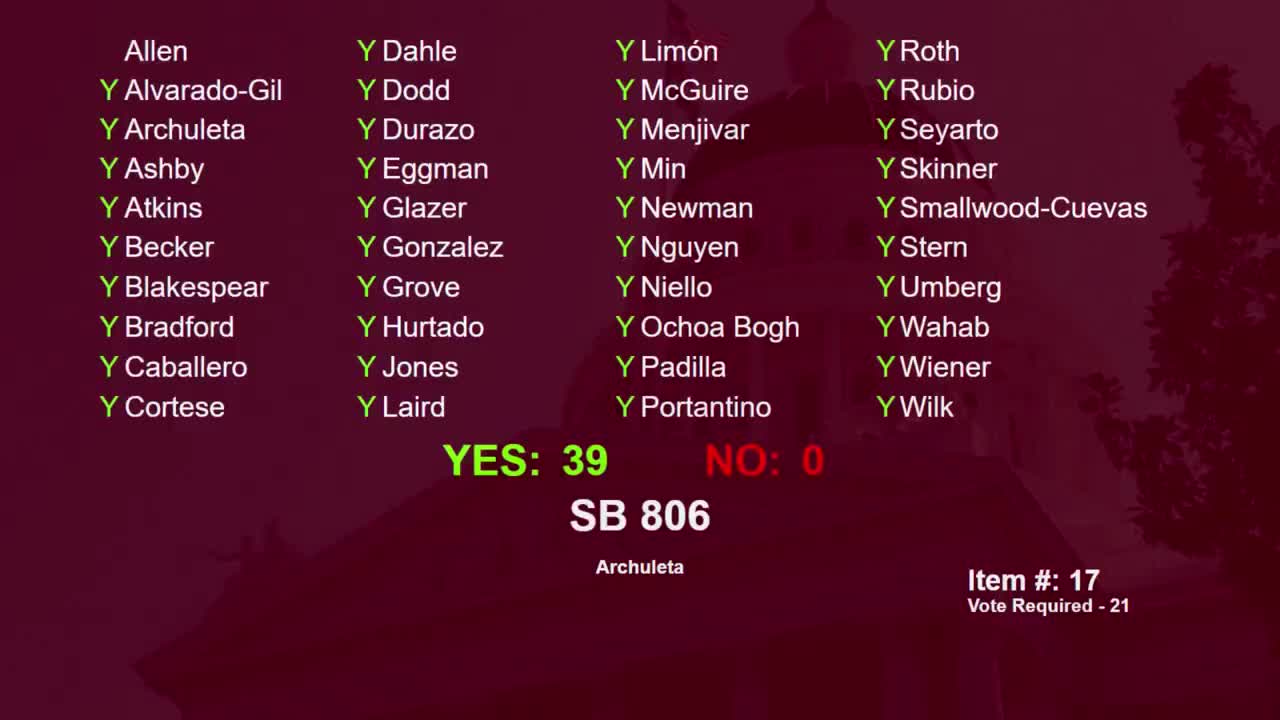
Bill Author

Bill Co-Author(s):