SB 225: Community Anti-Displacement and Preservation Program: statewide contract.
- Session Year: 2023-2024
- House: Senate
- Latest Version Date: 2023-06-22
Current Status:
Failed
(2024-08-20: Ordered to inactive file on request of Assembly Member Aguiar-Curry.)
Introduced
In Committee
First Chamber
In Committee
Second Chamber
Enacted
Existing law establishes the Department of Housing and Community Development in the Business, Consumer Services, and Housing Agency and makes the department responsible for administering various housing programs throughout the state, including, among others, the Multifamily Housing Program and the California Emergency Solutions Grants Program. Existing law, upon appropriation, authorizes the department to make either or both loans and grants to rehabilitate, capitalize operating subsidy reserves for, and extend the long-term affordability of department-funded housing projects that have an affordability restriction that has expired, that have an affordability restriction with a remaining term of less than 10 years, or are otherwise at risk for conversion, as provided.
This bill would establish the Community Anti-Displacement and Preservation Program for purposes of funding the acquisition and rehabilitation of unrestricted housing units, as defined, and attaching long-term affordability restrictions on the housing units, while safeguarding against the displacement of current residents. The bill would require the department to issue a request for qualification to select a private sector entity or consortium to manage the program for a period of 5 years. The bill would require the program manager to make loans to eligible borrowers, as defined, based on underwriting guidelines approved by the department. The bill would authorize the department to issue grants or loans from program funds to local public entities upon request for purposes of allowing the local public entity to use the moneys to issue loans to eligible borrowers within its jurisdiction in accordance with the bills provisions and department regulations. The bill would require the department to adopt regulations for the operation of the program and would exempt the adoption of regulations by the department for these purposes from the Administrative Procedure Act.
This bill would apply specified tenant protections to projects funded by the program and would require the department to develop technical assistance and capacity building for the development and ongoing operation of projects funded pursuant to the program, as specified.
This bill would establish the Community Anti-Displacement and Preservation Fund in the State Treasury. The bill would make moneys available to the department for purposes of the program, upon appropriation by the Legislature. The bill would set forth requirements for the use of moneys in the fund.
Existing law establishes the Department of Housing and Community Development in the Business, Consumer Services, and Housing Agency and makes the department responsible for administering various housing programs throughout the state, including, among others, the Multifamily Housing Program and the California Emergency Solutions Grants Program. Existing law, upon appropriation, authorizes the department to make either or both loans and grants to rehabilitate, capitalize operating subsidy reserves for, and extend the long-term affordability of department-funded housing projects that have an affordability restriction that has expired, that have an affordability restriction with a remaining term of less than 10 years, or are otherwise at risk for conversion, as provided.
This bill would establish the Community Anti-Displacement and Preservation Program for purposes of funding the acquisition and rehabilitation of unrestricted housing units units, as defined, and attaching long-term affordability restrictions on the housing units, while safeguarding against the displacement of current residents. The bill would require the department to issue a request for qualification to select a private sector entity or consortium to manage the program for a period of 5 years. The bill would require the program manager to make loans to eligible borrowers, as defined, based on underwriting guidelines approved by the department. The bill would authorize the department to issue grants or loans from program funds to local public entities upon request for purposes of allowing the local public entity to use the moneys to issue loans to eligible borrowers within its jurisdiction in accordance with the bills provisions and department regulations. The bill would require the department to adopt regulations for the operation of the program and would exempt the adoption of regulations by the department for these purposes from the Administrative Procedure Act.
This bill would apply specified tenant protections to projects funded by the program and would require the department to develop technical assistance and capacity building for the development and ongoing operation of projects funded pursuant to the program, as specified.
This bill would establish the Community Anti-Displacement and Preservation Fund in the State Treasury. The bill would make moneys available to the department for purposes of the program, upon appropriation by the Legislature. The bill would set forth requirements for the use of moneys in the fund.
Existing law establishes the Department of Housing and Community Development in the Business, Consumer Services, and Housing Agency and makes the department responsible for administering various housing programs throughout the state, including, among others, the Multifamily Housing Program and the California Emergency Solutions Grants Program. Existing law, upon appropriation, authorizes the department to make either or both loans and grants to rehabilitate, capitalize operating subsidy reserves for, and extend the long-term affordability of department-funded housing projects that have an affordability restriction that has expired, that have an affordability restriction with a remaining term of less than 10 years, or are otherwise at risk for conversion, as provided.
This bill would establish the Community Anti-Displacement and Preservation Program for purposes of funding the acquisition and rehabilitation of unrestricted housing units and attaching long-term affordability restrictions on the housing units, while safeguarding against the displacement of current residents. The bill would require the department to issue a request for qualification to select a private sector entity or consortium to manage the program for a period of 5 years. The bill would require the program manager to make loans to eligible borrowers, as defined, based on underwriting guidelines approved by the department. The bill would authorize the department to issue grants or loans from program funds to local public entities upon request for purposes of allowing the local public entity to use the moneys to issue loans to eligible borrowers within its jurisdiction in accordance with the bills provisions and department regulations. The bill would require the department to adopt regulations for the operation of the program and would exempt the adoption of regulations by the department for these purposes from the Administrative Procedure Act.
This bill would apply specified tenant protections to projects funded by the program and would require the department to develop technical assistance and capacity building for the development and ongoing operation of projects funded pursuant to the program, as specified.
This bill would establish the Community Anti-Displacement and Preservation Fund in the State Treasury. The bill would make moneys available to the department for purposes of the program, upon appropriation by the Legislature. The bill would set forth requirements for the use of moneys in the fund.
(a)The Community Anti-Displacement and Preservation Program (CAPP) is hereby established for purposes of funding the acquisition and rehabilitation of unrestricted housing units and attaching long-term affordability restrictions on the housing units, while safeguarding against the displacement of current residents.
(b)For purposes of this chapter, the following definitions apply:
(1)Department means the Department of Housing and Community Development.
(2)Eligible borrower means an entity whose primary mission includes the development or ownership of housing that is affordable to low-income households and that has demonstrated experience in acquiring, rehabilitating, and operating multifamily housing for the benefit of low-income households. Eligible borrower includes, but is not limited to, the following:
(A)An eligible nonprofit corporation that has a principal place of business in the state.
(B)A limited partnership in which the managing general partner is an eligible nonprofit corporation that has a principal place of business in the state.
(C)A limited liability company in which the managing member is an eligible nonprofit corporation that has a principal place of business in the state.
(D)A community land trust, as defined in clause (ii) of subparagraph (C) of paragraph (11) of subdivision (a) of Section 402.1 of the Revenue and Taxation Code.
(E)A limited-equity housing cooperative as defined in Section 817 of the Civil Code.
(F)A local public entity.
(3)Local public entity means a public entity in the state, including a city, county, city and county, public housing authority, regional housing finance authority, and successor agency to a former redevelopment agency.
(4)Low-income households has the same meaning as lower income households in Section 50079.5.
(5)Rehabilitation means rehabilitation work necessary to meet health, safety, and quality of life needs, as determined by standards established by the department.
(6)Tenant protections under state law means the protections provided in Chapter 2 (commencing with Section 1940) of Title 5 of Part 4 of Division 3 of the Civil Code, except for Section 1947.12 of that code, and in the California Fair Employment and Housing Act (Part 2.8 (commencing with Section 12900) of Division 3 of Title 2 of the Government Code).
(7)Unrestricted housing means a residential rental development of five units or more that is not currently subject to a recorded deed restriction limiting occupancy to households at specified income levels and rents to levels affordable at those income levels. Mixed-use buildings are eligible if the majority of the building square footage is used for residential purposes.
(c)The department shall adopt regulations for the operation of the program. The adoption of regulations pursuant to this subdivision is hereby exempted from the rulemaking provisions of the Administrative Procedure Act (Chapter 3.5 (commencing with Section 11340) of Part 1 of Division 3 of Title 2 of the Government Code).50571.(a)(1)The Community Anti-Displacement and Preservation Fund is hereby created as a fund in the State Treasury. All money in the fund shall be available, upon appropriation by the Legislature, to the department for purposes of this chapter.
(2)The administrative expenses of the department shall not exceed five 5 percent of the moneys deposited in the fund for the purposes of this chapter.
(3)Up to an additional five 5 percent of the moneys may be expended to provide technical assistance and capacity building to eligible borrowers pursuant to Section 50576.
(b)The following moneys shall be paid into the fund:
(1)Any moneys appropriated and made available by the Legislature for purposes of the chapter.
(2)Any moneys that the department receives in repayment of loans made from the fund, including interest therefrom.
(3)Any other moneys that may be made available to the department for purposes of this chapter from any other source.
50572.(a)(1)The department shall issue a request for qualification to select a private sector entity or consortium to manage the program for a period of five years.
(2)The agreement between the department and the private sector entity may be extended in additional five-year increments.
(b)(1)The selected program manager shall be responsible for reviewing and approving loan applications, originating and servicing loans, and, subject to department approval, establishing terms and conditions for loan applications, and reporting to the department to demonstrate compliance with program regulations.
(2)The private sector entity shall meet at least all of the following criteria to be eligible to be selected as a program manager:
(A)Be a nonprofit lender or consortium of nonprofit lenders, including community development financial institutions and credit unions, with experience making similar loans in the state.
(B)Have originated and serviced loans in an aggregate amount of not less than thirty million dollars ($30,000,000) that were used to develop or acquire affordable housing. At least ten million dollars ($10,000,000) or more of the loans shall have been in the form of an acquisition loan.
(C)Provide geographic coverage across the state.
(c)In selecting a program manager, the department shall consider the following objectives:
(1)The provision of loans for the longest possible time, up to 15 years.
(2)The provision of loans on the most competitive terms.
(3)Proposed processes and procedures to ensure timely application review and loan closing.
(4)The ability to work with a variety of borrowers, including, but not limited to, affordable housing developers, community development corporations, community land trusts, limited-equity housing cooperatives, and local public entities.
(5)The ability to work with a variety of stewardship models, including, but not limited to to, rental housing, affordable homeownership, and community land trusts.
50573.(a)(1)The program manager shall make loans to eligible borrowers based on underwriting guidelines approved by the department.
(2)Loans shall not exceed the cost of acquisition plus the cost of rehabilitation.
(3)With the approval of the department, the program manager may establish a maximum loan to value loan-to-value ratio. Based on underwriting guidelines approved by the department, a portion of the loan to be funded with non-program nonprogram funds may require amortized payments, and a portion funded with department funds shall have deferred interest for the term of the loan.
(4)The department may establish priority uses of funds or establish set asides for specified project types, for specified types of borrowers, based on levels of affordability, or to ensure geographic equity.
(5)Loans shall not be made for projects within the jurisdiction of a local public entity that has received moneys pursuant to Section 50574 to administer a loan program, unless the program manager determines there is insufficient demand for loans in nondelegated jurisdictions and the department approves the loan. For purposes of this paragraph, nondelegated jurisdiction means the jurisdiction of any local public entity that has not received moneys pursuant to Section 50574.
(b)(1)(A)Properties that will remain rental housing developments following acquisition or rehabilitation with a loan made pursuant to this chapter shall be subject to a recorded regulatory agreement between the borrower and the department that requires that the units, upon the first turnover of tenancy, remain affordable to, and occupied by, low-income households for a term of 55 years from the date of the loan closing. However, the term required by a local ordinance, by a federal, state, or local grant, by a federal or state tax credit, or by other project financing shall instead apply if that required term is greater than 55 years and the local ordinance, grant, tax credit, or other project financing requires the rental housing developments units be affordable to and occupied by low-income households for that term.
(B)For projects involving properties described in subparagraph (A), the department may convert, upon the borrowers request, the deferred portion of a loan provided to fund the project into a grant if the department determines that the project meets standards established by the department in program regulations.
(2)(A)Properties that will be sold to low-income households at an affordable housing cost shall be subject to a recorded deed restriction of 45 years, a community land trust ground lease of 99 years, or a recorded equity sharing agreement.
(B)For projects involving properties described in subparagraph (A), the department may convert, upon the borrowers request, to convert the deferred portion of the loan, or part of it, into a grant, pursuant to conditions determined by the department and as promulgated in its regulations.
(c)The department shall monitor borrower compliance with the terms of the recorded regulatory agreement or recorded deed restriction, except when the agreement or restriction is related to properties funded by a local public entity pursuant to Section 50574. In those circumstances, the local public entity shall monitor borrower compliance and submit annual reports pursuant to subdivision (b) of Section 50574.
50574.(a)(1)The department may issue grants or loans from the program funds to local public entities upon request.
(2)(A)A local public entity that receives a grant or loan pursuant to this section shall use the moneys to issue loans to eligible borrowers within its jurisdiction in accordance with this chapter and department regulations.
(B)Notwithstanding subparagraph (A), the department, at its sole discretion, may waive program requirements under this chapter and the departments regulations with respect to loans issued by a local public entity that receives a grant or loan under this section if the waiver would facilitate integration of state and local funds.
(3)The department shall select local public entities based on the local public entitys capacity to manage program funds and adequately monitor borrower compliance within their jurisdiction.
(b)A local public entity that receives a grant or loan pursuant to this section shall file annual reports with the department demonstrating that the financed developments are rented in accordance with the applicable recorded regulatory agreement or recorded deed restriction, as described in Section 50573, and properly maintained.
(c)Any loans issued by a local public entity pursuant to this section shall not be managed by the program manager.
50575.(a)Notwithstanding any other law, all tenant protections under state law, or a more protective local policy, other than rent stabilization, shall apply to tenants of projects funded pursuant to this chapter.
(b)Notwithstanding any other law, the department shall require, in its regulations and regulatory agreement, standards for annual rent increases, with a goal of ensuring affordability for current and future residents.
(c)Notwithstanding any other law, a household or member of a household that resides in the property at the time of its acquisition shall not be evicted, nor shall their tenancy be terminated on the ground of their income or other eligibility requirements for deed-restricted units in the property.
(d)Notwithstanding any other law, the department shall require, in its regulations and in each regulatory agreement, borrowers to include language that implements the protections of this section in its tenant leases. The just cause protections in Section 1946.2 of the Civil Code or a more protective local policy shall also be incorporated in the lease notwithstanding any basis for exemption in statute or local ordinance.
50576.(a)The department shall develop technical assistance and capacity building for the development and ongoing operation of projects funded pursuant to this chapter.
(b)(1)The technical assistance and capacity building shall support eligible borrowers in navigating the requirements and processes to apply for a loan pursuant to this chapter.
(2)The technical assistance and capacity building shall support collaboration and peer-to-peer learning amongst eligible borrowers.
(c)The department shall contract with third-party consultants to assist with the development, implementation, and administration of the technical assistance and capacity building. The department shall contract with consultants possessing specific areas of expertise, including, but not limited to:
(1)Resident engagement and education.
(2)Property assessment and due diligence.
(3)Affordable housing operations management.
(4)Financial assistance for projects involving the acquisition and rehabilitation of property.
(5)Construction and property management.
(6)A spectrum of ownership and stewardship models, including rental housing, homeownership, community land trusts, limited-equity housing cooperatives, workforce housing cooperative trusts, and nonprofit affordable housing cooperatives.
(7)Capacity and experience in advancing racial equity.
(d)The department or third-party consultants shall develop technical assistance tools including, but not limited to, all of the following:
(1)Training modules.
(2)Specific financing templates and guidance, such as proformas pro formas and worksheets, relating to the acquisition and rehabilitation of property.
(3)Best practice guides for engaging tenants before and after property acquisition, managing safe and accessible rehabilitation of occupied buildings, facilitating resident ownership, and any other topic deemed appropriate by the department.
(e)The department may integrate the technical assistance and capacity building with technical assistance funded through other department programs that have similar goals and eligible borrowers.
(a)The Community Anti-Displacement and Preservation Program (CAPP) is hereby established for purposes of funding the acquisition and rehabilitation of unrestricted housing units and attaching long-term affordability restrictions on the housing units, while safeguarding against the displacement of current residents.
(b)For purposes of this chapter, the following definitions apply:
(1)Department means the Department of Housing and Community Development.
(2)Eligible borrower means an entity whose primary mission includes the development or ownership of housing that is affordable to low-income households and that has demonstrated experience in acquiring, rehabilitating, and operating multifamily housing for the benefit of low-income households. Eligible borrower includes, but is not limited to, the following:
(A)An eligible nonprofit corporation that has a principal place of business in the state.
(B)A limited partnership in which the managing general partner is an eligible nonprofit corporation that has a principal place of business in the state.
(C)A limited liability company in which the managing member is an eligible nonprofit corporation that has a principal place of business in the state.
(D)A community land trust, as defined in clause (ii) of subparagraph (C) of paragraph (11) of subdivision (a) of Section 402.1 of the Revenue and Taxation Code.
(E)A limited-equity housing cooperative as defined in Section 817 of the Civil Code.
(F)A local public entity.
(3)Local public entity means a public entity in the state, including a city, county, city and county, public housing authority, regional housing finance authority, and successor agency to a former redevelopment agency.
(4)Low-income households has the same meaning as lower income households in Section 50079.5.
(5)Rehabilitation means rehabilitation work necessary to meet health, safety, and quality of life needs, as determined by standards established by the department.
(6)Tenant protections under state law means the protections provided in Chapter 2 (commencing with Section 1940) of Title 5 of Part 4 of Division 3 of the Civil Code, except for Section 1947.12 of that code, and in the California Fair Employment and Housing Act (Part 2.8 (commencing with Section 12900) of Division 3 of Title 2 of the Government Code).
(7)Unrestricted housing means an existing dwelling unit or a residential rental development of five units or more that is not currently subject to a recorded deed restriction limiting occupancy to households at specified income levels and rents to levels affordable at those income levels. Mixed-use buildings are eligible if the majority of the building square footage is used for residential purposes.
(c)The department shall adopt regulations for the operation of the program. The adoption of regulations pursuant to this subdivision is hereby exempted from the rulemaking provisions of the Administrative Procedure Act (Chapter 3.5 (commencing with Section 11340) of Part 1 of Division 3 of Title 2 of the Government Code).
50571.(a)(1)The Community Anti-Displacement and Preservation Fund is hereby created as a fund in the State Treasury. All money in the fund shall be available, upon appropriation by the Legislature, to the department for purposes of this chapter.
(2)The administrative expenses of the department shall not exceed five percent of the moneys deposited in the fund for the purposes of this chapter.
(3)Up to an additional five percent of the moneys may be expended to provide technical assistance and capacity building to eligible borrowers pursuant to Section 50576.
(b)The following moneys shall be paid into the fund:
(1)Any moneys appropriated and made available by the Legislature for purposes of the chapter.
(2)Any moneys that the department receives in repayment of loans made from the fund, including interest therefrom.
(3)Any other moneys that may be made available to the department for purposes of this chapter from any other source.
50572.(a)(1)The department shall issue a request for qualification to select a private sector entity or consortium to manage the program for a period of five years.
(2)The agreement between the department and the private sector entity may be extended in additional five-year increments.
(b)(1)The selected program manager shall be responsible for reviewing and approving loan applications, originating and servicing loans, and, subject to department approval, establishing terms and conditions for loan applications, and reporting to the department to demonstrate compliance with program regulations.
(2)The private sector entity shall meet at least all of the following criteria to be eligible to be selected as a program manager:
(A)Be a nonprofit lender or consortium of nonprofit lenders, including community development financial institutions and credit unions, with experience making similar loans in the state.
(B)Have originated and serviced loans in an aggregate amount of not less than thirty million dollars ($30,000,000) that were used to develop or acquire affordable housing. At least ten million dollars ($10,000,000) or more of the loans shall have been in the form of an acquisition loan.
(C)Provide geographic coverage across the state.
(c)In selecting a program manager, the department shall consider the following objectives:
(1)The provision of loans for the longest possible time, up to 15 years.
(2)The provision of loans on the most competitive terms.
(3)Proposed processes and procedures to ensure timely application review and loan closing.
(4)The ability to work with a variety of borrowers, including, but not limited to, affordable housing developers, community development corporations, community land trusts, limited-equity housing cooperatives, and local public entities.
(5)The ability to work with a variety of stewardship models, including, but not limited to rental housing, affordable homeownership, and community land trusts.
50573.(a)(1)The program manager shall make loans to eligible borrowers based on underwriting guidelines approved by the department.
(2)Loans shall not exceed the cost of acquisition plus the cost of rehabilitation.
(3)With the approval of the department, the program manager may establish a maximum loan to value ratio. Based on underwriting guidelines approved by the department, a portion of the loan to be funded with non-program funds may require amortized payments, and a portion funded with department funds shall have deferred interest for the term of the loan.
(4)The department may establish priority uses of funds or establish set asides for specified project types, for specified types of borrowers, based on levels of affordability, or to ensure geographic equity.
(5)Loans shall not be made for projects within the jurisdiction of a local public entity that has received moneys pursuant to Section 50574 to administer a loan program, unless the program manager determines there is insufficient demand for loans in nondelegated jurisdictions and the department approves the loan. For purposes of this paragraph, nondelegated jurisdiction means the jurisdiction of any local public entity that has not received moneys pursuant to Section 50574.
(b)(1)(A)Properties that will remain rental housing developments following acquisition or rehabilitation with a loan made pursuant to this chapter shall be subject to a recorded regulatory agreement between the borrower and the department that requires that the unit or units, upon the first turnover of tenancy, remain affordable to, and occupied by, low-income households for a term of at least 55 years from the date of the loan closing. However, the term required by a local ordinance, by a federal, state, or local grant, by a federal or state tax credit, or by other project financing shall instead apply if that required term is greater than 55 years and the local ordinance, grant, tax credit, or other project financing requires the rental housing developments units be affordable to and occupied by low-income households for that term.
(B)For projects involving properties described in subparagraph (A), the department may convert, upon the borrowers request, the deferred portion of a loan provided to fund the project into a grant if the department determines that the project meets standards established by the department in program regulations.
(2)(A)Properties that will be sold to low-income households at an affordable housing cost shall be subject to a recorded deed restriction of at least 55 45 years, a community land trust ground lease of 99 years, or a recorded equity sharing agreement.
(B)For projects involving properties described in subparagraph (A), the department may convert, upon the borrowers request, to convert the deferred portion of the loan, or part of it, into a grant, pursuant to conditions determined by the department and as promulgated in its regulations.
(c)The department shall monitor borrower compliance with the terms of the recorded regulatory agreement or recorded deed restriction, except when the agreement or restriction is related to properties funded by a local public entity pursuant to Section 50574. In those circumstances, the local public entity shall monitor borrower compliance and submit annual reports pursuant to subdivision (b) of Section 50574.
50574.(a)(1)The department may issue grants or loans from the program funds to local public entities upon request.
(2)(A)A local public entity that receives a grant or loan pursuant to this section shall use the moneys to issue loans to eligible borrowers within its jurisdiction in accordance with this chapter and department regulations.
(B)Notwithstanding subparagraph (A), the department, at its sole discretion, may waive program requirements under this chapter and the departments regulations with respect to loans issued by a local public entity that receives a grant or loan under this section if the waiver would facilitate integration of state and local funds.
(3)The department shall select local public entities based on the local public entitys capacity to manage program funds and adequately monitor borrower compliance within their jurisdiction.
(b)A local public entity that receives a grant or loan pursuant to this section shall file annual reports with the department demonstrating that the financed developments are rented in accordance with the applicable recorded regulatory agreement or recorded deed restriction, as described in 50573, and properly maintained.
(c)Any loans issued by a local public entity pursuant to this section shall not be managed by the program manager.
50575.(a)Notwithstanding any other law, all tenant protections under state law, or a more protective local policy, other than rent stabilization, shall apply to tenants of projects funded pursuant to this chapter.
(b)Notwithstanding any other law, the department shall require, in its regulations and regulatory agreement, standards for annual rent increases, with a goal of ensuring affordability for current and future residents.
(c)Notwithstanding any other law, a household or member of a household that resides in the property at the time of its acquisition shall not be evicted, nor shall their tenancy be terminated on the ground of their income or other eligibility requirements for deed-restricted units in the property.
(d)Notwithstanding any other law, the department shall require, in its regulations and in each regulatory agreement, borrowers to include language that implements the protections of this section in its tenant leases. The just cause protections in Section 1946.2 of the Civil Code or a more protective local policy shall also be incorporated in the lease notwithstanding any basis for exemption in statute or local ordinance.
50576.(a)The department shall develop technical assistance and capacity building for the development and ongoing operation of projects funded pursuant to this chapter.
(b)(1)The technical assistance and capacity building shall support eligible borrowers in navigating the requirements and processes to apply for a loan pursuant to this chapter.
(2)The technical assistance and capacity building shall support collaboration and peer-to-peer learning amongst eligible borrowers.
(c)The department shall contract with third-party consultants to assist with the development, implementation, and administration of the technical assistance and capacity building. The department shall contract with consultants possessing specific areas of expertise, including, but not limited to:
(1)Resident engagement and education.
(2)Property assessment and due diligence.
(3)Affordable housing operations management.
(4)Financial assistance for projects involving the acquisition and rehabilitation of property.
(5)Construction and property management.
(6)A spectrum of ownership and stewardship models, including rental housing, homeownership, community land trusts, limited-equity housing cooperatives, workforce housing cooperative trusts, and nonprofit affordable housing cooperatives.
(7)Capacity and experience in advancing racial equity.
(d)The department or third-party consultants shall develop technical assistance tools including, but not limited to, all of the following:
(1)Training modules.
(2)Specific financing templates and guidance, such as proformas and worksheets, relating to the acquisition and rehabilitation of property.
(3)Best practice guides for engaging tenants before and after property acquisition, managing safe and accessible rehabilitation of occupied buildings, facilitating resident ownership, and any other topic deemed appropriate by the department.
(e)The department may integrate the technical assistance and capacity building with technical assistance funded through other department programs that have similar goals and eligible borrowers.
(a)The Community Anti-Displacement and Preservation Program (CAPP) is hereby established for purposes of funding the acquisition and rehabilitation of unrestricted housing units and attaching long-term affordability restrictions on the housing units, while safeguarding against the displacement of current residents.
(b)For purposes of this chapter, the following definitions apply:
(1)Department means the Department of Housing and Community Development.
(2)Eligible borrower means an entity whose primary mission includes the development or ownership of housing that is affordable to low-income households and that has demonstrated experience in acquiring, rehabilitating, and operating multifamily housing for the benefit of low-income households. Eligible borrower includes, but is not limited to, the following:
(A)An eligible nonprofit corporation that has a principal place of business in the state.
(B)A limited partnership in which the managing general partner is an eligible nonprofit corporation that has a principal place of business in the state.
(C)A limited liability company in which the managing member is an eligible nonprofit corporation that has a principal place of business in the state.
(D)A community land trust, as defined in clause (ii) of subparagraph (C) of paragraph (11) of subdivision (a) of Section 402.1 of the Revenue and Taxation Code.
(E)A limited-equity housing cooperative as defined in Section 817 of the Civil Code.
(F)A local public entity.
(3)Local public entity means a public entity in the state, including a city, county, city and county, public housing authority, regional housing finance authority, and successor agency to a former redevelopment agency.
(4)Low-income households has the same meaning as lower income households in Section 50079.5.
(5)Rehabilitation means rehabilitation work necessary to meet health, safety, and quality of life needs, as determined by standards established by the department.
(6)Tenant protections under state law means the protections provided in Chapter 2 (commencing with Section 1940) of Title 5 of Part 4 of Division 3 of the Civil Code, except for Section 1947.12 of that code, and in the California Fair Employment and Housing Act (Part 2.8 (commencing with Section 12900) of Division 3 of Title 2 of the Government Code).
(7)Unrestricted housing means an existing dwelling unit or residential rental development that is not currently subject to a recorded deed restriction limiting occupancy to households at specified income levels and rents to levels affordable at those income levels. Mixed-use buildings are eligible if the majority of the building square footage is used for residential purposes.
(c)The department shall adopt regulations for the operation of the program. The adoption of regulations pursuant to this subdivision is hereby exempted from the rulemaking provisions of the Administrative Procedure Act (Chapter 3.5 (commencing with Section 11340) of Part 1 of Division 3 of Title 2 of the Government Code).
50571.(a)(1)The Community Anti-Displacement and Preservation Fund is hereby created as a fund in the State Treasury. All money in the fund shall be available, upon appropriation by the Legislature, to the department for purposes of this chapter.
(2)The administrative expenses of the department shall not exceed five percent of the moneys deposited in the fund for the purposes of this chapter.
(3)Up to an additional five percent of the moneys may be expended to provide technical assistance and capacity building to eligible borrowers pursuant to Section 50576.
(b)The following moneys shall be paid into the fund:
(1)Any moneys appropriated and made available by the Legislature for purposes of the chapter.
(2)Any moneys that the department receives in repayment of loans made from the fund, including interest therefrom.
(3)Any other moneys that may be made available to the department for purposes of this chapter from any other source.
50572.(a)(1)The department shall issue a request for qualification to select a private sector entity or consortium to manage the program for a period of five years.
(2)The agreement between the department and the private sector entity may be extended in additional five-year increments.
(b)(1)The selected program manager shall be responsible for reviewing and approving loan applications, originating and servicing loans, and, subject to department approval, establishing terms and conditions for loan applications, and reporting to the department to demonstrate compliance with program regulations.
(2)The private sector entity shall meet at least all of the following criteria to be eligible to be selected as a program manager:
(A)Be a nonprofit lender or consortium of nonprofit lenders, including community development financial institutions and credit unions, with experience making similar loans in the state.
(B)Have originated and serviced loans in an aggregate amount of not less than thirty million dollars ($30,000,000) that were used to develop or acquire affordable housing. At least ten million dollars ($10,000,000) or more of the loans shall have been in the form of an acquisition loan.
(C)Provide geographic coverage across the state.
(c)In selecting a program manager, the department shall consider the following objectives:
(1)The provision of loans for the longest possible time, up to 15 years.
(2)The provision of loans on the most competitive terms.
(3)Proposed processes and procedures to ensure timely application review and loan closing.
(4)The ability to work with a variety of borrowers, including, but not limited to, affordable housing developers, community development corporations, community land trusts, limited-equity housing cooperatives, and local public entities.
(5)The ability to work with a variety of stewardship models, including, but not limited to rental housing, affordable homeownership, and community land trusts.
50573.(a)(1)The program manager shall make loans to eligible borrowers based on underwriting guidelines approved by the department.
(2)Loans shall not exceed the cost of acquisition plus the cost of rehabilitation.
(3)With the approval of the department, the program manager may establish a maximum loan to value ratio. Based on underwriting guidelines approved by the department, a portion of the loan to be funded with non-program funds may require amortized payments, and a portion funded with department funds shall have deferred interest for the term of the loan.
(4)The department may establish priority uses of funds or establish set asides for specified project types, for specified types of borrowers, based on levels of affordability, or to ensure geographic equity.
(5)Loans shall not be made for projects within the jurisdiction of a local public entity that has received moneys pursuant to Section 50574 to administer a loan program, unless the program manager determines there is insufficient demand for loans in nondelegated jurisdictions and the department approves the loan. For purposes of this paragraph, nondelegated jurisdiction means the jurisdiction of any local public entity that has not received moneys pursuant to Section 50574.
(b)(1)(A)Properties that will remain rental housing developments following acquisition or rehabilitation with a loan made pursuant to this chapter shall be subject to a recorded regulatory agreement between the borrower and the department that requires that the unit or units, upon the first turnover of tenancy, remain affordable to, and occupied by, low-income households for a term of at least 55 years from the date of the loan closing.
(B)For projects involving properties described in subparagraph (A), the department may convert, upon the borrowers request, the deferred portion of a loan provided to fund the project into a grant if the department determines that the project meets standards established by the department in program regulations.
(2)(A)Properties that will be sold to low-income households at an affordable housing cost shall be subject to a recorded deed restriction of at least 55 years, a community land trust ground lease of 99 years, or a recorded equity sharing agreement.
(B)For projects involving properties described in subparagraph (A), the department may convert, upon the borrowers request, to convert the deferred portion of the loan, or part of it, into a grant, pursuant to conditions determined by the department and as promulgated in its regulations.
(c)The department shall monitor borrower compliance with the terms of the recorded regulatory agreement or recorded deed restriction, except when the agreement or restriction is related to properties funded by a local public entity pursuant to Section 50574. In those circumstances, the local public entity shall monitor borrower compliance and submit annual reports pursuant to subdivision (b) of Section 50574.
50574.(a)(1)The department may issue grants or loans from the program funds to local public entities upon request.
(2)(A)A local public entity that receives a grant or loan pursuant to this section shall use the moneys to issue loans to eligible borrowers within its jurisdiction in accordance with this chapter and department regulations.
(B)Notwithstanding subparagraph (A), the department, at its sole discretion, may waive program requirements under this chapter and the departments regulations with respect to loans issued by a local public entity that receives a grant or loan under this section if the waiver would facilitate integration of state and local funds.
(3)The department shall select local public entities based on the local public entitys capacity to manage program funds and adequately monitor borrower compliance within their jurisdiction.
(b)A local public entity that receives a grant or loan pursuant to this section shall file annual reports with the department demonstrating that the financed developments are rented in accordance with the applicable recorded regulatory agreement or recorded deed restriction, as described in 50573, and properly maintained.
(c)Any loans issued by a local public entity pursuant to this section shall not be managed by the program manager.
50575.(a)Notwithstanding any other law, all tenant protections under state law, or a more protective local policy, other than rent stabilization, shall apply to tenants of projects funded pursuant to this chapter.
(b)Notwithstanding any other law, the department shall require, in its regulations and regulatory agreement, standards for annual rent increases, with a goal of ensuring affordability for current and future residents.
(c)Notwithstanding any other law, a household or member of a household that resides in the property at the time of its acquisition shall not be evicted, nor shall their tenancy be terminated on the ground of their income or other eligibility requirements for deed-restricted units in the property.
(d)Notwithstanding any other law, the department shall require, in its regulations and in each regulatory agreement, borrowers to include language that implements the protections of this section in its tenant leases. The just cause protections in Section 1946.2 of the Civil Code or a more protective local policy shall also be incorporated in the lease notwithstanding any basis for exemption in statute or local ordinance.
50576.(a)The department shall develop technical assistance and capacity building for the development and ongoing operation of projects funded pursuant to this chapter.
(b)(1)The technical assistance and capacity building shall support eligible borrowers in navigating the requirements and processes to apply for a loan pursuant to this chapter.
(2)The technical assistance and capacity building shall support collaboration and peer-to-peer learning amongst eligible borrowers.
(c)The department shall contract with third-party consultants to assist with the development, implementation, and administration of the technical assistance and capacity building. The department shall contract with consultants possessing specific areas of expertise, including, but not limited to:
(1)Resident engagement and education.
(2)Property assessment and due diligence.
(3)Affordable housing operations management.
(4)Financial assistance for projects involving the acquisition and rehabilitation of property.
(5)Construction and property management.
(6)A spectrum of ownership and stewardship models, including rental housing, homeownership, community land trusts, limited-equity housing cooperatives, workforce housing cooperative trusts, and nonprofit affordable housing cooperatives.
(7)Capacity and experience in advancing racial equity.
(d)The department or third-party consultants shall develop technical assistance tools including, but not limited to, all of the following:
(1)Training modules.
(2)Specific financing templates and guidance, such as proformas and worksheets, relating to the acquisition and rehabilitation of property.
(3)Best practice guides for engaging tenants before and after property acquisition, managing safe and accessible rehabilitation of occupied buildings, facilitating resident ownership, and any other topic deemed appropriate by the department.
(e)The department may integrate the technical assistance and capacity building with technical assistance funded through other department programs that have similar goals and eligible borrowers.
|
Date
|
Status
|
|---|---|
| Aug 20, 2024 | Ordered to inactive file on request of Assembly Member Aguiar-Curry. |
| Aug 19, 2024 | Read second time. Ordered to third reading. |
| Aug 15, 2024 | From committee: Do pass. (Ayes 11. Noes 2.) (August 15). |
| Aug 7, 2024 | August 7 set for first hearing. Placed on suspense file. |
| Jun 26, 2023 | Re-referred to Com. on APPR. pursuant to Assembly Rule 96. |
| Jun 22, 2023 | Read second time and amended. Re-referred to Com. on A. & A.R. |
| Jun 21, 2023 | From committee: Do pass as amended and re-refer to Com. on A. & A.R. (Ayes 6. Noes 1.) (June 21). |
| Jun 1, 2023 | Referred to Coms. on H. & C.D. and A. & A.R. |
| May 25, 2023 | In Assembly. Read first time. Held at Desk. |
| May 24, 2023 | Read third time. Passed. (Ayes 33. Noes 4. Page 1269.) Ordered to the Assembly. |
| May 18, 2023 | Read second time. Ordered to third reading. |
| May 18, 2023 | From committee: Do pass. (Ayes 5. Noes 1. Page 1161.) (May 18). |
| May 12, 2023 | Set for hearing May 18. |
| Apr 24, 2023 | April 24 hearing: Placed on APPR suspense file. |
| Apr 14, 2023 | Set for hearing April 24. |
| Apr 11, 2023 | From committee: Do pass and re-refer to Com. on APPR. (Ayes 11. Noes 0. Page 655.) (April 11). Re-referred to Com. on APPR. |
| Mar 28, 2023 | Set for hearing April 11. |
| Mar 22, 2023 | From committee: Do pass and re-refer to Com. on G.O. (Ayes 8. Noes 0. Page 452.) (March 21). Re-referred to Com. on G.O. |
| Mar 13, 2023 | From committee with author's amendments. Read second time and amended. Re-referred to Com. on HOUSING. |
| Mar 7, 2023 | Set for hearing March 21. |
| Feb 1, 2023 | Referred to Coms. on HOUSING and G.O. |
| Jan 20, 2023 | From printer. May be acted upon on or after February 19. |
| Jan 19, 2023 | Introduced. Read first time. To Com. on RLS. for assignment. To print. |
|
Date
|
Description
|
Location
|
Votes
|
|
|---|---|---|---|---|
| Aug 15, 2024 | Do pass. | Assembly Standing Committee on Appropriations |
Passed |
|
| Jun 21, 2023 | Do pass as amended and be re-referred to the Committee on [Accountability and Administrative Review] | Assembly Standing Committee on Housing and Community Development |
Passed |
|
| May 24, 2023 | Senate 3rd Reading SB225 Caballero et al. | Senate Floor |
Passed |
|
| May 18, 2023 | Do pass | Senate Standing Committee on Appropriations |
Passed |
|
| Apr 24, 2023 | Placed on suspense file | Senate Standing Committee on Appropriations |
Passed |
|
| Apr 11, 2023 | Do pass, but first be re-referred to the Committee on [Appropriations] | Senate Standing Committee on Governmental Organization |
Passed |
|
| Mar 21, 2023 | Do pass, but first be re-referred to the Committee on [Governmental Organization] | Senate Standing Committee on Housing |
Passed |
This list shows positions taken on this bill by organizations on the date displayed, which is linked to the original source.
Positions by individuals are not included.
|
Organization
|
Position
|
Date
|
|---|---|---|
| AARP | ** Support | |
| ACCE | ** Support | |
| Affordable Housing Network of Santa Clara County | ** Support | |
| AFSCME | ** Support | |
| Alameda County Democratic Party | ** Support | |
| All Home | ** Support | |
| Alliance for A Better District 6 | ** Support | |
| Association Of Bay Area Governments | ** Support | |
| Bay Area Community Services | ** Support | |
| Bay Area LISC | ** Support | |
| Bend The Arc: Jewish Action | ** Support | |
| Berkeley Tenants Union | ** Support | |
| Beverly-Vermont Community Land Trust | ** Support | |
| Cadem Renters Council | ** Support | |
| Cal-ALHFA | ** Support | |
| California Apartment Association | ** Support | |
| California Association Of Local Housing Finance Agencies | ** Support | |
| California Central Valley Journey for Justice | ** Support | |
| California Coalition for Community Investment | ** Support | |
| California Coalition For Rural Housing | ** Support | |
| California Community Land Trust Network | ** Support | |
| California Democratic Party Renters Council | ** Support | |
| California Housing Consortium | ** Support | |
| California Housing Partnership | ** Support | |
| California Housing Partnership Corporation | ** Support | |
| California Reinvestment Coalition | ** Support | |
| California Releaf | ** Support | |
| California Rural Legal Assistance Foundation | ** Support | |
| California Women's Law Center | ** Support | |
| Catholic Campaign for Human Development | ** Support | |
| Catholic Campaign for Human Development , Diocese of Oakland | ** Support | |
| CAUSE | ** Support | |
| CEJA | ** Support | |
| Central Coast Alliance United for a Sustainable Economy | ** Support | |
| City of San Jose | ** Support | |
| Coalition for Economic | ** Support | |
| Coalition for Economic Survival | ** Support | |
| Community Housing Works | ** Support | |
| Community Land Trust Association of West Marin | ** Support | |
| Community Legal Services in East Palo Alto | ** Support | |
| Community Power Collective | ** Support | |
| Congregations Organized for Prophetic Engagement | ** Support | |
| Corporation For Supportive Housing | ** Support | |
| Council of Community Housing Organizations | ** Support | |
| County of Sonoma Department of Health Services | ** Support | |
| Courage California | ** Support | |
| East Bay Alliance for a Sustainable Economy | ** Support | |
| East Bay Community Law Center | ** Support | |
| East Bay Housing Organizations | ** Support | |
| East Bay YIMBY | ** Support | |
| EBCLC | ** Support | |
| Enterprise Community Partners Inc | ** Support | |
| evolve california | ** Support | |
| Faith in the Valley | ** Support | |
| Family Assistance Program | ** Support | |
| Fideicomiso Comunitario Tierra Libre | ** Support | |
| Florence Aliese Advancement Network | ** Support | |
| Florence Aliese Advancement Network, LLC | ** Support | |
| Friends Committee On Legislation Of California | ** Support | |
| FSY Architects | ** Support | |
| Greater Sacramento Urban League | ** Support | |
| Greenbelt Alliance | ** Support | |
| Greenlining Institute | ** Support | |
| Grow the Richmond | ** Support | |
| Habitat For Humanity California | ** Support | |
| Habitat for Humanity Yuba/Sutter | ** Support | |
| Healing and Justice Center | ** Support | |
| Housing California | ** Support | |
| Housing Is a Human Right Oc | ** Support | |
| Housing Land Trust of the North Bay | ** Support | |
| Housing Leadership Council of San Mateo County | ** Support | |
| Housing Now! | ** Support | |
| How to ADU | ** Support | |
| Imagine LA | ** Support | |
| Inland So Cal Housing Collective | ** Support | |
| Inner City Law Center | ** Support | |
| Kitchens for Good | ** Support | |
| la forward | ** Support | |
| Leadership Counsel for Justice and Accountability | ** Support | |
| LeadingAge California | ** Support | |
| Legal Aid of Sonoma County | ** Support | |
| Lendistry | ** Support | |
| Lift To Rise | ** Support | |
| Long Beach Residents Empowered | ** Support | |
| los angeles homeless services authority | ** Support | |
| Making Housing and Community Happen | ** Support | |
| Metropolitan Transportation Commission | ** Support | |
| Mi Familia Vota | ** Support | |
| Mission Street Neighbors | ** Support | |
| Monterrey County Renters United | ** Support | |
| Mountain View YIMBY | ** Support | |
| Mutual Housing California | ** Support | |
| Napa-Solano for Everyone | ** Support | |
| National Alliance to End Homelessness | ** Support | |
| National Association Of Social Workers, California Chapter | ** Support | |
| National Housing Law Project | ** Support | |
| New Livable California Dba Livable California | ** Support | |
| Non Profit Housing Association of Northern California | ** Support | |
| Non-Profit Housing Association of Northern California | ** Support | |
| Northern California Land Trust | ** Support | |
| Northern Neighbors Sf | ** Support | |
| Novin Development Corp. | ** Support | |
| Nuestra Casa De East Palo Alto | ** Support | |
| Operation Dignity | ** Support | |
| Orange County United Way | ** Support | |
| Pacifica Housing 4 All | ** Support | |
| Parable of the Sower International Community Cooperative | ** Support | |
| Peninsula for Everyone | ** Support | |
| Peninsula Solidarity Cohort | ** Support | |
| People For Housing Orange County | ** Support | |
| People's Budget Orange County | ** Support | |
| People's Land and Housing Alliance | ** Support | |
| Peoples' Self Help Housing | ** Support | |
| PICO California | ** Support | |
| PolicyLink | ** Support | |
| Pomona United for Stable Housing | ** Support | |
| Powerca Action | ** Support | |
| Progress Noe Valley | ** Support | |
| Public Advocates | ** Support | |
| Public Counsel | ** Support | |
| Resources for Community Development | ** Support | |
| Restoration Transitional Supportive Housing Program | ** Support | |
| San Diego Housing Federation | ** Support | |
| San Francisco Community Land Trust | ** Support | |
| San Francisco Housing Accelerator Fund | ** Support | |
| san francisco housing development corporation | ** Support | |
| San Francisco-Marin Food Bank | ** Support | |
| San Francisco Yimby | ** Support | |
| San Joaquin Valley Housing Collaborative | ** Support | |
| San Luis Obispo County Democratic Party Executive Committee | ** Support | |
| San Luis Obispo Yimby | ** Support | |
| Santa Cruz Yimby | ** Support | |
| Santa Rosa Yimby | ** Support | |
| Save The Bay | ** Support | |
| Self-Help Enterprises | ** Support | |
| Silicon Valley Community Foundation | ** Support | |
| Silicon Valley De-Bug | ** Support | |
| Somos Mayfair | ** Support | |
| Sonoma Valley Housing Group | ** Support | |
| South Bay Community Land Trust | ** Support | |
| South Bay Yimby | ** Support | |
| Southern California Association of Nonprofit Housing | ** Support | |
| Southside Forward | ** Support | |
| Stand Affordable Housing | ** Support | |
| Starting Over | ** Support | |
| Strategic Actions for a Just Economy | ** Support | |
| SvHome Action Fund | ** Support | |
| Tenant Associations Coalition of San Francisco | ** Support | |
| Tenderloin Neighborhood Development Corporation | ** Support | |
| Thai Community Development Center | ** Support | |
| The Center by Lendistry | ** Support | |
| The Central Valley Urban Institute | ** Support | |
| The Children's Partnership | ** Support | |
| The People Concern | ** Support | |
| The United Way of Greater Los Angeles | ** Support | |
| The Unity Council | ** Support | |
| T.R.U.S.T. South LA | ** Support | |
| Unidosus | ** Support | |
| Union Station Homeless Services | ** Support | |
| United Ways Of California | ** Support | |
| Venice Community Housing Corporation | ** Support | |
| Ventura County YIMBY | ** Support | |
| western center on law and poverty | ** Support | |
| Yimby Action | ** Support | |
| young community developers | ** Support |
SENATE THIRD READING
STR Bill Id:SB 225
Author:(Caballero)
As Amended Ver:June 22, 2023
Majority vote
SUMMARY
Establishes the Community Anti-Displacement and Preservation Program (CAPP) at the Department of Housing and Community Development (HCD) to fund the acquisition and rehabilitation of unrestricted housing units and attach long-term affordability restrictions on the housing units, while safeguarding against the displacement of current residents.
Major Provisions
- Includes the following definitions:
- "Eligible borrower" means an entity whose primary mission includes the development or ownership of housing that is affordable to low-income households and that has demonstrated experience in acquiring, rehabilitating, and operating multifamily housing for the benefit of low-income households. "Eligible borrower" includes, but is not limited to, the following:
- An eligible nonprofit corporation that has a principal place of business in the state;
- A limited partnership in which the managing general partner is an eligible nonprofit corporation that has a principal place of business in the state;
- A limited liability company in which the managing member is an eligible nonprofit corporation that has a principal place of business in the state;
- A community land trust, as defined;
- A limited-equity housing cooperative, as defined; and
- A local public entity.
- "Local public entity" means a public entity in the state, including a city, county, city and county, public housing authority, regional housing finance authority, and successor agency to a former redevelopment agency;
- "Rehabilitation" means rehabilitation work necessary to meet health, safety, and quality of life needs, as determined by standards established by HCD.
- "Tenant protections under state law" means the protections provided in Chapter 2 (commencing with Section 1940) of Title 5 of Part 4 of Division 3 of the Civil Code, except for Section 1947.12 of that code, and in the California Fair Employment and Housing Act (Part 2.8 (commencing with Section 12900) of Division 3 of Title 2 of the Government Code).
- "Unrestricted housing" means a residential rental development of five units or more that is not currently subject to a recorded deed restriction limiting occupancy to households at specified income levels and rents to levels affordable at those income levels. Mixed-use buildings are eligible if the majority of the building square footage is used for residential purposes.
- "Eligible borrower" means an entity whose primary mission includes the development or ownership of housing that is affordable to low-income households and that has demonstrated experience in acquiring, rehabilitating, and operating multifamily housing for the benefit of low-income households. "Eligible borrower" includes, but is not limited to, the following:
- Requires HCD to adopt regulations for the operation of the program that are exempted from the rulemaking provisions of the Administrative Procedure Act.
- Requires HCD to select a program manager that is a non-profit entity or consortium to manage CAPP for a period of five years meeting specified standards, including originating and servicing loans for affordable housing, covering the state geographically, and having the ability to work on housing models including rental housing, affordable homeownership, and community land trusts.
- Requires the program manager to make loans to eligible borrowers based on underwriting guidelines approved by HCD, and requires rental housing purchased through CAPP to be deed restricted for at least 55 years, and homeownership units for at least 45 years.
- Allows HCD to issue grants and loans to local public entities to fund the acquisition and rehabilitation of unrestricted housing units and attaching long-term affordability restrictions on the housing units, while safeguarding against the displacement of current residents.
- Requires all tenant protections under state law, or a more protective local policy, other than rent stabilization, to apply to tenants of projects funded by CAPP.
- Requires HCD to develop technical assistance and capacity building for the development and ongoing operation of projects funded by CAPP.
COMMENTS
Background on California's Housing Crisis: California's current housing crisis stems from an undersupply of housing which HCD recently attributed to "decades of underproduction underscored by exclusionary policies" in its 2022 update to the Statewide Housing Plan. Housing affordability remains a major challenge for many of California's most economically-vulnerable households. According to data from the 2019 American Communities Survey, over half of the state's renters are considered rent-burdened, which is defined as paying more than 30% of their income towards rent. California also has amongst the lowest homeownership rate nationally. The California Housing Partnership Corporation (CHPC) annually assesses the loss and the risk of loss of affordable rental properties that receive public financing. As of February 2021, between 1997 and 2020, California lost 18,043 affordable homes with project-based rental assistance contracts and/or loans from the US Department of Housing and Urban Development (HUD), the California Housing Finance Agency (CalHFA), and HCD, or low income housing tax credits (LIHTCs) due to owner decisions to opt out, sell, or allow their developments to convert to market rate. Another 30,102 affordable rental homes – or 7% of the total current supply – are at risk of conversion in the next 10 years, and 6,785 homes may no longer be affordable as soon as next year. Homes at very high, high, and moderate risk of losing affordability have the following characteristics: 43% serve seniors, 43% serve families, and 34% are concentrated in the counties of Los Angeles, Orange, Santa Clara, San Francisco, and San Diego.
Existing State Financing of Acquisition-Rehabilitation: According to one of the sponsors, Enterprise Community Partners, in recent decades, most preservation efforts have focused on extending the affordability of subsidized or income-restricted affordable housing in need of capital improvements and/or nearing the expiration of affordability restrictions. This is primarily accomplished through the re-syndication of low-income housing tax credits, refinancing with special-purpose loan funds and products, and renewing rental subsides such as Section 8 vouchers. More recently, both housing practitioners and residents (including nonprofits, affordable housing developers, community land trusts, and other community-based organizations and tenant associations) have shown a growing interest in the acquisition and rehabilitation of unsubsidized affordable housing currently on the private market as a means to create or preserve affordable housing. The sponsors maintain that acquisition-rehabilitation in practice is a direct anti-displacement strategy that is fast, effective, flexible, and long-term.
While several existing state programs (mostly notably the MHP program at HCD) finance the acquisition and rehabilitation of affordable housing units, these programs are more targeted towards the new construction and acquisition-rehabilitation of existing deed-restricted affordable housing that is approaching the expiration of its affordability term, and not for unsubsidized housing. According to the sponsors, some of the reasons for the narrower focus in existing state programs is that they are limited to buildings with five or more units and specific project types, such as large family, special needs, senior, supportive housing, and high risk. It is unlikely that a building acquired from the private market with existing tenants would meet these requirements.
Unique Challenges for Acquisition-Rehabilitation Projects: According to the sponsors, occupied acquisition-rehabilitation projects present challenges. First, interested entities need to compete on the private market against investors that have more access to capital and are less reliant on public resources. Second, performing any rehabilitation work with tenants requires technical expertise to identify structural needs and ongoing communication with residents. Additionally, acquisition-rehabilitation projects are often smaller scale developments that are more difficult to manage and sustain financially. Because this is a newer practice for even experienced developers, acquisition-rehabilitation projects may require new skills to support tenant engagement and property management, particularly with a scattered site model.
This bill will create CAPP at HCD specifically for unsubsidized acquisition-rehabilitation projects. This year's budget does not include funding for this program; however, AB 1657 (Wicks), the Affordable Housing Bond Act of 2024, includes a reference to this program. AB 1657 authorizes $10 billion in General Obligation bonds for various housing programs, including $1.5 billion to be appropriated by the Legislature to preserve or rehabilitate existing subsidized or unsubsidized rental housing. The bond would allocate an unspecified amount of funds from the $1.5 billion to a program to be administered by HCD to fund the acquisition and rehabilitation of unrestricted housing units and attach long-term affordability restrictions on the housing units, while safeguarding against the displacement of current residents. Should the bond pass, the Legislature could utilize this bill or a future similar bill to establish the program in statute.
According to the Author
"Many low-income Californians live in unsubsidized affordable housing, housing which is privately owned and somewhat more affordable than market rate options. Due to a variety of reasons, such as lack of supply and growing demand, this housing is rapidly disappearing and pricing families out of their homes. As a result, fewer and fewer low-income Californians can find a place to live, and housing production is simply not producing enough new units quick enough. SB 225 solves this problem by creating the Community Anti-Displacement and Preservation Program (CAPP) to provide guidance, technical assistance, and other resources to local jurisdictions, mission-driven nonprofits, or other community developers that wish to acquire nonsubsidized housing, rehabilitate the units when necessary, and convert them to long-term affordable units. This process known as "acquisition-rehab" is a fast and cost-effective way to increase the supply of affordable homes in California."
Arguments in Support
According to Enterprise Community Partners," SB 225, would establish a unique state program to provide the resources that community organizations, affordable housing developers, and local jurisdictions need to acquire unsubsidized rental housing from the private market where tenants are at risk of displacement and to preserve the housing as affordable rental housing or homeownership opportunities. CAPP will prevent displacement and homelessness by stabilizing low-income families in their communities, while also growing California's supply of deed-restricted affordable homes for the future."
Arguments in Opposition
None on file.
FISCAL COMMENTS
According to the Assembly Committee on Appropriations:
- General Fund cost pressures, likely in the hundreds of millions of dollars, to provide grant and loan funding for CAPP.
- HCD estimates administrative costs of $3.91 million in the first year, $2.91 million in years two through four, and $2.65 million annually thereafter for workload associated with this bill. (CAPP Fund, General Fund). These costs include:
- Nine staff positions in the first four years and eight staff positions annually thereafter to manage the release of a Notice of Funding Availability (NOFA), process applications, and award process for jurisdictional applicants. Ongoing staff would also be required to monitor borrowing compliance over the term of the 55-year affordability covenants. These costs would be partially offset by the 5% administrative set-aside allowed in the bill, if funds are appropriated for the program.
- Consultant contract costs of approximately $2 million in the first year and $1 million ongoing annually for a private sector entity or consortium to manage the program. First year costs would be related to the development technical assistance tools, and ongoing costs would be to provide the technical assistance.
The Budget Act of 2024 does not provide funding for this program.
According to the Legislative Analyst's Office, the General Fund faces a structural deficit in the tens of billions of dollars over the next several fiscal years.
VOTES
SENATE FLOOR: 33-4-3
YES: Allen, Alvarado-Gil, Archuleta, Ashby, Atkins, Becker, Blakespear, Bradford, Caballero, Cortese, Dodd, Durazo, Eggman, Glazer, Gonzalez, Hurtado, Laird, Limón, McGuire, Menjivar, Min, Newman, Padilla, Portantino, Roth, Rubio, Skinner, Smallwood-Cuevas, Stern, Umberg, Wahab, Wiener, Wilk
NO: Grove, Jones, Nguyen, Niello
ABS, ABST OR NV: Dahle, Ochoa Bogh, Seyarto
ASM HOUSING AND COMMUNITY DEVELOPMENT: 6-1-1
YES: Wicks, Wendy Carrillo, Gabriel, Kalra, Quirk-Silva, Ward
NO: Sanchez
ABS, ABST OR NV: Joe Patterson
ASM APPROPRIATIONS: 11-2-2
YES: Wicks, Arambula, Bryan, Calderon, Wendy Carrillo, Mike Fong, Grayson, Haney, Hart, Pellerin, Villapudua
NO: Sanchez, Dixon
ABS, ABST OR NV: Jim Patterson, Ta
UPDATED
VERSION: June 22, 2023
CONSULTANT: Lisa Engel / H. & C.D. / (916) 319-2085 FN: 0003962
Date of Hearing: August 7, 2024
ASSEMBLY COMMITTEE ON APPROPRIATIONS
Buffy Wicks, Chair
SBPCA Bill Id:SB 225
Author:(Caballero) – As Amended Ver:June 22, 2023
Policy Committee: | Housing and Community Development | Vote: | 6 - 1 |
|
| ||
|
|
Urgency: No State Mandated Local Program: No Reimbursable: No
SUMMARY:
This bill establishes the Community Anti-Displacement and Preservation Program (CAPP) at the Department of Housing and Community Development (HCD) to fund the acquisition and rehabilitation of unrestricted housing units and attach long-term affordability restrictions on those units.
Specifically, this bill:
- Establishes CAPP at HCD for purposes of funding the acquisition and rehabilitation of unrestricted housing units, and of attaching long-term affordability restrictions on those units, while safeguarding against the displacement of current residents.
- Creates the CAPP Fund in the State Treasury, and makes all funding available to HCD, upon appropriation by the Legislature, for purposes of the program. The moneys in the fund include any appropriations made available by the Legislature and any CAPP loan repayments. Up to 5% of the moneys in the fund may be used for HCD’s administrative purposes.
- Requires HCD to select a private sector entity or consortium to manage CAPP for five years, with the option for the agreement to be extended in additional five-year increments.
- Requires the selected program manager to review and approve loan applications, originate and service loans, establish terms and conditions for loan applications, subject to HCD approval, and report to HCD to demonstrate compliance with program regulations, as specified.
- Requires the program manager to make loans to eligible borrowers, based on underwriting guidelines approved by HCD, and requires rental housing purchased through CAPP be deed restricted for at least 55 years, and homeownership units for at least 45 years.
- Authorizes HCD to issue grants or loans from CAPP funds to local public entities, upon request, and requires local entities that receive funding to file annual reports demonstrating compliance with affordability requirements. Any loans issued to local entities would be managed by the program manager.
- Requires all tenant protections under state law, or a more protective local policy, other than rent stabilization, to apply to tenants of projects funded by CAPP.
- Requires HCD to develop technical assistance and capacity building for the development and ongoing operation of projects funded by CAPP, as specified.
FISCAL EFFECT:
- General Fund cost pressures, likely in the hundreds of millions of dollars, to provide grant and loan funding for CAPP.
- HCD estimates administrative costs of $3.91 million in the first year, $2.91 million in years two through four, and $2.65 million annually thereafter for workload associated with this bill. (CAPP Fund, General Fund). These costs include:
- Nine staff positions in the first four years and eight staff positions annually thereafter to manage the release of a Notice of Funding Availability (NOFA), process applications, and award process for jurisdictional applicants. Ongoing staff would also be required to monitor borrowing compliance over the term of the 55-year affordability covenants. These costs would be partially offset by the 5% administrative set-aside allowed in the bill, if funds are appropriated for the program.
- Consultant contract costs of approximately $2 million in the first year and $1 million ongoing annually for a private sector entity or consortium to manage the program. First year costs would be related to the development technical assistance tools, and ongoing costs would be to provide the technical assistance.
The Budget Act of 2024 does not provide funding for this program.
According to the Legislative Analyst’s Office, the General Fund faces a structural deficit in the tens of billions of dollars over the next several fiscal years.
COMMENTS:
- Purpose. According to the author:
Many low-income Californians live in unsubsidized affordable housing, housing which is privately owned and somewhat more affordable than market rate options. Due to a variety of reasons, such as lack of supply and growing demand, this housing is rapidly disappearing and pricing families out of their homes. As a result, fewer and fewer low-income Californians can find a place to live, and housing production is simply not producing enough new units quick enough. [This bill] solves this problem by creating CAPP to provide guidance, technical assistance, and other resources to local jurisdictions, mission-driven nonprofits, or other community developers that wish to acquire nonsubsidized housing, rehabilitate the units when necessary, and convert them to long-term affordable units. This process known as “acquisition-rehab” is a fast and cost-effective way to increase the supply of affordable homes in California.
- Background. The California Housing Partnership Corporation annually assesses the loss and the risk of loss of affordable rental properties that receive public financing. Between 1997 and 2020, California lost 18,043 affordable homes with project-based rental assistance contracts or loans from the US Department of Housing and Urban Development (HUD), the California Housing Finance Agency or HCD, or with low-income housing tax credits, due to owner decisions to opt out, sell, or allow their developments to convert to market rate. Additionally, 30,102 affordable rental homes, representing 7% of the total current supply, are at risk of conversion in the next 10 years. Of homes at very high, high, and moderate risk of losing affordability, 43% serve seniors, 43% serve families, and 34% are concentrated in the counties of Los Angeles, Orange, Santa Clara, San Francisco, and San Diego.
Existing law establishes several housing programs that finance the acquisition and rehabilitation of affordable housing units, such as the Multifamily Housing Program and Joe Serna Jr. Farmworker Housing Grant Program, both administered by HCD, and the Affordable Housing and Sustainable Communities Strategies, administered by the Strategic Growth Council and implemented by the HCD. These programs tend to target new construction and the acquisition-rehabilitation of existing deed-restricted affordable housing nearing the expiration of its affordability term.
According to the sponsors of this bill, there is growing interest among various housing practitioners and residents in the acquisition and rehabilitation of unsubsidized affordable housing on the private market as an anti-displacement strategy to create or preserve affordable housing stock. However, occupied acquisition-rehabilitation projects present challenges, even for experienced developers, and acquisition-rehabilitation projects may require new skills to support tenant engagement and property management.
This bill creates a technical assistance program at HCD designed to provide support and tools to mission-driven organizations and public-sector partners that apply for acquisition-rehabilitation project funding. In addition, the bill provides the framework for providing loans and grants to eligible entities, to the extent funding is appropriated for the program.
- Related Legislation. AB 1657 (Wicks), of this legislative session, known as the Affordable Housing Bond Act of 2024, authorizes $10 billion in General Obligation bonds for various housing programs, including $1.5 billion to be appropriated by the Legislature to preserve or rehabilitate existing subsidized or unsubsidized rental housing. A portion of the $1.5 billion is specified for a program to be created by the Legislature, similar to the program proposed in this bill. AB 1657 is pending in the Senate Appropriations Committee.
- Prior Legislation. SB 490 (Caballero), of the 2021-22 Legislative Session, as amended June 8, 2022, was similar to this bill and would have created CAPP to support qualified entities in navigating the requirements and processes to apply for acquisition-rehabilitation project funding. The contents of SB 490 were deleted and different provisions inserted after funding was not included in the budget for the program.
Analysis Prepared by: Jennifer Swenson / APPR. / (916) 319-2081
Date of Hearing: June 21, 2023
ASSEMBLY COMMITTEE ON HOUSING AND COMMUNITY DEVELOPMENT
Buffy Wicks, Chair
SBPCA Bill Id:SB 225
Author:(Caballero) – As Amended Ver:March 13, 2023
SENATE VOTE: 33-4
SUBJECT: Community Anti-Displacement and Preservation Program: statewide contract
SUMMARY: Establishes the Community Anti-Displacement and Preservation Program (CAPP) at the Department of Housing and Community Development (HCD) to fund the acquisition and rehabilitation of unrestricted housing units and attach long-term affordability restrictions on the housing units, while safeguarding against the displacement of current residents. Specifically, this bill:
- Includes the following definitions:
- “Eligible borrower” means an entity whose primary mission includes the development or ownership of housing that is affordable to low-income households and that has demonstrated experience in acquiring, rehabilitating, and operating multifamily housing for the benefit of low-income households. “Eligible borrower” includes, but is not limited to, the following:
- An eligible nonprofit corporation that has a principal place of business in the state;
- A limited partnership in which the managing general partner is an eligible nonprofit corporation that has a principal place of business in the state;
- A limited liability company in which the managing member is an eligible nonprofit corporation that has a principal place of business in the state;
- A community land trust, as defined;
- A limited-equity housing cooperative, as defined; and
- A local public entity.
- “Local public entity” means a public entity in the state, including a city, county, city and county, public housing authority, regional housing finance authority, and successor agency to a former redevelopment agency;
- “Rehabilitation” means rehabilitation work necessary to meet health, safety, and quality of life needs, as determined by standards established by HCD.
- “Tenant protections under state law” means the protections provided in Chapter 2 (commencing with Section 1940) of Title 5 of Part 4 of Division 3 of the Civil Code, except for Section 1947.12 of that code, and in the California Fair Employment and Housing Act (Part 2.8 (commencing with Section 12900) of Division 3 of Title 2 of the Government Code).
- “Unrestricted housing” means a residential rental development of five units or more that is not currently subject to a recorded deed restriction limiting occupancy to households at specified income levels and rents to levels affordable at those income levels. Mixed-use buildings are eligible if the majority of the building square footage is used for residential purposes.
- “Eligible borrower” means an entity whose primary mission includes the development or ownership of housing that is affordable to low-income households and that has demonstrated experience in acquiring, rehabilitating, and operating multifamily housing for the benefit of low-income households. “Eligible borrower” includes, but is not limited to, the following:
- Requires HCD to adopt regulations for the operation of the program that are exempted from the rulemaking provisions of the Administrative Procedure Act.
- Requires HCD to select a program manager that is a non-profit entity or consortium to manage CAPP for a period of five years meeting specified standards, including originating and servicing loans for affordable housing, covering the state geographically, and having the ability to work on housing models including rental housing, affordable homeownership, and community land trusts.
- Requires the program manager to make loans to eligible borrowers based on underwriting guidelines approved by HCD, and requires rental housing purchased through CAPP to be deed restricted for at least 55 years, and homeownership units for at least 45 years.
- Allows HCD to issue grants and loans to local public entities to fund the acquisition and rehabilitation of unrestricted housing units and attaching long-term affordability restrictions on the housing units, while safeguarding against the displacement of current residents.
- Requires all tenant protections under state law, or a more protective local policy, other than rent stabilization, to apply to tenants of projects funded by CAPP.
- Requires HCD to develop technical assistance and capacity building for the development and ongoing operation of projects funded by CAPP.
EXISTING LAW:
- Establishes the Multifamily Housing Program (MHP) administered by HCD to assist in the new construction, rehabilitation, and preservation of permanent and transitional rental housing for lower-income households.
- Establishes the Joe Serna, Jr. Farmworker Housing Grant Program administered by HCD to finance the new construction, rehabilitation, and acquisition of owner-occupied and rental units for agricultural workers, with a priority for lower-income households.
- Establishes the Affordable Housing and Sustainable Communities program (AHSC) administered by the Strategic Growth Council (SGC) and implemented by the HCD, to fund land-use, housing, transportation, and land preservation projects to support infill and compact developments that reduce greenhouse gas emissions.
FISCAL EFFECT: Unknown.
COMMENTS:
Author’s Statement: According to the author, “Many low-income Californians live in unsubsidized affordable housing, housing which is privately owned and somewhat more affordable than market rate options. Due to a variety of reasons, such as lack of supply and growing demand, this housing is rapidly disappearing and pricing families out of their homes. As a result, fewer and fewer low-income Californians can find a place to live, and housing production is simply not producing enough new units quick enough. SB 225 solves this problem by creating the Community Anti-Displacement and Preservation Program (CAPP) to provide guidance, technical assistance, and other resources to local jurisdictions, mission-driven nonprofits, or other community developers that wish to acquire nonsubsidized housing, rehabilitate the units when necessary, and convert them to long-term affordable units. This process known as “acquisition-rehab” is a fast and cost-effective way to increase the supply of affordable homes in California.”
Background on California’s Housing Crisis: California’s current housing crisis stems from an undersupply of housing which HCD recently attributed to “decades of underproduction underscored by exclusionary policies” in its 2022 update to the Statewide Housing Plan. Housing affordability remains a major challenge for many of California’s most economically-vulnerable households. According to data from the 2019 American Communities Survey, over half of the state’s renters are considered rent-burdened, which is defined as paying more than 30 percent of their income towards rent. California also has amongst the lowest homeownership rate nationally. The California Housing Partnership Corporation (CHPC) annually assesses the loss and the risk of loss of affordable rental properties that receive public financing. As of February 2021, between 1997 and 2020, California lost 18,043 affordable homes with project-based rental assistance contracts and/or loans from the US Department of Housing and Urban Development (HUD), the California Housing Finance Agency (CalHFA), and HCD, or LIHTCs due to owner decisions to opt out, sell, or allow their developments to convert to market rate. Another 30,102 affordable rental homes – or 7% of the total current supply – are at risk of conversion in the next 10 years, and 6,785 homes may no longer be affordable as soon as next year.[1] Homes at very high, high, and moderate risk of losing affordability have the following characteristics: 43 percent serve seniors, 43 percent serve families, and 34 percent are concentrated in the counties of Los Angeles, Orange, Santa Clara, San Francisco, and San Diego.
Existing State Financing of Acquisition-Rehabilitation: According to one of the sponsors, Enterprise Community Partners, in recent decades, most preservation efforts have focused on extending the affordability of subsidized or income-restricted affordable housing in need of capital improvements and/or nearing the expiration of affordability restrictions. This is primarily accomplished through the re-syndication of low-income housing tax credits, refinancing with special-purpose loan funds and products, and renewing rental subsides such as Section 8 vouchers. More recently, both housing practitioners and residents (including nonprofits, affordable housing developers, community land trusts, and other community-based organizations and tenant associations) have shown a growing interest in the acquisition and rehabilitation of unsubsidized affordable housing currently on the private market as a means to create or preserve affordable housing. The sponsors maintain that acquisition-rehabilitation in practice is a direct anti-displacement strategy that is fast, effective, flexible, and long-term.
While several existing state programs (mostly notably the MHP program at HCD) finance the acquisition and rehabilitation of affordable housing units, these programs are more targeted towards the new construction and acquisition-rehabilitation of existing deed-restricted affordable housing that is approaching the expiration of its affordability term, and not for unsubsidized housing. According to the sponsors, some of the reasons for the narrower focus in existing state programs is that they are limited to buildings with five or more units and specific project types, such as large family, special needs, senior, supportive housing, and high risk. It is unlikely that a building acquired from the private market with existing tenants would meet these requirements.
Unique Challenges for Acquisition-Rehabilitation Projects: According to the sponsors, occupied acquisition-rehabilitation projects present challenges. First, interested entities need to compete on the private market against investors that have more access to capital and are less reliant on public resources. Second, performing any rehabilitation work with tenants requires technical expertise to identify structural needs and ongoing communication with residents. Additionally, acquisition-rehabilitation projects are often smaller scale developments that are more difficult to manage and sustain financially. Because this is a newer practice for even experienced developers, acquisition-rehabilitation projects may require new skills to support tenant engagement and property management, particularly with a scattered site model.
This bill will create CAPP at HCD specifically for unsubsidized acquisition-rehabilitation projects. This year’s budget does not include funding for this program; however, AB 1657 (Wicks), the Affordable Housing Bond Act of 2024, includes a reference to this program. AB 1657 authorizes $10 billion in General Obligation bonds for various housing programs, including $1.5 billion to be appropriated by the Legislature to preserve or rehabilitate existing subsidized or unsubsidized rental housing. The bond would allocate an unspecified amount of funds from the $1.5 billion to a program to be administered by HCD to fund the acquisition and rehabilitation of unrestricted housing units and attach long-term affordability restrictions on the housing units, while safeguarding against the displacement of current residents. Should the bond pass, the Legislature could utilize this bill or a future similar bill to establish the program in statute.
Committee Amendments: This bill includes language to exempt the regulations for the operation of CAPP from the rulemaking provisions of the Administrative Procedure Act. This committee has a policy of not exempting regulations from the Administrative Procedure Act, which provides a process for stakeholder input into program regulations.
Related Legislation:
AB 1657 (Wicks) of the current legislative session would authorize the Affordable Housing Bond Act of 2024 to place a $10 billion housing bond on the March 5, 2024 primary ballot to fund production of affordable housing and supportive housing. This bill is currently pending hearing in the Senate Housing Committee.
SB 490 (Caballero) of 2021 would have created the Community Anti-Displacement and Preservation Technical Assistance Program (CAPP) to support qualified entities in navigating the requirements and processes to apply for acquisition-rehabilitation project funding. The contents of this bill were deleted and different provisions were inserted after funding was not included in the budget for the program.
Double Referred: This bill was also referred to the Assembly Committee on Accountability and Administrative Review where it will be heard should it pass out of this committee.
REGISTERED SUPPORT / OPPOSITION:
Support
Enterprise Community Partners, INC. (Co-Sponsor)
Housing California (Co-Sponsor)
Public Advocates (Co-Sponsor)
ACCE
Affordable Housing Network of Santa Clara County
AFSCME
Alameda County Democratic Party
Alliance for a Better District 6
Association of Bay Area Governments
Bay Area Community Services
Bay Area LISC
Bend the Arc: Jewish Action
Berkeley Tenants Union
Beverly-Vermont Community Land Trust
CADEM Renters Council
Cal-ALHFA
California Apartment Association
California Central Valley Journey for Justice
California Coalition for Rural Housing
California Community Land Trust Network
California Housing Partnership
California Housing Partnership Corporation
California Reinvestment Coalition
California ReLeaf
California Rural Legal Assistance Foundation
California Women's Law Center
Catholic Campaign for Human Development (CCHD), Diocese of Oakland
CAUSE
Ceja
Coalition for Economic
Community Housing Works
Community Land Trust Association of West Marin
Community Legal Services in East Palo Alto
Community Power Collective
Council of Community Housing Organizations
County of Sonoma Department of Health Services
Courage California
East Bay Alliance fora Sustainable Economy
East Bay Housing Organizations
EBCLC
Evolve California
Faith in the Valley
Family Assistance Program
Fideicomiso Comunitario Tierra Libre
Florence Aliese Advancement Network
Friends Committee on Legislation of California
FSY Architects
Greater Sacramento Urban League
Greenbelt Alliance
Greenlining Institute
Habitat for Humanity California
Habitat for Humanity Yuba/Sutter
Healing and Justice Center
Housing Is a Human Right OC
Housing Land Trust of the North Bay
Housing Leadership Council of San Mateo County
Housing Now!
Imagine LA
Inner City Law Center
Kitchens for Good
LA Forward
Leadership Counsel for Justice and Accountability
LeadingAge California
Legal Aid of Sonoma County
Lift to Rise
Long Beach Residents Empowered
Metropolitan Transportation Commission
Mi Familia Vota
Monterey County Renters United
Mutual Housing California
National Alliance to End Homelessness
National Association of Social Workers, California Chapter
National Housing Law Project
New Livable California Dba Livable California
Non-profit Housing Association of Northern California
Northern California Land Trust
Novin Development Corp.
Nuestra Casa De East Palo Alto
Pacifica Housing 4 All
Parable of the Sower Intentional Community Cooperative
Peninsula Solidarity Cohort
People's Budget Orange County
People's, Land, and Housing Alliance
Peoples' Self Help Housing
Pico California
PolicyLink
Pomona United for Stable Housing
PowerCA Action
Resources for Community Development
San Francisco Community Land Trust
San Francisco Housing Accelerator Fund
San Francisco Housing Development Corporation
San Joaquin Valley Housing Collaborative
San Luis Obispo County Democratic Party Executive Committee
Save the Bay
Self-help Enterprises
Silicon Valley Community Foundation
SOMOS Mayfair
Sonoma Valley Housing Group
South Bay Community Land Trust
Southern California Association of Nonprofit Housing
Stand Affordable Housing
Starting Over
Strategic Actions for a Just Economy
SV@Home Action Fund
T.r.u.s.t. South LA
Tenant Associations Coalition of San Francisco
Tenderloin Neighborhood Development Corporation
Thai Community Development Center
The Central Valley Urban Institute
The Children's Partnership
The People Concern
The Unity Council
UnidosUS
Venice Community Housing Corporation
Western Center on Law and Poverty
Young Community Developers
Opposition
None on file.
Analysis Prepared by: Lisa Engel / H. & C.D. / (916) 319-2085
Danielle M. Mazzella, Affordable Homes At Risk: How Many of California’s Affordable Rental Homes Have Converted to Market Rate? How Many are Still at Risk? (California Housing Partnership Corporation, February 2021) https://chpc.net/wp-content/uploads/2021/02/Affordable-Homes-At-Risk-Report-2021.pdf ↑
SENATE RULES COMMITTEE Office of Senate Floor Analyses (916) 651-1520 Fax: (916) 327-4478 | SB 225 |
THIRD READING
Bill No: SB 225
Author: Caballero (D), et al.
Amended: 3/13/23
Vote: 21
SENATE HOUSING COMMITTEE: 8-0, 3/21/23
AYES: Wiener, Blakespear, Caballero, Cortese, Padilla, Skinner, Umberg, Wahab
NO VOTE RECORDED: Ochoa Bogh, McGuire, Seyarto
SENATE GOVERNMENTAL ORG. COMMITTEE: 11-0, 4/11/23
AYES: Dodd, Wilk, Alvarado-Gil, Archuleta, Ashby, Bradford, Glazer, Padilla, Portantino, Roth, Rubio
NO VOTE RECORDED: Jones, Nguyen, Ochoa Bogh, Seyarto
SENATE APPROPRIATIONS COMMITTEE: 5-1, 5/18/23
AYES: Portantino, Ashby, Bradford, Wahab, Wiener
NOES: Jones
NO VOTE RECORDED: Seyarto
SUBJECT: Community Anti-Displacement and Preservation Program: statewide contract
SOURCE: Enterprise Community Partners
Housing California
Public Advocates
DIGEST:
This bill creates a new Department of Housing and Community Development (HCD) program, the Community Anti-Displacement and Preservation Program (CAPP), to fund the acquisition and rehabilitation of unrestricted housing.
ANALYSIS: Existing law establishes several housing programs that finance housing rehabilitation, including, but not limited to, the following:
- Multifamily Housing Program (MHP) – administered by HCD, assists the new construction, rehabilitation, and preservation of permanent and transitional rental housing for lower-income households.
- Joe Serna Jr., Farmworker Housing Grant Program – administered by HCD, finances the new construction, rehabilitation, and acquisition of owner-occupied and rental units for agricultural workers, with a priority for lower-income households.
- Affordable Housing and Sustainable Communities Strategies (AHSC) – administered by the Strategic Growth Council (SGC) and implemented by the HCD, funds land-use, housing, transportation, and land preservation projects to support infill and compact development that reduce greenhouse gas emissions.
This bill:
- Establishes the CAPP in HCD for purposes of funding the acquisition and rehabilitation of naturally occurring (i.e., unsubsidized) affordable housing units and attaching affordability restrictions to guarantee long-term affordability.
- Requires HCD to do all of the following in creating and implementing CAPP:
- Issue a request for qualification (RFQ) to select a private sector entity or consortium to manage the program for a period of five years, with an option to extend;
- Issue grants or loans from program funds to local public entities upon request for purposes of allowing the local public entity to issue loans to eligible borrowers within its jurisdiction;
- Adopt regulations for the operation of the program;
- Monitor compliance with the deed restrictions on CAPP acquired units; and
- Develop technical assistance and capacity building for the development and ongoing operation of CAPP projects.
- Requires the selected private sector entity or consortium, through HCD’s RFQ process, to review and approve loan applications, originate and service loans, establish terms and conditions for loan applications (subject to HCD approval), and report to HCD to demonstrate compliance with program regulations.
- Requires properties acquired through CAPP to be subject to an affordability restriction, requiring the units to remain rental housing and affordable to low-income households for at least 55 years.
- Requires HCD to contract with third-party consultants to assist with the development, implementation, and administration of the technical assistance and capacity building.
Background
California’s housing crisis is a half century in the making. Decades of underproduction underscored by exclusionary policies have left housing supply far behind need and costs soaring. California currently has 13 of the 14 least affordable metropolitan areas for homeownership in the nation; it also has the second highest rate of renter households paying more than 30% of their income for housing at 52%. According to the 2022 Statewide Housing Plan, published by HCD, California must plan for more than 2.5 million homes over the next eight-year cycle, and no less than one million of those homes must meet the needs of lower-income households.[1] This represents more than double the housing planned for in the last eight-year cycle. The lack of housing supply is the primary factor underlying California’s housing crisis.
During the 1990’s, California averaged only 110,000 new housing units per year. During the early 2000’s, production increased significantly, reaching a peak of 212,000 units in 2004 before plummeting to historic lows during the recession. Unfortunately, the downward trend continues; the fact is that California has under-produced housing every single year since 1989.
As a result, millions of Californians, who are disproportionately lower income and people of color, must make hard decisions about paying for housing at the expense of food, health care, child care, and transportation—one in three households in the state doesn't earn enough money to meet their basic needs.
Comments
- Author’s statement. “Many low-income Californians live in unsubsidized affordable housing, housing which is privately owned and somewhat more affordable than market rate options. Due to a variety of reasons, such as lack of supply and growing demand, this housing is rapidly disappearing and pricing families out of their homes. As a result, fewer and fewer low-income Californians can find a place to live, and housing production is simply not producing enough new units quick enough. SB 225 solves this problem by creating the Community Anti-Displacement and Preservation Program (CAPP) to provide guidance, technical assistance, and other resources to local jurisdictions, mission-driven nonprofits, or other community developers that wish to acquire nonsubsidized housing, rehabilitate the units when necessary, and convert them to long-term affordable units. This process known as “acquisition-rehab” is a fast and cost-effective way to increase the supply of affordable homes in California.”
- Housing Preservation. Since the 1960s, developers have constructed at least 425,000 units of affordable rental housing in California with the assistance of federal, state, and local subsidies that require owners to maintain rents at affordable levels for specified periods of time. Examples of such subsidy programs include: federal project-based Section 8 Housing Choice Vouchers (HCV), Federal Housing Administration (FHA) mortgages, low-income housing tax credits (LIHTC), state housing programs, and city and county redevelopment funds. The affordability restrictions on assisted units typically last 30 to 55 years, depending on the program. Once affordability obligations expire, owners may preserve the affordability of the units by renewing assistance or by refinancing with new public subsidies, or they may convert the development to market rate. Under some federal programs, owners can also terminate affordability restrictions early by prepaying the underlying mortgage or opting out of the rental assistance contract.
The California Housing Partnership Corporation (CHPC) annually assesses the loss and the risk of loss of affordable rental properties that receive public financing. As of February 2022[2], between 1997 and 2021, California lost 20,792 affordable homes with project-based rental assistance contracts and/or loans from the US Department of Housing and Urban Development (HUD), the California Housing Finance Agency (CalHFA), and HCD, or LIHTCs due to owner decisions to opt out, sell, or allow their developments to convert to market rate. Another 32,753 affordable rental homes – or 7% of the total current supply – are at risk of conversion in the next 10 years, and 7,053 homes may no longer be affordable as soon as next year. Homes at very high, high, and moderate risk of losing affordability have the following characteristics: over 40% serve seniors and 60% are concentrated in the counties of Los Angeles, Orange, Santa Clara, San Diego, and San Francisco.
- Existing state financing of acquisition-rehabilitation. According to one of the sponsors, Enterprise Partners, in recent decades, most preservation efforts have focused on extending the affordability of subsidized or income-restricted affordable housing in need of capital improvements and/or nearing the expiration of affordability restrictions. This is primarily accomplished through the re-syndication of LIHTCs, refinancing with special-purpose loan funds and products, and renewing rental subsides such as HCV. More recently, both housing practitioners and residents (including nonprofits, affordable housing developers, community land trusts, and other community-based organizations and tenant associations) have shown a growing interest in the acquisition and rehabilitation of unsubsidized affordable housing currently on the private market as a means to create or preserve affordable housing. The sponsors maintain that acquisition-rehabilitation in practice is a direct anti-displacement strategy that is fast, effective, flexible, and long-term.
While several existing state programs (mostly notably the MHP program at HCD) finance the acquisition and rehabilitation of affordable housing units, these programs are more targeted towards the new construction and acquisition-rehabilitation of existing deed-restricted affordable housing that is approaching the expiration of its affordability term, and not for unsubsidized housing. According to the sponsors, some of the reasons for the narrower focus in existing state programs is that they are limited to buildings with five or more units and specific project types, such as large family, special needs, senior, supportive housing, and high risk. It is unlikely that a building acquired from the private market, with existing tenants, would meet these existing requirements.
- Unique challenges for acquisition-rehabilitation projects. According to the sponsors, occupied acquisition-rehabilitation projects present challenges. First, interested entities need to compete on the private market against investors that have more access to capital and are less reliant on public resources. Second, performing any rehabilitation work with tenants requires technical expertise to identify structural needs and ongoing communication with residents. Additionally, acquisition-rehabilitation projects are often smaller scale developments that are more difficult to manage and sustain financially. Because this is a newer practice for even experienced developers, acquisition-rehabilitation projects may require new skills to support tenant engagement and property management, particularly with a scattered site model.
This bill will create the Community Anti-Displacement and Preservation Program (CAPP) at HCD, a technical assistance program that would prevent displacement and homelessness by financing the acquisition of currently unsubsidized rental housing and preserving it as affordable. In addition to the new technical assistance program, the sponsors are working on a corresponding budget request of $500 million to finance the capital funding of acquisition-rehabilitation projects.
- Other Technical Assistance in State Government. The committee is aware of technical assistance at other state financing programs. For example, SB 136 (Leyva, Chapter 766, Statutes of 2017) authorized HCD, as part of the Mobilehome Park Rehabilitation and Resident Ownership Program (MPRROP), to contract directly with, and provide grants to, nonprofit corporations for providing technical assistance to participants of that program. The SGC also contracts with a team of consultants across the state for its AHSC technical assistance program. The technical assistance program provides direct application assistance to teams that are applying for funding and capacity building services for potential applicants to the AHSC Program.
FISCAL EFFECT: Appropriation: No Fiscal Com.: Yes Local: No
According to the Senate Appropriations Committee:
- General Fund cost pressures, likely in the hundreds of millions of dollars, to provide grant and loan funding for the CAPP.
- HCD estimates administrative costs of $2,022,000 and 10.0 PY of staff in the first two years, and ongoing costs of $1,702,000 and 9.0 PY annually thereafter for workload associated with this bill. Specific staff duties include managing the release of a Notice of Funding Availability (NOFA), application, and awards process for jurisdictional applicants, as well as selection, contracting with, and oversight of the program manager. Ongoing staff would also be required to monitor borrowing compliance over the term of the 55-year affordability covenants. Staff notes that this bill specifies that HCD’s administrative costs may not exceed 5% of the moneys deposited into the new fund established by this bill. (Community Anti-Displacement and Preservation Fund / General Fund)
- HCD estimates consultant contract costs of approximately $2 million in the first year and $1 million ongoing annually for a private sector entity or consortium to manage the program. First year costs would be related to the development technical assistance tools, and ongoing costs would be to provide the technical assistance. Staff notes that this bill specifies an initial contract arrangement would be five years, and authorizes HCD to extend the agreement in additional five-year increments, so the ongoing costs would be incurred annually for the duration of the agreement. (Community Anti-Displacement and Preservation Fund / General Fund)
SUPPORT: (Verified 5/18/23)
Enterprise Community Partners (co-source)
Housing California (co-source)
Public Advocates (co-source)
AARP
Affordable Housing Network of Santa Clara County
Alameda County Democratic Party
All Home
Alliance For A Better District 6
Alliance of Californians for Community Empowerment Action
American Federation of State, County and Municipal Employees, AFL-CIO
Bay Area Community Services
Bend the Arc: Jewish Action
Berkeley Tenants Union
CADem Renters Council
California Apartment Association
California Association of Local Housing Finance Agencies
California Coalition for Community Investment
California Coalition for Rural Housing
California Community Land Trust Network
California Democratic Party Renters Council
California Housing Partnership
California Reinvestment Coalition
California Releaf
California Rural Legal Assistance Foundation
Catholic Campaign for Human Development
Catholic Campaign for Human Development, Diocese of Oakland
Central Coast Alliance United for A Sustainable Economy
City of San Jose
Coalition for Economic Survival
Community Housingworks
Community Land Trust Association of West Marin
Community Legal Services in East Palo Alto
Community Power Collective
Congregations Organized for Prophetic Engagement
Corporation for Supportive Housing
Council of Community Housing Organizations
County of Sonoma Department of Health Services
Courage California
East Bay Community Law Center
East Bay Housing Organizations
East Bay YIMBY
Faith in The Valley
Fideicomiso Comunitario Tierra Libre
Florence Aliese Advancement Network, LLC
Friends Committee on Legislation of California
FSY Architects, INC
Greenbelt Alliance
Grow the Richmond
Habitat for Humanity California
Habitat for Humanity Yuba/Sutter
Housing Is a Human Right OC
Housing Leadership Council of San Mateo County
Housing Now!
How to ADU
Imagine LA
Inland So Cal Housing Collective
Inner City Law Center
LA Forward
LeadingAge California
Lendistry
Lift to Rise
Local Initiatives Support Corporation Bay Area
Long Beach Residents Empowered
Los Angeles Homeless Services Authority
Making Housing and Community Happen
Mi Familia Vota
Mission Street Neighbors
Monterrey County Renters United
Mountain View YIMBY
Napa-Solano for Everyone
National Alliance to End Homelessness
National Housing Law Project
New Livable California Dba Livable California
Non Profit Housing Association of Northern California
Northern California Land Trust
Northern Neighbors SF
Novin Development Corp.
Operation Dignity
Pacifica Housing 4 All
Peninsula for Everyone
Peninsula Solidarity Cohort
People for Housing - Orange County
People's Budget Orange County
People's, Land, and Housing Alliance
Policy Link
Progress Noe Valley
Restoration Transitional Supportive Housing Program
San Diego Housing Federation
San Francisco Housing Accelerator Fund
San Francisco Housing Development Corporation
San Francisco YIMBY
San Joaquin Valley Housing Collaborative
San Luis Obispo County Democratic Party
San Luis Obispo YIMBY
Santa Cruz YIMBY
Santa Rosa YIMBY
Self-Help Enterprises
Silicon Valley De-bug
Somos Mayfair
South Bay Community Land Trust
South Bay YIMBY
Southern California Association of Nonprofit Housing
Southside Forward
Stand Affordable Housing
Strategic Actions for a Just Economy
Sv@home Action Fund
T.R.U.S.T. South LA
Tenant Associations Coalition of San Francisco
Tenderloin Neighborhood Development Corporation
Thai Community Development Center
The Beverly-Vermont Community Land Trust
The Center by Lendistry
The Central Valley Urban Institute
The Children's Partnership
The Greenlining Institute
The United Way of Greater Los Angeles
The Unity Council
Union Station Homeless Services
United Ways of California
Venice Community Housing Corporation
Ventura County YIMBY
Western Center on Law and Poverty
YIMBY Action
Young Community Developers
Three individuals
OPPOSITION: (Verified 5/18/23)
None received
Prepared by: Mehgie Tabar / HOUSING / (916) 651-4124
5/20/23 12:41:05
**** END ****
2022 Statewide Housing Plan: A Home for Every Californian (arcgis.com) ↑
Danielle M. Mazzella, Affordable Homes At Risk: How Many of California’s Affordable Rental Homes Have Converted to Market Rate? How Many are Still at Risk? (California Housing Partnership Corporation, February 2022) https://chpc.wpenginepowered.com/wp-content/uploads/2022/02/Affordable-Homes-At-Risk-Report-2022.pdf ↑
SENATE COMMITTEE ON
Senator Anthony Portantino, Chair
2023 - 2024 Regular Session
SB 225 (Caballero) - Community Anti-Displacement and Preservation Program: statewide contract
Version: | Policy Vote: |
Urgency: | Mandate: |
Hearing Date: | Consultant: |
Bill Summary:
SB 225 would establish the Community Anti-Displacement and Preservation Program (CAPP) to fund the acquisition and rehabilitation of unrestricted housing units, and attach affordability restrictions on those units, while safeguarding against the displacement of current residents, as specified.
Fiscal Impact:
- General Fund cost pressures, likely in the hundreds of millions of dollars, to provide grant and loan funding for the CAPP.
- HCD estimates administrative costs of $2,022,000 and 10.0 PY of staff in the first two years, and ongoing costs of $1,702,000 and 9.0 PY annually thereafter for workload associated with this bill. Specific staff duties include managing the release of a Notice of Funding Availability (NOFA), application, and awards process for jurisdictional applicants, as well as selection, contracting with, and oversight of the program manager. Ongoing staff would also be required to monitor borrowing compliance over the term of the 55-year affordability covenants. Staff notes that the bill specifies that HCD’s administrative costs may not exceed 5% of the moneys deposited into the new fund established by the bill. (Community Anti-Displacement and Preservation Fund / General Fund)
- HCD estimates consultant contract costs of approximately $2 million in the first year and $1 million ongoing annually for a private sector entity or consortium to manage the program. First year costs would be related to the development technical assistance tools, and ongoing costs would be to provide the technical assistance. Staff notes that the bill specifies an initial contract arrangement would be five years, and authorizes HCD to extend the agreement in additional five-year increments, so the ongoing costs would be incurred annually for the duration of the agreement. (Community Anti-Displacement and Preservation Fund / General Fund)
Background:
Existing law establishes several housing programs that finance housing rehabilitation, including but not limited to the following:
- Multifamily Housing Program (MHP) – administered by HCD, assists the new construction, rehabilitation, and preservation of permanent and transitional rental housing for lower-income households.
- Joe Serna Jr., Farmworker Housing Grant Program – administered by HCD, finances the new construction, rehabilitation, and acquisition of owner-occupied and rental units for agricultural workers, with a priority for lower-income households.
- Affordable Housing and Sustainable Communities Strategies (AHSC) – administered by the Strategic Growth Council (SGC) and implemented by the HCD, funds land-use, housing, transportation, and land preservation projects to support infill and compact development that reduce greenhouse gas emissions. Under this program, the SGC also contracts with a team of consultants across the state for its AHSC technical assistance program. This component provides direct application assistance to teams that are applying for funding and capacity building services for potential applicants to the AHSC Program.
Proposed Law:
SB 225 would establish CAPP for purposes of funding the acquisition and rehabilitation of unrestricted housing units, as defined, and attaching long-term affordability restrictions on those units, while safeguarding against the displacement of current residents. Specifically, this bill would:
- Require HCD to adopt regulations for the operation of the program, and specify that the regulations are exempt from the rulemaking provisions of the Administrative Procedures Act.
- Create the Community Anti-Displacement and Preservation Fund in the State Treasury, and make all funding available to HCD, upon appropriation by the Legislature, for purposes of the program. The moneys in the fund would include any appropriations made available by the Legislature and any CAPP loan repayments. Up to five percent of the moneys in the fund may be used for HCD’s administrative purposes.
- Require HCD to issue a request for qualification to select a private sector entity or consortium to manage the program for a period of five years, with the option for the agreement to be extended in additional five year increments.
- Define various terms, including “eligible borrower” as an entity whose primary mission includes the development or ownership of housing that is affordable to low-income households and that has demonstrated experience in acquiring, rehabilitating, and operating multifamily housing for the benefit of low-income households, as specified.
- Require the selected program manager to review and approve loan applications, originate and service loans, establish terms and conditions for loan applications, subject to HCD approval, and report to HCD to demonstrate compliance with program regulations, as specified.
- Require the program manager to make loans to eligible borrowers based on underwriting guidelines approved by HCD, as specified, and require all properties that will remain rental housing developments following acquisition or rehabilitation with a loan under the CAPP to be subject to a 55-year affordability deed restriction, as specified.
- Authorize HCD to issue grants or loans from the CAPP funds to local public entities, upon request, and require local entities that receive funding to file annual reports demonstrating compliance with affordability requirements. Any loans issued to local entities would be managed by the program manager.
- Require HCD to develop technical assistance and capacity building for the development and ongoing operation of projects funded by CAPP, require HCD to contract with third-party consultants to assist with the development, implementation, and administration of the technical assistance and capacity building, and require HCD or third-party consultants to develop technical assistance tools, as specified.
Related Legislation:
SB 490 (Caballero), as amended on June 8, 2022, would have established the Community Anti-Displacement and Preservation Technical Assistance Program, upon appropriation of funds by the Legislature, and require HCD to provide technical assistance to specified entities that would acquire and preserve unsubsidized housing units and attach long-term affordability restrictions on the housing units, while safeguarding against the displacement of current residents. Since funding was not provided in the 2022-23 Budget Act for the purposes of the bill, the author amended SB 490 to deal with the purchase of nondomestic agricultural food products.
Staff Comments:
Existing state housing programs are primarily focused on the construction of new affordable housing units and the acquisition-rehabilitation of existing deed-restricted affordable housing that is approaching the end of its affordability term as a means of preserving those affordable units. As noted in the Senate Housing Committee analysis of this bill, however, there is growing interest among various housing practitioners and residents in the acquisition and rehabilitation of unsubsidized affordable housing currently on the private market as an anti-displacement strategy to create or preserve affordable housing stock. This bill would create a technical assistance program at HCD designed to provide support and tools to specified eligible entities that apply for acquisition-rehabilitation funding, including affordable housing developers, non-profit entities, resident groups, and local agencies. In addition, the bill provides the framework for providing loans and grants to eligible entities, to the extent funding is appropriated for the CAPP. Staff notes that there is a pending corresponding budget request seeking $500 million to finance the capital funding to acquire and preserve acquisition-rehabilitation projects. According to the request, this one-time investment would provide resources to acquire an estimated 3,600 deed-restricted affordable homes, which would serve 39,600 households over the next 55 years.
-- END --
SENATE COMMITTEE ON GOVERNMENTAL ORGANIZATION
Senator Bill Dodd
Chair
2023 - 2024 Regular
Bill No: SB Hearing Date: 4/11/2023
Author: | Caballero, et al. | ||
Version: | Amended | ||
Urgency: | Fiscal: | ||
Consultant: | |||
SUBJECT:
DIGEST: This bill establishes the Community Anti-Displacement and Preservation Program (CAPP) to provide funding for the acquisition and rehabilitation of unrestricted housing units while attaching long-term affordability restrictions to prevent the displacement of current residents. In addition, this bill includes an exemption from the rulemaking provisions of the Administrative Procedures Act (APA) for the adoption of regulations for the operation of the program, as specified.
ANALYSIS:
Existing law:
- The APA establishes rulemaking procedures and standards for state agencies in California designed to provide the public with a meaningful opportunity to participate in the adoption of state regulations and to ensure that regulations are clear, necessary, and legally valid.
- Establishes the Department of Housing and Community Development (HCD) in the Business, Consumer Services, and Housing Agency and makes HCD responsible for administering various housing programs throughout the state, including, among others, the Multifamily Housing Program and the California Emergency Solutions Grants Program.
- Authorizes, upon appropriation, HCD to make either or both loans and grants to rehabilitate, capitalize operating subsidy reserves for, and extend the long-term affordability of department-funded housing projects that have an affordability restriction that has expired, that have an affordability restriction with a remaining term of less than 10 years, or are otherwise at risk for conversion, as provided.
This bill:
- Establishes the CAPP for the purposes of funding the acquisition and rehabilitation of unrestricted housing units and attaching long-term affordability restrictions on the housing units, while safeguarding against the displacement of current residents.
- Requires HCD to adopt regulations for the operations of CAPP, and provides that the adoption of those regulations is exempt from the rulemaking provisions of the APA, as specified.
- Creates the Community Anti-Displacement and Preservation Fund (CADPF) as a fund in the State Treasury, and provides that all money in the fund shall be available, upon appropriation by the Legislature, to HCD, as specified.
- Requires HCD to issue a request for qualification to select a private sector entity or consortium to manage the program for a period of five years, as specified.
- Requires the selected program manager to be responsible for reviewing and approving loan applications, originating and servicing loans, and, subject to department approval, establishing terms and conditions for loan applications, and reporting to HCD to demonstrate compliance with program regulations, as specified.
- Requires the program manager to make loans to eligible borrowers based on underwriting guidelines approved by HCD, as specified.
- Authorizes HCD to issue grants or loans from CAPP to local public entities upon request, as specified.
- Requires HCD to develop technical assistance and capacity building for the development and ongoing operation of projects funded pursuant to this bill, as specified.
- Defines “eligible borrower” to mean an entity whose primary mission includes the development or ownership of housing that is affordable to low-income households and that has demonstrated experience in acquiring, rehabilitating, and operating multifamily housing for the benefit of low-income households, as specified.
- Defines other various terms, as specified.
Background
Purpose of the Bill. According to the author’s office, “many low-income Californians live in unsubsidized affordable housing, housing which is privately owned and somewhat more affordable than market rate options. Due to a variety of reasons, such as lack of supply and growing demand, this housing is rapidly disappearing and pricing families out of their homes. As a result, fewer and fewer low-income Californians can find a place to live, and housing production is simply not producing enough new units quick enough. SB 225 solves this problem by creating CAPP to provide guidance, technical assistance, and other resources to local jurisdictions, mission-driven nonprofits, or other community developers that wish to acquire nonsubsidized housing, rehabilitate the units when necessary, and convert them to long-term affordable units. This process known as ‘acquisition-rehab’ is a fast and cost-effective way to increase the supply of affordable homes in California.”
California’s Housing Crisis. California’s housing crisis is a half century in the making. Decades of underproduction underscored by exclusionary policies have left housing supply far behind need and costs soaring. California currently has 13 of the 14 least affordable metropolitan areas for homeownership in the nation; it also has the second highest rate of renter households paying more than 30% of their income for housing at 52%. According to the 2022 Statewide Housing Plan, published by HCD, California must plan for more than 2.5 million homes over the next eight-year cycle, and no less than one million of those homes must meet the needs of lower-income households. This represents more than double the housing planned for in the last eight-year cycle. The lack of housing supply is the primary factor underlying California’s housing crisis.
During the 1990’s, California averaged only 110,000 new housing units per year. During the early 2000’s, production increased significantly, reaching a peak of 212,000 units in 2004 before plummeting to historic lows during the recession. Unfortunately, the downward trend continues; the fact is that California has under-produced housing every single year since 1989.
As a result, millions of Californians, who are disproportionately lower income and people of color, must make hard decisions about paying for housing at the expense of food, health care, child care, and transportation—one in three households in the state doesn't earn enough money to meet their basic needs.
Housing Preservation. Since the 1960s, developers have constructed at least 425,000 units of affordable rental housing in California with the assistance of federal, state, and local subsidies that require owners to maintain rents at affordable levels for specified periods of time. Examples of such subsidy programs include: federal project-based Section 8 Housing Choice Vouchers (HCV), Federal Housing Administration (FHA) mortgages, low-income housing tax credits (LIHTC), state housing programs, and city and county redevelopment funds. The affordability restrictions on assisted units typically last 30 to 55 years, depending on the program. Once affordability obligations expire, owners may preserve the affordability of the units by renewing assistance or by refinancing with new public subsidies, or they may convert the development to market rate. Under some federal programs, owners can also terminate affordability restrictions early by prepaying the underlying mortgage or opting out of the rental assistance contract.
The California Housing Partnership Corporation (CHPC) annually assesses the loss and the risk of loss of affordable rental properties that receive public financing. As of February 2022, between 1997 and 2021, California lost 20,792 affordable homes with project-based rental assistance contracts and/or loans from the US Department of Housing and Urban Development (HUD), the California Housing Finance Agency (CalHFA), and HCD, or LIHTCs due to owner decisions to opt out, sell, or allow their developments to convert to market rate. Another 32,753 affordable rental homes – or 7% of the total current supply – are at risk of conversion in the next 10 years, and 7,053 homes may no longer be affordable as soon as next year. Homes at very high, high, and moderate risk of losing affordability have the following characteristics: over 40% serve seniors and 60% are concentrated in the counties of Los Angeles, Orange, Santa Clara, San Diego, and San Francisco.
Existing State Financing of Acquisition-Rehabilitation. According to one of the sponsors, Enterprise Partners, in recent decades, most preservation efforts have focused on extending the affordability of subsidized or income-restricted affordable housing in need of capital improvements and/or nearing the expiration of affordability restrictions. This is primarily accomplished through the re-syndication of LIHTCs, refinancing with special-purpose loan funds and products, and renewing rental subsides such as HCV. More recently, both housing practitioners and residents (including nonprofits, affordable housing developers, community land trusts, and other community-based organizations and tenant associations) have shown a growing interest in the acquisition and rehabilitation of unsubsidized affordable housing currently on the private market as a means to create or preserve affordable housing. The sponsors maintain that acquisition-rehabilitation in practice is a direct anti-displacement strategy that is fast, effective, flexible, and long-term.
While several existing state programs (mostly notably the MHP program at HCD) finance the acquisition and rehabilitation of affordable housing units, these programs are more targeted towards the new construction and acquisition-rehabilitation of existing deed-restricted affordable housing that is approaching the expiration of its affordability term, and not for unsubsidized housing. According to the sponsors, some of the reasons for the narrower focus in existing state programs is that they are limited to buildings with five or more units and specific project types, such as large family, special needs, senior, supportive housing, and high risk. It is unlikely that a building acquired from the private market, with existing tenants, would meet these existing requirements.
Unique Challenges for Acquisition-Rehabilitation Projects. According to the sponsors, occupied acquisition-rehabilitation projects present challenges. First, interested entities need to compete on the private market against investors that have more access to capital and are less reliant on public resources. Second, performing any rehabilitation work with tenants requires technical expertise to identify structural needs and ongoing communication with residents. Additionally, acquisition-rehabilitation projects are often smaller scale developments that are more difficult to manage and sustain financially. Because this is a newer practice for even experienced developers, acquisition-rehabilitation projects may require new skills to support tenant engagement and property management, particularly with a scattered site model.
This bill will create the Community Anti-Displacement and Preservation Program (CAPP) at HCD, a technical assistance program that would prevent displacement and homelessness by financing the acquisition of currently unsubsidized rental housing and preserving it as affordable. In addition to the new technical assistance program, the sponsors are working on a corresponding budget request of $500 million to finance the capital funding of acquisition-rehabilitation projects.
The California Administrative Procedures Act. The APA, originally established by SB 705 (DeLap, Chapter 867, Statutes of 1945), predates the federal version and is a set of laws and regulations that governs how state agencies in California must conduct administrative rulemaking and adjudicative proceedings. The APA was established in response to concerns that the number of administrative regulations had grown significantly, and that many regulations were written in an unclear and unnecessarily complex manner. The APA aims to ensure that regulations are written in a comprehensible manner, are authorized by statute, and are consistent with other law.
To achieve these goals, the APA established the Office of Administrative Law (OAL) as a central office within state government charged with the orderly review of adopted regulations. The OAL is responsible for reviewing regulations to ensure that they are written in a comprehensible manner, are authorized by statute, and are consistent with other law. The OAL is also tasked with reducing the number of administrative regulations and improving the quality of those regulations that are adopted.
State agencies must actively seek to reduce the unnecessary regulatory burden on private individuals and entities by substituting performance standards for prescriptive standards wherever performance standards can be reasonably expected to be as effective and less burdensome, and that this substitution shall be considered during the course of the agency rulemaking process.
The APA requires that state agencies must give the OAL ready access to their records and full information and reasonable assistance in any matter of research requiring recourse to them or to data within their knowledge or control.
Furthermore, any interested person may petition a state agency requesting the adoption, amendment, or repeal of a regulation as provided in Article 5 of the APA. The state agency must notify the petitioner in writing of the receipt and must within 30 days deny the petition indicating why the agency has reached its decision on the merits of the petition in writing or schedule the matter for public hearing in accordance with the notice and hearing requirements of that article.
The APA was designed to promote transparency, fairness, and public participation in the administrative process. Its main objectives are to ensure that regulations are written in a comprehensible manner, are authorized by statute, and are consistent with other law. The APA established the OAL to review and improve the quality of adopted regulations, and state agencies must actively seek to reduce the unnecessary regulatory burden on private individuals and entities.
Looking Familiar? This bill is similar to SB 490 (Caballero, 2021), which as introduced, would have implemented a technical assistance program, administered by HCD, for community-based nonprofits to leverage CAPP funds. SB 490 was not included in the 2022-2023 Fiscal Year Budget and was gut-and-amended to address an unrelated issue.
This bill establishes the CAPP for the acquisition and rehabilitation of unrestricted housing units while also attaching long-term affordability restrictions on those units, thereby safeguarding against the displacement of current residents. The bill creates the CADPF in the State Treasury, to be used to provide loans and grants to eligible borrowers who meet the criteria established by HCD.
The bill defines eligible borrowers as entities whose primary mission includes the development or ownership of housing that is affordable to low-income households and have experience in acquiring, rehabilitating, and operating multifamily housing for the benefit of low-income households. Eligible borrowers may include, but are not limited to, eligible nonprofit corporations, limited partnerships, limited liability companies, community land trusts, limited-equity housing cooperatives, and local public entities.
The bill requires the department to adopt regulations for the operation of the program. However, the adoption of regulations pursuant to this subdivision is exempted from the rulemaking provisions of the APA. This means that the department can develop and implement regulations for the program without going through the normal process of public notice and comment.
Proponents of the exemption argue that it allows for a more streamlined and efficient process for the development and implementation of regulations, which could be especially important given the urgent need for affordable housing in California.
Overall, the proposed bill seeks to provide funding for the acquisition and rehabilitation of unrestricted housing units while also attaching long-term affordability restrictions, in order to safeguard against displacement of current residents. While the exemption from the APA could have implications for the development and implementation of regulations, it is important consider balancing the need for efficient and streamlined processes with the need for transparency and public input.
Prior/Related Legislation
SB 240 (Ochoa Bogh, 2023) authorizes a local agency or nonprofit affordable housing sponsor to be considered as a potential priority buyer of surplus state real property upon demonstration that the property is to be used for transitional housing for formerly incarcerated individuals, as specified. (Pending in the Senate Governmental Organization Committee)
SB 803 (Becker, 2023) requires the Department of General Services (DGS) to annually verify a sample of their digitized inventory to ensure accuracy, as specified. (Pending in the Senate Governmental Organization Committee)
SB 561 (Dodd, Chapter 446, Statutes of 2022) requires DGS, in consultation with HCD, to develop criteria to evaluate the suitability of excess state-owned parcels for affordable housing and to use that criteria to conduct a comprehensive survey of all state-owned parcels by September 1, 2023, and every four years thereafter, as specified.
AB 2233 (Quick-Silva, Chapter 438, Statutes of 2022) requires DGS to develop a plan to facilitate the development of affordable housing on state-owned excess land, as specified.
AB 2592 (McCarty, Chapter 439, Statutes of 2022) requires DGS to prepare and report to the Legislature a streamlined plan to transition underutilized multistory state buildings into housing, as specified.
SB 490 (Caballero, 2021) would have created the Housing Acquisition and Rehabilitation Technical Assistance Program at HCD for the purposes of providing technical assistance to specified entities. (Gut and amended into an unrelated matter)
SB 705 (DeLap, Chapter 867, Statutes of 1945) the California Administrative Procedures Act.
FISCAL EFFECT: Appropriation: No Fiscal Com.: Yes Local: No
SUPPORT:
Enterprise Community Partners (Co-source)
Housing California (Co-source)
Public Advocates (Co-source)
AARP
ACCE Action
Affordable Housing Network of Santa Clara County
Alameda County Democratic Party
All Home
Alliance for a Better District 6
Association of Bay Area Governments
Bay Area Community Services
Bend the Arc: Jewish Action
Berkeley Tenants Union
Beverly-Vermont Community Land Trust
CADEM Renters Council
California Apartment Association
California Association of Local Housing Finance Agencies
California Central Valley Journey for Justice
California Coalition for Rural Housing
California Community Land Trust Network
California Housing Consortium
California Housing Partnership
California Reinvestment Coalition
California ReLeaf
California Rural Legal Assistance Foundation
California Women's Law Center
Catholic Campaign for Human Development, Diocese of Oakland
Central Coast Alliance United for a Sustainable Economy (CAUSE)
City of San Jose
Coalition for Economic Survival
Community HousingWorks
Community Land Trust Association of West Marin
Community Legal Services in East Palo Alto
Community Power Collective
Congregations Organized for Prophetic Engagement (COPE)
Corporation for Supportive Housing
Council of Community Housing Organizations
County of Sonoma Department of Health Services
Courage California
East Bay Community Law Center
East Bay Housing Organizations
East Bay YIMBY
Faith in the Valley
Family Assistance Program
Fideicomiso Comunitario Tierra Libre
Florence Aliese Advancement Network, LLC
Friends Committee on Legislation of California
FSY Architects, INC
Greenbelt Alliance
Grow the Richmond
Habitat for Humanity California
Habitat for Humanity Yuba/Sutter
Healing and Justice Center
Housing Is a Human Right OC
Housing Leadership Council of San Mateo County
Housing Now!
How to ADU
Imagine LA
Inland So Cal Housing Collective
Inner City Law Center
Kitchens for Good
LA Forward
Leadership Counsel for Justice and Accountability
LeadingAge California
Legal Aid of Sonoma County
Lendistry
Lift to Rise
LISC Bay Area
Long Beach Residents Empowered
Los Angeles Homeless Services Authority
Making Housing and Community Happen
Metropolitan Transportation Commission
Mi Familia Vota
Mission Street Neighbors
Monterey County Renters United
Mountain View YIMBY
Napa-Solano for Everyone
National Alliance to End Homelessness
National Association of Social Workers, California Chapter
National Housing Law Project
New Livable California
Non-Profit Housing Association of Northern California
Northern California Land Trust
Northern Neighbors SF
Novin Development Corp.
Nuestra Casa De East Palo Alto
Operation Dignity
Orange County United Way
Pacifica Housing 4 All
Parable of the Sower International Community Cooperative
Peninsula for Everyone
Peninsula Solidarity Cohort
People for Housing - Orange County
People's Budget Orange County
People's Land and Housing Alliance
People’s Self-Help Housing Alliance
Pico California
PolicyLink
Pomona United for Stable Housing
Progress Noe Valley
Public Counsel
San Diego Housing Federation
San Francisco Community Land Trust
San Francisco Housing Accelerator Fund
San Francisco Housing Development Corporation
San Francisco YIMBY
San Francisco-Marin Food Bank
San Joaquin Valley Housing Collaborative
San Luis Obispo County Democratic Party Executive Committee
San Luis Obispo YIMBY
Santa Cruz YIMBY
Santa Rosa YIMBY
Self-Help Enterprises
Silicon Valley De-Bug
Somos Mayfair
Sonoma Valley Housing Group
South Bay Community Land Trust
South Bay YIMBY
Southern California Association of Nonprofit Housing
Southside Forward
STAND Affordable Housing
Starting Over, INC.
Strategic Actions for A Just Economy
SV@Home Action Fund
T.R.U.S.T. South LA
Tenant Associations Coalition of San Francisco
Tenderloin Neighborhood Development Corporation
Thai Community Development Center
The Beverly-Vermont Community Land Trust
The Central Valley Urban Institute
The Children's Partnership
The Greenlining Institute
The United Way of Greater Los Angeles
The Unity Council
UnidosUS
Union Station Homeless Services
United Ways of California
Venice Community Housing Corporation
Ventura County YIMBY
Western Center on Law and Poverty
YIMBY Action
Young Community Developers
OPPOSITION:
None received
ARGUMENTS IN SUPPORT: Together, the co-sources Enterprise Community Partners, Housing California, and Public Advocates write that, “[t]here are more than 800,000 unsubsidized affordable homes across California where low-income households live, primarily people of color. As rents outpace wage growth, this housing is becoming less and less accessible and affordable, leading to the displacement of people from their homes and communities. As a result, there are fewer and fewer affordable options for low-income Californians and affordable housing production is not keeping pace with this loss. As highlighted in a study by Enterprise Community Partners, the San Francisco Bay Area lost an annual 32,000 unsubsidized rental homes previously affordable to low-income households over just five short years. Similarly, The San Diego Housing Commission found that between 2000 and 2020 the City of San Diego lost 72% of its unsubsidized housing stock that was affordable to households with low incomes. A report by the California Housing Partnership published this March also found that at least 120,000 unsubsidized rental homes have lost their affordability since mid-2020. Furthermore, an additional 324,257 are at-risk of losing their affordability over the next two years.”
Further, the co-sources state that, “SB 225 would establish a unique state program to provide the resources that community organizations, affordable housing developers, and local jurisdictions need to acquire unsubsidized rental housing from the private market where tenants are at risk of displacement and to preserve the housing as affordable rental housing or homeownership opportunities. CAPP will prevent displacement and homelessness by stabilizing low-income families in their communities, while also growing California’s supply of deed-restricted affordable homes for the future.”
DUAL REFERRAL: Senate Housing Committee (8-0) & Senate Governmental Organization Committee
SENATE COMMITTEE ON HOUSING
Senator Scott Wiener, Chair
2023 - 2024 Regular
Bill No: SB 225 Hearing Date: 3/21/2023
Author: | Caballero | ||
Version: | 3/13/2023 Amended | ||
Urgency: | No | Fiscal: | Yes |
Consultant: | Mehgie Tabar | ||
SUBJECT: Community Anti-Displacement and Preservation Program: statewide contract
DIGEST: This bill creates a new Department of Housing and Community Development (HCD) program, the Community Anti-Displacement and Preservation Program (CAPP), to fund the acquisition and rehabilitation of unrestricted housing.
ANALYSIS:
Existing law establishes several housing programs that finance housing rehabilitation, including, but not limited to, the following:
- Multifamily Housing Program (MHP) – administered by HCD, assists the new construction, rehabilitation, and preservation of permanent and transitional rental housing for lower-income households.
- Joe Serna Jr., Farmworker Housing Grant Program – administered by HCD, finances the new construction, rehabilitation, and acquisition of owner-occupied and rental units for agricultural workers, with a priority for lower-income households.
- Affordable Housing and Sustainable Communities Strategies (AHSC) – administered by the Strategic Growth Council (SGC) and implemented by the HCD, funds land-use, housing, transportation, and land preservation projects to support infill and compact development that reduce greenhouse gas emissions.
This bill:
- Establishes the CAPP in HCD for purposes of funding the acquisition and rehabilitation of naturally occurring (i.e., unsubsidized) affordable housing units and attaching affordability restrictions to guarantee long-term affordability.
- Requires HCD to do all of the following in creating and implementing CAPP:
- Issue a request for qualification (RFQ) to select a private sector entity or consortium to manage the program for a period of 5 years, with an option to extend;
- Issue grants or loans from program funds to local public entities upon request for purposes of allowing the local public entity to issue loans to eligible borrowers within its jurisdiction;
- Adopt regulations for the operation of the program;
- Monitor compliance with the deed restrictions on CAPP acquired units; and
- Develop technical assistance and capacity building for the development and ongoing operation of CAPP projects.
- Requires the selected private sector entity or consortium, through HCD’s RFQ process, to review and approve loan applications, originate and service loans, establish terms and conditions for loan applications (subject to HCD approval), and report to HCD to demonstrate compliance with program regulations.
- Requires properties acquired through CAPP to be subject to an affordability restriction, requiring the units to remain rental housing and affordable to low-income households for at least 55 years.
- Requires HCD to contract with third-party consultants to assist with the development, implementation, and administration of the technical assistance and capacity building.
COMMENTS:
- Author’s statement. “Many low-income Californians live in unsubsidized affordable housing, housing which is privately owned and somewhat more affordable than market rate options. Due to a variety of reasons, such as lack of supply and growing demand, this housing is rapidly disappearing and pricing families out of their homes. As a result, fewer and fewer low-income Californians can find a place to live, and housing production is simply not producing enough new units quick enough. SB 225 solves this problem by creating the Community Anti-Displacement and Preservation Program (CAPP) to provide guidance, technical assistance, and other resources to local jurisdictions, mission-driven nonprofits, or other community developers that wish to acquire nonsubsidized housing, rehabilitate the units when necessary, and convert them to long-term affordable units. This process known as “acquisition-rehab” is a fast and cost-effective way to increase the supply of affordable homes in California.”
- Background: California’s housing crisis. California’s housing crisis is a half century in the making. Decades of underproduction underscored by exclusionary policies have left housing supply far behind need and costs soaring. California currently has 13 of the 14 least affordable metropolitan areas for homeownership in the nation; it also has the second highest rate of renter households paying more than 30% of their income for housing at 52%. According to the 2022 Statewide Housing Plan, published by HCD, California must plan for more than 2.5 million homes over the next eight-year cycle, and no less than one million of those homes must meet the needs of lower-income households.[1] This represents more than double the housing planned for in the last eight-year cycle. The lack of housing supply is the primary factor underlying California’s housing crisis.
During the 1990’s, California averaged only 110,000 new housing units per year. During the early 2000’s, production increased significantly, reaching a peak of 212,000 units in 2004 before plummeting to historic lows during the recession. Unfortunately, the downward trend continues; the fact is that California has under-produced housing every single year since 1989.
As a result, millions of Californians, who are disproportionately lower income and people of color, must make hard decisions about paying for housing at the expense of food, health care, child care, and transportation—one in three households in the state doesn't earn enough money to meet their basic needs.
- Housing Preservation. Since the 1960s, developers have constructed at least 425,000 units of affordable rental housing in California with the assistance of federal, state, and local subsidies that require owners to maintain rents at affordable levels for specified periods of time. Examples of such subsidy programs include: federal project-based Section 8 Housing Choice Vouchers (HCV), Federal Housing Administration (FHA) mortgages, low-income housing tax credits (LIHTC), state housing programs, and city and county redevelopment funds. The affordability restrictions on assisted units typically last 30 to 55 years, depending on the program. Once affordability obligations expire, owners may preserve the affordability of the units by renewing assistance or by refinancing with new public subsidies, or they may convert the development to market rate. Under some federal programs, owners can also terminate affordability restrictions early by prepaying the underlying mortgage or opting out of the rental assistance contract.
The California Housing Partnership Corporation (CHPC) annually assesses the loss and the risk of loss of affordable rental properties that receive public financing. As of February 2022[2], between 1997 and 2021, California lost 20,792 affordable homes with project-based rental assistance contracts and/or loans from the US Department of Housing and Urban Development (HUD), the California Housing Finance Agency (CalHFA), and HCD, or LIHTCs due to owner decisions to opt out, sell, or allow their developments to convert to market rate. Another 32,753 affordable rental homes – or 7% of the total current supply – are at risk of conversion in the next 10 years, and 7,053 homes may no longer be affordable as soon as next year. Homes at very high, high, and moderate risk of losing affordability have the following characteristics: over 40% serve seniors and 60% are concentrated in the counties of Los Angeles, Orange, Santa Clara, San Diego, and San Francisco.
- Existing state financing of acquisition-rehabilitation. According to one of the sponsors, Enterprise Partners, in recent decades, most preservation efforts have focused on extending the affordability of subsidized or income-restricted affordable housing in need of capital improvements and/or nearing the expiration of affordability restrictions. This is primarily accomplished through the re-syndication of LIHTCs, refinancing with special-purpose loan funds and products, and renewing rental subsides such as HCV. More recently, both housing practitioners and residents (including nonprofits, affordable housing developers, community land trusts, and other community-based organizations and tenant associations) have shown a growing interest in the acquisition and rehabilitation of unsubsidized affordable housing currently on the private market as a means to create or preserve affordable housing. The sponsors maintain that acquisition-rehabilitation in practice is a direct anti-displacement strategy that is fast, effective, flexible, and long-term.
While several existing state programs (mostly notably the MHP program at HCD) finance the acquisition and rehabilitation of affordable housing units, these programs are more targeted towards the new construction and acquisition-rehabilitation of existing deed-restricted affordable housing that is approaching the expiration of its affordability term, and not for unsubsidized housing. According to the sponsors, some of the reasons for the narrower focus in existing state programs is that they are limited to buildings with five or more units and specific project types, such as large family, special needs, senior, supportive housing, and high risk. It is unlikely that a building acquired from the private market, with existing tenants, would meet these existing requirements.
- Unique challenges for acquisition-rehabilitation projects. According to the sponsors, occupied acquisition-rehabilitation projects present challenges. First, interested entities need to compete on the private market against investors that have more access to capital and are less reliant on public resources. Second, performing any rehabilitation work with tenants requires technical expertise to identify structural needs and ongoing communication with residents. Additionally, acquisition-rehabilitation projects are often smaller scale developments that are more difficult to manage and sustain financially. Because this is a newer practice for even experienced developers, acquisition-rehabilitation projects may require new skills to support tenant engagement and property management, particularly with a scattered site model.
This bill will create the Community Anti-Displacement and Preservation Program (CAPP) at HCD, a technical assistance program that would prevent displacement and homelessness by financing the acquisition of currently unsubsidized rental housing and preserving it as affordable. In addition to the new technical assistance program, the sponsors are working on a corresponding budget request of $500 million to finance the capital funding of acquisition-rehabilitation projects.
- Other Technical Assistance in State Government. The committee is aware of technical assistance at other state financing programs. For example, SB 136 (Leyva, Chapter 766, Statutes of 2017) authorized HCD, as part of the Mobilehome Park Rehabilitation and Resident Ownership Program (MPRROP), to contract directly with, and provide grants to, nonprofit corporations for providing technical assistance to participants of that program. The SGC also contracts with a team of consultants across the state for its AHSC technical assistance program. The technical assistance program provides direct application assistance to teams that are applying for funding and capacity building services for potential applicants to the AHSC Program.
- Seeing Double. This bill is similar to SB 490 (Caballero, 2021). The introduced version of SB 490 would have implemented a technical assistance program, administered by the HCD, for community-based nonprofits to leverage CAPP funds, if it was authorized in the Governor’s final budget. SB 490 was not included in the FY22-23 budget and was amended to deal with the purchase of nondomestic agricultural food products.
- Double-referral. This bill is also referred to the Committee on Governmental Organization.
FISCAL EFFECT: Appropriation: Fiscal Com.: Local:
POSITIONS: (Communicated to the committee before noon on Wednesday,
March 15, 2023.)
SUPPORT:
Enterprise Community Partners, INC. (Co-Sponsor)
Housing California (Co-Sponsor)
Public Advocates (Co-Sponsor)
Affordable Housing Network of Santa Clara County
Alameda County Democratic Party
Alliance for A Better District 6
Alliance of Californians for Community Empowerment (ACCE) Action
Bay Area Community Services
Bend the Arc: Jewish Action
Berkeley Tenants Union
Cadem Renters Council
California Apartment Association
California Association of Local Housing Finance Agencies (CAL-ALHPFA)
California Coalition for Rural Housing
California Community Land Trust Network
California Housing Partnership
California Housing Partnership Corporation
California Reinvestment Coalition
California Releaf
California Rural Legal Assistance Foundation
Catholic Campaign for Human Development
Catholic Campaign for Human Development (CCHD), Diocese of Oakland
Central Coast Alliance United for A Sustainable Economy
Coalition for Economic Survival (CES)
Community Housingworks
Community Land Trust Association of West Marin
Community Legal Services in East Palo Alto
Community Power Collective
Congregations Organized for Prophetic Engagement (COPE)
Corporation for Supportive Housing
Council of Community Housing Organizations
County of Sonoma Department of Health Services
Courage California
East Bay Community Law Center
East Bay Housing Organizations
East Bay YIMBY
Faith in The Valley
Fideicomiso Comunitario Tierra Libre
Florence Aliese Advancement Network, LLC
Friends Committee on Legislation of California
FSY Architects, INC
Greenbelt Alliance
Grow the Richmond
Habitat for Humanity Yuba/Sutter
Housing Is a Human Right OC
Housing Leadership Council of San Mateo County
Housing Now!
How to ADU
Inland So Cal Housing Collective
Inner City Law Center
LA Forward
LeadingAge California
Lift to Rise
Local Initiatives Support Corporation (LISC) Bay Area
Long Beach Residents Empowered
Los Angeles Homeless Services Authority
Making Housing and Community Happen
Mi Familia Vota
Monterrey County Renters United
Mountain View YIMBY
Napa-Solano for Everyone
National Alliance to End Homelessness
National Housing Law Project
Non Profit Housing Association of Northern California
Northern California Land Trust
Northern Neighbors SF
Novin Development Corp.
Operation Dignity
Pacifica Housing 4 All
Peninsula for Everyone
Peninsula Solidarity Cohort
People for Housing - Orange County
People's Budget Orange County
Policy Link
Progress Noe Valley
San Diego Housing Federation
San Francisco Housing Accelerator Fund
San Francisco Housing Development Corporation
San Francisco YIMBY
San Joaquin Valley Housing Collaborative
San Luis Obispo County Democratic Party
San Luis Obispo YIMBY
Santa Cruz YIMBY
Santa Rosa YIMBY
Self-Help Enterprises
Silicon Valley De-bug
Somos Mayfair
South Bay Community Land Trust
South Bay YIMBY
Southern California Association of Nonprofit Housing
Southside Forward
Stand Affordable Housing
Strategic Actions for A Just Economy
T.R.U.S.T. South LA
Tenant Associations Coalition of San Francisco
Tenderloin Neighborhood Development Corporation
Thai Community Development Center
The Beverly-Vermont Community Land Trust
The Central Valley Urban Institute
The Children's Partnership
The Greenlining Institute
The United Way of Greater Los Angeles
The Unity Council
Union Station Homeless Services
United Ways of California (UWCA)
Venice Community Housing Corporation
Ventura County YIMBY
Western Center on Law and Poverty
YIMBY Action
Young Community Developers
2 Individuals
OPPOSITION:
None received.
-- END --
2022 Statewide Housing Plan: A Home for Every Californian (arcgis.com) ↑
Danielle M. Mazzella, Affordable Homes At Risk: How Many of California’s Affordable Rental Homes Have Converted to Market Rate? How Many are Still at Risk? (California Housing Partnership Corporation, February 2022) https://chpc.wpenginepowered.com/wp-content/uploads/2022/02/Affordable-Homes-At-Risk-Report-2022.pdf ↑
Discussed in Hearing
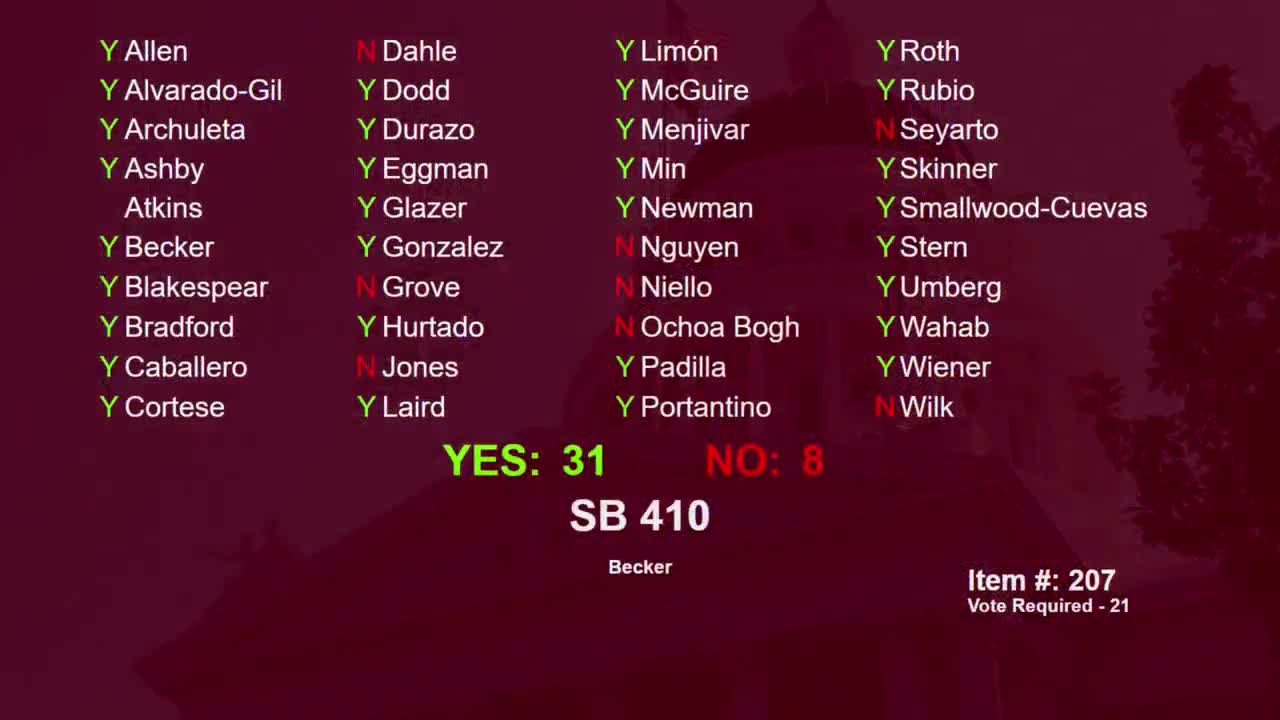 3MIN
Senate Floor
 12MIN
Senate Standing Committee on Governmental Organization
 16MIN
Senate Standing Committee on Housing
Bill Author

Bill Co-Author(s):
