SB 234: Opioid antagonists: stadiums, concert venues, and amusement parks.
- Session Year: 2023-2024
- House: Senate
- Latest Version Date: 2023-10-08
Current Status:
Passed
(2023-10-08: Chaptered by Secretary of State. Chapter 596, Statutes of 2023.)
Introduced
In Committee
First Chamber
In Committee
Second Chamber
Enacted
Existing law requires the State Department of Public Health, subject to an appropriation in the Budget Act of 2016, to award funding to local health departments, local governmental agencies, or on a competitive basis to other organizations, as specified, to support or establish programs that provide naloxone or another opioid antagonist to first responders and at-risk opioid users through programs that serve at-risk drug users. Existing law exempts from civil liability a person who, in good faith and not for compensation, renders emergency medical or nonmedical care or assistance at the scene of an emergency other than an act or omission constituting gross negligence or willful or wanton misconduct, as provided.
This bill would require each stadium, concert venue, and amusement park to maintain unexpired doses of naloxone hydrochloride or any other opioid antagonist on its premises at all times, and to ensure that at least 2 employees are aware of the location of the naloxone hydrochloride or other opioid antagonist. The bill would exempt from civil or criminal liability a person who, in good faith, administers naloxone hydrochloride or another opioid antagonist by nasal spray or auto-injector on the premises of a stadium, concert venue, or amusement park, other than an act or omission constituting gross negligence or willful or wanton misconduct, except as specified. The bill would exempt from civil or criminal liability a stadium, concert venue, or amusement park, or its employees, or an entity that owns, occupies, or operates a stadium, concert venue, or amusement park, or its employees, for the administration of naloxone hydrochloride or another opioid antagonist, or the failure to administer naloxone hydrochloride or another opioid antagonist, on the premises of the stadium, concert venue, or amusement park, as provided.
The California Constitution requires the state to reimburse local agencies and school districts for certain costs mandated by the state. Statutory provisions establish procedures for making that reimbursement.This bill would provide that, if the Commission on State Mandates determines that the bill contains costs mandated by the state, reimbursement for those costs shall be made pursuant to the statutory provisions noted above.Existing law authorizes school districts, county offices of education, and charter schools to provide emergency naloxone hydrochloride or another opioid antagonist, as defined, to school nurses or trained personnel who have volunteered, as provided. Existing law authorizes school nurses or trained personnel to use naloxone hydrochloride or another opioid antagonist to provide emergency medical aid to persons suffering, or reasonably believed to be suffering, from an opioid overdose. Existing law authorizes each public and private elementary and secondary school in the state to determine whether or not to make emergency naloxone hydrochloride or another opioid antagonist and trained personnel available at its school, as provided.
This bill would require each public and elementary and secondary school in the state, including charter schools, to maintain unexpired doses of naloxone hydrochloride or any other opioid antagonist on its schoolsite at all times, and to ensure that at least 2 employees are aware of the location of the naloxone hydrochloride or other opioid antagonist. The bill would require school districts, county offices of education, and charter schools to report to the State Department of Education, on an annual basis at the end of every school year, all incidents of on-campus pupil opioid exposure during that school year. The bill would make other conforming changes. By imposing new duties on public schools, the bill would impose a state-mandated local program.
This bill would authorize a school district, county office of education, or charter school to permit pupils in grades 9 to 12, inclusive, to carry and administer prescription on their person, while on a schoolsite or participating in school activities, naloxone hydrochloride or another opioid antagonist while on a school campus or participating in school activities, upon obtaining written statements from (1) a physician, surgeon, or physician assistant, confirming that the pupil has met all the requirements necessary for obtaining the prescription and the pupil is able to administer the naloxone hydrochloride or another opioid antagonist, and (2) the pupils parent, foster parent, or guardian, consenting to the pupils administration of naloxone hydrochloride or another opioid antagonist, authorizing designated school personnel to consult with the pupils health care provider, and releasing the school district, county office of education, or charter school, and school personnel, from civil liability, as provided. that has received over-the-counter approval from the United States Food and Drug Administration. The bill would prohibit a pupil who is permitted to carry and administer prescription administers naloxone hydrochloride or another opioid antagonist and who administers naloxone hydrochloride or another opioid antagonist, on a schoolsite or while participating in school activities, in good faith and not for compensation, to a person who appears to be experiencing an opioid overdose from being liable in a civil action or subject to criminal prosecution. prosecution, unless the pupils acts or omissions constitute gross negligence or willful and wanton misconduct. The bill would also prohibit a school district, county office of education, or charter school that permits a pupil to carry and administer naloxone hydrochloride or another opioid antagonist, school, or an employee of the school district, county office of education, or charter school, from being liable in a civil action or subject to criminal prosecution or professional review for the a pupils acts or omissions in administering the naloxone hydrochloride or another opioid antagonist. antagonist, unless an act or omission of the school district, county office of education, or charter school, or an employee of the school district, county office of education, or charter school, constitutes gross negligence or willful and wanton misconduct.
Existing law establishes the University of California, under the administration of the Regents of the University of California, the California State University, under the administration of the Trustees of the California State University, the California Community Colleges, under the administration of the Board of Governors of the California Community Colleges, independent institutions of higher education, as defined, and private postsecondary educational institutions, as defined, as the segments of postsecondary education in the state.
Existing law requires the governing board of each community college district and the Trustees of the California State University to provide educational and preventive information about opioid overdose and the use and location of opioid overdose reversal medication to students, as provided. Existing law requires those governing boards to require that campus health centers apply to use the statewide standing order issued by the State Public Health Officer to distribute dosages of a federally approved opioid overdose reversal medication, and apply to participate in the Naloxone Distribution Project administered by the State Department of Health Care Services, as provided. Existing law requests the Regents of the University of California to comply with these requirements.
This bill would require every campus of the California Community Colleges, the California State University, the University of California, an independent institution of higher education, and a private postsecondary educational institution to maintain unexpired doses of naloxone hydrochloride or any other opioid antagonist on its campus at all times, and to ensure that at least 2 employees are aware of the location of the naloxone hydrochloride or other opioid antagonist. By imposing new duties on community college districts, the bill would impose a state-mandated local program.
This bill would, among other things, authorize a community college to provide emergency naloxone hydrochloride or another opioid antagonist to school nurses and trained personnel who have volunteered, as specified, and authorize school nurses and trained personnel to use naloxone hydrochloride or another opioid antagonist to provide emergency medical aid to persons suffering, or reasonably believed to be suffering, from an opioid overdose. The bill would require a qualified supervisor of health or administrator at a community college electing to use naloxone hydrochloride or another opioid antagonist for emergency medical aid to obtain the prescription for naloxone hydrochloride or another opioid antagonist from an authorizing physician and surgeon, as defined. The bill would prohibit an authorizing physician and surgeon from being subject to professional review, being liable in a civil action, or being subject to criminal prosecution for any act in the issuing of a prescription or order, pursuant to these provisions, unless the act constitutes gross negligence or willful or malicious conduct. The bill would prohibit a person trained under these provisions who administers naloxone hydrochloride or another opioid antagonist by nasal spray or auto-injector, in good faith and not for compensation, to a person who appears to be experiencing an opioid overdose from being subject to professional review, being liable in a civil action, or being subject to criminal prosecution for this administration, unless their act or omission constitutes gross negligence or willful and wanton misconduct.
This bill would exempt from civil or criminal liability any person who, in good faith and not for compensation, administers naloxone hydrochloride or another opioid antagonist by nasal spray or auto-injector on a campus of the California State University, the University of California, an independent institution of higher education, or a private postsecondary educational institution, unless their act or omission constitutes gross negligence or willful and wanton misconduct.
Existing law requires the State Department of Public Health, subject to an appropriation in the Budget Act of 2016, to award funding to local health departments, local governmental agencies, or on a competitive basis to other organizations, as specified, to support or establish programs that provide naloxone or another opioid antagonist to first responders and at-risk opioid users through programs that serve at-risk drug users. Existing law exempts from civil liability any a person who, in good faith and not for compensation, renders emergency medical or nonmedical care or assistance at the scene of an emergency other than an act or omission constituting gross negligence or willful or wanton misconduct. misconduct, as provided.
This bill would require each stadium, concert venue, and amusement park to maintain unexpired doses of naloxone hydrochloride or any other opioid antagonist on its premises at all times, and to ensure that at least 2 employees are aware of the location of the naloxone hydrochloride or other opioid antagonist. The bill would exempt from civil or criminal liability a person who, in good faith, administers naloxone hydrochloride or another opioid antagonist by nasal spray or auto-injector on the premises of a stadium, concert venue, or amusement park, other than an act or omission constituting gross negligence or willful or wanton misconduct, except as specified. The bill would exempt from civil or criminal liability a stadium, concert venue, or amusement park, or its employees, or an entity that owns, occupies, or operates a stadium, concert venue, or amusement park, or its employees, for the administration of naloxone hydrochloride or another opioid antagonist, or the failure to administer naloxone hydrochloride or another opioid antagonist, on the premises of the stadium, concert venue, or amusement park, as provided.
The California Constitution requires the state to reimburse local agencies and school districts for certain costs mandated by the state. Statutory provisions establish procedures for making that reimbursement.
This bill would provide that, if the Commission on State Mandates determines that the bill contains costs mandated by the state, reimbursement for those costs shall be made pursuant to the statutory provisions noted above.
Existing law authorizes school districts, county offices of education, and charter schools to provide emergency naloxone hydrochloride or another opioid antagonist, as defined, to school nurses or trained personnel who have volunteered, as provided. Existing law authorizes school nurses or trained personnel to use naloxone hydrochloride or another opioid antagonist to provide emergency medical aid to persons suffering, or reasonably believed to be suffering, from an opioid overdose. Existing law authorizes each public and private elementary and secondary school in the state to determine whether or not to make emergency naloxone hydrochloride or another opioid antagonist and trained personnel available at its school, as provided.
This bill would require each public and elementary and secondary school in the state, including charter schools, to maintain unexpired doses of naloxone hydrochloride or any other opioid antagonist on its schoolsite at all times, and to ensure that at least 2 employees are aware of the location of the naloxone hydrochloride or other opioid antagonist. The bill would require school districts, county offices of education, and charter schools to report to the State Department of Education and the State Department of Health Care Services, Education, on an annual basis at the end of every school year, all incidents of on campus on-campus pupil opioid exposure during that school year. The bill would make other conforming changes. By imposing new duties on public schools, the bill would impose a state-mandated local program.
This bill would authorize a school district, county office of education, or charter school to permit pupils to carry and administer prescription naloxone hydrochloride or another opioid antagonist while on a school campus or participating in school activities, upon obtaining written statements from (1) a physician, surgeon, or physician assistant, confirming that the pupil has met all the requirements necessary for obtaining the prescription and the pupil is able to administer the naloxone hydrochloride or another opioid antagonist, and (2) the pupils parent, foster parent, or guardian, consenting to the pupils administration of naloxone hydrochloride or another opioid antagonist, authorizing designated school personnel to consult with the pupils health care provider, and releasing the school district, county office of education, or charter school, and school personnel, from civil liability, as provided. The bill would prohibit a pupil who is permitted to carry and administer prescription naloxone hydrochloride or another opioid antagonist and who administers naloxone hydrochloride or another opioid antagonist, in good faith and not for compensation, to a person who appears to be experiencing an opioid overdose from being liable in a civil action or subject to criminal prosecution. The bill would also prohibit a school district, county office of education, or charter school that permits a pupil to carry and administer naloxone hydrochloride or another opioid antagonist, or an employee of the school district, county office of education, or charter school, from being liable in a civil action or subject to criminal prosecution or professional review for the pupils acts or omissions in administering the naloxone hydrochloride or another opioid antagonist.
Existing law establishes the University of California, under the administration of the Regents of the University of California, the California State University, under the administration of the Trustees of the California State University, the California Community Colleges, under the administration of the Board of Governors of the California Community Colleges, independent institutions of higher education, as defined, and private postsecondary educational institutions, as defined, as the segments of postsecondary education in the state.
Existing law requires the governing board of each community college district and the Trustees of the California State University to provide educational and preventive information about opioid overdose and the use and location of opioid overdose reversal medication to students, as provided. Existing law requires those governing boards to require that campus health centers apply to use the statewide standing order issued by the State Public Health Officer to distribute dosages of a federally approved opioid overdose reversal medication, and apply to participate in the Naloxone Distribution Project administered by the State Department of Health Care Services, as provided. Existing law requests the Regents of the University of California to comply with these requirements.
This bill would require every campus of the California Community Colleges, the California State University, the University of California, an independent institution of higher education, and a private postsecondary educational institution to maintain unexpired doses of naloxone hydrochloride or any other opioid antagonist on its campus at all times, and to ensure that at least 2 employees are aware of the location of the naloxone hydrochloride or other opioid antagonist. By imposing new duties on community college districts, the bill would impose a state-mandated local program.
This bill would, among other things, authorize a community college to provide emergency naloxone hydrochloride or another opioid antagonist to school nurses and trained personnel who have volunteered, as specified, and authorize school nurses and trained personnel to use naloxone hydrochloride or another opioid antagonist to provide emergency medical aid to persons suffering, or reasonably believed to be suffering, from an opioid overdose. The bill would require a qualified supervisor of health or administrator at a community college electing to use naloxone hydrochloride or another opioid antagonist for emergency medical aid to obtain the prescription for naloxone hydrochloride or another opioid antagonist from an authorizing physician and surgeon, as defined. The bill would prohibit an authorizing physician and surgeon from being subject to professional review, being liable in a civil action, or being subject to criminal prosecution for any act in the issuing of a prescription or order, pursuant to these provisions, unless the act constitutes gross negligence or willful or malicious conduct. The bill would prohibit a person trained under these provisions who administers naloxone hydrochloride or another opioid antagonist by nasal spray or auto-injector, in good faith and not for compensation, to a person who appears to be experiencing an opioid overdose from being subject to professional review, being liable in a civil action, or being subject to criminal prosecution for this administration. administration, unless their act or omission constitutes gross negligence or willful and wanton misconduct.
This bill would exempt from civil or criminal liability any person who, in good faith and not for compensation, administers naloxone hydrochloride or another opioid antagonist by nasal spray or auto-injector on a campus of the California State University, the University of California, an independent institution of higher education, or a private postsecondary educational institution. institution, unless their act or omission constitutes gross negligence or willful and wanton misconduct.
Existing law requires the State Department of Public Health, subject to an appropriation in the Budget Act of 2016, to award funding to local health departments, local governmental agencies, or on a competitive basis to other organizations, as specified, to support or establish programs that provide naloxone or another opioid antagonist to first responders and at-risk opioid users through programs that serve at-risk drug users. Existing law exempts from civil liability any person who, in good faith and not for compensation, renders emergency medical or nonmedical care or assistance at the scene of an emergency other than an act or omission constituting gross negligence or willful or wanton misconduct.
This bill would require each stadium, concert venue, and amusement park to maintain unexpired doses of naloxone hydrochloride or any other opioid antagonist on its premises at all times, and to ensure that at least 2 employees are aware of the location of the naloxone hydrochloride or other opioid antagonist. The bill would exempt from civil or criminal liability a person who, in good faith, administers naloxone hydrochloride or another opioid antagonist by nasal spray or auto-injector on the premises of a stadium, concert venue, or amusement park, other than an act or omission constituting gross negligence or willful or wanton misconduct, except as specified. The bill would exempt from civil or criminal liability a stadium, concert venue, or amusement park, or its employees, or an entity that owns, occupies, or operates a stadium, concert venue, or amusement park, or its employees, for the administration of naloxone hydrochloride or another opioid antagonist, or the failure to administer naloxone hydrochloride or another opioid antagonist, on the premises of the stadium, concert venue, or amusement park, as provided.
The California Constitution requires the state to reimburse local agencies and school districts for certain costs mandated by the state. Statutory provisions establish procedures for making that reimbursement.
This bill would provide that, if the Commission on State Mandates determines that the bill contains costs mandated by the state, reimbursement for those costs shall be made pursuant to the statutory provisions noted above.
Existing law authorizes school districts, county offices of education, and charter schools to provide emergency naloxone hydrochloride or another opioid antagonist, as defined, to school nurses or trained personnel who have volunteered, as provided. Existing law authorizes school nurses or trained personnel to use naloxone hydrochloride or another opioid antagonist to provide emergency medical aid to persons suffering, or reasonably believed to be suffering, from an opioid overdose. Existing law authorizes each public and private elementary and secondary school in the state to determine whether or not to make emergency naloxone hydrochloride or another opioid antagonist and trained personnel available at its school, as provided.
This bill would require each public and elementary and secondary school in the state, including charter schools, to maintain unexpired doses of naloxone hydrochloride or any other opioid antagonist on its schoolsite at all times, and to ensure that at least 2 employees are aware of the location of the naloxone hydrochloride or other opioid antagonist. The bill would require school districts, county offices of education, and charter schools to report to the State Department of Education and the State Department of Health Care Services, on an annual basis at the end of every school year, all incidents of on campus pupil opioid exposure during that school year. The bill would make other conforming changes. By imposing new duties on public schools, the bill would impose a state-mandated local program.
Existing law establishes the University of California, under the administration of the Regents of the University of California, the California State University, under the administration of the Trustees of the California State University, the California Community Colleges, under the administration of the Board of Governors of the California Community Colleges, independent institutions of higher education, as defined, and private postsecondary educational institutions, as defined, as the segments of postsecondary education in the state.
Existing law requires the governing board of each community college district and the Trustees of the California State University to provide educational and preventive information about opioid overdose and the use and location of opioid overdose reversal medication to students, as provided. Existing law requires those governing boards to require that campus health centers apply to use the statewide standing order issued by the State Public Health Officer to distribute dosages of a federally approved opioid overdose reversal medication, and apply to participate in the Naloxone Distribution Project administered by the State Department of Health Care Services, as provided. Existing law requests the Regents of the University of California to comply with these requirements.
This bill would require every campus of the California Community Colleges, the California State University, the University of California, an independent institution of higher education, and a private postsecondary educational institution to maintain unexpired doses of naloxone hydrochloride or any other opioid antagonist on its campus at all times, and to ensure that at least 2 employees are aware of the location of the naloxone hydrochloride or other opioid antagonist. By imposing new duties on community college districts, the bill would impose a state-mandated local program.
This bill would, among other things, authorize a community college to provide emergency naloxone hydrochloride or another opioid antagonist to school nurses and trained personnel who have volunteered, as specified, and authorize school nurses and trained personnel to use naloxone hydrochloride or another opioid antagonist to provide emergency medical aid to persons suffering, or reasonably believed to be suffering, from an opioid overdose. The bill would require a qualified supervisor of health or administrator at a community college electing to use naloxone hydrochloride or another opioid antagonist for emergency medical aid to obtain the prescription for naloxone hydrochloride or another opioid antagonist from an authorizing physician and surgeon, as defined. The bill would prohibit an authorizing physician and surgeon from being subject to professional review, being liable in a civil action, or being subject to criminal prosecution for any act in the issuing of a prescription or order, pursuant to these provisions, unless the act constitutes gross negligence or willful or malicious conduct. The bill would prohibit a person trained under these provisions who administers naloxone hydrochloride or another opioid antagonist by nasal spray or auto-injector, in good faith and not for compensation, to a person who appears to be experiencing an opioid overdose from being subject to professional review, being liable in a civil action, or being subject to criminal prosecution for this administration.
This bill would exempt from civil or criminal liability any person who, in good faith and not for compensation, administers naloxone hydrochloride or another opioid antagonist by nasal spray or auto-injector on a campus of the California State University, the University of California, an independent institution of higher education, or a private postsecondary educational institution.
Existing law requires the State Department of Public Health, subject to an appropriation in the Budget Act of 2016, to award funding to local health departments, local governmental agencies, or on a competitive basis to other organizations, as specified, to support or establish programs that provide naloxone or another opioid antagonist to first responders and at-risk opioid users through programs that serve at-risk drug users. Existing law exempts from civil liability any person who, in good faith and not for compensation, renders emergency medical or nonmedical care or assistance at the scene of an emergency other than an act or omission constituting gross negligence or willful or wanton misconduct.
This bill would require each stadium, concert venue, and amusement park to maintain unexpired doses of naloxone hydrochloride or any other opioid antagonist on its premises at all times, and to ensure that at least 2 employees are aware of the location of the naloxone hydrochloride or other opioid antagonist. The bill would exempt from civil or criminal liability any a person who, in good faith, administers naloxone hydrochloride or another opioid antagonist by nasal spray or auto-injector on the premises of a stadium, concert venue, or amusement park, other than an act or omission constituting gross negligence or willful or wanton misconduct. misconduct, except as specified. The bill would exempt from civil or criminal liability a stadium, concert venue, or amusement park, or its employees, or an entity that owns, occupies, or operates a stadium, concert venue, or amusement park, or its employees, for the administration of naloxone hydrochloride or another opioid antagonist, or the failure to administer naloxone hydrochloride or another opioid antagonist, on the premises of the stadium, concert venue, or amusement park, as provided.
The California Constitution requires the state to reimburse local agencies and school districts for certain costs mandated by the state. Statutory provisions establish procedures for making that reimbursement.
This bill would provide that, if the Commission on State Mandates determines that the bill contains costs mandated by the state, reimbursement for those costs shall be made pursuant to the statutory provisions noted above.
Existing law authorizes school districts, county offices of education, and charter schools to provide emergency naloxone hydrochloride or another opioid antagonist, as defined, to school nurses or trained personnel who have volunteered, as provided. Existing law authorizes school nurses or trained personnel to use naloxone hydrochloride or another opioid antagonist to provide emergency medical aid to persons suffering, or reasonably believed to be suffering, from an opioid overdose. Existing law authorizes each public and private elementary and secondary school in the state to determine whether or not to make emergency naloxone hydrochloride or another opioid antagonist and trained personnel available at its school, as provided.
This bill would require each public and elementary and secondary school in the state, including charter schools, to maintain unexpired doses of naloxone hydrochloride or any other opioid antagonist on its schoolsite at all times, and to ensure that at least 2 employees are aware of the location of the naloxone hydrochloride or other opioid antagonist. The bill would require school districts, county offices of education, and charter schools to report to the State Department of Education and the State Department of Health Care Services, on an annual basis at the end of every school year, all incidents of oncampus on campus pupil opioid exposure during that school year. The bill would make other conforming changes. By imposing new duties on public schools, the bill would impose a state-mandated local program.
Existing law establishes the University of California, under the administration of the Regents of the University of California, the California State University, under the administration of the Trustees of the California State University, the California Community Colleges, under the administration of the Board of Governors of the California Community Colleges, independent institutions of higher education, as defined, and private postsecondary educational institutions, as defined, as the segments of postsecondary education in the state.
Existing law requires the governing board of each community college district and the Trustees of the California State University to provide educational and preventive information about opioid overdose and the use and location of opioid overdose reversal medication to students, as provided. Existing law requires those governing boards to require that campus health centers apply to use the statewide standing order issued by the State Public Health Officer to distribute dosages of a federally approved opioid overdose reversal medication, and apply to participate in the Naloxone Distribution Project administered by the State Department of Health Care Services, as provided. Existing law requests the Regents of the University of California to comply with these requirements.
This bill would require every campus of the California Community Colleges, the California State University, the University of California, an independent institution of higher education, and a private postsecondary educational institution to maintain unexpired doses of naloxone hydrochloride or any other opioid antagonist on its campus at all times, and to ensure that at least 2 employees are aware of the location of the naloxone hydrochloride or other opioid antagonist. By imposing new duties on community college districts, the bill would impose a state-mandated local program.
This bill would, among other things, authorize a community college to provide emergency naloxone hydrochloride or another opioid antagonist to school nurses and trained personnel who have volunteered, as specified, and authorize school nurses and trained personnel to use naloxone hydrochloride or another opioid antagonist to provide emergency medical aid to persons suffering, or reasonably believed to be suffering, from an opioid overdose. The bill would require a qualified supervisor of health or administrator at a community college electing to use naloxone hydrochloride or another opioid antagonist for emergency medical aid to obtain the prescription for naloxone hydrochloride or another opioid antagonist from an authorizing physician and surgeon, as defined. The bill would prohibit an authorizing physician and surgeon from being subject to professional review, being liable in a civil action, or being subject to criminal prosecution for any act in the issuing of a prescription or order, pursuant to these provisions, unless the act constitutes gross negligence or willful or malicious conduct. The bill would prohibit a person trained under these provisions who administers naloxone hydrochloride or another opioid antagonist by nasal spray or auto-injector, in good faith and not for compensation, to a person who appears to be experiencing an opioid overdose from being subject to professional review, being liable in a civil action, or being subject to criminal prosecution for this administration.
This bill would exempt from civil or criminal liability any person who, in good faith and not for compensation, administers naloxone hydrochloride or another opioid antagonist by nasal spray or auto-injector on a campus of the California State University, the University of California, an independent institution of higher education, or a private postsecondary educational institution.
Existing law requires the State Department of Public Health, subject to an appropriation in the Budget Act of 2016, to award funding to local health departments, local governmental agencies, or on a competitive basis to other organizations, as specified, to support or establish programs that provide naloxone or another opioid antagonist to first responders and at-risk opioid users through programs that serve at-risk drug users. Existing law exempts from civil liability any person who, in good faith and not for compensation, renders emergency medical or nonmedical care or assistance at the scene of an emergency other than an act or omission constituting gross negligence or willful or wanton misconduct.
This bill would require each stadium, concert venue, and amusement park to maintain unexpired doses of naloxone hydrochloride or any other opioid antagonist on its premises at all times, and to ensure that at least 2 employees are aware of the location of the naloxone hydrochloride or other opioid antagonist. The bill would exempt from civil or criminal liability any person who, in good faith, administers naloxone hydrochloride or another opioid antagonist by nasal spray or auto-injector on the premises of a stadium, concert venue, or amusement park, other than an act or omission constituting gross negligence or willful or wanton misconduct.
The California Constitution requires the state to reimburse local agencies and school districts for certain costs mandated by the state. Statutory provisions establish procedures for making that reimbursement.
This bill would provide that, if the Commission on State Mandates determines that the bill contains costs mandated by the state, reimbursement for those costs shall be made pursuant to the statutory provisions noted above.
Existing law authorizes school districts, county offices of education, and charter schools to provide emergency naloxone hydrochloride or another opioid antagonist, as defined, to school nurses or trained personnel who have volunteered, as provided. Existing law authorizes school nurses or trained personnel to use naloxone hydrochloride or another opioid antagonist to provide emergency medical aid to persons suffering, or reasonably believed to be suffering, from an opioid overdose. Existing law authorizes each public and private elementary and secondary school in the state to determine whether or not to make emergency naloxone hydrochloride or another opioid antagonist and trained personnel available at its school, as provided.
This bill would require each public and elementary and secondary school in the state, including charter schools, to maintain unexpired doses of naloxone hydrochloride or any other opioid antagonist on its schoolsite at all times, and to ensure that at least 2 employees are aware of the location of the naloxone hydrochloride or other opioid antagonist. The bill would require school districts, county offices of education, and charter schools to report to the State Department of Education and the State Department of Health Care Services, on an annual basis at the end of every school year, all incidents of oncampus pupil opioid exposure during that school year. The bill would make other conforming changes. By imposing new duties on public schools, the bill would impose a state-mandated local program.
Existing law establishes the University of California, under the administration of the Regents of the University of California, the California State University, under the administration of the Trustees of the California State University, the California Community Colleges, under the administration of the Board of Governors of the California Community Colleges, independent institutions of higher education, as defined, and private postsecondary educational institutions, as defined, as the segments of postsecondary education in the state.
Existing law requires the governing board of each community college district and the Trustees of the California State University to provide educational and preventive information about opioid overdose and the use and location of opioid overdose reversal medication to students, as provided. Existing law requires those governing boards to require that campus health centers apply to use the statewide standing order issued by the State Public Health Officer to distribute dosages of a federally approved opioid overdose reversal medication, and apply to participate in the Naloxone Distribution Project administered by the State Department of Health Care Services, as provided. Existing law requests the Regents of the University of California to comply with these requirements.
This bill would require every campus of the California Community Colleges, the California State University, the University of California, an independent institution of higher education, and a private postsecondary educational institution to maintain unexpired doses of naloxone hydrochloride or any other opioid antagonist on its campus at all times, and to ensure that at least 2 employees are aware of the location of the naloxone hydrochloride or other opioid antagonist. By imposing new duties on community college districts, the bill would impose a state-mandated local program. The bill would exempt from civil or criminal liability any person who, in good faith and not for compensation, administers naloxone hydrochloride or another opioid antagonist on a college campus, other than an act or omission constituting gross negligence or willful or wanton misconduct.
This bill would, among other things, authorize a community college to provide emergency naloxone hydrochloride or another opioid antagonist to school nurses and trained personnel who have volunteered, as specified, and authorize school nurses and trained personnel to use naloxone hydrochloride or another opioid antagonist to provide emergency medical aid to persons suffering, or reasonably believed to be suffering, from an opioid overdose. The bill would require a qualified supervisor of health or administrator at a community college electing to use naloxone hydrochloride or another opioid antagonist for emergency medical aid to obtain the prescription for naloxone hydrochloride or another opioid antagonist from an authorizing physician and surgeon, as defined. The bill would prohibit an authorizing physician and surgeon from being subject to professional review, being liable in a civil action, or being subject to criminal prosecution for any act in the issuing of a prescription or order, pursuant to these provisions, unless the act constitutes gross negligence or willful or malicious conduct. The bill would prohibit a person trained under these provisions who administers naloxone hydrochloride or another opioid antagonist by nasal spray or auto-injector, in good faith and not for compensation, to a person who appears to be experiencing an opioid overdose from being subject to professional review, being liable in a civil action, or being subject to criminal prosecution for this administration.
This bill would exempt from civil or criminal liability any person who, in good faith and not for compensation, administers naloxone hydrochloride or another opioid antagonist by nasal spray or auto-injector on a campus of the California State University, the University of California, an independent institution of higher education, or a private postsecondary educational institution.
Existing law requires the State Department of Public Health, subject to an appropriation in the Budget Act of 2016, to award funding to local health departments, local governmental agencies, or on a competitive basis to other organizations, as specified, to support or establish programs that provide naloxone or another opioid antagonist to first responders and at-risk opioid users through programs that serve at-risk drug users. Existing law exempts from civil liability any person who, in good faith and not for compensation, renders emergency medical or nonmedical care or assistance at the scene of an emergency other than an act or omission constituting gross negligence or willful or wanton misconduct.
This bill would require each stadium, concert venue, and amusement park to maintain unexpired doses of naloxone hydrochloride or any other opioid antagonist on its premises at all times, and to ensure that at least 2 employees are aware of the location of the naloxone hydrochloride or other opioid antagonist. The bill would exempt from civil or criminal liability any person who, in good faith and not for compensation, faith, administers naloxone hydrochloride or another opioid antagonist by nasal spray or auto-injector on the premises of a stadium, concert venue, or amusement park, other than an act or omission constituting gross negligence or willful or wanton misconduct.
The California Constitution requires the state to reimburse local agencies and school districts for certain costs mandated by the state. Statutory provisions establish procedures for making that reimbursement.
This bill would provide that, if the Commission on State Mandates determines that the bill contains costs mandated by the state, reimbursement for those costs shall be made pursuant to the statutory provisions noted above.
Existing law authorizes school districts, county offices of education, and charter schools to provide emergency naloxone hydrochloride or another opioid antagonist, as defined, to school nurses or trained personnel who have volunteered, as provided. Existing law authorizes school nurses or trained personnel to use naloxone hydrochloride or another opioid antagonist to provide emergency medical aid to persons suffering, or reasonably believed to be suffering, from an opioid overdose. Existing law authorizes each public and private elementary and secondary school in the state to determine whether or not to make emergency naloxone hydrochloride or another opioid antagonist and trained personnel available at its school, as provided.
This bill would require each public and elementary and secondary school in the state, including charter schools, to maintain unexpired doses of naloxone hydrochloride or any other opioid antagonist on its schoolsite at all times, and to ensure that at least 2 employees are aware of the location of the naloxone hydrochloride or other opioid antagonist. The bill would make other conforming changes. By imposing new duties on public schools, the bill would impose a state-mandated local program.
Existing law establishes the University of California, under the administration of the Regents of the University of California, the California State University, under the administration of the Trustees of the California State University, the California Community Colleges, under the administration of the Board of Governors of the California Community Colleges, independent institutions of higher education, as defined, and private postsecondary educational institutions, as defined, as the segments of postsecondary education in the state.
Existing law requires the governing board of each community college district and the Trustees of the California State University to provide educational and preventive information about opioid overdose and the use and location of opioid overdose reversal medication to students, as provided. Existing law requires those governing boards to require that campus health centers apply to use the statewide standing order issued by the State Public Health Officer to distribute dosages of a federally approved opioid overdose reversal medication, and apply to participate in the Naloxone Distribution Project administered by the State Department of Health Care Services, as provided. Existing law requests the Regents of the University of California to comply with these requirements.
This bill would require every campus of the California Community Colleges, the California State University, the University of California, an independent institution of higher education, and a private postsecondary educational institution to maintain unexpired doses of naloxone hydrochloride or any other opioid antagonist on its campus at all times, and to ensure that at least 2 employees are aware of the location of the naloxone hydrochloride or other opioid antagonist. By imposing new duties on community college districts, the bill would impose a state-mandated local program. The bill would exempt from civil or criminal liability any person who, in good faith and not for compensation, administers naloxone hydrochloride or another opioid antagonist on a college campus, other than an act or omission constituting gross negligence or willful or wanton misconduct.
Existing law requires the State Department of Public Health, subject to an appropriation in the Budget Act of 2016, to award funding to local health departments, local governmental agencies, or on a competitive basis to other organizations, as specified, to support or establish programs that provide naloxone or another opioid antagonist to first responders and at-risk opioid users through programs that serve at-risk drug users. Existing law exempts from civil liability any person who, in good faith and not for compensation, renders emergency medical or nonmedical care or assistance at the scene of an emergency other than an act or omission constituting gross negligence or willful or wanton misconduct.
This bill would require each stadium, concert venue, and amusement park to maintain unexpired doses of naloxone hydrochloride or any other opioid antagonist on its premises at all times, and to ensure that at least 2 employees are aware of the location of the naloxone hydrochloride or other opioid antagonist. The bill would exempt from civil or criminal liability any person who, in good faith and not for compensation, administers naloxone hydrochloride or another opioid antagonist on the premises of a stadium, concert venue, or amusement park, other than an act or omission constituting gross negligence or willful or wanton misconduct.
The California Constitution requires the state to reimburse local agencies and school districts for certain costs mandated by the state. Statutory provisions establish procedures for making that reimbursement.
This bill would provide that, if the Commission on State Mandates determines that the bill contains costs mandated by the state, reimbursement for those costs shall be made pursuant to the statutory provisions noted above.
For purposes of this chapter, the following definitions apply:
(a)Amusement park means a gated facility that requires a ticket for entry, has attendance greater than 1,000,000 visitors annually, and operates 10 or more amusement rides regulated under Sections 7900 to 7919, inclusive, and Sections 7920 to 7932, inclusive, of the Labor Code.
(b)Auto-injector means a disposable delivery device designed for the automatic injection of a premeasured dose of an opioid antagonist into the human body and approved by the United States Food and Drug Administration for layperson use.
(c)Opioid antagonist means naloxone hydrochloride or another drug approved by the United States Food and Drug Administration that, when administered, negates or neutralizes in whole or in part the pharmacological effects of an opioid in the body, and has been approved for the treatment of an opioid overdose.
11871.Each stadium, concert venue, and amusement park shall, at all times, maintain unexpired doses of naloxone hydrochloride or any other opioid antagonist on its premises and ensure that at least two employees are aware of the location of the naloxone hydrochloride or other opioid antagonist.
11872.(a)(1)Notwithstanding any other law except for Division 5 (commencing with Section 6300) of the Labor Code and Chapters 3.2 (commencing with Section 330), 3.3 (commencing with Section 345), 3.5 (commencing with Section 401), 4 (commencing with Section 450), and 7 (commencing with Section 14000) of Division 1 of Title 8 of the California Code of Regulations, a person who, in good faith, administers naloxone hydrochloride or another opioid antagonist by nasal spray or by auto-injector on the premises of a stadium, concert venue, or amusement park to a person who appears to be experiencing an opioid overdose shall not be liable in a civil action, or be subject to criminal prosecution for their acts or omissions in administering the naloxone hydrochloride or another opioid antagonist.
(2)(A)The protection specified in subdivision (a) shall not apply in a case of gross negligence or willful and wanton misconduct of the person who renders emergency care treatment by the use of naloxone hydrochloride or another opioid antagonist.
(B)Subparagraph (A) shall not apply to an employee of a stadium, concert venue, or amusement park, or an employee of an entity that owns, occupies, or operates a stadium, concert venue, or amusement park.
(b)Notwithstanding any other law except for Division 5 (commencing with Section 6300) of the Labor Code and Chapters 3.2 (commencing with Section 330), 3.3 (commencing with Section 345), 3.5 (commencing with Section 401), 4 (commencing with Section 450), and 7 (commencing with Section 14000) of Division 1 of Title 8 of the California Code of Regulations, a stadium, concert venue, or amusement park, or its employees, or an entity that owns, occupies, or operates a stadium, concert venue, or amusement park, or its employees, shall not be liable in a civil action, or be subject to criminal prosecution, for the administration of naloxone hydrochloride or another opioid antagonist on the premises of the stadium, concert venue, or amusement park, including by an employee of the stadium, concert venue, or amusement park, or by an employee of the entity that owns, occupies, or operates the stadium, concert venue, or amusement park.
(c)Notwithstanding any other law except for Division 5 (commencing with Section 6300) of the Labor Code and Chapters 3.2 (commencing with Section 330), 3.3 (commencing with Section 345), 3.5 (commencing with Section 401), 4 (commencing with Section 450), and 7 (commencing with Section 14000) of Division 1 of Title 8 of the California Code of Regulations, a stadium, concert venue, or amusement park, or its employees, or an entity that owns, occupies, or operates a stadium, concert venue, or amusement park, or its employees, shall have no obligation to administer naloxone hydrochloride or another opioid antagonist in the event of an apparent opioid overdose on the premises of the stadium, concert venue, or amusement park, and shall not be liable in a civil action, or be subject to criminal prosecution, if they fail to identify an apparent opioid overdose or fail to administer naloxone hydrochloride or another opioid antagonist on the premises of the stadium, concert venue, or amusement park.
For purposes of this chapter, the following definitions apply:
(a)Amusement park means a gated facility that requires a ticket for entry, has attendance greater than 1,000,000 visitors annually, and operates 10 or more permanent amusement rides regulated under Sections 344.5 to 344.17, 7900 to 7919, inclusive, and Sections 3195.1 to 3195.14, 7920 to 7932, inclusive, of Title 8 of the California Code of Regulations. the Labor Code.
(b)Auto-injector means a disposable delivery device designed for the automatic injection of a premeasured dose of an opioid antagonist into the human body and approved by the United States Food and Drug Administration for layperson use.
(c)Opioid antagonist means naloxone hydrochloride or another drug approved by the United States Food and Drug Administration that, when administered, negates or neutralizes in whole or in part the pharmacological effects of an opioid in the body, and has been approved for the treatment of an opioid overdose.
11871.Each stadium, concert venue, and amusement park shall, at all times, maintain unexpired doses of naloxone hydrochloride or any other opioid antagonist on its premises and ensure that at least two employees are aware of the location of the naloxone hydrochloride or other opioid antagonist.
11872.(a)(1)Notwithstanding any other law, law except for Division 5 (commencing with Section 6300) of the Labor Code and Chapters 3.2 (commencing with Section 330), 3.3 (commencing with Section 345), 3.5 (commencing with Section 401), 4 (commencing with Section 450), and 7 (commencing with Section 14000) of Division 1 of Title 8 of the California Code of Regulations, a person who, in good faith, administers naloxone hydrochloride or another opioid antagonist by nasal spray or by auto-injector on the premises of a stadium, concert venue, or amusement park to a person who appears to be experiencing an opioid overdose shall not be liable in a civil action, or be subject to criminal prosecution for their acts or omissions in administering the naloxone hydrochloride or another opioid antagonist.
(2)(A)The protection specified in subdivision (a) shall not apply in a case of gross negligence or willful and wanton misconduct of the person who renders emergency care treatment by the use of naloxone hydrochloride or another opioid antagonist.
(B)Subparagraph (A) shall not apply to an employee of a stadium, concert venue, or amusement park, or an employee of an entity that owns, occupies, or operates a stadium, concert venue, or amusement park.
(b)Notwithstanding any other law, law except for Division 5 (commencing with Section 6300) of the Labor Code and Chapters 3.2 (commencing with Section 330), 3.3 (commencing with Section 345), 3.5 (commencing with Section 401), 4 (commencing with Section 450), and 7 (commencing with Section 14000) of Division 1 of Title 8 of the California Code of Regulations, a stadium, concert venue, or amusement park, or its employees, or an entity that owns, occupies, or operates a stadium, concert venue, or amusement park, or its employees, shall not be liable in a civil action, or be subject to criminal prosecution, for the administration of naloxone hydrochloride or another opioid antagonist on the premises of the stadium, concert venue, or amusement park, including by an employee of the stadium, concert venue, or amusement park, or by an employee of the entity that owns, occupies, or operates the stadium, concert venue, or amusement park.
(c)Notwithstanding any other law, law except for Division 5 (commencing with Section 6300) of the Labor Code and Chapters 3.2 (commencing with Section 330), 3.3 (commencing with Section 345), 3.5 (commencing with Section 401), 4 (commencing with Section 450), and 7 (commencing with Section 14000) of Division 1 of Title 8 of the California Code of Regulations, a stadium, concert venue, or amusement park, or its employees, or an entity that owns, occupies, or operates a stadium, concert venue, or amusement park, or its employees, shall have no obligation to administer naloxone hydrochloride or another opioid antagonist in the event of an apparent opioid overdose on the premises of the stadium, concert venue, or amusement park, and shall not be liable in a civil action, or be subject to criminal prosecution, if they fail to identify an apparent opioid overdose or fail to administer naloxone hydrochloride or another opioid antagonist on the premises of the stadium, concert venue, or amusement park.
SEC. 6.If the Commission on State Mandates determines that this act contains costs mandated by the state, reimbursement to local agencies and school districts for those costs shall be made pursuant to Part 7 (commencing with Section 17500) of Division 4 of Title 2 of the Government Code.(a)School districts, county offices of education, and charter schools may provide emergency naloxone hydrochloride or another opioid antagonist to school nurses or trained personnel who have volunteered pursuant to subdivision (d), and school nurses or trained personnel may use naloxone hydrochloride or another opioid antagonist to provide emergency medical aid to persons suffering, or reasonably believed to be suffering, from an opioid overdose.
(b)For purposes of this section, the following terms have the following meanings:
(1)Authorizing physician and surgeon may include, but is not limited to, a physician and surgeon employed by, or contracting with, a local educational agency, a medical director of the local health department, or a local emergency medical services director.
(2)Auto-injector means a disposable delivery device designed for the automatic injection of a premeasured dose of an opioid antagonist into the human body and approved by the United States Food and Drug Administration for layperson use.
(3)Opioid antagonist means naloxone hydrochloride or another drug approved by the United States Food and Drug Administration that, when administered, negates or neutralizes in whole or in part the pharmacological effects of an opioid in the body, and has been approved for the treatment of an opioid overdose.
(4)Qualified supervisor of health may include, but is not limited to, a school nurse.
(5)Volunteer or trained personnel means an employee who has volunteered to administer naloxone hydrochloride or another opioid antagonist to a person if the person is suffering, or reasonably believed to be suffering, from an opioid overdose, has been designated by a school, and has received training pursuant to subdivision (d).
(c)Each public and private elementary and secondary school in the state may voluntarily determine whether or not to make trained personnel available at its school. In making this determination, a school shall evaluate the emergency medical response time to the school and determine whether initiating emergency medical services is an acceptable alternative to naloxone hydrochloride or another opioid antagonist and trained personnel. A private elementary or secondary school choosing to exercise the authority provided under this subdivision shall not receive state funds specifically for purposes of this subdivision.
(d)(1)Each public and private elementary and secondary school in the state may designate one or more volunteers to receive initial and annual refresher training, based on the standards developed pursuant to subdivision (e), regarding the storage and emergency use of naloxone hydrochloride or another opioid antagonist from the school nurse or other qualified person designated by an authorizing physician and surgeon. A benefit shall not be granted to or withheld from any individual based on their offer to volunteer, and there shall be no retaliation against any individual for rescinding their offer to volunteer, including after receiving training. Any school district, county office of education, or charter school choosing to exercise the authority provided under this subdivision shall provide the training for the volunteers at no cost to the volunteer and during the volunteers regular working hours.
(2)An employee who volunteers pursuant to this section may rescind their offer to administer emergency naloxone hydrochloride or another opioid antagonist at any time, including after receipt of training.
(e)(1)The Superintendent shall establish minimum standards of training for the administration of naloxone hydrochloride or another opioid antagonist that satisfies the requirements of paragraph (2). Every five years, or sooner as deemed necessary by the Superintendent, the Superintendent shall review minimum standards of training for the administration of naloxone hydrochloride or other opioid antagonists that satisfy the requirements of paragraph (2). For purposes of this subdivision, the Superintendent shall consult with organizations and providers with expertise in administering naloxone hydrochloride or another opioid antagonist and administering medication in a school environment, including, but not limited to, the California Society of Addiction Medicine, the Emergency Medical Services Authority, the California School Nurses Organization, the California Medical Association, the American Academy of Pediatrics, and others.
(2)Training established pursuant to this subdivision shall include all of the following:
(A)Techniques for recognizing symptoms of an opioid overdose.
(B)Standards and procedures for the storage, restocking, and emergency use of naloxone hydrochloride or another opioid antagonist.
(C)Basic emergency followup procedures, including, but not limited to, a requirement for the school or charter school administrator or, if the administrator is not available, another school staff member to call the emergency 911 telephone number and to contact the pupils parent or guardian.
(D)Recommendations on the necessity of instruction and certification in cardiopulmonary resuscitation.
(E)Written materials covering the information required under this subdivision.
(3)Training established pursuant to this subdivision shall be consistent with the most recent guidelines for medication administration issued by the department.
(4)A school shall retain for reference the written materials prepared under subparagraph (E) of paragraph (2).
(5)The department shall include on its internet website a clearinghouse for best practices in training nonmedical personnel to administer naloxone hydrochloride or another opioid antagonist to pupils.
(f)Any school district, county office of education, or charter school electing to make trained personnel available at schoolsites shall distribute a notice at least once, but not more than twice, per school year to all staff that contains the following information:
(1)A description of the volunteer request stating that the request is for volunteers to be trained to administer naloxone hydrochloride or another opioid antagonist to a person if the person is suffering, or reasonably believed to be suffering, from an opioid overdose.
(2)A description of the training that the volunteer will receive pursuant to subdivision (d).
(3)The right of an employee to rescind their offer to volunteer pursuant to this section.
(4)A statement that no benefit will be granted to or withheld from any individual based on their offer to volunteer and that there will be no retaliation against any individual for rescinding their offer to volunteer, including after receiving training.
(g)(1)A qualified supervisor of health at a school district, county office of education, or charter school shall obtain from an authorizing physician and surgeon a prescription for each school for naloxone hydrochloride or another opioid antagonist. A qualified supervisor of health at a school district, county office of education, or charter school shall be responsible for stocking the naloxone hydrochloride or another opioid antagonist and restocking it if it is used.
(2)If a school district, county office of education, or charter school does not have a qualified supervisor of health, an administrator at the school district, county office of education, or charter school shall carry out the duties specified in paragraph (1).
(3)A prescription obtained pursuant to this subdivision may be filled by local or mail order pharmacies or naloxone hydrochloride or another opioid antagonist manufacturers.
(4)An authorizing physician and surgeon shall not be subject to professional review, be liable in a civil action, or be subject to criminal prosecution for the issuance of a prescription or order to a school district, county office of education, or charter school pursuant to this section, unless the physician and surgeons issuance of the prescription or order constitutes gross negligence or willful or malicious conduct.
(h)(1)A school nurse or, if the school does not have a school nurse or the school nurse is not onsite or available, a volunteer may administer naloxone hydrochloride or another opioid antagonist to a person exhibiting potentially life-threatening symptoms of an opioid overdose at school or a school activity when a physician is not immediately available. If the naloxone hydrochloride or another opioid antagonist is used, it shall be restocked as soon as reasonably possible, but no later than two weeks after it is used. Naloxone hydrochloride or another opioid antagonist shall be restocked before its expiration date.
(2)Volunteers may administer naloxone hydrochloride or another opioid antagonist only by nasal spray or by auto-injector.
(3)A volunteer shall be allowed to administer naloxone hydrochloride or another opioid antagonist in a form listed in paragraph (2) that the volunteer is most comfortable with.
(i)A school district, county office of education, or charter school shall ensure that each employee who volunteers under this section will be provided defense and indemnification by the school district, county office of education, or charter school for any and all civil liability, in accordance with, but not limited to, that provided in Division 3.6 (commencing with Section 810) of Title 1 of the Government Code. This information shall be reduced to writing, provided to the volunteer, and retained in the volunteers personnel file.
(j)(1)Notwithstanding any other law, a person trained as required under subdivision (d), who administers naloxone hydrochloride or another opioid antagonist, in good faith and not for compensation, to a person who appears to be experiencing an opioid overdose shall not be subject to professional review, be liable in a civil action, or be subject to criminal prosecution for their acts or omissions in administering the naloxone hydrochloride or another opioid antagonist.
(2)The protection specified in paragraph (1) shall not apply in a case of gross negligence or willful and wanton misconduct of the person who renders emergency care treatment by the use of naloxone hydrochloride or another opioid antagonist.
(3)Any public employee who volunteers to administer naloxone hydrochloride or another opioid antagonist pursuant to subdivision (d) is not providing emergency medical care for compensation, notwithstanding the fact that they are a paid public employee.
(k)A state agency, the department, or a public school may accept gifts, grants, and donations from any source for the support of the public school carrying out the provisions of this section, including, but not limited to, the acceptance of naloxone hydrochloride or another opioid antagonist from a manufacturer or wholesaler.
(l)Each public elementary and secondary school in the state, including charter schools, shall, at all times, maintain unexpired doses of naloxone hydrochloride or any other opioid antagonist on its schoolsite and ensure that at least two employees are aware of the location of the naloxone hydrochloride or other opioid antagonist.
(m)(1)Notwithstanding any other law, school districts, county offices of education, and charter schools may permit pupils to carry and administer prescription naloxone hydrochloride or another opioid antagonist while on a school campus or participating in school activities. In order for a pupil to carry and administer prescription naloxone hydrochloride or another opioid antagonist while on a school campus or participating in school activities, the school district, county office of education, or charter school shall obtain both of the following: pupils in grades 9 to 12, inclusive, may carry on their person, while on a schoolsite or participating in school activities, naloxone hydrochloride or another opioid antagonist that has received over-the-counter approval from the United States Food and Drug Administration.
(A)A written statement from a physician, surgeon, or physician assistant confirming that the pupil has met all the requirements necessary for obtaining the prescription and is able to administer naloxone hydrochloride or another opioid antagonist.(B)A written statement signed by the parent, foster parent, or guardian of the pupil consenting to the pupils administration of naloxone hydrochloride or another opioid antagonist, providing a release for the school nurse or other designated school personnel to consult with the health care provider of the pupil regarding any questions that may arise with regard to the naloxone hydrochloride or another opioid antagonist, and releasing the school district, county office of education, or charter school, and school personnel, from civil liability if the pupil suffers or causes an adverse reaction as a result of administering the naloxone hydrochloride or another opioid antagonist pursuant to this subdivision.(2)Notwithstanding any other law, a pupil permitted to carry and administer who administers naloxone hydrochloride or another opioid antagonist as specified in paragraph (1), who administers naloxone hydrochloride or another opioid antagonist, on a schoolsite or while participating in school activities, in good faith and not for compensation, to a person who appears to be experiencing an opioid overdose shall not be liable in a civil action or be subject to criminal prosecution for the pupils acts or omissions in administering the naloxone hydrochloride or another opioid antagonist. antagonist, unless the pupils acts or omissions constitute gross negligence or willful and wanton misconduct.
(3)Notwithstanding any other law, a school district, county office of education, or charter school that permits a pupil to carry and administer naloxone hydrochloride or another opioid antagonist as specified in paragraph (1), school, or an employee of the school district, county office of education, or charter school, shall not be subject to professional review, be liable in a civil action, or be subject to criminal prosecution for the a pupils acts or omissions in administering the naloxone hydrochloride or another opioid antagonist. antagonist, unless an act or omission of the school district, county office of education, or charter school, or an employee of the school district, county office of education, or charter school, constitutes gross negligence or willful and wanton misconduct.
SEC. 2.Section 49414.35 is added to the Education Code, immediately following Section 49414.3, to read:49414.35.(a)For purposes of this section, opioid exposure includes, but is not limited to, ingestion, transdermal absorption, inhalation, or injection. Use of an opioid pursuant to a valid prescription shall not constitute opioid exposure.
(b)School districts, county offices of education, and charter schools shall, on an annual basis at the end of every school year, report all incidents of on-campus pupil opioid exposure to the department during that school year.
SEC. 3.Article 2 (commencing with Section 76410) is added to Chapter 3 of Part 47 of Division 7 of Title 3 of the Education Code, to read:2.Opioid Antagonists76410.(a)For purposes of this section, the following terms have the following meanings:
(1)Authorizing physician and surgeon may include, but is not limited to, a physician and surgeon employed by, or contracting with, a community college, a medical director of the local health department, or a local emergency medical services director.
(2)Auto-injector means a disposable delivery device designed for the automatic injection of a premeasured dose of an opioid antagonist into the human body and approved by the United States Food and Drug Administration for layperson use.
(3)Opioid antagonist means naloxone hydrochloride or another drug approved by the United States Food and Drug Administration that, when administered, negates or neutralizes in whole or in part the pharmacological effects of an opioid in the body, and has been approved for the treatment of an opioid overdose.
(4)Qualified supervisor of health may include, but is not limited to, a school nurse.
(5)Volunteer or trained personnel means an employee who has volunteered to administer naloxone hydrochloride or another opioid antagonist to a person if the person is suffering, or reasonably believed to be suffering, from an opioid overdose, has been designated by a community college, and has received training pursuant to subdivision (d).
(b)Community colleges may provide emergency naloxone hydrochloride or another opioid antagonist to school nurses or trained personnel who have volunteered pursuant to subdivision (d), and school nurses or trained personnel may use naloxone hydrochloride or another opioid antagonist to provide emergency medical aid to persons suffering, or reasonably believed to be suffering, from an opioid overdose.
(c)Each community college in the state may voluntarily determine whether or not to make trained personnel available at its campus. In making this determination, a community college shall evaluate the emergency medical response time to the campus and determine whether initiating emergency medical services is an acceptable alternative to naloxone hydrochloride or another opioid antagonist and trained personnel.
(d)(1)Each community college in the state may designate one or more volunteers to receive initial and annual refresher training, based on the standards developed by the Superintendent pursuant to subdivision (e) of Section 49414.3, regarding the storage and emergency use of naloxone hydrochloride or another opioid antagonist from the school nurse or other qualified person designated by an authorizing physician and surgeon. A benefit shall not be granted to or withheld from any individual based on their offer to volunteer, and there shall be no retaliation against any individual for rescinding their offer to volunteer, including after receiving training. Any community college choosing to exercise the authority provided under this subdivision shall provide the training for the volunteers at no cost to the volunteer and during the volunteers regular working hours.
(2)An employee who volunteers pursuant to this section may rescind their offer to administer emergency naloxone hydrochloride or another opioid antagonist at any time, including after receipt of training.
(3)A community college shall retain for reference the written materials prepared under subparagraph (E) of paragraph (2) of subdivision (e) of Section 49414.3.
(e)Any community college electing to make trained personnel available at campuses shall distribute a notice at least once, but not more than twice, per academic year to all staff that contains the following information:
(1)A description of the volunteer request stating that the request is for volunteers to be trained to administer naloxone hydrochloride or another opioid antagonist to a person if the person is suffering, or reasonably believed to be suffering, from an opioid overdose.
(2)A description of the training that the volunteer will receive pursuant to subdivision (d).
(3)The right of an employee to rescind their offer to volunteer pursuant to this section.
(4)A statement that no benefit will be granted to or withheld from any individual based on their offer to volunteer and that there will be no retaliation against any individual for rescinding their offer to volunteer, including after receiving training.
(f)(1)A qualified supervisor of health at a community college shall obtain from an authorizing physician and surgeon a prescription for each community college for naloxone hydrochloride or another opioid antagonist. A qualified supervisor of health at a community college shall be responsible for stocking the naloxone hydrochloride or another opioid antagonist and restocking it if it is used.
(2)If a community college does not have a qualified supervisor of health, an administrator at the community college shall carry out the duties specified in paragraph (1).
(3)A prescription obtained pursuant to this subdivision may be filled by local or mail order pharmacies or naloxone hydrochloride or another opioid antagonist manufacturers.
(4)An authorizing physician and surgeon shall not be subject to professional review, be liable in a civil action, or be subject to criminal prosecution for the issuance of a prescription or order pursuant to this section, unless the physician and surgeons issuance of the prescription or order constitutes gross negligence or willful or malicious conduct.
(g)(1)A school nurse or, if the community college does not have a school nurse or the school nurse is not onsite or available, a volunteer may administer naloxone hydrochloride or another opioid antagonist to a person exhibiting potentially life-threatening symptoms of an opioid overdose at the community college or at a community college activity when a physician is not immediately available. If the naloxone hydrochloride or another opioid antagonist is used, it shall be restocked as soon as reasonably possible, but no later than two weeks after it is used. Naloxone hydrochloride or another opioid antagonist shall be restocked before its expiration date.
(2)Volunteers may administer naloxone hydrochloride or another opioid antagonist only by nasal spray or by auto-injector.
(3)A volunteer shall be allowed to administer naloxone hydrochloride or another opioid antagonist in a form listed in paragraph (2) that the volunteer is most comfortable with.
(h)A community college shall ensure that each employee who volunteers under this section will be provided defense and indemnification by the community college for any and all civil liability, in accordance with, but not limited to, that provided in Division 3.6 (commencing with Section 810) of Title 1 of the Government Code. This information shall be reduced to writing, provided to the volunteer, and retained in the volunteers personnel file.
(i)(1)Notwithstanding any other law, a person trained as required under subdivision (d), who administers naloxone hydrochloride or another opioid antagonist, in good faith and not for compensation, to a person who appears to be experiencing an opioid overdose shall not be subject to professional review, be liable in a civil action, or be subject to criminal prosecution for their acts or omissions in administering the naloxone hydrochloride or another opioid antagonist.
(2)The protection specified in paragraph (1) shall not apply in a case of gross negligence or willful and wanton misconduct of the person who renders emergency care treatment by the use of naloxone hydrochloride or another opioid antagonist.
(3)Any public employee who volunteers to administer naloxone hydrochloride or another opioid antagonist pursuant to subdivision (d) is not providing emergency medical care for compensation, notwithstanding the fact that they are a paid public employee.
(j)A state agency or a community college may accept gifts, grants, and donations from any source for the support of the community college carrying out the provisions of this section, including, but not limited to, the acceptance of naloxone hydrochloride or another opioid antagonist from a manufacturer or wholesaler.
(k)Each community college shall, at all times, maintain unexpired doses of naloxone hydrochloride or any other opioid antagonist on its campus and ensure that at least two employees are aware of the location of the naloxone hydrochloride or other opioid antagonist.
SEC. 4.Chapter 7 (commencing with Section 99400) is added to Part 65 of Division 14 of Title 3 of the Education Code, to read:7.Opioid Antagonists on Campus99400.For purposes of this chapter, the following definitions apply:
(a)Auto-injector means a disposable delivery device designed for the automatic injection of a premeasured dose of an opioid antagonist into the human body and approved by the United States Food and Drug Administration for layperson use.
(b)College campus means a campus of the California State University, the University of California, an independent institution of higher education, as that term is defined in Section 66010, or a private postsecondary educational institution, as that term is defined in Section 94858.
(c)Opioid antagonist means naloxone hydrochloride or another drug approved by the United States Food and Drug Administration that, when administered, negates or neutralizes in whole or in part the pharmacological effects of an opioid in the body, and has been approved for the treatment of an opioid overdose.
99401.Each college campus shall, at all times, maintain unexpired doses of naloxone hydrochloride or any other opioid antagonist on its campus and ensure that at least two employees are aware of the location of the naloxone hydrochloride or other opioid antagonist.
99402.(a)Notwithstanding any other law, a person who administers naloxone hydrochloride or another opioid antagonist by nasal spray or by auto-injector on a college campus, in good faith and not for compensation, to a person who appears to be experiencing an opioid overdose shall not be liable in a civil action, or be subject to criminal prosecution for their acts or omissions in administering the naloxone hydrochloride or another opioid antagonist.
(b)The protection specified in subdivision (a) shall not apply in a case of gross negligence or willful and wanton misconduct of the person who renders emergency care treatment by the use of naloxone hydrochloride or another opioid antagonist.
(c)An employee of the California State University or the University of California who administers naloxone hydrochloride or another opioid antagonist is not providing emergency medical care for compensation, notwithstanding the fact that the employee is a paid public employee.
SEC. 5.Chapter 16 (commencing with Section 11870) is added to Part 2 of Division 10.5 of the Health and Safety Code, to read:16.Opioid Antagonist on Premises of Stadiums, Concert Venues, and Amusement Parks11870.For purposes of this chapter, the following definitions apply:
(a)Amusement park means a gated facility that requires a ticket for entry, has attendance greater than 1,000,000 visitors annually, and operates 10 or more permanent amusement rides regulated under Sections 344.5 to 344.17, inclusive, and Sections 3195.1 to 3195.14, inclusive, of Title 8 of the California Code of Regulations.
(b)Auto-injector means a disposable delivery device designed for the automatic injection of a premeasured dose of an opioid antagonist into the human body and approved by the United States Food and Drug Administration for layperson use.
(c)Opioid antagonist means naloxone hydrochloride or another drug approved by the United States Food and Drug Administration that, when administered, negates or neutralizes in whole or in part the pharmacological effects of an opioid in the body, and has been approved for the treatment of an opioid overdose.
11871.Each stadium, concert venue, and amusement park shall, at all times, maintain unexpired doses of naloxone hydrochloride or any other opioid antagonist on its premises and ensure that at least two employees are aware of the location of the naloxone hydrochloride or other opioid antagonist.
11872.(a)(1)Notwithstanding any other law, a person who, in good faith, administers naloxone hydrochloride or another opioid antagonist by nasal spray or by auto-injector on the premises of a stadium, concert venue, or amusement park to a person who appears to be experiencing an opioid overdose shall not be liable in a civil action, or be subject to criminal prosecution for their acts or omissions in administering the naloxone hydrochloride or another opioid antagonist.
(2)(A)The protection specified in subdivision (a) shall not apply in a case of gross negligence or willful and wanton misconduct of the person who renders emergency care treatment by the use of naloxone hydrochloride or another opioid antagonist.
(B)Subparagraph (A) shall not apply to an employee of a stadium, concert venue, or amusement park, or an employee of an entity that owns, occupies, or operates a stadium, concert venue, or amusement park.
(b)Notwithstanding any other law, a stadium, concert venue, or amusement park, or its employees, or an entity that owns, occupies, or operates a stadium, concert venue, or amusement park, or its employees, shall not be liable in a civil action, or be subject to criminal prosecution, for the administration of naloxone hydrochloride or another opioid antagonist on the premises of the stadium, concert venue, or amusement park, including by an employee of the stadium, concert venue, or amusement park, or by an employee of the entity that owns, occupies, or operates the stadium, concert venue, or amusement park.
(c)Notwithstanding any other law, a stadium, concert venue, or amusement park, or its employees, or an entity that owns, occupies, or operates a stadium, concert venue, or amusement park, or its employees, shall have no obligation to administer naloxone hydrochloride or another opioid antagonist in the event of an apparent opioid overdose on the premises of the stadium, concert venue, or amusement park, and shall not be liable in a civil action, or be subject to criminal prosecution, if they fail to identify an apparent opioid overdose or fail to administer naloxone hydrochloride or another opioid antagonist on the premises of the stadium, concert venue, or amusement park.
SEC. 6.If the Commission on State Mandates determines that this act contains costs mandated by the state, reimbursement to local agencies and school districts for those costs shall be made pursuant to Part 7 (commencing with Section 17500) of Division 4 of Title 2 of the Government Code.
(a)School districts, county offices of education, and charter schools may provide emergency naloxone hydrochloride or another opioid antagonist to school nurses or trained personnel who have volunteered pursuant to subdivision (d), and school nurses or trained personnel may use naloxone hydrochloride or another opioid antagonist to provide emergency medical aid to persons suffering, or reasonably believed to be suffering, from an opioid overdose.
(b)For purposes of this section, the following terms have the following meanings:
(1)Authorizing physician and surgeon may include, but is not limited to, a physician and surgeon employed by, or contracting with, a local educational agency, a medical director of the local health department, or a local emergency medical services director.
(2)Auto-injector means a disposable delivery device designed for the automatic injection of a premeasured dose of an opioid antagonist into the human body and approved by the United States Food and Drug Administration for layperson use.
(3)Opioid antagonist means naloxone hydrochloride or another drug approved by the United States Food and Drug Administration that, when administered, negates or neutralizes in whole or in part the pharmacological effects of an opioid in the body, and has been approved for the treatment of an opioid overdose.
(4)Qualified supervisor of health may include, but is not limited to, a school nurse.
(5)Volunteer or trained personnel means an employee who has volunteered to administer naloxone hydrochloride or another opioid antagonist to a person if the person is suffering, or reasonably believed to be suffering, from an opioid overdose, has been designated by a school, and has received training pursuant to subdivision (d).
(c)Each public and private elementary and secondary school in the state may voluntarily determine whether or not to make trained personnel available at its school. In making this determination, a school shall evaluate the emergency medical response time to the school and determine whether initiating emergency medical services is an acceptable alternative to naloxone hydrochloride or another opioid antagonist and trained personnel. A private elementary or secondary school choosing to exercise the authority provided under this subdivision shall not receive state funds specifically for purposes of this subdivision.
(d)(1)Each public and private elementary and secondary school in the state may designate one or more volunteers to receive initial and annual refresher training, based on the standards developed pursuant to subdivision (e), regarding the storage and emergency use of naloxone hydrochloride or another opioid antagonist from the school nurse or other qualified person designated by an authorizing physician and surgeon. A benefit shall not be granted to or withheld from any individual based on their offer to volunteer, and there shall be no retaliation against any individual for rescinding their offer to volunteer, including after receiving training. Any school district, county office of education, or charter school choosing to exercise the authority provided under this subdivision shall provide the training for the volunteers at no cost to the volunteer and during the volunteers regular working hours.
(2)An employee who volunteers pursuant to this section may rescind their offer to administer emergency naloxone hydrochloride or another opioid antagonist at any time, including after receipt of training.
(e)(1)The Superintendent shall establish minimum standards of training for the administration of naloxone hydrochloride or another opioid antagonist that satisfies the requirements of paragraph (2). Every five years, or sooner as deemed necessary by the Superintendent, the Superintendent shall review minimum standards of training for the administration of naloxone hydrochloride or other opioid antagonists that satisfy the requirements of paragraph (2). For purposes of this subdivision, the Superintendent shall consult with organizations and providers with expertise in administering naloxone hydrochloride or another opioid antagonist and administering medication in a school environment, including, but not limited to, the California Society of Addiction Medicine, the Emergency Medical Services Authority, the California School Nurses Organization, the California Medical Association, the American Academy of Pediatrics, and others.
(2)Training established pursuant to this subdivision shall include all of the following:
(A)Techniques for recognizing symptoms of an opioid overdose.
(B)Standards and procedures for the storage, restocking, and emergency use of naloxone hydrochloride or another opioid antagonist.
(C)Basic emergency followup procedures, including, but not limited to, a requirement for the school or charter school administrator or, if the administrator is not available, another school staff member to call the emergency 911 telephone number and to contact the pupils parent or guardian.
(D)Recommendations on the necessity of instruction and certification in cardiopulmonary resuscitation.
(E)Written materials covering the information required under this subdivision.
(3)Training established pursuant to this subdivision shall be consistent with the most recent guidelines for medication administration issued by the department.
(4)A school shall retain for reference the written materials prepared under subparagraph (E) of paragraph (2).
(5)The department shall include on its internet website a clearinghouse for best practices in training nonmedical personnel to administer naloxone hydrochloride or another opioid antagonist to pupils.
(f)Any school district, county office of education, or charter school electing to make trained personnel available at schoolsites shall distribute a notice at least once, but not more than twice, per school year to all staff that contains the following information:
(1)A description of the volunteer request stating that the request is for volunteers to be trained to administer naloxone hydrochloride or another opioid antagonist to a person if the person is suffering, or reasonably believed to be suffering, from an opioid overdose.
(2)A description of the training that the volunteer will receive pursuant to subdivision (d).
(3)The right of an employee to rescind their offer to volunteer pursuant to this section.
(4)A statement that no benefit will be granted to or withheld from any individual based on their offer to volunteer and that there will be no retaliation against any individual for rescinding their offer to volunteer, including after receiving training.
(g)(1)A qualified supervisor of health at a school district, county office of education, or charter school shall obtain from an authorizing physician and surgeon a prescription for each school for naloxone hydrochloride or another opioid antagonist. A qualified supervisor of health at a school district, county office of education, or charter school shall be responsible for stocking the naloxone hydrochloride or another opioid antagonist and restocking it if it is used.
(2)If a school district, county office of education, or charter school does not have a qualified supervisor of health, an administrator at the school district, county office of education, or charter school shall carry out the duties specified in paragraph (1).
(3)A prescription obtained pursuant to this subdivision may be filled by local or mail order pharmacies or naloxone hydrochloride or another opioid antagonist manufacturers.
(4)An authorizing physician and surgeon shall not be subject to professional review, be liable in a civil action, or be subject to criminal prosecution for the issuance of a prescription or order to a school district, county office of education, or charter school pursuant to this section, unless the physician and surgeons issuance of the prescription or order constitutes gross negligence or willful or malicious conduct.
(h)(1)A school nurse or, if the school does not have a school nurse or the school nurse is not onsite or available, a volunteer may administer naloxone hydrochloride or another opioid antagonist to a person exhibiting potentially life-threatening symptoms of an opioid overdose at school or a school activity when a physician is not immediately available. If the naloxone hydrochloride or another opioid antagonist is used, it shall be restocked as soon as reasonably possible, but no later than two weeks after it is used. Naloxone hydrochloride or another opioid antagonist shall be restocked before its expiration date.
(2)Volunteers may administer naloxone hydrochloride or another opioid antagonist only by nasal spray or by auto-injector.
(3)A volunteer shall be allowed to administer naloxone hydrochloride or another opioid antagonist in a form listed in paragraph (2) that the volunteer is most comfortable with.
(i)A school district, county office of education, or charter school shall ensure that each employee who volunteers under this section will be provided defense and indemnification by the school district, county office of education, or charter school for any and all civil liability, in accordance with, but not limited to, that provided in Division 3.6 (commencing with Section 810) of Title 1 of the Government Code. This information shall be reduced to writing, provided to the volunteer, and retained in the volunteers personnel file.
(j)(1)Notwithstanding any other law, a person trained as required under subdivision (d), who administers naloxone hydrochloride or another opioid antagonist, in good faith and not for compensation, to a person who appears to be experiencing an opioid overdose shall not be subject to professional review, be liable in a civil action, or be subject to criminal prosecution for their acts or omissions in administering the naloxone hydrochloride or another opioid antagonist.
(2)The protection specified in paragraph (1) shall not apply in a case of gross negligence or willful and wanton misconduct of the person who renders emergency care treatment by the use of naloxone hydrochloride or another opioid antagonist.
(3)Any public employee who volunteers to administer naloxone hydrochloride or another opioid antagonist pursuant to subdivision (d) is not providing emergency medical care for compensation, notwithstanding the fact that they are a paid public employee.
(k)A state agency, the department, or a public school may accept gifts, grants, and donations from any source for the support of the public school carrying out the provisions of this section, including, but not limited to, the acceptance of naloxone hydrochloride or another opioid antagonist from a manufacturer or wholesaler.
(l)Each public elementary and secondary school in the state, including charter schools, shall, at all times, maintain unexpired doses of naloxone hydrochloride or any other opioid antagonist on its schoolsite and ensure that at least two employees are aware of the location of the naloxone hydrochloride or other opioid antagonist.
(m)(1)Notwithstanding any other law, school districts, county offices of education, and charter schools may permit pupils to carry and administer prescription naloxone hydrochloride or another opioid antagonist while on a school campus or participating in school activities. In order for a pupil to carry and administer prescription naloxone hydrochloride or another opioid antagonist while on a school campus or participating in school activities, the school district, county office of education, or charter school shall obtain both of the following:
(A)A written statement from a physician, surgeon, or physician assistant confirming that the pupil has met all the requirements necessary for obtaining the prescription and is able to administer naloxone hydrochloride or another opioid antagonist.
(B)A written statement signed by the parent, foster parent, or guardian of the pupil consenting to the pupils administration of naloxone hydrochloride or another opioid antagonist, providing a release for the school nurse or other designated school personnel to consult with the health care provider of the pupil regarding any questions that may arise with regard to the naloxone hydrochloride or another opioid antagonist, and releasing the school district, county office of education, or charter school, and school personnel, from civil liability if the pupil suffers or causes an adverse reaction as a result of administering the naloxone hydrochloride or another opioid antagonist pursuant to this subdivision.
(2)Notwithstanding any other law, a pupil permitted to carry and administer naloxone hydrochloride or another opioid antagonist as specified in paragraph (1), who administers naloxone hydrochloride or another opioid antagonist, in good faith and not for compensation, to a person who appears to be experiencing an opioid overdose shall not be liable in a civil action or be subject to criminal prosecution for the pupils acts or omissions in administering the naloxone hydrochloride or another opioid antagonist.
(3)Notwithstanding any other law, a school district, county office of education, or charter school that permits a pupil to carry and administer naloxone hydrochloride or another opioid antagonist as specified in paragraph (1), or an employee of the school district, county office of education, or charter school, shall not be subject to professional review, be liable in a civil action, or be subject to criminal prosecution for the pupils acts or omissions in administering the naloxone hydrochloride or another opioid antagonist.
SEC. 2.Section 49414.35 is added to the Education Code, immediately following Section 49414.3, to read:49414.35.(a)For purposes of this section, opioid exposure includes, but is not limited to, ingestion, transdermal absorption, inhalation, or injection. Use of an opioid pursuant to a valid prescription shall not constitute opioid exposure.
(b)School districts, county offices of education, and charter schools shall, on an annual basis at the end of every school year, report all incidents of on campus on-campus pupil opioid exposure to the department and the State Department of Health Care Services during that school year.
SEC. 3.Article 2 (commencing with Section 76410) is added to Chapter 3 of Part 47 of Division 7 of Title 3 of the Education Code, to read:2.Opioid Antagonists76410.(a)For purposes of this section, the following terms have the following meanings:
(1)Authorizing physician and surgeon may include, but is not limited to, a physician and surgeon employed by, or contracting with, a community college, a medical director of the local health department, or a local emergency medical services director.
(2)Auto-injector means a disposable delivery device designed for the automatic injection of a premeasured dose of an opioid antagonist into the human body and approved by the United States Food and Drug Administration for layperson use.
(3)Opioid antagonist means naloxone hydrochloride or another drug approved by the United States Food and Drug Administration that, when administered, negates or neutralizes in whole or in part the pharmacological effects of an opioid in the body, and has been approved for the treatment of an opioid overdose.
(4)Qualified supervisor of health may include, but is not limited to, a school nurse.
(5)Volunteer or trained personnel means an employee who has volunteered to administer naloxone hydrochloride or another opioid antagonist to a person if the person is suffering, or reasonably believed to be suffering, from an opioid overdose, has been designated by a community college, and has received training pursuant to subdivision (d).
(b)Community colleges may provide emergency naloxone hydrochloride or another opioid antagonist to school nurses or trained personnel who have volunteered pursuant to subdivision (d), and school nurses or trained personnel may use naloxone hydrochloride or another opioid antagonist to provide emergency medical aid to persons suffering, or reasonably believed to be suffering, from an opioid overdose.
(c)Each community college in the state may voluntarily determine whether or not to make trained personnel available at its campus. In making this determination, a community college shall evaluate the emergency medical response time to the campus and determine whether initiating emergency medical services is an acceptable alternative to naloxone hydrochloride or another opioid antagonist and trained personnel.
(d)(1)Each community college in the state may designate one or more volunteers to receive initial and annual refresher training, based on the standards developed by the Superintendent pursuant to subdivision (e) of Section 49414.3, regarding the storage and emergency use of naloxone hydrochloride or another opioid antagonist from the school nurse or other qualified person designated by an authorizing physician and surgeon. A benefit shall not be granted to or withheld from any individual based on their offer to volunteer, and there shall be no retaliation against any individual for rescinding their offer to volunteer, including after receiving training. Any community college choosing to exercise the authority provided under this subdivision shall provide the training for the volunteers at no cost to the volunteer and during the volunteers regular working hours.
(2)An employee who volunteers pursuant to this section may rescind their offer to administer emergency naloxone hydrochloride or another opioid antagonist at any time, including after receipt of training.
(3)A community college shall retain for reference the written materials prepared under subparagraph (E) of paragraph (2) of subdivision (e) of Section 49414.3.
(e)Any community college electing to make trained personnel available at campuses shall distribute a notice at least once, but not more than twice, per school academic year to all staff that contains the following information:
(1)A description of the volunteer request stating that the request is for volunteers to be trained to administer naloxone hydrochloride or another opioid antagonist to a person if the person is suffering, or reasonably believed to be suffering, from an opioid overdose.
(2)A description of the training that the volunteer will receive pursuant to subdivision (d).
(3)The right of an employee to rescind their offer to volunteer pursuant to this section.
(4)A statement that no benefit will be granted to or withheld from any individual based on their offer to volunteer and that there will be no retaliation against any individual for rescinding their offer to volunteer, including after receiving training.
(f)(1)A qualified supervisor of health at a community college shall obtain from an authorizing physician and surgeon a prescription for each school community college for naloxone hydrochloride or another opioid antagonist. A qualified supervisor of health at a community college shall be responsible for stocking the naloxone hydrochloride or another opioid antagonist and restocking it if it is used.
(2)If a community college does not have a qualified supervisor of health, an administrator at the community college shall carry out the duties specified in paragraph (1).
(3)A prescription obtained pursuant to this subdivision may be filled by local or mail order pharmacies or naloxone hydrochloride or another opioid antagonist manufacturers.
(4)An authorizing physician and surgeon shall not be subject to professional review, be liable in a civil action, or be subject to criminal prosecution for the issuance of a prescription or order pursuant to this section, unless the physician and surgeons issuance of the prescription or order constitutes gross negligence or willful or malicious conduct.
(g)(1)A school nurse or, if the community college does not have a school nurse or the school nurse is not onsite or available, a volunteer may administer naloxone hydrochloride or another opioid antagonist to a person exhibiting potentially life-threatening symptoms of an opioid overdose at the community college or at a community college activity when a physician is not immediately available. If the naloxone hydrochloride or another opioid antagonist is used, it shall be restocked as soon as reasonably possible, but no later than two weeks after it is used. Naloxone hydrochloride or another opioid antagonist shall be restocked before its expiration date.
(2)Volunteers may administer naloxone hydrochloride or another opioid antagonist only by nasal spray or by auto-injector.
(3)A volunteer shall be allowed to administer naloxone hydrochloride or another opioid antagonist in a form listed in paragraph (2) that the volunteer is most comfortable with.
(h)A community college shall ensure that each employee who volunteers under this section will be provided defense and indemnification by the community college for any and all civil liability, in accordance with, but not limited to, that provided in Division 3.6 (commencing with Section 810) of Title 1 of the Government Code. This information shall be reduced to writing, provided to the volunteer, and retained in the volunteers personnel file.
(i)(1)Notwithstanding any other law, a person trained as required under subdivision (d), who administers naloxone hydrochloride or another opioid antagonist, in good faith and not for compensation, to a person who appears to be experiencing an opioid overdose shall not be subject to professional review, be liable in a civil action, or be subject to criminal prosecution for their acts or omissions in administering the naloxone hydrochloride or another opioid antagonist.
(2)The protection specified in paragraph (1) shall not apply in a case of gross negligence or willful and wanton misconduct of the person who renders emergency care treatment by the use of naloxone hydrochloride or another opioid antagonist.
(3)Any public employee who volunteers to administer naloxone hydrochloride or another opioid antagonist pursuant to subdivision (d) is not providing emergency medical care for compensation, notwithstanding the fact that they are a paid public employee.
(j)A state agency or a community college may accept gifts, grants, and donations from any source for the support of the community college carrying out the provisions of this section, including, but not limited to, the acceptance of naloxone hydrochloride or another opioid antagonist from a manufacturer or wholesaler.
(k)Each community college shall, at all times, maintain unexpired doses of naloxone hydrochloride or any other opioid antagonist on its campus and ensure that at least two employees are aware of the location of the naloxone hydrochloride or other opioid antagonist.
SEC. 4.Chapter 7 (commencing with Section 99400) is added to Part 65 of Division 14 of Title 3 of the Education Code, to read:7.Opioid Antagonists on Campus99400.For purposes of this chapter, the following definitions apply:
(a)Auto-injector means a disposable delivery device designed for the automatic injection of a premeasured dose of an opioid antagonist into the human body and approved by the United States Food and Drug Administration for layperson use.
(b)College campus means a campus of the California State University, the University of California, an independent institution of higher education, as that term is defined in Section 66010, or a private postsecondary educational institution, as that term is defined in Section 94858.
(c)Opioid antagonist means naloxone hydrochloride or another drug approved by the United States Food and Drug Administration that, when administered, negates or neutralizes in whole or in part the pharmacological effects of an opioid in the body, and has been approved for the treatment of an opioid overdose.
99401.Each college campus shall, at all times, maintain unexpired doses of naloxone hydrochloride or any other opioid antagonist on its campus and ensure that at least two employees are aware of the location of the naloxone hydrochloride or other opioid antagonist.
99402.(a)Notwithstanding any other law, a person who administers naloxone hydrochloride or another opioid antagonist by nasal spray or by auto-injector on a college campus, in good faith and not for compensation, to a person who appears to be experiencing an opioid overdose shall not be liable in a civil action, or be subject to criminal prosecution for their acts or omissions in administering the naloxone hydrochloride or another opioid antagonist.
(b)The protection specified in subdivision (a) shall not apply in a case of gross negligence or willful and wanton misconduct of the person who renders emergency care treatment by the use of naloxone hydrochloride or another opioid antagonist.
(c)An employee of the California State University or the University of California who administers naloxone hydrochloride or another opioid antagonist is not providing emergency medical care for compensation, notwithstanding the fact that the employee is a paid public employee.
SEC. 5.Chapter 16 (commencing with Section 11870) is added to Part 2 of Division 10.5 of the Health and Safety Code, to read:16.Opioid Antagonist on Premises of Stadiums, Concert Venues, and Amusement Parks11870.For purposes of this chapter, the following definitions apply:
(a)Amusement park means a gated facility that requires a ticket for entry, has attendance greater than 1,000,000 visitors annually, and operates 10 or more permanent amusement rides regulated under Sections 344.5 to 344.17, inclusive, and Sections 3195.1 to 3195.14, inclusive, of Title 8 of the California Code of Regulations.
(b)Auto-injector means a disposable delivery device designed for the automatic injection of a premeasured dose of an opioid antagonist into the human body and approved by the United States Food and Drug Administration for layperson use.
(c)Opioid antagonist means naloxone hydrochloride or another drug approved by the United States Food and Drug Administration that, when administered, negates or neutralizes in whole or in part the pharmacological effects of an opioid in the body, and has been approved for the treatment of an opioid overdose.
11871.Each stadium, concert venue, and amusement park shall, at all times, maintain unexpired doses of naloxone hydrochloride or any other opioid antagonist on its premises and ensure that at least two employees are aware of the location of the naloxone hydrochloride or other opioid antagonist.
11872.(a)(1)Notwithstanding any other law, a person who, in good faith, administers naloxone hydrochloride or another opioid antagonist by nasal spray or by auto-injector on the premises of a stadium, concert venue, or amusement park to a person who appears to be experiencing an opioid overdose shall not be liable in a civil action, or be subject to criminal prosecution for their acts or omissions in administering the naloxone hydrochloride or another opioid antagonist.
(2)(A)The protection specified in subdivision (a) shall not apply in a case of gross negligence or willful and wanton misconduct of the person who renders emergency care treatment by the use of naloxone hydrochloride or another opioid antagonist.
(B)Subparagraph (A) shall not apply to an employee of a stadium, concert venue, or amusement park, or an employee of an entity that owns, occupies, or operates a stadium, concert venue, or amusement park.
(b)Notwithstanding any other law, a stadium, concert venue, or amusement park, or its employees, or an entity that owns, occupies, or operates a stadium, concert venue, or amusement park, or its employees, shall not be liable in a civil action, or be subject to criminal prosecution, for the administration of naloxone hydrochloride or another opioid antagonist on the premises of the stadium, concert venue, or amusement park, including by an employee of the stadium, concert venue, or amusement park, or by an employee of the entity that owns, occupies, or operates the stadium, concert venue, or amusement park.
(c)Notwithstanding any other law, a stadium, concert venue, or amusement park, or its employees, or an entity that owns, occupies, or operates a stadium, concert venue, or amusement park, or its employees, shall have no obligation to administer naloxone hydrochloride or another opioid antagonist in the event of an apparent opioid overdose on the premises of the stadium, concert venue, or amusement park, and shall not be liable in a civil action, or be subject to criminal prosecution, if they fail to identify an apparent opioid overdose or fail to administer naloxone hydrochloride or another opioid antagonist on the premises of the stadium, concert venue, or amusement park.
SEC. 6.If the Commission on State Mandates determines that this act contains costs mandated by the state, reimbursement to local agencies and school districts for those costs shall be made pursuant to Part 7 (commencing with Section 17500) of Division 4 of Title 2 of the Government Code.
(a)School districts, county offices of education, and charter schools may provide emergency naloxone hydrochloride or another opioid antagonist to school nurses or trained personnel who have volunteered pursuant to subdivision (d), and school nurses or trained personnel may use naloxone hydrochloride or another opioid antagonist to provide emergency medical aid to persons suffering, or reasonably believed to be suffering, from an opioid overdose.
(b)For purposes of this section, the following terms have the following meanings:
(1)Authorizing physician and surgeon may include, but is not limited to, a physician and surgeon employed by, or contracting with, a local educational agency, a medical director of the local health department, or a local emergency medical services director.
(2)Auto-injector means a disposable delivery device designed for the automatic injection of a premeasured dose of an opioid antagonist into the human body and approved by the United States Food and Drug Administration for layperson use.
(3)Opioid antagonist means naloxone hydrochloride or another drug approved by the United States Food and Drug Administration that, when administered, negates or neutralizes in whole or in part the pharmacological effects of an opioid in the body, and has been approved for the treatment of an opioid overdose.
(4)Qualified supervisor of health may include, but is not limited to, a school nurse.
(5)Volunteer or trained personnel means an employee who has volunteered to administer naloxone hydrochloride or another opioid antagonist to a person if the person is suffering, or reasonably believed to be suffering, from an opioid overdose, has been designated by a school, and has received training pursuant to subdivision (d).
(c)Each public and private elementary and secondary school in the state may voluntarily determine whether or not to make trained personnel available at its school. In making this determination, a school shall evaluate the emergency medical response time to the school and determine whether initiating emergency medical services is an acceptable alternative to naloxone hydrochloride or another opioid antagonist and trained personnel. A private elementary or secondary school choosing to exercise the authority provided under this subdivision shall not receive state funds specifically for purposes of this subdivision.
(d)(1)Each public and private elementary and secondary school in the state may designate one or more volunteers to receive initial and annual refresher training, based on the standards developed pursuant to subdivision (e), regarding the storage and emergency use of naloxone hydrochloride or another opioid antagonist from the school nurse or other qualified person designated by an authorizing physician and surgeon. A benefit shall not be granted to or withheld from any individual based on their offer to volunteer, and there shall be no retaliation against any individual for rescinding their offer to volunteer, including after receiving training. Any school district, county office of education, or charter school choosing to exercise the authority provided under this subdivision shall provide the training for the volunteers at no cost to the volunteer and during the volunteers regular working hours.
(2)An employee who volunteers pursuant to this section may rescind their offer to administer emergency naloxone hydrochloride or another opioid antagonist at any time, including after receipt of training.
(e)(1)The Superintendent shall establish minimum standards of training for the administration of naloxone hydrochloride or another opioid antagonist that satisfies the requirements of paragraph (2). Every five years, or sooner as deemed necessary by the Superintendent, the Superintendent shall review minimum standards of training for the administration of naloxone hydrochloride or other opioid antagonists that satisfy the requirements of paragraph (2). For purposes of this subdivision, the Superintendent shall consult with organizations and providers with expertise in administering naloxone hydrochloride or another opioid antagonist and administering medication in a school environment, including, but not limited to, the California Society of Addiction Medicine, the Emergency Medical Services Authority, the California School Nurses Organization, the California Medical Association, the American Academy of Pediatrics, and others.
(2)Training established pursuant to this subdivision shall include all of the following:
(A)Techniques for recognizing symptoms of an opioid overdose.
(B)Standards and procedures for the storage, restocking, and emergency use of naloxone hydrochloride or another opioid antagonist.
(C)Basic emergency followup procedures, including, but not limited to, a requirement for the school or charter school administrator or, if the administrator is not available, another school staff member to call the emergency 911 telephone number and to contact the pupils parent or guardian.
(D)Recommendations on the necessity of instruction and certification in cardiopulmonary resuscitation.
(E)Written materials covering the information required under this subdivision.
(3)Training established pursuant to this subdivision shall be consistent with the most recent guidelines for medication administration issued by the department.
(4)A school shall retain for reference the written materials prepared under subparagraph (E) of paragraph (2).
(5)The department shall include on its internet website a clearinghouse for best practices in training nonmedical personnel to administer naloxone hydrochloride or another opioid antagonist to pupils.
(f)Any school district, county office of education, or charter school electing to make trained personnel available at schoolsites shall distribute a notice at least once, but not more than twice, per school year to all staff that contains the following information:
(1)A description of the volunteer request stating that the request is for volunteers to be trained to administer naloxone hydrochloride or another opioid antagonist to a person if the person is suffering, or reasonably believed to be suffering, from an opioid overdose.
(2)A description of the training that the volunteer will receive pursuant to subdivision (d).
(3)The right of an employee to rescind their offer to volunteer pursuant to this section.
(4)A statement that no benefit will be granted to or withheld from any individual based on their offer to volunteer and that there will be no retaliation against any individual for rescinding their offer to volunteer, including after receiving training.
(g)(1)A qualified supervisor of health at a school district, county office of education, or charter school shall obtain from an authorizing physician and surgeon a prescription for each school for naloxone hydrochloride or another opioid antagonist. A qualified supervisor of health at a school district, county office of education, or charter school shall be responsible for stocking the naloxone hydrochloride or another opioid antagonist and restocking it if it is used.
(2)If a school district, county office of education, or charter school does not have a qualified supervisor of health, an administrator at the school district, county office of education, or charter school shall carry out the duties specified in paragraph (1).
(3)A prescription obtained pursuant to this subdivision may be filled by local or mail order pharmacies or naloxone hydrochloride or another opioid antagonist manufacturers.
(4)An authorizing physician and surgeon shall not be subject to professional review, be liable in a civil action, or be subject to criminal prosecution for the issuance of a prescription or order pursuant to this section, unless the physician and surgeons issuance of the prescription or order constitutes gross negligence or willful or malicious conduct.
(h)(1)A school nurse or, if the school does not have a school nurse or the school nurse is not onsite or available, a volunteer may administer naloxone hydrochloride or another opioid antagonist to a person exhibiting potentially life-threatening symptoms of an opioid overdose at school or a school activity when a physician is not immediately available. If the naloxone hydrochloride or another opioid antagonist is used, it shall be restocked as soon as reasonably possible, but no later than two weeks after it is used. Naloxone hydrochloride or another opioid antagonist shall be restocked before its expiration date.
(2)Volunteers may administer naloxone hydrochloride or another opioid antagonist only by nasal spray or by auto-injector.
(3)A volunteer shall be allowed to administer naloxone hydrochloride or another opioid antagonist in a form listed in paragraph (2) that the volunteer is most comfortable with.
(i)A school district, county office of education, or charter school shall ensure that each employee who volunteers under this section will be provided defense and indemnification by the school district, county office of education, or charter school for any and all civil liability, in accordance with, but not limited to, that provided in Division 3.6 (commencing with Section 810) of Title 1 of the Government Code. This information shall be reduced to writing, provided to the volunteer, and retained in the volunteers personnel file.
(j)(1)Notwithstanding any other law, a person trained as required under subdivision (d), who administers naloxone hydrochloride or another opioid antagonist, in good faith and not for compensation, to a person who appears to be experiencing an opioid overdose shall not be subject to professional review, be liable in a civil action, or be subject to criminal prosecution for their acts or omissions in administering the naloxone hydrochloride or another opioid antagonist.
(2)The protection specified in paragraph (1) shall not apply in a case of gross negligence or willful and wanton misconduct of the person who renders emergency care treatment by the use of naloxone hydrochloride or another opioid antagonist.
(3)Any public employee who volunteers to administer naloxone hydrochloride or another opioid antagonist pursuant to subdivision (d) is not providing emergency medical care for compensation, notwithstanding the fact that they are a paid public employee.
(k)A state agency, the department, or a public school may accept gifts, grants, and donations from any source for the support of the public school carrying out the provisions of this section, including, but not limited to, the acceptance of naloxone hydrochloride or another opioid antagonist from a manufacturer or wholesaler.
(l)Each public elementary and secondary school in the state, including charter schools, shall, at all times, maintain unexpired doses of naloxone hydrochloride or any other opioid antagonist on its schoolsite and ensure that at least two employees are aware of the location of the naloxone hydrochloride or other opioid antagonist.
SEC. 2.Section 49414.35 is added to the Education Code, immediately following Section 49414.3, to read:49414.35.(a)For purposes of this section, opioid exposure includes, but is not limited to, ingestion, transdermal absorption, inhalation, or injection. Use of an opioid pursuant to a valid prescription shall not constitute opioid exposure.
(b)School districts, county offices of education, and charter schools shall, on an annual basis at the end of every school year, report all incidents of on campus pupil opioid exposure to the department and the State Department of Health Care Services during that school year.
SEC. 3.Article 2 (commencing with Section 76410) is added to Chapter 3 of Part 47 of Division 7 of Title 3 of the Education Code, to read:2.Opioid Antagonists76410.(a)Community colleges may provide emergency naloxone hydrochloride or another opioid antagonist to school nurses or trained personnel who have volunteered pursuant to subdivision (d), and school nurses or trained personnel may use naloxone hydrochloride or another opioid antagonist to provide emergency medical aid to persons suffering, or reasonably believed to be suffering, from an opioid overdose.(b)76410.(a)For purposes of this section, the following terms have the following meanings:
(1)Authorizing physician and surgeon may include, but is not limited to, a physician and surgeon employed by, or contracting with, a community college, a medical director of the local health department, or a local emergency medical services director.
(2)Auto-injector means a disposable delivery device designed for the automatic injection of a premeasured dose of an opioid antagonist into the human body and approved by the United States Food and Drug Administration for layperson use.
(3)Opioid antagonist means naloxone hydrochloride or another drug approved by the United States Food and Drug Administration that, when administered, negates or neutralizes in whole or in part the pharmacological effects of an opioid in the body, and has been approved for the treatment of an opioid overdose.
(4)Qualified supervisor of health may include, but is not limited to, a school nurse.
(5)Volunteer or trained personnel means an employee who has volunteered to administer naloxone hydrochloride or another opioid antagonist to a person if the person is suffering, or reasonably believed to be suffering, from an opioid overdose, has been designated by a community college, and has received training pursuant to subdivision (d).
(b)Community colleges may provide emergency naloxone hydrochloride or another opioid antagonist to school nurses or trained personnel who have volunteered pursuant to subdivision (d), and school nurses or trained personnel may use naloxone hydrochloride or another opioid antagonist to provide emergency medical aid to persons suffering, or reasonably believed to be suffering, from an opioid overdose.
(c)Each community college in the state may voluntarily determine whether or not to make trained personnel available at its campus. In making this determination, a community college shall evaluate the emergency medical response time to the campus and determine whether initiating emergency medical services is an acceptable alternative to naloxone hydrochloride or another opioid antagonist and trained personnel.
(d)(1)Each community college in the state may designate one or more volunteers to receive initial and annual refresher training, based on the standards developed by the Superintendent pursuant to subdivision (e) of Section 49414.3, regarding the storage and emergency use of naloxone hydrochloride or another opioid antagonist from the school nurse or other qualified person designated by an authorizing physician and surgeon. A benefit shall not be granted to or withheld from any individual based on their offer to volunteer, and there shall be no retaliation against any individual for rescinding their offer to volunteer, including after receiving training. Any community college choosing to exercise the authority provided under this subdivision shall provide the training for the volunteers at no cost to the volunteer and during the volunteers regular working hours.
(2)An employee who volunteers pursuant to this section may rescind their offer to administer emergency naloxone hydrochloride or another opioid antagonist at any time, including after receipt of training.
(3)A community college shall retain for reference the written materials prepared under subparagraph (E) of paragraph (2) of subdivision (e) of Section 49414.3.
(e)Any community college electing to make trained personnel available at campuses shall distribute a notice at least once, but not more than twice, per school year to all staff that contains the following information:
(1)A description of the volunteer request stating that the request is for volunteers to be trained to administer naloxone hydrochloride or another opioid antagonist to a person if the person is suffering, or reasonably believed to be suffering, from an opioid overdose.
(2)A description of the training that the volunteer will receive pursuant to subdivision (d).
(3)The right of an employee to rescind their offer to volunteer pursuant to this section.
(4)A statement that no benefit will be granted to or withheld from any individual based on their offer to volunteer and that there will be no retaliation against any individual for rescinding their offer to volunteer, including after receiving training.
(f)(1)A qualified supervisor of health at a community college shall obtain from an authorizing physician and surgeon a prescription for each school for naloxone hydrochloride or another opioid antagonist. A qualified supervisor of health at a community college shall be responsible for stocking the naloxone hydrochloride or another opioid antagonist and restocking it if it is used.
(2)If a community college does not have a qualified supervisor of health, an administrator at the community college shall carry out the duties specified in paragraph (1).
(3)A prescription obtained pursuant to this subdivision may be filled by local or mail order pharmacies or naloxone hydrochloride or another opioid antagonist manufacturers.
(4)An authorizing physician and surgeon shall not be subject to professional review, be liable in a civil action, or be subject to criminal prosecution for the issuance of a prescription or order pursuant to this section, unless the physician and surgeons issuance of the prescription or order constitutes gross negligence or willful or malicious conduct.
(g)(1)A school nurse or, if the community college does not have a school nurse or the school nurse is not onsite or available, a volunteer may administer naloxone hydrochloride or another opioid antagonist to a person exhibiting potentially life-threatening symptoms of an opioid overdose at the community college or at a community college activity when a physician is not immediately available. If the naloxone hydrochloride or another opioid antagonist is used, it shall be restocked as soon as reasonably possible, but no later than two weeks after it is used. Naloxone hydrochloride or another opioid antagonist shall be restocked before its expiration date.
(2)Volunteers may administer naloxone hydrochloride or another opioid antagonist only by nasal spray or by auto-injector.
(3)A volunteer shall be allowed to administer naloxone hydrochloride or another opioid antagonist in a form listed in paragraph (2) that the volunteer is most comfortable with.
(h)A community college shall ensure that each employee who volunteers under this section will be provided defense and indemnification by the community college for any and all civil liability, in accordance with, but not limited to, that provided in Division 3.6 (commencing with Section 810) of Title 1 of the Government Code. This information shall be reduced to writing, provided to the volunteer, and retained in the volunteers personnel file.
(i)(1)Notwithstanding any other law, a person trained as required under subdivision (d), who administers naloxone hydrochloride or another opioid antagonist, in good faith and not for compensation, to a person who appears to be experiencing an opioid overdose shall not be subject to professional review, be liable in a civil action, or be subject to criminal prosecution for their acts or omissions in administering the naloxone hydrochloride or another opioid antagonist.
(2)The protection specified in paragraph (1) shall not apply in a case of gross negligence or willful and wanton misconduct of the person who renders emergency care treatment by the use of naloxone hydrochloride or another opioid antagonist.
(3)Any public employee who volunteers to administer naloxone hydrochloride or another opioid antagonist pursuant to subdivision (d) is not providing emergency medical care for compensation, notwithstanding the fact that they are a paid public employee.
(j)A state agency or a community college may accept gifts, grants, and donations from any source for the support of the community college carrying out the provisions of this section, including, but not limited to, the acceptance of naloxone hydrochloride or another opioid antagonist from a manufacturer or wholesaler.
(k)Each community college shall, at all times, maintain unexpired doses of naloxone hydrochloride or any other opioid antagonist on its schoolsite campus and ensure that at least two employees are aware of the location of the naloxone hydrochloride or other opioid antagonist.
SEC. 4.Chapter 7 (commencing with Section 99400) is added to Part 65 of Division 14 of Title 3 of the Education Code, to read:7.Opioid Antagonists on Campus99400.For purposes of this chapter, the following definitions apply:
(a)Auto-injector means a disposable delivery device designed for the automatic injection of a premeasured dose of an opioid antagonist into the human body and approved by the United States Food and Drug Administration for layperson use.
(b)College campus means a campus of the California State University, the University of California, an independent institution of higher education, as that term is defined in Section 66010, or a private postsecondary educational institution, as that term is defined in Section 94858.
(c)Opioid antagonist means naloxone hydrochloride or another drug approved by the United States Food and Drug Administration that, when administered, negates or neutralizes in whole or in part the pharmacological effects of an opioid in the body, and has been approved for the treatment of an opioid overdose.
99401.Each college campus shall, at all times, maintain unexpired doses of naloxone hydrochloride or any other opioid antagonist on its campus and ensure that at least two employees are aware of the location of the naloxone hydrochloride or other opioid antagonist.
99402.(a)Notwithstanding any other law, a person who administers naloxone hydrochloride or another opioid antagonist by nasal spray or by auto-injector on a college campus, in good faith and not for compensation, to a person who appears to be experiencing an opioid overdose shall not be liable in a civil action, or be subject to criminal prosecution for their acts or omissions in administering the naloxone hydrochloride or another opioid antagonist.
(b)The protection specified in subdivision (a) shall not apply in a case of gross negligence or willful and wanton misconduct of the person who renders emergency care treatment by the use of naloxone hydrochloride or another opioid antagonist.
(c)An employee of the California State University or the University of California who administers naloxone hydrochloride or another opioid antagonist is not providing emergency medical care for compensation, notwithstanding the fact that the employee is a paid public employee.
SEC. 5.Chapter 16 (commencing with Section 11870) is added to Part 2 of Division 10.5 of the Health and Safety Code, to read:16.Opioid Antagonist on Premises of Stadiums, Concert Venues, and Amusement Parks11870.For purposes of this chapter, the following definitions apply:
(a)Amusement park means a gated facility that requires a ticket for entry, has attendance greater than 1,000,000 visitors annually, and operates 10 or more permanent amusement rides regulated under Sections 344.5 to 344.17, inclusive, and Sections 3195.1 to 3195.14, inclusive, of Title 8 of the California Code of Regulations.
(b)Auto-injector means a disposable delivery device designed for the automatic injection of a premeasured dose of an opioid antagonist into the human body and approved by the United States Food and Drug Administration for layperson use.
(c)Opioid antagonist means naloxone hydrochloride or another drug approved by the United States Food and Drug Administration that, when administered, negates or neutralizes in whole or in part the pharmacological effects of an opioid in the body, and has been approved for the treatment of an opioid overdose.
11871.Each stadium, concert venue, and amusement park shall, at all times, maintain unexpired doses of naloxone hydrochloride or any other opioid antagonist on its premises and ensure that at least two employees are aware of the location of the naloxone hydrochloride or other opioid antagonist.
11872.(a)(1)Notwithstanding any other law, a person who, in good faith, administers naloxone hydrochloride or another opioid antagonist by nasal spray or by auto-injector on the premises of a stadium, concert venue, or amusement park to a person who appears to be experiencing an opioid overdose shall not be liable in a civil action, or be subject to criminal prosecution for their acts or omissions in administering the naloxone hydrochloride or another opioid antagonist.
(2)(A)The protection specified in subdivision (a) shall not apply in a case of gross negligence or willful and wanton misconduct of the person who renders emergency care treatment by the use of naloxone hydrochloride or another opioid antagonist.
(B)Subparagraph (A) shall not apply to an employee of a stadium, concert venue, or amusement park, or an employee of an entity that owns, occupies, or operates a stadium, concert venue, or amusement park.
(b)Notwithstanding any other law, a stadium, concert venue, or amusement park, or its employees, or an entity that owns, occupies, or operates a stadium, concert venue, or amusement park, or its employees, shall not be liable in a civil action, or be subject to criminal prosecution, for the administration of naloxone hydrochloride or another opioid antagonist on the premises of the stadium, concert venue, or amusement park, including by an employee of the stadium, concert venue, or amusement park, or by an employee of the entity that owns, occupies, or operates the stadium, concert venue, or amusement park.
(c)Notwithstanding any other law, a stadium, concert venue, or amusement park, or its employees, or an entity that owns, occupies, or operates a stadium, concert venue, or amusement park, or its employees, shall have no obligation to administer naloxone hydrochloride or another opioid antagonist in the event of an apparent opioid overdose on the premises of the stadium, concert venue, or amusement park, and shall not be liable in a civil action, or be subject to criminal prosecution, if they fail to identify an apparent opioid overdose or fail to administer naloxone hydrochloride or another opioid antagonist on the premises of the stadium, concert venue, or amusement park.
SEC. 6.If the Commission on State Mandates determines that this act contains costs mandated by the state, reimbursement to local agencies and school districts for those costs shall be made pursuant to Part 7 (commencing with Section 17500) of Division 4 of Title 2 of the Government Code.
(a)School districts, county offices of education, and charter schools may provide emergency naloxone hydrochloride or another opioid antagonist to school nurses or trained personnel who have volunteered pursuant to subdivision (d), and school nurses or trained personnel may use naloxone hydrochloride or another opioid antagonist to provide emergency medical aid to persons suffering, or reasonably believed to be suffering, from an opioid overdose.
(b)For purposes of this section, the following terms have the following meanings:
(1)Authorizing physician and surgeon may include, but is not limited to, a physician and surgeon employed by, or contracting with, a local educational agency, a medical director of the local health department, or a local emergency medical services director.
(2)Auto-injector means a disposable delivery device designed for the automatic injection of a premeasured dose of an opioid antagonist into the human body and approved by the United States Food and Drug Administration for layperson use.
(3)Opioid antagonist means naloxone hydrochloride or another drug approved by the United States Food and Drug Administration that, when administered, negates or neutralizes in whole or in part the pharmacological effects of an opioid in the body, and has been approved for the treatment of an opioid overdose.
(4)Qualified supervisor of health may include, but is not limited to, a school nurse.
(5)Volunteer or trained personnel means an employee who has volunteered to administer naloxone hydrochloride or another opioid antagonist to a person if the person is suffering, or reasonably believed to be suffering, from an opioid overdose, has been designated by a school, and has received training pursuant to subdivision (d).
(c)Each public and private elementary and secondary school in the state may voluntarily determine whether or not to make trained personnel available at its school. In making this determination, a school shall evaluate the emergency medical response time to the school and determine whether initiating emergency medical services is an acceptable alternative to naloxone hydrochloride or another opioid antagonist and trained personnel. A private elementary or secondary school choosing to exercise the authority provided under this subdivision shall not receive state funds specifically for purposes of this subdivision.
(d)(1)Each public and private elementary and secondary school in the state may designate one or more volunteers to receive initial and annual refresher training, based on the standards developed pursuant to subdivision (e), regarding the storage and emergency use of naloxone hydrochloride or another opioid antagonist from the school nurse or other qualified person designated by an authorizing physician and surgeon. A benefit shall not be granted to or withheld from any individual based on their offer to volunteer, and there shall be no retaliation against any individual for rescinding their offer to volunteer, including after receiving training. Any school district, county office of education, or charter school choosing to exercise the authority provided under this subdivision shall provide the training for the volunteers at no cost to the volunteer and during the volunteers regular working hours.
(2)An employee who volunteers pursuant to this section may rescind their offer to administer emergency naloxone hydrochloride or another opioid antagonist at any time, including after receipt of training.
(e)(1)The Superintendent shall establish minimum standards of training for the administration of naloxone hydrochloride or another opioid antagonist that satisfies the requirements of paragraph (2). Every five years, or sooner as deemed necessary by the Superintendent, the Superintendent shall review minimum standards of training for the administration of naloxone hydrochloride or other opioid antagonists that satisfy the requirements of paragraph (2). For purposes of this subdivision, the Superintendent shall consult with organizations and providers with expertise in administering naloxone hydrochloride or another opioid antagonist and administering medication in a school environment, including, but not limited to, the California Society of Addiction Medicine, the Emergency Medical Services Authority, the California School Nurses Organization, the California Medical Association, the American Academy of Pediatrics, and others.
(2)Training established pursuant to this subdivision shall include all of the following:
(A)Techniques for recognizing symptoms of an opioid overdose.
(B)Standards and procedures for the storage, restocking, and emergency use of naloxone hydrochloride or another opioid antagonist.
(C)Basic emergency followup procedures, including, but not limited to, a requirement for the school or charter school administrator or, if the administrator is not available, another school staff member to call the emergency 911 telephone number and to contact the pupils parent or guardian.
(D)Recommendations on the necessity of instruction and certification in cardiopulmonary resuscitation.
(E)Written materials covering the information required under this subdivision.
(3)Training established pursuant to this subdivision shall be consistent with the most recent guidelines for medication administration issued by the department.
(4)A school shall retain for reference the written materials prepared under subparagraph (E) of paragraph (2).
(5)The department shall include on its internet website a clearinghouse for best practices in training nonmedical personnel to administer naloxone hydrochloride or another opioid antagonist to pupils.
(f)Any school district, county office of education, or charter school electing to make trained personnel available at schoolsites shall distribute a notice at least once, but not more than twice, per school year to all staff that contains the following information:
(1)A description of the volunteer request stating that the request is for volunteers to be trained to administer naloxone hydrochloride or another opioid antagonist to a person if the person is suffering, or reasonably believed to be suffering, from an opioid overdose.
(2)A description of the training that the volunteer will receive pursuant to subdivision (d).
(3)The right of an employee to rescind their offer to volunteer pursuant to this section.
(4)A statement that no benefit will be granted to or withheld from any individual based on their offer to volunteer and that there will be no retaliation against any individual for rescinding their offer to volunteer, including after receiving training.
(g)(1)A qualified supervisor of health at a school district, county office of education, or charter school shall obtain from an authorizing physician and surgeon a prescription for each school for naloxone hydrochloride or another opioid antagonist. A qualified supervisor of health at a school district, county office of education, or charter school shall be responsible for stocking the naloxone hydrochloride or another opioid antagonist and restocking it if it is used.
(2)If a school district, county office of education, or charter school does not have a qualified supervisor of health, an administrator at the school district, county office of education, or charter school shall carry out the duties specified in paragraph (1).
(3)A prescription obtained pursuant to this subdivision may be filled by local or mail order pharmacies or naloxone hydrochloride or another opioid antagonist manufacturers.
(4)An authorizing physician and surgeon shall not be subject to professional review, be liable in a civil action, or be subject to criminal prosecution for the issuance of a prescription or order pursuant to this section, unless the physician and surgeons issuance of the prescription or order constitutes gross negligence or willful or malicious conduct.
(h)(1)A school nurse or, if the school does not have a school nurse or the school nurse is not onsite or available, a volunteer may administer naloxone hydrochloride or another opioid antagonist to a person exhibiting potentially life-threatening symptoms of an opioid overdose at school or a school activity when a physician is not immediately available. If the naloxone hydrochloride or another opioid antagonist is used, it shall be restocked as soon as reasonably possible, but no later than two weeks after it is used. Naloxone hydrochloride or another opioid antagonist shall be restocked before its expiration date.
(2)Volunteers may administer naloxone hydrochloride or another opioid antagonist only by nasal spray or by auto-injector.
(3)A volunteer shall be allowed to administer naloxone hydrochloride or another opioid antagonist in a form listed in paragraph (2) that the volunteer is most comfortable with.
(i)A school district, county office of education, or charter school shall ensure that each employee who volunteers under this section will be provided defense and indemnification by the school district, county office of education, or charter school for any and all civil liability, in accordance with, but not limited to, that provided in Division 3.6 (commencing with Section 810) of Title 1 of the Government Code. This information shall be reduced to writing, provided to the volunteer, and retained in the volunteers personnel file.
(j)(1)Notwithstanding any other law, a person trained as required under subdivision (d), who administers naloxone hydrochloride or another opioid antagonist, in good faith and not for compensation, to a person who appears to be experiencing an opioid overdose shall not be subject to professional review, be liable in a civil action, or be subject to criminal prosecution for their acts or omissions in administering the naloxone hydrochloride or another opioid antagonist.
(2)The protection specified in paragraph (1) shall not apply in a case of gross negligence or willful and wanton misconduct of the person who renders emergency care treatment by the use of naloxone hydrochloride or another opioid antagonist.
(3)Any public employee who volunteers to administer naloxone hydrochloride or another opioid antagonist pursuant to subdivision (d) is not providing emergency medical care for compensation, notwithstanding the fact that they are a paid public employee.
(k)A state agency, the department, or a public school may accept gifts, grants, and donations from any source for the support of the public school carrying out the provisions of this section, including, but not limited to, the acceptance of naloxone hydrochloride or another opioid antagonist from a manufacturer or wholesaler.
(l)Each public elementary and secondary school in the state, including charter schools, shall, at all times, maintain unexpired doses of naloxone hydrochloride or any other opioid antagonist on its schoolsite and ensure that at least two employees are aware of the location of the naloxone hydrochloride or other opioid antagonist.
SEC. 2.Section 49414.35 is added to the Education Code, immediately following Section 49414.3, to read:49414.35.(a)For purposes of this section, opioid exposure includes, but is not limited to, ingestion, transdermal absorption, inhalation, or injection. Use of an opioid pursuant to a valid prescription shall not constitute opioid exposure.
(b)School districts, county offices of education, and charter schools shall, on an annual basis at the end of every school year, report all incidents of on campus pupil opioid exposure to the department and the State Department of Health Care Services during that school year.
SEC. 3.Article 2 (commencing with Section 76410) is added to Chapter 3 of Part 47 of Division 7 of Title 3 of the Education Code, to read:2.Opioid Antagonists76410.(a)Community colleges may provide emergency naloxone hydrochloride or another opioid antagonist to school nurses or trained personnel who have volunteered pursuant to subdivision (d), and school nurses or trained personnel may use naloxone hydrochloride or another opioid antagonist to provide emergency medical aid to persons suffering, or reasonably believed to be suffering, from an opioid overdose.
(b)For purposes of this section, the following terms have the following meanings:
(1)Authorizing physician and surgeon may include, but is not limited to, a physician and surgeon employed by, or contracting with, a community college, a medical director of the local health department, or a local emergency medical services director.
(2)Auto-injector means a disposable delivery device designed for the automatic injection of a premeasured dose of an opioid antagonist into the human body and approved by the United States Food and Drug Administration for layperson use.
(3)Opioid antagonist means naloxone hydrochloride or another drug approved by the United States Food and Drug Administration that, when administered, negates or neutralizes in whole or in part the pharmacological effects of an opioid in the body, and has been approved for the treatment of an opioid overdose.
(4)Qualified supervisor of health may include, but is not limited to, a school nurse.
(5)Volunteer or trained personnel means an employee who has volunteered to administer naloxone hydrochloride or another opioid antagonist to a person if the person is suffering, or reasonably believed to be suffering, from an opioid overdose, has been designated by a community college, and has received training pursuant to subdivision (d).
(c)Each community college in the state may voluntarily determine whether or not to make trained personnel available at its campus. In making this determination, a community college shall evaluate the emergency medical response time to the campus and determine whether initiating emergency medical services is an acceptable alternative to naloxone hydrochloride or another opioid antagonist and trained personnel.
(d)(1)Each community college in the state may designate one or more volunteers to receive initial and annual refresher training, based on the standards developed by the Superintendent pursuant to subdivision (e) of Section 49414.3, regarding the storage and emergency use of naloxone hydrochloride or another opioid antagonist from the school nurse or other qualified person designated by an authorizing physician and surgeon. A benefit shall not be granted to or withheld from any individual based on their offer to volunteer, and there shall be no retaliation against any individual for rescinding their offer to volunteer, including after receiving training. Any community college choosing to exercise the authority provided under this subdivision shall provide the training for the volunteers at no cost to the volunteer and during the volunteers regular working hours.
(2)An employee who volunteers pursuant to this section may rescind their offer to administer emergency naloxone hydrochloride or another opioid antagonist at any time, including after receipt of training.
(3)A community college shall retain for reference the written materials prepared under subparagraph (E) of paragraph (2) of subdivision (e) of Section 49414.3.
(e)Any community college electing to make trained personnel available at campuses shall distribute a notice at least once, but not more than twice, per school year to all staff that contains the following information:
(1)A description of the volunteer request stating that the request is for volunteers to be trained to administer naloxone hydrochloride or another opioid antagonist to a person if the person is suffering, or reasonably believed to be suffering, from an opioid overdose.
(2)A description of the training that the volunteer will receive pursuant to subdivision (d).
(3)The right of an employee to rescind their offer to volunteer pursuant to this section.
(4)A statement that no benefit will be granted to or withheld from any individual based on their offer to volunteer and that there will be no retaliation against any individual for rescinding their offer to volunteer, including after receiving training.
(f)(1)A qualified supervisor of health at a community college shall obtain from an authorizing physician and surgeon a prescription for each school for naloxone hydrochloride or another opioid antagonist. A qualified supervisor of health at a community college shall be responsible for stocking the naloxone hydrochloride or another opioid antagonist and restocking it if it is used.
(2)If a community college does not have a qualified supervisor of health, an administrator at the community college shall carry out the duties specified in paragraph (1).
(3)A prescription obtained pursuant to this subdivision may be filled by local or mail order pharmacies or naloxone hydrochloride or another opioid antagonist manufacturers.
(4)An authorizing physician and surgeon shall not be subject to professional review, be liable in a civil action, or be subject to criminal prosecution for the issuance of a prescription or order pursuant to this section, unless the physician and surgeons issuance of the prescription or order constitutes gross negligence or willful or malicious conduct.
(g)(1)A school nurse or, if the community college does not have a school nurse or the school nurse is not onsite or available, a volunteer may administer naloxone hydrochloride or another opioid antagonist to a person exhibiting potentially life-threatening symptoms of an opioid overdose at the community college or at a community college activity when a physician is not immediately available. If the naloxone hydrochloride or another opioid antagonist is used, it shall be restocked as soon as reasonably possible, but no later than two weeks after it is used. Naloxone hydrochloride or another opioid antagonist shall be restocked before its expiration date.
(2)Volunteers may administer naloxone hydrochloride or another opioid antagonist only by nasal spray or by auto-injector.
(3)A volunteer shall be allowed to administer naloxone hydrochloride or another opioid antagonist in a form listed in paragraph (2) that the volunteer is most comfortable with.
(h)A community college shall ensure that each employee who volunteers under this section will be provided defense and indemnification by the community college for any and all civil liability, in accordance with, but not limited to, that provided in Division 3.6 (commencing with Section 810) of Title 1 of the Government Code. This information shall be reduced to writing, provided to the volunteer, and retained in the volunteers personnel file.
(i)(1)Notwithstanding any other law, a person trained as required under subdivision (d), who administers naloxone hydrochloride or another opioid antagonist, in good faith and not for compensation, to a person who appears to be experiencing an opioid overdose shall not be subject to professional review, be liable in a civil action, or be subject to criminal prosecution for their acts or omissions in administering the naloxone hydrochloride or another opioid antagonist.
(2)The protection specified in paragraph (1) shall not apply in a case of gross negligence or willful and wanton misconduct of the person who renders emergency care treatment by the use of naloxone hydrochloride or another opioid antagonist.
(3)Any public employee who volunteers to administer naloxone hydrochloride or another opioid antagonist pursuant to subdivision (d) is not providing emergency medical care for compensation, notwithstanding the fact that they are a paid public employee.
(j)A state agency or a community college may accept gifts, grants, and donations from any source for the support of the community college carrying out the provisions of this section, including, but not limited to, the acceptance of naloxone hydrochloride or another opioid antagonist from a manufacturer or wholesaler.
(k)Each community college shall, at all times, maintain unexpired doses of naloxone hydrochloride or any other opioid antagonist on its schoolsite and ensure that at least two employees are aware of the location of the naloxone hydrochloride or other opioid antagonist.
SEC. 4.Chapter 7 (commencing with Section 99400) is added to Part 65 of Division 14 of Title 3 of the Education Code, to read:7.Opioid Antagonists on Campus99400.For purposes of this chapter, the following definitions apply:
(a)Auto-injector means a disposable delivery device designed for the automatic injection of a premeasured dose of an opioid antagonist into the human body and approved by the United States Food and Drug Administration for layperson use.
(b)College campus means a campus of the California State University, the University of California, an independent institution of higher education, as that term is defined in Section 66010, or a private postsecondary educational institution, as that term is defined in Section 94858.
(c)Opioid antagonist means naloxone hydrochloride or another drug approved by the United States Food and Drug Administration that, when administered, negates or neutralizes in whole or in part the pharmacological effects of an opioid in the body, and has been approved for the treatment of an opioid overdose.
99401.Each college campus shall, at all times, maintain unexpired doses of naloxone hydrochloride or any other opioid antagonist on its campus and ensure that at least two employees are aware of the location of the naloxone hydrochloride or other opioid antagonist.
99402.(a)Notwithstanding any other law, a person who administers naloxone hydrochloride or another opioid antagonist by nasal spray or by auto-injector on a college campus, in good faith and not for compensation, to a person who appears to be experiencing an opioid overdose shall not be liable in a civil action, or be subject to criminal prosecution for their acts or omissions in administering the naloxone hydrochloride or another opioid antagonist.
(b)The protection specified in subdivision (a) shall not apply in a case of gross negligence or willful and wanton misconduct of the person who renders emergency care treatment by the use of naloxone hydrochloride or another opioid antagonist.
(c)An employee of the California State University or the University of California who administers naloxone hydrochloride or another opioid antagonist is not providing emergency medical care for compensation, notwithstanding the fact that the employee is a paid public employee.
SEC. 5.Chapter 16 (commencing with Section 11870) is added to Part 2 of Division 10.5 of the Health and Safety Code, to read:16.Opioid Antagonist on Premises of Stadiums, Concert Venues, and Amusement Parks11870.For purposes of this chapter, the following definitions apply:
(a)Amusement park means a gated facility that requires a ticket for entry, has attendance greater than 1,000,000 visitors annually, and operates 10 or more permanent amusement rides regulated under Sections 344.5 to 344.17, inclusive, and Sections 3195.1 to 3195.14, inclusive, of Title 8 of the California Code of Regulations.
(a)(b)Auto-injector means a disposable delivery device designed for the automatic injection of a premeasured dose of an opioid antagonist into the human body and approved by the United States Food and Drug Administration for layperson use.
(b)(c)Opioid antagonist means naloxone hydrochloride or another drug approved by the United States Food and Drug Administration that, when administered, negates or neutralizes in whole or in part the pharmacological effects of an opioid in the body, and has been approved for the treatment of an opioid overdose.
11871.Each stadium, concert venue, and amusement park shall, at all times, maintain unexpired doses of naloxone hydrochloride or any other opioid antagonist on its premises and ensure that at least two employees are aware of the location of the naloxone hydrochloride or other opioid antagonist.
11872.(a)(1)Notwithstanding any other law, a person who, in good faith, administers naloxone hydrochloride or another opioid antagonist by nasal spray or by auto-injector on the premises of a stadium, concert venue, or amusement park to a person who appears to be experiencing an opioid overdose shall not be liable in a civil action, or be subject to criminal prosecution for their acts or omissions in administering the naloxone hydrochloride or another opioid antagonist.
(b)(2)(A)The protection specified in subdivision (a) shall not apply in a case of gross negligence or willful and wanton misconduct of the person who renders emergency care treatment by the use of naloxone hydrochloride or another opioid antagonist.
(B)Subparagraph (A) shall not apply to an employee of a stadium, concert venue, or amusement park, or an employee of an entity that owns, occupies, or operates a stadium, concert venue, or amusement park.
(b)Notwithstanding any other law, a stadium, concert venue, or amusement park, or its employees, or an entity that owns, occupies, or operates a stadium, concert venue, or amusement park, or its employees, shall not be liable in a civil action, or be subject to criminal prosecution, for the administration of naloxone hydrochloride or another opioid antagonist on the premises of the stadium, concert venue, or amusement park, including by an employee of the stadium, concert venue, or amusement park, or by an employee of the entity that owns, occupies, or operates the stadium, concert venue, or amusement park.
(c)Notwithstanding any other law, a stadium, concert venue, or amusement park, or its employees, or an entity that owns, occupies, or operates a stadium, concert venue, or amusement park, or its employees, shall have no obligation to administer naloxone hydrochloride or another opioid antagonist in the event of an apparent opioid overdose on the premises of the stadium, concert venue, or amusement park, and shall not be liable in a civil action, or be subject to criminal prosecution, if they fail to identify an apparent opioid overdose or fail to administer naloxone hydrochloride or another opioid antagonist on the premises of the stadium, concert venue, or amusement park.
SEC. 6.If the Commission on State Mandates determines that this act contains costs mandated by the state, reimbursement to local agencies and school districts for those costs shall be made pursuant to Part 7 (commencing with Section 17500) of Division 4 of Title 2 of the Government Code.
(a)School districts, county offices of education, and charter schools may provide emergency naloxone hydrochloride or another opioid antagonist to school nurses or trained personnel who have volunteered pursuant to subdivision (d), and school nurses or trained personnel may use naloxone hydrochloride or another opioid antagonist to provide emergency medical aid to persons suffering, or reasonably believed to be suffering, from an opioid overdose.
(b)For purposes of this section, the following terms have the following meanings:
(1)Authorizing physician and surgeon may include, but is not limited to, a physician and surgeon employed by, or contracting with, a local educational agency, a medical director of the local health department, or a local emergency medical services director.
(2)Auto-injector means a disposable delivery device designed for the automatic injection of a premeasured dose of an opioid antagonist into the human body and approved by the United States Food and Drug Administration for layperson use.
(3)Opioid antagonist means naloxone hydrochloride or another drug approved by the United States Food and Drug Administration that, when administered, negates or neutralizes in whole or in part the pharmacological effects of an opioid in the body, and has been approved for the treatment of an opioid overdose.
(4)Qualified supervisor of health may include, but is not limited to, a school nurse.
(5)Volunteer or trained personnel means an employee who has volunteered to administer naloxone hydrochloride or another opioid antagonist to a person if the person is suffering, or reasonably believed to be suffering, from an opioid overdose, has been designated by a school, and has received training pursuant to subdivision (d).
(c)Each public and private elementary and secondary school in the state may voluntarily determine whether or not to make trained personnel available at its school. In making this determination, a school shall evaluate the emergency medical response time to the school and determine whether initiating emergency medical services is an acceptable alternative to naloxone hydrochloride or another opioid antagonist and trained personnel. A private elementary or secondary school choosing to exercise the authority provided under this subdivision shall not receive state funds specifically for purposes of this subdivision.
(d)(1)Each public and private elementary and secondary school in the state may designate one or more volunteers to receive initial and annual refresher training, based on the standards developed pursuant to subdivision (e), regarding the storage and emergency use of naloxone hydrochloride or another opioid antagonist from the school nurse or other qualified person designated by an authorizing physician and surgeon. A benefit shall not be granted to or withheld from any individual based on their offer to volunteer, and there shall be no retaliation against any individual for rescinding their offer to volunteer, including after receiving training. Any school district, county office of education, or charter school choosing to exercise the authority provided under this subdivision shall provide the training for the volunteers at no cost to the volunteer and during the volunteers regular working hours.
(2)An employee who volunteers pursuant to this section may rescind their offer to administer emergency naloxone hydrochloride or another opioid antagonist at any time, including after receipt of training.
(e)(1)The Superintendent shall establish minimum standards of training for the administration of naloxone hydrochloride or another opioid antagonist that satisfies the requirements of paragraph (2). Every five years, or sooner as deemed necessary by the Superintendent, the Superintendent shall review minimum standards of training for the administration of naloxone hydrochloride or other opioid antagonists that satisfy the requirements of paragraph (2). For purposes of this subdivision, the Superintendent shall consult with organizations and providers with expertise in administering naloxone hydrochloride or another opioid antagonist and administering medication in a school environment, including, but not limited to, the California Society of Addiction Medicine, the Emergency Medical Services Authority, the California School Nurses Organization, the California Medical Association, the American Academy of Pediatrics, and others.
(2)Training established pursuant to this subdivision shall include all of the following:
(A)Techniques for recognizing symptoms of an opioid overdose.
(B)Standards and procedures for the storage, restocking, and emergency use of naloxone hydrochloride or another opioid antagonist.
(C)Basic emergency followup procedures, including, but not limited to, a requirement for the school or charter school administrator or, if the administrator is not available, another school staff member to call the emergency 911 telephone number and to contact the pupils parent or guardian.
(D)Recommendations on the necessity of instruction and certification in cardiopulmonary resuscitation.
(E)Written materials covering the information required under this subdivision.
(3)Training established pursuant to this subdivision shall be consistent with the most recent guidelines for medication administration issued by the department.
(4)A school shall retain for reference the written materials prepared under subparagraph (E) of paragraph (2).
(5)The department shall include on its internet website a clearinghouse for best practices in training nonmedical personnel to administer naloxone hydrochloride or another opioid antagonist to pupils.
(f)Any school district, county office of education, or charter school electing to make trained personnel available at schoolsites shall distribute a notice at least once, but not more than twice, per school year to all staff that contains the following information:
(1)A description of the volunteer request stating that the request is for volunteers to be trained to administer naloxone hydrochloride or another opioid antagonist to a person if the person is suffering, or reasonably believed to be suffering, from an opioid overdose.
(2)A description of the training that the volunteer will receive pursuant to subdivision (d).
(3)The right of an employee to rescind their offer to volunteer pursuant to this section.
(4)A statement that no benefit will be granted to or withheld from any individual based on their offer to volunteer and that there will be no retaliation against any individual for rescinding their offer to volunteer, including after receiving training.
(g)(1)A qualified supervisor of health at a school district, county office of education, or charter school shall obtain from an authorizing physician and surgeon a prescription for each school for naloxone hydrochloride or another opioid antagonist. A qualified supervisor of health at a school district, county office of education, or charter school shall be responsible for stocking the naloxone hydrochloride or another opioid antagonist and restocking it if it is used.
(2)If a school district, county office of education, or charter school does not have a qualified supervisor of health, an administrator at the school district, county office of education, or charter school shall carry out the duties specified in paragraph (1).
(3)A prescription obtained pursuant to this subdivision may be filled by local or mail order pharmacies or naloxone hydrochloride or another opioid antagonist manufacturers.
(4)An authorizing physician and surgeon shall not be subject to professional review, be liable in a civil action, or be subject to criminal prosecution for the issuance of a prescription or order pursuant to this section, unless the physician and surgeons issuance of the prescription or order constitutes gross negligence or willful or malicious conduct.
(h)(1)A school nurse or, if the school does not have a school nurse or the school nurse is not onsite or available, a volunteer may administer naloxone hydrochloride or another opioid antagonist to a person exhibiting potentially life-threatening symptoms of an opioid overdose at school or a school activity when a physician is not immediately available. If the naloxone hydrochloride or another opioid antagonist is used, it shall be restocked as soon as reasonably possible, but no later than two weeks after it is used. Naloxone hydrochloride or another opioid antagonist shall be restocked before its expiration date.
(2)Volunteers may administer naloxone hydrochloride or another opioid antagonist only by nasal spray or by auto-injector.
(3)A volunteer shall be allowed to administer naloxone hydrochloride or another opioid antagonist in a form listed in paragraph (2) that the volunteer is most comfortable with.
(i)A school district, county office of education, or charter school shall ensure that each employee who volunteers under this section will be provided defense and indemnification by the school district, county office of education, or charter school for any and all civil liability, in accordance with, but not limited to, that provided in Division 3.6 (commencing with Section 810) of Title 1 of the Government Code. This information shall be reduced to writing, provided to the volunteer, and retained in the volunteers personnel file.
(j)(1)Notwithstanding any other law, a person trained as required under subdivision (d), who administers naloxone hydrochloride or another opioid antagonist, in good faith and not for compensation, to a person who appears to be experiencing an opioid overdose shall not be subject to professional review, be liable in a civil action, or be subject to criminal prosecution for their acts or omissions in administering the naloxone hydrochloride or another opioid antagonist.
(2)The protection specified in paragraph (1) shall not apply in a case of gross negligence or willful and wanton misconduct of the person who renders emergency care treatment by the use of naloxone hydrochloride or another opioid antagonist.
(3)Any public employee who volunteers to administer naloxone hydrochloride or another opioid antagonist pursuant to subdivision (d) is not providing emergency medical care for compensation, notwithstanding the fact that they are a paid public employee.
(k)A state agency, the department, or a public school may accept gifts, grants, and donations from any source for the support of the public school carrying out the provisions of this section, including, but not limited to, the acceptance of naloxone hydrochloride or another opioid antagonist from a manufacturer or wholesaler.
(l)Each public elementary and secondary school in the state, including charter schools, shall, at all times, maintain unexpired doses of naloxone hydrochloride or any other opioid antagonist on its schoolsite and ensure that at least two employees are aware of the location of the naloxone hydrochloride or other opioid antagonist.
(m)This section does not authorize the administration of naloxone hydrochloride or another opioid antagonist through the rectum.SEC. 2.Section 49414.35 is added to the Education Code, immediately following Section 49414.3, to read:49414.35.(a)For purposes of this section, opioid exposure includes, but is not limited to, ingestion, transdermal absorption, inhalation, or injection. Use of an opioid pursuant to a valid prescription shall not constitute opioid exposure.
(b)School districts, county offices of education, and charter schools shall, on an annual basis at the end of every school year, report all incidents of oncampus on campus pupil opioid exposure to the department and the State Department of Health Care Services during that school year.
SEC. 3.Article 2 (commencing with Section 76410) is added to Chapter 3 of Part 47 of Division 7 of Title 3 of the Education Code, to read:2.Opioid Antagonists76410.(a)Community colleges may provide emergency naloxone hydrochloride or another opioid antagonist to school nurses or trained personnel who have volunteered pursuant to subdivision (d), and school nurses or trained personnel may use naloxone hydrochloride or another opioid antagonist to provide emergency medical aid to persons suffering, or reasonably believed to be suffering, from an opioid overdose.
(b)For purposes of this section, the following terms have the following meanings:
(1)Authorizing physician and surgeon may include, but is not limited to, a physician and surgeon employed by, or contracting with, a community college, a medical director of the local health department, or a local emergency medical services director.
(2)Auto-injector means a disposable delivery device designed for the automatic injection of a premeasured dose of an opioid antagonist into the human body and approved by the United States Food and Drug Administration for layperson use.
(3)Opioid antagonist means naloxone hydrochloride or another drug approved by the United States Food and Drug Administration that, when administered, negates or neutralizes in whole or in part the pharmacological effects of an opioid in the body, and has been approved for the treatment of an opioid overdose.
(4)Qualified supervisor of health may include, but is not limited to, a school nurse.
(5)Volunteer or trained personnel means an employee who has volunteered to administer naloxone hydrochloride or another opioid antagonist to a person if the person is suffering, or reasonably believed to be suffering, from an opioid overdose, has been designated by a community college, and has received training pursuant to subdivision (d).
(c)Each community college in the state may voluntarily determine whether or not to make trained personnel available at its campus. In making this determination, a community college shall evaluate the emergency medical response time to the campus and determine whether initiating emergency medical services is an acceptable alternative to naloxone hydrochloride or another opioid antagonist and trained personnel.
(d)(1)Each community college in the state may designate one or more volunteers to receive initial and annual refresher training, based on the standards developed by the Superintendent pursuant to subdivision (e) of Section 49414.3, regarding the storage and emergency use of naloxone hydrochloride or another opioid antagonist from the school nurse or other qualified person designated by an authorizing physician and surgeon. A benefit shall not be granted to or withheld from any individual based on their offer to volunteer, and there shall be no retaliation against any individual for rescinding their offer to volunteer, including after receiving training. Any community college choosing to exercise the authority provided under this subdivision shall provide the training for the volunteers at no cost to the volunteer and during the volunteers regular working hours.
(2)An employee who volunteers pursuant to this section may rescind their offer to administer emergency naloxone hydrochloride or another opioid antagonist at any time, including after receipt of training.
(3)A community college shall retain for reference the written materials prepared under subparagraph (E) of paragraph (2) of subdivision (e) of Section 49414.3.
(e)Any community college electing to make trained personnel available at campuses shall distribute a notice at least once, but not more than twice, per school year to all staff that contains the following information:
(1)A description of the volunteer request stating that the request is for volunteers to be trained to administer naloxone hydrochloride or another opioid antagonist to a person if the person is suffering, or reasonably believed to be suffering, from an opioid overdose.
(2)A description of the training that the volunteer will receive pursuant to subdivision (d).
(3)The right of an employee to rescind their offer to volunteer pursuant to this section.
(4)A statement that no benefit will be granted to or withheld from any individual based on their offer to volunteer and that there will be no retaliation against any individual for rescinding their offer to volunteer, including after receiving training.
(f)(1)A qualified supervisor of health at a community college shall obtain from an authorizing physician and surgeon a prescription for each school for naloxone hydrochloride or another opioid antagonist. A qualified supervisor of health at a community college shall be responsible for stocking the naloxone hydrochloride or another opioid antagonist and restocking it if it is used.
(2)If a community college does not have a qualified supervisor of health, an administrator at the community college shall carry out the duties specified in paragraph (1).
(3)A prescription obtained pursuant to this subdivision may be filled by local or mail order pharmacies or naloxone hydrochloride or another opioid antagonist manufacturers.
(4)An authorizing physician and surgeon shall not be subject to professional review, be liable in a civil action, or be subject to criminal prosecution for the issuance of a prescription or order pursuant to this section, unless the physician and surgeons issuance of the prescription or order constitutes gross negligence or willful or malicious conduct.
(g)(1)A school nurse or, if the community college does not have a school nurse or the school nurse is not onsite or available, a volunteer may administer naloxone hydrochloride or another opioid antagonist to a person exhibiting potentially life-threatening symptoms of an opioid overdose at the community college or at a community college activity when a physician is not immediately available. If the naloxone hydrochloride or another opioid antagonist is used, it shall be restocked as soon as reasonably possible, but no later than two weeks after it is used. Naloxone hydrochloride or another opioid antagonist shall be restocked before its expiration date.
(2)Volunteers may administer naloxone hydrochloride or another opioid antagonist only by nasal spray or by auto-injector.
(3)A volunteer shall be allowed to administer naloxone hydrochloride or another opioid antagonist in a form listed in paragraph (2) that the volunteer is most comfortable with.
(h)A community college shall ensure that each employee who volunteers under this section will be provided defense and indemnification by the community college for any and all civil liability, in accordance with, but not limited to, that provided in Division 3.6 (commencing with Section 810) of Title 1 of the Government Code. This information shall be reduced to writing, provided to the volunteer, and retained in the volunteers personnel file.
(i)(1)Notwithstanding any other law, a person trained as required under subdivision (d), who administers naloxone hydrochloride or another opioid antagonist, in good faith and not for compensation, to a person who appears to be experiencing an opioid overdose shall not be subject to professional review, be liable in a civil action, or be subject to criminal prosecution for their acts or omissions in administering the naloxone hydrochloride or another opioid antagonist.
(2)The protection specified in paragraph (1) shall not apply in a case of gross negligence or willful and wanton misconduct of the person who renders emergency care treatment by the use of naloxone hydrochloride or another opioid antagonist.
(3)Any public employee who volunteers to administer naloxone hydrochloride or another opioid antagonist pursuant to subdivision (d) is not providing emergency medical care for compensation, notwithstanding the fact that they are a paid public employee.
(j)A state agency or a community college may accept gifts, grants, and donations from any source for the support of the community college carrying out the provisions of this section, including, but not limited to, the acceptance of naloxone hydrochloride or another opioid antagonist from a manufacturer or wholesaler.
(k)Each community college shall, at all times, maintain unexpired doses of naloxone hydrochloride or any other opioid antagonist on its schoolsite and ensure that at least two employees are aware of the location of the naloxone hydrochloride or other opioid antagonist.
(l)This section does not authorize the administration of naloxone hydrochloride or another opioid antagonist through the rectum.SEC. 4.Chapter 7 (commencing with Section 99400) is added to Part 65 of Division 14 of Title 3 of the Education Code, to read:7.Opioid Antagonists on Campus99400.For purposes of this chapter, the following definitions apply:
(a)Auto-injector means a disposable delivery device designed for the automatic injection of a premeasured dose of an opioid antagonist into the human body and approved by the United States Food and Drug Administration for layperson use.
(b)College campus means a campus of the California State University, the University of California, an independent institution of higher education, as that term is defined in Section 66010, or a private postsecondary educational institution, as that term is defined in Section 94858.
(c)Opioid antagonist means naloxone hydrochloride or another drug approved by the United States Food and Drug Administration that, when administered, negates or neutralizes in whole or in part the pharmacological effects of an opioid in the body, and has been approved for the treatment of an opioid overdose.
99401.Each college campus shall, at all times, maintain unexpired doses of naloxone hydrochloride or any other opioid antagonist on its campus and ensure that at least two employees are aware of the location of the naloxone hydrochloride or other opioid antagonist.
99402.(a)Notwithstanding any other law, a person who administers naloxone hydrochloride or another opioid antagonist by nasal spray or by auto-injector on a college campus, in good faith and not for compensation, to a person who appears to be experiencing an opioid overdose shall not be liable in a civil action, or be subject to criminal prosecution for their acts or omissions in administering the naloxone hydrochloride or another opioid antagonist.
(b)The protection specified in subdivision (a) shall not apply in a case of gross negligence or willful and wanton misconduct of the person who renders emergency care treatment by the use of naloxone hydrochloride or another opioid antagonist.
(c)An employee of the California State University or the University of California who administers naloxone hydrochloride or another opioid antagonist is not providing emergency medical care for compensation, notwithstanding the fact that the employee is a paid public employee.
(d)This section does not authorize the administration of naloxone hydrochloride or another opioid antagonist through the rectum.SEC. 5.Chapter 16 (commencing with Section 11870) is added to Part 2 of Division 10.5 of the Health and Safety Code, to read:16.Opioid Antagonist on Premises of Stadiums, Concert Venues, and Amusement Parks11870.For purposes of this chapter, the following definitions apply:
(a)Auto-injector means a disposable delivery device designed for the automatic injection of a premeasured dose of an opioid antagonist into the human body and approved by the United States Food and Drug Administration for layperson use.
(b)Opioid antagonist means naloxone hydrochloride or another drug approved by the United States Food and Drug Administration that, when administered, negates or neutralizes in whole or in part the pharmacological effects of an opioid in the body, and has been approved for the treatment of an opioid overdose overdose.
11871.Each stadium, concert venue, and amusement park shall, at all times, maintain unexpired doses of naloxone hydrochloride or any other opioid antagonist on its premises and ensure that at least two employees are aware of the location of the naloxone hydrochloride or other opioid antagonist.
11872.(a)Notwithstanding any other law, a person who, in good faith, administers naloxone hydrochloride or another opioid antagonist by nasal spray or by auto-injector on the premises of a stadium, concert venue, or amusement park to a person who appears to be experiencing an opioid overdose shall not be liable in a civil action, or be subject to criminal prosecution for their acts or omissions in administering the naloxone hydrochloride or another opioid antagonist.
(b)The protection specified in subdivision (a) shall not apply in a case of gross negligence or willful and wanton misconduct of the person who renders emergency care treatment by the use of naloxone hydrochloride or another opioid antagonist.
SEC. 6.If the Commission on State Mandates determines that this act contains costs mandated by the state, reimbursement to local agencies and school districts for those costs shall be made pursuant to Part 7 (commencing with Section 17500) of Division 4 of Title 2 of the Government Code.
(a)School districts, county offices of education, and charter schools may provide emergency naloxone hydrochloride or another opioid antagonist to school nurses or trained personnel who have volunteered pursuant to subdivision (d), and school nurses or trained personnel may use naloxone hydrochloride or another opioid antagonist to provide emergency medical aid to persons suffering, or reasonably believed to be suffering, from an opioid overdose.
(b)For purposes of this section, the following terms have the following meanings:
(1)Authorizing physician and surgeon may include, but is not limited to, a physician and surgeon employed by, or contracting with, a local educational agency, a medical director of the local health department, or a local emergency medical services director.
(2)Auto-injector means a disposable delivery device designed for the automatic injection of a premeasured dose of an opioid antagonist into the human body and approved by the federal United States Food and Drug Administration for layperson use.
(3)Opioid antagonist means naloxone hydrochloride or another drug approved by the federal United States Food and Drug Administration that, when administered, negates or neutralizes in whole or in part the pharmacological effects of an opioid in the body, and has been approved for the treatment of an opioid overdose.
(4)Qualified supervisor of health may include, but is not limited to, a school nurse.
(5)Volunteer or trained personnel means an employee who has volunteered to administer naloxone hydrochloride or another opioid antagonist to a person if the person is suffering, or reasonably believed to be suffering, from an opioid overdose, has been designated by a school, and has received training pursuant to subdivision (d).
(c)Each public and private elementary and secondary school in the state may voluntarily determine whether or not to make trained personnel available at its school. In making this determination, a school shall evaluate the emergency medical response time to the school and determine whether initiating emergency medical services is an acceptable alternative to naloxone hydrochloride or another opioid antagonist and trained personnel. A private elementary or secondary school choosing to exercise the authority provided under this subdivision shall not receive state funds specifically for purposes of this subdivision.
(d)(1)Each public and private elementary and secondary school in the state may designate one or more volunteers to receive initial and annual refresher training, based on the standards developed pursuant to subdivision (e), regarding the storage and emergency use of naloxone hydrochloride or another opioid antagonist from the school nurse or other qualified person designated by an authorizing physician and surgeon. A benefit shall not be granted to or withheld from any individual based on their offer to volunteer, and there shall be no retaliation against any individual for rescinding their offer to volunteer, including after receiving training. Any school district, county office of education, or charter school choosing to exercise the authority provided under this subdivision shall provide the training for the volunteers at no cost to the volunteer and during the volunteers regular working hours.
(2)An employee who volunteers pursuant to this section may rescind their offer to administer emergency naloxone hydrochloride or another opioid antagonist at any time, including after receipt of training.
(e)(1)The Superintendent shall establish minimum standards of training for the administration of naloxone hydrochloride or another opioid antagonist that satisfies the requirements of paragraph (2). Every five years, or sooner as deemed necessary by the Superintendent, the Superintendent shall review minimum standards of training for the administration of naloxone hydrochloride or other opioid antagonists that satisfy the requirements of paragraph (2). For purposes of this subdivision, the Superintendent shall consult with organizations and providers with expertise in administering naloxone hydrochloride or another opioid antagonist and administering medication in a school environment, including, but not limited to, the California Society of Addiction Medicine, the Emergency Medical Services Authority, the California School Nurses Organization, the California Medical Association, the American Academy of Pediatrics, and others.
(2)Training established pursuant to this subdivision shall include all of the following:
(A)Techniques for recognizing symptoms of an opioid overdose.
(B)Standards and procedures for the storage, restocking, and emergency use of naloxone hydrochloride or another opioid antagonist.
(C)Basic emergency followup procedures, including, but not limited to, a requirement for the school or charter school administrator or, if the administrator is not available, another school staff member to call the emergency 911 telephone number and to contact the pupils parent or guardian.
(D)Recommendations on the necessity of instruction and certification in cardiopulmonary resuscitation.
(E)Written materials covering the information required under this subdivision.
(3)Training established pursuant to this subdivision shall be consistent with the most recent guidelines for medication administration issued by the department.
(4)A school shall retain for reference the written materials prepared under subparagraph (E) of paragraph (2).
(5)The department shall include on its internet website a clearinghouse for best practices in training nonmedical personnel to administer naloxone hydrochloride or another opioid antagonist to pupils.
(f)Any school district, county office of education, or charter school electing to make trained personnel available at schoolsites shall distribute a notice at least once once, but not more than twice, per school year to all staff that contains the following information:
(1)A description of the volunteer request stating that the request is for volunteers to be trained to administer naloxone hydrochloride or another opioid antagonist to a person if the person is suffering, or reasonably believed to be suffering, from an opioid overdose.
(2)A description of the training that the volunteer will receive pursuant to subdivision (d).
(3)The right of an employee to rescind their offer to volunteer pursuant to this section.
(4)A statement that no benefit will be granted to or withheld from any individual based on their offer to volunteer and that there will be no retaliation against any individual for rescinding their offer to volunteer, including after receiving training.
(g)(1)A qualified supervisor of health at a school district, county office of education, or charter school shall obtain from an authorizing physician and surgeon a prescription for each school for naloxone hydrochloride or another opioid antagonist. A qualified supervisor of health at a school district, county office of education, or charter school shall be responsible for stocking the naloxone hydrochloride or another opioid antagonist and restocking it if it is used.
(2)If a school district, county office of education, or charter school does not have a qualified supervisor of health, an administrator at the school district, county office of education, or charter school shall carry out the duties specified in paragraph (1).
(3)A prescription obtained pursuant to this subdivision may be filled by local or mail order pharmacies or naloxone hydrochloride or another opioid antagonist manufacturers.
(4)An authorizing physician and surgeon shall not be subject to professional review, be liable in a civil action, or be subject to criminal prosecution for the issuance of a prescription or order pursuant to this section, unless the physician and surgeons issuance of the prescription or order constitutes gross negligence or willful or malicious conduct.
(h)(1)A school nurse or, if the school does not have a school nurse or the school nurse is not onsite or available, a volunteer may administer naloxone hydrochloride or another opioid antagonist to a person exhibiting potentially life-threatening symptoms of an opioid overdose at school or a school activity when a physician is not immediately available. If the naloxone hydrochloride or another opioid antagonist is used used, it shall be restocked as soon as reasonably possible, but no later than two weeks after it is used. Naloxone hydrochloride or another opioid antagonist shall be restocked before its expiration date.
(2)Volunteers may administer naloxone hydrochloride or another opioid antagonist only by nasal spray or by auto-injector.
(3)A volunteer shall be allowed to administer naloxone hydrochloride or another opioid antagonist in a form listed in paragraph (2) that the volunteer is most comfortable with.
(i)A school district, county office of education, or charter school shall ensure that each employee who volunteers under this section will be provided defense and indemnification by the school district, county office of education, or charter school for any and all civil liability, in accordance with, but not limited to, that provided in Division 3.6 (commencing with Section 810) of Title 1 of the Government Code. This information shall be reduced to writing, provided to the volunteer, and retained in the volunteers personnel file.
(j)(1)Notwithstanding any other law, a person trained as required under subdivision (d), who administers naloxone hydrochloride or another opioid antagonist, in good faith and not for compensation, to a person who appears to be experiencing an opioid overdose shall not be subject to professional review, be liable in a civil action, or be subject to criminal prosecution for their acts or omissions in administering the naloxone hydrochloride or another opioid antagonist.
(2)The protection specified in paragraph (1) shall not apply in a case of gross negligence or willful and wanton misconduct of the person who renders emergency care treatment by the use of naloxone hydrochloride or another opioid antagonist.
(3)Any public employee who volunteers to administer naloxone hydrochloride or another opioid antagonist pursuant to subdivision (d) is not providing emergency medical care for compensation, notwithstanding the fact that they are a paid public employee.
(k)A state agency, the department, or a public school may accept gifts, grants, and donations from any source for the support of the public school carrying out the provisions of this section, including, but not limited to, the acceptance of naloxone hydrochloride or another opioid antagonist from a manufacturer or wholesaler.
(l)Each public elementary and secondary school in the state, including charter schools, shall, at all times, maintain unexpired doses of naloxone hydrochloride or any other opioid antagonist on its schoolsite and ensure that at least two employees are aware of the location of the naloxone hydrochloride or other opioid antagonist.
(m)This section does not authorize the administration of naloxone hydrochloride or another opioid antagonist through the rectum.
SEC. 2.Section 49414.35 is added to the Education Code, immediately following Section 49414.3, to read:49414.35.(a)For purposes of this section, opioid exposure includes, but is not limited to, ingestion, transdermal absorption, inhalation, or injection. Use of an opioid pursuant to a valid prescription shall not constitute opioid exposure.
(b)School districts, county offices of education, and charter schools shall, on an annual basis at the end of every school year, report all incidents of oncampus pupil opioid exposure to the department and the State Department of Health Care Services during that school year.
SEC. 3.Article 2 (commencing with Section 76410) is added to Chapter 3 of Part 47 of Division 7 of Title 3 of the Education Code, to read:2.Opioid Antagonists76410.(a)Community colleges may provide emergency naloxone hydrochloride or another opioid antagonist to school nurses or trained personnel who have volunteered pursuant to subdivision (d), and school nurses or trained personnel may use naloxone hydrochloride or another opioid antagonist to provide emergency medical aid to persons suffering, or reasonably believed to be suffering, from an opioid overdose.
(b)For purposes of this section, the following terms have the following meanings:
(1)Authorizing physician and surgeon may include, but is not limited to, a physician and surgeon employed by, or contracting with, a community college, a medical director of the local health department, or a local emergency medical services director.
(2)Auto-injector means a disposable delivery device designed for the automatic injection of a premeasured dose of an opioid antagonist into the human body and approved by the United States Food and Drug Administration for layperson use.
(3)Opioid antagonist means naloxone hydrochloride or another drug approved by the United States Food and Drug Administration that, when administered, negates or neutralizes in whole or in part the pharmacological effects of an opioid in the body, and has been approved for the treatment of an opioid overdose.
(4)Qualified supervisor of health may include, but is not limited to, a school nurse.
(5)Volunteer or trained personnel means an employee who has volunteered to administer naloxone hydrochloride or another opioid antagonist to a person if the person is suffering, or reasonably believed to be suffering, from an opioid overdose, has been designated by a community college, and has received training pursuant to subdivision (d).
(c)Each community college in the state may voluntarily determine whether or not to make trained personnel available at its campus. In making this determination, a community college shall evaluate the emergency medical response time to the campus and determine whether initiating emergency medical services is an acceptable alternative to naloxone hydrochloride or another opioid antagonist and trained personnel.
(d)(1)Each community college in the state may designate one or more volunteers to receive initial and annual refresher training, based on the standards developed by the Superintendent pursuant to subdivision (e) of Section 49414.3, regarding the storage and emergency use of naloxone hydrochloride or another opioid antagonist from the school nurse or other qualified person designated by an authorizing physician and surgeon. A benefit shall not be granted to or withheld from any individual based on their offer to volunteer, and there shall be no retaliation against any individual for rescinding their offer to volunteer, including after receiving training. Any community college choosing to exercise the authority provided under this subdivision shall provide the training for the volunteers at no cost to the volunteer and during the volunteers regular working hours.
(2)An employee who volunteers pursuant to this section may rescind their offer to administer emergency naloxone hydrochloride or another opioid antagonist at any time, including after receipt of training.
(3)A community college shall retain for reference the written materials prepared under subparagraph (E) of paragraph (2) of subdivision (e) of Section 49414.3.
(e)Any community college electing to make trained personnel available at campuses shall distribute a notice at least once, but not more than twice, per school year to all staff that contains the following information:
(1)A description of the volunteer request stating that the request is for volunteers to be trained to administer naloxone hydrochloride or another opioid antagonist to a person if the person is suffering, or reasonably believed to be suffering, from an opioid overdose.
(2)A description of the training that the volunteer will receive pursuant to subdivision (d).
(3)The right of an employee to rescind their offer to volunteer pursuant to this section.
(4)A statement that no benefit will be granted to or withheld from any individual based on their offer to volunteer and that there will be no retaliation against any individual for rescinding their offer to volunteer, including after receiving training.
(f)(1)A qualified supervisor of health at a community college shall obtain from an authorizing physician and surgeon a prescription for each school for naloxone hydrochloride or another opioid antagonist. A qualified supervisor of health at a community college shall be responsible for stocking the naloxone hydrochloride or another opioid antagonist and restocking it if it is used.
(2)If a community college does not have a qualified supervisor of health, an administrator at the community college shall carry out the duties specified in paragraph (1).
(3)A prescription obtained pursuant to this subdivision may be filled by local or mail order pharmacies or naloxone hydrochloride or another opioid antagonist manufacturers.
(4)An authorizing physician and surgeon shall not be subject to professional review, be liable in a civil action, or be subject to criminal prosecution for the issuance of a prescription or order pursuant to this section, unless the physician and surgeons issuance of the prescription or order constitutes gross negligence or willful or malicious conduct.
(g)(1)A school nurse or, if the community college does not have a school nurse or the school nurse is not onsite or available, a volunteer may administer naloxone hydrochloride or another opioid antagonist to a person exhibiting potentially life-threatening symptoms of an opioid overdose at the community college or at a community college activity when a physician is not immediately available. If the naloxone hydrochloride or another opioid antagonist is used, it shall be restocked as soon as reasonably possible, but no later than two weeks after it is used. Naloxone hydrochloride or another opioid antagonist shall be restocked before its expiration date.
(2)Volunteers may administer naloxone hydrochloride or another opioid antagonist only by nasal spray or by auto-injector.
(3)A volunteer shall be allowed to administer naloxone hydrochloride or another opioid antagonist in a form listed in paragraph (2) that the volunteer is most comfortable with.
(h)A community college shall ensure that each employee who volunteers under this section will be provided defense and indemnification by the community college for any and all civil liability, in accordance with, but not limited to, that provided in Division 3.6 (commencing with Section 810) of Title 1 of the Government Code. This information shall be reduced to writing, provided to the volunteer, and retained in the volunteers personnel file.
(i)(1)Notwithstanding any other law, a person trained as required under subdivision (d), who administers naloxone hydrochloride or another opioid antagonist, in good faith and not for compensation, to a person who appears to be experiencing an opioid overdose shall not be subject to professional review, be liable in a civil action, or be subject to criminal prosecution for their acts or omissions in administering the naloxone hydrochloride or another opioid antagonist.
(2)The protection specified in paragraph (1) shall not apply in a case of gross negligence or willful and wanton misconduct of the person who renders emergency care treatment by the use of naloxone hydrochloride or another opioid antagonist.
(3)Any public employee who volunteers to administer naloxone hydrochloride or another opioid antagonist pursuant to subdivision (d) is not providing emergency medical care for compensation, notwithstanding the fact that they are a paid public employee.
(j)A state agency or a community college may accept gifts, grants, and donations from any source for the support of the community college carrying out the provisions of this section, including, but not limited to, the acceptance of naloxone hydrochloride or another opioid antagonist from a manufacturer or wholesaler.
(k)Each community college shall, at all times, maintain unexpired doses of naloxone hydrochloride or any other opioid antagonist on its schoolsite and ensure that at least two employees are aware of the location of the naloxone hydrochloride or other opioid antagonist.
(l)This section does not authorize the administration of naloxone hydrochloride or another opioid antagonist through the rectum.
SEC. 2.SEC. 4.Chapter 7 (commencing with Section 99400) is added to Part 65 of Division 14 of Title 3 of the Education Code, to read:7.Opioid Antagonists on Campus99400.For purposes of this chapter, the following definitions apply:
(a)Auto-injector means a disposable delivery device designed for the automatic injection of a premeasured dose of an opioid antagonist into the human body and approved by the United States Food and Drug Administration for layperson use.
(a)(b)College campus means a campus of the California Community Colleges, the California State University, the University of California, an independent institution of higher education, as that term is defined in Section 66010, or a private postsecondary educational institution, as that term is defined in Section 94858.
(b)(c)Opioid antagonist means naloxone hydrochloride or another drug approved by the federal United States Food and Drug Administration that, when administered, negates or neutralizes in whole or in part the pharmacological effects of an opioid in the body, and has been approved for the treatment of an opioid overdose.
99401.Each college campus shall, at all times, maintain unexpired doses of naloxone hydrochloride or any other opioid antagonist on its campus and ensure that at least two employees are aware of the location of the naloxone hydrochloride or other opioid antagonist.
99402.(a)Notwithstanding any other law, a person who administers naloxone hydrochloride or another opioid antagonist by nasal spray or by auto-injector on a college campus, in good faith and not for compensation, to a person who appears to be experiencing an opioid overdose shall not be liable in a civil action, or be subject to criminal prosecution for their acts or omissions in administering the naloxone hydrochloride or another opioid antagonist.
(b)The protection specified in subdivision (a) shall not apply in a case of gross negligence or willful and wanton misconduct of the person who renders emergency care treatment by the use of naloxone hydrochloride or another opioid antagonist.
(c)An employee of a campus of the California Community College, the California State University, University or the University of California who administers naloxone hydrochloride or another opioid antagonist is not providing emergency medical care for compensation, notwithstanding the fact that the employee is a paid public employee.
(d)This section does not authorize the administration of naloxone hydrochloride or another opioid antagonist through the rectum.
SEC. 3.SEC. 5.Chapter 16 (commencing with Section 11865) 11870) is added to Part 2 of Division 10.5 of the Health and Safety Code, to read:16.Opioid Antagonist on Premises of Stadiums, Concert Venues, and Amusement Parks11865.11870.For purposes of this chapter, opioid the following definitions apply:
(a)Auto-injector means a disposable delivery device designed for the automatic injection of a premeasured dose of an opioid antagonist into the human body and approved by the United States Food and Drug Administration for layperson use.
(b)Opioid antagonist means naloxone hydrochloride or another drug approved by the federal United States Food and Drug Administration that, when administered, negates or neutralizes in whole or in part the pharmacological effects of an opioid in the body, and has been approved for the treatment of an opioid overdose
11866.11871.Each stadium, concert venue, and amusement park shall, at all times, maintain unexpired doses of naloxone hydrochloride or any other opioid antagonist on its premises and ensure that at least two employees are aware of the location of the naloxone hydrochloride or other opioid antagonist.
11867.11872.(a)Notwithstanding any other law, a person who who, in good faith, administers naloxone hydrochloride or another opioid antagonist by nasal spray or by auto-injector on the premises of a stadium, concert venue, or amusement park, in good faith and not for compensation, park to a person who appears to be experiencing an opioid overdose shall not be liable in a civil action, or be subject to criminal prosecution for their acts or omissions in administering the naloxone hydrochloride or another opioid antagonist.
(b)The protection specified in subdivision (a) shall not apply in a case of gross negligence or willful and wanton misconduct of the person who renders emergency care treatment by the use of naloxone hydrochloride or another opioid antagonist.(c)An employee of any state or local governmental entity who administers naloxone hydrochloride or another opioid antagonist is not providing emergency medical care for compensation, notwithstanding the fact that the employee is a paid public employee.SEC. 4.SEC. 6.If the Commission on State Mandates determines that this act contains costs mandated by the state, reimbursement to local agencies and school districts for those costs shall be made pursuant to Part 7 (commencing with Section 17500) of Division 4 of Title 2 of the Government Code.
(a)School districts, county offices of education, and charter schools may provide emergency naloxone hydrochloride or another opioid antagonist to school nurses or trained personnel who have volunteered pursuant to subdivision (d), and school nurses or trained personnel may use naloxone hydrochloride or another opioid antagonist to provide emergency medical aid to persons suffering, or reasonably believed to be suffering, from an opioid overdose.
(b)For purposes of this section, the following terms have the following meanings:
(1)Authorizing physician and surgeon may include, but is not limited to, a physician and surgeon employed by, or contracting with, a local educational agency, a medical director of the local health department, or a local emergency medical services director.
(2)Auto-injector means a disposable delivery device designed for the automatic injection of a premeasured dose of an opioid antagonist into the human body and approved by the federal Food and Drug Administration for layperson use.
(3)Opioid antagonist means naloxone hydrochloride or another drug approved by the federal Food and Drug Administration that, when administered, negates or neutralizes in whole or in part the pharmacological effects of an opioid in the body, and has been approved for the treatment of an opioid overdose.
(4)Qualified supervisor of health may include, but is not limited to, a school nurse.
(5)Volunteer or trained personnel means an employee who has volunteered to administer naloxone hydrochloride or another opioid antagonist to a person if the person is suffering, or reasonably believed to be suffering, from an opioid overdose, has been designated by a school, and has received training pursuant to subdivision (d).
(c)Each public and private elementary and secondary school in the state may voluntarily determine whether or not to make emergency naloxone hydrochloride or another opioid antagonist and trained personnel available at its school. In making this determination, a school shall evaluate the emergency medical response time to the school and determine whether initiating emergency medical services is an acceptable alternative to naloxone hydrochloride or another opioid antagonist and trained personnel. A private elementary or secondary school choosing to exercise the authority provided under this subdivision shall not receive state funds specifically for purposes of this subdivision.
(d)(1)Each public and private elementary and secondary school in the state may designate one or more volunteers to receive initial and annual refresher training, based on the standards developed pursuant to subdivision (e), regarding the storage and emergency use of naloxone hydrochloride or another opioid antagonist from the school nurse or other qualified person designated by an authorizing physician and surgeon. A benefit shall not be granted to or withheld from any individual based on his or her their offer to volunteer, and there shall be no retaliation against any individual for rescinding his or her their offer to volunteer, including after receiving training. Any school district, county office of education, or charter school choosing to exercise the authority provided under this subdivision shall provide the training for the volunteers at no cost to the volunteer and during the volunteers regular working hours.
(2)An employee who volunteers pursuant to this section may rescind his or her their offer to administer emergency naloxone hydrochloride or another opioid antagonist at any time, including after receipt of training.
(e)(1)The Superintendent shall establish minimum standards of training for the administration of naloxone hydrochloride or another opioid antagonist that satisfies the requirements of paragraph (2). Every five years, or sooner as deemed necessary by the Superintendent, the Superintendent shall review minimum standards of training for the administration of naloxone hydrochloride or other opioid antagonists that satisfy the requirements of paragraph (2). For purposes of this subdivision, the Superintendent shall consult with organizations and providers with expertise in administering naloxone hydrochloride or another opioid antagonist and administering medication in a school environment, including, but not limited to, the California Society of Addiction Medicine, the Emergency Medical Services Authority, the California School Nurses Organization, the California Medical Association, the American Academy of Pediatrics, and others.
(2)Training established pursuant to this subdivision shall include all of the following:
(A)Techniques for recognizing symptoms of an opioid overdose.
(B)Standards and procedures for the storage, restocking, and emergency use of naloxone hydrochloride or another opioid antagonist.
(C)Basic emergency followup procedures, including, but not limited to, a requirement for the school or charter school administrator or, if the administrator is not available, another school staff member to call the emergency 911 telephone number and to contact the pupils parent or guardian.
(D)Recommendations on the necessity of instruction and certification in cardiopulmonary resuscitation.
(E)Written materials covering the information required under this subdivision.
(3)Training established pursuant to this subdivision shall be consistent with the most recent guidelines for medication administration issued by the department.
(4)A school shall retain for reference the written materials prepared under subparagraph (E) of paragraph (2).
(5)The department shall include on its Internet Web site internet website a clearinghouse for best practices in training nonmedical personnel to administer naloxone hydrochloride or another opioid antagonist to pupils.
(f)Any school district, county office of education, or charter school electing to utilize naloxone hydrochloride or another opioid antagonist for emergency aid make trained personnel available at schoolsites shall distribute a notice at least once per school year to all staff that contains the following information:
(1)A description of the volunteer request stating that the request is for volunteers to be trained to administer naloxone hydrochloride or another opioid antagonist to a person if the person is suffering, or reasonably believed to be suffering, from an opioid overdose.
(2)A description of the training that the volunteer will receive pursuant to subdivision (d).
(3)The right of an employee to rescind his or her their offer to volunteer pursuant to this section.
(4)A statement that no benefit will be granted to or withheld from any individual based on his or her their offer to volunteer and that there will be no retaliation against any individual for rescinding his or her their offer to volunteer, including after receiving training.
(g)(1)A qualified supervisor of health at a school district, county office of education, or charter school electing to utilize naloxone hydrochloride or another opioid antagonist for emergency aid shall obtain from an authorizing physician and surgeon a prescription for each school for naloxone hydrochloride or another opioid antagonist. A qualified supervisor of health at a school district, county office of education, or charter school shall be responsible for stocking the naloxone hydrochloride or another opioid antagonist and restocking it if it is used.
(2)If a school district, county office of education, or charter school does not have a qualified supervisor of health, an administrator at the school district, county office of education, or charter school shall carry out the duties specified in paragraph (1).
(3)A prescription pursuant to this subdivision may be filled by local or mail order pharmacies or naloxone hydrochloride or another opioid antagonist manufacturers.
(4)An authorizing physician and surgeon shall not be subject to professional review, be liable in a civil action, or be subject to criminal prosecution for the issuance of a prescription or order pursuant to this section, unless the physician and surgeons issuance of the prescription or order constitutes gross negligence or willful or malicious conduct.
(h)(1)A school nurse or, if the school does not have a school nurse or the school nurse is not onsite or available, a volunteer may administer naloxone hydrochloride or another opioid antagonist to a person exhibiting potentially life-threatening symptoms of an opioid overdose at school or a school activity when a physician is not immediately available. If the naloxone hydrochloride or another opioid antagonist is used it shall be restocked as soon as reasonably possible, but no later than two weeks after it is used. Naloxone hydrochloride or another opioid antagonist shall be restocked before its expiration date.
(2)Volunteers may administer naloxone hydrochloride or another opioid antagonist only by nasal spray or by auto-injector.
(3)A volunteer shall be allowed to administer naloxone hydrochloride or another opioid antagonist in a form listed in paragraph (2) that the volunteer is most comfortable with.
(i)A school district, county office of education, or charter school electing to utilize naloxone hydrochloride or another opioid antagonist for emergency aid shall ensure that each employee who volunteers under this section will be provided defense and indemnification by the school district, county office of education, or charter school for any and all civil liability, in accordance with, but not limited to, that provided in Division 3.6 (commencing with Section 810) of Title 1 of the Government Code. This information shall be reduced to writing, provided to the volunteer, and retained in the volunteers personnel file.
(j)(1)Notwithstanding any other law, a person trained as required under subdivision (d), who administers naloxone hydrochloride or another opioid antagonist, in good faith and not for compensation, to a person who appears to be experiencing an opioid overdose shall not be subject to professional review, be liable in a civil action, or be subject to criminal prosecution for his or her their acts or omissions in administering the naloxone hydrochloride or another opioid antagonist.
(2)The protection specified in paragraph (1) shall not apply in a case of gross negligence or willful and wanton misconduct of the person who renders emergency care treatment by the use of naloxone hydrochloride or another opioid antagonist.
(3)Any public employee who volunteers to administer naloxone hydrochloride or another opioid antagonist pursuant to subdivision (d) is not providing emergency medical care for compensation, notwithstanding the fact that he or she is they are a paid public employee.
(k)A state agency, the department, or a public school may accept gifts, grants, and donations from any source for the support of the public school carrying out the provisions of this section, including, but not limited to, the acceptance of naloxone hydrochloride or another opioid antagonist from a manufacturer or wholesaler.
(l)Each public elementary and secondary school in the state, including charter schools, shall, at all times, maintain unexpired doses of naloxone hydrochloride or any other opioid antagonist on its schoolsite and ensure that at least two employees are aware of the location of the naloxone hydrochloride or other opioid antagonist.
SEC. 2.Chapter 7 (commencing with Section 99400) is added to Part 65 of Division 14 of Title 3 of the Education Code, to read:7.Opioid Antagonists on Campus99400.For purposes of this chapter, the following definitions apply:
(a)College campus means a campus of the California Community Colleges, the California State University, the University of California, an independent institution of higher education, as that term is defined in Section 66010, or a private postsecondary educational institution, as that term is defined in Section 94858.
(b)Opioid antagonist means naloxone hydrochloride or another drug approved by the federal Food and Drug Administration that, when administered, negates or neutralizes in whole or in part the pharmacological effects of an opioid in the body, and has been approved for the treatment of an opioid overdose.
99401.Each college campus shall, at all times, maintain unexpired doses of naloxone hydrochloride or any other opioid antagonist on its campus and ensure that at least two employees are aware of the location of the naloxone hydrochloride or other opioid antagonist.
99402.(a)Notwithstanding any other law, a person who administers naloxone hydrochloride or another opioid antagonist on a college campus, in good faith and not for compensation, to a person who appears to be experiencing an opioid overdose shall not be liable in a civil action, or be subject to criminal prosecution for their acts or omissions in administering the naloxone hydrochloride or another opioid antagonist.
(b)The protection specified in subdivision (a) shall not apply in a case of gross negligence or willful and wanton misconduct of the person who renders emergency care treatment by the use of naloxone hydrochloride or another opioid antagonist.
(c)An employee of a campus of the California Community College, the California State University, or the University of California who administers naloxone hydrochloride or another opioid antagonist is not providing emergency medical care for compensation, notwithstanding the fact that the employee is a paid public employee.
SEC. 3.Chapter 16 (commencing with Section 11865) is added to Part 2 of Division 10.5 of the Health and Safety Code, to read:16.Opioid Antagonist on Premises of Stadiums, Concert Venues, and Amusement Parks11865.For purposes of this chapter, opioid antagonist means naloxone hydrochloride or another drug approved by the federal Food and Drug Administration that, when administered, negates or neutralizes in whole or in part the pharmacological effects of an opioid in the body, and has been approved for the treatment of an opioid overdose
11866.Each stadium, concert venue, and amusement park shall, at all times, maintain unexpired doses of naloxone hydrochloride or any other opioid antagonist on its premises and ensure that at least two employees are aware of the location of the naloxone hydrochloride or other opioid antagonist.
11867.(a)Notwithstanding any other law, a person who administers naloxone hydrochloride or another opioid antagonist on the premises of a stadium, concert venue, or amusement park, in good faith and not for compensation, to a person who appears to be experiencing an opioid overdose shall not be liable in a civil action, or be subject to criminal prosecution for their acts or omissions in administering the naloxone hydrochloride or another opioid antagonist.
(b)The protection specified in subdivision (a) shall not apply in a case of gross negligence or willful and wanton misconduct of the person who renders emergency care treatment by the use of naloxone hydrochloride or another opioid antagonist.
(c)An employee of any state or local governmental entity who administers naloxone hydrochloride or another opioid antagonist is not providing emergency medical care for compensation, notwithstanding the fact that the employee is a paid public employee.
SEC. 4.If the Commission on State Mandates determines that this act contains costs mandated by the state, reimbursement to local agencies and school districts for those costs shall be made pursuant to Part 7 (commencing with Section 17500) of Division 4 of Title 2 of the Government Code.
|
Date
|
Status
|
|---|---|
| Oct 8, 2023 | Chaptered by Secretary of State. Chapter 596, Statutes of 2023. |
| Oct 8, 2023 | Approved by the Governor. |
| Sep 18, 2023 | Enrolled and presented to the Governor at 3 p.m. |
| Sep 12, 2023 | Assembly amendments concurred in. (Ayes 39. Noes 0. Page 2671.) Ordered to engrossing and enrolling. |
| Sep 11, 2023 | In Senate. Concurrence in Assembly amendments pending. |
| Sep 11, 2023 | Read third time. Passed. (Ayes 79. Noes 0. Page 3149.) Ordered to the Senate. |
| Sep 6, 2023 | Ordered to third reading. |
| Sep 6, 2023 | Read third time and amended. |
| Sep 5, 2023 | Read second time. Ordered to third reading. |
| Sep 1, 2023 | From committee: Do pass. (Ayes 16. Noes 0.) (September 1). |
| Aug 16, 2023 | August 16 set for first hearing. Placed on suspense file. |
| Jul 13, 2023 | Read second time and amended. Re-referred to Com. on APPR. |
| Jul 12, 2023 | From committee: Do pass as amended and re-refer to Com. on APPR. (Ayes 15. Noes 0.) (July 11). |
| Jul 3, 2023 | From committee with author's amendments. Read second time and amended. Re-referred to Com. on HEALTH. |
| Jun 29, 2023 | From committee: Do pass and re-refer to Com. on HEALTH with recommendation: To consent calendar. (Ayes 7. Noes 0.) (June 28). Re-referred to Com. on HEALTH. |
| Jun 15, 2023 | Referred to Coms. on ED. and HEALTH. |
| May 31, 2023 | In Assembly. Read first time. Held at Desk. |
| May 30, 2023 | Read third time. Passed. (Ayes 38. Noes 2. Page 1358.) Ordered to the Assembly. |
| May 22, 2023 | Read second time. Ordered to third reading. |
| May 18, 2023 | Read second time and amended. Ordered to second reading. |
| May 18, 2023 | From committee: Do pass as amended. (Ayes 7. Noes 0. Page 1161.) (May 18). |
| May 12, 2023 | Set for hearing May 18. |
| May 1, 2023 | May 1 hearing: Placed on APPR suspense file. |
| Apr 25, 2023 | From committee with author's amendments. Read second time and amended. Re-referred to Com. on APPR. |
| Apr 21, 2023 | Set for hearing May 1. |
| Apr 17, 2023 | Read second time and amended. Re-referred to Com. on APPR. |
| Apr 13, 2023 | From committee: Do pass as amended and re-refer to Com. on APPR. (Ayes 9. Noes 1. Page 710.) (April 12). |
| Mar 28, 2023 | Set for hearing April 12. |
| Mar 22, 2023 | From committee: Do pass and re-refer to Com. on HEALTH. (Ayes 7. Noes 0. Page 450.) (March 22). Re-referred to Com. on HEALTH. |
| Mar 13, 2023 | From committee with author's amendments. Read second time and amended. Re-referred to Com. on ED. |
| Mar 2, 2023 | Set for hearing March 22. |
| Feb 1, 2023 | Referred to Coms. on ED. and HEALTH. |
| Jan 25, 2023 | From printer. May be acted upon on or after February 24. |
| Jan 24, 2023 | Introduced. Read first time. To Com. on RLS. for assignment. To print. |
|
Date
|
Description
|
Location
|
Votes
|
|
|---|---|---|---|---|
| Sep 12, 2023 | Unfinished Business SB234 Portantino et al. Concurrence | Senate Floor |
Passed |
|
| Sep 11, 2023 | SB 234 Portantino Senate Third Reading By Petrie-Norris | Assembly Floor |
Passed |
|
| Sep 1, 2023 | Do pass. | Assembly Standing Committee on Appropriations |
Passed |
|
| Jul 11, 2023 | Do pass as amended and be re-referred to the Committee on [Appropriations] | Assembly Standing Committee on Health |
Passed |
|
| Jun 28, 2023 | Do pass and be re-referred to the Committee on [Health] with recommendation: To Consent Calendar | Assembly Standing Committee on Education |
Passed |
|
| May 30, 2023 | Senate 3rd Reading SB234 Portantino et al. | Senate Floor |
Passed |
|
| May 18, 2023 | Do pass as amended | Senate Standing Committee on Appropriations |
Passed |
|
| May 1, 2023 | Placed on suspense file | Senate Standing Committee on Appropriations |
Passed |
|
| Apr 12, 2023 | Do pass as amended, but first amend, and re-refer to the Committee on [Appropriations] | Senate Standing Committee on Health |
Passed |
|
| Mar 22, 2023 | Do pass, but first be re-referred to the Committee on [Health] | Senate Standing Committee on Education |
Passed |
This list shows positions taken on this bill by organizations on the date displayed, which is linked to the original source.
Positions by individuals are not included.
|
Organization
|
Position
|
Date
|
|---|---|---|
| Anti-Recidivism Coalition | ** Support | |
| Arcadia Police Officers' Association | ** Support | |
| Board of Registered Nursing | ** Support | |
| Burbank Police Officers' Association | ** Support | |
| California Academy Of Family Physicians | ** Support | |
| California Alliance Of Child And Family Services | ** Support | |
| California Catholic Conference | ** Support | |
| California Coalition of School Safety Professionals | ** Support | |
| California Consortium of Addiction Programs and Professionals | ** Support | |
| California District Attorneys Association | ** Support | |
| California Federation Of Teachers | ** Support | |
| California Reserve Peace Officers Association | ** Support | |
| California Society Of Addiction Medicine | ** Support | |
| California Teachers Association | ** Support | |
| City of Santa Monica | ** Support | |
| CLAREMONT POLICE OFFICERS ASSOCIATION | ** Support | |
| Corona Police Officers Association | ** Support | |
| Culver City Police Officers' Association | ** Support | |
| Depression and Bipolar Support Alliance California. | ** Support | |
| Deputy Sheriffs Association of Monterey County | ** Support | |
| Faculty Association Of California Community Colleges | ** Support | |
| Fullerton Police Officers' Association | ** Support | |
| Govern for California | ** Support | |
| Initiate Justice Action | ** Support | |
| Kern County Superintendent of Schools Office | ** Support | |
| Los Angeles County Superintendent of Schools, Dr. Debra Duardo | ** Support | |
| los angeles school police officers association | ** Support | |
| Murrieta Police Officers' Association | ** Support | |
| National Association Of Social Workers, California Chapter | ** Support | |
| Newport Beach Police Association | ** Support | |
| Novato Police Officers Association | ** Support | |
| Palos Verdes Police Officers Association | ** Support | |
| PLACER COUNTY DEPUTY SHERIFFS ASSOCIATION | ** Support | |
| Pomona Police Officers' Association | ** Support | |
| Rancho Santiago Community College District | ** Support | |
| RIVERSIDE POLICE OFFICERS ASSOCIATION | ** Support | |
| Riverside Sheriffs' Association | ** Support | |
| Santa Ana Police Officers Association | ** Support | |
| Sister Warriors Freedom Coalition | ** Support | |
| Steinberg Institute | ** Support | |
| Upland Police Officers Association | ** Support |
SENATE RULES COMMITTEE Office of Senate Floor Analyses (916) 651-1520 Fax: (916) 327-4478 | SB 234 |
UNFINISHED BUSINESS
Bill No: SB 234
Author: Portantino (D), Hurtado (D) and Umberg (D), et al.
Amended: 9/6/23
Vote: 21
SENATE EDUCATION COMMITTEE: 7-0, 3/22/23
AYES: Newman, Ochoa Bogh, Cortese, Glazer, McGuire, Smallwood-Cuevas, Wilk
SENATE HEALTH COMMITTEE: 9-1, 4/12/23
AYES: Nguyen, Glazer, Gonzalez, Hurtado, Limón, Roth, Rubio, Wahab, Wiener
NOES: Eggman
NO VOTE RECORDED: Grove, Menjivar
SENATE APPROPRIATIONS COMMITTEE: 7-0, 5/18/23
AYES: Portantino, Jones, Ashby, Bradford, Seyarto, Wahab, Wiener
SENATE FLOOR: 38-2, 5/30/23
AYES: Allen, Alvarado-Gil, Archuleta, Ashby, Atkins, Becker, Blakespear, Bradford, Caballero, Cortese, Dahle, Dodd, Durazo, Glazer, Gonzalez, Grove, Hurtado, Jones, Laird, Limón, McGuire, Min, Newman, Nguyen, Niello, Ochoa Bogh, Padilla, Portantino, Roth, Rubio, Seyarto, Skinner, Smallwood-Cuevas, Stern, Umberg, Wahab, Wiener, Wilk
NOES: Eggman, Menjivar
SUBJECT: Opioid antagonists: schools, college campuses, stadiums, concert venues, and amusement parks
SOURCE: Author
DIGEST:
This bill requires stadiums, concert venues, and amusement parks to maintain unexpired doses of an opioid antagonist on its premises and ensure that at least two employees are aware of the location and provides indemnification, as specified.
Assembly Amendments
no longer require that each campus of a K-12 public school, California Community Colleges (CCC), the California State University (CSU), the University of California (UC), an independent institution of higher education, and a private postsecondary educational institution have at least two employees who are aware of the location of the opioid antagonists. The amendments also no longer authorize high school students to carry and administer an opioid antagonist to a person experiencing, or believed to be experiencing, an opioid overdose; and provides immunity from civil liability or criminal prosecution for the student, as well as the school and its employees.
ANALYSIS:
Existing law:
- Permits a licensed health care provider who is authorized by law to prescribe an opioid antagonist may issue standing orders for the distribution of an opioid antagonist to a person at risk of an opioid-related overdose or to a family member, friend, or other person in a position to assist a person at risk of an opioid-related overdose. (Civil Code § 1747.22 et. sq.)
- Permits a pharmacy to furnish epinephrine auto-injectors (EAIs) to an authorized entity, as specified, if the EAIs are furnished exclusively for use at or in connection with an authorized entity, as specified; an authorized health care provider provides a prescription; and, the records are maintained by the authorized entity for three years. Requires the authorized entity to create and maintain an operations plan related to its use of EAIs. (Business and Professions Code § 4199.4 et. sq.)
This bill requires stadiums, concert venues, and amusement parks to maintain unexpired doses of an opioid antagonist on its premises and ensure that at least two employees are aware of the location and provides indemnification, as specified.
Comments
- Need for the bill. According to the author “With the increased availability of fentanyl and other potent drugs, deaths linked to opioid overdoses are rising at alarming rates. To combat the ongoing opioid crisis, naloxone should be readily available in schools, amusement parks, stadiums, concert venues and other locations to significantly reduce opioid-related overdose deaths. Where current law makes it optional to use Narcan for emergency purposes, SB 234 will require that it is readily available. We should equip schools and other impacted places with the tools they need to save lives. No parent should worry that a successful emergency treatment isn’t available to help a victim survive an overdose”
- California Department of Health Care Services (DHCS) Statewide Standing Order for Naloxone. Naloxone can help reduce opioid overdose deaths in California, but many organizations find it difficult to obtain the required standing order from health care providers. According to the California Department of Public Health (CDPH), of the 6,843 opioid-related overdose deaths in 2021, 5,722 were related to fentanyl. CDPH issued the standing order to obtain naloxone, in 2018, to address this need and support equitable naloxone access. The standing order:
- Allow for the administration of naloxone by a family member, friend, or other person to a person experiencing or reasonably suspected of experiencing an opioid overdose; and
- Allow community organizations and other entities in California that are not currently working with a physician, to distribute naloxone to a person at risk of an opioid-related overdose or to a family member, friend, or other person in a position to assist.
Among the organizations and entities that can distribute naloxone under the order are colleges and universities. An individual at risk of experiencing an overdose or someone who can assist an individual at risk is allowed to do so. Under the statewide standing order, staff of community organizations and other entities distributing naloxone must be trained. They are also required to provide training to individuals who receive naloxone from them. Colleges and other organizations may apply to use the statewide standing order if they meet certain conditions.
A separate distribution program administered through the DHCS allows universities and colleges to apply for and obtain naloxone at no cost to the institution. According to the CDPH website, since October 2018, their NDP has distributed over 1 million units of naloxone, and recorded over 57,000 overdose reversals.
FISCAL EFFECT: Appropriation: No Fiscal Com.: No Local: No
SUPPORT: (Verified 9/11/23)
Anti-Recidivism Coalition
Arcadia Police Officers' Association
Board of Registered Nursing
Burbank Police Officers' Association
California Academy of Family Physicians
California Alliance of Child and Family Services
California Catholic Conference
California Coalition of School Safety Professionals
California Consortium of Addiction Programs and Professionals
California District Attorneys Association
California Federation of Teachers
California Reserve Peace Officers Association
California Society of Addiction Medicine
California Teachers Association
City of Santa Monica
Claremont Police Officers Association
Corona Police Officers Association
Culver City Police Officers' Association
Depression and Bipolar Support Alliance California
Deputy Sheriffs' Association of Monterey County
Faculty Association of California Community Colleges
Fullerton Police Officers' Association
Govern for California
Initiate Justice Action
Kern County Superintendent of Schools Office
Los Angeles County Superintendent of Schools, Dr. Debra Duardo
Los Angeles School Police Officers Association
Murrieta Police Officers' Association
National Association of Social Workers, California Chapter
Newport Beach Police Association
Novato Police Officers Association
Palos Verdes Police Officers Association
Placer County Deputy Sheriffs' Association
Pomona Police Officers' Association
Rancho Santiago Community College District
Riverside Police Officers Association
Riverside Sheriffs' Association
Santa Ana Police Officers Association
Sister Warriors Freedom Coalition
Steinberg Institute
Upland Police Officers Association
OPPOSITION: (Verified 9/11/23)
None received
ARGUMENTS IN SUPPORT: The Steinberg Institute notes, "Amidst the opioid crisis, we believe it is critical that we do all we can to expand access to lifesaving opioid antagonists. The California Department of Health has reported a total of 6,843 deaths related to any overdose in the past year, up from the 5,508 deaths reported by the Kaiser Family Foundation in 2020. The foundation also found 46% of deaths to encompass groups age 25-34 and 35-55. Naloxone (Narcan) is a medication that reverses and blocks the effects of opioids and provides the opportunity for medical personnel to intervene. An article by the UCLA School of Medicine highlighted the urgent need for naloxone in schools and in places frequented by teens."
ASSEMBLY FLOOR: 79-0, 9/11/23
AYES: Addis, Aguiar-Curry, Alanis, Alvarez, Arambula, Bains, Bauer-Kahan, Bennett, Berman, Boerner, Bonta, Bryan, Calderon, Juan Carrillo, Wendy Carrillo, Cervantes, Chen, Connolly, Megan Dahle, Davies, Dixon, Flora, Mike Fong, Vince Fong, Friedman, Gabriel, Gallagher, Garcia, Gipson, Grayson, Haney, Hart, Holden, Hoover, Irwin, Jackson, Jones-Sawyer, Kalra, Lackey, Lee, Low, Lowenthal, Maienschein, Mathis, McCarty, McKinnor, Muratsuchi, Stephanie Nguyen, Ortega, Pacheco, Papan, Jim Patterson, Joe Patterson, Pellerin, Petrie-Norris, Quirk-Silva, Ramos, Rendon, Reyes, Luz Rivas, Rodriguez, Blanca Rubio, Sanchez, Santiago, Schiavo, Soria, Ta, Ting, Valencia, Villapudua, Waldron, Wallis, Ward, Weber, Wicks, Wilson, Wood, Zbur, Robert Rivas
NO VOTE RECORDED: Essayli
Prepared by: Kordell Hampton / ED. / (916) 651-4105
9/11/23 19:47:01
**** END ****
SENATE THIRD READING
STR Bill Id:SB 234
Author:(Portantino, et al.)
As Amended Ver:September 6, 2023
Majority vote
SUMMARY
Requires stadiums, concert venues, and amusement parks to maintain unexpired doses of an opioid antagonist on its premises and ensure that at least two employees are aware of the location and provides indemnification, as specified.
Major Provisions
- Requires stadiums, concert venues, and amusement parks to maintain unexpired doses of an opioid antagonist on its premises and ensure that at least two employees are aware of the location.
- Provides protection from civil liability or criminal prosecution for persons who administer an opioid antagonist, in good faith, to a person who appears to be experiencing an opioid overdose, on the premises of a stadium, concert venue, or amusement park, other than in the case of gross negligence or willful and wanton misconduct.
- Provides protection from civil liability or criminal prosecution for an entity that owns, occupies, or operates a stadium, concert venue, or amusement park, or its employees, for the administration of an opioid antagonist on its premises, or the failure to administer the opioid antagonist, and specifies that the venues or their employees have no obligation to administer an opioid antagonist in the event of an apparent opioid overdose.
COMMENTS
Dangers associated with Fentanyl. Fentanyl is a potent synthetic opioid drug approved by the Food and Drug Administration (FDA) for use as an analgesic and anesthetic. It is approximately 50 times stronger than heroin and 100 times stronger than morphine. First developed in 1959, it was introduced in the 1960’s as an intravenous anesthetic. Fentanyl is legally manufactured and distributed in the United States; however, there are two types of fentanyl: pharmaceutical fentanyl and illicitly manufactured fentanyl. Both are considered synthetic opioids. Pharmaceutical fentanyl is prescribed by doctors to treat severe pain, especially after surgery and for advanced-stage cancer. Most recently, cases of fentanyl-related overdoses are linked to illicitly manufactured fentanyl that is distributed through illegal drug markets for its heroin-like effect.
Addressing Fentanyl Among California Youth. According to the California Department of Public Health (CDPH), fentanyl-related overdose deaths increased 625% among ages 10-19 from 2018 to 2020. In 2021, there were 224 fentanyl-related overdose deaths among teens ages 15–19 years old in California.
According to the Author
"With the increased availability of fentanyl and other potent drugs, deaths linked to opioid overdoses are rising at alarming rates. To combat the ongoing opioid crisis, naloxone should be readily available in amusement parks, stadiums, concert venues and other locations to significantly reduce opioid-related overdose deaths. Where current law makes it optional to use Narcan for emergency purposes, SB 234 will require that it is readily available. We should equip impacted places with the tools they need to save lives."
Arguments in Support
The Steinberg Institute notes, "Amidst the opioid crisis, we believe it is critical that we do all we can to expand access to lifesaving opioid antagonists. The California Department of Health has reported a total of 6,843 deaths related to any overdose in the past year, up from the 5,508 deaths reported by the Kaiser Family Foundation in 2020. The foundation also found 46% of deaths to encompass groups age 25-34 and 35-55. Naloxone (Narcan) is a medication that reverses and blocks the effects of opioids and provides the opportunity for medical personnel to intervene. An article by the UCLA School of Medicine highlighted the urgent need for naloxone in schools and in places frequented by teens."
Arguments in Opposition
None on file
FISCAL COMMENTS
Unknown
VOTES
SENATE FLOOR: 38-2-0
YES: Allen, Alvarado-Gil, Archuleta, Ashby, Atkins, Becker, Blakespear, Bradford, Caballero, Cortese, Dahle, Dodd, Durazo, Glazer, Gonzalez, Grove, Hurtado, Jones, Laird, Limón, McGuire, Min, Newman, Nguyen, Niello, Ochoa Bogh, Padilla, Portantino, Roth, Rubio, Seyarto, Skinner, Smallwood-Cuevas, Stern, Umberg, Wahab, Wiener, Wilk
NO: Eggman, Menjivar
ASM EDUCATION: 7-0-0
YES: Muratsuchi, Megan Dahle, Juan Carrillo, Hoover, Lee, McCarty, Quirk-Silva
ASM HEALTH: 15-0-0
YES: Wood, Waldron, Aguiar-Curry, Arambula, Boerner, Wendy Carrillo, Flora, Vince Fong, Maienschein, McCarty, Joe Patterson, Rodriguez, Santiago, Villapudua, Weber
ASM APPROPRIATIONS: 16-0-0
YES: Holden, Megan Dahle, Bryan, Calderon, Wendy Carrillo, Dixon, Mike Fong, Hart, Lowenthal, Mathis, Papan, Pellerin, Sanchez, Soria, Weber, Wilson
UPDATED
VERSION: September 6, 2023
CONSULTANT: Debbie Look / ED. / (916) 319-2087 FN: 0001727
SENATE THIRD READING
STR Bill Id:SB 234
Author:(Portantino, et al.)
As Amended Ver:July 13, 2023
Majority vote
SUMMARY
Requires each campus of a K-12 public school, California Community Colleges (CCC), the California State University (CSU), the University of California (UC), an independent institution of higher education, and a private postsecondary educational institution, and each stadium, concert venue, and amusement park, to maintain unexpired doses of opioid antagonists on its premises and ensure that at least two employees are aware of the location of the opioid antagonists; authorizes high school students to carry and administer an opioid antagonist to a person experiencing an opioid overdose; and provides immunity from civil liability or criminal prosecution for the student, as well as the school and its employees.
Major Provisions
- Requires each public elementary and secondary school in the state, including charter schools, to maintain unexpired doses of naloxone hydrochloride or another opioid antagonist on its school site at all times, and to ensure that at least two employees are aware of the location.
- Permits school districts, county offices of education (COEs), and charter schools to allow students to carry and administer an approved opioid antagonist while on a school campus or participating in school activities.
- Provides that a student permitted to carry and administer an opioid antagonist, who administers it in good faith and not for compensation, to a person who appears to be experiencing an opioid overdose is not liable in a civil action and will not be subject to criminal prosecution for their acts or omissions in administering it, unless there is gross negligence or willful and wanton misconduct.
- Provides that a school district, COE or charter school that permits a pupil to carry and administer an opioid antagonist, or an employee of the school district, COE, or charter school is not subject to professional review, will not be liable in a civil action or subject to criminal prosecution for the pupil's acts or omission in administering the opioid antagonist.
- Requires school districts, COEs, and charter schools to annually report all incidents of on campus student opioid exposure during the school year to the California Department of Education (CDE).
COMMENTS
Fentanyl in California. Fentanyl is a major contributor to fatal and nonfatal overdoses in California. In 2021, fentanyl was involved in over 83% of the 7,175 opioid related deaths. The number of deaths each year involving fentanyl increased dramatically between 2012 and 2021. During this time period fentanyl related overdose deaths increased by more than 7,250% from 82 deaths in 2012 to 5,961 death in 2021.
Addressing Fentanyl Among California Youth. According to the California Department of Public Health (CDPH), fentanyl-related overdose deaths increased 625% among ages 10-19 from 2018 to 2020. In 2021, there were 224 fentanyl-related overdose deaths among teens ages 15–19 years old in California. Current law requires the Superintendent of Public Instruction (SPI) to establish minimum training standards for school employees who volunteer to administer naloxone or another opioid antagonist. In addition to setting minimum training standards, the CDE must maintain on its website a clearinghouse for best practices in training nonmedical personnel to administer naloxone or another opioid antagonist to pupils.
The CDE, in conjunction with the CDPH, provides local education agencies (LEAs) with resources and information that they can readily share with parents and students to help keep them safe. The Fentanyl Awareness and Prevention toolkit page offers information about the risks of fentanyl and how to prevent teen use and overdoses. In addition to the toolkit, the CDPH's Substance and Addiction Prevention branch also provides resources for parents, guardians, caretakers, educators, schools, and youth-serving providers.
According to the Author
"With the increased availability of fentanyl and other potent drugs, deaths linked to opioid overdoses are rising at alarming rates. To combat the ongoing opioid crisis, naloxone should be readily available in schools, amusement parks, stadiums, concert venues and other locations to significantly reduce opioid-related overdose deaths. Where current law makes it optional to use Narcan for emergency purposes, SB 234 will require that it is readily available. We should equip schools and other impacted places with the tools they need to save lives. No parent should worry that a successful emergency treatment isn't available to help a victim survive an overdose."
Arguments in Support
According to the California Federation of Teachers, "The Centers for Disease Control and Prevention Wide-Ranging Online Data for Epidemiologic Research recorded a sharp spike in adolescent deaths from the approximate rate of 500 deaths per year from 2011- 2019 to 954 deaths in 2020 and 1,146 deaths in 2021. These findings speak to California's opioid crisis and growing urgency of having naloxone available in locations frequently accessed by youth.
Naloxone provides the opportunity for medical personnel to intervene and potentially prevent overdoses from ending in death. States that have implemented naloxone distribution programs have seen significant reductions in overdose death rates and so its increased availability, through SB 234, makes our communities and schools safer, protects our youth, and reduces the impact of the opioid crisis.
In all segments of education, the CFT is committed to promoting high-quality education and to securing the conditions necessary to provide the best services to California's students. This legislation furthers this goal by making our schools a safer place to learn."
Arguments in Opposition
None on file
FISCAL COMMENTS
According to the Assembly Appropriations Committee:
Ongoing Proposition 98 General Fund and General Fund costs, potentially in the low millions of dollars annually, to schools, CCCs, CSUs, and UCs to maintain unexpired doses of opioid antagonists on schools and campuses, and ensure that at least two employees are aware of the location of the opioid antagonists. In addition, minor ongoing costs to LEAs to annually report all incidents of on-campus pupil opioid exposure to CDE.
These costs could be offset by a) funding provided in the state budget for schools to maintain a sufficient stock of opioid antagonists on site and b) opioid antagonists provided to various entities as part of the Naloxone Distribution Project (NDP).
2) Ongoing General Fund cost pressures to provide reimbursements to local entities to maintain unexpired doses of opioid antagonists on schools and campuses, and ensure that at least two employees are aware of the location of the opioid antagonists, should the Commission on State Mandates determine local costs to be reimbursable. These costs could be offset by opioid antagonists provided to various entities as part of the NDP.
VOTES
SENATE FLOOR: 38-2-0
YES: Allen, Alvarado-Gil, Archuleta, Ashby, Atkins, Becker, Blakespear, Bradford, Caballero, Cortese, Dahle, Dodd, Durazo, Glazer, Gonzalez, Grove, Hurtado, Jones, Laird, Limón, McGuire, Min, Newman, Nguyen, Niello, Ochoa Bogh, Padilla, Portantino, Roth, Rubio, Seyarto, Skinner, Smallwood-Cuevas, Stern, Umberg, Wahab, Wiener, Wilk
NO: Eggman, Menjivar
ASM EDUCATION: 7-0-0
YES: Muratsuchi, Megan Dahle, Juan Carrillo, Hoover, Lee, McCarty, Quirk-Silva
ASM HEALTH: 15-0-0
YES: Wood, Waldron, Aguiar-Curry, Arambula, Boerner, Wendy Carrillo, Flora, Vince Fong, Maienschein, McCarty, Joe Patterson, Rodriguez, Santiago, Villapudua, Weber
ASM APPROPRIATIONS: 16-0-0
YES: Holden, Megan Dahle, Bryan, Calderon, Wendy Carrillo, Dixon, Mike Fong, Hart, Lowenthal, Mathis, Papan, Pellerin, Sanchez, Soria, Weber, Wilson
UPDATED
VERSION: July 13, 2023
CONSULTANT: Debbie Look / ED. / (916) 319-2087 FN: 0001548
Date of Hearing: August 16, 2023
ASSEMBLY COMMITTEE ON APPROPRIATIONS
Chris Holden, Chair
SBPCA Bill Id:SB 234
Author:(Portantino) – As Amended Ver:July 13, 2023
Policy Committee: | Education | Vote: | 7 - 0 |
Health | 15 - 0 | ||
|
|
Urgency: No State Mandated Local Program: Yes Reimbursable: Yes
SUMMARY:
This bill requires each campus of a public school, a California Community College (CCC), a California State University (CSU), a University of California (UC), a private postsecondary educational institution, and each stadium, concert venue, and amusement park in the state, to maintain unexpired doses of opioid antagonists on its premises and ensure that at least two employees are aware of the location of the opioid antagonists.
In addition, this bill permits pupils in grades nine to 12 to carry naloxone hydrochloride or another opioid antagonist that has received over-the-counter approval from the Food and Drug Administration while on a school campus or while participating in school activities. The bill includes an immunity clause for individuals who administer naloxone hydrochloride or another opioid antagonist in good faith to another individual who appears to be experiencing an opioid overdose. The bill also includes an immunity clause for entities and entity employees for the aforementioned individual’s administration of naloxone hydrochloride or another opioid antagonist in good faith to another individual who appears to be experiencing an opioid overdose.
The bill also requires each local educational agency (LEA) to annually report all incidents of on-campus pupil opioid exposure to the California Department of Education (CDE).
FISCAL EFFECT:
- Ongoing Proposition 98 General Fund and General Fund costs, potentially in the low millions of dollars annually, to schools, CCCs, CSUs, and UCs to maintain unexpired doses of opioid antagonists on schools and campuses, and ensure that at least two employees are aware of the location of the opioid antagonists. In addition, minor ongoing costs to LEAs to annually report all incidents of on-campus pupil opioid exposure to CDE.
The state has over 11,000 schools, and has 115 CCCs, 23 CSUs, and nine UCs. This cost estimate assumes a cost of $47.50 per dose and that entities maintain two unexpired doses. It also assumes all doses are used annually. Costs could be less to the extent doses are not used, as opioid reversal medication typically has a shelf life of around two to three years. In addition, costs could be higher or lower, because Narcan, the most widely used opioid antagonist, was very recently approved for over-the-counter use and sale, which could affect its price.
If the Commission on State Mandates determines the bill’s requirements to be a reimbursable state mandate, the state would need to reimburse these costs to LEAs and CCCs. These costs could be offset by (a) funding provided in the state budget for schools to maintain a sufficient stock of opioid antagonists on site and (b) opioid antagonists provided to various entities as part of the Naloxone Distribution Project (NDP). Both are described in more detail below.
- Ongoing General Fund cost pressures to provide reimbursements to local entities to maintain unexpired doses of opioid antagonists on schools and campuses, and ensure that at least two employees are aware of the location of the opioid antagonists, should the Commission on State Mandates determine local costs to be reimbursable. These costs could be offset by opioid antagonists provided to various entities as part of the NDP, described in more detail below.
COMMENTS:
- Purpose. According to the author:
With the increased availability of fentanyl and other potent drugs, deaths linked to opioid overdoses are rising at alarming rates. To combat the ongoing opioid crisis, naloxone should be readily available in schools, amusement parks, stadiums, concert venues and other locations to significantly reduce opioid-related overdose deaths. Where current law makes it optional to use Narcan for emergency purposes, SB 234 will require that it is readily available.
- Background. Naloxone hydrochloride is the generic name for an opioid antagonist that rapidly reverses an opioid overdose. On March 29, 2023, the Food and Drug Administration approved “Narcan,” a brand of naloxone hydrochloride nasal spray, for over-the-counter use and sale. This is the first naloxone hydrochloride product approved for use without a prescription.
Naloxone Distribution Project. The California Department of Public Health (CDPH) administers the NDP. NDP provides free naloxone hydrochloride to various eligible entities, including schools, colleges and universities, community organizations, and first responders. According to CDPH, since October 2018, NDP has distributed over one million doses of naloxone hydrochloride.
According to the Assembly Budget Committee Floor Report of the 2023-24 Budget, the budget includes funding to CDPH for the NDP. Specifically, the budget includes an increase of $42.8 million in the 2023-24 budget year; $12.8 million annually in the 2024-25 and 2025-26 budget years; and $12.1 million in the 2026-27 budget year from the Opioid Settlements Fund to expand the distribution of naloxone through NDP. The budget also adopts language authorizing the backfilling of certain reductions to the program with Opioid Settlement Fund dollars once they become available.
Opioid Antagonist Funding for Schools. SB 114 (Committee on Budget and Fiscal Review), Chapter 48, Statutes of 2023, appropriates $3.5 million annually from the General Fund to CDE to allocate to county offices of education to purchase and maintain a sufficient stock of opioid antagonists for school districts and charter schools within their jurisdictions to maintain a minimum of two doses at each middle school, junior high school, high school, and adult schools. CDE may allocate up to $350,000 of those funds to county offices of education for administrative costs.
According to budget trailer bill language, an LEA, as a condition of receiving opioid antagonists from its county office of education, must ensure at least two schoolsite staff members meet the minimum standards of training for the administration of an opioid antagonist or have undergone opioid overdose prevention and treatment training and reviewed materials available on CDPH’s website.
- Prior Legislation. SB 367 (Hurtado), Chapter 218, Statutes of 2022, each CCC district and the Trustees of the CSU, and requested the Regents of the UC, to apply to participate in NDP and distribute opioid overdose reversal medication once approved.
AB 1748 (Mayes), Chapter 557, Statues of 2016, authorizes school districts to provide an emergency opioid antagonist to school nurses or trained personnel and authorizes a school nurse or trained personnel to administer an opioid antagonist to a person suffering from an opioid overdose.
- Related Legislation. AB 19 (Joe Patterson) requires every public school to maintain at least two doses of naloxone hydrochloride or another medication to reverse an opioid overdose on campus for emergency aid. The bill is pending on the Senate Appropriations Committee’s suspense file.
AB 915 (Arambula) requires CDPH to establish a certification training program for public high school students to gain skills in how to administer naloxone hydrochloride nasal spray during an opioid overdose. The bill is pending in the Senate Appropriations Committee.
SB 472 (Hurtado) would have required each public school to maintain at least two doses of naloxone hydrochloride or another opioid antagonist on its campus, among other provisions. The bill was held in the Senate Appropriations Committee.
Analysis Prepared by: Natasha Collins / APPR. / (916) 319-2081
Date of Hearing: July 11, 2023
ASSEMBLY COMMITTEE ON HEALTH
Jim Wood, Chair
SBPCA Bill Id:SB 234
Author:(Portantino) – As Amended Ver:July 3, 2023
SENATE VOTE: 38-2
SUBJECT: Opioid antagonists: schools, college campuses, stadiums, concert venues, and amusement parks.
SUMMARY: Requires each campus of a K-12 public school, California Community Colleges (CCC), the California State University (CSU), the University of California (UC), an independent institution of higher education, and a private postsecondary educational institution, and each stadium, concert venue, and amusement park, to maintain unexpired doses of opioid antagonists on its premises and ensure that at least two employees are aware of the location of the opioid antagonists. Specifically, this bill:
- Requires each public elementary and secondary school in the state, including charter schools, to maintain unexpired doses of naloxone hydrochloride (NH) or another opioid antagonist (AOA) on its school site at all times, and to ensure that at least two employees are aware of the location of the NH or AOA, and removes references to schools electing to have these items available.
- Permits school districts, county offices of education and charter schools to allow pupils to carry and administer prescription NH or AOA while on a school campus or participating in school activities.
- Requires that in order for a pupil to carry and administer prescription NH or AOA while on a school campus or participating in school activities, the school district, county office of education, or charter school to obtain both of the following:
- A written statement from a physician, surgeon, or physician assistant confirming that the pupil has met all the requirements necessary for obtaining the prescription and is able to administer NH or AOA; and,
- A written statement signed by the parent, foster parent, or guardian of the pupil consenting to the pupil’s administration of NH or AOA, providing a release for the school nurse or other designated school personnel to consult with the health care provider of the pupil regarding any questions that may arise with regard to the NH or AOA, and releasing the school district, county office of education( COE), or charter school and school personnel, from civil liability if the pupil suffers or causes an adverse reaction as a result of administering the NH or AOA.
- Provides that a pupil permitted to carry and administer NH or AOA as specified, who administers NH or AOA in good faith and not for compensation, to a person who appears to be experiencing an opioid overdose is not liable in a civil action and will not be subject to criminal prosecution for their acts or omissions in administering the NH or AOA.
- Provides that a school district, COE or charter school that permits a pupil to carry and administer NH or AOA as specified, or an employee of the school district, COE, or charter school is not subject to professional review, will not be liable in a civil action or subject to criminal prosecution for the pupil’s acts or omission in administering the NH or AOA.
- Requires any school district, COE, or charter school electing to make trained personnel available at school sites to administer NH or AOA to a person suffering from an opioid overdose, to send out the required notice requesting volunteers to staff not more than twice per school year.
- Requires school districts, COEs, and charter schools to annually at the end of each school year report all incidents of on campus student opioid exposure during the school year to the California Department of Education (CDE).
- Defines “opioid exposure” as including, but not limited to, ingestion, transdermal absorption, inhalation, or injection. Specifies that use of an opioid pursuant to a valid prescription does not constitute opioid exposure.
- Requires each CCC to, at all times, maintain unexpired doses of NH or AOA on its school site, and to ensure that at least two employees are aware of its location.
- Applies existing law related to school districts, COEs, or charter schools concerning NH or AOA to apply to CCC.
- Requires each college campus, as defined, to, at all times, maintain unexpired doses of NH or AOA on its campus, and to ensure that at least two employees are aware of its location.
- Defines “college campus” as a campus of the CSU, the UC, an independent institution of higher education, or a private postsecondary educational institution.
- Requires each stadium, concert venue, and amusement park to, at all times, maintain unexpired doses of NH or AOA on its premises, and to ensure that at least two employees are aware of its location.
EXISTING LAW:
- Authorizes licensed health care providers to issue a standing order for the distribution or the administration of NH to a person at risk of overdose, or family members, friends, or other persons in a position to assist a person at risk of an opioid-related overdose. Requires a person who is prescribed or possesses NH pursuant to a standing order to receive training, as specified. [Civil Code §1714.22, et seq.]
- Establishes UC, administered by the Regents of the UC; CSU, administered by the Trustees of the CSU; and CCC, administered by the Board of Governors of the CCC as the three segments of public postsecondary education in the state. [Education Code (EC) §70900, §89000, and §92000]
- Permits a school nurse or trained personnel who have volunteered to provide emergency NH or AOA, by nasal spray or by auto-injector, to persons suffering, or reasonably believed to be suffering, from an opioid overdose. [EC §49414.3]
- Permits each public and private elementary and secondary school in the state to voluntarily determine whether or not to make emergency NH or AOA and trained personnel available at its school. [EC §49414.3]
- Requires any school district, COE, or charter school electing to utilize NH or AOA for emergency aid to distribute a notice at least once per school year to all staff that contains specified information related to volunteers to administer NH and specified training. [EC §49414.3]
- Requires a qualified supervisor of health at a school, COE, or charter school electing to utilize NH or AOA for emergency aid to obtain from an authorizing physician a prescription for each school for NH or AOA, and to stock the NH, as specified. [EC §49414.3]
- Requires a school district, COE, or charter school electing to utilize NH or AOA for emergency aid to ensure that each employee who volunteers is provided defense and indemnification by the school district, COE, or charter school for any and all civil liability. Requires the information to be reduced to writing, provided to the volunteer, and retained in the volunteer’s personnel file. [EC §49414.3]
- Permits a pupil who is required to take, during the regular school day, medication prescribed for the pupil by a physician or surgeon, to be assisted by the school nurse or other designated school personnel or may carry and self-administer inhaled asthma medication if the school district receives the appropriate written statements, as specified. [EC §49423]
- Requires the governing board of each CCC district and the Trustees of the CSU and the Regents of the UC are requested to, require that each campus health center located on a campus to use the statewide standing order issued by the State Public Health Officer to distribute dosages of a federally approved opioid overdose reversal medication, and to participate in the Naloxone Distribution Project (NDP) administered by the Department of Health Care Services (DHCS), as specified. [EC §67384]
FISCAL EFFECT: According to the Senate Appropriations Committee on a previous version of this bill:
- By requiring K-12 schools and community colleges to maintain at least two doses of NH or AOA on their campuses, this bill could result in ongoing Proposition 98 General Fund (GF) costs of approximately $1.1 million each year. This estimate assumes a cost of $47.50 per dose but could be less to the extent that doses are not used. Opioid reversal medication typically has a shelf life of two to three years.
- Additionally, the Chancellor’s Office indicates that community colleges may need to update their policies and procedures, including training on the location of NH and utilizing volunteers, resulting in up to $329,000 in one-time GF costs statewide. To the extent that the Commission on State Mandates determines the bill’s requirements to be a higher level of service, there could be cost pressures on the K-12 and community college block grants.
- The Chancellor’s Office estimates up to $20,000 in ongoing GF costs for additional implementation guidance, support, and monitoring activities.
- The UC indicates GF costs of $4,000 to $6,000 per campus to track the supply, expiration dates, usage, etc. of the medication which would require them to have a central point of contact for all of the ordering and data collection for campus facilities. The UC also indicates there would be unknown, but significant costs to train staff on administering the medication, including the training of staff at events, stadiums, and other venues.
- The CSU indicates that the costs associated with this bill would be minor and absorbable since most campuses already contain the medication on site.
COMMENTS:
- PURPOSE OF THIS BILL. According to the author, with the increased availability of fentanyl and other potent drugs, deaths linked to opioid overdoses are rising at alarming rates. To combat the ongoing opioid crisis, NH should be readily available in schools, amusement parks, stadiums, concert venues and other locations to significantly reduce opioid-related overdose deaths. Where current law makes it optional to use NH for emergency purposes, this bill will require that it is readily available. The author concludes that we should equip schools and other impacted places with the tools they need to save lives. No parent should worry that a successful emergency treatment isn’t available to help a victim survive an overdose.
- BACKGROUND.
- Fentanyl. Fentanyl is a potent synthetic opioid drug approved by the U.S. Food and Drug Administration (FDA) for use as an analgesic and anesthetic. It is approximately 50 times stronger than heroin and 100 times stronger than morphine. First developed in 1959, it was introduced in the 1960s as an intravenous anesthetic. Fentanyl is legally manufactured and distributed in the US; however, there are two types of fentanyl: pharmaceutical fentanyl and illicitly manufactured fentanyl. Both are considered synthetic opioids. Pharmaceutical fentanyl is prescribed by doctors to treat severe pain, especially after surgery and for advanced-stage cancer. Most recently, cases of fentanyl-related overdoses are linked to illicitly manufactured fentanyl that is distributed through illegal drug markets for its heroin-like effect. It is often added to other drugs because of its extreme potency, which makes drugs cheaper, more powerful, more addictive, and more dangerous.
The Centers for Disease Control and Prevention (CDC) reports that over 150 people die every day from overdoses related to synthetic opioids like fentanyl. According to the CDC, only three states, California, Illinois, and Virginia experienced a statistically significant increase in overdose death rates involving synthetic opioids from 2016 to 2017. Eighteen states reflected no statistically significant change in overdose deaths and 25 states plus the District of Columbia had remained stable. In stark contrast, the 2019-2020 figures reflect that 40 states and the District of Columbia experienced a statistically significant increase in opioid related deaths while only four states did not have a significant increase and only seven states remained stable. - Fentanyl in California. Fentanyl is a major contributor to fatal and nonfatal overdoses in California. In 2021, fentanyl was involved in over 83% of the 7,175 opioid related deaths. The number of deaths each year involving fentanyl increased dramatically between 2012 and 2021. During this time period fentanyl related overdose deaths increased by more than 7,250% from 82 deaths in 2012 to 5,961 death in 2021.
- NH. According to the California Department of Public Health (DPH) website, NH is an opioid antagonist that works almost immediately to reverse opiate overdose and has few known adverse effects, no potential for abuse, and can be rapidly administered through intramuscular injection or nasal spray. Programs to train and equip bystanders, such as friends, family, and other non-health care providers, and drug users themselves, have gained momentum as an effective way to respond to and reverse an opioid overdose. On March 29, 2023, the FDA approved four milligram NH nasal spray for over-the-counter (OTC), nonprescription, use—the first NH product approved for use without a prescription. This action, according to the FDA, paves the way for the life-saving medication to reverse an opioid overdose to be sold directly to consumers in places like drug stores, convenience stores, grocery stores, and gas stations, as well as online. The timeline for availability and price of this OTC product is determined by the manufacturer. The FDA will work with all stakeholders to help facilitate the continued availability of NH nasal spray products during the time needed to implement the switch from prescription to OTC status, which may take months. Other formulations and dosages of NH will remain available by prescription only.
- Statewide standing order for NH distribution. DPH issued a statewide standing order for NH in June 2018. The order allows organizations and entities, including K-12 schools, colleges, and universities, to distribute NH to a person who is at risk of experiencing an overdose or an individual in a position to assist an at-risk person. Staff of community organizations and other entities distributing NH under the statewide standing order are required to receive training, and are also required to provide training to individuals who receive NH from them. Organizations, including colleges, may apply to use the statewide standing order and meet certain terms and conditions. A separate NDP administered through DHCS allows organizations to apply for and obtain NH at no cost. According to the DPH, as of June 8, 2023, they do not currently plan to change the process for the Statewide Standing Order for NH per the recent FDA authorization of OTC use. The FDA is approving OTC, NH products on a case-by-case basis per a drug manufacturer application review process. Currently, only “Narcan” (brand name for 4 mg nasal spray) is approved for OTC use. However, other formulations and dosages of NH are still available only by prescription. While many entities that use the Standing Order distribute Narcan nasal spray, there are some that distribute other products and formulations such as intra-muscular NH. Therefore, the standing order and the NDP still serve a critical role in the distribution of NH to schools.
- Addressing Opioids among K-12 students. CDE, in conjunction with DPH, provides local educational agencies (LEAs) with resources and information that they can readily share with parents and students to help keep them safe. The shareable Fentanyl Awareness and Prevention toolkit page offer information about the risks of fentanyl and how to prevent teen use and overdoses. In addition to the toolkit, DPH’s Substance and Addiction Prevention branch also provides resources for parents, guardians, caretakers, educators, schools, and youth-serving providers.
- Some California School Districts have opted to make NH Available. The Los Angeles Unified School District, the state’s largest school district, announced plans to stock NH at over 1,400 elementary, middle, and high schools in response to numerous incidents of students experiencing overdoses, including at least one death in 2022. San Diego Unified School District, the state’s second-largest school system stocks NH at schools with students in sixth grade or higher. Since 2020, Elk Grove Unified School District, a large district in Northern California, has provided NH to school security officers and their supervisors. In Los Angeles County, the Palos Verdes Peninsula Unified School District trained all the district’s registered nurses on how to administer NH and made it available to them at that district’s high schools.
- Fentanyl. Fentanyl is a potent synthetic opioid drug approved by the U.S. Food and Drug Administration (FDA) for use as an analgesic and anesthetic. It is approximately 50 times stronger than heroin and 100 times stronger than morphine. First developed in 1959, it was introduced in the 1960s as an intravenous anesthetic. Fentanyl is legally manufactured and distributed in the US; however, there are two types of fentanyl: pharmaceutical fentanyl and illicitly manufactured fentanyl. Both are considered synthetic opioids. Pharmaceutical fentanyl is prescribed by doctors to treat severe pain, especially after surgery and for advanced-stage cancer. Most recently, cases of fentanyl-related overdoses are linked to illicitly manufactured fentanyl that is distributed through illegal drug markets for its heroin-like effect. It is often added to other drugs because of its extreme potency, which makes drugs cheaper, more powerful, more addictive, and more dangerous.
- SUPPORT. According to the California Federation of Teachers (CFT), in a support position, “The Centers for Disease Control and Prevention Wide-Ranging Online Data for Epidemiologic Research recorded a sharp spike in adolescent deaths from the approximate rate of 500 deaths per year from 2011- 2019 to 954 deaths in 2020 and 1,146 deaths in 2021.” These findings speak to California’s opioid crisis and growing urgency of having NH available in locations frequently accessed by youth. CFT states that NH provides the opportunity for medical personnel to intervene and potentially prevent overdoses from ending in death. States that have implemented NH distribution programs have seen significant reductions in overdose death rates and so its increased availability, through this bill, will make communities and schools safer, protect youth, and reduce the impact of the opioid crisis. CFT concludes, that in all segments of education, it is committed to promoting high-quality education and to securing the conditions necessary to provide the best services to California’s students. This legislation furthers this goal by making schools a safer place to learn.
- SUPPORT IF AMENDED. The Health Officers Association of California (HOAC), states in a support if amended position that given NH is now available OTC, school administrators no longer need to obtain a prescription from an authorizing physician. For that reason, HOAC requests the removal of the section of the bill as it contains language that is no longer necessary.
- DOUBLE REFFERAL. This bill is double referred, it passed the Assembly Committee on Education with a 7-0 vote on June 28, 2023.
- RELATED LEGISLATION.
- AB 19 (Patterson) requires each public school operated by a school district, COE, or charter school to maintain at least two doses of NH or another opioid antagonist, as specified. AB 19 is pending hearing in the Senate Appropriations Committee.
- AB 24 (Haney) would have required a person or entity that owns, manages, or is responsible for a bar, gas station, public library, or single-room occupancy hotel in a county that is experiencing an opioid overdose crisis to acquire and post an opioid antagonist kit in areas that are readily accessible only by employees, including, but not limited to, a break room, and to restock the opioid antagonist kit after each use. AB 24 was held on the suspense file in the Assembly Appropriations Committee.
- SB 10 (Cortese) requires LEAs and COEs to include strategies for the prevention and treatment of an opioid overdose in their school safety plans and for CDE to develop training materials on the use of emergency opioid antagonists for school personnel, and safety materials for parents, guardians, and pupils in conjunction with the California Health and Human Services Agency. SB 10 is pending hearing in the Assembly Health Committee.
- SB 472 (Hurtado) would have required each individual public school operated by a school district, COE, or charter school to maintain at least two doses of NH or AOA and to report to CDE and DHCS on or before July 31, 2024, and annually thereafter, certain information regarding opioid antagonists. SB 472 was held on the suspense file in the Senate Appropriations Committee.
- PREVIOUS LEGISLATION.
- AB 1748 (Mayes), Chapter 557, Statues of 2016, authorizes school districts to provide an emergency opioid antagonist to school nurses or trained personnel and authorizes a school nurse or trained personnel to administer an opioid antagonist to a person suffering from an opioid overdose.
- SB 367 (Hurtado), Chapter 218, Statutes of 2022, requires each community college, CSU campus, and requests UC campuses with on-campus health centers to distribute opioid overdose reversal medication in accordance with the statewide standing order issued by the State Public Health Officer and to participate in the NPD.
- PROPOSED AMENDMENTS. In an attempt to ensure increased availability of NH or AOA on school grounds and to simplify the process, the author has proposed deleting the provisions allowing students to carry and administer prescription NH or AOA while on a school campus or participating in school activities and replaced with amendments that:
- Allow pupils in grades nine to 12 to carry on their person while on a school campus or participating in school activities, NH or AOA product that has received OTC approval from the FDA;
- Adds immunity clause for pupils carrying NA or AOA product as specified and who administers NH or AOA in good faith, and not for compensation to a person who appears to be experiencing an opioid overdose; and,
- Adds immunity clause for a school district, COE, charger schools or an employee of the school district, COE or charter school for a pupil’s acts or omissions in administering the NH or AOA.
REGISTERED SUPPORT / OPPOSITION:
Support
Anti-Recidivism Coalition
Arcadia Police Officers' Association
Board of Registered Nursing
Burbank Police Officers' Association
California Academy of Family Physicians
California Alliance of Child and Family Services
California Catholic Conference
California Coalition of School Safety Professionals
California Consortium of Addiction Programs and Professionals
California District Attorneys Association
California Federation of Teachers AFL-CIO
California Reserve Peace Officers Association
California Society of Addiction Medicine
California Teachers Association
City of Santa Monica
Claremont Police Officers Association
Corona Police Officers Association
Culver City Police Officers' Association
Depression and Bipolar Support Alliance California
Deputy Sheriffs' Association of Monterey County
Faculty Association of California Community Colleges
Fullerton Police Officers' Association
Govern for California
Initiate Justice Action
Kern County Superintendent of Schools Office
Los Angeles County Superintendent of Schools, Dr. Debra Duardo
Los Angeles School Police Officers Association
Murrieta Police Officers' Association
National Association of Social Workers, California Chapter
Newport Beach Police Association
Novato Police Officers Association
Palos Verdes Police Officers Association
Placer County Deputy Sheriffs' Association
Pomona Police Officers' Association
Rancho Santiago Community College District
Riverside Police Officers Association
Riverside Sheriffs' Association
Santa Ana Police Officers Association
Sister Warriors Freedom Coalition
Steinberg Institute
Upland Police Officers Association
Opposition
None on file.
Analysis Prepared by: Judith Babcock / HEALTH / (916) 319-2097
Date of Hearing: June 28, 2023
ASSEMBLY COMMITTEE ON EDUCATION
Al Muratsuchi, Chair
SBPCA Bill Id:SB 234
Author:(Portantino) – As Amended Ver:May 18, 2023
[Note: This bill is double referred to the Assembly Health Committee and will be heard by that Committee as it relates to issues under its jurisdiction.]
SENATE VOTE: 38-2
SUBJECT: Opioid antagonists: schools, college campuses, stadiums, concert venues, and amusement parks
SUMMARY: Requires each campus of a K-12 public school, California Community Colleges (CCC), the California State University (CSU), the University of California (UC), an independent institution of higher education, and a private postsecondary educational institution, and each stadium, concert venue, and amusement park, to maintain unexpired opioid antagonist doses on its premises and ensure that at least two employees are aware of the location of the other opioid antagonist. Specifically, this bill:
- Requires each public elementary and secondary school in the state, including charter schools, to maintain unexpired doses of naloxone hydrochloride or any other opioid antagonist on its schoolsite at all times, and to ensure that at least two employees are aware of the location of the naloxone hydrochloride or other opioid antagonist, and removes references to schools electing to have these items available.
- Requires any school district, county office of education (COE), or charter school electing to make trained personnel available at schoolsites to administer naloxone hydrochloride or another opioid antagonist to a person suffering from an opioid overdose, to send out the required notice requesting volunteers to staff not more than twice per school year.
- Requires schools districts, COEs, and charter schools to annually at the end of each school year report all incidents of on campus student opioid exposure during the school year to the California Department of Education (CDE) and the State Department of Health Care Services (DHCS).
- Defines “opioid exposure” as including, but not limited to, ingestion, transdermal absorption, inhalation, or injection. Use of an opioid pursuant to a valid prescription would not constitute opioid exposure.
- Requires each community college to, at all times, maintain unexpired doses of naloxone or any other opioid antagonist on its school site, and to ensure that at least two employees are aware of its location.
- Replicates provisions in existing law related to school districts, COEs, or charter schools concerning naloxone or another opioid antagonist to apply to community colleges.
- Requires each college campus, as defined, to, at all times, maintain unexpired doses of naloxone or any other opioid antagonist on its campus, and to ensure that at least two employees are aware of its location.
- Defines “college campus” as a campus of the CSU, the UC, an independent institution of higher education, or a private postsecondary educational institution.
- Requires each stadium, concert venue, and amusement park to, at all times, maintain unexpired doses of naloxone or any other opioid antagonist on its premises, and to ensure that at least two employees are aware of its location.
EXISTING LAW:
- Authorizes school districts, COEs and charter schools to provide emergency naloxone or another opioid antagonist to school nurses or trained volunteer personnel for the purpose of providing emergency medical aid to persons suffering, or reasonably believed to be suffering, from an opioid overdose. (EC 49414.3)
- Authorizes public and private elementary and secondary schools to voluntarily determine whether or not to make emergency naloxone or another opioid antagonist and trained personnel available at its school. Requires a school to evaluate the emergency medical response time to the school and determine whether initiating emergency medical services is an acceptable alternative to naloxone or another opioid antagonist and trained personnel. Prohibits a private elementary or secondary school choosing to exercise the authority provided by this bill from receiving state funds for this purpose.
- Authorizes public and private elementary and secondary schools to designate one or more volunteers to receive initial and annual refresher training regarding the storage and emergency use of naloxone or another opioid antagonist from the school nurse or other qualified person designated by an authorizing physician and surgeon. Specifies that a benefit must not be granted to or withheld from any individual based on his or her offer to volunteer and prohibits retaliation against any individual for rescinding his or her offer to volunteer, including after receiving training. Specifies that a school district, COE, or charter school choosing to exercise the authority provided by this bill must provide the training for the volunteers at no cost to the volunteer and during the volunteer's regular working hours.
- Requires the Superintendent of Public Instruction (SPI) to establish minimum standards of training for the administration of naloxone or another opioid antagonist and to review the minimum standards of training every five years, or sooner as deemed necessary. Requires the SPI to consult with organizations and providers with expertise in administering naloxone or another opioid antagonist and administering medication in a school environment, including the California Society of Addiction Medicine, the Emergency Medical Services Authority, the California School Nurses Organization, the California Medical Association, and the American Academy of Pediatrics.
- Requires the training to include all of the following:
- Techniques for recognizing symptoms of an opioid overdose;
- Standards and procedures for the storage, restocking, and emergency use of naloxone or another opioid antagonist;
- Basic emergency follow-up procedures, including, but not limited to, a requirement for the school or charter school administrator, or if the administrator is not available, another school staff member to call the emergency 911 telephone number and to contact the student’s parent or guardian;
- Recommendations on the necessity of instruction and certification in cardiopulmonary resuscitation (CPR); and,
- Written materials covering the information required in the training.
- Requires training to be consistent with the most recent guidelines for medication administration issued by the CDE.
- Requires the CDE to include on its website a clearinghouse for best practices in training nonmedical personnel to administer naloxone or another opioid antagonist to pupils.
- Requires any school district, COE, or charter school electing to utilize naloxone or another opioid antagonist for emergency aid to distribute a notice at least once per school year to all staff containing the following information:
- A description of the volunteer request stating that the request is for volunteers to be trained to administer naloxone or another opioid antagonist to a person if the person is suffering, or reasonably believed to be suffering, from an opioid overdose;
- A description of the training that the volunteer will receive;
- The right of an employee to rescind his or her offer to volunteer; and
- A statement that no benefit will be granted to or withheld from any individual based on his or her offer to volunteer and that there will be no retaliation against any individual for rescinding his or her offer to volunteer, including after receiving training.
- Requires a qualified supervisor of health, or administrator, at a school district, COE, or charter school electing to utilize naloxone or another opioid antagonist for emergency aid to do the following:
- Obtain from an authorizing physician and surgeon a prescription for each school for naloxone or another opioid antagonist; and
- Stock the naloxone or another opioid antagonist and restocking it if it is used.
- Provides that a prescription may be filled by local or mail order pharmacies or naloxone or another opioid antagonist manufacturer.
- Specifies that an authorizing physician and surgeon shall not be subject to professional review, be liable in a civil action, or be subject to criminal prosecution for the issuance of a prescription or order pursuant to this bill, unless the physician and surgeon's issuance of the prescription or order constitutes gross negligence or willful or malicious conduct.
- Specifies that a school nurse or, if the school does not have a school nurse or the school nurse is not onsite or available, a volunteer may administer naloxone or another opioid antagonist to a person exhibiting potentially life-threatening symptoms of an opioid overdose at school or a school activity when a physician is not immediately available. Provides that if the naloxone or another opioid antagonist is used it must be restocked as soon as reasonably possible, but no later than two weeks after it is used. Naloxone or another opioid antagonist must be restocked before their expiration date.
- Specifies that volunteers may administer naloxone or another opioid antagonist only by nasal spray or by auto-injector, in the authorized form the volunteer is most comfortable with.
- Requires that a school district, COE, or charter school electing to utilize naloxone or another opioid antagonist for emergency aid ensure that each employee who volunteers under this section be provided defense and indemnification by the school district, COE, or charter school for any and all civil liability. Requires this information to be reduced to writing, provided to the volunteer, and retained in the volunteer's personnel file.
- Specifies that a person trained to provide naloxone or another opioid antagonist who administers naloxone or another opioid antagonist, in good faith and not for compensation, to a person who appears to be experiencing an opioid overdose not be subject to professional review, be liable in a civil action, or be subject to criminal prosecution for their acts or omissions in administering the naloxone or another opioid antagonist. Specifies that the protection does not apply in a case of gross negligence or willful and wanton misconduct of the person who renders emergency care treatment by the use of naloxone or another opioid antagonist. Specifies that any public employee who volunteers to administer naloxone or another opioid antagonist is not providing emergency medical care "for compensation" notwithstanding the fact that they are a paid public employee.
- Authorizes a state agency, the CDE, or a public school, to accept gifts, grants, and donations from any source for the support of the public school carrying out the provisions of this section, including, but not limited to, the acceptance of naloxone or another opioid antagonist from a manufacturer or wholesaler. (EC 49414.3)
FISCAL EFFECT: According to the Senate Appropriations Committee:
- By requiring K-12 schools and community colleges to maintain at least two doses of naloxone hydrochloride or another opioid antagonist on their campuses, this bill could result in ongoing Proposition 98 General Fund costs of approximately $1.1 million each year. This estimate assumes a cost of $47.50 per dose but could be less to the extent that doses are not used. Opioid reversal medication typically has a shelf life of two to three years.
- Additionally, the Chancellor’s Office indicates that community colleges may need to update their policies and procedures, including training on the location of naloxone and utilizing volunteers, resulting in up to $329,000 in one-time General Fund costs statewide. To the extent that the Commission on State Mandates determines the bill’s requirements to be a higher level of service, there could be cost pressures on the K-12 and community college block grants.
- The Chancellor’s Office estimates up to $20,000 in ongoing General Fund costs for additional implementation guidance, support, and monitoring activities.
- The UC indicates General Fund costs of $4,000 to $6,000 per campus to track the supply, expiration dates, usage, etc. of the medication which would require them to have a central point of contact for all of the ordering and data collection for campus facilities. The UC also indicates there would be unknown, but significant costs to train staff on administering the medication, including the training of staff at events, stadiums, and other venues.
- The CSU indicates that the costs associated with this measure would be minor and absorbable since most campuses already contain the medication on site.
COMMENTS:
Need for the bill. According to the author, “With the increased availability of fentanyl and other potent drugs, deaths linked to opioid overdoses are rising at alarming rates. To combat the ongoing opioid crisis, naloxone should be readily available in schools, amusement parks, stadiums, concert venues and other locations to significantly reduce opioid-related overdose deaths. Where current law makes it optional to use Narcan for emergency purposes, SB 234 will require that it is readily available. We should equip schools and other impacted places with the tools they need to save lives. No parent should worry that a successful emergency treatment isn’t available to help a victim survive an overdose.”
Current law authorizes, but does not require, schools to stock and administer opioid antagonists. This bill would require each school in a school district, COE, or charter school to maintain at least two doses of naloxone hydrochloride or equivalent on its campus for use, as prescribed by current law. This requirement is also contained in AB 19 (Patterson) of this Session which this Committee heard and passed earlier this year.
Dangers associated with Fentanyl. Fentanyl is a potent synthetic opioid drug approved by the Food and Drug Administration (FDA) for use as an analgesic and anesthetic. It is approximately 50 times stronger than heroin and 100 times stronger than morphine. First developed in 1959, it was introduced in the 1960’s as an intravenous anesthetic. Fentanyl is legally manufactured and distributed in the United States; however, there are two types of fentanyl: pharmaceutical fentanyl and illicitly manufactured fentanyl. Both are considered synthetic opioids. Pharmaceutical fentanyl is prescribed by doctors to treat severe pain, especially after surgery and for advanced-stage cancer. Most recently, cases of fentanyl-related overdoses are linked to illicitly manufactured fentanyl that is distributed through illegal drug markets for its heroin-like effect. It is often added to other drugs because of its extreme potency, which makes drugs cheaper, more powerful, more addictive, and more dangerous.
Addressing Fentanyl Among California Youth. According to the California Department of Public Health (CDPH), fentanyl-related overdose deaths increased 625% among ages 10-19 from 2018 to 2020. In 2021, there were 224 fentanyl-related overdose deaths among teens ages 15–19 years old in California. Current law requires the SPI to establish minimum training standards for school employees who volunteer to administer naloxone or another opioid antagonist. In addition to setting minimum training standards, the CDE must maintain on its website a clearinghouse for best practices in training nonmedical personnel to administer naloxone or another opioid antagonist to pupils.
The CDE, in conjunction with the CDPH, provides LEAs with resources and information that they can readily share with parents and students to help keep them safe. The Fentanyl Awareness and Prevention toolkit page offers information about the risks of fentanyl and how to prevent teen use and overdoses. In addition to the toolkit, the CDPH’s Substance and Addiction Prevention branch also provides resources for parents, guardians, caretakers, educators, schools, and youth-serving providers.
Reversing opioid overdoses. Naloxone is the generic name for an opioid antagonist that rapidly reverses an opioid overdose. It attaches to opioid receptors and reverses and blocks the effects of other opioids. Naloxone can quickly restore normal breathing to a person if their breathing has slowed or stopped because of an opioid overdose. Naloxone comes in two FDA-approved forms: injectable and prepackaged nasal spray.
On March 29, 2023 the FDA approved Narcan, naloxone hydrochloride nasal spray for over-the-counter (OTC), nonprescription use. This is the first naloxone product approved for use without a prescription. This will allow this medication to be sold directly to consumers in drug stores, grocery stores, as well as online. According to an FDA Commissioner, “Today’s approval of OTC naloxone nasal spray will help improve access to naloxone, increase the number of locations where it’s available and help reduce opioid overdose deaths throughout the country. We encourage the manufacturer to make accessibility to the product a priority by making it available as soon as possible and at an affordable price.”
Narcan nasal spray was first approved by the FDA in 2015 as a prescription drug. According to the FDA, in accordance with a process to change the status of a drug from prescription to nonprescription, the manufacturer provided data demonstrating that the drug is safe and effective for use as directed in its proposed labeling. The manufacturer also showed that consumers can understand how to use the drug safely and effectively without the supervision of a healthcare professional. The application to approve Narcan nasal spray for OTC use was granted priority review status and was the subject of an advisory committee meeting in February 2023, where committee members voted unanimously to recommend it be approved for marketing without a prescription.
CDPH Statewide Standing Order for Naloxone. Naloxone can help reduce opioid overdose deaths in California, but many organizations find it difficult to obtain the required standing order to obtain naloxone from health care providers. According to CDPH, of the 6,843 opioid-related overdose deaths in 2021, 5,722 were related to fentanyl. CDPH issued the standing order, in 2017, to address this need and support equitable naloxone access. The standing order:
- Allows community organizations and other entities in California that are not currently working with a physician, to distribute naloxone to a person at risk of an opioid-related overdose or to a family member, friend, or other person in a position to assist; and
- Allows for the administration of naloxone by a family member, friend, or other person to a person experiencing or reasonably suspected of experiencing an opioid overdose.
Among the organizations and entities that can distribute naloxone under the order are colleges and universities. An individual at risk of experiencing an overdose or someone who can assist an individual at risk is allowed to do so. Under the statewide standing order, staff of community organizations and other entities distributing naloxone must be trained. They are also required to provide training to individuals who receive naloxone from them. Colleges and other organizations may apply to use the statewide standing order if they meet certain conditions.
A separate distribution program administered through the Department of Health Care Services (DHCS) allows schools, universities and colleges to apply for and obtain naloxone at no cost to the institution. According to the CDPH website, since October 2018, their Naloxone Distribution Project (NDP) has distributed over 1 million units of naloxone, and recorded over 57,000 overdose reversals.
According to the CDPH as of June 8, 2023, “CDPH currently has no plans to change the process of the Statewide Standing Order for Naloxone per the recent FDA authorization of OTC use. The FDA is approving OTC naloxone products on a case-by-case basis per a drug manufacturer application review process. Currently, Narcan nasal spray is approved for OTC use. However, other formulations and dosages of naloxone are still available only by prescription. While many entities that use the Standing Order distribute Narcan nasal spray, there are some that distribute other products and formulations such as intra-muscular naloxone. Therefore, the Standing Order and the NDP still serve a critical role in the distribution of naloxone to schools.”
California’s Opioid Settlements. According to the DHCS, on July 21, 2021, a $26 billion offer to settle was made by opioid manufacturer Janssen Pharmaceuticals (parent company of Johnson & Johnson) and the “big three” distributors, McKesson, AmerisourceBergen, and Cardinal Health (“the Distributors”) to resolve their liabilities in over 3,000 opioid crisis-related lawsuits nationwide. It's estimated that California will receive approximately $2.05 billion from the Janssen and Distributors (J&D) Settlement Agreements over the next 18 years. The majority of this money will be provided to local agencies to be used for opioid abatement activities. California has joined additional lawsuits against manufacturers, distributors, and other entities responsible for aiding the opioid epidemic and anticipates receiving funds from future opioid judgment and settlement agreements.
Some California school districts have opted to make Naloxone available. The Los Angeles Unified School District (LAUSD), the state’s largest school district, announced plans to stock naloxone at over 1,400 elementary, middle, and high schools in response to numerous incidents of students experiencing overdoses, including at least one death in 2022. San Diego Unified School District, the state’s second-largest school system stocks naloxone at schools with students in sixth grade or higher. Since 2020, Elk Grove Unified School District, a large district in Northern California, has provided naloxone to school security officers and their supervisors. In Los Angeles County, the Palos Verdes Peninsula Unified School District trained all the district’s registered nurses on how to administer naloxone and made it available to them at that district’s high schools.
Arguments in support. According to the California Federation of Teachers, “The Centers for Disease Control and Prevention Wide-Ranging Online Data for Epidemiologic Research recorded a sharp spike in adolescent deaths from the approximate rate of 500 deaths per year from 2011- 2019 to 954 deaths in 2020 and 1,146 deaths in 2021. These findings speak to California’s opioid crisis and growing urgency of having naloxone available in locations frequently accessed by youth.
Naloxone provides the opportunity for medical personnel to intervene and potentially prevent overdoses from ending in death. States that have implemented naloxone distribution programs have seen significant reductions in overdose death rates and so its increased availability, through SB 234, makes our communities and schools safer, protects our youth, and reduces the impact of the opioid crisis.
In all segments of education, the CFT is committed to promoting high-quality education and to securing the conditions necessary to provide the best services to California’s students. This legislation furthers this goal by making our schools a safer place to learn.”
Related legislation. AB 19 (Patterson) of the 2023-24 Session would require public schools to maintain at least two doses of naloxone hydrochloride or another opioid antagonist to provide emergency medical aid to a person suffering from an opioid overdose.
AB 889 (Joe Patterson) of the 2023-24 Session would require a school district, COE, and charter school to annually inform parents or guardians of the dangers associated with using synthetic drugs at the beginning of the first semester or quarter of the regular school term, and to post this information on their websites.
SB 10 (Cortese) of the 2023-24 Session would require LEAs and COEs to include strategies for the prevention and treatment of an opioid overdose in their school safety plans, and require the CDE to develop training materials on the use of emergency opioid antagonists for school personnel, and safety materials for parents, guardians, and pupils in conjunction with the California Health and Human Services Agency (CalHHS).
SB 472 (Hurtado) of the 2023-24 Session would require each campus of a public school operated by an LEA, COE, or charter school to maintain at least two doses on its campus, and distribute, naloxone hydrochloride or another opioid antagonist pursuant to the standing order for naloxone and requires LEAs, COEs, and charter school to report to the DHCS for failure to distribute naloxone.
AB 915 (Arambula) of the 2023-24 Session would require the CDPH to establish, by March 1, 2025, a certification training program for public middle school and public high school students in grades 5 to 12 to gain skills in how to administer Narcan nasal spray, during an opioid overdose, and how to store and dispose of Narcan nasal spray. The bill would also authorize public middle and high schools serving pupils in any of grades 5 to 12 to voluntarily determine whether or not to host the program on their campuses. The bill would require the CDE to collaborate with drug prevention organizations, community health centers and experts, and nonprofits with related expertise to provide pupils with integrated, comprehensive, accurate, and unbiased educational materials on opioid and drug overdose prevention, opioid and drug safety, and stigma reduction.
AB 461 (Ramos) of the 2023-24 Session would require the governing board of each community college district and the Trustees of the CSU to provide information about the use and location of fentanyl test strips as part of established campus orientations, to notify students of the presence and location of fentanyl test strips, and would require that each campus health center stock and distribute fentanyl test strips, as specified.
AB 1748 (Mayes) Chapter 557, Statutes of 2016, authorizes school nurses and other trained personnel to use naloxone or another opioid antagonist to provide emergency medical aid to persons suffering, or reasonably believed to be suffering, from an opioid overdose.
REGISTERED SUPPORT / OPPOSITION:
Support
Anti-recidivism Coalition
Board of Registered Nursing
California Alliance of Child and Family Services
California Catholic Conference
California District Attorneys Association
California Federation of Teachers
California Society of Addiction Medicine
California Teachers Association
City of Santa Monica
Depression and Bipolar Support Alliance California
Faculty Association of California Community Colleges
Govern for California
Initiate Justice Action
Kern County Superintendent of Schools
National Association of Social Workers, California Chapter
Rancho Santiago Community College District
Sister Warriors Freedom Coalition
Steinberg Institute
Opposition
None on file
Analysis Prepared by: Debbie Look / ED. / (916) 319-2087
SENATE RULES COMMITTEE Office of Senate Floor Analyses (916) 651-1520 Fax: (916) 327-4478 | SB 234 |
THIRD READING
Bill No: SB 234
Author: Portantino (D), Hurtado (D) and Umberg (D), et al.
Amended: 5/18/23
Vote: 21
SENATE EDUCATION COMMITTEE: 7-0, 3/22/23
AYES: Newman, Ochoa Bogh, Cortese, Glazer, McGuire, Smallwood-Cuevas, Wilk
SENATE HEALTH COMMITTEE: 9-1, 4/12/23
AYES: Nguyen, Glazer, Gonzalez, Hurtado, Limón, Roth, Rubio, Wahab, Wiener
NOES: Eggman
NO VOTE RECORDED: Grove, Menjivar
SENATE APPROPRIATIONS COMMITTEE: 7-0, 5/18/23
AYES: Portantino, Jones, Ashby, Bradford, Seyarto, Wahab, Wiener
SUBJECT: Opioid antagonists: schools, college campuses, stadiums, concert venues, and amusement parks
SOURCE: Author
DIGEST:
This bill requires each campus of a K-12 public school, California Community Colleges (CCC), the California State University (CSU), the University of California (UC), an independent institution of higher education, and a private postsecondary educational institution, and requires each stadium, concert venue, and amusement park, to maintain unexpired opioid antagonist doses on its premises and ensure that at least two employees are aware of the location of the other opioid antagonist. This bill also expands a CCC ability to administer naloxone to students suffering, or believed to be suffering, from an opioid overdose.
ANALYSIS:
Existing law:
- Permits a school nurse or trained personnel who have volunteered to provide emergency naloxone hydrochloride or another opioid antagonist, by nasal spray or by auto-injector, to persons suffering, or reasonably believed to be suffering, from an opioid overdose. (EC § 49414.3(a))
- Provides a school no more than two weeks to restock their supply of naloxone hydrochloride or another opioid antagonist after use. (EC § 49414.3(h))
- Requires an Local Education Agency (LEA), County Office of Education (COE), or charter school electing to utilize naloxone hydrochloride or another opioid antagonist for emergency aid to ensure that each employee who volunteers are provided defense and indemnification by the LEA, COE, or charter school for any and all civil liability. This information shall be reduced to writing, provided to the volunteer, and retained in the volunteer’s personnel file. (EC § 49414.3(i))
- Requires the governing board of each community college district and the Trustees of the CSU, and the Regents of the UC are requested to, in collaboration with campus-based and community-based recovery advocacy organizations, provide, as part of established campus orientations, educational and preventive information provided by the State Department of Public Health about opioid overdose and the use and location of opioid overdose reversal medication to students at all campuses of their respective segments. (EC § 67384 (a))
- Permits a licensed health care provider who is authorized by law to prescribe an opioid antagonist may issue standing orders for the distribution of an opioid antagonist to a person at risk of an opioid-related overdose or to a family member, friend, or other person in a position to assist a person at risk of an opioid-related overdose. (CIV § 1747.22 et. sq.)
This bill:
- Expands existing law to require each public elementary and secondary school in the state, including charter schools, that have elected to make trained personnel available, to, at all times, maintain unexpired doses of naloxone or any other opioid antagonist on its school site, and to ensure that at least two employees are aware of its location. Makes conforming changes in current law to this effect.
- Requires school districts, COES, and charter schools, on an annual basis at the end of every school year, to report all incidents of on-campus pupil opioid exposure to the California Department of Education (CDE) and DHCS during that school year.
- Requires each community college to, at all times, maintain unexpired doses of naloxone or any other opioid antagonist on its school site, and to ensure that at least two employees are aware of its location. Specifies that these requirements do not authorize the administration of naloxone or another opioid antagonist through the rectum.
- Replicates provisions in existing law related to school districts, COEs, or charter schools concerning naloxone or another opioid antagonist, including:
- Permitting community colleges to provide emergency naloxone or another opioid antagonist, as specified;
- Permitting each community college to voluntarily determine whether or not to make trained personnel available on its campus;
- Permitting each community college to designate one or more volunteers to receiving initial and annual refresher training regarding the storage and emergency use of naloxone or another opioid antagonist from the school nurse or other qualified person, as specified;
- Requiring, for those community colleges electing to make trained personnel available at campuses, the distribution of a notice of information related to volunteers to administer naloxone and specified training;
- Permitting volunteers to administer naloxone or another opioid antagonist only by nasal spray or by auto-injector;
- Requiring a community college to ensure each employee who volunteers is provided defense and indemnification, as specified; and,
- Prohibiting a trained person who administers naloxone or another opioid antagonist in good faith and not for compensation from being subject to professional review, being liable in a civil action, or being subject to criminal prosecution, as specified.
- Requires each “college campus,” as defined, to, at all times, maintain unexpired doses of naloxone or any other opioid antagonist on its campus, and to ensure that at least two employees are aware of its location. Specifies that this requirements does not authorize the administration of naloxone or another opioid antagonist through the rectum.
- Prohibits a person who administers naloxone or another opioid antagonist by nasal spray or auto-injector on a college campus in good faith and not for compensation who appears to be experiencing an opioid overdose from being liable in a civil action or being subject to criminal prosecution, as specified. Prohibits this protection from applying in a case of gross negligence or willful and wanton misconduct of the person who renders emergency care treatment, as specified.
- Defines “college campus” as a campus of the California State University (CSU), the University of California (UC), an independent institution of higher education, or a private postsecondary educational institution, as specified.
- Specifies that an employee of the CSU or UC who administers naloxone or another opioid antagonist is not providing emergency medical care for compensation, notwithstanding the fact that the employee is a paid public employee.
- Requires each stadium, concert venue, and amusement park to, at all times, maintain unexpired doses of naloxone or any other opioid antagonist on its premises, and to ensure that at least two employees are aware of its location.
- Prohibits a person who in good faith administers naloxone or another opioid antagonist by nasal spray or auto-injector on the premises of a stadium, concert venue, or amusement park to a person who appears to be experiencing an opioid overdose from being liable in a civil action or being subject to criminal prosecution, as specified. Prohibits this protection from applying in a case of gross negligence or willful and wanton misconduct of the person who renders emergency care treatment, as specified.
Comments
- Need for the bill. According to the author “With the increased availability of fentanyl and other potent drugs, deaths linked to opioid overdoses are rising at alarming rates. To combat the ongoing opioid crisis, naloxone should be readily available in schools, amusement parks, stadiums, concert venues and other locations to significantly reduce opioid-related overdose deaths. Where current law makes it optional to use Narcan for emergency purposes, SB 234 will require that it is readily available. We should equip schools and other impacted places with the tools they need to save lives. No parent should worry that a successful emergency treatment isn’t available to help a victim survive an overdose”
- California Department of Health Care Services (DHCS) Statewide Standing Order for Naloxone. Naloxone can help reduce opioid overdose deaths in California, but many organizations find it difficult to obtain the required standing order from health care providers. According to the California Department of Public Health (CDPH), of the 6,843 opioid-related overdose deaths in 2021, 5,722 were related to fentanyl. CDPH issued the standing order to obtain naloxone, in 2018, to address this need and support equitable naloxone access. The standing order:
- Allow for the administration of naloxone by a family member, friend, or other person to a person experiencing or reasonably suspected of experiencing an opioid overdose; and
- Allow community organizations and other entities in California that are not currently working with a physician, to distribute naloxone to a person at risk of an opioid-related overdose or to a family member, friend, or other person in a position to assist.
Among the organizations and entities that can distribute naloxone under the order are colleges and universities. An individual at risk of experiencing an overdose or someone who can assist an individual at risk is allowed to do so. Under the statewide standing order, staff of community organizations and other entities distributing naloxone must be trained. They are also required to provide training to individuals who receive naloxone from them. Colleges and other organizations may apply to use the statewide standing order if they meet certain conditions.
A separate distribution program administered through the DHCS allows universities and colleges to apply for and obtain naloxone at no cost to the institution. According to the CDPH website, since October 2018, their NDP has distributed over 1 million units of naloxone, and recorded over 57,000 overdose reversals.
- Addressing Fentanyl Among K-12 Students. According to CDPH, in 2021, there were 224 fentanyl-related overdose deaths among teens ages 15–19 years old in California. State statute requires the Superintendent of Public Instruction (SPI) to establish minimum training standards for school employees who volunteer to administer naloxone or another opioid antagonist. In addition to setting minimum training standards, the California Department of Education (CDE) must maintain on its website a clearinghouse for best practices in training nonmedical personnel to administer naloxone or another opioid antagonist to pupils.
LEAs and COE have also adjusted to address this growing crisis. For example, the Lake County Office of Education and Washington Unified School District in West Sacramento recently implemented a local school naloxone policy consistent with an LEAs ability to implement a naloxone policy. San Diego Unified School District created its naloxone toolkit to aid other LEAs and inform parents and guardians. In September of 2022, the Los Angeles Unified School District (LAUSD) in collaboration with the Los Angeles County Department of Public Health announced that doses of naloxone will be provide to LAUSD at no cost in response to the devastating epidemic of overdoses.
The CDE, in conjunction with the CDPH, also provides LEAs with resources and information that they can readily share with parents and students to help keep them safe. The shareable Fentanyl Awareness and Prevention toolkit page offer information about the risks of fentanyl and how to prevent teen use and overdoses. In addition to the toolkit, the CDPH’s Substance and Addiction Prevention branch also provides resources for parents, guardians, caretakers, educators, schools, and youth-serving providers.
- College Campuses Response to Opioid Overdose. Current law requires each community college, CSU campus and requests UC campuses with on-campus health centers to distribute opioid overdose reversal medication in accordance with the statewide standing order issued by the State Public Health Officer and to participate in the NPD. It further requires information about the location of opioid overdose reversal medication be provided to students during campus orientations.
FISCAL EFFECT: Appropriation: No Fiscal Com.: Yes Local: Yes
According to the Senate Appropriations Committee:
- By requiring K-12 schools and community colleges to maintain at least two doses of naloxone hydrochloride or another opioid antagonist on their campuses, this bill could result in ongoing Proposition 98 General Fund costs of approximately $1.1 million each year. This estimate assumes a cost of $47.50 per dose but could be less to the extent that doses are not used. Opioid reversal medication typically has a shelf life of two to three years. Additionally, the Chancellor’s Office indicates that community colleges may need to update their policies and procedures, including training on the location of naloxone and utilizing volunteers, resulting in up to $329,000 in one-time General Fund costs statewide. To the extent that the Commission on State Mandates determines the bill’s requirements to be a higher level of service, there could be cost pressures on the K-12 and community college block grants.
- The Chancellor’s Office estimates up to $20,000 in ongoing General Fund costs for additional implementation guidance, support, and monitoring activities.
- The UC indicates General Fund costs of $4,000 to $6,000 per campus to track the supply, expiration dates, usage, etc. of the medication which would require them to have a central point of contact for all of the ordering and data collection for campus facilities. The UC also indicates there would be unknown, but significant costs to train staff on administering the medication, including the training of staff at events, stadiums, and other venues.
- The CSU indicates that the costs associated with this measure would be minor and absorbable since most campuses already contain the medication on site.
SUPPORT: (Verified 5/19/23)
Anti-Recidivism Coalition
Board of Registered Nursing
California Alliance of Child and Family Services
California Catholic Conference
California District Attorneys Association
California Federation of Teachers
California Teachers Association
City of Santa Monica
Depression and Bipolar Support Alliance California
Govern For California
Initiate Justice Action
Kern County Superintendent of Schools Office
Los Angeles County Superintendent of Schools, Dr. Debra Duardo
National Association of Social Workers, California Chapter,
Rancho Santiago Community College District
Sister Warriors Freedom Association
Steinberg Institute
OPPOSITION: (Verified 5/19/23)
None received
ARGUMENTS IN SUPPORT: According to the California Teachers Association, “SB 234 requires each public elementary and secondary school in California, including charter schools, to always maintain unexpired doses of naloxone hydrochloride or any other opioid antagonist on its school site, and ensure at least two employees are aware of the location of the naloxone hydrochloride or other opioid antagonists. CTA is only authorized to take a support or oppose position on legislation where our teacher leaders have written and adopted internal organizational policies relative to a variety of educational issues. As those internal, organizational policies relate to SB 234, our policy states: “Local chapters should work with their districts and community agencies in planning programs to help prevent controlled substance abuse, as well as to develop programs to aid those who have controlled substance problems. CTA believes local educational agencies (LEAs) and state agencies must take all necessary steps to make school safe for students, teachers, and anyone authorized to be on campus.” Given the increase in the number of fentanyl-related overdose deaths among individuals ages 10-19 from 2018 to 2020 with 224 fentanyl-related overdose deaths among teens ages 15 – 19 years old in California, SB 234 is extremely important in identifying best practices to save the life of a student who unknowingly or unintentionally ingested fentanyl.”
Prepared by: Kordell Hampton / ED. / (916) 651-4105
5/23/23 13:27:59
**** END ****
SENATE COMMITTEE ON
Senator Anthony Portantino, Chair
2023 - 2024 Regular Session
SB 234 (Portantino) - Opioid antagonists: schools, college campuses, stadiums, concert venues, and amusement parks
Version: | Policy Vote: |
Urgency: | Mandate: |
Hearing Date: | Consultant: |
Bill Summary:
This bill requires each campus of a K-12 public school, California Community Colleges (CCC), the California State University (CSU), the University of California (UC), an independent institution of higher education, and a private postsecondary educational institution, and requires each stadium, concert venue, and amusement park, to maintain unexpired opioid antagonist doses on its premises and ensure that at least two employees are aware of the location of the other opioid antagonist.
*********** ANALYSIS ADDENDUM – SUSPENSE FILE ***********
The following information is revised to reflect amendments
adopted by the committee on May 18, 2023
Fiscal Impact:
- By requiring K-12 schools and community colleges to maintain at least two doses of naloxone hydrochloride or another opioid antagonist on their campuses, this bill could result in ongoing Proposition 98 General Fund costs of approximately $1.1 million each year. This estimate assumes a cost of $47.50 per dose but could be less to the extent that doses are not used. Opioid reversal medication typically has a shelf life of two to three years. Additionally, the Chancellor’s Office indicates that community colleges may need to update their policies and procedures, including training on the location of naloxone and utilizing volunteers, resulting in up to $329,000 in one-time General Fund costs statewide. To the extent that the Commission on State Mandates determines the bill’s requirements to be a higher level of service, there could be cost pressures on the K-12 and community college block grants.
- The Chancellor’s Office estimates up to $20,000 in ongoing General Fund costs for additional implementation guidance, support, and monitoring activities.
- The UC indicates General Fund costs of $4,000 to $6,000 per campus to track the supply, expiration dates, usage, etc. of the medication which would require them to have a central point of contact for all of the ordering and data collection for campus facilities. The UC also indicates there would be unknown, but significant costs to train staff on administering the medication, including the training of staff at events, stadiums, and other venues.
- The CSU indicates that the costs associated with this measure would be minor and absorbable since most campuses already contain the medication on site.
Committee Amendments:
Add Senator Hurtado as a joint author.
-- END --
SENATE COMMITTEE ON APPROPRIATIONS
Senator Anthony Portantino, Chair
2023 - 2024 Regular Session
SB 234 (Portantino) - Opioid antagonists: schools, college campuses, stadiums, concert venues, and amusement parks
Version: April 25, 2023 | Policy Vote: ED. 7 - 0, HEALTH 9 - 1 |
Urgency: No | Mandate: Yes |
Hearing Date: May 1, 2023 | Consultant: Lenin Del Castillo |
Bill Summary:
This bill requires each campus of a K-12 public school, California Community Colleges (CCC), the California State University (CSU), the University of California (UC), an independent institution of higher education, and a private postsecondary educational institution, and requires each stadium, concert venue, and amusement park, to maintain unexpired opioid antagonist doses on its premises and ensure that at least two employees are aware of the location of the other opioid antagonist.
Fiscal Impact:
- By requiring K-12 schools and community colleges to maintain at least two doses of naloxone hydrochloride or another opioid antagonist on their campuses, this bill could result in ongoing Proposition 98 General Fund costs of approximately $1.1 million each year. This estimate assumes a cost of $47.50 per dose but could be less to the extent that doses are not used. Opioid reversal medication typically has a shelf life of two to three years. Additionally, the Chancellor’s Office indicates that community colleges may need to update their policies and procedures, including training on the location of naloxone and utilizing volunteers, resulting in up to $329,000 in one-time General Fund costs statewide. To the extent that the Commission on State Mandates determines the bill’s requirements to be a higher level of service, there could be cost pressures on the K-12 and community college block grants.
- The Chancellor’s Office estimates up to $20,000 in ongoing General Fund costs for additional implementation guidance, support, and monitoring activities.
- The UC indicates General Fund costs of $4,000 to $6,000 per campus to track the supply, expiration dates, usage, etc. of the medication which would require them to have a central point of contact for all of the ordering and data collection for campus facilities. The UC also indicates there would be unknown, but significant costs to train staff on administering the medication, including the training of staff at events, stadiums, and other venues.
- The CSU indicates that the costs associated with this measure would be minor and absorbable since most campuses already contain the medication on site.
Background:
Existing law permits a school nurse or trained personnel who have volunteered to provide emergency naloxone hydrochloride or another opioid antagonist, by nasal spray or by auto-injector, to persons suffering, or reasonably believed to be suffering, from an opioid overdose.
Existing law provides a school no more than two weeks to restock their supply of naloxone hydrochloride or another opioid antagonist after use. It also requires an LEA electing to utilize naloxone hydrochloride or another opioid antagonist for emergency aid to ensure that each employee who volunteers are provided defense and indemnification for any and all civil liability. This information shall be reduced to writing, provided to the volunteer, and retained in the volunteer’s personnel file.
Existing law requires the governing board of each community college district and the Trustees of the CSU, and the Regents of the UC are requested to, in collaboration with campus-based and community-based recovery advocacy organizations, provide, as part of established campus orientations, educational and preventive information provided by the State Department of Public Health about opioid overdose and the use and location of opioid overdose reversal medication to students at all campuses of their respective segments.
Existing law requires the governing board of each community college district and the Trustees of the CSU, and the Regents of the UC are requested to, require that each campus health center located on a campus within their respective segments apply to use the statewide standing order issued by the State Public Health Officer to distribute dosages of a federally approved opioid overdose reversal medication, and to participate in the Naloxone Distribution Project (NPD) administered by the State Department of Health Care Services (DHCS). Upon approval for use of the statewide standing order and participation in the NPD, a campus health center shall distribute a federally approved opioid overdose reversal medication obtained through the NPD in accordance with its terms and conditions.
Proposed Law:
This bill requires public schools and each community college to maintain unexpired doses of naloxone or any other opioid antagonist on its school site, and to ensure that at least two employees are aware of its location. Makes conforming changes in current law to this effect. The bill specifies that this requirements does not authorize the administration of naloxone or another opioid antagonist through the rectum.
This bill requires school districts, COES, and charter schools, on an annual basis at the end of every school year, to report all incidents of on-campus pupil opioid exposure to the California Department of Education (CDE) and DHCS during that school year.
For community colleges, this bill replicates provisions in existing law related to school districts concerning naloxone or another opioid antagonist, including: permitting community colleges to provide emergency naloxone or another opioid antagonist, as specified; permitting each community college to voluntarily determine whether or not to make trained personnel available on its campus; and permitting each community college to designate one or more volunteers to receiving initial and annual refresher training regarding the storage and emergency use of naloxone or another opioid antagonist from the school nurse or other qualified person, as specified.
This bill requires each “college campus,” as defined, to, at all times, maintain unexpired doses of naloxone or any other opioid antagonist on its campus, and to ensure that at least two employees are aware of its location. Specifies that this requirements does not authorize the administration of naloxone or another opioid antagonist through the rectum.
This bill prohibits a person who administers naloxone or another opioid antagonist by nasal spray or auto-injector on a college campus in good faith and not for compensation who appears to be experiencing an opioid overdose from being liable in a civil action or being subject to criminal prosecution, as specified. It also prohibits this protection from applying in a case of gross negligence or willful and wanton misconduct of the person who renders emergency care treatment, as specified.
This bill specifies that an employee of the CSU or UC who administers naloxone or another opioid antagonist is not providing emergency medical care for compensation, notwithstanding the fact that the employee is a paid public employee.
This bill requires each stadium, concert venue, and amusement park as defined to, at all times, maintain unexpired doses of naloxone or any other opioid antagonist on its premises, and to ensure that at least two employees are aware of its location. It prohibits a person who in good faith administers naloxone or another opioid antagonist by nasal spray or auto-injector on the premises of a stadium, concert venue, or amusement park to a person who appears to be experiencing an opioid overdose from being liable in a civil action or being subject to criminal prosecution, as specified.
The bill prohibits this protection from applying in a case of gross negligence or willful and wanton misconduct of the person who renders emergency care treatment, as specified, but shall not apply to an employee of a stadium, concert venue, or amusement park, or an employee of an entity that owns, occupies, or operates a stadium, concert venue, or amusement park. The bill also provides that these entities shall have no obligation to administer naloxone hydrochloride or another opioid antagonist in the event of an apparent overdose on the premises, and shall not be liable in a civil action, or be subject to criminal prosecution, if they fail to identify an apparent opioid overdose or fail to administer naloxone hydrochloride or another opioid antagonist on the premises.
Related Legislation:
AB 19 (Patterson, 2023) would require each public school operated by a school district, county office of education, or charter school to maintain at least two doses of naloxone hydrochloride or another opioid antagonist for purposes of those authorizations. This bill is on the Suspense File in the Assembly Appropriations Committee.
SB 10 (Cortese, 2023) would require LEAs to include strategies for the prevention and treatment of an opioid overdose in their school safety plans and for the CDE to develop training materials on the use of emergency opioid antagonists for school personnel, and safety materials for parents, guardians, and pupils. This bill is on the Suspense File in this Committee.
SB 472 (Hurtado, 2023) would require public school campuses to maintain at least two doses on its campus, and distribute, naloxone hydrochloride or another opioid antagonist pursuant to the standing order for naloxone and requires LEAs, COEs, and charter school to report to the California Department of Health Care Services for failure to distribute naloxone. This bill is scheduled to be heard in this Committee on May 1, 2023.
Staff Comments:
The 2023 Governor’s Budget includes $3.5 million in ongoing Proposition 98 General Fund for middle schools and high schools to maintain at least two doses of naloxone hydrochloride or another medication to reverse an opioid overdose on campus for emergency aid. This proposal assumes each of the state’s 5,400 middle and high school students maintain a 12-dose kit at a cost of $570 each.
In addition to K-12 schools, community colleges, and all institutions of higher education, this bill would apply to stadiums, concert venues, and amusement parks who would incur additional local costs to maintain unexpired opioid antagonist doses on its premises. They would also be required to ensure that at least two employees are aware of the location of the medication.
-- END --
SENATE COMMITTEE ON HEALTH
Senator Dr. Susan Talamantes Eggman, Chair
BILL NO: SB 234
AUTHOR: | Portantino and Umberg | ||
VERSION: | March 13, 2023 | ||
HEARING DATE: | April 12, 2023 | ||
CONSULTANT: | Reyes Diaz | ||
SUBJECT: Opioid antagonists: schools, college campuses, stadiums, concert venues, and amusement parks
SUMMARY:
Requires schools, college campuses, stadiums, concert venues, and amusement parks to, at all times, maintain unexpired doses of naloxone hydrochloride or any other opioid antagonist. Requires these entities to ensure that at least two employees are aware of the location of the naloxone or other opioid antagonist.
Existing law:
- Authorizes licensed health care providers to issue a standing order for the distribution or the administration of naloxone to a person at risk of overdose, or family members, friends, or other persons in a position to assist a person at risk of an opioid-related overdose. Requires a person who is prescribed or possesses naloxone pursuant to a standing order to receive training, as specified. [CIV §1714.22, et seq.]
- Establishes the University of California (UC), administered by the Regents of the UC; the California State University (CSU), administered by the Trustees of the CSU; and the California Community Colleges (CCC), administered by the Board of Governors of the CCC as the three segments of public postsecondary education in the state. [EDC §70900, 89000, and 92000]
- Permits a school nurse or trained personnel who have volunteered to provide emergency naloxone or another opioid antagonist, by nasal spray or by auto-injector, to persons suffering, or reasonably believed to be suffering, from an opioid overdose. [EDC §49414.3]
- Permits each public and private elementary and secondary school in the state to voluntarily determine whether or not to make emergency naloxone or another opioid antagonist and trained personnel available at its school. [EDC §49414.3]
- Requires any school district, county office of education (COE), or charter school electing to utilize naloxone or another opioid antagonist for emergency aid to distribute a notice at least once per school year to all staff that contains specified information related to volunteers to administer naloxone and specified training. [EDC §49414.3]
- Requires a qualified supervisor of health at a school, COE, or charter school electing to utilize naloxone or another opioid antagonist for emergency aid to obtain from an authorizing physician a prescription for each school for naloxone or another opioid antagonist, and to stock the naloxone, as specified. [EDC §49414.3]
- Requires a school district, COE, or charter school electing to utilize naloxone or another opioid antagonist for emergency aid to ensure that each employee who volunteers is provided defense and indemnification by the school district, COE, or charter school for any and all civil liability. Requires the information to be reduced to writing, provided to the volunteer, and retained in the volunteer’s personnel file. [EDC §49414.3]
- Requires the governing board of each community college district and the Trustees of the CSU, and the Regents of the UC are requested to, require that each campus health center located on a campus to use the statewide standing order issued by the State Public Health Officer to distribute dosages of a federally approved opioid overdose reversal medication, and to participate in the Naloxone Distribution Project (NPD) administered by the Department of Health Care Services (DHCS), as specified. [EDC §67384]
This bill:
Elementary and secondary schools, including charter schools
- Expands existing law to require each public elementary and secondary school in the state, including charter schools, to, at all times, maintain unexpired doses of naloxone or any other opioid antagonist on its school site, and to ensure that at least two employees are aware of its location. Makes conforming changes in current law to this effect.
- Specifies that this requirements does not authorize the administration of naloxone or another opioid antagonist through the rectum.
- Requires school districts, COES, and charter schools, on an annual basis at the end of every school year, to report all incidents of on-campus pupil opioid exposure to the California Department of Education (CDE) and DHCS during that school year.
Community colleges
- Requires each community college to, at all times, maintain unexpired doses of naloxone or any other opioid antagonist on its school site, and to ensure that at least two employees are aware of its location. Specifies that this requirements does not authorize the administration of naloxone or another opioid antagonist through the rectum.
- Replicates provisions in existing law related to school districts, COEs, or charter schools concerning naloxone or another opioid antagonist, including:
- Permitting community colleges to provide emergency naloxone or another opioid antagonist, as specified;
- Permitting each community college to voluntarily determine whether or not to make trained personnel available on its campus;
- Permitting each community college to designate one or more volunteers to receiving initial and annual refresher training regarding the storage and emergency use of naloxone or another opioid antagonist from the school nurse or other qualified person, as specified;
- Requiring, for those community colleges electing to make trained personnel available at campuses, the distribution of a notice of information related to volunteers to administer naloxone and specified training;
- Permitting volunteers to administer naloxone or another opioid antagonist only by nasal spray or by auto-injector;
- Requiring a community college to ensure each employee who volunteers is provided defense and indemnification, as specified; and,
- Prohibiting a trained person who administers naloxone or another opioid antagonist in good faith and not for compensation from being subject to professional review, being liable in a civil action, or being subject to criminal prosecution, as specified.
College campuses
- Requires each “college campus,” as defined, to, at all times, maintain unexpired doses of naloxone or any other opioid antagonist on its campus, and to ensure that at least two employees are aware of its location. Specifies that this requirements does not authorize the administration of naloxone or another opioid antagonist through the rectum.
- Prohibits a person who administers naloxone or another opioid antagonist by nasal spray or auto-injector on a college campus in good faith and not for compensation who appears to be experiencing an opioid overdose from being liable in a civil action or being subject to criminal prosecution, as specified. Prohibits this protection from applying in a case of gross negligence or willful and wanton misconduct of the person who renders emergency care treatment, as specified.
- Defines “college campus” as a campus of the California State University (CSU), the University of California (UC), an independent institution of higher education, or a private postsecondary educational institution, as specified.
- Specifies that an employee of the CSU or UC who administers naloxone or another opioid antagonist is not providing emergency medical care for compensation, notwithstanding the fact that the employee is a paid public employee.
Stadiums, concert venues, and amusement parks
- Requires each stadium, concert venue, and amusement park to, at all times, maintain unexpired doses of naloxone or any other opioid antagonist on its premises, and to ensure that at least two employees are aware of its location.
- Prohibits a person who in good faith administers naloxone or another opioid antagonist by nasal spray or auto-injector on the premises of a stadium, concert venue, or amusement park to a person who appears to be experiencing an opioid overdose from being liable in a civil action or being subject to criminal prosecution, as specified. Prohibits this protection from applying in a case of gross negligence or willful and wanton misconduct of the person who renders emergency care treatment, as specified.
FISCAL EFFECT:
This bill has not been analyzed by a fiscal committee.
COMMENTS:
- Author’s statement. According to the author, with the increased availability of fentanyl and other potent drugs, deaths linked to opioid overdoses are rising at alarming rates. To combat the ongoing opioid crisis, naloxone should be readily available in schools, amusement parks, stadiums, concert venues, and other locations to significantly reduce opioid-related overdose deaths. Where current law makes it optional to use naloxone for emergency purposes, this bill requires it be readily available. We should equip schools and other impacted places with the tools they need to save lives. No parent should worry that a successful emergency treatment isn’t available to help a victim survive an overdose.
- Naloxone. According to the CDPH website, naloxone is an opioid antagonist that works almost immediately to reverse opiate overdose and has few known adverse effects, no potential for abuse, and can be rapidly administered through intramuscular injection or nasal spray. Programs to train and equip bystanders, such as friends, family, and other non-health care providers, and drug users themselves, have gained momentum as an effective way to respond to and reverse an opioid overdose. On March 29, 2023, the U.S. Food and Drug Administration (FDA) approved four milligram naloxone nasal spray for over-the-counter (OTC), nonprescription, use—the first naloxone product approved for use without a prescription. This action, according to the FDA, paves the way for the life-saving medication to reverse an opioid overdose to be sold directly to consumers in places like drug stores, convenience stores, grocery stores, and gas stations, as well as online. The timeline for availability and price of this OTC product is determined by the manufacturer. The FDA will work with all stakeholders to help facilitate the continued availability of naloxone nasal spray products during the time needed to implement the switch from prescription to OTC status, which may take months. Other formulations and dosages of naloxone will remain available by prescription only.
- Statewide standing order for naloxone distribution. CDPH issued a statewide standing order for naloxone in June 2018. The order allows organizations and entities, including k-12 schools, colleges, and universities, to distribute naloxone to a person who is at risk of experiencing an overdose or an individual in a position to assist an at-risk person. Staff of community organizations and other entities distributing naloxone under the statewide standing order are required to receive training, and are also required to provide training to individuals who receive naloxone from them. Organizations may apply to use the statewide standing order and meet certain terms and conditions. A separate distribution program administered through DHCS allows various entities to apply for and obtain naloxone at no cost.
- Naloxone Distribution Project (NDP). The NDP aims to reduce opioid overdose deaths through the provision of free naloxone. Entities can apply to DHCS to have naloxone shipped directly to their address. Eligible entities include:
- Law enforcement such as police departments, county jails, and probation;
- Fire, EMS, and first responders;
- Schools and universities;
- County public health and behavioral health departments; and,
- Community organizations, such as harm reduction organizations or community opioid coalitions.
Since it began in October 2018, the NDP has distributed more than 2,200,000 kits of naloxone, which have been used to reverse more than 140,000 overdoses. The NDP receives State General Funds and opioid settlement funds from the Janssen and Distributors (J&D) Settlement Agreements.
- Campus response to opioid overdose. Pursuant to SB 367 (Hurtado, Chapter 218, Statutes of 2022), current law requires each community college and CSU campus, and requests UC campuses, with on-campus health centers to distribute opioid overdose reversal medication in accordance with the statewide standing order issued by the State Public Health Officer and to participate in the NPD. It further requires information about the location of opioid overdose reversal medication be provided to students during campus orientations. According to UC police department data, in 2019-2020 the department received 24 calls relating to student opioid use, 16 of which were overdose related. Within the CSU, there have been a few known cases on campus in recent years. CCC data was unavailable. This information does not account for overdose experiences that occur off campus. According to UC, CSU, and CCC, generally campus first responders are trained in opioid overdose response and are able to access opioid reversal medication as needed. A call to 911 activates campus first responders, including police officers. Additionally, at UCs, all campuses have campus health centers that provide care and first-aid when needed, including “crash carts” for managing unconscious patients who arrive at the clinic, including with opioid overdose reversal medication in pharmacies, where present on campus. At CSUs, many campus health centers maintain opioid overdose reversal medication.
Background information provided by the author cites an article by the UCLA School of Medicine highlighting the urgent need for naloxone in schools and in places frequented by teens. A survey of Bay Area schools found that 60% of the 42 high school districts that responded have not trained teachers and staff on how to recognize the signs of fentanyl poisoning and administer naloxone, and 20% of respondents reported that naloxone is not readily available on school campuses in their district.
- Double referral. This bill passed the Senate Education Committee by a vote of 7-0 on March 22, 2023.
- Related legislation. SB 10 (Cortese) requires local educational agencies and COEs to include strategies for the prevention and treatment of an opioid overdose in their school safety plans and for CDE to develop training materials on the use of emergency opioid antagonists for school personnel, and safety materials for parents, guardians, and pupils in conjunction with the California Health and Human Services Agency. SB 10 is set to be heard in this Committee on April 12, 2023.
SB 472 (Hurtado) requires each individual public school operated by a school district, COE, or charter school to maintain at least two doses of naloxone or another opioid antagonist, and to report to CDE and DHCS on or before July 31, 2024, and annually thereafter, certain information regarding opioid antagonists. SB 472 is set to be heard in this Committee on April 12, 2023.
AB 19 (Patterson) requires each public school operated by a school district, COE, or charter school to maintain at least two doses of naloxone or another opioid antagonist, as specified. AB 19 is set to be heard in the Assembly Education Committee on April 12, 2023.
AB 24 (Haney) requires a person or entity that owns, manages, or is responsible for a bar, gas station, public library, or single-room occupancy hotel in a county that is experiencing an opioid overdose crisis to acquire and post an opioid antagonist kit in areas that are readily accessible only by employees, including, but not limited to, a break room, and to restock the opioid antagonist kit after each use. AB 24 is set to be heard in the Assembly Health Committee on April 11, 2023.
- Prior legislation. SB 367 (Hurtado, Chapter 218, Statutes of 2022), requires each community college, CSU campus, and requests UC campuses with on-campus health centers to distribute opioid overdose reversal medication in accordance with the statewide standing order issued by the State Public Health Officer and to participate in the NPD.
AB 1748 (Mayes, Chapter 557, Statues of 2016) authorizes school districts to provide an emergency opioid antagonist to school nurses or trained personnel and authorizes a school nurse or trained personnel to administer an opioid antagonist to a person suffering from an opioid overdose.
- Support. Supporters of this bill cite the Center for Disease Control and Prevention Wide-Ranging Online Data for Epidemiologic Research, which recorded a sharp spike in adolescent deaths from the approximate rate of 500 deaths per year from 2011-2019 to 954 deaths in 2020, and 1,146 deaths in 2021. Supporter argue that these findings speak to California’s opioid crisis and growing urgency of having naloxone available in locations frequently accessed by youth. States that have implemented naloxone distribution programs have seen significant reductions in overdose death rates, so its increased availability, like proposed under this bill, makes our communities and schools safer, protects our youth, and reduces the impact of the opioid crisis.
- Policy concerns. This bill expands existing law to require various entities to maintain naloxone or any other opioid antagonist onsite, and requires at least two employees to be aware of its location. However, existing law and new provisions in this bill maintain that specified entities are permitted to determine whether or not to make trained personnel available to administer the naloxone. This potentially creates situations where an individual would not be administered this life-saving medication. Existing law, as well as DHCS’s NDP, requires that individuals who obtain naloxone receive training, and being that the NDP makes naloxone available for free, it is expected that many of these entities will receive the naloxone through the NDP.
Further, according to the National Institute on Drug Abuse, approved administration methods for naloxone include intranasal spray (into the nose), intramuscular (into the muscle), subcutaneous (under the skin), or intravenous injection. While this bill specifies that administration of naloxone or any other opioid antagonist through the rectum is not authorized, containing such a provision in law related to school campuses—where administration of some medications are authorized through the rectum—may create confusion.
- Amendments. To address the policy concerns, the author may wish to consider the following amendments:
- Require that only entities included in this bill that have elected to make trained personnel available maintain unexpired doses of naloxone; and,
- Delete the provisions throughout this bill that do not authorize administration through the rectum.
SUPPORT AND OPPOSITION:
Support: California Alliance of Child and Family Services
California Catholic Conference
California District Attorneys Association
California Federation of Teachers
California Teachers Association
City of Santa Monica
Depression and Bipolar Support Alliance
Govern for California
Kern County Superintendent of Schools Office
National Association of Social Workers – California Chapter
Steinberg Institute
Oppose: None received
-- END --
SENATE COMMITTEE ON EDUCATION
Senator Josh Newman, Chair
2023 - 2024 Regular
Bill No: Hearing Date: March 22, 2023
Author: | Portantino | ||
Version: |
| ||
Urgency: | Fiscal: | ||
Consultant: | |||
Subject: .
NOTE: This bill has been referred to the Committees on Education and Health. A "do pass" motion should include referral to the Committee on Health.
SUMMARY
This bill requires each campus of a K-12 public school, California Community Colleges (CCC), the California State University (CSU), the University of California (UC), an independent institution of higher education, and a private postsecondary educational institution, and requires each stadium, concert venue, and amusement park, to maintain unexpired opioid antagonist doses on its premises and ensure that at least two employees are aware of the location of the other opioid antagonist. This bill also expands a CCC ability to administer naloxone to students suffering, or believed to be suffering, from an opioid overdose.
BACKGROUND
Existing Law:
Education Code (EDC)
- Permits a school nurse or trained personnel who have volunteered to provide emergency naloxone hydrochloride or another opioid antagonist, by nasal spray or by auto-injector, to persons suffering, or reasonably believed to be suffering, from an opioid overdose. (EDC § 49414.3(a))
- Provides a school no more than two weeks to restock their supply of naloxone hydrochloride or another opioid antagonist after use. (EDC § 49414.3(h))
- Requires an Local Education Agency (LEA), County Office of Education (COE), or charter school electing to utilize naloxone hydrochloride or another opioid antagonist for emergency aid to ensure that each employee who volunteers are provided defense and indemnification by the LEA, COE, or charter school for any and all civil liability. This information shall be reduced to writing, provided to the volunteer, and retained in the volunteer’s personnel file. (EDC § 49414.3(i))
- Requires the governing board of each community college district and the Trustees of the CSU, and the Regents of the UC are requested to, in collaboration with campus-based and community-based recovery advocacy organizations, provide, as part of established campus orientations, educational and preventive information provided by the State Department of Public Health about opioid overdose and the use and location of opioid overdose reversal medication to students at all campuses of their respective segments. (EDC § 67384 (a))
- Requires the governing board of each community college district and the Trustees of the CSU, and the Regents of the UC are requested to, require that each campus health center located on a campus within their respective segments apply to use the statewide standing order issued by the State Public Health Officer to distribute dosages of a federally approved opioid overdose reversal medication, and to participate in the Naloxone Distribution Project (NPD) administered by the State Department of Health Care Services (DHCS). Upon approval for use of the statewide standing order and participation in the NPD, a campus health center shall distribute a federally approved opioid overdose reversal medication obtained through the NPD in accordance with its terms and conditions. (EDC § 67384 (b))
- Requires, if a school district, charter school, or private school elects to offer an athletic program, the school district, charter school, or private school to annually give the Opioid Factsheet for Patients published by the Centers for Disease Control and Prevention to each athlete. The athlete and, if the athlete is 17 years of age or younger, the athlete’s parent or guardian shall sign a document acknowledging receipt of the Opioid Factsheet for Patients and return that document to the school district, charter school, or private school before the athlete initiates practice or competition. The Opioid Factsheet for Patients may be sent and returned through an electronic medium, including, but not limited to, fax or email. (EDC § 49476)
Civil Code (CIV)
- Permits a licensed health care provider who is authorized by law to prescribe an opioid antagonist may issue standing orders for the distribution of an opioid antagonist to a person at risk of an opioid-related overdose or to a family member, friend, or other person in a position to assist a person at risk of an opioid-related overdose. (CIV § 1747.22 et. sq.)
Business and Professions Code (BPC)
- Permits a pharmacy to furnish epinephrine auto-injectors (EAIs) to an authorized entity, as specified, if the EAIs are furnished exclusively for use at or in connection with an authorized entity, as specified; an authorized health care provider provides a prescription; and, the records are maintained by the authorized entity for three years. Requires the authorized entity to create and maintain an operations plan related to its use of EAIs. (BPC § 4199.4 et. sq.)
ANALYSIS
Existing Law:
Education Code (EDC)
- Permits a school nurse or trained personnel who have volunteered to provide emergency naloxone hydrochloride or another opioid antagonist, by nasal spray or by auto-injector, to persons suffering, or reasonably believed to be suffering, from an opioid overdose. (EDC § 49414.3(a))
- Provides a school no more than two weeks to restock their supply of naloxone hydrochloride or another opioid antagonist after use. (EDC § 49414.3(h))
- Requires an Local Education Agency (LEA), County Office of Education (COE), or charter school electing to utilize naloxone hydrochloride or another opioid antagonist for emergency aid to ensure that each employee who volunteers are provided defense and indemnification by the LEA, COE, or charter school for any and all civil liability. This information shall be reduced to writing, provided to the volunteer, and retained in the volunteer’s personnel file. (EDC § 49414.3(i))
- Requires the governing board of each community college district and the Trustees of the CSU, and the Regents of the UC are requested to, in collaboration with campus-based and community-based recovery advocacy organizations, provide, as part of established campus orientations, educational and preventive information provided by the State Department of Public Health about opioid overdose and the use and location of opioid overdose reversal medication to students at all campuses of their respective segments. (EDC § 67384 (a))
- Requires the governing board of each community college district and the Trustees of the CSU, and the Regents of the UC are requested to, require that each campus health center located on a campus within their respective segments apply to use the statewide standing order issued by the State Public Health Officer to distribute dosages of a federally approved opioid overdose reversal medication, and to participate in the Naloxone Distribution Project (NPD) administered by the State Department of Health Care Services (DHCS). Upon approval for use of the statewide standing order and participation in the NPD, a campus health center shall distribute a federally approved opioid overdose reversal medication obtained through the NPD in accordance with its terms and conditions. (EDC § 67384 (b))
- Requires, if a school district, charter school, or private school elects to offer an athletic program, the school district, charter school, or private school to annually give the Opioid Factsheet for Patients published by the Centers for Disease Control and Prevention to each athlete. The athlete and, if the athlete is 17 years of age or younger, the athlete’s parent or guardian shall sign a document acknowledging receipt of the Opioid Factsheet for Patients and return that document to the school district, charter school, or private school before the athlete initiates practice or competition. The Opioid Factsheet for Patients may be sent and returned through an electronic medium, including, but not limited to, fax or email. (EDC § 49476)
Civil Code (CIV)
- Permits a licensed health care provider who is authorized by law to prescribe an opioid antagonist may issue standing orders for the distribution of an opioid antagonist to a person at risk of an opioid-related overdose or to a family member, friend, or other person in a position to assist a person at risk of an opioid-related overdose. (CIV § 1747.22 et. sq.)
Business and Professions Code (BPC)
- Permits a pharmacy to furnish epinephrine auto-injectors (EAIs) to an authorized entity, as specified, if the EAIs are furnished exclusively for use at or in connection with an authorized entity, as specified; an authorized health care provider provides a prescription; and, the records are maintained by the authorized entity for three years. Requires the authorized entity to create and maintain an operations plan related to its use of EAIs. (BPC § 4199.4 et. sq.)
STAFF COMMENTS
- Need for the bill. According to the author “With the increased availability of fentanyl and other potent drugs, deaths linked to opioid overdoses are rising at alarming rates. To combat the ongoing opioid crisis, naloxone should be readily available in schools, amusement parks, stadiums, concert venues and other locations to significantly reduce opioid-related overdose deaths. Where current law makes it optional to use Narcan for emergency purposes, SB 234 will require that it is readily available. We should equip schools and other impacted places with the tools they need to save lives. No parent should worry that a successful emergency treatment isn’t available to help a victim survive an overdose”
- California Department of Health Care Services (DHCS) Statewide Standing Order for Naloxone. Naloxone can help reduce opioid overdose deaths in California, but many organizations find it difficult to obtain the required standing order from health care providers. According to the California Department of Public Health (CDPH), of the 6,843 opioid-related overdose deaths in 2021, 5,722 were related to fentanyl. CDPH issued the standing order to obtain naloxone, in 2018, to address this need and support equitable naloxone access. The standing order:
- Allow for the administration of naloxone by a family member, friend, or other person to a person experiencing or reasonably suspected of experiencing an opioid overdose; and
- Allow community organizations and other entities in California that are not currently working with a physician, to distribute naloxone to a person at risk of an opioid-related overdose or to a family member, friend, or other person in a position to assist.
Among the organizations and entities that can distribute naloxone under the order are colleges and universities. An individual at risk of experiencing an overdose or someone who can assist an individual at risk is allowed to do so. Under the statewide standing order, staff of community organizations and other entities distributing naloxone must be trained. They are also required to provide training to individuals who receive naloxone from them. Colleges and other organizations may apply to use the statewide standing order if they meet certain conditions.
A separate distribution program administered through the DHCS allows universities and colleges to apply for and obtain naloxone at no cost to the institution. According to the CDPH website, since October 2018, their NDP has distributed over 1 million units of naloxone, and recorded over 57,000 overdose reversals.
According to DHCS website, stadiums, concert venues, and amusement parks are not eligible to participate in the NDP.
- Addressing Fentanyl Among K-12 Students. According to CDPH, in 2021, there were 224 fentanyl-related overdose deaths among teens ages 15–19 years old in California. State statute requires the Superintendent of Public Instruction (SPI) to establish minimum training standards for school employees who volunteer to administer naloxone or another opioid antagonist. In addition to setting minimum training standards, the California Department of Education (CDE) must maintain on its website a clearinghouse for best practices in training nonmedical personnel to administer naloxone or another opioid antagonist to pupils.
LEAs and COE have also adjusted to address this growing crisis. For example, the Lake County Office of Education and Washington Unified School District in West Sacramento recently implemented a local school naloxone policy consistent with an LEAs ability to implement a naloxone policy. San Diego Unified School District created its naloxone toolkit to aid other LEAs and inform parents and guardians. In September of 2022, the Los Angeles Unified School District (LAUSD) in collaboration with the Los Angeles County Department of Public Health announced that doses of naloxone will be provide to LAUSD at no cost in response to the devastating epidemic of overdoses.
The CDE, in conjunction with the CDPH, also provides LEAs with resources and information that they can readily share with parents and students to help keep them safe. The shareable Fentanyl Awareness and Prevention toolkit page offer information about the risks of fentanyl and how to prevent teen use and overdoses. In addition to the toolkit, the CDPH’s Substance and Addiction Prevention branch also provides resources for parents, guardians, caretakers, educators, schools, and youth-serving providers.
This bill requires K-12 schools to carry unexpired doses of narcan and ensure that at least two employees are aware of its location on campus.
- College Campuses Response to Opioid Overdose. Current law requires each community college, CSU campus and requests UC campuses with on-campus health centers to distribute opioid overdose reversal medication in accordance with the statewide standing order issued by the State Public Health Officer and to participate in the NPD. It further requires information about the location of opioid overdose reversal medication be provided to students during campus orientations.
This bill requires all campuses to have doses of opioid overdose reversal medication regardless of whether they have an on-campus health center; this bill would have little effect on college campuses that are already have an on-campus health center and are in compliance with the law.
- Governor’s Budget. Currently the Governor’s budget proposes $3.5 million ongoing for all middle and high school sites to maintain at least two doses of naloxone hydrochloride or another medication to reverse an opioid overdose on campus for emergency aid and an additional $79 million to the NPD.
This bill would require grades K-12 to report to the CDE and DHCS while the Governor’s Budget proposes for middle and high schools to maintain at least two doses of naloxone. The author may wish to consider aligning the reporting requirement with the appropriate grade range receiving naloxone.
- Related Legislation.
AB 19 (Patterson, 2023) would require each public school operated by a school district, county office of education, or charter school to maintain at least two doses of naloxone hydrochloride or another opioid antagonist for purposes of those authorizations.
SB 10 (Cortese, 2023) would require LEA and COE to include strategies for the prevention and treatment of an opioid overdose in their school safety plans and for the CDE to develop training materials on the use of emergency opioid antagonists for school personnel, and safety materials for parents, guardians, and pupils in conjunction with the California Health and Human Services Agency.
SB 472 (Hurtado, 2023) would require each campus of a public school operated by an LEA, COE, or charter school to maintain at least two doses on its campus, and distribute, naloxone hydrochloride or another opioid antagonist pursuant to the standing order for naloxone and requires LEAs, COEs, and charter school to report to the California Department of Health Care Services (DHCS) for failure to distribute naloxone.
AB 24 (Haney, 2023) would require a person or entity that owns, manages, or is responsible for a bar, gas station, public library, or single-room occupancy hotel in a county that is experiencing an opioid overdose crisis to acquire and post an opioid antagonist kit in areas that are readily accessible only by employees, including, but not limited to, a break room, and to restock the opioid antagonist kit after each use.
SB 367 (Hurtado) Chapter 218, Statues of 2022, requires each institution of higher education to 1) provide educational and preventive information provided by the CDPH about opioid overdose and the use and location of opioid overdose reversal medication; 2) to require each campus health center located on a campus to apply to use the statewide standing order issued by the State Public Health Officer to distribute dosages of a federally approved opioid overdose reversal medication.
AB 1748 (Mayes) Chapter 557, Statues of 2016, authorizes school districts to provide an emergency opioid antagonist to school nurses or trained personnel and authorizes a school nurse or trained personnel to administer an opioid antagonist to a person suffering from an opioid overdose.
SUPPORT
California Alliance of Child and Family Services
California District Attorneys Association
OPPOSITION
None received
-- END --
Discussed in Hearing
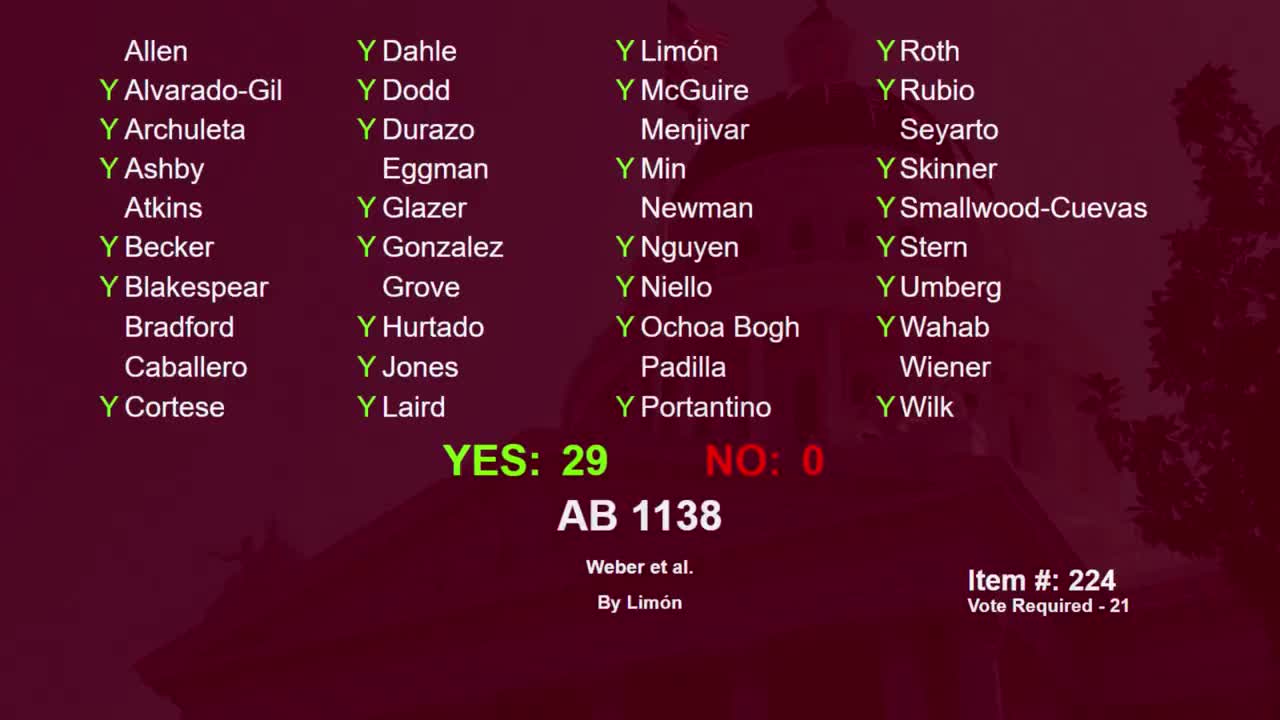 31SEC
Senate Floor
 1MIN
Assembly Floor
 34SEC
Assembly Floor
 11MIN
Assembly Standing Committee on Health
 10MIN
Senate Floor
 1MIN
Senate Standing Committee on Appropriations
 14MIN
Senate Standing Committee on Health
 11MIN
Senate Standing Committee on Education



Bill Co-Author(s):