SB 245: California Food Assistance Program: eligibility and benefits.
- Session Year: 2023-2024
- House: Senate
- Latest Version Date: 2024-06-20
Current Status:
Failed
(2024-08-15: August 15 hearing: Held in committee and under submission.)
Introduced
In Committee
First Chamber
In Committee
Second Chamber
Enacted
Existing federal law provides for the Supplemental Nutrition Assistance Program (SNAP), known in California as CalFresh, under which supplemental nutrition assistance benefits allocated to the state by the federal government are distributed to eligible individuals by each county.
Existing law requires the State Department of Social Services to establish a food assistance program, known as the California Food Assistance Program (CFAP), to provide assistance to a noncitizen of the United States if the persons immigration status meets the eligibility criteria of SNAP in effect on August 21, 1996, but the person is not eligible for SNAP benefits solely due to their immigration status, as specified. Existing law also makes eligible for the program an applicant who is otherwise eligible for the program, but who entered the United States on or after August 22, 1996, if the applicant is sponsored and the applicant meets one of a list of criteria, including that the applicant, after entry into the United States, is a victim of the sponsor or the spouse of the sponsor if the spouse is living with the sponsor.
Existing law, to become operative on the date that the department notifies the Legislature that the Statewide Automated Welfare System (SAWS) has been updated to perform the necessary automation, and subject to an appropriation in the annual Budget Act, makes an individual 55 years of age or older eligible for the program if the individuals immigration status is the sole basis for their ineligibility for CalFresh benefits.
This bill would delete the above-described contingency and, commencing on October 1, 2027, remove that age limitation and make any individual eligible for the program if the individuals immigration status is the sole basis for their ineligibility for CalFresh benefits. By extending eligibility for CFAP, which is administered by the counties, this bill would impose a state-mandated local program.
The California Constitution requires the state to reimburse local agencies and school districts for certain costs mandated by the state. Statutory provisions establish procedures for making that reimbursement.
This bill would provide that, if the Commission on State Mandates determines that the bill contains costs mandated by the state, reimbursement for those costs shall be made pursuant to the statutory provisions noted above.
Existing federal law provides for the Supplemental Nutrition Assistance Program (SNAP), known in California as CalFresh, under which supplemental nutrition assistance benefits allocated to the state by the federal government are distributed to eligible individuals by each county.
Existing law requires the State Department of Social Services to establish a food assistance program, known as the California Food Assistance Program (CFAP), to provide assistance to a noncitizen of the United States if the persons immigration status meets the eligibility criteria of SNAP in effect on August 21, 1996, but the person is not eligible for SNAP benefits solely due to their immigration status, as specified. Existing law also makes eligible for the program an applicant who is otherwise eligible for the program, but who entered the United States on or after August 22, 1996, if the applicant is sponsored and the applicant meets one of a list of criteria, including that the applicant, after entry into the United States, is a victim of the sponsor or the spouse of the sponsor if the spouse is living with the sponsor.
Existing law, to become operative on the date that the department notifies the Legislature that the Statewide Automated Welfare System (SAWS) has been updated to perform the necessary automation, and subject to an appropriation in the annual Budget Act, makes an individual 55 years of age or older eligible for the program if the individuals immigration status is the sole basis for their ineligibility for CalFresh benefits.
This bill would remove that age limitation and make any individual eligible for the program if the individuals immigration status is the sole basis for their ineligibility for CalFresh benefits. By extending eligibility for CFAP, which is administered by the counties, this bill would impose a state-mandated local program.
The California Constitution requires the state to reimburse local agencies and school districts for certain costs mandated by the state. Statutory provisions establish procedures for making that reimbursement.
This bill would provide that, if the Commission on State Mandates determines that the bill contains costs mandated by the state, reimbursement for those costs shall be made pursuant to the statutory provisions noted above.
(a)The Legislature finds and declares all of the following:
(1)The Supplemental Nutrition Assistance Program (SNAP) is a federal entitlement program. The federal government funds the nutrition benefits, and establishes most program rules, sets the benefit levels, and funds all program food benefits. The state determines certain conditions of eligibility and oversees county administration of the program.
(2)In California, SNAP is known as CalFresh, and is the largest and most impactful antihunger program in the state, providing vital food assistance to more than 4 million Californians each month.
(3)CalFresh is also an effective antipoverty program, lifting more than 800,000 Californians out of poverty each year.
(4)Federal SNAP law prohibits participation in CalFresh for many low-income Californians, solely due to their immigration status.
(5)The California Food Assistance Program (CFAP) is a state-funded program created in response to the 1996 federal welfare reform that removed SNAP eligibility from many qualified immigrants.
(6)CalFresh excludes noncitizen immigrants without lawful status, Deferred Action for Childhood Arrivals (DACA) recipients, Temporary Protected Status (TPS) holders, and certain visa holders from CalFresh and CFAP eligibility.
(7)The COVID-19 pandemic and its aftermath have greatly increased food insecurity among low-income Californians, and disproportionately impacted immigrants with low income.
(8)Food prices have recently risen significantly due to inflation, further exacerbating food insecurity and hardship for Californians with low income.
(9)Access to food assistance means greater opportunity to reduce hunger, improve health, and lift people out of poverty.
(10)Recognizing the need to ensure a more equitable nutrition safety net, the State of California recently committed to expanding access to CFAP to Californians age 55 and older who are ineligible for CalFresh or CFAP solely due to their immigration status.
(11)Recent research shows that 45 percent of undocumented Californians face food insecurity, and 64 percent of undocumented California children are affected by food insecurity.
(12)In order to end the inequitable provision that excludes many Californians from vital food assistance based solely on immigration status and meet the current needs of all California immigrants, access to CFAP must be expanded to all Californians regardless of immigration status with no exceptions or exclusions.
(b)It is the intent of the Legislature that all Californians, regardless of immigration status, have access to food assistance to maximize the impact of nutrition safety net funding to reduce poverty, fight hunger, and improve health for all low-income Californians.
SEC. 2.Section 18930 of the Welfare and Institutions Code, as amended by Section 86 of Chapter 85 of the Statutes of 2021, is amended to read:18930.(a)The State Department of Social Services shall establish a Food Assistance Program to provide assistance for those persons described in subdivision (b). The department shall enter into an agreement with the United States Department of Agriculture to use the existing federal Supplemental Nutrition Assistance Program coupons for the purposes of administering this program. Persons who are members of a household receiving CalFresh benefits under this chapter or under Chapter 10 (commencing with Section 18900), and are receiving CalWORKs benefits under Chapter 2 (commencing with Section 11200) of Part 3 on September 1, 1998, shall have eligibility determined under this chapter without need for a new application no later than November 1, 1998, and the beginning date of assistance under this chapter for those persons shall be September 1, 1998.
(b)(1)Except as provided in paragraphs (2), (3), and (4) and Section 18930.5, noncitizens of the United States shall be eligible for the program established pursuant to subdivision (a) if the persons immigration status meets the eligibility criteria of the federal Supplemental Nutrition Assistance Program in effect on August 21, 1996, but the person is not eligible for federal Supplemental Nutrition Assistance Program benefits solely due to the persons immigration status under Public Law 104-193 and any subsequent amendments thereto.
(2)Noncitizens of the United States shall be eligible for the program established pursuant to subdivision (a) if the person is a battered immigrant spouse or child or the parent or child of the battered immigrant, as described in Section 1641(c) of Title 8 of the United States Code, as amended by Section 5571 of Public Law 105-33, or if the person is a Cuban or Haitian entrant as described in Section 501(e) of the federal Refugee Education Assistance Act of 1980 (Public Law 96-122).
(3)An applicant who is otherwise eligible for the program but who entered the United States on or after August 22, 1996, shall be eligible for aid under this chapter only if the applicant is sponsored and one of the following apply:
(A)The sponsor has died.
(B)The sponsor is disabled as defined in subparagraph (A) of paragraph (3) of subdivision (b) of Section 11320.3.
(C)The applicant, after entry into the United States, is a victim of abuse by the sponsor or the spouse of the sponsor if the spouse is living with the sponsor.
(4)An applicant who is otherwise eligible for the program but who entered the United States on or after August 22, 1996, who does not meet one of the conditions of paragraph (3), shall be eligible for aid under this chapter beginning on October 1, 1999.
(5)The applicant shall be required to provide verification that one of the conditions of subparagraph (A), (B), or (C) of paragraph (3) has been met.
(6)For purposes of subparagraph (C) of paragraph (3), abuse shall be defined in the same manner as provided in Section 11495.1 and Section 11495.12. A sworn statement of abuse by a victim, or the representative of the victim if the victim is not able to competently swear, shall be sufficient to establish abuse if one or more additional items of evidence of abuse is also provided. Additional evidence may include, but is not limited to, the following:
(A)Police, government agency, or court records or files.
(B)Documentation from a domestic violence program, legal, clinical, medical, or other professional from whom the applicant or recipient has sought assistance in dealing with abuse.
(C)A statement from any other individual with knowledge of the circumstances that provided the basis for the claim.
(D)Physical evidence of abuse.
(7)If the victim cannot provide additional evidence of abuse, then the sworn statement shall be sufficient if the county makes a determination documented in writing in the case file that the applicant is credible.
(c)(1)To the extent allowed by federal law, the income, resources, and deductible expenses of those persons described in subdivision (b) shall be excluded when calculating CalFresh benefits under Chapter 10 (commencing with Section 18900).
(2)No household shall receive more CalFresh benefits under this section than it would if no household member was rendered ineligible pursuant to Title IV of Public Law 104-193 and any subsequent amendments thereto.
(d)This section shall become inoperative on the date that the department has notified the Legislature that the Statewide Automated Welfare System can perform the necessary automation to implement Section 18930, as added by the act that added this subdivision, and, as of January 1 of the following year, is repealed.(d)This section shall become inoperative on October 1, 2027, and, as of January 1, 2028, is repealed.
SEC. 2.SEC. 3.Section 18930 of the Welfare and Institutions Code, as amended by Section 84 of Chapter 50 of the Statutes of 2022, is amended to read:18930.(a)There is hereby created the California Food Assistance Program (CFAP).
(b)CFAP shall utilize existing CalFresh and electronic benefits transfer system infrastructure to the extent permissible by federal law.
(c)The State Department of Social Services shall use state funds appropriated for CFAP to provide nutrition benefits to households that are ineligible for CalFresh benefits solely due to their immigration status. In accordance with Section 1621(d) of Title 8 of the United States Code, this chapter provides benefits for undocumented persons.
(1)Subject to an appropriation in the annual Budget Act for the express purpose of this paragraph, an individual shall be eligible for the program established in subdivision (a) if the individuals immigration status is the sole basis for their ineligibility for CalFresh benefits.
(2)Except as provided in paragraphs (3), (4), and (5) and Section 18930.5, noncitizens of the United States shall be eligible for the program established pursuant to subdivision (a) if the persons immigration status meets the eligibility criteria of the federal Supplemental Nutrition Assistance Program in effect on August 21, 1996, but the person is not eligible for federal Supplemental Nutrition Assistance Program benefits solely due to the persons immigration status under Public Law 104-193 and any subsequent amendments thereto.
(3)Noncitizens of the United States shall be eligible for the program established pursuant to subdivision (a) if the person is a battered immigrant spouse or child or the parent or child of the battered immigrant, as described in Section 1641(c) of Title 8 of the United States Code, as amended by Section 5571 of Public Law 105-33, or if the person is a Cuban or Haitian entrant as described in Section 501(e) of the federal Refugee Education Assistance Act of 1980 (Public Law 96-422).
(4)An applicant who is otherwise eligible for the program but who entered the United States on or after August 22, 1996, shall be eligible for aid under this chapter if the applicant is sponsored and one of the following apply:
(A)The sponsor has died.
(B)The sponsor is disabled, as defined in subparagraph (A) of paragraph (3) of subdivision (b) of Section 11320.3.
(C)The applicant, after entry into the United States, is a victim of abuse by the sponsor or the spouse of the sponsor if the spouse is living with the sponsor.
(5)An applicant who is otherwise eligible for the program but who entered the United States on or after August 22, 1996, who does not meet one of the conditions of paragraph (4), shall be eligible for aid under this chapter beginning on October 1, 1999.
(6)The applicant shall be required to provide verification that one of the conditions of subparagraph (A), (B), or (C) of paragraph (4) has been met.
(7)For purposes of subparagraph (C) of paragraph (4), abuse shall be defined in the same manner as provided in Section 11495.1 and Section 11495.12. A sworn statement of abuse by a victim, or the representative of the victim if the victim is not able to competently swear, shall be sufficient to establish abuse if one or more additional items of evidence of abuse are also provided. Additional evidence may include, but is not limited to, the following:
(A)Police, government agency, or court records or files.
(B)Documentation from a domestic violence program, legal, clinical, medical, or other professional from whom the applicant or recipient has sought assistance in dealing with abuse.
(C)A statement from any other individual with knowledge of the circumstances that provided the basis for the claim.
(D)Physical evidence of abuse.
(8)If the victim cannot provide additional evidence of abuse, then the sworn statement shall be sufficient if the county makes a determination documented in writing in the case file that the applicant is credible.
(d)(1)The amount of nutrition benefits provided to each CFAP household shall be identical to the amount that would otherwise be provided to a household eligible for CalFresh benefits.
(2)The benefit amount for a CFAP recipient who is an excluded member of a CalFresh household shall be limited to the amount that the recipient would have received as their share of a CalFresh household benefit, had they not been excluded due to their immigration status.
(3)To the extent permissible under federal law, the delivery of CFAP nutrition benefits shall be identical to the delivery of CalFresh benefits to eligible CalFresh households.
(e)(1)To the extent allowed by federal law, the income, resources, and deductible expenses of those persons described in subdivision (c) shall be excluded when calculating CalFresh benefits under Chapter 10 (commencing with Section 18900).
(2)No household shall receive more CalFresh benefits under this section than it would if no household member was rendered ineligible pursuant to Title IV of Public Law 104-193 and any subsequent amendments thereto.
(f)Notwithstanding the rulemaking provisions of the Administrative Procedure Act (Chapter 3.5 (commencing with Section 11340) of Part 1 of Division 3 of Title 2 of the Government Code), the State Department of Social Services may implement and administer this section through all-county letters or similar instructions without taking regulatory action until final regulations are adopted, but no later than 18 months after the date upon which this subdivision becomes operative.
(g)This section shall become operative on the date that the department notifies the Legislature that the Statewide Automated Welfare System can perform the necessary automation to implement this section. October 1, 2027.
SEC. 3.SEC. 4.If the Commission on State Mandates determines that this act contains costs mandated by the state, reimbursement to local agencies and school districts for those costs shall be made pursuant to Part 7 (commencing with Section 17500) of Division 4 of Title 2 of the Government Code.
(a)The Legislature finds and declares all of the following:
(1)The Supplemental Nutrition Assistance Program (SNAP) is a federal entitlement program. The federal government funds the nutrition benefits, and establishes most program rules, sets the benefit levels, and funds all program food benefits. The state determines certain conditions of eligibility and oversees county administration of the program.
(2)In California, SNAP is known as CalFresh, and is the largest and most impactful antihunger program in the state, providing vital food assistance to more than 4 million Californians each month.
(3)CalFresh is also an effective antipoverty program, lifting more than 800,000 Californians out of poverty each year.
(4)Federal SNAP law prohibits participation in CalFresh for many low-income Californians, solely due to their immigration status.
(5)The California Food Assistance Program (CFAP) is a state-funded program created in response to the 1996 federal welfare reform that removed SNAP eligibility from many qualified immigrants.
(6)CalFresh excludes noncitizen immigrants without lawful status, Deferred Action for Childhood Arrivals (DACA) recipients, Temporary Protected Status (TPS) holders, and certain other visa holders from CalFresh and CFAP eligibility.
(7)The COVID-19 pandemic and its aftermath have greatly increased food insecurity among low-income Californians, and disproportionately impacted immigrants with low income.
(8)Food prices have recently risen significantly due to inflation, further exacerbating food insecurity and hardship for Californians with low income.
(9)Access to food assistance means greater opportunity to reduce hunger, improve health, and lift people out of poverty.
(10)Recognizing the need to ensure a more equitable nutrition safety net, the State of California recently committed to expanding access to CFAP to Californians age 55 and older who are ineligible for CalFresh or CFAP solely due to their immigration status.
(11)Recent research shows that 45 percent of undocumented Californians face food insecurity, and 64 percent of undocumented California children are affected by food insecurity.
(12)In order to end the inequitable provision that excludes many Californians from vital food assistance based solely on immigration status and meet the current needs of all California immigrants, access to CFAP must be expanded to all Californians regardless of immigration status with no exceptions or exclusions.
(b)It is the intent of the Legislature that all Californians, regardless of immigration status, have access to food assistance to maximize the impact of nutrition safety net funding to reduce poverty, fight hunger, and improve health for all low-income Californians.
SEC. 2.Section 18930 of the Welfare and Institutions Code, as amended by Section 84 of Chapter 50 of the Statutes of 2022, is amended to read:18930.(a)There is hereby created the California Food Assistance Program (CFAP).
(b)CFAP shall utilize existing CalFresh and electronic benefits transfer system infrastructure to the extent permissible by federal law.
(c)The State Department of Social Services shall use state funds appropriated for CFAP to provide nutrition benefits to households that are ineligible for CalFresh benefits solely due to their immigration status. In accordance with Section 1621(d) of Title 8 of the United States Code, this chapter provides benefits for undocumented persons.
(1)Subject to an appropriation in the annual Budget Act for the express purpose of this paragraph, an individual shall be eligible for the program established in subdivision (a) if the individuals immigration status is the sole basis for their ineligibility for CalFresh benefits.
(2)Except as provided in paragraphs (3), (4), and (5) and Section 18930.5, noncitizens of the United States shall be eligible for the program established pursuant to subdivision (a) if the persons immigration status meets the eligibility criteria of the federal Supplemental Nutrition Assistance Program in effect on August 21, 1996, but the person is not eligible for federal Supplemental Nutrition Assistance Program benefits solely due to the persons immigration status under Public Law 104-193 and any subsequent amendments thereto.
(3)Noncitizens of the United States shall be eligible for the program established pursuant to subdivision (a) if the person is a battered immigrant spouse or child or the parent or child of the battered immigrant, as described in Section 1641(c) of Title 8 of the United States Code, as amended by Section 5571 of Public Law 105-33, or if the person is a Cuban or Haitian entrant as described in Section 501(e) of the federal Refugee Education Assistance Act of 1980 (Public Law 96-422).
(4)An applicant who is otherwise eligible for the program but who entered the United States on or after August 22, 1996, shall be eligible for aid under this chapter if the applicant is sponsored and one of the following apply:
(A)The sponsor has died.
(B)The sponsor is disabled, as defined in subparagraph (A) of paragraph (3) of subdivision (b) of Section 11320.3.
(C)The applicant, after entry into the United States, is a victim of abuse by the sponsor or the spouse of the sponsor if the spouse is living with the sponsor.
(5)An applicant who is otherwise eligible for the program but who entered the United States on or after August 22, 1996, who does not meet one of the conditions of paragraph (4), shall be eligible for aid under this chapter beginning on October 1, 1999.
(6)The applicant shall be required to provide verification that one of the conditions of subparagraph (A), (B), or (C) of paragraph (4) has been met.
(7)For purposes of subparagraph (C) of paragraph (4), abuse shall be defined in the same manner as provided in Section 11495.1 and Section 11495.12. A sworn statement of abuse by a victim, or the representative of the victim if the victim is not able to competently swear, shall be sufficient to establish abuse if one or more additional items of evidence of abuse are also provided. Additional evidence may include, but is not limited to, the following:
(A)Police, government agency, or court records or files.
(B)Documentation from a domestic violence program, legal, clinical, medical, or other professional from whom the applicant or recipient has sought assistance in dealing with abuse.
(C)A statement from any other individual with knowledge of the circumstances that provided the basis for the claim.
(D)Physical evidence of abuse.
(8)If the victim cannot provide additional evidence of abuse, then the sworn statement shall be sufficient if the county makes a determination documented in writing in the case file that the applicant is credible.
(d)(1)The amount of nutrition benefits provided to each CFAP household shall be identical to the amount that would otherwise be provided to a household eligible for CalFresh benefits.
(2)The benefit amount for a CFAP recipient who is an excluded member of a CalFresh household shall be limited to the amount that the recipient would have received as their share of a CalFresh household benefit, had they not been excluded due to their immigration status.
(3)To the extent permissible under federal law, the delivery of CFAP nutrition benefits shall be identical to the delivery of CalFresh benefits to eligible CalFresh households.
(e)(1)To the extent allowed by federal law, the income, resources, and deductible expenses of those persons described in subdivision (c) shall be excluded when calculating CalFresh benefits under Chapter 10 (commencing with Section 18900).
(2)No household shall receive more CalFresh benefits under this section than it would if no household member was rendered ineligible pursuant to Title IV of Public Law 104-193 and any subsequent amendments thereto.
(f)Notwithstanding the rulemaking provisions of the Administrative Procedure Act (Chapter 3.5 (commencing with Section 11340) of Part 1 of Division 3 of Title 2 of the Government Code), the State Department of Social Services may implement and administer this section through all-county letters or similar instructions without taking regulatory action until final regulations are adopted, but no later than 18 months after the date upon which this subdivision becomes operative.
(g)This section shall become operative on the date that the department notifies the Legislature that the Statewide Automated Welfare System can perform the necessary automation to implement this section.
SEC. 3.If the Commission on State Mandates determines that this act contains costs mandated by the state, reimbursement to local agencies and school districts for those costs shall be made pursuant to Part 7 (commencing with Section 17500) of Division 4 of Title 2 of the Government Code.
(a)The Legislature finds and declares all of the following:
(1)The Supplemental Nutrition Assistance Program (SNAP) is a federal entitlement program. The federal government funds the nutrition benefits, and establishes most program rules, sets the benefit levels, and funds all program food benefits. The state determines certain conditions of eligibility and oversees county administration of the program.
(2)In California, SNAP is known as CalFresh, and is the largest and most impactful antihunger program in the state, providing vital food assistance to more than 4 million Californians each month.
(3)CalFresh is also an effective antipoverty program, lifting more than 800,000 Californians out of poverty each year.
(4)Federal SNAP law prohibits participation in CalFresh for many low-income Californians, solely due to their immigration status.
(5)The California Food Assistance Program (CFAP) is a state-funded program created in response to the 1996 federal welfare reform that removed SNAP eligibility from many qualified immigrants.
(6)CalFresh excludes noncitizen immigrants without lawful status, Deferred Action for Childhood Arrivals (DACA) recipients, Temporary Protected Status (TPS) holders, and certain other visa holders from CalFresh and CFAP eligibility.
(7)The COVID-19 pandemic and its aftermath have greatly increased food insecurity among low-income Californians, and disproportionately impacted immigrants with low income.
(8)Food prices have recently risen significantly due to inflation, further exacerbating food insecurity and hardship for Californians with low income.
(9)Access to food assistance means greater opportunity to reduce hunger, improve health, and lift people out of poverty.
(10)Recognizing the need to ensure a more equitable nutrition safety net, the State of California recently committed to expanding access to CFAP to Californians age 55 and older who are ineligible for CalFresh or CFAP solely due to their immigration status.
(11)Recent research shows that 45 percent of undocumented Californians face food insecurity, and 64 percent of undocumented California children are affected by food insecurity.
(12)In order to end the inequitable provision that excludes many Californians from vital food assistance based solely on immigration status and meet the current needs of all California immigrants, access to CFAP must be expanded to all Californians regardless of immigration status with no exceptions or exclusions.
(b)It is the intent of the Legislature that all Californians, regardless of immigration status, have access to food assistance to maximize the impact of nutrition safety net funding to reduce poverty, fight hunger, and improve health for all low-income Californians.
SEC. 2.Section 18930 of the Welfare and Institutions Code, as amended by Section 84 of Chapter 50 of the Statutes of 2022, is amended to read:18930.(a)There is hereby created the California Food Assistance Program (CFAP).
(b)CFAP shall utilize existing CalFresh and electronic benefits transfer system infrastructure to the extent permissible by federal law.
(c)The State Department of Social Services shall use state funds appropriated for CFAP to provide nutrition benefits to households that are ineligible for CalFresh benefits solely due to their immigration status. In accordance with Section 1621(d) of Title 8 of the United States Code, this chapter provides benefits for undocumented persons.
(1)Subject to an appropriation in the annual Budget Act for the express purpose of this paragraph, an individual 55 years of age or older shall be eligible for the program established in subdivision (a) if the individuals immigration status is the sole basis for their ineligibility for CalFresh benefits.
(2)Except as provided in paragraphs (3), (4), and (5) and Section 18930.5, noncitizens of the United States shall be eligible for the program established pursuant to subdivision (a) if the persons immigration status meets the eligibility criteria of the federal Supplemental Nutrition Assistance Program in effect on August 21, 1996, but the person is not eligible for federal Supplemental Nutrition Assistance Program benefits solely due to the persons immigration status under Public Law 104-193 and any subsequent amendments thereto.
(3)Noncitizens of the United States shall be eligible for the program established pursuant to subdivision (a) if the person is a battered immigrant spouse or child or the parent or child of the battered immigrant, as described in Section 1641(c) of Title 8 of the United States Code, as amended by Section 5571 of Public Law 105-33, or if the person is a Cuban or Haitian entrant as described in Section 501(e) of the federal Refugee Education Assistance Act of 1980 (Public Law 96-422).
(4)An applicant who is otherwise eligible for the program but who entered the United States on or after August 22, 1996, shall be eligible for aid under this chapter if the applicant is sponsored and one of the following apply:
(A)The sponsor has died.
(B)The sponsor is disabled, as defined in subparagraph (A) of paragraph (3) of subdivision (b) of Section 11320.3.
(C)The applicant, after entry into the United States, is a victim of abuse by the sponsor or the spouse of the sponsor if the spouse is living with the sponsor.
(5)An applicant who is otherwise eligible for the program but who entered the United States on or after August 22, 1996, who does not meet one of the conditions of paragraph (4), shall be eligible for aid under this chapter beginning on October 1, 1999.
(6)The applicant shall be required to provide verification that one of the conditions of subparagraph (A), (B), or (C) of paragraph (4) has been met.
(7)For purposes of subparagraph (C) of paragraph (4), abuse shall be defined in the same manner as provided in Section 11495.1 and Section 11495.12. A sworn statement of abuse by a victim, or the representative of the victim if the victim is not able to competently swear, shall be sufficient to establish abuse if one or more additional items of evidence of abuse are also provided. Additional evidence may include, but is not limited to, the following:
(A)Police, government agency, or court records or files.
(B)Documentation from a domestic violence program, legal, clinical, medical, or other professional from whom the applicant or recipient has sought assistance in dealing with abuse.
(C)A statement from any other individual with knowledge of the circumstances that provided the basis for the claim.
(D)Physical evidence of abuse.
(8)If the victim cannot provide additional evidence of abuse, then the sworn statement shall be sufficient if the county makes a determination documented in writing in the case file that the applicant is credible.
(d)(1)The amount of nutrition benefits provided to each CFAP household shall be identical to the amount that would otherwise be provided to a household eligible for CalFresh benefits.
(2)The benefit amount for a CFAP recipient who is an excluded member of a CalFresh household shall be limited to the amount that the recipient would have received as their share of a CalFresh household benefit, had they not been excluded due to their immigration status.
(3)To the extent permissible under federal law, the delivery of CFAP nutrition benefits shall be identical to the delivery of CalFresh benefits to eligible CalFresh households.
(e)(1)To the extent allowed by federal law, the income, resources, and deductible expenses of those persons described in subdivision (c) shall be excluded when calculating CalFresh benefits under Chapter 10 (commencing with Section 18900).
(2)No household shall receive more CalFresh benefits under this section than it would if no household member was rendered ineligible pursuant to Title IV of Public Law 104-193 and any subsequent amendments thereto.
(f)Notwithstanding the rulemaking provisions of the Administrative Procedure Act (Chapter 3.5 (commencing with Section 11340) of Part 1 of Division 3 of Title 2 of the Government Code), the State Department of Social Services may implement and administer this section through all-county letters or similar instructions without taking regulatory action until final regulations are adopted, but no later than 18 months after the date upon which this subdivision becomes operative.
(g)This section shall become operative on the date that the department notifies the Legislature that the Statewide Automated Welfare System can perform the necessary automation to implement this section.
SEC. 3.If the Commission on State Mandates determines that this act contains costs mandated by the state, reimbursement to local agencies and school districts for those costs shall be made pursuant to Part 7 (commencing with Section 17500) of Division 4 of Title 2 of the Government Code.
|
Date
|
Status
|
|---|---|
| Aug 15, 2024 | August 15 hearing: Held in committee and under submission. |
| Jul 2, 2024 | July 2 set for first hearing. Placed on suspense file. |
| Jun 20, 2024 | Read second time and amended. Re-referred to Com. on APPR. |
| Jun 19, 2024 | From committee: Do pass as amended and re-refer to Com. on APPR. (Ayes 5. Noes 1.) (June 11). |
| Jun 20, 2023 | June 20 set for first hearing canceled at the request of author. |
| Jun 1, 2023 | Referred to Com. on HUM. S. |
| May 25, 2023 | In Assembly. Read first time. Held at Desk. |
| May 24, 2023 | Read third time. Passed. (Ayes 31. Noes 8. Page 1275.) Ordered to the Assembly. |
| May 18, 2023 | Read second time. Ordered to third reading. |
| May 18, 2023 | From committee: Do pass. (Ayes 5. Noes 2. Page 1162.) (May 18). |
| May 12, 2023 | Set for hearing May 18. |
| Apr 10, 2023 | April 10 hearing: Placed on APPR suspense file. |
| Mar 28, 2023 | Set for hearing April 10. |
| Mar 21, 2023 | From committee: Do pass and re-refer to Com. on APPR. (Ayes 4. Noes 0. Page 425.) (March 20). Re-referred to Com. on APPR. |
| Mar 16, 2023 | From committee with author's amendments. Read second time and amended. Re-referred to Com. on HUMAN S. |
| Feb 27, 2023 | Set for hearing March 20. |
| Feb 9, 2023 | Referred to Com. on HUMANS S. |
| Jan 27, 2023 | From printer. May be acted upon on or after February 26. |
| Jan 26, 2023 | Introduced. Read first time. To Com. on RLS. for assignment. To print. |
|
Date
|
Description
|
Location
|
Votes
|
|
|---|---|---|---|---|
| Jun 11, 2024 | Do pass as amended and be re-referred to the Committee on [Appropriations] | Assembly Standing Committee on Human Services |
Passed |
|
| May 24, 2023 | Senate 3rd Reading SB245 Hurtado et al. | Senate Floor |
Passed |
|
| May 18, 2023 | Do pass | Senate Standing Committee on Appropriations |
Passed |
|
| Apr 10, 2023 | Placed on suspense file | Senate Standing Committee on Appropriations |
Passed |
|
| Mar 20, 2023 | Do pass, but first be re-referred to the Committee on [Appropriations] | Senate Standing Committee on Human Services |
Passed |
This list shows positions taken on this bill by organizations on the date displayed, which is linked to the original source.
Positions by individuals are not included.
|
Organization
|
Position
|
Date
|
|---|---|---|
| AFSCME | ** Support | |
| Agricultural Institute of Marin | ** Support | |
| Alameda County Community Food Bank | ** Support | |
| Alliance for Children's Rights | ** Support | |
| Alliance San Diego | ** Support | |
| California Association Of Food Banks | ** Support | |
| California Calls | ** Support | |
| California Catholic Conference | ** Support | |
| California Conference of Local Health Department Nutritionists | ** Support | |
| California Family Resource Association | ** Support | |
| California Food and Farming Network | ** Support | |
| California Immigrant Policy Center | ** Support | |
| California Pan - Ethnic Health Network | ** Support | |
| Cal State Student Association | ** Support | |
| Catholic Charities of Santa Clara County | ** Support | |
| Center For Food Safety; The | ** Support | |
| Centro Del Pueblo | ** Support | |
| Ceres Community Project | ** Support | |
| Child Abuse Prevention Center | ** Support | |
| Children Now | ** Support | |
| Coalition for Humane Immigrant Rights | ** Support | |
| Community Health Councils | ** Support | |
| County Health Executives Association Of California | ** Support | |
| County of Santa Clara | ** Support | |
| County Welfare Directors Association of California | ** Support | |
| Ecology Center | ** Support | |
| End Poverty in California | ** Support | |
| Food Bank of Contra Costa & Solano | ** Support | |
| Food for People, the Food Bank for Humboldt County | ** Support | |
| Friends Committee On Legislation Of California | ** Support | |
| Glide | ** Support | |
| Hunger Action Los Angeles INC | ** Support | |
| Indivisible Sacramento | ** Support | |
| Indivisible San Francisco | ** Support | |
| Indivisible Yolo | ** Support | |
| Jewish Family Service of Los Angeles | ** Support | |
| John Burton Advocates for Youth | ** Support | |
| Justice in Aging | ** Support | |
| Latino Coalition for a Healthy California | ** Support | |
| Latino Community Foundation | ** Support | |
| Long Beach Alliance for Food and Fitness | ** Support | |
| Long Beach Immigrant Rights Coalition | ** Support | |
| Los Angeles Regional Food Bank | ** Support | |
| Marin Food Policy Council | ** Support | |
| National Association Of Social Workers, California Chapter | ** Support | |
| Norcal Resist | ** Support | |
| Polo's Pantry | ** Support | |
| Prevention Institute | ** Support | |
| Public Health Advocates | ** Support | |
| Roots of Change | ** Support | |
| Sacramento Food Policy Council | ** Support | |
| San Diego Hunger Coalition | ** Support | |
| San Francisco-Marin Food Bank | ** Support | |
| Second Harvest Food Bank of Orange County | ** Support | |
| Second Harvest of Silicon Valley | ** Support | |
| Share Our Strength | ** Support | |
| TechEquity Collaborative | ** Support | |
| The Children's Partnership | ** Support | |
| The Salvador E. Alvarez Institute for Non-violence | ** Support | |
| The Women's Building | ** Support | |
| UC San Diego Center for Community Health Youth Advisory Council | ** Support | |
| University Of California Student Association | ** Support | |
| Urban Counties of California | ** Support | |
| Vision y Compromiso | ** Support |
Date of Hearing: July 2, 2024
ASSEMBLY COMMITTEE ON APPROPRIATIONS
Buffy Wicks, Chair
SBPCA Bill Id:SB 245
Author:(Hurtado) – As Amended Ver:June 20, 2024
Policy Committee: | Human Services | Vote: | 5 - 1 |
|
| ||
|
|
Urgency: No State Mandated Local Program: Yes Reimbursable: Yes
SUMMARY:
This bill expands eligibility for the pending expansion of the California Food Assistance Program (CFAP) to anyone who is ineligible for CalFresh benefits due solely to their immigration status by removing the 55-years-or-older age limit on eligibility.
Specifically, this bill:
- Deletes the 55-years-or-older eligibility requirement for the CFAP expansion.
- Deletes the operative date of the CFAP expansion from the date the California Department of Social Services (CDSS) notifies the Legislature the Statewide Automated Welfare System can perform the necessary automation to implement the expansion, and instead specifies the CFAP expansion is operative on October 1, 2027.
FISCAL EFFECT:
- CDSS estimates ongoing General Fund (GF) costs of an unknown amount, but likely in the hundreds of millions to low billions of dollars annually, to administer and provide CFAP benefits to eligible undocumented immigrants under age 55 years of age.
For context, in fiscal year 2023-24 CFAP provides $99 million in state-funded assistance to about 50,000 immigrants with legal status who are ineligible for CalFresh (approximately $165 per month). The Pew Research Center estimates the undocumented population in California to be approximately 1.85 million. For illustration, if 10% of this population is under 55 years of age and eligible for CFAP, and 50% of those eligible choose to participate, state-funded food assistance costs per this bill would be approximately $180 million annually. If 70% of the population is eligible and 60% participate, costs would be approximately $1.5 billion. Actual costs could vary greatly depending on the participation rate of the newly-eligible population.
- CDSS estimates ongoing GF costs of approximately $1.6 million for additional staff to implement and administer the expanded program.
- CDSS estimates one-time costs, likely in the low millions of dollars, for automation changes necessary to expand eligibility to the new population. CDSS received $45 million through the state budget for automation to implement the current CFAP expansion, which is to accommodate further expansion as the current undocumented immigrant population will age over time. Therefore, it is unlikely automation costs will be higher than single-digit millions under this bill.
- Local costs to counties (local funds, GF) of an unknown amount, but likely significant, to administer the expanded CFAP program. These costs are potentially reimbursable by the state, subject to a determination by the Commission on State Mandates.
According to the Legislative Analyst’s Office, the General Fund faces a structural deficit in the tens of billions of dollars over the next several fiscal years.
COMMENTS:
- Purpose. The author intends to expand state-funded nutrition assistance provided under CFAP to all immigrants, regardless of their immigration status. According to the author:
[This bill] seeks to address historic inequities by expanding access to California’s food assistance programs to vulnerable communities who have been previously denied due to their immigration status. There are over 2 million undocumented immigrants living in California, many of whom are ineligible for state or federal public benefits due to their immigration status.
- Background. CalFresh. The CalFresh program is California’s version of the federal Supplemental Nutrition Assistance Program (SNAP), which provides monthly food assistance to qualifying low‑income households. CalFresh benefits are federally funded and national income eligibility standards and benefit levels are established by the federal government. Costs to administer the program are shared among the federal government, the state and counties. On average, an individual receives approximately $262 per month ($196 per month after all pandemic benefits expire). Families receive more depending on income and household size. Under federal law, CalFresh benefits are available to U.S. citizens and, under narrow circumstances, lawfully-present non-U.S. citizens. As of January 2023, over 5.3 million individuals were receiving CalFresh.
CFAP. California provides state-funded food benefits through the CFAP program for individuals who fall into limited categories of legal immigrant status (meaning refugees and victims of domestic violence) who are not eligible for federal CalFresh benefits due solely to their immigration status. In April 2023, the Public Policy Institute of California (PPIC) reported CFAP provides $97 million in state-funded food assistance to about 42,000 immigrants. CFAP benefits are not available to undocumented immigrants, Deferred Action for Childhood Arrivals (DACA) recipients, Temporary Protected Status (TPS) holders, and certain visa holders.
Since 2021, existing law requires an individual 55 years of age or older to be eligible for CFAP if the individual’s immigration status is the sole basis for their ineligibility for CalFresh benefits. SB 187 (Committee on Budget and Fiscal Review), Chapter 50, Statutes of 2022, among other items, began the expansion of CFAP by October 2025, or on the date CDSS notifies the Legislature the necessary automation changes are completed, and subject to an appropriation in the annual budget act.
The Governor’s 2024-25 May Revision proposed to delay for two years the CFAP expansion, with automation to begin in fiscal year (FY) 2026-27 and benefits to begin in FY 2027-28. These changes are reflected in the Budget Act of 2024 (AB 107 (Gabriel)), awaiting the Governor’s signature.
This bill expands CFAP eligibility to all immigrants who meet all other eligibility criteria for CalFresh by deleting the 55-years-or-older age limit, and aligns the expansion implementation date with the implementation date of October 1, 2027, in the 2024 budget act.
- Related Legislation. AB 311 (Santiago), of this legislative session, is nearly identical to this bill. AB 311 is pending in the Senate Appropriations Committee.
Analysis Prepared by: Jennifer Swenson / APPR. / (916) 319-2081
Date of Hearing: June 11, 2024
ASSEMBLY COMMITTEE ON HUMAN SERVICES
Alex Lee, Chair
SBPCA Bill Id:SB 245
Author:(Hurtado) – As Amended Ver:March 16, 2023
SENATE VOTE: 31-8
SUBJECT: California Food Assistance Program: eligibility and benefits
SUMMARY: Expands eligibility for the California Food Assistance Program (CFAP) to any individual whose immigration status is the sole basis for their ineligibility for CalFresh by removing the 55 years and older age limit on eligibility.
EXISTING LAW:
State law:
- Establishes the CalFresh program to administer the provision of federal Supplemental Nutrition Assistance Program (SNAP) benefits to families and individuals meeting certain criteria, as specified. (Welfare and Institutions Code [WIC] § 18900 et seq.)
- Requires the California Department of Social Service (CDSS) to establish CFAP to provide assistance for persons who are not eligible for federal SNAP benefits due solely to their immigration status, as specified. (WIC § 18930 et seq.)
- Provides that noncitizens of the United States (U.S.) shall be eligible for CFAP if the person’s immigration status meets the SNAP eligibility criteria in effect on August 21, 1996, but is not eligible for SNAP benefits solely due to their immigration status, as specified. (WIC § 18930(c)(2))
- Provides that noncitizens of the U.S. shall be eligible for CFAP if the person is a battered immigrant spouse or child or the parent or child of the battered immigrant, as specified, or if the person is a Cuban or Haitian entrant, as specified. (WIC § 18930(c)(3))
- Provides that an applicant who is otherwise eligible for the CFAP but who entered the U.S. on or after August 22, 1996, shall be eligible for aid under this chapter only if they are sponsored and one of the following apply: the sponsor has died; the sponsor is disabled, as specified; or, the applicant, after entry into the U.S., is a victim of abuse by the sponsor or the spouse of the sponsor if the spouse is living with the sponsor. (WIC § 18930(c)(4))
- Provides that an applicant who is otherwise eligible for CFAP but who entered the U.S. on or after August 22, 1996, and who is not sponsored or a victim of abuse, shall be eligible for CFAP beginning on October 1, 1999. (WIC § 18930(c)(5))
- Requires applicants for CFAP to provide verification that specified conditions of eligibility are met. (WIC § 18930(c)(6))
- Defines abuse and the documentation necessary to verify abuse as a condition of eligibility for the CFAP. (WIC § 18930(c)(7) and (8))
- Provides that CFAP benefits to a household be identical to the amount of CalFresh benefits if the household is eligible. (WIC § 18930(d)(1))
- Provides that CFAP benefits to an individual be the identical share of CalFresh benefits if the individual had not been excluded from CalFresh. (WIC § 18930(d)(2))
- Requires, to the extent allowed by federal law, the delivery of CFAP benefits be identical to delivery of CalFresh benefits. (WIC § 18930(d)(3))
- Requires, to the extent allowed by federal law, that the income, resources, and deductible expenses of those who receive CFAP benefits shall be excluded when calculating CalFresh benefits. (WIC § 18930(e)(1))
- Provides that no household shall receive more CalFresh benefits than it would if no household member was rendered ineligible pursuant to federal law, as specified. (WIC § 18930(e)(2))
Federal law: Note: For the purposes of referring to federal law accurately, this section uses the term “alien” which is not a term used in the Committee or California, per AB 1096 (Luz Rivas), Chapter 296, Statutes of 2021.
- Establishes SNAP pursuant to the Food Stamp Act of 1964. (7 United States Code [U.S.C.] § 2011 et seq.)
- Establishes citizenship requirements for SNAP benefits, including that undocumented immigrants are ineligible for SNAP, as specified. (7 Code of Federal Regulations § 273.4.)
- Establishes the Immigration and Nationality Act (INA), covering aspects related to immigration, naturalization, deportation, and citizenship. (8 U.S.C. 1101 et seq.)
- Establishes the Personal Responsibility and Work Opportunity Reconciliation Act of 1996, restricting eligibility of aliens for many federal benefit programs, including the Temporary Assistance for Needy Families (TANF), Social Security Income, Medicaid, and SNAP, except for “qualified aliens.” (Title IV of Public Law 104-193; 8 U.S.C. §§ 1601-1646)
- Authorizes a state to provide that an alien who is not lawfully present in the U.S. is eligible for any state or local public benefit for which such alien would otherwise be ineligible only through the enactment of a state law after August 22, 1996, which affirmatively provides for such eligibility. (8 U.S.C. § 1621(d))
- Provides that any alien who, in the opinion of the consular officer at the time of application for a visa, or in the opinion of the Attorney General at the time of application for admission or adjustment of status, is likely at any time to become a public charge is inadmissible. (8 U.S.C. 1182(a)(4)(A))
- Provides that in determining whether an alien is admissible under the public charge rule, the consular officer or the Attorney General shall at a minimum consider the alien’s: age; health; family status; assets, resources, and financial status; and, education and skills. (8 U.S.C. 1182(a)(4)(B))
FISCAL EFFECT: According to the Senate Appropriations Committee on April 10, 2023:
- The California Department of Social Services (CDSS) estimates ongoing General Fund costs in the hundreds of millions for benefits, as well as costs in the millions for automation costs for administration.
- Cost to counties for administration would be potentially reimbursable by the state, subject to a determination by the Commission on State Mandates.
COMMENTS: This bill is identical to AB 311 (Santiago) which was heard and passed out of this Committee on April 18, 2023.
Background: Immigrants with legal standing in the U.S., both temporary and permanent, are those who have been granted to live and work in the country by obtaining a visa or other legal status, such as legal permanent residency (LPR), being granted asylum, admitted as a refugee, a parolee, and conditional entrants, among others. Once in the country, these immigrants are entitled to certain rights and protections under the law, including access to government benefits and services, such as healthcare, education, and public social services. As of 2023, the California Budget and Policy Center reports that over 11 million immigrants, defined as foreign-born individuals, reside in California, making up 28% of the state population. According to the Public Policy Institute of California (PPIC), the vast majority of immigrants in California are documented residents. Specifically, 82% are either naturalized citizens or had other legal statuses, such as visa holders and LPR.
Undocumented immigrants are individuals who enter or reside in a country without legal authorization. These individuals often fear deportation and lack access to basic rights and protections afforded to legal residents. They typically face significant barriers to accessing government services and may be vulnerable to exploitation and abuse in the workplace and elsewhere. In the same California Budget and Policy Center report, 1.85 million immigrants were undocumented in 2021. The Migration Policy Institute reported that about 293,000 of these undocumented immigrants were 55 years of age or older in 2019.
Food Insecurity in California. The United States Department of Agriculture (USDA) defines “food insecurity” as the occasional or constant lack of access to the food that one needs in order to live a healthy, active life. While California declared food a human right in 2023 and produces nearly half of the nation’s fruits and vegetables, about 8 million Californians currently struggle with food insecurity, representing 20.3% of the state’s population.
Noncitizens in particular make up more than 90% of California’s farmworkers, and over half are undocumented. As of 2023, PPIC reports that 8% of these undocumented farmworkers are 55 years of age and older. California hosts nearly half of the undocumented agricultural worker population in the U.S., yet 45% still suffer from food insecurity in 2022, as indicated by Nourish California and California Immigrant Policy Center Food4All.
The COVID-19 pandemic only exacerbated hardships, as food insecurity and poverty levels rose across the nation. Factors contributing to food insecurity include economic disparities, high living costs, limited access to affordable nutrition options, and systemic barriers such as racism and discrimination.
CalFresh. SNAP is the largest federal nutrition assistance program in the U.S. designed to provide nutrition assistance to low-income families and individuals. Administered by CDSS, CalFresh is California’s version of SNAP, which provides monthly benefits to help eligible households purchase nutritious food items. Participants receive benefits on Electronic Benefit Transfer (EBT) cards, which can be used to purchase eligible food items such as fruits and vegetables, meat, dairy products, and seeds and plants that produce food at authorized retailers, including grocery stores, supermarkets, and farmers’ markets.
One of the CalFresh qualifications include earning a gross income (income before deductions and exemptions) below 200% of the Federal Poverty Level (FPL). Those exempt from gross income eligibility requirements are households with: a member who is 60 years of age or older, a member with a disability, or members in a household who all receive cash assistance. According to CDSS, the following chart demonstrates the gross monthly and annual income for CalFresh recipients based on household size.
200% FPL for 2023 Gross Income | ||
Household Size | Gross Monthly Income | Gross Annual Income |
1 | $2,430 | $29,160 |
2 | $3,287 | $39,440 |
3 | $4,143 | $49,720 |
4 | $5,000 | $60,000 |
5 | $5,857 | $70,280 |
6 | $6,713 | $80,560 |
7 | $7,570 | $90,840 |
8 | $8,427 | $101,120 |
Each Additional Member | + $857 | $10,280 |
Another eligibility requirement for CalFresh relates to citizenship or immigration status. Lawfully present, non-U.S. citizens who: have lived in the country in a qualified status for five years; are receiving disability-related assistance or benefits (regardless of entry date); or, children under 18 years of age who are qualified and lawfully admitted for permanent residency, all qualify for CalFresh benefits under federal eligibility rules.
According to the Legislative Analyst’s Office (LAO), about 5.1 million Californians received a total of $14.5 billion in CalFresh benefits, all of it federally funded, for an average monthly benefit of about $185 per recipient in 2022‑23.
Without CalFresh food assistance, poverty would rise 11% for California residents in 2023, according to a 2024 brief from the PPIC. Lack of access to a nutritional diet has serious implications, especially for children, leading to poor school attendance and performance, reduced workplace productivity, and deteriorated physical health. Numerous reports and studies have highlighted the benefits of CalFresh for both recipients and the economy. For example, CalFresh enables families to afford a healthy diet, lowering the risk of chronic diseases and reducing healthcare costs. Additionally, food benefits provided by CalFresh help stabilize the economy. The USDA has shown that each dollar in federally funded CalFresh benefits generates $1.79 in economic activity, and every $1 billion in benefits leads to the creation of over 10,000 jobs.
California Food Assistance Program. CFAP was established in 1996 as a response to the federal Personal Responsibility and Work Opportunity Reconciliation Act of 1996 which placed restrictions on access to food assistance programs to certain noncitizens. The federal government authorized states to establish state-funded food assistance programs to those who were impacted by the federal reform.
In response, California provides state-funded food assistance to qualified noncitizens through CFAP using the same automated systems used by CalFresh, EBT, and the California Statewide Automated Welfare System. Through the EBT system, the federal government directly deposits funds into the accounts of participating households, with the state later reimbursing the federal government for these expenditures. According to the Governor’s 2024-25 Budget, a caseload trend analysis highlighted that 43,229 authorized immigrants received CFAP assistance in
2022-23. According to CDSS, examples of individuals eligible for CFAP include noncitizens who are:
- LPRs who have not met the five-year U.S. residency requirements or 40 qualifying work quarters criteria;
- Parolees;
- Conditional entrants; or,
- Battered or abused.
While CFAP provides food assistance to individuals ineligible for CalFresh due to federal eligibility requirements, currently, those who are still excluded from accessing CFAP and CalFresh benefits include undocumented immigrants, Deferred Action for Childhood Arrivals (DACA) recipients, Temporary Protected Status (TPS) holders, and certain visa holders.
In 2021, SB 129 (Committee on Budget and Fiscal Review), Chapter 69, Statutes of 2021, approved $5 million in 2021-22 and $25 million in 2022-23 to begin the automation changes necessary to expand access to CFAP to all regardless of immigration status, to begin 2023-24. SB 187 (Committee on Budget and Fiscal Review), Chapter 50, Statutes of 2022, included language to begin a targeted, age-based expansion of CFAP regardless of immigration status to include noncitizens age 55 years or older by October 2025, or upon completion of the necessary automation changes.
The Governor’s 2024-25 May Revision proposed to delay for two years the CFAP expansion, with automation to begin in 2026-27 and benefits to begin in 2027-28, as well as to re-appropriate any unspent funds associated with the planning, automation, and outreach activities from 2023-24 to the 2024-25 fiscal year to continue to work toward the new, delayed implementation date. The Joint Legislative Budget Committee proposed to approve the above proposals for the 2024-25 budget. A final 2024-25 budget has not been adopted yet.
This bill expands eligibility for CFAP, but is contradictory to the budget that the Legislature sent to the Governor on May 29, 2024. As such, if this bill were signed into law, the implementation is unclear.
Author’s Statement: According to the Author, “[This bill] seeks to address historic inequities by expanding access to California's food assistance programs to vulnerable communities who have been previously denied due to their immigration status. There are over 2 million undocumented immigrants living in California, many of whom are ineligible for state or federal public benefits due to their immigration status.
“Recent estimates indicated that both federal and state food assistance programs (CalFresh and CFAP) unjustly exclude between 690,000 to 840,000 residents solely on the basis of their immigration status. CFAP was created in response to the 1996 federal welfare reform act, the Personal Responsibility and Work Opportunity Reconciliation Act, which excludes several qualified immigrants from food assistance, due to their immigration status. CFAP currently provides monthly food benefits to legal noncitizens who are not eligible for federal SNAP benefits. However, CFAP still excludes many other immigrant groups like undocumented immigrants, Deferred Action for Childhood Arrivals recipients, Temporary Protected Status holders, and certain visa holders.
“[This bill] would increase access to food benefits for low income undocumented immigrants who are in need of food assistance but are denied due to their immigration status. By expanding access, it will prevent the onset of negative effects of food insecurity and provide food aid and income support to individuals who need it.”
Equity Implications: According to the PPIC, the vast majority of California’s immigrants were born in Latin America (49%) or Asia (40%). The leading countries of origin are Mexico, the Philippines, China, India, and Vietnam.
California’s undocumented population suffers disproportionately high levels of poverty. In 2019, according to the California 100’s “Future of Immigrant Integration Issue Report,” 57% of undocumented immigrants experience working poverty, compared to 29.2% of U.S.-born residents. Additionally, a 2022 report by the National Library of Medicine, summarized that noncitizens disproportionately work in low-wage industries and the informal labor market, which are linked to socioeconomic instability and high risks of food insecurity.
Although many public benefits expanded in California during the COVID-19 pandemic, many undocumented immigrants remained ineligible for state and federal food assistance programs. Additionally, CalFresh-qualified families of mixed status living in households with undocumented individuals often receive less benefits than other families, as their undocumented family members are excluded in determining the amount of assistance they receive. The provisions of this bill seek to address equity by ensuring that eligible noncitizens experiencing food insecurity are able to access nutrition assistance regardless of age.
Policy Considerations: A public charge, as originally defined by the federal public charge rule in 1999, referred to a noncitizen who is “primarily dependent on the Government” for public assistance programs. The public charge rule allowed the federal government to reject noncitizens seeking to extend their visa or adjust their legal status if they relied on certain public benefits programs to make ends meet. Under the 1999 rule, programs like SNAP, Medicaid, and housing vouchers and subsidies were not to be considered.
However, in 2019, the Trump administration amended the public charge rule to permit the federal government to deny applications for extensions to stay or adjustments of status based on the applicants’ “likelihood” of dependence on SNAP and the other government programs excluded under the 1999 rule. Immigration officers began considering a broader range of factors to assess the likelihood of becoming a public charge before approving a visa. These factors included age, income, family size, ability to speak English, credit scores and history, health, education, and family support. If they were deemed likely to receive benefits in the future based on this information, they could not obtain their visa or green card. A December 2018 survey conducted by the Urban Institute found that “about one in seven (13.7%) adults in immigrant families reported that they, or a family member, did not participate in, meaning they did not apply for or dropped out of, a non-cash benefit program in 2018 out of fear of risking future green card status.”
In September 2022, the Biden administration repealed the Trump administration’s expansion of the public charge rule, reverting to the 1999 public charge definition and completely removing SNAP as a public charge category in order to “mitigate the possibility of widespread chilling effects” that were felt by qualified noncitizens disenrolling or declining enrollment to public assistance.
Should this bill be signed into law, the author may wish to consider whether it is necessary to provide clarity to eligible noncitizens in order to discourage fear and misinformation of the public charge rule that would dissuade eligible noncitizens from applying to CFAP, particularly if future federal administrations choose to reinstate the 2019 change to the public charge rule.
As noted earlier, the Governor proposed to delay CFAP expansion for undocumented Californians ages 55 and older by two years, with benefits to begin October 2027.
Should this bill move forward, the author may wish to consider delaying implementation to October 2027 to align with the proposed budget delay.
Proposed Committee Amendments: The Committee proposes amendments to address policy considerations stated above to do the following:
• Delay implementation of this bill to October 2027.
RELATED AND PRIOR LEGISLATION:
AB 1968 (Jackson) of the current legislative session, would have required CDSS to establish a system to automatically enroll in the CalFresh program individuals who meet eligibility requirements of the Supplemental Security Income/State Supplementary Program (SSI/SSP), and to automatically enroll in CFAP individuals who meet eligibility requirements for the Cash Assistance Program for Immigrants (CAPI). AB 1968 was held on the Assembly Appropriations Committee suspense file.
AB 311 (Santiago) of the current legislative session, is identical to this bill. AB 311 is set to be heard by the Senate Human Services Committee on June 17, 2024.
SB 628 (Hurtado), Chapter 879, Statutes of 2023, declared that it is the established policy of the state that every human being has the right to access sufficient, affordable, and healthy food and requires all relevant state agencies to consider this policy when revising, adopting, or establishing policies, regulations, and grant criteria when those policies, regulations, and criteria are pertinent to the distribution of sufficient affordable food.
SB 464 (Hurtado) of 2021, would have expanded eligibility for CFAP to households that are ineligible for CalFresh benefits due solely to their immigrations status. SB 464 was held in the Assembly Appropriations Committee.
AB 221 (Santiago) of 2021, would have required CDSS to: provide a food assistance benefit statewide to low-income California residents, regardless of their immigration status; contract with certain entities to issue the benefit; and, conduct a study to provide recommendations and solutions for a permanent food assistance program for low-income California residents experiencing food insecurity, regardless of their immigration status. AB 221 was held on the Senate Appropriations Committee suspense file.
AB 1096 (L. Rivas), Chapter 296, Statutes of 2021, struck the offensive and dehumanizing term "alien" used to describe a person who is not a citizen or national of the U.S. where it appears in multiple California code sections, and replaced it with other terms that do not include the word "alien," and makes other nonsubtantive changes.
AB 826 (Santiago) of 2020, would have required CDSS to establish a program to provide eligible immigrants with a cash benefit intended for food assistance. AB 826 was vetoed by Governor Newsom.
SB 1443 (Rubio) of 2020, would have made all noncitizens, regardless of immigration status, eligible for aid under CFAP. AB 1443 was held in the Senate Rules Committee.
AB 1770 (Alejo) of 2016, would have extended eligibility for nutrition assistance under CFAP to a noncitizen who is lawfully present in the U.S., provided he or she meets all remaining eligibility requirements. AB 1770 was vetoed by Governor Brown.
AB 2345 (Gonzalez) of 2014, would have expanded eligibility for aid under the California Work Opportunity and Responsibility to Kids program to noncitizen individuals who were lawfully present in the U.S. AB 2345 was held on the Assembly Appropriations Committee suspense file.
REGISTERED SUPPORT / OPPOSITION:
Support
California Immigrant Policy Center (Co-Sponsor)
AFSCME
AJC San Francisco
Alameda County Community Food Bank
Alchemist CDC
American Jewish Committee (AJC) San Diego
American Jewish Committee - Los Angeles
Asian Pacific Islander Forward Movement
Bay Area Community Resources
Bravo & Bravo
Buen Vecino
California Alliance of Child and Family Services
California Association of Food Banks
California Food and Farming Network
California Pan - Ethnic Health Network
California WIC Association
Community Clinic Association of Los Angeles County (CCALAC)
County Health Executives Association of California (CHEAC)
County of Los Angeles Board of Supervisors
County of Santa Clara
County Welfare Directors Association of California
ETTA
Food for People, the Food Bank for Humboldt County
Gender Justice LA
GLIDE
Hadassah
Having Our Say Coalition
Health Net and its Affiliated Companies
HIAS
JCRC Bay Area
Jewish Center for Justice
Jewish Community Relations Council (SACRAMENTO)
Jewish Democratic Club of Silicon Valley
Jewish Democratic Club of Solano County
Jewish Family & Community Services East Bay
Jewish Family and Children's Service of Long Beach and Orange County
Jewish Family and Children's Services of San Francisco, the Peninsula, Marin and Sonoma Counties
Jewish Family Service of Los Angeles
Jewish Family Service of San Diego
Jewish Family Services of Silicon Valley
Jewish Federation of Greater Los Angeles
Jewish Federation of Greater Santa Barbara
Jewish Federation of the Greater San Gabriel and Pomona Valleys
Jewish Federation of the Sacramento Region
Jewish Long Beach
Jewish Public Affairs Committee
Jewish Silicon Valley
Justice in Aging
JVS SoCal
LA Care Health Plan
Latino Coalition for a Healthy California
League of Women Voters of California
Marin Food Policy Council
National Association of Social Workers, California Chapter
Pesticide Action Network North America
Progressive Zionists of California
Public Health Advocates
Roots of Change
Sacramento Food Policy Council
San Diego Hunger Coalition
Second Harvest Food Bank of Orange County
Second Harvest of Silicon Valley
Sierra Harvest
The Praxis Project
Urban Counties of California (UCC)
Opposition
None on file.
Analysis Prepared by: Bri-Ann Hernández / HUM. S. / (916) 319-2089
SENATE RULES COMMITTEE Office of Senate Floor Analyses (916) 651-1520 Fax: (916) 327-4478 | SB 245 |
THIRD READING
Bill No: SB 245
Author: Hurtado (D) and Rubio (D), et al.
Amended: 3/16/23
Vote: 21
SENATE HUMAN SERVICES COMMITTEE: 4-0, 3/20/23
AYES: Alvarado-Gil, Hurtado, Menjivar, Wahab
NO VOTE RECORDED: Ochoa Bogh
SENATE APPROPRIATIONS COMMITTEE: 5-2, 5/18/23
AYES: Portantino, Ashby, Bradford, Wahab, Wiener
NOES: Jones, Seyarto
SUBJECT: California Food Assistance Program: eligibility and benefits
SOURCE: Author
DIGEST:
This bill removes the 55 years and older age limit for noncitizens eligible for the California Food Assistance Program (CFAP) if the noncitizens satisfy all eligibility criteria for participation in CalFresh except any requirements related to immigration status.
ANALYSIS:
Existing law:
- Requires the California Department of Social Services (CDSS) to establish CFAP to provide assistance for persons who are not eligible for federal SNAP benefits due solely to their immigration status, as specified. (WIC 18930 et seq.)
- Requires CFAP utilize existing CalFresh and electronic benefits transfer (EBT) system infrastructure to the extent permissible by federal law. (WIC 18930(b))
- Provides that noncitizens of the United States are eligible for CFAP if the person’s immigration status meets the SNAP eligibility criteria in effect on August 21, 1996, but is not eligible for SNAP benefits solely due to their immigration status under Public Law 104-193 and any subsequent amendments thereto. (WIC 18930(c)(2))
- Allows CDSS to provide, subject to an appropriation in the annual Budget Act and upon notification to the Legislature that the Statewide Automated Welfare System can perform the necessary automation to implement CFAP, an individual 55 years of age or older to be eligible for CFAP benefits if the individual’s immigration status is the sole basis for their ineligibility for CalFresh benefits. (WIC 18930(c)(1))
- Provides that an applicant who is otherwise eligible for the CFAP but who entered the United States on or after August 22, 1996, shall be eligible for aid under this chapter only if they are sponsored and one of the following apply: a) the sponsor has died; b) the sponsor is disabled, as specified; or c) the applicant, after entry into the United States, is a victim of abuse by the sponsor or the spouse of the sponsor if the spouse is living with the sponsor. (WIC 18930 (c)(4)
- Provides that no household shall receive more CalFresh benefits under this section than it would if no household member was rendered ineligible pursuant to specified federal law and any subsequent amendments thereto. (WIC 18930(e)(2))
This bill:
- Makes a series of legislative findings and declarations regarding food assistance programs and food insecurity among immigrant communities.
- Declares the Legislature’s intent that all Californians, regardless of immigration status, have access to food assistance to maximize the impact of nutrition safety net funding to reduce poverty, fight hunger, and improve health for all low-income Californians.
- Removes the age limitation of 55 years of age or older for an individual to be eligible for CFAP benefits if the individual’s immigration status is the sole basis for their ineligibility for CalFresh benefits.
- Provides that no appropriation shall be made for the purposes of this act, as provided. Further provides that if the Commission on State Mandates determines that this act contains other costs mandated by the state, reimbursement to local agencies and school districts for those costs shall be made, as provided.
Background
According to the author, “SB 245 seeks to address historic inequities by expanding access to California’s food assistance programs to vulnerable communities who have been previously denied due to their immigration status. There are over 2 million undocumented immigrants living in California, many of whom are ineligible for state or federal public benefits due to their immigration status. SB 245 would increase access to food benefits for low income undocumented immigrants who are in need of food assistance but are denied due to their immigration status. By expanding access, it will prevent the onset of negative effects of food insecurity and provide food aid and income support to individuals who need it.”
California’s Undocumented Immigrant Population. Available data indicates there are about 2.3 million undocumented immigrants living in California. The Pew Research Center (PRC) estimates that nationally, as of 2017, 10.5 million or 3.2 percent of the total U.S. population in 2017 were undocumented immigrants, and nearly half (47 percent) were from Mexico. Most other undocumented immigrants are from Asia, Central America, and other regions including Europe. PRC also estimates that as of 2016, 64 percent of California’s undocumented population was Mexican-born. California’s labor force includes about 1.75 million undocumented immigrants, according to the PRC. Undocumented immigrants work disproportionately in agriculture, construction, and manufacturing.
A California Health Interview Survey notes that 45 percent undocumented immigrants are food insecure and of those, 64 percent are children. A large portion of California’s undocumented immigrants are the farmworkers who harvest fruits and vegetables all over California, yet research suggests they struggle to feed their own families. A California Health Interview Survey notes that 45 percent undocumented immigrants are food insecure and of those, 64 percent are children. Although they were deemed essential workers during the COVID-19 pandemic, farmworkers are reportedly experiencing food insecurity at higher rates than other populations.
Farmworkers in California without documentation are some of the hardest hit economically, because they often do not qualify for safety net services, such as unemployment, CalFresh, and COVID-19 stimulus aid. Farmworkers often live in rural communities where resources like food pantries and soup kitchens can be inaccessible, especially when food distributions are scheduled during normal working hours. Some farmworkers avoid enrolling in any nutrition programs because of the belief that participating in public assistance may compromise their immigration or residency status. Poor translation services and misinformation on eligibility have also been identified as barriers to food assistance. A California Health Interview Survey notes that 45 percent of undocumented immigrants in the state are food insecure, with 64 percent of those being children.
CalFresh. CalFresh provides monthly food benefits to qualified low-income individuals and families to assist with the purchase of the food they need to maintain adequate nutrition levels. CalFresh is the largest nutrition assistance program in California, with 2.8 million households and over 4.8 million people receiving benefits in January 2023. The program is administered by CDSS at the state level and California’s 58 counties are responsible for administering CalFresh at the local level. CalFresh benefits are federally funded and national income eligibility standards and benefit levels are established by the federal government. Although benefits are federally funded, costs to administer the program are shared by state, county, and federal governments.
California Food Assistance Program. Under federal law, CalFresh benefits are not available to undocumented immigrants. However, California provides state-funded food benefits through CFAP for a limited group of qualified non-citizens who are not eligible for federal benefits due to their immigration status. Like CalFresh, CFAP benefits are provided via EBT cards and can only be used to purchase food products authorized under CalFresh.
CFAP was created in response to passage of the Personal Responsibility and Work Opportunity Reconciliation Act (PRWORA) in 1996, which restricted federal eligibility for aid to immigrant populations entering the United States. California established CFAP to provide state-funded nutritional aid to legally present immigrant populations who had lost SNAP benefits due to PRWORA. Income and other eligibility requirements, as well as benefit amounts, for CFAP align with those for CalFresh. According to the Legislative Analyst Office, as of January 2022, CFAP provides food assistance to approximately 35,000 legal permanent residents each month and they receive an average food benefit amount of $131.
California law identifies specific categories of lawfully present immigrants who are eligible for CFAP benefits as follows:
- Lawful permanent residents (LPRs);
- Refugees, those receiving asylum, persons granted withholding of deportation/removal, conditional entry (in effect prior to Apr. 1, 1980), or paroled into the U.S. for at least one year;
- Cuban/Haitian entrants;
- Battered spouses and children with one of the following, whether it be pending or approved: (a self-petition for an immigrant visa; an immigrant visa filed for a spouse or child by a U.S. citizen or LPR; or, an application for cancellation of removal/suspension of deportation, whose need for benefits has a substantial connection to the battery or cruelty. Parent/child of such battered child/spouse are also “qualified”; and/or
- Victims of trafficking and their derivative beneficiaries who have obtained a T visa or whose application for a T visa sets forth a prima facie case.
Immigration categories have expanded in recent years, making certain immigrant populations ineligible for CFAP benefits. This includes immigrants here under immigration categories that did not exist in 1997, when the CFAP program was created. For example, individuals qualifying for Deferred Action for Childhood Arrivals (DACA), Temporary Protected Status, Deferred Enforced Departure, and/or other long-time residents who are in the process of adjusting to legal permanent residency status are not eligible for state-funded food assistance.
There have been a variety of legislative efforts attempting to expand CFAP to a wider array of immigrants. This includes SB 464 (Hurtado, 2021) which proposed to make all noncitizens eligible for CFAP if they satisfy all eligibility criteria for participation in CalFresh, except for requirements related to immigration status. Additionally, the 2021-22 Budget (SB 135, Committee on Budget and Fiscal Review, Chapter 85, Statues of 2021) included funds to begin the automation changes necessary to expand CFAP to all eligible individuals regardless of immigration status. SB 187 (Committee on Budget and Fiscal Review, Chapter 50, Statutes of 2022) included language to begin a targeted, age-based expansion of CFAP regardless of immigration status to include noncitizens age 55 years or older by 2025 or upon completion of the necessary automation changes. The Governor’s Budget indicated that the program may begin food benefits issuance in January 2027. The May revision, however, calls for CFAP eligibility to be expanded beyond current eligibility criteria beginning in October 2025 instead of January 2025 which equates to a nine month delay instead of a two year delay.
This bill removes the age limit of 55 years or older and would instead expand CFAP benefits to all persons that are ineligible for CalFresh benefits due solely to their immigration status. This bill also requires CDSS to administer the provision of those benefits upon the department’s notification to the Legislature that the Statewide Automated Welfare System can perform the necessary automation.
Public Charge is Not Relevant. On February 24, 2020, the Department of Homeland Security (DHS) United States Citizenship and Immigration Services (USCIS) implemented the Inadmissibility on Public Charge Grounds final rule nationwide. Per the 2019 final rule, a foreign national seeking admission to the United States or seeking to adjust status to that of a lawful permanent resident is inadmissible if the foreign national, "at the time of application for admission or adjustment of status, is likely at any time to become a public charge." This caused immigrants who might be eligible for CalFresh to not seek out the benefits out of concern that accepting such assistance might jeopardize their future efforts to change their immigration status.
CFAP, however, is a state funded nutrition assistance program, and therefore, was never considered under a public charge test. Additionally, the public charge rule is no longer in effect as a result of the decision to cease defending the rule in court actions after 2020. DHS USCIS will now follow the 1999 field guidance on public charge. Under the 1999 field guidance, federally funded CalFresh benefits are no longer considered under a public charge test.
Recently on December 23, 2023, DHS issued a new final rule to more clearly detail how DHS USCIS will interpret the “public charge” ground of inadmissibility for foreign nationals seeking public benefits. As the chilling effect of public charge continues to linger despite recent rule changes by the federal administration to limit those activities counted as creating a public charge, it will take effective communication of these changes to successfully implement the CFAP expansion under SB 245, should it become law.
Related/Prior Legislation
AB 311 (Santiago, 2022) is identical to SB 245 (Hurtado, 2023). The bill is waiting to be heard on the Assembly Floor.
SB 187 (Committee on Budget and Fiscal Review, Chapter 50, Statutes of 2022) among other things, removed the requirement that CFAP applicants provide a social security number if they do not have one and eliminates the work requirement for CFAP participants when the CFAP expansion is implemented.
AB 135 (Committee on Budget, Chapter 85, Statutes of 2021) provided $5 million in the 2021 Budget Act to expand food assistance CFAP to individuals 55 years of age or older, who are ineligible for CalFresh benefits due solely to their immigration status.
SB 464 (Hurtado, 2021) is identical to SB 245 (Hurtado, 2023), and would have expanded eligibility for CFAP to households that are ineligible for CalFresh benefits due solely to their immigration status. The bill was held in the Assembly Appropriations Committee. However, some of the contents of the bill were later incorporated into the 2021 Budget Act through AB 135.
AB 826 (Santiago, 2020) would have required CDSS to establish a program to provide eligible immigrants with a cash benefit intended for food assistance. The bill was vetoed by Governor Newsom.
SB 1443 (Rubio, 2020) would have made all noncitizens, regardless of immigration status, eligible for aid under CFAP. The bill was held in the Senate Rules Committee.
SB 1770 (Alejo, 2016) would have extended eligibility for nutrition assistance under CFAP to a noncitizen who is lawfully present in the United States, provided he or she meets all remaining eligibility requirements. The bill was vetoed by Governor Brown.
FISCAL EFFECT: Appropriation: No Fiscal Com.: Yes Local: Yes
According to the Senate Appropriations Committee:
- CDSS estimates ongoing General Fund costs in the hundreds of millions for benefits, as well as costs in the millions for automation costs for administration.
- Cost to counties for administration would be potentially reimbursable by the state, subject to a determination by the Commission on State Mandates.
SUPPORT: (Verified 5/19/23)
AFSCME
Agricultural Institute of Marin
Alameda County Community Food Bank
Alliance for Children's Rights
Alliance San Diego
Cal State Student Association
California Association of Food Banks
California Calls
California Catholic Conference
California Conference of Local Health Department Nutritionists
California Family Resource Association
California Food and Farming Network
California Immigrant Policy Center
California Pan - Ethnic Health Network
Catholic Charities of Santa Clara County
Center for Food Safety; the
Centro Del Pueblo
Ceres Community Project
Child Abuse Prevention Center
Children Now
Coalition for Humane Immigrant Rights
Community Health Councils
County Health Executives Association of California
County of Santa Clara
County Welfare Directors Association of California
Ecology Center
End Poverty in California
Food Bank of Contra Costa & Solano
Food for People, the Food Bank for Humboldt County
Friends Committee on Legislation of California
Glide
Hunger Action Los Angeles INC
Indivisible Sacramento
Indivisible San Francisco
Indivisible Yolo
Jewish Family Service of Los Angeles
John Burton Advocates for Youth
Justice in Aging
Latino Coalition for a Healthy California
Latino Community Foundtion
Long Beach Alliance for Food and Fitness
Long Beach Immigrant Rights Coalition
Los Angeles Regional Food Bank
Marin Food Policy Council
National Association of Social Workers, California Chapter
NorCal Resist
Polo's Pantry
Prevention Institute
Public Health Advocates
Roots of Change
Sacramento Food Policy Council
San Diego Hunger Coalition
San Francisco-Marin Food Bank
Second Harvest Food Bank of Orange County
Second Harvest of Silicon Valley
Share Our Strength
Techequity Collaborative
The Children's Partnership
The Salvador E. Alvarez Institute for Non-Violence
The Women's Building
UC San Diego Center for Community Health Youth Advisory Council
University of California Student Association
Urban Counties of California
Vision Y Compromiso
OPPOSITION: (Verified 5/19/23)
None received
Prepared by: Bridgett Hankerson / HUMAN S. / (916) 651-1524
5/20/23 12:41:08
**** END ****
SENATE COMMITTEE ON
Senator Anthony Portantino, Chair
2023 - 2024 Regular Session
SB 245 (Hurtado) - California Food Assistance Program: eligibility and benefits
Version: | Policy Vote: |
Urgency: | Mandate: |
Hearing Date: | Consultant: |
Bill Summary:
SB 245 would remove the 55 years and older age limit for noncitizens eligible for the California Food Assistance Program (CFAP) if the noncitizens satisfy all eligibility criteria for participation in CalFresh except any requirements related to immigration status.
Fiscal Impact:
- The California Department of Social Services (CDSS) estimates ongoing General Fund costs in the hundreds of millions for benefits, as well as costs in the millions for automation costs for administration.
- Cost to counties for administration would be potentially reimbursable by the state, subject to a determination by the Commission on State Mandates.
Background:
CalFresh provides monthly food benefits to qualified low-income individuals and families to assist with the purchase of the food they need to maintain adequate nutrition levels. The program is administered by CDSS at the state level and California’s 58 counties are responsible for administering CalFresh at the local level. CalFresh benefits are federally funded and national income eligibility standards and benefit levels are established by the federal government. Although benefits are federally funded, costs to administer the program are shared by state, county, and federal governments.
Under federal law, CalFresh benefits are not available to undocumented immigrants. However, California provides state-funded food benefits through the CFAP for a limited group of qualified non-citizens who are not eligible for federal benefits due to their immigration status.
Existing law requires an individual 55 years of age or older to be eligible for CFAP if the individual’s immigration status is the sole basis for their ineligibility for CalFresh benefits. The provision becomes operative on the date that CDSS notifies the Legislature that the Statewide Automated Welfare System (SAWS) has been updated to perform the necessary automation, and subject to an appropriation in the annual Budget Act. The Governor’s Budget proposal for 2023-24 assumes the timing of the CFAP expansion to eligible individuals 55 years of age and older will begin January 1, 2027, consistent with the CDSS’ estimated timeline for the necessary changed to SAWS.
Proposed Law:
SB 245 would remove the age limitation of 55 years or older and would instead expand CFAP benefits to all persons that are ineligible for CalFresh benefits due solely to their immigration status.
Related Legislation:
AB 311 (Santiago) is identical to this bill. The bill is in the Assembly Human Services committee.
-- END --
SENATE COMMITTEE ON HUMAN SERVICES
Senator Alvarado-Gil, Chair
2023 - 2024 Regular
Bill No: | SB 245 | ||
Author: | Hurtado | ||
Version: | March 16, 2023 | Hearing Date: | March 20, 2023 |
Urgency: | No | Fiscal: | Yes |
Consultant: | Bridgett Hankerson | ||
Subject: California Food Assistance Program: eligibility and benefits
SUMMARY
This bill removes the 55 years and older age limit for noncitizens eligible for the California Food Assistance Program (CFAP) if the noncitizens satisfy all eligibility criteria for participation in CalFresh except any requirements related to immigration status.
ABSTRACT
Existing Law:
- Establishes under federal law the Supplemental Nutrition Assistance Program (SNAP) to promote the general welfare and to safeguard the health and wellbeing of the nation’s population by raising the levels of nutrition among low-income households. (7 USC Section 2011 et seq.)
- Establishes citizenship requirements for SNAP benefits, including that undocumented immigrants are not eligible for SNAP, as specified. (7 CFR 273.4)
- Establishes the CalFresh program to administer the provision of federal SNAP benefits to families and individuals meeting specified criteria. (WIC 18900 et seq.)
- Requires the California Department of Social Services (CDSS) to establish CFAP to provide assistance for persons who are not eligible for federal SNAP benefits due solely to their immigration status, as specified. (WIC 18930 et seq.)
- Requires CFAP utilize existing CalFresh and electronic benefits transfer (EBT) system infrastructure to the extent permissible by federal law. (WIC 18930(b))
- Provides that noncitizens of the United States are eligible for CFAP if the person’s immigration status meets the SNAP eligibility criteria in effect on August 21, 1996, but is not eligible for SNAP benefits solely due to their immigration status under Public Law 104-193 and any subsequent amendments thereto. (WIC 18930(c)(2))
- Allows CDSS to provide, subject to an appropriation in the annual Budget Act and upon notification to the Legislature that the Statewide Automated Welfare System can perform the necessary automation to implement CFAP, an individual 55 years of age or older to be eligible for CFAP benefits if the individual’s immigration status is the sole basis for their ineligibility for CalFresh benefits. (WIC 18930(c)(1))
- Provides that noncitizens of the United States shall be eligible for CFAP if the person is a battered immigrant spouse or child or the parent or child of the battered immigrant, as specified, or if the person is a Cuban or Haitian entrant, as specified. (WIC 18930(c)(3))
- Provides that an applicant who is otherwise eligible for the CFAP but who entered the United States on or after August 22, 1996, shall be eligible for aid under this chapter only if they are sponsored and one of the following apply:
- The sponsor has died;
- The sponsor is disabled, as specified; or
- The applicant, after entry into the United States, is a victim of abuse by the sponsor or the spouse of the sponsor if the spouse is living with the sponsor. (WIC 18930 (c)(4)
- Provides that an applicant who is otherwise eligible for CFAP but who entered the United States on or after August 22, 1996, and who is not sponsored or a victim of abuse, shall be eligible for CFAP beginning on October 1, 1999. (WIC 18930(c)(5))
- Requires applicants for CFAP to provide verification that specified conditions of eligibility are met. (WIC 18930(c)(6)
- Defines abuse and the documentation necessary to verify abuse as a condition of eligibility for the CFAP. (WIC 18930(c)(7)-(8)
- Requires, to the extent allowed by federal law, that the income, resources, and deductible expenses of those persons who receive CFAP benefits be excluded when calculating CalFresh benefits. (WIC 18930(e)(1))
- Provides that no household shall receive more CalFresh benefits under this section than it would if no household member was rendered ineligible pursuant to specified federal law and any subsequent amendments thereto. (WIC 18930(e)(2))
This Bill:
- Makes a series of legislative findings and declarations regarding food assistance programs and food insecurity among immigrant communities.
- Declares the Legislature’s intent that all Californians, regardless of immigration status, have access to food assistance to maximize the impact of nutrition safety net funding to reduce poverty, fight hunger, and improve health for all low-income Californians.
- Removes the age limitation of 55 years of age or older for an individual to be eligible for CFAP benefits if the individual’s immigration status is the sole basis for their ineligibility for CalFresh benefits.
- Provides that no appropriation shall be made for the purposes of this act, as provided. Further provides that if the Commission on State Mandates determines that this act contains other costs mandated by the state, reimbursement to local agencies and school districts for those costs shall be made, as provided.
FISCAL IMPACT
This bill has not yet been heard before a fiscal committee.
BACKGROUND AND DISCUSSION
Purpose of the Bill:
According to the author, “SB 245 seeks to address historic inequities by expanding access to California’s food assistance programs to vulnerable communities who have been previously denied due to their immigration status. There are over 2 million undocumented immigrants living in California, many of whom are ineligible for state or federal public benefits due to their immigration status.
Recent estimates indicated that both federal and state food assistance programs (CalFresh and CFAP) unjustly exclude between 690,000 to 840,000 residents solely on the basis of their immigration status. CFAP was created in response to the 1996 federal welfare reform act, the Personal Responsibility and Work Opportunity Reconciliation Act, which excludes several qualified immigrant groups from food assistance, due to their immigration status. CFAP currently provides monthly food benefits to legal noncitizens who are not eligible for federal SNAP benefits. However, CFAP still excludes many other immigrant groups like undocumented immigrants, Deferred Action for Childhood Arrivals recipients, Temporary Protected Status holders, and certain visa holders.
SB 245 would increase access to food benefits for low income undocumented immigrants who are in need of food assistance but are denied due to their immigration status. By expanding access, it will prevent the onset of negative effects of food insecurity and provide food aid and income support to individuals who need it.
California’s Undocumented Immigrant Population
Available data indicates there are about 2.3 million undocumented immigrants living in California.[1] The Pew Research Center (PRC) estimates that nationally, as of 2017, 10.5 million or 3.2 percent of the total U.S. population in 2017 were undocumented immigrants, and nearly half (47 percent) were from Mexico. Most other undocumented immigrants are from Asia, Central America, and other regions including Europe. PRC also estimates that as of 2016, 64 percent of California’s undocumented population was Mexican-born. California’s labor force includes about 1.75 million undocumented immigrants, according to the PRC. Undocumented immigrants work disproportionately in agriculture, construction, and manufacturing.[2]
A California Health Interview Survey notes that 45 percent undocumented immigrants are food insecure and of those, 64 percent are children[3]. A large portion of California’s undocumented immigrants are the farmworkers who harvest fruits and vegetables all over California, yet research suggests they struggle to feed their own families. A California Health Interview Survey notes that 45 percent undocumented immigrants are food insecure and of those, 64 percent are children. Although they were deemed essential workers during the COVID-19 pandemic, farmworkers are reportedly experiencing food insecurity at higher rates than other populations.[4]
Farmworkers in California without documentation are some of the hardest hit economically, because they often do not qualify for safety net services, such as unemployment, CalFresh, and COVID-19 stimulus aid. Farmworkers often live in rural communities where resources like food pantries and soup kitchens can be inaccessible, especially when food distributions are scheduled during normal working hours. Some farmworkers avoid enrolling in any nutrition programs because of the belief that participating in public assistance may compromise their immigration or residency status. Poor translation services and misinformation on eligibility have also been identified as barriers to food assistance. A California Health Interview Survey notes that 45 percent of undocumented immigrants in the state are food insecure, with 64 percent of those being children.[5]
CalFresh
CalFresh provides monthly food benefits to qualified low-income individuals and families to assist with the purchase of the food they need to maintain adequate nutrition levels. CalFresh is the largest nutrition assistance program in California, with 2.8 million households and over 4.8 million people receiving benefits in January 2023.[6] The program is administered by CDSS at the state level and California’s 58 counties are responsible for administering CalFresh at the local level. CalFresh benefits are federally funded and national income eligibility standards and benefit levels are established by the federal government. Although benefits are federally funded, costs to administer the program are shared by state, county, and federal governments.
California determines CalFresh eligibility by seeing if the applicant’s gross monthly income is 200 percent of the federal poverty level (FPL) or less for their household size. That means for a household of three in California, the maximum gross monthly income for CalFresh eligibility is $3,660. For a household of one in California, the maximum gross monthly income for CalFresh eligibility is $2,148.[7] Households with seniors or disabled members are not subject to the gross income criteria; however, their net monthly income must be 100 percent of FPL or below.
The benefit amount a household may receive is dependent upon various circumstances such as household size, countable income, and monthly household expenses. Benefits are made available to recipients on an electronic benefits transfer (EBT) card, which is an automated card, like a debit card, that allows an individual to purchase food at point-of-sale devices in stores and farmers’ markets. As of October 1, 2022 the maximum monthly benefit amount for a one-person household in California is $250, while a family of three may receive up to $658. As a result of the Families First Coronavirus Response Act, all CalFresh recipients were able to receive the maximum allowable benefit amount based on household size, which was tied to the federal public health emergency (PHE) declaration. Prior to this pandemic related change, the average monthly benefit for a household of one was $134.
Recently, several federal and state actions decreased the amount of CalFresh benefits individuals will be eligible to receive to pre-pandemic levels. These actions include: uncoupling the CalFresh emergency allotments from the PHE declaration in the 2023 Consolidated Appropriations Act (signed into law December 29, 2022), the Biden-Harris Administration announcing on January 30, 2023 that that national PHE would end on May 11, 2023, and Governor Newsom ending the state’s health emergency on February 28, 2023. Due to the ending of the states PHE coupled with actions at the federal level, the last month CalFresh beneficiaries were eligible to receive additional benefits, or emergency allotments was February of 2023. According to the CDSS website, final allotments for February 2023 will be issued in March 2023. Households will receive their regular CalFresh benefit allotment amount beginning April 2023, as long as they remain eligible. CDSS estimates that households will loose on average $95 in monthly food benefits, ones they have had since nearly the beginning of the Covid-19 pandemic.
The SNAP maximum monthly benefit amounts are updated each year based on the cost of the Thrifty Food Plan in June and take effect on October 1. The Thrifty Food Plan is the cost of groceries needed to provide a healthy, budget-conscious diet for a family of four. In 2021, Congress directed the USDA to study the costs required to purchase a healthy diet. As a result, SNAP/CalFresh benefit amounts were permanently adjusted as of October 1, 2021, to provide 40 cents more per person, per meal to the maximum monthly benefit amounts, or a 22.7 percent average monthly increase to pre-pandemic benefits levels.
California Food Assistance Program
Under federal law, CalFresh benefits are not available to undocumented immigrants. However, California provides state-funded food benefits through CFAP for a limited group of qualified non-citizens who are not eligible for federal benefits due to their immigration status. Like CalFresh, CFAP benefits are provided via EBT cards and can only be used to purchase food products authorized under CalFresh.
CFAP was created in response to passage of the Personal Responsibility and Work Opportunity Reconciliation Act (PRWORA) in 1996, which restricted federal eligibility for aid to immigrant populations entering the United States. California established CFAP to provide state-funded nutritional aid to legally present immigrant populations who had lost SNAP benefits due to PRWORA. Income and other eligibility requirements, as well as benefit amounts, for CFAP align with those for CalFresh. According to the Legislative Analyst Office, as of January 2022, CFAP provides food assistance to approximately 35,000 legal permanent residents each month and they receive an average food benefit amount of $131.
California law identifies specific categories of lawfully present immigrants who are eligible for CFAP benefits as follows:
- Lawful permanent residents (LPRs);
- Refugees, those receiving asylum, persons granted withholding of deportation/removal, conditional entry (in effect prior to Apr. 1, 1980), or paroled into the U.S. for at least one year;
- Cuban/Haitian entrants;
- Battered spouses and children with one of the following, whether it be pending or approved: (a self-petition for an immigrant visa; an immigrant visa filed for a spouse or child by a U.S. citizen or LPR; or, an application for cancellation of removal/suspension of deportation, whose need for benefits has a substantial connection to the battery or cruelty. Parent/child of such battered child/spouse are also “qualified”; and/or
- Victims of trafficking and their derivative beneficiaries who have obtained a T visa or whose application for a T visa sets forth a prima facie case.
Immigration categories have expanded in recent years, making certain immigrant populations ineligible for CFAP benefits. This includes immigrants here under immigration categories that did not exist in 1997, when the CFAP program was created. For example, individuals qualifying for Deferred Action for Childhood Arrivals (DACA), Temporary Protected Status, Deferred Enforced Departure, and/or other long-time residents who are in the process of adjusting to legal permanent residency status are not eligible for state-funded food assistance.
There have been a variety of legislative efforts attempting to expand CFAP to a wider array of immigrants. This includes SB 464 (Hurtado, 2021) which proposed to make all noncitizens eligible for CFAP if they satisfy all eligibility criteria for participation in CalFresh, except for requirements related to immigration status. Additionally, the 2021-22 budget (SB 135, Committee on Budget and Fiscal Review, Chapter 85, Statues of 2021) included funds to begin the automation changes necessary to expand CFAP to all eligible individuals regardless of immigration status. SB 187 (Committee on Budget and Fiscal Review, Chapter 50, Statutes of 2022) included language to begin a targeted, age-based expansion of CFAP regardless of immigration status to include noncitizens age 55 years or older by 2025 or upon completion of the necessary automation changes. The January 10 budget proposal calls for CFAP eligibility to be expanded beyond current eligibility criteria beginning in 2027, instead of in 2025. It is unclear at this time if the delay will be included in the final 2023-24 budget.
This bill would remove the age limit of 55 years or older and would instead expand CFAP benefits to all persons that are ineligible for CalFresh benefits due solely to their immigration status. This bill would also require CDSS to administer the provision of those benefits upon the department’s notification to the Legislature that the Statewide Automated Welfare System can perform the necessary automation.
Public Charge is Not Relevant
On February 24, 2020, the Department of Homeland Security (DHS) United States Citizenship and Immigration Services (USCIS) implemented the Inadmissibility on Public Charge Grounds final rule nationwide. Per the 2019 final rule, a foreign national seeking admission to the United States or seeking to adjust status to that of a lawful permanent resident is inadmissible if the foreign national, "at the time of application for admission or adjustment of status, is likely at any time to become a public charge."[8] This caused immigrants who might be eligible for CalFresh to not seek out the benefits out of concern that accepting such assistance might jeopardize their future efforts to change their immigration status.
CFAP, however, is a state funded nutrition assistance program, and therefore, was never considered under a public charge test. Additionally, the public charge rule is no longer in effect as a result of the decision to cease defending the rule in court actions after 2020. DHS USCIS will now follow the 1999 field guidance on public charge. Under the 1999 field guidance, federally funded CalFresh benefits are no longer considered under a public charge test.
Recently on December 23, 2023, DHS issued a new final rule to more clearly detail how DHS USCIS will interpret the “public charge” ground of inadmissibility for foreign nationals seeking public benefits. Under the new final rule, DHS USCIS states it “will not penalize individuals who choose to access the vast majority of health-related benefits and other supplemental government services available to them, including most Medicaid (Medi-Cal) benefits…. and will also not consider non-cash benefits provided by other government agencies including food and nutrition assistance such as SNAP (CalFresh), disaster assistance received under the Stafford Act; pandemic assistance; benefits received via a tax credit or deduction; and government pensions or other earned benefits. Receipt of cash-based benefits, such as Supplemental Security Income (SSI), Temporary Assistance for Needy Families (TANF), and other similar programs, will not automatically exclude an individual from admission or green card eligibility, and will instead be considered in a ‘totality of the circumstances’ analysis.”[9]
As the chilling effect of public charge continues to linger despite recent rule changes by the federal administration to limit those activities counted as creating a public charge, it will take effective communication of these changes to successfully implement the CFAP expansion under SB 245, should it become law.
Related/Prior Legislation:
AB 311 (Santiago, 2022) is identical to SB 245 (Hurtado, 2023). This bill is waiting to be heard in the Assembly Human Services Committee.
SB 187 (Committee on Budget and Fiscal Review, Chapter 50, Statutes of 2022) among other things, removes the requirement that CFAP applicants provide a social security number if they do not have one and eliminates the work requirement for CFAP participants when the CFAP expansion is implemented.
AB 135 (Committee on Budget, Chapter 85, Statutes of 2021) provides $5 million in the 2021 Budget Act to expand food assistance CFAP to individuals 55 years of age or older, who are ineligible for CalFresh benefits due solely to their immigration status.
SB 464 (Hurtado, 2021) is identical to SB 245 (Hurtado, 2022), and would expand eligibility for CFAP to households that are ineligible for CalFresh benefits due solely to their immigration status. This bill was held in the Assembly Appropriations Committee. However, some of the contents of the bill were later incorporated into the 2021 Budget Act through AB 135.
AB 221 (Santiago, 2021) would have required CDSS to provide a food assistance benefit statewide to low-income California residents, regardless of their immigration status; contract with certain entities to issue the benefit; and would have required CDSS to, in consultation with a workgroup, conduct a study to provide recommendations and solutions for a permanent food assistance program for low-income California residents experiencing food insecurity, regardless of their immigration status. This bill was held in the Senate Appropriations Committee.
AB 826 (Santiago, 2020) would have required CDSS to establish a program to provide eligible immigrants with a cash benefit intended for food assistance. This bill was vetoed by Governor Newsom.
SB 1443 (Rubio, 2020) would have made all noncitizens, regardless of immigration status, eligible for aid under CFAP. The bill was held in the Senate Rules Committee.
SB 1770 (Alejo, 2016) would have extended eligibility for nutrition assistance under CFAP to a noncitizen who is lawfully present in the United States, provided he or she meets all remaining eligibility requirements. The bill was vetoed by Governor Brown.
AB 2345 (Gonzalez, 2014) would have expanded eligibility for aid under the California Work Opportunity and Responsibility to Kids (CalWORKs) program to noncitizen individuals who were lawfully present in the United States. The bill was held in the Assembly Appropriations Committee.
COMMENTS
CFAP provides nutrition assistance to immigrants who would otherwise be eligible for CalFresh, but for their immigration status. Legislation passed last year through SB 187 (Committee on Budget and Fiscal Review, Chapter 50, Statutes of 2022) expands the program to include all noncitizen 55 years of age beginning in 2025 or upon completion of the necessary automation changes. This bill would instead remove the age limit of 55 years or older thus expanding CFAP benefits to all persons that are ineligible for CalFresh benefits due solely to their immigration status. The bill is in line with other legislative goals to assist in need children and low-income adults using state only funds.
SUPPORT/OPPOSITION
POSITIONS
Support:
Afscme
Agricultural Institute of Marin
Alameda County Community Food Bank
Alliance for Children's Rights
Cal State Student Association
California Association of Food Banks
California Catholic Conference
California Conference of Local Health Department Nutritionists
California Food and Farming Network
California Immigrant Policy Center
California Pan - Ethnic Health Network
Catholic Charities of Santa Clara County
Center for Food Safety; the
Centro Del Pueblo
Ceres Community Project
Children Now
Coalition for Humane Immigrant Rights (CHIRLA)
Community Health Councils
County Health Executives Association of California (CHEAC)
County of Santa Clara
County Welfare Directors Association of California (CWDA)
Ecology Center
End Poverty in California (EPIC)
Food Bank of Contra Costa & Solano
Food for People, the Food Bank for Humboldt County
Friends Committee on Legislation of California
Glide
Hunger Action Los Angeles INC
Indivisible Sacramento
Indivisible San Francisco
Indivisible Yolo
John Burton Advocates for Youth
Justice in Aging
Latino Coalition for A Healthy California
Latino Community Foundation
Long Beach Alliance for Food and Fitness
Long Beach Immigrant Rights Coalition
Los Angeles Regional Food Bank
Marin Food Policy Council
National Association of Social Workers, California Chapter
Norcal Resist
Polo's Pantry
Prevention Institute
Public Health Advocates
Roots of Change
Sacramento Food Policy Council
San Diego Hunger Coalition
San Francisco-Marin Food Bank
Second Harvest Food Bank of Orange County
Second Harvest of Silicon Valley
Share Our Strength
Techequity Collaborative
The Children's Partnership
The Salvador E. Alvarez Institute for Non-violence
The Women's Building
UC San Diego Center for Community Health Youth Advisory Council
University of California Student Association
Vision Y Compromiso
Oppose:
None received
-- END --
https://www.ppic.org/publication/immigrants-in-california/ ↑
https://www.pewresearch.org/fact-tank/2019/07/12/how-pew-research-center-counts-unauthorized-immigrants-in-us/ ↑
https://nourishca.org/wp-content/uploads/2022/04/Food4All-FoodInsecurityBrief-April2022.pdf ↑
https://dornsife.usc.edu/assets/sites/1411/docs/California-100-Immigrant-Integration-FOT-Report-working- paper.pdf ↑
https://nourishca.org/wp-content/uploads/2022/04/Food4All-FoodInsecurityBrief-April2022.pdf ↑
https://www.cdss.ca.gov/inforesources/data-portal/research-and-data/calfresh-data-dashboard ↑
https://www.cdss.ca.gov/inforesources/cdss-programs/calfresh/eligibility-and-issuance-requirements ↑
8 U.S.C. Sec. 1182(a)(4) ↑
https://www.federalregister.gov/documents/2022/09/09/2022-18867/public-charge-ground-of-inadmissibility ↑
Discussed in Hearing
 12MIN
Assembly Standing Committee on Human Services
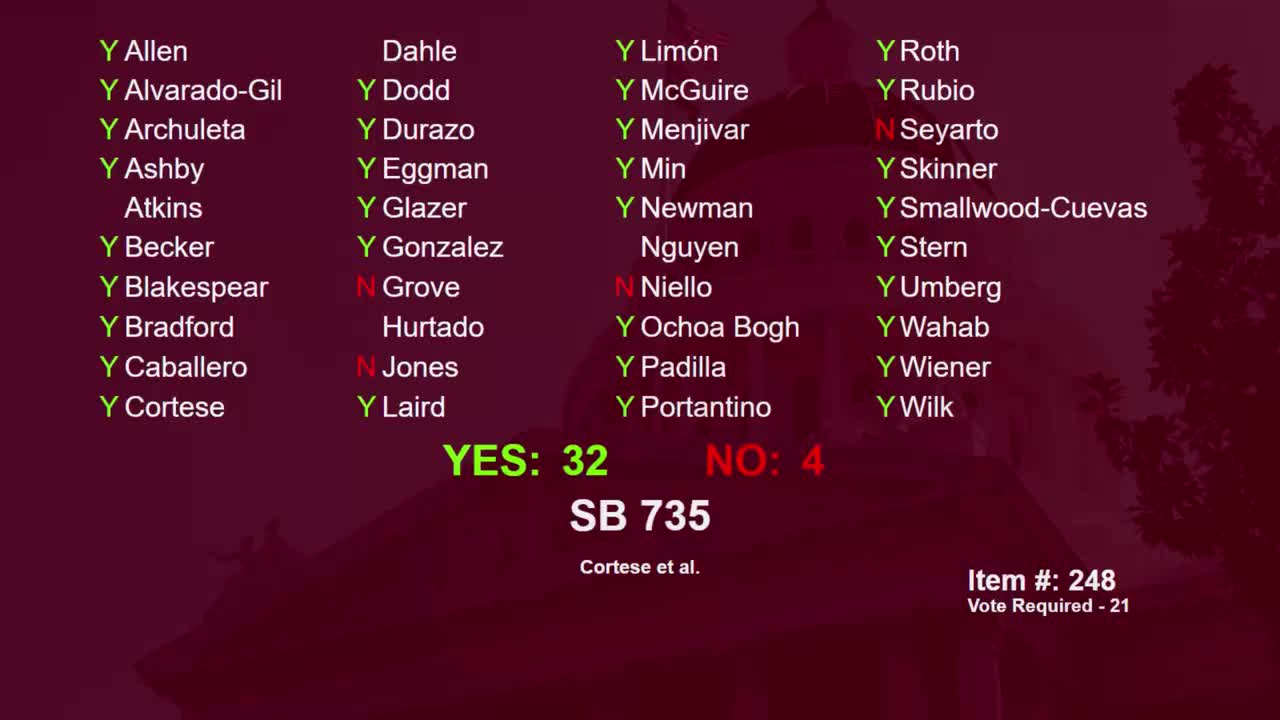 2MIN
Senate Floor
 20MIN